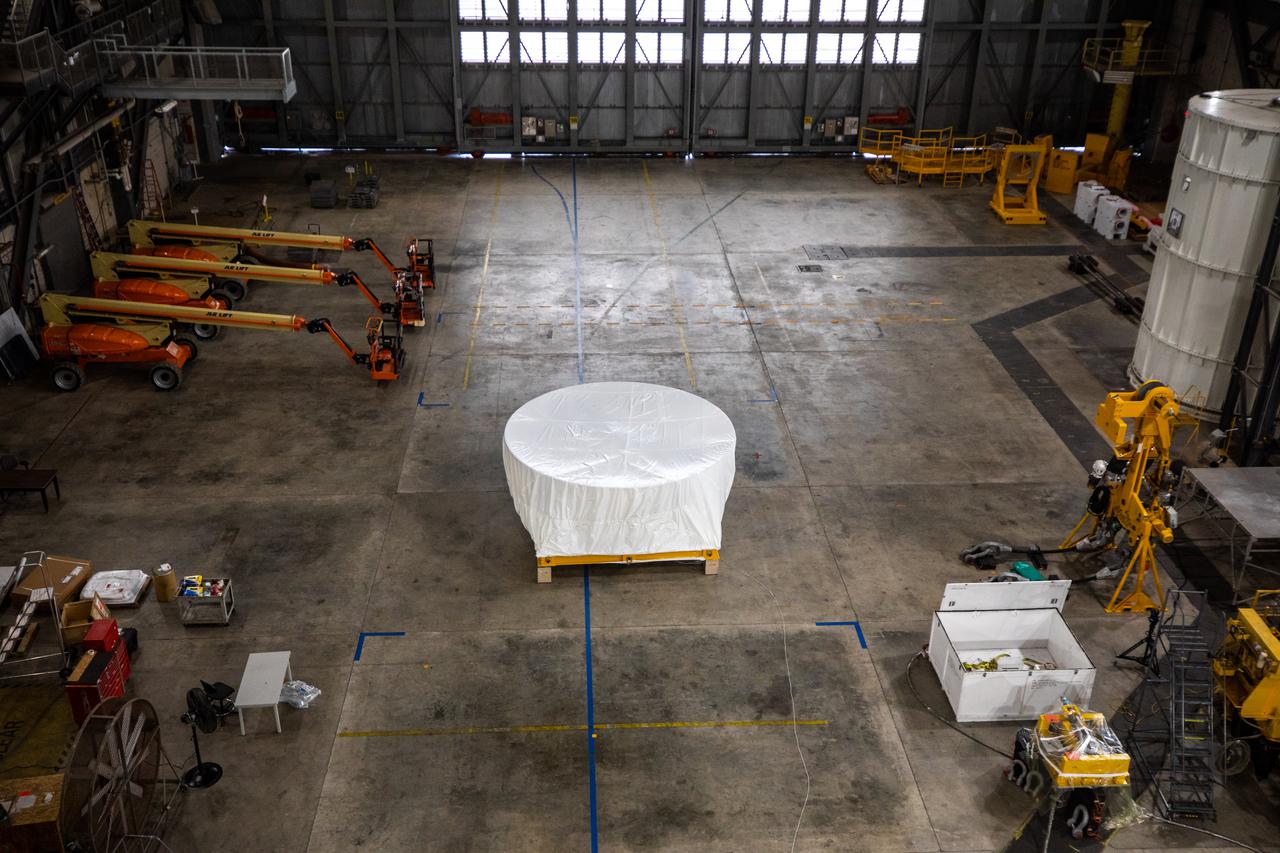
Under a protective cover, the Orion Stage Adapter (OSA) arrives in High Bay 4 of the Vehicle Assembly Building on Oct. 4, 2021, at NASA's Kennedy Space Center in Florida. Teams will lift the ring-shaped OSA, filled with shoebox-sized CubeSats, and connect it to the Interim Cryogenic Propulsion Stage (ICPS). The Orion spacecraft will be secured on top of the Space Launch System (SLS) rocket to complete the stack ahead of the Artemis I launch. This mission will be the first integrated flight test of the SLS and Orion spacecraft. In later missions, NASA will land the first woman and the first person of color on the surface of the Moon, paving the way for a long-term lunar presence and serving as a steppingstone on the way to Mars.
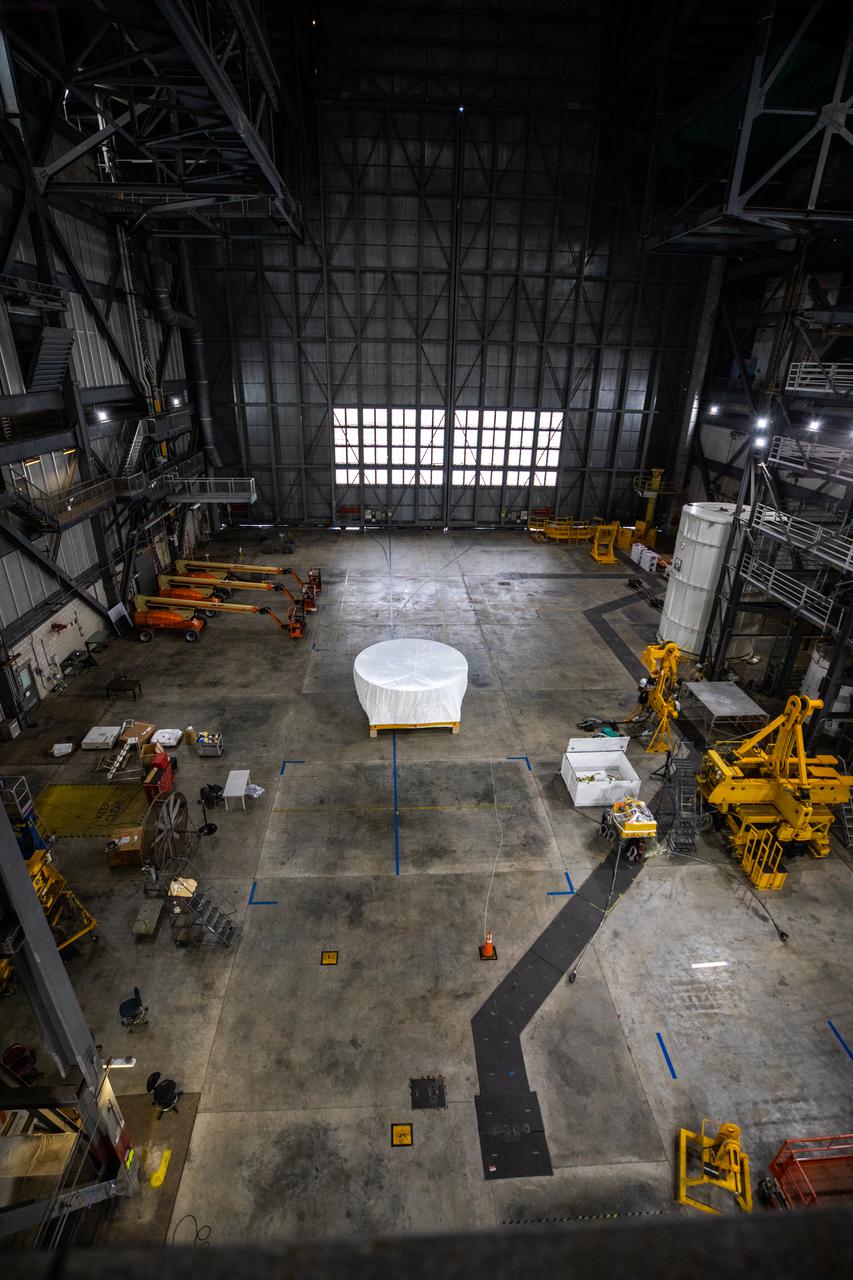
Under a protective cover, the Orion Stage Adapter (OSA) arrives in High Bay 4 of the Vehicle Assembly Building on Oct. 4, 2021, at NASA's Kennedy Space Center in Florida. Teams will lift the ring-shaped OSA, filled with shoebox-sized CubeSats, and connect it to the Interim Cryogenic Propulsion Stage (ICPS). The Orion spacecraft will be secured on top of the Space Launch System (SLS) rocket to complete the stack ahead of the Artemis I launch. This mission will be the first integrated flight test of the SLS and Orion spacecraft. In later missions, NASA will land the first woman and the first person of color on the surface of the Moon, paving the way for a long-term lunar presence and serving as a steppingstone on the way to Mars.
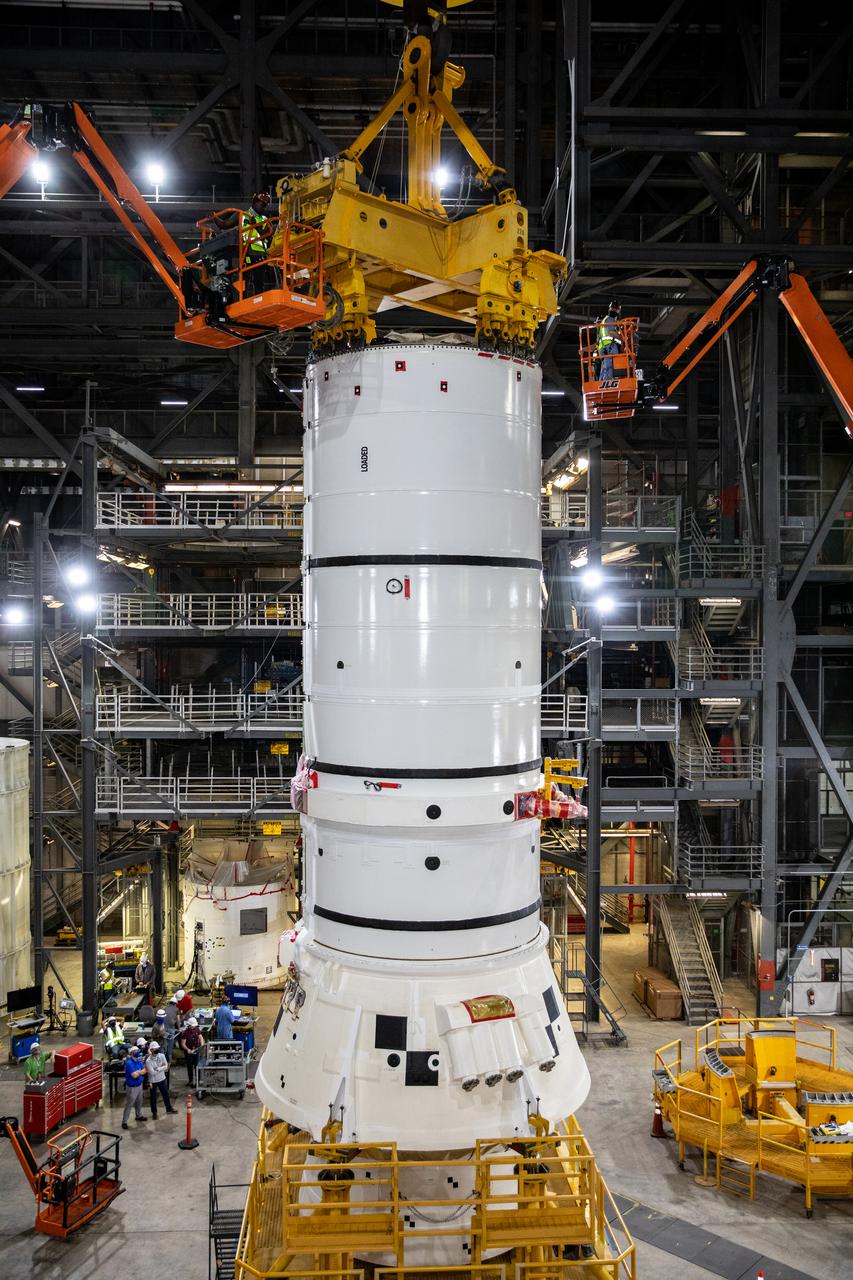
In High Bay 4 of the Vehicle Assembly Building (VAB) at NASA’s Kennedy Space Center in Florida, one of the Artemis I aft booster segments for the Space Launch System is being prepared for its lift up and lowering onto the mobile launcher in High Bay 3 for stacking operations on Nov. 20, 2020. Workers with Exploration Ground Systems and contractor Jacobs teams will stack the twin five-segment boosters on the mobile launcher in High Bay 3 over a number of weeks. When the core stage arrives, it will join the boosters on the mobile launcher, followed by the interim cryogenic propulsion stage and Orion spacecraft. Manufactured by Northrop Grumman in Utah, the twin boosters provide more than 75 percent of the total SLS thrust at launch. The SLS is managed by Marshall Space Flight Center in Huntsville, Alabama. Under the Artemis program, NASA will land the first woman and the next man on the Moon by 2024. The first in a series of increasingly complex missions, Artemis I will test the Orion spacecraft and SLS as an integrated system ahead of crewed flights to the Moon.
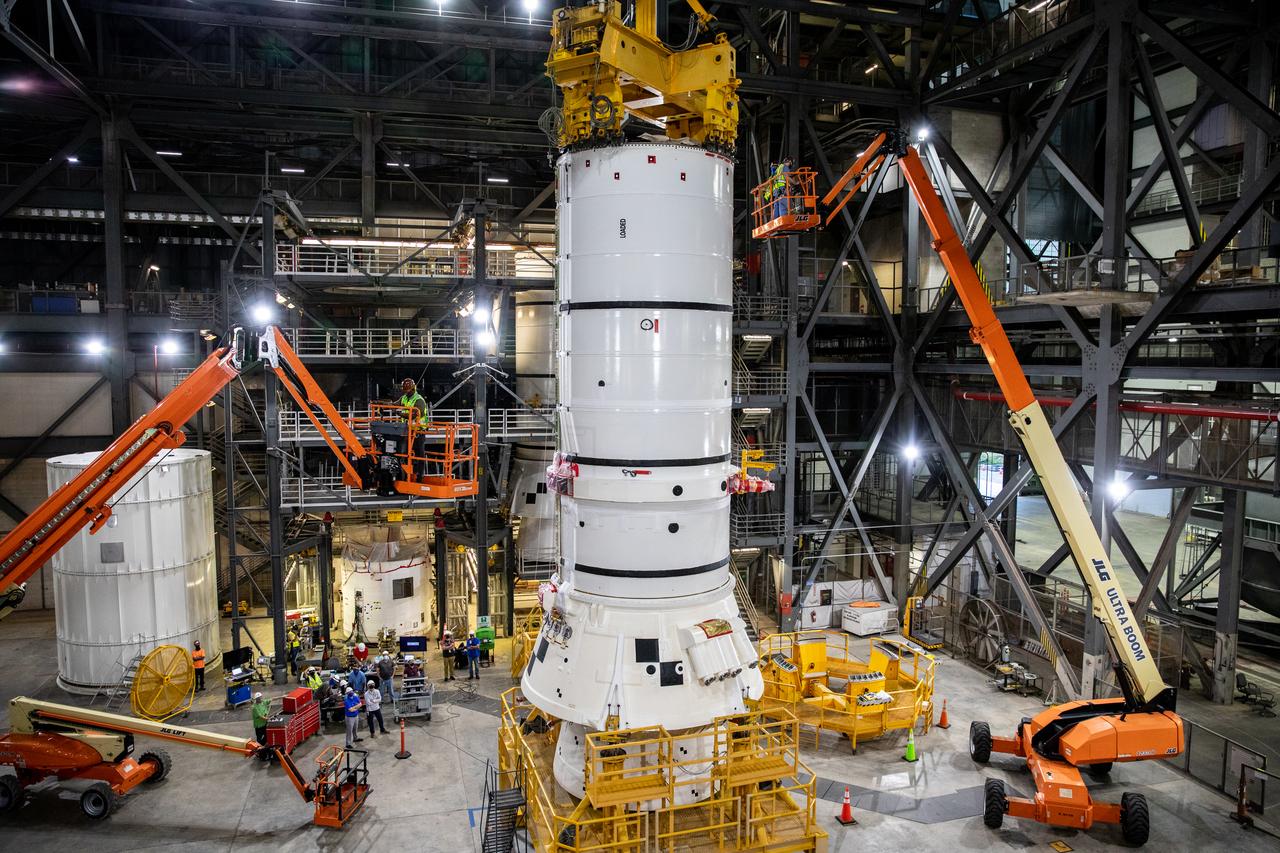
In High Bay 4 of the Vehicle Assembly Building (VAB) at NASA’s Kennedy Space Center in Florida, one of the Artemis I aft booster segments for the Space Launch System is being prepared for its lift up and lowering onto the mobile launcher in High Bay 3 for stacking operations on Nov. 20, 2020. Workers with Exploration Ground Systems and contractor Jacobs teams will stack the twin five-segment boosters on the mobile launcher in High Bay 3 over a number of weeks. When the core stage arrives, it will join the boosters on the mobile launcher, followed by the interim cryogenic propulsion stage and Orion spacecraft. Manufactured by Northrop Grumman in Utah, the twin boosters provide more than 75 percent of the total SLS thrust at launch. The SLS is managed by Marshall Space Flight Center in Huntsville, Alabama. Under the Artemis program, NASA will land the first woman and the next man on the Moon by 2024. The first in a series of increasingly complex missions, Artemis I will test the Orion spacecraft and SLS as an integrated system ahead of crewed flights to the Moon.
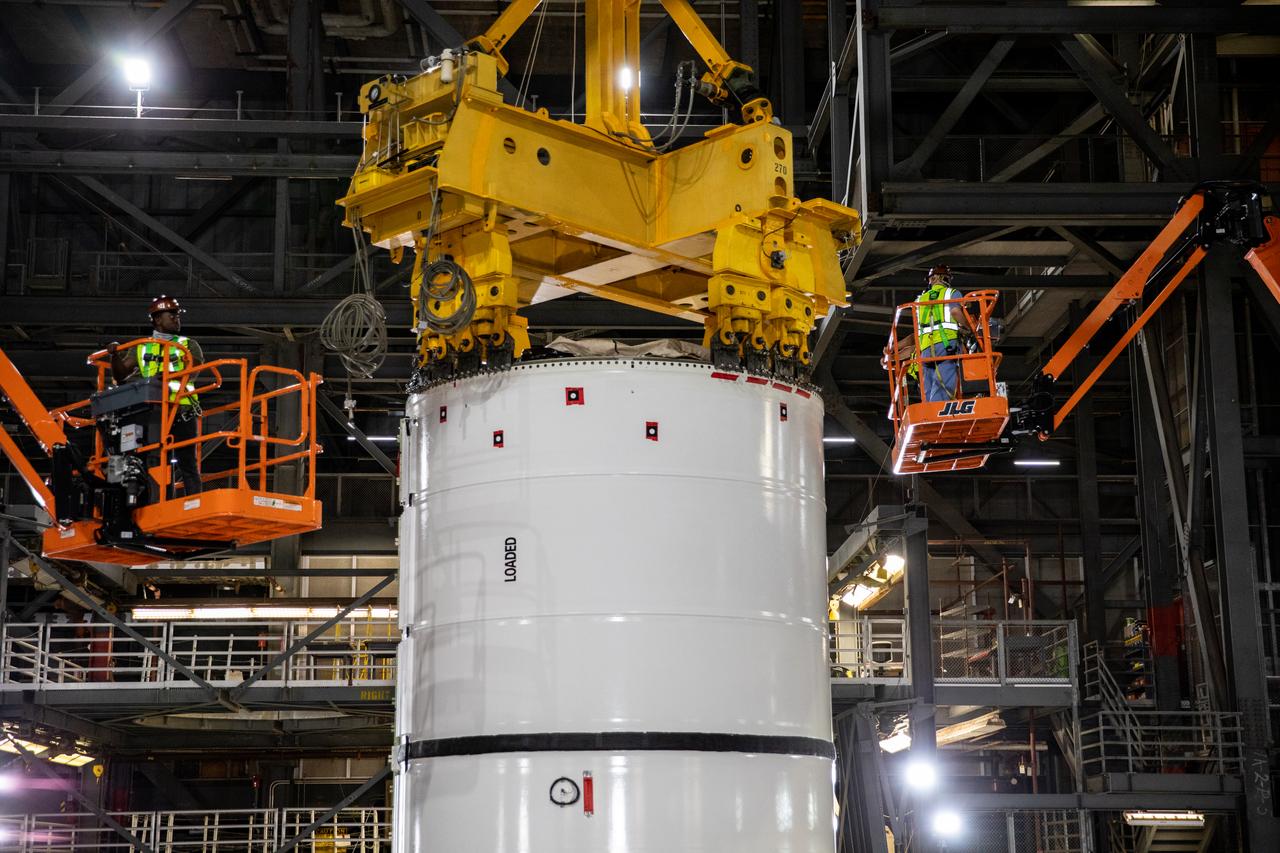
In High Bay 4 of the Vehicle Assembly Building (VAB) at NASA’s Kennedy Space Center in Florida, one of the Artemis I aft booster segments for the Space Launch System is being prepared for its lift up and lowering onto the mobile launcher in High Bay 3 for stacking operations on Nov. 20, 2020. Workers with Exploration Ground Systems and contractor Jacobs teams will stack the twin five-segment boosters on the mobile launcher in High Bay 3 over a number of weeks. When the core stage arrives, it will join the boosters on the mobile launcher, followed by the interim cryogenic propulsion stage and Orion spacecraft. Manufactured by Northrop Grumman in Utah, the twin boosters provide more than 75 percent of the total SLS thrust at launch. The SLS is managed by Marshall Space Flight Center in Huntsville, Alabama. Under the Artemis program, NASA will land the first woman and the next man on the Moon by 2024. The first in a series of increasingly complex missions, Artemis I will test the Orion spacecraft and SLS as an integrated system ahead of crewed flights to the Moon.
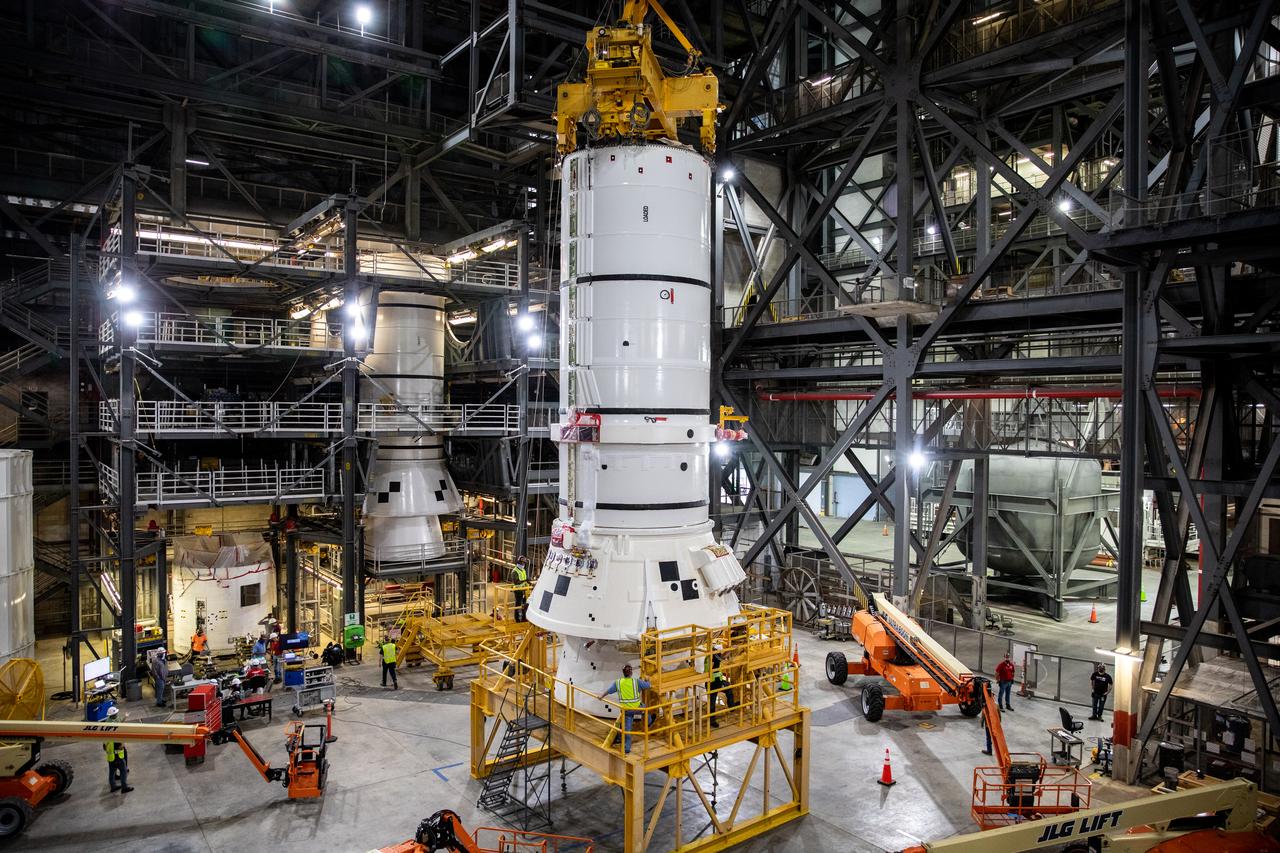
In High Bay 4 of the Vehicle Assembly Building (VAB) at NASA’s Kennedy Space Center in Florida, one of the Artemis I aft booster segments for the Space Launch System is being prepared for stacking operations on Nov. 20, 2020. Workers with Exploration Ground Systems and contractor Jacobs teams will stack the twin five-segment boosters on the mobile launcher in High Bay 3 over a number of weeks. When the core stage arrives, it will join the boosters on the mobile launcher, followed by the interim cryogenic propulsion stage and Orion spacecraft. Manufactured by Northrop Grumman in Utah, the twin boosters provide more than 75 percent of the total SLS thrust at launch. The SLS is managed by Marshall Space Flight Center in Huntsville, Alabama. Under the Artemis program, NASA will land the first woman and the next man on the Moon by 2024. The first in a series of increasingly complex missions, Artemis I will test the Orion spacecraft and SLS as an integrated system ahead of crewed flights to the Moon.
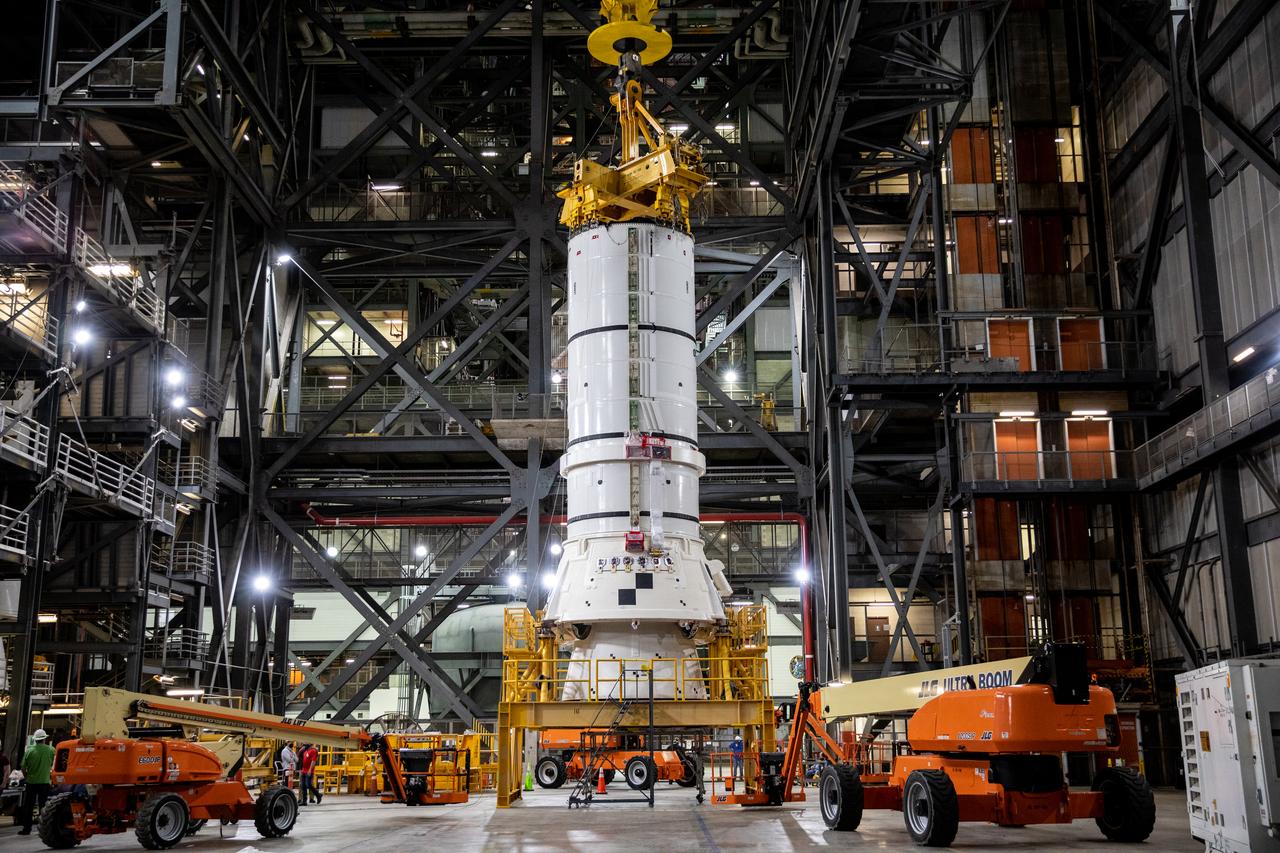
In High Bay 4 of the Vehicle Assembly Building (VAB) at NASA’s Kennedy Space Center in Florida, one of the Artemis I aft booster segments for the Space Launch System is being prepared for stacking operations on Nov. 20, 2020. Workers with Exploration Ground Systems and contractor Jacobs teams will stack the twin five-segment boosters on the mobile launcher in High Bay 3 over a number of weeks. When the core stage arrives, it will join the boosters on the mobile launcher, followed by the interim cryogenic propulsion stage and Orion spacecraft. Manufactured by Northrop Grumman in Utah, the twin boosters provide more than 75 percent of the total SLS thrust at launch. The SLS is managed by Marshall Space Flight Center in Huntsville, Alabama. Under the Artemis program, NASA will land the first woman and the next man on the Moon by 2024. The first in a series of increasingly complex missions, Artemis I will test the Orion spacecraft and SLS as an integrated system ahead of crewed flights to the Moon.
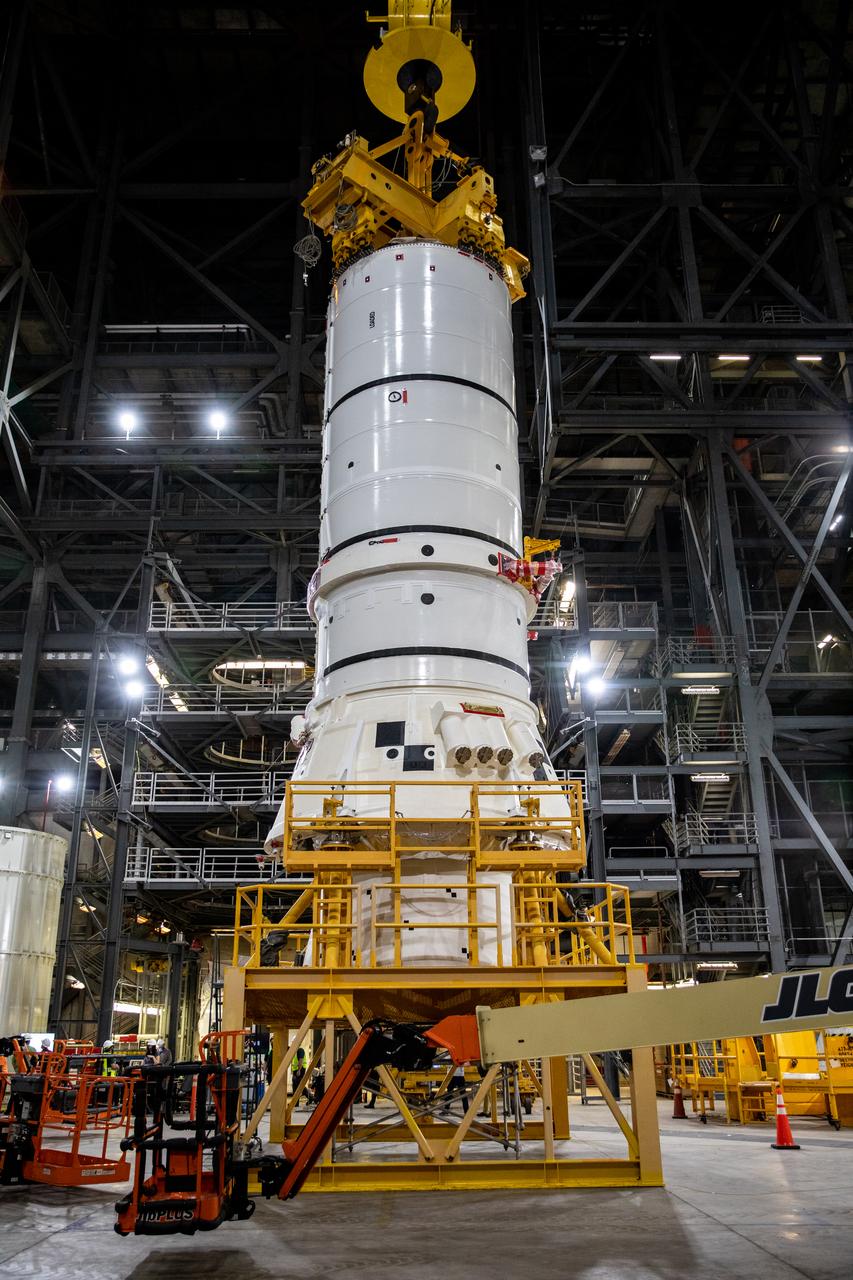
In High Bay 4 of the Vehicle Assembly Building (VAB) at NASA’s Kennedy Space Center in Florida, one of the Artemis I aft booster segments for the Space Launch System is being prepared for stacking operations on Nov. 20, 2020. Workers with Exploration Ground Systems and contractor Jacobs teams will stack the twin five-segment boosters on the mobile launcher in High Bay 3 over a number of weeks. When the core stage arrives, it will join the boosters on the mobile launcher, followed by the interim cryogenic propulsion stage and Orion spacecraft. Manufactured by Northrop Grumman in Utah, the twin boosters provide more than 75 percent of the total SLS thrust at launch. The SLS is managed by Marshall Space Flight Center in Huntsville, Alabama. Under the Artemis program, NASA will land the first woman and the next man on the Moon by 2024. The first in a series of increasingly complex missions, Artemis I will test the Orion spacecraft and SLS as an integrated system ahead of crewed flights to the Moon.
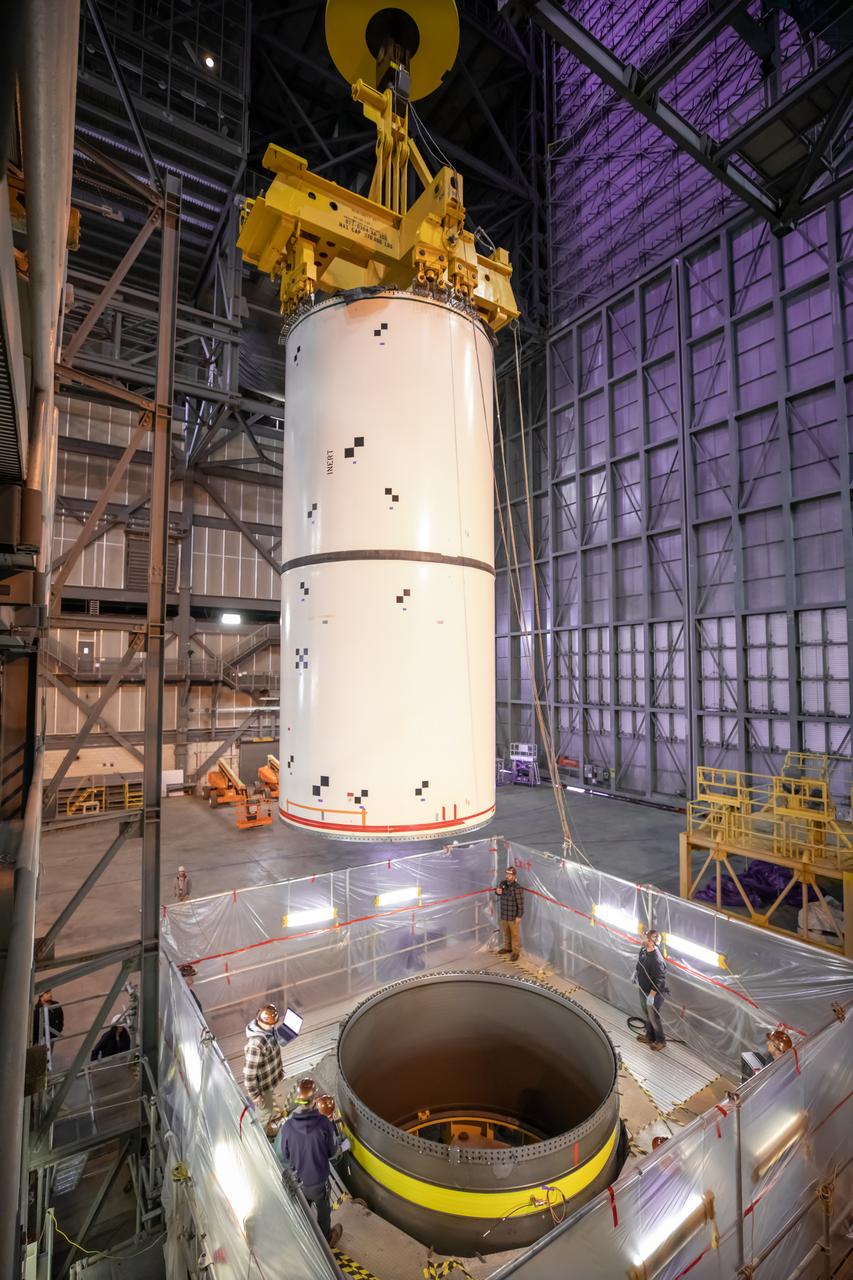
In High Bay 4 of the Vehicle Assembly Building at NASA’s Kennedy Space Center in Florida, pathfinders, or full-scale replicas of Space Launch System (SLS) solid rocket booster segments, are being stacked during a training exercise on Jan. 8, 2020. A team of engineers with Exploration Ground Systems and crane operators and technicians with contractor Jacobs are practicing lifting, moving and stacking maneuvers, using important ground support equipment to train employees and certify all the equipment works properly. The booster pathfinders are inert, full-scale replicas of the actual booster hardware that will be attached to the SLS rocket for Artemis missions. The five-segment, 17-story-tall twin boosters will provide 3.6 million pounds of thrust each at liftoff to help launch Orion on Artemis I, its first uncrewed mission beyond the Moon.
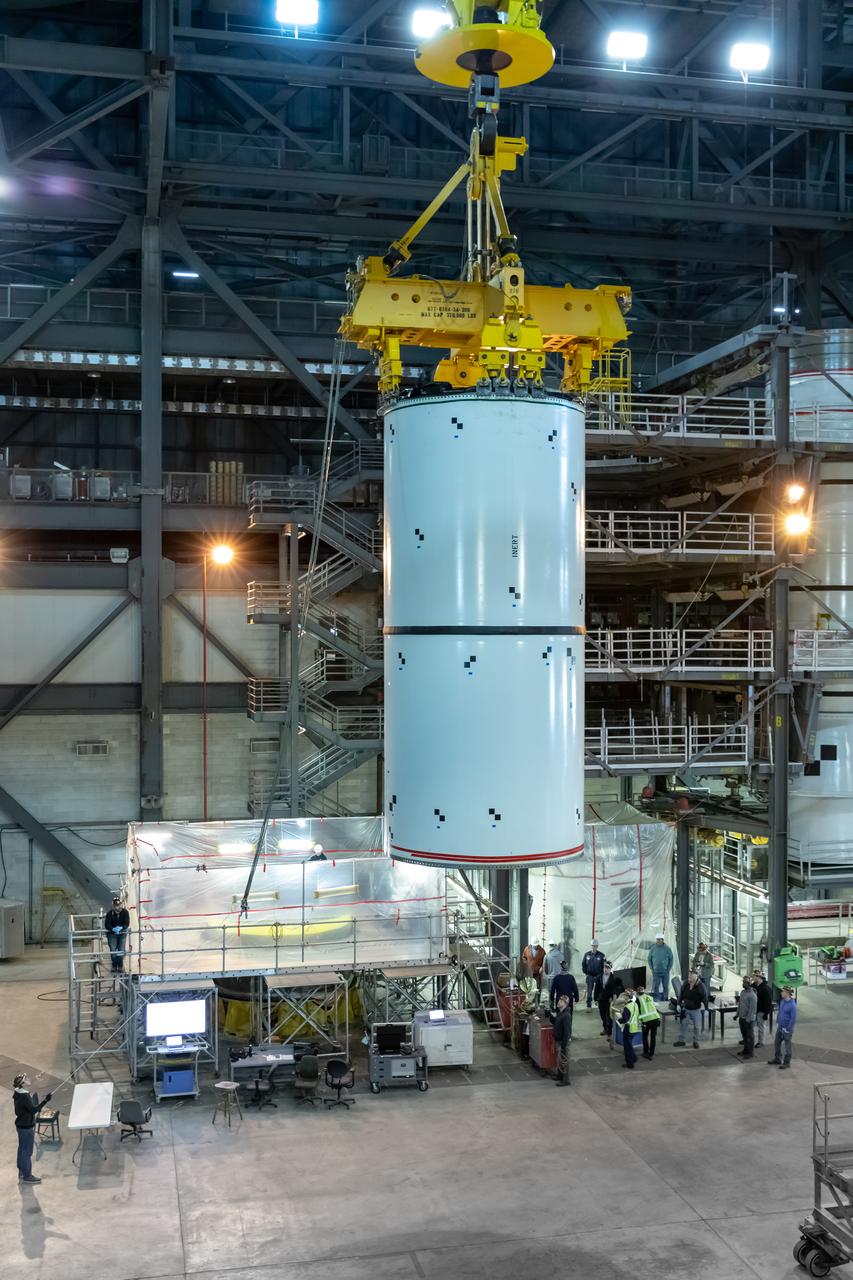
In High Bay 4 of the Vehicle Assembly Building at NASA’s Kennedy Space Center in Florida, a crane moves Space Launch System (SLS) solid rocket booster pathfinder segments toward a platform during a training exercise on Jan. 8, 2020. A team of engineers with Exploration Ground Systems and crane operators and technicians with contractor Jacobs are practicing lifting, moving and stacking maneuvers, using important ground support equipment to train employees and certify all the equipment works properly. The booster pathfinders are inert, full-scale replicas of the actual booster hardware that will be attached to the SLS rocket for Artemis missions. The five-segment, 17-story-tall twin boosters will provide 3.6 million pounds of thrust each at liftoff to help launch Orion on Artemis I, its first uncrewed mission beyond the Moon.
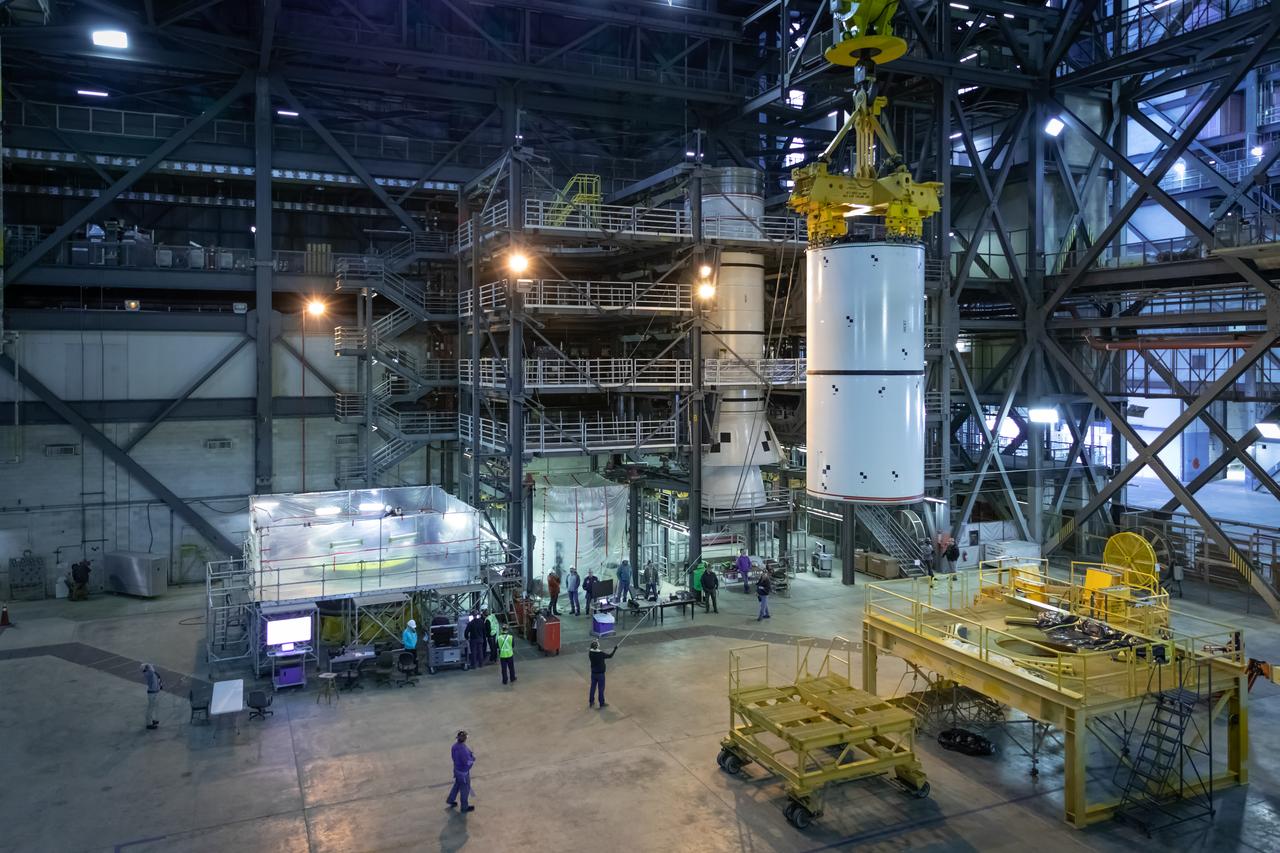
In High Bay 4 of the Vehicle Assembly Building at NASA’s Kennedy Space Center in Florida, a crane moves Space Launch System (SLS) solid rocket booster pathfinder segments to stack them atop other pathfinder segments during a training exercise on Jan. 8, 2020. A team of engineers with Exploration Ground Systems and crane operators and technicians with contractor Jacobs are practicing lifting, moving and stacking maneuvers, using important ground support equipment to train employees and certify all the equipment works properly. The booster pathfinders are inert, full-scale replicas of the actual booster hardware that will be attached to the SLS rocket for Artemis missions. The five-segment, 17-story-tall twin boosters will provide 3.6 million pounds of thrust each at liftoff to help launch Orion on Artemis I, its first uncrewed mission beyond the Moon.
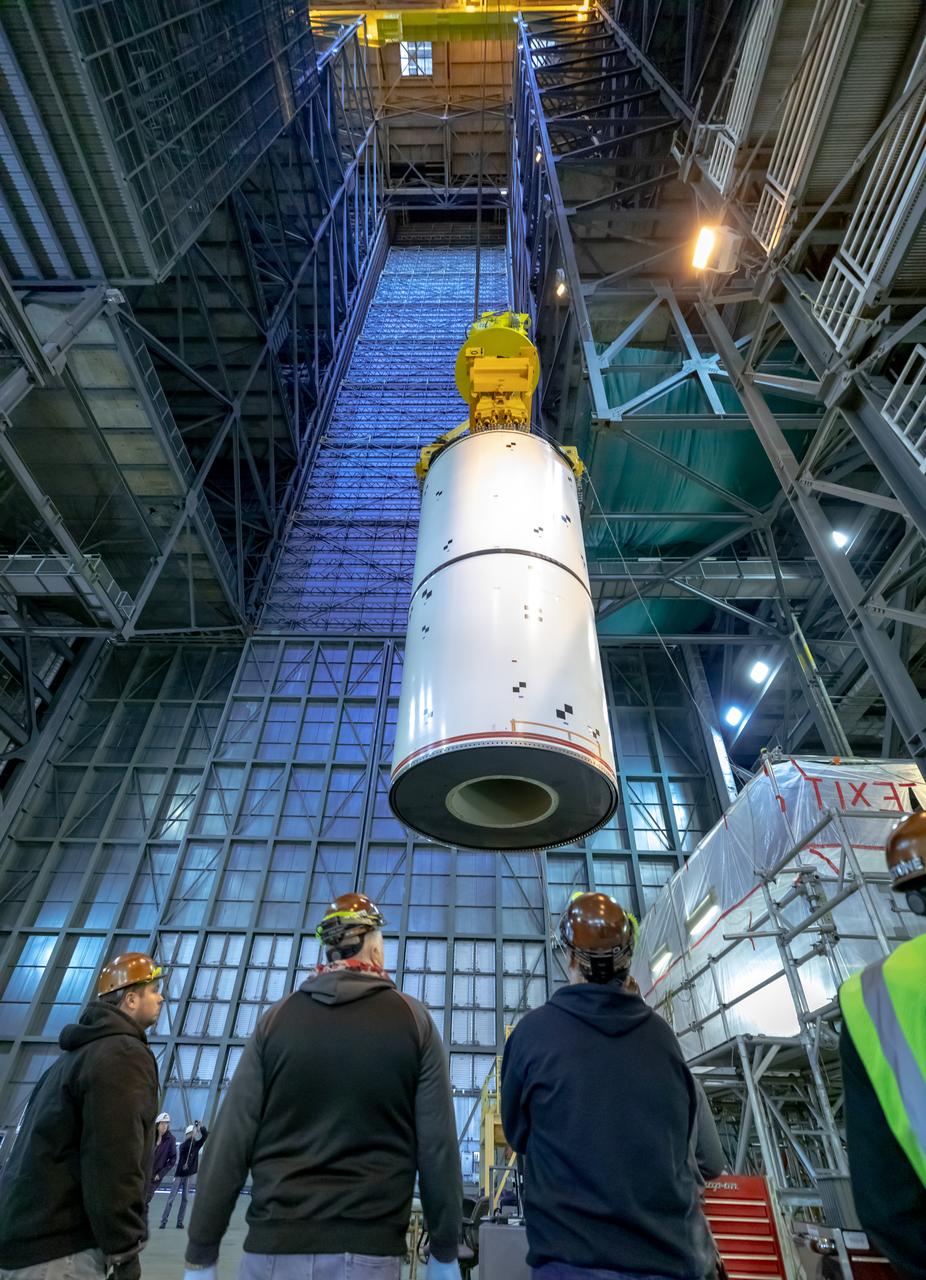
In High Bay 4 of the Vehicle Assembly Building at NASA’s Kennedy Space Center in Florida, a team of engineers with Exploration Ground Systems and contractor Jacobs participate in Space Launch System (SLS) solid rocket booster pathfinder stacking during a training exercise on Jan. 8, 2020. A crane is used to lift up two pathfinder segments and move them to a platform. The booster pathfinders are inert, full-scale replicas of the actual booster hardware that will be attached to the SLS rocket for Artemis missions. The team is practicing lifting, moving and stacking maneuvers, using important ground support equipment to train employees and certify all the equipment works properly. The five-segment, 17-story-tall twin boosters will provide 3.6 million pounds of thrust each at liftoff to help launch Orion on Artemis I, its first uncrewed mission beyond the Moon.
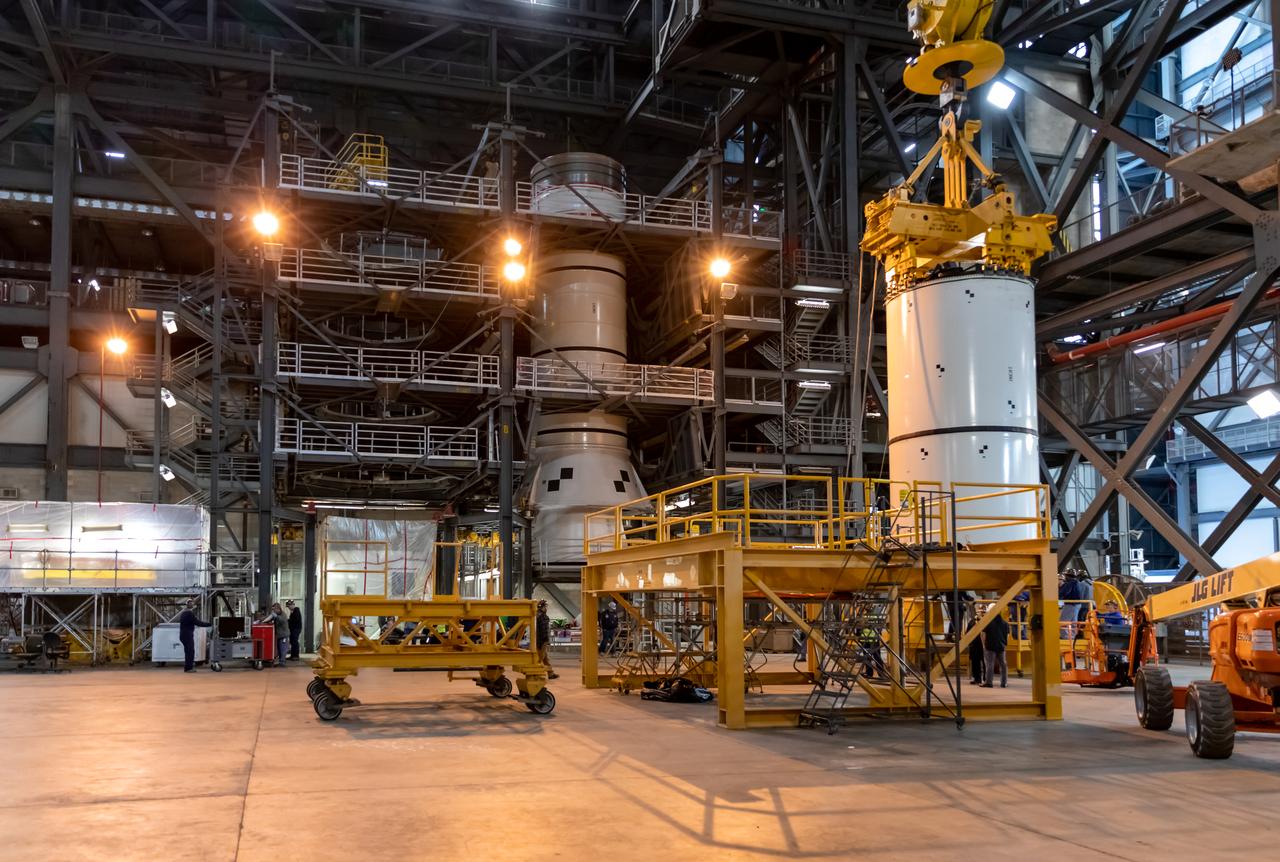
In High Bay 4 of the Vehicle Assembly Building at NASA’s Kennedy Space Center in Florida, a crane is used to lift Space Launch System (SLS) solid rocket booster pathfinder segments and move them to be added atop other booster pathfinder segments during a training exercise on Jan. 8, 2020. A team of engineers with Exploration Ground Systems and crane operators and technicians with contractor Jacobs are practicing lifting, moving and stacking maneuvers, using important ground support equipment to train employees and certify all the equipment works properly. The booster pathfinders are inert, full-scale replicas of the actual booster hardware that will be attached to the SLS rocket for Artemis missions. The five-segment, 17-story-tall twin boosters will provide 3.6 million pounds of thrust each at liftoff to help launch Orion on Artemis I, its first uncrewed mission beyond the Moon.
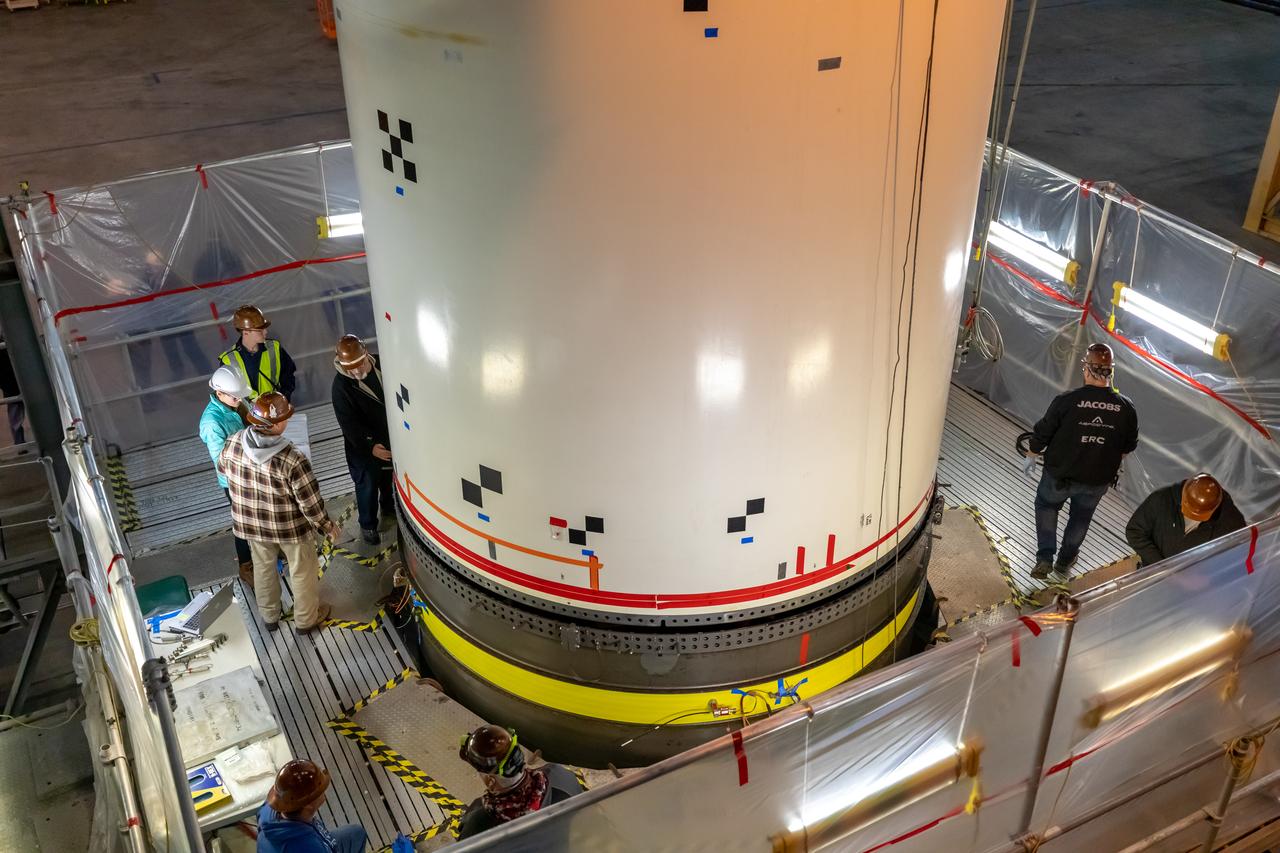
In High Bay 4 of the Vehicle Assembly Building at NASA’s Kennedy Space Center in Florida, a team of engineers with Exploration Ground Systems and contractor Jacobs participate in Space Launch System (SLS) solid rocket booster pathfinder stacking during a training exercise on Jan. 8, 2020. The booster pathfinders are inert, full-scale replicas of the actual booster hardware that will be attached to the SLS rocket for Artemis missions. The team is practicing lifting, moving and stacking maneuvers, using important ground support equipment to train employees and certify all the equipment works properly. The five-segment, 17-story-tall twin boosters will provide 3.6 million pounds of thrust each at liftoff to help launch Orion on Artemis I, its first uncrewed mission beyond the Moon.
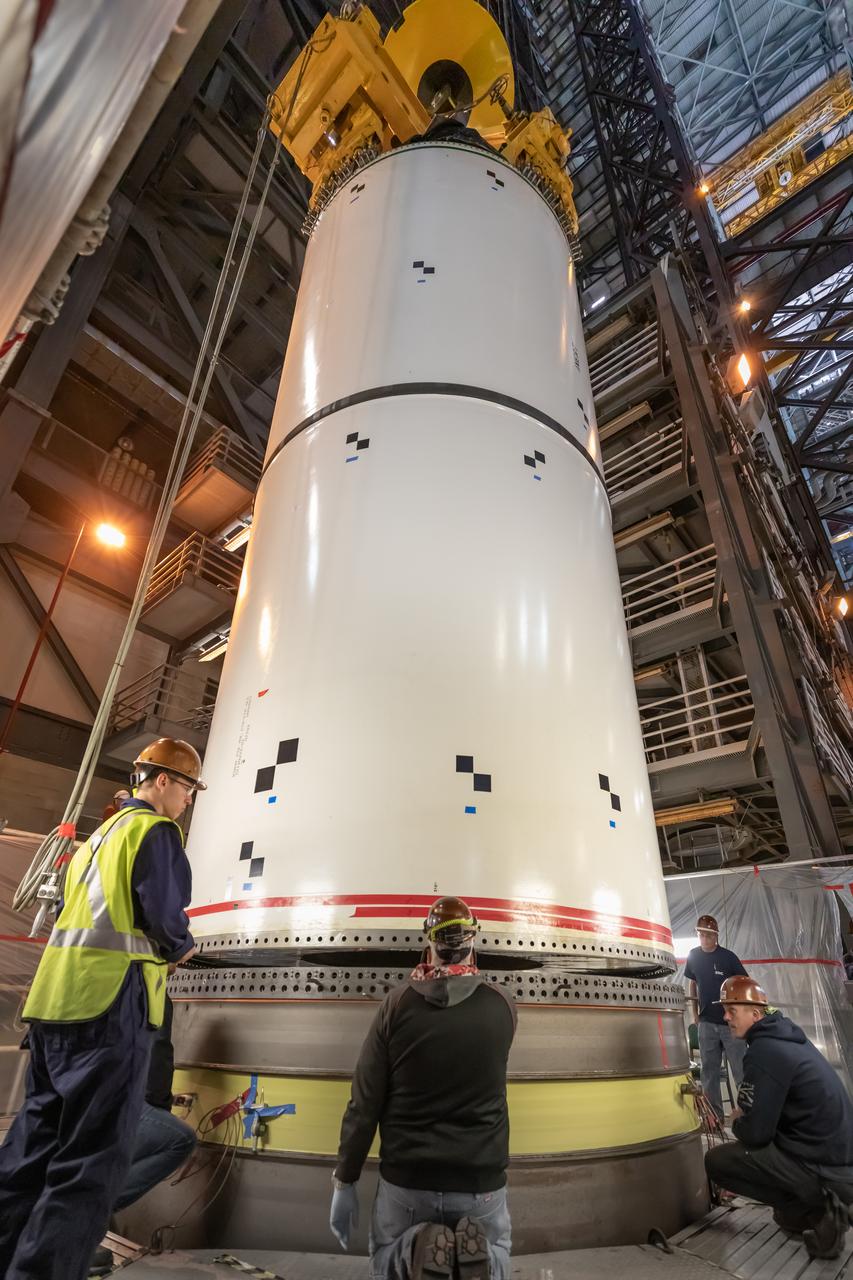
In High Bay 4 of the Vehicle Assembly Building at NASA’s Kennedy Space Center in Florida, a team of engineers with Exploration Ground Systems and contractor Jacobs participate in Space Launch System (SLS) solid rocket booster pathfinder stacking during a training exercise on Jan. 8, 2020. The booster pathfinders are inert, full-scale replicas of the actual booster hardware that will be attached to the SLS rocket for Artemis missions. The team is practicing lifting, moving and stacking maneuvers, using important ground support equipment to train employees and certify all the equipment works properly. The five-segment, 17-story-tall twin boosters will provide 3.6 million pounds of thrust each at liftoff to help launch Orion on Artemis I, its first uncrewed mission beyond the Moon.
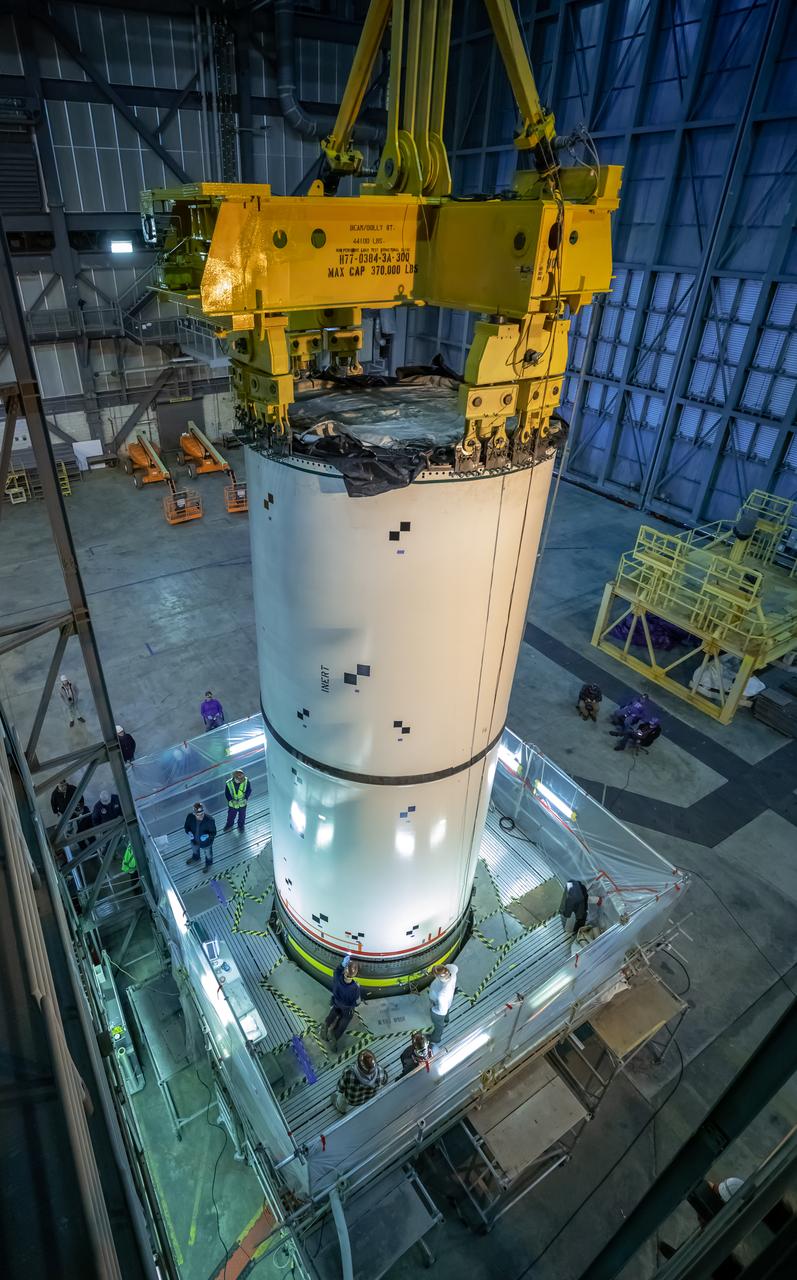
In High Bay 4 of the Vehicle Assembly Building at NASA’s Kennedy Space Center in Florida, a crane lowers Space Launch System (SLS) solid rocket booster pathfinder segments onto a platform during a training exercise on Jan. 8, 2020. A team of engineers with Exploration Ground Systems and crane operators and technicians with contractor Jacobs are practicing lifting, moving and stacking maneuvers, using important ground support equipment to train employees and certify all the equipment works properly. The booster pathfinders are inert, full-scale replicas of the actual booster hardware that will be attached to the SLS rocket for Artemis missions. The five-segment, 17-story-tall twin boosters will provide 3.6 million pounds of thrust each at liftoff to help launch Orion on Artemis I, its first uncrewed mission beyond the Moon.
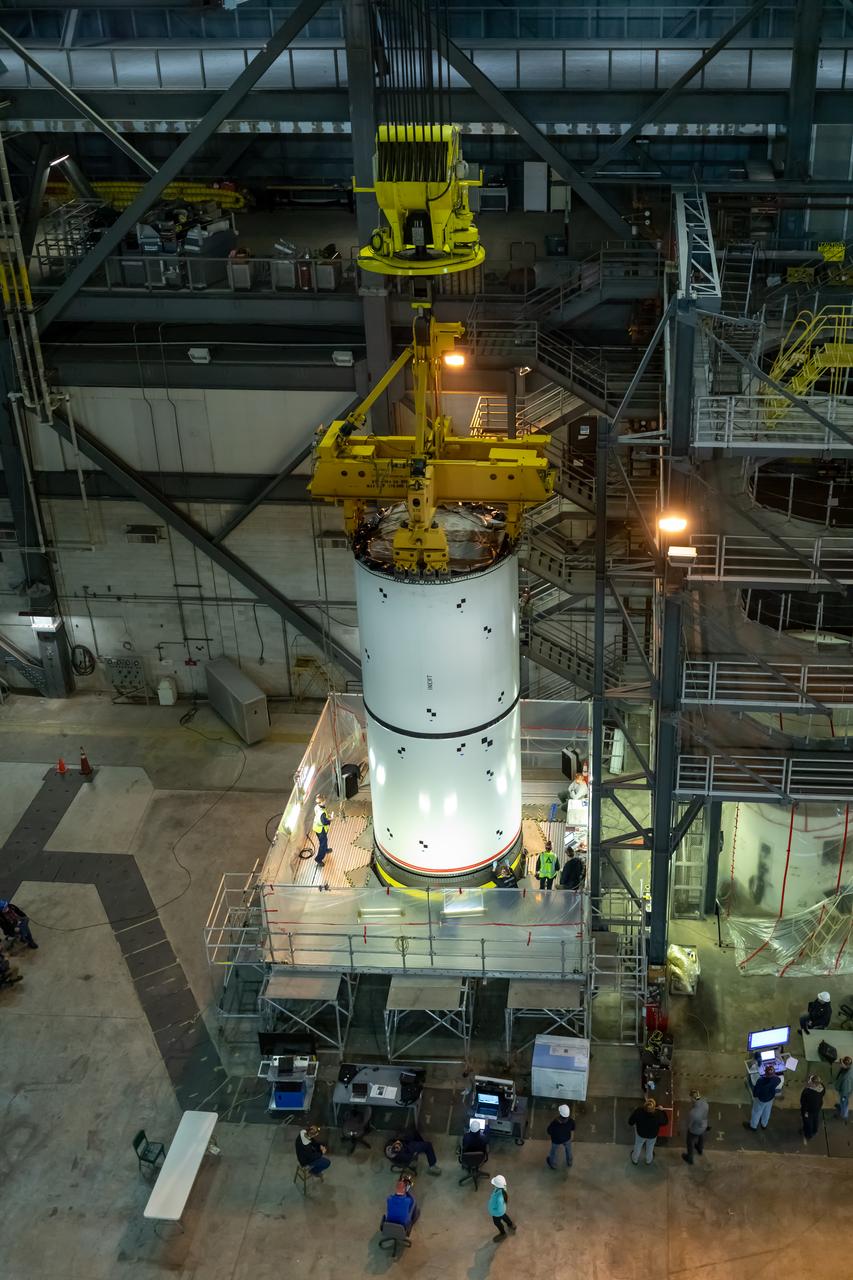
In High Bay 4 of the Vehicle Assembly Building at NASA’s Kennedy Space Center in Florida, a crane lowers one Space Launch System (SLS) solid rocket booster pathfinder segment onto another segment during a training exercise on Jan. 8, 2020. A team of engineers with Exploration Ground Systems and crane operators and technicians with contractor Jacobs are practicing lifting, moving and stacking maneuvers, using important ground support equipment to train employees and certify all the equipment works properly. The booster pathfinders are inert, full-scale replicas of the actual booster hardware that will be attached to the SLS rocket for Artemis missions. The five-segment, 17-story-tall twin boosters will provide 3.6 million pounds of thrust each at liftoff to help launch Orion on Artemis I, its first uncrewed mission beyond the Moon.
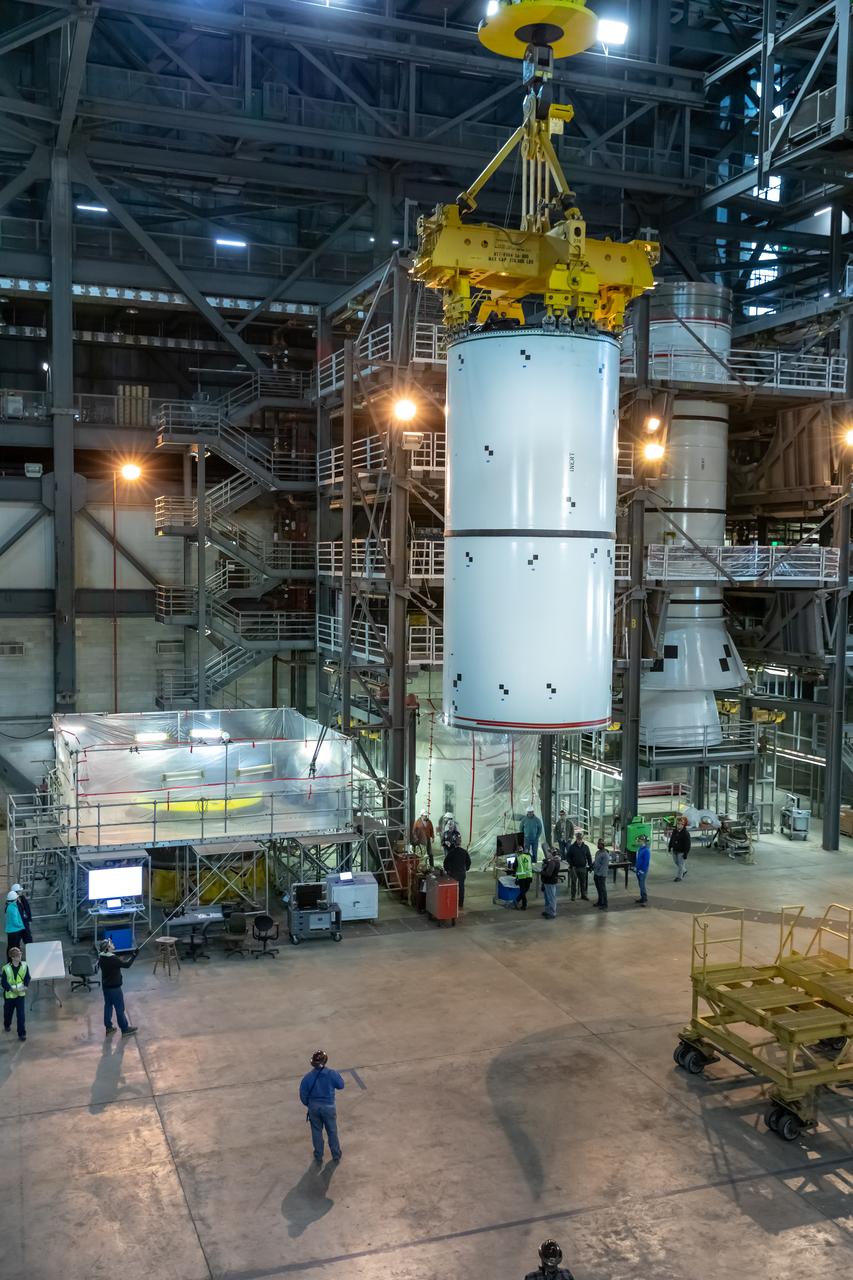
In High Bay 4 of the Vehicle Assembly Building at NASA’s Kennedy Space Center in Florida, a crane moves Space Launch System (SLS) solid rocket booster pathfinder segments toward a platform during a training exercise on Jan. 8, 2020. A team of engineers with Exploration Ground Systems and crane operators and technicians with contractor Jacobs are practicing lifting, moving and stacking maneuvers, using important ground support equipment to train employees and certify all the equipment works properly. The booster pathfinders are inert, full-scale replicas of the actual booster hardware that will be attached to the SLS rocket for Artemis missions. The five-segment, 17-story-tall twin boosters will provide 3.6 million pounds of thrust each at liftoff to help launch Orion on Artemis I, its first uncrewed mission beyond the Moon.
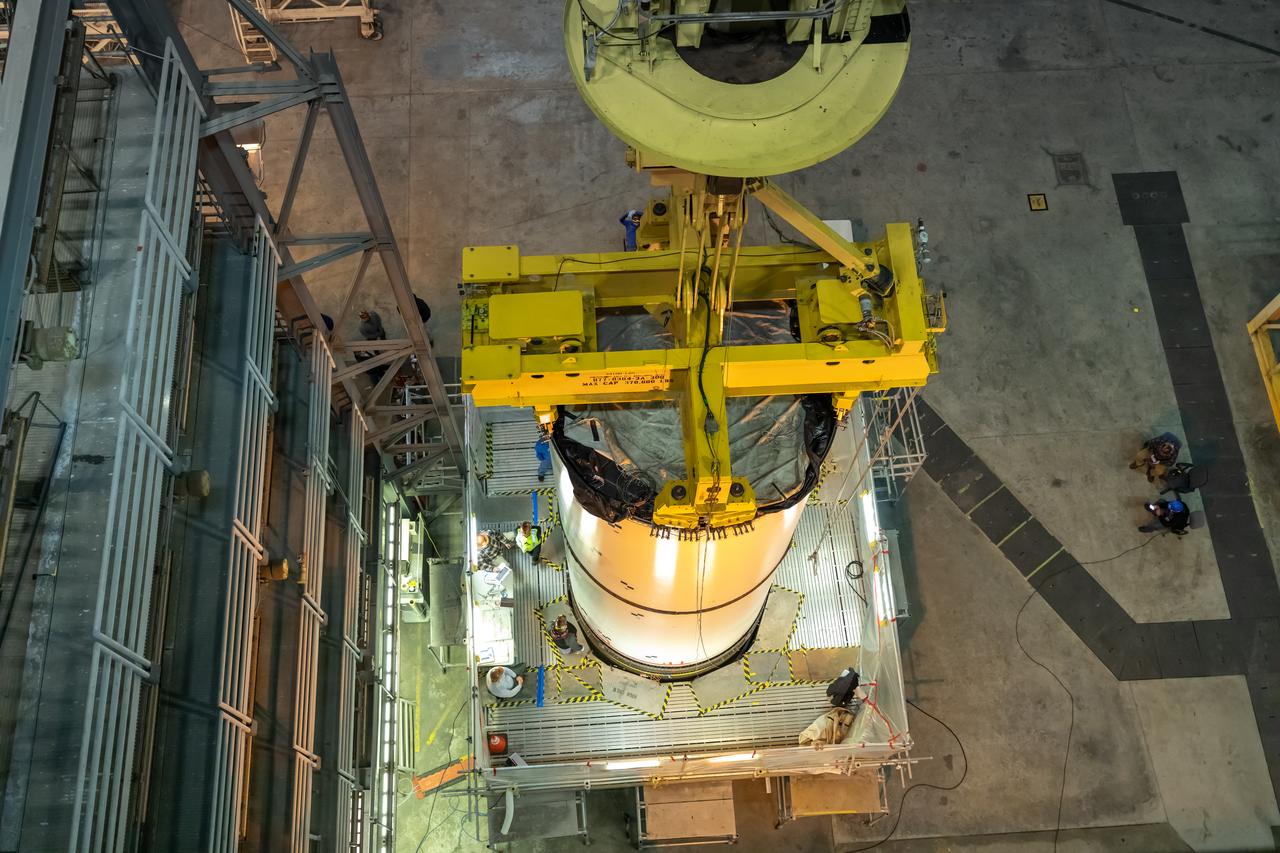
In High Bay 4 of the Vehicle Assembly Building at NASA’s Kennedy Space Center in Florida, a crane lowers one Space Launch System (SLS) solid rocket booster pathfinder segment onto another segment during a training exercise on Jan. 8, 2020. A team of engineers with Exploration Ground Systems and crane operators and technicians with contractor Jacobs are practicing lifting, moving and stacking maneuvers, using important ground support equipment to train employees and certify all the equipment works properly. The booster pathfinders are inert, full-scale replicas of the actual booster hardware that will be attached to the SLS rocket for Artemis missions. The five-segment, 17-story-tall twin boosters will provide 3.6 million pounds of thrust each at liftoff to help launch Orion on Artemis I, its first uncrewed mission beyond the Moon.
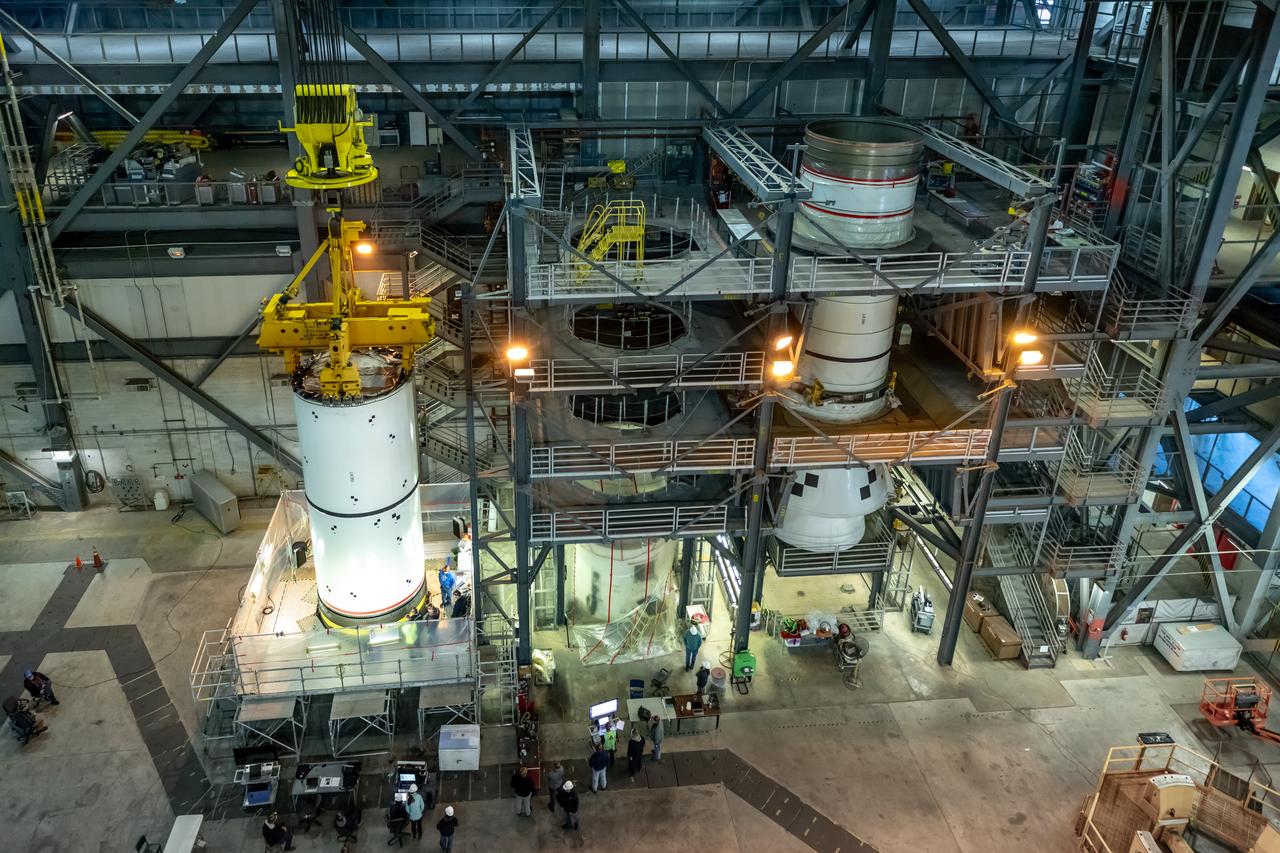
In High Bay 4 of the Vehicle Assembly Building at NASA’s Kennedy Space Center in Florida, pathfinders, or full-scale replicas of Space Launch System (SLS) solid rocket booster segments, are being stacked during a training exercise on Jan. 8, 2020. A team of engineers with Exploration Ground Systems and crane operators and technicians with contractor Jacobs are practicing lifting, moving and stacking maneuvers, using important ground support equipment to train employees and certify all the equipment works properly. The booster pathfinders are inert, full-scale replicas of the actual booster hardware that will be attached to the SLS rocket for Artemis missions. The five-segment, 17-story-tall twin boosters will provide 3.6 million pounds of thrust each at liftoff to help launch Orion on Artemis I, its first uncrewed mission beyond the Moon.
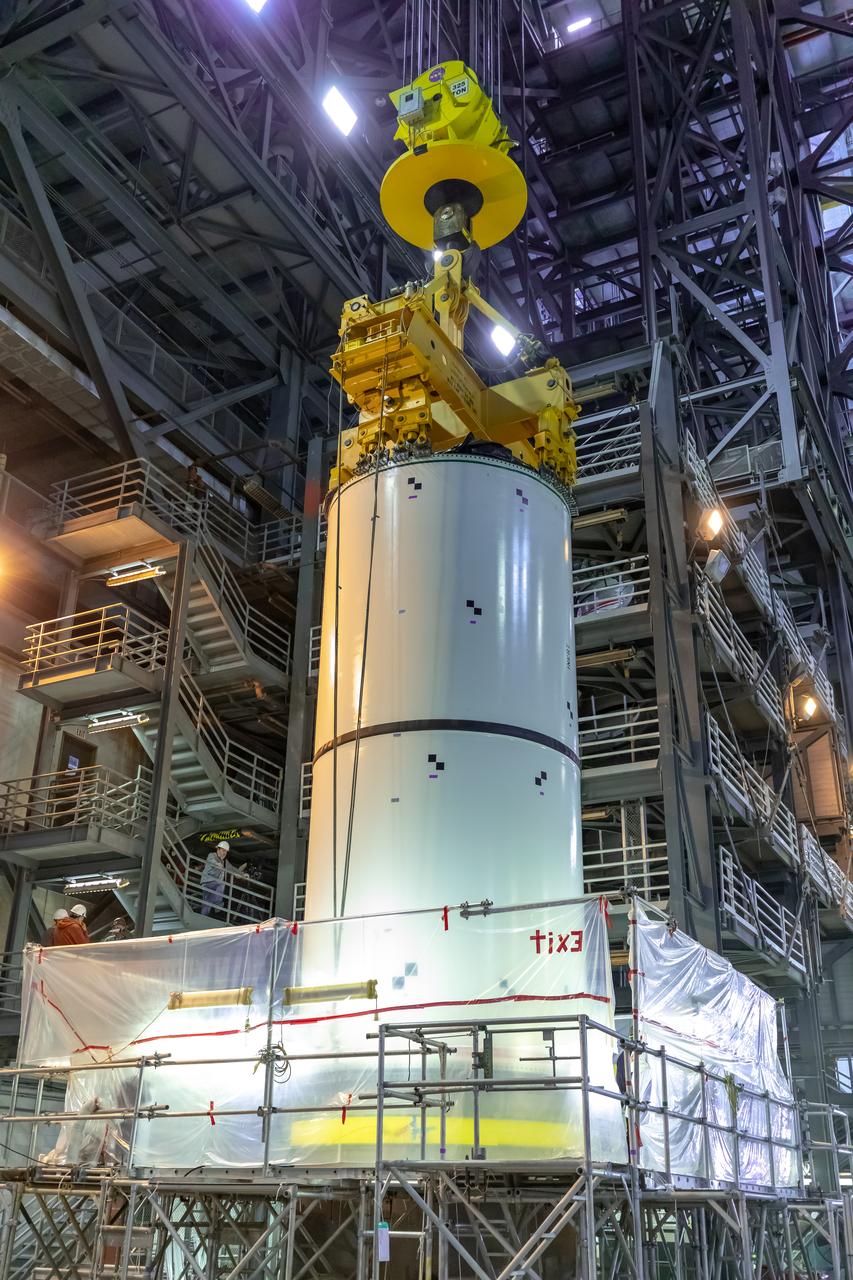
In High Bay 4 of the Vehicle Assembly Building at NASA’s Kennedy Space Center in Florida, a crane lowers Space Launch System (SLS) solid rocket booster pathfinder segments onto a platform during a training exercise on Jan. 8, 2020. A team of engineers with Exploration Ground Systems and crane operators and technicians with contractor Jacobs are practicing lifting, moving and stacking maneuvers, using important ground support equipment to train employees and certify all the equipment works properly. The booster pathfinders are inert, full-scale replicas of the actual booster hardware that will be attached to the SLS rocket for Artemis missions. The five-segment, 17-story-tall twin boosters will provide 3.6 million pounds of thrust each at liftoff to help launch Orion on Artemis I, its first uncrewed mission beyond the Moon.
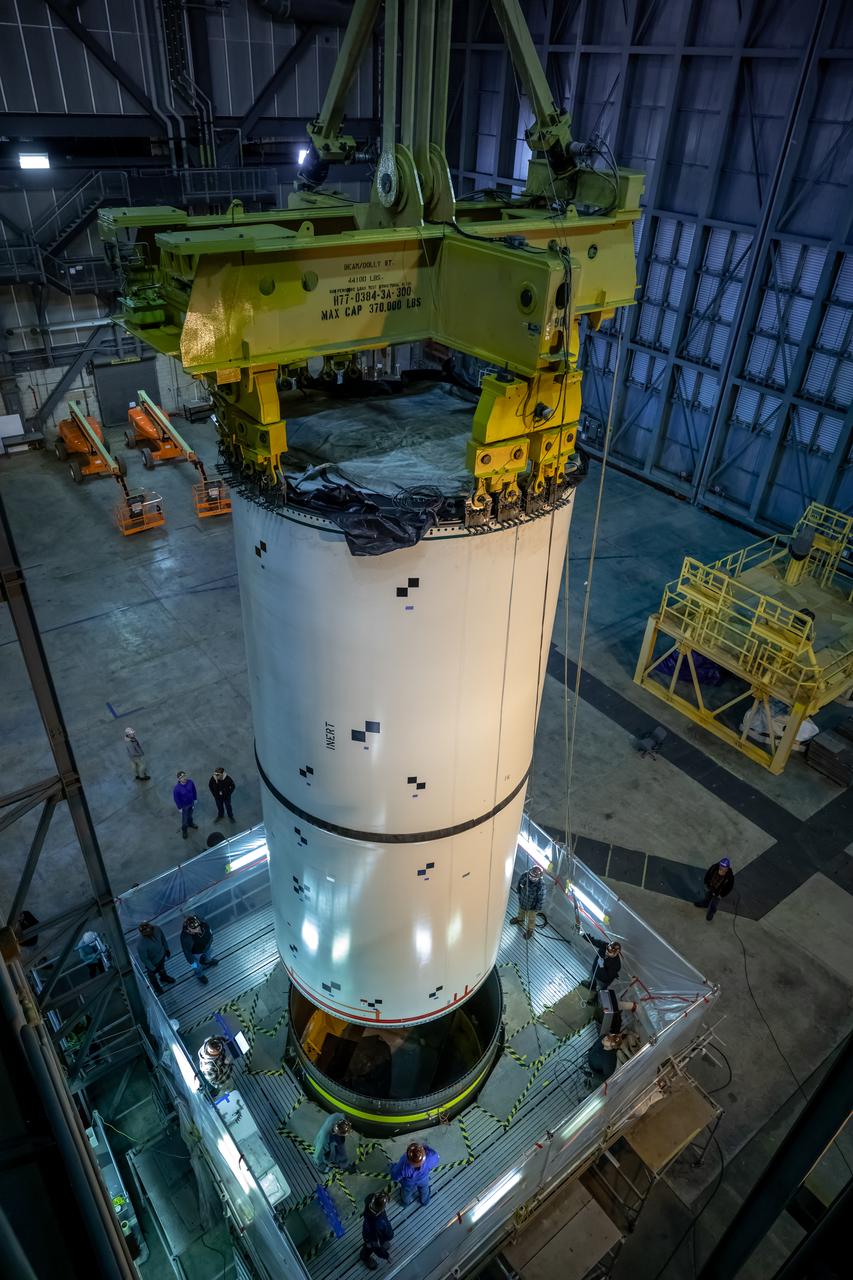
In High Bay 4 of the Vehicle Assembly Building at NASA’s Kennedy Space Center in Florida, pathfinders, or full-scale replicas of Space Launch System (SLS) solid rocket booster segments, are being stacked during a training exercise on Jan. 8, 2020. A team of engineers with Exploration Ground Systems and crane operators and technicians with contractor Jacobs are practicing lifting, moving and stacking maneuvers, using important ground support equipment to train employees and certify all the equipment works properly. The booster pathfinders are inert, full-scale replicas of the actual booster hardware that will be attached to the SLS rocket for Artemis missions. The five-segment, 17-story-tall twin boosters will provide 3.6 million pounds of thrust each at liftoff to help launch Orion on Artemis I, its first uncrewed mission beyond the Moon.
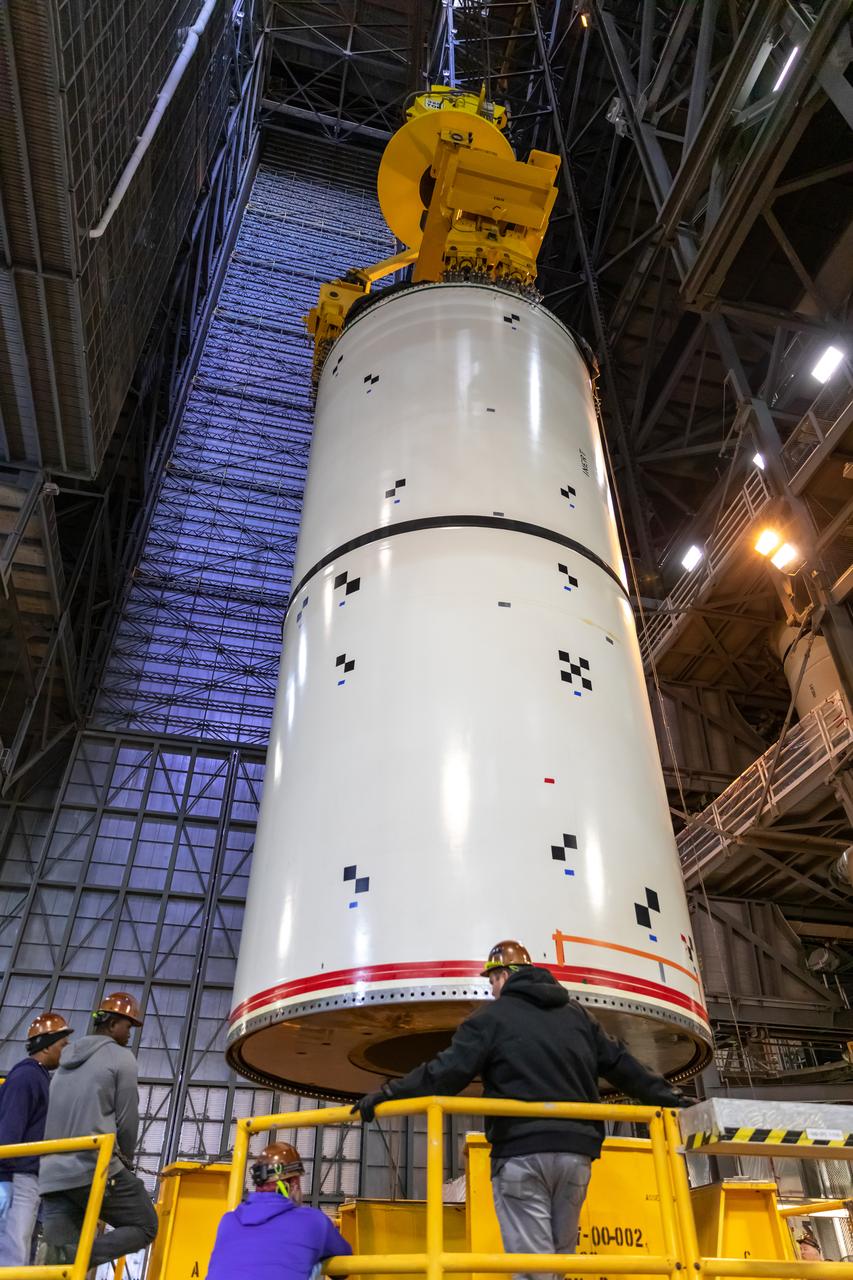
In High Bay 4 of the Vehicle Assembly Building at NASA’s Kennedy Space Center in Florida, a crane lowers Space Launch System (SLS) solid rocket booster pathfinder segments onto a platform during a training exercise on Jan. 8, 2020. A team of engineers with Exploration Ground Systems and crane operators and technicians with contractor Jacobs are practicing lifting, moving and stacking maneuvers, using important ground support equipment to train employees and certify all the equipment works properly. The booster pathfinders are inert, full-scale replicas of the actual booster hardware that will be attached to the SLS rocket for Artemis missions. The five-segment, 17-story-tall twin boosters will provide 3.6 million pounds of thrust each at liftoff to help launch Orion on Artemis I, its first uncrewed mission beyond the Moon.
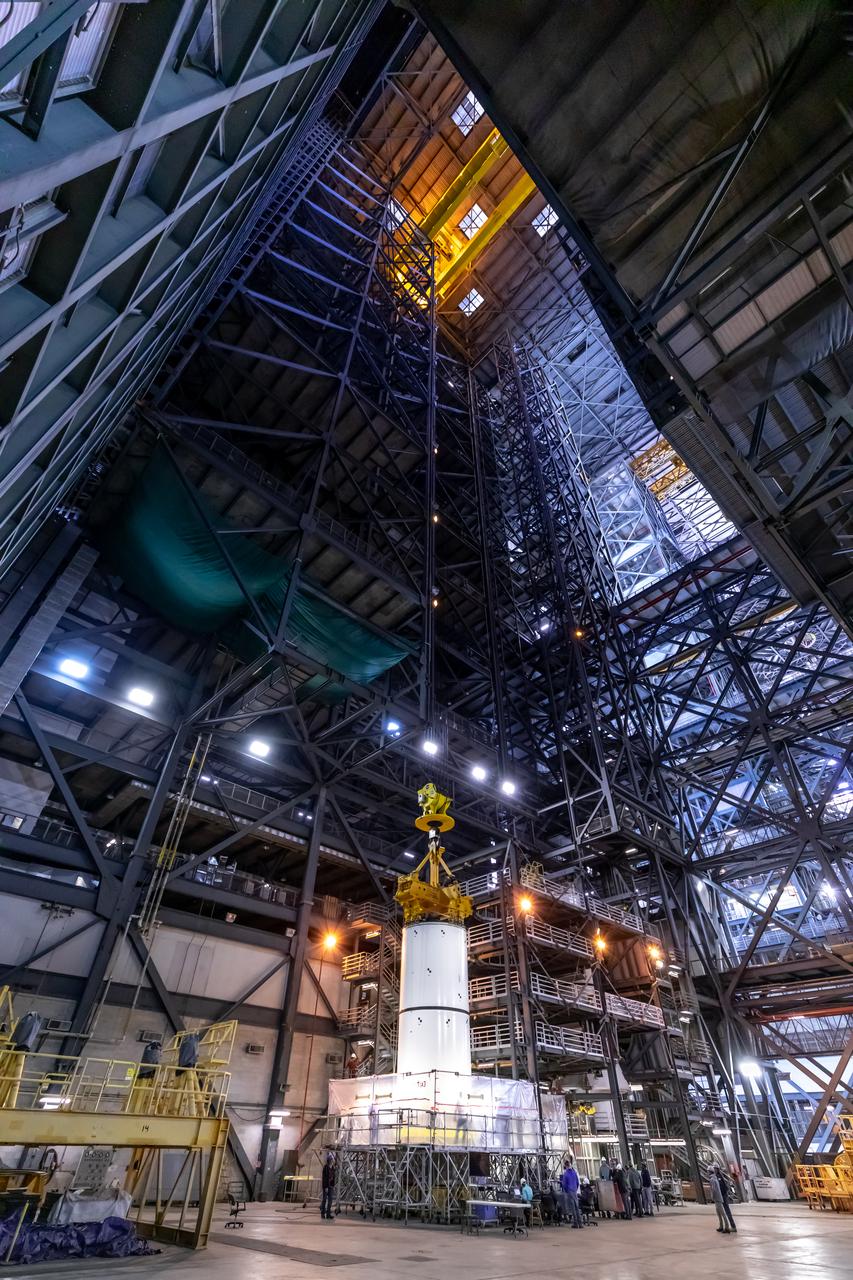
In High Bay 4 of the Vehicle Assembly Building at NASA’s Kennedy Space Center in Florida, a crane lowers Space Launch System (SLS) solid rocket booster pathfinder segments onto a platform during a training exercise on Jan. 8, 2020. A team of engineers with Exploration Ground Systems and crane operators and technicians with contractor Jacobs are practicing lifting, moving and stacking maneuvers, using important ground support equipment to train employees and certify all the equipment works properly. The booster pathfinders are inert, full-scale replicas of the actual booster hardware that will be attached to the SLS rocket for Artemis missions. The five-segment, 17-story-tall twin boosters will provide 3.6 million pounds of thrust each at liftoff to help launch Orion on Artemis I, its first uncrewed mission beyond the Moon.
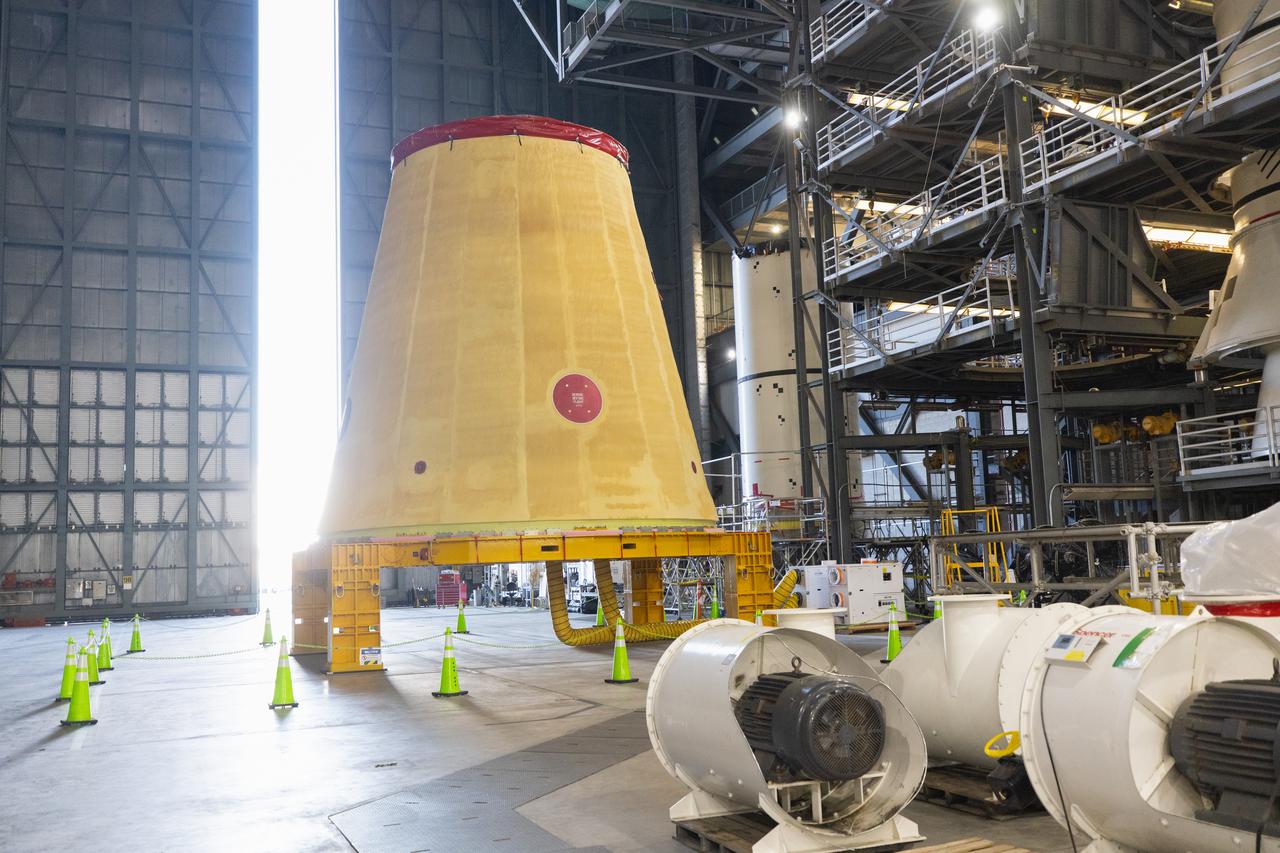
NASA’s Artemis II hardware, the launch vehicle stage adapter, is inside High Bay 4 on Thursday, March 20, 2025, at the Vehicle Assembly Building at NASA’s Kennedy Space Center in Florida ahead of rocket stacking operations. The cone shaped launch vehicle stage adapter connects the SLS (Space Launch System) Moon rocket to the upper stage, the interim cryogenic propulsion stage, and protects the rocket’s flight computers, avionics, and electrical devices during launch and ascent during the Artemis missions.
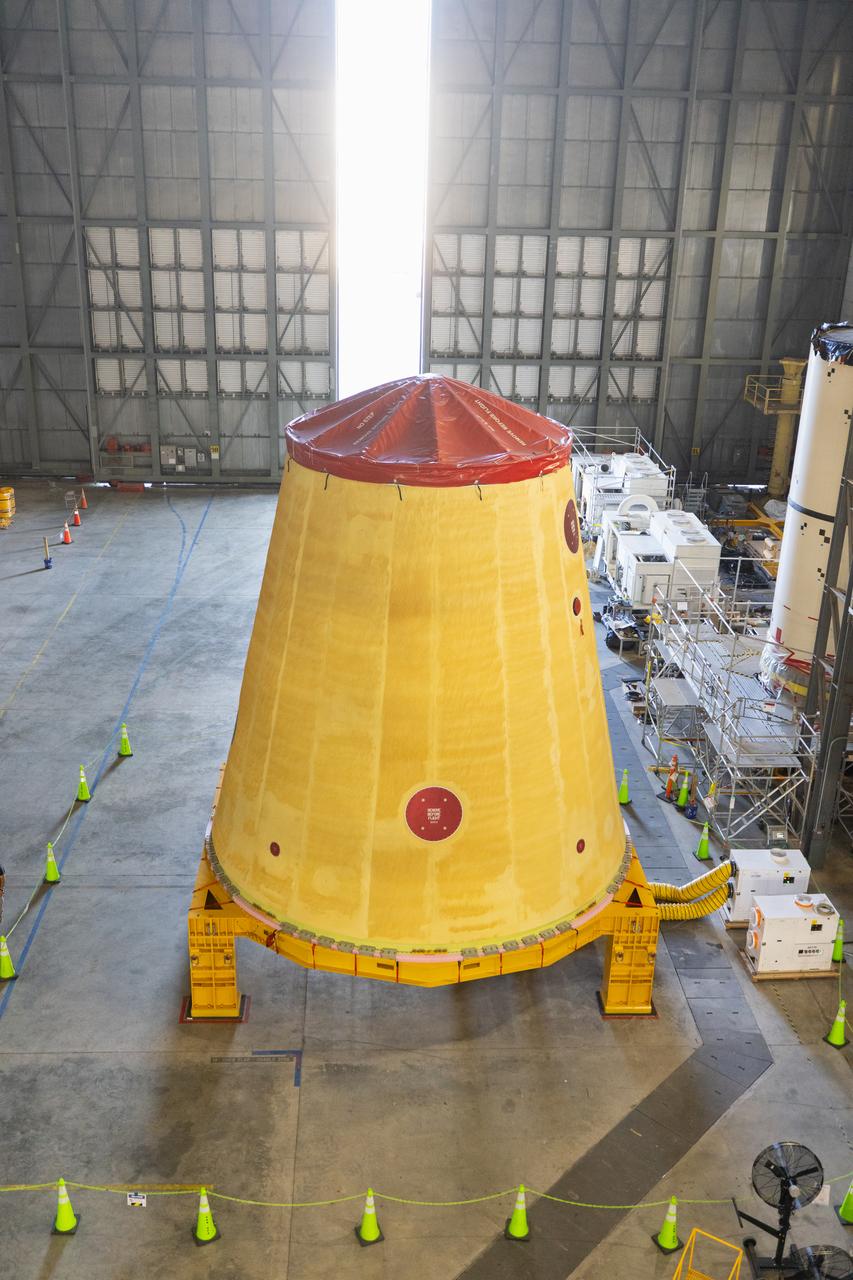
NASA’s Artemis II hardware, the launch vehicle stage adapter, is inside High Bay 4 on Thursday, March 20, 2025, at the Vehicle Assembly Building at NASA’s Kennedy Space Center in Florida ahead of rocket stacking operations. The cone shaped launch vehicle stage adapter connects the SLS (Space Launch System) Moon rocket to the upper stage, the interim cryogenic propulsion stage, and protects the rocket’s flight computers, avionics, and electrical devices during launch and ascent during the Artemis missions.
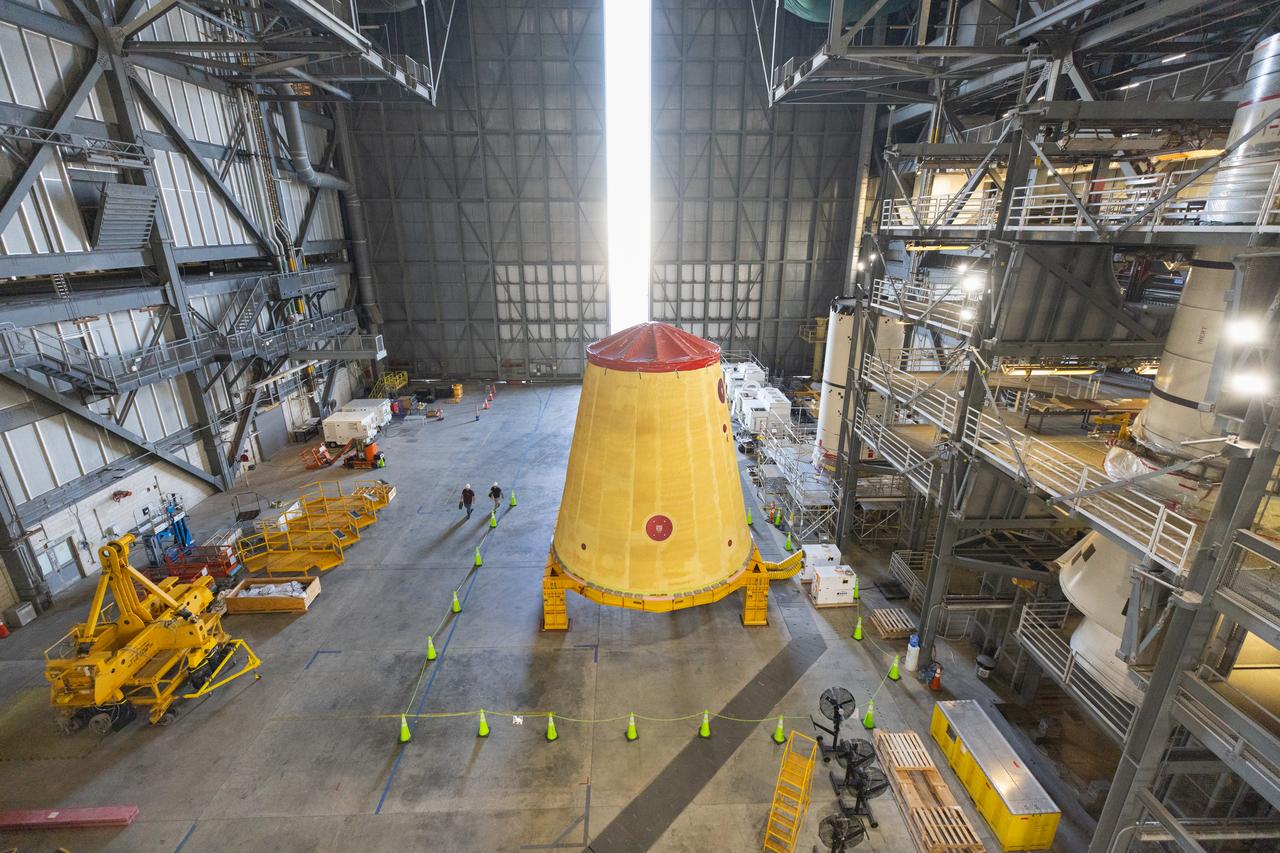
NASA’s Artemis II hardware, the launch vehicle stage adapter, is inside High Bay 4 on Thursday, March 20, 2025, at the Vehicle Assembly Building at NASA’s Kennedy Space Center in Florida ahead of rocket stacking operations. The cone shaped launch vehicle stage adapter connects the SLS (Space Launch System) Moon rocket to the upper stage, the interim cryogenic propulsion stage, and protects the rocket’s flight computers, avionics, and electrical devices during launch and ascent during the Artemis missions.
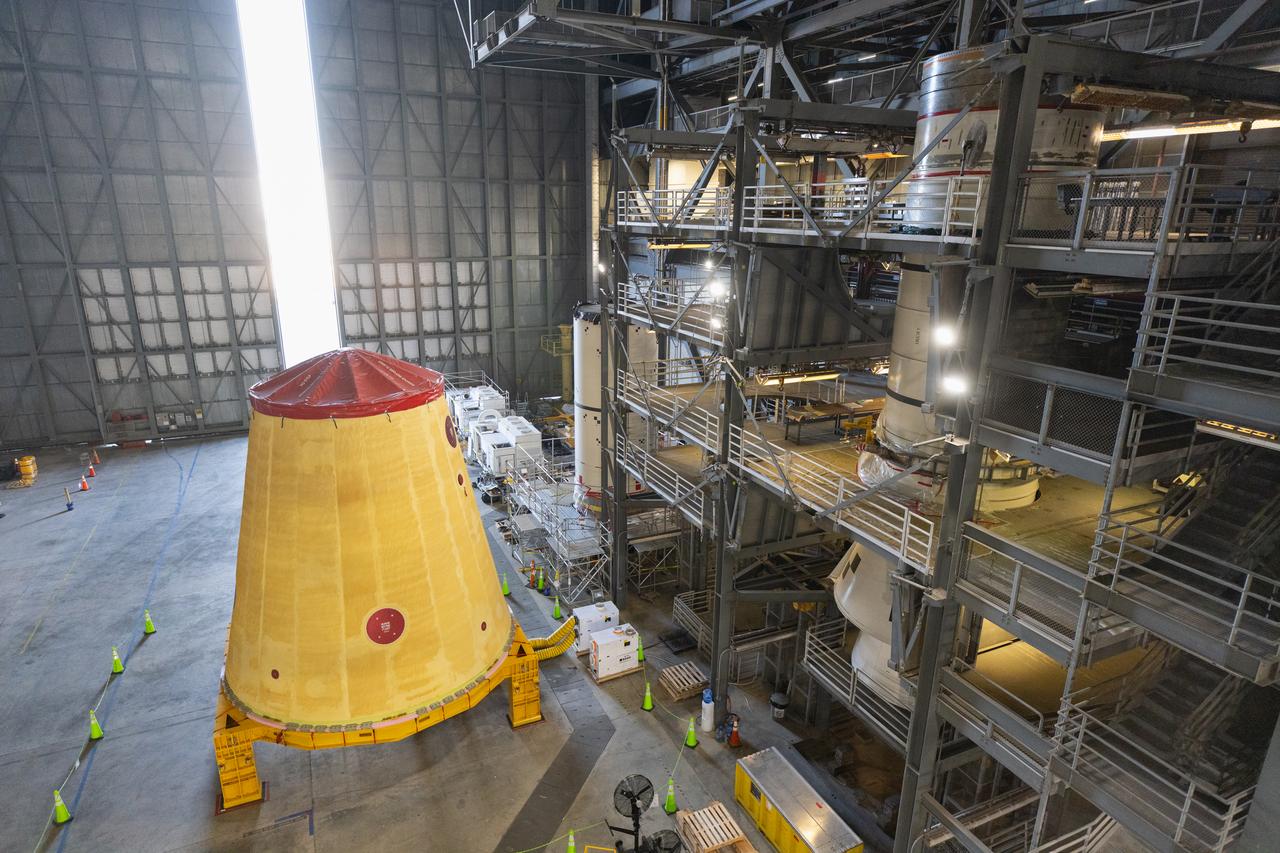
NASA’s Artemis II hardware, the launch vehicle stage adapter, is inside High Bay 4 on Thursday, March 20, 2025, at the Vehicle Assembly Building at NASA’s Kennedy Space Center in Florida ahead of rocket stacking operations. The cone shaped launch vehicle stage adapter connects the SLS (Space Launch System) Moon rocket to the upper stage, the interim cryogenic propulsion stage, and protects the rocket’s flight computers, avionics, and electrical devices during launch and ascent during the Artemis missions.
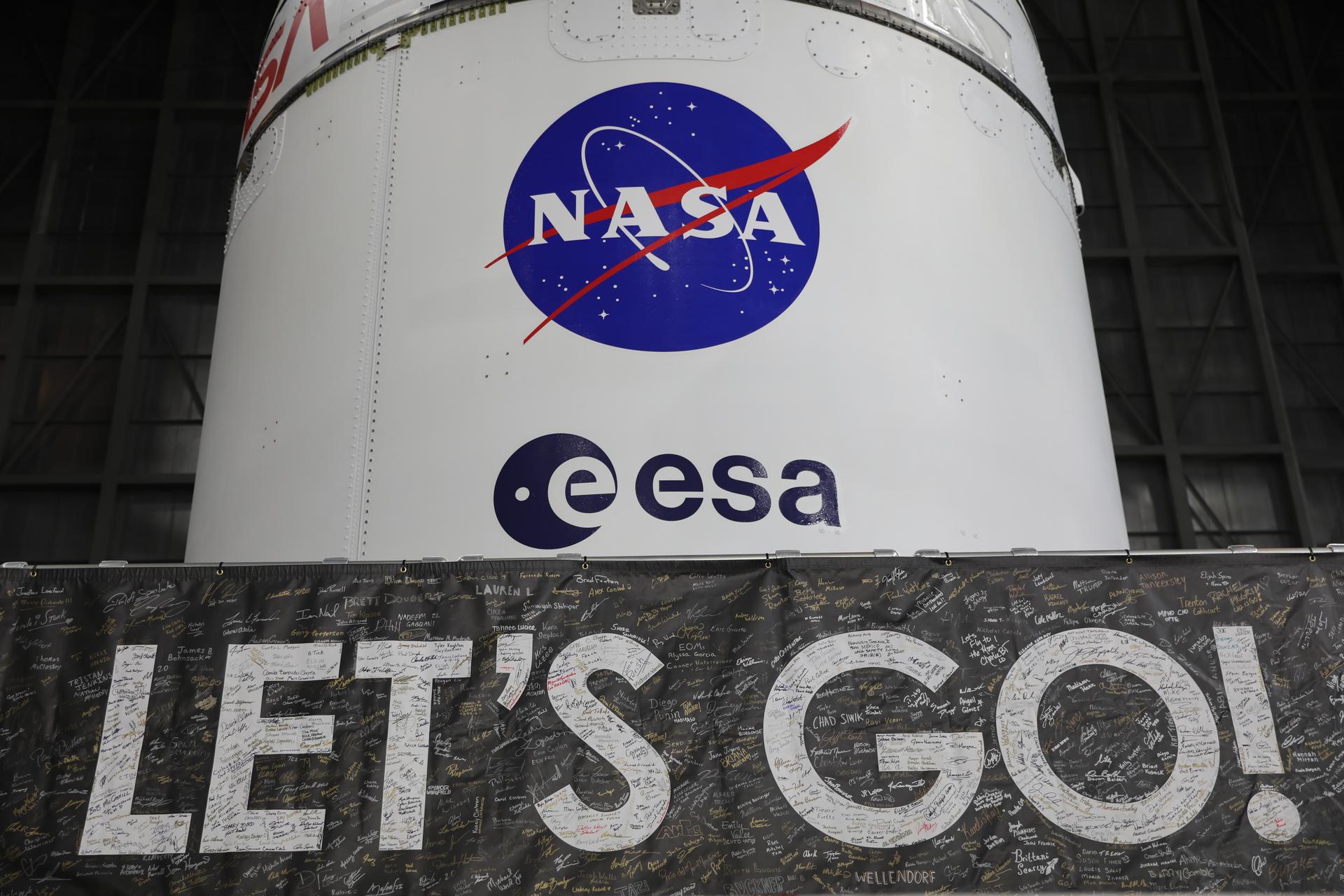
Technicians with NASA’s Exploration Ground Systems team prepare for integration to attach the agency’s Orion spacecraft on top of the SLS (Space Launch System) rocket in High Bay 3 of the Vehicle Assembly Building at NASA’s Kennedy Space Center in Florida on Friday, Oct. 17, 2025, for the agency’s Artemis II mission. Set to launch in 2026, the spacecraft will carry NASA astronauts Reid Wiseman, Victor Glover, Christina Koch, and CSA (Canadian Space Agency) astronaut Jeremy Hansen on a 10-day mission around the Moon and back. Once stacked, teams will begin conducting a series of verification tests ahead of rolling out to Launch Complex 39B for the wet dress rehearsal at NASA Kennedy.
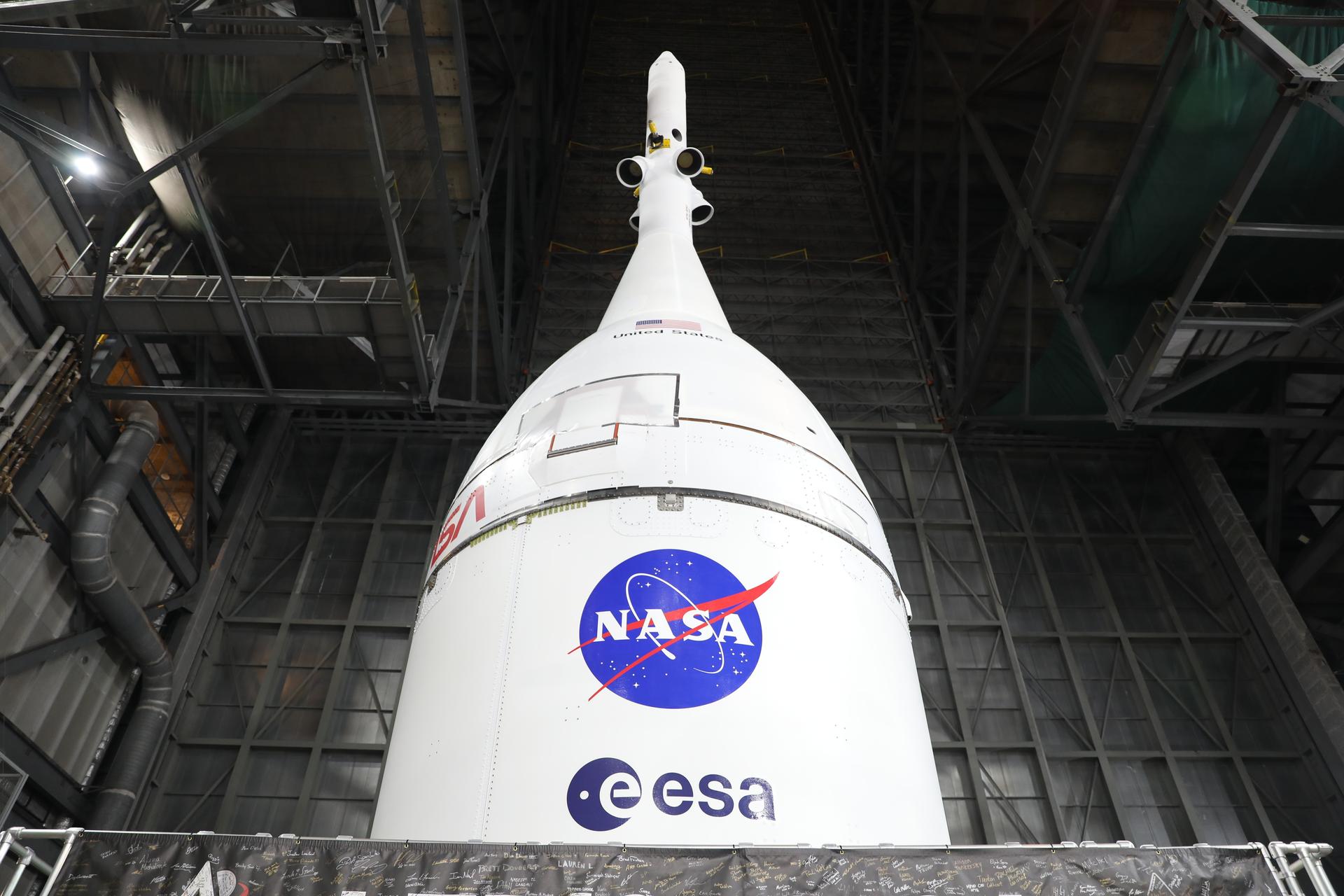
Technicians with NASA’s Exploration Ground Systems team prepare for integration to attach the agency’s Orion spacecraft on top of the SLS (Space Launch System) rocket in High Bay 3 of the Vehicle Assembly Building at NASA’s Kennedy Space Center in Florida on Friday, Oct. 17, 2025, for the agency’s Artemis II mission. Set to launch in 2026, the spacecraft will carry NASA astronauts Reid Wiseman, Victor Glover, Christina Koch, and CSA (Canadian Space Agency) astronaut Jeremy Hansen on a 10-day mission around the Moon and back. Once stacked, teams will begin conducting a series of verification tests ahead of rolling out to Launch Complex 39B for the wet dress rehearsal at NASA Kennedy.
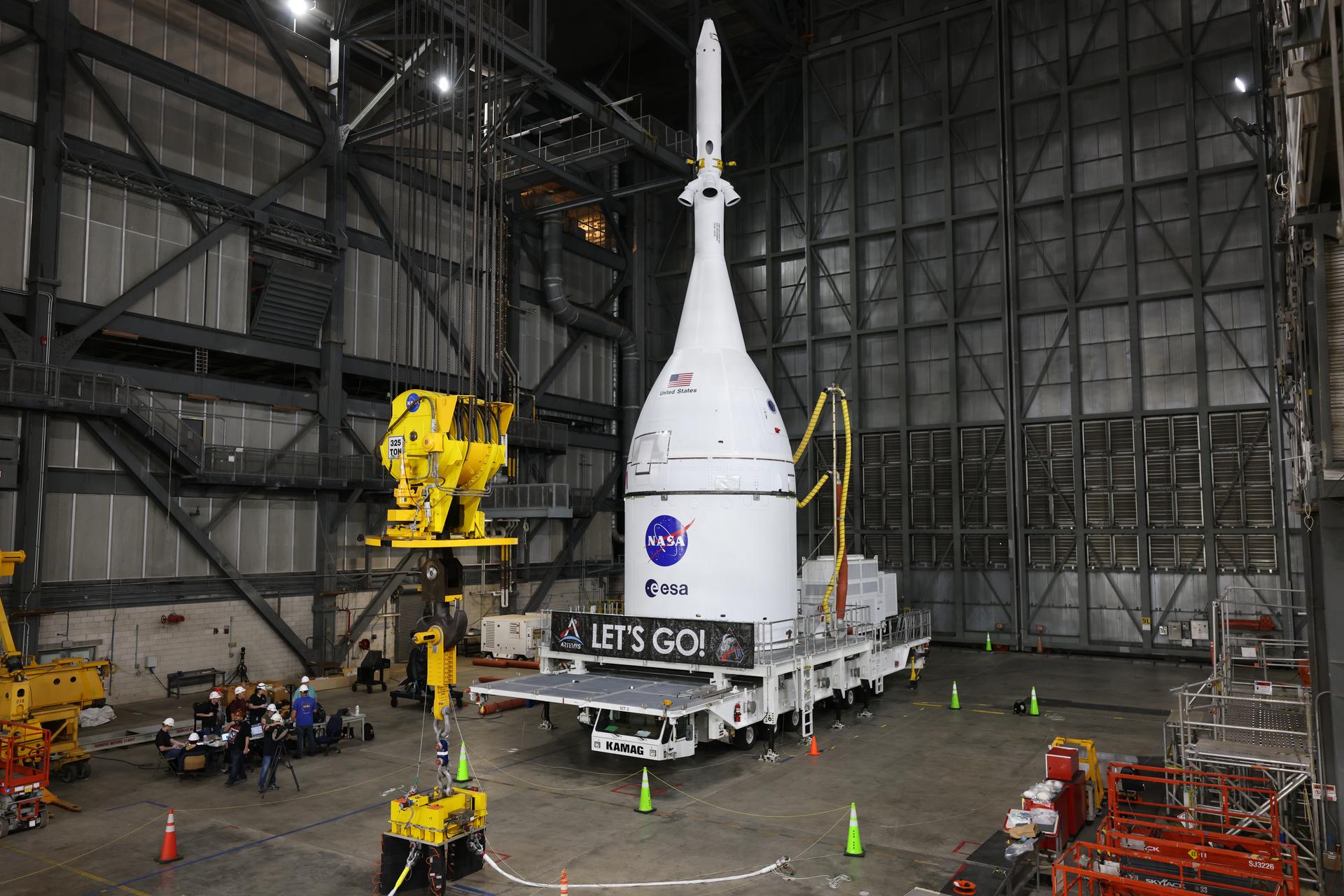
Technicians with NASA’s Exploration Ground Systems team prepare to attach a crane to lift and secure NASA’s Orion spacecraft on top of the SLS (Space Launch System) rocket in High Bay 3 of the Vehicle Assembly Building at NASA’s Kennedy Space Center in Florida on Friday, Oct. 17, 2025, for the agency’s Artemis II mission. Set to launch in 2026, the spacecraft will carry NASA astronauts Reid Wiseman, Victor Glover, Christina Koch, and CSA (Canadian Space Agency) astronaut Jeremy Hansen on a 10-day mission around the Moon and back. Once stacked, teams will begin conducting a series of verification tests ahead of rolling out to Launch Complex 39B for the wet dress rehearsal at NASA Kennedy.
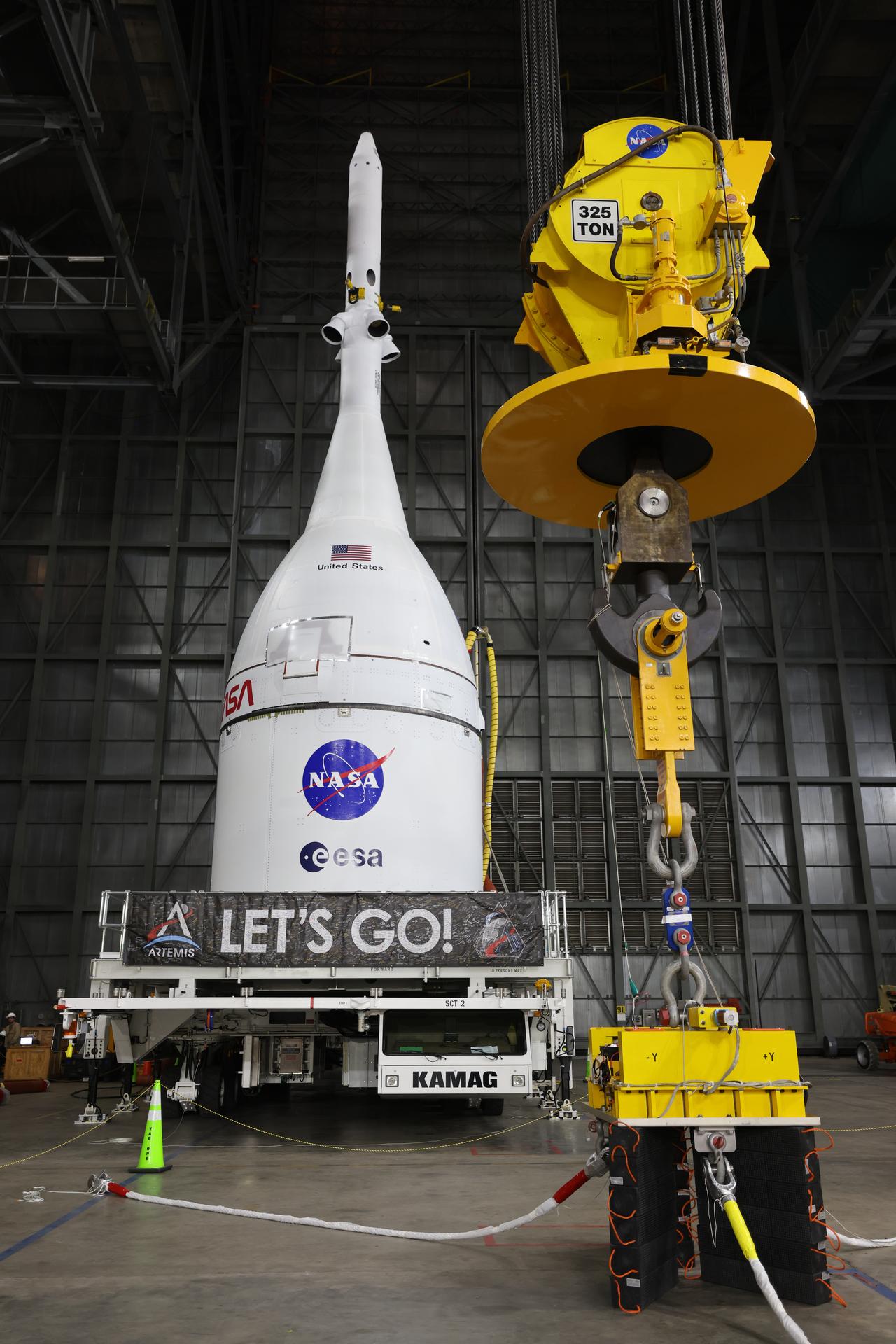
Technicians with NASA’s Exploration Ground Systems team prepare to attach a crane to lift and secure NASA’s Orion spacecraft on top of the SLS (Space Launch System) rocket in High Bay 3 of the Vehicle Assembly Building at NASA’s Kennedy Space Center in Florida on Friday, Oct. 17, 2025, for the agency’s Artemis II mission. Set to launch in 2026, the spacecraft will carry NASA astronauts Reid Wiseman, Victor Glover, Christina Koch, and CSA (Canadian Space Agency) astronaut Jeremy Hansen on a 10-day mission around the Moon and back. Once stacked, teams will begin conducting a series of verification tests ahead of rolling out to Launch Complex 39B for the wet dress rehearsal at NASA Kennedy.
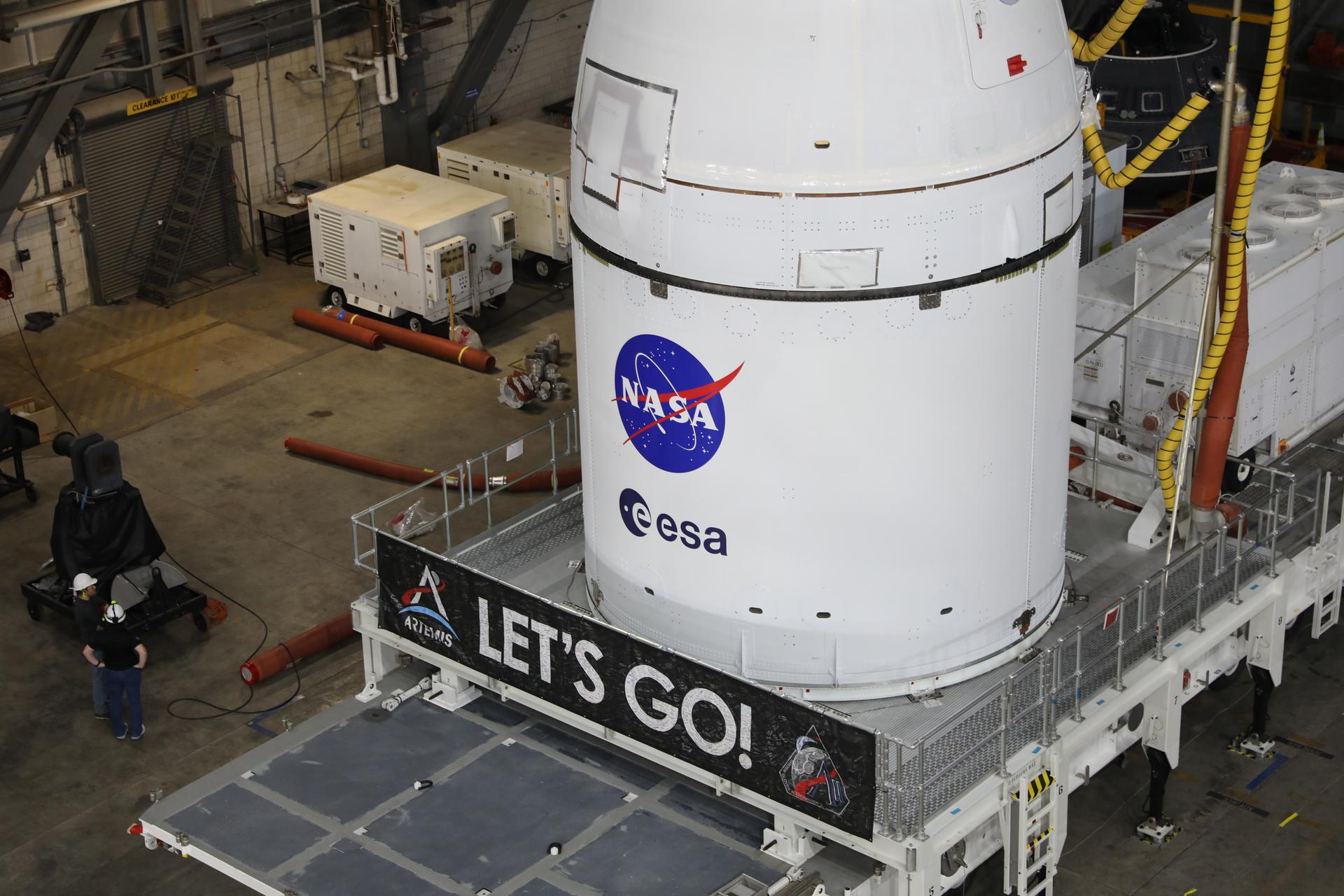
Technicians with NASA’s Exploration Ground Systems team prepare for integration to attach the agency’s Orion spacecraft on top of the SLS (Space Launch System) rocket in High Bay 3 of the Vehicle Assembly Building at NASA’s Kennedy Space Center in Florida on Friday, Oct. 17, 2025, for the agency’s Artemis II mission. Set to launch in 2026, the spacecraft will carry NASA astronauts Reid Wiseman, Victor Glover, Christina Koch, and CSA (Canadian Space Agency) astronaut Jeremy Hansen on a 10-day mission around the Moon and back. Once stacked, teams will begin conducting a series of verification tests ahead of rolling out to Launch Complex 39B for the wet dress rehearsal at NASA Kennedy.
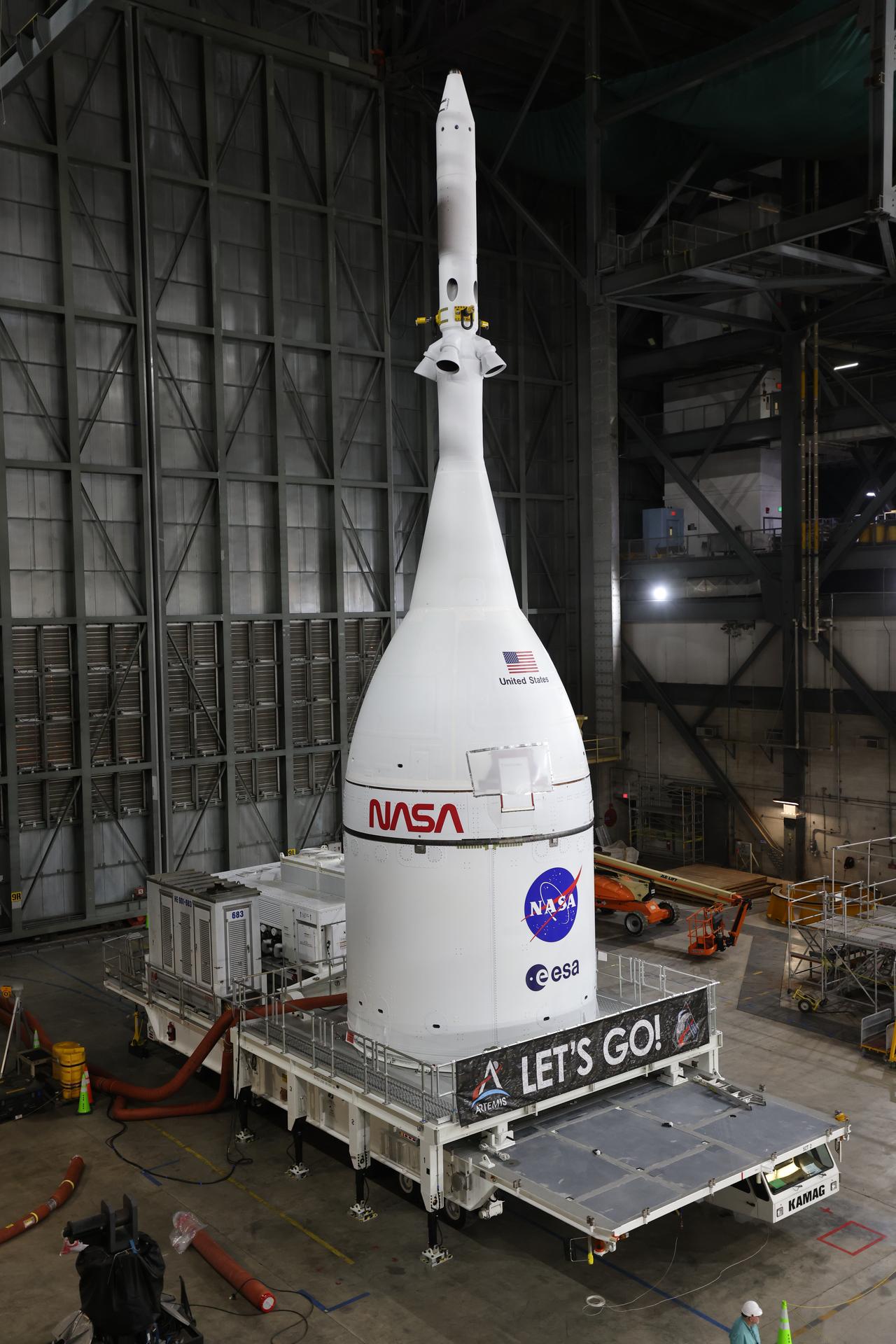
Technicians with NASA’s Exploration Ground Systems team prepare for integration to attach the agency’s Orion spacecraft on top of the SLS (Space Launch System) rocket in High Bay 3 of the Vehicle Assembly Building at NASA’s Kennedy Space Center in Florida on Friday, Oct. 17, 2025, for the agency’s Artemis II mission. Set to launch in 2026, the spacecraft will carry NASA astronauts Reid Wiseman, Victor Glover, Christina Koch, and CSA (Canadian Space Agency) astronaut Jeremy Hansen on a 10-day mission around the Moon and back. Once stacked, teams will begin conducting a series of verification tests ahead of rolling out to Launch Complex 39B for the wet dress rehearsal at NASA Kennedy.
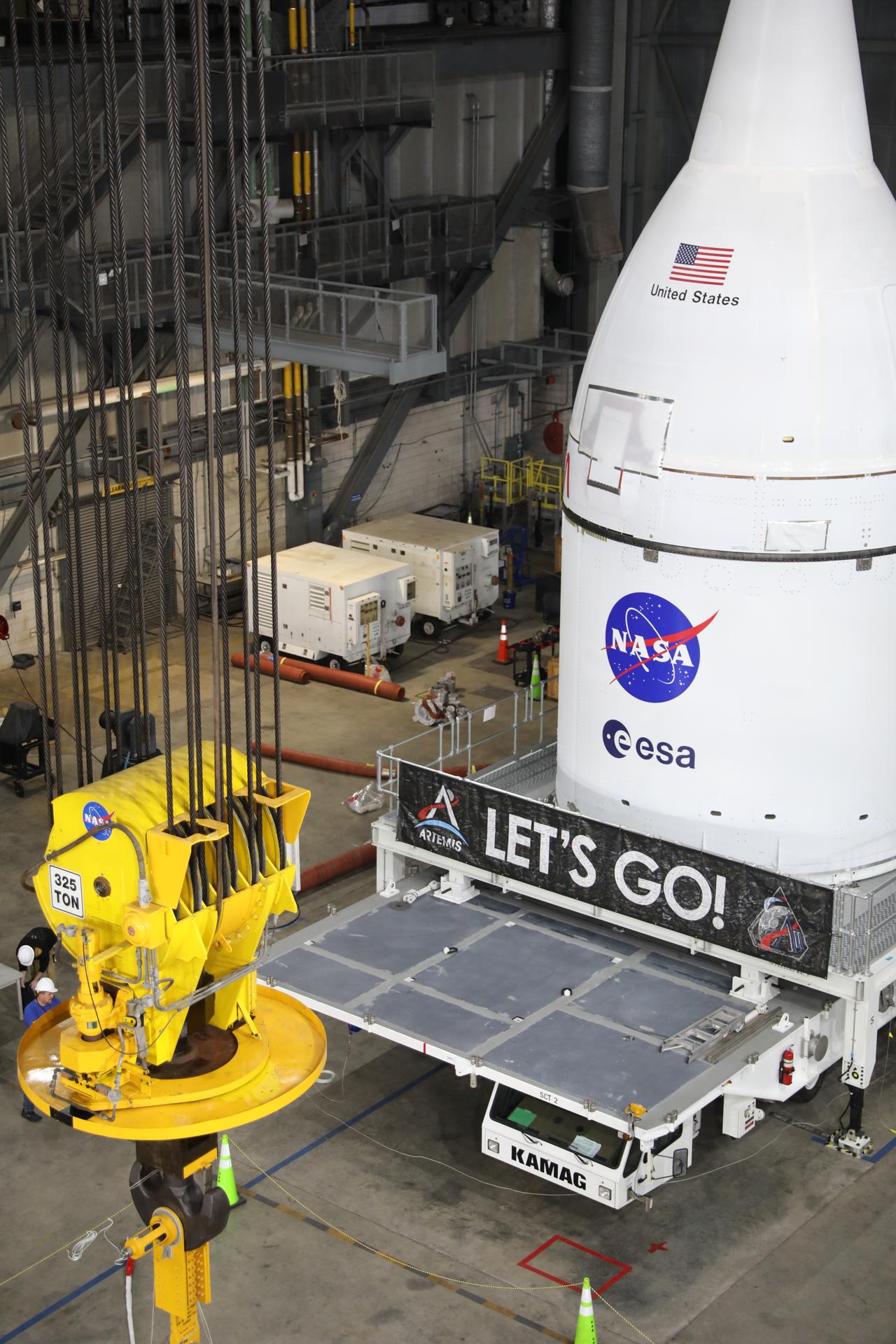
Technicians with NASA’s Exploration Ground Systems team prepare to attach a crane to lift and secure NASA’s Orion spacecraft on top of the SLS (Space Launch System) rocket in High Bay 3 of the Vehicle Assembly Building at NASA’s Kennedy Space Center in Florida on Friday, Oct. 17, 2025, for the agency’s Artemis II mission. Set to launch in 2026, the spacecraft will carry NASA astronauts Reid Wiseman, Victor Glover, Christina Koch, and CSA (Canadian Space Agency) astronaut Jeremy Hansen on a 10-day mission around the Moon and back. Once stacked, teams will begin conducting a series of verification tests ahead of rolling out to Launch Complex 39B for the wet dress rehearsal at NASA Kennedy.
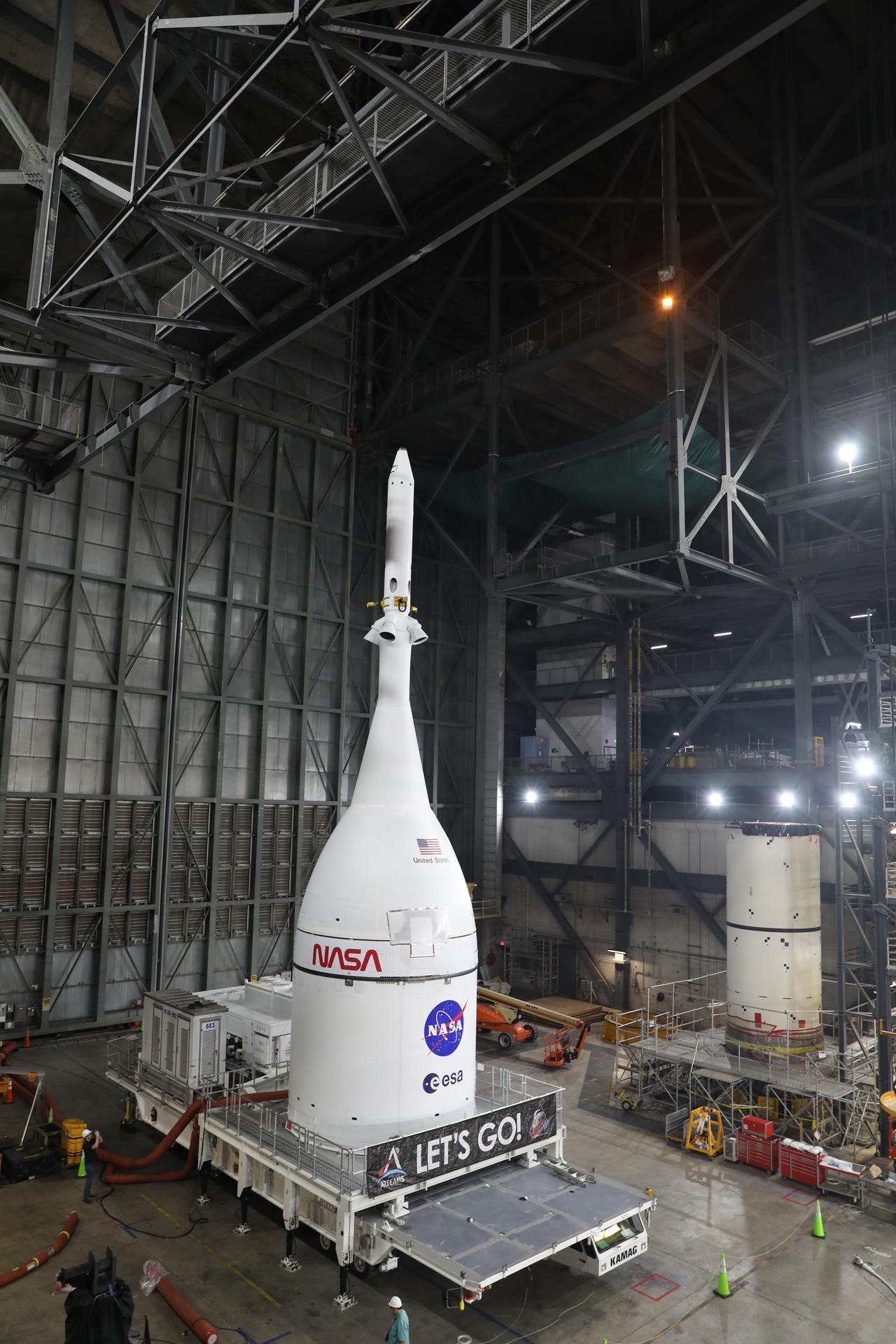
Technicians with NASA’s Exploration Ground Systems team prepare for integration to attach the agency’s Orion spacecraft on top of the SLS (Space Launch System) rocket in High Bay 3 of the Vehicle Assembly Building at NASA’s Kennedy Space Center in Florida on Friday, Oct. 17, 2025, for the agency’s Artemis II mission. Set to launch in 2026, the spacecraft will carry NASA astronauts Reid Wiseman, Victor Glover, Christina Koch, and CSA (Canadian Space Agency) astronaut Jeremy Hansen on a 10-day mission around the Moon and back. Once stacked, teams will begin conducting a series of verification tests ahead of rolling out to Launch Complex 39B for the wet dress rehearsal at NASA Kennedy.
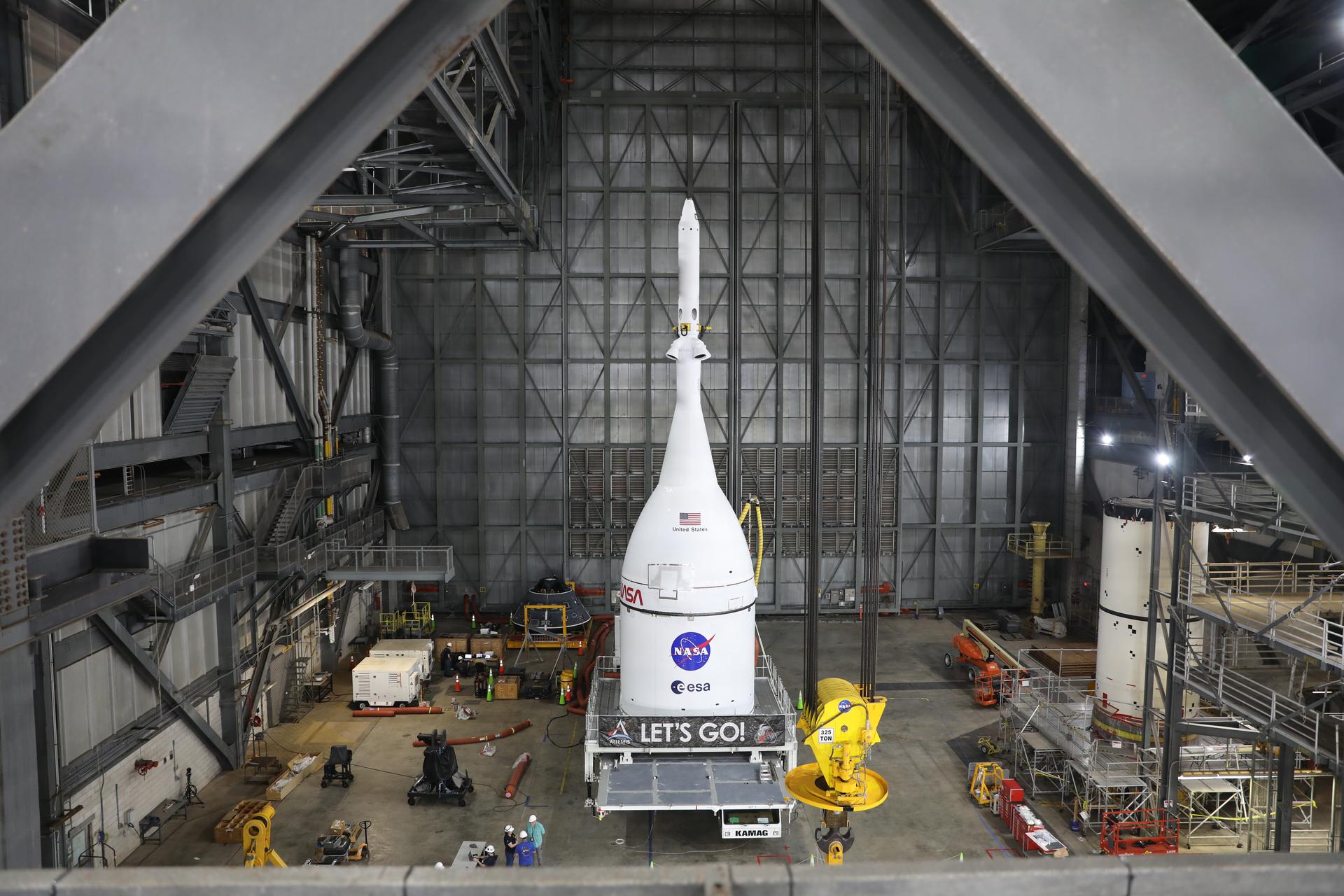
Technicians with NASA’s Exploration Ground Systems team prepare for integration to attach the agency’s Orion spacecraft on top of the SLS (Space Launch System) rocket in High Bay 3 of the Vehicle Assembly Building at NASA’s Kennedy Space Center in Florida on Friday, Oct. 17, 2025, for the agency’s Artemis II mission. Set to launch in 2026, the spacecraft will carry NASA astronauts Reid Wiseman, Victor Glover, Christina Koch, and CSA (Canadian Space Agency) astronaut Jeremy Hansen on a 10-day mission around the Moon and back. Once stacked, teams will begin conducting a series of verification tests ahead of rolling out to Launch Complex 39B for the wet dress rehearsal at NASA Kennedy.
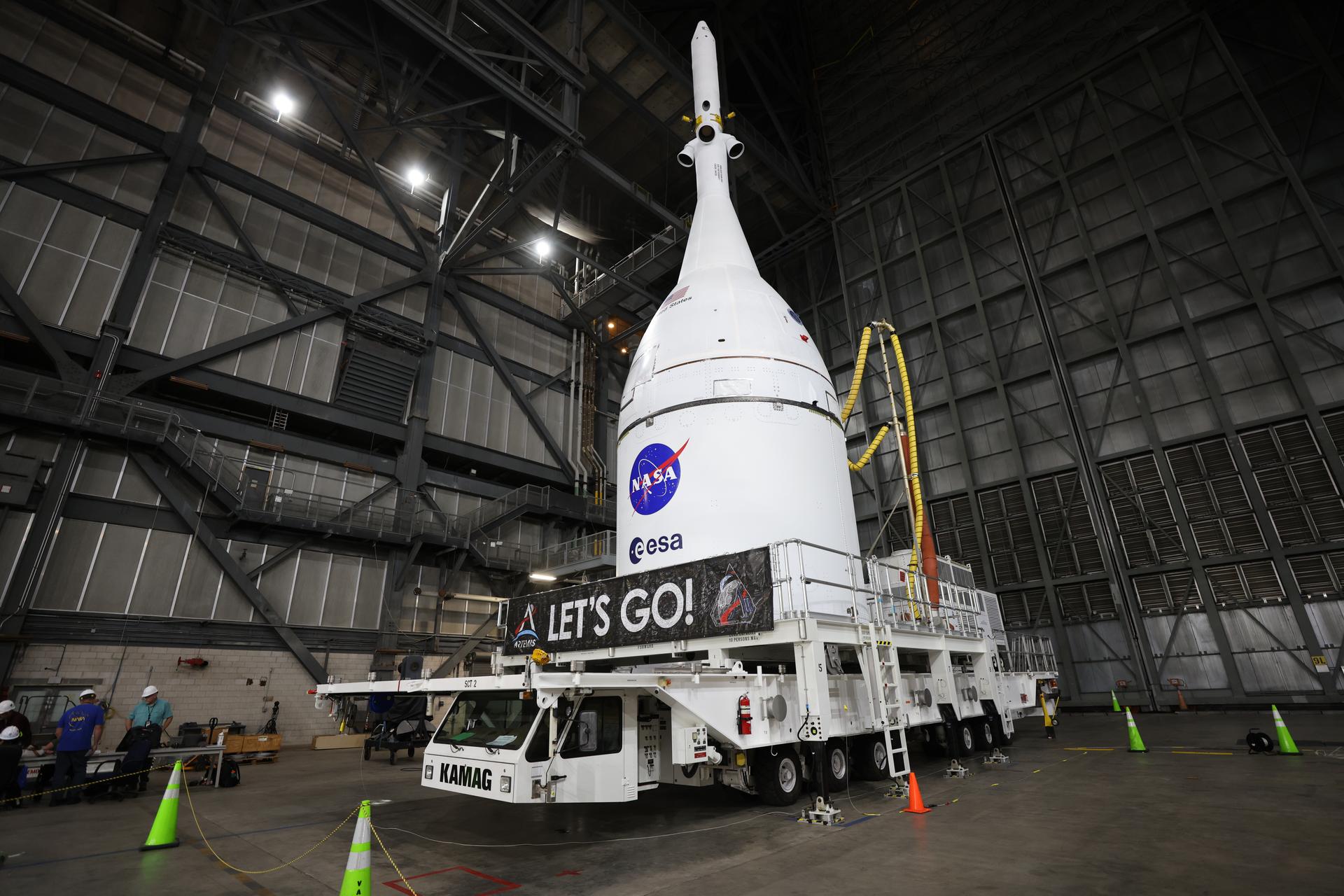
Technicians with NASA’s Exploration Ground Systems team prepare for integration to attach the agency’s Orion spacecraft on top of the SLS (Space Launch System) rocket in High Bay 3 of the Vehicle Assembly Building at NASA’s Kennedy Space Center in Florida on Friday, Oct. 17, 2025, for the agency’s Artemis II mission. Set to launch in 2026, the spacecraft will carry NASA astronauts Reid Wiseman, Victor Glover, Christina Koch, and CSA (Canadian Space Agency) astronaut Jeremy Hansen on a 10-day mission around the Moon and back. Once stacked, teams will begin conducting a series of verification tests ahead of rolling out to Launch Complex 39B for the wet dress rehearsal at NASA Kennedy.
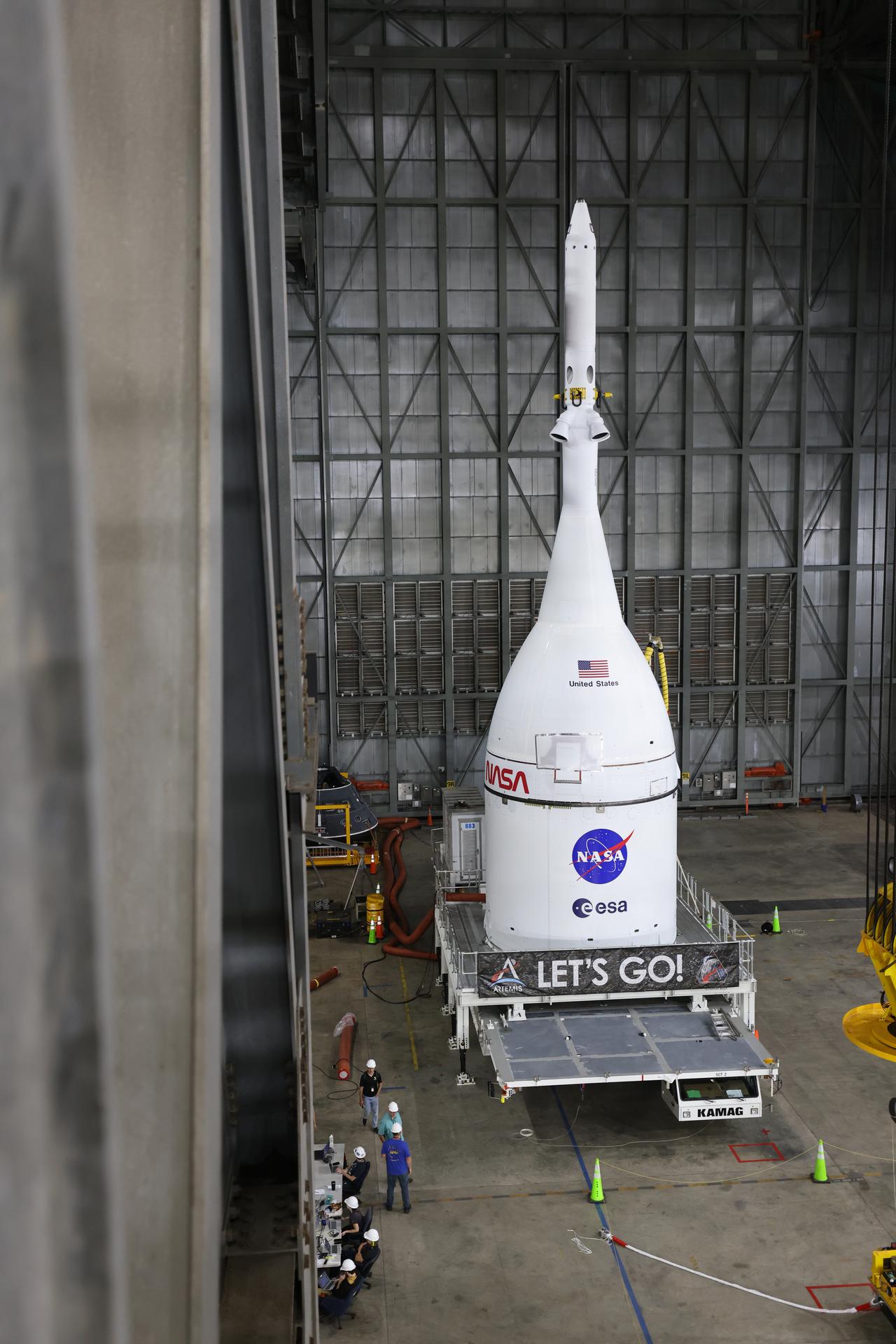
Technicians with NASA’s Exploration Ground Systems team prepare for integration to attach the agency’s Orion spacecraft on top of the SLS (Space Launch System) rocket in High Bay 3 of the Vehicle Assembly Building at NASA’s Kennedy Space Center in Florida on Friday, Oct. 17, 2025, for the agency’s Artemis II mission. Set to launch in 2026, the spacecraft will carry NASA astronauts Reid Wiseman, Victor Glover, Christina Koch, and CSA (Canadian Space Agency) astronaut Jeremy Hansen on a 10-day mission around the Moon and back. Once stacked, teams will begin conducting a series of verification tests ahead of rolling out to Launch Complex 39B for the wet dress rehearsal at NASA Kennedy.
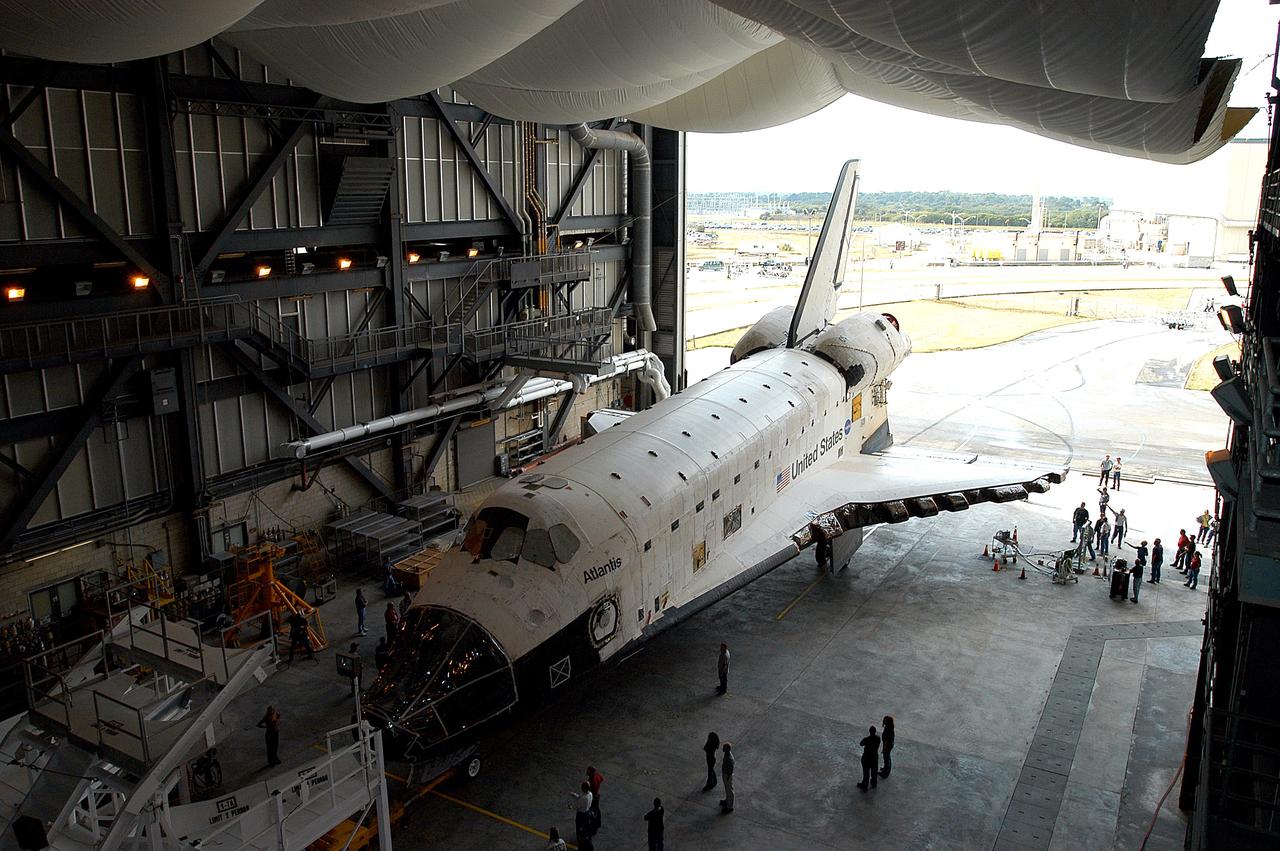
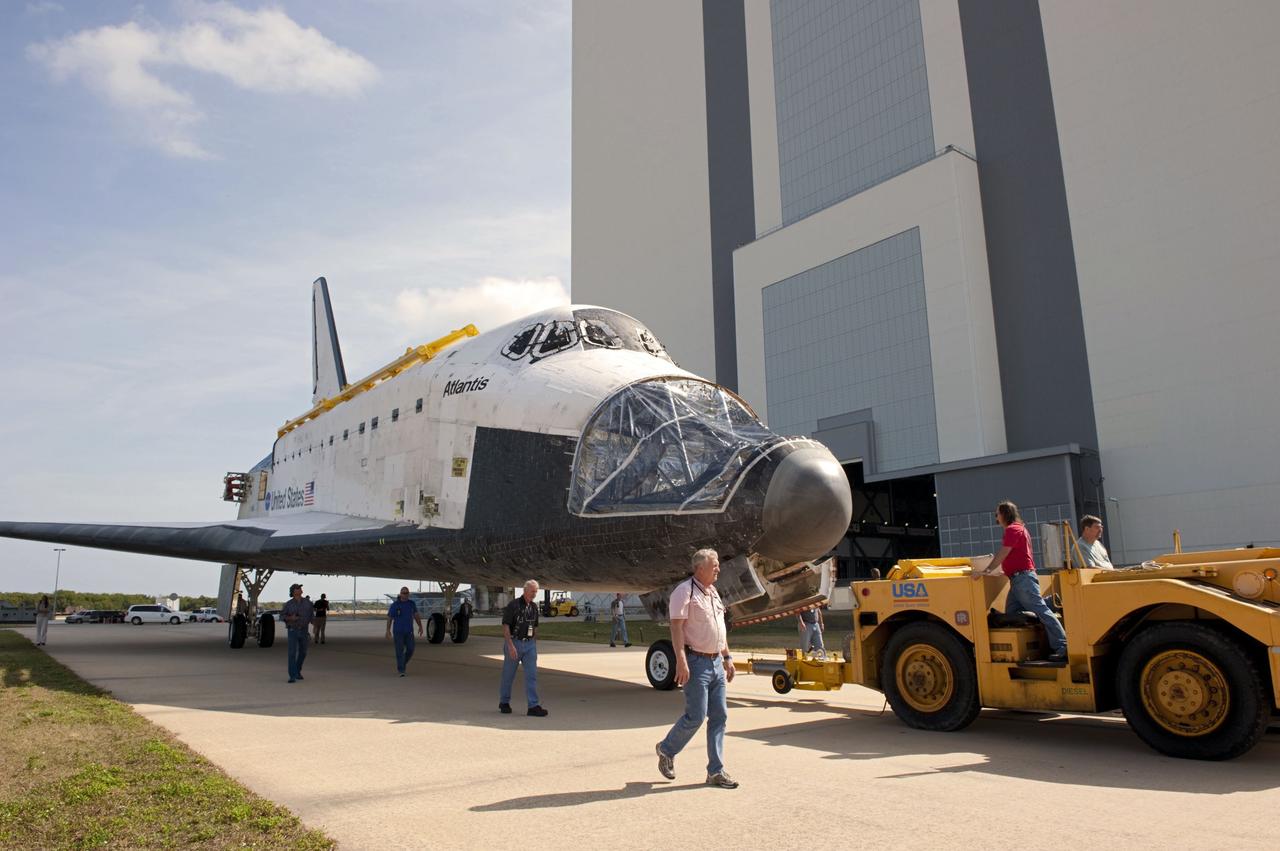
KENNEDY SPACE CENTER, FLA. - The Space Shuttle orbiter Atlantis is almost in position in high bay 4 of the Vehicle Assembly Building (VAB). It was towed from the Orbiter Processing Facility (OPF) to allow work to be performed in the bay that can only be accomplished while it is empty. Work scheduled in the processing facility includes annual validation of the bay's cranes, work platforms, lifting mechanisms, and jack stands. Atlantis will remain in the VAB for about 10 days, then return to the OPF as work resumes to prepare it for launch in September 2004 on the first return-to-flight mission, STS-114.

KENNEDY SPACE CENTER, FLA. - The Space Shuttle orbiter Atlantis is moved into high bay 4 of the Vehicle Assembly Building (VAB). It was towed from the Orbiter Processing Facility (OPF) to allow work to be performed in the bay that can only be accomplished while it is empty. Work scheduled in the processing facility includes annual validation of the bay's cranes, work platforms, lifting mechanisms, and jack stands. Atlantis will remain in the VAB for about 10 days, then return to the OPF as work resumes to prepare it for launch in September 2004 on the first return-to-flight mission, STS-114.
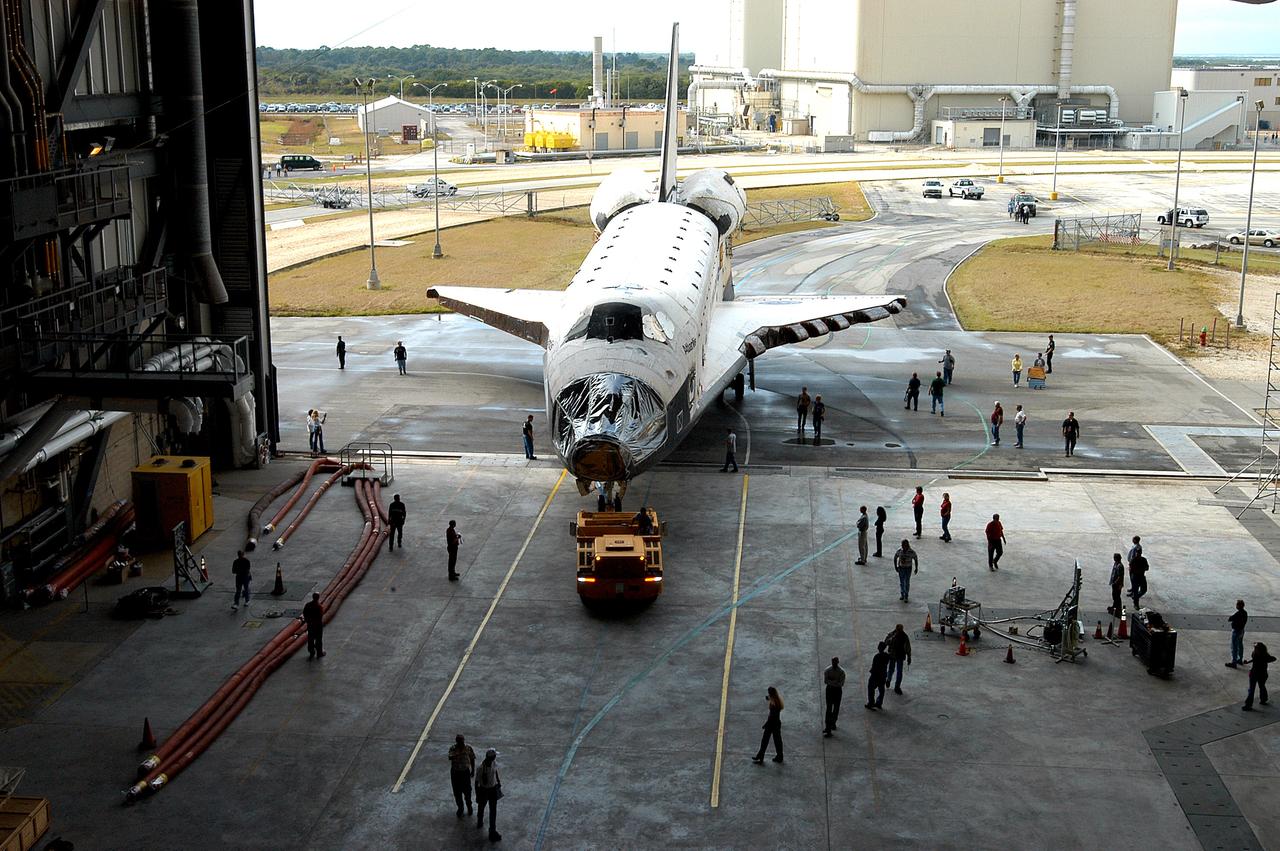
KENNEDY SPACE CENTER, FLA. - The Space Shuttle orbiter Atlantis moves into high bay 4 of the Vehicle Assembly Building (VAB). It was towed from the Orbiter Processing Facility (OPF) to allow work to be performed in the bay that can only be accomplished while it is empty. Work scheduled in the processing facility includes annual validation of the bay's cranes, work platforms, lifting mechanisms, and jack stands. Atlantis will remain in the VAB for about 10 days, then return to the OPF as work resumes to prepare it for launch in September 2004 on the first return-to-flight mission, STS-114.
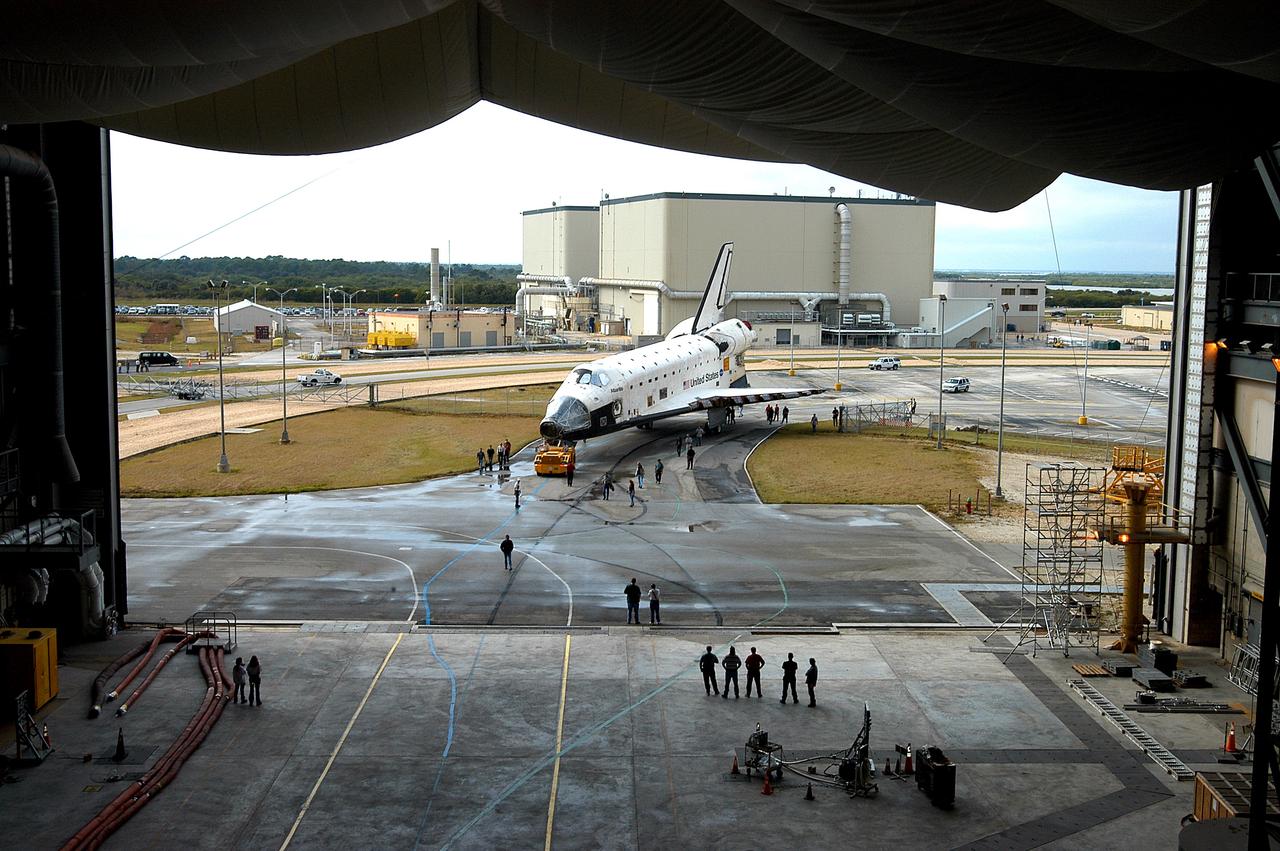
KENNEDY SPACE CENTER, FLA. - The Space Shuttle orbiter Atlantis approaches high bay 4 of the Vehicle Assembly Building (VAB). It was towed from the Orbiter Processing Facility (OPF) to allow work to be performed in the bay that can only be accomplished while it is empty. Work scheduled in the processing facility includes annual validation of the bay's cranes, work platforms, lifting mechanisms, and jack stands. Atlantis will remain in the VAB for about 10 days, then return to the OPF as work resumes to prepare it for launch in September 2004 on the first return-to-flight mission, STS-114.
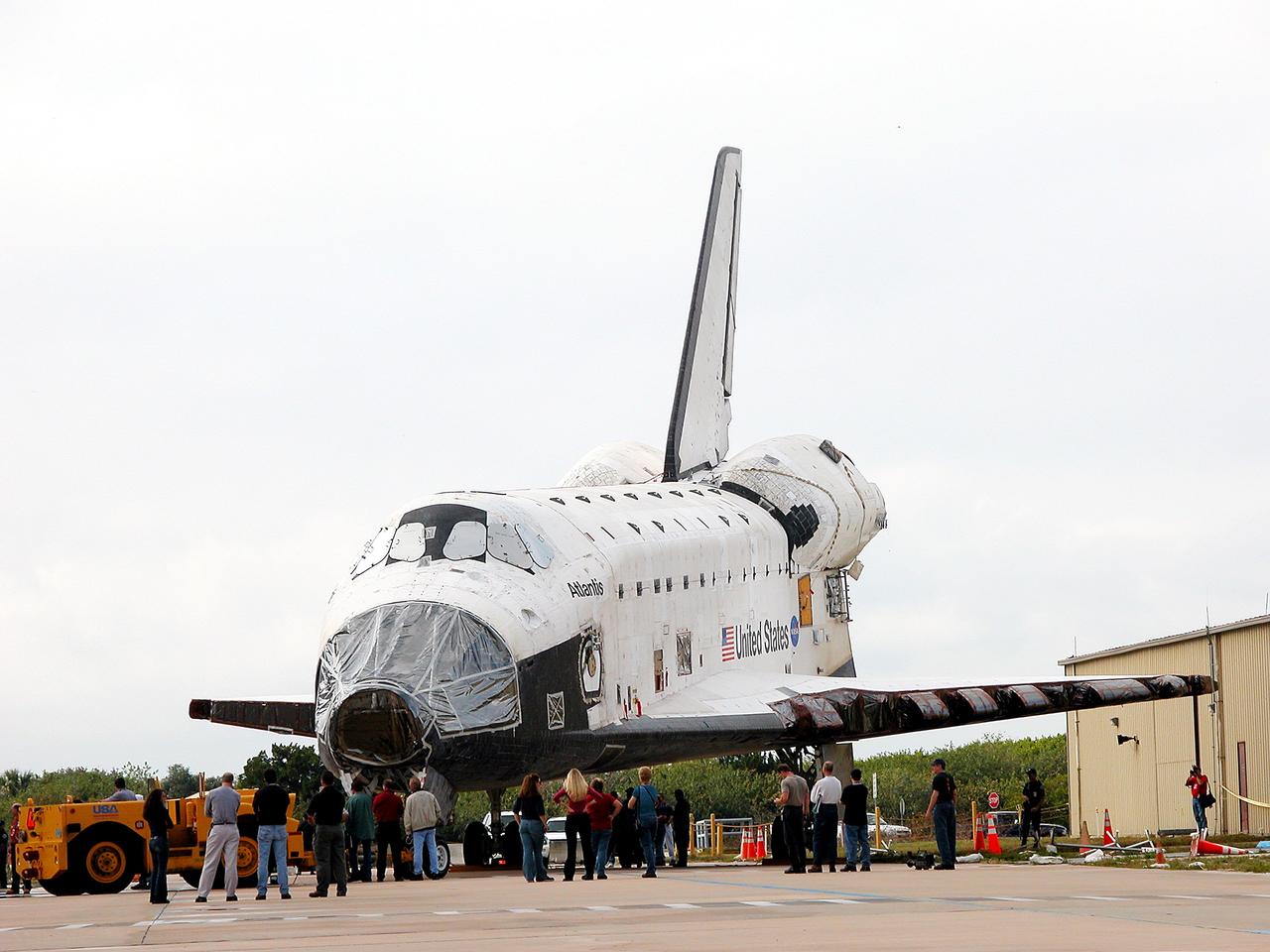
KENNEDY SPACE CENTER, FLA. - Workers walk with Space Shuttle orbiter Atlantis from the Orbiter Processing Facility (OPF) to the Vehicle Assembly Building (VAB) high bay 4. The move will allow work to be performed in the OPF that can only be accomplished while the bay is empty. Work scheduled in the processing facility includes annual validation of the bay's cranes, work platforms, lifting mechanisms, and jack stands. Atlantis will remain in the VAB for about 10 days, then return to the OPF as work resumes to prepare it for launch in September 2004 on the first return-to-flight mission, STS-114.
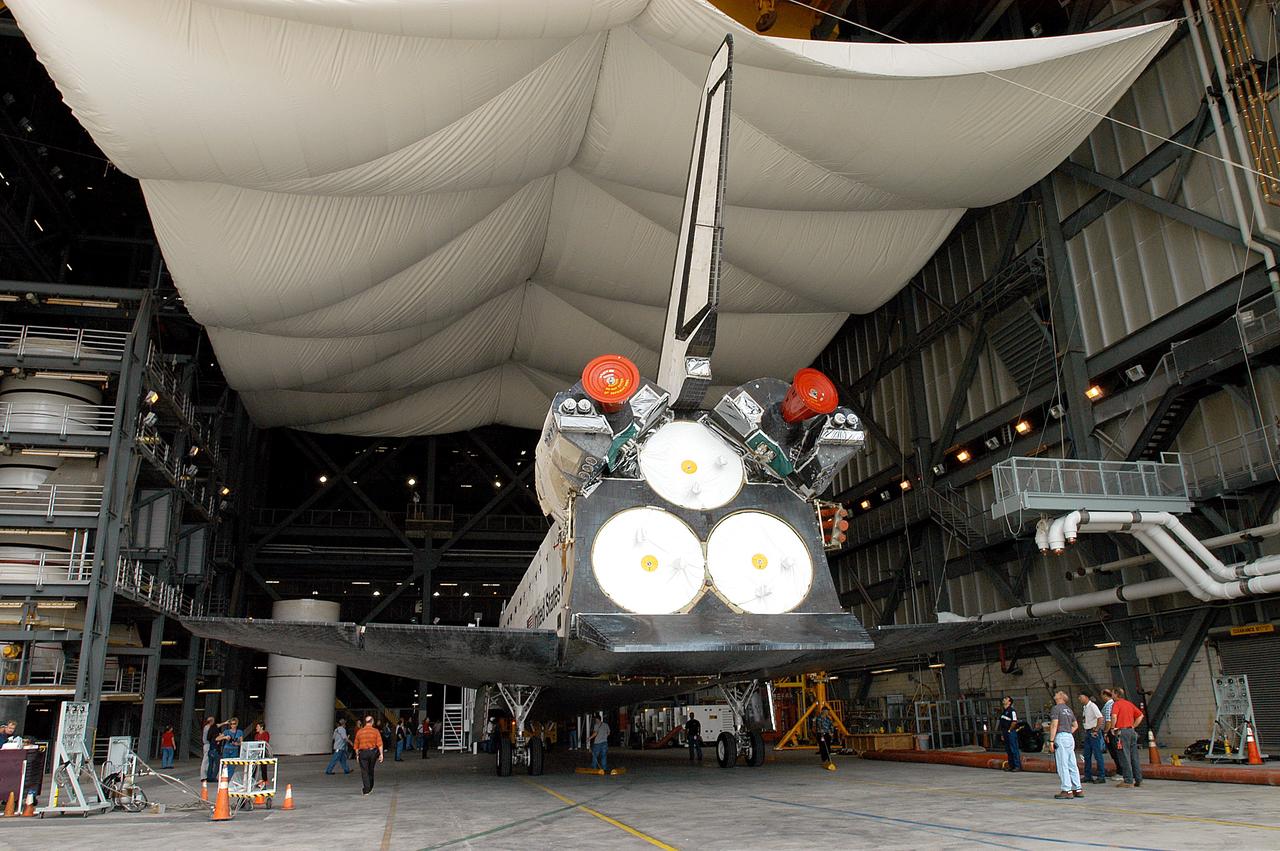
KENNEDY SPACE CENTER, FLA. - The Space Shuttle orbiter Atlantis arrives in high bay 4 of the Vehicle Assembly Building (VAB). It was towed from the Orbiter Processing Facility (OPF) to allow work to be performed in the bay that can only be accomplished while it is empty. Work scheduled in the processing facility includes annual validation of the bay's cranes, work platforms, lifting mechanisms, and jack stands. Atlantis will remain in the VAB for about 10 days, then return to the OPF as work resumes to prepare it for launch in September 2004 on the first return-to-flight mission, STS-114.
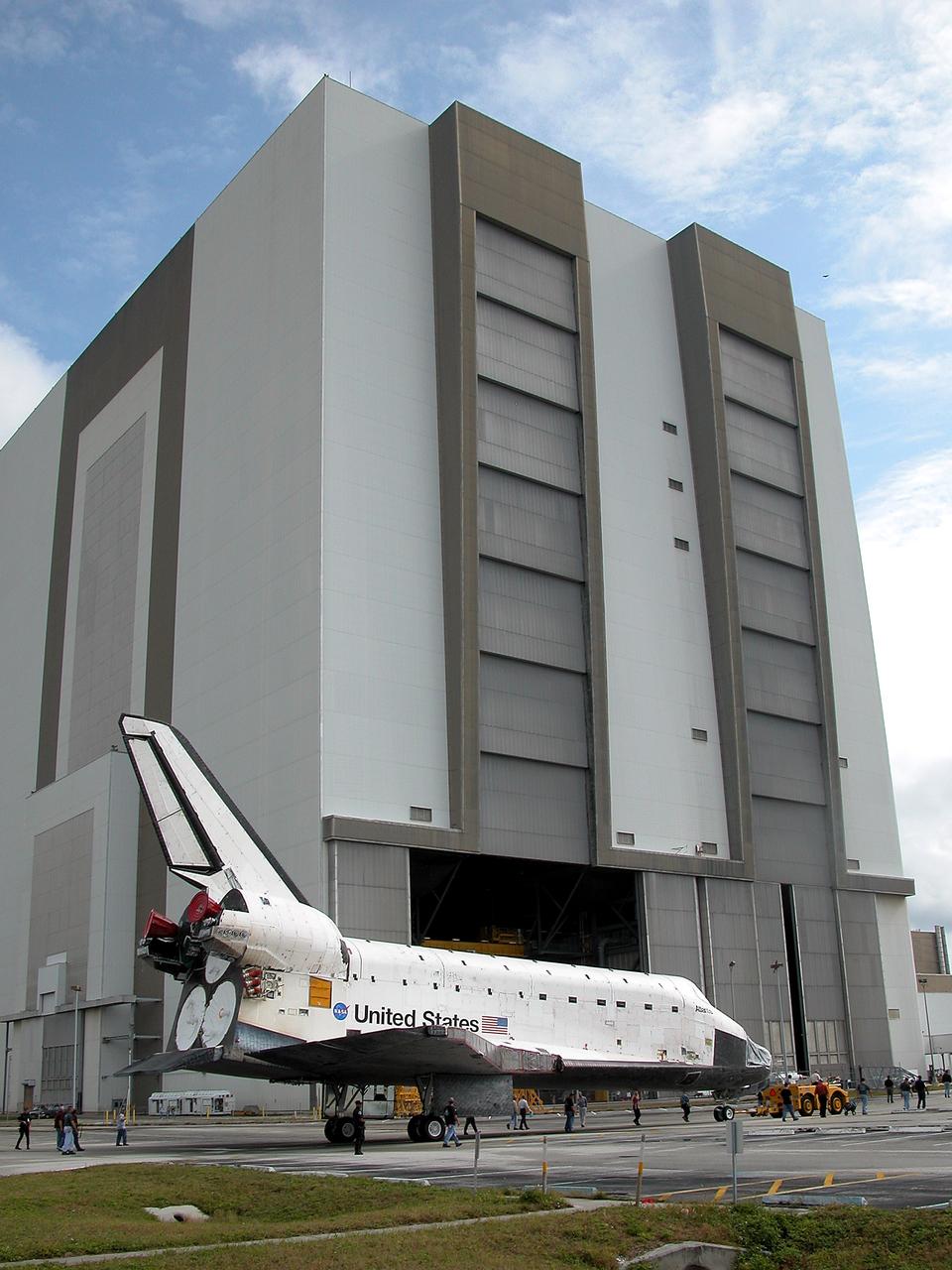
KENNEDY SPACE CENTER, FLA. - The Space Shuttle orbiter Atlantis approaches the Vehicle Assembly Building (VAB) high bay 4. It is being towed from the Orbiter Processing Facility (OPF) to allow work to be performed in the bay that can only be accomplished while it is empty. Work scheduled in the processing facility includes annual validation of the bay's cranes, work platforms, lifting mechanisms, and jack stands. Atlantis will remain in the VAB for about 10 days, then return to the OPF as work resumes to prepare it for launch in September 2004 on the first return-to-flight mission, STS-114.
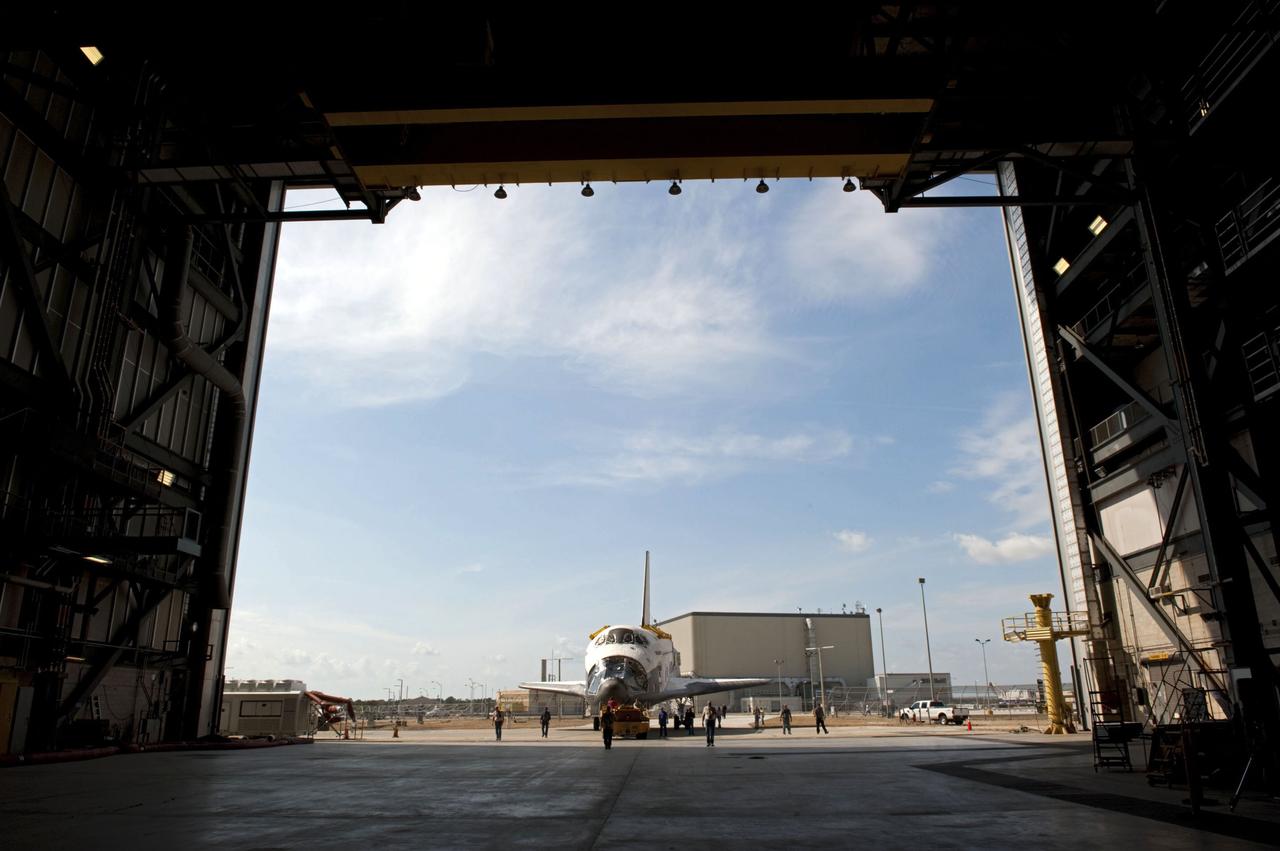
CAPE CANAVERAL, Fla. – At NASA’s Kennedy Space Center in Florida, space shuttle Atlantis is towed toward the Vehicle Assembly Building (VAB) high bay 4 doors after being towed around from the VAB transfer aisle. Shuttle Atlantis will remain in temporary storage in high bay 4, while Space Shuttle Program transition and retirement work continues on Discovery and Endeavour in the orbiter processing facilities. Atlantis is being prepared for display at the Kennedy Space Center Visitor Complex. Photo credit: NASA/Kim Shiflett
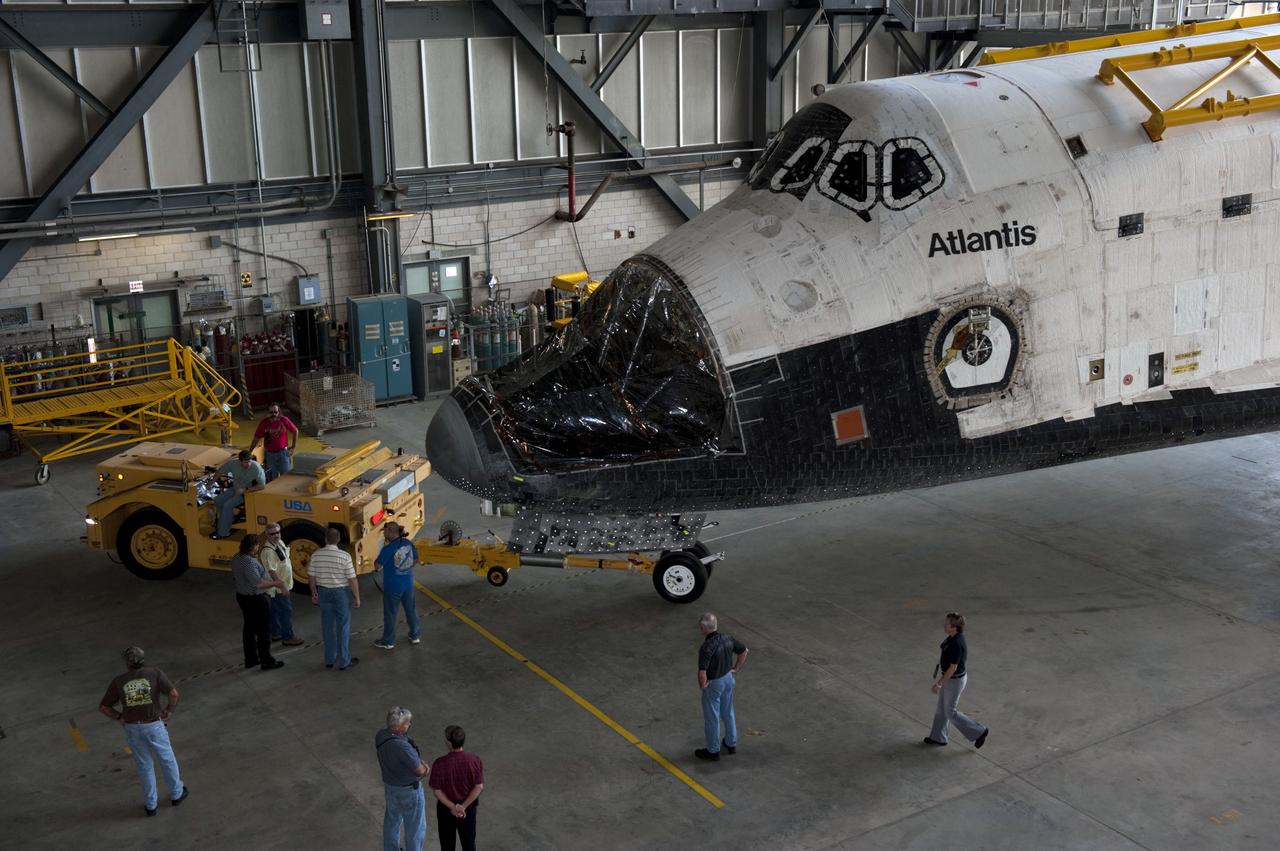
CAPE CANAVERAL, Fla. – At NASA’s Kennedy Space Center in Florida, space shuttle Atlantis is towed into the Vehicle Assembly Building (VAB) high bay 4 after being towed around from the VAB transfer aisle. Shuttle Atlantis will remain in temporary storage in high bay 4, while Space Shuttle Program transition and retirement work continues on Discovery and Endeavour in the orbiter processing facilities. Atlantis is being prepared for display at the Kennedy Space Center Visitor Complex. Photo credit: NASA/Kim Shiflett
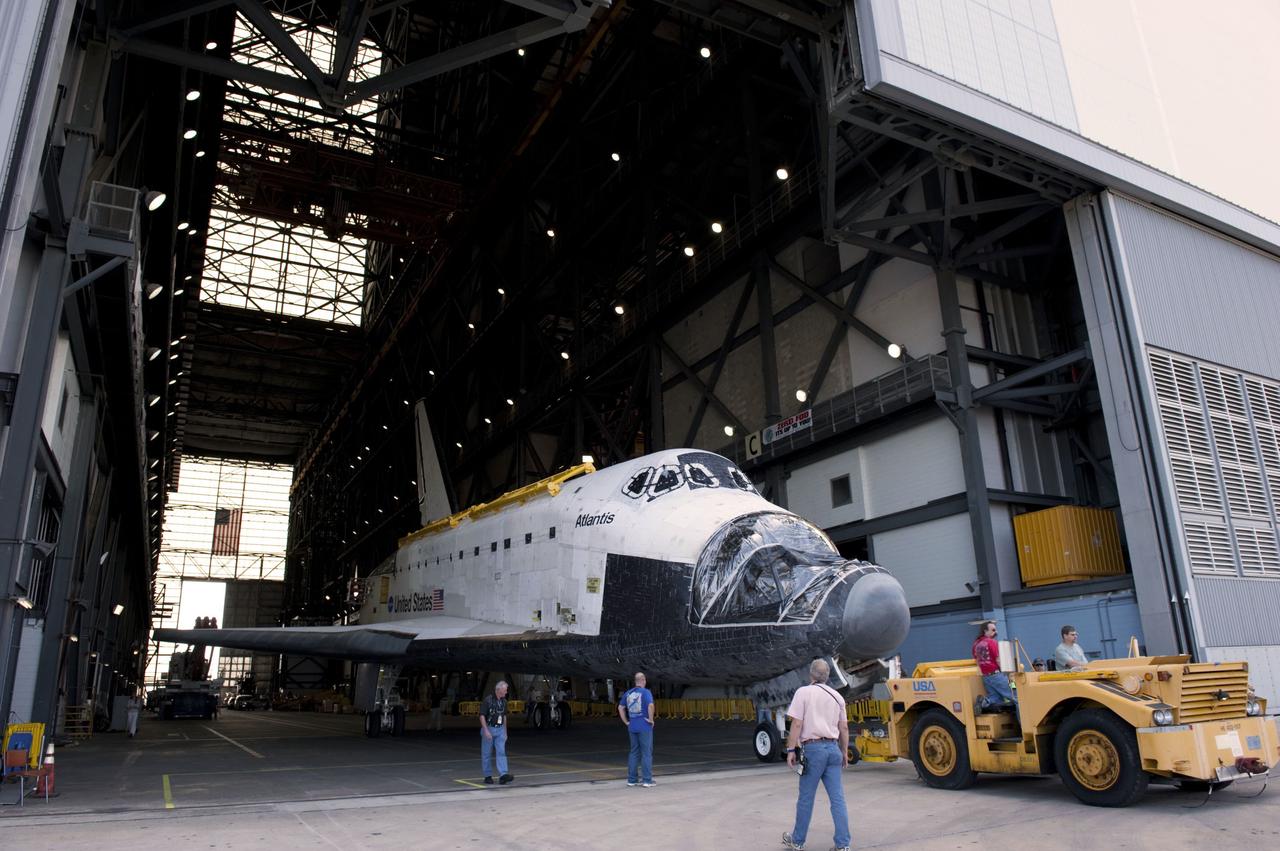
CAPE CANAVERAL, Fla. – Inside the Vehicle Assembly Building (VAB) at NASA’s Kennedy Space Center in Florida, technicians begin to tow space shuttle Atlantis out of the transfer aisle and around to the VAB high bay 4 doors. Shuttle Atlantis will remain in temporary storage in high bay 4, while Space Shuttle Program transition and retirement work continues on Discovery and Endeavour in the orbiter processing facilities. Atlantis is being prepared for display at the Kennedy Space Center Visitor Complex. Photo credit: NASA/Kim Shiflett
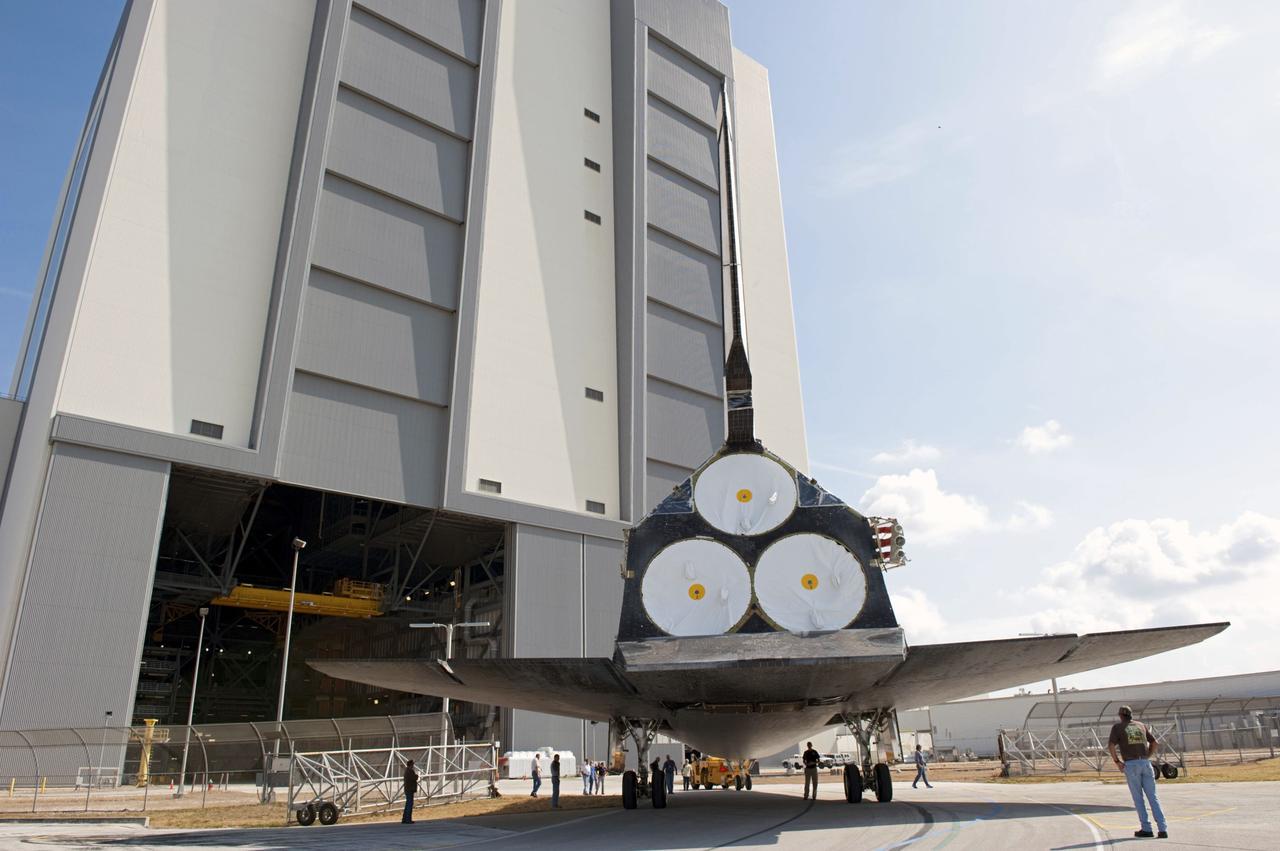
CAPE CANAVERAL, Fla. – At NASA’s Kennedy Space Center in Florida, space shuttle Atlantis is towed toward the Vehicle Assembly Building (VAB) high bay 4 doors after being towed around from the VAB transfer aisle. Shuttle Atlantis will remain in temporary storage in high bay 4, while Space Shuttle Program transition and retirement work continues on Discovery and Endeavour in the orbiter processing facilities. Atlantis is being prepared for display at the Kennedy Space Center Visitor Complex. Photo credit: NASA/Kim Shiflett
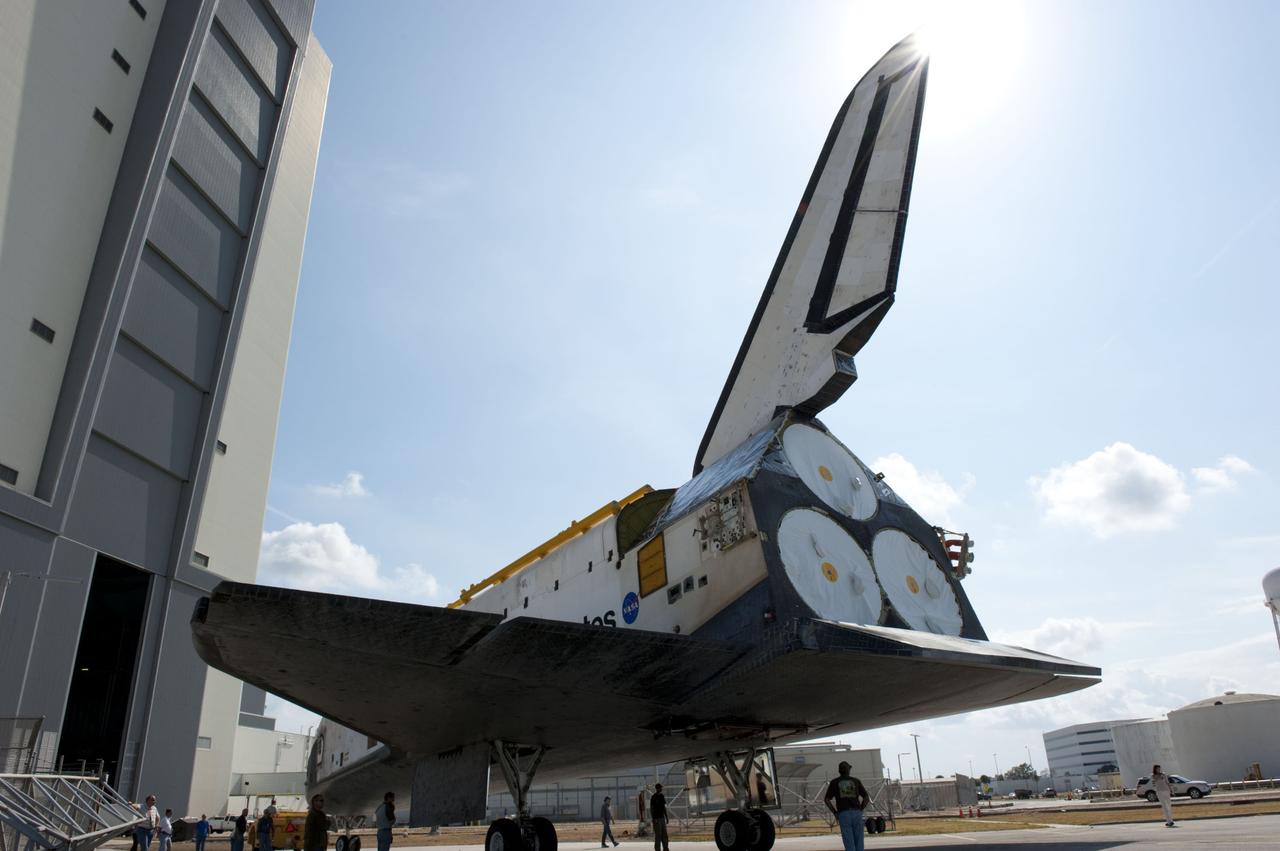
CAPE CANAVERAL, Fla. – At NASA’s Kennedy Space Center in Florida, space shuttle Atlantis is towed toward the Vehicle Assembly Building (VAB) high bay 4 doors after being towed around from the VAB transfer aisle. Shuttle Atlantis will remain in temporary storage in high bay 4, while Space Shuttle Program transition and retirement work continues on Discovery and Endeavour in the orbiter processing facilities. Atlantis is being prepared for display at the Kennedy Space Center Visitor Complex. Photo credit: NASA/Kim Shiflett
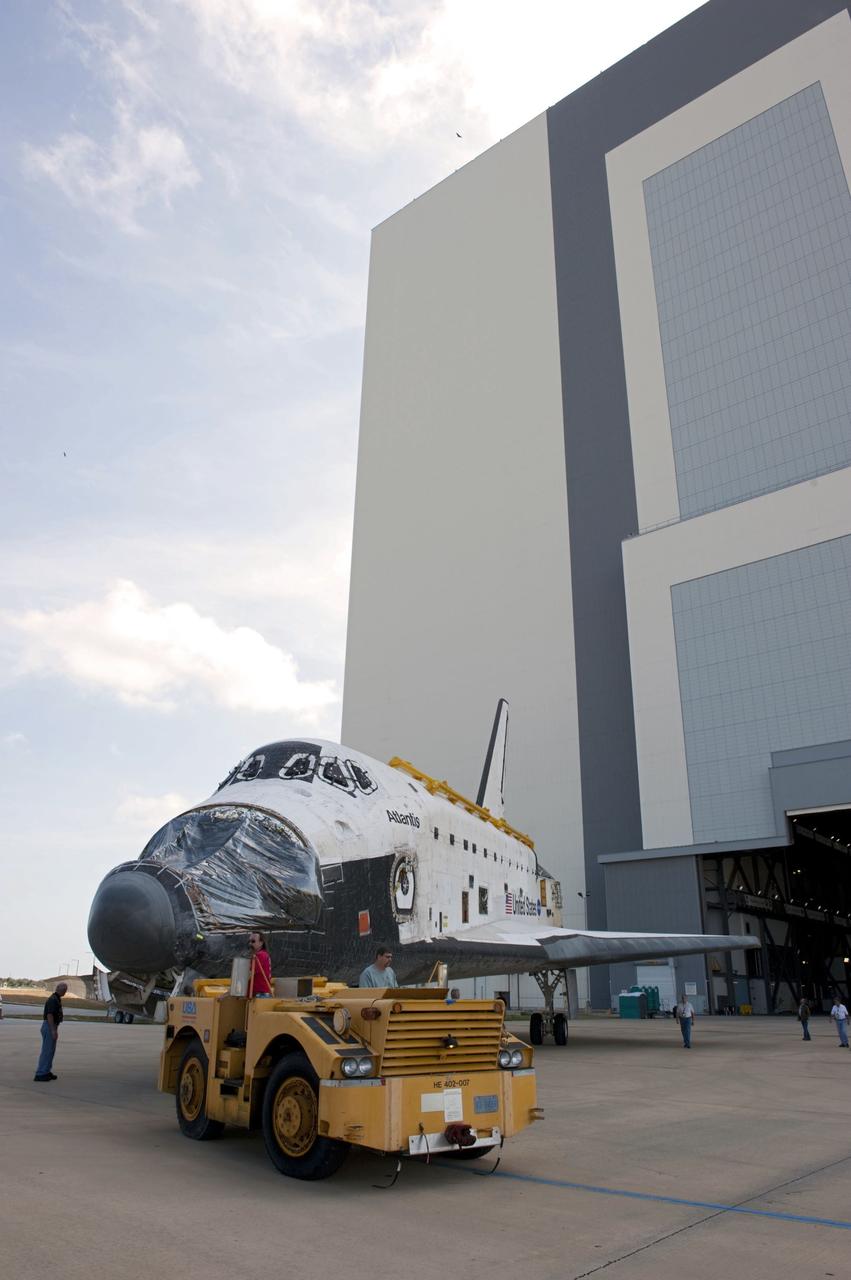
CAPE CANAVERAL, Fla. – At NASA’s Kennedy Space Center in Florida, space shuttle Atlantis is towed out of the Vehicle Assembly Building (VAB) transfer aisle and around to the VAB high bay 4 doors. Shuttle Atlantis will remain in temporary storage in high bay 4, while Space Shuttle Program transition and retirement work continues on Discovery and Endeavour in the orbiter processing facilities. Atlantis is being prepared for display at the Kennedy Space Center Visitor Complex. Photo credit: NASA/Kim Shiflett
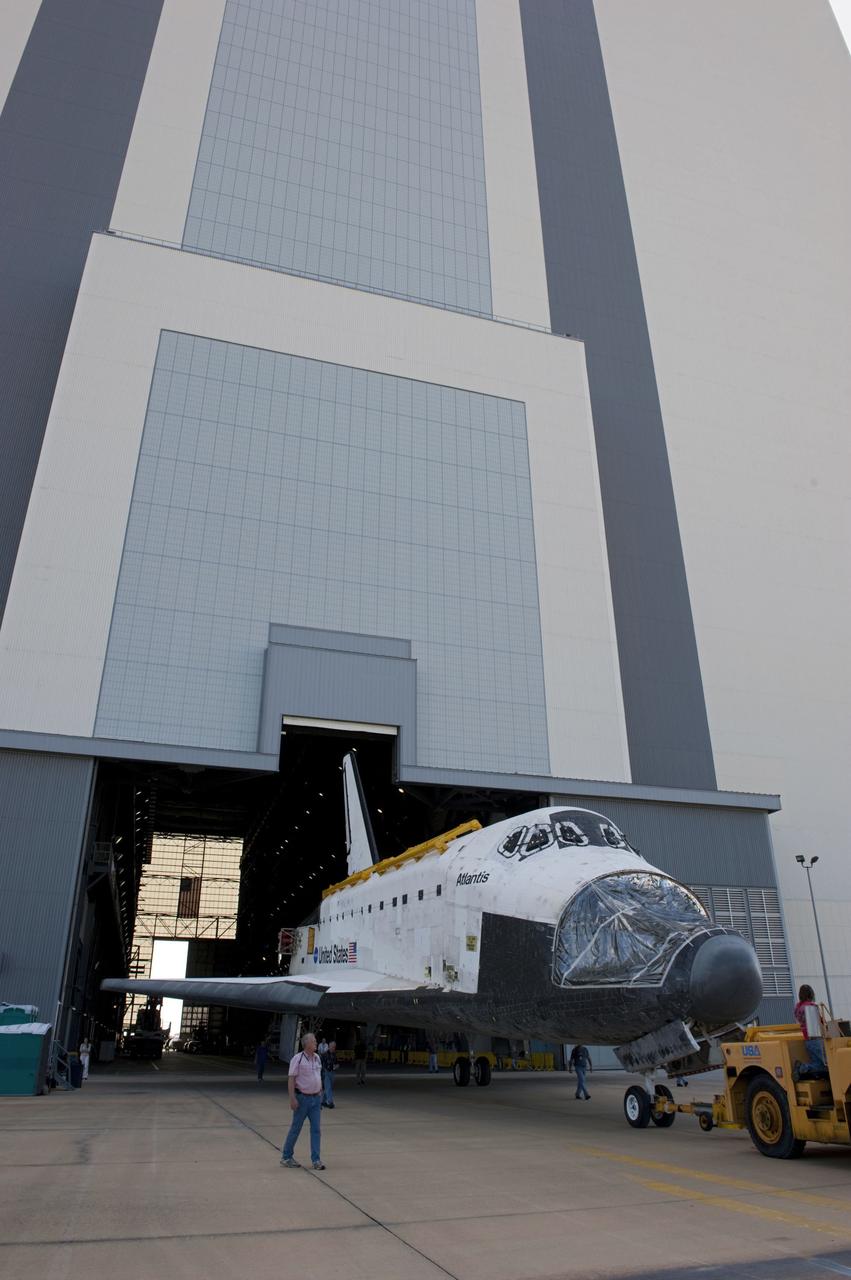
CAPE CANAVERAL, Fla. – At NASA’s Kennedy Space Center in Florida, technicians walk alongside space shuttle Atlantis as it is towed out of the Vehicle Assembly Building (VAB) transfer aisle and around to the VAB high bay 4 doors. Shuttle Atlantis will remain in temporary storage in high bay 4, while Space Shuttle Program transition and retirement work continues on Discovery and Endeavour in the orbiter processing facilities. Atlantis is being prepared for display at the Kennedy Space Center Visitor Complex. Photo credit: NASA/Kim Shiflett
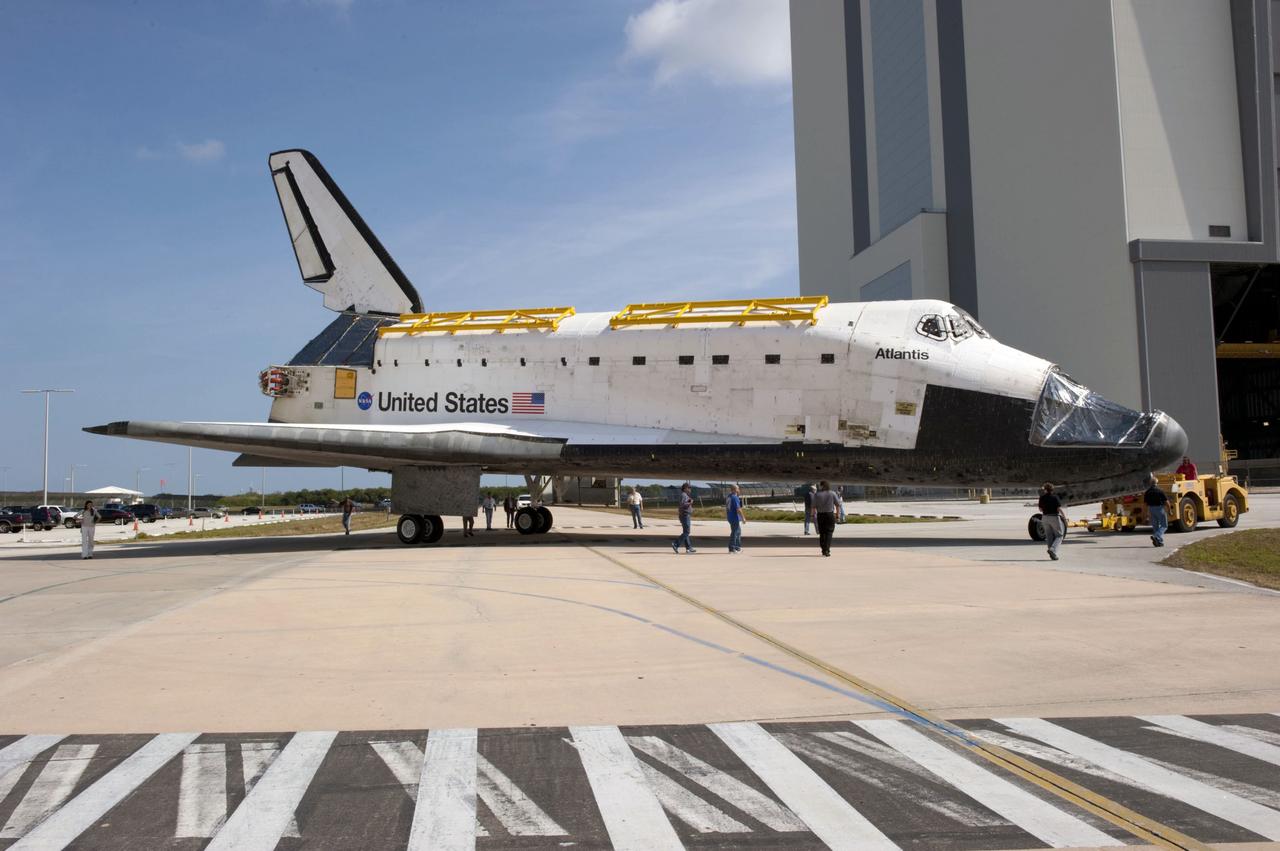
CAPE CANAVERAL, Fla. – At NASA’s Kennedy Space Center in Florida, space shuttle Atlantis is towed around toward the Vehicle Assembly Building (VAB) high bay 4 doors from the VAB transfer aisle. Shuttle Atlantis will remain in temporary storage in high bay 4, while Space Shuttle Program transition and retirement work continues on Discovery and Endeavour in the orbiter processing facilities. Atlantis is being prepared for display at the Kennedy Space Center Visitor Complex. Photo credit: NASA/Kim Shiflett
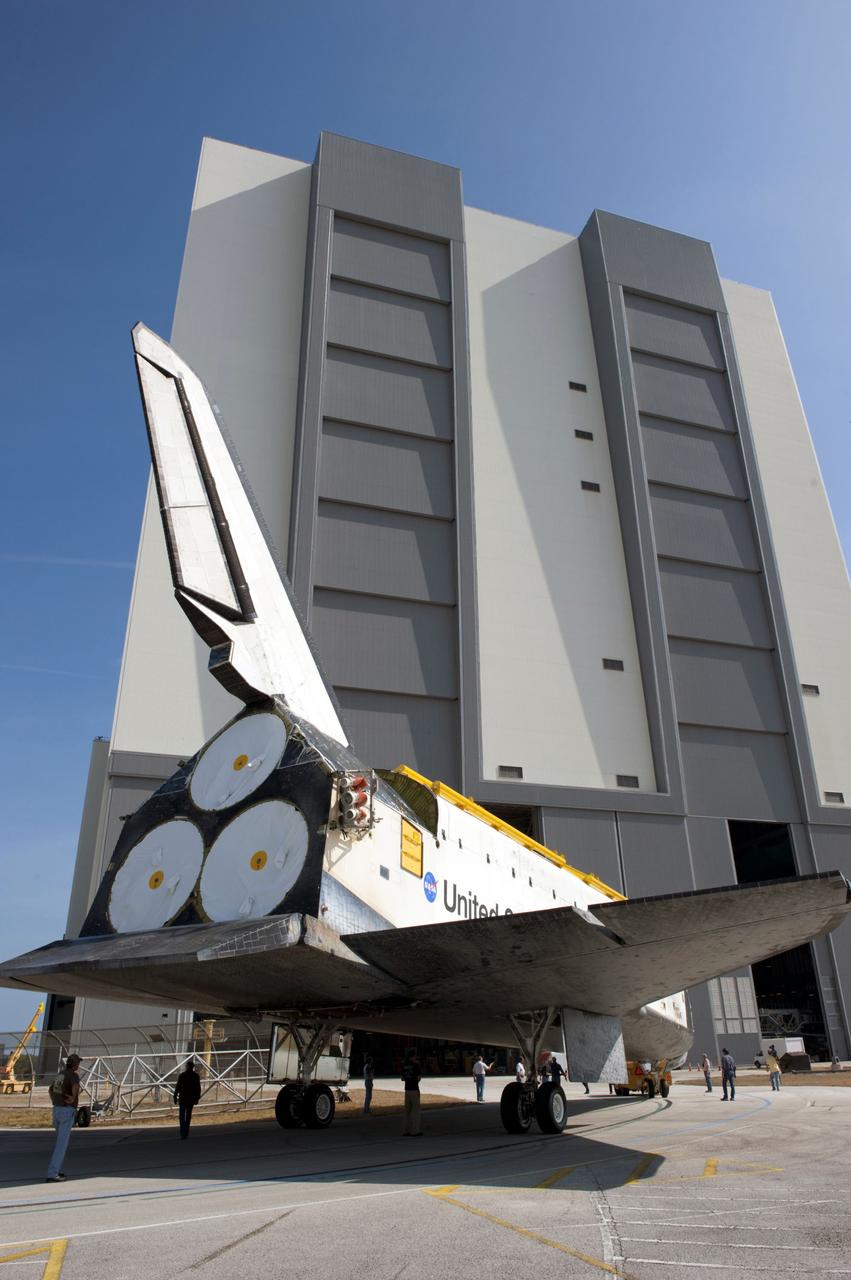
CAPE CANAVERAL, Fla. – At NASA’s Kennedy Space Center in Florida, space shuttle Atlantis is towed toward the Vehicle Assembly Building (VAB) high bay 4 doors after being towed around from the VAB transfer aisle. Shuttle Atlantis will remain in temporary storage in high bay 4, while Space Shuttle Program transition and retirement work continues on Discovery and Endeavour in the orbiter processing facilities. Atlantis is being prepared for display at the Kennedy Space Center Visitor Complex. Photo credit: NASA/Kim Shiflett
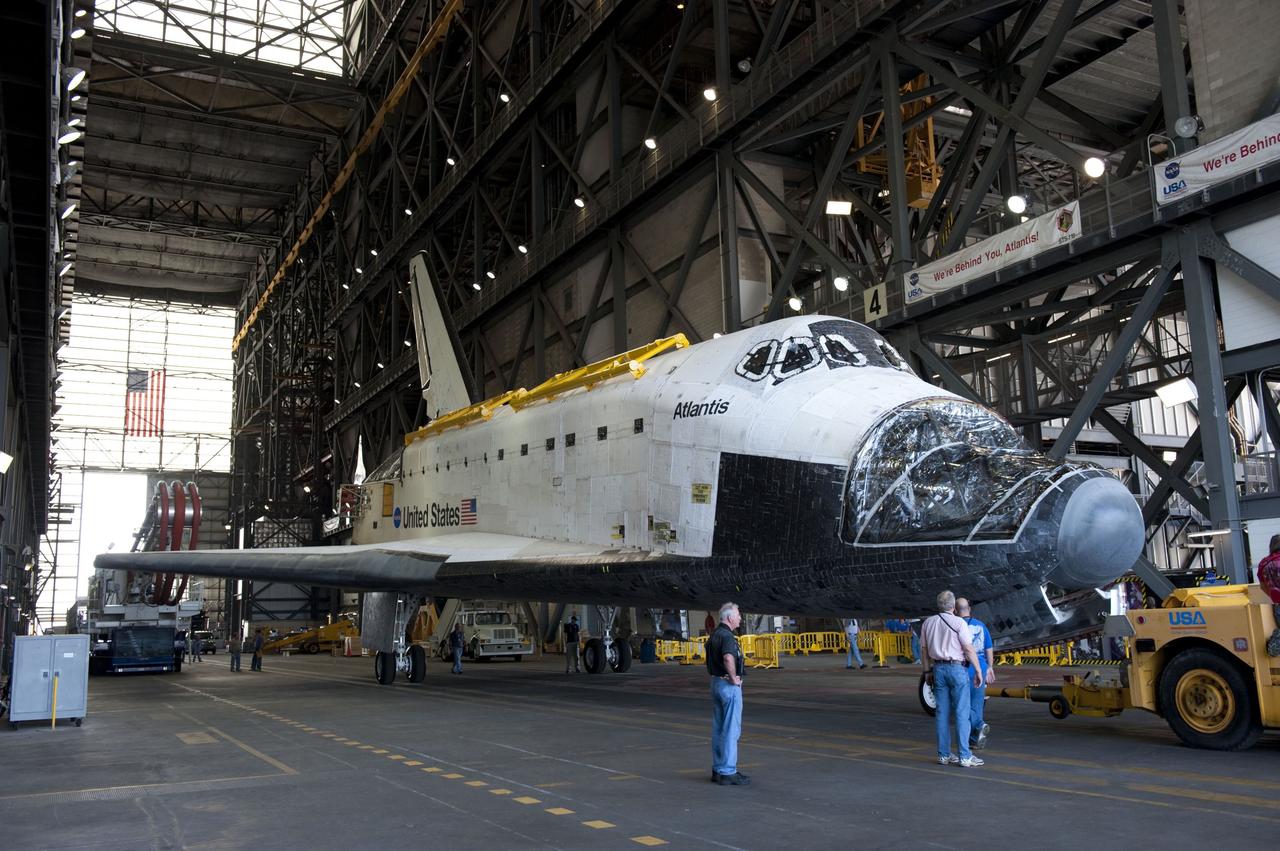
CAPE CANAVERAL, Fla. – Inside the Vehicle Assembly Building (VAB) at NASA’s Kennedy Space Center in Florida, technicians prepare space shuttle Atlantis to be towed out of the transfer aisle and around to the VAB high bay 4 doors. Shuttle Atlantis will remain in temporary storage in high bay 4, while Space Shuttle Program transition and retirement work continues on Discovery and Endeavour in the orbiter processing facilities. Atlantis is being prepared for display at the Kennedy Space Center Visitor Complex. Photo credit: NASA/Kim Shiflett
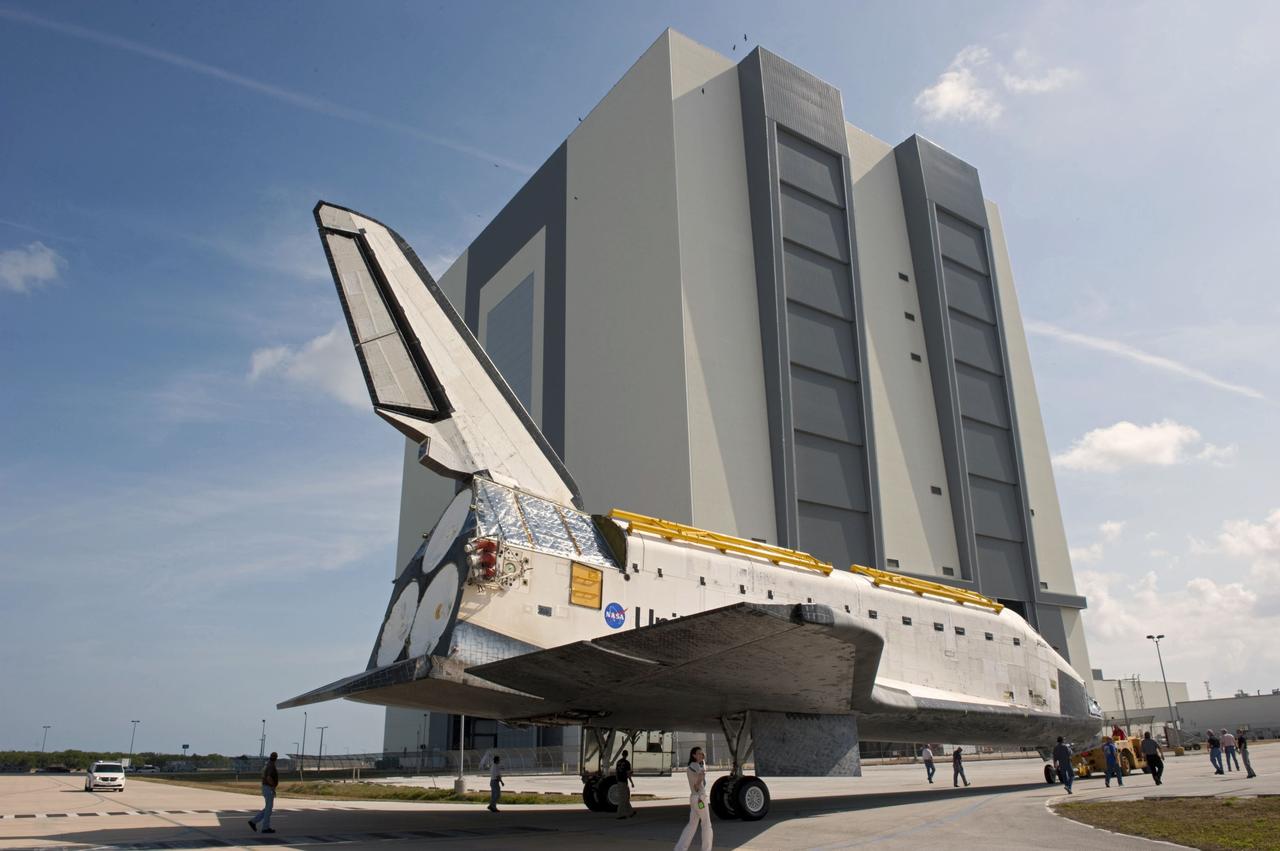
CAPE CANAVERAL, Fla. – At NASA’s Kennedy Space Center in Florida, space shuttle Atlantis is towed around toward the Vehicle Assembly Building (VAB) high bay 4 doors from the VAB transfer aisle. Shuttle Atlantis will remain in temporary storage in high bay 4, while Space Shuttle Program transition and retirement work continues on Discovery and Endeavour in the orbiter processing facilities. Atlantis is being prepared for display at the Kennedy Space Center Visitor Complex. Photo credit: NASA/Kim Shiflett
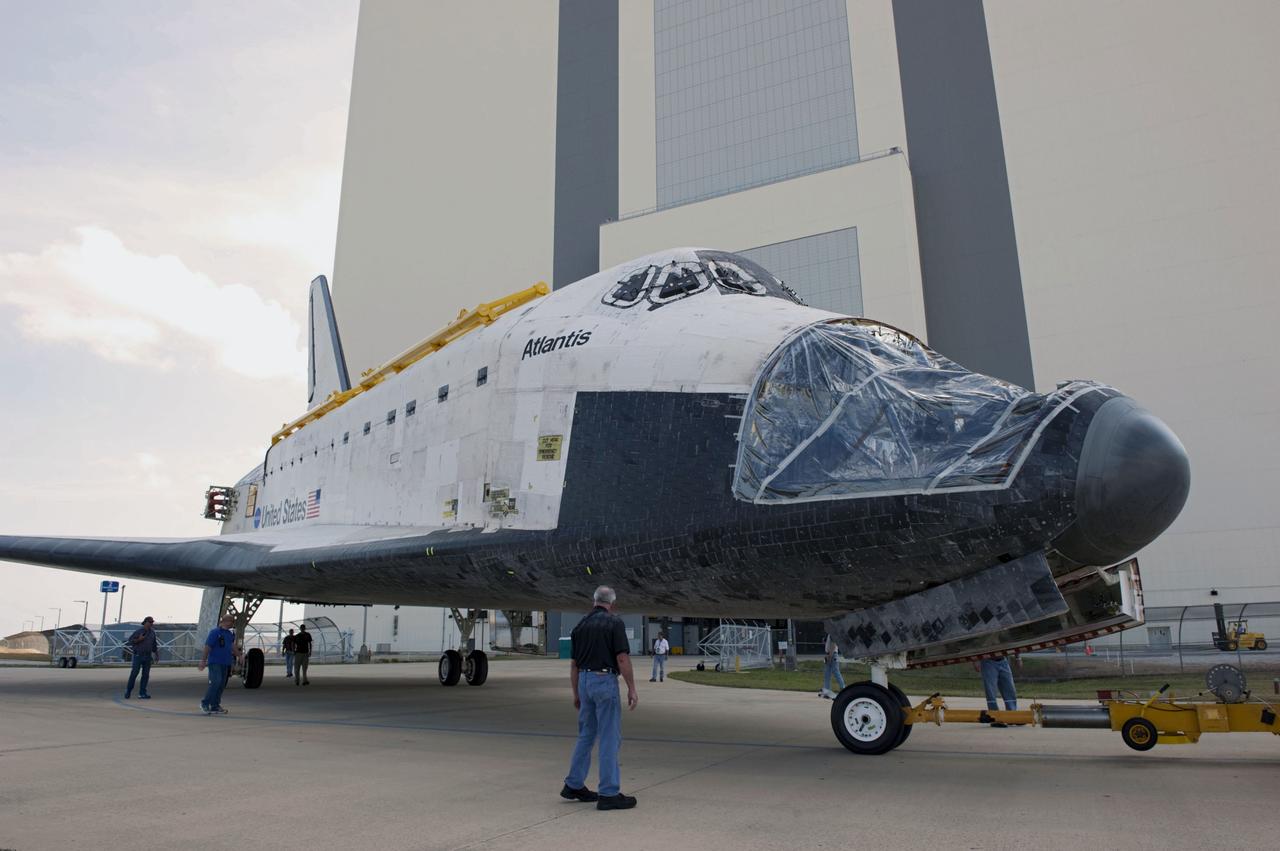
CAPE CANAVERAL, Fla. – At NASA’s Kennedy Space Center in Florida, technicians monitor the progress as space shuttle Atlantis is towed out of the Vehicle Assembly Building (VAB) transfer aisle and around to the VAB high bay 4 doors. Shuttle Atlantis will remain in temporary storage in high bay 4, while Space Shuttle Program transition and retirement work continues on Discovery and Endeavour in the orbiter processing facilities. Atlantis is being prepared for display at the Kennedy Space Center Visitor Complex. Photo credit: NASA/Kim Shiflett
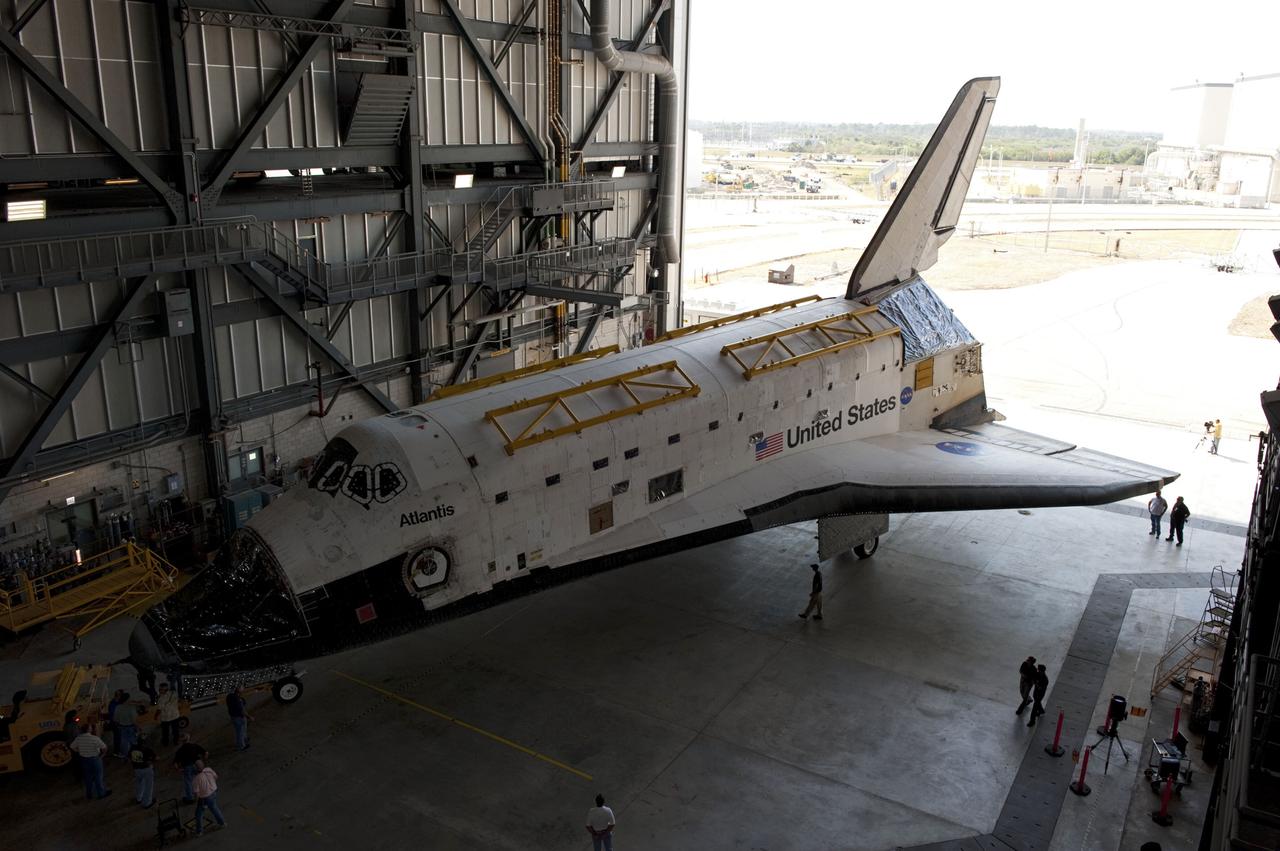
CAPE CANAVERAL, Fla. – At NASA’s Kennedy Space Center in Florida, space shuttle Atlantis is towed into the Vehicle Assembly Building (VAB) high bay 4 after being towed around from the VAB transfer aisle. Shuttle Atlantis will remain in temporary storage in high bay 4, while Space Shuttle Program transition and retirement work continues on Discovery and Endeavour in the orbiter processing facilities. Atlantis is being prepared for display at the Kennedy Space Center Visitor Complex. Photo credit: NASA/Kim Shiflett
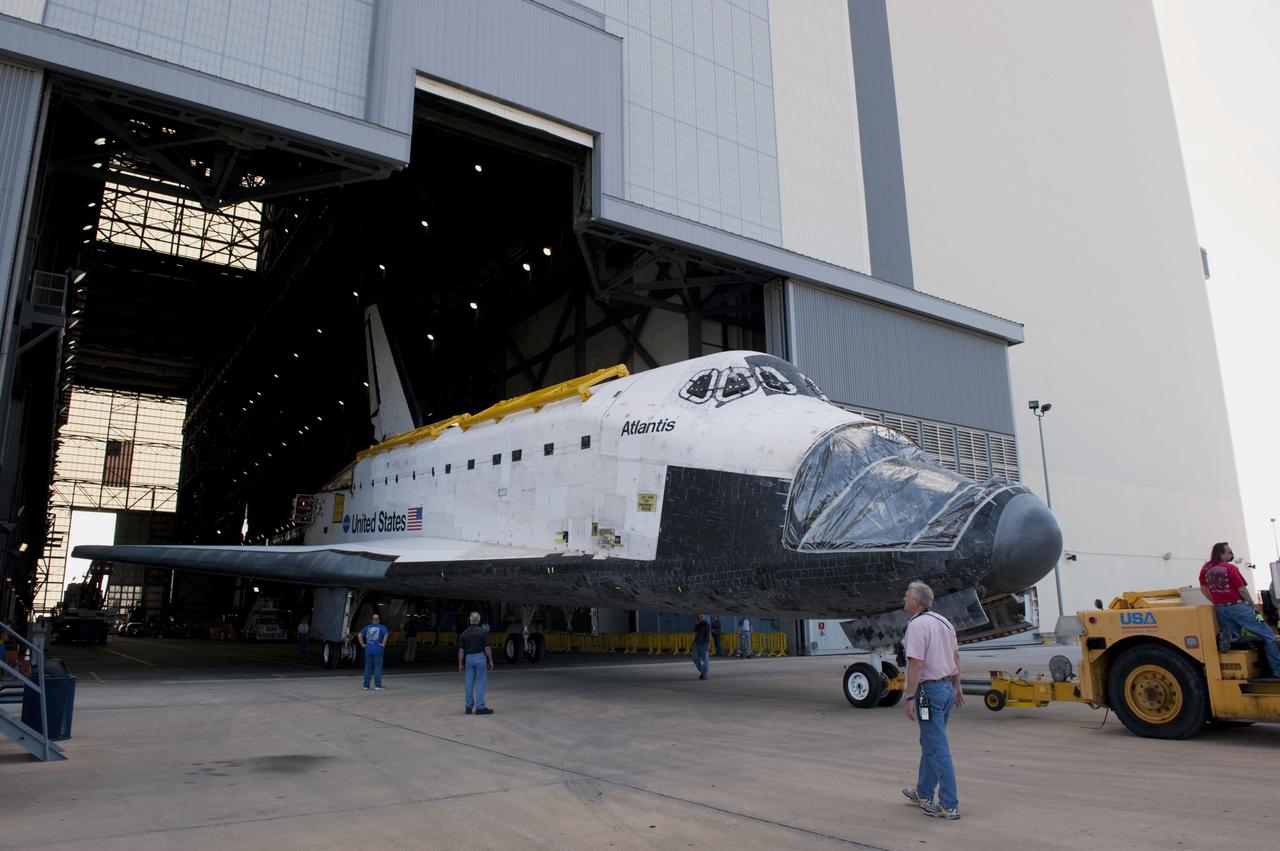
CAPE CANAVERAL, Fla. – At NASA’s Kennedy Space Center in Florida, technicians monitor the progress as space shuttle Atlantis is towed out of the Vehicle Assembly Building (VAB) transfer aisle and around to the VAB high bay 4 doors. Shuttle Atlantis will remain in temporary storage in high bay 4, while Space Shuttle Program transition and retirement work continues on Discovery and Endeavour in the orbiter processing facilities. Atlantis is being prepared for display at the Kennedy Space Center Visitor Complex. Photo credit: NASA/Kim Shiflett
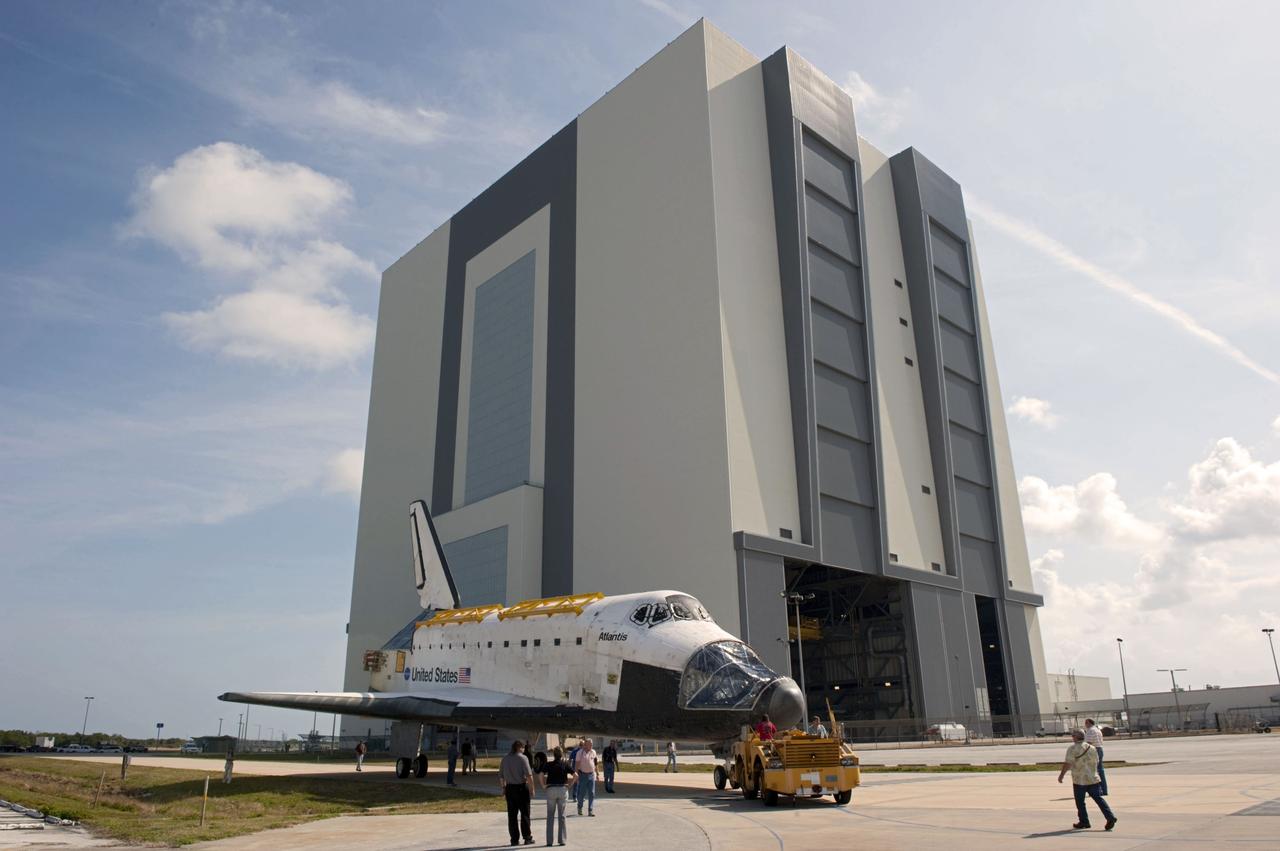
CAPE CANAVERAL, Fla. – At NASA’s Kennedy Space Center in Florida, space shuttle Atlantis is towed from the Vehicle Assembly Building (VAB) transfer aisle on its way around to the VAB high bay 4 doors. Shuttle Atlantis will remain in temporary storage in high bay 4, while Space Shuttle Program transition and retirement work continues on Discovery and Endeavour in the orbiter processing facilities. Atlantis is being prepared for display at the Kennedy Space Center Visitor Complex. Photo credit: NASA/Kim Shiflett
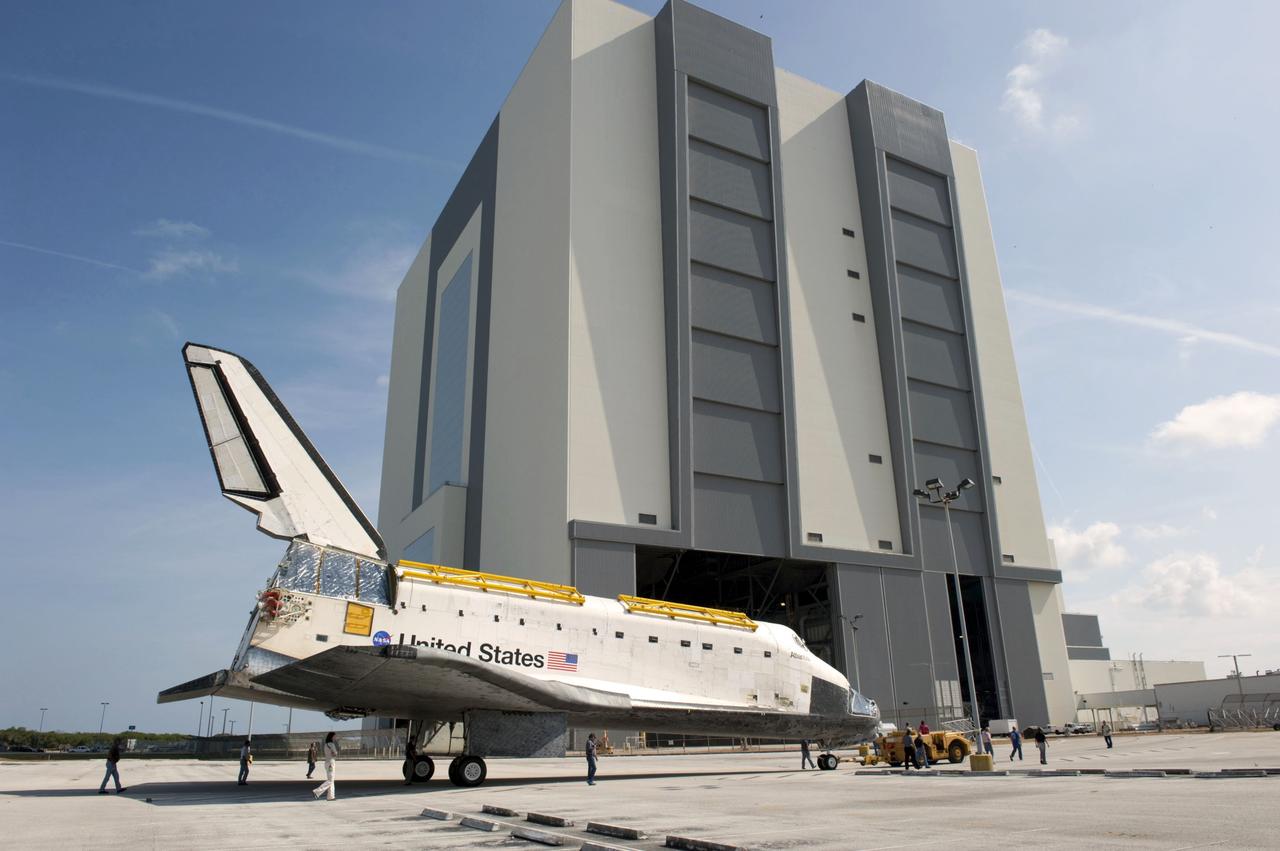
CAPE CANAVERAL, Fla. – At NASA’s Kennedy Space Center in Florida, space shuttle Atlantis is towed around toward the Vehicle Assembly Building (VAB) high bay 4 doors from the VAB transfer aisle. Shuttle Atlantis will remain in temporary storage in high bay 4, while Space Shuttle Program transition and retirement work continues on Discovery and Endeavour in the orbiter processing facilities. Atlantis is being prepared for display at the Kennedy Space Center Visitor Complex. Photo credit: NASA/Kim Shiflett
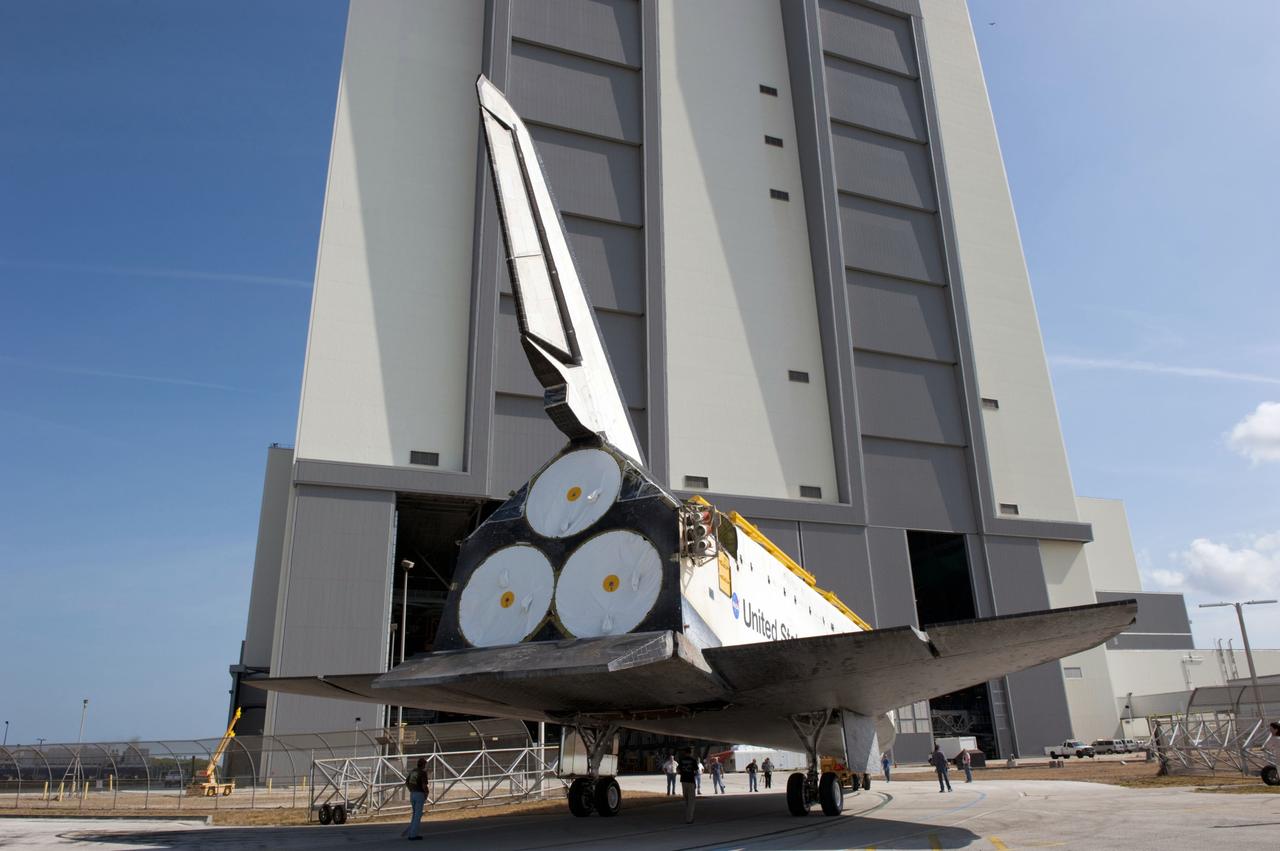
CAPE CANAVERAL, Fla. – At NASA’s Kennedy Space Center in Florida, space shuttle Atlantis is towed toward the Vehicle Assembly Building (VAB) high bay 4 doors after being towed around from the VAB transfer aisle. Shuttle Atlantis will remain in temporary storage in high bay 4, while Space Shuttle Program transition and retirement work continues on Discovery and Endeavour in the orbiter processing facilities. Atlantis is being prepared for display at the Kennedy Space Center Visitor Complex. Photo credit: NASA/Kim Shiflett
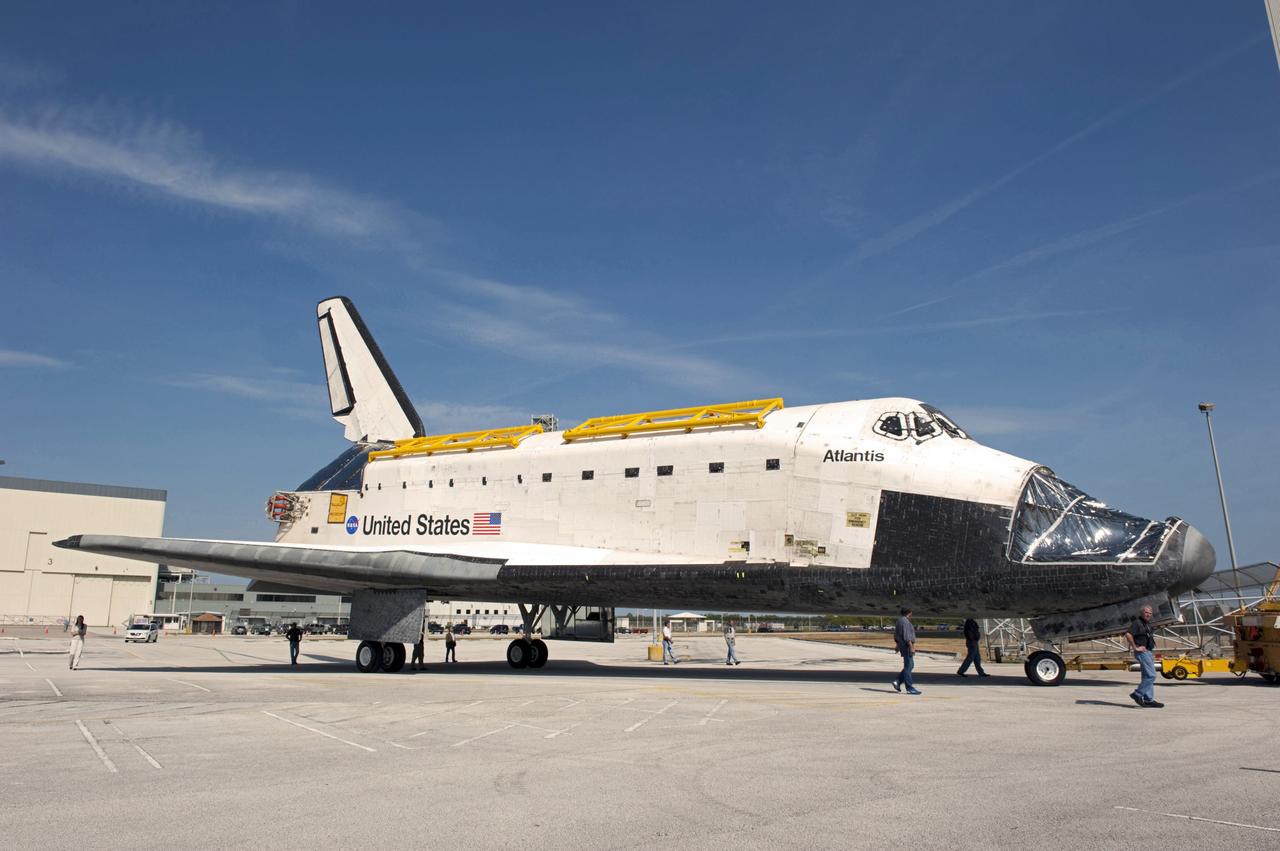
CAPE CANAVERAL, Fla. – At NASA’s Kennedy Space Center in Florida, space shuttle Atlantis is towed toward the Vehicle Assembly Building (VAB) high bay 4 doors after being towed around from the VAB transfer aisle. Shuttle Atlantis will remain in temporary storage in high bay 4, while Space Shuttle Program transition and retirement work continues on Discovery and Endeavour in the orbiter processing facilities. Atlantis is being prepared for display at the Kennedy Space Center Visitor Complex. Photo credit: NASA/Kim Shiflett
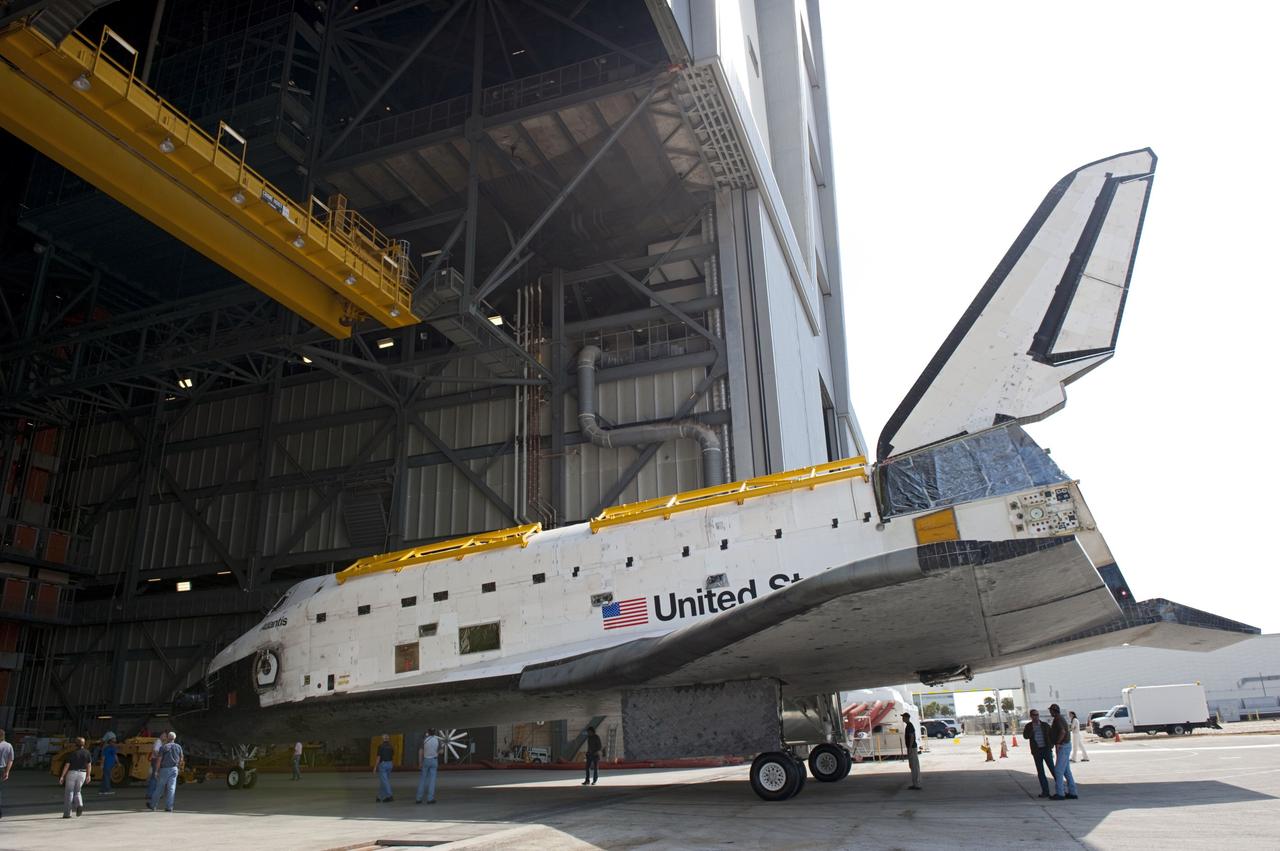
CAPE CANAVERAL, Fla. – At NASA’s Kennedy Space Center in Florida, space shuttle Atlantis is towed into the Vehicle Assembly Building (VAB) high bay 4 after being towed around from the VAB transfer aisle. Shuttle Atlantis will remain in temporary storage in high bay 4, while Space Shuttle Program transition and retirement work continues on Discovery and Endeavour in the orbiter processing facilities. Atlantis is being prepared for display at the Kennedy Space Center Visitor Complex. Photo credit: NASA/Kim Shiflett
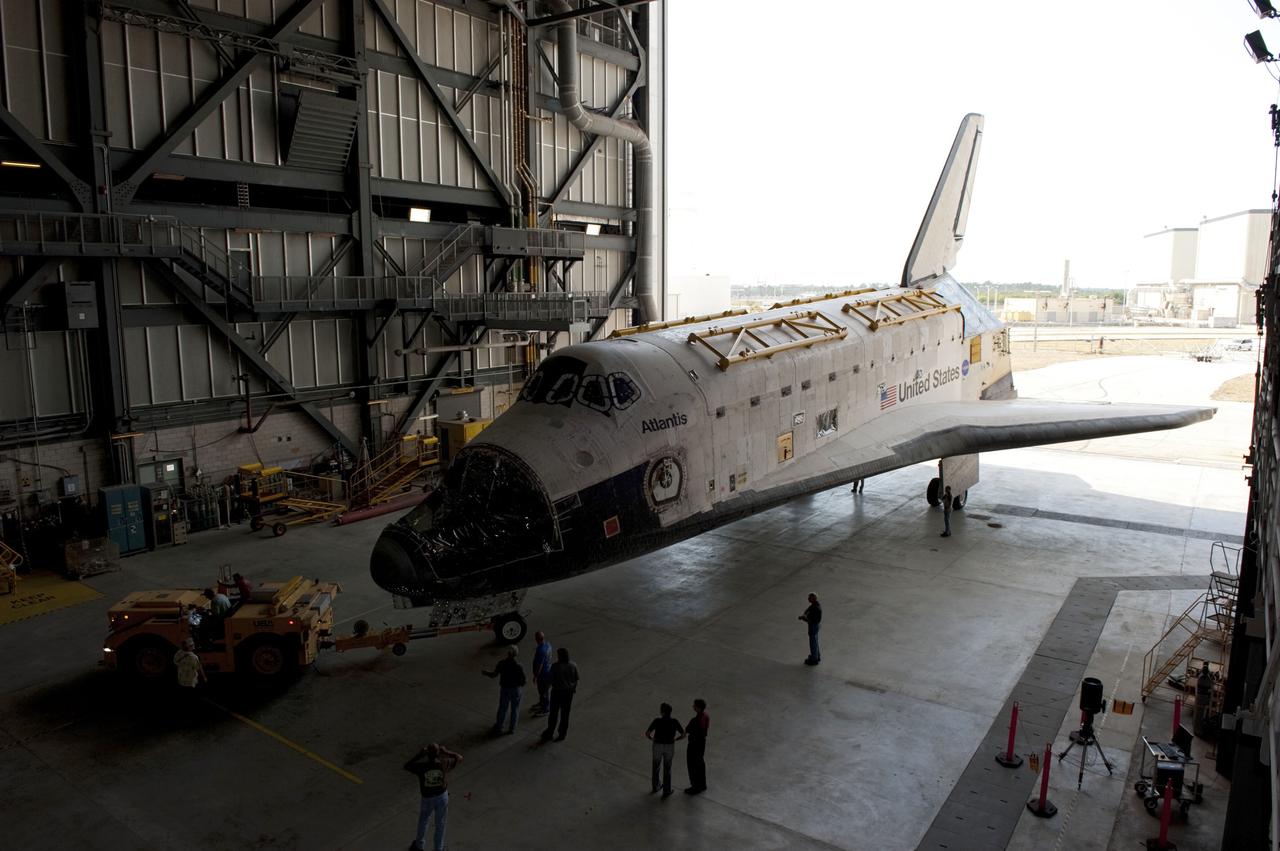
CAPE CANAVERAL, Fla. – At NASA’s Kennedy Space Center in Florida, space shuttle Atlantis is towed into the Vehicle Assembly Building (VAB) high bay 4 after being towed around from the VAB transfer aisle. Shuttle Atlantis will remain in temporary storage in high bay 4, while Space Shuttle Program transition and retirement work continues on Discovery and Endeavour in the orbiter processing facilities. Atlantis is being prepared for display at the Kennedy Space Center Visitor Complex. Photo credit: NASA/Kim Shiflett
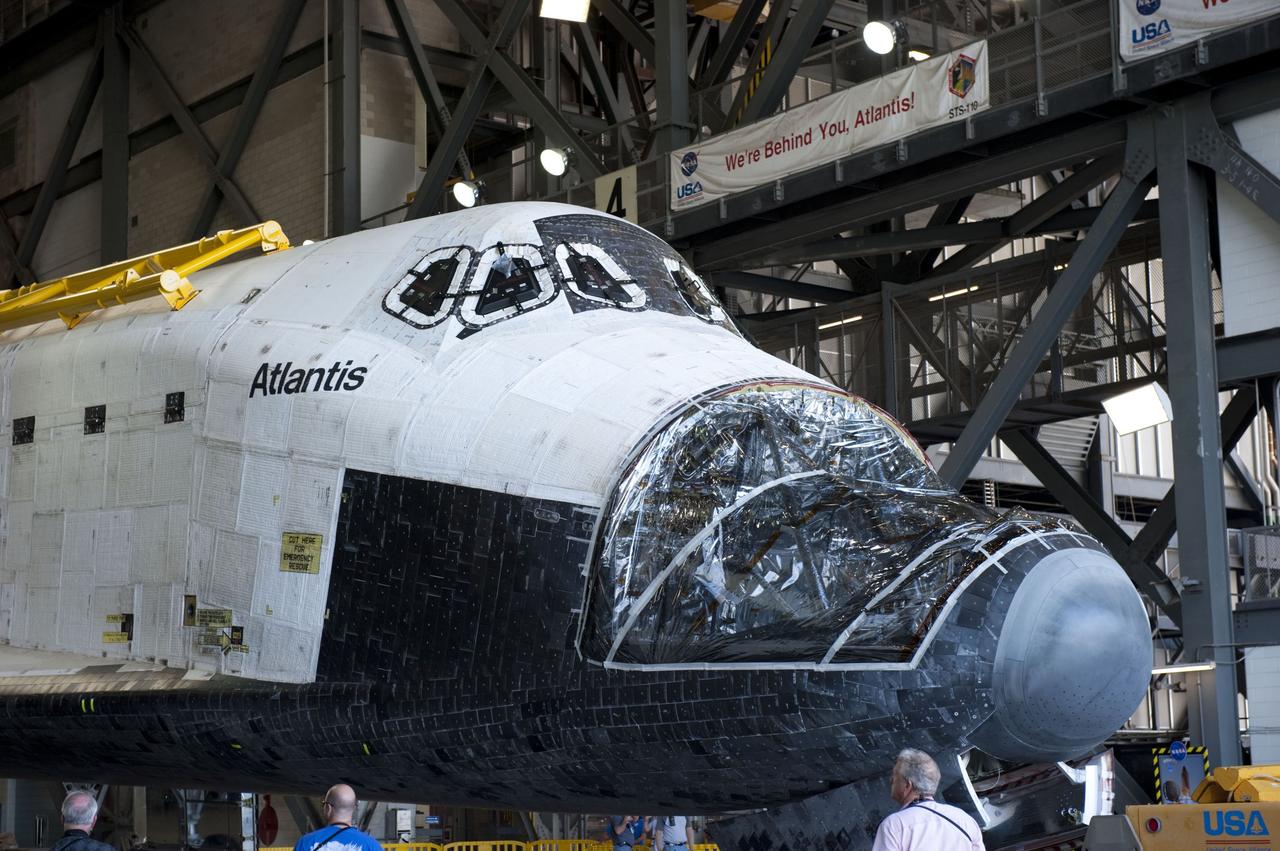
CAPE CANAVERAL, Fla. – Inside the Vehicle Assembly Building (VAB) at NASA’s Kennedy Space Center in Florida, technicians prepare space shuttle Atlantis to be towed out of the transfer aisle and around to the VAB high bay 4 doors. Shuttle Atlantis will remain in temporary storage in high bay 4, while Space Shuttle Program transition and retirement work continues on Discovery and Endeavour in the orbiter processing facilities. Atlantis is being prepared for display at the Kennedy Space Center Visitor Complex. Photo credit: NASA/Kim Shiflett
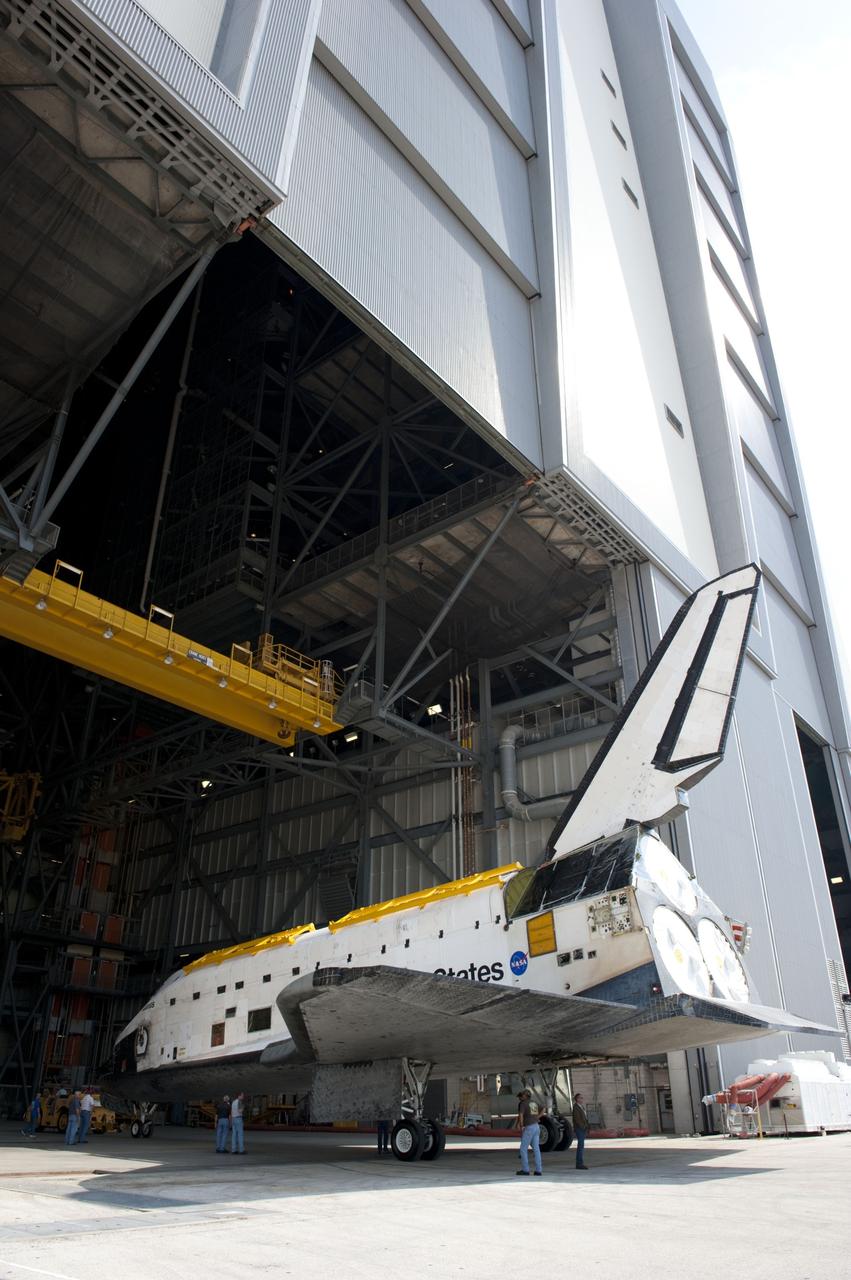
CAPE CANAVERAL, Fla. – At NASA’s Kennedy Space Center in Florida, space shuttle Atlantis is towed into the Vehicle Assembly Building (VAB) high bay 4 after being towed around from the VAB transfer aisle. Shuttle Atlantis will remain in temporary storage in high bay 4, while Space Shuttle Program transition and retirement work continues on Discovery and Endeavour in the orbiter processing facilities. Atlantis is being prepared for display at the Kennedy Space Center Visitor Complex. Photo credit: NASA/Kim Shiflett
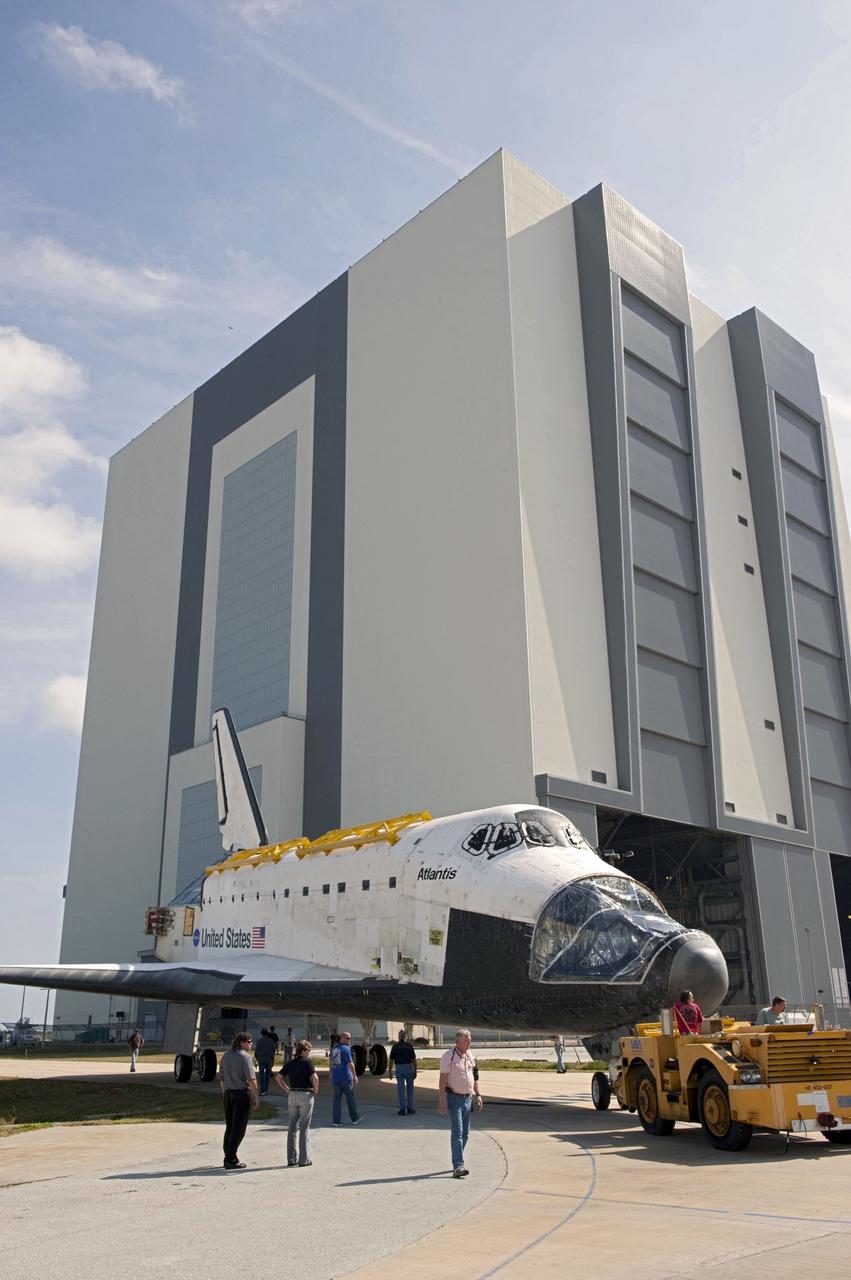
CAPE CANAVERAL, Fla. – At NASA’s Kennedy Space Center in Florida, space shuttle Atlantis is towed from the Vehicle Assembly Building (VAB) transfer aisle on its way around to the VAB high bay 4 doors. Shuttle Atlantis will remain in temporary storage in high bay 4, while Space Shuttle Program transition and retirement work continues on Discovery and Endeavour in the orbiter processing facilities. Atlantis is being prepared for display at the Kennedy Space Center Visitor Complex. Photo credit: NASA/Kim Shiflett
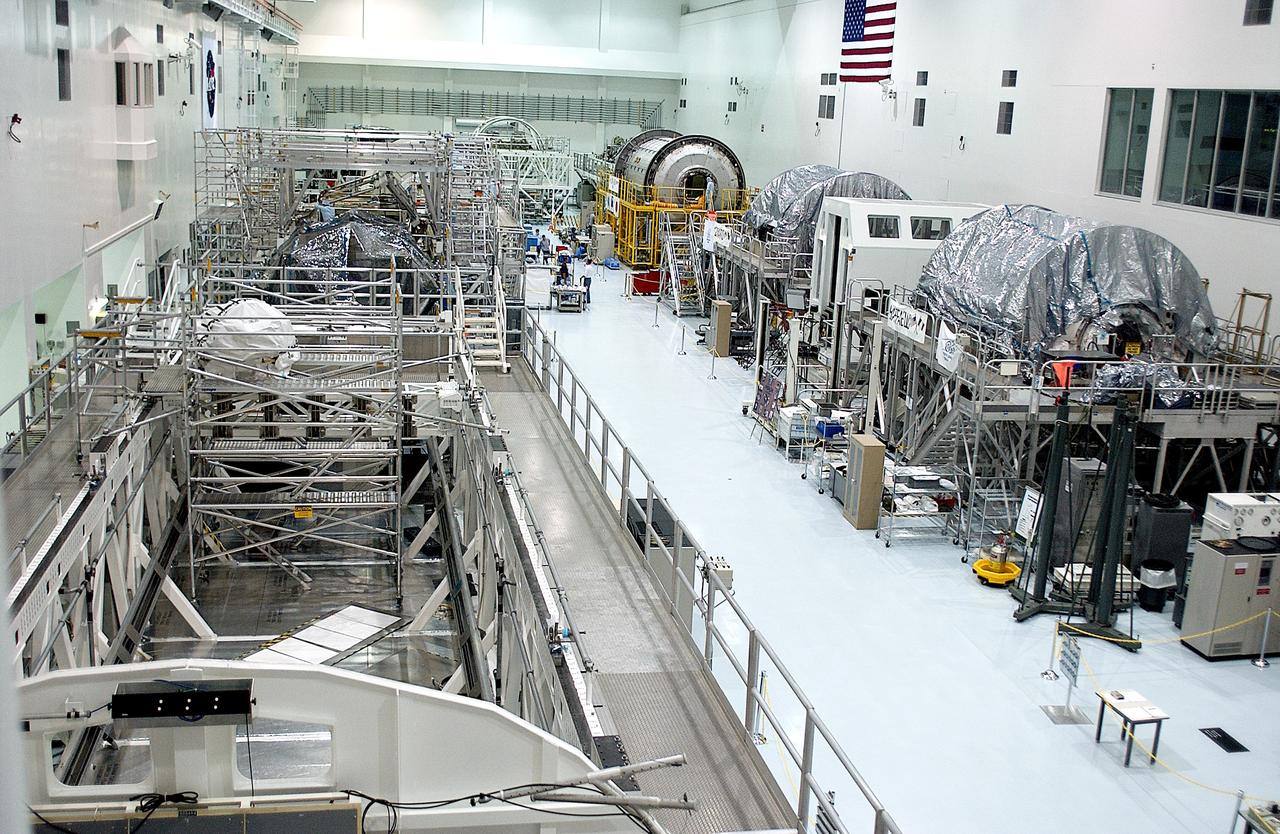
KENNEDY SPACE CENTER, FLA. - International Space Station elements being processed for launch on upcoming Space Shuttle flights line the walls of the high bay in the Space Station Processing Facility. NASA's Node 2, built by the European Space Agency (ESA) in Italy, arrived at KSC on June 1. It will be the next pressurized module installed on the Station. The pressurized module of the Japanese Experiment Module (JEM), named "Kibo" (Hope), arrived at KSC on June 4. It is Japan's primary contribution to the Station.
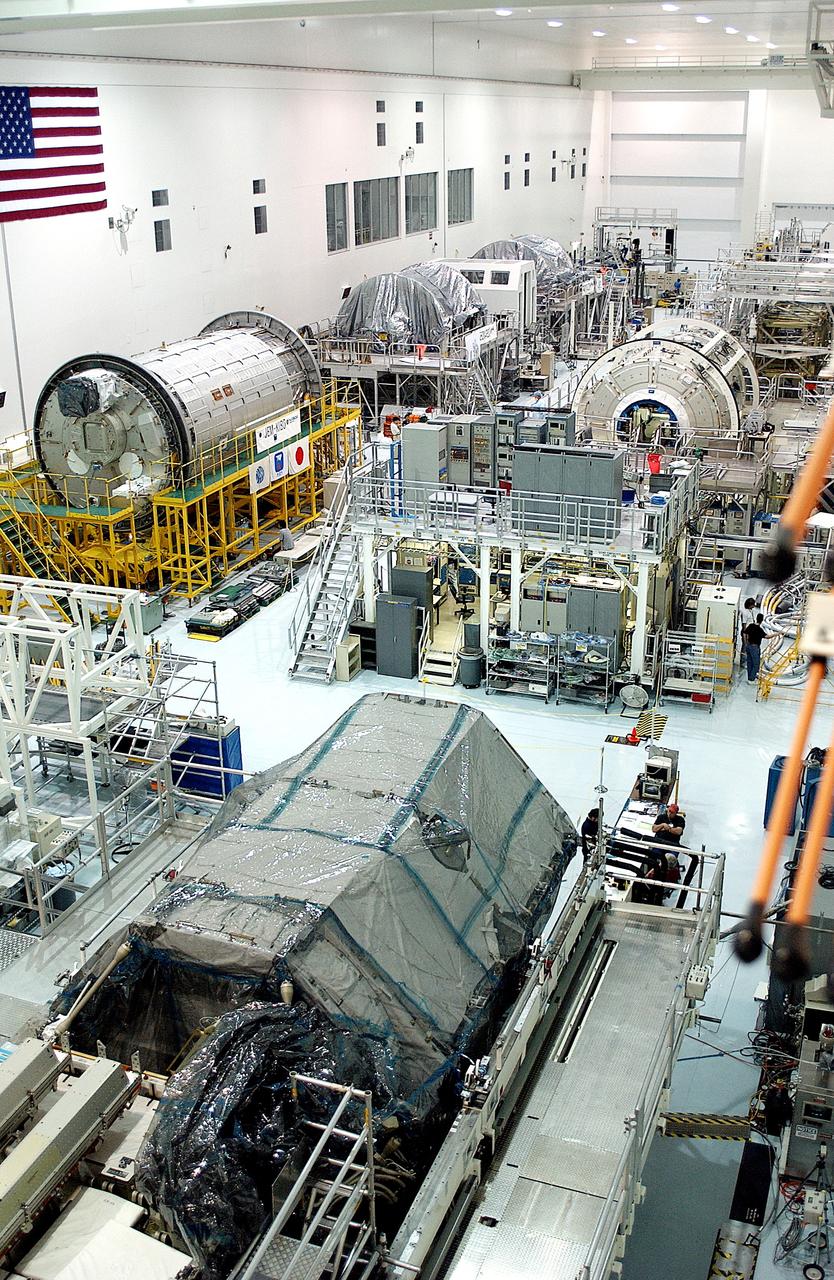
KENNEDY SPACE CENTER, FLA. - International Space Station elements being processed for launch on upcoming Space Shuttle flights, including the Japanese Experiment Module (JEM) pressurized module (Kibo or Hope) and the U.S. Node 2, line the walls of the high bay in the Space Station Processing Facility. NASA's Node 2, built by the European Space Agency (ESA) in Italy, arrived at KSC on June 1. It will be the next pressurized module installed on the Station. The JEM pressurized module arrived at KSC on June 4. It is Japan's primary contribution to the Station.
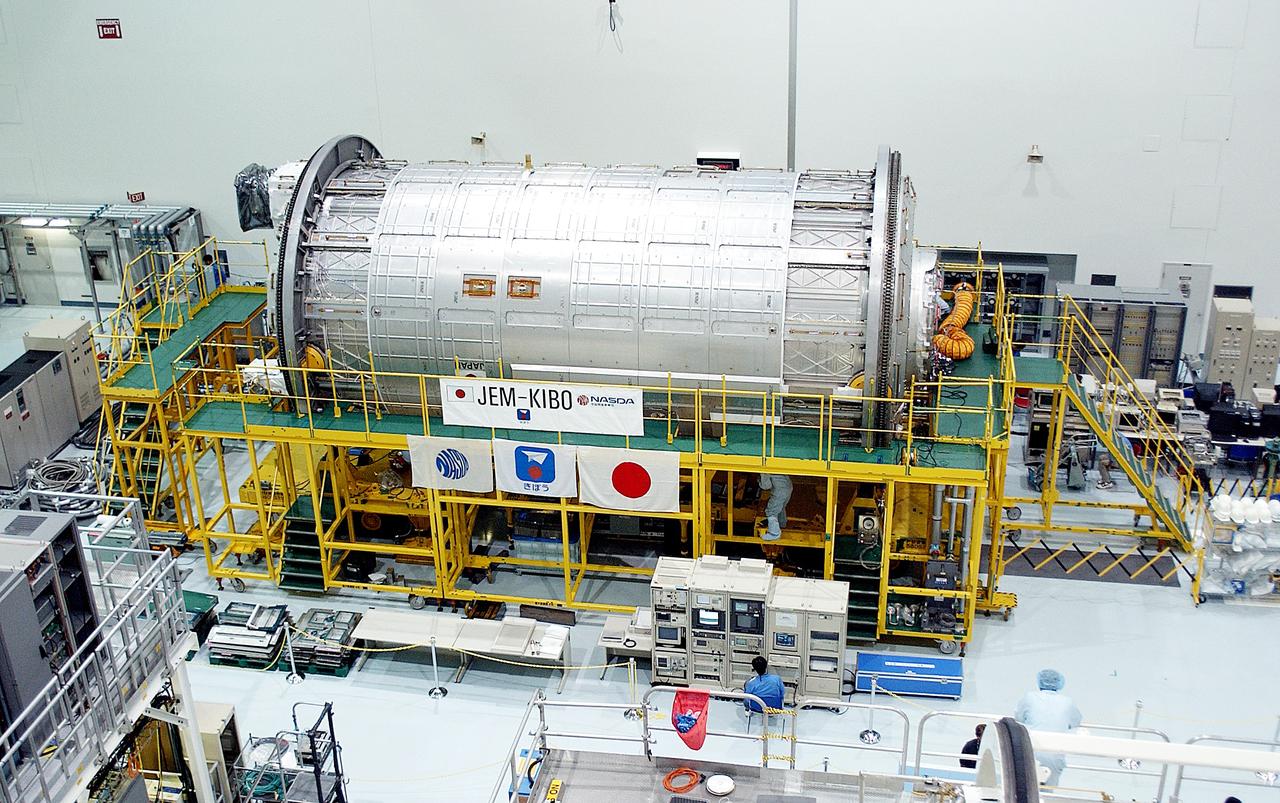
KENNEDY SPACE CENTER, FLA. - International Space Station elements being processed for launch on upcoming Space Shuttle flights, including the Japanese Experiment Module (JEM) pressurized module, line the walls of the high bay in the Space Station Processing Facility. The JEM pressurized module, named "Kibo" (Hope), arrived at KSC on June 4. It is Japan's primary contribution to the Station.
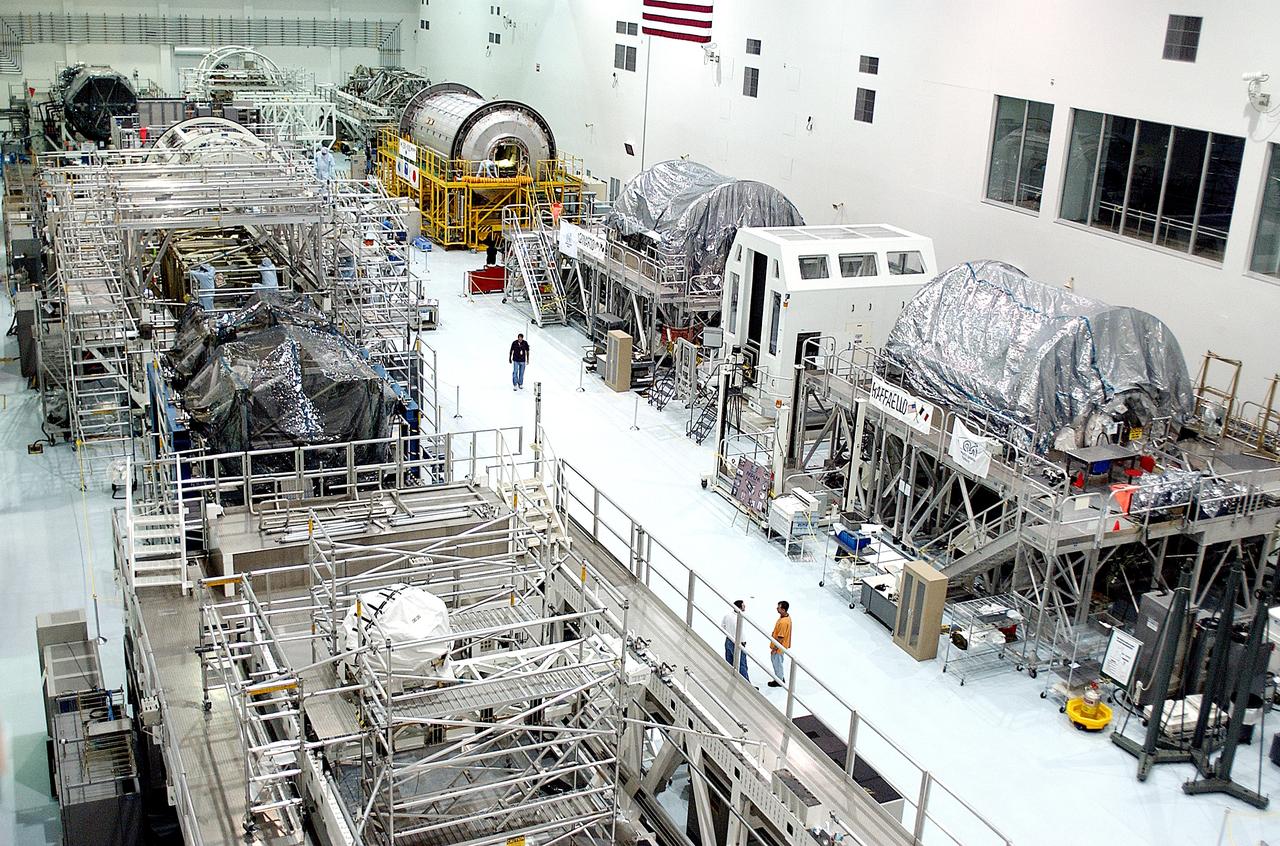
KENNEDY SPACE CENTER, FLA. - International Space Station elements being processed for launch on upcoming Space Shuttle flights line the walls of the high bay in the Space Station Processing Facility. NASA's Node 2, built by the European Space Agency (ESA) in Italy, arrived at KSC on June 1. It will be the next pressurized module installed on the Station. The pressurized module of the Japanese Experiment Module (JEM), named "Kibo" (Hope), arrived at KSC on June 4. It is Japan's primary contribution to the Station.

Photo Date: 8-4-2010 Location: Bldg. 9NW – High Bay – SEV Area Subject: Robonaut (R2) media day before the R2 unit is packed up for KSC. Photographer: Lauren Harnett
CAPE CANAVERAL, Fla. – At NASA’s Kennedy Space Center in Florida, technicians walk alongside space shuttle Atlantis as it is towed from the Vehicle Assembly Building (VAB) transfer aisle on its way around to the VAB high bay 4 doors. Shuttle Atlantis will remain in temporary storage in high bay 4, while Space Shuttle Program transition and retirement work continues on Discovery and Endeavour in the orbiter processing facilities. Atlantis is being prepared for display at the Kennedy Space Center Visitor Complex. Photo credit: NASA/Kim Shiflett
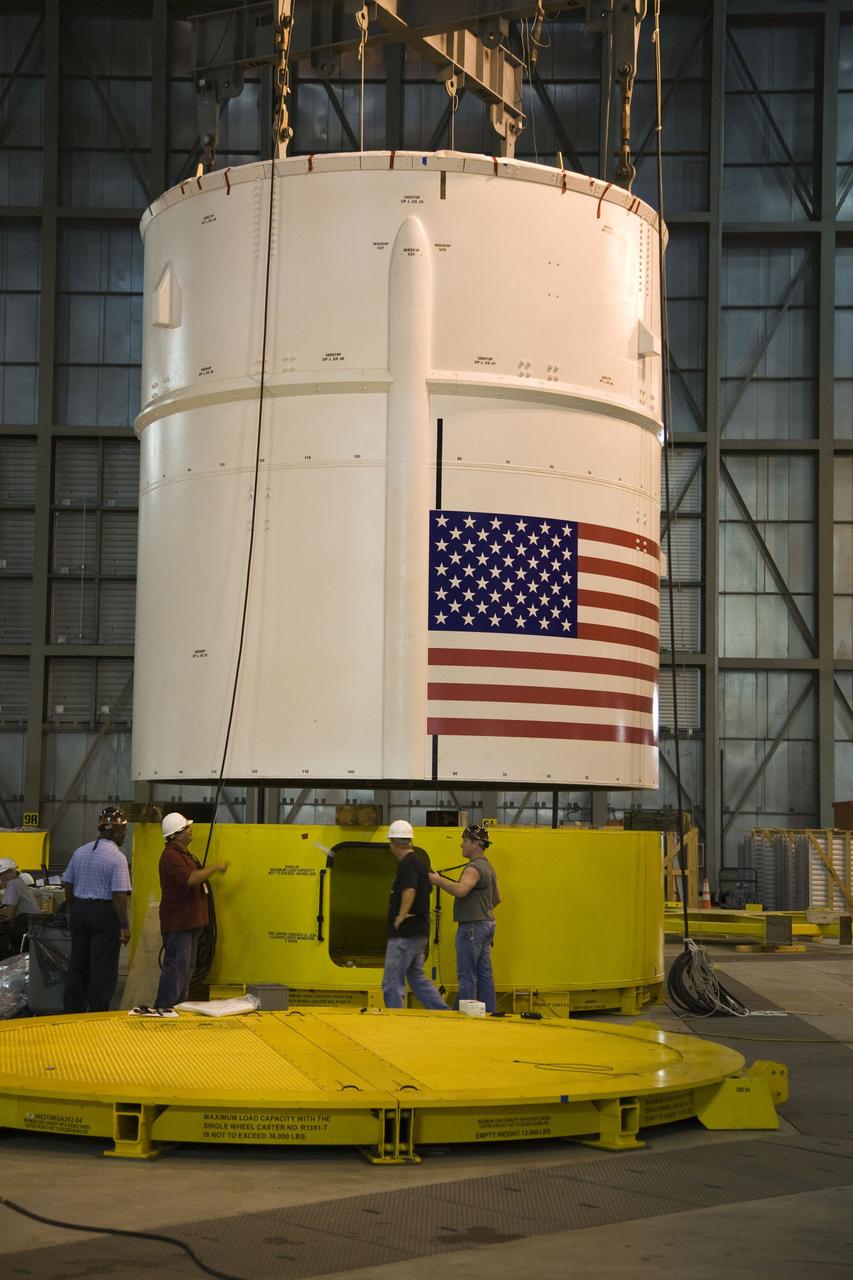
CAPE CANAVERAL, Fla. – In the Vehicle Assembly Building's High Bay 4 at NASA's Kennedy Space Center in Florida, a crane lifts the Ares I-X Super Stack 4. The stack will be moved to High Bay 3 for integration with Super Stack 3. Five super stacks make up the upper stage that will be integrated with the four-segment solid rocket booster first stage on the mobile launch platform. Ares I-X is the test vehicle for the Ares I, which is part of the Constellation Program to return men to the moon and beyond. The Ares I-X flight test is targeted for Oct. 31, pending formal NASA Headquarters approval. Photo credit: NASA/Dimitri Gerondidakis
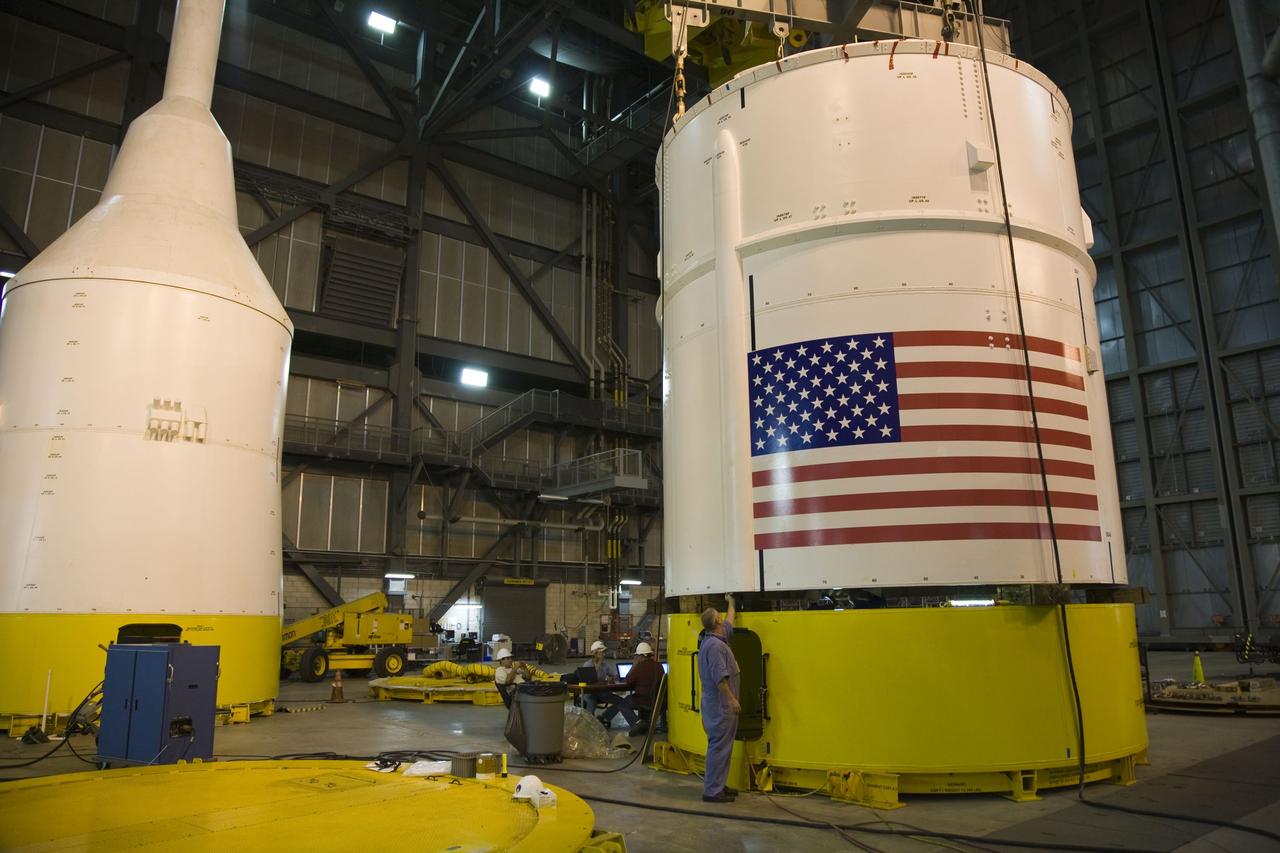
CAPE CANAVERAL, Fla. – In the Vehicle Assembly Building's High Bay 4 at NASA's Kennedy Space Center in Florida, a crane is attached to the Ares I-X Super Stack 4. The stack will be lifted and moved to High Bay 3 for integration with Super Stack 3. Five super stacks make up the upper stage that will be integrated with the four-segment solid rocket booster first stage on the mobile launch platform. Ares I-X is the test vehicle for the Ares I, which is part of the Constellation Program to return men to the moon and beyond. The Ares I-X flight test is targeted for Oct. 31, pending formal NASA Headquarters approval. Photo credit: NASA/Dimitri Gerondidakis
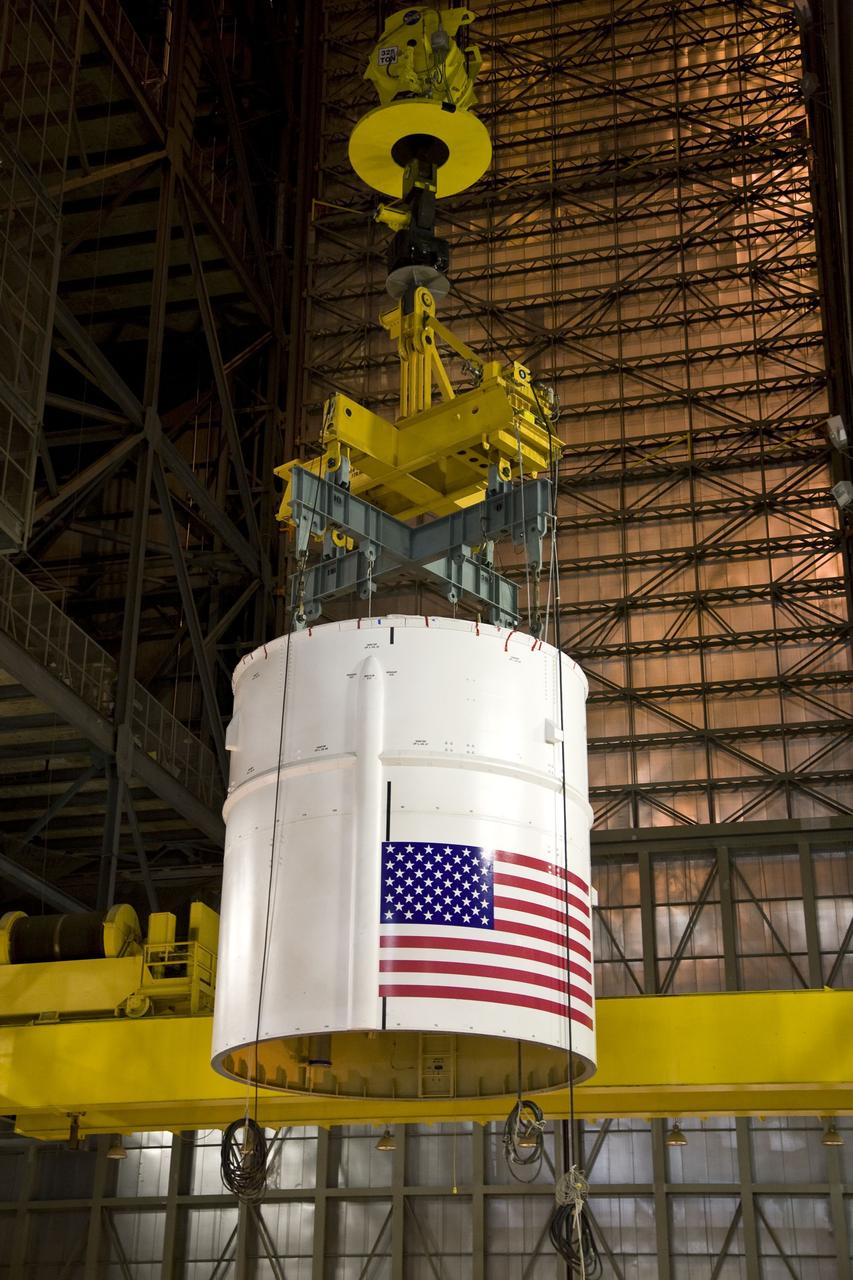
CAPE CANAVERAL, Fla. – In the Vehicle Assembly Building's High Bay 4 at NASA's Kennedy Space Center in Florida, a crane moves the Ares I-X Super Stack 4 across the floor to High Bay 3 for integration with Super Stack 3. Five super stacks make up the upper stage that will be integrated with the four-segment solid rocket booster first stage on the mobile launch platform. Ares I-X is the test vehicle for the Ares I, which is part of the Constellation Program to return men to the moon and beyond. The Ares I-X flight test is targeted for Oct. 31, pending formal NASA Headquarters approval. Photo credit: NASA/Dimitri Gerondidakis
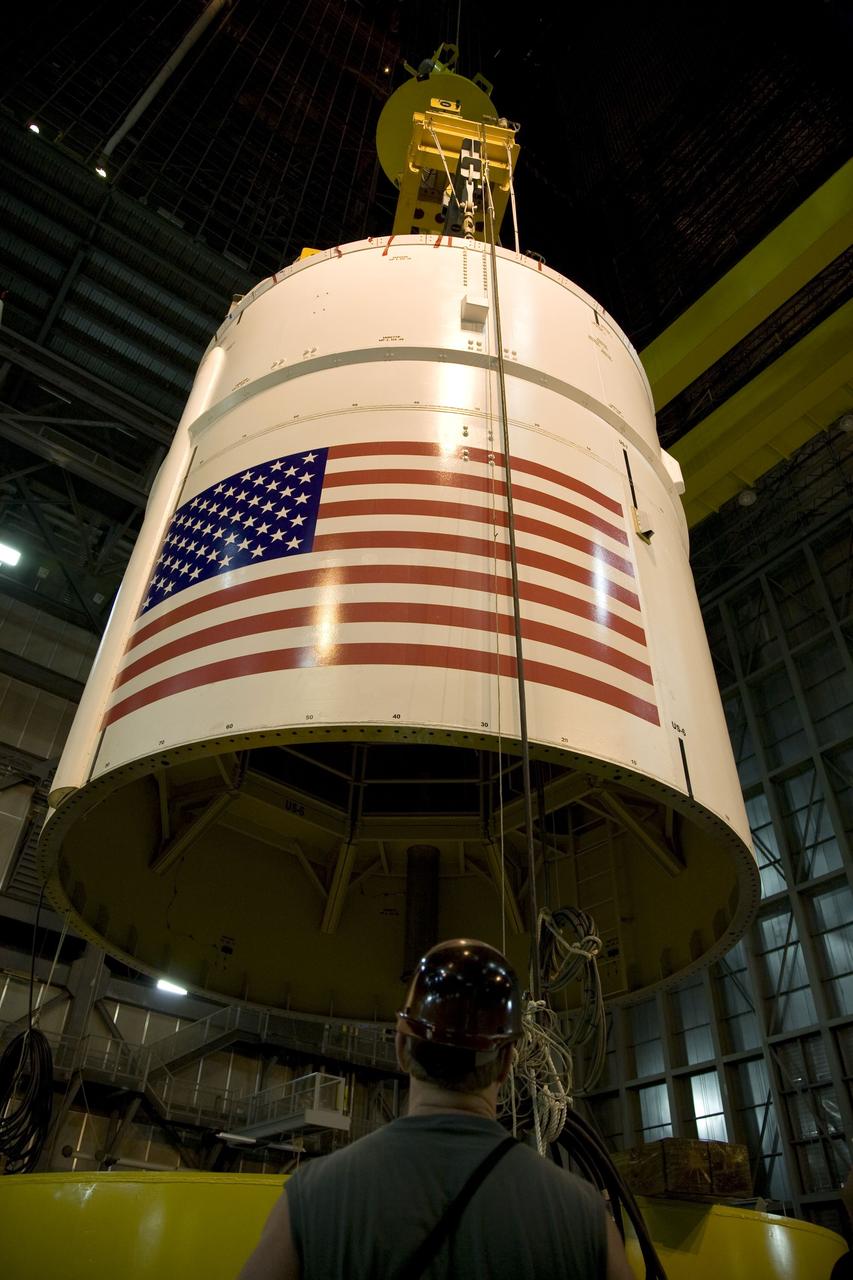
CAPE CANAVERAL, Fla. – In the Vehicle Assembly Building's High Bay 4 at NASA's Kennedy Space Center in Florida, a crane lifts the Ares I-X Super Stack 4. The stack will be moved to High Bay 3 for integration with Super Stack 3. Five super stacks make up the upper stage that will be integrated with the four-segment solid rocket booster first stage on the mobile launch platform. Ares I-X is the test vehicle for the Ares I, which is part of the Constellation Program to return men to the moon and beyond. The Ares I-X flight test is targeted for Oct. 31, pending formal NASA Headquarters approval. Photo credit: NASA/Dimitri Gerondidakis
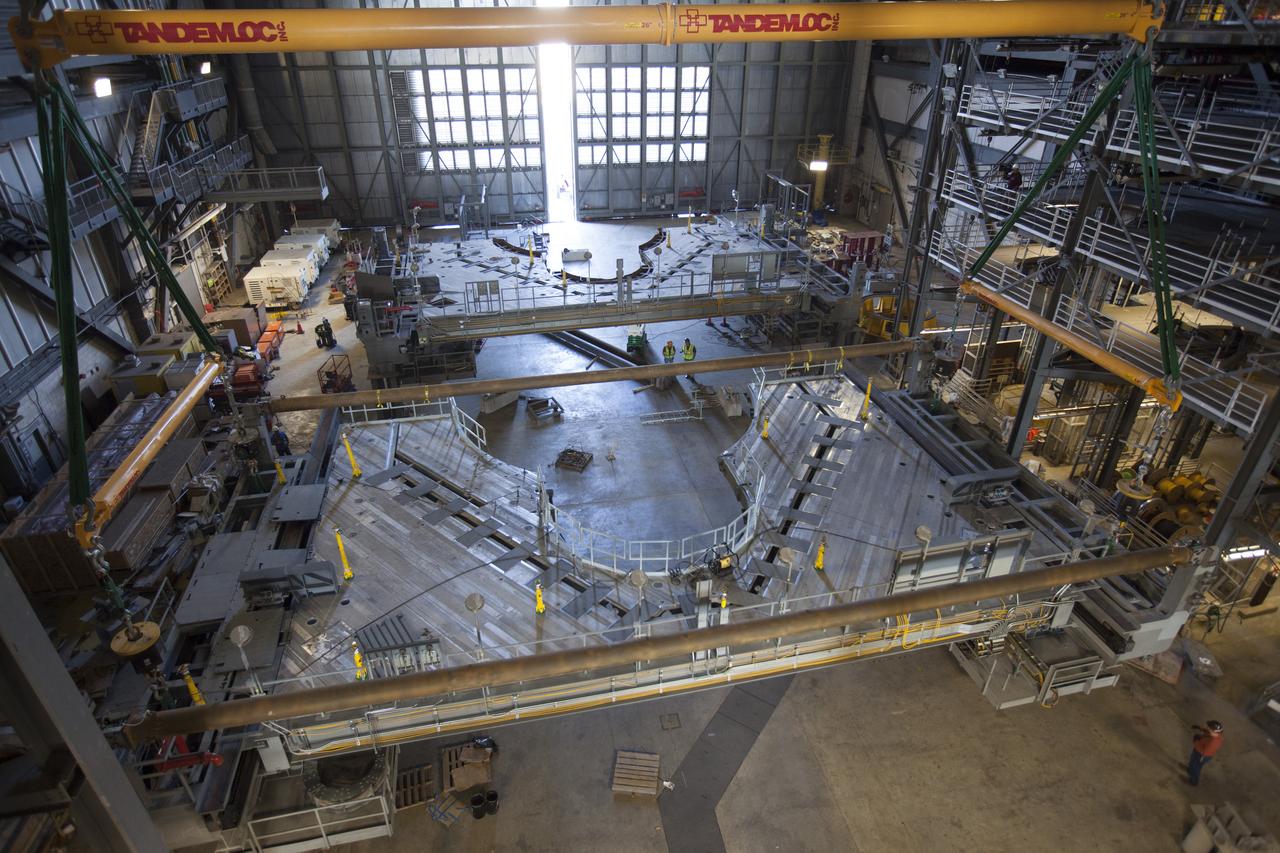
Preparations are underway to lift the second half of the K-level work platforms for NASA’s Space Launch System (SLS) rocket up from High Bay 4 inside the Vehicle Assembly Building at NASA's Kennedy Space Center in Florida. The platform will be lifted up and over the transfer aisle and then lowered into High Bay 3 for installation. It will be secured about 86 feet above the VAB floor, on tower E of the high bay. The K work platforms will provide access to the SLS core stage and solid rocket boosters during processing and stacking operations on the mobile launcher. The Ground Systems Development and Operations Program is overseeing upgrades and modifications to High Bay 3 to support processing of the SLS and Orion spacecraft. A total of 10 levels of new platforms, 20 platform halves altogether, will surround the SLS rocket and Orion spacecraft.
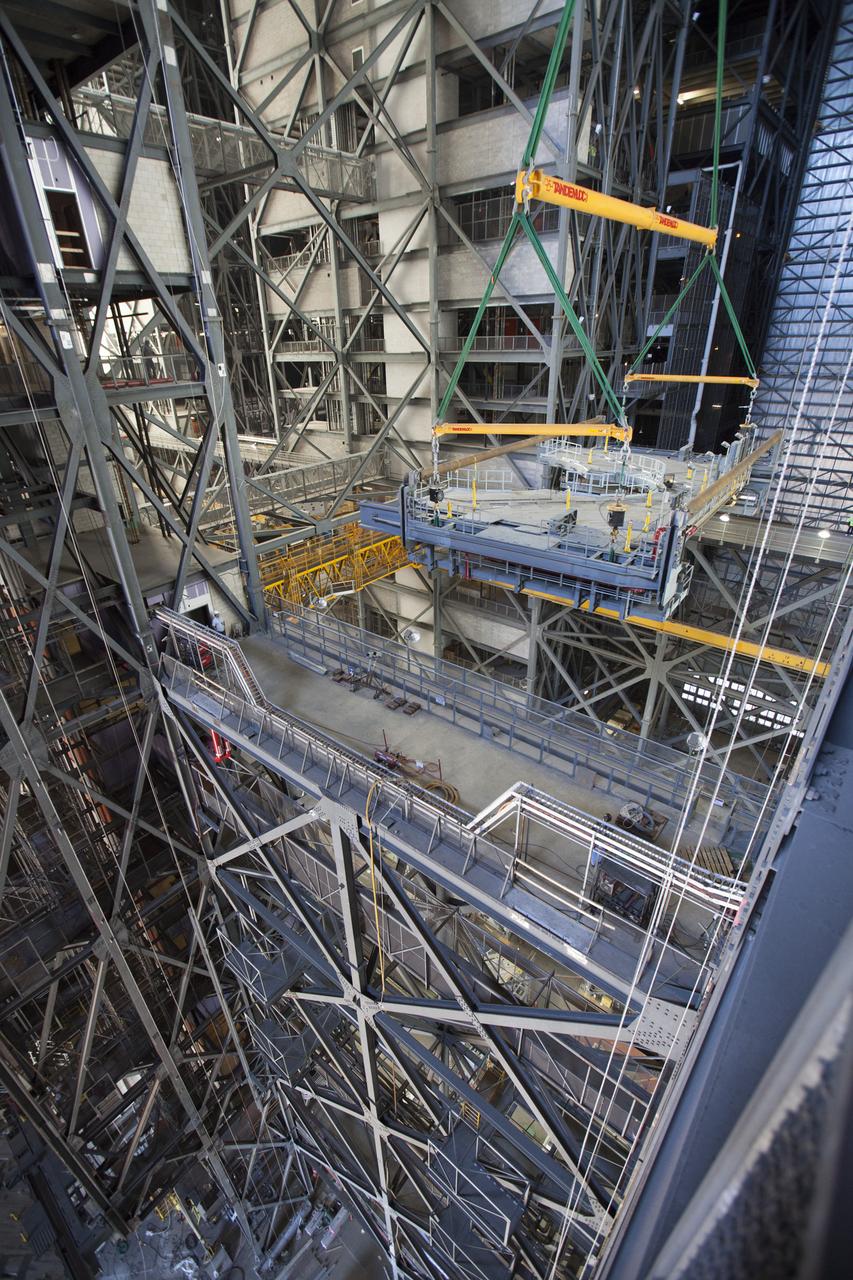
A 250-ton crane is used to lift the second half of the K-level work platforms for NASA’s Space Launch System (SLS) rocket up from High Bay 4 inside the Vehicle Assembly Building at NASA's Kennedy Space Center in Florida. The platform is being lifted up and over the transfer aisle and will be lowered into High Bay 3 for installation. It will be secured about 86 feet above the VAB floor, on tower E of the high bay. The K work platforms will provide access to the SLS core stage and solid rocket boosters during processing and stacking operations on the mobile launcher. The Ground Systems Development and Operations Program is overseeing upgrades and modifications to High Bay 3 to support processing of the SLS and Orion spacecraft. A total of 10 levels of new platforms, 20 platform halves altogether, will surround the SLS rocket and Orion spacecraft.
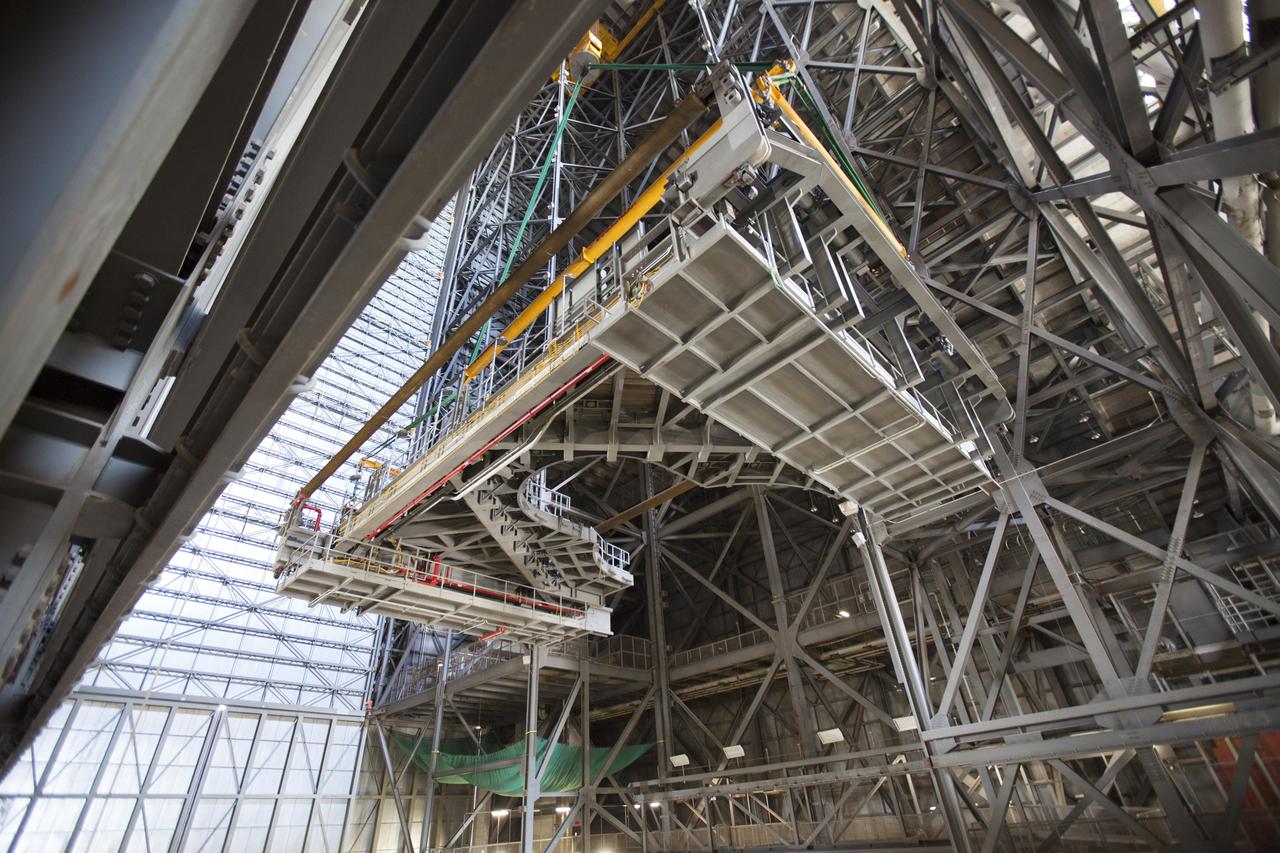
A 250-ton crane is used to lift the second half of the K-level work platforms for NASA’s Space Launch System (SLS) rocket up from High Bay 4 inside the Vehicle Assembly Building at NASA's Kennedy Space Center in Florida. The platform will be lifted up and over the transfer aisle and then lowered into High Bay 3 for installation. It will be secured about 86 feet above the VAB floor, on tower E of the high bay. The K work platforms will provide access to the SLS core stage and solid rocket boosters during processing and stacking operations on the mobile launcher. The Ground Systems Development and Operations Program is overseeing upgrades and modifications to High Bay 3 to support processing of the SLS and Orion spacecraft. A total of 10 levels of new platforms, 20 platform halves altogether, will surround the SLS rocket and Orion spacecraft.
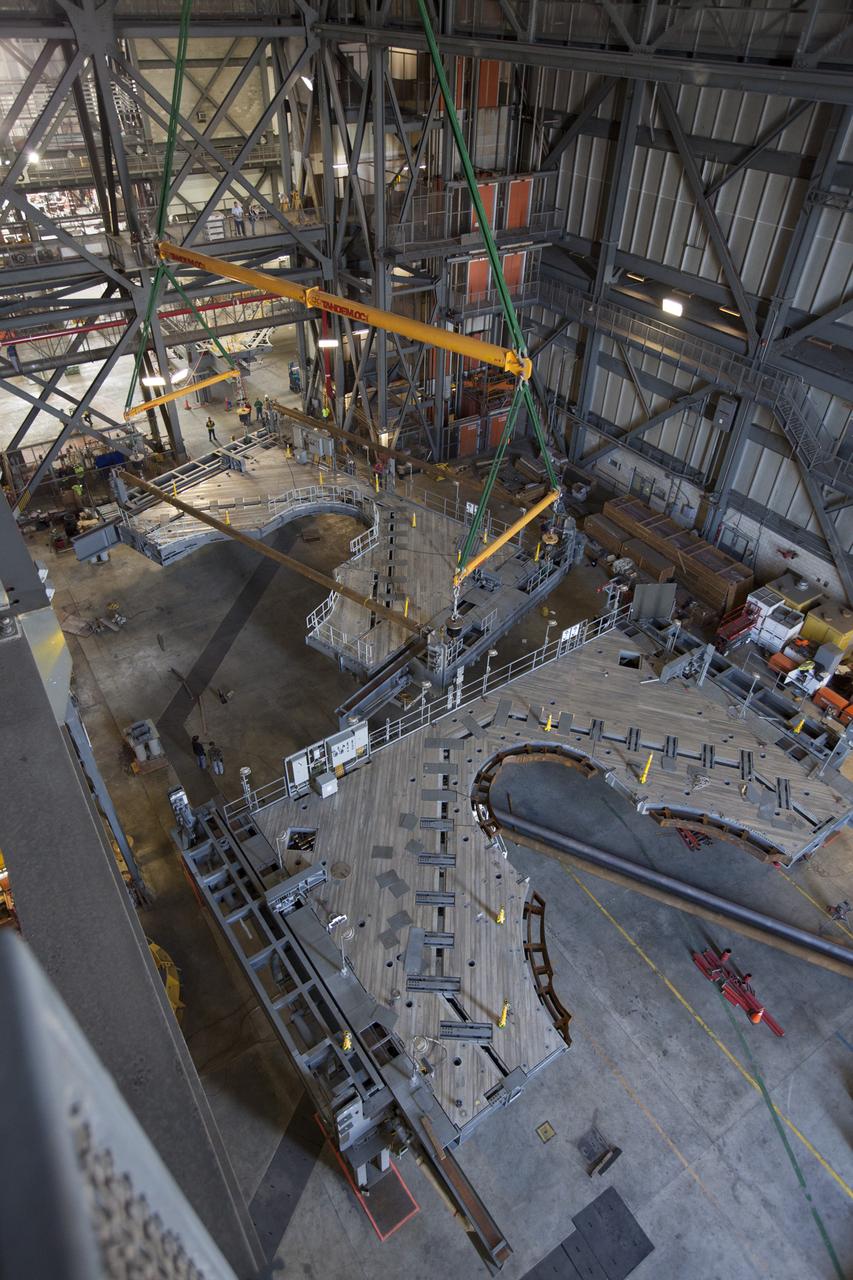
Preparations are underway to lift the second half of the K-level work platforms for NASA’s Space Launch System (SLS) rocket up from High Bay 4 inside the Vehicle Assembly Building at NASA's Kennedy Space Center in Florida. The platform will be lifted up and over the transfer aisle and then lowered into High Bay 3 for installation. It will be secured about 86 feet above the VAB floor, on tower E of the high bay. The K work platforms will provide access to the SLS core stage and solid rocket boosters during processing and stacking operations on the mobile launcher. The Ground Systems Development and Operations Program is overseeing upgrades and modifications to High Bay 3 to support processing of the SLS and Orion spacecraft. A total of 10 levels of new platforms, 20 platform halves altogether, will surround the SLS rocket and Orion spacecraft.
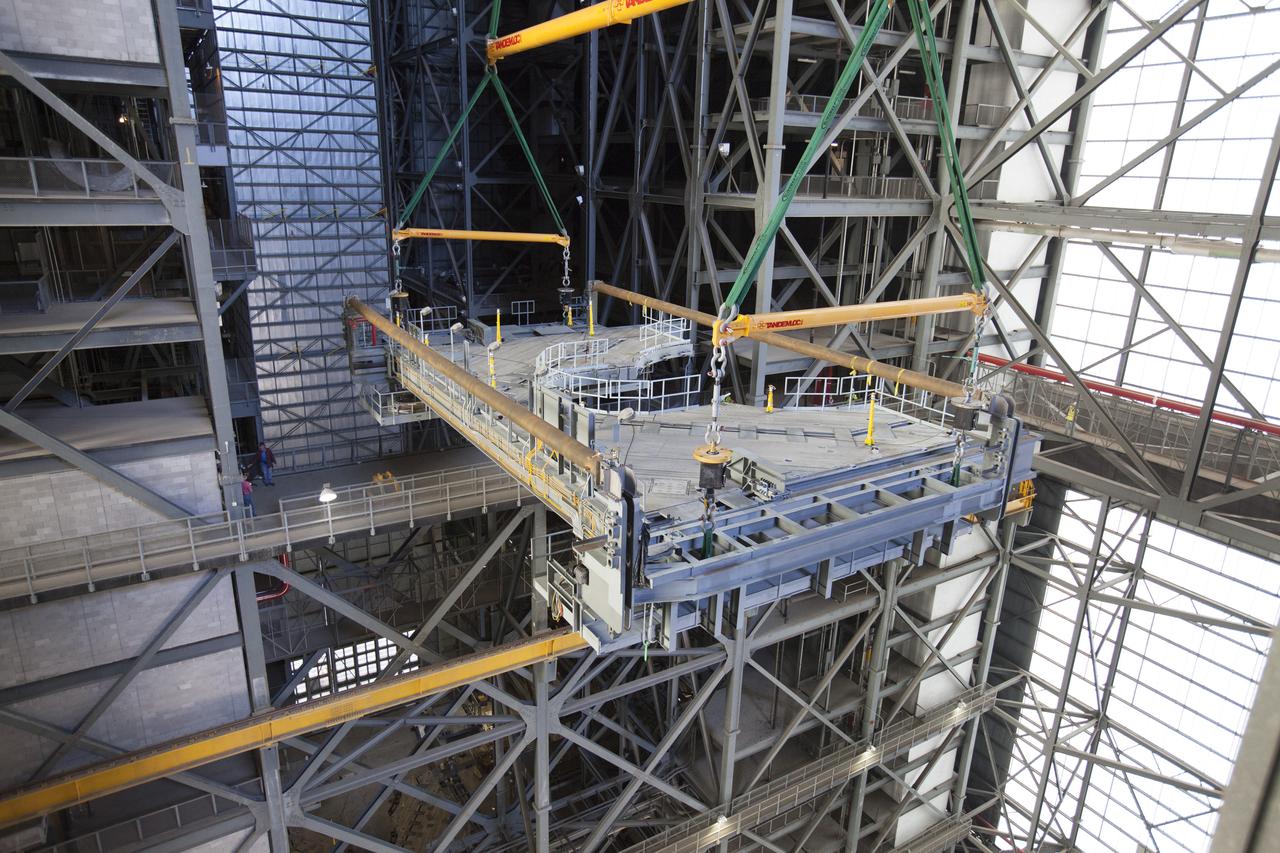
A 250-ton crane is used to lift the second half of the K-level work platforms for NASA’s Space Launch System (SLS) rocket up from High Bay 4 inside the Vehicle Assembly Building at NASA's Kennedy Space Center in Florida. The platform is being lifted up and over the transfer aisle and will be lowered into High Bay 3 for installation. It will be secured about 86 feet above the VAB floor, on tower E of the high bay. The K work platforms will provide access to the SLS core stage and solid rocket boosters during processing and stacking operations on the mobile launcher. The Ground Systems Development and Operations Program is overseeing upgrades and modifications to High Bay 3 to support processing of the SLS and Orion spacecraft. A total of 10 levels of new platforms, 20 platform halves altogether, will surround the SLS rocket and Orion spacecraft.
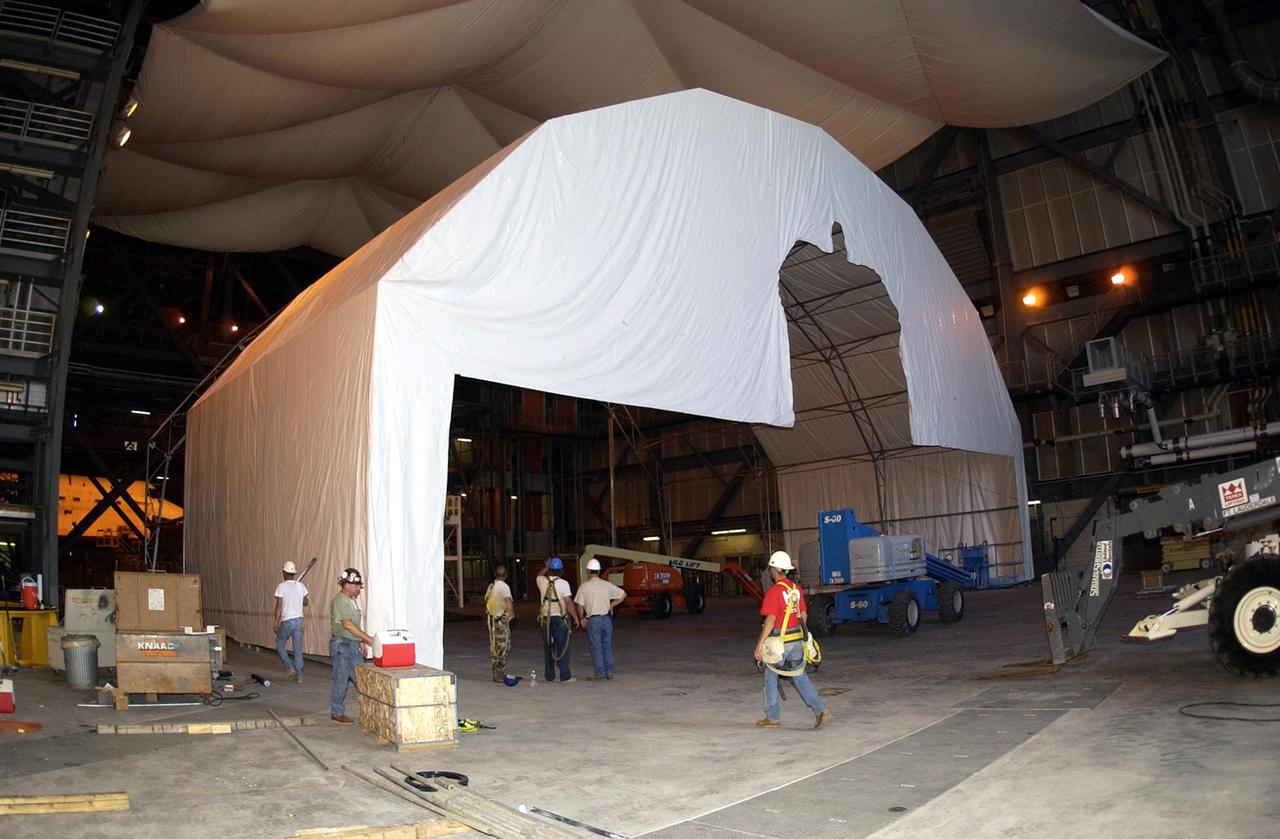
KENNEDY SPACE CENTER, FLA. -- In Vehicle Assembly Building (VAB) high bay 4, installation of a Payload Bay Door Drying Enclosure is in progress. The enclosure will keep moisture from being absorbed into the graphite epoxy used on the payload bay doors of the Shuttle orbiters with the assistance of mini-Portable Purge Units (PPUs). Once in operation, the enclosure will allow NASA the option to store an orbiter in the VAB bay up to 180 days in a "standby-to-stack" mode.

KENNEDY SPACE CENTER, FLA. -- In Vehicle Assembly Building (VAB) high bay 4, installation of a Payload Bay Door Drying Enclosure is in progress. The enclosure will keep moisture from being absorbed into the graphite epoxy used on the payload bay doors of the Shuttle orbiters with the assistance of mini-Portable Purge Units (PPUs). Once in operation, the enclosure will allow NASA the option to store an orbiter in the VAB bay up to 180 days in a "standby-to-stack" mode.
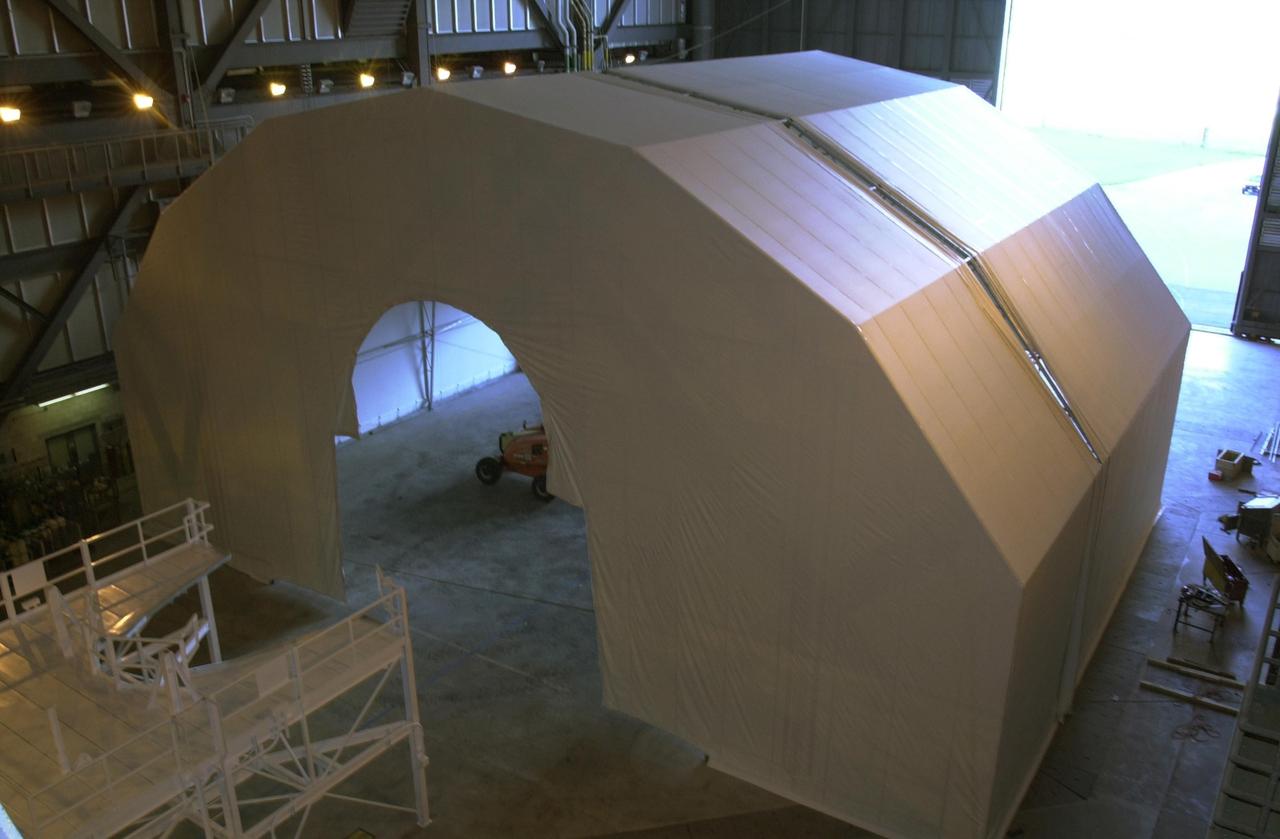
KENNEDY SPACE CENTER, FLA. -- -- In Vehicle Assembly Building (VAB) high bay 4, installation of a Payload Bay Door Drying Enclosure is in progress. The enclosure will keep moisture from being absorbed into the graphite epoxy used on the payload bay doors of the Shuttle orbiters with the assistance of mini-Portable Purge Units (PPUs). Once in operation, the enclosure will allow NASA the option to store an orbiter in the VAB bay up to 180 days in a "standby-to-stack" mode.
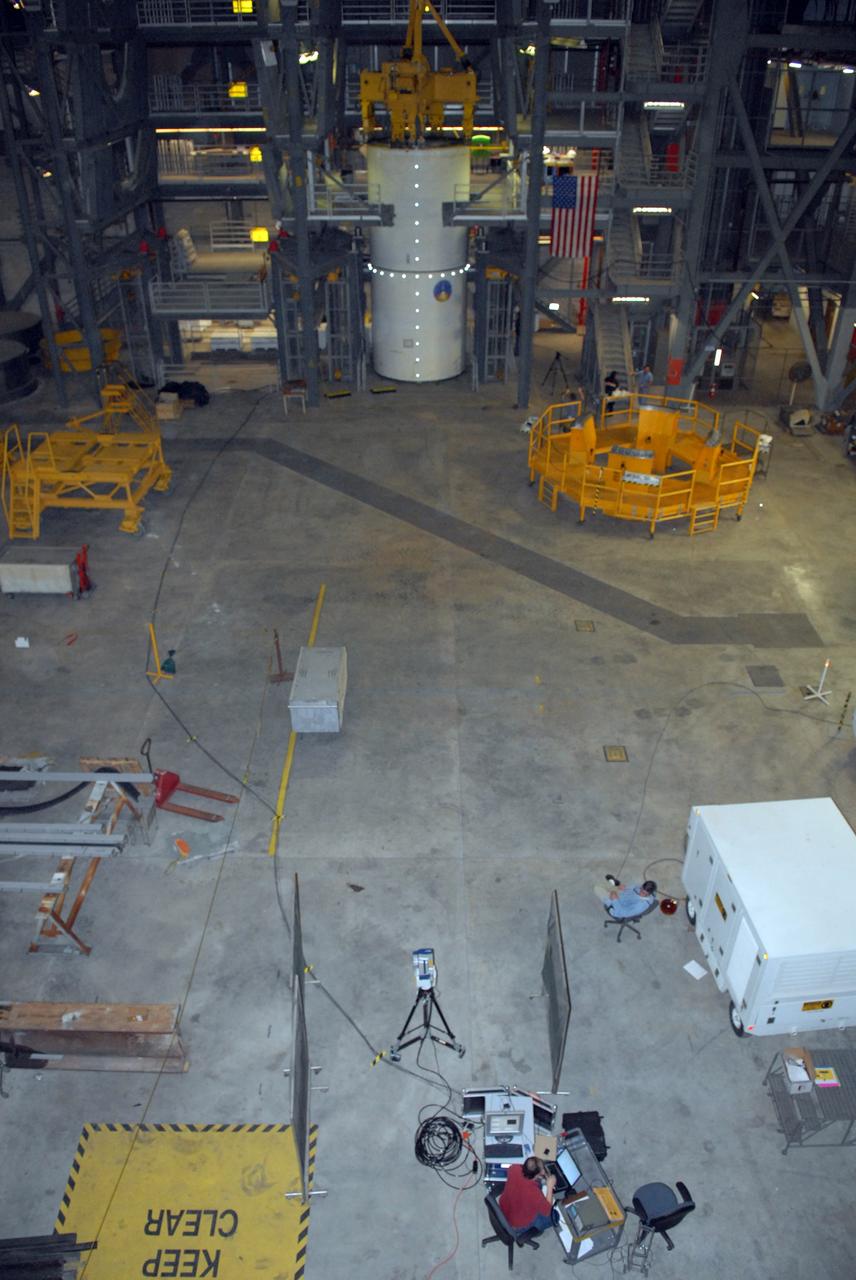
CAPE CANAVERAL, Fla. -- Vibration and laser testing is being conducted on Ares I-X segments at NASA's Kennedy Space Center. This is an overall view of the modal testing setup using the Inert Solid Rocket Motor Segment and Laser Vibrometer in high bay 4 of the Vehicle Assembly building. Photo credit: NASA/Dimitri Gerondidakis

S67-36022 (20 June 1967) --- Apollo Spacecraft 017 is moved into position in the Vehicle Assembly Building's high bay area for mating with the Saturn V launch vehicle. S/C 017 will be flown on the Spacecraft 017/Saturn 501 (Apollo 4) space mission.
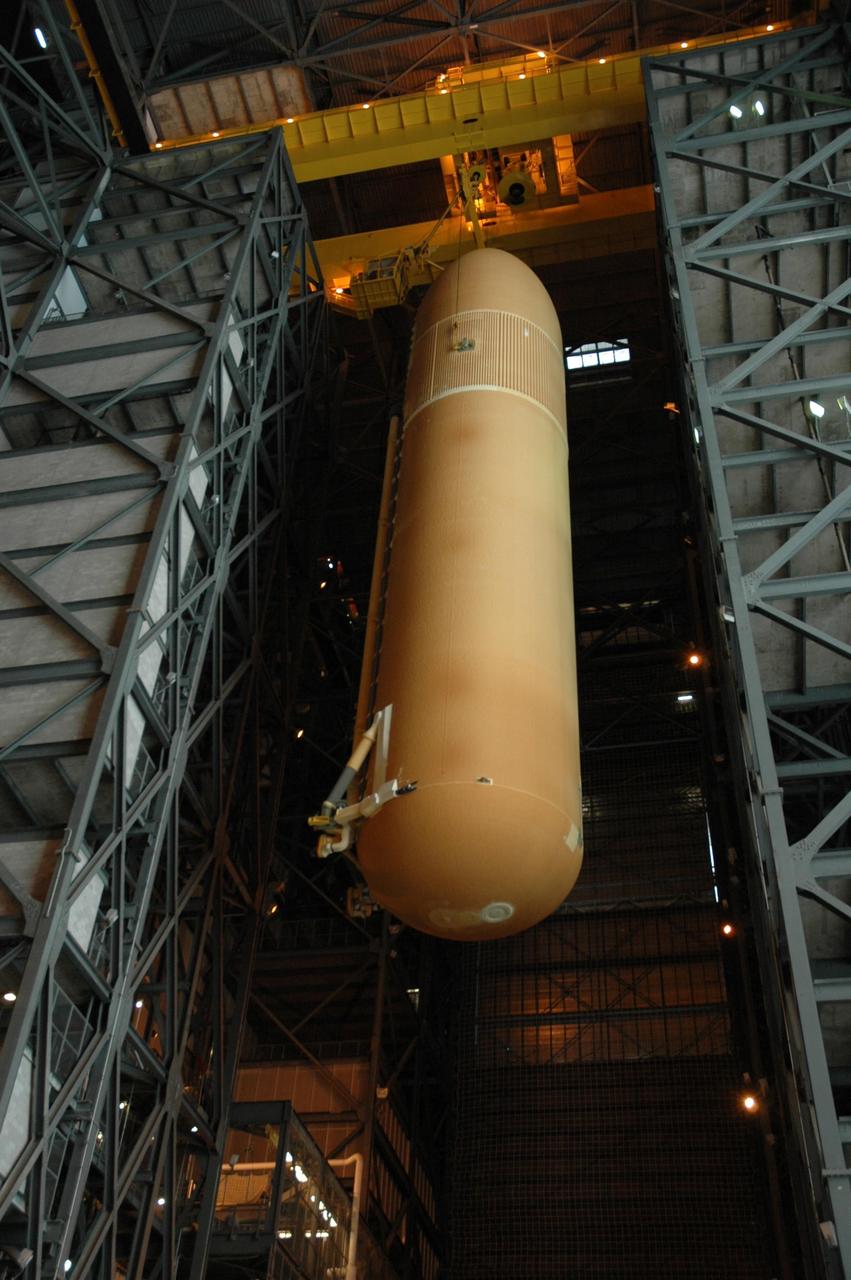
KENNEDY SPACE CENTER, FLA. -- Seen from below, external tank No. 125 is moved toward a checkout cell in high bay 4 in the Vehicle Assembly Building for processing. The tank will be part of the space shuttle stack for mission STS-122 targeted to launch Dec. 6. Photo credit: NASA/Troy Cryder
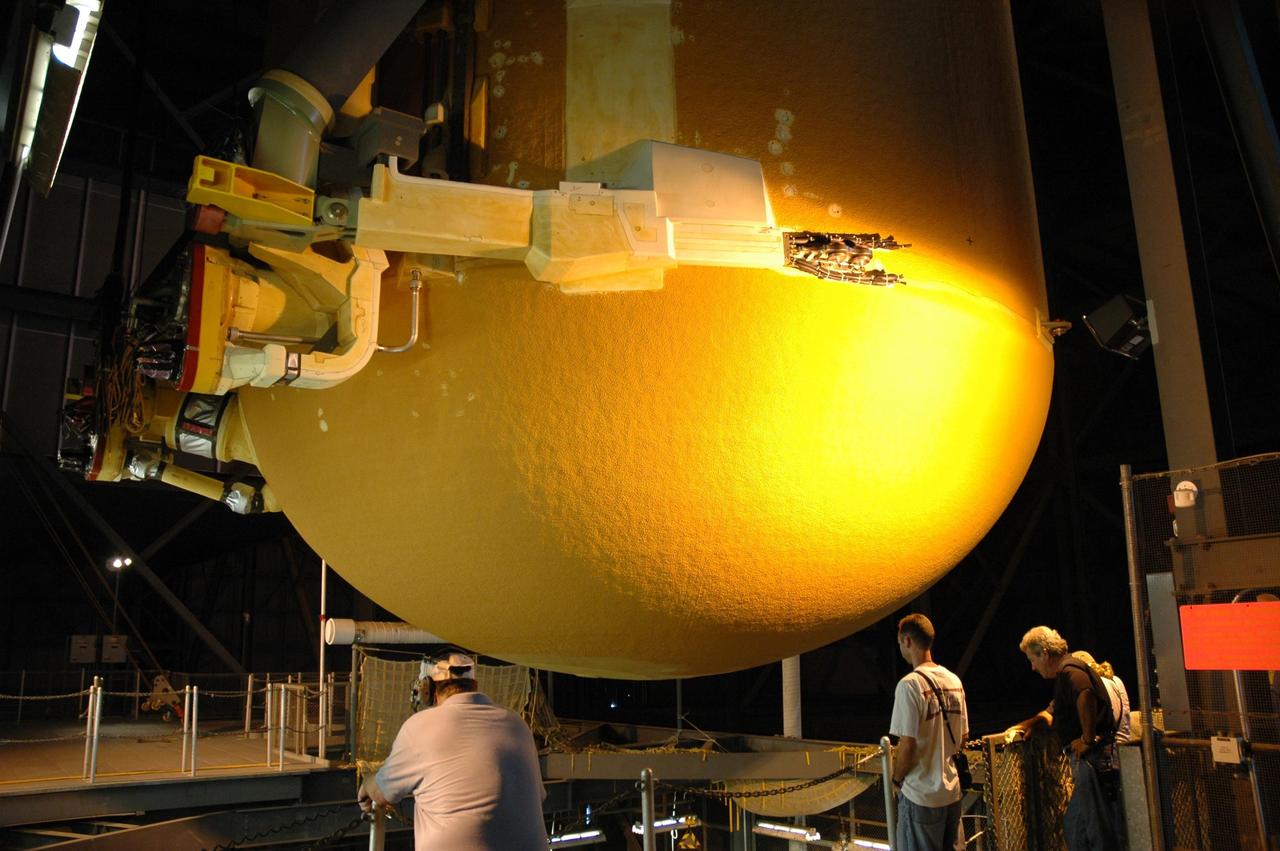
KENNEDY SPACE CENTER, FLA. -- In the Vehicle Assembly Building, workers keep an eye on the movement of external tank No. 125 as it is lowered into a checkout cell in high bay 4 for processing. The tank will be part of the space shuttle stack for mission STS-122 targeted to launch Dec. 6. Photo credit: NASA/Troy Cryder
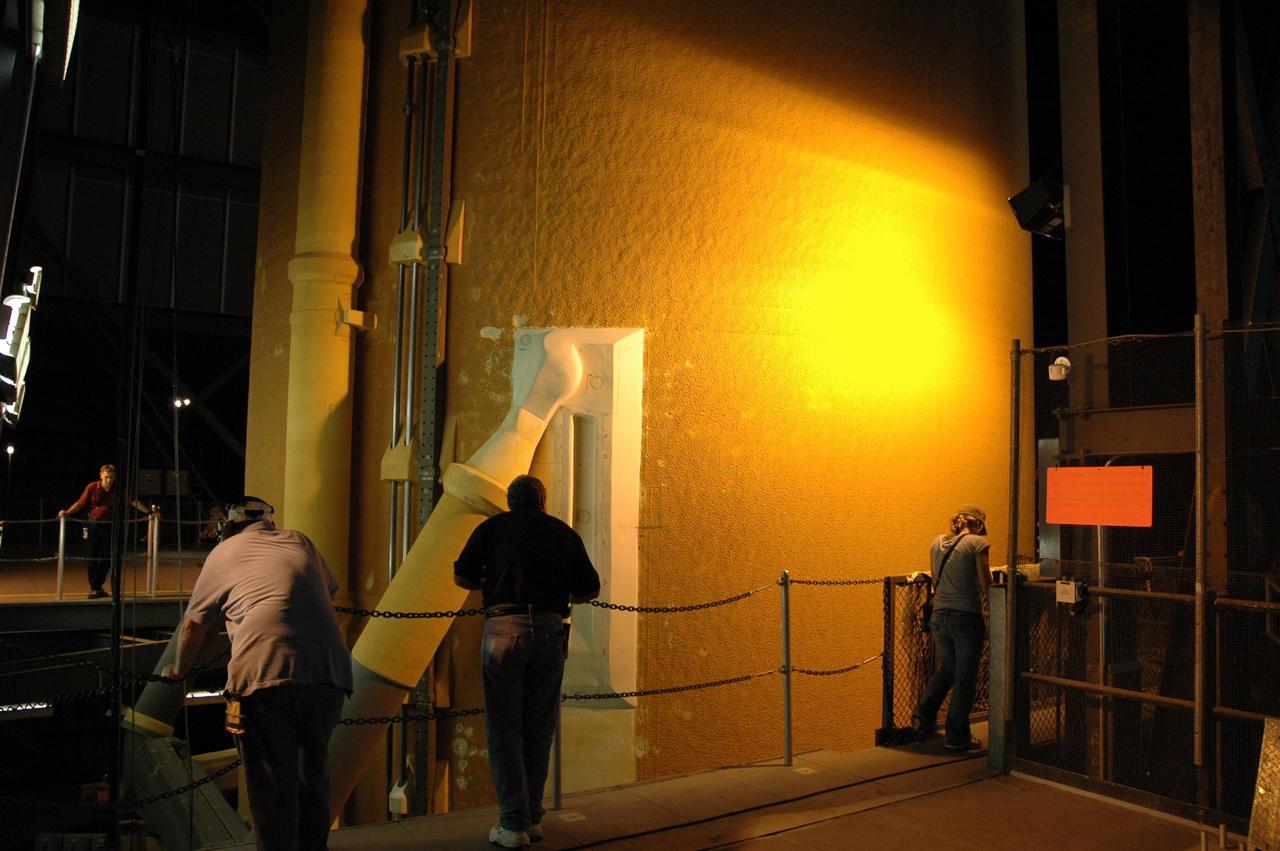
KENNEDY SPACE CENTER, FLA. -- In the Vehicle Assembly Building, workers keep an eye on the movement of external tank No. 125 as it is lowered into a checkout cell in high bay 4 for processing. The tank will be part of the space shuttle stack for mission STS-122 targeted to launch Dec. 6. Photo credit: NASA/Troy Cryder
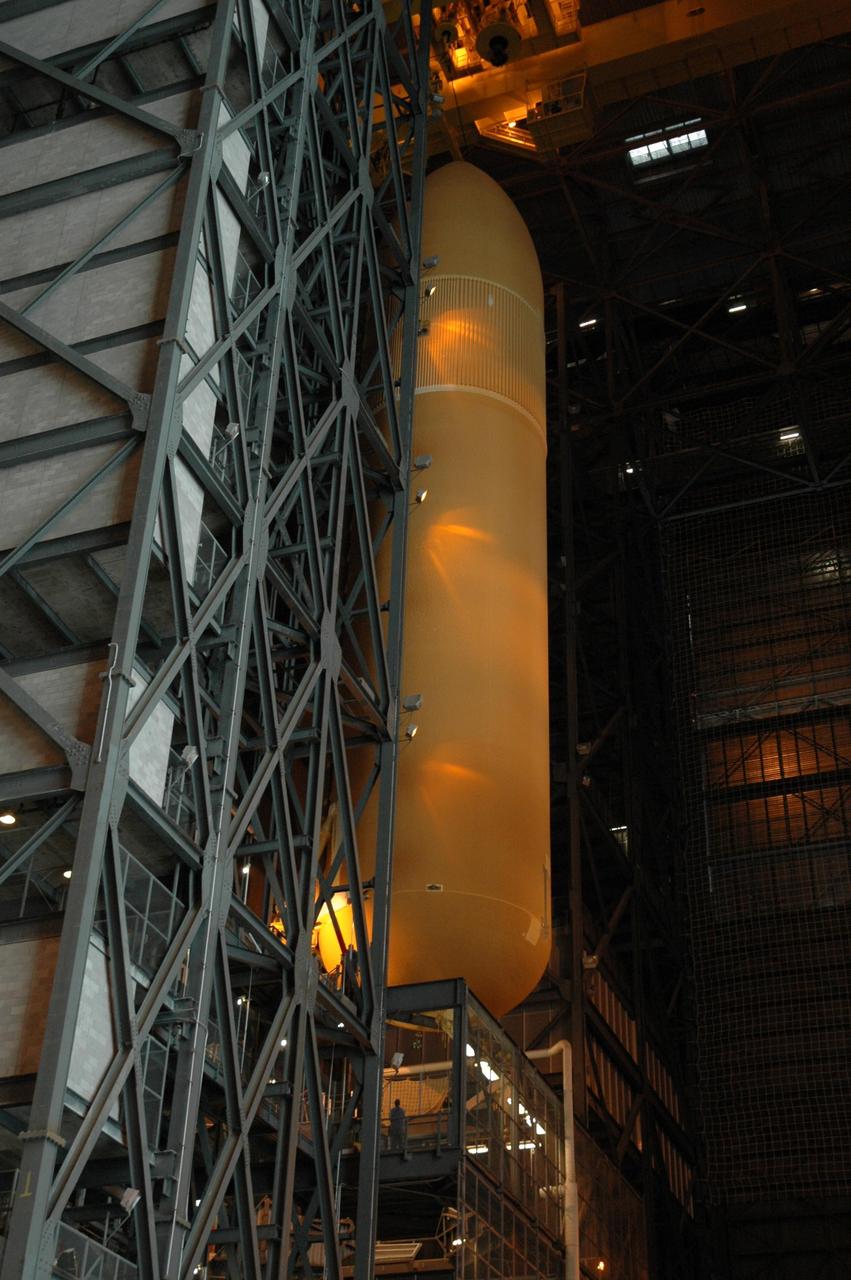
KENNEDY SPACE CENTER, FLA. -- External tank No. 125 is moved toward a checkout cell in high bay 4 in the Vehicle Assembly Building for processing. The tank will be part of the space shuttle stack for mission STS-122 targeted to launch Dec. 6. Photo credit: NASA/Troy Cryder
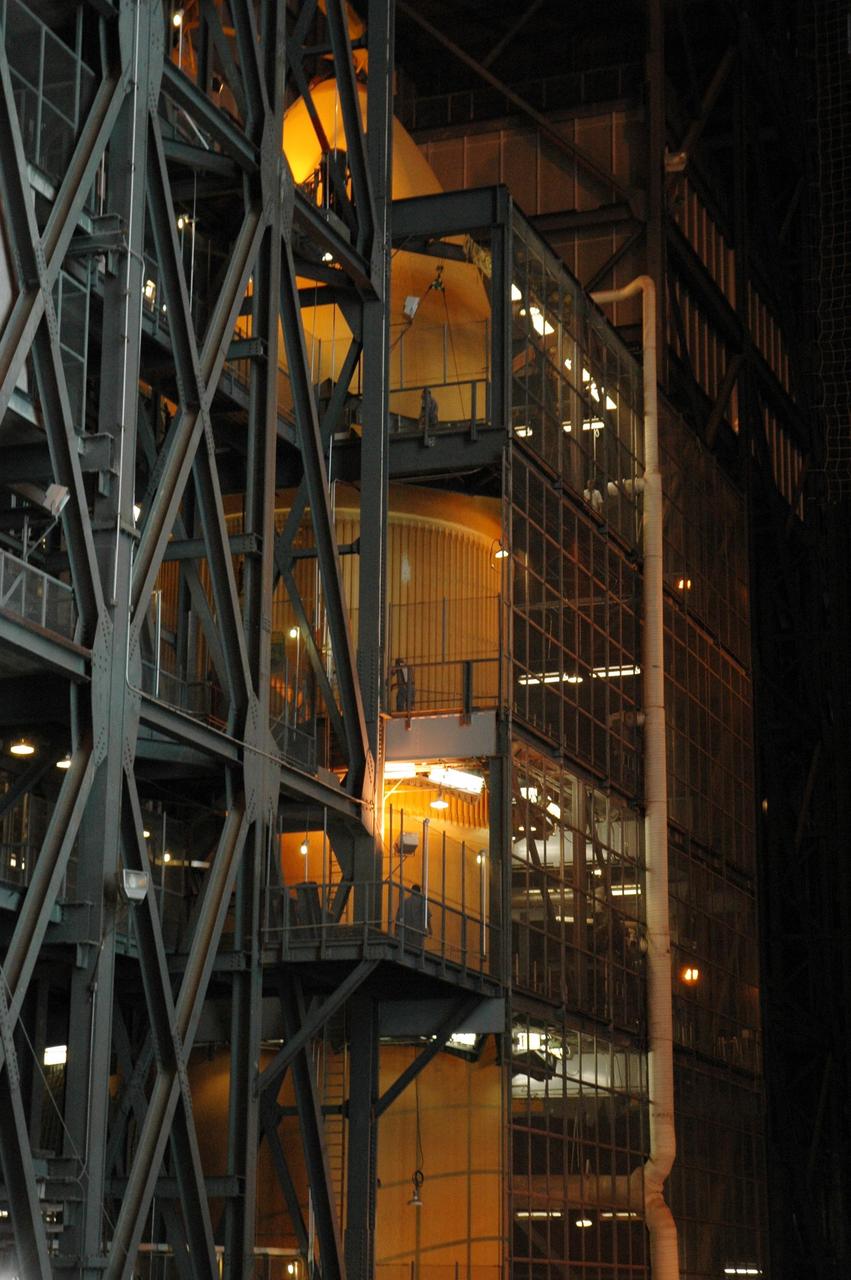
KENNEDY SPACE CENTER, FLA. -- After its lift and transfer inside the Vehicle Assembly Building, external tank No. 125 is suspended in a checkout cell in high bay 4 for processing. The tank will be part of the space shuttle stack for mission STS-122 targeted to launch Dec. 6. Photo credit: NASA/Troy Cryder
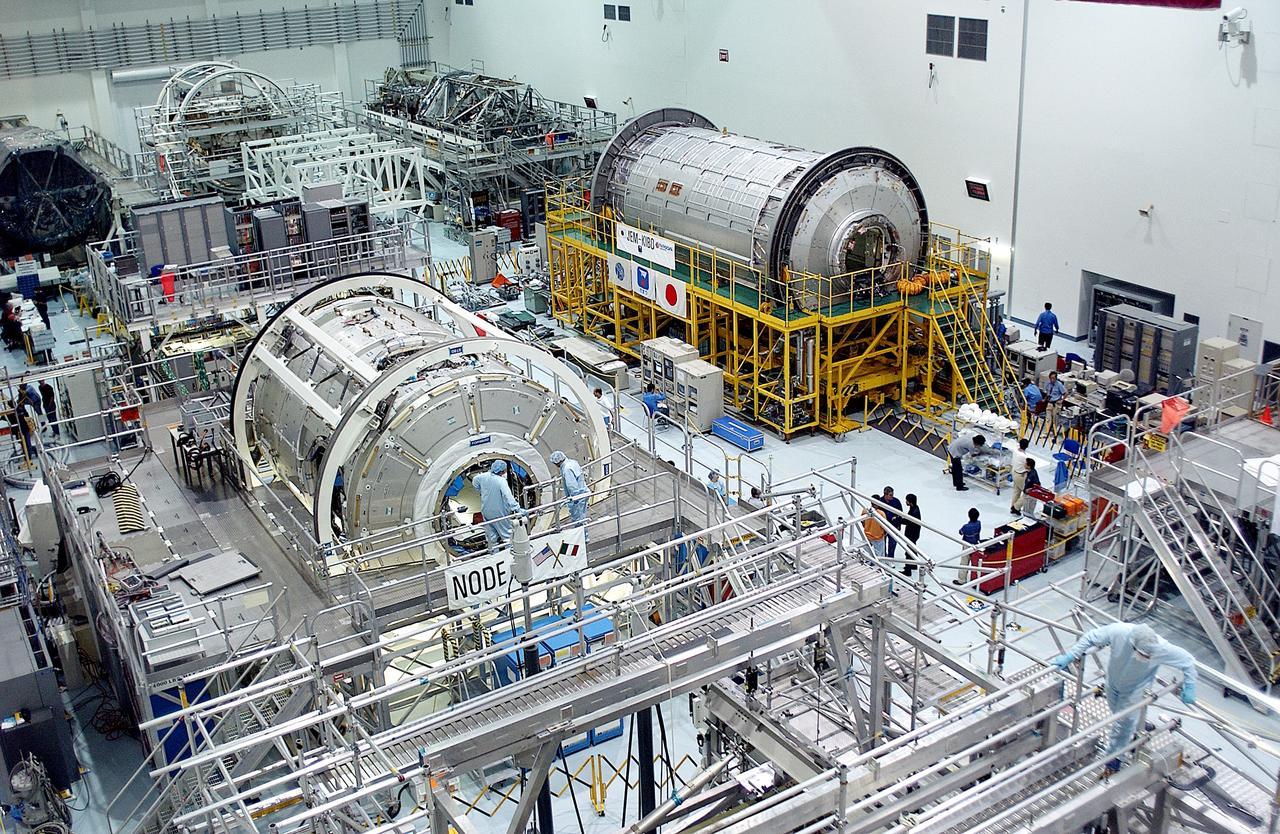
KENNEDY SPACE CENTER, FLA. - International Space Station elements being processed for launch on upcoming Space Shuttle flights, including the U.S. Node 2 and the Japanese Experiment Module (JEM) pressurized module, line the walls of the high bay in the Space Station Processing Facility. NASA's Node 2, built by the European Space Agency (ESA) in Italy, arrived at KSC on June 1. It will be the next pressurized module installed on the Station. The JEM pressurized module, named "Kibo" (Hope), arrived at KSC on June 4. It is Japan's primary contribution to the Station.
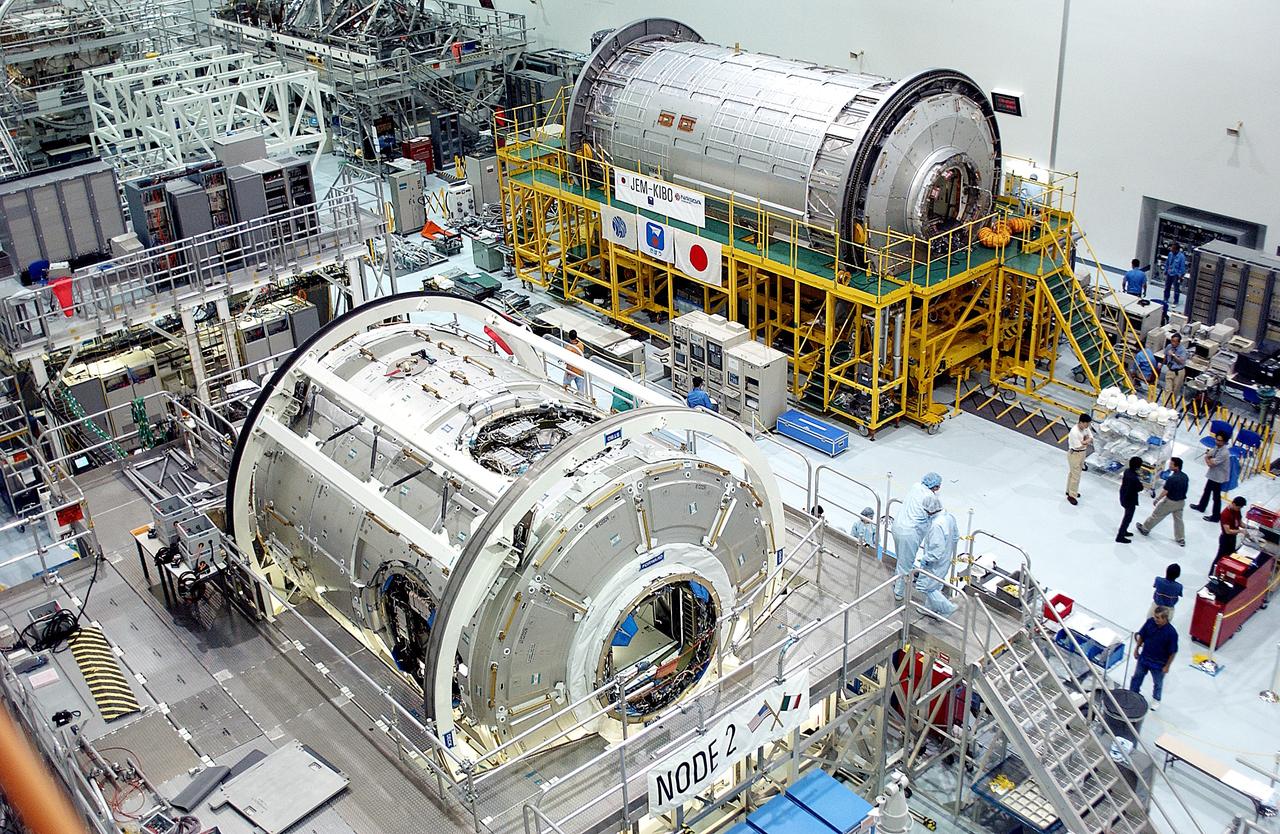
KENNEDY SPACE CENTER, FLA. - International Space Station elements being processed for launch on upcoming Space Shuttle flights, including the U.S. Node 2 and the Japanese Experiment Module (JEM) pressurized module, line the walls of the high bay in the Space Station Processing Facility. NASA's Node 2, built by the European Space Agency (ESA) in Italy, arrived at KSC on June 1. It will be the next pressurized module installed on the Station. The JEM pressurized module, named "Kibo" (Hope), arrived at KSC on June 4. It is Japan's primary contribution to the Station.
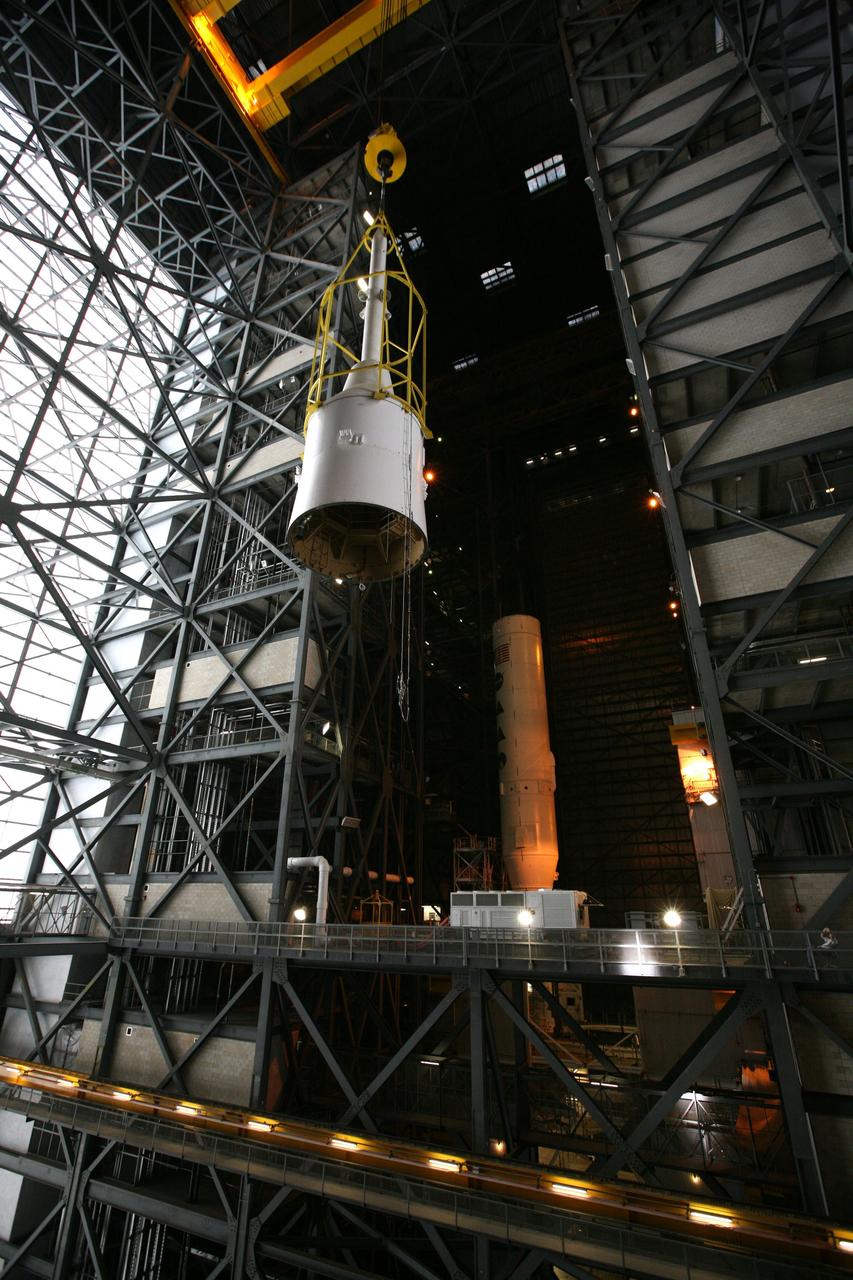
CAPE CANAVERAL, Fla. – In the Vehicle Assembly Building's transfer aisle, assembly of the Ares I-X rocket nears completion. The yellow framework, nicknamed the "birdcage," moves Super Stack 5 from High Bay 4 over the transfer aisle toward an opening at the 16th floor crossover in High Bay 3. The stack will be positioned on top of the segments already in place on the mobile launcher platform in High Bay 3, in the background, completing assembly of the 327-foot-tall rocket. Five super stacks make up the rocket's upper stage that is integrated with the four-segment solid rocket booster first stage. Ares I-X is the test vehicle for the Ares I, which is part of the Constellation Program to return men to the moon and beyond. The Ares I-X flight test is targeted for Oct. 31, pending formal NASA Headquarters approval. Photo credit: NASA/Dimitri Gerondidakis
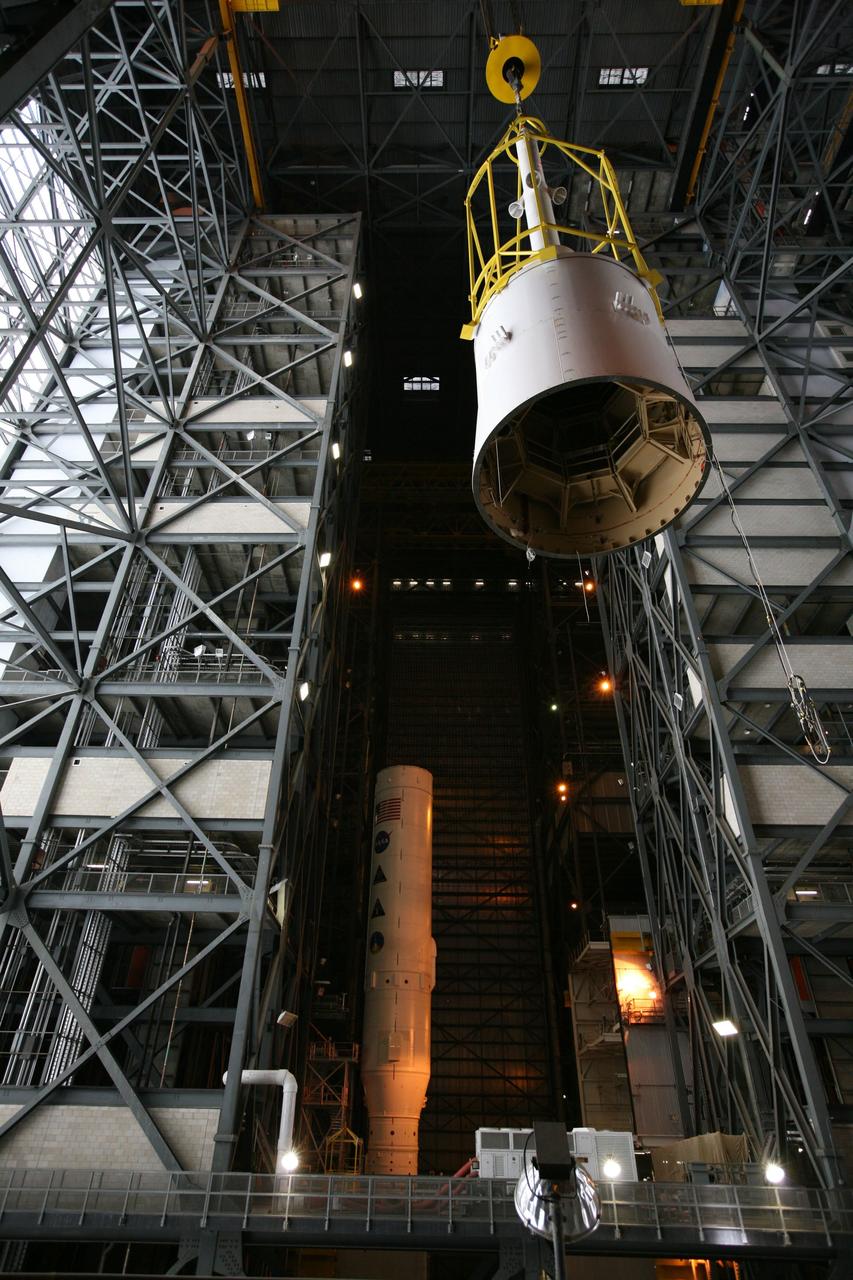
CAPE CANAVERAL, Fla. – In the Vehicle Assembly Building's transfer aisle, assembly of the Ares I-X rocket nears completion. The yellow framework, nicknamed the "birdcage," moves Super Stack 5 from High Bay 4 over the transfer aisle toward an opening at the 16th floor crossover in High Bay 3. The stack will be positioned on top of the segments already in place on the mobile launcher platform in High Bay 3, in the background, completing assembly of the 327-foot-tall rocket. Five super stacks make up the rocket's upper stage that is integrated with the four-segment solid rocket booster first stage. Ares I-X is the test vehicle for the Ares I, which is part of the Constellation Program to return men to the moon and beyond. The Ares I-X flight test is targeted for Oct. 31, pending formal NASA Headquarters approval. Photo credit: NASA/Dimitri Gerondidakis

Technicians at NASA’s Kennedy Space Center in Florida complete operations of lifting and lowering the agency’s Artemis III SLS (Space Launch System) core stage into High Bay 2 in the Vehicle Assembly Building at NASA Kennedy on Monday, May 4, 2026. Using a one-of-a kind lifting beam designed to lift the core stage from the transfer aisle to High Bay 2 for additional assembly, teams will connect the core stage to the engine section. This marks the first time core stage assembly operations being conducted at the spaceport for future Artemis missions.
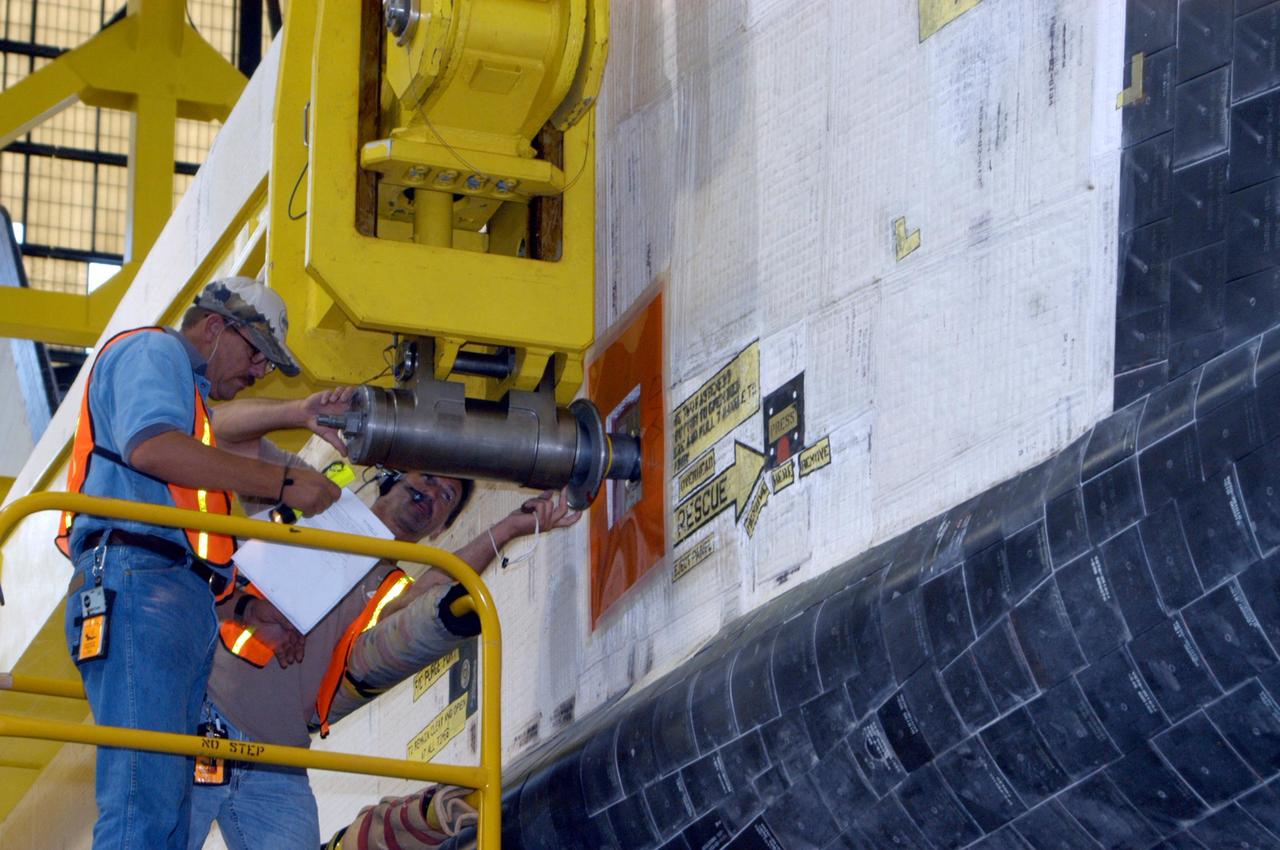
KENNEDY SPACE CENTER, FLA. - In the transfer aisle of the Vehicle Assembly Building, workers are securing the sling attachment of the overhead crane that will lift the orbiter Atlantis into high bay 3. After Atlantis is lifted and moved into the high bay, the orbiter will be lowered and mated with the external tank and solid rocket boosters already stacked on the mobile launcher platform. Atlantis' launch window begins Aug. 28. During its 11-day mission to the International Space Station, the STS-115 crew of six astronauts will install the Port 3/4 truss segment with its two large solar arrays. Photo credit: NASA/George Shelton