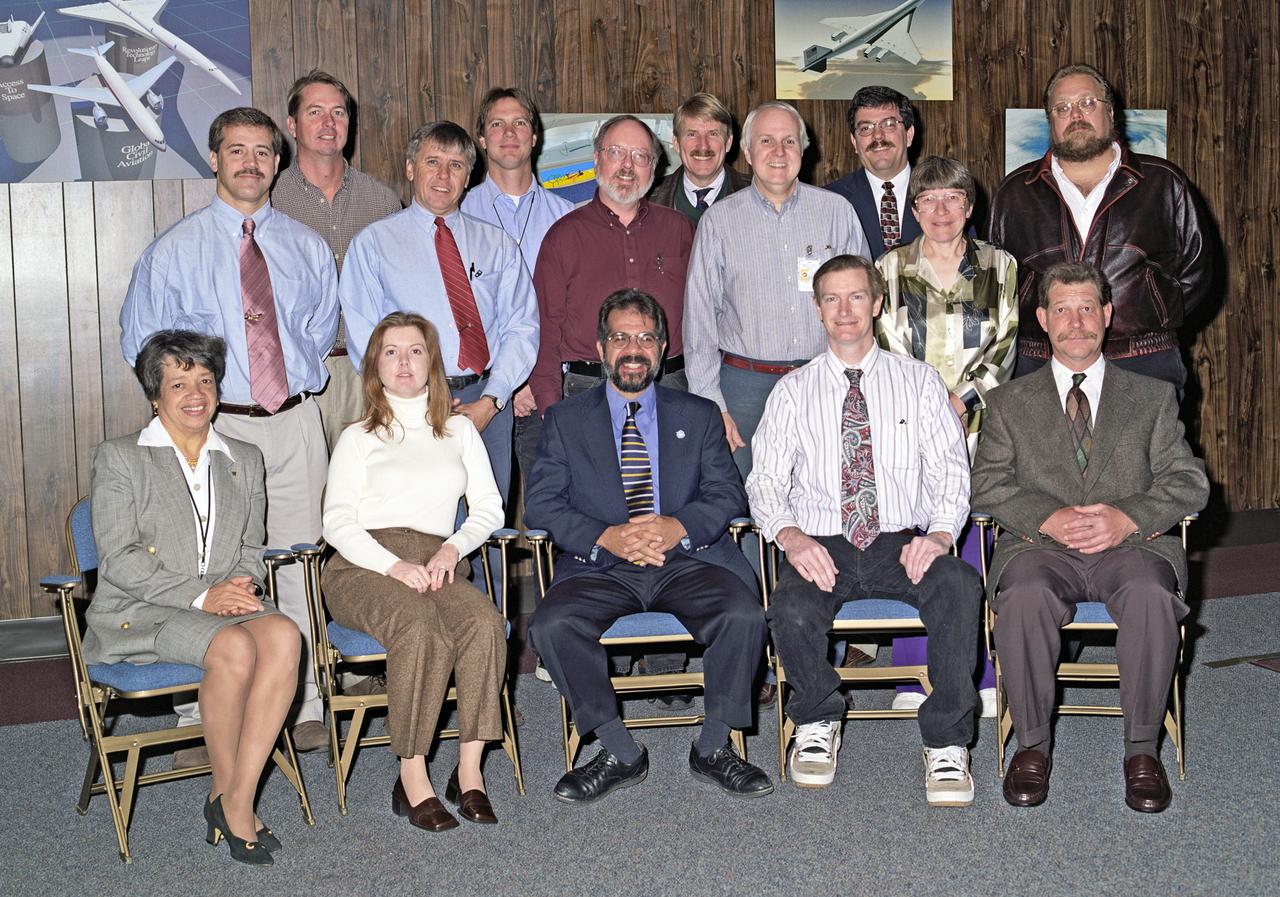
High Speed Research Program/Tu-144 Project Team. Christine Darden in front row first person on the left.
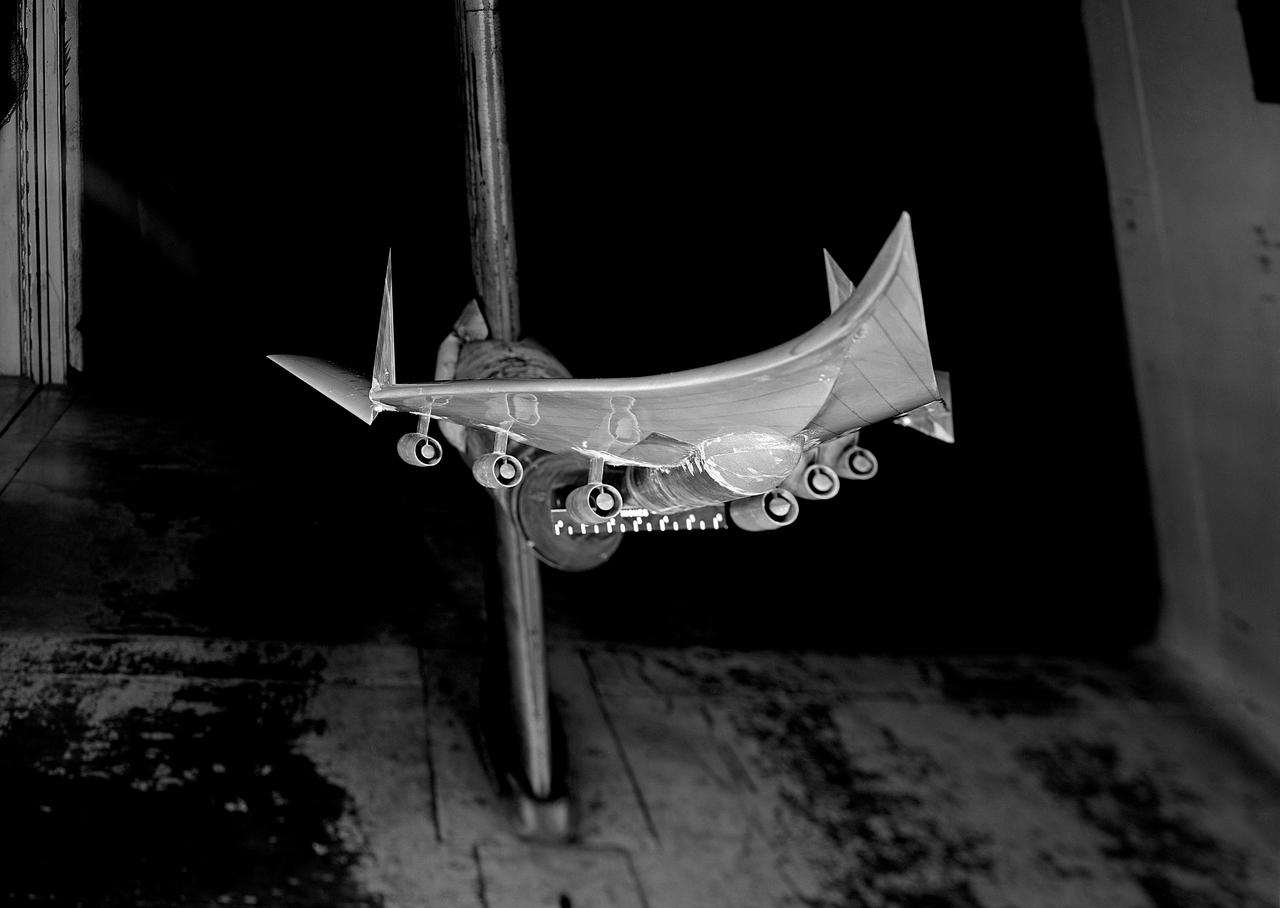
Research Model in the 7x10 High Speed Tunnel Building 1212B 300 mph tunnel
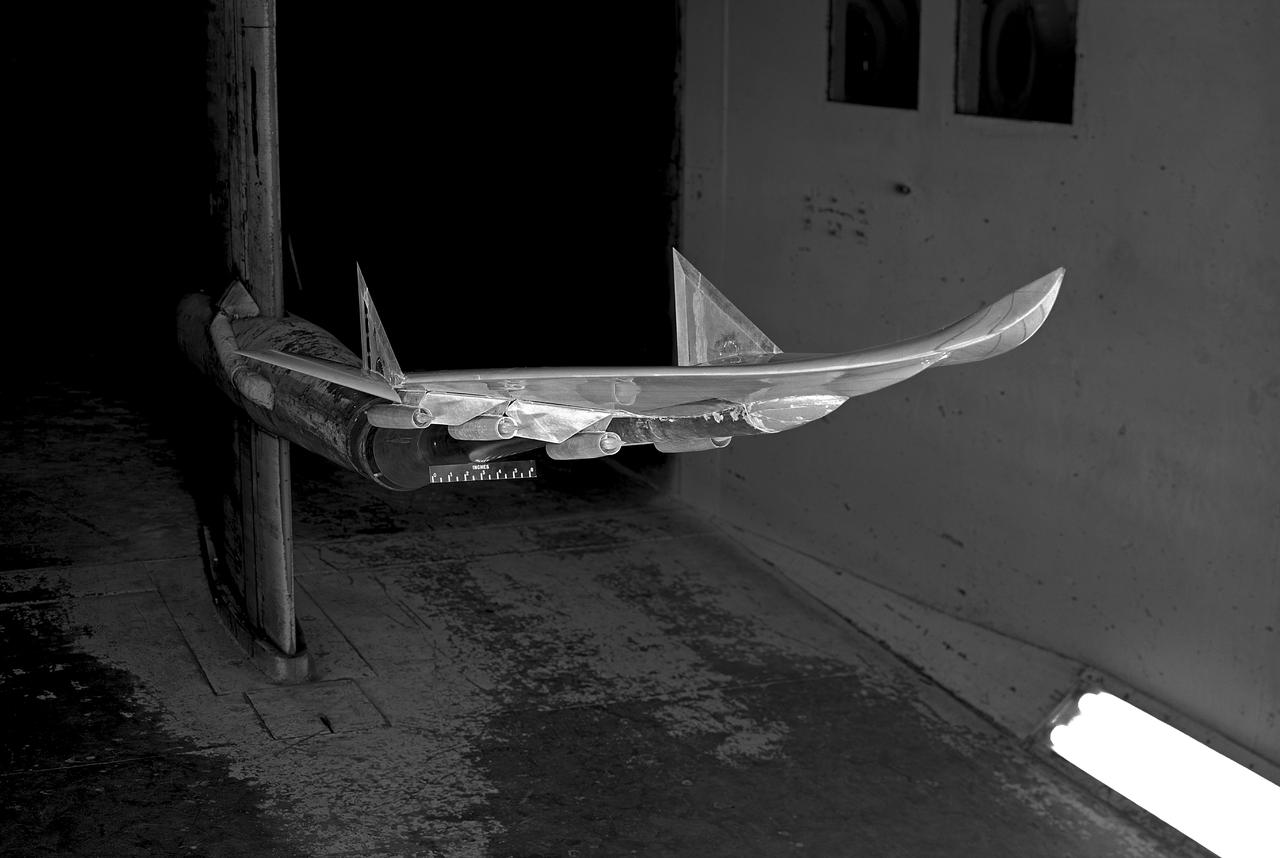
Research Model in the 7x10 High Speed Tunnel Building 1212B 300 mph tunnel
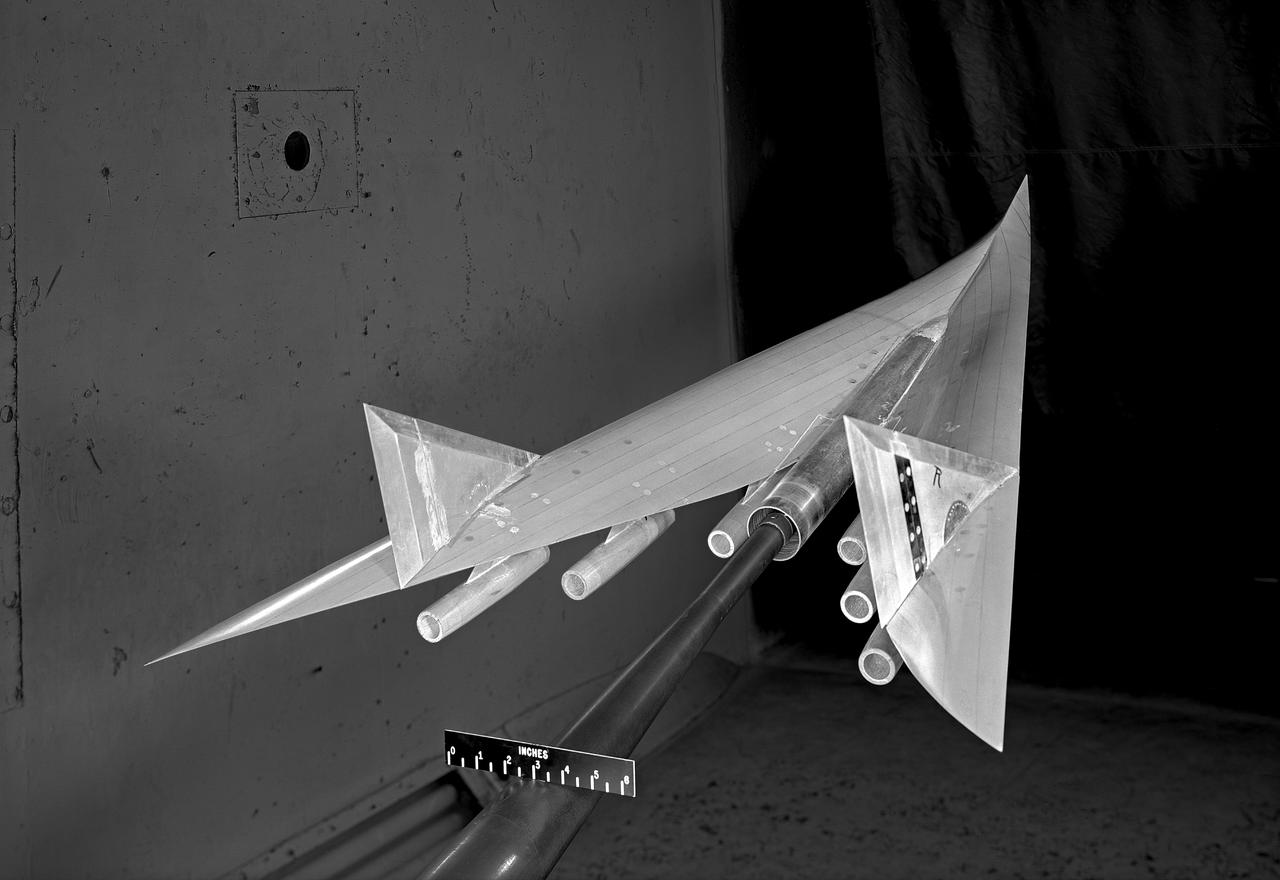
Research Model in the 7x10 High Speed Tunnel Building 1212B 300 mph tunnel
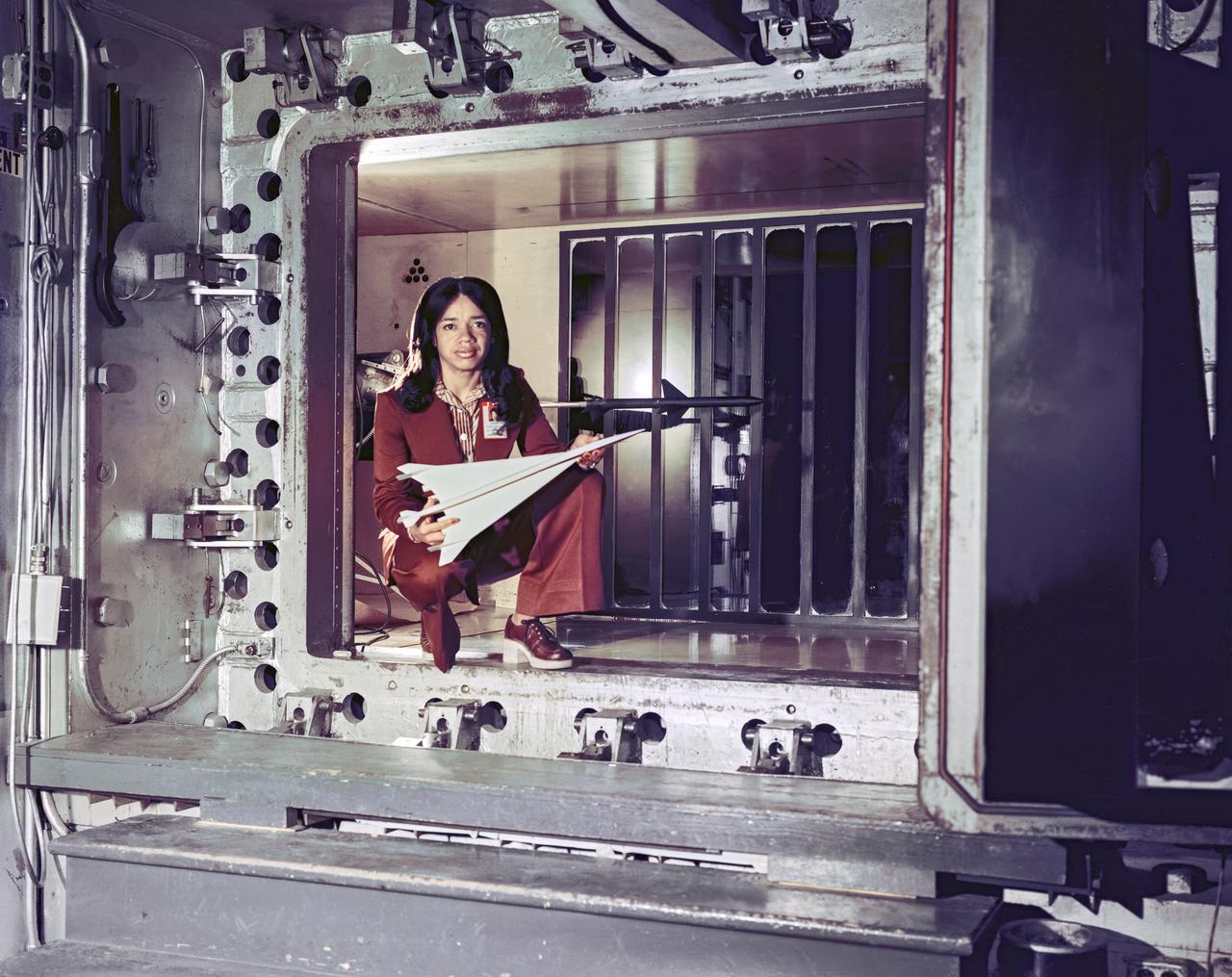
Environmental Portrait of Christine M. Darden. Sonic boom researcher, HSR, High Speed Research
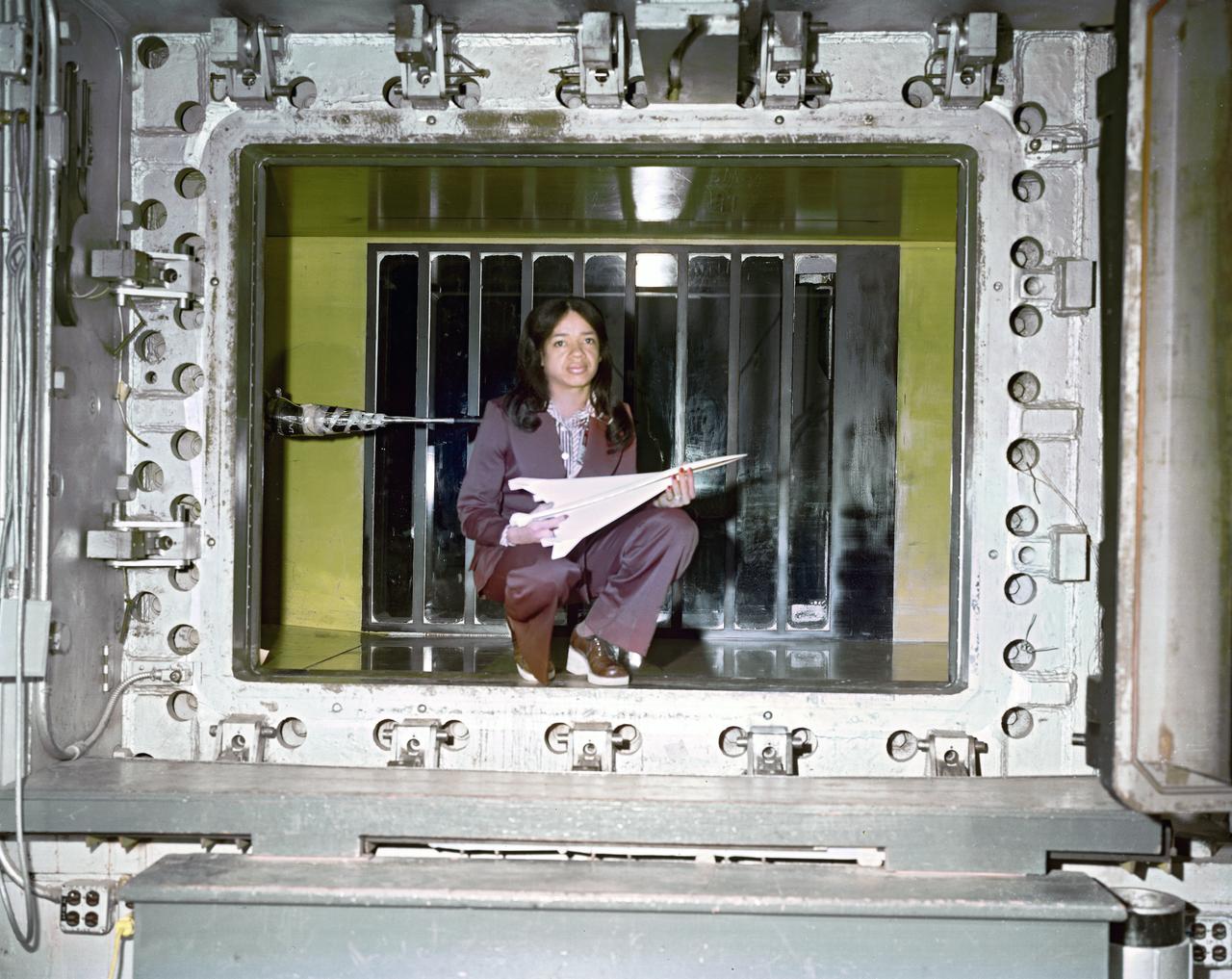
Environmental Portrait of Christine M. Darden. Sonic boom researcher, HSR, High Speed Research
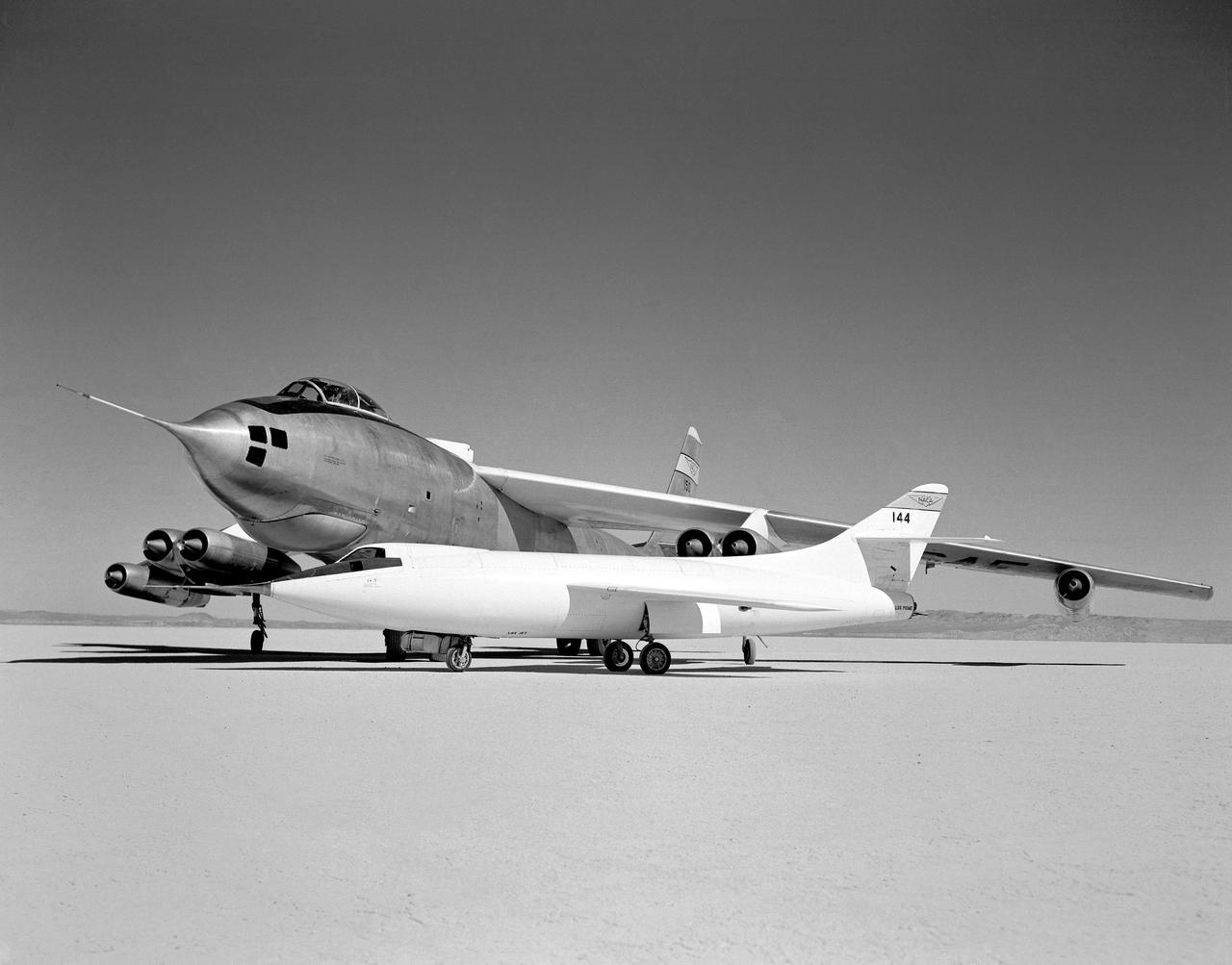
In 1954 this photo of two swept wing airplanes was taken on the ramp of NACA High-Speed Flight Research Station. The Douglas D-558-ll is a research aircraft while the Boeing B-47A Stratojet is a production bomber and very different in size. Both contributed to the studies for swept back wing research.
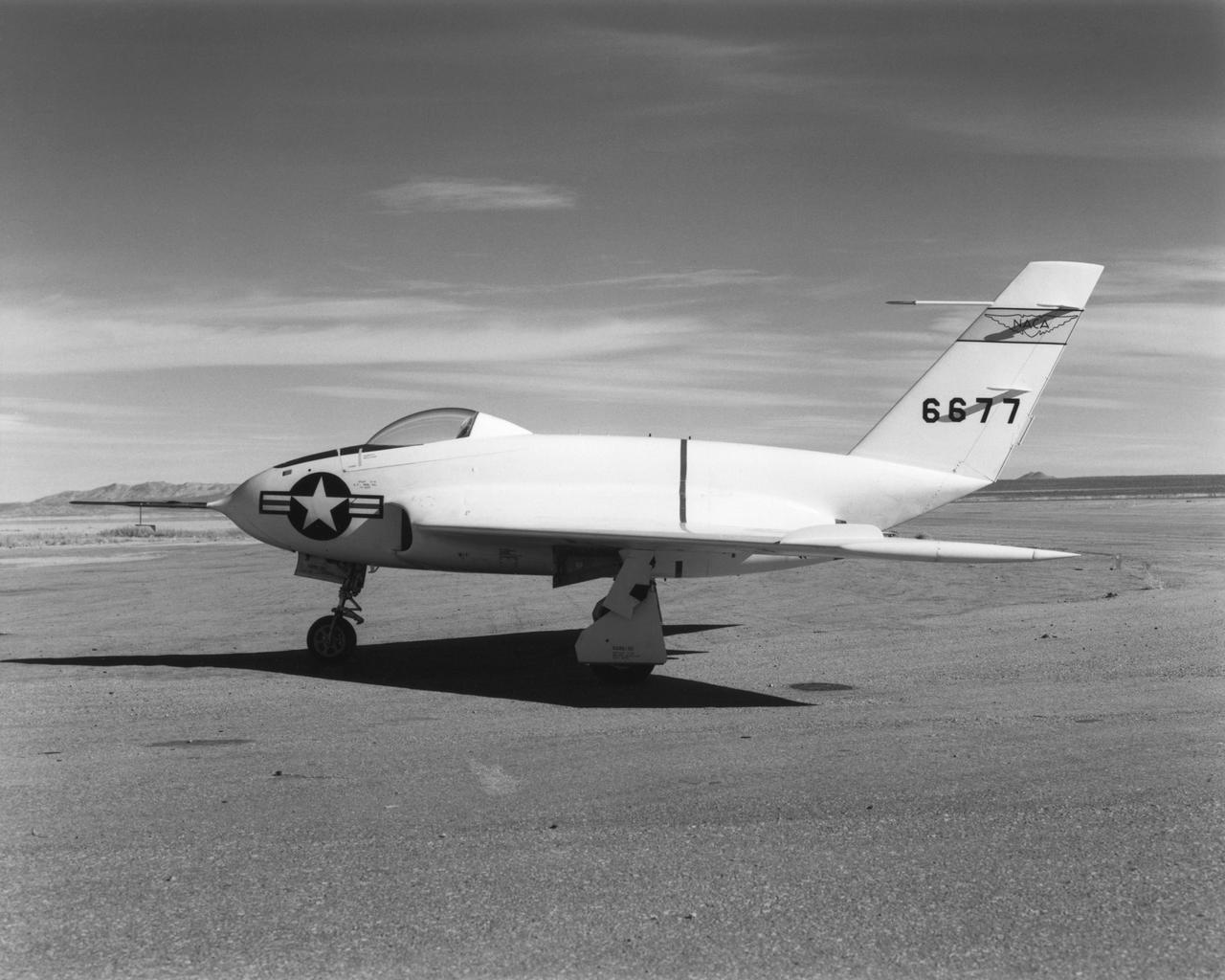
In this 1950 view of the left side of the NACA High-Speed Flight Research Station's X-4 research aircraft, the low swept wing and horizontal taillest design are seen. The X-4 Bantam, a single-place, low swept-wing, semi-tailless aircraft, was designed and built by Northrop Aircraft, Inc. It had no horizontal tail surfaces and its mission was to obtain in-flight data on the stability and control of semi-tailless aircraft at high subsonic speeds.
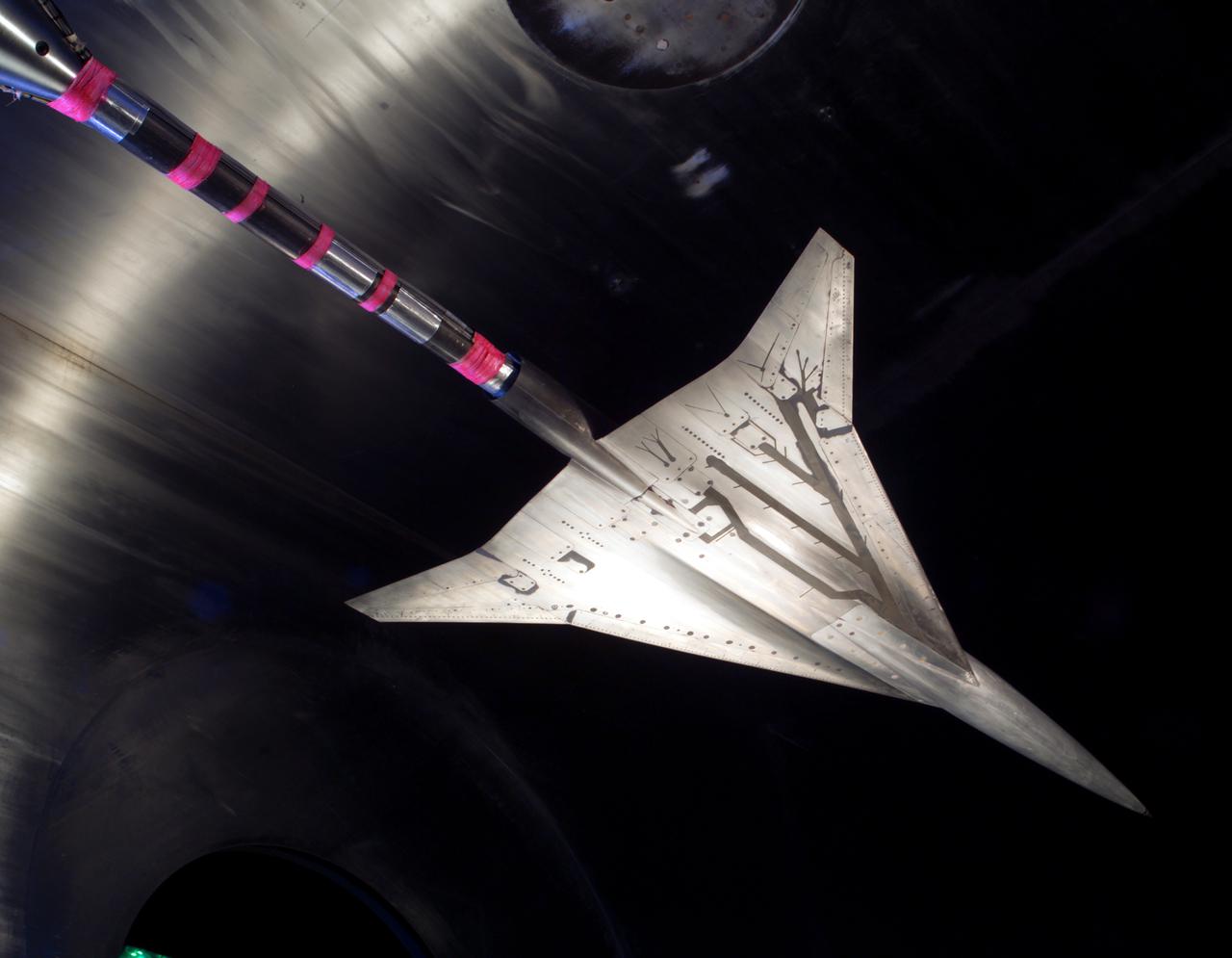
NASA Glenn/NASA Langley, Loads Comparison Test With 6 Component Force/Moment Balance and 1.7% High Speed Research, HSR Model 5. In the Glenn Research Center 10x10 Foot Supersonic Wind Tunnel, SWT
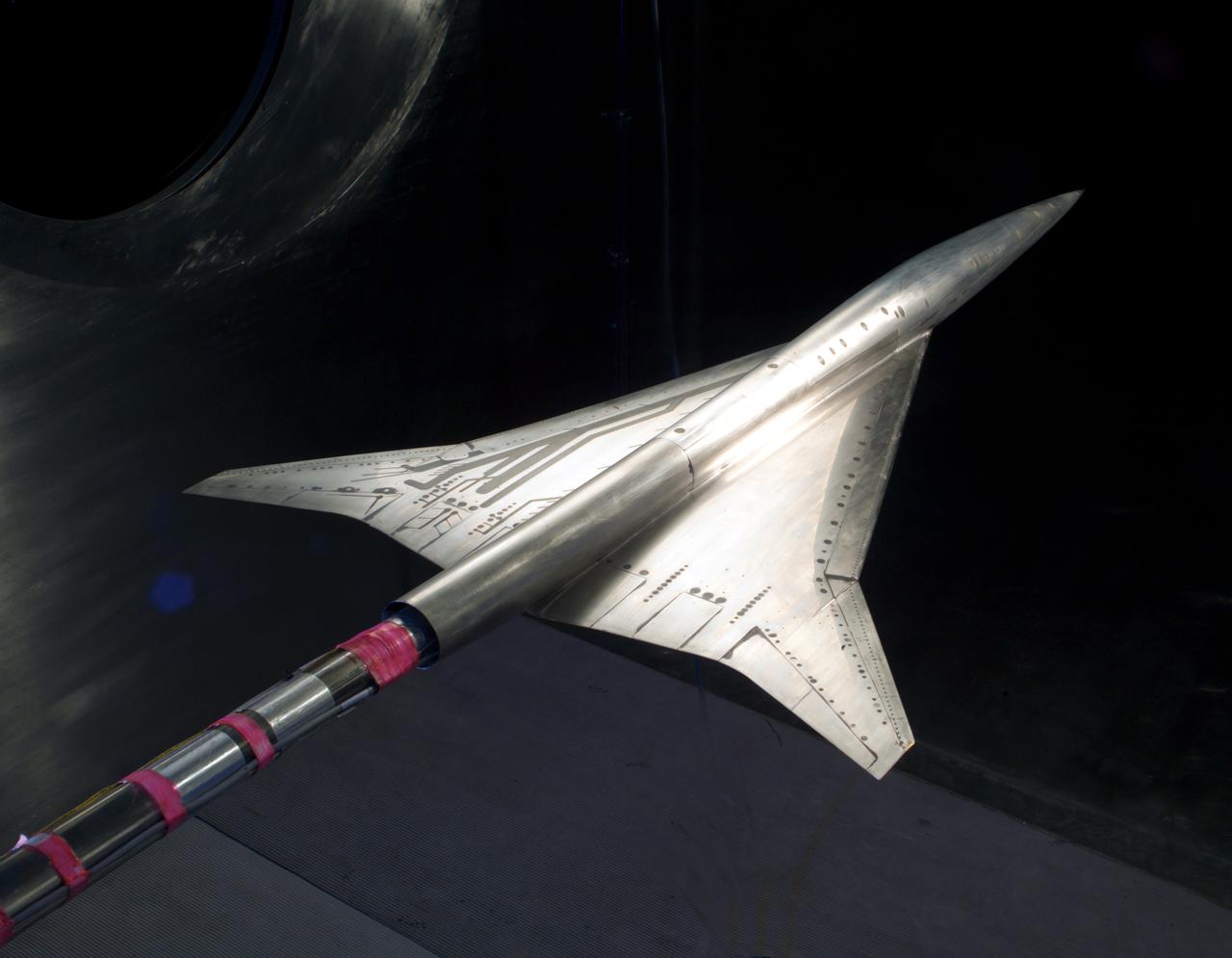
NASA GLENN/NASA LANGLEY LOADS COMPARISON TEST WITH 6 COMPONENT FORCE/MOMENT BALANCE AND 1.7% HIGH SPEED RESEARCH MODEL 5.

NASA GLENN/NASA LANGLEY LOADS COMPARISON TEST WITH 6 COMPONENT FORCE/MOMENT BALANCE AND 1.7% HIGH SPEED RESEARCH MODEL 5.
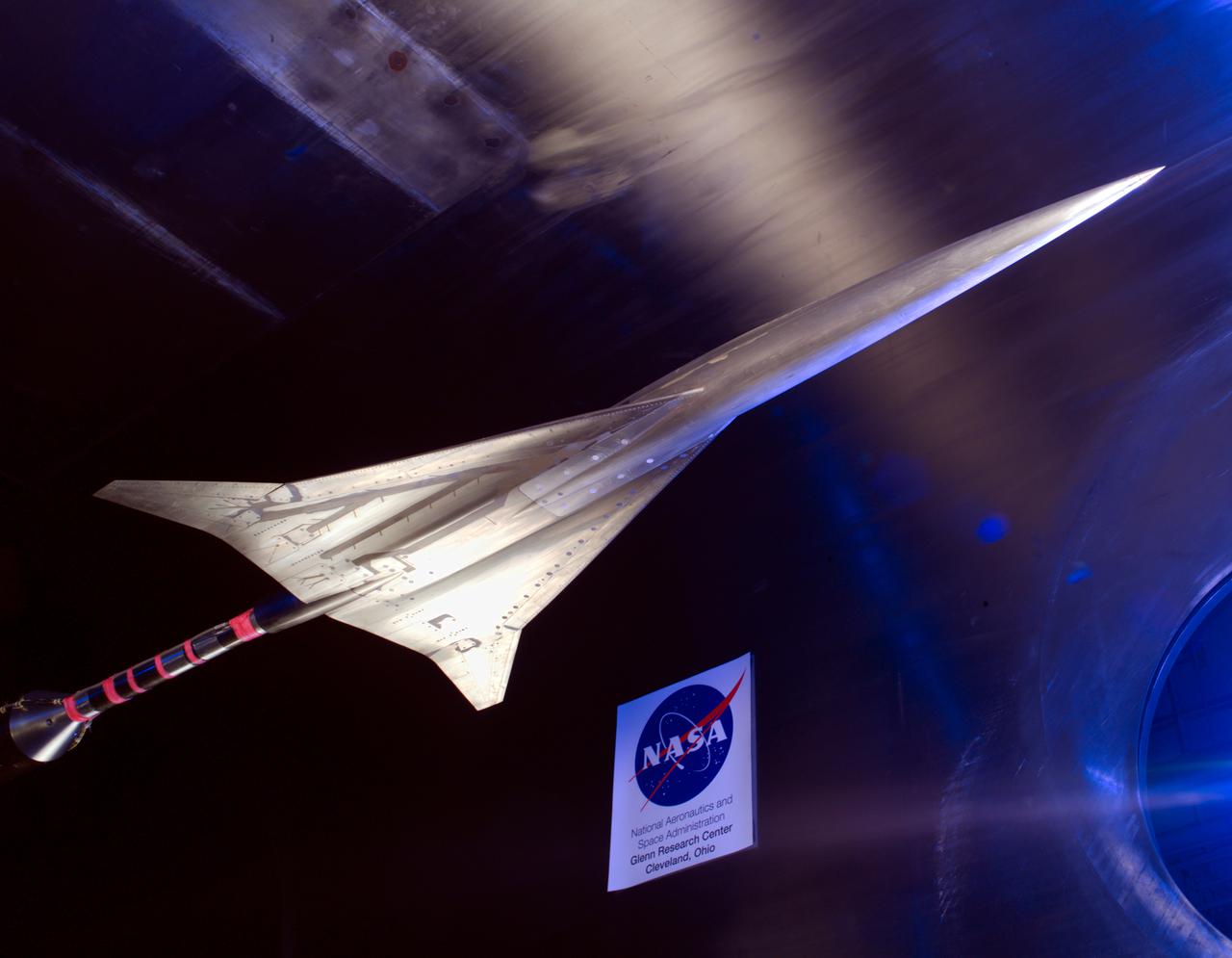
NASA GLENN/NASA LANGLEY LOADS COMPARISON TEST WITH 6 COMPONENT FORCE/MOMENT BALANCE AND 1.7% HIGH SPEED RESEARCH MODEL 5.
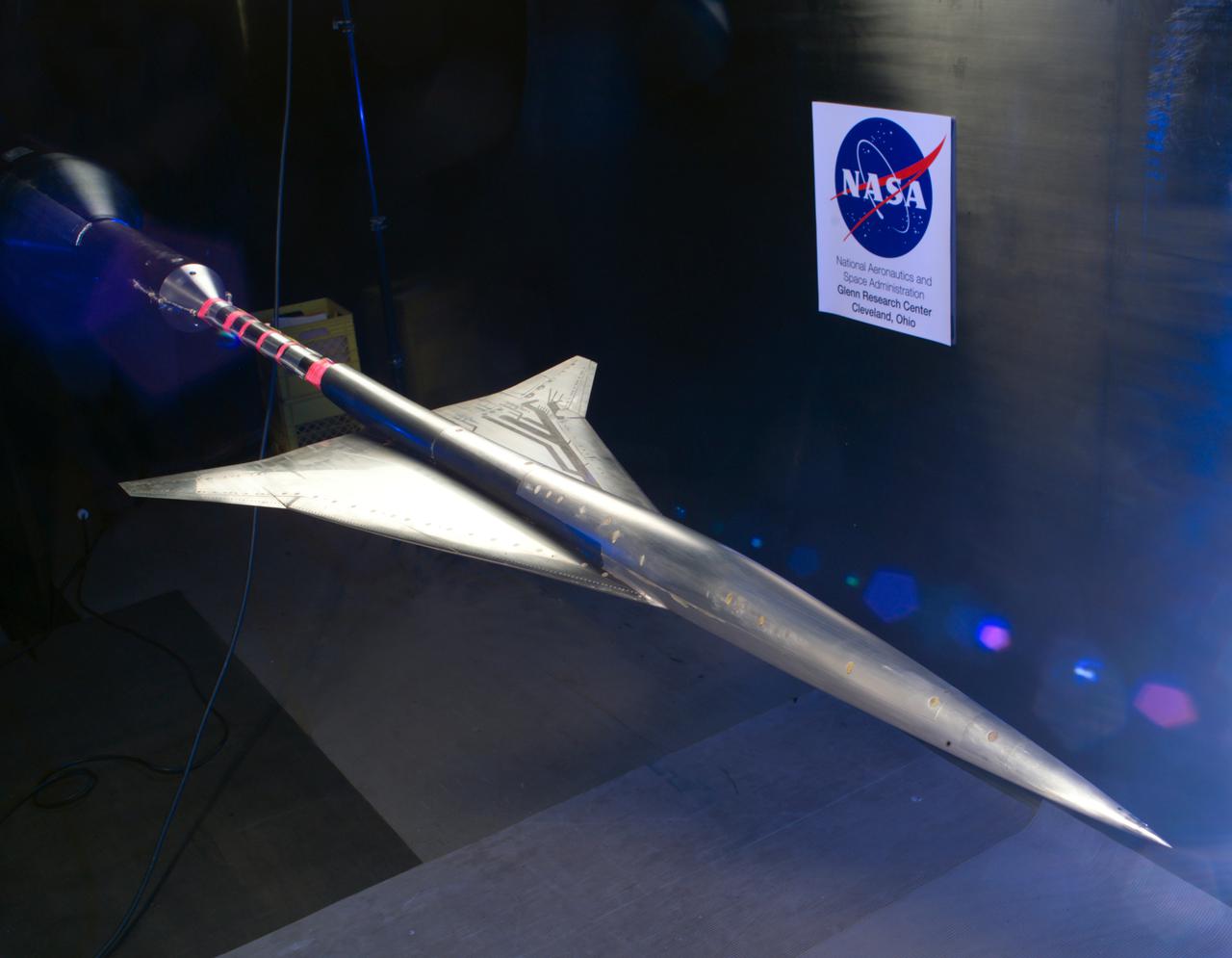
NASA GLENN/NASA LANGLEY LOADS COMPARISON TEST WITH 6 COMPONENT FORCE/MOMENT BALANCE AND 1.7% HIGH SPEED RESEARCH MODEL 5.
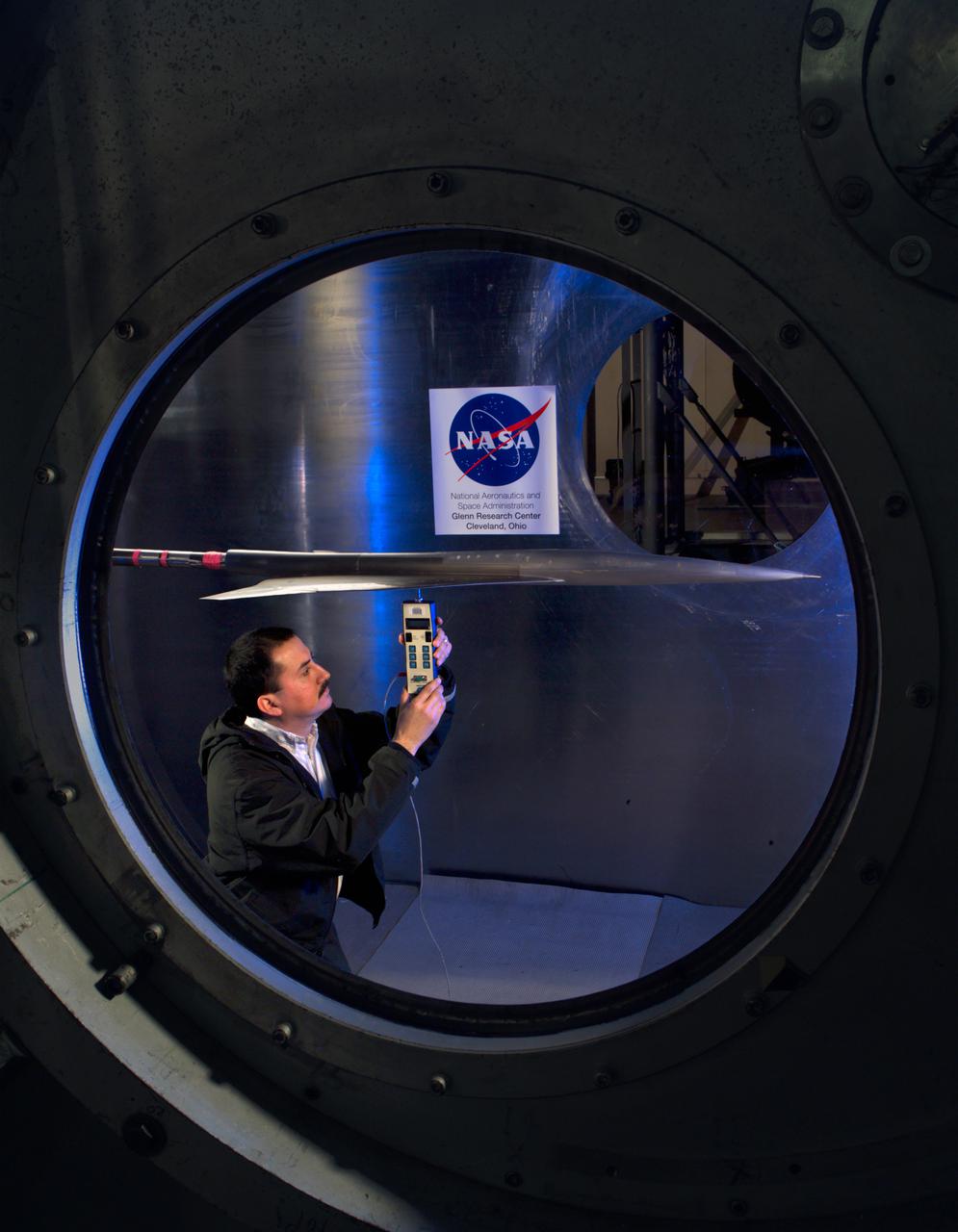
NASA GLENN/NASA LANGLEY LOADS COMPARISON TEST WITH 6 COMPONENT FORCE/MOMENT BALANCE AND 1.7% HIGH SPEED RESEARCH MODEL 5.
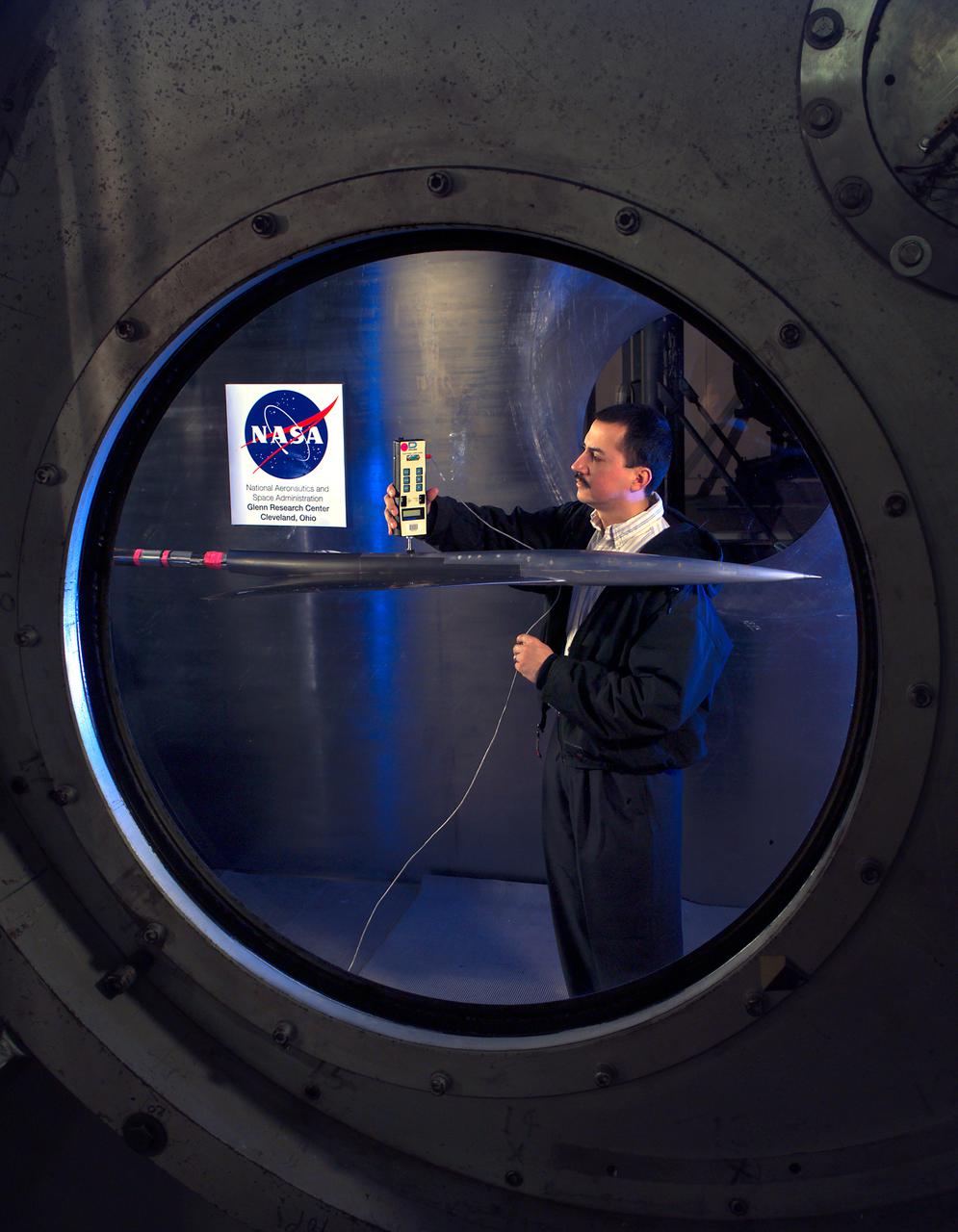
NASA GLENN/NASA LANGLEY LOADS COMPARISON TEST WITH 6 COMPONENT FORCE/MOMENT BALANCE AND 1.7% HIGH SPEED RESEARCH MODEL 5.
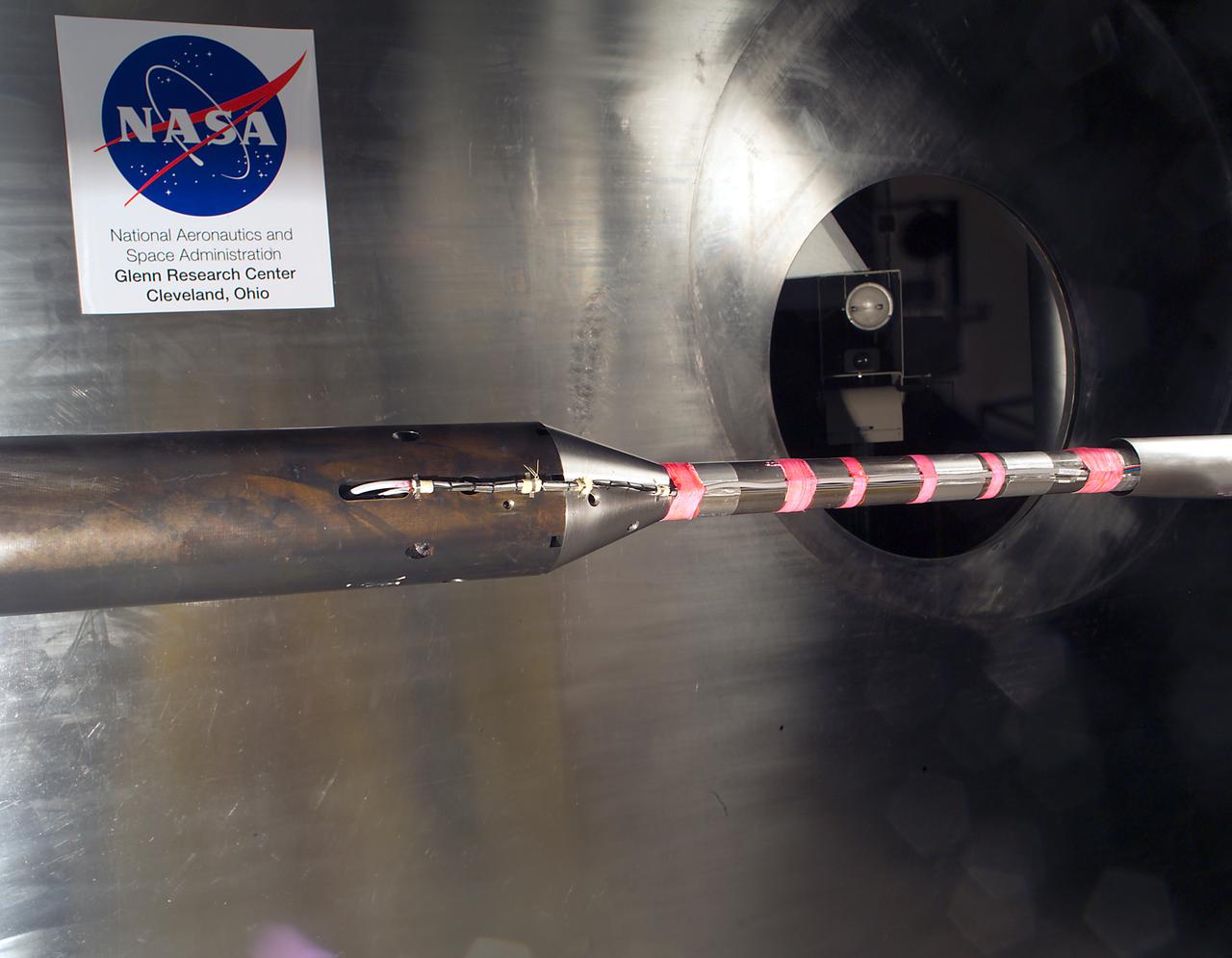
NASA GLENN/NASA LANGLEY LOADS COMPARISON TEST WITH 6 COMPONENT FORCE/MOMENT BALANCE AND 1.7% HIGH SPEED RESEARCH MODEL 5.
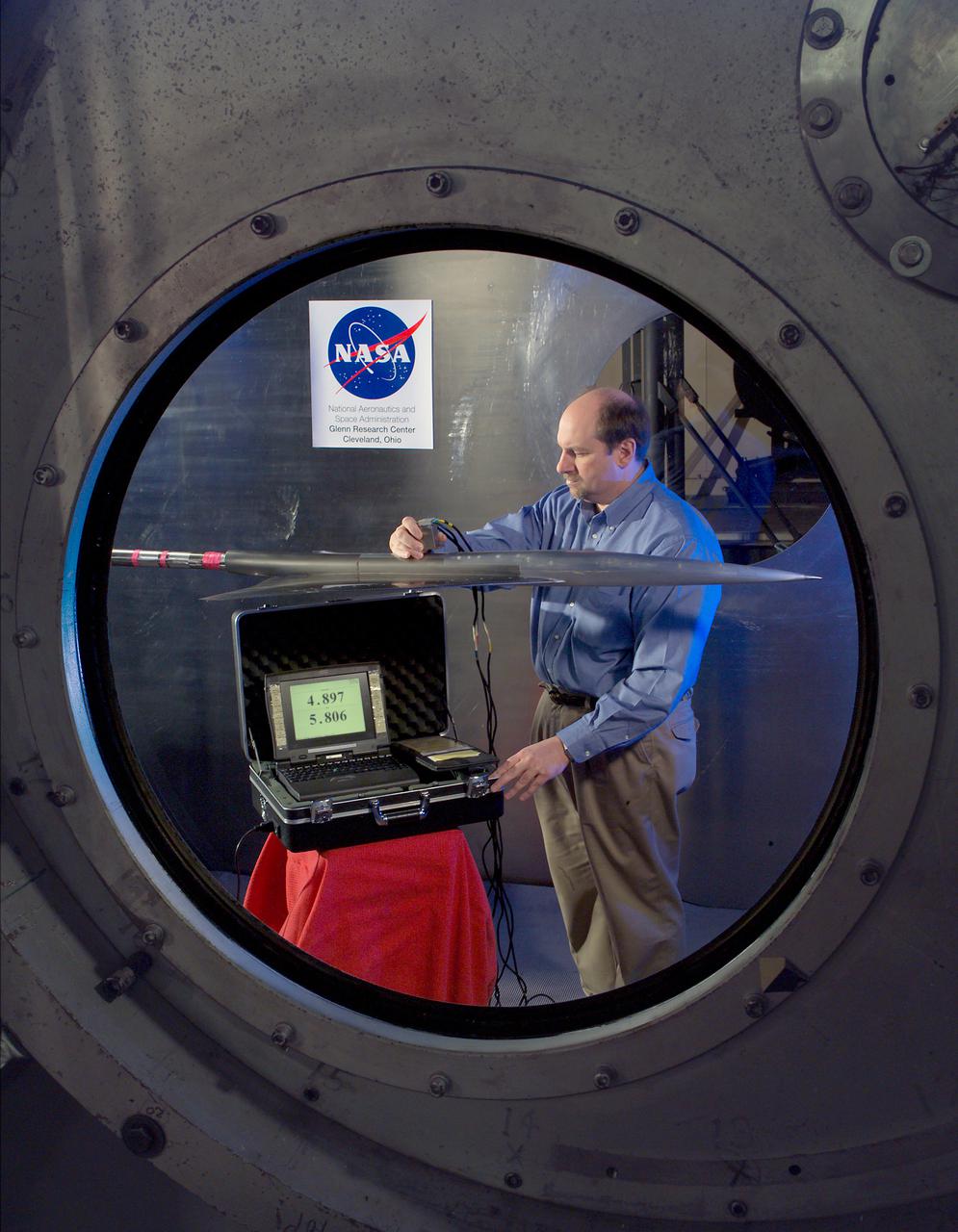
NASA GLENN/NASA LANGLEY LOADS COMPARISON TEST WITH 6 COMPONENT FORCE/MOMENT BALANCE AND 1.7% HIGH SPEED RESEARCH MODEL 5. in the 10x10 super sonic wind tunnel
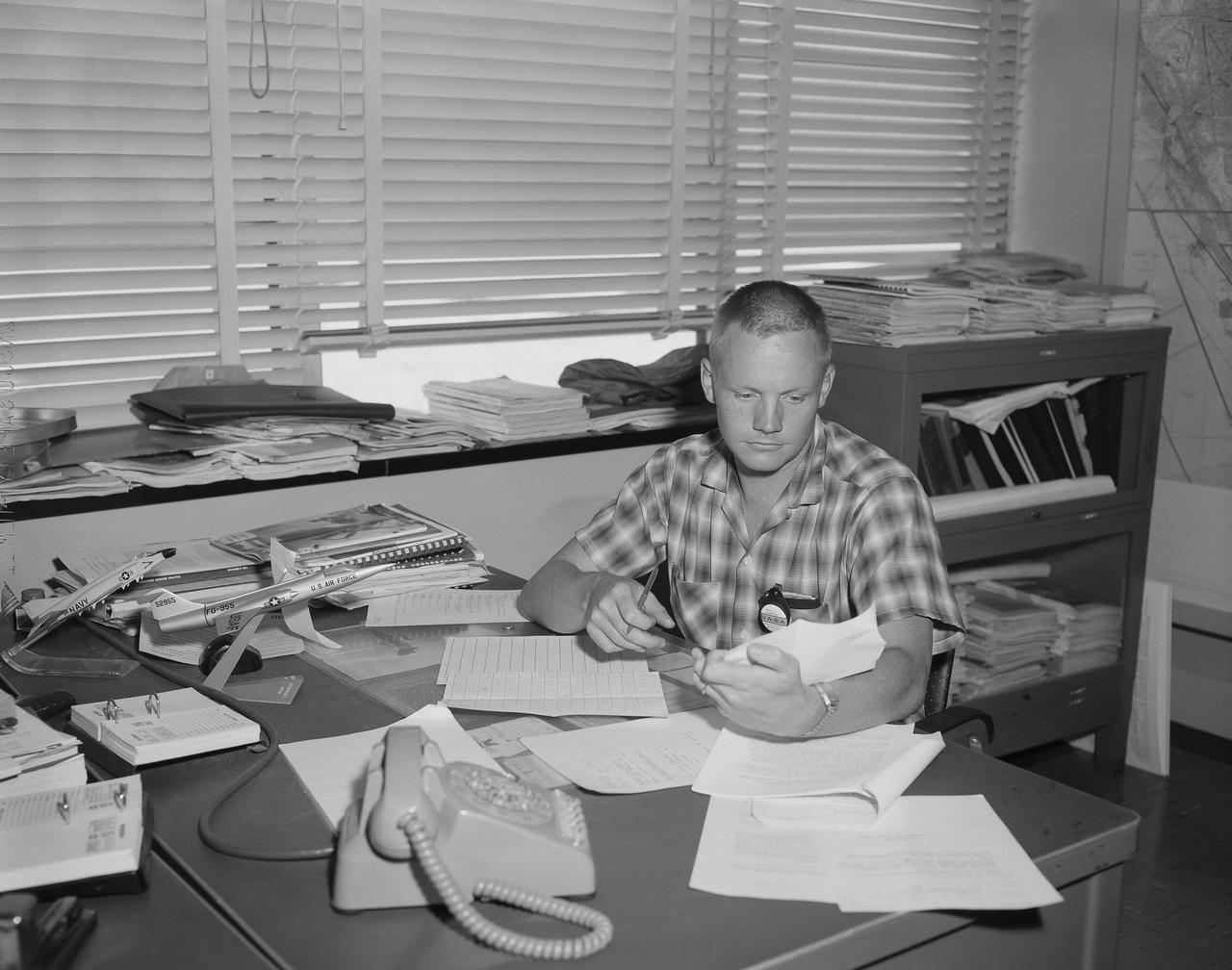
Famed astronaut Neil A. Armstrong – the first person to set foot on the Moon during the historic Apollo 11 mission in July 1969 – spent seven years as a research pilot at the NACA-NASA High-Speed Flight Station, now NASA’s Armstrong Flight Research Center in Edwards, California, before joining the space program. During his tenure, Armstrong was actively engaged in both the piloting and engineering aspects of numerous NASA programs and projects.
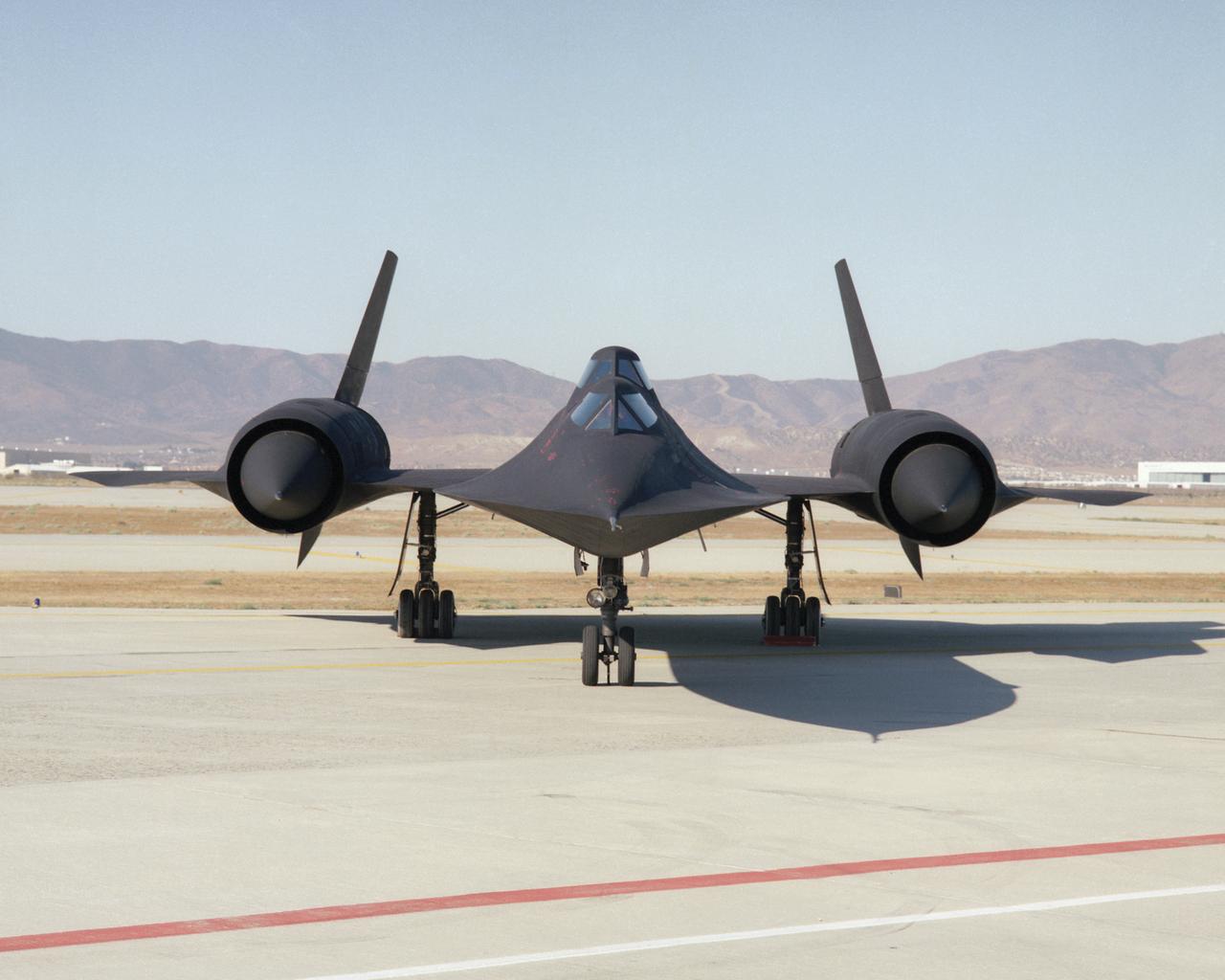
This photo shows a head-on view of NASA's SR-71B, used for pilot proficiency and training, on the ramp at the Air Force's Plant 42 in Palmdale, California, shortly before delivery to the Ames-Dryden Flight Research Facility (later, Dryden Flight Research Center) at Edwards, California. NASA operated two of these unique aircraft, an SR-71A, for high-speed, high altitude research, and this SR- 71B pilot trainer for most of the decade of the 1990s. The "B" model is special because of its raised rear cockpit, which provided a second pilot position so a trainer and an experienced pilot could both see what was going on during flights. The SR-71 was designed and built by the Lockheed Skunk Works, now the Lockheed Martin Skunk Works. Studies have shown that less than 20 percent of the total thrust used to fly at Mach 3 is produced by the basic engine itself. The balance of the total thrust is produced by the unique design of the engine inlet and "moveable spike" system at the front of the engine nacelles, and by the ejector nozzles at the exhaust which burn air compressed in the engine bypass system. Data from the SR-71 high speed research program will be used to aid designers of future supersonic/hypersonic aircraft and propulsion systems, including a high speed civil transport.
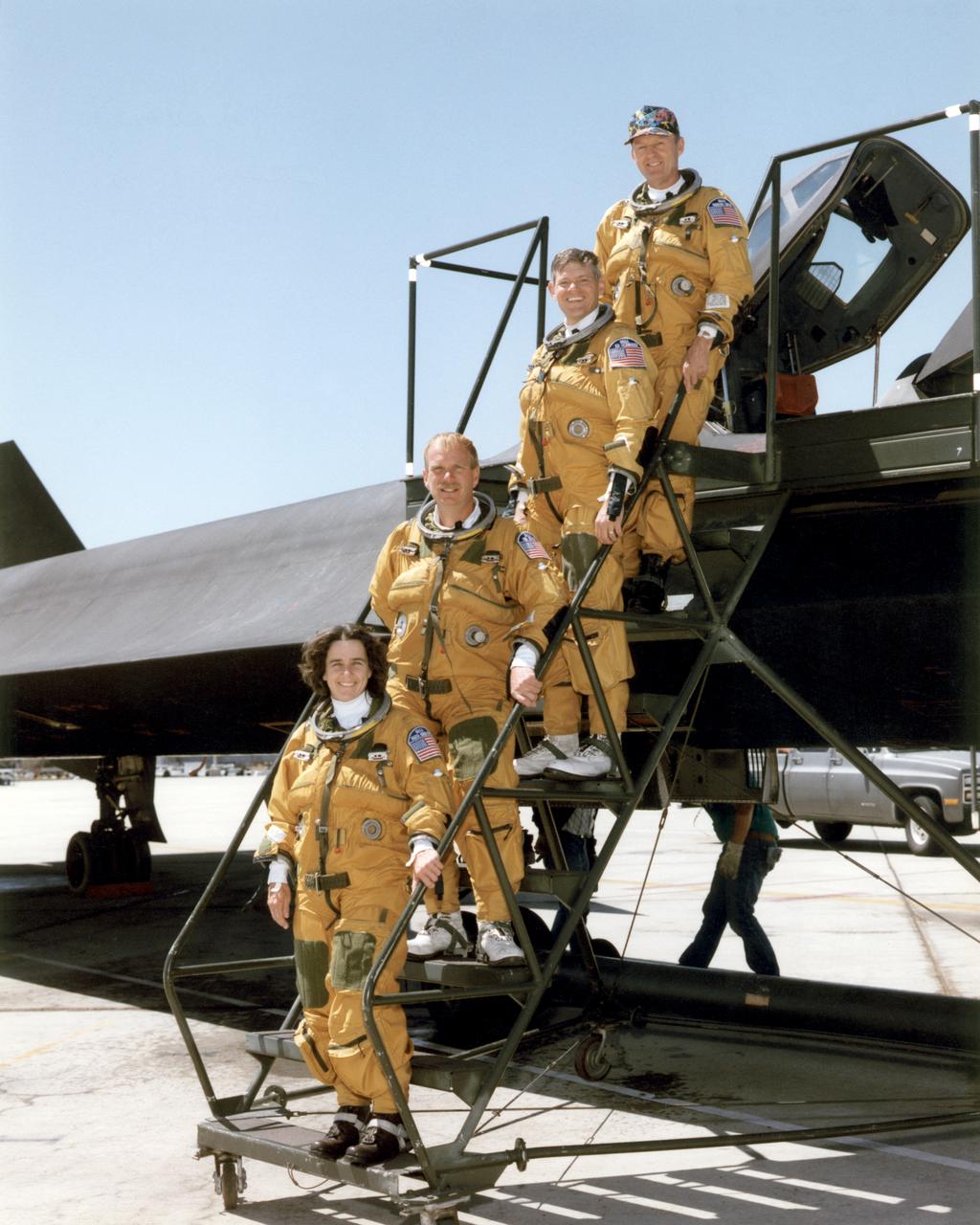
Flight engineers Marta Bohn-Meyer and Bob Meyer and pilots Ed Schneider and Rogers Smith flew the triple-sonic SR-71 in high-speed research experiments at NASA Dryden.
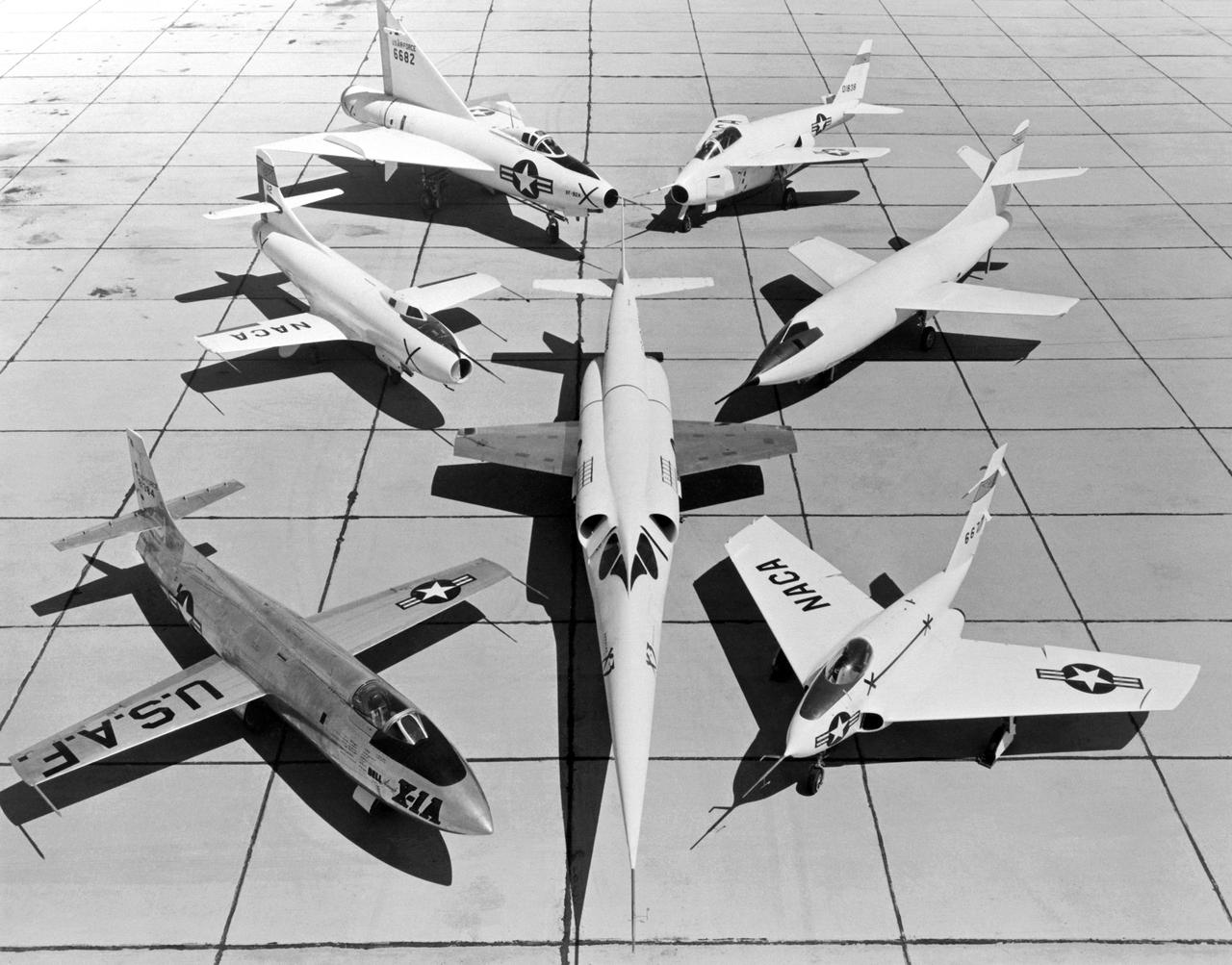
A 1953 photo of some of the research aircraft at the NACA High-Speed Flight Research Station (now known as the the Dryden Flight Research Center). The photo shows the X-3 (center) and, clockwise from left: X-1A (Air Force serial number 48-1384), the third D-558-1 (NACA tail number 142), XF-92A, X-5, D-558-2, and X-4.
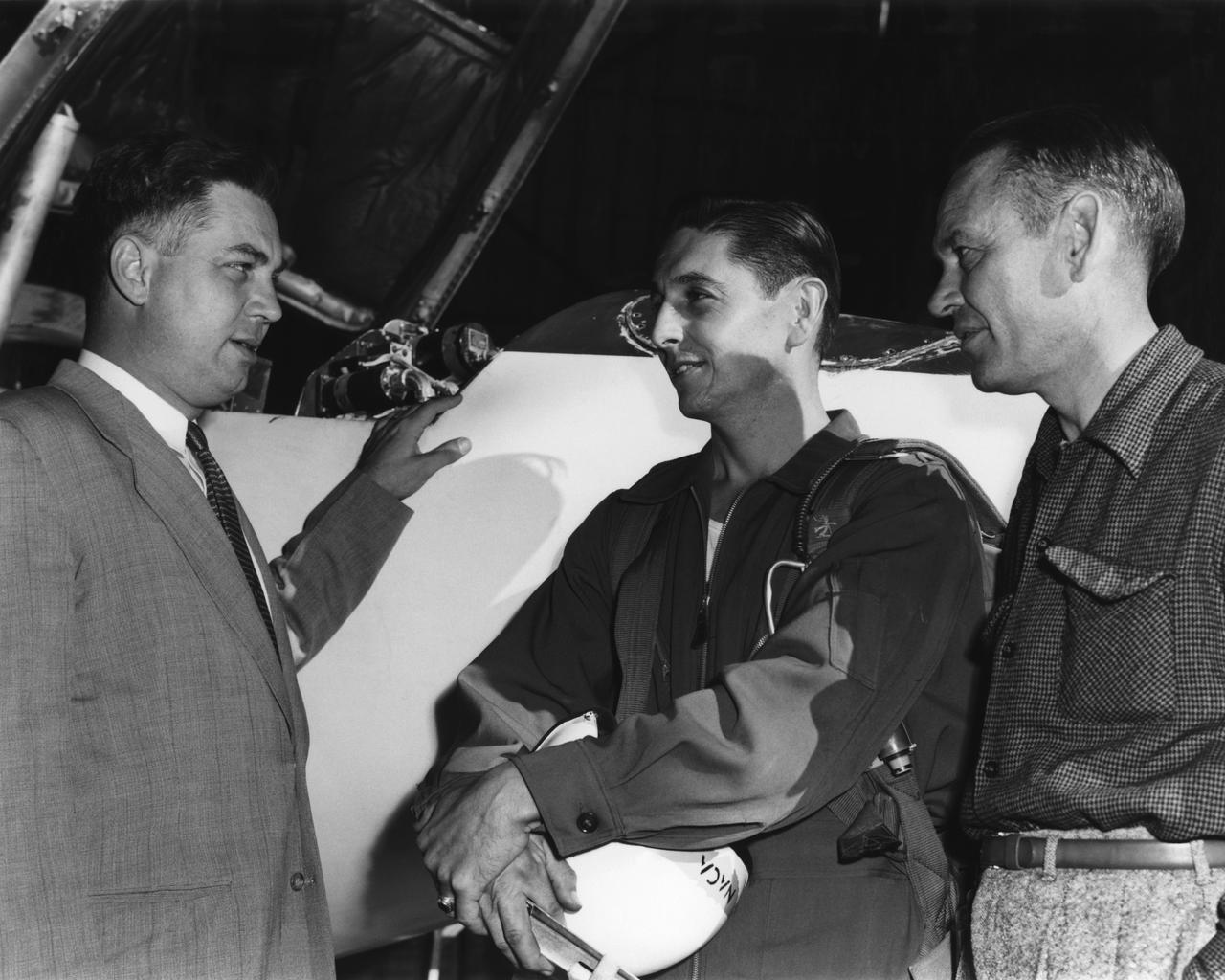
High-Speed Research Station Director Walter C. Williams, NACA pilot A. Scott Crossfield, and Director of Flight Operations Joe Vensel in front of the Douglas D-558-2 after the first Mach 2 flight.
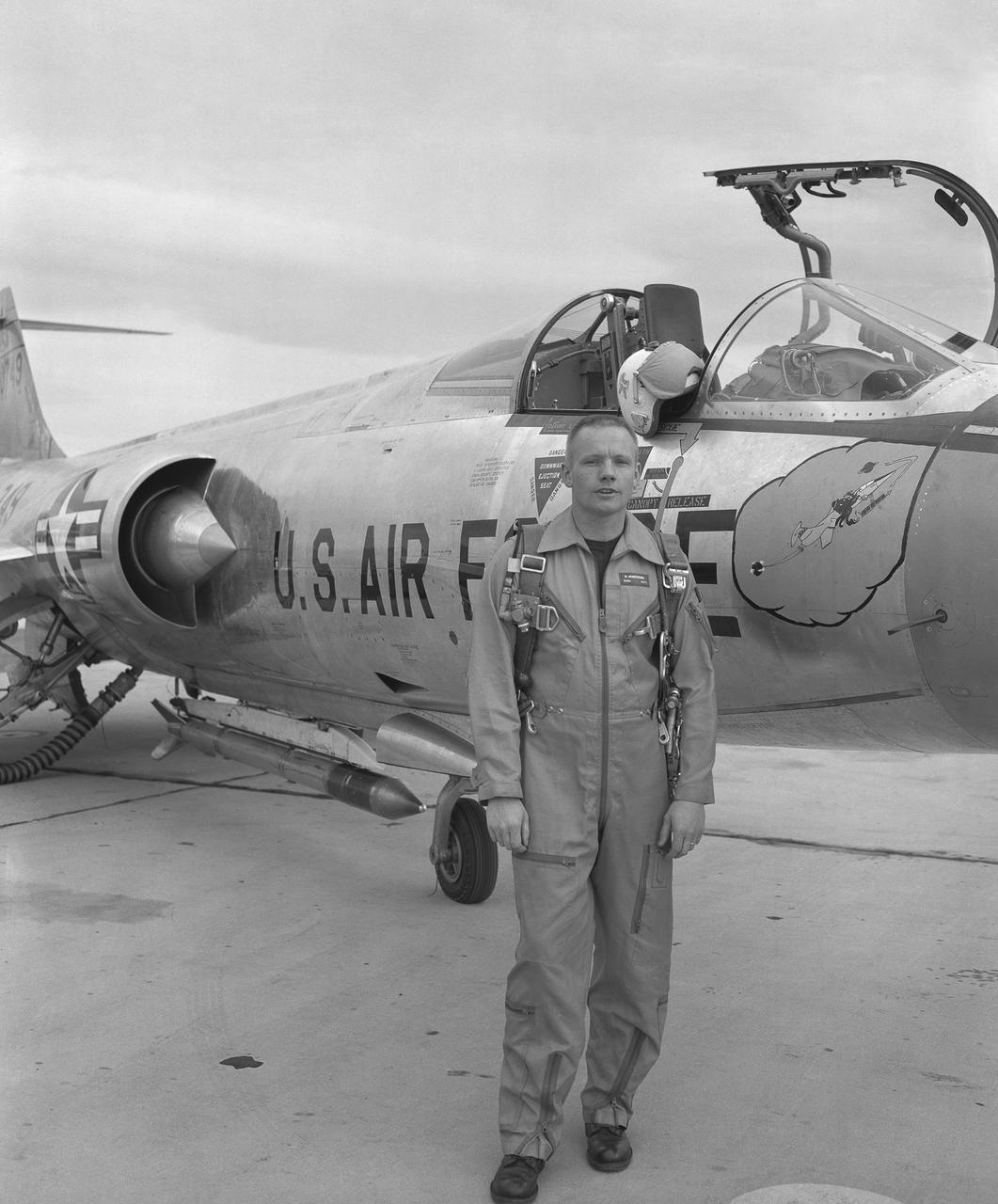
Famed astronaut Neil A. Armstrong – the first person to set foot on the Moon during the historic Apollo 11 mission in July 1969 – spent seven years as a research pilot at the NACA-NASA High-Speed Flight Station, now NASA’s Armstrong Flight Research Center in Edwards, California, before joining the space program. During his time there, he served as a project pilot on the F-100A, F-100C, F-101, and F-104A (pictured here).
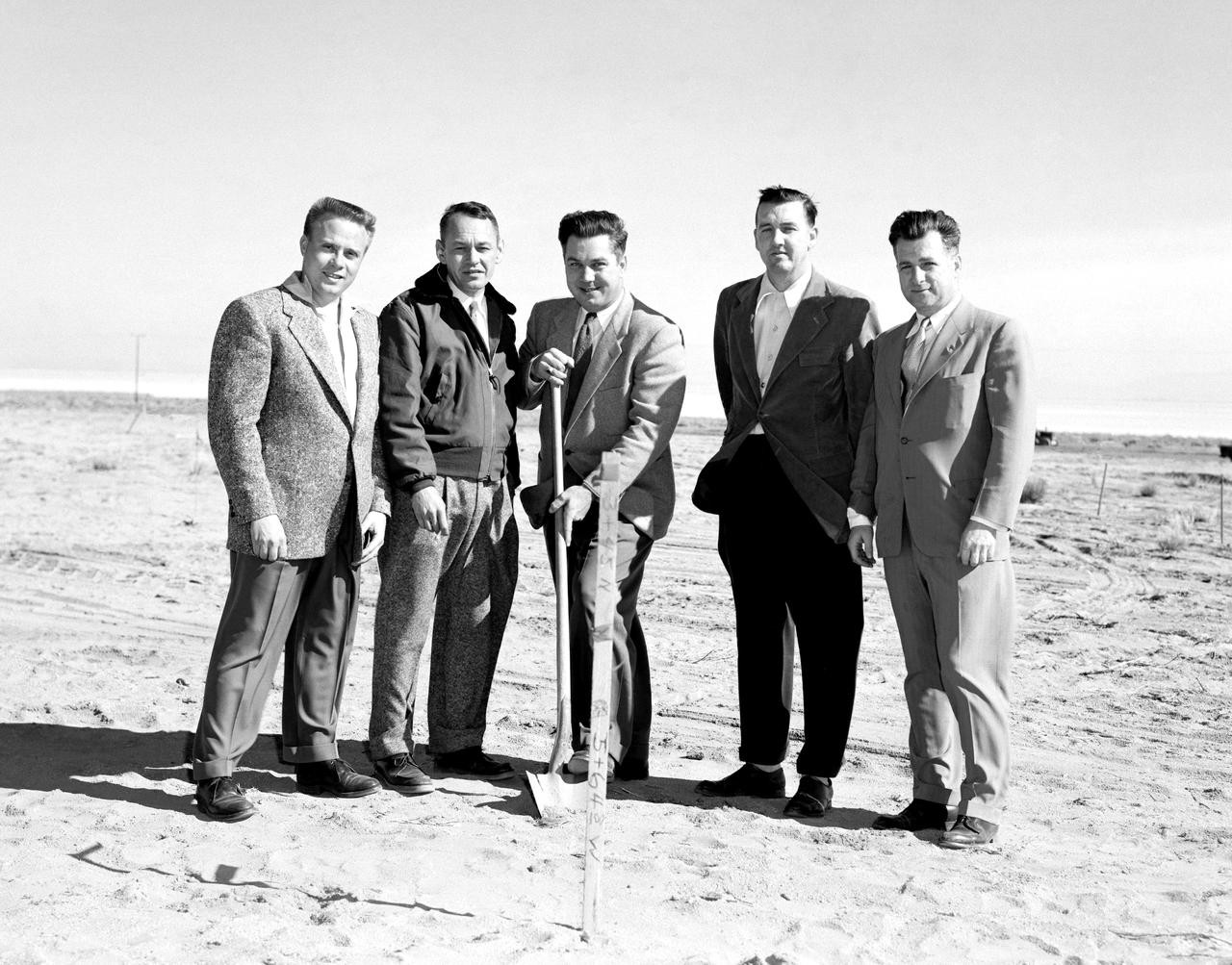
The NACA High-Speed Flight Research Station, had initially been subordinate to the Langley Memorial Aeronautical Laboratory near Hampton, Virginia, but as the flight research in the Mojave Desert increasingly proved its worth after 1946, it made sense to make the Flight Research Station a separate entity reporting directly to the headquarters of the National Advisory Committee for Aeronautics. But an autonomous center required all the trappings of a major research facility, including good quarters. With the adoption of the Edwards “Master Plan,” the Air Force had committed itself to moving from its old South Base to a new location midway between the South and North Bases. The NACA would have to move also--so why not take advantage of the situation and move into a full-blown research facility. The Air Force issued a lease to NACA for a location on the northwestern shore of the Roger Dry Lake. Construction started on the NACA station in early February 1953. On a windy day, January 27, 1953, at a groundbreaking ceremony stood left to right: Gerald Truszynski, Head of Instrumentation Division; Joseph Vensel, Head of the Operations Branch; Walter Williams, Head of the Station, scooping the first shovel full of dirt; Marion Kent, Head of Personnel; and California state official Arthur Samet.
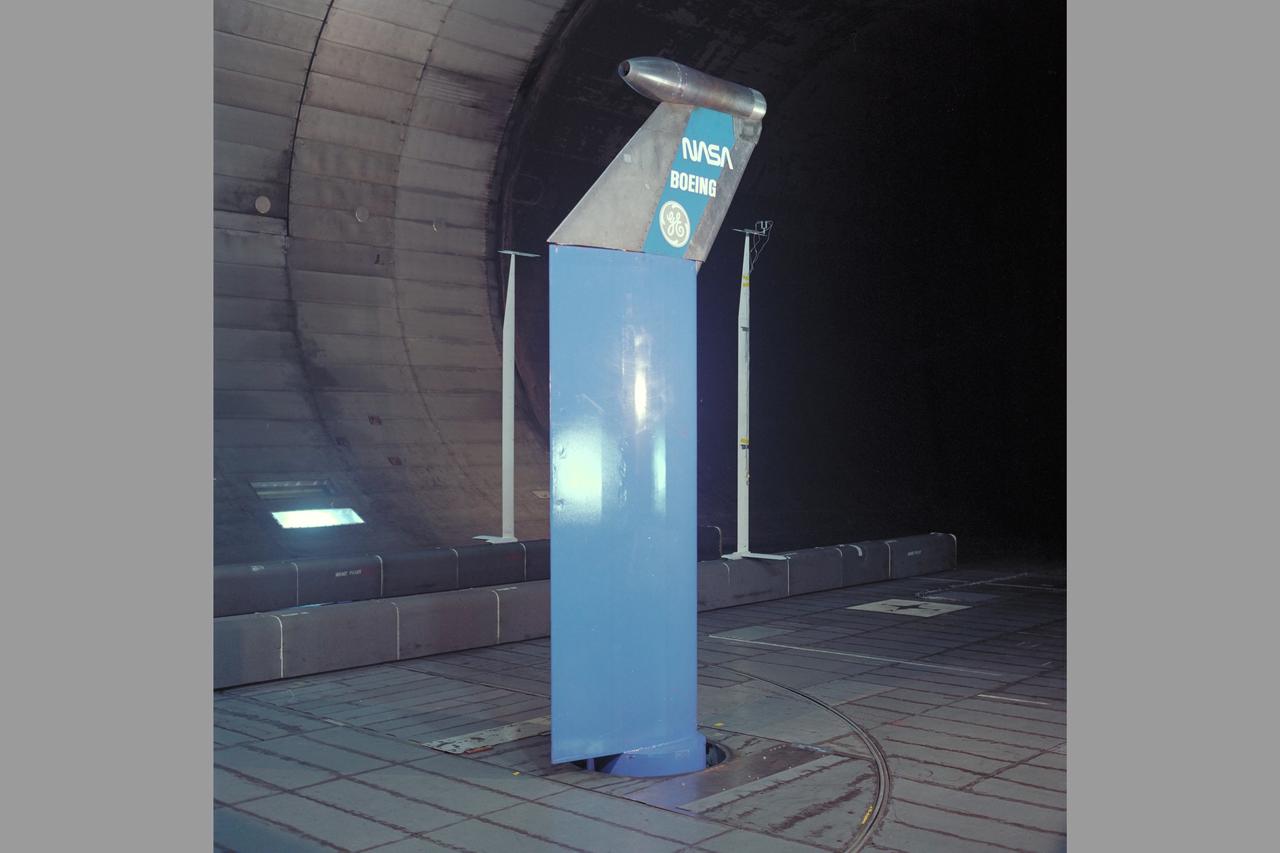
High Speed Research (HSR) Source Noise Test-592, 40x80ft w.t.
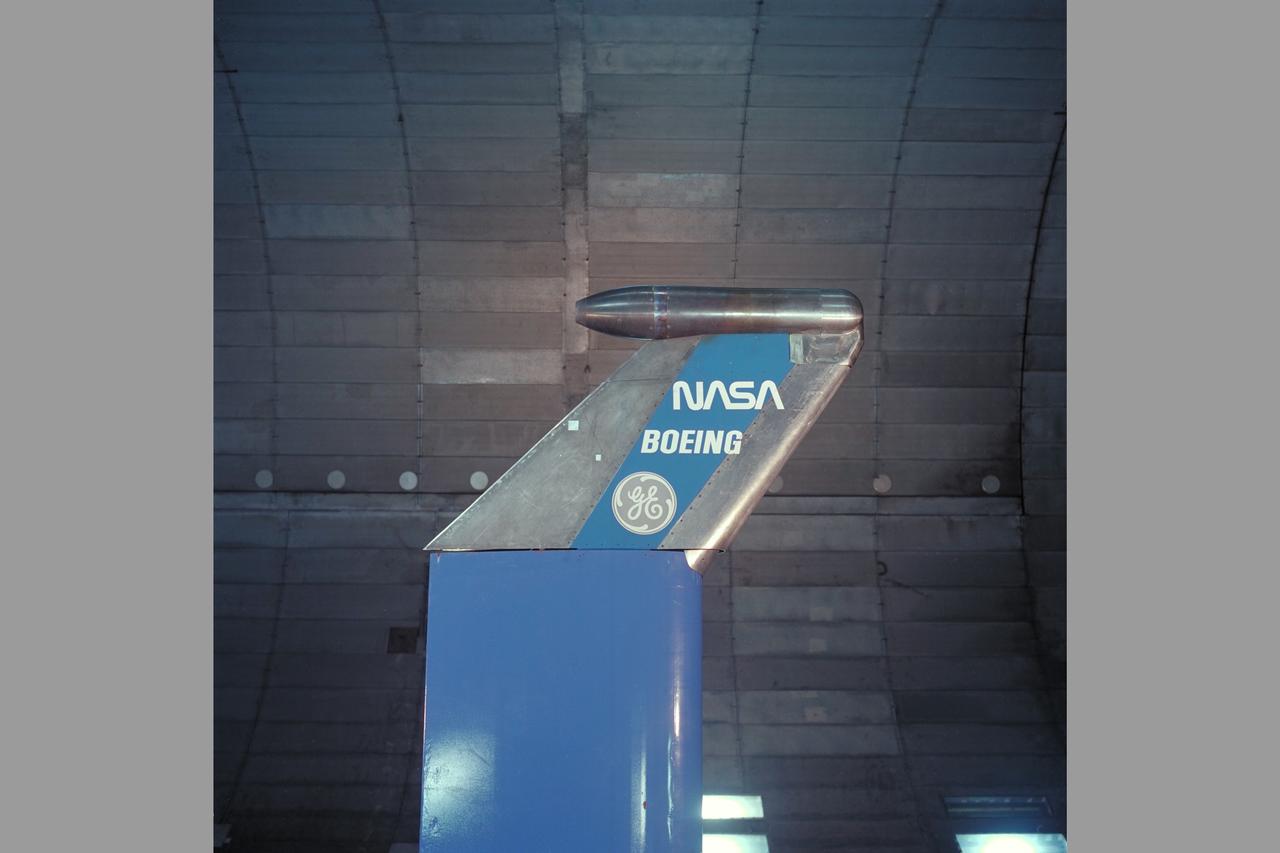
High Speed Research (HSR) Source Noise Test-592, 40x80ft w.t.
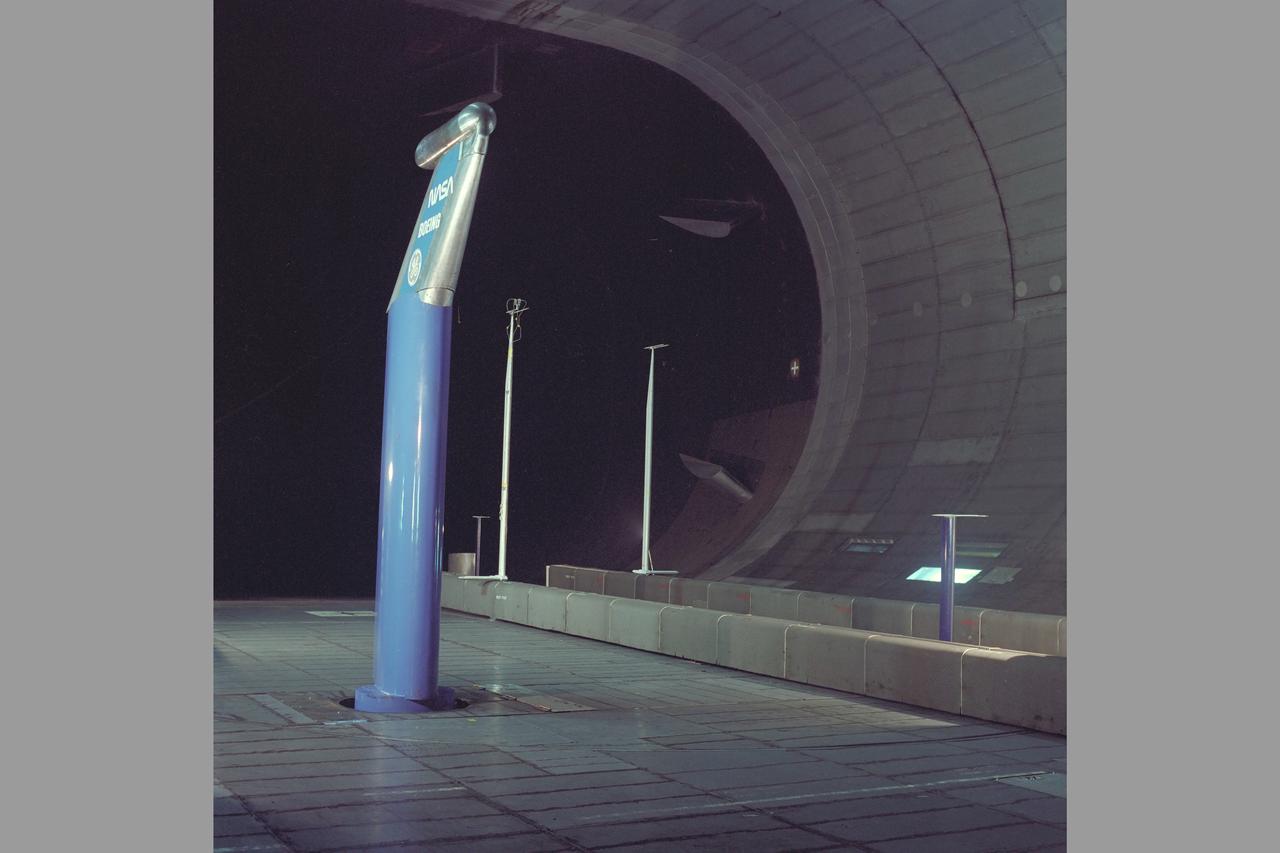
High Speed Research (HSR) Source Noise Test-592, 40x80ft w.t.
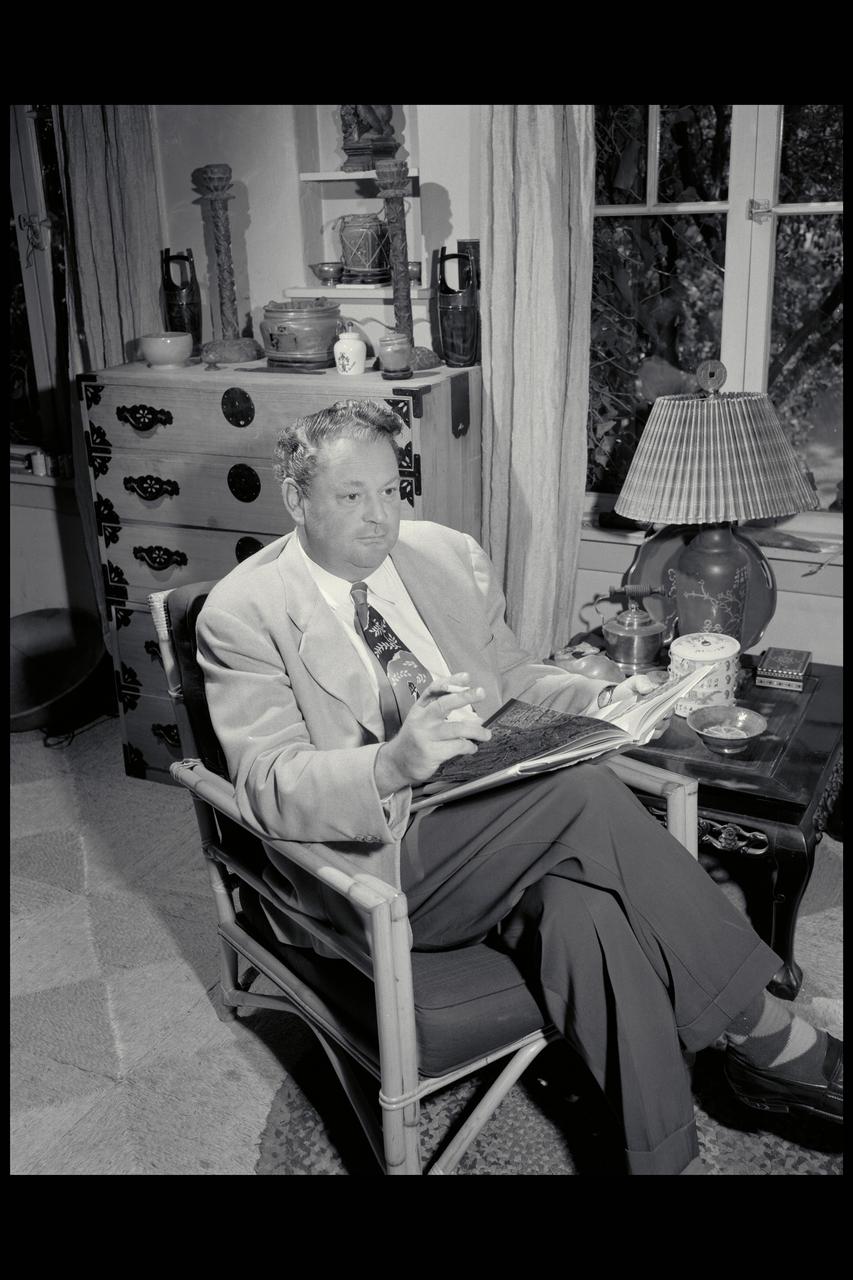
Harvey Allen, Chief of the High-Speed Research Division at NASA Ames Research Center, in his home.
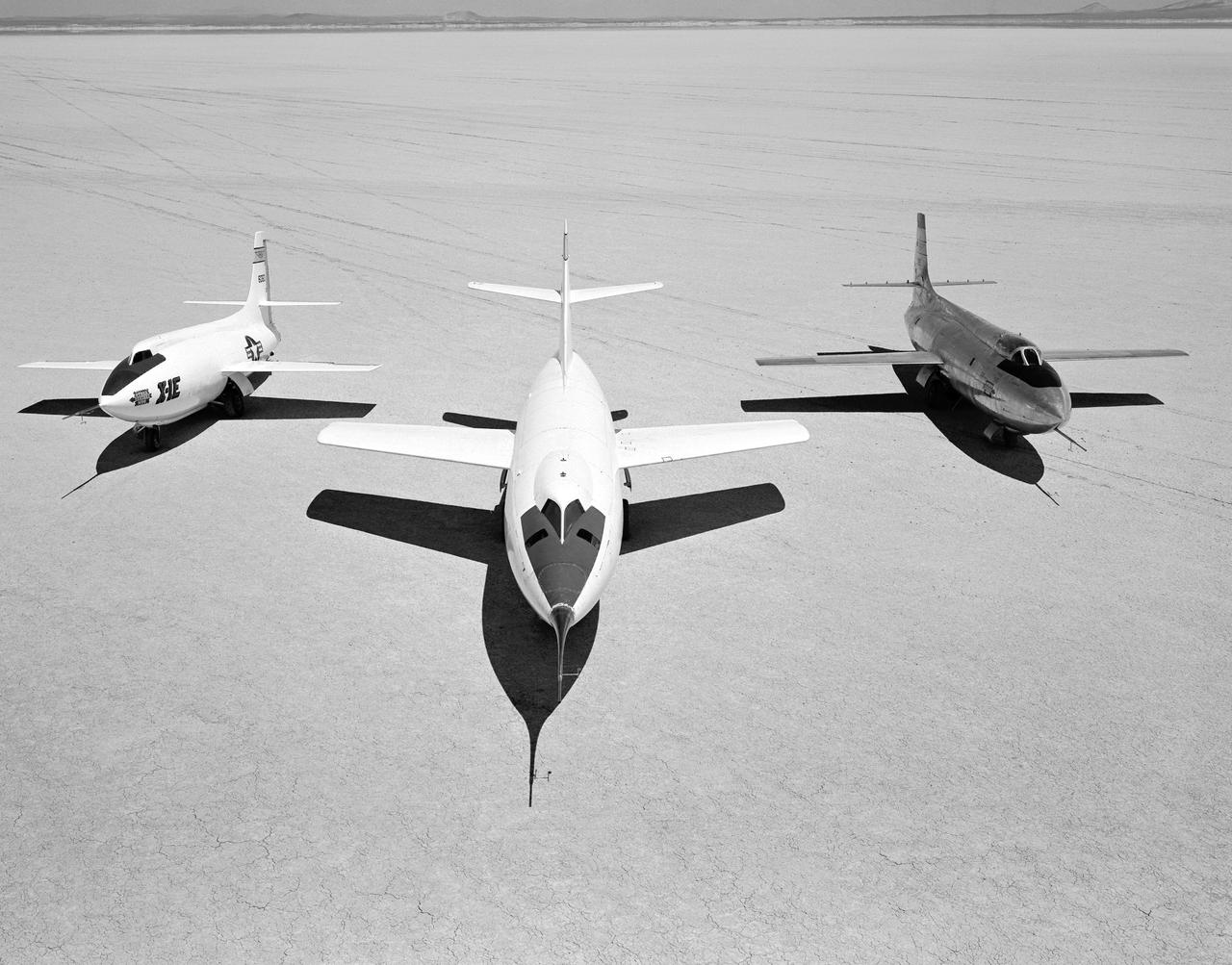
Early NACA research aircraft on the lakebed at the High Speed Research Station in 1955: Left to right: X-1E, D-558-II, X-1B
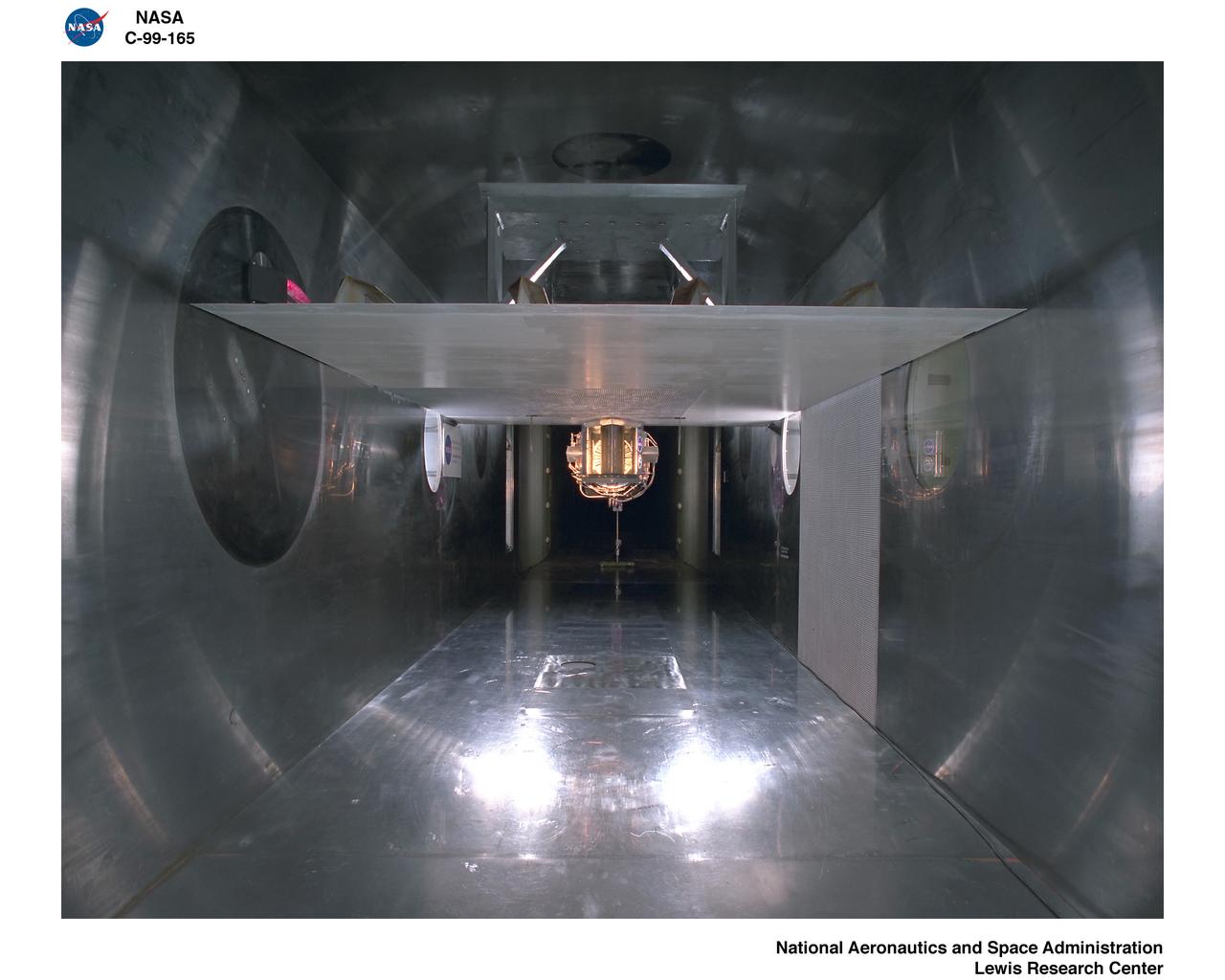
UNSTART PROGRAM - 10X10 FOOT SUPERSONIC WIND TUNNEL AS PART OF THE HIGH SPEED RESEARCH PROGRAM

UNSTART PROGRAM - 10X10 FOOT SUPERSONIC WIND TUNNEL AS PART OF THE HIGH SPEED RESEARCH PROGRAM
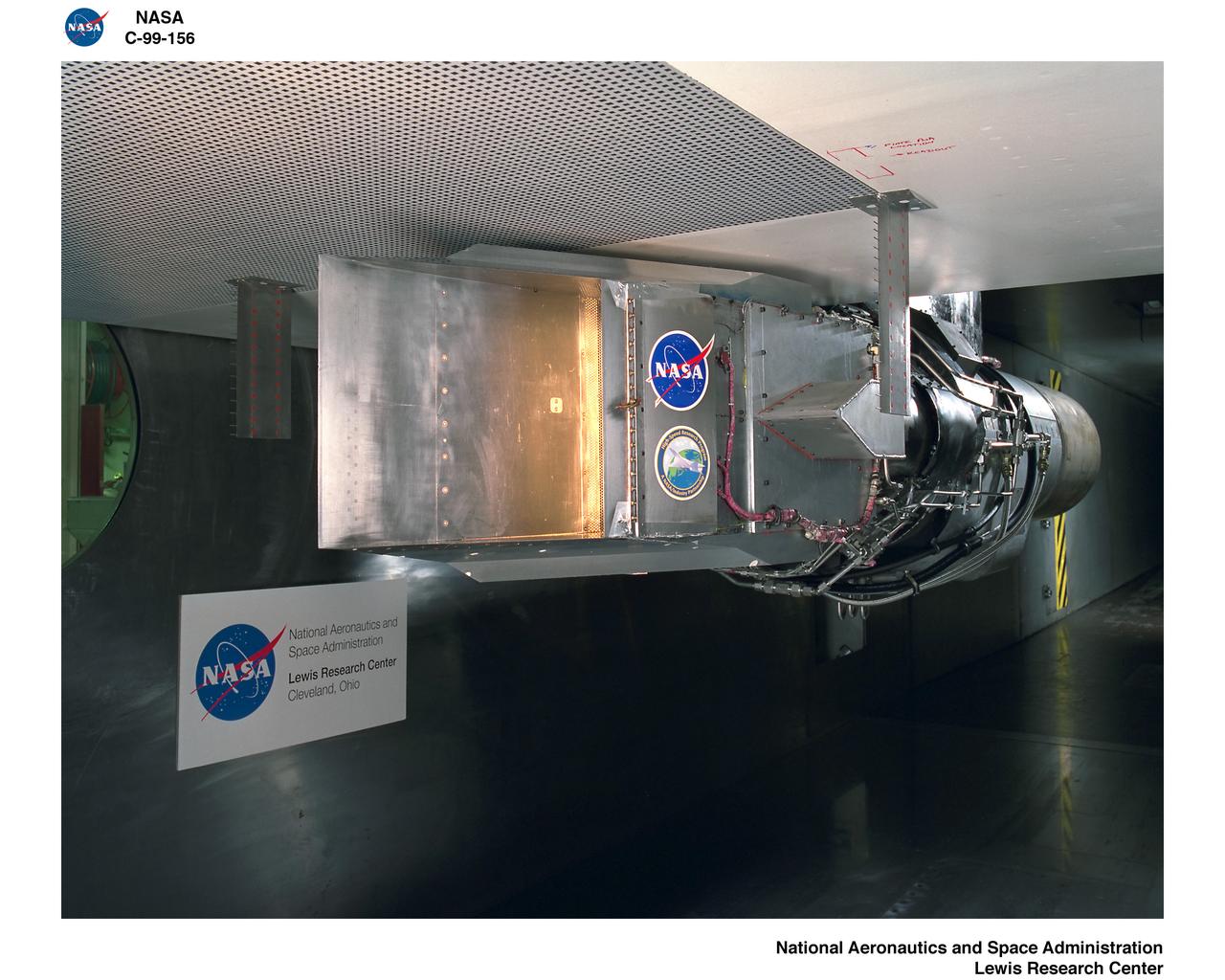
UNSTART PROGRAM - 10X10 FOOT SUPERSONIC WIND TUNNEL AS PART OF THE HIGH SPEED RESEARCH PROGRAM
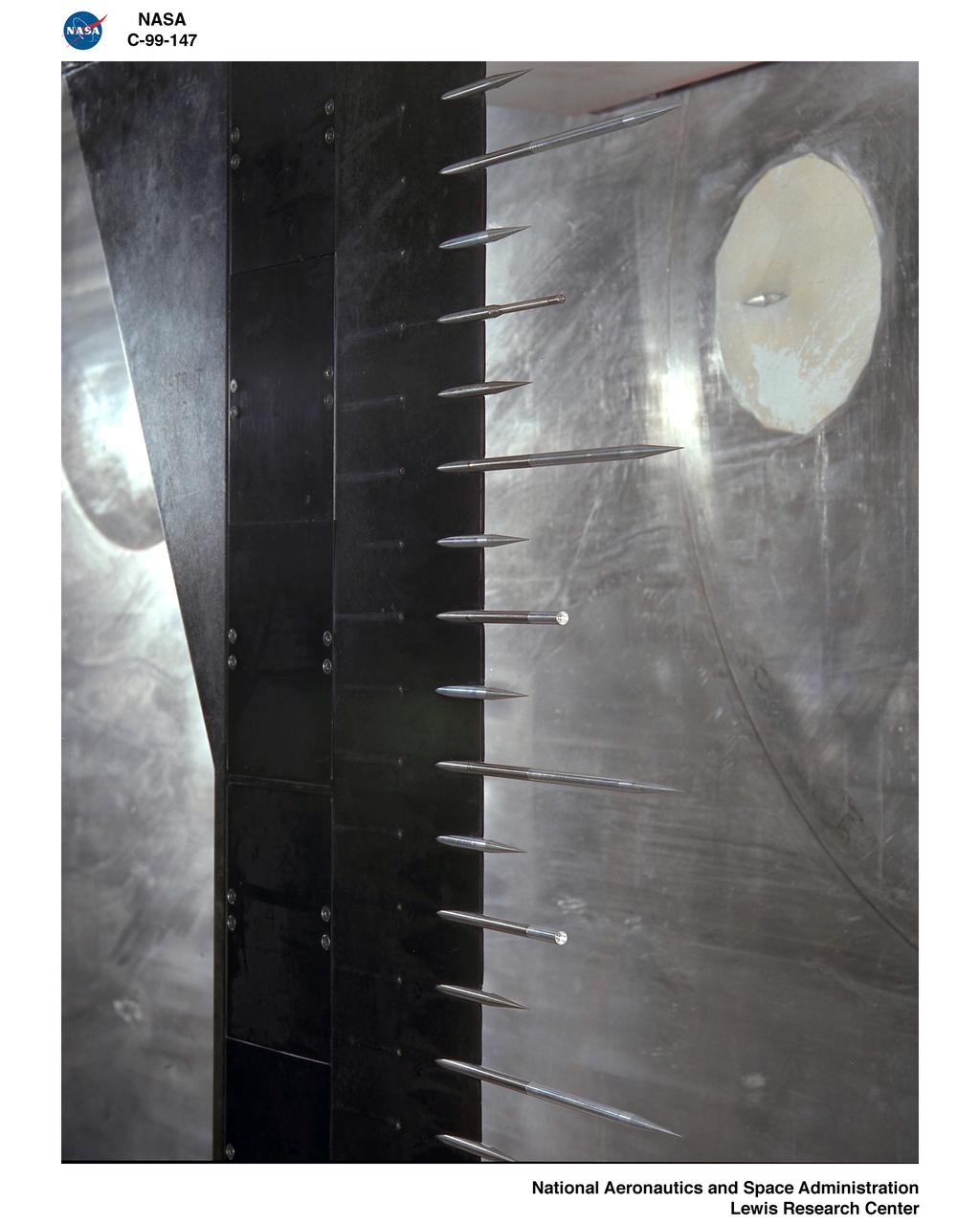
UNSTART PROGRAM - 10X10 FOOT SUPERSONIC WIND TUNNEL AS PART OF THE HIGH SPEED RESEARCH PROGRAM

UNSTART PROGRAM - 10X10 FOOT SUPERSONIC WIND TUNNEL AS PART OF THE HIGH SPEED RESEARCH PROGRAM
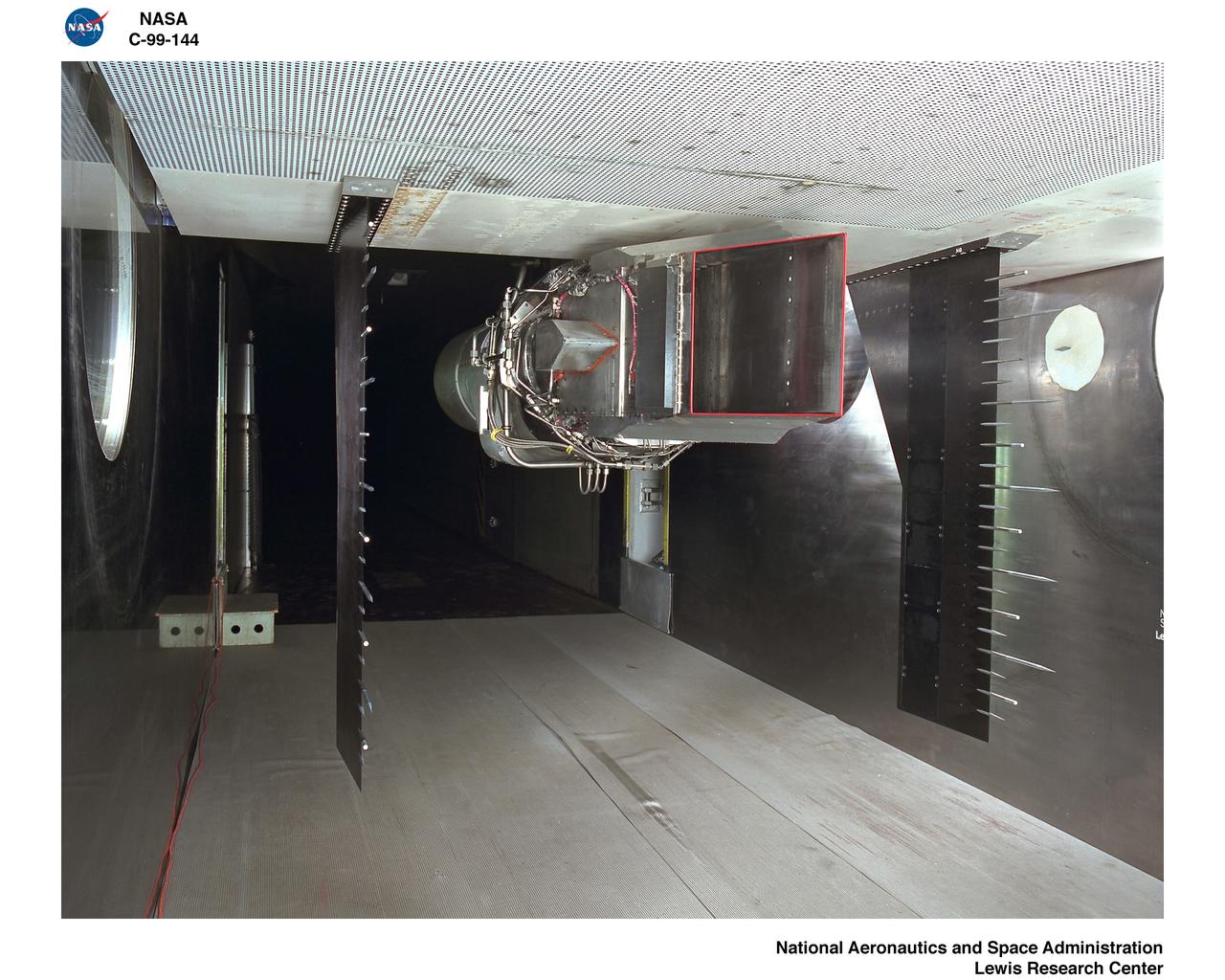
UNSTART PROGRAM - 10X10 FOOT SUPERSONIC WIND TUNNEL AS PART OF THE HIGH SPEED RESEARCH PROGRAM

UNSTART PROGRAM - 10X10 FOOT SUPERSONIC WIND TUNNEL AS PART OF THE HIGH SPEED RESEARCH PROGRAM
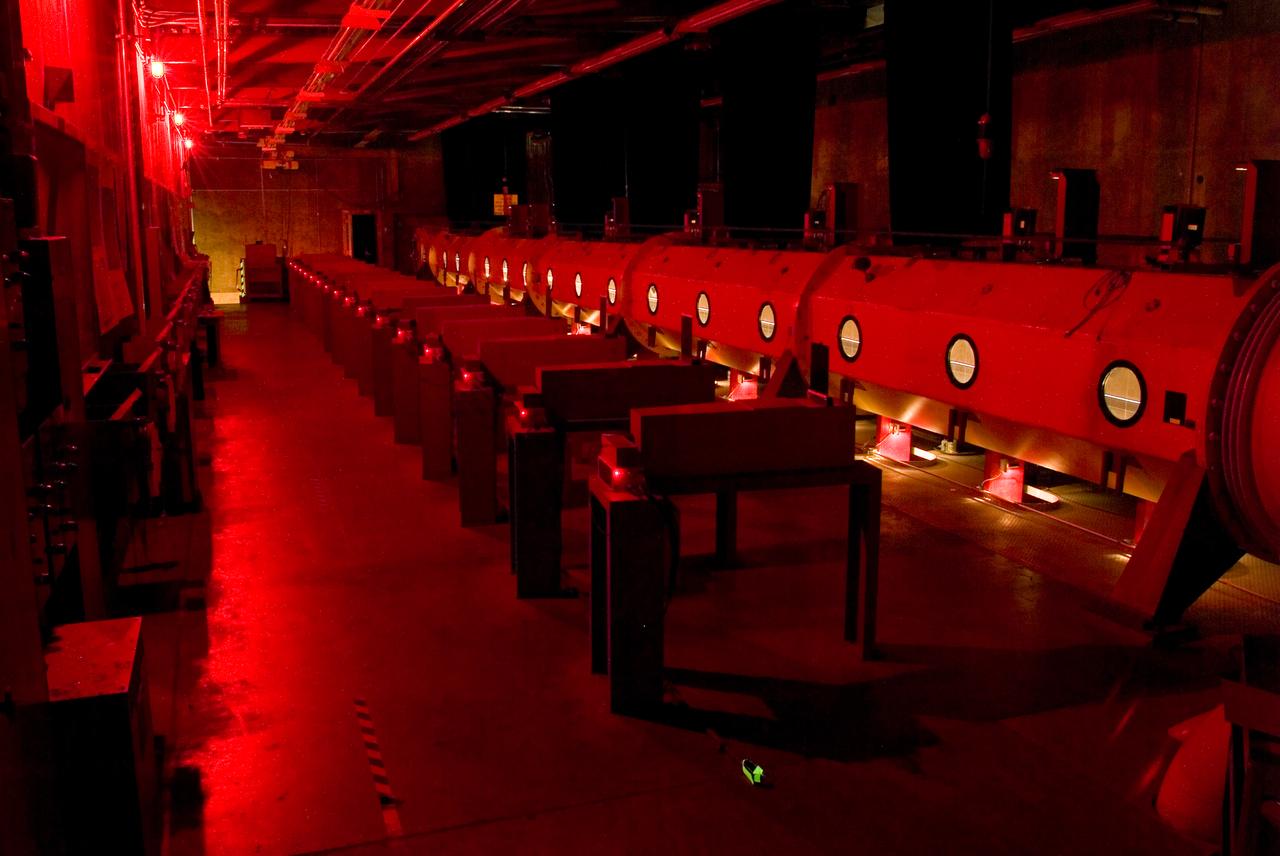
Ames Hypersonic Free Flight Aerodynamic Facility is used for research on gas dynamic problems of atmospheric entry. High relative speeds are achieved by launching models (in sabots if necessary) from high-speed guns into a countercurrent hypersonic air stream (14,000 ft/sec) driven by combustion-powered shock tube.
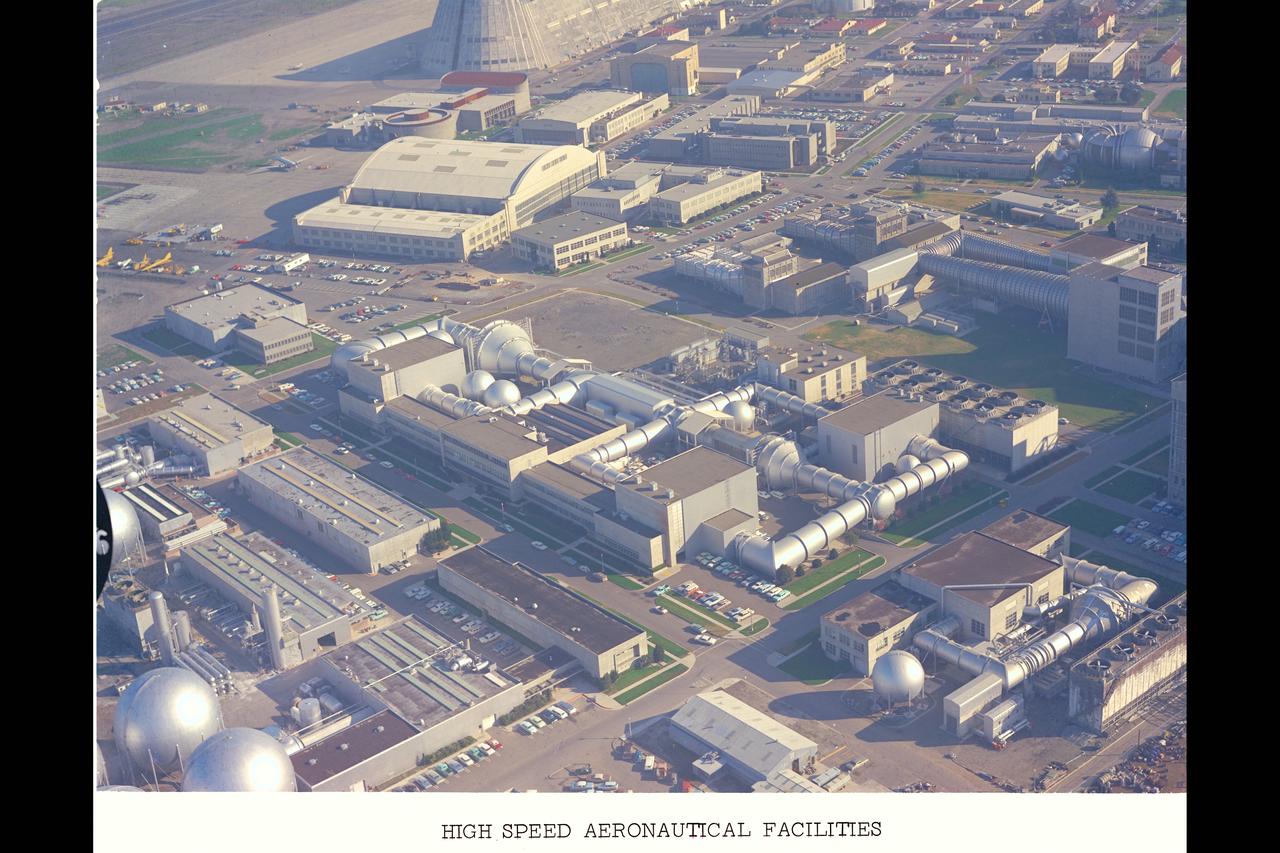
Aerial Survey of Ames Research Center centered on the Unitary Plan Wind Tunnel Complex and High Speed Aerodynamic Facilities (used in Bicentennial)
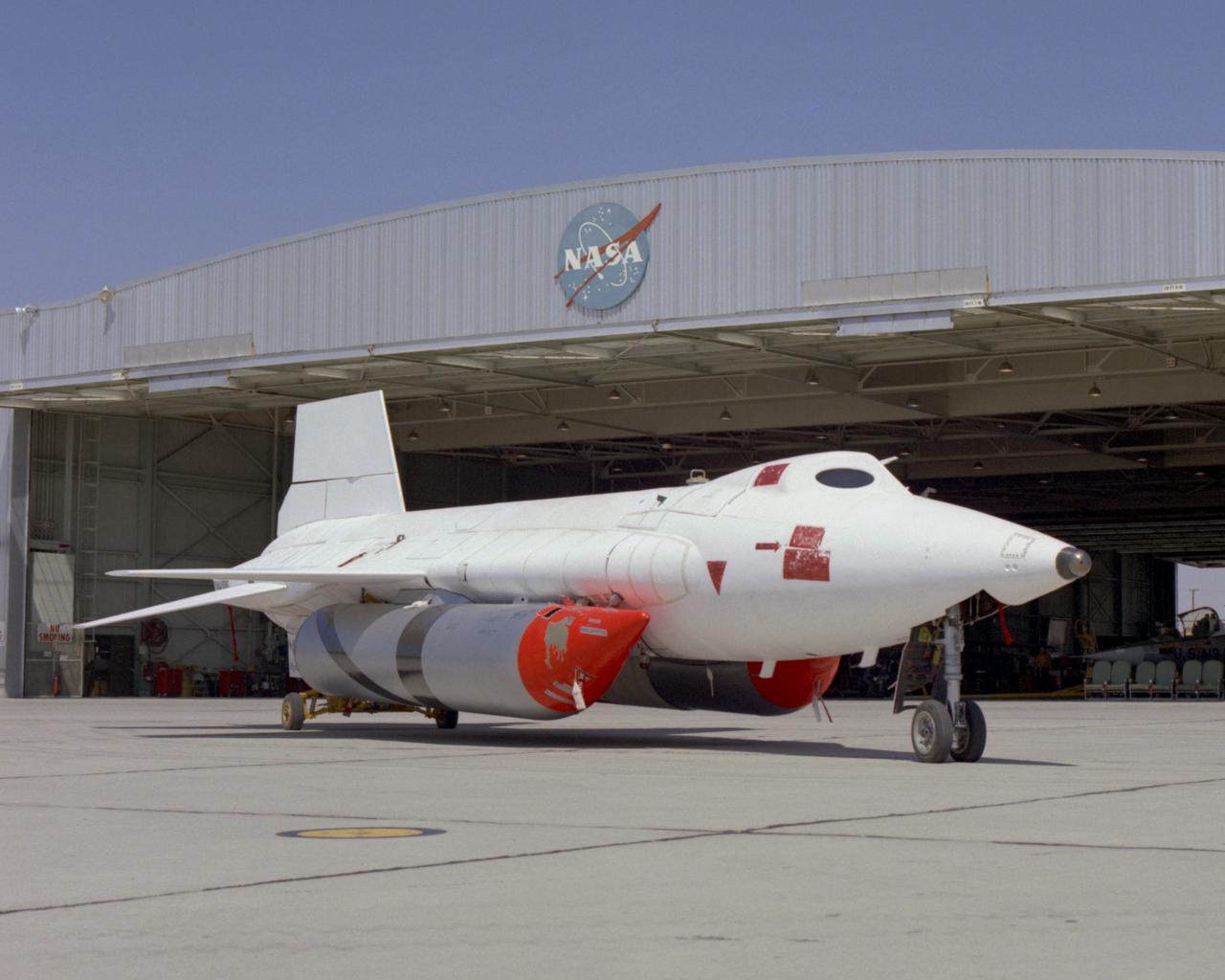
X-15A-2 with full scale ablative and external tanks installed parked in front of hangar. In June 1967, the X-15A-2 rocket-powered research aircraft received a full-scale ablative coating to protect the craft from the high temperatures associated with hypersonic flight (above Mach 5). This pink eraser-like substance, applied to the X-15A-2 aircraft (56-6671), was then covered with a white sealant coat before flight. This coating would help the #2 aircraft reach the record speed of 4,520 mph (Mach 6.7).
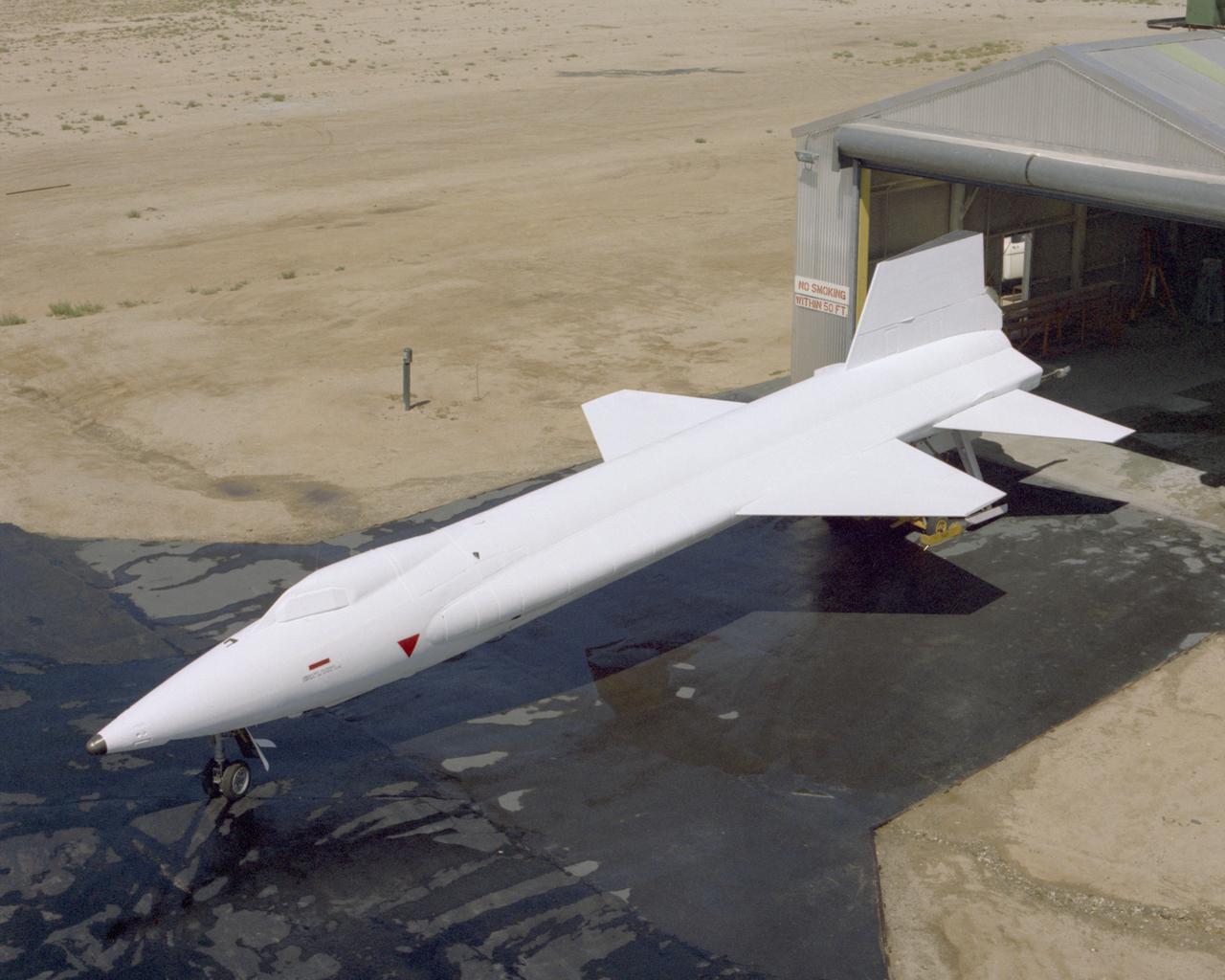
X-15A-2 is rolled out of the paint shop after having the full scale ablative applied. In June 1967, the X-15A-2 rocket-powered research aircraft received a full-scale ablative coating to protect the craft from the high temperatures associated with hypersonic flight (above Mach 5). This pink eraser-like substance, applied to the X-15A-2 aircraft (56-6671), was then covered with a white sealant coat before flight. This coating would help the #2 aircraft reach the record speed of 4,520 mph (Mach 6.7).
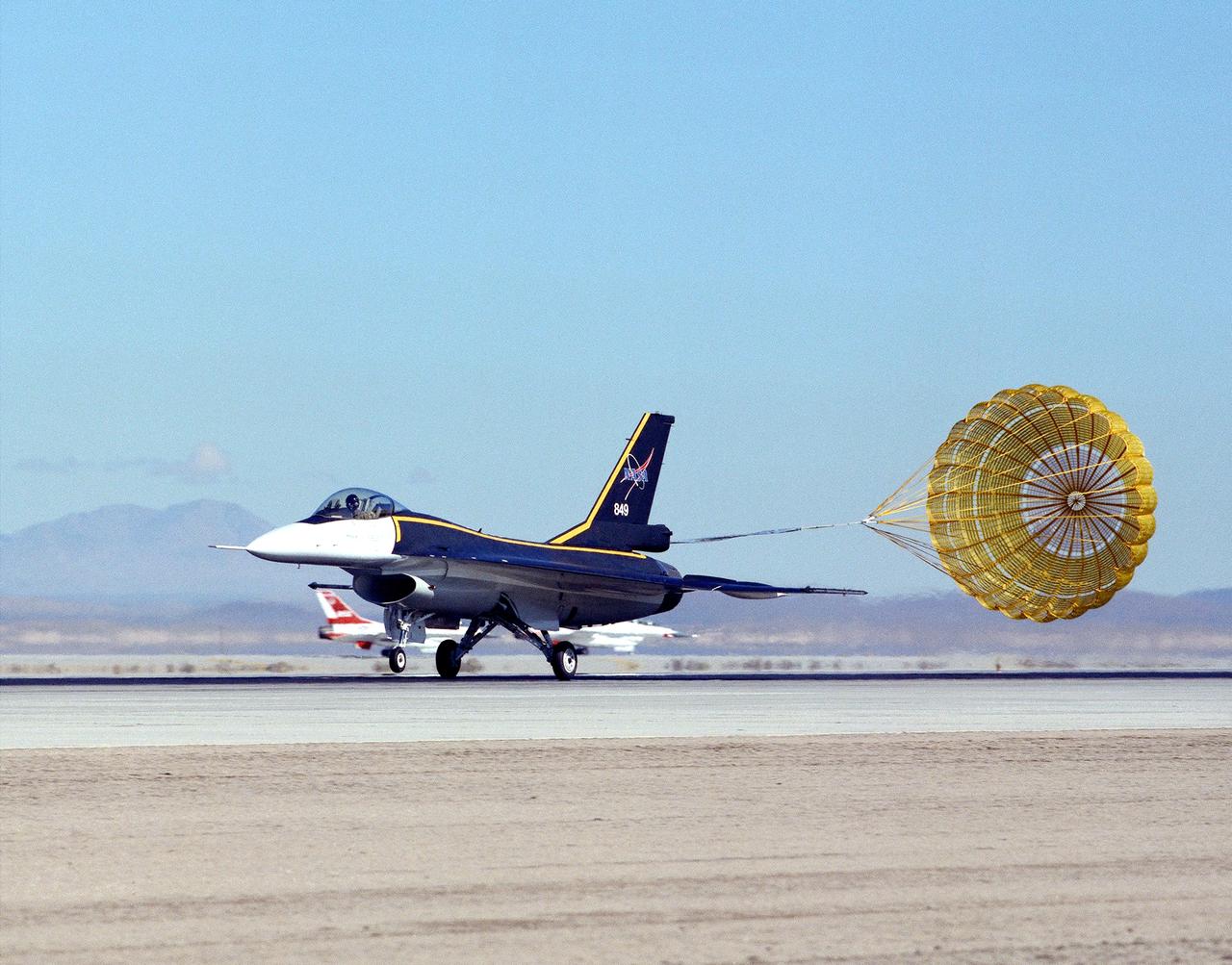
NASA's single-seat F-16XL makes a drag chute landing at the Dryden Flight Research Center, Edwards, California. The aircraft was most recently used in the Cranked-Arrow Wing Aerodynamics Project (CAWAP) to test boundary layer pressures and distribution. Previously it had been used in a program to investigate the characteristics of sonic booms for NASA's High Speed Research Program. Data from the program will be used in the development of a high speed civilian transport. During the series of sonic boom research flights, the F-16XL was used to probe the shock waves being generated by a NASA SR-71 and record their shape and intensity.

The Bell Aircraft Corporation X-1-2 aircraft on the ramp at NACA High Speed Flight Research Station located on the South Base of Muroc Army Air Field in 1947. The X-1-2 flew until October 23, 1951, completing 74 glide and powered flights with nine different pilots. The aircraft has white paint and the NACA tail band. The black Xs are reference markings for tracking purposes. They were widely used on NACA aircraft in the early 1950s.
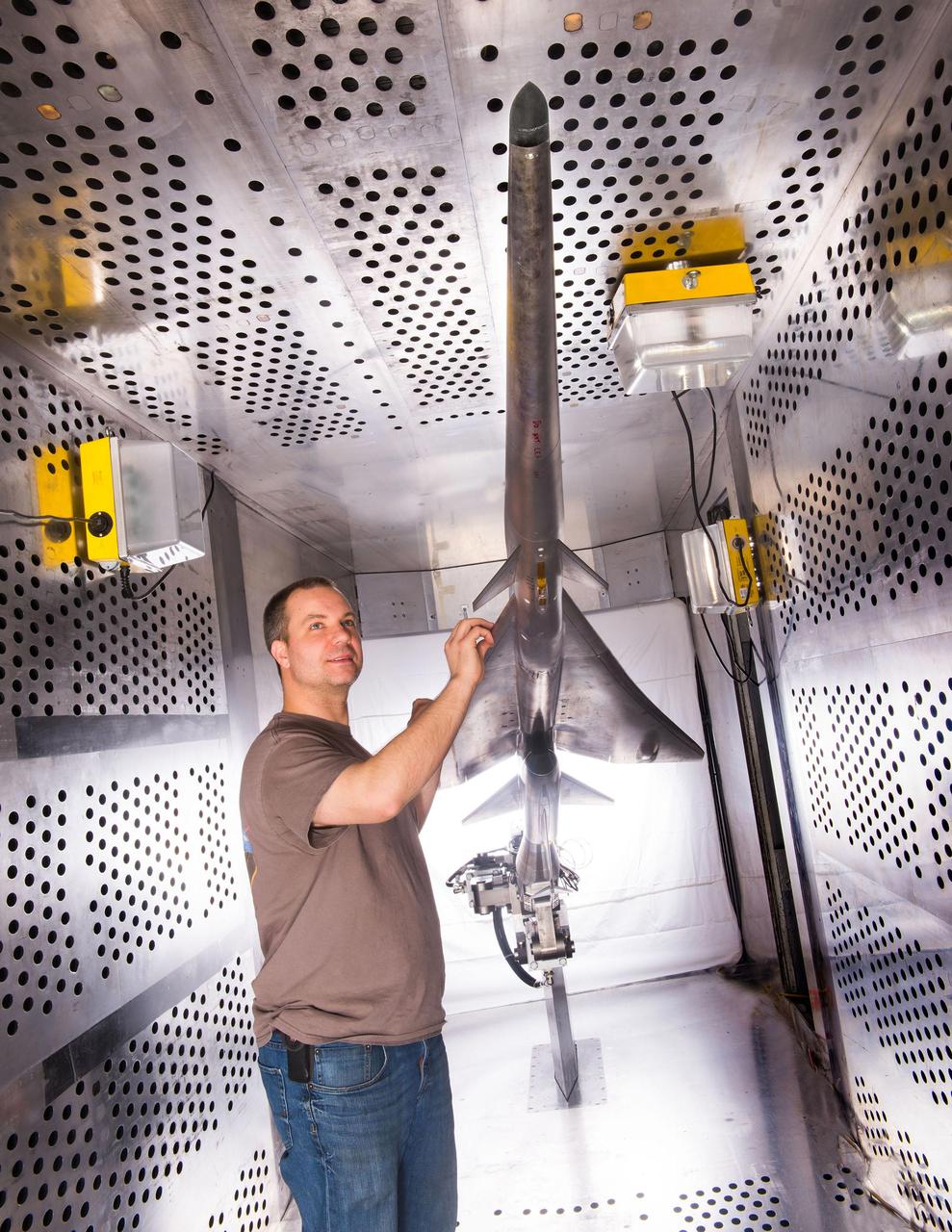
Mechanical technician Dan Pitts prepares a scale model of Lockheed Martin's Quiet Supersonic Technology (QueSST) X-plane preliminary design for its first high-speed wind tunnel tests at NASA's Glenn Research Center.
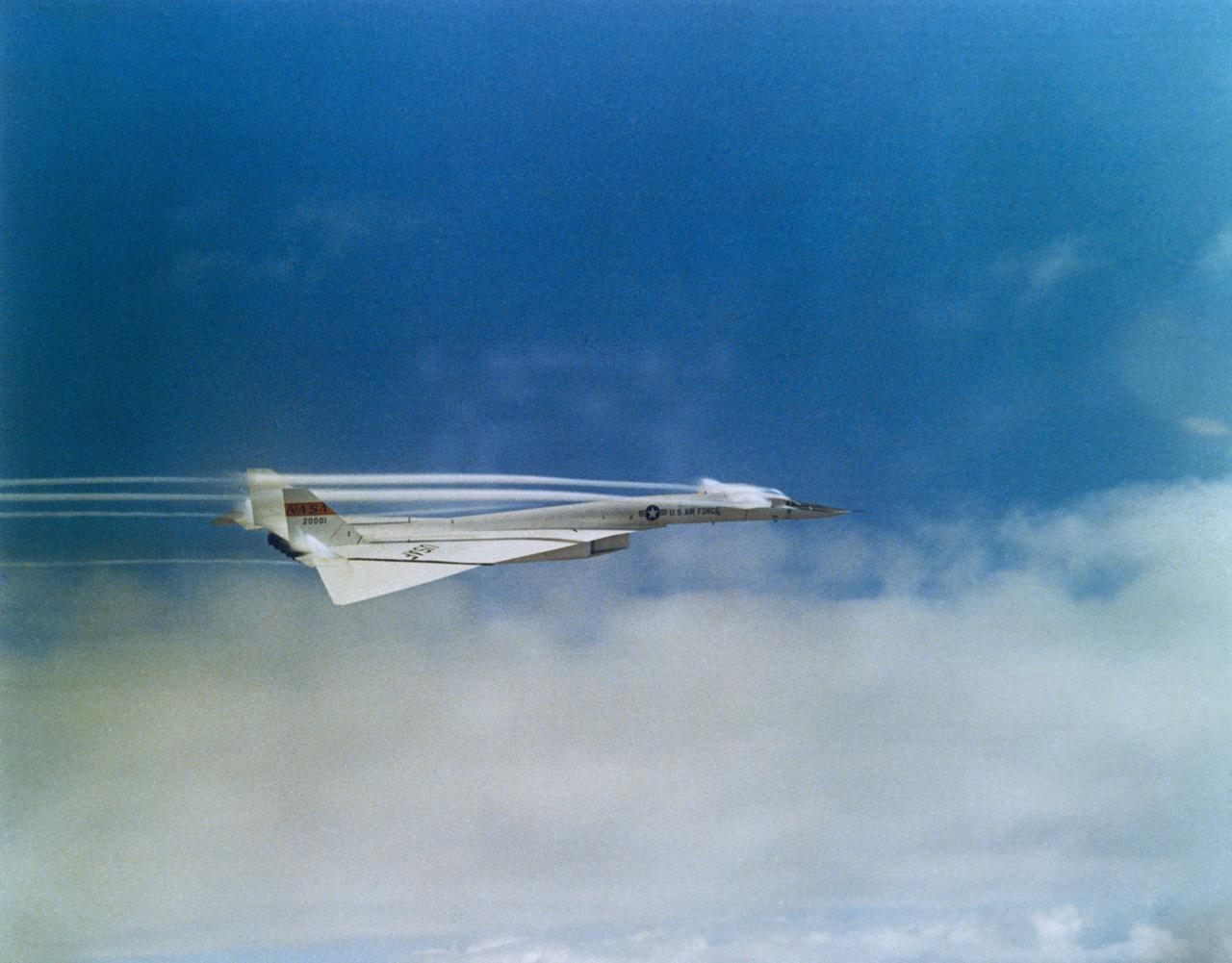
The North American Aviation XB-70 triple-sonic bomber prototype aircraft No. 1. NASA used the pre-production bomber for high-speed research in the mid-1960s.
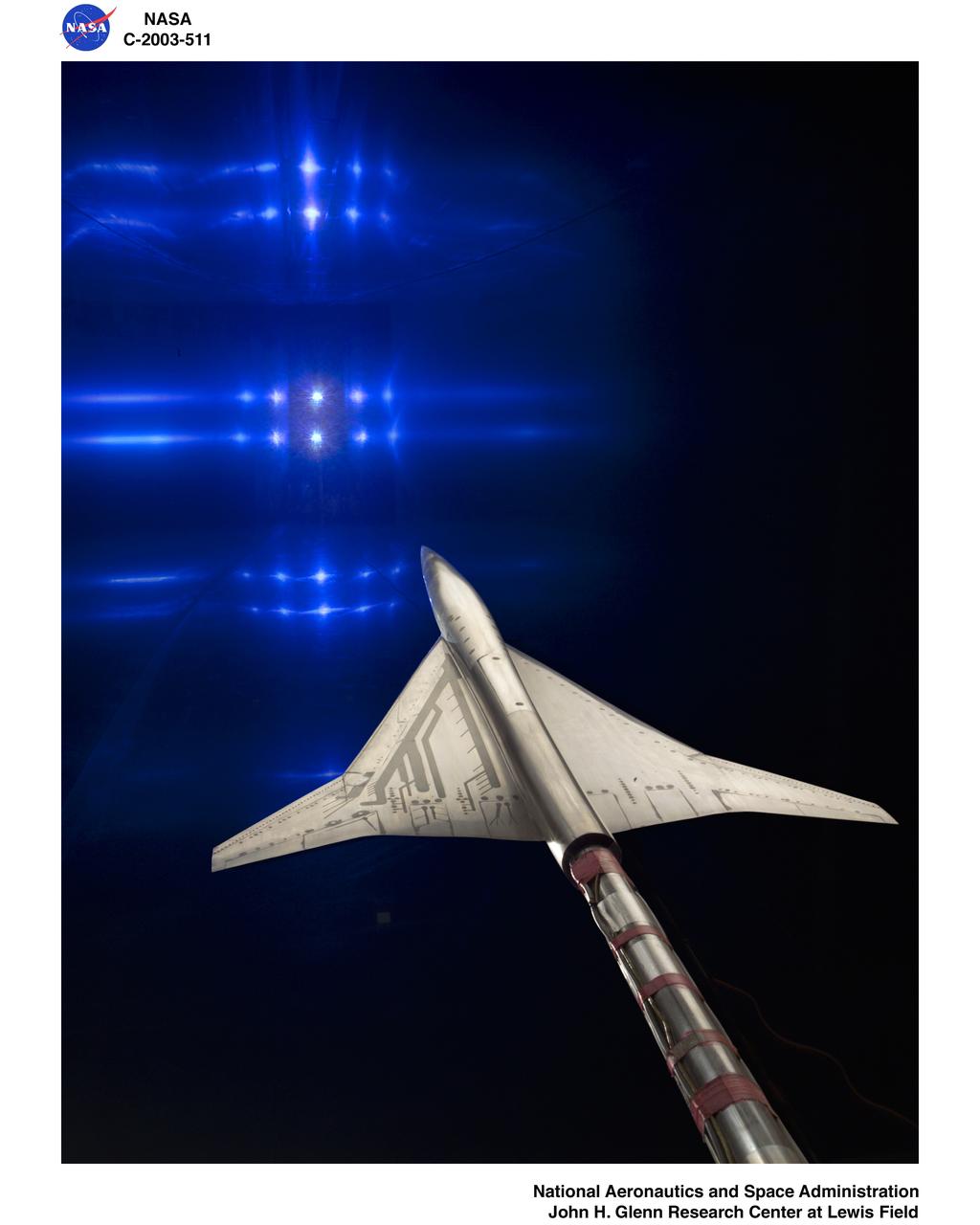
NASA GLENN/NASA LANGLEY LOADS COMPARISON TEST WITH 6 COMPONENT FORCE/MOMENT BALANCE AND 1.7% HIGH SPEED RESEARCH MODEL 5.l in the 10x10 supersonic wind tunnel
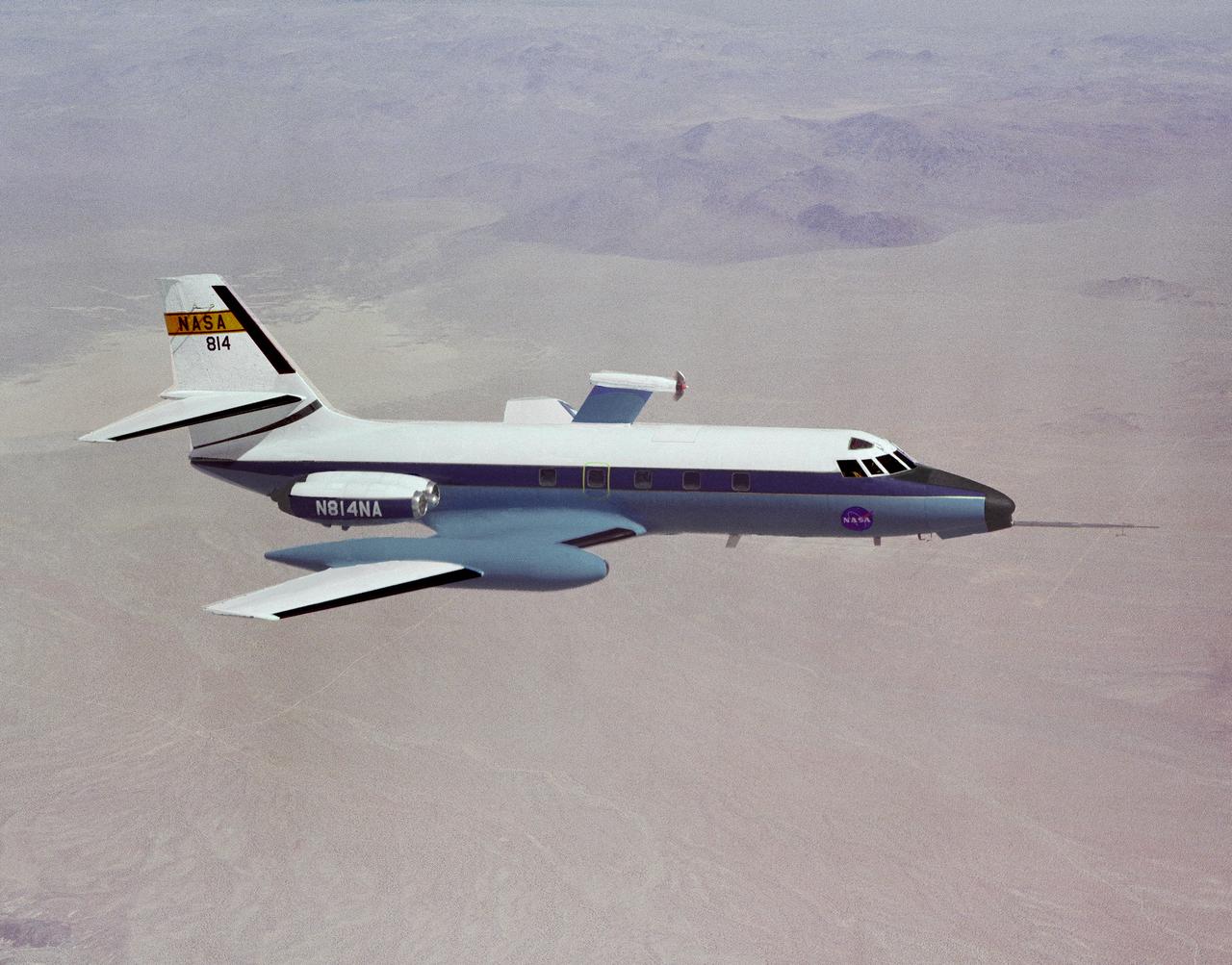
In this photograph, the C-140 JetStar is fitted with a model of a high-speed propeller. Three different designs were tested at NASA's Dryden Flight Research Facility in 1981-1982. Their swept-back blades were intended to increase the speed and fuel efficiency of turboprop aircraft. Speeds of Mach 0.8 were thought possible, while using 20 to 30 percent less fuel than standard jet engines.
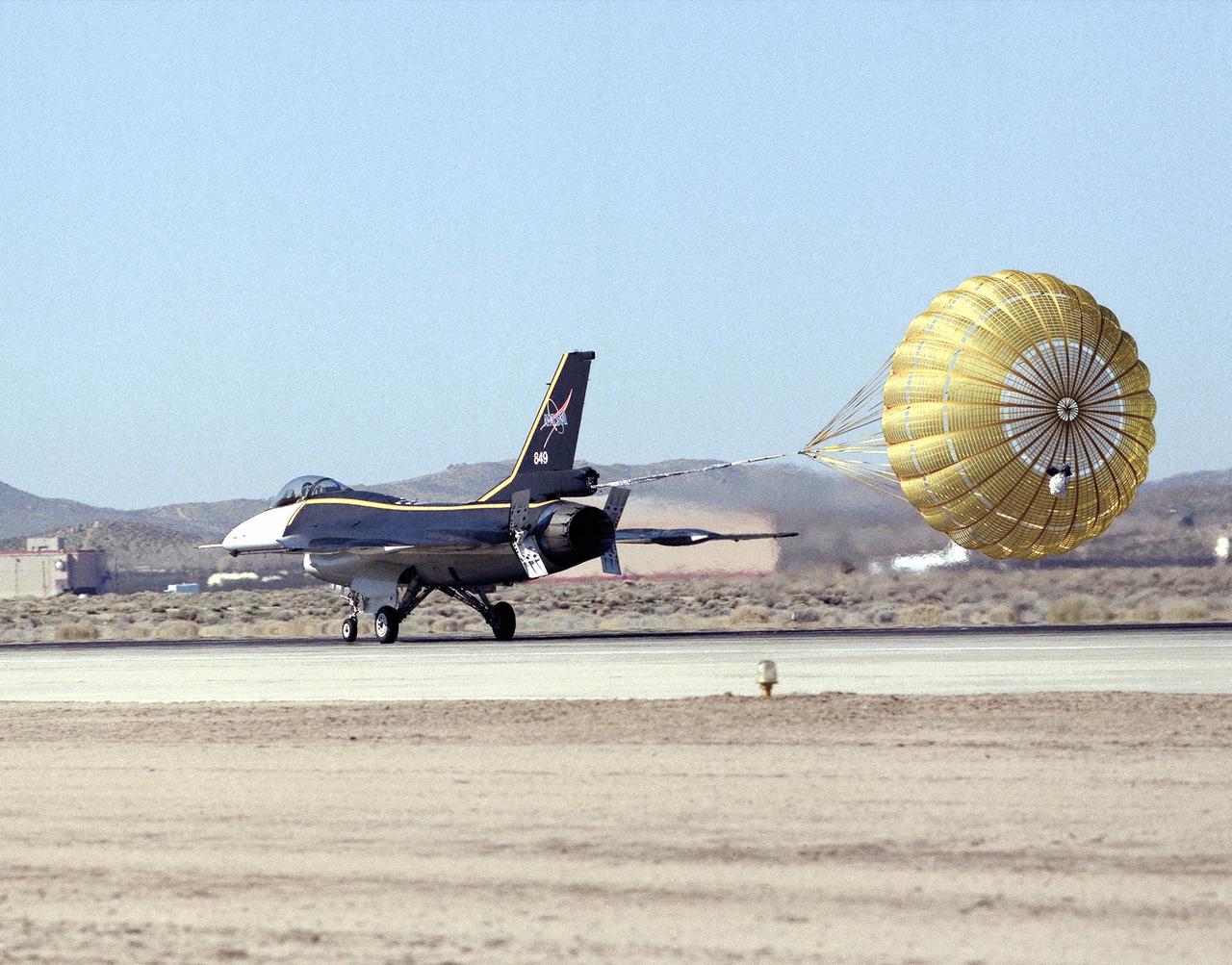
NASA's single-seat F-16XL makes a drag chute landing on the runway at Edwards Air Force Base in California's Mojave Desert. The aircraft was most recently used in the Cranked-Arrow Wing Aerodynamics Project (CAWAP) to test boundary layer pressures and distribution. Previously it had been used in a program to investigate the characteristics of sonic booms for NASA's High Speed Research Program. Data from the program will be used in the development of a high speed civilian transport. During the series of sonic boom research flights, the F-16XL was used to probe the shock waves being generated by a NASA SR-71 and record their shape and intensity.
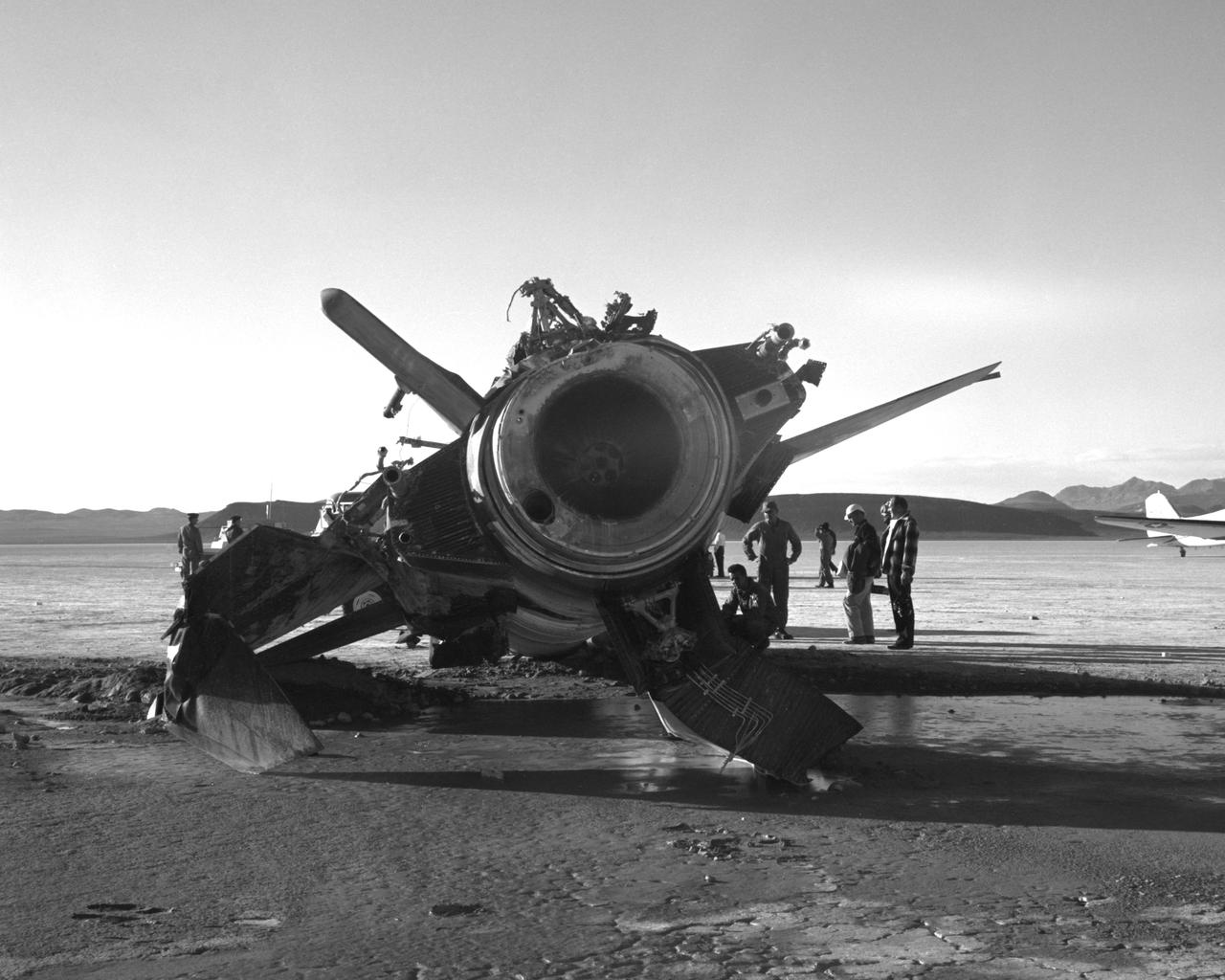
NASA research pilot Jack McKay was injured in a crash landing of the X-15 #2 on November 9, 1962. Following the launch from the B-52 to begin flight 2-31-52, he started the X-15's rocket engine, only to discover that it produced just 30 percent of its maximum thrust. He had to make a high-speed emergency landing on Mud Lake, NV, without flaps but with a significant amount of fuel still in the aircraft. As the X-15 slid across the lakebed, the left skid collapsed; the aircraft turned sideways and flipped onto its back. McKay suffered back injuries but was eventually able to resume X-15 pilot duties, making 22 more flights. The X-15 was sent back to North American Aviation and rebuilt into the X-15A-2.
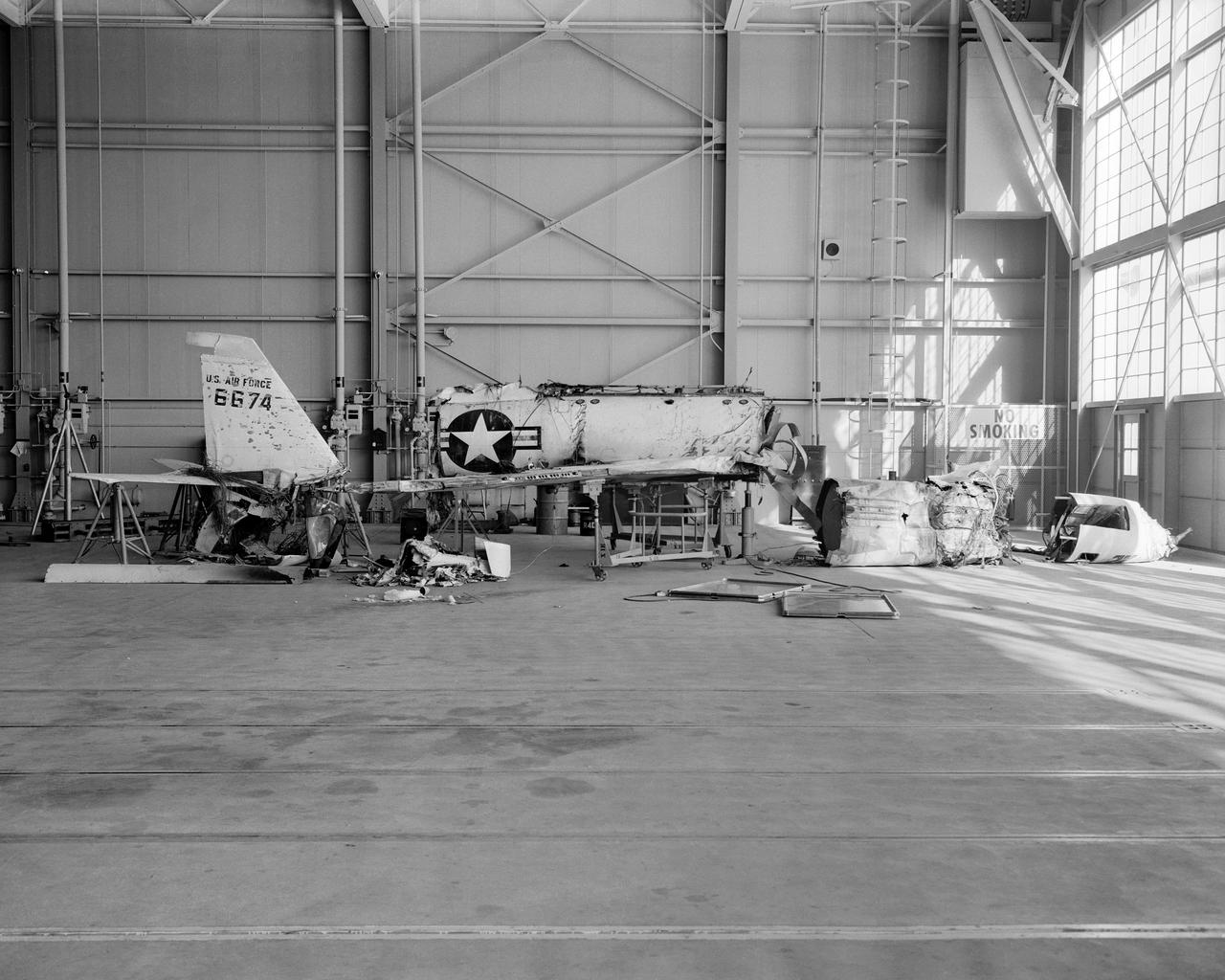
The X-2, initially an Air Force program, was scheduled to be transferred to the civilian National Advisory Committee for Aeronautics (NACA) for scientific research. The Air Force delayed turning the aircraft over to the NACA in the hope of attaining Mach 3 in the airplane. The service requested and received a two-month extension to qualify another Air Force test pilot, Capt. Miburn "Mel" Apt, in the X-2 and attempt to exceed Mach 3. After several ground briefings in the simulator, Apt (with no previous rocket plane experience) made his flight on 27 September 1956. Apt raced away from the B-50 under full power, quickly outdistancing the F-100 chase planes. At high altitude, he nosed over, accelerating rapidly. The X-2 reached Mach 3.2 (2,094 mph) at 65,000 feet. Apt became the first man to fly more than three times the speed of sound. Still above Mach 3, he began an abrupt turn back to Edwards. This maneuver proved fatal as the X-2 began a series of diverging rolls and tumbled out of control. Apt tried to regain control of the aircraft. Unable to do so, Apt separated the escape capsule. Too late, he attempted to bail out and was killed when the capsule impacted on the Edwards bombing range. The rest of the X-2 crashed five miles away. The wreckage of the X-2 rocket plane was later taken to NACA's High Speed Flight Station for analysis following the crash.

The X-1E research aircraft provides a striking view at the entrance of NASA's Dryden Flight Research Center, Edwards, California. The X-1E, one of the three original X-1 aircraft modified with a raised cockpit canopy and an ejection seat, was flown at the facility between 1953 and 1958 to investigate speeds at twice that of sound, and also to evaluate a thin wing designed for high-speed flight. The Dryden complex was originally established in 1946 as a small high-speed flight station to support the X-1 program. The X-1 was the first aircraft to fly at supersonic speeds. The main administrative building is to the rear of the X-1E and is the center of a research installation that has grown to more than 450 government employees and nearly 400 civilian contractors. Located on the northwest "shore" of Rogers Dry Lake, the Dryden Center was built around the original administrative-hangar building constructed in 1954 at a cost of $3.8 million. Since then many additional support and operational facilities have been built including a number of unique test facilities such as the Thermalstructures Research Facility, Flow Visualization Facility, and the newest addition, the Integrated Test Facility.
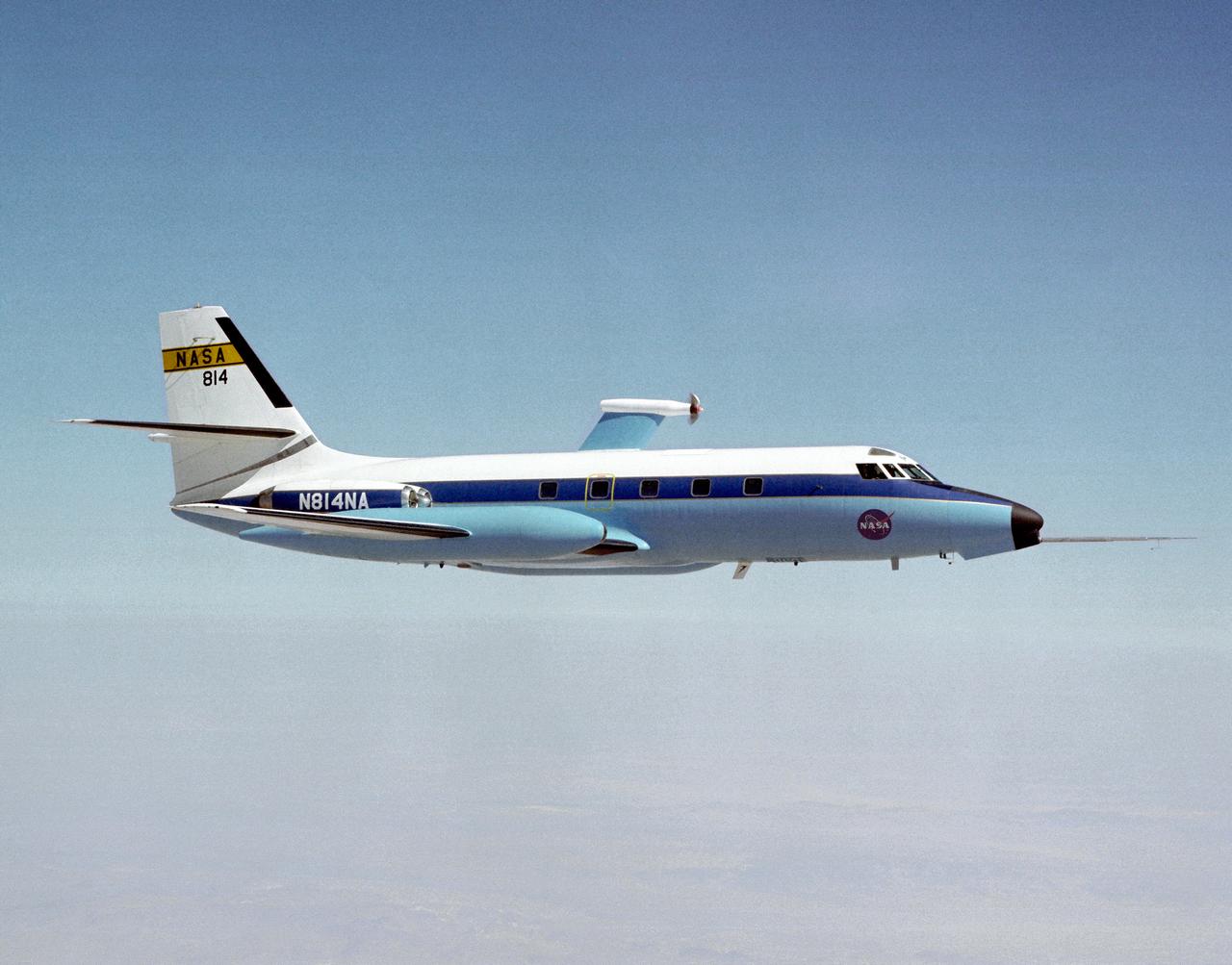
The Dryden C-140 JetStar during testing of advanced propfan designs. Dryden conducted flight research in 1981-1982 on several designs. The technology was developed under the direction of the Lewis Research Center (today the Glenn Research Center, Cleveland, OH) under the Advanced Turboprop Program. Under that program, Langley Research Center in Virginia oversaw work on accoustics and noise reduction. These efforts were intended to develop a high-speed and fuel-efficient turboprop system.
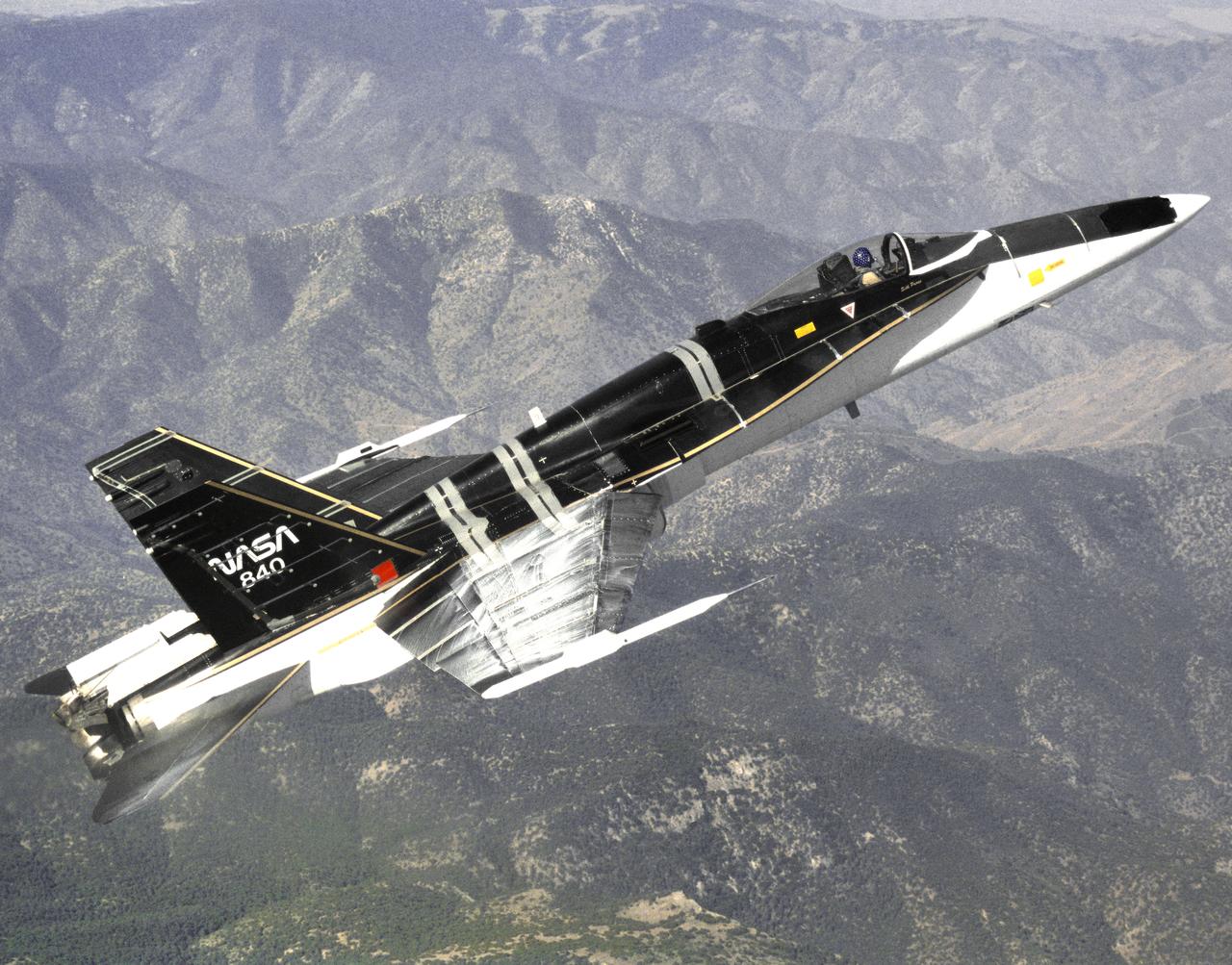
The modified F-18 High Alpha Research Vehicle (HARV) carries out air flow studies on a flight from the Dryden Flight Research Center, Edwards, California. Using oil, researchers were able to track the air flow across the wing at different speeds and angles of attack. A thrust vectoring system had been installed on the engines' exhaust nozzles for the high angle of attack research program. The thrust vectoring system, linked to the aircraft's flight control system, moves a set of three paddles on each engine to redirect thrust for directional control and increased maneuverability at angles of attack at up to 70 degrees.
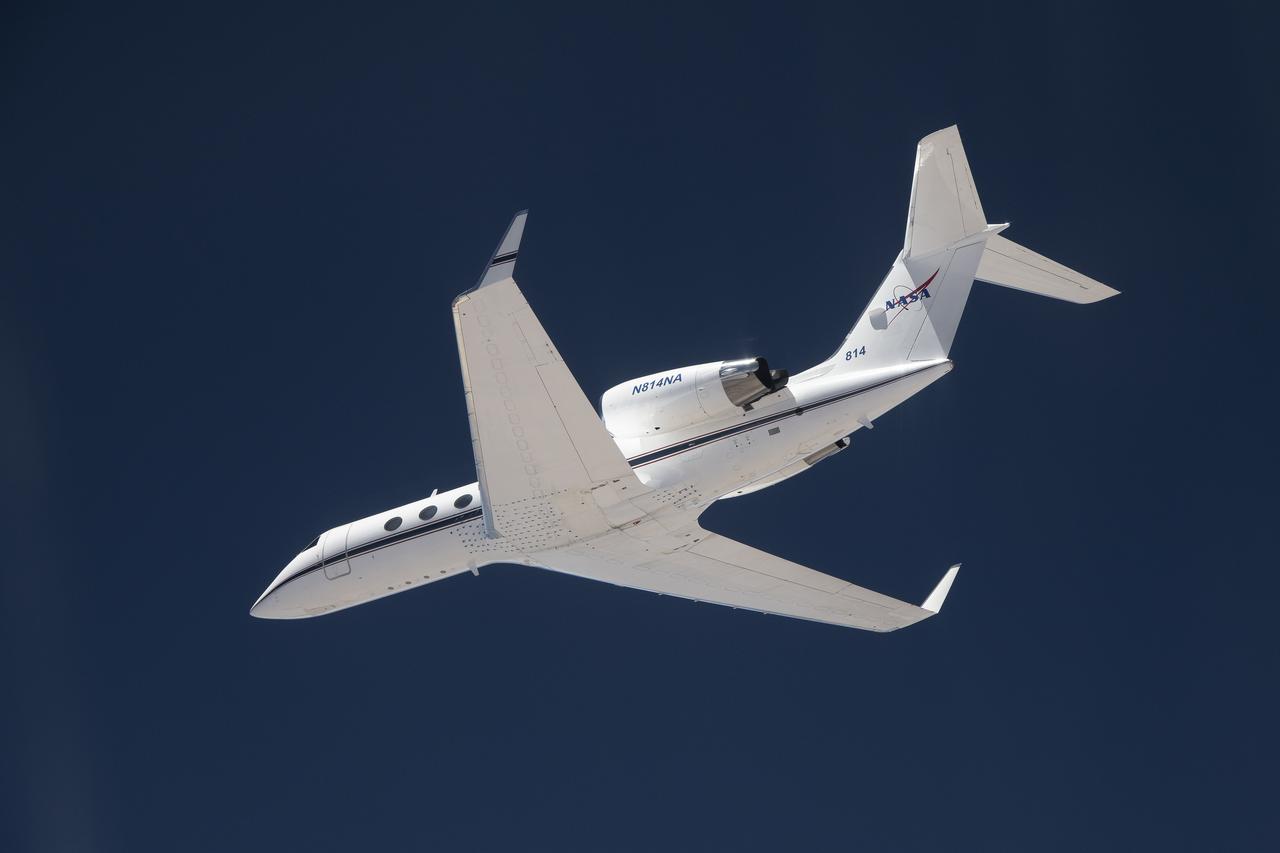
The G-IV aircraft flies overhead in the Mojave Desert near NASA’s Armstrong Flight Research Center in Edwards, California. Baseline flights like this one occurred in June 2024, and future flights in service of science research will benefit from the installment of the Soxnav navigational system, developed in collaboration with NASA’s Jet Propulsion Laboratory in Southern California and the Bay Area Environmental Research Institute in California’s Silicon Valley. This navigational system provides precise, economical aircraft guidance for a variety of aircraft types moving at high speeds.
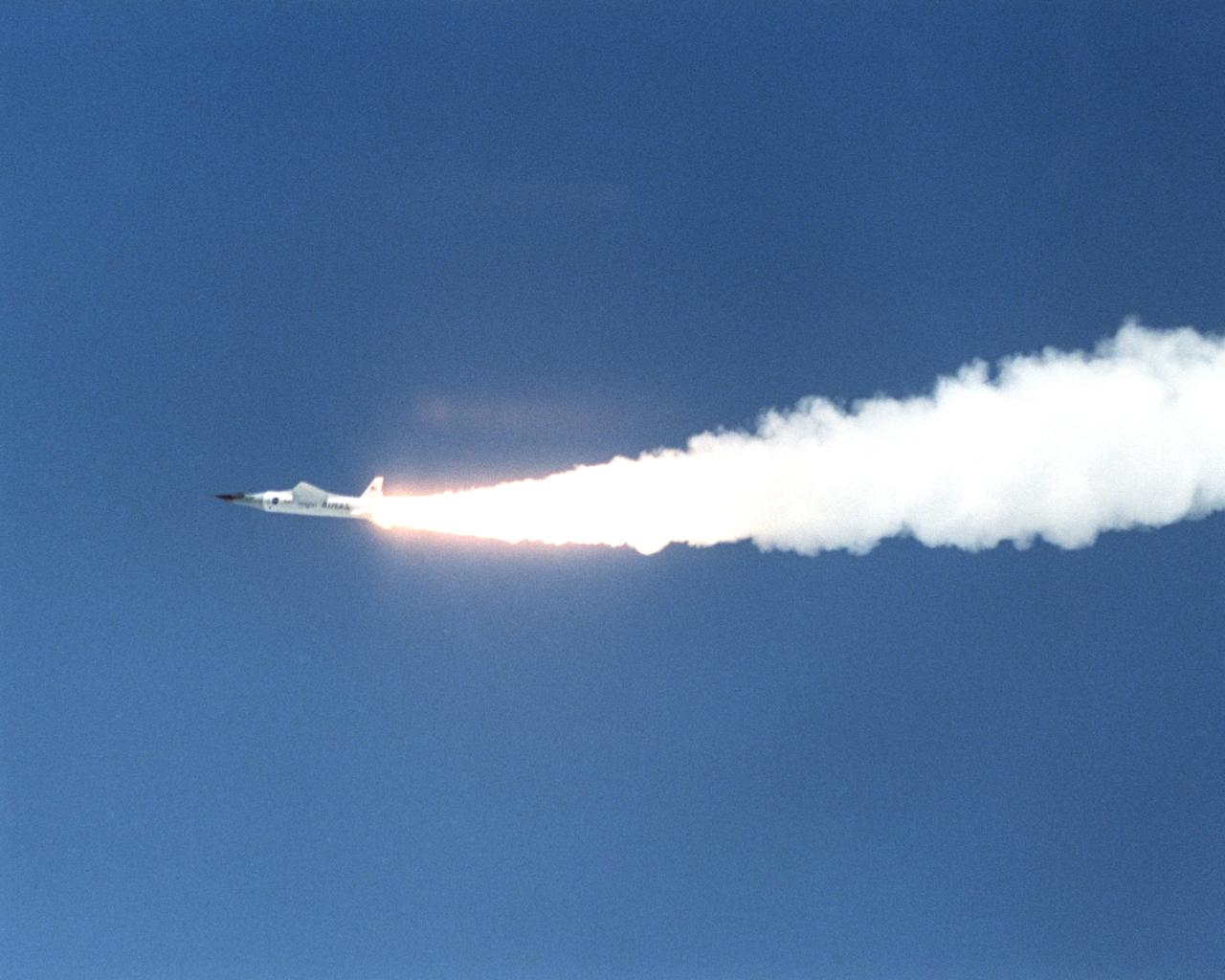
The first X-43A hypersonic research aircraft and its modified Pegasus booster rocket were carried aloft by NASA's NB-52B carrier aircraft from Dryden Flight Research Center at Edwards Air Force Base, Calif., on June 2, 2001 for the first of three high-speed free flight attempts. About an hour and 15 minutes later the Pegasus booster was released from the B-52 to accelerate the X-43A to its intended speed of Mach 7. Before this could be achieved, the combined Pegasus and X-43A "stack" lost control about eight seconds after ignition of the Pegasus rocket motor. The mission was terminated and explosive charges ensured the Pegasus and X-43A fell into the Pacific Ocean in a cleared Navy range area. A NASA investigation board is being assembled to determine the cause of the incident. Work continues on two other X-43A vehicles, the first of which could fly by late 2001. Central to the X-43A program is its integration of an air-breathing "scramjet" engine that could enable a variety of high-speed aerospace craft, and promote cost-effective access to space. The 12-foot, unpiloted research vehicle was developed and built for NASA by MicroCraft Inc., Tullahoma, Tenn. The booster was built by Orbital Sciences Corp. at Chandler, Ariz.

The first X-43A hypersonic research aircraft and its modified Pegasus booster rocket were carried aloft by NASA's NB-52B carrier aircraft from Dryden Flight Research Center at Edwards Air Force Base, Calif., on June 2, 2001 for the first of three high-speed free flight attempts. About an hour and 15 minutes later the Pegasus booster was released from the B-52 to accelerate the X-43A to its intended speed of Mach 7. Before this could be achieved, the combined Pegasus and X-43A "stack" lost control about eight seconds after ignition of the Pegasus rocket motor. The mission was terminated and explosive charges ensured the Pegasus and X-43A fell into the Pacific Ocean in a cleared Navy range area. A NASA investigation board is being assembled to determine the cause of the incident. Work continues on two other X-43A vehicles, the first of which could fly by late 2001. Central to the X-43A program is its integration of an air-breathing "scramjet" engine that could enable a variety of high-speed aerospace craft, and promote cost-effective access to space. The 12-foot, unpiloted research vehicle was developed and built for NASA by MicroCraft Inc., Tullahoma, Tenn. The booster was built by Orbital Sciences Corp. at Chandler, Ariz.
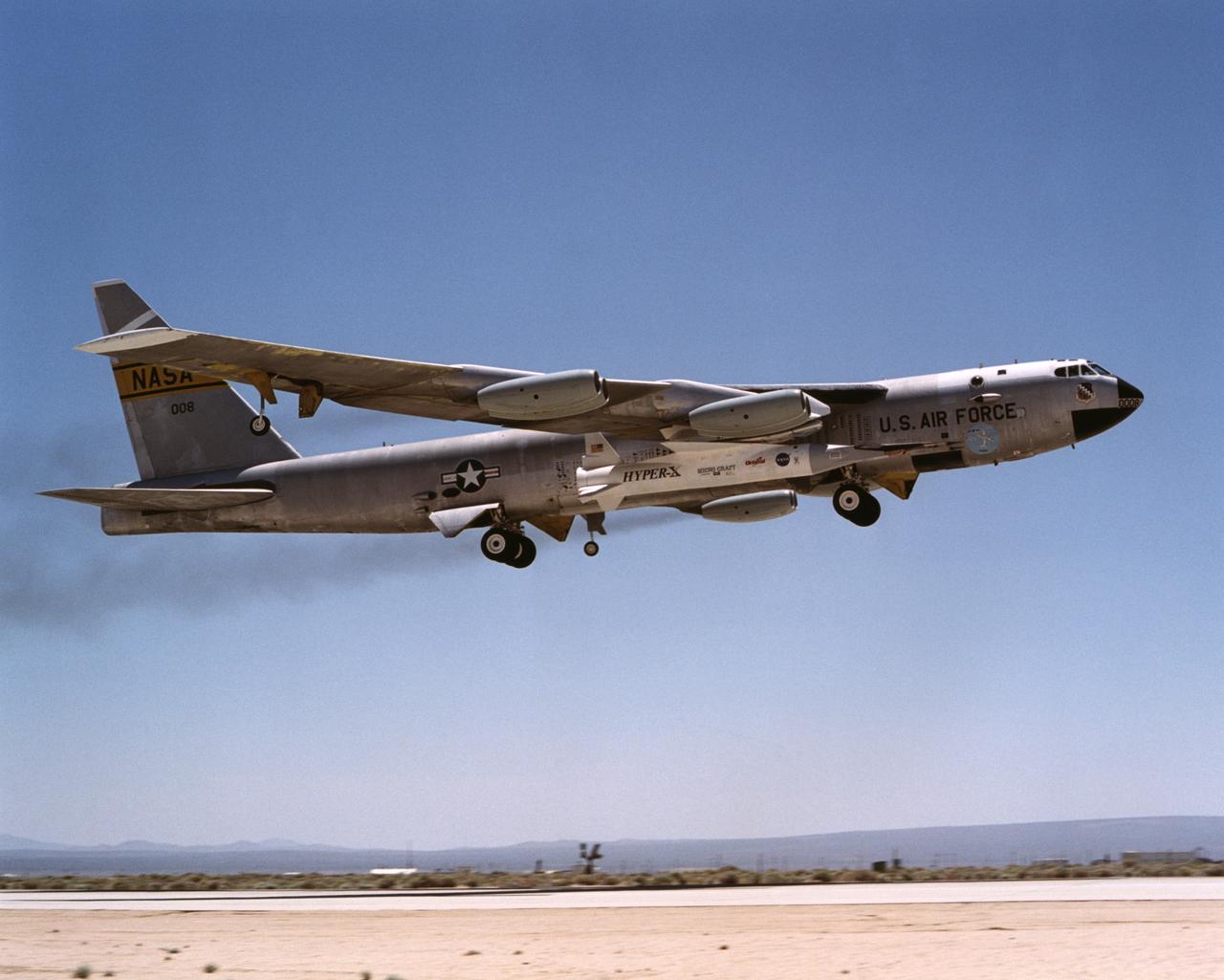
The first X-43A hypersonic research aircraft and its modified Pegasus booster rocket were carried aloft by NASA's NB-52B carrier aircraft from Dryden Flight Research Center at Edwards Air Force Base, Calif., on June 2, 2001 for the first of three high-speed free flight attempts. About an hour and 15 minutes later the Pegasus booster was released from the B-52 to accelerate the X-43A to its intended speed of Mach 7. Before this could be achieved, the combined Pegasus and X-43A "stack" lost control about eight seconds after ignition of the Pegasus rocket motor. The mission was terminated and explosive charges ensured the Pegasus and X-43A fell into the Pacific Ocean in a cleared Navy range area. A NASA investigation board is being assembled to determine the cause of the incident. Work continues on two other X-43A vehicles, the first of which could fly by late 2001. Central to the X-43A program is its integration of an air-breathing "scramjet" engine that could enable a variety of high-speed aerospace craft, and promote cost-effective access to space. The 12-foot, unpiloted research vehicle was developed and built for NASA by MicroCraft Inc., Tullahoma, Tenn. The booster was built by Orbital Sciences Corp. at Chandler, Ariz.
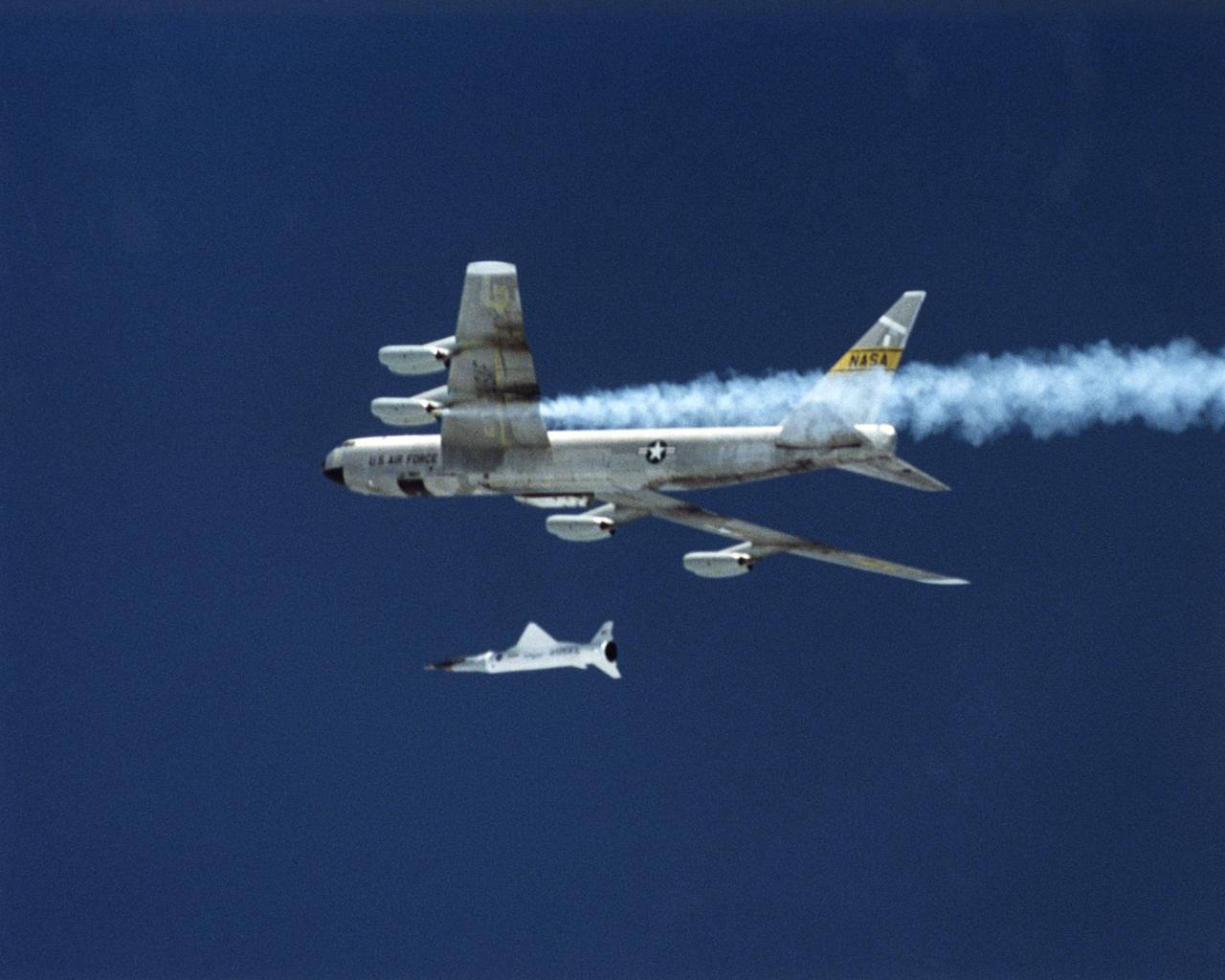
The first X-43A hypersonic research aircraft and its modified Pegasus booster rocket were carried aloft by NASA's NB-52B carrier aircraft from Dryden Flight Research Center at Edwards Air Force Base, Calif., on June 2, 2001 for the first of three high-speed free flight attempts. About an hour and 15 minutes later the Pegasus booster was released from the B-52 to accelerate the X-43A to its intended speed of Mach 7. Before this could be achieved, the combined Pegasus and X-43A "stack" lost control about eight seconds after ignition of the Pegasus rocket motor. The mission was terminated and explosive charges ensured the Pegasus and X-43A fell into the Pacific Ocean in a cleared Navy range area. A NASA investigation board is being assembled to determine the cause of the incident. Work continues on two other X-43A vehicles, the first of which could fly by late 2001. Central to the X-43A program is its integration of an air-breathing "scramjet" engine that could enable a variety of high-speed aerospace craft, and promote cost-effective access to space. The 12-foot, unpiloted research vehicle was developed and built for NASA by MicroCraft Inc., Tullahoma, Tenn. The booster was built by Orbital Sciences Corp. at Chandler, Ariz.
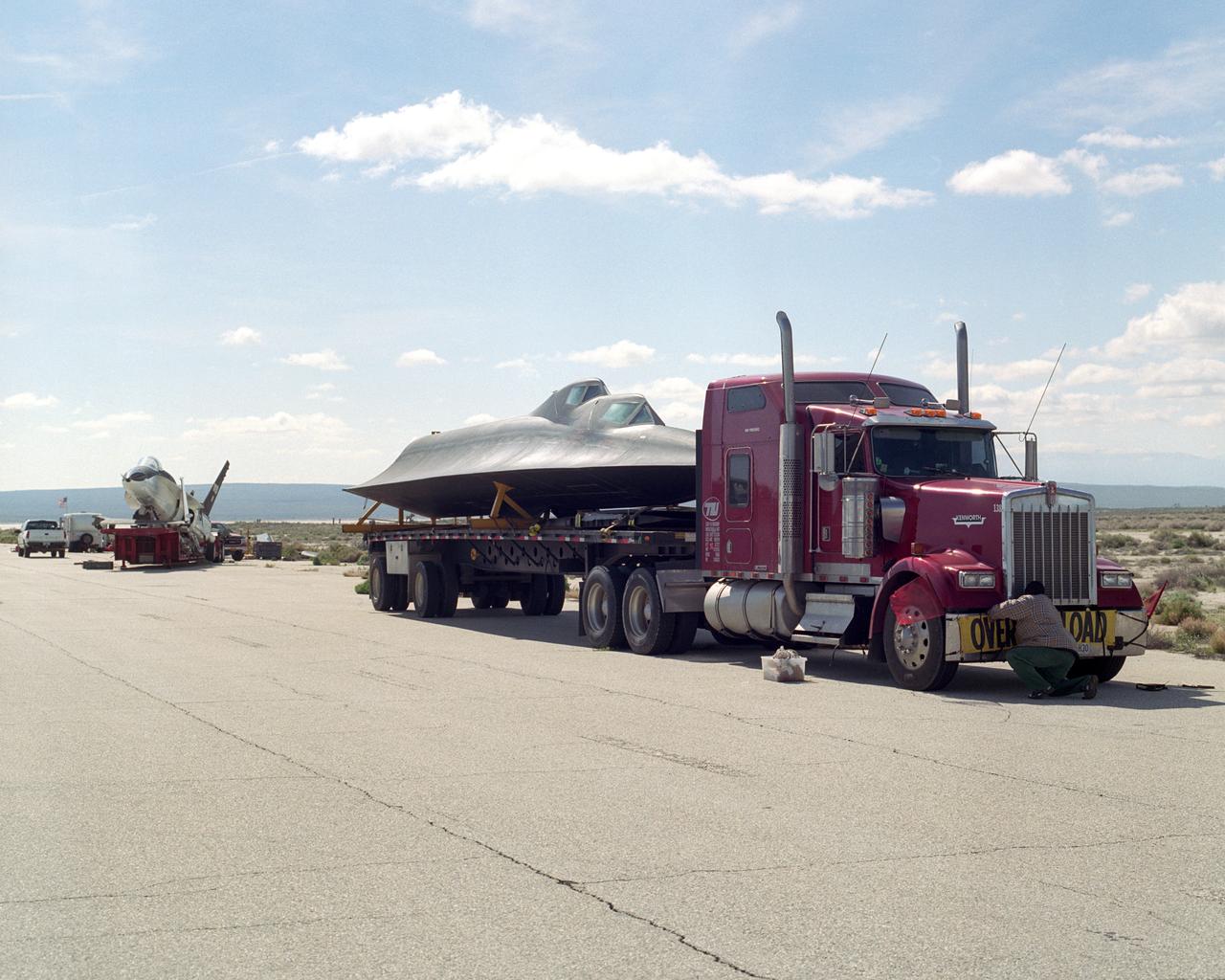
Dryden Flight Research Center's SR-71B Blackbird aircraft, NASA tail number 831, is destined for the Kalamazoo Air Zoo museum in Kalamazoo, Mich., and the F-18 High Angle-of-Attack Research Vehicle (HARV) aircraft, NASA tail number 840, is going to the Virginia Air and Space Center in Hampton, Va. NASA's SR-71B was one of only two SR-71 trainer aircraft built, and served NASA in that role, as well as for some high-speed research, from 1991 to 1999. The F-18 HARV provided some of the most comprehensive data on the high-angle-of-attack flight regime, flying at angles of up to 70 degrees from the horizontal. The HARV flew 385 research flights at Dryden from 1987 through 1996.
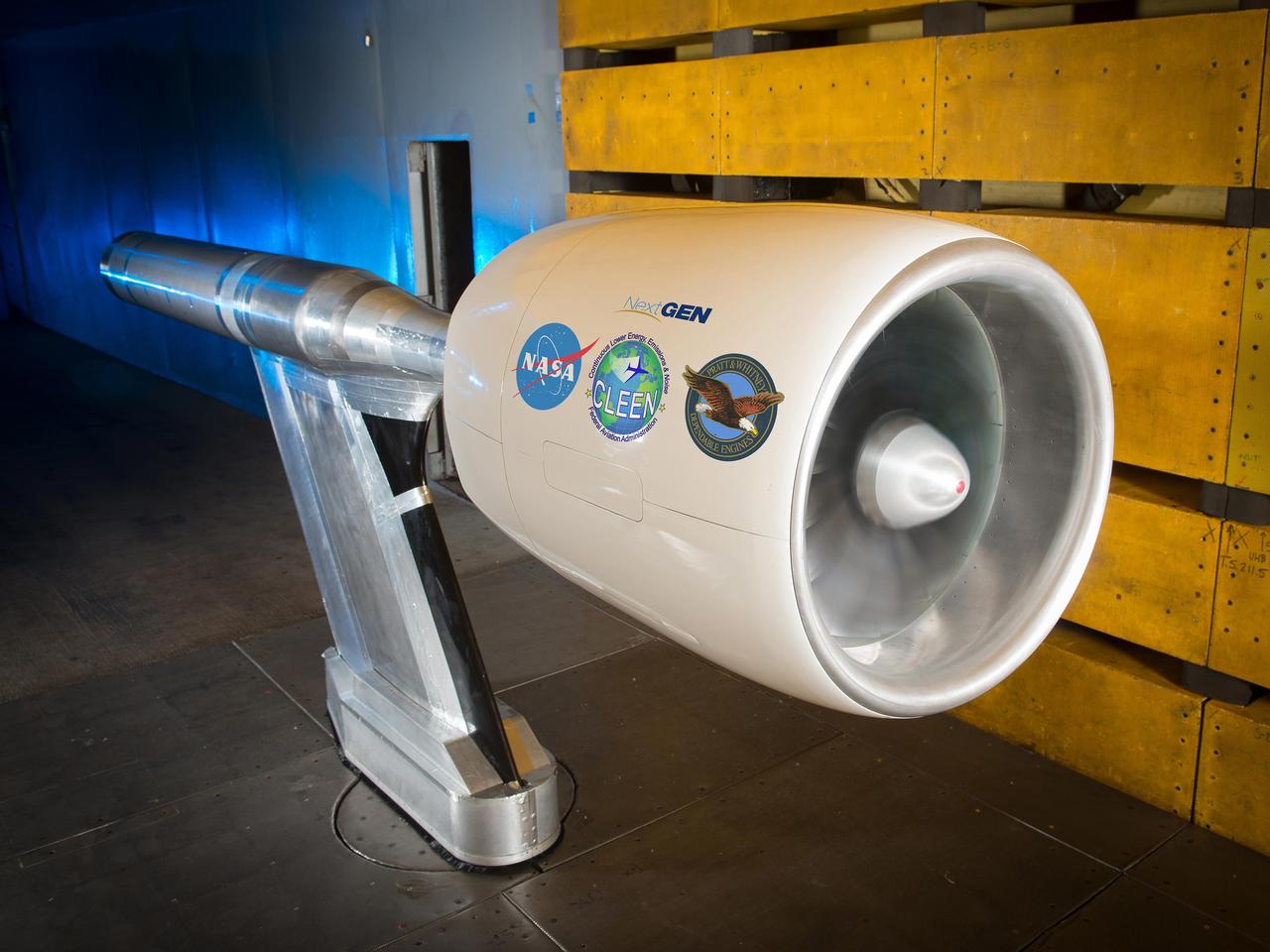
NASA’s Environmentally Responsible Aviation Project, in collaboration with the Federal Aviation Administration (FAA) and Pratt & Whitney, completed testing of an Ultra High Bypass Ratio Turbofan Model in the 9’ x 15’ Low Speed Wind Tunnel at NASA Glenn Research Center. The fan model is representative of the next generation of efficient and quiet Ultra High Bypass Ratio Turbofan Engine designs.
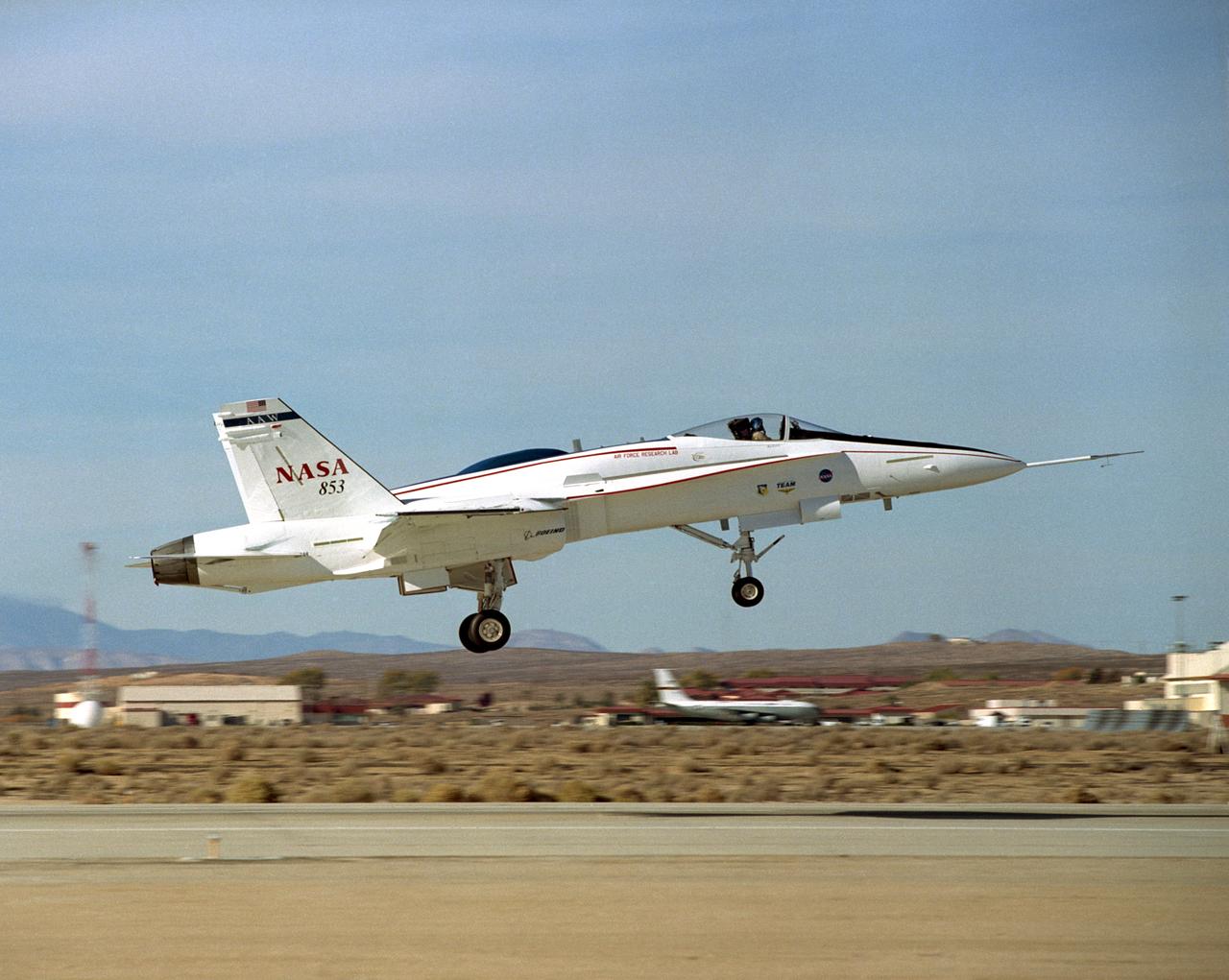
The Active Aeroelastic Wing F-18A lifts off on its first checkout flight November 15, 2002, from NASA's Dryden Flight Research Center at Edwards Air Force Base, Calif. The checkout flight initiated a two-phase NASA--Air Force flight research program that will investigate the potential of aerodynamically twisting flexible wings to improve maneuverability of high-performance aircraft at transonic and supersonic speeds.
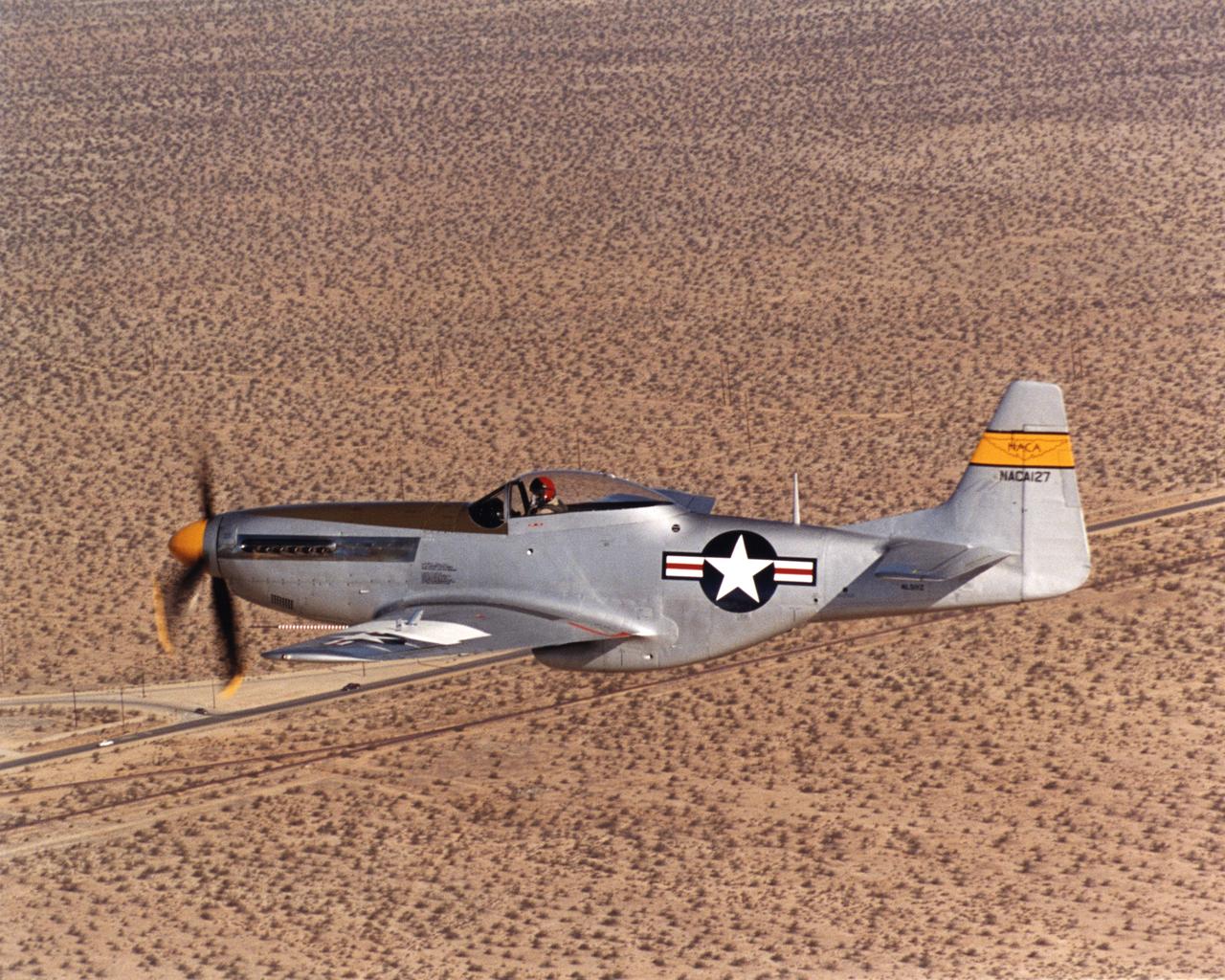
A white plate on the top of the wing of a restored National Advisory Committee for Aeronautics (NACA) P-51D Mustang mounts scale airfoil shapes as used by the NACA in the late 1940s for high-speed research. This former NACA testbed Mustang was rebuilt by John Muszala for Bill Allmon of Las Vegas, Nevada, who has been flying it since 1998. Allmon flew the vintage fighter to NASA's Dryden Flight Research Center at Edwards, California, Sept. 15, 2000 for a reunion of former NACA employees.
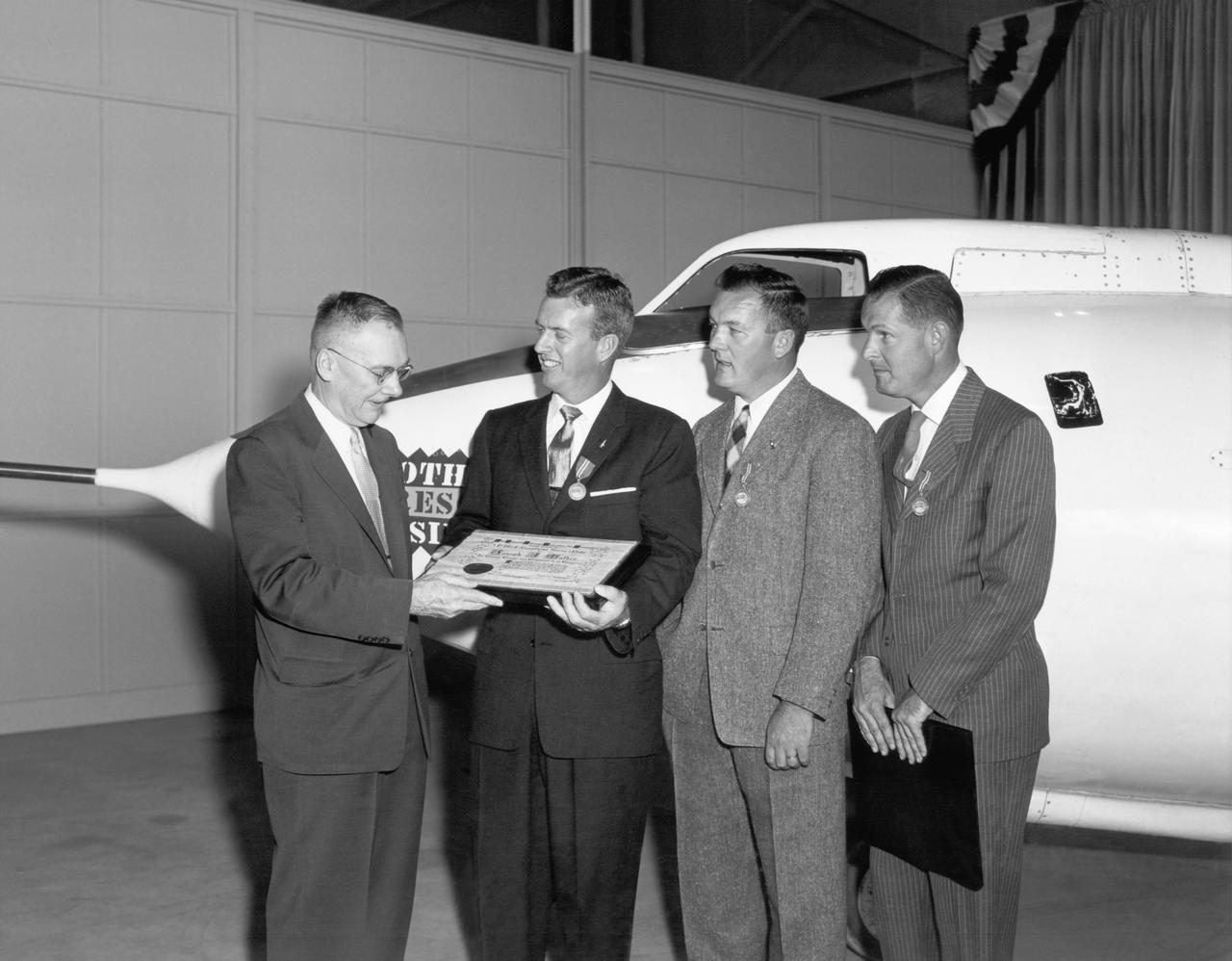
Hugh Dryden (far left) presents the NACA Exceptional Service Medal award at the NACA High Speed Flight Station. He awarded (L-R) Joe Walker (X-1A research pilot), Stan Butchart (pilot of the B-29 mothership),and Richard Payne (X-1A crew chief) in recognition of their research extending knowledge of swept wing flight.
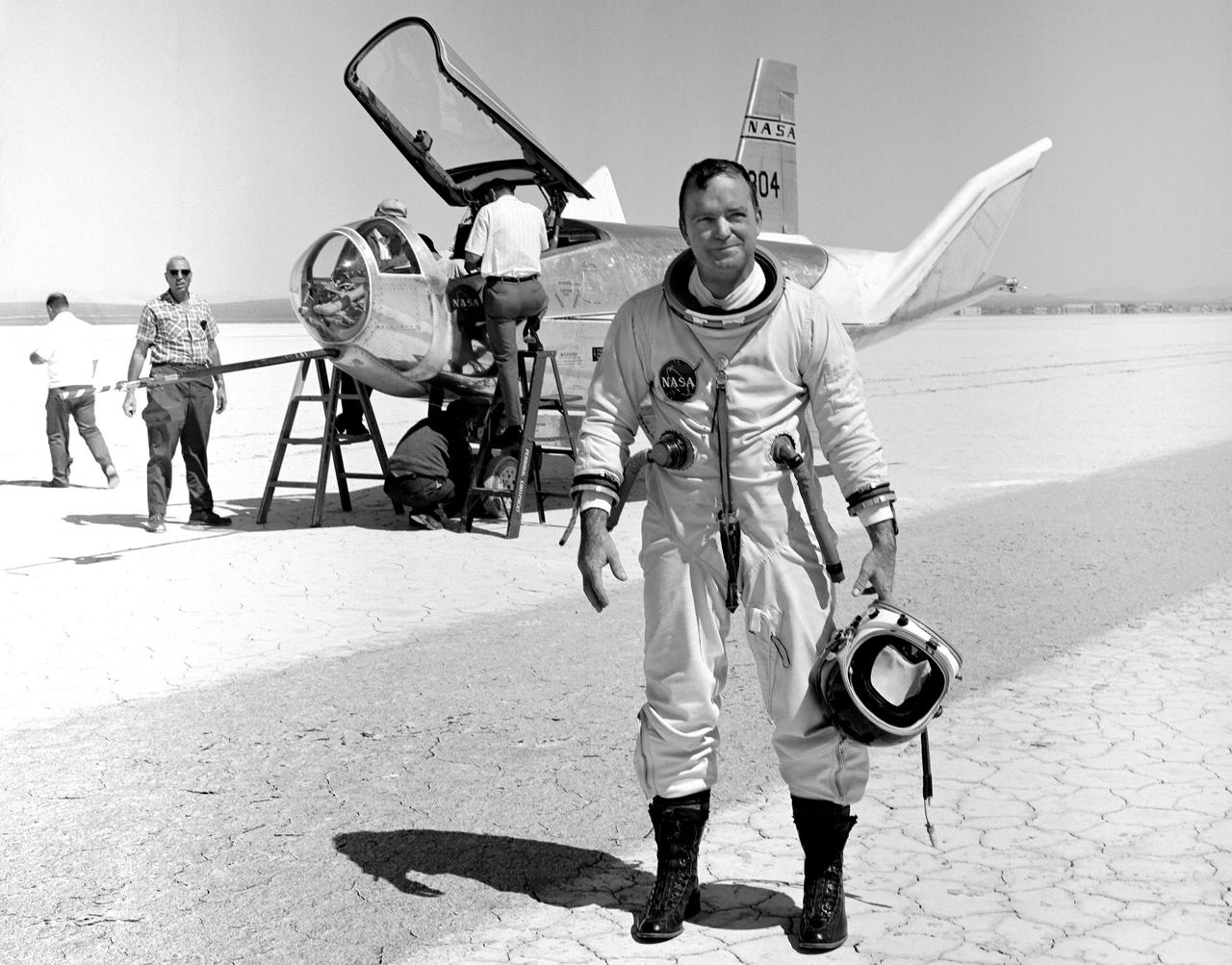
NASA research pilot Bill Dana stands in front of the HL-10 Lifting Body following his first glide flight on April 25, 1969. Dana later retired as Chief Engineer at NASA's Dryden Flight Research Center, (called the NASA Flight Research Center in 1969). Prior to his lifting body assignment, Dana flew the X-15 research airplane. He flew the rocket-powered aircraft 16 times, reaching a top speed of 3,897 miles per hour and a peak altitude of 310,000 feet (almost 59 miles high).
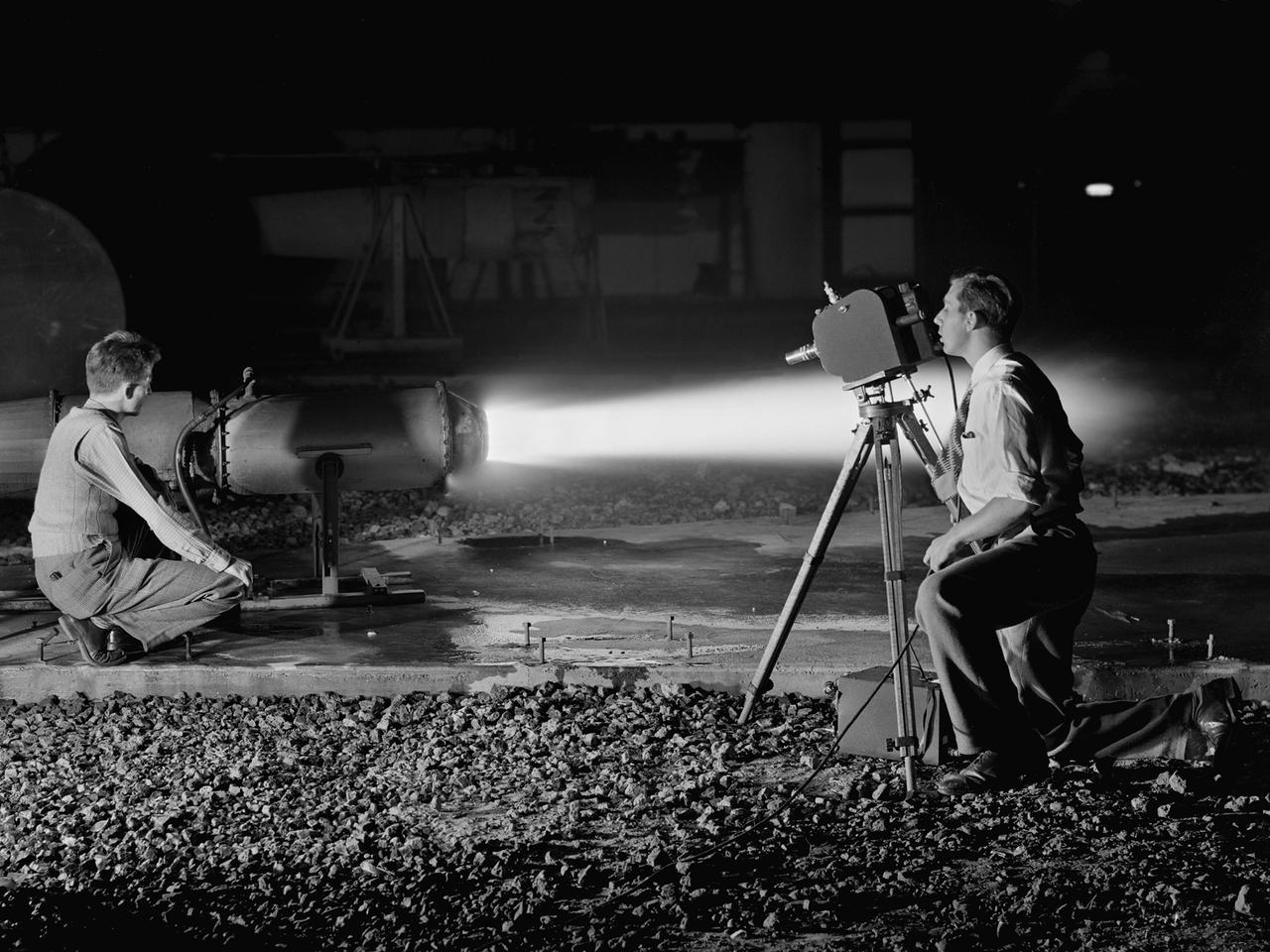
A National Advisory Committee for Aeronautics (NACA) photographer films the test of a ramjet engine at the Lewis Flight Propulsion Laboratory. The laboratory had an arsenal of facilities to test the engines and their components, and immersed itself in the study of turbojet and ramjet engines during the mid-1940s. Combustion, fuel injection, flameouts, and performance at high altitudes were of particular interest to researchers. They devised elaborate schemes to instrument the engines in order to record temperature, pressure, and other data. Many of the tests were also filmed so Lewis researchers could visually review the combustion performance along with the data. The photographer in this image was using high-speed film to document a thrust augmentation study at Lewis’ Jet Static Propulsion Laboratory. The ramjet in this photograph was equipped with a special afterburner as part of a general effort to improve engine performance. Lewis’ Photo Lab was established in 1942. The staff was expanded over the next few years as more test facilities became operational. The Photo Lab’s staff and specialized equipment have been key research tools for decades. They accompany pilots on test flights, use high-speed cameras to capture fleeting processes like combustion, and work with technology, such as the Schlieren camera, to capture supersonic aerodynamics. In addition, the group has documented construction projects, performed publicity work, created images for reports, and photographed data recording equipment.
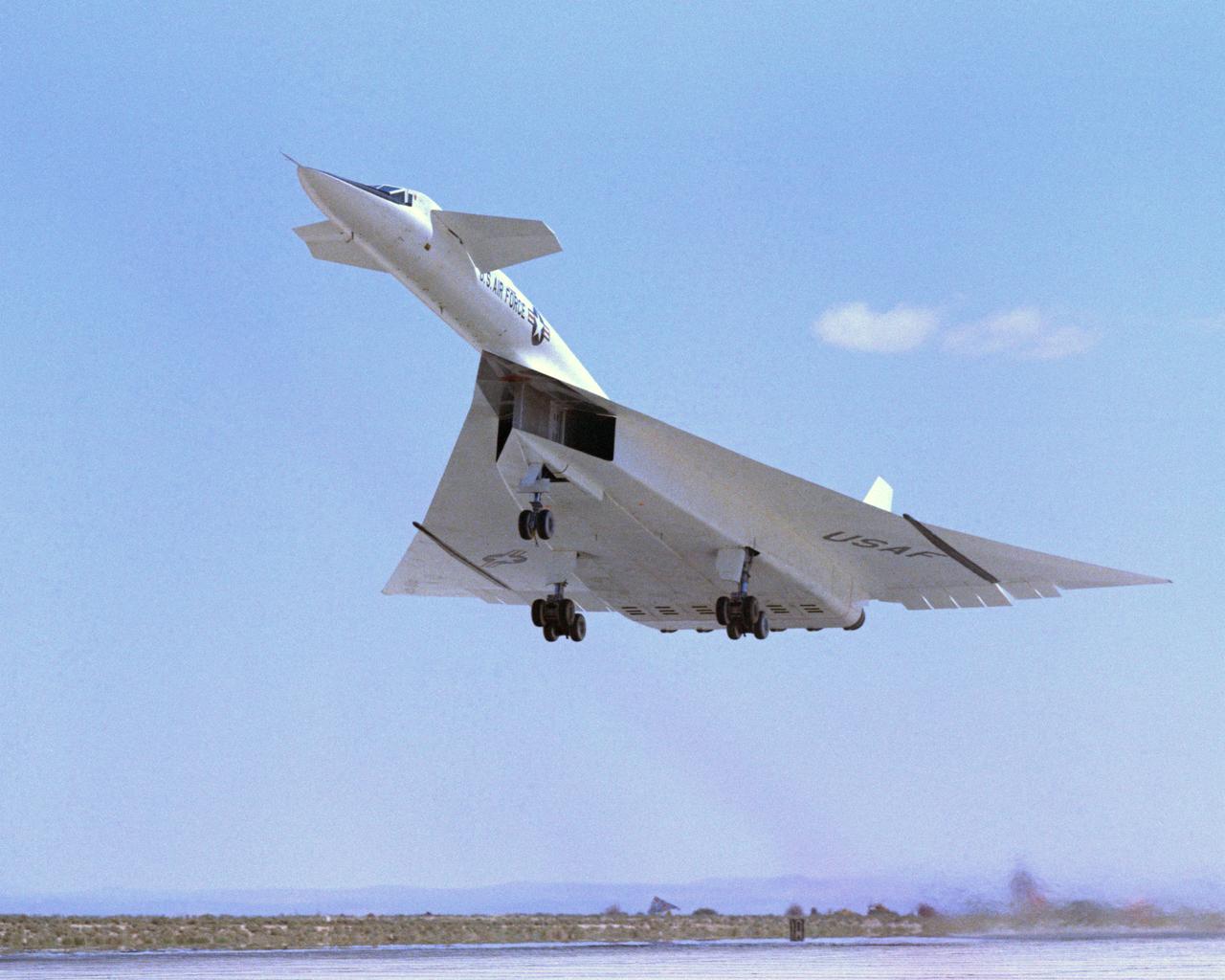
Viewed from the front the #1 XB-70A (62-0001) is shown climbing out during take-off. Most flights were scheduled during the morning hours to take advantage of the cooler ambient air temperatures for improved propulsion efficiencies. The wing tips are extended straight out to provide a maximum lifting wing surface. The XB-70A, capable of flying three times the speed of sound, was the world's largest experimental aircraft in the 1960s. Two XB-70A aircraft were built. Ship #1 was flown by NASA in a high speed flight research program.
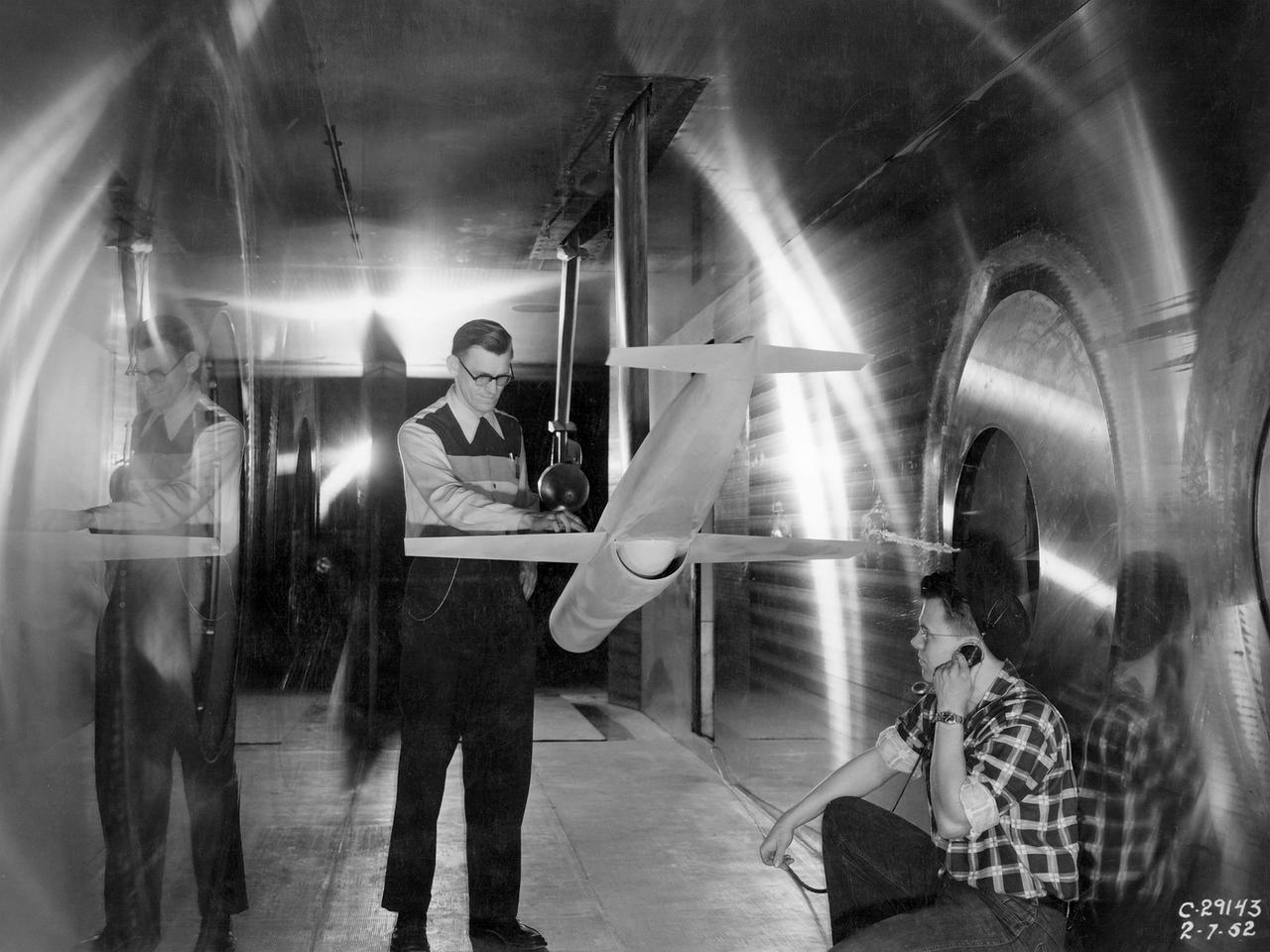
A researcher at the National Advisory Committee for Aeronautics (NACA) Lewis Flight Propulsion Laboratory checks the setup of a RJM-2 ramjet model in the test section of the 8- by 6-Foot Supersonic Wind Tunnel. The 8- by 6 was not only the laboratory’s first large supersonic wind tunnel, but it was also the NACA’s first facility capable of testing an operating engine at supersonic speeds. The 8- by 6-foot tunnel has been used to study engine inlets, fuel injectors, flameholders, exit nozzles, and controls on ramjet and turbojet propulsion systems. The 8-foot wide and 6-foot tall test section consisted of 1-inch thick steel plates with hatches on the floor and ceiling to facilitate the installation of the test article. The two windows seen on the right wall allowed photographic equipment to be set up. The test section was modified in 1956 to accommodate transonic research. NACA engineers drilled 4,700 holes into the test section walls to reduce transonic pressure disturbances and shock waves. NACA Lewis undertook an extensive research program on ramjets in the 1940s using several of its facilities. Ramjets provide a very simple source of propulsion. They are basically a tube which ingests high speed air, ignites it, and then expels the heated air at a significantly higher velocity. Ramjets are extremely efficient and powerful but can only operate at high speeds. Therefore, they require a booster rocket or aircraft drop to accelerate them to high speeds before they can operate.
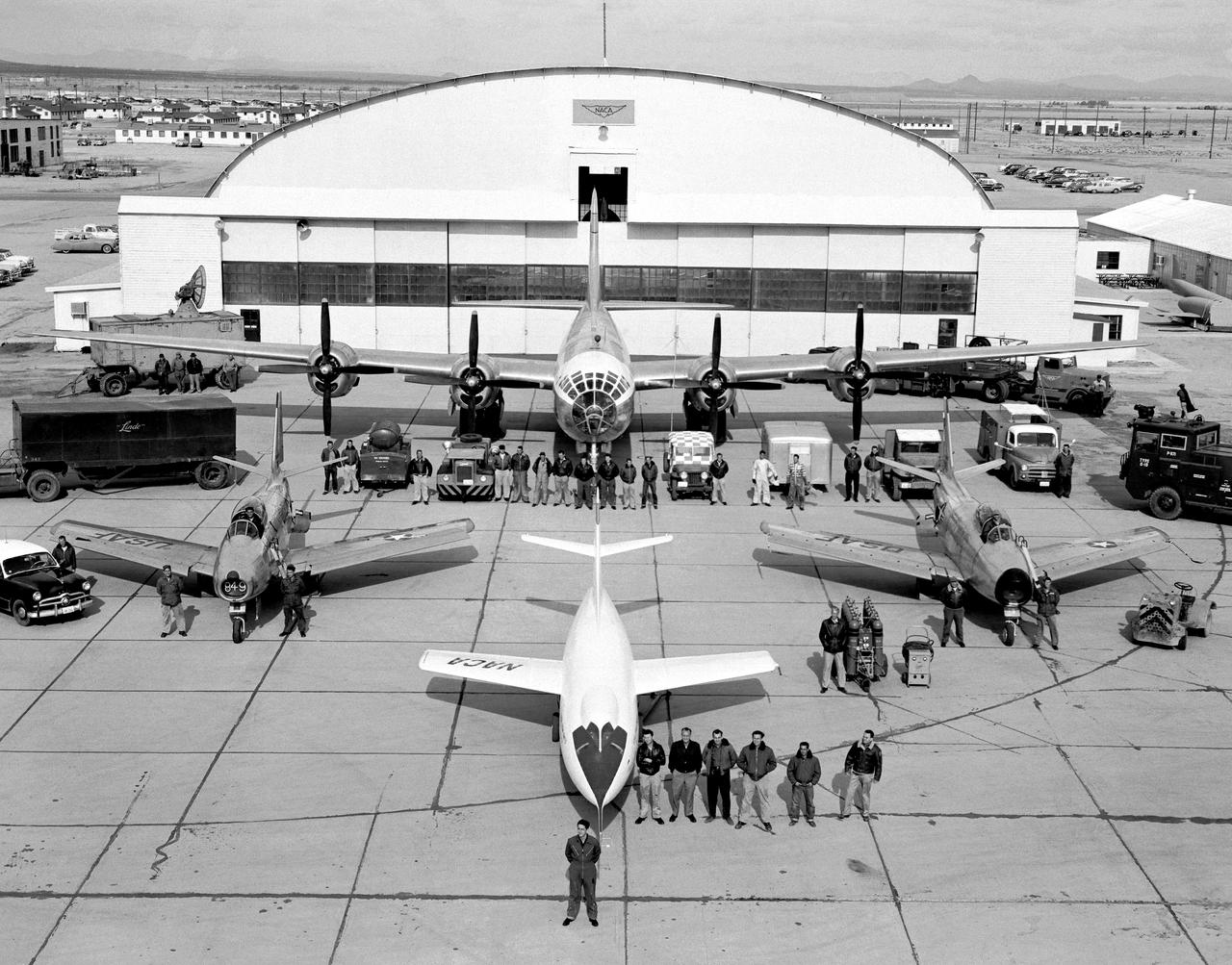
These people and this equipment supported the flight of the NACA D-558-2 Skyrocket at the High-Speed Flight Station at South Base, Edwards AFB. Note the two Sabre chase planes, the P2B-1S launch aircraft, and the profusion of ground support equipment, including communications, tracking, maintenance, and rescue vehicles. Research pilot A. Scott Crossfield stands in front of the Skyrocket.
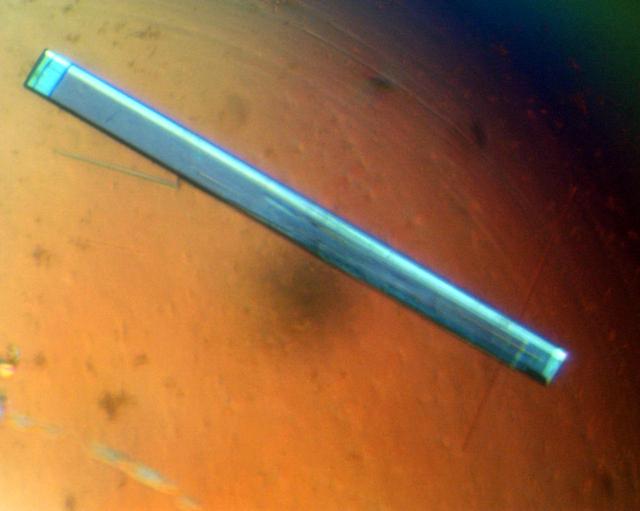
Parvalbumins are found in the muscles, endocrine glands, skin cells, and some neurons of vertebrates, but the role they play for musculature is not yet understood. Researchers are exploring theories of a correlation between parvalbumin concentration levels and the relaxation speed of mammalian muscles after contraction. An ultra-high resolution structure was achieved from samples grown on STS-83 and in July 1997, during STS-94, PCAM produced the largest crystals of pike parvalbumin grown to date. Principal Investigator: Dan Carter of New Century Pharmaceuticals.
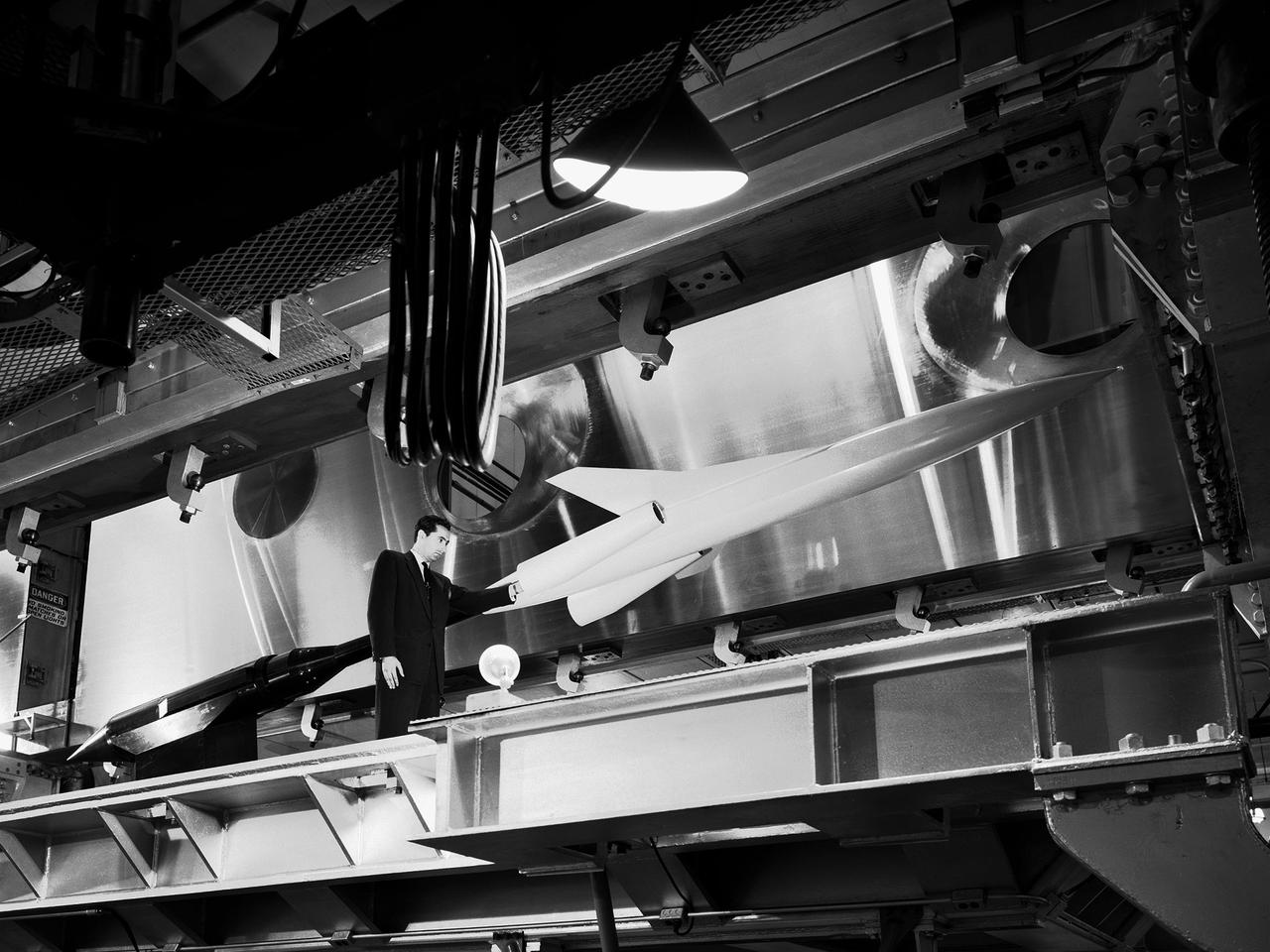
A researcher examines a model being installed in the test section of the 10- by 10-Foot Supersonic Wind Tunnel during the 1957 Inspection of the National Advisory Committee for Aeronautics (NACA) Lewis Flight Propulsion Laboratory. The NACA held its annual Inspection at one of its three research laboratories. Representatives from the military, aeronautical industry, universities, and the press were invited to the laboratory to be briefed on the NACA’s latest research efforts and tour the state- of- the- art test facilities. Over 1700 people visited the NACA Lewis in Cleveland, Ohio during the October 7 - 10, 1957 Inspection. NACA researchers Leonard Obery, seen here, James Connors, Leonard, Stitt, David Bowditch gave presentations on high Mach number turbojets at the 10- by 10 tunnel. It had been only 15 years since a jet aircraft had first flown in the US. Since then the sound barrier had been broken and speeds of Mach 2.5 had been achieved. In the late 1950s NACA researchers sought to create an engine that could achieve Mach 4. This type of engine would require an extremely long inlet and nozzle which would have to be capable of adjusting their diameter for different speeds. A Mach 4 engine would require new composite materials to withstand the severe conditions, modified airframes to hold the longer engines, and high temperature seals and lubricants. The 10- by 10-foot tunnel, which had only been in operation for a year and a half, would play a critical role in these studies. NACA researchers at other facilities discussed high energy aircraft fuels and rocket propellants, aircraft noise reduction, hypersonic flight, nuclear propulsion, and high temperature materials.
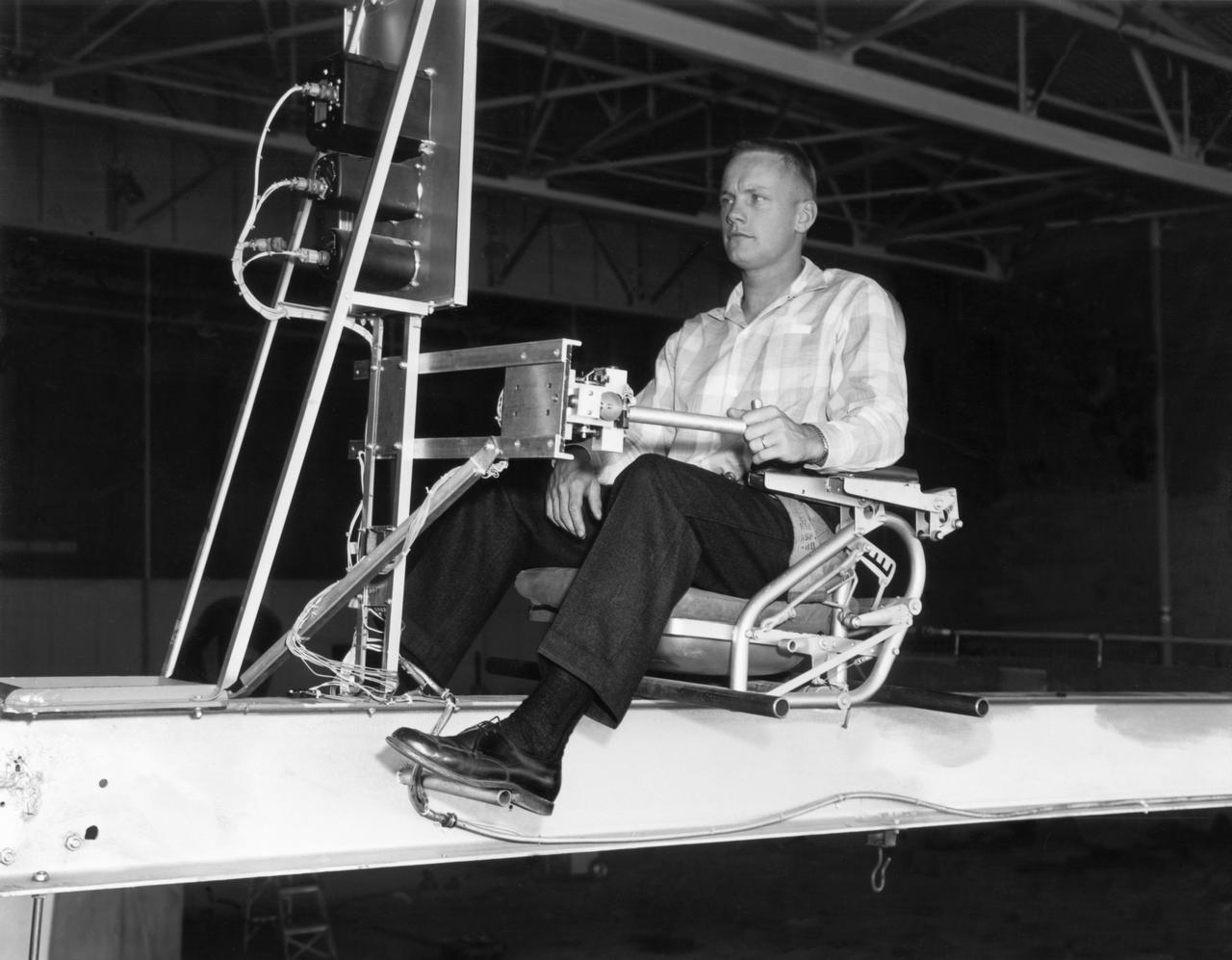
Famed astronaut Neil A. Armstrong, the first man to set foot on the moon during the historic Apollo 11 space mission in July 1969, served for seven years as a research pilot at the NACA-NASA High-Speed Flight Station, now the Dryden Flight Research Center, at Edwards, California, before he entered the space program. Armstrong joined the National Advisory Committee for Aeronautics (NACA) at the Lewis Flight Propulsion Laboratory (later NASA's Lewis Research Center, Cleveland, Ohio, and today the Glenn Research Center) in 1955. Later that year, he transferred to the High-Speed Flight Station at Edwards as an aeronautical research scientist and then as a pilot, a position he held until becoming an astronaut in 1962. He was one of nine NASA astronauts in the second class to be chosen. As a research pilot Armstrong served as project pilot on the F-100A and F-100C aircraft, F-101, and the F-104A. He also flew the X-1B, X-5, F-105, F-106, B-47, KC-135, and Paresev. He left Dryden with a total of over 2450 flying hours. He was a member of the USAF-NASA Dyna-Soar Pilot Consultant Group before the Dyna-Soar project was cancelled, and studied X-20 Dyna-Soar approaches and abort maneuvers through use of the F-102A and F5D jet aircraft. Armstrong was actively engaged in both piloting and engineering aspects of the X-15 program from its inception. He completed the first flight in the aircraft equipped with a new flow-direction sensor (ball nose) and the initial flight in an X-15 equipped with a self-adaptive flight control system. He worked closely with designers and engineers in development of the adaptive system, and made seven flights in the rocket plane from December 1960 until July 1962. During those fights he reached a peak altitude of 207,500 feet in the X-15-3, and a speed of 3,989 mph (Mach 5.74) in the X-15-1. Armstrong has a total of 8 days and 14 hours in space, including 2 hours and 48 minutes walking on the Moon. In March 1966 he was commander of the Gemini 8 or
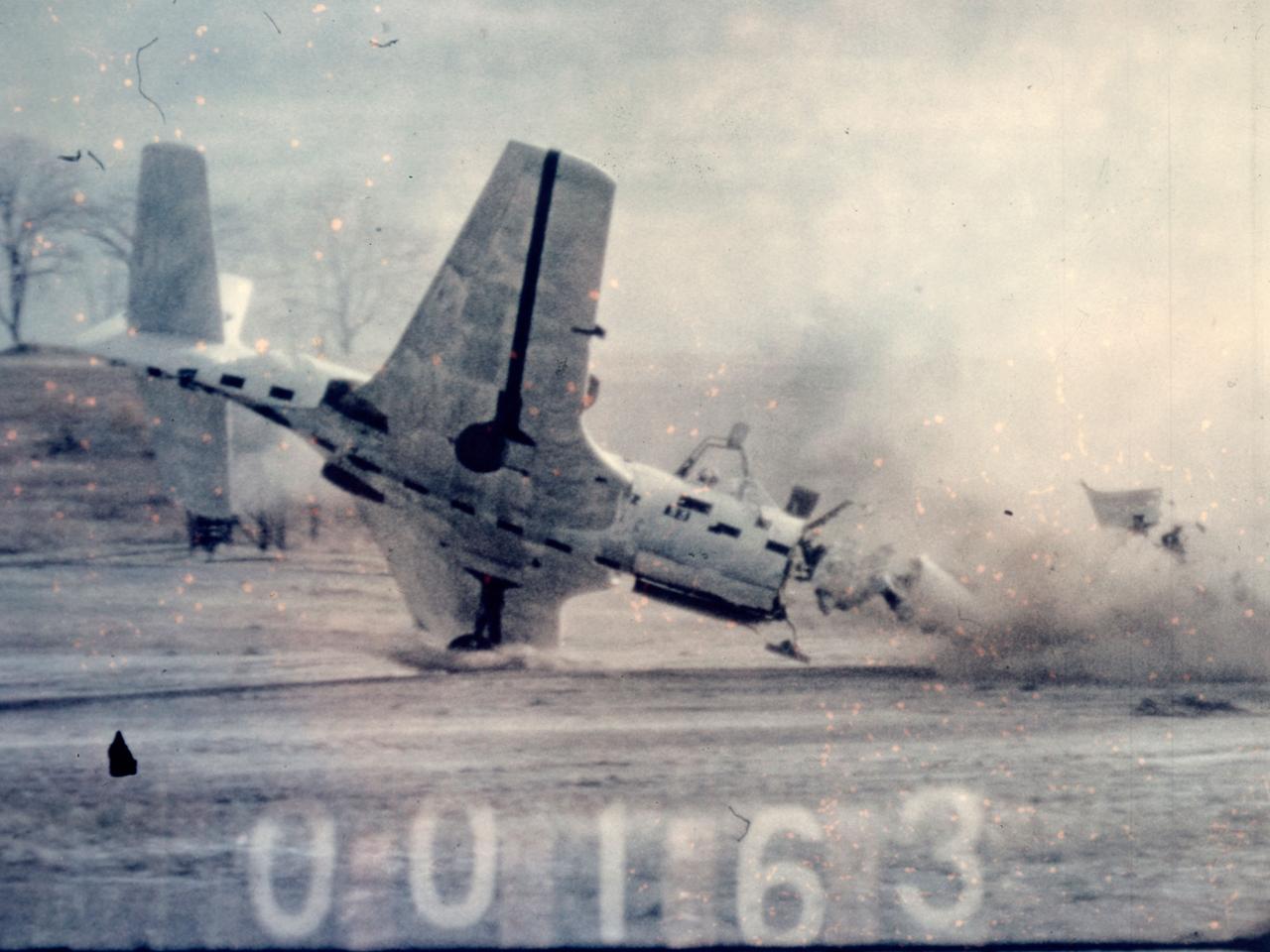
Researchers at the National Advisory Committee for Aeronautics (NACA) Lewis Flight Propulsion Laboratory purposely wreck a McDonnell FH-1 Phantom as part of the laboratory’s Crash Fire Program. NACA Lewis researchers created the program in 1949 to investigate methods for improving survival rates for take-off and landing-type crashes. In these types of crashes, the passengers often survived the impact only to perish in the ensuing fire. Previously there had been little information on the nature of post-crash fires, and it was difficult to use analytical studies in this area. Irving Pinkel, Chief of the Lewis Flight Propulsion Division, was the primary researcher. He enlisted flight safety specialist and aeronautics researchers G. Merritt Preston and Gerard Pesman, mechanical engineer Dugald Black, and others. The tests were conducted at the nearby Ravenna Arsenal using decommissioned Air Force fighter and transport aircraft. The pilotless aircraft were accelerated down a rail on a 1700-foot track at take-off speeds and run into barriers to simulate a variety of different types of crashes. The first barrier stripped off the landing gears and another briefly sent the aircraft off the ground before it crashed into a dirt mound. Telemetry and high-speed cameras were crucial elements in these studies. NACA Lewis photographer Bill Wynne developed a method for inserting timekeeping devices on test film that were able to show time to one thousandth of a second.
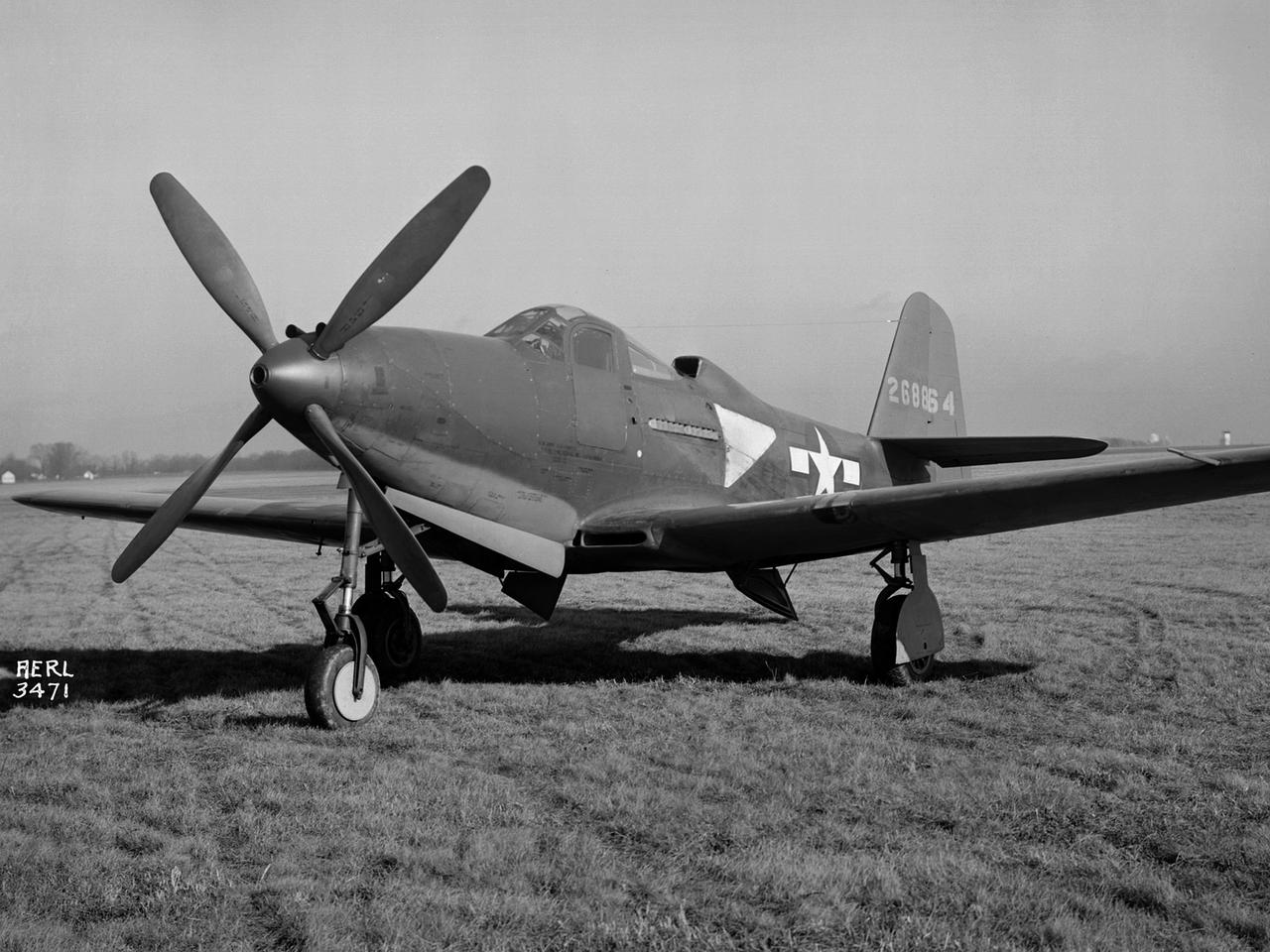
The Army Air Forces lent the National Advisory Committee for Aeronautics (NACA) Aircraft Engine Research Laboratory a Bell P–63A King Cobra in October 1943 to complement the lab's extensive efforts to improve the Allison V–1710 engine. The V–1710-powered P–63A was a single-seat fighter that could reach speeds of 410 miles per hour and an altitude of 43,000 feet. The fighter, first produced in 1942, was an improvement on Bell’s P–39, but persistent performance problems at high altitudes prevented its acceptance by the Air Corps. Instead many of the P–63s were transferred to the Soviet Union. Almost every test facility at the NACA’s engine lab was used to study the Allison V–1710 engine and its supercharger during World War II. Researchers were able to improve the efficiency, capacity and pressure ratio of the supercharger. They found that improved cooling significantly reduced engine knock in the fuel. Once the researchers were satisfied with their improvements, the new supercharger and cooling components were installed on the P–63A. The Flight Research Division first established the aircraft’s normal flight performance parameters such as speed at various altitudes, rate of climb, and peak altitude. Ensuing flights established the performance parameters of the new configuration in order to determine the improved performance. The program increased V–1710’s horsepower from 1650 to 2250.
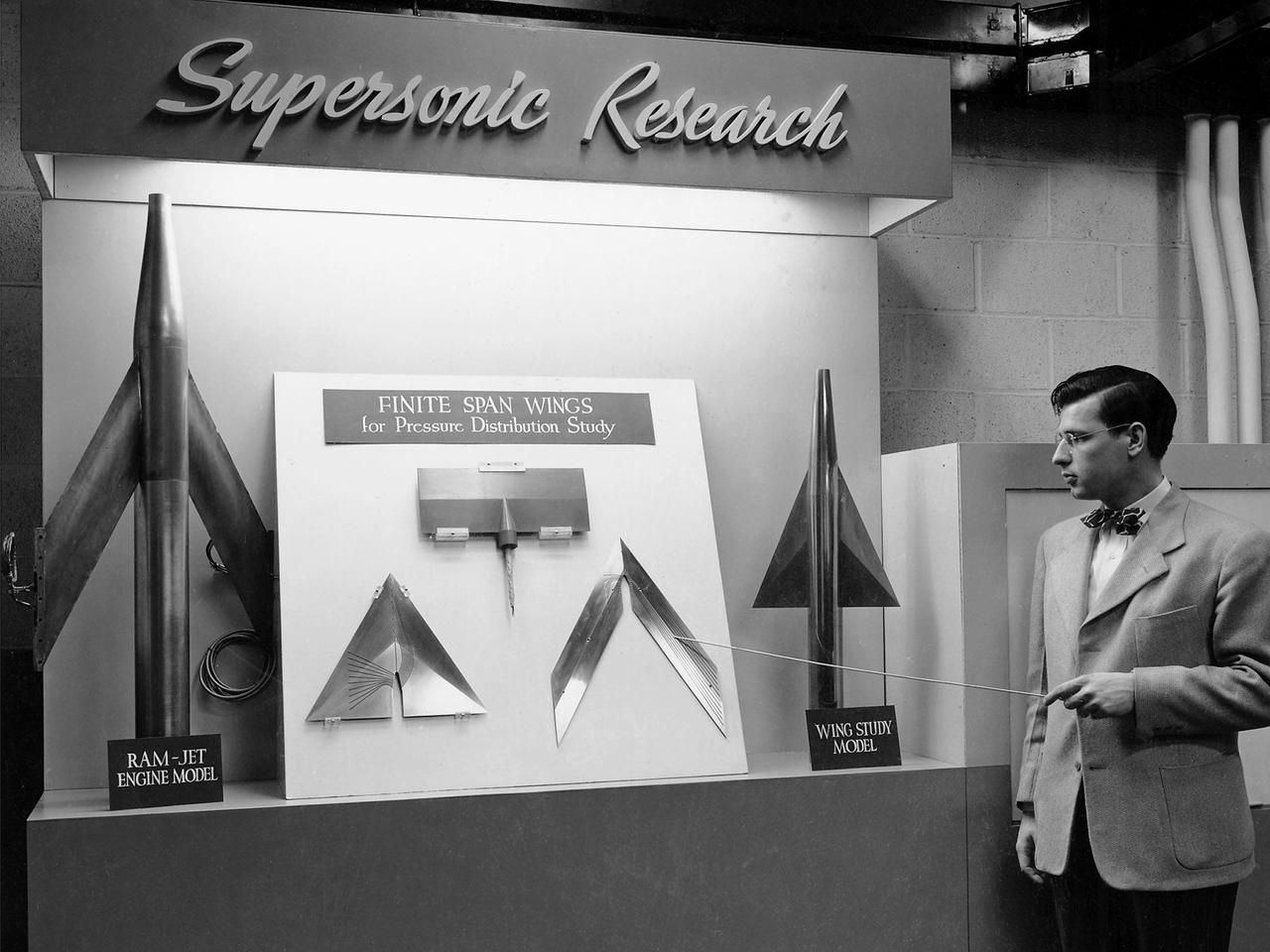
On March 22, 1946, 250 members of the Institute of Aeronautical Science toured the NACA’s Aircraft Engine Research Laboratory. NACA Chairman Jerome Hunsaker and Secretary John Victory were on hand to brief the attendees in the Administration Building before the visited the lab’s test facilities. At each of the twelve stops, researchers provided brief presentations on their work. Topics included axial flow combustors, materials for turbine blades, engine cooling, icing prevention, and supersonic flight. The laboratory reorganized itself in October 1945 as World War II came to an end to address newly emerging technologies such as the jet engine, rockets, and high-speed flight. While design work began on what would eventually become the 8- by 6-Foot Supersonic Wind Tunnel, NACA Lewis quickly built several small supersonic tunnels. These small facilities utilized the Altitude Wind Tunnel’s massive air handling equipment to generate high-speed airflow. The display seen in this photograph was set up in the building that housed the first of these wind tunnels. Eventually the building would contain three small supersonic tunnels, referred to as the “stack tunnels” because of the vertical alignment. The two other tunnels were added to this structure in 1949 and 1951. The small tunnels were used until the early 1960s to study the aerodynamic characteristics of supersonic inlets and exits.
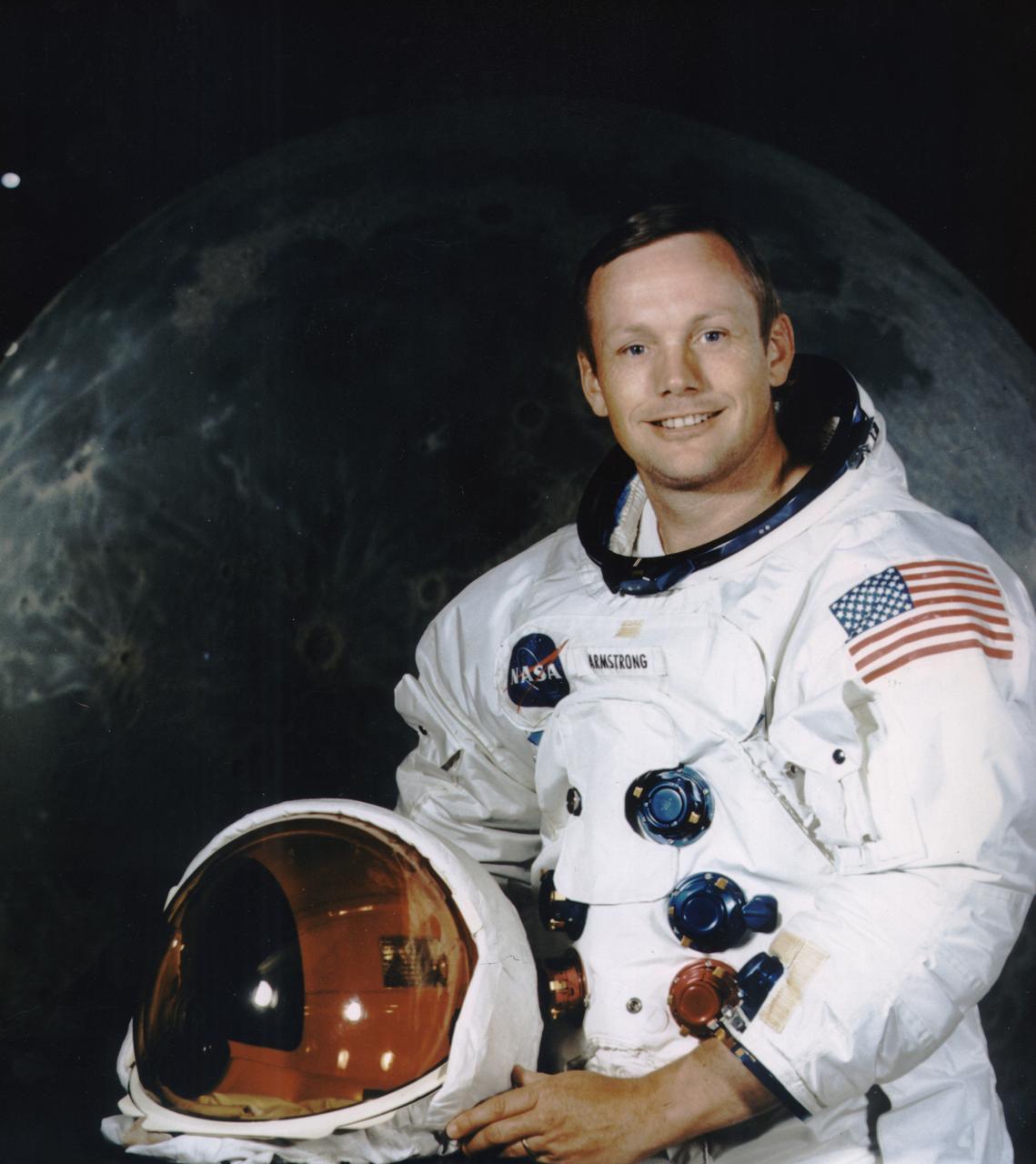
Neil Armstrong, donned in his space suit, poses for his official Apollo 11 portrait. Armstrong began his flight career as a naval aviator. He flew 78 combat missions during the Korean War. Armstrong joined the NASA predecessor, NACA (National Advisory Committee for Aeronautics), as a research pilot at the Lewis Laboratory in Cleveland and later transferred to the NACA High Speed Flight Station at Edwards AFB, California. He was a project pilot on many pioneering high speed aircraft, including the 4,000 mph X-15. He has flown over 200 different models of aircraft, including jets, rockets, helicopters, and gliders. In 1962, Armstrong was transferred to astronaut status. He served as command pilot for the Gemini 8 mission, launched March 16, 1966, and performed the first successful docking of two vehicles in space. In 1969, Armstrong was commander of Apollo 11, the first manned lunar landing mission, and gained the distinction of being the first man to land a craft on the Moon and the first man to step on its surface. Armstrong subsequently held the position of Deputy Associate Administrator for Aeronautics, NASA Headquarters Office of Advanced Research and Technology, from 1970 to 1971. He resigned from NASA in 1971.
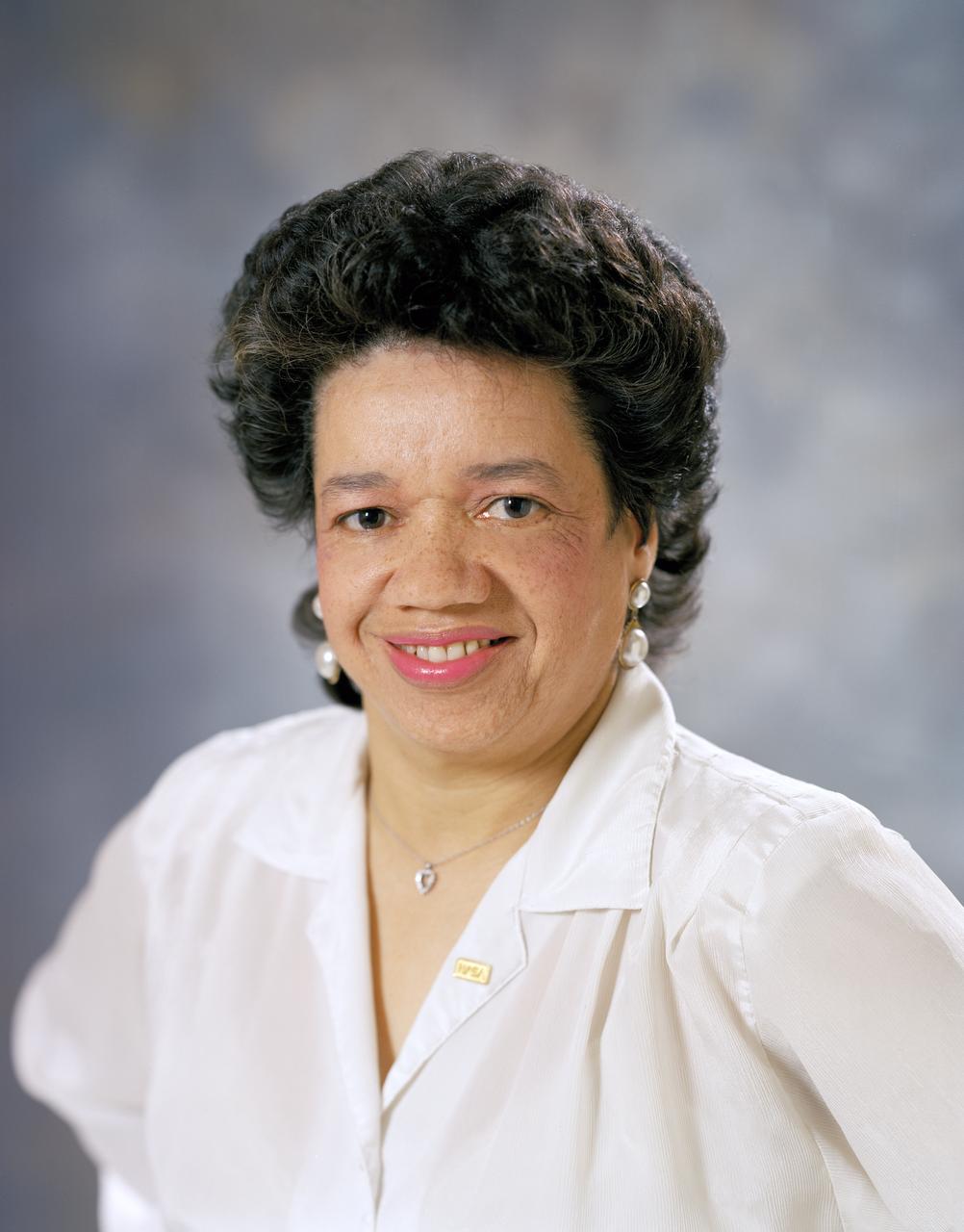
Portrait of Christine M. Darden
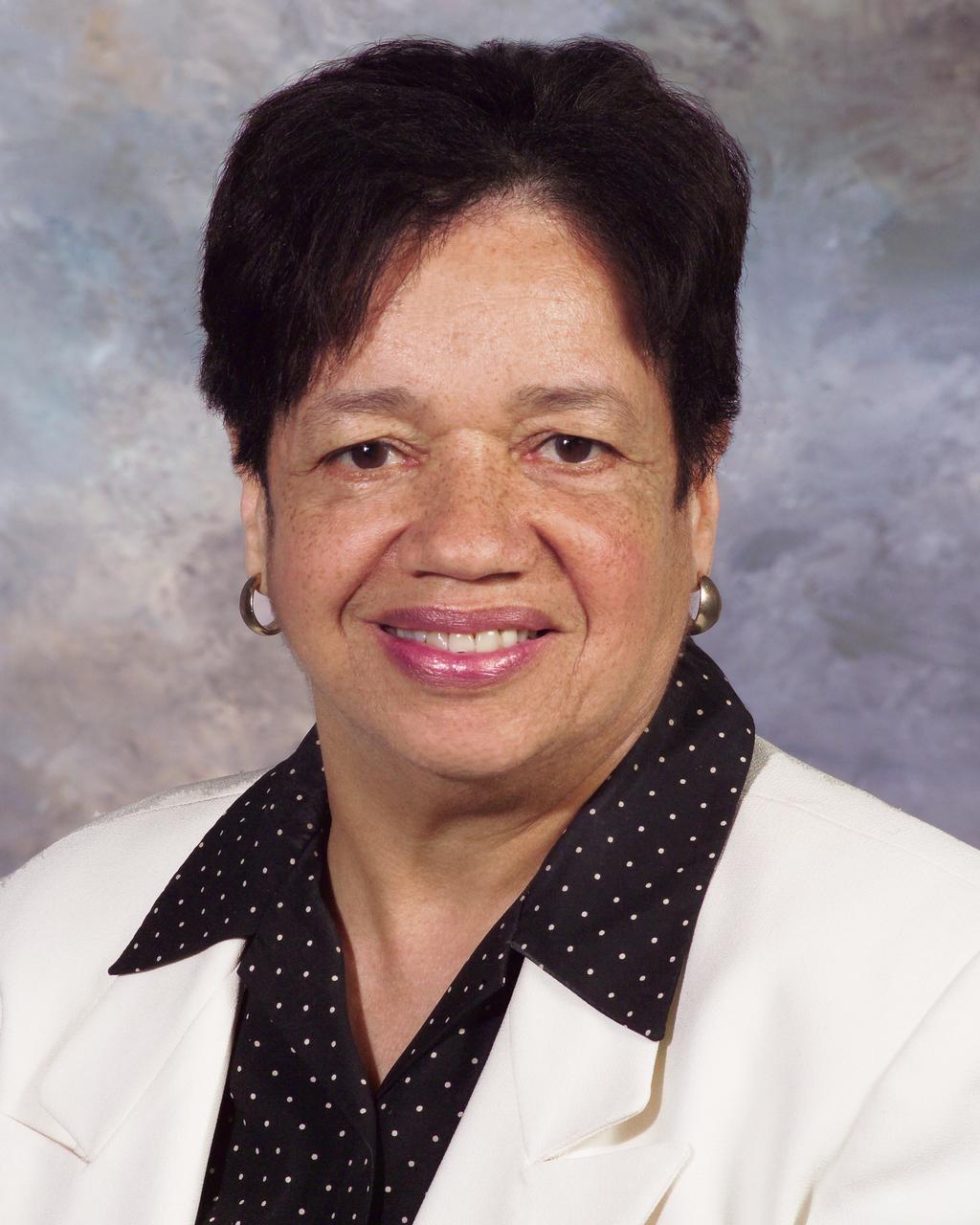
Portrait of Christine M. Darden
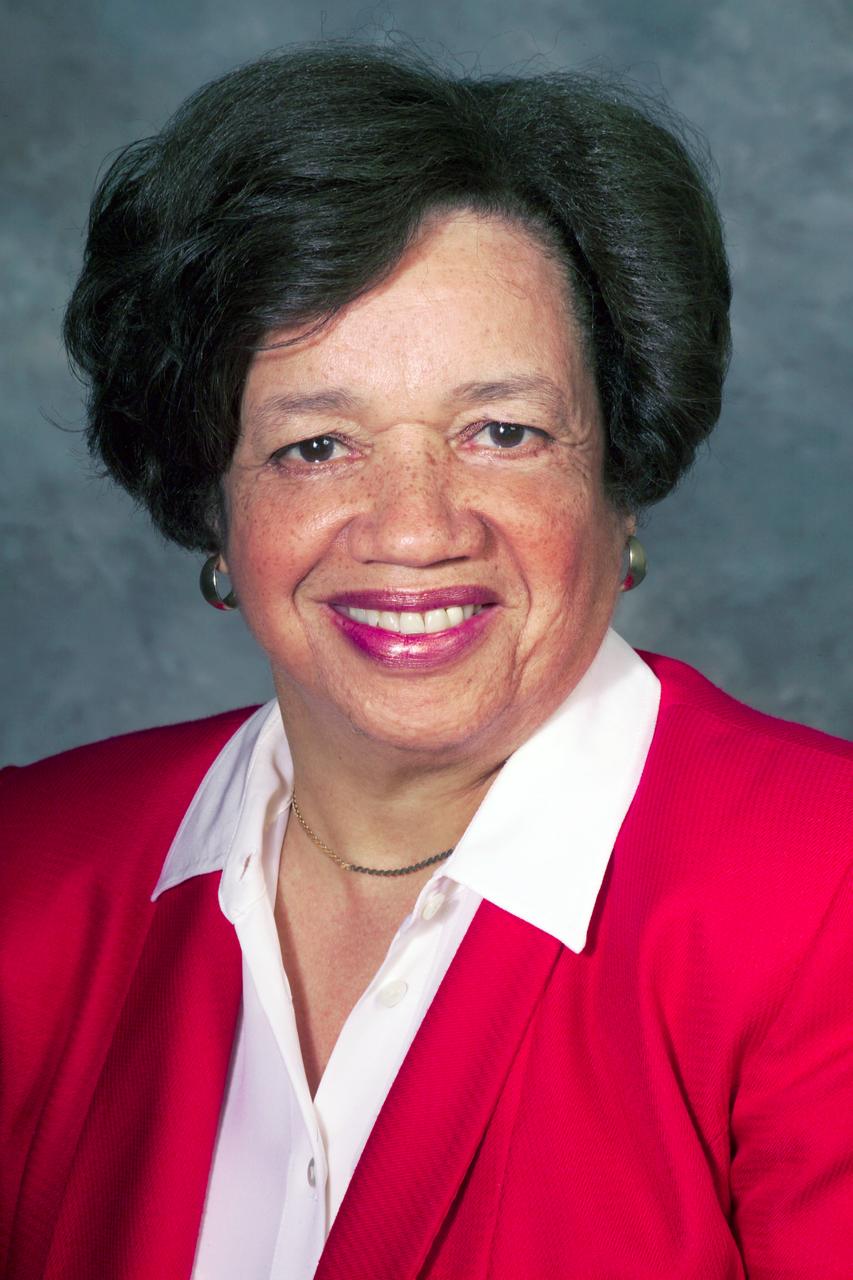
Portrait of Christine M. Darden
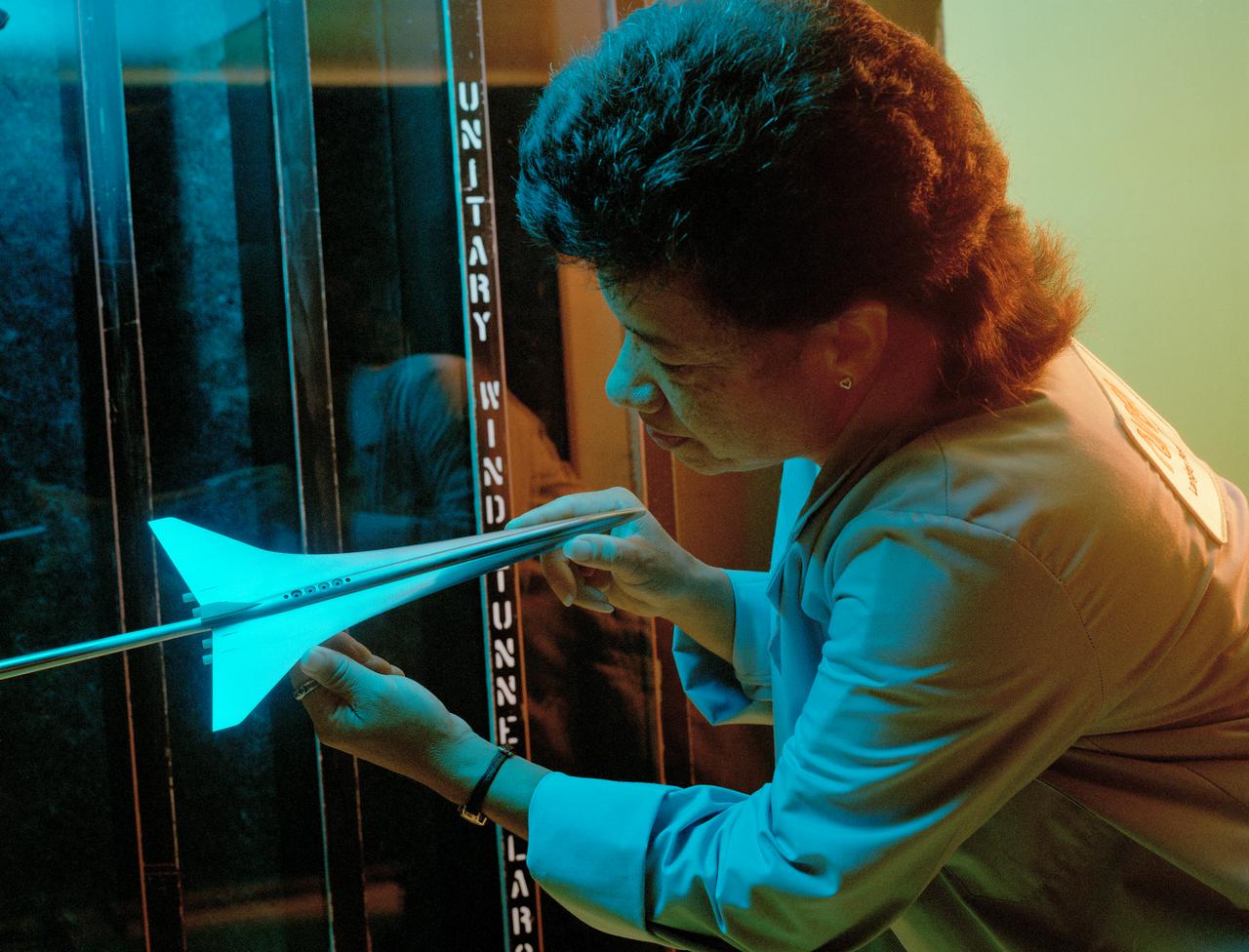
Low-boom Model Mach II in Unitary Tunnel with Christine Darden

Portrait of Christine M. Darden
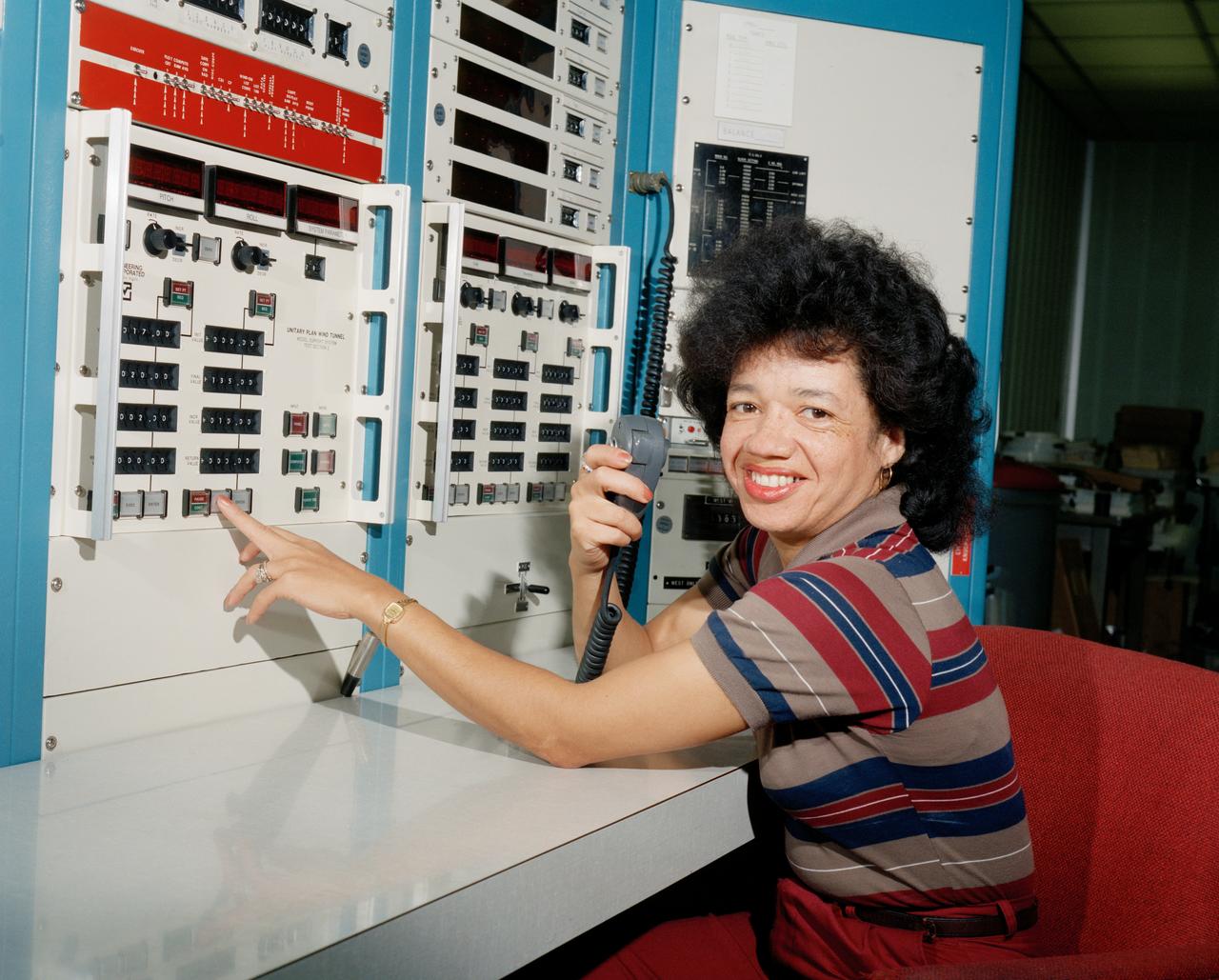
Christine Darden at Work
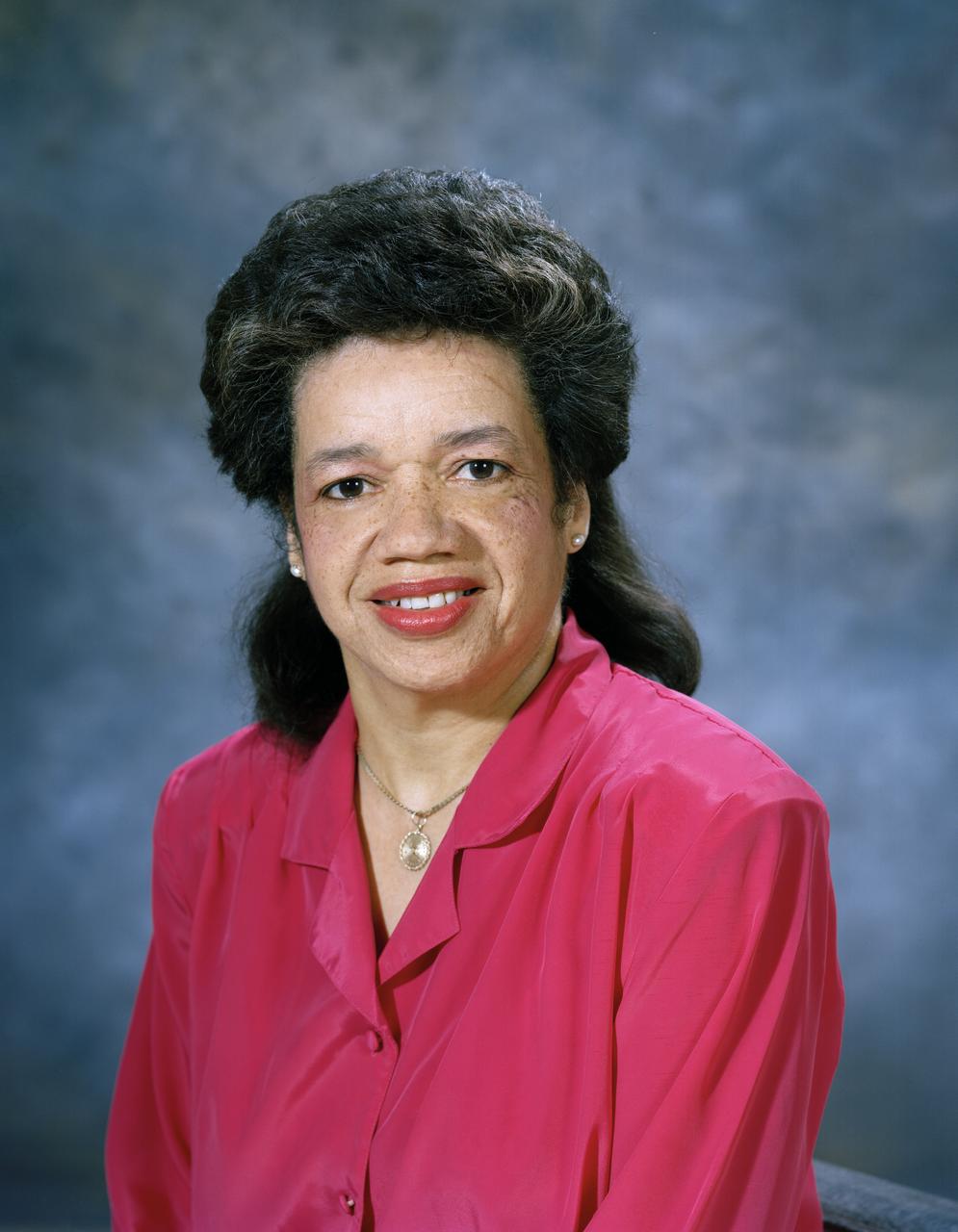
Portrait of Christine M. Darden
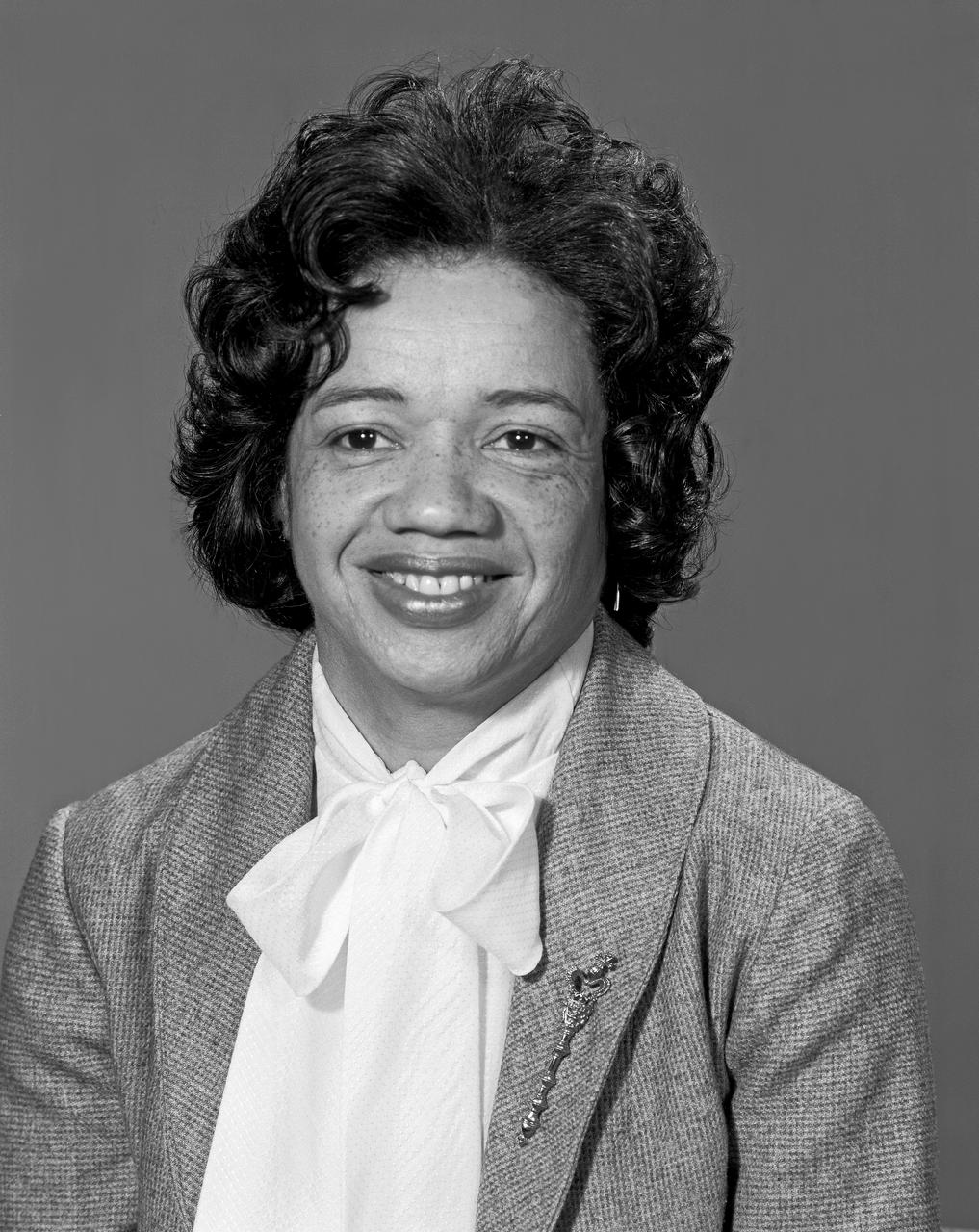
Portrait of Christine M. Darden
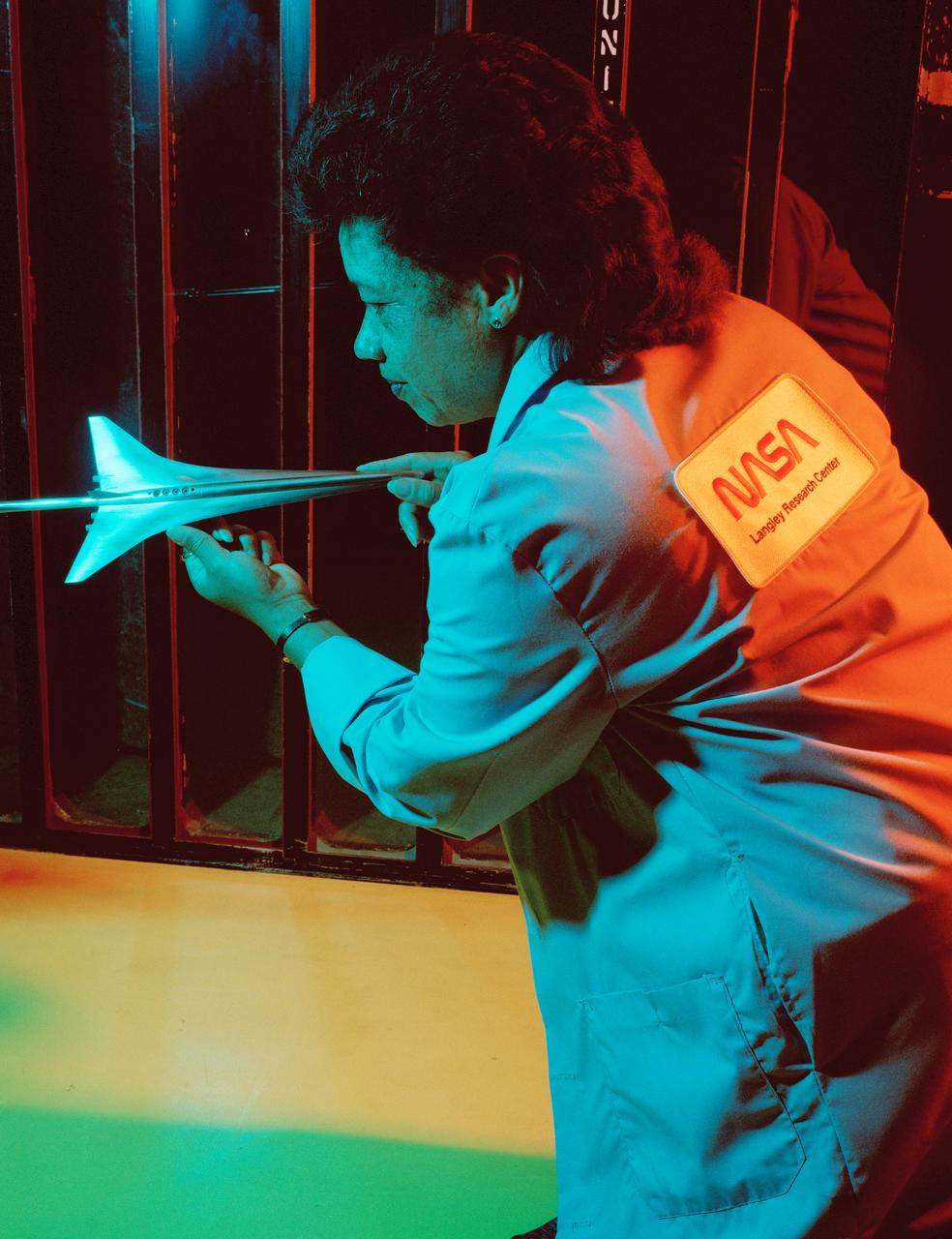
Low-boom Model Mach II in Unitary Tunnel with Christine Darden
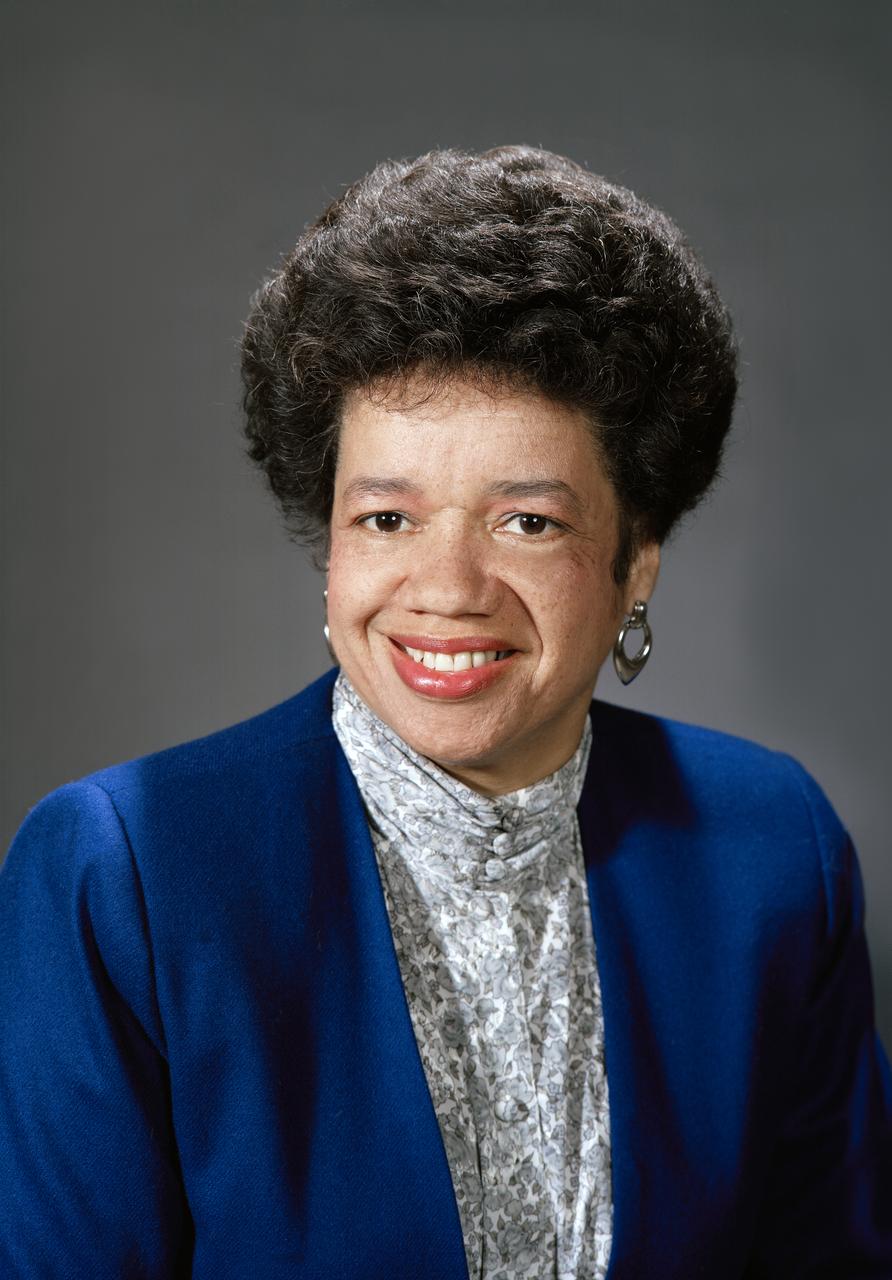
Portrait of Christine M. Darden
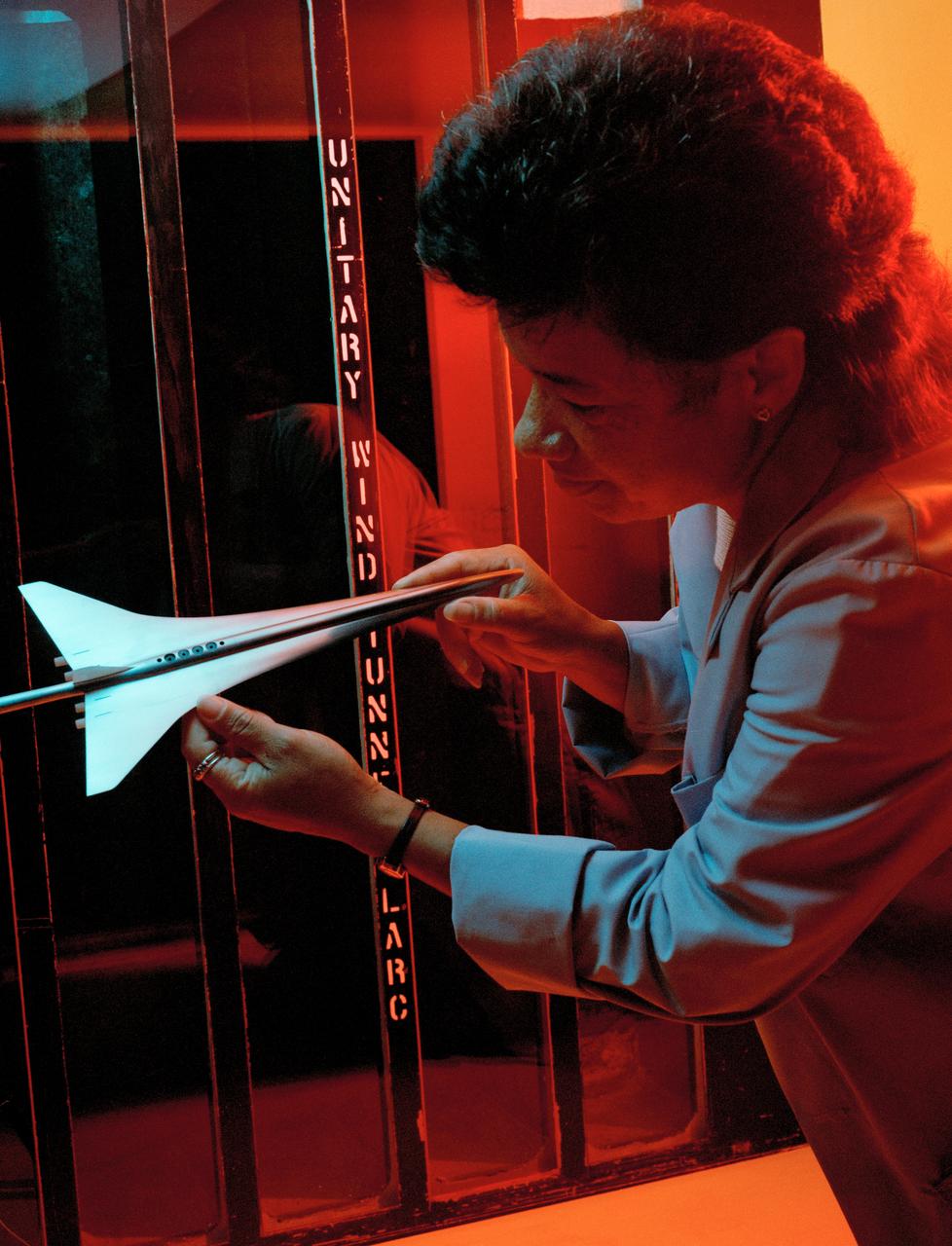
Low-boom Model Mach II in Unitary Tunnel with Christine Darden
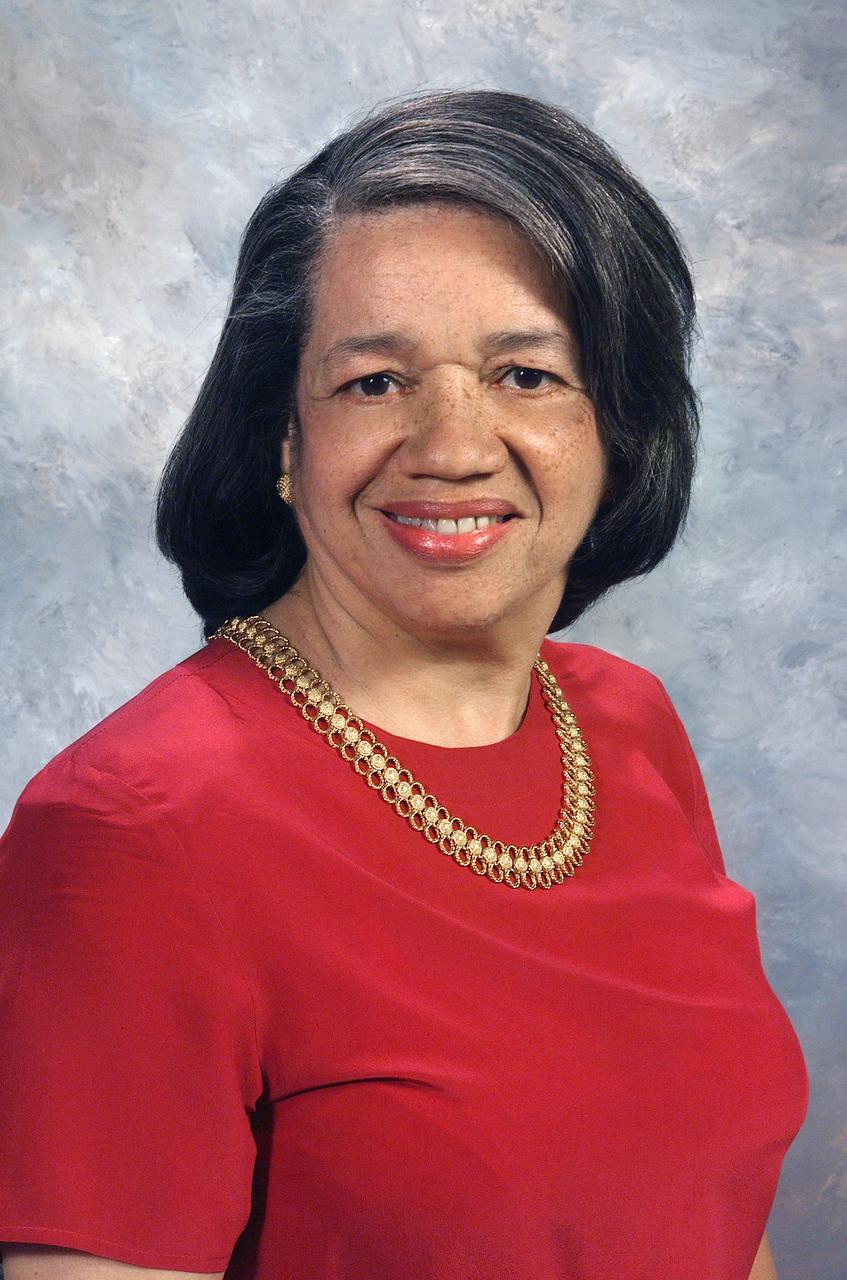
Portrait of Christine M. Darden
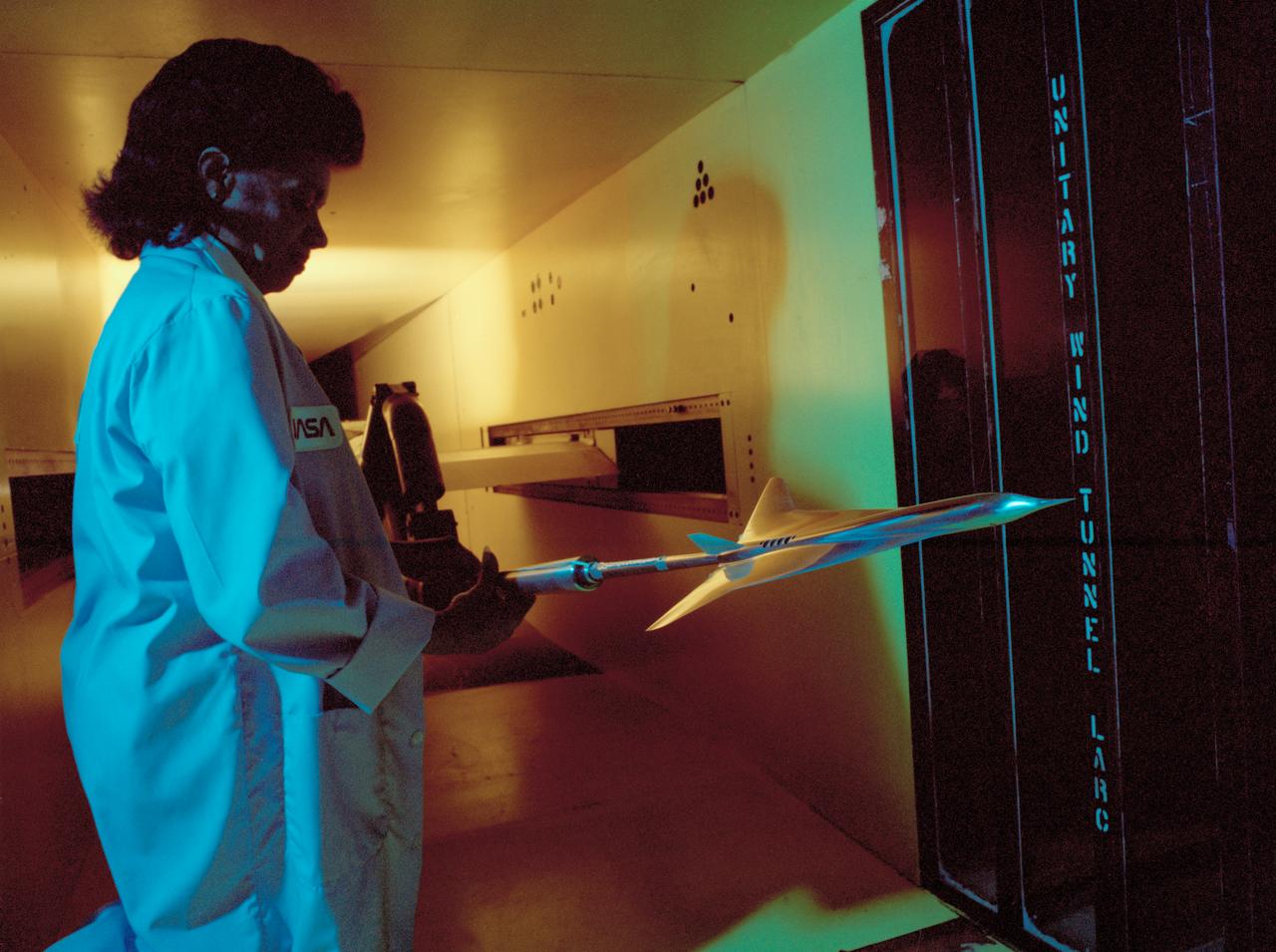
Low-boom Model Mach II in Unitary Tunnel with Christine Darden
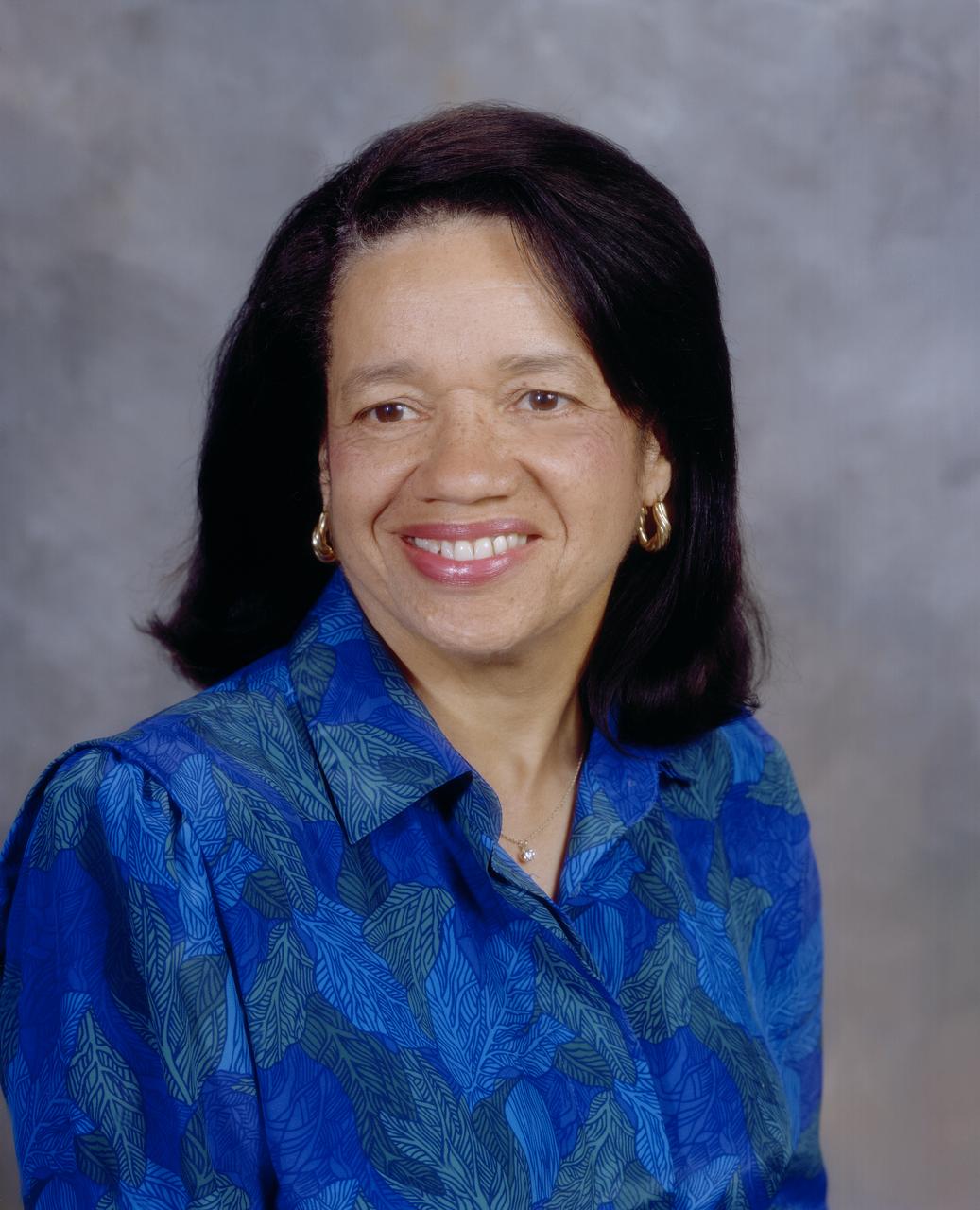
Portrait of Christine M. Darden
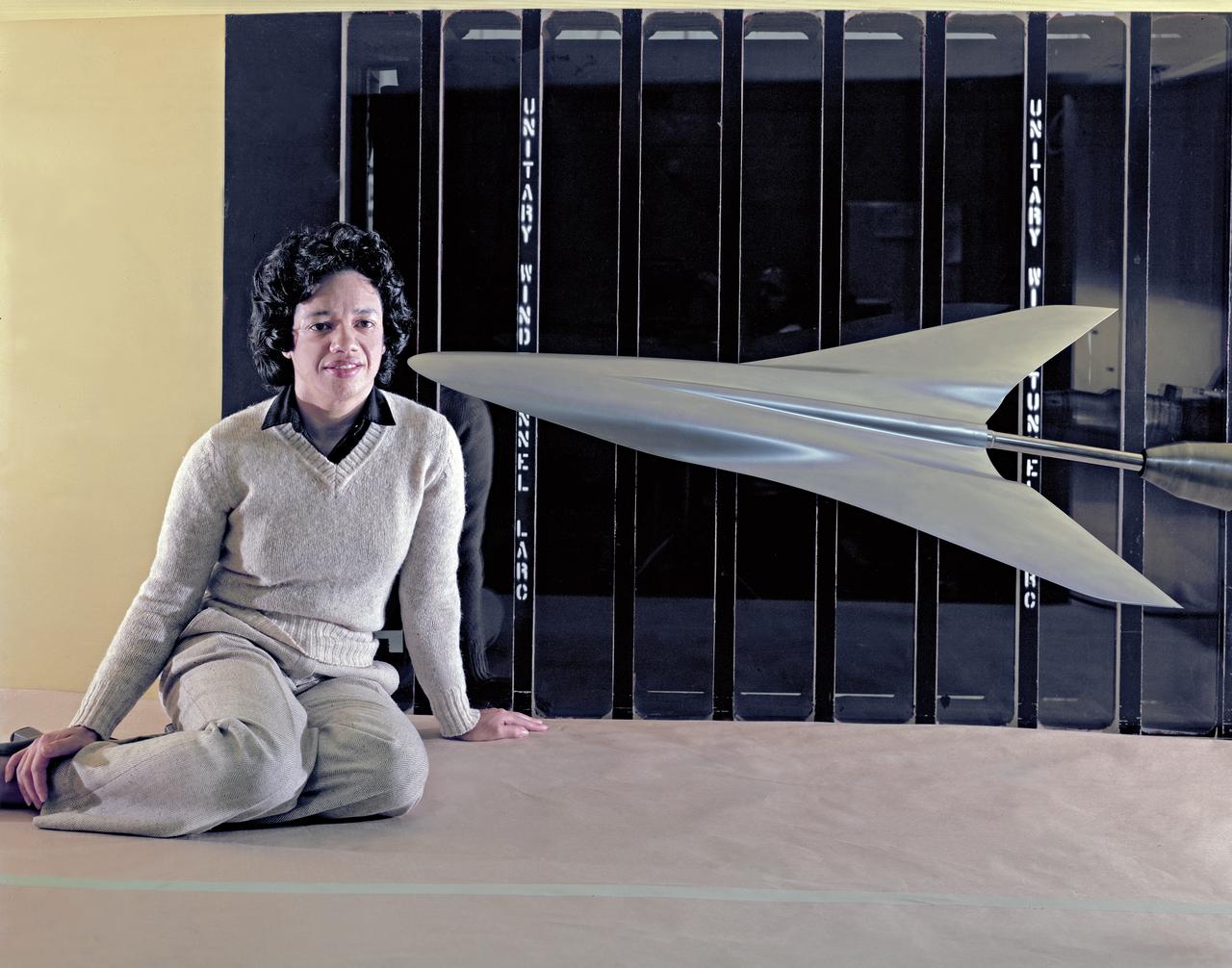
Leading Edge Vortex Suppression Series with Christine Darden in photos
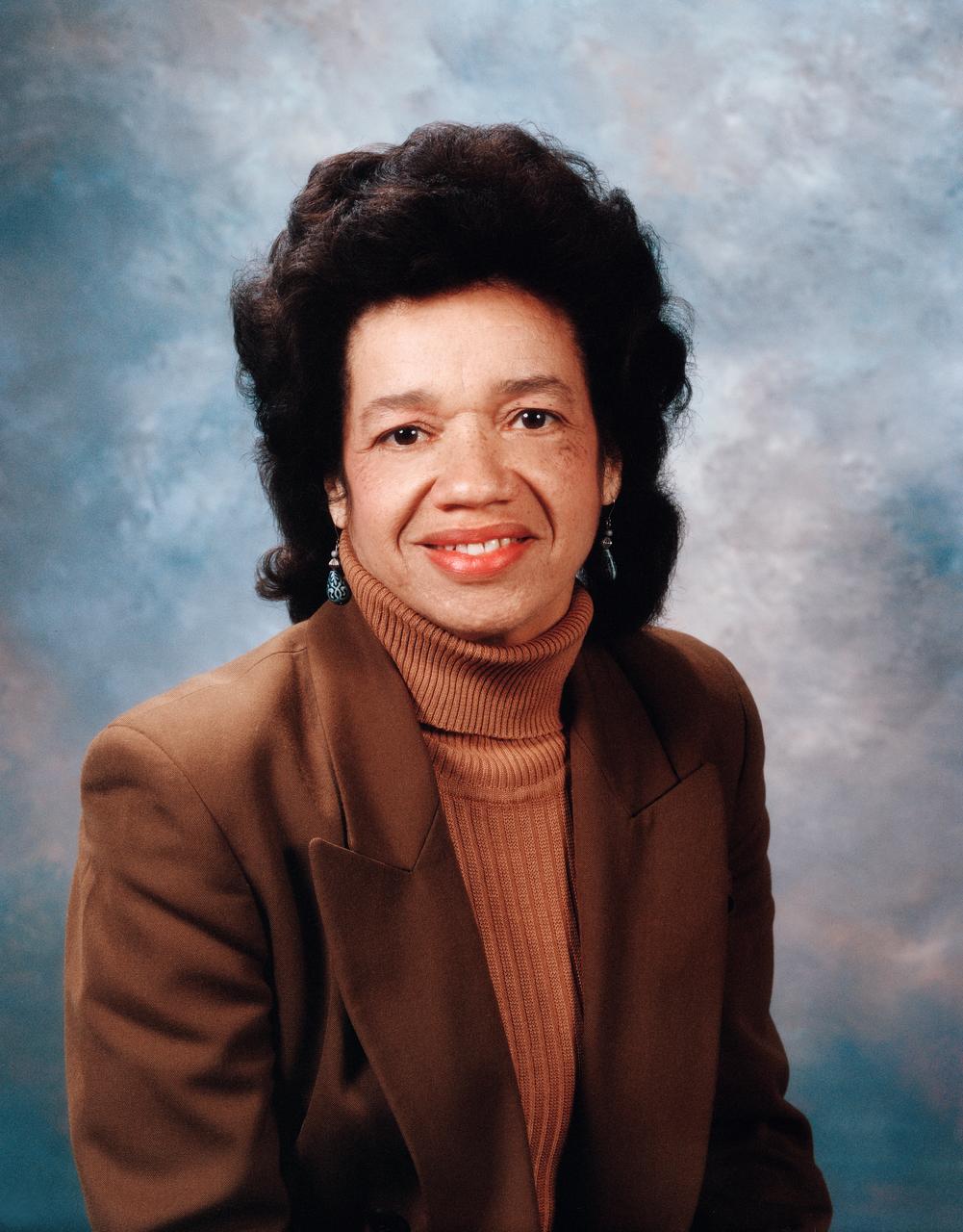
Portrait of Honor Awards Nominee Christine Darden
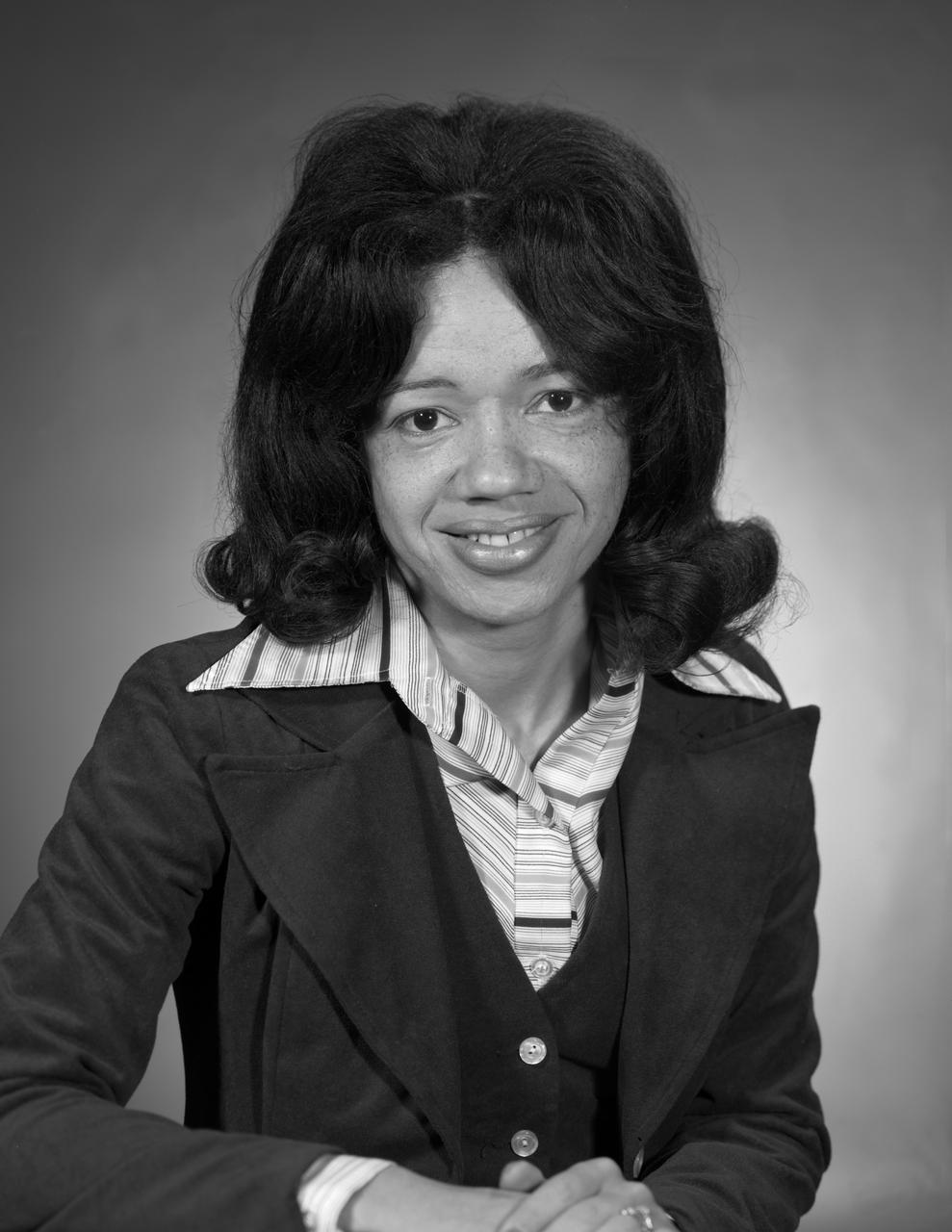
Portriat of Christine M. Darden
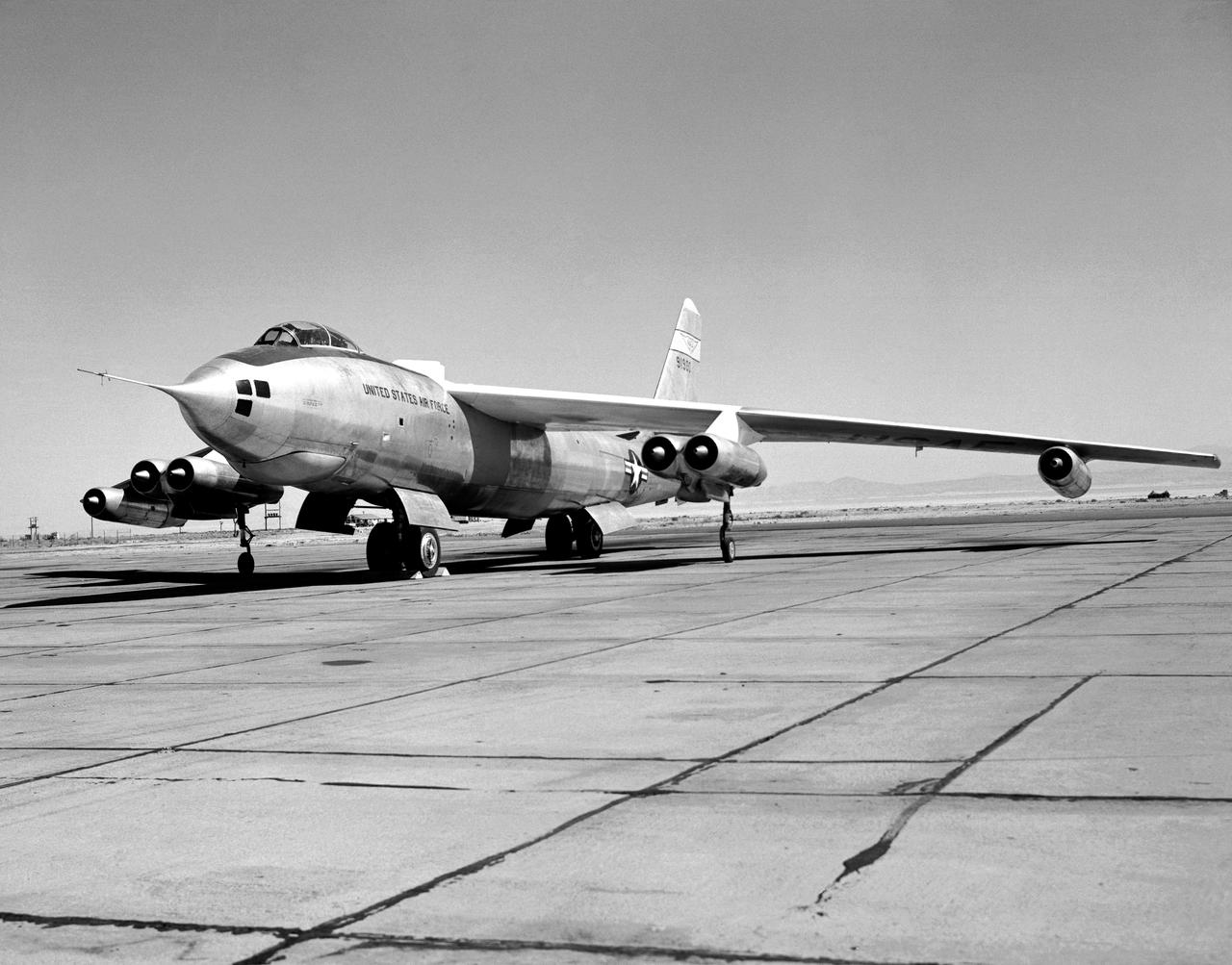
B-47A on ramp
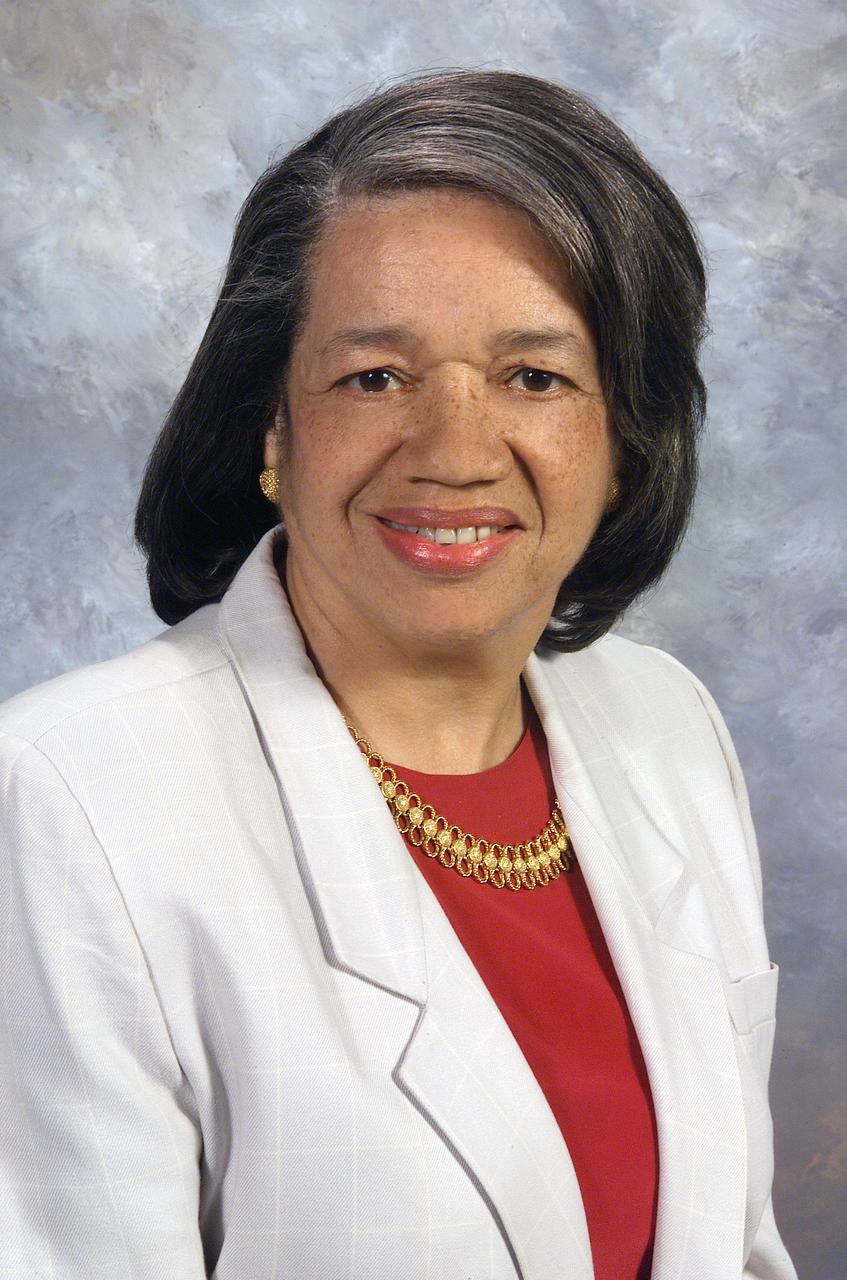
Portrait of Christine M. Darden
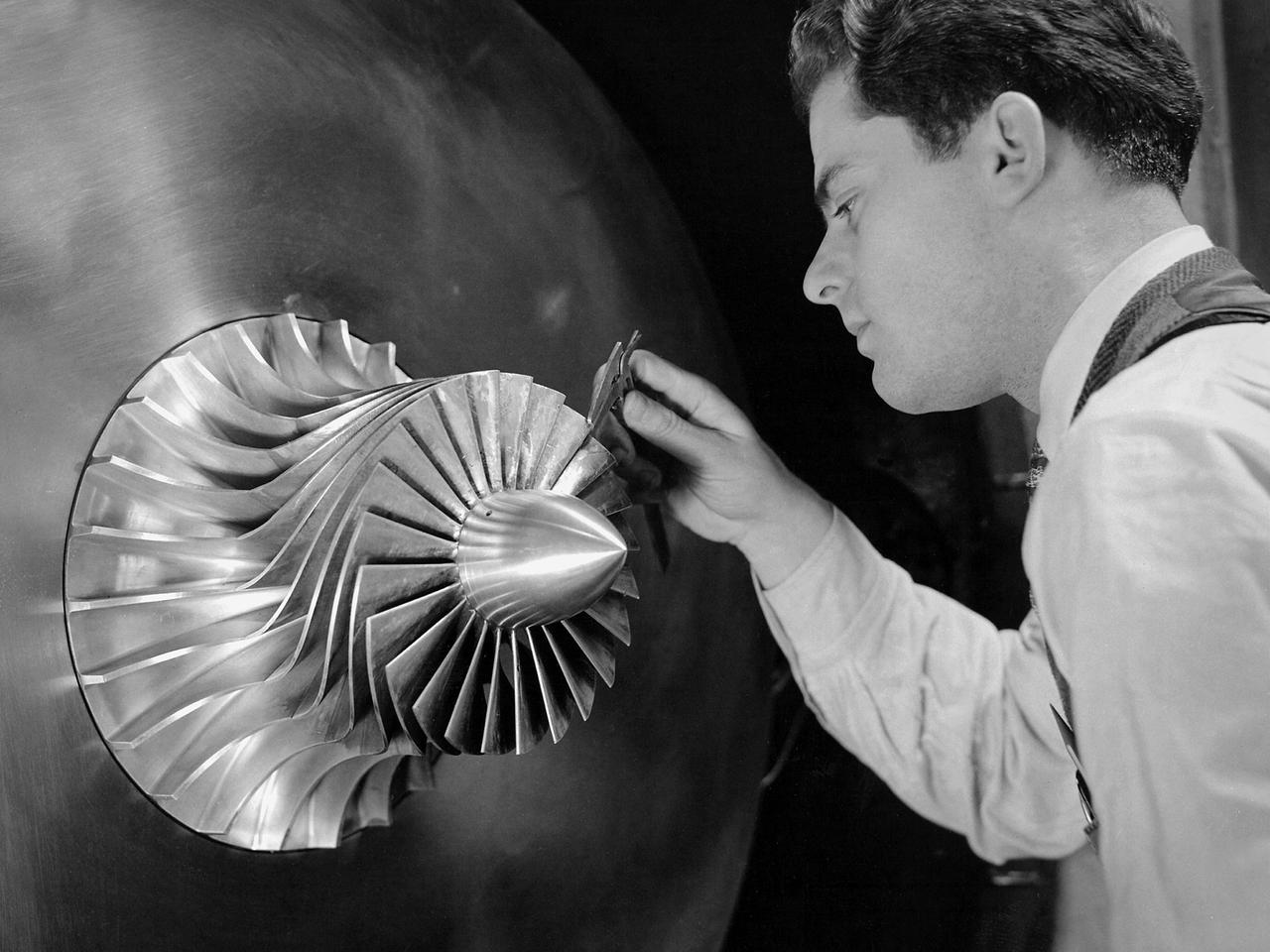
A researcher in the Supercharger Research Division at the National Advisory Committee for Aeronautics (NACA) Aircraft Engine Research Laboratory measures the blade thickness on a supercharger. Superchargers were developed at General Electric used to supply additional air to reciprocating engines. The extra air resulted in increased the engine’s performance, particularly at higher altitudes. The Aircraft Engine Research Laboratory had an entire division dedicated to superchargers during World War II. General Electric developed the supercharger in response to a 1917 request from the NACA to develop a device to enhance high-altitude flying. The supercharger pushed larger volumes of air into the engine manifold. The extra oxygen allowed the engine to operate at its optimal sea-level rating even when at high altitudes. Thus, the aircraft could maintain its climb rate, maneuverability and speed as it rose higher into the sky. NACA work on the supercharger ceased after World War II due to the arrival of the turbojet engine. The Supercharger Research Division was disbanded in October 1945 and reconstituted as the Compressor and Turbine Division.
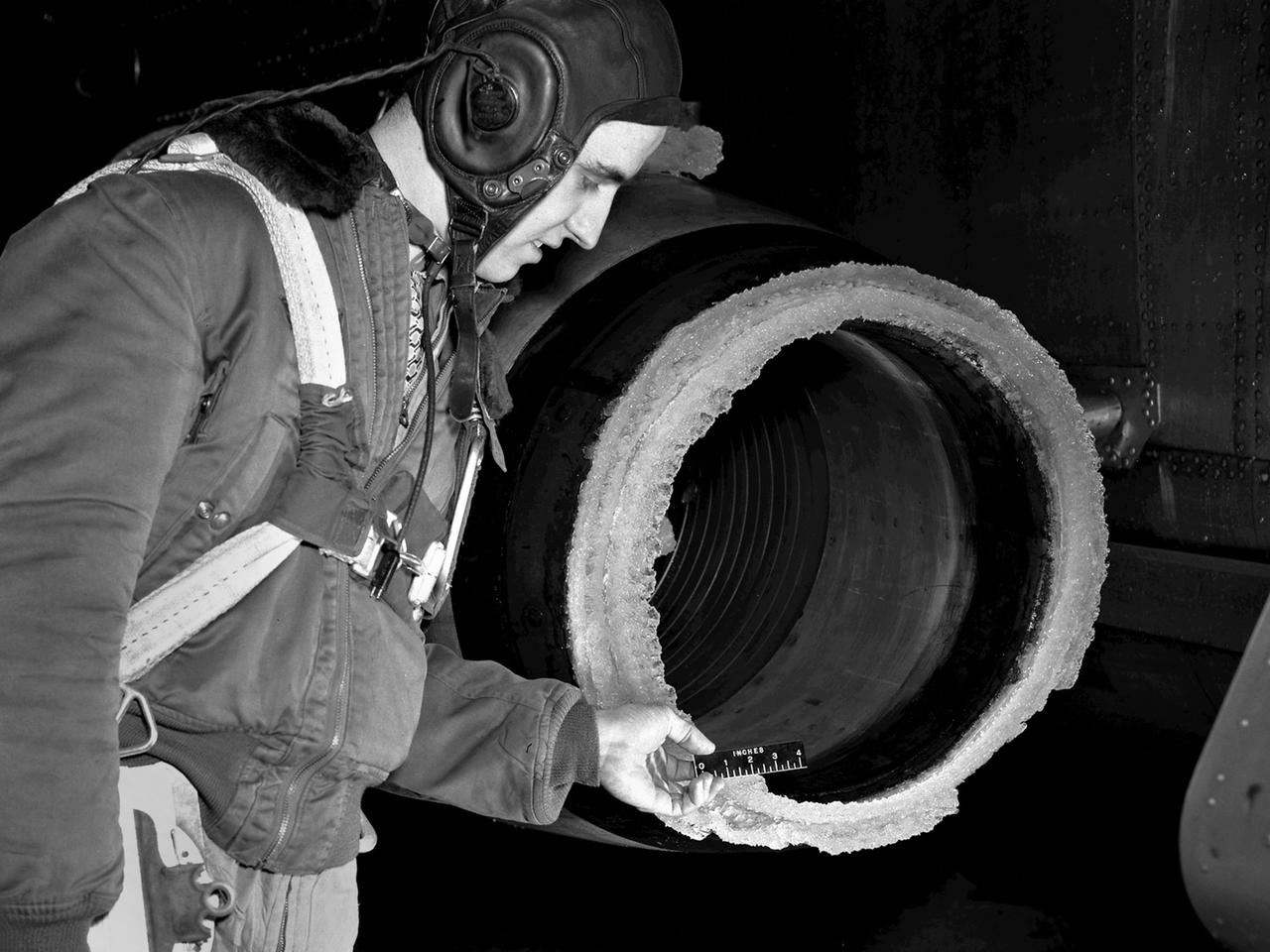
The National Advisory Committee for Aeronautics (NACA) Lewis Flight Propulsion Laboratory conducted an extensive icing research program in the late 1940s that included studies in the Icing Research Tunnel and using specially modified aircraft. One facet of this program was the investigation of the effects of icing on turbojets. Although jet engines allowed aircraft to pass through inclement weather at high rates of speed, ice accumulation was still a concern. The NACA’s B-24M Liberator was initially reconfigured with a General Electric I-16 engine installed in the aircraft’s waist compartment with an air scoop and spray nozzles to produce the artificial icing conditions. The centrifugal engine appeared nearly impervious to the effects of icing. Axial-flow jet engines, however, were much more susceptible to icing damage. The inlet guide vanes were particularly vulnerable, but the cowling’s leading edge, the main bearing supports, and accessory housing could also ice up. If pieces of ice reached the engine’s internal components, the compressor blades could be damaged. To study this phenomenon, a Westinghouse 24C turbojet, seen in this photograph, was installed under the B-24M’s right wing. In January 1948 flight tests of the 24C in icing conditions began. Despite ice buildup into the second stage of the compressor, the engine was able to operate at takeoff speeds. Researchers found the ice on the inlet vanes resulted in half of the engine’s decreased performance.
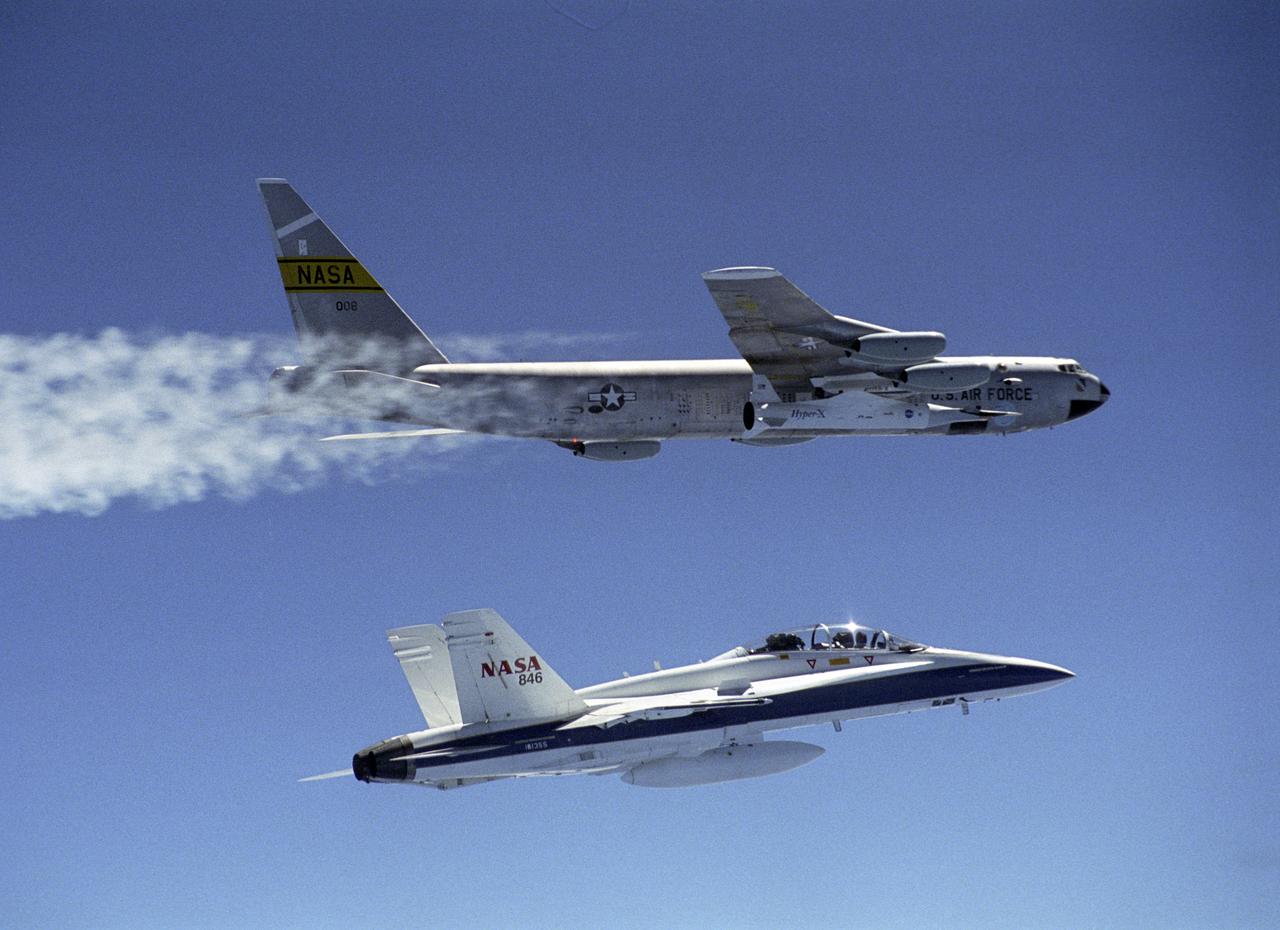
The second X-43A hypersonic research aircraft, attached to a modified Pegasus booster rocket and followed by a chase F-18, was taken to launch altitude by NASA's B-52B launch aircraft from the NASA Dryden Flight Research Center at Edwards Air Force Base, Calif., on March 27, 2004. About an hour later the Pegasus booster was released from the B-52 to accelerate the X-43A to its intended speed of Mach 7. In a combined research effort involving Dryden, Langley, and several industry partners, NASA demonstrated the value of its X-43A hypersonic research aircraft, as it became the first air-breathing, unpiloted, scramjet-powered plane to fly freely by itself. The March 27 flight, originating from NASA's Dryden Flight Research Center, began with the Agency's B-52B launch aircraft carrying the X-43A out to the test range over the Pacific Ocean off the California coast. The X-43A was boosted up to its test altitude of about 95,000 feet, where it separated from its modified Pegasus booster and flew freely under its own power. Two very significant aviation milestones occurred during this test flight: first, controlled accelerating flight at Mach 7 under scramjet power, and second, the successful stage separation at high dynamic pressure of two non-axisymmetric vehicles. To top it all off, the flight resulted in the setting of a new aeronautical speed record. The X-43A reached a speed of over Mach 7, or about 5,000 miles per hour faster than any known aircraft powered by an air-breathing engine has ever flown.
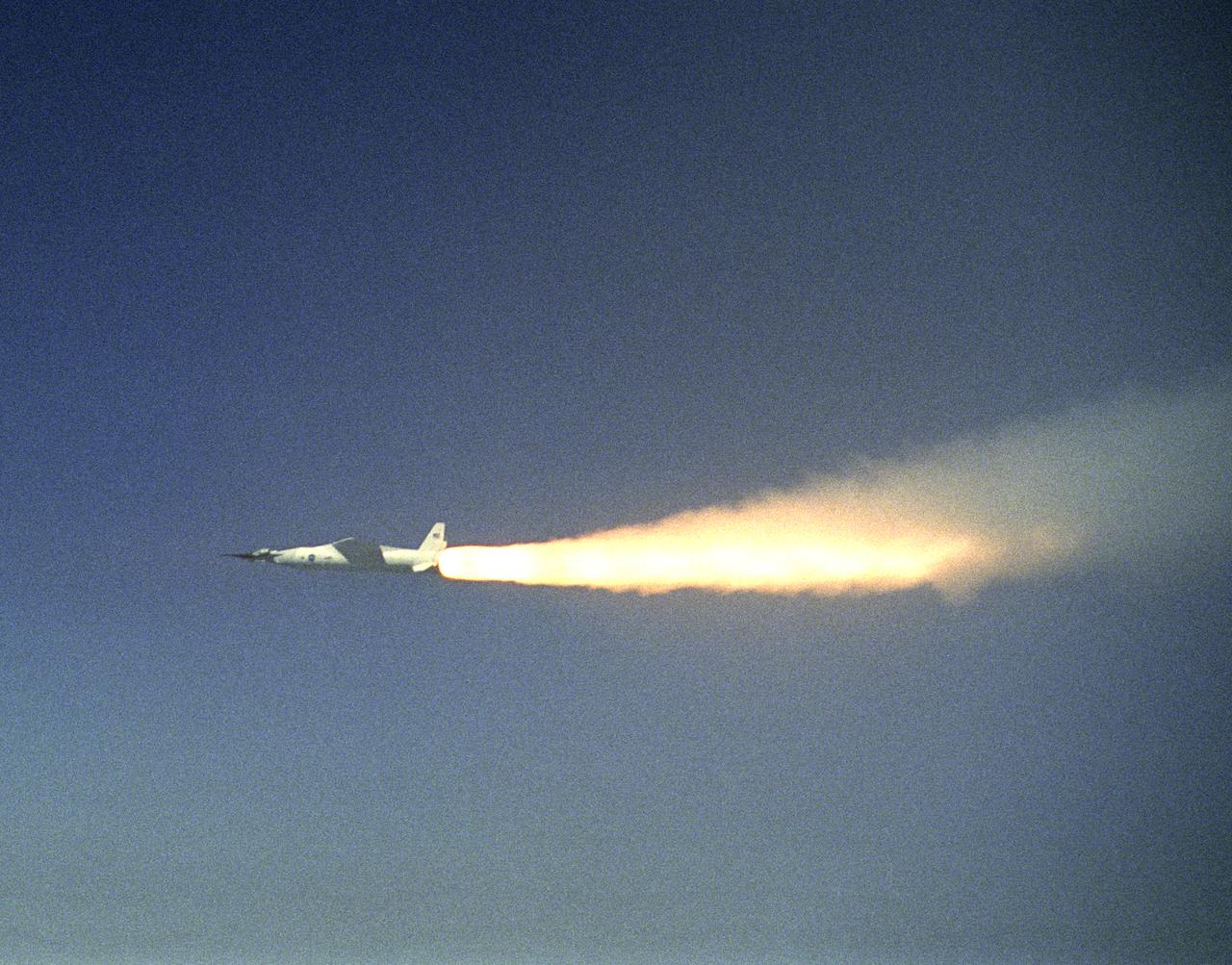
The second X-43A hypersonic research aircraft and its modified Pegasus booster rocket accelerate after launch from NASA's B-52B launch aircraft over the Pacific Ocean on March 27, 2004. The mission originated from the NASA Dryden Flight Research Center at Edwards Air Force Base, Calif. Minutes later the X-43A separated from the Pegasus booster and accelerated to its intended speed of Mach 7. In a combined research effort involving Dryden, Langley, and several industry partners, NASA demonstrated the value of its X-43A hypersonic research aircraft, as it became the first air-breathing, unpiloted, scramjet-powered plane to fly freely by itself. The March 27 flight, originating from NASA's Dryden Flight Research Center, began with the Agency's B-52B launch aircraft carrying the X-43A out to the test range over the Pacific Ocean off the California coast. The X-43A was boosted up to its test altitude of about 95,000 feet, where it separated from its modified Pegasus booster and flew freely under its own power. Two very significant aviation milestones occurred during this test flight: first, controlled accelerating flight at Mach 7 under scramjet power, and second, the successful stage separation at high dynamic pressure of two non-axisymmetric vehicles. To top it all off, the flight resulted in the setting of a new aeronautical speed record. The X-43A reached a speed of over Mach 7, or about 5,000 miles per hour faster than any known aircraft powered by an air-breathing engine has ever flown.
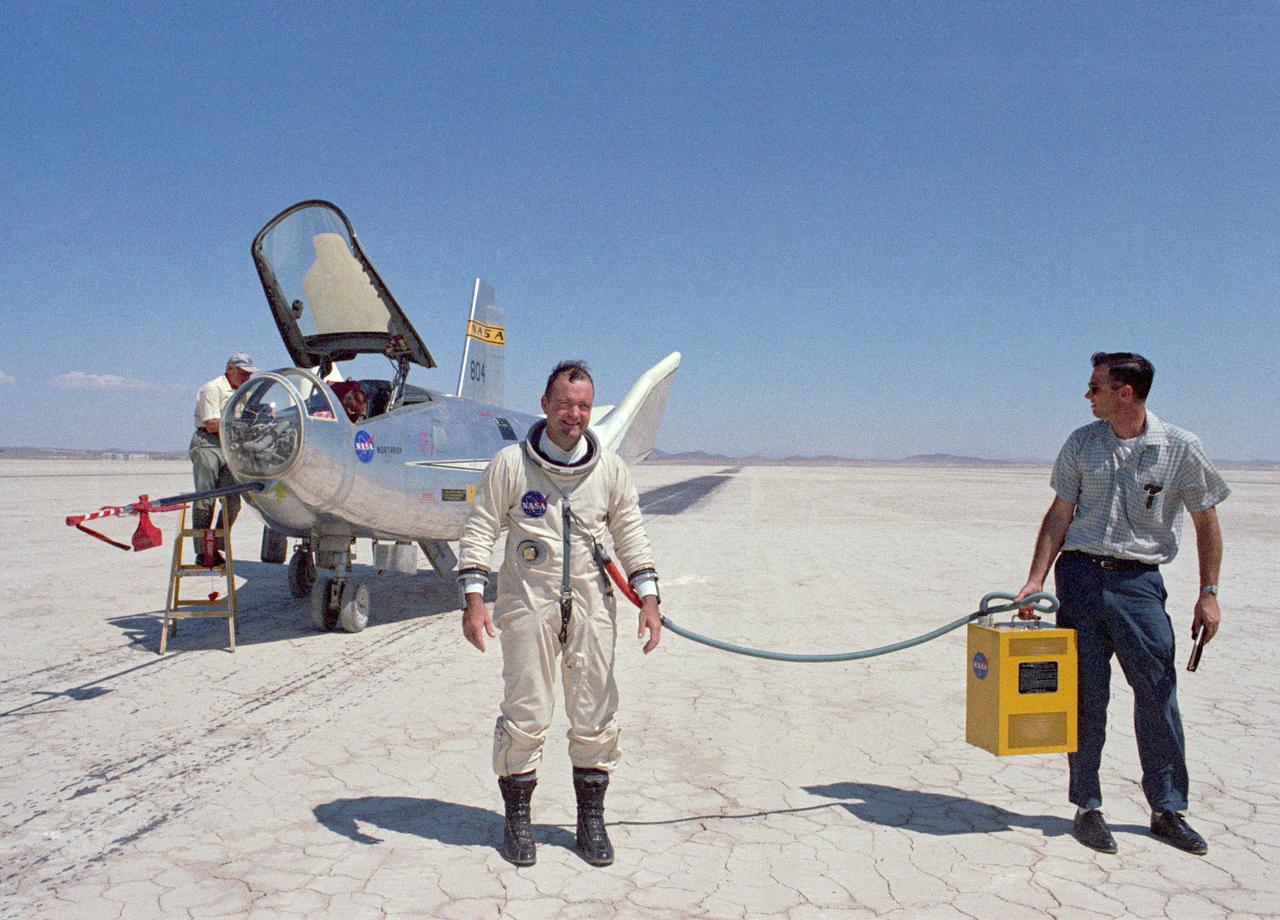
NASA research pilot Bill Dana after his fourth free flight (1 glide and 3 powered) in the HL-10. This particular flight reached a maximum speed of Mach 1.45. Dana made a total of nine HL-10 flights (1 glide and 8 powered), and his lifting body experience as a whole included several car tow and 1 air tow flights in the M2-F1; 4 glide and 15 powered flights in the M2-F3; and 2 powered flights in the X-24B. He is wearing a pressure suit for protection against the cockpit depressurizing at high altitudes. The air conditioner box held by the ground crewman provides cool air to prevent overheating.
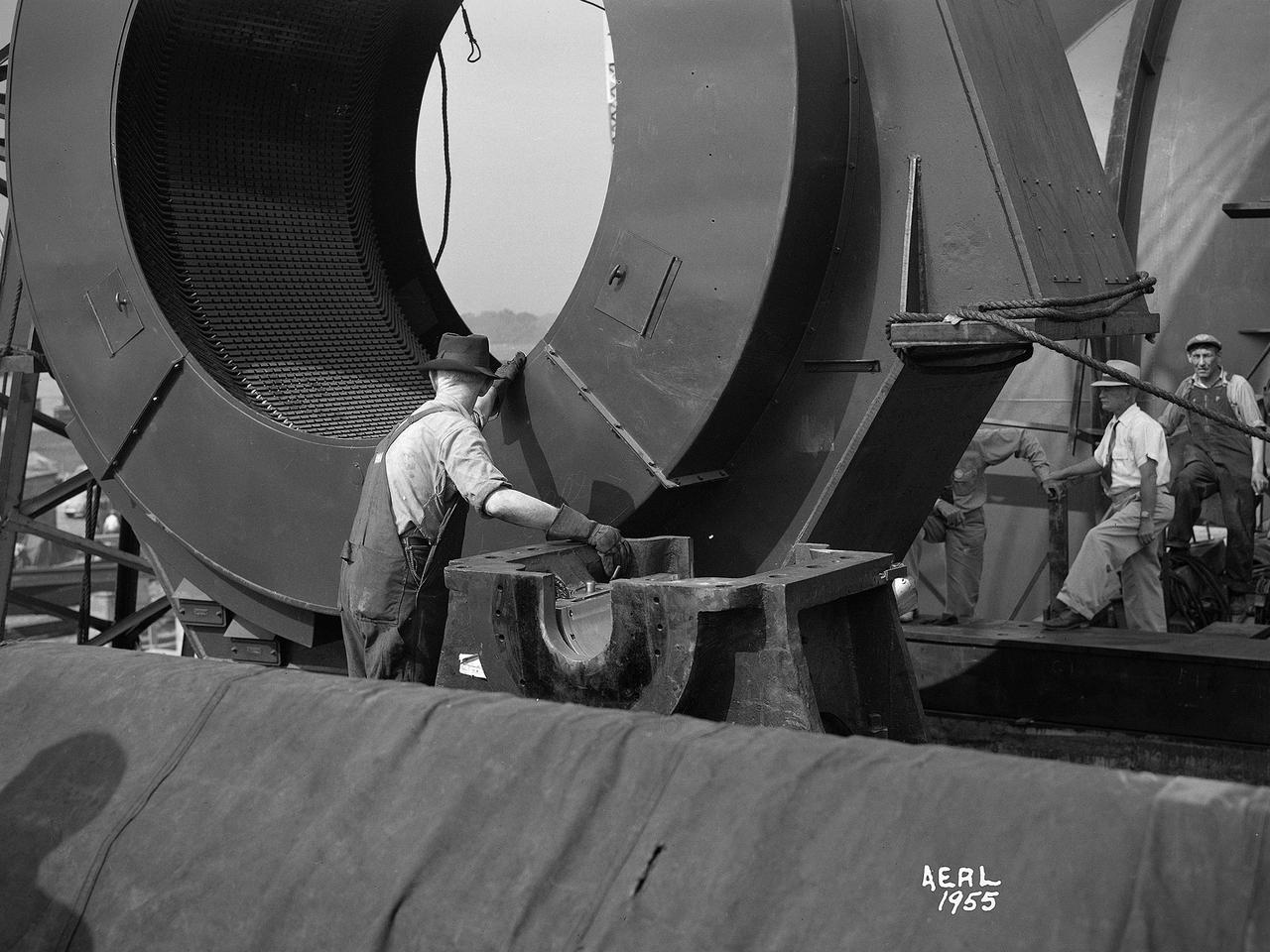
Construction workers install the drive motor for the Altitude Wind Tunnel (AWT) in the Exhauster Building at the National Advisory Committee for Aeronautics (NACA) Aircraft Engine Research Laboratory. The AWT was capable of operating full-scale engines in air density, speed, and temperature similar to that found at high altitudes. The tunnel could produce wind speeds up to 500 miles per hour through a 20-foot-diameter test section at the standard operating altitude of 30,000 feet. The airflow was created by a large wooden fan near the tunnel’s southeast corner. This photograph shows the installation of the 18,000-horsepower drive motor inside the adjoining Exhauster Building in July 1943. The General Electric motor, whose support frame is seen in this photograph, connected to a drive shaft that extended from the building, through the tunnel shell, and into a 12-bladed, 31-foot-diameter spruce wood fan. Flexible couplings on the shaft allowed for the movement of the shell. The corner of the Exhauster Building was built around the motor after its installation. The General Electric induction motor could produce 10 to 410 revolutions per minute and create wind speeds up to 500 miles per hour, or Mach 0.63, at 30,000 feet. The AWT became operational in January 1944 and tested piston, turbojet and ramjet engines for nearly 20 years.
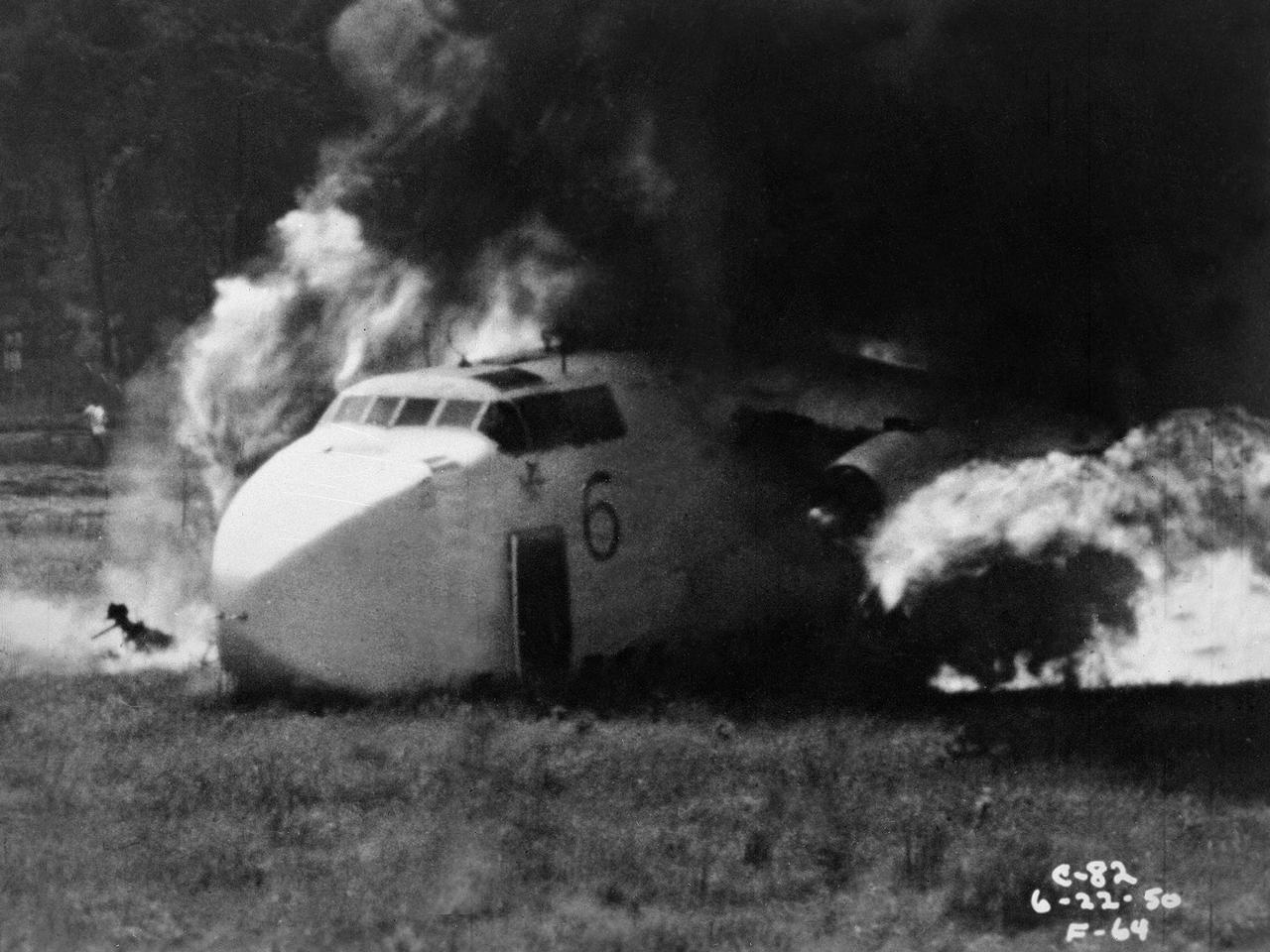
Researchers at the National Advisory Committee for Aeronautics (NACA) Lewis Flight Propulsion Laboratory purposely crash a Fairchild C-82 Packet aircraft to study flame propagation. A rash of passenger aircraft crashes in 1946 and 1947 spurred a White House call for an investigatory board staffed by members of the Civil Aeronautics Board, military, and the NACA. The group addressed fire segregation, extinguishment, and prevention. The NACA established a Subcommittee on Aircraft Fire Prevention in February 1948 to coordinate its efforts. The Lewis team simulated situations in which an aircraft failed to become airborne during takeoff resulting in crashes into embankments and other objects. The Lewis researchers initially used surplus C-46 and C-82 military transport planes. In these situations, the aircraft generally suffered damage to its fuel system and other components, but was structurally survivable. The aircraft were mounted to a rail that ran down a 1700-foot long test runway. The aircraft was secured at the starting point with an anchor pier so it could get its engines up to takeoff speed before launching down the track. Barriers at the end of the runway were designed to simulate a variety of different types of crashes. Telemetry and high-speed cameras were crucial elements in these studies. The preliminary testing phase identified potential ignition sources and analyzed the spread of flammable materials.