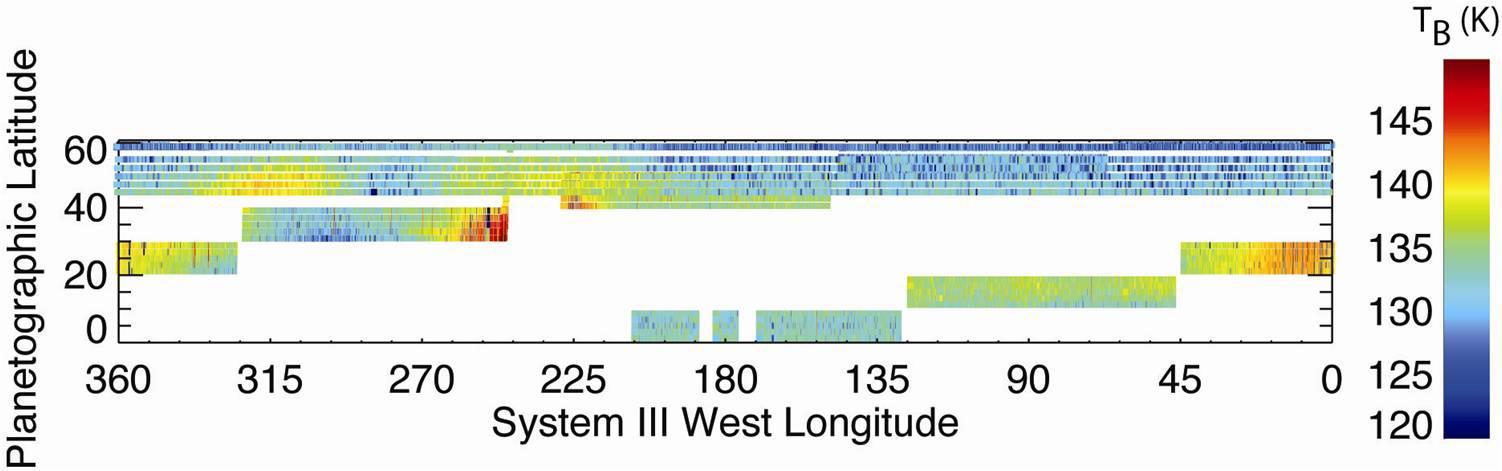
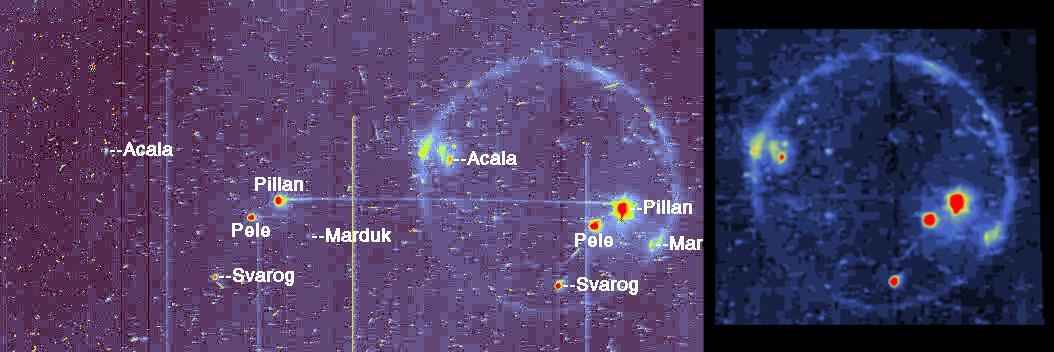
Io in Eclipse reveals High Temperature Hot Spots
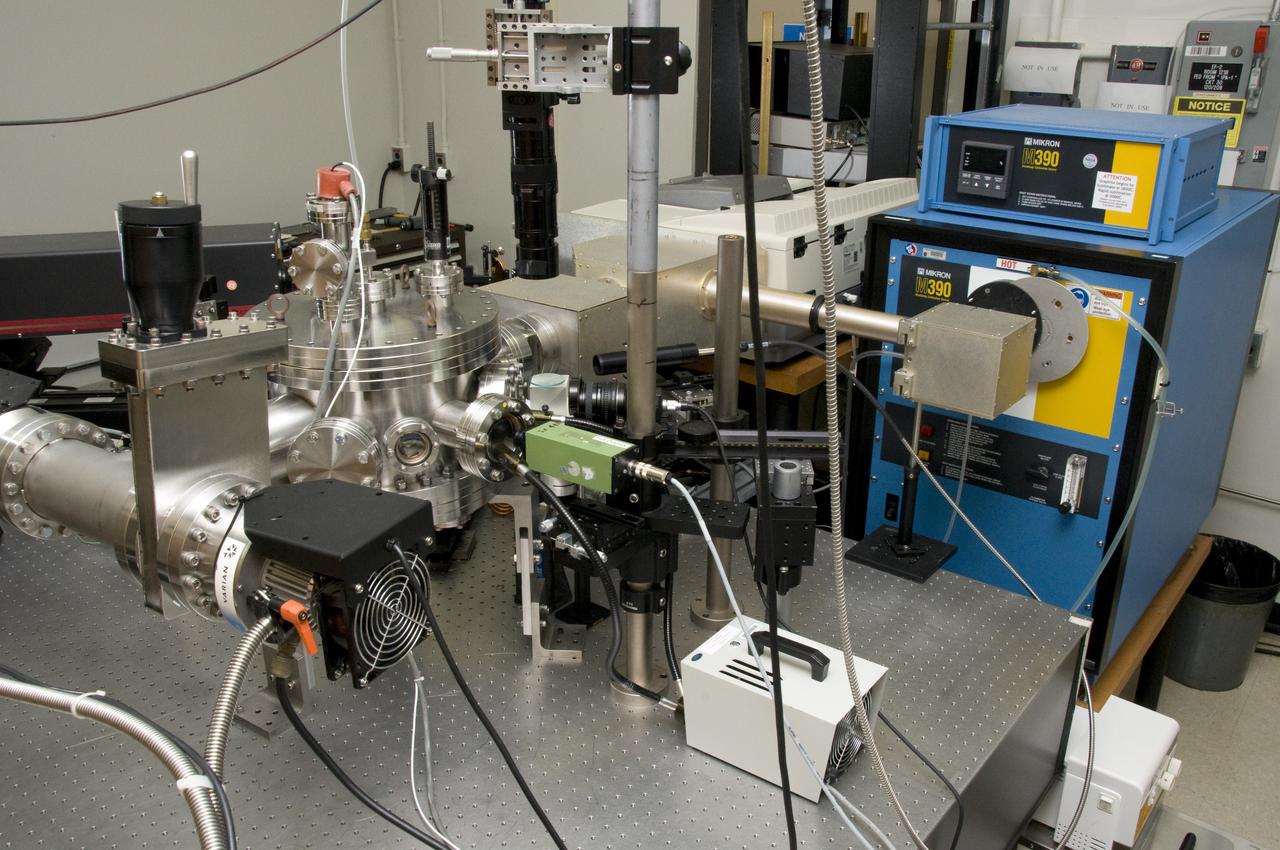
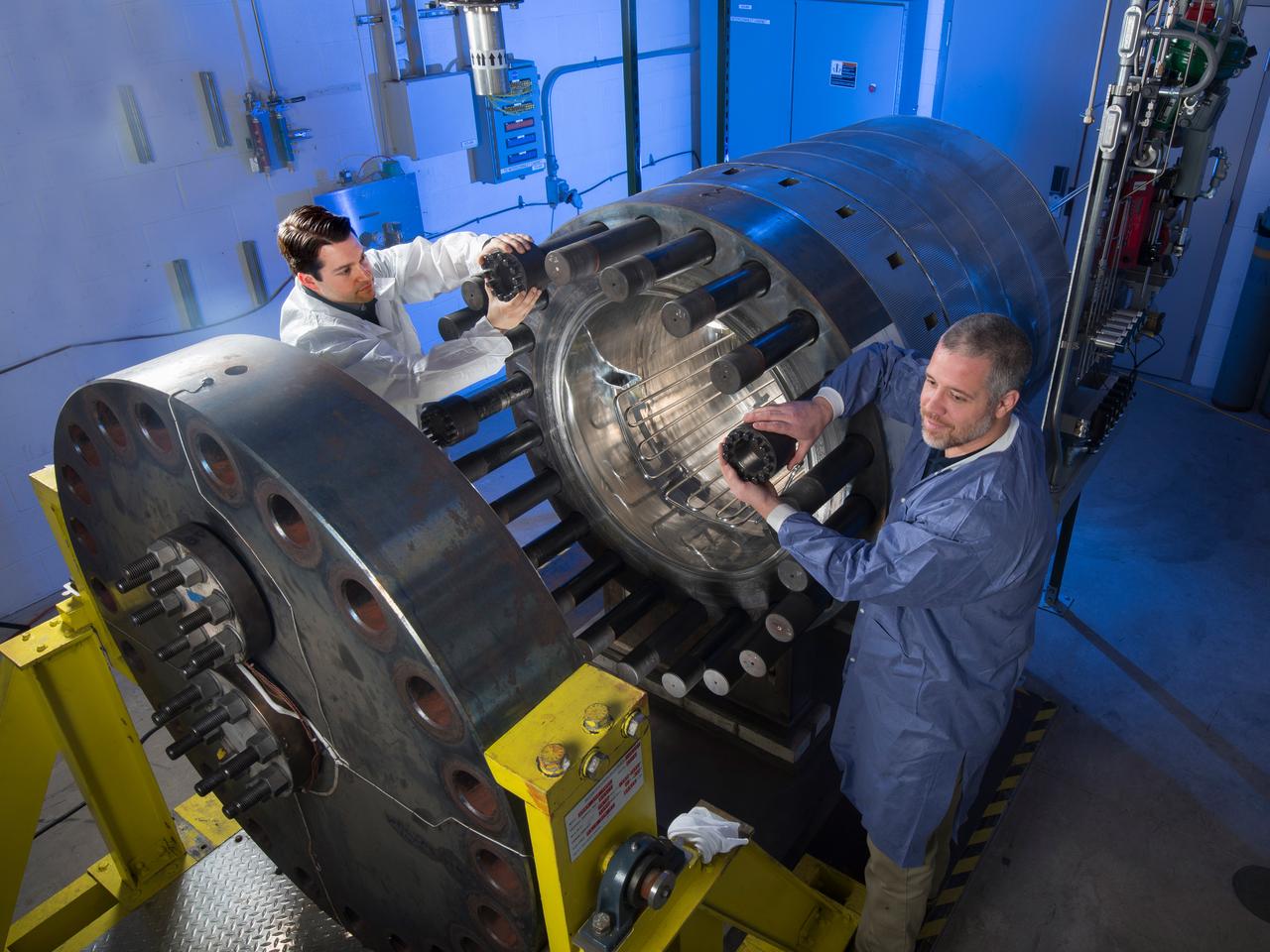
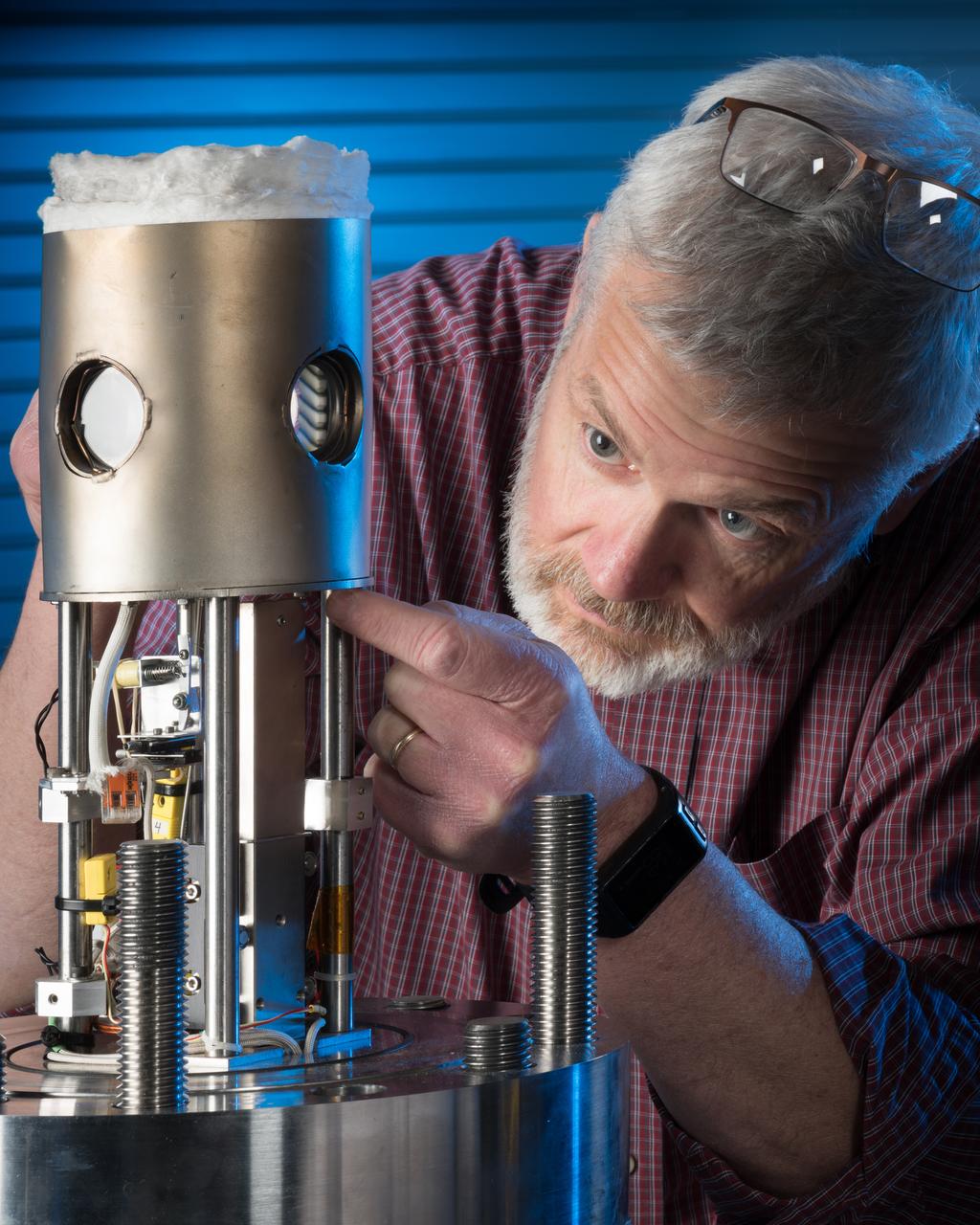
HIGH TEMPERATURE EMISSOMETER SYSTEM (HITEMS) OVERALL SHOT
1001451
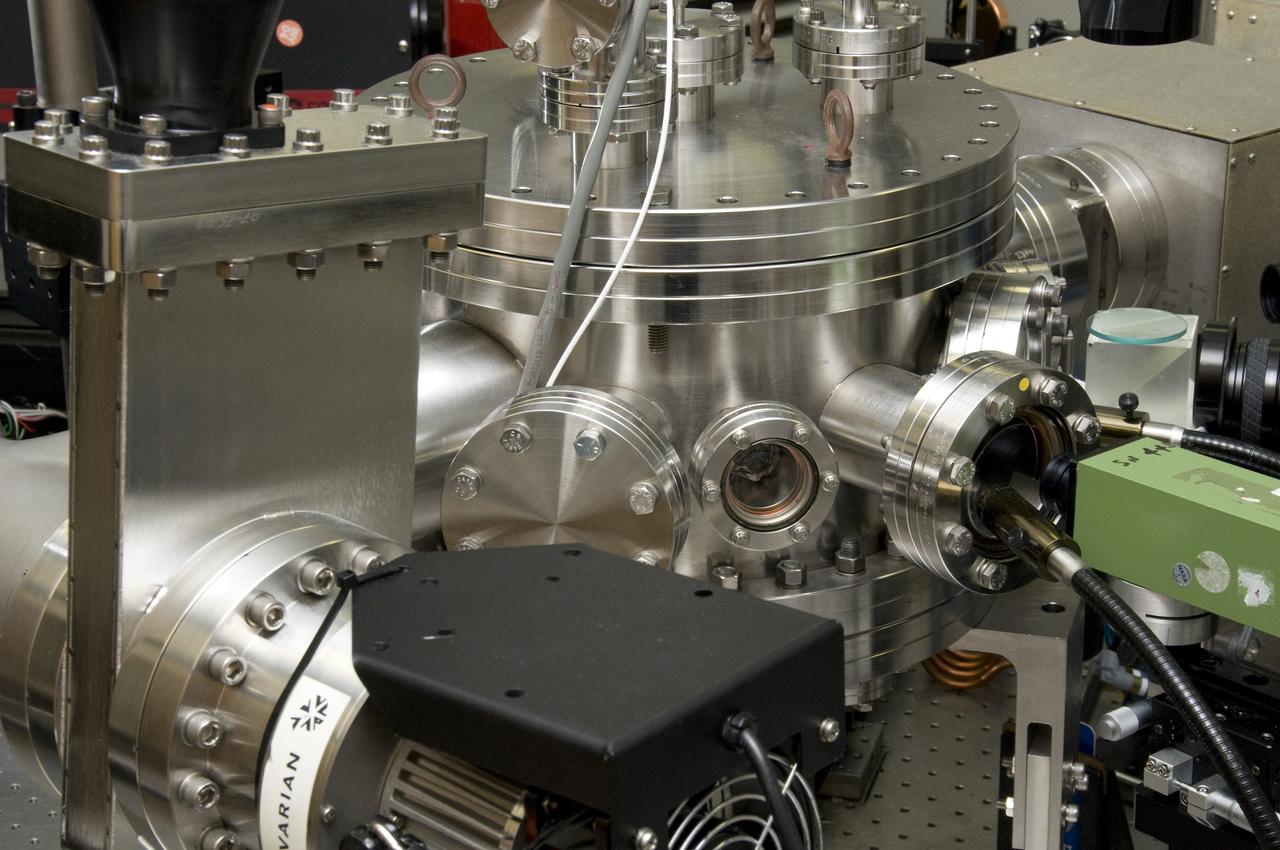
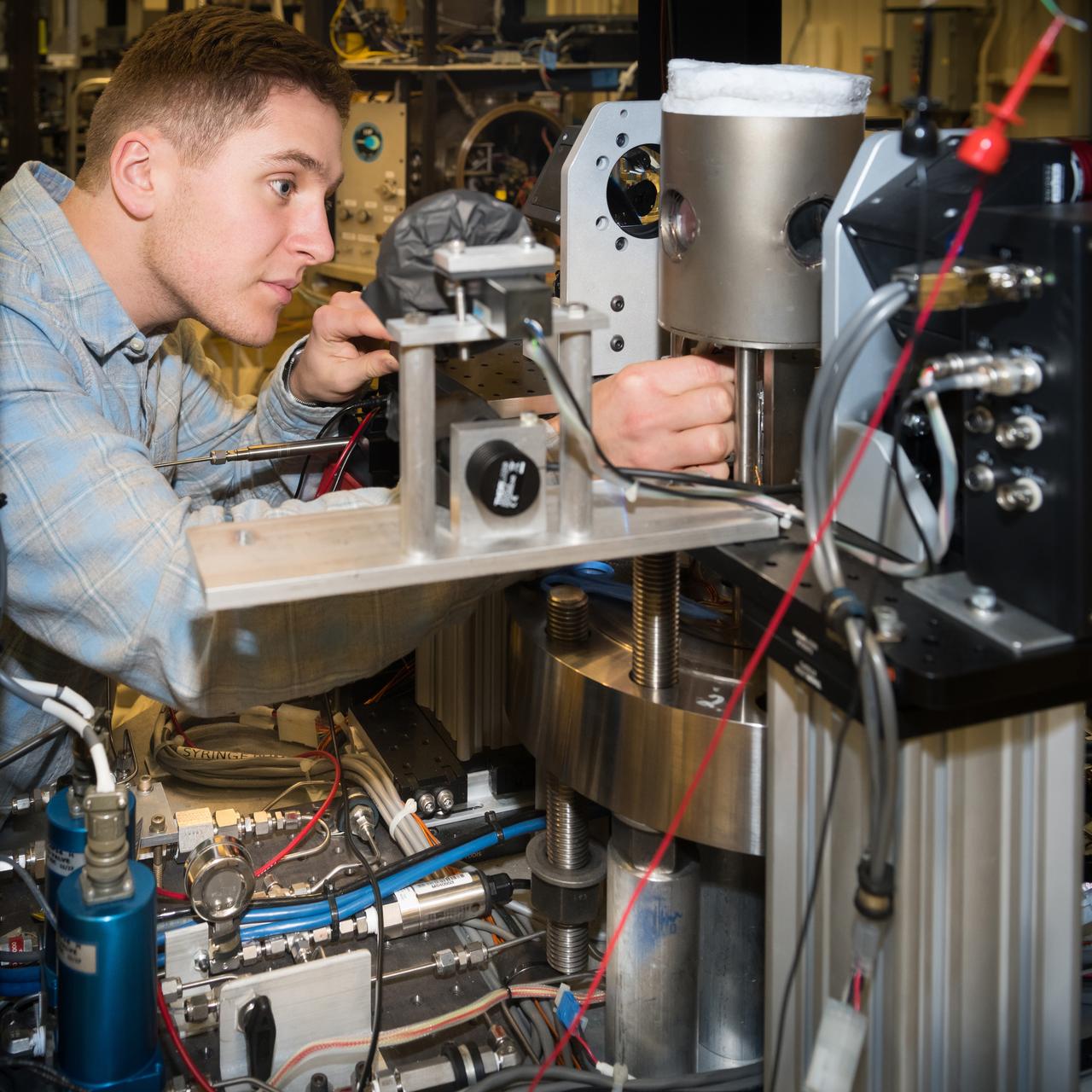
HIGH TEMPERATURE EMISSOMETER SYSTEM (HITEMS) CHAMBER
1001455
HIGH TEMPERATURE EMISSOMETER SYSTEM (HITEMS) CHAMBER
1001452
HIGH TEMPERATURE EMISSOMETER SYSTEM (HITEMS) CHAMBER
1001453
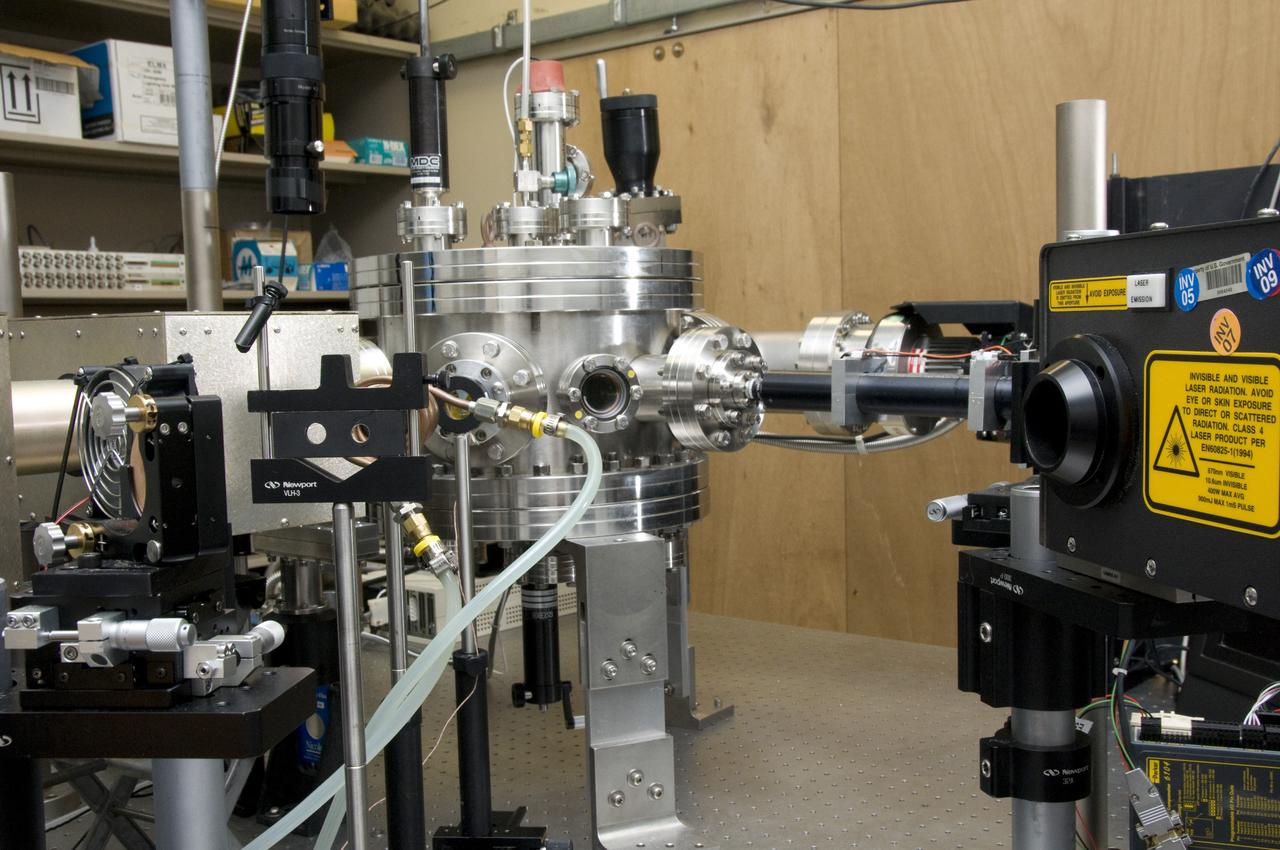
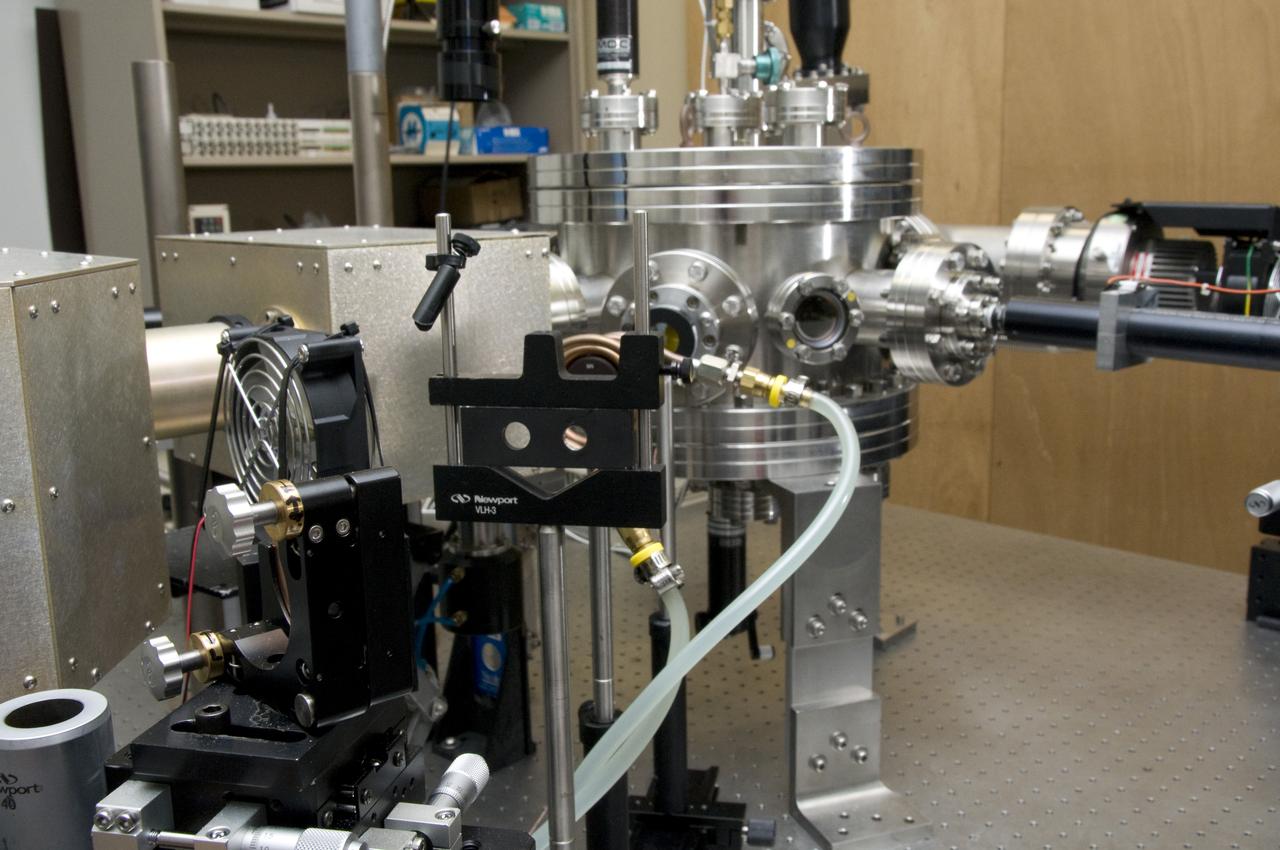
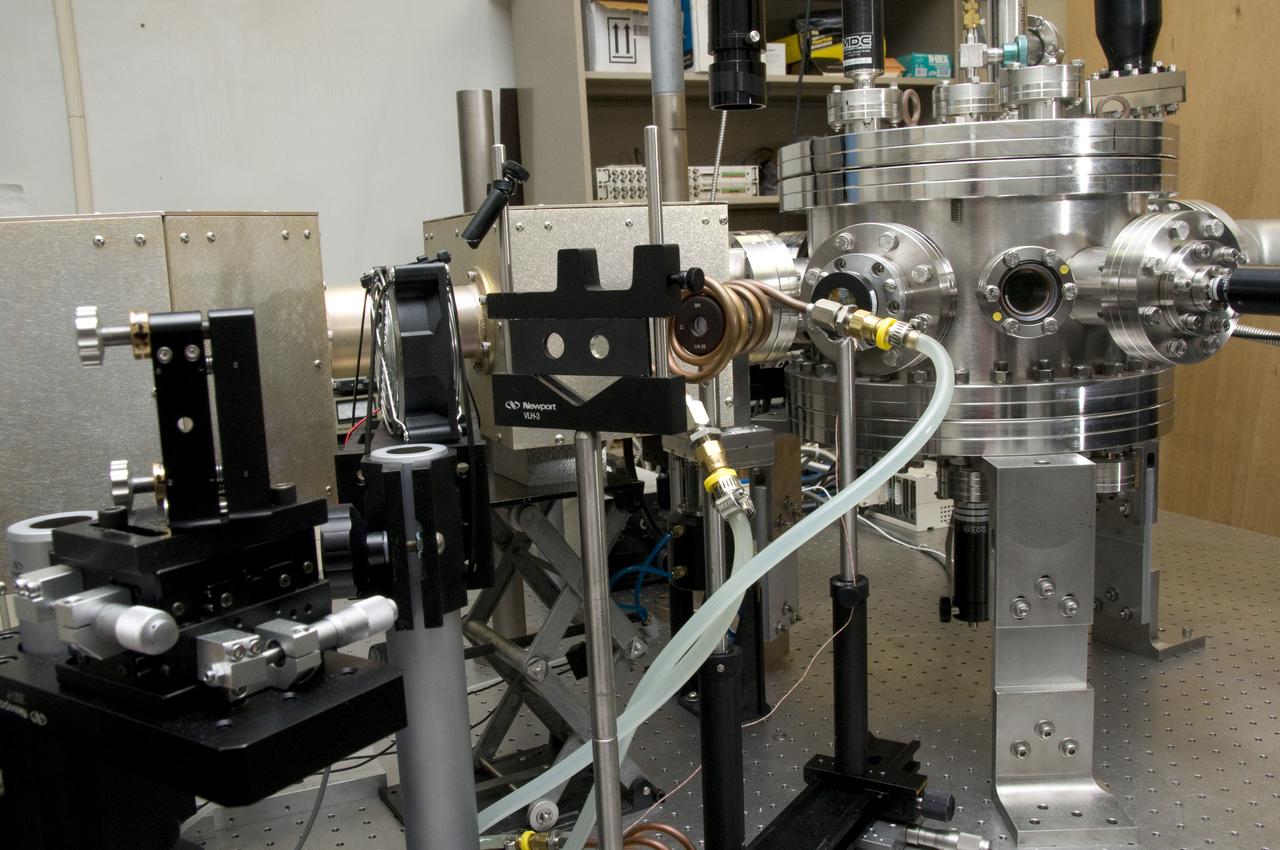
HIGH TEMPERATURE EMISSOMETER SYSTEM (HITEMS) CHAMBER SHOWING COIL FOR COOLING OPTICS
1001456
HIGH TEMPERATURE EMISSOMETER SYSTEM (HITEMS) CHAMBER SHOWING COIL FOR COOLING OPTICS
1001458
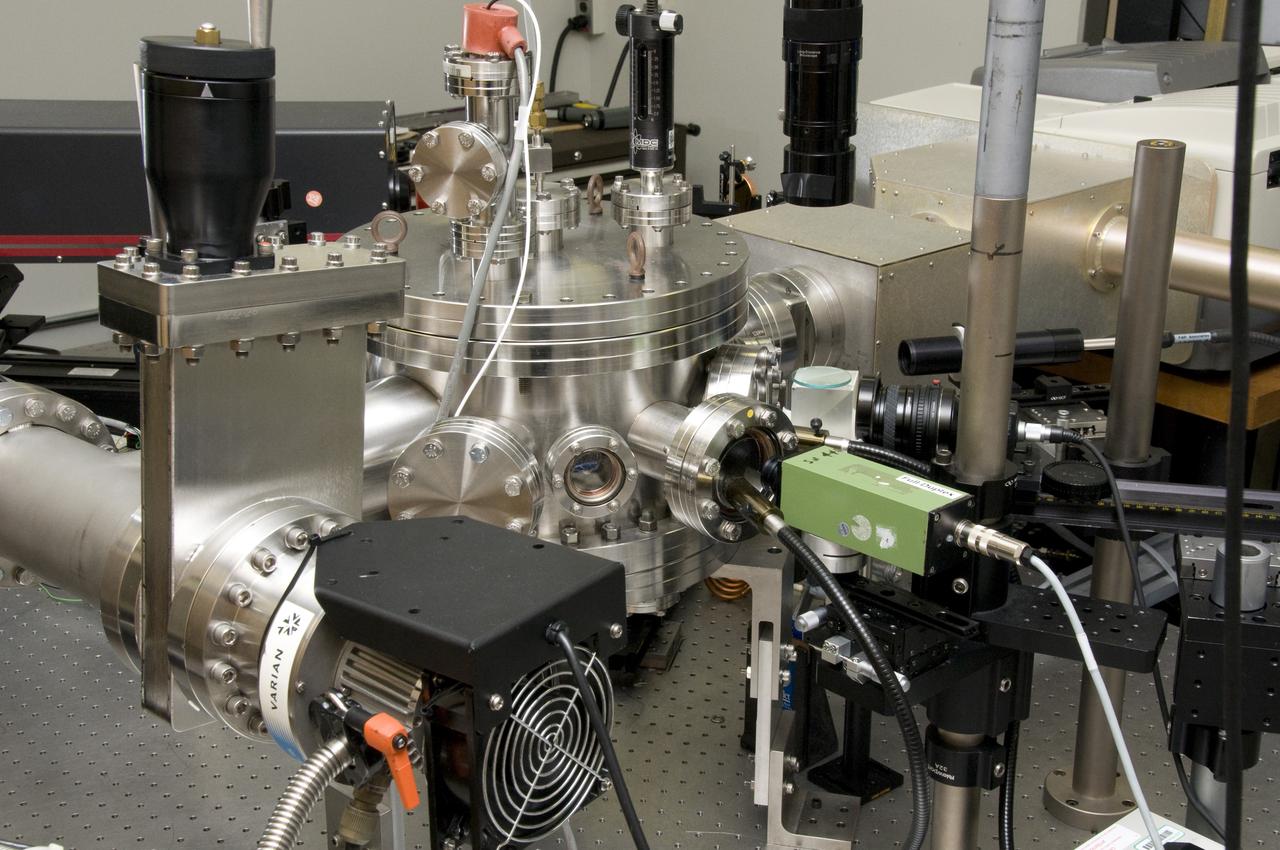
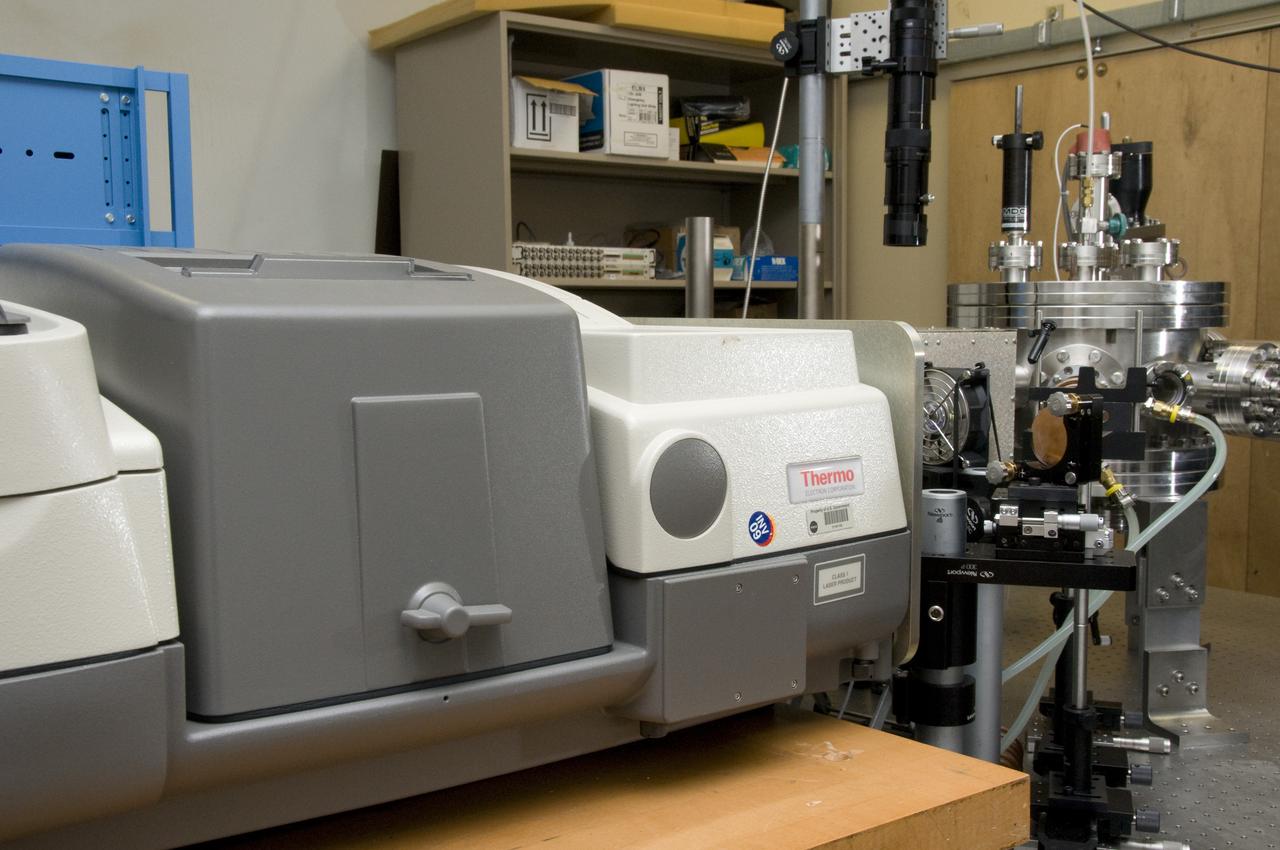
HIGH TEMPERATURE EMISSOMETER SYSTEM (HITEMS) SHOWING FTIR
1001454
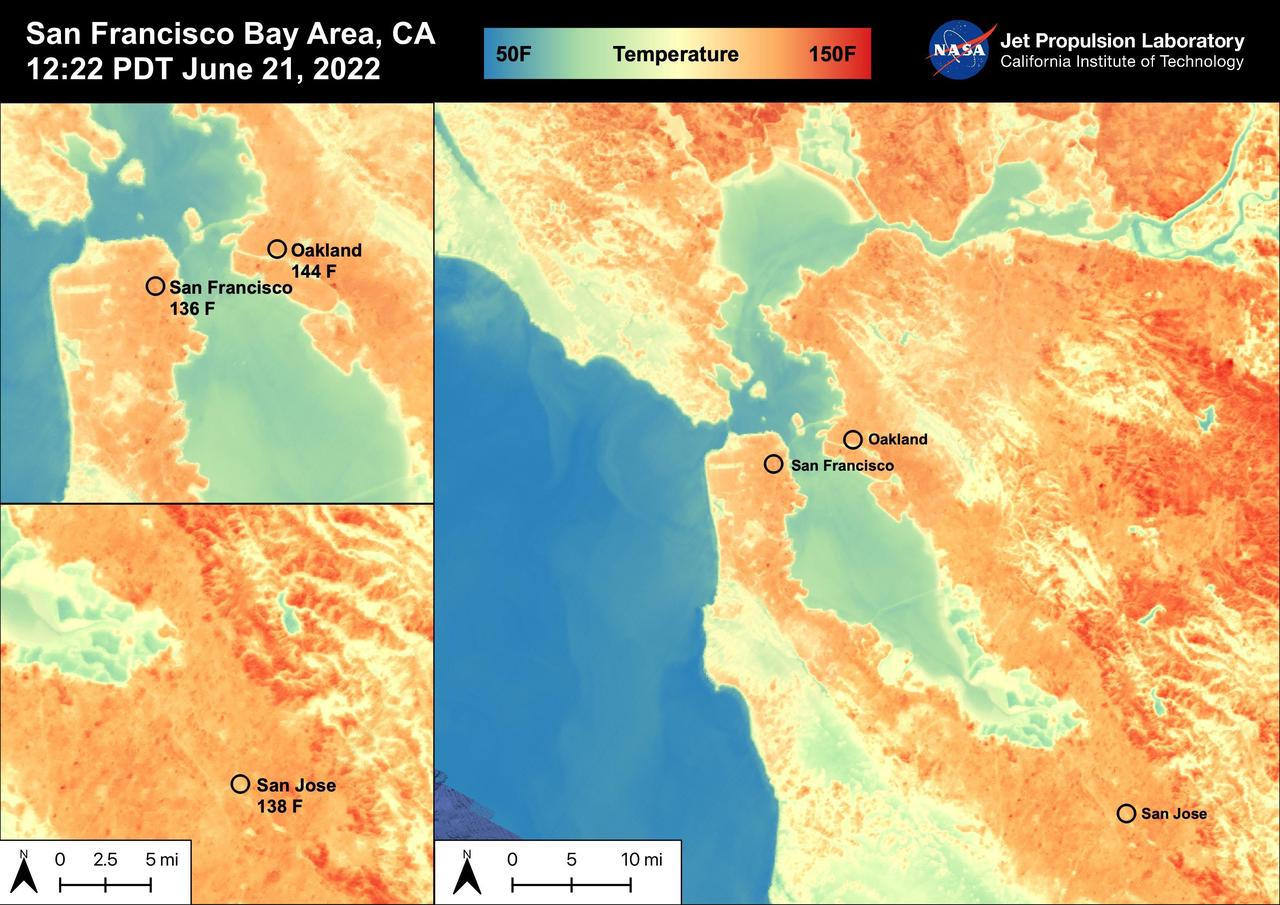
On June 21st, 2022, the San Francisco Bay Area experienced high temperatures as a hot mass of air remained over the region. San Francisco reached 92 degrees Fahrenheit, Oakland reached 98 degrees Fahrenheit, and San Jose reached 102 degrees Fahrenheit. The Land Surface Temperatures at 12:22 PM PDT ranged from 60 degrees Fahrenheit to 150 degrees Fahrenheit for this region with water temperatures ranging from 50 degrees Fahrenheit to 90 degrees Fahrenheit.  ECOSTRESS is a thermal instrument on the International Space Station that measures the temperature of the ground, which is hotter than the air temperature during the day. It was launched to the space station in 2018. Its primary mission is to identify critical thresholds of water use and water stress in plants and to detect the timing, location, and predictive factors leading to plant water uptake decline and/or cessation. The nature of the high-resolution data provided by ECOSTRESS allows it to record heat related phenomena such as heat waves, droughts and wildfires.  https://photojournal.jpl.nasa.gov/catalog/PIA25441
High Temperatures in the San Francisco Bay Area
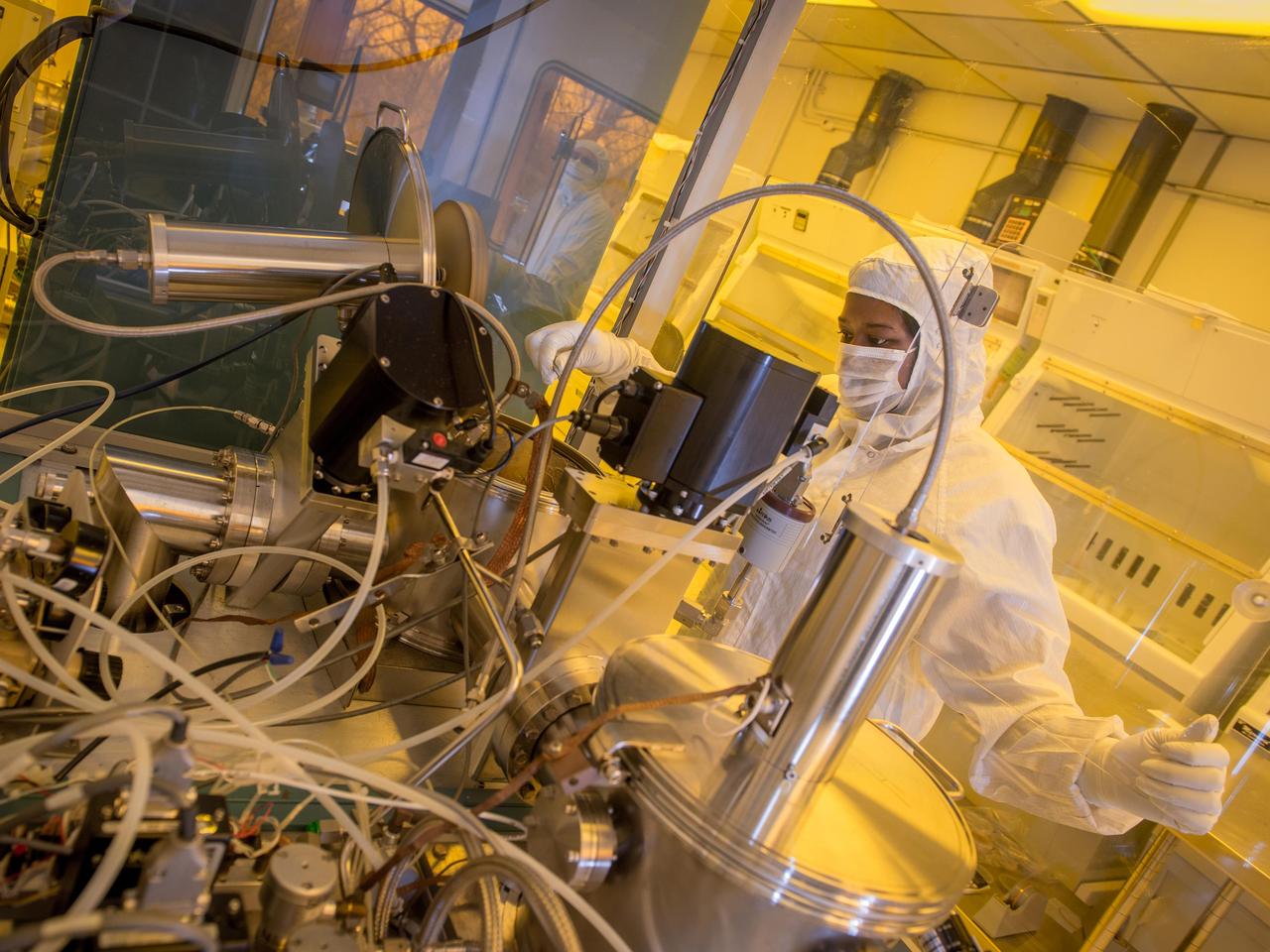
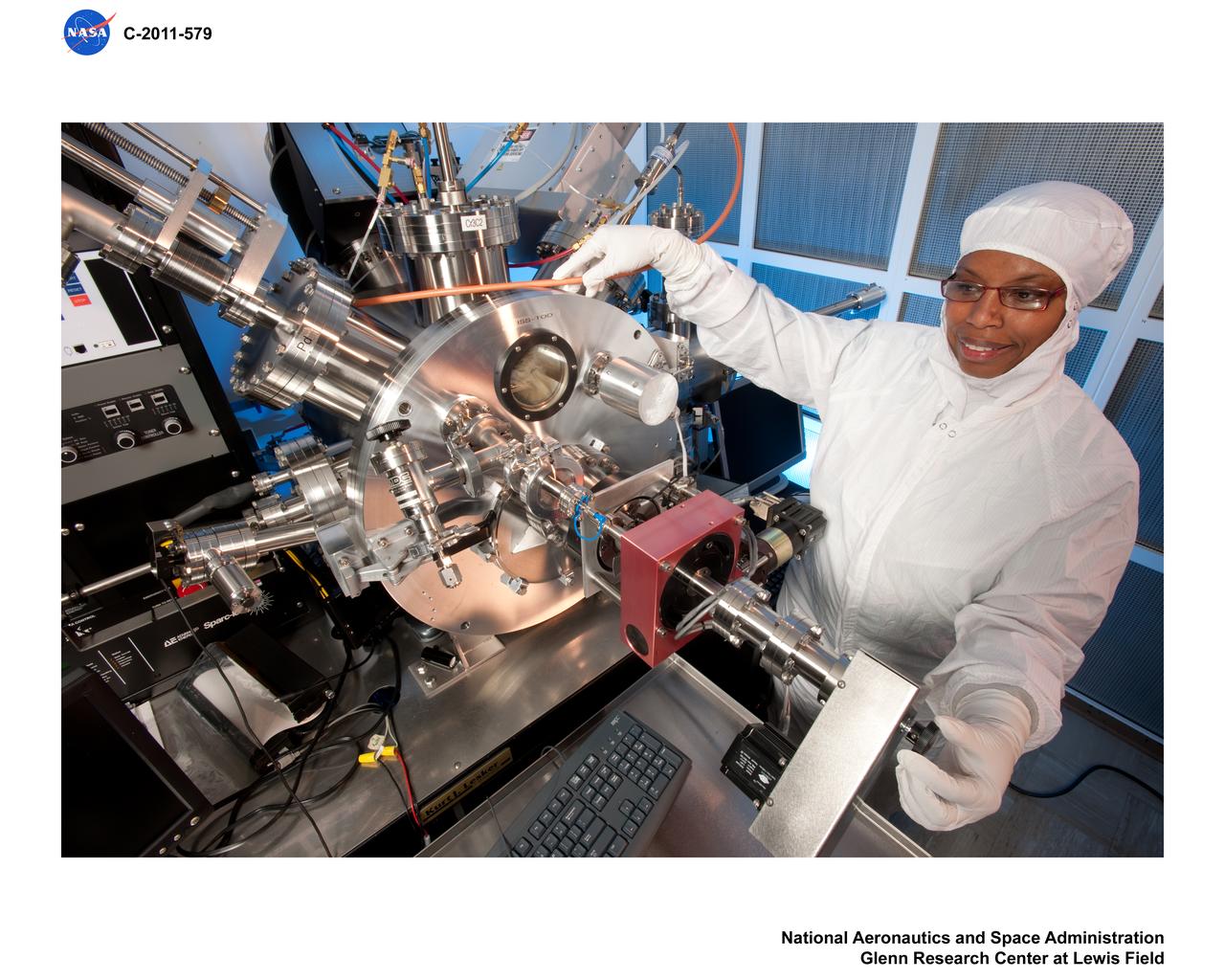
NASA Glenn technician Ariana Miller prepares an ultrahigh vacuum chamber used to test the materials used in silicon carbide based sensors and electronics that can operate at extremely high temperatures (500 degrees Celsius and higher) for applications such as sensor systems for aircraft engines and Venus exploration.
Clean Room Facility
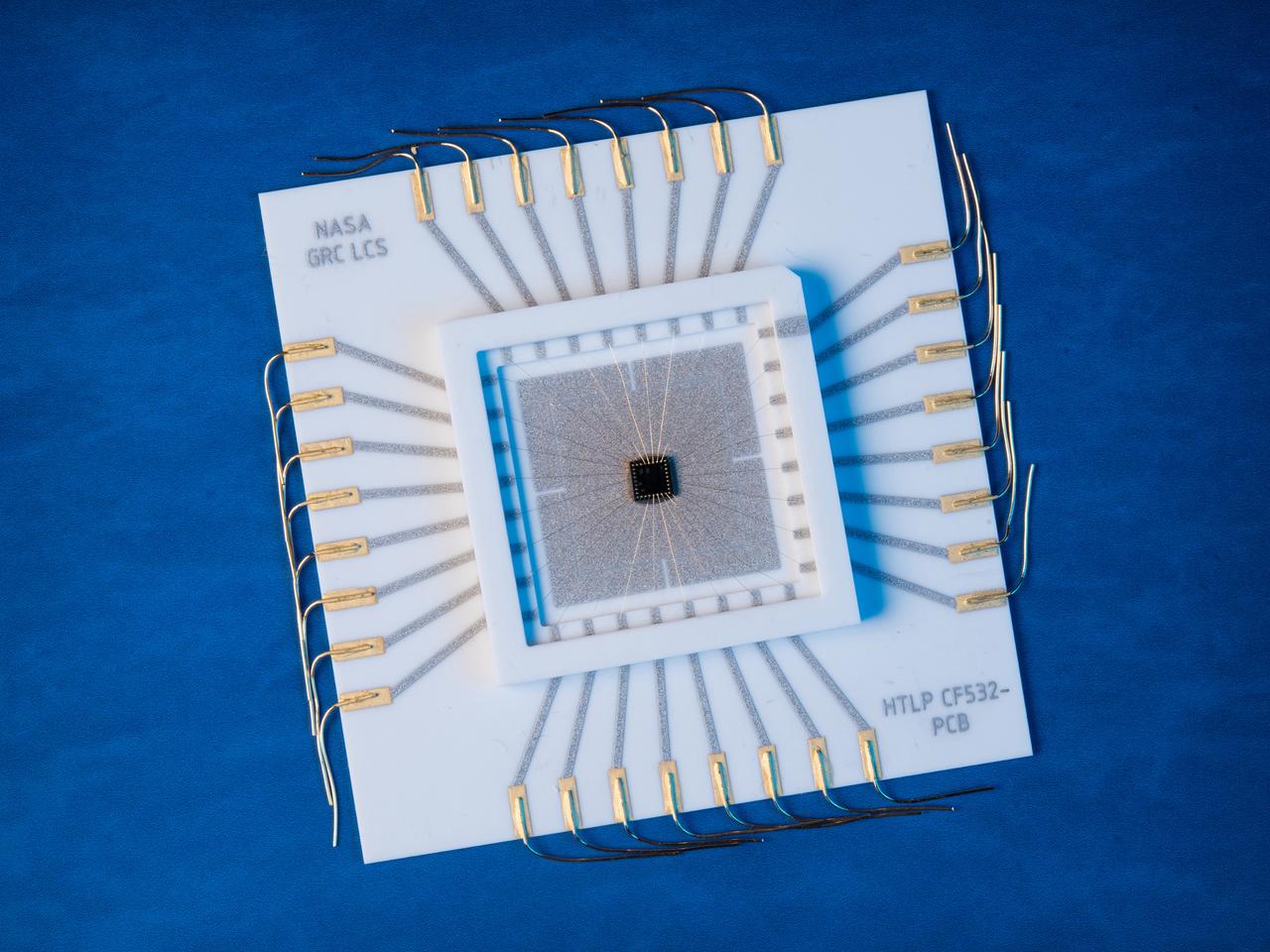
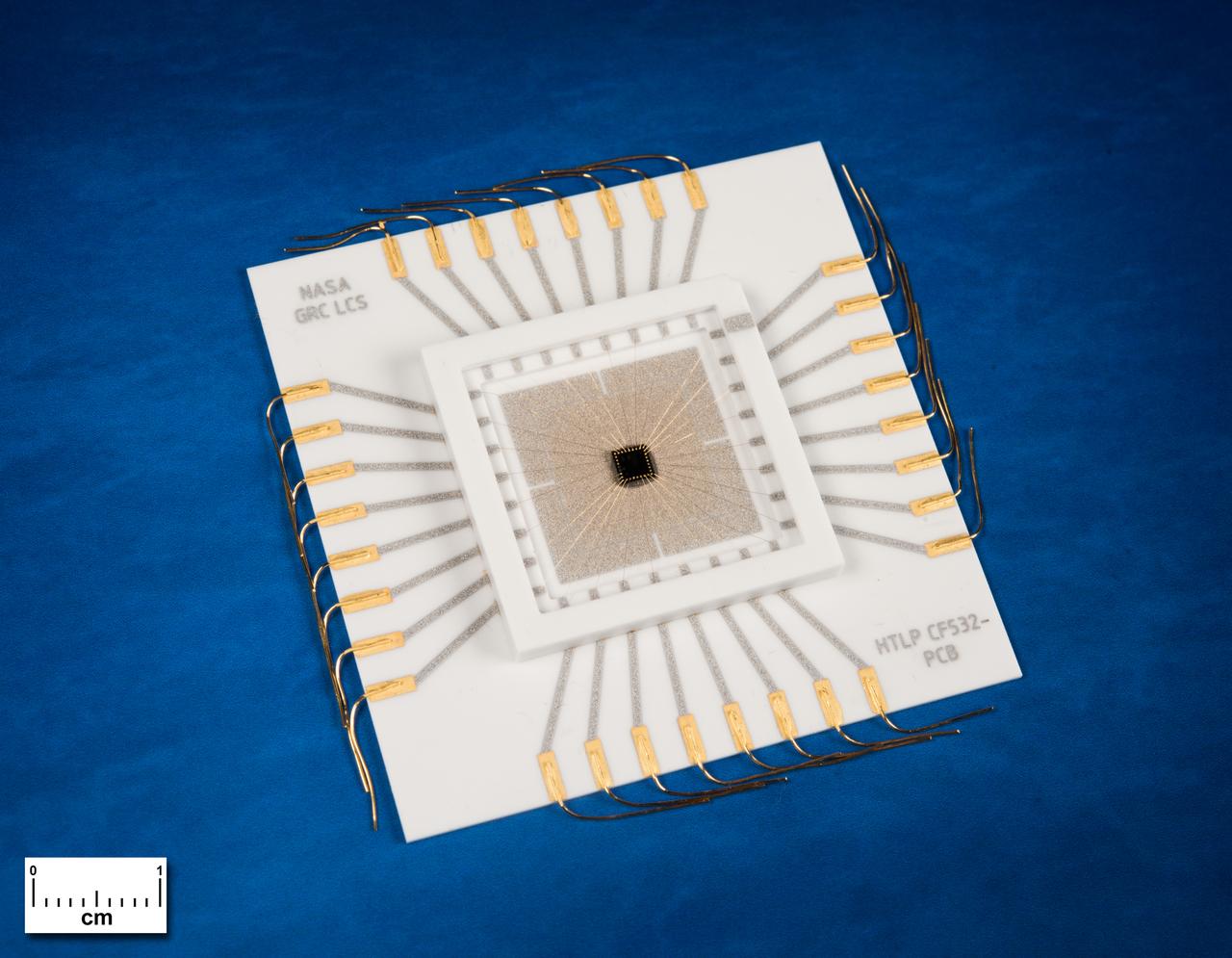
A multilevel interconnect silicon carbide integrated circuit chip with co-fired ceramic package and circuit board recently developed at the NASA GRC Smart Sensors and Electronics Systems Branch for high temperature applications. High temperature silicon carbide electronics and compatible packaging technologies are elements of instrumentation for aerospace engine control and long term inner-solar planet explorations.
Silicon Carbide Integrated Circuit Chip
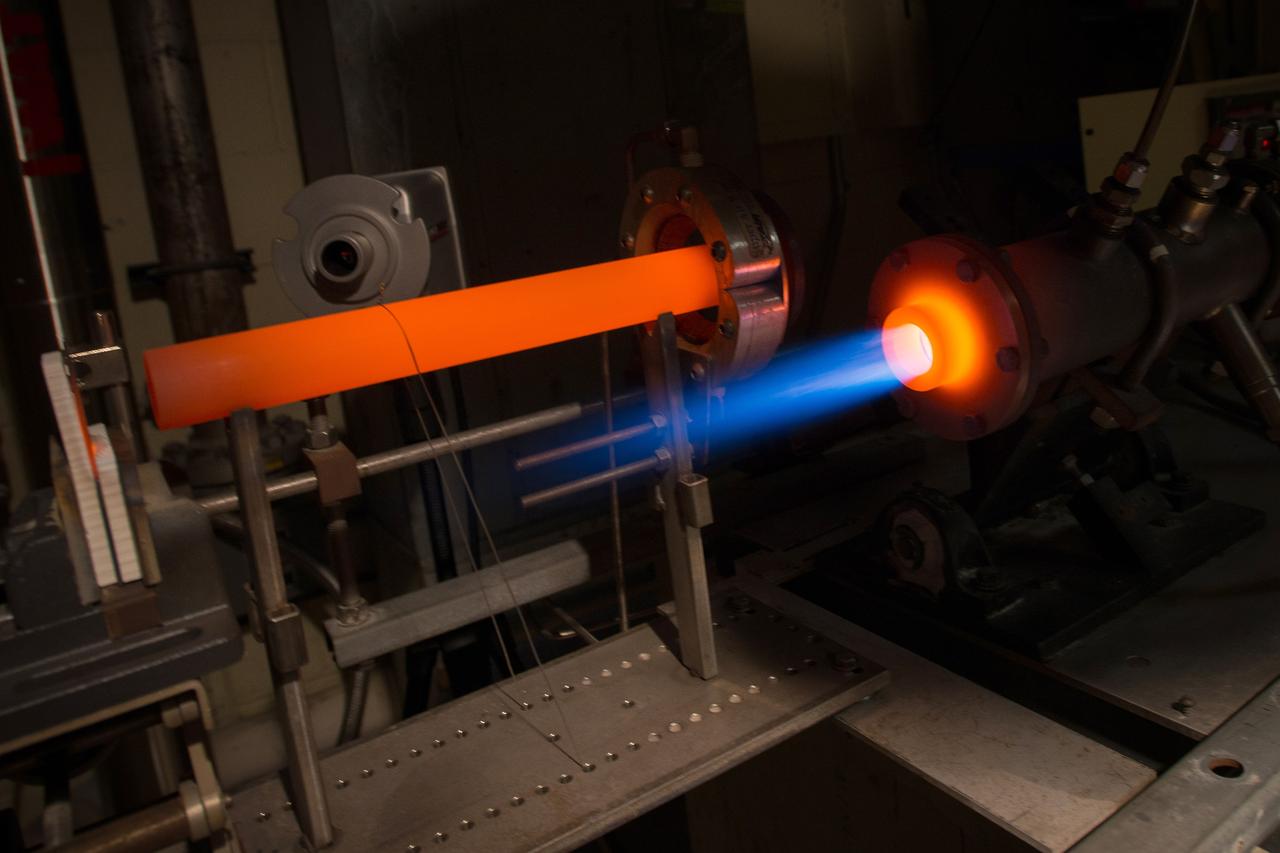
The Fuel Burner Rig is a test laboratory at NASA Glenn, which subjects new jet engine materials, treated with protective coatings, to the hostile, high temperature, high velocity environment found inside aircraft turbine engines. These samples face 200-mile per hour flames to simulate the temperatures of aircraft engines in flight. The rig can also simulate aircraft carrier and dusty desert operations where salt and sand can greatly reduce engine life and performance.
Burner Rig Laboratory
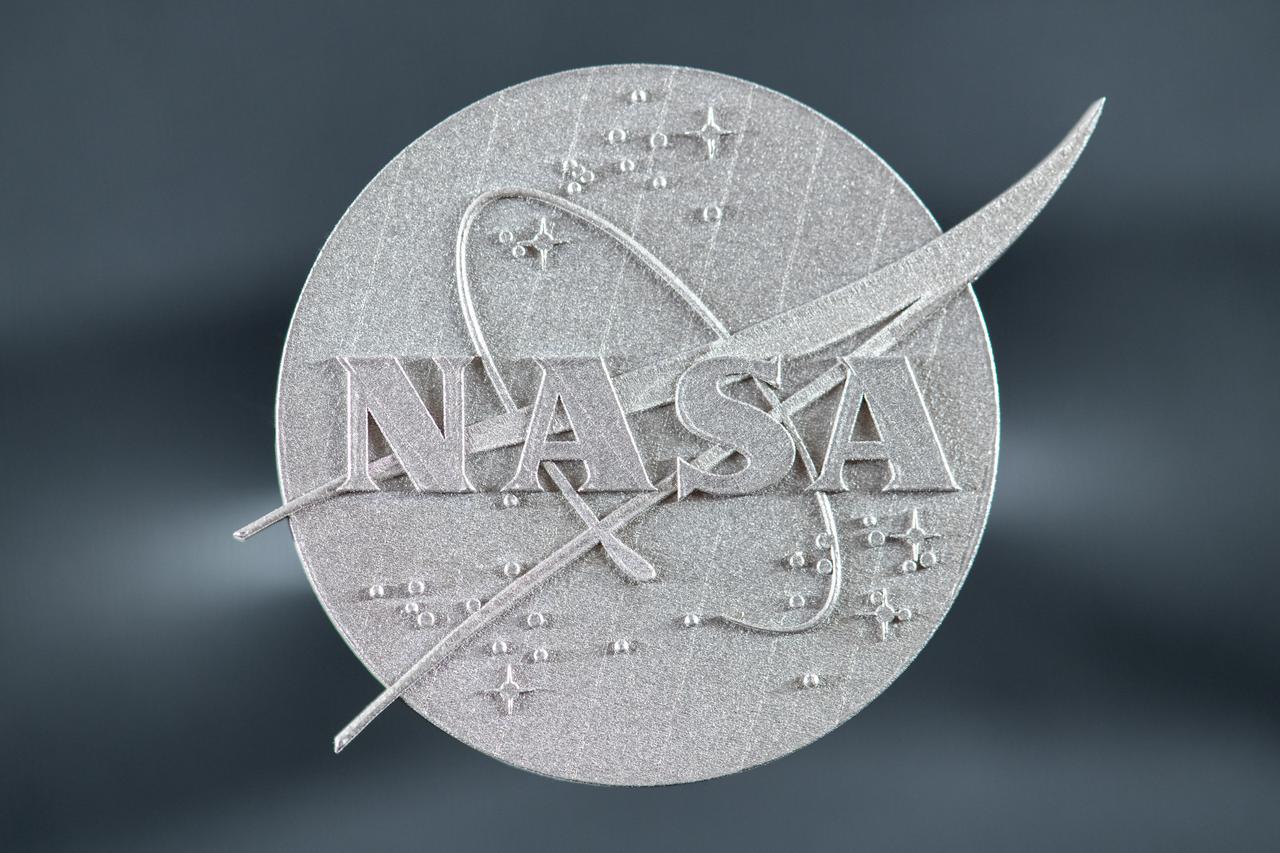
Macro Photographs of 3D Print of NASA Meatball - Made out of GRX-810, an Oxide Dispersion Strengthened (ODS) High Temperature Alloy
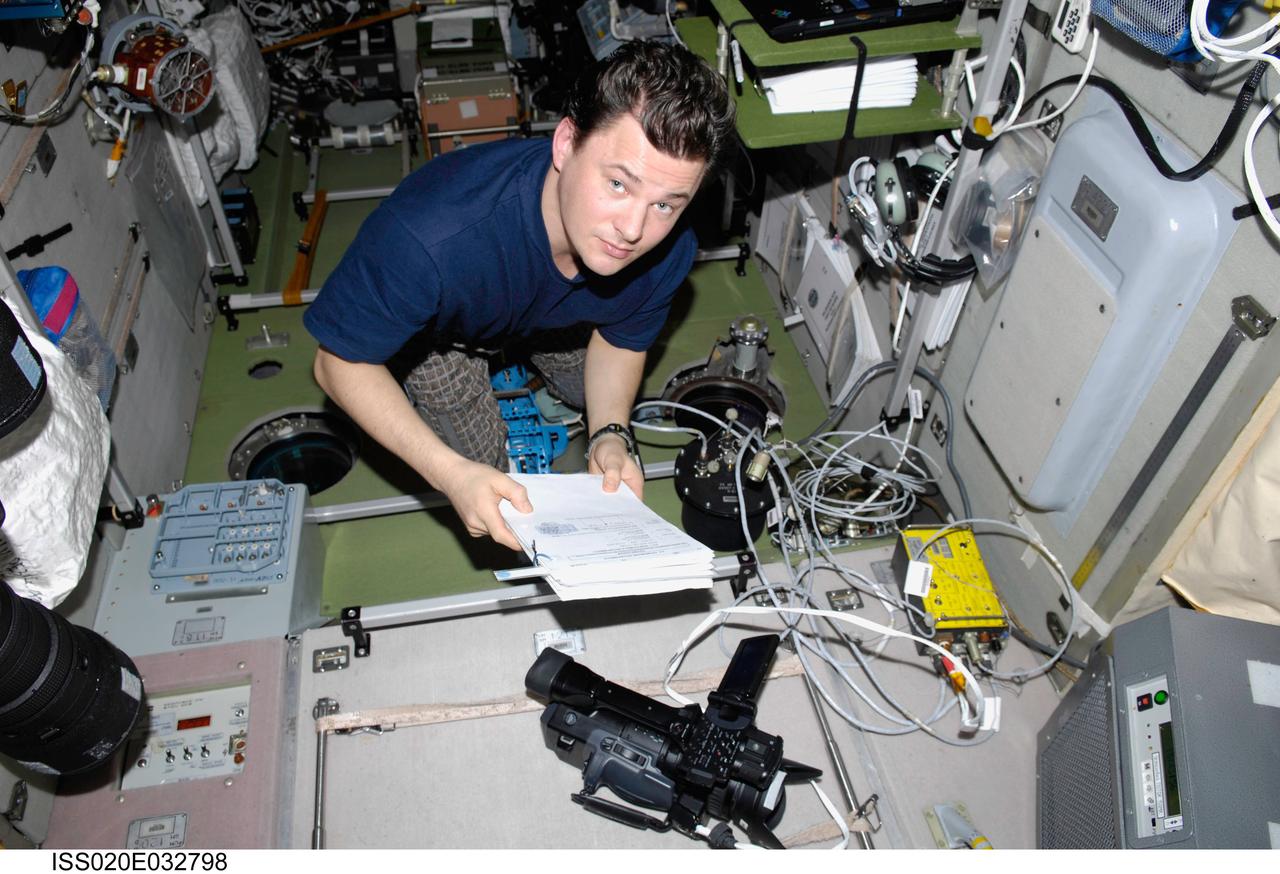
ISS020-E-032798 (21 Aug. 2009) --- Cosmonaut Roman Romanenko, Expedition 20 flight engineer, works with video equipment and a Russian payload TkhN-7 Self-Propagating High-Temperature Synthesis in the Zvezda Service Module of the International Space Station.
SVS (Self-Propagating High-Temperature Synthesis)
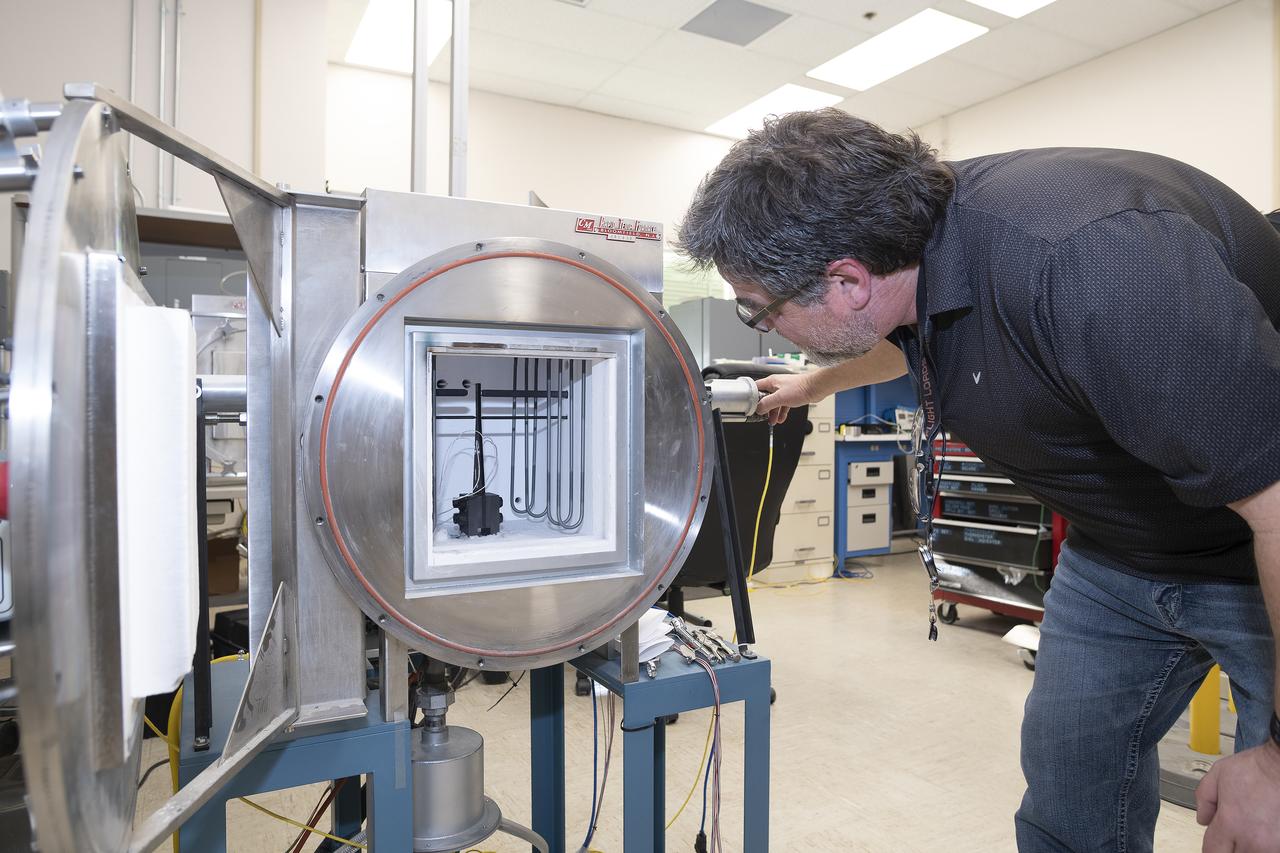
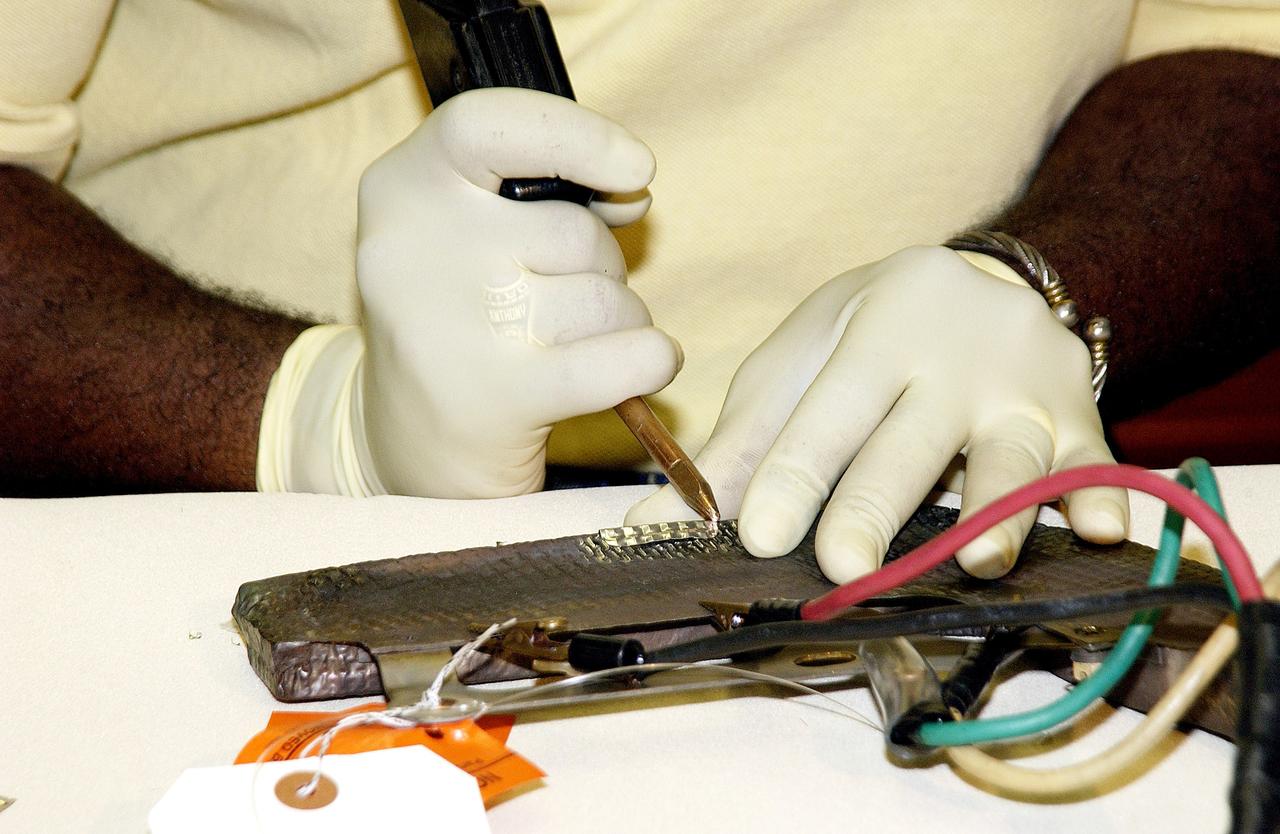
Anthony piazza, a researcher at NASA’s Armstrong Flight Research center in Edwards, California, works with high-temperature strain sensors. This test article is a bending load bar, which enables high-temperature optical strain sensor research up to 1,800 degrees Fahrenheit.
Piazza Knows How to Manage the Heat
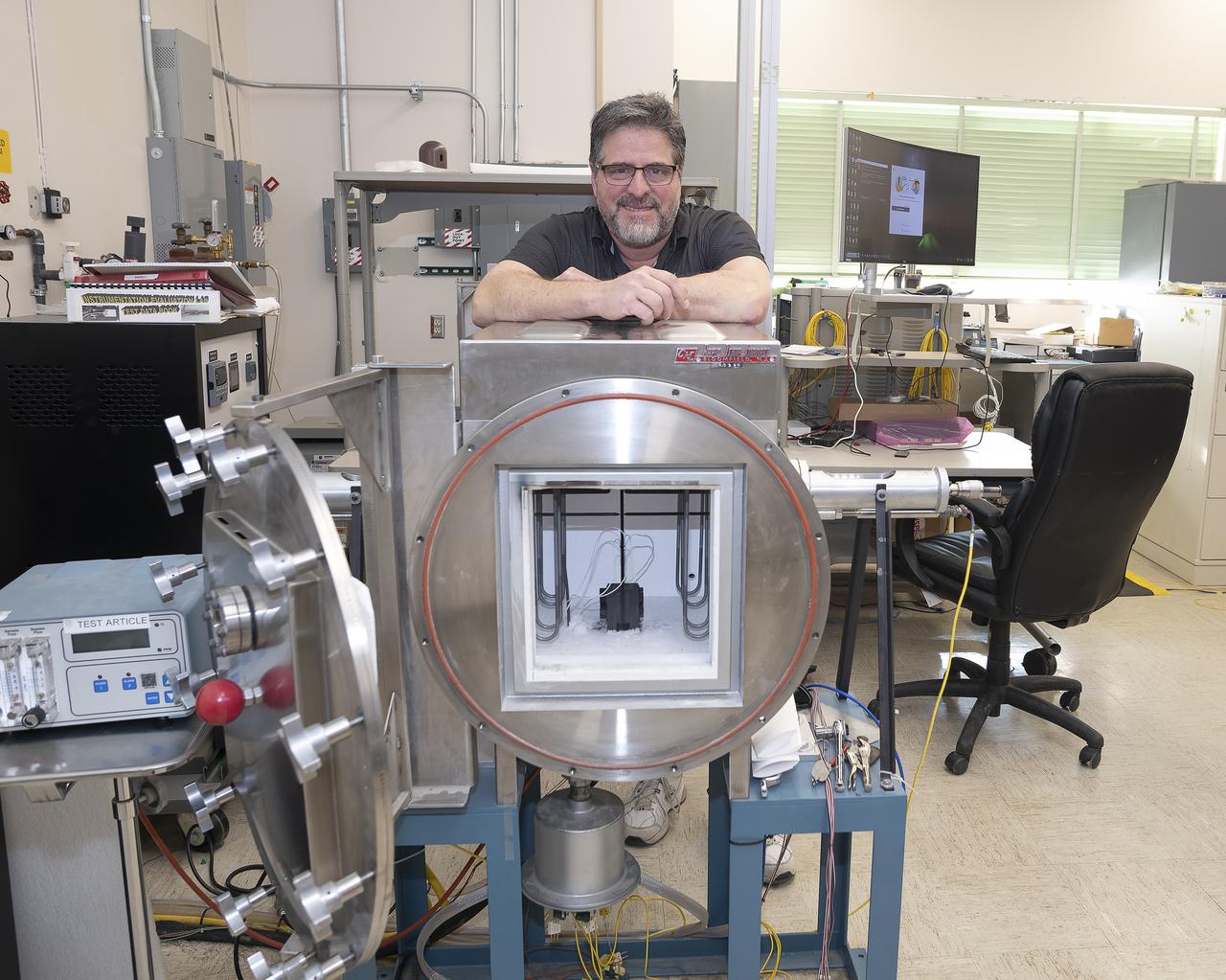
Anthony piazza, a researcher at NASA’s Armstrong Flight Research center in Edwards, California, works with high-temperature strain sensors. This test article is a bending load bar, which enables high-temperature optical strain sensor research up to 1,800 degrees Fahrenheit.
Piazza Knows How to Manage the Heat
NASA Glenn research engineers prepare our extreme environments chamber (GEER) for a test. GEER, which simulates the extreme conditions found in space, tests many devices that will explore Venus to see if they can withstand the punishing environment and temperatures over 800˚F.
Glenn Extreme Environment Rig (GEER)
This image, acquired by NASA Terra spacecraft, shows the Cordoba province of northern Argentina, struck by wildfires caused by high temperatures and strong winds.
NASA Spacecraft Images Destructive Argentine Wildfire
Measurements by NASA Cassini spacecraft reveal temperatures in a high layer of Saturn atmosphere known as the stratosphere and show the dramatic effects of the massive storm deep below.
Taking the Temperature of a Saturn Storm
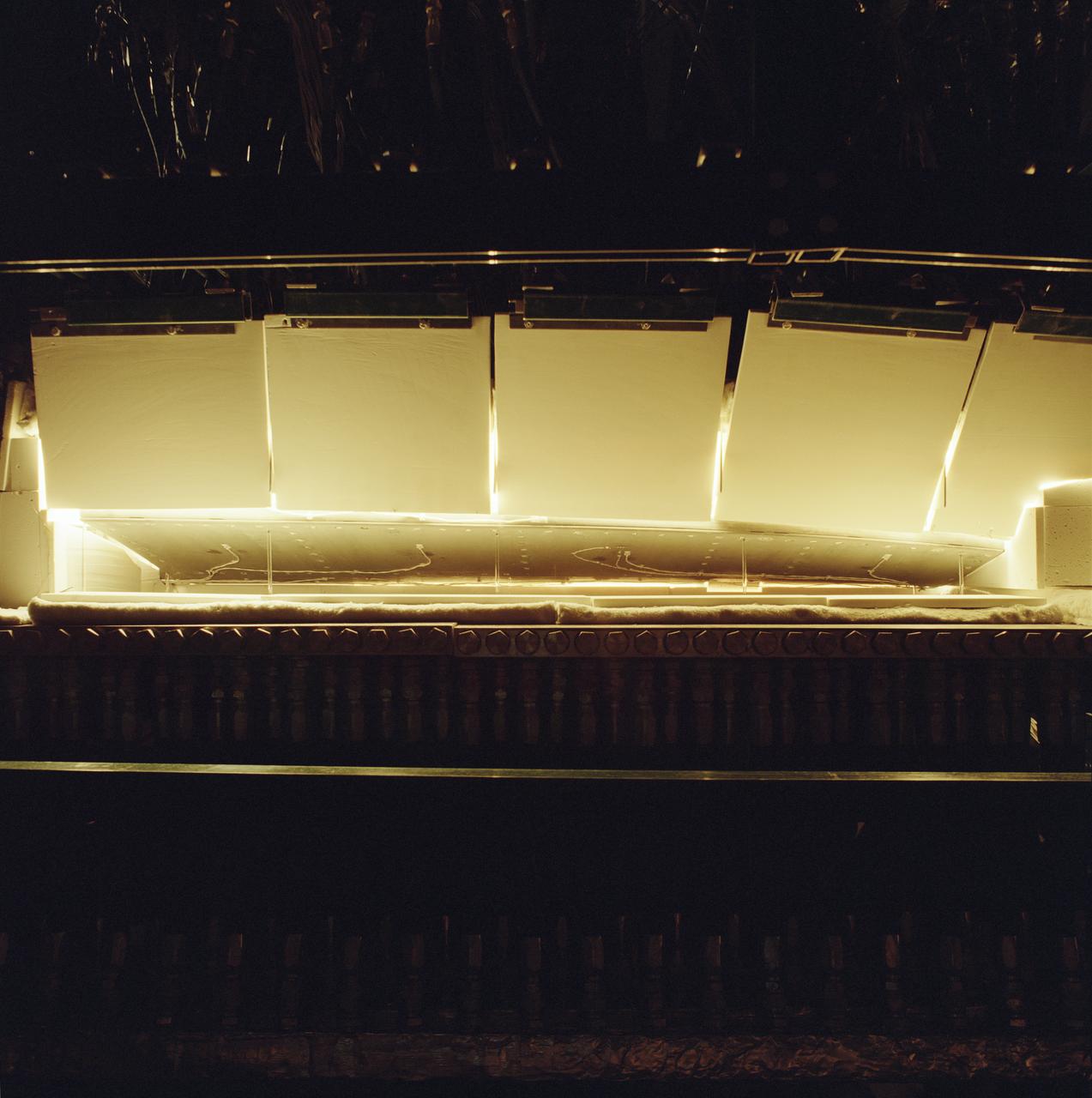
The X-37 advanced technology demonstrator flaperon unit was one of the first ever thermal and mechanical qualification tests of a carbon-carbon control surface designed for space flight. The test also featured extensive use of high-temperature fiber optic strain sensors. Peak temperatures reached 2,500 degrees Fahrenheit.
Piazza Knows How to Manage the Heat
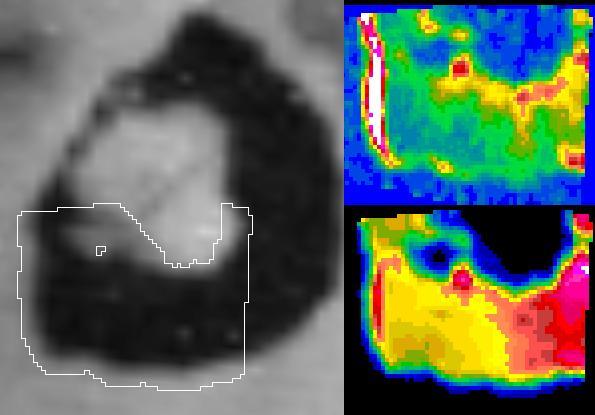
High temperatures observed by NASA Galileo spacecraft along the western edge of the Loki volcano on Jupiter moon Io may indicate freshly exposed material at the shore of a lava lake during an Oct. 16, 2001 flyby of Io.
Io Loki in Infrared: Hot Edge
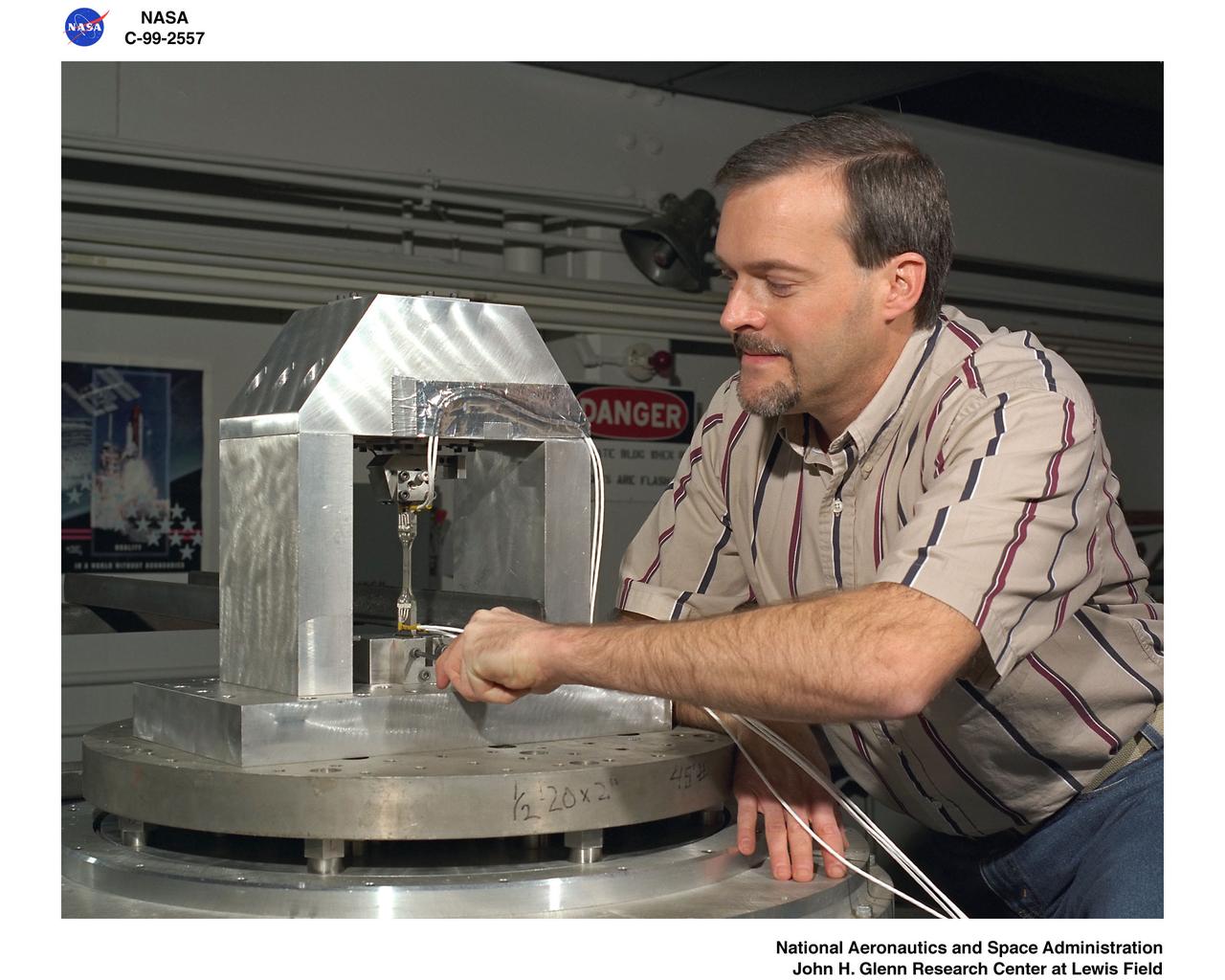
HIGH CYCLE HIGH TEMPERATURE STRAIN GAUGE FATIGUE LIFE TEST APPARATUS
GRC-1999-C-02557
High Temperature Chain Project
GRC-2005-C-00283
High Temperature Chain Project
GRC-2005-C-00284
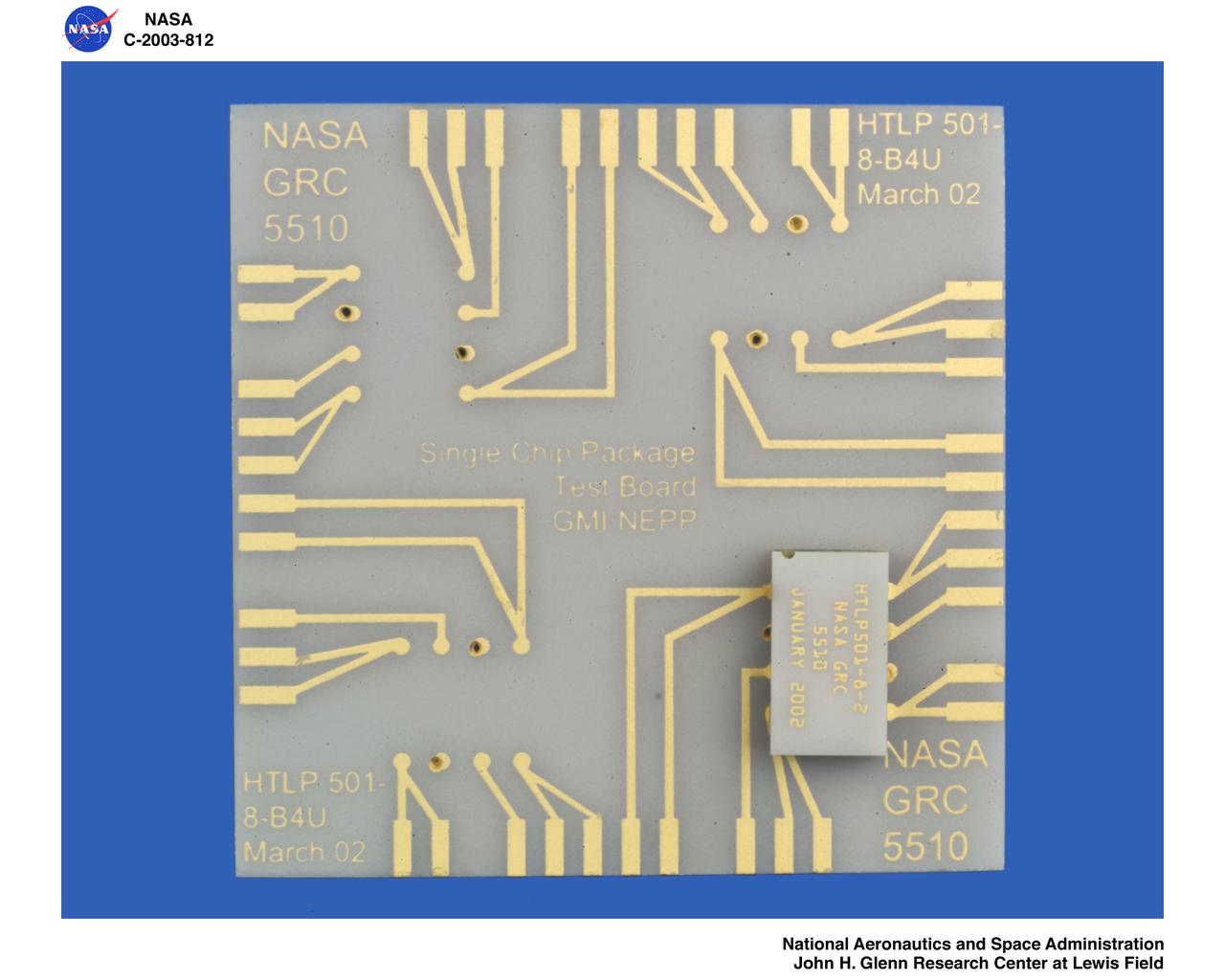
HIGH TEMPERATURE ELECTRONICS PACKAGING
GRC-2003-C-00812
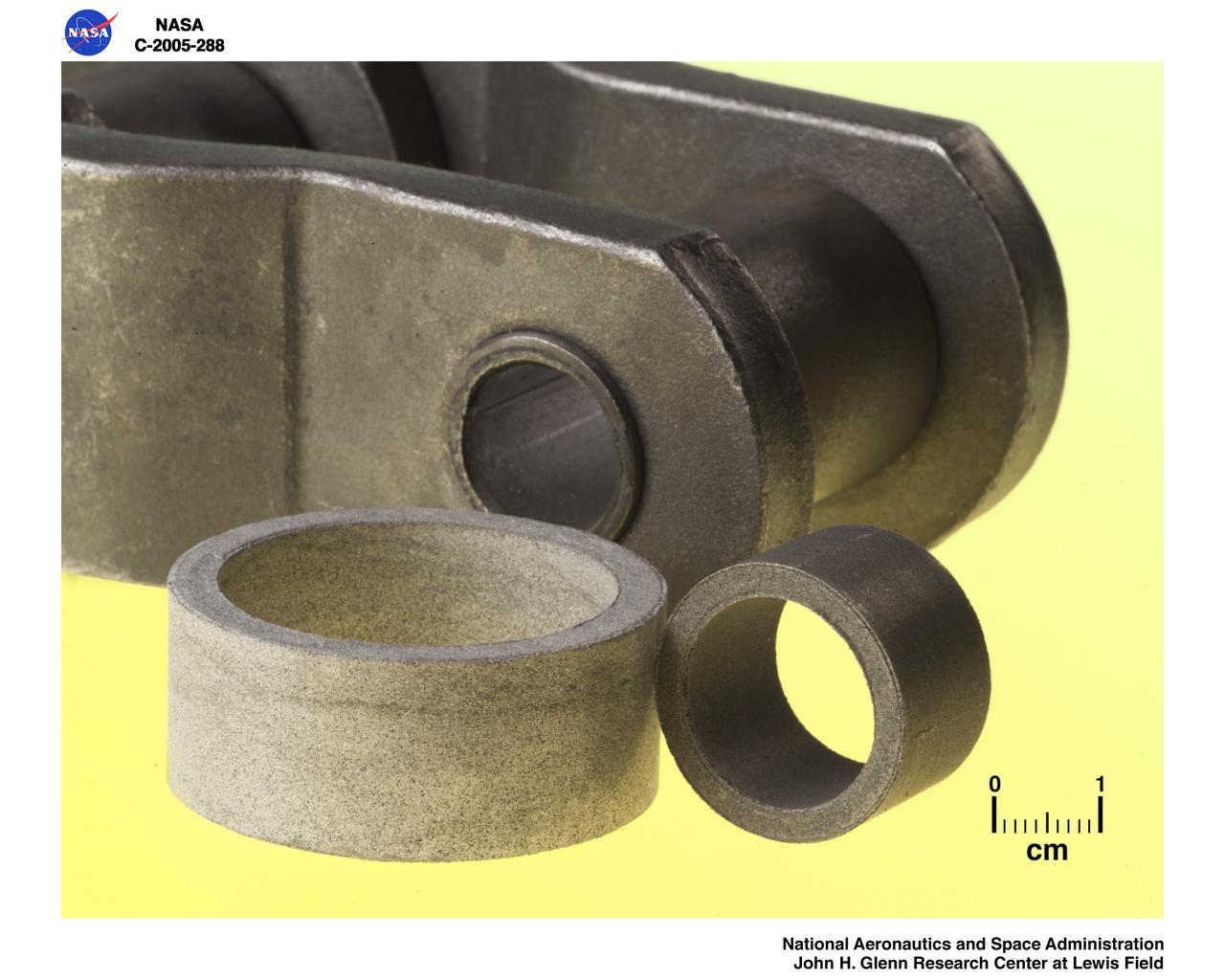
High Temperature Chain Project
GRC-2005-C-00288
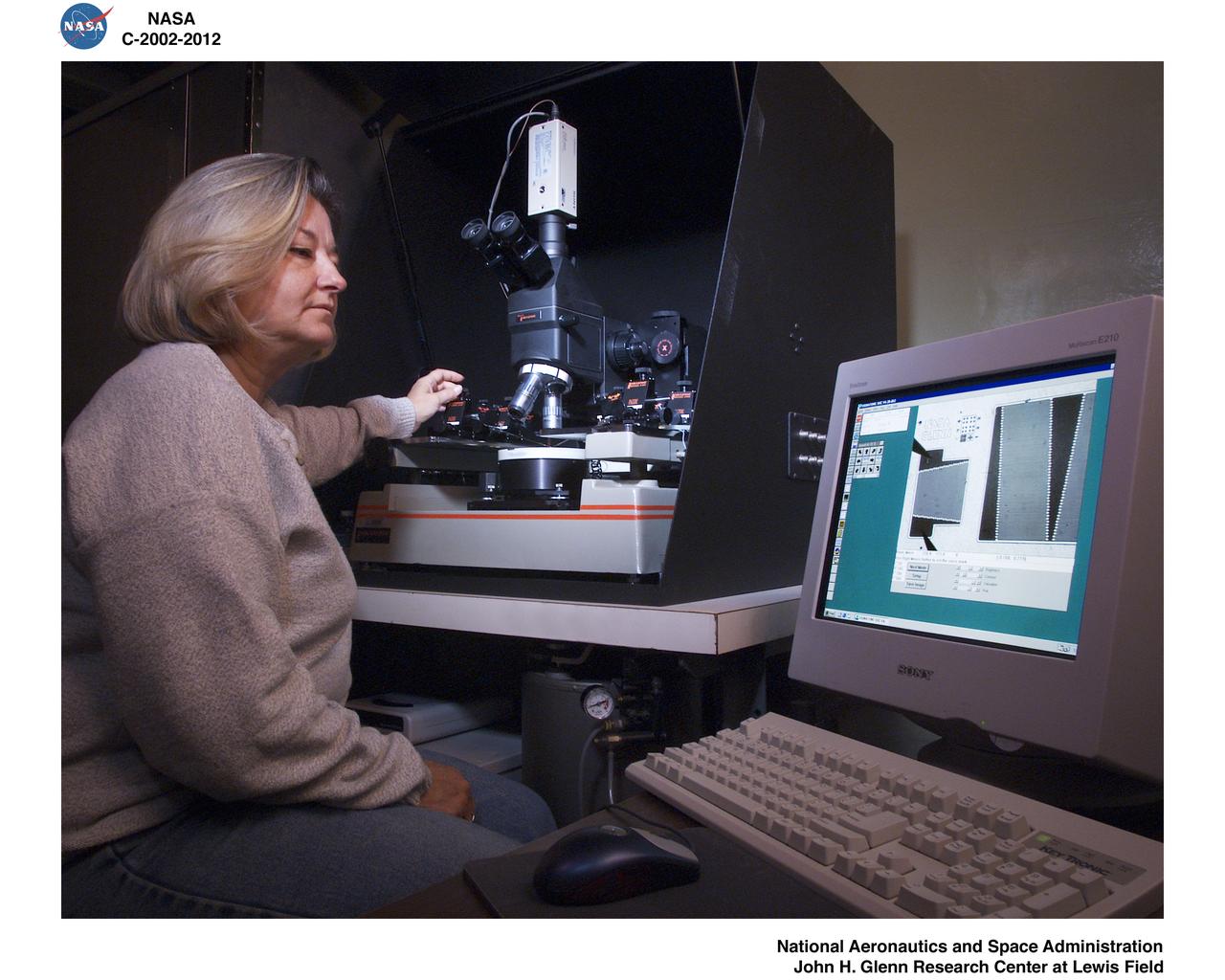
SIGNATONE HIGH-TEMPERATURE PROBE STATION
GRC-2002-C-02012
Folded Slot Antenna for High Temperature Applications
GRC-2007-C-00102
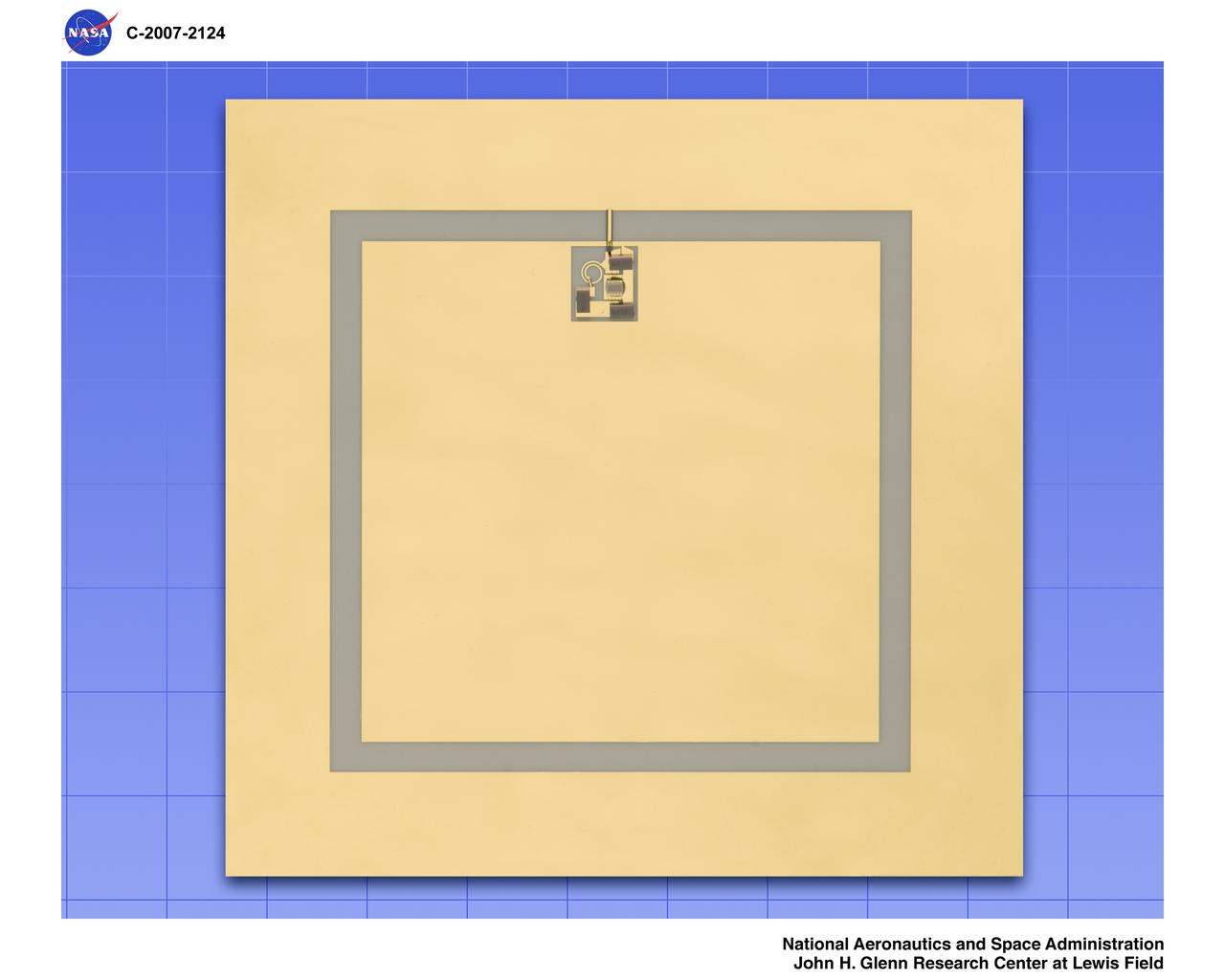
Oscillator / Antenna for High Temperature Wireless Sensor
GRC-2007-C-02124
A rugged, highly accurate, low-temperature sensor is developed by NASA researchers. A new sensor allows accurate, quick low-temperature measurements in rugged environments. This is especially useful in piping with very cold liquids under high pressure, and high flow rate conditions.
Around Marshall
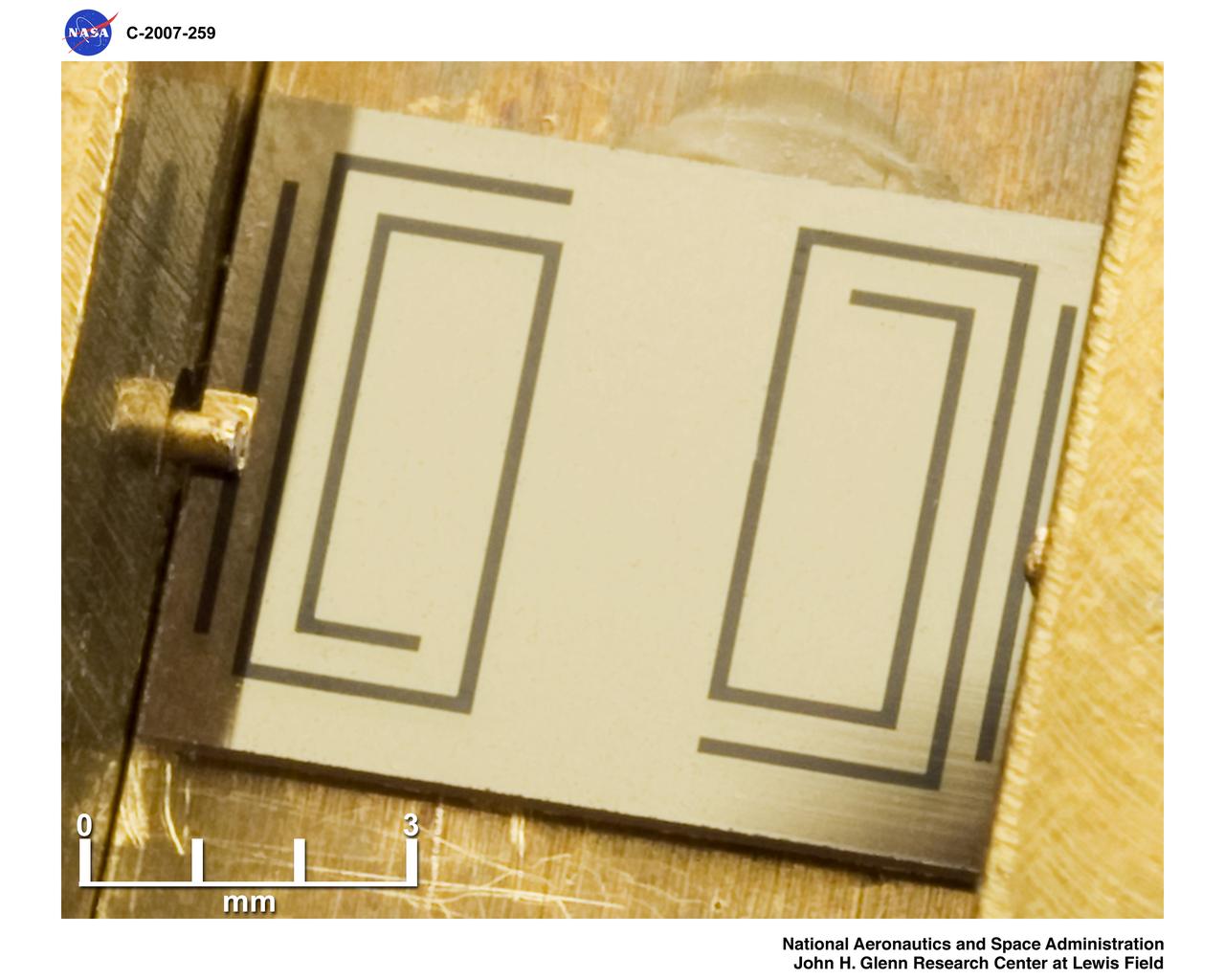
High Temperature Superconductor Microstrip Coupled Filters with mm scale
GRC-2007-C-00259
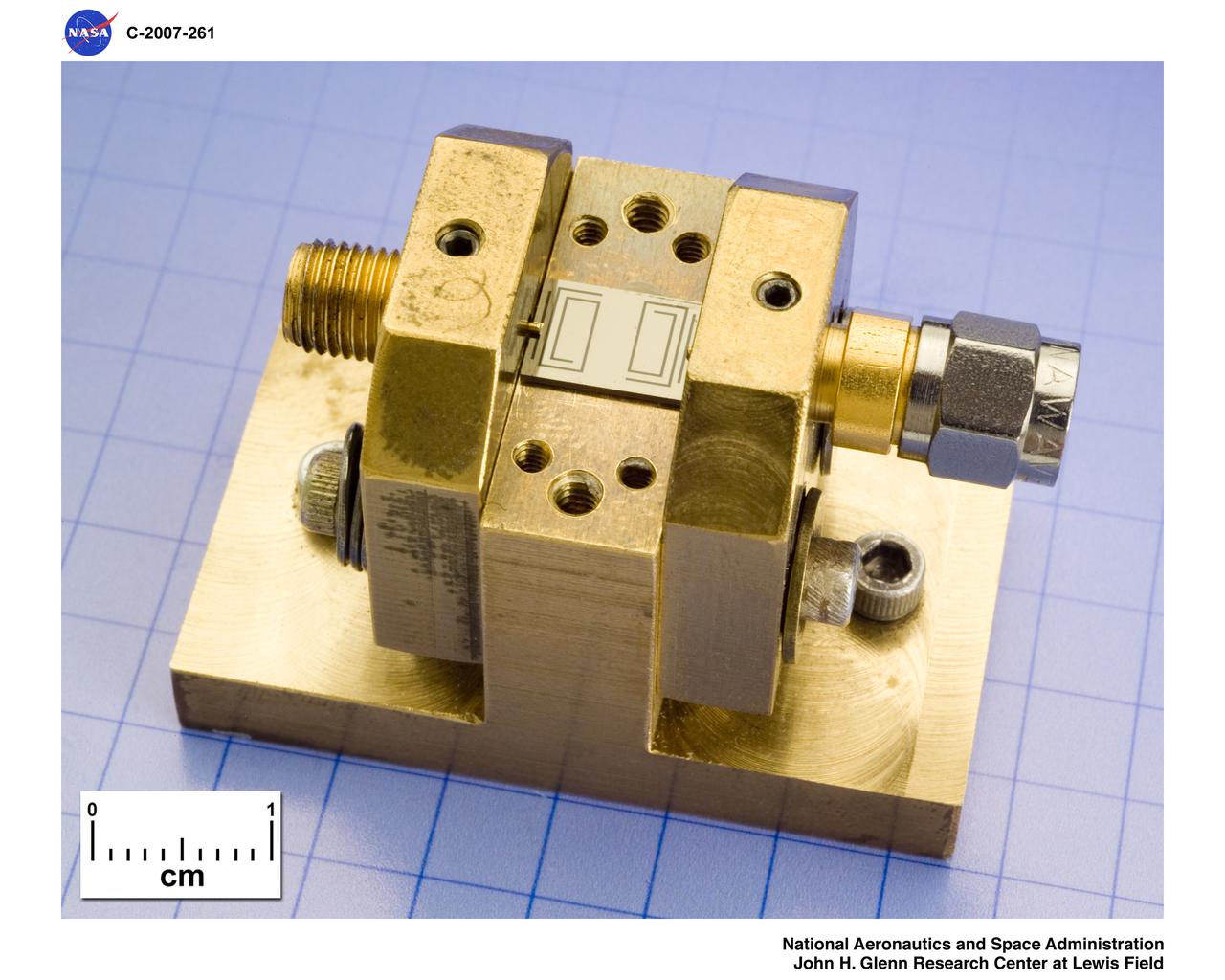
High Temperature Superconductor Microstrip Coupled Filters with mm scale
GRC-2007-C-00261
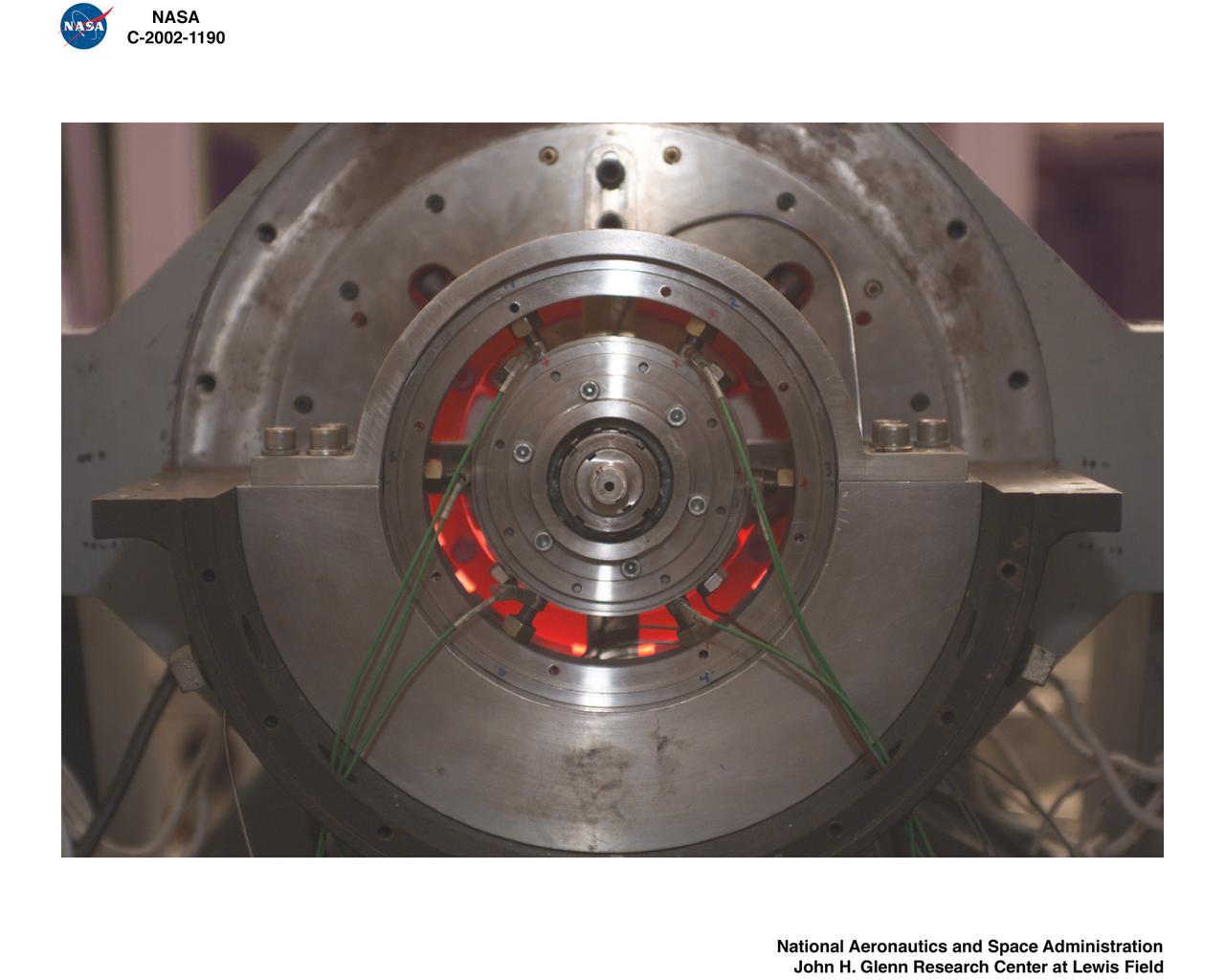
HIGH TEMPERATURE MAGNETIC BEARING TEST RIG AT 1000 DEGREES FARENHEIDT
GRC-2002-C-01190
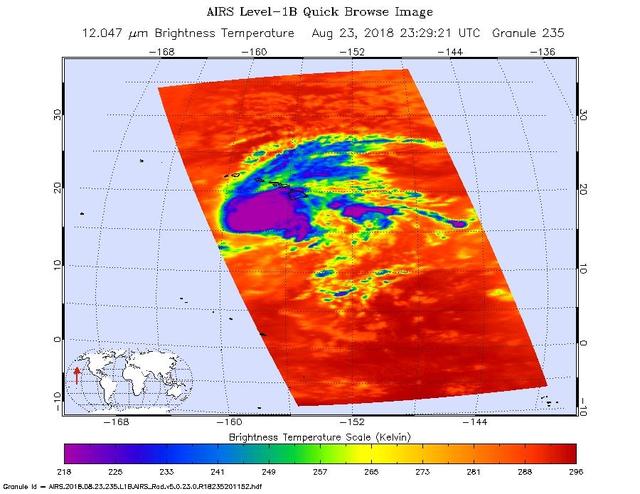
This image shows Hurricane Lane as observed by the Atmospheric Infrared Sounder (AIRS) instrument on NASA's Aqua satellite on Thursday, Aug. 23, 2018. Purple shows very cold clouds high in the atmosphere above the center of the hurricane, blue and green show the warmer temperatures of lower clouds surrounding the storm center; and orange and red areas have almost no clouds. No eye is seen in this image, which means it was either too small for AIRS to detect or it was covered by high, cold clouds.  Figure 1 was observed on Aug. 22, 2018. Purple shows very cold clouds high in the atmosphere above the center of the hurricane, blue and green show the warmer temperatures of lower clouds surrounding the storm center; and orange and red areas have almost no clouds. The eye of the storm is clearly visible.  https://photojournal.jpl.nasa.gov/catalog/PIA22493
Hurricane Lane as Viewed by NASA's AIRS Instrument
Silicon Carbide, SiC wafer v8.1 OpAmp Chip in Co-fired Alumina Package for High-temperature Application
GRC-2015-C-00598
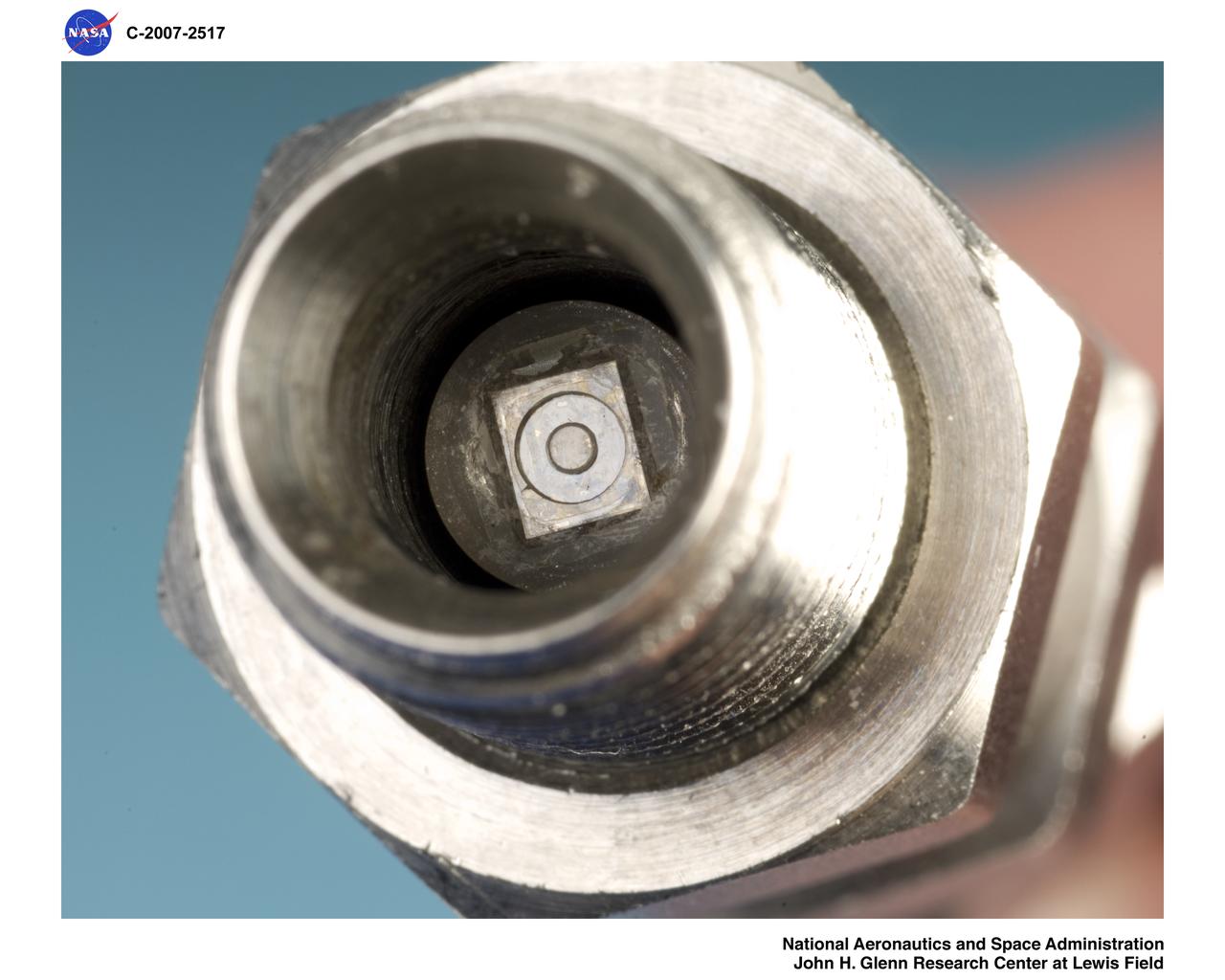
Fully Packaged Silicon Carbide Piezoresistive Pressure Transducer that measures pressures at temperature as high as 600 degrees Celsius
GRC-2007-C-02517
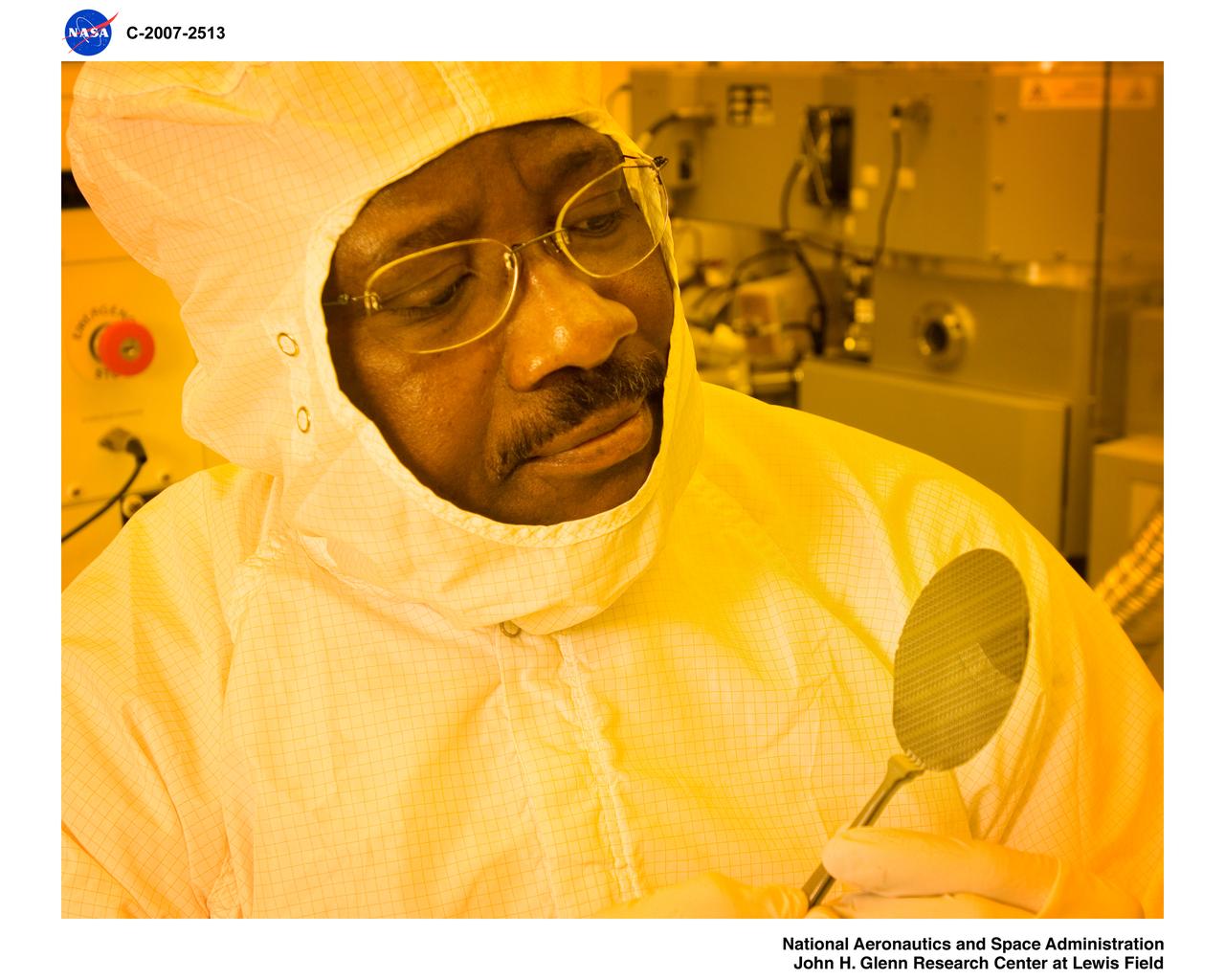
Fully Packaged Silicon Carbide Piezoresistive Pressure Transducer that measures pressures at temperature as high as 600 degrees Celsius
GRC-2007-C-02513
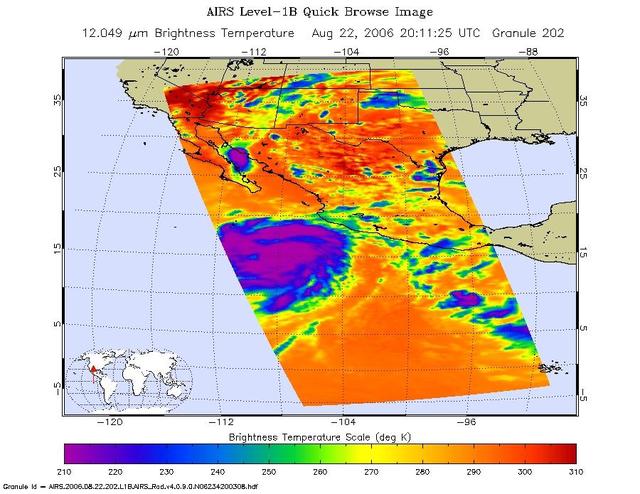
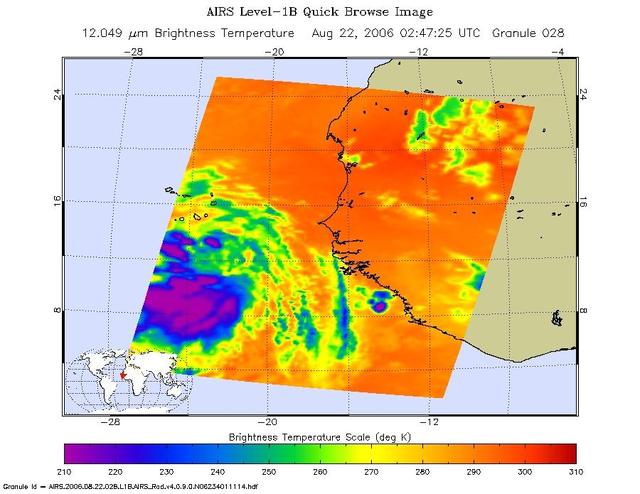
This is an infrared image of Hurricane Ileana in the Eastern Pacific, from the Atmospheric Infrared Sounder (AIRS) on NASA's Aqua satellite on August 22, 2006. This AIRS image shows the temperature of the cloud tops or the surface of the Earth in cloud-free regions. The lowest temperatures (in purple) are associated with high, cold cloud tops that make up the top of the storm. The infrared signal does not penetrate through clouds. Where there are no clouds the AIRS instrument reads the infrared signal from the surface of the Earth, revealing warmer temperatures (red).  http://photojournal.jpl.nasa.gov/catalog/PIA00509
Hurricane Ileana in the Eastern Pacific
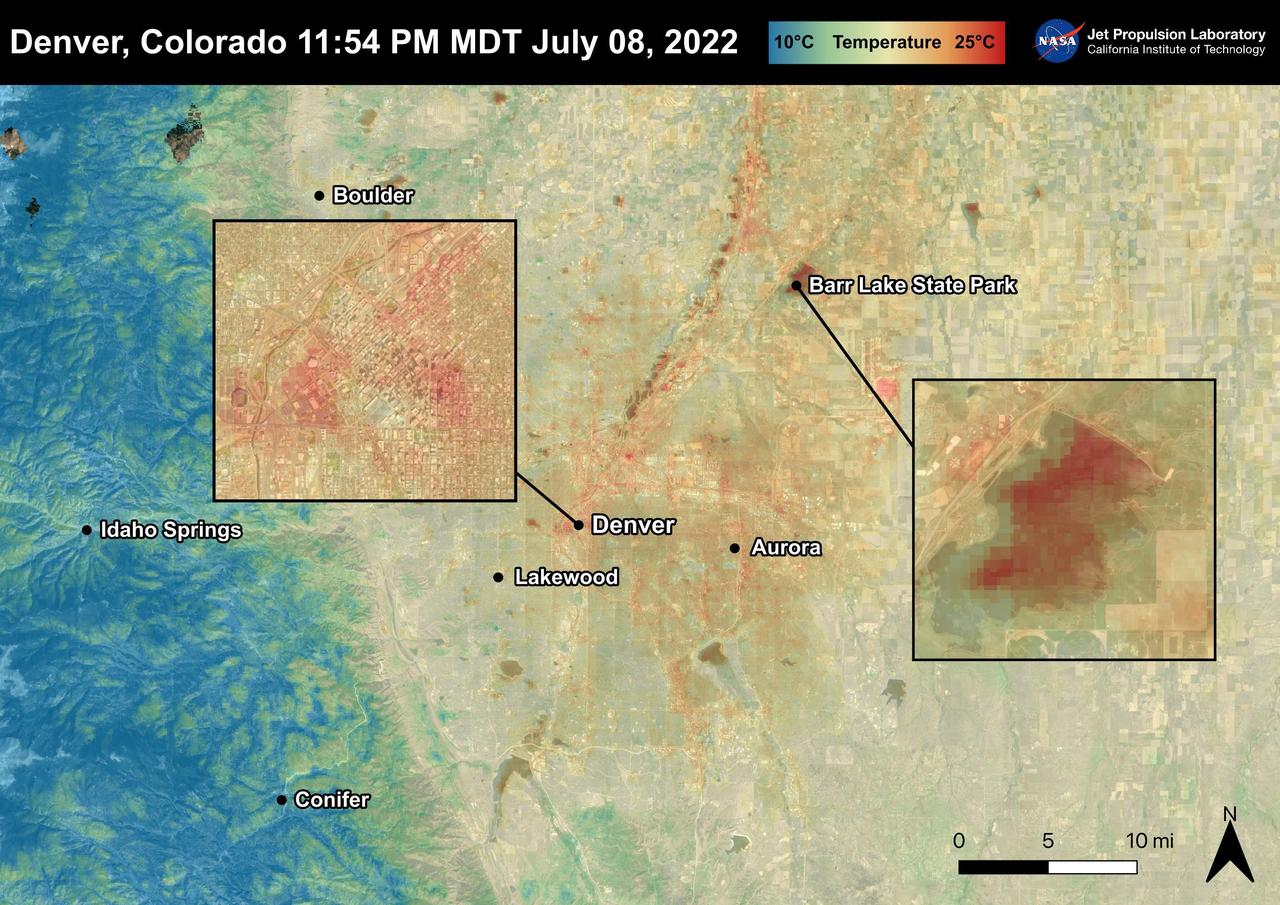
Denver, Colorado reached 96 degrees Fahrenheit on July 8th, 2022. In the two days following, temperatures rose to 101 degrees Fahrenheit. For cities like Denver, heat dissipates more slowly and create urban heat islands. High temperatures due to urban heat, especially at night, can lead to adverse health effects in vulnerable populations like children and the elderly. This image also shows that bodies of water, like Barr Lake, remain warm into the night due to water's high heat capacity. ECOSTRESS captured this Land Surface Temperature image on July 8th, 2022 at 11:54 PM MDT.  ECOSTRESS is a thermal instrument on the International Space Station that measures the temperature of the ground, which is hotter than the air temperature during the day. It was launched to the space station in 2018. Its primary mission is to identify critical thresholds of water use and water stress in plants and to detect the timing, location, and predictive factors leading to plant water uptake decline and/or cessation. The nature of the high-resolution data provided by ECOSTRESS allows it to record heat related phenomena such as heat waves and wildfires.  https://photojournal.jpl.nasa.gov/catalog/PIA25483
Denver, CO
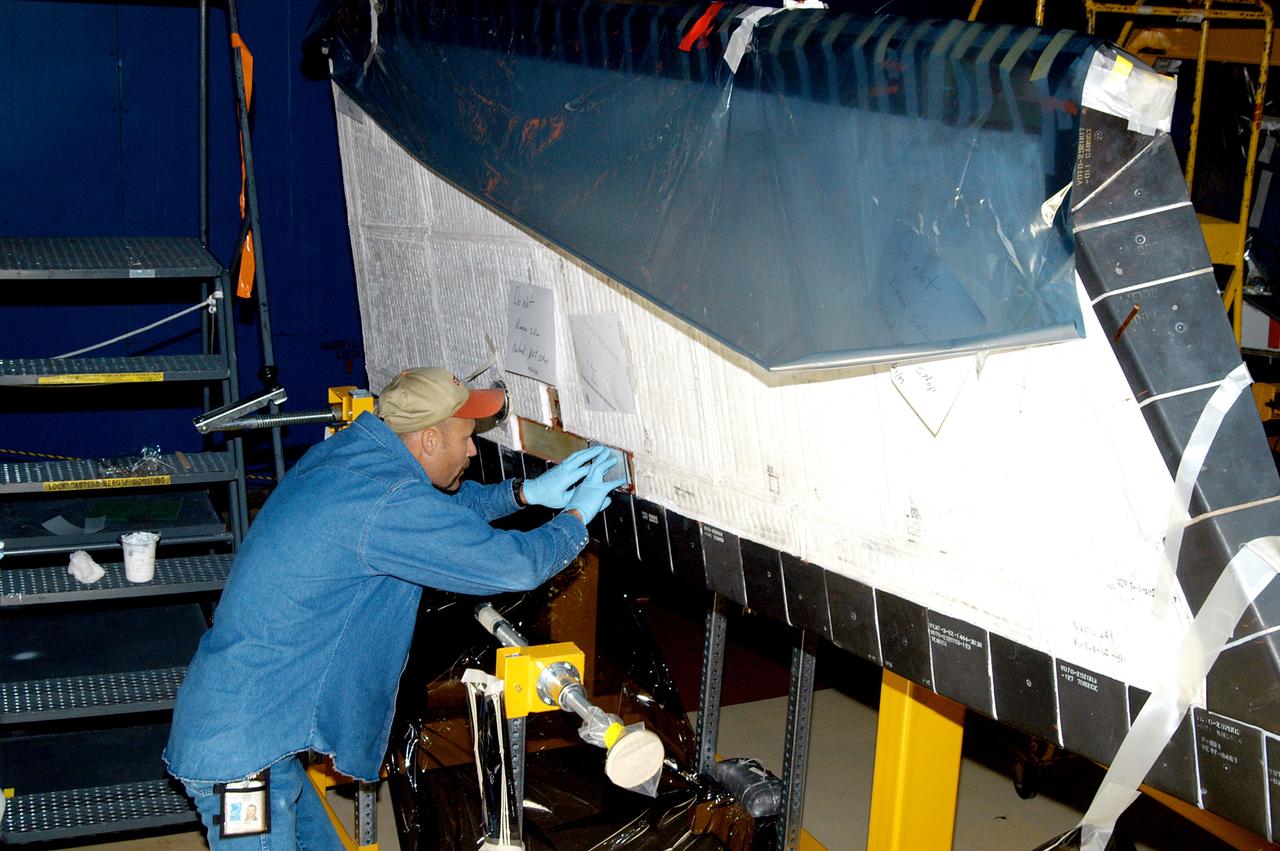
KENNEDY SPACE CENTER, FLA. -  In the Orbiter Processing Facility, KSC employee Nadine Phillips prepares an area on the orbiter Discovery for blanket installation.  The blankets are part of the Orbiter Thermal Protection System, thermal shields to protect against temperatures as high as 3,000° Fahrenheit, which are produced during descent for landing. Discovery is scheduled to fly on mission STS-121 to the International Space Station.
KENNEDY SPACE CENTER, FLA. - In the Orbiter Processing Facility, KSC employee Nadine Phillips prepares an area on the orbiter Discovery for blanket installation. The blankets are part of the Orbiter Thermal Protection System, thermal shields to protect against temperatures as high as 3,000° Fahrenheit, which are produced during descent for landing. Discovery is scheduled to fly on mission STS-121 to the International Space Station.
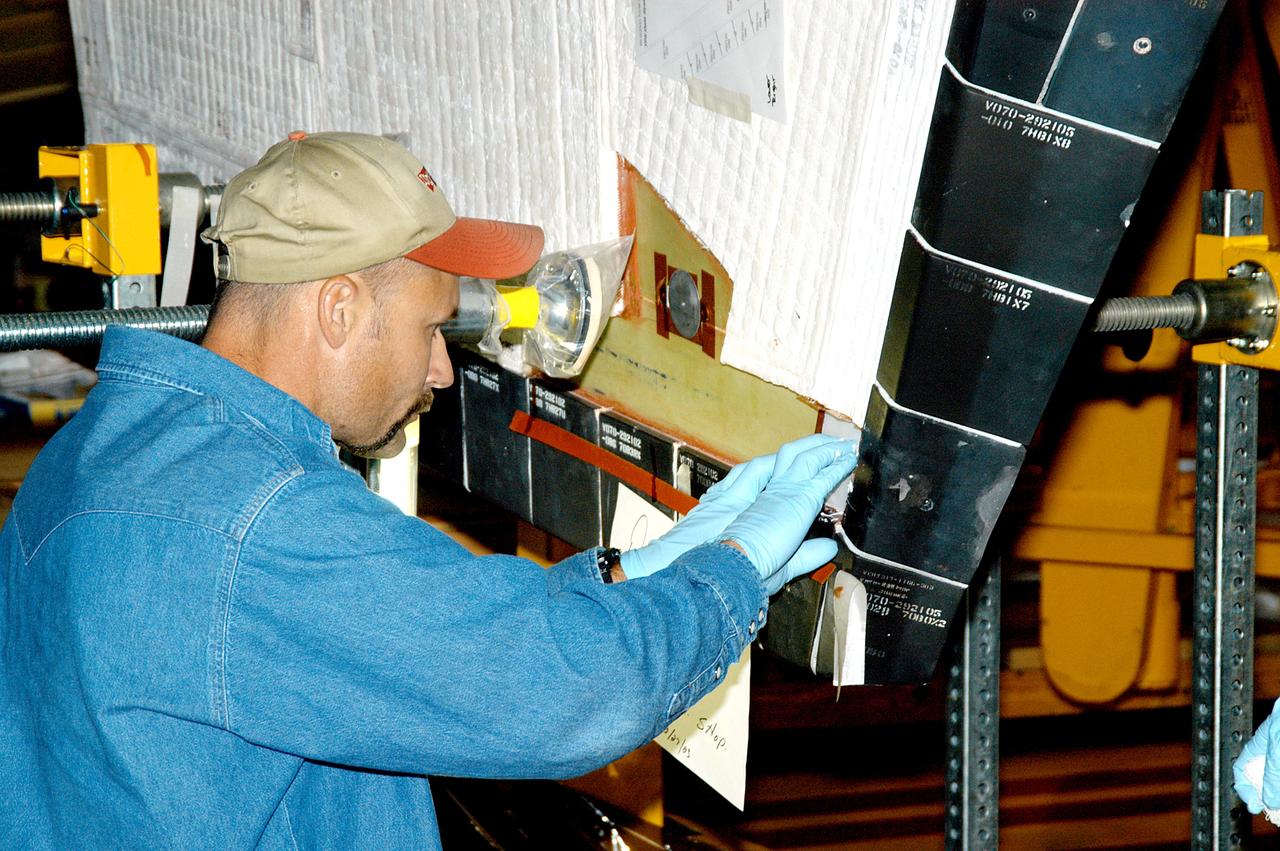
KENNEDY SPACE CENTER, FLA. -  In the Orbiter Processing Facility, KSC employee Duane Williams prepares the blanket insulation to be installed on the body flap on orbiter Discovery.  The blankets are part of the Orbiter Thermal Protection System, thermal shields to protect against temperatures as high as 3,000° Fahrenheit, which are produced during descent for landing. Discovery is scheduled to fly on mission STS-121 to the International Space Station.
KENNEDY SPACE CENTER, FLA. - In the Orbiter Processing Facility, KSC employee Duane Williams prepares the blanket insulation to be installed on the body flap on orbiter Discovery. The blankets are part of the Orbiter Thermal Protection System, thermal shields to protect against temperatures as high as 3,000° Fahrenheit, which are produced during descent for landing. Discovery is scheduled to fly on mission STS-121 to the International Space Station.
KENNEDY SPACE CENTER, FLA. -  United Space Alliance employees Jeremy Schwarz (left) and Chris Keeling install new tiles on the heat shield of main engine 1 for the orbiter Discovery.  A heat shield is a protective layer on a spacecraft designed to protect it from the high temperatures, usually those that result from aerobraking during reentry into the Earth’s atmosphere.
KENNEDY SPACE CENTER, FLA. - United Space Alliance employees Jeremy Schwarz (left) and Chris Keeling install new tiles on the heat shield of main engine 1 for the orbiter Discovery. A heat shield is a protective layer on a spacecraft designed to protect it from the high temperatures, usually those that result from aerobraking during reentry into the Earth’s atmosphere.
KENNEDY SPACE CENTER, FLA. -  In the Orbiter Processing Facility, KSC employee Duane Williams prepares the blanket insulation to be installed on the body flap on orbiter Discovery.  The blankets are part of the Orbiter Thermal Protection System, thermal shields to protect against temperatures as high as 3,000° Fahrenheit, which are produced during descent for landing. Discovery is scheduled to fly on mission STS-121 to the International Space Station.
KENNEDY SPACE CENTER, FLA. - In the Orbiter Processing Facility, KSC employee Duane Williams prepares the blanket insulation to be installed on the body flap on orbiter Discovery. The blankets are part of the Orbiter Thermal Protection System, thermal shields to protect against temperatures as high as 3,000° Fahrenheit, which are produced during descent for landing. Discovery is scheduled to fly on mission STS-121 to the International Space Station.
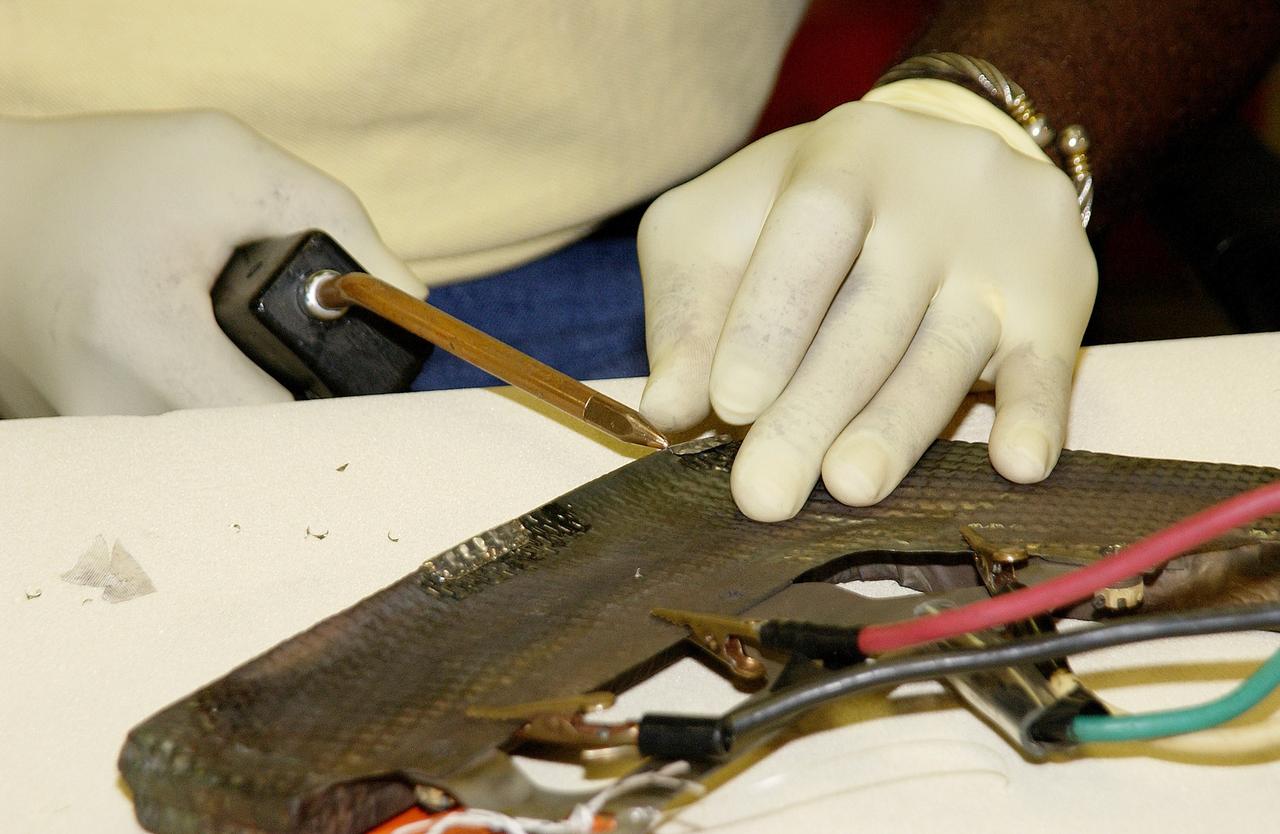
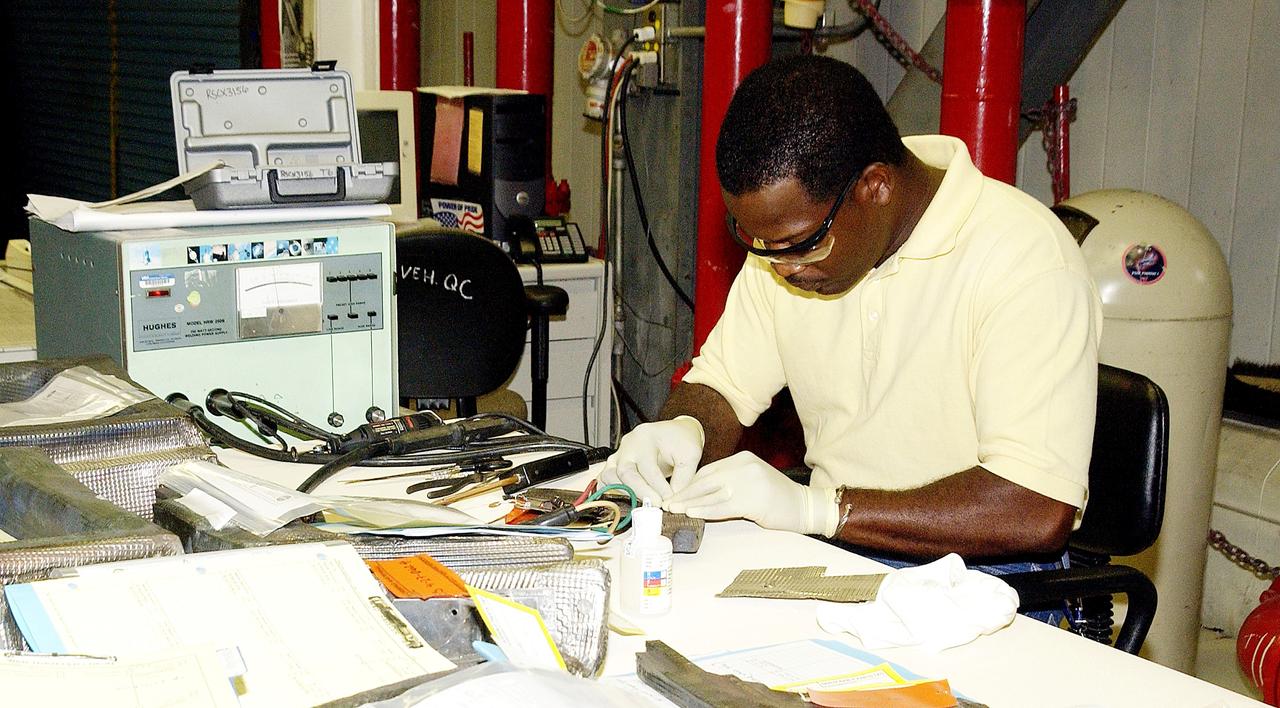
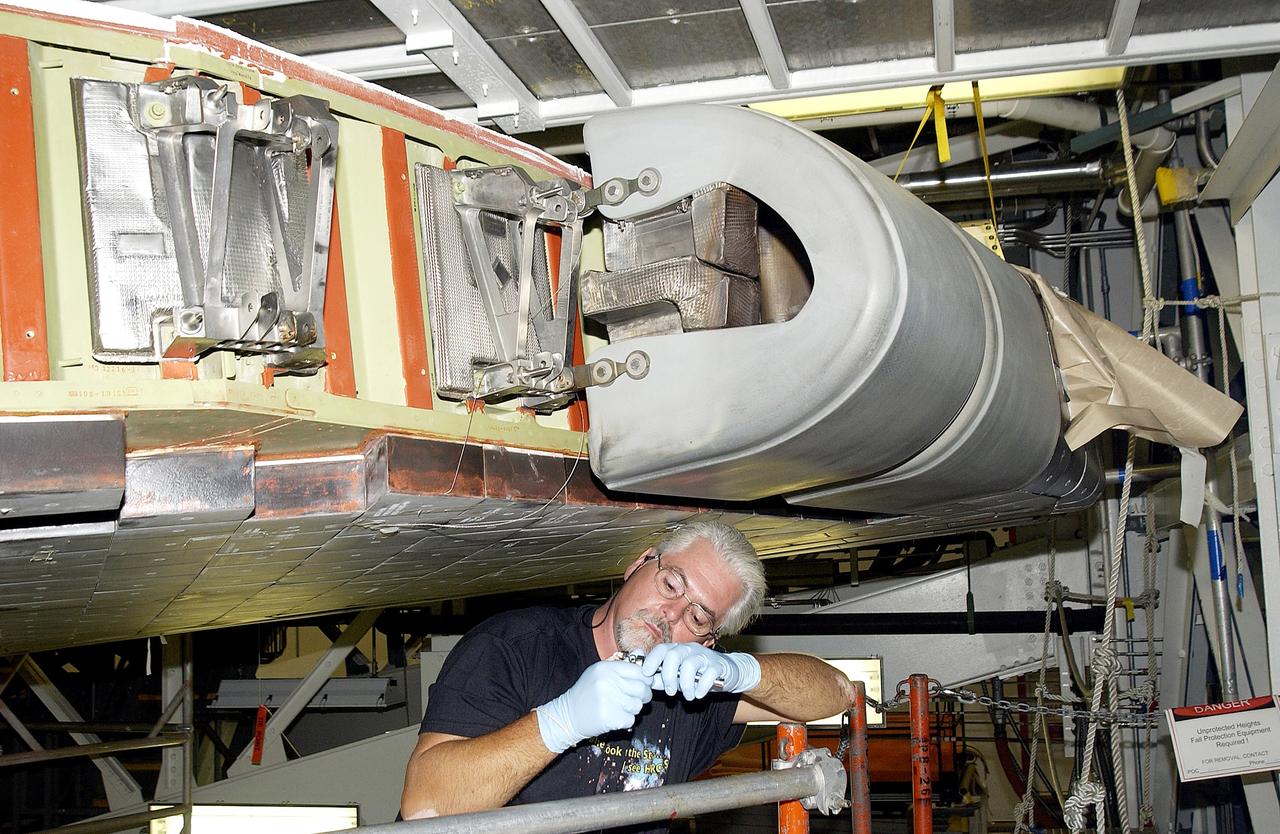
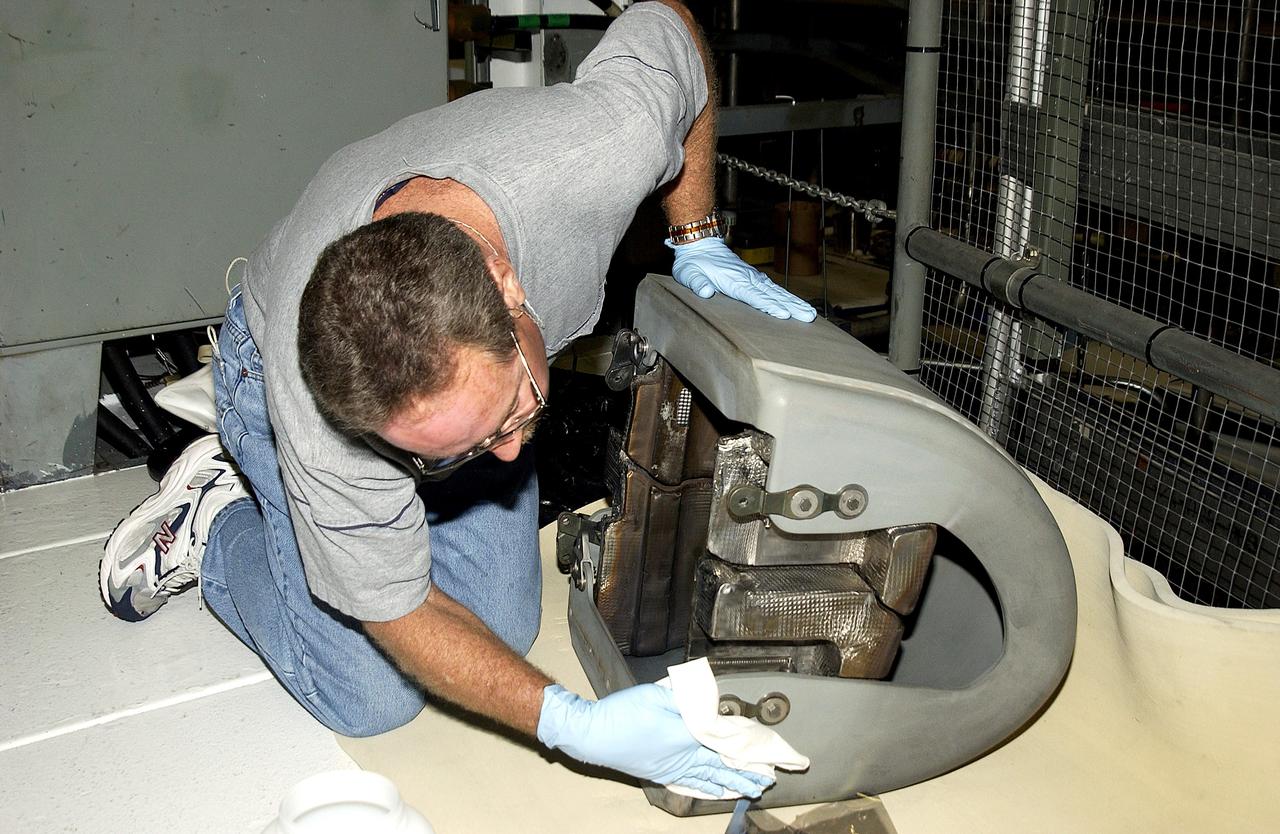
KENNEDY SPACE CENTER, FLA. -   United Space Alliance employee Anthony Simmons continues electrowelding on an insulator inside a Reinforced Carbon Carbon panel.   The gray carbon composite RCC panels are attached to the leading edge of the wing of the orbiters to withstand the aerodynamic forces experienced during launch and reentry, which can reach as high as 800 pounds per square foot.  The operating range of RCC is from minus 250º F to about 3,000º F, the temperature produced by friction with the atmosphere during reentry.
KENNEDY SPACE CENTER, FLA. - United Space Alliance employee Anthony Simmons continues electrowelding on an insulator inside a Reinforced Carbon Carbon panel. The gray carbon composite RCC panels are attached to the leading edge of the wing of the orbiters to withstand the aerodynamic forces experienced during launch and reentry, which can reach as high as 800 pounds per square foot. The operating range of RCC is from minus 250º F to about 3,000º F, the temperature produced by friction with the atmosphere during reentry.
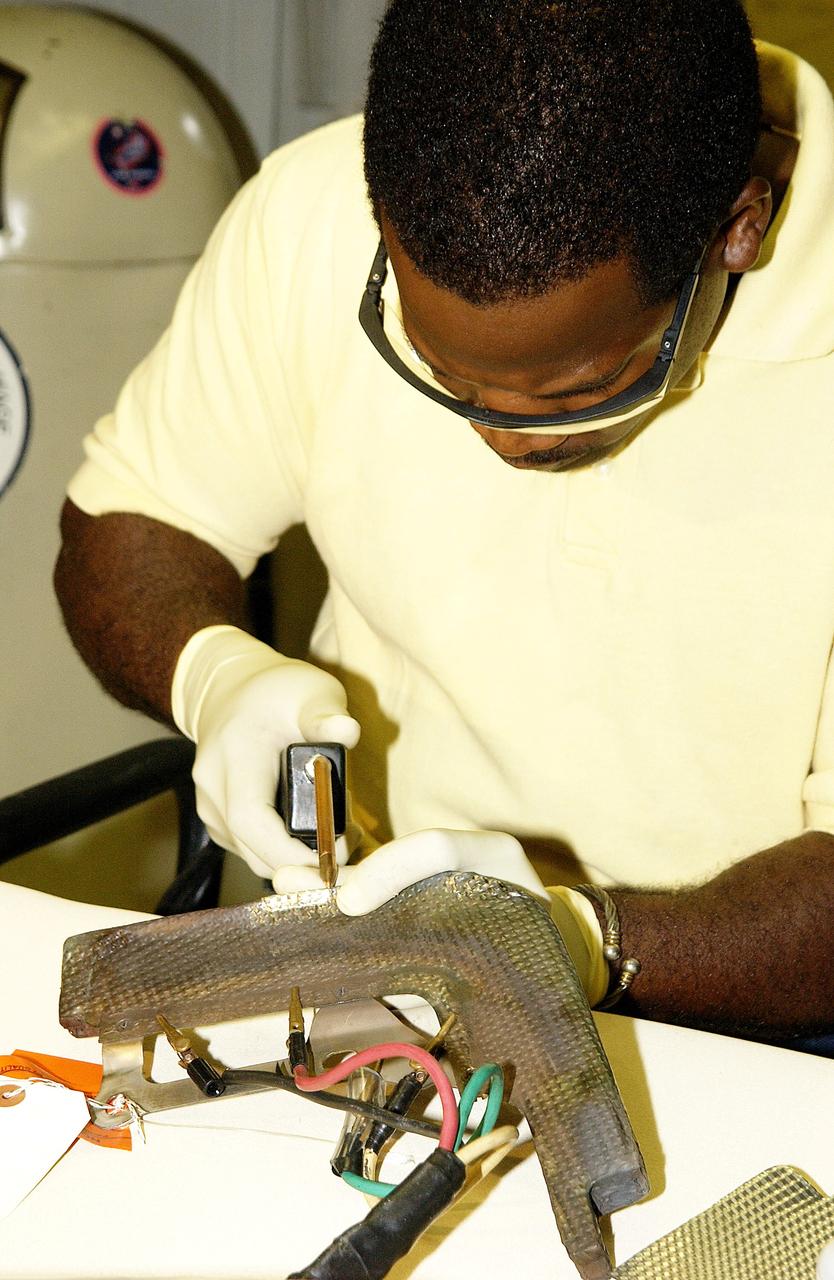
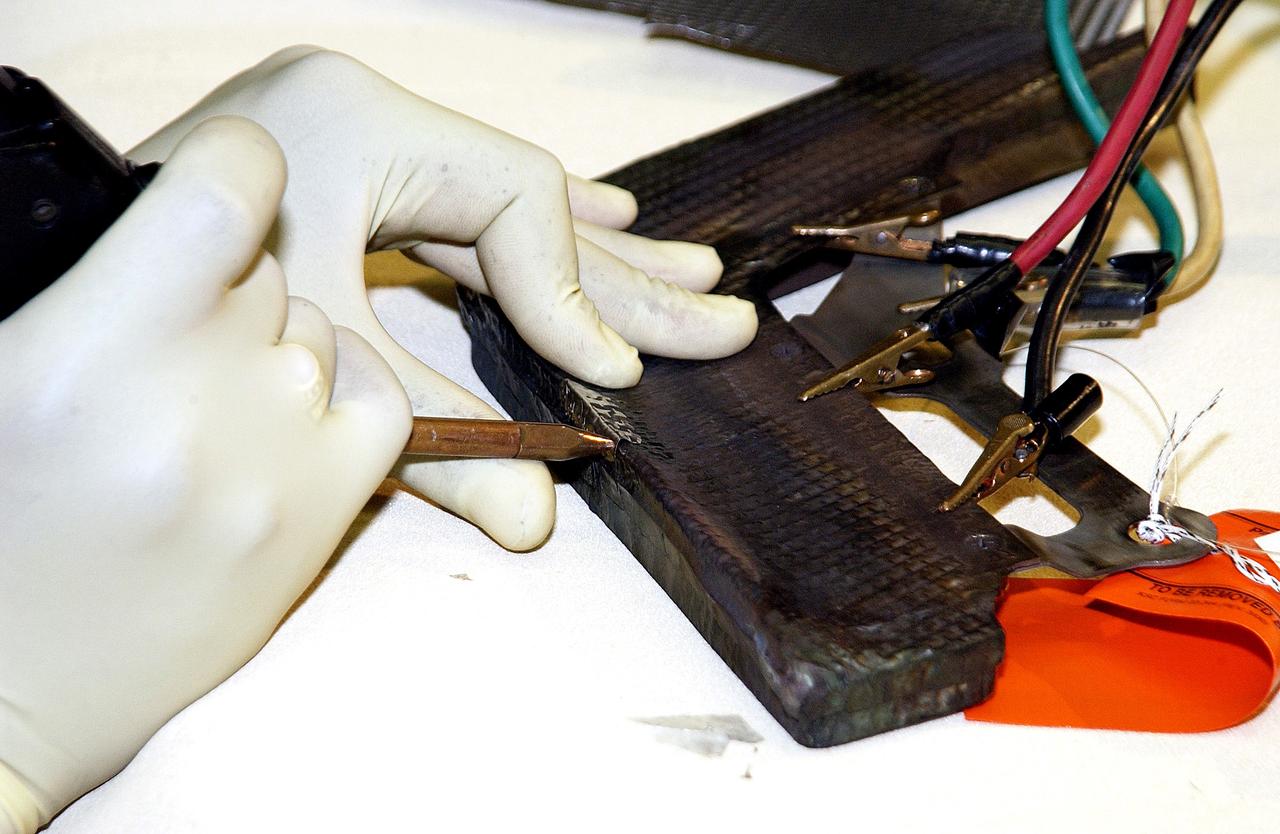
KENNEDY SPACE CENTER, FLA. -  United Space Alliance employee Anthony Simmons electrowelds a crack formed in the insulator inside a Reinforced Carbon Carbon panel.   The gray carbon composite RCC panels are attached to the leading edge of the wing of the orbiters to withstand the aerodynamic forces experienced during launch and reentry, which can reach as high as 800 pounds per square foot.  The operating range of RCC is from minus 250º F to about 3,000º F, the temperature produced by friction with the atmosphere during reentry.
KENNEDY SPACE CENTER, FLA. - United Space Alliance employee Anthony Simmons electrowelds a crack formed in the insulator inside a Reinforced Carbon Carbon panel. The gray carbon composite RCC panels are attached to the leading edge of the wing of the orbiters to withstand the aerodynamic forces experienced during launch and reentry, which can reach as high as 800 pounds per square foot. The operating range of RCC is from minus 250º F to about 3,000º F, the temperature produced by friction with the atmosphere during reentry.
KENNEDY SPACE CENTER, FLA. -   United Space Alliance employee Anthony Simmons continues electrowelding on an insulator inside a Reinforced Carbon Carbon panel.   The gray carbon composite RCC panels are attached to the leading edge of the wing of the orbiters to withstand the aerodynamic forces experienced during launch and reentry, which can reach as high as 800 pounds per square foot.  The operating range of RCC is from minus 250º F to about 3,000º F, the temperature produced by friction with the atmosphere during reentry.
KENNEDY SPACE CENTER, FLA. - United Space Alliance employee Anthony Simmons continues electrowelding on an insulator inside a Reinforced Carbon Carbon panel. The gray carbon composite RCC panels are attached to the leading edge of the wing of the orbiters to withstand the aerodynamic forces experienced during launch and reentry, which can reach as high as 800 pounds per square foot. The operating range of RCC is from minus 250º F to about 3,000º F, the temperature produced by friction with the atmosphere during reentry.
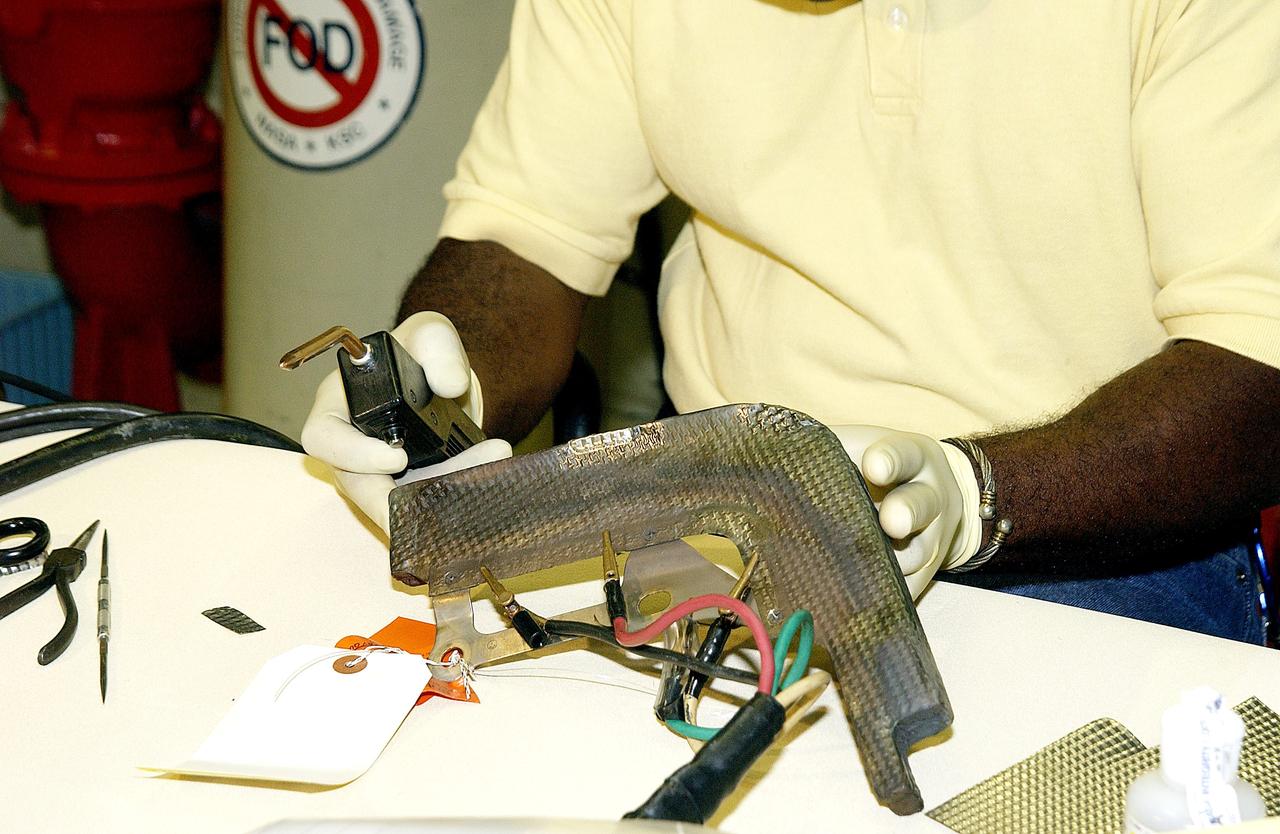
KENNEDY SPACE CENTER, FLA. - United Space Alliance employee Anthony Simmons checks the electroweld he performed on an insulator inside a Reinforced Carbon Carbon panel.   The gray carbon composite RCC panels are attached to the leading edge of the wing of the orbiters to withstand the aerodynamic forces experienced during launch and reentry, which can reach as high as 800 pounds per square foot.  The operating range of RCC is from minus 250º F to about 3,000º F, the temperature produced by friction with the atmosphere during reentry.
KENNEDY SPACE CENTER, FLA. - United Space Alliance employee Anthony Simmons checks the electroweld he performed on an insulator inside a Reinforced Carbon Carbon panel. The gray carbon composite RCC panels are attached to the leading edge of the wing of the orbiters to withstand the aerodynamic forces experienced during launch and reentry, which can reach as high as 800 pounds per square foot. The operating range of RCC is from minus 250º F to about 3,000º F, the temperature produced by friction with the atmosphere during reentry.
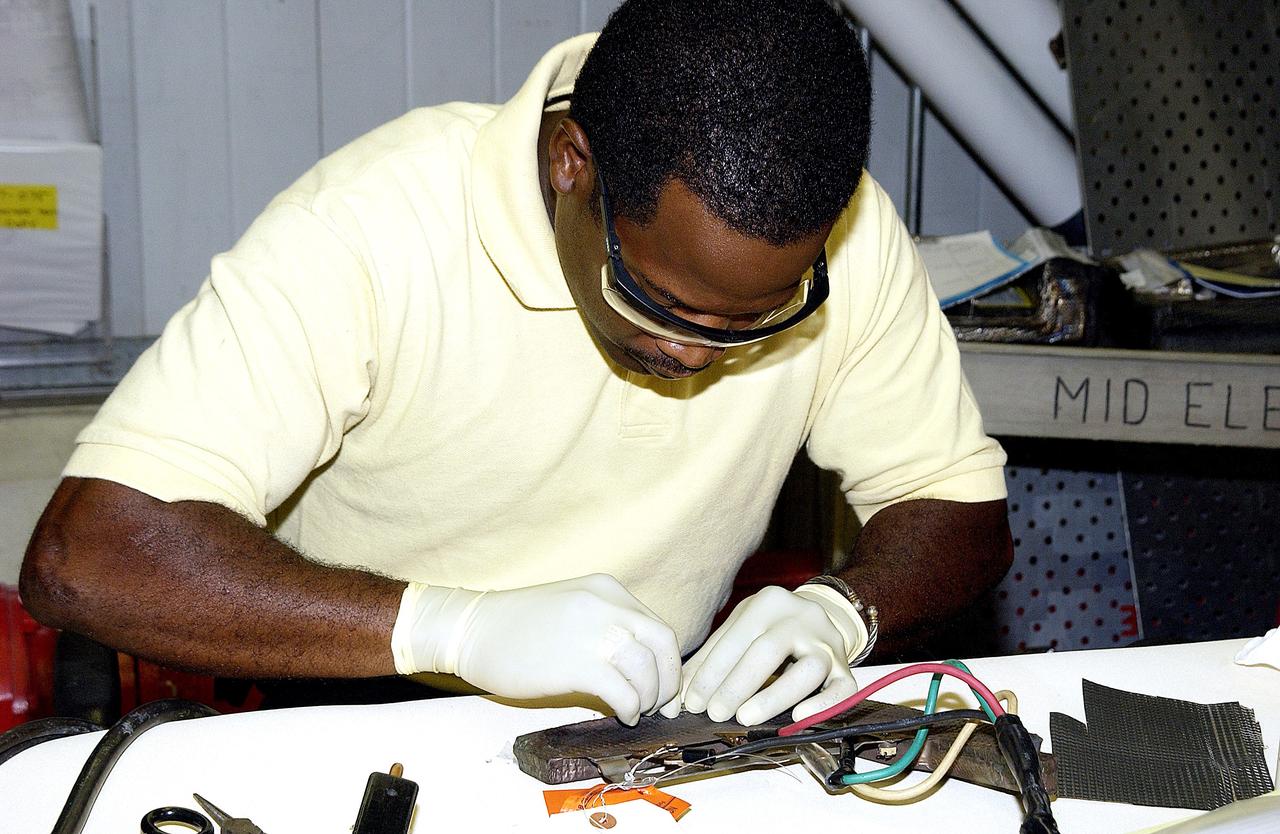
KENNEDY SPACE CENTER, FLA. -   United Space Alliance employee Anthony Simmons prepares to electroweld a crack found on an insulator inside a Reinforced Carbon Carbon panel.   The gray carbon composite RCC panels are attached to the leading edge of the wing of the orbiters to withstand the aerodynamic forces experienced during launch and reentry, which can reach as high as 800 pounds per square foot.  The operating range of RCC is from minus 250º F to about 3,000º F, the temperature produced by friction with the atmosphere during reentry.
KENNEDY SPACE CENTER, FLA. - United Space Alliance employee Anthony Simmons prepares to electroweld a crack found on an insulator inside a Reinforced Carbon Carbon panel. The gray carbon composite RCC panels are attached to the leading edge of the wing of the orbiters to withstand the aerodynamic forces experienced during launch and reentry, which can reach as high as 800 pounds per square foot. The operating range of RCC is from minus 250º F to about 3,000º F, the temperature produced by friction with the atmosphere during reentry.
KENNEDY SPACE CENTER, FLA. -  United Space Alliance employee Anthony Simmons electrowelds a crack formed in the insulator inside a Reinforced Carbon Carbon panel.   The gray carbon composite RCC panels are attached to the leading edge of the wing of the orbiters to withstand the aerodynamic forces experienced during launch and reentry, which can reach as high as 800 pounds per square foot.  The operating range of RCC is from minus 250º F to about 3,000º F, the temperature produced by friction with the atmosphere during reentry.
KENNEDY SPACE CENTER, FLA. - United Space Alliance employee Anthony Simmons electrowelds a crack formed in the insulator inside a Reinforced Carbon Carbon panel. The gray carbon composite RCC panels are attached to the leading edge of the wing of the orbiters to withstand the aerodynamic forces experienced during launch and reentry, which can reach as high as 800 pounds per square foot. The operating range of RCC is from minus 250º F to about 3,000º F, the temperature produced by friction with the atmosphere during reentry.
KENNEDY SPACE CENTER, FLA. -  United Space Alliance employee Anthony Simmons prepares to electroweld a crack formed in the insulator inside a Reinforced Carbon Carbon panel.   The gray carbon composite RCC panels are attached to the leading edge of the wing of the orbiters to withstand the aerodynamic forces experienced during launch and reentry, which can reach as high as 800 pounds per square foot.  The operating range of RCC is from minus 250º F to about 3,000º F, the temperature produced by friction with the atmosphere during reentry.
KENNEDY SPACE CENTER, FLA. - United Space Alliance employee Anthony Simmons prepares to electroweld a crack formed in the insulator inside a Reinforced Carbon Carbon panel. The gray carbon composite RCC panels are attached to the leading edge of the wing of the orbiters to withstand the aerodynamic forces experienced during launch and reentry, which can reach as high as 800 pounds per square foot. The operating range of RCC is from minus 250º F to about 3,000º F, the temperature produced by friction with the atmosphere during reentry.
KENNEDY SPACE CENTER, FLA. -  United Space Alliance employees (from left) Daryl Burke, Jay Beason and Tom Summers check new tiles installed on the heat shield of main engine 1 for the orbiter Discovery.  A heat shield is a protective layer on a spacecraft designed to protect it from the high temperatures, usually those that result from aerobraking during reentry into the Earth’s atmosphere.
KENNEDY SPACE CENTER, FLA. - United Space Alliance employees (from left) Daryl Burke, Jay Beason and Tom Summers check new tiles installed on the heat shield of main engine 1 for the orbiter Discovery. A heat shield is a protective layer on a spacecraft designed to protect it from the high temperatures, usually those that result from aerobraking during reentry into the Earth’s atmosphere.
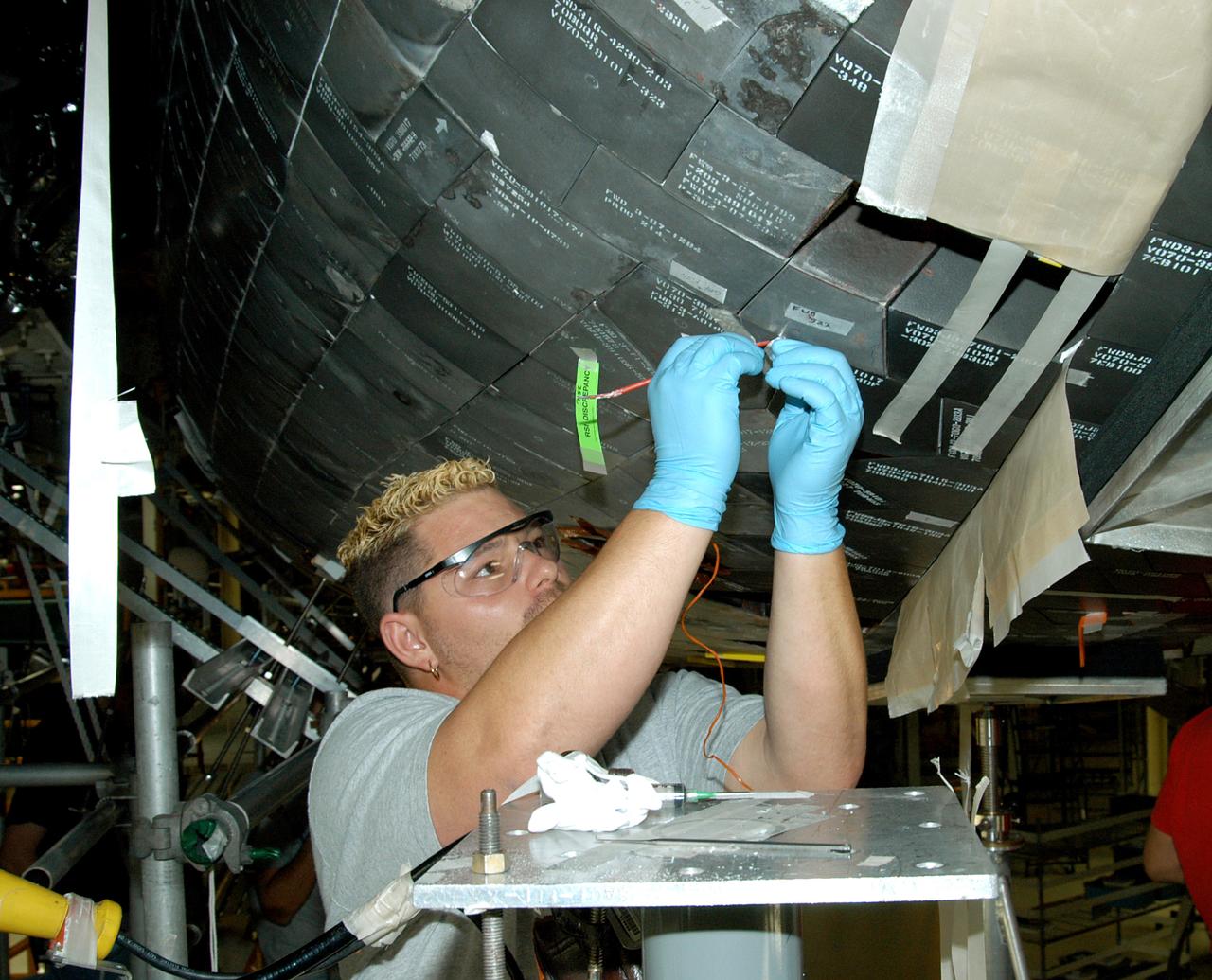
KENNEDY SPACE CENTER, FLA. -  In the Orbiter Processing Facility, KSC employee Chris Moore repairs tile on the forward area of the orbiter Discovery. The vehicle has undergone Orbiter Major Modifications in the past year, which includes tile check and repair. The tiles are part of the Orbiter Thermal Protection System, thermal shields to protect against temperatures as high as 3,000° Fahrenheit, which are produced during descent for landing. Discovery is scheduled to fly on mission STS-121 to the International Space Station.
KENNEDY SPACE CENTER, FLA. - In the Orbiter Processing Facility, KSC employee Chris Moore repairs tile on the forward area of the orbiter Discovery. The vehicle has undergone Orbiter Major Modifications in the past year, which includes tile check and repair. The tiles are part of the Orbiter Thermal Protection System, thermal shields to protect against temperatures as high as 3,000° Fahrenheit, which are produced during descent for landing. Discovery is scheduled to fly on mission STS-121 to the International Space Station.
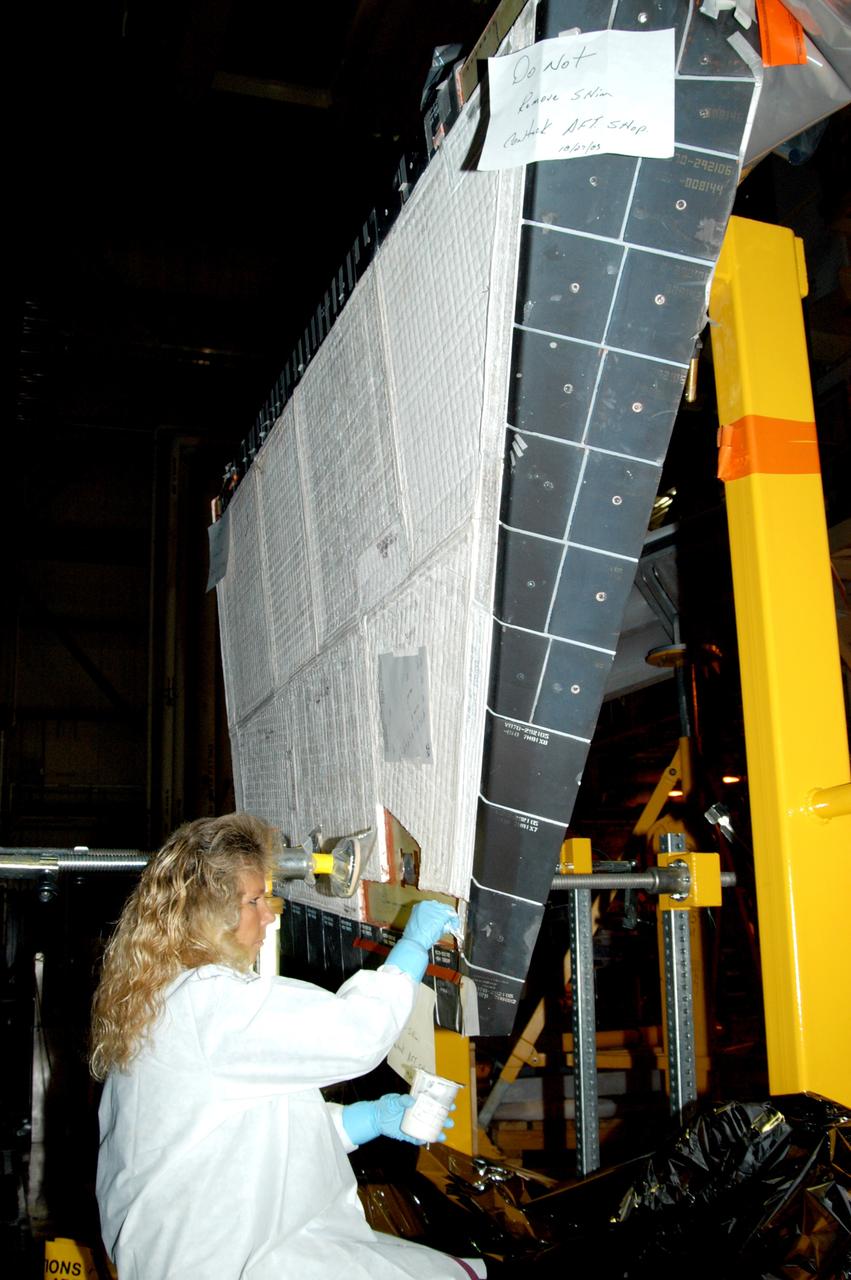
KENNEDY SPACE CENTER, FLA. -  In the Orbiter Processing Facility, KSC employee Joel Smith prepares an area on the orbiter Discovery for blanket installation.  The blankets are part of the Orbiter Thermal Protection System, thermal shields to protect against temperatures as high as 3,000° Fahrenheit, which are produced during descent for landing. Discovery is scheduled to fly on mission STS-121 to the International Space Station.
KENNEDY SPACE CENTER, FLA. - In the Orbiter Processing Facility, KSC employee Joel Smith prepares an area on the orbiter Discovery for blanket installation. The blankets are part of the Orbiter Thermal Protection System, thermal shields to protect against temperatures as high as 3,000° Fahrenheit, which are produced during descent for landing. Discovery is scheduled to fly on mission STS-121 to the International Space Station.
KENNEDY SPACE CENTER, FLA. -  In the Orbiter Processing Facility, KSC employee Joel Smith prepares an area on the orbiter Discovery for blanket installation.  The blankets are part of the Orbiter Thermal Protection System, thermal shields to protect against temperatures as high as 3,000° Fahrenheit, which are produced during descent for landing. Discovery is scheduled to fly on mission STS-121 to the International Space Station.
KENNEDY SPACE CENTER, FLA. - In the Orbiter Processing Facility, KSC employee Joel Smith prepares an area on the orbiter Discovery for blanket installation. The blankets are part of the Orbiter Thermal Protection System, thermal shields to protect against temperatures as high as 3,000° Fahrenheit, which are produced during descent for landing. Discovery is scheduled to fly on mission STS-121 to the International Space Station.
KENNEDY SPACE CENTER, FLA. -  While Jay Beason (left), with United Space Alliance,  looks on, Jeremy Schwarz (front) and Tom Summers (behind), also with USA, place new tiles on the heat shield of main engine 1 for the orbiter Discovery.  A heat shield is a protective layer on a spacecraft designed to protect it from the high temperatures, usually those that result from aerobraking during reentry into the Earth’s atmosphere.
KENNEDY SPACE CENTER, FLA. - While Jay Beason (left), with United Space Alliance, looks on, Jeremy Schwarz (front) and Tom Summers (behind), also with USA, place new tiles on the heat shield of main engine 1 for the orbiter Discovery. A heat shield is a protective layer on a spacecraft designed to protect it from the high temperatures, usually those that result from aerobraking during reentry into the Earth’s atmosphere.
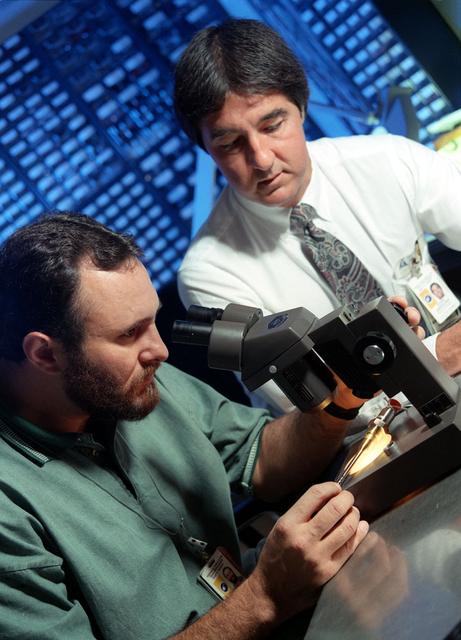
Photos for Web Feature by Victoria (Tori) Woods; Micro-Electro Mechanical Systems (MEMS) using vacuum technology; fabricating High Temperature Electronics for Harsh Environments using silicon carbide substrates
GRC-2011-C-00579
This view shows Mercury's north polar region, colored by the maximum biannual surface temperature, which ranges from >400 K (red) to 50 K (purple). As expected for the Solar System's innermost planet, areas of Mercury's surface that are sunlit reach high temperatures, and hence most of this image is colored red!  In contrast, some craters near Mercury's poles have regions that remain permanently in shadow, and in these regions even the maximum temperatures can be extremely low. Evidence from MESSENGER and Earth-based observations indicate that water ice deposits are present in these cold craters. The craters nearest Mercury' poles have surface temperatures less than 100 K (-173°C, -280°F), and water ice is stable on the surface, such as in Prokofiev. However, many craters near but somewhat farther from Mercury's poles have cold, permanently shadowed interiors, but the maximum temperature is too high for water ice to persist at the surface. In these craters, water ice is present but is buried beneath a thin, low-reflectance volatile layer likely consisting of organic-rich material, such as in Berlioz crater.   http://photojournal.jpl.nasa.gov/catalog/PIA19247
Hot and Cold
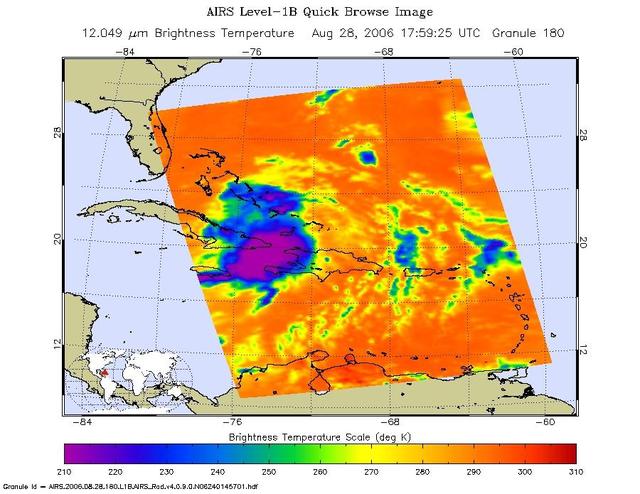
This infrared image shows Tropical Storm Ernesto over Cuba, from the Atmospheric Infrared Sounder AIRS on NASA Aqua satellite in August, 2006. Because infrared radiation does not penetrate through clouds, AIRS infrared images show either the temperature of the cloud tops or the surface of the Earth in cloud-free regions. The lowest temperatures (in purple) are associated with high, cold cloud tops that make up the top of the storm. In cloud-free areas the AIRS instrument will receive the infrared radiation from the surface of the Earth, resulting in the warmest temperatures (orange/red).  http://photojournal.jpl.nasa.gov/catalog/PIA00510
Tropical Storm Ernesto over Cuba
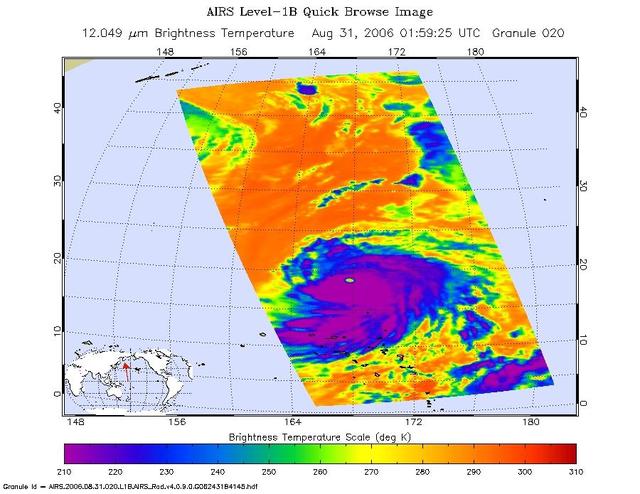
This infrared image shows Typhoon Ioke in the Western Pacific, from the Atmospheric Infrared Sounder AIRS on NASA Aqua satellite in August, 2006.  Because infrared radiation does not penetrate through clouds, AIRS infrared images show either the temperature of the cloud tops or the surface of the Earth in cloud-free regions. The lowest temperatures (in purple) are associated with high, cold cloud tops that make up the top of the storm. In cloud-free areas the AIRS instrument will receive the infrared radiation from the surface of the Earth, resulting in the warmest temperatures (orange/red).  http://photojournal.jpl.nasa.gov/catalog/PIA00511
Typhoon Ioke in the Western Pacific
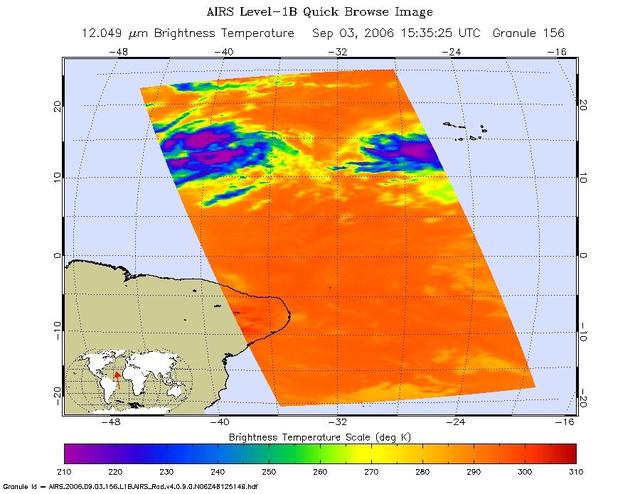
This infrared image shows Tropical Depression 6 Florence in the Atlantic, from the Atmospheric Infrared Sounder AIRS on NASA Aqua satellite in September, 2006.  Because infrared radiation does not penetrate through clouds, AIRS infrared images show either the temperature of the cloud tops or the surface of the Earth in cloud-free regions. The lowest temperatures (in purple) are associated with high, cold cloud tops that make up the top of the storm. In cloud-free areas the AIRS instrument will receive the infrared radiation from the surface of the Earth, resulting in the warmest temperatures (orange/red).  http://photojournal.jpl.nasa.gov/catalog/PIA00512
Tropical Depression 6 Florence in the Atlantic
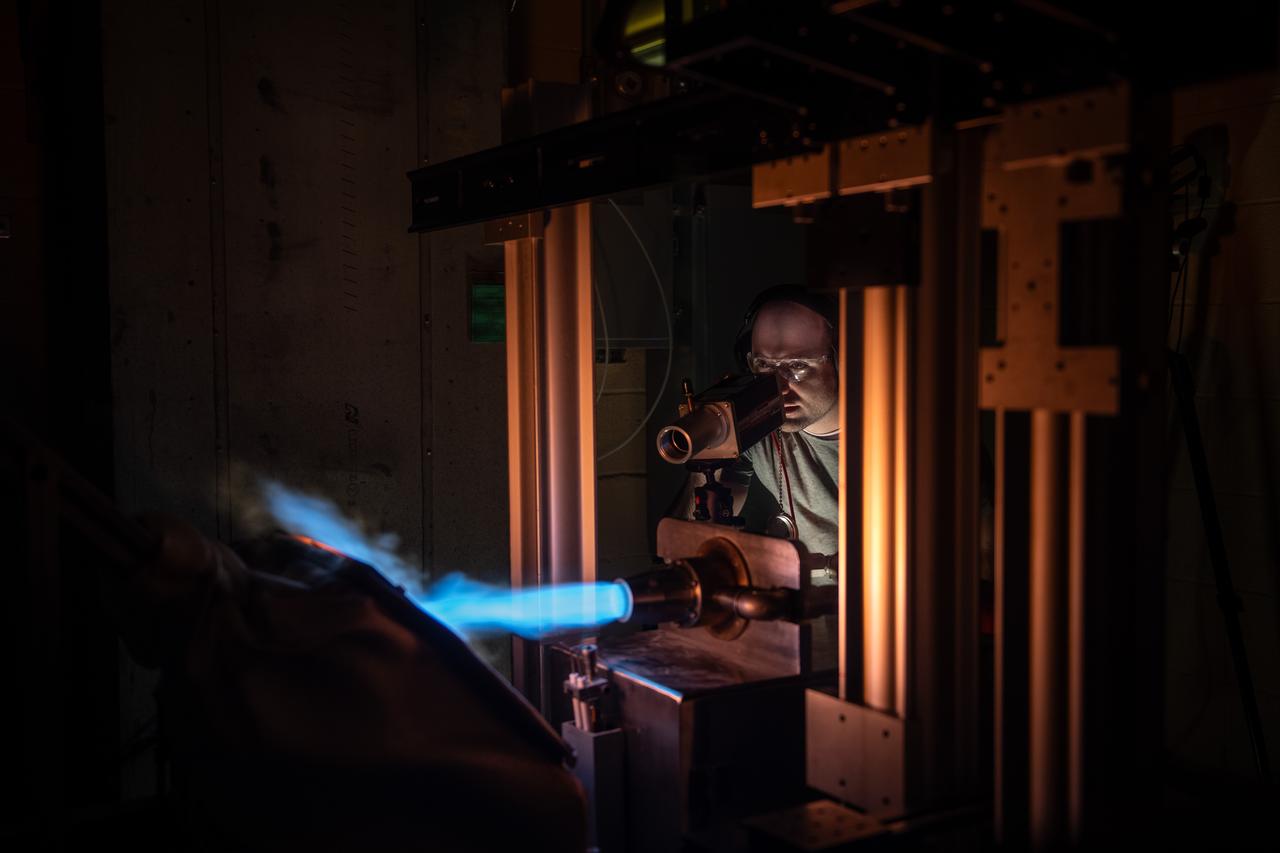
NASA Glenn’s Natural Gas/Oxygen Burner Rig is used to study the high temperature performance of various metal alloys, ceramics, and protective coatings for aero and space propulsion systems. The burner rig provides an easily accessible and economical method to simulate engine operating conditions to understand thermomechanical and thermochemical degradation of materials and structures. In the photo, Materials Research Engineer Michael Presby uses an infrared pyrometer to monitor the surface temperature of the material for a test on February 23, 2024. Photo Credit: (NASA/Sara Lowthian-Hanna)
Engineering Design Unit (EDU) from a NASA customer, Radian Aerospace, being tested in the burner rig
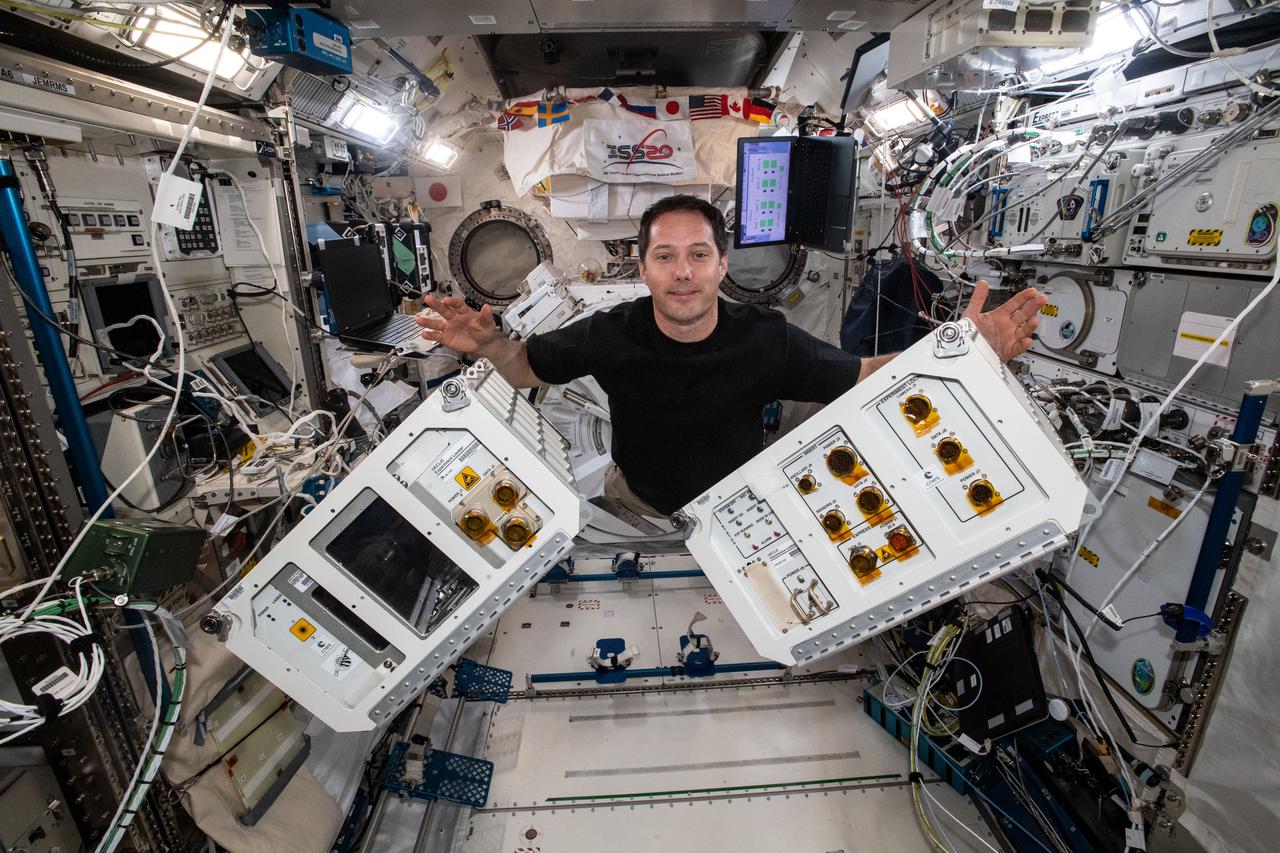
iss065e442823 (Oct. 7, 2021) --- Expedition 65 Commander Thomas Pesquet of ESA (European Space Agency) installs a fluid physics and materials research device inside the International Space Station's Kibo laboratory module. Also called DECLIC, or Device for the Study of Critical Liquids and Crystallization, the device allows researchers to study ambient temperature critical point fluids, high temperature super-critical fluids, and the dynamics and morphology of the fronts that form as a liquid material solidifies.
iss065e442823
iss065e442804 (Oct. 7, 2021) --- Expedition 65 Commander Thomas Pesquet of ESA (European Space Agency) gathers fluid physics and materials research hardware inside the International Space Station's Kibo laboratory module. Also called DECLIC, or Device for the Study of Critical Liquids and Crystallization, the science gear allows researchers to study ambient temperature critical point fluids, high temperature super-critical fluids, and the dynamics and morphology of the fronts that form as a liquid material solidifies.
iss065e442804
These images show Tropical Depression Debbie in the Atlantic, from the Atmospheric Infrared Sounder (AIRS) on NASA's Aqua satellite on August 22, 2006. This AIRS image shows the temperature of the cloud tops or the surface of the Earth in cloud-free regions. The lowest temperatures (in purple) are associated with high, cold cloud tops that make up the top of the storm. The infrared signal does not penetrate through clouds. Where there are no clouds the AIRS instrument reads the infrared signal from the surface of the Earth, revealing warmer temperatures (red). At the time the data were taken from which these images were made the eye had not yet opened but the storm is now well organized. The location of the future eye appears as a circle at 275 K brightness temperature in the microwave image just to the SE of the Azores.  http://photojournal.jpl.nasa.gov/catalog/PIA00508
Tropical Depression Debbie in the Atlantic
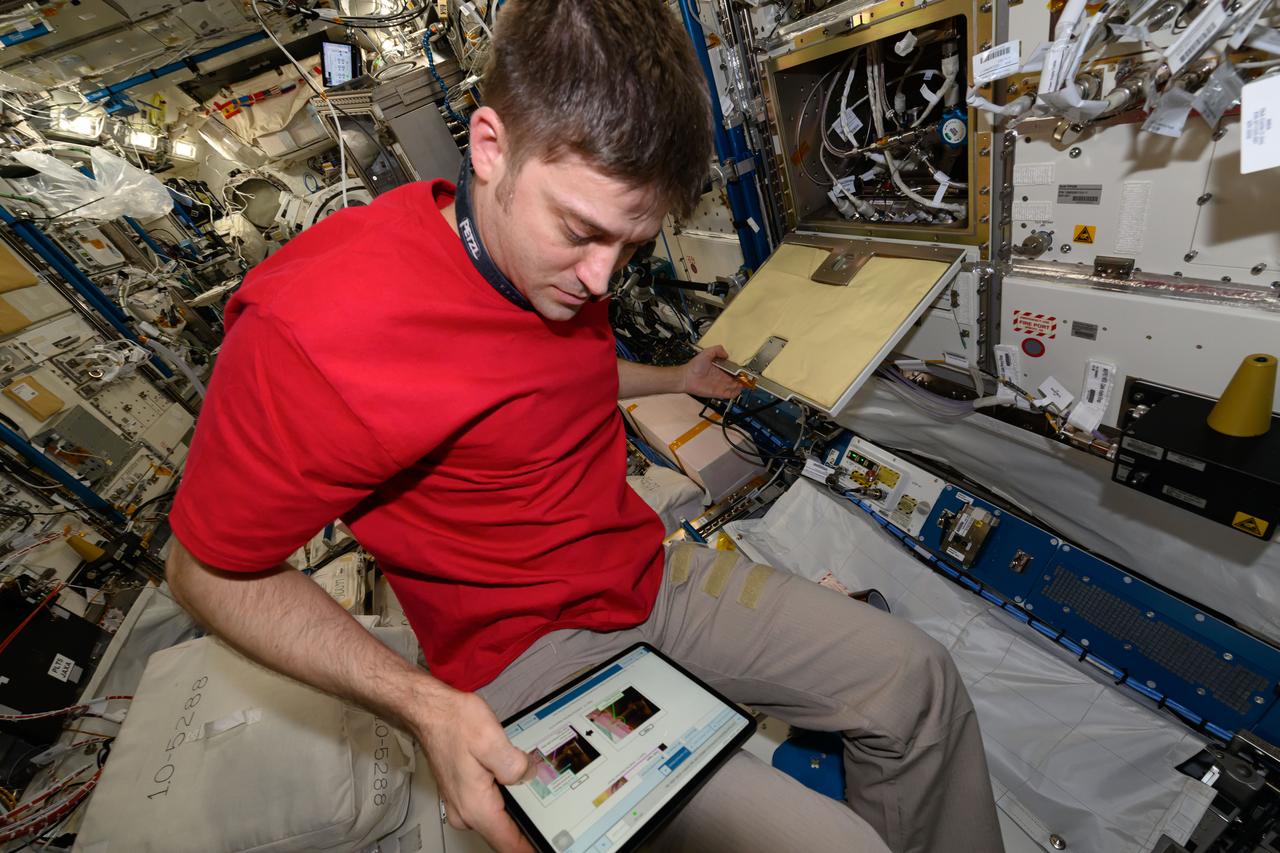
iss071e462464 (Aug. 9, 2024) --- NASA astronaut and Expedition 71 Flight Engineer Matthew Dominick replaces research components inside the Electrostatic Levitation Furnace (ELF) located inside the International Space Station's Kibo laboratory module. The ELF supports safe observations of microgravity’s effect on materials exposed to high temperatures.
iss071e462464
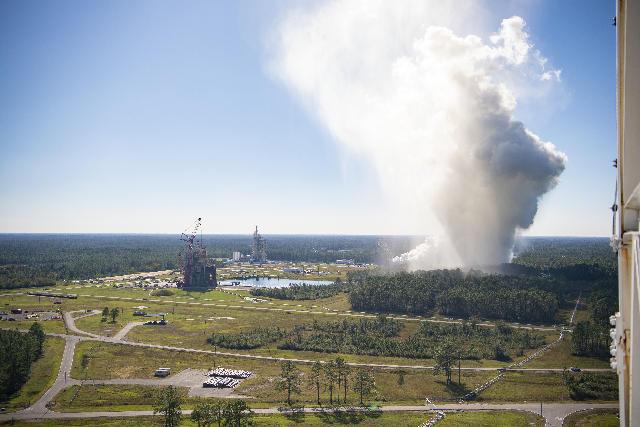
The RS-25 certification test series begins Oct. 17. When the liquid hydrogen and liquid oxygen propellants mix and ignite, an extremely high temperature exhaust, of up to 6,000-degrees Fahrenheit, mixes with water to form steam that exits the flame deflector and rises into the atmosphere, forming a cloud that subsequently cools.
NASA Achieves Milestone for Engines to Power Future Artemis Missions
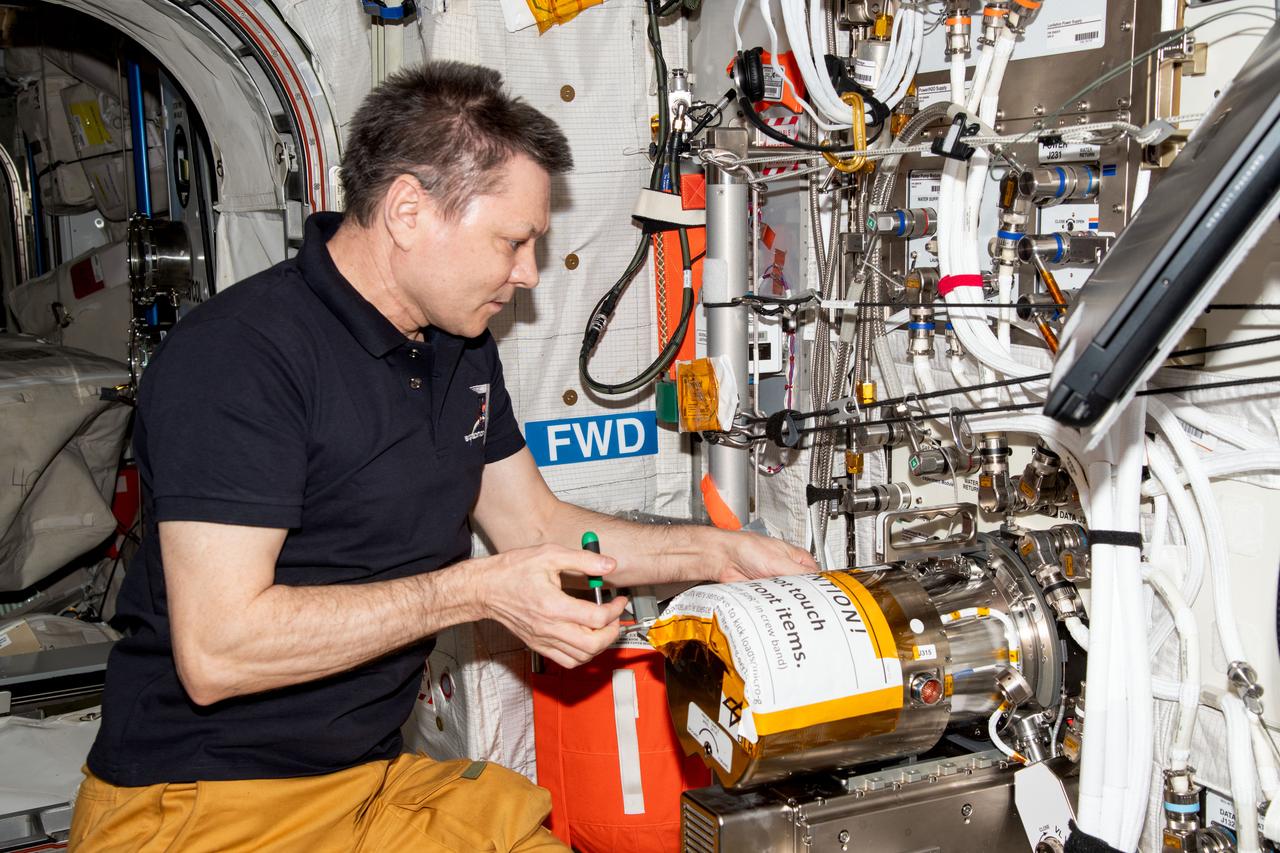
iss071e580240 (AUg. 29, 2024) --- Roscosmos cosmonaut and Expedition 71 Commander Oleg Kononenko swaps sample chambers inside the Electromagnetic Levitator (EML) located aboard the International Space Station's Columbus laboratory module. The EML is a physics research device that measures the thermophysical properties of liquid metallic alloys at high temperatures.
iss071e580240
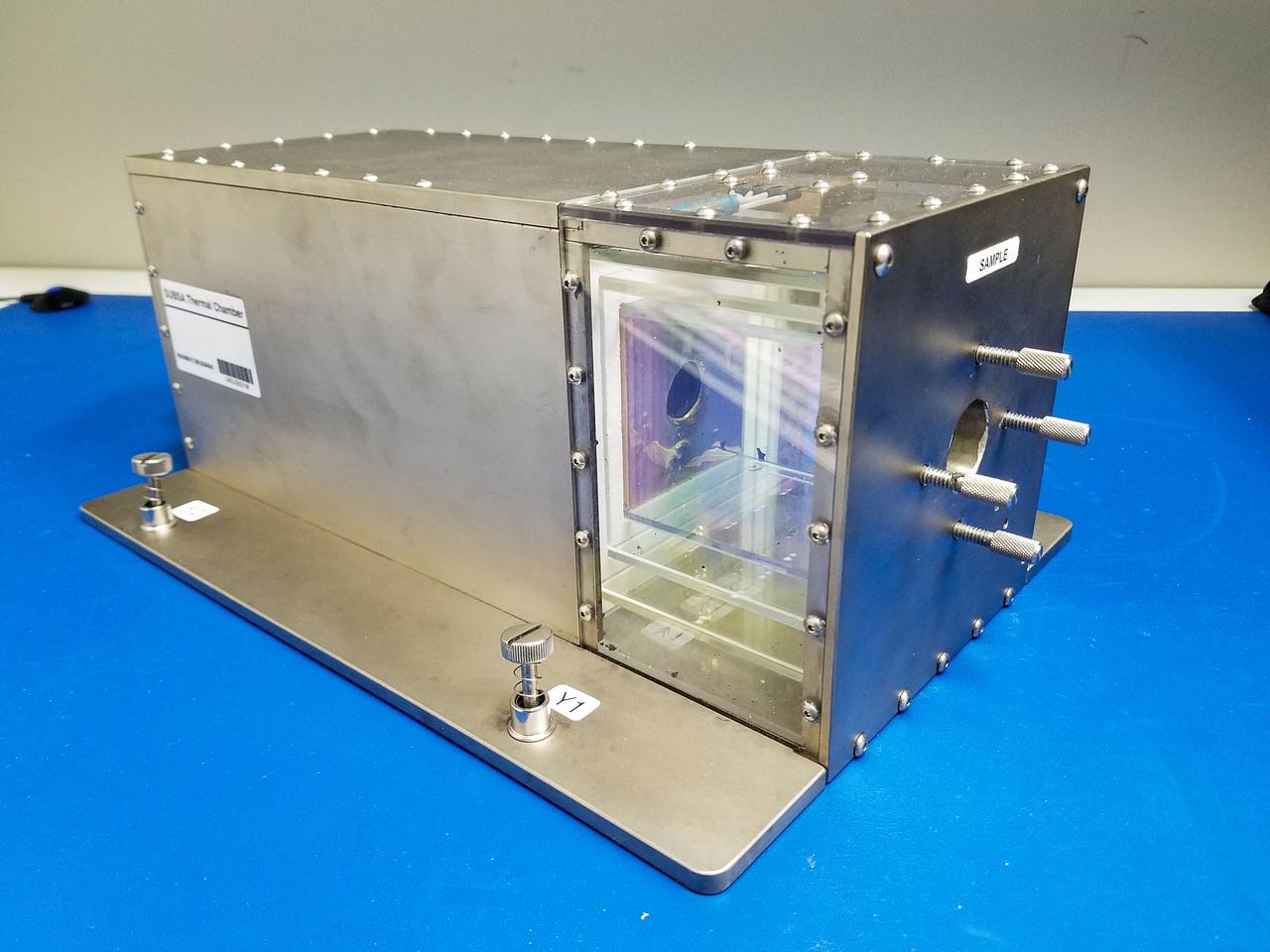
jsc2020e016982 (7/24/2019) --- A preflight view of the SUBSA Thermal Chamber. SUBSA is a high-temperature furnace that can be used to study how microgravity affects the synthesis of semiconductor and scintillator crystals.  Image courtesy of: Kenneth Barton, Techshot, Inc.
SUBSA Furnace
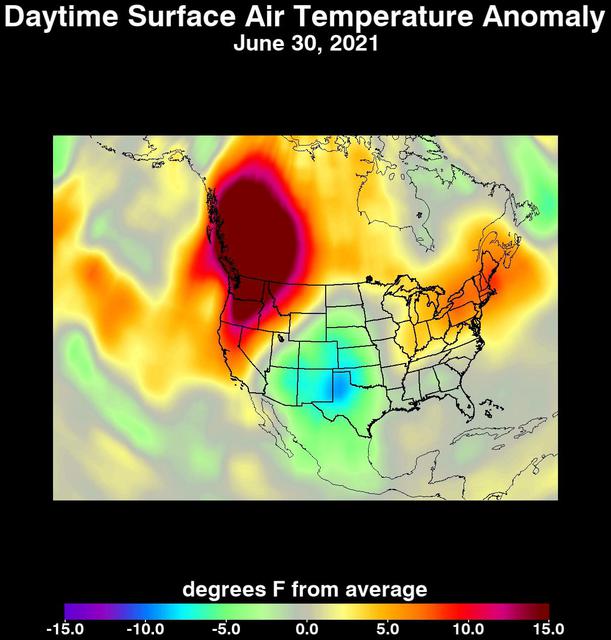
An unprecedented heat wave that started around June 26, 2021, smashed numerous all-time temperature records in the Pacific Northwest and western Canada. NASA's Atmospheric Infrared Sounder (AIRS), aboard the Aqua satellite, captured the progression of this slow-moving heat dome across the region from June 21 to 30. This animation of AIRS data shows surface air temperature anomalies, or values above or below long-term averages. Surface air temperature is something that people directly feel when they are outside. Some of the temperature anomalies were greater than 20 degrees Fahrenheit above the long-term average.  On June 28, Quillayute, Washington, set an all-time high temperature record of 110 degrees Fahrenheit (43 degrees Celsius), shattering the old record of 99 degrees Fahrenheit (37 degrees Celsius). In British Columbia, the village of Lytton set a new all-time record for Canada at 119 degrees Fahrenheit (48 degrees Celsius) on June 29, only to break it the next day with a reading of 121 degrees Fahrenheit (49 degrees Celsius).  The AIRS instrument recorded similar temperature anomalies at an altitude of about 10,000 feet (3,000 meters), showing that the extreme heat also affected mountainous regions. And temperature anomalies at roughly 18,000 feet (5,500 meters) demonstrated that the heat dome extended high into Earth's troposphere, creating the conditions for intense heat at the planet's surface that are normally found further south.  Animation available at https://photojournal.jpl.nasa.gov/catalog/PIA24537
Heat Wave Surface Temperature
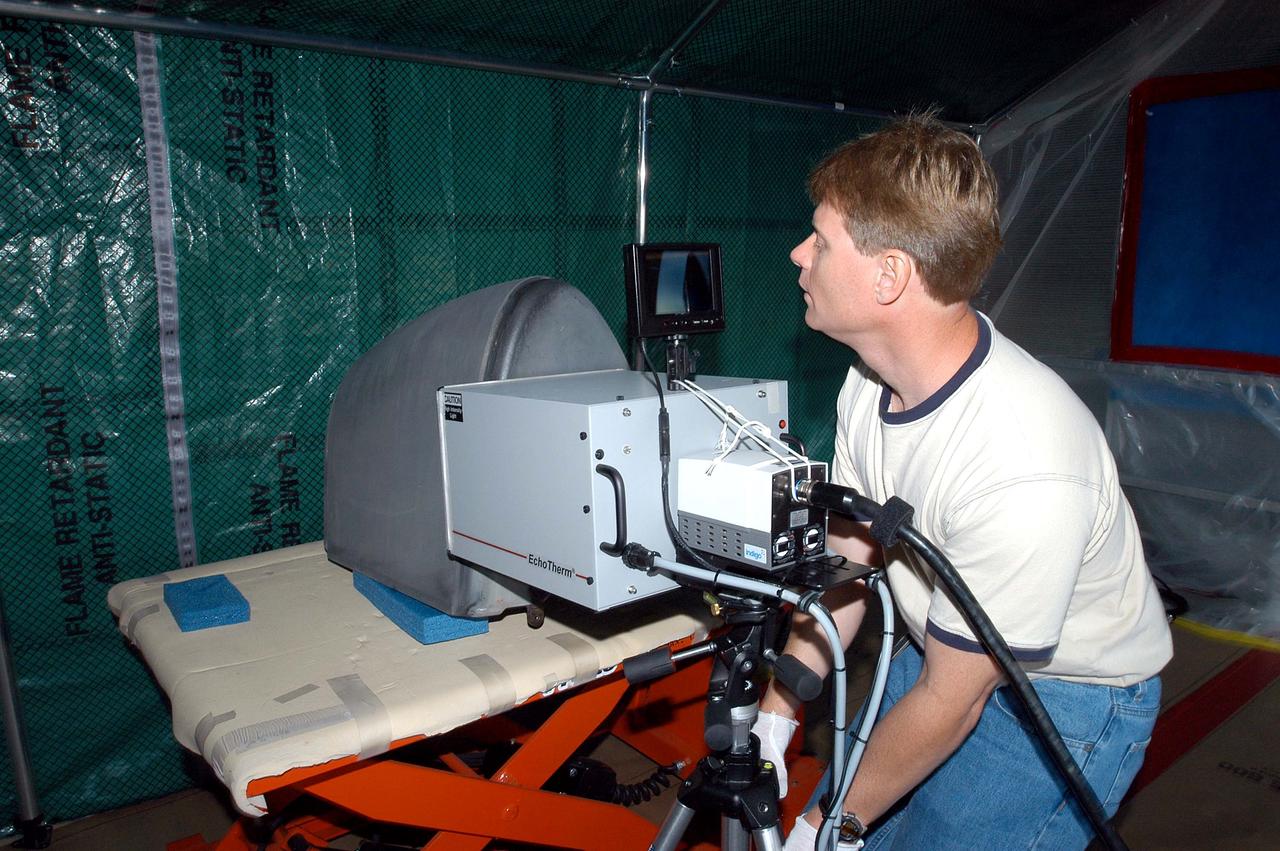
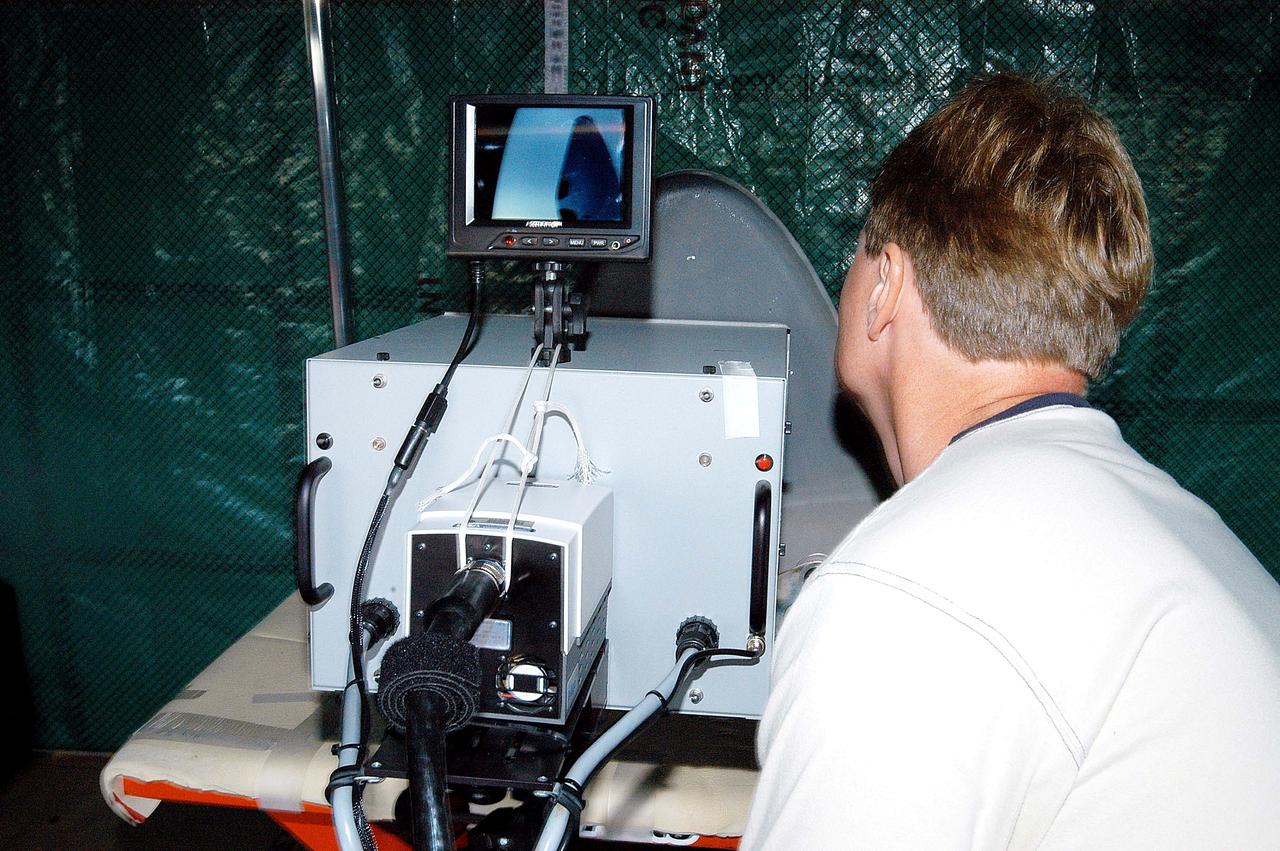
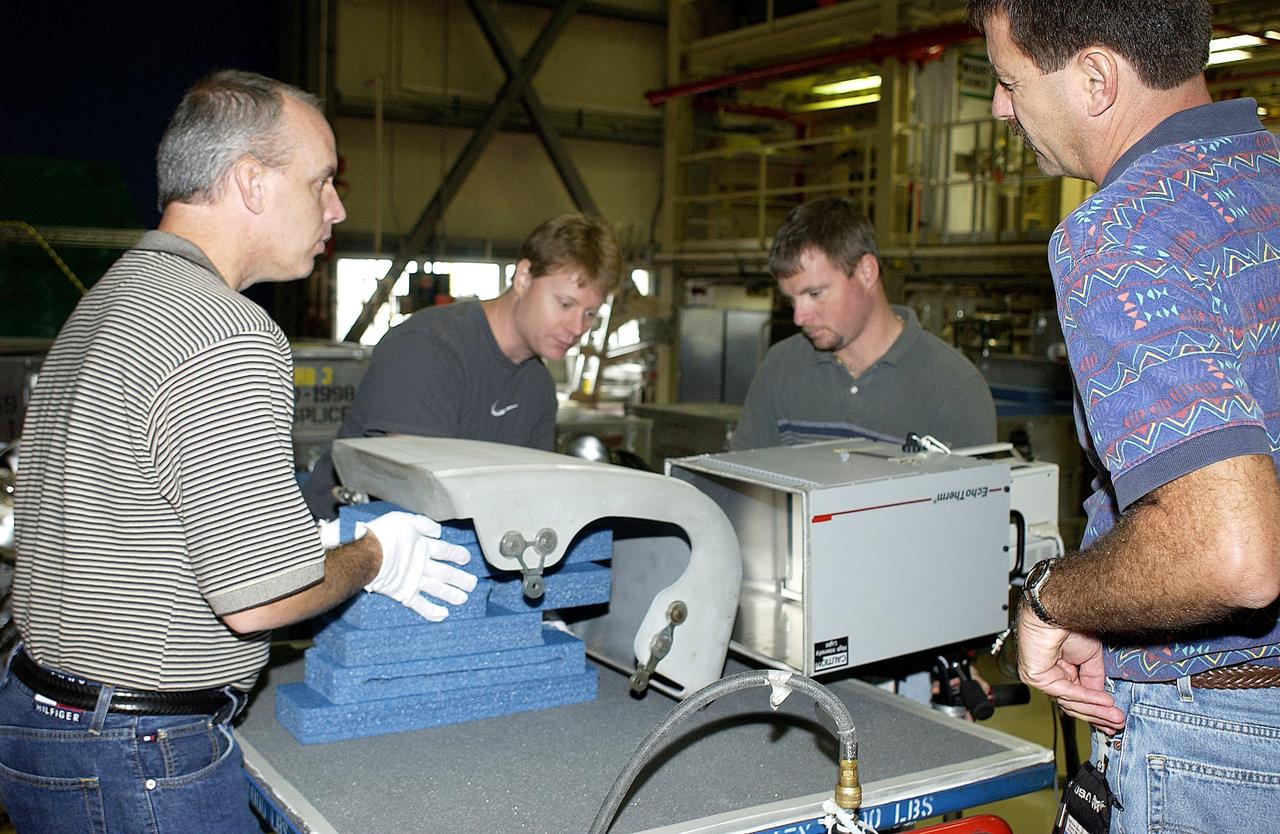
KENNEDY SPACE CENTER, FLA. -  Jim Landy, NDE specialist with United Space Alliance (USA), examines a Reinforced Carbon Carbon panel using flash thermography.  A relatively new procedure at KSC, thermography uses high intensity light to heat areas of the panels. The panels are then immediately scanned with an infrared camera. As the panels cool, any internal flaws are revealed. The gray carbon composite RCC panels are attached to the leading edge of the wing of the orbiters.  They have sufficient strength to withstand the aerodynamic forces experienced during launch and reentry, which can reach as high as 800 pounds per square foot.  The operating range of RCC is from minus 250º F to about 3,000º F, the temperature produced by friction with the atmosphere during reentry.  The panels will be installed on the orbiter Discovery, designated for the first Return to Flight mission, STS-114.
KENNEDY SPACE CENTER, FLA. - Jim Landy, NDE specialist with United Space Alliance (USA), examines a Reinforced Carbon Carbon panel using flash thermography. A relatively new procedure at KSC, thermography uses high intensity light to heat areas of the panels. The panels are then immediately scanned with an infrared camera. As the panels cool, any internal flaws are revealed. The gray carbon composite RCC panels are attached to the leading edge of the wing of the orbiters. They have sufficient strength to withstand the aerodynamic forces experienced during launch and reentry, which can reach as high as 800 pounds per square foot. The operating range of RCC is from minus 250º F to about 3,000º F, the temperature produced by friction with the atmosphere during reentry. The panels will be installed on the orbiter Discovery, designated for the first Return to Flight mission, STS-114.
KENNEDY SPACE CENTER, FLA. -  Jim Landy, NDE specialist with USA, points to   an area of a Reinforced Carbon Carbon panel just examined using flash thermography. A relatively new procedure at KSC, thermography uses high intensity light to heat areas of the panels. The panels are then immediately scanned with an infrared camera. As the panels cool, any internal flaws are revealed. The gray carbon composite RCC panels are attached to the leading edge of the wing of the orbiters.  They have sufficient strength to withstand the aerodynamic forces experienced during launch and reentry, which can reach as high as 800 pounds per square foot.  The operating range of RCC is from minus 250º F to about 3,000º F, the temperature produced by friction with the atmosphere during reentry.  The panels will be installed on the orbiter Discovery, designated  for the first Return to Flight mission, STS-114.
KENNEDY SPACE CENTER, FLA. - Jim Landy, NDE specialist with USA, points to an area of a Reinforced Carbon Carbon panel just examined using flash thermography. A relatively new procedure at KSC, thermography uses high intensity light to heat areas of the panels. The panels are then immediately scanned with an infrared camera. As the panels cool, any internal flaws are revealed. The gray carbon composite RCC panels are attached to the leading edge of the wing of the orbiters. They have sufficient strength to withstand the aerodynamic forces experienced during launch and reentry, which can reach as high as 800 pounds per square foot. The operating range of RCC is from minus 250º F to about 3,000º F, the temperature produced by friction with the atmosphere during reentry. The panels will be installed on the orbiter Discovery, designated for the first Return to Flight mission, STS-114.
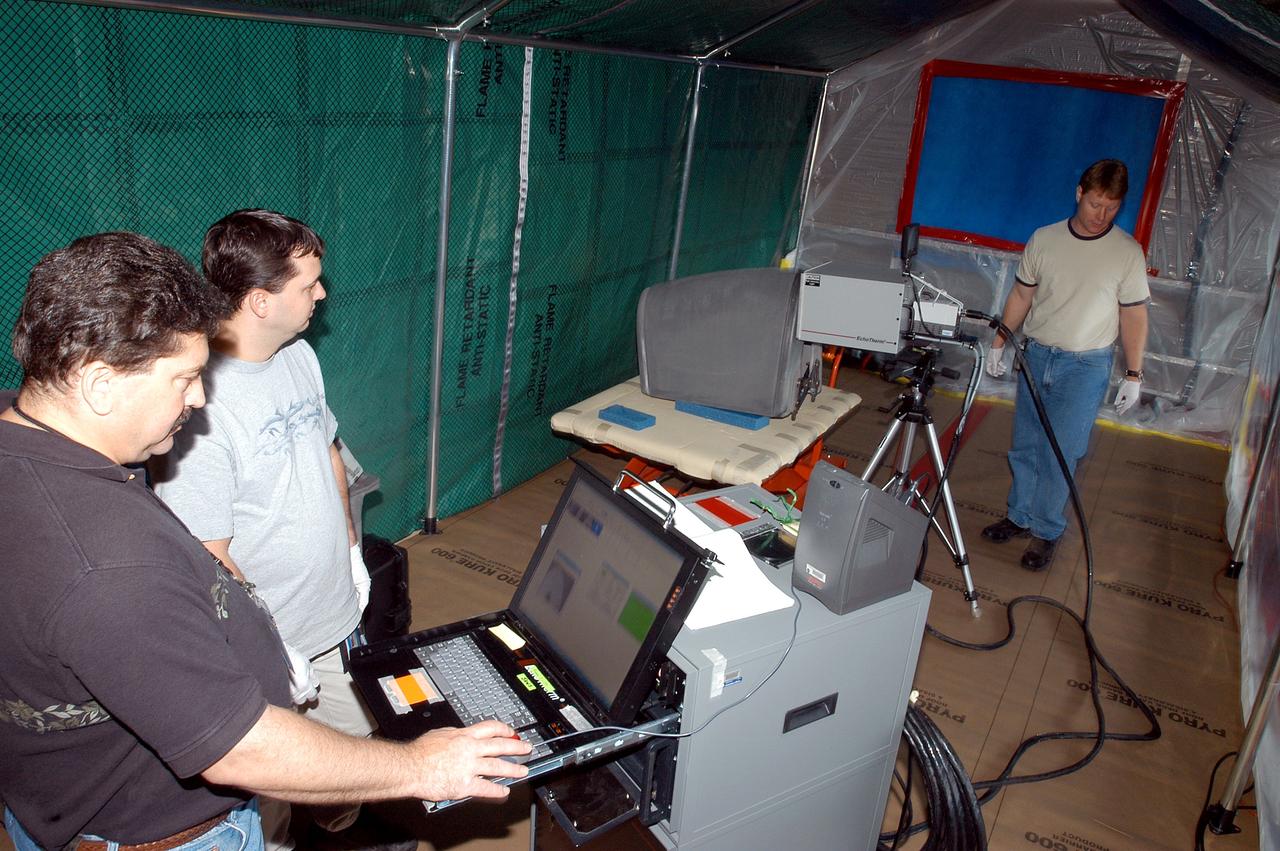
KENNEDY SPACE CENTER, FLA. -  Dan Phillips (left) and Donald Nielen, with United Space Alliance, watch a monitor as  Jim Landy, NDE specialist with USA, prepares to examine a Reinforced Carbon Carbon panel (on the table, center) using flash thermography.  A relatively new procedure at KSC, thermography uses high intensity light to heat areas of the panels. The panels are then immediately scanned with an infrared camera. As the panels cool, any internal flaws are revealed. The gray carbon composite RCC panels are attached to the leading edge of the wing of the orbiters.  They have sufficient strength to withstand the aerodynamic forces experienced during launch and reentry, which can reach as high as 800 pounds per square foot.  The operating range of RCC is from minus 250º F to about 3,000º F, the temperature produced by friction with the atmosphere during reentry.  The panels will be installed on the orbiter Discovery, designated  for the first Return to Flight mission, STS-114.
KENNEDY SPACE CENTER, FLA. - Dan Phillips (left) and Donald Nielen, with United Space Alliance, watch a monitor as Jim Landy, NDE specialist with USA, prepares to examine a Reinforced Carbon Carbon panel (on the table, center) using flash thermography. A relatively new procedure at KSC, thermography uses high intensity light to heat areas of the panels. The panels are then immediately scanned with an infrared camera. As the panels cool, any internal flaws are revealed. The gray carbon composite RCC panels are attached to the leading edge of the wing of the orbiters. They have sufficient strength to withstand the aerodynamic forces experienced during launch and reentry, which can reach as high as 800 pounds per square foot. The operating range of RCC is from minus 250º F to about 3,000º F, the temperature produced by friction with the atmosphere during reentry. The panels will be installed on the orbiter Discovery, designated for the first Return to Flight mission, STS-114.
KENNEDY SPACE CENTER, FLA. -  Jim Landy, NDE specialist with United Space Alliance (USA), prepares equipment to examine a Reinforced Carbon Carbon panel using flash thermography.  A relatively new procedure at KSC, thermography uses high intensity light to heat areas of the panels. The panels are then immediately scanned with an infrared camera. As the panels cool, any internal flaws are revealed. The gray carbon composite RCC panels are attached to the leading edge of the wing of the orbiters.  They have sufficient strength to withstand the aerodynamic forces experienced during launch and reentry, which can reach as high as 800 pounds per square foot.  The operating range of RCC is from minus 250º F to about 3,000º F, the temperature produced by friction with the atmosphere during reentry. The panels will be installed on the orbiter Discovery, designated for the first Return to Flight mission, STS-114.
KENNEDY SPACE CENTER, FLA. - Jim Landy, NDE specialist with United Space Alliance (USA), prepares equipment to examine a Reinforced Carbon Carbon panel using flash thermography. A relatively new procedure at KSC, thermography uses high intensity light to heat areas of the panels. The panels are then immediately scanned with an infrared camera. As the panels cool, any internal flaws are revealed. The gray carbon composite RCC panels are attached to the leading edge of the wing of the orbiters. They have sufficient strength to withstand the aerodynamic forces experienced during launch and reentry, which can reach as high as 800 pounds per square foot. The operating range of RCC is from minus 250º F to about 3,000º F, the temperature produced by friction with the atmosphere during reentry. The panels will be installed on the orbiter Discovery, designated for the first Return to Flight mission, STS-114.
KENNEDY SPACE CENTER, FLA. -  Jim Landy, NDE specialist with United Space Alliance, sets up equipment to examine a Reinforced Carbon Carbon panel using flash thermography.  A relatively new procedure at KSC, thermography uses high intensity light to heat areas of the panels. The panels are then immediately scanned with an infrared camera. As the panels cool, any internal flaws are revealed. The gray carbon composite RCC panels are attached to the leading edge of the wing of the orbiters.  They have sufficient strength to withstand the aerodynamic forces experienced during launch and reentry, which can reach as high as 800 pounds per square foot.  The operating range of RCC is from minus 250º F to about 3,000º F, the temperature produced by friction with the atmosphere during reentry.  The panels will be installed on the orbiter Discovery, designated  for the first Return to Flight mission, STS-114.
KENNEDY SPACE CENTER, FLA. - Jim Landy, NDE specialist with United Space Alliance, sets up equipment to examine a Reinforced Carbon Carbon panel using flash thermography. A relatively new procedure at KSC, thermography uses high intensity light to heat areas of the panels. The panels are then immediately scanned with an infrared camera. As the panels cool, any internal flaws are revealed. The gray carbon composite RCC panels are attached to the leading edge of the wing of the orbiters. They have sufficient strength to withstand the aerodynamic forces experienced during launch and reentry, which can reach as high as 800 pounds per square foot. The operating range of RCC is from minus 250º F to about 3,000º F, the temperature produced by friction with the atmosphere during reentry. The panels will be installed on the orbiter Discovery, designated for the first Return to Flight mission, STS-114.
High Pressure Microgravity Combustion Experiment, HPMC,  subjects liquid fuel droplets to high pressures and temperatures to study the ignition process in engine conditions, with a goal of improving fuel efficiency. In this configuration, the experiment is capable of testing droplet combustion at up to 100 atm of pressure, testing the droplet deployment system, which inserts the fuel droplet into the experiment.
High Pressure Microgravity Combustion, HPMC
High Pressure Microgravity Combustion Experiment, HPMC,  subjects liquid fuel droplets to high pressures and temperatures to study the ignition process in engine conditions, with a goal of improving fuel efficiency. In this configuration, the experiment is capable of testing droplet combustion at up to 100 atm of pressure, testing the droplet deployment system, which inserts the fuel droplet into the experiment.
High Pressure Microgravity Combustion (HPMC) Facility, Drople...
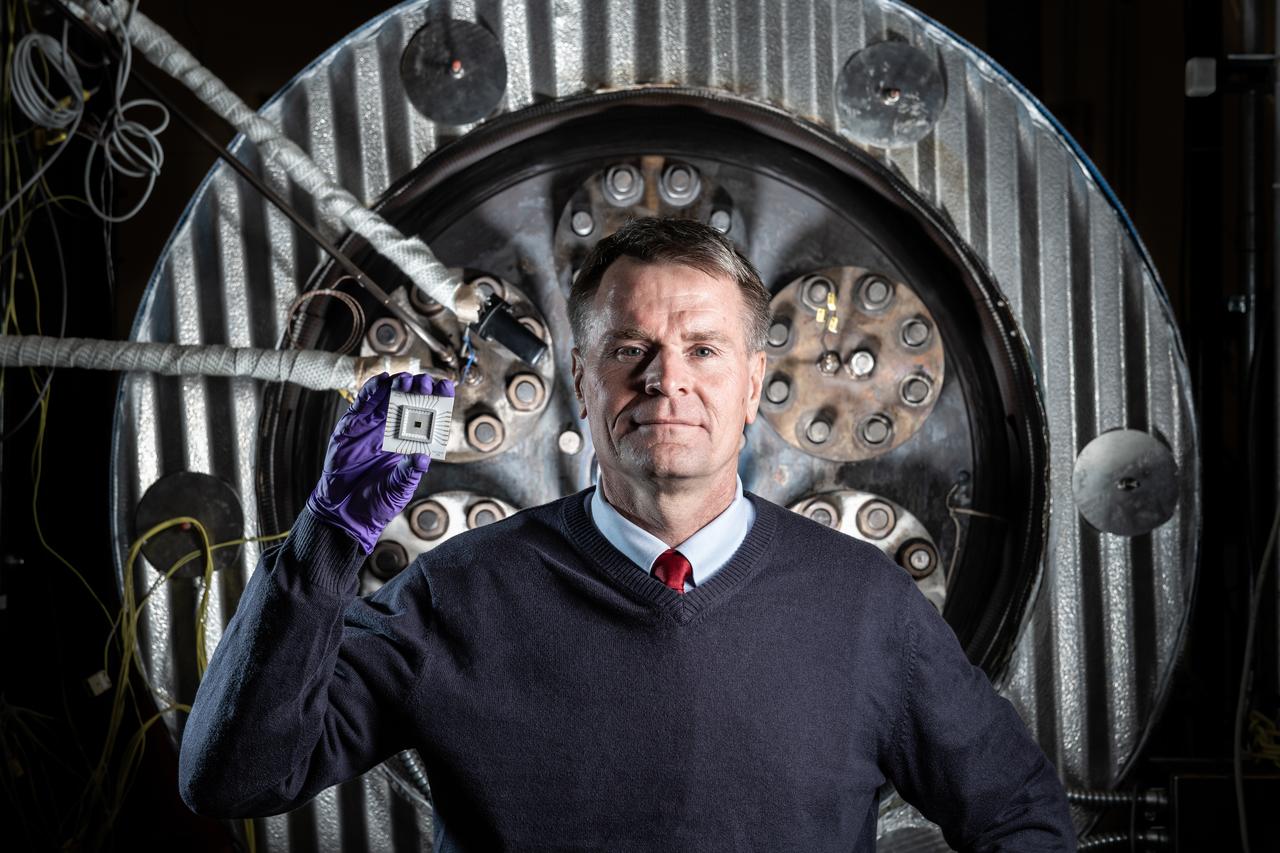
Phil Neudeck- Can Take the Heat      When it comes to the heat of extreme environments like Venus, electronics can get fried within a few minutes of arrival.  But NASA Researcher Phil Neudeck and his team have developed extremely durable silicon carbide semiconductor integrated circuits to survive those harsh conditions. After successfully testing the electronics in our high-pressure, high-temperature extreme environments chamber, there is now a path forward for Venus landers to survive and operate scientific experiments on the planet’s surface for longer durations.
Phillip Neudeck with Venus Durable Integrated Circuit Electronic
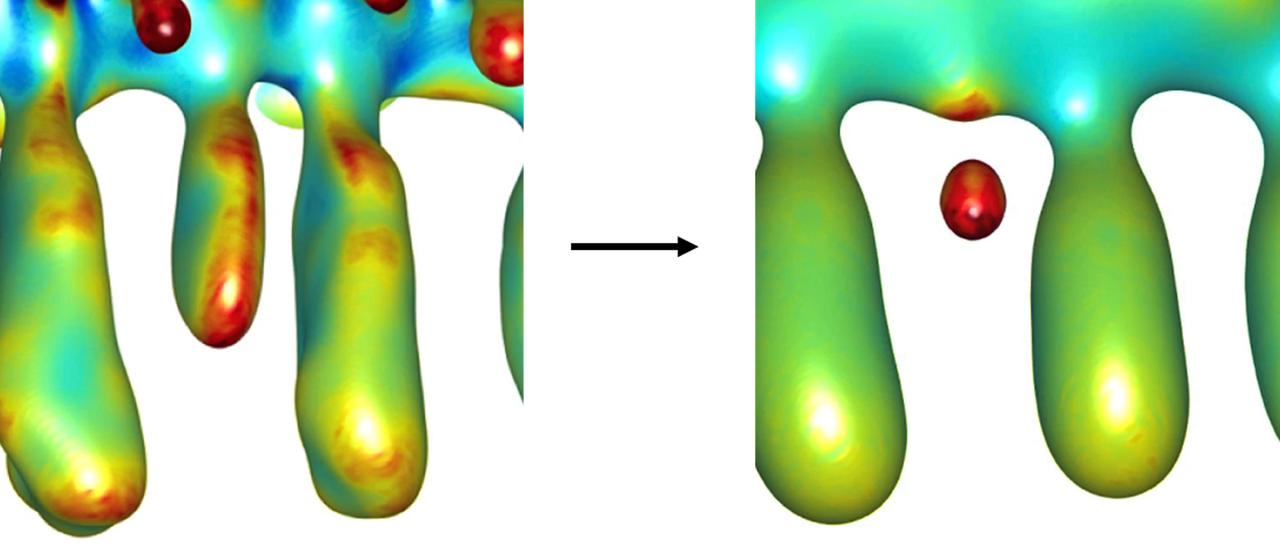
jsc2020e030481 (7/8/2020) --- This preflight image of the Dendrite Fragmentation and Morphology during Melting and Solidification (DFM) (SUBSA-DFM) investigation of shows a small portion of an experimentally determined dendrite. The image on the right shows the same portion with the formation of a fragment and other morphological changes after a simulated temperature change. Colors show the mean curvature of the dendrite interfaces (red corresponds to high positive curvature, blue to high negative curvature, and green to zero curvature). (Image Courtesy Techshot, Inc.)
jsc2020e030481
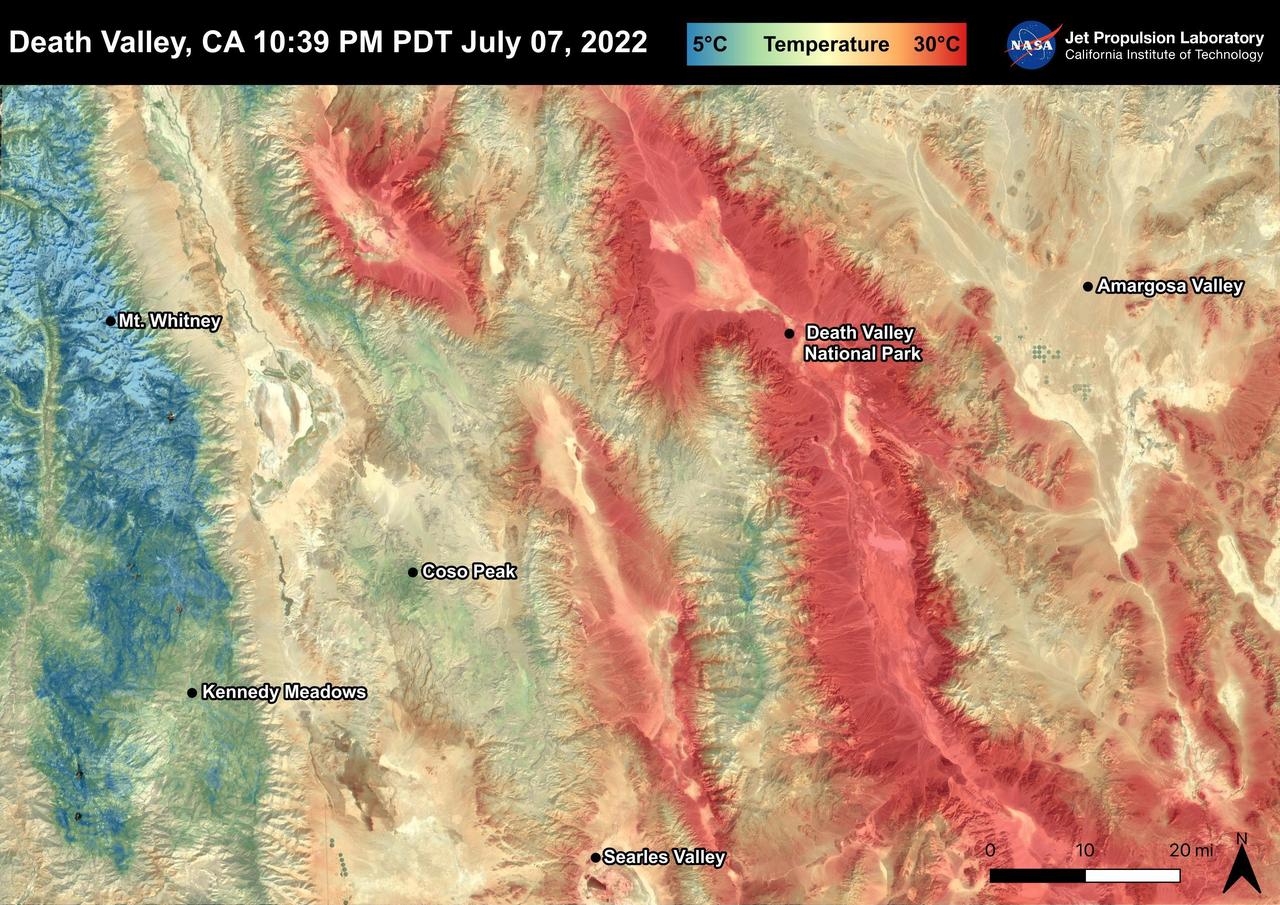
Death Valley, California is a desert valley in the Northern Mojave Desert. During the summer months, Death Valley can become one of the hottest places on Earth. Death Valley is about 85 miles from Mt. Whitney, the highest point in the contiguous United States with an elevation of 14,505 ft. This Land Surface Temperature image captured by ECOSTRESS on July 07, 2022 shows temperatures exceeding 90 degrees Fahrenheit in Death Valley and temperatures below 40 degrees Fahrenheit in the Sierra Nevada Mountain Range.  ECOSTRESS is a thermal instrument on the International Space Station that measures the temperature of the ground, which is hotter than the air temperature during the day. It was launched to the space station in 2018. Its primary mission is to identify critical thresholds of water use and water stress in plants and to detect the timing, location, and predictive factors leading to plant water uptake decline and/or cessation. The nature of the high-resolution data provided by ECOSTRESS allows it to record heat related phenomena such as heat waves and wildfires.  https://photojournal.jpl.nasa.gov/catalog/PIA25482
Death Valley, CA
KENNEDY SPACE CENTER, FLA. - In the Orbiter Processing Facility, United Space Alliance workers (left to right) Jim Landy, Dan Phillips, Paul Ogletree and Dan Kenna check results of flash thermography on the Reinforced Carbon Carbon panel on the table (foreground).  Attached to the leading edge of the wing of the orbiters,  the gray carbon composite RCC panels have sufficient strength to withstand the aerodynamic forces experienced during launch and reentry, which can reach as high as 800 pounds per square foot.  The operating range of RCC is from minus 250º F to about 3,000º F, the temperature produced by friction with the atmosphere during reentry.
KENNEDY SPACE CENTER, FLA. - In the Orbiter Processing Facility, United Space Alliance workers (left to right) Jim Landy, Dan Phillips, Paul Ogletree and Dan Kenna check results of flash thermography on the Reinforced Carbon Carbon panel on the table (foreground). Attached to the leading edge of the wing of the orbiters, the gray carbon composite RCC panels have sufficient strength to withstand the aerodynamic forces experienced during launch and reentry, which can reach as high as 800 pounds per square foot. The operating range of RCC is from minus 250º F to about 3,000º F, the temperature produced by friction with the atmosphere during reentry.
KENNEDY SPACE CENTER, FLA. - In the Orbiter Processing Facility, United Space Alliance workers Jim Landy (front), Dan Phillips and Dan Kenna watch a monitor showing results of flash thermography on the Reinforced Carbon Carbon panel on the table (foreground).  Attached to the leading edge of the wing of the orbiters,  the gray carbon composite RCC panels have sufficient strength to withstand the aerodynamic forces experienced during launch and reentry, which can reach as high as 800 pounds per square foot.  The operating range of RCC is from minus 250º F to about 3,000º F, the temperature produced by friction with the atmosphere during reentry.
KENNEDY SPACE CENTER, FLA. - In the Orbiter Processing Facility, United Space Alliance workers Jim Landy (front), Dan Phillips and Dan Kenna watch a monitor showing results of flash thermography on the Reinforced Carbon Carbon panel on the table (foreground). Attached to the leading edge of the wing of the orbiters, the gray carbon composite RCC panels have sufficient strength to withstand the aerodynamic forces experienced during launch and reentry, which can reach as high as 800 pounds per square foot. The operating range of RCC is from minus 250º F to about 3,000º F, the temperature produced by friction with the atmosphere during reentry.
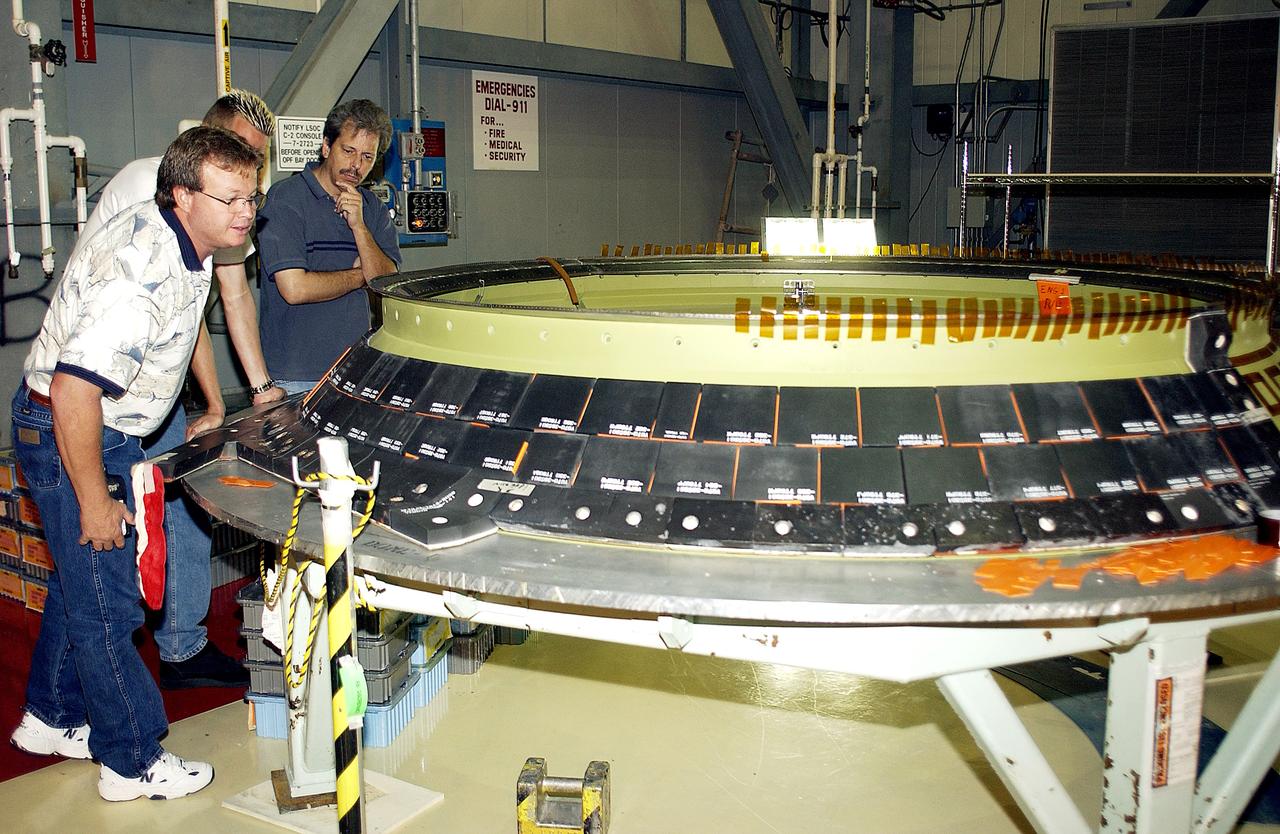
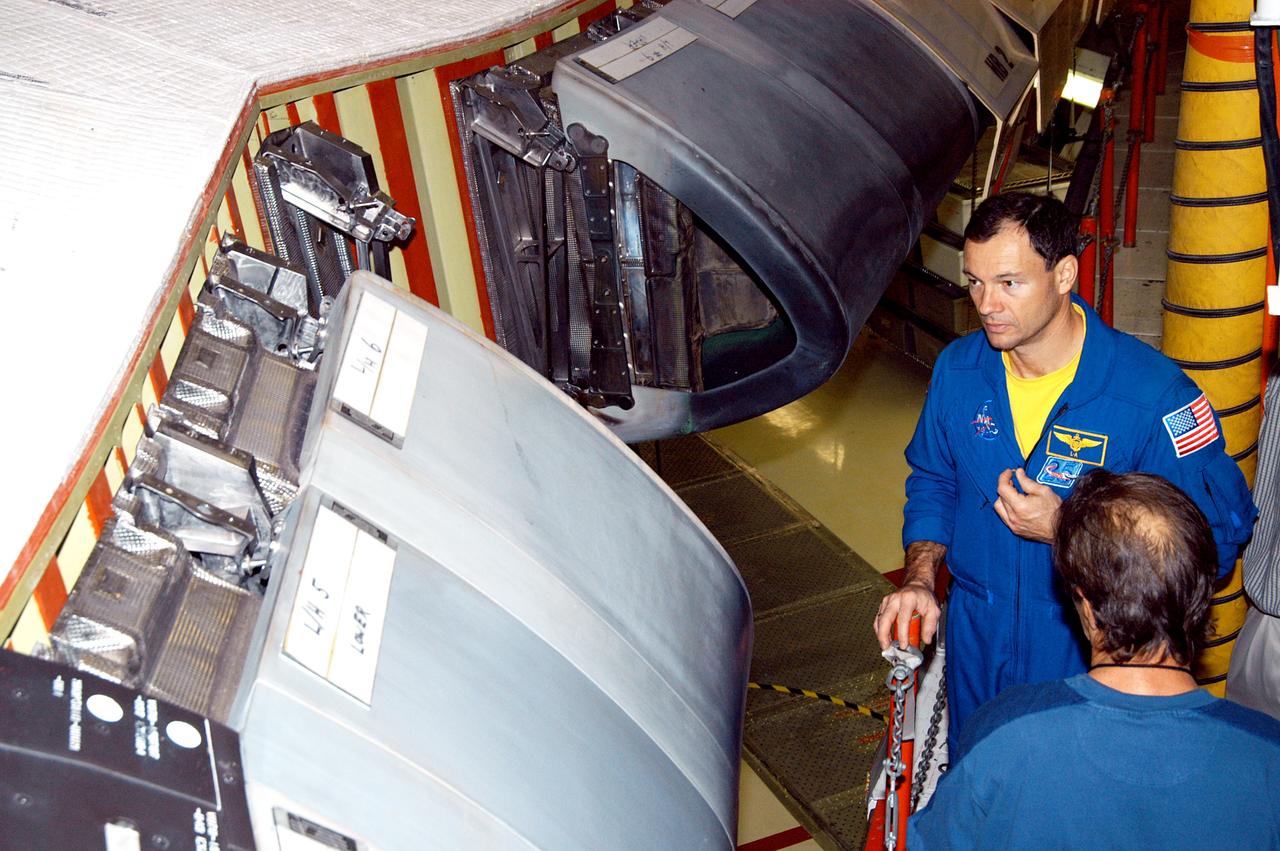
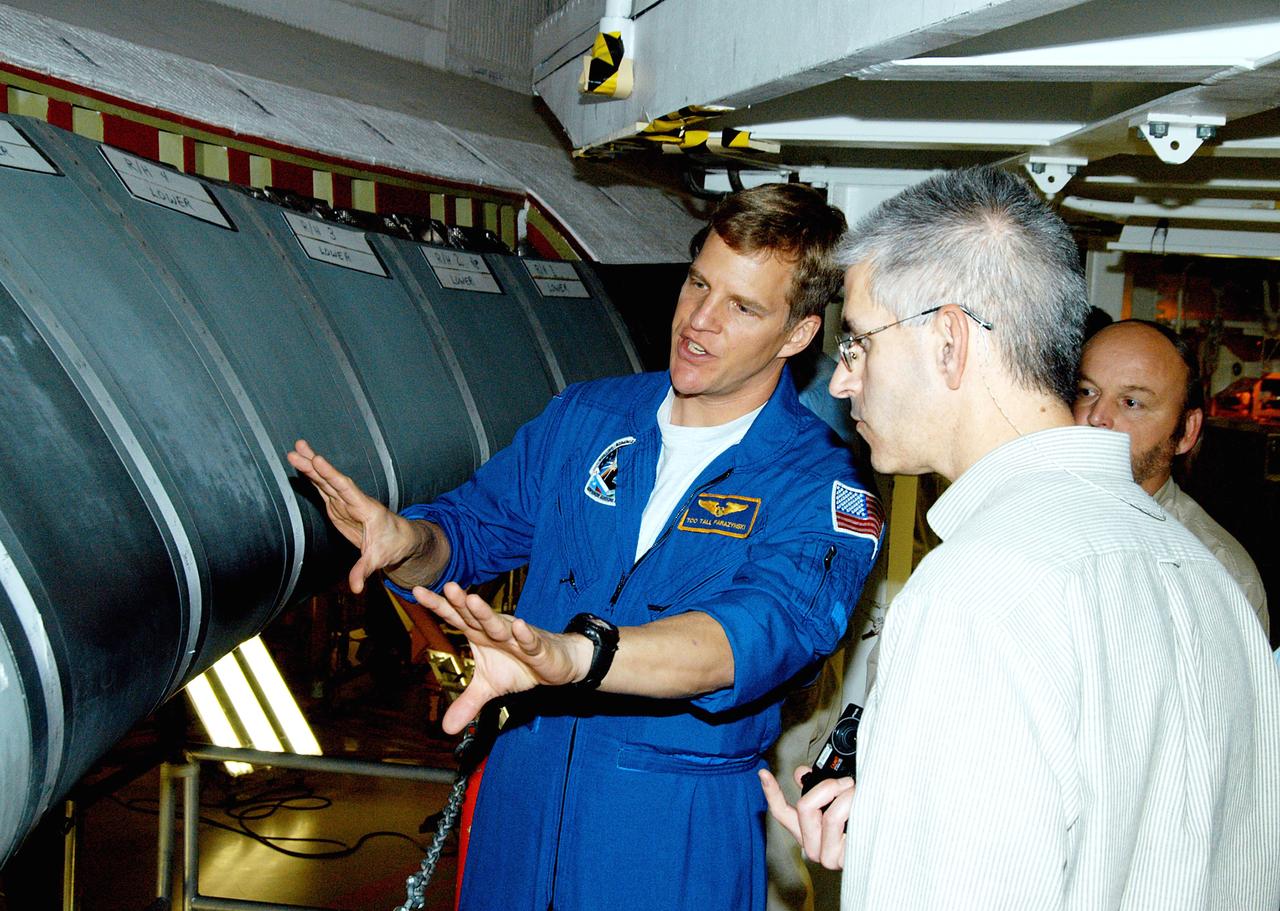
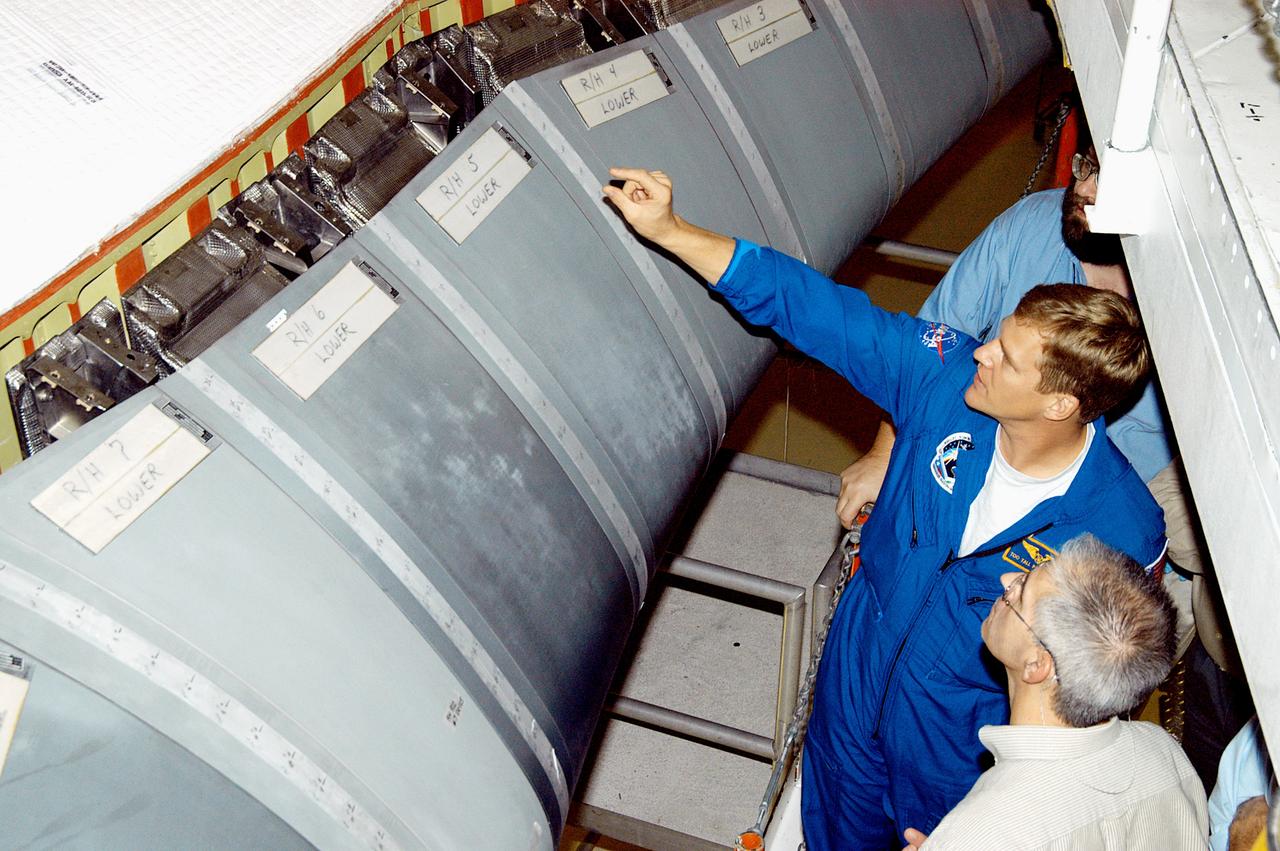
KENNEDY SPACE CENTER, FLA. - In the Orbiter Processing Facility, astronaut Michael E. Lopez-Alegria looks at the Reinforced Carbon Carbon panels used on the leading edge of the wing of the orbiters. He and engineers from around the Agency are on a fact-finding tour for improving the RCC panels used on the wing leading edge.  The gray carbon composite RCC panels have sufficient strength to withstand the aerodynamic forces experienced during launch and reentry, which can reach as high as 800 pounds per square foot.  The operating range of RCC is from minus 250º F to about 3,000º F, the temperature produced by friction with the atmosphere during reentry.
KENNEDY SPACE CENTER, FLA. - In the Orbiter Processing Facility, astronaut Michael E. Lopez-Alegria looks at the Reinforced Carbon Carbon panels used on the leading edge of the wing of the orbiters. He and engineers from around the Agency are on a fact-finding tour for improving the RCC panels used on the wing leading edge. The gray carbon composite RCC panels have sufficient strength to withstand the aerodynamic forces experienced during launch and reentry, which can reach as high as 800 pounds per square foot. The operating range of RCC is from minus 250º F to about 3,000º F, the temperature produced by friction with the atmosphere during reentry.
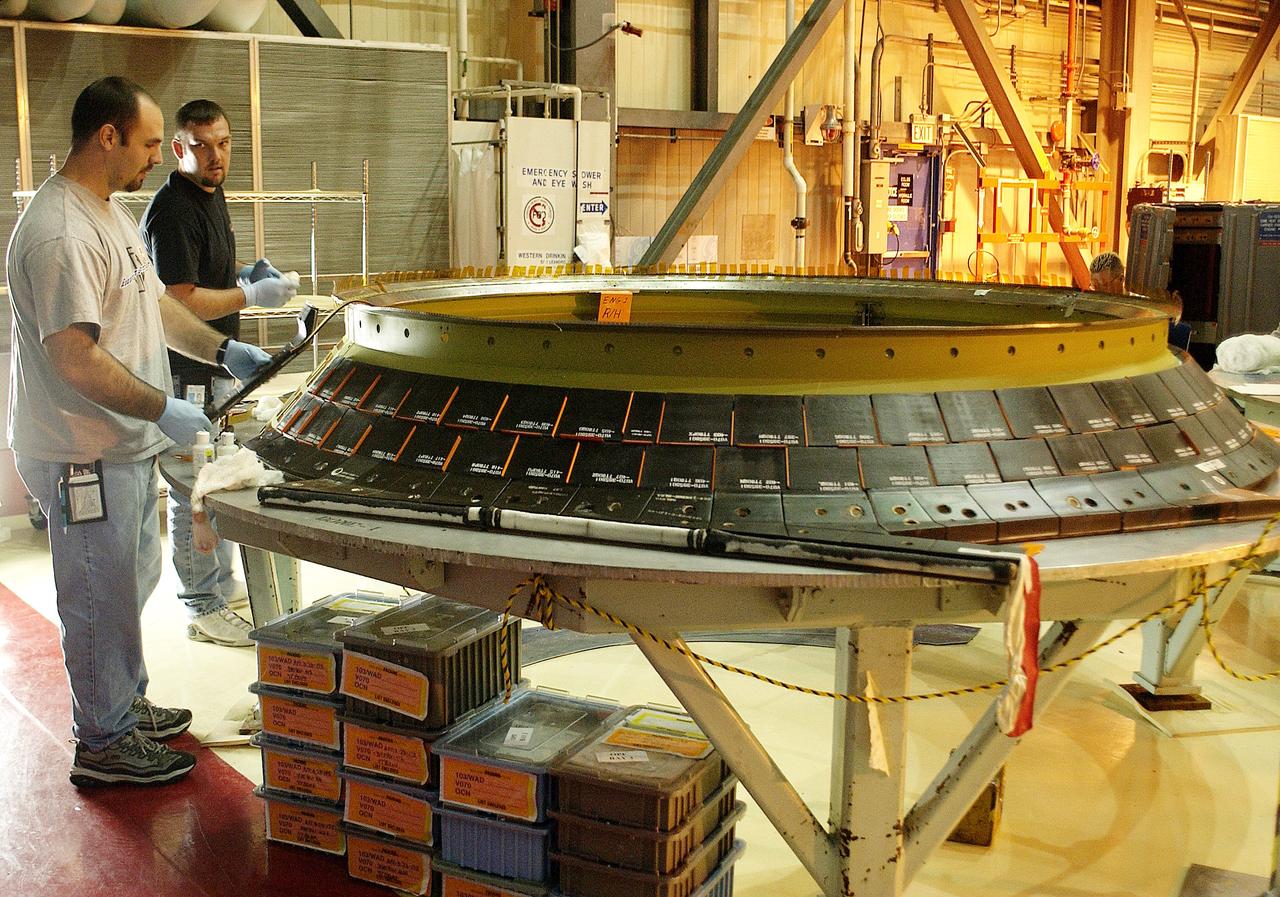
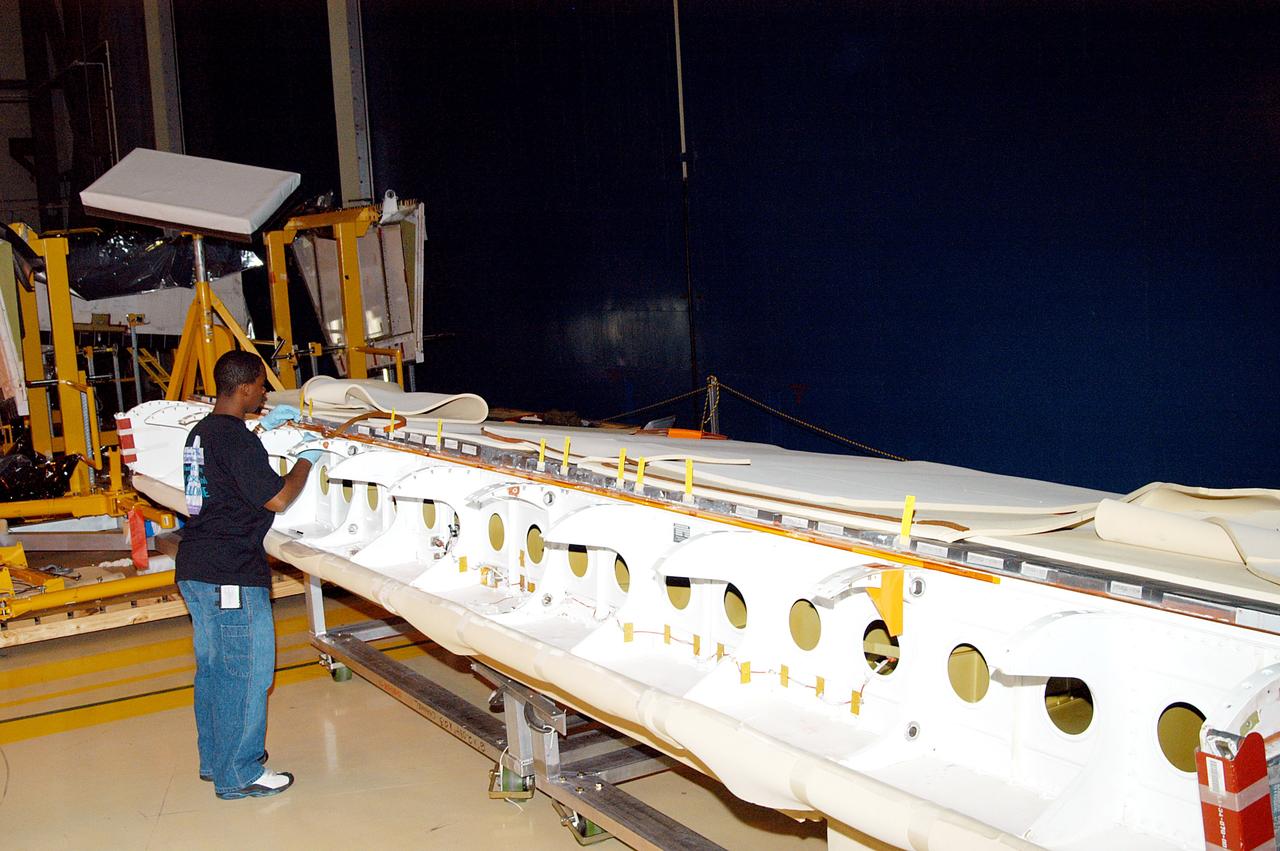
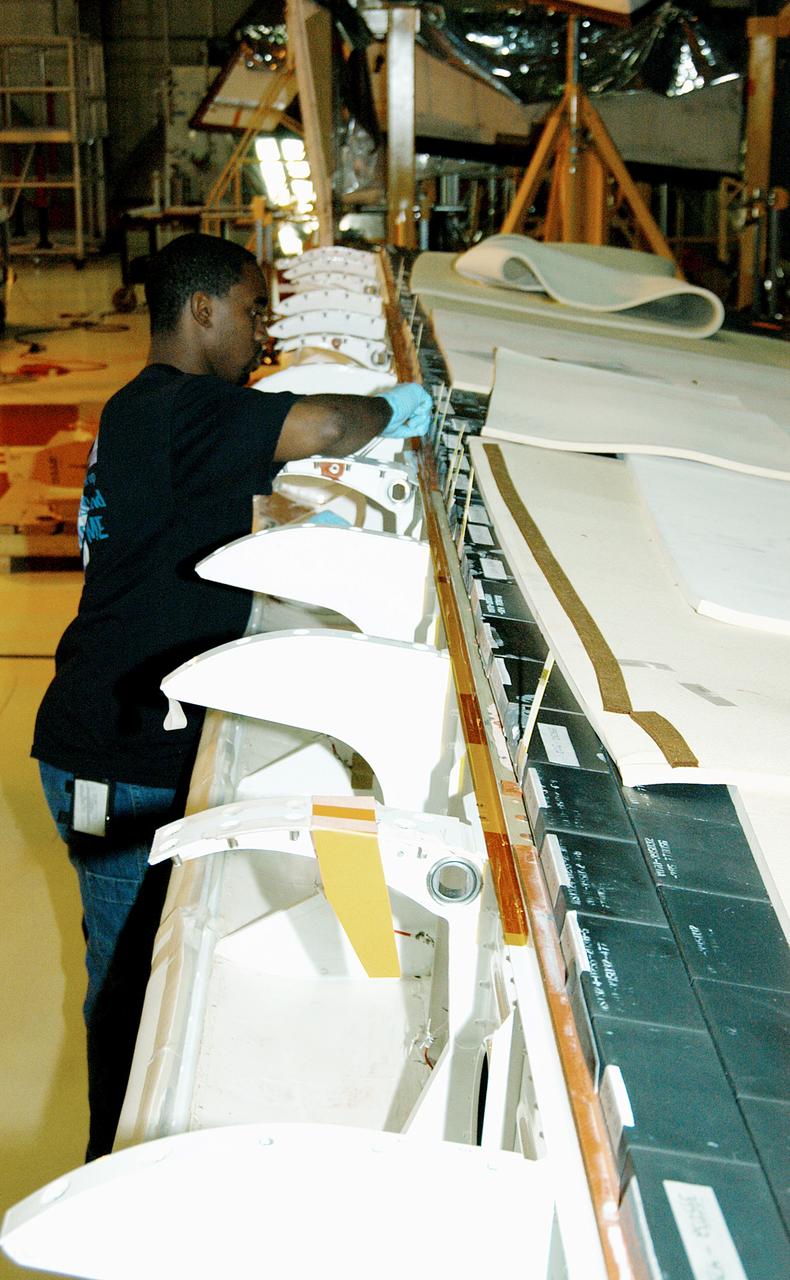
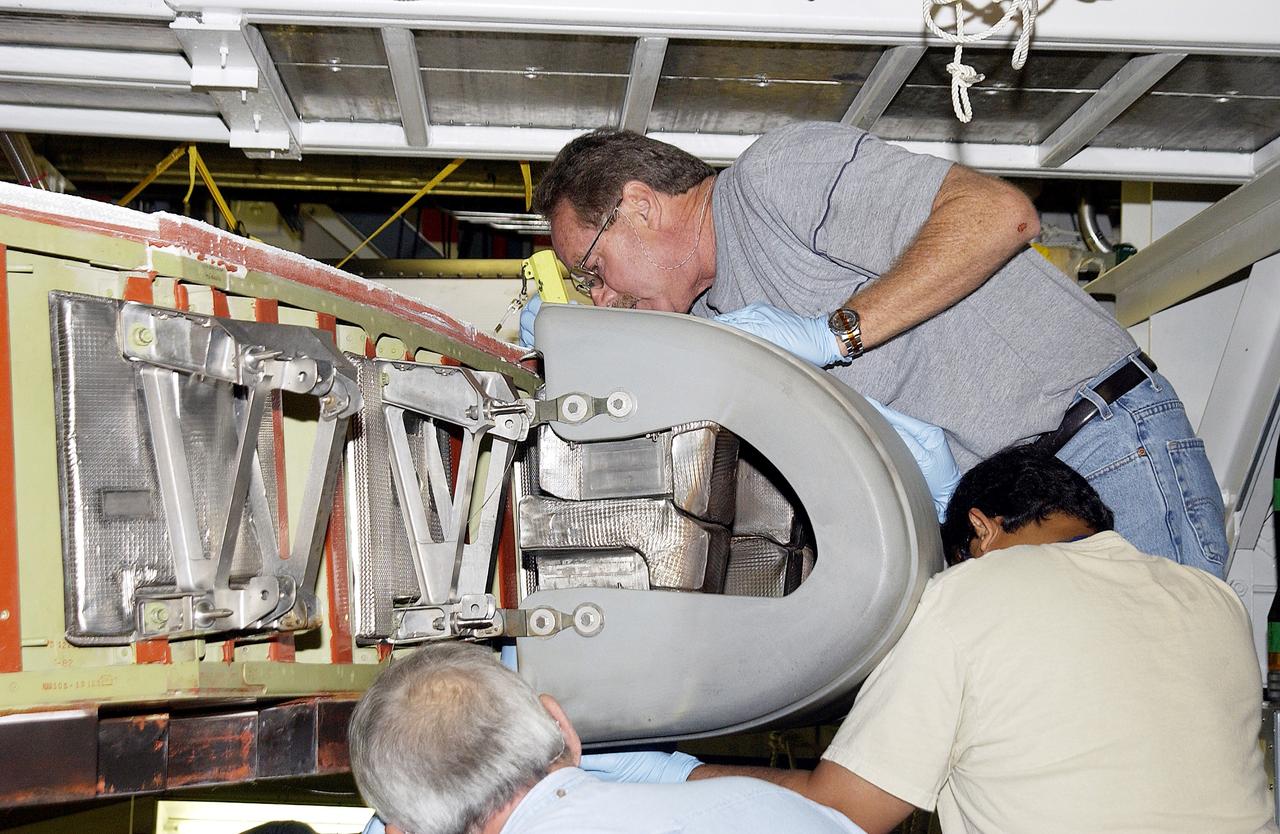
KENNEDY SPACE CENTER, FLA. - In the Orbiter Processing Facility, United Space Alliance workers Mike Hyatt (above) and Saul Ngy (below right) finish installing a Reinforced Carbon Carbon (RCC) panel to the leading edge of the wing of the orbiter Atlantis.  The gray carbon composite RCC panels have sufficient strength to withstand the aerodynamic forces experienced during launch and reentry, which can reach as high as 800 pounds per square foot.  The operating range of RCC is from minus 250º F to about 3,000º F, the temperature produced by friction with the atmosphere during reentry.
KENNEDY SPACE CENTER, FLA. - In the Orbiter Processing Facility, United Space Alliance workers Mike Hyatt (above) and Saul Ngy (below right) finish installing a Reinforced Carbon Carbon (RCC) panel to the leading edge of the wing of the orbiter Atlantis. The gray carbon composite RCC panels have sufficient strength to withstand the aerodynamic forces experienced during launch and reentry, which can reach as high as 800 pounds per square foot. The operating range of RCC is from minus 250º F to about 3,000º F, the temperature produced by friction with the atmosphere during reentry.
KENNEDY SPACE CENTER, FLA. - In the Orbiter Processing Facility, United Space Alliance workers (left to right) Jim Landy, Paul Ogletree, Dan Kenna and Dan Phillips check results of flash thermography on the Reinforced Carbon Carbon panel on the table (foreground).  Attached to the leading edge of the wing of the orbiters,  the gray carbon composite RCC panels have sufficient strength to withstand the aerodynamic forces experienced during launch and reentry, which can reach as high as 800 pounds per square foot.  The operating range of RCC is from minus 250º F to about 3,000º F, the temperature produced by friction with the atmosphere during reentry.
KENNEDY SPACE CENTER, FLA. - In the Orbiter Processing Facility, United Space Alliance workers (left to right) Jim Landy, Paul Ogletree, Dan Kenna and Dan Phillips check results of flash thermography on the Reinforced Carbon Carbon panel on the table (foreground). Attached to the leading edge of the wing of the orbiters, the gray carbon composite RCC panels have sufficient strength to withstand the aerodynamic forces experienced during launch and reentry, which can reach as high as 800 pounds per square foot. The operating range of RCC is from minus 250º F to about 3,000º F, the temperature produced by friction with the atmosphere during reentry.
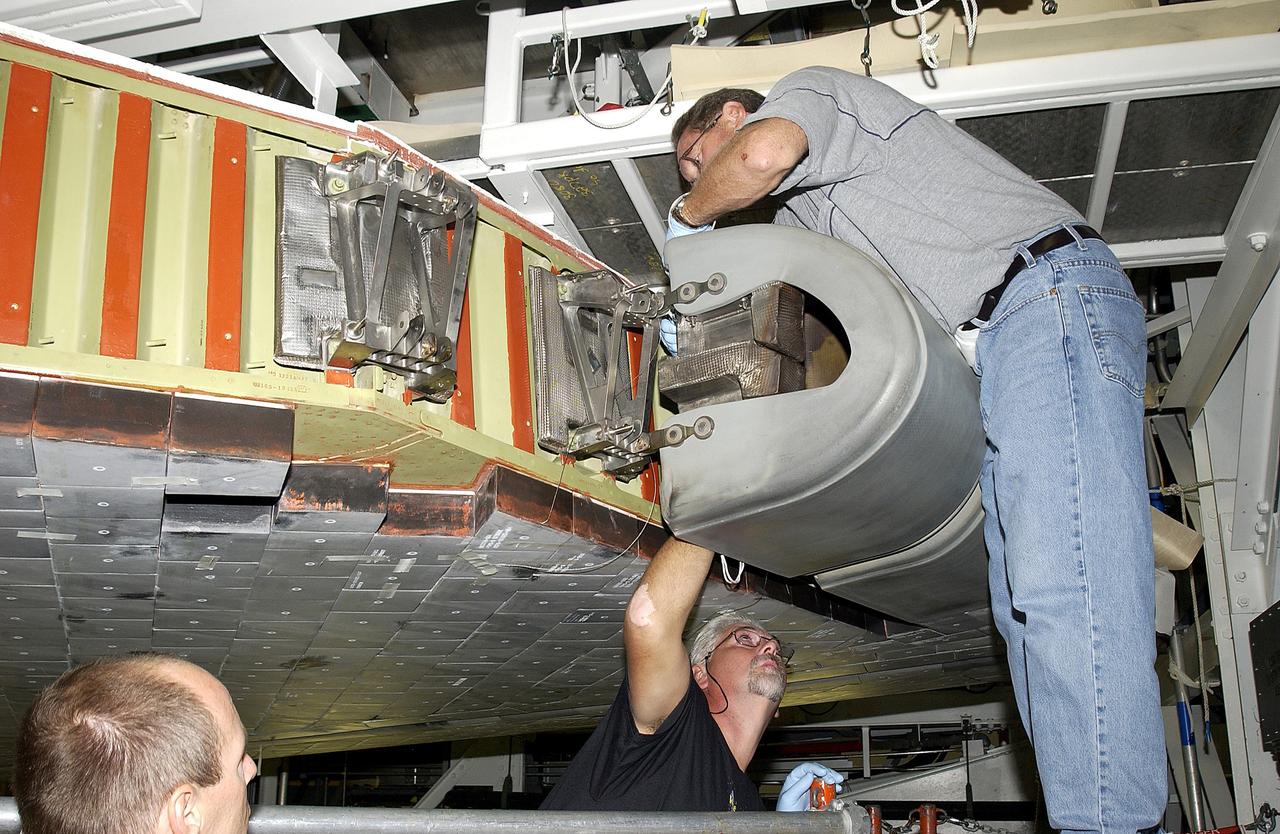
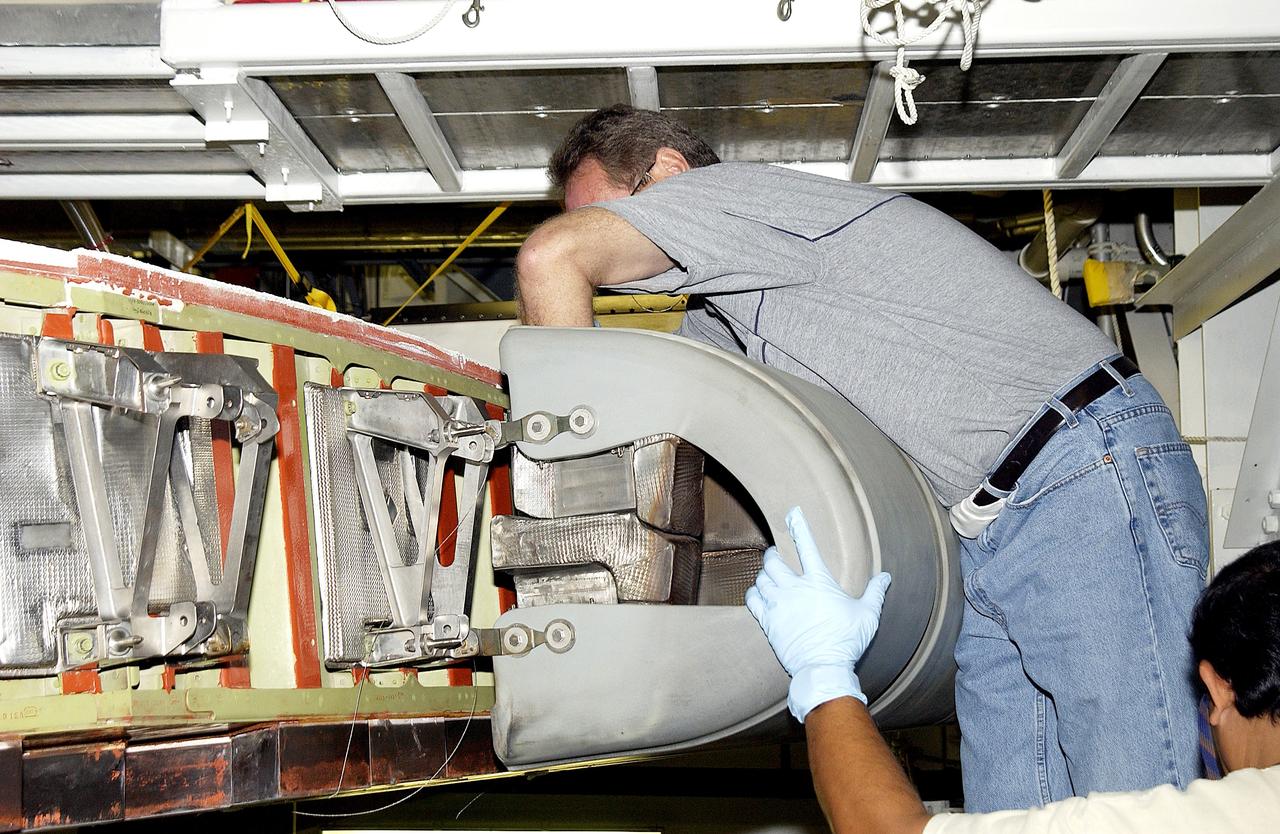
KENNEDY SPACE CENTER, FLA. - In the Orbiter Processing Facility, United Space Alliance workers Mike Hyatt (left) Jerry Belt (center), and Saul Ngy (right), lift a Reinforced Carbon Carbon (RCC) panel they will attach to the leading edge of the wing of the orbiter Atlantis.  The gray carbon composite RCC panels have sufficient strength to withstand the aerodynamic forces experienced during launch and reentry, which can reach as high as 800 pounds per square foot.  The operating range of RCC is from minus 250º F to about 3,000º F, the temperature produced by friction with the atmosphere during reentry.
KENNEDY SPACE CENTER, FLA. - In the Orbiter Processing Facility, United Space Alliance workers Mike Hyatt (left) Jerry Belt (center), and Saul Ngy (right), lift a Reinforced Carbon Carbon (RCC) panel they will attach to the leading edge of the wing of the orbiter Atlantis. The gray carbon composite RCC panels have sufficient strength to withstand the aerodynamic forces experienced during launch and reentry, which can reach as high as 800 pounds per square foot. The operating range of RCC is from minus 250º F to about 3,000º F, the temperature produced by friction with the atmosphere during reentry.
KENNEDY SPACE CENTER, FLA. - In the Orbiter Processing Facility, United Space Alliance worker Mike Hyatt (above) finishes installing a Reinforced Carbon Carbon (RCC) panel to the leading edge of the wing of the orbiter Atlantis.  The gray carbon composite RCC panels have sufficient strength to withstand the aerodynamic forces experienced during launch and reentry, which can reach as high as 800 pounds per square foot.  The operating range of RCC is from minus 250º F to about 3,000º F, the temperature produced by friction with the atmosphere during reentry.
KENNEDY SPACE CENTER, FLA. - In the Orbiter Processing Facility, United Space Alliance worker Mike Hyatt (above) finishes installing a Reinforced Carbon Carbon (RCC) panel to the leading edge of the wing of the orbiter Atlantis. The gray carbon composite RCC panels have sufficient strength to withstand the aerodynamic forces experienced during launch and reentry, which can reach as high as 800 pounds per square foot. The operating range of RCC is from minus 250º F to about 3,000º F, the temperature produced by friction with the atmosphere during reentry.
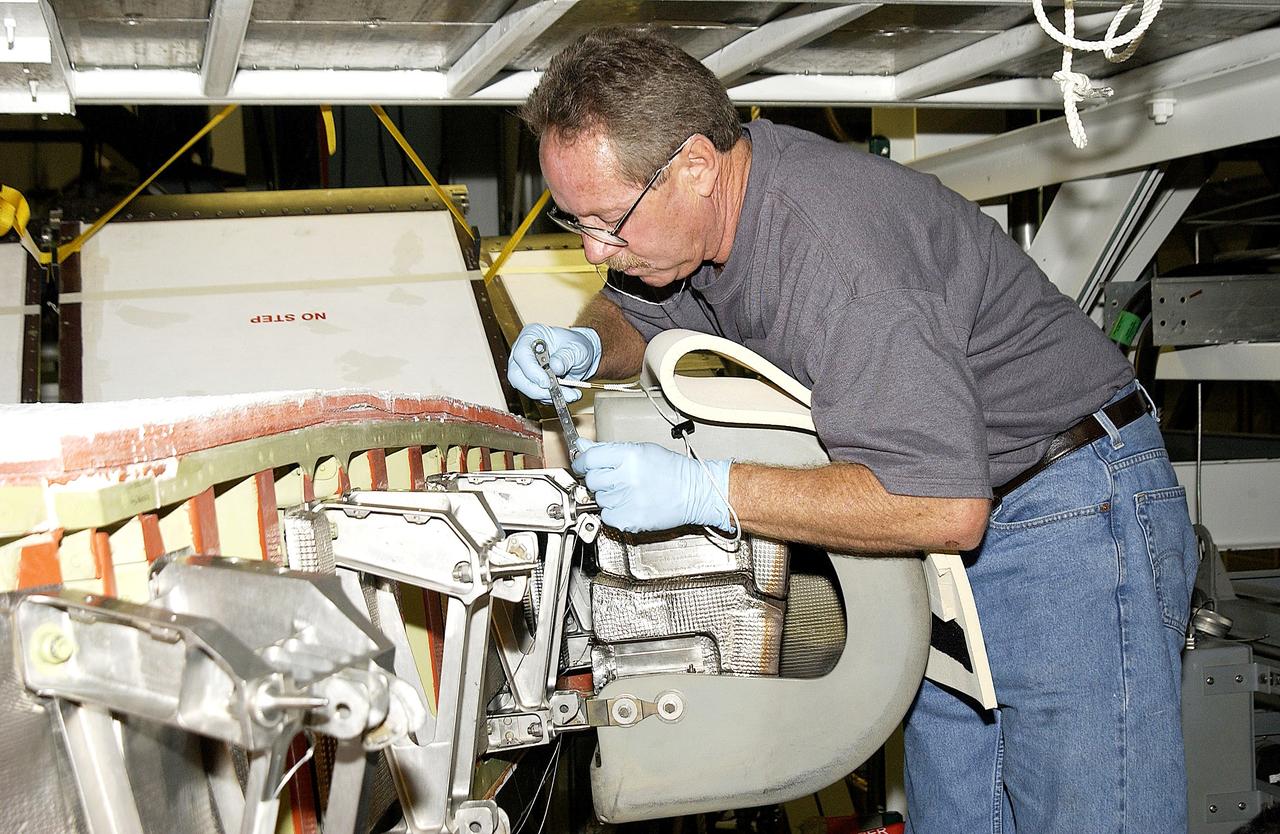
KENNEDY SPACE CENTER, FLA. -  In the Orbiter Processing Facility, United Space Alliance worker Mike Hyatt (right) attaches a Reinforced Carbon Carbon (RCC) panel onto the leading edge of the wing of the orbiter Atlantis.  The gray carbon composite RCC panels have sufficient strength to withstand the aerodynamic forces experienced during launch and reentry, which can reach as high as 800 pounds per square foot. The operating range of RCC is from minus 250º F to about 3,000º F, the temperature produced by friction with the atmosphere during reentry.
KENNEDY SPACE CENTER, FLA. - In the Orbiter Processing Facility, United Space Alliance worker Mike Hyatt (right) attaches a Reinforced Carbon Carbon (RCC) panel onto the leading edge of the wing of the orbiter Atlantis. The gray carbon composite RCC panels have sufficient strength to withstand the aerodynamic forces experienced during launch and reentry, which can reach as high as 800 pounds per square foot. The operating range of RCC is from minus 250º F to about 3,000º F, the temperature produced by friction with the atmosphere during reentry.
KENNEDY SPACE CENTER, FLA. -  In the Orbiter Processing Facility,  Jim Landy (left), NDE specialist with United Space Alliance (USA), prepares to examine a Reinforced Carbon Carbon panel using flash thermography.  Helping out, at right, is Dan Phillips, also with USA.  Attached to the leading edge of the wing of the orbiters,  the gray carbon composite RCC panels have sufficient strength to withstand the aerodynamic forces experienced during launch and reentry, which can reach as high as 800 pounds per square foot.  The operating range of RCC is from minus 250º F to about 3,000º F, the temperature produced by friction with the atmosphere during reentry.
KENNEDY SPACE CENTER, FLA. - In the Orbiter Processing Facility, Jim Landy (left), NDE specialist with United Space Alliance (USA), prepares to examine a Reinforced Carbon Carbon panel using flash thermography. Helping out, at right, is Dan Phillips, also with USA. Attached to the leading edge of the wing of the orbiters, the gray carbon composite RCC panels have sufficient strength to withstand the aerodynamic forces experienced during launch and reentry, which can reach as high as 800 pounds per square foot. The operating range of RCC is from minus 250º F to about 3,000º F, the temperature produced by friction with the atmosphere during reentry.
KENNEDY SPACE CENTER, FLA. - In the Orbiter Processing Facility, United Space Alliance workers Dan Kenna and Jim Landy prepare to examine a Reinforced Carbon Carbon panel using flash thermography.  Attached to the leading edge of the wing of the orbiters,  the gray carbon composite RCC panels have sufficient strength to withstand the aerodynamic forces experienced during launch and reentry, which can reach as high as 800 pounds per square foot.  The operating range of RCC is from minus 250º F to about 3,000º F, the temperature produced by friction with the atmosphere during reentry.
KENNEDY SPACE CENTER, FLA. - In the Orbiter Processing Facility, United Space Alliance workers Dan Kenna and Jim Landy prepare to examine a Reinforced Carbon Carbon panel using flash thermography. Attached to the leading edge of the wing of the orbiters, the gray carbon composite RCC panels have sufficient strength to withstand the aerodynamic forces experienced during launch and reentry, which can reach as high as 800 pounds per square foot. The operating range of RCC is from minus 250º F to about 3,000º F, the temperature produced by friction with the atmosphere during reentry.
KENNEDY SPACE CENTER, FLA. - In the Orbiter Processing Facility, United Space Alliance workers share the task of examining  a Reinforced Carbon Carbon panel using flash thermography.  From left are Paul Ogletree, Jim Landy (kneeling), Dan Phillips and Dan Kenna.  Attached to the leading edge of the wing of the orbiters,  the gray carbon composite RCC panels have sufficient strength to withstand the aerodynamic forces experienced during launch and reentry, which can reach as high as 800 pounds per square foot.  The operating range of RCC is from minus 250º F to about 3,000º F, the temperature produced by friction with the atmosphere during reentry.
KENNEDY SPACE CENTER, FLA. - In the Orbiter Processing Facility, United Space Alliance workers share the task of examining a Reinforced Carbon Carbon panel using flash thermography. From left are Paul Ogletree, Jim Landy (kneeling), Dan Phillips and Dan Kenna. Attached to the leading edge of the wing of the orbiters, the gray carbon composite RCC panels have sufficient strength to withstand the aerodynamic forces experienced during launch and reentry, which can reach as high as 800 pounds per square foot. The operating range of RCC is from minus 250º F to about 3,000º F, the temperature produced by friction with the atmosphere during reentry.
KENNEDY SPACE CENTER, FLA. - In the Orbiter Processing Facility,  Jim Landy, NDE specialist with United Space Alliance (USA), watches a monitor off-screen to examine a Reinforced Carbon Carbon panel using flash thermography.  Attached to the leading edge of the wing of the orbiters,  the gray carbon composite RCC panels have sufficient strength to withstand the aerodynamic forces experienced during launch and reentry, which can reach as high as 800 pounds per square foot.  The operating range of RCC is from minus 250º F to about 3,000º F, the temperature produced by friction with the atmosphere during reentry.
KENNEDY SPACE CENTER, FLA. - In the Orbiter Processing Facility, Jim Landy, NDE specialist with United Space Alliance (USA), watches a monitor off-screen to examine a Reinforced Carbon Carbon panel using flash thermography. Attached to the leading edge of the wing of the orbiters, the gray carbon composite RCC panels have sufficient strength to withstand the aerodynamic forces experienced during launch and reentry, which can reach as high as 800 pounds per square foot. The operating range of RCC is from minus 250º F to about 3,000º F, the temperature produced by friction with the atmosphere during reentry.
KENNEDY SPACE CENTER, FLA. -  - In the Orbiter Processing Facility astronaut Danny Olivas listens to Greg Grantham (left) talking about the Reinforced Carbon Carbon panels used on the leading edge of the wing of the orbiters.  Behind Olivas are engineers from around the Agency who are working on improving the RCC panels used on the wing leading edge. The gray carbon composite RCC panels have sufficient strength to withstand the aerodynamic forces experienced during launch and reentry, which can reach as high as 800 pounds per square foot.  The operating range of RCC is from minus 250º F to about 3,000º F, the temperature produced by friction with the atmosphere during reentry.
KENNEDY SPACE CENTER, FLA. - - In the Orbiter Processing Facility astronaut Danny Olivas listens to Greg Grantham (left) talking about the Reinforced Carbon Carbon panels used on the leading edge of the wing of the orbiters. Behind Olivas are engineers from around the Agency who are working on improving the RCC panels used on the wing leading edge. The gray carbon composite RCC panels have sufficient strength to withstand the aerodynamic forces experienced during launch and reentry, which can reach as high as 800 pounds per square foot. The operating range of RCC is from minus 250º F to about 3,000º F, the temperature produced by friction with the atmosphere during reentry.
KENNEDY SPACE CENTER, FLA. -  In the Orbiter Processing Facility, United Space Alliance worker Mike Hyatt (above) attaches a Reinforced Carbon Carbon (RCC) panel onto the leading edge of the wing of the orbiter Atlantis.  The gray carbon composite RCC panels have sufficient strength to withstand the aerodynamic forces experienced during launch and reentry, which can reach as high as 800 pounds per square foot.  The operating range of RCC is from minus 250º F to about 3,000º F, the temperature produced by friction with the atmosphere during reentry.
KENNEDY SPACE CENTER, FLA. - In the Orbiter Processing Facility, United Space Alliance worker Mike Hyatt (above) attaches a Reinforced Carbon Carbon (RCC) panel onto the leading edge of the wing of the orbiter Atlantis. The gray carbon composite RCC panels have sufficient strength to withstand the aerodynamic forces experienced during launch and reentry, which can reach as high as 800 pounds per square foot. The operating range of RCC is from minus 250º F to about 3,000º F, the temperature produced by friction with the atmosphere during reentry.
KENNEDY SPACE CENTER, FLA. -   Billy Witt, a midbody shop mechanic with United Space Alliance, checks a part used for installation of a Reinforced Carbon Carbon (RCC) panel to the leading edge of the wing of an orbiter.  Above him is an RCC panel just installed on Atlantis.  The gray carbon composite RCC panels have sufficient strength to withstand the aerodynamic forces experienced during launch and reentry, which can reach as high as 800 pounds per square foot.  The operating range of RCC is from minus 250º F to about 3,000º F, the temperature produced by friction with the atmosphere during reentry.
KENNEDY SPACE CENTER, FLA. - Billy Witt, a midbody shop mechanic with United Space Alliance, checks a part used for installation of a Reinforced Carbon Carbon (RCC) panel to the leading edge of the wing of an orbiter. Above him is an RCC panel just installed on Atlantis. The gray carbon composite RCC panels have sufficient strength to withstand the aerodynamic forces experienced during launch and reentry, which can reach as high as 800 pounds per square foot. The operating range of RCC is from minus 250º F to about 3,000º F, the temperature produced by friction with the atmosphere during reentry.
KENNEDY SPACE CENTER, FLA. - In the Orbiter Processing Facility, United Space Alliance worker Mike Hyatt (above) completes installation of a Reinforced Carbon Carbon (RCC) panel onto the leading edge of the wing of the orbiter Atlantis.  The gray carbon composite RCC panels have sufficient strength to withstand the aerodynamic forces experienced during launch and reentry, which can reach as high as 800 pounds per square foot. The operating range of RCC is from minus 250º F to about 3,000º F, the temperature produced by friction with the atmosphere during reentry.
KENNEDY SPACE CENTER, FLA. - In the Orbiter Processing Facility, United Space Alliance worker Mike Hyatt (above) completes installation of a Reinforced Carbon Carbon (RCC) panel onto the leading edge of the wing of the orbiter Atlantis. The gray carbon composite RCC panels have sufficient strength to withstand the aerodynamic forces experienced during launch and reentry, which can reach as high as 800 pounds per square foot. The operating range of RCC is from minus 250º F to about 3,000º F, the temperature produced by friction with the atmosphere during reentry.
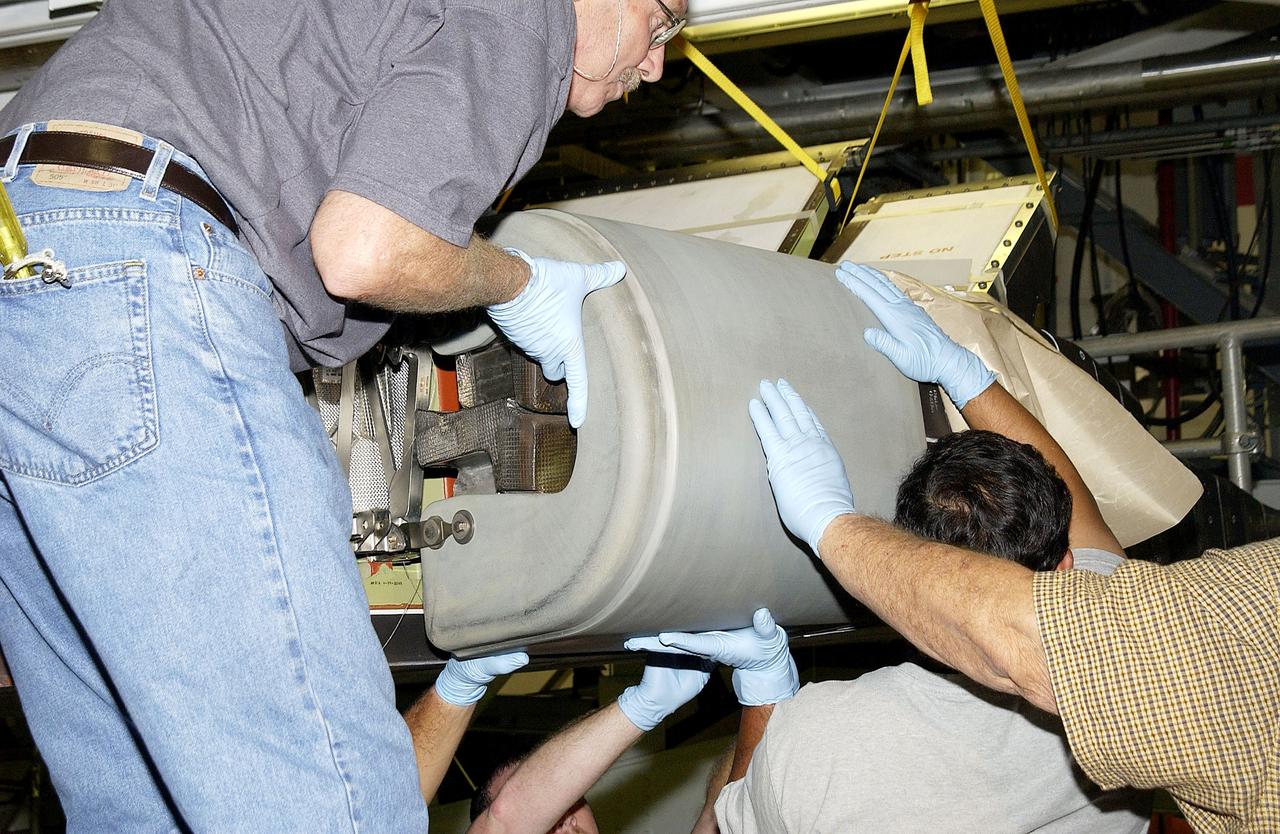
KENNEDY SPACE CENTER, FLA. -  In the Orbiter Processing Facility, United Space Alliance workers  Mike Hyatt (above),  Saul Ngy (right) and Jerry Belt (below) install a Reinforced Carbon Carbon (RCC) panel to the leading edge of the wing of the orbiter Atlantis.  The gray carbon composite RCC panels have sufficient strength to withstand the aerodynamic forces experienced during launch and reentry, which can reach as high as 800 pounds per square foot.  The operating range of RCC is from minus 250º F to about 3,000º F, the temperature produced by friction with the atmosphere during reentry.
KENNEDY SPACE CENTER, FLA. - In the Orbiter Processing Facility, United Space Alliance workers Mike Hyatt (above), Saul Ngy (right) and Jerry Belt (below) install a Reinforced Carbon Carbon (RCC) panel to the leading edge of the wing of the orbiter Atlantis. The gray carbon composite RCC panels have sufficient strength to withstand the aerodynamic forces experienced during launch and reentry, which can reach as high as 800 pounds per square foot. The operating range of RCC is from minus 250º F to about 3,000º F, the temperature produced by friction with the atmosphere during reentry.
KENNEDY SPACE CENTER, FLA. - In the Orbiter Processing Facility, United Space Alliance workers Mike Hyatt (left) Saul Ngy (center) and Jerry Belt (right) lift a Reinforced Carbon Carbon (RCC) panel to attach onto the leading edge of the wing of the orbiter Atlantis.  The gray carbon composite RCC panels have sufficient strength to withstand the aerodynamic forces experienced during launch and reentry, which can reach as high as 800 pounds per square foot.  The operating range of RCC is from minus 250º F to about 3,000º F, the temperature produced by friction with the atmosphere during reentry.
KENNEDY SPACE CENTER, FLA. - In the Orbiter Processing Facility, United Space Alliance workers Mike Hyatt (left) Saul Ngy (center) and Jerry Belt (right) lift a Reinforced Carbon Carbon (RCC) panel to attach onto the leading edge of the wing of the orbiter Atlantis. The gray carbon composite RCC panels have sufficient strength to withstand the aerodynamic forces experienced during launch and reentry, which can reach as high as 800 pounds per square foot. The operating range of RCC is from minus 250º F to about 3,000º F, the temperature produced by friction with the atmosphere during reentry.
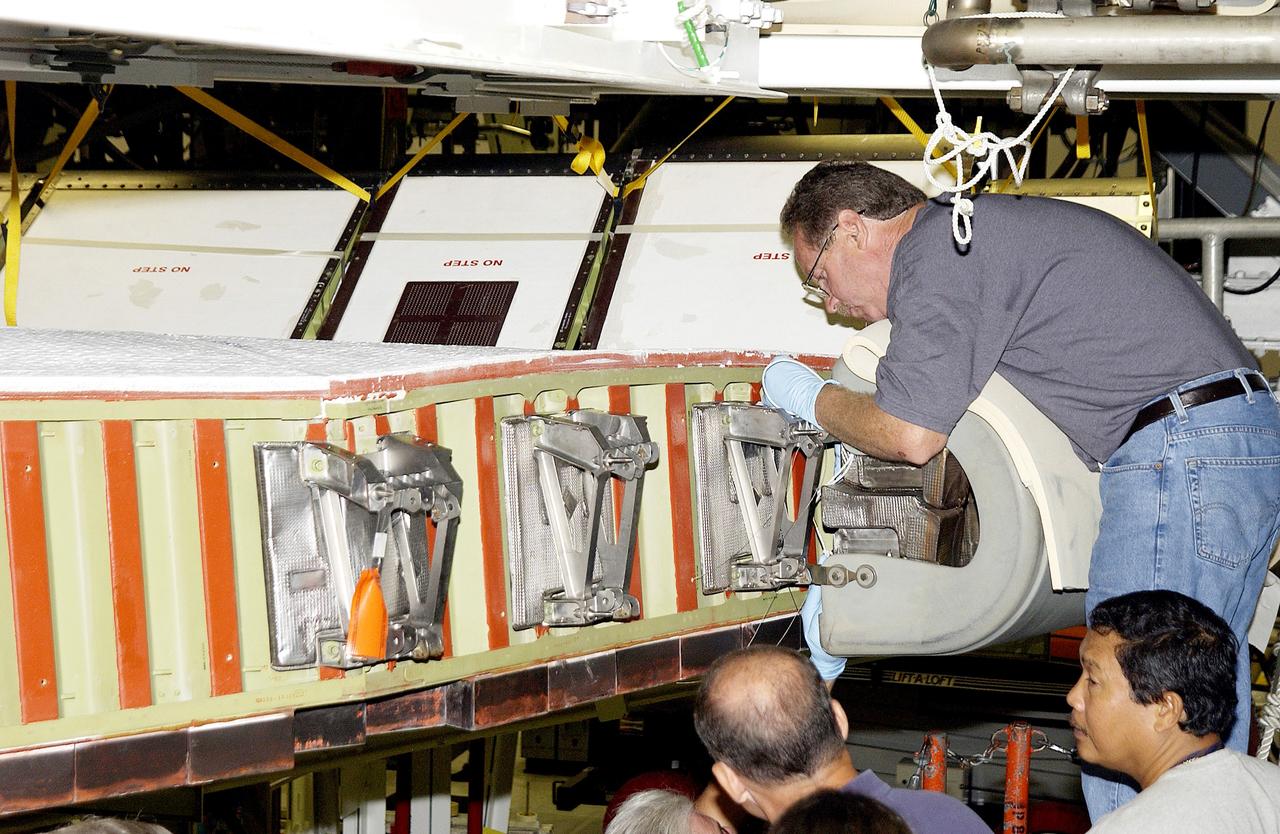
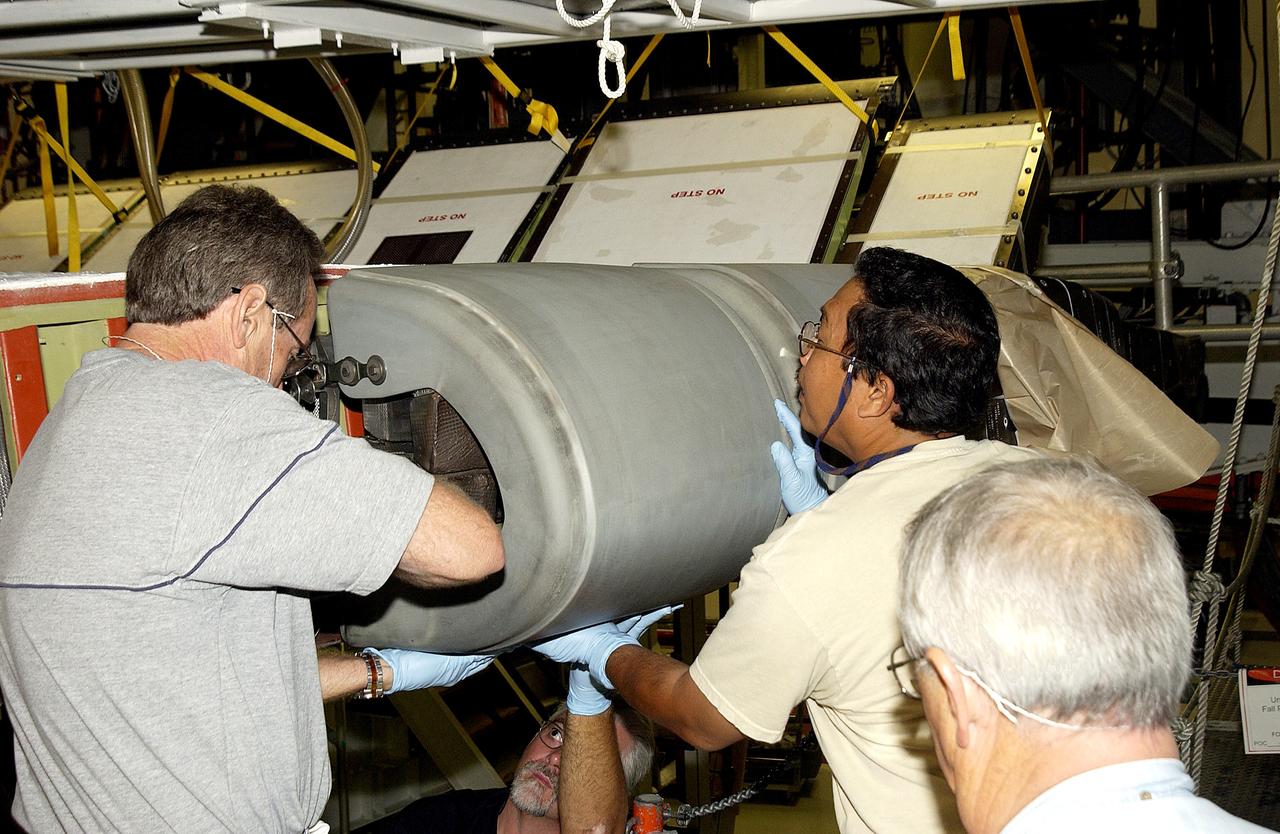
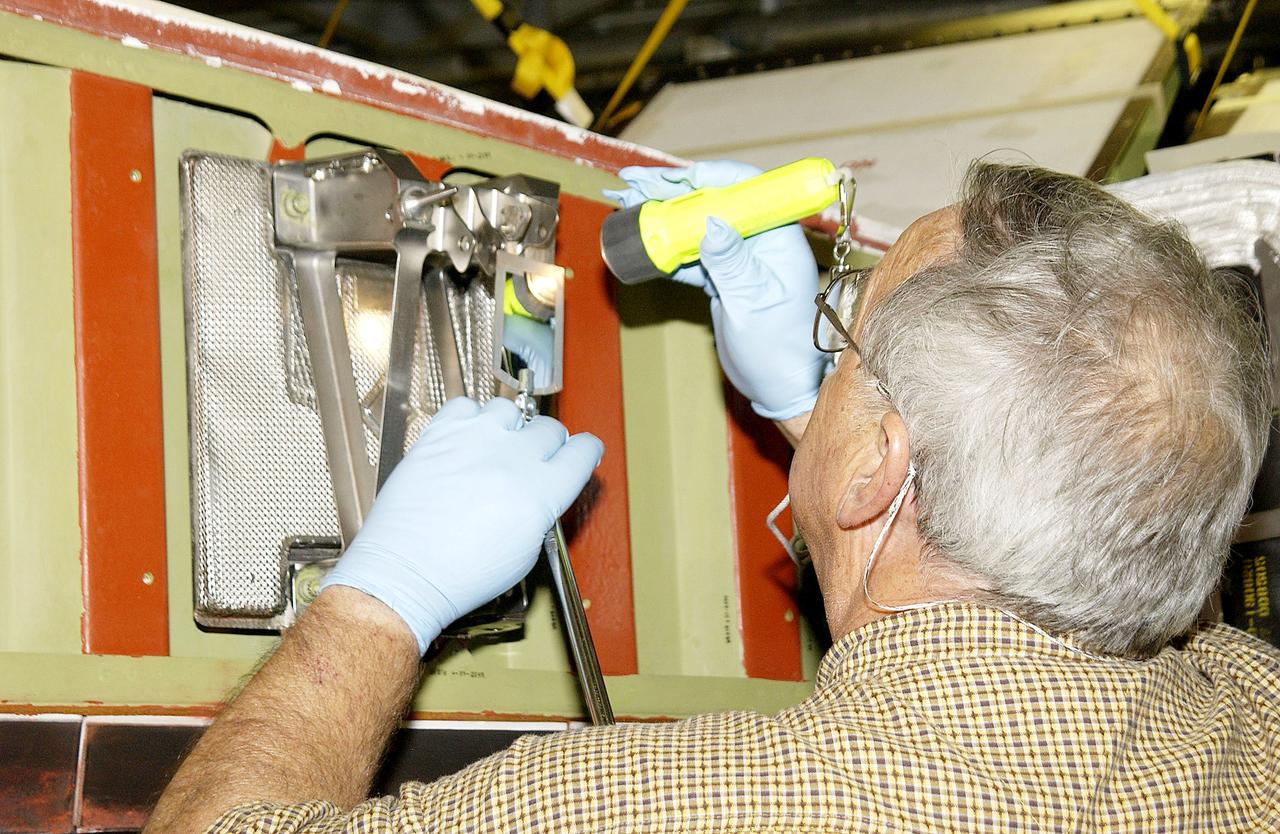
KENNEDY SPACE CENTER, FLA. - In the Orbiter Processing Facility, Jerry Belt, with United Space Alliance, checks a spar attachment on the wing of the orbiter Atlantis before installing Reinforced Carbon Carbon (RCC) panels on the wing.  The spars - floating joints - reduce loading on the panels caused by wing deflections.  The gray carbon composite RCC panels have sufficient strength to withstand the aerodynamic forces experienced during launch and reentry, which can reach as high as 800 pounds per square foot.  The operating range of RCC is from minus 250º F to about 3,000º F, the temperature produced by friction with the atmosphere during reentry.
KENNEDY SPACE CENTER, FLA. - In the Orbiter Processing Facility, Jerry Belt, with United Space Alliance, checks a spar attachment on the wing of the orbiter Atlantis before installing Reinforced Carbon Carbon (RCC) panels on the wing. The spars - floating joints - reduce loading on the panels caused by wing deflections. The gray carbon composite RCC panels have sufficient strength to withstand the aerodynamic forces experienced during launch and reentry, which can reach as high as 800 pounds per square foot. The operating range of RCC is from minus 250º F to about 3,000º F, the temperature produced by friction with the atmosphere during reentry.
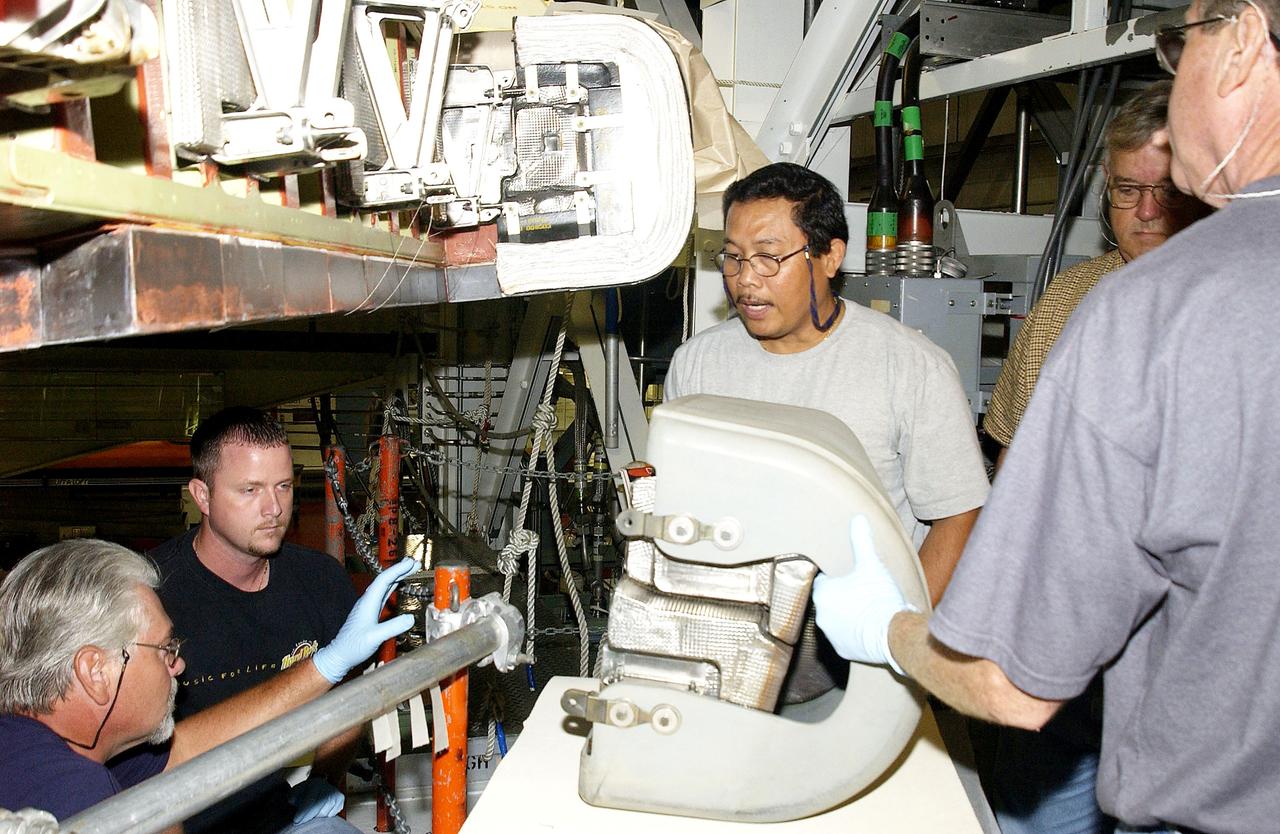
KENNEDY SPACE CENTER, FLA. - In the Orbiter Processing Facility, United Space Alliance workers, from center, left to right, Saul Ngy, Jerry Belt and Mike Hyatt, prepare to attach a Reinforced Carbon Carbon (RCC) panel (on the table) to the leading edge of the wing of the orbiter Atlantis.  The gray carbon composite RCC panels have sufficient strength to withstand the aerodynamic forces experienced during launch and reentry, which can reach as high as 800 pounds per square foot. The operating range of RCC is from minus 250º F to about 3,000º F, the temperature produced by friction with the atmosphere during reentry.
KENNEDY SPACE CENTER, FLA. - In the Orbiter Processing Facility, United Space Alliance workers, from center, left to right, Saul Ngy, Jerry Belt and Mike Hyatt, prepare to attach a Reinforced Carbon Carbon (RCC) panel (on the table) to the leading edge of the wing of the orbiter Atlantis. The gray carbon composite RCC panels have sufficient strength to withstand the aerodynamic forces experienced during launch and reentry, which can reach as high as 800 pounds per square foot. The operating range of RCC is from minus 250º F to about 3,000º F, the temperature produced by friction with the atmosphere during reentry.
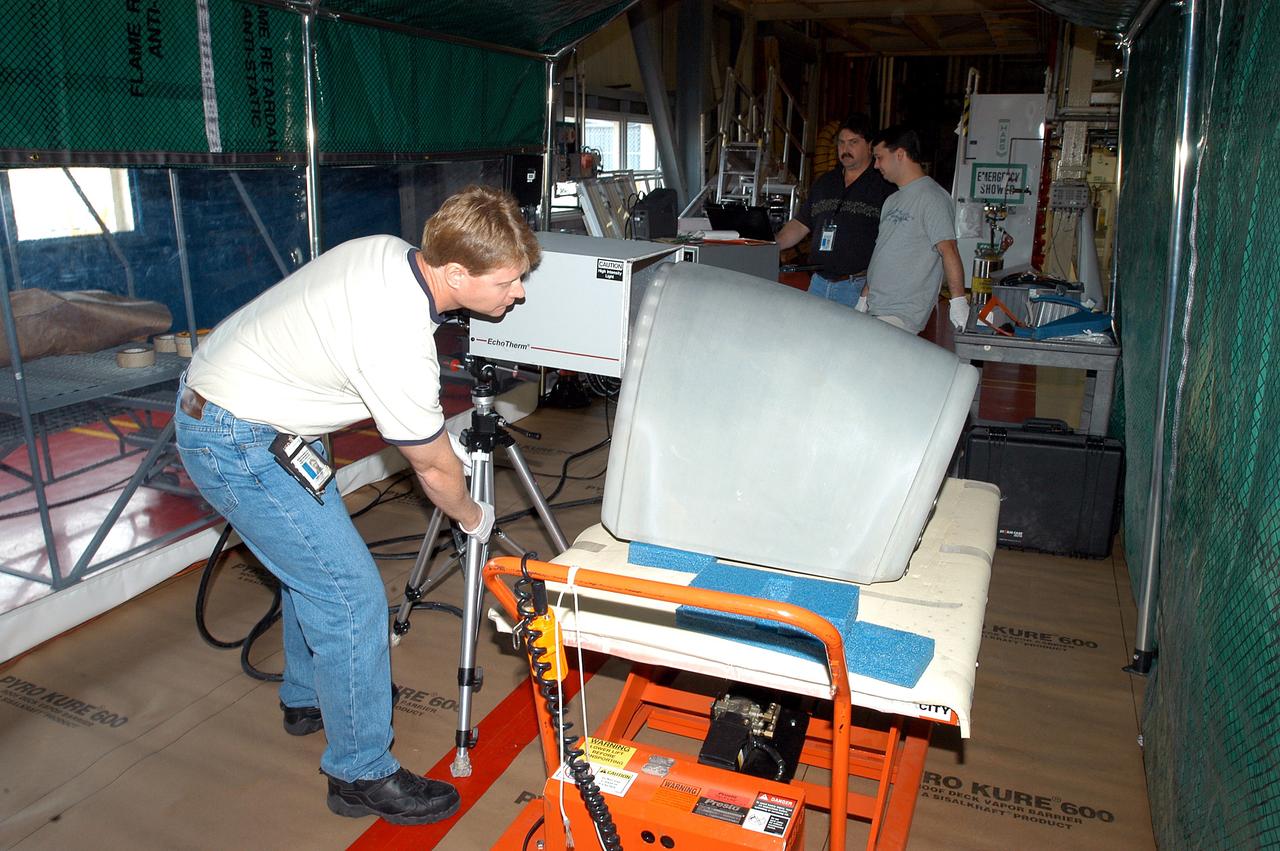
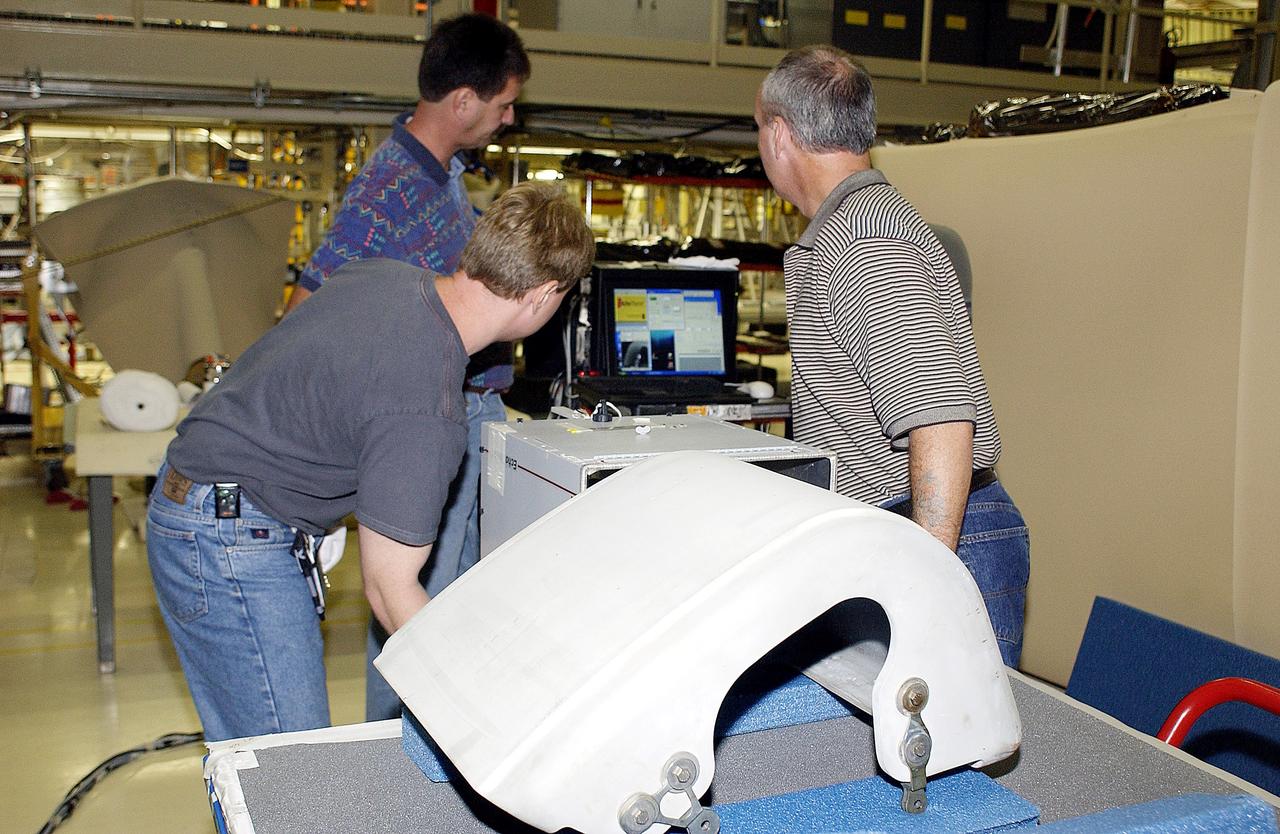
KENNEDY SPACE CENTER, FLA. -  In the Orbiter Processing Facility, United Space Alliance worker Dan Kenna (right) positions a Reinforced Carbon Carbon panel on the table to perform flash thermography.  In the background, Paul Ogletree observes the monitor.  Attached to the leading edge of the wing of the orbiters,  the gray carbon composite RCC panels have sufficient strength to withstand the aerodynamic forces experienced during launch and reentry, which can reach as high as 800 pounds per square foot.  The operating range of RCC is from minus 250º F to about 3,000º F, the temperature produced by friction with the atmosphere during reentry.
KENNEDY SPACE CENTER, FLA. - In the Orbiter Processing Facility, United Space Alliance worker Dan Kenna (right) positions a Reinforced Carbon Carbon panel on the table to perform flash thermography. In the background, Paul Ogletree observes the monitor. Attached to the leading edge of the wing of the orbiters, the gray carbon composite RCC panels have sufficient strength to withstand the aerodynamic forces experienced during launch and reentry, which can reach as high as 800 pounds per square foot. The operating range of RCC is from minus 250º F to about 3,000º F, the temperature produced by friction with the atmosphere during reentry.