
CAPE CANAVERAL, Fla. - In Launch Complex 39 at NASA's Kennedy Space Center in Florida, one of the walls of the Propellants North Administrative and Maintenance Facility glides through the air into position. A tilt-up construction method is being used to erect a THERMOMASS concrete wall insulation system for the facility's walls. In this approach, the exterior layer of concrete for the wall panels is poured and leveled on the building's footprint. Then, prefabricated, predrilled insulation sheets are arranged on top of the unhardened concrete, and connectors, designed to hold the sandwiched layers of concrete and insulation secure, are inserted through the predrilled holes. Next, the structural wythe is poured. Once cured, these panels are lifted upright to form the building's envelope. The facility will have a two-story administrative building to house managers, mechanics and technicians who fuel spacecraft at Kennedy adjacent to an 1,800-square-foot single-story shop to store cryogenic fuel transfer equipment. The new facility will feature high-efficiency roofs and walls, “Cool Dry Quiet” air conditioning with energy recovery technology, efficient lighting, and other sustainable features. The facility is striving to qualify for the U.S. Green Building Council’s Leadership in Energy and Environmental Design, or LEED, Platinum certification. If successful, Propellants North will be the first Kennedy facility to achieve this highest of LEED ratings after it is completed in the summer of 2010. The facility was designed for NASA by Jones Edmunds and Associates. Photo credit: NASA/Jim Grossmann
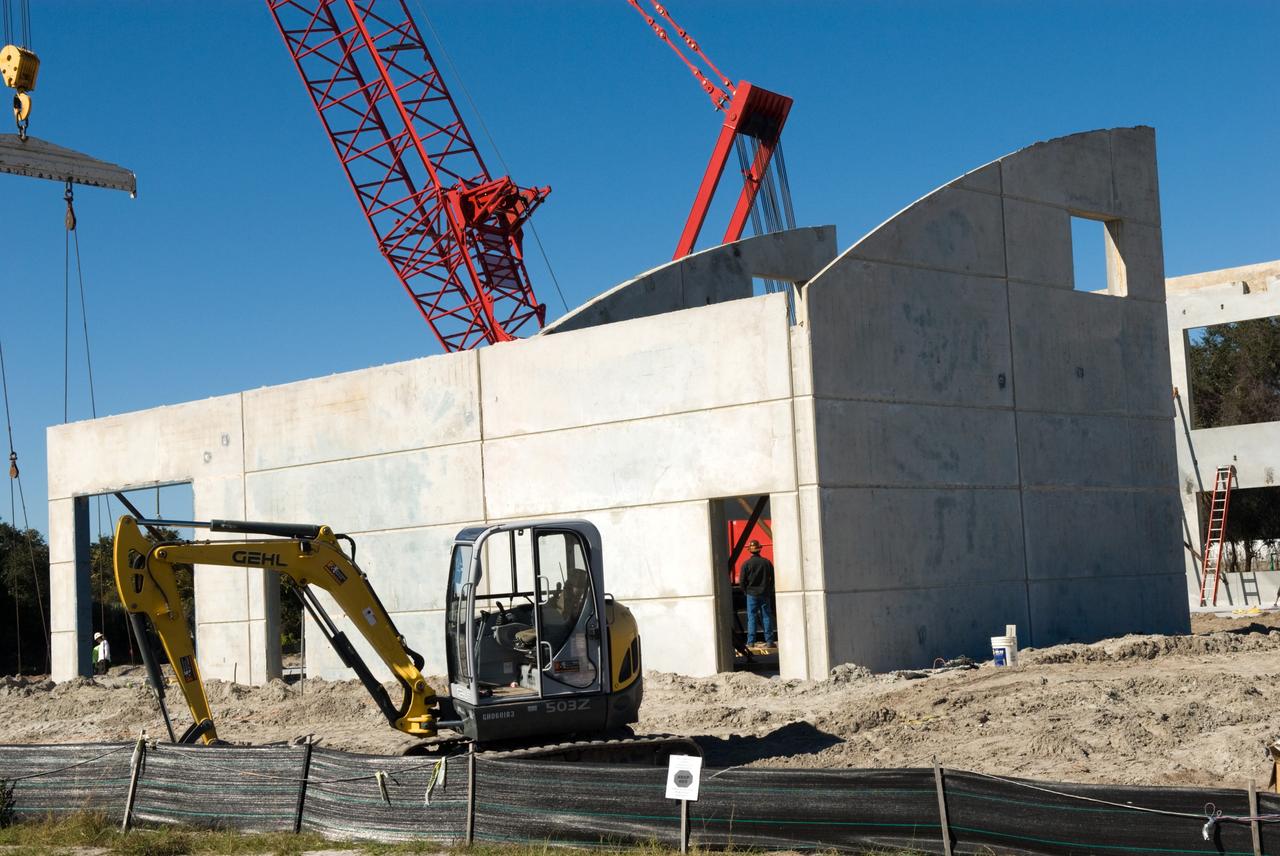
CAPE CANAVERAL, Fla. - In Launch Complex 39 at NASA's Kennedy Space Center in Florida, a worker is seen through an opening left for a doorway in a newly erected wall of the Propellants North Administrative and Maintenance Facility. A tilt-up construction method is being used to erect a THERMOMASS concrete wall insulation system for the facility's walls. In this approach, the exterior layer of concrete for the wall panels is poured and leveled on the building's footprint. Then, prefabricated, predrilled insulation sheets are arranged on top of the unhardened concrete, and connectors, designed to hold the sandwiched layers of concrete and insulation secure, are inserted through the predrilled holes. Next, the structural wythe is poured. Once cured, these panels are lifted upright to form the building's envelope. The facility will have a two-story administrative building to house managers, mechanics and technicians who fuel spacecraft at Kennedy adjacent to an 1,800-square-foot single-story shop to store cryogenic fuel transfer equipment. The new facility will feature high-efficiency roofs and walls, “Cool Dry Quiet” air conditioning with energy recovery technology, efficient lighting, and other sustainable features. The facility is striving to qualify for the U.S. Green Building Council’s Leadership in Energy and Environmental Design, or LEED, Platinum certification. If successful, Propellants North will be the first Kennedy facility to achieve this highest of LEED ratings after it is completed in the summer of 2010. The facility was designed for NASA by Jones Edmunds and Associates. Photo credit: NASA/Jim Grossmann
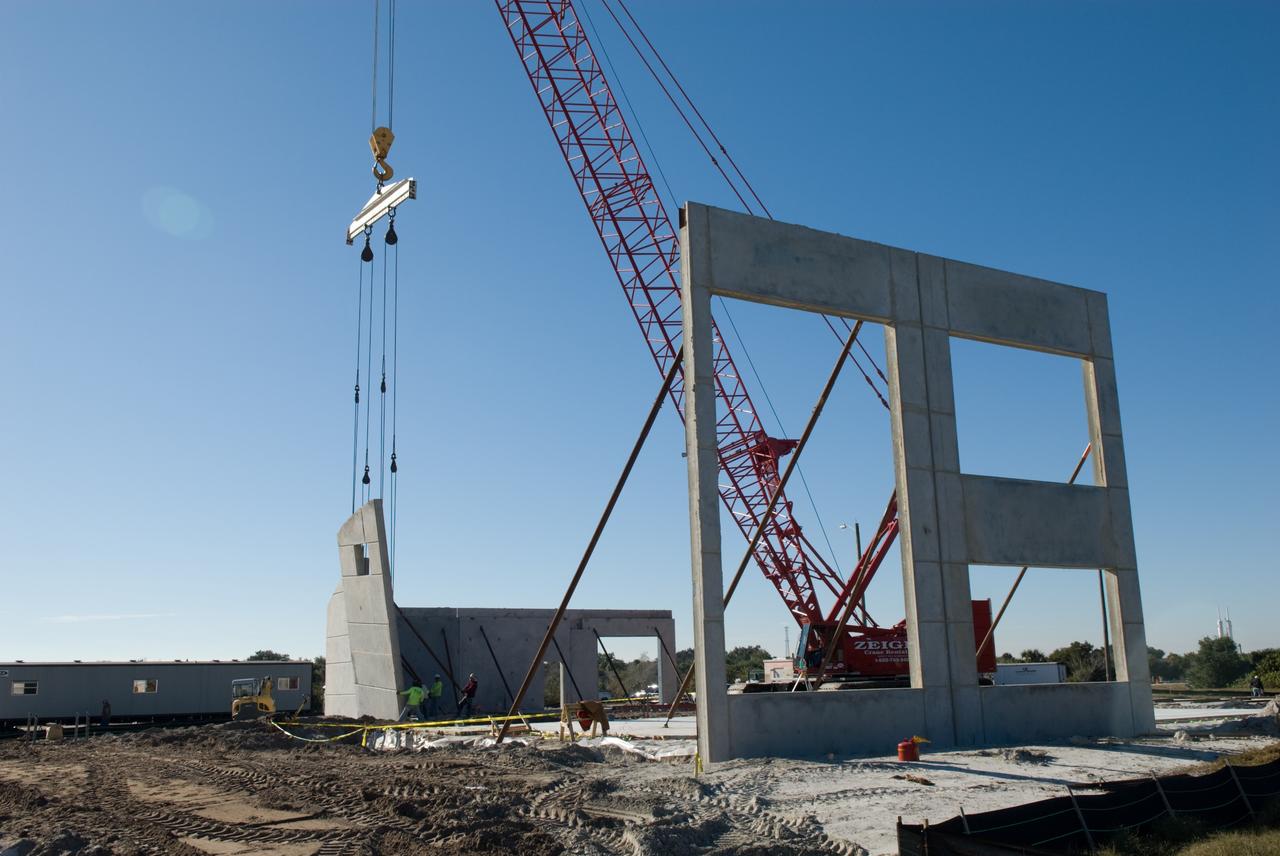
CAPE CANAVERAL, Fla. - In Launch Complex 39 at NASA's Kennedy Space Center in Florida, the Propellants North Administrative and Maintenance Facility begins to take shape as its walls are lifted into position. A tilt-up construction method is being used to erect a THERMOMASS concrete wall insulation system for the facility's walls. In this approach, the exterior layer of concrete for the wall panels is poured and leveled on the building's footprint. Then, prefabricated, predrilled insulation sheets are arranged on top of the unhardened concrete, and connectors, designed to hold the sandwiched layers of concrete and insulation secure, are inserted through the predrilled holes. Next, the structural wythe is poured. Once cured, these panels are lifted upright to form the building's envelope. The facility will have a two-story administrative building to house managers, mechanics and technicians who fuel spacecraft at Kennedy adjacent to an 1,800-square-foot single-story shop to store cryogenic fuel transfer equipment. The new facility will feature high-efficiency roofs and walls, “Cool Dry Quiet” air conditioning with energy recovery technology, efficient lighting, and other sustainable features. The facility is striving to qualify for the U.S. Green Building Council’s Leadership in Energy and Environmental Design, or LEED, Platinum certification. If successful, Propellants North will be the first Kennedy facility to achieve this highest of LEED ratings after it is completed in the summer of 2010. The facility was designed for NASA by Jones Edmunds and Associates. Photo credit: NASA/Jim Grossmann
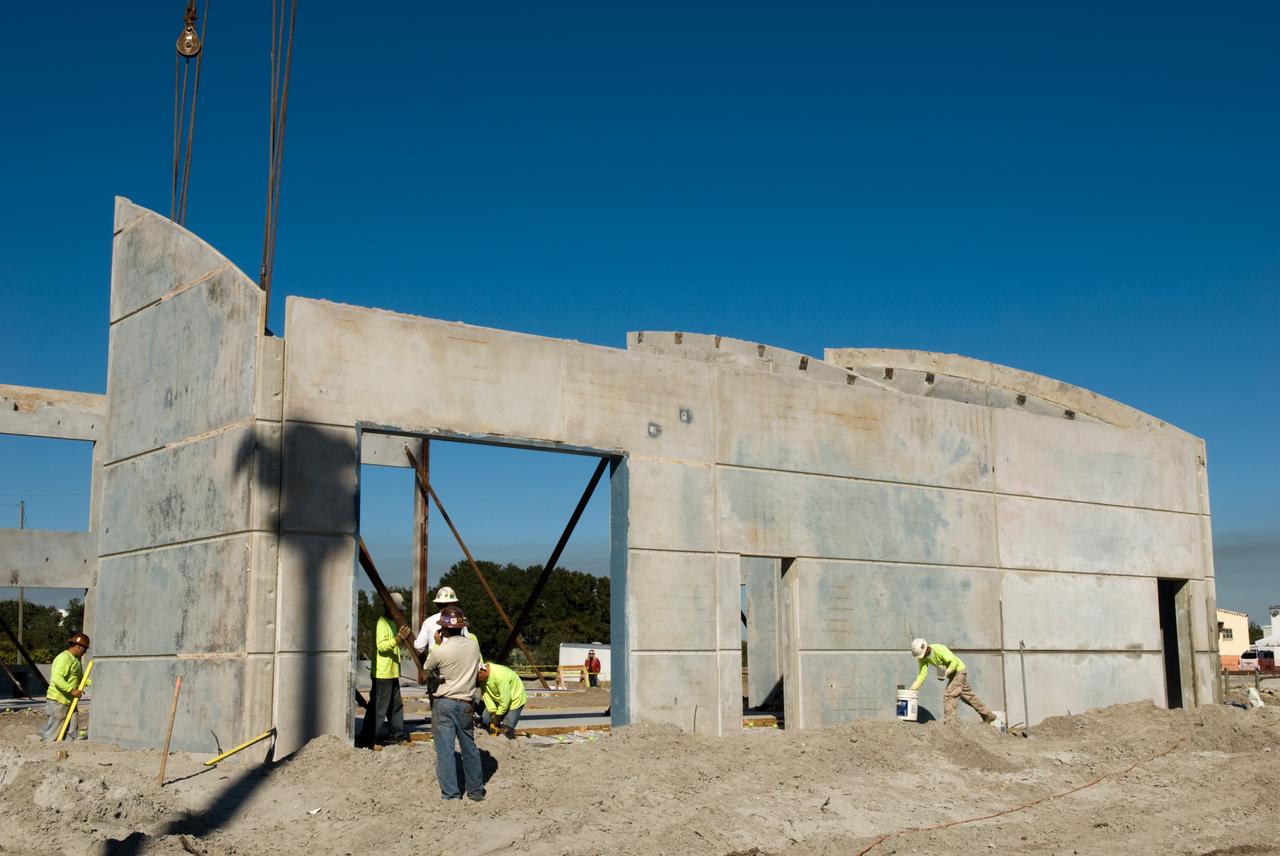
CAPE CANAVERAL, Fla. - In Launch Complex 39 at NASA's Kennedy Space Center in Florida, steady progress is made by a team of construction workers to erect the walls of the Propellants North Administrative and Maintenance Facility. A tilt-up construction method is being used to erect a THERMOMASS concrete wall insulation system for the facility's walls. In this approach, the exterior layer of concrete for the wall panels is poured and leveled on the building's footprint. Then, prefabricated, predrilled insulation sheets are arranged on top of the unhardened concrete, and connectors, designed to hold the sandwiched layers of concrete and insulation secure, are inserted through the predrilled holes. Next, the structural wythe is poured. Once cured, these panels are lifted upright to form the building's envelope. The facility will have a two-story administrative building to house managers, mechanics and technicians who fuel spacecraft at Kennedy adjacent to an 1,800-square-foot single-story shop to store cryogenic fuel transfer equipment. The new facility will feature high-efficiency roofs and walls, “Cool Dry Quiet” air conditioning with energy recovery technology, efficient lighting, and other sustainable features. The facility is striving to qualify for the U.S. Green Building Council’s Leadership in Energy and Environmental Design, or LEED, Platinum certification. If successful, Propellants North will be the first Kennedy facility to achieve this highest of LEED ratings after it is completed in the summer of 2010. The facility was designed for NASA by Jones Edmunds and Associates. Photo credit: NASA/Jim Grossmann
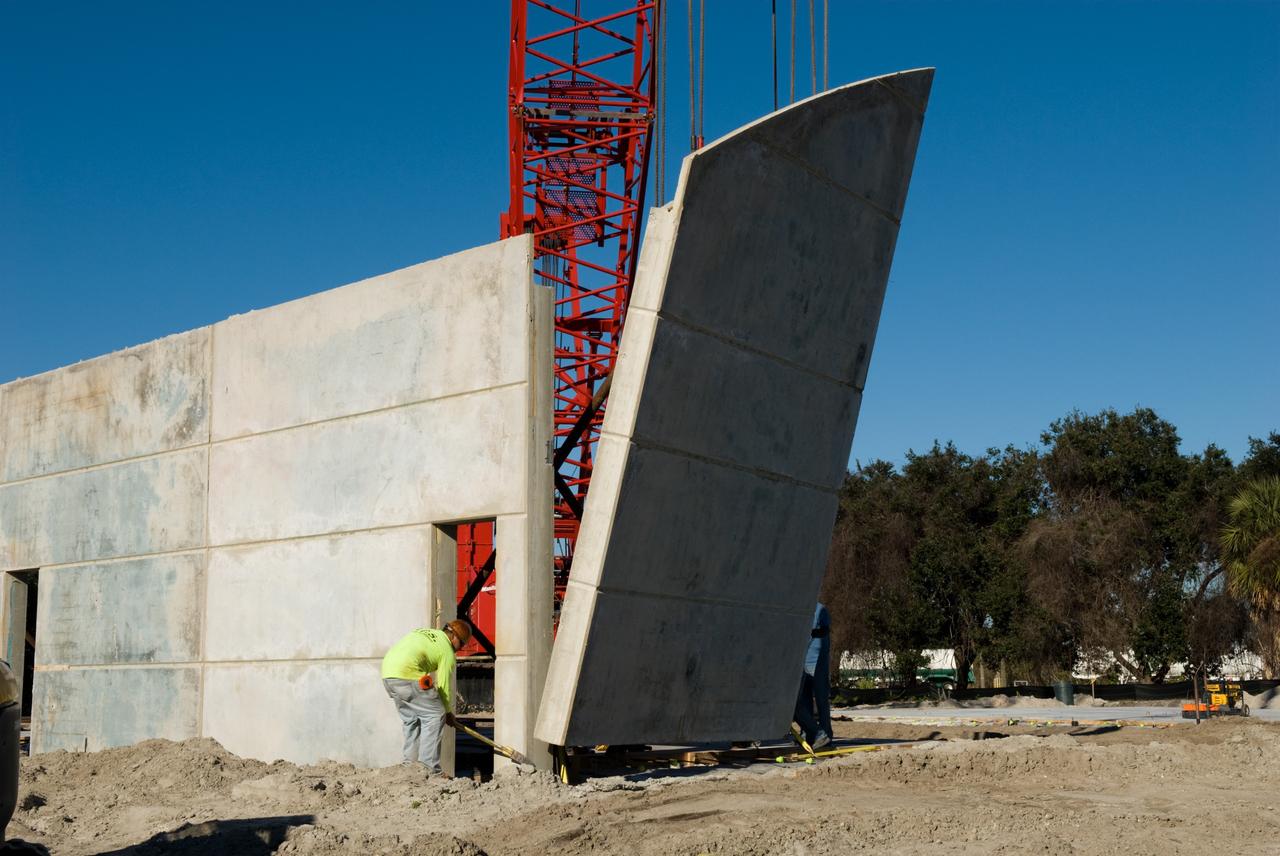
CAPE CANAVERAL, Fla. - In Launch Complex 39 at NASA's Kennedy Space Center in Florida, the Propellants North Administrative and Maintenance Facility begins to take shape as its walls are lifted into position. A tilt-up construction method is being used to erect a THERMOMASS concrete wall insulation system for the facility's walls. In this approach, the exterior layer of concrete for the wall panels is poured and leveled on the building's footprint. Then, prefabricated, predrilled insulation sheets are arranged on top of the unhardened concrete, and connectors, designed to hold the sandwiched layers of concrete and insulation secure, are inserted through the predrilled holes. Next, the structural wythe is poured. Once cured, these panels are lifted upright to form the building's envelope. The facility will have a two-story administrative building to house managers, mechanics and technicians who fuel spacecraft at Kennedy adjacent to an 1,800-square-foot single-story shop to store cryogenic fuel transfer equipment. The new facility will feature high-efficiency roofs and walls, “Cool Dry Quiet” air conditioning with energy recovery technology, efficient lighting, and other sustainable features. The facility is striving to qualify for the U.S. Green Building Council’s Leadership in Energy and Environmental Design, or LEED, Platinum certification. If successful, Propellants North will be the first Kennedy facility to achieve this highest of LEED ratings after it is completed in the summer of 2010. The facility was designed for NASA by Jones Edmunds and Associates. Photo credit: NASA/Jim Grossmann
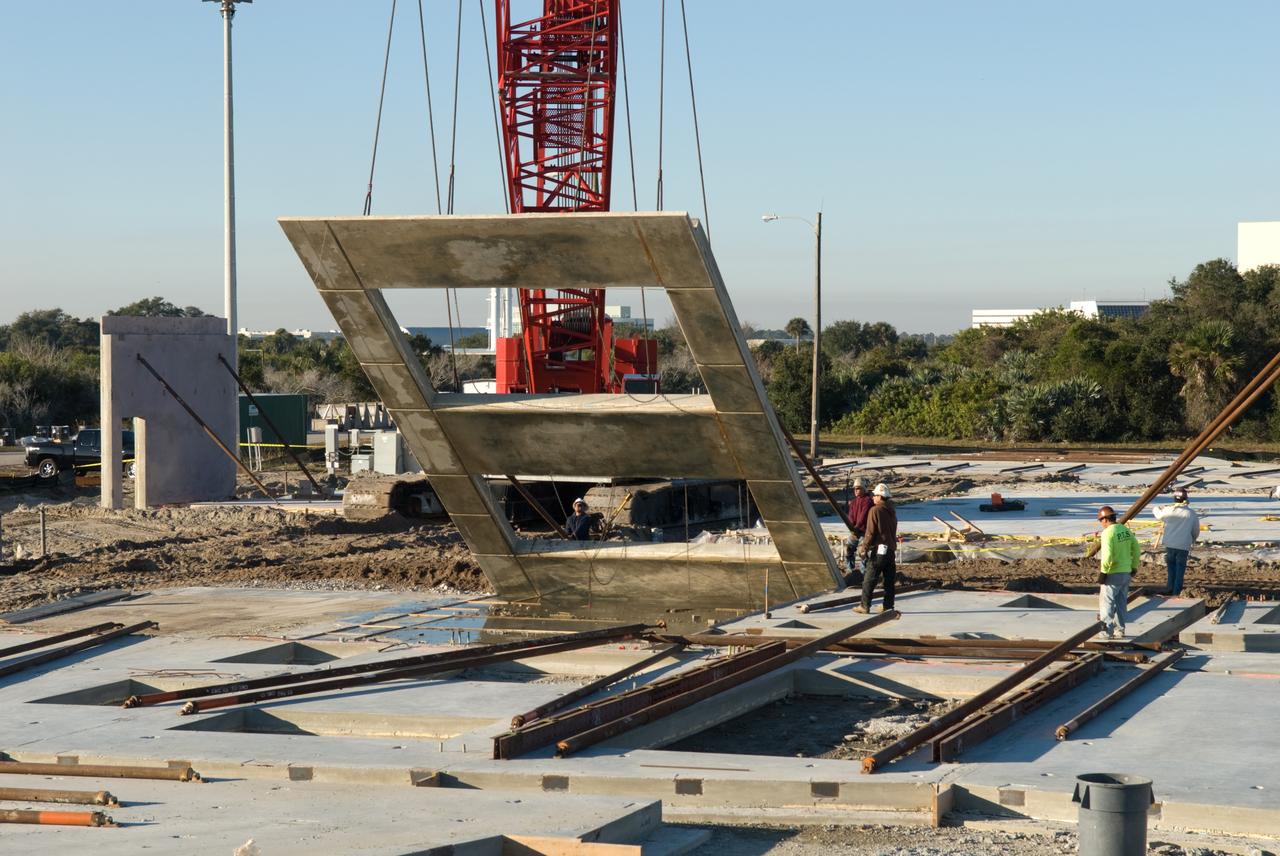
CAPE CANAVERAL, Fla. - In Launch Complex 39 at NASA's Kennedy Space Center in Florida, workers lift one of the walls of the Propellants North Administrative and Maintenance Facility into an upright position. A tilt-up construction method is being used to erect a THERMOMASS concrete wall insulation system for the facility's walls. In this approach, the exterior layer of concrete for the wall panels is poured and leveled on the building's footprint. Then, prefabricated, predrilled insulation sheets are arranged on top of the unhardened concrete, and connectors, designed to hold the sandwiched layers of concrete and insulation secure, are inserted through the predrilled holes. Next, the structural wythe is poured. Once cured, these panels are lifted upright to form the building's envelope. The facility will have a two-story administrative building to house managers, mechanics and technicians who fuel spacecraft at Kennedy adjacent to an 1,800-square-foot single-story shop to store cryogenic fuel transfer equipment. The new facility will feature high-efficiency roofs and walls, “Cool Dry Quiet” air conditioning with energy recovery technology, efficient lighting, and other sustainable features. The facility is striving to qualify for the U.S. Green Building Council’s Leadership in Energy and Environmental Design, or LEED, Platinum certification. If successful, Propellants North will be the first Kennedy facility to achieve this highest of LEED ratings after it is completed in the summer of 2010. The facility was designed for NASA by Jones Edmunds and Associates. Photo credit: NASA/Jim Grossmann
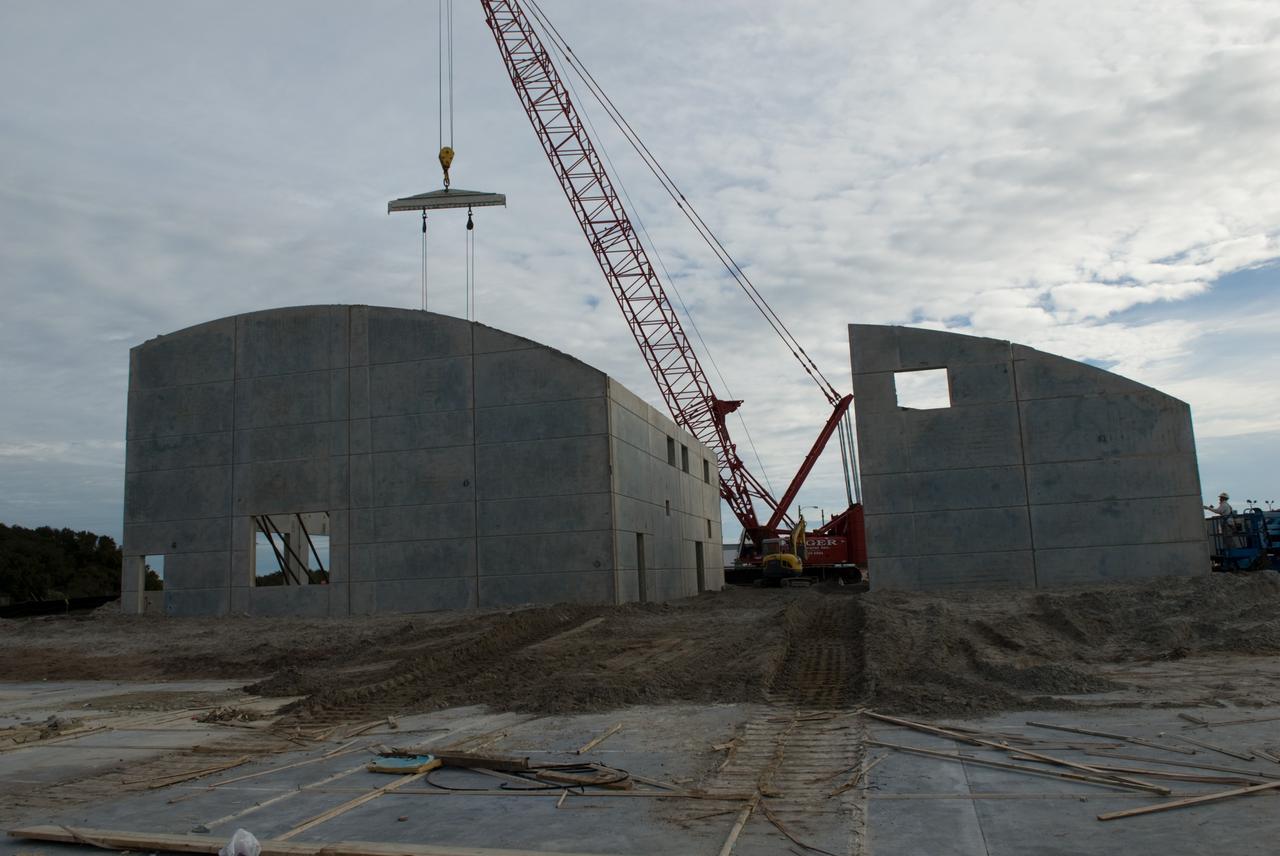
CAPE CANAVERAL, Fla. - In Launch Complex 39 at NASA's Kennedy Space Center in Florida, with the placement of the last outside wall of the Propellants North Administrative and Maintenance Facility, the "barn-raising" of the new "green" facility is complete. Concrete layers on either side of high-density foam insulation in the facility's walls will prevent any transfer of radiant heat between the exterior and interior of the buildings. A tilt-up construction method is being used to erect a THERMOMASS concrete wall insulation system for the facility's walls. In this approach, the exterior layer of concrete for the wall panels is poured and leveled on the building's footprint. Then, prefabricated, predrilled insulation sheets are arranged on top of the unhardened concrete, and connectors, designed to hold the sandwiched layers of concrete and insulation secure, are inserted through the predrilled holes. Next, the structural wythe is poured. Once cured, these panels are lifted upright to form the building's envelope. The facility will have a two-story administrative building to house managers, mechanics and technicians who fuel spacecraft at Kennedy adjacent to an 1,800-square-foot single-story shop to store cryogenic fuel transfer equipment. The new facility will feature high-efficiency roofs and walls, “Cool Dry Quiet” air conditioning with energy recovery technology, efficient lighting, and other sustainable features. The facility is striving to qualify for the U.S. Green Building Council’s Leadership in Energy and Environmental Design, or LEED, Platinum certification. If successful, Propellants North will be the first Kennedy facility to achieve this highest of LEED ratings after it is completed in the summer of 2010. The facility was designed for NASA by Jones Edmunds and Associates. Photo credit: NASA/Jim Grossmann
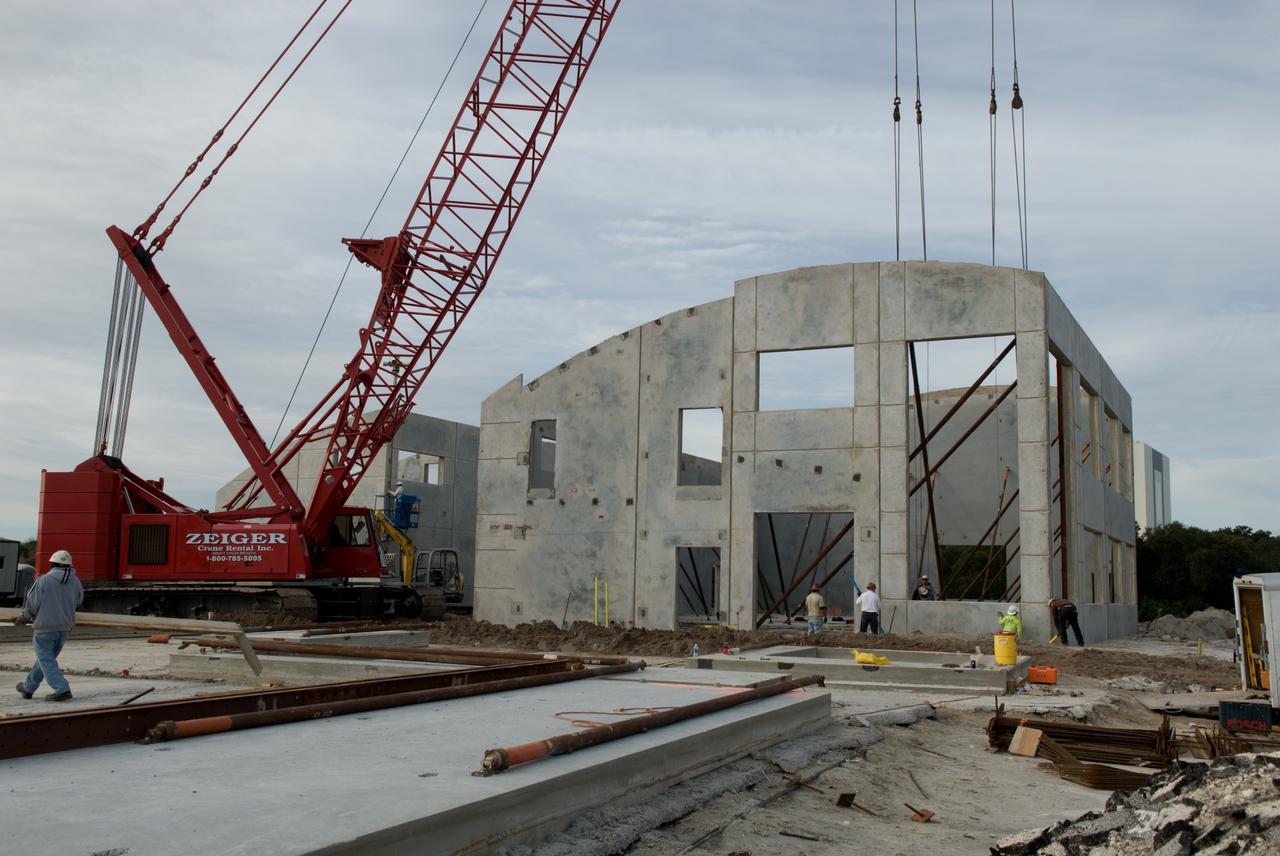
CAPE CANAVERAL, Fla. - In Launch Complex 39 at NASA's Kennedy Space Center in Florida, all of the exterior walls of the Propellants North Administrative and Maintenance Facility have been lifted into place. Concrete layers on either side of high-density foam insulation in the facility's walls will prevent any transfer of radiant heat between the exterior and interior of the buildings. A tilt-up construction method is being used to erect a THERMOMASS concrete wall insulation system for the facility's walls. In this approach, the exterior layer of concrete for the wall panels is poured and leveled on the building's footprint. Then, prefabricated, predrilled insulation sheets are arranged on top of the unhardened concrete, and connectors, designed to hold the sandwiched layers of concrete and insulation secure, are inserted through the predrilled holes. Next, the structural wythe is poured. Once cured, these panels are lifted upright to form the building's envelope. The facility will have a two-story administrative building to house managers, mechanics and technicians who fuel spacecraft at Kennedy adjacent to an 1,800-square-foot single-story shop to store cryogenic fuel transfer equipment. The new facility will feature high-efficiency roofs and walls, “Cool Dry Quiet” air conditioning with energy recovery technology, efficient lighting, and other sustainable features. The facility is striving to qualify for the U.S. Green Building Council’s Leadership in Energy and Environmental Design, or LEED, Platinum certification. If successful, Propellants North will be the first Kennedy facility to achieve this highest of LEED ratings after it is completed in the summer of 2010. The facility was designed for NASA by Jones Edmunds and Associates. Photo credit: NASA/Jim Grossmann
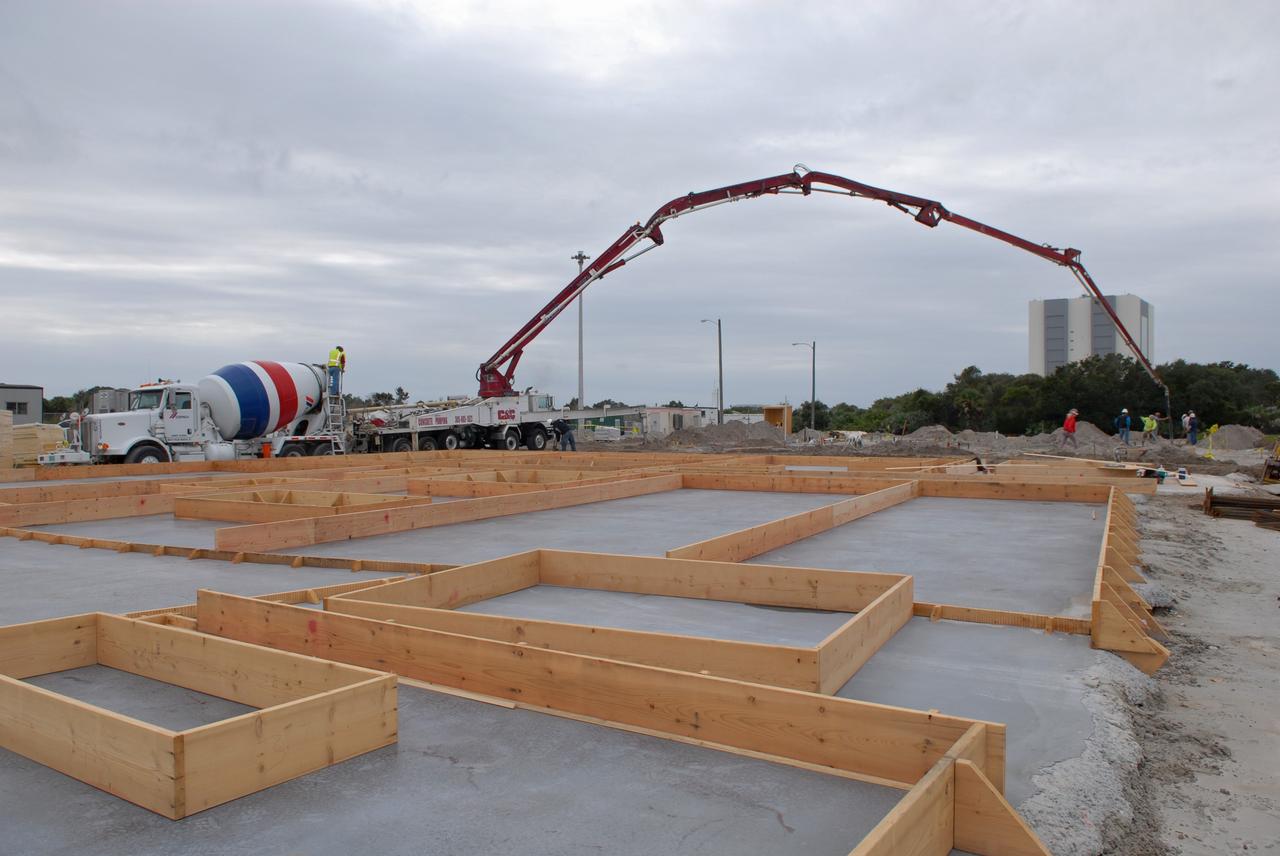
CAPE CANAVERAL, Fla. - In Launch Complex 39 at NASA's Kennedy Space Center in Florida, the walls for the Propellants North Administrative and Maintenance Facility get a layer of high-density foam insulation. A tilt-up construction method is being used to erect a THERMOMASS concrete wall insulation system for the facility's walls. In this approach, the exterior layer of concrete for the wall panels is poured and leveled on the building's footprint. Then, prefabricated, predrilled insulation sheets are arranged on top of the unhardened concrete, and connectors, designed to hold the sandwiched layers of concrete and insulation secure, are inserted through the predrilled holes. Next, the structural wythe is poured. Once cured, these panels are lifted upright to form the building's envelope. The facility will have a two-story administrative building to house managers, mechanics and technicians who fuel spacecraft at Kennedy adjacent to an 1,800-square-foot single-story shop to store cryogenic fuel transfer equipment. The new facility will feature high-efficiency roofs and walls, “Cool Dry Quiet” air conditioning with energy recovery technology, efficient lighting, and other sustainable features. The facility is striving to qualify for the U.S. Green Building Council’s Leadership in Energy and Environmental Design, or LEED, Platinum certification. If successful, Propellants North will be the first Kennedy facility to achieve this highest of LEED ratings after it is completed in the summer of 2010. The facility was designed for NASA by Jones Edmunds and Associates. Photo credit: NASA/Jim Grossmann
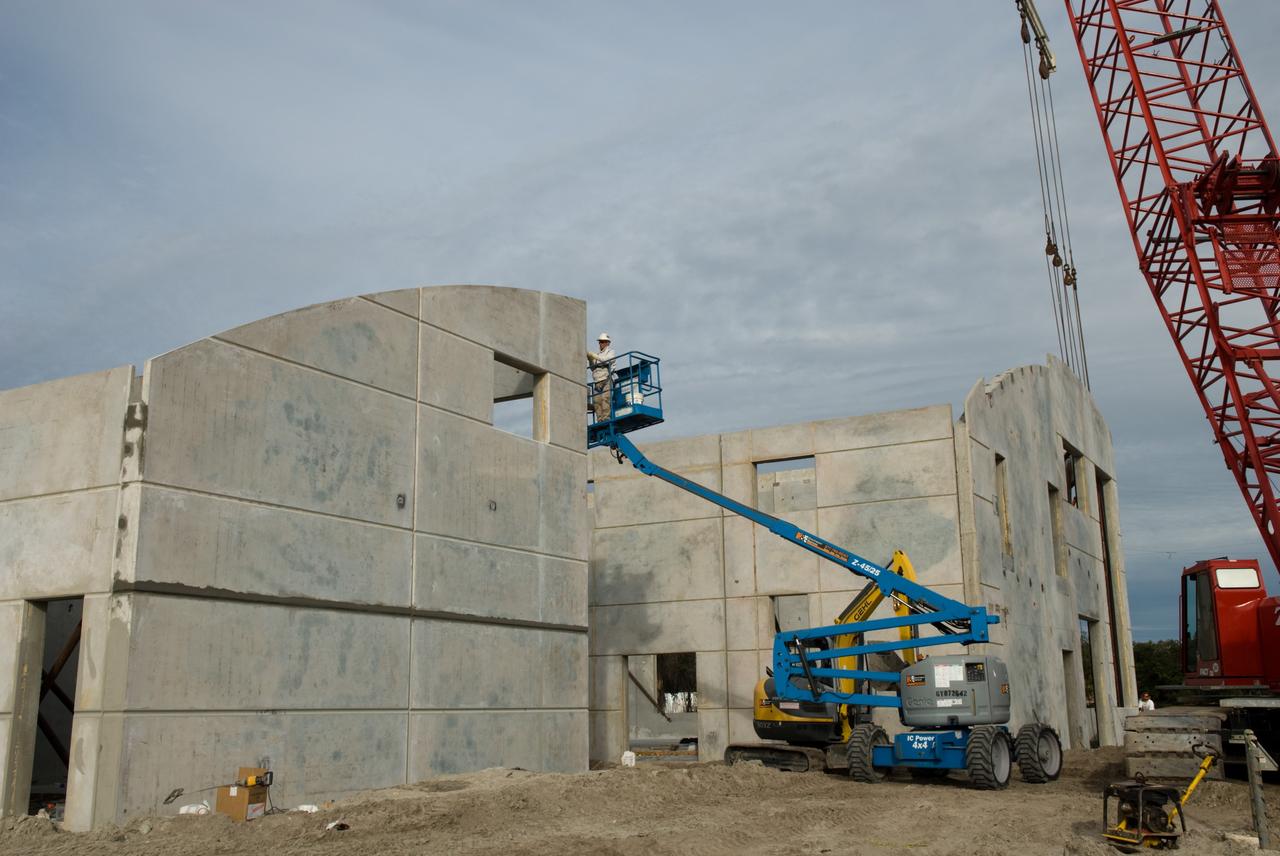
CAPE CANAVERAL, Fla. - In Launch Complex 39 at NASA's Kennedy Space Center in Florida, the last outside wall of the Propellants North Administrative and Maintenance Facility is lifted into place. Concrete layers on either side of high-density foam insulation in the facility's walls will prevent any transfer of radiant heat between the exterior and interior of the buildings. A tilt-up construction method is being used to erect a THERMOMASS concrete wall insulation system for the facility's walls. In this approach, the exterior layer of concrete for the wall panels is poured and leveled on the building's footprint. Then, prefabricated, predrilled insulation sheets are arranged on top of the unhardened concrete, and connectors, designed to hold the sandwiched layers of concrete and insulation secure, are inserted through the predrilled holes. Next, the structural wythe is poured. Once cured, these panels are lifted upright to form the building's envelope. The facility will have a two-story administrative building to house managers, mechanics and technicians who fuel spacecraft at Kennedy adjacent to an 1,800-square-foot single-story shop to store cryogenic fuel transfer equipment. The new facility will feature high-efficiency roofs and walls, “Cool Dry Quiet” air conditioning with energy recovery technology, efficient lighting, and other sustainable features. The facility is striving to qualify for the U.S. Green Building Council’s Leadership in Energy and Environmental Design, or LEED, Platinum certification. If successful, Propellants North will be the first Kennedy facility to achieve this highest of LEED ratings after it is completed in the summer of 2010. The facility was designed for NASA by Jones Edmunds and Associates. Photo credit: NASA/Jim Grossmann
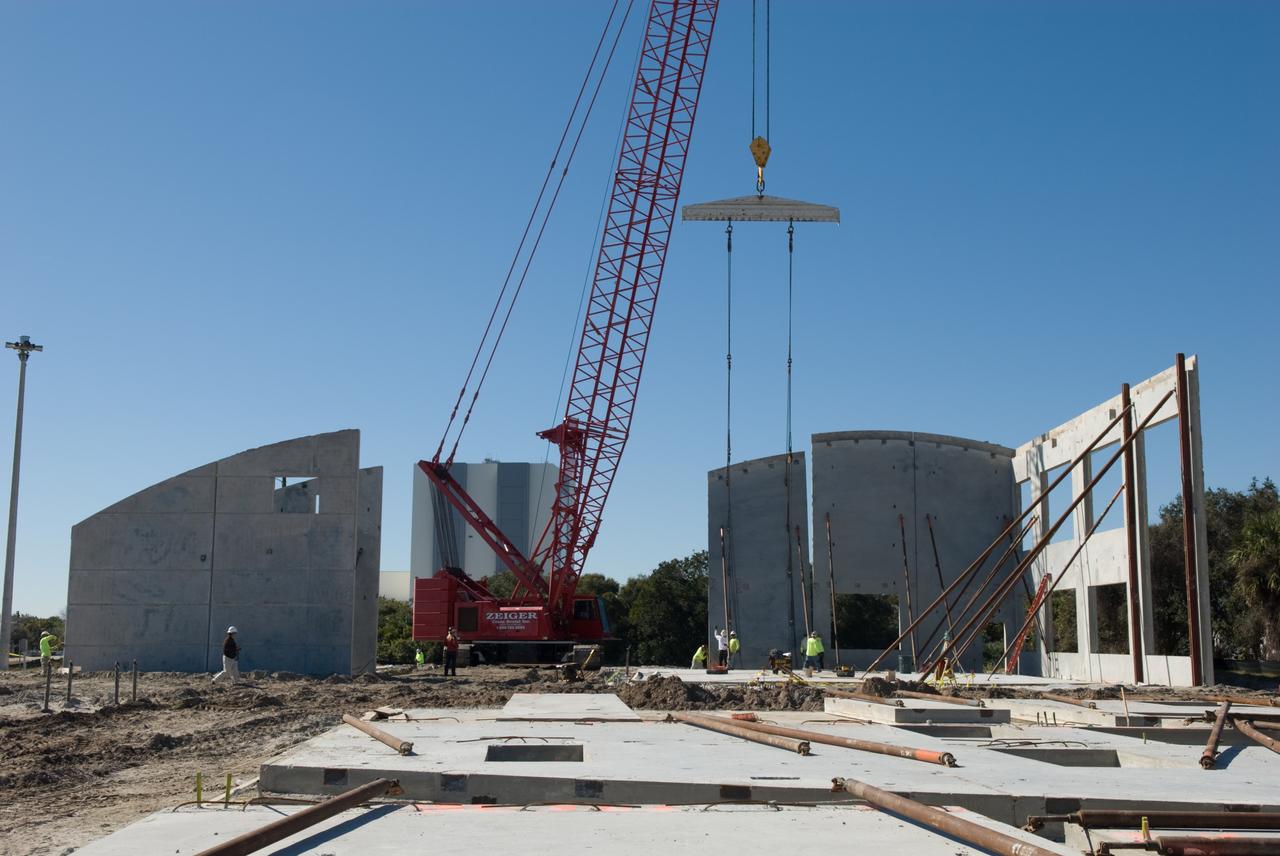
CAPE CANAVERAL, Fla. - The 525-foot-tall Vehicle Assembly Building, in the background, is witness to the formation of the Propellants North Administrative and Maintenance Facility, a new "green" building under construction in Launch Complex 39 at NASA's Kennedy Space Center in Florida. Concrete layers on either side of high-density foam insulation in the facility's walls will prevent any transfer of radiant heat between the exterior and interior of the buildings. A tilt-up construction method is being used to erect a THERMOMASS concrete wall insulation system for the facility's walls. In this approach, the exterior layer of concrete for the wall panels is poured and leveled on the building's footprint. Then, prefabricated, predrilled insulation sheets are arranged on top of the unhardened concrete, and connectors, designed to hold the sandwiched layers of concrete and insulation secure, are inserted through the predrilled holes. Next, the structural wythe is poured. Once cured, these panels are lifted upright to form the building's envelope. The facility will have a two-story administrative building to house managers, mechanics and technicians who fuel spacecraft at Kennedy adjacent to an 1,800-square-foot single-story shop to store cryogenic fuel transfer equipment. The new facility will feature high-efficiency roofs and walls, “Cool Dry Quiet” air conditioning with energy recovery technology, efficient lighting, and other sustainable features. The facility is striving to qualify for the U.S. Green Building Council’s Leadership in Energy and Environmental Design, or LEED, Platinum certification. If successful, Propellants North will be the first Kennedy facility to achieve this highest of LEED ratings after it is completed in the summer of 2010. The facility was designed for NASA by Jones Edmunds and Associates. Photo credit: NASA/Jim Grossmann

CAPE CANAVERAL, Fla. - In Launch Complex 39 at NASA's Kennedy Space Center in Florida, the first wall of the Propellants North Administrative and Maintenance Facility is lifted into place. In the background is the 525-foot-tall Vehicle Assembly Building. A tilt-up construction method is being used to erect a THERMOMASS concrete wall insulation system for the facility's walls. In this approach, the exterior layer of concrete for the wall panels is poured and leveled on the building's footprint. Then, prefabricated, predrilled insulation sheets are arranged on top of the unhardened concrete, and connectors, designed to hold the sandwiched layers of concrete and insulation secure, are inserted through the predrilled holes. Next, the structural wythe is poured. Once cured, these panels are lifted upright to form the building's envelope. The facility will have a two-story administrative building to house managers, mechanics and technicians who fuel spacecraft at Kennedy adjacent to an 1,800-square-foot single-story shop to store cryogenic fuel transfer equipment. The new facility will feature high-efficiency roofs and walls, “Cool Dry Quiet” air conditioning with energy recovery technology, efficient lighting, and other sustainable features. The facility is striving to qualify for the U.S. Green Building Council’s Leadership in Energy and Environmental Design, or LEED, Platinum certification. If successful, Propellants North will be the first Kennedy facility to achieve this highest of LEED ratings after it is completed in the summer of 2010. The facility was designed for NASA by Jones Edmunds and Associates. Photo credit: NASA/Jim Grossmann

CAPE CANAVERAL, Fla. - In Launch Complex 39 at NASA's Kennedy Space Center in Florida, man and machine work side by side to position the walls of the Propellants North Administrative and Maintenance Facility. A tilt-up construction method is being used to erect a THERMOMASS concrete wall insulation system for the facility's walls. In this approach, the exterior layer of concrete for the wall panels is poured and leveled on the building's footprint. Then, prefabricated, predrilled insulation sheets are arranged on top of the unhardened concrete, and connectors, designed to hold the sandwiched layers of concrete and insulation secure, are inserted through the predrilled holes. Next, the structural wythe is poured. Once cured, these panels are lifted upright to form the building's envelope. The facility will have a two-story administrative building to house managers, mechanics and technicians who fuel spacecraft at Kennedy adjacent to an 1,800-square-foot single-story shop to store cryogenic fuel transfer equipment. The new facility will feature high-efficiency roofs and walls, “Cool Dry Quiet” air conditioning with energy recovery technology, efficient lighting, and other sustainable features. The facility is striving to qualify for the U.S. Green Building Council’s Leadership in Energy and Environmental Design, or LEED, Platinum certification. If successful, Propellants North will be the first Kennedy facility to achieve this highest of LEED ratings after it is completed in the summer of 2010. The facility was designed for NASA by Jones Edmunds and Associates. Photo credit: NASA/Jim Grossmann
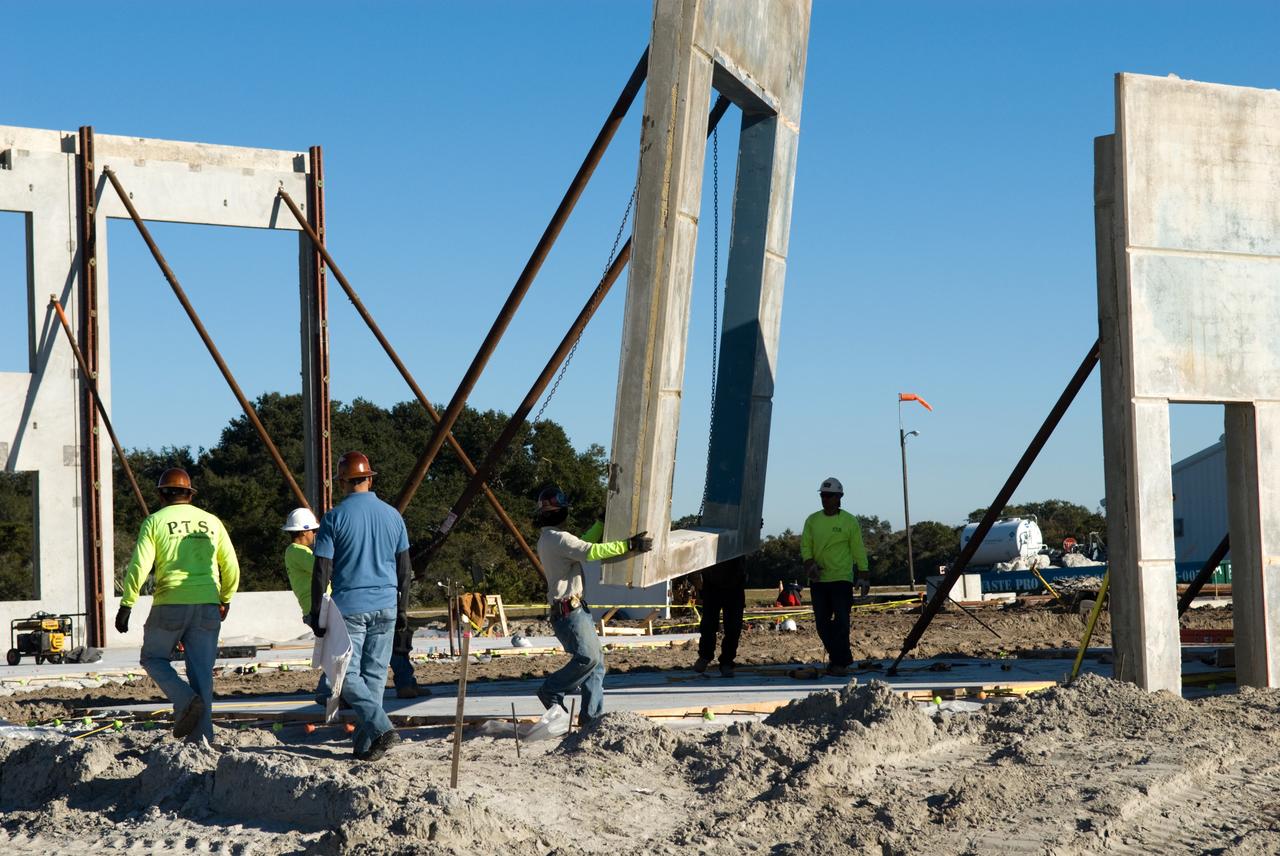
CAPE CANAVERAL, Fla. - In Launch Complex 39 at NASA's Kennedy Space Center in Florida, one of the walls of the Propellants North Administrative and Maintenance Facility is lowered into the trench which will support it. A tilt-up construction method is being used to erect a THERMOMASS concrete wall insulation system for the facility's walls. In this approach, the exterior layer of concrete for the wall panels is poured and leveled on the building's footprint. Then, prefabricated, predrilled insulation sheets are arranged on top of the unhardened concrete, and connectors, designed to hold the sandwiched layers of concrete and insulation secure, are inserted through the predrilled holes. Next, the structural wythe is poured. Once cured, these panels are lifted upright to form the building's envelope. The facility will have a two-story administrative building to house managers, mechanics and technicians who fuel spacecraft at Kennedy adjacent to an 1,800-square-foot single-story shop to store cryogenic fuel transfer equipment. The new facility will feature high-efficiency roofs and walls, “Cool Dry Quiet” air conditioning with energy recovery technology, efficient lighting, and other sustainable features. The facility is striving to qualify for the U.S. Green Building Council’s Leadership in Energy and Environmental Design, or LEED, Platinum certification. If successful, Propellants North will be the first Kennedy facility to achieve this highest of LEED ratings after it is completed in the summer of 2010. The facility was designed for NASA by Jones Edmunds and Associates. Photo credit: NASA/Jim Grossmann
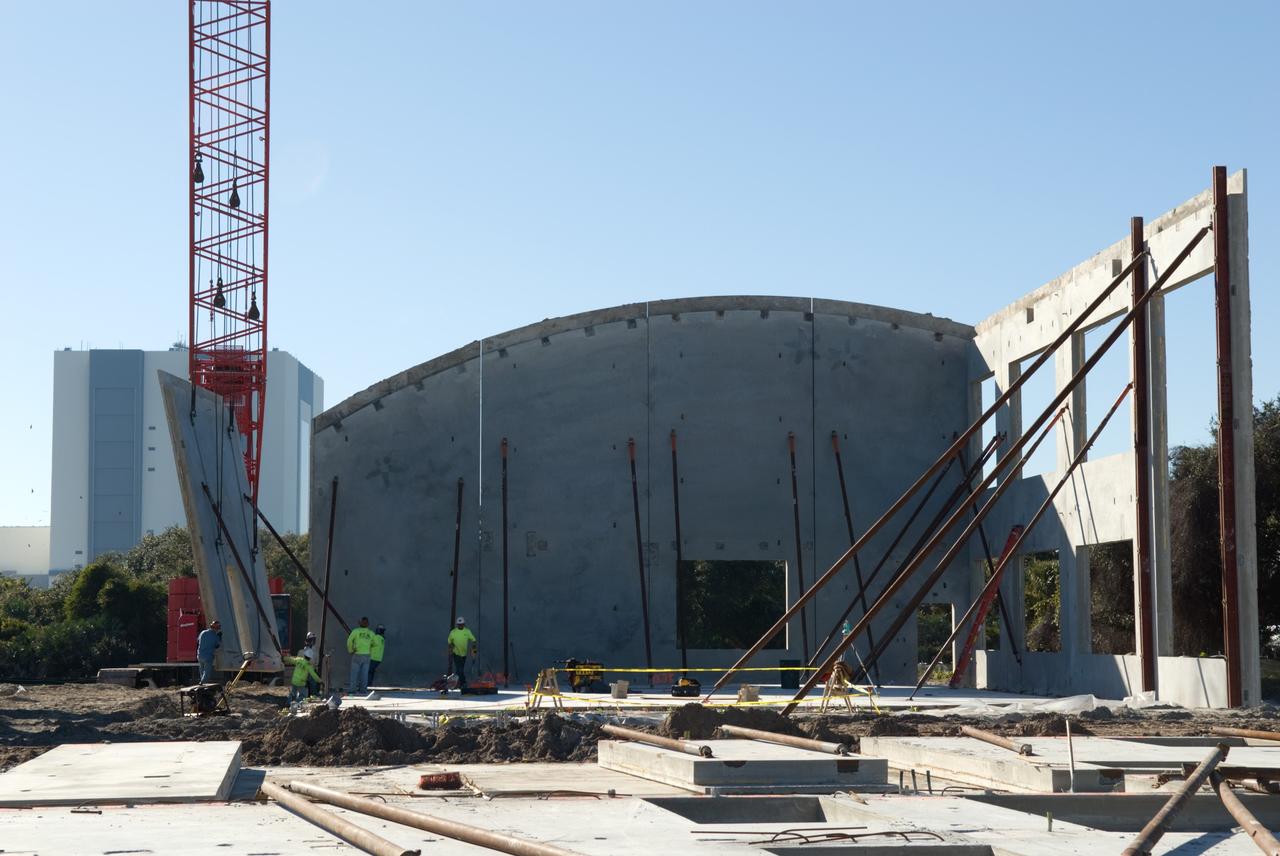
CAPE CANAVERAL, Fla. - In Launch Complex 39 at NASA's Kennedy Space Center in Florida, the final shape of the Propellants North Administrative and Maintenance Facility becomes apparent as its walls are erected. A tilt-up construction method is being used to erect a THERMOMASS concrete wall insulation system for the facility's walls. In this approach, the exterior layer of concrete for the wall panels is poured and leveled on the building's footprint. Then, prefabricated, predrilled insulation sheets are arranged on top of the unhardened concrete, and connectors, designed to hold the sandwiched layers of concrete and insulation secure, are inserted through the predrilled holes. Next, the structural wythe is poured. Once cured, these panels are lifted upright to form the building's envelope. The facility will have a two-story administrative building to house managers, mechanics and technicians who fuel spacecraft at Kennedy adjacent to an 1,800-square-foot single-story shop to store cryogenic fuel transfer equipment. The new facility will feature high-efficiency roofs and walls, “Cool Dry Quiet” air conditioning with energy recovery technology, efficient lighting, and other sustainable features. The facility is striving to qualify for the U.S. Green Building Council’s Leadership in Energy and Environmental Design, or LEED, Platinum certification. If successful, Propellants North will be the first Kennedy facility to achieve this highest of LEED ratings after it is completed in the summer of 2010. The facility was designed for NASA by Jones Edmunds and Associates. Photo credit: NASA/Jim Grossmann
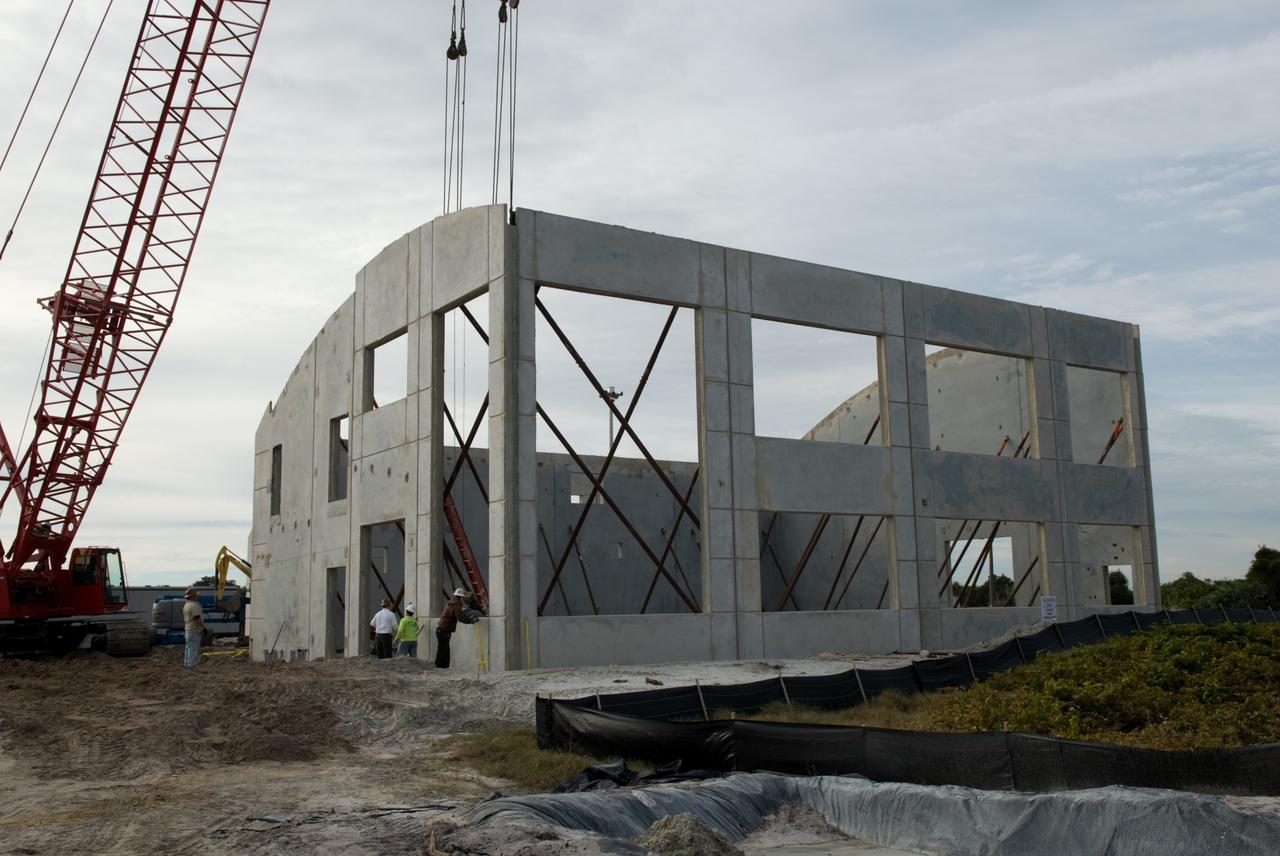
CAPE CANAVERAL, Fla. - In Launch Complex 39 at NASA's Kennedy Space Center in Florida, construction workers survey the last outside wall of the Propellants North Administrative and Maintenance Facility. Concrete layers on either side of high-density foam insulation in the facility's walls will prevent any transfer of radiant heat between the exterior and interior of the buildings. A tilt-up construction method is being used to erect a THERMOMASS concrete wall insulation system for the facility's walls. In this approach, the exterior layer of concrete for the wall panels is poured and leveled on the building's footprint. Then, prefabricated, predrilled insulation sheets are arranged on top of the unhardened concrete, and connectors, designed to hold the sandwiched layers of concrete and insulation secure, are inserted through the predrilled holes. Next, the structural wythe is poured. Once cured, these panels are lifted upright to form the building's envelope. The facility will have a two-story administrative building to house managers, mechanics and technicians who fuel spacecraft at Kennedy adjacent to an 1,800-square-foot single-story shop to store cryogenic fuel transfer equipment. The new facility will feature high-efficiency roofs and walls, “Cool Dry Quiet” air conditioning with energy recovery technology, efficient lighting, and other sustainable features. The facility is striving to qualify for the U.S. Green Building Council’s Leadership in Energy and Environmental Design, or LEED, Platinum certification. If successful, Propellants North will be the first Kennedy facility to achieve this highest of LEED ratings after it is completed in the summer of 2010. The facility was designed for NASA by Jones Edmunds and Associates. Photo credit: NASA/Jim Grossmann
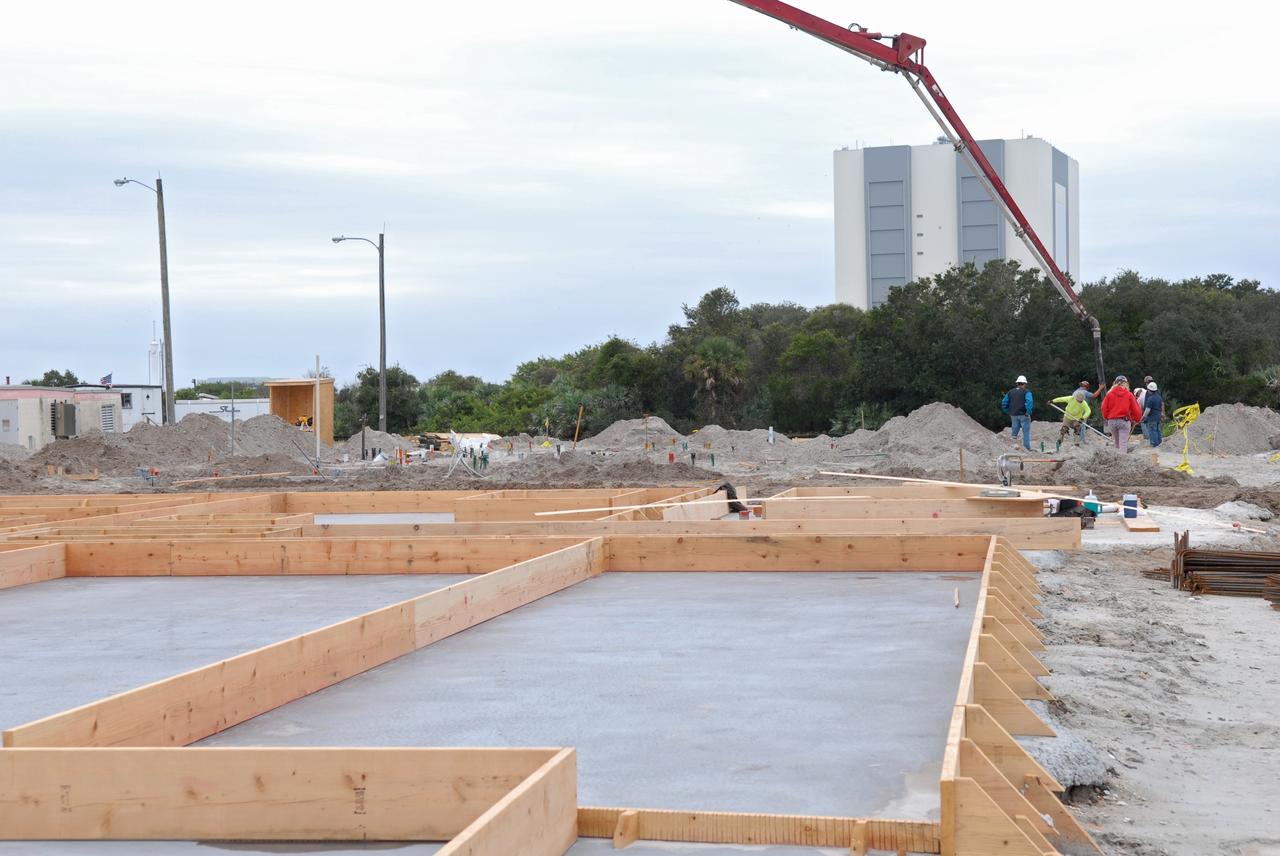
CAPE CANAVERAL, Fla. - In Launch Complex 39 at NASA's Kennedy Space Center in Florida, high-density foam insulation between the concrete layers of the Propellants North Administrative and Maintenance Facility's walls will prevent any transfer of radiant heat between the exterior and interior of the building. A tilt-up construction method is being used to erect a THERMOMASS concrete wall insulation system for the facility's walls. In this approach, the exterior layer of concrete for the wall panels is poured and leveled on the building's footprint. Then, prefabricated, predrilled insulation sheets are arranged on top of the unhardened concrete, and connectors, designed to hold the sandwiched layers of concrete and insulation secure, are inserted through the predrilled holes. Next, the structural wythe is poured. Once cured, these panels are lifted upright to form the building's envelope. The facility will have a two-story administrative building to house managers, mechanics and technicians who fuel spacecraft at Kennedy adjacent to an 1,800-square-foot single-story shop to store cryogenic fuel transfer equipment. The new facility will feature high-efficiency roofs and walls, “Cool Dry Quiet” air conditioning with energy recovery technology, efficient lighting, and other sustainable features. The facility is striving to qualify for the U.S. Green Building Council’s Leadership in Energy and Environmental Design, or LEED, Platinum certification. If successful, Propellants North will be the first Kennedy facility to achieve this highest of LEED ratings after it is completed in the summer of 2010. The facility was designed for NASA by Jones Edmunds and Associates. Photo credit: NASA/Jim Grossmann
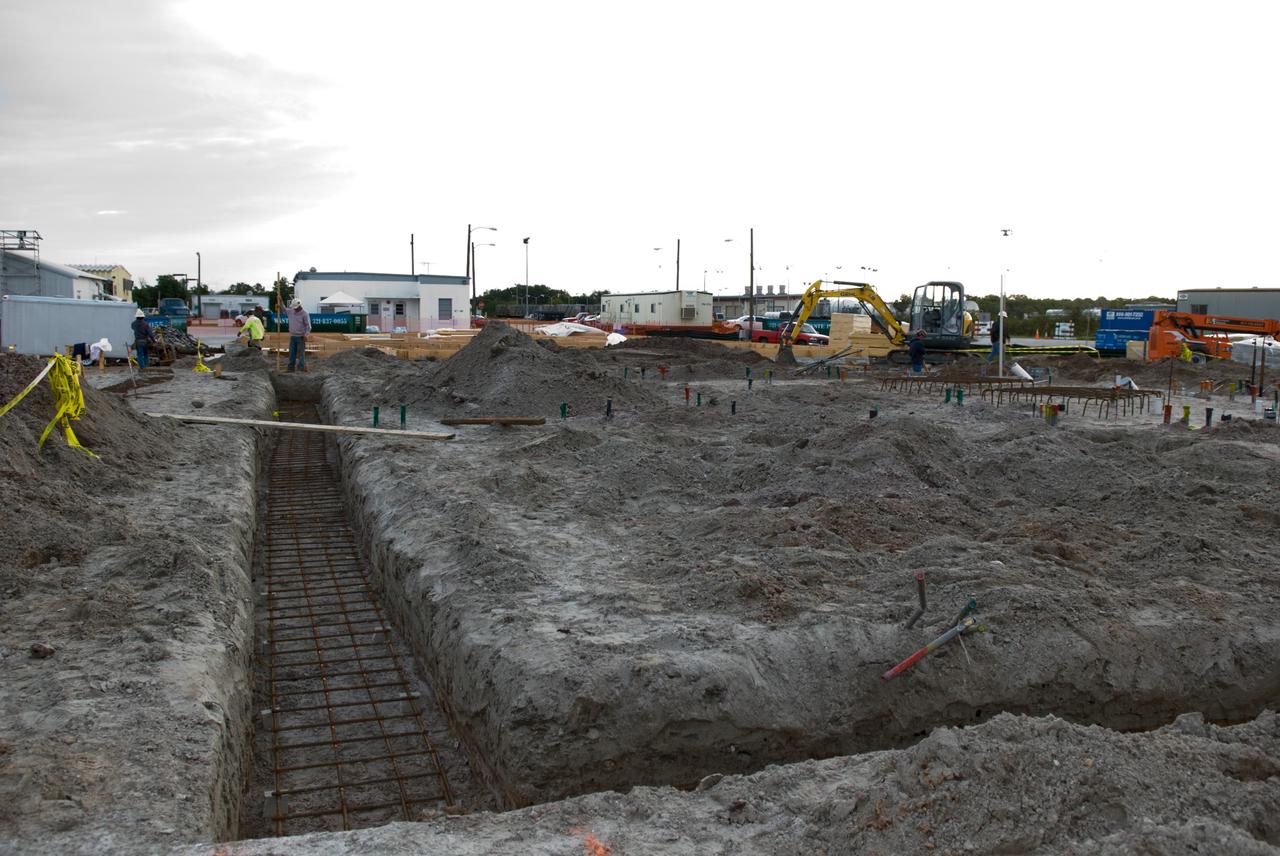
CAPE CANAVERAL, Fla. - Concrete is poured into the trenches that will provide the foundation for the walls of the Propellants North Administrative and Maintenance Facility in Launch Complex 39 at NASA's Kennedy Space Center in Florida. A tilt-up construction method is being used to erect a THERMOMASS concrete wall insulation system for the facility's walls. The facility will have a two-story administrative building to house managers, mechanics and technicians who fuel spacecraft at Kennedy adjacent to an 1,800-square-foot single-story shop to store cryogenic fuel transfer equipment. The new facility will feature high-efficiency roofs and walls, “Cool Dry Quiet” air conditioning with energy recovery technology, efficient lighting, and other sustainable features. The facility is striving to qualify for the U.S. Green Building Council’s Leadership in Energy and Environmental Design, or LEED, Platinum certification. If successful, Propellants North will be the first Kennedy facility to achieve this highest of LEED ratings after it is completed in the summer of 2010. The facility was designed for NASA by Jones Edmunds and Associates. Photo credit: NASA/Jim Grossmann
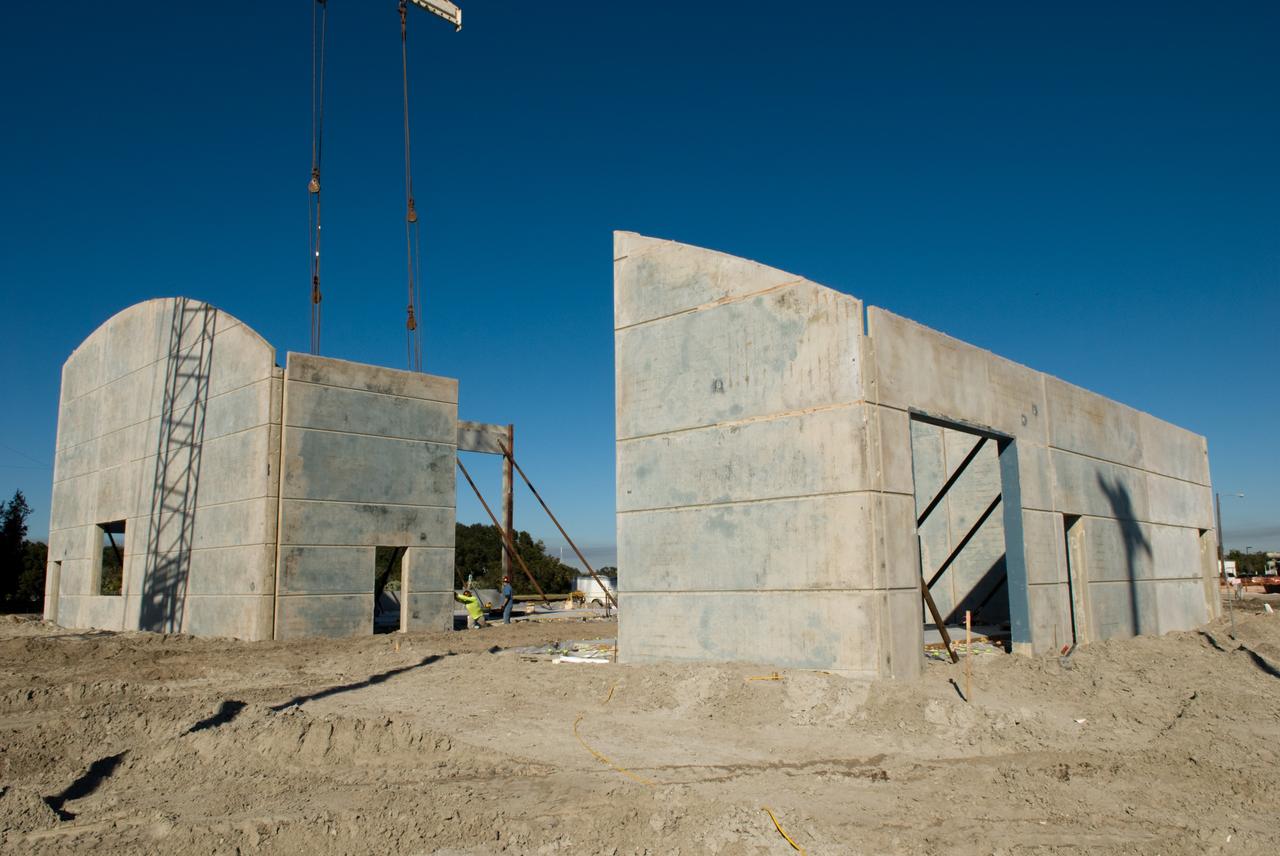
CAPE CANAVERAL, Fla. - In Launch Complex 39 at NASA's Kennedy Space Center in Florida, reminiscent of a barn-raising, the Propellants North Administrative and Maintenance Facility springs into being in a single day as its walls are lifted into position. A tilt-up construction method is being used to erect a THERMOMASS concrete wall insulation system for the facility's walls. In this approach, the exterior layer of concrete for the wall panels is poured and leveled on the building's footprint. Then, prefabricated, predrilled insulation sheets are arranged on top of the unhardened concrete, and connectors, designed to hold the sandwiched layers of concrete and insulation secure, are inserted through the predrilled holes. Next, the structural wythe is poured. Once cured, these panels are lifted upright to form the building's envelope. The facility will have a two-story administrative building to house managers, mechanics and technicians who fuel spacecraft at Kennedy adjacent to an 1,800-square-foot single-story shop to store cryogenic fuel transfer equipment. The new facility will feature high-efficiency roofs and walls, “Cool Dry Quiet” air conditioning with energy recovery technology, efficient lighting, and other sustainable features. The facility is striving to qualify for the U.S. Green Building Council’s Leadership in Energy and Environmental Design, or LEED, Platinum certification. If successful, Propellants North will be the first Kennedy facility to achieve this highest of LEED ratings after it is completed in the summer of 2010. The facility was designed for NASA by Jones Edmunds and Associates. Photo credit: NASA/Jim Grossmann

CAPE CANAVERAL, Fla. - In Launch Complex 39 at NASA's Kennedy Space Center in Florida, a team of construction workers ensures that the walls of the Propellants North Administrative and Maintenance Facility are installed properly. A tilt-up construction method is being used to erect a THERMOMASS concrete wall insulation system for the facility's walls. In this approach, the exterior layer of concrete for the wall panels is poured and leveled on the building's footprint. Then, prefabricated, predrilled insulation sheets are arranged on top of the unhardened concrete, and connectors, designed to hold the sandwiched layers of concrete and insulation secure, are inserted through the predrilled holes. Next, the structural wythe is poured. Once cured, these panels are lifted upright to form the building's envelope. The facility will have a two-story administrative building to house managers, mechanics and technicians who fuel spacecraft at Kennedy adjacent to an 1,800-square-foot single-story shop to store cryogenic fuel transfer equipment. The new facility will feature high-efficiency roofs and walls, “Cool Dry Quiet” air conditioning with energy recovery technology, efficient lighting, and other sustainable features. The facility is striving to qualify for the U.S. Green Building Council’s Leadership in Energy and Environmental Design, or LEED, Platinum certification. If successful, Propellants North will be the first Kennedy facility to achieve this highest of LEED ratings after it is completed in the summer of 2010. The facility was designed for NASA by Jones Edmunds and Associates. Photo credit: NASA/Jim Grossmann
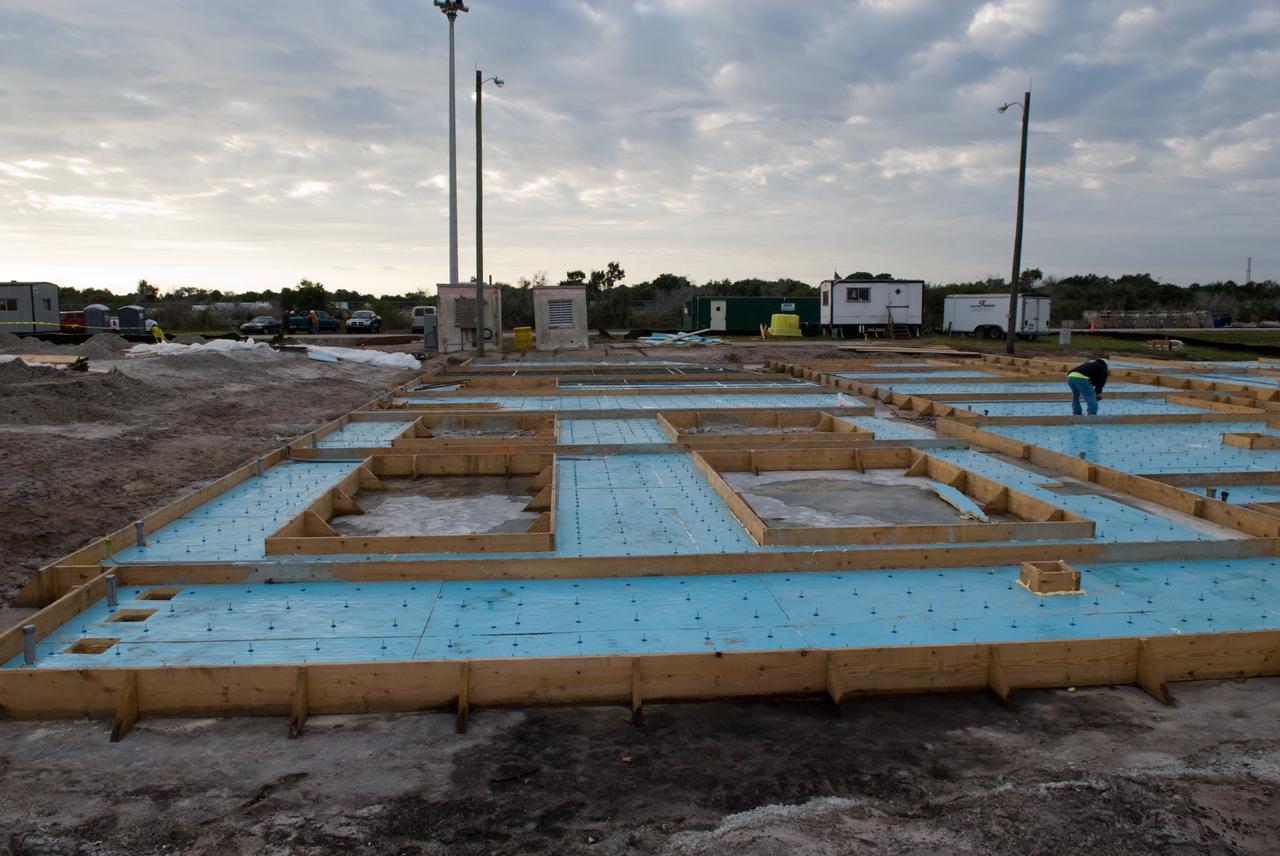
CAPE CANAVERAL, Fla. - In Launch Complex 39 at NASA's Kennedy Space Center in Florida, concrete layers on either side of the high-density foam insulation of the Propellants North Administrative and Maintenance Facility's walls will prevent any transfer of radiant heat between the exterior and interior of the building. A tilt-up construction method is being used to erect a THERMOMASS concrete wall insulation system for the facility's walls. In this approach, the exterior layer of concrete for the wall panels is poured and leveled on the building's footprint. Then, prefabricated, predrilled insulation sheets are arranged on top of the unhardened concrete, and connectors, designed to hold the sandwiched layers of concrete and insulation secure, are inserted through the predrilled holes. Next, the structural wythe is poured. Once cured, these panels are lifted upright to form the building's envelope. The facility will have a two-story administrative building to house managers, mechanics and technicians who fuel spacecraft at Kennedy adjacent to an 1,800-square-foot single-story shop to store cryogenic fuel transfer equipment. The new facility will feature high-efficiency roofs and walls, “Cool Dry Quiet” air conditioning with energy recovery technology, efficient lighting, and other sustainable features. The facility is striving to qualify for the U.S. Green Building Council’s Leadership in Energy and Environmental Design, or LEED, Platinum certification. If successful, Propellants North will be the first Kennedy facility to achieve this highest of LEED ratings after it is completed in the summer of 2010. The facility was designed for NASA by Jones Edmunds and Associates. Photo credit: NASA/Jim Grossmann

CAPE CANAVERAL, Fla. - In Launch Complex 39 at NASA's Kennedy Space Center in Florida, construction of the Propellants North Administrative and Maintenance Facility is moving ahead with the placement of all of the outside walls complete. Concrete layers on either side of high-density foam insulation in the facility's walls will prevent any transfer of radiant heat between the exterior and interior of the buildings. A tilt-up construction method is being used to erect a THERMOMASS concrete wall insulation system for the facility's walls. In this approach, the exterior layer of concrete for the wall panels is poured and leveled on the building's footprint. Then, prefabricated, predrilled insulation sheets are arranged on top of the unhardened concrete, and connectors, designed to hold the sandwiched layers of concrete and insulation secure, are inserted through the predrilled holes. Next, the structural wythe is poured. Once cured, these panels are lifted upright to form the building's envelope. The facility will have a two-story administrative building to house managers, mechanics and technicians who fuel spacecraft at Kennedy adjacent to an 1,800-square-foot single-story shop to store cryogenic fuel transfer equipment. The new facility will feature high-efficiency roofs and walls, “Cool Dry Quiet” air conditioning with energy recovery technology, efficient lighting, and other sustainable features. The facility is striving to qualify for the U.S. Green Building Council’s Leadership in Energy and Environmental Design, or LEED, Platinum certification. If successful, Propellants North will be the first Kennedy facility to achieve this highest of LEED ratings after it is completed in the summer of 2010. The facility was designed for NASA by Jones Edmunds and Associates. Photo credit: NASA/Jim Grossmann
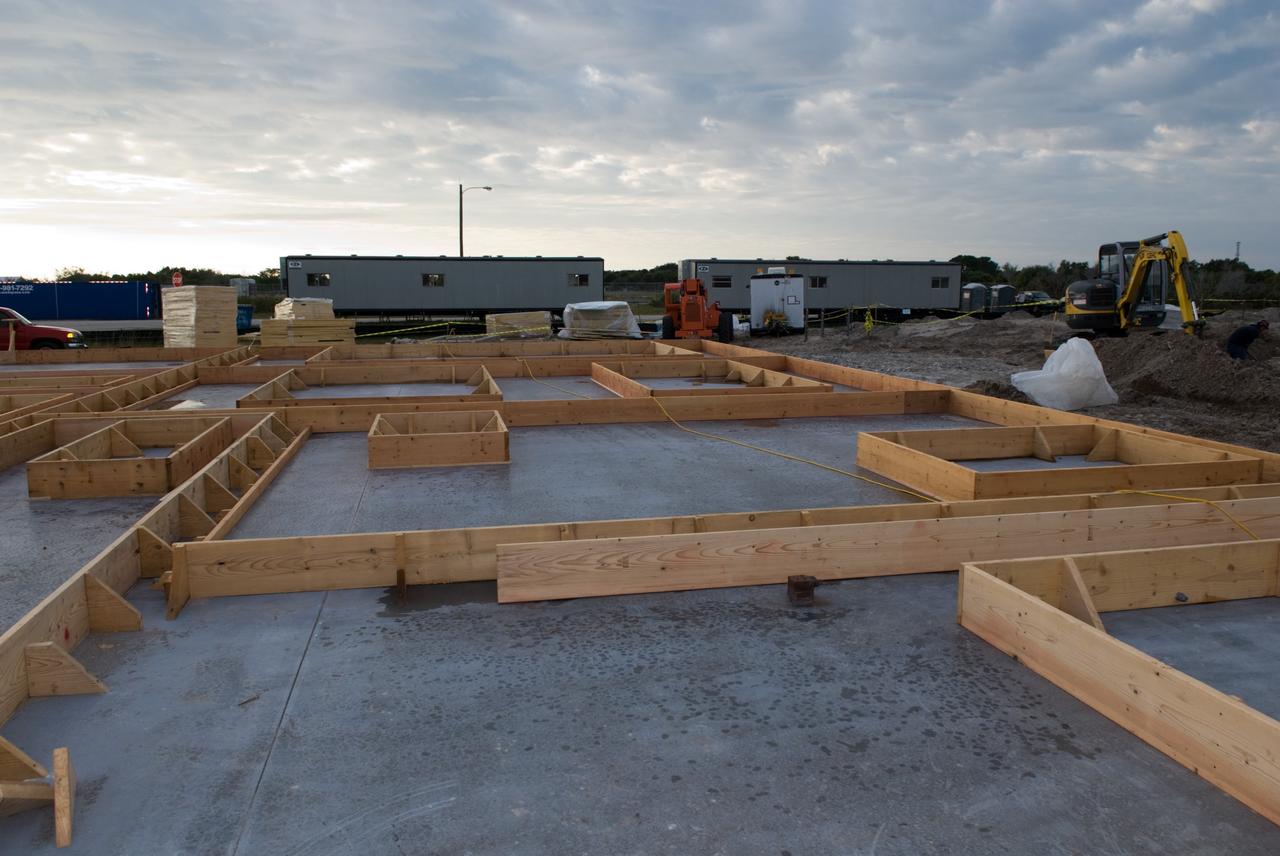
CAPE CANAVERAL, Fla. - Concrete covers the insulation in the walls for the Propellants North Administrative and Maintenance Facility in Launch Complex 39 at NASA's Kennedy Space Center in Florida. A tilt-up construction method is being used to erect a THERMOMASS concrete wall insulation system for the facility's walls. In this approach, the exterior layer of concrete for the wall panels is poured and leveled on the building's footprint. Then, prefabricated, predrilled insulation sheets are arranged on top of the unhardened concrete, and connectors, designed to hold the sandwiched layers of concrete and insulation secure, are inserted through the predrilled holes. Next, the structural wythe is poured. Once cured, these panels are lifted upright to form the building's envelope. The facility will have a two-story administrative building to house managers, mechanics and technicians who fuel spacecraft at Kennedy adjacent to an 1,800-square-foot single-story shop to store cryogenic fuel transfer equipment. The new facility will feature high-efficiency roofs and walls, “Cool Dry Quiet” air conditioning with energy recovery technology, efficient lighting, and other sustainable features. The facility is striving to qualify for the U.S. Green Building Council’s Leadership in Energy and Environmental Design, or LEED, Platinum certification. If successful, Propellants North will be the first Kennedy facility to achieve this highest of LEED ratings after it is completed in the summer of 2010. The facility was designed for NASA by Jones Edmunds and Associates. Photo credit: NASA/Jim Grossmann
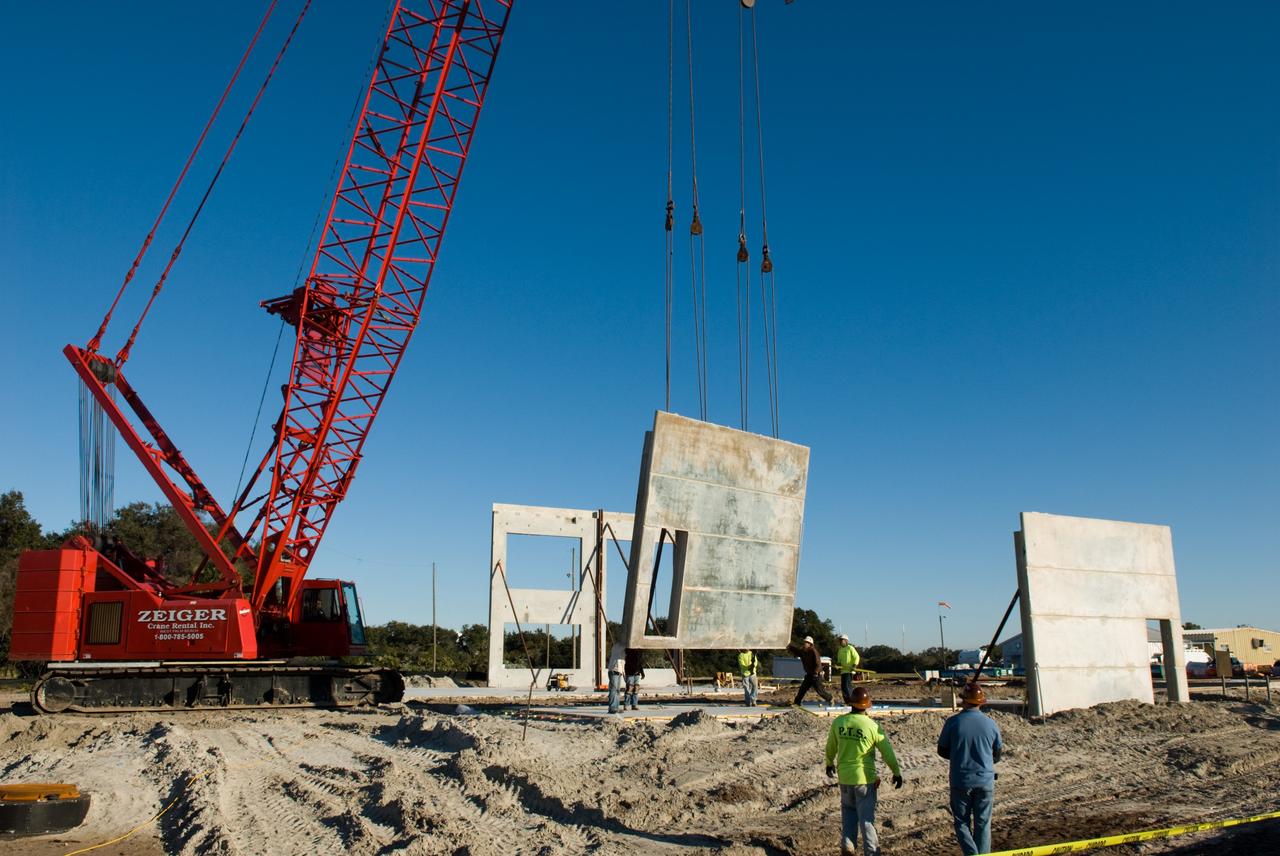
CAPE CANAVERAL, Fla. - In Launch Complex 39 at NASA's Kennedy Space Center in Florida, workers guide one of the walls of the Propellants North Administrative and Maintenance Facility into place. A tilt-up construction method is being used to erect a THERMOMASS concrete wall insulation system for the facility's walls. In this approach, the exterior layer of concrete for the wall panels is poured and leveled on the building's footprint. Then, prefabricated, predrilled insulation sheets are arranged on top of the unhardened concrete, and connectors, designed to hold the sandwiched layers of concrete and insulation secure, are inserted through the predrilled holes. Next, the structural wythe is poured. Once cured, these panels are lifted upright to form the building's envelope. The facility will have a two-story administrative building to house managers, mechanics and technicians who fuel spacecraft at Kennedy adjacent to an 1,800-square-foot single-story shop to store cryogenic fuel transfer equipment. The new facility will feature high-efficiency roofs and walls, “Cool Dry Quiet” air conditioning with energy recovery technology, efficient lighting, and other sustainable features. The facility is striving to qualify for the U.S. Green Building Council’s Leadership in Energy and Environmental Design, or LEED, Platinum certification. If successful, Propellants North will be the first Kennedy facility to achieve this highest of LEED ratings after it is completed in the summer of 2010. The facility was designed for NASA by Jones Edmunds and Associates. Photo credit: NASA/Jim Grossmann
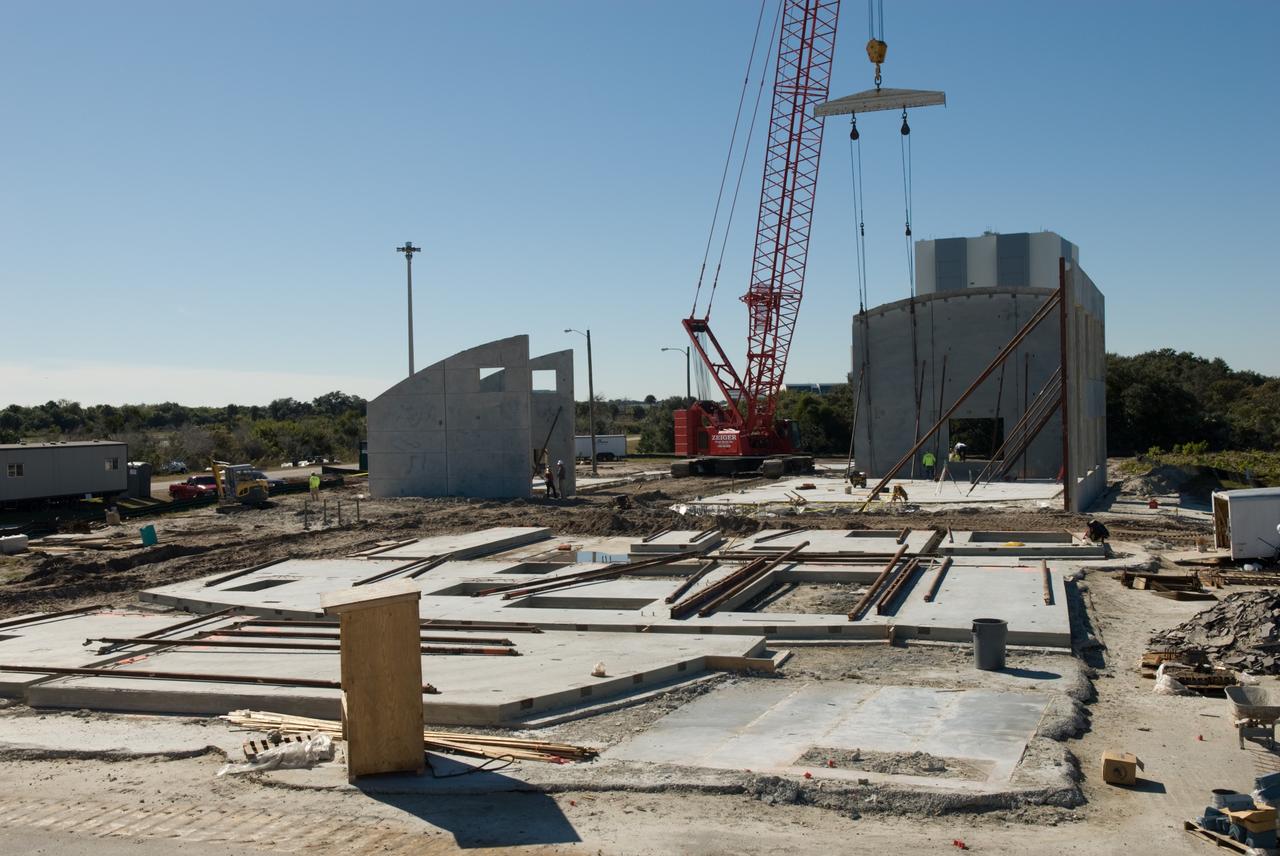
CAPE CANAVERAL, Fla. - In Launch Complex 39 at NASA's Kennedy Space Center in Florida, a crane is enlisted to lift the walls of the Propellants North Administrative and Maintenance Facility into position. A tilt-up construction method is being used to erect a THERMOMASS concrete wall insulation system for the facility's walls. In this approach, the exterior layer of concrete for the wall panels is poured and leveled on the building's footprint. Then, prefabricated, predrilled insulation sheets are arranged on top of the unhardened concrete, and connectors, designed to hold the sandwiched layers of concrete and insulation secure, are inserted through the predrilled holes. Next, the structural wythe is poured. Once cured, these panels are lifted upright to form the building's envelope. The facility will have a two-story administrative building to house managers, mechanics and technicians who fuel spacecraft at Kennedy adjacent to an 1,800-square-foot single-story shop to store cryogenic fuel transfer equipment. The new facility will feature high-efficiency roofs and walls, “Cool Dry Quiet” air conditioning with energy recovery technology, efficient lighting, and other sustainable features. The facility is striving to qualify for the U.S. Green Building Council’s Leadership in Energy and Environmental Design, or LEED, Platinum certification. If successful, Propellants North will be the first Kennedy facility to achieve this highest of LEED ratings after it is completed in the summer of 2010. The facility was designed for NASA by Jones Edmunds and Associates. Photo credit: NASA/Jim Grossmann
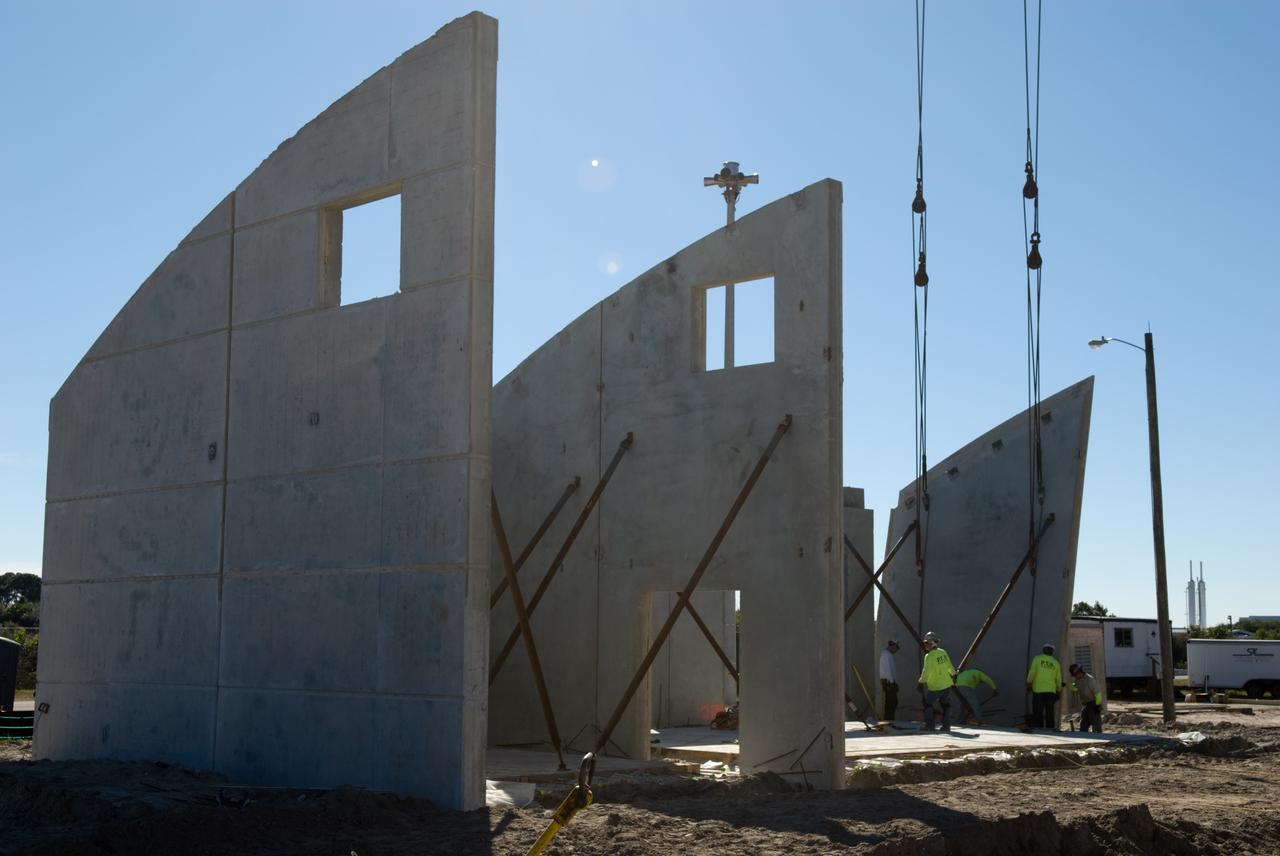
CAPE CANAVERAL, Fla. - In Launch Complex 39 at NASA's Kennedy Space Center in Florida, a row of walls is erected as the Propellants North Administrative and Maintenance Facility takes shape. A tilt-up construction method is being used to erect a THERMOMASS concrete wall insulation system for the facility's walls. In this approach, the exterior layer of concrete for the wall panels is poured and leveled on the building's footprint. Then, prefabricated, predrilled insulation sheets are arranged on top of the unhardened concrete, and connectors, designed to hold the sandwiched layers of concrete and insulation secure, are inserted through the predrilled holes. Next, the structural wythe is poured. Once cured, these panels are lifted upright to form the building's envelope. The facility will have a two-story administrative building to house managers, mechanics and technicians who fuel spacecraft at Kennedy adjacent to an 1,800-square-foot single-story shop to store cryogenic fuel transfer equipment. The new facility will feature high-efficiency roofs and walls, “Cool Dry Quiet” air conditioning with energy recovery technology, efficient lighting, and other sustainable features. The facility is striving to qualify for the U.S. Green Building Council’s Leadership in Energy and Environmental Design, or LEED, Platinum certification. If successful, Propellants North will be the first Kennedy facility to achieve this highest of LEED ratings after it is completed in the summer of 2010. The facility was designed for NASA by Jones Edmunds and Associates. Photo credit: NASA/Jim Grossmann
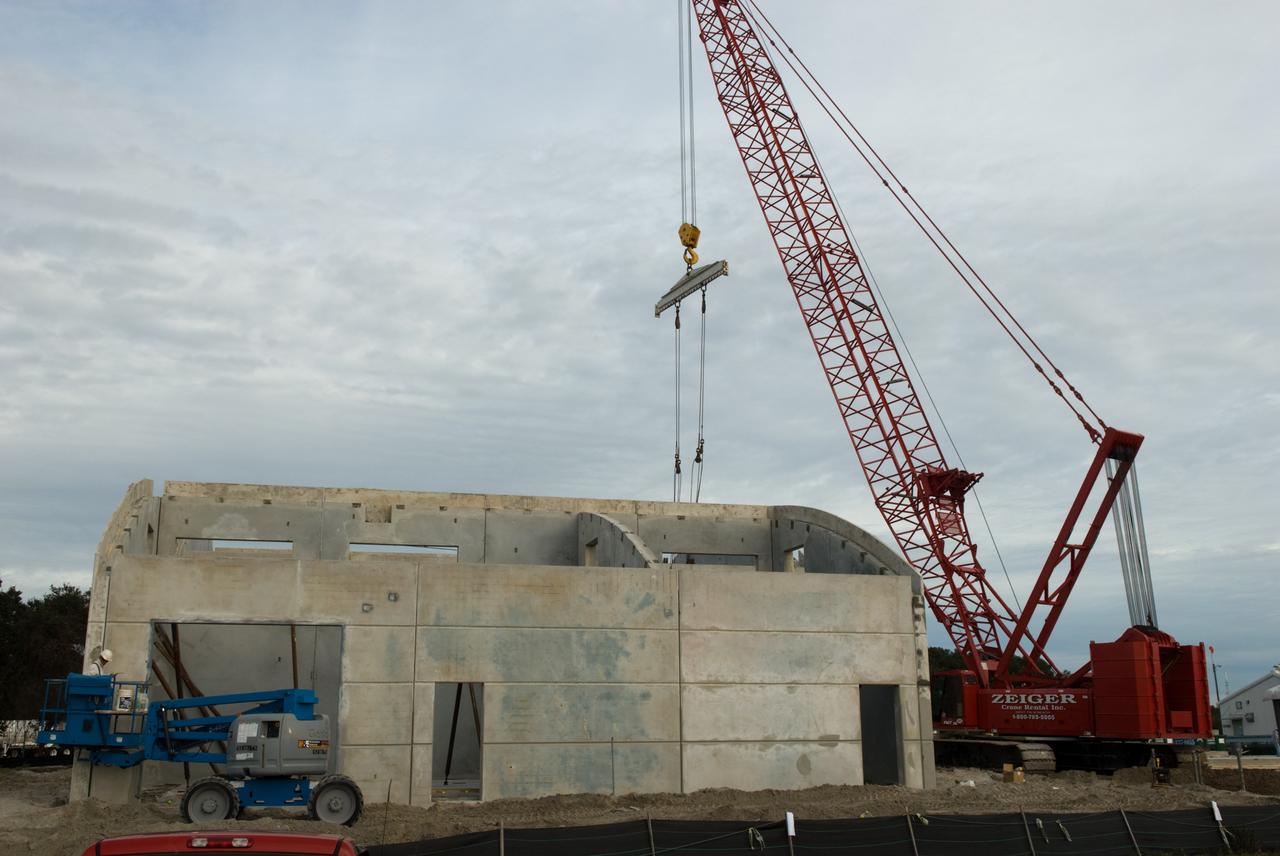
CAPE CANAVERAL, Fla. - In Launch Complex 39 at NASA's Kennedy Space Center in Florida, this crane raised all of the outside walls of the Propellants North Administrative and Maintenance Facility over a period of two days. Concrete layers on either side of high-density foam insulation in the facility's walls will prevent any transfer of radiant heat between the exterior and interior of the buildings. A tilt-up construction method is being used to erect a THERMOMASS concrete wall insulation system for the facility's walls. In this approach, the exterior layer of concrete for the wall panels is poured and leveled on the building's footprint. Then, prefabricated, predrilled insulation sheets are arranged on top of the unhardened concrete, and connectors, designed to hold the sandwiched layers of concrete and insulation secure, are inserted through the predrilled holes. Next, the structural wythe is poured. Once cured, these panels are lifted upright to form the building's envelope. The facility will have a two-story administrative building to house managers, mechanics and technicians who fuel spacecraft at Kennedy adjacent to an 1,800-square-foot single-story shop to store cryogenic fuel transfer equipment. The new facility will feature high-efficiency roofs and walls, “Cool Dry Quiet” air conditioning with energy recovery technology, efficient lighting, and other sustainable features. The facility is striving to qualify for the U.S. Green Building Council’s Leadership in Energy and Environmental Design, or LEED, Platinum certification. If successful, Propellants North will be the first Kennedy facility to achieve this highest of LEED ratings after it is completed in the summer of 2010. The facility was designed for NASA by Jones Edmunds and Associates. Photo credit: NASA/Jim Grossmann