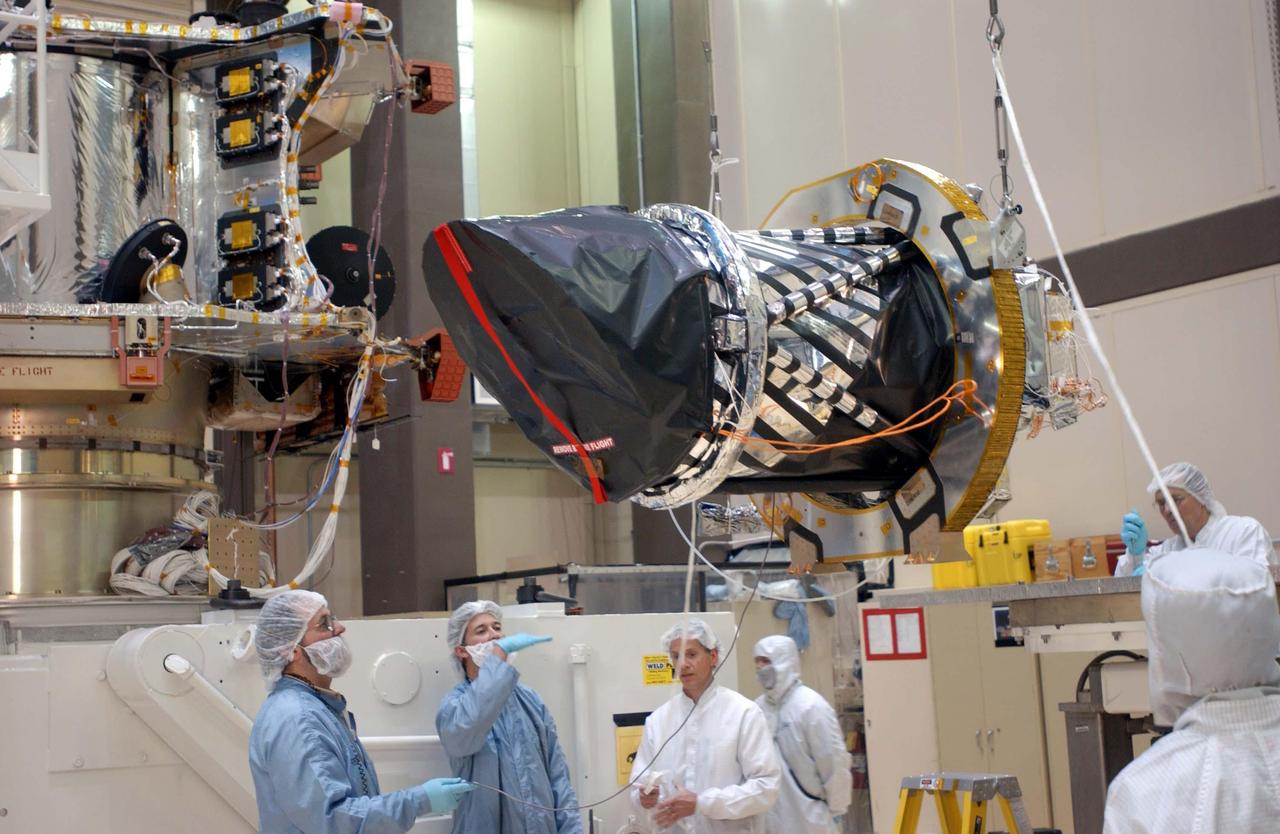
Workers at Lockheed Martin Space Systems, Denver, hoist a telescopic camera for installation onto NASA Mars Reconnaissance Orbiter spacecraft on Dec. 11, 2004.
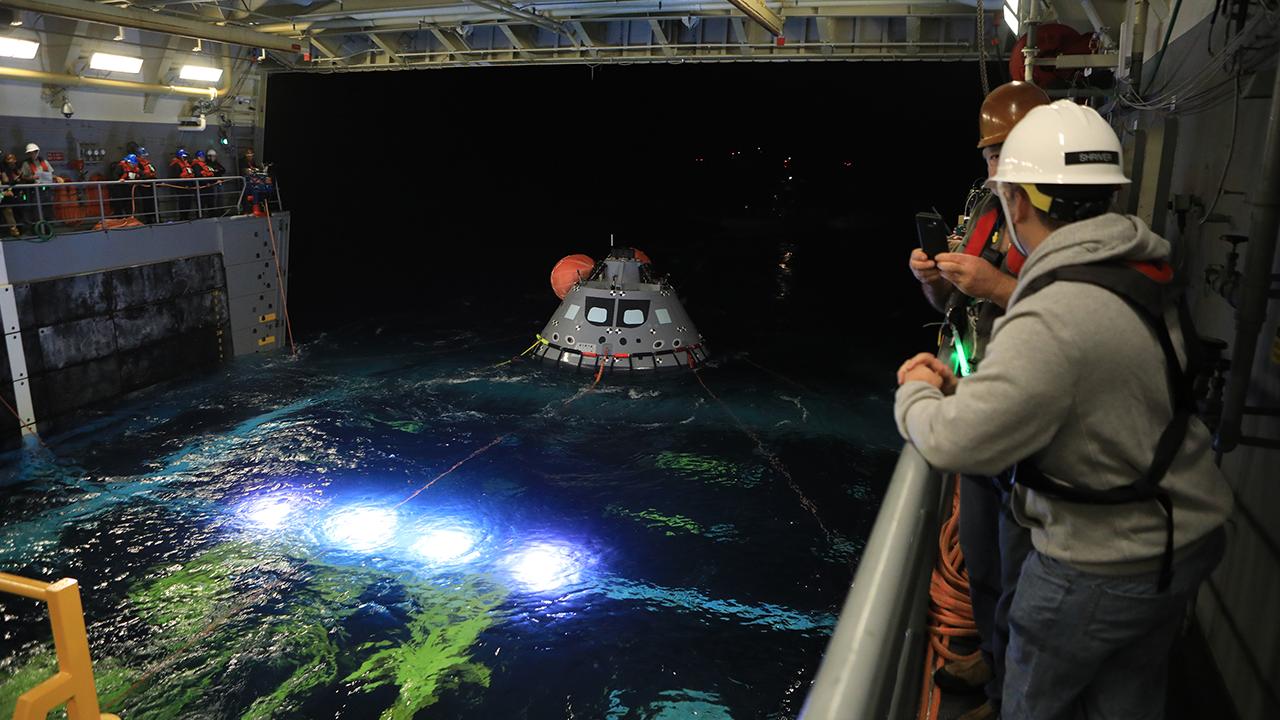
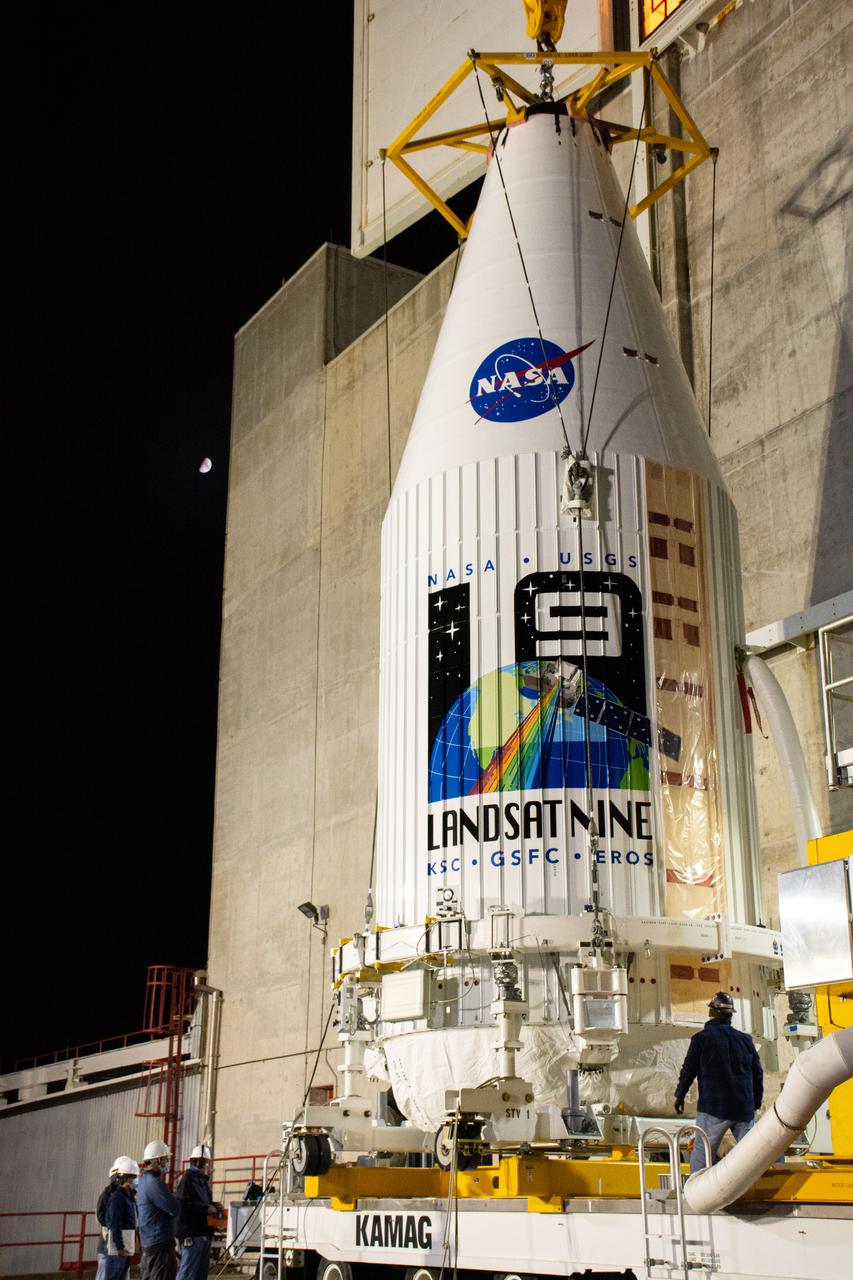
The Landsat 9 payload is hoisted out of the transfer tower at the Integration Processing Facility in preparation for transport to SLC-3 at Vandenberg Air Force Base in California.
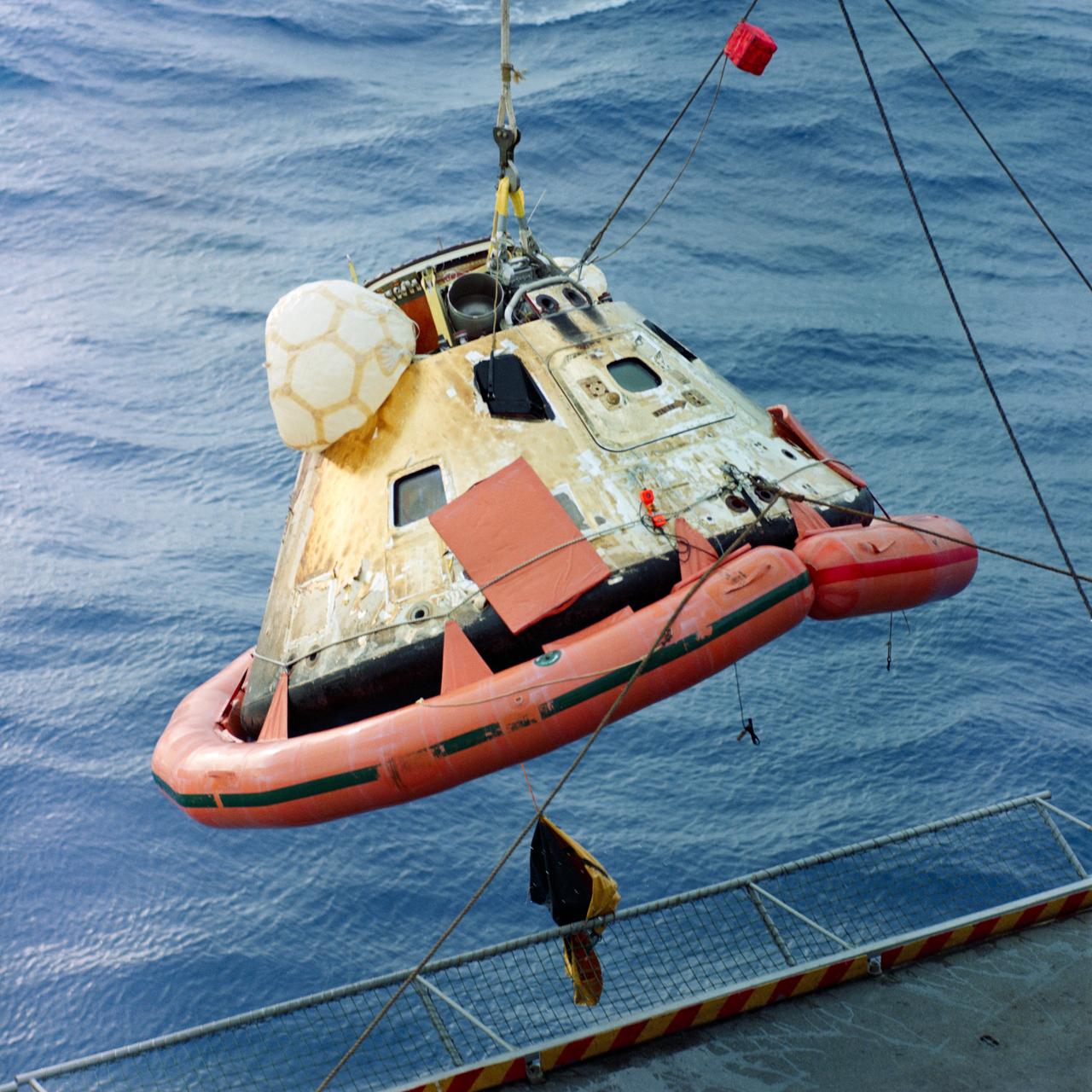
S68-56304 (27 Dec. 1968) --- The Apollo 8 capsule is seen being hoisted aboard the recovery carrier, USS Yorktown after its successful splashdown.
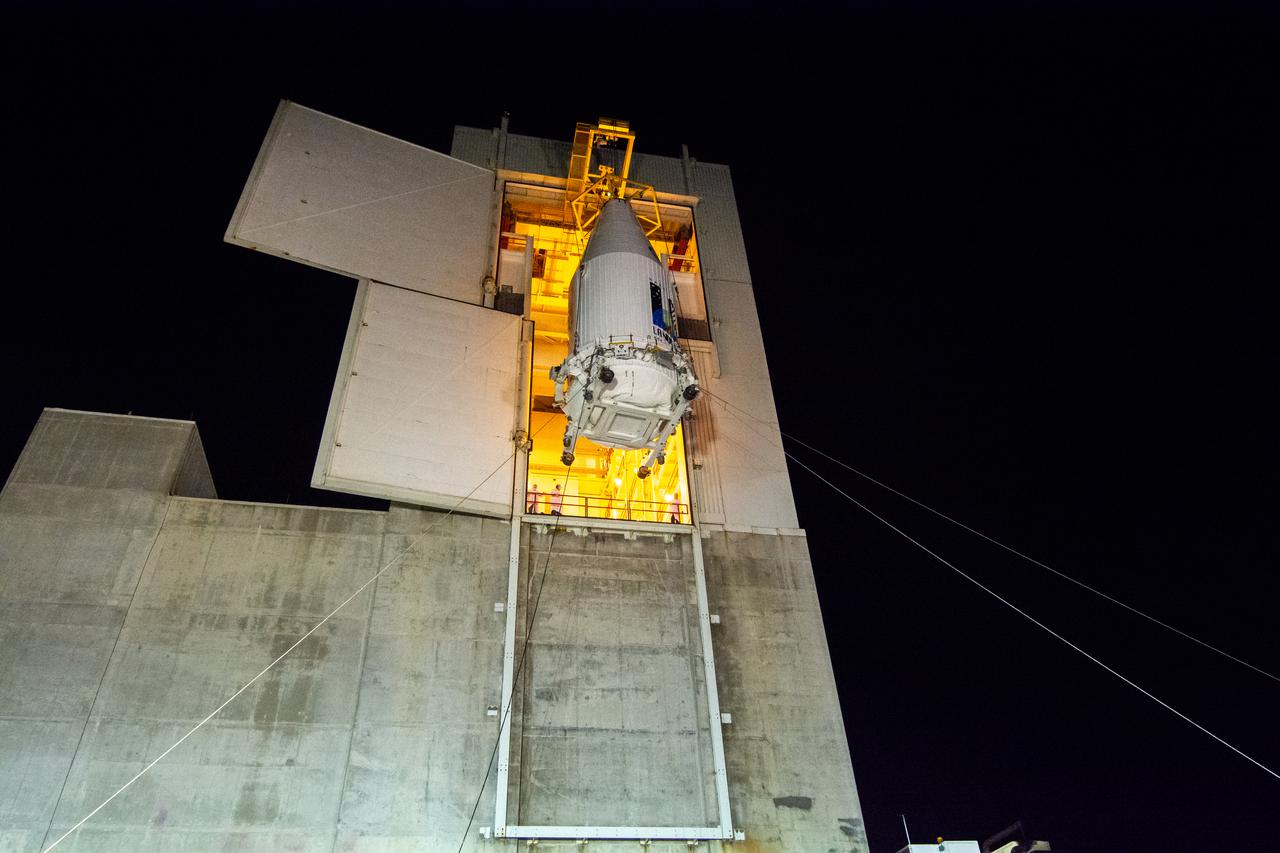
The Landsat 9 payload is hoisted out of the transfer tower at the Integration Processing Facility in preparation for transport to SLC-3 at Vandenberg Air Force Base in California.
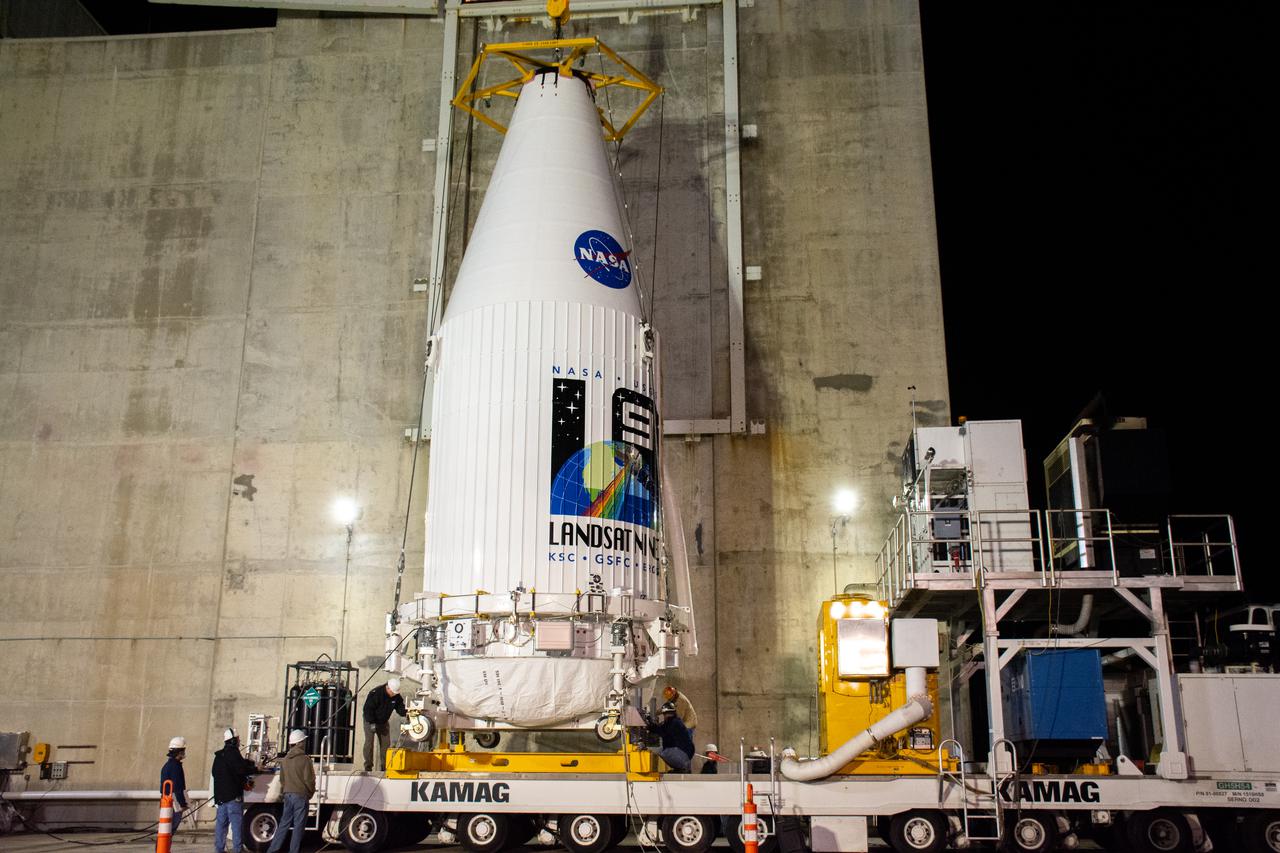
The Landsat 9 payload is hoisted out of the transfer tower at the Integration Processing Facility in preparation for transport to SLC-3 at Vandenberg Air Force Base in California.
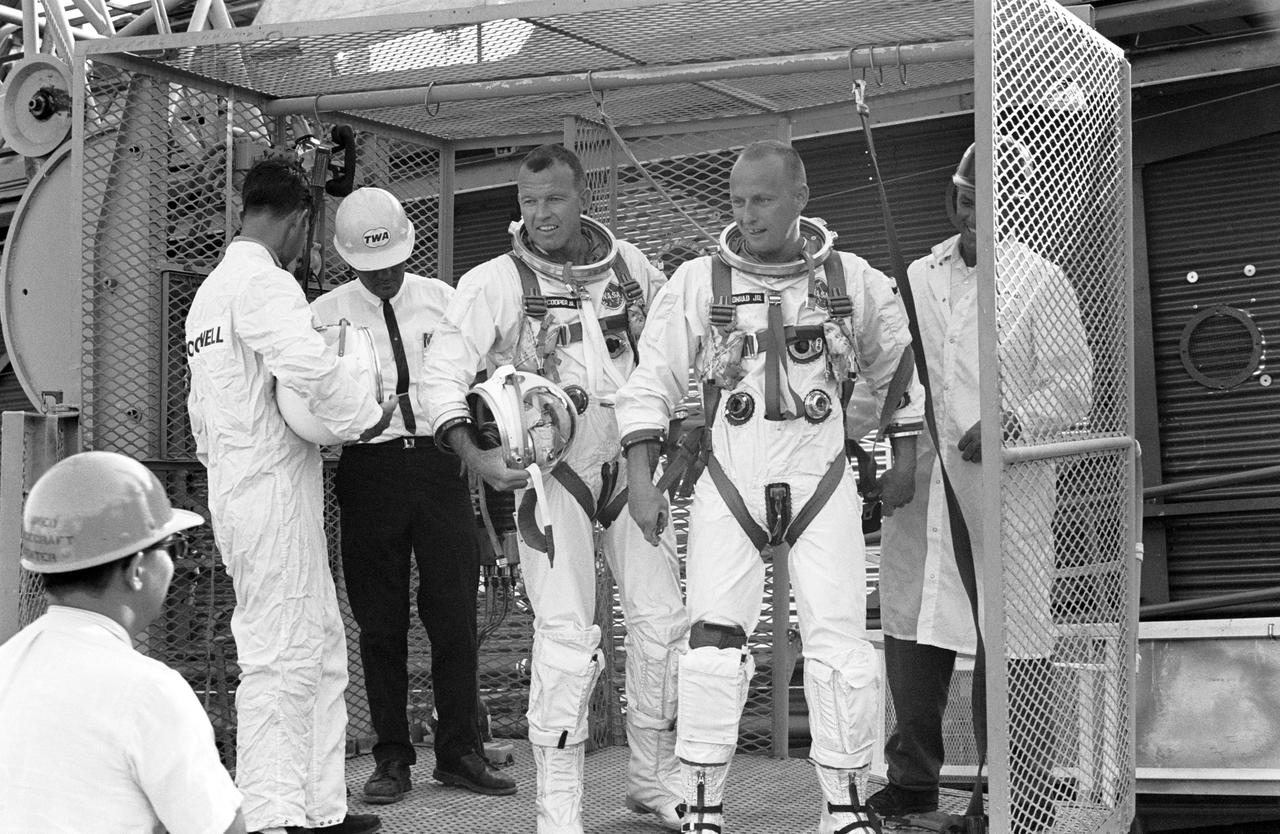
S65-41890 (6 Aug. 1965) --- Astronauts L. Gordon Cooper Jr. (left) and Charles Conrad Jr., prime crew for the Gemini-5 spaceflight, prepare to be hoisted to the white room atop gantry at Pad 19 at Cape Kennedy, Florida, during a simulation exercise for the mission.
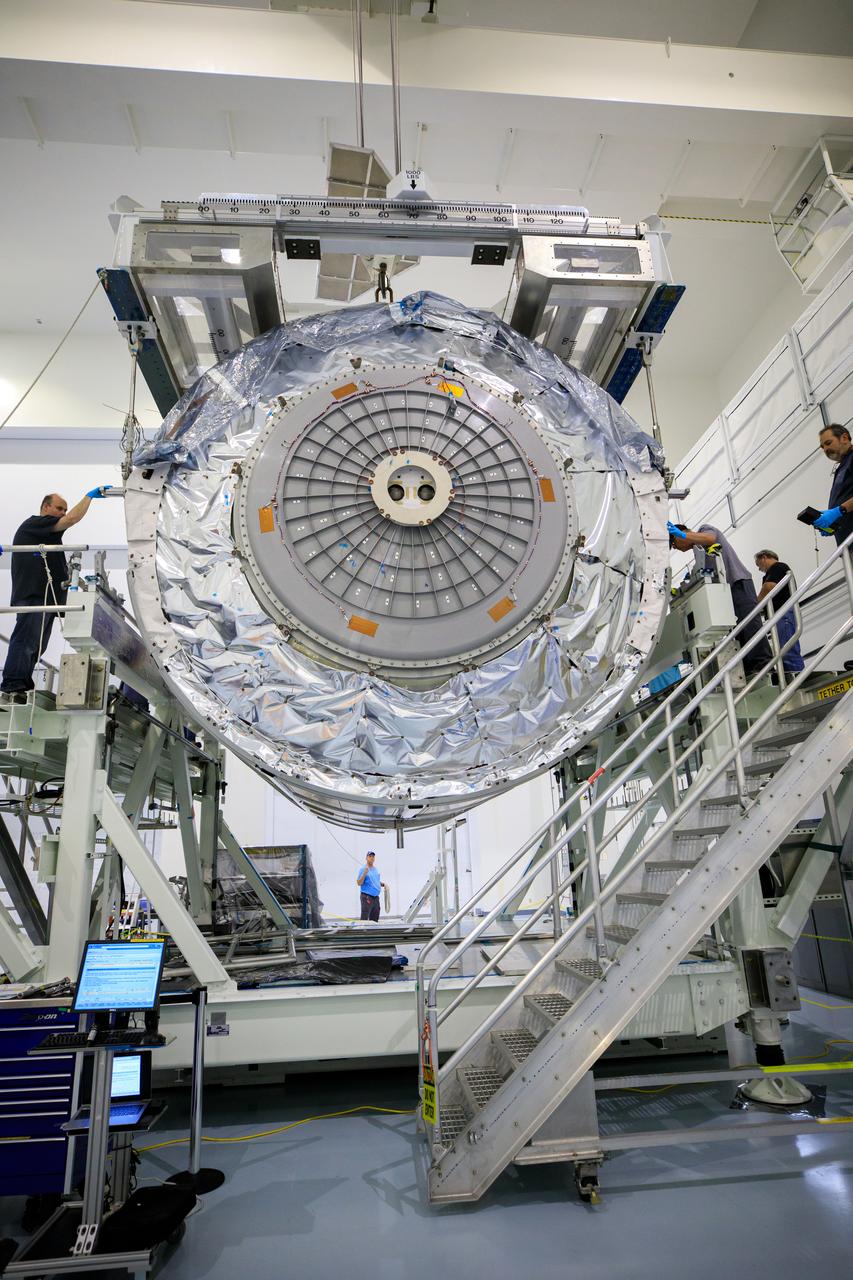
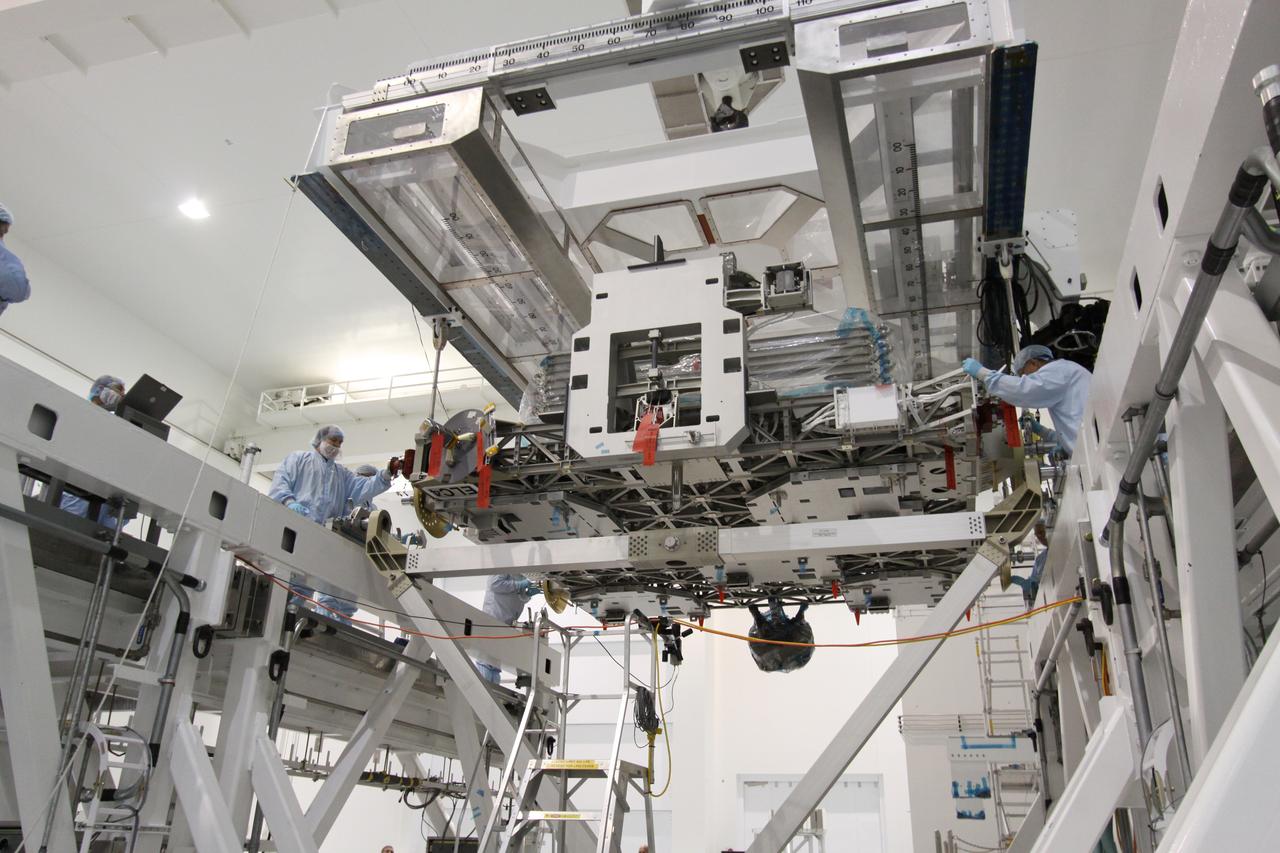
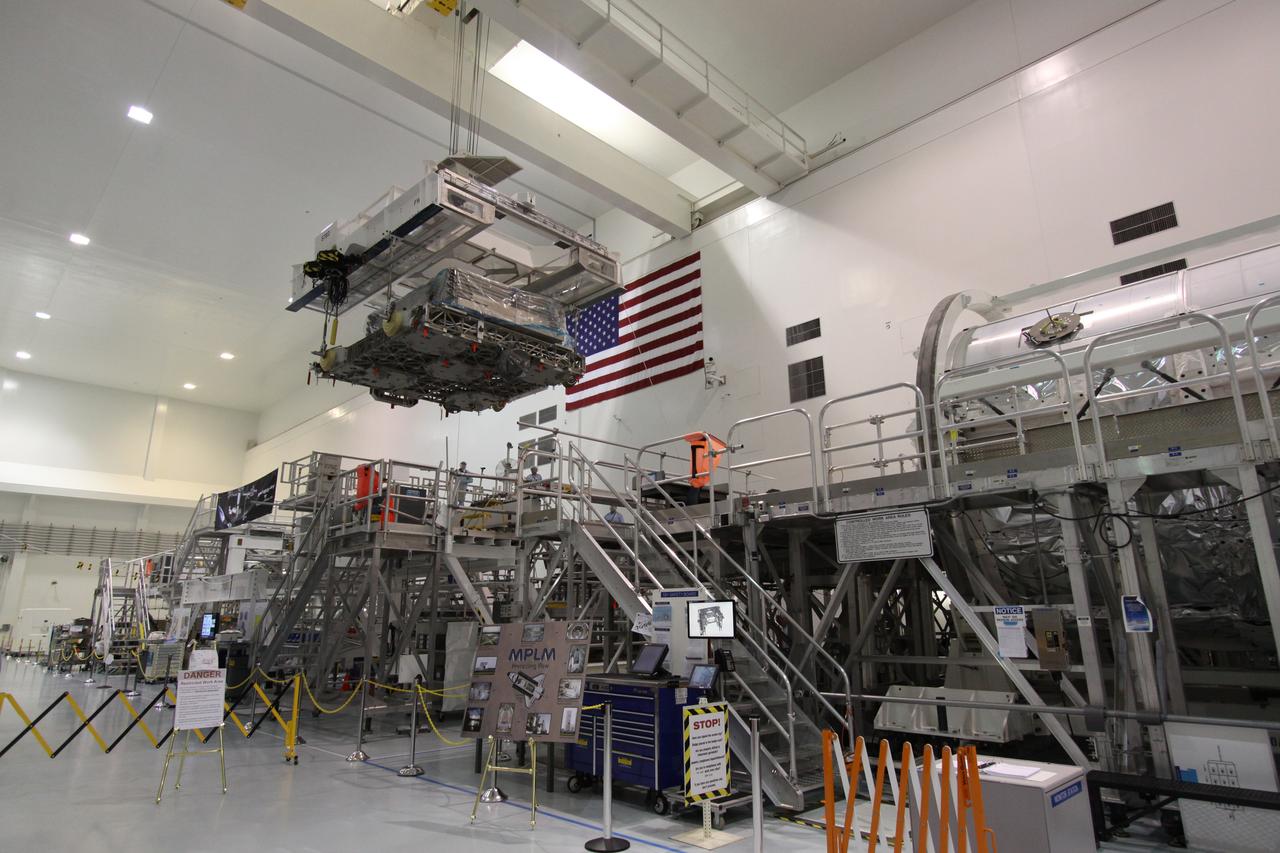
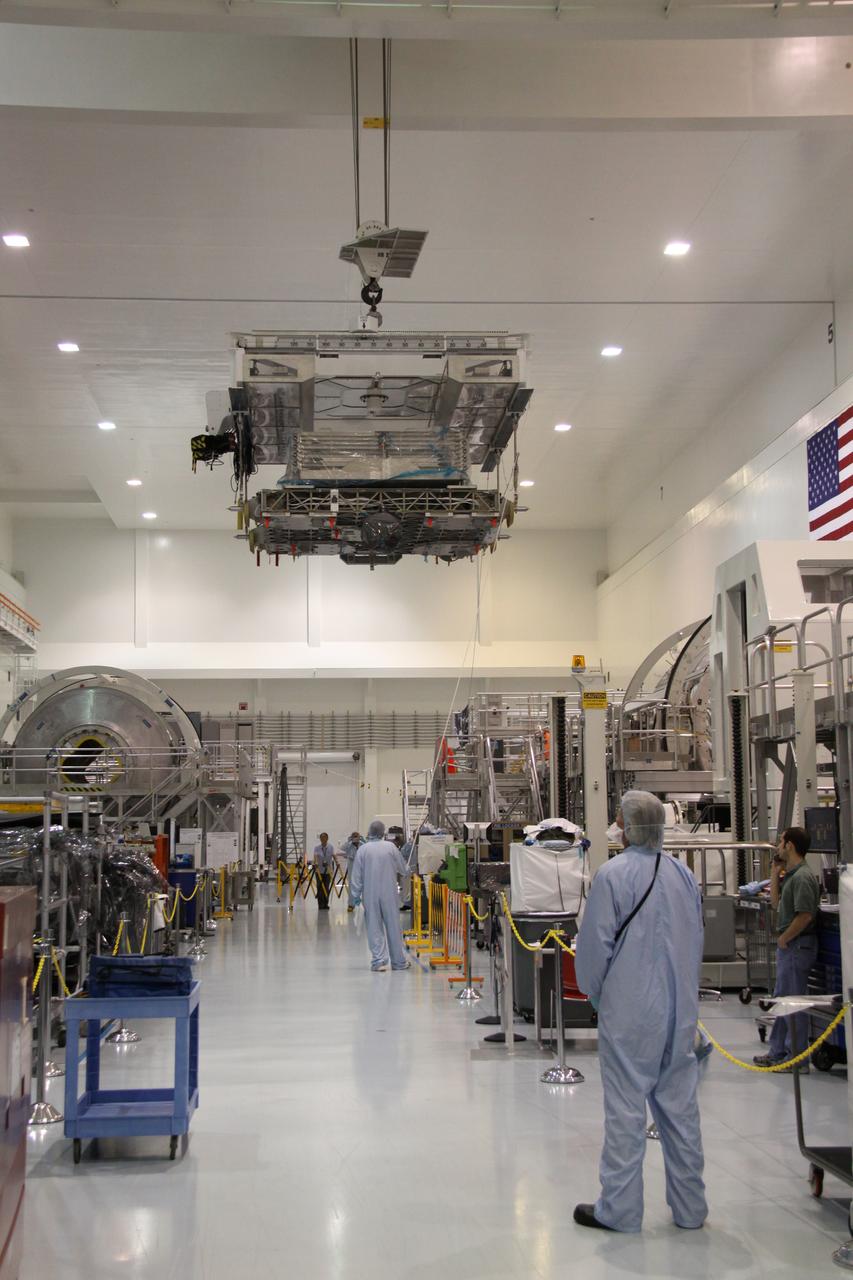
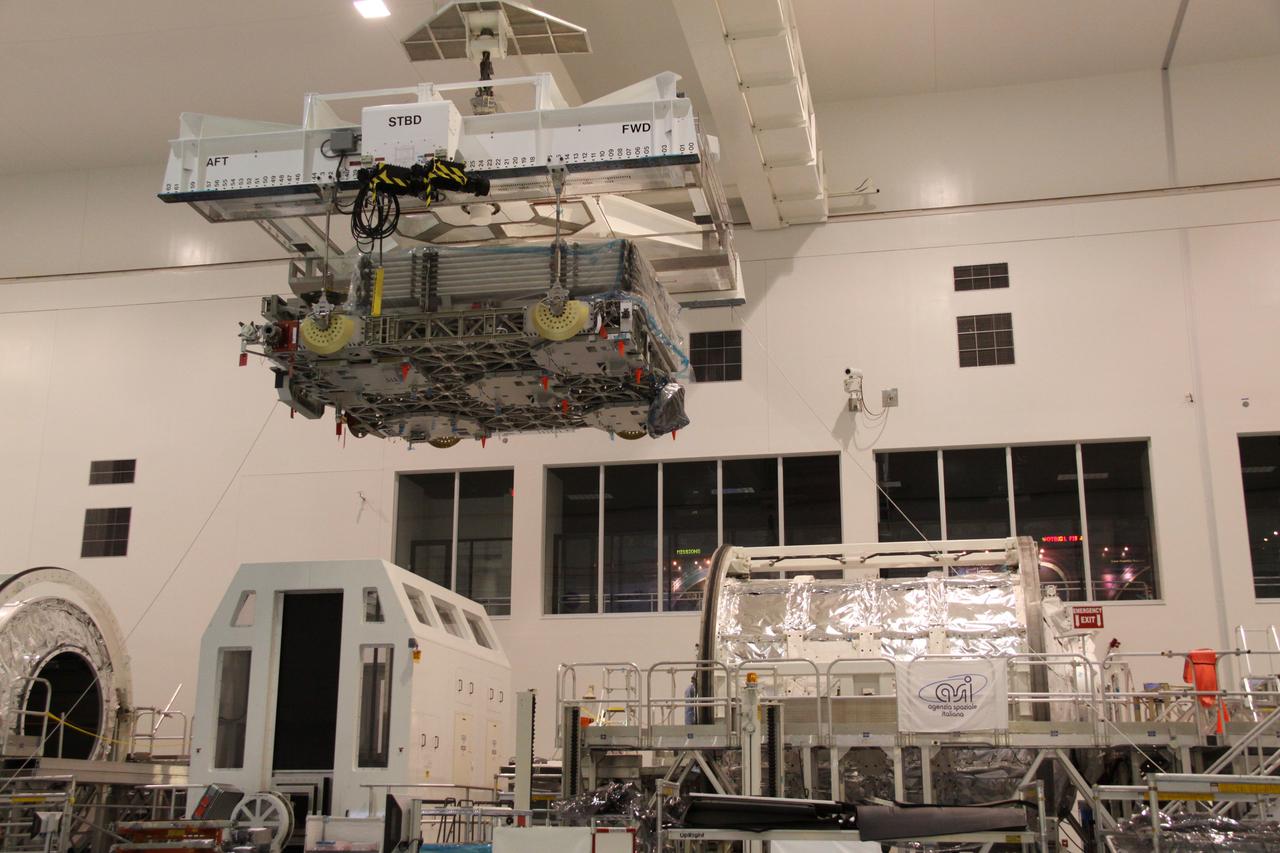
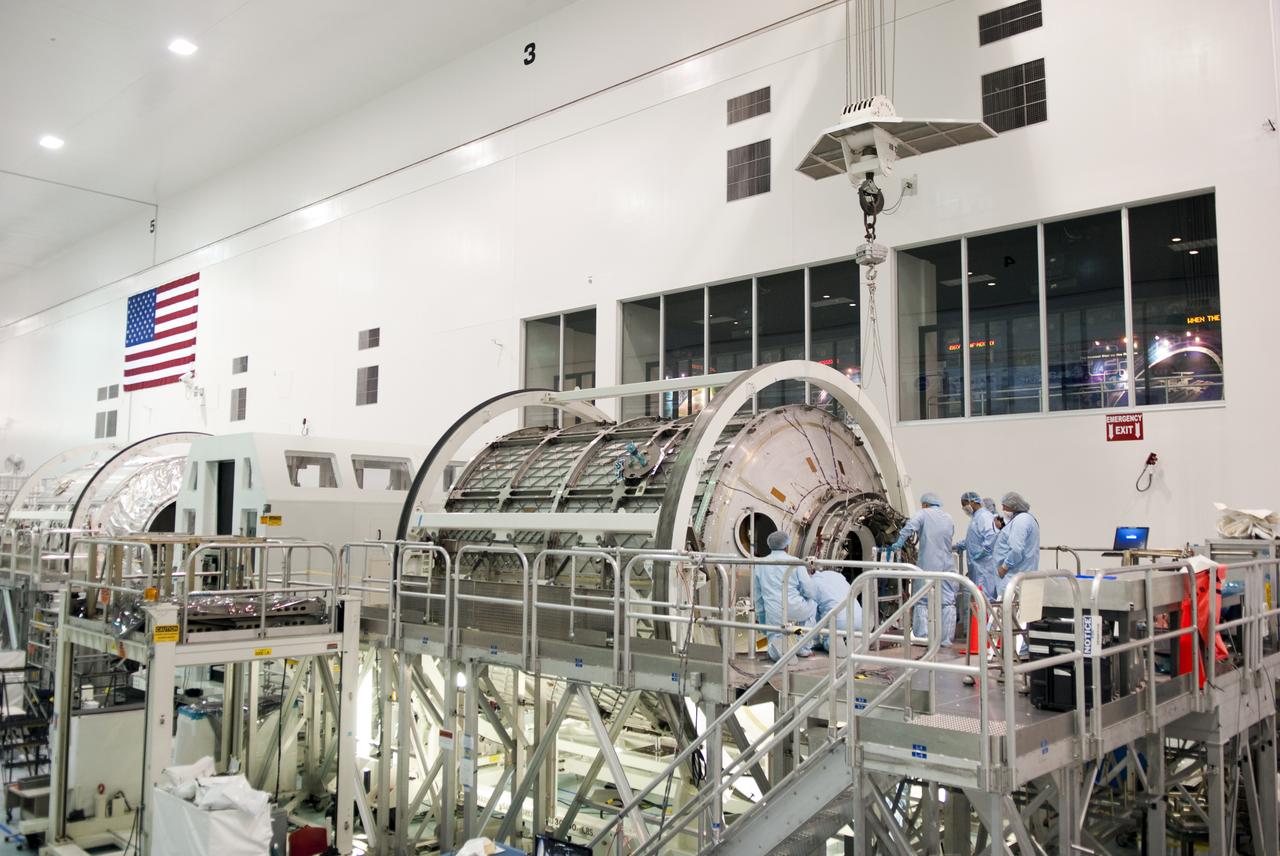
The Multi-Purpose Logistics Module (MPLM), used during the Space Shuttle Program to transfer cargo to and from the International Space Station, is hoisted up by crane inside the Space Station Processing Facility high bay at NASA’s Kennedy Space Center in Florida on April 20, 2023. The MPLM is being prepared for transport to Ellington Field in Houston, where it will then be transported by road to Axiom’s facility near Ellington to be utilized to further commercialization of space. Three MPLMs were built by Thales Alenia Space Italia (TASI) for the Italian Space Agency (ASI) and named after Italian masters (Leonardo, Raffaello, and Donatello). Only two ever flew to the space station, Leonardo and Raffaello, with Axiom intending to use Raffaello as a future element that will attach to a segment being built by the company for addition to the space station.
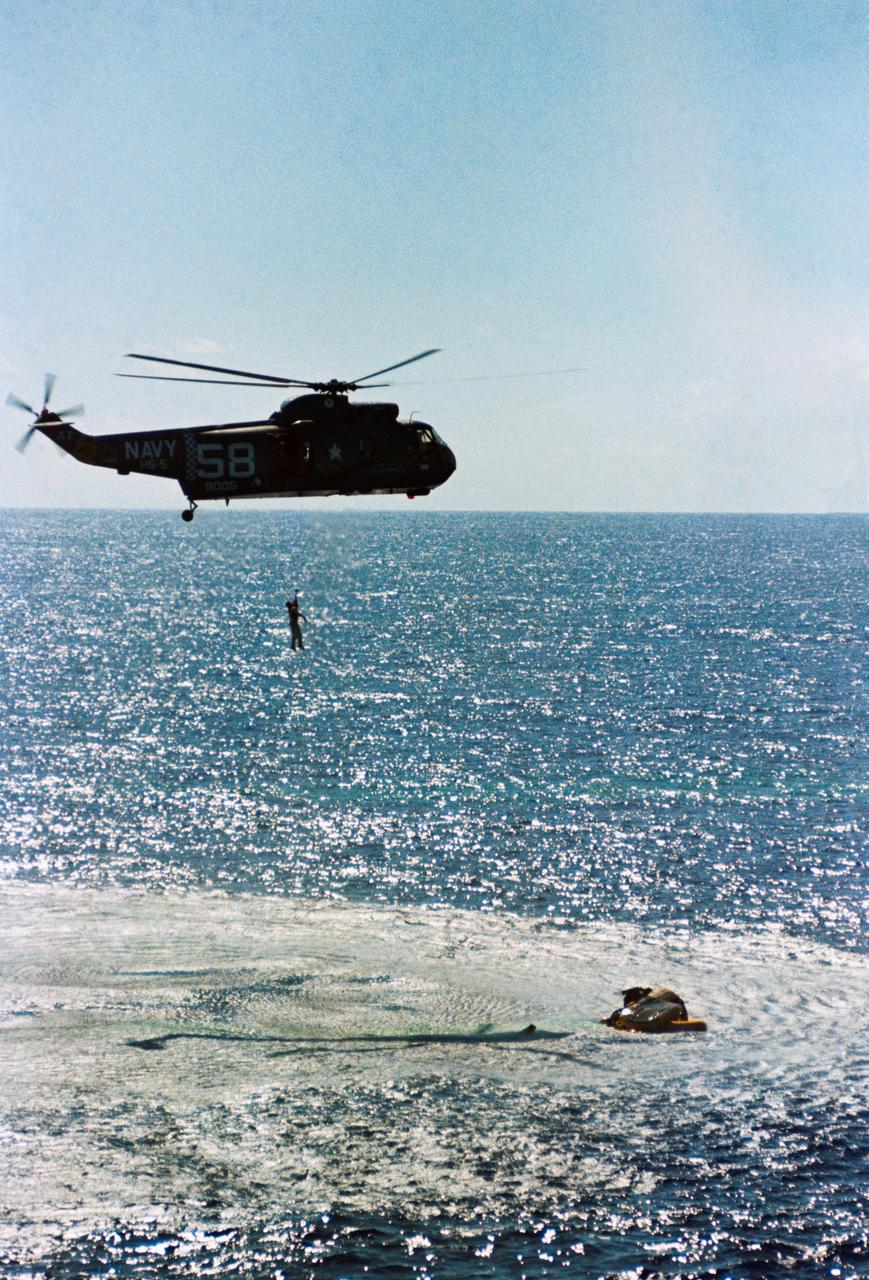
S65-51654 (29 Aug. 1965) --- Long range view of astronaut L. Gordon Cooper Jr. being hoisted up to a Navy helicopter during recovery operations in the Atlantic Ocean of the Gemini-5 spacecraft.

S65-46646 (29 Aug. 1965) --- Astronaut L. Gordon Cooper Jr. is hoisted up to a Navy helicopter during recovery operations in the Atlantic Ocean of the Gemini-5 spacecraft. The NASA Headquarter alternative photo number is 65-H-688.
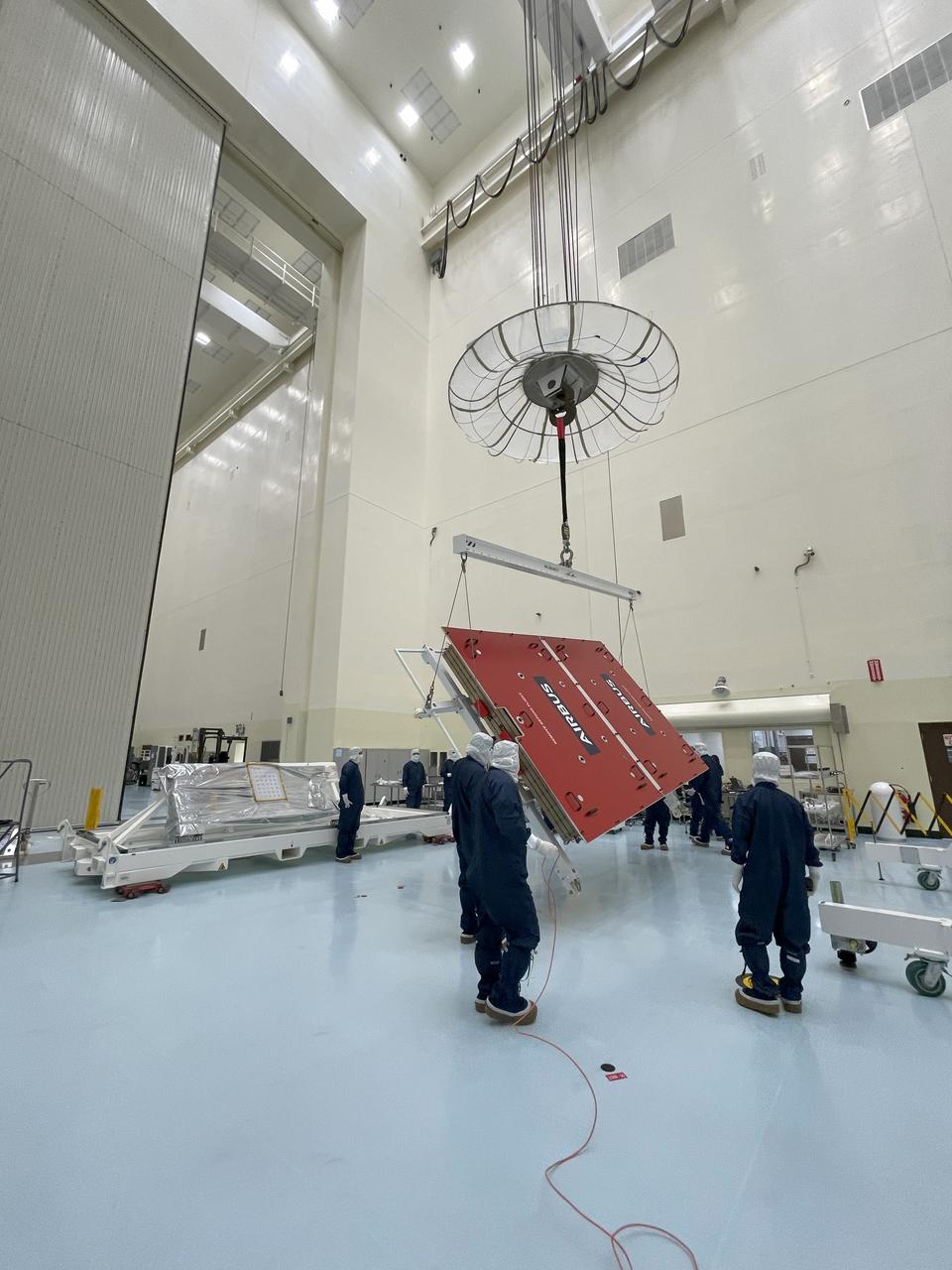
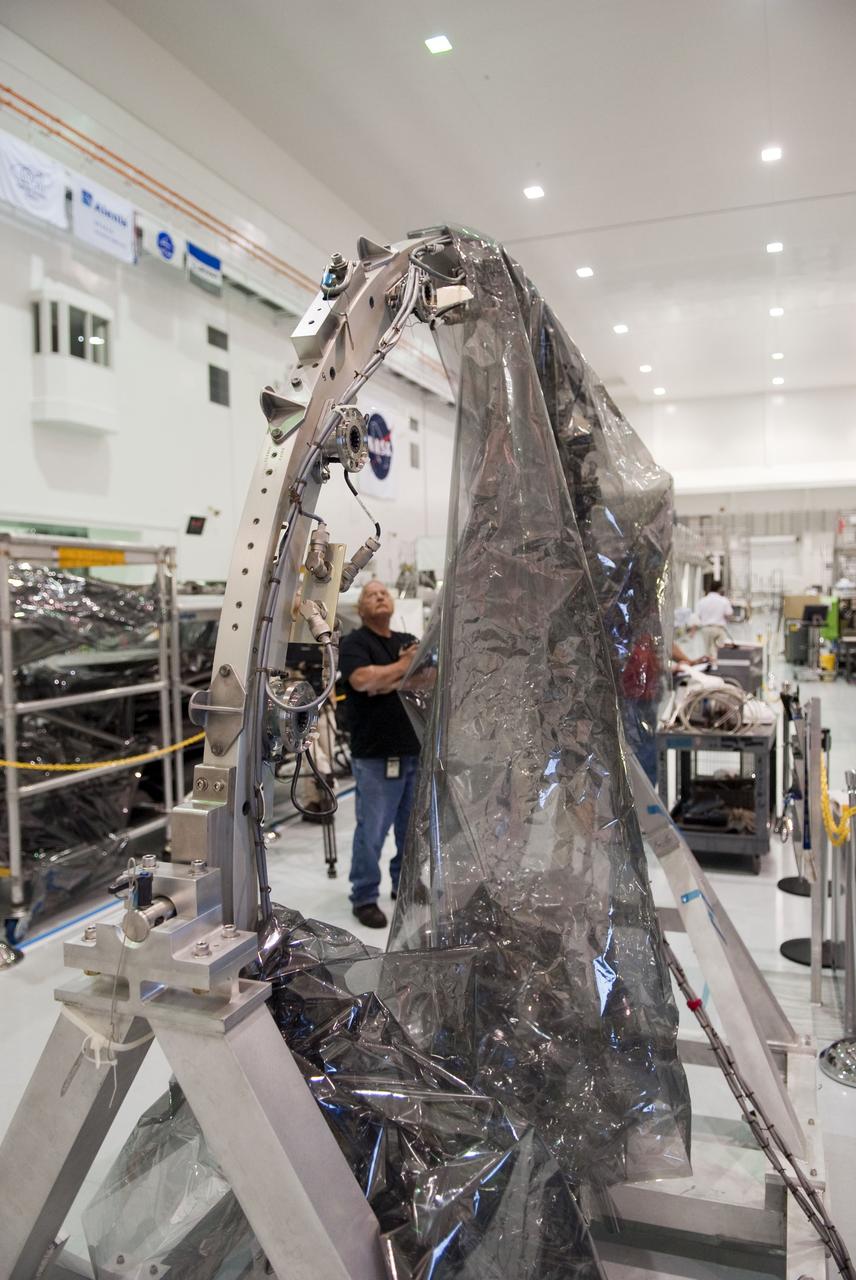
Technicians hoist a five-panel solar array protected by a lid for NASA’s Europa Clipper spacecraft at the Payload Hazardous Servicing Facility at the agency’s Kennedy Space Center in Florida on Tuesday, Feb. 27, 2024. The arrays are each 46.5 feet long (14.2 meters). With both solar arrays deployed, Europa Clipper will span more than 100 feet long, about the length of a basketball court. The solar arrays power the spacecraft so it can study Jupiter’s icy moon, Europa, which is more than five times as far from the Sun as the Earth. Launch on a SpaceX Falcon Heavy rocket is no earlier than October 2024.
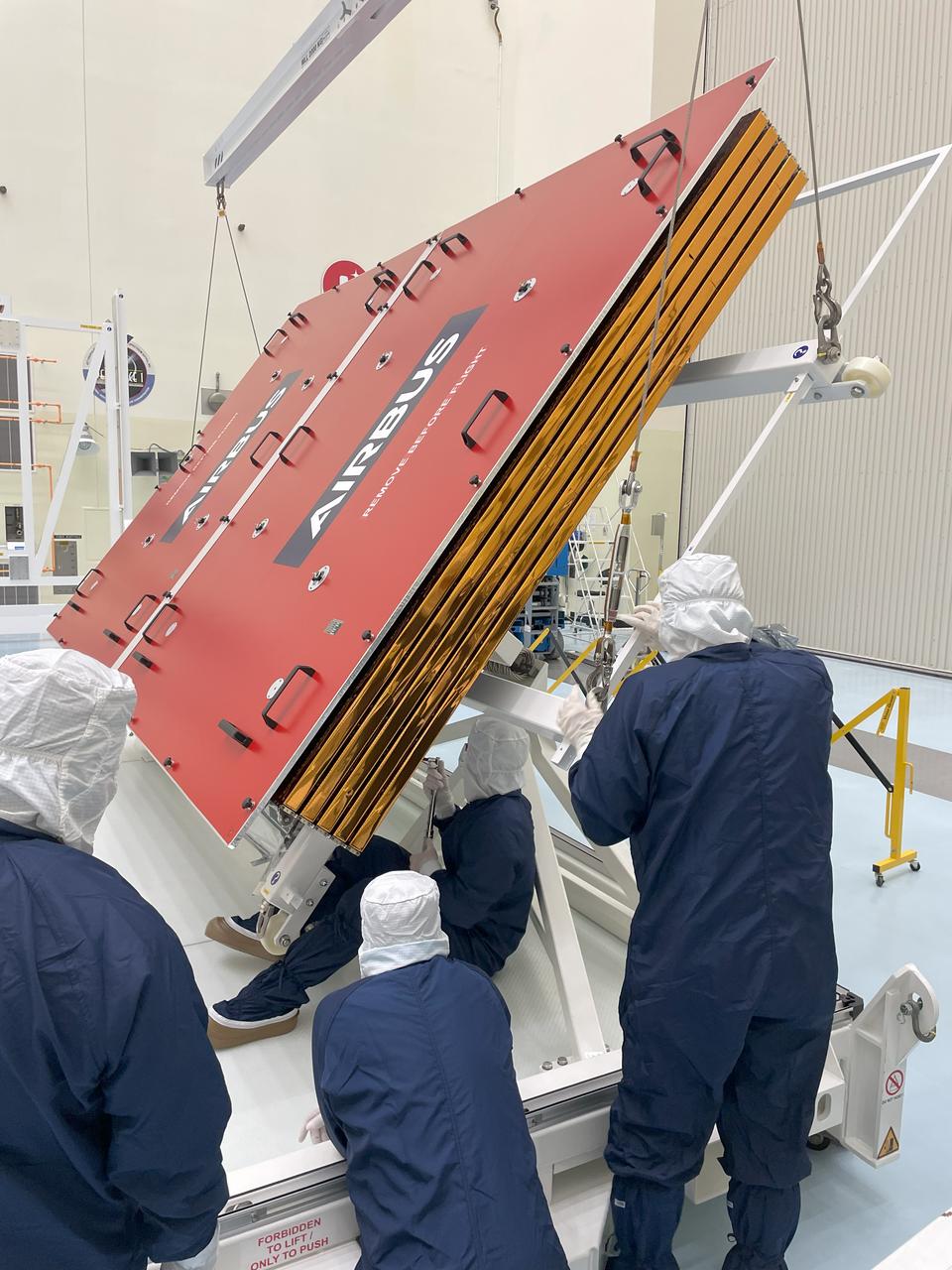
Technicians hoist a five-panel solar array protected by a lid for NASA’s Europa Clipper spacecraft at the Payload Hazardous Servicing Facility at the agency’s Kennedy Space Center in Florida on Tuesday, Feb. 27, 2024. The arrays are each 46.5 feet long (14.2 meters). With both solar arrays deployed, Europa Clipper will span more than 100 feet long, about the length of a basketball court. The solar arrays power the spacecraft so it can study Jupiter’s icy moon, Europa, which is more than five times as far from the Sun as the Earth. Launch on a SpaceX Falcon Heavy rocket is no earlier than October 2024.
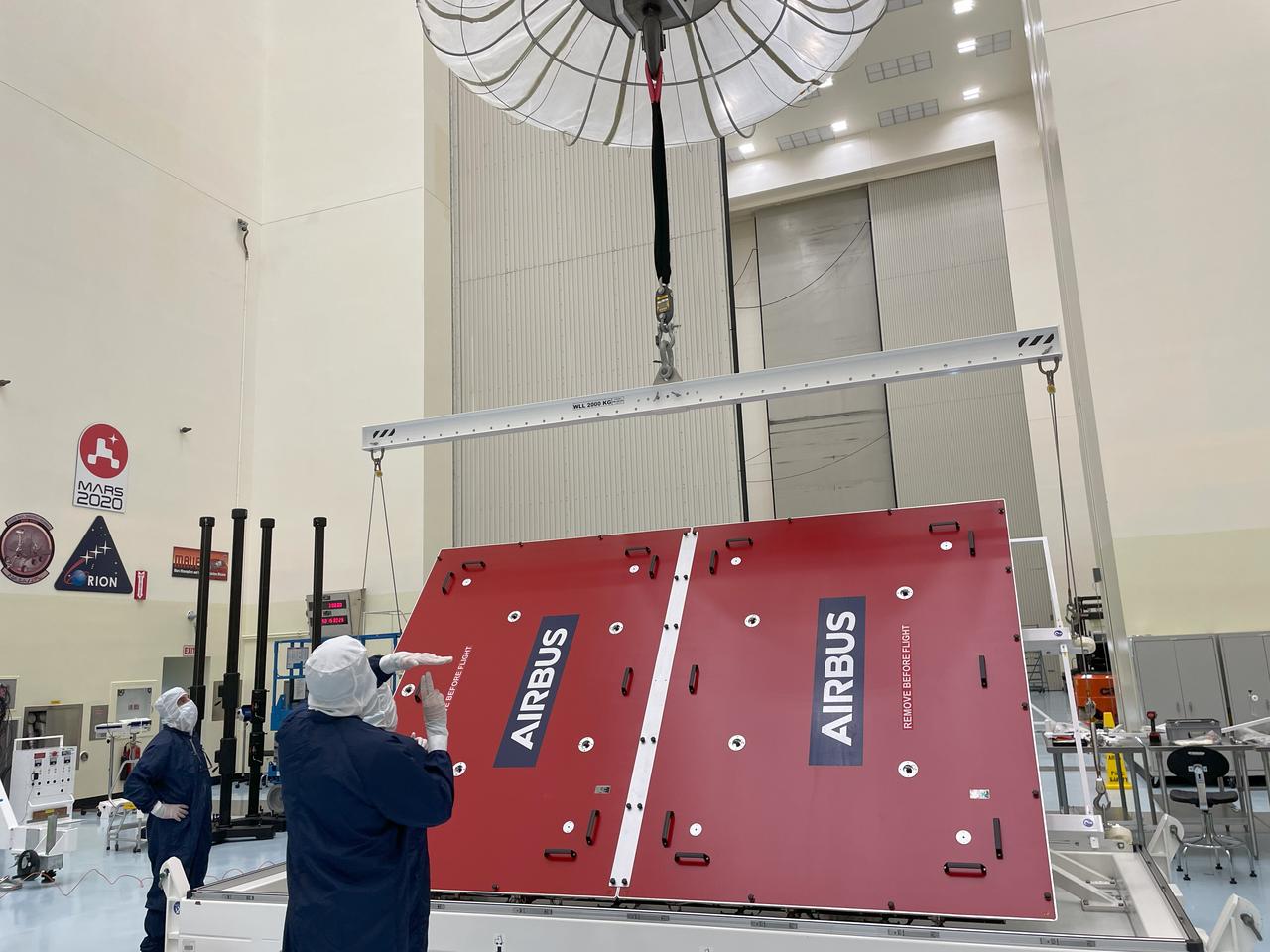
Technicians hoist a five-panel solar array protected by a lid for NASA’s Europa Clipper spacecraft at the Payload Hazardous Servicing Facility at the agency’s Kennedy Space Center in Florida on Tuesday, Feb. 27, 2024. The arrays are each 46.5 feet long (14.2 meters). With both solar arrays deployed, Europa Clipper will span more than 100 feet long, about the length of a basketball court. The solar arrays power the spacecraft so it can study Jupiter’s icy moon, Europa, which is more than five times as far from the Sun as the Earth. Launch on a SpaceX Falcon Heavy rocket is no earlier than October 2024.
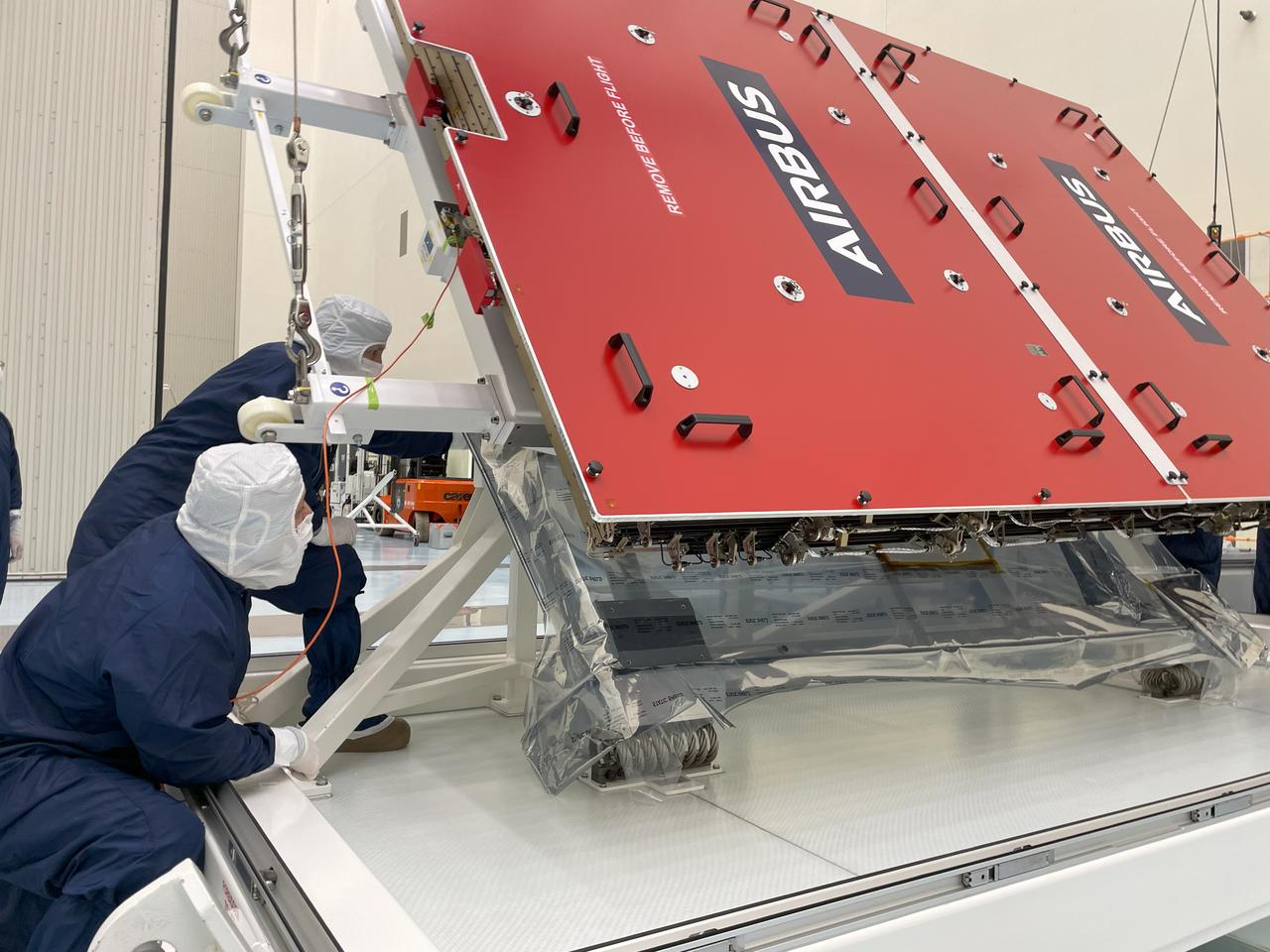
Technicians hoist a five-panel solar array protected by a lid for NASA’s Europa Clipper spacecraft at the Payload Hazardous Servicing Facility at the agency’s Kennedy Space Center in Florida on Tuesday, Feb. 27, 2024. The arrays are each 46.5 feet long (14.2 meters). With both solar arrays deployed, Europa Clipper will span more than 100 feet long, about the length of a basketball court. The solar arrays power the spacecraft so it can study Jupiter’s icy moon, Europa, which is more than five times as far from the Sun as the Earth. Launch on a SpaceX Falcon Heavy rocket is no earlier than October 2024.
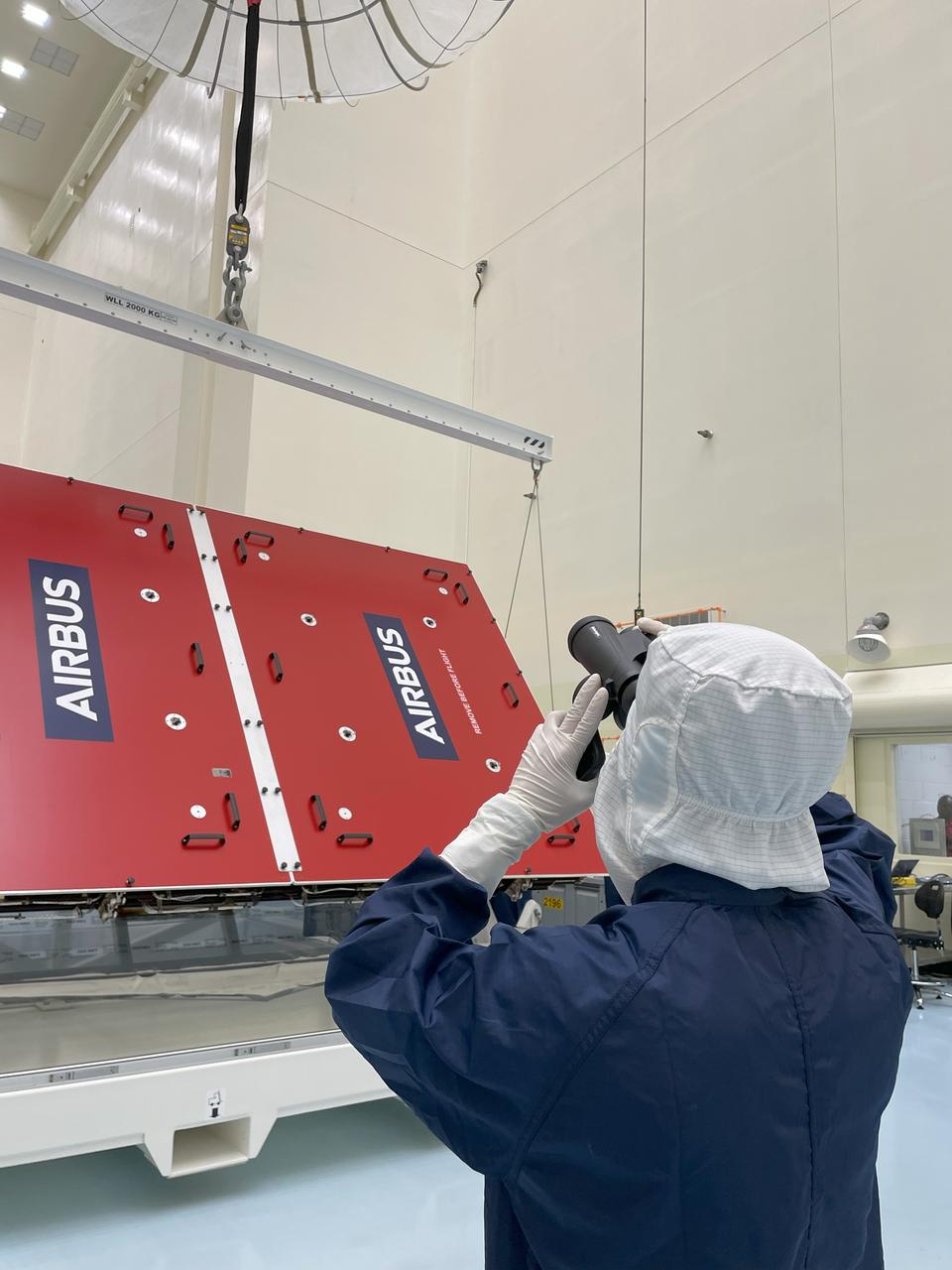
Technicians hoist a five-panel solar array protected by a lid for NASA’s Europa Clipper spacecraft at the Payload Hazardous Servicing Facility at the agency’s Kennedy Space Center in Florida on Tuesday, Feb. 27, 2024. The arrays are each 46.5 feet long (14.2 meters). With both solar arrays deployed, Europa Clipper will span more than 100 feet long, about the length of a basketball court. The solar arrays power the spacecraft so it can study Jupiter’s icy moon, Europa, which is more than five times as far from the Sun as the Earth. Launch on a SpaceX Falcon Heavy rocket is no earlier than October 2024.
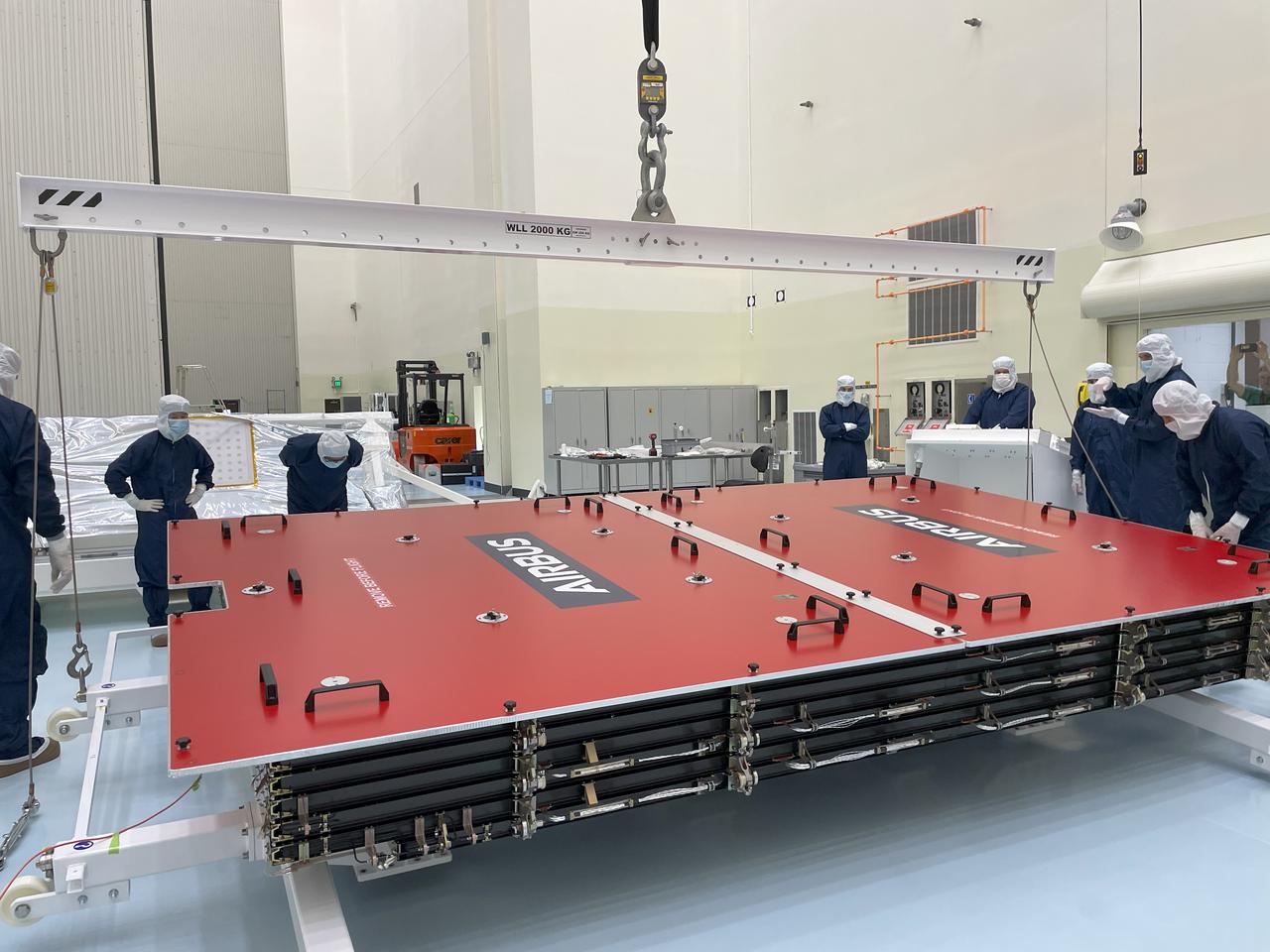
Technicians hoist a five-panel solar array protected by a lid for NASA’s Europa Clipper spacecraft at the Payload Hazardous Servicing Facility at the agency’s Kennedy Space Center in Florida on Tuesday, Feb. 27, 2024. The arrays are each 46.5 feet long (14.2 meters). With both solar arrays deployed, Europa Clipper will span more than 100 feet long, about the length of a basketball court. The solar arrays power the spacecraft so it can study Jupiter’s icy moon, Europa, which is more than five times as far from the Sun as the Earth. Launch on a SpaceX Falcon Heavy rocket is no earlier than October 2024.
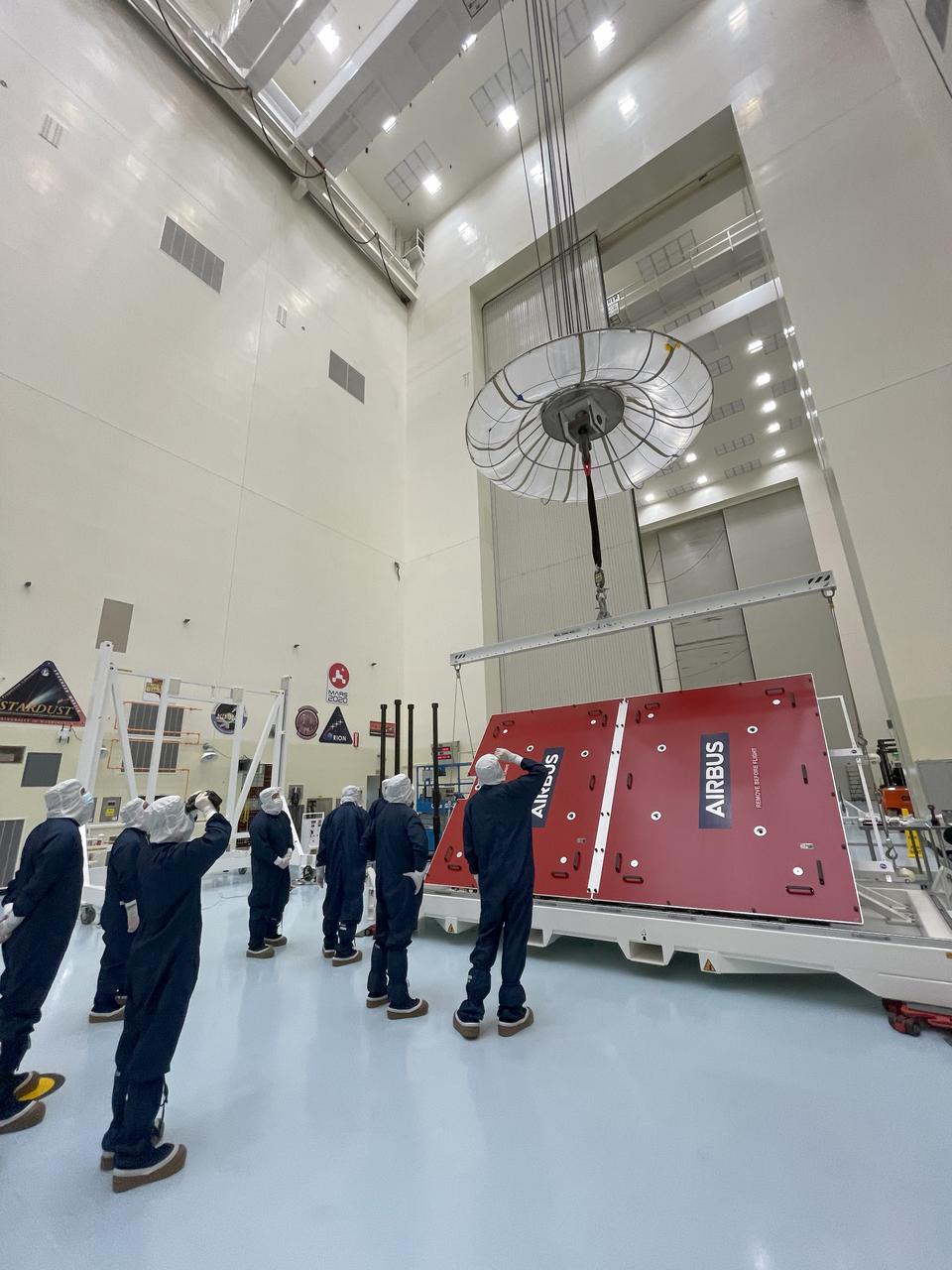
Technicians hoist a five-panel solar array protected by a lid for NASA’s Europa Clipper spacecraft at the Payload Hazardous Servicing Facility at the agency’s Kennedy Space Center in Florida on Tuesday, Feb. 27, 2024. The arrays are each 46.5 feet long (14.2 meters). With both solar arrays deployed, Europa Clipper will span more than 100 feet long, about the length of a basketball court. The solar arrays power the spacecraft so it can study Jupiter’s icy moon, Europa, which is more than five times as far from the Sun as the Earth. Launch on a SpaceX Falcon Heavy rocket is no earlier than October 2024.
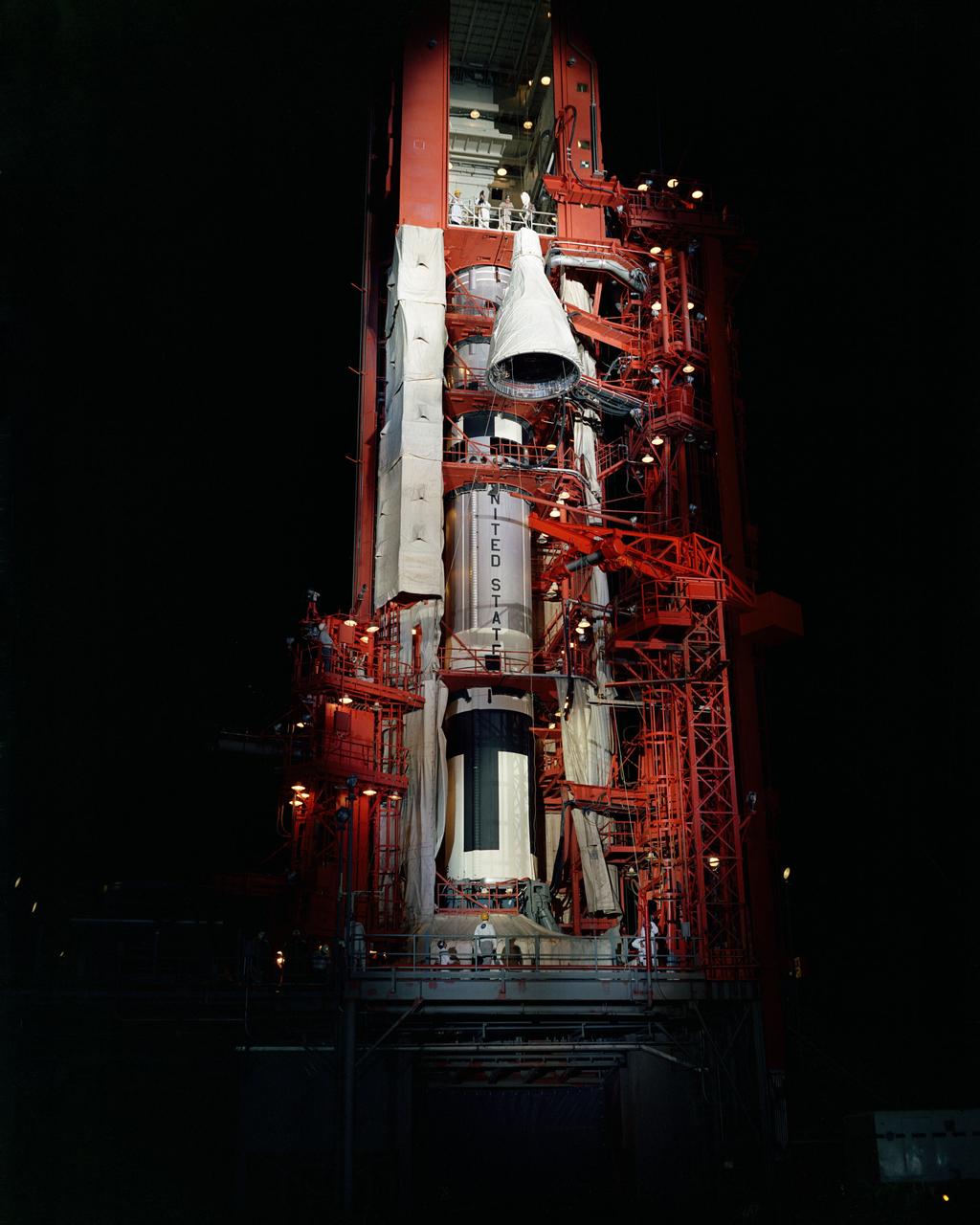
S65-23710 (14 April 1965) --- Nighttime scene showing the Gemini-4 spacecraft being hoisted to the white room at the top of the gantry at Pad 19 for soft mating with the Titan launch vehicle.
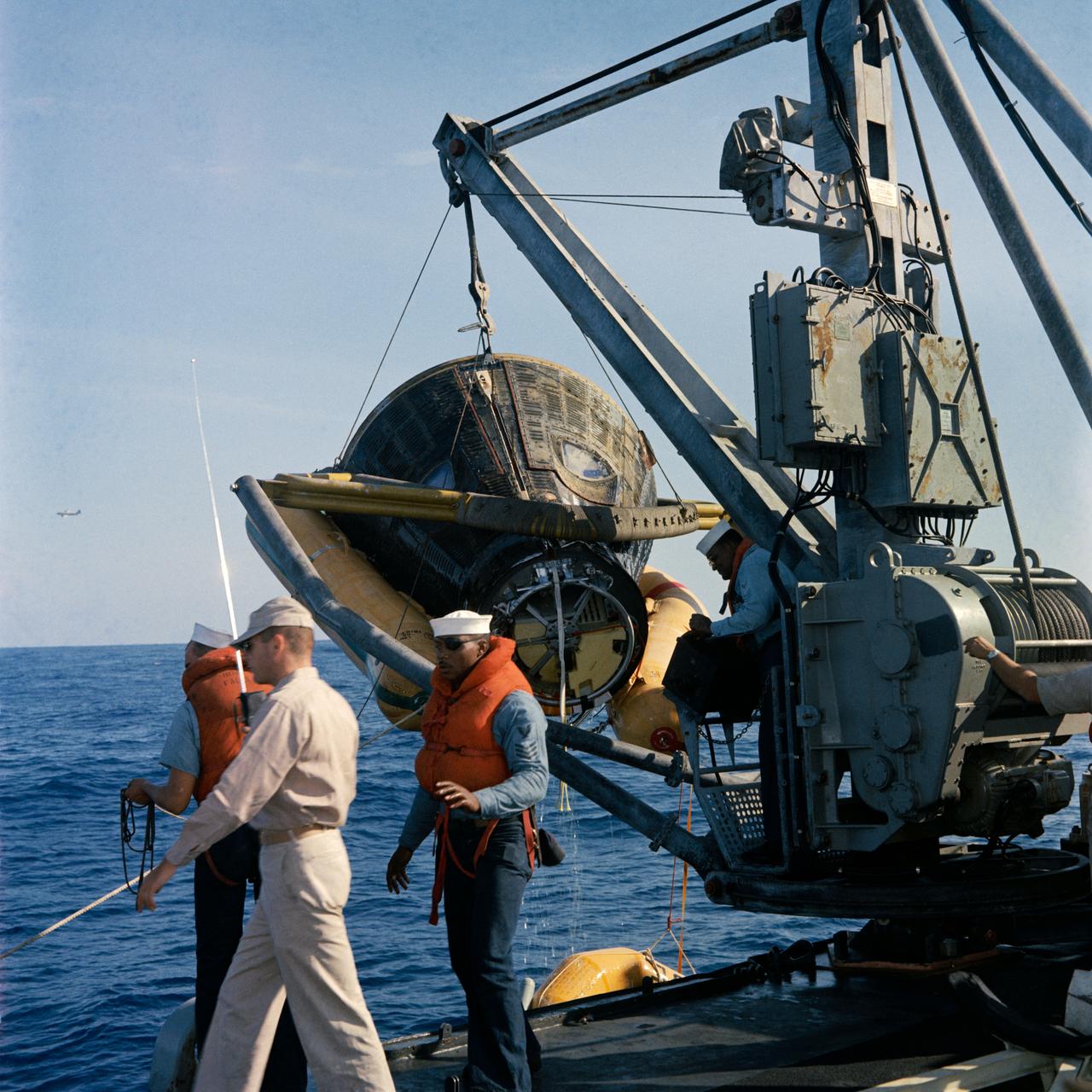
S66-26037 (16 March 1966) --- The Gemini-8 spacecraft, with astronauts Neil A. Armstrong and David R. Scott still aboard, is hoisted aboard the destroyer USS Leonard F. Mason. Trouble with the Gemini-8 Orbit Attitude and Maneuvering System (OAMS) forced an early termination of the mission. Photo credit: NASA
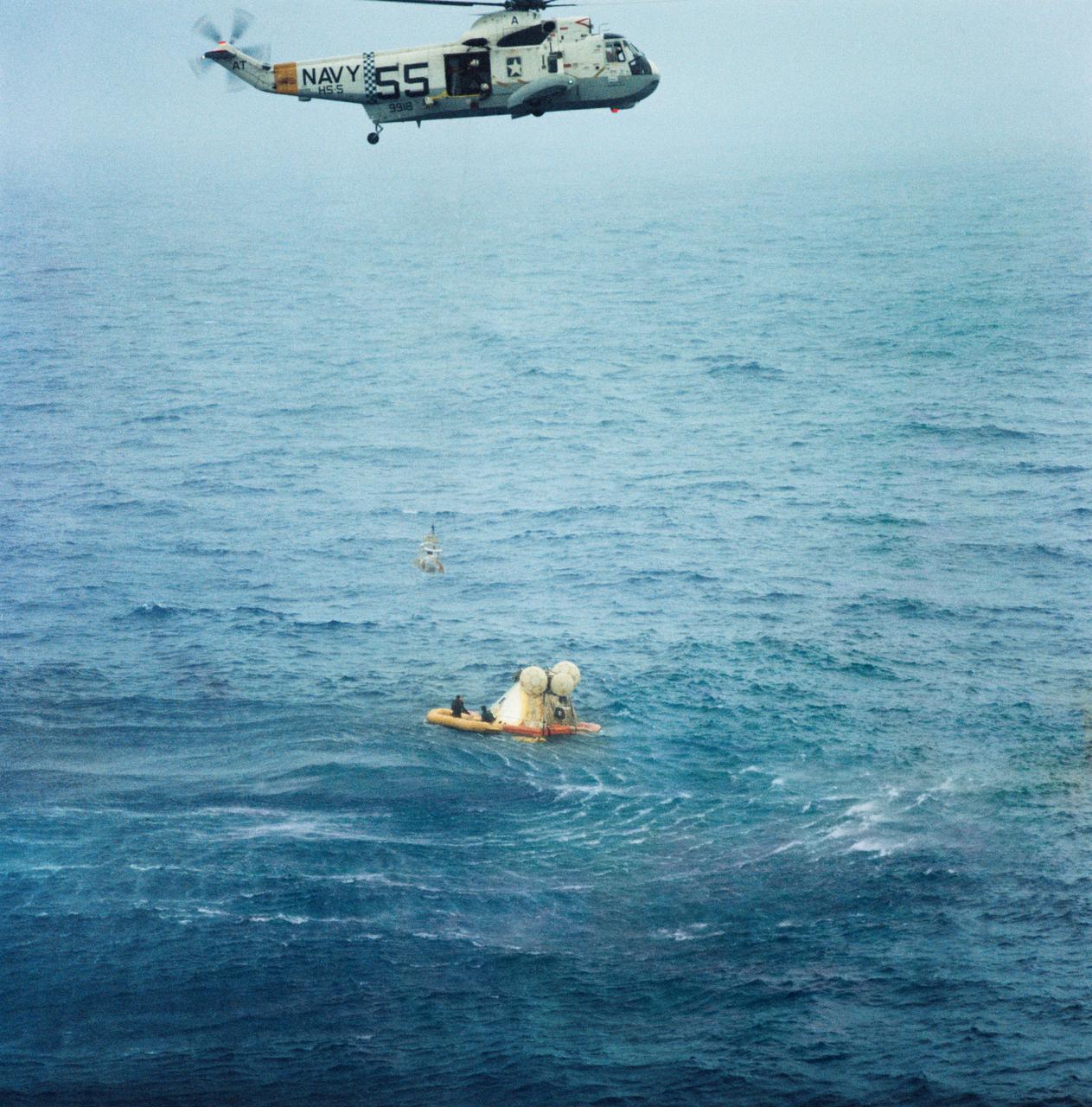
S68-49661 (22 Oct. 1968) --- A member of the Apollo 7 crew is hoisted up to a recovery helicopter from the USS Essex during recovery operations. The Apollo 7 spacecraft splashed down at 7:11 a.m., Oct. 22, 1968, approximately 200 nautical miles south-southwest of Bermuda. Photo credit: NASA

Aerial view of an Apollo 9 crewman in a new rescue net (a Billy Pugh net) being hoisted aboard a Navy helicopter after splashdown in the Atlantic recovery area and a successful ten-day, earth-orbital space mission. Navy divers have already attached a flotation collar to the command module and are assisting with recovery operations.
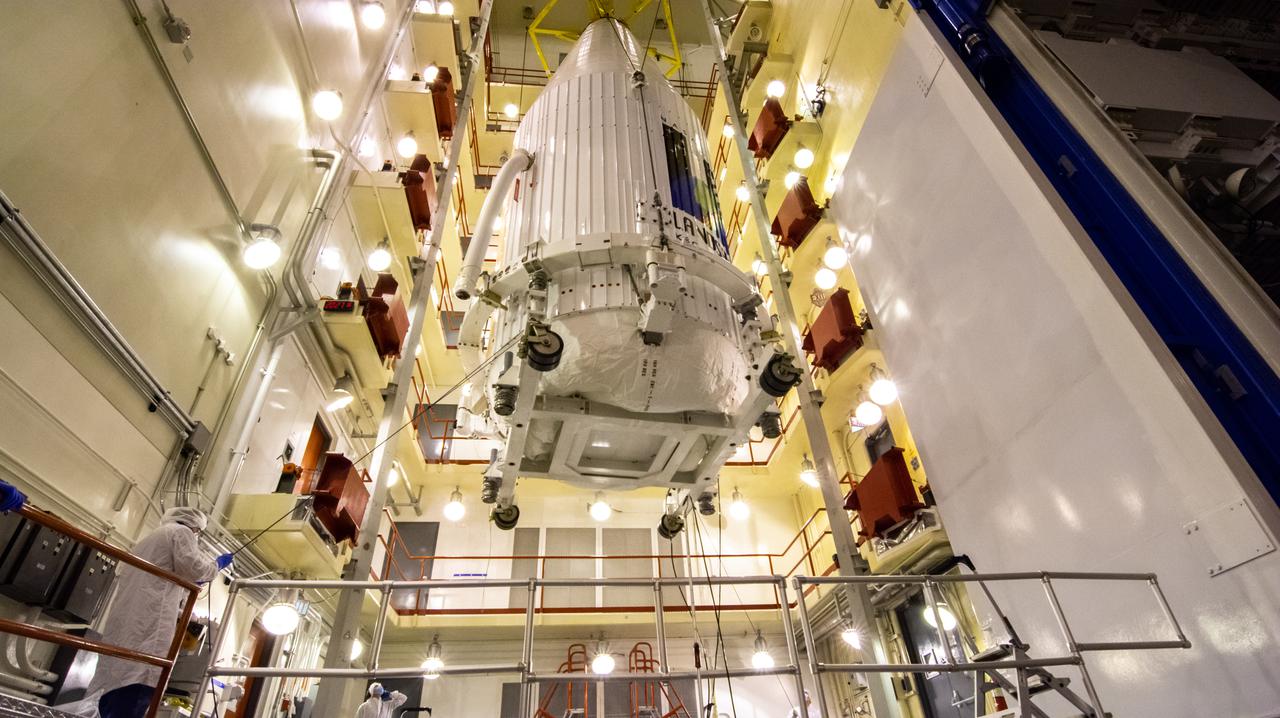
The Landsat 9 payload is hoisted out of the transfer tower inside the Integration Processing Facility at Vandenberg Space Force Base in California on Sept. 14, 2021, in preparation for transport to Vandenberg’s Space Launch Complex 3. The Landsat 9 mission launch, which is being managed by NASA’s Launch Services Program based at Kennedy Space Center in Florida, is targeted for no earlier than Sept. 27, 2021. Landsat 9 will launch on a United Launch Alliance Atlas V rocket. The satellite will monitor key natural and economic resources from orbit. Landsat 9 is a joint mission between NASA and the U.S. Geological Survey.
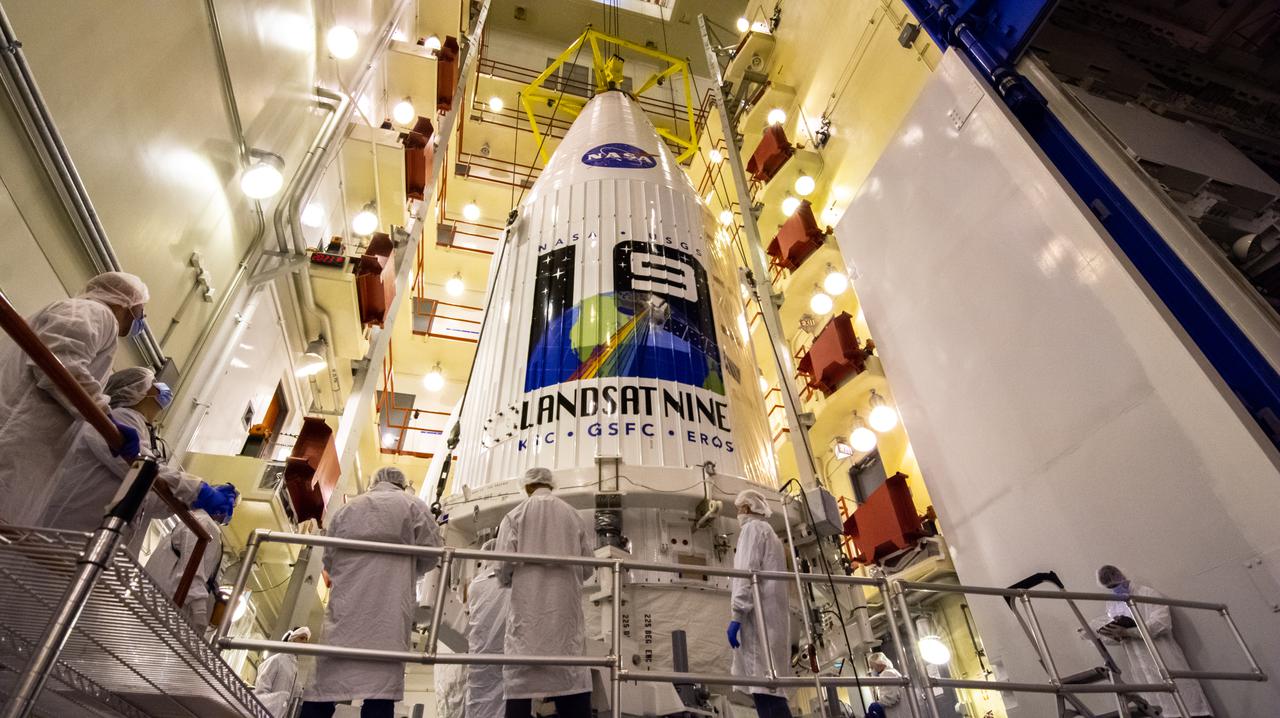
The Landsat 9 payload is hoisted out of the transfer tower inside the Integration Processing Facility at Vandenberg Space Force Base in California on Sept. 14, 2021, in preparation for transport to Vandenberg’s Space Launch Complex 3. The Landsat 9 mission launch, which is being managed by NASA’s Launch Services Program based at Kennedy Space Center in Florida, is targeted for no earlier than Sept. 27, 2021. Landsat 9 will launch on a United Launch Alliance Atlas V rocket. The satellite will monitor key natural and economic resources from orbit. Landsat 9 is a joint mission between NASA and the U.S. Geological Survey.
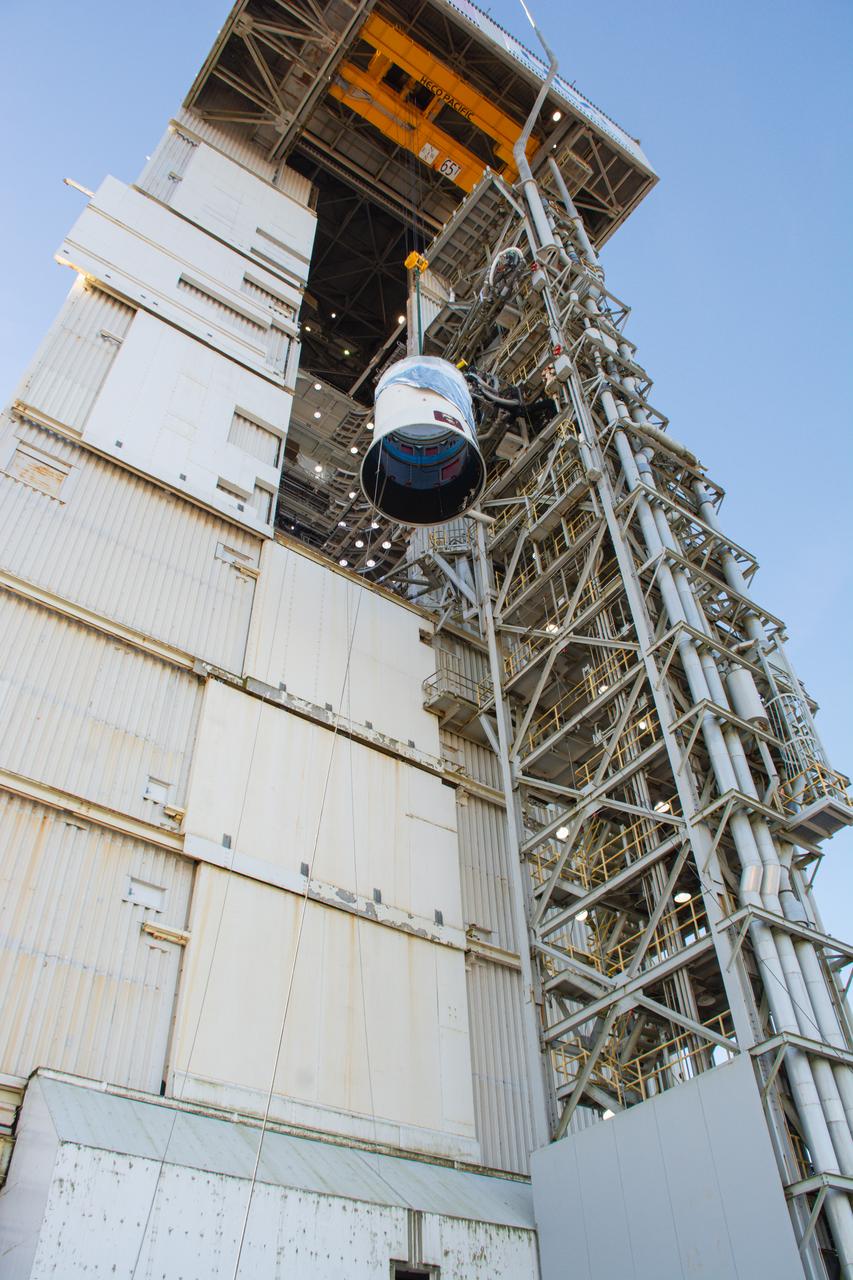
The United Launch Alliance Atlas V interstage adapter and aft stub adapter are hoisted up at the vertical integration facility at Space Launch Complex-3 at Vandenberg Space Force Base in California on Sept. 29, 2022. The adapter will be moved into the integration facility and secured atop the ULA Atlas V in preparation for the launch of the National Oceanic and Atmospheric Administration’s (NOAA) Joint Polar Satellite System-2 (JPSS-2). JPSS-2 and NASA’s Low-Earth Orbit Flight Test of an Inflatable Decelerator (LOFTID) secondary payload are scheduled to lift off from VSFB on Nov. 1 from SLC-3. JPSS-2, which will be renamed NOAA-21 after reaching orbit, will join a constellation of JPSS satellites that orbit from the North to the South pole, circling Earth 14 times a day and providing a full view of the entire globe twice daily. The NOAA/NASA Suomi National Polar-orbiting Partnership (Suomi NPP) satellite, and NOAA-20, previously known as JPSS-1, are both already in orbit. Each satellite carries at least four advanced instruments to measure weather and climate conditions on Earth. LOFTID is dedicated to the memory of Bernard Kutter. LOFTID will demonstrate inflatable heat shield technology that could enable a variety of proposed NASA missions to destinations such as Mars, Venus, and Titan, as well as returning heavier payloads from low-Earth orbit.

The United Launch Alliance Atlas V interstage adapter and aft stub adapter are hoisted up at the vertical integration facility at Space Launch Complex-3 at Vandenberg Space Force Base in California on Sept. 29, 2022. The adapter will be moved into the integration facility and secured atop the ULA Atlas V in preparation for the launch of the National Oceanic and Atmospheric Administration’s (NOAA) Joint Polar Satellite System-2 (JPSS-2). JPSS-2 and NASA’s Low-Earth Orbit Flight Test of an Inflatable Decelerator (LOFTID) secondary payload are scheduled to lift off from VSFB on Nov. 1 from SLC-3. JPSS-2, which will be renamed NOAA-21 after reaching orbit, will join a constellation of JPSS satellites that orbit from the North to the South pole, circling Earth 14 times a day and providing a full view of the entire globe twice daily. The NOAA/NASA Suomi National Polar-orbiting Partnership (Suomi NPP) satellite, and NOAA-20, previously known as JPSS-1, are both already in orbit. Each satellite carries at least four advanced instruments to measure weather and climate conditions on Earth. LOFTID is dedicated to the memory of Bernard Kutter. LOFTID will demonstrate inflatable heat shield technology that could enable a variety of proposed NASA missions to destinations such as Mars, Venus, and Titan, as well as returning heavier payloads from low-Earth orbit.
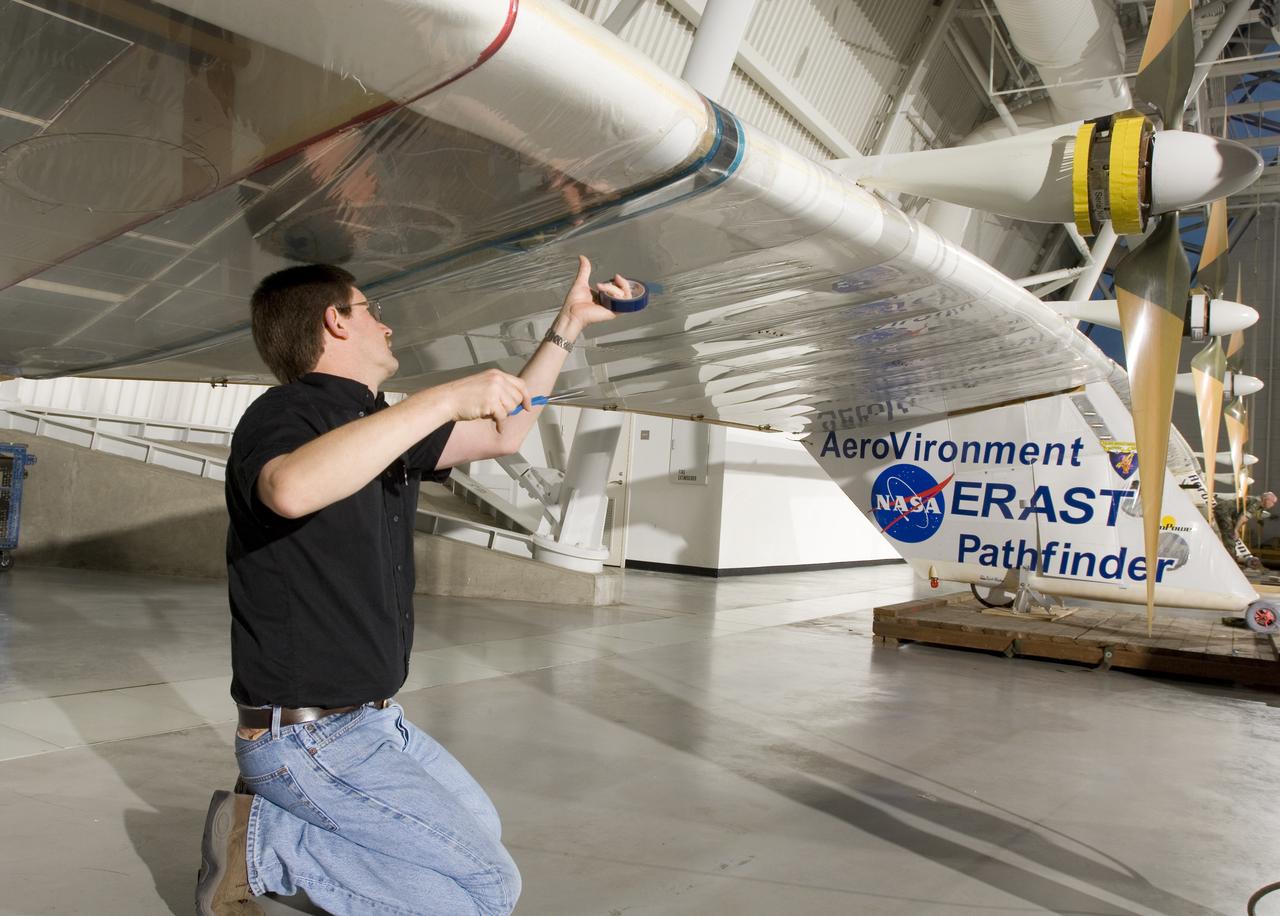
AeroVironment crew chief Mark Shipley applies sealing tape to a wing joint on Pathfinder-Plus before it is hoisted into place at the NASM's Udvar-Hazy Center.
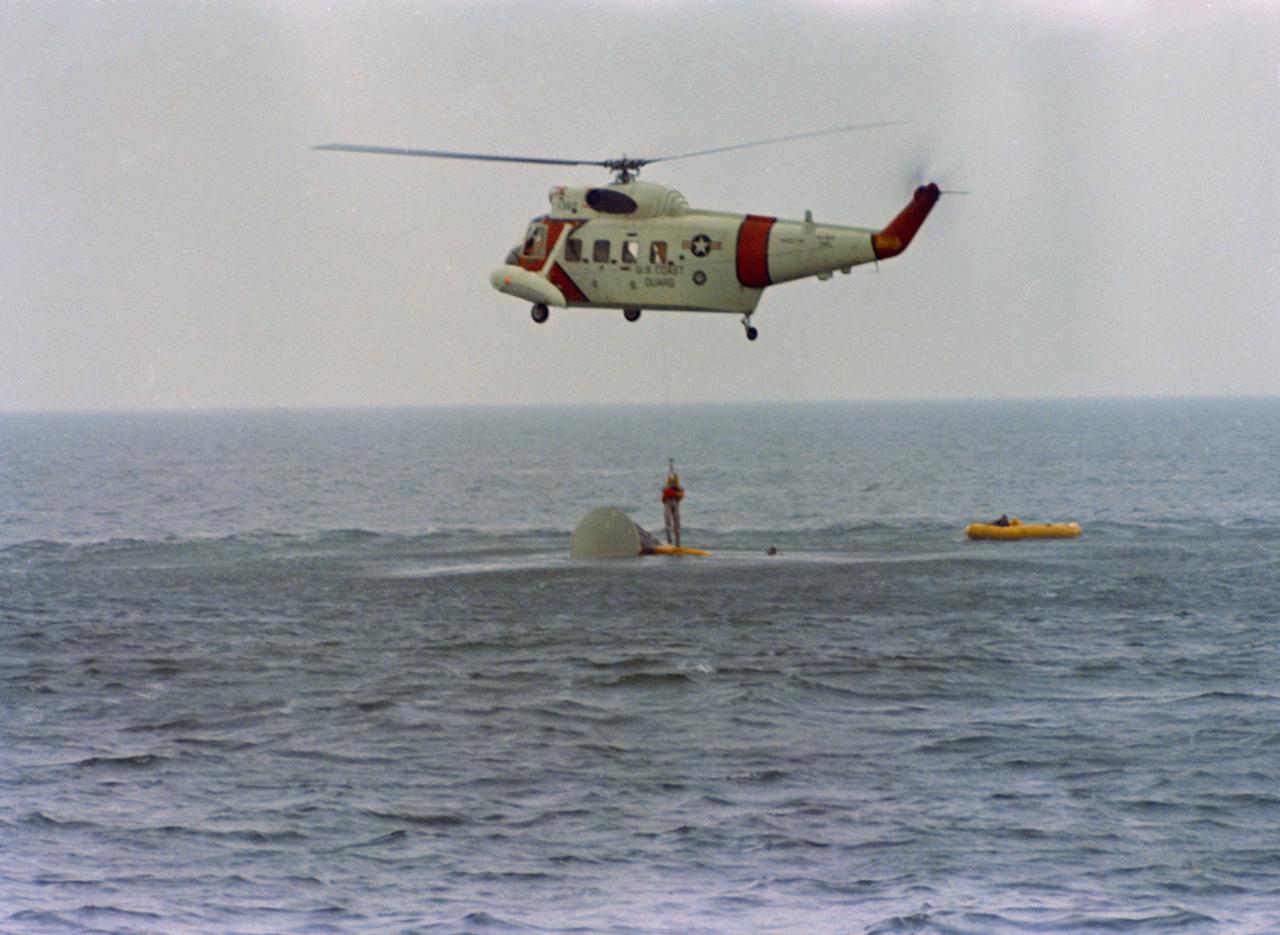
S66-39713 (18 June 1966) --- Astronaut John W. Young, Gemini-10 command pilot, is hoisted up to a U.S. Coast Guard helicopter during water egress training in the Gulf of Mexico. A team of Manned Spaceflight Center (MSC) swimmers assists in the exercise. The Static Article 5 spacecraft can be seen in the water. Photo credit: NASA
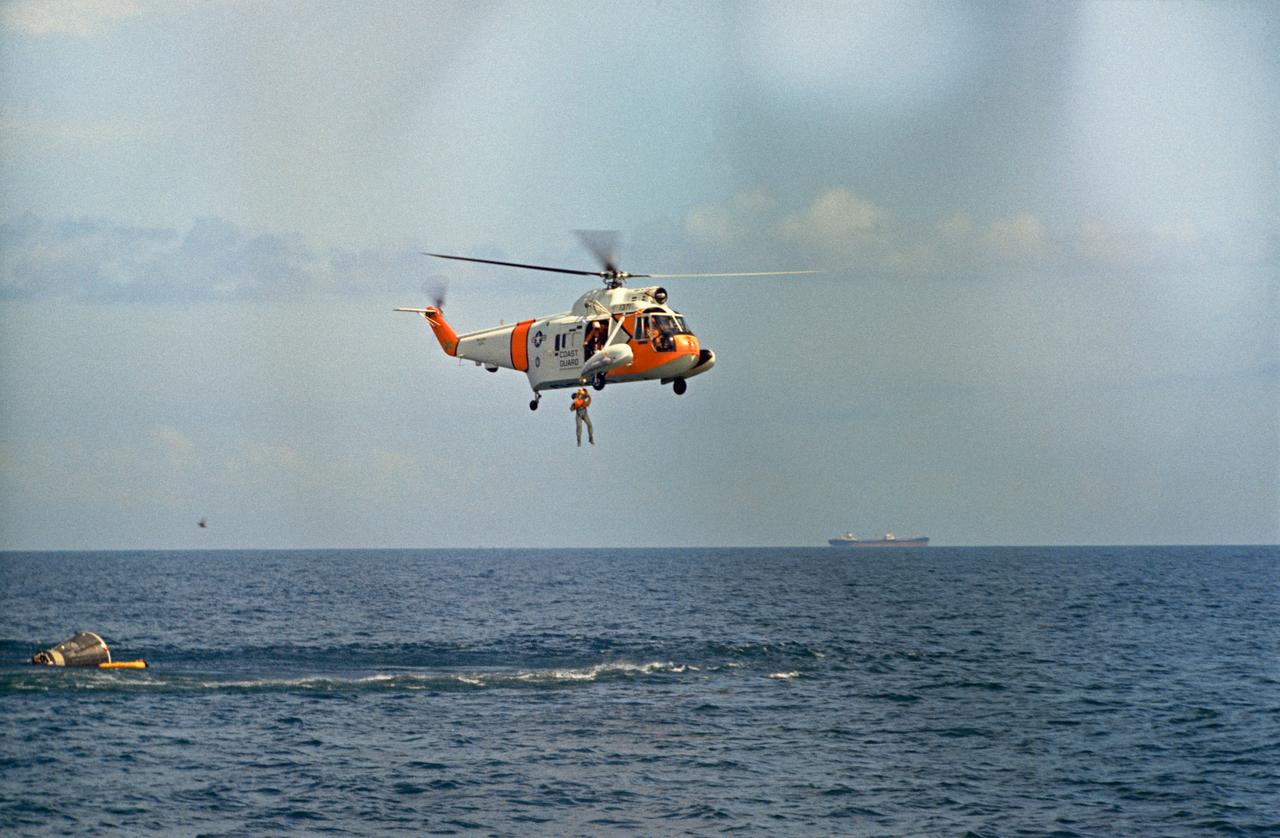
S65-55565 (15 Oct. 1965) --- Astronaut Frank Borman, Gemini-7 prime crew command pilot, is hoisted out of the water by a U.S. Coast Guard recovery team during water egress training in the Gulf of Mexico. The training is in preparation for the planned 14-day mission in space of the Gemini-7 spacecraft. Astronaut James A. Lovell Jr., prime crew pilot, also took part in the training. Photo credit: NASA
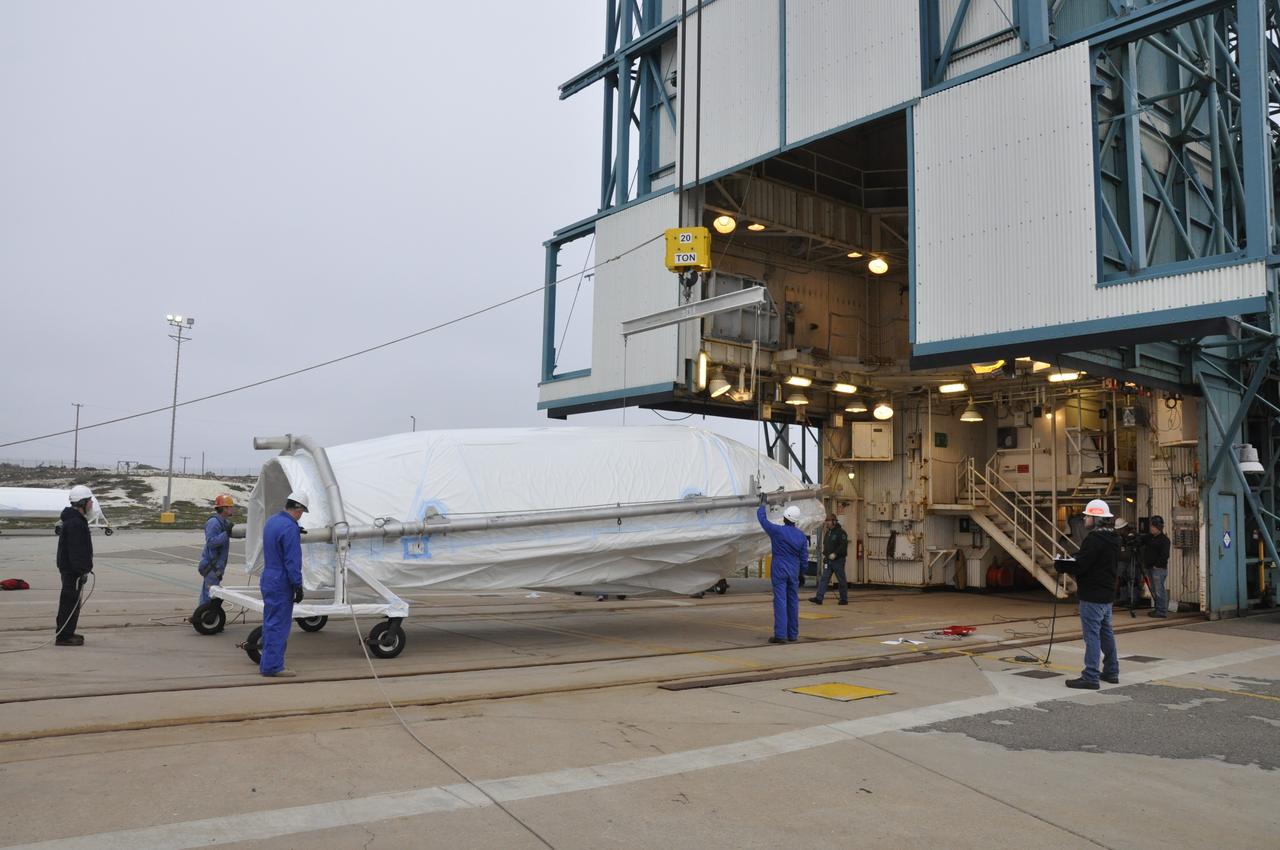
VANDENBERG AIR FORCE BASE, Calif. – Preparations are underway to lift half of the fairing for NASA's Orbiting Carbon Observatory-2 mission, or OCO-2, into a vertical position at Space Launch Complex 2 on Vandenberg Air Force Base in California. Operations are underway to hoist this section of the fairing into the Delta II launcher's environmental enclosure, or clean room, at the top of the tower. The fairing will protect OCO-2 during launch aboard a United Launch Alliance Delta II rocket from Space Launch Complex 2 in July. The observatory will collect precise global measurements of carbon dioxide in the Earth's atmosphere and provide scientists with a better idea of the chemical compound's impacts on climate change. Scientists will analyze this data to improve our understanding of the natural processes and human activities that regulate the abundance and distribution of this important atmospheric gas. To learn more about OCO-2, visit http://oco.jpl.nasa.gov. Photo credit: NASA/Randy Beaudoin
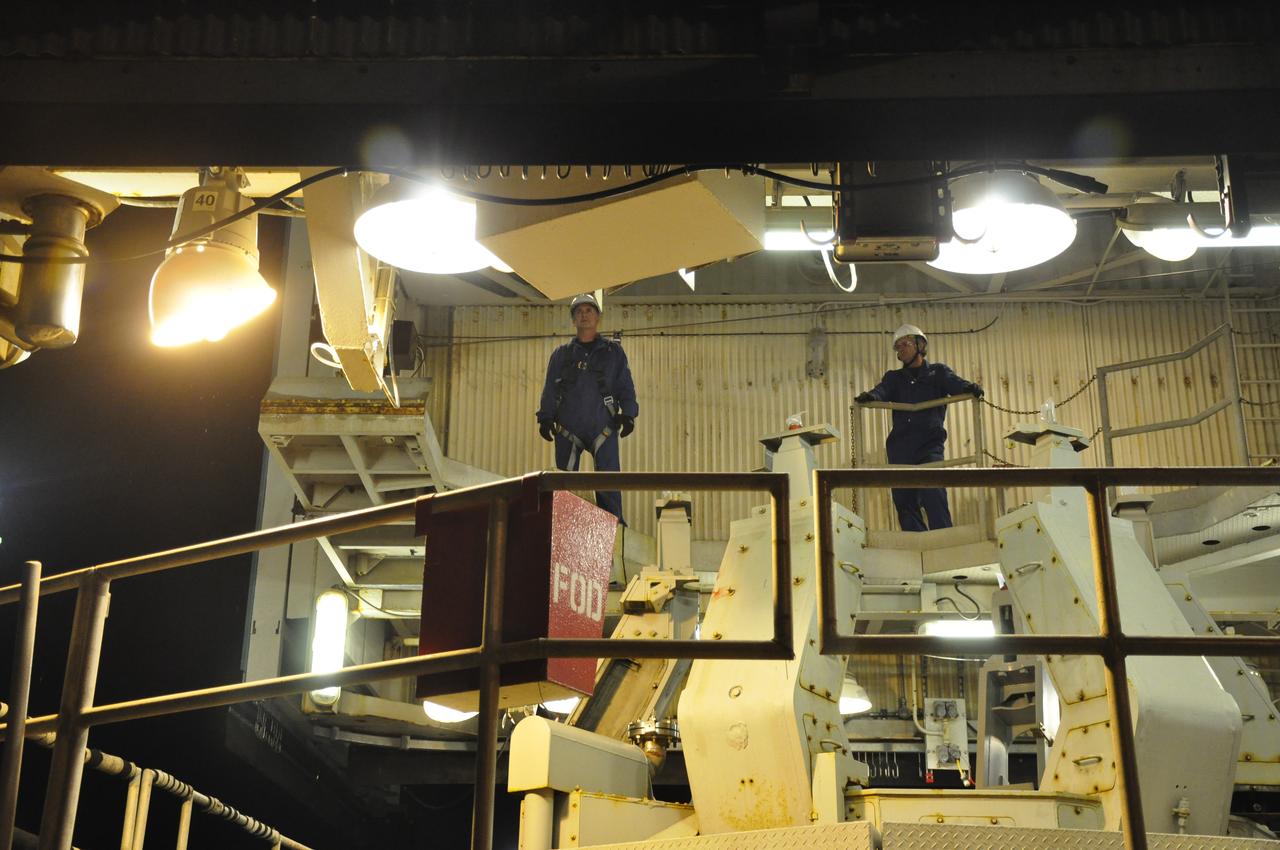
VANDENBERG AIR FORCE BASE, Calif. – Workers roll the mobile service tower away from the Delta II launcher behind them at Space Launch Complex 2 on Vandenberg Air Force Base in California in preparation for hoisting the fairing for NASA's Orbiting Carbon Observatory-2 mission, or OCO-2, into the gantry's environmental enclosure, or clean room. The fairing will protect OCO-2 during launch aboard a United Launch Alliance Delta II rocket from Space Launch Complex 2 in July. The observatory will collect precise global measurements of carbon dioxide in the Earth's atmosphere and provide scientists with a better idea of the chemical compound's impacts on climate change. Scientists will analyze this data to improve our understanding of the natural processes and human activities that regulate the abundance and distribution of this important atmospheric gas. To learn more about OCO-2, visit http://oco.jpl.nasa.gov. Photo credit: NASA/Randy Beaudoin
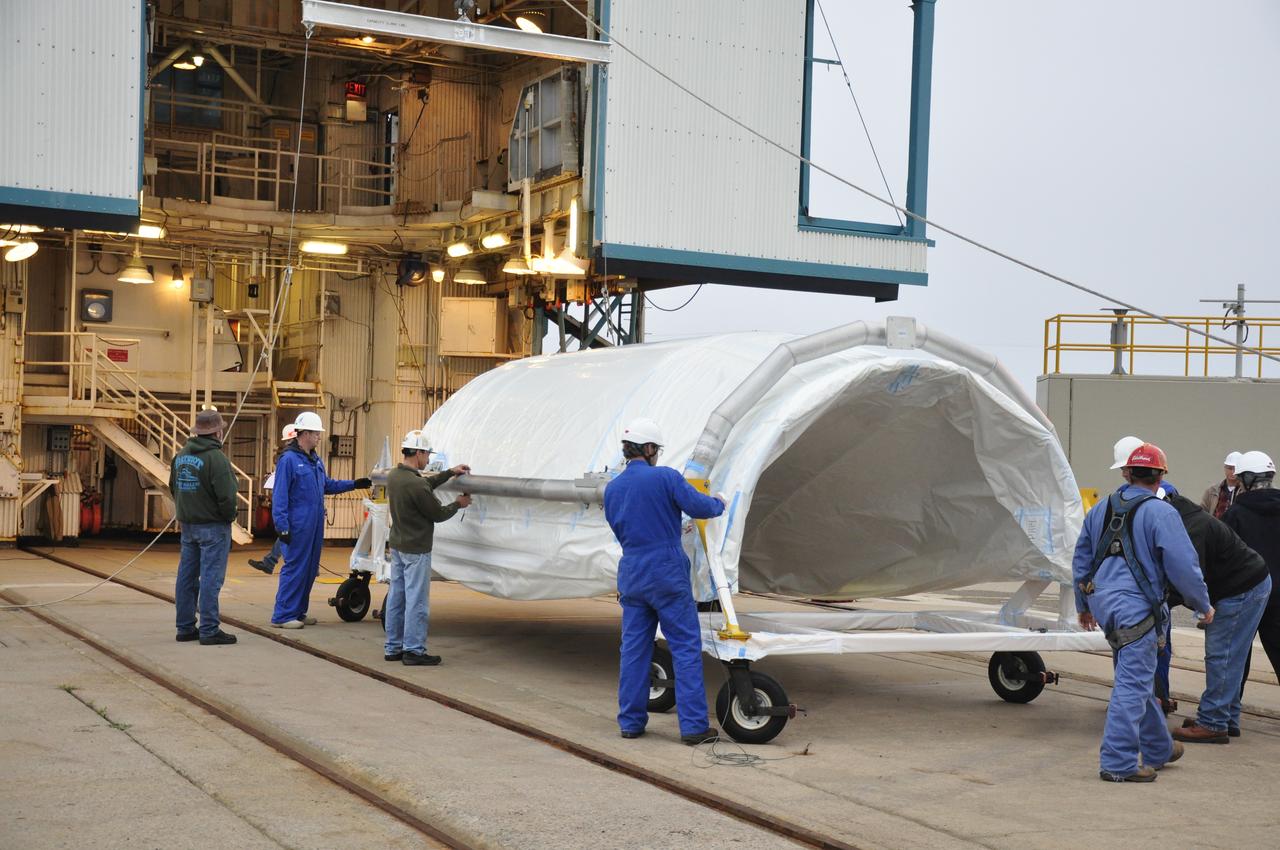
VANDENBERG AIR FORCE BASE, Calif. – Workers remove the protective wrap from half of the fairing for NASA's Orbiting Carbon Observatory-2 mission, or OCO-2, newly arrived at Space Launch Complex 2 on Vandenberg Air Force Base in California. Operations are underway to hoist this section of the fairing into the Delta II launcher's environmental enclosure, or clean room, at the top of the tower. The fairing will protect OCO-2 during launch aboard a United Launch Alliance Delta II rocket from Space Launch Complex 2 in July. The observatory will collect precise global measurements of carbon dioxide in the Earth's atmosphere and provide scientists with a better idea of the chemical compound's impacts on climate change. Scientists will analyze this data to improve our understanding of the natural processes and human activities that regulate the abundance and distribution of this important atmospheric gas. To learn more about OCO-2, visit http://oco.jpl.nasa.gov. Photo credit: NASA/Randy Beaudoin
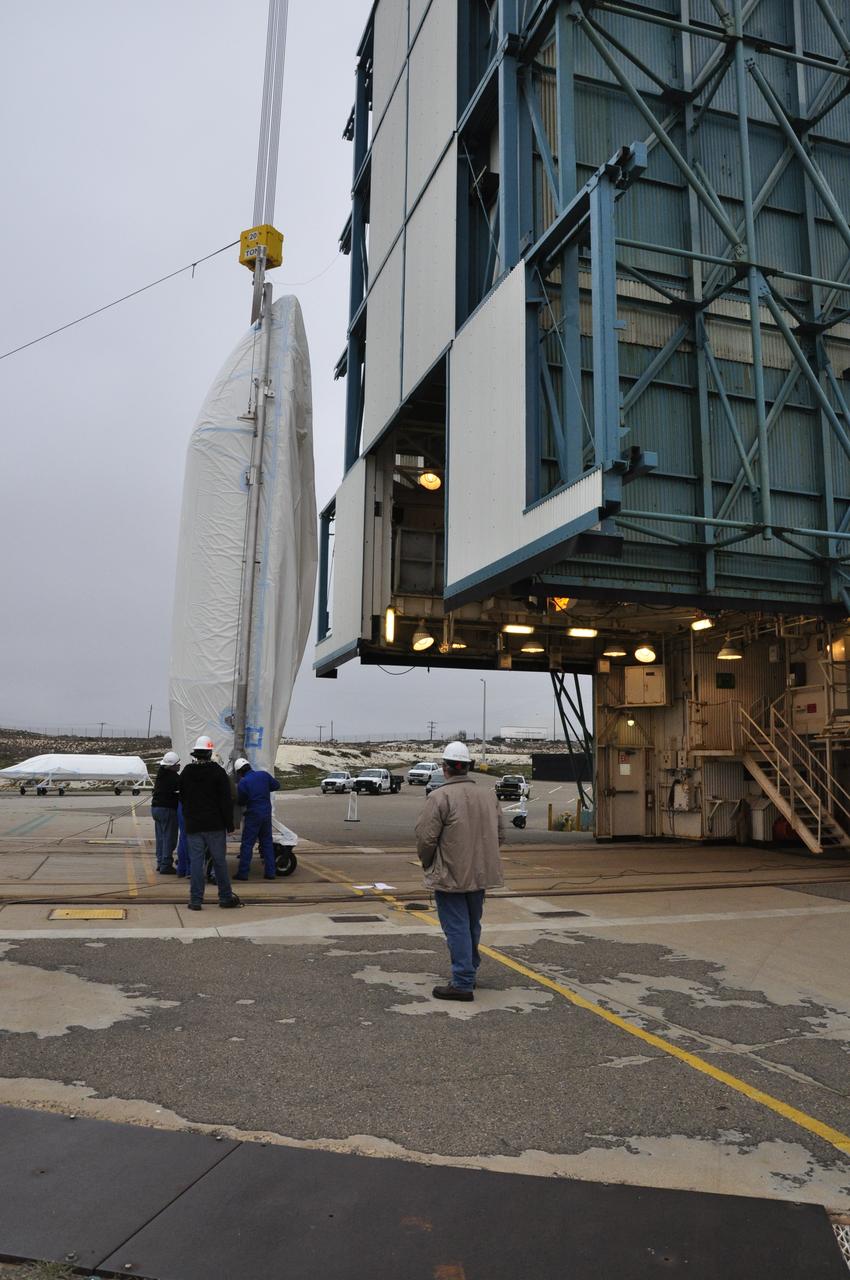
VANDENBERG AIR FORCE BASE, Calif. – Half of the fairing for NASA's Orbiting Carbon Observatory-2 mission, or OCO-2, is lifted into a vertical position at Space Launch Complex 2 on Vandenberg Air Force Base in California. Operations are underway to hoist this section of the fairing into the Delta II launcher's environmental enclosure, or clean room, at the top of the tower. The fairing will protect OCO-2 during launch aboard a United Launch Alliance Delta II rocket from Space Launch Complex 2 in July. The observatory will collect precise global measurements of carbon dioxide in the Earth's atmosphere and provide scientists with a better idea of the chemical compound's impacts on climate change. Scientists will analyze this data to improve our understanding of the natural processes and human activities that regulate the abundance and distribution of this important atmospheric gas. To learn more about OCO-2, visit http://oco.jpl.nasa.gov. Photo credit: NASA/Randy Beaudoin
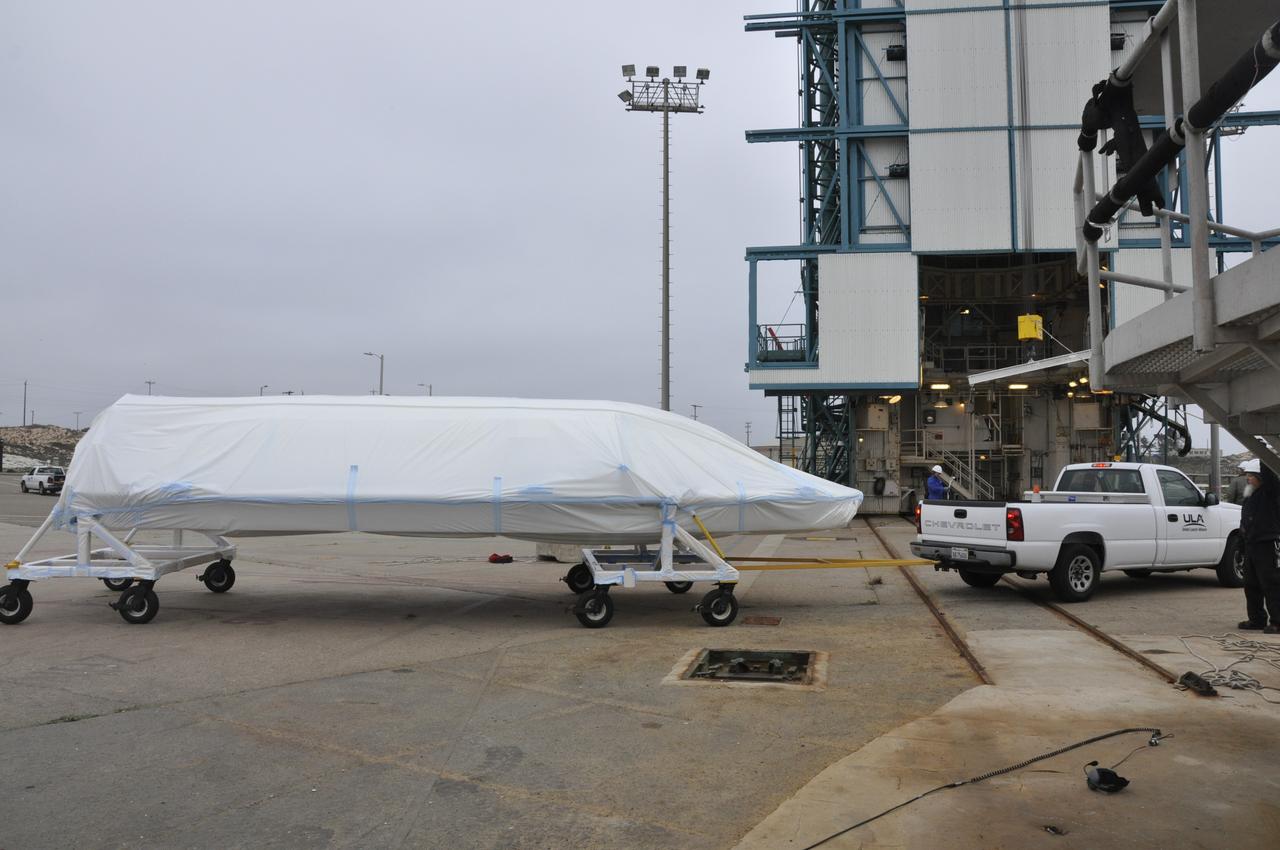
VANDENBERG AIR FORCE BASE, Calif. – The second half of the fairing for NASA's Orbiting Carbon Observatory-2 mission, or OCO-2, arrives at Space Launch Complex 2 on Vandenberg Air Force Base in California. Operations are underway to hoist this section of the fairing into the Delta II launcher's environmental enclosure, or clean room, at the top of the tower where the other half already is in position. The fairing will protect OCO-2 during launch aboard a United Launch Alliance Delta II rocket from Space Launch Complex 2 in July. The observatory will collect precise global measurements of carbon dioxide in the Earth's atmosphere and provide scientists with a better idea of the chemical compound's impacts on climate change. Scientists will analyze this data to improve our understanding of the natural processes and human activities that regulate the abundance and distribution of this important atmospheric gas. To learn more about OCO-2, visit http://oco.jpl.nasa.gov. Photo credit: NASA/Randy Beaudoin
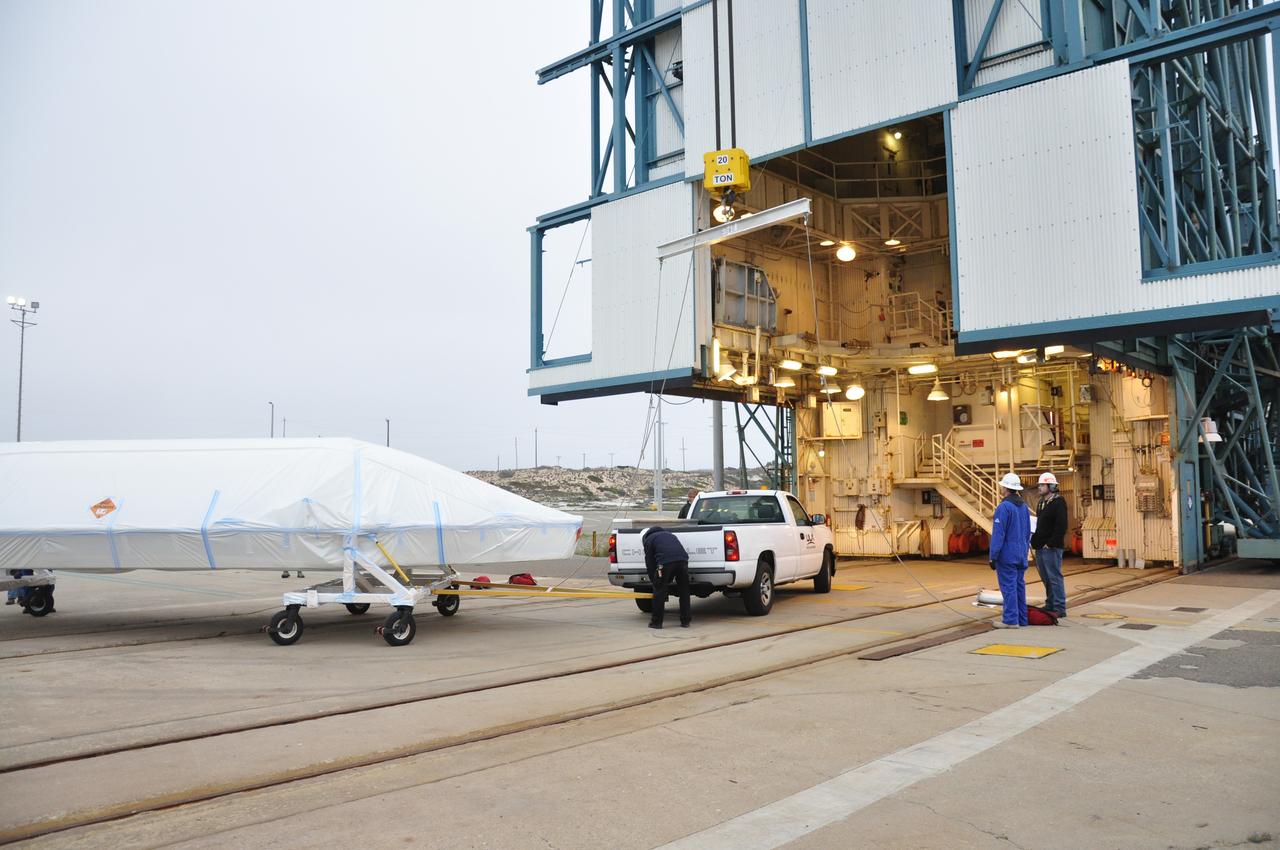
VANDENBERG AIR FORCE BASE, Calif. – Half of the fairing for NASA's Orbiting Carbon Observatory-2 mission, or OCO-2, arrives at Space Launch Complex 2 on Vandenberg Air Force Base in California. Operations are underway to hoist this section of the fairing into the Delta II launcher's environmental enclosure, or clean room, at the top of the tower. The fairing will protect OCO-2 during launch aboard a United Launch Alliance Delta II rocket from Space Launch Complex 2 in July. The observatory will collect precise global measurements of carbon dioxide in the Earth's atmosphere and provide scientists with a better idea of the chemical compound's impacts on climate change. Scientists will analyze this data to improve our understanding of the natural processes and human activities that regulate the abundance and distribution of this important atmospheric gas. To learn more about OCO-2, visit http://oco.jpl.nasa.gov. Photo credit: NASA/Randy Beaudoin

VANDENBERG AIR FORCE BASE, Calif. – The mobile service tower is rolled away from the Delta II launcher at Space Launch Complex 2 on Vandenberg Air Force Base in California in preparation for hoisting the fairing for NASA's Orbiting Carbon Observatory-2 mission, or OCO-2, into the gantry's environmental enclosure, or clean room. The fairing will protect OCO-2 during launch aboard a United Launch Alliance Delta II rocket from Space Launch Complex 2 in July. The observatory will collect precise global measurements of carbon dioxide in the Earth's atmosphere and provide scientists with a better idea of the chemical compound's impacts on climate change. Scientists will analyze this data to improve our understanding of the natural processes and human activities that regulate the abundance and distribution of this important atmospheric gas. To learn more about OCO-2, visit http://oco.jpl.nasa.gov. Photo credit: NASA/Randy Beaudoin
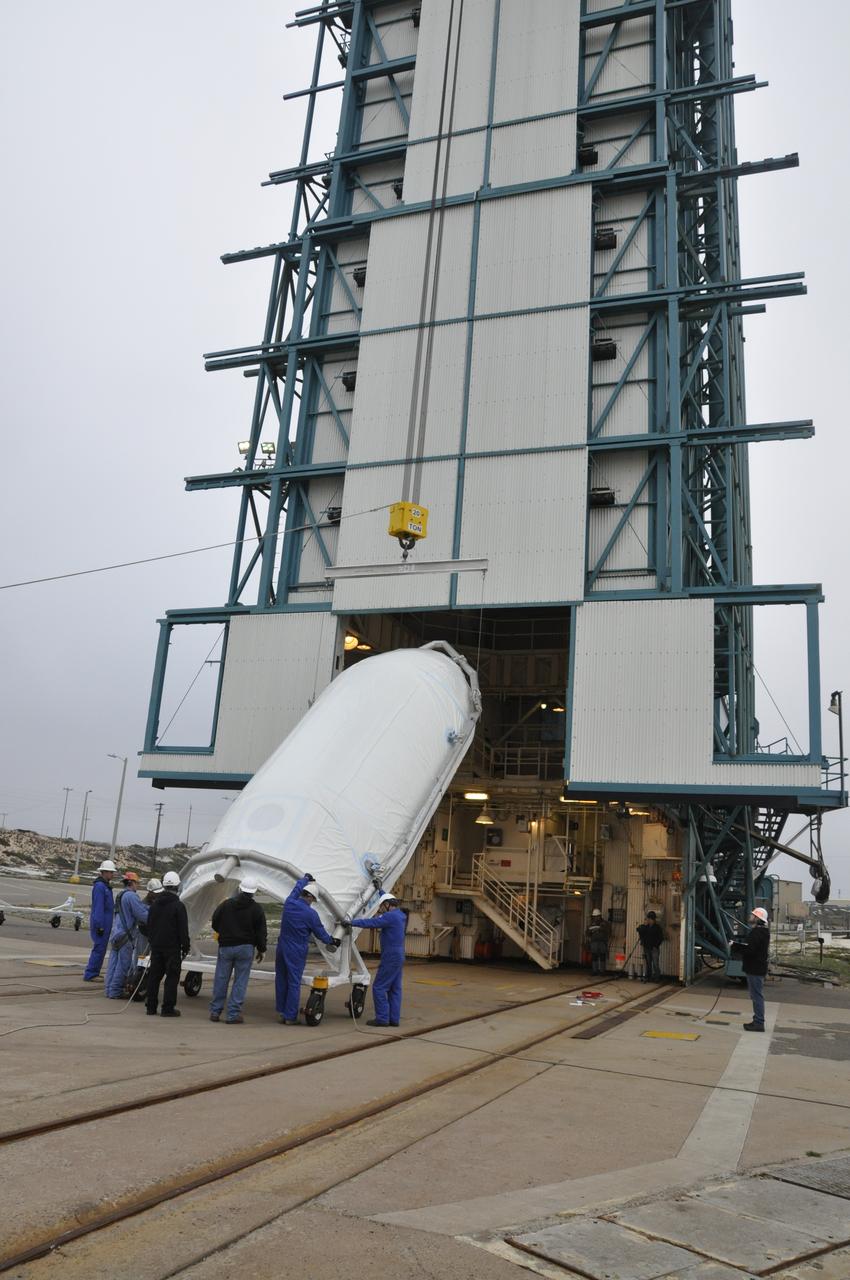
VANDENBERG AIR FORCE BASE, Calif. – A crane is employed to lift half of the fairing for NASA's Orbiting Carbon Observatory-2 mission, or OCO-2, into a vertical position at Space Launch Complex 2 on Vandenberg Air Force Base in California. Operations are underway to hoist this section of the fairing into the Delta II launcher's environmental enclosure, or clean room, at the top of the tower. The fairing will protect OCO-2 during launch aboard a United Launch Alliance Delta II rocket from Space Launch Complex 2 in July. The observatory will collect precise global measurements of carbon dioxide in the Earth's atmosphere and provide scientists with a better idea of the chemical compound's impacts on climate change. Scientists will analyze this data to improve our understanding of the natural processes and human activities that regulate the abundance and distribution of this important atmospheric gas. To learn more about OCO-2, visit http://oco.jpl.nasa.gov. Photo credit: NASA/Randy Beaudoin
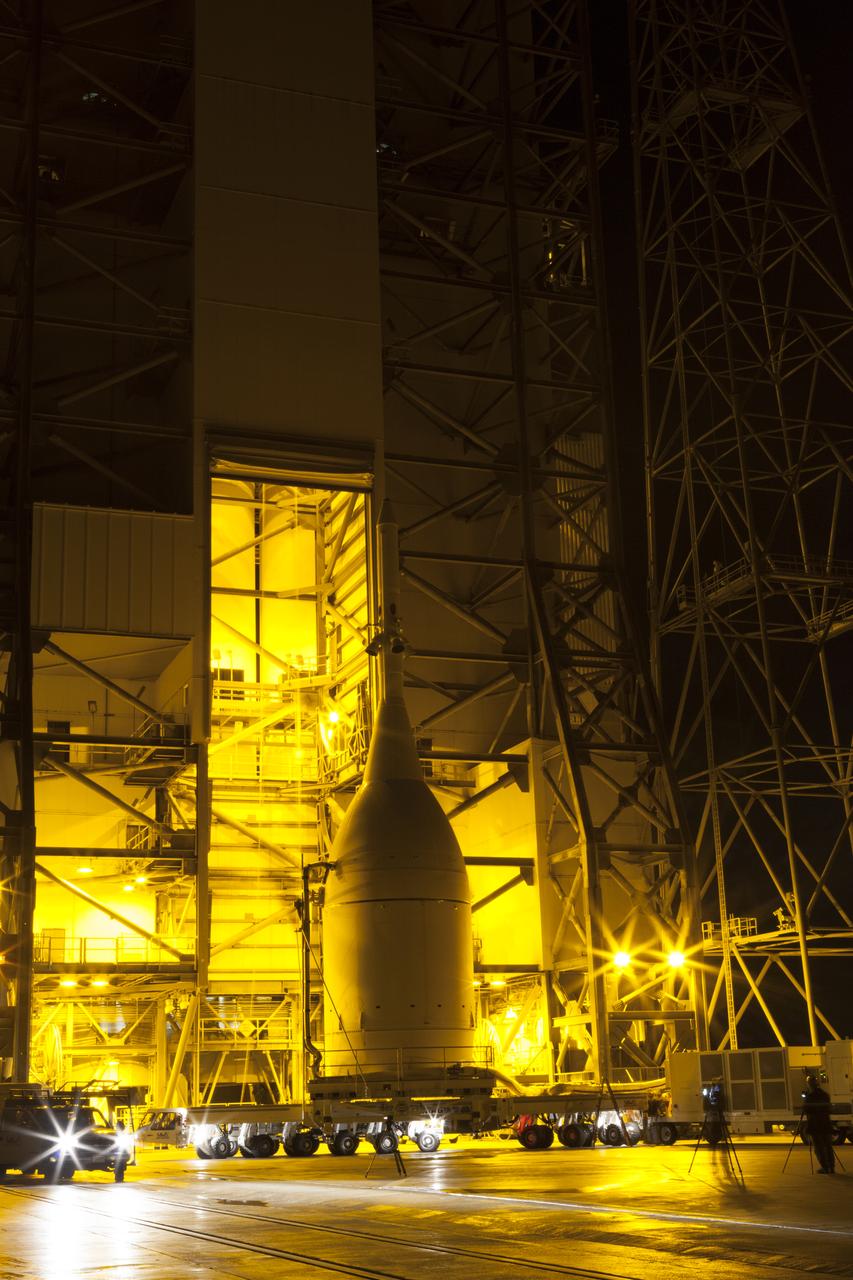
The Orion spacecraft and its transporter stand at the base of the service structure at Space Launch Complex 37. A crane inside the structure will lift Orion off its transporter to hoist it into place atop the Delta IV Heavy rocket that is already assembled at the pad. Orion is the exploration spacecraft designed to carry astronauts to destinations not yet explored by humans, including an asteroid and Mars. It will have emergency abort capability, sustain the crew during space travel and provide safe re-entry from deep space return velocities. The first unpiloted flight test of Orion is scheduled to launch Dec. 4, 2014, atop a United Launch Alliance Delta IV Heavy rocket, and in 2018 on NASA’s Space Launch System rocket.
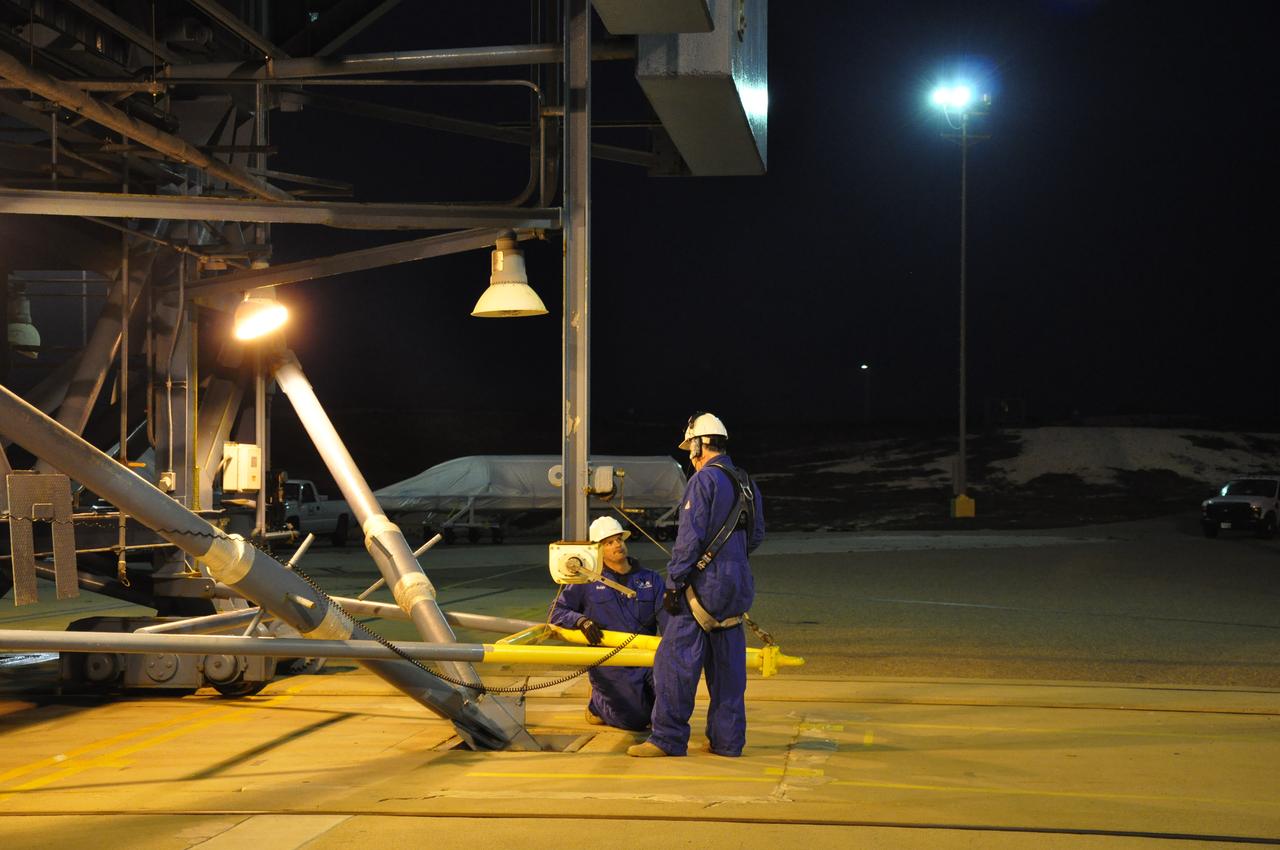
VANDENBERG AIR FORCE BASE, Calif. – At Space Launch Complex 2 on Vandenberg Air Force Base in California, workers prepare to hoist the fairing for NASA's Orbiting Carbon Observatory-2 mission, or OCO-2, seen in the background, into the gantry's environmental enclosure, or clean room, following the rollback of the mobile service tower. The fairing will protect OCO-2 during launch aboard a United Launch Alliance Delta II rocket from Space Launch Complex 2 in July. The observatory will collect precise global measurements of carbon dioxide in the Earth's atmosphere and provide scientists with a better idea of the chemical compound's impacts on climate change. Scientists will analyze this data to improve our understanding of the natural processes and human activities that regulate the abundance and distribution of this important atmospheric gas. To learn more about OCO-2, visit http://oco.jpl.nasa.gov. Photo credit: NASA/Randy Beaudoin
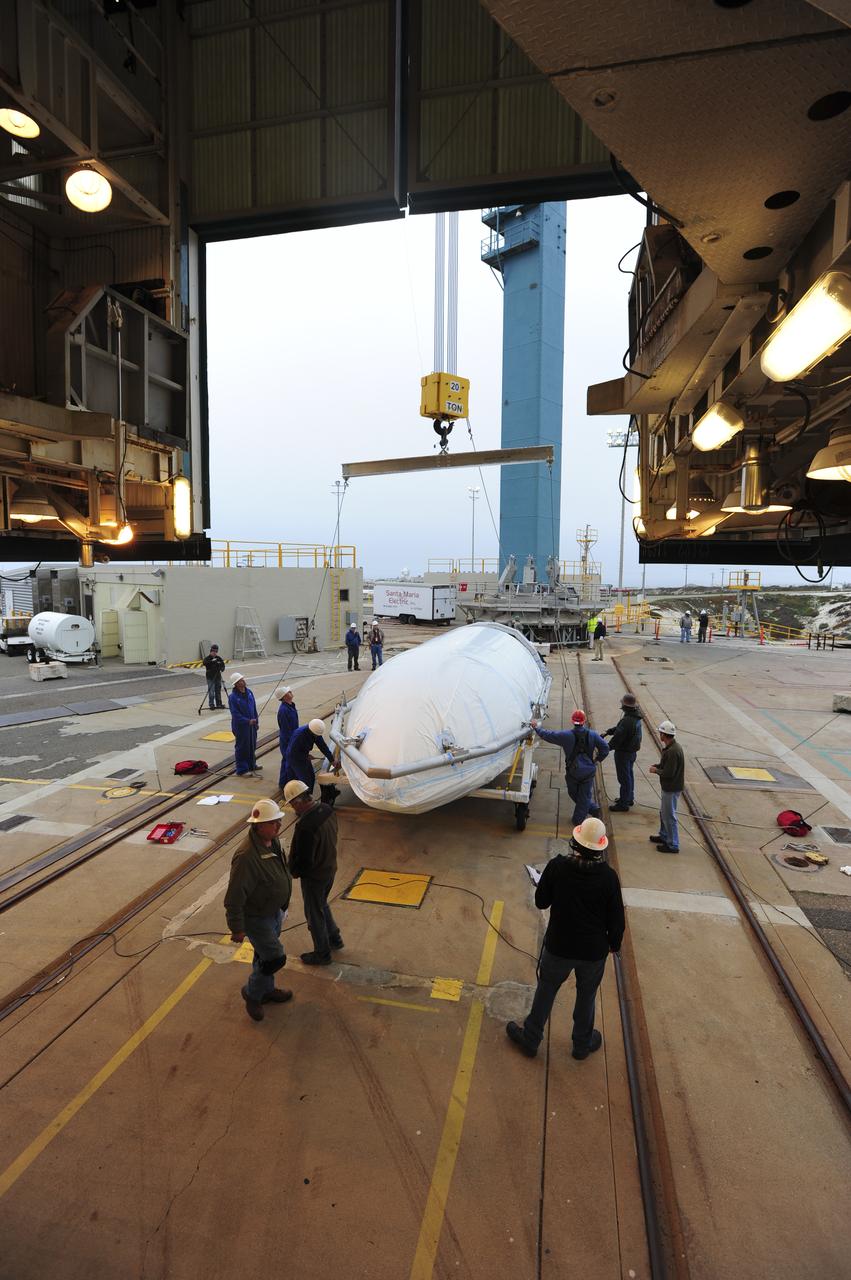
VANDENBERG AIR FORCE BASE, Calif. – Workers attach half of the fairing for NASA's Orbiting Carbon Observatory-2 mission, or OCO-2, to a crane at Space Launch Complex 2 on Vandenberg Air Force Base in California. Operations have begun to hoist the sections of the fairing into the Delta II launcher's environmental enclosure, or clean room, at the top of the pad's mobile service tower. The fairing will protect OCO-2 during launch aboard a United Launch Alliance Delta II rocket from Space Launch Complex 2 in July. The observatory will collect precise global measurements of carbon dioxide in the Earth's atmosphere and provide scientists with a better idea of the chemical compound's impacts on climate change. Scientists will analyze this data to improve our understanding of the natural processes and human activities that regulate the abundance and distribution of this important atmospheric gas. To learn more about OCO-2, visit http://oco.jpl.nasa.gov. Photo credit: NASA/30th Space Wing, VAFB
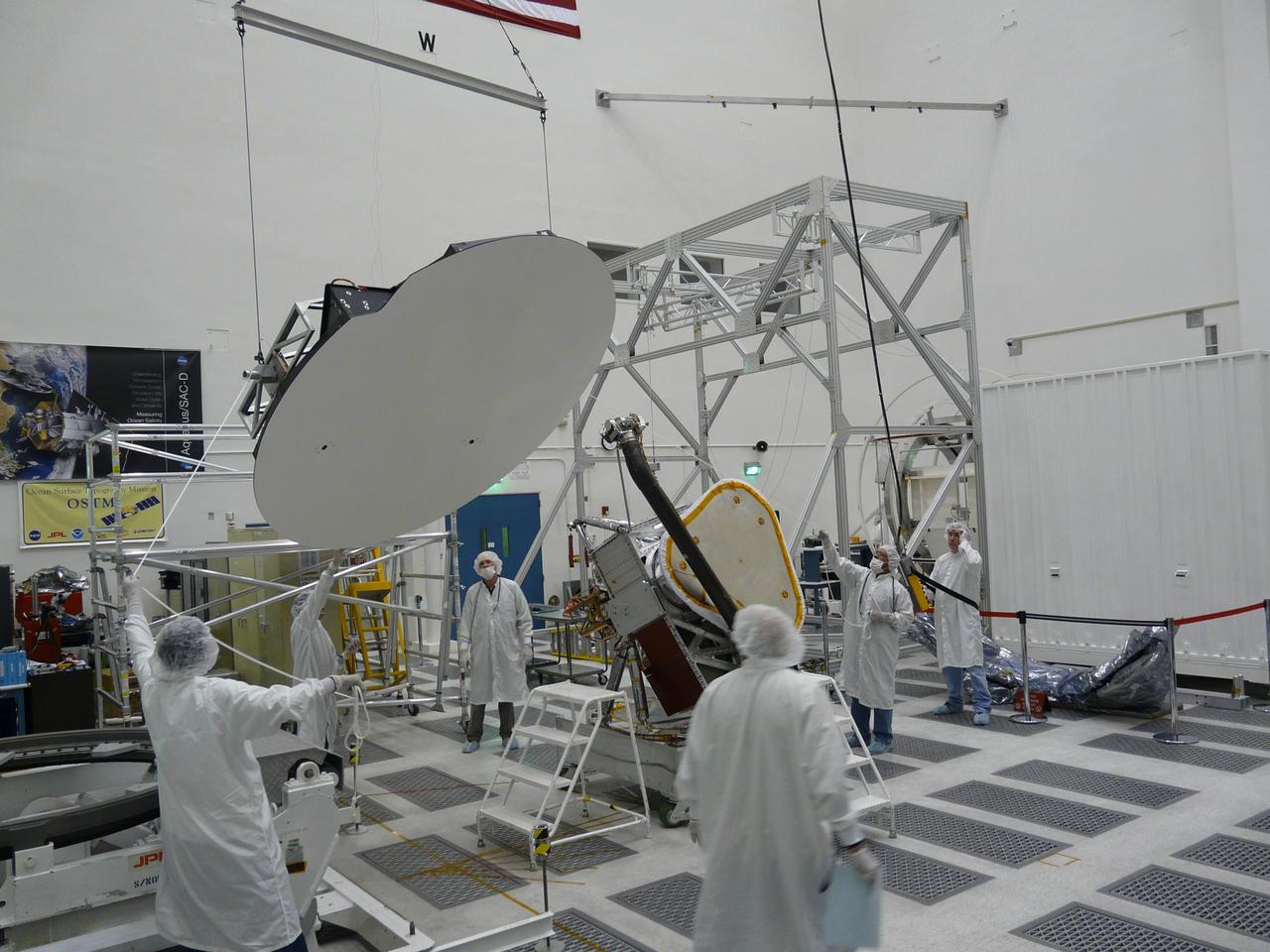
Aquarius 2.5 meter reflector is hoisted before being attached to boom in the clean room at NASA Jet Propulsion Laboratory in Pasadena, Calif.
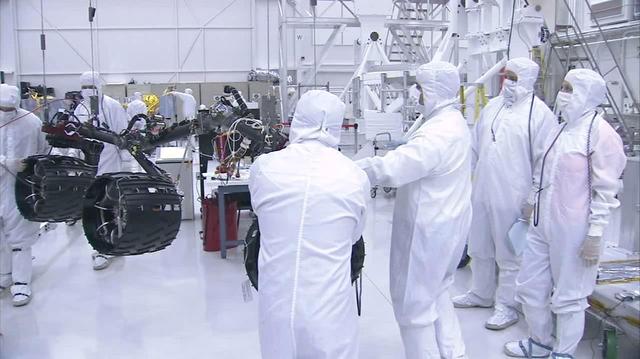
In this image taken from a video clip, NASA Curiosity rover wheels are shown hoisted on a pink crane and moving closer to the rover body. Video is available at the Photojournal.
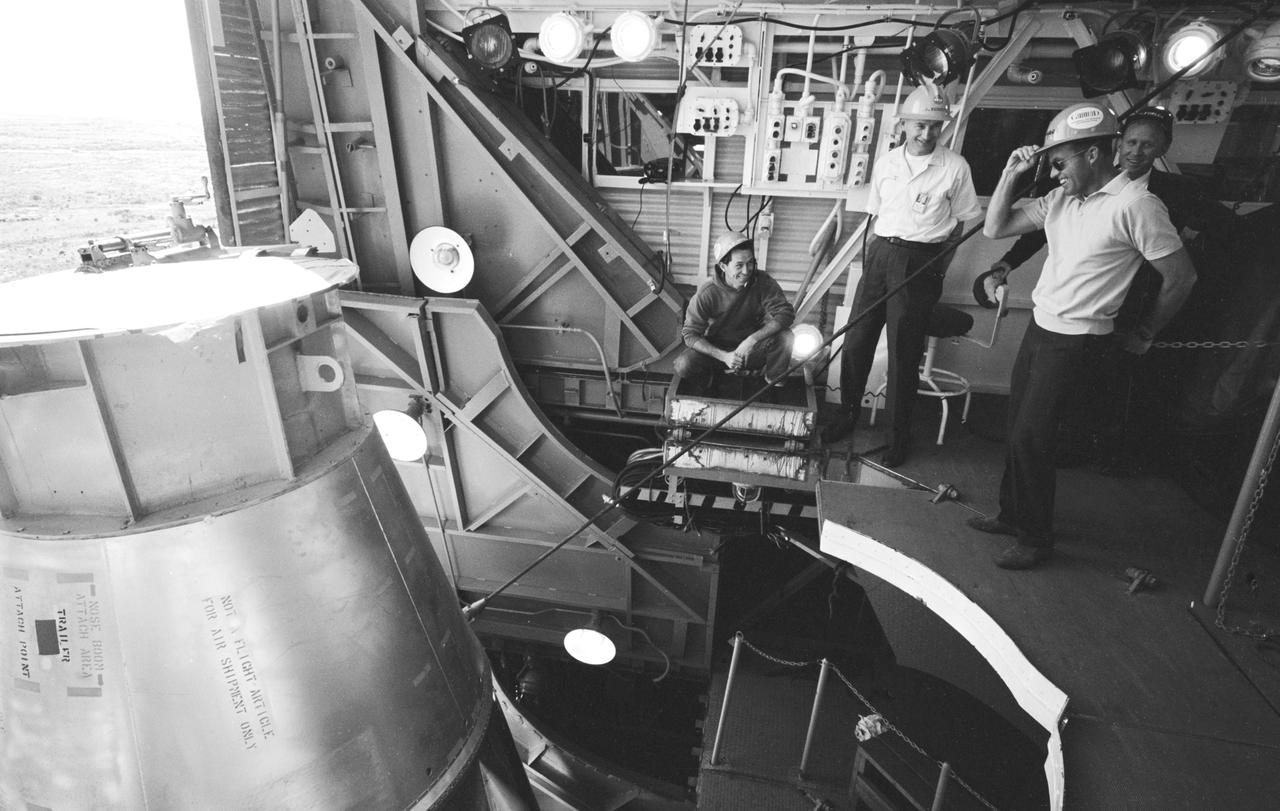
S63-03986 (1963) --- Astronaut L. Gordon Cooper Jr., prime pilot for the Mercury-Atlas 9 (MA-9) mission, and General Dynamics pad technicians watch Atlas 130D being hoisted into place in the gantry at pad #14, Cape Canaveral, Florida. Photo credit: NASA
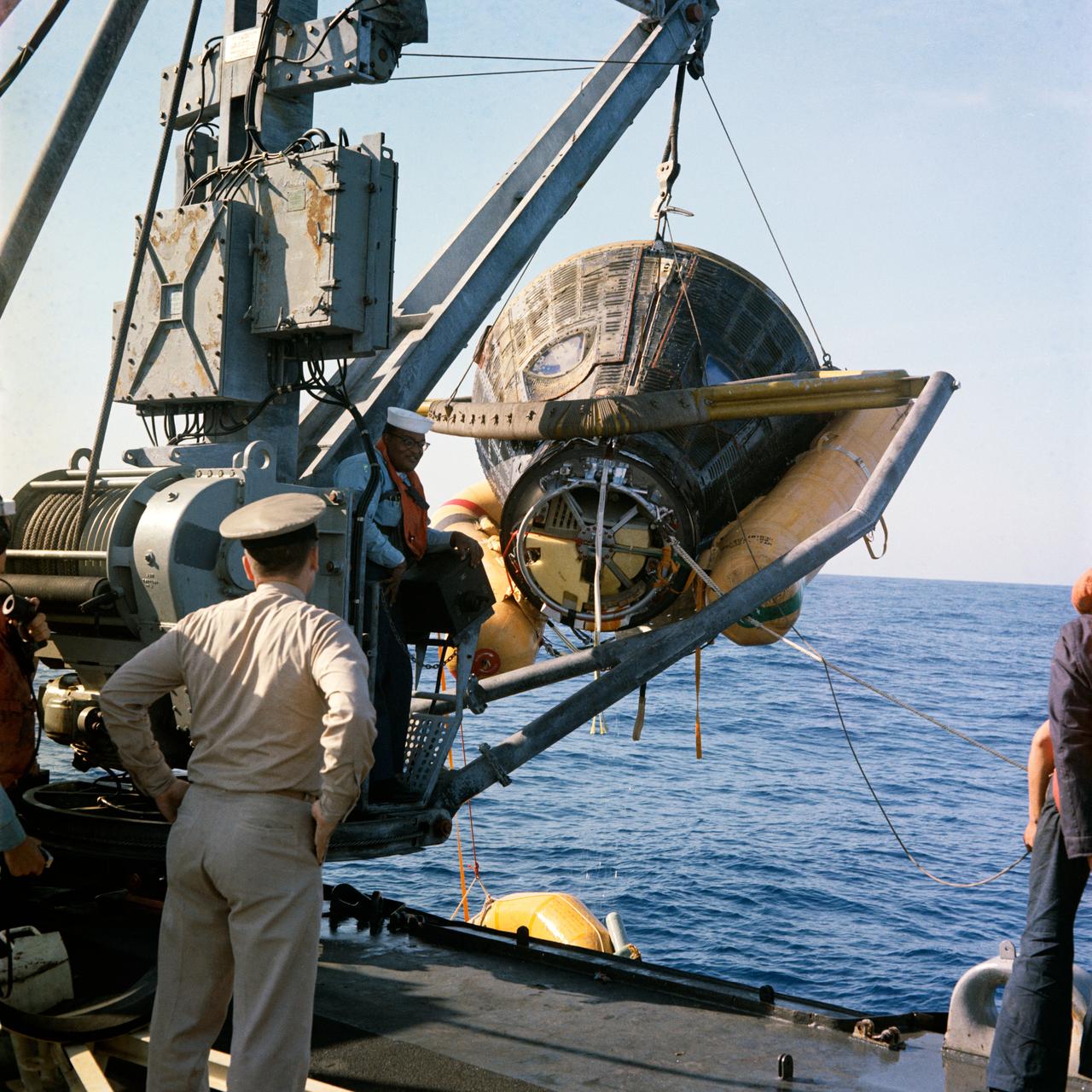
S66-18613 (16 March 1966) --- The Gemini-8 spacecraft, with astronauts Neil A. Armstrong and David R. Scott still aboard, is hoisted aboard the destroyer USS Leonard F. Mason. Trouble with the Gemini-8 Orbit Attitude and Maneuvering System (OAMS) forced an early termination of the mission. Photo credit: NASA
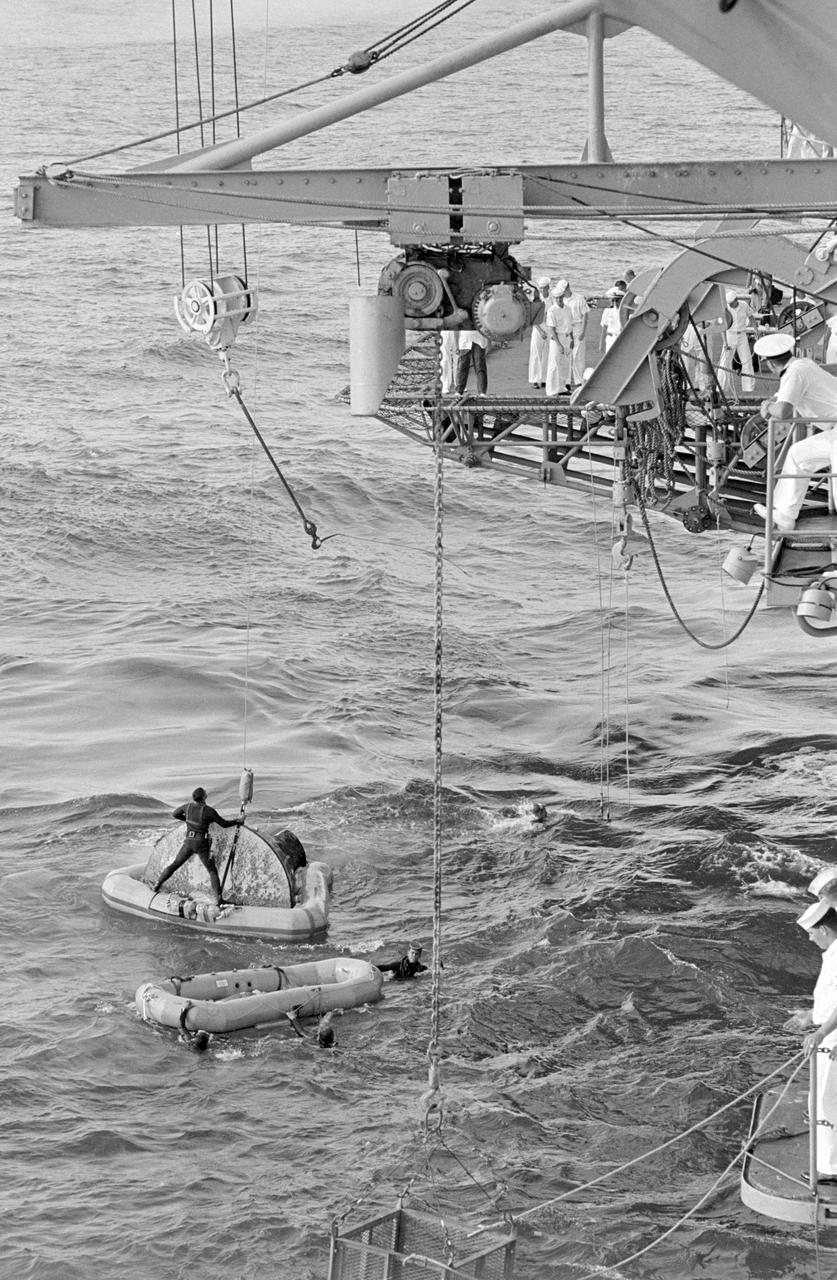
S66-42790 (21 July 1966) --- The Gemini-10 spacecraft, with flotation collar still attached, is prepared for hoisting aboard the prime recovery ship, USS Guadalcanal. Navy frogmen assist in the recovery operations. Astronauts John W. Young, command pilot, and Michael Collins, pilot, prime crew for the Gemini-10 spaceflight, had already been picked up by helicopter and flown to the Guadalcanal. Gemini-10 splashed down 460 nautical miles east of Cape Kennedy at 4:07 p.m. (EST), July 21, 1966, to conclude a three-day mission in space. Photo credit: NASA
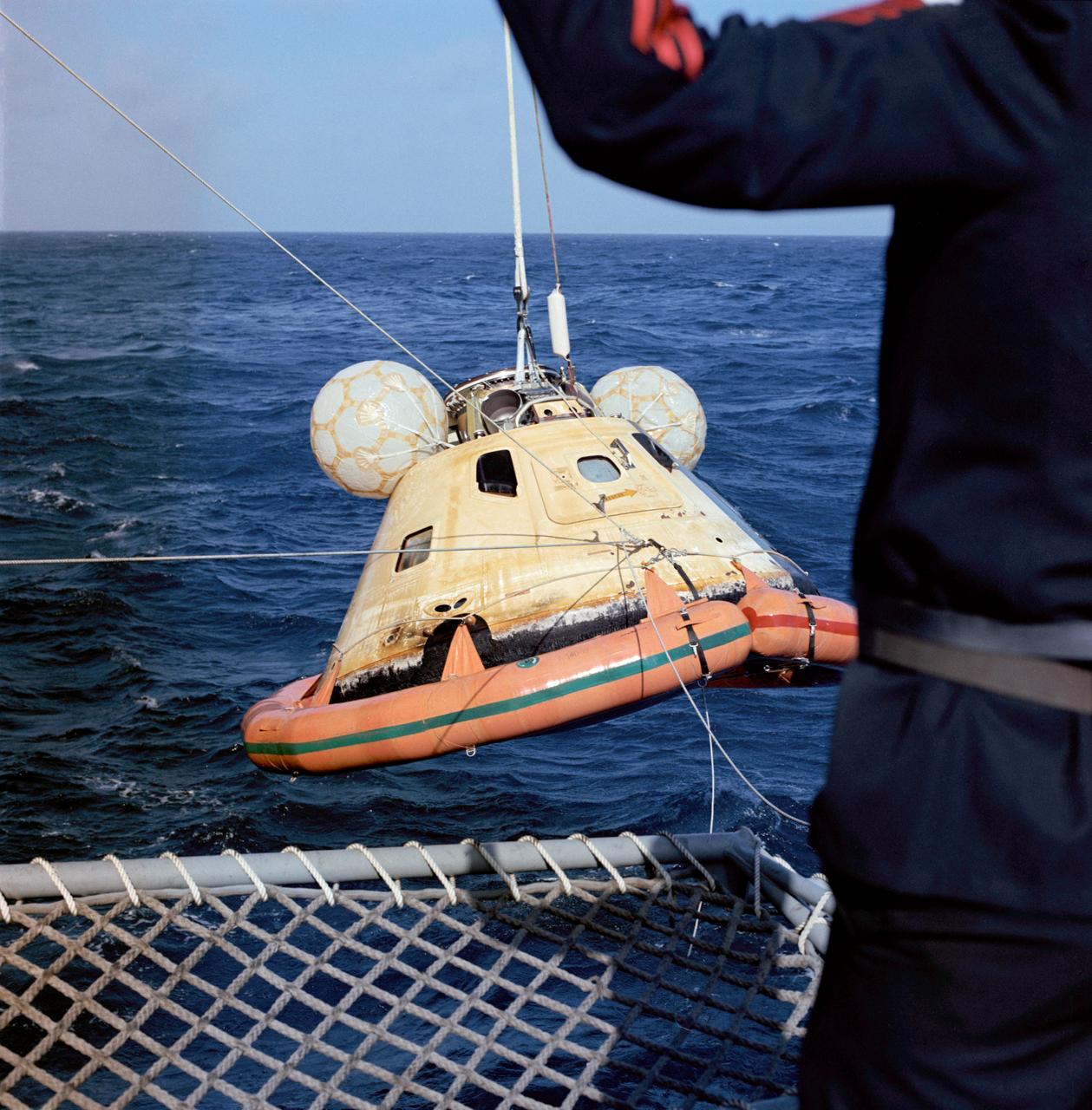
S73-36423 (25 Sept. 1973) --- The Skylab 3 Command Module, with astronauts Alan L. Bean, Owen K. Garriott and Jack R. Lousma still inside, is hoisted aboard the prime recovery ship, USS New Orleans, during recovery operations in the Pacific Ocean. The three crewmen had just completed a successful 59-day visit to the Skylab space station in Earth orbit. The Command Module splashed down in the Pacific about 230 miles southwest of San Diego, California. Earlier in the recovery operations a team of U.S. Navy swimmers attached the flotation collar to the spacecraft to improve its buoyancy. Photo credit: NASA
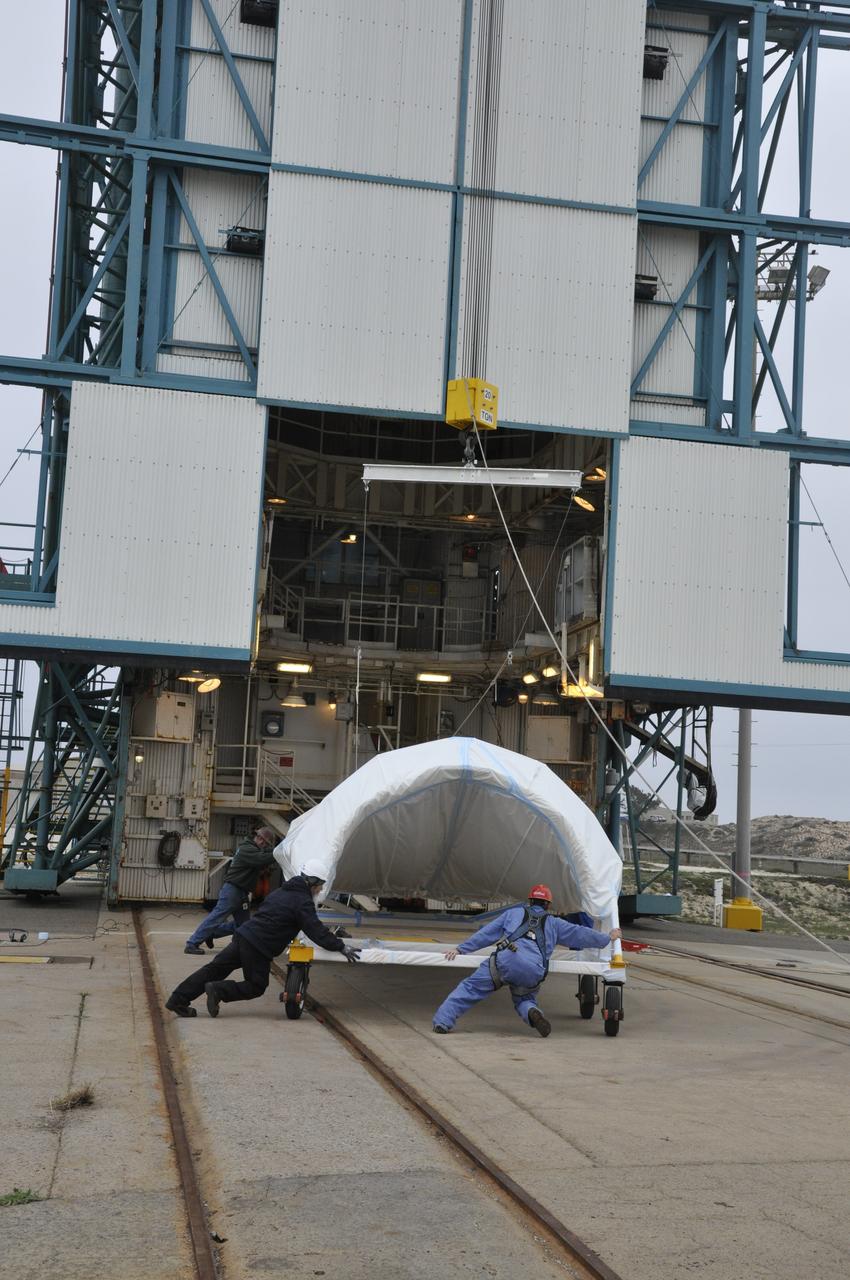
VANDENBERG AIR FORCE BASE, Calif. – Workers maneuver half of the fairing for NASA's Orbiting Carbon Observatory-2 mission, or OCO-2, newly arrived at Space Launch Complex 2 on Vandenberg Air Force Base in California, into position underneath the crane. Operations are underway to hoist this section of the fairing into the Delta II launcher's environmental enclosure, or clean room, at the top of the tower where the other half already is in position. The fairing will protect OCO-2 during launch aboard a United Launch Alliance Delta II rocket from Space Launch Complex 2 in July. The observatory will collect precise global measurements of carbon dioxide in the Earth's atmosphere and provide scientists with a better idea of the chemical compound's impacts on climate change. Scientists will analyze this data to improve our understanding of the natural processes and human activities that regulate the abundance and distribution of this important atmospheric gas. To learn more about OCO-2, visit http://oco.jpl.nasa.gov. Photo credit: NASA/Randy Beaudoin

VANDENBERG AIR FORCE BASE, Calif. – Workers attach a crane onto half of the fairing for NASA's Orbiting Carbon Observatory-2 mission, or OCO-2, newly arrived at Space Launch Complex 2 on Vandenberg Air Force Base in California. Operations are underway to hoist this section of the fairing into the Delta II launcher's environmental enclosure, or clean room, at the top of the tower where the other half already is in position. The fairing will protect OCO-2 during launch aboard a United Launch Alliance Delta II rocket from Space Launch Complex 2 in July. The observatory will collect precise global measurements of carbon dioxide in the Earth's atmosphere and provide scientists with a better idea of the chemical compound's impacts on climate change. Scientists will analyze this data to improve our understanding of the natural processes and human activities that regulate the abundance and distribution of this important atmospheric gas. To learn more about OCO-2, visit http://oco.jpl.nasa.gov. Photo credit: NASA/Randy Beaudoin
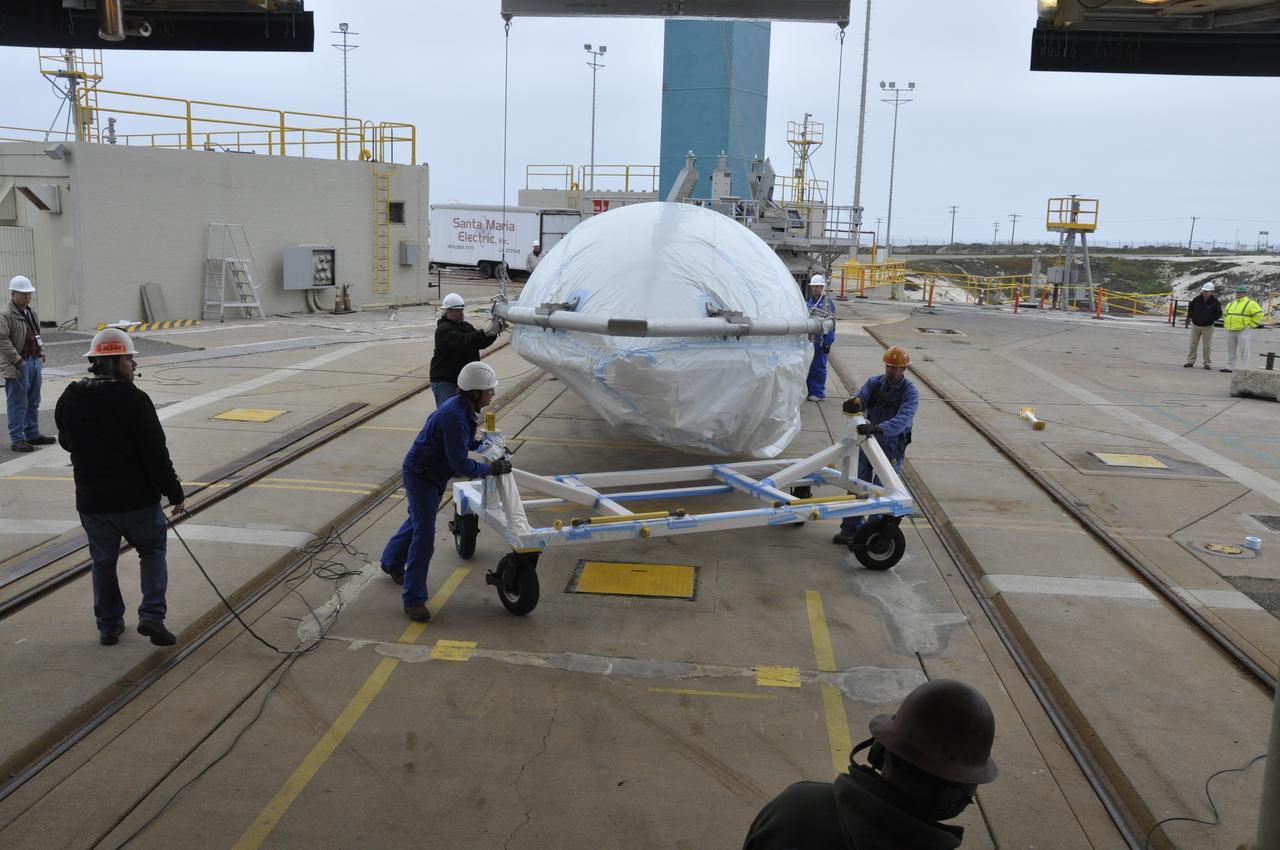
VANDENBERG AIR FORCE BASE, Calif. – Workers maneuver half of the fairing for NASA's Orbiting Carbon Observatory-2 mission, or OCO-2, newly arrived at Space Launch Complex 2 on Vandenberg Air Force Base in California, into position underneath the crane. Operations are underway to hoist this section of the fairing into the Delta II launcher's environmental enclosure, or clean room, at the top of the tower where the other half already is in position. The fairing will protect OCO-2 during launch aboard a United Launch Alliance Delta II rocket from Space Launch Complex 2 in July. The observatory will collect precise global measurements of carbon dioxide in the Earth's atmosphere and provide scientists with a better idea of the chemical compound's impacts on climate change. Scientists will analyze this data to improve our understanding of the natural processes and human activities that regulate the abundance and distribution of this important atmospheric gas. To learn more about OCO-2, visit http://oco.jpl.nasa.gov. Photo credit: NASA/Randy Beaudoin
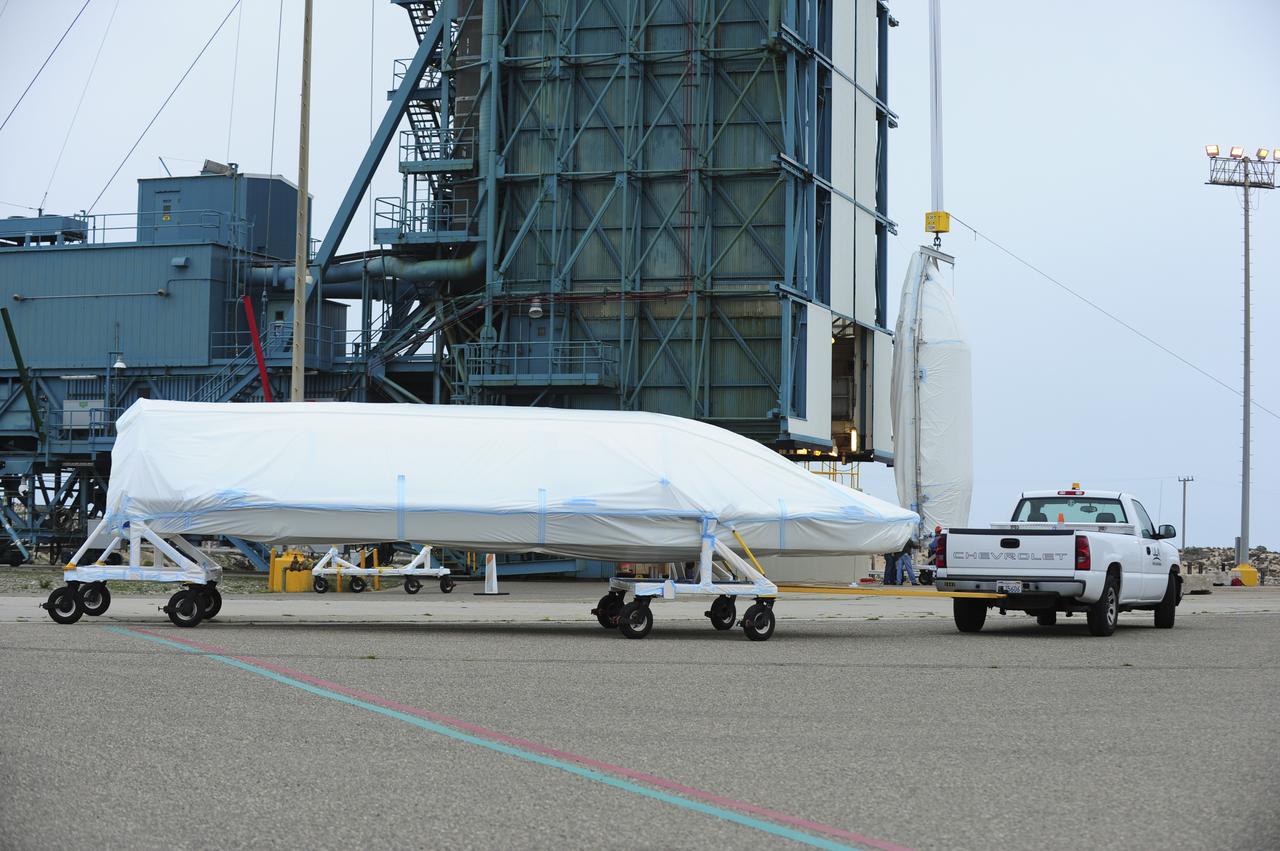
VANDENBERG AIR FORCE BASE, Calif. – Half of the fairing for NASA's Orbiting Carbon Observatory-2 mission, or OCO-2, is towed from the Building 836 hangar to Space Launch Complex 2 on Vandenberg Air Force Base in California. Operations have begun to hoist the sections of the fairing into the Delta II launcher's environmental enclosure, or clean room, at the top of the pad's mobile service tower. The fairing will protect OCO-2 during launch aboard a United Launch Alliance Delta II rocket from Space Launch Complex 2 in July. The observatory will collect precise global measurements of carbon dioxide in the Earth's atmosphere and provide scientists with a better idea of the chemical compound's impacts on climate change. Scientists will analyze this data to improve our understanding of the natural processes and human activities that regulate the abundance and distribution of this important atmospheric gas. To learn more about OCO-2, visit http://oco.jpl.nasa.gov. Photo credit: NASA/30th Space Wing, VAFB
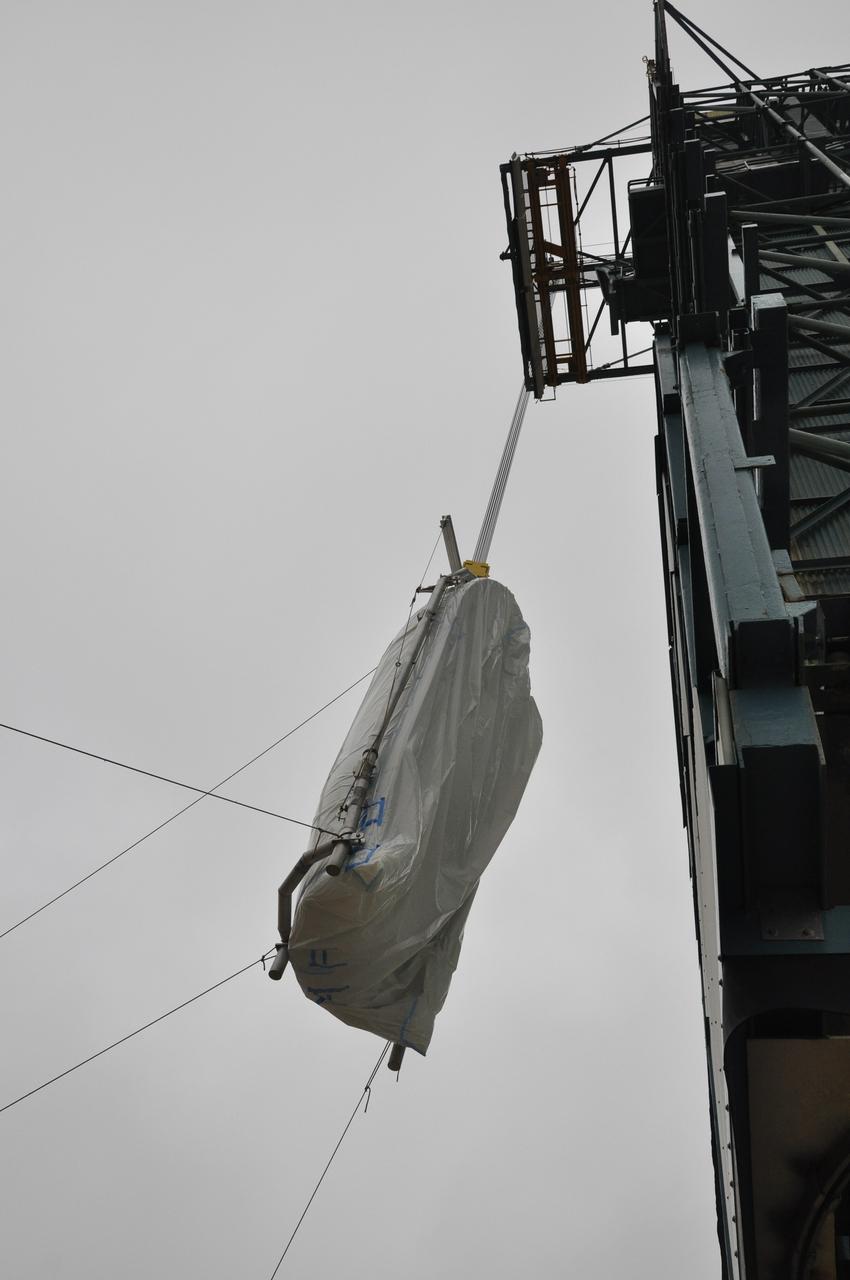
VANDENBERG AIR FORCE BASE, Calif. – A crane lifts half of the fairing for NASA's Orbiting Carbon Observatory-2 mission, or OCO-2, up the side of the mobile service tower at Space Launch Complex 2 on Vandenberg Air Force Base in California. Operations are underway to hoist this section of the fairing into the Delta II launcher's environmental enclosure, or clean room, at the top of the tower where the other half is already in position. The fairing will protect OCO-2 during launch aboard a United Launch Alliance Delta II rocket from Space Launch Complex 2 in July. The observatory will collect precise global measurements of carbon dioxide in the Earth's atmosphere and provide scientists with a better idea of the chemical compound's impacts on climate change. Scientists will analyze this data to improve our understanding of the natural processes and human activities that regulate the abundance and distribution of this important atmospheric gas. To learn more about OCO-2, visit http://oco.jpl.nasa.gov. Photo credit: NASA/Randy Beaudoin
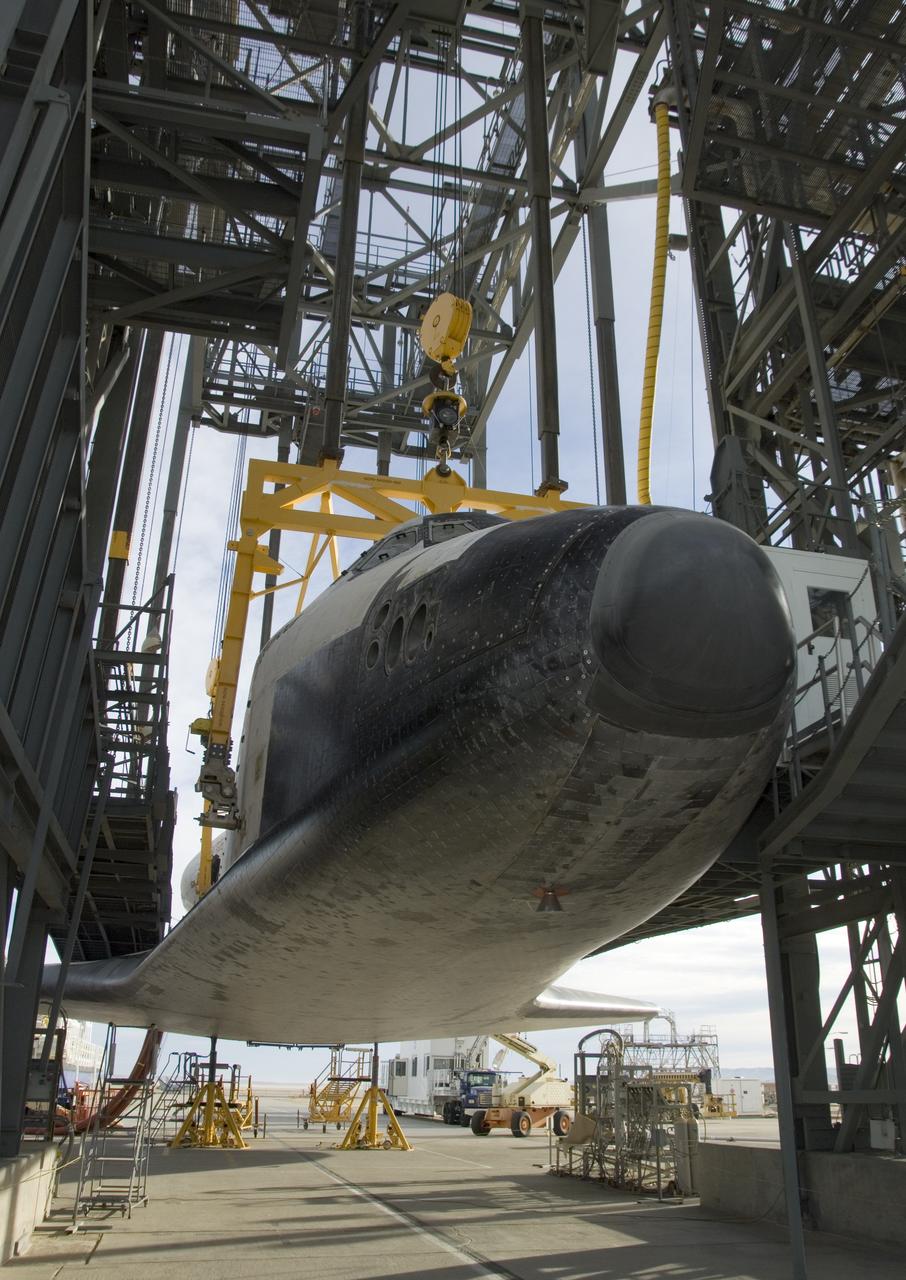
The Space Shuttle Endeavour is slowly hoisted aloft in the Mate-Demate gantry at NASA's Dryden Flight Research Center before being mounted atop its modified 747 carrier aircraft for a ferry flight back to the Kennedy Space Center in Florida.
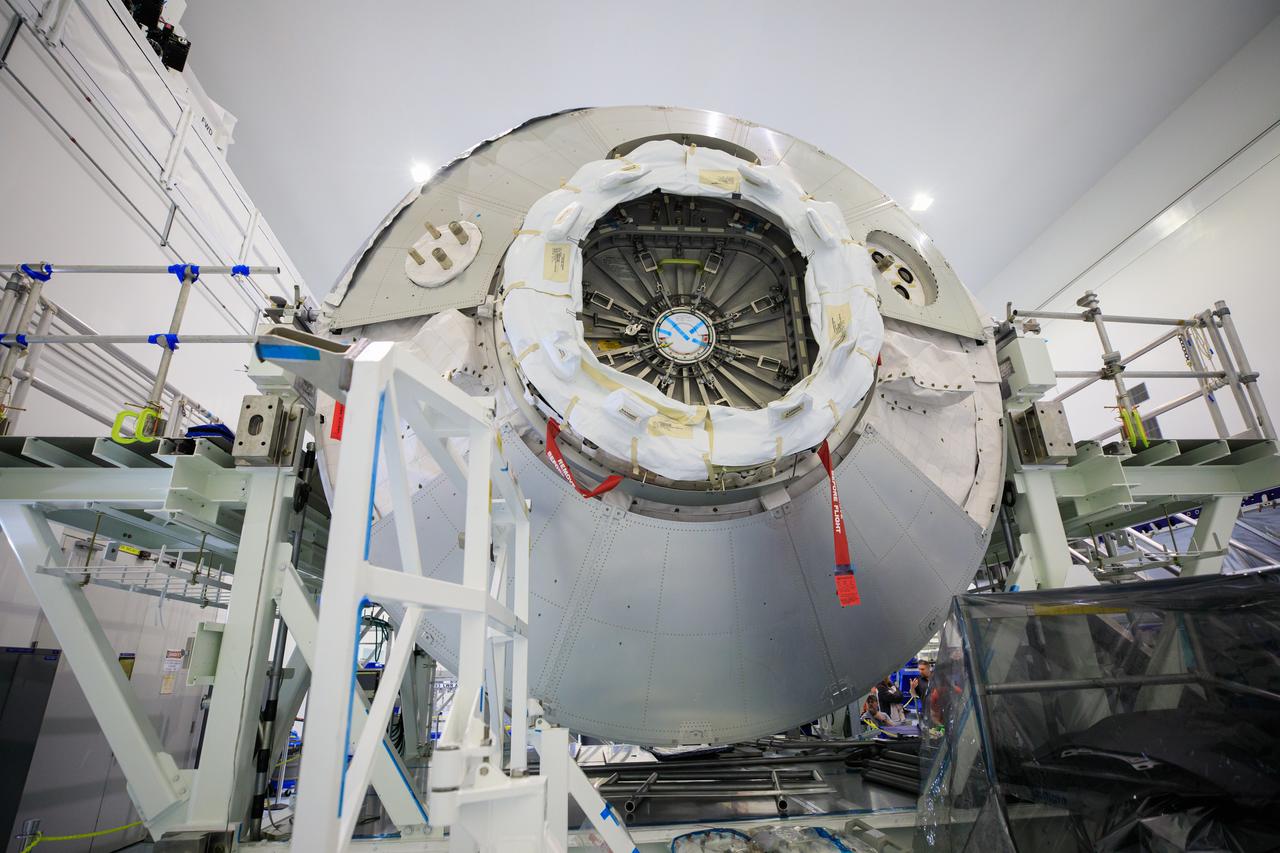
The Multi-Purpose Logistics Module (MPLM), used during the Space Shuttle Program to transfer cargo to and from the International Space Station, is secured in a stand inside the Space Station Processing Facility high bay at NASA’s Kennedy Space Center in Florida on April 20, 2023. The MPLM is being prepared for transport to Ellington Field in Houston, where it will then be transported by road to Axiom’s facility near Ellington to be utilized to further commercialization of space. Three MPLMs were built by Thales Alenia Space Italia (TASI) for the Italian Space Agency (ASI) and named after Italian masters (Leonardo, Raffaello, and Donatello). Only two ever flew to the space station, Leonardo and Raffaello, with Axiom intending to use Raffaello as a future element that will attach to a segment being built by the company for addition to the space station.
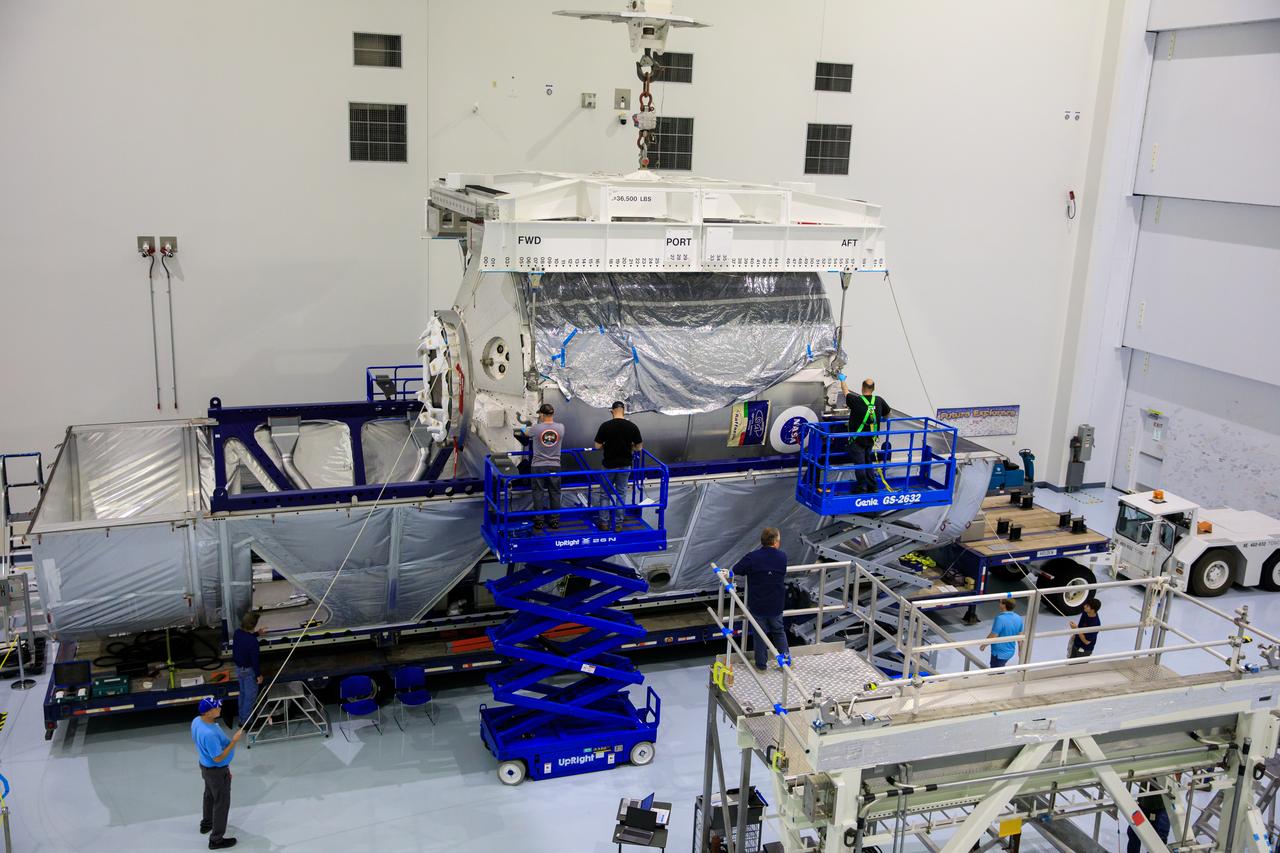
The Multi-Purpose Logistics Module (MPLM), used during the Space Shuttle Program to transfer cargo to and from the International Space Station, is lowered by crane into its transport container inside the Space Station Processing Facility high bay at NASA’s Kennedy Space Center in Florida on April 20, 2023. The MPLM is being prepared for transport to Ellington Field in Houston, where it will then be transported by road to Axiom’s facility near Ellington to be utilized to further commercialization of space. Three MPLMs were built by Thales Alenia Space Italia (TASI) for the Italian Space Agency (ASI) and named after Italian masters (Leonardo, Raffaello, and Donatello). Only two ever flew to the space station, Leonardo and Raffaello, with Axiom intending to use Raffaello as a future element that will attach to a segment being built by the company for addition to the space station.
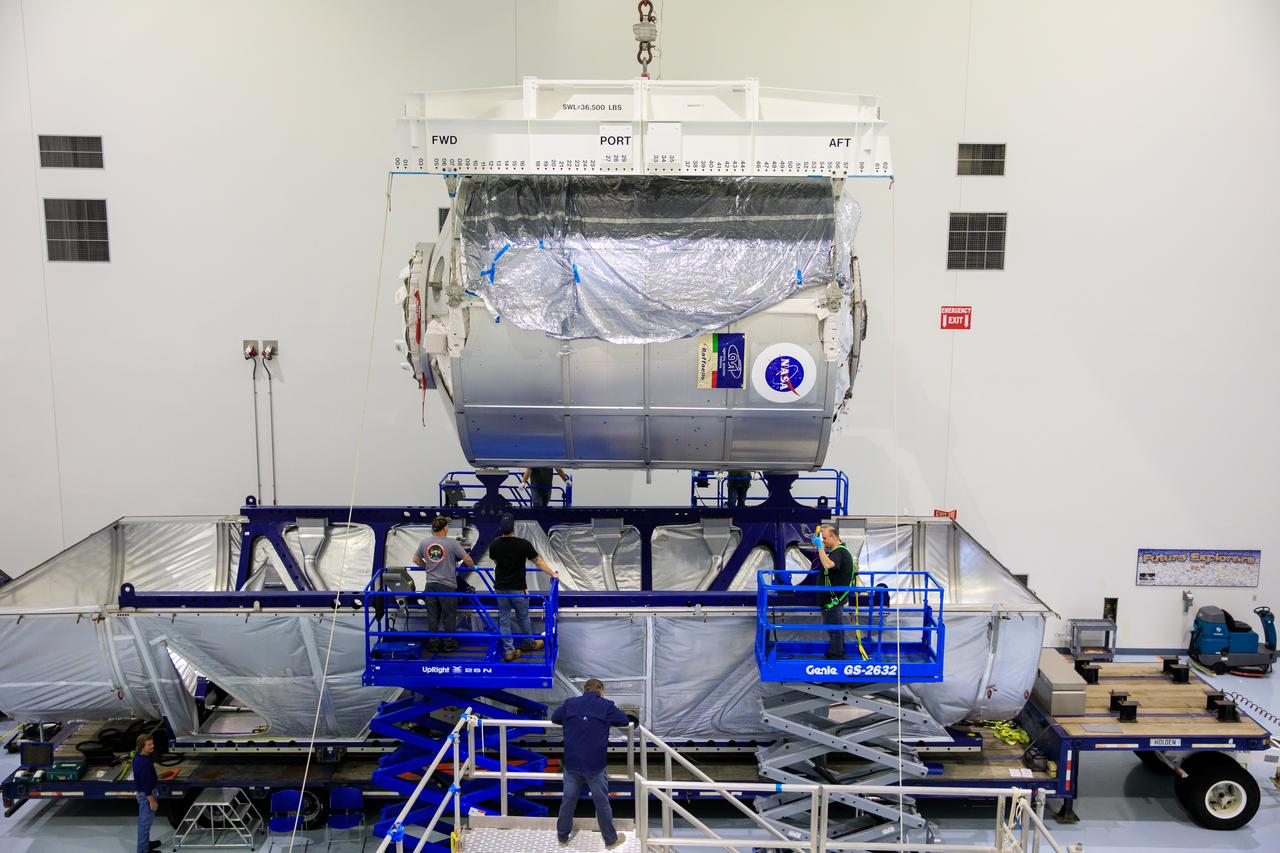
The Multi-Purpose Logistics Module (MPLM), used during the Space Shuttle Program to transfer cargo to and from the International Space Station, is lowered by crane into its transport container inside the Space Station Processing Facility high bay at NASA’s Kennedy Space Center in Florida on April 20, 2023. The MPLM is being prepared for transport to Ellington Field in Houston, where it will then be transported by road to Axiom’s facility near Ellington to be utilized to further commercialization of space. Three MPLMs were built by Thales Alenia Space Italia (TASI) for the Italian Space Agency (ASI) and named after Italian masters (Leonardo, Raffaello, and Donatello). Only two ever flew to the space station, Leonardo and Raffaello, with Axiom intending to use Raffaello as a future element that will attach to a segment being built by the company for addition to the space station.
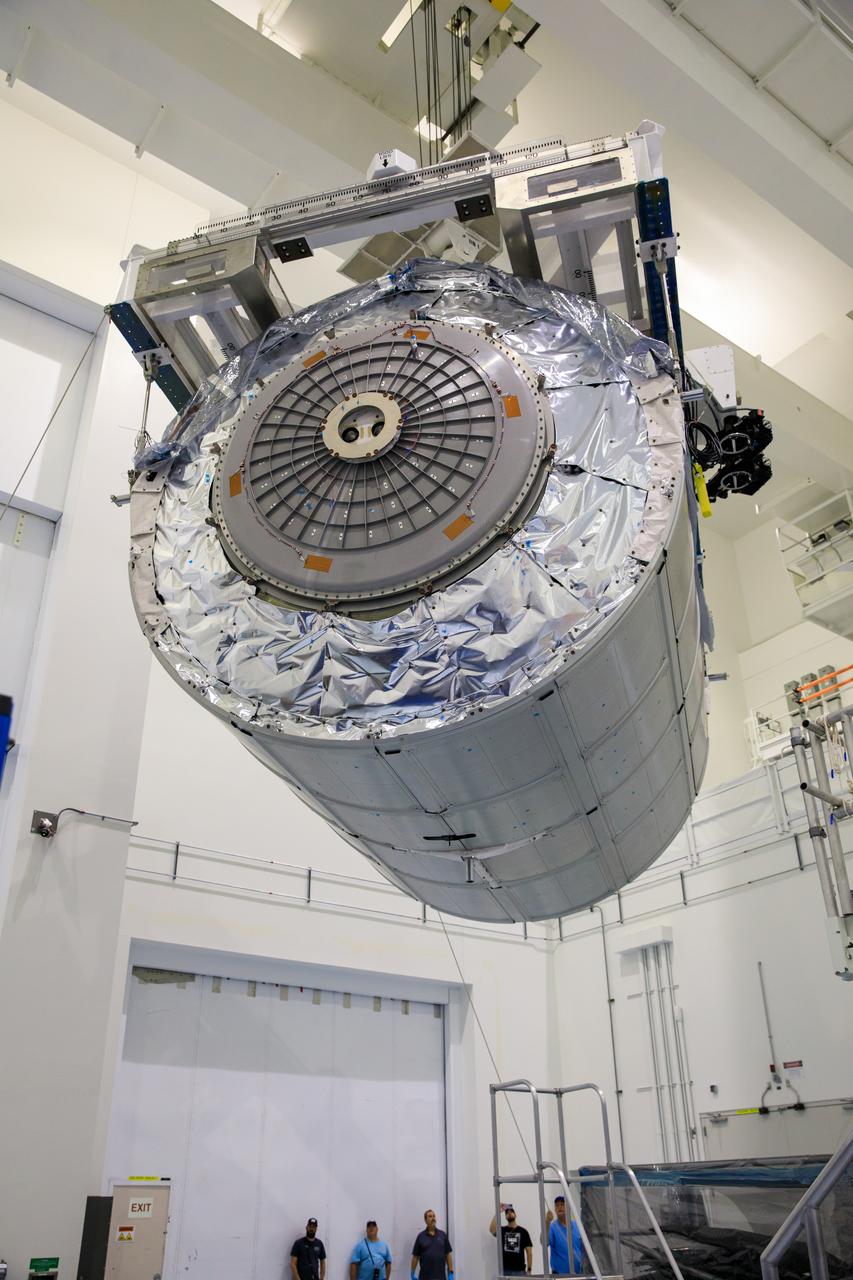
The Multi-Purpose Logistics Module (MPLM), used during the Space Shuttle Program to transfer cargo to and from the International Space Station, is moved by crane inside the Space Station Processing Facility high bay at NASA’s Kennedy Space Center in Florida on April 20, 2023. The MPLM is being prepared for transport to Ellington Field in Houston, where it will then be transported by road to Axiom’s facility near Ellington to be utilized to further commercialization of space. Three MPLMs were built by Thales Alenia Space Italia (TASI) for the Italian Space Agency (ASI) and named after Italian masters (Leonardo, Raffaello, and Donatello). Only two ever flew to the space station, Leonardo and Raffaello, with Axiom intending to use Raffaello as a future element that will attach to a segment being built by the company for addition to the space station.
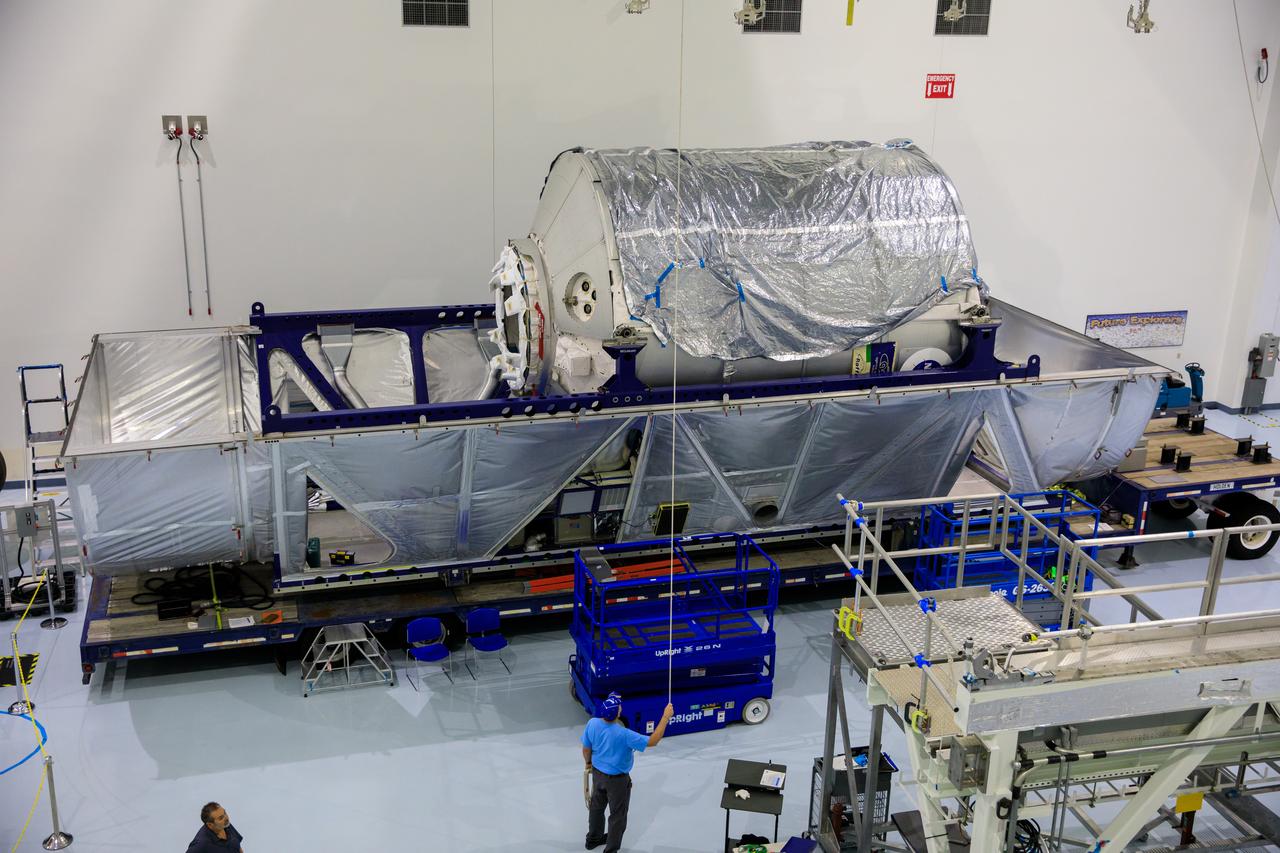
The Multi-Purpose Logistics Module (MPLM), used during the Space Shuttle Program to transfer cargo to and from the International Space Station, is secured in its transport container inside the Space Station Processing Facility high bay at NASA’s Kennedy Space Center in Florida on April 20, 2023. The MPLM is being prepared for transport to Ellington Field in Houston, where it will then be transported by road to Axiom’s facility near Ellington to be utilized to further commercialization of space. Three MPLMs were built by Thales Alenia Space Italia (TASI) for the Italian Space Agency (ASI) and named after Italian masters (Leonardo, Raffaello, and Donatello). Only two ever flew to the space station, Leonardo and Raffaello, with Axiom intending to use Raffaello as a future element that will attach to a segment being built by the company for addition to the space station.
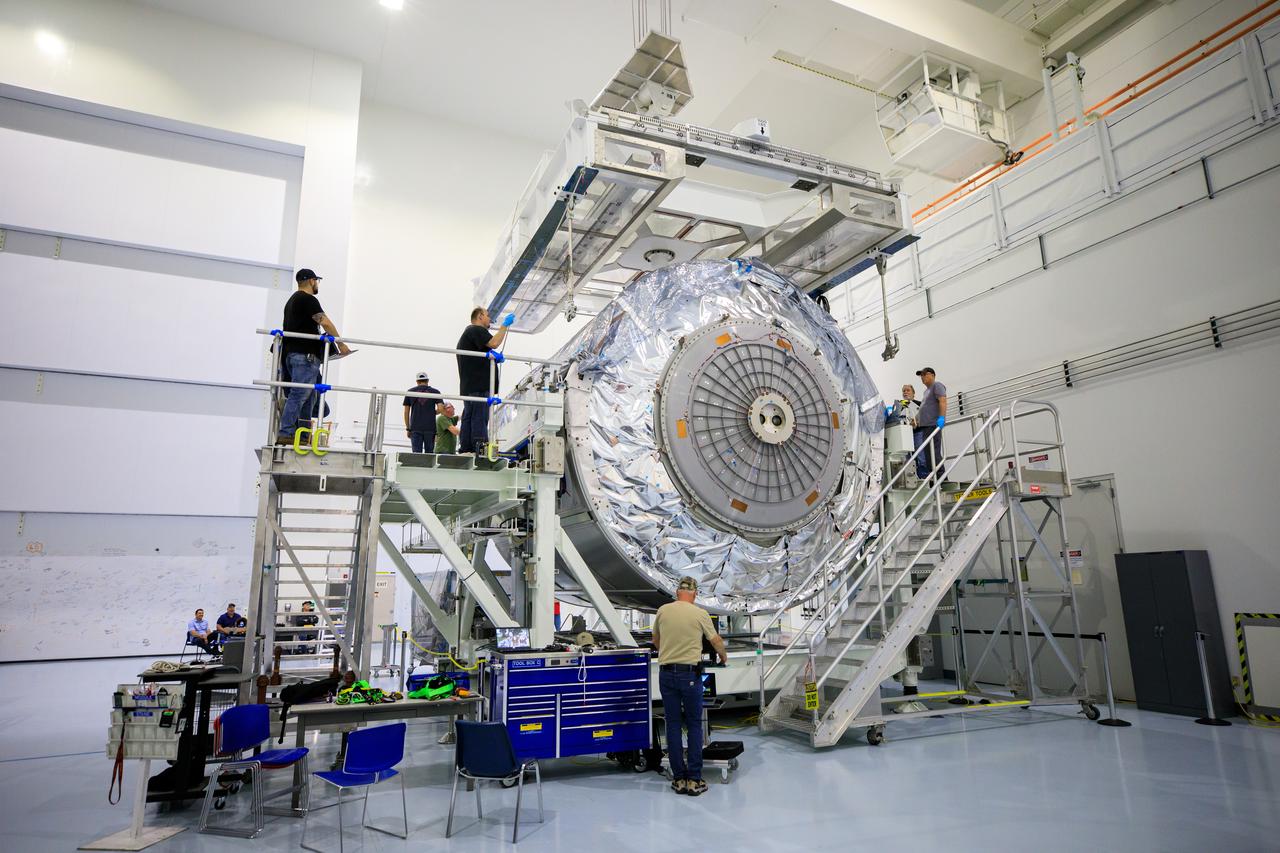
The Multi-Purpose Logistics Module (MPLM), used during the Space Shuttle Program to transfer cargo to and from the International Space Station, is lifted by crane inside the Space Station Processing Facility high bay at NASA’s Kennedy Space Center in Florida on April 20, 2023. The MPLM is being prepared for transport to Ellington Field in Houston, where it will then be transported by road to Axiom’s facility near Ellington to be utilized to further commercialization of space. Three MPLMs were built by Thales Alenia Space Italia (TASI) for the Italian Space Agency (ASI) and named after Italian masters (Leonardo, Raffaello, and Donatello). Only two ever flew to the space station, Leonardo and Raffaello, with Axiom intending to use Raffaello as a future element that will attach to a segment being built by the company for addition to the space station.
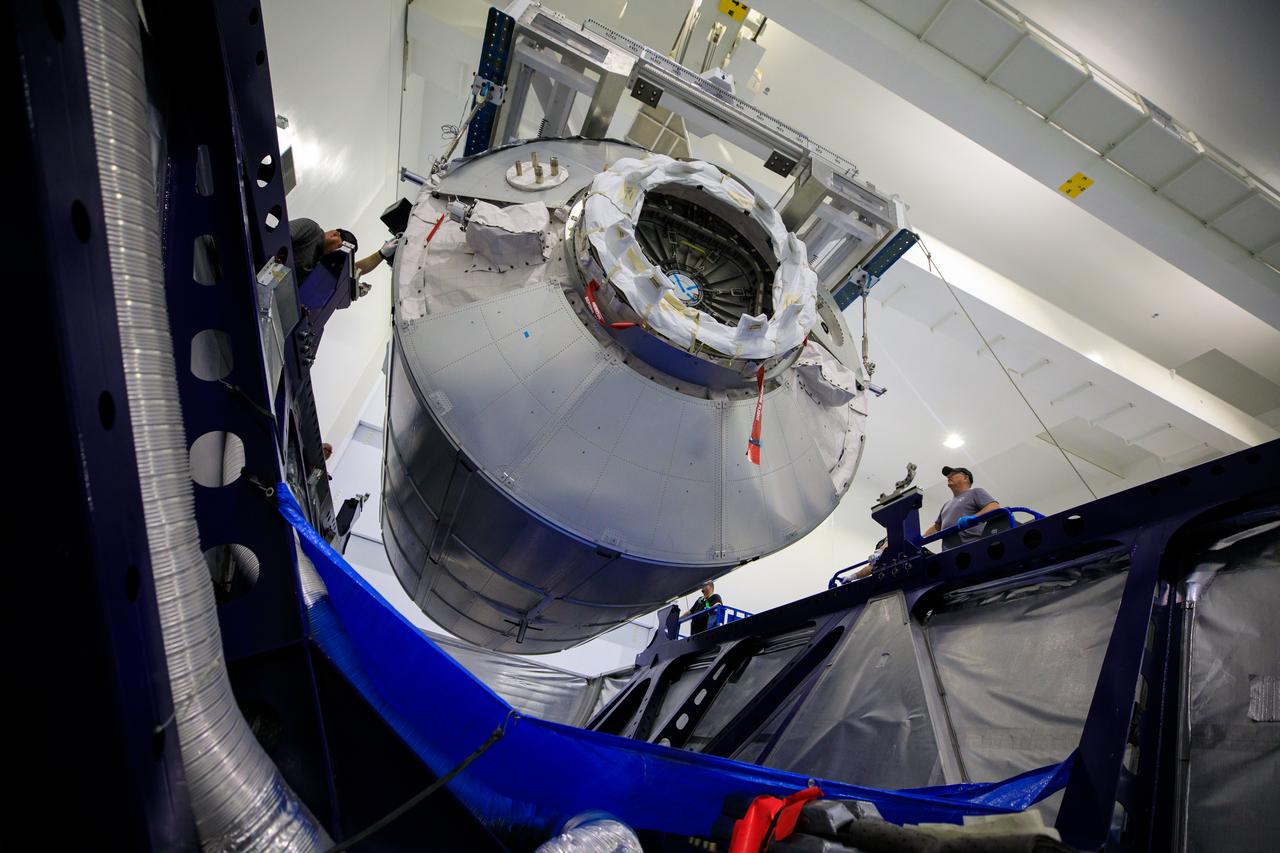
The Multi-Purpose Logistics Module (MPLM), used during the Space Shuttle Program to transfer cargo to and from the International Space Station, is lowered by crane into its transport container inside the Space Station Processing Facility high bay at NASA’s Kennedy Space Center in Florida on April 20, 2023. The MPLM is being prepared for transport to Ellington Field in Houston, where it will then be transported by road to Axiom’s facility near Ellington to be utilized to further commercialization of space. Three MPLMs were built by Thales Alenia Space Italia (TASI) for the Italian Space Agency (ASI) and named after Italian masters (Leonardo, Raffaello, and Donatello). Only two ever flew to the space station, Leonardo and Raffaello, with Axiom intending to use Raffaello as a future element that will attach to a segment being built by the company for addition to the space station.
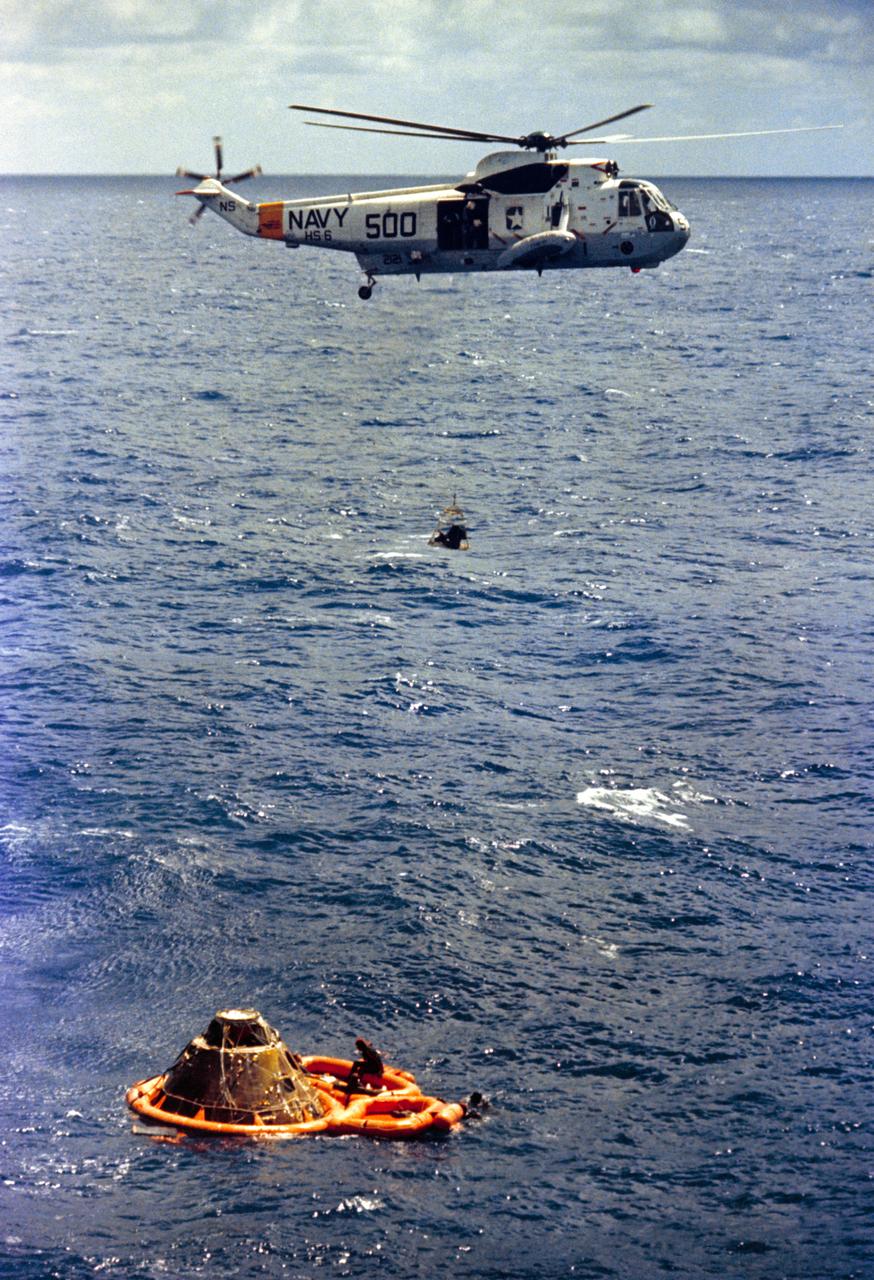
S71-19476 (9 Feb. 1971) --- Astronaut Stuart A. Roosa, command module pilot, is hoisted inside a Billy Pugh net to a U.S. Navy helicopter assisting in Apollo 14 recovery operations in the South Pacific Ocean. Visible in a life raft beside the Command Module (CM) are astronauts Alan B. Shepard Jr., commander, back to camera; and Edgar D. Mitchell (partially obscured by the spacecraft), lunar module pilot. Three U.S. Navy underwater demolition team swimmers who assisted in the recovery operations are pictured in and around the life raft. Apollo 14 splashdown occurred at 3:04:39 p.m. (CST), Feb. 9, 1971, approximately 765 nautical miles south of American Samoa in the South Pacific Ocean.
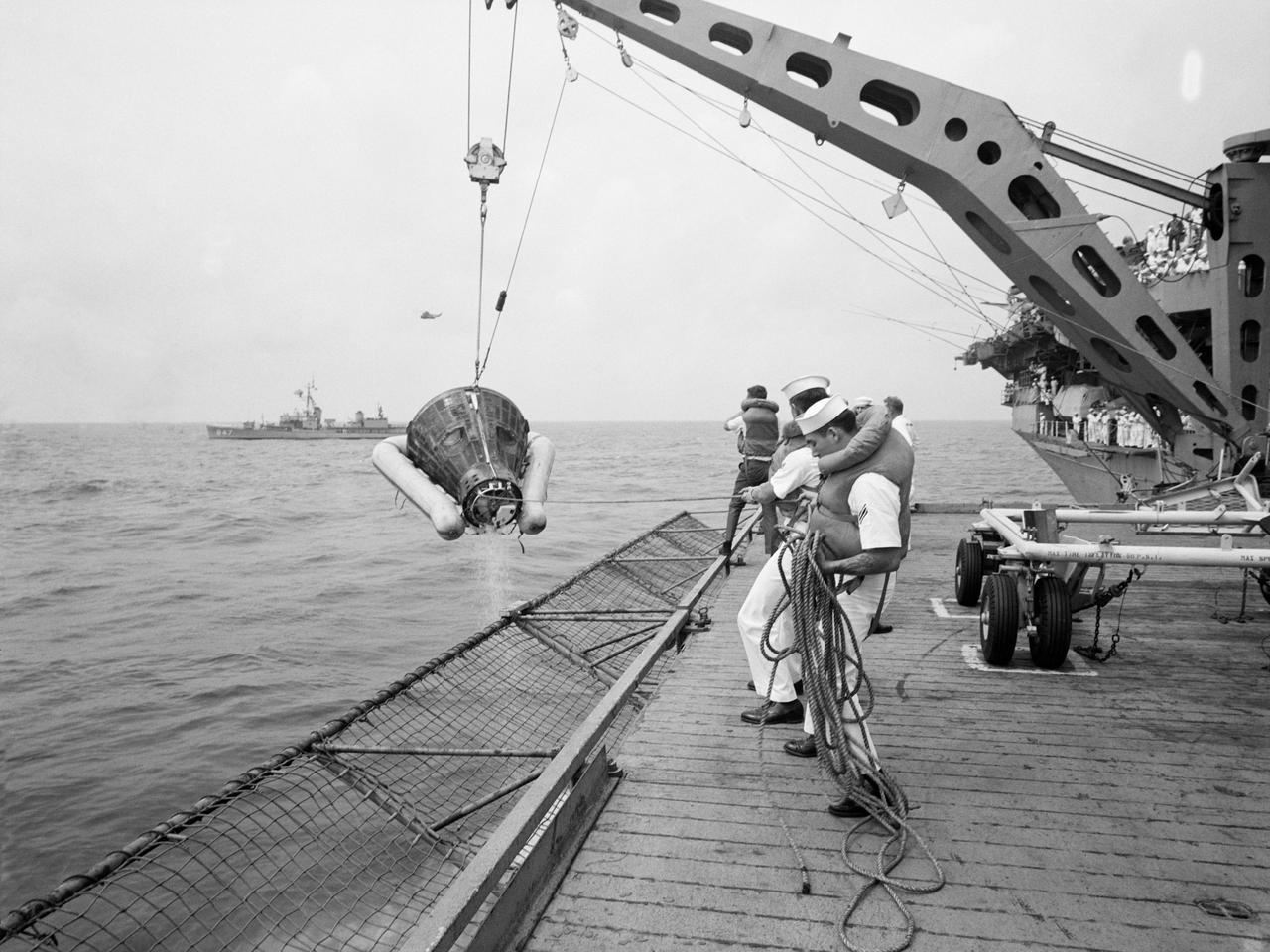
S66-34101 (6 June 1966) --- The Gemini-9 spacecraft, with astronauts Thomas P. Stafford and Eugene A. Cernan still inside, is hoisted aboard the aircraft carrier USS Wasp. Gemini-9 splashed down only 3.5 miles from the big recovery ship at 9 a.m. (EST), June 6, 1966, 345 miles east of Cape Kennedy, to conclude a 72-hour, 21-minute mission in space. Photo credit: NASA
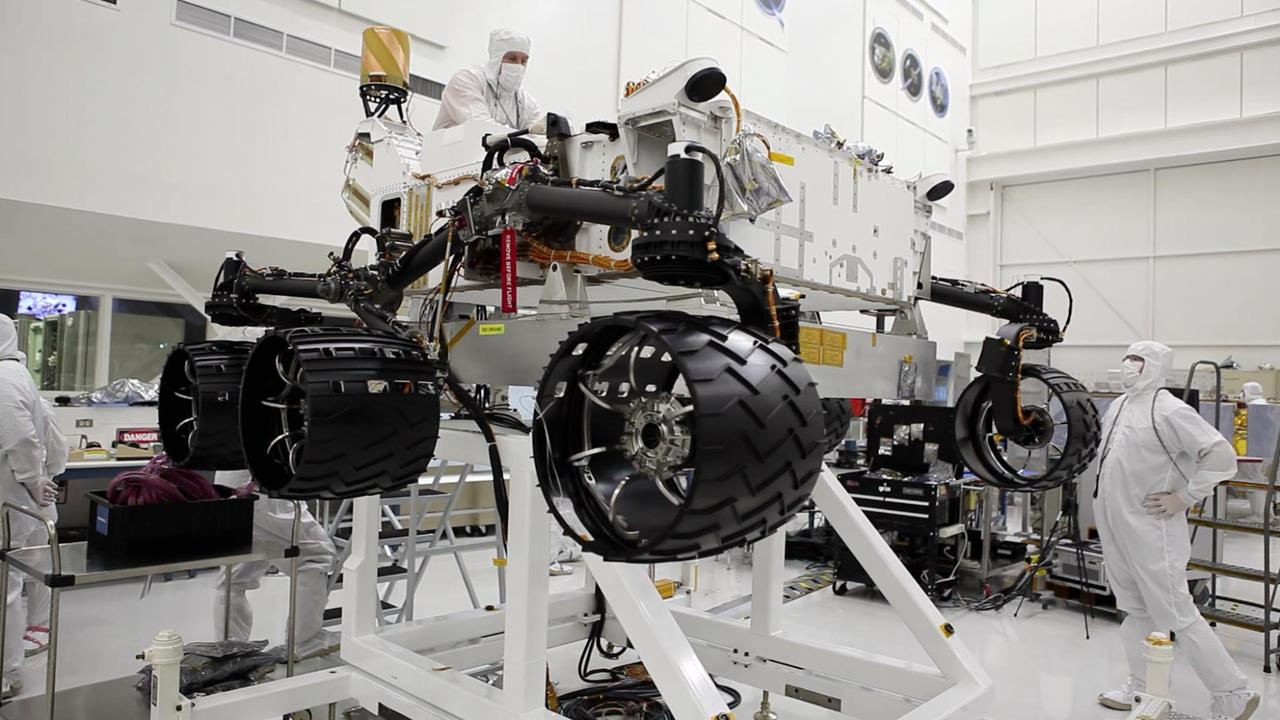
This image was taken in the cleanroom where NASA Curiosity rover is being assembled. It shows the rover, which is about the size of an SUV, hoisted on a white lift, with its black wheels suspended in the air.
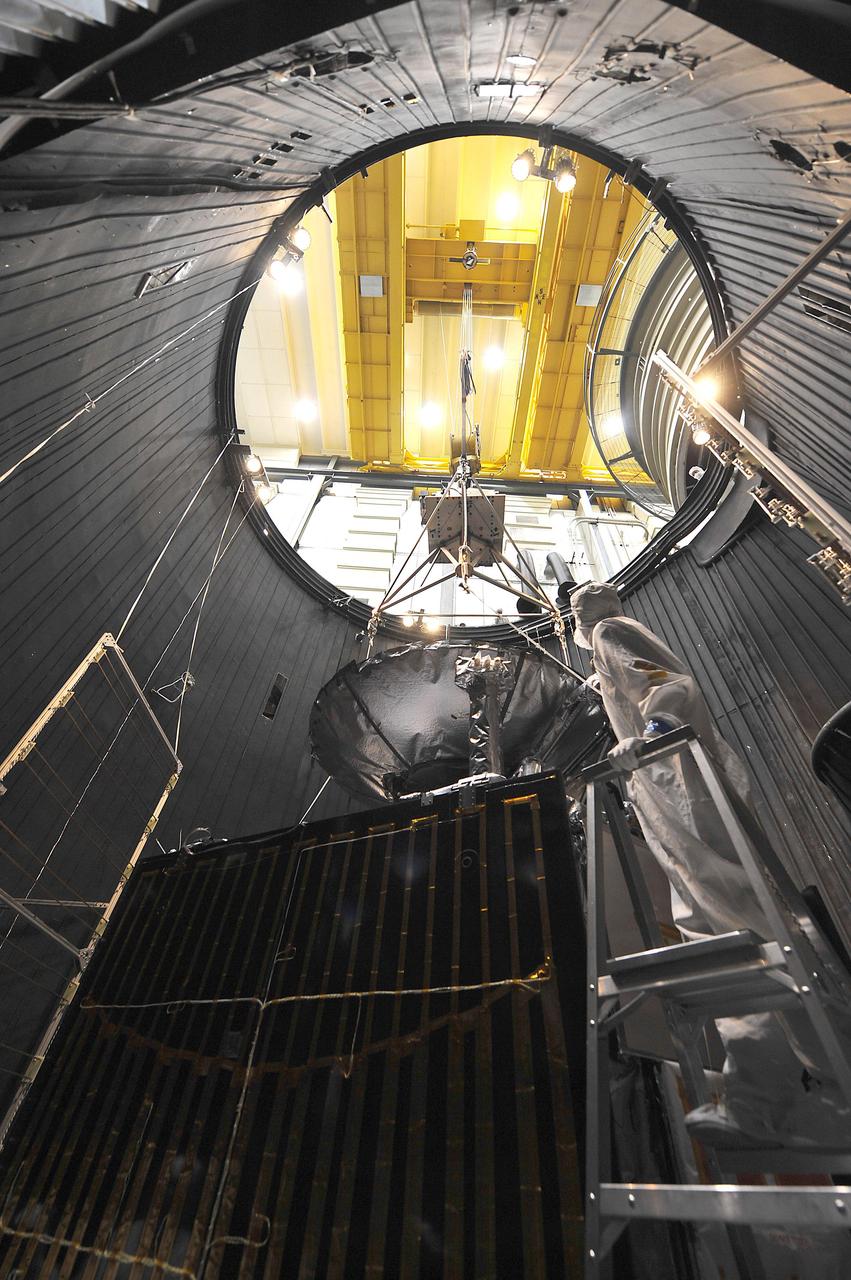
This image of NASA Juno spacecraft was taken as the vehicle completed its thermal vacuum chamber testing. A technician is attaching the lifting equipment in preparation for hoisting the 1,588-kilogram 3,500-pound spacecraft out of the chamber.
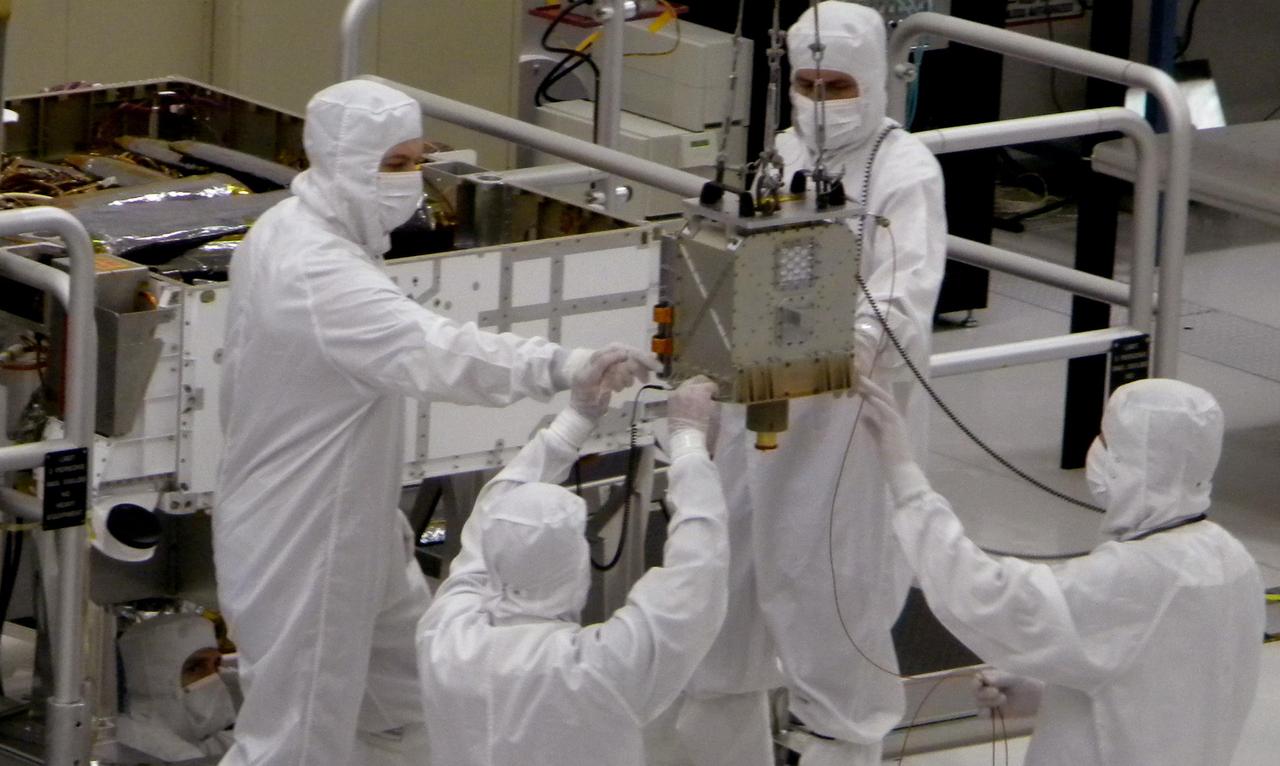
Members of NASA Mars Science Laboratory team carefully steer the hoisted Chemistry and Mineralogy CheMin instrument during its June 15, 2010, installation into the mission Mars rover, Curiosity.
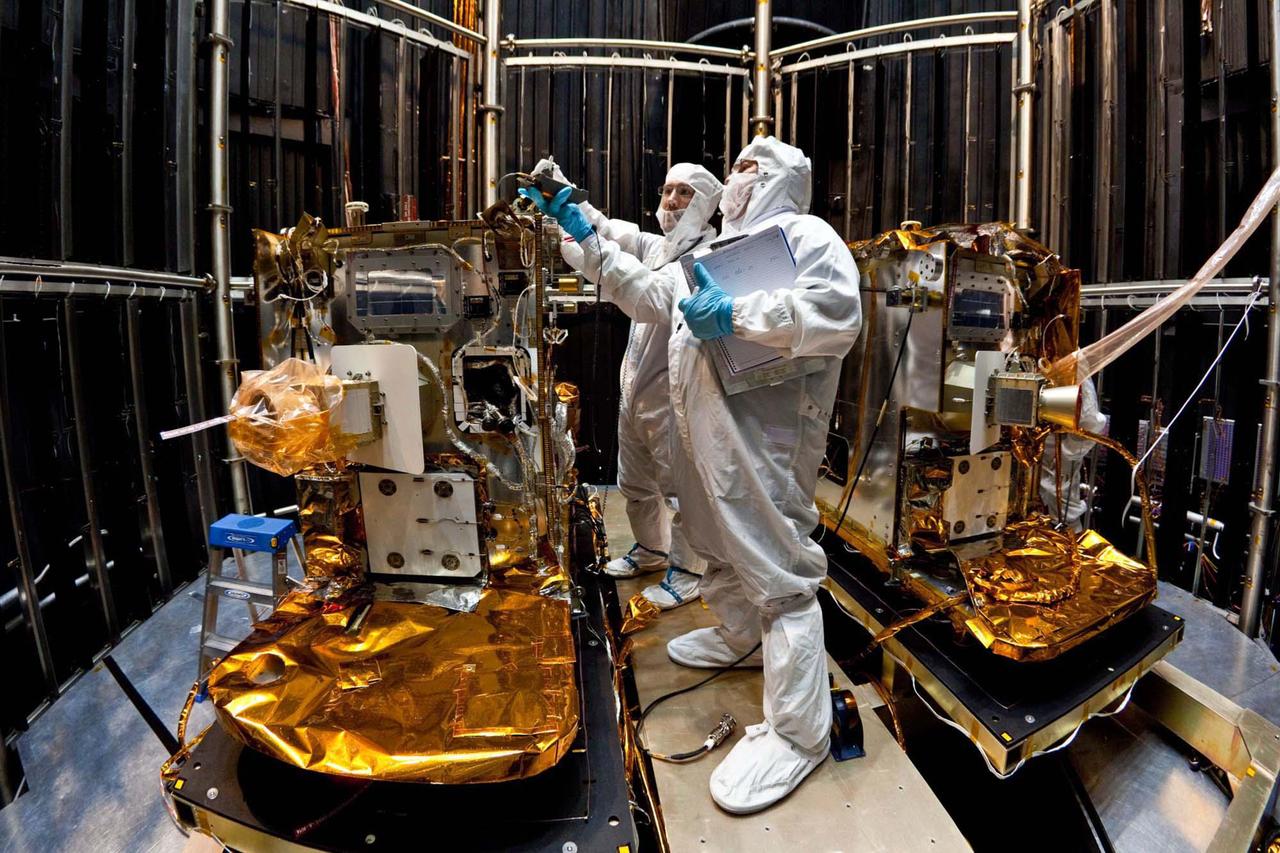
In this photo, taken April 29, 2011, technicians install lifting brackets prior to hoisting the 200-kilogram 440-pound GRAIL-A spacecraft out of vacuum chamber after testing.

S69-20086 (13 March 1969) --- The Apollo 9 Command Module (CM), with flotation collar still attached, is hoisted aboard the prime recovery ship, USS Guadalcanal, during recovery operations. The Apollo 9 crew, astronauts James A. McDivitt, David R. Scott, and Russell L. Schweickart, had already been picked up earlier by helicopter and flown to the dock of the carrier. Splashdown occurred at 12:00:53 p.m. (EST), March 13, 1969, only 4.5 nautical miles from the aircraft carrier, to conclude a successful 10-day Earth-orbital space mission.

The Voyager 2 spacecraft, encapsulated within its payload fairing, is seen in August 1977, as it was being hoisted upward for attachment to its launch vehicle at NASA's Kennedy Space Center in Cape Canaveral, Florida. https://photojournal.jpl.nasa.gov/catalog/PIA21727
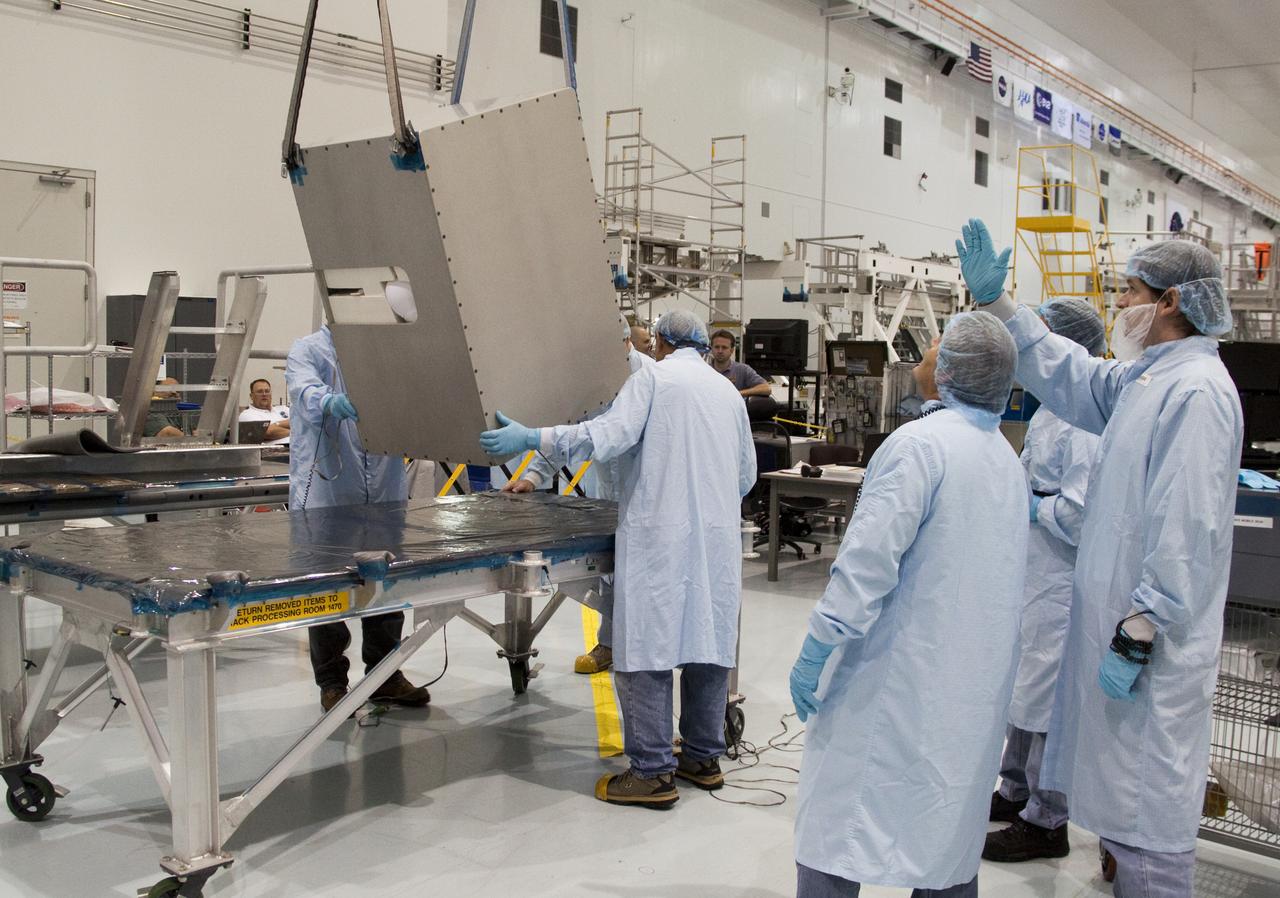
STS-133 R2 ROBONAUT HOIST TO HORIZONTAL
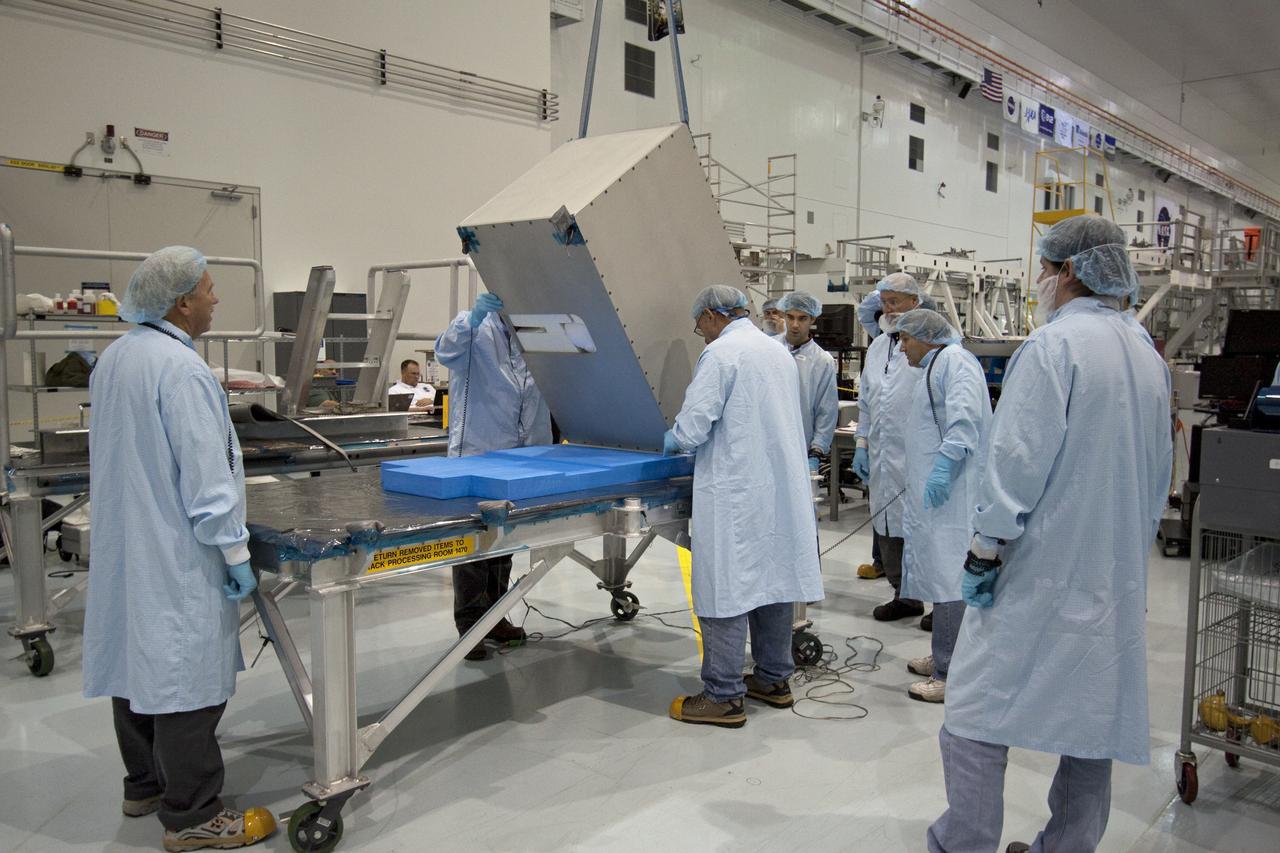
STS-133 R2 ROBONAUT HOIST TO HORIZONTAL
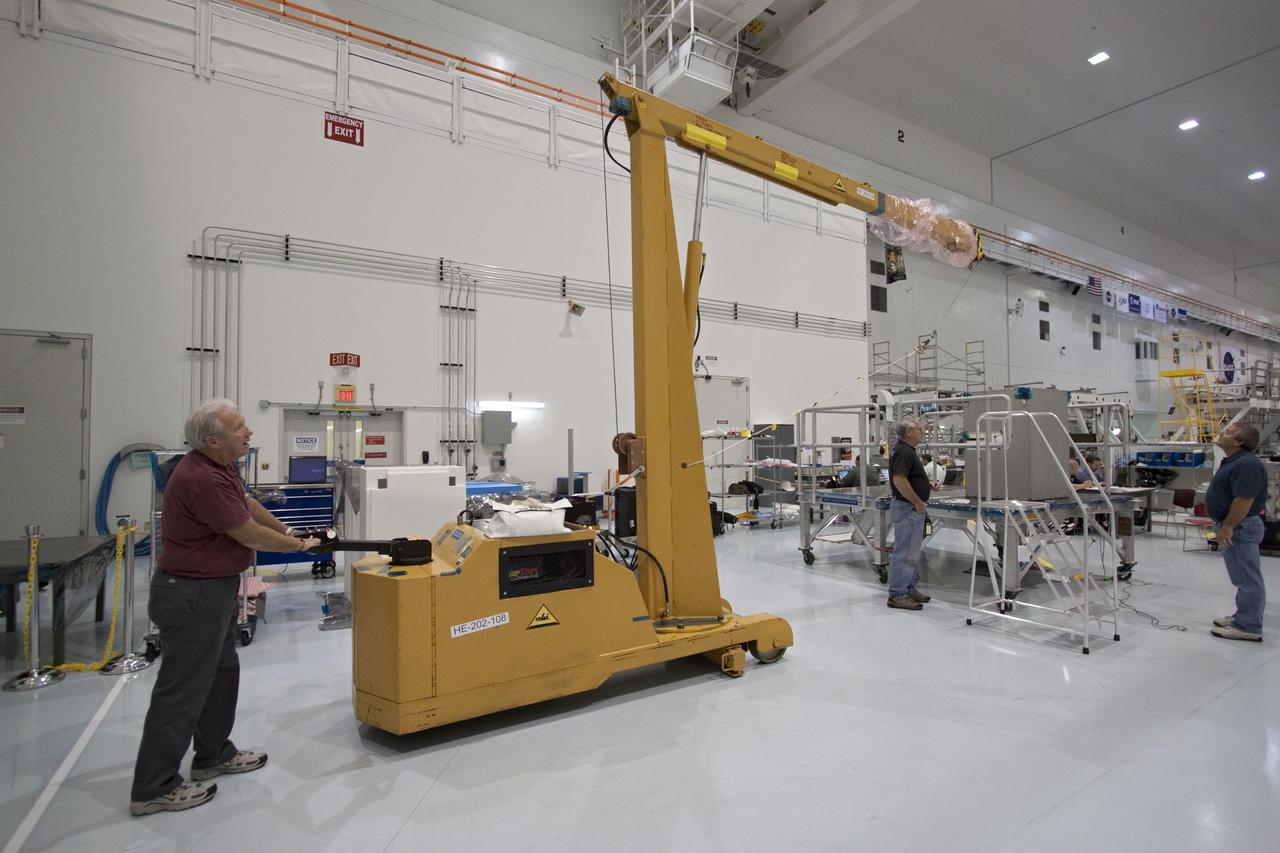
STS-133 R2 ROBONAUT HOIST TO HORIZONTAL
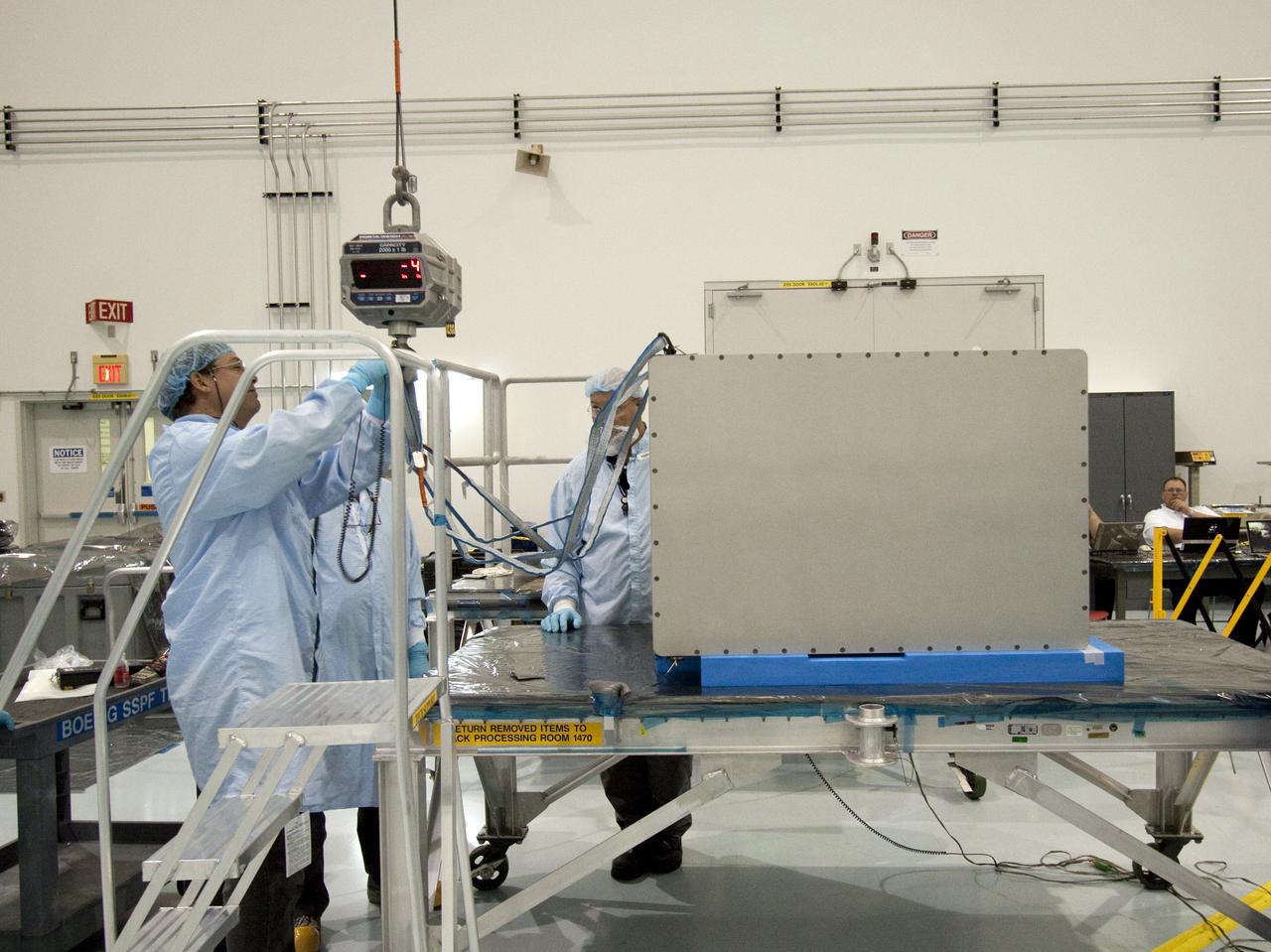
STS-133 R2 ROBONAUT HOIST TO HORIZONTAL
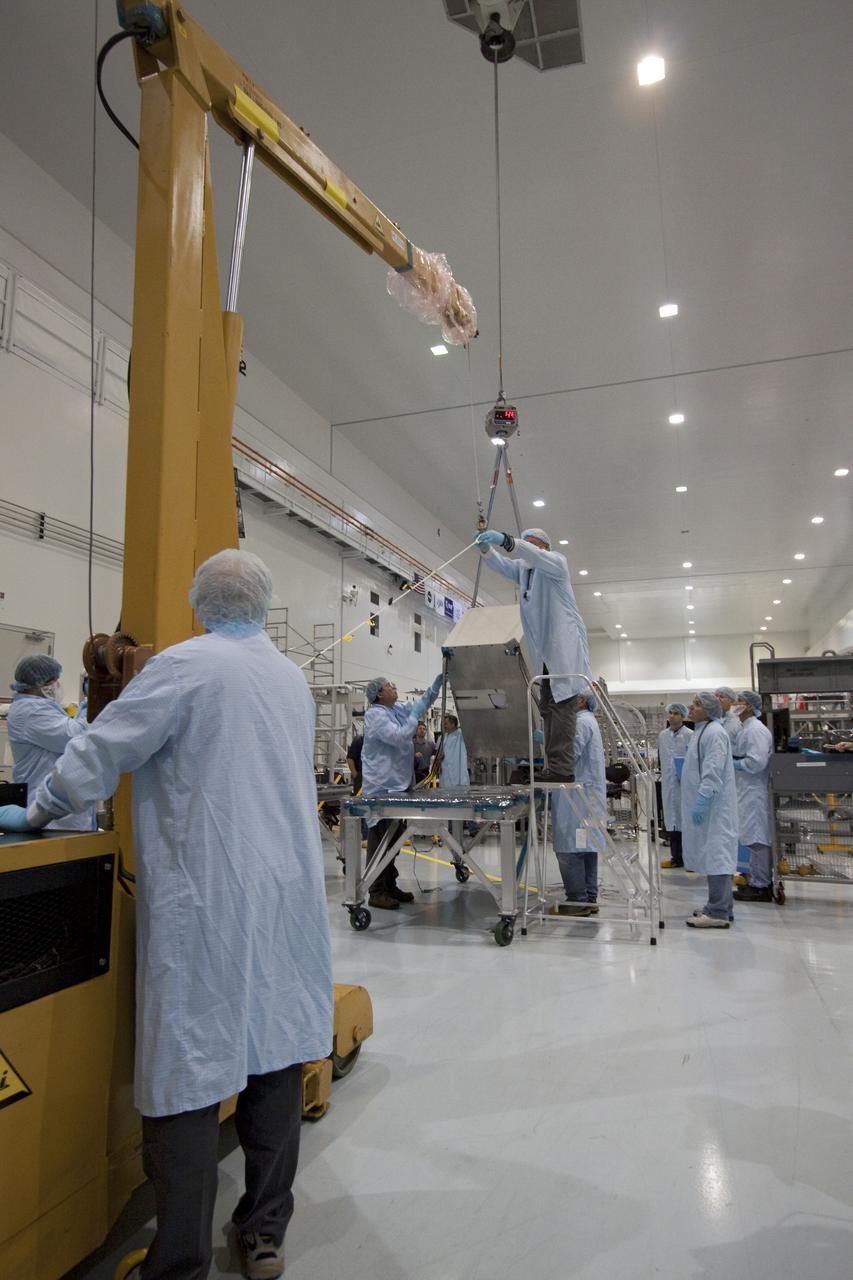
STS-133 R2 ROBONAUT HOIST TO HORIZONTAL
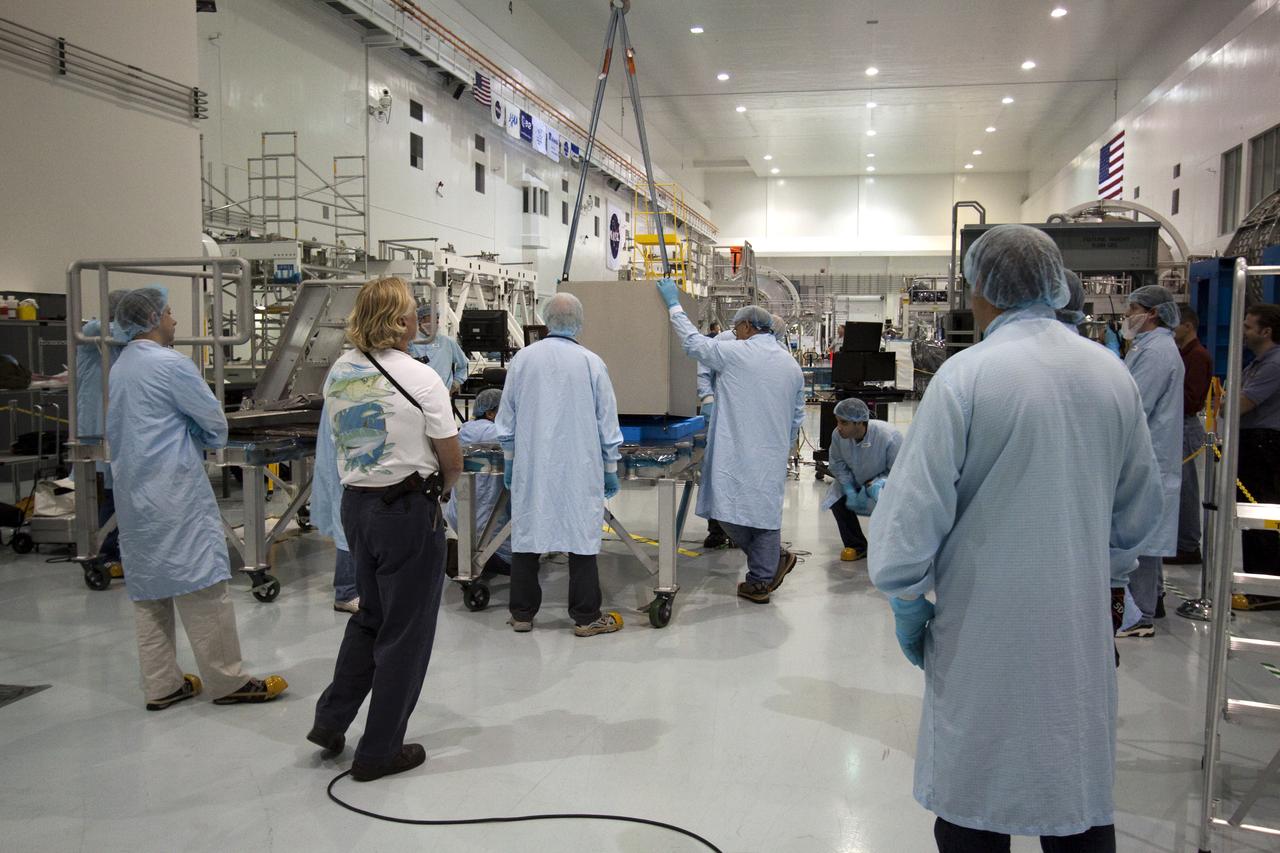
STS-133 R2 ROBONAUT HOIST TO HORIZONTAL
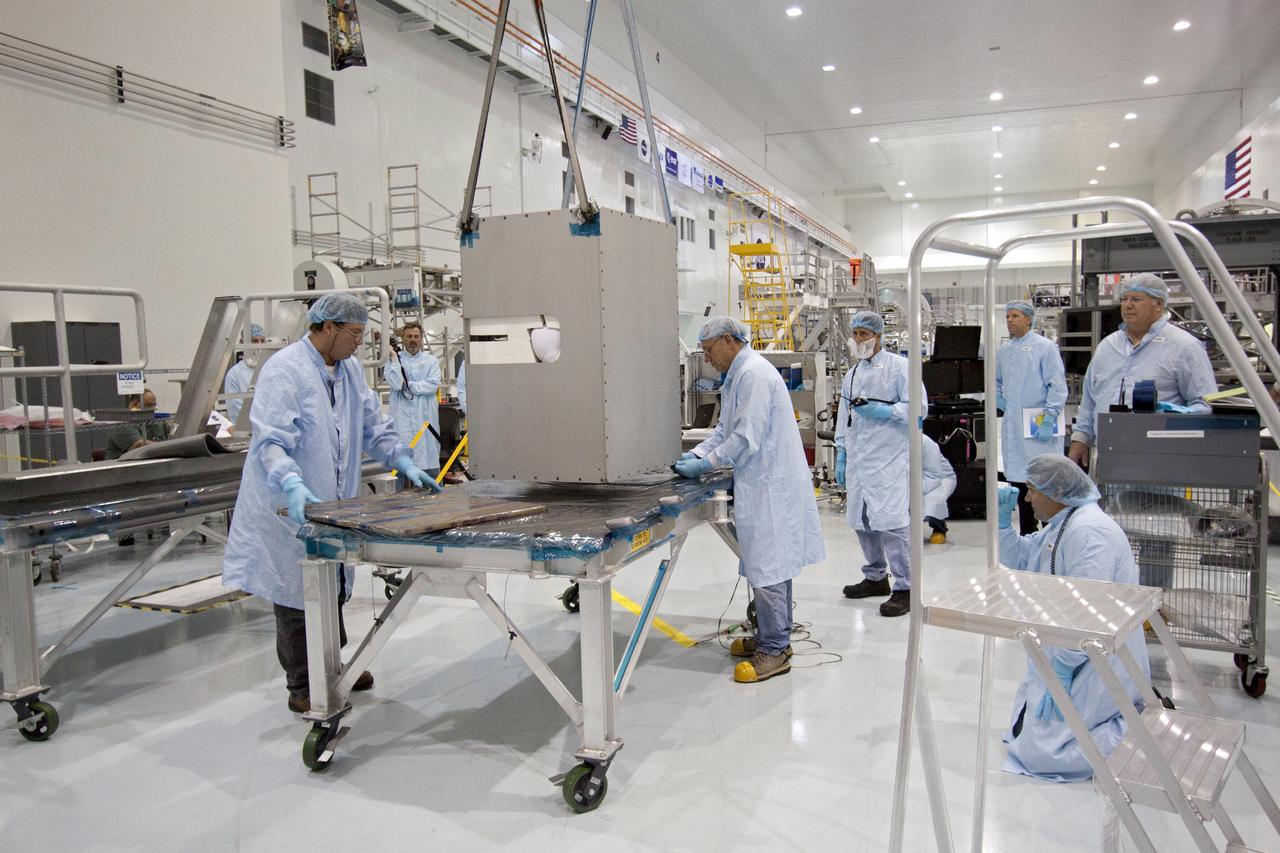
STS-133 R2 ROBONAUT HOIST TO HORIZONTAL
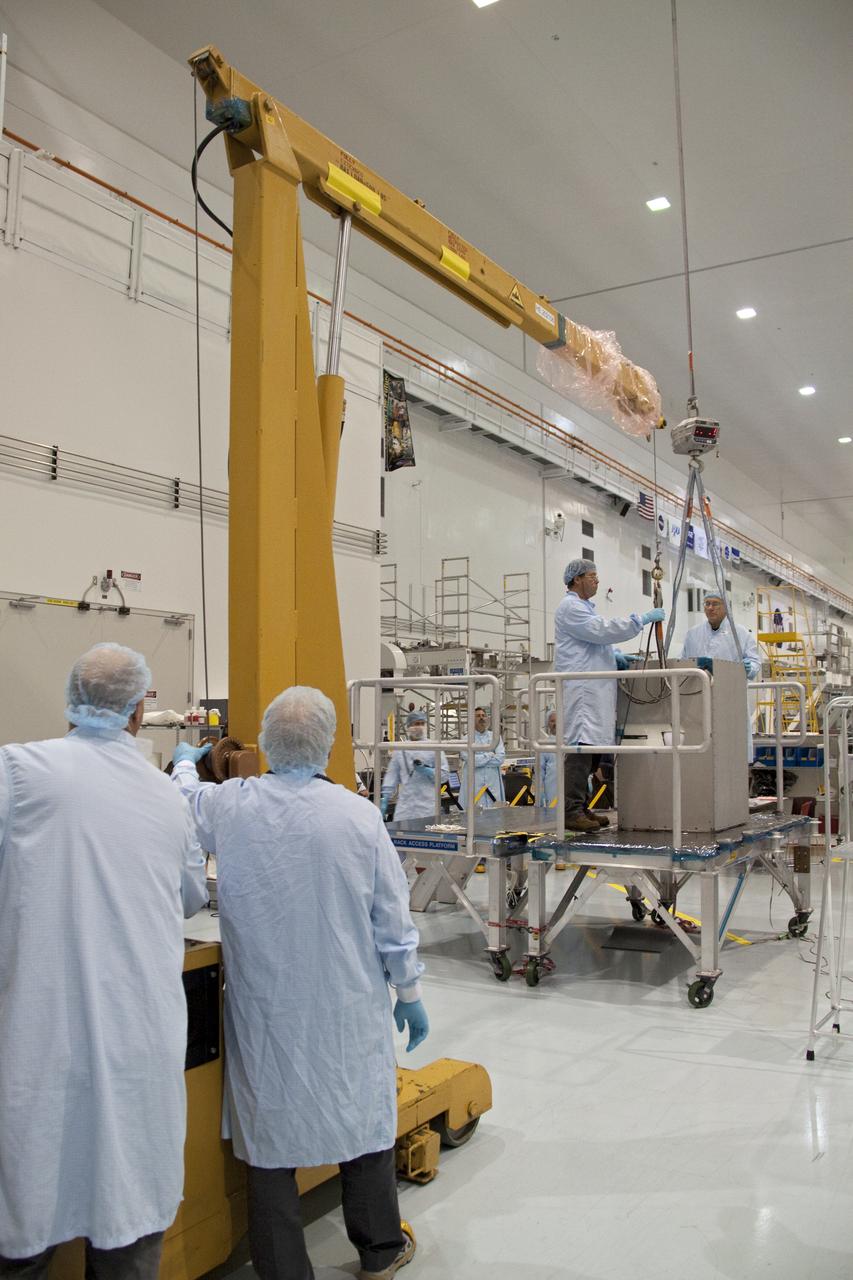
STS-133 R2 ROBONAUT HOIST TO HORIZONTAL
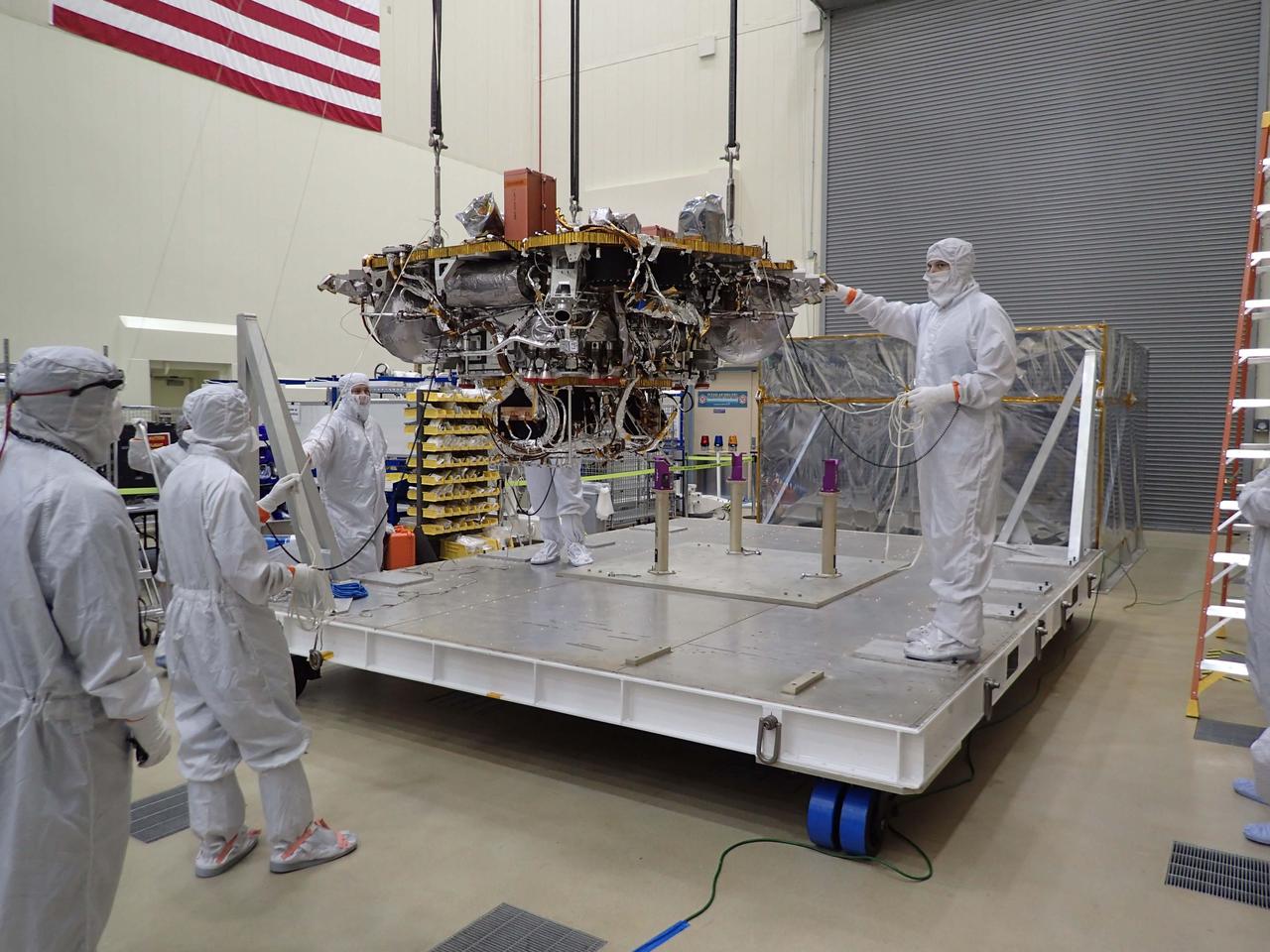
The Mars lander portion of NASA's InSight spacecraft is lifted from the base of a storage container in preparation for testing, in this photo taken June 20, 2017, in a Lockheed Martin clean room facility in Littleton, Colorado. The InSight mission (for Interior Exploration using Seismic Investigations, Geodesy and Heat Transport) is scheduled to launch in May 2018 and land on Mars Nov. 26, 2018. It will investigate processes that formed and shaped Mars and will help scientists better understand the evolution of our inner solar system's rocky planets, including Earth. https://photojournal.jpl.nasa.gov/catalog/PIA21844

S65-61828 (18 Dec. 1965) --- Astronaut James A. Lovell Jr., pilot of the Gemini-7 spaceflight, is hoisted from the water by a recovery helicopter from the Aircraft Carrier USS Wasp. Astronaut Frank Borman, command pilot, waits in the raft to be hoisted aboard the helicopter. Photo credit: NASA

STS-133 Hoist of ELC-4 for Deck to Keel Mate
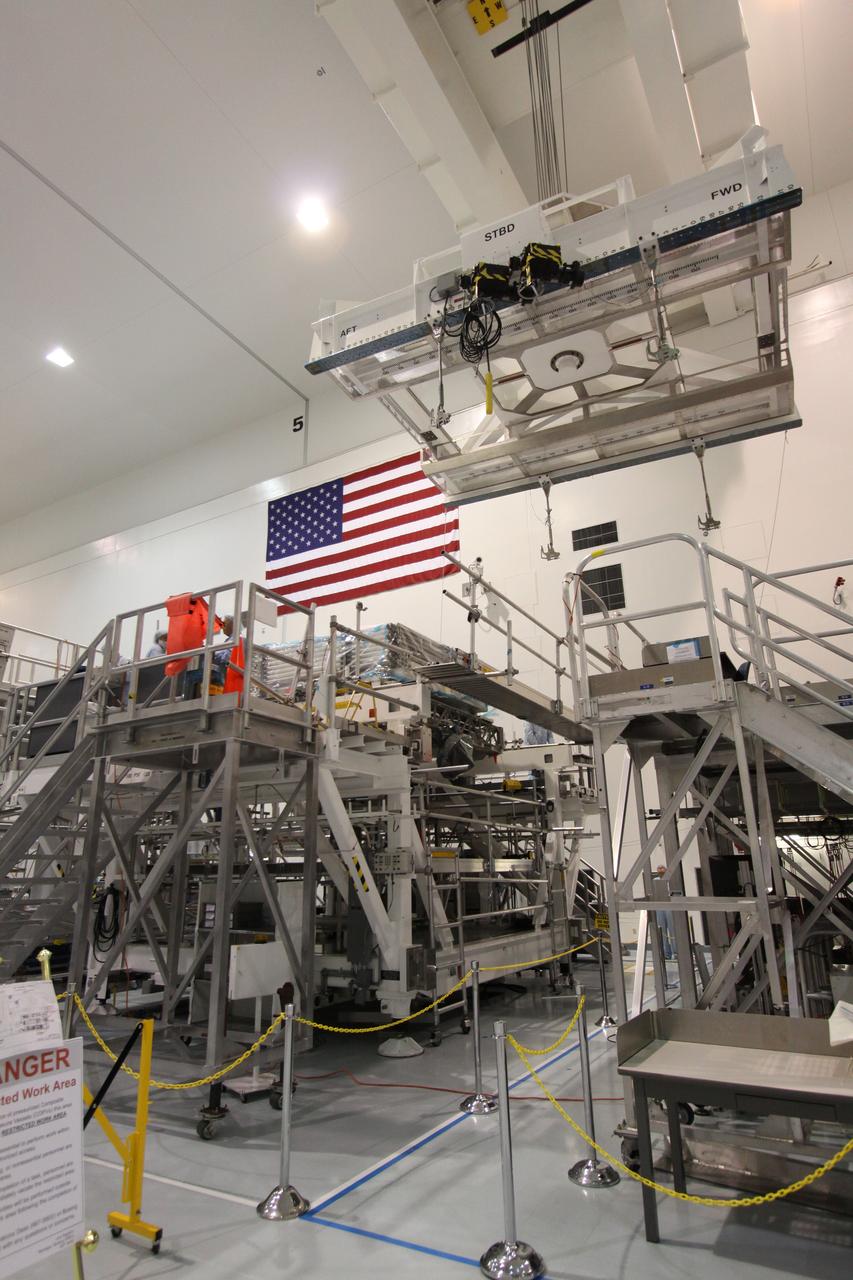
STS-133 Hoist of ELC-4 for Deck to Keel Mate
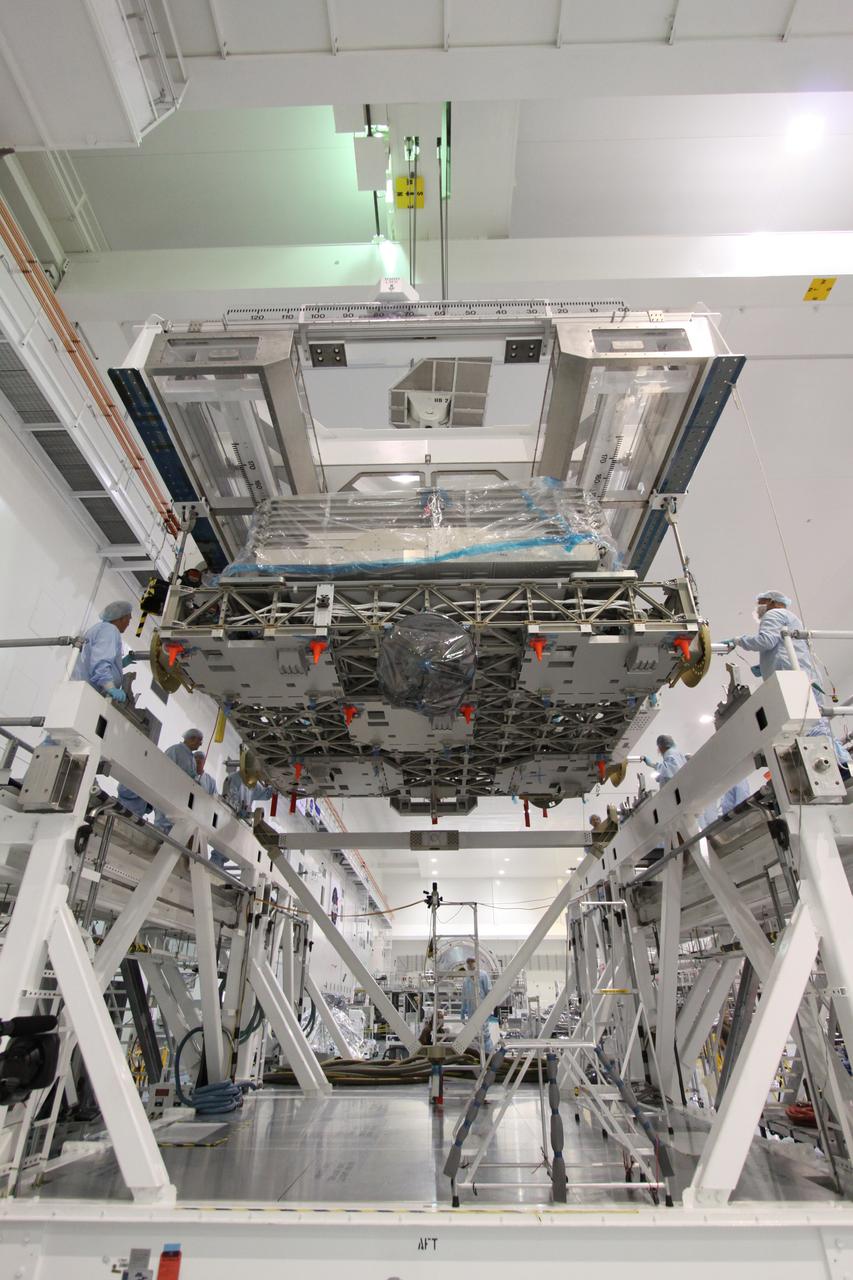
STS-133 Hoist of ELC-4 for Deck to Keel Mate
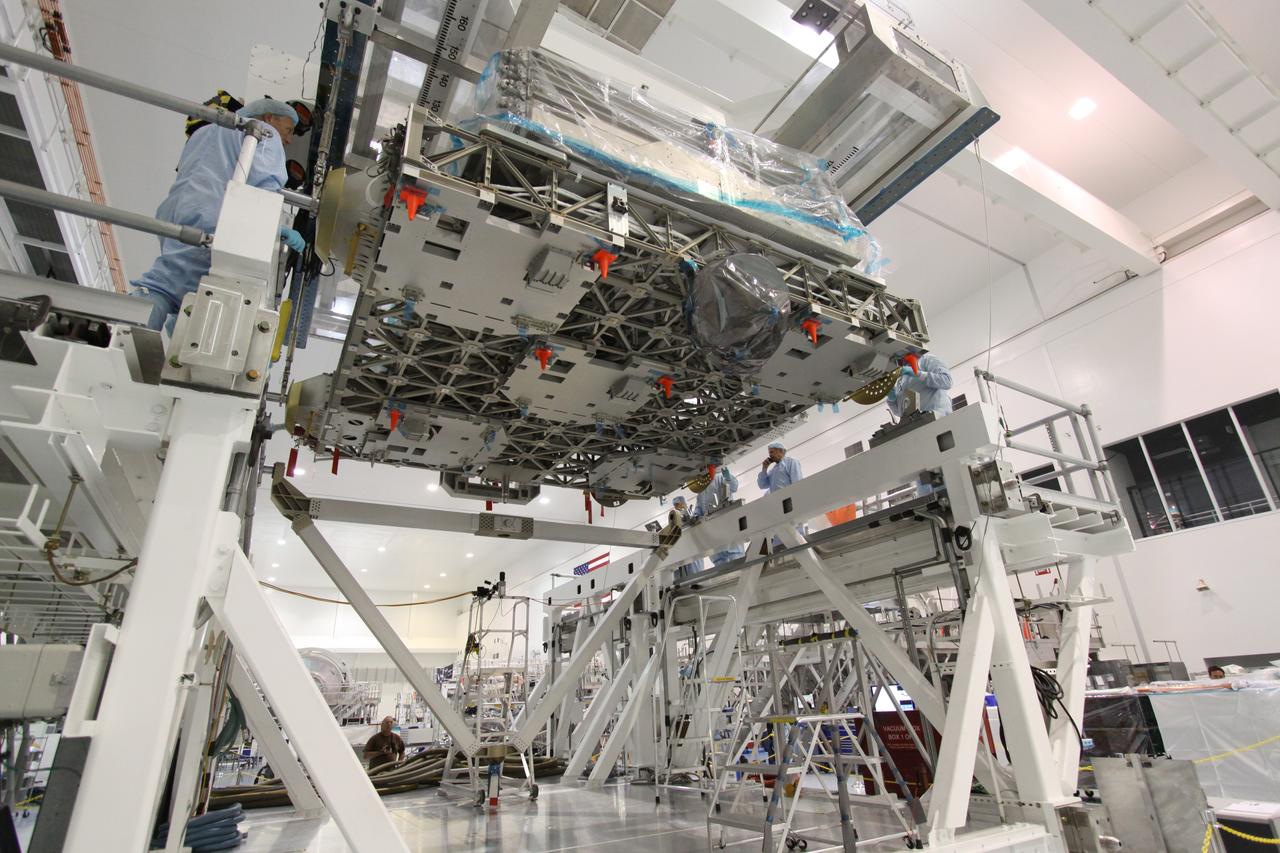
STS-133 Hoist of ELC-4 for Deck to Keel Mate
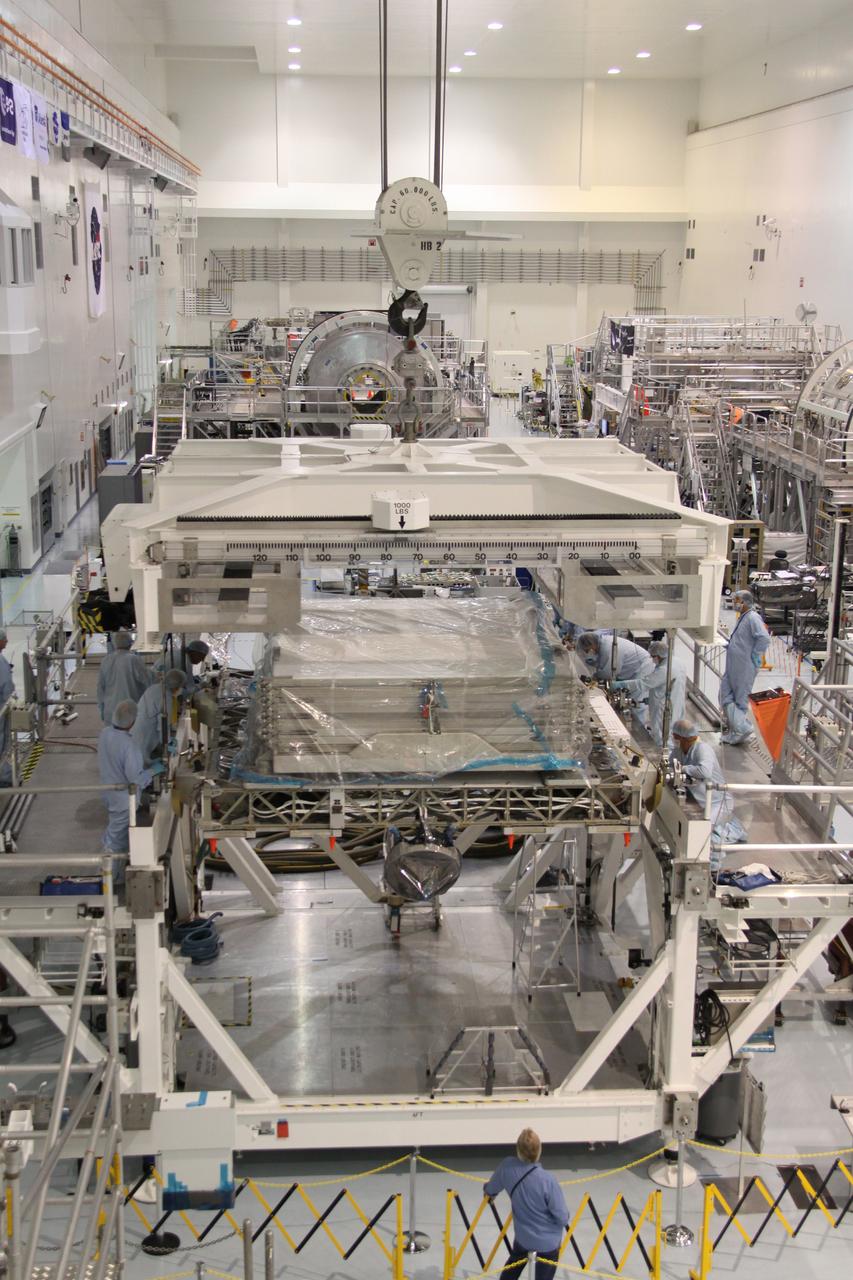
STS-133 Hoist of ELC-4 for Deck to Keel Mate

STS-133 Hoist of ELC-4 for Deck to Keel Mate
STS-133 Hoist of ELC-4 for Deck to Keel Mate
STS-133 Hoist of ELC-4 for Deck to Keel Mate
STS-133 Hoist of ELC-4 for Deck to Keel Mate

STS-133 Hoist of ELC-4 for Deck to Keel Mate
STS-133 Hoist of ELC-4 for Deck to Keel Mate
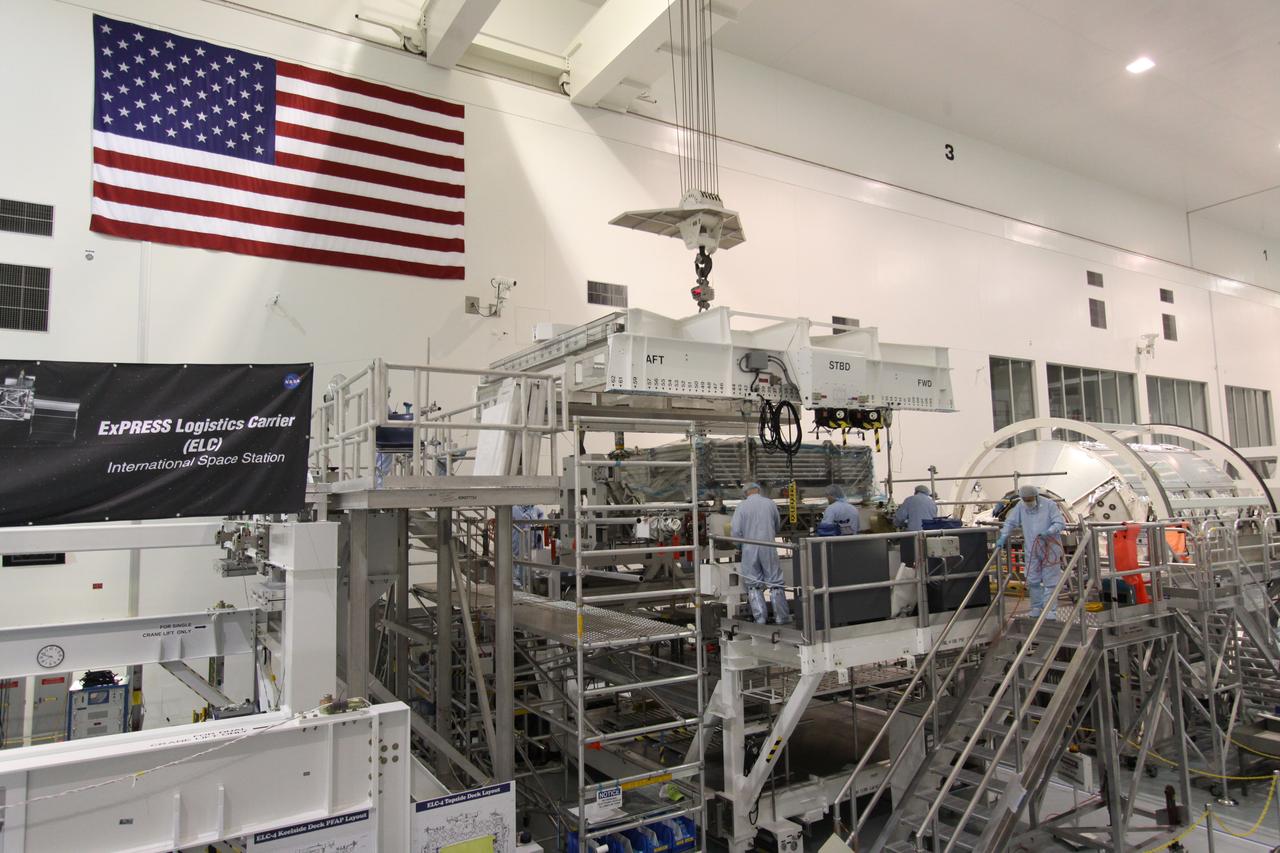
STS-133 Hoist of ELC-4 for Deck to Keel Mate
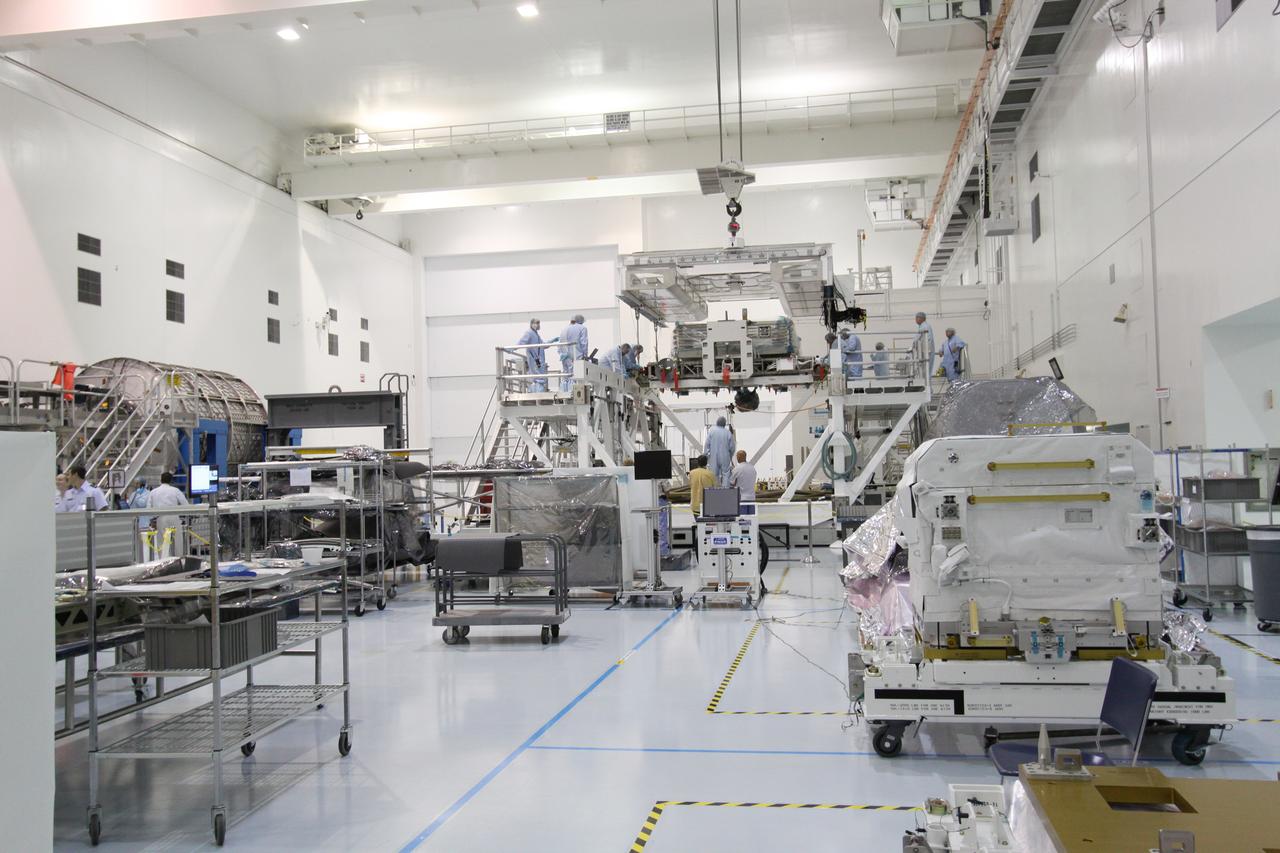
STS-133 Hoist of ELC-4 for Deck to Keel Mate

STS-133 COMMON BERTHING MECHANISIM (CMB) SIMULATOR HOIST & TEMPORARY INSTALL TO PERMANENT MULTIPURPOSE MODULE (PMM)
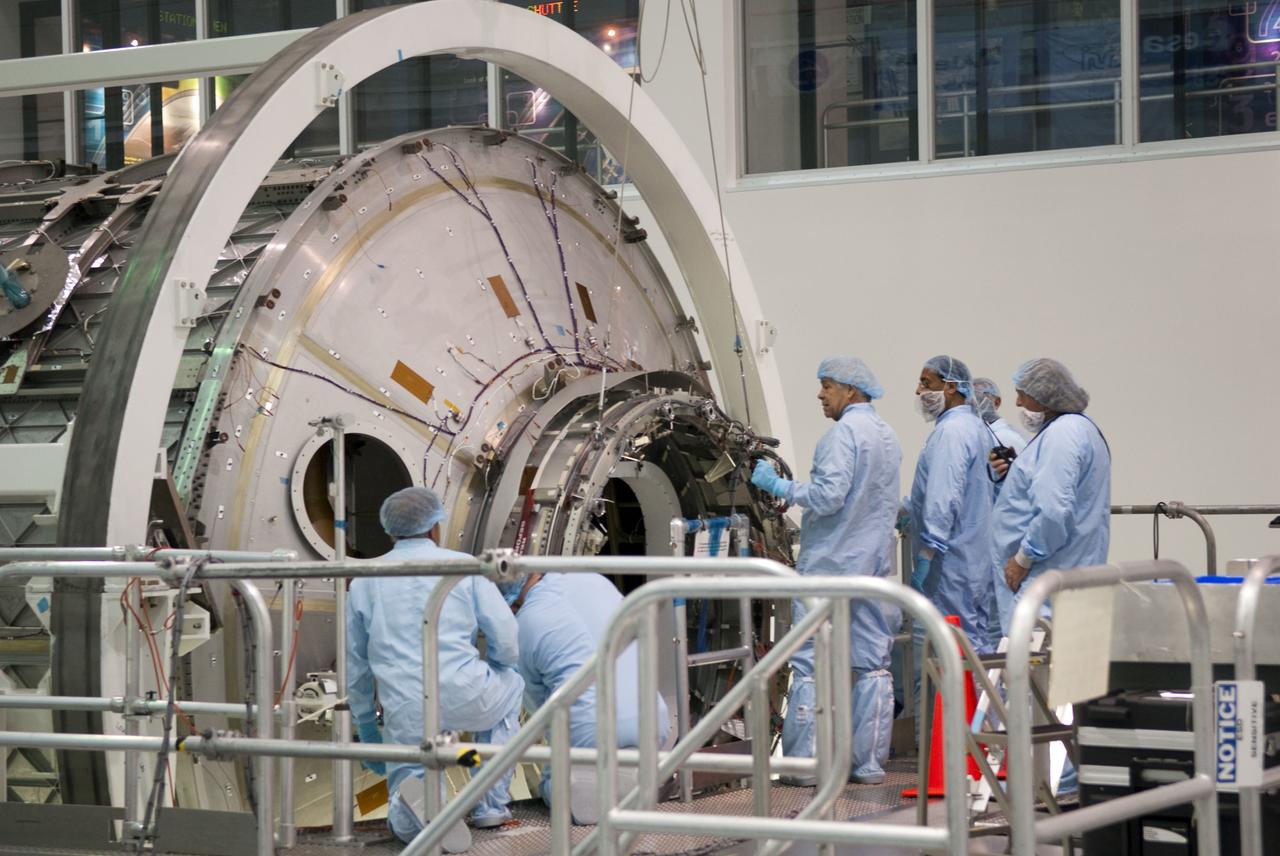
STS-133 COMMON BERTHING MECHANISIM (CMB) SIMULATOR HOIST & TEMPORARY INSTALL TO PERMANENT MULTIPURPOSE MODULE (PMM)

S68-26989 (4 April 1968) --- The Apollo 6 Spacecraft 020 Command Module is hoisted aboard the USS Okinawa.
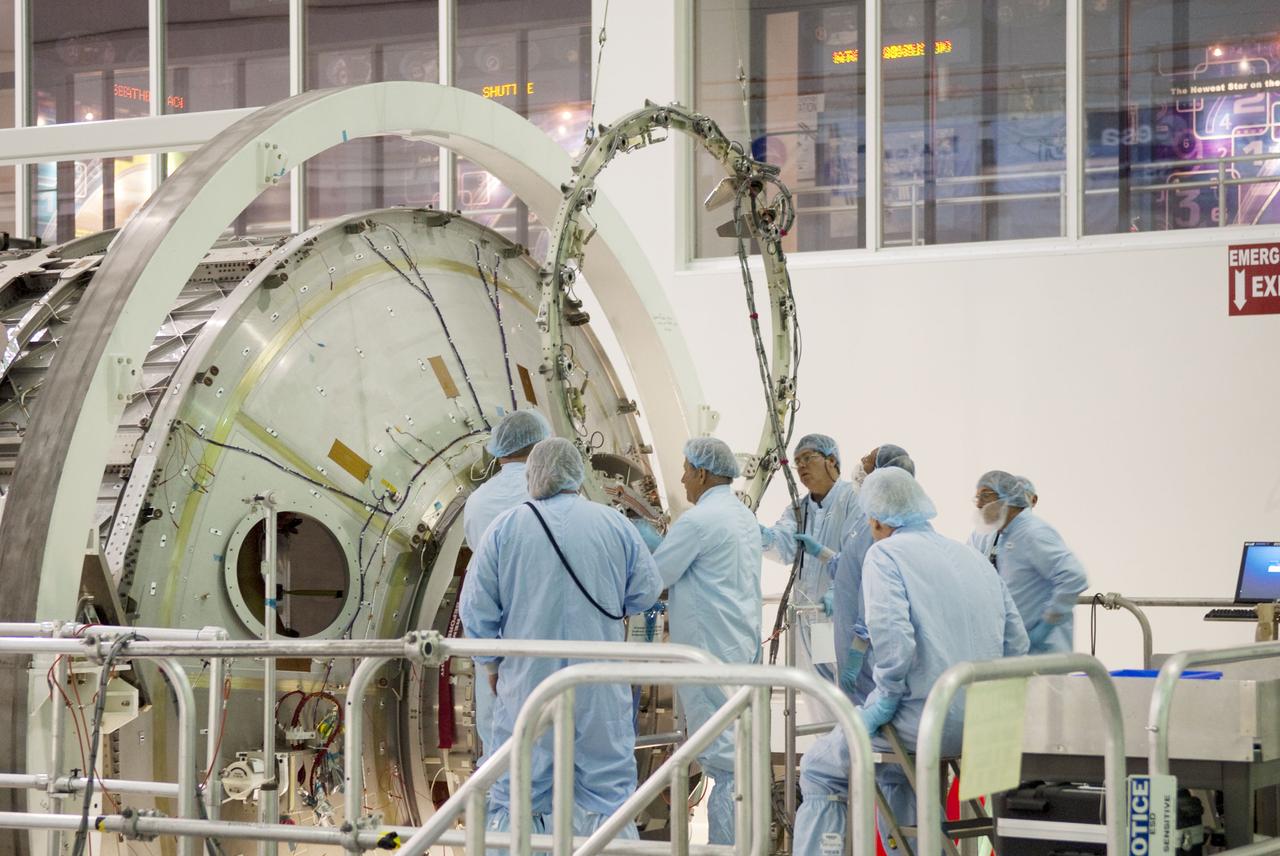
STS-133 COMMON BERTHING MECHANISIM (CMB) SIMULATOR HOIST & TEMPORARY INSTALL TO PERMANENT MULTIPURPOSE MODULE (PMM)
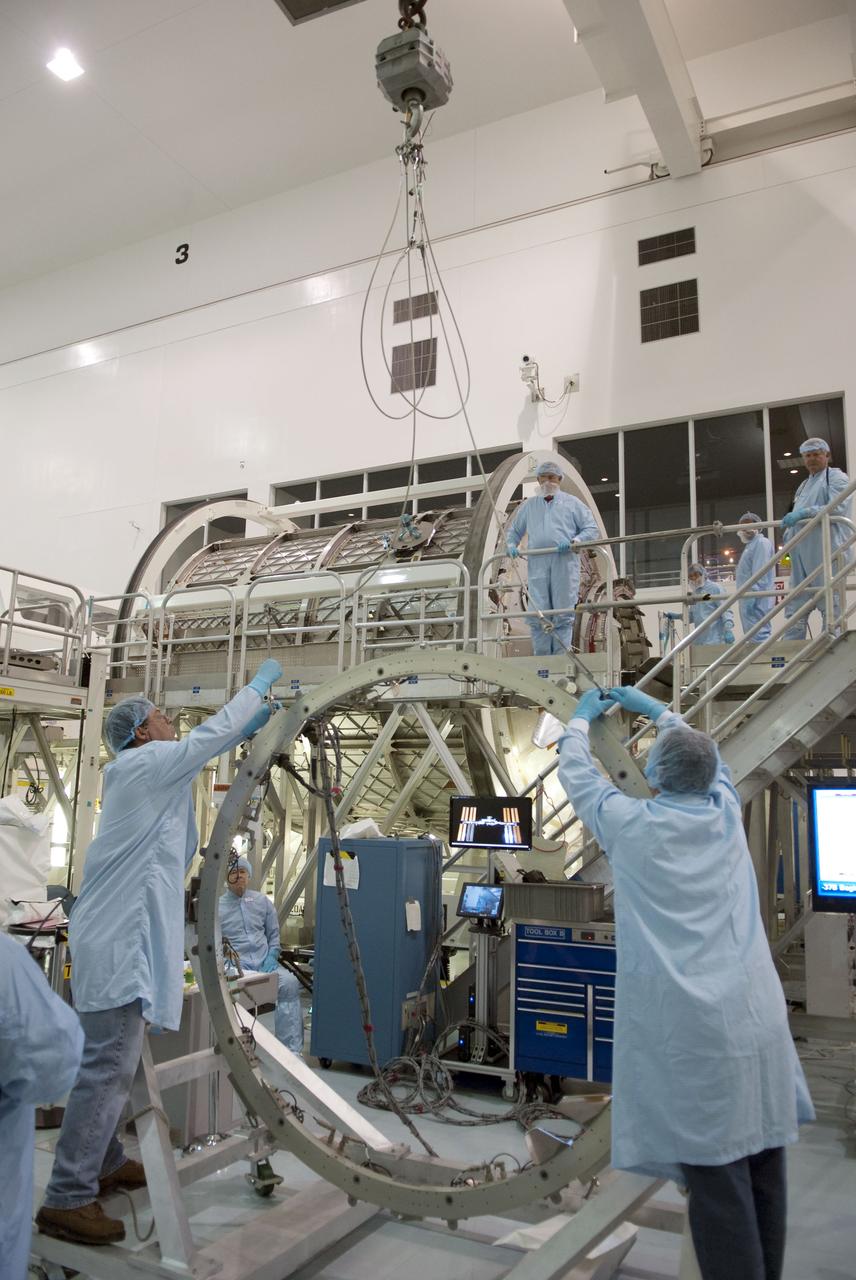
STS-133 COMMON BERTHING MECHANISIM (CMB) SIMULATOR HOIST & TEMPORARY INSTALL TO PERMANENT MULTIPURPOSE MODULE (PMM)
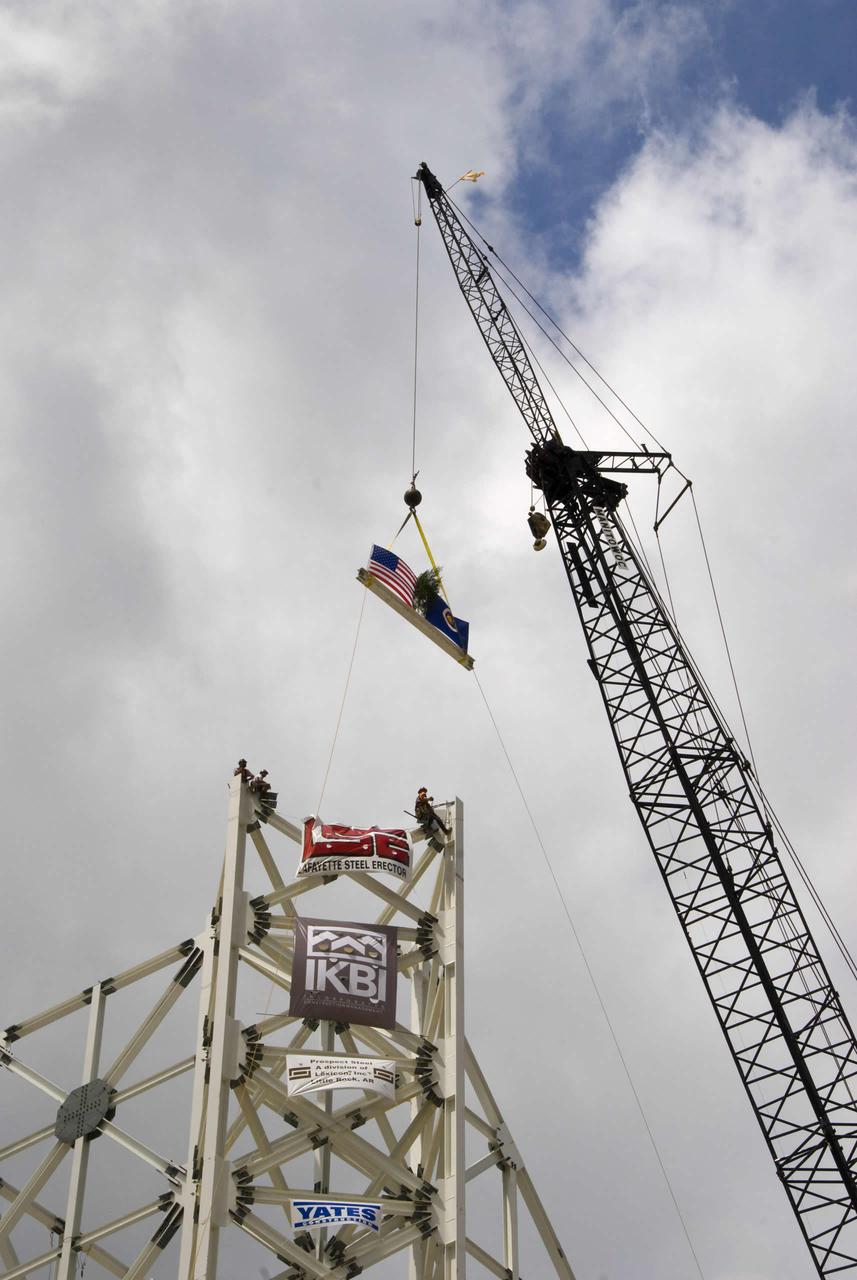
The final structural steel beam, bearing flags and the names of project workers, is hoisted and fastened into place atop the A-3 Test Stand.
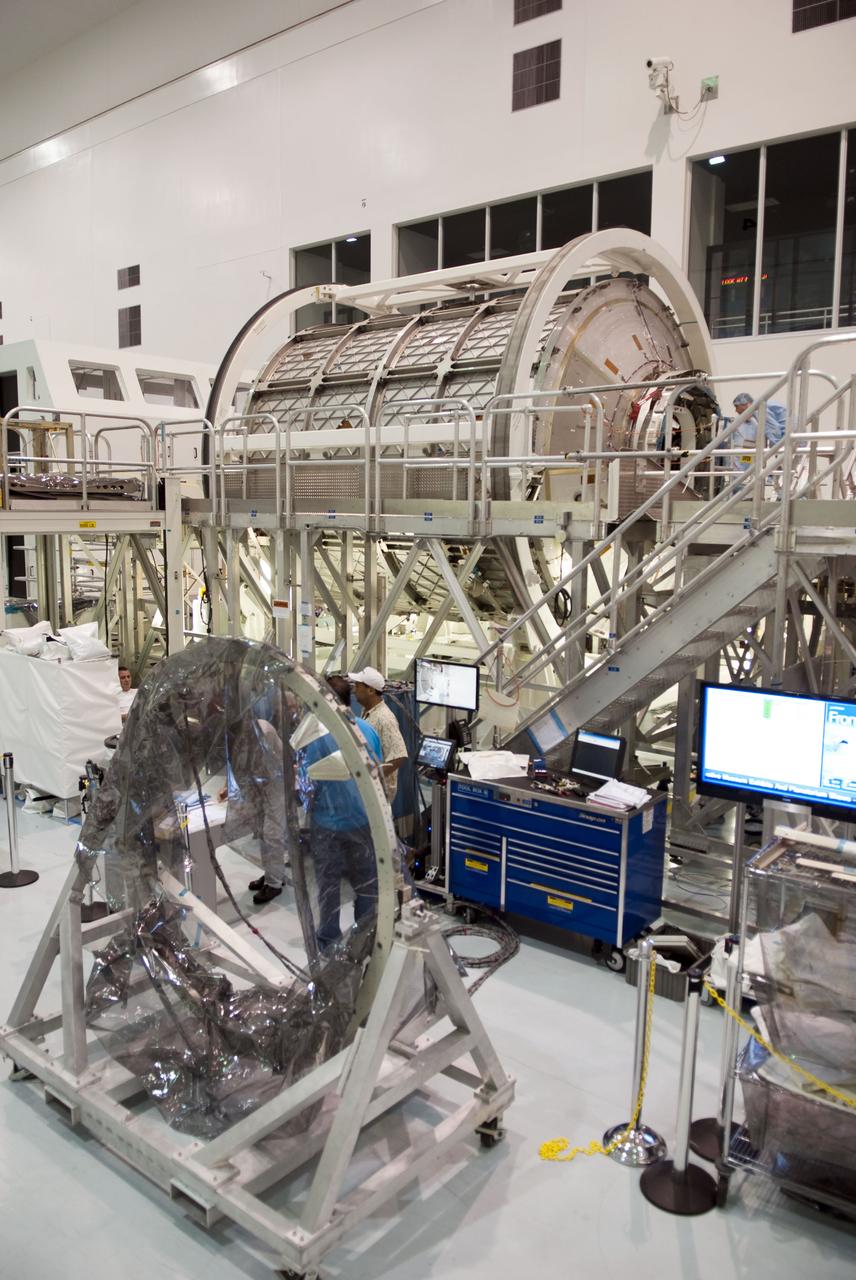
STS-133 COMMON BERTHING MECHANISIM (CMB) SIMULATOR HOIST & TEMPORARY INSTALL TO PERMANENT MULTIPURPOSE MODULE (PMM)
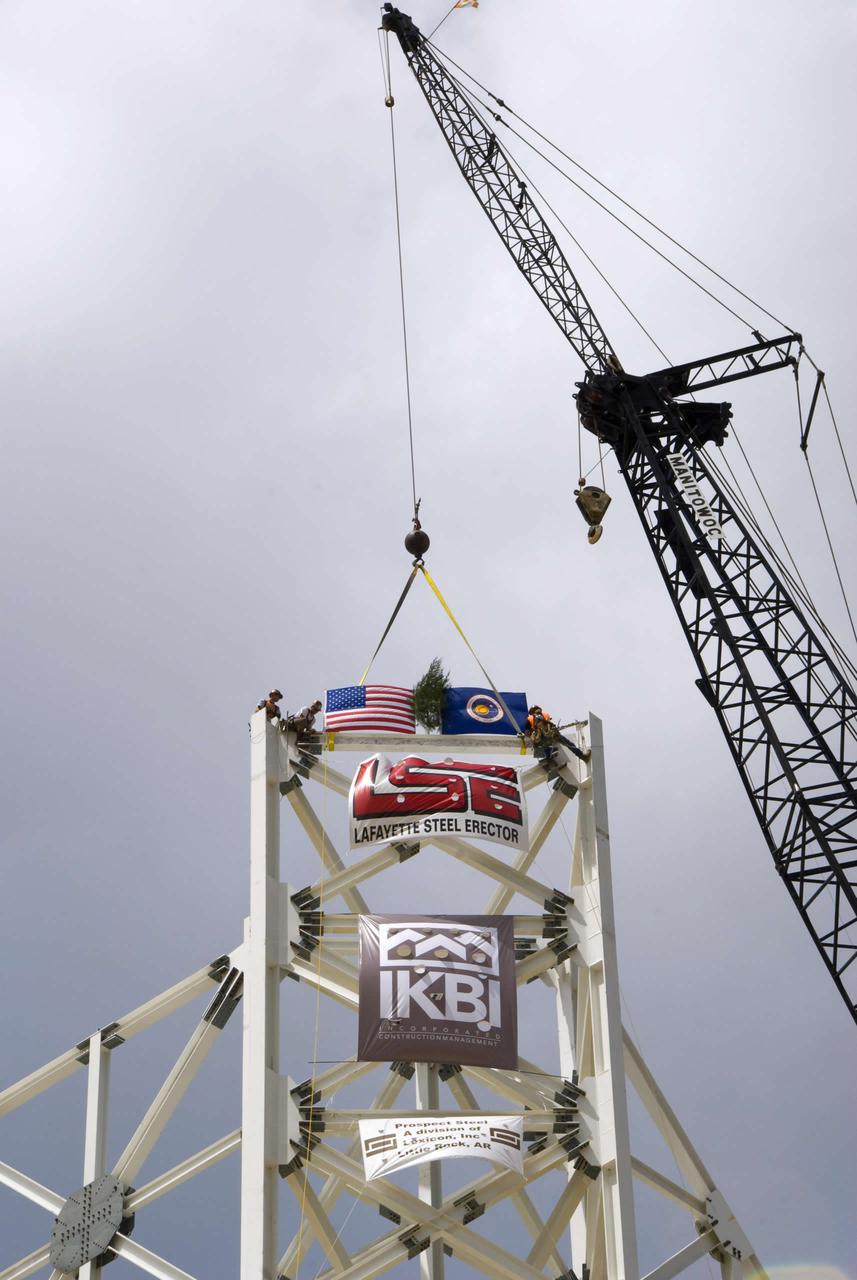
The final structural steel beam, bearing flags and the names of project workers, is hoisted and fastened into place atop the A-3 Test Stand.
STS-133 COMMON BERTHING MECHANISIM (CMB) SIMULATOR HOIST & TEMPORARY INSTALL TO PERMANENT MULTIPURPOSE MODULE (PMM)
STS-133 COMMON BERTHING MECHANISIM (CMB) SIMULATOR HOIST & TEMPORARY INSTALL TO PERMANENT MULTIPURPOSE MODULE (PMM)
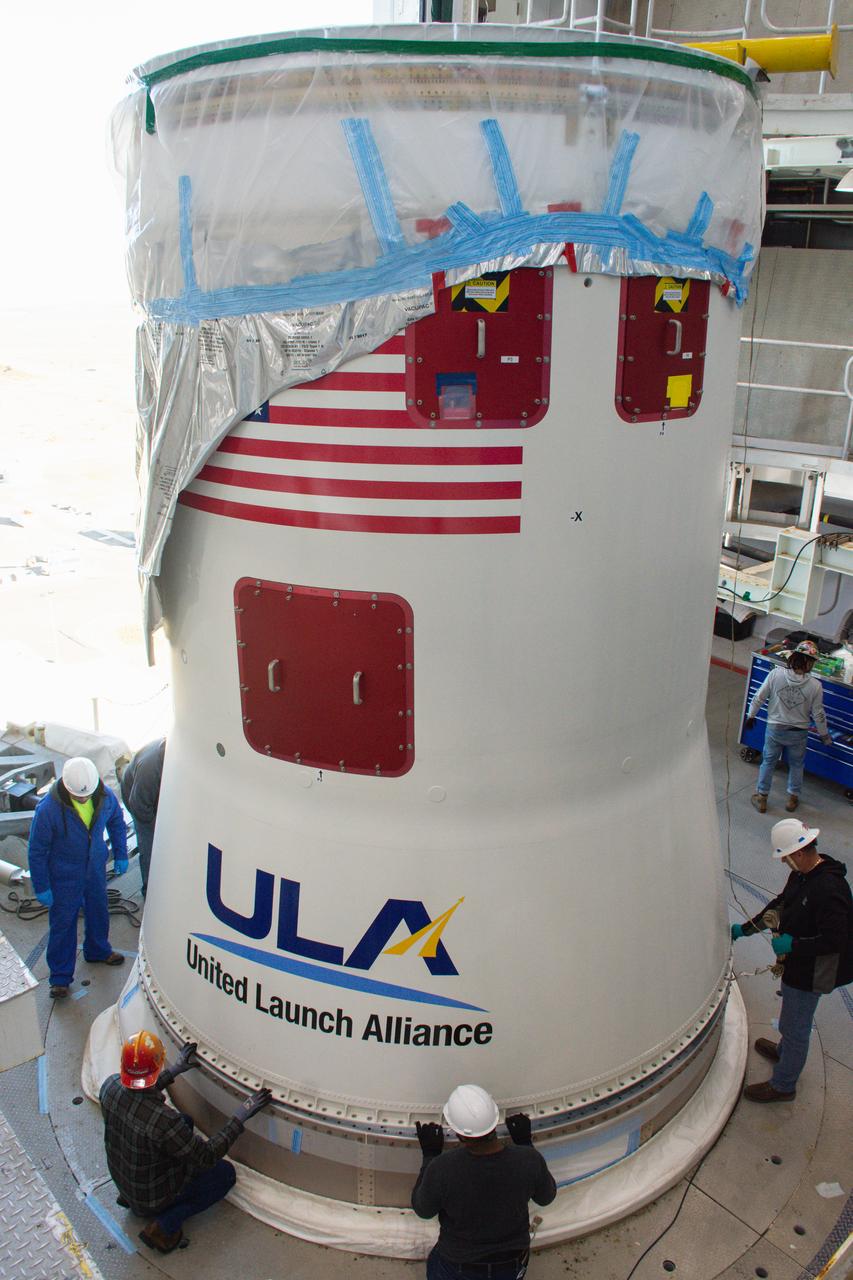
Technicians help secure the United Launch Alliance Atlas V interstage adapter and aft stub adapter to the Atlas V rocket inside the vertical integration facility at Space Launch Complex-3 at Vandenberg Space Force Base in California on Sept. 29, 2022. The rocket is being prepared to launch the National Oceanic and Atmospheric Administration’s (NOAA) Joint Polar Satellite System-2 (JPSS-2). JPSS-2 and NASA’s Low-Earth Orbit Flight Test of an Inflatable Decelerator (LOFTID) secondary payload. The launch is scheduled for Nov. 1 from SLC-3. JPSS-2, which will be renamed NOAA-21 after reaching orbit, will join a constellation of JPSS satellites that orbit from the North to the South pole, circling Earth 14 times a day and providing a full view of the entire globe twice daily. The NOAA/NASA Suomi National Polar-orbiting Partnership (Suomi NPP) satellite, and NOAA-20, previously known as JPSS-1, are both already in orbit. Each satellite carries at least four advanced instruments to measure weather and climate conditions on Earth. LOFTID is dedicated to the memory of Bernard Kutter. LOFTID will demonstrate inflatable heat shield technology that could enable a variety of proposed NASA missions to destinations such as Mars, Venus, and Titan, as well as returning heavier payloads from low-Earth orbit.