
A fit check of the Orion Crew and Service Module Horizontal Transporter (CHT) with NASA's Super Guppy aircraft began March 12, 2019, at NASA Kennedy Space Center’s Shuttle Landing Facility in Florida, operated by Space Florida. In this photo, the Super Guppy’s payload bay is opened as the CHT, secured on the U.S. Air Force aircraft loader, is moved inside the aircraft’s payload bay. The fit check is being performed to confirm loading operations, ensure that the CHT fits inside the Super Guppy and test the electrical interface to aircraft power. The Orion crew and service modules will be readied for a trip to NASA’s Plum Brook Station in Sandusky, Ohio, for full thermal vacuum testing. In this unique facility, the crew and service modules will be put through extensive testing to ensure they can survive the rigors of launch, space travel, re-entry and splashdown. The Orion spacecraft will launch atop the agency's Space Launch System rocket on Exploration Mission-1.

A fit check of the Orion Crew and Service Module Horizontal Transporter (CHT) with NASA's Super Guppy aircraft is underway March 13, 2019, at NASA Kennedy Space Center’s Shuttle Landing Facility in Florida, operated by Space Florida. In this photo, the CHT, secured on the U.S. Air Force aircraft loader, is moved inside the aircraft’s payload bay. The fit check is being performed to confirm loading operations, ensure that the CHT fits inside the Super Guppy and test the electrical interface to aircraft power. The Orion crew and service modules will be readied for a trip to NASA’s Plum Brook Station in Sandusky, Ohio, for full thermal vacuum testing. In this unique facility, the crew and service modules will be put through extensive testing to ensure they can survive the rigors of launch, space travel, re-entry and splashdown. The Orion spacecraft will launch atop the agency's Space Launch System rocket on Exploration Mission-1.
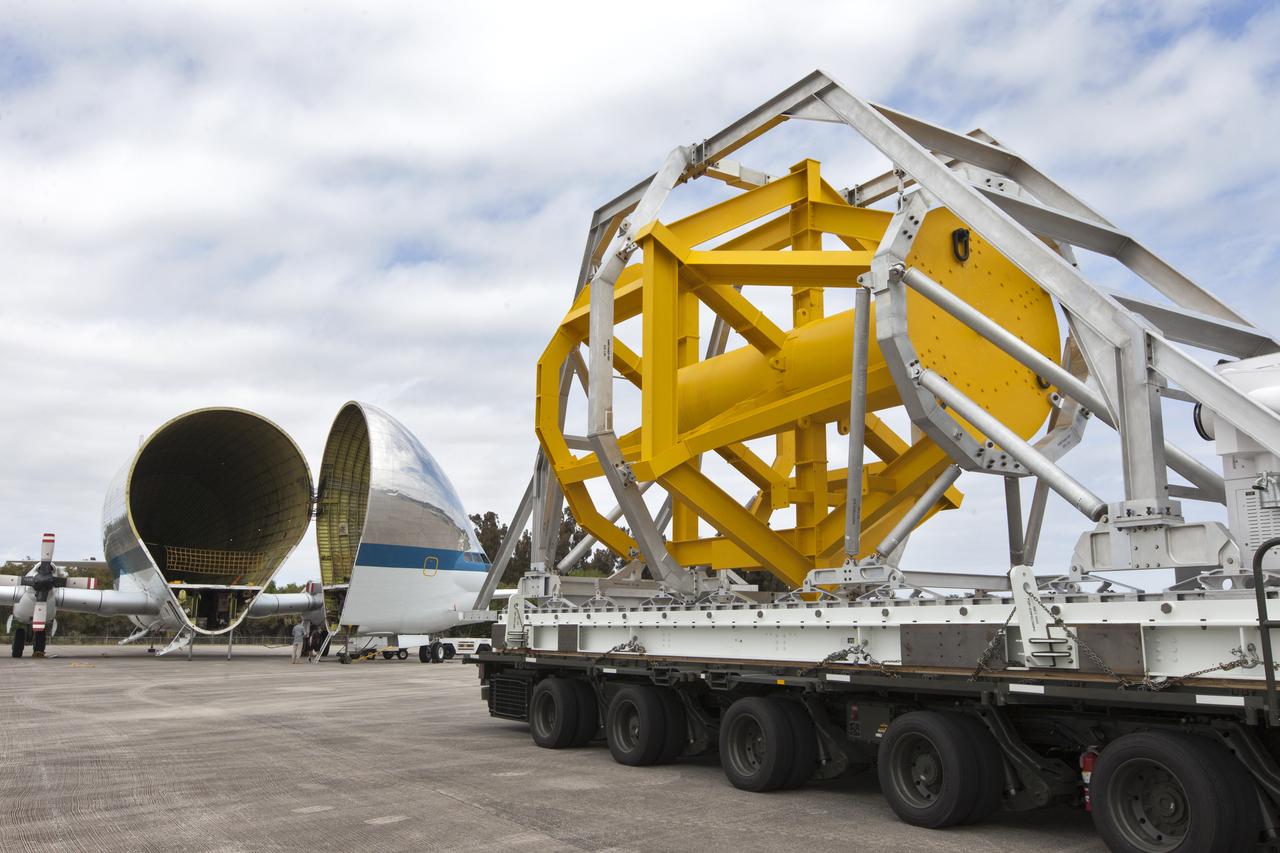
A fit check of the Orion Crew and Service Module Horizontal Transporter (CHT) with NASA's Super Guppy aircraft began March 12, 2019, at NASA Kennedy Space Center’s Shuttle Landing Facility in Florida, operated by Space Florida. In this photo, the Super Guppy’s payload bay is opened as the CHT, secured on the U.S. Air Force aircraft loader, is moved toward the aircraft. The fit check is being performed to confirm loading operations, ensure that the CHT fits inside the Super Guppy and test the electrical interface to aircraft power. The Orion crew and service modules will be readied for a trip to NASA’s Plum Brook Station in Sandusky, Ohio, for full thermal vacuum testing. In this unique facility, the crew and service modules will be put through extensive testing to ensure they can survive the rigors of launch, space travel, re-entry and splashdown. The Orion spacecraft will launch atop the agency's Space Launch System rocket on Exploration Mission-1.
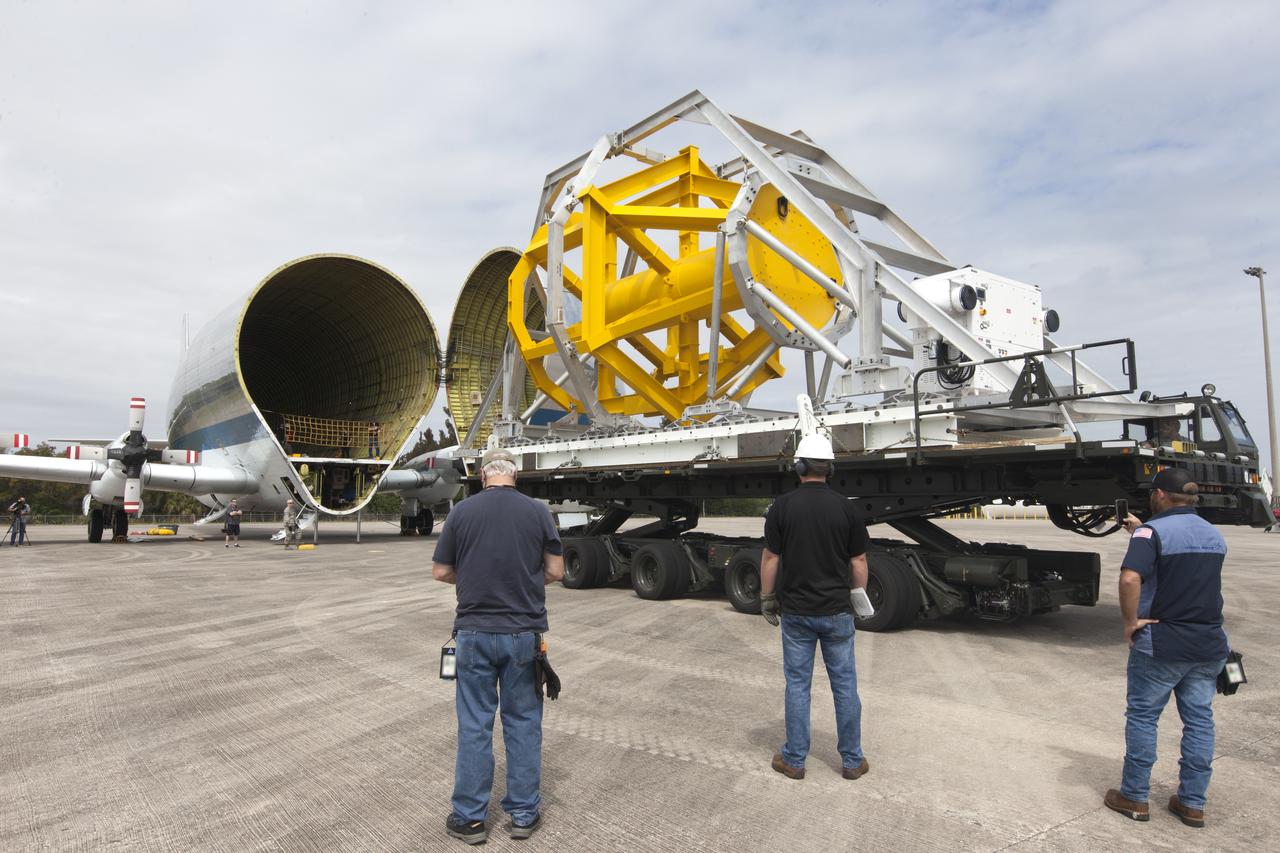
A fit check of the Orion Crew and Service Module Horizontal Transporter (CHT) with NASA's Super Guppy aircraft began March 12, 2019, at NASA Kennedy Space Center’s Shuttle Landing Facility in Florida, operated by Space Florida. In this photo, the Super Guppy’s payload bay is opened as the CHT, secured on the U.S. Air Force aircraft loader, is moved toward the aircraft. The fit check is being performed to confirm loading operations, ensure that the CHT fits inside the Super Guppy and test the electrical interface to aircraft power. The Orion crew and service modules will be readied for a trip to NASA’s Plum Brook Station in Sandusky, Ohio, for full thermal vacuum testing. In this unique facility, the crew and service modules will be put through extensive testing to ensure they can survive the rigors of launch, space travel, re-entry and splashdown. The Orion spacecraft will launch atop the agency's Space Launch System rocket on Exploration Mission-1.
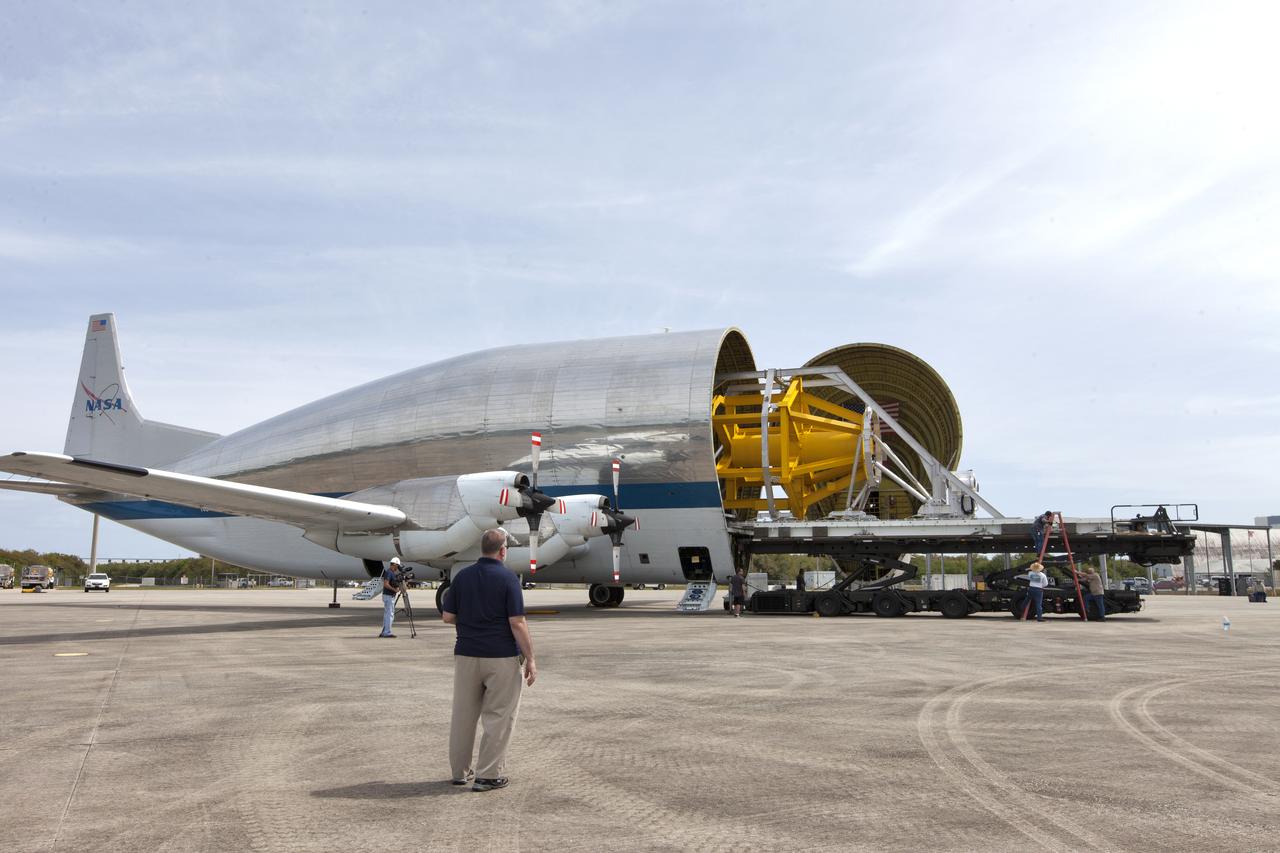
A fit check of the Orion Crew and Service Module Horizontal Transporter (CHT) with NASA's Super Guppy aircraft is underway March 13, 2019, at NASA Kennedy Space Center’s Shuttle Landing Facility in Florida, operated by Space Florida. In this photo, the CHT, secured on the U.S. Air Force aircraft loader, is moved inside the aircraft’s payload bay. The fit check is being performed to confirm loading operations, ensure that the CHT fits inside the Super Guppy and test the electrical interface to aircraft power. The Orion crew and service modules will be readied for a trip to NASA’s Plum Brook Station in Sandusky, Ohio, for full thermal vacuum testing. In this unique facility, the crew and service modules will be put through extensive testing to ensure they can survive the rigors of launch, space travel, re-entry and splashdown. The Orion spacecraft will launch atop the agency's Space Launch System rocket on Exploration Mission-1.

A fit check of the Orion Crew and Service Module Horizontal Transporter (CHT) with NASA's Super Guppy aircraft began March 12, 2019, at NASA Kennedy Space Center’s Shuttle Landing Facility in Florida, operated by Space Florida. In this photo, the CHT is secured on the U.S. Air Force aircraft loader. The fit check is being performed to confirm loading operations, ensure that the CHT fits inside the Super Guppy and test the electrical interface to aircraft power. The Orion crew and service modules will be readied for a trip to NASA’s Plum Brook Station in Sandusky, Ohio, for full thermal vacuum testing. In this unique facility, the crew and service modules will be put through extensive testing to ensure they can survive the rigors of launch, space travel, re-entry and splashdown. The Orion spacecraft will launch atop the agency's Space Launch System rocket on Exploration Mission-1.
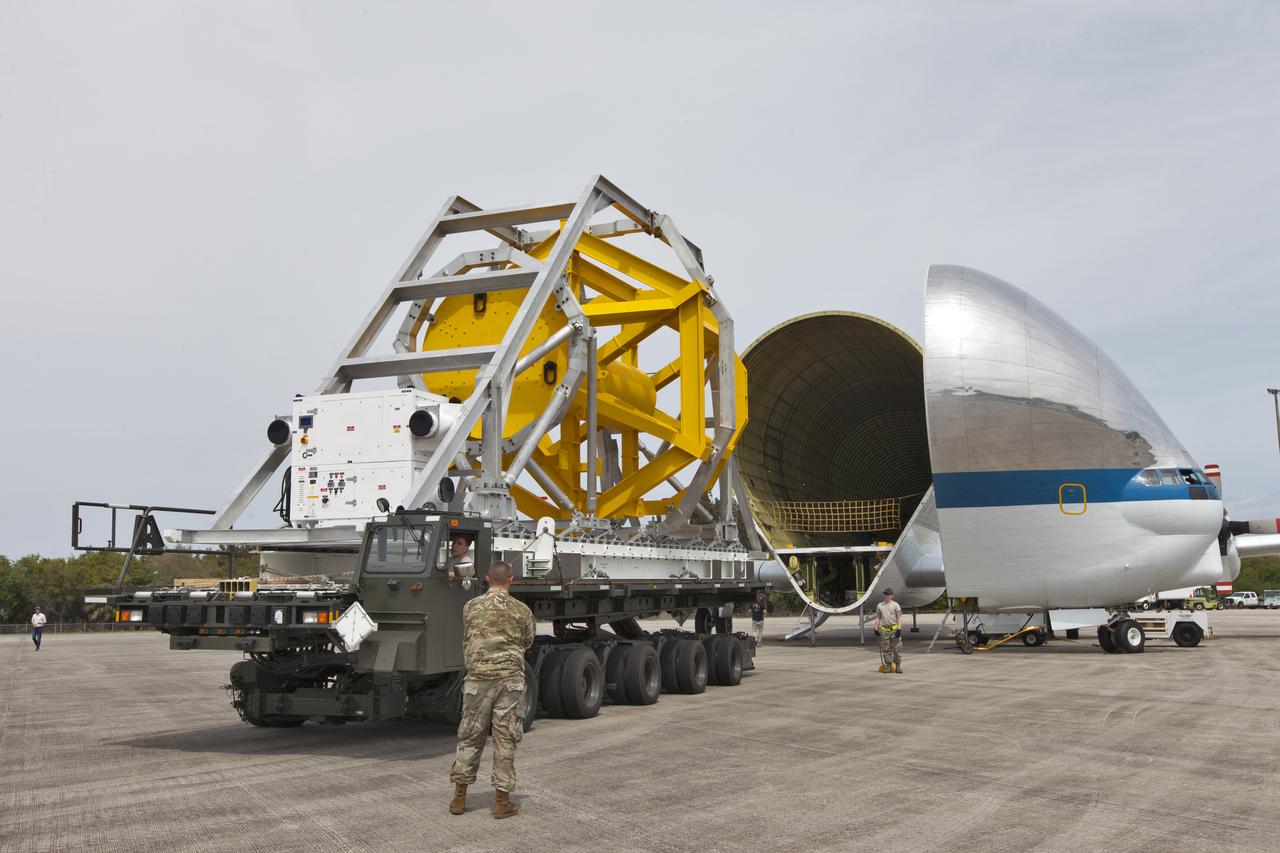
A fit check of the Orion Crew and Service Module Horizontal Transporter (CHT) with NASA's Super Guppy aircraft is underway March 13, 2019, at NASA Kennedy Space Center’s Shuttle Landing Facility in Florida, operated by Space Florida. In this photo, the CHT, secured on the U.S. Air Force aircraft loader, is moved toward the Super Guppy’s open payload bay. The fit check is being performed to confirm loading operations, ensure that the CHT fits inside the Super Guppy and test the electrical interface to aircraft power. The Orion crew and service modules will be readied for a trip to NASA’s Plum Brook Station in Sandusky, Ohio, for full thermal vacuum testing. In this unique facility, the crew and service modules will be put through extensive testing to ensure they can survive the rigors of launch, space travel, re-entry and splashdown. The Orion spacecraft will launch atop the agency's Space Launch System rocket on Exploration Mission-1.
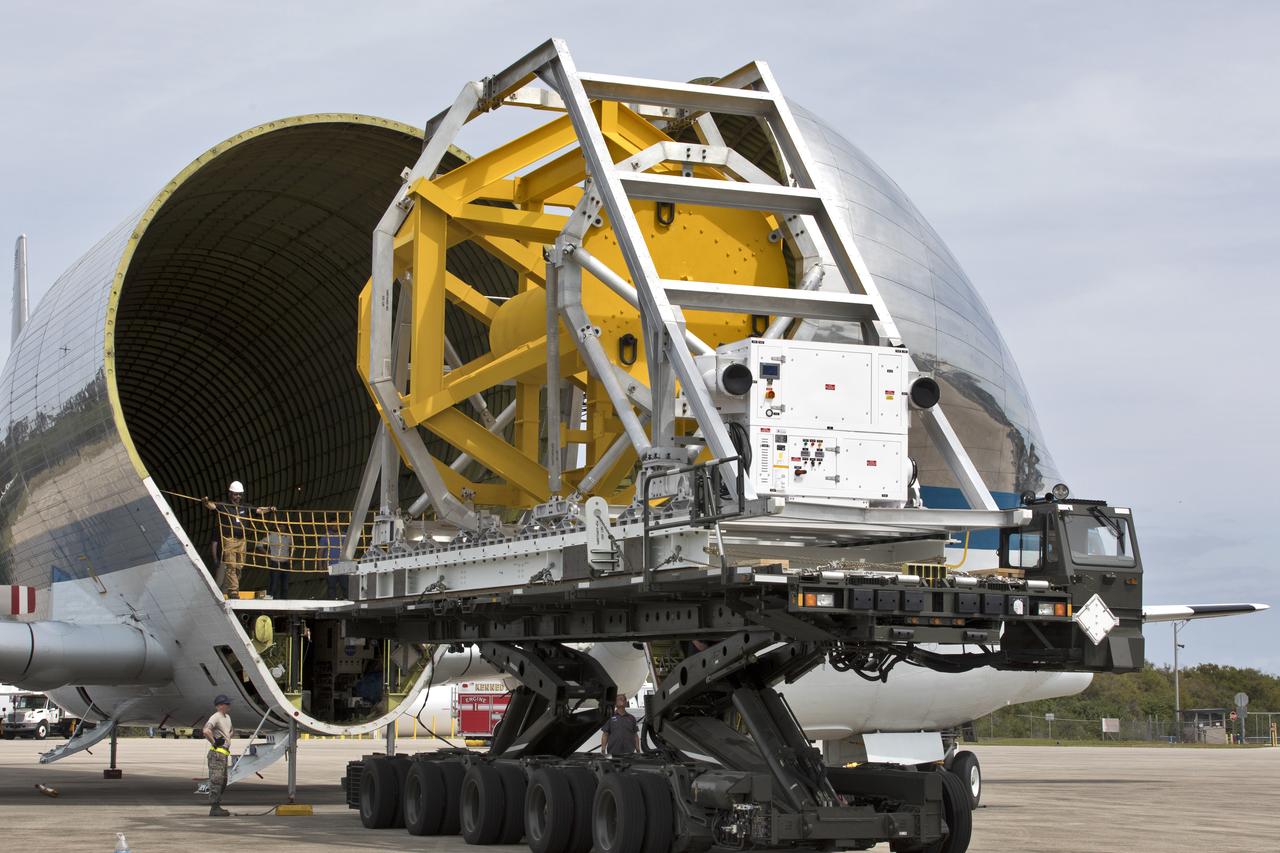
A fit check of the Orion Crew and Service Module Horizontal Transporter (CHT) with NASA's Super Guppy aircraft is underway March 13, 2019, at NASA Kennedy Space Center’s Shuttle Landing Facility in Florida, operated by Space Florida. In this photo, the Super Guppy’s payload bay has been opened and the CHT, secured on the U.S. Air Force aircraft loader, is moved inside the aircraft’s payload bay. The fit check is being performed to confirm loading operations, ensure that the CHT fits inside the Super Guppy and test the electrical interface to aircraft power. The Orion crew and service modules will be readied for a trip to NASA’s Plum Brook Station in Sandusky, Ohio, for full thermal vacuum testing. In this unique facility, the crew and service modules will be put through extensive testing to ensure they can survive the rigors of launch, space travel, re-entry and splashdown. The Orion spacecraft will launch atop the agency's Space Launch System rocket on Exploration Mission-1.
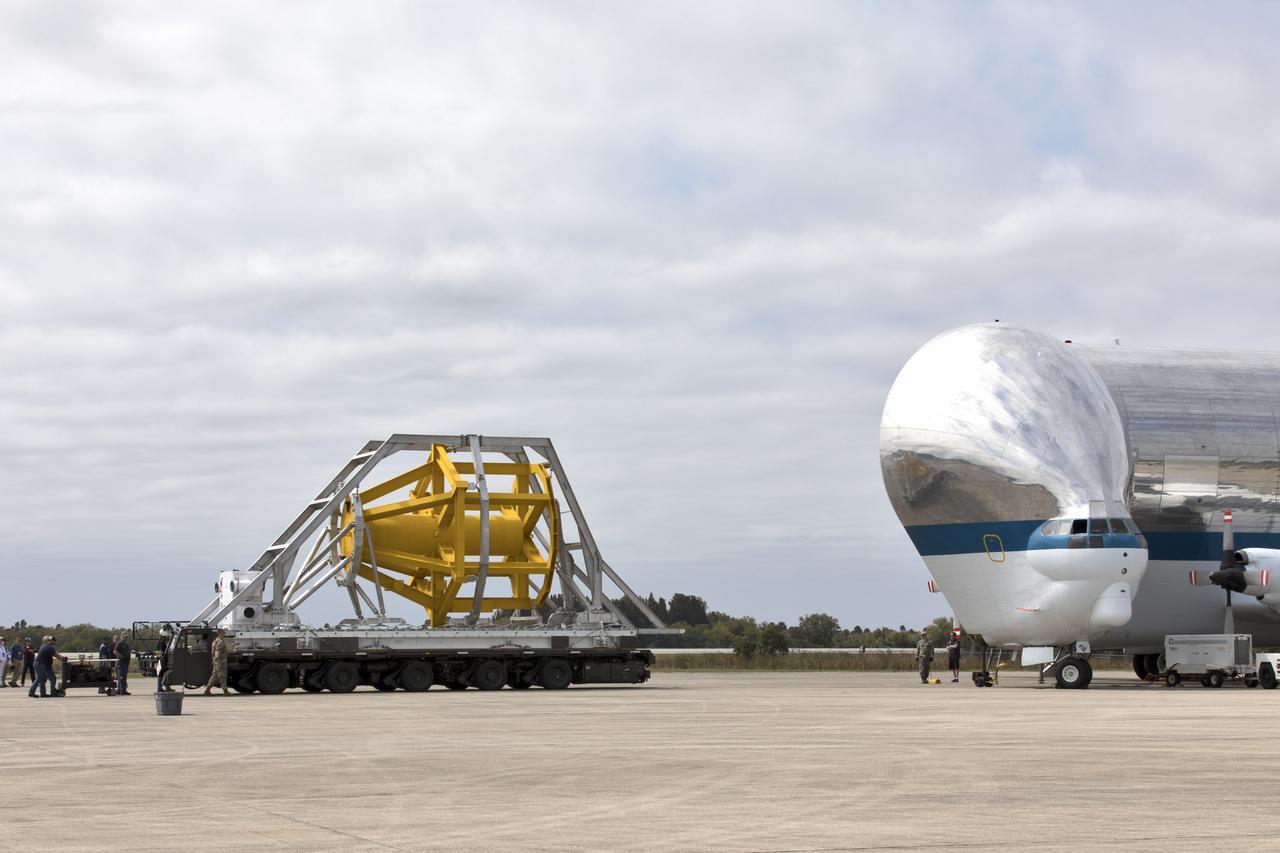
A fit check of the Orion Crew and Service Module Horizontal Transporter (CHT) with NASA's Super Guppy aircraft began March 12, 2019, at NASA Kennedy Space Center’s Shuttle Landing Facility in Florida, operated by Space Florida. In this photo, the U.S. Air Force aircraft loader with the CHT is moved toward the Super Guppy. The fit check is being performed to confirm loading operations, ensure that the CHT fits inside the Super Guppy and test the electrical interface to aircraft power. The Orion crew and service modules will be readied for a trip to NASA’s Plum Brook Station in Sandusky, Ohio, for full thermal vacuum testing. In this unique facility, the crew and service modules will be put through extensive testing to ensure they can survive the rigors of launch, space travel, re-entry and splashdown. The Orion spacecraft will launch atop the agency's Space Launch System rocket on Exploration Mission-1.
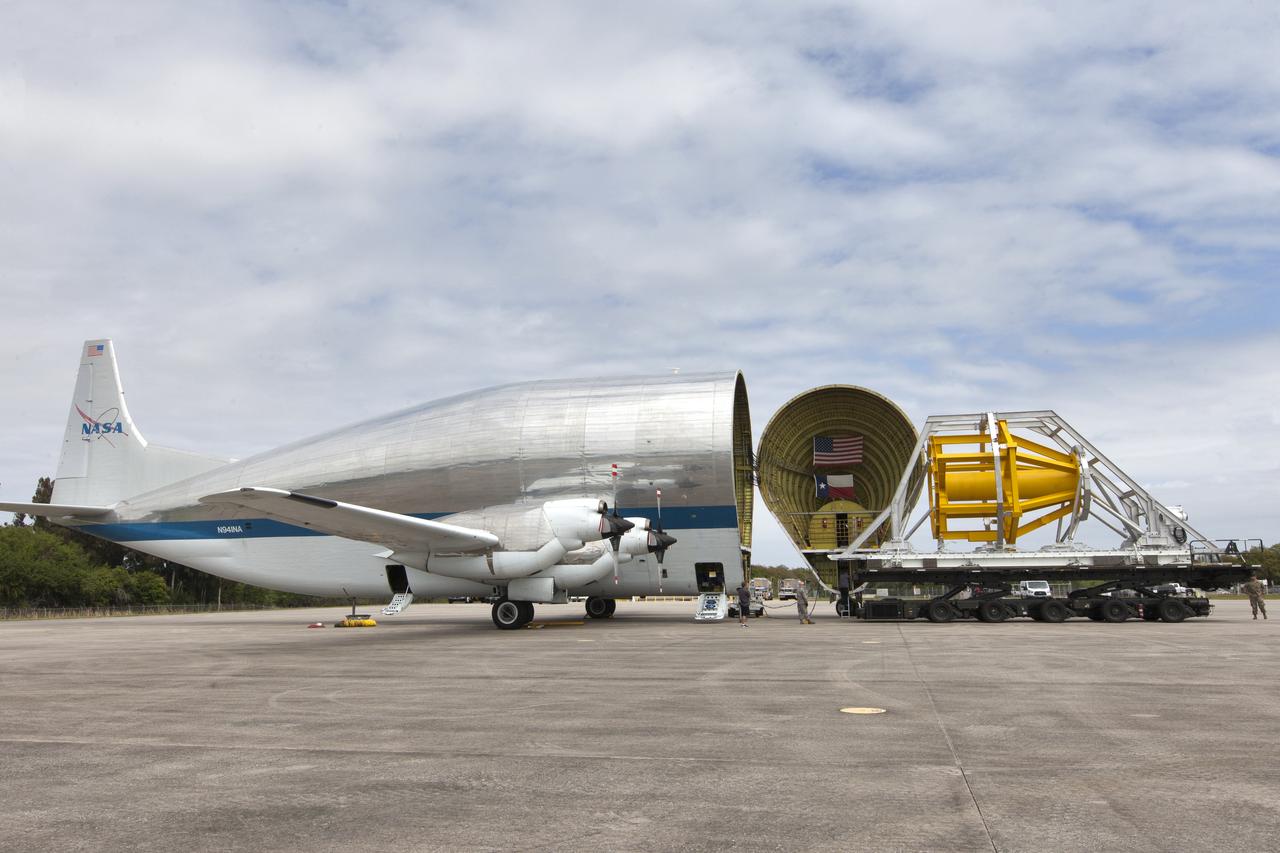
A fit check of the Orion Crew and Service Module Horizontal Transporter (CHT) with NASA's Super Guppy aircraft began March 12, 2019, at NASA Kennedy Space Center’s Shuttle Landing Facility in Florida, operated by Space Florida. In this photo, the Super Guppy’s payload bay is opened as the CHT, secured on the U.S. Air Force aircraft loader, is moved toward the aircraft. The fit check is being performed to confirm loading operations, ensure that the CHT fits inside the Super Guppy and test the electrical interface to aircraft power. The Orion crew and service modules will be readied for a trip to NASA’s Plum Brook Station in Sandusky, Ohio, for full thermal vacuum testing. In this unique facility, the crew and service modules will be put through extensive testing to ensure they can survive the rigors of launch, space travel, re-entry and splashdown. The Orion spacecraft will launch atop the agency's Space Launch System rocket on Exploration Mission-1.
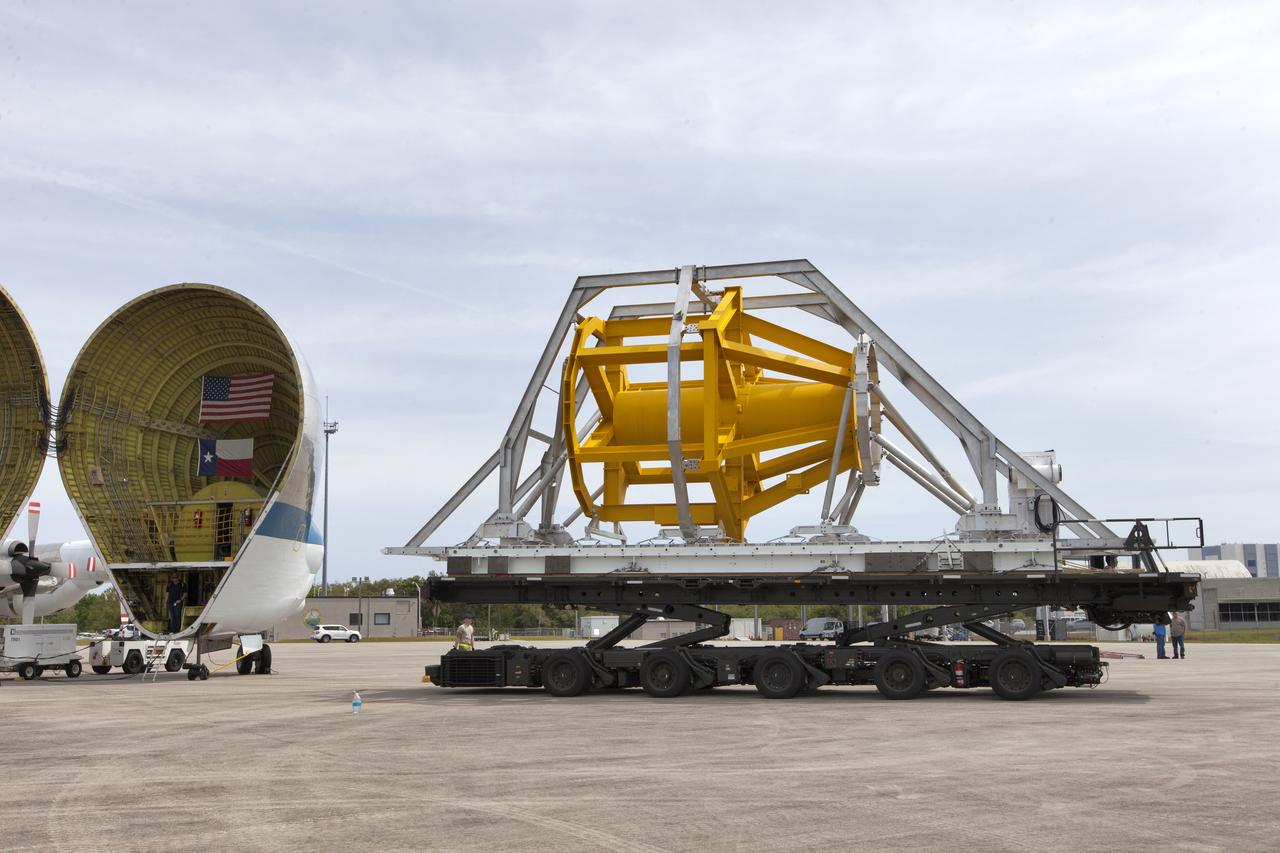
A fit check of the Orion Crew and Service Module Horizontal Transporter (CHT) with NASA's Super Guppy aircraft is underway March 13, 2019, at NASA Kennedy Space Center’s Shuttle Landing Facility in Florida, operated by Space Florida. In this photo, the CHT is secured on the U.S. Air Force aircraft loader and is being moved toward the Super Guppy. The fit check is being performed to confirm loading operations, ensure that the CHT fits inside the Super Guppy and test the electrical interface to aircraft power. The Orion crew and service modules will be readied for a trip to NASA’s Plum Brook Station in Sandusky, Ohio, for full thermal vacuum testing. In this unique facility, the crew and service modules will be put through extensive testing to ensure they can survive the rigors of launch, space travel, re-entry and splashdown. The Orion spacecraft will launch atop the agency's Space Launch System rocket on Exploration Mission-1.
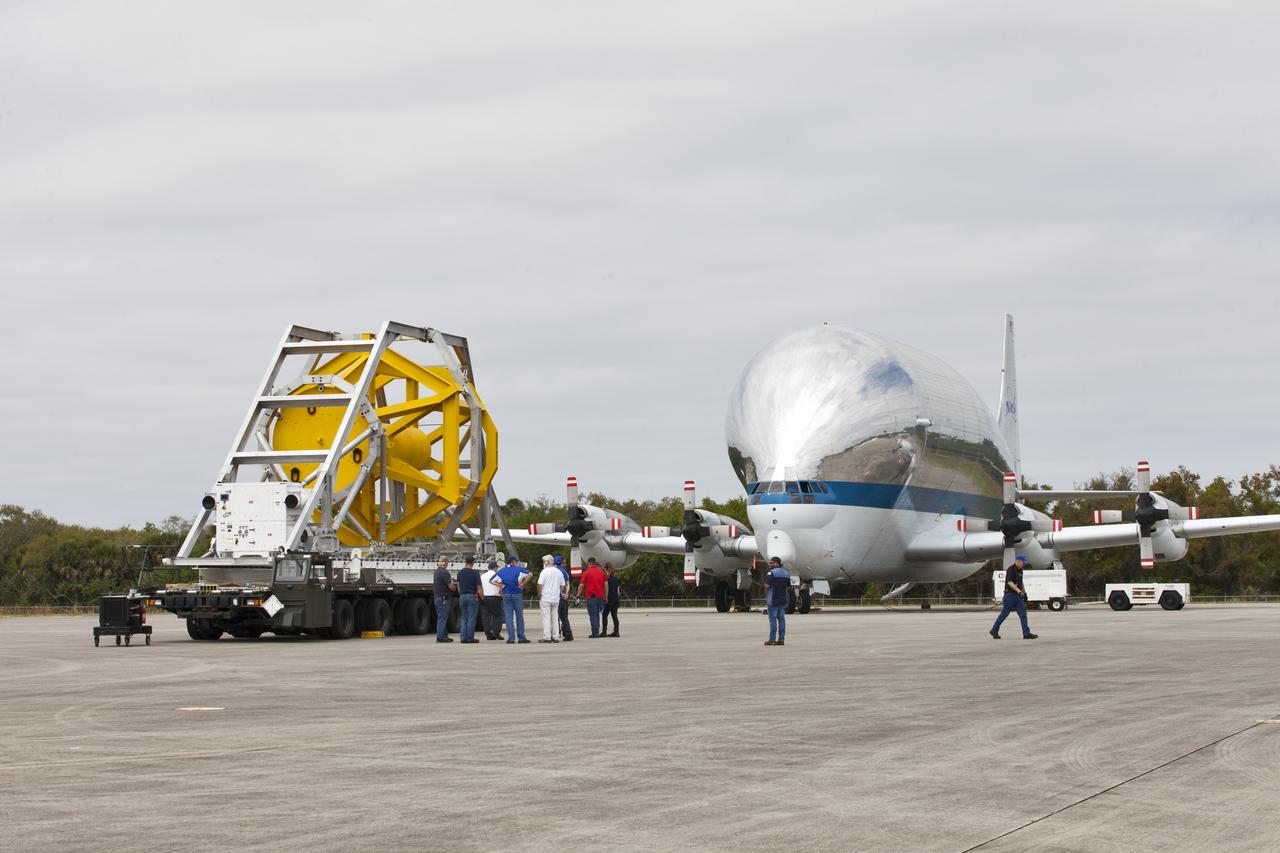
A fit check of the Orion Crew and Service Module Horizontal Transporter (CHT) with NASA's Super Guppy aircraft began March 12, 2019, at NASA Kennedy Space Center’s Shuttle Landing Facility in Florida, operated by Space Florida. In this photo, the CHT is secured on the U.S. Air Force aircraft loader. The fit check is being performed to confirm loading operations, ensure that the CHT fits inside the Super Guppy and test the electrical interface to aircraft power. The Orion crew and service modules will be readied for a trip to NASA’s Plum Brook Station in Sandusky, Ohio, for full thermal vacuum testing. In this unique facility, the crew and service modules will be put through extensive testing to ensure they can survive the rigors of launch, space travel, re-entry and splashdown. The Orion spacecraft will launch atop the agency's Space Launch System rocket on Exploration Mission-1.
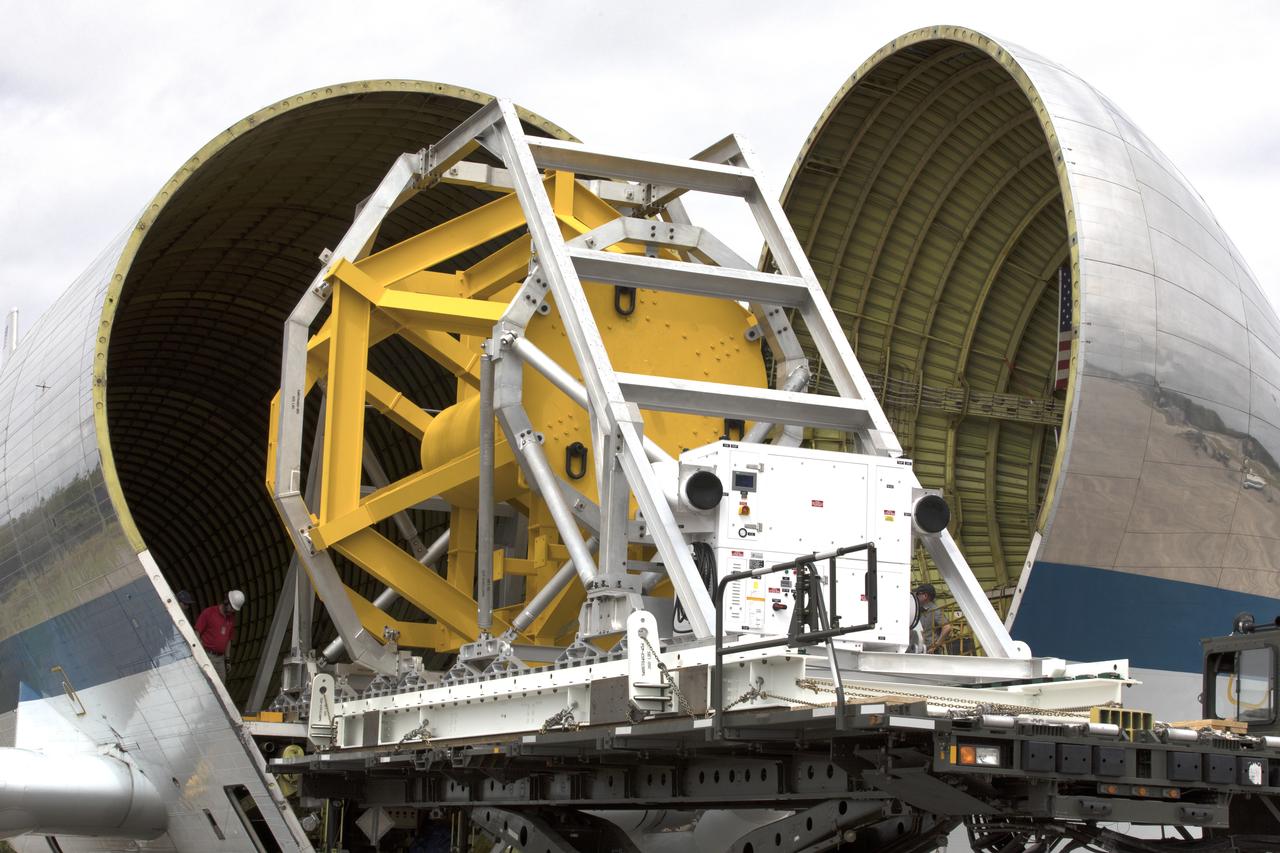
A fit check of the Orion Crew and Service Module Horizontal Transporter (CHT) with NASA's Super Guppy aircraft began March 12, 2019, at NASA Kennedy Space Center’s Shuttle Landing Facility in Florida, operated by Space Florida. In this photo, the Super Guppy’s payload bay is opened as the CHT, secured on the U.S. Air Force aircraft loader, is moved inside the aircraft’s payload bay. The fit check is being performed to confirm loading operations, ensure that the CHT fits inside the Super Guppy and test the electrical interface to aircraft power. The Orion crew and service modules will be readied for a trip to NASA’s Plum Brook Station in Sandusky, Ohio, for full thermal vacuum testing. In this unique facility, the crew and service modules will be put through extensive testing to ensure they can survive the rigors of launch, space travel, re-entry and splashdown. The Orion spacecraft will launch atop the agency's Space Launch System rocket on Exploration Mission-1.
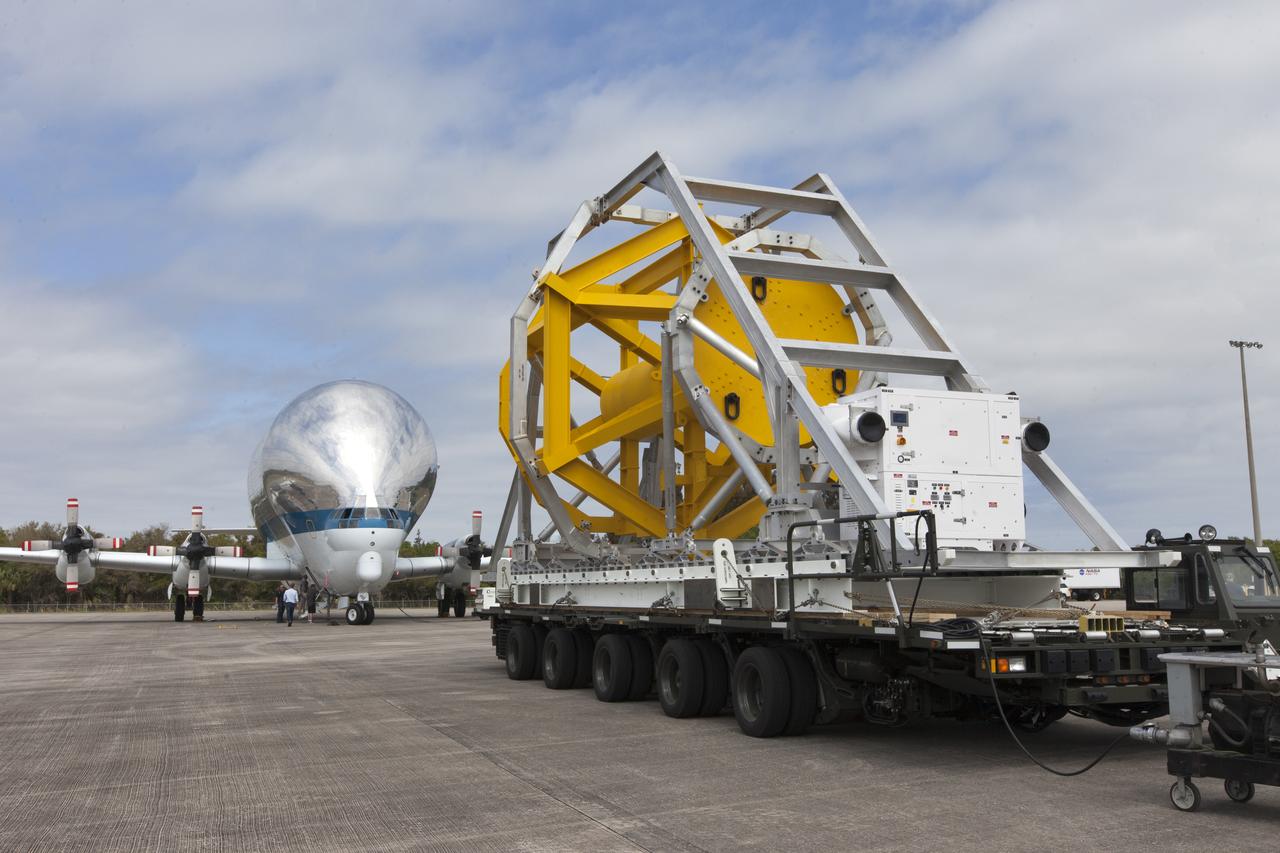
A fit check of the Orion Crew and Service Module Horizontal Transporter (CHT) with NASA's Super Guppy aircraft began March 12, 2019, at NASA Kennedy Space Center’s Shuttle Landing Facility in Florida, operated by Space Florida. In this photo, the CHT is secured on the U.S. Air Force aircraft loader. The fit check is being performed to confirm loading operations, ensure that the CHT fits inside the Super Guppy and test the electrical interface to aircraft power. The Orion crew and service modules will be readied for a trip to NASA’s Plum Brook Station in Sandusky, Ohio, for full thermal vacuum testing. In this unique facility, the crew and service modules will be put through extensive testing to ensure they can survive the rigors of launch, space travel, re-entry and splashdown. The Orion spacecraft will launch atop the agency's Space Launch System rocket on Exploration Mission-1.
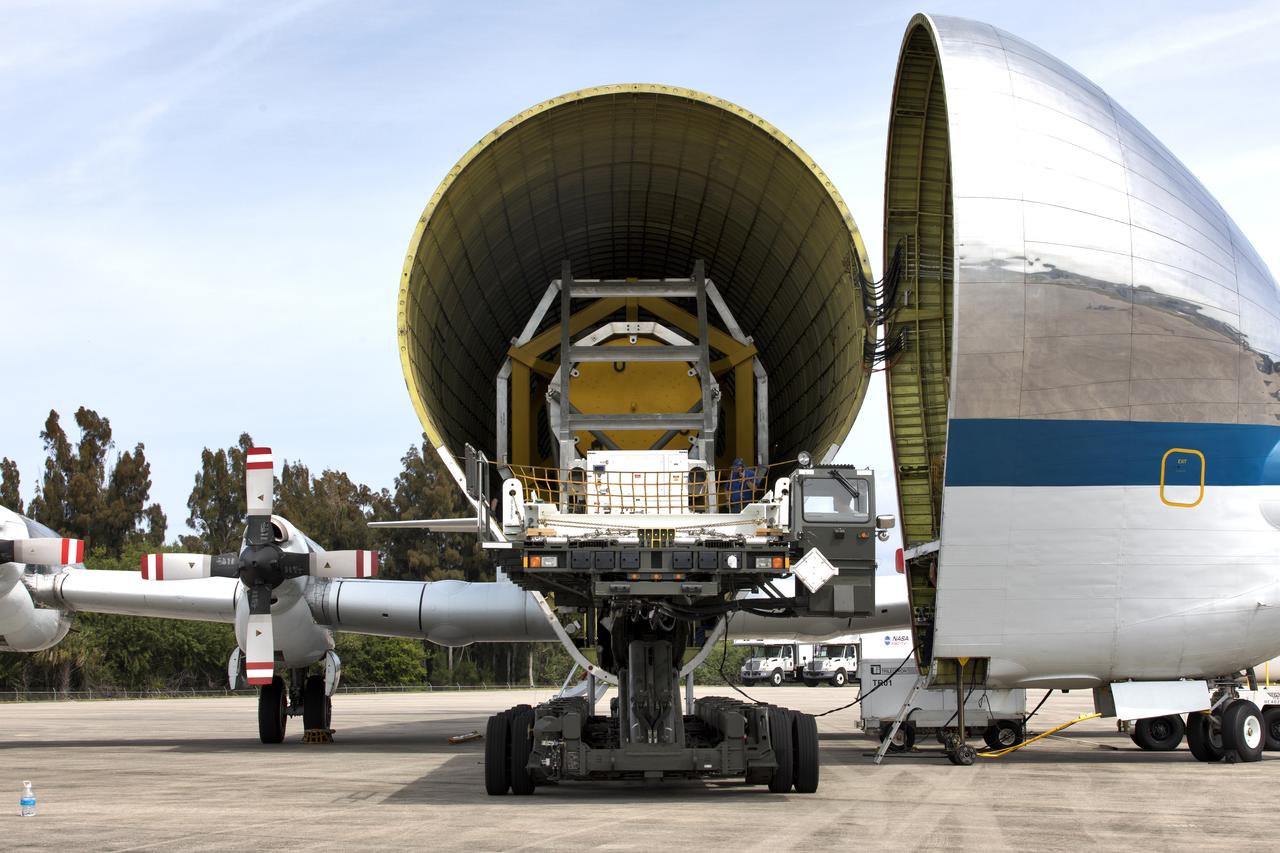
A fit check of the Orion Crew and Service Module Horizontal Transporter (CHT) with NASA's Super Guppy aircraft is underway March 13, 2019, at NASA Kennedy Space Center’s Shuttle Landing Facility in Florida, operated by Space Florida. In this photo, the CHT, secured on the U.S. Air Force aircraft loader, is moved inside the aircraft’s payload bay. The fit check is being performed to confirm loading operations, ensure that the CHT fits inside the Super Guppy and test the electrical interface to aircraft power. The Orion crew and service modules will be readied for a trip to NASA’s Plum Brook Station in Sandusky, Ohio, for full thermal vacuum testing. In this unique facility, the crew and service modules will be put through extensive testing to ensure they can survive the rigors of launch, space travel, re-entry and splashdown. The Orion spacecraft will launch atop the agency's Space Launch System rocket on Exploration Mission-1.
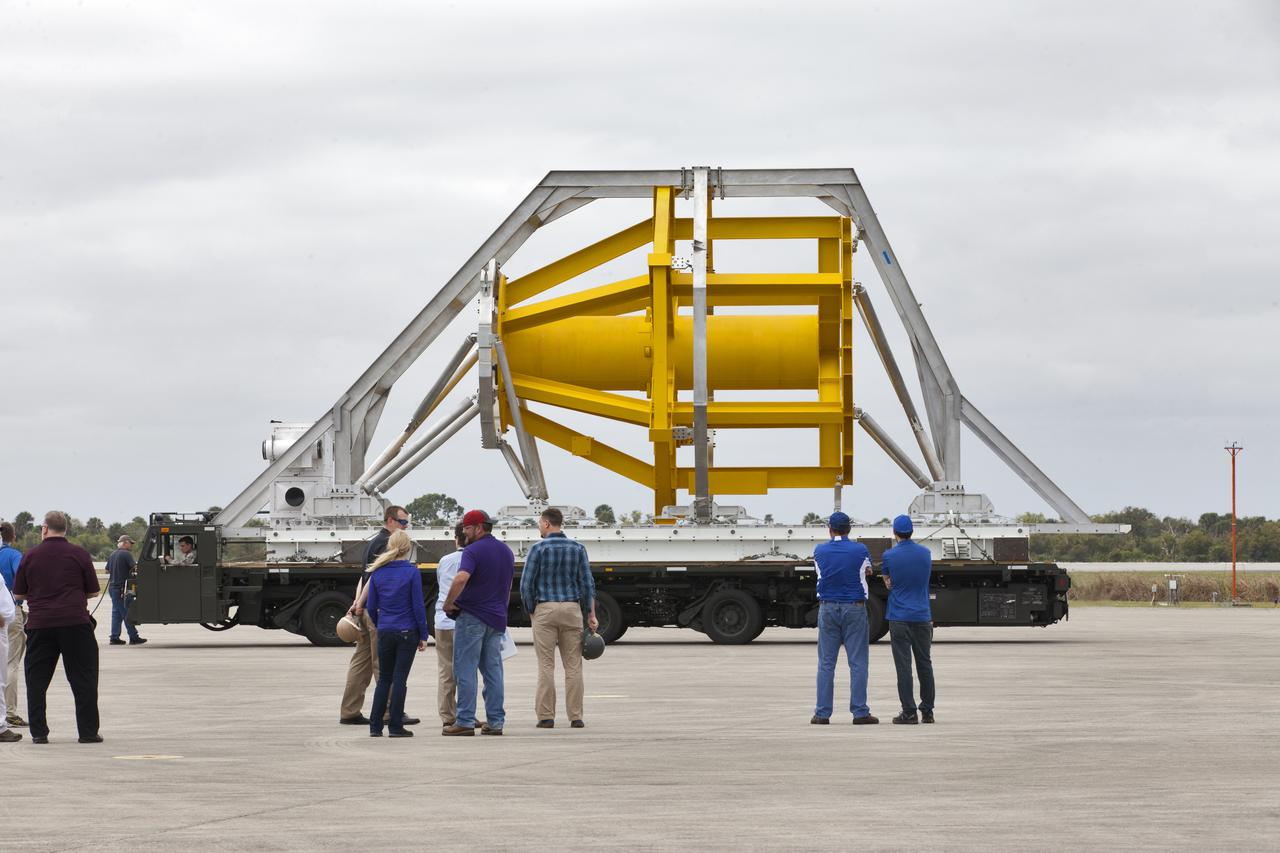
A fit check of the Orion Crew and Service Module Horizontal Transporter (CHT) with NASA's Super Guppy aircraft began March 12, 2019, at NASA Kennedy Space Center’s Shuttle Landing Facility in Florida, operated by Space Florida. In this photo, the CHT is secured on the U.S. Air Force aircraft loader. The fit check is being performed to confirm loading operations, ensure that the CHT fits inside the Super Guppy and test the electrical interface to aircraft power. The Orion crew and service modules will be readied for a trip to NASA’s Plum Brook Station in Sandusky, Ohio, for full thermal vacuum testing. In this unique facility, the crew and service modules will be put through extensive testing to ensure they can survive the rigors of launch, space travel, re-entry and splashdown. The Orion spacecraft will launch atop the agency's Space Launch System rocket on Exploration Mission-1.
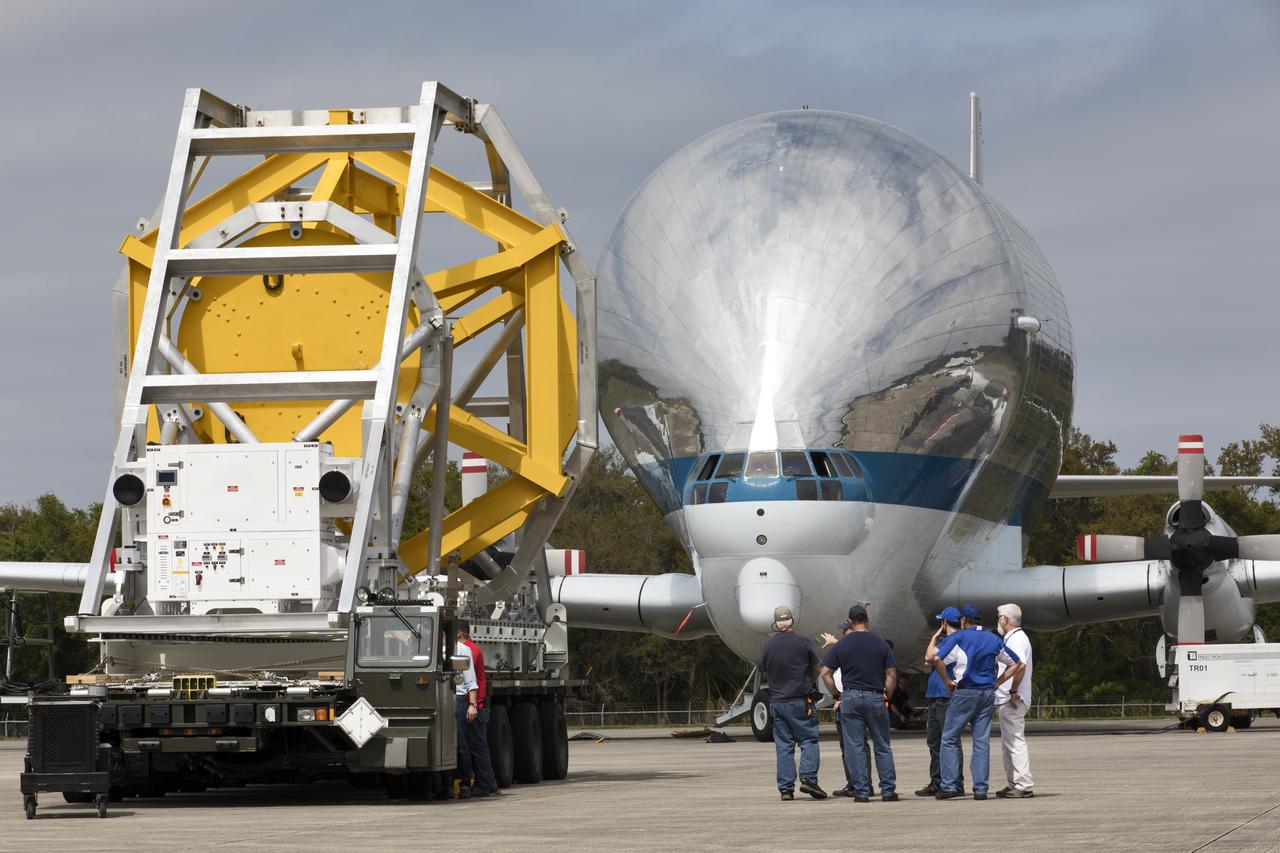
A fit check of the Orion Crew and Service Module Horizontal Transporter (CHT) with NASA's Super Guppy aircraft began March 12, 2019, at NASA Kennedy Space Center’s Shuttle Landing Facility in Florida, operated by Space Florida. In this photo, the CHT is secured on the U.S. Air Force aircraft loader and is moved toward the Super Guppy. The fit check is being performed to confirm loading operations, ensure that the CHT fits inside the Super Guppy and test the electrical interface to aircraft power. The Orion crew and service modules will be readied for a trip to NASA’s Plum Brook Station in Sandusky, Ohio, for full thermal vacuum testing. In this unique facility, the crew and service modules will be put through extensive testing to ensure they can survive the rigors of launch, space travel, re-entry and splashdown. The Orion spacecraft will launch atop the agency's Space Launch System rocket on Exploration Mission-1.
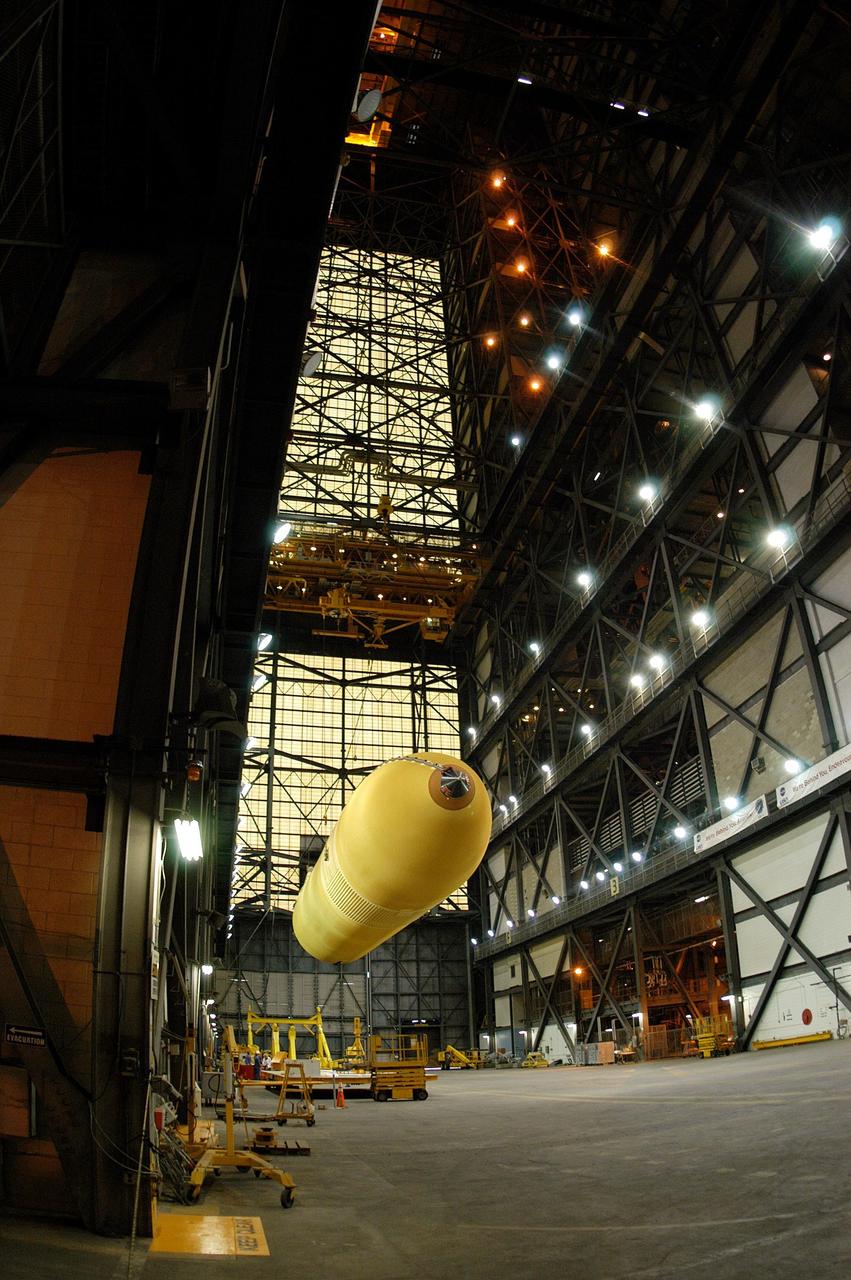
KENNEDY SPACE CENTER, FLA. - An external tank is lowered into a horizontal position in the transfer aisle of the Vehicle Assembly Building before being placed on a transporter. The tank is being transferred to the Michoud Space Systems Assembly Facility near New Orleans where redesign of the external tank is underway for Return to Flight.
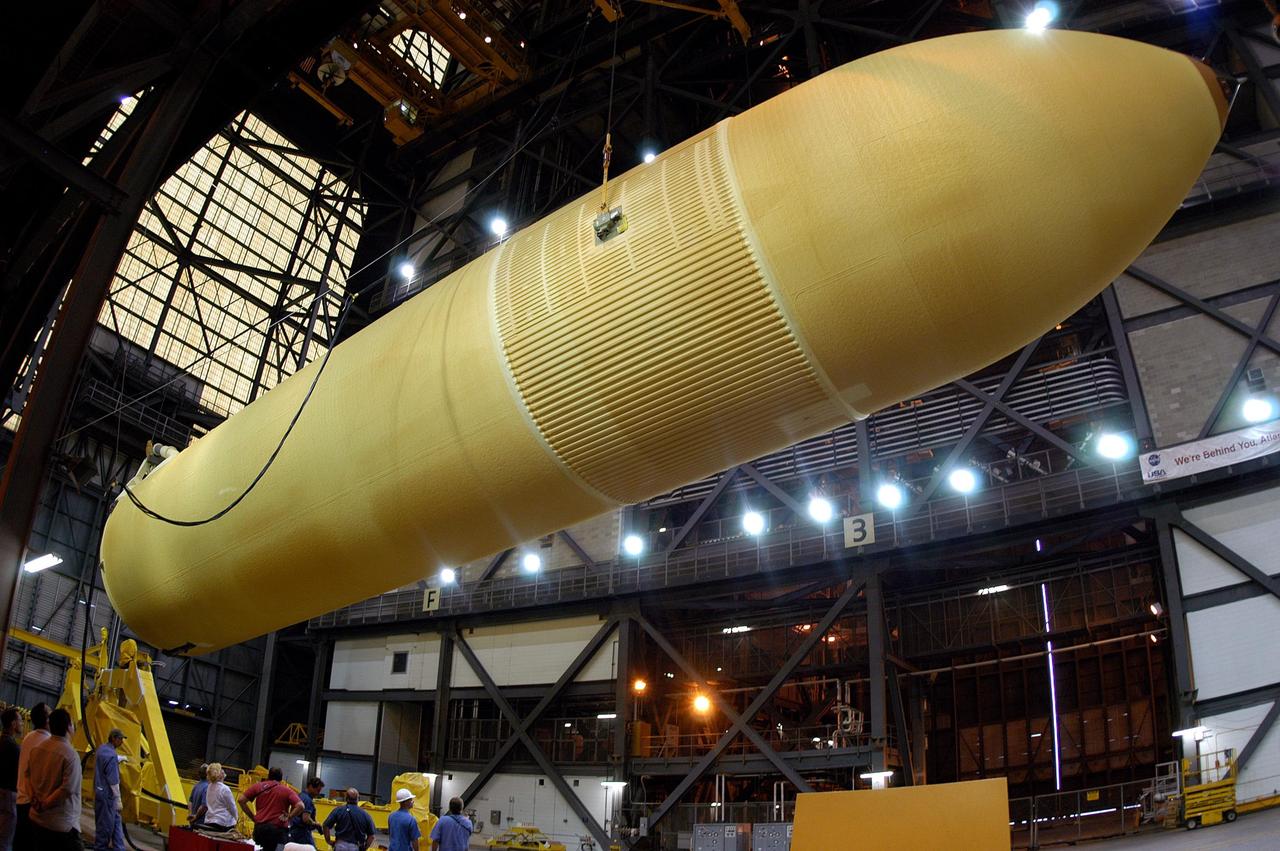
KENNEDY SPACE CENTER, FLA. - An external tank is lowered into a horizontal position in the transfer aisle of the Vehicle Assembly Building before being placed on a transporter. The tank is being transferred to the Michoud Space Systems Assembly Facility near New Orleans where redesign of the external tank is underway for Return to Flight.
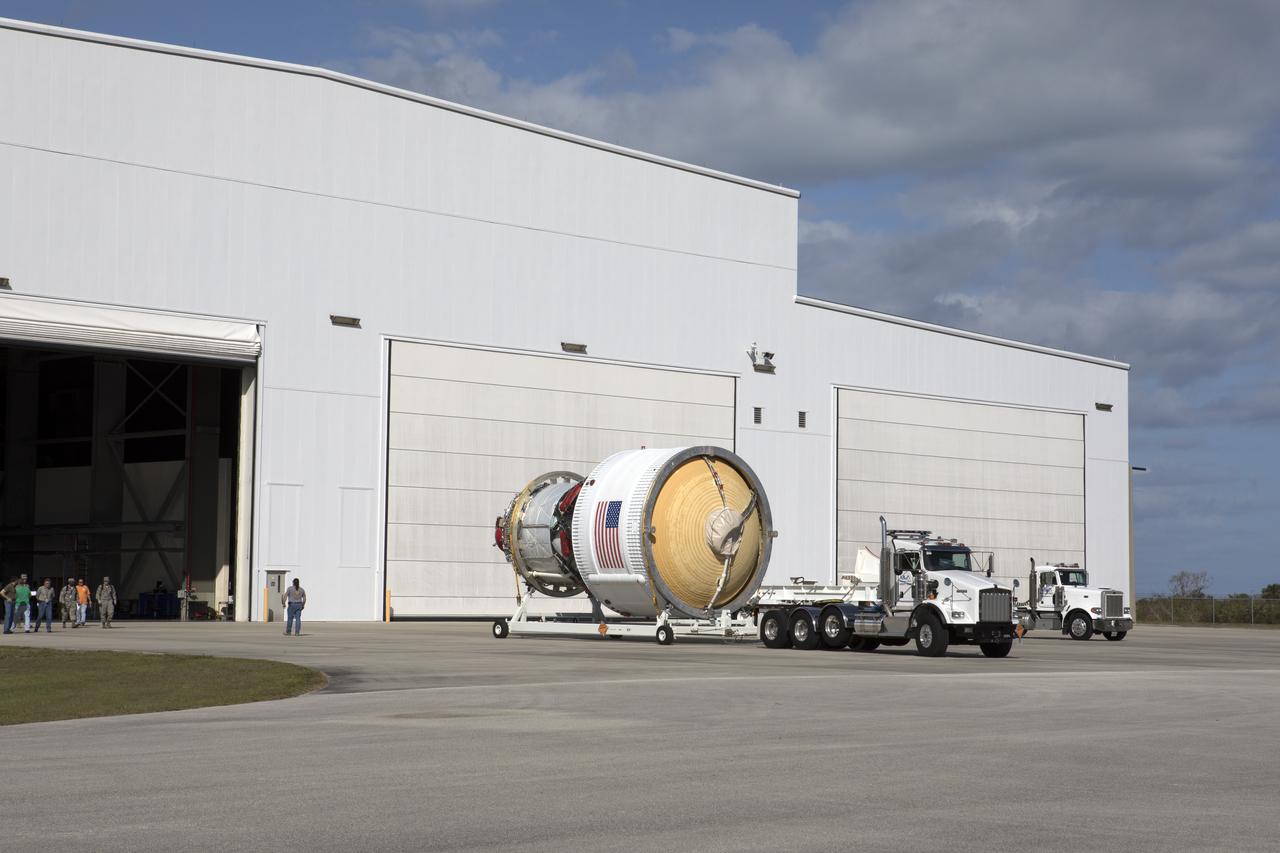
The Interim Cryogenic Propulsion Stage (ICPS) for NASA's Space Launch System (SLS) rocket has been moved on its transport stand by truck out of the United Launch Alliance (ULA) Horizontal Integration Facility near Space Launch Complex 37 at Cape Canaveral Air Force Station in Florida. The ICPS will be transported to the Delta Operations Center. The ICPS is the first integrated piece of flight hardware to arrive for the SLS. It is the in-space stage that is located toward the top of the rocket, between the Launch Vehicle Stage Adapter and the Orion Spacecraft Adapter. It will provide some of the in-space propulsion during Orion's first flight test atop the SLS on Exploration Mission-1.
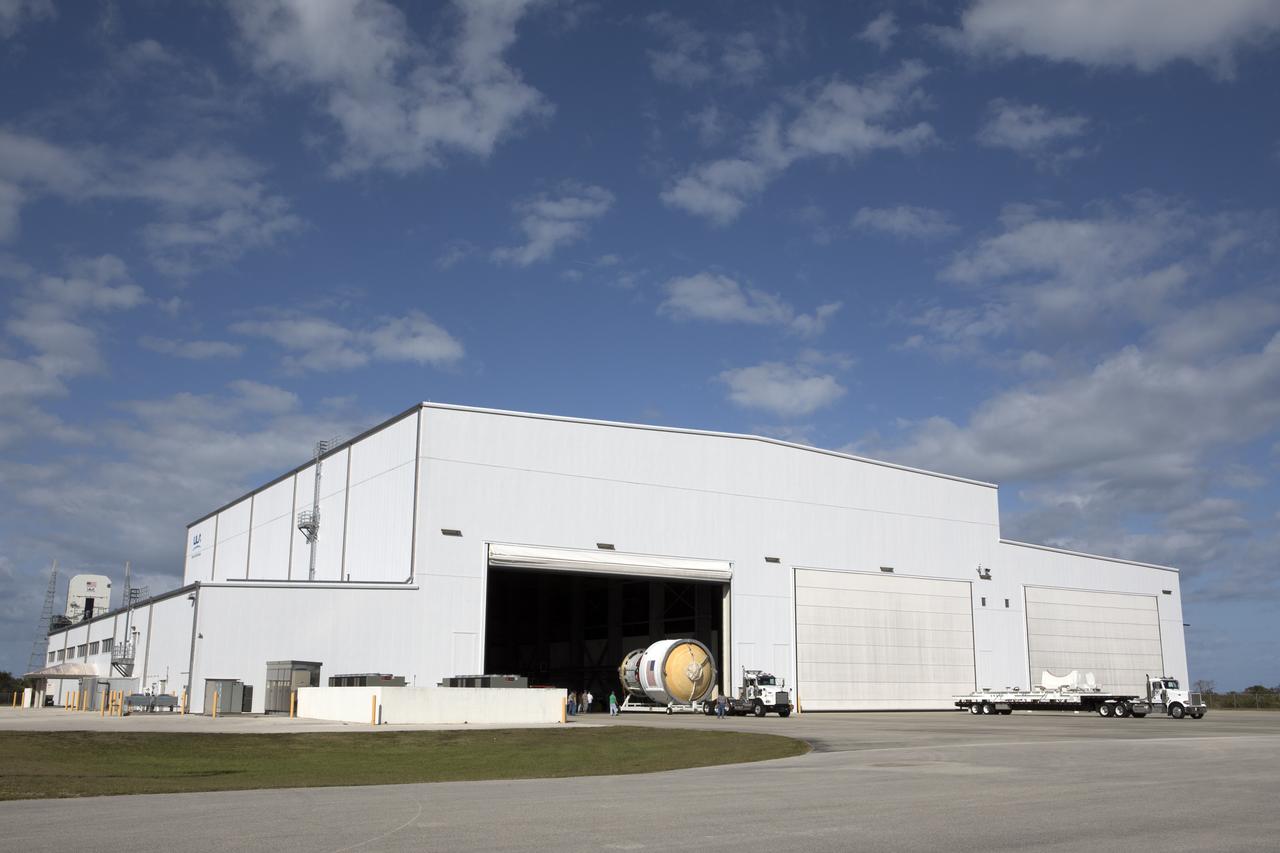
The Interim Cryogenic Propulsion Stage (ICPS) for NASA's Space Launch System (SLS) rocket is moved on its transport stand by truck out of the United Launch Alliance (ULA) Horizontal Integration Facility near Space Launch Complex 37 at Cape Canaveral Air Force Station in Florida. The ICPS will be transported to the Delta Operations Center. The ICPS is the first integrated piece of flight hardware to arrive for the SLS. It is the in-space stage that is located toward the top of the rocket, between the Launch Vehicle Stage Adapter and the Orion Spacecraft Adapter. It will provide some of the in-space propulsion during Orion's first flight test atop the SLS on Exploration Mission-1.
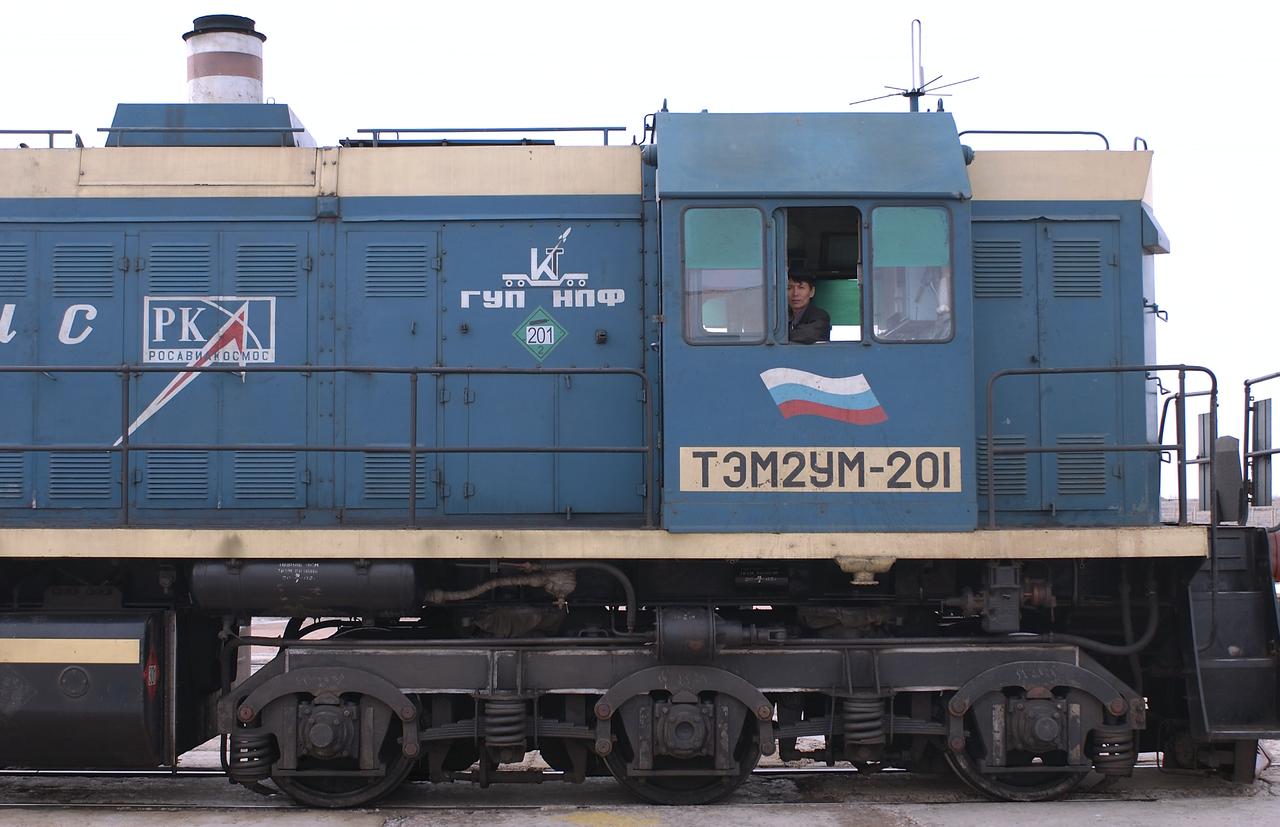
The rollout locomotive prepares to back away from the launch pad leaving the Soyuz TMA-4 capsule and its booster rocket at the Baikonur Cosmodrome on Saturday, April 17, 2004, in Baikonur, Kazakhstan in preparation for the launch of the Expedition 9 crew and a European researcher to the International Space Station on April 19. The Soyuz vehicle is transported to the launch pad horizontally on a railcar from its processing hangar in a process that takes about 2.5 hours to complete. Photo Credit: (NASA/Bill Ingalls)
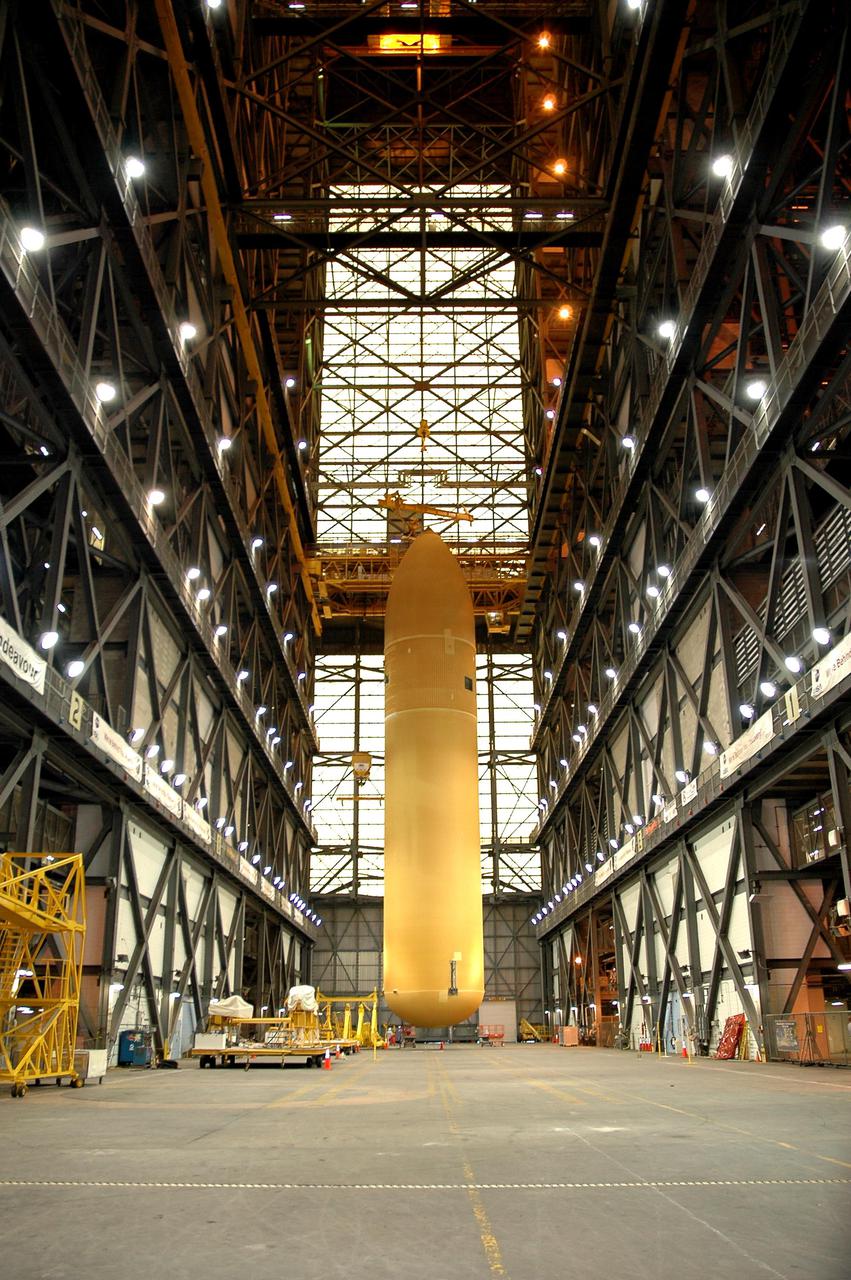
KENNEDY SPACE CENTER, FLA. - Inside NASA Kennedy Space Center’s Vehicle Assembly Building, External Tank 119 is lowered to a point just above the transfer aisle. There it will be lowered horizontally and placed on a transporter in the transfer aisle to be moved to the barge at the Turn Basin. The tank will embark on a voyage around the Florida peninsula to the Michoud Assembly Facility in New Orleans. Delivered to KSC in June, ET-119 is the third newly redesigned tank.
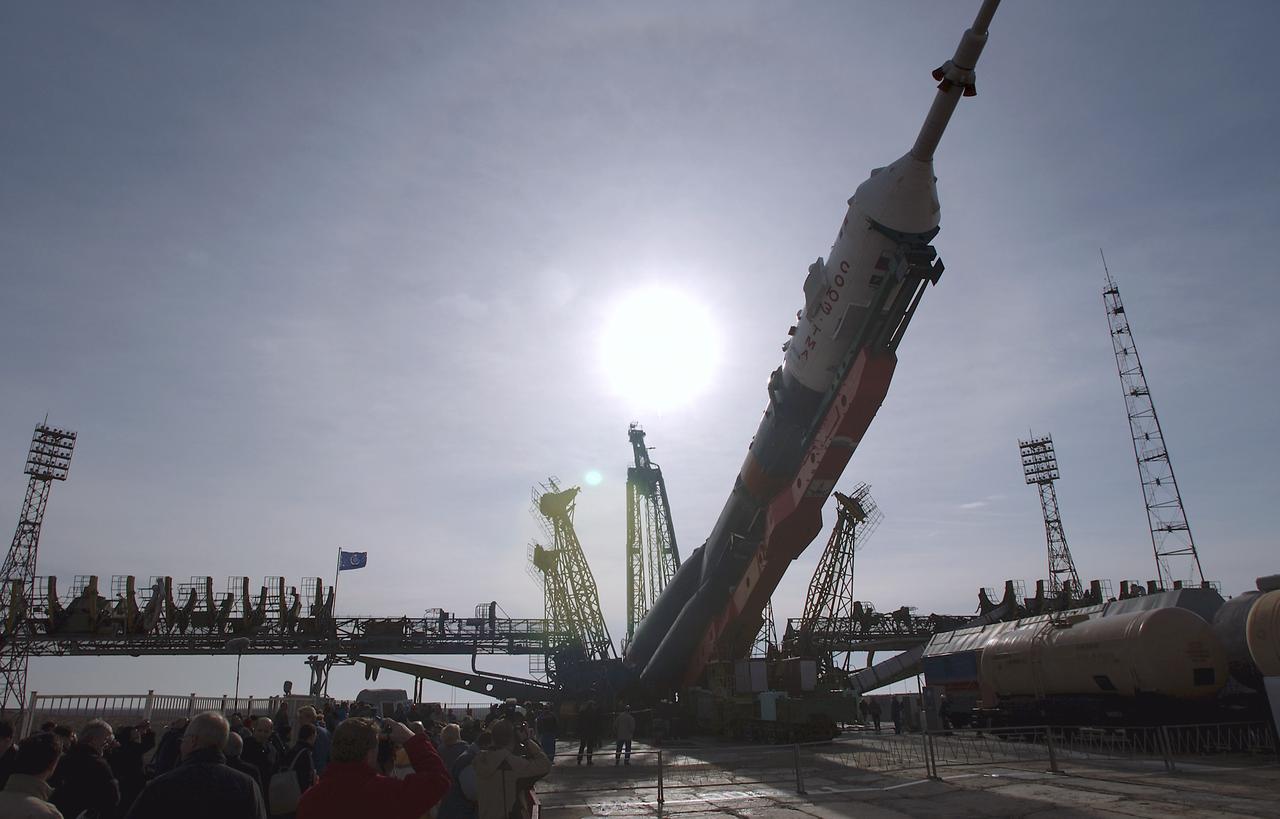
The Soyuz TMA-4 capsule and its booster rocket are raised into position at the launch pad at the Baikonur Cosmodrome on Saturday, April 17, 2004, in Baikonur, Kazakhstan in preparation for the launch of the Expedition 9 crew and a European researcher to the International Space Station on April 19. The Soyuz vehicle is transported to the launch pad horizontally on a railcar from its processing hangar in a process that takes about 2.5 hours to complete. Photo Credit: (NASA/Bill Ingalls)
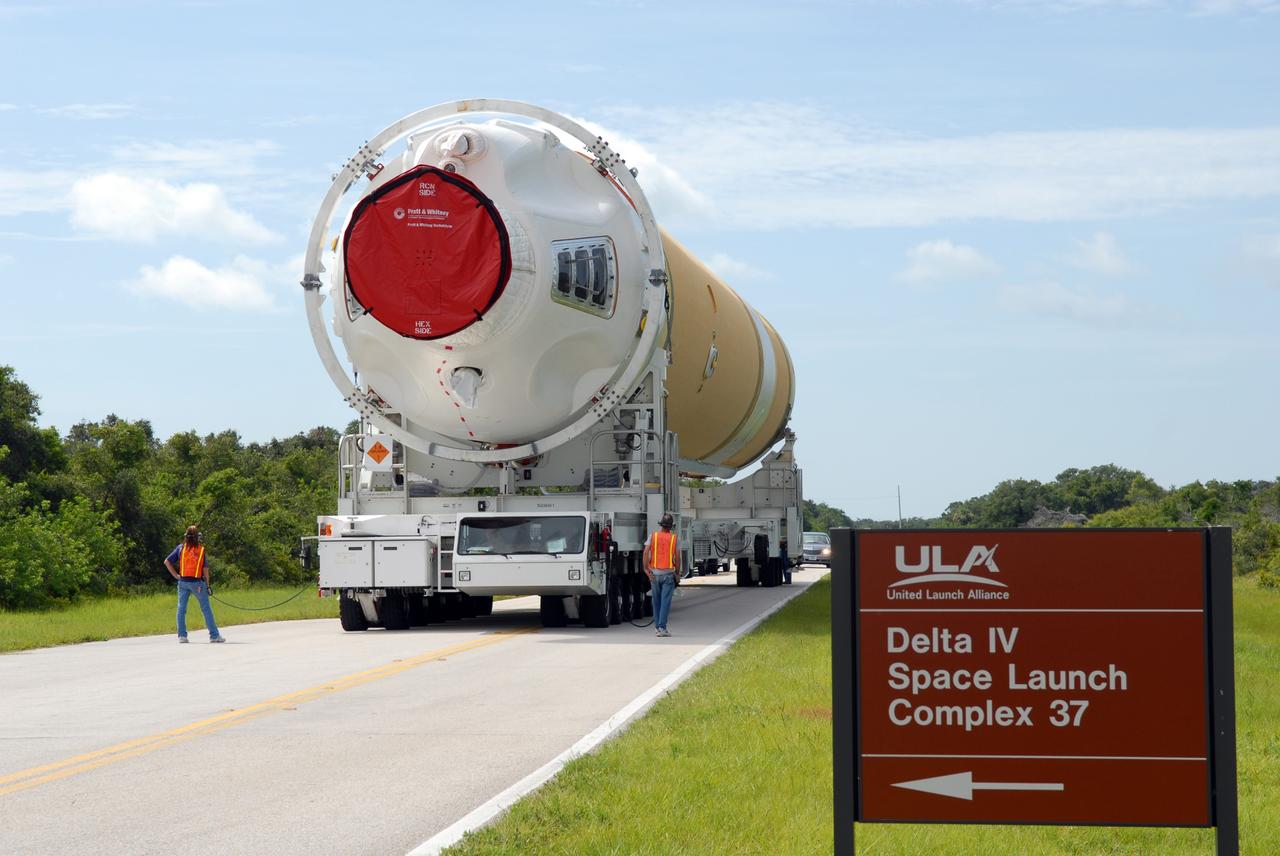
CAPE CANAVERAL, Fla. – The United Launch Alliance Delta IV first stage is being transported to the Horizontal Integration Facility on Cape Canaveral Air Force Station's Launch Complex 37. The Delta IV is the launch vehicle for the latest Geostationary Operational Environmental Satellite, known as GOES-P, developed by NASA for the National Oceanic and Atmospheric Administration, or NOAA. Photo credit: NASA/Jim Grossmann
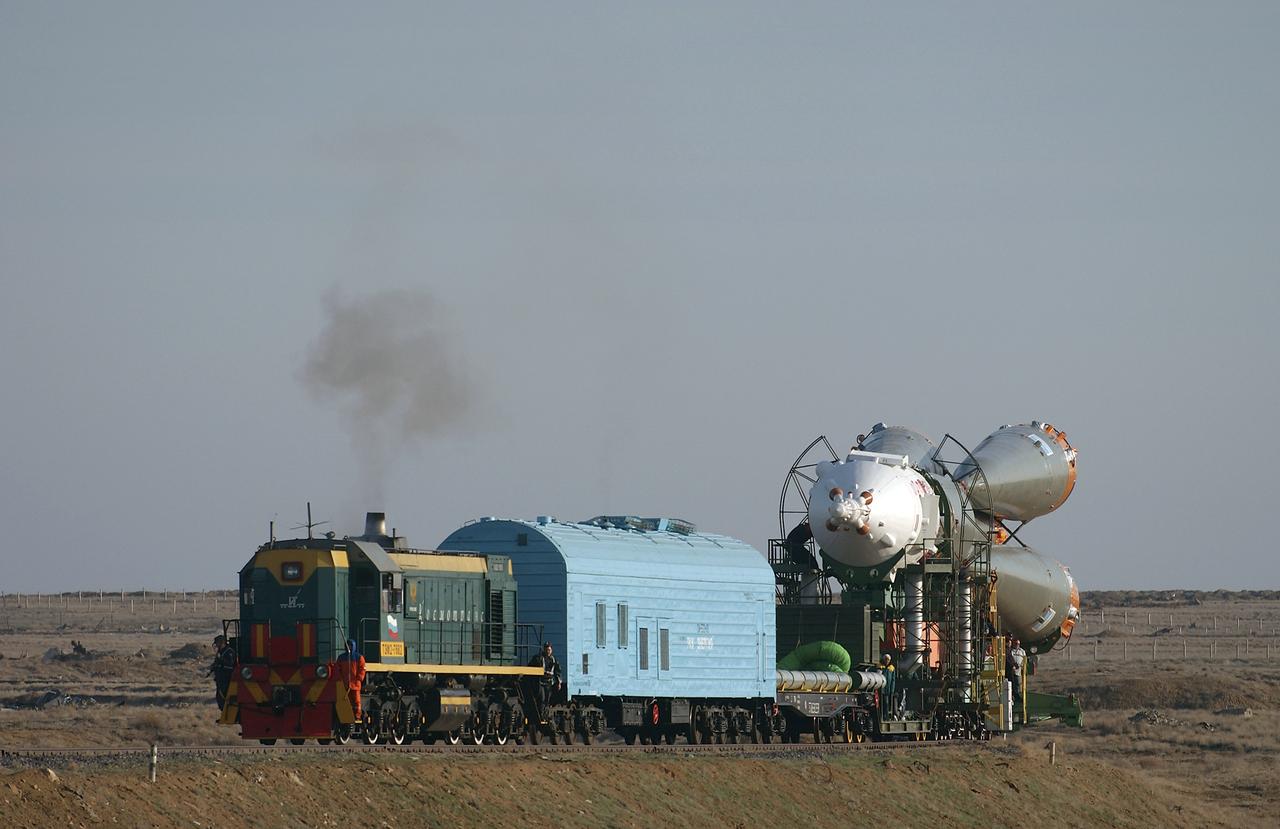
The Soyuz TMA-4 capsule and its booster rocket begin to roll to the launch pad at the Baikonur Cosmodrome on Saturday, April 17, 2004, in Baikonur, Kazakhstan in preparation for the launch of the Expedition 9 crew and a European researcher to the International Space Station on April 19. The Soyuz vehicle is transported to the launch pad horizontally on a railcar from its processing hangar in a process that takes about 2.5 hours to complete. Photo Credit: (NASA/Bill Ingalls)
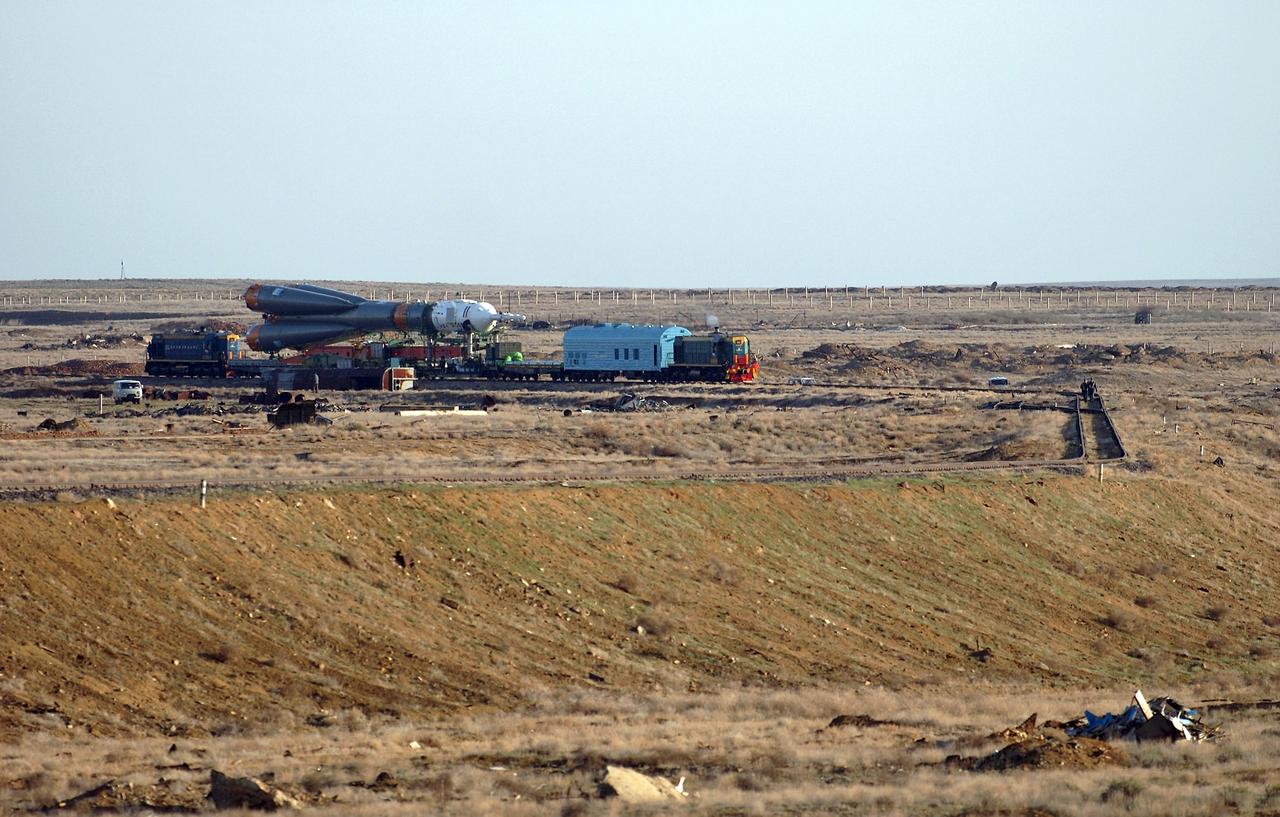
The Soyuz TMA-4 capsule and its booster rocket begin to roll to the launch pad at the Baikonur Cosmodrome on Saturday, April 17, 2004, in Baikonur, Kazakhstan in preparation for the launch of the Expedition 9 crew and a European researcher to the International Space Station on April 19. The Soyuz vehicle is transported to the launch pad horizontally on a railcar from its processing hangar in a process that takes about 2.5 hours to complete. Photo Credit: (NASA/Bill Ingalls)
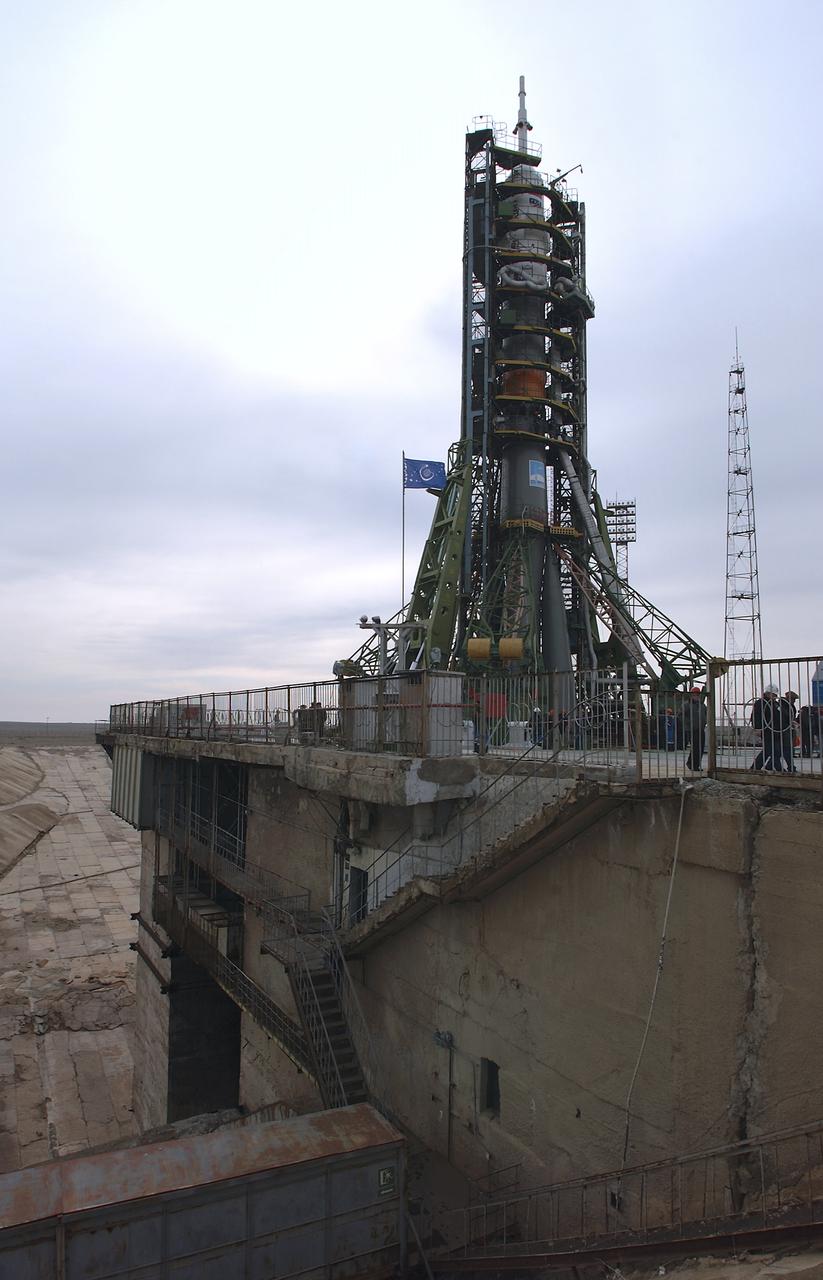
The Soyuz TMA-4 capsule and its booster rocket are in position at the launch pad at the Baikonur Cosmodrome in Kazakhstan on April 17, 2004 in preparation for the launch of the Expedition 9 crew and a European researcher to the International Space Station April 19. The Soyuz vehicle is transported to the launch pad horizontally on a railcar from its processing hangar in a process that takes about 2.5 hours to complete. Photo Credit: (NASA/Bill Ingalls)
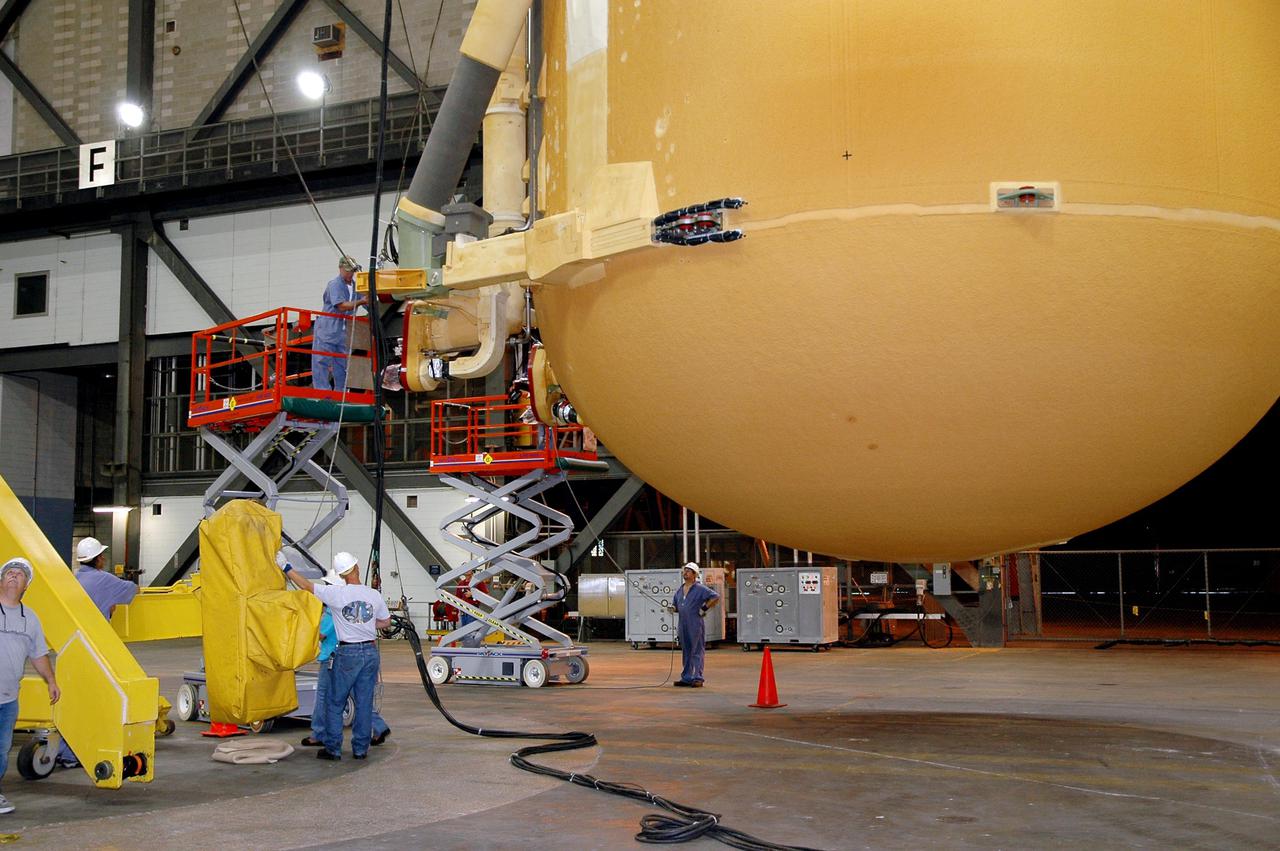
KENNEDY SPACE CENTER, FLA. - Inside NASA Kennedy Space Center’s Vehicle Assembly Building, workers secure the cranes onto External Tank 119 that enable the tank to be lowered to a horizontal position. Then it will be placed on a transporter in the transfer aisle to be moved to the barge at the Turn Basin. The tank will embark on a voyage around the Florida peninsula to the Michoud Assembly Facility in New Orleans. Delivered to KSC in June, ET-119 is the third newly redesigned tank.
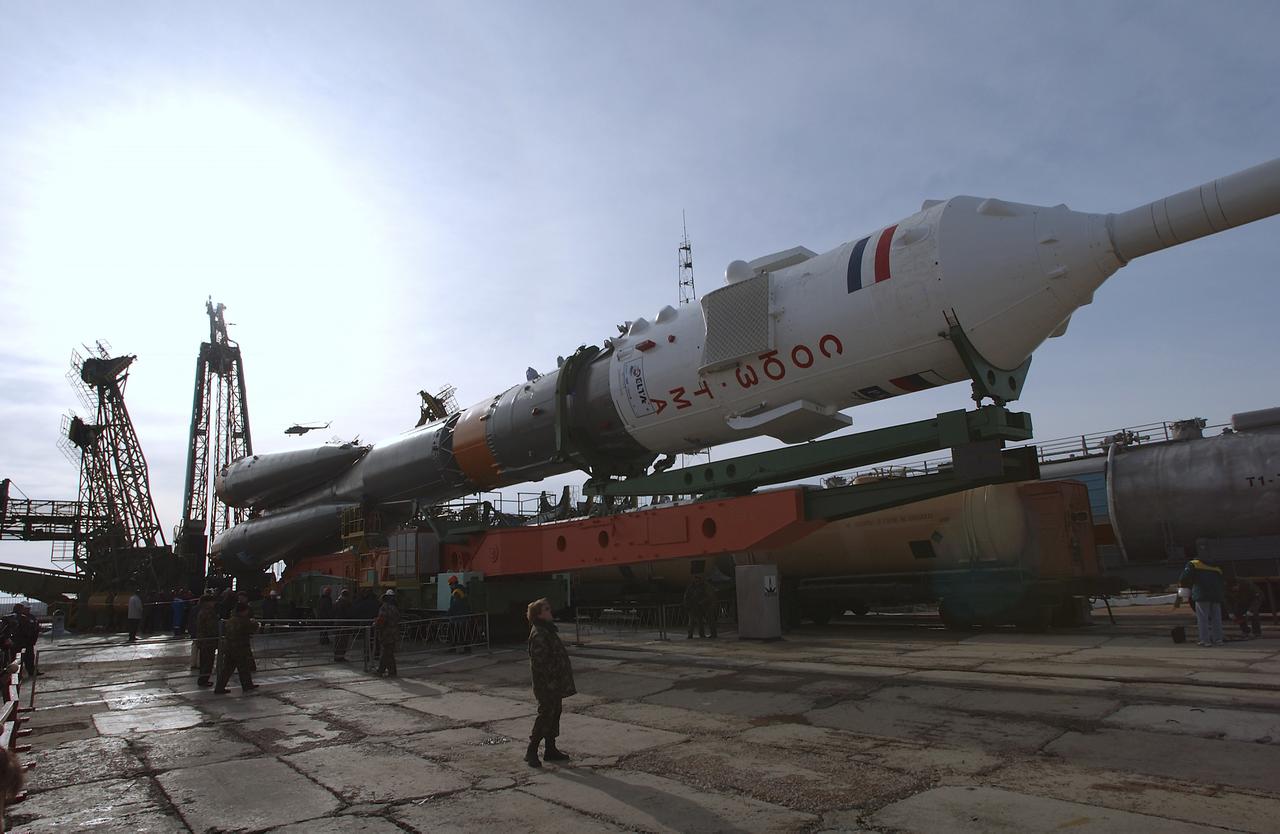
The Soyuz TMA-4 capsule and its booster rocket are raised into position at the launch pad at the Baikonur Cosmodrome on Saturday, April 17, 2004, in Baikonur, Kazakhstan in preparation for the launch of the Expedition 9 crew and a European researcher to the International Space Station on April 19. The Soyuz vehicle is transported to the launch pad horizontally on a railcar from its processing hangar in a process that takes about 2.5 hours to complete. Photo Credit: (NASA/Bill Ingalls)
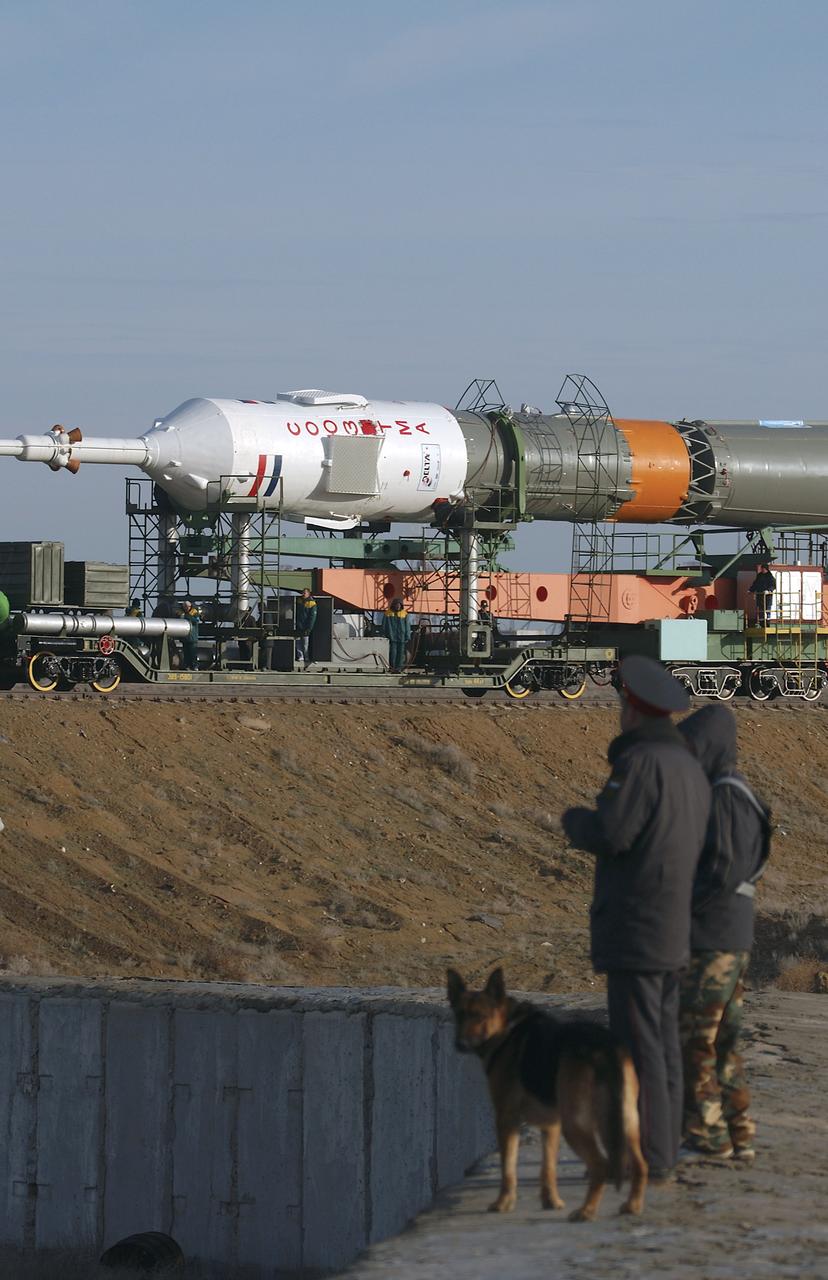
Security Officers with their dog watch as the Soyuz TMA-4 capsule and its booster rocket begin to roll to the launch pad at the Baikonur Cosmodrome on Saturday, April 17, 2004, in Baikonur, Kazakhstan in preparation for the launch of the Expedition 9 crew and a European researcher to the International Space Station on April 19. The Soyuz vehicle is transported to the launch pad horizontally on a railcar from its processing hangar in a process that takes about 2.5 hours to complete. Photo Credit: (NASA/Bill Ingalls)
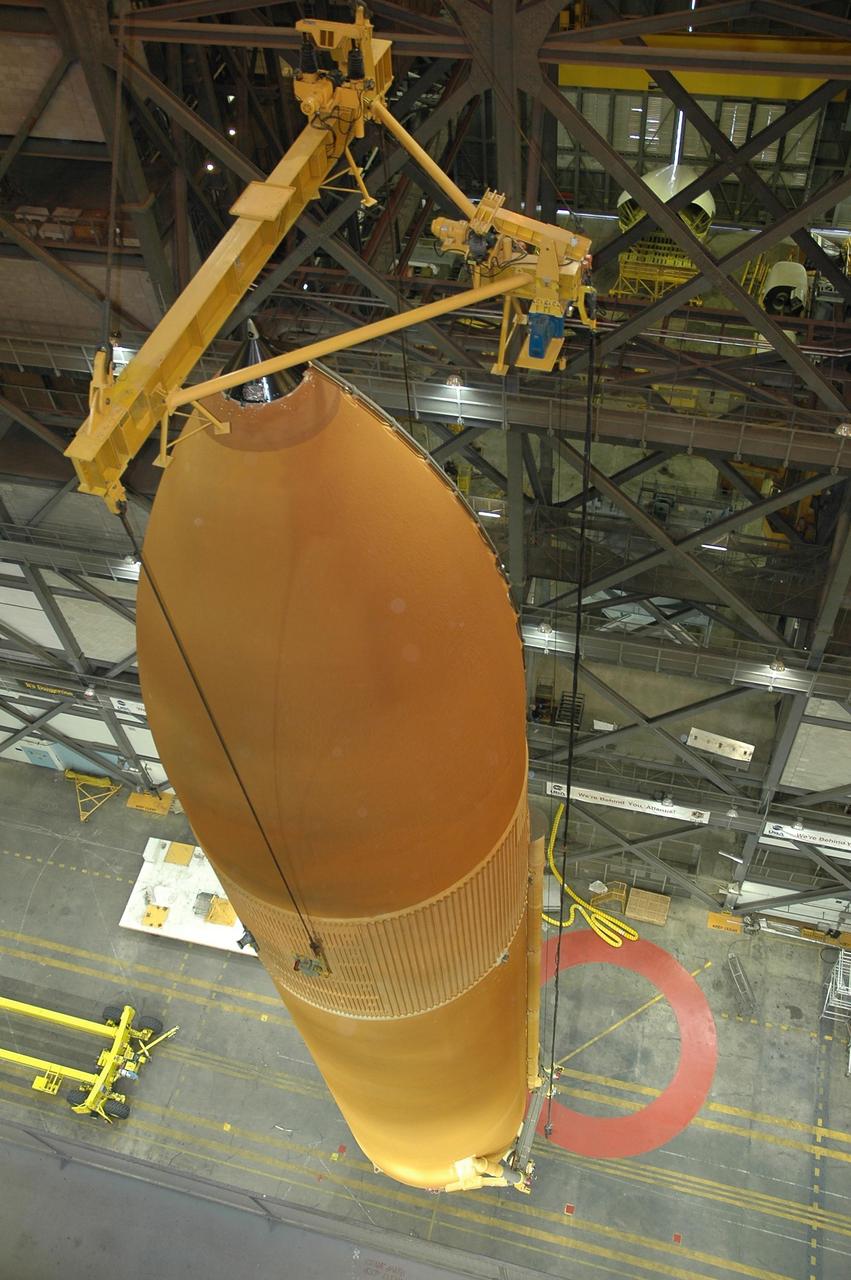
KENNEDY SPACE CENTER, FLA. - Inside the Vehicle Assembly Building at NASA's Kennedy Space Center, external tank number 119 is being lowered toward the floor of the transfer aisle. It will be placed horizontally on a transporter where technicians will reapply the thermal protection system foam that was removed in order to replace the tank's four liquid hydrogen engine cutoff sensors. The tank is being prepared to launch Space Shuttle Discovery on mission STS-121 in July. Photo credit: NASA/Cory Huston
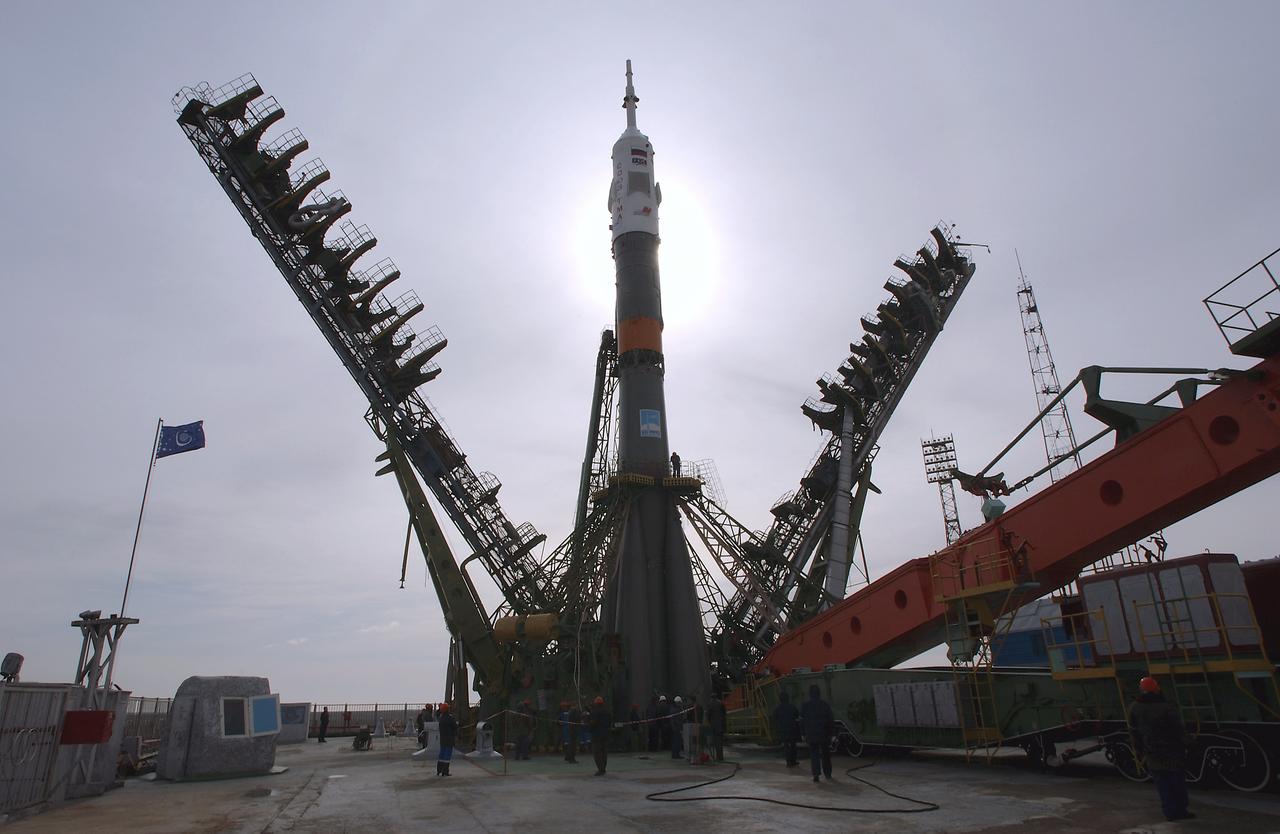
The Soyuz TMA-4 capsule and its booster rocket are raised into position at the launch pad at the Baikonur Cosmodrome on Saturday, April 17, 2004, in Baikonur, Kazakhstan in preparation for the launch of the Expedition 9 crew and a European researcher to the International Space Station on April 19. The Soyuz vehicle is transported to the launch pad horizontally on a railcar from its processing hangar in a process that takes about 2.5 hours to complete. Photo Credit: (NASA/Bill Ingalls)
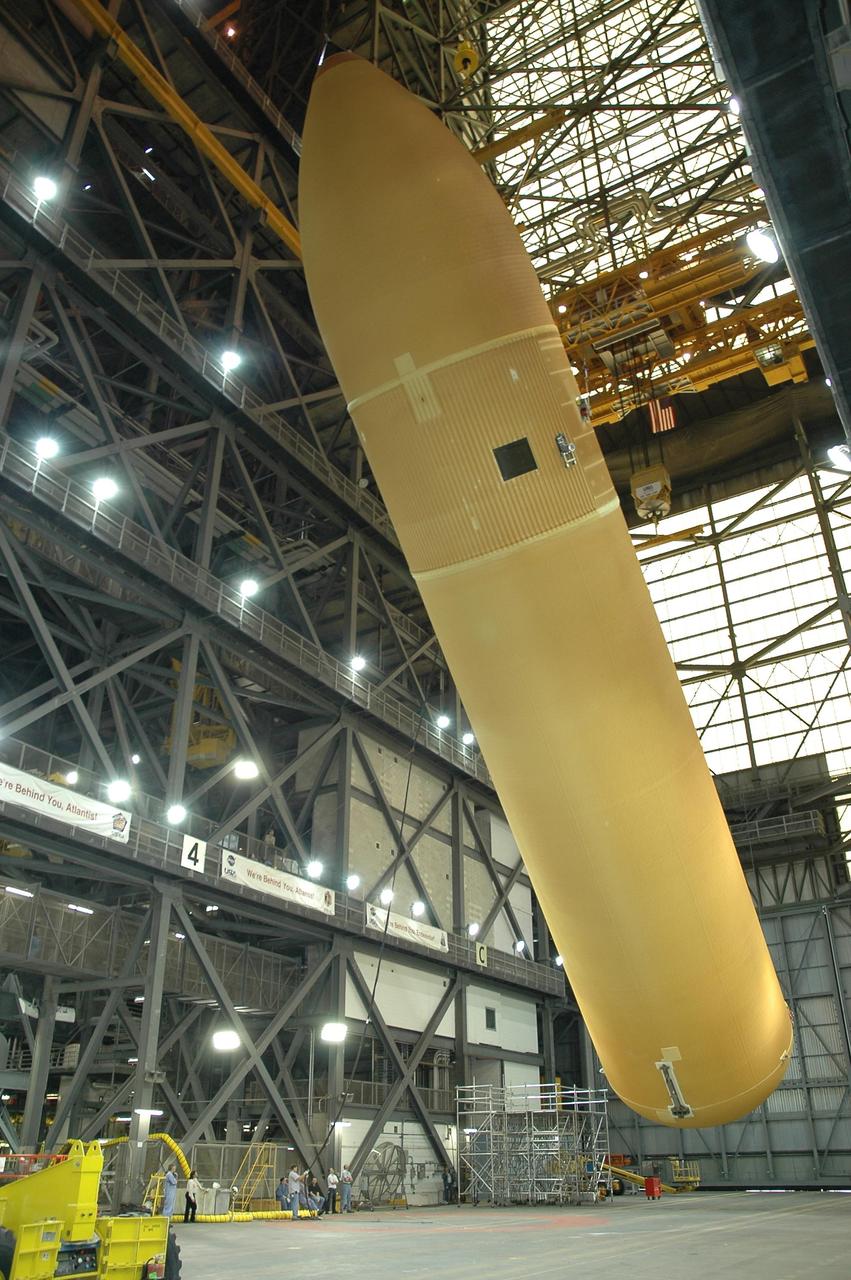
KENNEDY SPACE CENTER, FLA. - Inside the Vehicle Assembly Building at NASA's Kennedy Space Center, external tank number 119 is shifted to a horizontal position for placement on a transporter where technicians will reapply the thermal protection system foam that was removed in order to replace the tank's four liquid hydrogen engine cutoff sensors. The tank is being prepared to launch Space Shuttle Discovery on mission STS-121 in July. Photo credit: NASA/Cory Huston
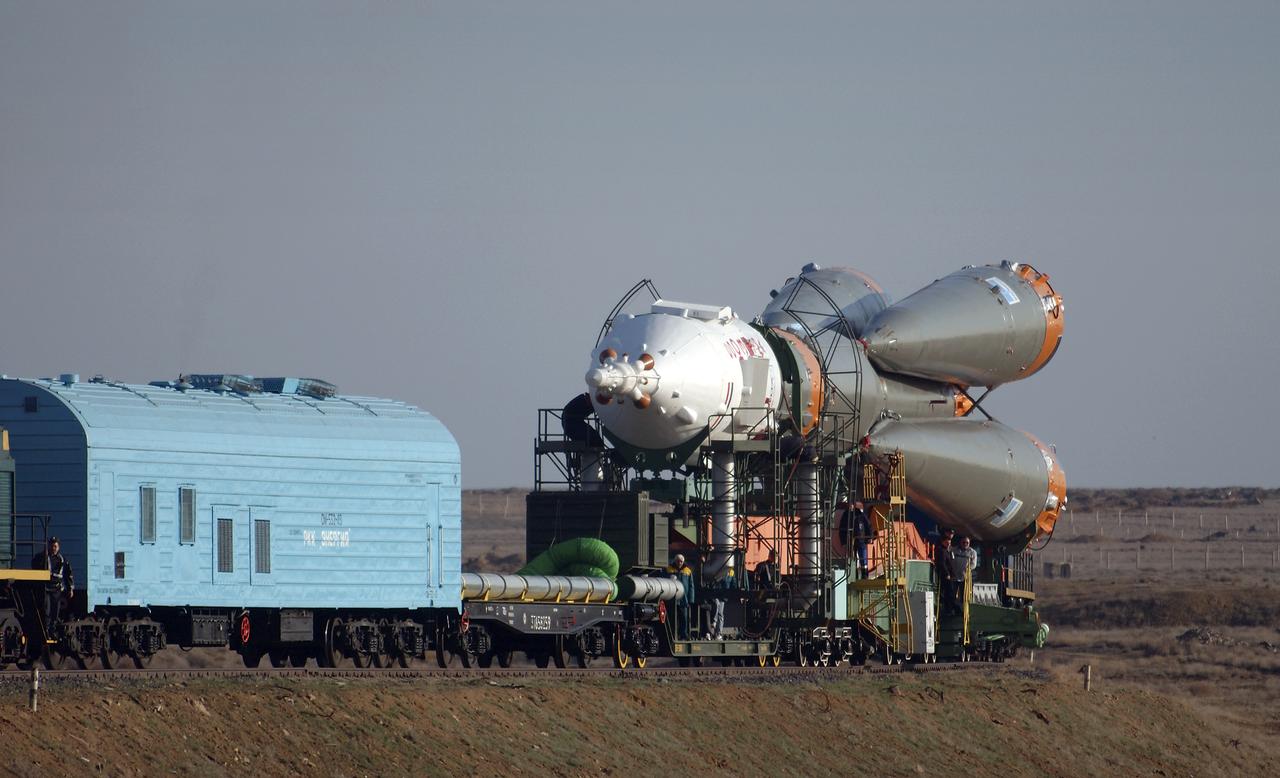
The Soyuz TMA-4 capsule and its booster rocket begin to roll to the launch pad at the Baikonur Cosmodrome on Saturday, April 17, 2004, in Baikonur, Kazakhstan in preparation for the launch of the Expedition 9 crew and a European researcher to the International Space Station on April 19. The Soyuz vehicle is transported to the launch pad horizontally on a railcar from its processing hangar in a process that takes about 2.5 hours to complete. Photo Credit: (NASA/Bill Ingalls)

The Engineer of the rollout locomotive waves hello as he prepares to back the train away from the launch pad leaving the Soyuz TMA-4 capsule and its booster rocket at the Baikonur Cosmodrome in Kazakhstan on on Saturday, April 17, 2004, in Baikonur, Kazakhstan in preparation for the launch of the Expedition 9 crew and a European researcher to the International Space Station on April 19. The Soyuz vehicle is transported to the launch pad horizontally on a railcar from its processing hangar in a process that takes about 2.5 hours to complete. Photo Credit: (NASA/Bill Ingalls)
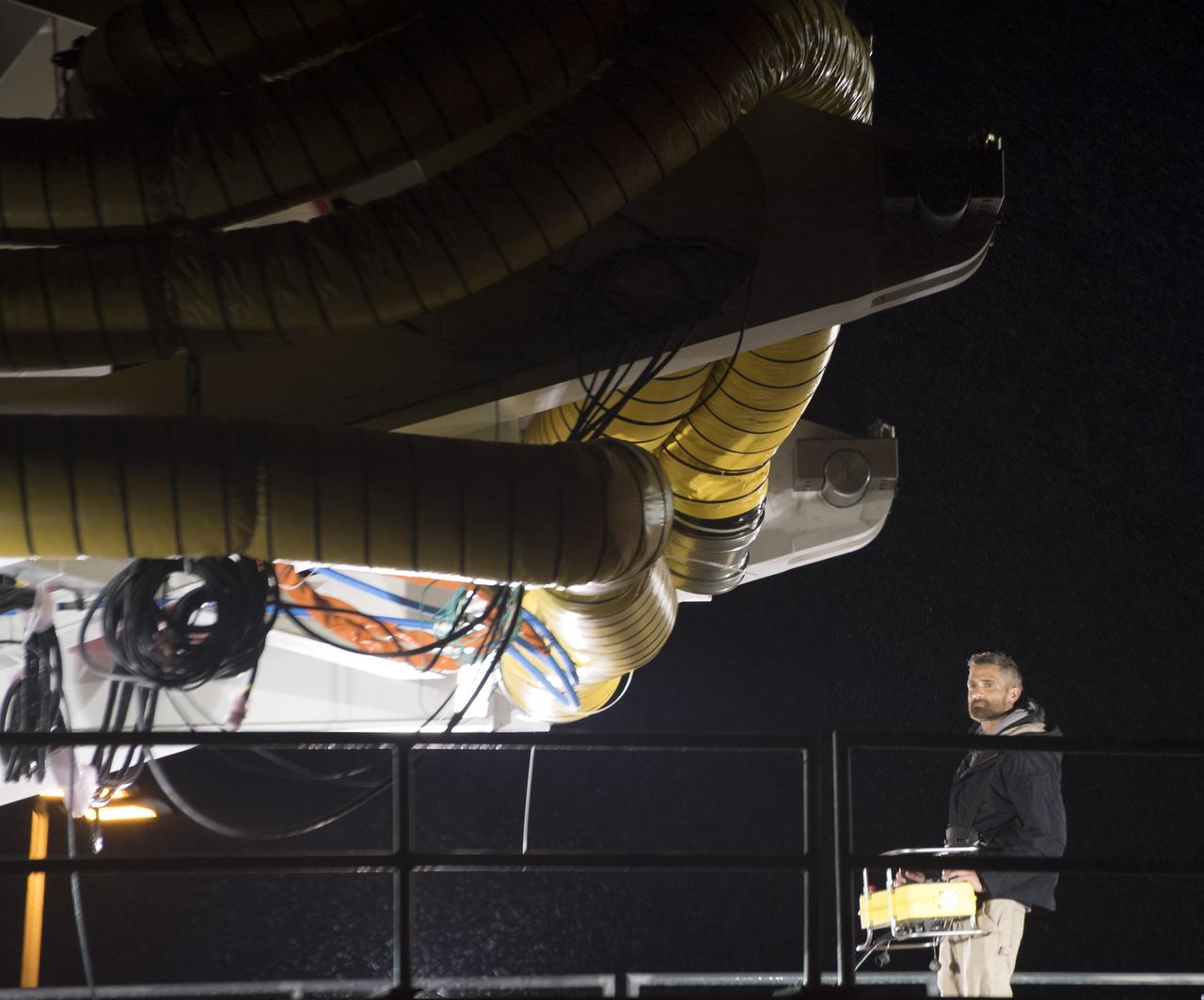
Orbital ATK Mechanical Technician Phil Kauthen drives the transporter with the Antares rocket aboard from the Horizontal Integration Facility to launch Pad-0A, Thursday, Nov. 9, 2017 at NASA's Wallops Flight Facility in Virginia. Orbital ATK’s eighth contracted cargo resupply mission with NASA to the International Space Station will deliver over 7,400 pounds of science and research, crew supplies and vehicle hardware to the orbital laboratory and its crew. Photo Credit: (NASA/Bill Ingalls)
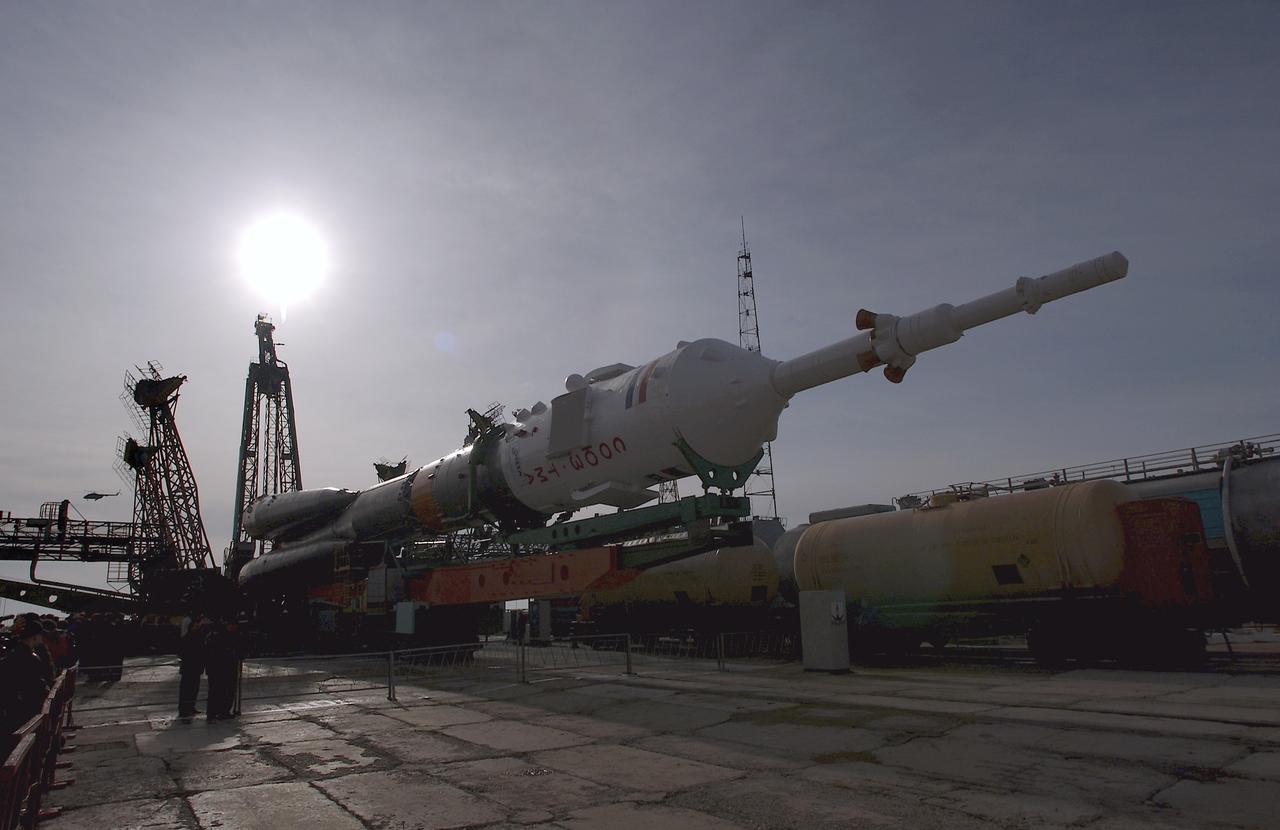
The Soyuz TMA-4 capsule and its booster rocket are raised into position at the launch pad at the Baikonur Cosmodrome on Saturday, April 17, 2004, in Baikonur, Kazakhstan in preparation for the launch of the Expedition 9 crew and a European researcher to the International Space Station on April 19. The Soyuz vehicle is transported to the launch pad horizontally on a railcar from its processing hangar in a process that takes about 2.5 hours to complete. Photo Credit: (NASA/Bill Ingalls)
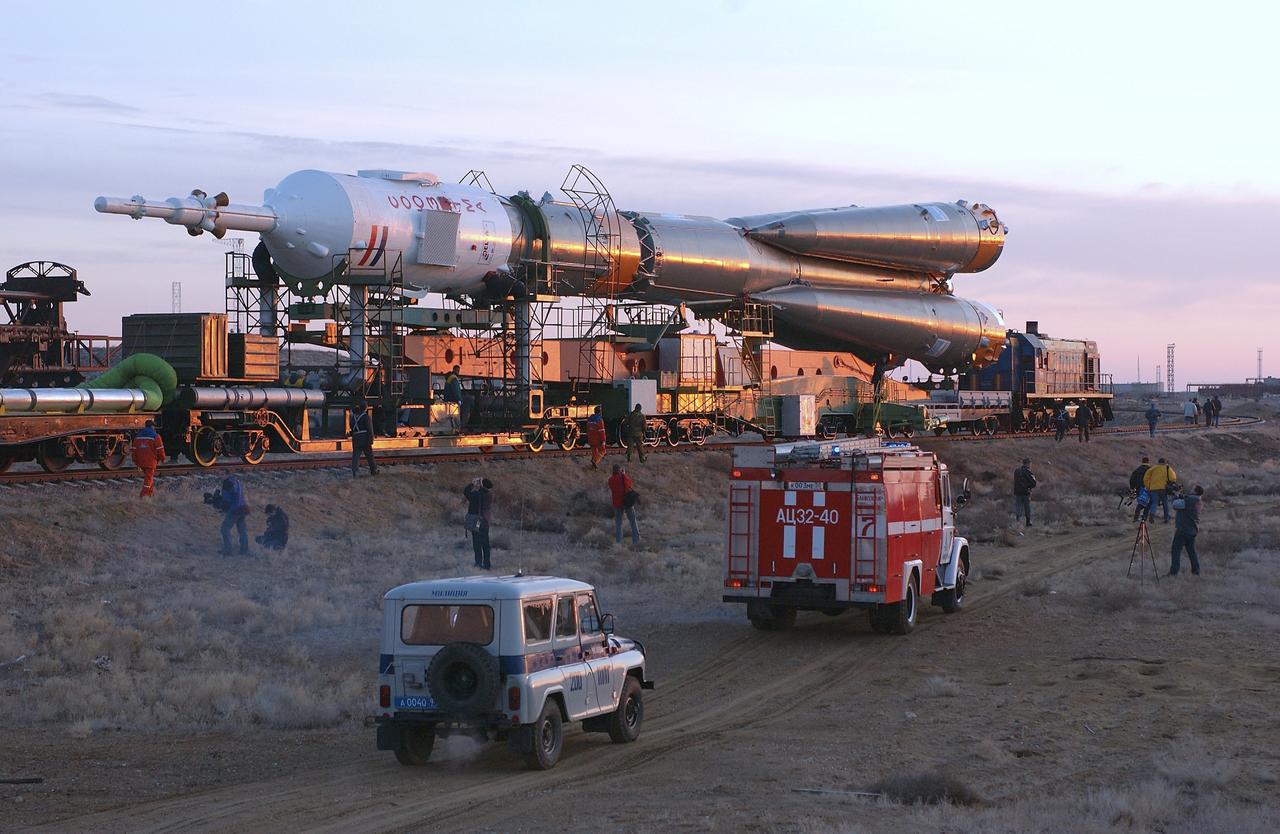
The Soyuz TMA-4 capsule and its booster rocket begin to roll to the launch pad at the Baikonur Cosmodrome on Saturday, April 17, 2004, in Baikonur, Kazakhstan in preparation for the launch of the Expedition 9 crew and a European researcher to the International Space Station on April 19. The Soyuz vehicle is transported to the launch pad horizontally on a railcar from its processing hangar in a process that takes about 2.5 hours to complete. Photo Credit: (NASA/Bill Ingalls)
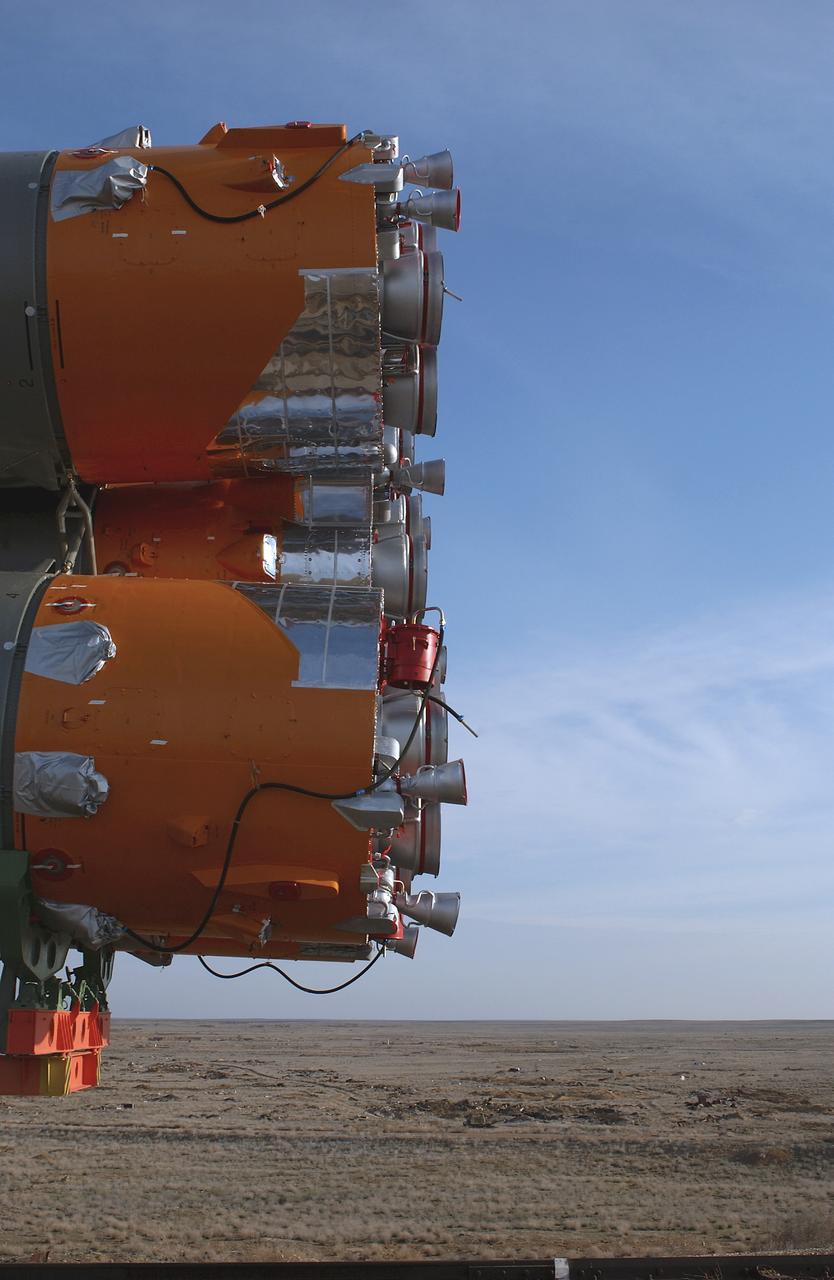
The Soyuz TMA-4 capsule and its booster rocket begin to roll to the launch pad at the Baikonur Cosmodrome on Saturday, April 17, 2004, in Baikonur, Kazakhstan in preparation for the launch of the Expedition 9 crew and a European researcher to the International Space Station on April 19. The Soyuz vehicle is transported to the launch pad horizontally on a railcar from its processing hangar in a process that takes about 2.5 hours to complete. Photo Credit: (NASA/Bill Ingalls)
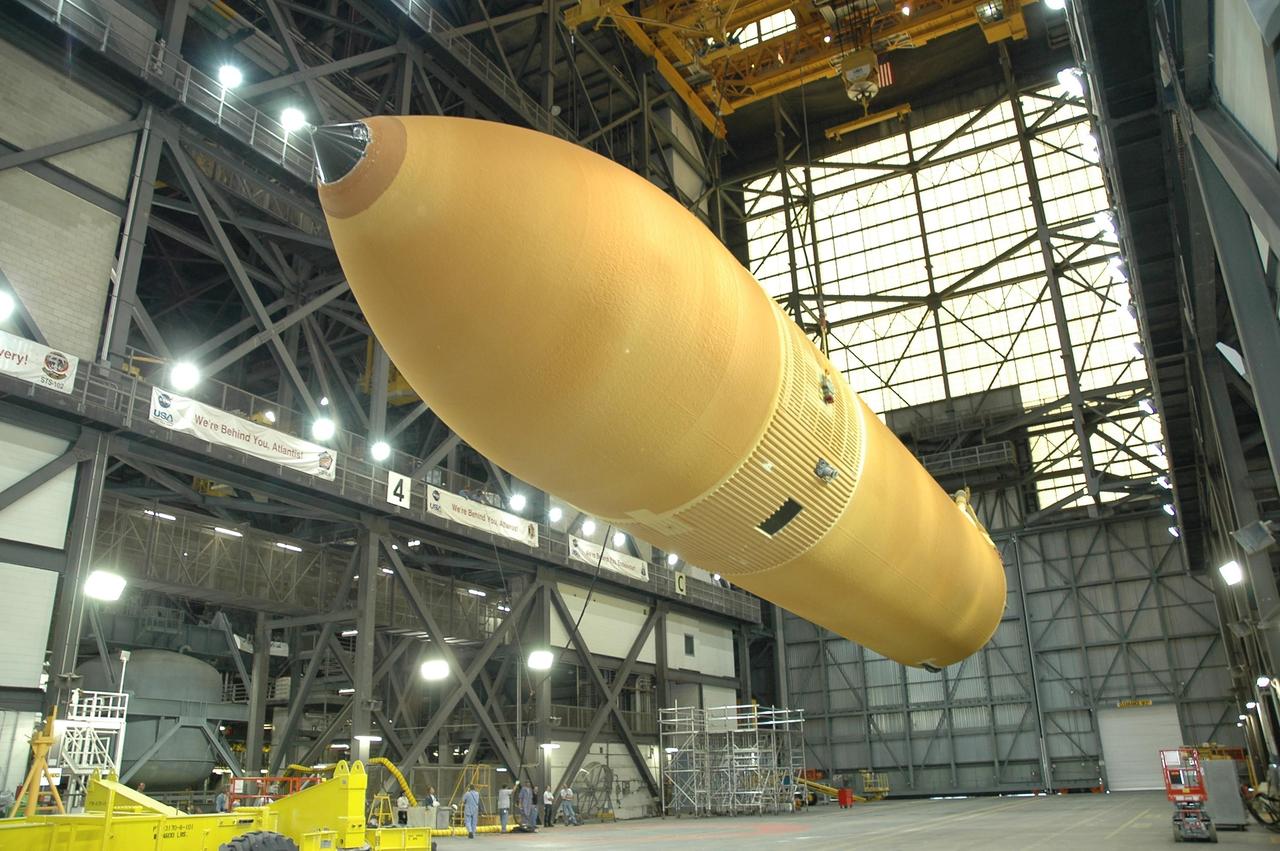
KENNEDY SPACE CENTER, FLA. - Inside the Vehicle Assembly Building at NASA's Kennedy Space Center, external tank number 119 hangs suspended horizontally. It will be lowered onto the transporter at lower left where technicians will reapply the thermal protection system foam that was removed in order to replace the tank's four liquid hydrogen engine cutoff sensors. The tank is being prepared to launch Space Shuttle Discovery on mission STS-121 in July. Photo credit: NASA/Cory Huston
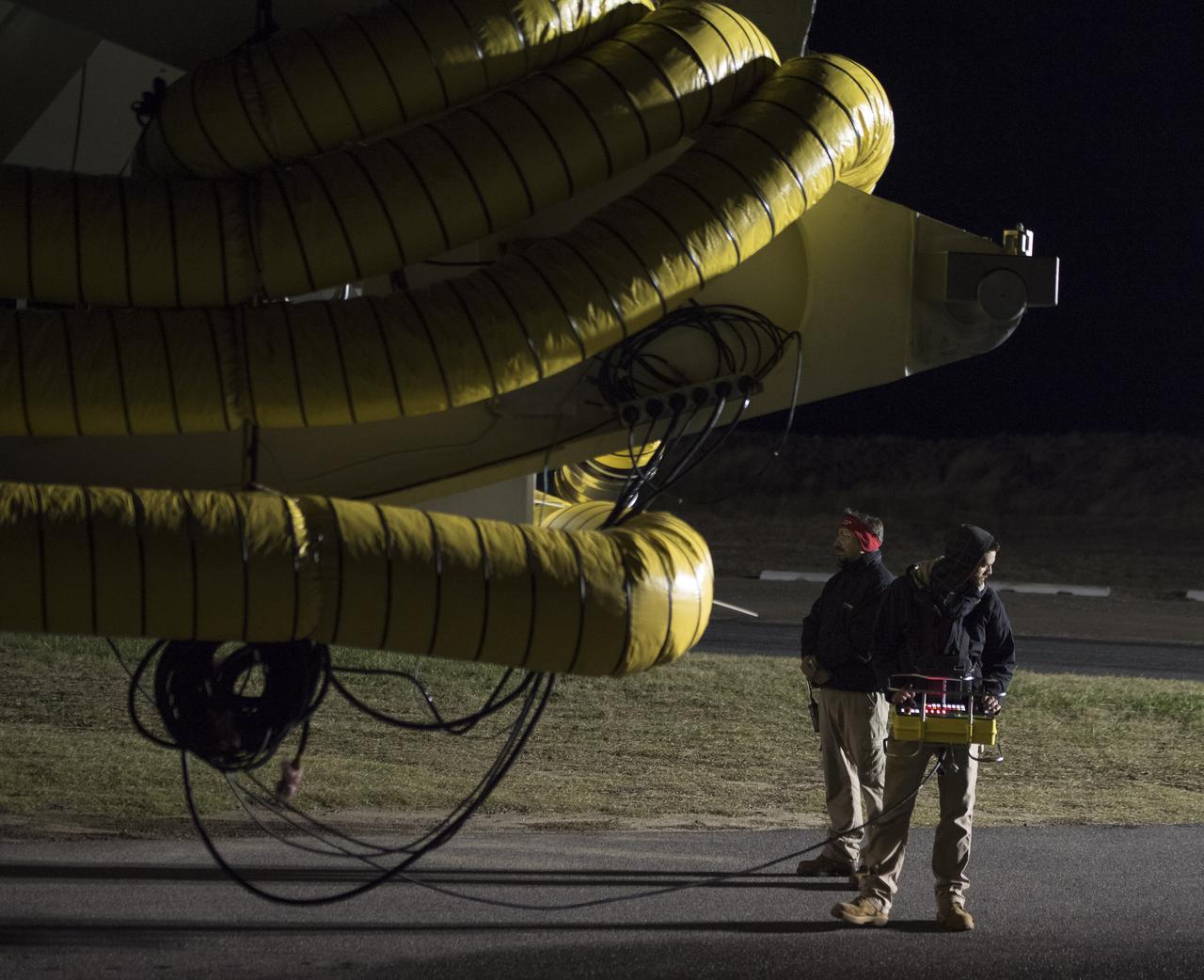
Orbital ATK Mechanical Technician Phil Kauthen drives the transporter with the Antares rocket aboard from the Horizontal Integration Facility to launch Pad-0A, Thursday, Nov. 9, 2017 at NASA's Wallops Flight Facility in Virginia. Orbital ATK’s eighth contracted cargo resupply mission with NASA to the International Space Station will deliver over 7,400 pounds of science and research, crew supplies and vehicle hardware to the orbital laboratory and its crew. Photo Credit: (NASA/Bill Ingalls)
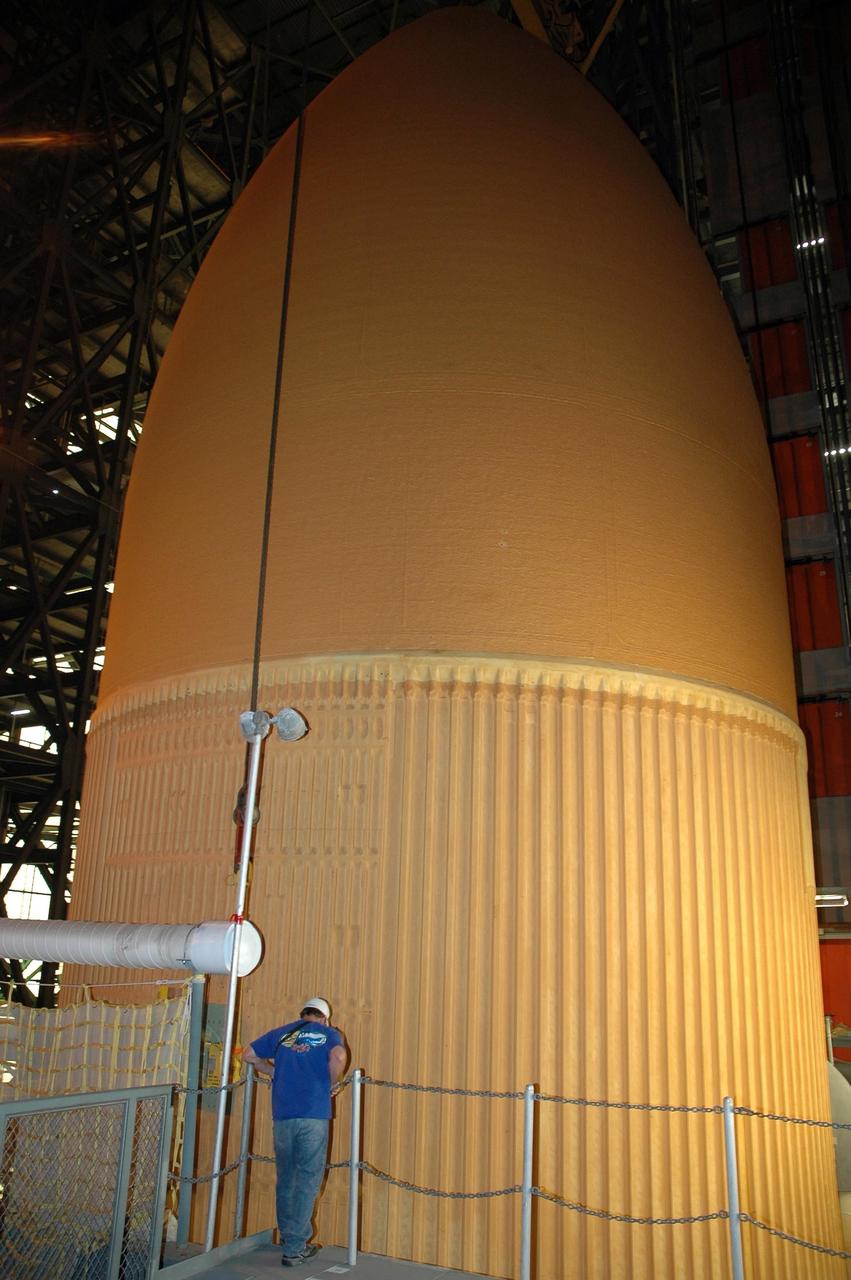
KENNEDY SPACE CENTER, FLA. - Inside the Vehicle Assembly Building at NASA's Kennedy Space Center, a worker watches external tank number 119 as it is being lifted from the checkout cell. The tank will be placed horizontally on the transporter in the transfer aisle. Once in the transfer aisle, technicians will reapply the thermal protection system foam that was removed in order to replace the tank's four liquid hydrogen engine cutoff sensors. The tank is being prepared to launch Space Shuttle Discovery on mission STS-121 in July. Photo credit: NASA/Cory Huston
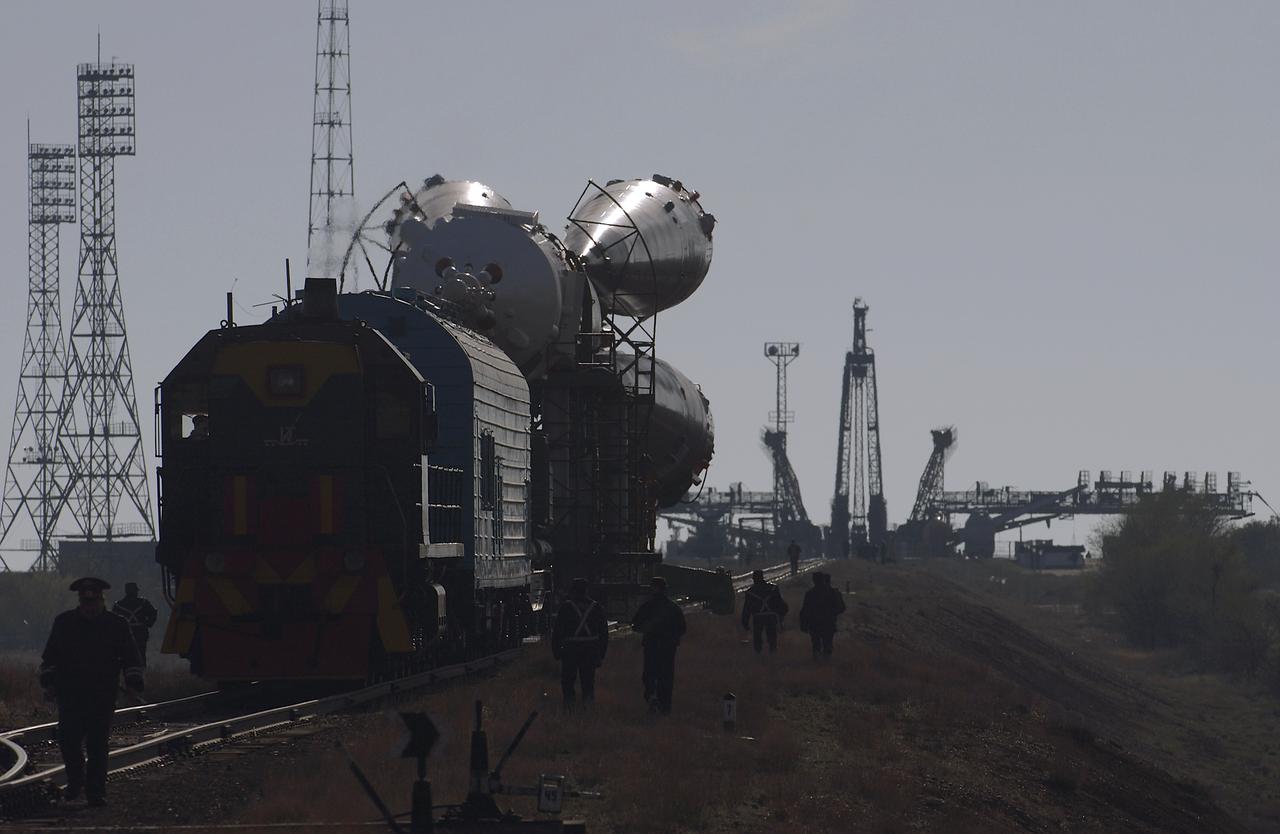
The Soyuz TMA-4 capsule and its booster rocket begin to roll to the launch pad at the Baikonur Cosmodrome on Saturday, April 17, 2004, in Baikonur, Kazakhstan in preparation for the launch of the Expedition 9 crew and a European researcher to the International Space Station on April 19. The Soyuz vehicle is transported to the launch pad horizontally on a railcar from its processing hangar in a process that takes about 2.5 hours to complete. Photo Credit: (NASA/Bill Ingalls)
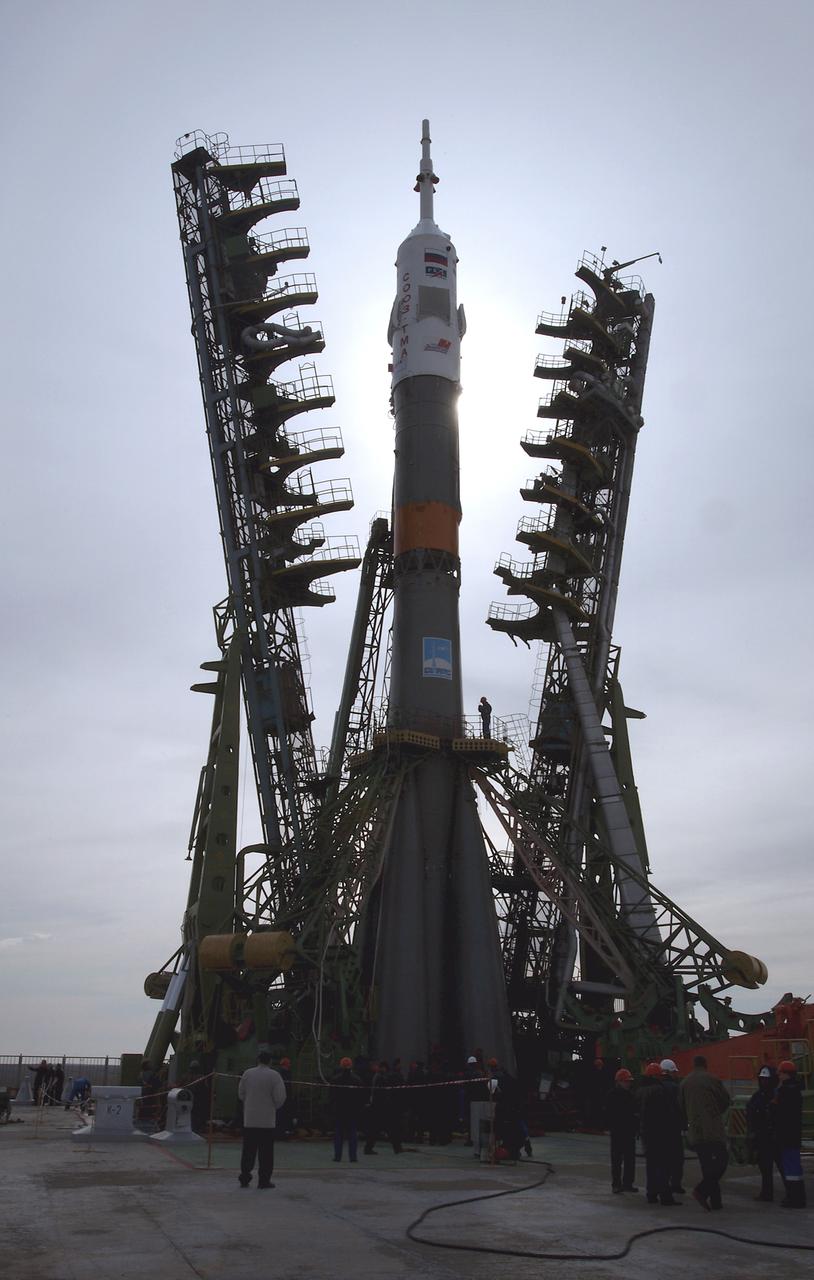
The Soyuz TMA-4 capsule and its booster rocket are raised into position at the launch pad at the Baikonur Cosmodrome on Saturday, April 17, 2004, in Baikonur, Kazakhstan in preparation for the launch of the Expedition 9 crew and a European researcher to the International Space Station on April 19. The Soyuz vehicle is transported to the launch pad horizontally on a railcar from its processing hangar in a process that takes about 2.5 hours to complete. Photo Credit: (NASA/Bill Ingalls)
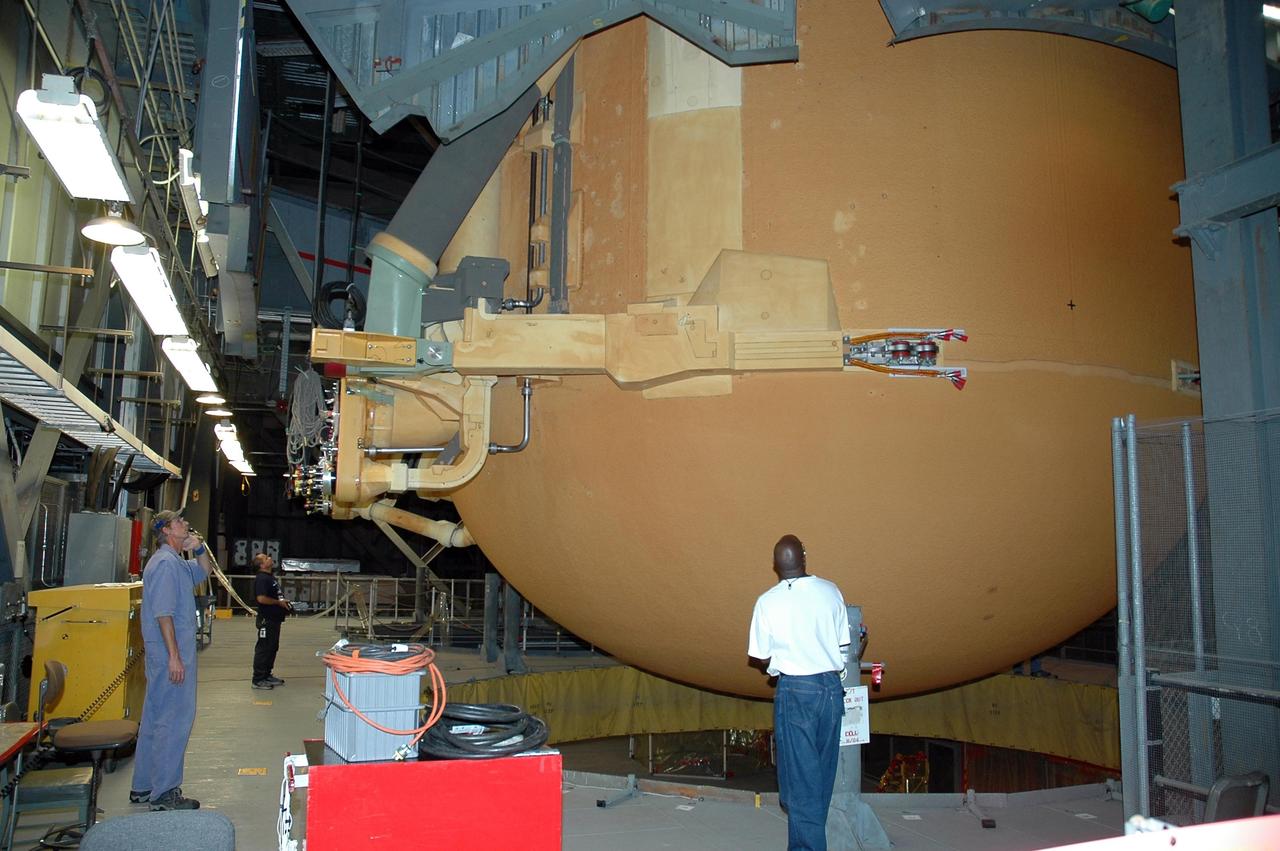
KENNEDY SPACE CENTER, FLA. - Inside the Vehicle Assembly Building at NASA's Kennedy Space Center, external tank number 119 is being lifted from the checkout cell and will be placed horizontally on the transporter in the transfer aisle. Once in the transfer aisle, technicians will reapply the thermal protection system foam that was removed in order to replace the tank's four liquid hydrogen engine cutoff sensors. The tank is being prepared to launch Space Shuttle Discovery on mission STS-121 in July.
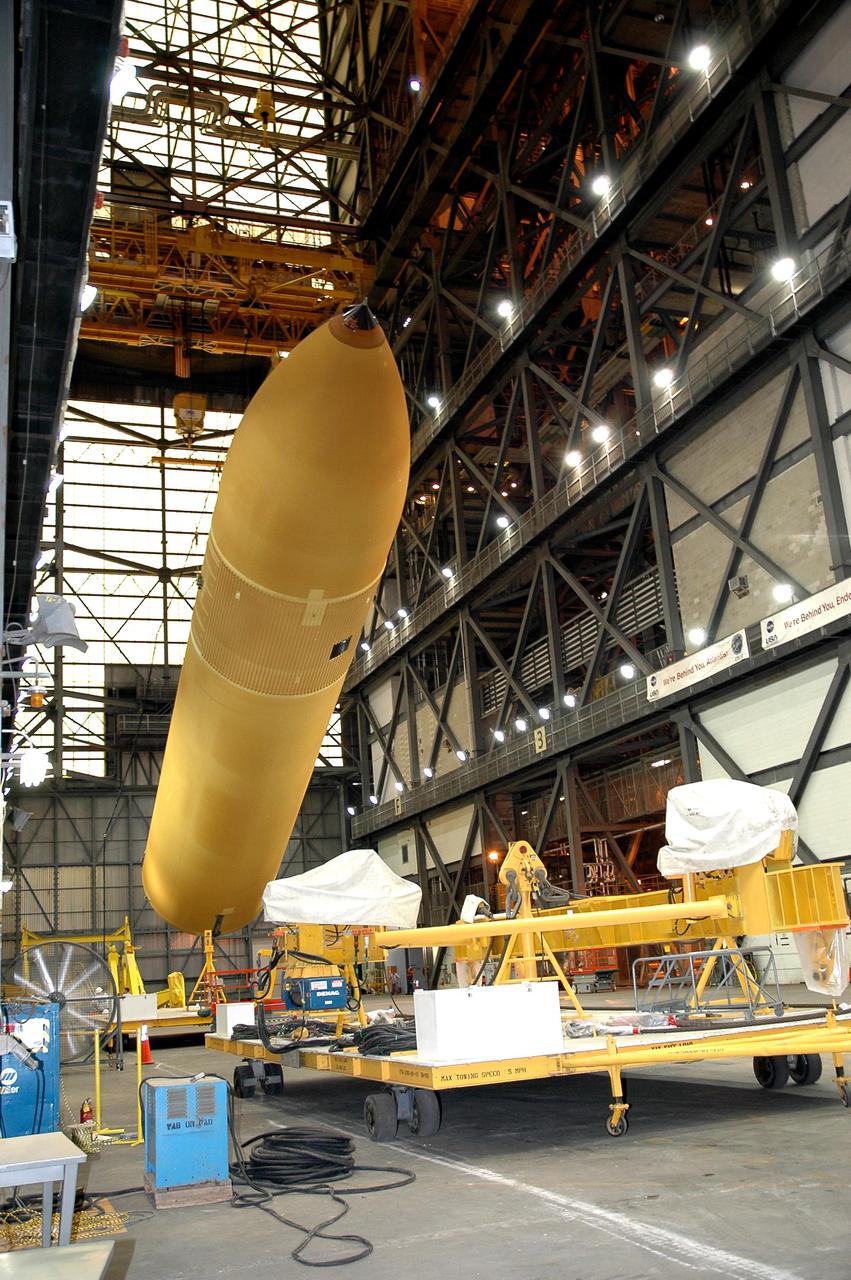
KENNEDY SPACE CENTER, FLA. - Inside NASA Kennedy Space Center’s Vehicle Assembly Building, External Tank 119 is lowered to a horizontal position. Then it will be placed on a transporter in the transfer aisle to be moved to the barge at the Turn Basin. The tank will embark on a voyage around the Florida peninsula to the Michoud Assembly Facility in New Orleans. Delivered to KSC in June, ET-119 is the third newly redesigned tank.
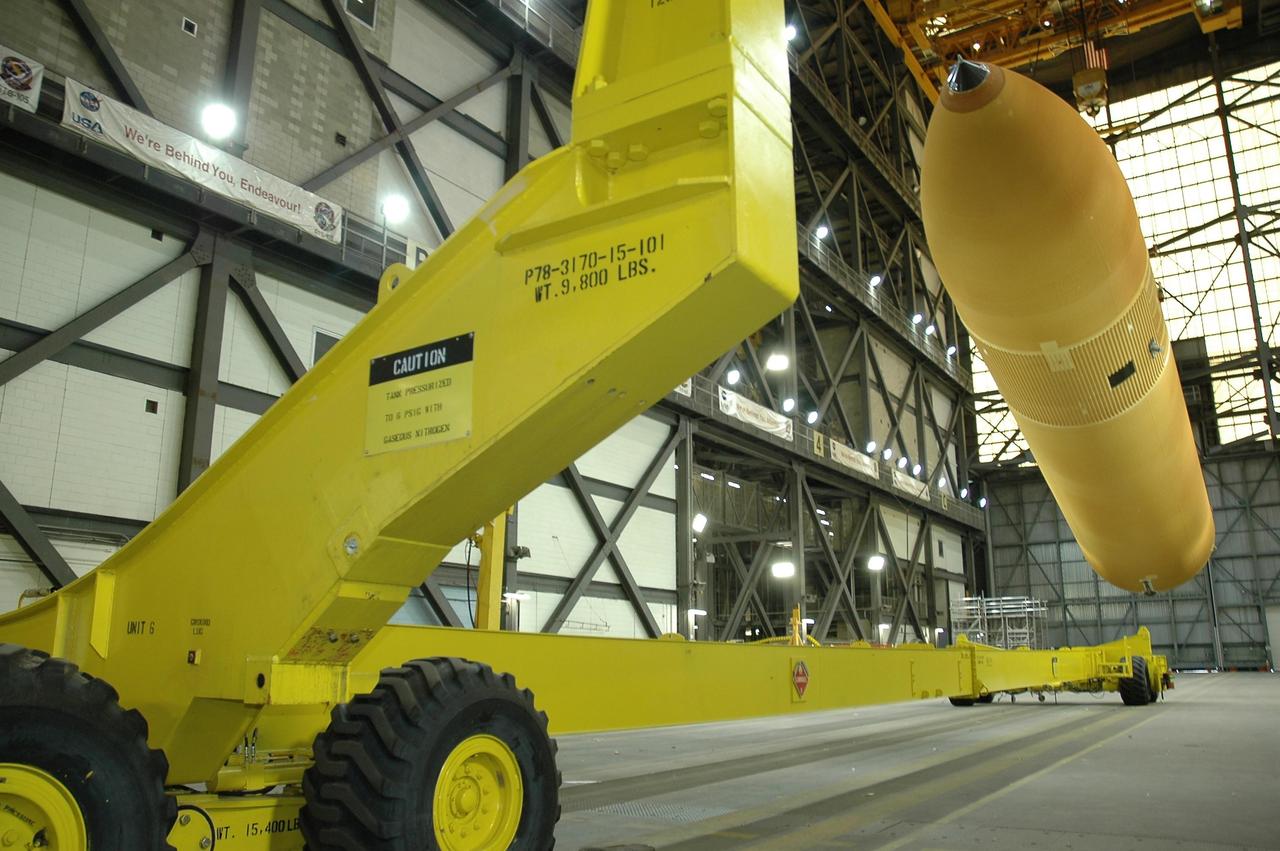
KENNEDY SPACE CENTER, FLA. - Inside the Vehicle Assembly Building at NASA's Kennedy Space Center, external tank number 119 is shifted to a horizontal position for placement on the transporter at left where technicians will reapply the thermal protection system foam that was removed in order to replace the tank's four liquid hydrogen engine cutoff sensors. The tank is being prepared to launch Space Shuttle Discovery on mission STS-121 in July. Photo credit: NASA/Cory Huston
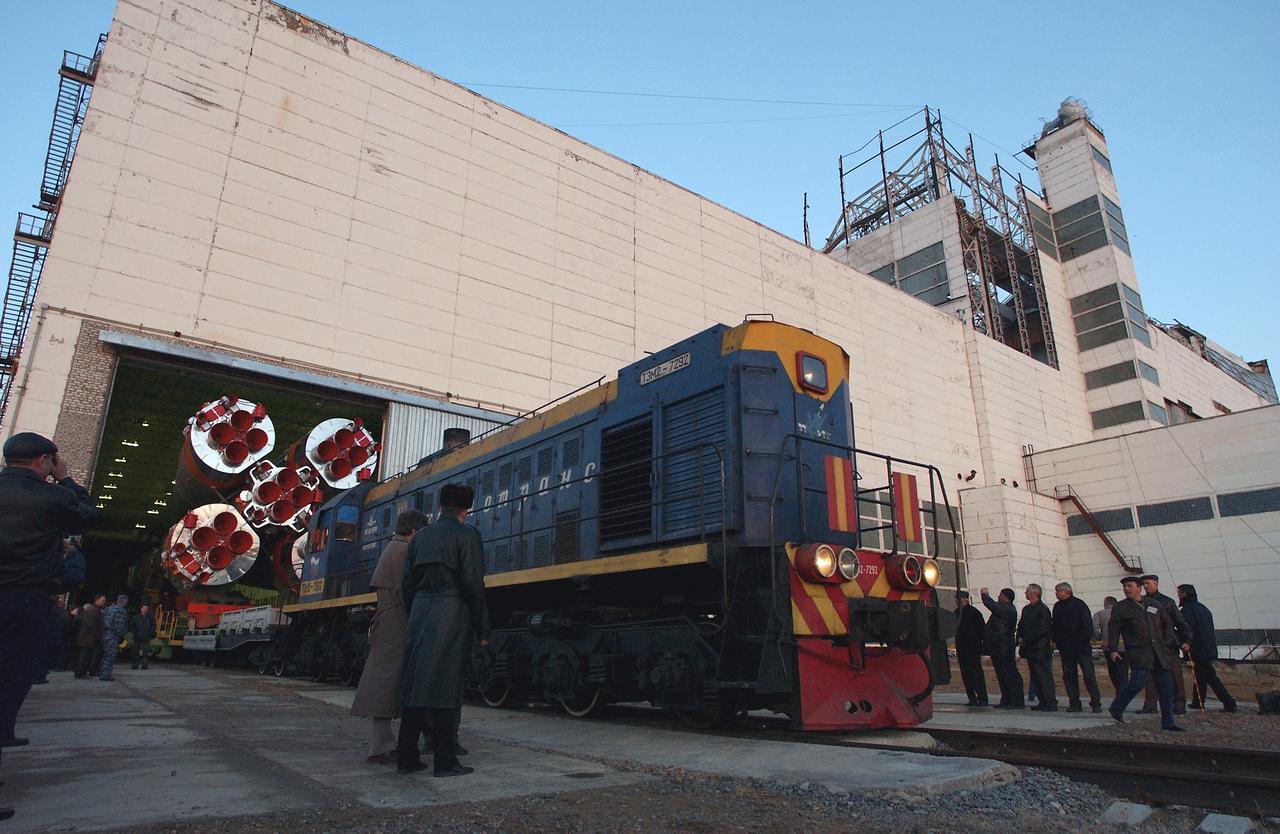
The Soyuz TMA-4 capsule and its booster rocket begin to roll to the launch pad at the Baikonur Cosmodrome on Saturday, April 17, 2004, in Baikonur, Kazakhstan in preparation for the launch of the Expedition 9 crew and a European researcher to the International Space Station on April 19. The Soyuz vehicle is transported to the launch pad horizontally on a railcar from its processing hangar in a process that takes about 2.5 hours to complete. Photo Credit: (NASA/Bill Ingalls)
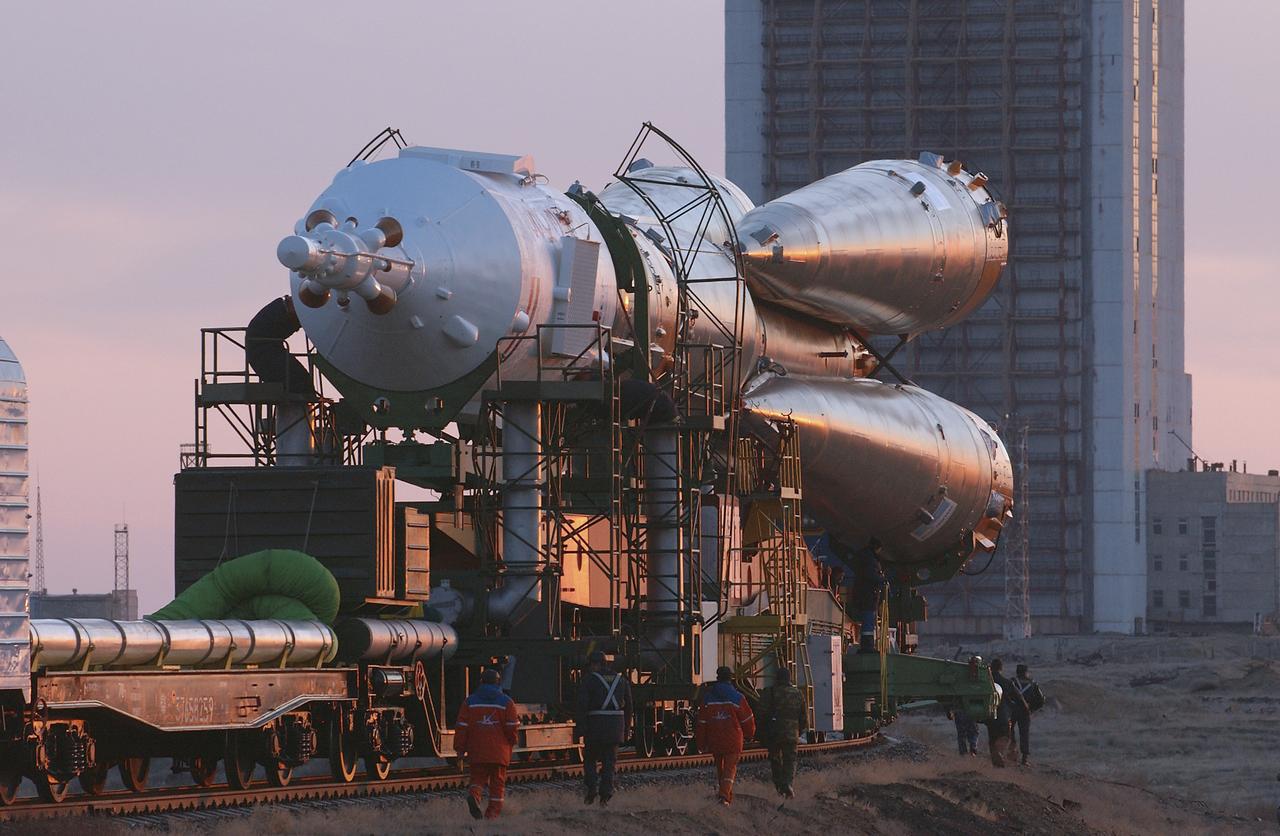
The Soyuz TMA-4 capsule and its booster rocket begin to roll to the launch pad at the Baikonur Cosmodrome on Saturday, April 17, 2004, in Baikonur, Kazakhstan in preparation for the launch of the Expedition 9 crew and a European researcher to the International Space Station on April 19. The Soyuz vehicle is transported to the launch pad horizontally on a railcar from its processing hangar in a process that takes about 2.5 hours to complete. Photo Credit: (NASA/Bill Ingalls)

The Soyuz TMA-4 capsule and its booster rocket begin to roll to the launch pad at the Baikonur Cosmodrome on Saturday, April 17, 2004, in Baikonur, Kazakhstan in preparation for the launch of the Expedition 9 crew and a European researcher to the International Space Station on April 19. The Soyuz vehicle is transported to the launch pad horizontally on a railcar from its processing hangar in a process that takes about 2.5 hours to complete. Photo Credit: (NASA/Bill Ingalls)
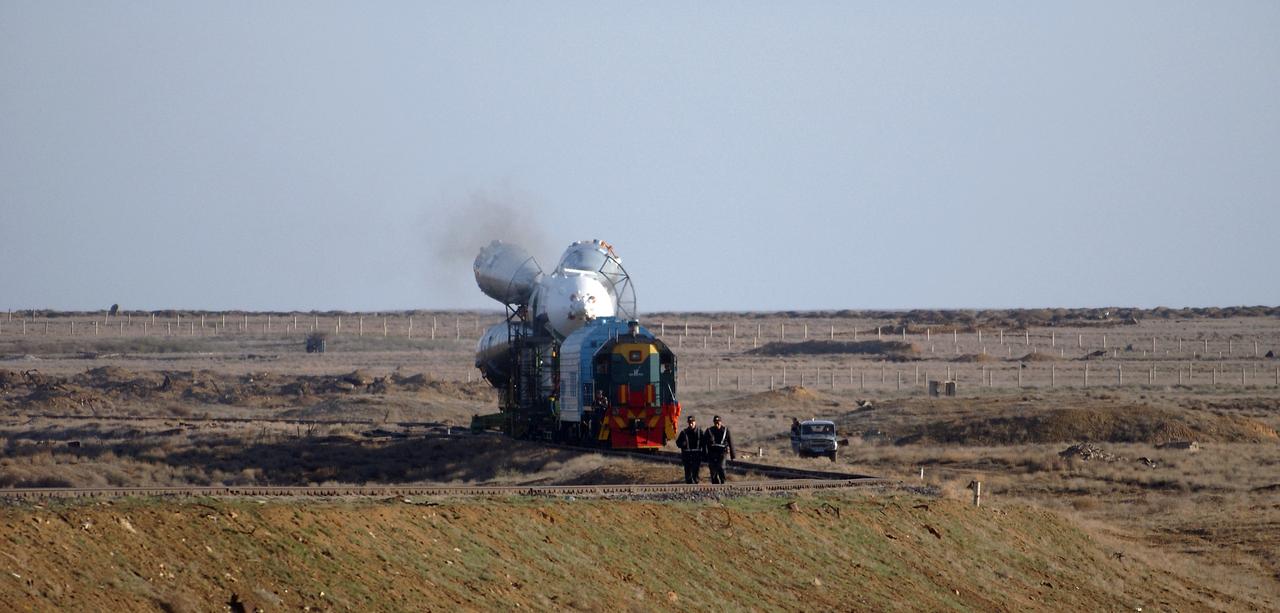
The Soyuz TMA-4 capsule and its booster rocket begin to roll to the launch pad at the Baikonur Cosmodrome on Saturday, April 17, 2004, in Baikonur, Kazakhstan in preparation for the launch of the Expedition 9 crew and a European researcher to the International Space Station on April 19. The Soyuz vehicle is transported to the launch pad horizontally on a railcar from its processing hangar in a process that takes about 2.5 hours to complete. Photo Credit: (NASA/Bill Ingalls)
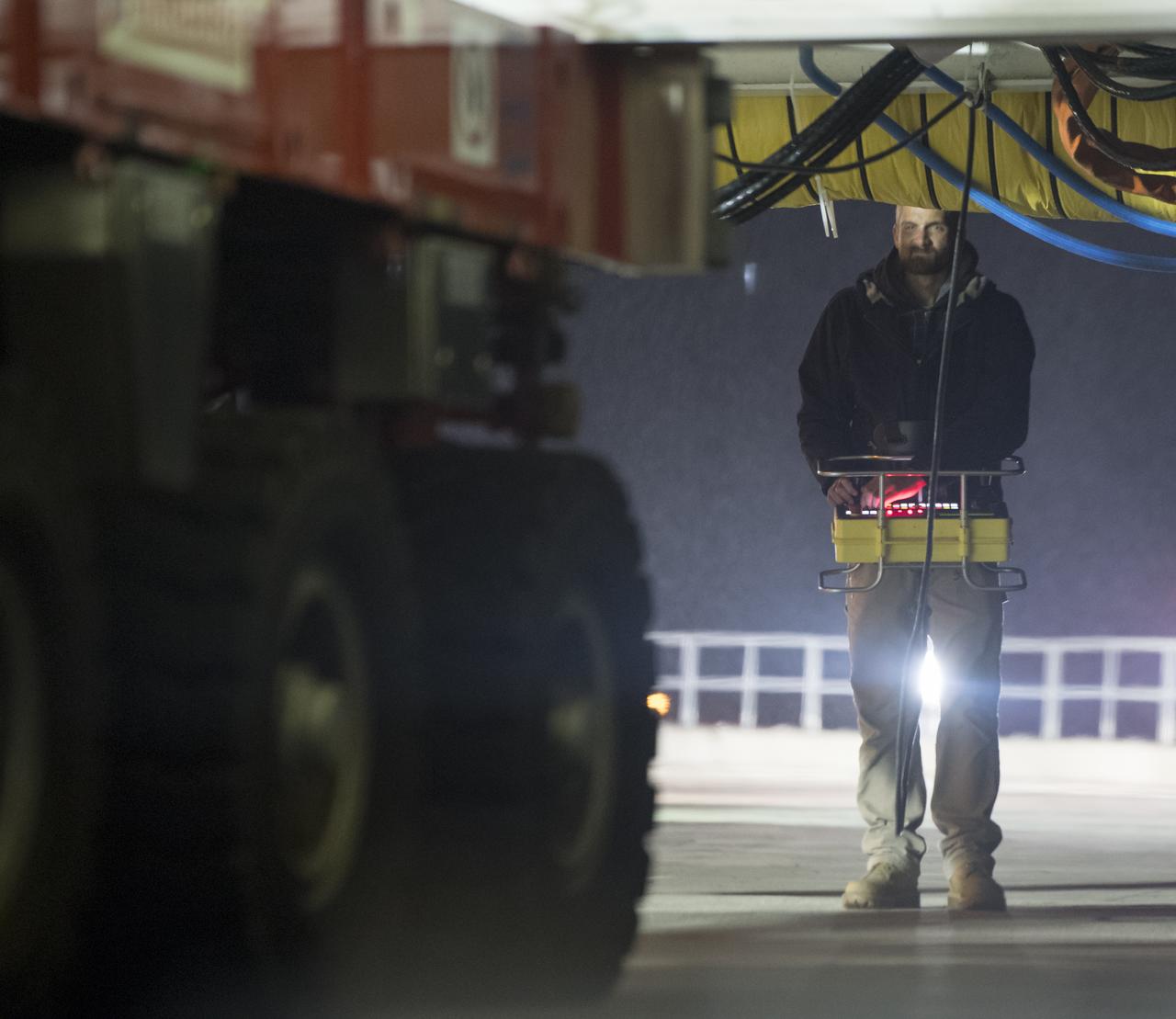
Orbital ATK Mechanical Technician Phil Kauthen drives the transporter with the Antares rocket aboard from the Horizontal Integration Facility to launch Pad-0A, Thursday, Nov. 9, 2017 at NASA's Wallops Flight Facility in Virginia. Orbital ATK’s eighth contracted cargo resupply mission with NASA to the International Space Station will deliver over 7,400 pounds of science and research, crew supplies and vehicle hardware to the orbital laboratory and its crew. Photo Credit: (NASA/Bill Ingalls)
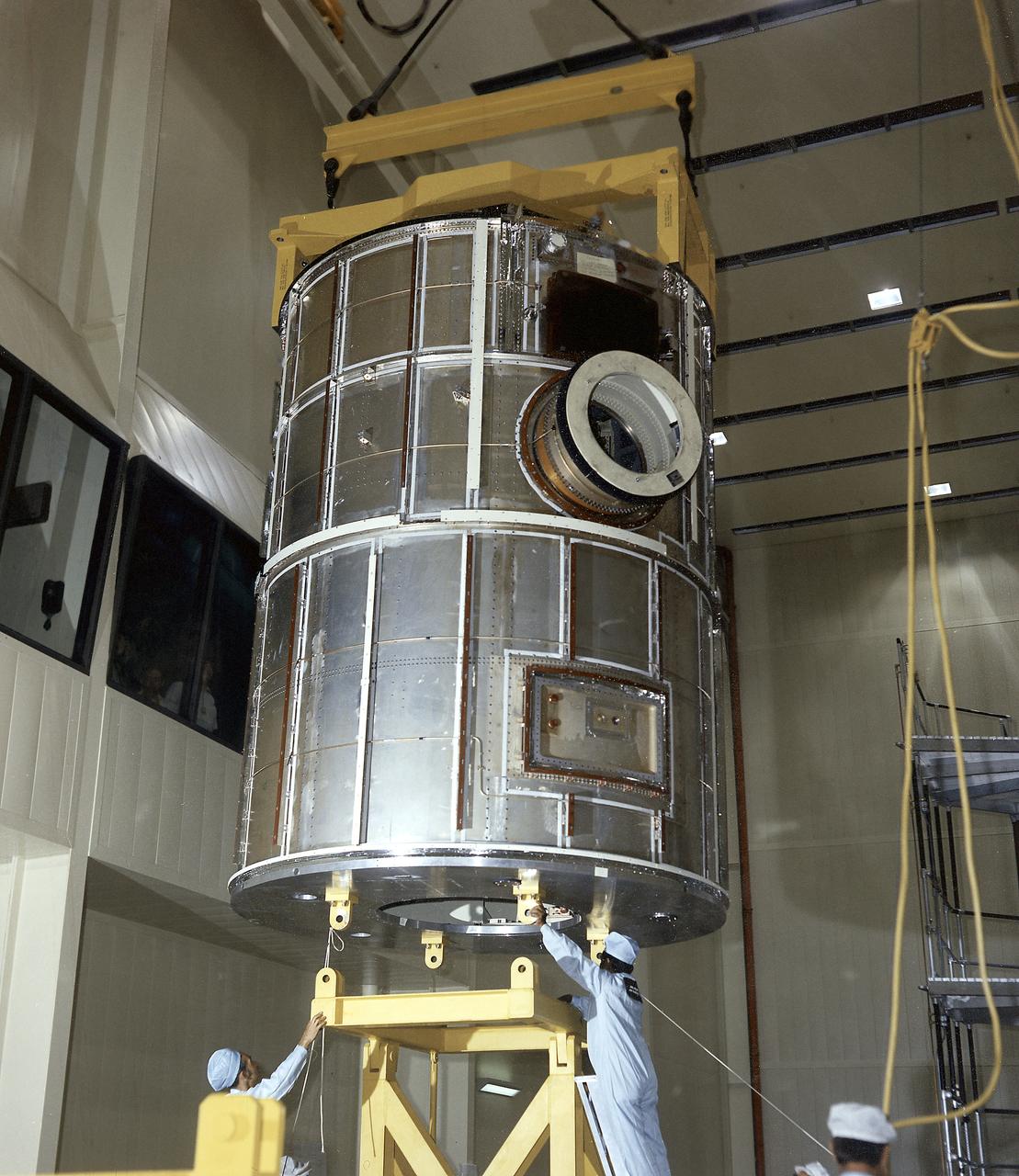
Workmen at the Martin Marietta Corporation's Space Center in Denver, Colorado, position Skylab's Multiple Docking Adapter (MDA) flight article in the horizontal transportation fixture. Designed and manufactured by the Marshall Space Flight Center and outfitted by Martin Marietta, the MDA housed the control units for the Apollo Telescope Mount (ATM), Earth Resources Experiment Package (EREP), and Zero-Gravity Materials Processing Facility and provided a docking port for the Apollo Command Module.
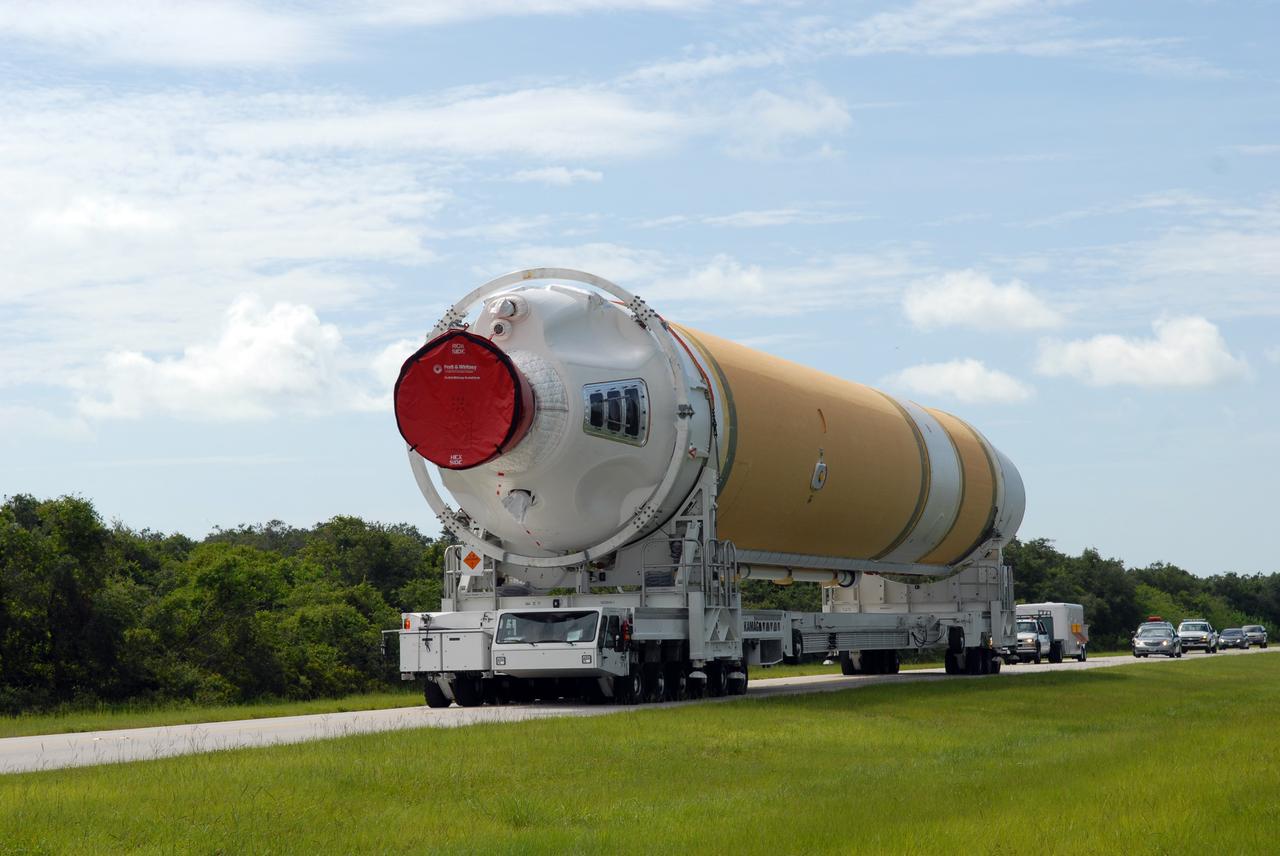
CAPE CANAVERAL, Fla. – The United Launch Alliance Delta IV first stage is being transported to the Horizontal Integration Facility on Cape Canaveral Air Force Station's Launch Complex 37. The Delta IV is the launch vehicle for the latest Geostationary Operational Environmental Satellite, known as GOES-P, developed by NASA for the National Oceanic and Atmospheric Administration, or NOAA. Photo credit: NASA/Jim Grossmann
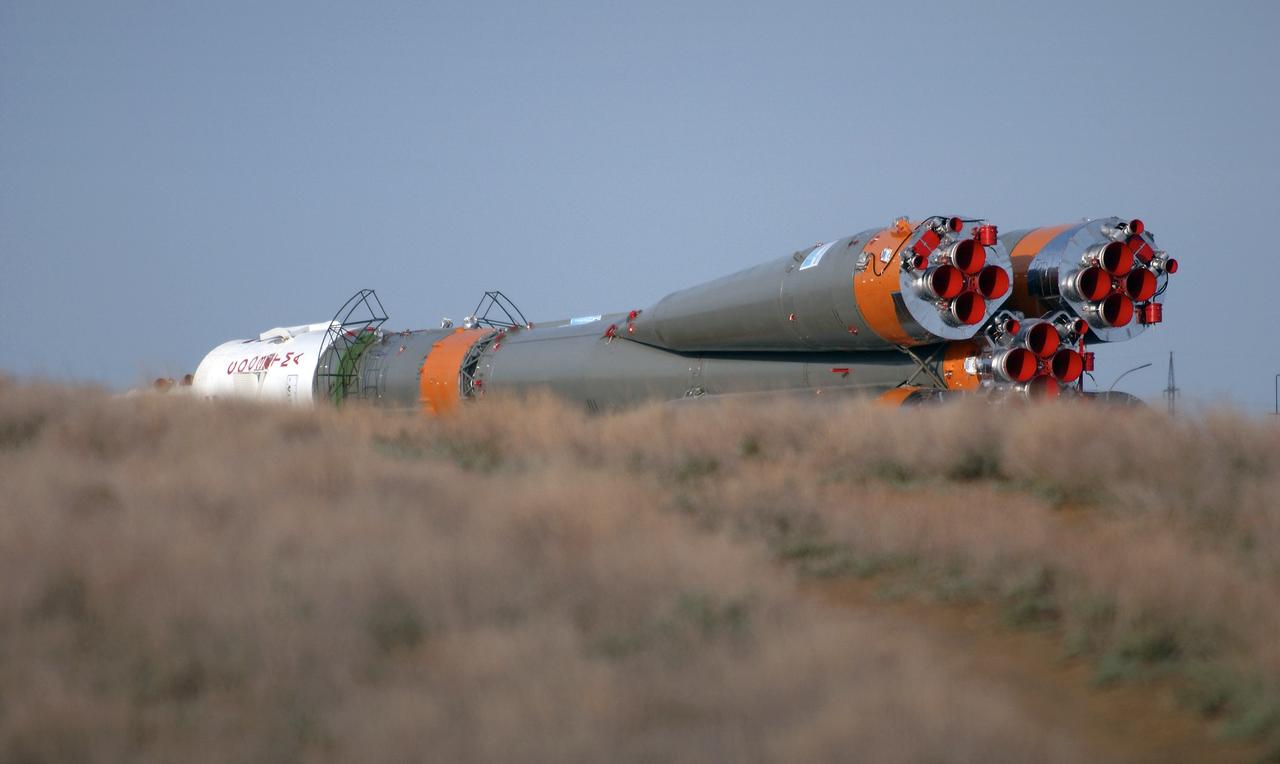
The Soyuz TMA-4 capsule and its booster rocket begin to roll to the launch pad at the Baikonur Cosmodrome on Saturday, April 17, 2004, in Baikonur, Kazakhstan in preparation for the launch of the Expedition 9 crew and a European researcher to the International Space Station on April 19. The Soyuz vehicle is transported to the launch pad horizontally on a railcar from its processing hangar in a process that takes about 2.5 hours to complete. Photo Credit: (NASA/Bill Ingalls)
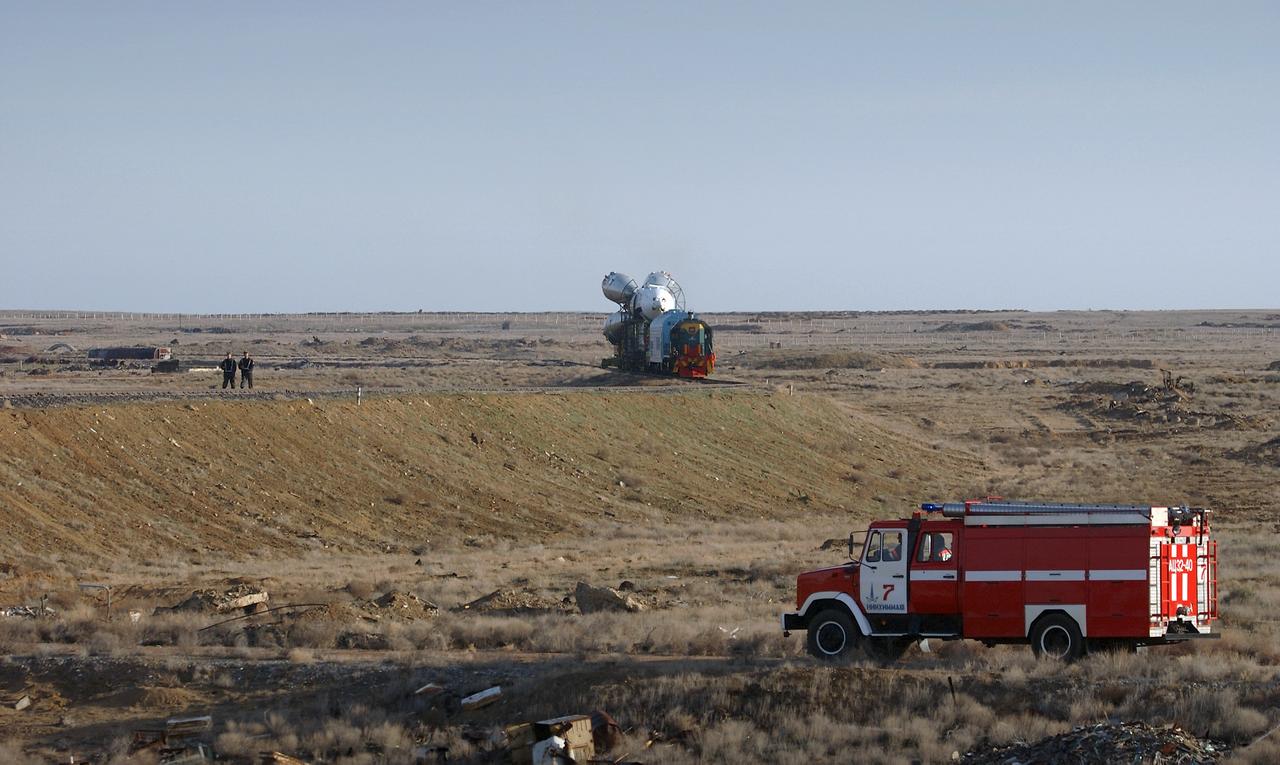
The Soyuz TMA-4 capsule and its booster rocket begin to roll to the launch pad at the Baikonur Cosmodrome on Saturday, April 17, 2004, in Baikonur, Kazakhstan in preparation for the launch of the Expedition 9 crew and a European researcher to the International Space Station on April 19. The Soyuz vehicle is transported to the launch pad horizontally on a railcar from its processing hangar in a process that takes about 2.5 hours to complete. Photo Credit: (NASA/Bill Ingalls)
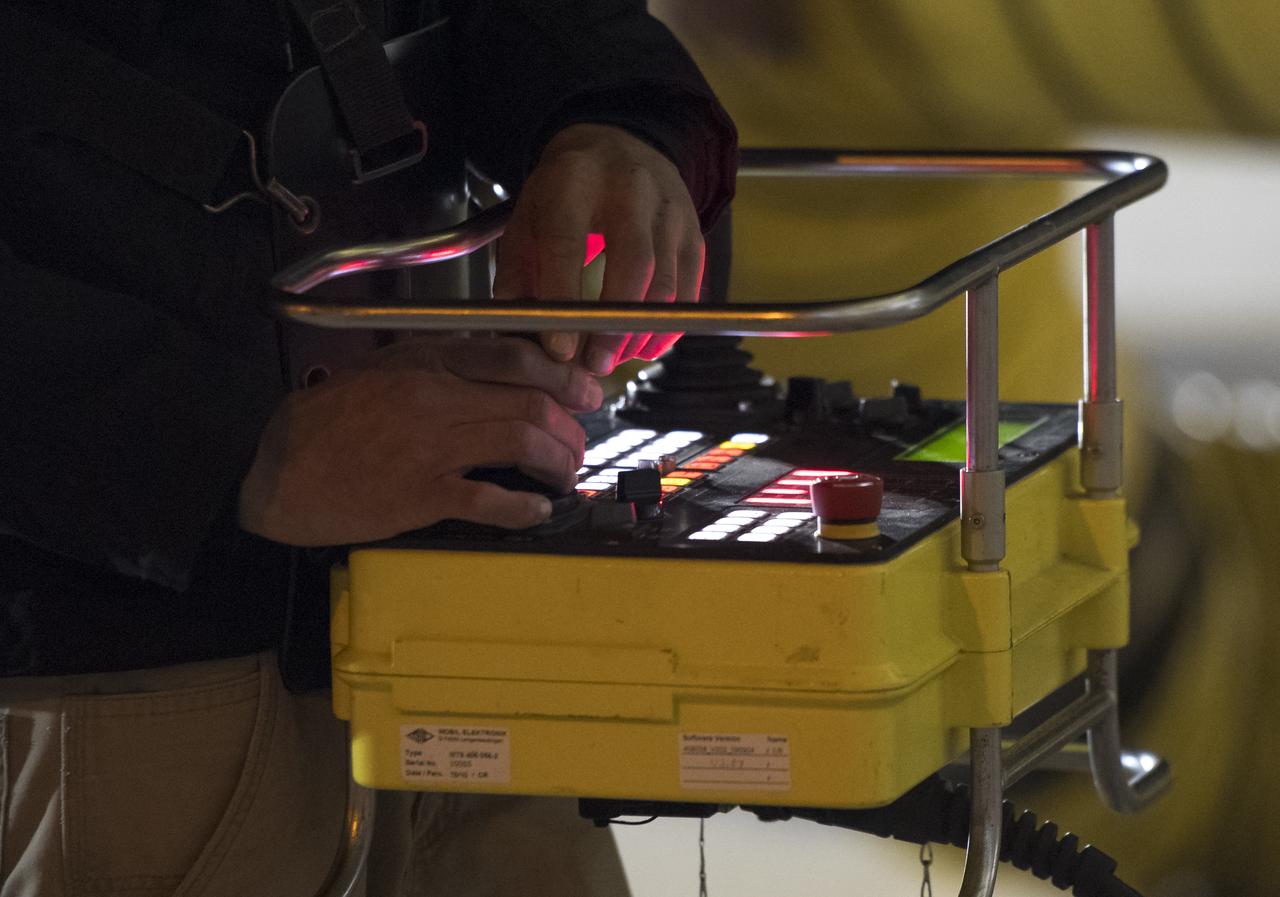
Orbital ATK Mechanical Technician Phil Kauthen drives the transporter with the Antares rocket aboard from the Horizontal Integration Facility to launch Pad-0A, Thursday, Nov. 9, 2017 at NASA's Wallops Flight Facility in Virginia. Orbital ATK’s eighth contracted cargo resupply mission with NASA to the International Space Station will deliver over 7,400 pounds of science and research, crew supplies and vehicle hardware to the orbital laboratory and its crew. Photo Credit: (NASA/Bill Ingalls)
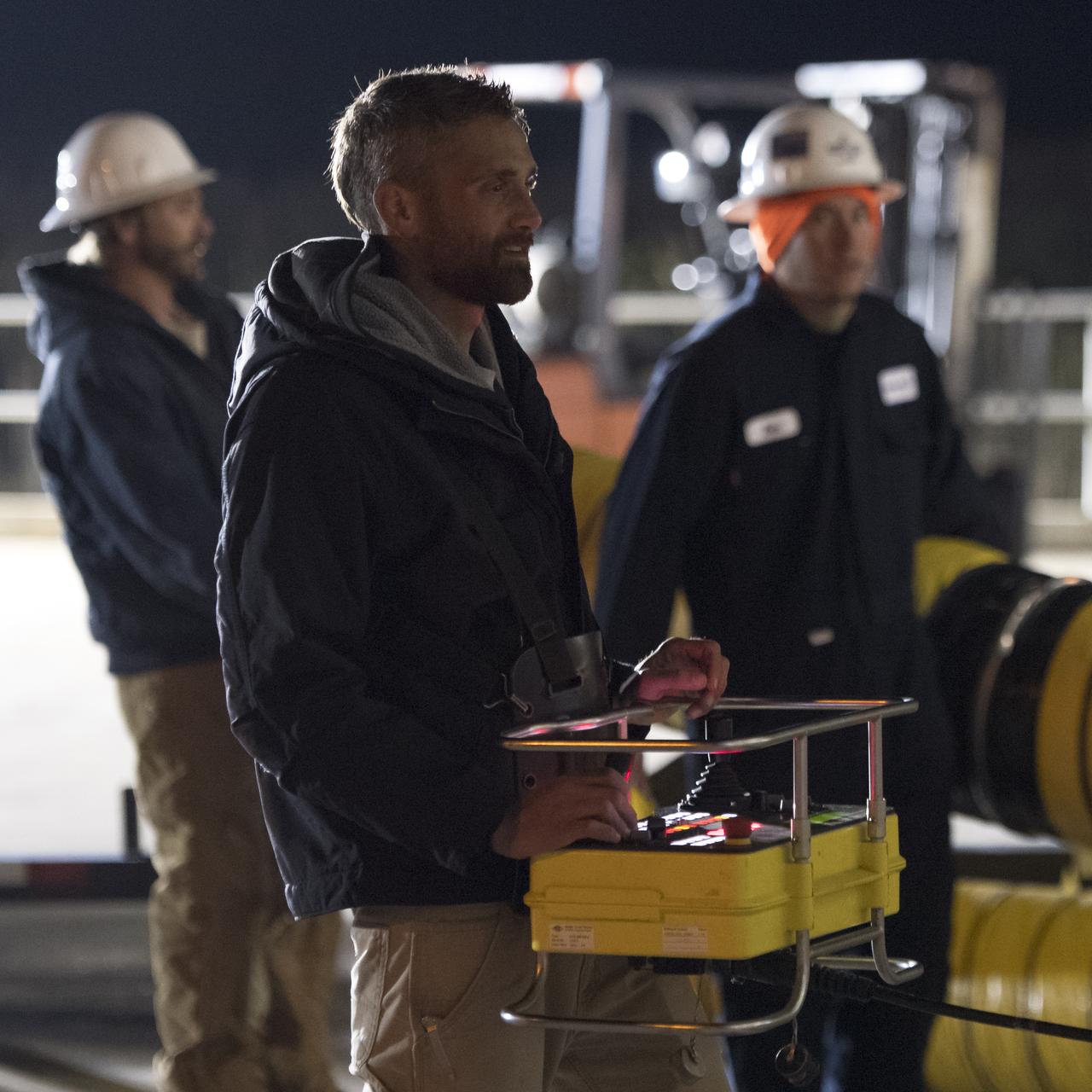
Orbital ATK Mechanical Technician Phil Kauthen drives the transporter with the Antares rocket aboard from the Horizontal Integration Facility to launch Pad-0A, Thursday, Nov. 9, 2017 at NASA's Wallops Flight Facility in Virginia. Orbital ATK’s eighth contracted cargo resupply mission with NASA to the International Space Station will deliver over 7,400 pounds of science and research, crew supplies and vehicle hardware to the orbital laboratory and its crew. Photo Credit: (NASA/Bill Ingalls)
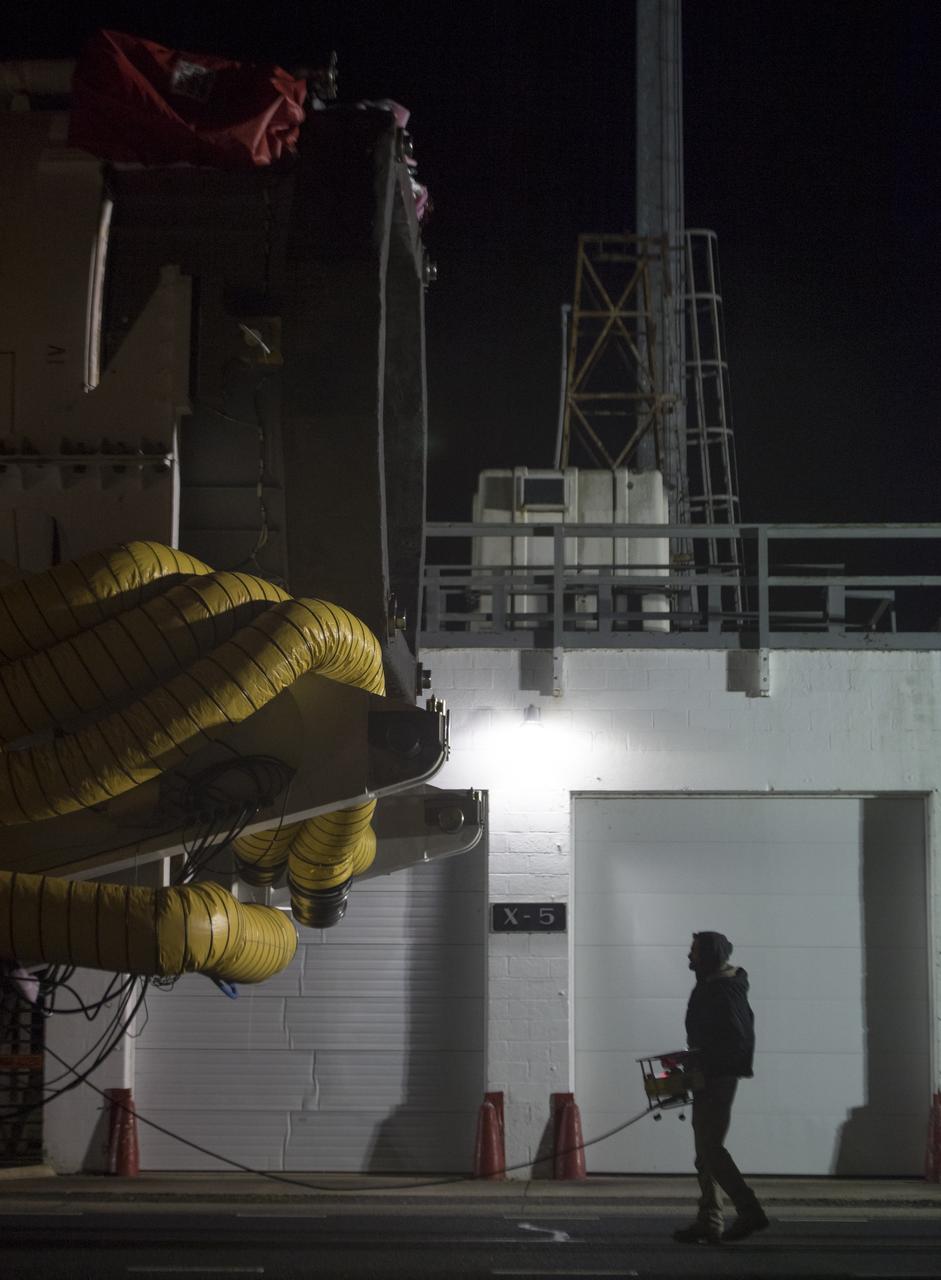
Orbital ATK Mechanical Technician Phil Kauthen drives the transporter with the Antares rocket aboard from the Horizontal Integration Facility to launch Pad-0A, Thursday, Nov. 9, 2017 at NASA's Wallops Flight Facility in Virginia. Orbital ATK’s eighth contracted cargo resupply mission with NASA to the International Space Station will deliver over 7,400 pounds of science and research, crew supplies and vehicle hardware to the orbital laboratory and its crew. Photo Credit: (NASA/Bill Ingalls)
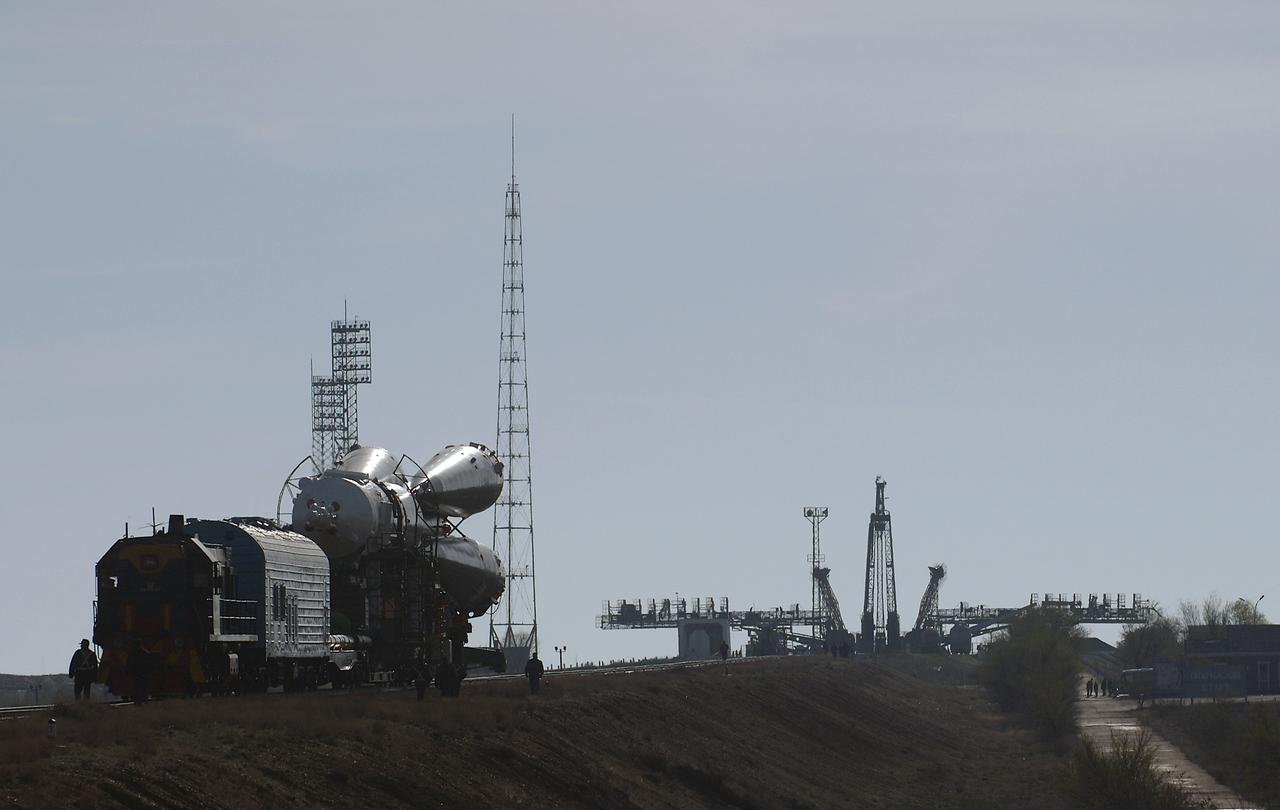
The Soyuz TMA-4 capsule and its booster rocket begin to roll to the launch pad at the Baikonur Cosmodrome on Saturday, April 17, 2004, in Baikonur, Kazakhstan in preparation for the launch of the Expedition 9 crew and a European researcher to the International Space Station on April 19. The Soyuz vehicle is transported to the launch pad horizontally on a railcar from its processing hangar in a process that takes about 2.5 hours to complete. Photo Credit: (NASA/Bill Ingalls)
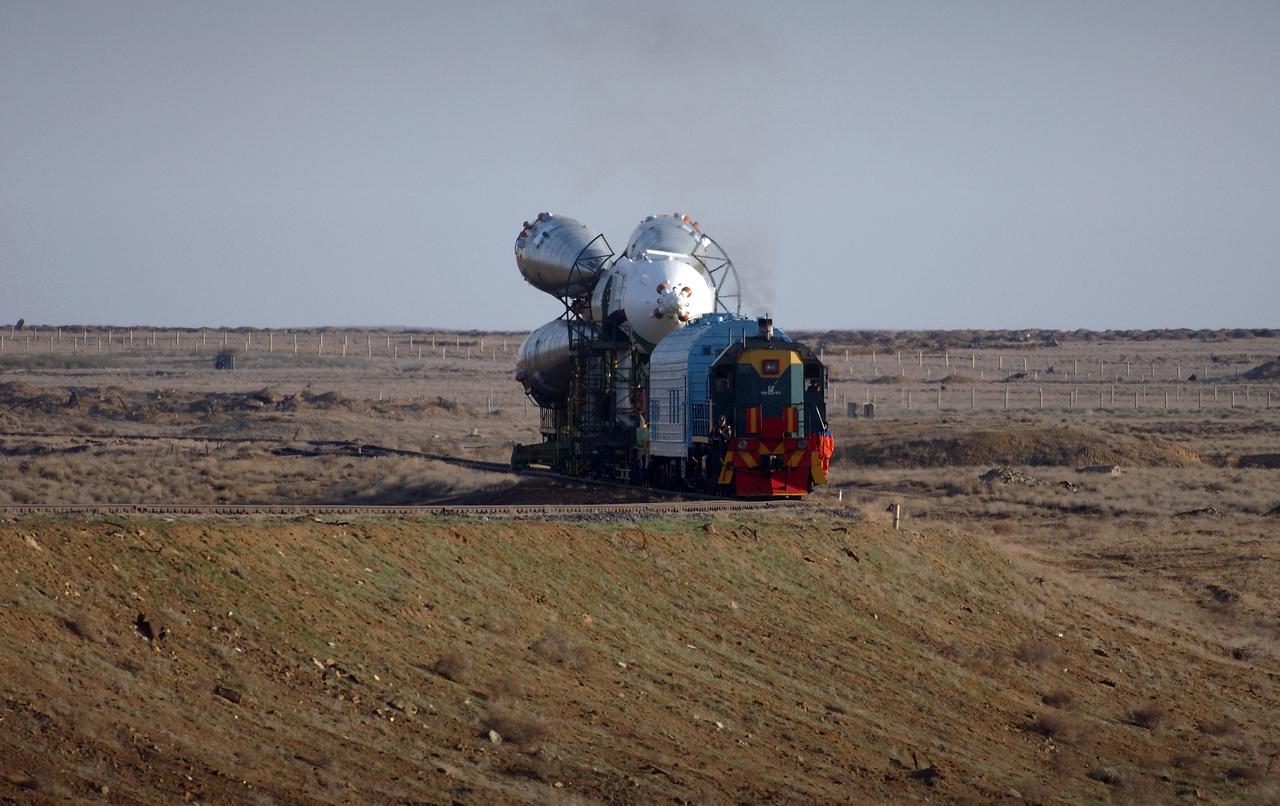
The Soyuz TMA-4 capsule and its booster rocket begin to roll to the launch pad at the Baikonur Cosmodrome on Saturday, April 17, 2004, in Baikonur, Kazakhstan in preparation for the launch of the Expedition 9 crew and a European researcher to the International Space Station on April 19. The Soyuz vehicle is transported to the launch pad horizontally on a railcar from its processing hangar in a process that takes about 2.5 hours to complete. Photo Credit: (NASA/Bill Ingalls)

Alexander Zelenschikov, the Deputy Chief Designer of RSC-Energia, stands outside a processing facility at the Baikonur Cosmodrome as the Soyuz TMA-4 capsule and its booster rocket start the rollout to the launch pad on Saturday, April 17, 2004, in Baikonur, Kazakhstan, in preparation for the launch of the Expedition 9 crew and a European researcher to the International Space Station April 19. The Soyuz vehicle is transported to the launch pad horizontally on a railcar from its processing hangar in a process that takes about 2.5 hours to complete. Photo Credit: (NASA/Bill Ingalls)
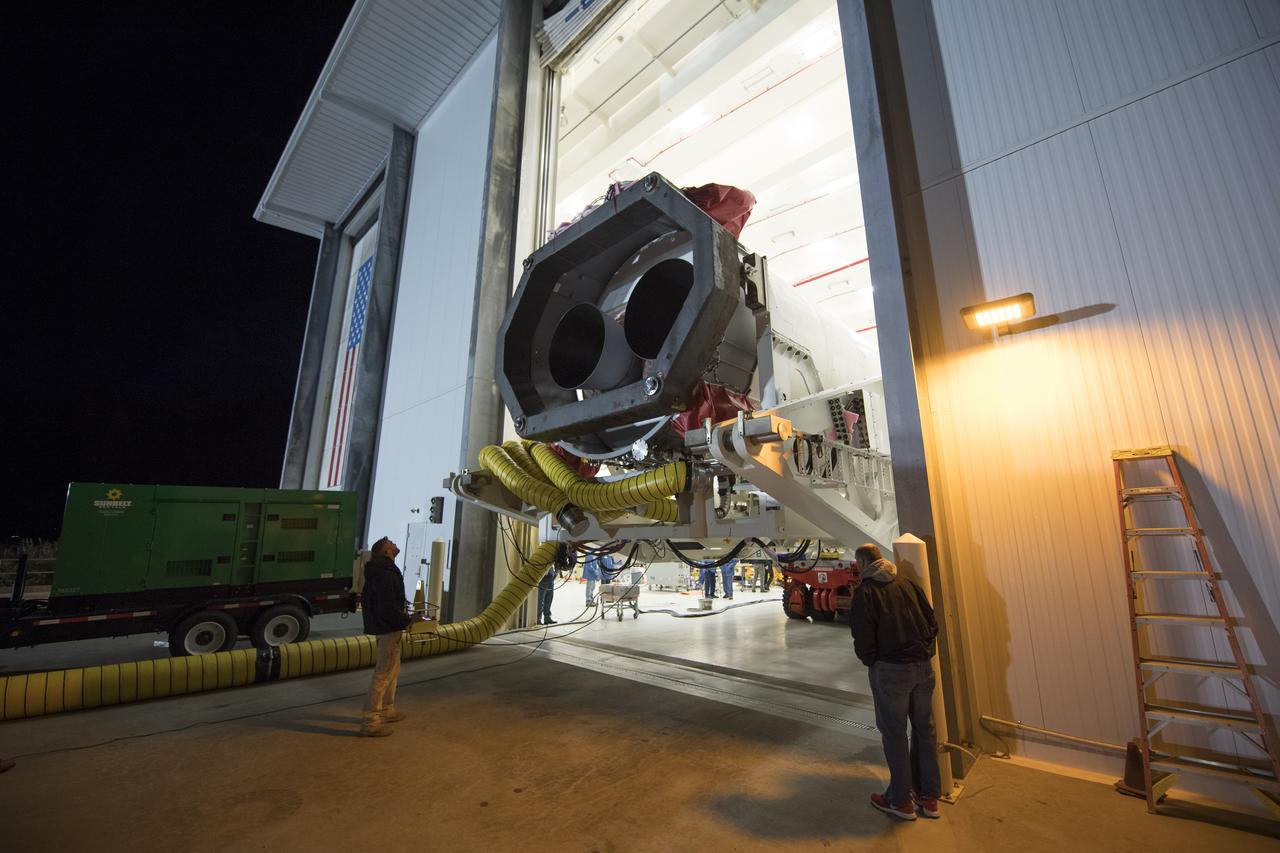
Orbital ATK Mechanical Technician Phil Kauthen drives the transporter with the Antares rocket aboard from the Horizontal Integration Facility to launch Pad-0A, Thursday, Nov. 9, 2017 at NASA's Wallops Flight Facility in Virginia. Orbital ATK’s eighth contracted cargo resupply mission with NASA to the International Space Station will deliver over 7,400 pounds of science and research, crew supplies and vehicle hardware to the orbital laboratory and its crew. Photo Credit: (NASA/Bill Ingalls)
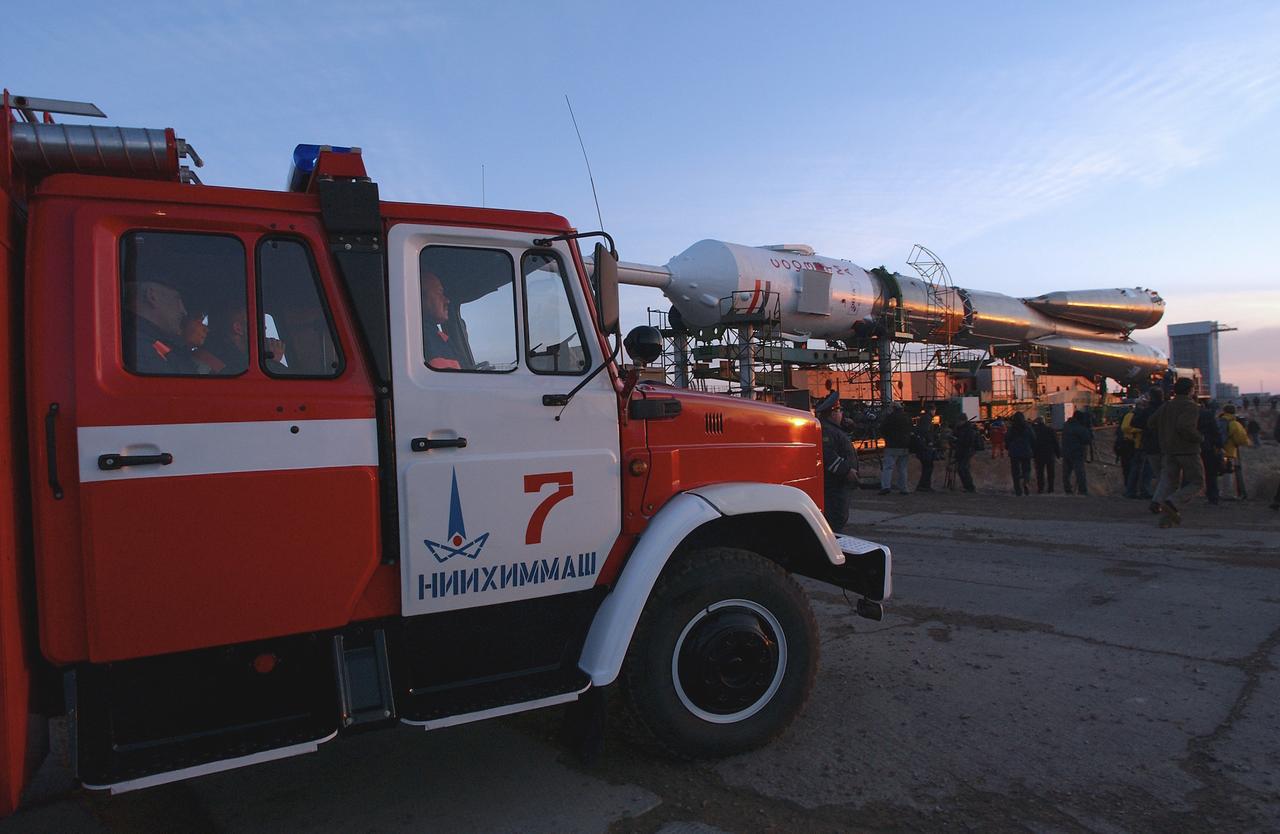
The Soyuz TMA-4 capsule and its booster rocket begin to roll to the launch pad at the Baikonur Cosmodrome on Saturday, April 17, 2004, in Baikonur, Kazakhstan in preparation for the launch of the Expedition 9 crew and a European researcher to the International Space Station on April 19. The Soyuz vehicle is transported to the launch pad horizontally on a railcar from its processing hangar in a process that takes about 2.5 hours to complete. Photo Credit: (NASA/Bill Ingalls)
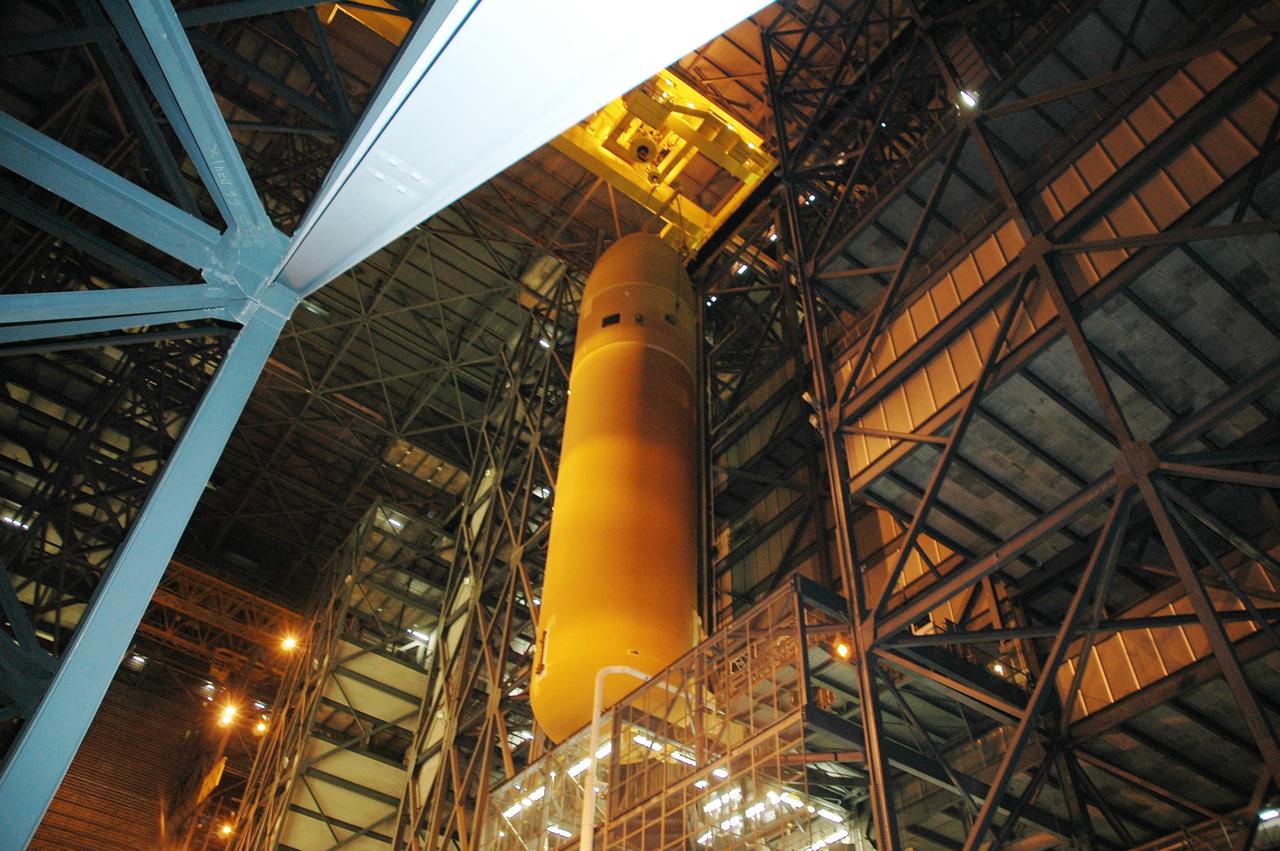
KENNEDY SPACE CENTER, FLA. - Inside the Vehicle Assembly Building at NASA's Kennedy Space Center, external tank number 119 is being moved from the checkout cell and will be placed horizontally on the transporter in the transfer aisle. Once in the transfer aisle, technicians will reapply the thermal protection system foam that was removed in order to replace the tank's four liquid hydrogen engine cutoff sensors. The tank is being prepared to launch Space Shuttle Discovery on mission STS-121 in July. Photo credit: NASA/Cory Huston
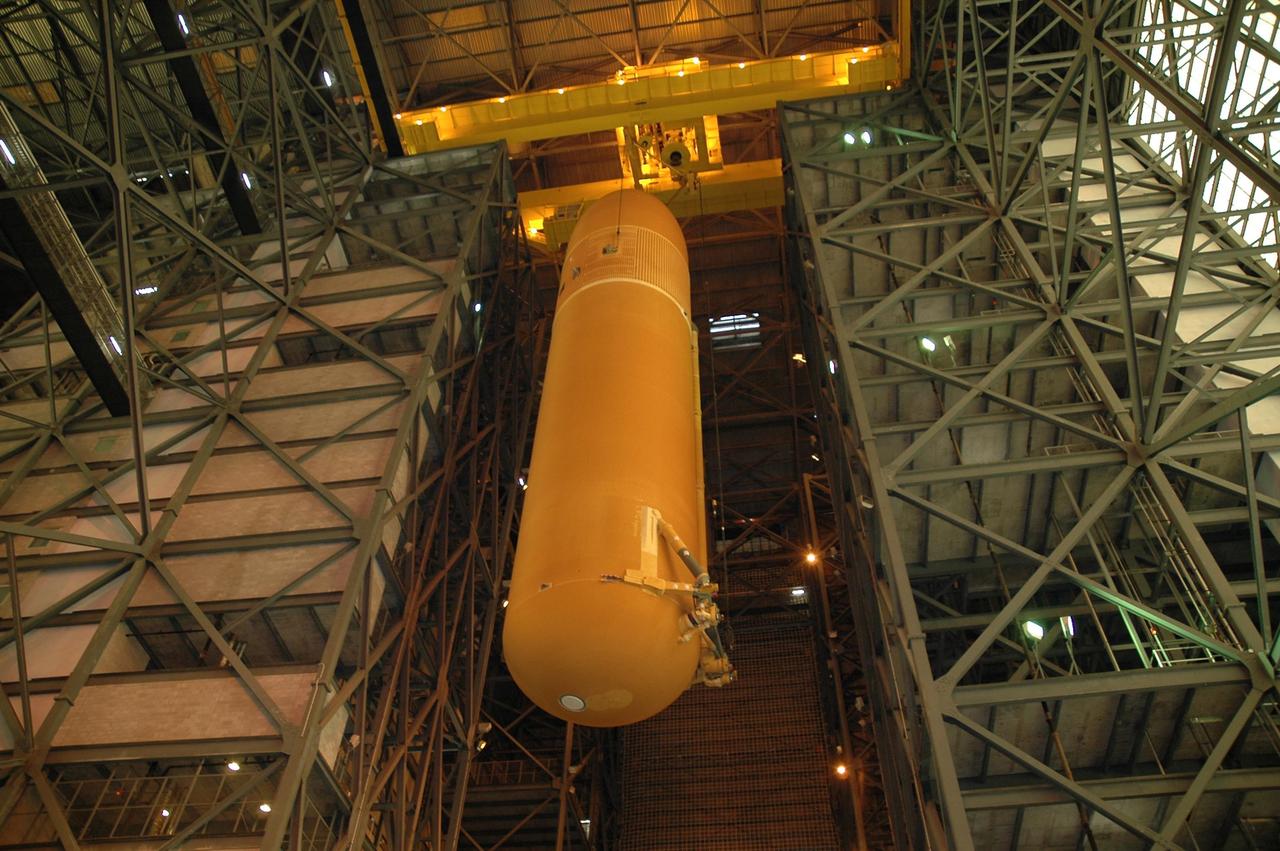
KENNEDY SPACE CENTER, FLA. - Inside the Vehicle Assembly Building at NASA's Kennedy Space Center, external tank number 119 is being lowered toward the floor of the transfer aisle. It will be placed horizontally on a transporter where technicians will reapply the thermal protection system foam that was removed in order to replace the tank's four liquid hydrogen engine cutoff sensors. The tank is being prepared to launch Space Shuttle Discovery on mission STS-121 in July. Photo credit: NASA/Cory Huston
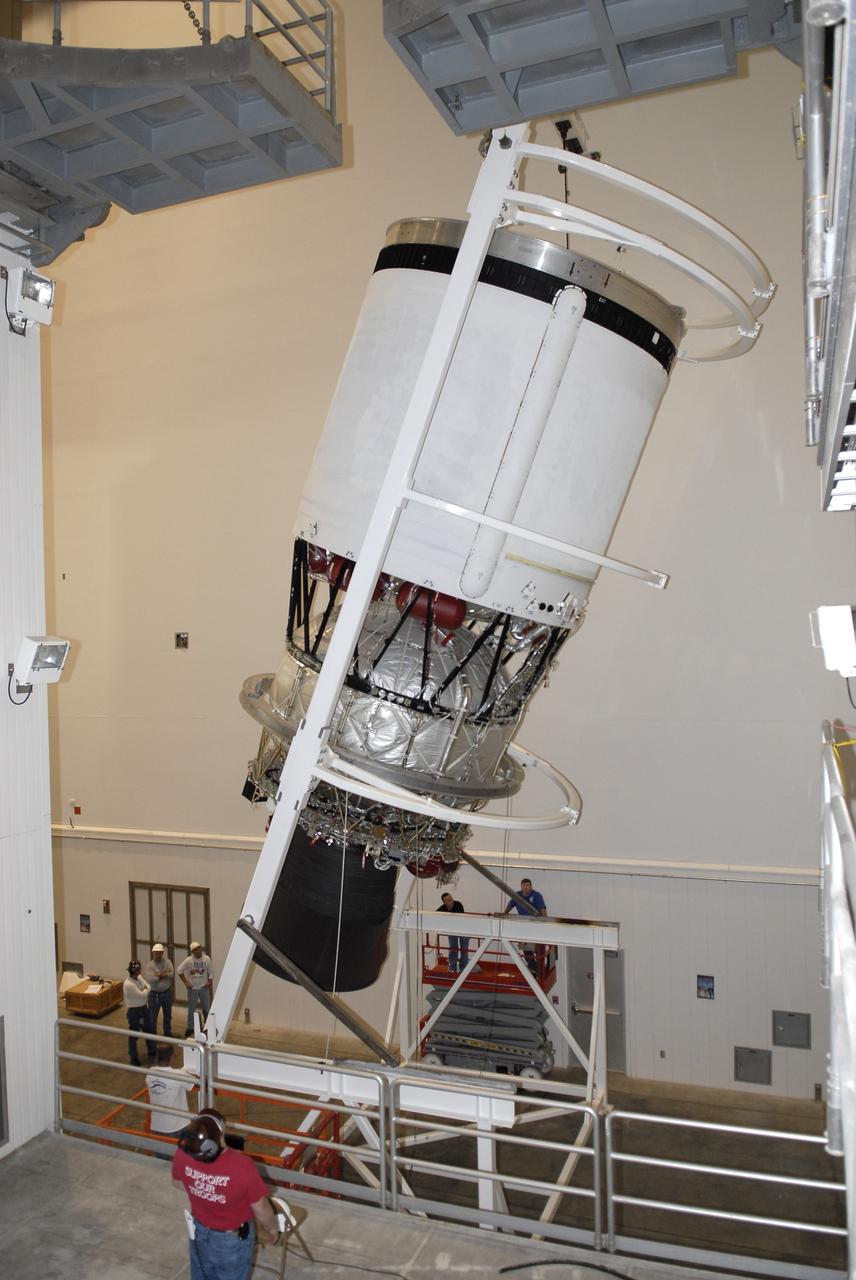
CAPE CANAVERAL, Fla. – In the hangar of the Delta Operations Center at Cape Canaveral Air Force Station in Florida, workers rotate the second stage of a Delta IV rocket into a horizontal position with the aid of a turnover stand following the completion of nozzle extension deployment system testing in the hangar's test cell. The United Launch Alliance Delta IV rocket is slated to launch GOES-P, the latest Geostationary Operational Environmental Satellite developed by NASA for the National Oceanic and Atmospheric Administration, or NOAA. Next, the second stage will be transported to the Horizontal Integration Facility where it will be inspected and prepared for mating with the Delta IV rocket's first stage. GOES-P, a meteorological satellite, is designed to watch for storm development and observed current weather conditions on Earth. Launch of GOES-P is scheduled for no earlier than Feb. 25, 2010, from Launch Complex 37. For information on GOES-P, visit http://goespoes.gsfc.nasa.gov/goes/spacecraft/n_p_spacecraft.html. Photo credit: NASA/Glenn Benson

This pair of images from space shows a portion of the southern Empty Quarter of the Arabian Peninsula in the country of Oman. On the left is a radar image of the region around the site of the fabled Lost City of Ubar, discovered in 1992 with the aid of remote sensing data. On the right is an enhanced optical image taken by the shuttle astronauts. Ubar existed from about 2800 BC to about 300 AD. and was a remote desert outpost where caravans were assembled for the transport of frankincense across the desert. The actual site of the fortress of the Lost City of Ubar, currently under excavation, is too small to show in either image. However, tracks leading to the site, and surrounding tracks, show as prominent, but diffuse, reddish streaks in the radar image. Although used in modern times, field investigations show many of these tracks were in use in ancient times as well. Mapping of these tracks on regional remote sensing images provided by the Landsat satellite was a key to recognizing the site as Ubar. The prominent magenta colored area is a region of large sand dunes. The green areas are limestone rocks, which form a rocky desert floor. A major wadi, or dry stream bed, runs across the scene and appears as a white line. The radar images, and ongoing field investigations, will help shed light on an early civilization about which little in known. The radar image was taken by the Spaceborne Imaging Radar C/X-Band Synthetic Aperture Radar (SIR-C/X-SAR) and is centered at 18 degrees North latitude and 53 degrees East longitude. The image covers an area about 50 kilometers by 100 kilometers (31 miles by 62 miles). The colors in the image are assigned to different frequencies and polarizations of the radar as follows: red is L-band, horizontally transmitted, horizontally received; blue is C-band horizontally transmitted, horizontally received; green is L-band horizontally transmitted, vertically received. SIR-C/X-SAR, a joint mission of the German, Italian and the United States space agencies, is part of NASA's Mission to Planet Earth. http://photojournal.jpl.nasa.gov/catalog/PIA01302
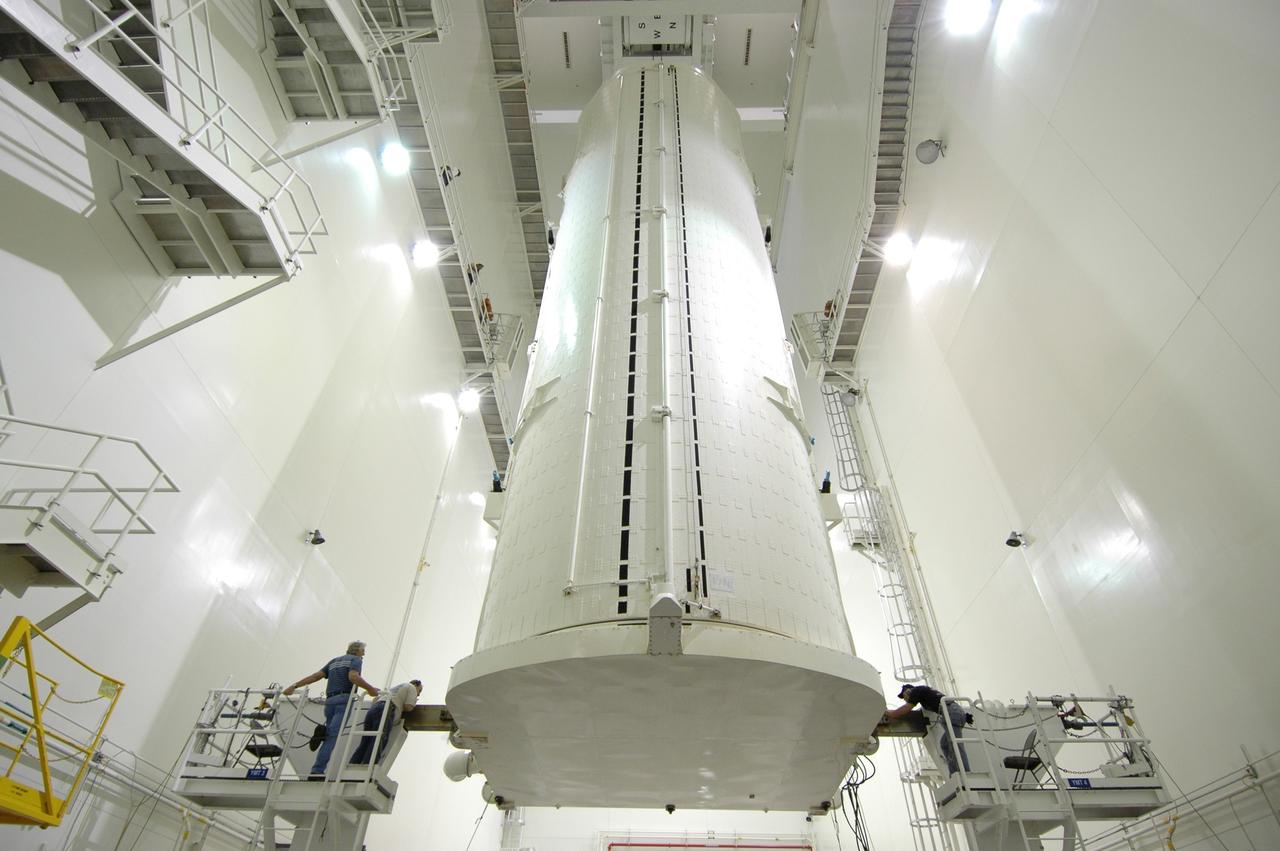
CAPE CANAVERAL, Fla. -- In the Vertical Integration Facility at NASA's Kennedy Space Center, workers on either side of the payload canister check its condition after being rotated from a horizontal position. The canister contains the Japanese Experiment Module -Pressurized Module, which will be transported to Launch Pad 39A for space shuttle Discovery’s STS-124 mission. At the pad, the payload will be transferred from the canister into the payload changeout room on the rotating service structure. The changeout room is the enclosed, environmentally controlled portion of the service structure that supports cargo delivery to the pad and subsequent vertical installation into an orbiter's payload bay. On the mission, the STS-124 crew will transport the JEM as well as the Japanese Remote Manipulator System to the International Space Station. The launch of Discovery is targeted for May 31. Photo credit: NASA/Jim Grossmann
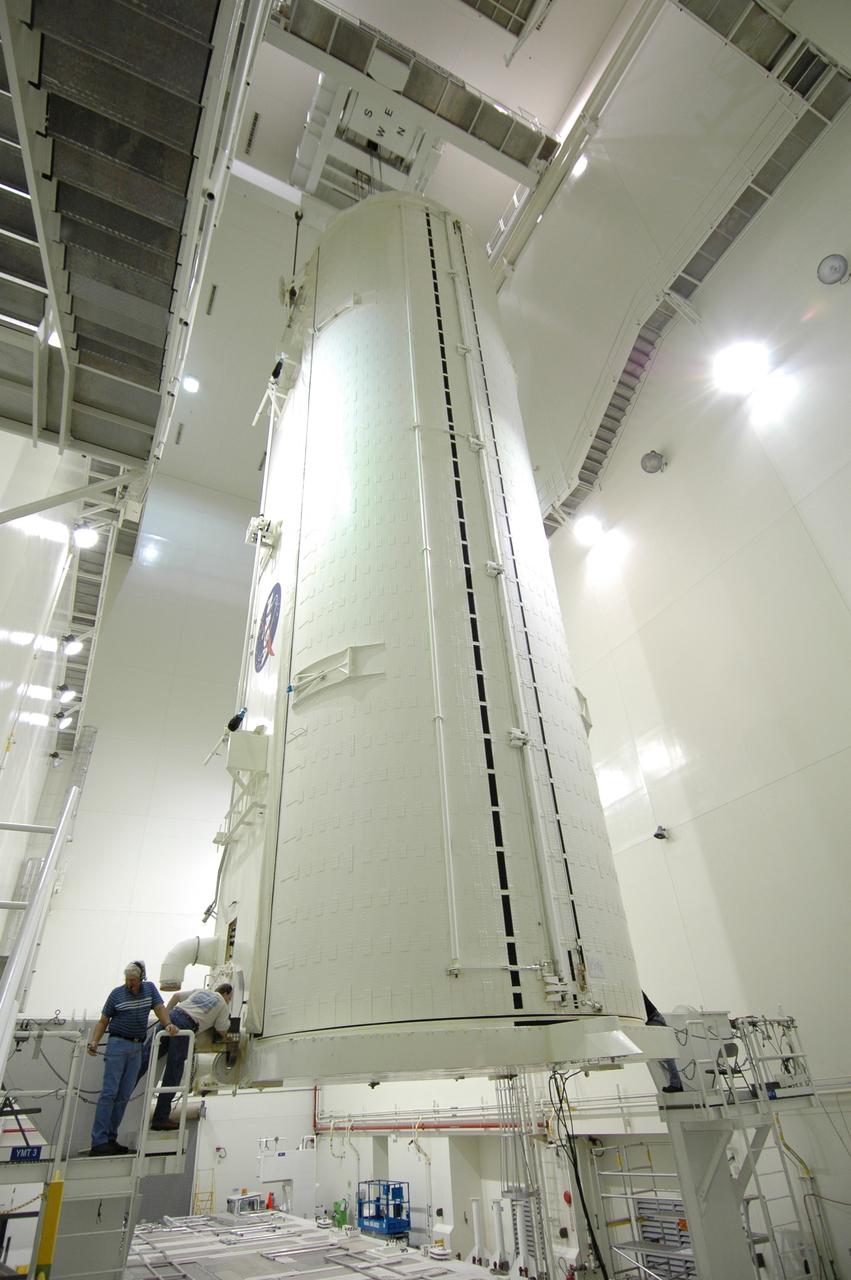
CAPE CANAVERAL, Fla. -- In the Vertical Integration Facility at NASA's Kennedy Space Center, workers on either side of the payload canister check its condition after being rotated from a horizontal position. The canister contains the Japanese Experiment Module -Pressurized Module, which will be transported to Launch Pad 39A for space shuttle Discovery’s STS-124 mission. At the pad, the payload will be transferred from the canister into the payload changeout room on the rotating service structure. The changeout room is the enclosed, environmentally controlled portion of the service structure that supports cargo delivery to the pad and subsequent vertical installation into an orbiter's payload bay. On the mission, the STS-124 crew will transport the JEM as well as the Japanese Remote Manipulator System to the International Space Station. The launch of Discovery is targeted for May 31. Photo credit: NASA/Jim Grossmann

CAPE CANAVERAL, Fla. – Inside the Delta Operations Center at Cape Canaveral Air Force Station, United Launch Alliance technicians stand by with a transporter to move the second stage of a Delta IV Heavy rocket following testing in preparation for the unpiloted Exploration Flight Test-1, or EFT-1. The second stage will be transported to the Horizontal Integration Facility at Space Launch Complex 37 for mating with the Delta IV Heavy booster stages. During the mission, Orion will travel farther into space than any human spacecraft has gone in more than 40 years. The data gathered during the flight will influence design decisions, validate existing computer models and innovative new approaches to space systems development, as well as reduce overall mission risks and costs for later Orion flights. Liftoff of Orion on the first flight test is planned for December 2014. Photo credit: NASA/Kim Shiflett
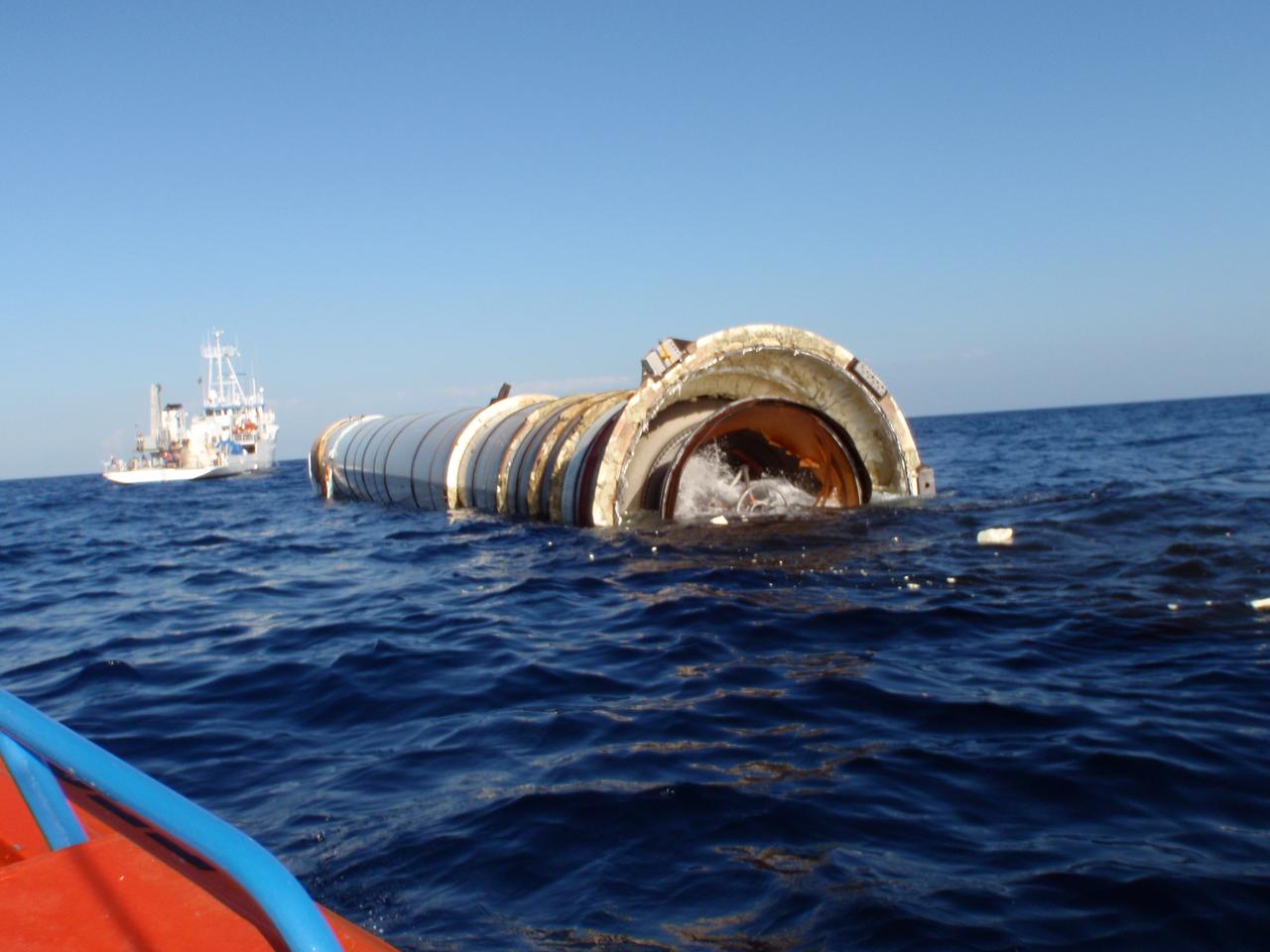
CAPE CANAVERAL, Fla. -- A spent solid rocket booster from Discovery's STS-133 launch bobbed in the Atlantis Ocean off the coast of Florida, before toppling over in a retrievable position. The booster is pumped with air to help maintain its flotation and horizontal position. Next, one of NASA's solid rocket booster retrieval ships, Liberty Star or Freedom Star, will tie up to the booster and transport it to Hangar AF at Cape Canaveral Air Force Station. The shuttle’s two solid rocket booster casings and associated flight hardware are recovered after every launch by the two ships. The boosters impact the Atlantic about seven minutes after liftoff and the retrieval ships are stationed about 10 miles from the impact area at the time of splashdown. After the spent segments are processed, they will be transported to Utah, where they will be refurbished and stored, if needed. Photo credit: NASA/Frank Michaux

CAPE CANAVERAL, Fla. -- In the Vertical Integration Facility at NASA's Kennedy Space Center, the payload canister containing the Japanese Experiment Module -Pressurized Module is suspended vertically after rotation from the horizontal. The canister contains the Japanese Experiment Module -Pressurized Module, which will be transported to Launch Pad 39A for space shuttle Discovery’s STS-124 mission. At the pad, the payload will be transferred from the canister into the payload changeout room on the rotating service structure. The changeout room is the enclosed, environmentally controlled portion of the service structure that supports cargo delivery to the pad and subsequent vertical installation into an orbiter's payload bay. On the mission, the STS-124 crew will transport the JEM as well as the Japanese Remote Manipulator System to the International Space Station. The launch of Discovery is targeted for May 31. Photo credit: NASA/Jim Grossmann
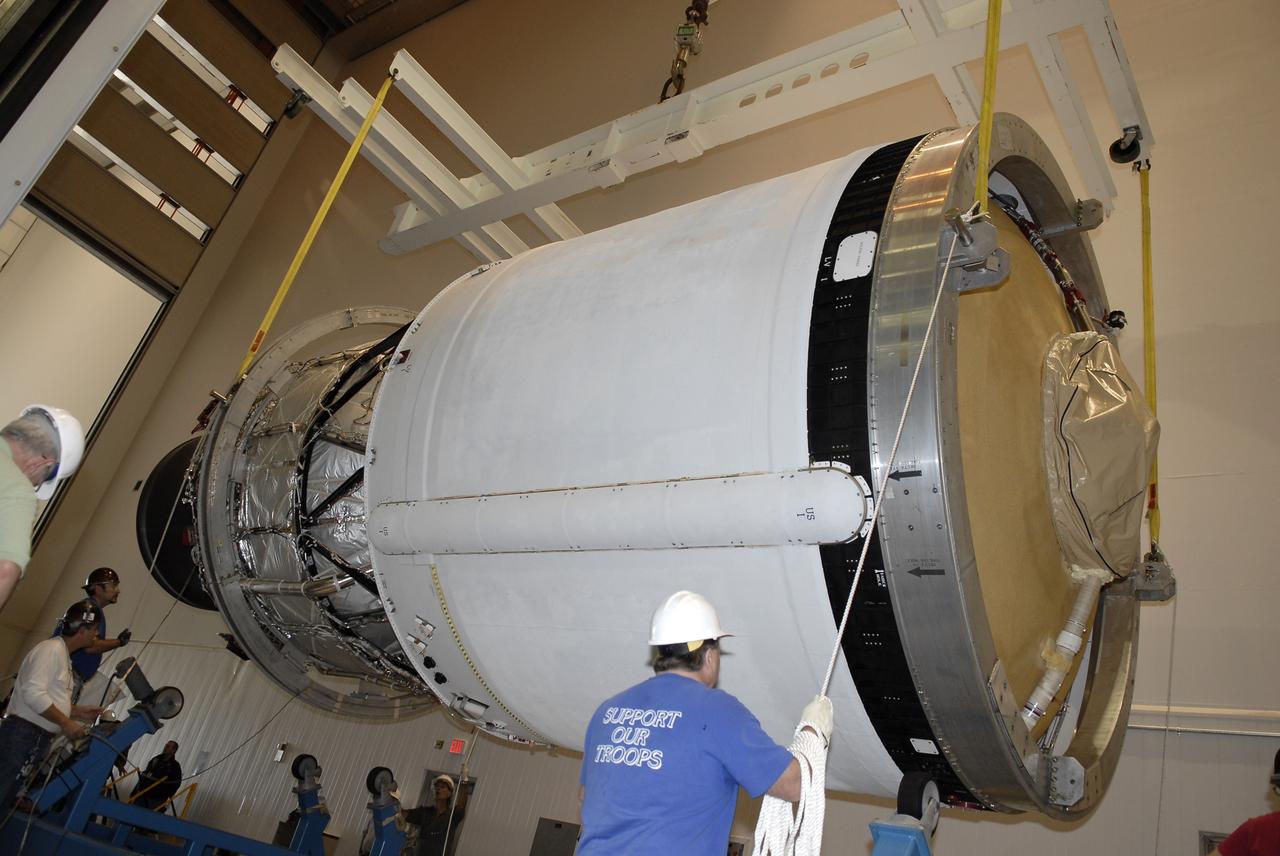
CAPE CANAVERAL, Fla. – In the hangar of the Delta Operations Center at Cape Canaveral Air Force Station in Florida, workers lower the second stage of a Delta IV rocket onto a transporter following the completion of nozzle extension deployment system testing in the hangar's test cell. The United Launch Alliance Delta IV rocket is slated to launch GOES-P, the latest Geostationary Operational Environmental Satellite developed by NASA for the National Oceanic and Atmospheric Administration, or NOAA. Next, the second stage will be transported to the Horizontal Integration Facility where it will be inspected and prepared for mating with the Delta IV rocket's first stage. GOES-P, a meteorological satellite, is designed to watch for storm development and observed current weather conditions on Earth. Launch of GOES-P is scheduled for no earlier than Feb. 25, 2010, from Launch Complex 37. For information on GOES-P, visit http://goespoes.gsfc.nasa.gov/goes/spacecraft/n_p_spacecraft.html. Photo credit: NASA/Glenn Benson
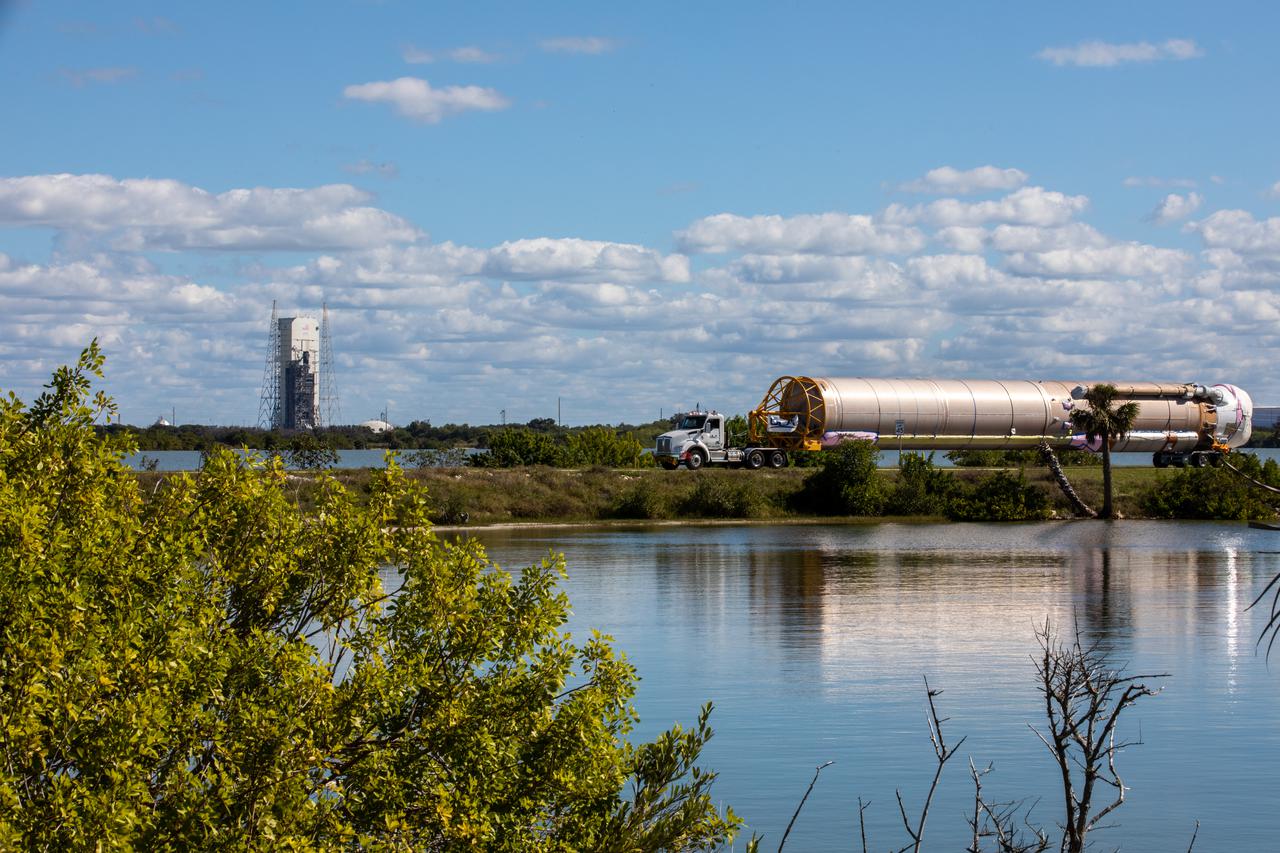
The United Launch Alliance (ULA) first stage of the Atlas V 541 rocket is transported to the horizontal processing facility at Space Launch Complex 41 at Cape Canaveral Space Force Station (CCSFS) in Florida on Nov. 16, 2021, after arriving on the company’s transport boat. The ship journeyed from ULA’s manufacturing plant in Decatur, Alabama, to deliver the rocket that will launch NASA and the National Oceanic Atmospheric Administration’s (NOAA) Geostationary Operational Environmental Satellite T (GOES-T). GOES-T is the third satellite in the GOES-R series that will continue to help meteorologists observe and predict local weather events that affect public safety. GOES-T is scheduled to launch from Space Launch Complex 41 at CCSFS on March 1, 2022. The launch is being managed by NASA’s Launch Services Program based at Kennedy Space Center, America’s multi-user spaceport.
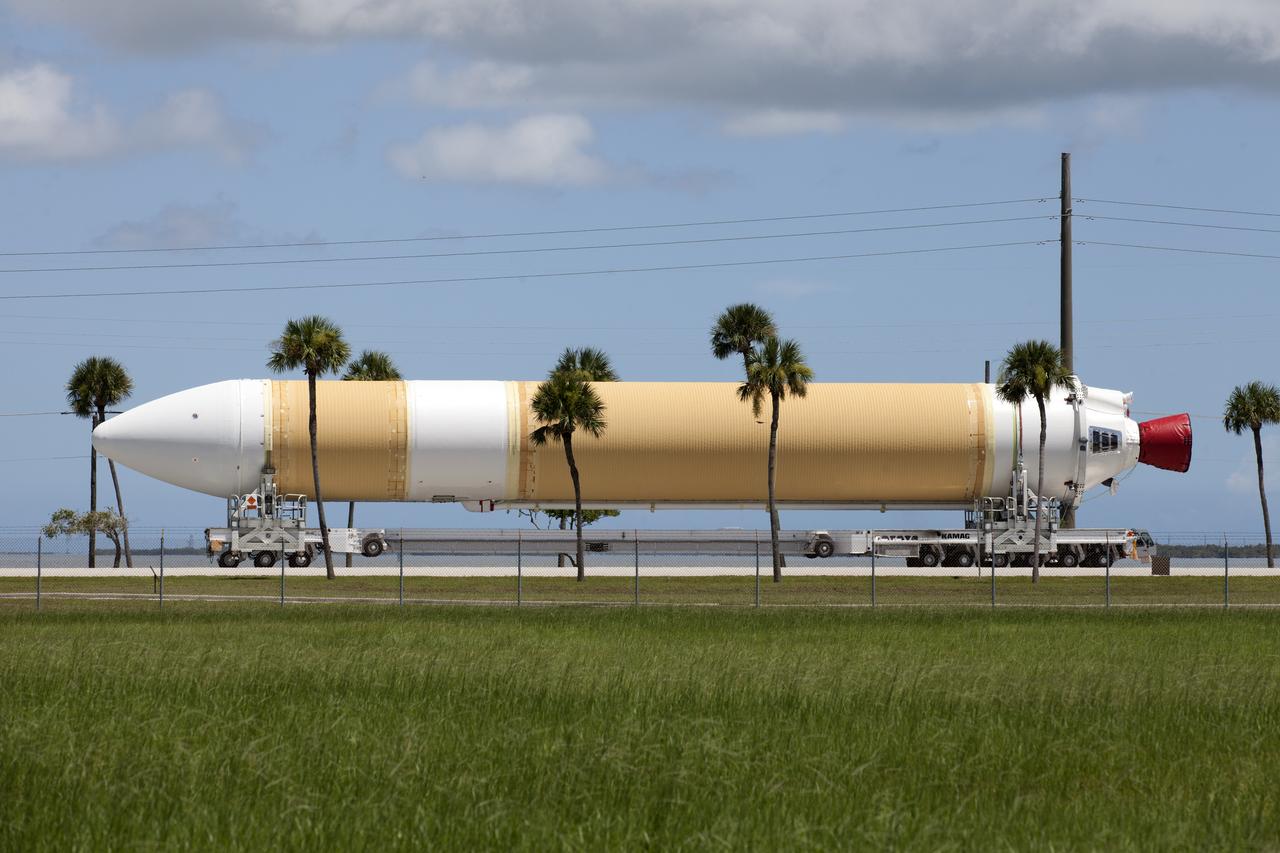
Framed by a series of cabbage palms, a United Launch Alliance Delta IV Heavy common booster core is transported by truck to Cape Canaveral Air Force Station's Launch Complex 37 Horizontal Processing Facility after arriving at Port Canaveral. The Delta IV Heavy will launch NASA's upcoming Parker Solar Probe mission. The mission will perform the closest-ever observations of a star when it travels through the Sun's atmosphere, called the corona. The probe will rely on measurements and imaging to revolutionize our understanding of the corona and the Sun-Earth connection. Liftoff atop the Delta IV Heavy rocket is scheduled to take place from Cape Canaveral's Space Launch Complex 37 in summer 2018.
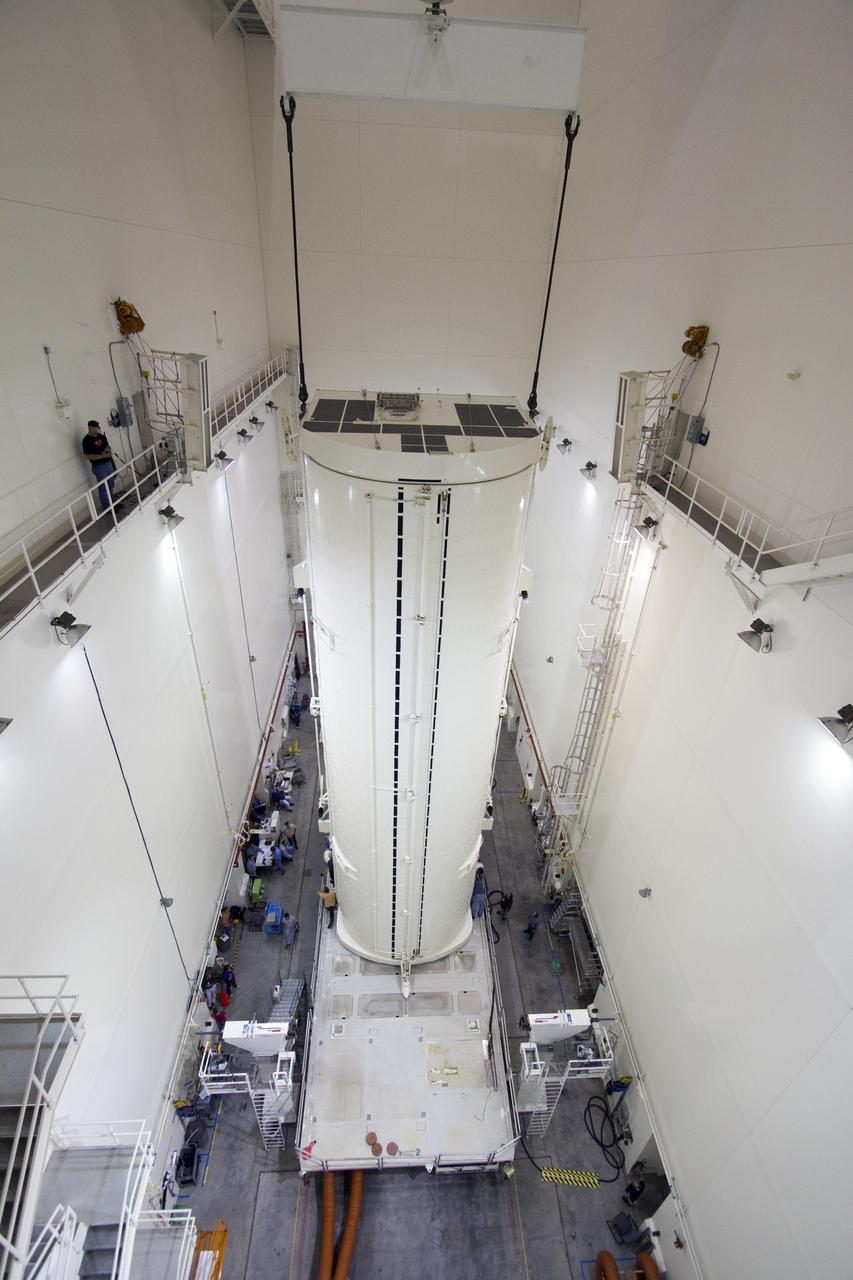
CAPE CANAVERAL, Fla. -- After being rotated from a horizontal to vertical position, the canister that contains the Alpha Magnetic Spectrometer-2 AMS and Express Logistics Carrier-3 for space shuttle Endeavour's STS-134 mission is lowered to its transportation vehicle in the Canister Rotation Facility at NASA's Kennedy Space Center in Florida. Endeavour and its six-member STS-134 crew are targeted to lift off April 19 at 7:48 p.m. EDT to deliver the payload to the International Space Station. For more information visit, www.nasa.gov/mission_pages/shuttle/shuttlemissions/sts134/index.html. Photo credit: NASA/Jack Pfaller
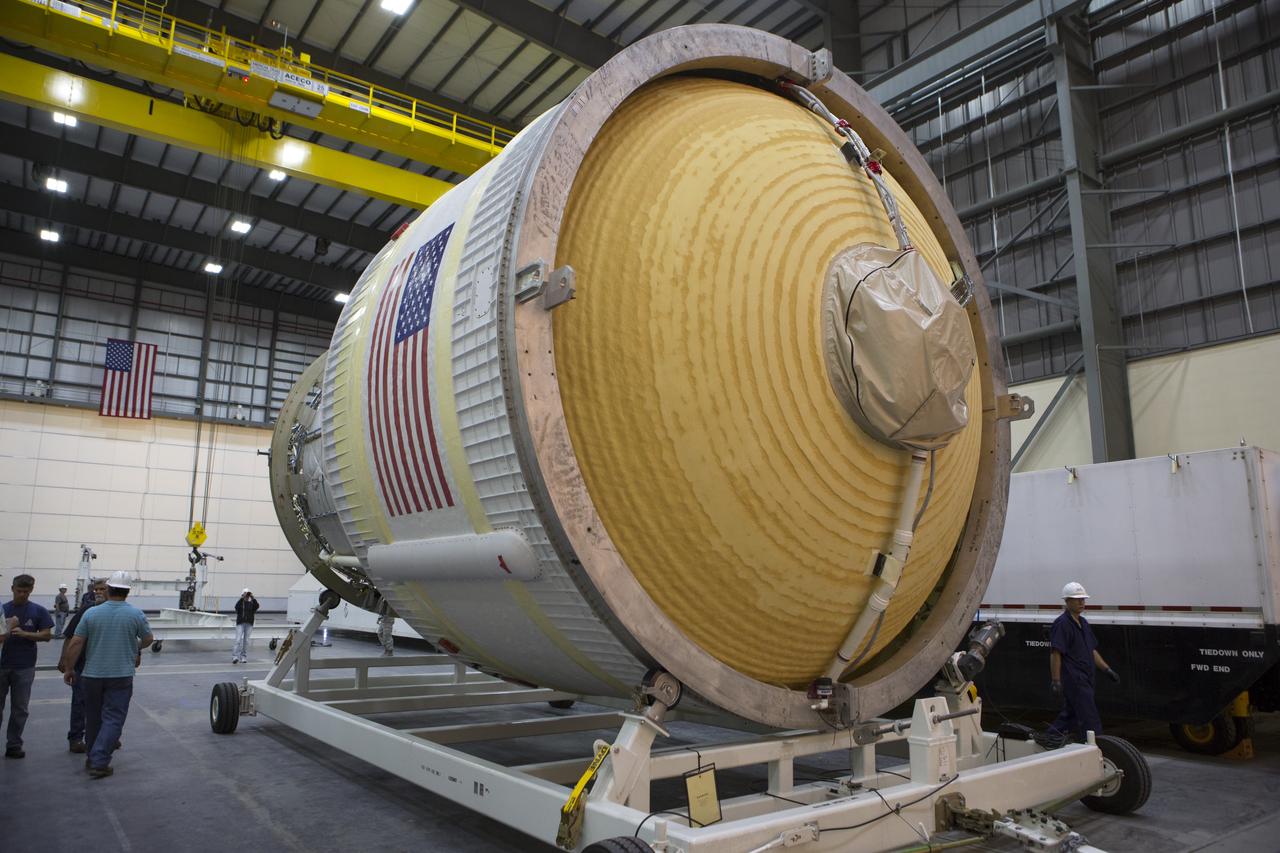
Inside the United Launch Alliance (ULA) Horizontal Integration Facility at Cape Canaveral Air Force Station in Florida, the Interim Cryogenic Propulsion Stage (ICPS) for NASA's Space Launch System rocket is secured on a movable transport stand. The ICPS is the first integrated piece of flight hardware to arrive for the SLS. The ICPS arrived from the ULA facility in Decatur, Alabama. The ICPS is the in-space stage that is located toward the top of the rocket, between the Launch Vehicle Stage Adapter and the Orion Spacecraft Adapter. It will provide some of the in-space propulsion during Orion's first flight test atop the SLS on Exploration Mission 1.
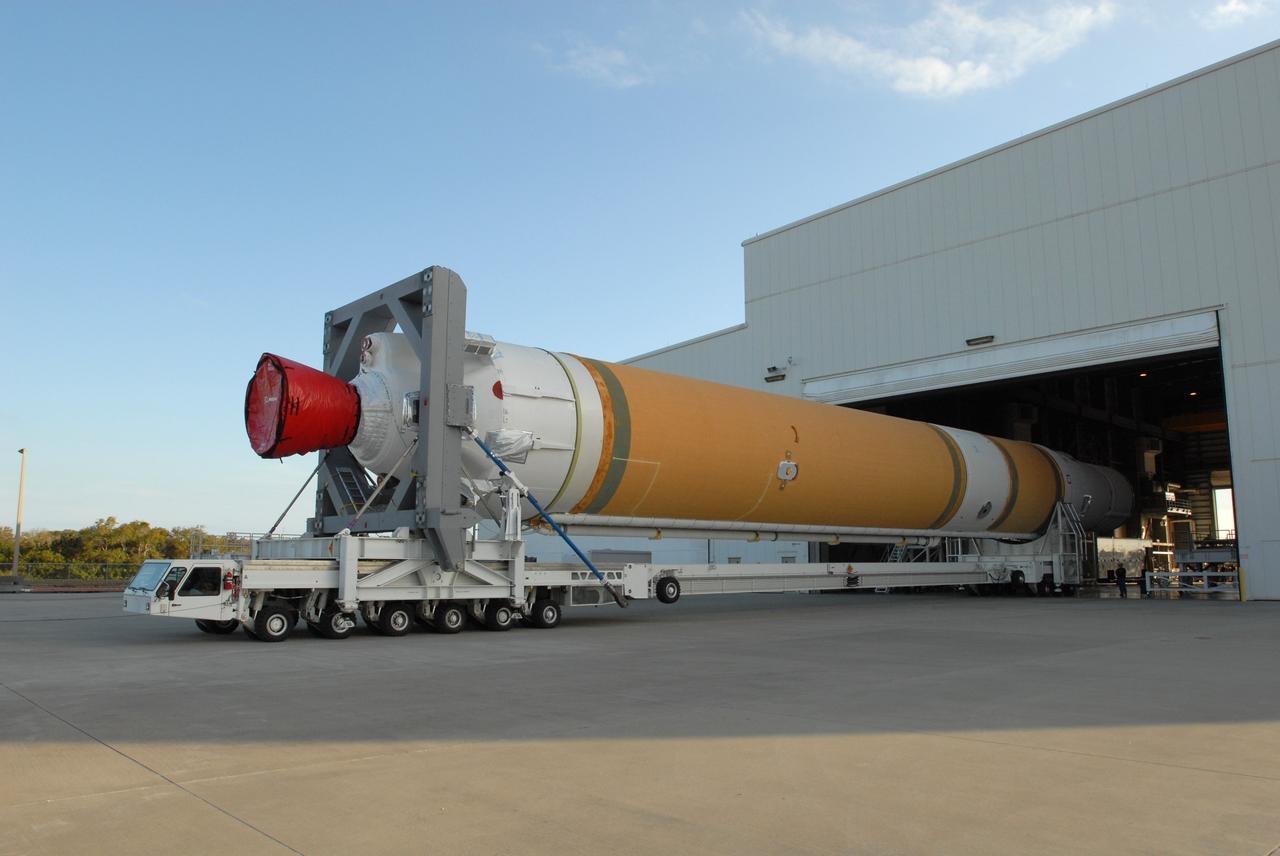
CAPE CANAVERAL, Fla. – On Complex 37 at Cape Canaveral Air Force Station in Florida, the GOES-O and Delta IV second stage begin rolling out of the Horizontal Integration Facility aboard a transporter. They will be moved to the launch pad. GOES–O is one of a series of Geostationary Operational Environmental Satellites. The multi-mission GOES series N-P will be a vital contributor to weather, solar and space operations and science. NASA and the National Oceanic and Atmospheric Administration, or NOAA, are actively engaged in a cooperative program to expand the existing GOES system with the launch of the GOES N-P satellites. Launch of the GOES-O is targeted for no earlier than April 2009. Photo credit: NASA/Jim Grossmann
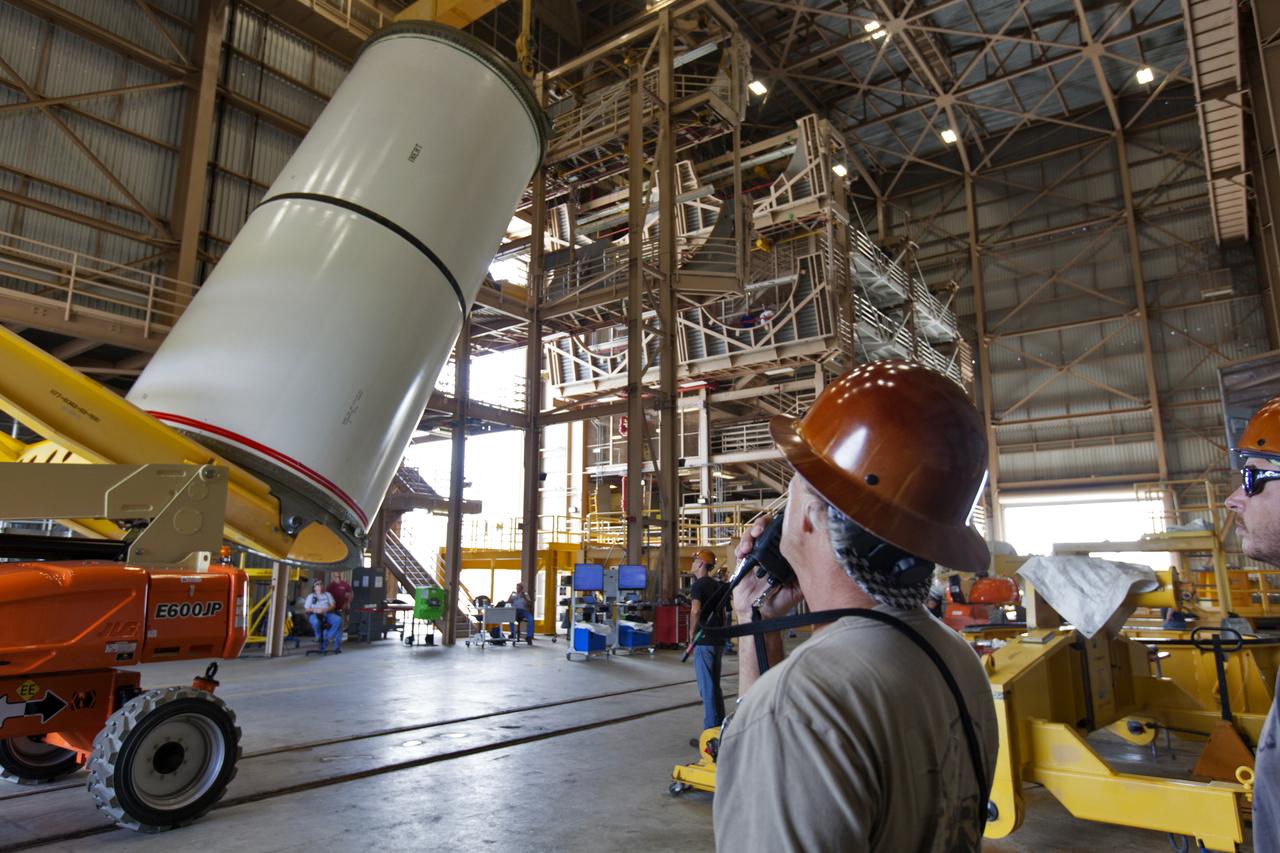
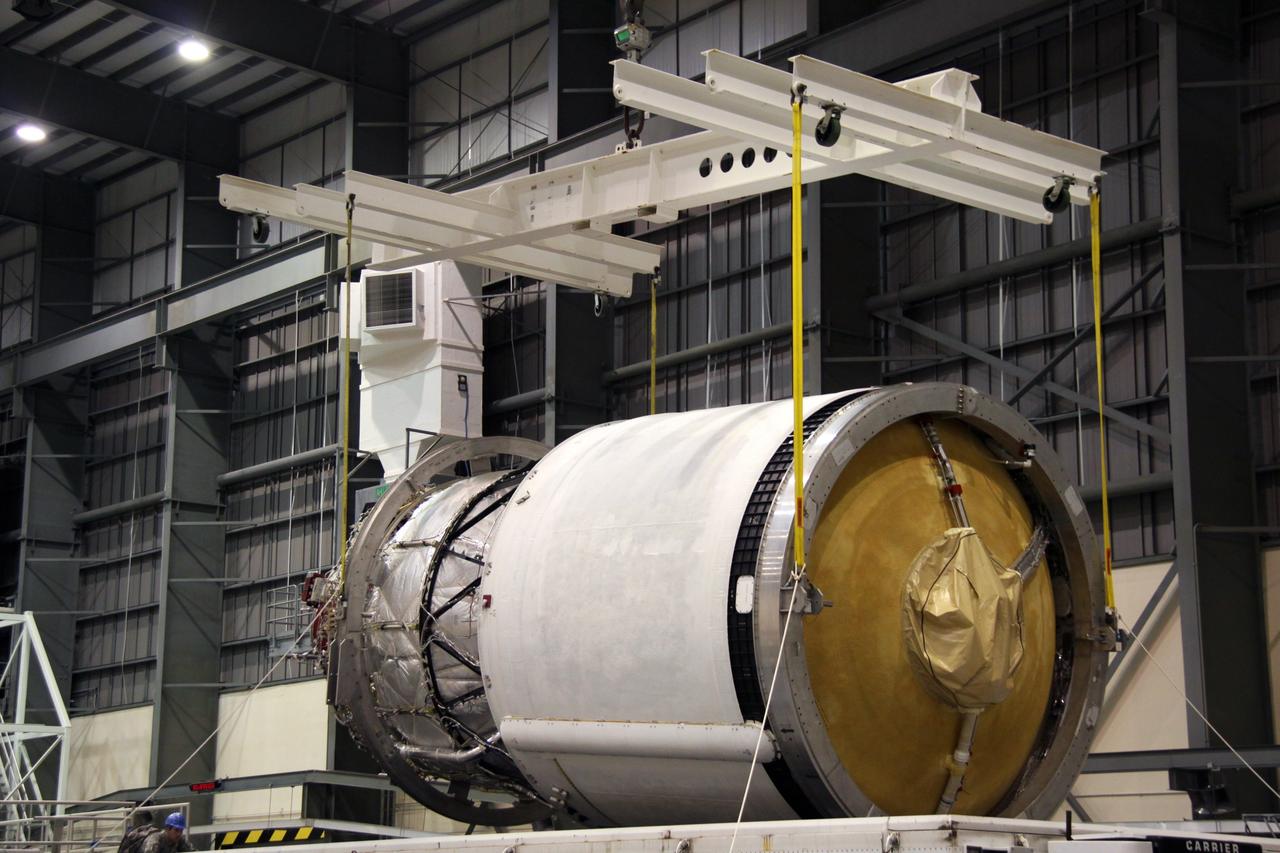
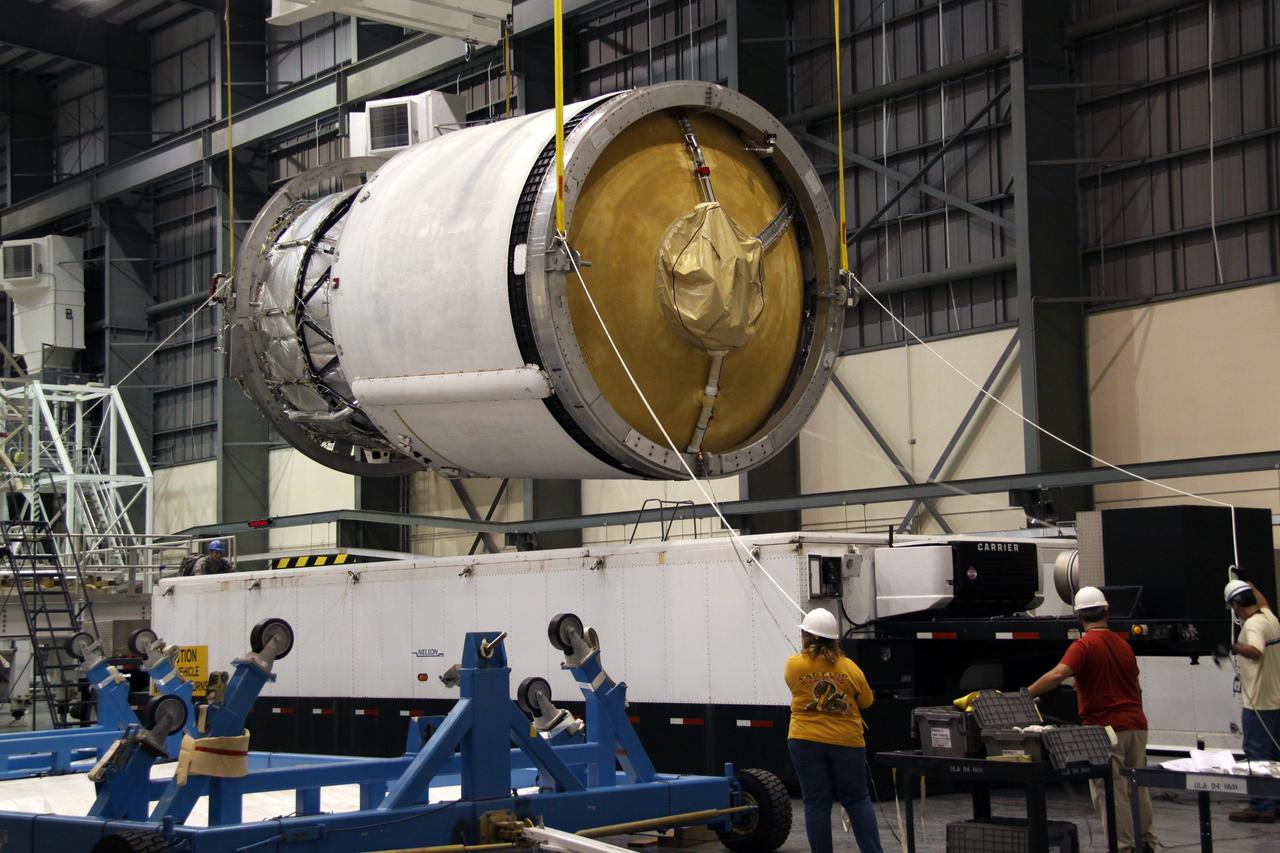
Jacobs technicians, on the Test and Operations Support Contract, practice crane operations with an inert booster rocket segment in the Rotation, Processing and Surge Facility on June 22, 2018, at NASA's Kennedy Space Center in Florida. Dual cranes are being used to move the segment from vertical to horizontal, a maneuver known as a "breakover rotation." As part of routine processing operations for the agency's Space Launch System (SLS) rocket, the RPSF team will receive all of the solid rocket fuel segments for inspection and preparation prior to transporting them to the Vehicle Assembly Building for stacking on the mobile launcher. Many pathfinding operations are being done to prepare for launch of the SLS and Orion spacecraft on Exploration Mission-1 and deep space missions.
CAPE CANAVERAL, Fla. – The second stage of a Delta IV is lifted from its transporter in the Horizontal Integration Facility at Launch Complex 37 on Cape Canaveral Air Force Station in Florida. This United Launch Alliance Delta IV rocket is the vehicle slated to launch GOES-P, the latest Geostationary Operational Environmental Satellite developed by NASA for the National Oceanic and Atmospheric Administration, or NOAA. Processing of the Delta IV is on track for launch, targeted for March 4, 2010. For information on GOES-P, visit http://goespoes.gsfc.nasa.gov/goes/spacecraft/n_p_spacecraft.html. Photo credit: NASA/Jack Pfaller
CAPE CANAVERAL, Fla. – Workers stabilize the second stage of a Delta IV as it is lifted by crane from its transporter in the Horizontal Integration Facility at Launch Complex 37 on Cape Canaveral Air Force Station in Florida. This United Launch Alliance Delta IV rocket is the vehicle slated to launch GOES-P, the latest Geostationary Operational Environmental Satellite developed by NASA for the National Oceanic and Atmospheric Administration, or NOAA. Processing of the Delta IV is on track for launch, targeted for March 4, 2010. For information on GOES-P, visit http://goespoes.gsfc.nasa.gov/goes/spacecraft/n_p_spacecraft.html. Photo credit: NASA/Jack Pfaller
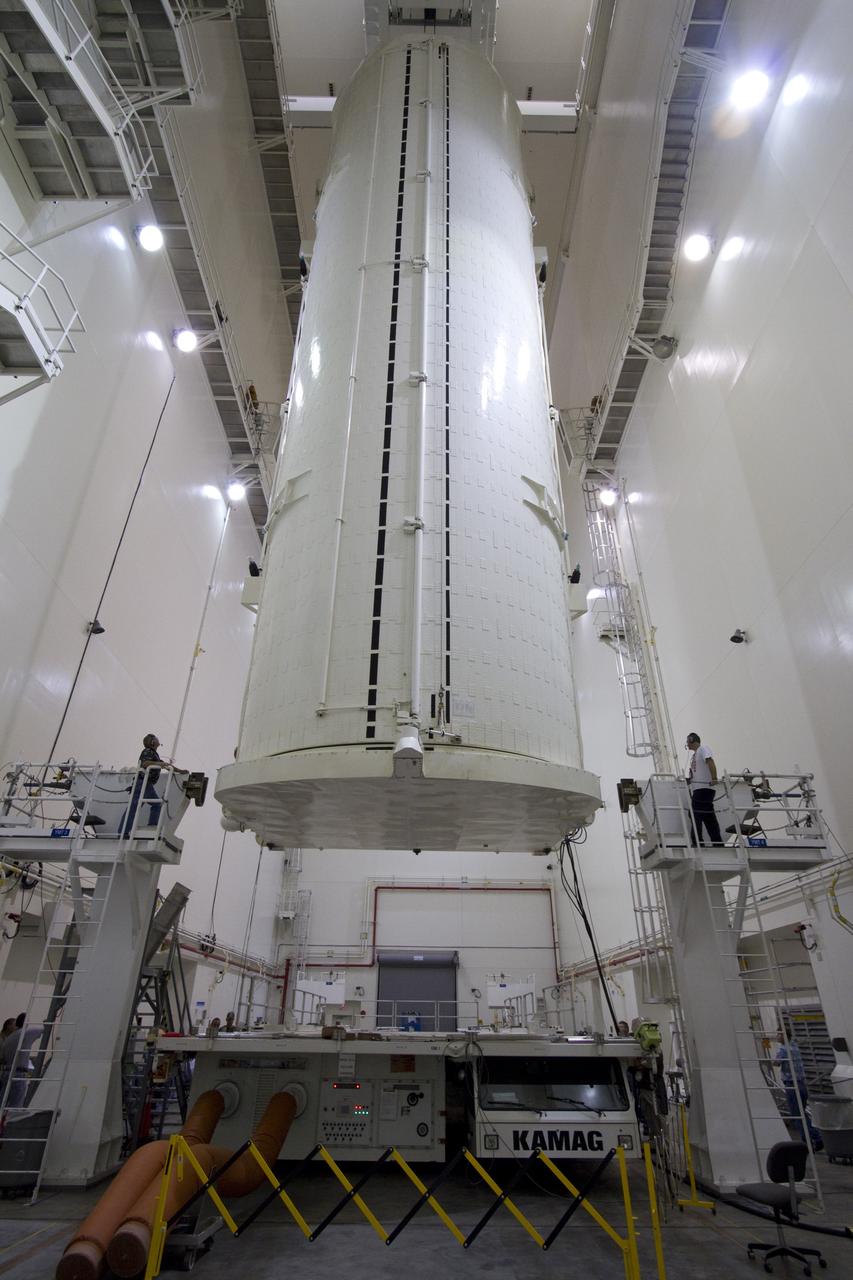
CAPE CANAVERAL, Fla. -- After being rotated from a horizontal to vertical position, the canister that contains the Alpha Magnetic Spectrometer-2 AMS and Express Logistics Carrier-3 for space shuttle Endeavour's STS-134 mission is lowered to its transportation vehicle in the Canister Rotation Facility at NASA's Kennedy Space Center in Florida. Endeavour and its six-member STS-134 crew are targeted to lift off April 19 at 7:48 p.m. EDT to deliver the payload to the International Space Station. For more information visit, www.nasa.gov/mission_pages/shuttle/shuttlemissions/sts134/index.html. Photo credit: NASA/Jack Pfaller
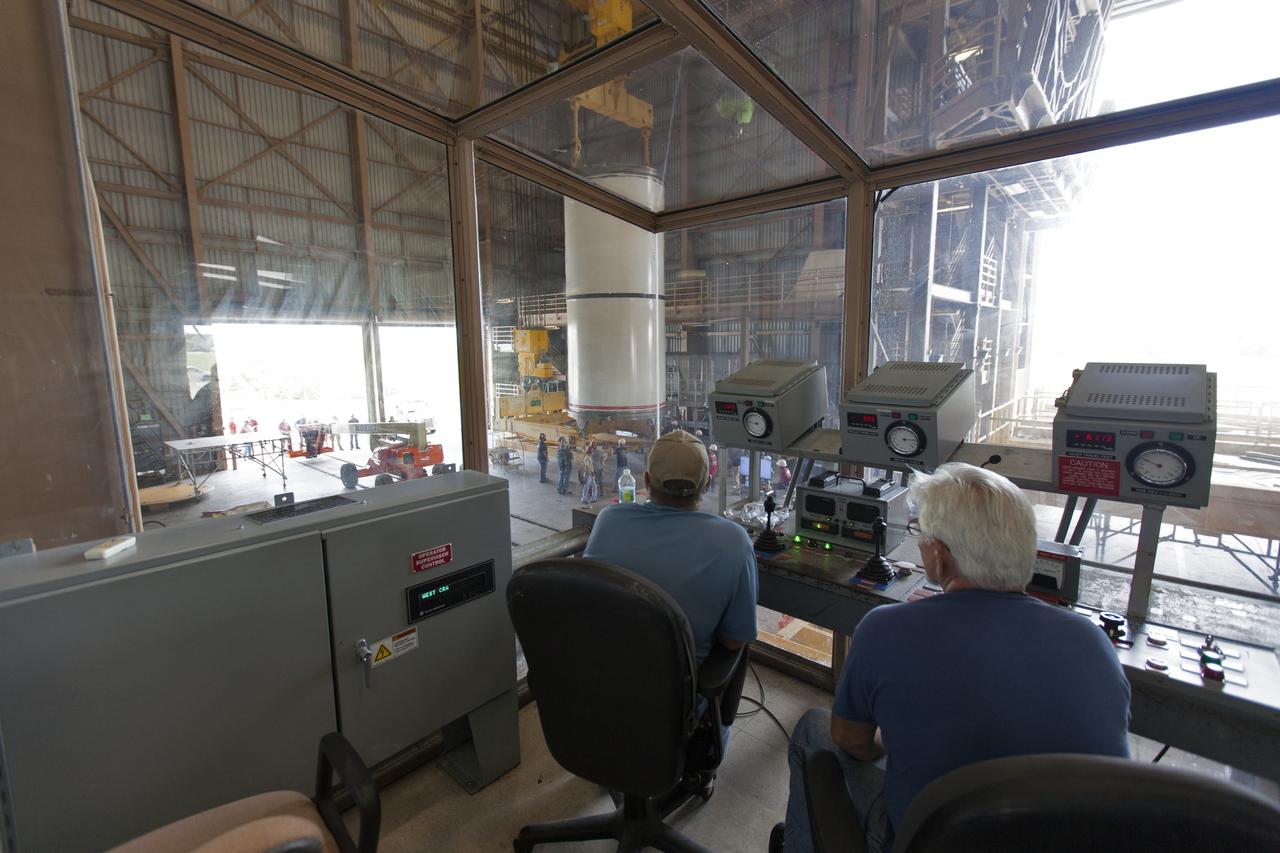
Jacobs technicians, on the Test and Operations Support Contract, practice crane operations with an inert booster rocket segment in the Rotation, Processing and Surge Facility on June 22, 2018, at NASA's Kennedy Space Center in Florida. Dual cranes are being used to move the segment from vertical to horizontal, a maneuver known as a "breakover rotation." As part of routine processing operations for the agency's Space Launch System (SLS) rocket, the RPSF team will receive all of the solid rocket fuel segments for inspection and preparation prior to transporting them to the Vehicle Assembly Building for stacking on the mobile launcher. Many pathfinding operations are being done to prepare for launch of the SLS and Orion spacecraft on Exploration Mission-1 and deep space missions.

KENNEDY SPACE CENTER, FLA. - Workers in the transfer aisle of the Vehicle Assembly Building prepare to lower the External Tank 118 (ET-118) to a horizontal position before being placed on a transporter. The tank will be transferred to NASA’s Michoud Assembly Facility in New Orleans. The tank is being installed with an improved bipod fitting, which connects the external fuel tank to the Shuttle during launch. The new design, a significant milestone in the effort to return the Shuttle to safe flight, replaces the foam that was used to prevent ice buildup on the tank’s bipod fittings with four rod-shaped heaters. The heaters are being retrofitted on the 11 existing tanks and incorporated into the manufacture of all new tanks.
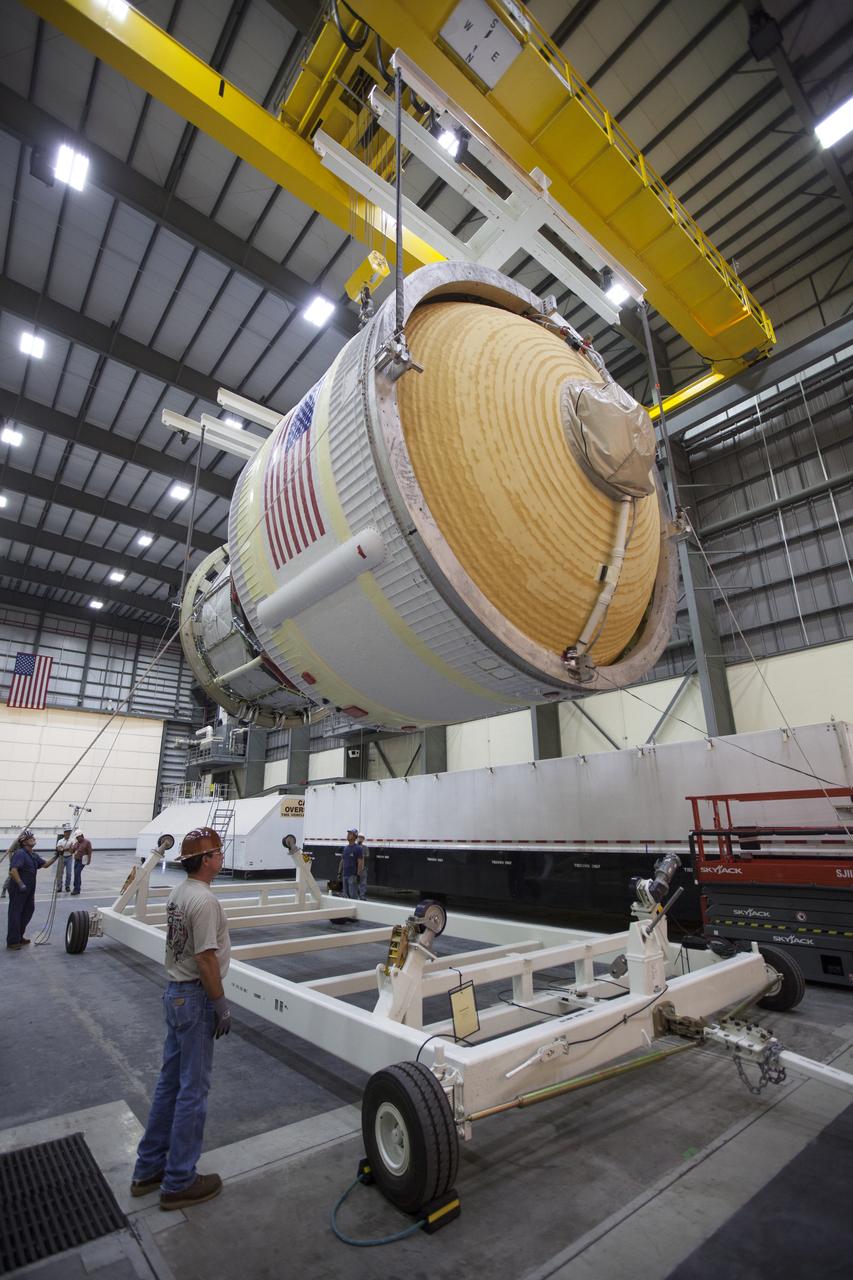
Inside the United Launch Alliance (ULA) Horizontal Integration Facility at Cape Canaveral Air Force Station in Florida, technicians monitor the progress as a crane lowers the Interim Cryogenic Propulsion Stage (ICPS) for NASA's Space Launch System rocket to a movable transport stand. The ICPS is the first integrated piece of flight hardware to arrive for the SLS. The ICPS arrived from the ULA facility in Decatur, Alabama. The ICPS is the in-space stage that is located toward the top of the rocket, between the Launch Vehicle Stage Adapter and the Orion Spacecraft Adapter. It will provide some of the in-space propulsion during Orion's first flight test atop the SLS on Exploration Mission 1.
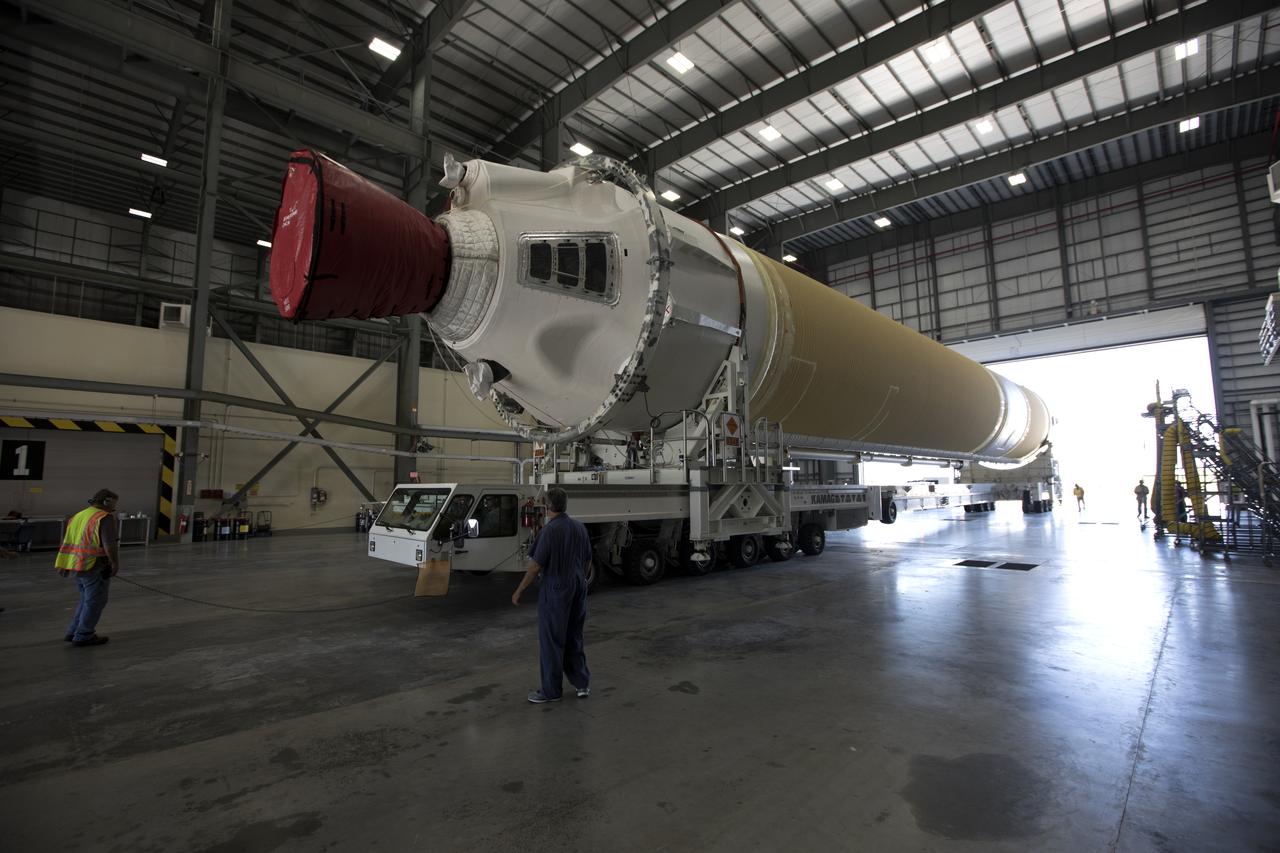
A United Launch Alliance Delta IV Heavy common booster core is transported by truck inside Cape Canaveral Air Force Station's Launch Complex 37 Horizontal Processing Facility. The Delta IV Heavy will launch NASA's upcoming Parker Solar Probe mission. The mission will perform the closest-ever observations of a star when it travels through the Sun's atmosphere, called the corona. The probe will rely on measurements and imaging to revolutionize our understanding of the corona and the Sun-Earth connection. Liftoff atop the Delta IV Heavy rocket is scheduled to take place from Cape Canaveral's Space Launch Complex 37 in summer 2018.
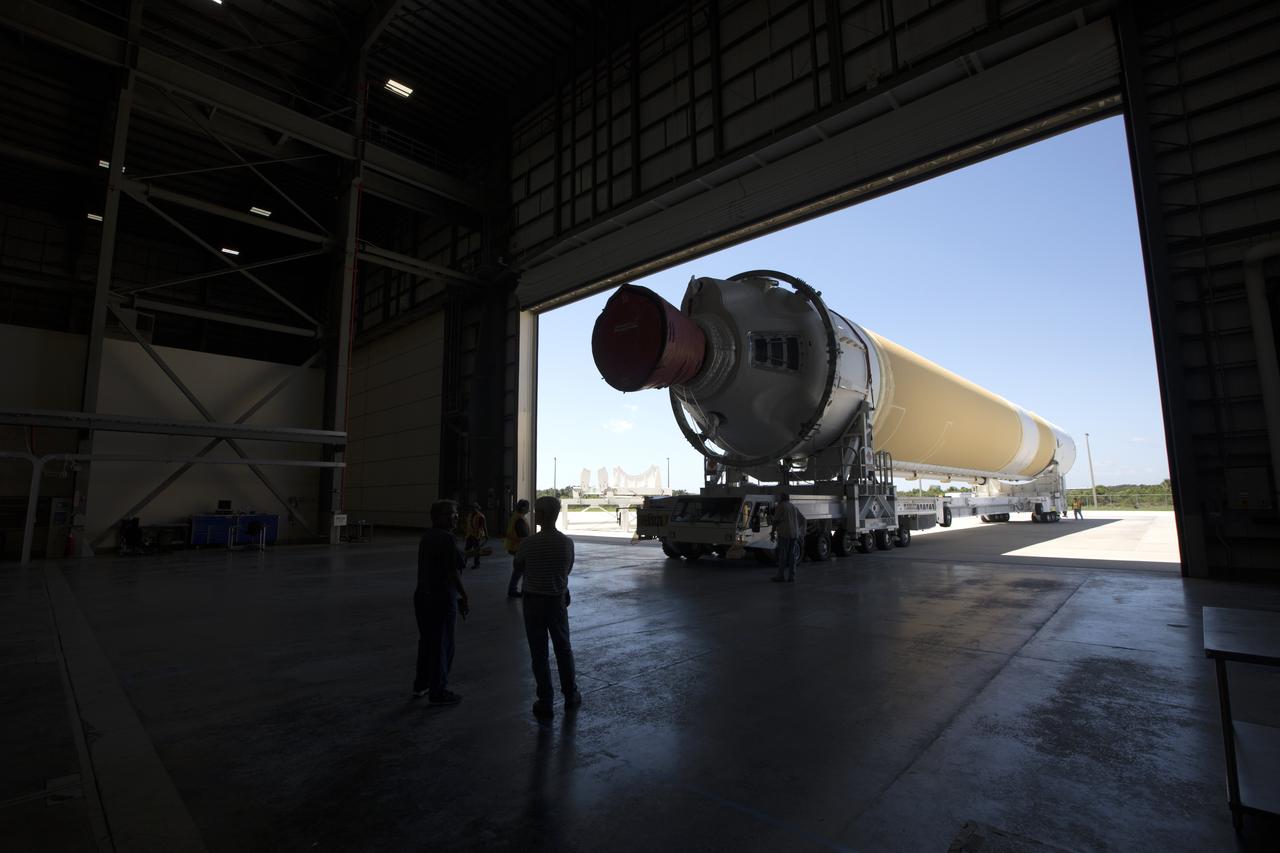
A United Launch Alliance Delta IV Heavy common booster core is transported by truck inside Cape Canaveral Air Force Station's Launch Complex 37 Horizontal Processing Facility. The Delta IV Heavy will launch NASA's upcoming Parker Solar Probe mission. The mission will perform the closest-ever observations of a star when it travels through the Sun's atmosphere, called the corona. The probe will rely on measurements and imaging to revolutionize our understanding of the corona and the Sun-Earth connection. Liftoff atop the Delta IV Heavy rocket is scheduled to take place from Cape Canaveral's Space Launch Complex 37 in summer 2018.

The United Launch Alliance Delta II second stage emerges from NASA's Building 1555 at Vandenberg Air Force Base in California. It will be transported to the horizontal processing facility at Space Launch Complex-2. NASA's Ice, Cloud and land Elevation Satellite-2 (ICESat-2) will launch later this year on the final Delta II rocket. ICESat-2 will measure the height of a changing Earth, one laser pulse at a time, 10,000 laser pulses a second. The satellite will carry a single instrument, the Advanced Topographic Laser Altimeter System. ICESat-2 will help scientists investigate why, and how much our planet's frozen and icy areas, called the cryosphere, is changing in a warming climate.
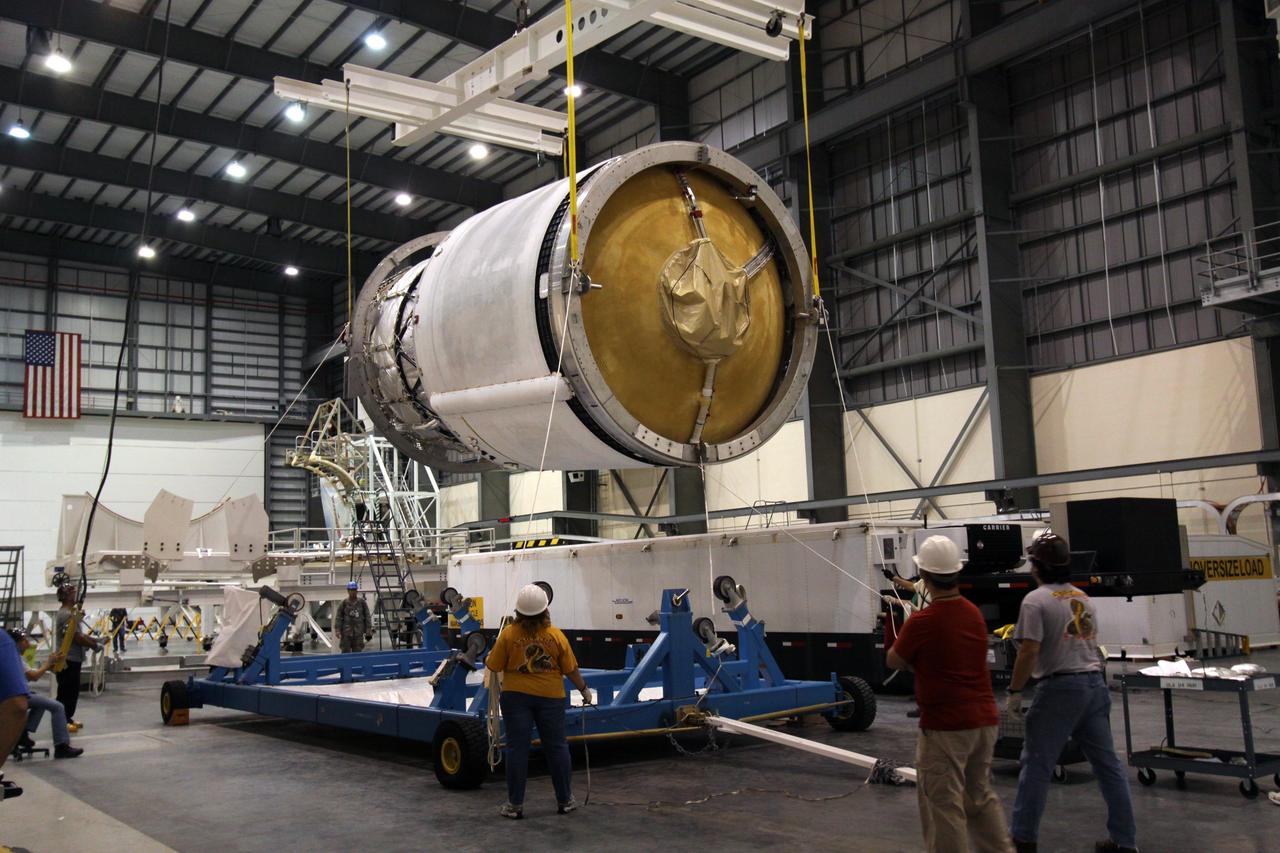
CAPE CANAVERAL, Fla. – Workers move the second stage of a Delta IV from its transporter toward a mobile work stand in the Horizontal Integration Facility at Launch Complex 37 on Cape Canaveral Air Force Station in Florida. This United Launch Alliance Delta IV rocket is the vehicle slated to launch GOES-P, the latest Geostationary Operational Environmental Satellite developed by NASA for the National Oceanic and Atmospheric Administration, or NOAA. Processing of the Delta IV is on track for launch, targeted for March 4, 2010. For information on GOES-P, visit http://goespoes.gsfc.nasa.gov/goes/spacecraft/n_p_spacecraft.html. Photo credit: NASA/Jack Pfaller
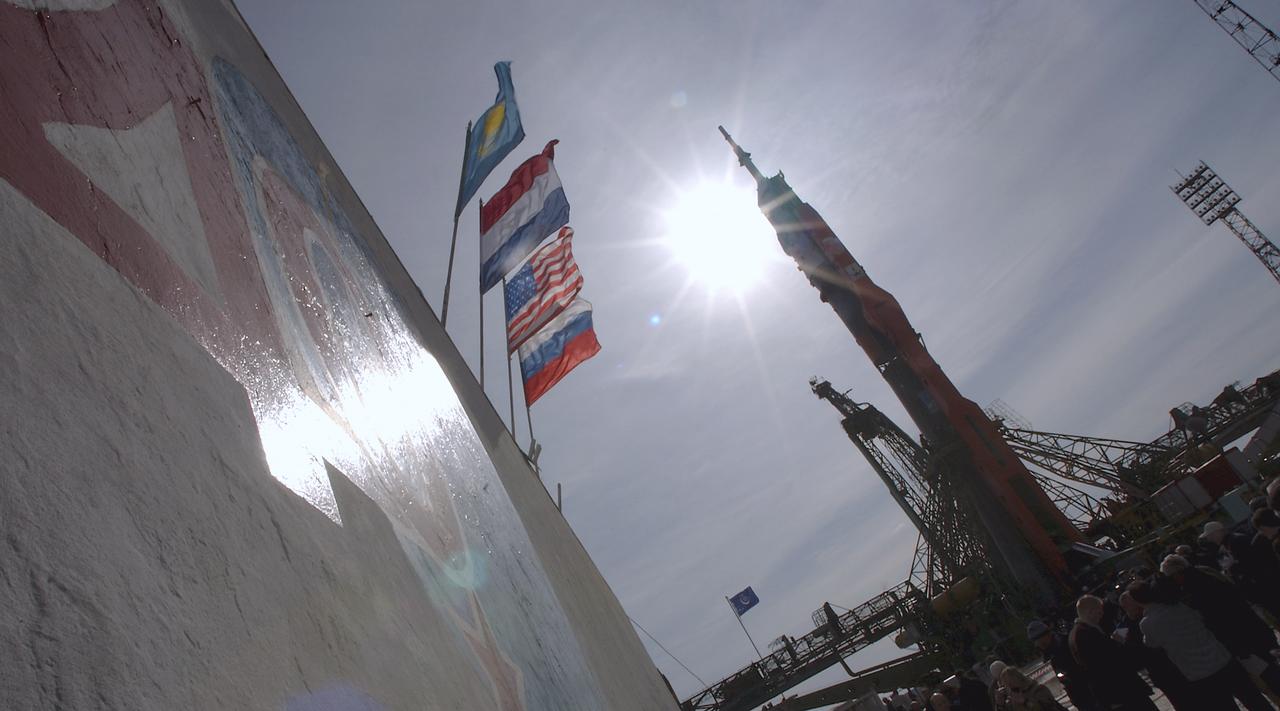
As the flags of Kazakhstan, far left, the Netherlands, second from left, the United States of America and Russia, far right, fly in the stiff breeze, the Soyuz TMA-4 capsule and its booster rocket are raised into position at the launch pad at the Baikonur Cosmodrome on Saturday, April 17, 2004, in Baikonur, Kazakhstan in preparation for the launch of the Expedition 9 crew and a European researcher to the International Space Station on April 19. The Soyuz vehicle is transported to the launch pad horizontally on a railcar from its processing hangar in a process that takes about 2.5 hours to complete. Photo Credit: (NASA/Bill Ingalls)
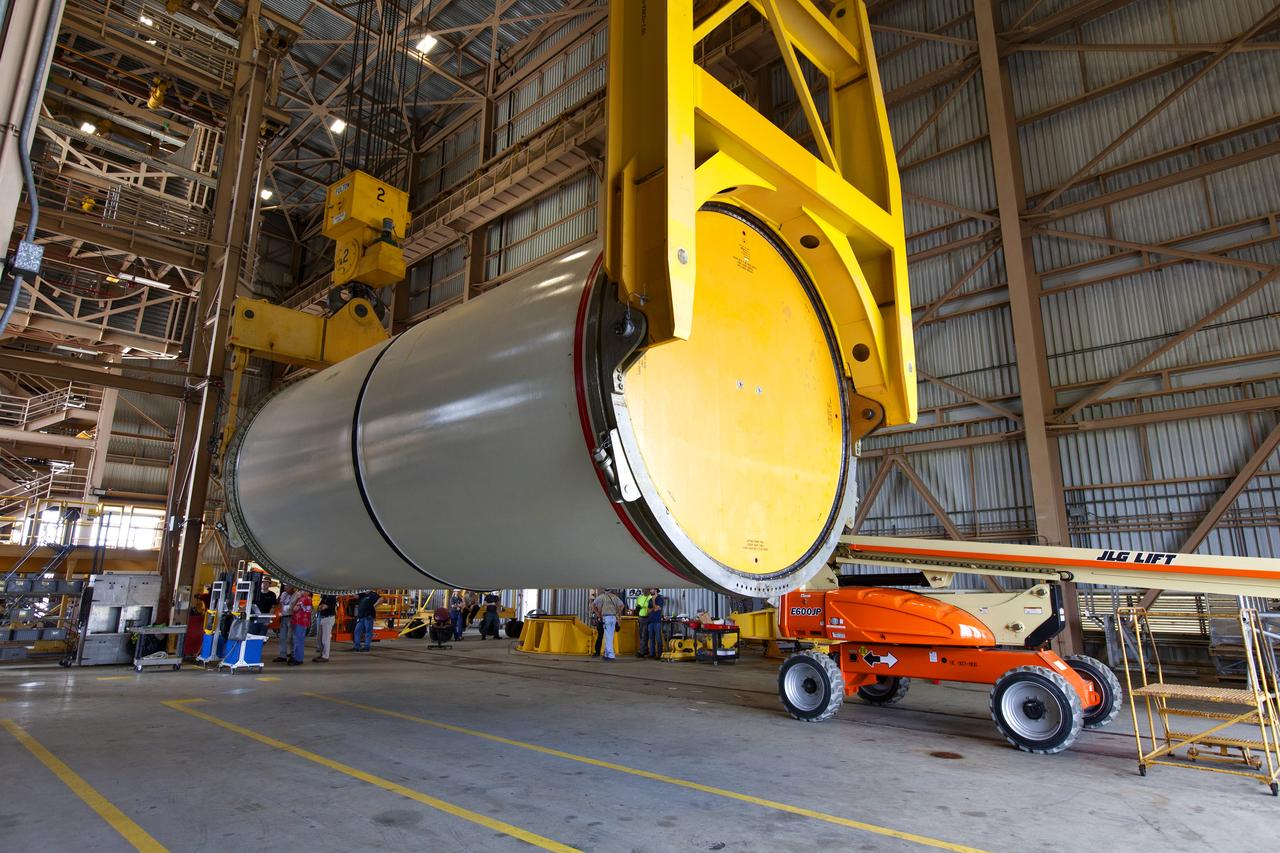
Jacobs technicians, on the Test and Operations Support Contract, practice crane operations with an inert booster rocket segment in the Rotation, Processing and Surge Facility on June 22, 2018, at NASA's Kennedy Space Center in Florida. Dual cranes were used to move the segment from vertical to horizontal, a maneuver known as a "breakover rotation." As part of routine processing operations for the agency's Space Launch System (SLS) rocket, the RPSF team will receive all of the solid rocket fuel segments for inspection and preparation prior to transporting them to the Vehicle Assembly Building for stacking on the mobile launcher. Many pathfinding operations are being done to prepare for launch of the SLS and Orion spacecraft on Exploration Mission-1 and deep space missions.
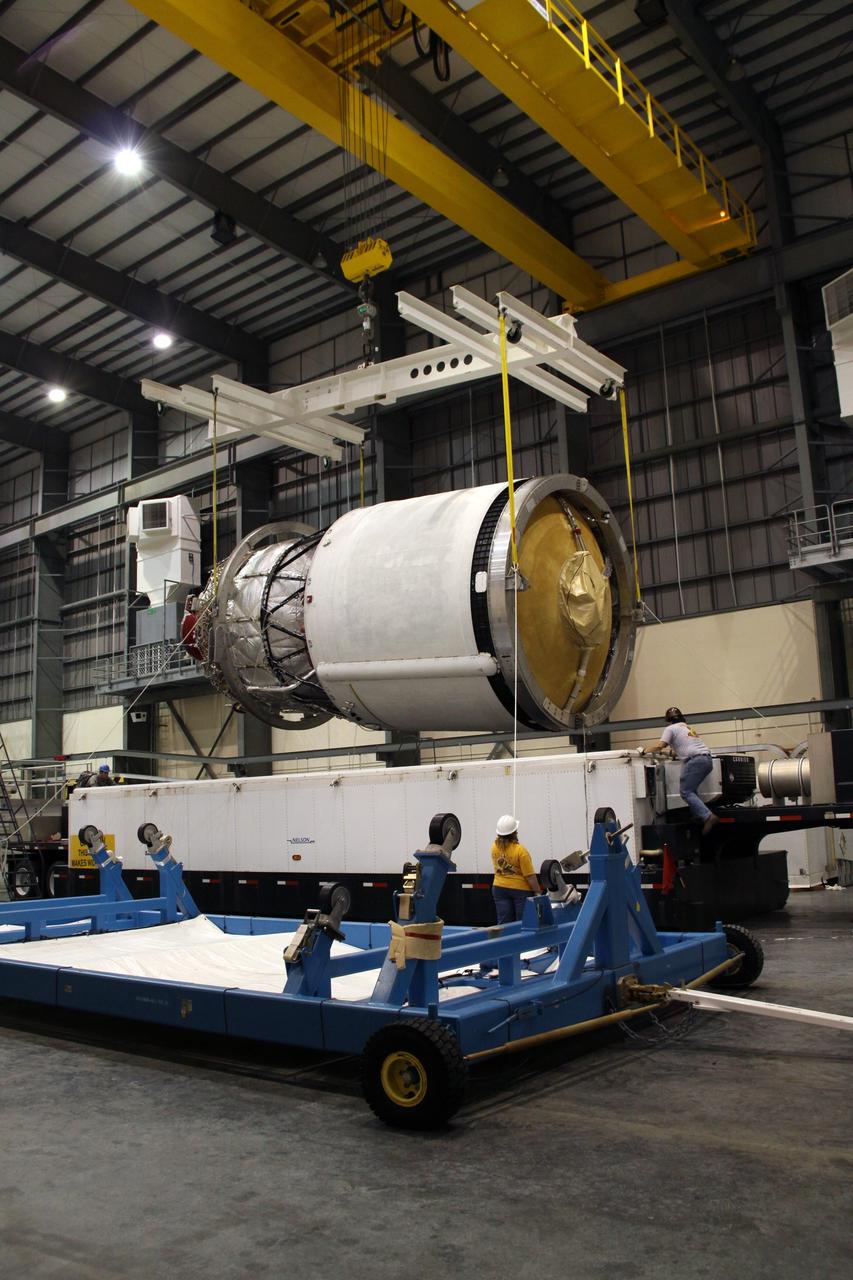
CAPE CANAVERAL, Fla. – The second stage of a Delta IV is suspended over its transporter in the Horizontal Integration Facility at Launch Complex 37 on Cape Canaveral Air Force Station in Florida. This United Launch Alliance Delta IV rocket is the vehicle slated to launch GOES-P, the latest Geostationary Operational Environmental Satellite developed by NASA for the National Oceanic and Atmospheric Administration, or NOAA. Processing of the Delta IV is on track for launch, targeted for March 4, 2010. For information on GOES-P, visit http://goespoes.gsfc.nasa.gov/goes/spacecraft/n_p_spacecraft.html. Photo credit: NASA/Jack Pfaller
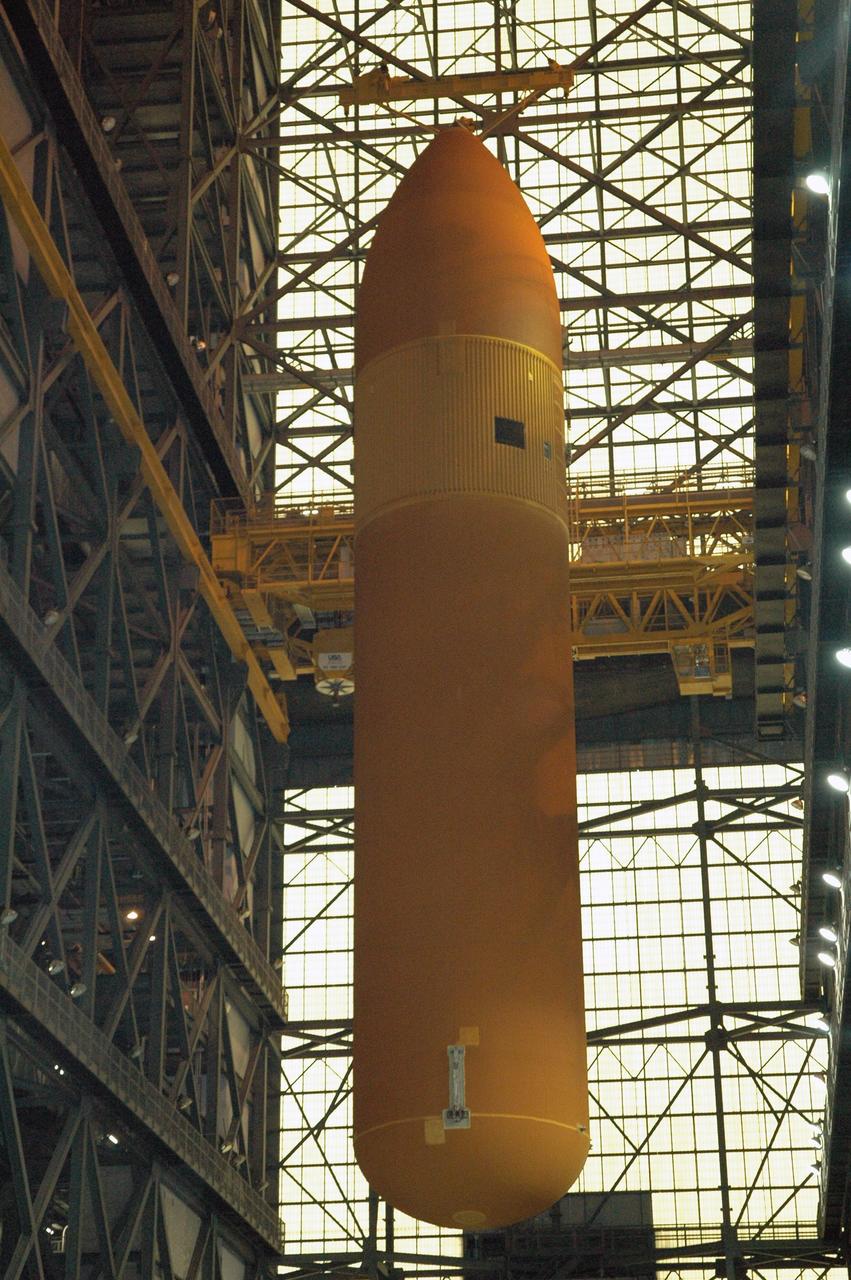
KENNEDY SPACE CENTER, FLA. - This view shows the 154.2-foot-high external tank #120 as it is lowered in the transfer aisle of NASA Kennedy Space Center’s Vehicle Assembly Building. It will be lowered to a horizontal position and placed on a transporter to wait for the return of the Pegasus barge from delivering tank #119 to Louisiana. In a few weeks, tank #120 also will be returned to NASA’s Michoud Assembly Facility in Louisiana for routine testing and maintenance. This tank is the first of the newly designed tanks that were delivered to Kennedy. Previously stacked with Discovery, the tank has already gone through two tanking cycles during tanking tests but was replaced with tank #121 for Discovery’s return to flight mission STS-114
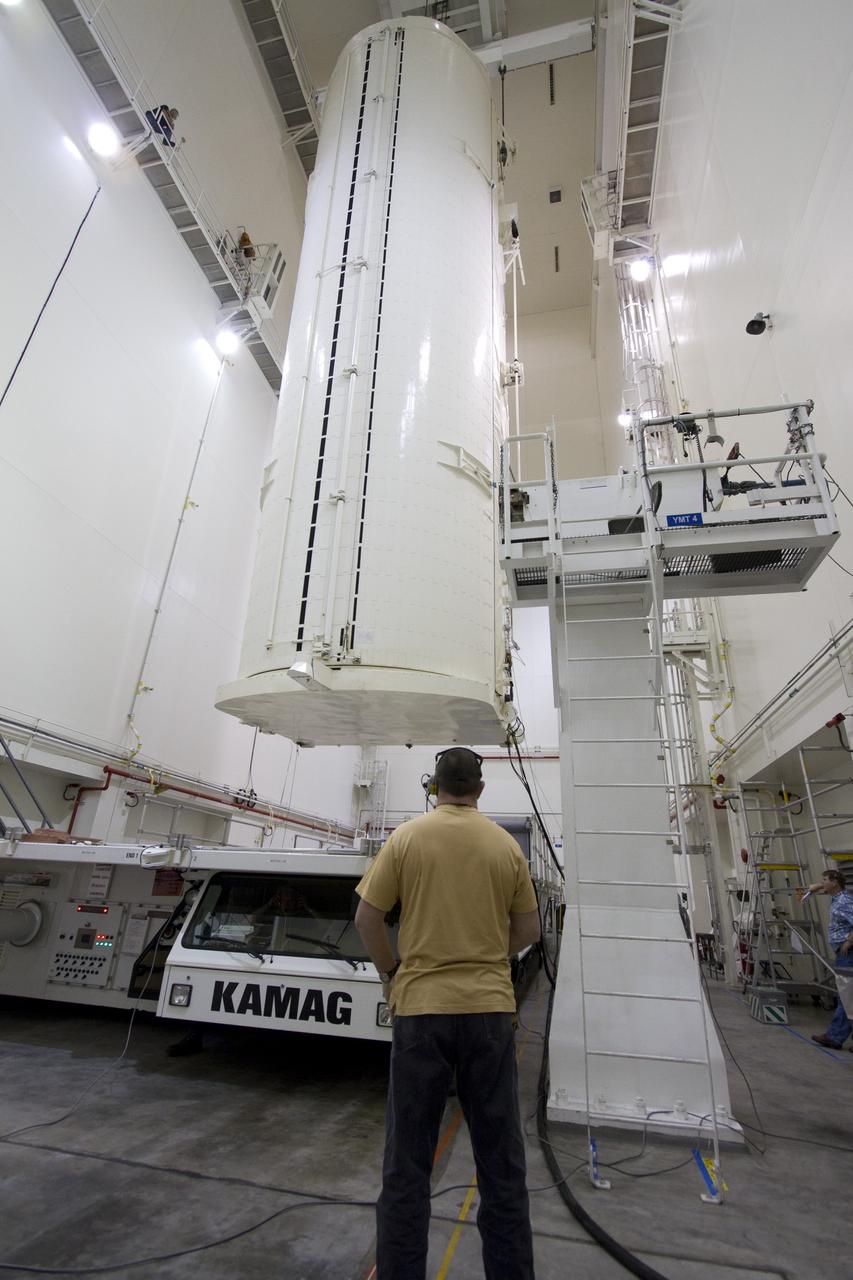
CAPE CANAVERAL, Fla. -- After being rotated from a horizontal to vertical position, the canister that contains the Alpha Magnetic Spectrometer-2 AMS and Express Logistics Carrier-3 for space shuttle Endeavour's STS-134 mission is lowered to its transportation vehicle in the Canister Rotation Facility at NASA's Kennedy Space Center in Florida. Endeavour and its six-member STS-134 crew are targeted to lift off April 19 at 7:48 p.m. EDT to deliver the payload to the International Space Station. For more information visit, www.nasa.gov/mission_pages/shuttle/shuttlemissions/sts134/index.html. Photo credit: NASA/Jack Pfaller
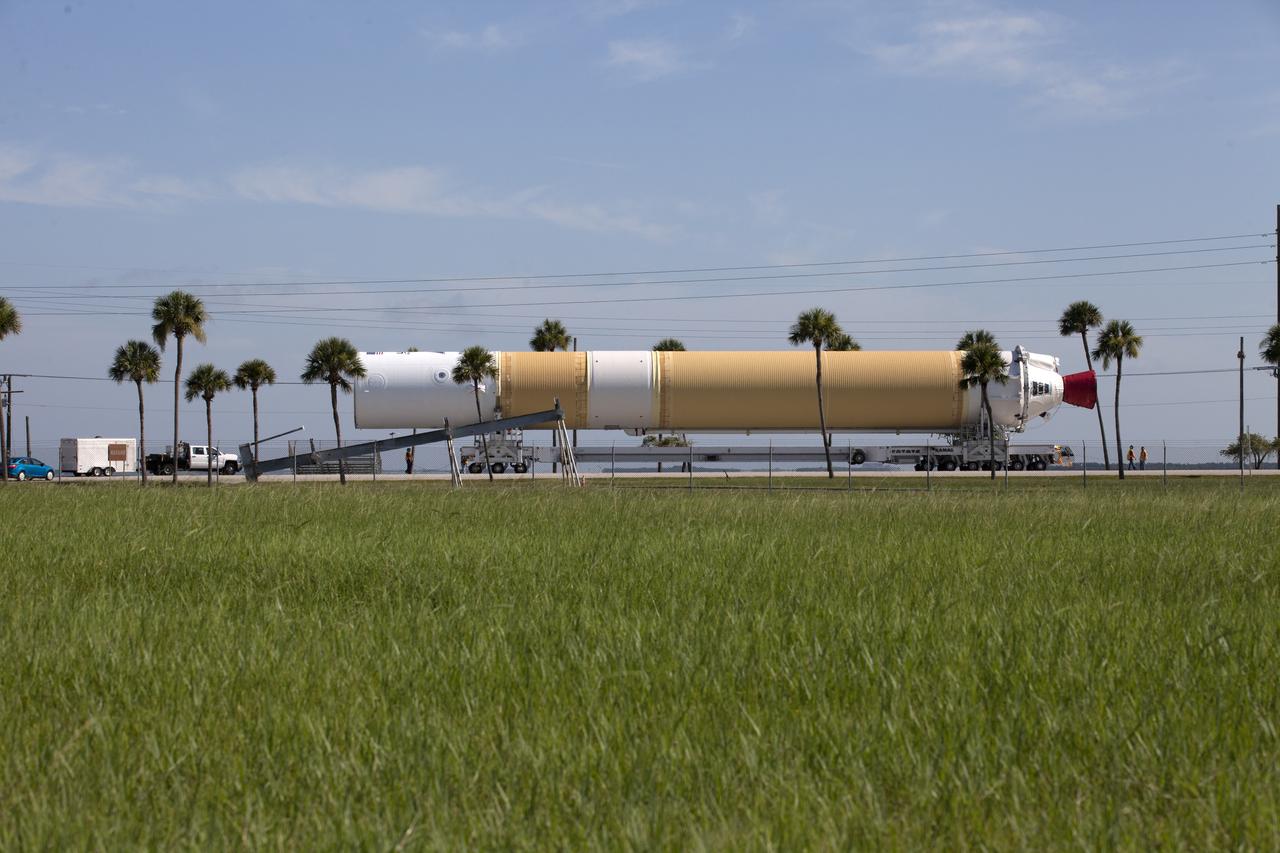
Framed by a series of cabbage palms, a United Launch Alliance Delta IV Heavy common booster core is transported by truck to Cape Canaveral Air Force Station's Launch Complex 37 Horizontal Processing Facility after arriving at Port Canaveral. The Delta IV Heavy will launch NASA's upcoming Parker Solar Probe mission. The mission will perform the closest-ever observations of a star when it travels through the Sun's atmosphere, called the corona. The probe will rely on measurements and imaging to revolutionize our understanding of the corona and the Sun-Earth connection. Liftoff atop the Delta IV Heavy rocket is scheduled to take place from Cape Canaveral's Space Launch Complex 37 in summer 2018.

The Mariner barge is docked at Cape Canaveral Air Force Station in Florida, with the first integrated piece of flight hardware for NASA's Space Launch System (SLS) rocket, the Interim Cryogenic Propulsion Stage (ICPS) inside, at right. The ICPS was shipped from the United Launch Alliance (ULA) facility in Decatur, Alabama. The ICPS will be offloaded and transported to the ULA Horizontal Integration Facility where it will be removed from its flight case. The ICPS is the in-space stage that is located toward the top of the rocket, between the Launch Vehicle Stage Adapter and the Orion Spacecraft Adapter. It will provide some of the in-space propulsion during Orion's first flight test atop the SLS on Exploration Mission 1.
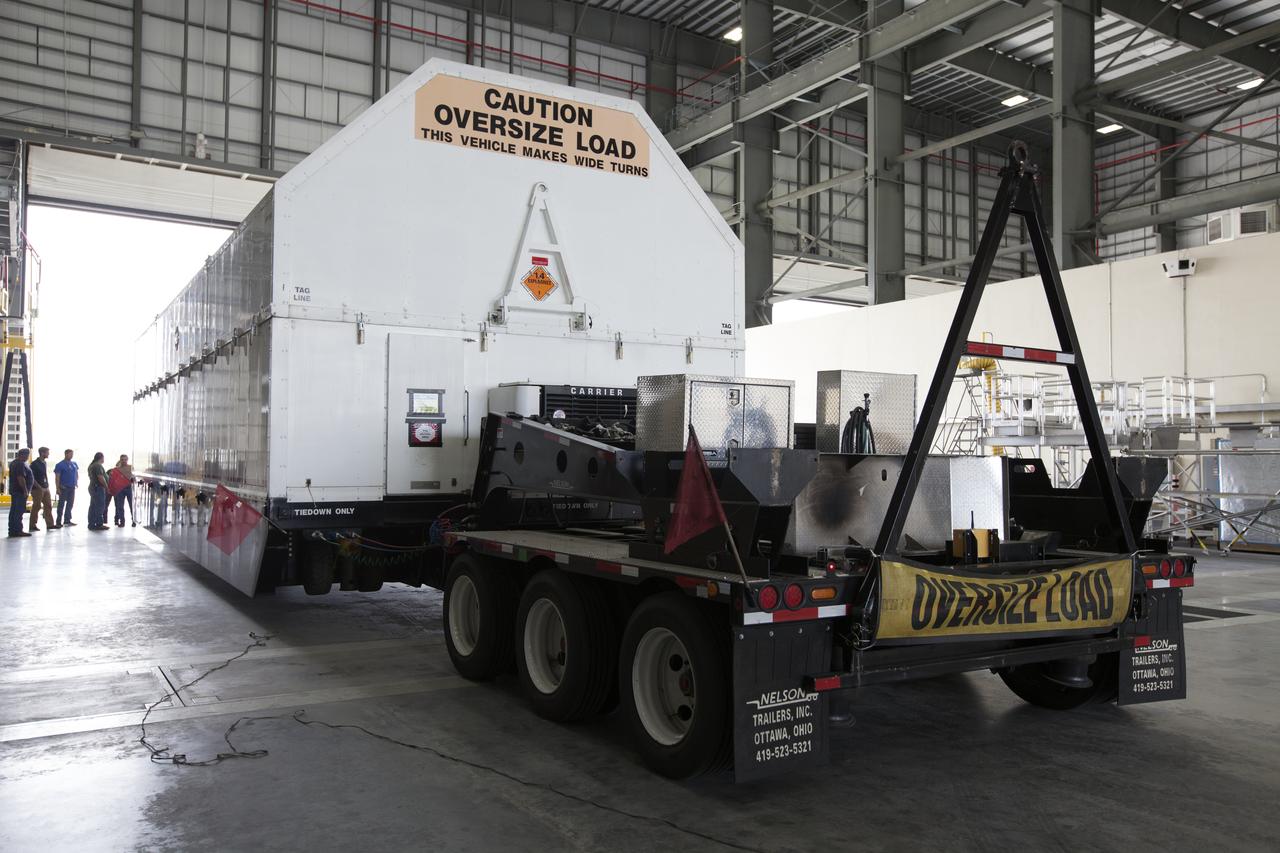
The first integrated piece of flight hardware for NASA's Space Launch System (SLS) rocket, the Interim Cryogenic Propulsion Stage (ICPS) was offloaded from the Mariner barge at Cape Canaveral Air Force Station in Florida, and transported to the United Launch Alliance (ULA) Horizontal Integration Facility where it will be removed from its flight case. The ICPS was shipped from the United Launch Alliance (ULA) facility in Decatur, Alabama. The ICPS is the in-space stage that is located toward the top of the rocket, between the Launch Vehicle Stage Adapter and the Orion Spacecraft Adapter. It will provide some of the in-space propulsion during Orion's first flight test atop the SLS on Exploration Mission 1.
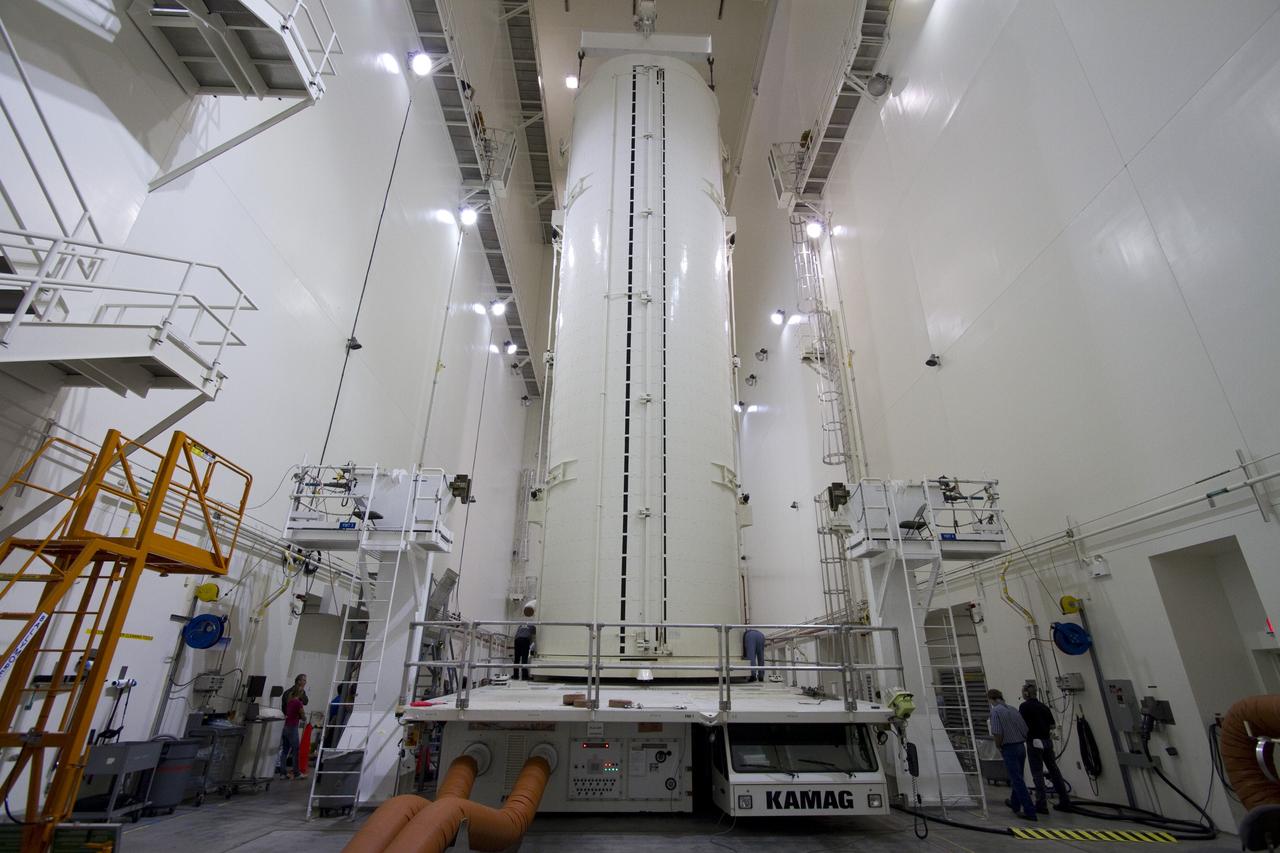
CAPE CANAVERAL, Fla. -- After being rotated from a horizontal to vertical position, the canister that contains the Alpha Magnetic Spectrometer-2 AMS and Express Logistics Carrier-3 for space shuttle Endeavour's STS-134 mission is lowered to its transportation vehicle in the Canister Rotation Facility at NASA's Kennedy Space Center in Florida. Endeavour and its six-member STS-134 crew are targeted to lift off April 19 at 7:48 p.m. EDT to deliver the payload to the International Space Station. For more information visit, www.nasa.gov/mission_pages/shuttle/shuttlemissions/sts134/index.html. Photo credit: NASA/Jack Pfaller