
Several hundred never before seen galaxies are visible in this deepest-ever view of the universe, called the Hubble Deep Field, made with NASA Hubble Space Telescope.

Hubble Sharpest View Of Mars

Hubble Observes Surface of Titan

Hubble Tracks Jupiter Storms

Hubble Images Reveal Jupiter Auroras

Hubble Captures A Full Rotation Of Mars

Rare Hubble Portrait of Io and Jupiter

A Closer Hubble Encounter With Mars - Tharsis

A Closer Hubble Encounter With Mars - Elysium

Hubble Gallery of Jupiter Galilean Satellites

Hubble Observes a New Saturn Storm

Hubble Images of Comet Hale-Bopp

Hubble Views Ancient Storm in the Atmosphere of Jupiter - Montage

The smudge of stars at the center of this NASA/ESA Hubble Space Telescope image is a galaxy known as UGC 5797. UGC 5797 is an emission line galaxy, meaning that it is currently undergoing active star formation. The result is a stellar population that is constantly being refurbished as massive bright blue stars form. Galaxies with prolific star formation are not only veiled in a blue tint, but are key to the continuation of a stellar cycle. In this image UGC 5797 appears in front of a background of spiral galaxies. Spiral galaxies have copious amounts of dust and gas — the main ingredient for stars — and therefore often also belong to the class of emission line galaxies. Spiral galaxies have disk-like shapes that drastically vary in appearance depending on the angle at which they are observed. The collection of spiral galaxies in this frame exhibits this attribute acutely: Some are viewed face-on, revealing the structure of the spiral arms, while the two in the bottom left are seen edge-on, appearing as plain streaks in the sky. There are many spiral galaxies, with varying colors and at different angles, sprinkled across this image — just take a look. Credit: ESA/Hubble & NASA, Acknowledgement: Luca Limatola

The Hubble Space Telescope hovers at the boundary of Earth and space in this picture, taken after Hubble second servicing mission in 1997. Hubble drifts 353 miles (569 km) above the Earth's surface, where it can avoid the atmosphere and clearly see objects in space. http://photojournal.jpl.nasa.gov/catalog/PIA18165

Resembling curling flames from a campfire, a magnificent nebula in a nearby galaxy observed by NASA Hubble Space Telescope provides new insight into the fierce birth of stars as it may have occurred in the early universe.

Springtime on Mars: Hubble Best View of the Red Planet

Saturn from Far and Near Hubble Space Telescope

Hubble Provides Clear Images of Saturn Aurora

Hubble Clicks Images of Io Sweeping Across Jupiter

Hubble Probes Inner Region of Comet Hyakutake

Hubble Views Colossal Polar Cyclone on Mars

A Closer Hubble Encounter With Mars - Syrtis Major

Hubble Captures Volcanic Eruption Plume From Io

A Closer Hubble Encounter With Mars - Pathfinder Landing Site

A Closer Hubble Encounter With Mars - Global View

Hubble Views Saturn Ring-Plane Crossing

Hubble Provides Complete View of Jupiter Auroras

Hubble Space Telescope Resolves Volcanoes on Io

Hubble Discovery Image of New Moon Orbiting Saturn

A Closer Hubble Encounter With Mars - 4 Views

Hubble Discovers Bright New Spot on Io

Hubble again views Saturn Rings Edge-on

Hubble Views the Galileo Probe Entry Site on Jupiter

Astronauts Jeffrey Hoffman and Story Musgrave install the Wide Field and Planetary Camera 2 (WFPC2) on the Hubble Space Telescope, during SM1 in December, 1993. https://photojournal.jpl.nasa.gov/catalog/PIA22911

NASA Hubble Space Telescope peered deep into Uranus atmosphere to see clear and hazy layers created by a mixture of gases. Using infrared filters, Hubble captured detailed features of three layers of Uranus atmosphere.

Hubble Captures Best View of Mars Ever Obtained from Earth

Venus Cloud Tops Viewed by Hubble. This is a NASA Hubble Space Telescope ultraviolet-light image of the planet Venus, taken on January 24 1995, when Venus was at a distance of 70.6 million miles 113.6 million kilometers from Earth.

This NASA Hubble Space Telescope image of the planet Uranus reveals the planet rings and bright clouds and a high altitude haze above the planet south pole.

Astronaut Jeffrey Hoffman removes the Wide Field and Planetary Camera 1 (WFPC 1) during the first Hubble servicing mission (SM1), which took place in December, 1993. https://photojournal.jpl.nasa.gov/catalog/PIA22574

Astronomers using NASA’s Hubble Space Telescope have uncovered surprising new clues about a hefty, rapidly aging star whose behavior has never been seen before in our Milky Way galaxy. In fact, the star is so weird that astronomers have nicknamed it “Nasty 1,” a play on its catalog name of NaSt1. The star may represent a brief transitory stage in the evolution of extremely massive stars. First discovered several decades ago, Nasty 1 was identified as a Wolf-Rayet star, a rapidly evolving star that is much more massive than our sun. The star loses its hydrogen-filled outer layers quickly, exposing its super-hot and extremely bright helium-burning core. But Nasty 1 doesn’t look like a typical Wolf-Rayet star. The astronomers using Hubble had expected to see twin lobes of gas flowing from opposite sides of the star, perhaps similar to those emanating from the massive star Eta Carinae, which is a Wolf-Rayet candidate. Instead, Hubble revealed a pancake-shaped disk of gas encircling the star. The vast disk is nearly 2 trillion miles wide, and may have formed from an unseen companion star that snacked on the outer envelope of the newly formed Wolf-Rayet. Based on current estimates, the nebula surrounding the stars is just a few thousand years old, and as close as 3,000 light-years from Earth. Credits: NASA/Hubble

Hubble Views Ancient Storm in the Atmosphere of Jupiter - April, 1997
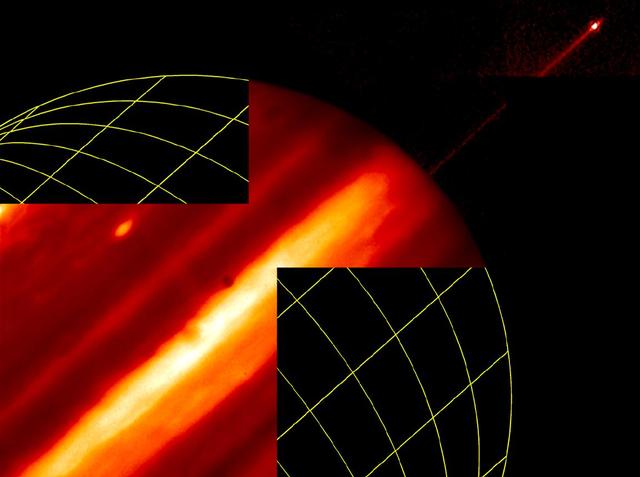
Hubble Provides Infrared View of Jupiter Moon, Ring, and Clouds

Hubble Views Ancient Storm in the Atmosphere of Jupiter - October, 1996

Hubble Views Ancient Storm in the Atmosphere of Jupiter - June, 1999

Jupiter Upper Atmospheric Winds Revealed in Ultraviolet Images by Hubble Telescope

Hubble Views Saturn Ring-Plane Crossing Satellites Labeled

Hubble Views Ancient Storm in the Atmosphere of Jupiter - May, 1992

Hubble Views Ancient Storm in the Atmosphere of Jupiter - July, 1994

Hubble Views Ancient Storm in the Atmosphere of Jupiter - February, 1995

Hubble Views Ancient Storm in the Atmosphere of Jupiter - Full Disk

Hubble Views Ancient Storm in the Atmosphere of Jupiter - August, 1994

Hubble Views Ancient Storm in the Atmosphere of Jupiter - October, 1995

Hubble Watches the Red Planet as Mars Global Surveyor Begins Aerobraking

If you love Hubble as much as we do you will LOVE this video. Sit back and enjoy 25 mesmerizing years of Hubble images! #Hubble25 You can view all of these images on Flickr here: <a href="https://www.flickr.com/photos/40523828@N07/sets/72157649692430461">www.flickr.com/photos/40523828@N07/sets/72157649692430461</a> Credit NASA Goddard

These pictures of comet Tempel 1 were taken by NASA Hubble Space Telescope. They show the comet before and after it ran over NASA Deep Impact probe.

This is a Hubble Space Telescope image of a concentration of stars within the globular cluster NGC 6752. Hidden among the stars is an image of a background galaxy that is much farther away. The diminutive galaxy, named by its discoverers as Bedin 1, measures only around 3,000 light-years at its greatest extent — a fraction of the size of the Milky Way. Not only is it tiny, but it is also incredibly faint. These properties led astronomers to classify it as a dwarf spheroidal galaxy that is as old as the universe. More info: https://go.nasa.gov/2tCaxGS Credits: NASA, ESA and L. Bedin (Astronomical Observatory of Padua, Italy)

This NASA Hubble Space Telescope image of the planet Uranus reveals the planet rings, at least five of the inner moons, and bright clouds in the planet southern hemisphere.

Taken in 1997, NASA Hubble Space Telescope, using visible light, detected clouds in the northern hemisphere of Uranus.

Hubble Sees Material Ejected From Comet Hale-Bopp
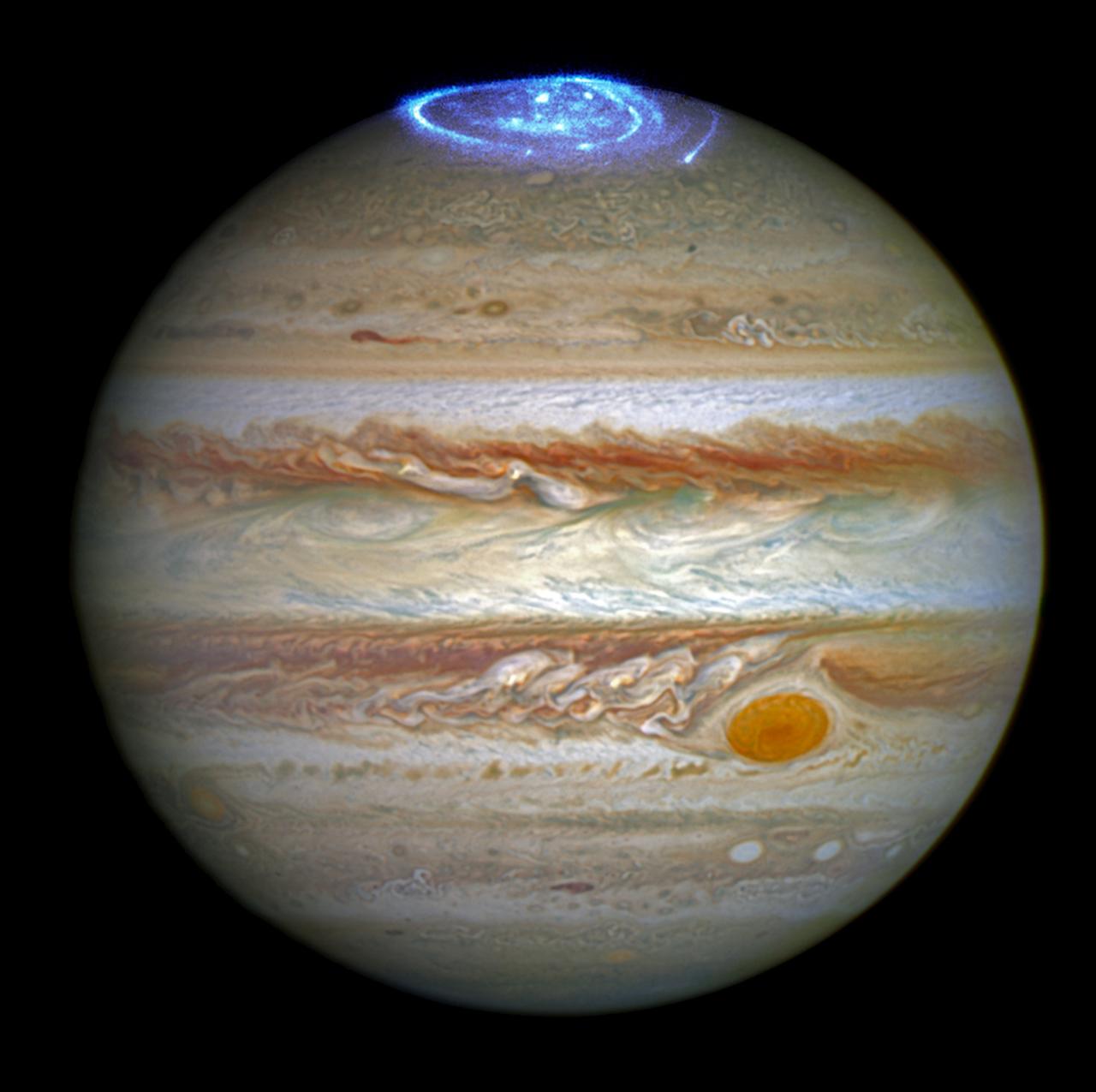
Astronomers are using the NASA/ESA Hubble Space Telescope to study auroras — stunning light shows in a planet’s atmosphere — on the poles of the largest planet in the solar system, Jupiter. This observation program is supported by measurements made by NASA’s Juno spacecraft, currently on its way to Jupiter. Jupiter, the largest planet in the solar system, is best known for its colorful storms, the most famous being the Great Red Spot. Now astronomers have focused on another beautiful feature of the planet, using Hubble's ultraviolet capabilities. The extraordinary vivid glows shown in the new observations are known as auroras. They are created when high-energy particles enter a planet’s atmosphere near its magnetic poles and collide with atoms of gas. As well as producing beautiful images, this program aims to determine how various components of Jupiter’s auroras respond to different conditions in the solar wind, a stream of charged particles ejected from the sun. This observation program is perfectly timed as NASA’s Juno spacecraft is currently in the solar wind near Jupiter and will enter the orbit of the planet in early July 2016. While Hubble is observing and measuring the auroras on Jupiter, Juno is measuring the properties of the solar wind itself; a perfect collaboration between a telescope and a space probe. “These auroras are very dramatic and among the most active I have ever seen”, said Jonathan Nichols from the University of Leicester, U.K., and principal investigator of the study. “It almost seems as if Jupiter is throwing a firework party for the imminent arrival of Juno.” Credits: NASA, ESA, and J. Nichols (University of Leicester)

This is the clearest view yet of the distant planet Pluto and its moon, Charon, as revealed by NASA Hubble Space Telescope. The image was taken by the European Space Agency Faint Object Camera on February 21, 1994.

These three NASA Hubble Space Telescope images of the planet Uranus reveal the motion of a pair of bright clouds in the planet southern hemisphere, and a high altitude haze that forms a cap above the planet south pole.

Taking its first peek at Uranus, NASA Hubble Space Telescope Near Infrared Camera and Multi-Object Spectrometer NICMOS detected six distinct clouds in images taken July 28,1997.

Lying at the southern edge of the rich Virgo cluster of galaxies, Messier 104, also called the Sombrero galaxy, is one of the most famous objects in the sky in this image from NASA Hubble Space Telescope.

Hubble’s Spirograph In this classic Hubble image from 2000, the planetary nebula IC 418 glows like a multifaceted jewel with enigmatic patterns. IC 418 lies about 2,000 light-years from Earth in the direction of the constellation Lepus. A planetary nebula represents the final stage in the evolution of a star similar to our sun. The star at the center of IC 418 was a red giant a few thousand years ago, but then ejected its outer layers into space to form the nebula, which has now expanded to a diameter of about 0.1 light-year. The stellar remnant at the center is the hot core of the red giant, from which ultraviolet radiation floods out into the surrounding gas, causing it to fluoresce. Over the next several thousand years, the nebula will gradually disperse into space, and then the star will cool and fade away for billions of years as a white dwarf. Our own sun is expected to undergo a similar fate, but fortunately, this will not occur until some 5 billion years from now. The Hubble image of IC 418 is shown with colors added to represent the different camera filters used that isolate light from various chemical elements. Red shows emission from ionized nitrogen (the coolest gas in the nebula, located furthest from the hot nucleus), green shows emission from hydrogen and blue traces the emission from ionized oxygen (the hottest gas, closest to the central star). The remarkable textures seen in the nebula are newly revealed by the Hubble Space Telescope, and their origin is still uncertain. Read more: <a href="https://go.nasa.gov/2roofKS" rel="nofollow">go.nasa.gov/2roofKS</a> Credit: NASA and The Hubble Heritage Team (STScI/AURA); Acknowledgment: Dr. Raghvendra Sahai (JPL) and Dr. Arsen R. Hajian (USNO)

Using NASA’s Hubble Space Telescope, astronomers have captured for the first time snapshots of fledging white dwarf stars beginning their slow-paced, 40-million-year migration from the crowded center of an ancient star cluster to the less populated suburbs. White dwarfs are the burned-out relics of stars that rapidly lose mass, cool down and shut off their nuclear furnaces. As these glowing carcasses age and shed weight, their orbits begin to expand outward from the star cluster’s packed downtown. This migration is caused by a gravitational tussle among stars inside the cluster. Globular star clusters sort out stars according to their mass, governed by a gravitational billiard ball game where lower mass stars rob momentum from more massive stars. The result is that heavier stars slow down and sink to the cluster's core, while lighter stars pick up speed and move across the cluster to the edge. This process is known as "mass segregation." Until these Hubble observations, astronomers had never definitively seen the dynamical conveyor belt in action. Astronomers used Hubble to watch the white-dwarf exodus in the globular star cluster 47 Tucanae, a dense swarm of hundreds of thousands of stars in our Milky Way galaxy. The cluster resides 16,700 light-years away in the southern constellation Tucana. Credits: NASA, ESA, and H. Richer and J. Heyl (University of British Columbia, Vancouver, Canada); acknowledgement: J. Mack (STScI) and G. Piotto (University of Padova, Italy)

This Hubble telescope snapshot of MyCn18, a young planetary nebula, reveals that the object has an hourglass shape with an intricate pattern of etchings in its walls. A planetary nebula is the glowing relic of a dying, Sun-like star.

This is a color Hubble Space Telescope (HST) heritage image of supernova remnant N49, a neighboring galaxy, that was taken with Hubble's Wide Field Planetary Camera 2. Color filters were used to sample light emitted by sulfur, oxygen, and hydrogen. The color image was superimposed on a black and white image of stars in the same field also taken with Hubble. Resembling a fireworks display, these delicate filaments are actually sheets of debris from a stellar explosion.

Image released 11 Aug 2011. The "Necklace Nebula" is located 15,000 light-years away in the constellation Sagitta (the Arrow). In this composite image, taken on July 2, 2011, Hubble's Wide Field Camera 3 captured the glow of hydrogen (blue), oxygen (green), and nitrogen (red). The object, aptly named the Necklace Nebula, is a recently discovered planetary nebula, the glowing remains of an ordinary, Sun-like star. The nebula consists of a bright ring, measuring 12 trillion miles wide, dotted with dense, bright knots of gas that resemble diamonds in a necklace. <a href="http://www.nasa.gov/mission_pages/hubble/science/necklace-nebula.html" target="_blank" rel="nofollow"></a> <b>Credit:</b> NASA, ESA, and the Hubble Heritage Team (STScI/AURA) <b><a href="http://www.nasa.gov/centers/goddard/home/index.html" rel="nofollow">NASA Goddard Space Flight Center</a></b> enables NASA’s mission through four scientific endeavors: Earth Science, Heliophysics, Solar System Exploration, and Astrophysics. Goddard plays a leading role in NASA’s accomplishments by contributing compelling scientific knowledge to advance the Agency’s mission. <b>Follow us on <a href="http://twitter.com/NASA_GoddardPix" rel="nofollow">Twitter</a></b> <b>Like us on <a href="http://www.facebook.com/pages/Greenbelt-MD/NASA-Goddard/395013845897?ref=tsd" rel="nofollow">Facebook</a></b> <b>Find us on <a href="http://web.stagram.com/n/nasagoddard/?vm=grid" rel="nofollow">Instagram</a></b>

A recent NASA Hubble Space Telescope view reveals Uranus surrounded by its four major rings and by 10 of its 17 known satellites.

This long-exposure image from NASA Hubble Space Telescope of massive galaxy cluster Abell 2744 is the deepest ever made of any cluster of galaxies. Shown in the foreground is Abell 2744, located in the constellation Sculptor.
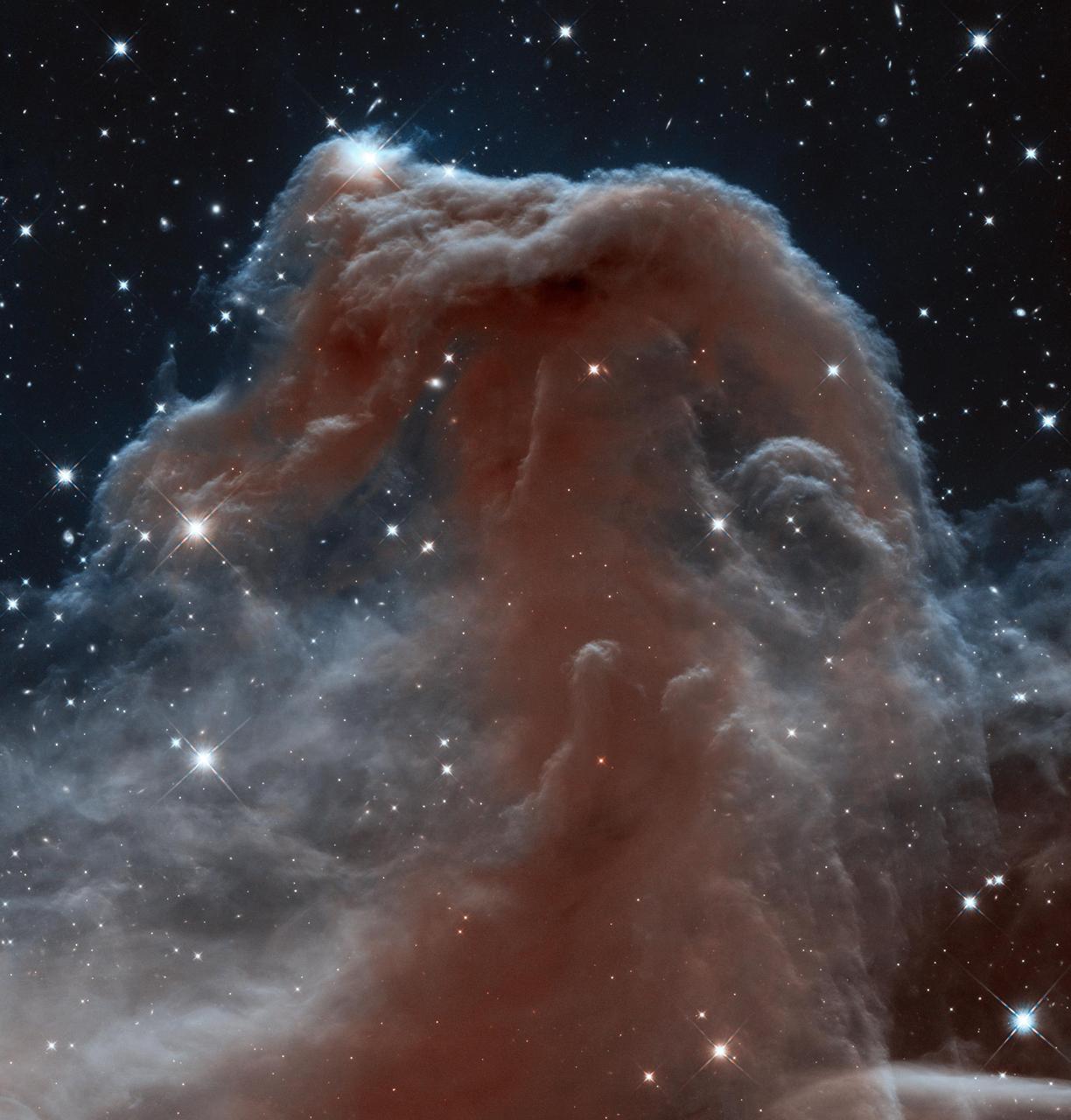
Backlit wisps along the Horsehead Nebula upper ridge are being illuminated by Sigma Orionis, a young five-star system just off the top of this image from the Hubble Space Telescope.

A delicate ribbon of gas floats eerily in our galaxy. This image, taken by NASA Hubble Space Telescope, is a very thin section of a supernova remnant caused by a stellar explosion that occurred more than 1,000 years ago.

Fireworks shows are not just confined to Earth’s skies. NASA’s Hubble Space Telescope has captured a spectacular fireworks display in a small, nearby galaxy, which resembles a July 4th skyrocket. A firestorm of star birth is lighting up one end of the diminutive galaxy Kiso 5639. The dwarf galaxy is shaped like a flattened pancake, but because it is tilted edge-on, it resembles a skyrocket, with a brilliant blazing head and a long, star-studded tail. Kiso 5639 is a rare, nearby example of elongated galaxies that occur in abundance at larger distances, where we observe the universe during earlier epochs. Astronomers suggest that the frenzied star birth is sparked by intergalactic gas raining on one end of the galaxy as it drifts through space. “I think Kiso 5639 is a beautiful, up-close example of what must have been common long ago,” said lead researcher Debra Elmegreen of Vassar College, in Poughkeepsie, New York. “The current thinking is that galaxies in the early universe grow from accreting gas from the surrounding neighborhood. It’s a stage that galaxies, including our Milky Way, must go through as they are growing up.” Observations of the early universe, such as Hubble’s Ultra-Deep Field, reveal that about 10 percent of all galaxies have these elongated shapes, and are collectively called “tadpoles.” But studies of the nearby universe have turned up only a few of these unusual galaxies, including Kiso 5639. The development of the nearby star-making tadpole galaxies, however, has lagged behind that of their peers, which have spent billions of years building themselves up into many of the spiral galaxies seen today. Elmegreen used Hubble’s Wide Field Camera 3 to conduct a detailed imaging study of Kiso 5639. The images in different filters reveal information about an object by dissecting its light into its component colors. Hubble’s crisp resolution helped Elmegreen and her team analyze the giant star-forming clumps in Kiso 5639 and determine the masses and ages of the star clusters. The international team of researchers selected Kiso 5639 from a spectroscopic survey of 10 nearby tadpole galaxies, observed with the Grand Canary Telescope in La Palma, Spain, by Jorge Sanchez Almeida and collaborators at the Instituto de Astrofisica de Canarias. The observations revealed that in most of those galaxies, including Kiso 5639, the gas composition is not uniform. The bright gas in the galaxy’s head contains fewer heavier elements (collectively called “metals”), such as carbon and oxygen, than the rest of the galaxy. Stars consist mainly of hydrogen and helium, but cook up other “heavier” elements. When the stars die, they release their heavy elements and enrich the surrounding gas. “The metallicity suggests that there has to be rather pure gas, composed mostly of hydrogen, coming into the star-forming part of the galaxy, because intergalactic space contains more pristine hydrogen-rich gas,” Elmegreen explained. “Otherwise, the starburst region should be as rich in heavy elements as the rest of the galaxy.” Hubble offers a detailed view of the galaxy’s star-making frenzy. The telescope uncovered several dozen clusters of stars in the galaxy’s star-forming head, which spans 2,700 light-years across. These clusters have an average age of less than 1 million years and masses that are three to six times larger than those in the rest of the galaxy. Other star formation is taking place throughout the galaxy but on a much smaller scale. Star clusters in the rest of the galaxy are between several million to a few billion years old. “There is much more star formation going on in the head than what you would expect in such a tiny galaxy,” said team member Bruce Elmegreen of IBM’s Thomas J. Watson’s Research Center, in Yorktown Heights, New York. “And we think the star formation is triggered by the ongoing accretion of metal-poor gas onto a part of an otherwise quiescent dwarf galaxy.” Hubble also revealed giant holes peppered throughout the galaxy’s starburst head. These cavities give the galaxy’s head a Swiss-cheese appearance because numerous supernova detonations – like firework aerial bursts – have carved out holes of rarified superheated gas. The galaxy, located 82 million light-years away, has taken billions of years to develop because it has been drifting through an isolated “desert” in the universe, devoid of much gas. What triggered the starburst in such a backwater galaxy? Based on simulations by Daniel Ceverino of the Center for Astronomy at Heidelberg University in Germany, and other team members, the observations suggest that less than 1 million years ago, Kiso 5639’s leading edge encountered a filament of gas. The filament dropped a large clump of matter onto the galaxy, stoking the vigorous star birth. Debra Elmegreen expects that in the future other parts of the galaxy will join in the star-making fireworks show. “Galaxies rotate, and as Kiso 5639 continues to spin, another part of the galaxy may receive an infusion of new gas from this filament, instigating another round of star birth,” she said. The team’s results have been accepted for publication in The Astrophysical Journal. Other team members include Casiana Munoz-Tunon and Mercedes Filho (Instituto de Astrofísica de Canarias, Canary Islands), Jairo Mendez-Abreu (University of St. Andrews, United Kingdom), John Gallagher (University of Wisconsin-Madison), and Marc Rafelski (NASA's Goddard Space Flight Center, Greenbelt, Maryland). The Hubble Space Telescope is a project of international cooperation between NASA and the European Space Agency. NASA's Goddard Space Flight Center in Greenbelt, Maryland, manages the telescope. The Space Telescope Science Institute (STScI) in Baltimore, Maryland, conducts Hubble science operations. STScI is operated for NASA by the Association of Universities for Research in Astronomy in Washington, D.C.

These NASA Hubble Space Telescope views of the blue-green planet Neptune provide three snapshots of changing weather conditions. The images were taken in 1994 on 3 separate days when Neptune was 2.8 billion miles 4.5 billion kilometers from Earth.

This picture, taken by the NASA/ESA Hubble Space Telescope WFPC2, shows a galaxy known as NGC 6872 in the constellation of Pavo The Peacock. Its unusual shape is caused by its interactions with the smaller galaxy that can be seen just above NGC 6872.

This image shows a composite view of the Crab nebula, an iconic supernova remnant in our Milky Way galaxy, as viewed by the Herschel Space Observatory and the Hubble Space Telescope.

This image from NASA Hubble Space Telescope of the sunward plunging comet ISON suggests that the comet is intact despite some predictions that the fragile icy nucleus might disintegrate as the sun warms it. In this NASA Hubble Space Telescope image taken on October 9, 2013 the comet's solid nucleus is unresolved because it is so small. If the nucleus broke apart then Hubble would have likely seen evidence for multiple fragments. Moreover, the coma or head surrounding the comet's nucleus is symmetric and smooth. This would probably not be the case if clusters of smaller fragments were flying along. What's more, a polar jet of dust first seen in Hubble images taken in April is no longer visible and may have turned off. This color composite image was assembled using two filters. The comet's coma appears cyan, a greenish-blue color due to gas, while the tail is reddish due to dust streaming off the nucleus. The tail forms as dust particles are pushed away from the nucleus by the pressure of sunlight. The comet was inside Mars' orbit and 177 million miles from Earth when photographed. Comet ISON is predicted to make its closest approach to Earth on 26 December, at a distance of 39.9 million miles. http://photojournal.jpl.nasa.gov/catalog/PIA18153

This is the most detailed view to date of the entire surface of the dwarf planet Pluto, as constructed from multiple NASA Hubble Space Telescope photographs taken from 2002 to 2003.

In the center of this image from the Hubble Space Telescope, partially obscured by a dark cloud of dust, a newborn star shoots twin jets out into space as a sort of birth announcement to the universe.

Resembling an opulent diamond tapestry, this image from NASA Hubble Space Telescope shows a glittering star cluster that contains a collection of some of the brightest stars seen in our Milky Way galaxy called Trumpler 14.

Morphologies, masses, and structures - oh, my! This beautiful clump of glowing gas, dark dust and glittering stars is the spiral galaxy NGC 4248, located about 24 million light-years away in the constellation of Canes Venatici (The Hunting Dogs). This image was produced by the NASA/ESA Hubble Space Telescope as it embarked upon compiling the first Hubble ultraviolet “atlas,” for which the telescope targeted 50 nearby star-forming galaxies. The collection spans all kinds of different morphologies, masses, and structures. Studying this sample can help us to piece together the star-formation history of the Universe. By exploring how massive stars form and evolve within such galaxies, astronomers can learn more about how, when, and where star formation occurs, how star clusters change over time, and how the process of forming new stars is related to the properties of both the host galaxy and the surrounding interstellar medium (the gas and dust that fills the space between individual stars). This galaxy was imaged with observations from Hubble’s Wide Field Camera 3. Image credit: ESA/Hubble & NASA

This shot from the NASA/ESA Hubble Space Telescope shows a maelstrom of glowing gas and dark dust within one of the Milky Way’s satellite galaxies, the Large Magellanic Cloud (LMC). This stormy scene shows a stellar nursery known as N159, an HII region over 150 light-years across. N159 contains many hot young stars. These stars are emitting intense ultraviolet light, which causes nearby hydrogen gas to glow, and torrential stellar winds, which are carving out ridges, arcs, and filaments from the surrounding material. At the heart of this cosmic cloud lies the Papillon Nebula, a butterfly-shaped region of nebulosity. This small, dense object is classified as a High-Excitation Blob, and is thought to be tightly linked to the early stages of massive star formation. N159 is located over 160,000 light-years away. It resides just south of the Tarantula Nebula (heic1402), another massive star-forming complex within the LMC. This image comes from Hubble’s Advanced Camera for Surveys. The region was previously imaged by Hubble’s Wide Field Planetary Camera 2, which also resolved the Papillon Nebula for the first time. Credit: ESA/Hubble & NASA

This is a NASA Hubble Space Telescope series of 24 images showing the full 5.34-hour rotation of the 325-mile diameter 525 kilometer asteroid Vesta.

The Hubble Space Telescope in a picture snapped by a Servicing Mission 4 crewmember just after the Space Shuttle Atlantis captured Hubble with its robotic arm on May 13, 2009, beginning the mission to upgrade and repair the telescope. The Hubble Space Telescope is a project of international cooperation between NASA and the European Space Agency. NASA's Goddard Space Flight Center manages the telescope. The Space Telescope Science Institute conducts Hubble science operations. Goddard is responsible for HST project management, including mission and science operations, servicing missions, and all associated development activities. To learn more about the Hubble Space Telescope go here: <a href="http://www.nasa.gov/mission_pages/hubble/main/index.html" rel="nofollow">www.nasa.gov/mission_pages/hubble/main/index.html</a>

NASA Hubble Space Telescope captures the chaotic activity atop a three-light-year-tall pillar of gas and dust that is being eaten away by the brilliant light from nearby bright stars in a tempestuous stellar nursery called the Carina Nebula.

NASA Hubble peers into a small portion of the nebula near the star cluster NGC 2074. The region is a firestorm of raw stellar creation, perhaps triggered by a nearby supernova explosion. It lies about 170,000 light-years away near the Tarantula

Hubble Look at Mars Shows Canyon Dust Storm, Cloudy Conditions for Pathfinder Landing

What look like giant twisters are spotted by the Hubble Space Telescope (HST). These images are, in actuality, pillars of gases that are in the process of the formation of a new star. These pillars can be billions of miles in length and may have been forming for millions of years. This one formation is located in the Lagoon Nebula and was captured by the Hubble's wide field planetary camera-2 (WFPC-2).

Feast your eyes on Hubble's Megamaser galaxy! Phenomena across the Universe emit radiation spanning the entire electromagnetic spectrum — from high-energy gamma rays, which stream out from the most energetic events in the cosmos, to lower-energy microwaves and radio waves. Microwaves, the very same radiation that can heat up your dinner, are produced by a multitude of astrophysical sources, including strong emitters known as masers (microwave lasers), even stronger emitters with the somewhat villainous name of megamasers and the centers of some galaxies. Especially intense and luminous galactic centers are known as active galactic nuclei. They are in turn thought to be driven by the presence of supermassive black holes, which drag surrounding material inwards and spit out bright jets and radiation as they do so. The two galaxies shown here, imaged by the NASA/ESA Hubble Space Telescope, are named MCG+01-38-004 (the upper, red-tinted one) and MCG+01-38-005 (the lower, blue-tinted one). MCG+01-38-005 (also known as NGC 5765B) is a special kind of megamaser; the galaxy’s active galactic nucleus pumps out huge amounts of energy, which stimulates clouds of surrounding water. Water’s constituent atoms of hydrogen and oxygen are able to absorb some of this energy and re-emit it at specific wavelengths, one of which falls within the microwave regime, invisible to Hubble but detectable by microwave telescopes. MCG+01-38-005 is thus known as a water megamaser! Astronomers can use such objects to probe the fundamental properties of the Universe. The microwave emissions from MCG+01-38-005 were used to calculate a refined value for the Hubble constant, a measure of how fast the Universe is expanding. This constant is named after the astronomer whose observations were responsible for the discovery of the expanding Universe and after whom the Hubble Space Telescope was named, Edwin Hubble.

In the center of this image, taken with the NASA/ESA Hubble Space Telescope, is the galaxy cluster SDSS J1038+4849 — and it seems to be smiling. You can make out its two orange eyes and white button nose. In the case of this “happy face”, the two eyes are very bright galaxies and the misleading smile lines are actually arcs caused by an effect known as strong gravitational lensing. Galaxy clusters are the most massive structures in the Universe and exert such a powerful gravitational pull that they warp the spacetime around them and act as cosmic lenses which can magnify, distort and bend the light behind them. This phenomenon, crucial to many of Hubble’s discoveries, can be explained by Einstein’s theory of general relativity. In this special case of gravitational lensing, a ring — known as an Einstein Ring — is produced from this bending of light, a consequence of the exact and symmetrical alignment of the source, lens and observer and resulting in the ring-like structure we see here. Hubble has provided astronomers with the tools to probe these massive galaxies and model their lensing effects, allowing us to peer further into the early Universe than ever before. This object was studied by Hubble’s Wide Field and Planetary Camera 2 (WFPC2) and Wide Field Camera 3 (WFC3) as part of a survey of strong lenses. A version of this image was entered into the Hubble’s Hidden Treasures image processing competition by contestant Judy Schmidt. Image Credit: NASA/ESA

Peering deep into the early universe, this picturesque parallel field observation from the NASA/ESA Hubble Space Telescope reveals thousands of colorful galaxies swimming in the inky blackness of space. A few foreground stars from our own galaxy, the Milky Way, are also visible. In October 2013 Hubble’s Wide Field Camera 3 (WFC3) and Advanced Camera for Surveys (ACS) began observing this portion of sky as part of the Frontier Fields program. This spectacular skyscape was captured during the study of the giant galaxy cluster Abell 2744, otherwise known as Pandora’s Box. While one of Hubble’s cameras concentrated on Abell 2744, the other camera viewed this adjacent patch of sky near to the cluster. Containing countless galaxies of various ages, shapes and sizes, this parallel field observation is nearly as deep as the Hubble Ultra-Deep Field. In addition to showcasing the stunning beauty of the deep universe in incredible detail, this parallel field — when compared to other deep fields — will help astronomers understand how similar the universe looks in different directions. Image credit: NASA, ESA and the HST Frontier Fields team (STScI), <b><a href="http://www.nasa.gov/audience/formedia/features/MP_Photo_Guidelines.html" rel="nofollow">NASA image use policy.</a></b> <b><a href="http://www.nasa.gov/centers/goddard/home/index.html" rel="nofollow">NASA Goddard Space Flight Center</a></b> enables NASA’s mission through four scientific endeavors: Earth Science, Heliophysics, Solar System Exploration, and Astrophysics. Goddard plays a leading role in NASA’s accomplishments by contributing compelling scientific knowledge to advance the Agency’s mission. <b>Follow us on <a href="http://twitter.com/NASAGoddardPix" rel="nofollow">Twitter</a></b> <b>Like us on <a href="http://www.facebook.com/pages/Greenbelt-MD/NASA-Goddard/395013845897?ref=tsd" rel="nofollow">Facebook</a></b> <b>Find us on <a href="http://instagrid.me/nasagoddard/?vm=grid" rel="nofollow">Instagram</a></b>

The Hubble Space Telescope has spotted a UFO — well, the UFO Galaxy, to be precise. NGC 2683 is a spiral galaxy seen almost edge-on, giving it the shape of a classic science fiction spaceship. This is why the astronomers at the Astronaut Memorial Planetarium and Observatory gave it this attention-grabbing nickname. While a bird’s eye view lets us see the detailed structure of a galaxy (such as this Hubble image of a barred spiral), a side-on view has its own perks. In particular, it gives astronomers a great opportunity to see the delicate dusty lanes of the spiral arms silhouetted against the golden haze of the galaxy’s core. In addition, brilliant clusters of young blue stars shine scattered throughout the disc, mapping the galaxy’s star-forming regions. Perhaps surprisingly, side-on views of galaxies like this one do not prevent astronomers from deducing their structures. Studies of the properties of the light coming from NGC 2683 suggest that this is a barred spiral galaxy, even though the angle we see it at does not let us see this directly. NGC 2683, discovered on 5 February 1788 by the famous astronomer William Herschel, lies in the Northern constellation of Lynx. A constellation named not because of its resemblance to the feline animal, but because it is fairly faint, requiring the “sensitive eyes of a cat” to discern it. And when you manage to get a look at it, you’ll find treasures like this, making it well worth the effort. This image is produced from two adjacent fields observed in visible and infrared light by Hubble’s Advanced Camera for Surveys. A narrow strip which appears slightly blurred and crosses most the image horizontally is a result of a gap between Hubble’s detectors. This strip has been patched using images from observations of the galaxy made by ground-based telescopes, which show significantly less detail. The field of view is approximately 6.5 by 3.3 arcminutes. Credit: ESA/Hubble & NASA <b><a href="http://www.nasa.gov/audience/formedia/features/MP_Photo_Guidelines.html" rel="nofollow">NASA image use policy.</a></b> <b><a href="http://www.nasa.gov/centers/goddard/home/index.html" rel="nofollow">NASA Goddard Space Flight Center</a></b> enables NASA’s mission through four scientific endeavors: Earth Science, Heliophysics, Solar System Exploration, and Astrophysics. Goddard plays a leading role in NASA’s accomplishments by contributing compelling scientific knowledge to advance the Agency’s mission. <b>Follow us on <a href="http://twitter.com/NASA_GoddardPix" rel="nofollow">Twitter</a></b> <b>Like us on <a href="http://www.facebook.com/pages/Greenbelt-MD/NASA-Goddard/395013845897?ref=tsd" rel="nofollow">Facebook</a></b> <b>Find us on <a href="http://instagrid.me/nasagoddard/?vm=grid" rel="nofollow">Instagram</a></b>

In 1995, NASA Hubble Space Telescope discovered a new great dark spot, located in the northern hemisphere of the planet Neptune. Because the planet northern hemisphere was tilted away from Earth, the new feature appeared near the limb of the planet.

This stunning image, captured by the NASA/ESA Hubble Space Telescope’s Advanced Camera for Surveys (ACS), shows part of the sky in the constellation of Sagittarius (The Archer). The region is rendered in exquisite detail — deep red and bright blue stars are scattered across the frame, set against a background of thousands of more distant stars and galaxies. Two features are particularly striking: the colors of the stars, and the dramatic crosses that burst from the centers of the brightest bodies. While some of the colors in this frame have been enhanced and tweaked during the process of creating the image from the observational data, different stars do indeed glow in different colors. Stars differ in color according to their surface temperature: very hot stars are blue or white, while cooler stars are redder. They may be cooler because they are smaller, or because they are very old and have entered the red giant phase, when an old star expands and cools dramatically as its core collapses. The crosses are nothing to do with the stars themselves, and, because Hubble orbits above Earth’s atmosphere, nor are they due to any kind of atmospheric disturbance. They are actually known as diffraction spikes, and are caused by the structure of the telescope itself. Like all big modern telescopes, Hubble uses mirrors to capture light and form images. Its secondary mirror is supported by struts, called telescope spiders, arranged in a cross formation, and they diffract the incoming light. Diffraction is the slight bending of light as it passes near the edge of an object. Every cross in this image is due to a single set of struts within Hubble itself! Whilst the spikes are technically an inaccuracy, many astrophotographers choose to emphasize and celebrate them as a beautiful feature of their images. Image credit: ESA/Hubble & NASA <b><a href="http://www.nasa.gov/audience/formedia/features/MP_Photo_Guidelines.html" rel="nofollow">NASA image use policy.</a></b> <b><a href="http://www.nasa.gov/centers/goddard/home/index.html" rel="nofollow">NASA Goddard Space Flight Center</a></b> enables NASA’s mission through four scientific endeavors: Earth Science, Heliophysics, Solar System Exploration, and Astrophysics. Goddard plays a leading role in NASA’s accomplishments by contributing compelling scientific knowledge to advance the Agency’s mission. <b>Follow us on <a href="http://twitter.com/NASAGoddardPix" rel="nofollow">Twitter</a></b> <b>Like us on <a href="http://www.facebook.com/pages/Greenbelt-MD/NASA-Goddard/395013845897?ref=tsd" rel="nofollow">Facebook</a></b> <b>Find us on <a href="http://instagrid.me/nasagoddard/?vm=grid" rel="nofollow">Instagram</a></b>

This deep-field view of the sky, taken by NASA's Spitzer Space Telescope, is dominated by galaxies - including some very faint, very distant ones - circled in red. The bottom right inset shows one of those distant galaxies, made visible thanks to a long-duration observation by Spitzer. The wide-field view also includes data from NASA's Hubble Space Telescope. The Spitzer observations came from the GREATS survey, short for GOODS Re-ionization Era wide-Area Treasury from Spitzer. GOODS is itself an acronym: Great Observatories Origins Deep Survey. https://photojournal.jpl.nasa.gov/catalog/PIA23123

This Hubble Space Telescope Wide Field Camera 3 image of Uranus, taken in November 2018, reveals a vast, bright stormy cloud cap across the planet's north pole. Credits: NASA, ESA, A. Simon (NASA Goddard Space Flight Center), and M.H. Wong and A. Hsu (University of California, Berkeley)

This Hubble Space Telescope Wide Field Camera 3 image of Neptune, taken in September and November 2018, shows a new dark storm (top center). Credits: NASA, ESA, A. Simon (NASA Goddard Space Flight Center), and M.H. Wong and A. Hsu (University of California, Berkeley)

This photograph is a Hubble Space Telescope (HST) image of a sky full of glittering jewels. The HST peered into the Sagittarius star cloud, a narrow dust free region, providing this spectacular glimpse of a treasure chest full of stars.