
This planetary nebula's simple, graceful appearance is thought to be due to perspective: our view from Earth looking straight into what is actually a barrel-shaped cloud of gas shrugged off by a dying central star. Hot blue gas near the energizing central star gives way to progressively cooler green and yellow gas at greater distances with the coolest red gas along the outer boundary. Credit: NASA/Hubble Heritage Team ---- The Ring Nebula's distinctive shape makes it a popular illustration for astronomy books. But new observations by NASA's Hubble Space Telescope of the glowing gas shroud around an old, dying, sun-like star reveal a new twist. "The nebula is not like a bagel, but rather, it's like a jelly doughnut, because it's filled with material in the middle," said C. Robert O'Dell of Vanderbilt University in Nashville, Tenn. He leads a research team that used Hubble and several ground-based telescopes to obtain the best view yet of the iconic nebula. The images show a more complex structure than astronomers once thought and have allowed them to construct the most precise 3-D model of the nebula. "With Hubble's detail, we see a completely different shape than what's been thought about historically for this classic nebula," O'Dell said. "The new Hubble observations show the nebula in much clearer detail, and we see things are not as simple as we previously thought." The Ring Nebula is about 2,000 light-years from Earth and measures roughly 1 light-year across. Located in the constellation Lyra, the nebula is a popular target for amateur astronomers. Read more: <a href="http://1.usa.gov/14VAOMk" rel="nofollow">1.usa.gov/14VAOMk</a> <b><a href="http://www.nasa.gov/audience/formedia/features/MP_Photo_Guidelines.html" rel="nofollow">NASA image use policy.</a></b> <b><a href="http://www.nasa.gov/centers/goddard/home/index.html" rel="nofollow">NASA Goddard Space Flight Center</a></b> enables NASA’s mission through four scientific endeavors: Earth Science, Heliophysics, Solar System Exploration, and Astrophysics. Goddard plays a leading role in NASA’s accomplishments by contributing compelling scientific knowledge to advance the Agency’s mission. <b>Follow us on <a href="http://twitter.com/NASAGoddardPix" rel="nofollow">Twitter</a></b> <b>Like us on <a href="http://www.facebook.com/pages/Greenbelt-MD/NASA-Goddard/395013845897?ref=tsd" rel="nofollow">Facebook</a></b> <b>Find us on <a href="http://instagram.com/nasagoddard?vm=grid" rel="nofollow">Instagram</a></b>

Caption: In this composite image, visible-light observations by NASA’s Hubble Space Telescope are combined with infrared data from the ground-based Large Binocular Telescope in Arizona to assemble a dramatic view of the well-known Ring Nebula. Credit: NASA, ESA, C.R. Robert O’Dell (Vanderbilt University), G.J. Ferland (University of Kentucky), W.J. Henney and M. Peimbert (National Autonomous University of Mexico) Credit for Large Binocular Telescope data: David Thompson (University of Arizona) ---- The Ring Nebula's distinctive shape makes it a popular illustration for astronomy books. But new observations by NASA's Hubble Space Telescope of the glowing gas shroud around an old, dying, sun-like star reveal a new twist. "The nebula is not like a bagel, but rather, it's like a jelly doughnut, because it's filled with material in the middle," said C. Robert O'Dell of Vanderbilt University in Nashville, Tenn. He leads a research team that used Hubble and several ground-based telescopes to obtain the best view yet of the iconic nebula. The images show a more complex structure than astronomers once thought and have allowed them to construct the most precise 3-D model of the nebula. "With Hubble's detail, we see a completely different shape than what's been thought about historically for this classic nebula," O'Dell said. "The new Hubble observations show the nebula in much clearer detail, and we see things are not as simple as we previously thought." The Ring Nebula is about 2,000 light-years from Earth and measures roughly 1 light-year across. Located in the constellation Lyra, the nebula is a popular target for amateur astronomers. Read more: <a href="http://1.usa.gov/14VAOMk" rel="nofollow">1.usa.gov/14VAOMk</a> <b><a href="http://www.nasa.gov/audience/formedia/features/MP_Photo_Guidelines.html" rel="nofollow">NASA image use policy.</a></b> <b><a href="http://www.nasa.gov/centers/goddard/home/index.html" rel="nofollow">NASA Goddard Space Flight Center</a></b> enables NASA’s mission through four scientific endeavors: Earth Science, Heliophysics, Solar System Exploration, and Astrophysics. Goddard plays a leading role in NASA’s accomplishments by contributing compelling scientific knowledge to advance the Agency’s mission. <b>Follow us on <a href="http://twitter.com/NASA_GoddardPix" rel="nofollow">Twitter</a></b> <b>Like us on <a href="http://www.facebook.com/pages/Greenbelt-MD/NASA-Goddard/395013845897?ref=tsd" rel="nofollow">Facebook</a></b> <b>Find us on <a href="http://instagram.com/nasagoddard?vm=grid" rel="nofollow">Instagram</a></b>
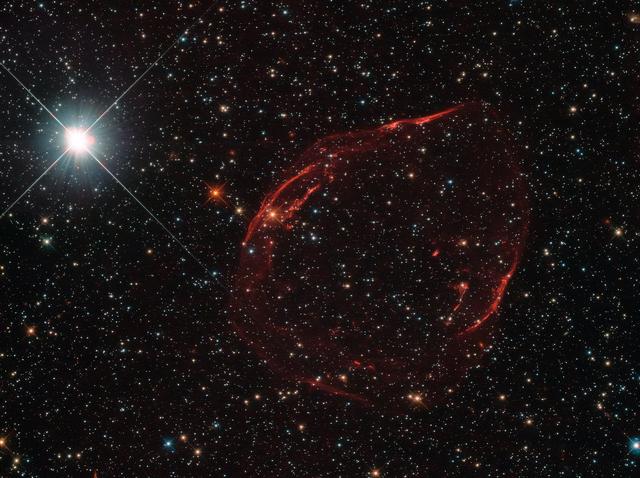
Several thousand years ago, a star some 160,000 light-years away from us exploded, scattering stellar shrapnel across the sky. The aftermath of this energetic detonation is shown here in this striking image from the NASA/ESA Hubble Space Telescope’s Wide Field Camera 3. The exploding star was a white dwarf located in the Large Magellanic Cloud, one of our nearest neighboring galaxies. Around 97 percent of stars within the Milky Way that are between a tenth and eight times the mass of the sun are expected to end up as white dwarfs. These stars can face a number of different fates, one of which is to explode as supernovae, some of the brightest events ever observed in the universe. If a white dwarf is part of a binary star system, it can siphon material from a close companion. After gobbling up more than it can handle — and swelling to approximately one and a half times the size of the sun — the star becomes unstable and ignites as a Type Ia supernova. This was the case for the supernova remnant pictured here, which is known as DEM L71. It formed when a white dwarf reached the end of its life and ripped itself apart, ejecting a superheated cloud of debris in the process. Slamming into the surrounding interstellar gas, this stellar shrapnel gradually diffused into the separate fiery filaments of material seen scattered across this skyscape. Image credit: ESA/Hubble & NASA, Y. Chu Text credit: European Space Agency <b><a href="http://www.nasa.gov/audience/formedia/features/MP_Photo_Guidelines.html" rel="nofollow">NASA image use policy.</a></b> <b><a href="http://www.nasa.gov/centers/goddard/home/index.html" rel="nofollow">NASA Goddard Space Flight Center</a></b> enables NASA’s mission through four scientific endeavors: Earth Science, Heliophysics, Solar System Exploration, and Astrophysics. Goddard plays a leading role in NASA’s accomplishments by contributing compelling scientific knowledge to advance the Agency’s mission. <b>Follow us on <a href="http://twitter.com/NASAGoddardPix" rel="nofollow">Twitter</a></b> <b>Like us on <a href="http://www.facebook.com/pages/Greenbelt-MD/NASA-Goddard/395013845897?ref=tsd" rel="nofollow">Facebook</a></b> <b>Find us on <a href="http://instagrid.me/nasagoddard/?vm=grid" rel="nofollow">Instagram</a></b>
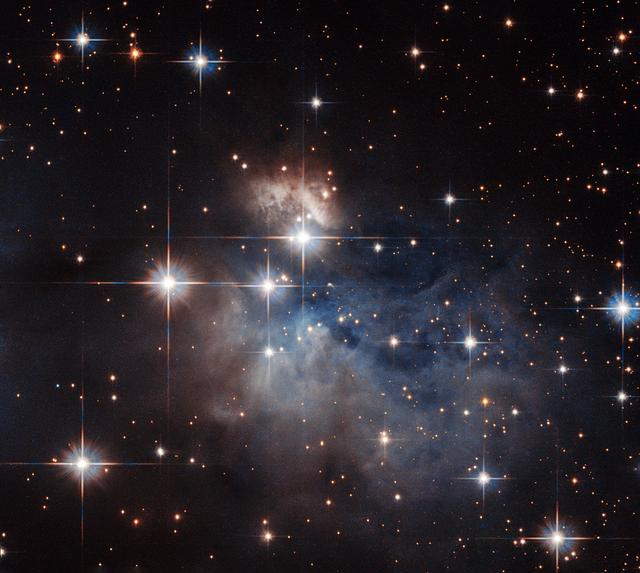
Showcased at the center of this NASA/ESA Hubble Space Telescope image is an emission-line star known as IRAS 12196-6300. Located just under 2,300 light-years from Earth, this star displays prominent emission lines, meaning that the star’s light, dispersed into a spectrum, shows up as a rainbow of colors marked with a characteristic pattern of dark and bright lines. The characteristics of these lines, when compared to the “fingerprints” left by particular atoms and molecules, can be used to reveal IRAS 12196-6300’s chemical composition. Under 10 million years old and not yet burning hydrogen at its core, unlike the sun, this star is still in its infancy. Further evidence of IRAS 12196-6300’s youth is provided by the presence of reflection nebulae. These hazy clouds, pictured floating above and below IRAS 12196-6300, are created when light from a star reflects off a high concentration of nearby dust, such as the dusty material still remaining from IRAS 12196-6300’s formation. Image credit: ESA/Hubble & NASA, Acknowledgement: Judy Schmidt <b><a href="http://www.nasa.gov/audience/formedia/features/MP_Photo_Guidelines.html" rel="nofollow">NASA image use policy.</a></b> <b><a href="http://www.nasa.gov/centers/goddard/home/index.html" rel="nofollow">NASA Goddard Space Flight Center</a></b> enables NASA’s mission through four scientific endeavors: Earth Science, Heliophysics, Solar System Exploration, and Astrophysics. Goddard plays a leading role in NASA’s accomplishments by contributing compelling scientific knowledge to advance the Agency’s mission. <b>Follow us on <a href="http://twitter.com/NASAGoddardPix" rel="nofollow">Twitter</a></b> <b>Like us on <a href="http://www.facebook.com/pages/Greenbelt-MD/NASA-Goddard/395013845897?ref=tsd" rel="nofollow">Facebook</a></b> <b>Find us on <a href="http://instagrid.me/nasagoddard/?vm=grid" rel="nofollow">Instagram</a></b>
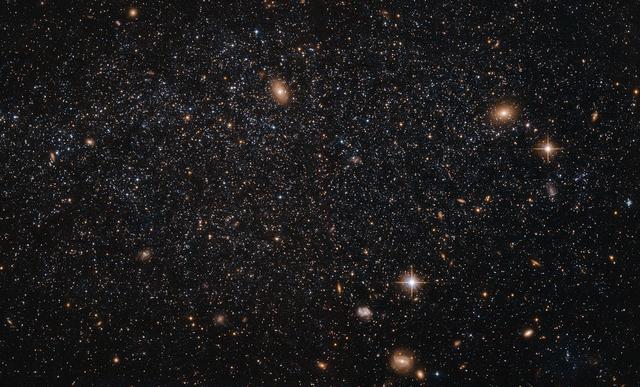
At first glance, this NASA/ESA Hubble Space Telescope image seems to show an array of different cosmic objects, but the speckling of stars shown here actually forms a single body — a nearby dwarf galaxy known as Leo A. Its few million stars are so sparsely distributed that some distant background galaxies are visible through it. Leo A itself is at a distance of about 2.5 million light-years from Earth and a member of the Local Group of galaxies; a group that includes the Milky Way and the well-known Andromeda galaxy. Astronomers study dwarf galaxies because they are very numerous and are simpler in structure than their giant cousins. However, their small size makes them difficult to study at great distances. As a result, the dwarf galaxies of the Local Group are of particular interest, as they are close enough to study in detail. As it turns out, Leo A is a rather unusual galaxy. It is one of the most isolated galaxies in the Local Group, has no obvious structural features beyond being a roughly spherical mass of stars, and shows no evidence for recent interactions with any of its few neighbors. However, the galaxy’s contents are overwhelmingly dominated by relatively young stars, something that would normally be the result of a recent interaction with another galaxy. Around 90% of the stars in Leo A are less than eight billion years old — young in cosmic terms! This raises a number of intriguing questions about why star formation in Leo A did not take place on the “usual” timescale, but instead waited until it was good and ready. Image credit: ESA/Hubble & NASA; Acknowledgment: Judy Schmidt
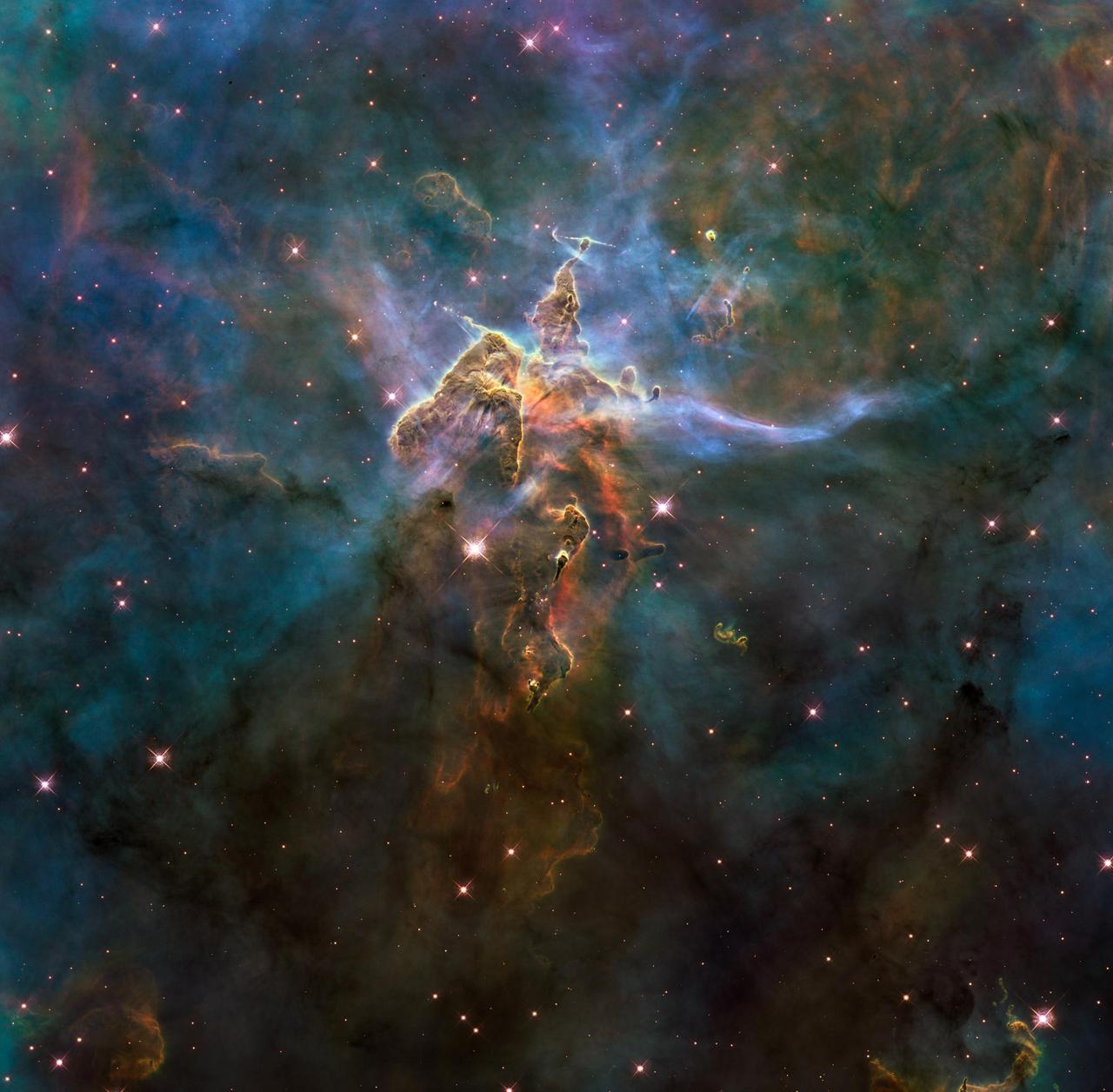
NASA image release April 22, 2010 This craggy fantasy mountaintop enshrouded by wispy clouds looks like a bizarre landscape from Tolkien's "The Lord of the Rings" or a Dr. Seuss book, depending on your imagination. The NASA Hubble Space Telescope photograph, which is stranger than fiction, captures the chaotic activity atop a three-light-year-tall pillar of gas and dust that is being eaten away by the brilliant light from nearby bright stars. The pillar is also being assaulted from within, as infant stars buried inside it fire off jets of gas that can be seen streaming from towering peaks. This turbulent cosmic pinnacle lies within a tempestuous stellar nursery called the Carina Nebula, located 7,500 light-years away in the southern constellation Carina. The image marks the 20th anniversary of Hubble's launch and deployment into Earth orbit. Scorching radiation and fast winds (streams of charged particles) from hot newborn stars in the nebula are shaping and compressing the pillar, causing new stars to form within it. Streamers of hot ionized gas can be seen flowing off the ridges of the structure, and wispy veils of dust, illuminated by starlight, float around its peaks. The pillar is resisting being eroded by radiation much like a towering butte in Utah's Monument Valley withstands erosion by water and wind. Nestled inside this dense mountain are fledgling stars. Long streamers of gas can be seen shooting in opposite directions off the pedestal at the top of the image. Another pair of jets is visible at another peak near the center of the image. These jets are the signpost for new star birth. The jets are launched by swirling disks around the stars, as these disks allow material to slowly accrete onto the stars' surfaces. Hubble's Wide Field Camera 3 observed the pillar on Feb. 1-2, 2010. The colors in this composite image correspond to the glow of oxygen (blue), hydrogen and nitrogen (green), and sulfur (red). Object Names: HH 901, HH 902 Image Type: Astronomical Credit: NASA, ESA, and M. Livio and the Hubble 20th Anniversary Team (STScI) To read learn more about this image go to: <a href="http://www.nasa.gov/mission_pages/hubble/science/hubble20th-img.html" rel="nofollow">www.nasa.gov/mission_pages/hubble/science/hubble20th-img....</a> <b><a href="http://www.nasa.gov/centers/goddard/home/index.html" rel="nofollow">NASA Goddard Space Flight Center</a></b> is home to the nation's largest organization of combined scientists, engineers and technologists that build spacecraft, instruments and new technology to study the Earth, the sun, our solar system, and the universe.
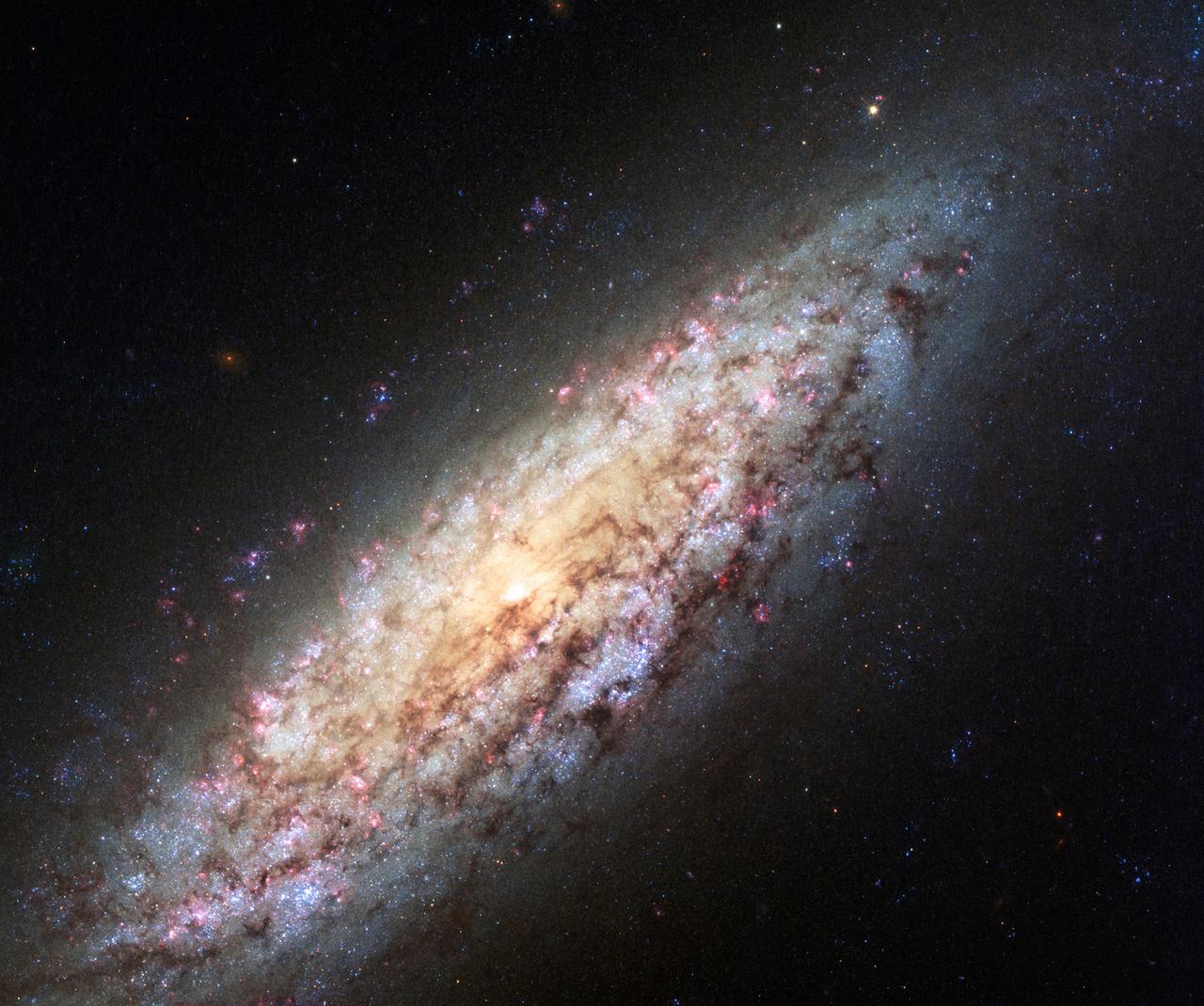
Most galaxies are clumped together in groups or clusters. A neighboring galaxy is never far away. But this galaxy, known as NGC 6503, has found itself in a lonely position, at the edge of a strangely empty patch of space called the Local Void. The Local Void is a huge stretch of space that is at least 150 million light-years across. It seems completely empty of stars or galaxies. The galaxy’s odd location on the edge of this never-land led stargazer Stephen James O’Meara to dub it the “Lost-In-Space galaxy” in his 2007 book, Hidden Treasures. NGC 6503 is 18 million light-years away from us in the northern circumpolar constellation of Draco. NGC 6503 spans some 30,000 light-years, about a third of the size of the Milky Way. This Hubble Space Telescope image shows NGC 6503 in striking detail and with a rich set of colors. Bright red patches of gas can be seen scattered through its swirling spiral arms, mixed with bright blue regions that contain newly forming stars. Dark brown dust lanes snake across the galaxy’s bright arms and center, giving it a mottled appearance. The Hubble Advanced Camera for Surveys data for NGC 6503 were taken in April 2003, and the Wide Field Camera 3 data were taken in August 2013. The Hubble Space Telescope is a project of international cooperation between NASA and the European Space Agency. NASA’s Goddard Space Flight Center in Greenbelt, Maryland, manages the telescope. The Space Telescope Science Institute (STScI) in Baltimore conducts Hubble science operations. STScI is operated for NASA by the Association of Universities for Research in Astronomy, Inc., in Washington, D.C. Photo Credit: NASA, ESA, D. Calzetti (University of Massachusetts), H. Ford (Johns Hopkins University), and the Hubble Heritage Team <b><a href="http://www.nasa.gov/audience/formedia/features/MP_Photo_Guidelines.html" rel="nofollow">NASA image use policy.</a></b> <b><a href="http://www.nasa.gov/centers/goddard/home/index.html" rel="nofollow">NASA Goddard Space Flight Center</a></b> enables NASA’s mission through four scientific endeavors: Earth Science, Heliophysics, Solar System Exploration, and Astrophysics. Goddard plays a leading role in NASA’s accomplishments by contributing compelling scientific knowledge to advance the Agency’s mission. <b>Follow us on <a href="http://twitter.com/NASAGoddardPix" rel="nofollow">Twitter</a></b> <b>Like us on <a href="http://www.facebook.com/pages/Greenbelt-MD/NASA-Goddard/395013845897?ref=tsd" rel="nofollow">Facebook</a></b> <b>Find us on <a href="http://instagrid.me/nasagoddard/?vm=grid" rel="nofollow">Instagram</a></b>

NASA image release June 6, 2010 Like a July 4 fireworks display a young, glittering collection of stars looks like an aerial burst. The cluster is surrounded by clouds of interstellar gas and dust - the raw material for new star formation. The nebula, located 20,000 light-years away in the constellation Carina, contains a central cluster of huge, hot stars, called NGC 3603. This environment is not as peaceful as it looks. Ultraviolet radiation and violent stellar winds have blown out an enormous cavity in the gas and dust enveloping the cluster, providing an unobstructed view of the cluster. Most of the stars in the cluster were born around the same time but differ in size, mass, temperature, and color. The course of a star's life is determined by its mass, so a cluster of a given age will contain stars in various stages of their lives, giving an opportunity for detailed analyses of stellar life cycles. NGC 3603 also contains some of the most massive stars known. These huge stars live fast and die young, burning through their hydrogen fuel quickly and ultimately ending their lives in supernova explosions. Star clusters like NGC 3603 provide important clues to understanding the origin of massive star formation in the early, distant universe. Astronomers also use massive clusters to study distant starbursts that occur when galaxies collide, igniting a flurry of star formation. The proximity of NGC 3603 makes it an excellent lab for studying such distant and momentous events. This Hubble Space Telescope image was captured in August 2009 and December 2009 with the Wide Field Camera 3 in both visible and infrared light, which trace the glow of sulfur, hydrogen, and iron. The Hubble Space Telescope is a project of international cooperation between NASA and the European Space Agency. NASA’s Goddard Space Flight Center manages the telescope. The Space Telescope Science Institute (STScI) conducts Hubble science operations. STScI is operated for NASA by the Association of Universities for Research in Astronomy, Inc. in Washington, D.C. Credit: NASA, ESA, R. O'Connell (University of Virginia), F. Paresce (National Institute for Astrophysics, Bologna, Italy), E. Young (Universities Space Research Association/Ames Research Center), the WFC3 Science Oversight Committee, and the Hubble Heritage Team (STScI/AURA) <b><a href="http://www.nasa.gov/centers/goddard/home/index.html" rel="nofollow">NASA Goddard Space Flight Center</a></b> is home to the nation's largest organization of combined scientists, engineers and technologists that build spacecraft, instruments and new technology to study the Earth, the sun, our solar system, and the universe.
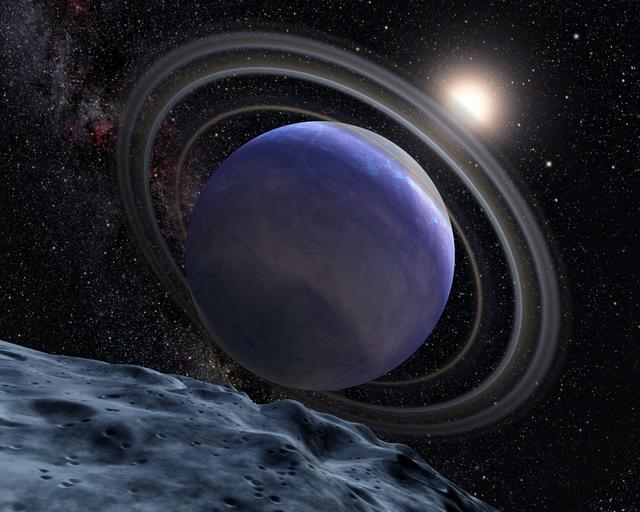
Release Date April 1, 2009 This is an artistic illustration of the giant planet HR 8799b. The planet was first discovered in 2007 at the Gemini North observatory. It was identified in the NICMOS archival data in a follow-up search of NICMOS archival data to see if Hubble had also serendipitously imaged it. The planet is young and hot, at a temperature of 1500 degrees Fahrenheit. It is slightly larger than Jupiter and may be at least seven times more massive. Analysis of the NICMOS data suggests the planet has water vapor in its atmosphere and is only partially cloud covered. It is not known if the planet has rings or moons, but circumplanetary debris is common among the outer planets of our solar system. Credit: NASA/Goddard Space Flight Center/ESA/G. Bacon (STScI) To learn more about the Hubble Space Telescope go here: <a href="http://www.nasa.gov/mission_pages/hubble/main/index.html" rel="nofollow">www.nasa.gov/mission_pages/hubble/main/index.html</a>
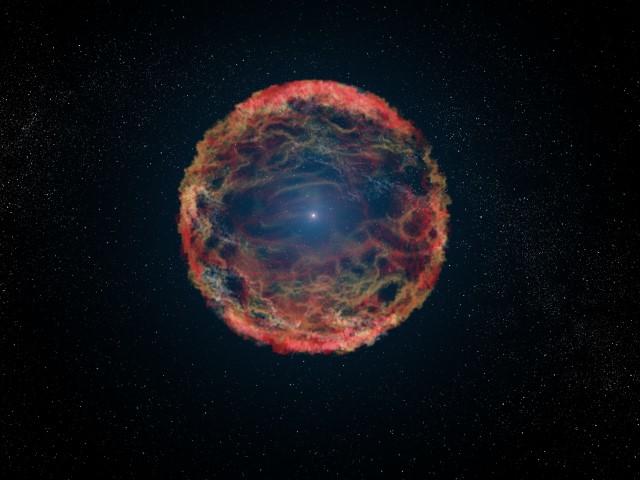
This is an artist's impression of supernova 1993J, an exploding star in the galaxy M81 whose light reached us 21 years ago. The supernova originated in a double-star system where one member was a massive star that exploded after siphoning most of its hydrogen envelope to its companion star. After two decades, astronomers have at last identified the blue helium-burning companion star, seen at the center of the expanding nebula of debris from the supernova. The Hubble Space Telescope identified the ultraviolet glow of the surviving companion embedded in the fading glow of the supernova. More info: Using NASA’s Hubble Space Telescope, astronomers have discovered a companion star to a rare type of supernova. The discovery confirms a long-held theory that the supernova, dubbed SN 1993J, occurred inside what is called a binary system, where two interacting stars caused a cosmic explosion. "This is like a crime scene, and we finally identified the robber," said Alex Filippenko, professor of astronomy at University of California (UC) at Berkeley. "The companion star stole a bunch of hydrogen before the primary star exploded." SN 1993J is an example of a Type IIb supernova, unusual stellar explosions that contains much less hydrogen than found in a typical supernova. Astronomers believe the companion star took most of the hydrogen surrounding the exploding main star and continued to burn as a super-hot helium star. “A binary system is likely required to lose the majority of the primary star’s hydrogen envelope prior to the explosion. The problem is that, to date, direct observations of the predicted binary companion star have been difficult to obtain since it is so faint relative to the supernova itself,” said lead researcher Ori Fox of UC Berkeley. Read more: <a href="http://1.usa.gov/1Az5Qb9" rel="nofollow">1.usa.gov/1Az5Qb9</a> Credit: NASA, ESA, G. Bacon (STScI) <b><a href="http://www.nasa.gov/audience/formedia/features/MP_Photo_Guidelines.html" rel="nofollow">NASA image use policy.</a></b> <b><a href="http://www.nasa.gov/centers/goddard/home/index.html" rel="nofollow">NASA Goddard Space Flight Center</a></b> enables NASA’s mission through four scientific endeavors: Earth Science, Heliophysics, Solar System Exploration, and Astrophysics. Goddard plays a leading role in NASA’s accomplishments by contributing compelling scientific knowledge to advance the Agency’s mission. <b>Follow us on <a href="http://twitter.com/NASAGoddardPix" rel="nofollow">Twitter</a></b> <b>Like us on <a href="http://www.facebook.com/pages/Greenbelt-MD/NASA-Goddard/395013845897?ref=tsd" rel="nofollow">Facebook</a></b> <b>Find us on <a href="http://instagram.com/nasagoddard?vm=grid" rel="nofollow">Instagram</a></b>

The Cat's Eye Nebula, one of the first planetary nebulae discovered, also has one of the most complex forms known to this kind of nebula. Eleven rings, or shells, of gas make up the Cat's Eye. The full beauty of the Cat's Eye Nebula is revealed in this detailed view from NASA's Hubble Space Telescope. The image from Hubble's Advanced Camera for Surveys (ACS) shows a bull's eye pattern of eleven or even more concentric rings, or shells, around the Cat's Eye. Each 'ring' is actually the edge of a spherical bubble seen projected onto the sky -- that's why it appears bright along its outer edge. Observations suggest the star ejected its mass in a series of pulses at 1,500-year intervals. These convulsions created dust shells, each of which contain as much mass as all of the planets in our solar system combined (still only one percent of the Sun's mass). These concentric shells make a layered, onion-skin structure around the dying star. The view from Hubble is like seeing an onion cut in half, where each skin layer is discernible. The bull's-eye patterns seen around planetary nebulae come as a surprise to astronomers because they had no expectation that episodes of mass loss at the end of stellar lives would repeat every 1,500 years. Several explanations have been proposed, including cycles of magnetic activity somewhat similar to our own Sun's sunspot cycle, the action of companion stars orbiting around the dying star, and stellar pulsations. Another school of thought is that the material is ejected smoothly from the star, and the rings are created later on due to formation of waves in the outflowing material. Credit: NASA, ESA, HEIC, and The Hubble Heritage Team (STScI/AURA) Acknowledgment: R. Corradi (Isaac Newton Group of Telescopes, Spain) and Z. Tsvetanov (NASA) The Hubble Space Telescope is a project of international cooperation between NASA and the European Space Agency. NASA's Goddard Space Flight Center manages the telescope. The Space Telescope Science Institute conducts Hubble science operations. Goddard is responsible for HST project management, including mission and science operations, servicing missions, and all associated development activities. To learn more about the Hubble Space Telescope go here: <a href="http://www.nasa.gov/mission_pages/hubble/main/index.html" rel="nofollow">www.nasa.gov/mission_pages/hubble/main/index.html</a> <b><a href="http://www.nasa.gov/audience/formedia/features/MP_Photo_Guidelines.html" rel="nofollow">NASA image use policy.</a></b> <b><a href="http://www.nasa.gov/centers/goddard/home/index.html" rel="nofollow">NASA Goddard Space Flight Center</a></b> enables NASA’s mission through four scientific endeavors: Earth Science, Heliophysics, Solar System Exploration, and Astrophysics. Goddard plays a leading role in NASA’s accomplishments by contributing compelling scientific knowledge to advance the Agency’s mission. <b>Follow us on <a href="http://twitter.com/NASAGoddardPix" rel="nofollow">Twitter</a></b> <b>Like us on <a href="http://www.facebook.com/pages/Greenbelt-MD/NASA-Goddard/395013845897?ref=tsd" rel="nofollow">Facebook</a></b> <b>Find us on <a href="http://instagram.com/nasagoddard?vm=grid" rel="nofollow">Instagram</a></b>
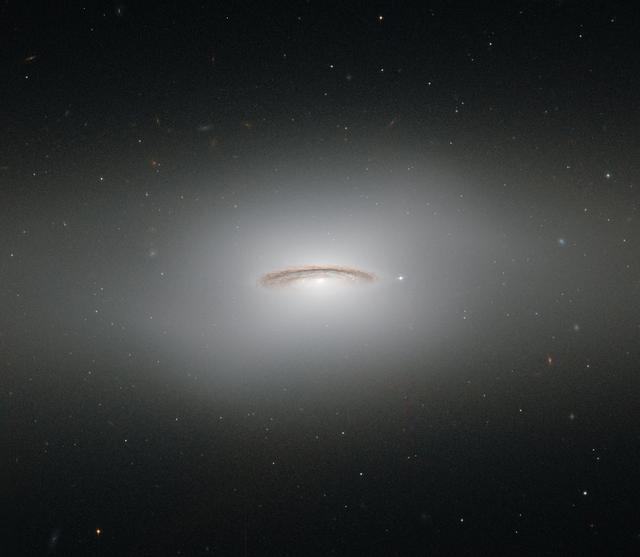
This neat little galaxy is known as NGC 4526. Its dark lanes of dust and bright diffuse glow make the galaxy appear to hang like a halo in the emptiness of space in this image from the NASA/ESA Hubble Space Telescope. Although this image paints a picture of serenity, the galaxy is anything but. It is one of the brightest lenticular galaxies known, a category that lies somewhere between spirals and ellipticals. It has hosted two known supernova explosions, one in 1969 and another in 1994, and is known to have a colossal supermassive black hole at its center that has the mass of 450 million suns. NGC 4526 is part of the Virgo cluster of galaxies. Ground-based observations of galaxies in this cluster have revealed that a quarter of these galaxies seem to have rapidly rotating disks of gas at their centers. The most spectacular of these is this galaxy, NGC 4526, and its spinning disk of gas, dust, and stars reaches out uniquely far from its heart, spanning some seven percent of the galaxy's entire radius. This disk is moving incredibly fast, spinning at more than 250 kilometers per second. The dynamics of this quickly whirling region were actually used to infer the mass of NGC 4526’s central black hole — a technique that had not been used before to constrain a galaxy’s central black hole. This image was taken with Hubble's Wide Field and Planetary Camera 2 and the Advanced Camera for Surveys. Credit: ESA/Hubble & NASA, Acknowledgement: Judy Schmidt
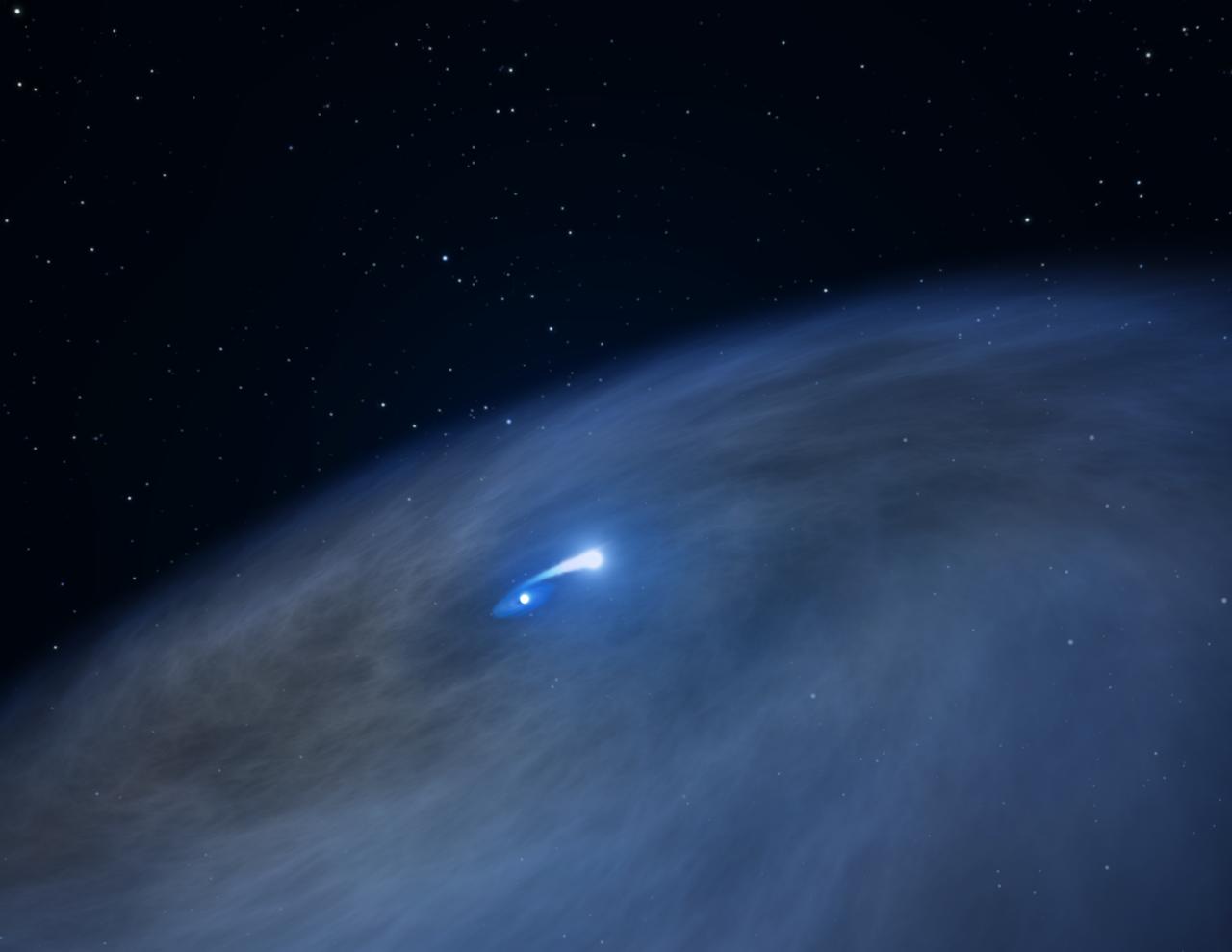
Astronomers using NASA’s Hubble Space Telescope have uncovered surprising new clues about a hefty, rapidly aging star whose behavior has never been seen before in our Milky Way galaxy. In fact, the star is so weird that astronomers have nicknamed it “Nasty 1,” a play on its catalog name of NaSt1. The star may represent a brief transitory stage in the evolution of extremely massive stars. First discovered several decades ago, Nasty 1 was identified as a Wolf-Rayet star, a rapidly evolving star that is much more massive than our sun. The star loses its hydrogen-filled outer layers quickly, exposing its super-hot and extremely bright helium-burning core. But Nasty 1 doesn’t look like a typical Wolf-Rayet star. The astronomers using Hubble had expected to see twin lobes of gas flowing from opposite sides of the star, perhaps similar to those emanating from the massive star Eta Carinae, which is a Wolf-Rayet candidate. Instead, Hubble revealed a pancake-shaped disk of gas encircling the star. The vast disk is nearly 2 trillion miles wide, and may have formed from an unseen companion star that snacked on the outer envelope of the newly formed Wolf-Rayet. Based on current estimates, the nebula surrounding the stars is just a few thousand years old, and as close as 3,000 light-years from Earth. Read more: <a href="http://www.nasa.gov/feature/hubble-observes-one-of-a-kind-star-nicknamed-nasty" rel="nofollow">www.nasa.gov/feature/hubble-observes-one-of-a-kind-star-n...</a> Credits: NASA/Hubble <b><a href="http://www.nasa.gov/audience/formedia/features/MP_Photo_Guidelines.html" rel="nofollow">NASA image use policy.</a></b> <b><a href="http://www.nasa.gov/centers/goddard/home/index.html" rel="nofollow">NASA Goddard Space Flight Center</a></b> enables NASA’s mission through four scientific endeavors: Earth Science, Heliophysics, Solar System Exploration, and Astrophysics. Goddard plays a leading role in NASA’s accomplishments by contributing compelling scientific knowledge to advance the Agency’s mission. <b>Follow us on <a href="http://twitter.com/NASAGoddardPix" rel="nofollow">Twitter</a></b> <b>Like us on <a href="http://www.facebook.com/pages/Greenbelt-MD/NASA-Goddard/395013845897?ref=tsd" rel="nofollow">Facebook</a></b> <b>Find us on <a href="http://instagrid.me/nasagoddard/?vm=grid" rel="nofollow">Instagram</a></b>
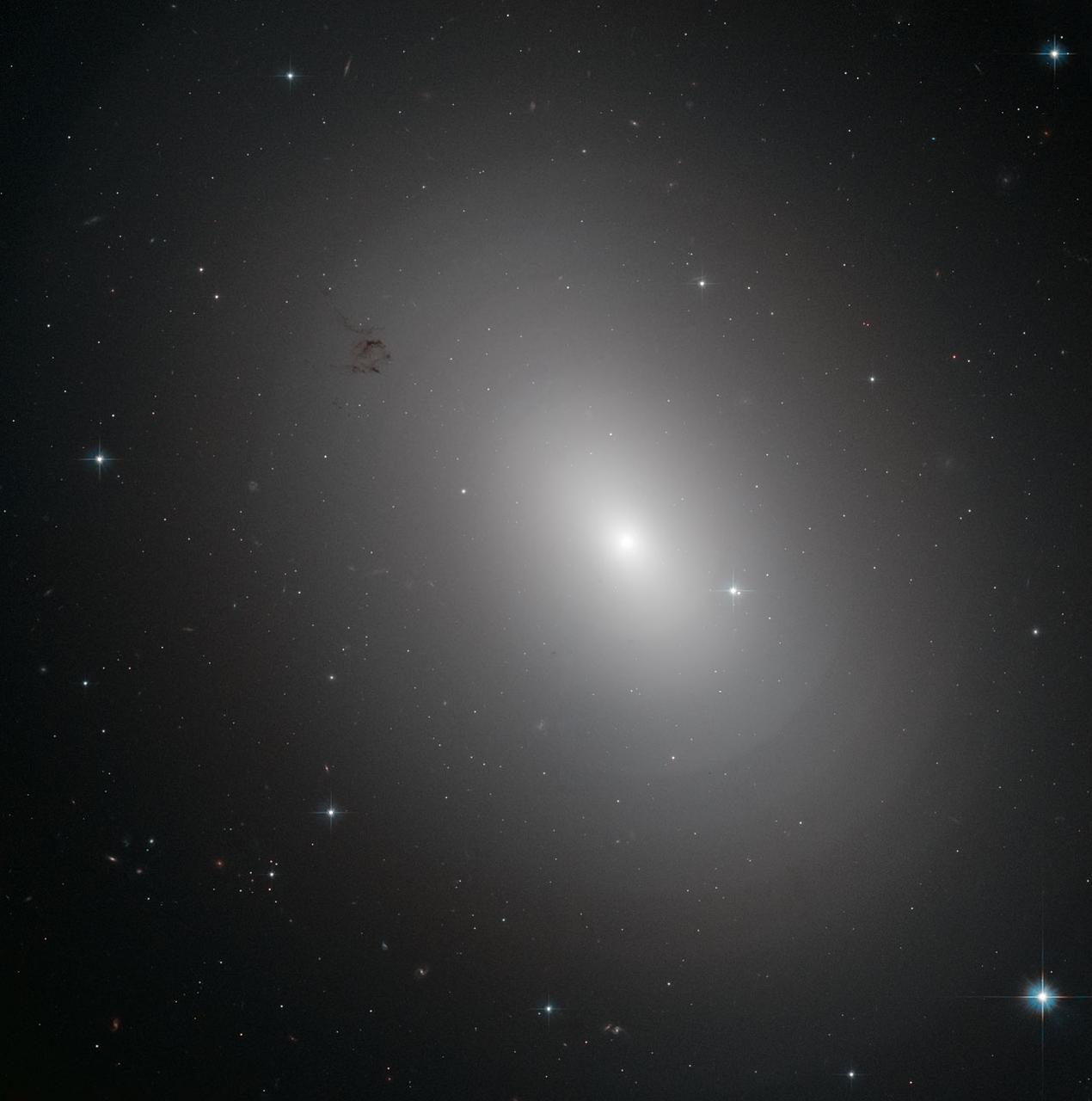
The glowing object in this Hubble Space Telescope image is an elliptical galaxy called NGC 3923. It is located over 90 million light-years away in the constellation of Hydra. NGC 3923 is an example of a shell galaxy where the stars in its halo are arranged in layers. Finding concentric shells of stars enclosing a galaxy is quite common and is observed in many elliptical galaxies. In fact, every tenth elliptical galaxy exhibits this onion-like structure, which has never been observed in spiral galaxies. The shell-like structures are thought to develop as a consequence of galactic cannibalism, when a larger galaxy ingests a smaller companion. As the two centers approach, they initially oscillate about a common center, and this oscillation ripples outwards forming the shells of stars just as ripples on a pond spread when the surface is disturbed. NGC 3923 has over twenty shells, with only a few of the outer ones visible in this image, and its shells are much more subtle than those of other shell galaxies. The shells of this galaxy are also interestingly symmetrical, while other shell galaxies are more skewed. Credit: ESA/Hubble & NASA
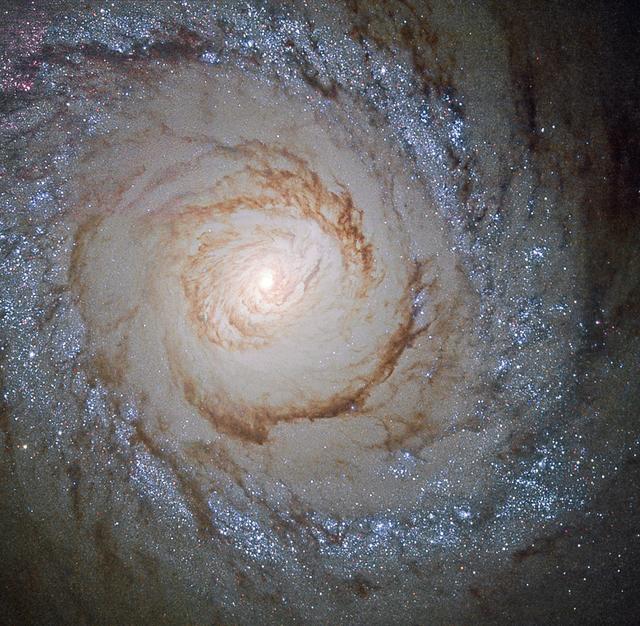
This image shows the galaxy Messier 94, which lies in the small northern constellation of the Hunting Dogs, about 16 million light-years away. Within the bright ring or starburst ring around Messier 94, new stars are forming at a high rate and many young, bright stars are present within it. The cause of this peculiarly shaped star-forming region is likely a pressure wave going outwards from the galactic center, compressing the gas and dust in the outer region. The compression of material means the gas starts to collapse into denser clouds. Inside these dense clouds, gravity pulls the gas and dust together until temperature and pressure are high enough for stars to be born. Image credit: ESA/NASA <b><a href="http://www.nasa.gov/audience/formedia/features/MP_Photo_Guidelines.html" rel="nofollow">NASA image use policy.</a></b> <b><a href="http://www.nasa.gov/centers/goddard/home/index.html" rel="nofollow">NASA Goddard Space Flight Center</a></b> enables NASA’s mission through four scientific endeavors: Earth Science, Heliophysics, Solar System Exploration, and Astrophysics. Goddard plays a leading role in NASA’s accomplishments by contributing compelling scientific knowledge to advance the Agency’s mission. <b>Follow us on <a href="http://twitter.com/NASAGoddardPix" rel="nofollow">Twitter</a></b> <b>Like us on <a href="http://www.facebook.com/pages/Greenbelt-MD/NASA-Goddard/395013845897?ref=tsd" rel="nofollow">Facebook</a></b> <b>Find us on <a href="http://instagrid.me/nasagoddard/?vm=grid" rel="nofollow">Instagram</a></b>
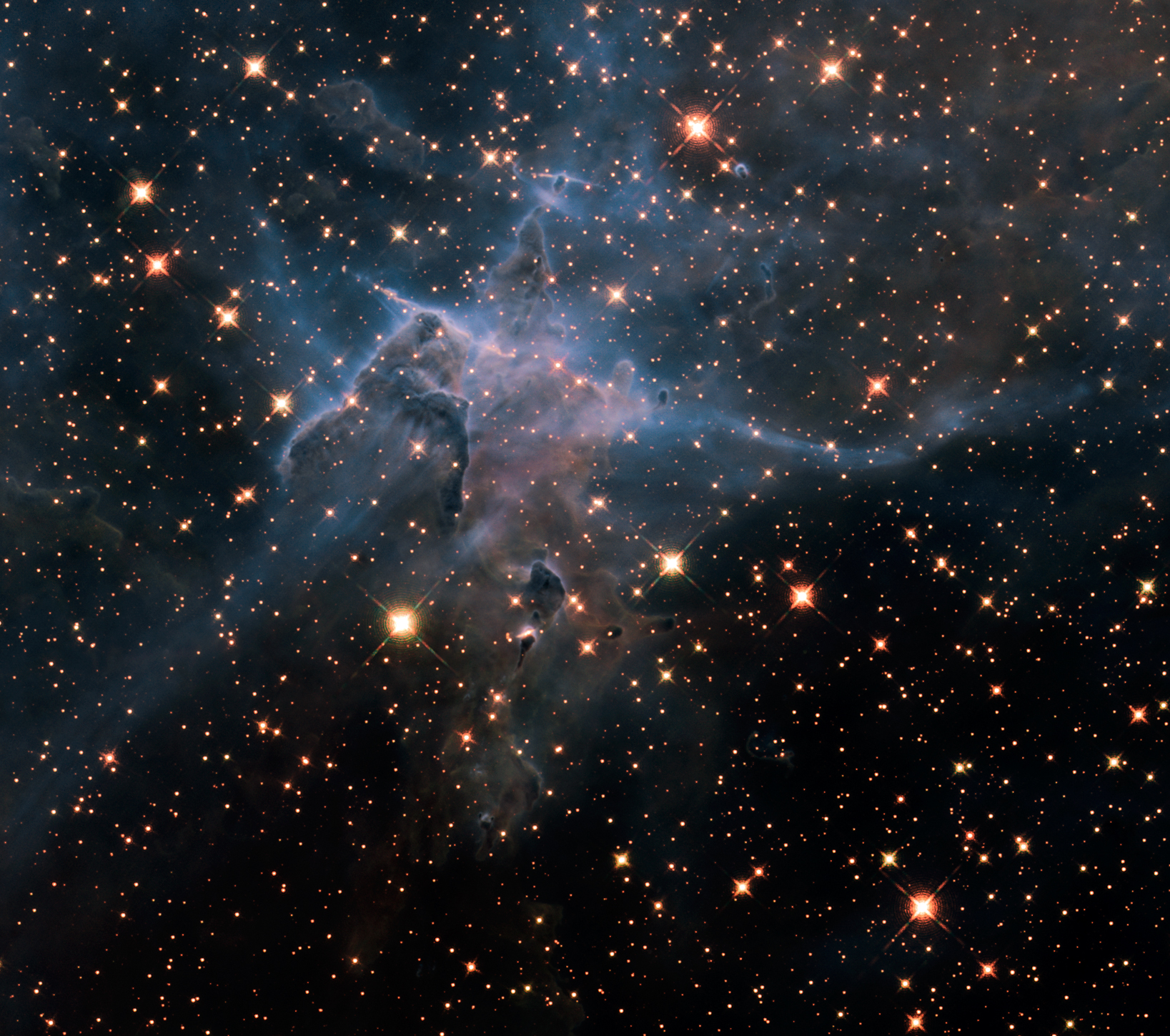
NASA image release April 22, 2010 This is a NASA Hubble Space Telescope near-infrared-light image of a three-light-year-tall pillar of gas and dust that is being eaten away by the brilliant light from nearby stars in the tempestuous stellar nursery called the Carina Nebula, located 7,500 light-years away in the southern constellation Carina. The image marks the 20th anniversary of Hubble's launch and deployment into an orbit around Earth. The image reveals a plethora of stars behind the gaseous veil of the nebula's wall of hydrogen, laced with dust. The foreground pillar becomes semi-transparent because infrared light from background stars penetrates through much of the dust. A few stars inside the pillar also become visible. The false colors are assigned to three different infrared wavelength ranges. Hubble's Wide Field Camera 3 observed the pillar in February and March 2010. Object Names: HH 901, HH 902 Image Type: Astronomical Credit: NASA, ESA, and M. Livio and the Hubble 20th Anniversary Team (STScI) To read learn more about this image go to: <a href="http://www.nasa.gov/mission_pages/hubble/science/hubble20th-img.html" rel="nofollow">www.nasa.gov/mission_pages/hubble/science/hubble20th-img....</a> <b><a href="http://www.nasa.gov/centers/goddard/home/index.html" rel="nofollow">NASA Goddard Space Flight Center</a></b> is home to the nation's largest organization of combined scientists, engineers and technologists that build spacecraft, instruments and new technology to study the Earth, the sun, our solar system, and the universe.
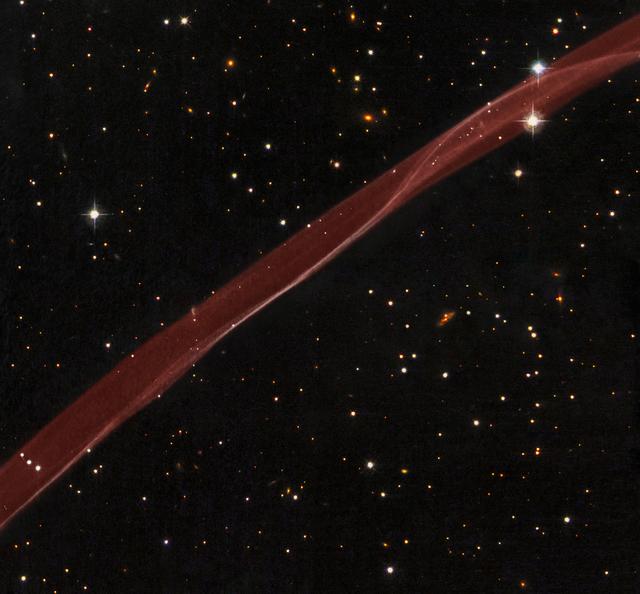
Release date: July 1, 2008 SN 1006 Supernova Remnant (Hubble) A delicate ribbon of gas floats eerily in our galaxy. A contrail from an alien spaceship? A jet from a black-hole? Actually this image, taken by NASA's Hubble Space Telescope, is a very thin section of a supernova remnant caused by a stellar explosion that occurred more than 1,000 years ago. On or around May 1, 1006 A.D., observers from Africa to Europe to the Far East witnessed and recorded the arrival of light from what is now called SN 1006, a tremendous supernova explosion caused by the final death throes of a white dwarf star nearly 7,000 light-years away. The supernova was probably the brightest star ever seen by humans, and surpassed Venus as the brightest object in the night time sky, only to be surpassed by the moon. It was visible even during the day for weeks, and remained visible to the naked eye for at least two and a half years before fading away. It wasn't until the mid-1960s that radio astronomers first detected a nearly circular ring of material at the recorded position of the supernova. The ring was almost 30 arcminutes across, the same angular diameter as the full moon. The size of the remnant implied that the blast wave from the supernova had expanded at nearly 20 million miles per hour over the nearly 1,000 years since the explosion occurred. In 1976, the first detection of exceedingly faint optical emission of the supernova remnant was reported, but only for a filament located on the northwest edge of the radio ring. A tiny portion of this filament is revealed in detail by the Hubble observation. The twisting ribbon of light seen by Hubble corresponds to locations where the expanding blast wave from the supernova is now sweeping into very tenuous surrounding gas. The hydrogen gas heated by this fast shock wave emits radiation in visible light. Hence, the optical emission provides astronomers with a detailed "snapshot" of the actual position and geometry of the shock front at any given time. Bright edges within the ribbon correspond to places where the shock wave is seen exactly edge on to our line of sight. Today we know that SN 1006 has a diameter of nearly 60 light-years, and it is still expanding at roughly 6 million miles per hour. Even at this tremendous speed, however, it takes observations typically separated by years to see significant outward motion of the shock wave against the grid of background stars. In the Hubble image as displayed, the supernova would have occurred far off the lower right corner of the image, and the motion would be toward the upper left. SN 1006 resides within our Milky Way Galaxy. Located more than 14 degrees off the plane of the galaxy's disk, there is relatively little confusion with other foreground and background objects in the field when trying to study this object. In the Hubble image, many background galaxies (orange extended objects) far off in the distant universe can be seen dotting the image. Most of the white dots are foreground or background stars in our Milky Way galaxy. This image is a composite of hydrogen-light observations taken with Hubble's Advanced Camera for Surveys in February 2006 and Wide Field Planetary Camera 2 observations in blue, yellow-green, and near-infrared light taken in April 2008. The supernova remnant, visible only in the hydrogen-light filter was assigned a red hue in the Heritage color image. Credit: NASA, ESA, and the Hubble Heritage Team (STScI/AURA) Acknowledgment: W. Blair (Johns Hopkins University) To learn more about the Hubble Space Telescope go here: <a href="http://www.nasa.gov/mission_pages/hubble/main/index.html" rel="nofollow">www.nasa.gov/mission_pages/hubble/main/index.html</a> <b><a href="http://www.nasa.gov/audience/formedia/features/MP_Photo_Guidelines.html" rel="nofollow">NASA image use policy.</a></b> <b><a href="http://www.nasa.gov/centers/goddard/home/index.html" rel="nofollow">NASA Goddard Space Flight Center</a></b> enables NASA’s mission through four scientific endeavors: Earth Science, Heliophysics, Solar System Exploration, and Astrophysics. Goddard plays a leading role in NASA’s accomplishments by contributing compelling scientific knowledge to advance the Agency’s mission. <b>Follow us on <a href="http://twitter.com/NASAGoddardPix" rel="nofollow">Twitter</a></b> <b>Like us on <a href="http://www.facebook.com/pages/Greenbelt-MD/NASA-Goddard/395013845897?ref=tsd" rel="nofollow">Facebook</a></b> <b>Find us on <a href="http://instagram.com/nasagoddard?vm=grid" rel="nofollow">Instagram</a></b>

NASA image release April 22, 2010 Object Names: Carina Nebula, NGC 3372 Image Type: Astronomical Credit: NASA/N. Smith (University of California, Berkeley) and NOAO/AURA/NSF To read learn more about this image go to: <a href="http://www.nasa.gov/mission_pages/hubble/science/hubble20th-img.html" rel="nofollow">www.nasa.gov/mission_pages/hubble/science/hubble20th-img....</a> <b><a href="http://www.nasa.gov/centers/goddard/home/index.html" rel="nofollow">NASA Goddard Space Flight Center</a></b> is home to the nation's largest organization of combined scientists, engineers and technologists that build spacecraft, instruments and new technology to study the Earth, the sun, our solar system, and the universe.

Image release June 22, 2010 A spectacular new NASA/ESA Hubble Space Telescope image — one of the largest ever released of a star-forming region — highlights N11, part of a complex network of gas clouds and star clusters within our neighbouring galaxy, the Large Magellanic Cloud. This region of energetic star formation is one of the most active in the nearby Universe. The Large Magellanic Cloud contains many bright bubbles of glowing gas. One of the largest and most spectacular has the name LHA 120-N 11, from its listing in a catalogue compiled by the American astronomer and astronaut Karl Henize in 1956, and is informally known as N11. Close up, the billowing pink clouds of glowing gas make N11 resemble a puffy swirl of fairground candy floss. From further away, its distinctive overall shape led some observers to nickname it the Bean Nebula. The dramatic and colourful features visible in the nebula are the telltale signs of star formation. N11 is a well-studied region that extends over 1000 light-years. It is the second largest star-forming region within the Large Magellanic Cloud and has produced some of the most massive stars known. It is the process of star formation that gives N11 its distinctive look. Three successive generations of stars, each of which formed further away from the centre of the nebula than the last, have created shells of gas and dust. These shells were blown away from the newborn stars in the turmoil of their energetic birth and early life, creating the ring shapes so prominent in this image. Beans are not the only terrestrial shapes to be found in this spectacular high resolution image from the NASA/ESA Hubble Space Telescope. In the upper left is the red bloom of nebula LHA 120-N 11A. Its rose-like petals of gas and dust are illuminated from within, thanks to the radiation from the massive hot stars at its centre. N11A is relatively compact and dense and is the site of the most recent burst of star development in the region. Other star clusters abound in N11, including NGC 1761 at the bottom of the image, which is a group of massive hot young stars busily pouring intense ultraviolet radiation out into space. Although it is much smaller than our own galaxy, the Large Magellanic Cloud is a very vigorous region of star formation. Studying these stellar nurseries helps astronomers understand a lot more about how stars are born and their ultimate development and lifespan. Both the Large Magellanic Cloud and its small companion, the Small Magellanic Cloud, are easily seen with the unaided eye and have always been familiar to people living in the southern hemisphere. The credit for bringing these galaxies to the attention of Europeans is usually given to Portuguese explorer Fernando de Magellan and his crew, who viewed it on their 1519 sea voyage. However, the Persian astronomer Abd Al-Rahman Al Sufi and the Italian explorer Amerigo Vespucci recorded the Large Magellanic Cloud in 964 and 1503 respectively. Credit: NASA, ESA and Jesús Maíz Apellániz (Instituto de Astrofísica de Andalucía, Spain) To learn more about Hubble go to: <a href="http://www.nasa.gov/mission_pages/hubble/main/index.html" rel="nofollow">www.nasa.gov/mission_pages/hubble/main/index.html</a> <b><a href="http://www.nasa.gov/centers/goddard/home/index.html" rel="nofollow">NASA Goddard Space Flight Center</a></b> is home to the nation's largest organization of combined scientists, engineers and technologists that build spacecraft, instruments and new technology to study the Earth, the sun, our solar system, and the universe.
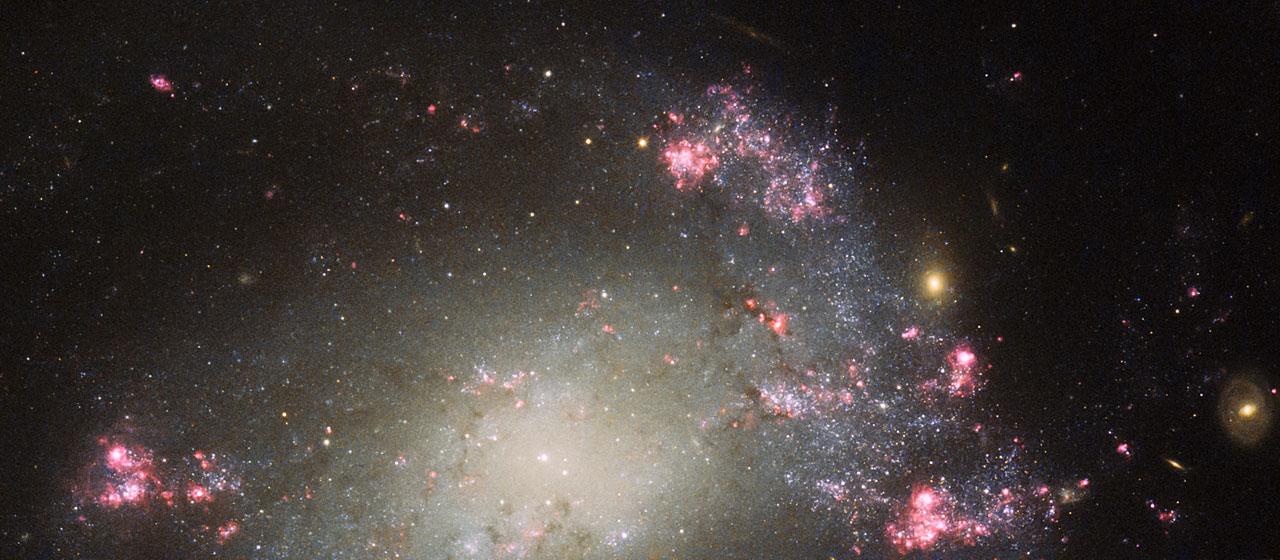
Bursts of pink and red, dark lanes of mottled cosmic dust, and a bright scattering of stars — this NASA/ESA Hubble Space Telescope image shows part of a messy barred spiral galaxy known as NGC 428. It lies approximately 48 million light-years away from Earth in the constellation of Cetus (The Sea Monster). Although a spiral shape is still just about visible in this close-up shot, overall NGC 428’s spiral structure appears to be quite distorted and warped, thought to be a result of a collision between two galaxies. There also appears to be a substantial amount of star formation occurring within NGC 428 — another telltale sign of a merger. When galaxies collide their clouds of gas can merge, creating intense shocks and hot pockets of gas, and often triggering new waves of star formation. NGC 428 was discovered by William Herschel in December 1786. More recently a type of supernova designated SN2013ct was discovered within the galaxy by Stuart Parker of the BOSS (Backyard Observatory Supernova Search) project in Australia and New Zealand, although it is unfortunately not visible in this image. This image was captured by Hubble’s Advanced Camera for Surveys (ACS) and Wide Field and Planetary Camera 2 (WFPC2). Image credit: ESA/Hubble and NASA and S. Smartt (Queen's University Belfast), Acknowledgements: Nick Rose and Flickr user pennine cloud <b><a href="http://www.nasa.gov/audience/formedia/features/MP_Photo_Guidelines.html" rel="nofollow">NASA image use policy.</a></b> <b><a href="http://www.nasa.gov/centers/goddard/home/index.html" rel="nofollow">NASA Goddard Space Flight Center</a></b> enables NASA’s mission through four scientific endeavors: Earth Science, Heliophysics, Solar System Exploration, and Astrophysics. Goddard plays a leading role in NASA’s accomplishments by contributing compelling scientific knowledge to advance the Agency’s mission. <b>Follow us on <a href="http://twitter.com/NASAGoddardPix" rel="nofollow">Twitter</a></b> <b>Like us on <a href="http://www.facebook.com/pages/Greenbelt-MD/NASA-Goddard/395013845897?ref=tsd" rel="nofollow">Facebook</a></b> <b>Find us on <a href="http://instagrid.me/nasagoddard/?vm=grid" rel="nofollow">Instagram</a></b>
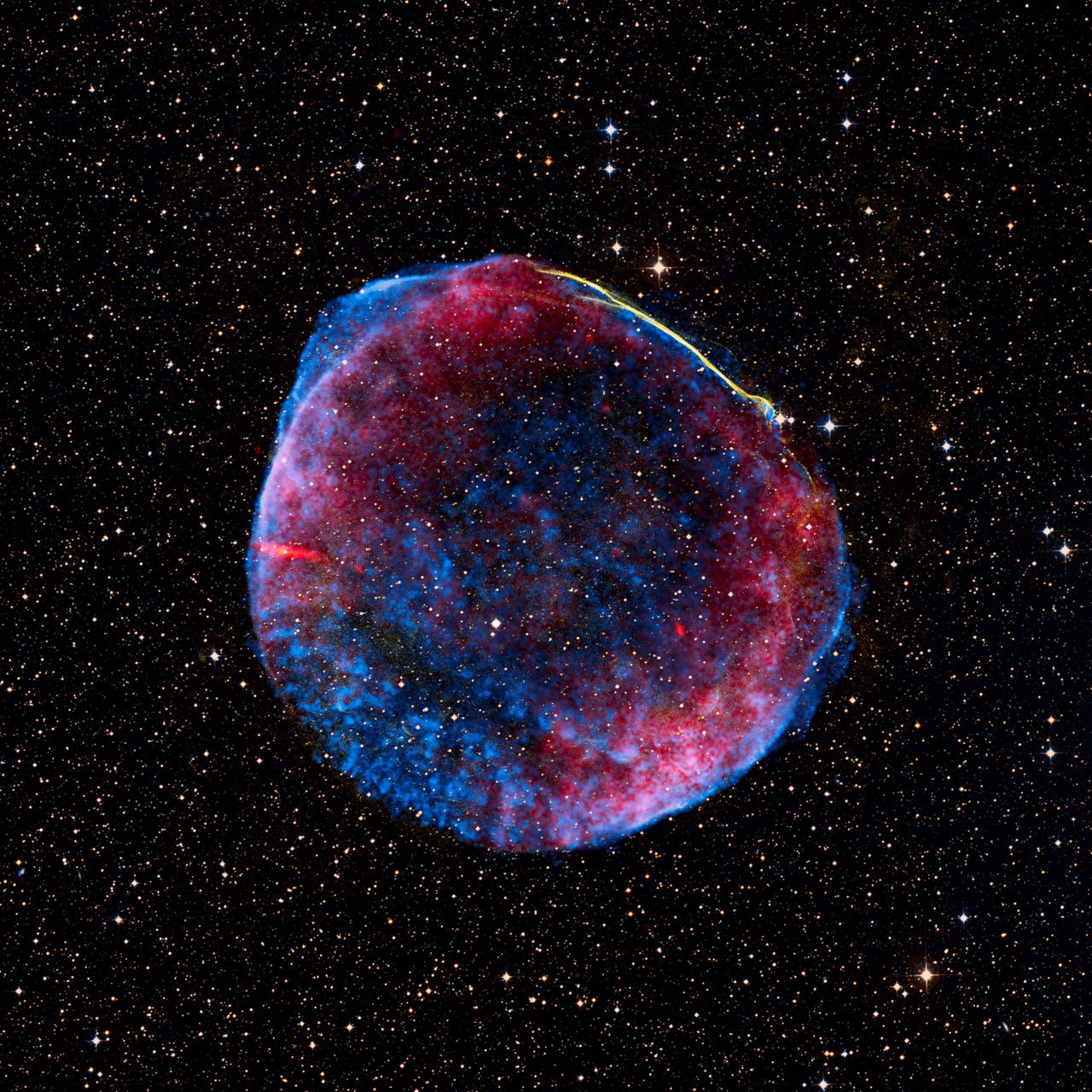
Release date: July 1, 2008 This image is a composite of visible (or optical), radio, and X-ray data of the full shell of the supernova remnant from SN 1006. The radio data show much of the extent that the X-ray image shows. In contrast, only a small linear filament in the northwest corner of the shell is visible in the optical data. The object has an angular size of roughly 30 arcminutes (0.5 degree, or about the size of the full moon), and a physical size of 60 light-years (18 parsecs) based on its distance of nearly 7,000 light-years. The small green box along the bright filament at the top of the image corresponds to the dimensions of the Hubble release image. The optical data was obtained at the University of Michigan's 0.9-meter Curtis Schmidt telescope at the National Science Foundation's Cerro Tololo Inter-American Observatory (CTIO) near La Serena, Chile. H-alpha, continuum-subtracted data were provided by F. Winkler (Middlebury COllege) et al. The X-ray data were acquired from the Chandra X-ray Observatory's AXAF CCD Imaging Spectrometer (ACIS) at 0.5-3keV, and were provided by J. Hughes (Rutgers University) et al. The radio data, supplied by K. Dyer (NRAO, Socorro) et al., were a composite from the National Radio Astronomy Observatory's Very Large Array (NRAO/VLA) in Socorro, New Mexico, along with the Green Bank Telescope (GBT) in Green Bank, West Virginia. Data of the supernova remnant were blended on a visible-light stellar background created using the Digitized Sky Survey's Anglo-Australian Observatory (AAO2) blue and red plates. Photo Credit: NASA, ESA, and Z. Levay (STScI) Science Credit: Radio: NRAO/AUI/NSF GBT+VLA 1.4 GHz mosaic (Dyer, Maddalena and Cornwell, NRAO); X-ray: NASA/CXC/Rutgers/G. Cassam-Chenai and J. Hughes et al.; Optical: F.Winkler/Middlebury College and NOAO/AURA/NSF; and DSS To learn more about the Hubble Space Telescope go here: <a href="http://www.nasa.gov/mission_pages/hubble/main/index.html" rel="nofollow">www.nasa.gov/mission_pages/hubble/main/index.html</a> <b><a href="http://www.nasa.gov/centers/goddard/home/index.html" rel="nofollow">NASA Goddard Space Flight Center</a></b> is home to the nation's largest organization of combined scientists, engineers and technologists that build spacecraft, instruments and new technology to study the Earth, the sun, our solar system, and the universe. <b>Follow us on <a href="http://twitter.com/NASAGoddardPix" rel="nofollow">Twitter</a></b> <b>Join us on <a href="http://www.facebook.com/pages/Greenbelt-MD/NASA-Goddard/395013845897?ref=tsd" rel="nofollow">Facebook</a><b> </b></b>
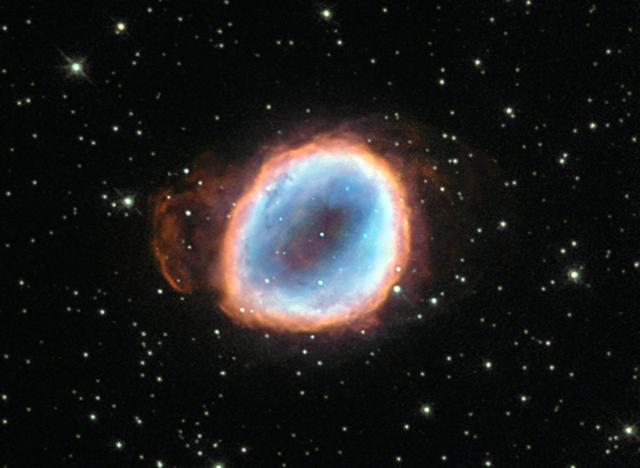
A dying star’s final moments are captured in this image from the NASA/ESA Hubble Space Telescope. The death throes of this star may only last mere moments on a cosmological timescale, but this star’s demise is still quite lengthy by our standards, lasting tens of thousands of years! The star’s agony has culminated in a wonderful planetary nebula known as NGC 6565, a cloud of gas that was ejected from the star after strong stellar winds pushed the star’s outer layers away into space. Once enough material was ejected, the star’s luminous core was exposed, enabling its ultraviolet radiation to excite the surrounding gas to varying degrees and causing it to radiate in an attractive array of colors. These same colors can be seen in the famous and impressive Ring Nebula (heic1310), a prominent example of a nebula like this one. Planetary nebulae are illuminated for around 10,000 years before the central star begins to cool and shrink to become a white dwarf. When this happens, the star’s light drastically diminishes and ceases to excite the surrounding gas, so the nebula fades from view. Credit: ESA/Hubble & NASA, Acknowledgement: Matej Novak <b><a href="http://www.nasa.gov/audience/formedia/features/MP_Photo_Guidelines.html" rel="nofollow">NASA image use policy.</a></b> <b><a href="http://www.nasa.gov/centers/goddard/home/index.html" rel="nofollow">NASA Goddard Space Flight Center</a></b> enables NASA’s mission through four scientific endeavors: Earth Science, Heliophysics, Solar System Exploration, and Astrophysics. Goddard plays a leading role in NASA’s accomplishments by contributing compelling scientific knowledge to advance the Agency’s mission. <b>Follow us on <a href="http://twitter.com/NASAGoddardPix" rel="nofollow">Twitter</a></b> <b>Like us on <a href="http://www.facebook.com/pages/Greenbelt-MD/NASA-Goddard/395013845897?ref=tsd" rel="nofollow">Facebook</a></b> <b>Find us on <a href="http://instagrid.me/nasagoddard/?vm=grid" rel="nofollow">Instagram</a></b>

NASA image release April 12, 2011 Astronomers have uncovered one of the youngest galaxies in the distant universe, with stars that formed 13.5 billion years ago, a mere 200 million years after the Big Bang. The finding addresses questions about when the first galaxies arose, and how the early universe evolved. NASA's Hubble Space Telescope was the first to spot the newfound galaxy. Detailed observations from the W.M. Keck Observatory on Mauna Kea in Hawaii revealed the observed light dates to when the universe was only 950 million years old; the universe formed about 13.7 billion years ago. Infrared data from both Hubble and NASA's Spitzer Space Telescope revealed the galaxy's stars are quite mature, having formed when the universe was just a toddler at 200 million years old. The galaxy's image is being magnified by the gravity of a massive cluster of galaxies (Abell 383) parked in front of it, making it appear 11 times brighter. This phenomenon is called gravitational lensing. Hubble imaged the lensing galaxy Abell 383 with the Wide Field Camera 3 and the Advanced Camera for Surveys in November 2010 through March 2011. Credit: NASA, ESA, J. Richard (Center for Astronomical Research/Observatory of Lyon, France), and J.-P. Kneib (Astrophysical Laboratory of Marseille, France) <b><a href="http://www.nasa.gov/centers/goddard/home/index.html" rel="nofollow">NASA Goddard Space Flight Center</a></b> enables NASA’s mission through four scientific endeavors: Earth Science, Heliophysics, Solar System Exploration, and Astrophysics. Goddard plays a leading role in NASA’s accomplishments by contributing compelling scientific knowledge to advance the Agency’s mission. <b>Follow us on <a href="http://twitter.com/NASA_GoddardPix" rel="nofollow">Twitter</a></b> <b>Join us on <a href="http://www.facebook.com/pages/Greenbelt-MD/NASA-Goddard/395013845897?ref=tsd" rel="nofollow">Facebook</a></b>
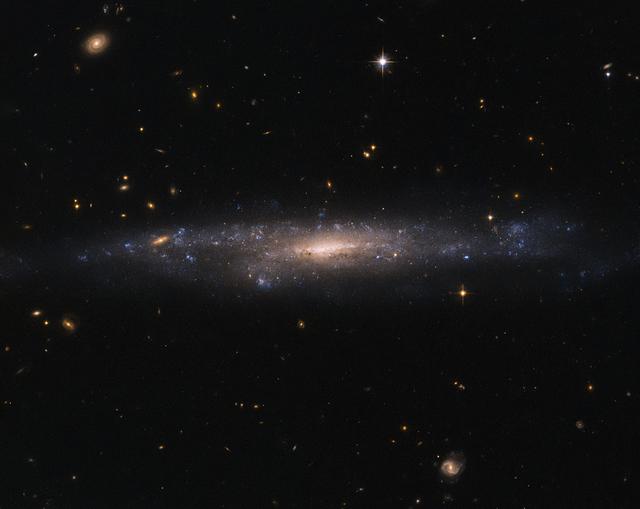
This striking NASA/ESA Hubble Space Telescope image captures the galaxy UGC 477, located just over 110 million light-years away in the constellation of Pisces (The Fish). UGC 477 is a low surface brightness (LSB) galaxy. First proposed in 1976 by Mike Disney, the existence of LSB galaxies was confirmed only in 1986 with the discovery of Malin 1. LSB galaxies like UGC 477 are more diffusely distributed than galaxies such as Andromeda and the Milky Way. With surface brightnesses up to 250 times fainter than the night sky, these galaxies can be incredibly difficult to detect. Most of the matter present in LSB galaxies is in the form of hydrogen gas, rather than stars. Unlike the bulges of normal spiral galaxies, the centers of LSB galaxies do not contain large numbers of stars. Astronomers suspect that this is because LSB galaxies are mainly found in regions devoid of other galaxies, and have therefore experienced fewer galactic interactions and mergers capable of triggering high rates of star formation. LSB galaxies such as UGC 477 instead appear to be dominated by dark matter, making them excellent objects to study to further our understanding of this elusive substance. However, due to an underrepresentation in galactic surveys — caused by their characteristic low brightness — their importance has only been realized relatively recently. Image credit: ESA/Hubble & NASA, Acknowledgement: Judy Schmidt <b><a href="http://www.nasa.gov/audience/formedia/features/MP_Photo_Guidelines.html" rel="nofollow">NASA image use policy.</a></b> <b><a href="http://www.nasa.gov/centers/goddard/home/index.html" rel="nofollow">NASA Goddard Space Flight Center</a></b> enables NASA’s mission through four scientific endeavors: Earth Science, Heliophysics, Solar System Exploration, and Astrophysics. Goddard plays a leading role in NASA’s accomplishments by contributing compelling scientific knowledge to advance the Agency’s mission. <b>Follow us on <a href="http://twitter.com/NASAGoddardPix" rel="nofollow">Twitter</a></b> <b>Like us on <a href="http://www.facebook.com/pages/Greenbelt-MD/NASA-Goddard/395013845897?ref=tsd" rel="nofollow">Facebook</a></b> <b>Find us on <a href="http://instagrid.me/nasagoddard/?vm=grid" rel="nofollow">Instagram</a></b>

NASA image release April 22, 2010 NASA's Hubble Space Telescope captured this billowing cloud of cold interstellar gas and dust rising from a tempestuous stellar nursery located in the Carina Nebula, 7,500 light-years away in the southern constellation Carina. This pillar of dust and gas serves as an incubator for new stars and is teeming with new star-forming activity. Hot, young stars erode and sculpt the clouds into this fantasy landscape by sending out thick stellar winds and scorching ultraviolet radiation. The low-density regions of the nebula are shredded while the denser parts resist erosion and remain as thick pillars. In the dark, cold interiors of these columns new stars continue to form. In the process of star formation, a disk around the proto-star slowly accretes onto the star's surface. Part of the material is ejected along jets perpendicular to the accretion disk. The jets have speeds of several hundreds of miles per second. As these jets plow into the surround nebula, they create small, glowing patches of nebulosity, called Herbig-Haro (HH) objects. Long streamers of gas can be seen shooting in opposite directions off the pedestal on the upper right-hand side of the image. Another pair of jets is visible in a peak near the top-center of the image. These jets (known as HH 901 and HH 902, respectively) are common signatures of the births of new stars. This image celebrates the 20th anniversary of Hubble's launch and deployment into an orbit around Earth. Hubble's Wide Field Camera 3 observed the pillar on Feb. 1-2, 2010. The colors in this composite image correspond to the glow of oxygen (blue), hydrogen and nitrogen (green), and sulfur (red). Object Names: HH 901, HH 902 Image Type: Astronomical Credit: NASA, ESA, and M. Livio and the Hubble 20th Anniversary Team (STScI) To read learn more about this image go to: <a href="http://www.nasa.gov/mission_pages/hubble/science/hubble20th-img.html" rel="nofollow">www.nasa.gov/mission_pages/hubble/science/hubble20th-img....</a> <b><a href="http://www.nasa.gov/centers/goddard/home/index.html" rel="nofollow">NASA Goddard Space Flight Center</a></b> is home to the nation's largest organization of combined scientists, engineers and technologists that build spacecraft, instruments and new technology to study the Earth, the sun, our solar system, and the universe.

NASA image release April 22, 2010 This brand new Hubble photo is of a small portion of one of the largest seen star-birth regions in the galaxy, the Carina Nebula. Towers of cool hydrogen laced with dust rise from the wall of the nebula. The scene is reminiscent of Hubble's classic "Pillars of Creation" photo from 1995, but is even more striking in appearance. The image captures the top of a three-light-year-tall pillar of gas and dust that is being eaten away by the brilliant light from nearby bright stars. The pillar is also being pushed apart from within, as infant stars buried inside it fire off jets of gas that can be seen streaming from towering peaks like arrows sailing through the air. Credit: NASA, ESA, and M. Livio and the Hubble 20th Anniversary Team (STScI) To read learn more about this image go to: <a href="http://www.nasa.gov/mission_pages/hubble/science/hubble20th-img.html" rel="nofollow">www.nasa.gov/mission_pages/hubble/science/hubble20th-img....</a> <b><a href="http://www.nasa.gov/audience/formedia/features/MP_Photo_Guidelines.html" rel="nofollow">NASA image use policy.</a></b> <b><a href="http://www.nasa.gov/centers/goddard/home/index.html" rel="nofollow">NASA Goddard Space Flight Center</a></b> enables NASA’s mission through four scientific endeavors: Earth Science, Heliophysics, Solar System Exploration, and Astrophysics. Goddard plays a leading role in NASA’s accomplishments by contributing compelling scientific knowledge to advance the Agency’s mission. <b>Follow us on <a href="http://twitter.com/NASAGoddardPix" rel="nofollow">Twitter</a></b> <b>Like us on <a href="http://www.facebook.com/pages/Greenbelt-MD/NASA-Goddard/395013845897?ref=tsd" rel="nofollow">Facebook</a></b> <b>Find us on <a href="http://instagram.com/nasagoddard?vm=grid" rel="nofollow">Instagram</a></b>

In the center of this image, taken with the NASA/ESA Hubble Space Telescope, is the galaxy cluster SDSS J1038+4849 — and it seems to be smiling. You can make out its two orange eyes and white button nose. In the case of this “happy face”, the two eyes are very bright galaxies and the misleading smile lines are actually arcs caused by an effect known as strong gravitational lensing. Galaxy clusters are the most massive structures in the Universe and exert such a powerful gravitational pull that they warp the spacetime around them and act as cosmic lenses which can magnify, distort and bend the light behind them. This phenomenon, crucial to many of Hubble’s discoveries, can be explained by Einstein’s theory of general relativity. In this special case of gravitational lensing, a ring — known as an Einstein Ring — is produced from this bending of light, a consequence of the exact and symmetrical alignment of the source, lens and observer and resulting in the ring-like structure we see here. Hubble has provided astronomers with the tools to probe these massive galaxies and model their lensing effects, allowing us to peer further into the early Universe than ever before. This object was studied by Hubble’s Wide Field and Planetary Camera 2 (WFPC2) and Wide Field Camera 3 (WFC3) as part of a survey of strong lenses. A version of this image was entered into the Hubble’s Hidden Treasures image processing competition by contestant Judy Schmidt. Image Credit: NASA/ESA

This is an illustration of a supermassive black hole, weighing as much as 21 million suns, located in the middle of the ultradense galaxy M60-UCD1. The dwarf galaxy is so dense that millions of stars fill the sky as seen by an imaginary visitor. Because no light can escape from the black hole, it appears simply in silhouette against the starry background. The black hole's intense gravitational field warps the light of the background stars to form ring-like images just outside the dark edges of the black hole's event horizon. Combined observations by the Hubble Space Telescope and Gemini North telescope determined the presence of the black hole inside such a small and dense galaxy. More info: Astronomers using data from NASA’s Hubble Space Telescope and ground observation have found an unlikely object in an improbable place -- a monster black hole lurking inside one of the tiniest galaxies ever known. The black hole is five times the mass of the one at the center of our Milky Way galaxy. It is inside one of the densest galaxies known to date -- the M60-UCD1 dwarf galaxy that crams 140 million stars within a diameter of about 300 light-years, which is only 1/500th of our galaxy’s diameter. If you lived inside this dwarf galaxy, the night sky would dazzle with at least 1 million stars visible to the naked eye. Our nighttime sky as seen from Earth’s surface shows 4,000 stars. The finding implies there are many other compact galaxies in the universe that contain supermassive black holes. The observation also suggests dwarf galaxies may actually be the stripped remnants of larger galaxies that were torn apart during collisions with other galaxies rather than small islands of stars born in isolation. “We don’t know of any other way you could make a black hole so big in an object this small,” said University of Utah astronomer Anil Seth, lead author of an international study of the dwarf galaxy published in Thursday’s issue of the journal Nature. Seth’s team of astronomers used the Hubble Space Telescope and the Gemini North 8-meter optical and infrared telescope on Hawaii’s Mauna Kea to observe M60-UCD1 and measure the black hole’s mass. The sharp Hubble images provide information about the galaxy’s diameter and stellar density. Gemini measures the stellar motions as affected by the black hole’s pull. These data are used to calculate the mass of the black hole. Black holes are gravitationally collapsed, ultra-compact objects that have a gravitational pull so strong that even light cannot escape. Supermassive black holes -- those with the mass of at least one million stars like our sun -- are thought to be at the centers of many galaxies. The black hole at the center of our Milky Way galaxy has the mass of four million suns. As heavy as that is, it is less than 0.01 percent of the Milky Way’s total mass. By comparison, the supermassive black hole at the center of M60-UCD1, which has the mass of 21 million suns, is a stunning 15 percent of the small galaxy’s total mass. “That is pretty amazing, given that the Milky Way is 500 times larger and more than 1,000 times heavier than the dwarf galaxy M60-UCD1,” Seth said. One explanation is that M60-UCD1 was once a large galaxy containing 10 billion stars, but then it passed very close to the center of an even larger galaxy, M60, and in that process all the stars and dark matter in the outer part of the galaxy were torn away and became part of M60. The team believes that M60-UCD1 may eventually be pulled to fully merge with M60, which has its own monster black hole that weighs a whopping 4.5 billion solar masses, or more than 1,000 times bigger than the black hole in our galaxy. When that happens, the black holes in both galaxies also likely will merge. Both galaxies are 50 million light-years away. The Hubble Space Telescope is a project of international cooperation between NASA and the European Space Agency. NASA's Goddard Space Flight Center in Greenbelt, Maryland, manages the telescope. The Space Telescope Science Institute (STScI) in Baltimore conducts Hubble science operations. STScI is operated for NASA by the Association of Universities for Research in Astronomy, Inc., in Washington. For images and more information about Hubble, visit: <a href="http://www.nasa.gov/hubble" rel="nofollow">www.nasa.gov/hubble</a> <b><a href="http://www.nasa.gov/audience/formedia/features/MP_Photo_Guidelines.html" rel="nofollow">NASA image use policy.</a></b> <b><a href="http://www.nasa.gov/centers/goddard/home/index.html" rel="nofollow">NASA Goddard Space Flight Center</a></b> enables NASA’s mission through four scientific endeavors: Earth Science, Heliophysics, Solar System Exploration, and Astrophysics. Goddard plays a leading role in NASA’s accomplishments by contributing compelling scientific knowledge to advance the Agency’s mission. <b>Follow us on <a href="http://twitter.com/NASAGoddardPix" rel="nofollow">Twitter</a></b> <b>Like us on <a href="http://www.facebook.com/pages/Greenbelt-MD/NASA-Goddard/395013845897?ref=tsd" rel="nofollow">Facebook</a></b> <b>Find us on <a href="http://instagram.com/nasagoddard?vm=grid" rel="nofollow">Instagram</a></b>
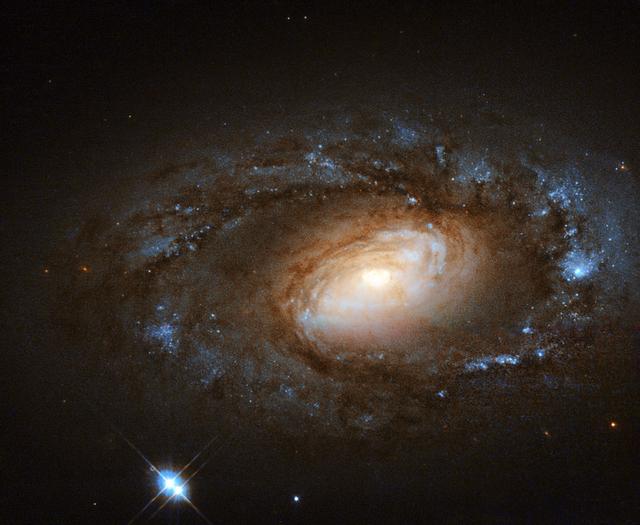
The NASA/ESA Hubble Space Telescope observes some of the most beautiful galaxies in our skies — spirals sparkling with bright stellar nurseries, violent duos ripping gas and stars away from one another as they tangle together, and ethereal irregular galaxies that hang like flocks of birds suspended in the blackness of space. However, galaxies, like humans, are not all supermodels. This little spiral, known as NGC 4102, has a different kind of appeal, with its tightly-wound spiral arms and understated, but charming, appearance. NGC 4102 lies in the northern constellation of Ursa Major (The Great Bear). It contains what is known as a LINER, or low-ionization nuclear emission-line region, meaning that its nucleus emits particular types of radiation — specifically, emission from weakly-ionized or neutral atoms of certain elements. Even in this sense, NGC 4102 is not special; around one third of all nearby galaxies are thought to be LINER galaxies. Many LINER galaxies also contain intense regions of star formation. This is thought to be intrinsically linked to their centers but just why, is still a mystery for astronomers — either the starbursts pour fuel inwards to fuel the LINERs, or this active central region triggers the starbursts. NGC 4102 does indeed contain a starburst region towards its center, where stars are being created at a rate much more furious than in a normal galaxy. This star formation is taking place within a small rotating disk, around 1000 light-years in diameter and with a mass some three billion times the mass of the sun. This image uses infrared and visible observations taken using Hubble’s Wide Field Planetary Camera 2. Credit: ESA/Hubble, NASA and S. Smartt (Queen's University Belfast) Acknowledgement: Renaud Houdinet <b><a href="http://www.nasa.gov/audience/formedia/features/MP_Photo_Guidelines.html" rel="nofollow">NASA image use policy.</a></b> <b><a href="http://www.nasa.gov/centers/goddard/home/index.html" rel="nofollow">NASA Goddard Space Flight Center</a></b> enables NASA’s mission through four scientific endeavors: Earth Science, Heliophysics, Solar System Exploration, and Astrophysics. Goddard plays a leading role in NASA’s accomplishments by contributing compelling scientific knowledge to advance the Agency’s mission. <b>Follow us on <a href="http://twitter.com/NASAGoddardPix" rel="nofollow">Twitter</a></b> <b>Like us on <a href="http://www.facebook.com/pages/Greenbelt-MD/NASA-Goddard/395013845897?ref=tsd" rel="nofollow">Facebook</a></b> <b>Find us on <a href="http://instagram.com/nasagoddard?vm=grid" rel="nofollow">Instagram</a></b>

Mars is looking mighty fine in this portrait nabbed by the Hubble Space Telescope on a near close approach! Read more: <a href="http://go.nasa.gov/1rWYiBT" rel="nofollow">go.nasa.gov/1rWYiBT</a> The Hubble Space Telescope is more well known for its picturesque views of nebulae and galaxies, but it's also useful for studying our own planets, including Mars. Hubble imaged Mars on May 12, 2016 - ten days before Mars would be on the exact opposite side of the Earth from the Sun. Bright, frosty polar caps, and clouds above a vivid, rust-colored landscape reveal Mars as a dynamic seasonal planet in this NASA Hubble Space Telescope view taken on May 12, 2016, when Mars was 50 million miles from Earth. The Hubble image reveals details as small as 20 to 30 miles across. The large, dark region at far right is Syrtis Major Planitia, one of the first features identified on the surface of the planet by seventeenth-century observers. Christiaan Huygens used this feature to measure the rotation rate of Mars. (A Martian day is about 24 hours and 37 minutes.) Today we know that Syrtis Major is an ancient, inactive shield volcano. Late-afternoon clouds surround its summit in this view. A large oval feature to the south of Syrtis Major is the bright Hellas Planitia basin. About 1,100 miles across and nearly five miles deep, it was formed about 3.5 billion years ago by an asteroid impact. The orange area in the center of the image is Arabia Terra, a vast upland region in northern Mars that covers about 2,800 miles. The landscape is densely cratered and heavily eroded, indicating that it could be among the oldest terrains on the planet. Dried river canyons (too small to be seen here) wind through the region and empty into the large northern lowlands. Credit: NASA, ESA, the Hubble Heritage Team (STScI/AURA), J. Bell (ASU), and M. Wolff (Space Science Institute) #nasagoddard #mars #hubble #space <b><a href="http://www.nasa.gov/audience/formedia/features/MP_Photo_Guidelines.html" rel="nofollow">NASA image use policy.</a></b> <b><a href="http://www.nasa.gov/centers/goddard/home/index.html" rel="nofollow">NASA Goddard Space Flight Center</a></b> enables NASA’s mission through four scientific endeavors: Earth Science, Heliophysics, Solar System Exploration, and Astrophysics. Goddard plays a leading role in NASA’s accomplishments by contributing compelling scientific knowledge to advance the Agency’s mission. <b>Follow us on <a href="http://twitter.com/NASAGoddardPix" rel="nofollow">Twitter</a></b> <b>Like us on <a href="http://www.facebook.com/pages/Greenbelt-MD/NASA-Goddard/395013845897?ref=tsd" rel="nofollow">Facebook</a></b> <b>Find us on <a href="http://instagrid.me/nasagoddard/?vm=grid" rel="nofollow">Instagram</a></b>
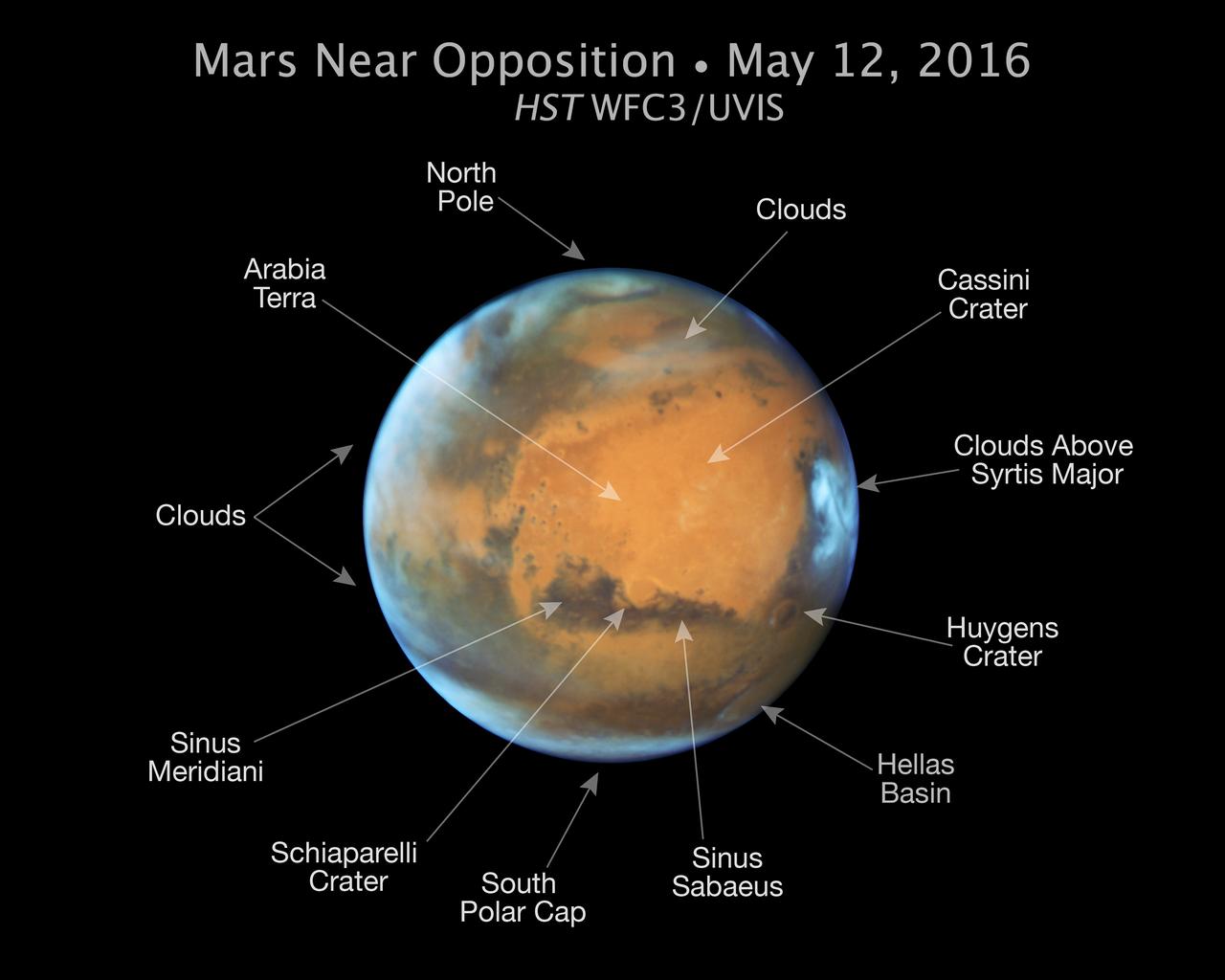
Mars is looking mighty fine in this portrait nabbed by the Hubble Space Telescope on a near close approach! Read more: <a href="http://go.nasa.gov/1rWYiBT" rel="nofollow">go.nasa.gov/1rWYiBT</a> The Hubble Space Telescope is more well known for its picturesque views of nebulae and galaxies, but it's also useful for studying our own planets, including Mars. Hubble imaged Mars on May 12, 2016 - ten days before Mars would be on the exact opposite side of the Earth from the Sun. Bright, frosty polar caps, and clouds above a vivid, rust-colored landscape reveal Mars as a dynamic seasonal planet in this NASA Hubble Space Telescope view taken on May 12, 2016, when Mars was 50 million miles from Earth. The Hubble image reveals details as small as 20 to 30 miles across. The large, dark region at far right is Syrtis Major Planitia, one of the first features identified on the surface of the planet by seventeenth-century observers. Christiaan Huygens used this feature to measure the rotation rate of Mars. (A Martian day is about 24 hours and 37 minutes.) Today we know that Syrtis Major is an ancient, inactive shield volcano. Late-afternoon clouds surround its summit in this view. A large oval feature to the south of Syrtis Major is the bright Hellas Planitia basin. About 1,100 miles across and nearly five miles deep, it was formed about 3.5 billion years ago by an asteroid impact. The orange area in the center of the image is Arabia Terra, a vast upland region in northern Mars that covers about 2,800 miles. The landscape is densely cratered and heavily eroded, indicating that it could be among the oldest terrains on the planet. Dried river canyons (too small to be seen here) wind through the region and empty into the large northern lowlands. Credit: NASA, ESA, the Hubble Heritage Team (STScI/AURA), J. Bell (ASU), and M. Wolff (Space Science Institute) #nasagoddard #mars #hubble #space <b><a href="http://www.nasa.gov/audience/formedia/features/MP_Photo_Guidelines.html" rel="nofollow">NASA image use policy.</a></b> <b><a href="http://www.nasa.gov/centers/goddard/home/index.html" rel="nofollow">NASA Goddard Space Flight Center</a></b> enables NASA’s mission through four scientific endeavors: Earth Science, Heliophysics, Solar System Exploration, and Astrophysics. Goddard plays a leading role in NASA’s accomplishments by contributing compelling scientific knowledge to advance the Agency’s mission. <b>Follow us on <a href="http://twitter.com/NASAGoddardPix" rel="nofollow">Twitter</a></b> <b>Like us on <a href="http://www.facebook.com/pages/Greenbelt-MD/NASA-Goddard/395013845897?ref=tsd" rel="nofollow">Facebook</a></b> <b>Find us on <a href="http://instagrid.me/nasagoddard/?vm=grid" rel="nofollow">Instagram</a></b>

Barred Spiral Galaxy NGC 1300 Credit: NASA, ESA, and The Hubble Heritage Team (STScI/AURA) Acknowledgment: P. Knezek (WIYN) The Hubble Space Telescope is a project of international cooperation between NASA and the European Space Agency. NASA's Goddard Space Flight Center manages the telescope. The Space Telescope Science Institute conducts Hubble science operations. Goddard is responsible for HST project management, including mission and science operations, servicing missions, and all associated development activities. To learn more about the Hubble Space Telescope go here: <a href="http://www.nasa.gov/mission_pages/hubble/main/index.html" rel="nofollow">www.nasa.gov/mission_pages/hubble/main/index.html</a>
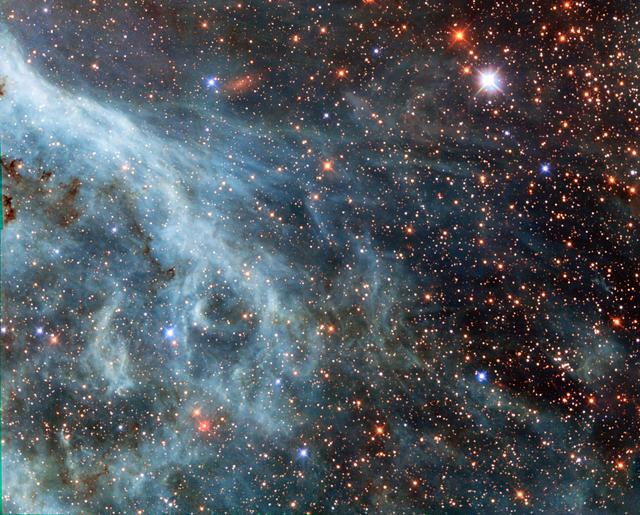
The brightly glowing plumes seen in this image are reminiscent of an underwater scene, with turquoise-tinted currents and nebulous strands reaching out into the surroundings. However, this is no ocean. This image actually shows part of the Large Magellanic Cloud (LMC), a small nearby galaxy that orbits our galaxy, the Milky Way, and appears as a blurred blob in our skies. The NASA/European Space Agency (ESA) Hubble Space Telescope has peeked many times into this galaxy, releasing stunning images of the whirling clouds of gas and sparkling stars (opo9944a, heic1301, potw1408a). This image shows part of the Tarantula Nebula's outskirts. This famously beautiful nebula, located within the LMC, is a frequent target for Hubble (heic1206, heic1402). In most images of the LMC the color is completely different to that seen here. This is because, in this new image, a different set of filters was used. The customary R filter, which selects the red light, was replaced by a filter letting through the near-infrared light. In traditional images, the hydrogen gas appears pink because it shines most brightly in the red. Here however, other less prominent emission lines dominate in the blue and green filters. This data is part of the Archival Pure Parallel Project (APPP), a project that gathered together and processed over 1,000 images taken using Hubble’s Wide Field Planetary Camera 2, obtained in parallel with other Hubble instruments. Much of the data in the project could be used to study a wide range of astronomical topics, including gravitational lensing and cosmic shear, exploring distant star-forming galaxies, supplementing observations in other wavelength ranges with optical data, and examining star populations from stellar heavyweights all the way down to solar-mass stars. Image Credit: ESA/Hubble & NASA: acknowledgement: Josh Barrington <b><a href="http://www.nasa.gov/audience/formedia/features/MP_Photo_Guidelines.html" rel="nofollow">NASA image use policy.</a></b> <b><a href="http://www.nasa.gov/centers/goddard/home/index.html" rel="nofollow">NASA Goddard Space Flight Center</a></b> enables NASA’s mission through four scientific endeavors: Earth Science, Heliophysics, Solar System Exploration, and Astrophysics. Goddard plays a leading role in NASA’s accomplishments by contributing compelling scientific knowledge to advance the Agency’s mission. <b>Follow us on <a href="http://twitter.com/NASAGoddardPix" rel="nofollow">Twitter</a></b> <b>Like us on <a href="http://www.facebook.com/pages/Greenbelt-MD/NASA-Goddard/395013845897?ref=tsd" rel="nofollow">Facebook</a></b> <b>Find us on <a href="http://instagram.com/nasagoddard?vm=grid" rel="nofollow">Instagram</a></b>
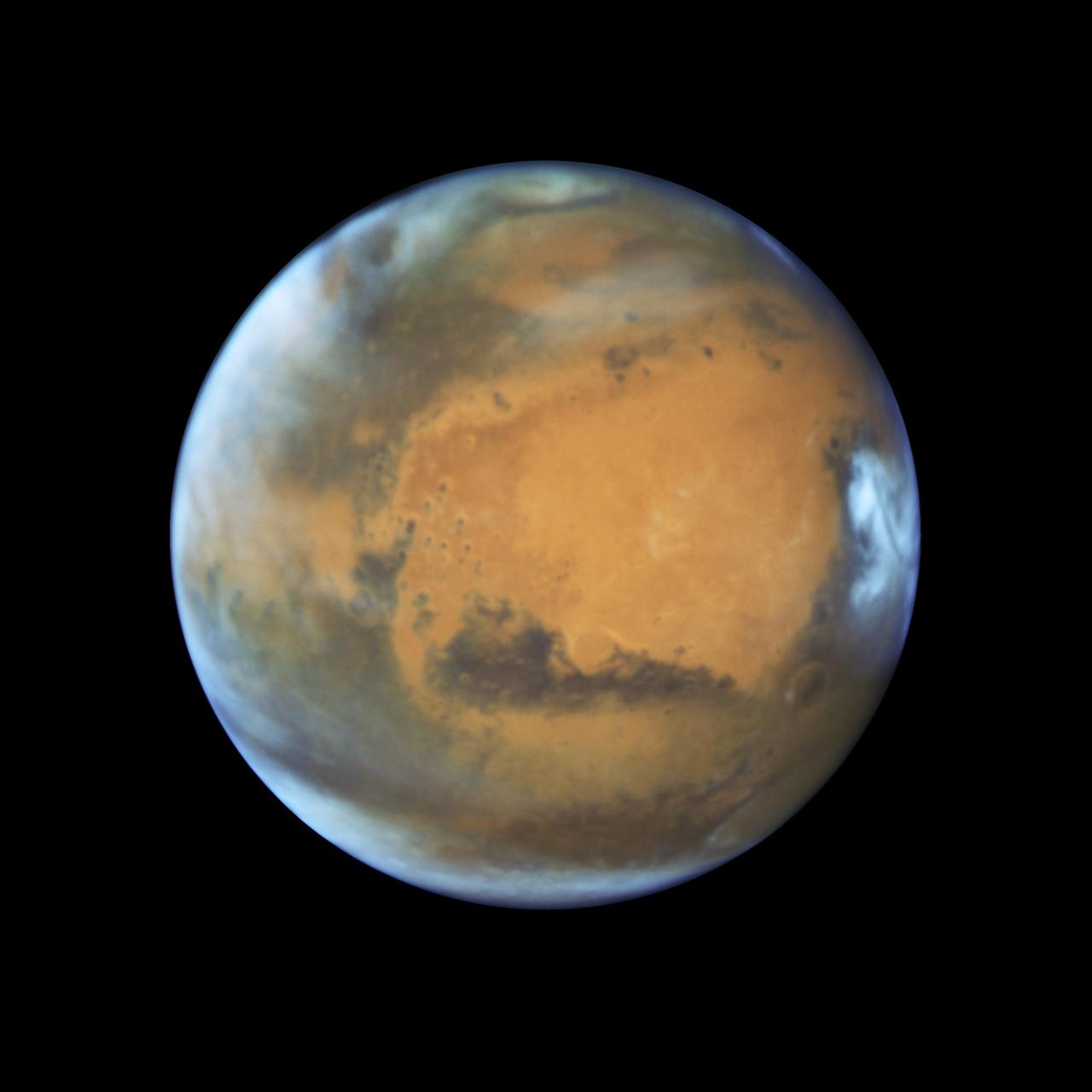
Mars is looking mighty fine in this portrait nabbed by the Hubble Space Telescope on a near close approach! Read more: <a href="http://go.nasa.gov/1rWYiBT" rel="nofollow">go.nasa.gov/1rWYiBT</a> The Hubble Space Telescope is more well known for its picturesque views of nebulae and galaxies, but it's also useful for studying our own planets, including Mars. Hubble imaged Mars on May 12, 2016 - ten days before Mars would be on the exact opposite side of the Earth from the Sun. Bright, frosty polar caps, and clouds above a vivid, rust-colored landscape reveal Mars as a dynamic seasonal planet in this NASA Hubble Space Telescope view taken on May 12, 2016, when Mars was 50 million miles from Earth. The Hubble image reveals details as small as 20 to 30 miles across. The large, dark region at far right is Syrtis Major Planitia, one of the first features identified on the surface of the planet by seventeenth-century observers. Christiaan Huygens used this feature to measure the rotation rate of Mars. (A Martian day is about 24 hours and 37 minutes.) Today we know that Syrtis Major is an ancient, inactive shield volcano. Late-afternoon clouds surround its summit in this view. A large oval feature to the south of Syrtis Major is the bright Hellas Planitia basin. About 1,100 miles across and nearly five miles deep, it was formed about 3.5 billion years ago by an asteroid impact. The orange area in the center of the image is Arabia Terra, a vast upland region in northern Mars that covers about 2,800 miles. The landscape is densely cratered and heavily eroded, indicating that it could be among the oldest terrains on the planet. Dried river canyons (too small to be seen here) wind through the region and empty into the large northern lowlands. Credit: NASA, ESA, the Hubble Heritage Team (STScI/AURA), J. Bell (ASU), and M. Wolff (Space Science Institute) #nasagoddard #mars #hubble #space <b><a href="http://www.nasa.gov/audience/formedia/features/MP_Photo_Guidelines.html" rel="nofollow">NASA image use policy.</a></b> <b><a href="http://www.nasa.gov/centers/goddard/home/index.html" rel="nofollow">NASA Goddard Space Flight Center</a></b> enables NASA’s mission through four scientific endeavors: Earth Science, Heliophysics, Solar System Exploration, and Astrophysics. Goddard plays a leading role in NASA’s accomplishments by contributing compelling scientific knowledge to advance the Agency’s mission. <b>Follow us on <a href="http://twitter.com/NASAGoddardPix" rel="nofollow">Twitter</a></b> <b>Like us on <a href="http://www.facebook.com/pages/Greenbelt-MD/NASA-Goddard/395013845897?ref=tsd" rel="nofollow">Facebook</a></b> <b>Find us on <a href="http://instagrid.me/nasagoddard/?vm=grid" rel="nofollow">Instagram</a></b>
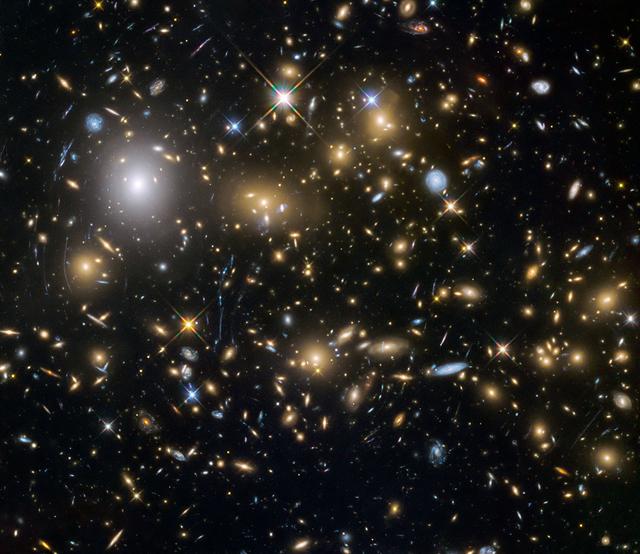
Observations by the NASA/ESA Hubble Space Telescope have taken advantage of gravitational lensing to reveal the largest sample of the faintest and earliest known galaxies in the universe. Some of these galaxies formed just 600 million years after the big bang and are fainter than any other galaxy yet uncovered by Hubble. The team has determined for the first time with some confidence that these small galaxies were vital to creating the universe that we see today. An international team of astronomers, led by Hakim Atek of the Ecole Polytechnique Fédérale de Lausanne, Switzerland, has discovered over 250 tiny galaxies that existed only 600-900 million years after the big bang— one of the largest samples of dwarf galaxies yet to be discovered at these epochs. The light from these galaxies took over 12 billion years to reach the telescope, allowing the astronomers to look back in time when the universe was still very young. Read more: <a href="http://www.nasa.gov/feature/goddard/hubble-spies-big-bang-frontiers" rel="nofollow">www.nasa.gov/feature/goddard/hubble-spies-big-bang-frontiers</a> Credit: NASA/ESA <b><a href="http://www.nasa.gov/audience/formedia/features/MP_Photo_Guidelines.html" rel="nofollow">NASA image use policy.</a></b> <b><a href="http://www.nasa.gov/centers/goddard/home/index.html" rel="nofollow">NASA Goddard Space Flight Center</a></b> enables NASA’s mission through four scientific endeavors: Earth Science, Heliophysics, Solar System Exploration, and Astrophysics. Goddard plays a leading role in NASA’s accomplishments by contributing compelling scientific knowledge to advance the Agency’s mission. <b>Follow us on <a href="http://twitter.com/NASAGoddardPix" rel="nofollow">Twitter</a></b> <b>Like us on <a href="http://www.facebook.com/pages/Greenbelt-MD/NASA-Goddard/395013845897?ref=tsd" rel="nofollow">Facebook</a></b> <b>Find us on <a href="http://instagrid.me/nasagoddard/?vm=grid" rel="nofollow">Instagram</a></b>
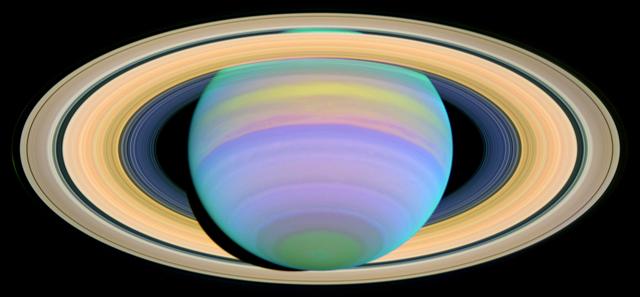
Saturn's Rings in Ultraviolet Light Credit: NASA and E. Karkoschka (University of Arizona) The Hubble Space Telescope is a project of international cooperation between NASA and the European Space Agency. NASA's Goddard Space Flight Center manages the telescope. The Space Telescope Science Institute conducts Hubble science operations. Goddard is responsible for HST project management, including mission and science operations, servicing missions, and all associated development activities. To learn more about the Hubble Space Telescope go here: <a href="http://www.nasa.gov/mission_pages/hubble/main/index.html" rel="nofollow">www.nasa.gov/mission_pages/hubble/main/index.html</a>
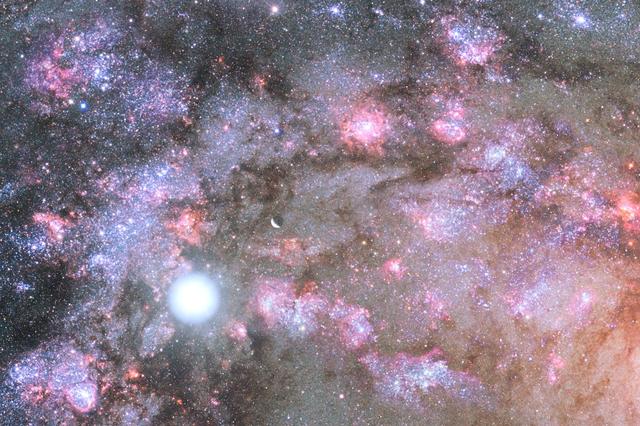
Astronomers have for the first time caught a glimpse of the earliest stages of massive galaxy construction. The building site, dubbed “Sparky,” is a dense galactic core blazing with the light of millions of newborn stars that are forming at a ferocious rate. The discovery was made possible through combined observations from NASA’s Hubble and Spitzer space telescopes, the W.M. Keck Observatory in Mauna Kea, Hawaii, and the European Space Agency's Herschel space observatory, in which NASA plays an important role. A fully developed elliptical galaxy is a gas-deficient gathering of ancient stars theorized to develop from the inside out, with a compact core marking its beginnings. Because the galactic core is so far away, the light of the forming galaxy that is observable from Earth was actually created 11 billion years ago, just 3 billion years after the Big Bang. Read more: <a href="http://1.usa.gov/1rAMSSr" rel="nofollow">1.usa.gov/1rAMSSr</a> Credit: NASA, Z. Levay, G. Bacon (STScI) <b><a href="http://www.nasa.gov/audience/formedia/features/MP_Photo_Guidelines.html" rel="nofollow">NASA image use policy.</a></b> <b><a href="http://www.nasa.gov/centers/goddard/home/index.html" rel="nofollow">NASA Goddard Space Flight Center</a></b> enables NASA’s mission through four scientific endeavors: Earth Science, Heliophysics, Solar System Exploration, and Astrophysics. Goddard plays a leading role in NASA’s accomplishments by contributing compelling scientific knowledge to advance the Agency’s mission. <b>Follow us on <a href="http://twitter.com/NASAGoddardPix" rel="nofollow">Twitter</a></b> <b>Like us on <a href="http://www.facebook.com/pages/Greenbelt-MD/NASA-Goddard/395013845897?ref=tsd" rel="nofollow">Facebook</a></b> <b>Find us on <a href="http://instagram.com/nasagoddard?vm=grid" rel="nofollow">Instagram</a></b>
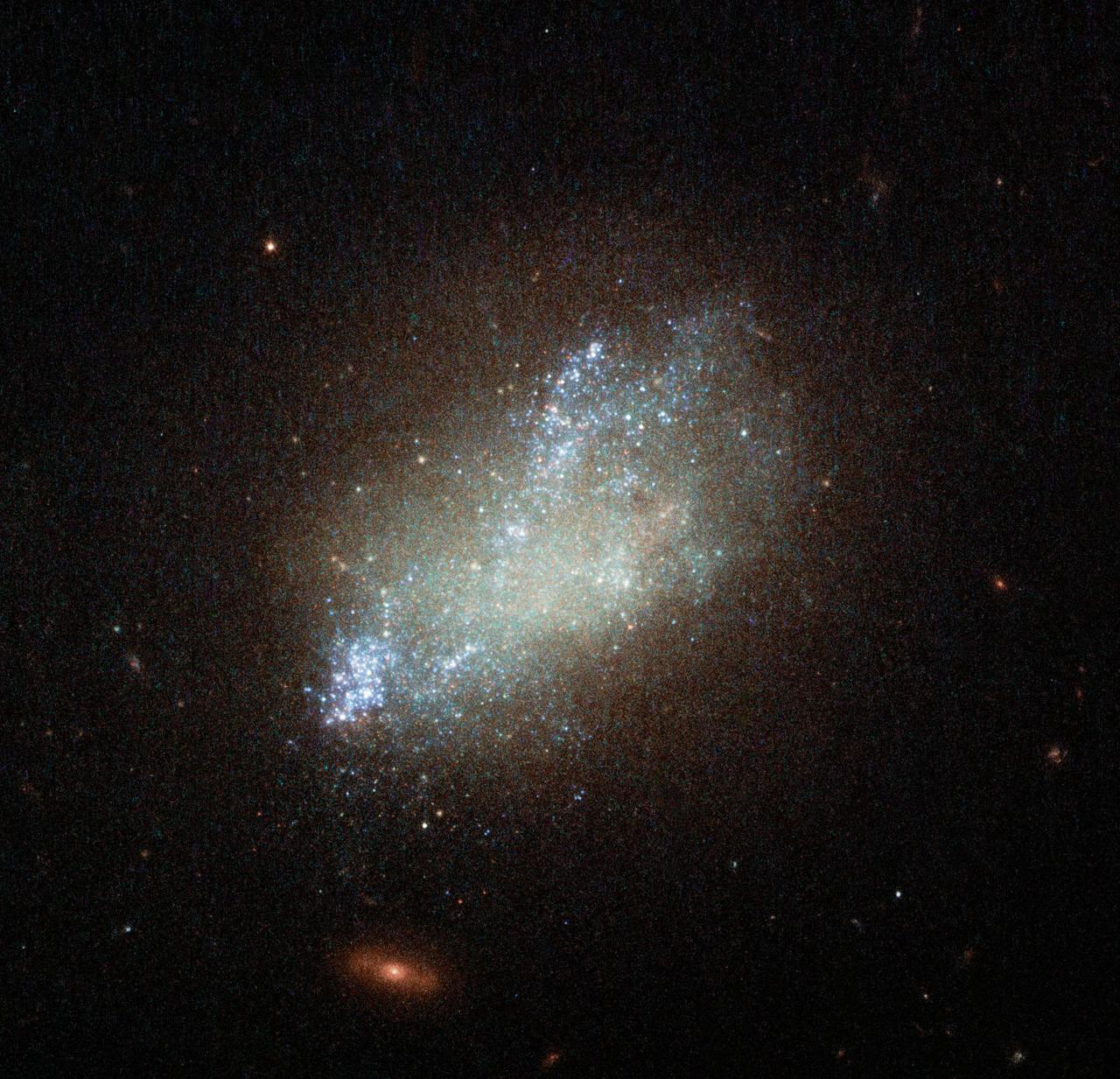
Far beyond the stars in the constellation of Leo (The Lion) is irregular galaxy IC 559. IC 559 is not your everyday galaxy. With its irregular shape and bright blue spattering of stars, it is a fascinating galactic anomaly. It may look like sparse cloud, but it is in fact full of gas and dust which is spawning new stars. Discovered in 1893, IC 559 lacks the symmetrical spiral appearance of some of its galactic peers and not does not conform to a regular shape. It is actually classified as a “type Sm” galaxy — an irregular galaxy with some evidence for a spiral structure. Irregular galaxies make up about a quarter of all known galaxies and do not fall into any of the regular classes of the Hubble sequence. Most of these uniquely shaped galaxies were not always so — IC 559 may have once been a conventional spiral galaxy that was then distorted and twisted by the gravity of a nearby cosmic companion. This image, captured by the NASA/ESA Hubble Space Telescope’s Wide Field Camera 3, combines a wide range of wavelengths spanning the ultraviolet, optical, and infrared parts of the spectrum. Image credit: ESA/Hubble, NASA, D. Calzetti (UMass) and the LEGUS Team <b><a href="http://www.nasa.gov/audience/formedia/features/MP_Photo_Guidelines.html" rel="nofollow">NASA image use policy.</a></b> <b><a href="http://www.nasa.gov/centers/goddard/home/index.html" rel="nofollow">NASA Goddard Space Flight Center</a></b> enables NASA’s mission through four scientific endeavors: Earth Science, Heliophysics, Solar System Exploration, and Astrophysics. Goddard plays a leading role in NASA’s accomplishments by contributing compelling scientific knowledge to advance the Agency’s mission. <b>Follow us on <a href="http://twitter.com/NASAGoddardPix" rel="nofollow">Twitter</a></b> <b>Like us on <a href="http://www.facebook.com/pages/Greenbelt-MD/NASA-Goddard/395013845897?ref=tsd" rel="nofollow">Facebook</a></b> <b>Find us on <a href="http://instagram.com/nasagoddard?vm=grid" rel="nofollow">Instagram</a></b>
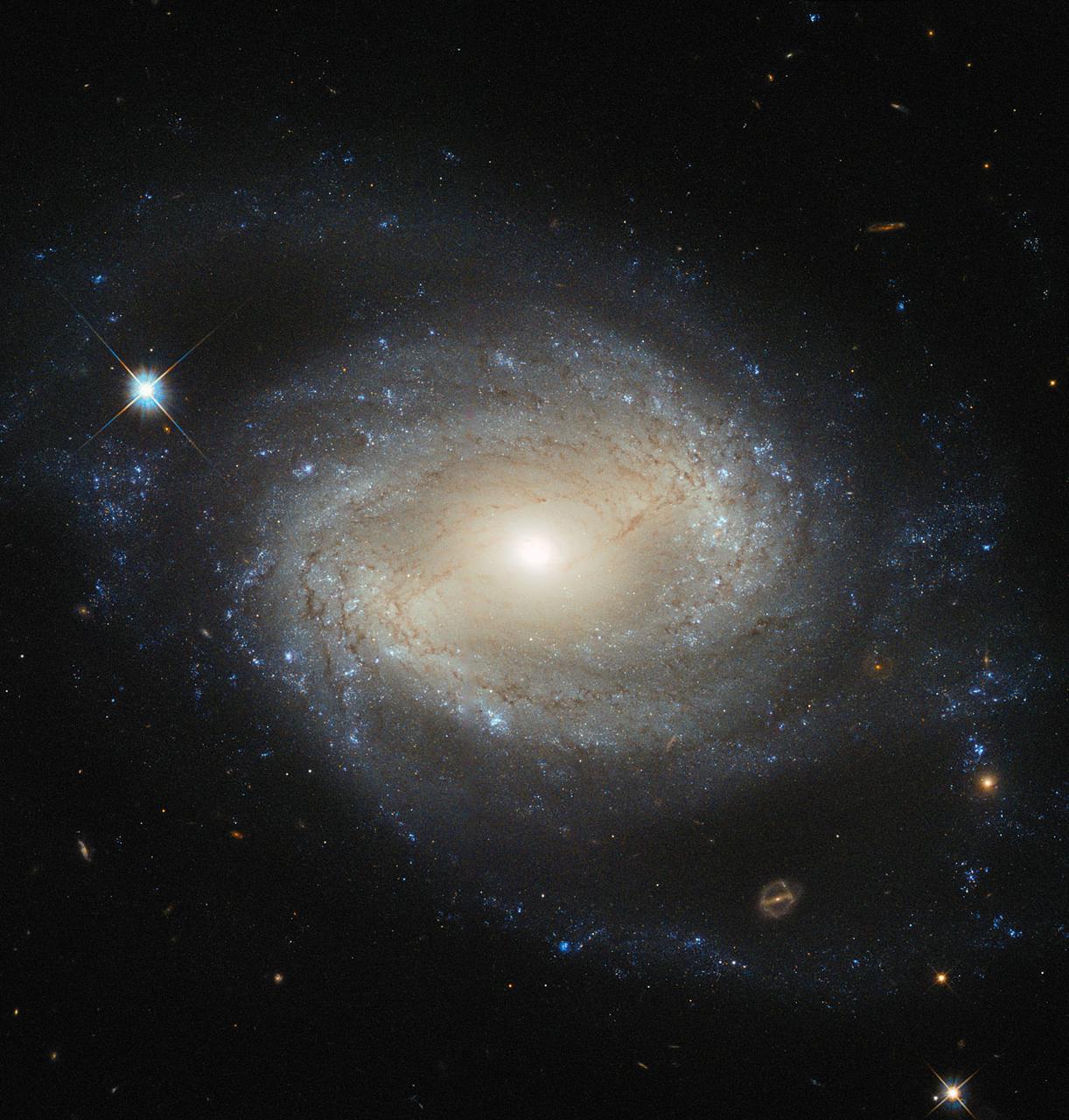
NGC 4639 is a beautiful example of a type of galaxy known as a barred spiral. It lies over 70 million light-years away in the constellation of Virgo and is one of about 1,500 galaxies that make up the Virgo Cluster. In this image, taken by the NASA/ESA Hubble Space Telescope, one can clearly see the bar running through the bright, round core of the galaxy. Bars are found in around two-thirds of spiral galaxies, and are thought to be a natural phase in their evolution. The galaxy’s spiral arms are sprinkled with bright regions of active star formation. Each of these tiny jewels is actually several hundred light-years across and contains hundreds or thousands of newly formed stars. But NGC 4639 also conceals a dark secret in its core — a massive black hole that is consuming the surrounding gas. This is known as an active galactic nucleus (AGN), and is revealed by characteristic features in the spectrum of light from the galaxy and by X-rays produced close to the black hole as the hot gas plunges towards it. Most galaxies are thought to contain a black hole at the center. NGC 4639 is in fact a very weak example of an AGN, demonstrating that AGNs exist over a large range of activity, from galaxies like NGC 4639 to distant quasars, where the parent galaxy is almost completely dominated by the emissions from the AGN. Image credit: ESA/Hubble & NASA <b><a href="http://www.nasa.gov/audience/formedia/features/MP_Photo_Guidelines.html" rel="nofollow">NASA image use policy.</a></b> <b><a href="http://www.nasa.gov/centers/goddard/home/index.html" rel="nofollow">NASA Goddard Space Flight Center</a></b> enables NASA’s mission through four scientific endeavors: Earth Science, Heliophysics, Solar System Exploration, and Astrophysics. Goddard plays a leading role in NASA’s accomplishments by contributing compelling scientific knowledge to advance the Agency’s mission. <b>Follow us on <a href="http://twitter.com/NASAGoddardPix" rel="nofollow">Twitter</a></b> <b>Like us on <a href="http://www.facebook.com/pages/Greenbelt-MD/NASA-Goddard/395013845897?ref=tsd" rel="nofollow">Facebook</a></b> <b>Find us on <a href="http://instagrid.me/nasagoddard/?vm=grid" rel="nofollow">Instagram</a></b>

The Crab Nebula is a supernova remnant, all that remains of a tremendous stellar explosion. Observers in China and Japan recorded the supernova nearly 1,000 years ago, in 1054. Credit: NASA, ESA, J. Hester and A. Loll (Arizona State University) The Hubble Space Telescope is a project of international cooperation between NASA and the European Space Agency. NASA's Goddard Space Flight Center manages the telescope. The Space Telescope Science Institute conducts Hubble science operations. Goddard is responsible for HST project management, including mission and science operations, servicing missions, and all associated development activities. To learn more about the Hubble Space Telescope go here: <a href="http://www.nasa.gov/mission_pages/hubble/main/index.html" rel="nofollow">www.nasa.gov/mission_pages/hubble/main/index.html</a> <b><a href="http://www.nasa.gov/centers/goddard/home/index.html" rel="nofollow">NASA Goddard Space Flight Center</a></b> is home to the nation's largest organization of combined scientists, engineers and technologists that build spacecraft, instruments and new technology to study the Earth, the sun, our solar system, and the universe. <b>Follow us on <a href="http://twitter.com/NASA_GoddardPix" rel="nofollow">Twitter</a></b> <b>Join us on <a href="http://www.facebook.com/pages/Greenbelt-MD/NASA-Goddard/395013845897?ref=tsd" rel="nofollow">Facebook</a><b> </b></b>
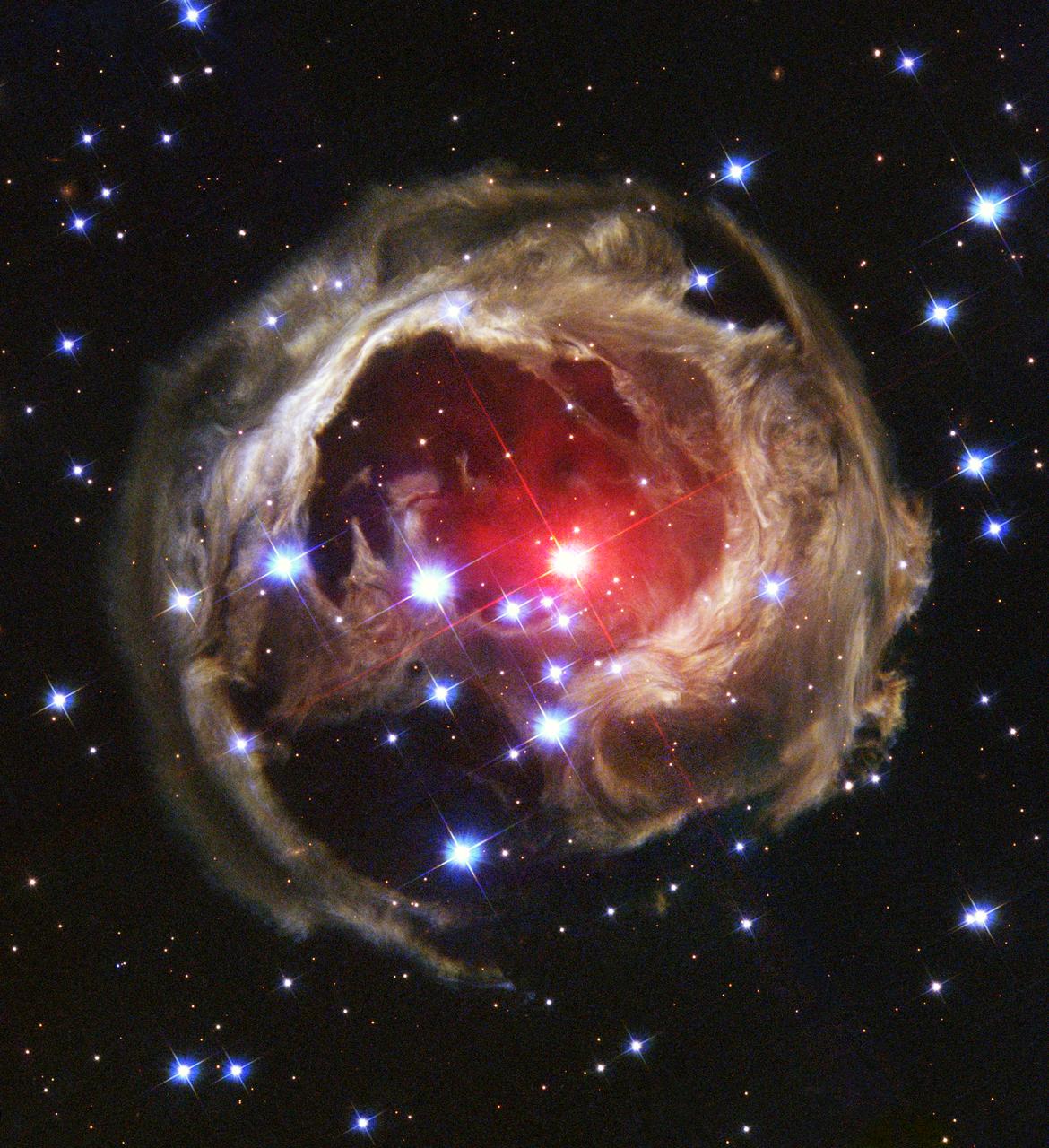
"Light Echo" Illuminates Dust Around Supergiant Star V838 Monocerotis (V838 Mon) Credit: NASA and The Hubble Heritage Team (AURA/STScI) The Hubble Space Telescope is a project of international cooperation between NASA and the European Space Agency. NASA's Goddard Space Flight Center manages the telescope. The Space Telescope Science Institute conducts Hubble science operations. Goddard is responsible for HST project management, including mission and science operations, servicing missions, and all associated development activities. To learn more about the Hubble Space Telescope go here: <a href="http://www.nasa.gov/mission_pages/hubble/main/index.html" rel="nofollow">www.nasa.gov/mission_pages/hubble/main/index.html</a> <b><a href="http://www.nasa.gov/centers/goddard/home/index.html" rel="nofollow">NASA Goddard Space Flight Center</a></b> is home to the nation's largest organization of combined scientists, engineers and technologists that build spacecraft, instruments and new technology to study the Earth, the sun, our solar system, and the universe. <b>Follow us on <a href="http://twitter.com/NASA_GoddardPix" rel="nofollow">Twitter</a></b> <b>Join us on <a href="http://www.facebook.com/pages/Greenbelt-MD/NASA-Goddard/395013845897?ref=tsd" rel="nofollow">Facebook</a><b> </b></b>

Using NASA’s Hubble Space Telescope, astronomers have captured for the first time snapshots of fledging white dwarf stars beginning their slow-paced, 40-million-year migration from the crowded center of an ancient star cluster to the less populated suburbs. White dwarfs are the burned-out relics of stars that rapidly lose mass, cool down and shut off their nuclear furnaces. As these glowing carcasses age and shed weight, their orbits begin to expand outward from the star cluster’s packed downtown. This migration is caused by a gravitational tussle among stars inside the cluster. Globular star clusters sort out stars according to their mass, governed by a gravitational billiard ball game where lower mass stars rob momentum from more massive stars. The result is that heavier stars slow down and sink to the cluster's core, while lighter stars pick up speed and move across the cluster to the edge. This process is known as "mass segregation." Until these Hubble observations, astronomers had never definitively seen the dynamical conveyor belt in action. Astronomers used Hubble to watch the white-dwarf exodus in the globular star cluster 47 Tucanae, a dense swarm of hundreds of thousands of stars in our Milky Way galaxy. The cluster resides 16,700 light-years away in the southern constellation Tucana. Read more: <a href="http://www.nasa.gov/feature/goddard/hubble-catches-stellar-exodus-in-action" rel="nofollow">www.nasa.gov/feature/goddard/hubble-catches-stellar-exodu...</a> Credits: NASA, ESA, and H. Richer and J. Heyl (University of British Columbia, Vancouver, Canada); acknowledgement: J. Mack (STScI) and G. Piotto (University of Padova, Italy) <b><a href="http://www.nasa.gov/audience/formedia/features/MP_Photo_Guidelines.html" rel="nofollow">NASA image use policy.</a></b> <b><a href="http://www.nasa.gov/centers/goddard/home/index.html" rel="nofollow">NASA Goddard Space Flight Center</a></b> enables NASA’s mission through four scientific endeavors: Earth Science, Heliophysics, Solar System Exploration, and Astrophysics. Goddard plays a leading role in NASA’s accomplishments by contributing compelling scientific knowledge to advance the Agency’s mission. <b>Follow us on <a href="http://twitter.com/NASAGoddardPix" rel="nofollow">Twitter</a></b> <b>Like us on <a href="http://www.facebook.com/pages/Greenbelt-MD/NASA-Goddard/395013845897?ref=tsd" rel="nofollow">Facebook</a></b> <b>Find us on <a href="http://instagrid.me/nasagoddard/?vm=grid" rel="nofollow">Instagram</a></b>

Image release date September 22, 2010 To view a video of this image go here: <a href="http://www.flickr.com/photos/gsfc/5014452203">www.flickr.com/photos/gsfc/5014452203</a> Caption: A spectacular new NASA/ESA Hubble Space Telescope image reveals the heart of the Lagoon Nebula. Seen as a massive cloud of glowing dust and gas, bombarded by the energetic radiation of new stars, this placid name hides a dramatic reality. The Advanced Camera for Surveys (ACS) on the NASA/ESA Hubble Space Telescope has captured a dramatic view of gas and dust sculpted by intense radiation from hot young stars deep in the heart of the Lagoon Nebula (Messier 8). This spectacular object is named after the wide, lagoon-shaped dust lane that crosses the glowing gas of the nebula. This structure is prominent in wide-field images, but cannot be seen in this close-up. However the strange billowing shapes and sandy texture visible in this image make the Lagoon Nebula’s watery name eerily appropriate from this viewpoint too. Located four to five thousand light-years away, in the constellation of Sagittarius (the Archer), Messier 8 is a huge region of star birth that stretches across one hundred light-years. Clouds of hydrogen gas are slowly collapsing to form new stars, whose bright ultraviolet rays then light up the surrounding gas in a distinctive shade of red. The wispy tendrils and beach-like features of the nebula are not caused by the ebb and flow of tides, but rather by ultraviolet radiation’s ability to erode and disperse the gas and dust into the distinctive shapes that we see. In recent years astronomers probing the secrets of the Lagoon Nebula have found the first unambiguous proof that star formation by accretion of matter from the gas cloud is ongoing in this region. Young stars that are still surrounded by an accretion disc occasionally shoot out long tendrils of matter from their poles. Several examples of these jets, known as Herbig-Haro objects, have been found in this nebula in the last five years, providing strong support for astronomers’ theories about star formation in such hydrogen-rich regions. The Lagoon Nebula is faintly visible to the naked eye on dark nights as a small patch of grey in the heart of the Milky Way. Without a telescope, the nebula looks underwhelming because human eyes are unable to distinguish clearly between colours at low light levels. Charles Messier, the 18th century French astronomer, observed the nebula and included it in his famous astronomical catalogue, from which the nebula’s alternative name comes. But his relatively small refracting telescope would only have hinted at the dramatic structures and colours now visible thanks to Hubble. The Hubble Space Telescope is a project of international cooperation between ESA and NASA. Image credit: NASA, ESA <b><a href="http://www.nasa.gov/audience/formedia/features/MP_Photo_Guidelines.html" rel="nofollow">NASA image use policy.</a></b> <b><a href="http://www.nasa.gov/centers/goddard/home/index.html" rel="nofollow">NASA Goddard Space Flight Center</a></b> enables NASA’s mission through four scientific endeavors: Earth Science, Heliophysics, Solar System Exploration, and Astrophysics. Goddard plays a leading role in NASA’s accomplishments by contributing compelling scientific knowledge to advance the Agency’s mission. <b>Follow us on <a href="http://twitter.com/NASAGoddardPix" rel="nofollow">Twitter</a></b> <b>Like us on <a href="http://www.facebook.com/pages/Greenbelt-MD/NASA-Goddard/395013845897?ref=tsd" rel="nofollow">Facebook</a></b> <b>Find us on <a href="http://instagram.com/nasagoddard?vm=grid" rel="nofollow">Instagram</a></b> To learn more about the Hubble Space Telescope go here: <a href="http://www.nasa.gov/mission_pages/hubble/main/index.html" rel="nofollow">www.nasa.gov/mission_pages/hubble/main/index.html</a>
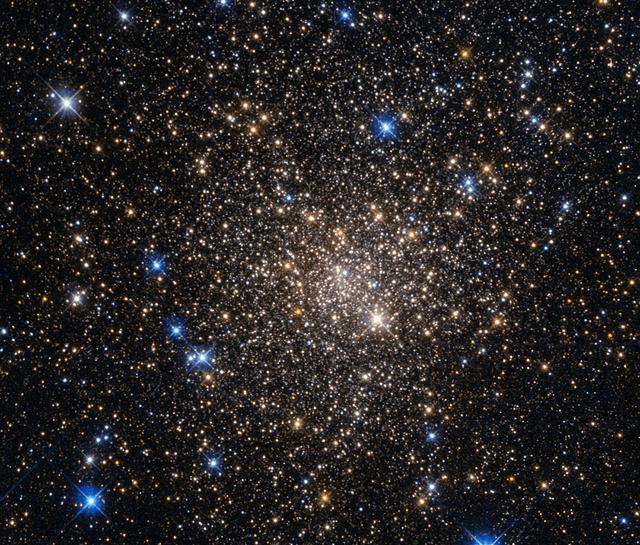
This image, taken with the Wide Field Planetary Camera 2 on board the NASA/ESA Hubble Space Telescope, shows the globular cluster Terzan 1. Lying around 20,000 light-years from us in the constellation of Scorpius (The Scorpion), it is one of about 150 globular clusters belonging to our galaxy, the Milky Way. Typical globular clusters are collections of around a hundred thousand stars, held together by their mutual gravitational attraction in a spherical shape a few hundred light-years across. It is thought that every galaxy has a population of globular clusters. Some, like the Milky Way, have a few hundred, while giant elliptical galaxies can have several thousand. They contain some of the oldest stars in a galaxy, hence the reddish colors of the stars in this image — the bright blue ones are foreground stars, not part of the cluster. The ages of the stars in the globular cluster tell us that they were formed during the early stages of galaxy formation! Studying them can also help us to understand how galaxies formed. Terzan 1, like many globular clusters, is a source of X-rays. It is likely that these X-rays come from binary star systems that contain a dense neutron star and a normal star. The neutron star drags material from the companion star, causing a burst of X-ray emission. The system then enters a quiescent phase in which the neutron star cools, giving off X-ray emission with different characteristics, before enough material from the companion builds up to trigger another outburst. Image credit: NASA & ESA, Acknowledgement: Judy Schmidt <b><a href="http://www.nasa.gov/audience/formedia/features/MP_Photo_Guidelines.html" rel="nofollow">NASA image use policy.</a></b> <b><a href="http://www.nasa.gov/centers/goddard/home/index.html" rel="nofollow">NASA Goddard Space Flight Center</a></b> enables NASA’s mission through four scientific endeavors: Earth Science, Heliophysics, Solar System Exploration, and Astrophysics. Goddard plays a leading role in NASA’s accomplishments by contributing compelling scientific knowledge to advance the Agency’s mission. <b>Follow us on <a href="http://twitter.com/NASAGoddardPix" rel="nofollow">Twitter</a></b> <b>Like us on <a href="http://www.facebook.com/pages/Greenbelt-MD/NASA-Goddard/395013845897?ref=tsd" rel="nofollow">Facebook</a></b> <b>Find us on <a href="http://instagrid.me/nasagoddard/?vm=grid" rel="nofollow">Instagram</a></b>
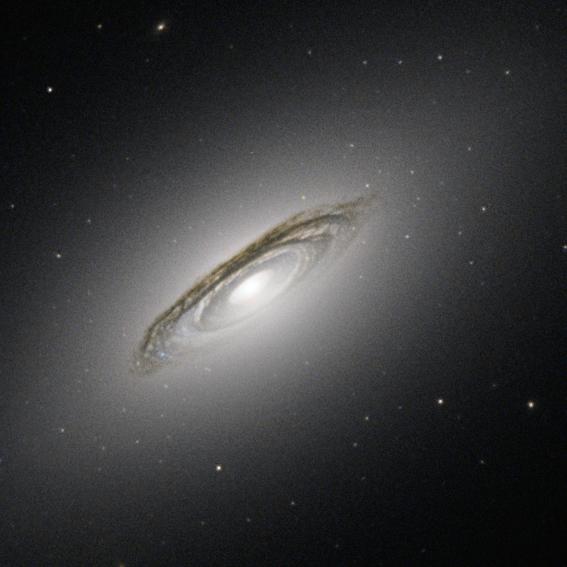
The subject of this image is NGC 6861, a galaxy discovered in 1826 by the Scottish astronomer James Dunlop. Almost two centuries later we now know that NGC 6861 is the second brightest member of a group of at least a dozen galaxies called the Telescopium Group — otherwise known as the NGC 6868 Group — in the small constellation of Telescopium (The Telescope). This NASA/ESA Hubble Space Telescope view shows some important details of NGC 6861. One of the most prominent features is the disk of dark bands circling the centre of the galaxy. These dust lanes are a result of large clouds of dust particles obscuring the light emitted by the stars behind them. Dust lanes are very useful for working out whether we are seeing the galaxy disk edge-on, face-on or, as is the case for NGC 6861, somewhat in the middle. Dust lanes like these are typical of a spiral galaxy. The dust lanes are embedded in a white oval shape, which is made up of huge numbers of stars orbiting the center of the galaxy. This oval is, rather puzzlingly, typical of an elliptical galaxy. So which is it — spiral or elliptical? The answer is neither! NGC 6861 does not belong to either the spiral or the elliptical family of galaxies. It is a lenticular galaxy, a family which has features of both spirals and ellipticals. The relationships between these three kinds of galaxies are not yet well understood. A lenticular galaxy could be a faded spiral that has run out of gas and lost its arms, or the result of two galaxies merging. Being part of a group increases the chances for galactic mergers, so this could be the case for NGC 6861. Credit: ESA/Hubble & NASA; acknowledgement: J. Barrington <b><a href="http://www.nasa.gov/audience/formedia/features/MP_Photo_Guidelines.html" rel="nofollow">NASA image use policy.</a></b> <b><a href="http://www.nasa.gov/centers/goddard/home/index.html" rel="nofollow">NASA Goddard Space Flight Center</a></b> enables NASA’s mission through four scientific endeavors: Earth Science, Heliophysics, Solar System Exploration, and Astrophysics. Goddard plays a leading role in NASA’s accomplishments by contributing compelling scientific knowledge to advance the Agency’s mission. <b>Follow us on <a href="http://twitter.com/NASAGoddardPix" rel="nofollow">Twitter</a></b> <b>Like us on <a href="http://www.facebook.com/pages/Greenbelt-MD/NASA-Goddard/395013845897?ref=tsd" rel="nofollow">Facebook</a></b> <b>Find us on <a href="http://instagram.com/nasagoddard?vm=grid" rel="nofollow">Instagram</a></b>
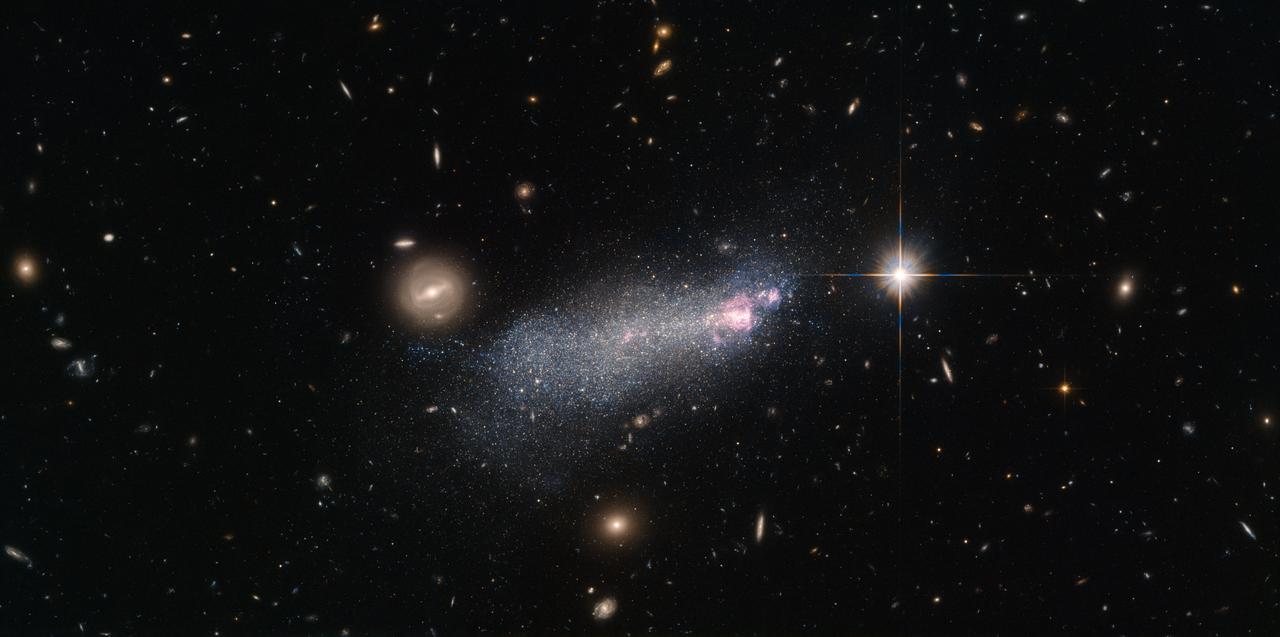
This NASA/European Space Agency (ESA) Hubble Space Telescope picture shows a galaxy named SBS 1415+437 (also called SDSS CGB 12067.1), located about 45 million light-years from Earth. SBS 1415+437 is a Wolf-Rayet galaxy, a type of star-bursting galaxy with an unusually high number of extremely hot and massive stars known as Wolf-Rayet stars. These stars can be around 20 times as massive as the sun, but seem to be on a mission to shed surplus mass as quickly as possible — they blast substantial winds of particles out into space, causing them to dwindle at a rapid rate. A typical star of this type can lose a mass equal to that of our sun in just 100,000 years! These massive stars are also incredibly hot, with surface temperatures some 10 to 40 times that of the sun, and very luminous, glowing at tens of thousands to several million times the brightness of the sun. Many of the brightest and most massive stars in the Milky Way are Wolf-Rayet stars. Because these stars are so intense they do not last very long, burning up their fuel and blasting their bulk out into the cosmos on very short timescale — only a few hundred thousand years. Because of this it is unusual to find more than a few of these stars per galaxy — except in Wolf-Rayet galaxies, like the one in this image. Credit: ESA/Hubble & NASA <b><a href="http://www.nasa.gov/audience/formedia/features/MP_Photo_Guidelines.html" rel="nofollow">NASA image use policy.</a></b> <b><a href="http://www.nasa.gov/centers/goddard/home/index.html" rel="nofollow">NASA Goddard Space Flight Center</a></b> enables NASA’s mission through four scientific endeavors: Earth Science, Heliophysics, Solar System Exploration, and Astrophysics. Goddard plays a leading role in NASA’s accomplishments by contributing compelling scientific knowledge to advance the Agency’s mission. <b>Follow us on <a href="http://twitter.com/NASAGoddardPix" rel="nofollow">Twitter</a></b> <b>Like us on <a href="http://www.facebook.com/pages/Greenbelt-MD/NASA-Goddard/395013845897?ref=tsd" rel="nofollow">Facebook</a></b> <b>Find us on <a href="http://instagrid.me/nasagoddard/?vm=grid" rel="nofollow">Instagram</a></b> <b><a href="http://goes.gsfc.nasa.gov/" rel="nofollow">Credit: NOAA/NASA GOES Project</a></b>

This NASA/ESA Hubble Space Telescope image shows the spiral galaxy NGC 4845, located over 65 million light-years away in the constellation of Virgo (The Virgin). The galaxy’s orientation clearly reveals the galaxy’s striking spiral structure: a flat and dust-mottled disk surrounding a bright galactic bulge. NGC 4845’s glowing center hosts a gigantic version of a black hole, known as a supermassive black hole. The presence of a black hole in a distant galaxy like NGC 4845 can be inferred from its effect on the galaxy’s innermost stars; these stars experience a strong gravitational pull from the black hole and whizz around the galaxy’s center much faster than otherwise. From investigating the motion of these central stars, astronomers can estimate the mass of the central black hole — for NGC 4845 this is estimated to be hundreds of thousands times heavier than the sun. This same technique was also used to discover the supermassive black hole at the center of our own Milky Way — Sagittarius A* — which hits some four million times the mass of the sun. The galactic core of NGC 4845 is not just supermassive, but also super-hungry. In 2013 researchers were observing another galaxy when they noticed a violent flare at the center of NGC 4845. The flare came from the central black hole tearing up and feeding off an object many times more massive than Jupiter. A brown dwarf or a large planet simply strayed too close and was devoured by the hungry core of NGC 4845. Image credit: ESA/Hubble & NASA and S. Smartt (Queen's University Belfast) <b><a href="http://www.nasa.gov/audience/formedia/features/MP_Photo_Guidelines.html" rel="nofollow">NASA image use policy.</a></b> <b><a href="http://www.nasa.gov/centers/goddard/home/index.html" rel="nofollow">NASA Goddard Space Flight Center</a></b> enables NASA’s mission through four scientific endeavors: Earth Science, Heliophysics, Solar System Exploration, and Astrophysics. Goddard plays a leading role in NASA’s accomplishments by contributing compelling scientific knowledge to advance the Agency’s mission. <b>Follow us on <a href="http://twitter.com/NASAGoddardPix" rel="nofollow">Twitter</a></b> <b>Like us on <a href="http://www.facebook.com/pages/Greenbelt-MD/NASA-Goddard/395013845897?ref=tsd" rel="nofollow">Facebook</a></b> <b>Find us on <a href="http://instagrid.me/nasagoddard/?vm=grid" rel="nofollow">Instagram</a></b>

Carina Nebula Details: Great Clouds Credit for Hubble Image: NASA, ESA, N. Smith (University of California, Berkeley), and The Hubble Heritage Team (STScI/AURA) Credit for CTIO Image: N. Smith (University of California, Berkeley) and NOAO/AURA/NSF The Hubble Space Telescope is a project of international cooperation between NASA and the European Space Agency. NASA's Goddard Space Flight Center manages the telescope. The Space Telescope Science Institute conducts Hubble science operations. Goddard is responsible for HST project management, including mission and science operations, servicing missions, and all associated development activities. To learn more about the Hubble Space Telescope go here: <a href="http://www.nasa.gov/mission_pages/hubble/main/index.html" rel="nofollow">www.nasa.gov/mission_pages/hubble/main/index.html</a> <b><a href="http://www.nasa.gov/centers/goddard/home/index.html" rel="nofollow">NASA Goddard Space Flight Center</a></b> is home to the nation's largest organization of combined scientists, engineers and technologists that build spacecraft, instruments and new technology to study the Earth, the sun, our solar system, and the universe. <b>Follow us on <a href="http://twitter.com/NASA_GoddardPix" rel="nofollow">Twitter</a></b> <b>Join us on <a href="http://www.facebook.com/pages/Greenbelt-MD/NASA-Goddard/395013845897?ref=tsd" rel="nofollow">Facebook</a><b> </b></b>
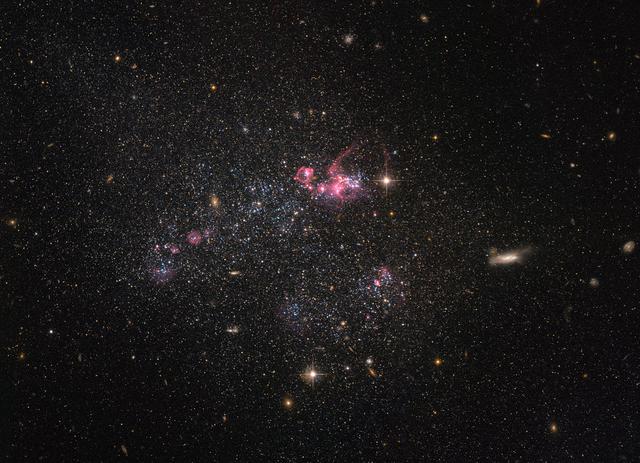
Despite being less famous than their elliptical and spiral galactic cousins, irregular dwarf galaxies, such as the one captured in this NASA/ESA Hubble Space Telescope image, are actually one of the most common types of galaxy in the universe. Known as UGC 4459, this dwarf galaxy is located approximately 11 million light-years away in the constellation of Ursa Major (The Great Bear), a constellation that is also home to the Pinwheel Galaxy (M101), the Owl Nebula (M97), Messier 81, Messier 82 and several other galaxies all part of the M81 group. UGC 4459’s diffused and disorganized appearance is characteristic of an irregular dwarf galaxy. Lacking a distinctive structure or shape, irregular dwarf galaxies are often chaotic in appearance, with neither a nuclear bulge — a huge, tightly packed central group of stars — nor any trace of spiral arms — regions of stars extending from the center of the galaxy. Astronomers suspect that some irregular dwarf galaxies were once spiral or elliptical galaxies, but were later deformed by the gravitational pull of nearby objects. Rich with young blue stars and older red stars, UGC 4459 has a stellar population of several billion. Though seemingly impressive, this is small when compared to the 200 to 400 billion stars in the Milky Way! Observations with Hubble have shown that because of their low masses of dwarf galaxies like UGC 4459, star formation is very low compared to larger galaxies. Only very little of their original gas has been turned into stars. Thus, these small galaxies are interesting to study to better understand primordial environments and the star formation process. Image Credit: ESA/Hubble and NASA; Acknowledgement: Judy Schmidt <b><a href="http://www.nasa.gov/audience/formedia/features/MP_Photo_Guidelines.html" rel="nofollow">NASA image use policy.</a></b> <b><a href="http://www.nasa.gov/centers/goddard/home/index.html" rel="nofollow">NASA Goddard Space Flight Center</a></b> enables NASA’s mission through four scientific endeavors: Earth Science, Heliophysics, Solar System Exploration, and Astrophysics. Goddard plays a leading role in NASA’s accomplishments by contributing compelling scientific knowledge to advance the Agency’s mission. <b>Follow us on <a href="http://twitter.com/NASAGoddardPix" rel="nofollow">Twitter</a></b> <b>Like us on <a href="http://www.facebook.com/pages/Greenbelt-MD/NASA-Goddard/395013845897?ref=tsd" rel="nofollow">Facebook</a></b> <b>Find us on <a href="http://instagrid.me/nasagoddard/?vm=grid" rel="nofollow">Instagram</a></b>

The Hubble Space Telescope in a picture snapped by a Servicing Mission 4 crewmember just after the Space Shuttle Atlantis captured Hubble with its robotic arm on May 13, 2009, beginning the mission to upgrade and repair the telescope. The Hubble Space Telescope is a project of international cooperation between NASA and the European Space Agency. NASA's Goddard Space Flight Center manages the telescope. The Space Telescope Science Institute conducts Hubble science operations. Goddard is responsible for HST project management, including mission and science operations, servicing missions, and all associated development activities. To learn more about the Hubble Space Telescope go here: <a href="http://www.nasa.gov/mission_pages/hubble/main/index.html" rel="nofollow">www.nasa.gov/mission_pages/hubble/main/index.html</a>
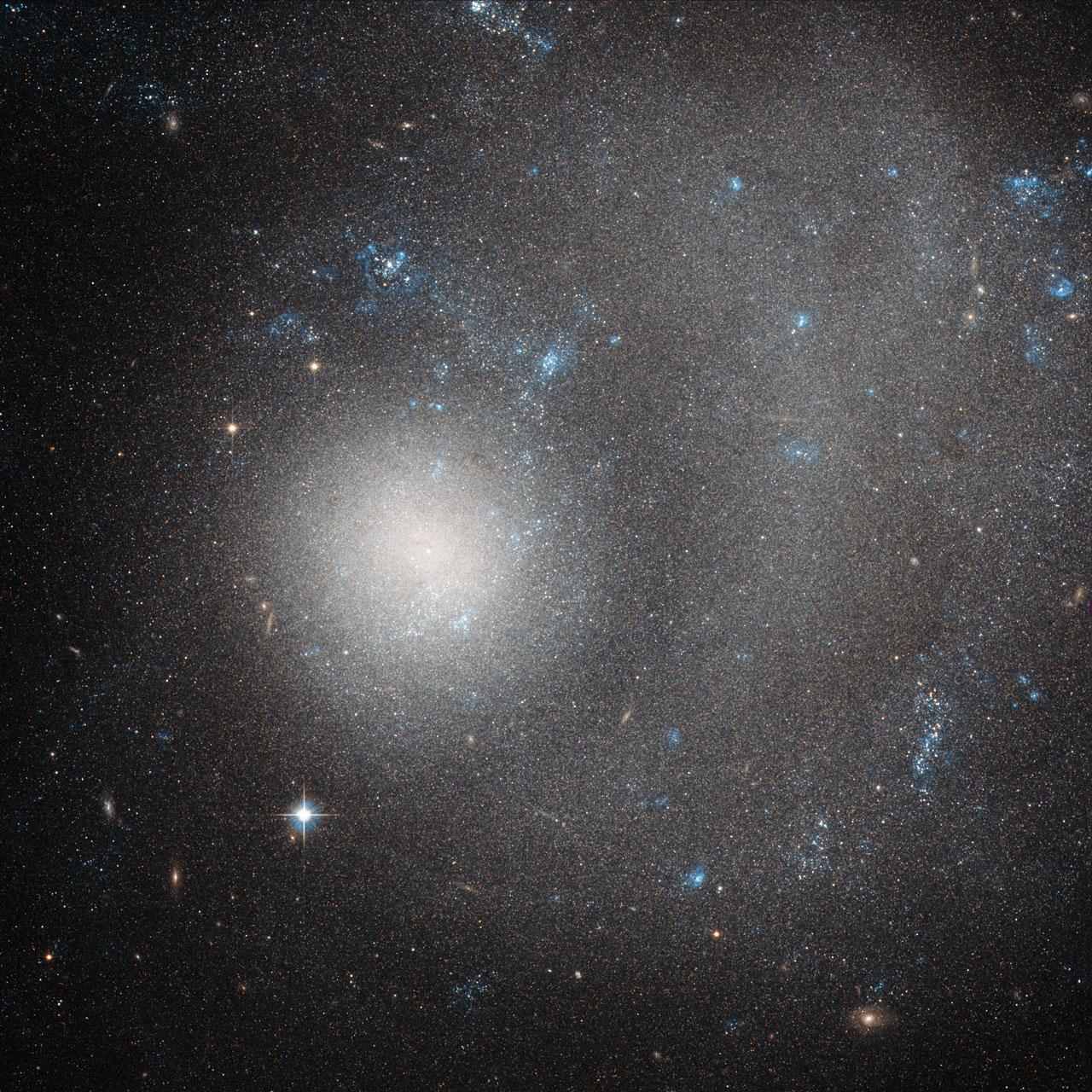
The subject of this Hubble image is NGC 5474, a dwarf galaxy located 21 million light-years away in the constellation of Ursa Major (The Great Bear). This beautiful image was taken with Hubble's Advanced Camera for Surveys (ACS). The term "dwarf galaxy" may sound diminutive, but don't let that fool you — NGC 5474 contains several billion stars! However, when compared to the Milky Way with its hundreds of billions of stars, NGC 5474 does indeed seem relatively small. NGC 5474 itself is part of the Messier 101 Group. The brightest galaxy within this group is the well-known spiral Pinwheel Galaxy (also known as Messier 101). This galaxy's prominent, well-defined arms classify it as a "grand design galaxy," along with other spirals Messier 81 and Messier 74. Also within this group are Messier 101's galactic neighbors. It is possible that gravitational interactions with these companion galaxies have had some influence on providing Messier 101 with its striking shape. Similar interactions with Messier 101 may have caused the distortions visible in NGC 5474. Both the Messier 101 Group and our own Local Group reside within the Virgo Supercluster, making NGC 5474 something of a neighbor in galactic terms. Credit: ESA/NASA <b><a href="http://www.nasa.gov/audience/formedia/features/MP_Photo_Guidelines.html" rel="nofollow">NASA image use policy.</a></b> <b><a href="http://www.nasa.gov/centers/goddard/home/index.html" rel="nofollow">NASA Goddard Space Flight Center</a></b> enables NASA’s mission through four scientific endeavors: Earth Science, Heliophysics, Solar System Exploration, and Astrophysics. Goddard plays a leading role in NASA’s accomplishments by contributing compelling scientific knowledge to advance the Agency’s mission. <b>Follow us on <a href="http://twitter.com/NASAGoddardPix" rel="nofollow">Twitter</a></b> <b>Like us on <a href="http://www.facebook.com/pages/Greenbelt-MD/NASA-Goddard/395013845897?ref=tsd" rel="nofollow">Facebook</a></b> <b>Find us on <a href="http://instagram.com/nasagoddard?vm=grid" rel="nofollow">Instagram</a></b>
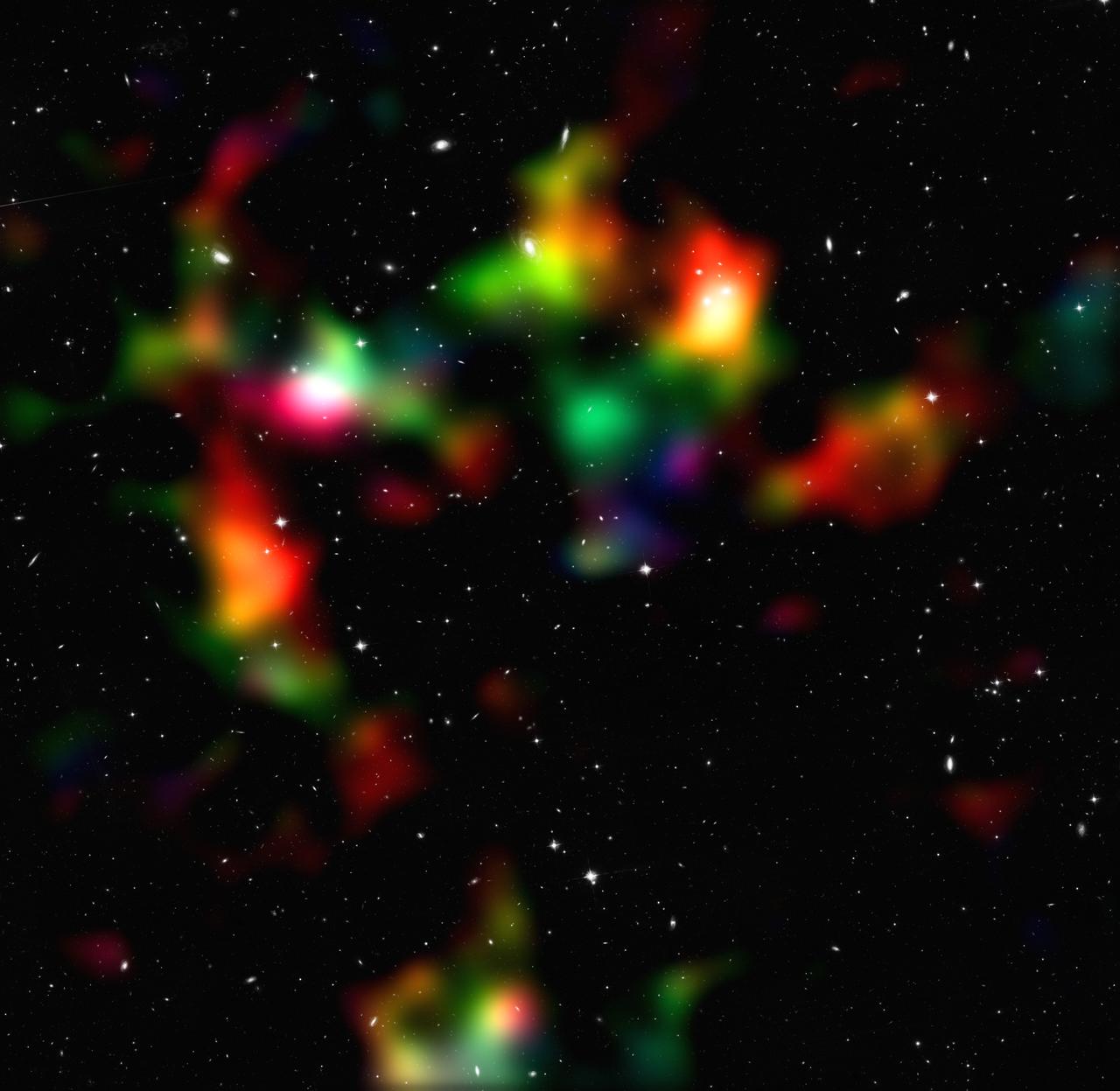
NASA/ESA Hubble Release Date: March 25, 2010 This image shows a smoothed reconstruction of the total (mostly dark) matter distribution in the COSMOS field, created from data taken by the NASA/ESA Hubble Space Telescope and ground-based telescopes. It was inferred from the weak gravitational lensing distortions that are imprinted onto the shapes of background galaxies. The colour coding indicates the distance of the foreground mass concentrations as gathered from the weak lensing effect. Structures shown in white, cyan, and green are typically closer to us than those indicated in orange and red. To improve the resolution of the map, data from galaxies both with and without redshift information were used. The new study presents the most comprehensive analysis of data from the COSMOS survey. The researchers have, for the first time ever, used Hubble and the natural "weak lenses" in space to characterise the accelerated expansion of the Universe. Credit: NASA, ESA, P. Simon (University of Bonn) and T. Schrabback (Leiden Observatory) To learn more abou this image go to: <a href="http://www.spacetelescope.org/news/html/heic1005.html" rel="nofollow">www.spacetelescope.org/news/html/heic1005.html</a> For more information about Goddard Space Flight Center go here: <a href="http://www.nasa.gov/centers/goddard/home/index.html" rel="nofollow">www.nasa.gov/centers/goddard/home/index.html</a>
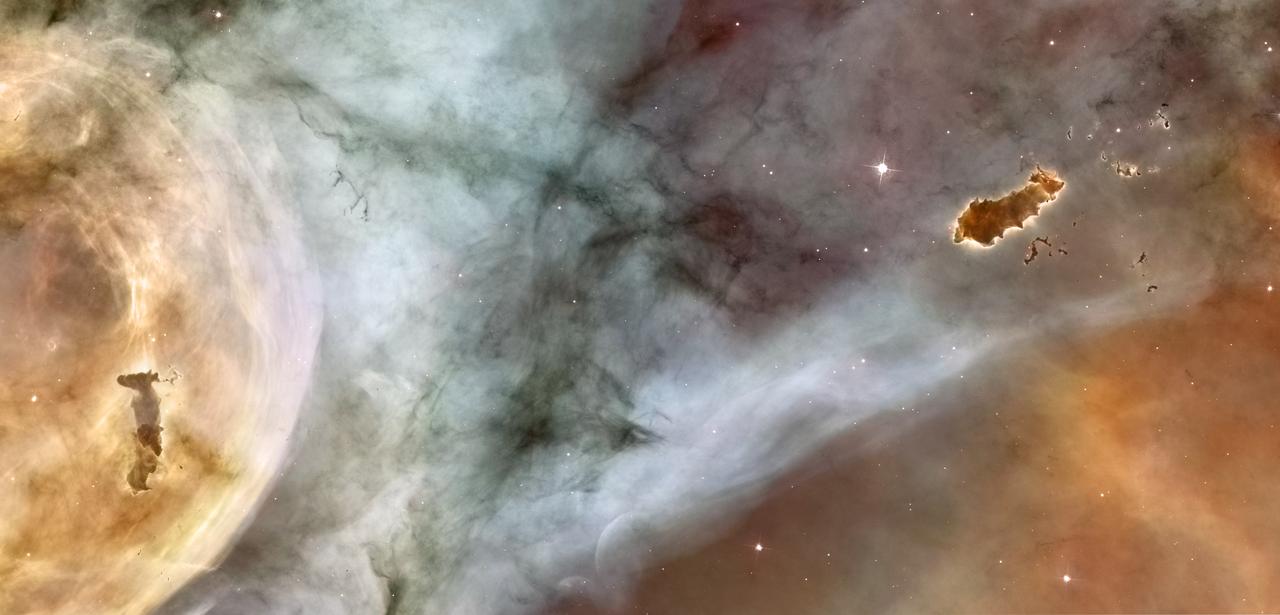
Carina Nebula Details: The Caterpillar Credit for Hubble Image: NASA, ESA, N. Smith (University of California, Berkeley), and The Hubble Heritage Team (STScI/AURA) Credit for CTIO Image: N. Smith (University of California, Berkeley) and NOAO/AURA/NSF The Hubble Space Telescope is a project of international cooperation between NASA and the European Space Agency. NASA's Goddard Space Flight Center manages the telescope. The Space Telescope Science Institute conducts Hubble science operations. Goddard is responsible for HST project management, including mission and science operations, servicing missions, and all associated development activities. To learn more about the Hubble Space Telescope go here: <a href="http://www.nasa.gov/mission_pages/hubble/main/index.html" rel="nofollow">www.nasa.gov/mission_pages/hubble/main/index.html</a>