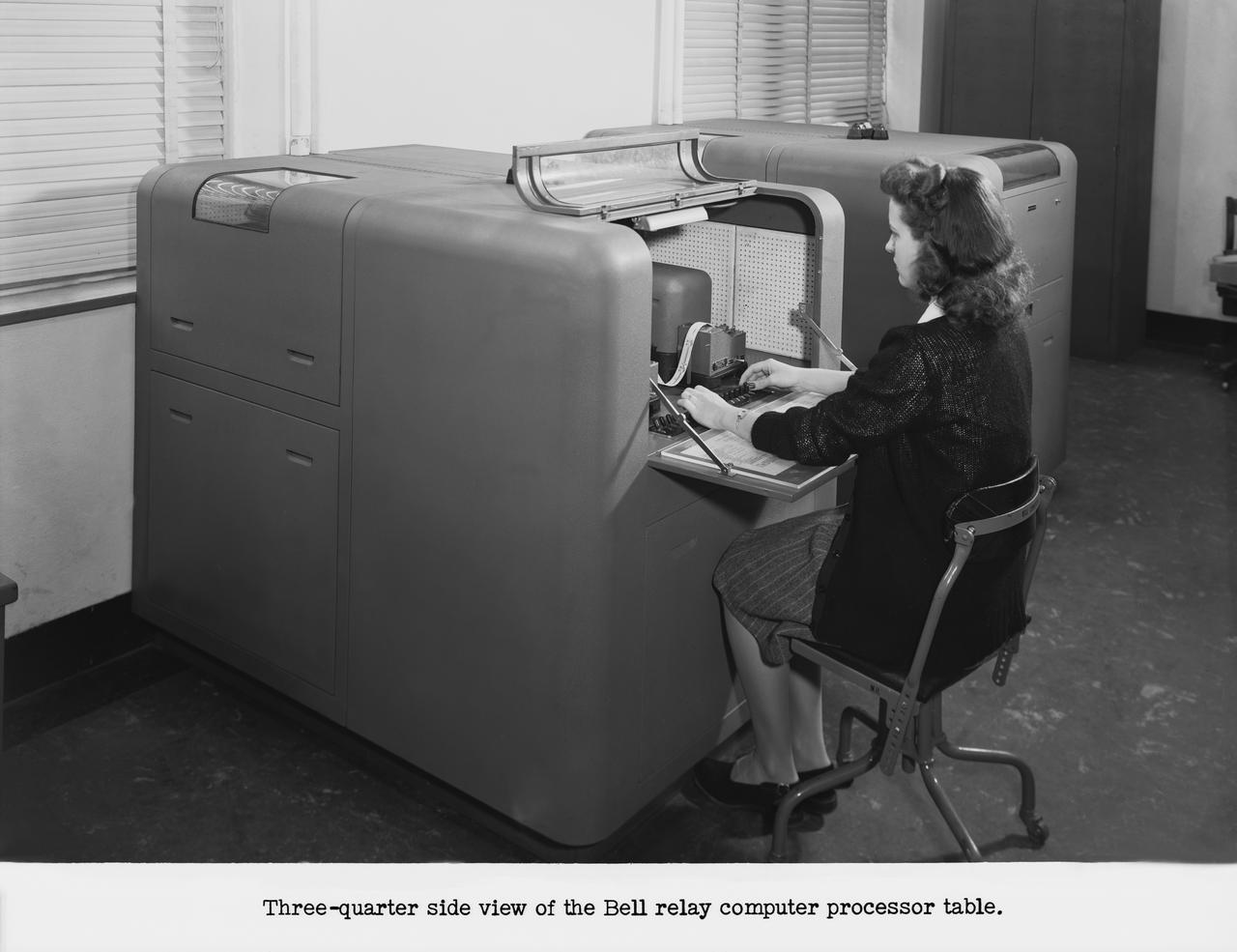
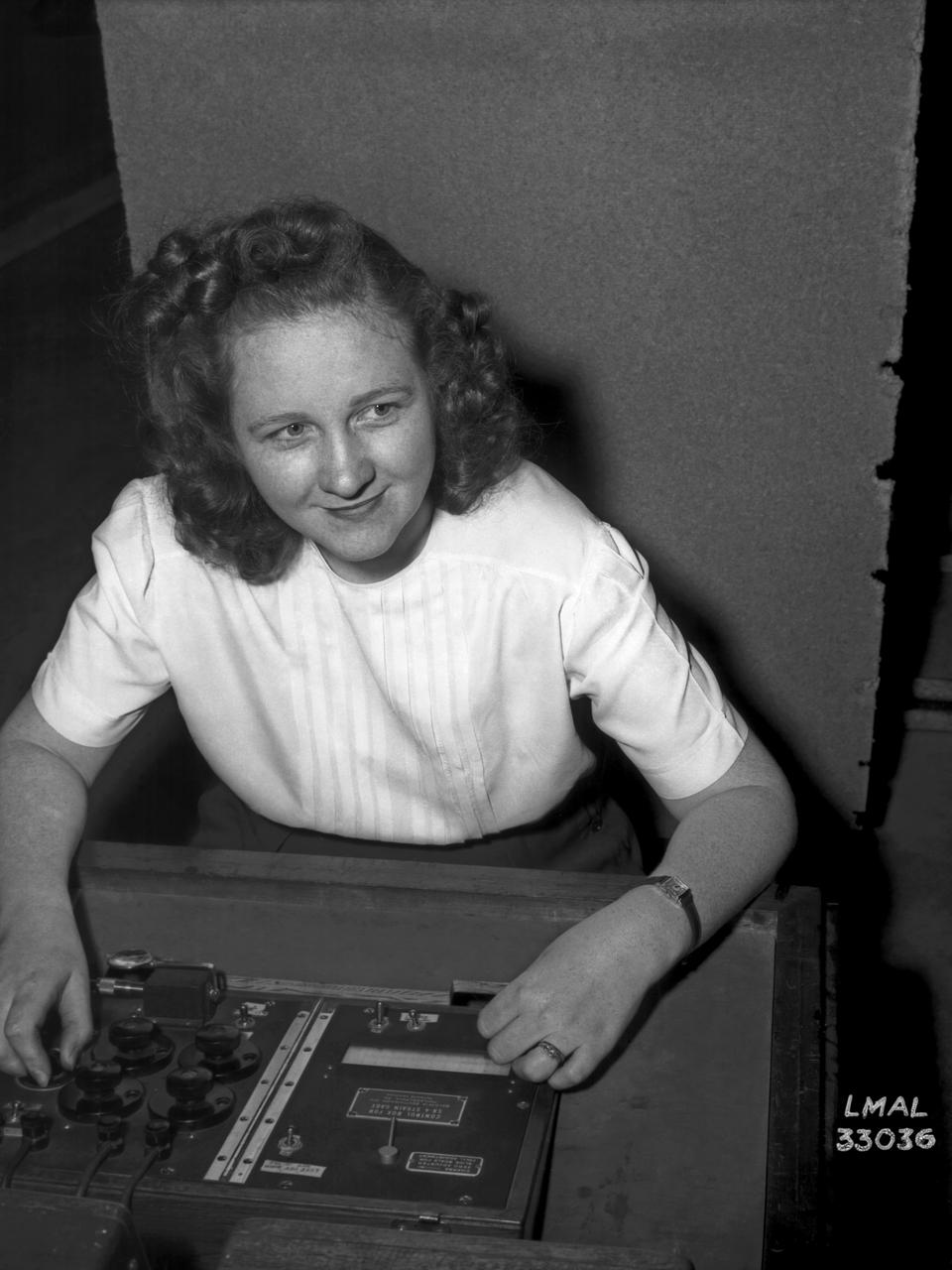
Langley's human computers at work in 1947. The female presence at Langley, who performed mathematical computations for male staff. Bell computers.
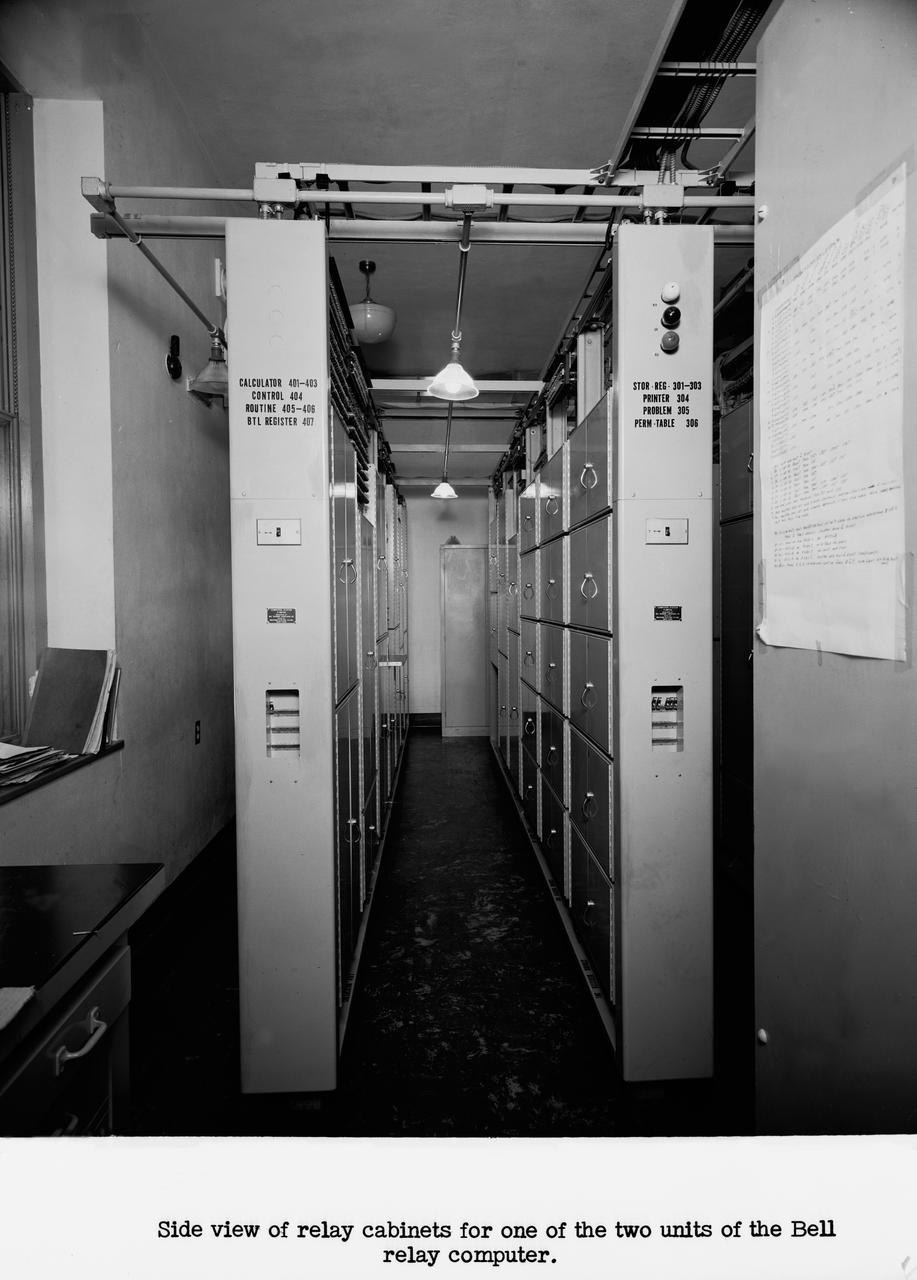
Langley's human computers at work in 1947. The female presence at Langley, who performed mathematical computations for male staff. Bell computers.
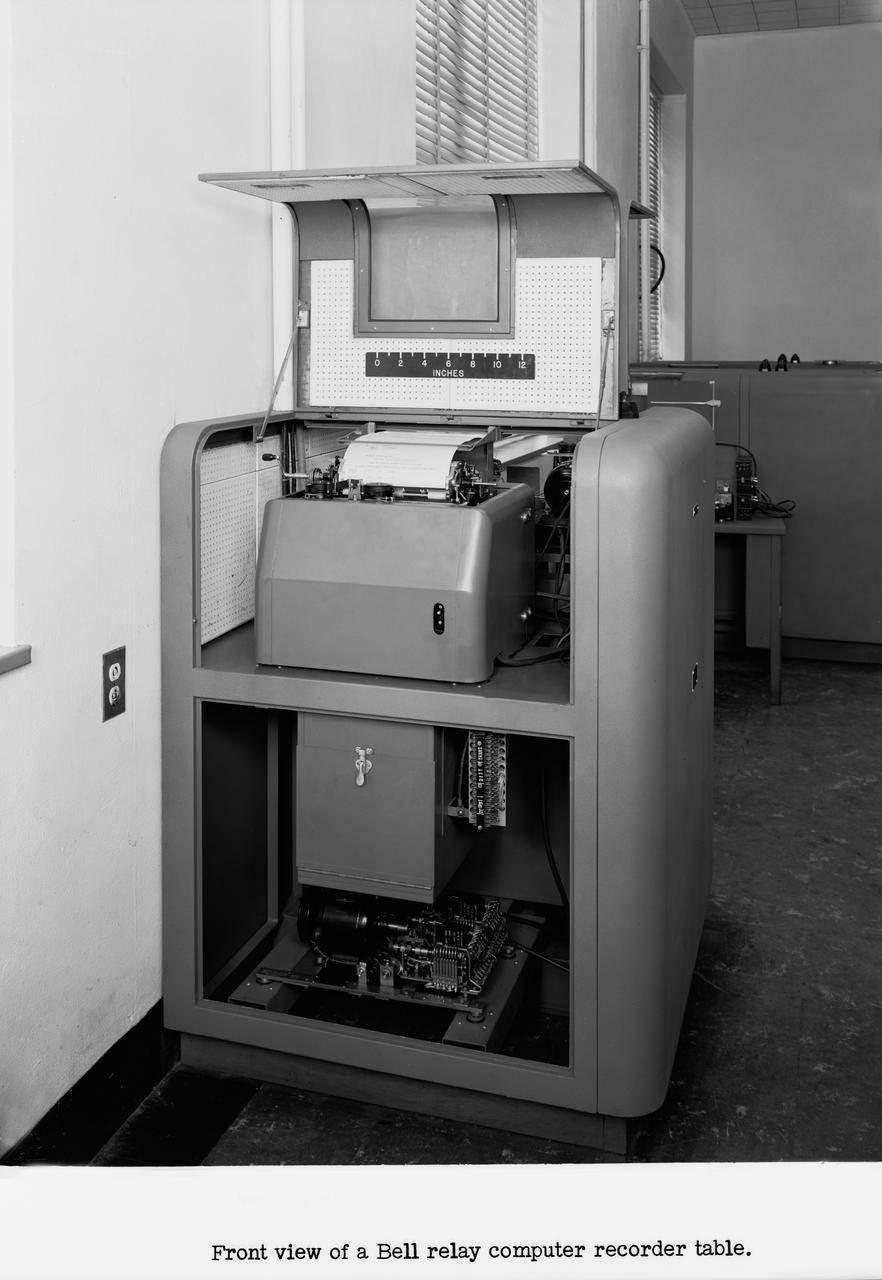
Langley's human computers at work in 1947. The female presence at Langley, who performed mathematical computations for male staff. Bell computers.
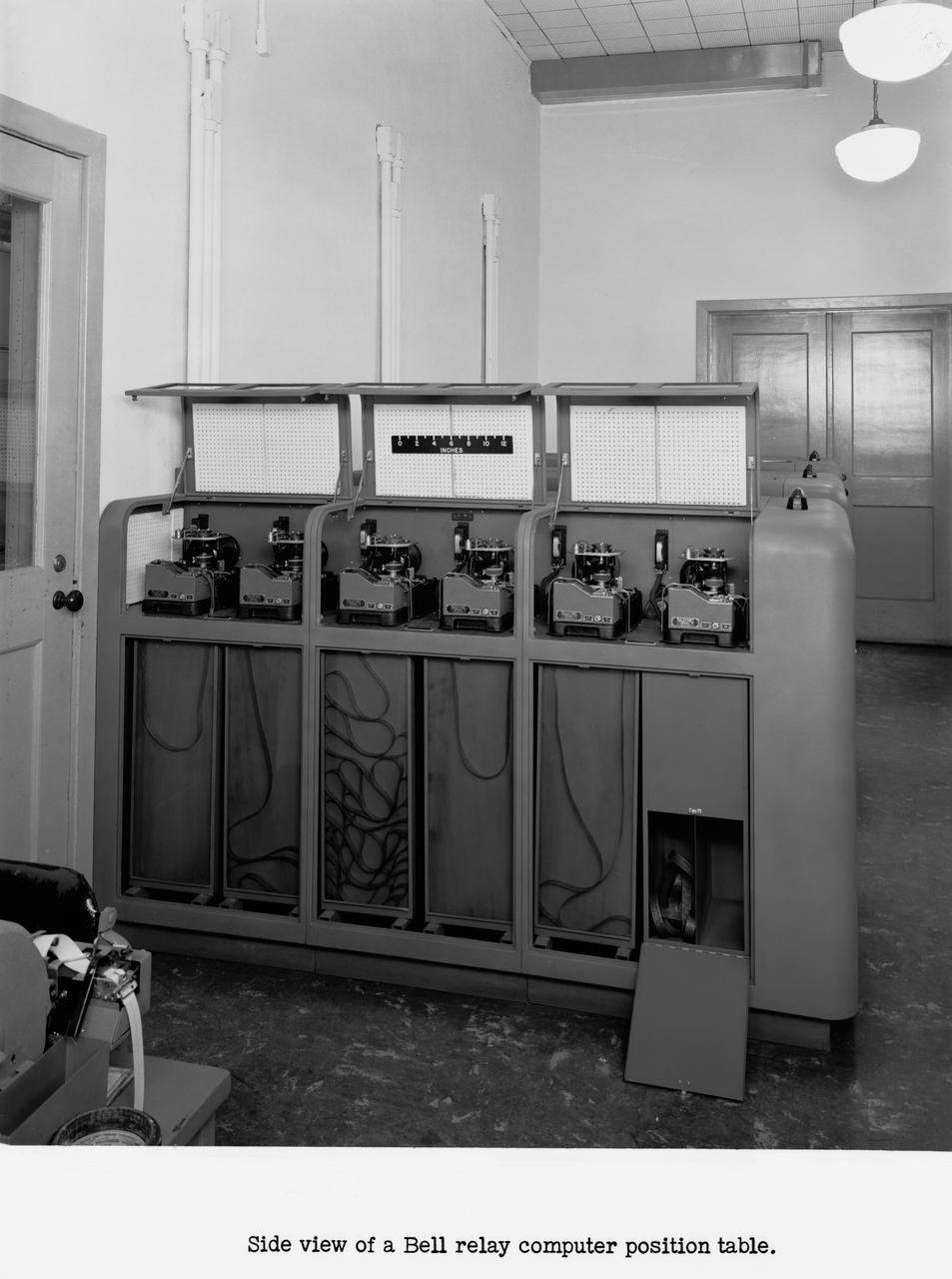
Langley's human computers at work in 1947. The female presence at Langley, who performed mathematical computations for male staff. Bell computers.
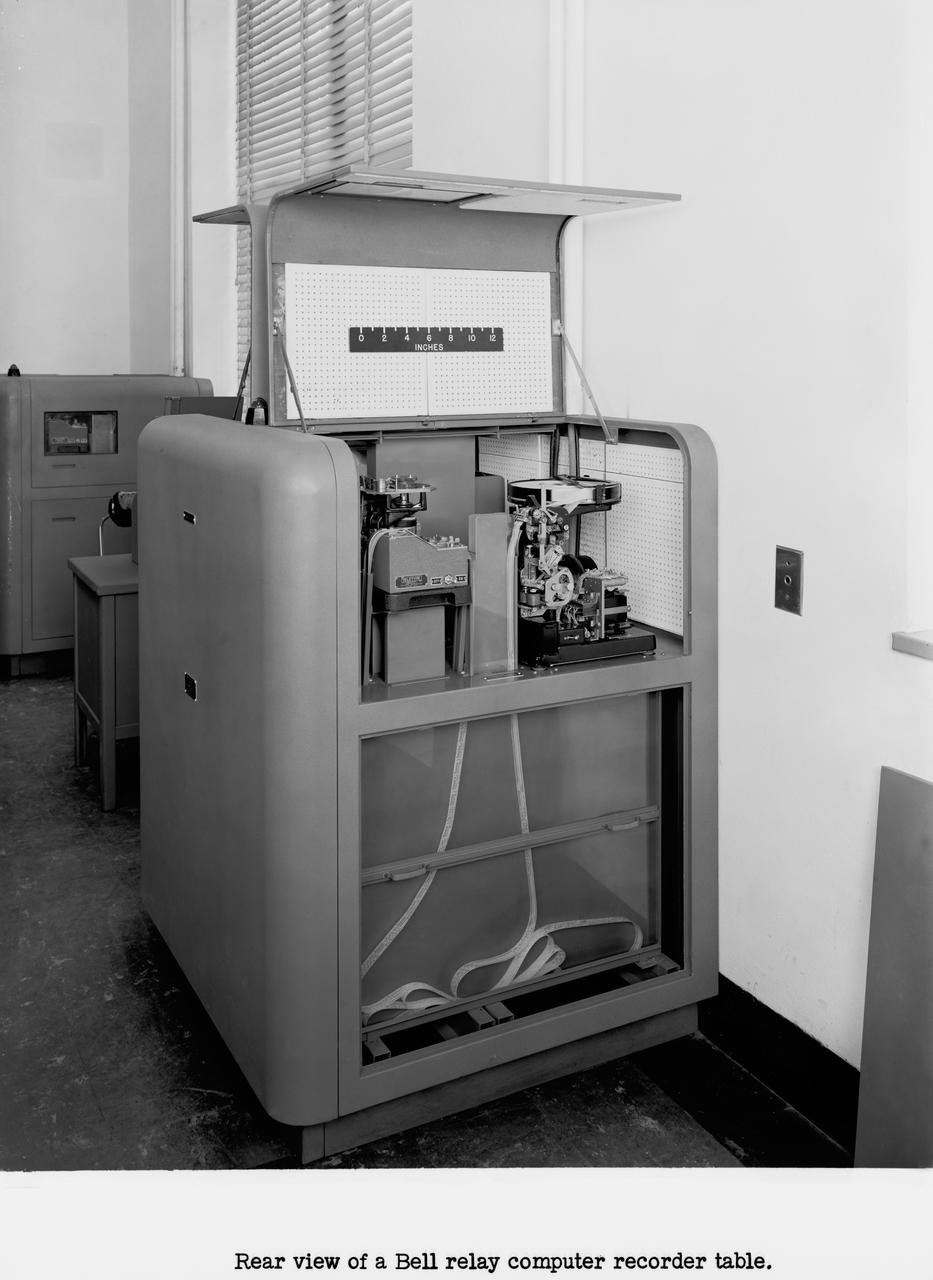
Langley's human computers at work in 1947. The female presence at Langley, who performed mathematical computations for male staff. Bell computers.
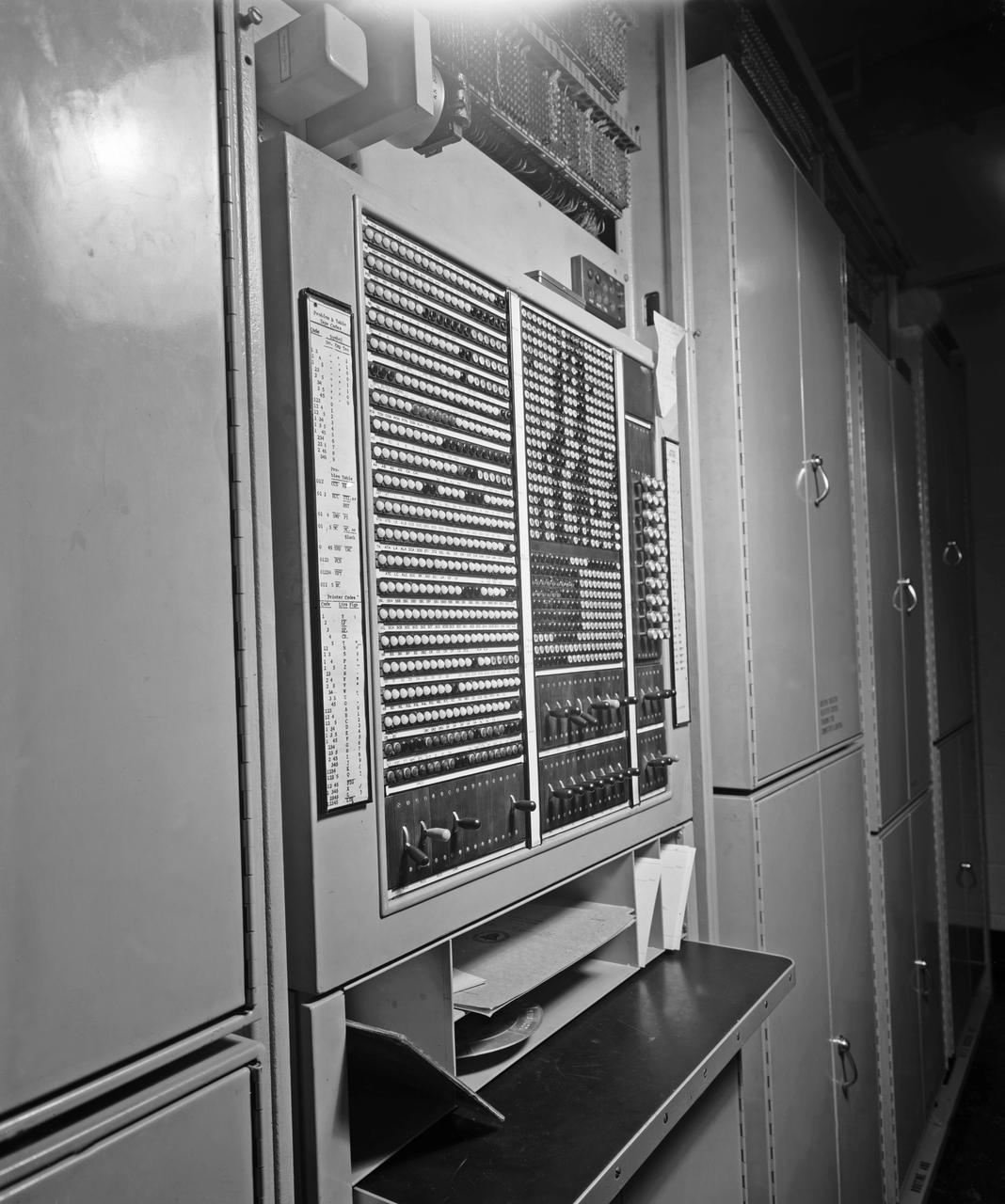
Langley's human computers at work in 1947. The female presence at Langley, who performed mathematical computations for male staff. Bell computers.
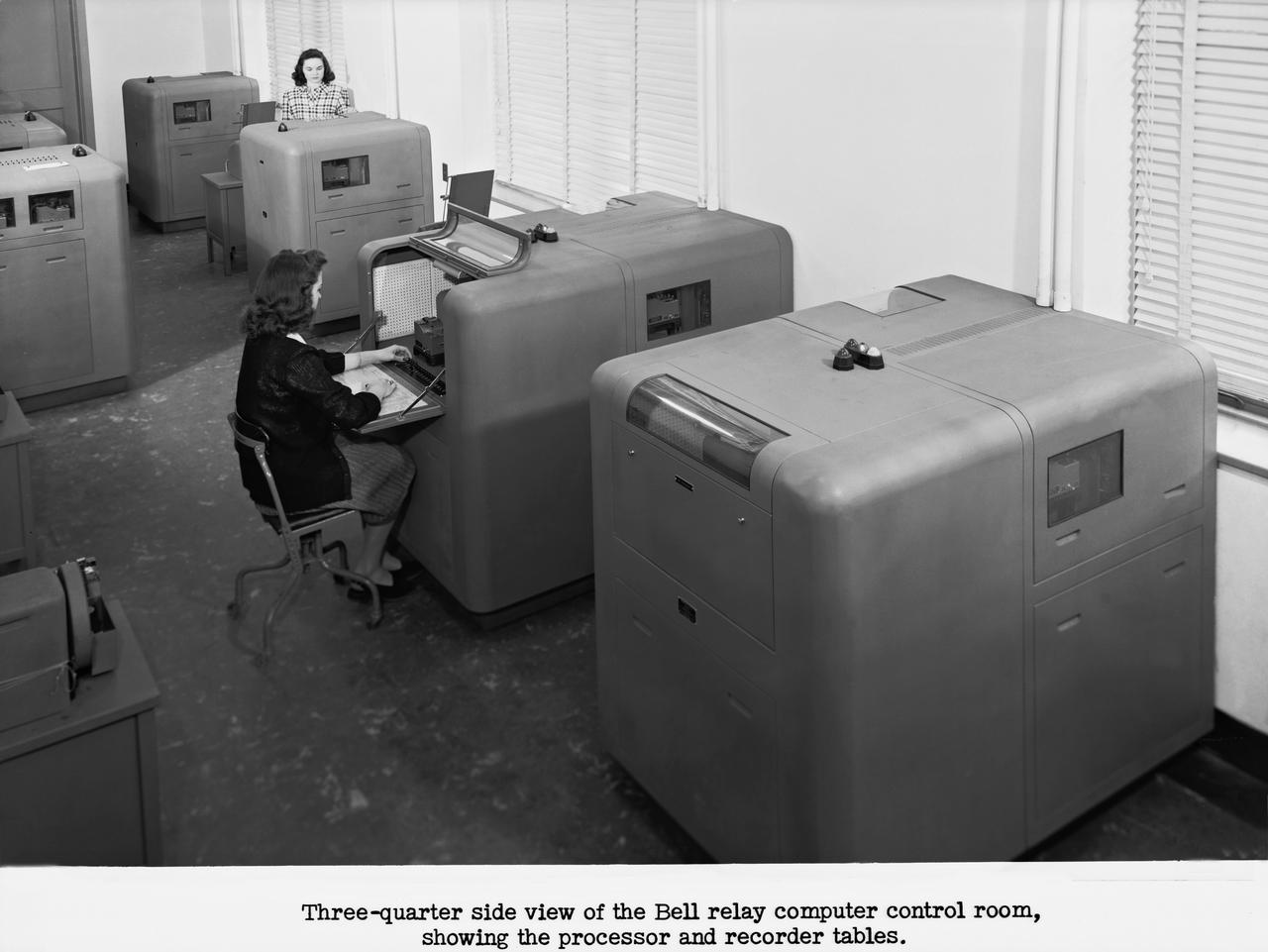
Langley's human computers at work in 1947. The female presence at Langley, who performed mathematical computations for male staff. Bell computers.
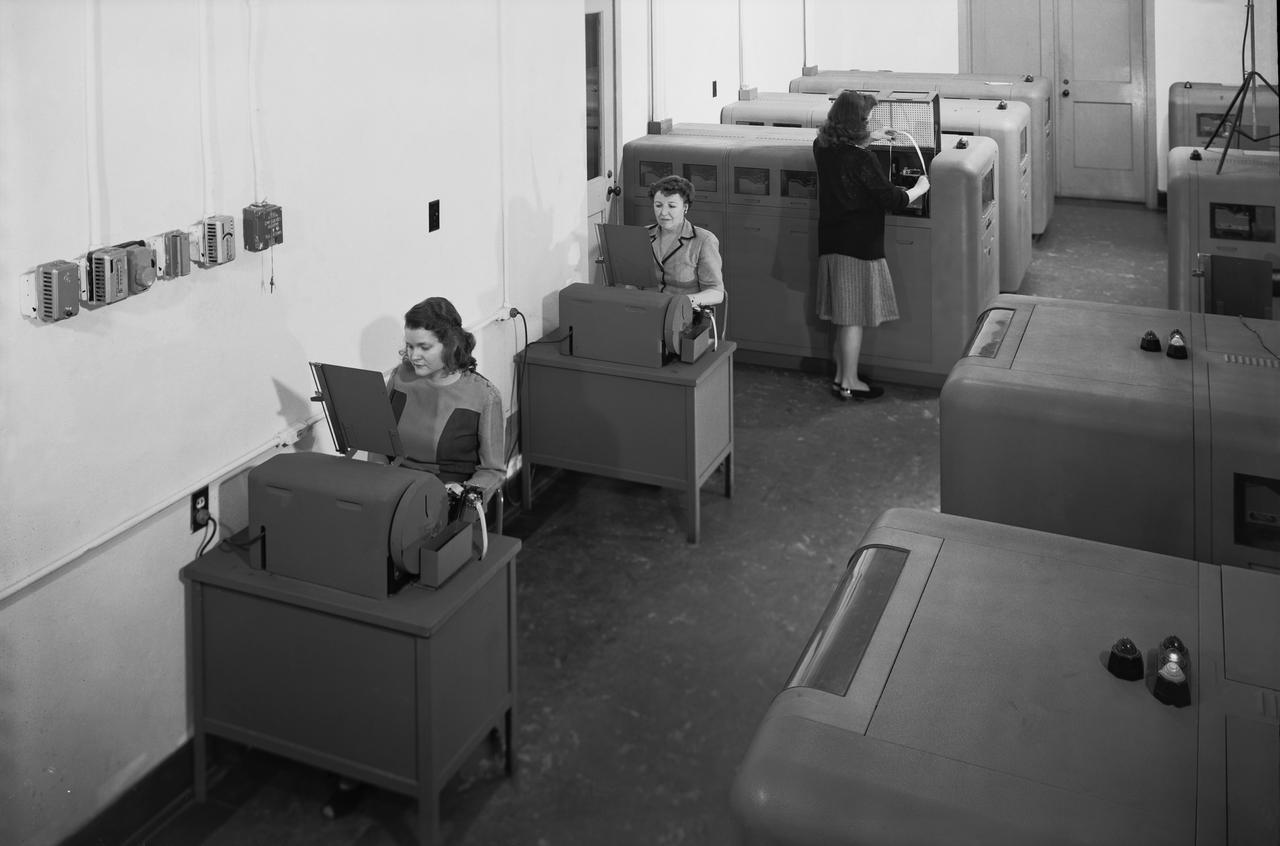
Langley's human computers at work in 1947. The female presence at Langley, who performed mathematical computations for male staff. -- Photograph published in Winds of Change, 75th Anniversary NASA publication (page 48), by James Schultz.
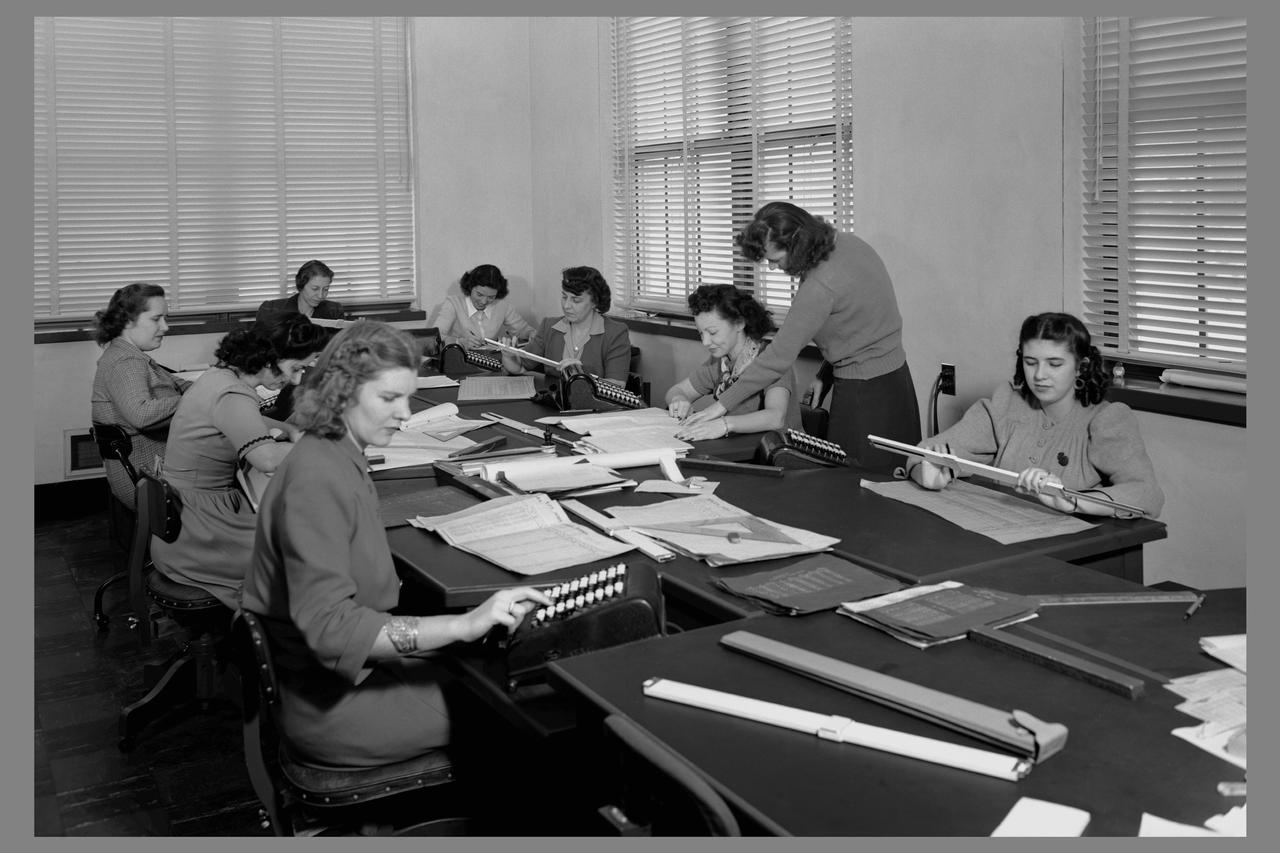
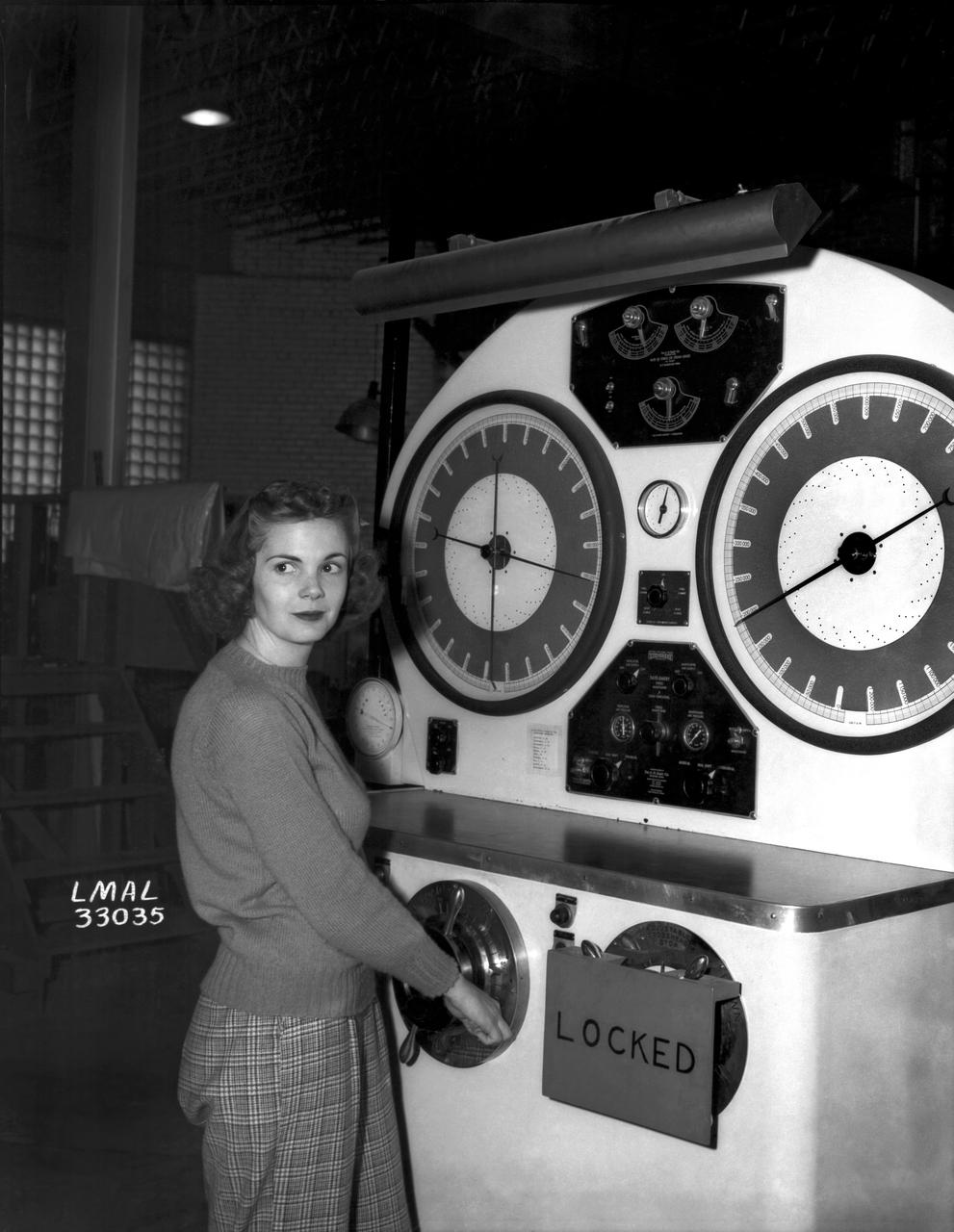
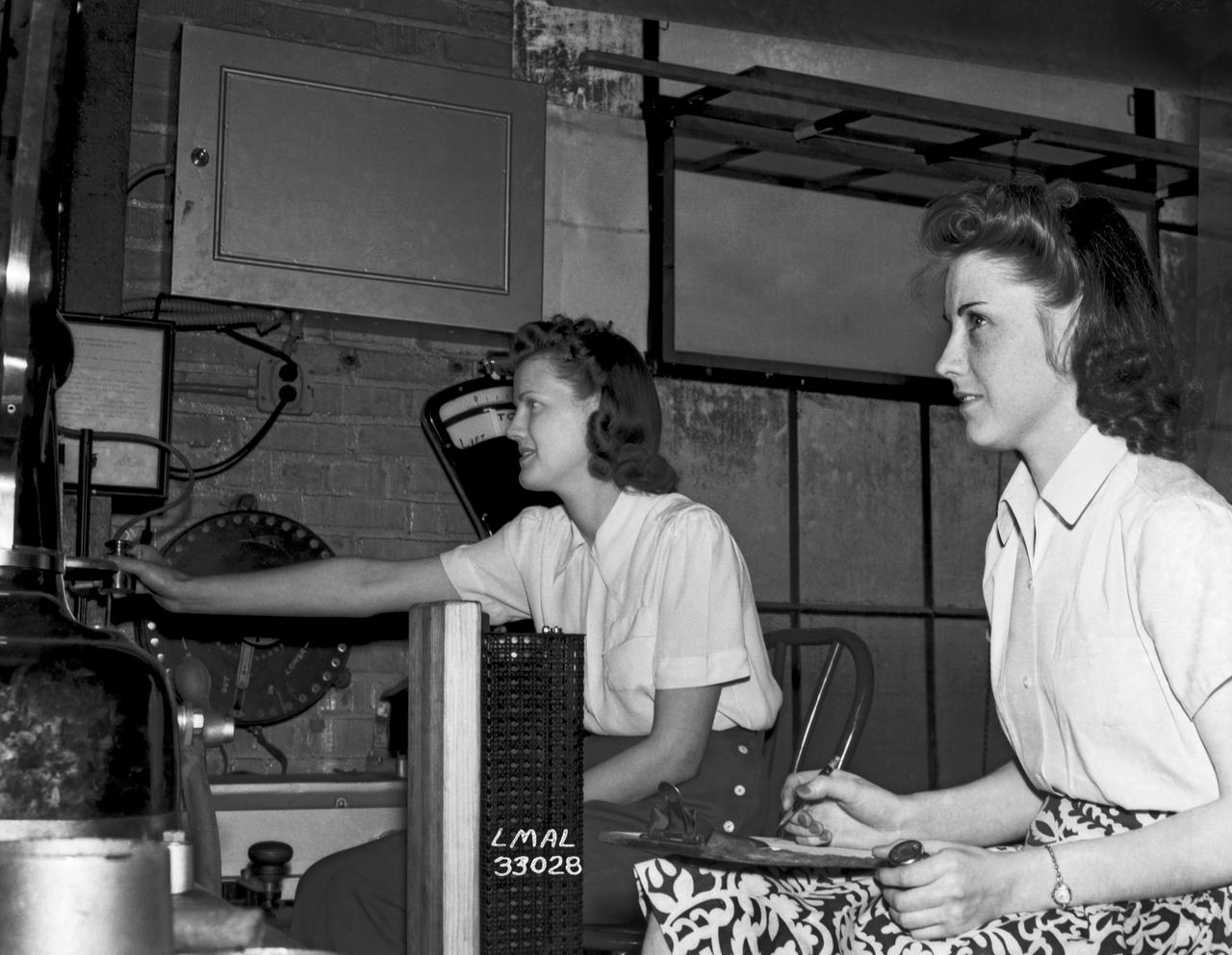
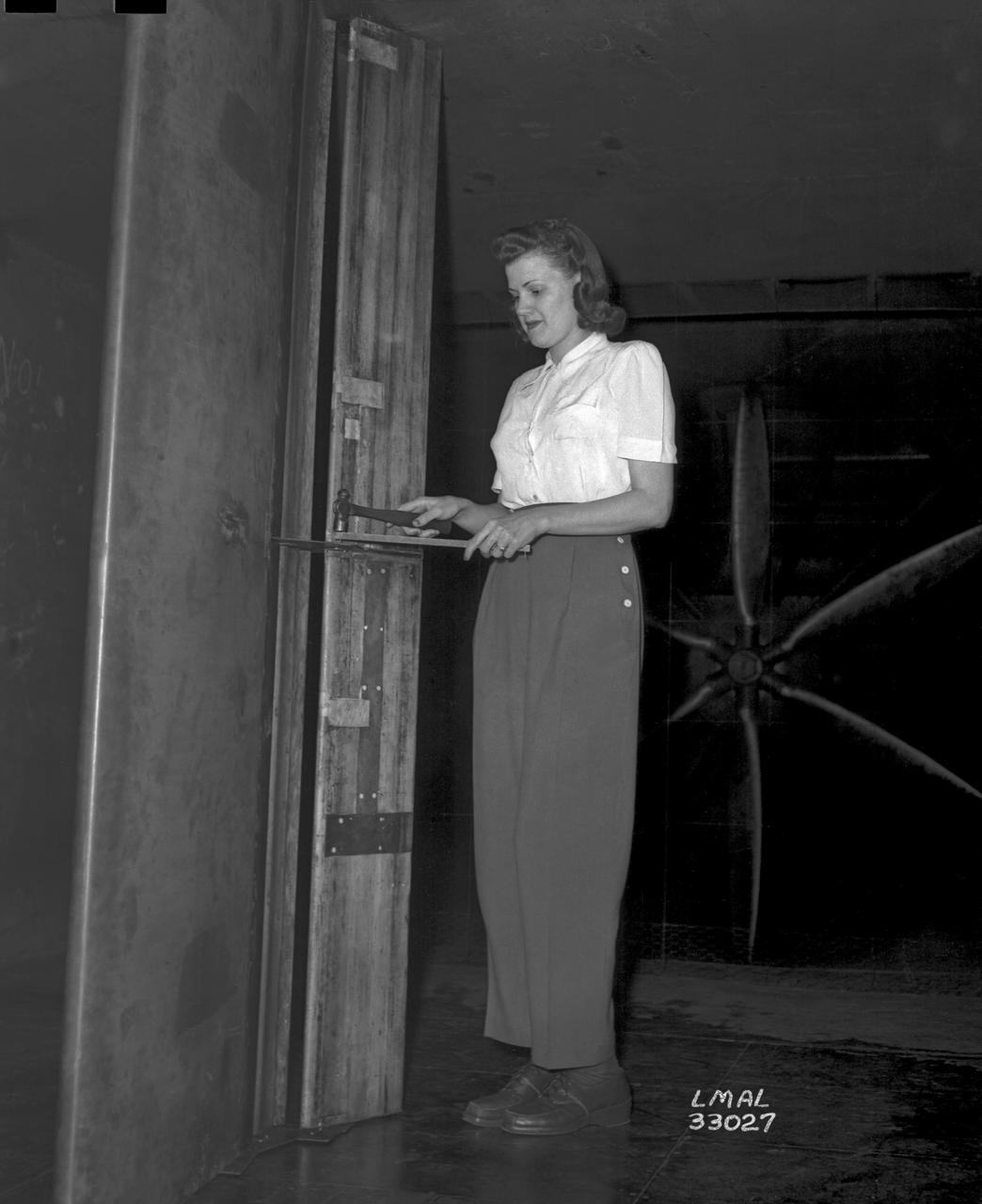
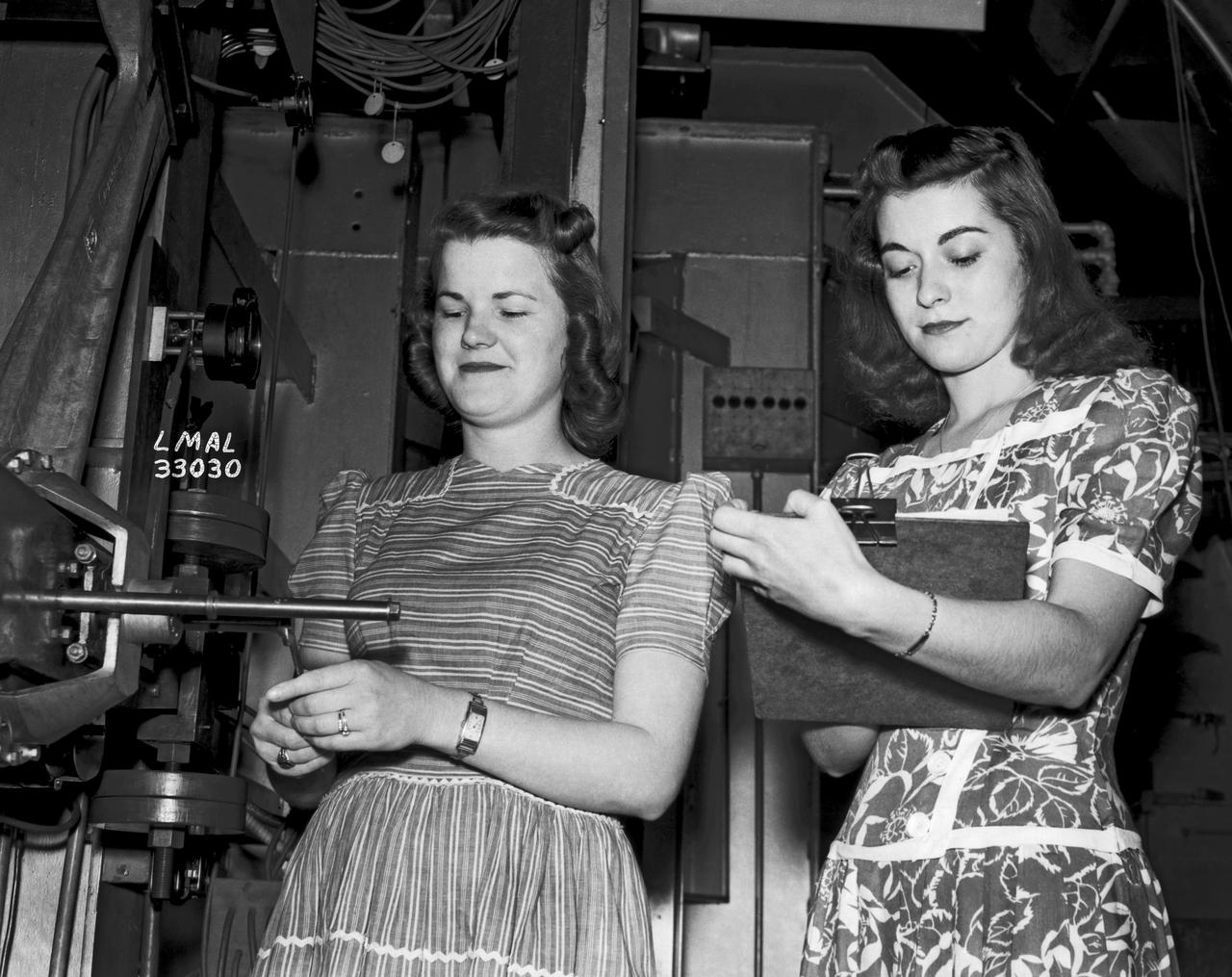
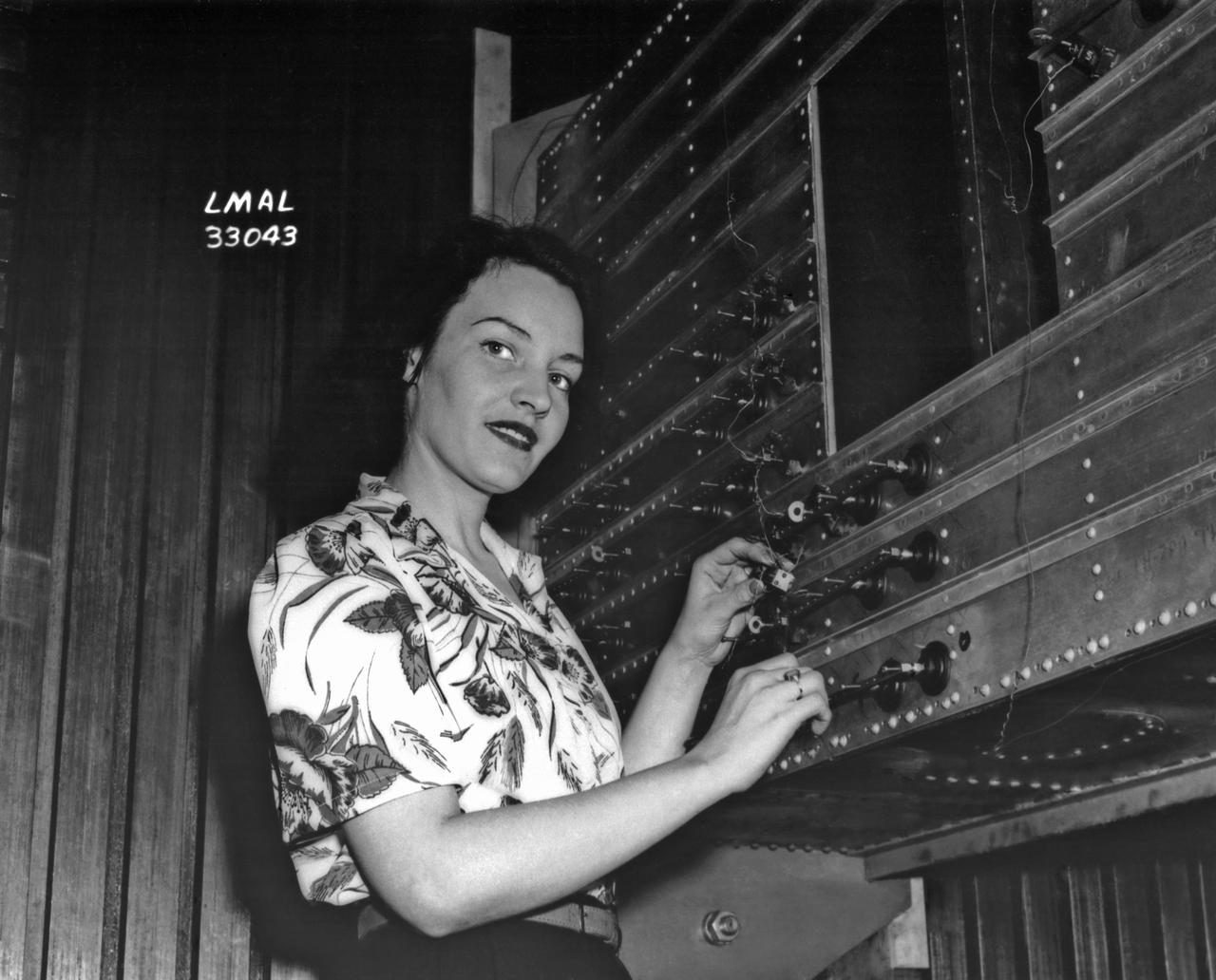
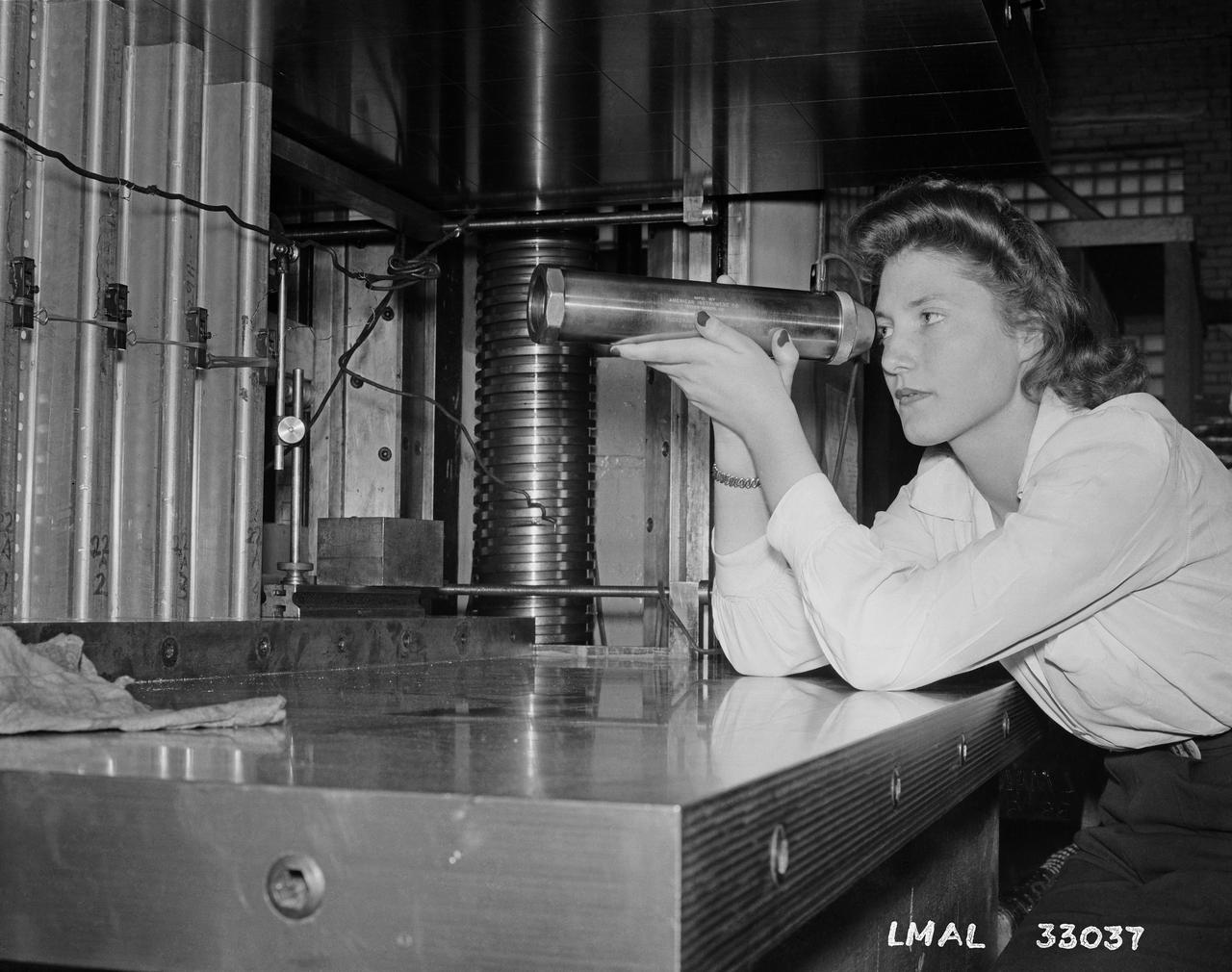
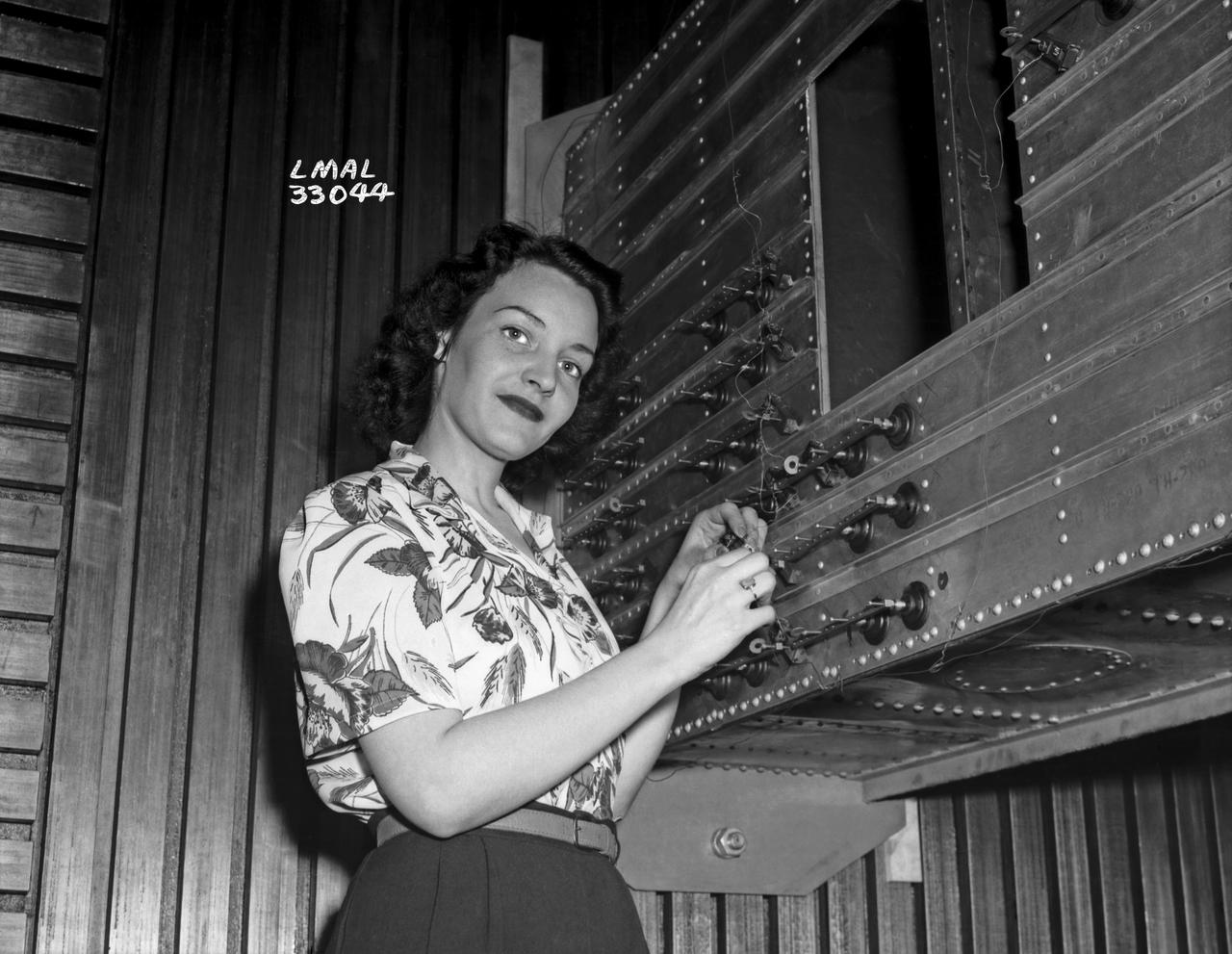
Computers' at work in 16ft wind tunnel - calculating test data
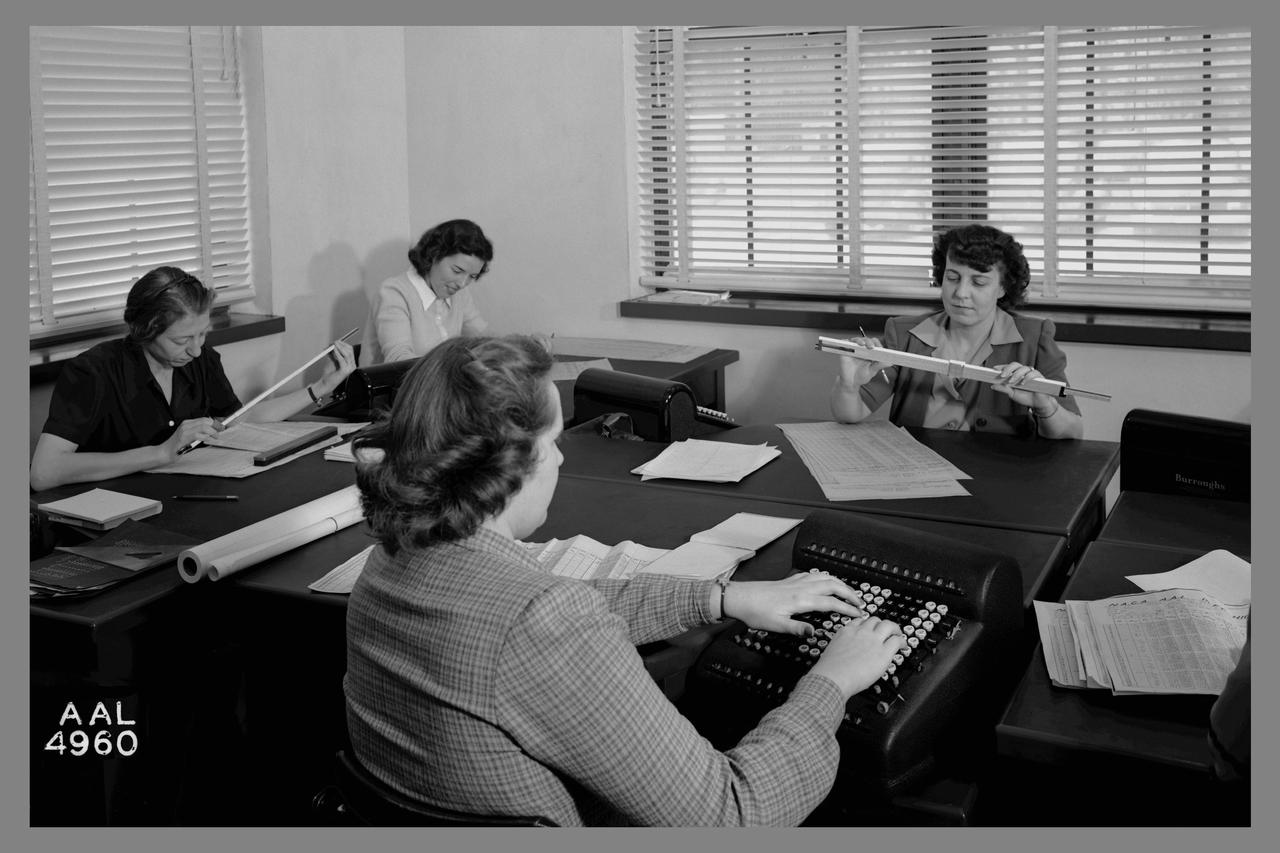
Computers' at work in 16ft wind tunnel - calculating test data
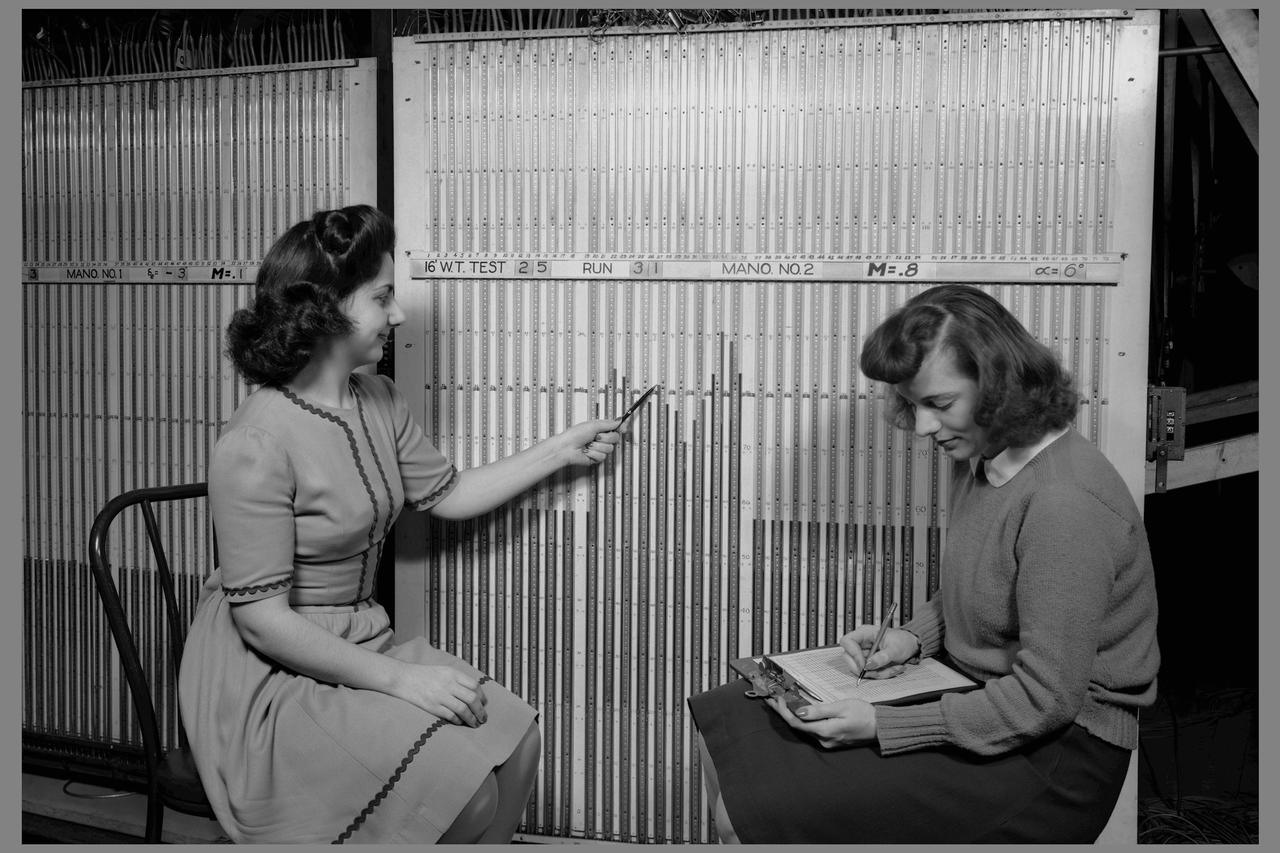
Computers' at work in 16ft wind tunnel - calculating test data - reading manometer board
Women Scientists: Lucille Coltrane, Jean Clark Keating, Katherine Cullie Speegle, Doris 'Dot' Lee, Ruth Whitman, and Emily Stephens Mueller,Lucille Coltrane is at the far left. She was a computer and worked for Norm Crabill who provided positive identification. Lucille authored a NACA Research Memorandum, Investigation of Two Bluff Shapes in Axial Free Flight Over a Mach Number Range From 0.35 to 2.15 in 1958. Next to Lucille is Jean Clark Keating. Jean was identified by Mary Woerner who said that both Jean and her husband Jerry are now deceased. The third woman from the left is Katherine Cullie Speegle. Katherine co-authored two research papers: Preliminary Results From a Free-Flight Investigation of Boundary-Layer Transition and Heat Transfer on a Highly Polished 8-Inch-Diameter Hemisphere-Cylinder at Mach Numbers up to 3 and Reynolds Numbers Based on a Length of 1 Foot up to 17.7 x 10 to the 6th and Heat Transfer For Mach Numbers Up to 2.2 and Pressure Distributions for Mach Numbers Up to 4.7 From Flight Investigations of a Flat-Face Cone and a Hemisphere-Cone. Norm remembered the woman standing as Doris. Mary Alice identified her as Doris 'Dot' Lee, who worked with Katherine Speegle. Dot was married to a NASA engineer named John Lee. Next to Doris is Ruth Whitman. Norm remembered she and her husband owned a Howard DGA 15 at the airport in WEst Point. That prompted Mary Alice to remember her name and that her husband was Jim. The woman seated on the right is Emily Stephens Mueller. Norm remembers that Emily went to Houston as part of the Space Task Group, but retired back here on the peninsula. In 2008, Emily attended the NACA Reunion X11. She walked over to a table of books about the history of NACA, former NACA facilities and the organization's aviation pioneers and saw a book about women of flight from the Dryden Research Center and paused, then pointed somewhat in amazement. "That’s me," she said of a picture on the cover of her on the far left of a li
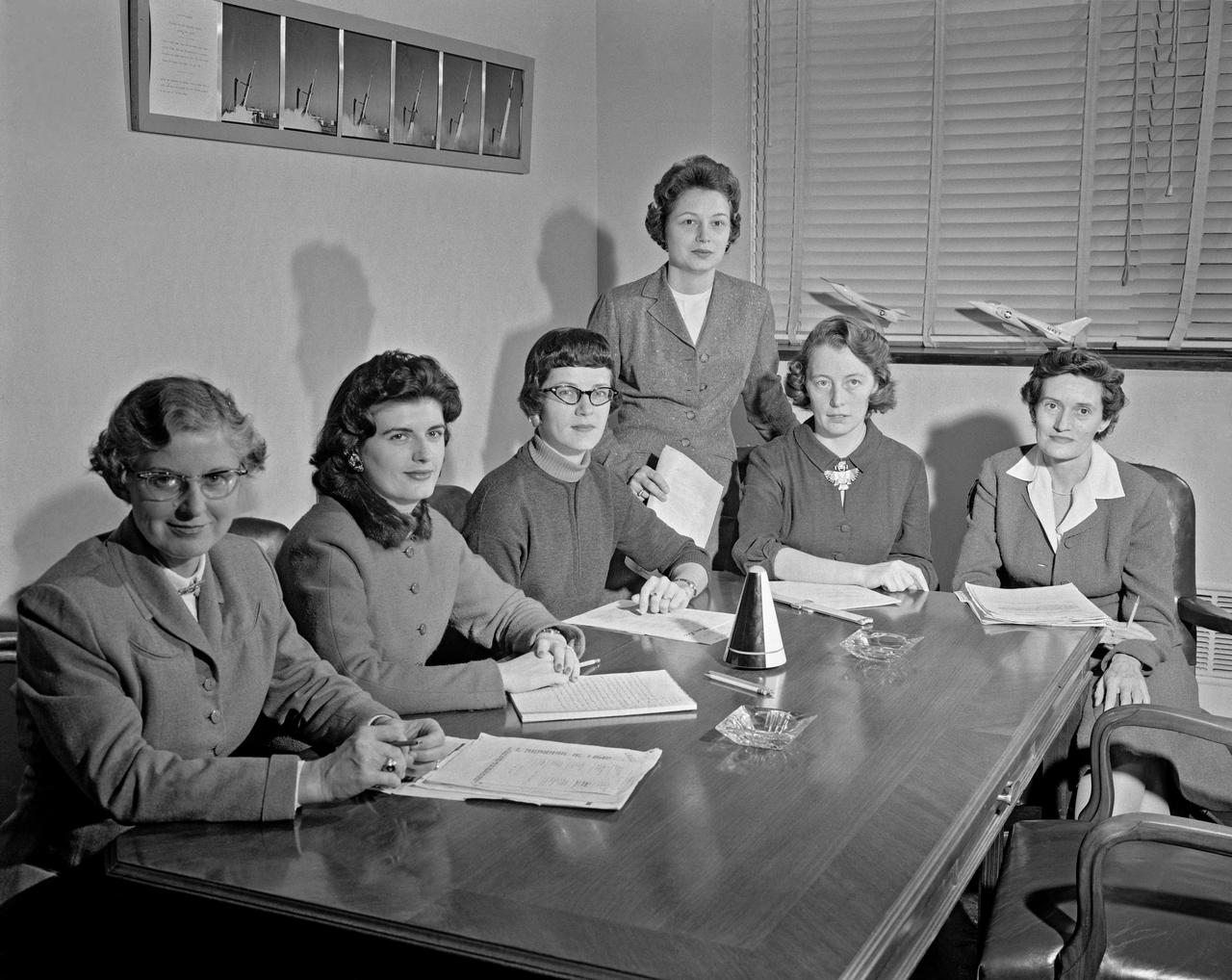
Women Scientists: Lucille Coltrane, Jean Clark Keating, Katherine Cullie Speegle, Doris 'Dot' Lee, Ruth Whitman, and Emily Stephens Mueller,Lucille Coltrane is at the far left. She was a computer and worked for Norm Crabill who provided positive identification. Lucille authored a NACA Research Memorandum, Investigation of Two Bluff Shapes in Axial Free Flight Over a Mach Number Range From 0.35 to 2.15 in 1958. Next to Lucille is Jean Clark Keating. Jean was identified by Mary Woerner who said that both Jean and her husband Jerry are now deceased. The third woman from the left is Katherine Cullie Speegle. Katherine co-authored two research papers: Preliminary Results From a Free-Flight Investigation of Boundary-Layer Transition and Heat Transfer on a Highly Polished 8-Inch-Diameter Hemisphere-Cylinder at Mach Numbers up to 3 and Reynolds Numbers Based on a Length of 1 Foot up to 17.7 x 10 to the 6th and Heat Transfer For Mach Numbers Up to 2.2 and Pressure Distributions for Mach Numbers Up to 4.7 From Flight Investigations of a Flat-Face Cone and a Hemisphere-Cone. Norm remembered the woman standing as Doris. Mary Alice identified her as Doris 'Dot' Lee, who worked with Katherine Speegle. Dot was married to a NASA engineer named John Lee. Next to Doris is Ruth Whitman. Norm remembered she and her husband owned a Howard DGA 15 at the airport in WEst Point. That prompted Mary Alice to remember her name and that her husband was Jim. The woman seated on the right is Emily Stephens Mueller. Norm remembers that Emily went to Houston as part of the Space Task Group, but retired back here on the peninsula. In 2008, Emily attended the NACA Reunion X11. She walked over to a table of books about the history of NACA, former NACA facilities and the organization's aviation pioneers and saw a book about women of flight from the Dryden Research Center and paused, then pointed somewhat in amazement. "That’s me," she said of a picture on the cover of her on the far left of a li
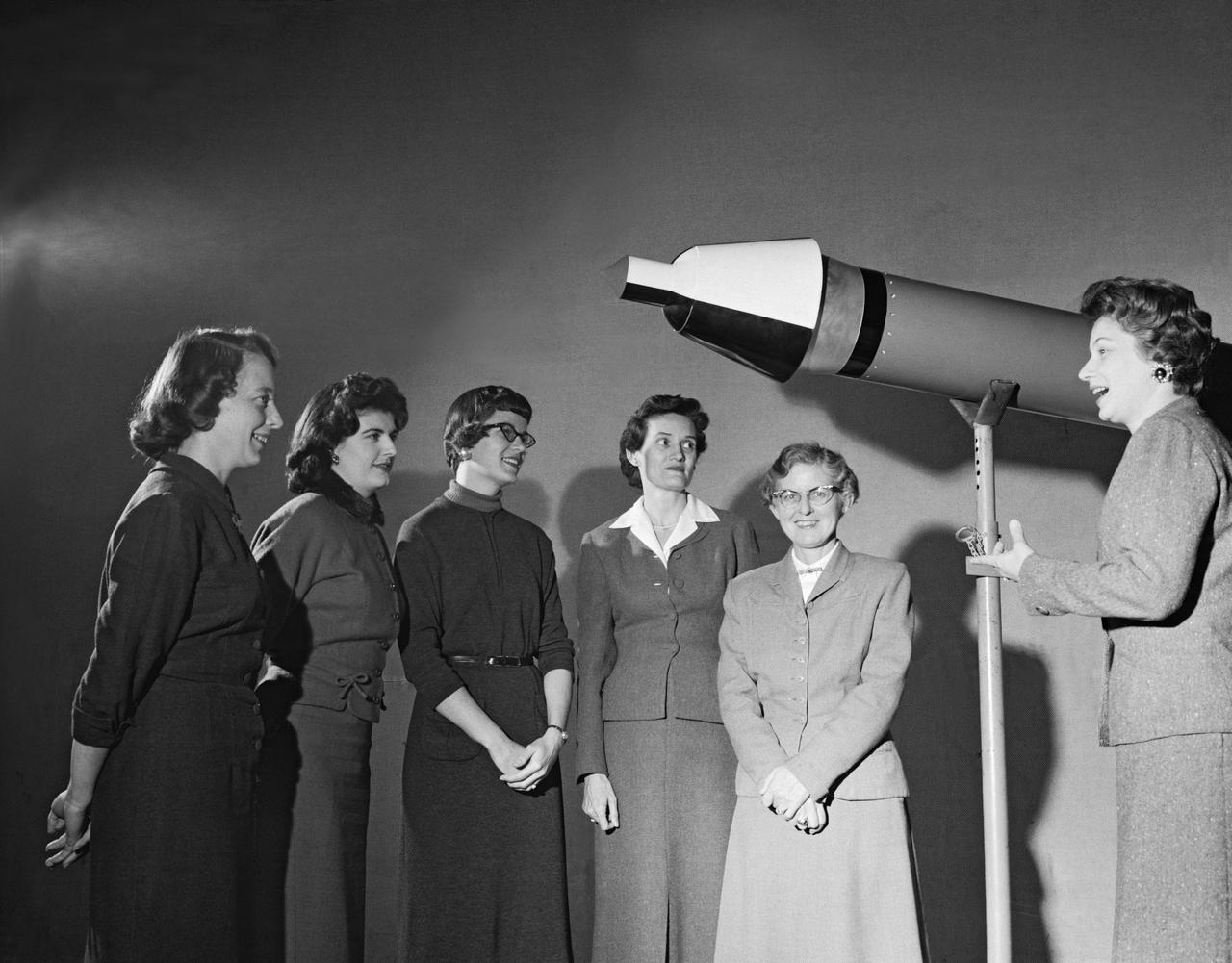
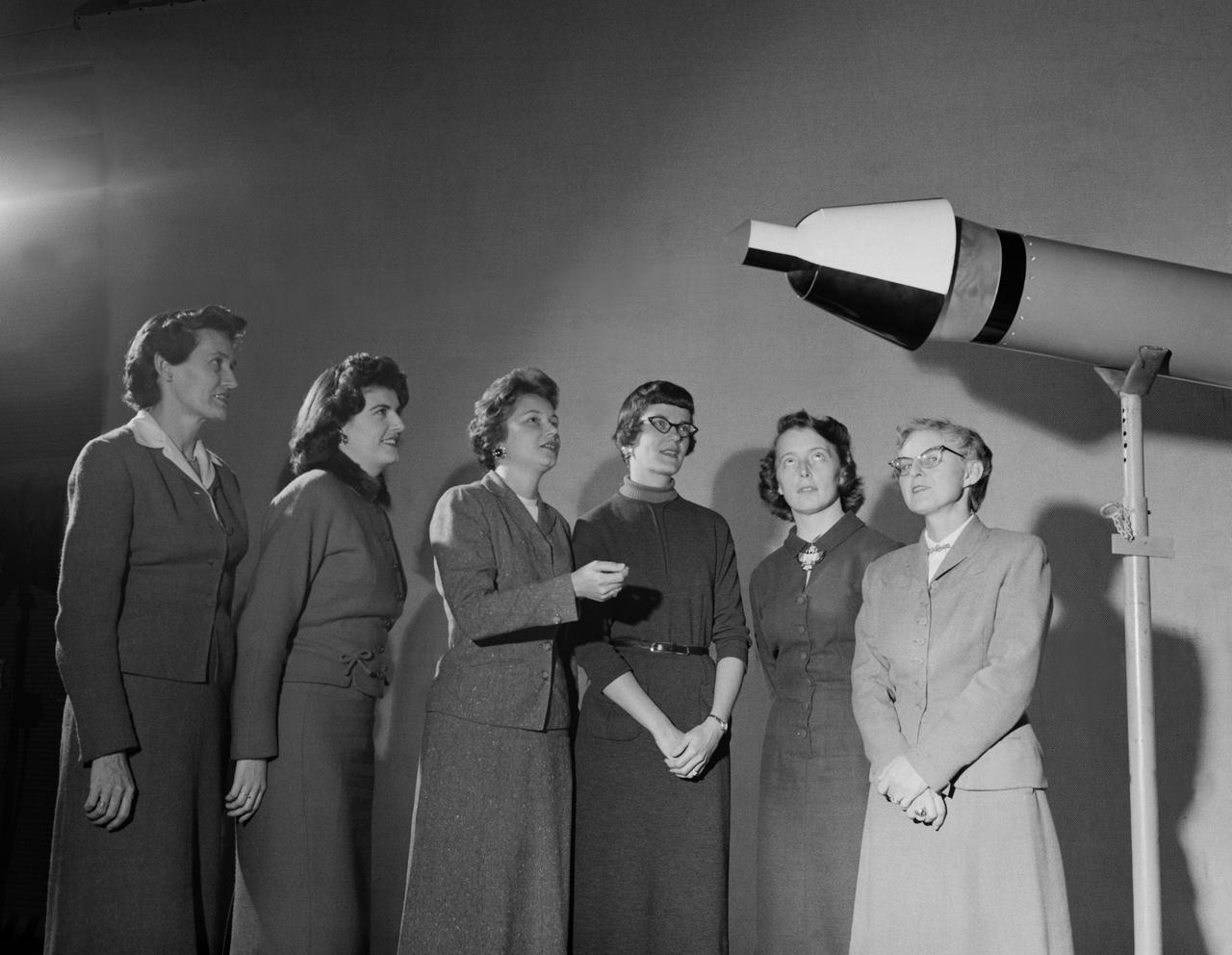
Women Scientists: Lucille Coltrane, Jean Clark Keating, Katherine Cullie Speegle, Doris "Dot" Lee, Ruth Whitman, and Emily Stephens Mueller,Lucille Coltrane is at the far left. She was a computer and worked for Norm Crabill who provided positive identification. Lucille authored a NACA Research Memorandum, Investigation of Two Bluff Shapes in Axial Free Flight Over a Mach Number Range From 0.35 to 2.15 in 1958. Next to Lucille is Jean Clark Keating. Jean was identified by Mary Woerner who said that both Jean and her husband Jerry are now deceased. The third woman from the left is Katherine Cullie Speegle. Katherine co-authored two research papers: Preliminary Results From a Free-Flight Investigation of Boundary-Layer Transition and Heat Transfer on a Highly Polished 8-Inch-Diameter Hemisphere-Cylinder at Mach Numbers up to 3 and Reynolds Numbers Based on a Length of 1 Foot up to 17.7 x 10 to the 6th and Heat Transfer For Mach Numbers Up to 2.2 and Pressure Distributions for Mach Numbers Up to 4.7 From Flight Investigations of a Flat-Face Cone and a Hemisphere-Cone. Norm remembered the woman standing as Doris. Mary Alice identified her as Doris 'Dot' Lee, who worked with Katherine Speegle. Dot was married to a NASA engineer named John Lee. Next to Doris is Ruth Whitman. Norm remembered she and her husband owned a Howard DGA 15 at the airport in WEst Point. That prompted Mary Alice to remember her name and that her husband was Jim. The woman seated on the right is Emily Stephens Mueller. Norm remembers that Emily went to Houston as part of the Space Task Group, but retired back here on the peninsula. In 2008, Emily attended the NACA Reunion X11. She walked over to a table of books about the history of NACA, former NACA facilities and the organization's aviation pioneers and saw a book about women of flight from the Dryden Research Center and paused, then pointed somewhat in amazement. "ThatÕs me," she said of a picture on the cover of her on the far left of a line of women. She was at Dryden from 1948-49.
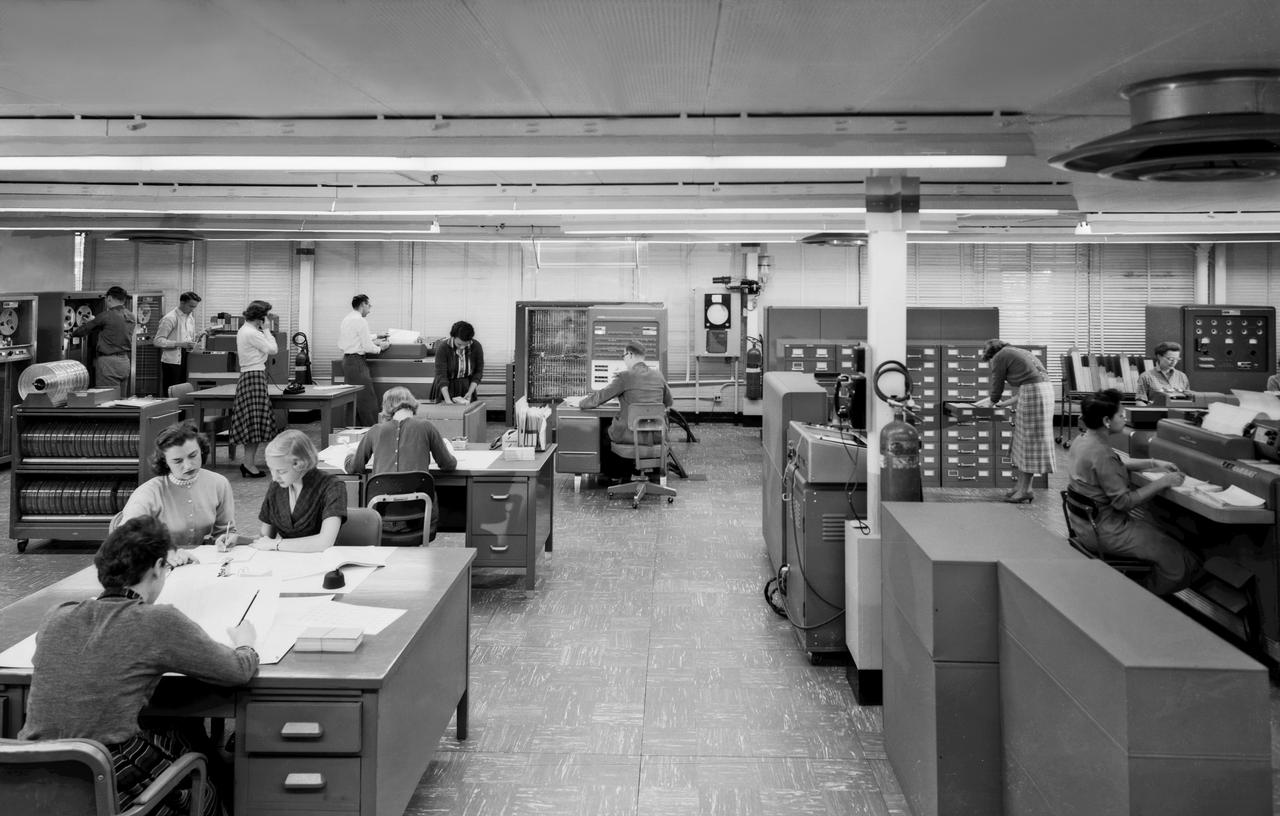
IBM 704 Computer Operations People on the photo are: Woman in the front with her back to the camera is Jean Ruddle Migneault. She provided the names for the rest of the staff in the photo. Kathy Christian Young, Mary Talmage Kaylor, Willie Terrell Ruffin (computer operator not mathematician), Joyce Alston Clemens, Lou Mayo Ladson, Rachel Richardson Mayo, Sadie Livingston Boyer , Joann Shipp Buschman worked in hangar in West Area, Shelva Blevins Stroud (programmer in data reduction), Jackie Kilby, Rita Englebert, Harriet Seals Winestein, Lillian Boney, Jane Thompson Kemper, Helen Thompson ( math aide) Jane and Helen were daughters of Floyd Thompson, center director.
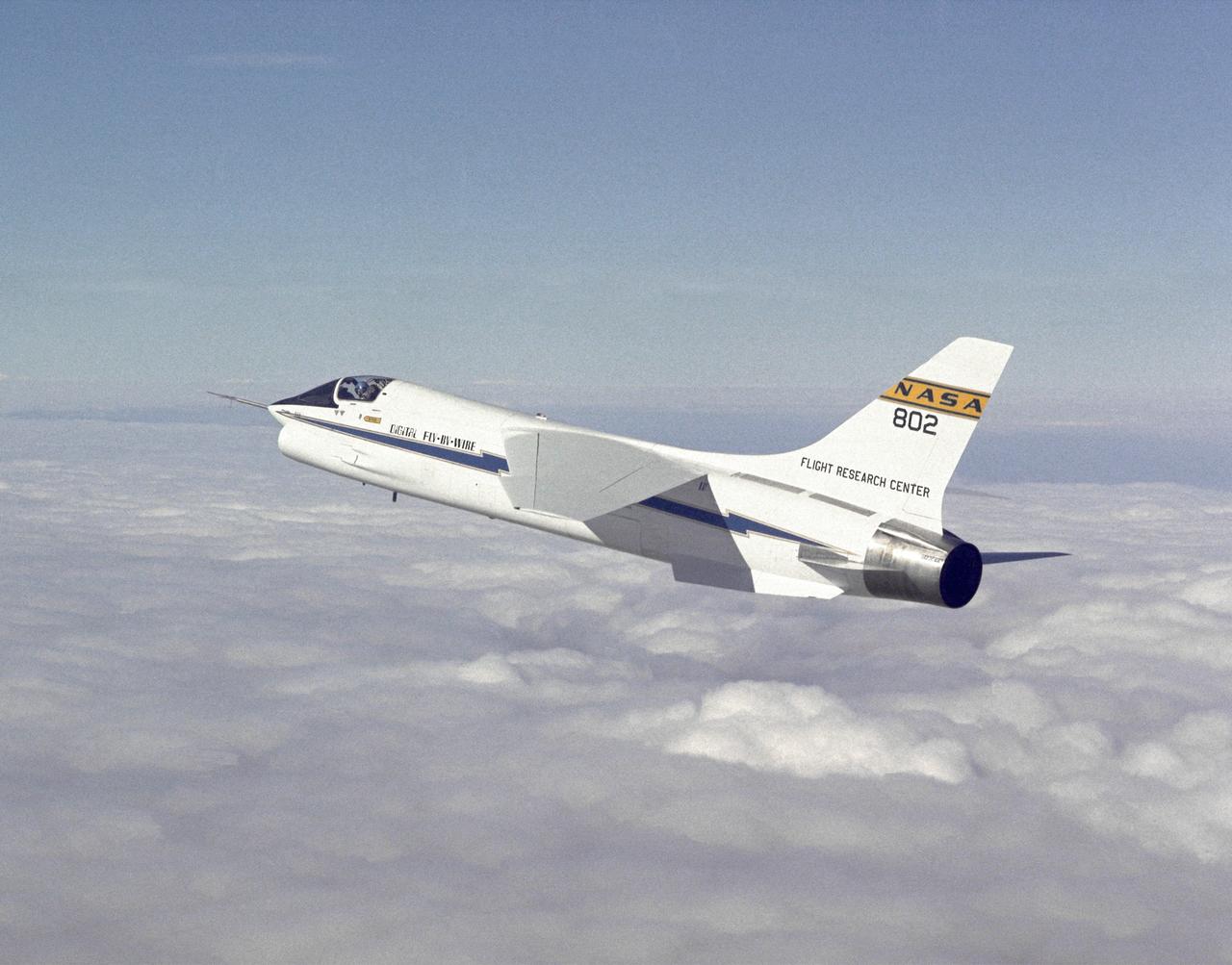
F-8 Digital Fly-By-Wire aircraft in flight. The computer-controlled flight systems pioneered by the F-8 DFBW created a revolution in aircraft design. The F-117A, X-29, X-31, and many other aircraft have relied on computers to make them flyable. Built with inherent instabilities to make them more maneuverable, they would be impossible for human pilots to fly if the computers failed or received incorrect data.
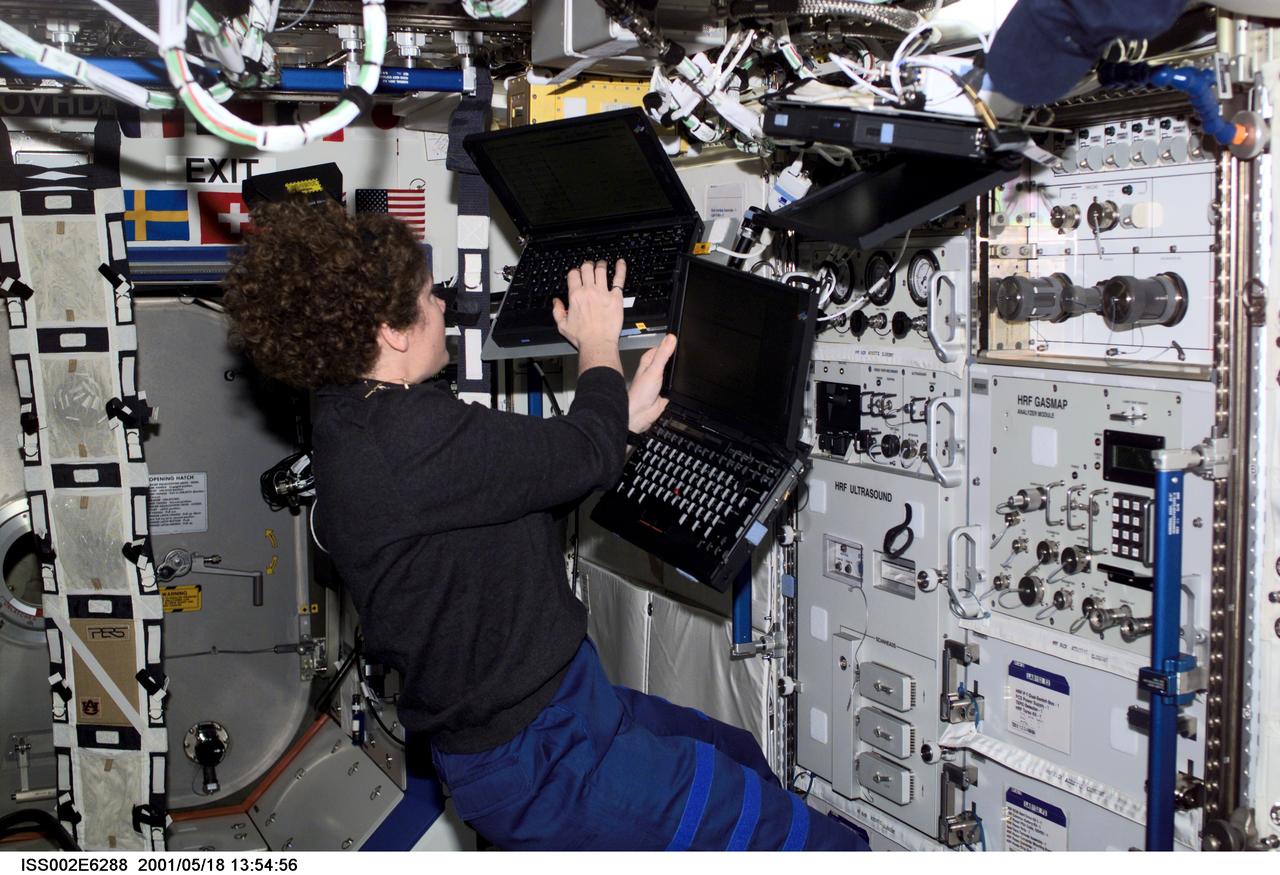
ISS002-E-6288 (18 May 2001) --- Susan J. Helms, Expedition Two flight engineer, works with three laptop computers at the Human Research Facility (HRF) in the U.S. Laboratory. The image was taken with a digital still camera.
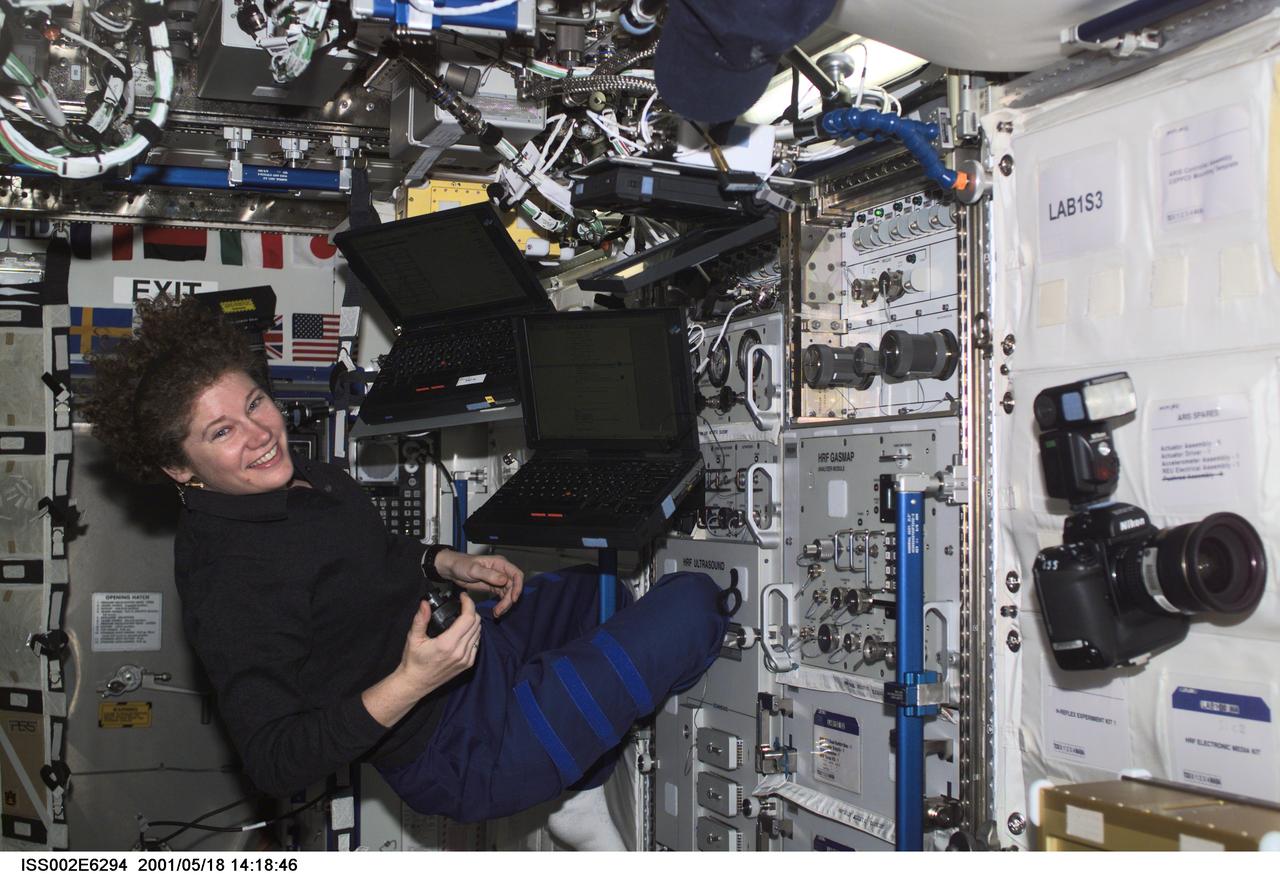
ISS002-E-6294 (18 May 2001) --- Susan J. Helms, Expedition Two flight engineer, works with three laptop computers at the Human Research Facility (HRF) in the U.S. Laboratory. The image was taken with a digital still camera.
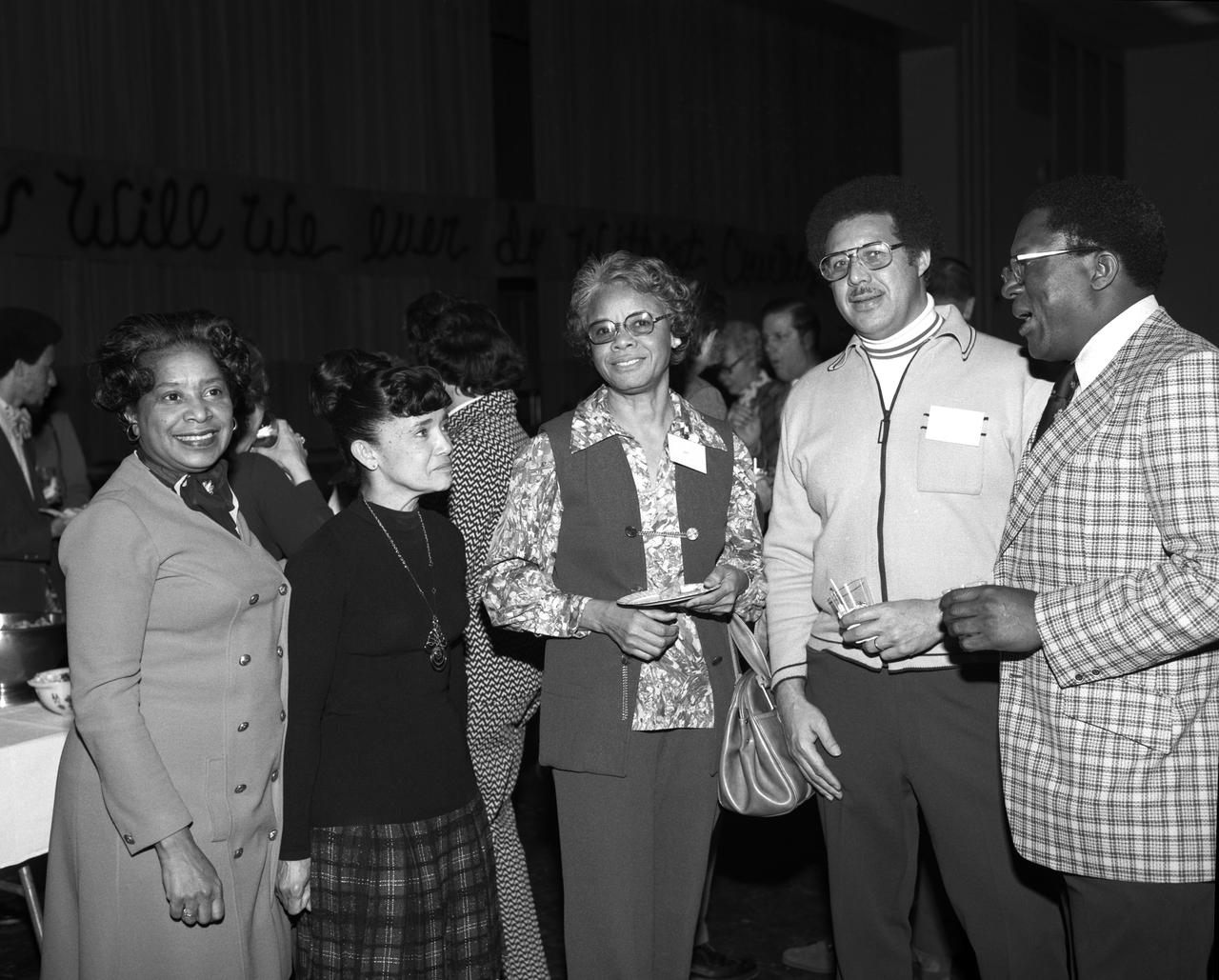
Photograph taken on February 5, 1975. Guests attending a retirement party for Vernon Courtney, of the MSD Communications Section. Mary Jackson standing on left with human computer Christine B. Richie next to her, another from the west computers group mentioned in the book "Hidden Figures" by author Margot Lee Shetterly. Mary Jackson from NASA Langley was NASA' s first African-American female engineer, and subsequent career supporting the hiring and promotion of other deserving female and minority employees.
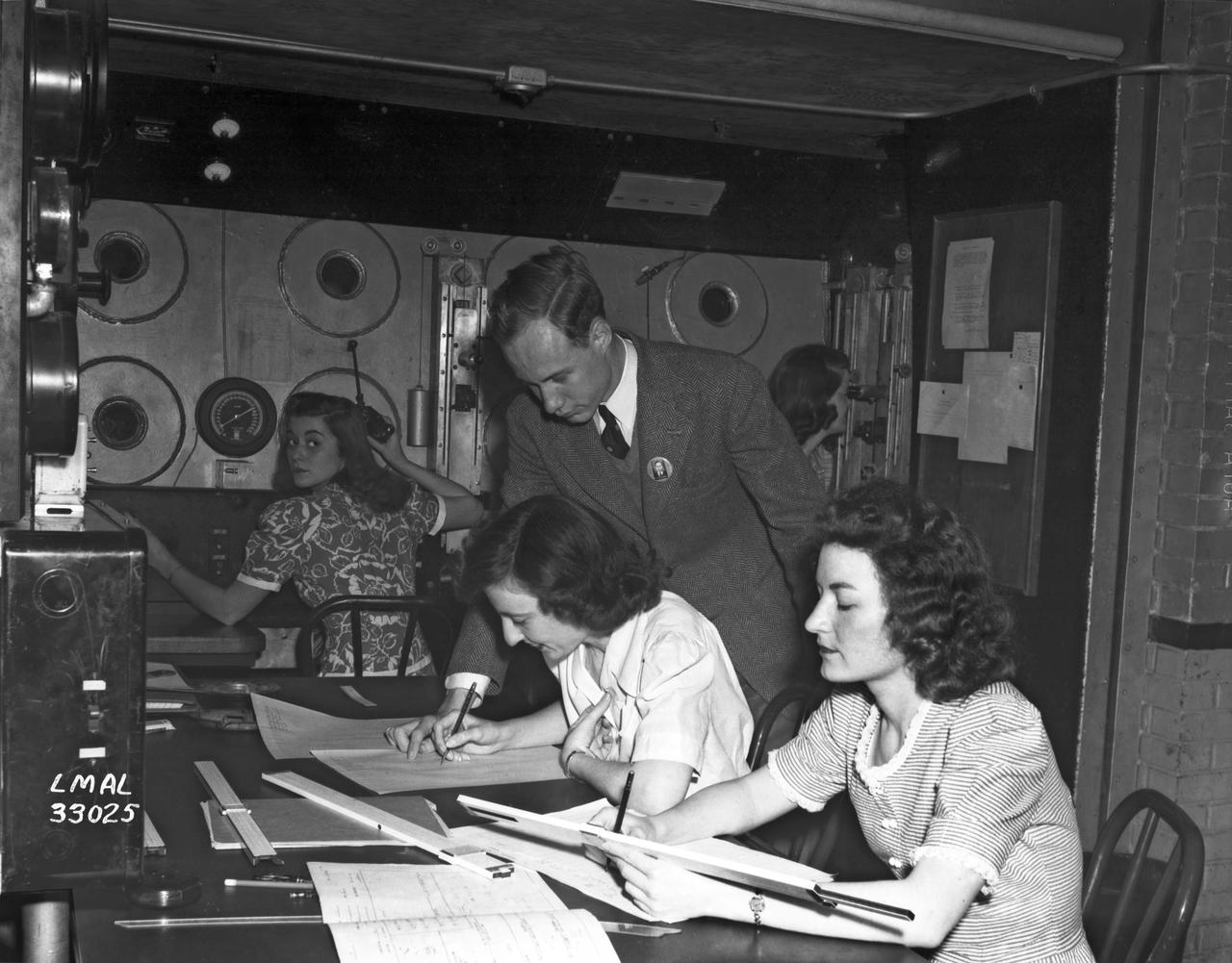
In the picture are F.F. Fullmer, aeronautical engineer, supervise a group of women who are helping operate the research equipment in the two-dimensional wind tunnel. Miss Elizabeth Patterson, left foreground, and Miss Katherine Thomason, right foreground obtains aerodynamic data, while Miss Lenore Woodland left background and Mrs. Blanche White help operate the tunnel. By Lee Dickinson 1943
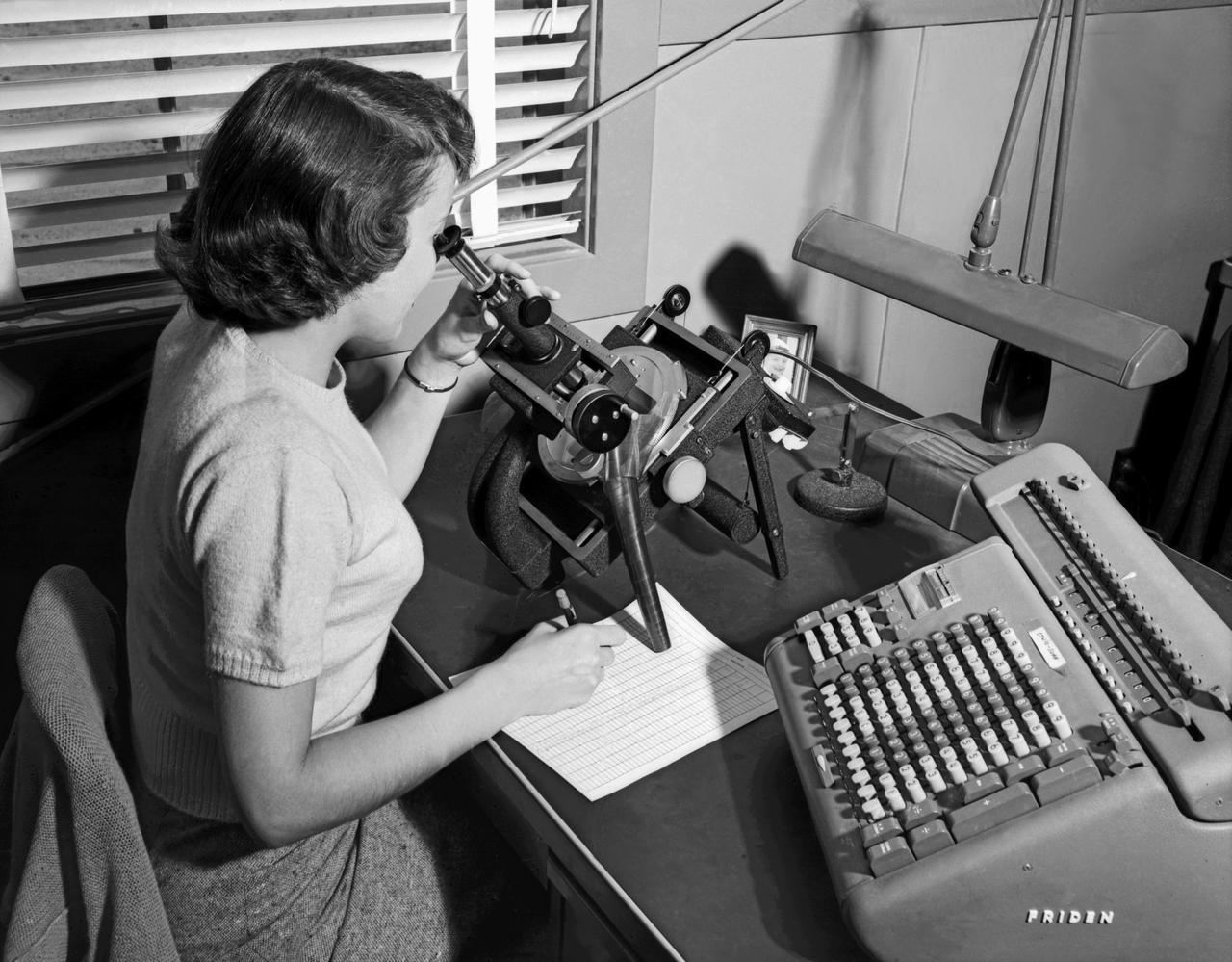
Langely Women Computer with X-4 with Friden machine. Publicity photo from Muroc California, showing female support personnel with equipment. Langley Computer with Friden machine.

ISS036-E-005515 (31 May 2013) --- European Space Agency astronaut Luca Parmitano (left) and NASA astronaut Chris Cassidy talk with fellow human beings on Earth using videoconferencing software and one of their on-board laptop computers in the U.S. lab Destiny.
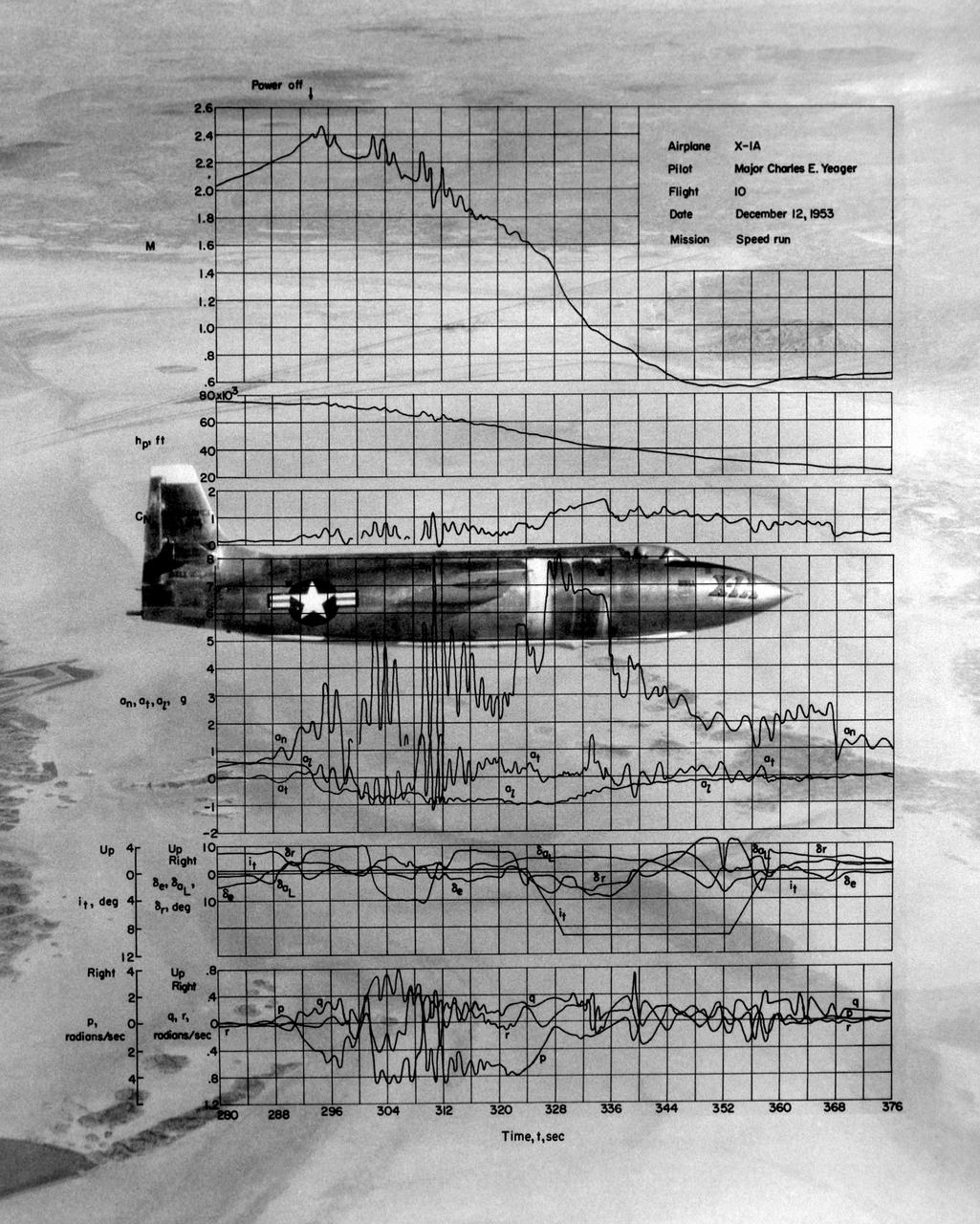
This photo of the X-1A includes graphs of the flight data from Maj. Charles E. Yeager's Mach 2.44 flight on December 12, 1953. (This was only a few days short of the 50th anniversary of the Wright brothers' first powered flight.) After reaching Mach 2.44, then the highest speed ever reached by a piloted aircraft, the X-1A tumbled completely out of control. The motions were so violent that Yeager cracked the plastic canopy with his helmet. He finally recovered from a inverted spin and landed on Rogers Dry Lakebed. Among the data shown are Mach number and altitude (the two top graphs). The speed and altitude changes due to the tumble are visible as jagged lines. The third graph from the bottom shows the G-forces on the airplane. During the tumble, these twice reached 8 Gs or 8 times the normal pull of gravity at sea level. (At these G forces, a 200-pound human would, in effect, weigh 1,600 pounds if a scale were placed under him in the direction of the force vector.) Producing these graphs was a slow, difficult process. The raw data from on-board instrumentation recorded on oscillograph film. Human computers then reduced the data and recorded it on data sheets, correcting for such factors as temperature and instrument errors. They used adding machines or slide rules for their calculations, pocket calculators being 20 years in the future.
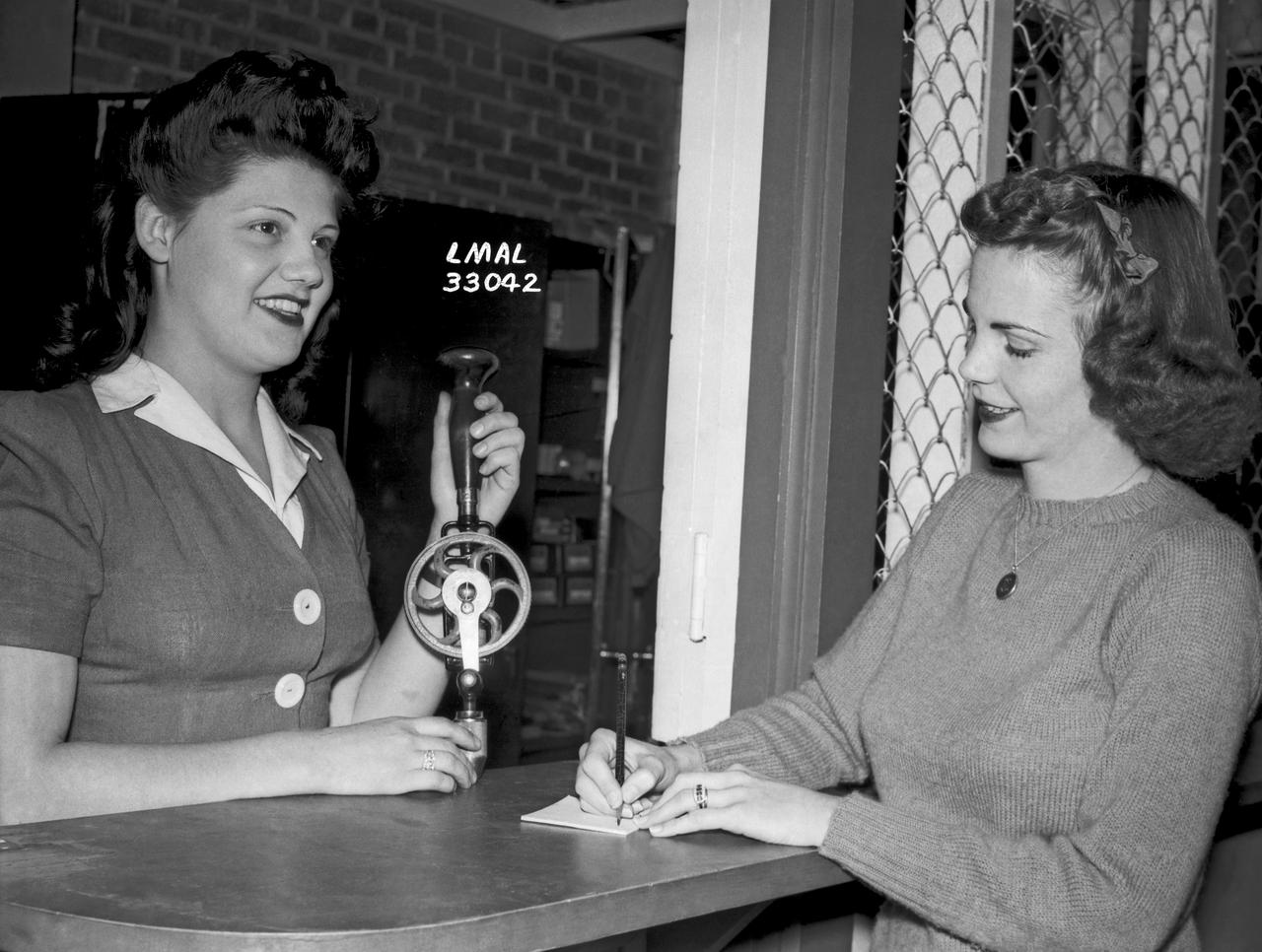
Women Adequately Filling Posts in NACA Laboratory: Nearly 200 women are employed at the Langley Laboratory of the National Advisory Committee for Aeronautics in a limited capacity as mechanics’ helpers and minor laboratory aids on the jobs formerly handled by men, according to E.H. Derring, of the Aerodynamics Division. Many phases of the operations of various wind tunnels at the laboratory are now handled by women with experienced male supervision. Mr. Derring said, pointing out that the reading of the data indicated on wind tunnel instruments during a test is done in a large measure by women. In addition to reading the instruments and computing and integrating engineering test data obtained from tunnel investigations, the minor laboratory aides assist in the preparation of aircraft models preliminary to testing. Women employees who will serve in the Aerodynamics Division of the Laboratory attend an orientation class for two weeks, during which they receive instruction on phases of the work they will do and their aptitudes for different types of work are evaluated in order that they may be properly placed. More than 100 women are employed in minor laboratory apprentices, performing mechanical work heretofore done by men. These women are employed in the various shops of the laboratory. Women in the woodworking shops are taught to operate 15 different machines in carrying out their assignments. Norfolk new paper article from 1943 by Lee Dickinson.
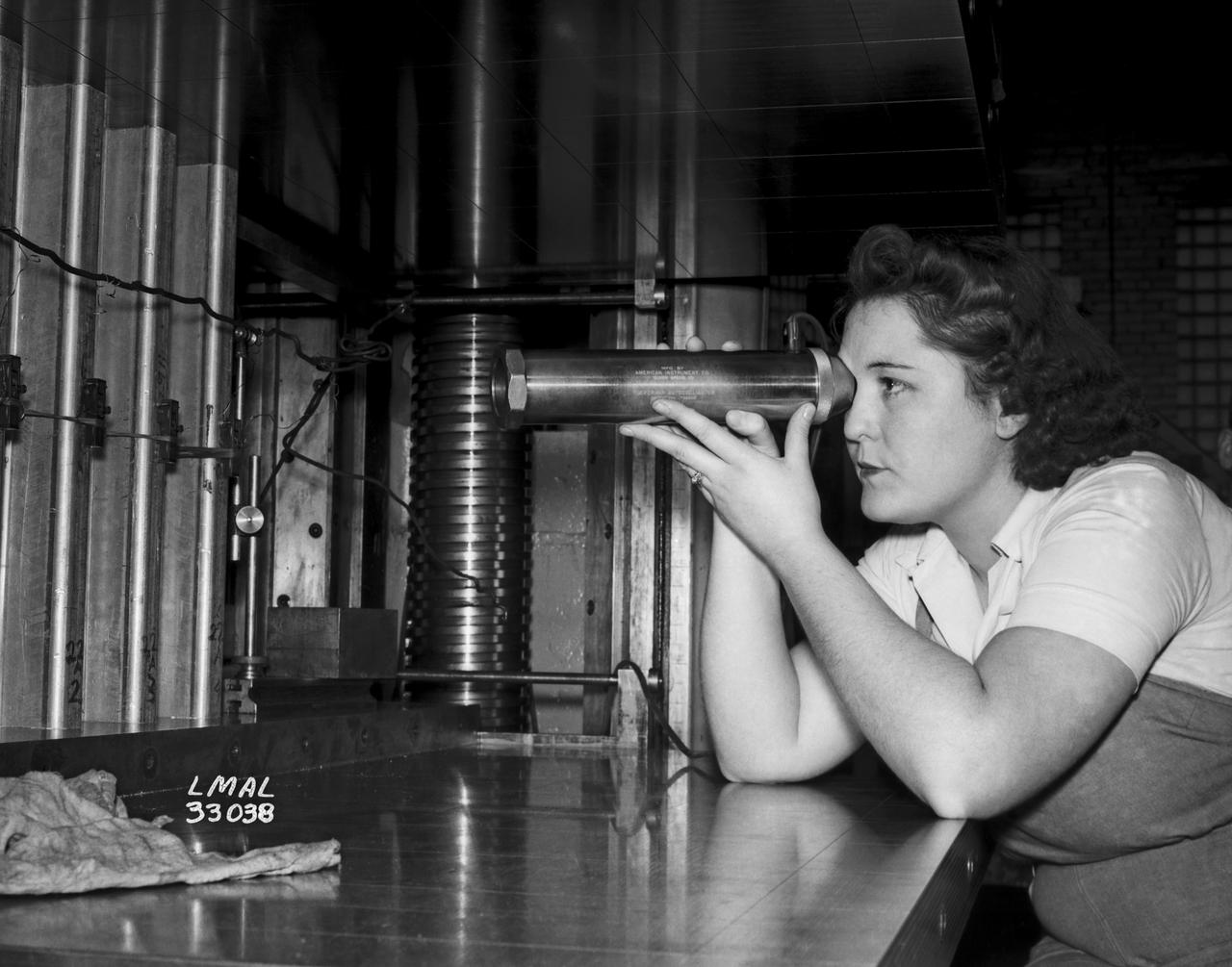
Women Adequately Filling Posts in NACA Laboratory: Nearly 200 women are employed at the Langley Laboratory of the National Advisory Committee for Aeronautics in a limited capacity as mechanics’ helpers and minor laboratory aids on the jobs formerly handled by men, according to E.H. Derring, of the Aerodynamics Division. Many phases of the operations of various wind tunnels at the laboratory are now handled by women with experienced male supervision. Mr. Derring said, pointing out that the reading of the data indicated on wind tunnel instruments during a test is done in a large measure by women. In addition to reading the instruments and computing and integrating engineering test data obtained from tunnel investigations, the minor laboratory aides assist in the preparation of aircraft models preliminary to testing. Women employees who will serve in the Aerodynamics Division of the Laboratory attend an orientation class for two weeks, during which they receive instruction on phases of the work they will do and their aptitudes for different types of work are evaluated in order that they may be properly placed. More than 100 women are employed in minor laboratory apprentices, performing mechanical work heretofore done by men. These women are employed in the various shops of the laboratory. Women in the woodworking shops are taught to operate 15 different machines in carrying out their assignments. Norfolk new paper article from 1943 by Lee Dickinson.
Women Adequately Filling Posts in NACA Laboratory: Nearly 200 women are employed at the Langley Laboratory of the National Advisory Committee for Aeronautics in a limited capacity as mechanics’ helpers and minor laboratory aids on the jobs formerly handled by men, according to E.H. Derring, of the Aerodynamics Division. Many phases of the operations of various wind tunnels at the laboratory are now handled by women with experienced male supervision. Mr. Derring said, pointing out that the reading of the data indicated on wind tunnel instruments during a test is done in a large measure by women. In addition to reading the instruments and computing and integrating engineering test data obtained from tunnel investigations, the minor laboratory aides assist in the preparation of aircraft models preliminary to testing. Women employees who will serve in the Aerodynamics Division of the Laboratory attend an orientation class for two weeks, during which they receive instruction on phases of the work they will do and their aptitudes for different types of work are evaluated in order that they may be properly placed. More than 100 women are employed in minor laboratory apprentices, performing mechanical work heretofore done by men. These women are employed in the various shops of the laboratory. Women in the woodworking shops are taught to operate 15 different machines in carrying out their assignments. Norfolk new paper article from 1943 by Lee Dickinson.
Women Adequately Filling Posts in NACA Laboratory: Nearly 200 women are employed at the Langley Laboratory of the National Advisory Committee for Aeronautics in a limited capacity as mechanics’ helpers and minor laboratory aids on the jobs formerly handled by men, according to E.H. Derring, of the Aerodynamics Division. Many phases of the operations of various wind tunnels at the laboratory are now handled by women with experienced male supervision. Mr. Derring said, pointing out that the reading of the data indicated on wind tunnel instruments during a test is done in a large measure by women. In addition to reading the instruments and computing and integrating engineering test data obtained from tunnel investigations, the minor laboratory aides assist in the preparation of aircraft models preliminary to testing. Women employees who will serve in the Aerodynamics Division of the Laboratory attend an orientation class for two weeks, during which they receive instruction on phases of the work they will do and their aptitudes for different types of work are evaluated in order that they may be properly placed. More than 100 women are employed in minor laboratory apprentices, performing mechanical work heretofore done by men. These women are employed in the various shops of the laboratory. Women in the woodworking shops are taught to operate 15 different machines in carrying out their assignments. Norfolk new paper article from 1943 by Lee Dickinson.
Women Adequately Filling Posts in NACA Laboratory: Nearly 200 women are employed at the Langley Laboratory of the National Advisory Committee for Aeronautics in a limited capacity as mechanics’ helpers and minor laboratory aids on the jobs formerly handled by men, according to E.H. Derring, of the Aerodynamics Division. Many phases of the operations of various wind tunnels at the laboratory are now handled by women with experienced male supervision. Mr. Derring said, pointing out that the reading of the data indicated on wind tunnel instruments during a test is done in a large measure by women. In addition to reading the instruments and computing and integrating engineering test data obtained from tunnel investigations, the minor laboratory aides assist in the preparation of aircraft models preliminary to testing. Women employees who will serve in the Aerodynamics Division of the Laboratory attend an orientation class for two weeks, during which they receive instruction on phases of the work they will do and their aptitudes for different types of work are evaluated in order that they may be properly placed. More than 100 women are employed in minor laboratory apprentices, performing mechanical work heretofore done by men. These women are employed in the various shops of the laboratory. Women in the woodworking shops are taught to operate 15 different machines in carrying out their assignments. Norfolk new paper article from 1943 by Lee Dickinson.
Women Adequately Filling Posts in NACA Laboratory: Nearly 200 women are employed at the Langley Laboratory of the National Advisory Committee for Aeronautics in a limited capacity as mechanics’ helpers and minor laboratory aids on the jobs formerly handled by men, according to E.H. Derring, of the Aerodynamics Division. Many phases of the operations of various wind tunnels at the laboratory are now handled by women with experienced male supervision. Mr. Derring said, pointing out that the reading of the data indicated on wind tunnel instruments during a test is done in a large measure by women. In addition to reading the instruments and computing and integrating engineering test data obtained from tunnel investigations, the minor laboratory aides assist in the preparation of aircraft models preliminary to testing. Women employees who will serve in the Aerodynamics Division of the Laboratory attend an orientation class for two weeks, during which they receive instruction on phases of the work they will do and their aptitudes for different types of work are evaluated in order that they may be properly placed. More than 100 women are employed in minor laboratory apprentices, performing mechanical work heretofore done by men. These women are employed in the various shops of the laboratory. Women in the woodworking shops are taught to operate 15 different machines in carrying out their assignments. Norfolk new paper article from 1943 by Lee Dickinson.
Women Adequately Filling Posts in NACA Laboratory: Nearly 200 women are employed at the Langley Laboratory of the National Advisory Committee for Aeronautics in a limited capacity as mechanics’ helpers and minor laboratory aids on the jobs formerly handled by men, according to E.H. Derring, of the Aerodynamics Division. Many phases of the operations of various wind tunnels at the laboratory are now handled by women with experienced male supervision. Mr. Derring said, pointing out that the reading of the data indicated on wind tunnel instruments during a test is done in a large measure by women. In addition to reading the instruments and computing and integrating engineering test data obtained from tunnel investigations, the minor laboratory aides assist in the preparation of aircraft models preliminary to testing. Women employees who will serve in the Aerodynamics Division of the Laboratory attend an orientation class for two weeks, during which they receive instruction on phases of the work they will do and their aptitudes for different types of work are evaluated in order that they may be properly placed. More than 100 women are employed in minor laboratory apprentices, performing mechanical work heretofore done by men. These women are employed in the various shops of the laboratory. Women in the woodworking shops are taught to operate 15 different machines in carrying out their assignments. Norfolk new paper article from 1943 by Lee Dickinson.
Women Adequately Filling Posts in NACA Laboratory: Nearly 200 women are employed at the Langley Laboratory of the National Advisory Committee for Aeronautics in a limited capacity as mechanics’ helpers and minor laboratory aids on the jobs formerly handled by men, according to E.H. Derring, of the Aerodynamics Division. Many phases of the operations of various wind tunnels at the laboratory are now handled by women with experienced male supervision. Mr. Derring said, pointing out that the reading of the data indicated on wind tunnel instruments during a test is done in a large measure by women. In addition to reading the instruments and computing and integrating engineering test data obtained from tunnel investigations, the minor laboratory aides assist in the preparation of aircraft models preliminary to testing. Women employees who will serve in the Aerodynamics Division of the Laboratory attend an orientation class for two weeks, during which they receive instruction on phases of the work they will do and their aptitudes for different types of work are evaluated in order that they may be properly placed. More than 100 women are employed in minor laboratory apprentices, performing mechanical work heretofore done by men. These women are employed in the various shops of the laboratory. Women in the woodworking shops are taught to operate 15 different machines in carrying out their assignments. Norfolk new paper article from 1943 by Lee Dickinson.
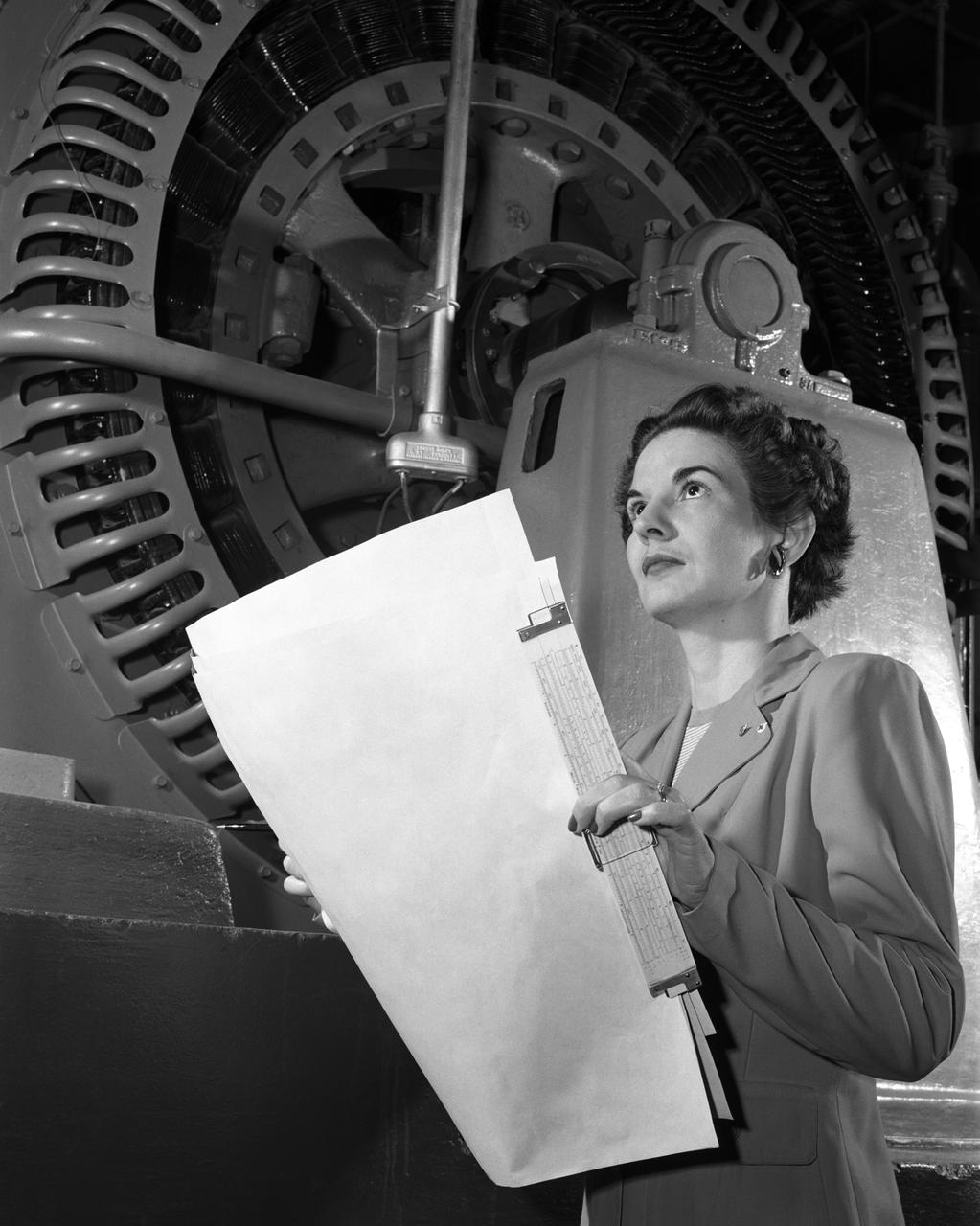
electrical engineer.NACA engineer Kitty Joyner, believed to be the first NACA female engineer, as well as the first women engineer to graduate from UVA.
Women Adequately Filling Posts in NACA Laboratory: Nearly 200 women are employed at the Langley Laboratory of the National Advisory Committee for Aeronautics in a limited capacity as mechanics’ helpers and minor laboratory aids on the jobs formerly handled by men, according to E.H. Derring, of the Aerodynamics Division. Many phases of the operations of various wind tunnels at the laboratory are now handled by women with experienced male supervision. Mr. Derring said, pointing out that the reading of the data indicated on wind tunnel instruments during a test is done in a large measure by women. In addition to reading the instruments and computing and integrating engineering test data obtained from tunnel investigations, the minor laboratory aides assist in the preparation of aircraft models preliminary to testing. Women employees who will serve in the Aerodynamics Division of the Laboratory attend an orientation class for two weeks, during which they receive instruction on phases of the work they will do and their aptitudes for different types of work are evaluated in order that they may be properly placed. More than 100 women are employed in minor laboratory apprentices, performing mechanical work heretofore done by men. These women are employed in the various shops of the laboratory. Women in the woodworking shops are taught to operate 15 different machines in carrying out their assignments. Norfolk new paper article from 1943 by Lee Dickinson.
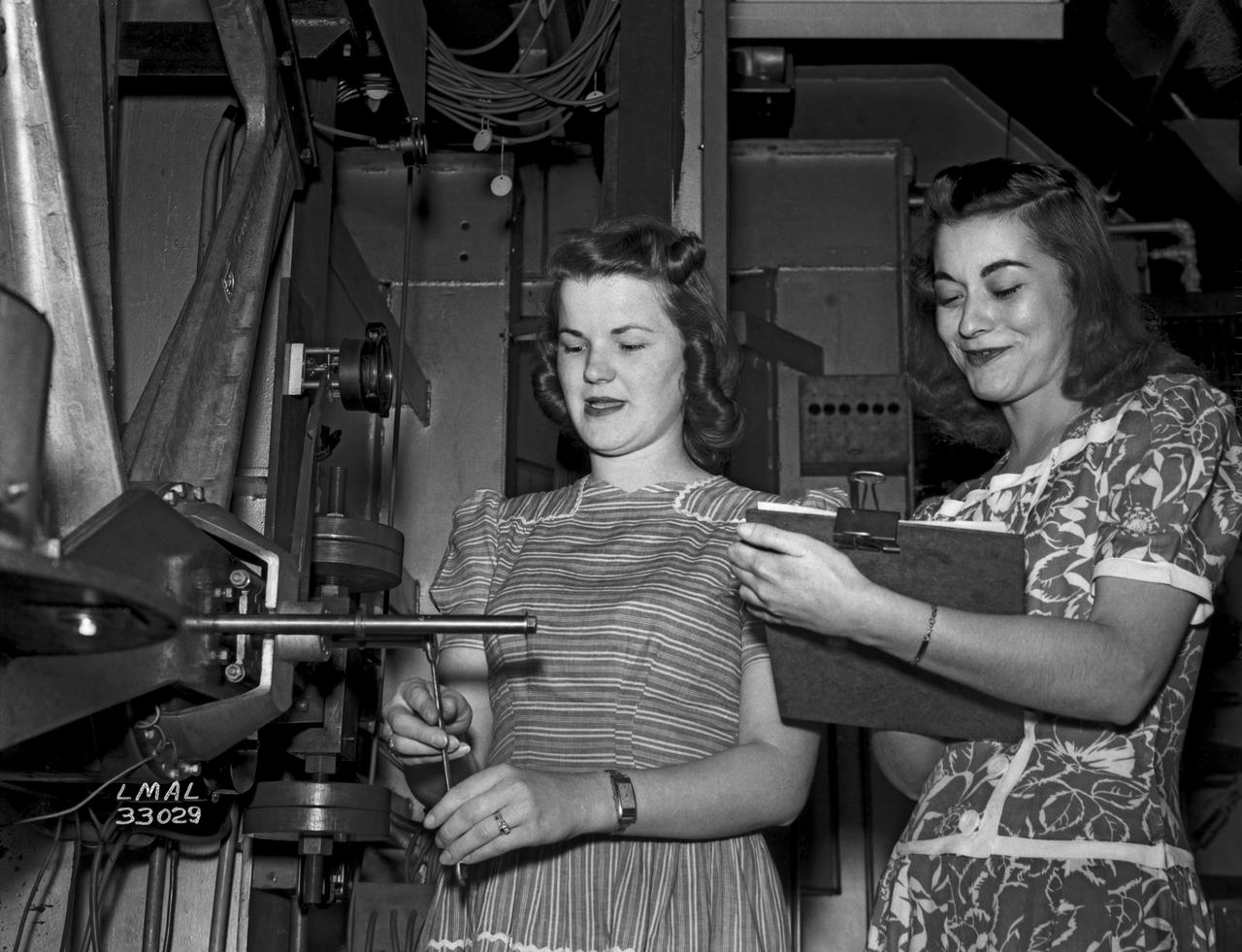
Women Adequately Filling Posts in NACA Laboratory: Nearly 200 women are employed at the Langley Laboratory of the National Advisory Committee for Aeronautics in a limited capacity as mechanics’ helpers and minor laboratory aids on the jobs formerly handled by men, according to E.H. Derring, of the Aerodynamics Division. Many phases of the operations of various wind tunnels at the laboratory are now handled by women with experienced male supervision. Mr. Derring said, pointing out that the reading of the data indicated on wind tunnel instruments during a test is done in a large measure by women. In addition to reading the instruments and computing and integrating engineering test data obtained from tunnel investigations, the minor laboratory aides assist in the preparation of aircraft models preliminary to testing. Women employees who will serve in the Aerodynamics Division of the Laboratory attend an orientation class for two weeks, during which they receive instruction on phases of the work they will do and their aptitudes for different types of work are evaluated in order that they may be properly placed. More than 100 women are employed in minor laboratory apprentices, performing mechanical work heretofore done by men. These women are employed in the various shops of the laboratory. Women in the woodworking shops are taught to operate 15 different machines in carrying out their assignments. Norfolk new paper article from 1943 by Lee Dickinson.
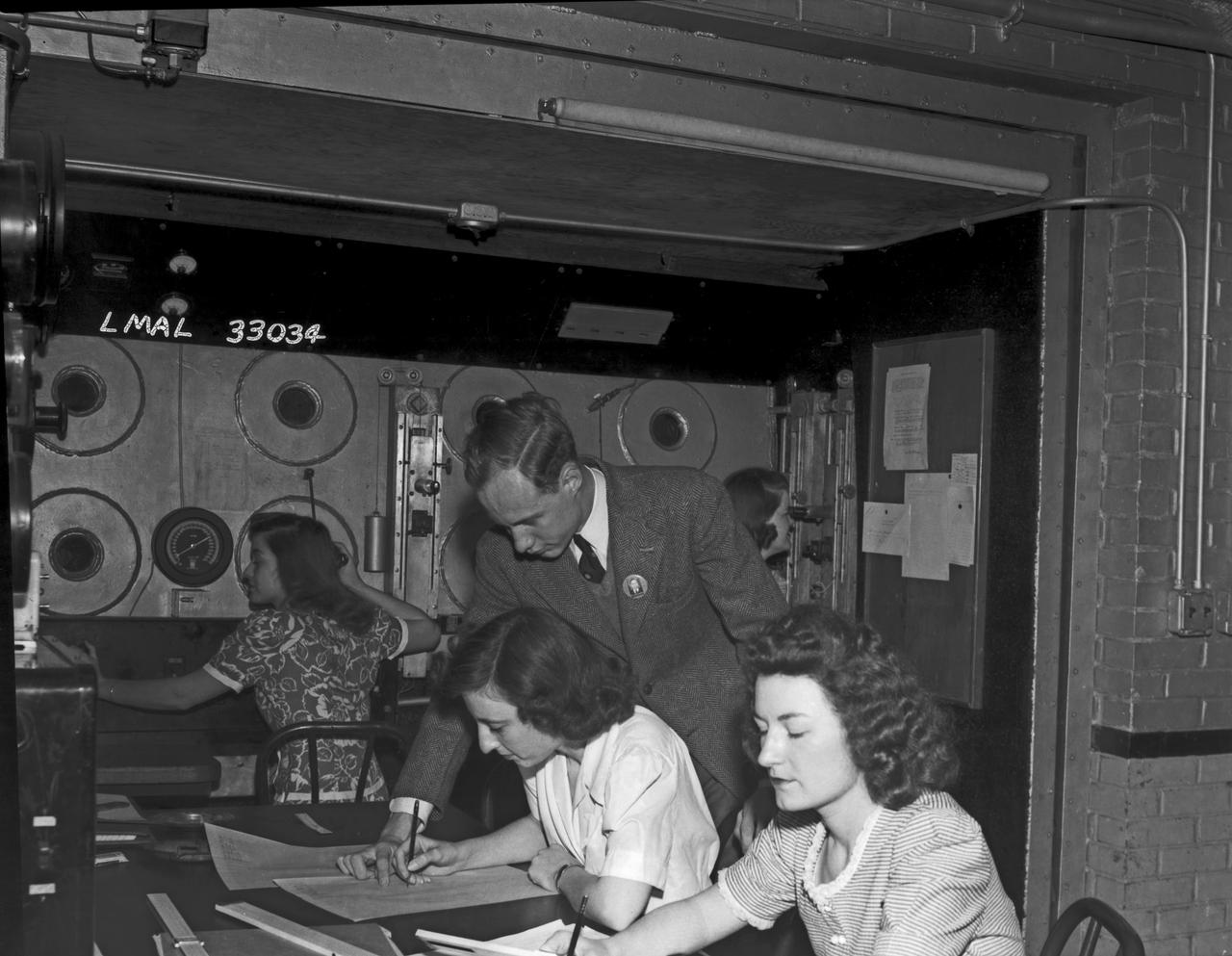
Women Adequately Filling Posts In NACA Laboratory: In the picture are F.F. Fullmer, aeronautical engineer, supervise a group of women who are helping operate the research equipment in the two-dimensional wind tunnel. Miss Elizabeth Patterson, left foreground, and Miss Katherine Thomason, right foreground obtains aerodynamic data, while Miss Lenore Woodland left background and Mrs. Blanche White help operate the tunnel. By Lee Dickinson 1943
Women Adequately Filling Posts in NACA Laboratory: Nearly 200 women are employed at the Langley Laboratory of the National Advisory Committee for Aeronautics in a limited capacity as mechanics’ helpers and minor laboratory aids on the jobs formerly handled by men, according to E.H. Derring, of the Aerodynamics Division. Many phases of the operations of various wind tunnels at the laboratory are now handled by women with experienced male supervision. Mr. Derring said, pointing out that the reading of the data indicated on wind tunnel instruments during a test is done in a large measure by women. In addition to reading the instruments and computing and integrating engineering test data obtained from tunnel investigations, the minor laboratory aides assist in the preparation of aircraft models preliminary to testing. Women employees who will serve in the Aerodynamics Division of the Laboratory attend an orientation class for two weeks, during which they receive instruction on phases of the work they will do and their aptitudes for different types of work are evaluated in order that they may be properly placed. More than 100 women are employed in minor laboratory apprentices, performing mechanical work heretofore done by men. These women are employed in the various shops of the laboratory. Women in the woodworking shops are taught to operate 15 different machines in carrying out their assignments. Norfolk new paper article from 1943 by Lee Dickinson.
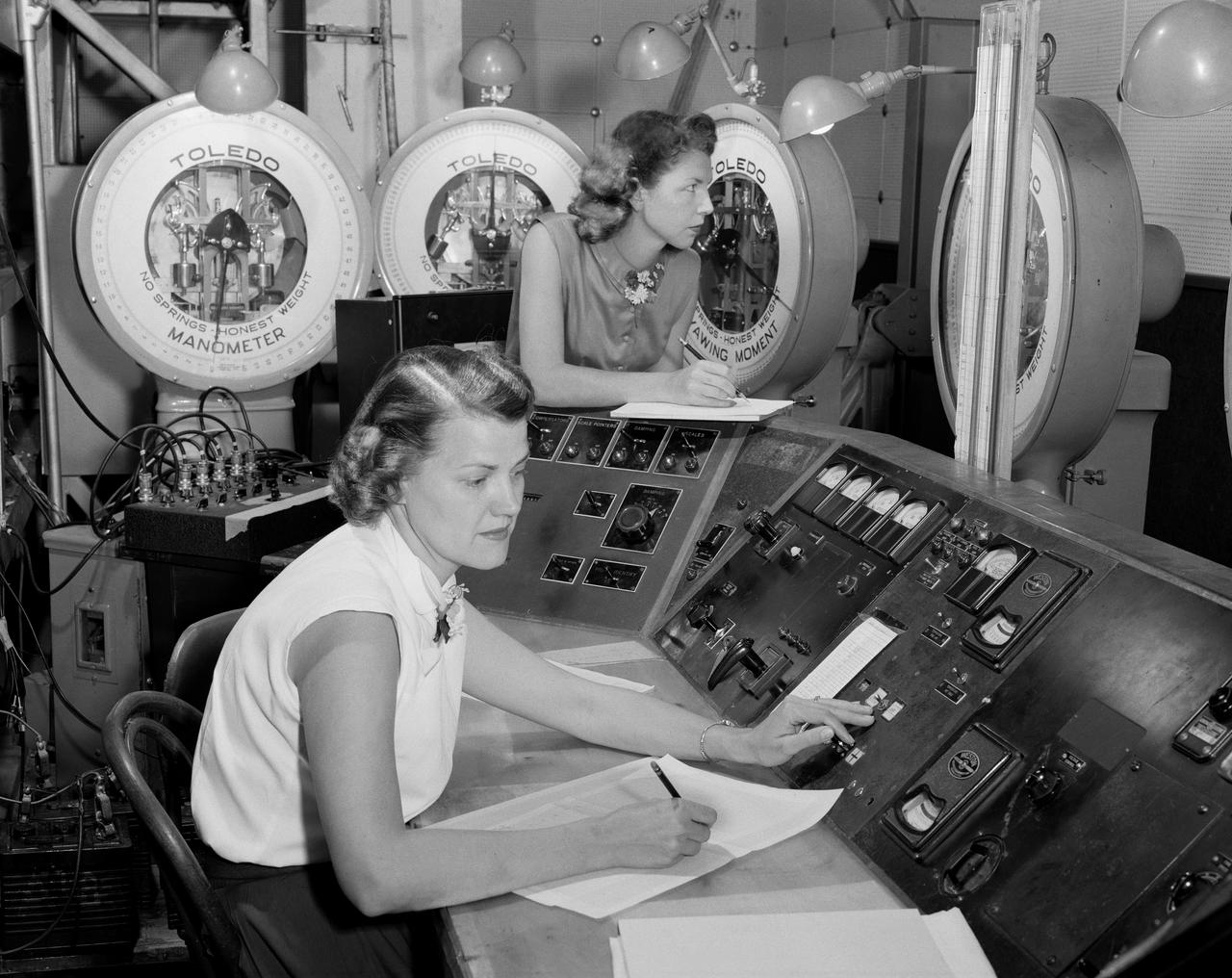
Women Workers at NACA

Purine Nucleoside Phosphorylase (PNP) is an important target enzyme for the design of anti-cancer and immunosuppressive drugs. Bacterial PNP, which is slightly different from the human enzyme, is used to synthesize chemotherapuautic agents. Knowledge of the three-dimensional structure of the bacterial PNP molecule is useful in efforts to engineer different types of PNP enzymes, that can be used to produce new chemotherapeutic agents. This picture shows a computer model of bacterial PNP, which looks a lot like a display of colorful ribbons. Principal Investigator was Charles Bugg.
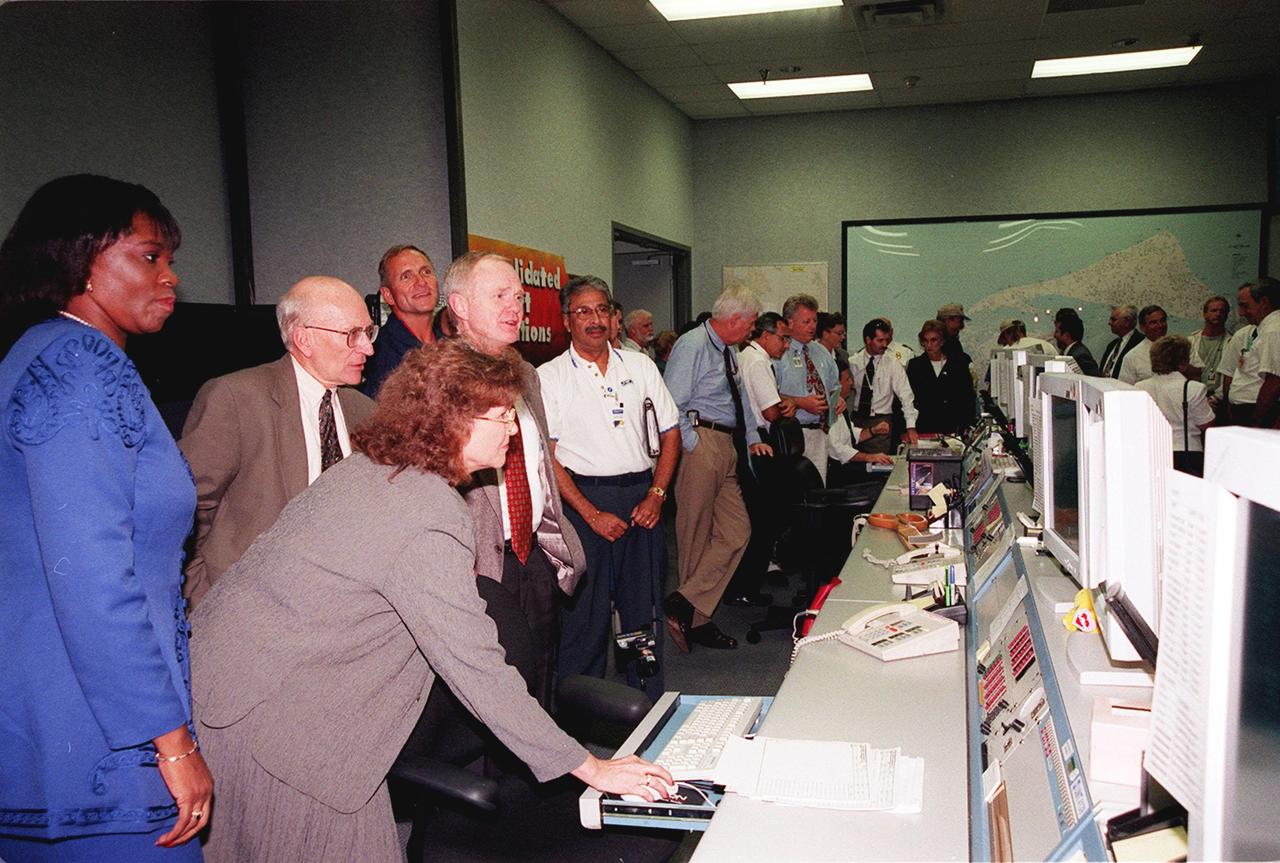
After the ribbon-cutting opening the Consolidated Support Operations Center at ROCC, Cape Canaveral Air Station, guests look at information on the computer screen during a demonstration. Among those standing are (left to right) Barbara White, supervisor, Mission Support; Ed Gormel, executive director, Joint Performance Management Office; KSC Center Director Roy Bridges; and Sam Gutierrez (white shirt), Human Resources, Space Gateway Support
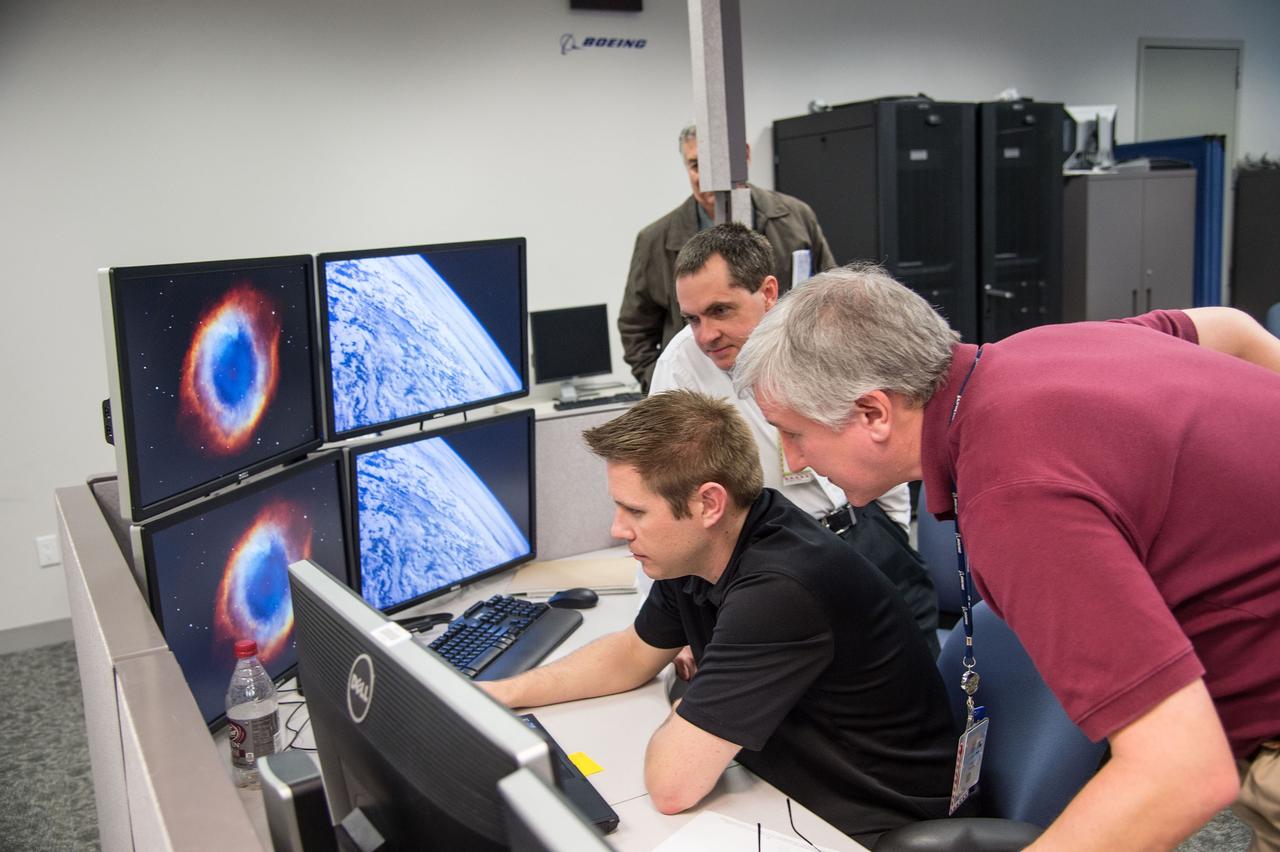
HOUSTON – Engineers for Boeing Space Exploration demonstrate that the CST-100 software allows a human pilot to take over control of the spacecraft from the computer during all phases of a mission following separation from the launch vehicle. The pilot-in-the-loop demonstration at the Houston Product Support Center is a milestone under Boeing's Commercial Crew Integrated Capability agreement with the agency and its Commercial Crew Program. Photo credit: NASA/Bill Stafford
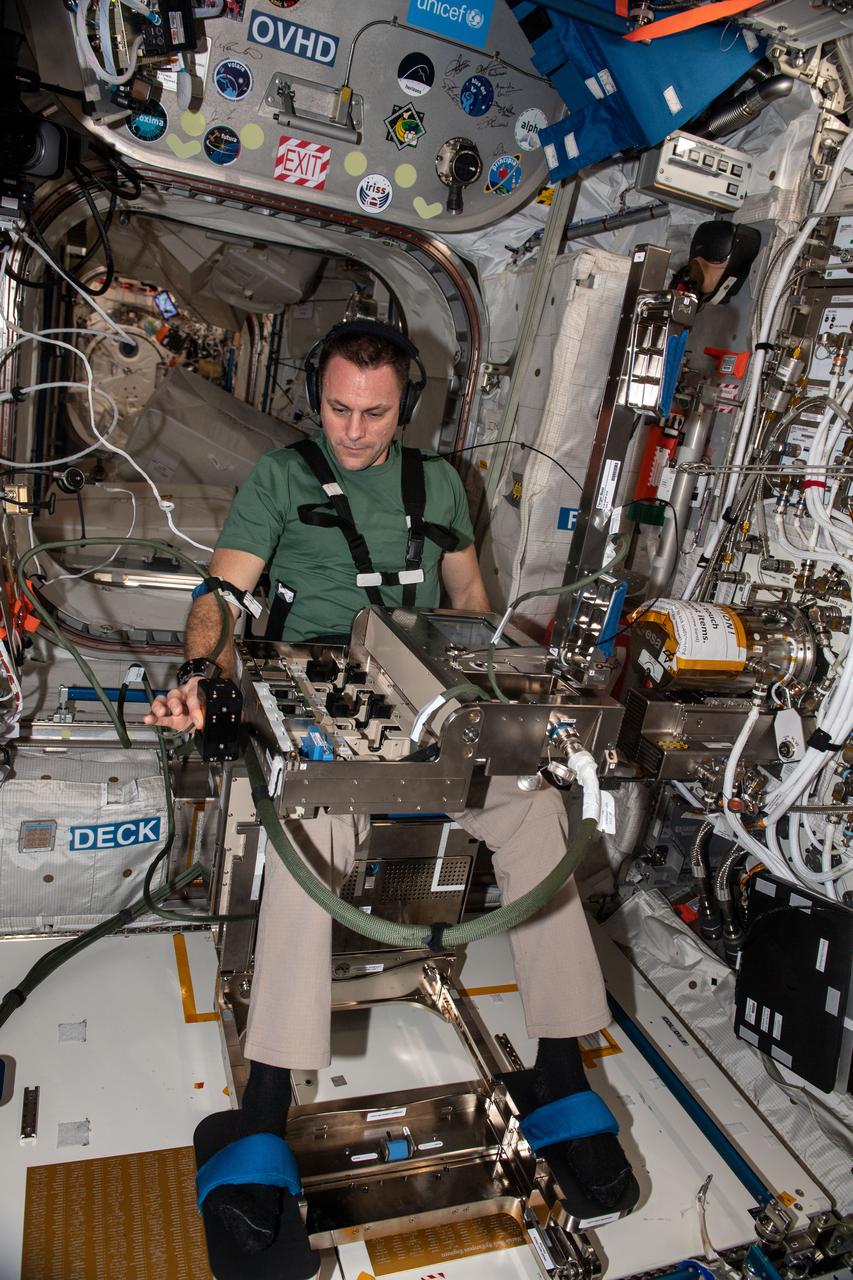
iss068e054122 (Feb. 14, 2023) --- Expedition 68 Flight Engineer Josh Cassada of NASA is seated in a specialized chair in the International Space Station's Columbus laboratory module for the GRIP human research experiment. The study investigates how astronauts regulate their grip force and move their arms when manipulating objects in microgravity in response to pre-programmed stimuli as a computer and video cameras record the responses.
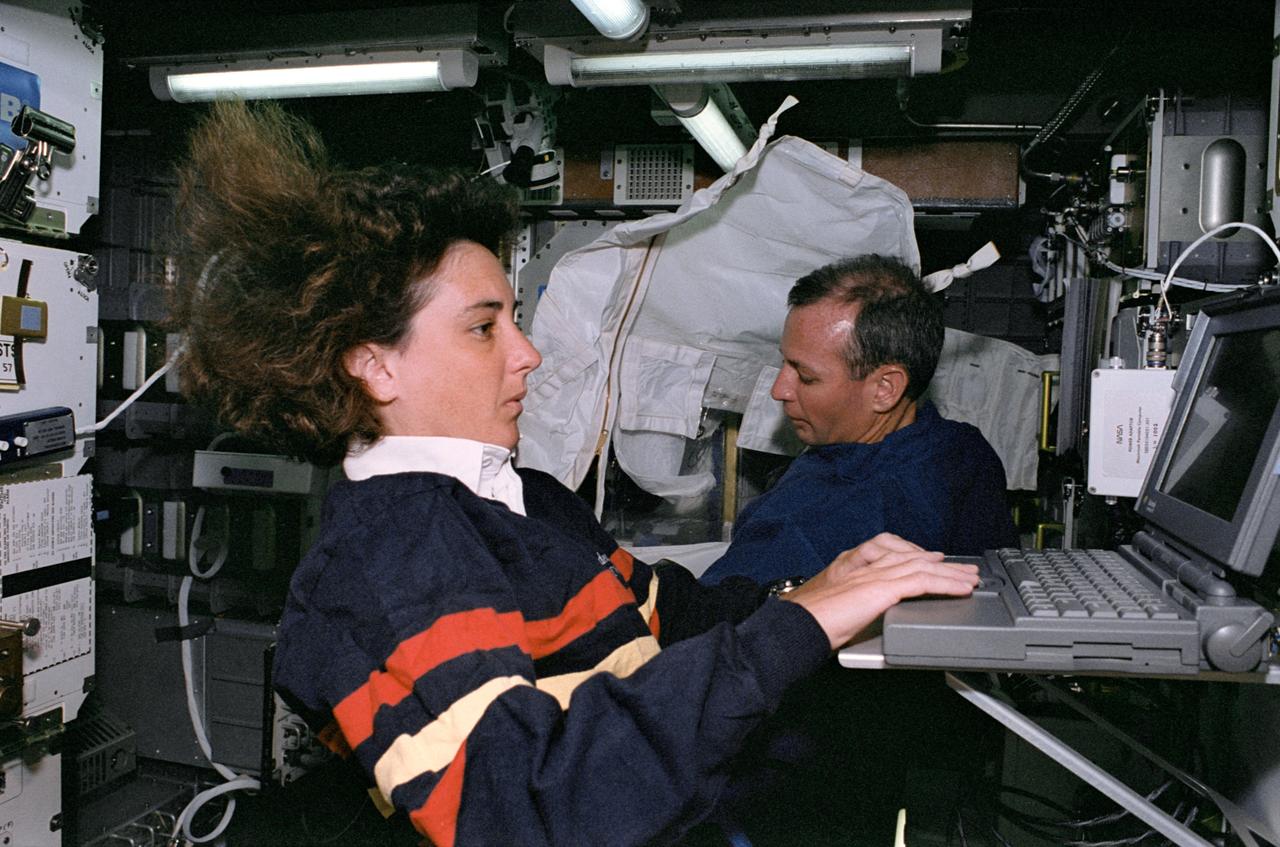
STS057-34-029 (21 June-1 July 1993) --- Astronaut Nancy J. Sherlock works on the Electronic Procedures Portion (EPROC) of the Human Factors Assessment (HFA) experiment. Astronaut Brian Duffy works nearby. The computer portion of HFA-EPROC simulated a space station propulsion system task. Sherlock, Duffy and four other astronauts spent almost ten days aboard the Space Shuttle Endeavour for the STS-57 mission.
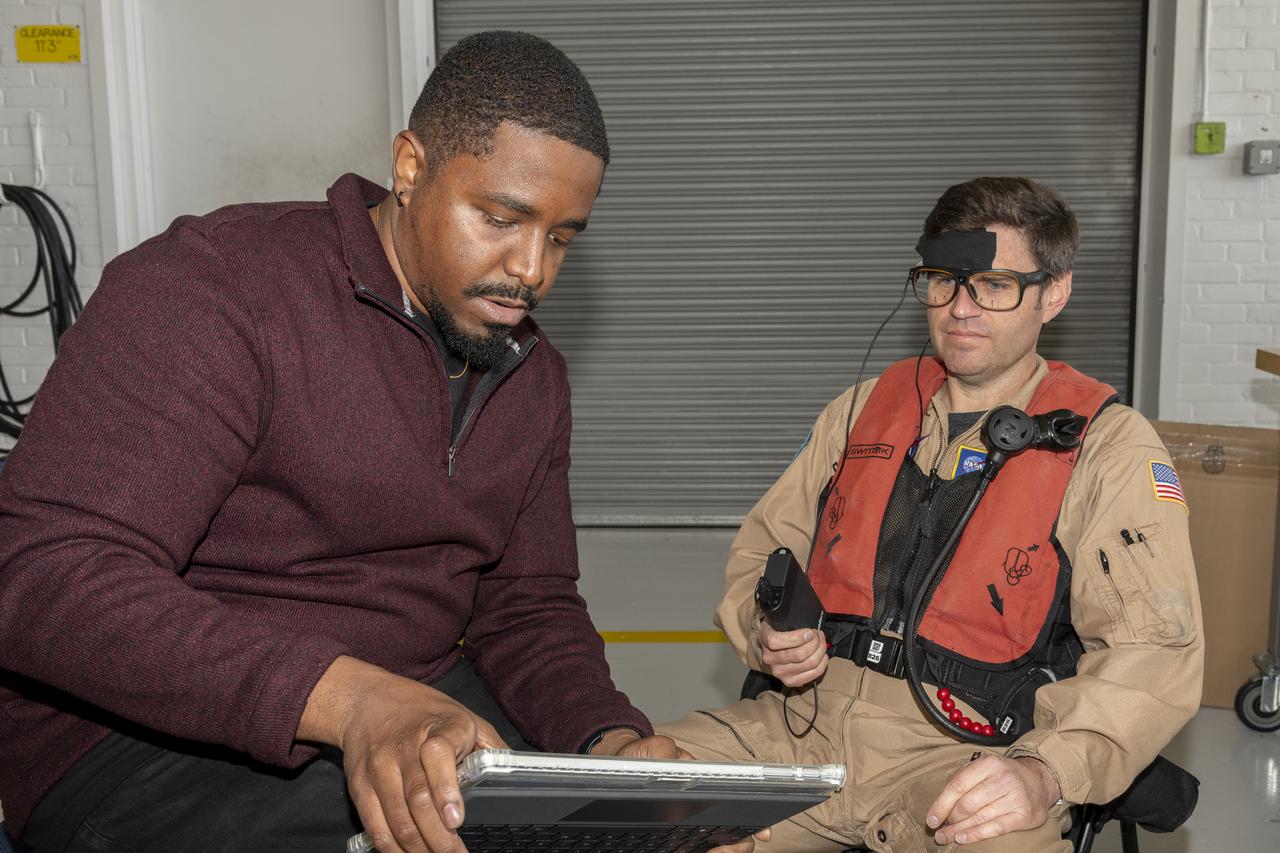
NASA human factors researcher Kevin J. Monk, left, and NASA pilot Scott Howe verify the connectivity and accuracy of the biometric sensors placed on Howe for test flight at Sikorsky Memorial Airport, Bridgeport, Connecticut on Tuesday, Oct. 24, 2023. These sensors will track various physiological responses sending the data to Monk’s computer as Howe engages with the autonomous flight software used to fly the aircraft.
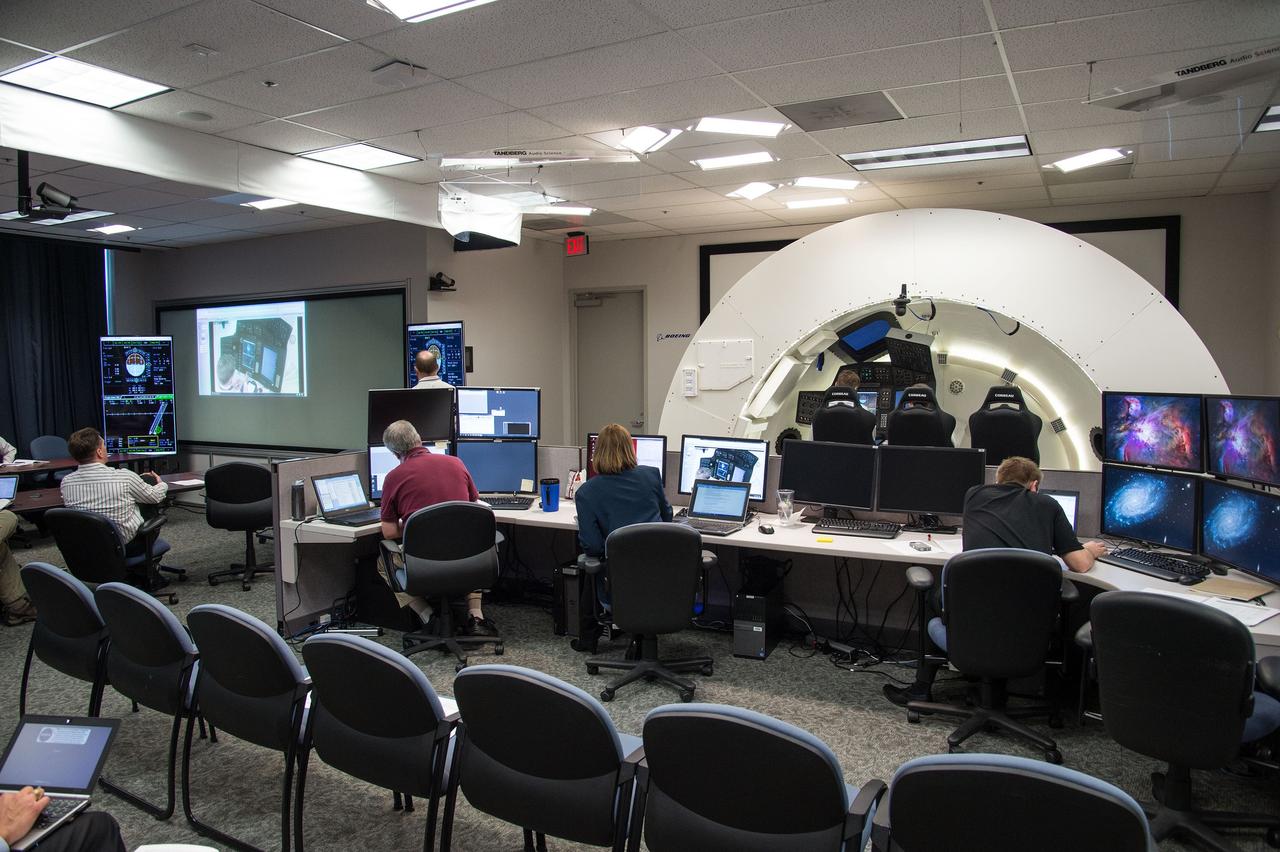
HOUSTON – Engineers for Boeing Space Exploration demonstrate that the CST-100 software allows a human pilot to take over control of the spacecraft from the computer during all phases of a mission following separation from the launch vehicle. The pilot-in-the-loop demonstration at the Houston Product Support Center is a milestone under Boeing's Commercial Crew Integrated Capability agreement with the agency and its Commercial Crew Program. Photo credit: NASA/Bill Stafford
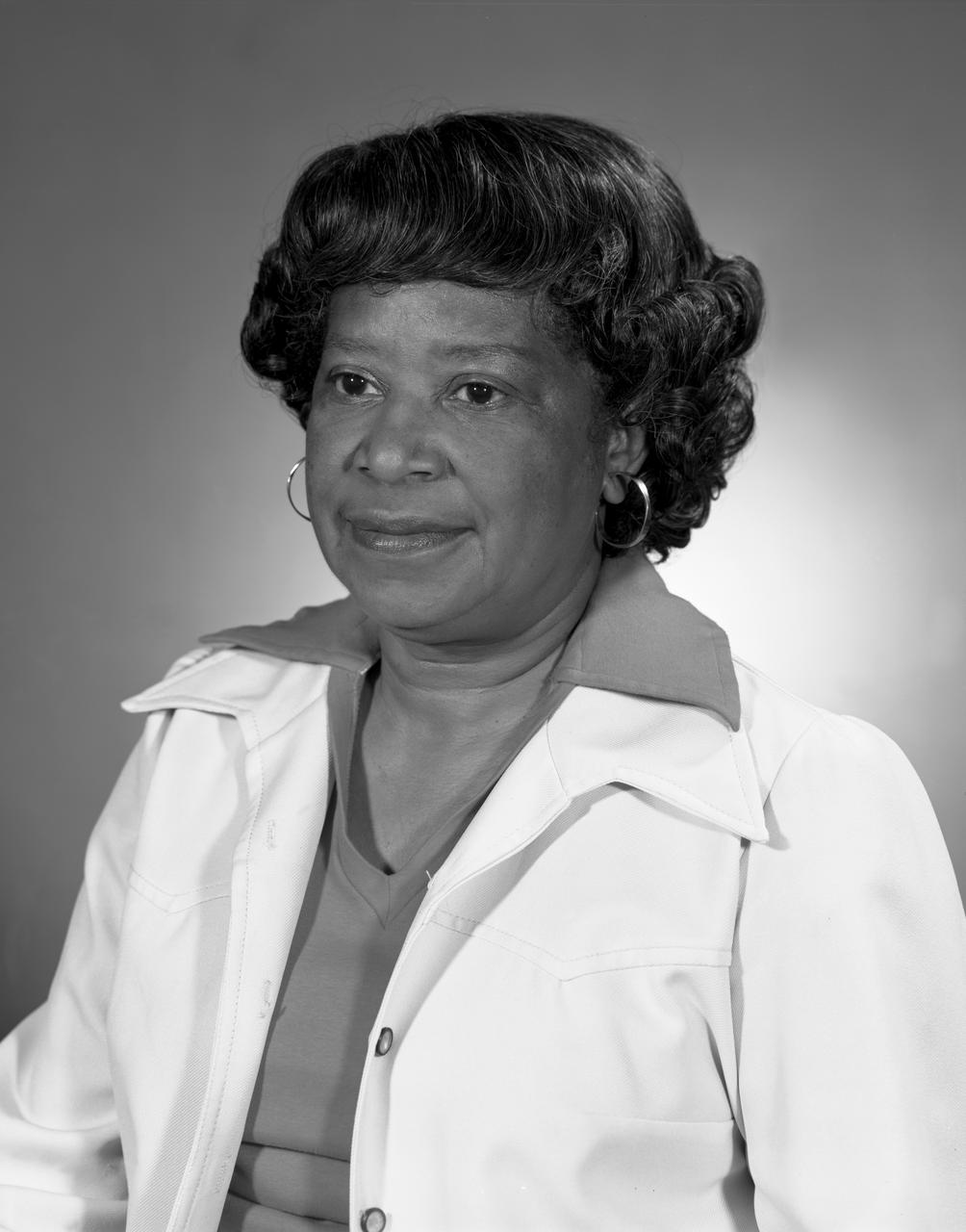
Portrait of Mary Jackson. 2017 Hall of Honor inductee. Langley Research Center NACA and NASA Hall of Honor. In honor and recognition of the ambition and motivation that enabled her career progression from human computer to NASA' s first African-American female engineer, and subsequent career supporting the hiring and promotion of other deserving female and minority employees.
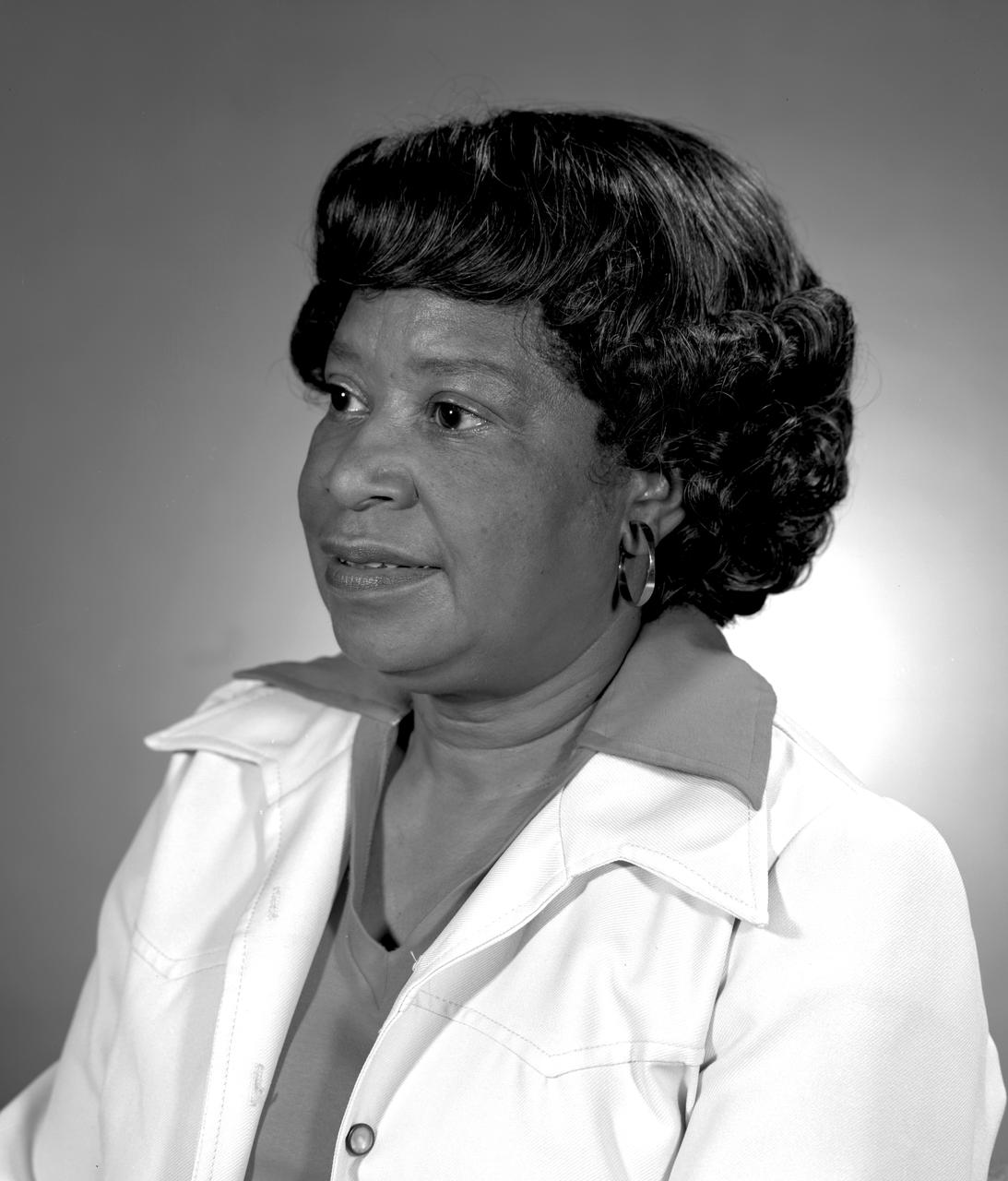
Portrait of Mary Jackson. 2017 Hall of Honor inductee. Langley Research Center NACA and NASA Hall of Honor. In honor and recognition of the ambition and motivation that enabled her career progression from human computer to NASA' s first African-American female engineer, and subsequent career supporting the hiring and promotion of other deserving female and minority employees.
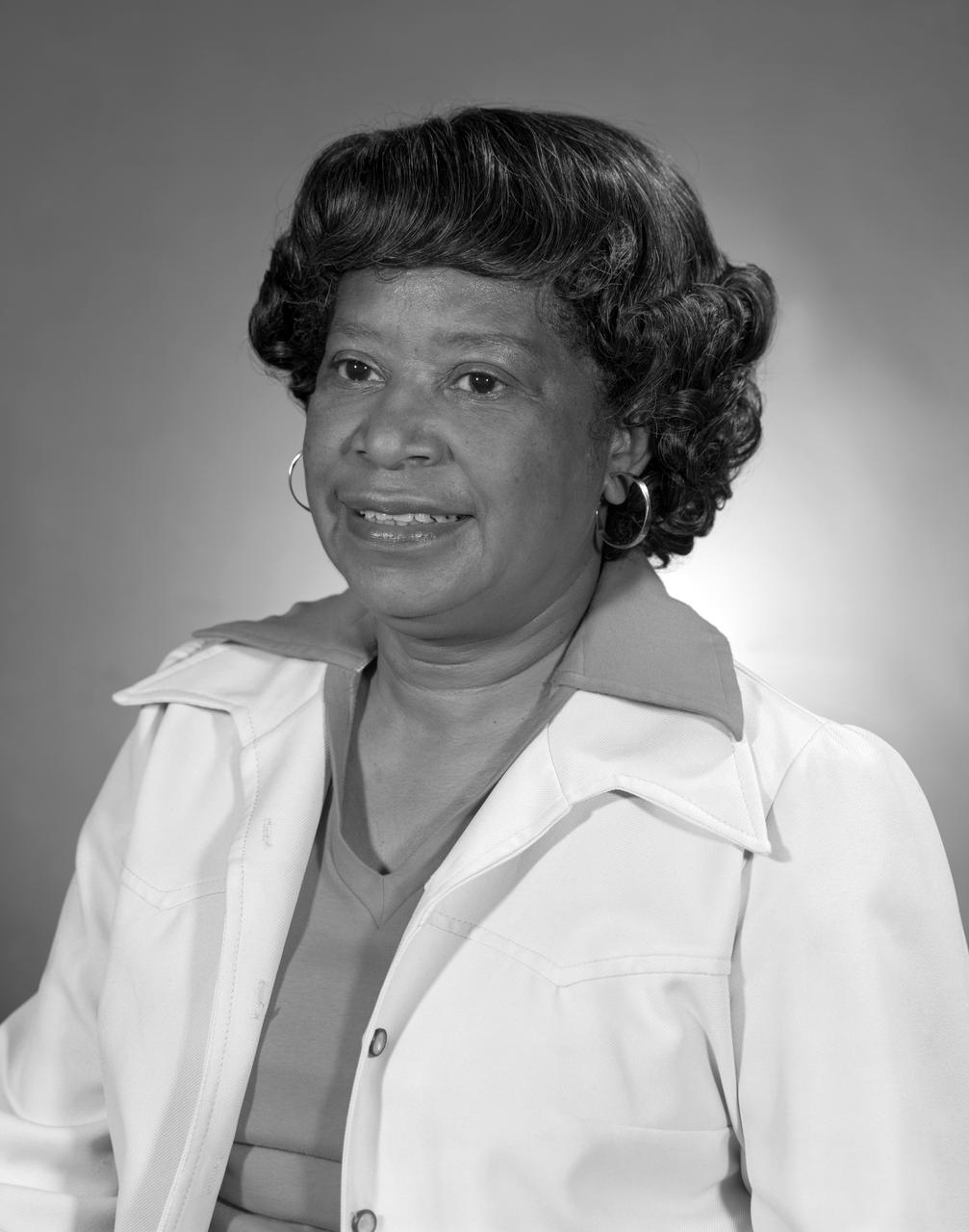
Portrait of Mary Jackson. 2017 Hall of Honor inductee. Langley Research Center NACA and NASA Hall of Honor. In honor and recognition of the ambition and motivation that enabled her career progression from human computer to NASA' s first African-American female engineer, and subsequent career supporting the hiring and promotion of other deserving female and minority employees.
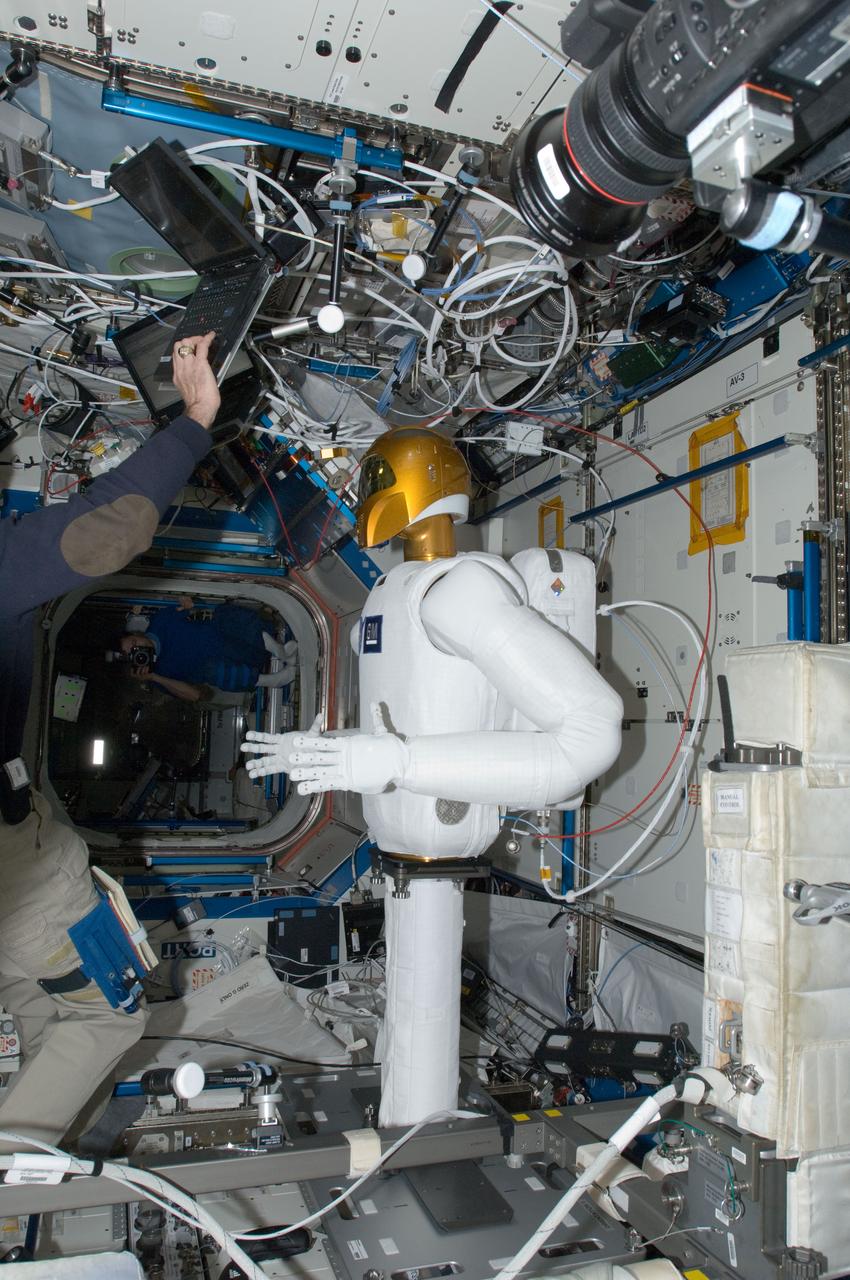
ISS030-E-074059 (15 Feb. 2012) --- Robonaut 2, nicknamed R2, is pictured in the Destiny laboratory of the International Space Station while NASA astronaut Dan Burbank (mostly out of frame at left) uses a computer during R2?s initial checkouts. R2 later went on to make history with the first human/robotic handshake to be performed in space.
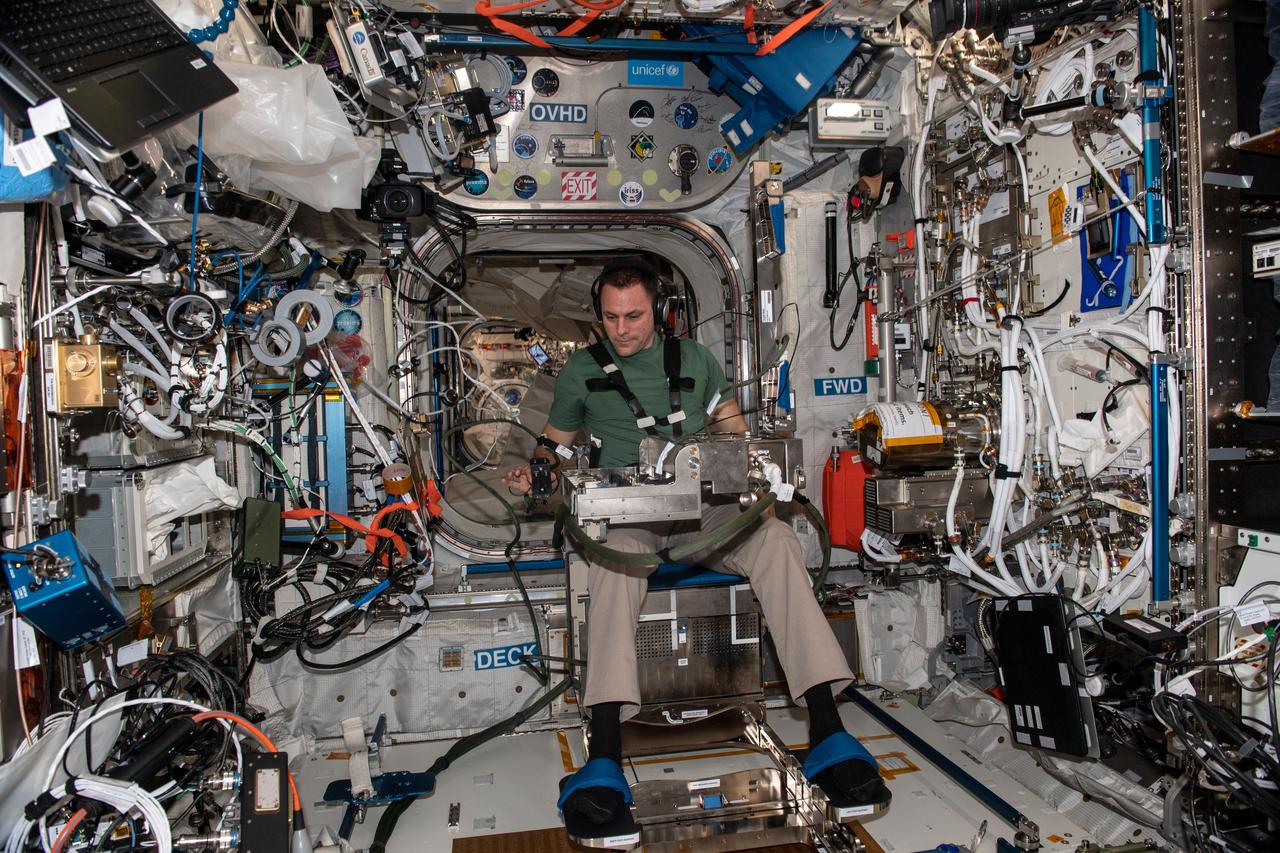
iss068e054121 (Feb. 14, 2023) --- NASA astronaut and Expedition 68 Flight Engineer Josh Cassada is seated in a specialized chair in the International Space Station's Columbus laboratory module for a human research experiment. The study investigates how astronauts regulate their grip force and move their arms when manipulating objects in microgravity in response to pre-programmed stimuli as a computer and video cameras record the responses.
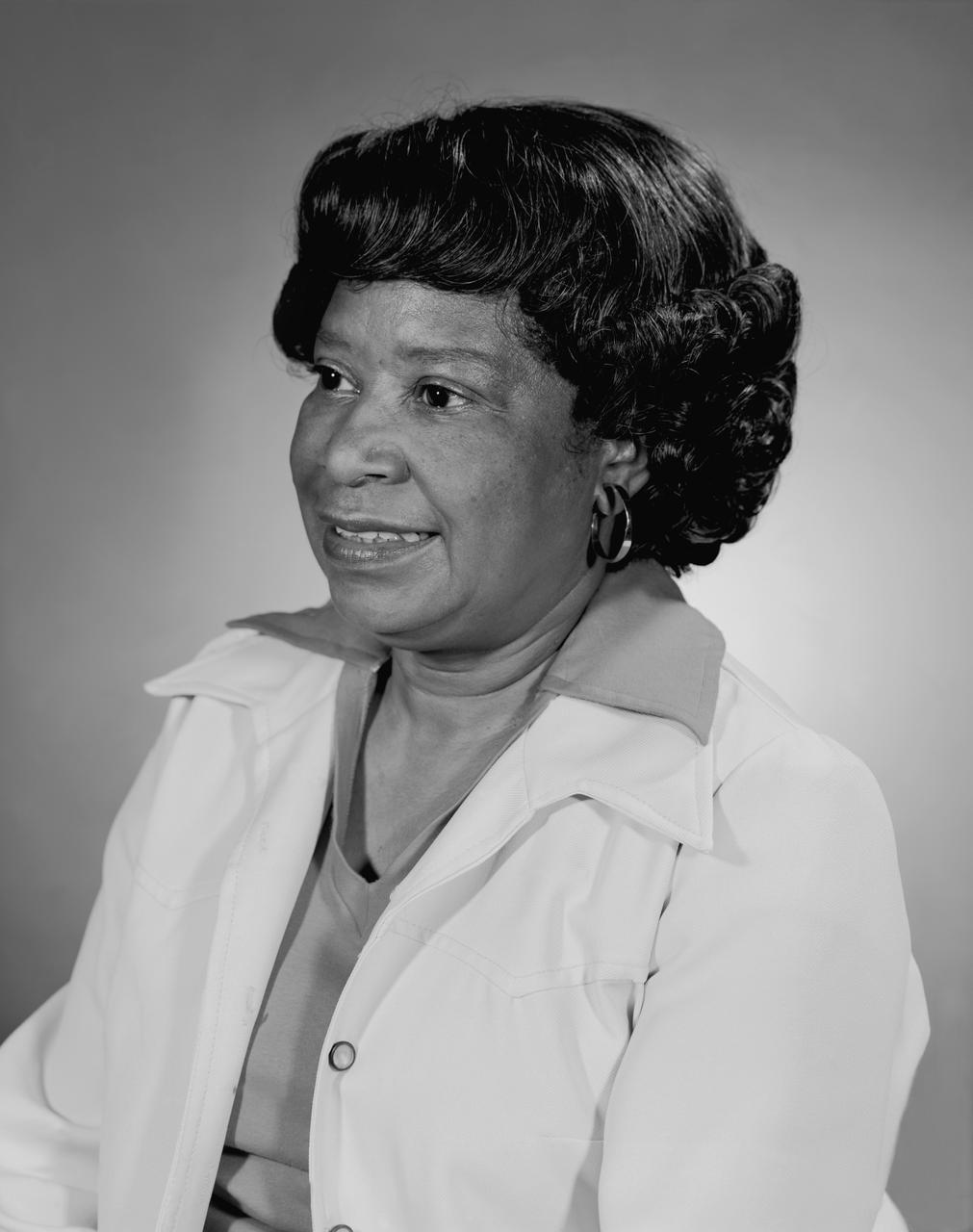
Portrait of Mary Jackson. 2017 Hall of Honor inductee. Langley Research Center NACA and NASA Hall of Honor. In honor and recognition of the ambition and motivation that enabled her career progression from human computer to NASA's s first African-American female engineer, and subsequent career supporting the hiring and promotion of other deserving female and minority employees.

These simulated views of the ultrahot Jupiter WASP-121b show what the planet might look like to the human eye from five different vantage points, illuminated to different degrees by its parent star. The images were created using a computer simulation being used to help scientists understand the atmospheres of these ultra-hot planets. Ultrahot Jupiters reflect almost no light, rather like charcoal. However, the daysides of ultrahot Jupiters have temperatures of between 3600°F and 5400°F (2000°C and 3000°C), so the planets produce their own glow, like a hot ember. The orange color in this simulated image is thus from the planet's own heat. The computer model was based on observations of WASP-121b conducted using NASA's Spitzer and Hubble space telescopes. https://photojournal.jpl.nasa.gov/catalog/PIA22565
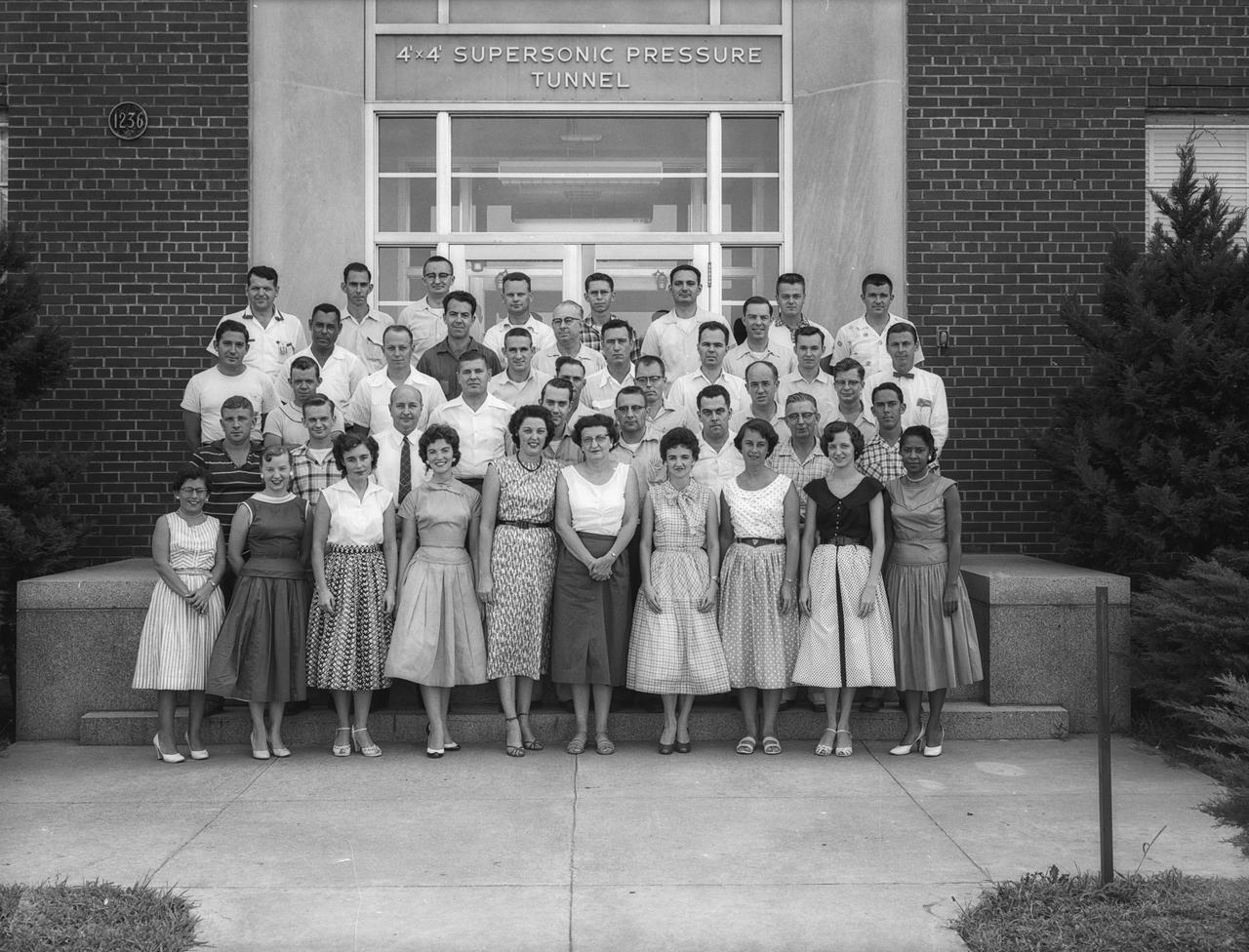
This photograph was taken August 15, 1956. Mary Jackson first person in the front row right side. Mary Jackson began at Langley in 1951 as a computer. She was later assigned to work at the 4-Foot by 4-Foot Supersonic Pressure Tunnel where she worked with Kazimierz "Kaz" Czarnecki, who encouraged her to become an engineer. To attend the university extension engineering classes held at the then all-white Hampton High School, Jackson was required to petition the courts, which she did successfully. The 4’ x 4’ Supersonic Pressure Tunnel was the NACA’s first supersonic wind tunnel. At the time of the photo, Mary Jackson was still a human computer, but was participating in the hands-on experimental work. Mrs. Jackson had begun her studies to be an engineer in the Spring of the same year the photo was taken. She obtained a degree in aerospace engineering in 1958. Photo published in "A Century at Langley" by Joseph R. Chambers page 74.
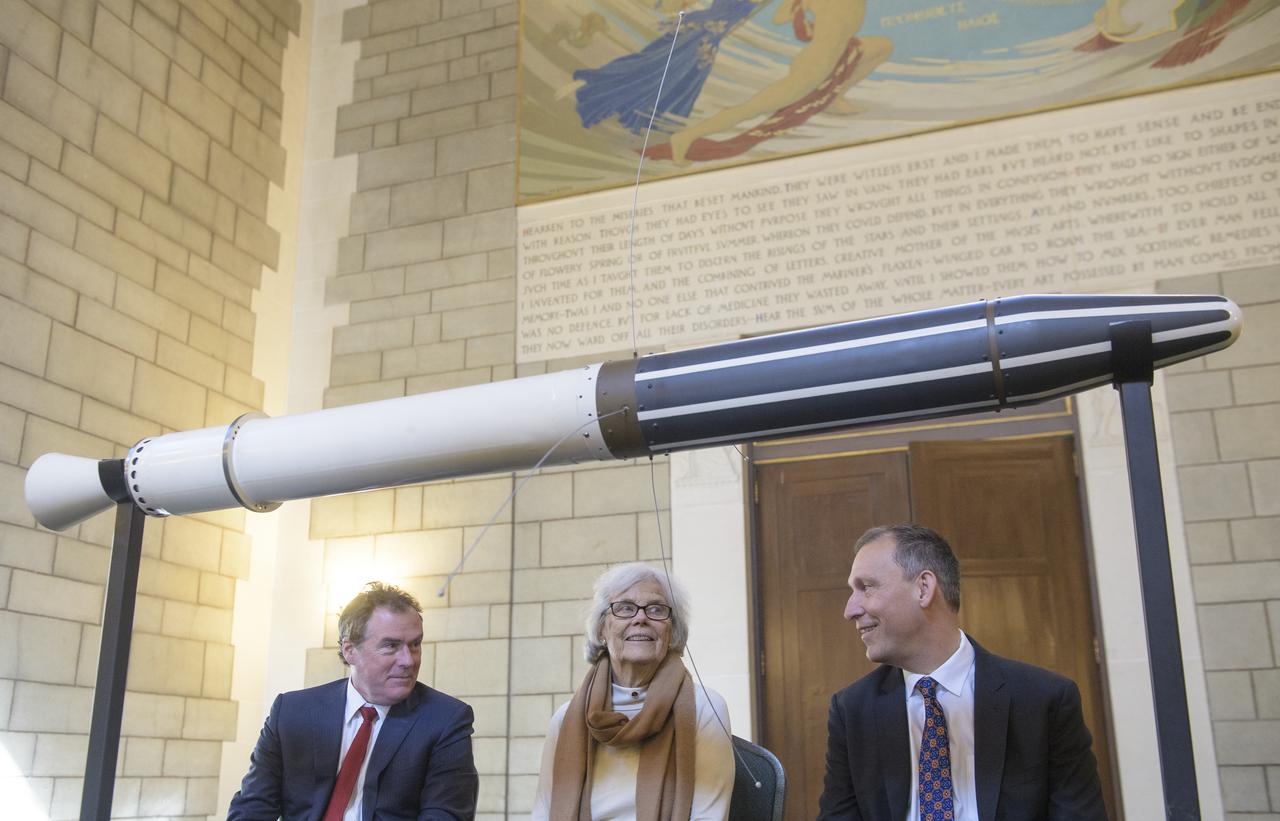
Michael Watkins, Director of NASA's Jet Propulsion Laboratory, left, Susan Finley, who began working at NASA's Jet Propulsion Laboratory in January 1958 as a "human computer", center, and Thomas Zurbuchen, Associate Administrator for NASA's Science Mission Directorate, right, pose for a picture with a replica of the Explorer 1 satellite during an event celebrating the 60th Anniversary of the Explorer 1 mission and the discovery of Earth's radiation belts, Wednesday, Jan. 31, 2018, at the National Academy of Sciences in Washington. The first U.S. satellite, Explorer 1, was launched from Cape Canaveral on January 31, 1958. The 30-pound satellite would yield a major scientific discovery, the Van Allen radiation belts circling our planet, and begin six decades of groundbreaking space science and human exploration. (NASA/Joel Kowsky)
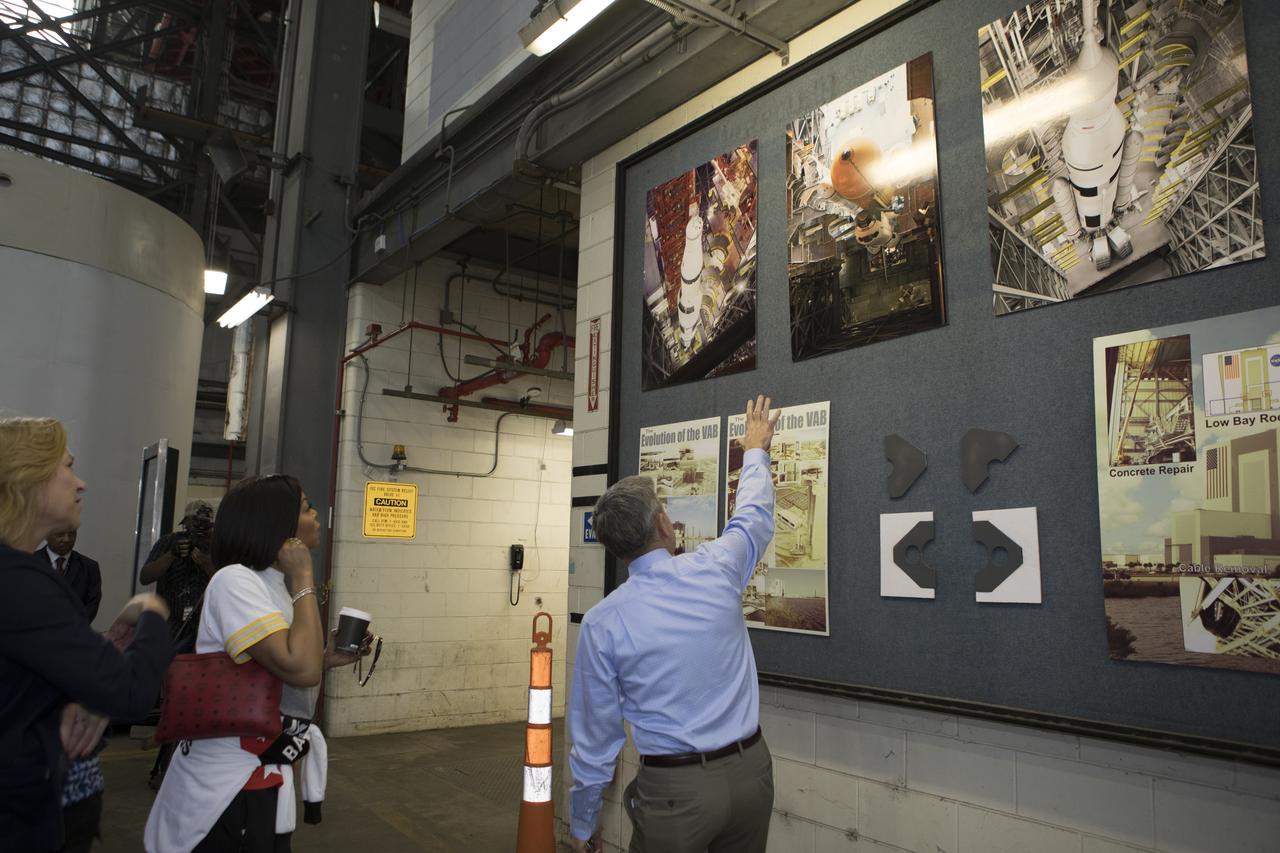
Kennedy Space Center Director Bob Cabana points to a display during a tour for cast and crew members of the upcoming motion picture "Hidden Figures." The group is walking thought the transfer aisle of the Vehicle Assembly Building. The movie is based on the book of the same title, by Margot Lee Shetterly. It chronicles the lives of Katherine Johnson, Dorothy Vaughan and Mary Jackson, three African-American women who worked for NASA as human "computers.” Their mathematical calculations were crucial to the success of Project Mercury missions including John Glenn’s orbital flight aboard Friendship 7 in 1962. The film is due in theaters in January 2017.
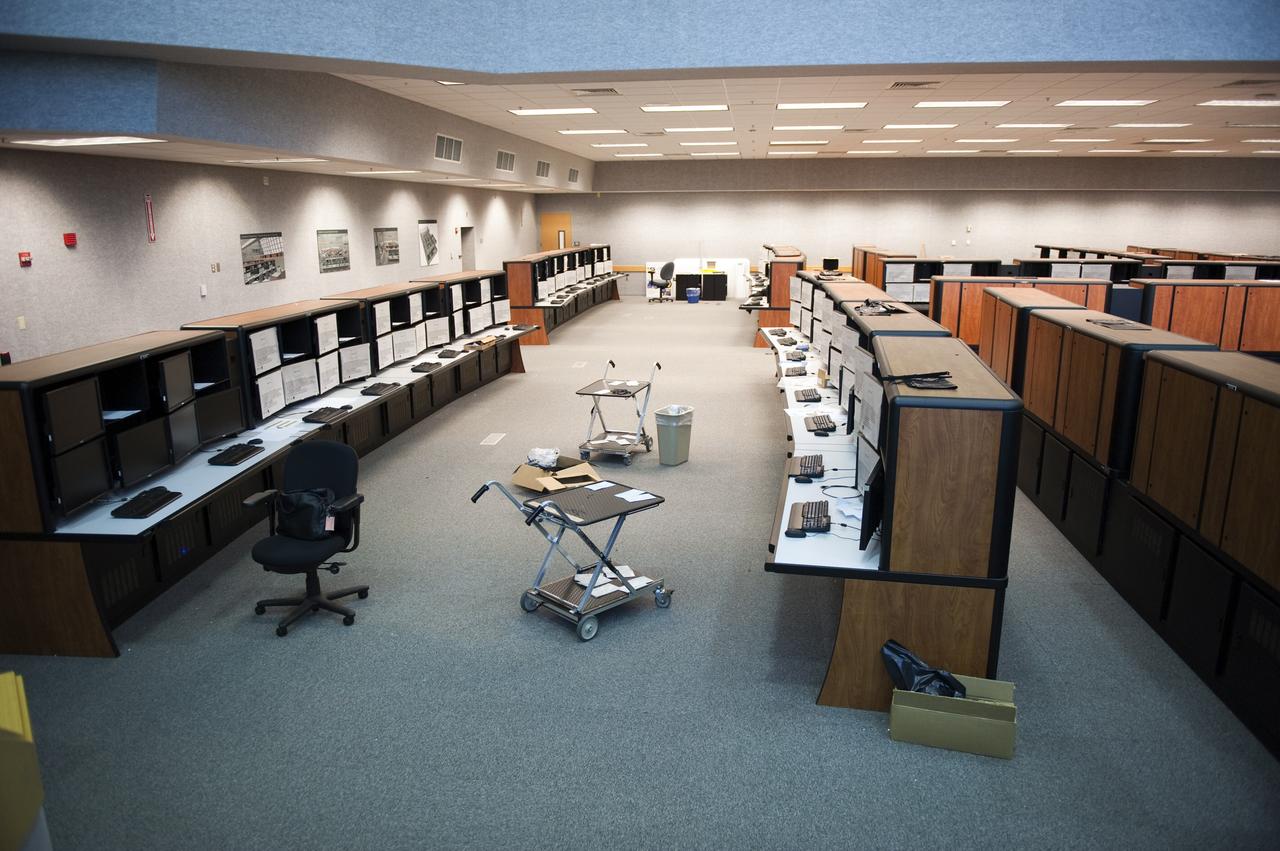
CAPE CANAVERAL, Fla. -- At NASA's Kennedy Space Center in Florida, remodeling for launches of future human spaceflight vehicles continues in the Launch Control Center's Young-Crippen Firing Room. Consoles already have been rewired for the comprehensive upgrade and are now being outfitted with new computers and monitors. Known as Firing Room 1 in the Apollo era, it was re-named as a tribute to the Space Shuttle Program's first crewed mission, STS-1, which was flown by Commander John Young and Pilot Robert Crippen in April 1981. The firing room most recently was set up to support the Ares I-X flight test in Oct. 2009. Photo credit: NASA/Kim Shiflett
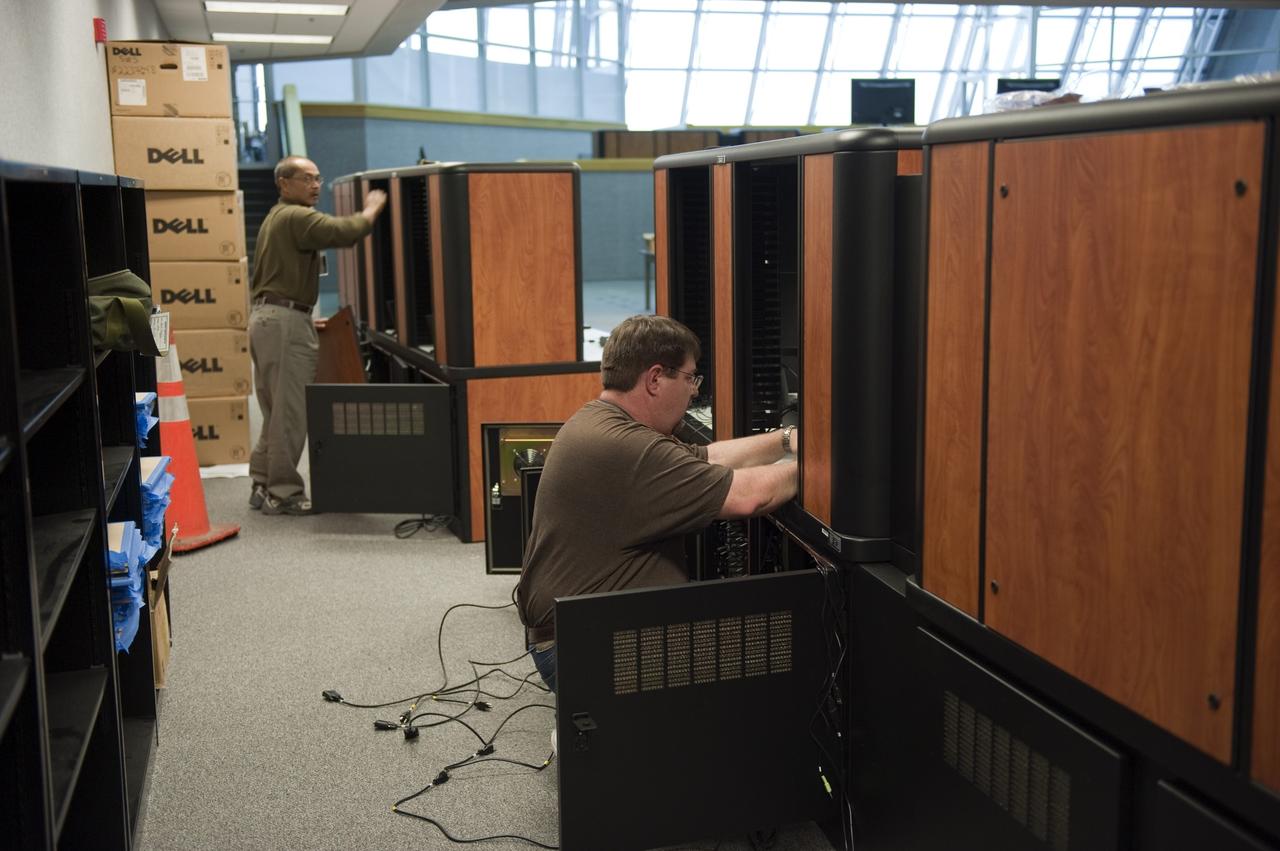
CAPE CANAVERAL, Fla. -- At NASA's Kennedy Space Center in Florida, remodeling for launches of future human spaceflight vehicles continues in the Launch Control Center's Young-Crippen Firing Room. Consoles already have been rewired for the comprehensive upgrade and are now being outfitted with new computers and monitors. Known as Firing Room 1 in the Apollo era, it was re-named as a tribute to the Space Shuttle Program's first crewed mission, STS-1, which was flown by Commander John Young and Pilot Robert Crippen in April 1981. The firing room most recently was set up to support the Ares I-X flight test in Oct. 2009. Photo credit: NASA/Kim Shiflett
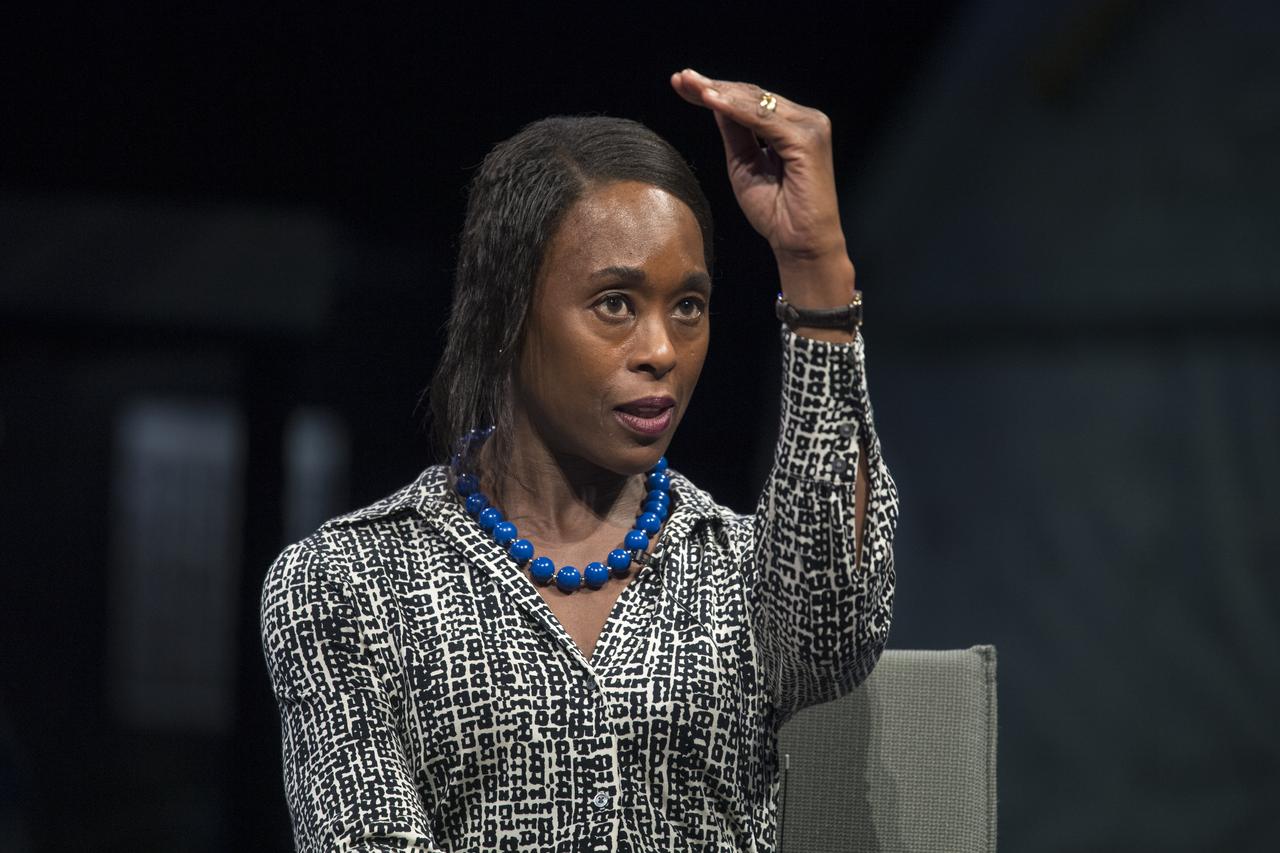
"Hidden Figures" author, Margot Lee Shetterly speaks during a "Hidden Figures" panel discussion with NASA human computer Christine Darden, and Marty Kelsey and Beth Wilson of STEM in 30, Wednesday, June 12, 2019 at the Smithsonian National Air and Space Museum in Washington. The panel discussion took place after a ceremony dedicating the 300 block of E Street SW as "Hidden Figures Way" to honor Katherine Johnson, Dorthy Vaughan, Mary Jackson and all of the women who have dedicated their lives to honorably serving their country, advancing equality, and contributing to the space program of the United States. Photo Credit: (NASA/Aubrey Gemignani)
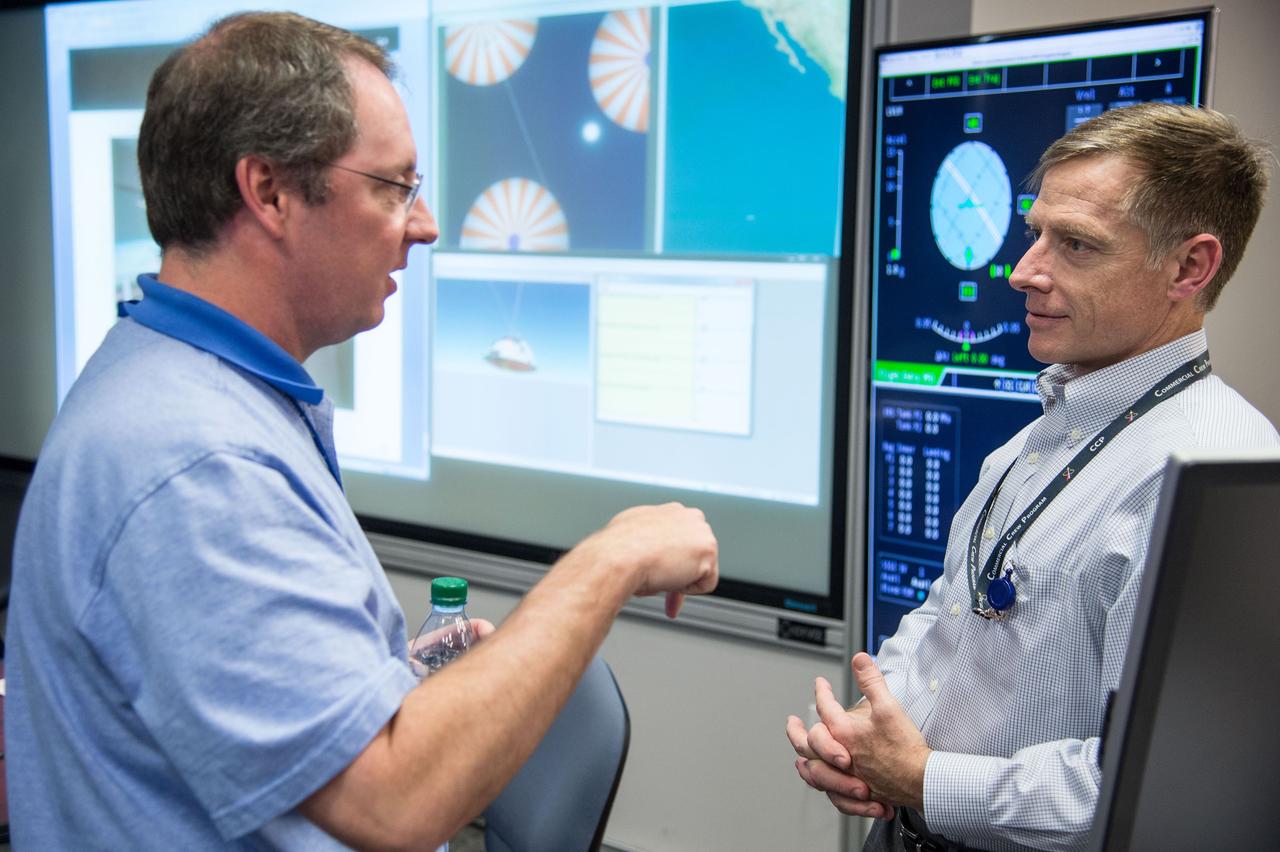
HOUSTON – Chris Ferguson, a former space shuttle commander who is now director of Crew and Mission Operations for Boeing Space Exploration, talks with an engineer following simulations that showed that the CST-100 software. Boeing demonstrated that the CST-100 software allows a human pilot to take over control of the spacecraft from the computer during all phases of a mission following separation from the launch vehicle. The pilot-in-the-loop demonstration at the Houston Product Support Center is a milestone under Boeing's Commercial Crew Integrated Capability agreement with the agency and its Commercial Crew Program. Photo credit: NASA/Bill Stafford
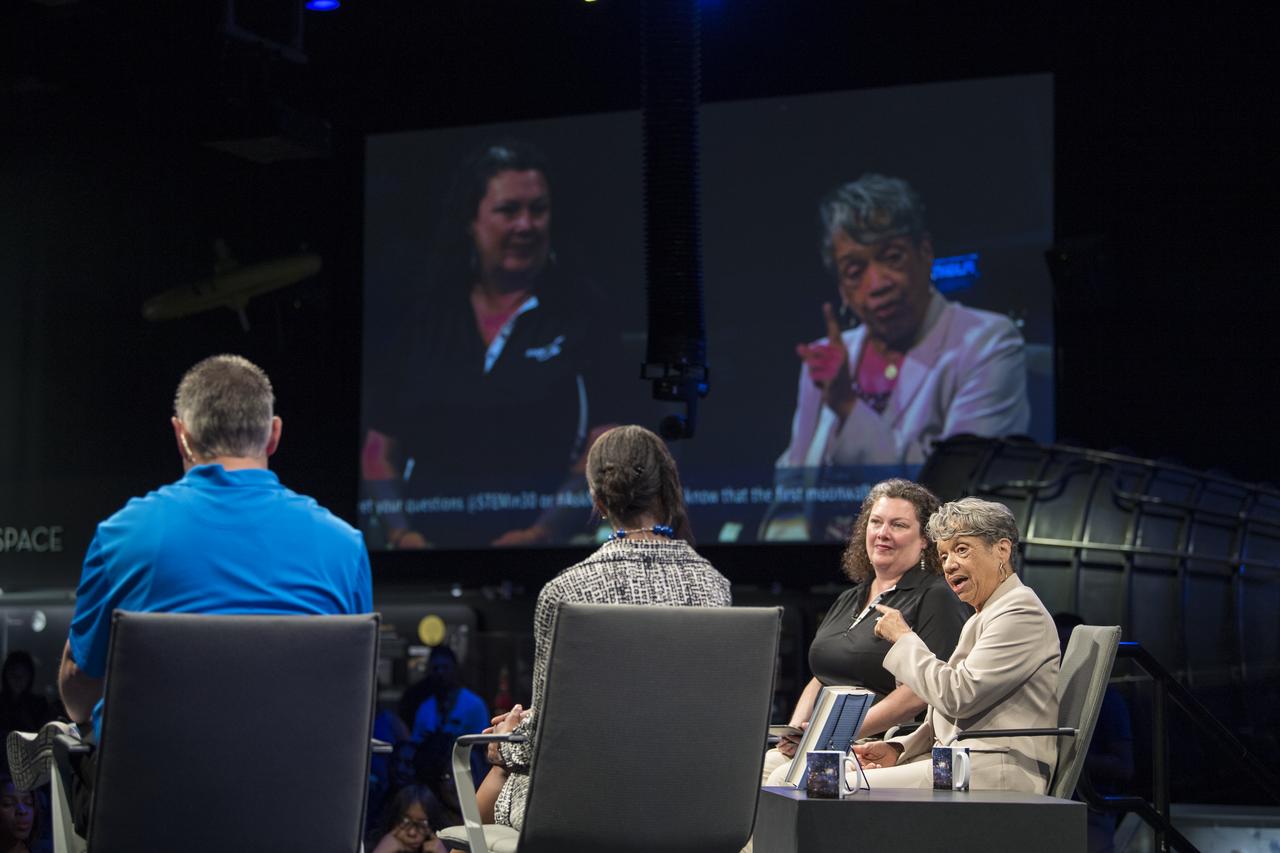
NASA human computer Christine Darden, right, speaks during a "Hidden Figures" panel discussion with "Hidden Figures" author, Margot Lee Shetterly, and Beth Wilson, and Marty Kelsey of STEM in 30, Wednesday, June 12, 2019 at the Smithsonian National Air and Space Museum in Washington. The panel discussion took place after a ceremony dedicating the 300 block of E Street SW as "Hidden Figures Way" to honor Katherine Johnson, Dorthy Vaughan, Mary Jackson and all of the women who have dedicated their lives to honorably serving their country, advancing equality, and contributing to the space program of the United States. Photo Credit: (NASA/Aubrey Gemignani)
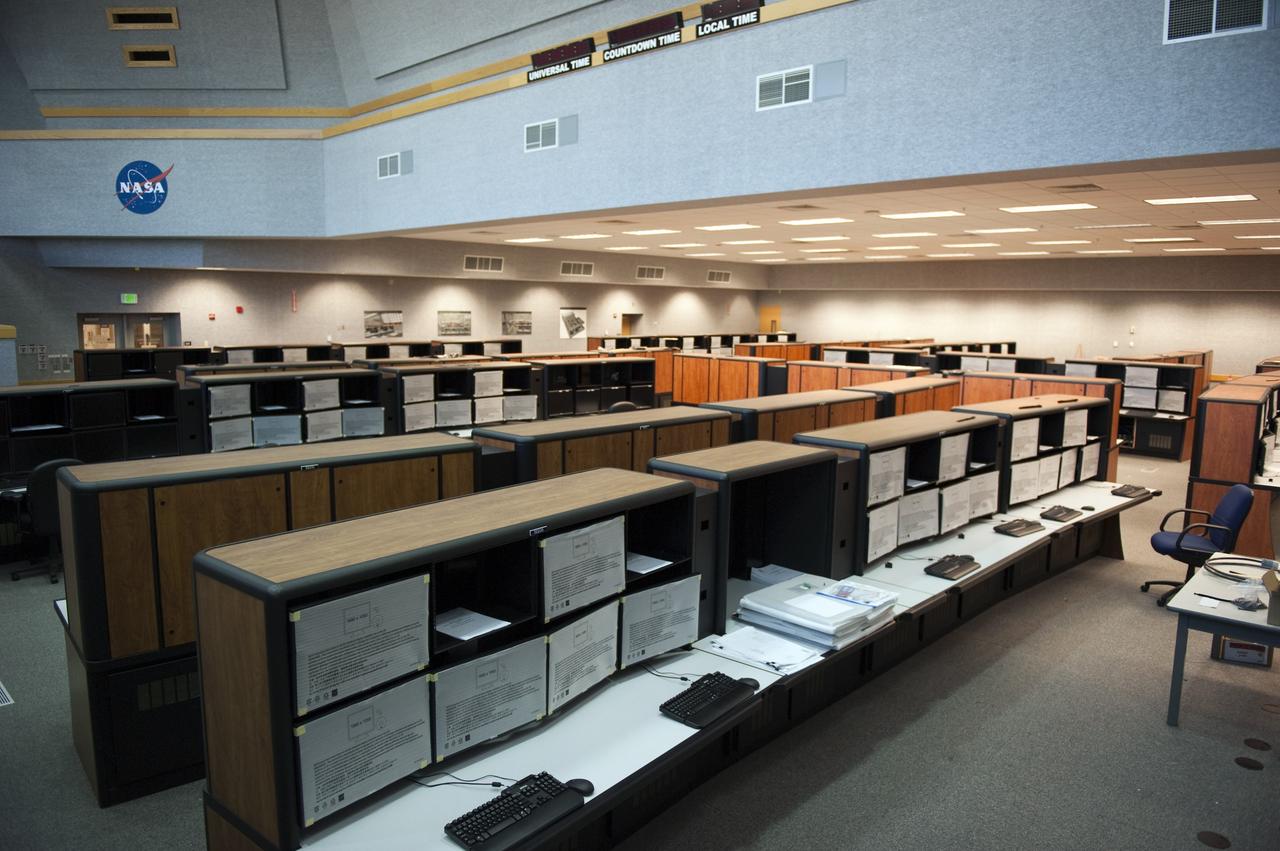
CAPE CANAVERAL, Fla. -- At NASA's Kennedy Space Center in Florida, remodeling for launches of future human spaceflight vehicles continues in the Launch Control Center's Young-Crippen Firing Room. Consoles already have been rewired for the comprehensive upgrade and are now being outfitted with new computers and monitors. Known as Firing Room 1 in the Apollo era, it was re-named as a tribute to the Space Shuttle Program's first crewed mission, STS-1, which was flown by Commander John Young and Pilot Robert Crippen in April 1981. The firing room most recently was set up to support the Ares I-X flight test in Oct. 2009. Photo credit: NASA/Kim Shiflett
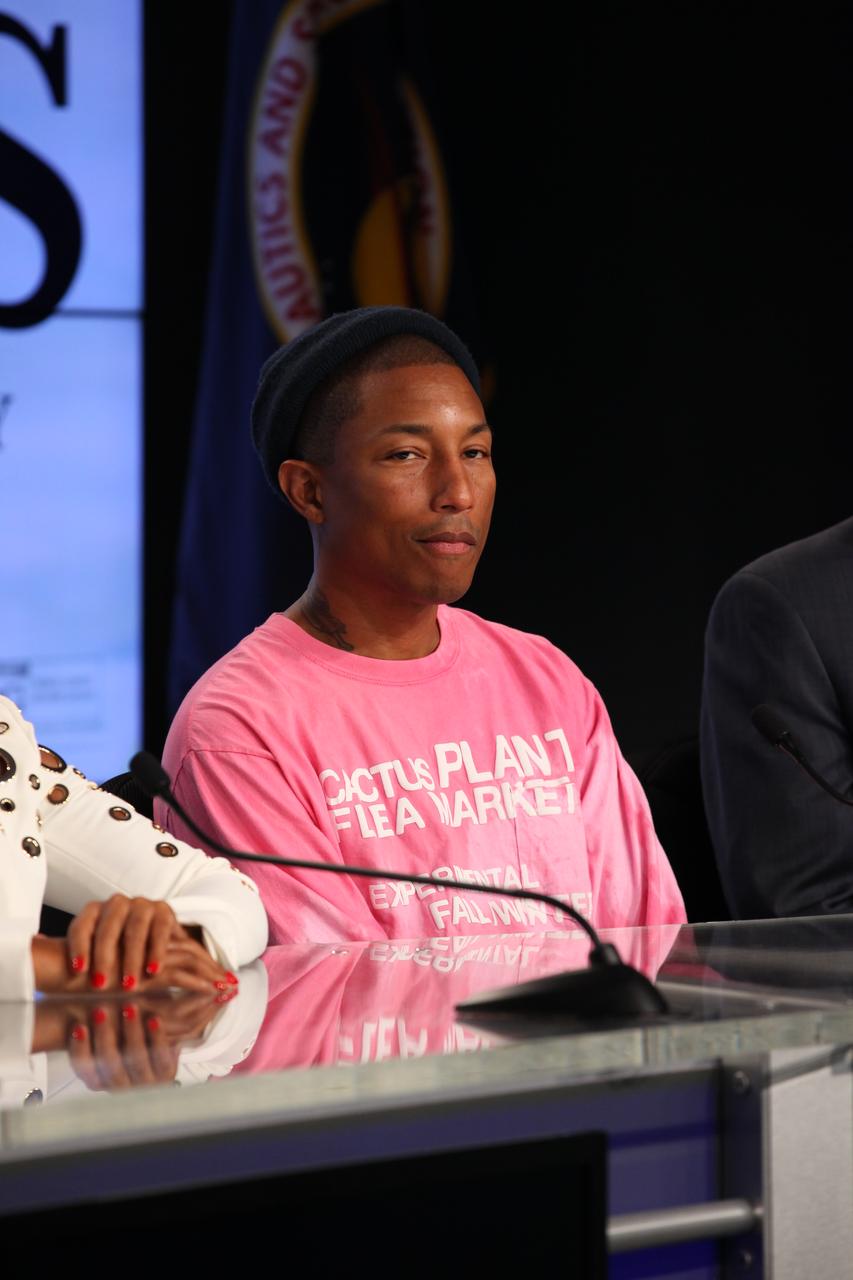
In the Press Site auditorium at the Kennedy Space Center in Florida, Pharrell Williams, musician and producer of “Hidden Figures" speaks to members of the media during a news conference with other key individuals involved in the upcoming motion picture. The movie is based on the book of the same title, by Margot Lee Shetterly. It chronicles the lives of Katherine Johnson, Dorothy Vaughan and Mary Jackson, three African-American women who worked for NASA as human "computers.” Their mathematical calculations were crucial to the success of Project Mercury missions including John Glenn’s orbital flight aboard Friendship 7 in 1962. The film is due in theaters in January 2017.
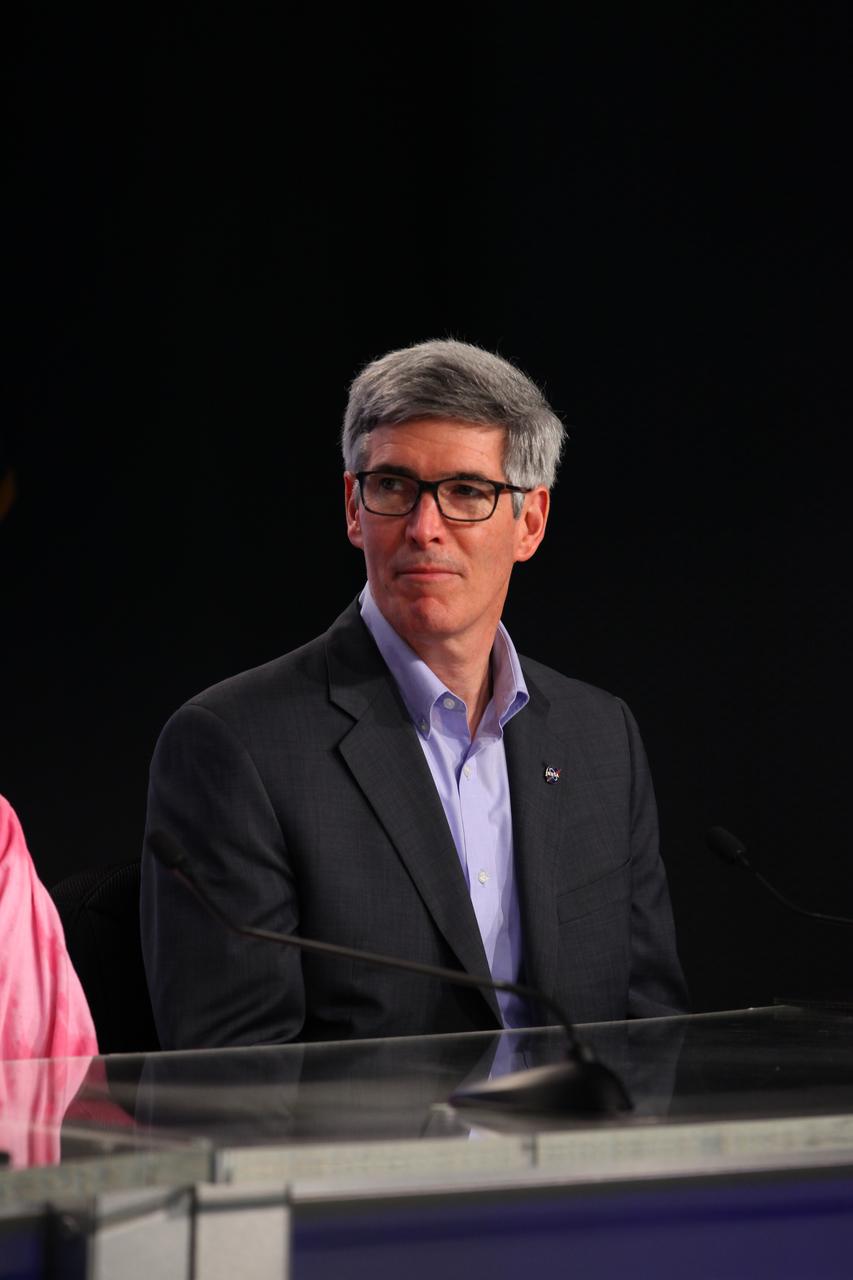
In the Press Site auditorium at the Kennedy Space Center in Florida, Bill Barry, NASA's chief historian, speaks to members of the media during a a news conference with key individuals involved in the upcoming motion picture "Hidden Figures." The movie is based on the book of the same title, by Margot Lee Shetterly. It chronicles the lives of Katherine Johnson, Dorothy Vaughan and Mary Jackson, three African-American women who worked for NASA as human "computers.” Their mathematical calculations were crucial to the success of Project Mercury missions including John Glenn’s orbital flight aboard Friendship 7 in 1962. The film is due in theaters in January 2017.

NASA officials and elected leaders were on hand for the groundbreaking ceremony of the NASA Shared Services Center Feb. 24, 2006, on the grounds of Stennis Space Center. The NSSC provides agency centralized administrative processing, human resources, procurement and financial services. From left, Louisiana Economic Development Secretary Mike Olivier, Stennis Space Center Director Rick Gilbrech, Computer Sciences Corp. President Michael Laphen, NASA Deputy Administrator Shana Dale, Rep. Gene Taylor, Sen. Trent Lott, Mississippi Gov. Haley Barbour, NASA Administrator Mike Griffin and Shared Services Center Executive Director Arbuthnot use golden shovels to break ground at the site.
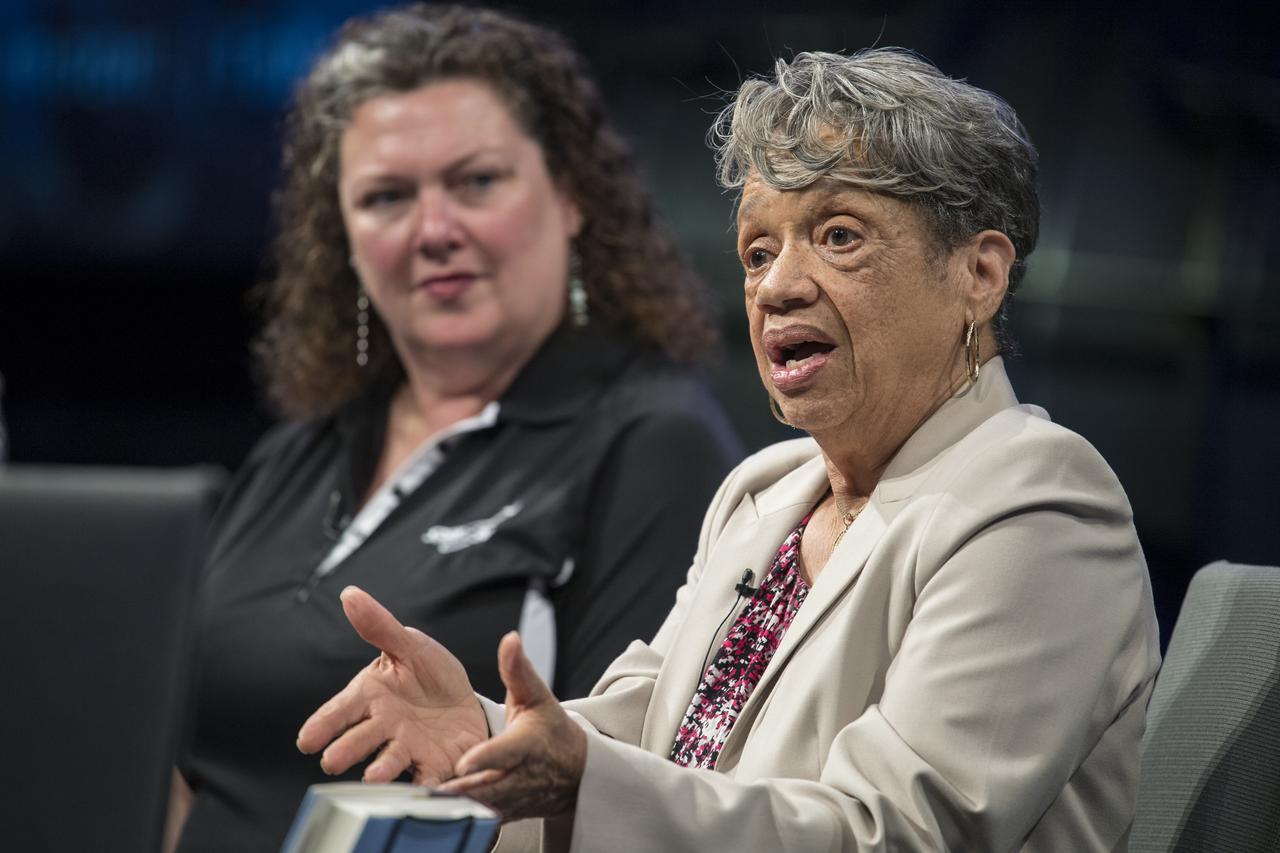
NASA human computer Christine Darden speaks during a "Hidden Figures" panel discussion with "Hidden Figures" author, Margot Lee Shetterly, and Marty Kelsey and Beth Wilson of STEM in 30, Wednesday, June 12, 2019 at the Smithsonian National Air and Space Museum in Washington. The panel discussion took place after a ceremony dedicating the 300 block of E Street SW as "Hidden Figures Way" to honor Katherine Johnson, Dorthy Vaughan, Mary Jackson and all of the women who have dedicated their lives to honorably serving their country, advancing equality, and contributing to the space program of the United States. Photo Credit: (NASA/Aubrey Gemignani)

In the Press Site auditorium at the Kennedy Space Center in Florida, Taraji P. Henson speaks to members of the media during a news conference with other key individuals involved in the upcoming motion picture "Hidden Figures." The movie is based on the book of the same title, by Margot Lee Shetterly. It chronicles the lives of Katherine Johnson (played by Henson), Dorothy Vaughan and Mary Jackson, three African-American women who worked for NASA as human "computers.” Their mathematical calculations were crucial to the success of Project Mercury missions including John Glenn’s orbital flight aboard Friendship 7 in 1962. The film is due in theaters in January 2017.
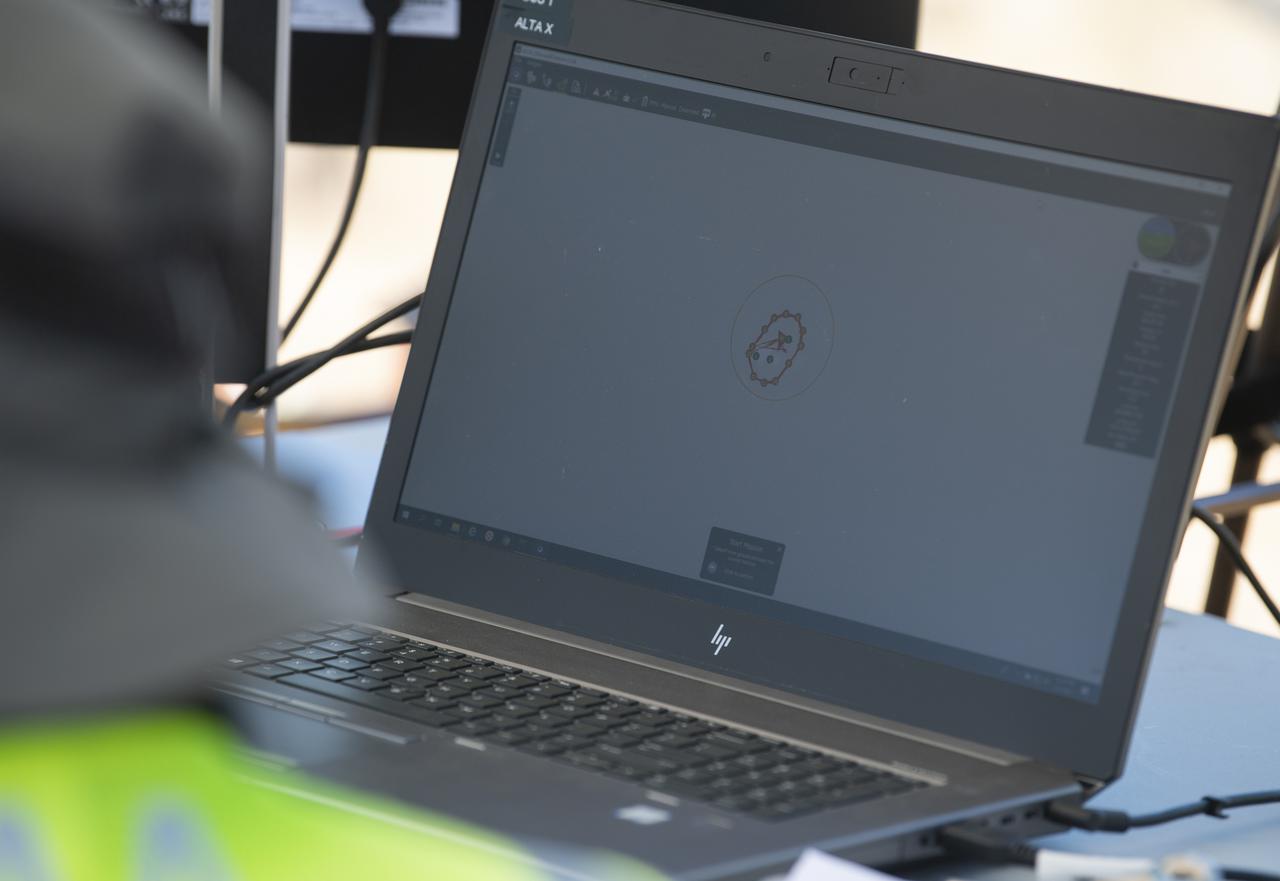
A computer displays the flight path of a FreeFly Systems Alta X drone during a flight as part of STEReO, the Scalable Traffic Management for Emergency Response Operations project, test activities, Tuesday, May 4, 2021 as Cal Fire conducts aerial fire fighting training exercises near Redding, California. STEReO, the Scalable Traffic Management for Emergency Response Operations project, led by NASA’s Ames Research Center, builds on NASA’s expertise in air traffic management, human factors research, and autonomous technology development to apply the agency’s work in Unmanned Aircraft Systems Traffic Management, or UTM, to public safety uses. Photo Credit: (NASA/Joel Kowsky)
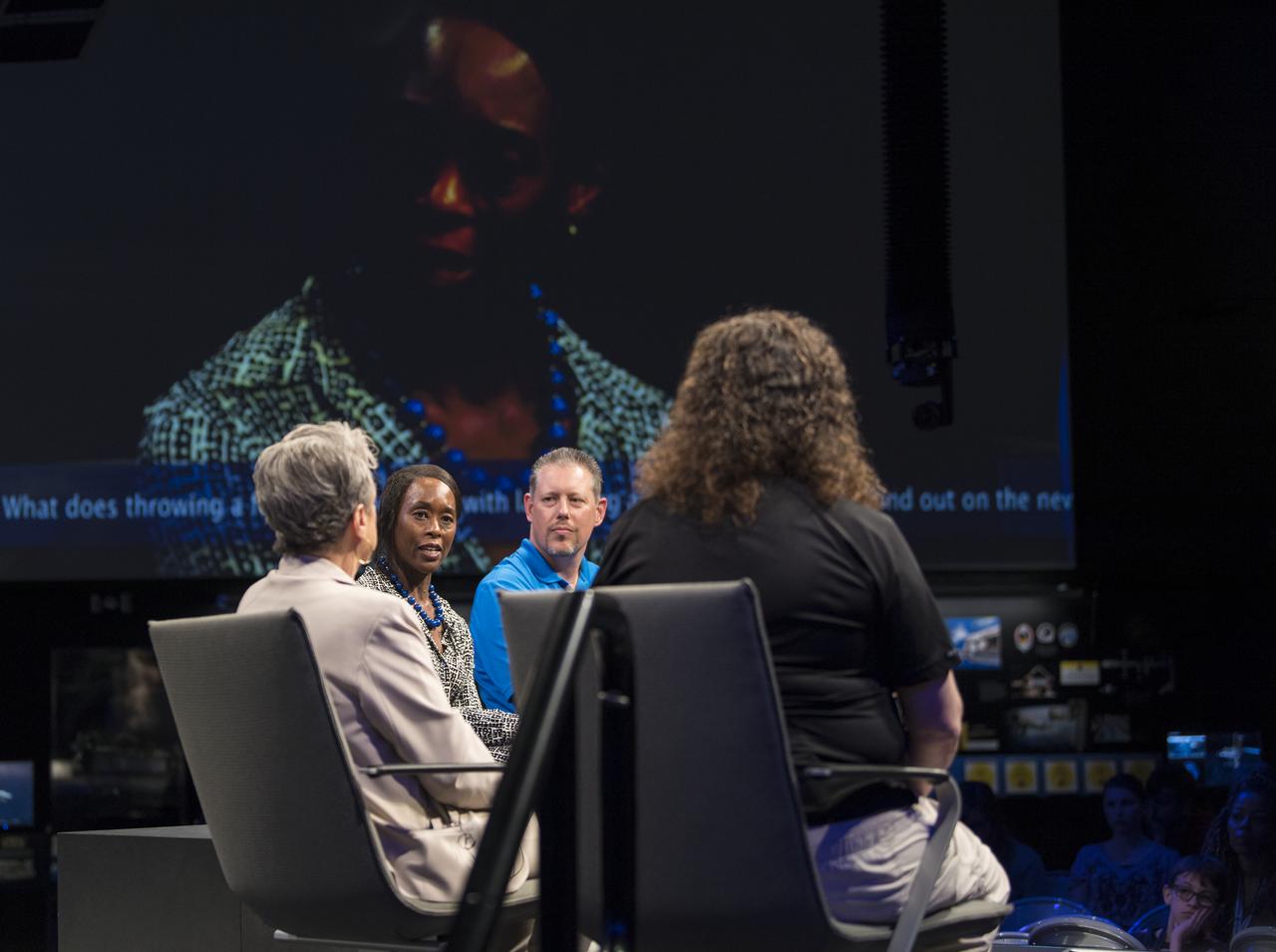
"Hidden Figures" author, Margot Lee Shetterly, center, speaks during a "Hidden Figures" panel discussion with NASA human computer Christine Darden, and Beth Wilson and Marty Kelsey of STEM in 30, Wednesday, June 12, 2019 at the Smithsonian National Air and Space Museum in Washington. The panel discussion took place after a ceremony dedicating the 300 block of E Street SW as "Hidden Figures Way" to honor Katherine Johnson, Dorthy Vaughan, Mary Jackson and all of the women who have dedicated their lives to honorably serving their country, advancing equality, and contributing to the space program of the United States. Photo Credit: (NASA/Aubrey Gemignani)
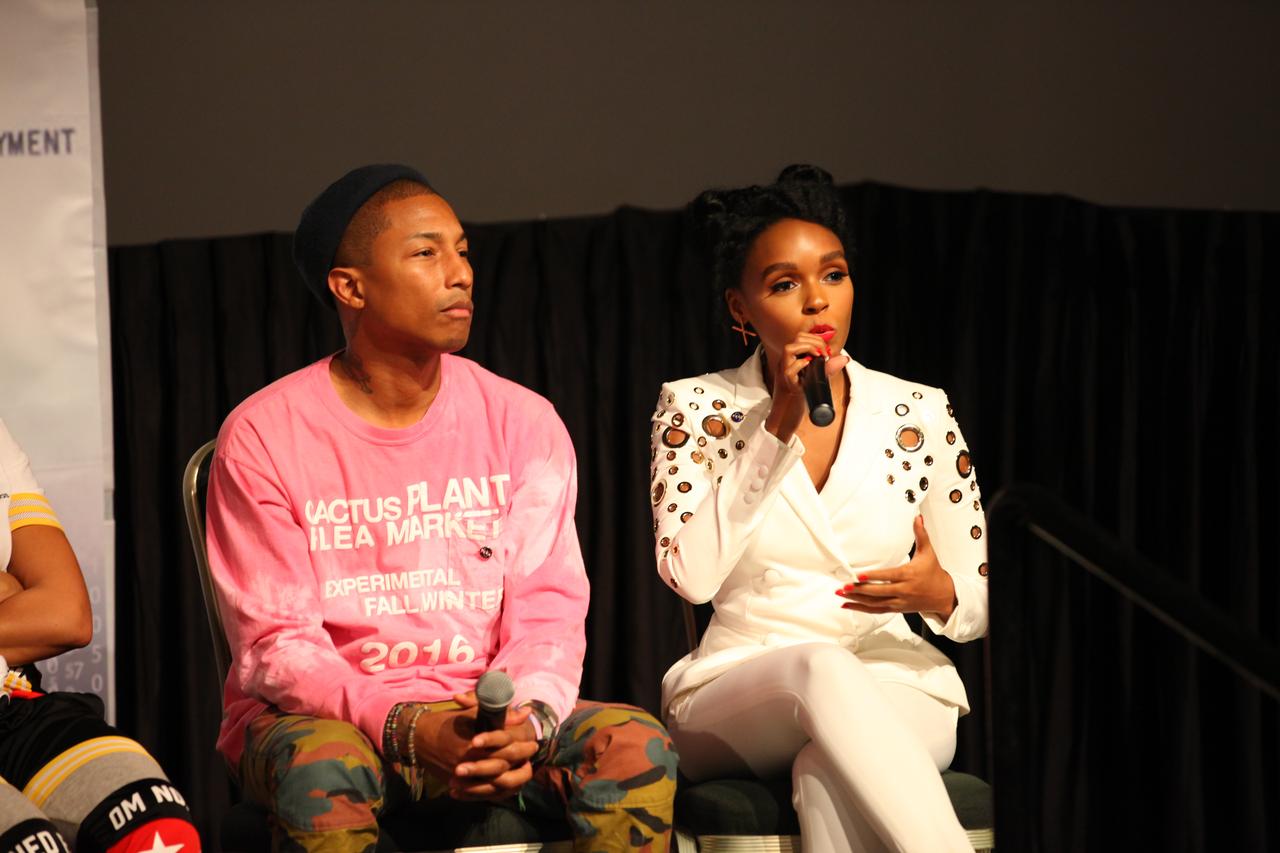
In the IMAX Theater of the Kennedy Space Center Visitor Complex Cast and crew members of the upcoming motion picture "Hidden Figures" participate in a question and answer session. From the left are Pharrell Williams, musician and producer of “Hidden Figures," and Janelle Monáe, who portrays Mary Jackson in the film. The movie chronicles the lives of Katherine Johnson, Dorothy Vaughan and Mary Jackson, three African-American women who worked for NASA as human "computers.” Their mathematical calculations were crucial to the success of Project Mercury missions including John Glenn’s orbital flight aboard Friendship 7 in 1962. The film is due in theaters in January 2017.
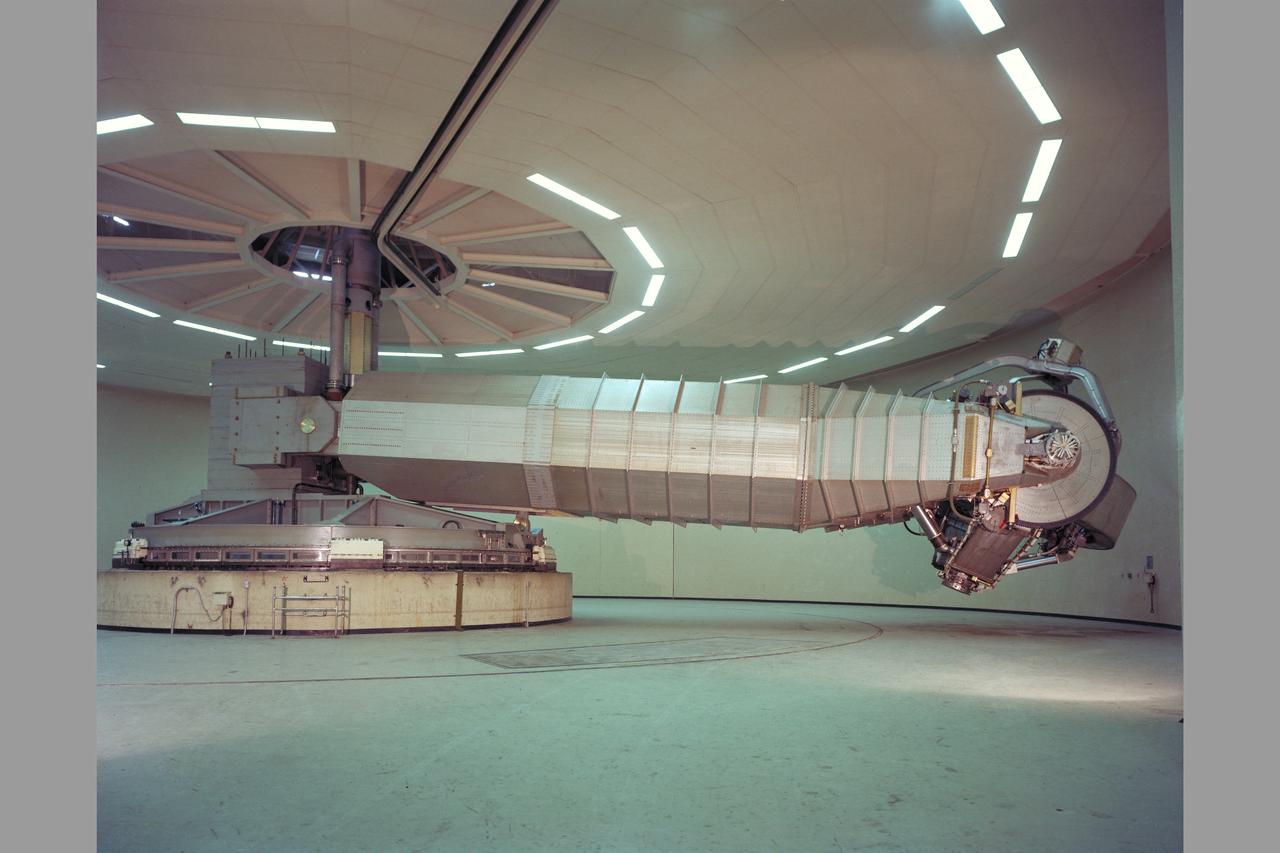
N-243 Flight and Guidance Centrifuge: Is used for spacecraft mission simulations and is adaptable to two configurations. Configuration 1: The cab will accommodate a three-man crew for space mission research. The accelerations and rates are intended to be smoothly applicable at very low value so the navigation and guidance procedures using a high-accuracy, out-the window display may be simulated. Configuration 2: The simulator can use a one-man cab for human tolerance studies and performance testing. Atmosphere and tempertaure can be varied as stress inducements. This simlator is operated closed-loop with digital or analog computation. It is currently man-rated for 3.5g maximum.
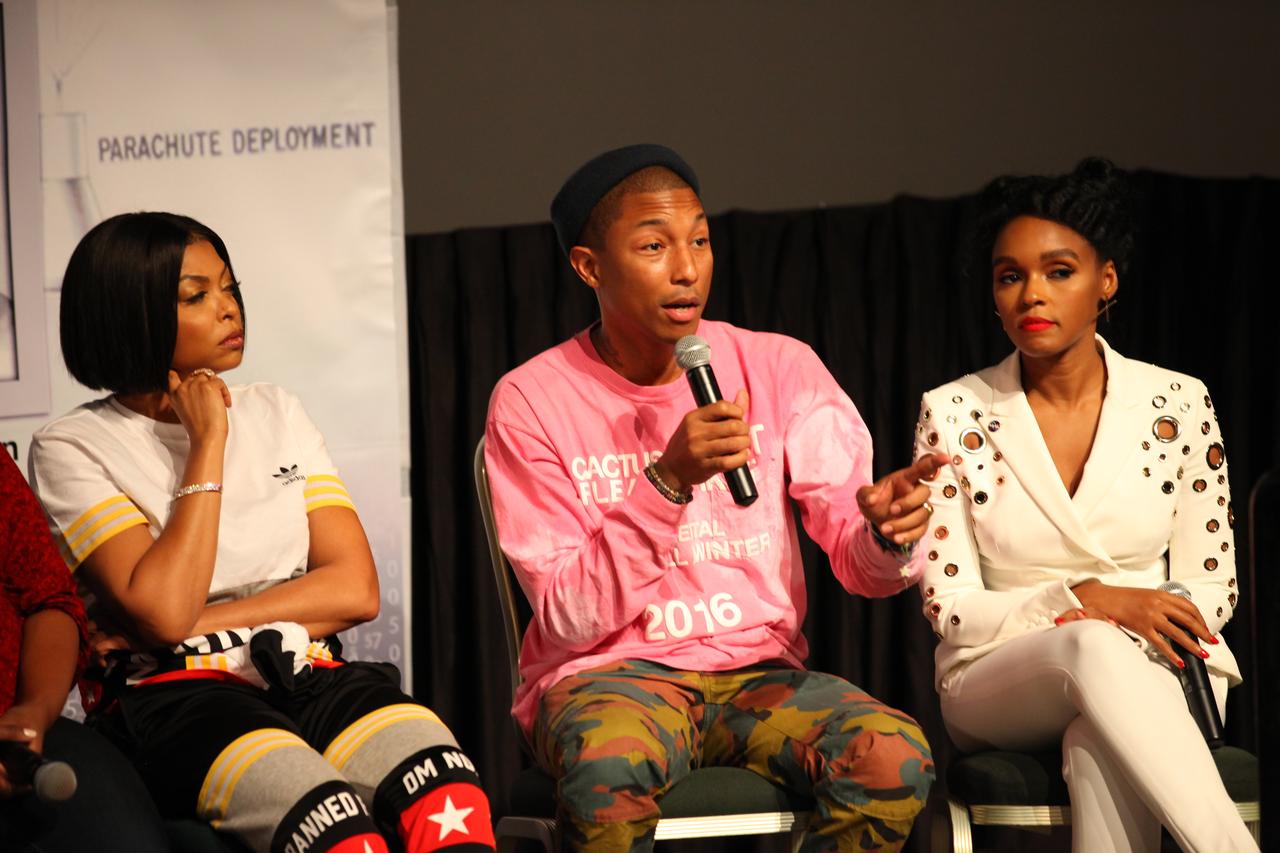
In the IMAX Theater of the Kennedy Space Center Visitor Complex Cast and crew members of the upcoming motion picture "Hidden Figures" participate in a question and answer session. From the left are Taraji P. Henson, who portrays Katherine Johnson in the film, Pharrell Williams, musician and producer of “Hidden Figures," and Janelle Monáe, who portrays Mary Jackson. The movie chronicles the lives of Katherine Johnson, Dorothy Vaughan and Mary Jackson, three African-American women who worked for NASA as human "computers.” Their mathematical calculations were crucial to the success of Project Mercury missions including John Glenn’s orbital flight aboard Friendship 7 in 1962. The film is due in theaters in January 2017.
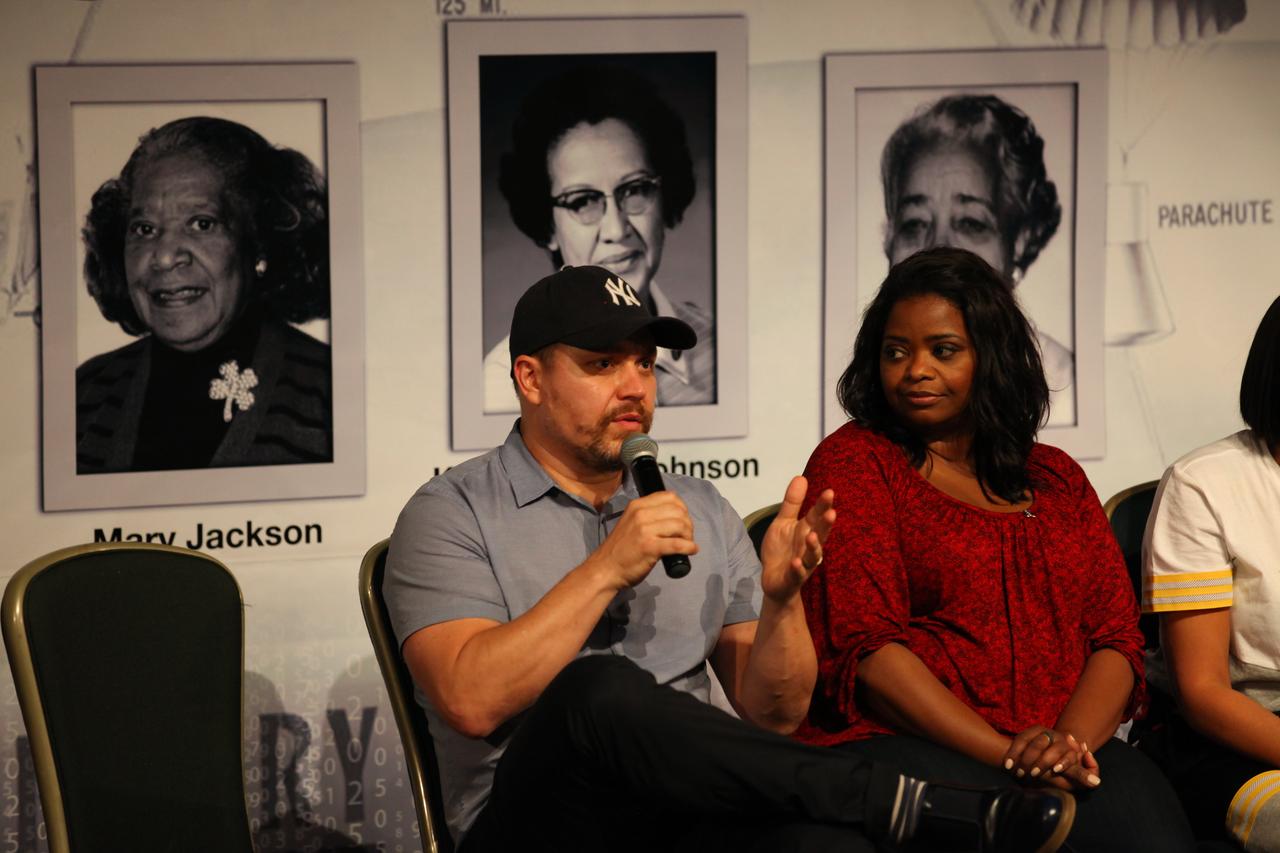
In the IMAX Theater of the Kennedy Space Center Visitor Complex Cast and crew members of the upcoming motion picture "Hidden Figures" participate in a question and answer session. From the left are Ted Melfi, writer and director of “Hidden Figures,” and Octavia Spencer, who portrays Dorothy Vaughan in the film. The movie is based on the book of the same title, by Margot Lee Shetterly. It chronicles the lives of Katherine Johnson, Dorothy Vaughan and Mary Jackson, three African-American women who worked for NASA as human "computers.” Their mathematical calculations were crucial to the success of Project Mercury missions including John Glenn’s orbital flight aboard Friendship 7 in 1962. The film is due in theaters in January 2017.
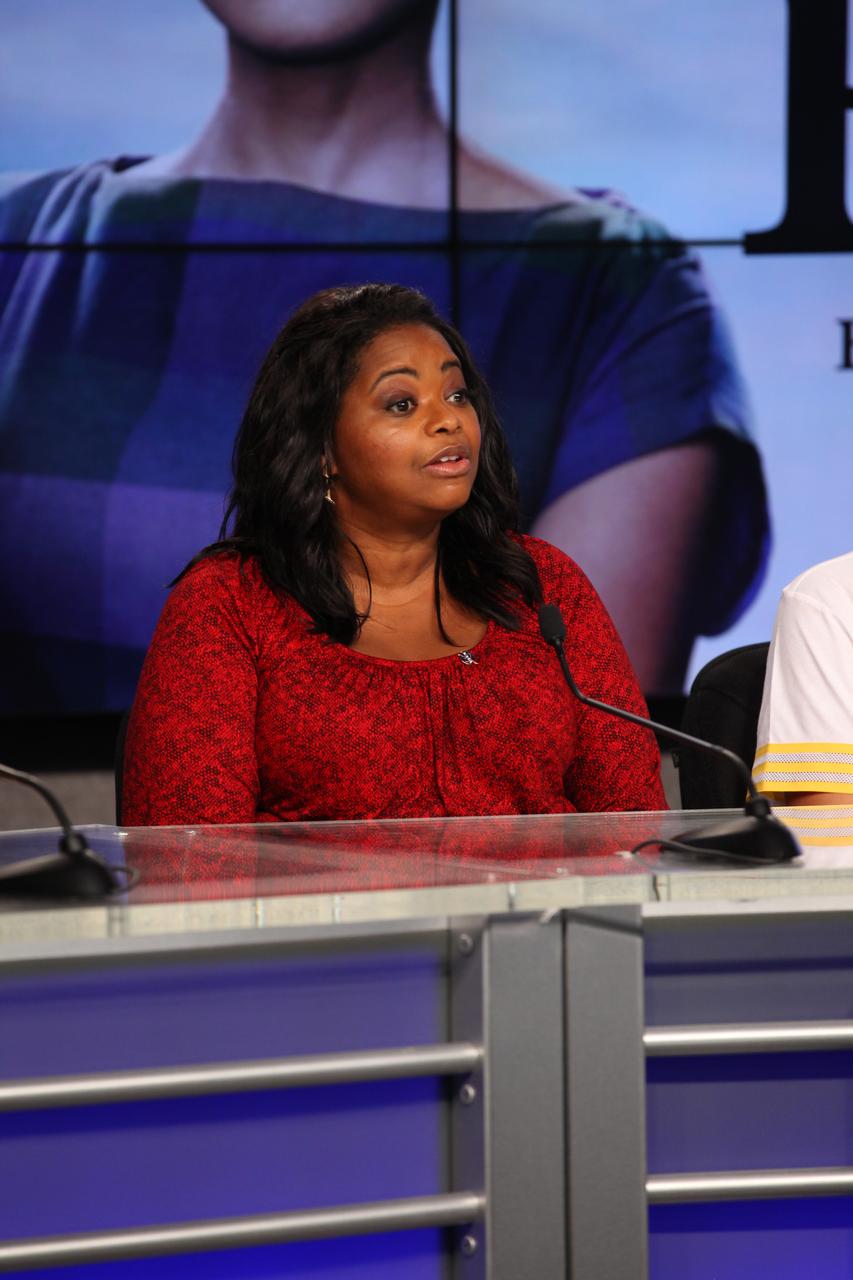
In the Press Site auditorium at the Kennedy Space Center in Florida, Octavia Spencer speaks to members of the media during a news conference with other key individuals involved in the upcoming motion picture "Hidden Figures." The movie is based on the book of the same title, by Margot Lee Shetterly. It chronicles the lives of Katherine Johnson, Dorothy Vaughan (played by Spencer) and Mary Jackson, three African-American women who worked for NASA as human "computers.” Their mathematical calculations were crucial to the success of Project Mercury missions including John Glenn’s orbital flight aboard Friendship 7 in 1962. The film is due in theaters in January 2017.

In the Press Site auditorium at the Kennedy Space Center in Florida, Octavia Spencer speaks to members of the media during a news conference with other key individuals involved in the upcoming motion picture "Hidden Figures." The movie is based on the book of the same title, by Margot Lee Shetterly. It chronicles the lives of Katherine Johnson, Dorothy Vaughan (played by Spencer) and Mary Jackson, three African-American women who worked for NASA as human "computers.” Their mathematical calculations were crucial to the success of Project Mercury missions including John Glenn’s orbital flight aboard Friendship 7 in 1962. The film is due in theaters in January 2017.
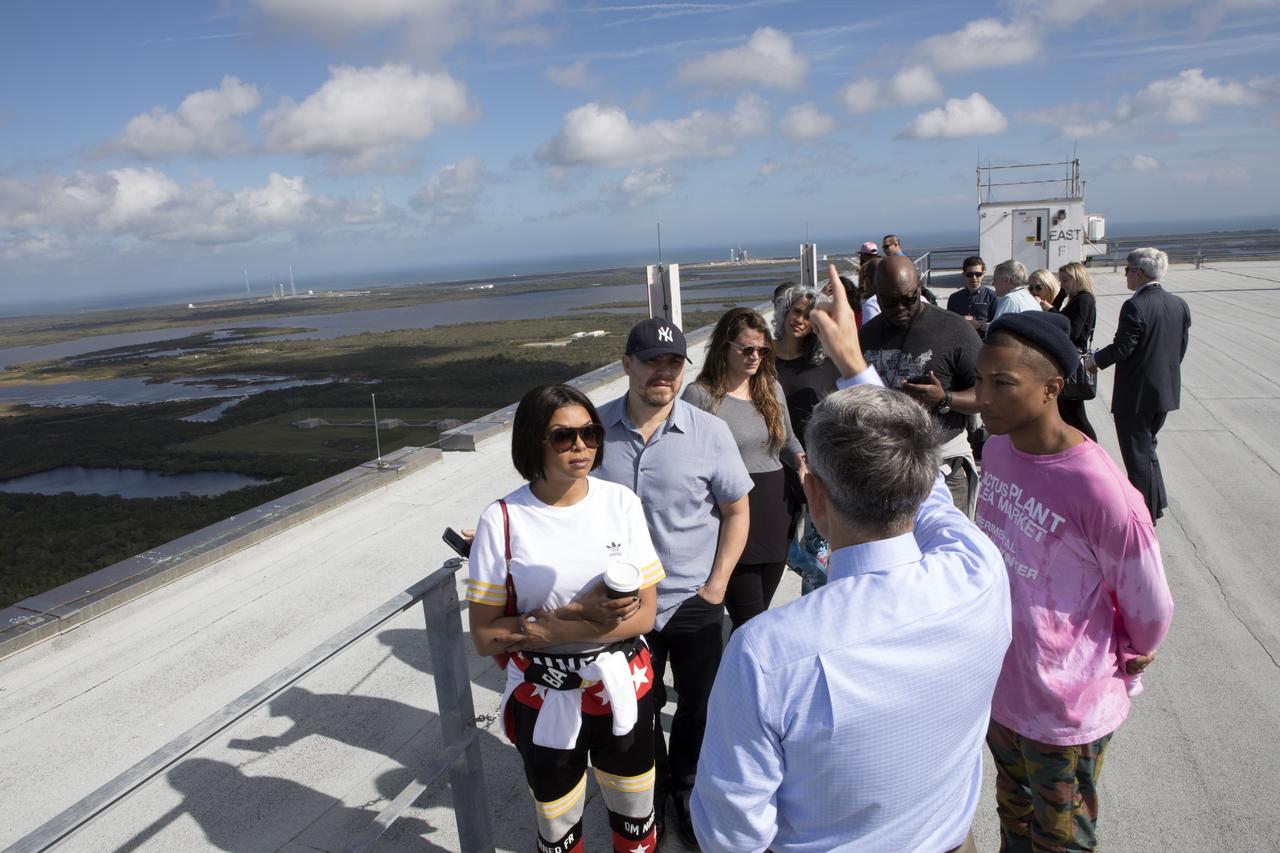
During a tour for cast and crew members of the upcoming motion picture "Hidden Figures," Kennedy Space Center Director Bob Cabana describes the view from the roof of the Vehicle Assembly Building. The movie is based on the book of the same title, by Margot Lee Shetterly. It chronicles the lives of Katherine Johnson, Dorothy Vaughan and Mary Jackson, three African-American women who worked for NASA as human "computers.” Their mathematical calculations were crucial to the success of Project Mercury missions including John Glenn’s orbital flight aboard Friendship 7 in 1962. The film is due in theaters in January 2017.
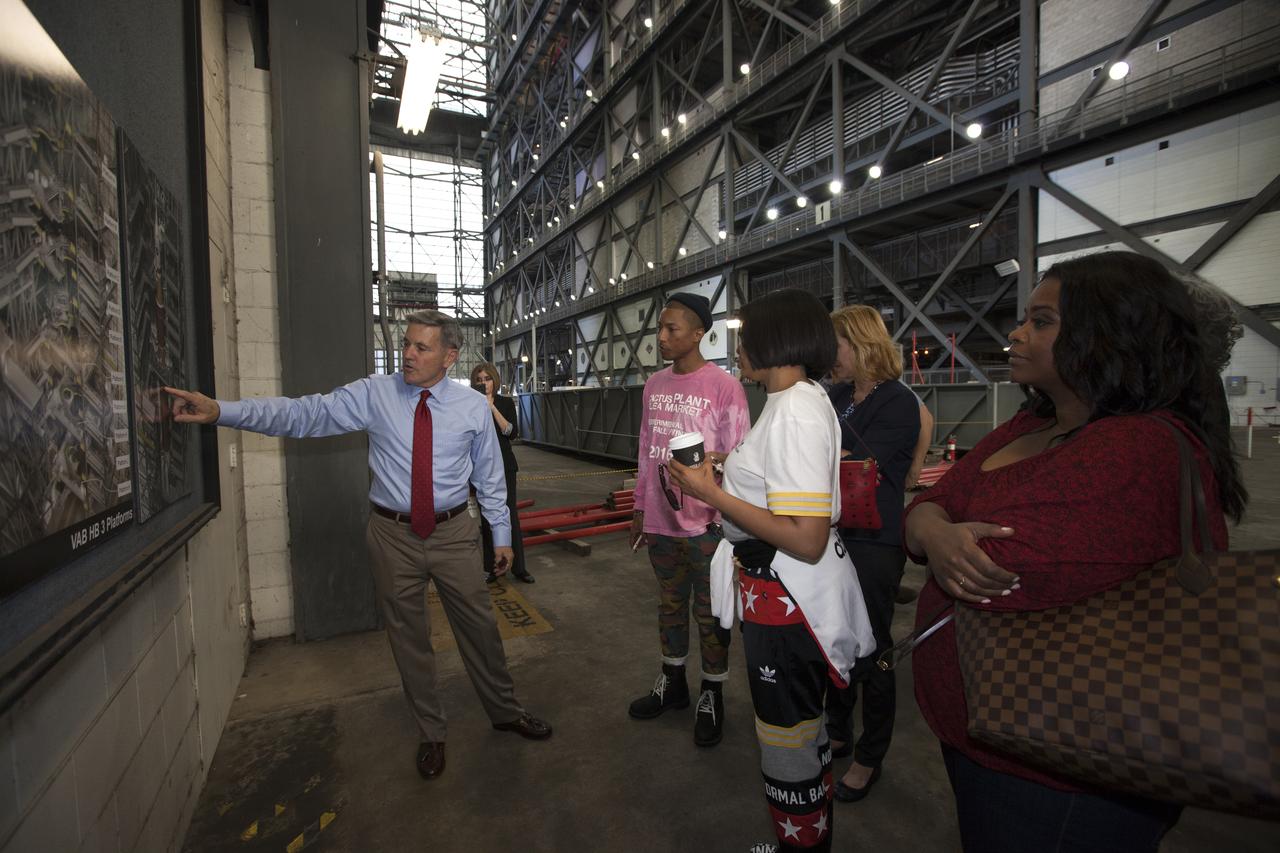
Kennedy Space Center Director Bob Cabana points to a display during a tour for cast and crew members of the upcoming motion picture "Hidden Figures." The group is walking thought the transfer aisle of the Vehicle Assembly Building. The movie is based on the book of the same title, by Margot Lee Shetterly. It chronicles the lives of Katherine Johnson, Dorothy Vaughan and Mary Jackson, three African-American women who worked for NASA as human "computers.” Their mathematical calculations were crucial to the success of Project Mercury missions including John Glenn’s orbital flight aboard Friendship 7 in 1962. The film is due in theaters in January 2017.
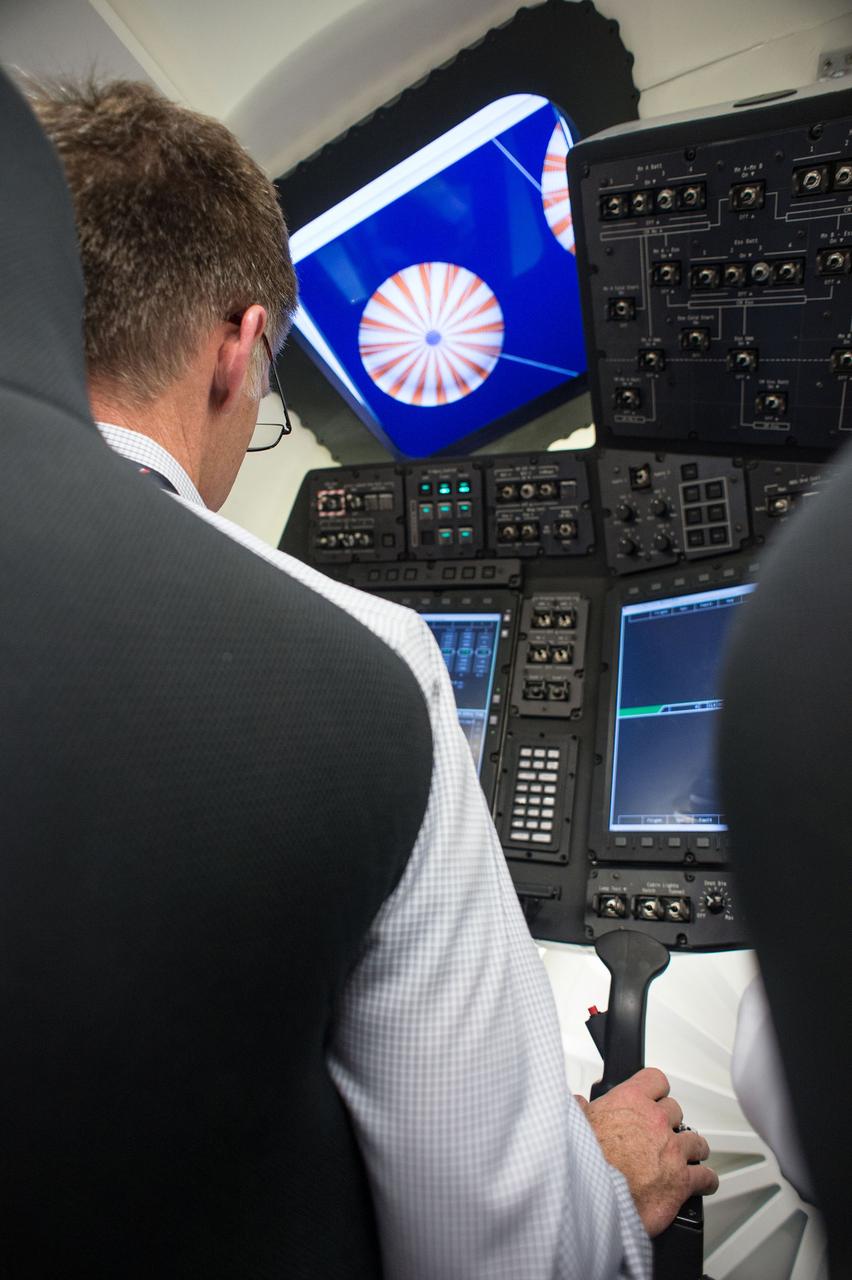
HOUSTON – Chris Ferguson, a former space shuttle commander who is now director of Crew and Mission Operations for Boeing Space Exploration, sits at the controls in the inside the company's CST-100 spacecraft simulator. Boeing demonstrated that the CST-100 software allows a human pilot to take over control of the spacecraft from the computer during all phases of a mission following separation from the launch vehicle. The pilot-in-the-loop demonstration at the Houston Product Support Center is a milestone under Boeing's Commercial Crew Integrated Capability agreement with the agency and its Commercial Crew Program. Photo credit: NASA/Bill Stafford
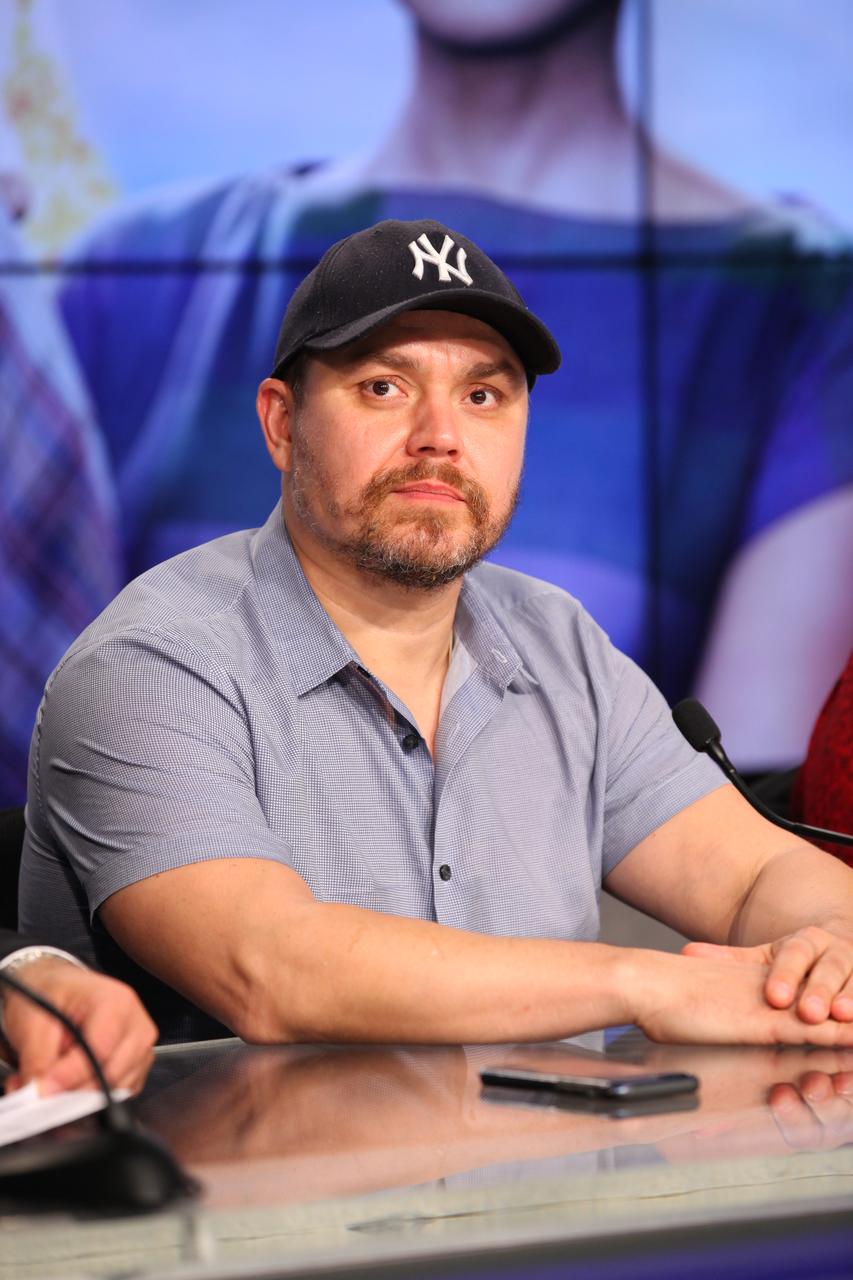
In the Press Site auditorium at the Kennedy Space Center in Florida, Ted Melfi, writer and director of the upcoming motion picture “Hidden Figures,” speaks to members of the media during a news conference with other key individuals involved in the upcoming motion picture. The movie is based on the book of the same title, by Margot Lee Shetterly. It chronicles the lives of Katherine Johnson, Dorothy Vaughan and Mary Jackson, three African-American women who worked for NASA as human "computers.” Their mathematical calculations were crucial to the success of Project Mercury missions including John Glenn’s orbital flight aboard Friendship 7 in 1962. The film is due in theaters in January 2017.
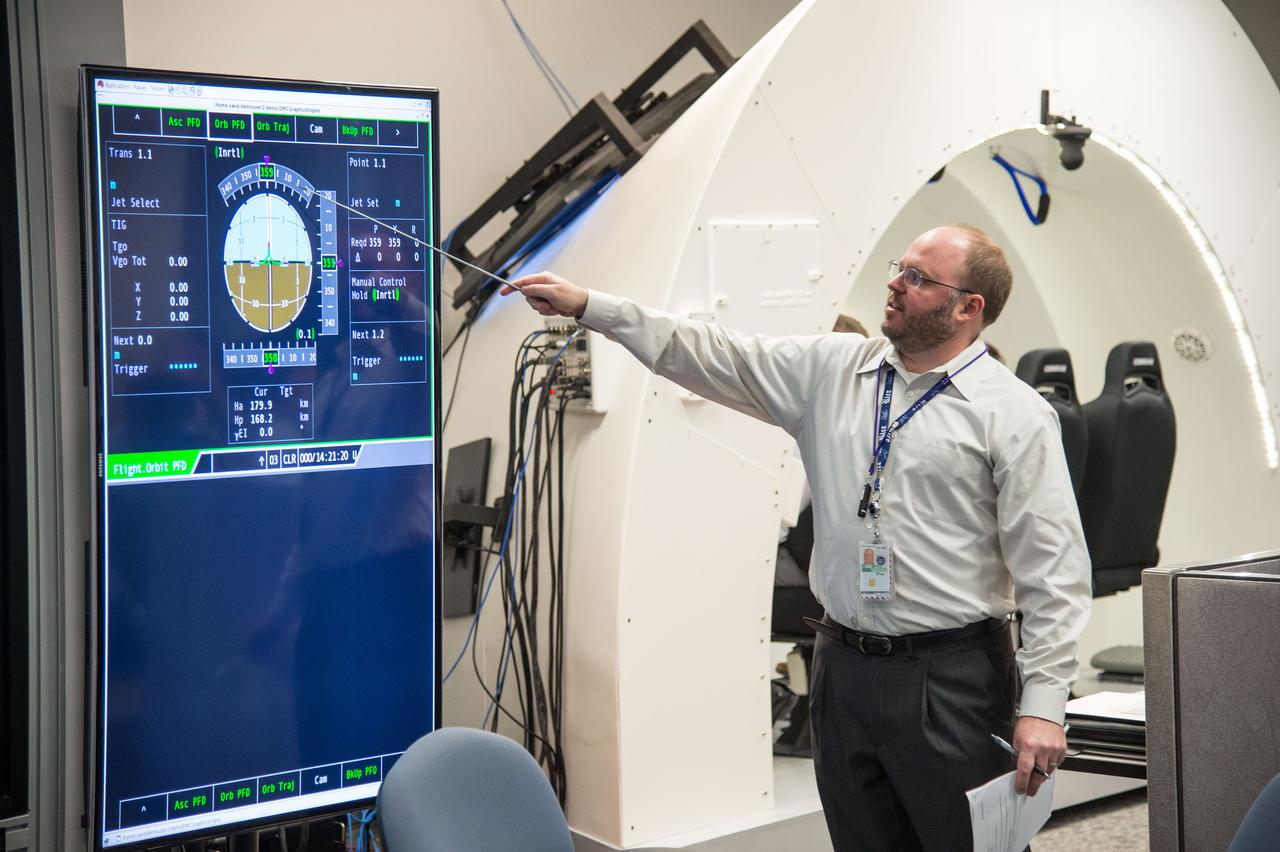
HOUSTON – An engineer with Boeing Space Exploration explains how to read the cockpit displays inside the company's CST-100 spacecraft simulator to NASA Commercial Crew Program engineers. Boeing demonstrated that the CST-100 software allows a human pilot to take over control of the spacecraft from the computer during all phases of a mission following separation from the launch vehicle. The pilot-in-the-loop demonstration at the Houston Product Support Center is a milestone under Boeing's Commercial Crew Integrated Capability agreement with the agency and its Commercial Crew Program. Photo credit: NASA_Bill Stafford
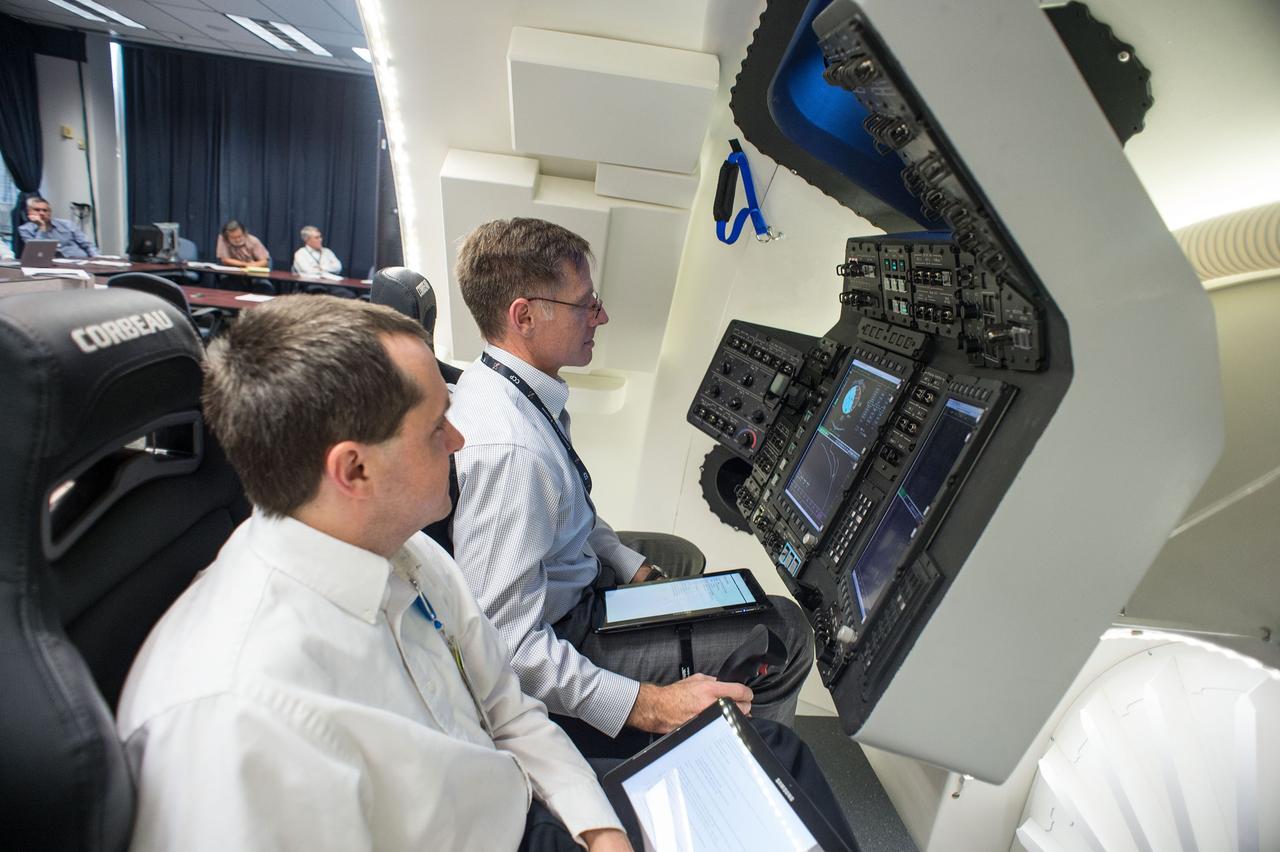
HOUSTON – Chris Ferguson, a former space shuttle commander who is now director of Crew and Mission Operations for Boeing Space Exploration, takes the controls inside the company's CST-100 spacecraft simulator. To Ferguson's right, an engineer observes the exercise. Boeing demonstrated that the CST-100's software allows a human pilot to take over control of the spacecraft from the computer during all phases of a mission following separation from the launch vehicle. The pilot-in-the-loop demonstration at the Houston Product Support Center is a milestone under Boeing's Commercial Crew Integrated Capability agreement with the agency and its Commercial Crew Program. Photo credit: NASA/Bill Stafford
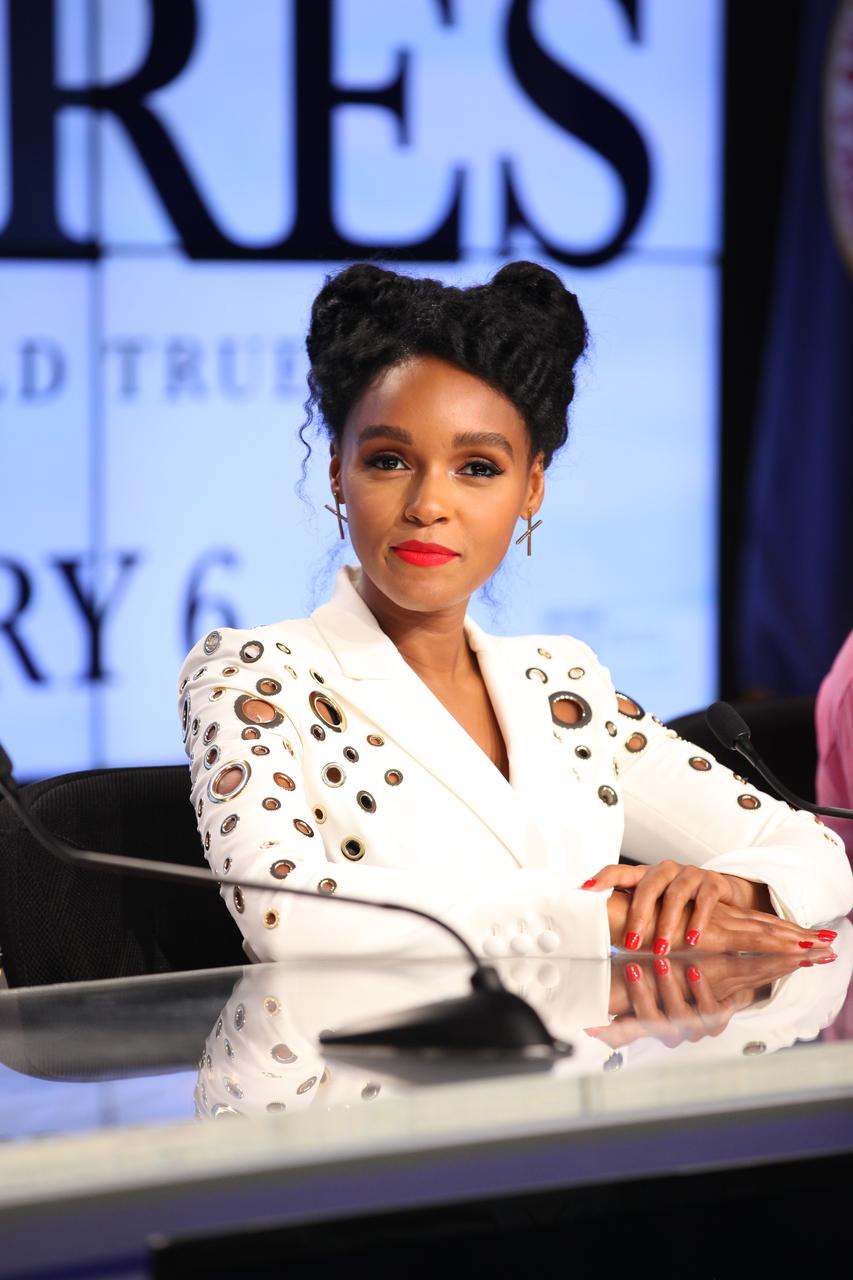
In the Press Site auditorium at the Kennedy Space Center in Florida, Janelle Monáe, speaks to members of the media during a news conference with other key individuals involved in the upcoming motion picture "Hidden Figures." The movie is based on the book of the same title, by Margot Lee Shetterly. It chronicles the lives of Katherine Johnson, Dorothy Vaughan and Mary Jackson (portrayed by Monáe), three African-American women who worked for NASA as human "computers.” Their mathematical calculations were crucial to the success of Project Mercury missions including John Glenn’s orbital flight aboard Friendship 7 in 1962. The film is due in theaters in January 2017.
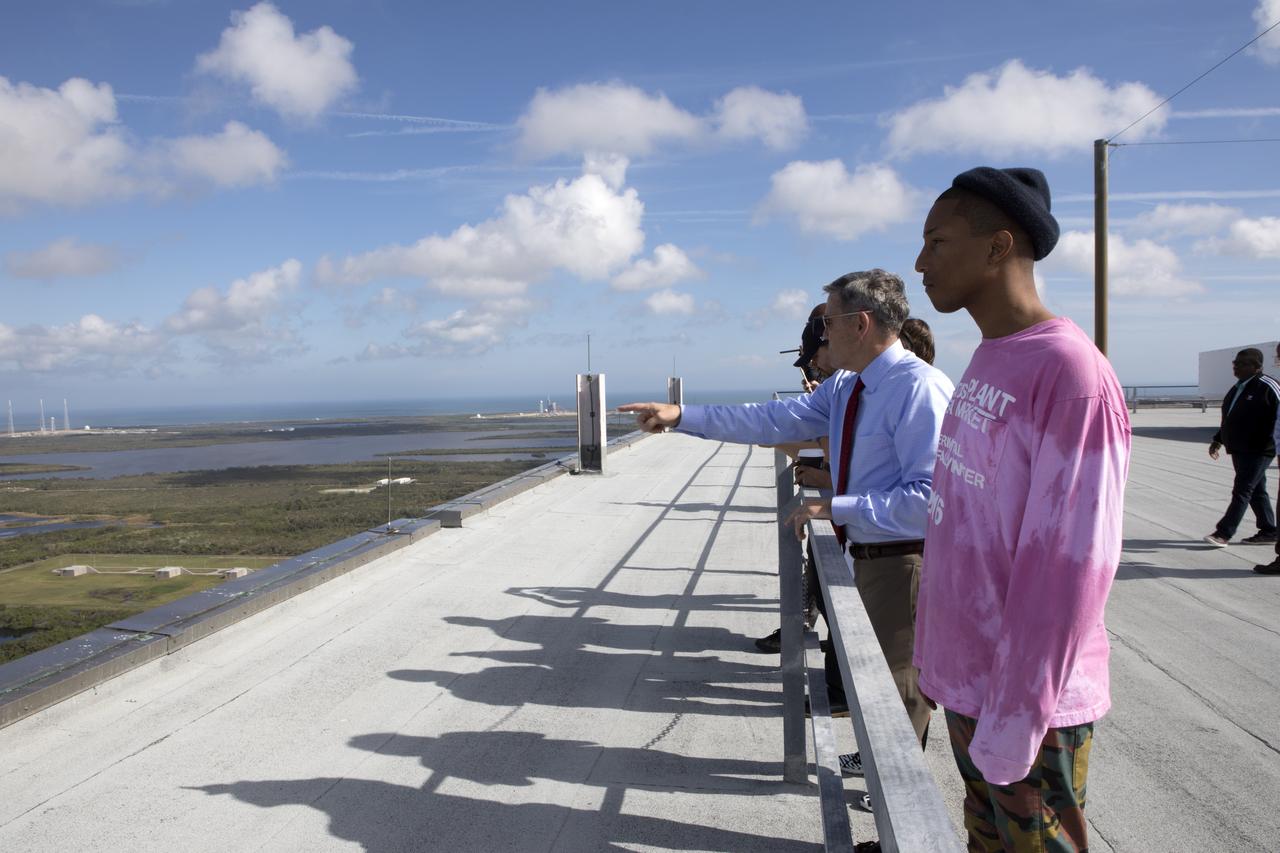
During a tour for cast and crew members of the upcoming motion picture "Hidden Figures," Kennedy Space Center Director Bob Cabana points to Launch Pads 39A and 39B from the roof of the Vehicle Assembly Building. In the foreground is Pharrell Williams, musician and producer of “Hidden Figures." The movie is based on the book of the same title, by Margot Lee Shetterly. It chronicles the lives of Katherine Johnson, Dorothy Vaughan and Mary Jackson, three African-American women who worked for NASA as human "computers.” Their mathematical calculations were crucial to the success of Project Mercury missions including John Glenn’s orbital flight aboard Friendship 7 in 1962. The film is due in theaters in January 2017.
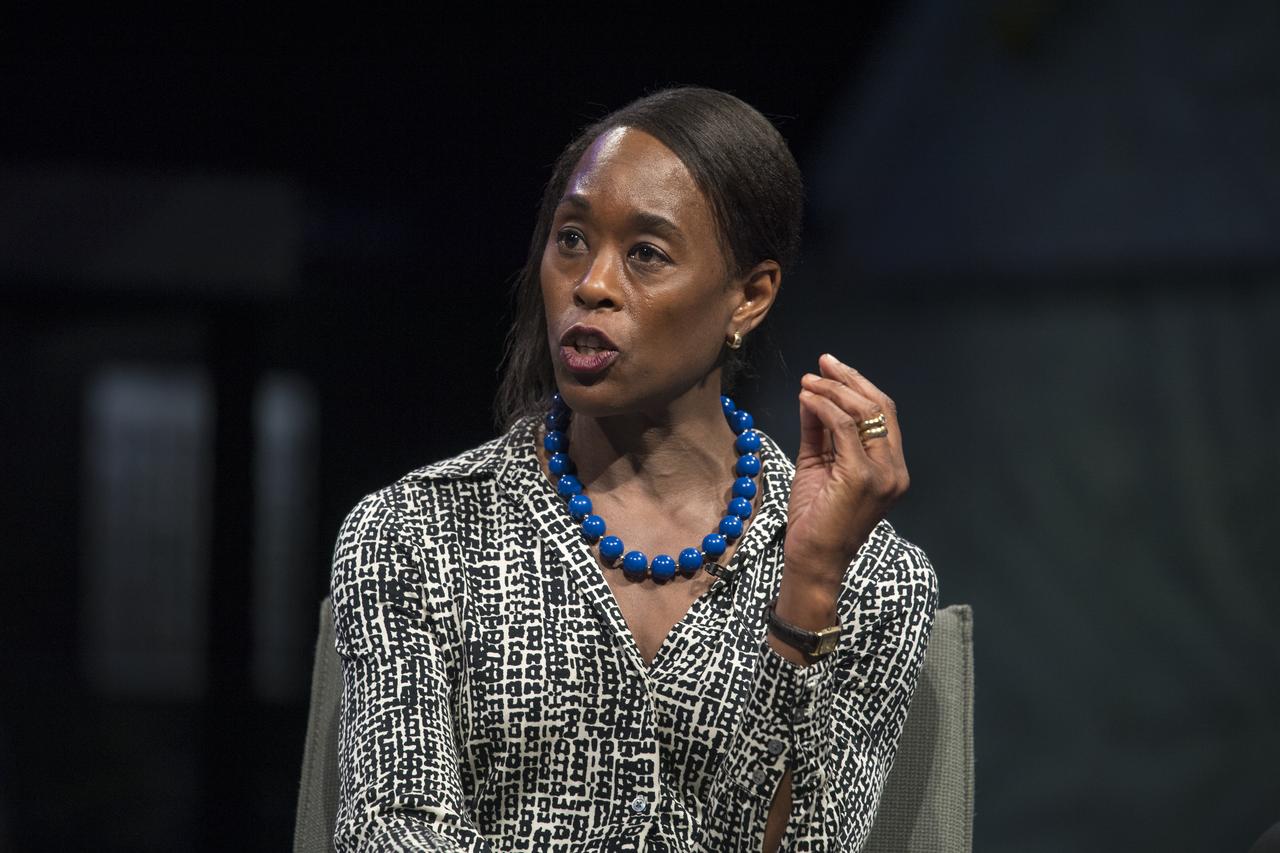
"Hidden Figures" author, Margot Lee Shetterly speaks during a "Hidden Figures" panel discussion with NASA human computer Christine Darden, and Marty Kelsey and Beth Wilson of STEM in 30, Wednesday, June 12, 2019 at the Smithsonian National Air and Space Museum in Washington. The panel discussion took place after a ceremony dedicating the 300 block of E Street SW as "Hidden Figures Way" to honor Katherine Johnson, Dorthy Vaughan, Mary Jackson and all of the women who have dedicated their lives to honorably serving their country, advancing equality, and contributing to the space program of the United States. Photo Credit: (NASA/Aubrey Gemignani)
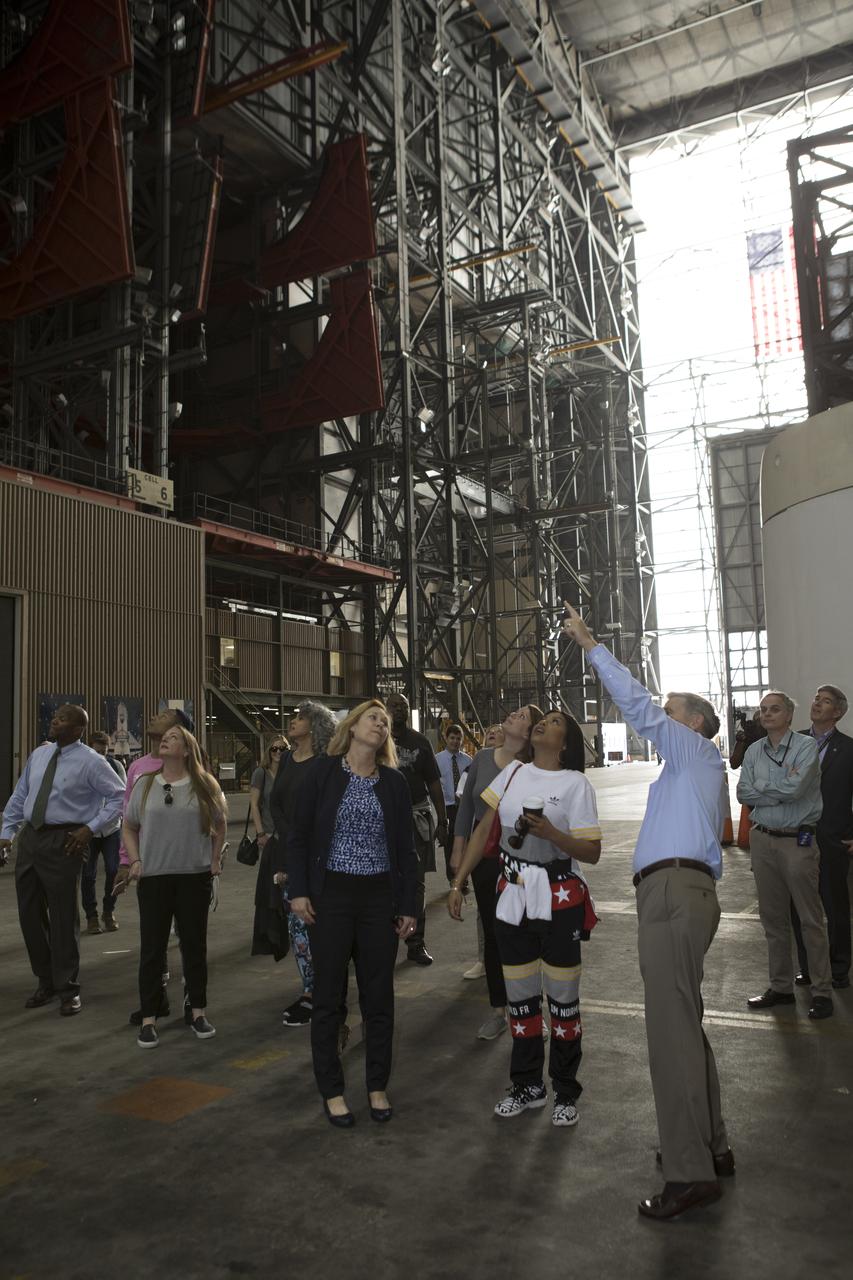
Kennedy Space Center Director Bob Cabana (pointing) provides a tour for cast and crew members of the upcoming motion picture "Hidden Figures." The group is walking thought the transfer aisle of the Vehicle Assembly Building. The movie is based on the book of the same title, by Margot Lee Shetterly. It chronicles the lives of Katherine Johnson, Dorothy Vaughan and Mary Jackson, three African-American women who worked for NASA as human "computers.” Their mathematical calculations were crucial to the success of Project Mercury missions including John Glenn’s orbital flight aboard Friendship 7 in 1962. The film is due in theaters in January 2017.
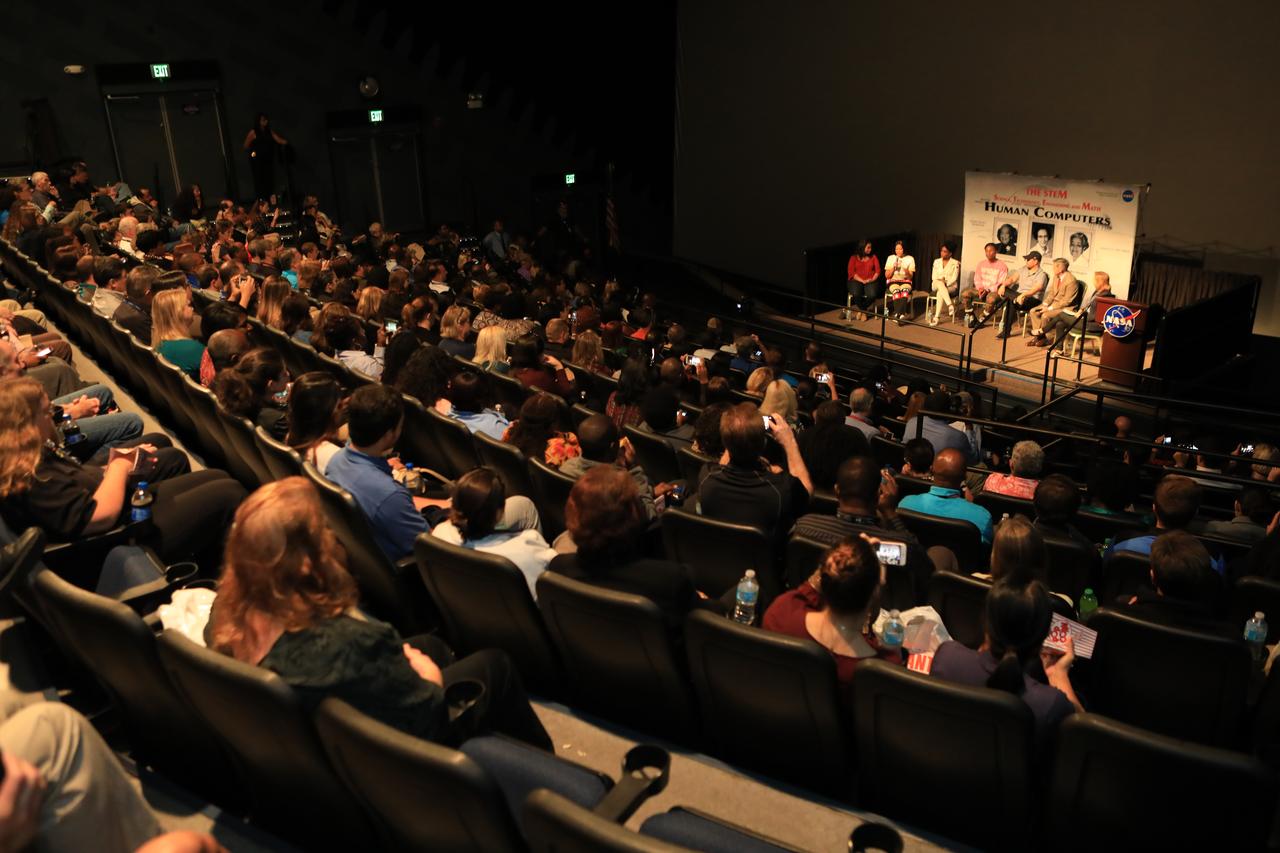
In the IMAX Theater of the Kennedy Space Center Visitor Complex Cast and crew members of the upcoming motion picture "Hidden Figures" participate in a question and answer session. The movie is based on the book of the same title, by Margot Lee Shetterly. It chronicles the lives of Katherine Johnson, Dorothy Vaughan and Mary Jackson, three African-American women who worked for NASA as human "computers.” Their mathematical calculations were crucial to the success of Project Mercury missions including John Glenn’s orbital flight aboard Friendship 7 in 1962. The film is due in theaters in January 2017.
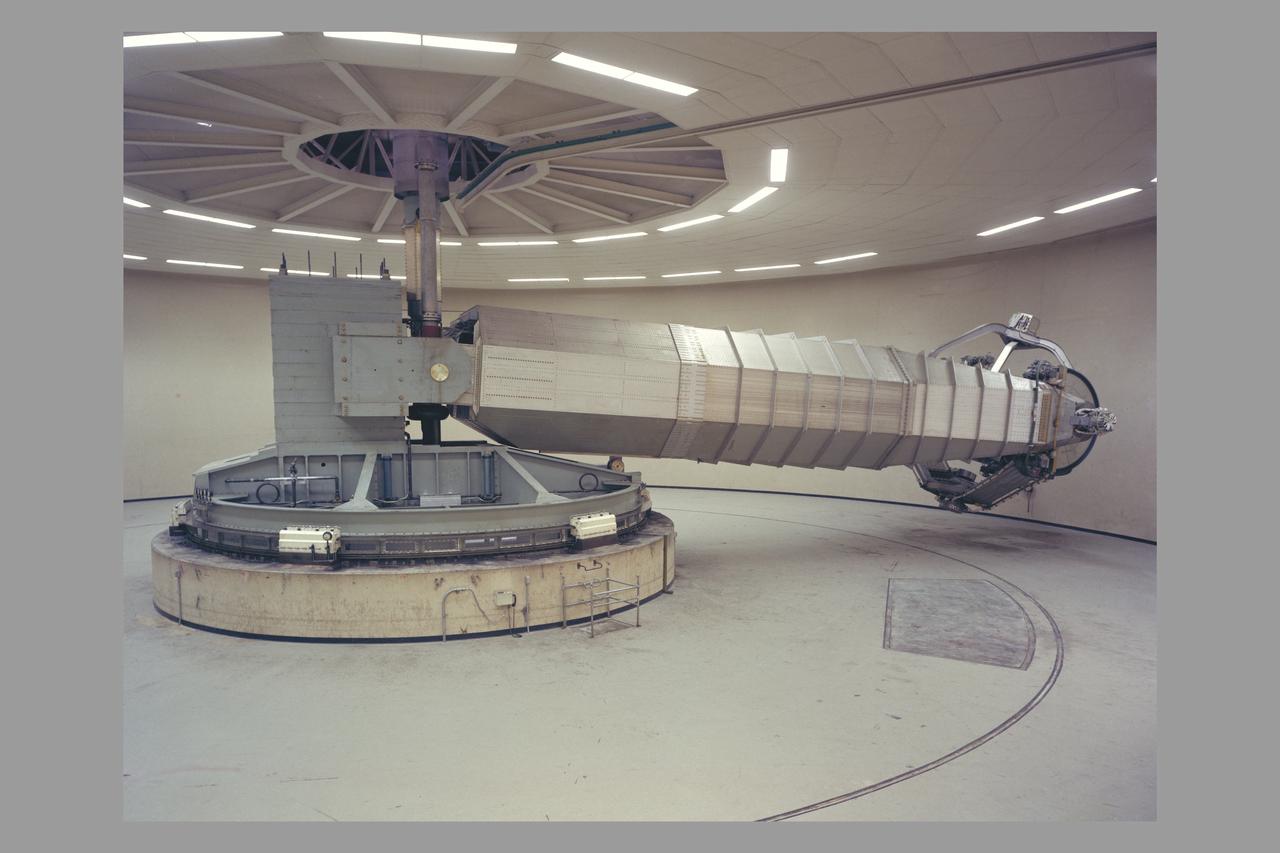
N-243 Flight and Guidance Centrifuge: Is used for spacecraft mission simulations and is adaptable to two configurations. Configuration 1: The cab will accommodate a three-man crew for space mission research. The accelerations and rates are intended to be smoothly applicable at very low value so the navigation and guidance procedures using a high-accuracy, out-the window display may be simulated. Configuration 2: The simulator can use a one-man cab for human tolerance studies and performance testing. Atmosphere and tempertaure can be varied as stress inducements. This simlator is operated closed-loop with digital or analog computation. It is currently man-rated for 3.5g maximum.

Kennedy Space Center Director Bob Cabana speaks cast and crew members of the upcoming motion picture "Hidden Figures" outside the Vehicle Assembly Building. From the left are Pharrell Williams, musician and producer of “Hidden Figures," Taraji P. Henson, who portrays Katherine Johnson in the film and Cabana. The movie is based on the book of the same title, by Margot Lee Shetterly. It chronicles the lives of Katherine Johnson, Dorothy Vaughan and Mary Jackson, three African-American women who worked for NASA as human "computers.” Their mathematical calculations were crucial to the success of Project Mercury missions including John Glenn’s orbital flight aboard Friendship 7 in 1962. The film is due in theaters in January 2017.
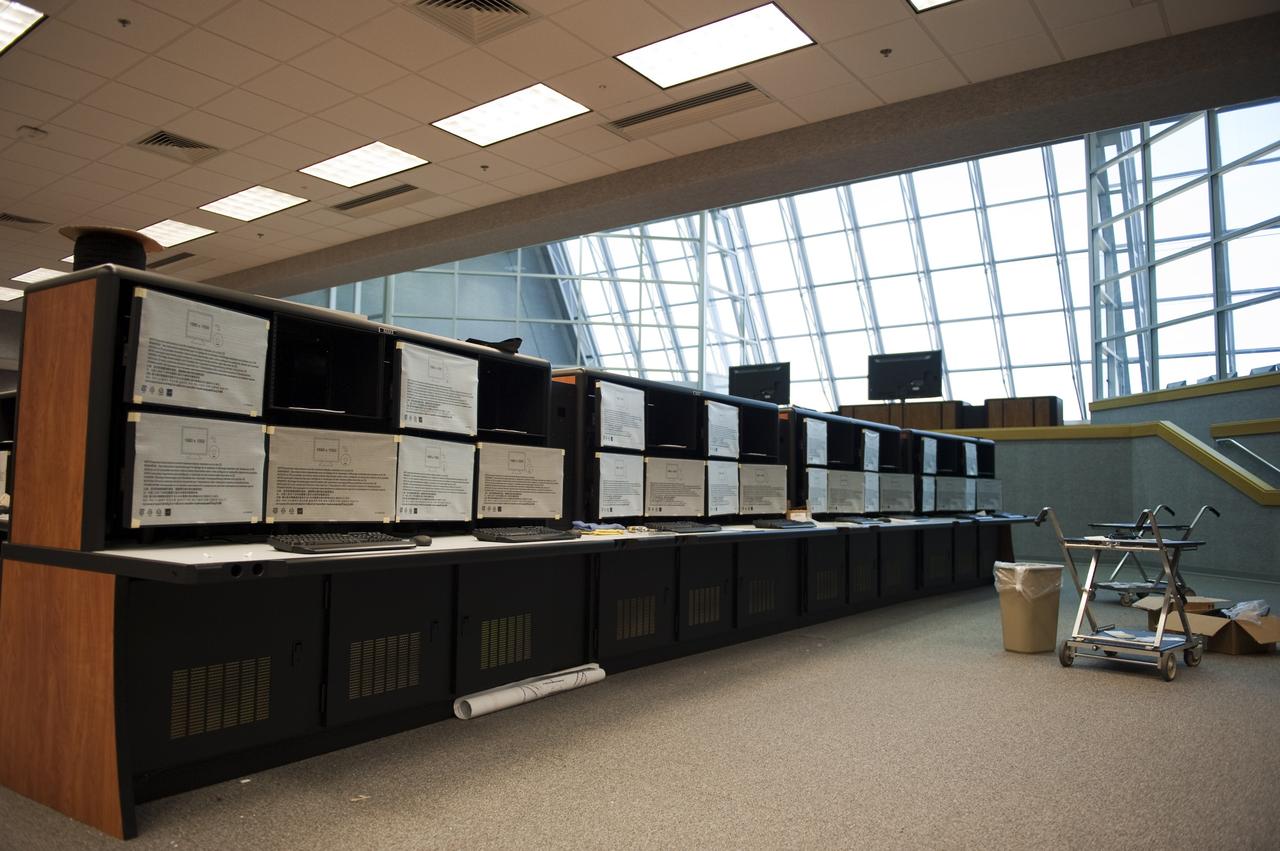
CAPE CANAVERAL, Fla. -- At NASA's Kennedy Space Center in Florida, remodeling for launches of future human spaceflight vehicles continues in the Launch Control Center's Young-Crippen Firing Room. Consoles already have been rewired for the comprehensive upgrade and are now being outfitted with new computers and monitors. Known as Firing Room 1 in the Apollo era, it was re-named as a tribute to the Space Shuttle Program's first crewed mission, STS-1, which was flown by Commander John Young and Pilot Robert Crippen in April 1981. The firing room most recently was set up to support the Ares I-X flight test in Oct. 2009. Photo credit: NASA/Kim Shiflett

In the Press Site auditorium at the Kennedy Space Center in Florida, Taraji P. Henson speaks to members of the media during a news conference with other key individuals involved in the upcoming motion picture "Hidden Figures." The movie is based on the book of the same title, by Margot Lee Shetterly. It chronicles the lives of Katherine Johnson (played by Henson), Dorothy Vaughan and Mary Jackson, three African-American women who worked for NASA as human "computers.” Their mathematical calculations were crucial to the success of Project Mercury missions including John Glenn’s orbital flight aboard Friendship 7 in 1962. The film is due in theaters in January 2017.
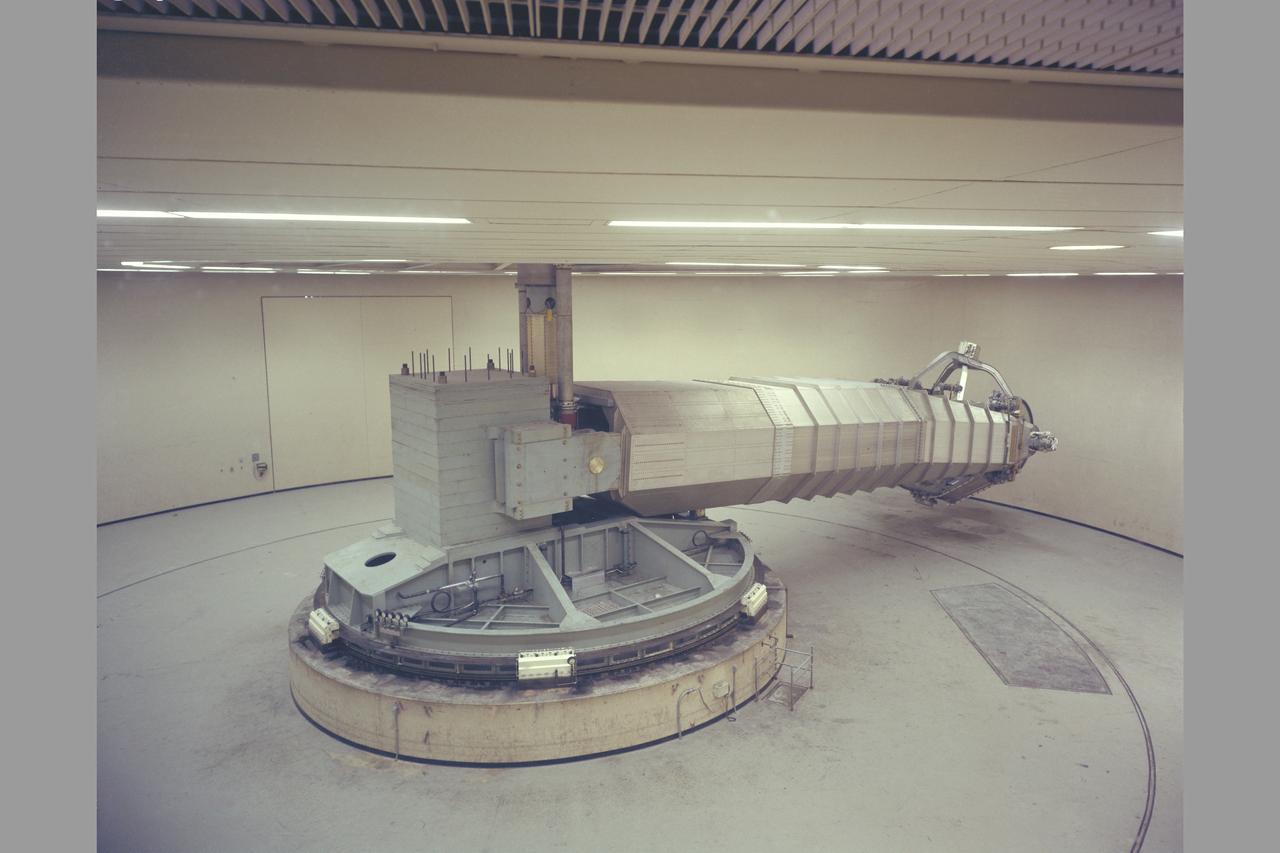
N-243 Flight and Guidance Centrifuge: Is used for spacecraft mission simulations and is adaptable to two configurations. Configuration 1: The cab will accommodate a three-man crew for space mission research. The accelerations and rates are intended to be smoothly applicable at very low value so the navigation and guidance procedures using a high-accuracy, out-the window display may be simulated. Configuration 2: The simulator can use a one-man cab for human tolerance studies and performance testing. Atmosphere and tempertaure can be varied as stress inducements. This simlator is operated closed-loop with digital or analog computation. It is currently man-rated for 3.5g maximum.
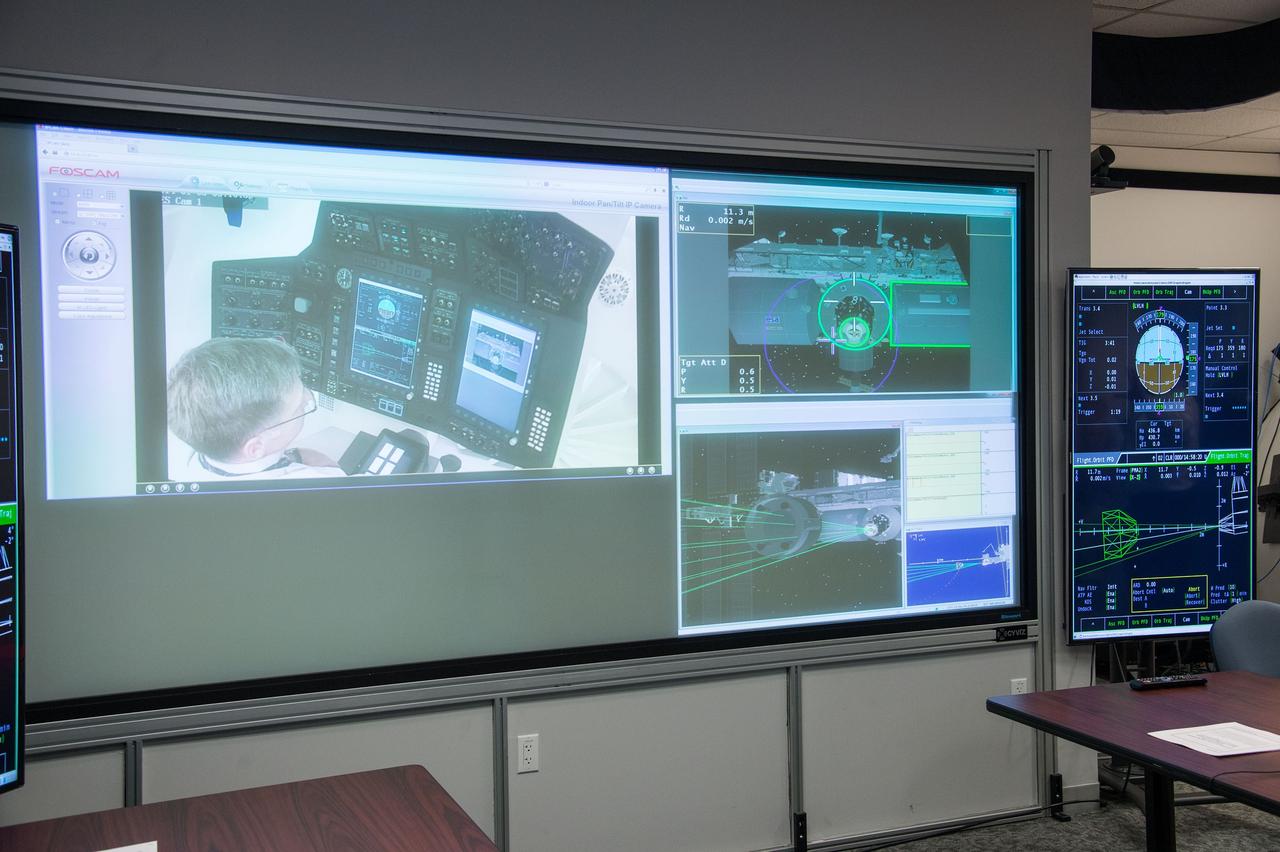
HOUSTON – Monitors show Chris Ferguson, a former space shuttle commander who is now director of Crew and Mission Operations for Boeing Space Exploration, at the controls in the inside the company's CST-100 spacecraft simulator. Boeing demonstrated that the CST-100 software allows a human pilot to take over control of the spacecraft from the computer during all phases of a mission following separation from the launch vehicle. The pilot-in-the-loop demonstration at the Houston Product Support Center is a milestone under Boeing's Commercial Crew Integrated Capability agreement with the agency and its Commercial Crew Program. Photo credit: NASA/Bill Stafford
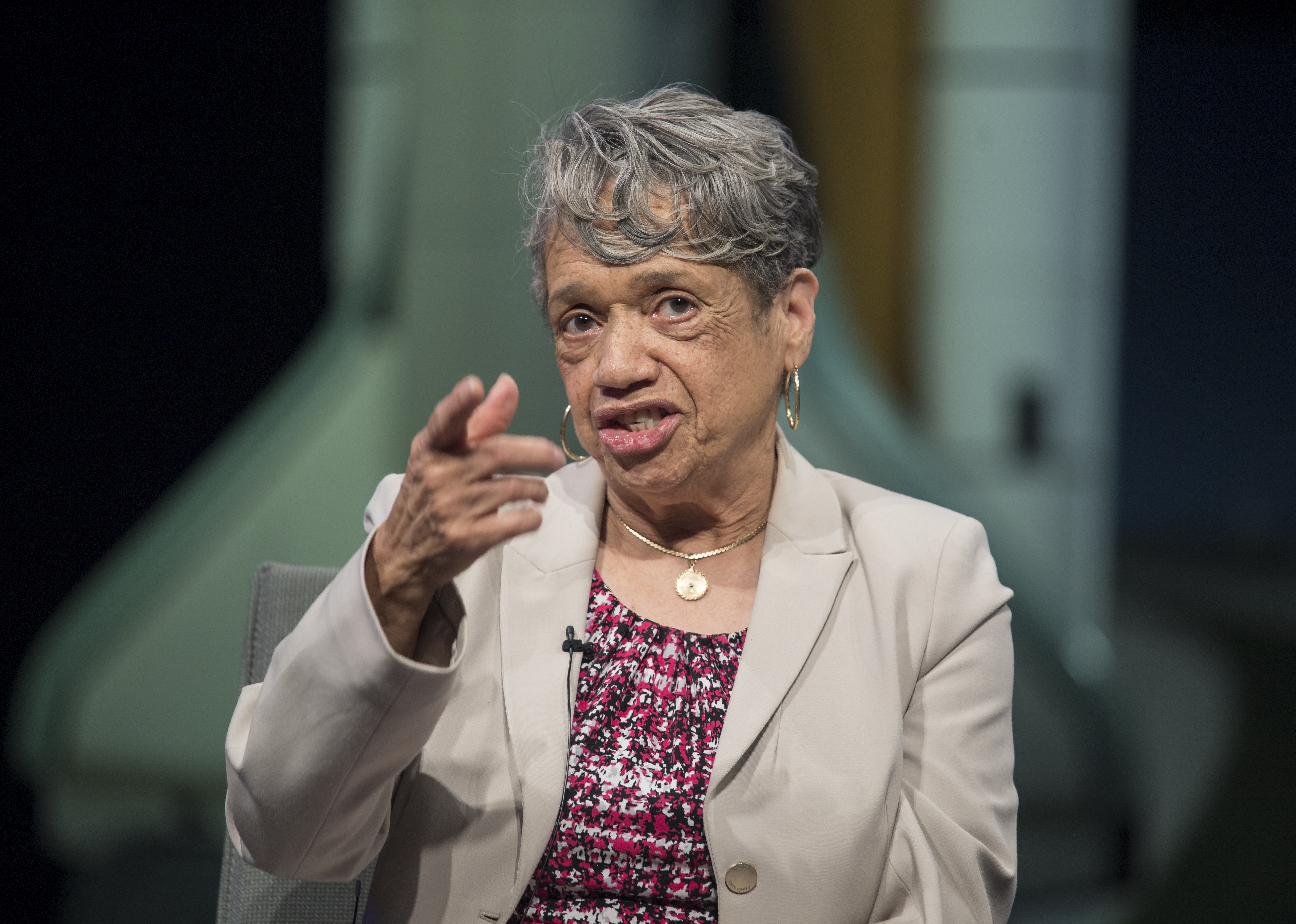
NASA human computer Christine Darden speaks during a "Hidden Figures" panel discussion with "Hidden Figures" author, Margot Lee Shetterly, and Marty Kelsey and Beth Wilson of STEM in 30, Wednesday, June 12, 2019 at the Smithsonian National Air and Space Museum in Washington. The panel discussion took place after a ceremony dedicating the 300 block of E Street SW as "Hidden Figures Way" to honor Katherine Johnson, Dorthy Vaughan, Mary Jackson and all of the women who have dedicated their lives to honorably serving their country, advancing equality, and contributing to the space program of the United States. Photo Credit: (NASA/Aubrey Gemignani)
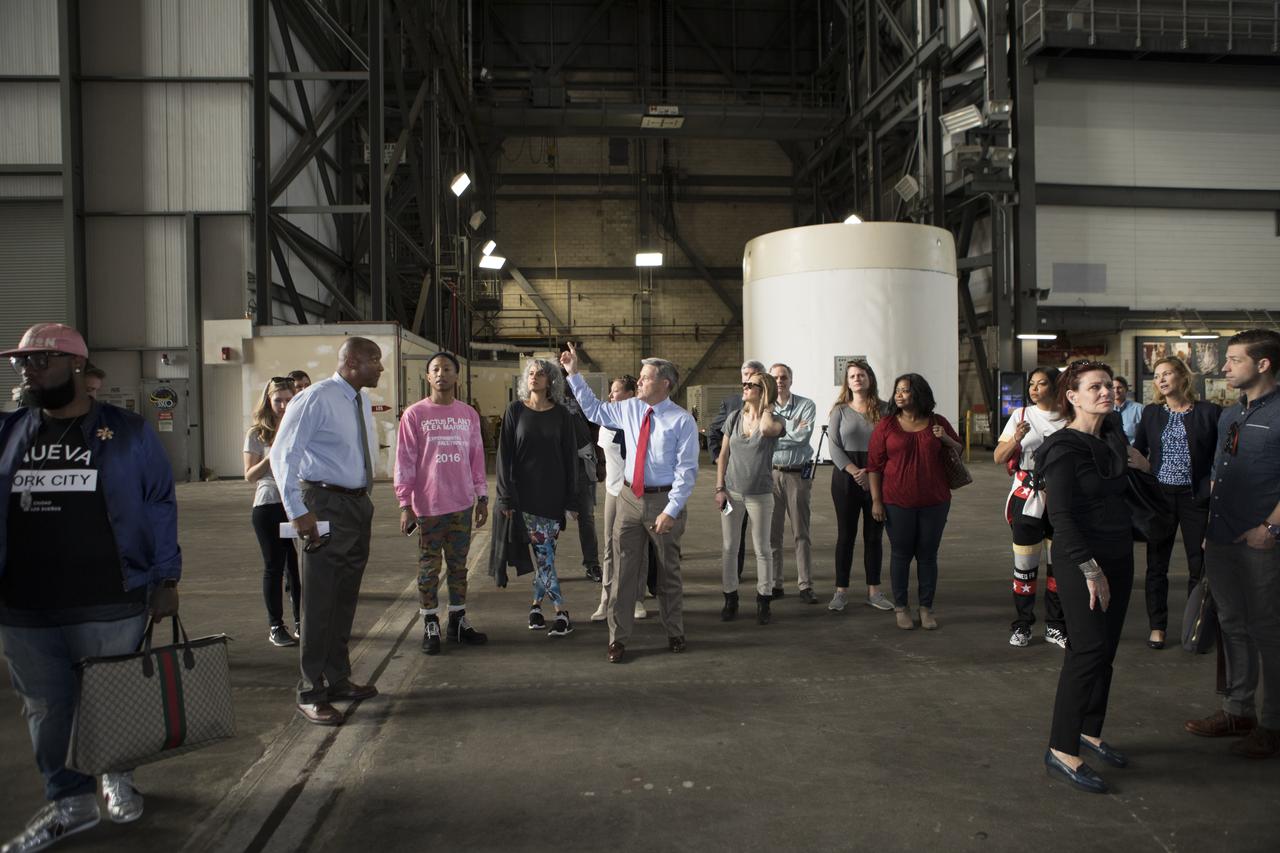
Kennedy Space Center Director Bob Cabana (center pointing to the left) provides a tour for cast and crew members of the upcoming motion picture "Hidden Figures." The group is walking thought the transfer aisle of the Vehicle Assembly Building. The movie is based on the book of the same title, by Margot Lee Shetterly. It chronicles the lives of Katherine Johnson, Dorothy Vaughan and Mary Jackson, three African-American women who worked for NASA as human "computers.” Their mathematical calculations were crucial to the success of Project Mercury missions including John Glenn’s orbital flight aboard Friendship 7 in 1962. The film is due in theaters in January 2017.
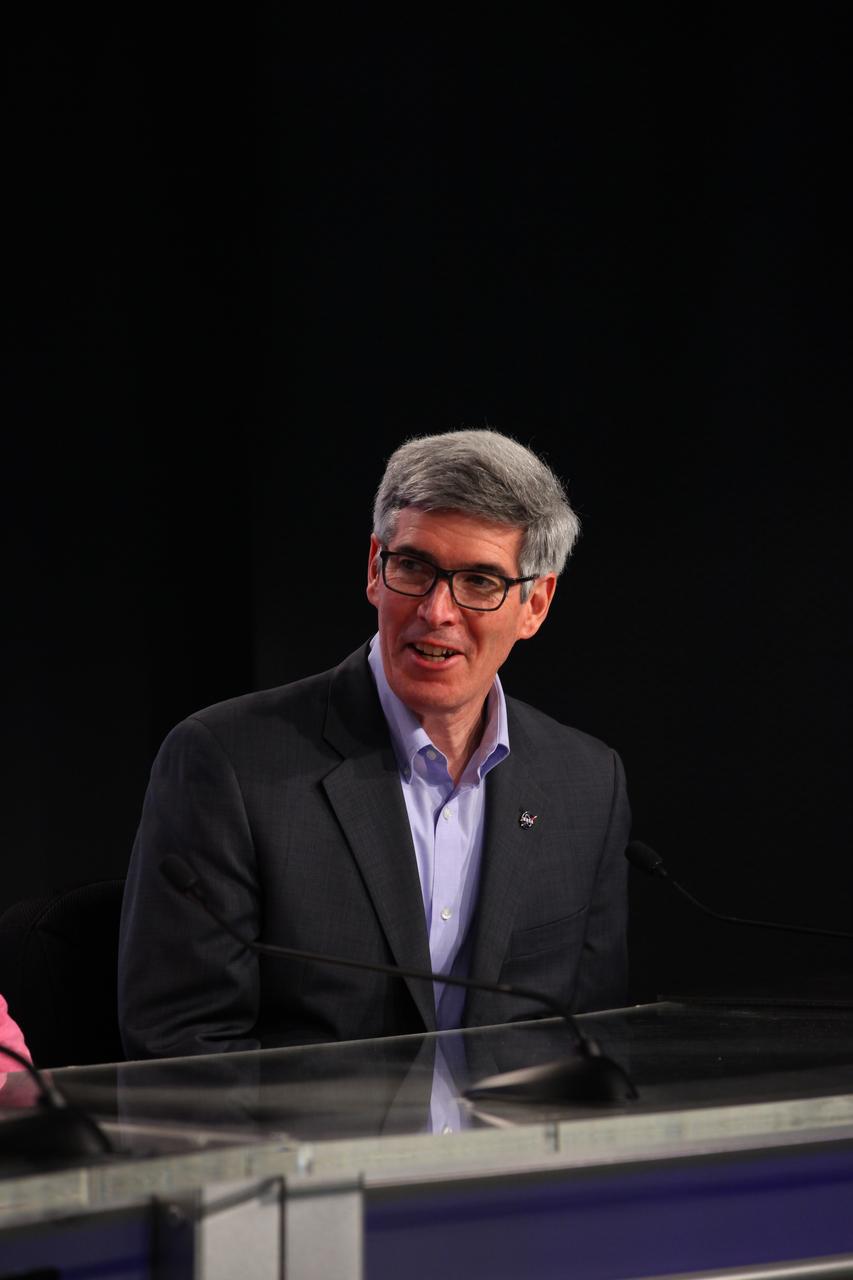
In the Press Site auditorium at the Kennedy Space Center in Florida, Bill Barry, NASA's chief historian, speaks to members of the media during a a news conference with key individuals involved in the upcoming motion picture "Hidden Figures." The movie is based on the book of the same title, by Margot Lee Shetterly. It chronicles the lives of Katherine Johnson, Dorothy Vaughan and Mary Jackson, three African-American women who worked for NASA as human "computers.” Their mathematical calculations were crucial to the success of Project Mercury missions including John Glenn’s orbital flight aboard Friendship 7 in 1962. The film is due in theaters in January 2017.
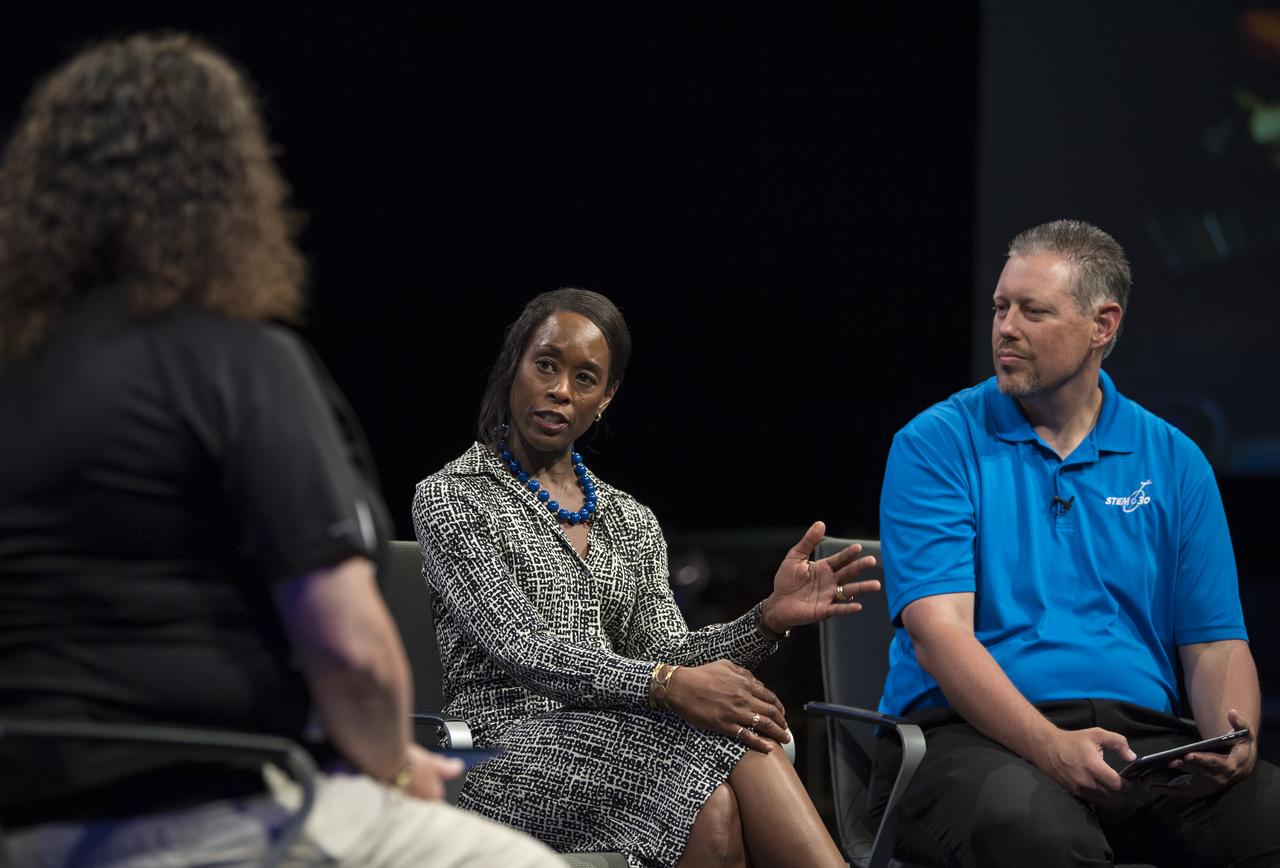
"Hidden Figures" author, Margot Lee Shetterly speaks during a "Hidden Figures" panel discussion with NASA human computer Christine Darden, Marty Kelsey, right, and Beth Wilson, left, of STEM in 30, Wednesday, June 12, 2019 at the Smithsonian National Air and Space Museum in Washington. The panel discussion took place after a ceremony dedicating the 300 block of E Street SW as "Hidden Figures Way" to honor Katherine Johnson, Dorthy Vaughan, Mary Jackson and all of the women who have dedicated their lives to honorably serving their country, advancing equality, and contributing to the space program of the United States. Photo Credit: (NASA/Aubrey Gemignani)
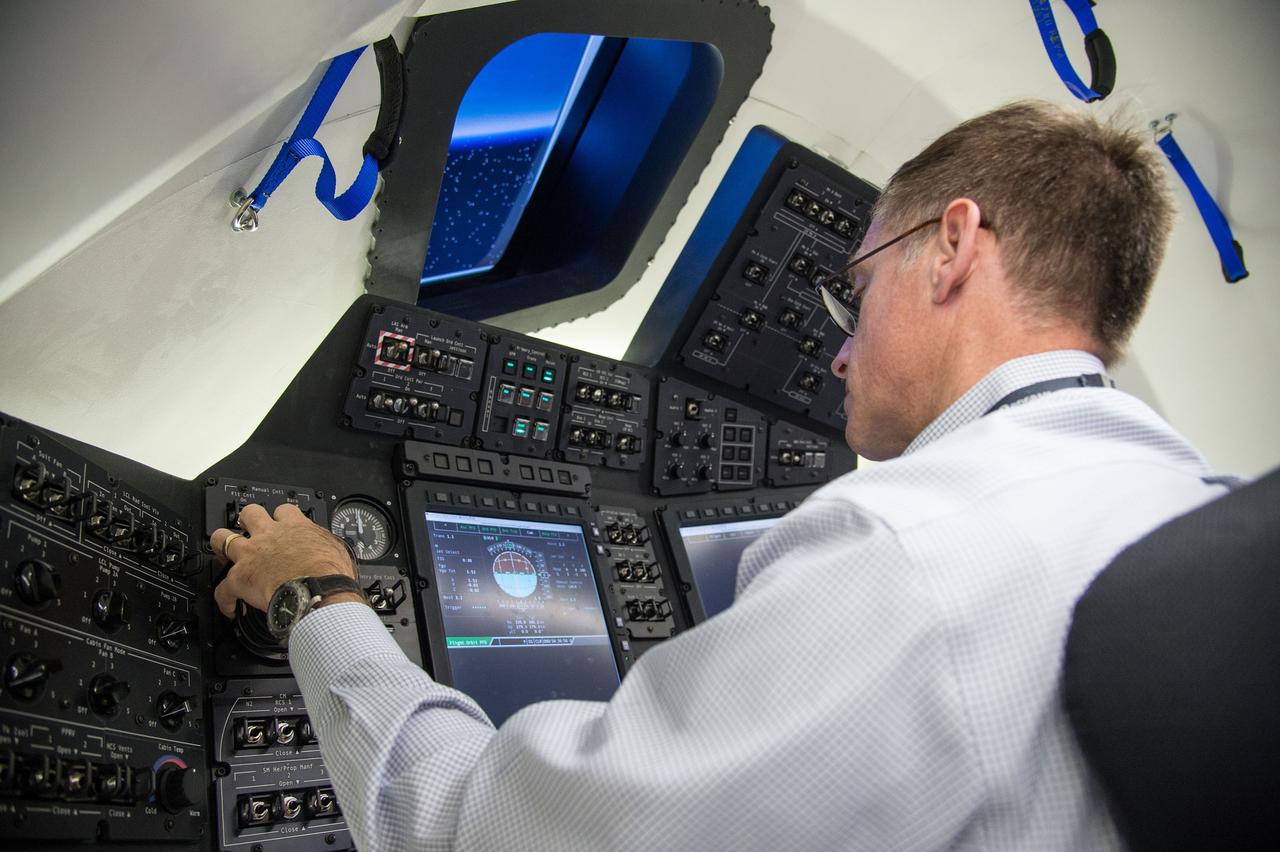
HOUSTON - Chris Ferguson, a former space shuttle commander who is now director of Crew and Mission Operations for Boeing Space Exploration, sits at the controls in the inside the company's CST-100 spacecraft simulator. Boeing demonstrated that the CST-100 software allows a human pilot to take over control of the spacecraft from the computer during all phases of a mission following separation from the launch vehicle. The pilot-in-the-loop demonstration at the Houston Product Support Center is a milestone under Boeing's Commercial Crew Integrated Capability agreement with the agency and its Commercial Crew Program. Photo credit: NASA/Bill Stafford
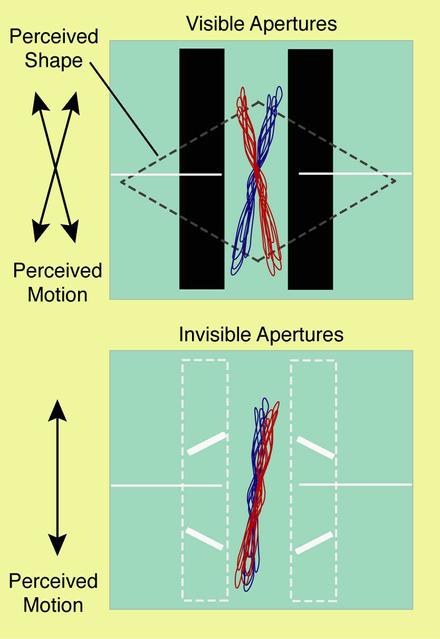
One concern about human adaptation to space is how returning from the microgravity of orbit to Earth can affect an astronaut's ability to fly safely. There are monitors and infrared video cameras to measure eye movements without having to affect the crew member. A computer screen provides moving images which the eye tracks while the brain determines what it is seeing. A video camera records movement of the subject's eyes. Researchers can then correlate perception and response. Test subjects perceive different images when a moving object is covered by a mask that is visible or invisible (above). Early results challenge the accepted theory that smooth pursuit -- the fluid eye movement that humans and primates have -- does not involve the higher brain. NASA results show that: Eye movement can predict human perceptual performance, smooth pursuit and saccadic (quick or ballistic) movement share some signal pathways, and common factors can make both smooth pursuit and visual perception produce errors in motor responses.
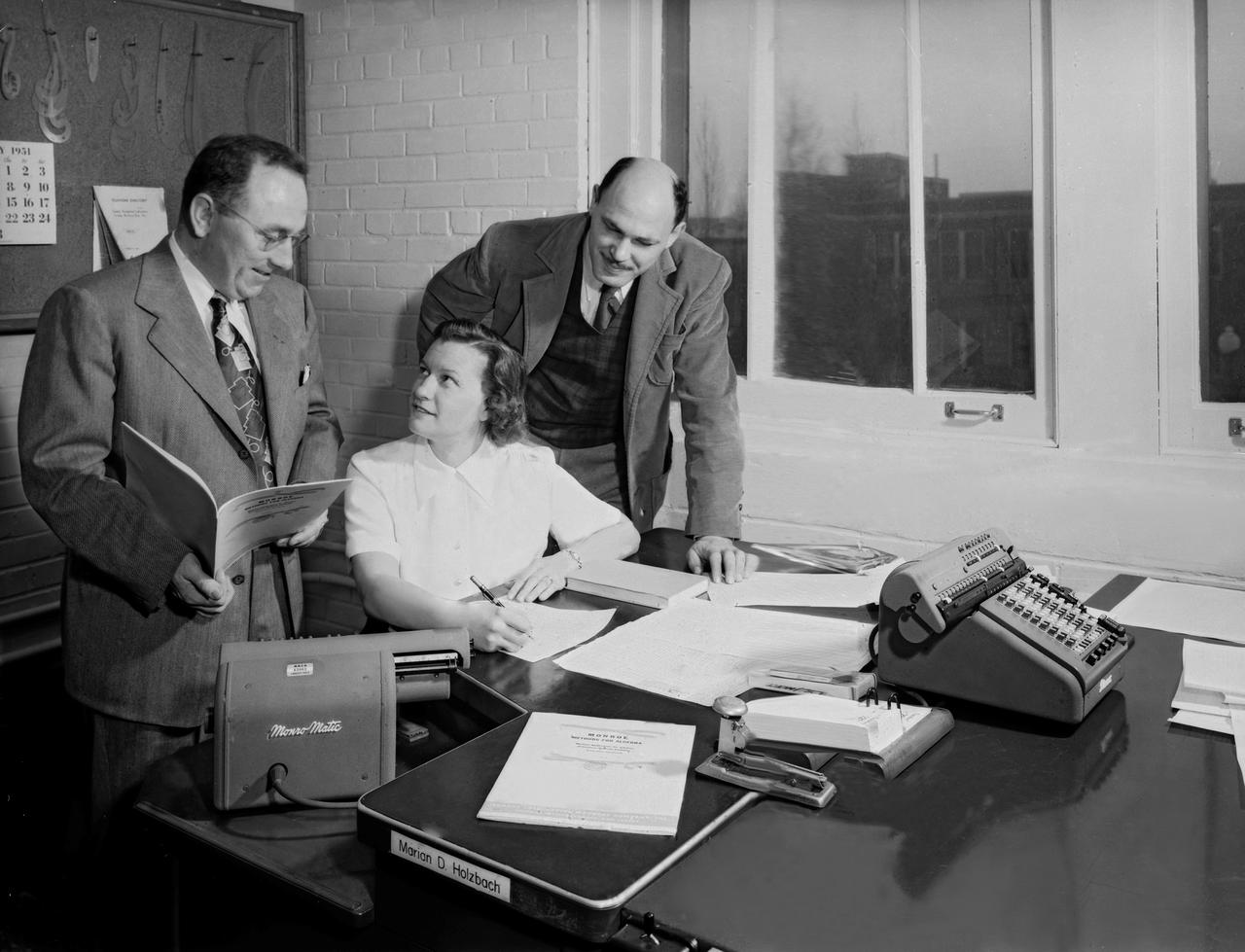
NACA Laboratory Computers Help Compile Handbook: ''Monroe Methods for Algebra, " a new booklet describing short-cuts that can be used in solving frequently-used algebraic formulas with a calculating machine, is undergoing its first trial at the hands of Laboratory computers. Several Monro-matics were purchased recently by NACA. NACA Air Scoop August 17,1951 Page 4. People on the photos re W.H. Rankins, David M. Goldenbaum and Marian D. Holzbach
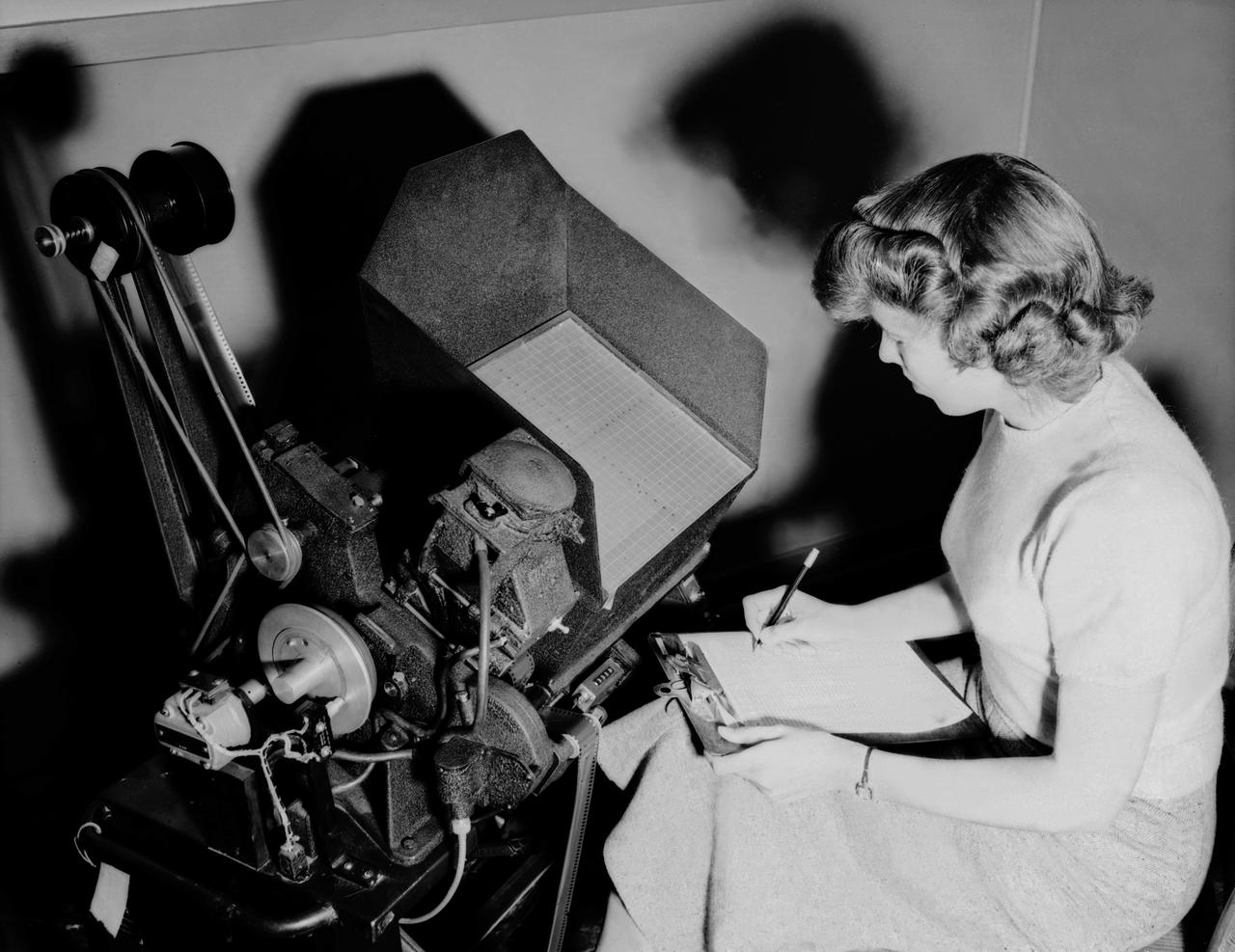
Publicity photo from Muroc California, showing female support personnel with equipment.
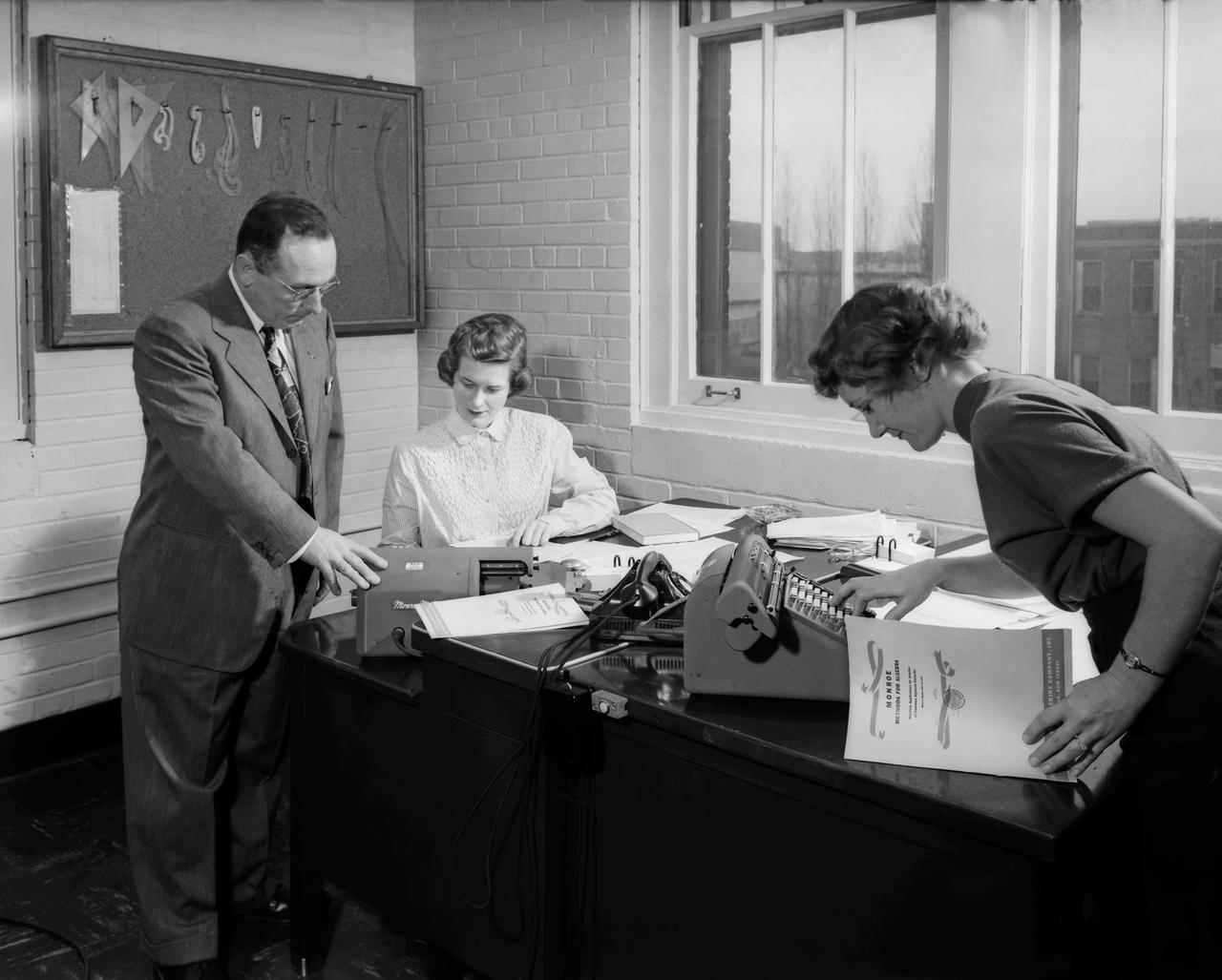
NACA Laboratory Computers Help Compile Handbook: ''Monroe Methods for Algebra, " a new booklet describing short-cuts that can be used in solving frequently-used algebraic formulas with a calculating machine, is undergoing its first trial at the hands of Laboratory computers. Several Monro-matics were purchased recently by NACA. In photo are W.H. Rankins discusses the "Monroe Methods for Algebra" with Gladys Storey (seated) and Ferne Gapcynski, both of 16 foot Hight Speed Tunnel. NACA Air Scoop August 17,1951 Page 4.
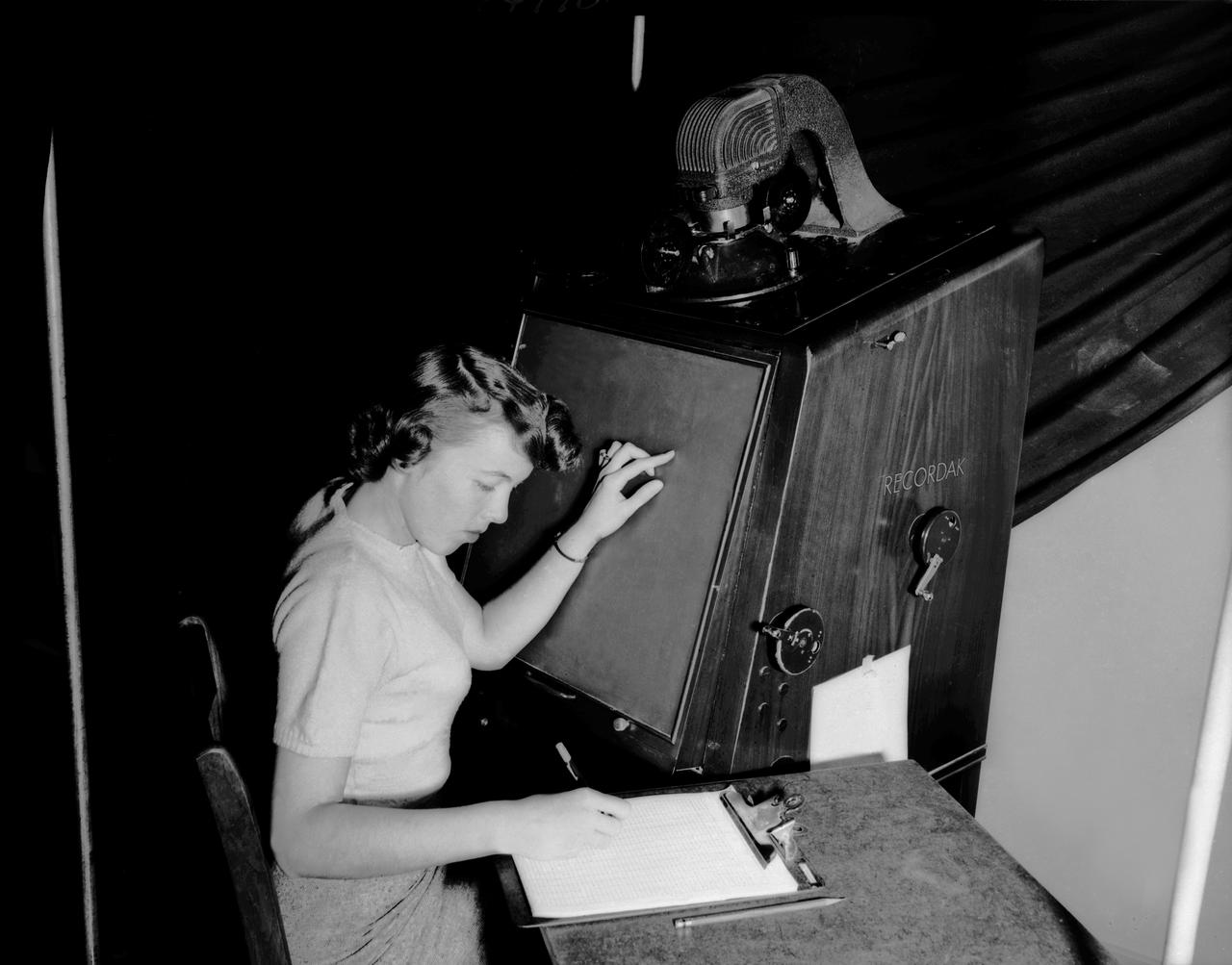
Publicity photo from Muroc California, showing female support personnel with equipment. A women working on a Kodak Recordak microfilm reader.