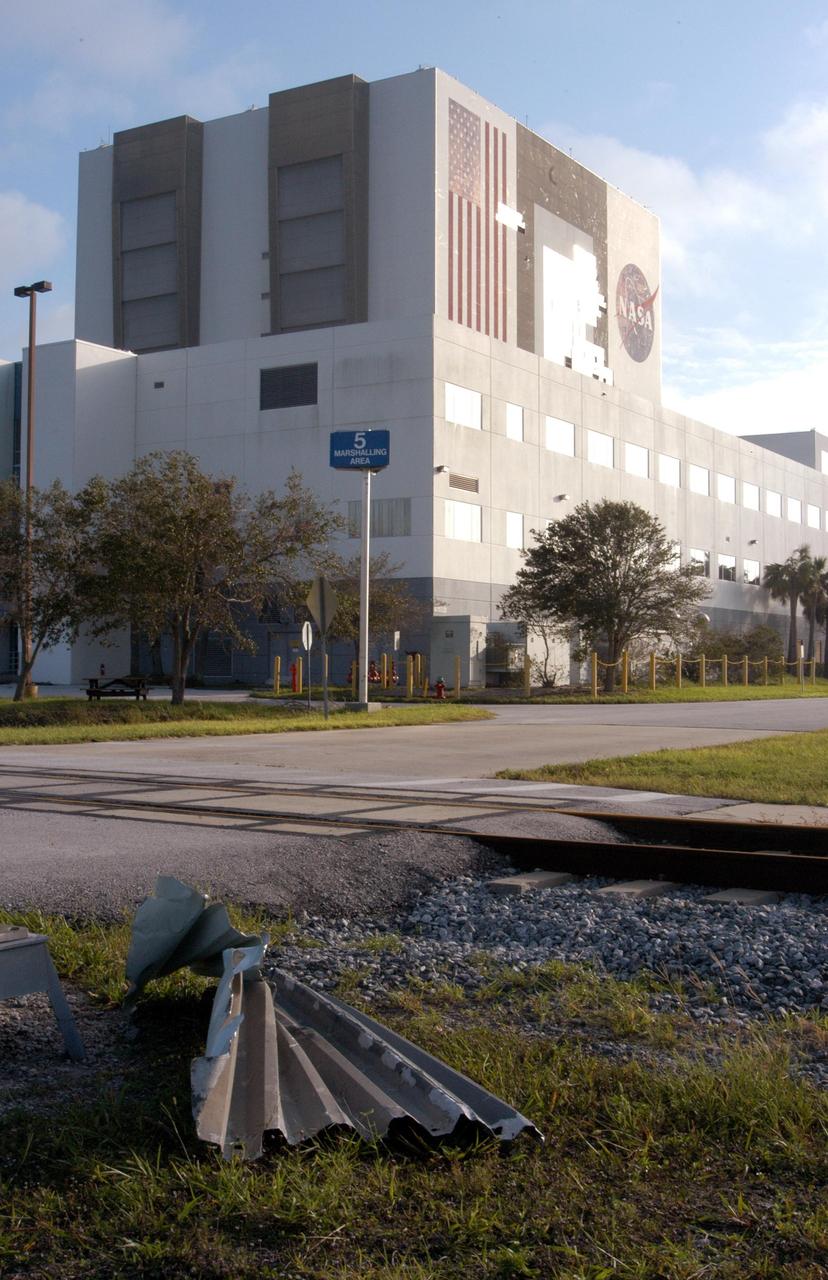
KENNEDY SPACE CENTER, FLA. - In the foreground lies a panel pulled from the wall of the Vehicle Assembly Building at KSC during the category 3 Hurricane Jeanne. The storm barreled through Central Florida Sept. 25-26 from the southeast. The VAB had lost 850 panels from the south wall during Hurricane Frances. Twenty-five additional panels were pulled off the east wall by the winds from Jeanne. This was the fourth hurricane in 6 weeks to batter the state.
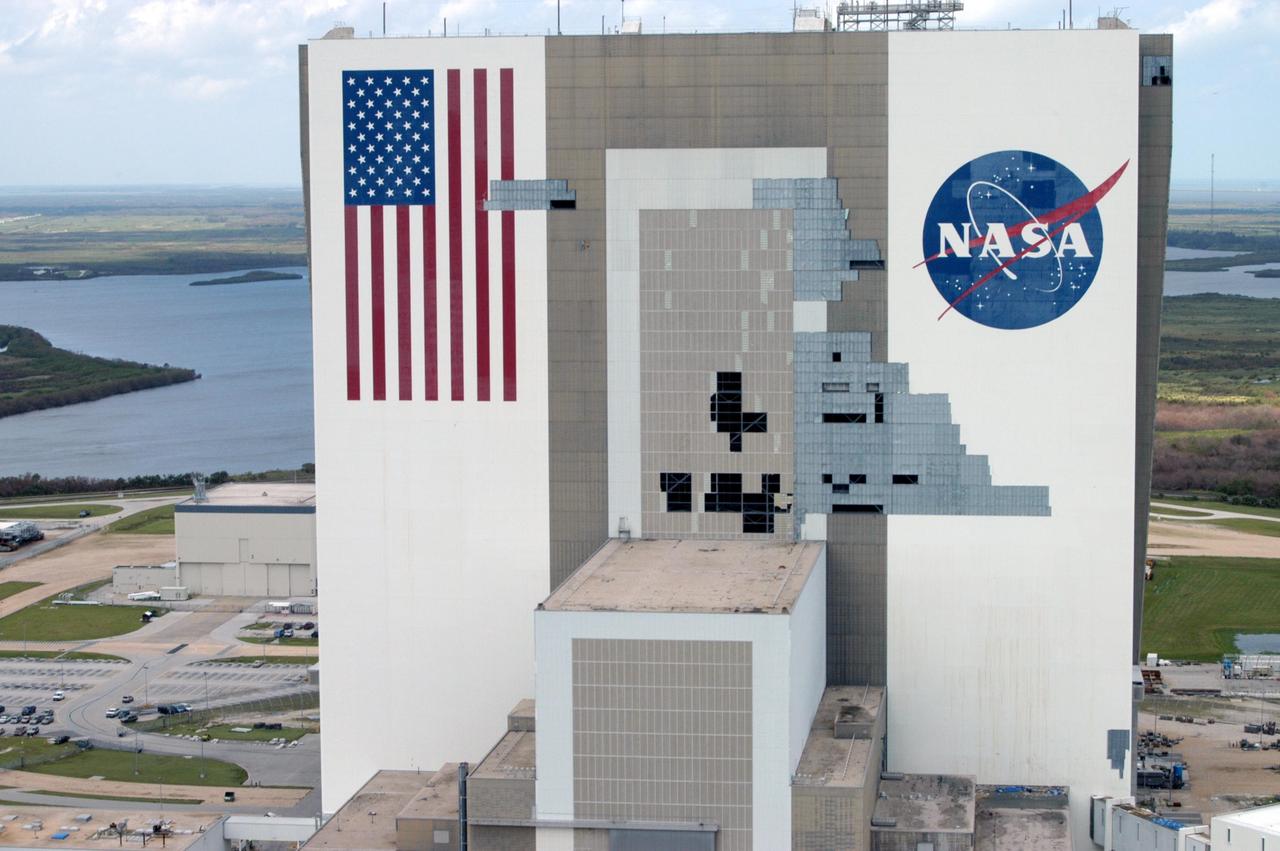
KENNEDY SPACE CENTER, FLA. - This view taken from a helicopter shows damage to the Vehicle Assembly Building at KSC following the category 3 Hurricane Jeanne. The storm barreled through Central Florida Sept. 25-26 from the southeast. The VAB had lost 850 panels from the south wall during Hurricane Frances. Twenty-five additional panels were pulled off the east wall by the winds from Jeanne. This was the fourth hurricane in 6 weeks to batter the state.
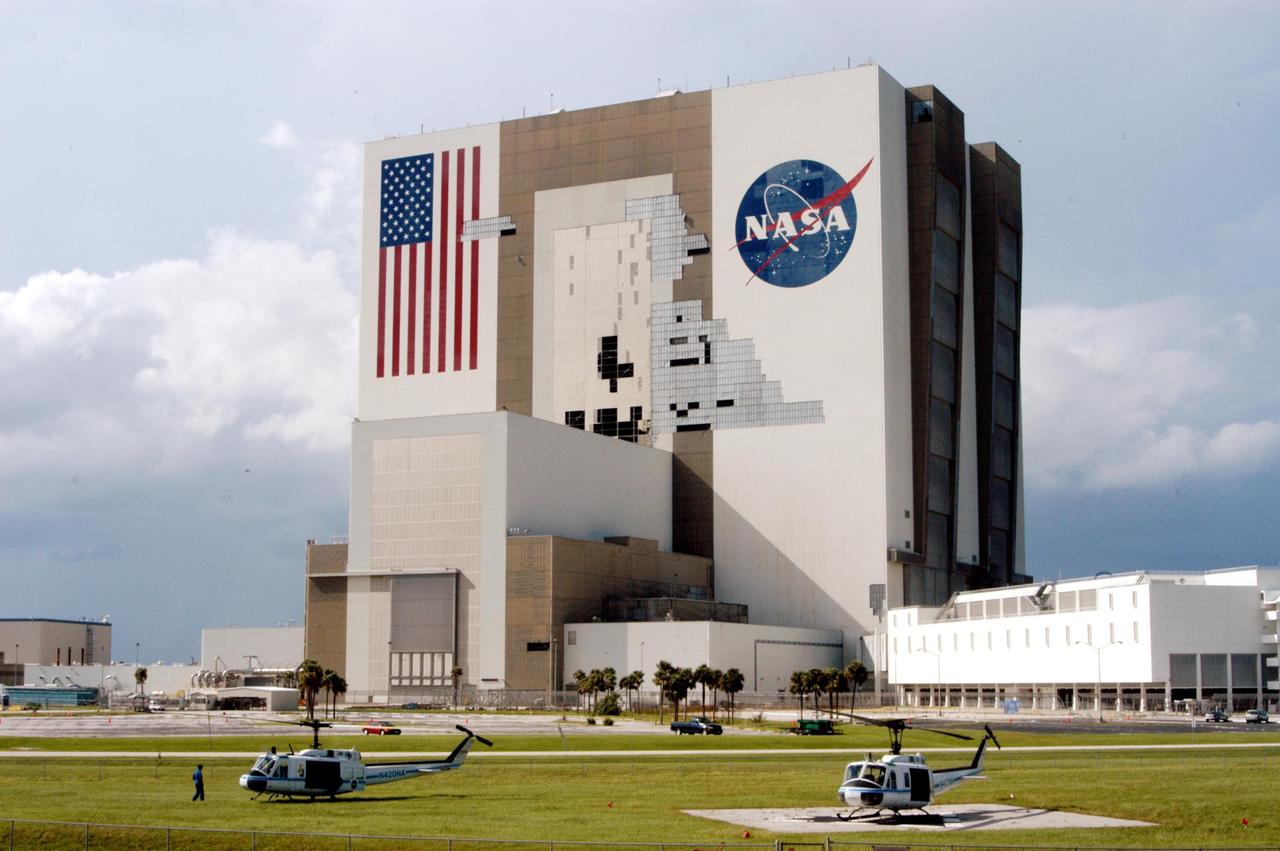
KENNEDY SPACE CENTER, FLA. - This view shows damage to the Vehicle Assembly Building at KSC following the category 3 Hurricane Jeanne. In the foreground are helicopters that were used for observation flights around the Center. The storm barreled through Central Florida Sept. 25-26 from the southeast. The VAB had lost 850 panels from the south wall during Hurricane Frances. Twenty-five additional panels were pulled off the east wall by the winds from Jeanne. This was the fourth hurricane in 6 weeks to batter the state.
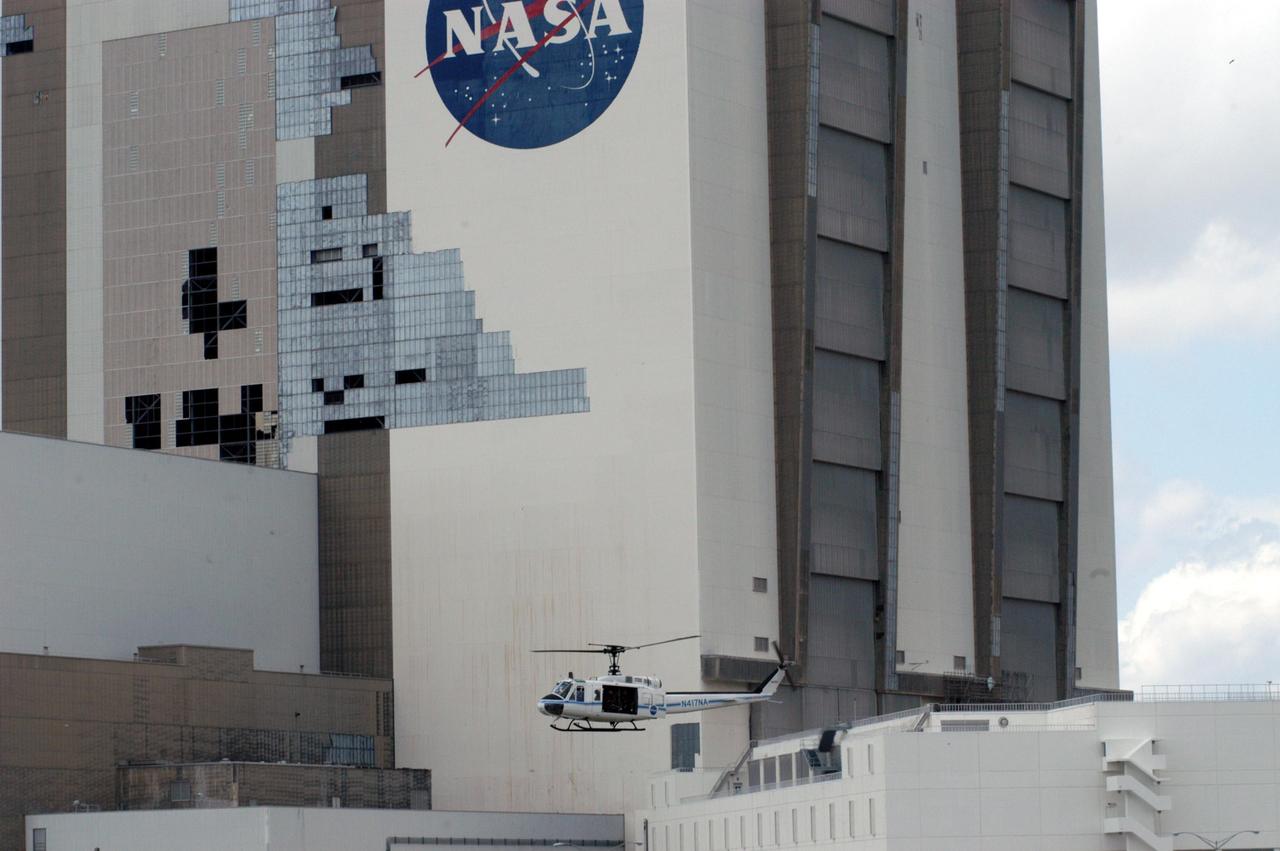
KENNEDY SPACE CENTER, FLA. - A helicopter moves past the Vehicle Assembly Building at KSC following the category 3 Hurricane Jeanne. The storm barreled through Central Florida Sept. 25-26 from the southeast. The VAB had lost 850 panels from the south wall during Hurricane Frances. Twenty-five additional panels were pulled off the east wall by the winds from Jeanne. This was the fourth hurricane in 6 weeks to batter the state.
KENNEDY SPACE CENTER, FLA. - A helicopter moves past the Vehicle Assembly Building at KSC following the category 3 Hurricane Jeanne. The storm barreled through Central Florida Sept. 25-26 from the southeast. The VAB had lost 850 panels from the south wall during Hurricane Frances. Twenty-five additional panels were pulled off the east wall by the winds from Jeanne. This was the fourth hurricane in 6 weeks to batter the state.
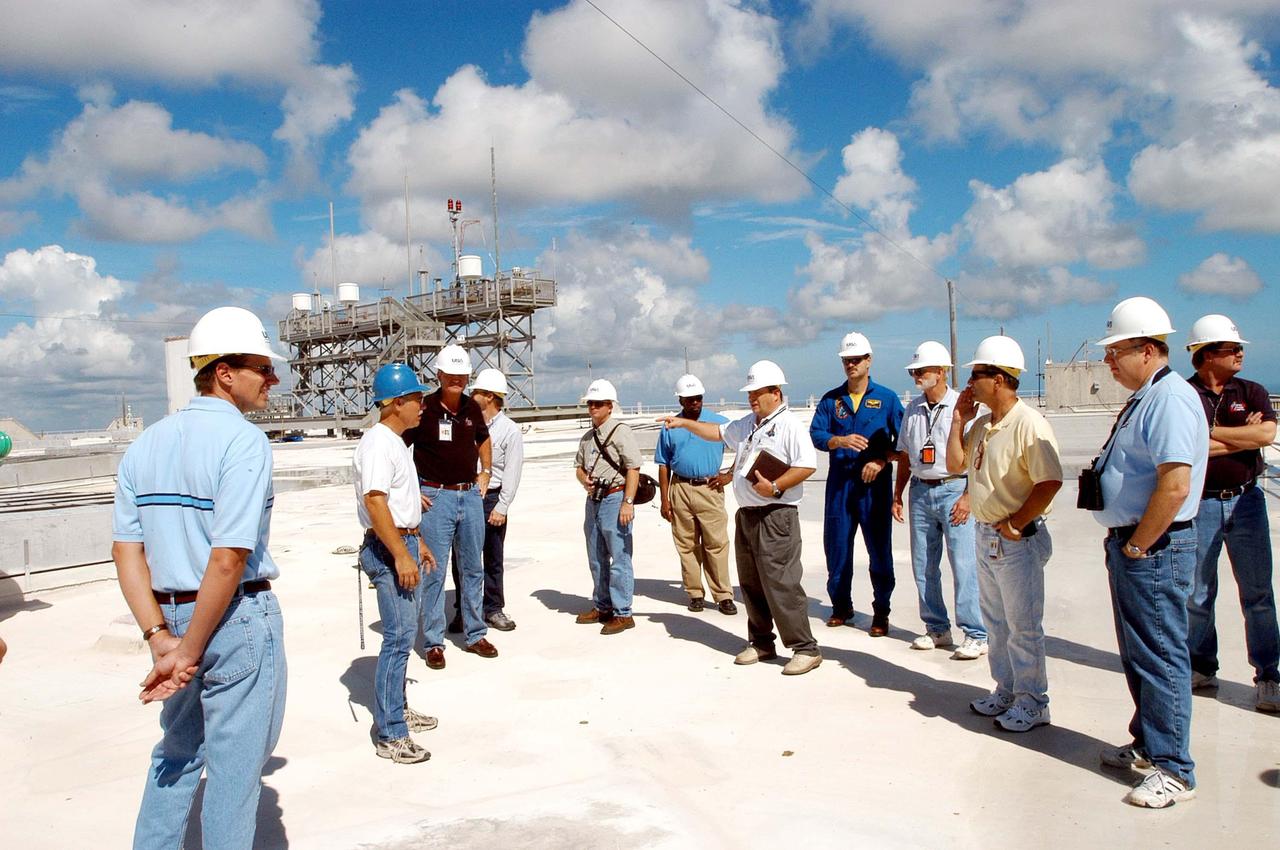
KENNEDY SPACE CENTER, FLA. - Members of a hurricane assessment team from Johnson Space Center and Marshall Space Flight Center tour the roof of the Vehicle Assembly Building (VAB) a week after Hurricane Frances hit the east coast of Central Florida and Kennedy Space Center. The VAB lost 820, 4- x 16-foot panels from the side walls, or more than 52,000 square feet of its surface. One team member is astronaut Scott Altmann, fifth from right.
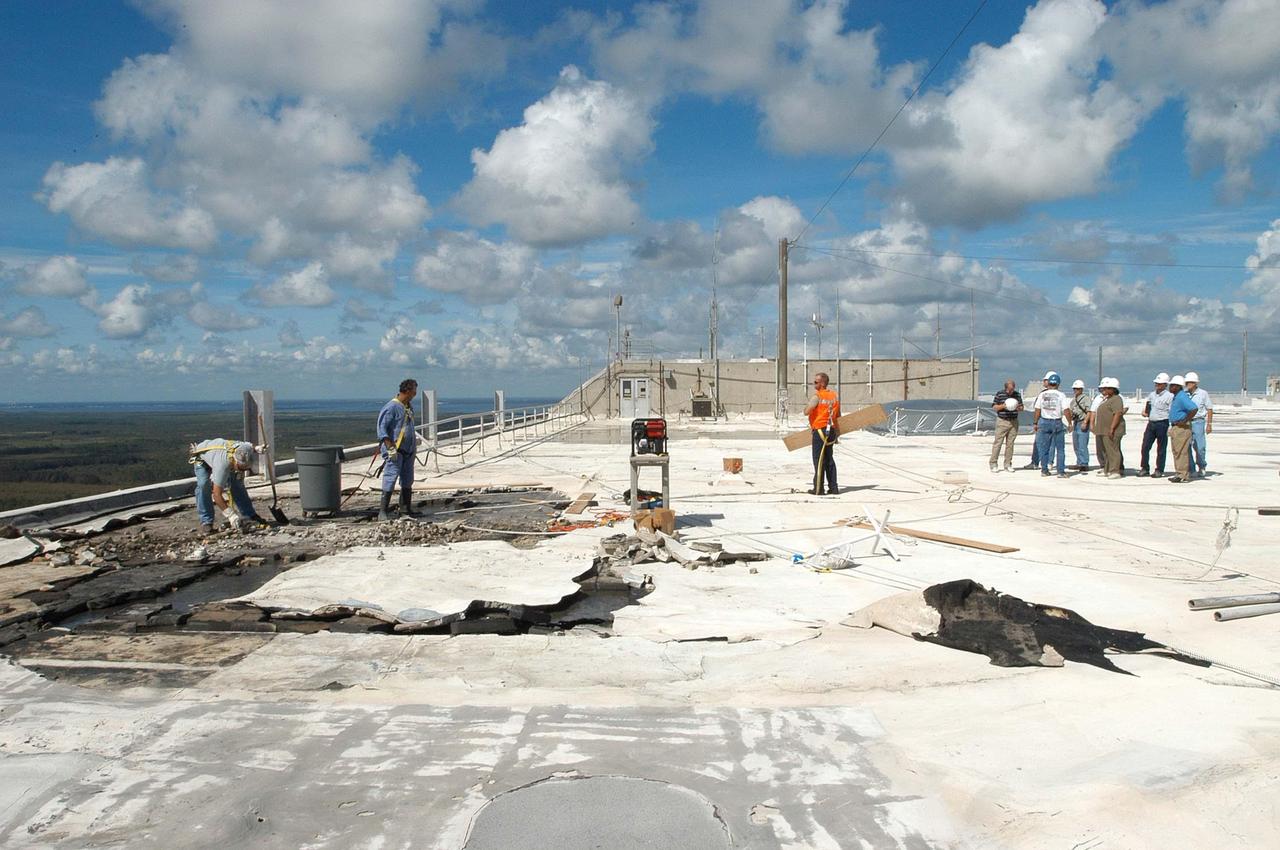
KENNEDY SPACE CENTER, FLA. - Members of a hurricane assessment team from Johnson Space Center and Marshall Space Flight Center look at damage on the roof of the Vehicle Assembly Building (VAB) a week after Hurricane Frances hit the east coast of Central Florida and Kennedy Space Center. The VAB lost 820, 4- x 16-foot panels from the side walls, or more than 52,000 square feet of its surface.
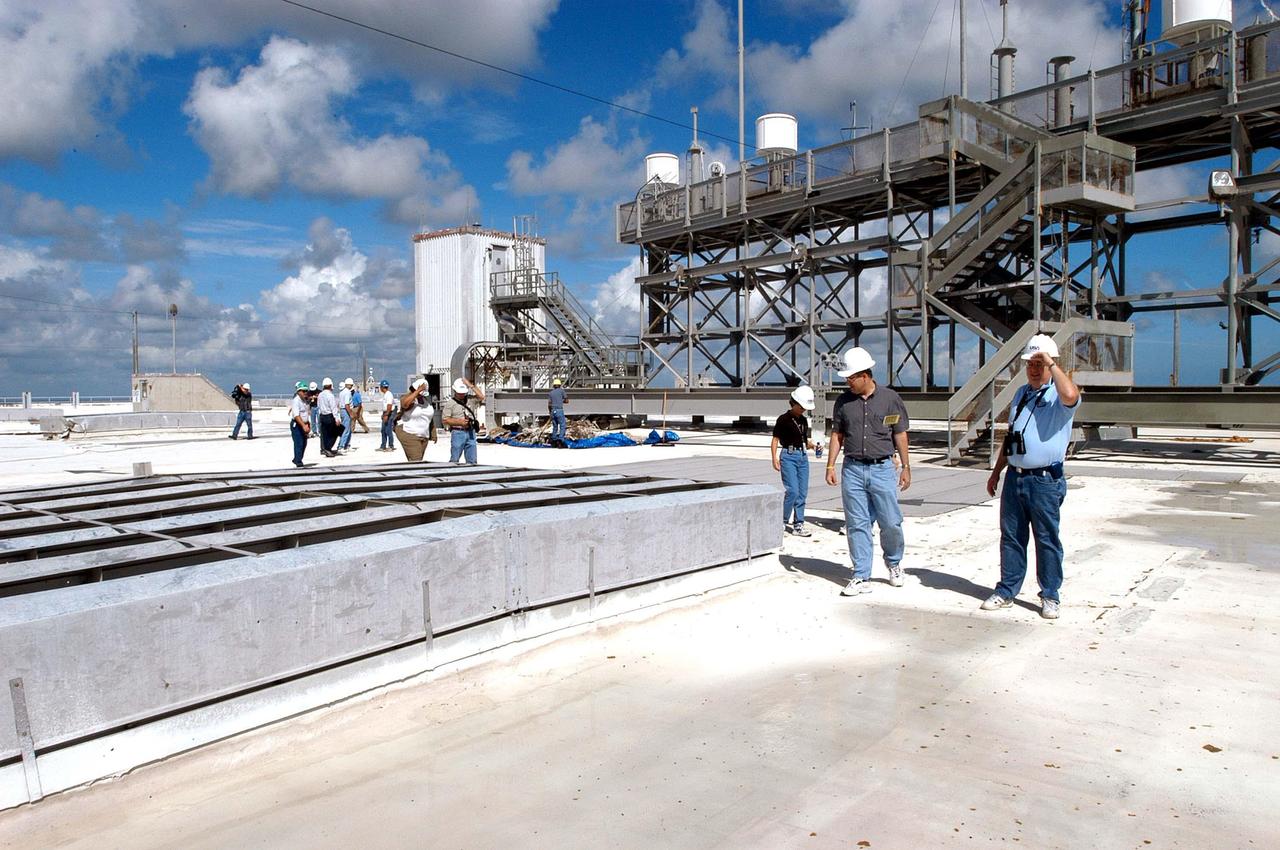
KENNEDY SPACE CENTER, FLA. - Members of a hurricane assessment team from Johnson Space Center and Marshall Space Flight Center tour the roof of the Vehicle Assembly Building (VAB) a week after Hurricane Frances hit the east coast of Central Florida and Kennedy Space Center. The VAB lost 820, 4- x 16-foot panels from the side walls, or more than 52,000 square feet of its surface.
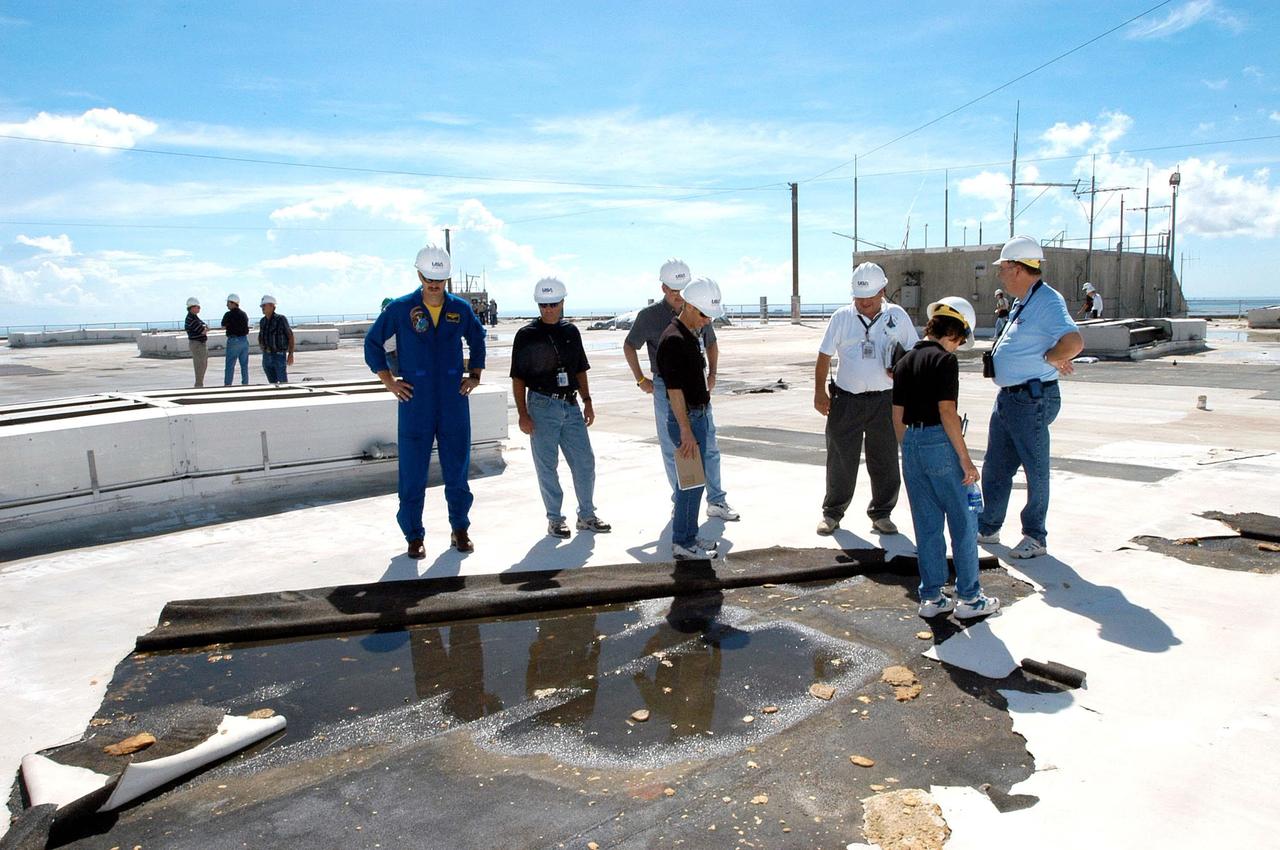
KENNEDY SPACE CENTER, FLA. - Members of a hurricane assessment team from Johnson Space Center and Marshall Space Flight Center look at damage on the roof of the Vehicle Assembly Building (VAB) a week after Hurricane Frances hit the east coast of Central Florida and Kennedy Space Center. The VAB lost 820, 4- x 16-foot panels from the side walls, or more than 52,000 square feet of its surface. One team member is astronaut Scott Altmann, at far left.
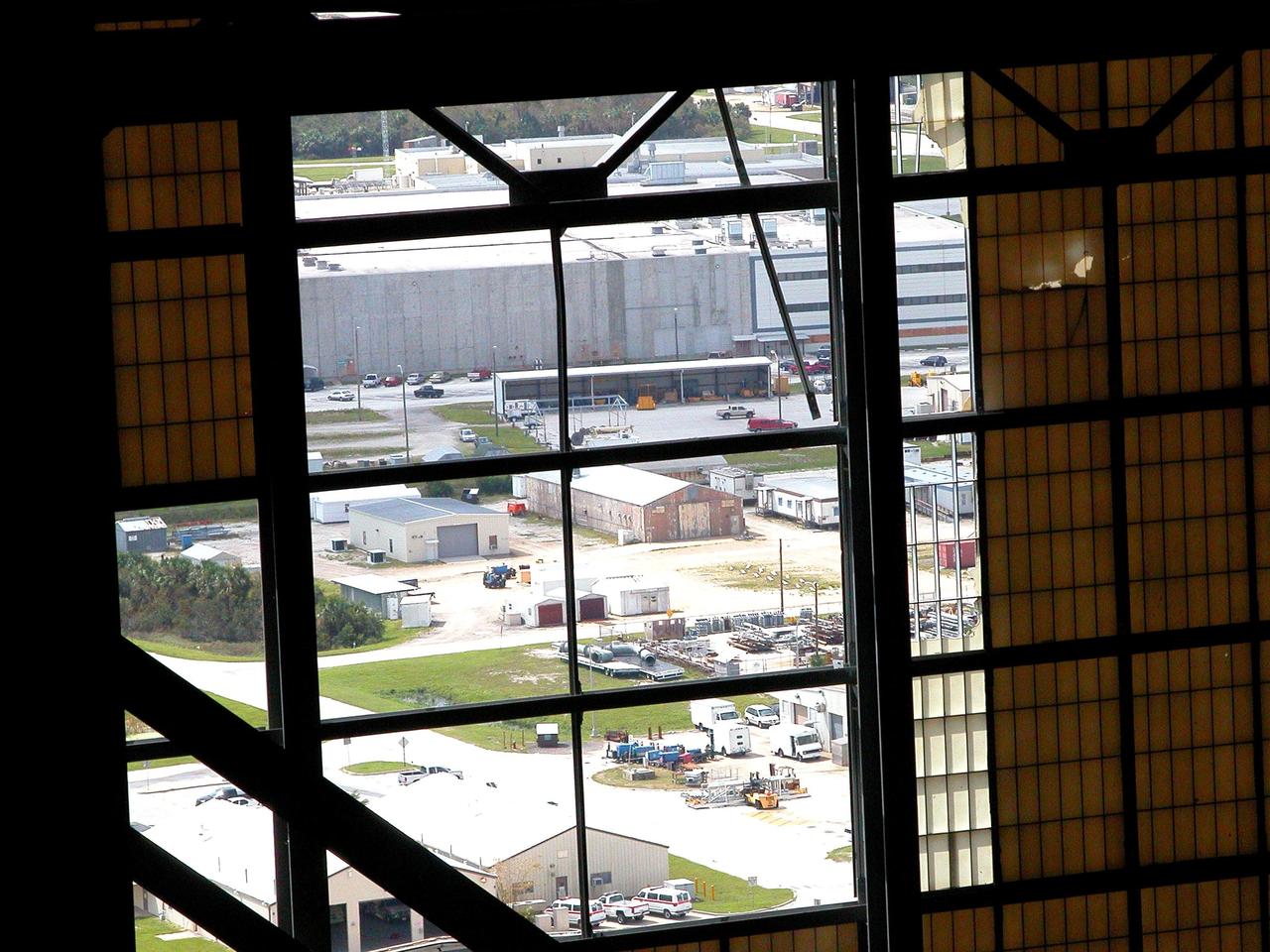
KENNEDY SPACE CENTER, FLA. - Launch Complex 39 facilities are now visible through the openings left by missing panels from the exterior walls of the Vehicle Assembly Building (VAB)following Hurricane Frances. The storm's path over Florida took it through Cape Canaveral and KSC property during Labor Day weekend. Located in the heart of Launch Complex 39, the VAB is used for the integration and stacking of Space Shuttle elements and for the checkout and storage of Space Shuttle External Tanks.
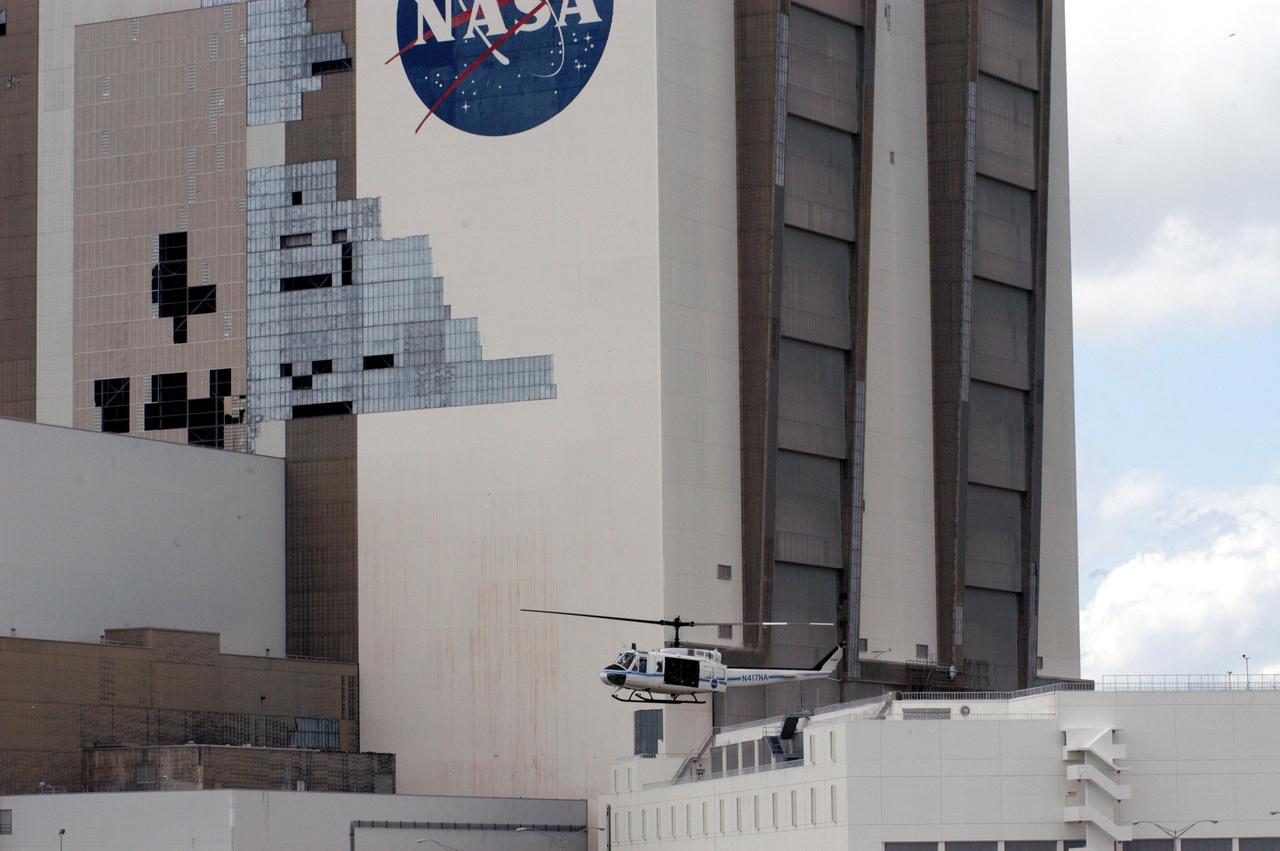
KENNEDY SPACE CENTER, FLA. - A helicopter moves past the Vehicle Assembly Building at KSC following the category 3 Hurricane Jeanne. The storm barreled through Central Florida Sept. 25-26 from the southeast. The VAB had lost 850 panels from the south wall during Hurricane Frances. Twenty-five additional panels were pulled off the east wall by the winds from Jeanne. This was the fourth hurricane in 6 weeks to batter the state.
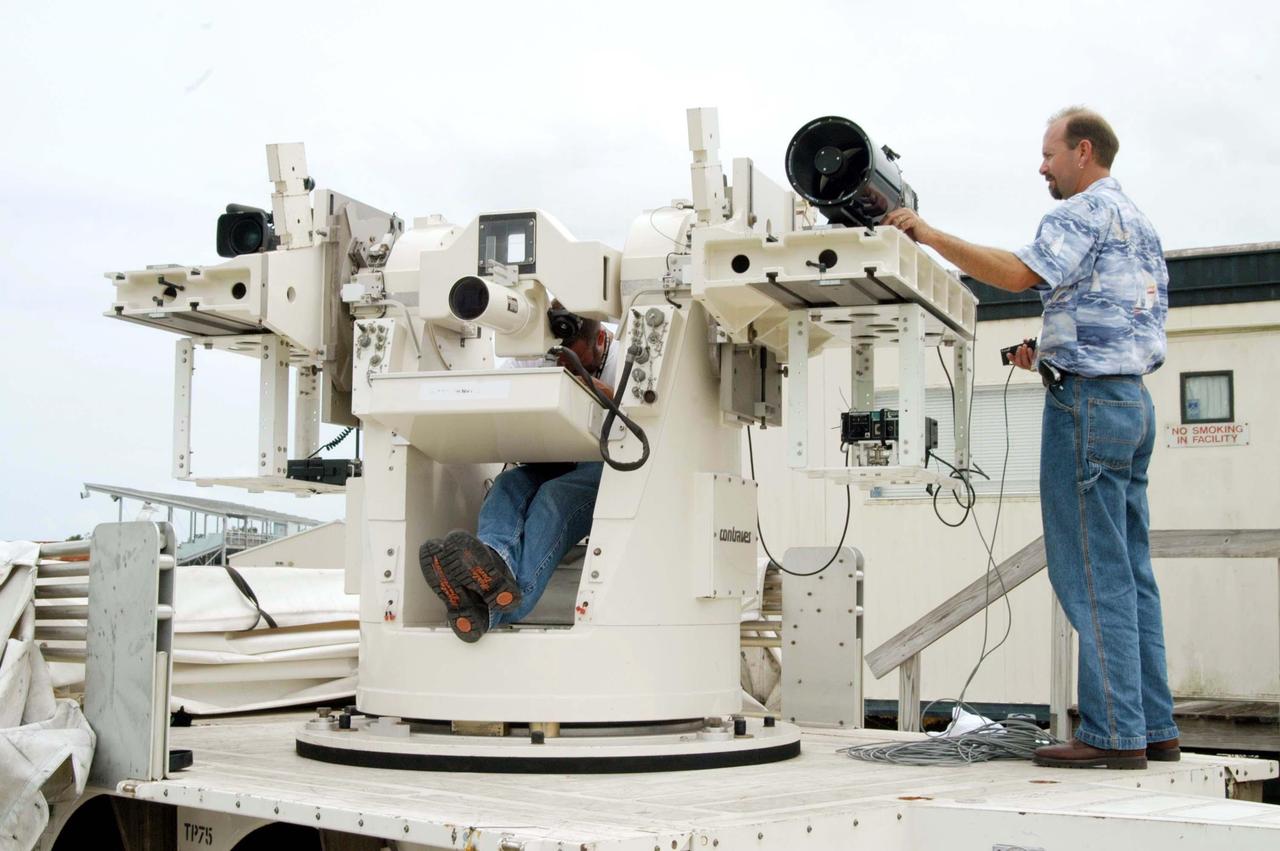
KENNEDY SPACE CENTER, FLA. - KSC videographer Glenn Benson adjusts a high definition camera being used to photograph the south wall of the Vehicle Assembly Building (VAB) that sustained damage from Hurricane Frances as it passed over Central Florida during the Labor Day weekend. The maximum wind at the surface from Hurricane Frances was 94 mph from the northeast at 6:40 a.m. on Sunday, September 5. It was recorded at a weather tower located on the east shore of the Mosquito Lagoon near the Cape Canaveral National Seashore. The highest sustained wind at KSC was 68 mph. The VAB lost 820, 4- x 16-foot panels or more than 52,000 square feet of its surface. There was damage to the roof as well.
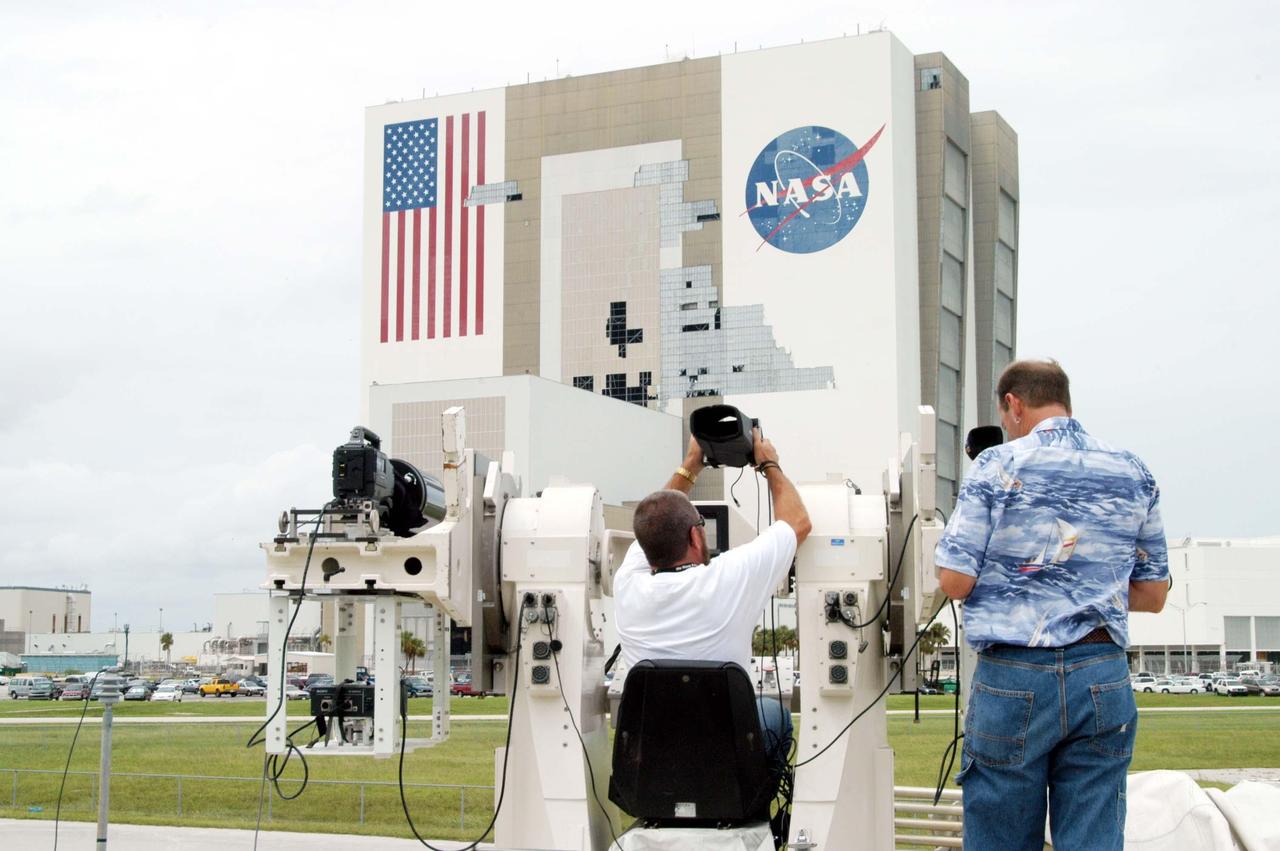
KENNEDY SPACE CENTER, FLA. - KSC videographer Glenn Benson and photographer Kenny Allen photograph damage incurred on the south wall of the Vehicle Assembly Building (VAB) that sustained damage from Hurricane Frances as it passed over Central Florida during the Labor Day weekend. The maximum wind at the surface from Hurricane Frances was 94 mph from the northeast at 6:40 a.m. on Sunday, September 5. It was recorded at a weather tower located on the east shore of the Mosquito Lagoon near the Cape Canaveral National Seashore. The highest sustained wind at KSC was 68 mph. The VAB lost 820, 4- x 16-foot panels or more than 52,000 square feet of its surface. There was damage to the roof as well.
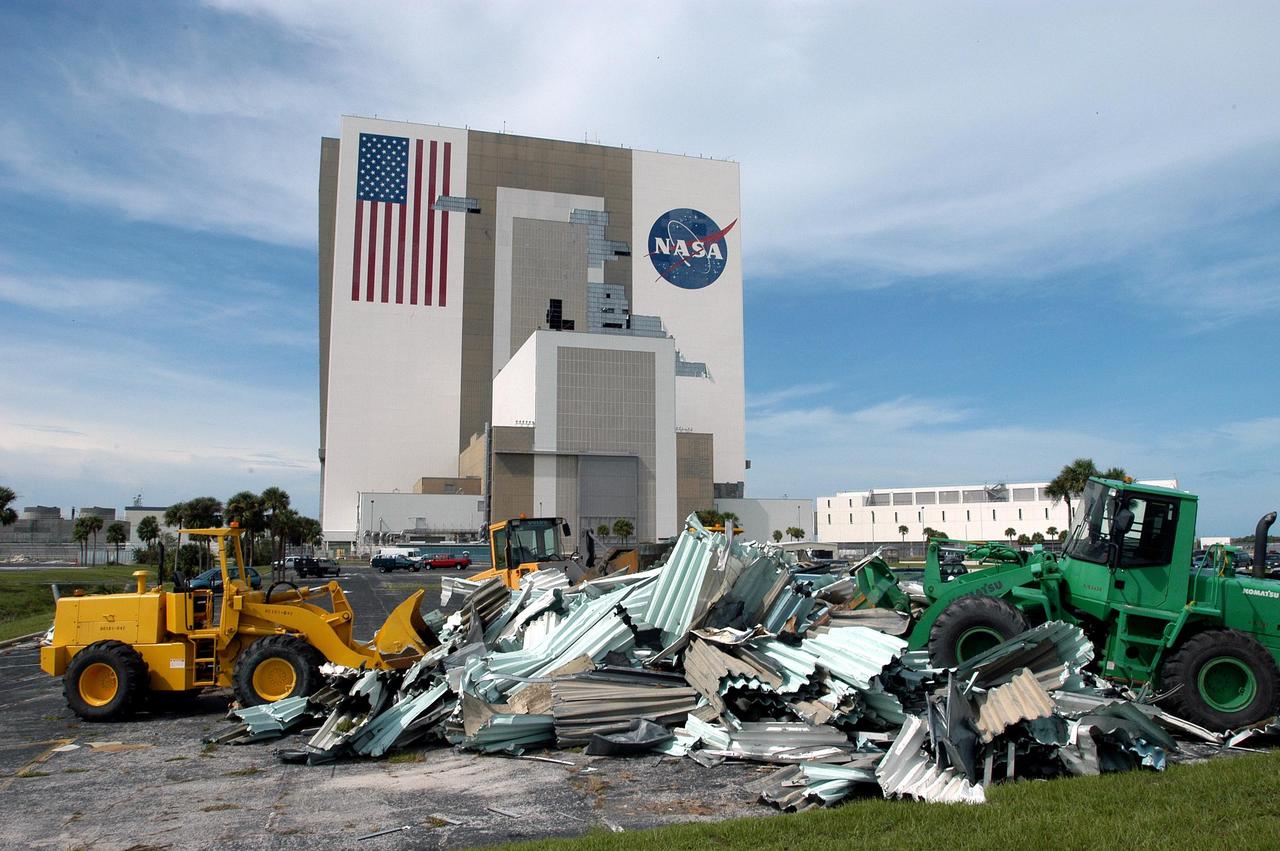
KENNEDY SPACE CENTER, FLA. - Panels from the exterior walls of the Vehicle Assembly Building (VAB) are recovered during clean-up activities following Hurricane Frances. The storm's path over Florida took it through Cape Canaveral and KSC property during Labor Day weekend. Located in the heart of Launch Complex 39, the VAB is used for the integration and stacking of Space Shuttle elements and for the checkout and storage of Space Shuttle External Tanks.
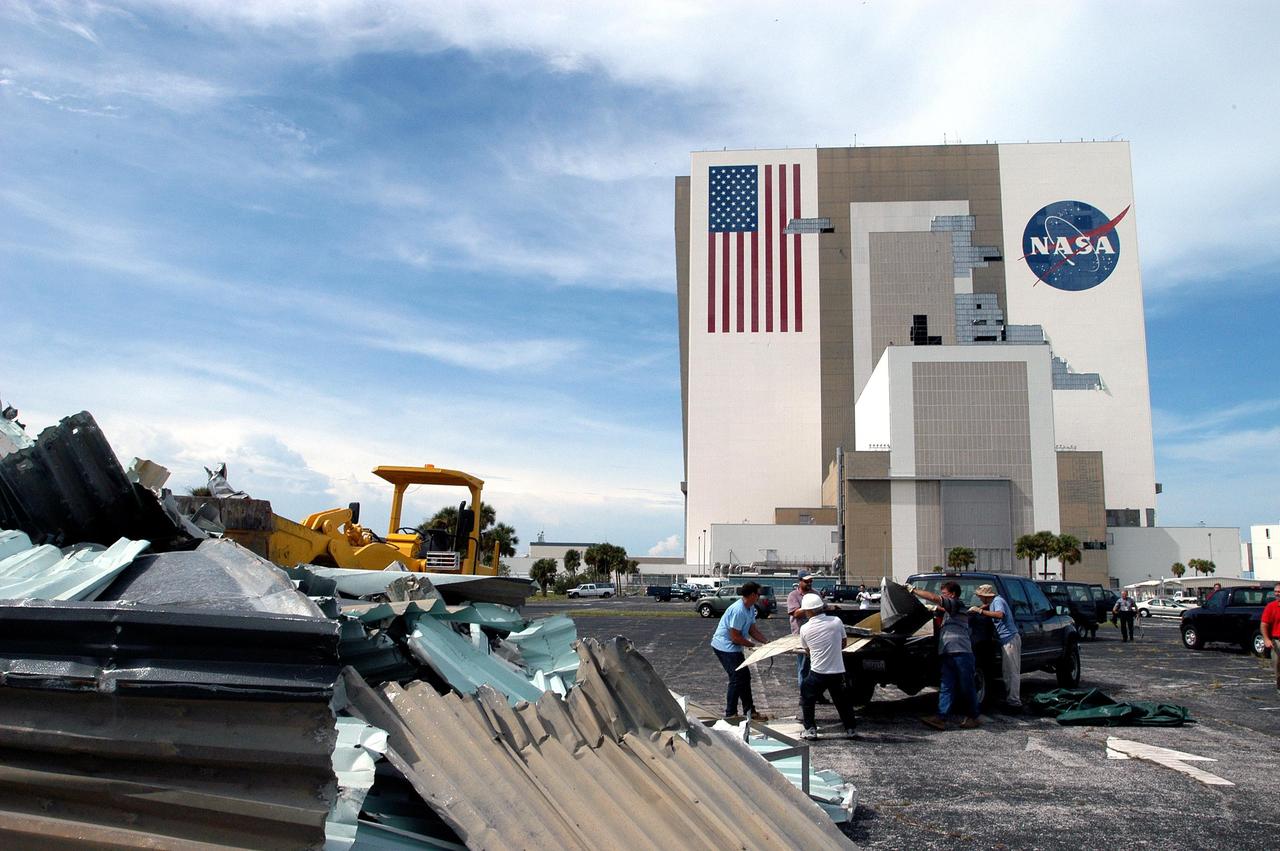
KENNEDY SPACE CENTER, FLA. - Panels from the exterior walls of the Vehicle Assembly Building (VAB) are recovered by KSC employees during clean-up activities following Hurricane Frances. The storm's path over Florida took it through Cape Canaveral and KSC property during Labor Day weekend. Located in the heart of Launch Complex 39, the VAB is used for the integration and stacking of Space Shuttle elements and for the checkout and storage of External Tanks.
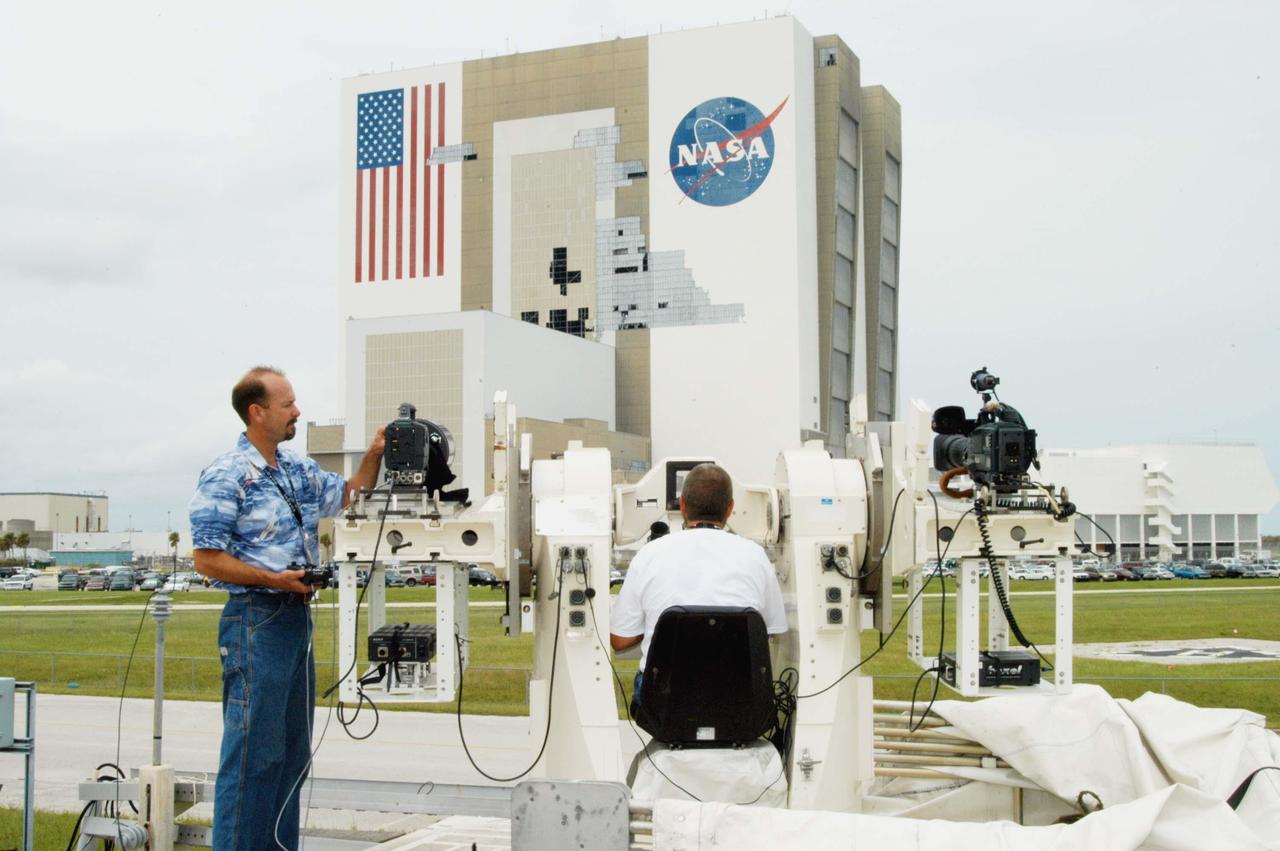
KENNEDY SPACE CENTER, FLA. - KSC videographer Glenn Benson adjusts a high definition camera being used to photograph the south wall of the Vehicle Assembly Building that sustained damage from Hurricane Frances as it passed over Central Florida during the Labor Day weekend. The maximum wind at the surface from Hurricane Frances was 94 mph from the northeast at 6:40 a.m. on Sunday, September 5. It was recorded at a weather tower located on the east shore of the Mosquito Lagoon near the Cape Canaveral National Seashore. The highest sustained wind at KSC was 68 mph. The VAB lost 820, 4- x 16-foot panels or more than 52,000 square feet of its surface. There was damage to the roof as well.
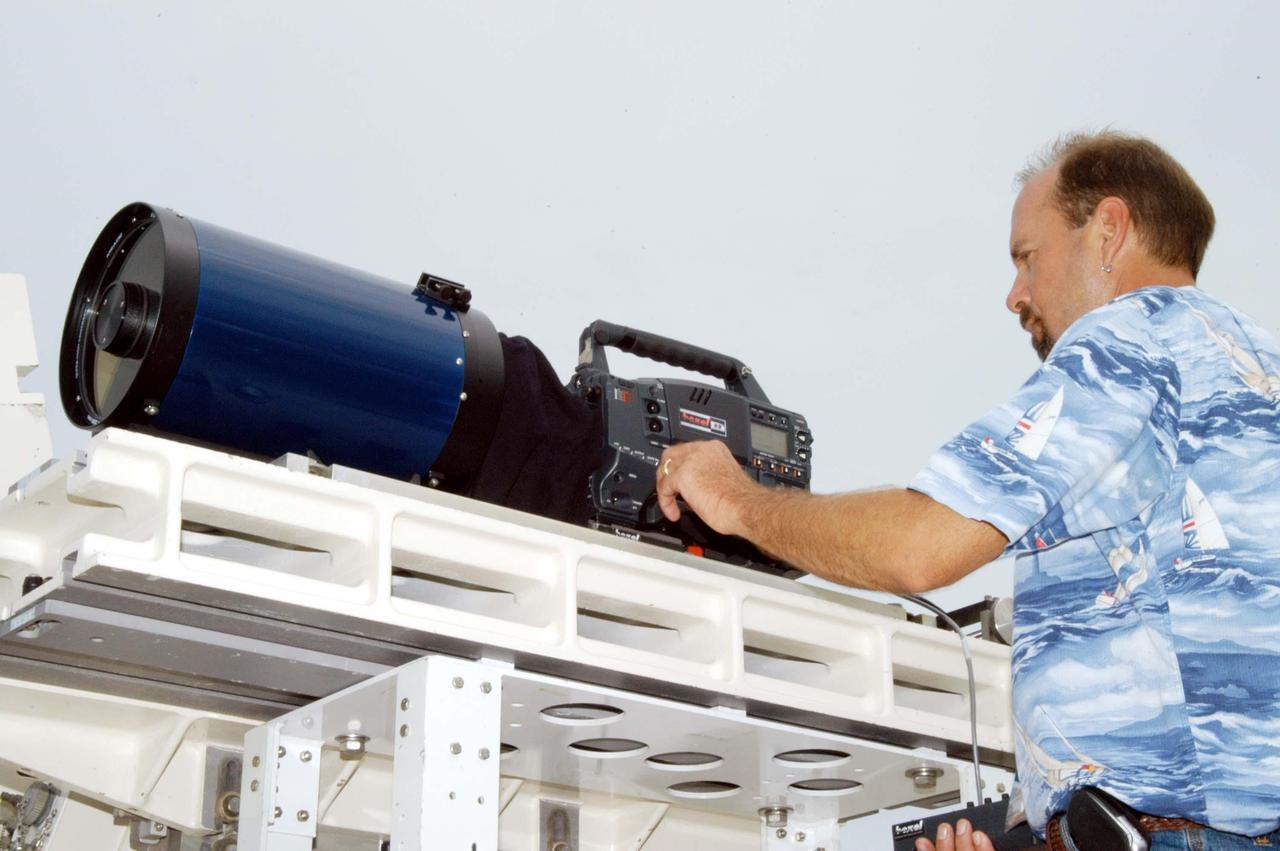
KENNEDY SPACE CENTER, FLA. - KSC videographer Glenn Benson adjusts a high definition camera being used to photograph the south wall of the Vehicle Assembly Building that sustained damage from Hurricane Frances as it passed over Central Florida during the Labor Day weekend. The maximum wind at the surface from Hurricane Frances was 94 mph from the northeast at 6:40 a.m. on Sunday, September 5. It was recorded at a weather tower located on the east shore of the Mosquito Lagoon near the Cape Canaveral National Seashore. The highest sustained wind at KSC was 68 mph. The VAB lost 820, 4- x 16-foot panels or more than 52,000 square feet of its surface. There was damage to the roof as well.
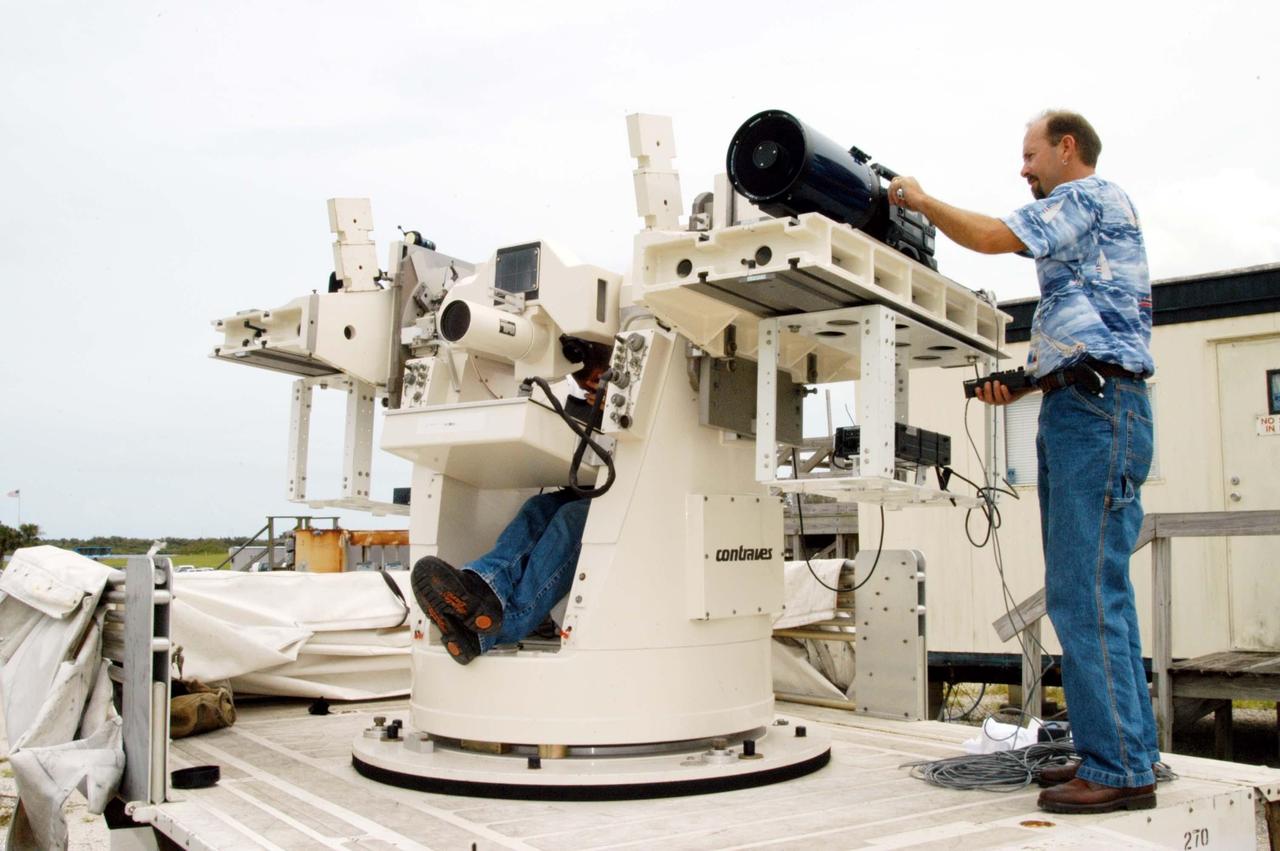
KENNEDY SPACE CENTER, FLA. - KSC videographer Glenn Benson adjusts a high definition camera being used to photograph the south wall of the Vehicle Assembly Building that sustained damage from Hurricane Frances as it passed over Central Florida during the Labor Day weekend. The maximum wind at the surface from Hurricane Frances was 94 mph from the northeast at 6:40 a.m. on Sunday, September 5. It was recorded at a weather tower located on the east shore of the Mosquito Lagoon near the Cape Canaveral National Seashore. The highest sustained wind at KSC was 68 mph. The VAB lost 820, 4- x 16-foot panels or more than 52,000 square feet of its surface. There was damage to the roof as well.
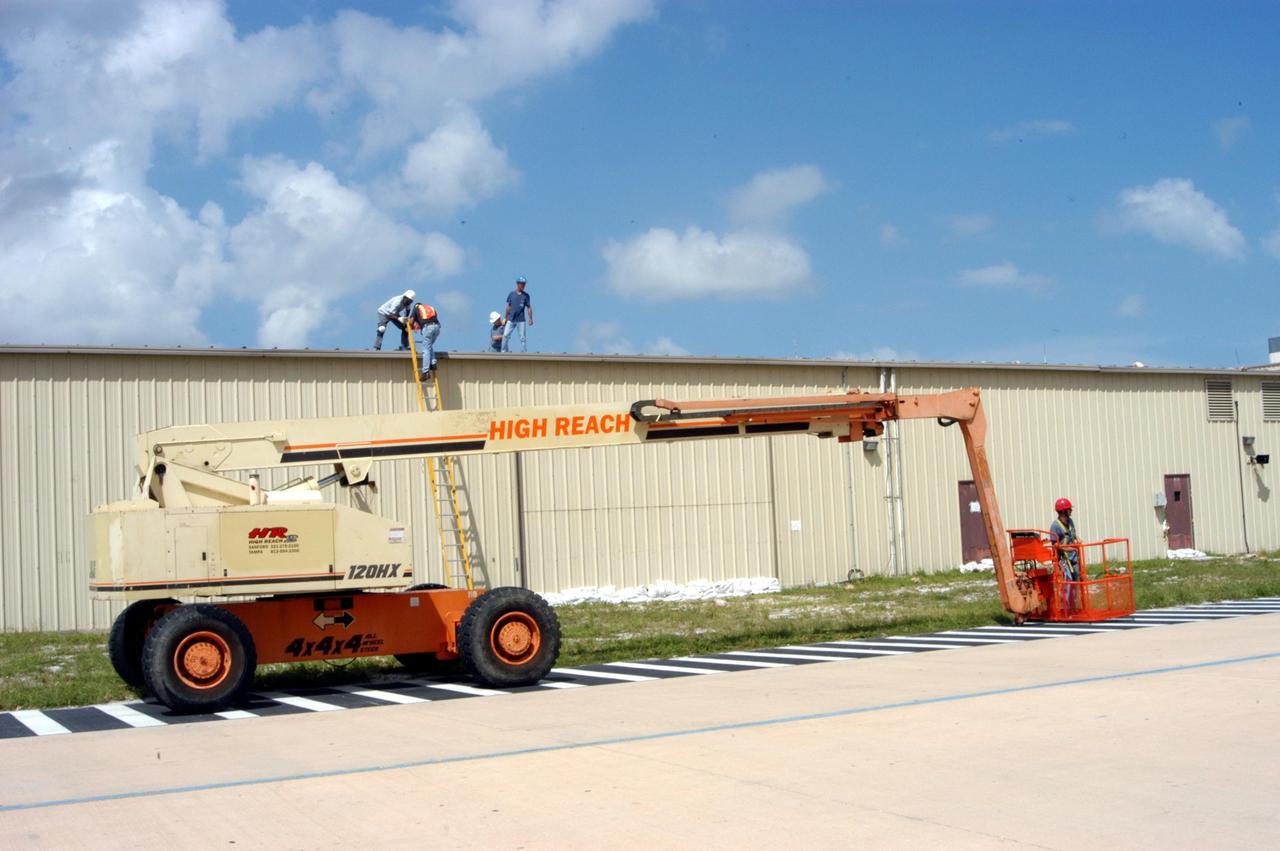
KENNEDY SPACE CENTER, FLA. - Workers attempt to secure the roof of the Tile Shop in the Thermal Protection System Facility (TPSF) in preparation for Hurricane Jeanne, which is expected to impact Central Florida Sunday. The TPSF, which creates the TPS tiles, blankets and all the internal thermal control systems for the Space Shuttles, lost approximately 35 percent of its roof during Hurricane Frances, which blew across Central Florida Sept. 4. Jeanne is the fourth hurricane in 45 days to make landfall somewhere in the state.
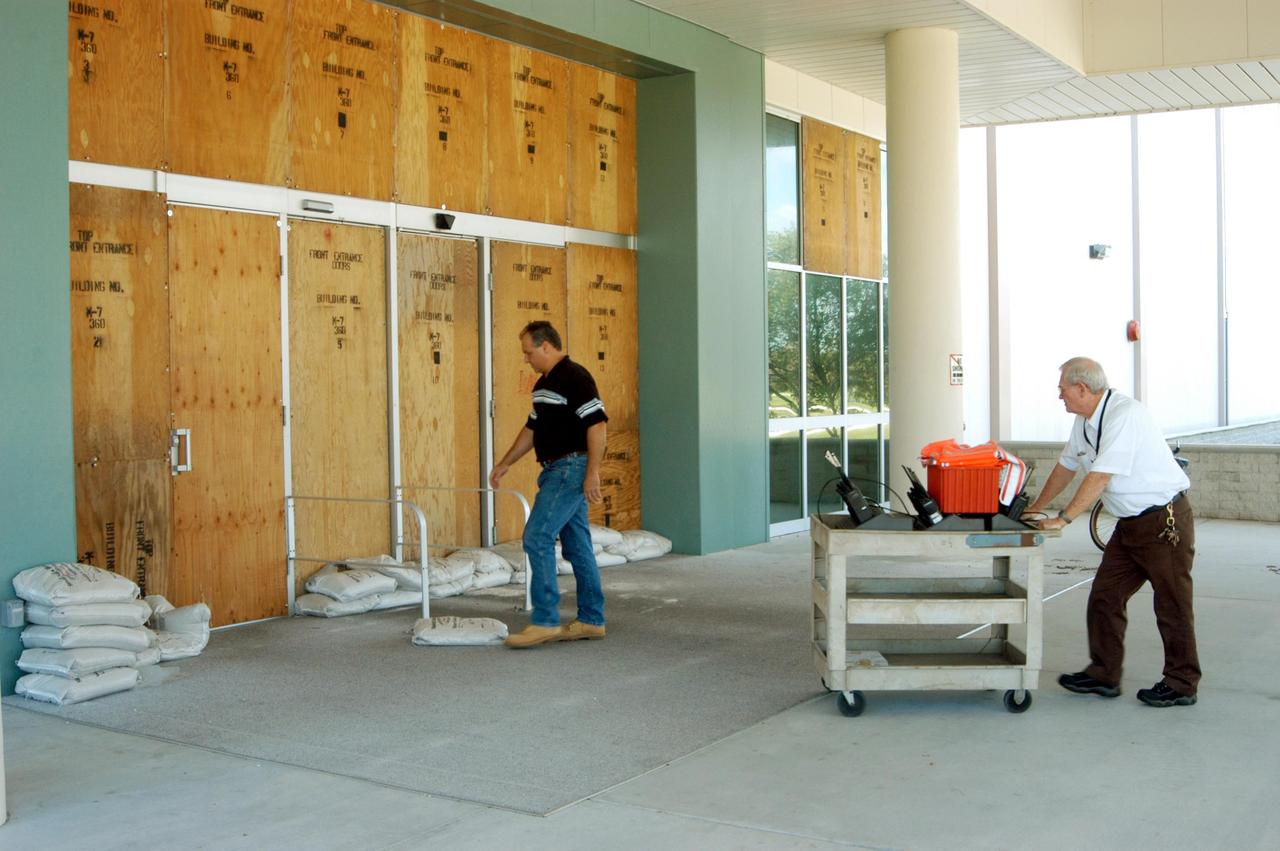
KENNEDY SPACE CENTER, FLA. - In preparation for Hurricane Jeanne, a worker places sandbags against the doors of the Space Station Processing Facility while another brings in emergency radios. The hurricane, expected to impact Central Florida Sunday, is the fourth hurricane in 45 days to make landfall somewhere in the state.
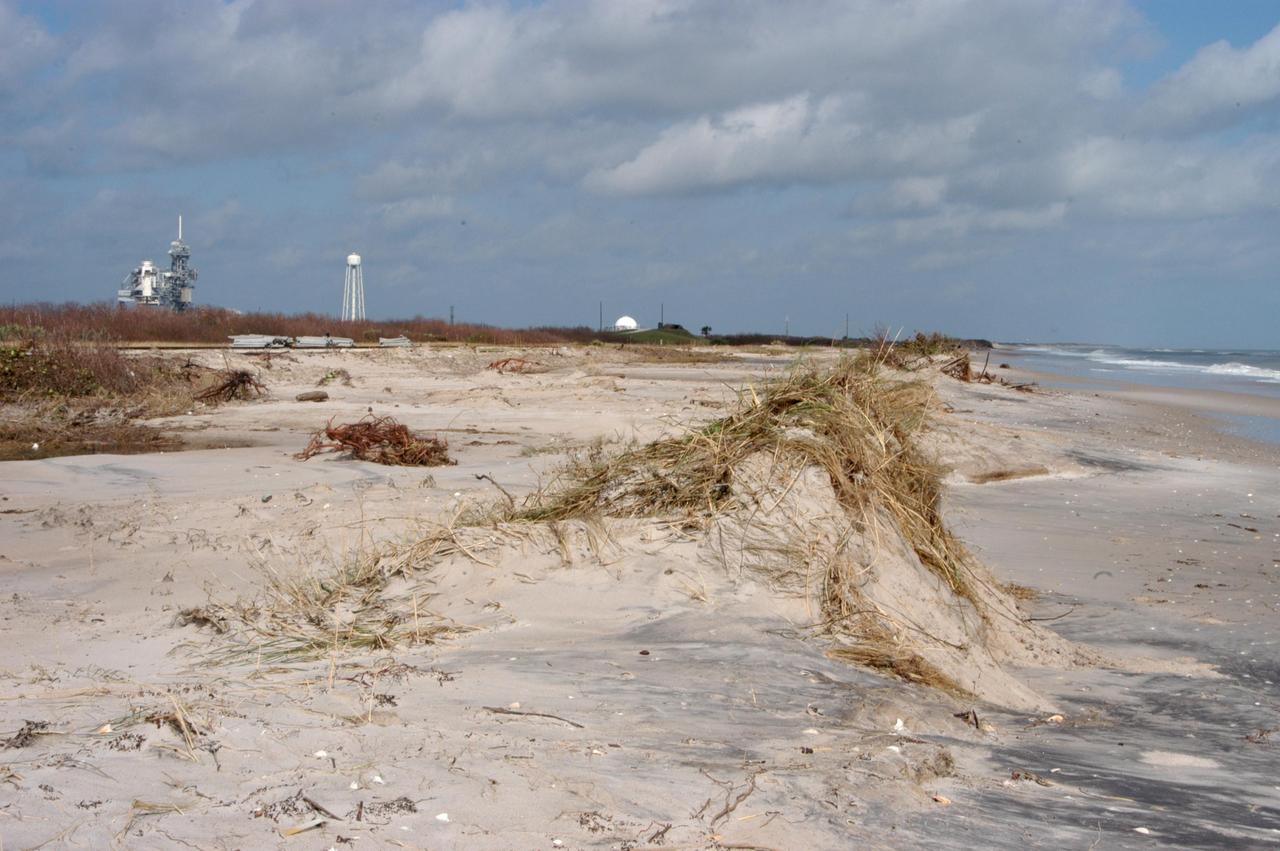
KENNEDY SPACE CENTER, FLA. - The category 3 Hurricane Jeanne barreled through Central Florida Sept. 25-26 from the southeast. This once-pristine beach east of the launch pads on KSC is now littered with debris from the dunes, at left, after assault by the storm surge and raging winds. Jeanne was the fourth hurricane in 6 weeks to batter the state.

KENNEDY SPACE CENTER, FLA. - This view taken from a helicopter shows damage to the roof of the Vehicle Assembly Building at KSC following the category 3 Hurricane Jeanne. The storm barreled through Central Florida Sept. 25-26 from the southeast. It was the fourth hurricane in 6 weeks to batter the state.
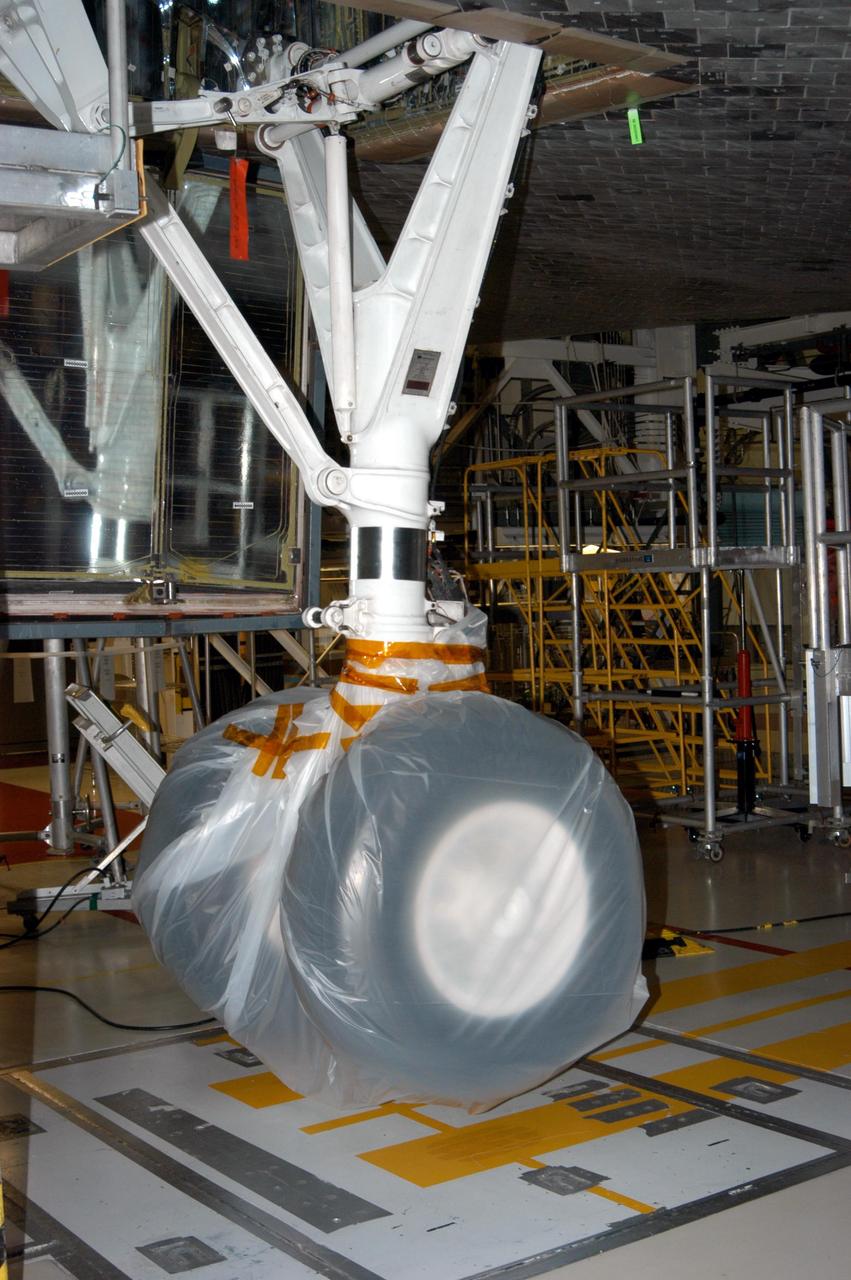
KENNEDY SPACE CENTER, FLA. - - In the Orbiter Processing Facility, the wheel on Atlantis is covered in plastic that protected it from possible damage by Hurricane Jeanne. The storm barreled through Central Florida Sept. 25-26 from the southeast. This was the fourth hurricane in 6 weeks to batter the state.
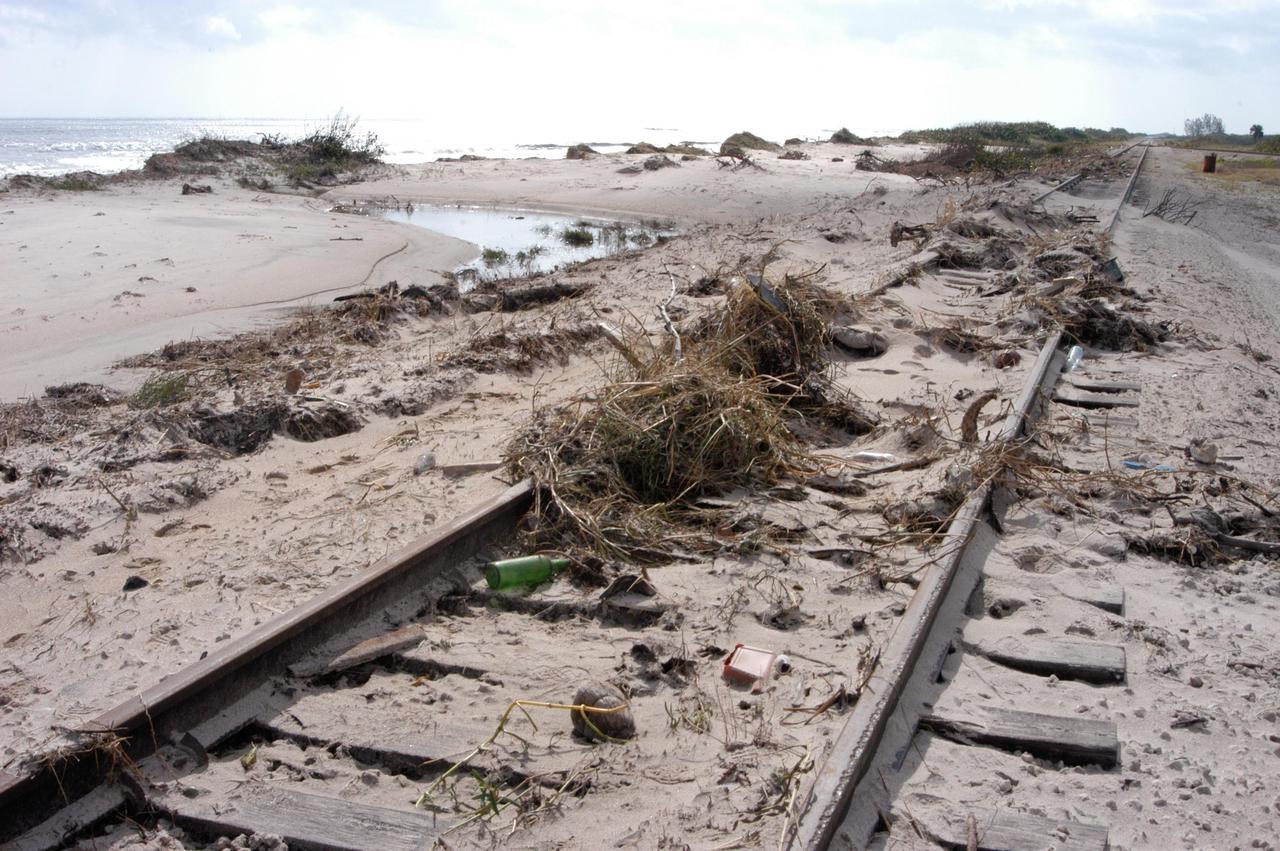
KENNEDY SPACE CENTER, FLA. - Debris litters the railroad track that runs along the shoreline east of KSC’s launch pads. The dunes were assaulted by storm surge and raging winds from category 3 Hurricane Jeanne, which barreled through Central Florida Sept. 25-26 from the southeast. Jeanne was the fourth hurricane in 6 weeks to batter the state.
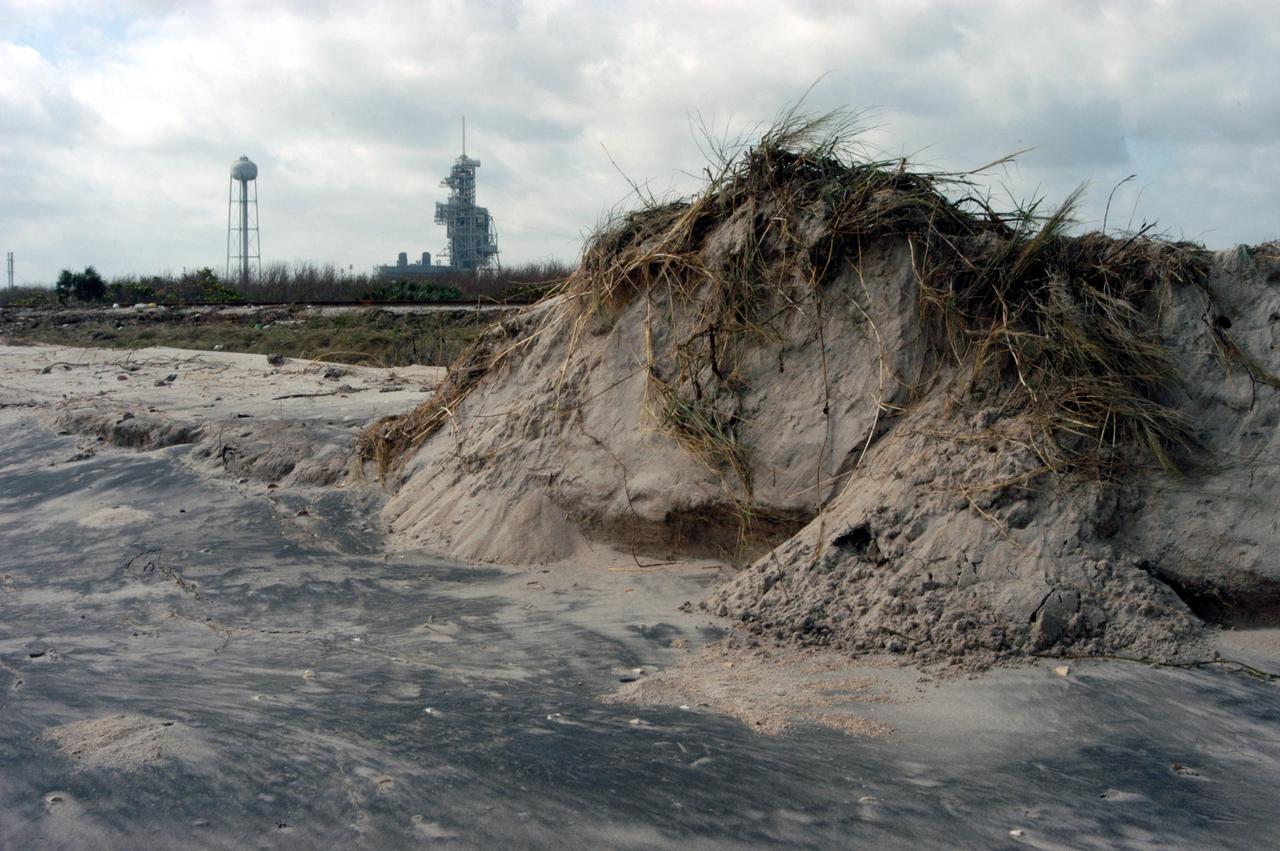
KENNEDY SPACE CENTER, FLA. - These sand dunes on the beach east of the KSC launch pads have been ravaged by category 3 Hurricane Jeanne that barreled through Central Florida Sept. 25-26 from the southeast. Jeanne was the fourth hurricane in 6 weeks to batter the state.
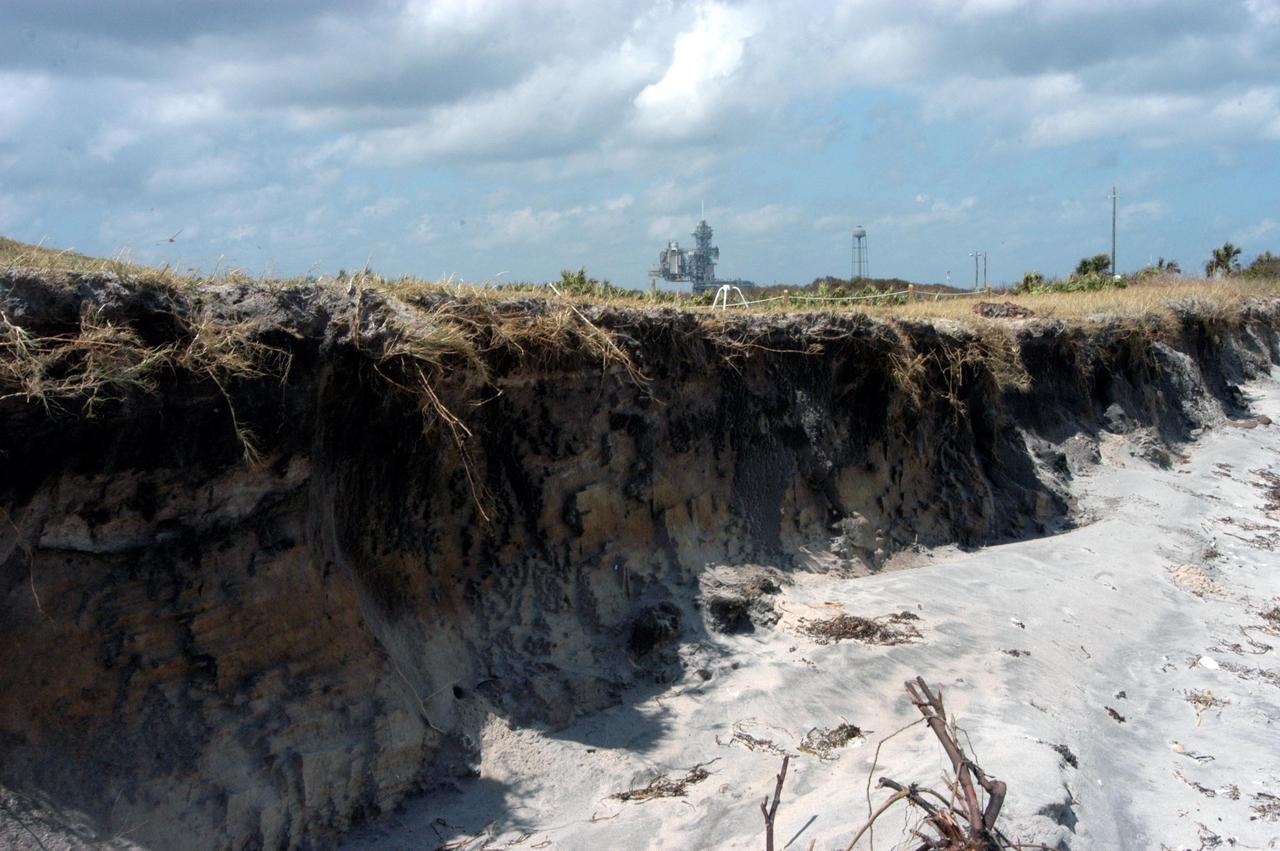
KENNEDY SPACE CENTER, FLA. - This view of the shoreline east of the launch pads at KSC shows the ocean lapping at the base of what appears to be a cliff. The storm surge and raging winds from Hurricane Jeanne eroded the dunes and shoreline. The category 3 storm barreled through Central Florida Sept. 25-26 from the southeast. It was the fourth hurricane in 6 weeks to batter the state.
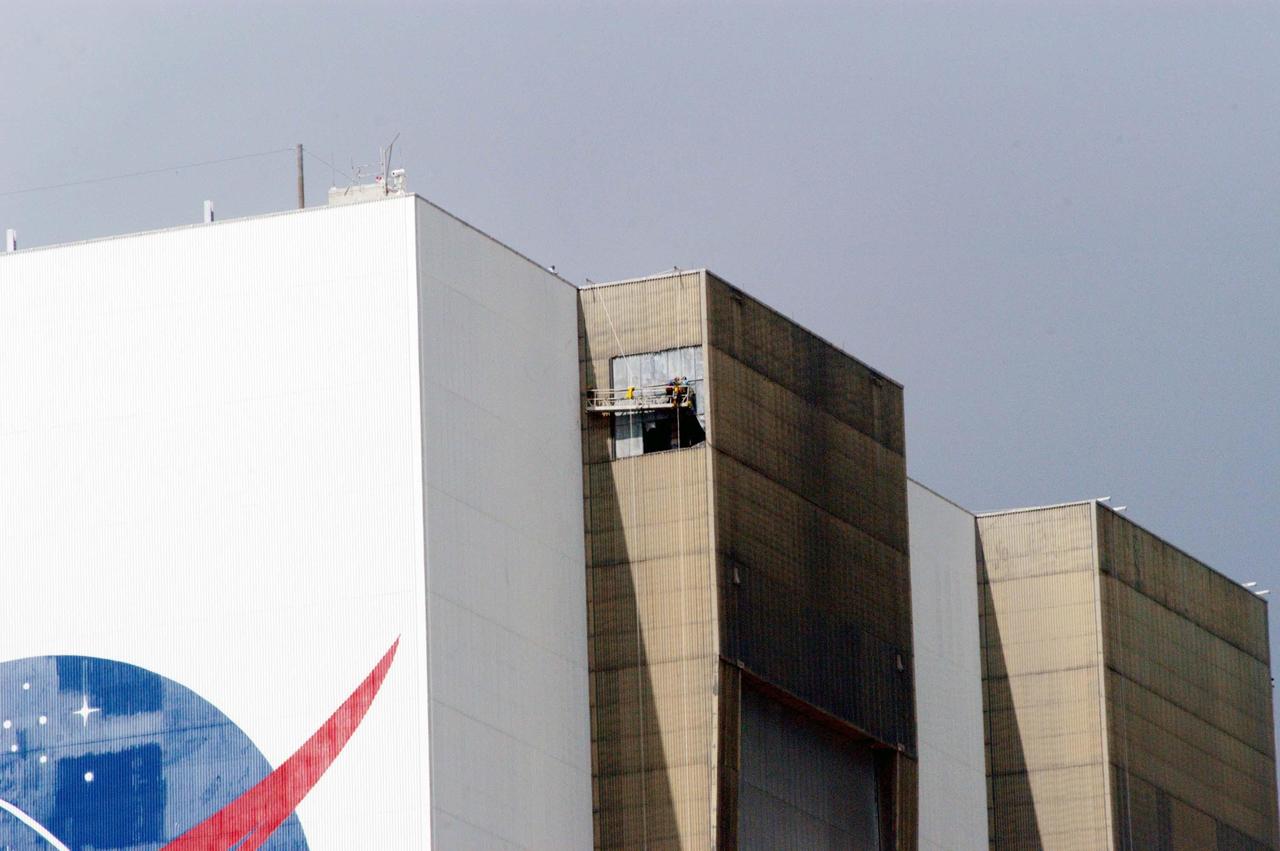
KENNEDY SPACE CENTER, FLA. - On a scaffold suspended near the top of the east side of the Vehicle Assembly Building, workers are covering the holes with corrugated steel so the facility can be returned to performing operational activities. The VAB lost 820 panels from the south wall during Hurricane Frances, and 25 additional panels during Hurricane Jeanne. The VAB stands 525 feet tall. Central Florida, including Kennedy Space Center, was battered by four hurricanes between Aug. 13 and Sept. 26.
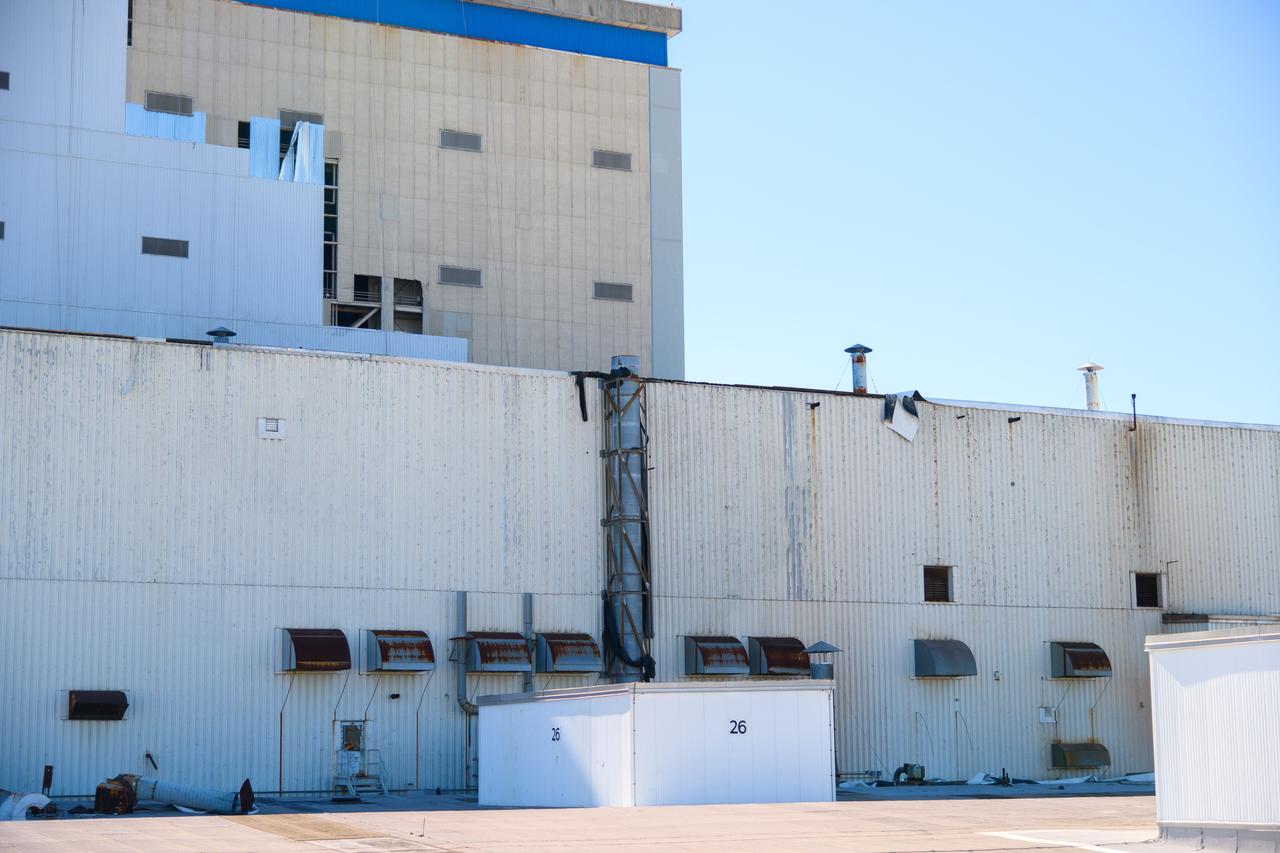
Hurricane Zeta damage to NASA’s Michoud Assembly Facility – East side of Bldg. 110 the Vertical Assembly Building (VAB).
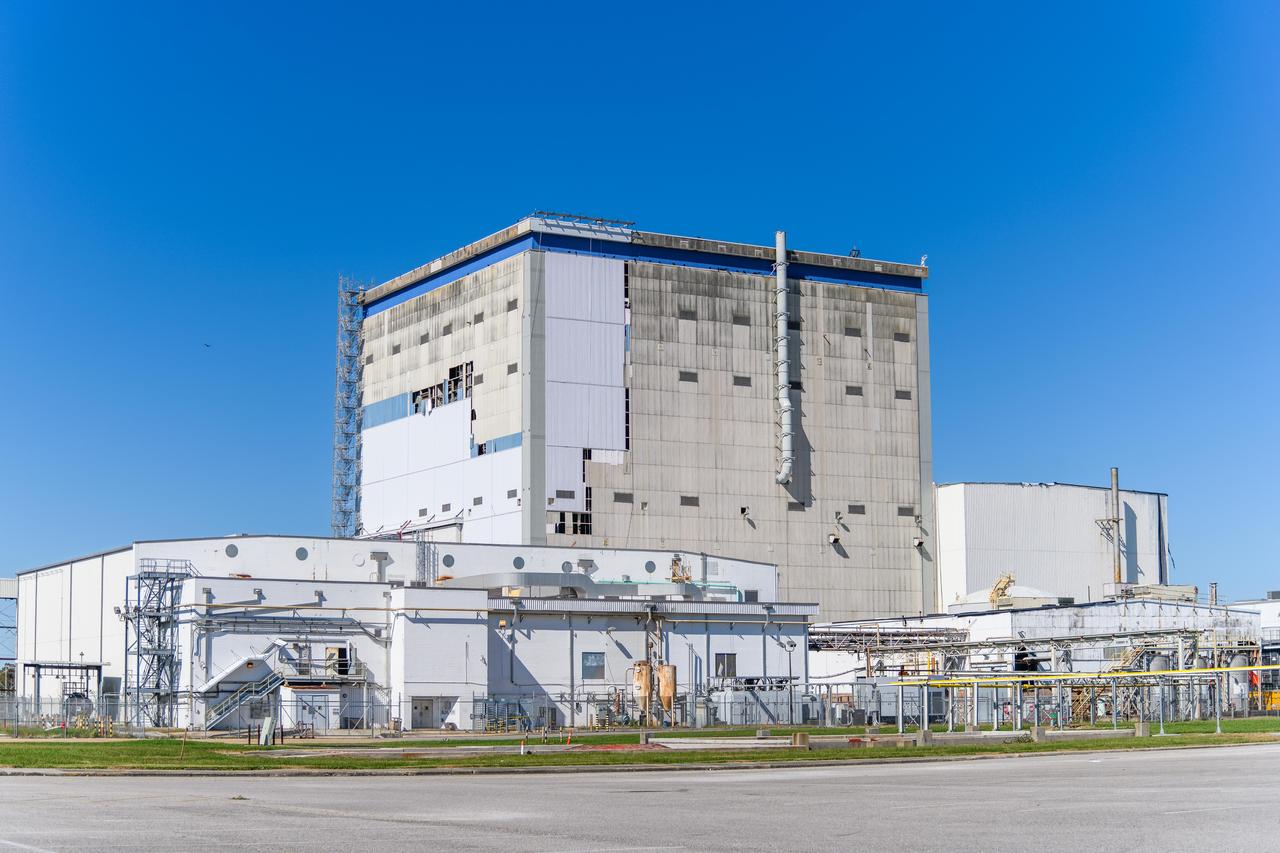
Hurricane Zeta damage to NASA’s Michoud Assembly Facility – South side of Bldg. 110 the Vertical Assembly Building (VAB).
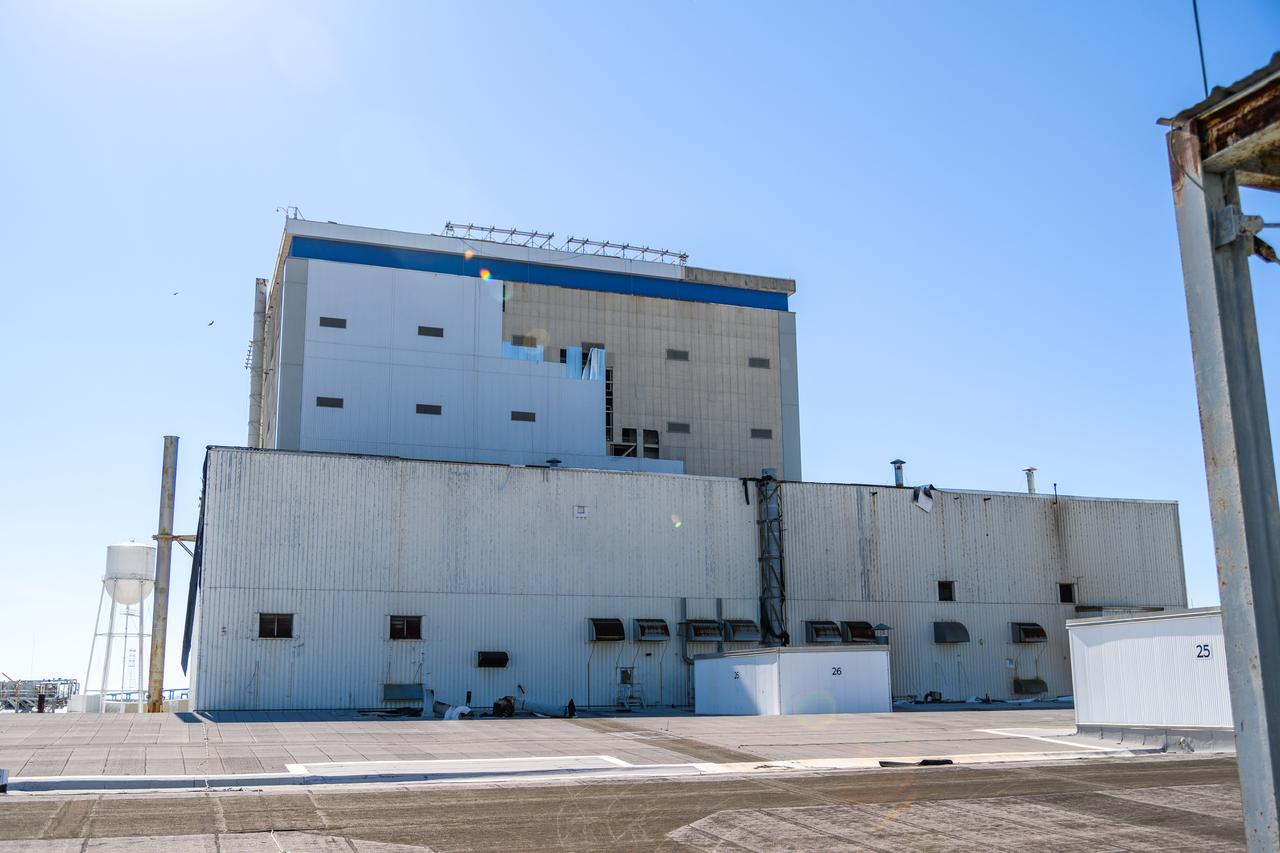
Hurricane Zeta damage to NASA’s Michoud Assembly Facility – East side of Bldg. 110 the Vertical Assembly Building (VAB).
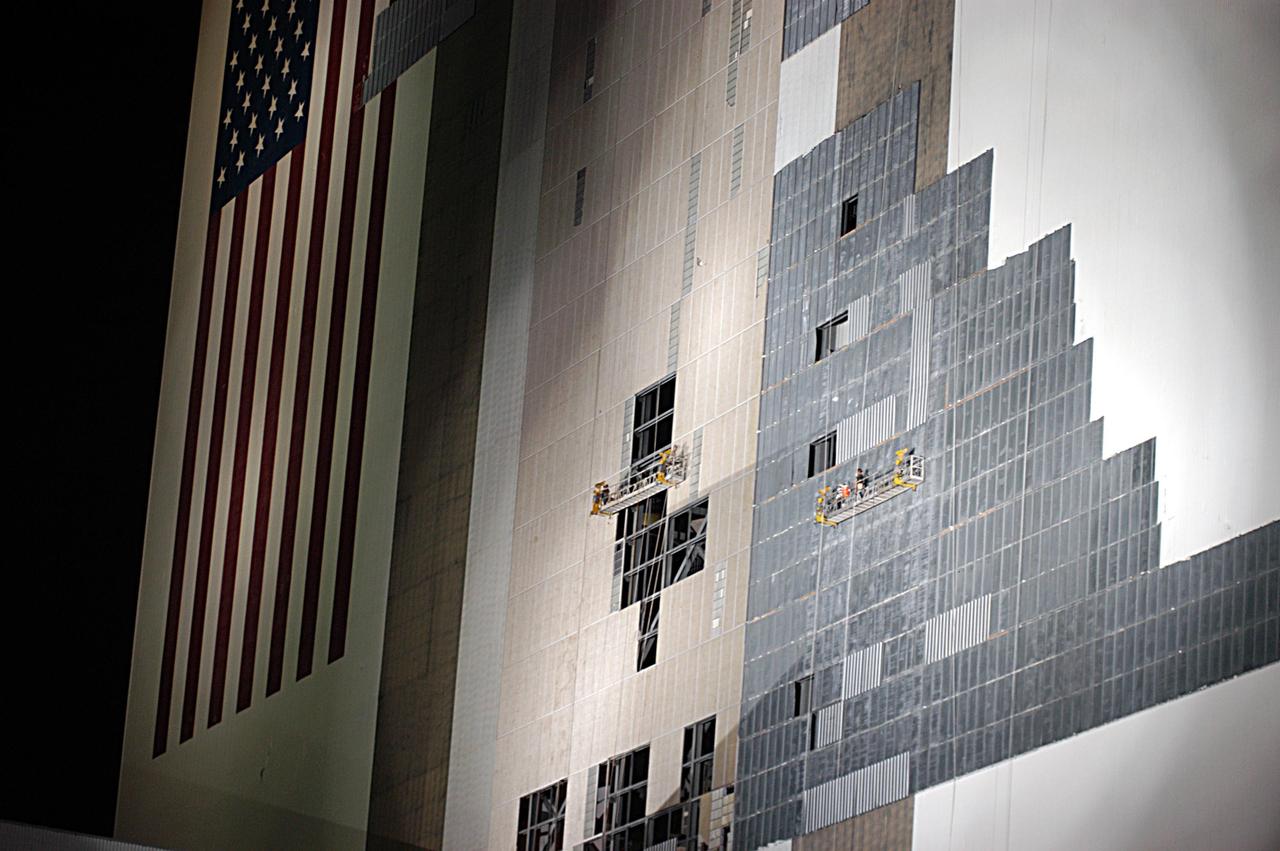
KENNEDY SPACE CENTER, FLA. - The south wall of the Vehicle Assembly Building is bathed in light at night to allow workers on two scaffolds to cover the holes with corrugated steel so the facility can be returned to performing operational activities. The VAB lost 820 panels from the south wall during Frances, and 25 additional panels during Hurricane Jeanne. The VAB stands 525 feet tall. Central Florida, including Kennedy Space Center, was battered by four hurricanes between Aug. 13 and Sept. 26.
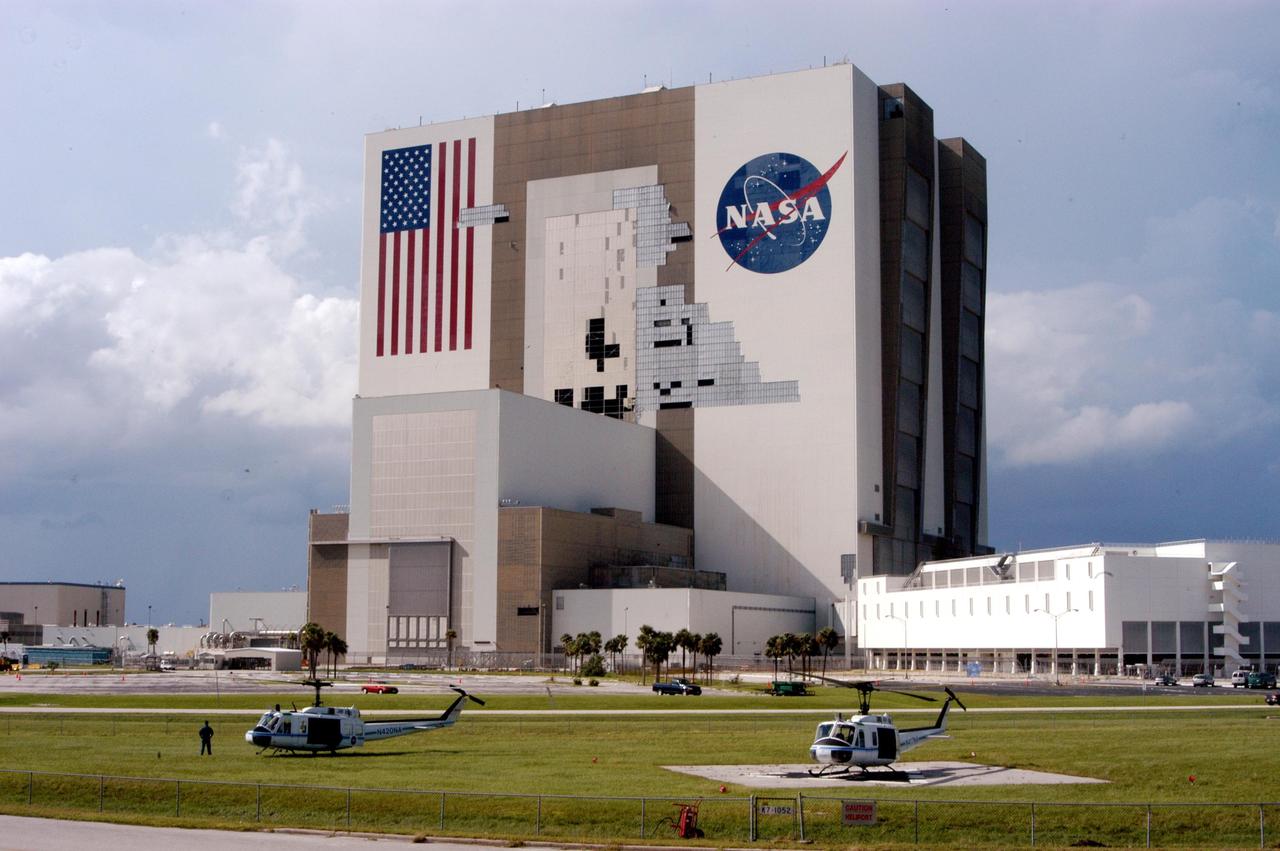
KENNEDY SPACE CENTER, FLA. - A view of the Vehicle Assembly Building at KSC shows damage inflicted by both Hurricane Frances and the category 3 Hurricane Jeanne. The storm barreled through Central Florida Sept. 25-26 from the southeast. The VAB had lost 850 panels from the south wall during Hurricane Frances. Twenty-five additional panels were pulled off the east wall by the winds from Jeanne. This was the fourth hurricane in 6 weeks to batter the state.
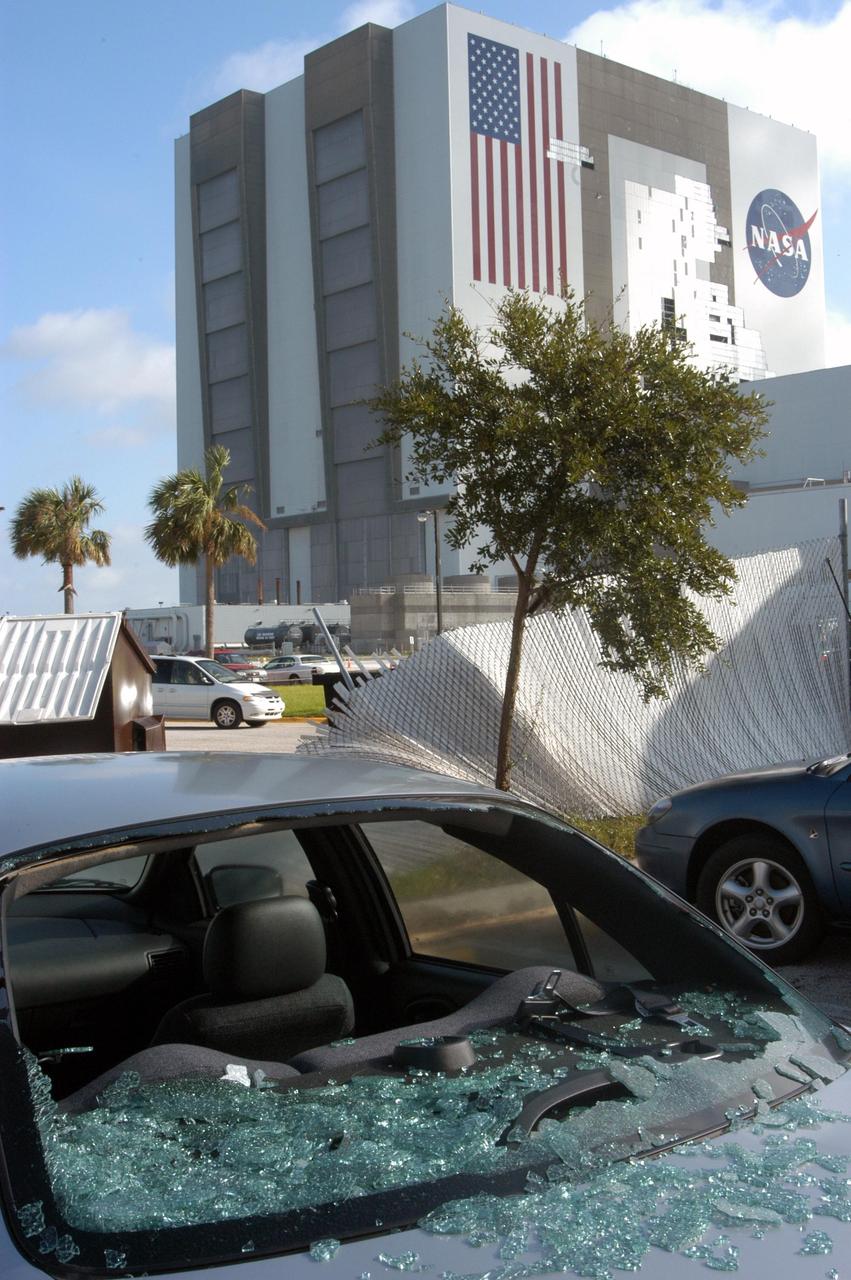
KENNEDY SPACE CENTER, FLA. - In a parking lot near the Vehicle Assembly Building (background), this car lost its rear window to the category 3 Hurricane Jeanne that barreled through Central Florida Sept. 25-26. Behind it is a fence mangled by the storm. Hurricane Jeanne was the fourth hurricane in 6 weeks to batter the state.
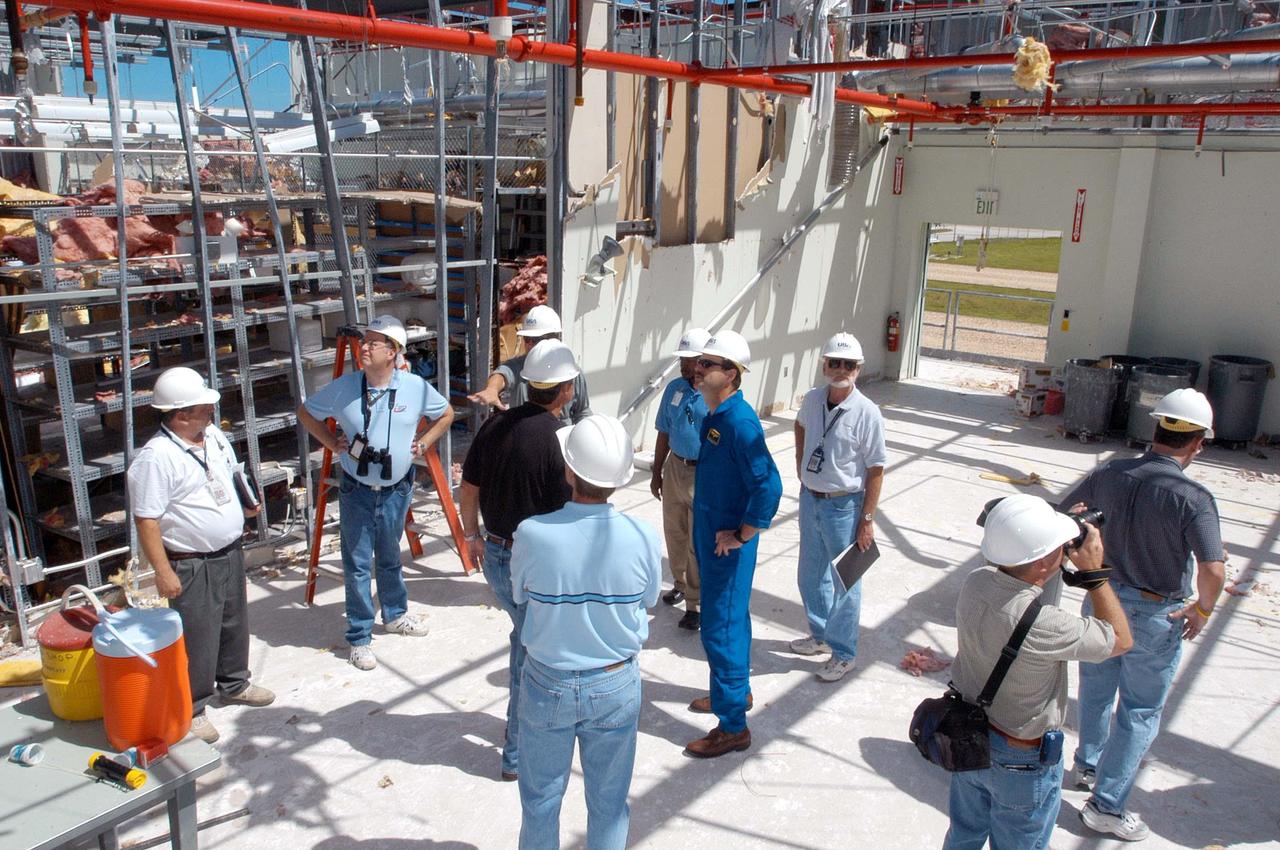
KENNEDY SPACE CENTER, FLA. - Members of a hurricane assessment team from Johnson Space Center and Marshall Space Flight Center observe the damage to the roof of the Thermal Protection System (TPS) Facility at KSC after Hurricane Frances hit the east coast of Central Florida and Kennedy Space Center. Near the center is astronaut Scott Altmann, a member of the team. The facility, which creates the TPS tiles, blankets and all the internal thermal control systems for the Space Shuttles, is almost totally unserviceable at this time after losing approximately 35 percent of its roof. Equipment and materials that survived the storm have been relocated to the RLV hangar near the KSC Shuttle Landing Facility.
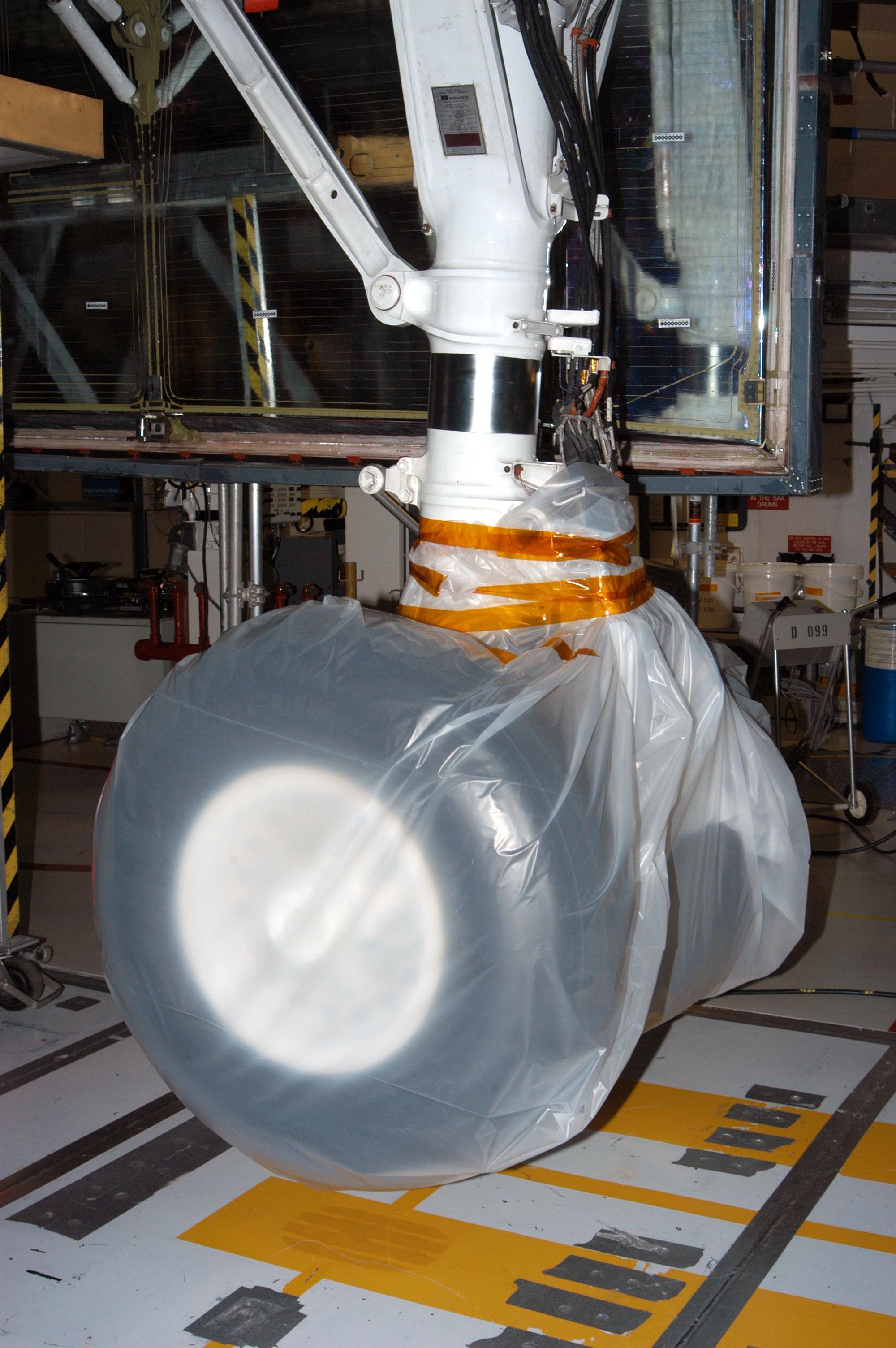
KENNEDY SPACE CENTER, FLA. - In the Orbiter Processing Facility, the wheel on Atlantis is covered in plastic that protected it from possible damage by Hurricane Jeanne. The storm ravaged Central Florida for 21 hours as it crossed the shoreline on the east coast Sept. 25-26. This was the fourth hurricane in 6 weeks to batter the state.
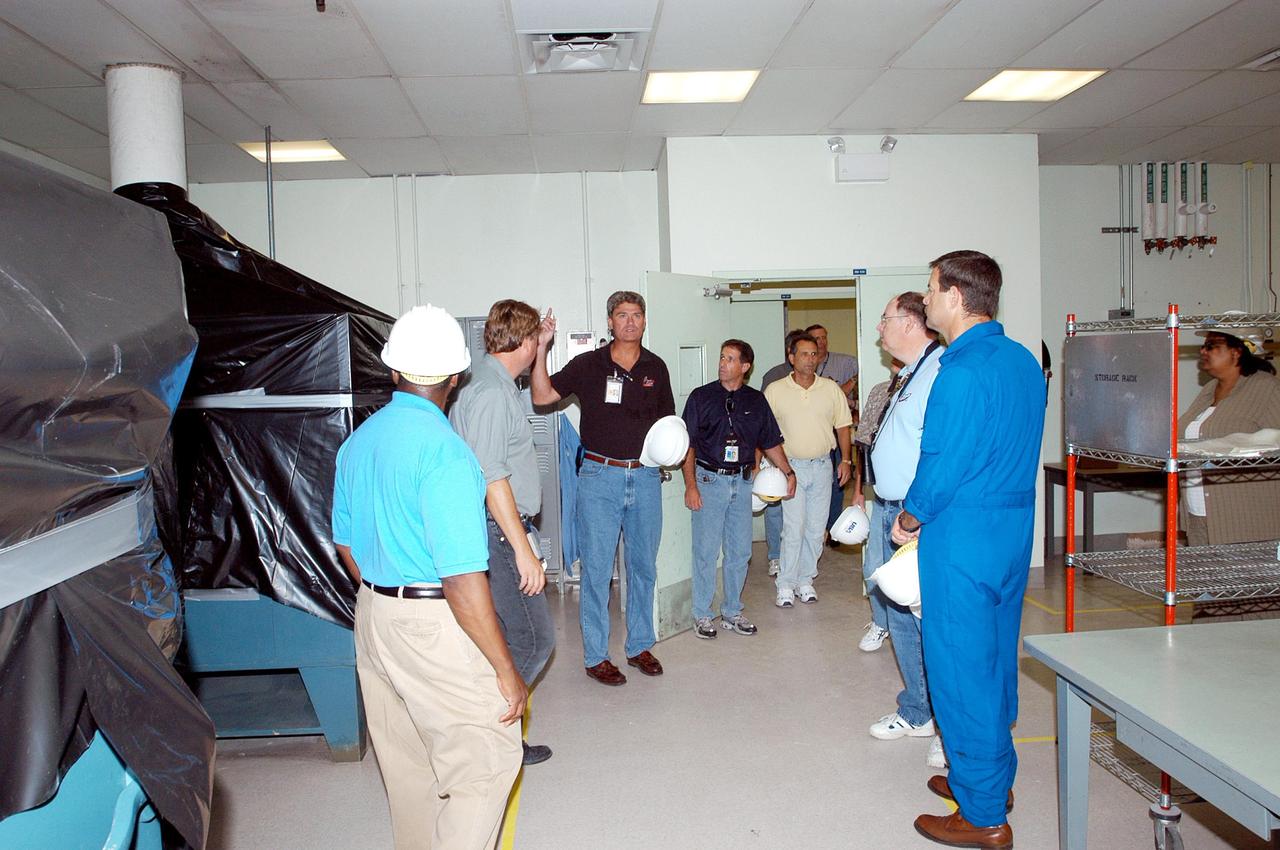
KENNEDY SPACE CENTER, FLA. - Members of a hurricane assessment team from Johnson Space Center and Marshall Space Flight Center tour the Thermal Protection System (TPS) Facility at KSC after Hurricane Frances hit the east coast of Central Florida and Kennedy Space Center. At right is astronaut Scott Altmann, a member of the team. The facility, which creates the TPS tiles, blankets and all the internal thermal control systems for the Space Shuttles, is almost totally unserviceable at this time after losing approximately 35 percent of its roof. Equipment and materials that survived the storm have been relocated to the RLV hangar near the KSC Shuttle Landing Facility.
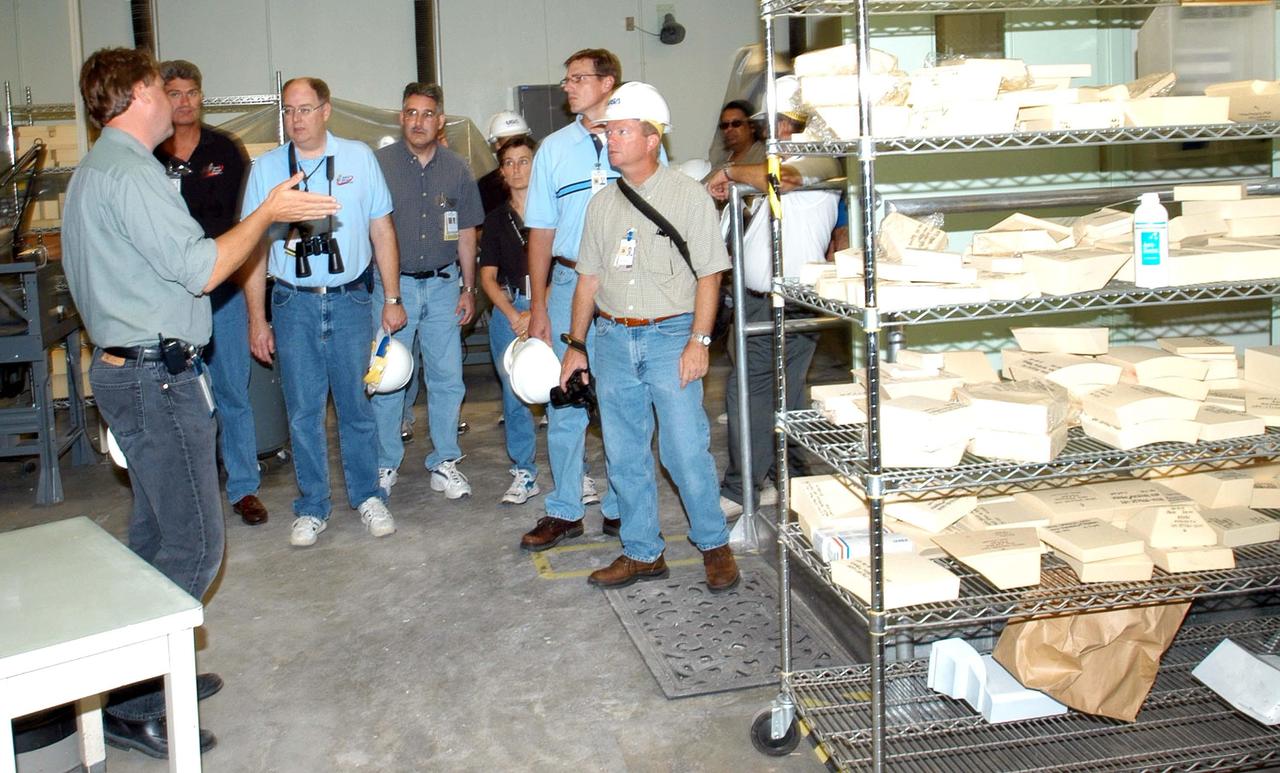
KENNEDY SPACE CENTER, FLA. - Members of a hurricane assessment team from Johnson Space Center and Marshall Space Flight Center tour the Thermal Protection System (TPS) Facility at KSC after Hurricane Frances hit the east coast of Central Florida and Kennedy Space Center. At left is Martin Wilson, manager of the TPS operations. The facility, which creates the TPS tiles, blankets and all the internal thermal control systems for the Space Shuttles, is almost totally unserviceable at this time after losing approximately 35 percent of its roof. Equipment and materials that survived the storm have been relocated to the RLV hangar near the KSC Shuttle Landing Facility.
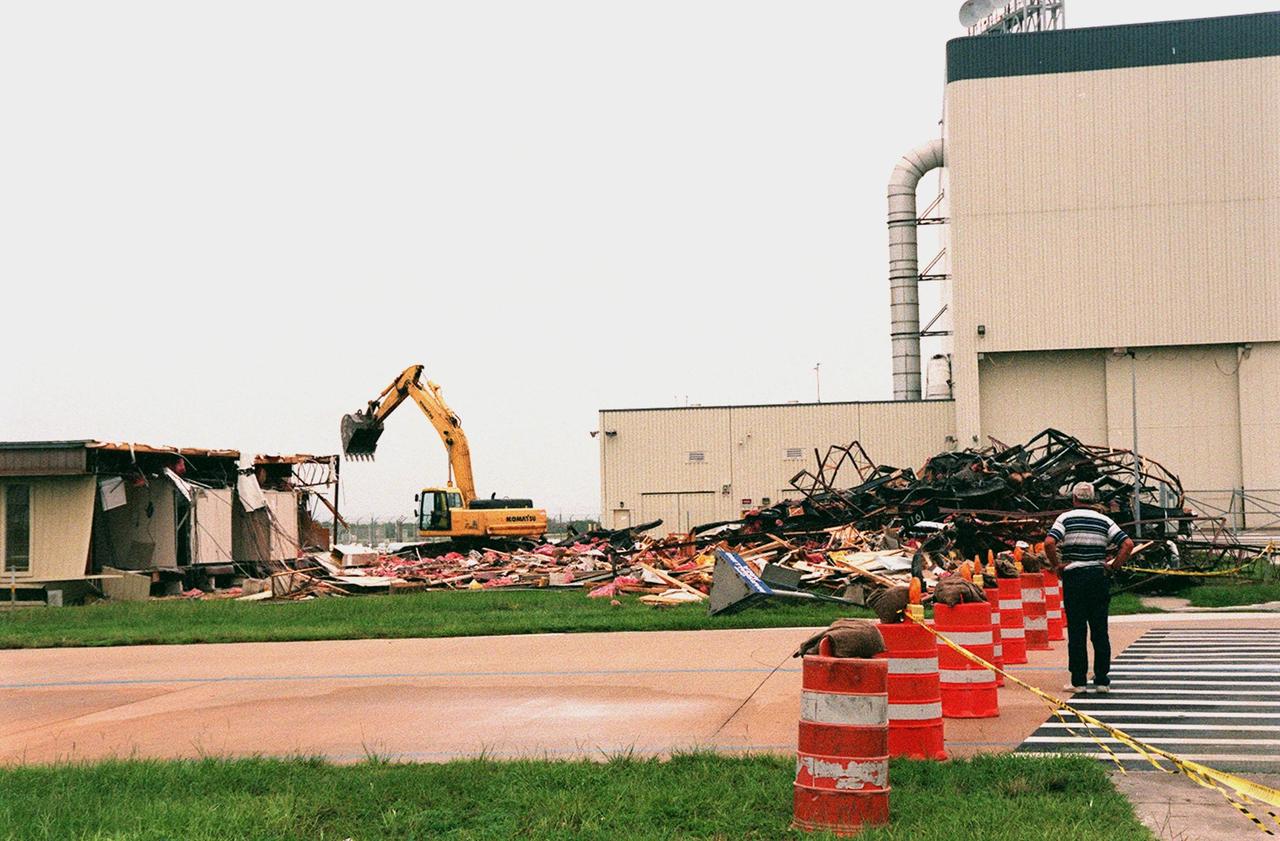
The Butler Building at Kennedy Space Center is nearly demolished, with the help of the crane in the background. The building, which is near the Orbiter Processing Facility (right), is being demolished in order to extend the crawlerway leading to the high bay of the Vehicle Assembly Building (VAB), part of KSC's Safe Haven project. The goal of Safe Haven is to strengthen readiness for Florida's hurricane season by expanding the VAB's storage capacity. Construction includes outfitting the VAB with a third stacking area, in high bay 2, that will allow NASA to preassemble stacks and still have room in the VAB to pull a Shuttle back from the pad into the safety of the VAB if severe weather threatens. The VAB can withstand winds up to 125 mph
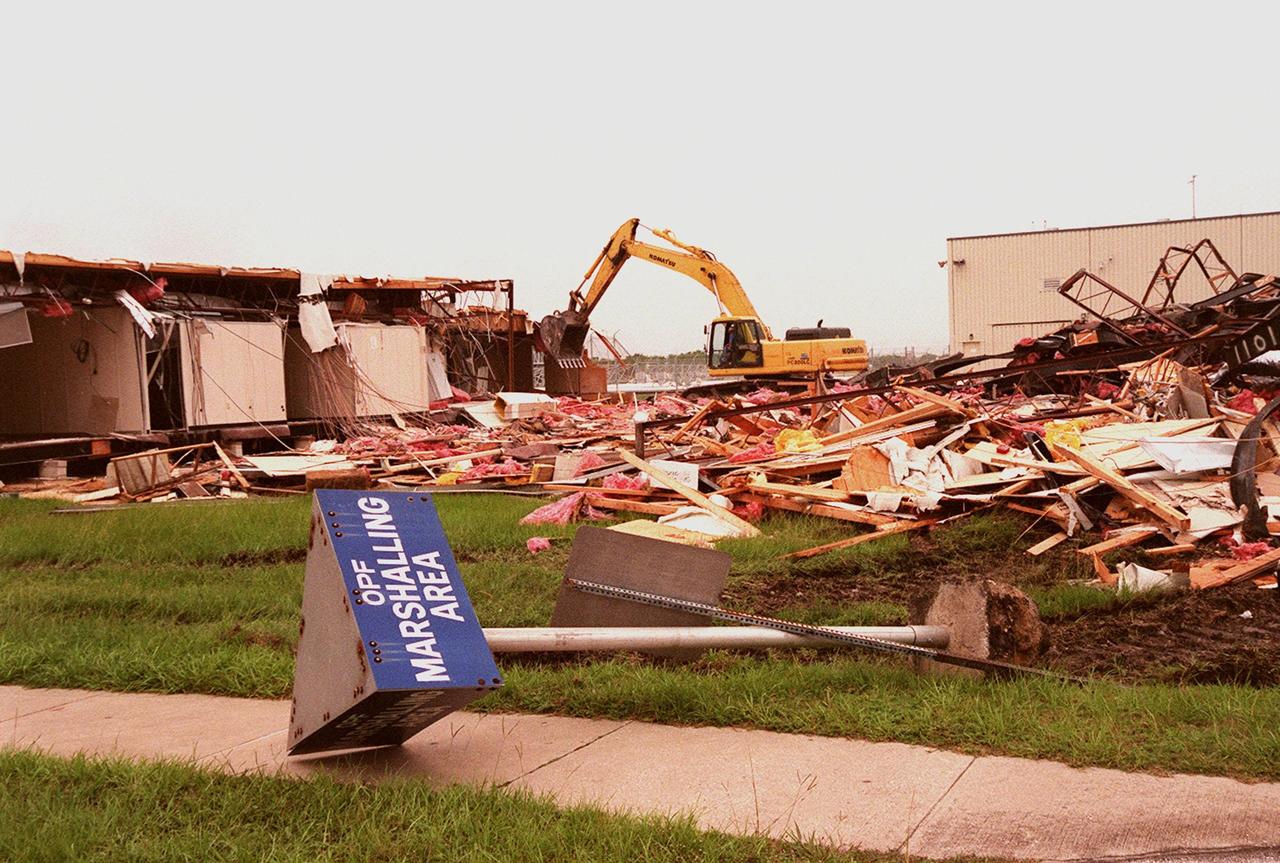
The walls of the Butler Building at Kennedy Space Center come tumbling down, with the help of the crane in the background. The building, which is near the Orbiter Processing Facility, is being demolished in order to extend the crawlerway leading to the high bay of the Vehicle Assembly Building (VAB), part of KSC's Safe Haven project. The goal of Safe Haven is to strengthen readiness for Florida's hurricane season by expanding the VAB's storage capacity. Construction includes outfitting the VAB with a third stacking area, in high bay 2, that will allow NASA to preassemble stacks and still have room in the VAB to pull a Shuttle back from the pad into the safety of the VAB if severe weather threatens. The VAB can withstand winds up to 125 mph
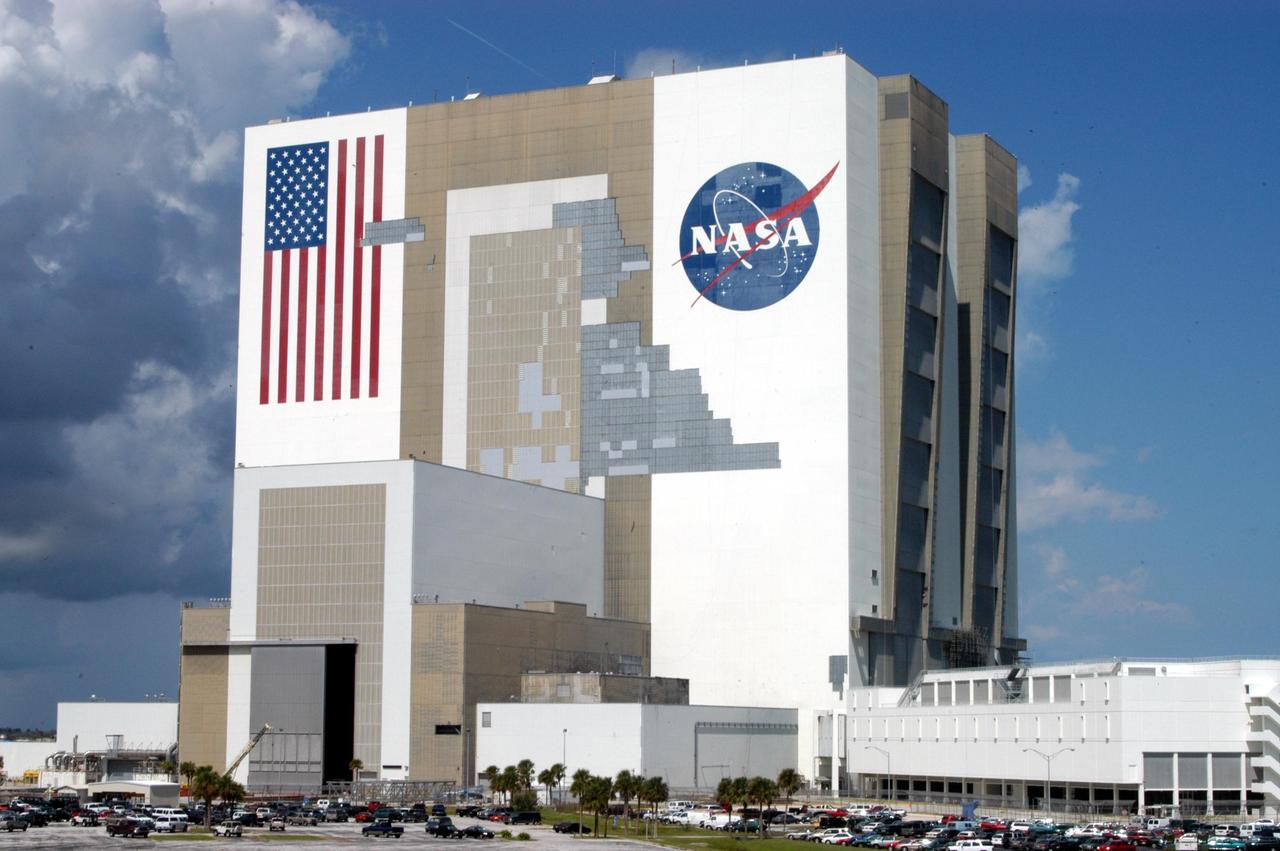
KENNEDY SPACE CENTER, FLA. - The Vehicle Assembly Building at KSC sports a patchwork façade after the holes created by recent hurricanes were covered with corrugated steel. The VAB lost 820 panels from the south wall during Hurricane Frances, and 25 additional panels pulled off the east wall by Hurricane Jeanne. Employees of Met-Con, a subcontractor in Cocoa, Fla., worked night and day on scaffolds hung from the 525-foot-high roof to close the holes and enable the facility to return to normal operations.

KENNEDY SPACE CENTER, FLA. - This view of the Vehicle Assembly Building at KSC shows the patchwork of corrugated steel that covers holes created by recent hurricanes. The VAB lost 820 panels from the south wall during Hurricane Frances, and 25 additional panels pulled off the east wall by Hurricane Jeanne. Employees of Met-Con, a subcontractor in Cocoa, Fla., worked night and day on scaffolds hung from the 525-foot-high roof to close the holes and enable the facility to return to normal operations.
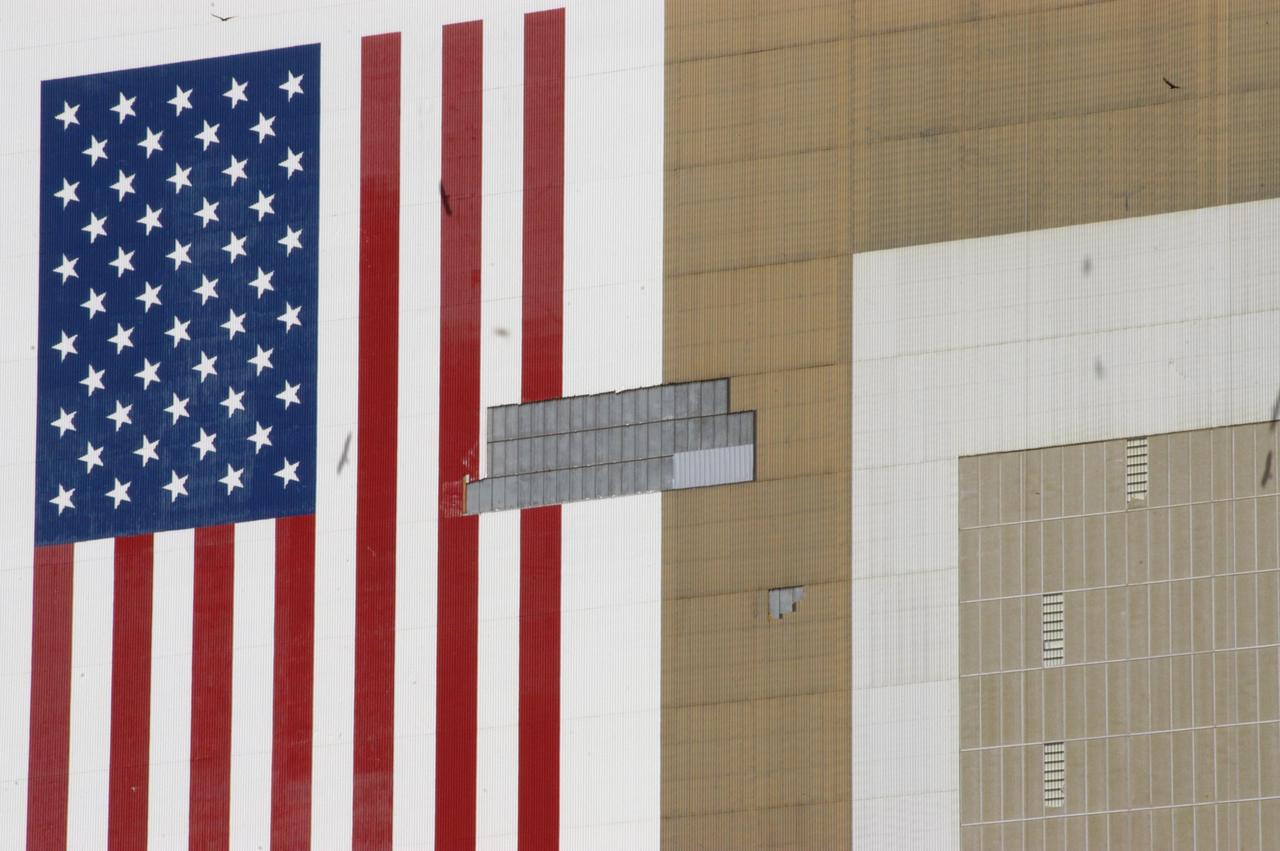
KENNEDY SPACE CENTER, FLA. - This closeup of the Vehicle Assembly Building at KSC shows some of the patchwork of corrugated steel that covers holes created by recent hurricanes. The VAB lost 820 panels from the south wall during Hurricane Frances, and 25 additional panels pulled off the east wall by Hurricane Jeanne. Employees of Met-Con, a subcontractor in Cocoa, Fla., worked night and day on scaffolds hung from the 525-foot-high roof to close the holes and enable the facility to return to normal operations.

KENNEDY SPACE CENTER, FLA. - This view of the Vehicle Assembly Building at KSC shows more of the patchwork of corrugated steel that covers holes created by recent hurricanes. The VAB lost 820 panels from the south wall during Hurricane Frances, and 25 additional panels pulled off the east wall by Hurricane Jeanne. Employees of Met-Con, a subcontractor in Cocoa, Fla., worked night and day on scaffolds hung from the 525-foot-high roof to close the holes and enable the facility to return to normal operations.
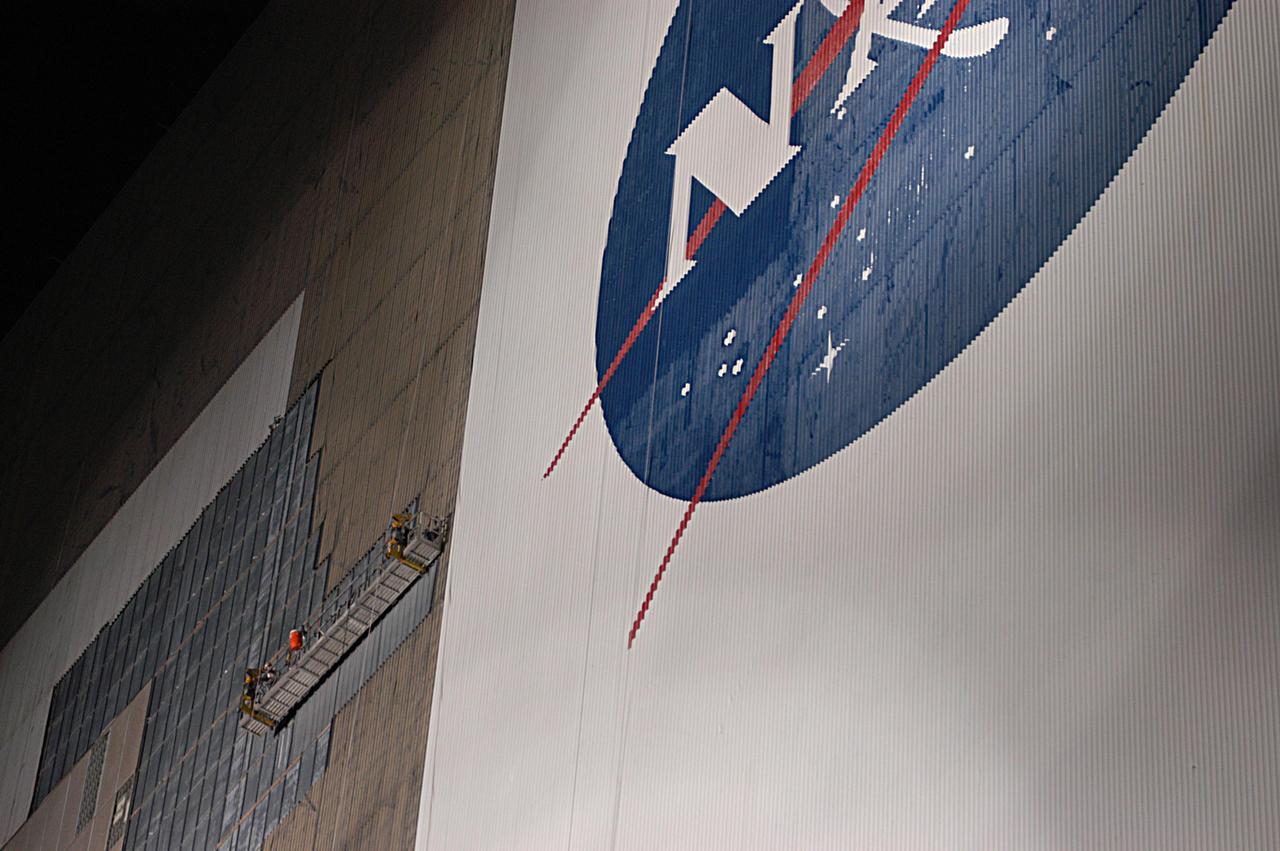
KENNEDY SPACE CENTER, FLA. - The south wall of the Vehicle Assembly Building is bathed in light at night to allow workers on a scaffold (at left) to cover the holes with corrugated steel so the facility can be returned to performing operational activities. Xenon lights on the ground provide the illumination. The VAB lost 820 panels from the south wall during Frances, and 25 additional panels during Hurricane Jeanne. The VAB stands 525 feet tall. Central Florida, including Kennedy Space Center, was battered by four hurricanes between Aug. 13 and Sept. 26.
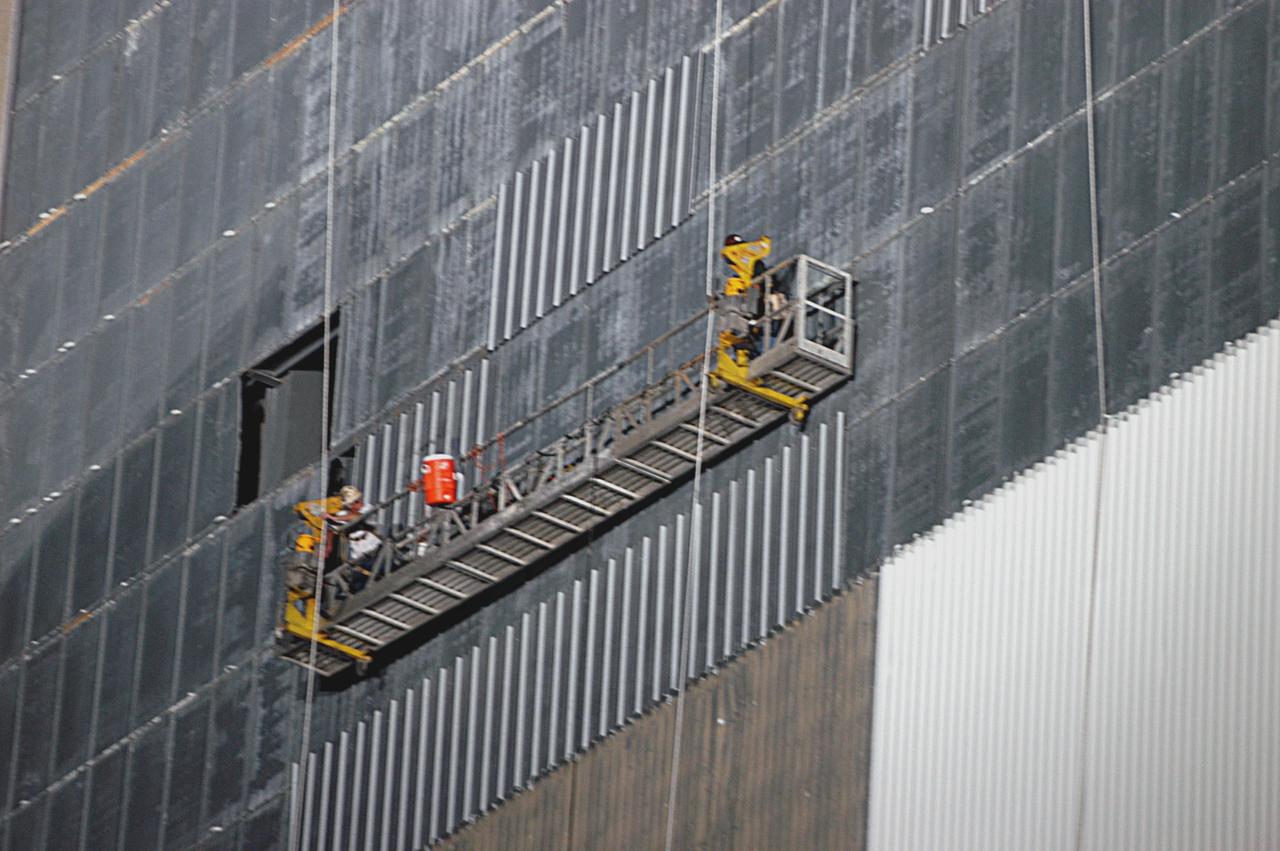
KENNEDY SPACE CENTER, FLA. - A closeup of the Vehicle Assembly Building shows one of the scaffolds being used to allow workers to cover the holes with corrugated steel so the facility can be returned to performing operational activities. Xenon lights on the ground provide the illumination. The VAB lost 820 panels from the south wall during Frances, and 25 additional panels during Hurricane Jeanne. The VAB stands 525 feet tall. Central Florida, including Kennedy Space Center, was battered by four hurricanes between Aug. 13 and Sept. 26.
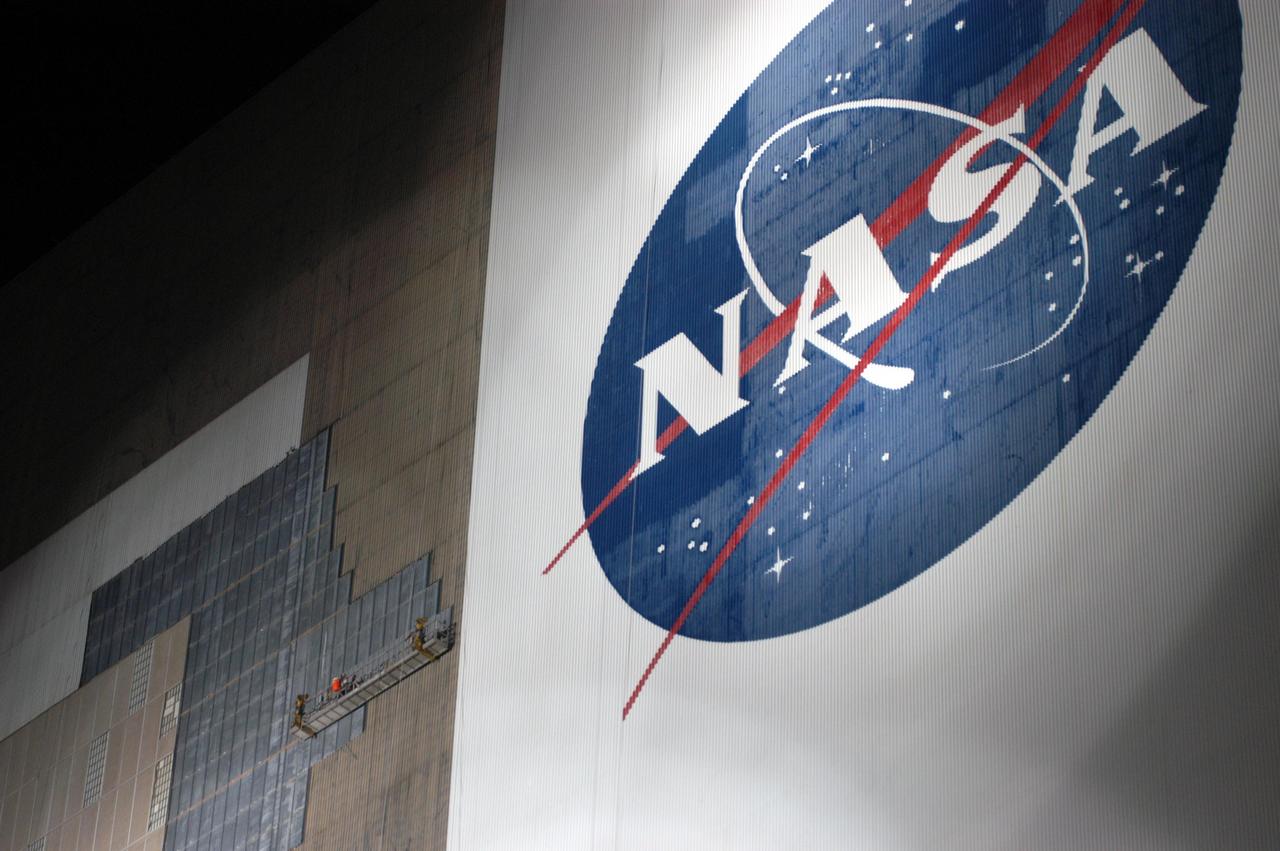
KENNEDY SPACE CENTER, FLA. - The south wall of the Vehicle Assembly Building is bathed in light at night to allow workers on a scaffold to cover the holes with corrugated steel so the facility can be returned to performing operational activities. Xenon lights on the ground provide the illumination. The VAB lost 820 panels from the south wall during Frances, and 25 additional panels during Hurricane Jeanne. The VAB stands 525 feet tall. Central Florida, including Kennedy Space Center, was battered by four hurricanes between Aug. 13 and Sept. 26.
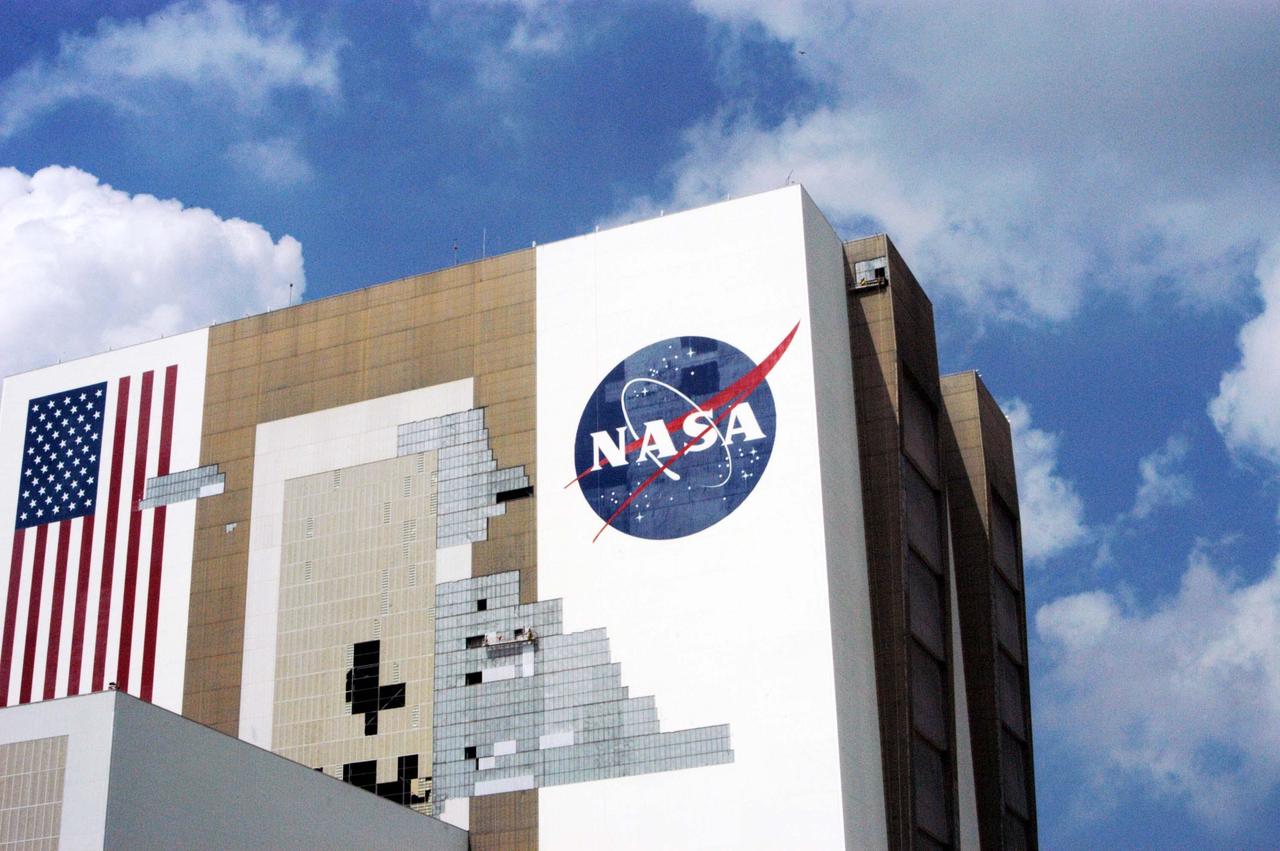
KENNEDY SPACE CENTER, FLA. - On a scaffold barely visible along the south wall of the Vehicle Assembly Building near the NASA logo, workers are covering the holes with corrugated steel so the facility can be returned to performing operational activities. The VAB lost 820 panels from the south wall during the storm, and 25 additional panels pulled off the east wall by Hurricane Jeanne. Another scaffold is suspended near the top of the east wall (right side) for repairs. The VAB stands 525 feet tall. Central Florida, including Kennedy Space Center, has been battered by four hurricanes between Aug. 13 and Sept. 26.
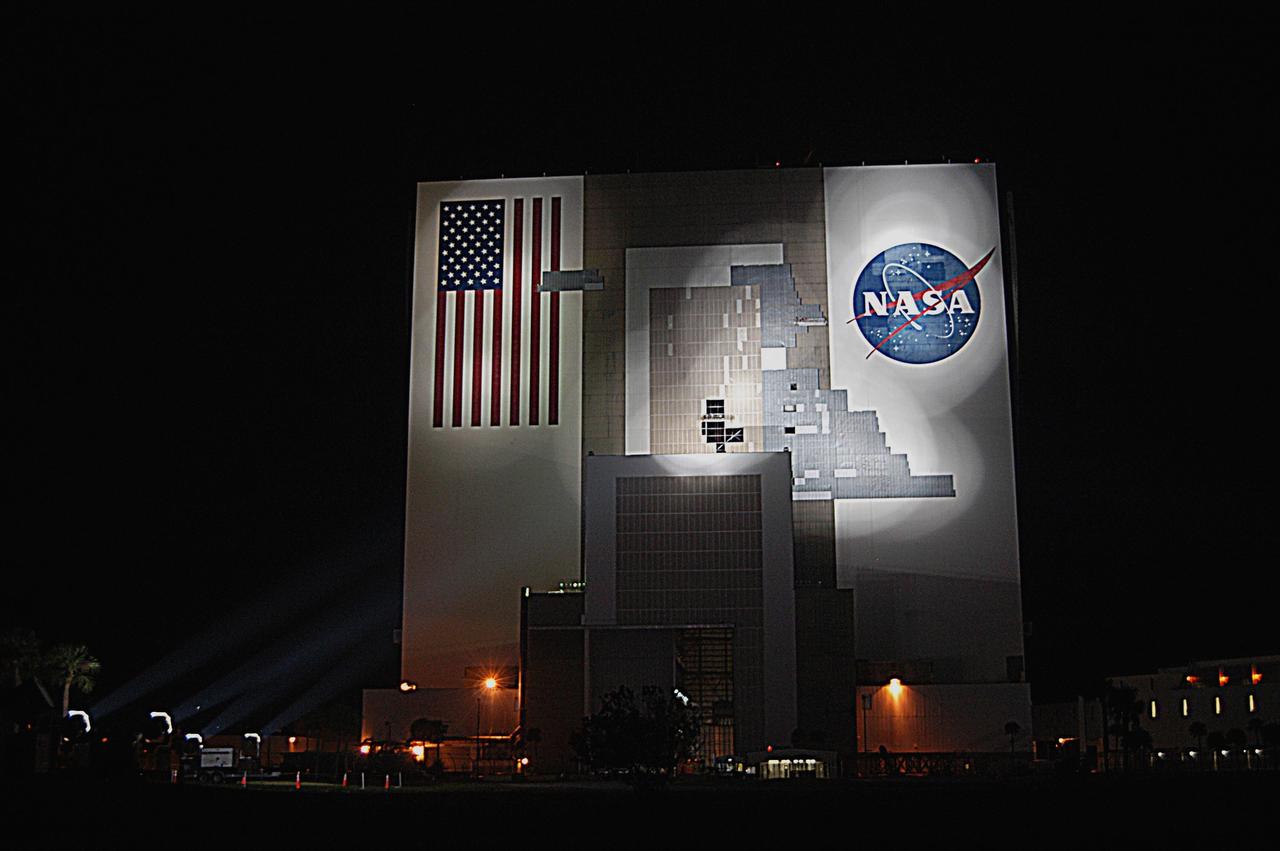
KENNEDY SPACE CENTER, FLA. - Xenon lights on the ground near the Vehicle Assembly Building bathe the south wall in light, allowing workers on scaffolds (center and upper right near the NASA logo) to cover the holes with corrugated steel so the facility can be returned to performing operational activities. The VAB lost 820 panels from the south wall during Frances, and 25 additional panels during Hurricane Jeanne. The VAB stands 525 feet tall. Central Florida, including Kennedy Space Center, was battered by four hurricanes between Aug. 13 and Sept. 26.
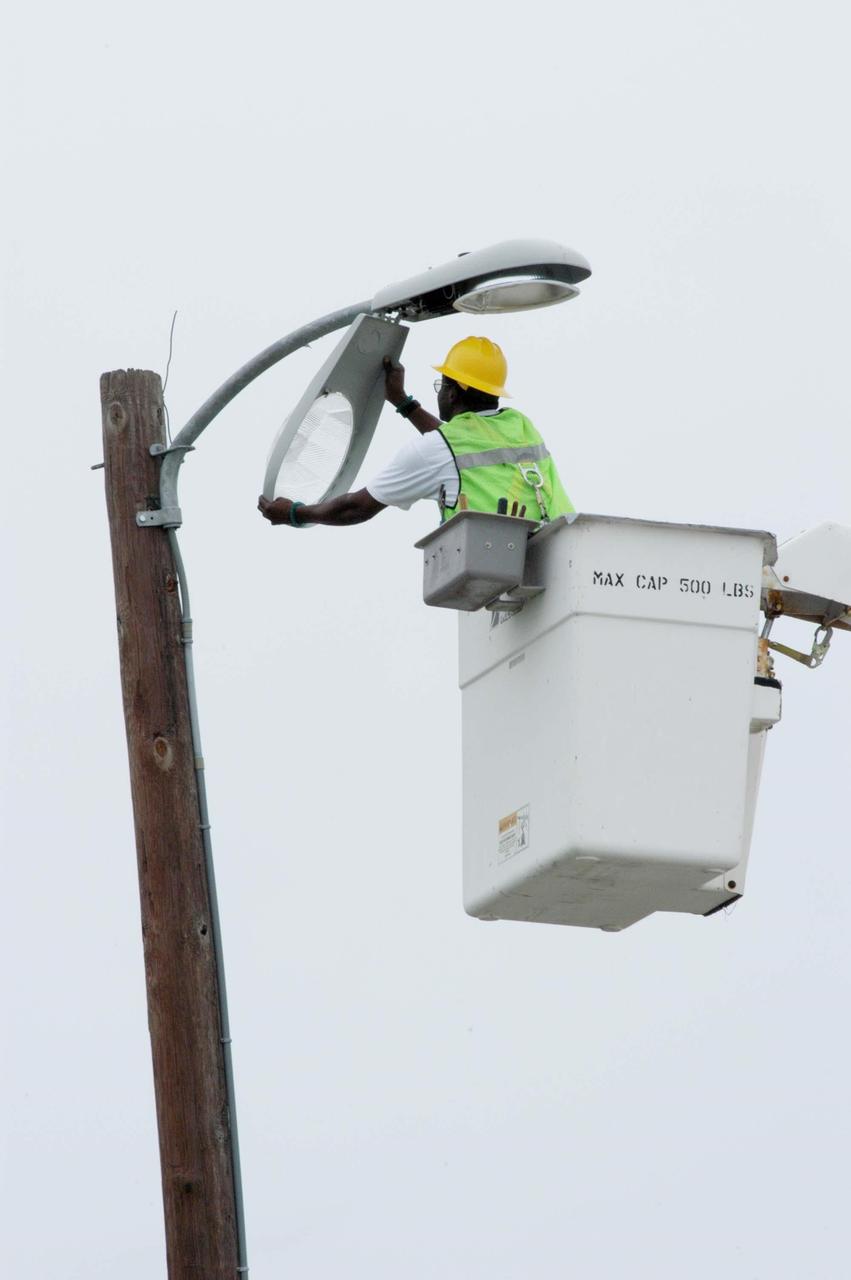
KENNEDY SPACE CENTER, FLA. - A repair crew replaces a light fixture damaged by Hurricane Frances as it passed over Central Florida during the Labor Day weekend. The maximum wind at the surface from Hurricane Frances was 94 mph from the northeast at 6:40 a.m. on Sunday, September 5. It was recorded at a weather tower located on the east shore of the Mosquito Lagoon near the Cape Canaveral National Seashore. The highest sustained wind at KSC was 68 mph. KSC sustained damage to the south wall and roof of the Vehicle Assembly Building plus the roof of the Thermal Protection System Facility.
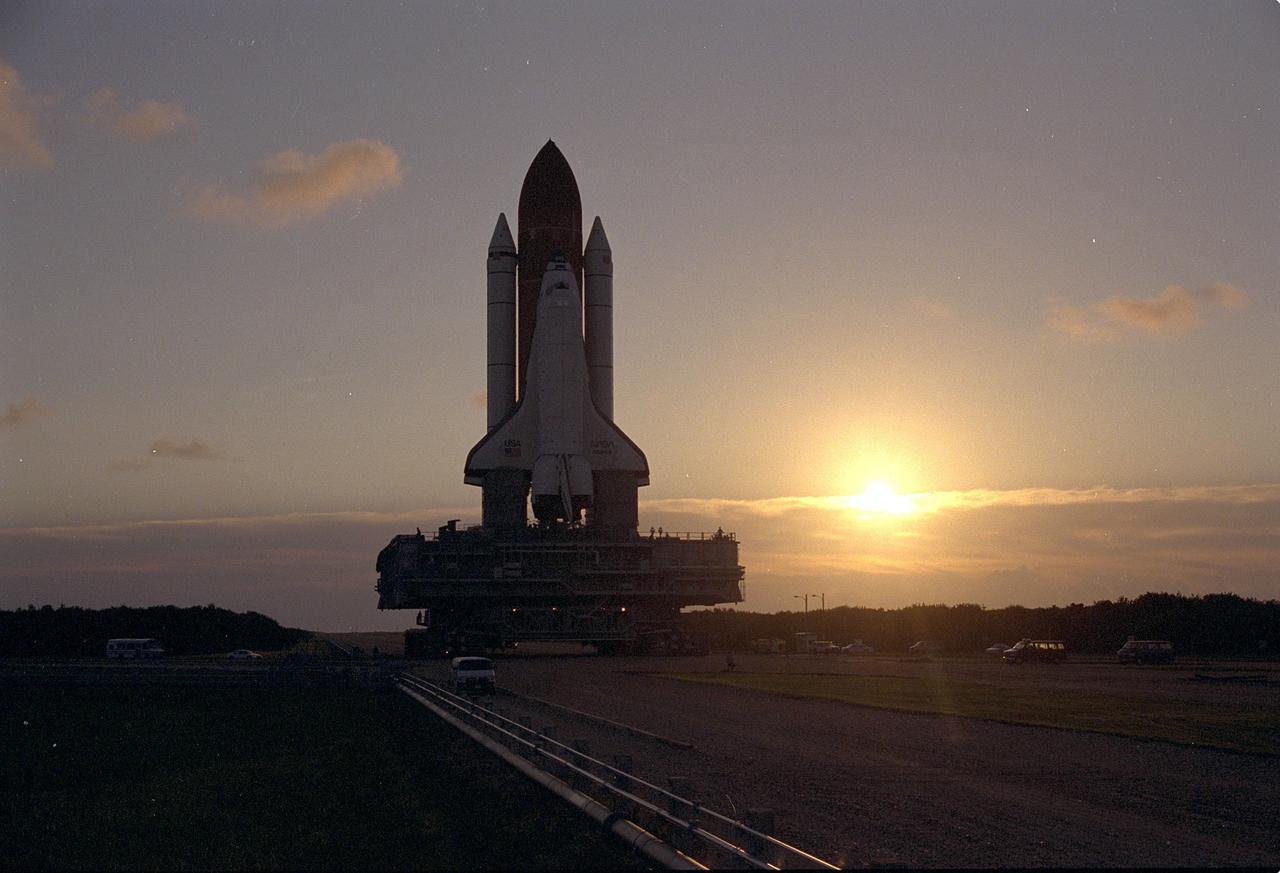
KENNEDY SPACE CENTER, FLA. - As the sun begins to rise in the early-morning sky after its departure from Launch Pad 39A, the Space Shuttle Atlantis slowly travels on the crawlerway toward the Vehicle Assembly Building. This marks the second rollback for Atlantis since July because of hurricane threats. Atlantis, which is targeted fo liftoff later this month on the STS-79 Shuttle mission, is returning to the VAB because of the threat from Hurricane Fran. The threat of Hurricane Bertha forced the rollback of Atlantis in July. Atlantis currently is scheduled for launch on the fourth Shuttle-Mir docking mission around mid-September.
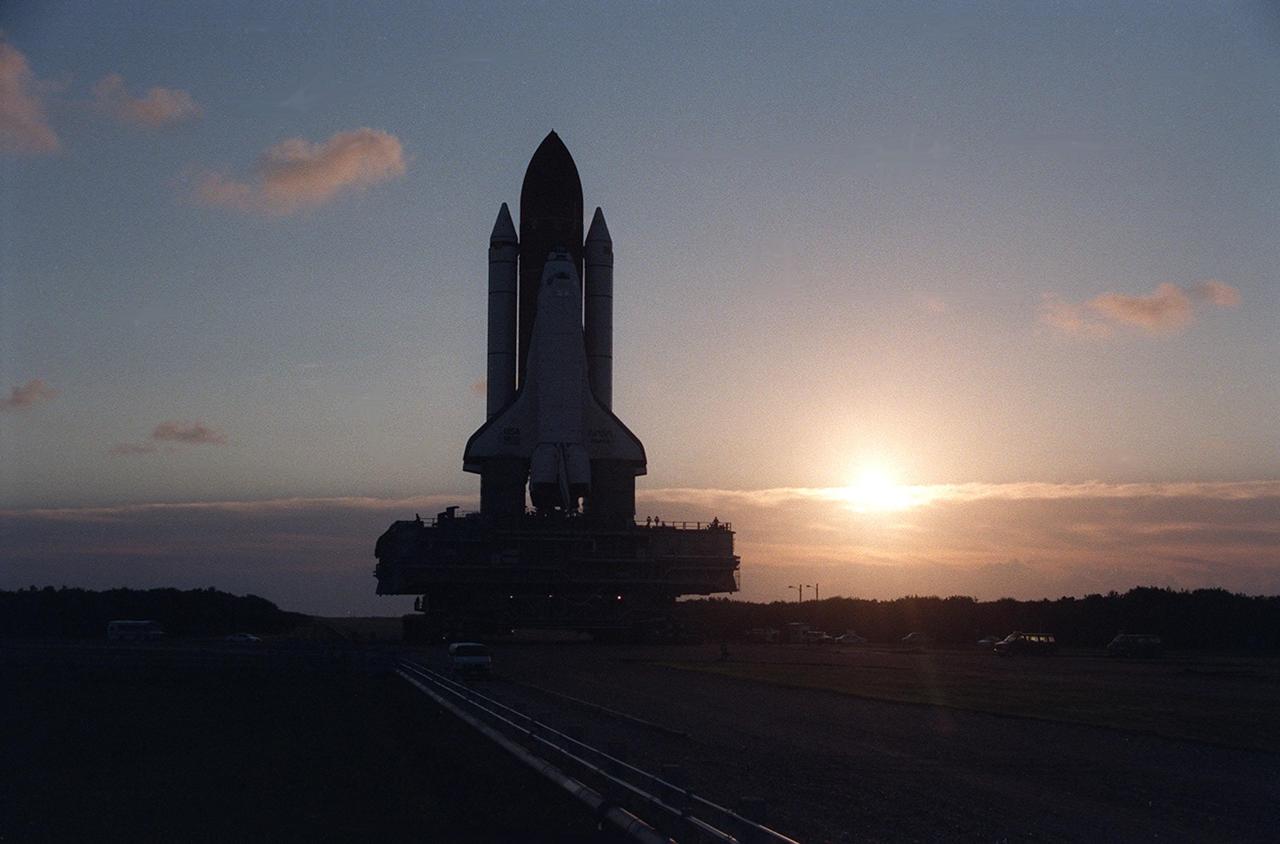
KENNEDY SPACE CENTER, FLA. - As the sun begins to rise in the early-morning sky, the Space Shuttle Atlantis slowly travels on the Crawlerway toward the Vehicle Assembly Building after its departure from Launch Pad 39A. This marks the second rollback for Atlantis since July because of hurricane threats. Atlantis, which is targeted for liftoff later this month on the STS-79 Shuttle mission, is returning to the VAB because of the threat from Hurrican Fran. The threat of Hurrican Bertha forced the rollback of Atlantis in July. Atlantis is currently scheduled for launch on the fourth Shuttle-MIR docking mission around mid-September

KENNEDY SPACE CENTER, FLA. -- For the first time in Space Shuttle history, a fully stacked Shuttle - Atlantis - moves into high bay 2, on the west side of the Vehicle Assembly Building (VAB). The VAB and nearby rock-paved crawlerway have recently undergone major modifications to provide Shuttle fliglht hardware more storage space and protection - "Safe Haven" - from hurricanes or tropical storms. Atlantis begain moving out of VAB high bay 1 on the east side at 2:59 a.m. EDT. After the successful "Safe Haven" fit check, Shuttle Atlantis is scheduled to roll out to Launch Pad 39B in preparation for the STS-106 launch on Sept. 8.
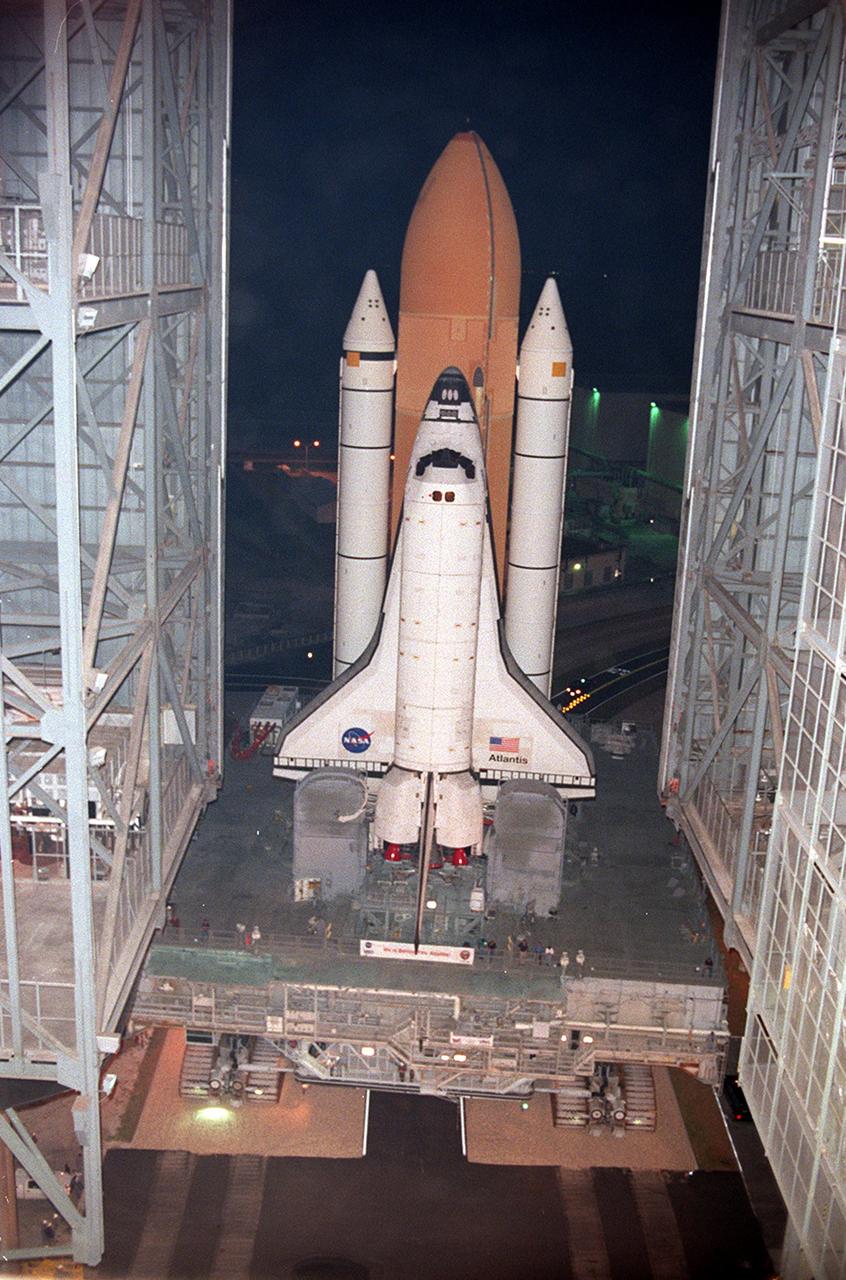
KENNEDY SPACE CENTER, FLA. -- For the first time in Space Shuttle history, a fully stacked Shuttle - Atlantis - moves into high bay 2, on the west side of the Vehicle Assembly Building (VAB). The VAB and nearby rock-paved crawlerway have recently undergone major modifications to provide Shuttle fliglht hardware more storage space and protection - "Safe Haven" - from hurricanes or tropical storms. Atlantis begain moving out of VAB high bay 1 on the east side at 2:59 a.m. EDT. After the successful "Safe Haven" fit check, Shuttle Atlantis is scheduled to roll out to Launch Pad 39B in preparation for the STS-106 launch on Sept. 8.

KENNEDY SPACE CENTER, FLA. -- On a portion of the once-buried crawlerway that was recently restored, a crawler-transporter with mobile launcher platform on top turns toward the Vehicle Assembly Building (VAB) high bay 2. The road was restored as part of KSC’s Safe Haven project. High bay 2 provides a third stacking area. The primary goal of the Safe Haven construction project was to strengthen readiness for hurricane season by expanding the VAB’s storage capacity. The new area, in high bay 2, will allow NASA to preassemble stacks and still have room in the VAB to pull a Shuttle back from the pad if severe weather threatens. Potential rollouts of the Space Shuttle to the launch pad from high bay 2 will involve making a turn around the north side of the VAB in contrast to the straight rollouts from high bays 1 and 3, on the east side of the VAB facing the launch pads
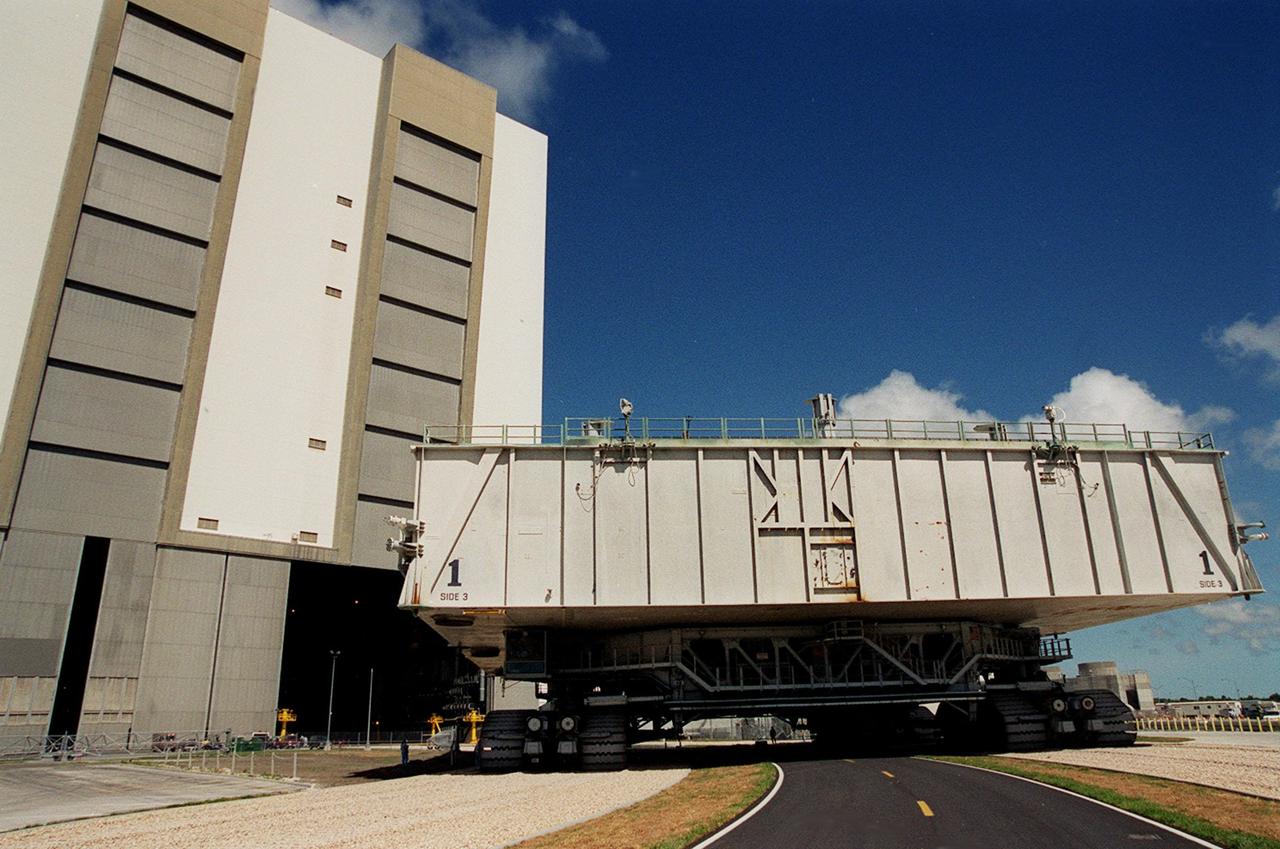
KENNEDY SPACE CENTER, FLA. -- On a portion of the once-buried crawlerway that was recently restored, a crawler-transporter with mobile launcher platform on top turns toward the Vehicle Assembly Building (VAB) high bay 2. The road was restored as part of KSC’s Safe Haven project. High bay 2 provides a third stacking area. The primary goal of the Safe Haven construction project was to strengthen readiness for hurricane season by expanding the VAB’s storage capacity. The new area, in high bay 2, will allow NASA to preassemble stacks and still have room in the VAB to pull a Shuttle back from the pad if severe weather threatens. Potential rollouts of the Space Shuttle to the launch pad from high bay 2 will involve making a turn around the north side of the VAB in contrast to the straight rollouts from high bays 1 and 3, on the east side of the VAB facing the launch pads
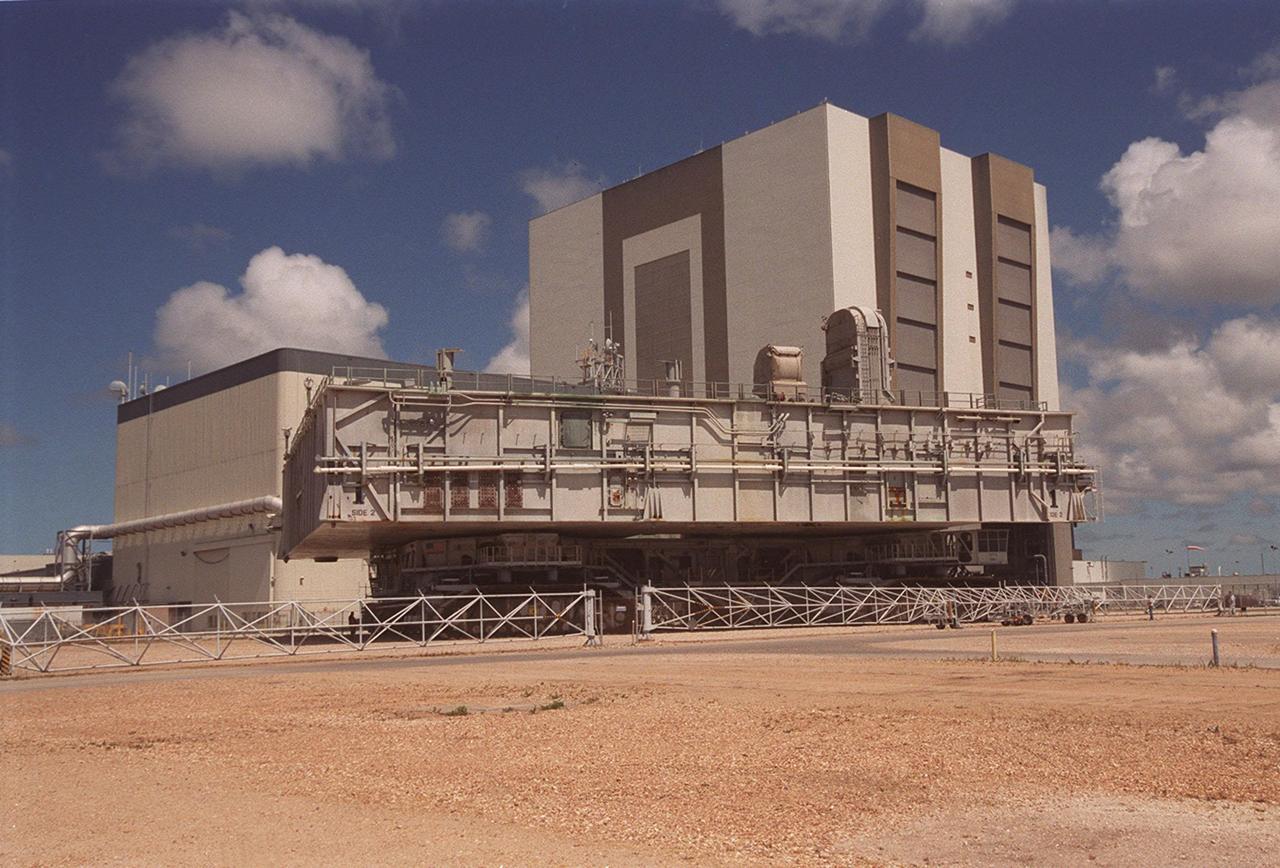
KENNEDY SPACE CENTER, FLA. -- A crawler-transporter with mobile launcher platform on top tests the buried portion of the Apollo-era crawlerway leading to the Vehicle Assembly Building (VAB) high bay 2 on the southwest side. The road was restored as part of KSC’s Safe Haven project. High bay 2 provides a third stacking area. The primary goal of the Safe Haven construction project was to strengthen readiness for hurricane season by expanding the VAB’s storage capacity. The new area, in high bay 2, will allow NASA to preassemble stacks and still have room in the VAB to pull a Shuttle back from the pad if severe weather threatens. Potential rollouts of the Space Shuttle to the launch pad from high bay 2 will involve making a turn around the north side of the VAB in contrast to the straight rollouts from high bays 1 and 3, on the east side of the VAB facing the launch pads
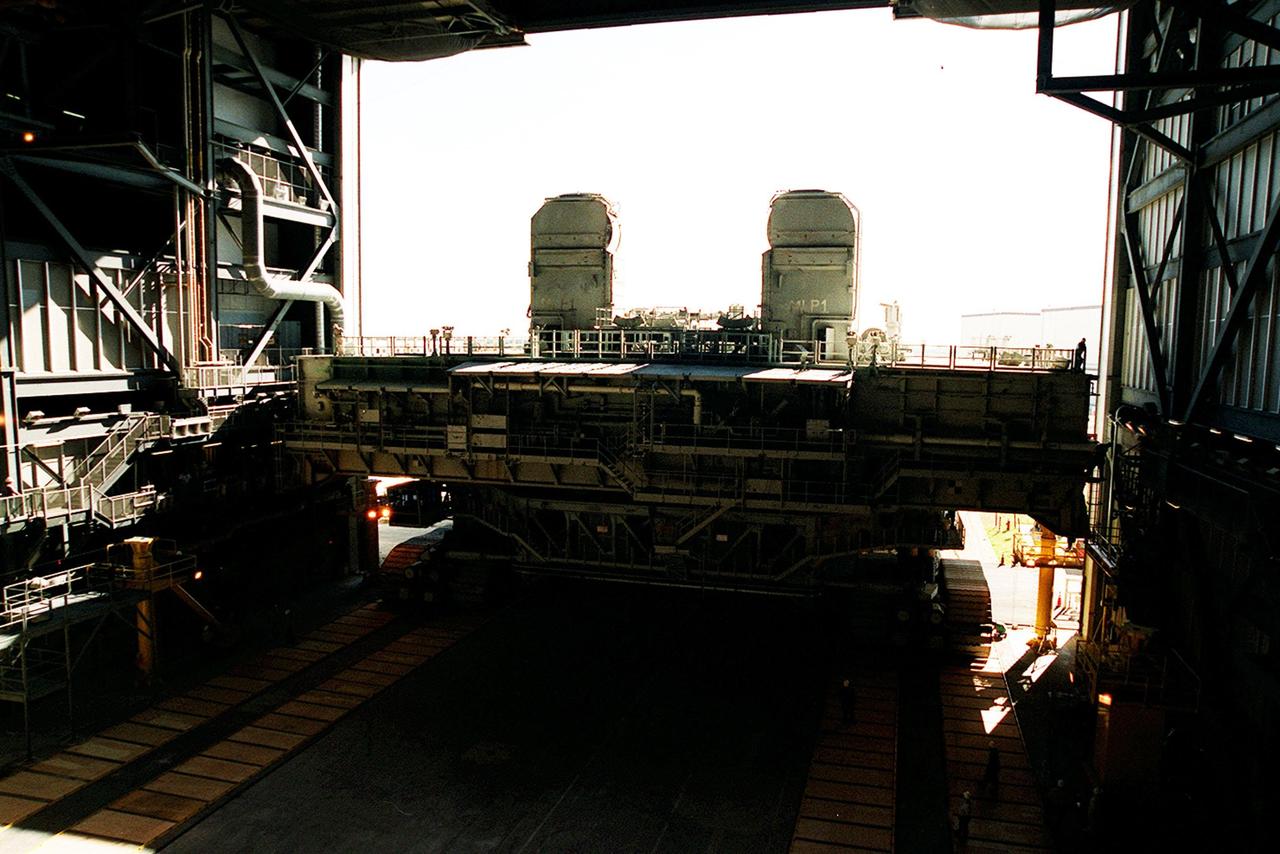
KENNEDY SPACE CENTER, FLA. -- From inside the VAB high bay 2, a mobile launcher platform atop a crawler transporter is viewed as it rolls through the doorway using the recently restored crawlerway. As part of the Safe Haven project, a once-buried portion of the crawlerway was restored to enable rollout of a Shuttle from high bay 2. The primary goal of the Safe Haven construction project was to strengthen readiness for hurricane season by expanding the VAB’s storage capacity. The new area, in high bay 2, will allow NASA to preassemble stacks and still have room in the VAB to pull a Shuttle back from the pad if severe weather threatens. Potential rollouts of the Space Shuttle to the launch pad from high bay 2 will involve making a turn around the north side of the VAB in contrast to the straight rollouts from high bays 1 and 3, on the east side of the VAB facing the launch pads
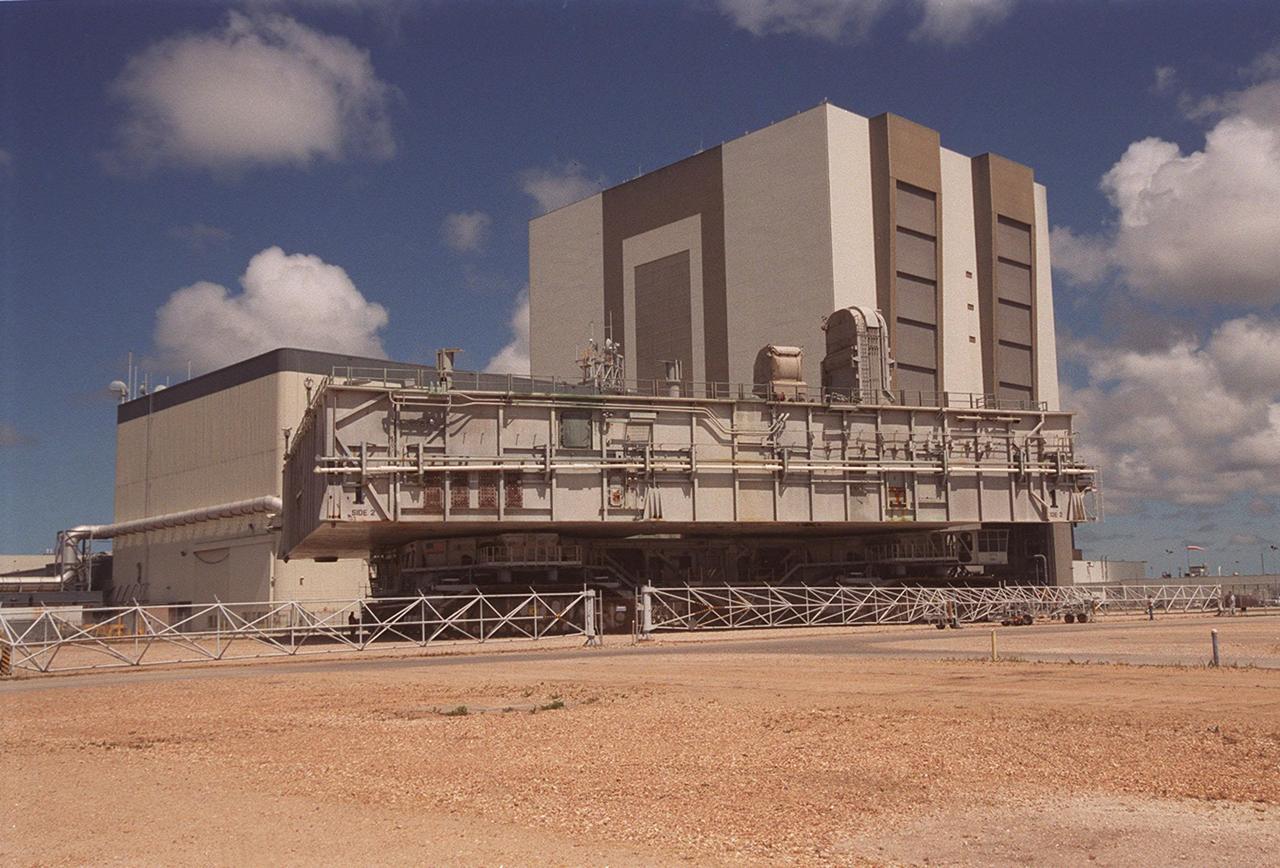
KENNEDY SPACE CENTER, FLA. -- A crawler-transporter with mobile launcher platform on top tests the buried portion of the Apollo-era crawlerway leading to the Vehicle Assembly Building (VAB) high bay 2 on the southwest side. The road was restored as part of KSC’s Safe Haven project. High bay 2 provides a third stacking area. The primary goal of the Safe Haven construction project was to strengthen readiness for hurricane season by expanding the VAB’s storage capacity. The new area, in high bay 2, will allow NASA to preassemble stacks and still have room in the VAB to pull a Shuttle back from the pad if severe weather threatens. Potential rollouts of the Space Shuttle to the launch pad from high bay 2 will involve making a turn around the north side of the VAB in contrast to the straight rollouts from high bays 1 and 3, on the east side of the VAB facing the launch pads
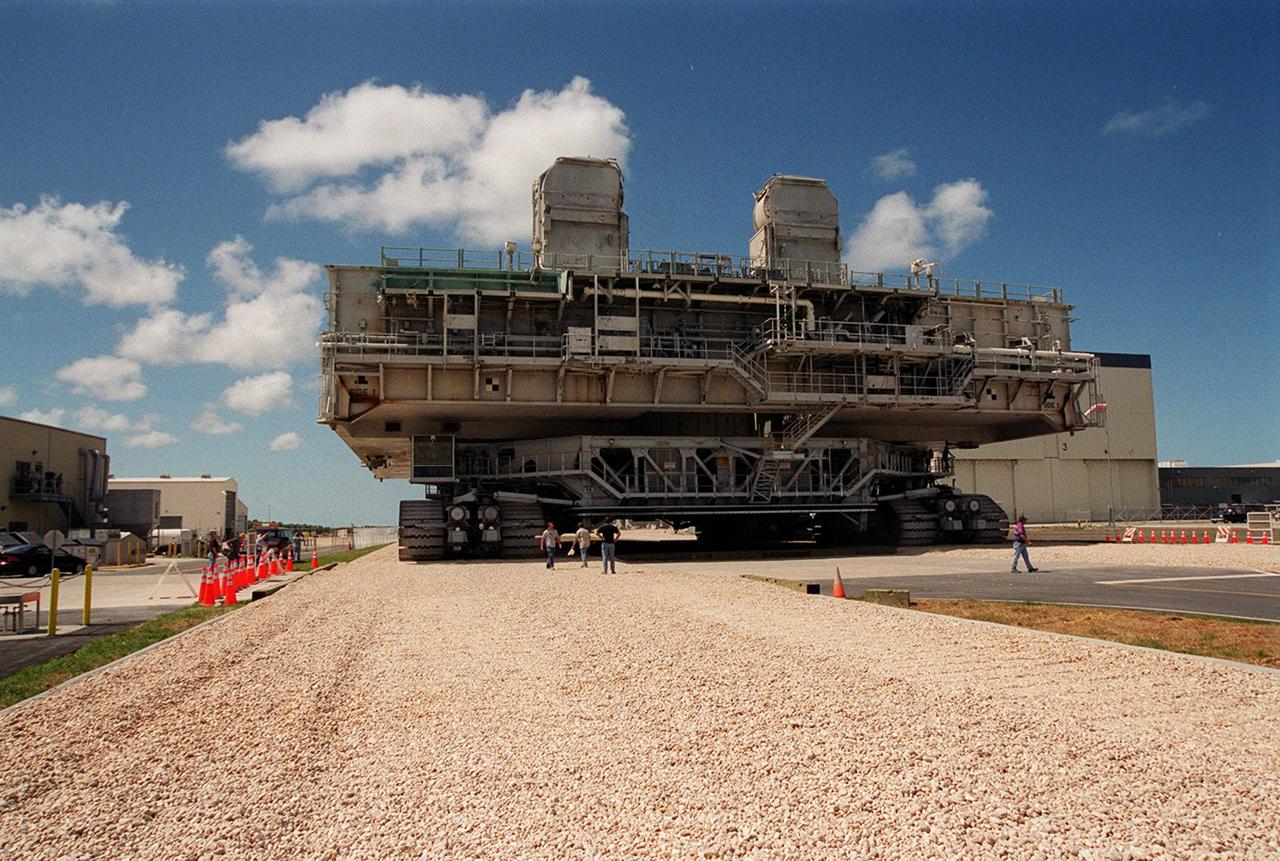
KENNEDY SPACE CENTER, FLA. -- A crawler-transporter with mobile launcher platform on top makes its way from the Orbiter Processing Facility along the once-buried portion of the Apollo-era crawlerway leading to the Vehicle Assembly Building (VAB) high bay. The road was restored as part of KSC’s Safe Haven project. High bay 2 provides a third stacking area.. The primary goal of the Safe Haven construction project was to strengthen readiness for hurricane season by expanding the VAB’s storage capacity. The new area, in high bay 2, will allow NASA to preassemble stacks and still have room in the VAB to pull a Shuttle back from the pad if severe weather threatens. Potential rollouts of the Space Shuttle to the launch pad from high bay 2 will involve making a turn around the north side of the VAB in contrast to the straight rollouts from high bays 1 and 3, on the east side of the VAB facing the launch pads
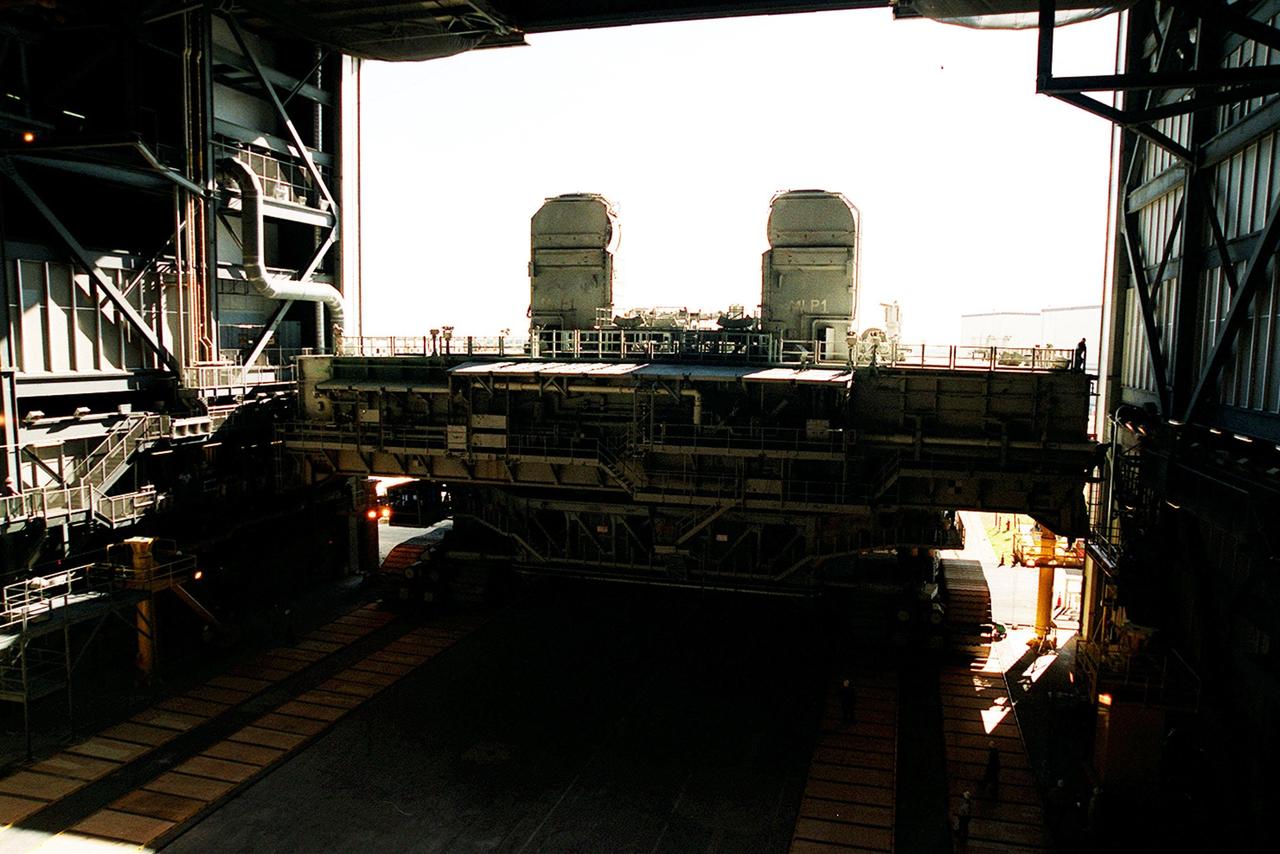
KENNEDY SPACE CENTER, FLA. -- From inside the VAB high bay 2, a mobile launcher platform atop a crawler transporter is viewed as it rolls through the doorway using the recently restored crawlerway. As part of the Safe Haven project, a once-buried portion of the crawlerway was restored to enable rollout of a Shuttle from high bay 2. The primary goal of the Safe Haven construction project was to strengthen readiness for hurricane season by expanding the VAB’s storage capacity. The new area, in high bay 2, will allow NASA to preassemble stacks and still have room in the VAB to pull a Shuttle back from the pad if severe weather threatens. Potential rollouts of the Space Shuttle to the launch pad from high bay 2 will involve making a turn around the north side of the VAB in contrast to the straight rollouts from high bays 1 and 3, on the east side of the VAB facing the launch pads
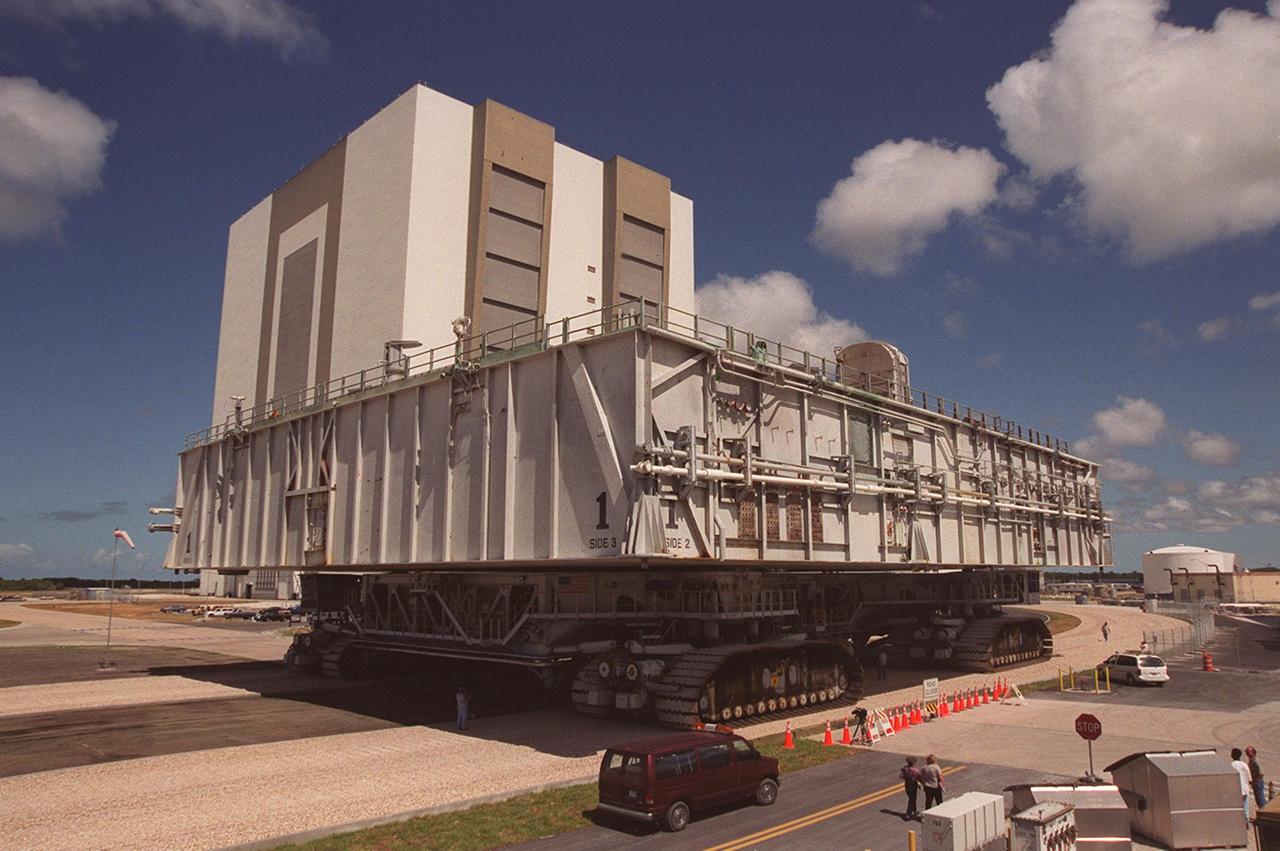
KENNEDY SPACE CENTER, FLA. -- A crawler-transporter with mobile launcher platform on top moves along a portion of the once-buried crawlerway toward the Vehicle Assembly Building (VAB). The road was restored as part of KSC’s Safe Haven project. High bay 2 provides a third stacking area. The primary goal of the Safe Haven construction project was to strengthen readiness for hurricane season by expanding the VAB’s storage capacity. The new area, in high bay 2, will allow NASA to preassemble stacks and still have room in the VAB to pull a Shuttle back from the pad if severe weather threatens. Potential rollouts of the Space Shuttle to the launch pad from high bay 2 will involve making a turn around the north side of the VAB in contrast to the straight rollouts from high bays 1 and 3, on the east side of the VAB facing the launch pads
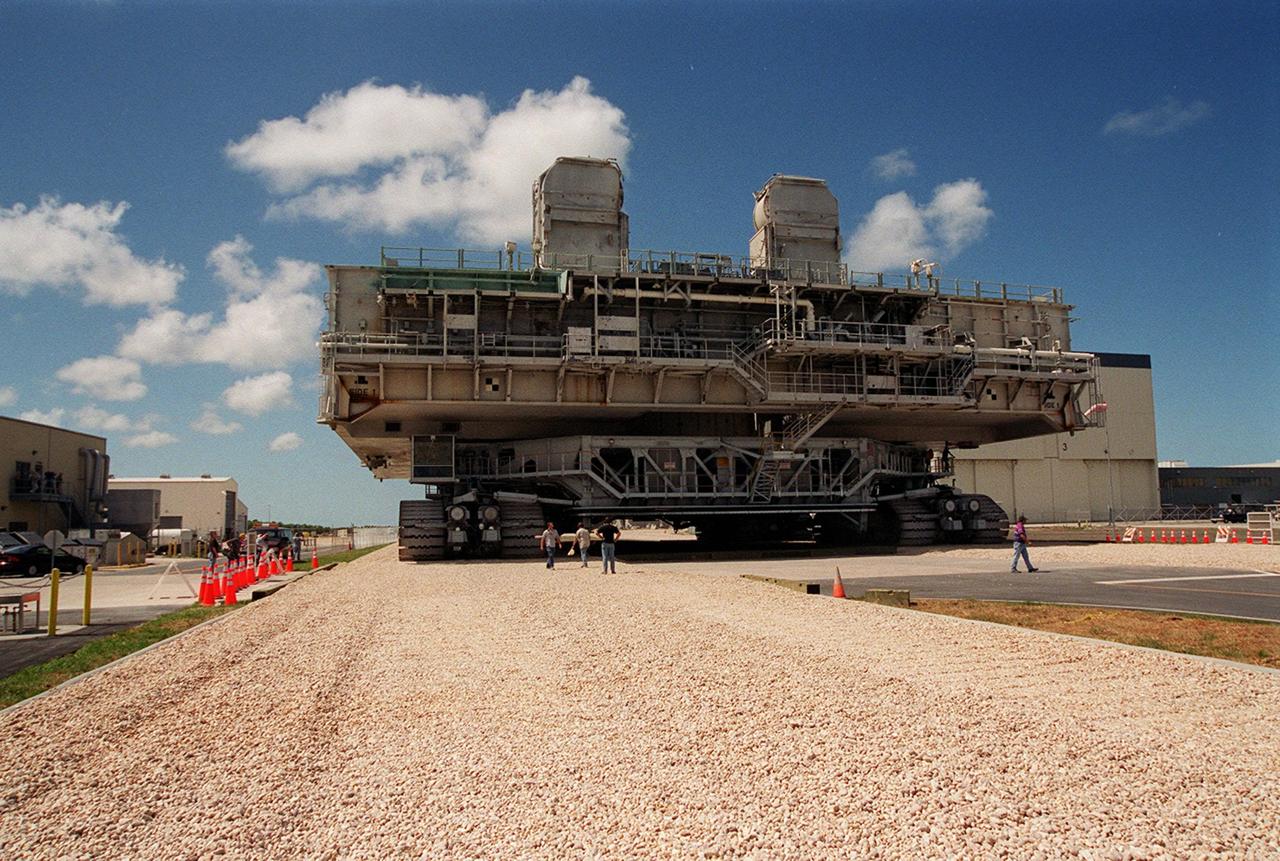
KENNEDY SPACE CENTER, FLA. -- A crawler-transporter with mobile launcher platform on top makes its way from the Orbiter Processing Facility along the once-buried portion of the Apollo-era crawlerway leading to the Vehicle Assembly Building (VAB) high bay. The road was restored as part of KSC’s Safe Haven project. High bay 2 provides a third stacking area.. The primary goal of the Safe Haven construction project was to strengthen readiness for hurricane season by expanding the VAB’s storage capacity. The new area, in high bay 2, will allow NASA to preassemble stacks and still have room in the VAB to pull a Shuttle back from the pad if severe weather threatens. Potential rollouts of the Space Shuttle to the launch pad from high bay 2 will involve making a turn around the north side of the VAB in contrast to the straight rollouts from high bays 1 and 3, on the east side of the VAB facing the launch pads
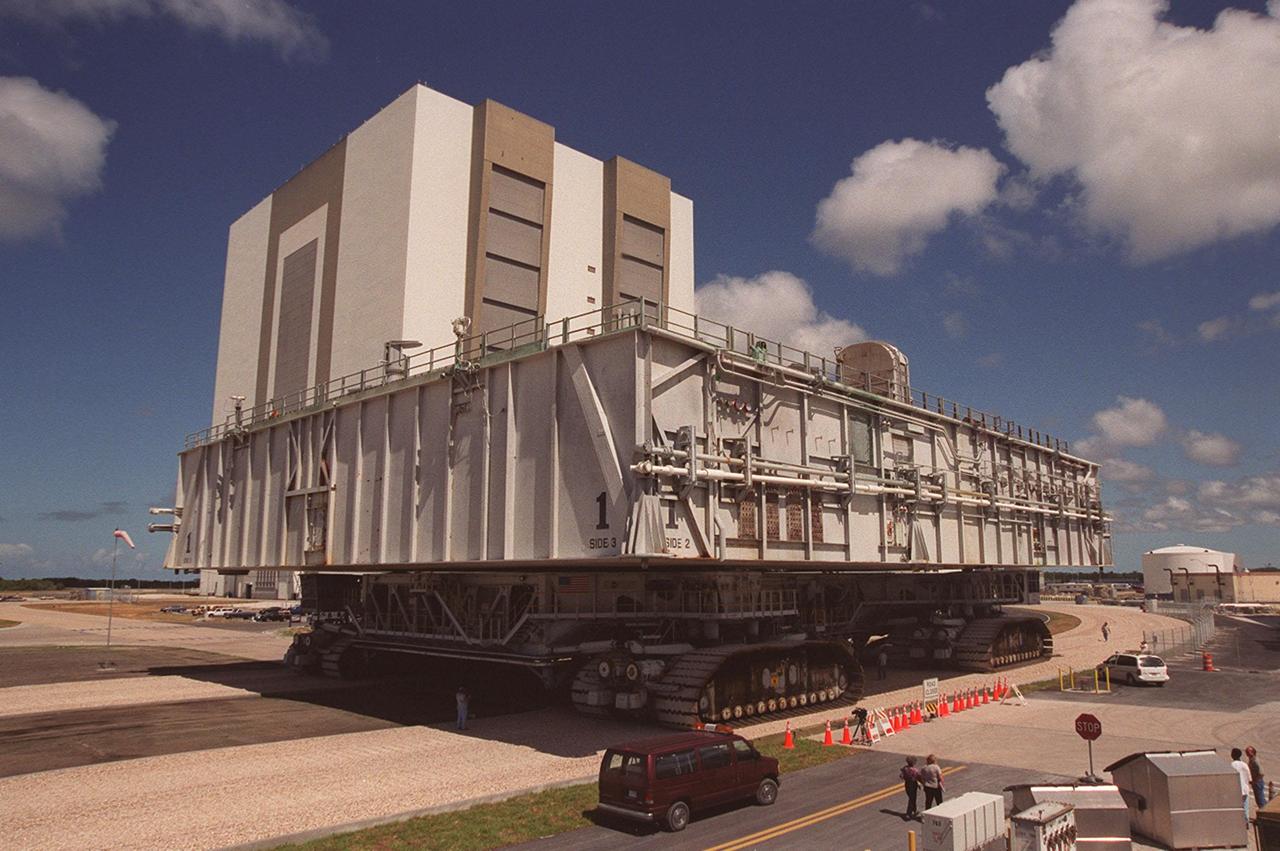
KENNEDY SPACE CENTER, FLA. -- A crawler-transporter with mobile launcher platform on top moves along a portion of the once-buried crawlerway toward the Vehicle Assembly Building (VAB). The road was restored as part of KSC’s Safe Haven project. High bay 2 provides a third stacking area. The primary goal of the Safe Haven construction project was to strengthen readiness for hurricane season by expanding the VAB’s storage capacity. The new area, in high bay 2, will allow NASA to preassemble stacks and still have room in the VAB to pull a Shuttle back from the pad if severe weather threatens. Potential rollouts of the Space Shuttle to the launch pad from high bay 2 will involve making a turn around the north side of the VAB in contrast to the straight rollouts from high bays 1 and 3, on the east side of the VAB facing the launch pads
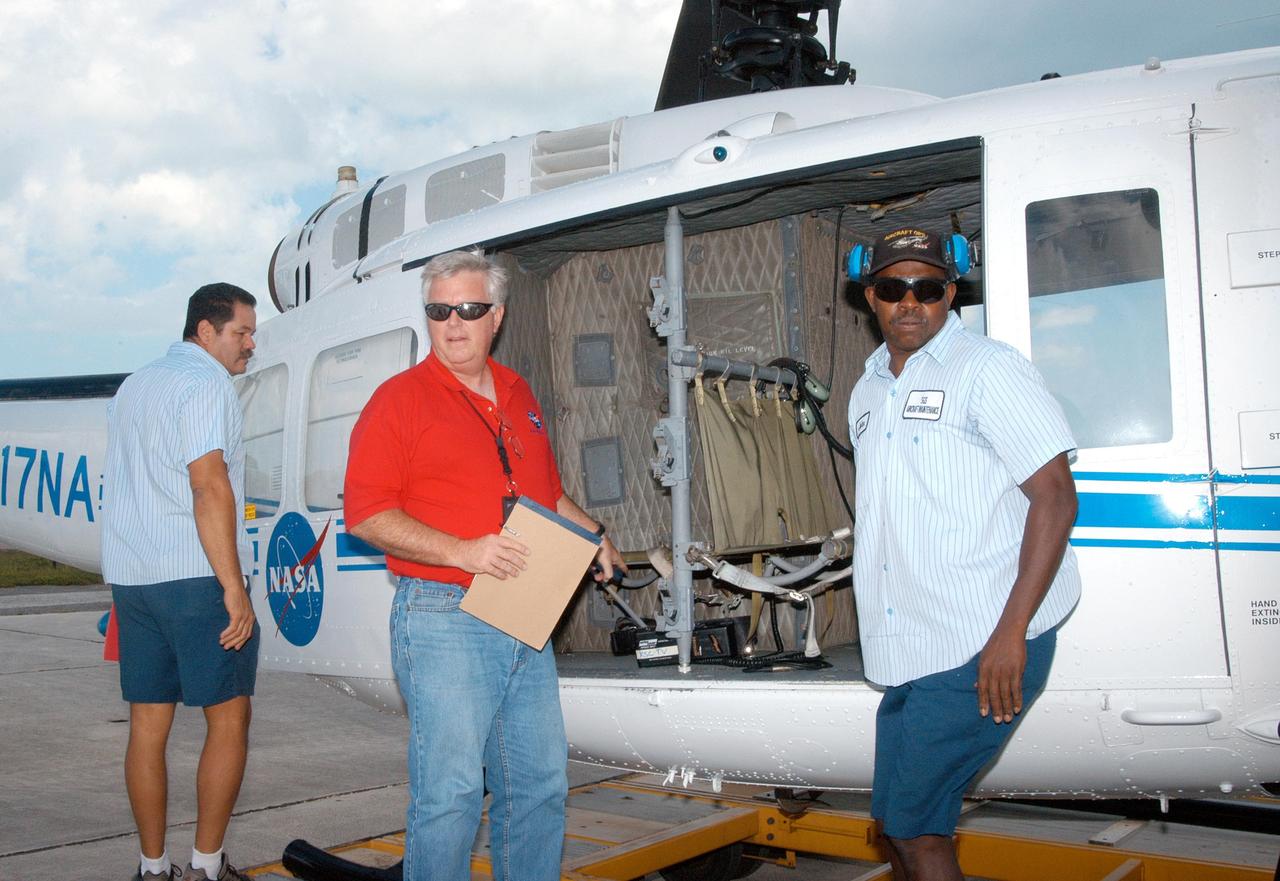
KENNEDY SPACE CENTER, FLA. - Center Director James Kennedy (center) prepares to board a helicopter to observe damage from Hurricane Jeanne. A category 3 storm, Jeanne barreled through Central Florida Sept. 25-26, the fourth hurricane in 6 weeks to batter the state.
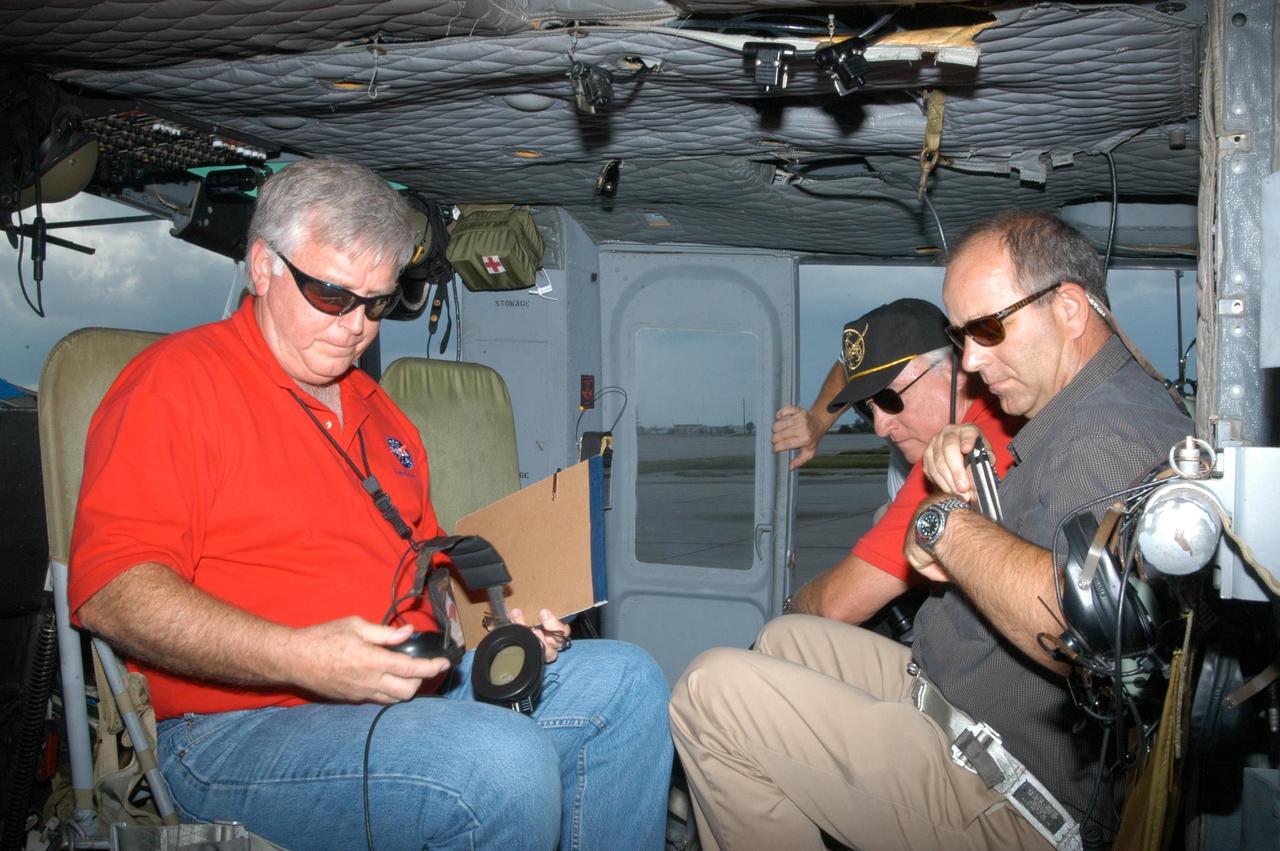
KENNEDY SPACE CENTER, FLA. - Center Director James Kennedy (left) is aboard a helicopter to observe damage from Hurricane Jeanne. A category 3 storm, Jeanne barreled through Central Florida Sept. 25-26, the fourth hurricane in 6 weeks to batter the state.
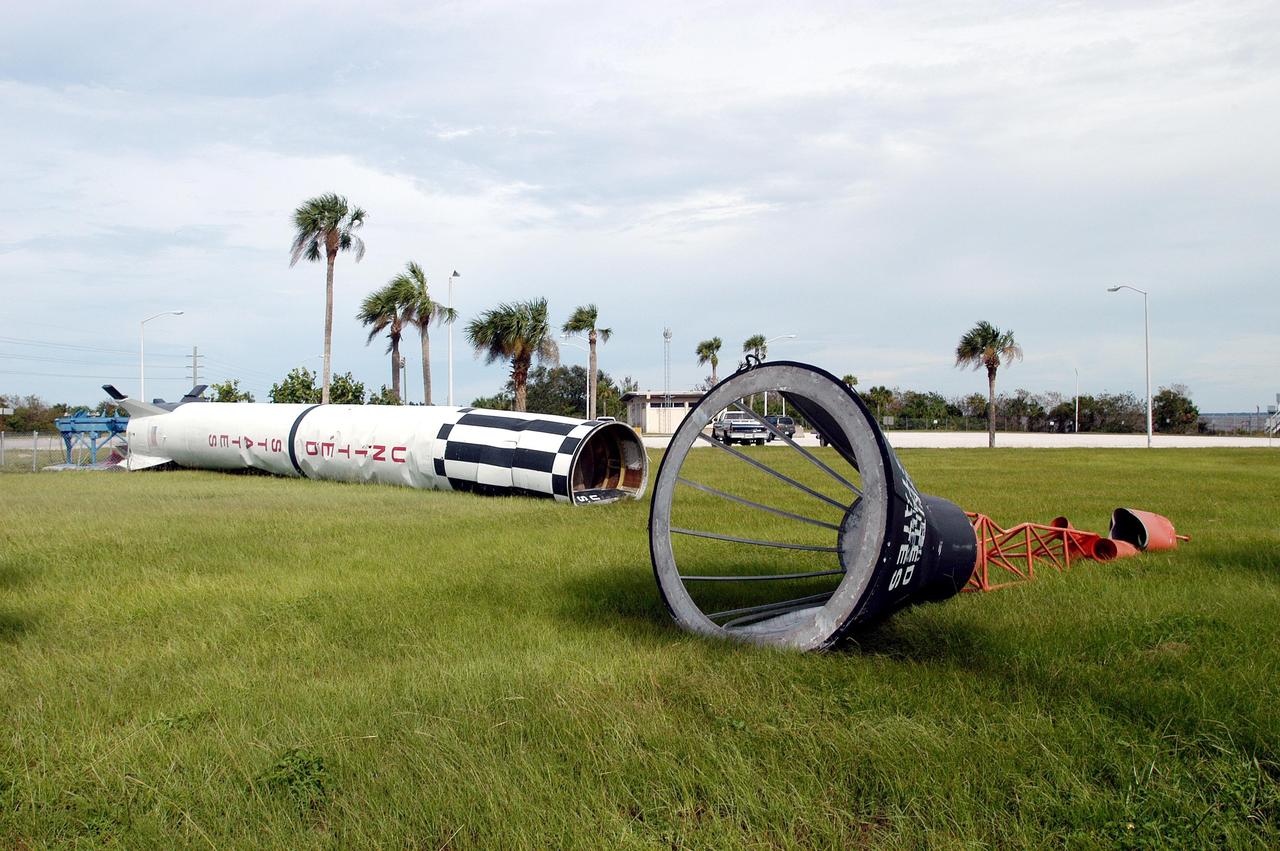
KENNEDY SPACE CENTER, FLA. - A Mercury/Redstone rocket on display at the Pass and Identification Building at the entrance to Kennedy Space lies on its side following Hurricane Frances. The storm's path over Florida took it through Cape Canaveral and KSC property during Labor Day weekend.
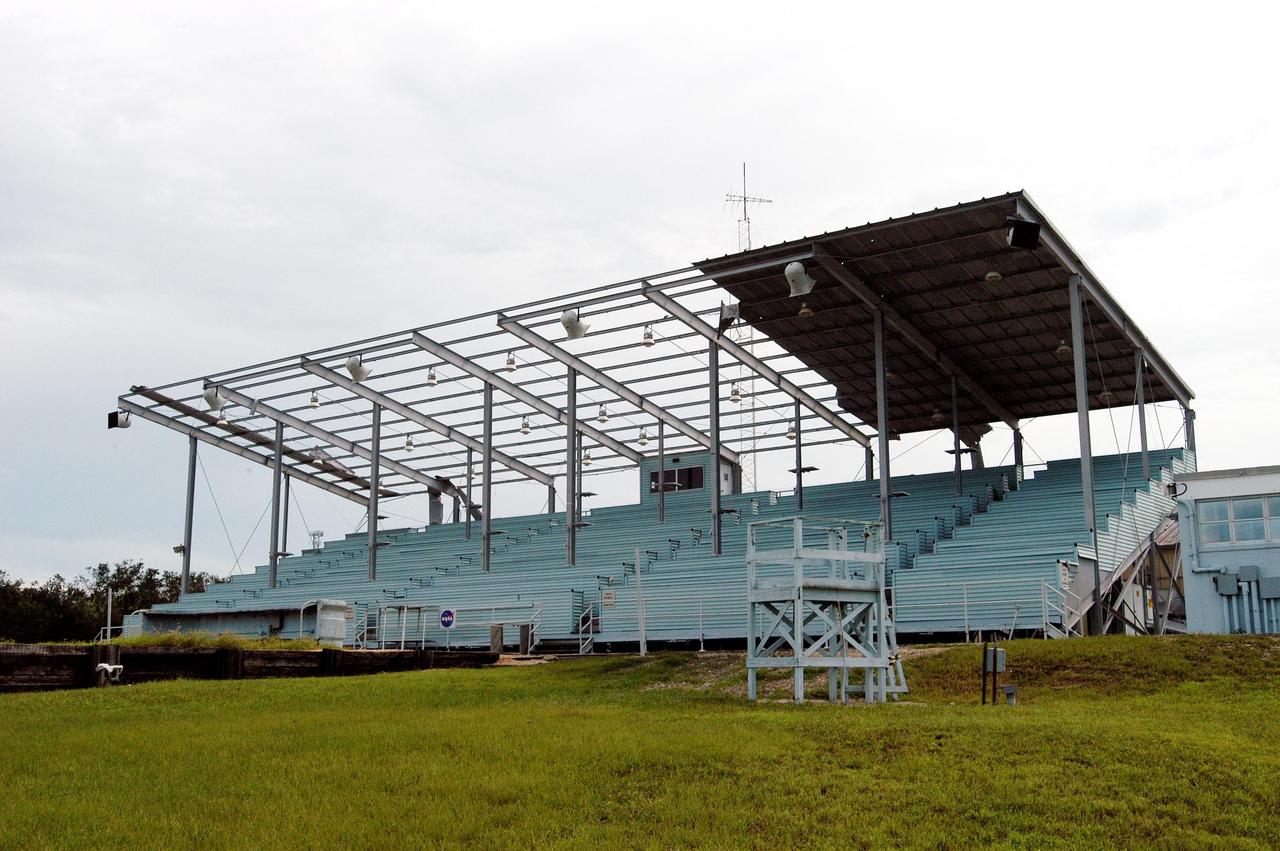
KENNEDY SPACE CENTER, FLA. - The grandstand at the Launch Complex 39 Press Site lost portions of its roof during Hurricane Frances. The storm's path over Florida took it through Cape Canaveral and KSC property during Labor Day weekend. The grandstand seats 350 and is used by the media to observe and cover NASA launches from Kennedy Space Center.
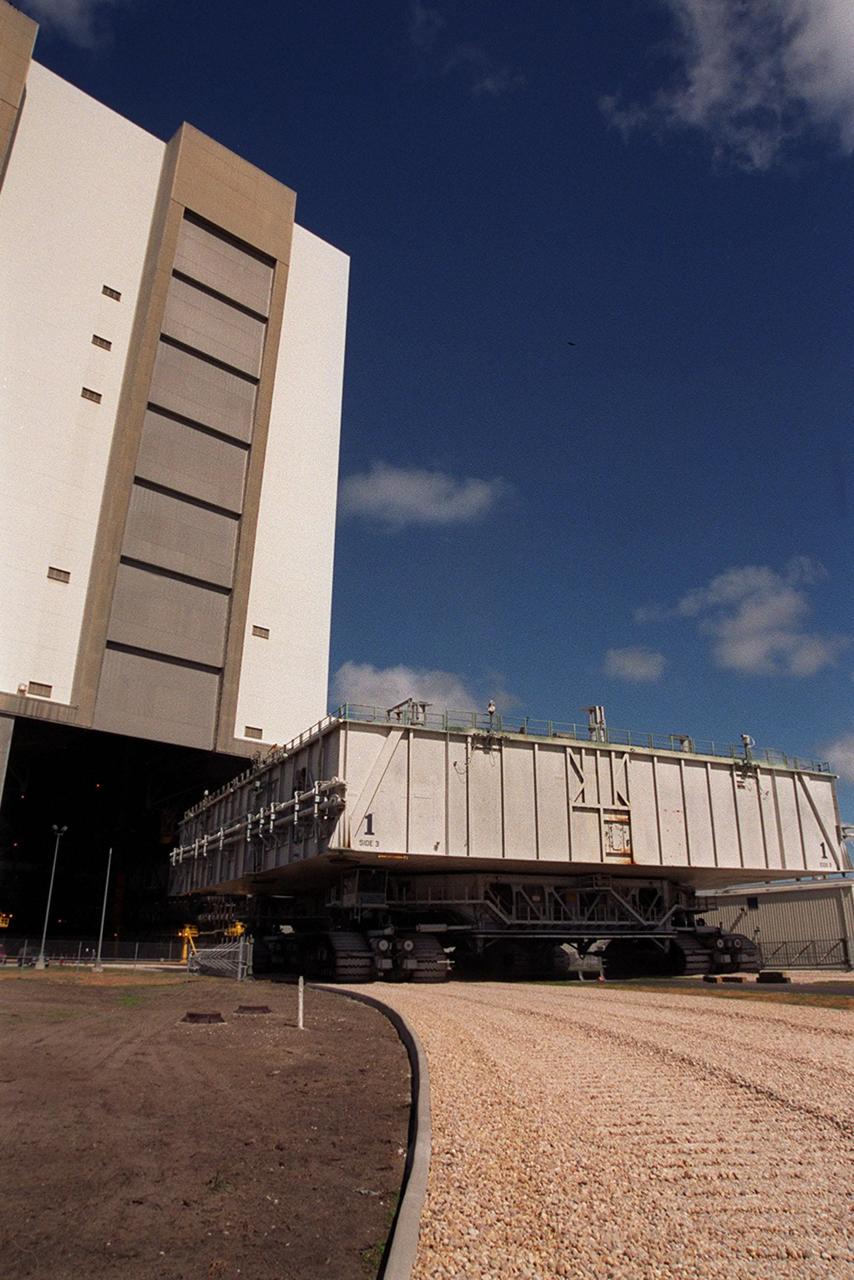
KENNEDY SPACE CENTER, FLA. -- A mobile launcher platform atop a crawler-transporter, heads to the open door of the Vehicle Assembly Building high bay 2. As part of the Safe Haven project, a once-buried portion of the crawlerway was restored to enable rollout of a Shuttle from this third stacking area. The primary goal of the Safe Haven construction project was to strengthen readiness for hurricane season by expanding the VAB’s storage capacity. The new area, in high bay 2, will allow NASA to preassemble stacks and still have room in the VAB to pull a Shuttle back from the pad if severe weather threatens. Potential rollouts of the Space Shuttle to the launch pad from high bay 2 will involve making a turn around the north side of the VAB in contrast to the straight rollouts from high bays 1 and 3, on the east side of the VAB facing the launch pads
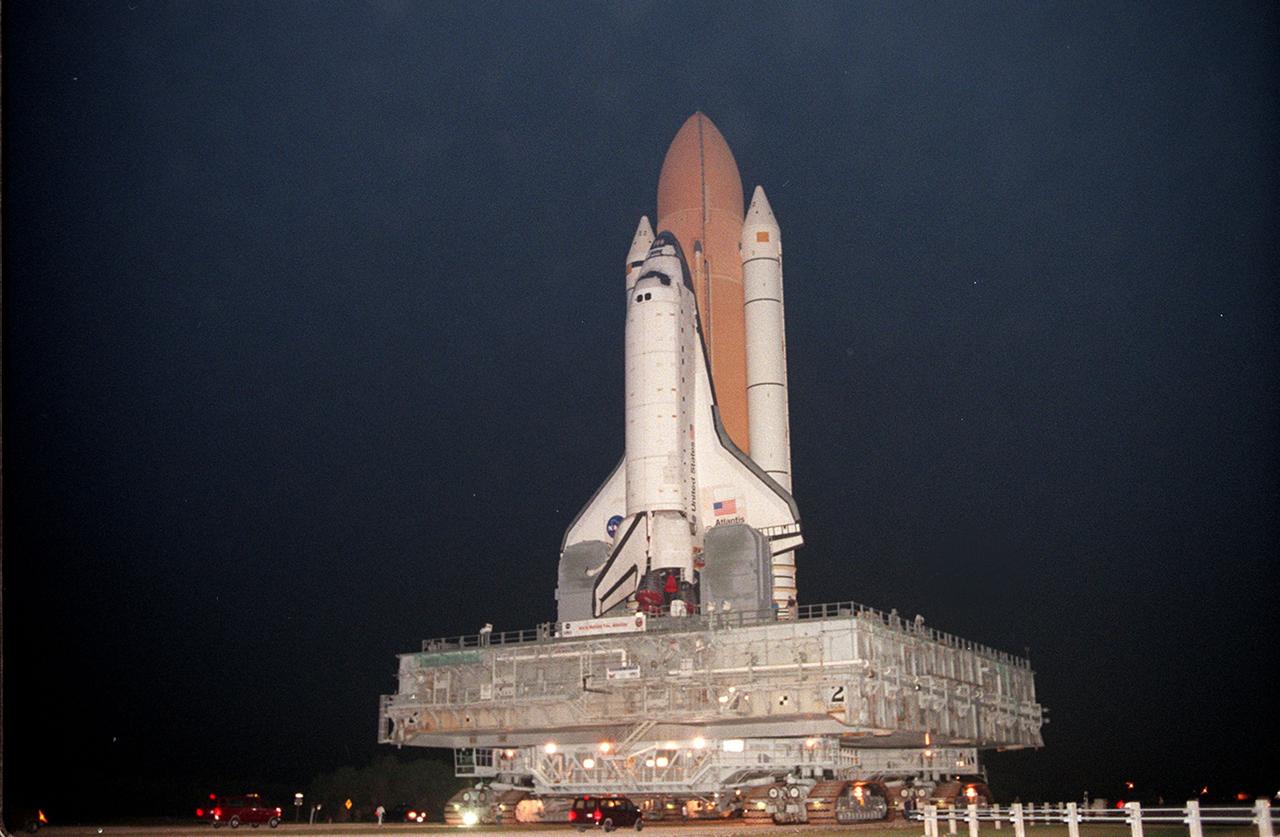
KENNEDY SPACE CENTER, FLA. -- Shuttle Atlantis, with twin solid rocket boosters and external tank atop the Mobile Launcher Platform and crawler-transorter, moves in the predawn hours into high bay 2 in the Vehicle Assembly Building (VAB). For the first time in Space Shuttle history, a fully stacked Shuttle is rolling around the north side of the VAB into high bay 2 on the building's west side. The VAB and nearby rock-paved crawlerway have recently undergone major modifications to provide Shuttle fliglht hardware more storage space and protection - "Safe Haven" - from hurricanes or tropical storms. Atlantis, the twin solid rocket boosters and external tank begain moving out of VAB high bay 1 on the east side at 2:59 a.m. EDT. After the successful "Safe Haven" fit check, Shuttle Atlantis is scheduled to roll out to Launch Pad 39B in preparation for the STS-106 launch on Sept. 8.
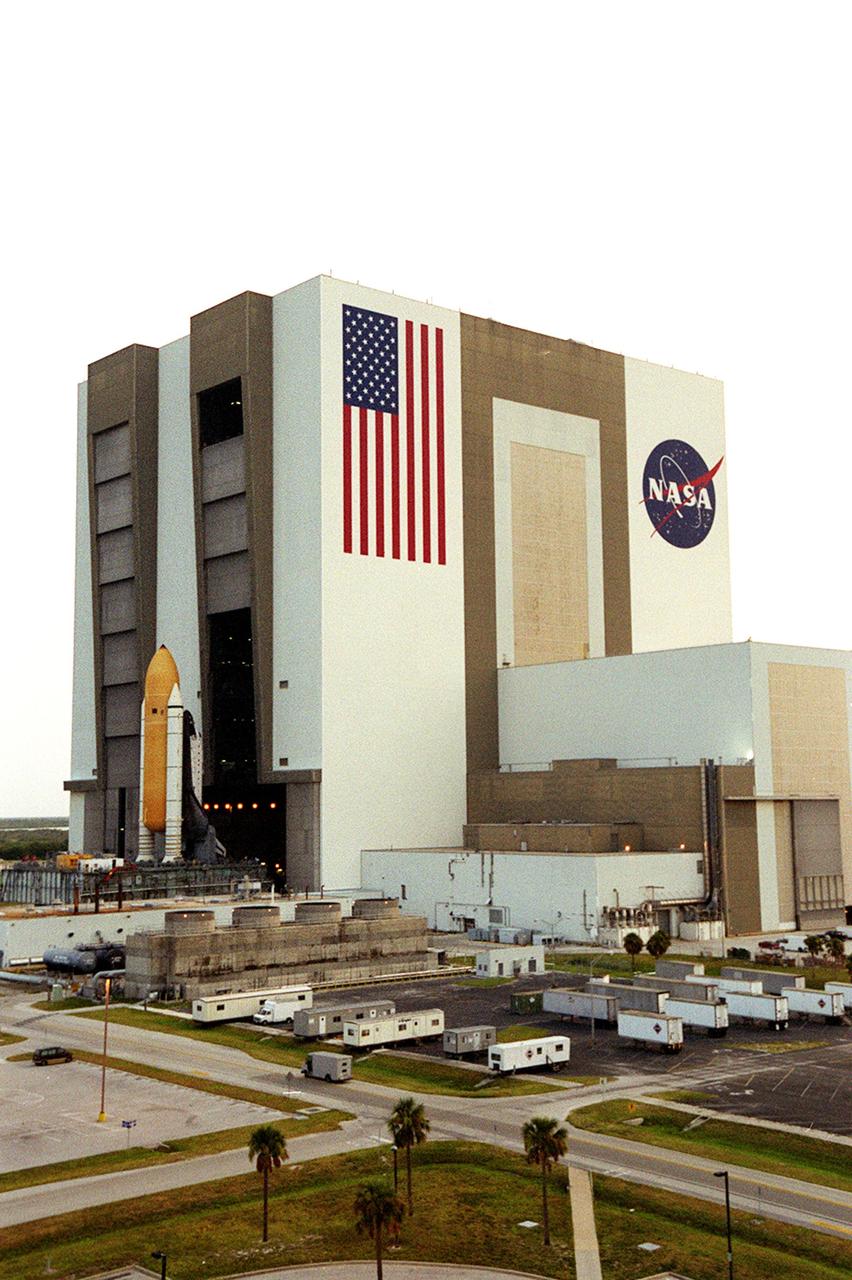
KENNEDY SPACE CENTER, FLA. -- For the first time in Space Shuttle history, a fully stacked Shuttle - Atlantis - is rolling into the Vehicle Assembly Building's (VAB) high bay 2 on the building's west side. The VAB and nearby rock-paved crawlerway have recently undergone major modifications to provide Shuttle fliglht hardware more storage space and protection - "Safe Haven" - from hurricanes or tropical storms. Atlantis, the twin solid rocket boosters and external tank begain moving out of VAB high bay 1 on the east side at 2:59 a.m. EDT. The 6-million pound crawler transporter carried the Mobile Launcher Platform and Space Shuttle around the north side of the VAB and into high bay 2. After the successful "Safe Haven" fit check, Shuttle Atlantis is scheduled to roll out to Launch Pad 39B in preparation for the STS-106 launch on Sept. 8.
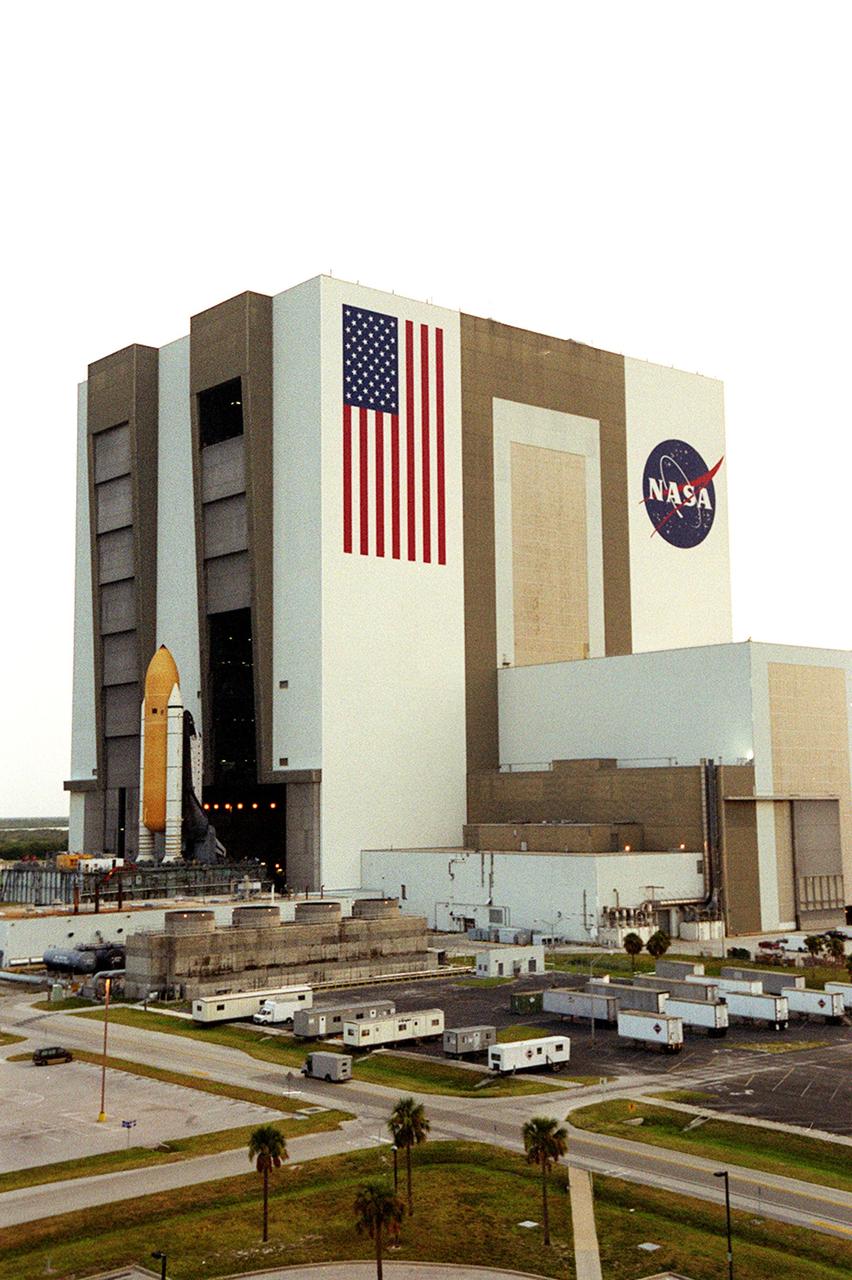
KENNEDY SPACE CENTER, FLA. -- For the first time in Space Shuttle history, a fully stacked Shuttle - Atlantis - is rolling into the Vehicle Assembly Building's (VAB) high bay 2 on the building's west side. The VAB and nearby rock-paved crawlerway have recently undergone major modifications to provide Shuttle fliglht hardware more storage space and protection - "Safe Haven" - from hurricanes or tropical storms. Atlantis, the twin solid rocket boosters and external tank begain moving out of VAB high bay 1 on the east side at 2:59 a.m. EDT. The 6-million pound crawler transporter carried the Mobile Launcher Platform and Space Shuttle around the north side of the VAB and into high bay 2. After the successful "Safe Haven" fit check, Shuttle Atlantis is scheduled to roll out to Launch Pad 39B in preparation for the STS-106 launch on Sept. 8.
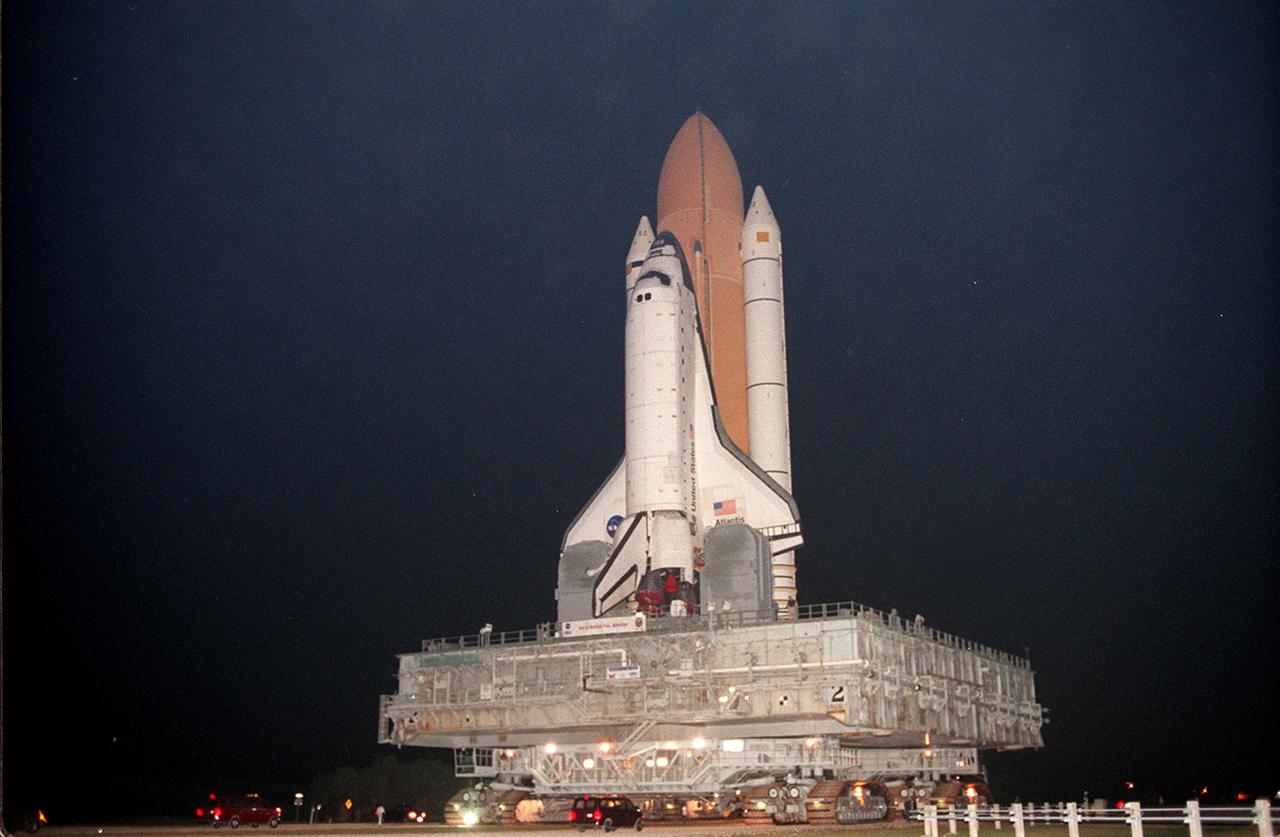
KENNEDY SPACE CENTER, FLA. -- Shuttle Atlantis, with twin solid rocket boosters and external tank atop the Mobile Launcher Platform and crawler-transorter, moves in the predawn hours into high bay 2 in the Vehicle Assembly Building (VAB). For the first time in Space Shuttle history, a fully stacked Shuttle is rolling around the north side of the VAB into high bay 2 on the building's west side. The VAB and nearby rock-paved crawlerway have recently undergone major modifications to provide Shuttle fliglht hardware more storage space and protection - "Safe Haven" - from hurricanes or tropical storms. Atlantis, the twin solid rocket boosters and external tank begain moving out of VAB high bay 1 on the east side at 2:59 a.m. EDT. After the successful "Safe Haven" fit check, Shuttle Atlantis is scheduled to roll out to Launch Pad 39B in preparation for the STS-106 launch on Sept. 8.
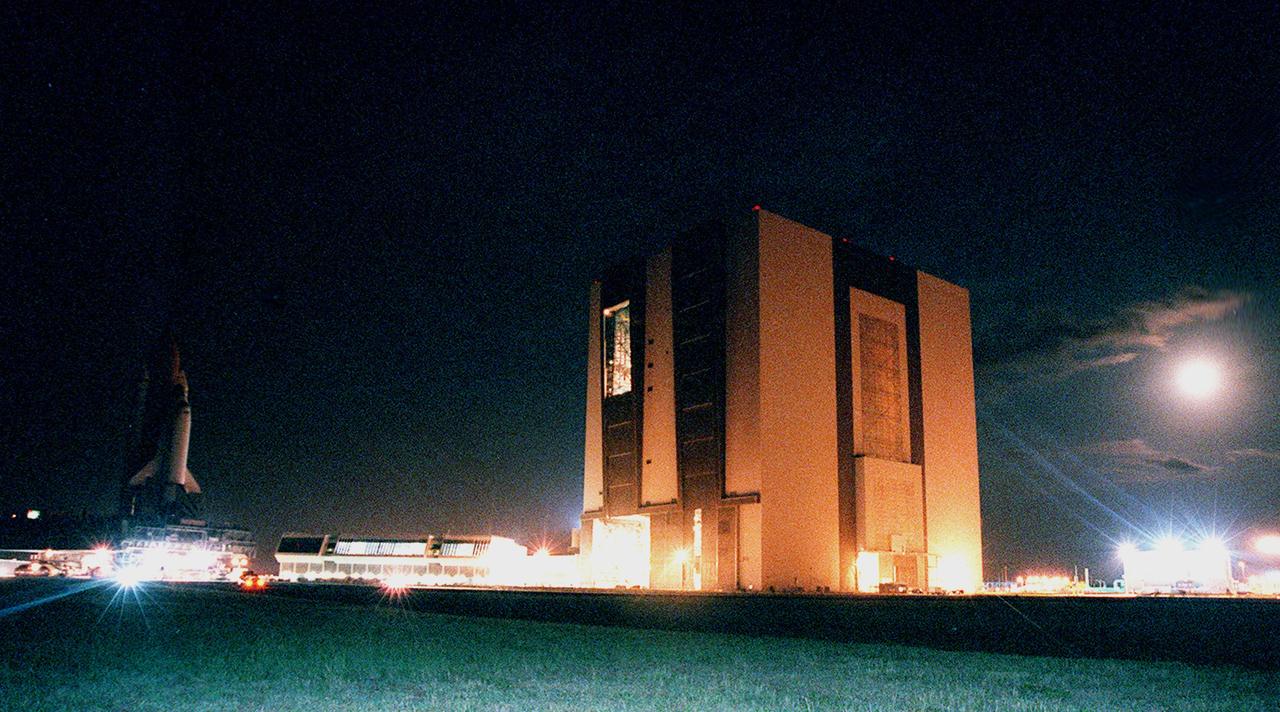
KENNEDY SPACE CENTER, FLA. -- This 30-second timed exposure captures the bright lights around the Vehicle Assembly Building (VAB) plus the equally bright moon (upper right) as Space Shuttle Atlantis (far left) rolls out of the east side bay 1. The Launch Control Center sits between the Shuttle and the VAB. The full stack of Shuttle, solid rocket boosters and external tank are taking part in a fit check for the newly renovated crawlerway and high bay 2, which is on the west side. The major modifications to the crawlerway and VAB provide Shuttle flight hardware more storage space and protection - "Safe Haven" - from hurricanes or tropical storms. Atlantis began moving out of VAB high bay 1 at 2:59 a.m. EDT. After the successful Safe Haven fit check, Shuttle Atlantis is scheduled to roll out to Launch Pad 39B in preparation for the STS-106 launch on Sept. 8.
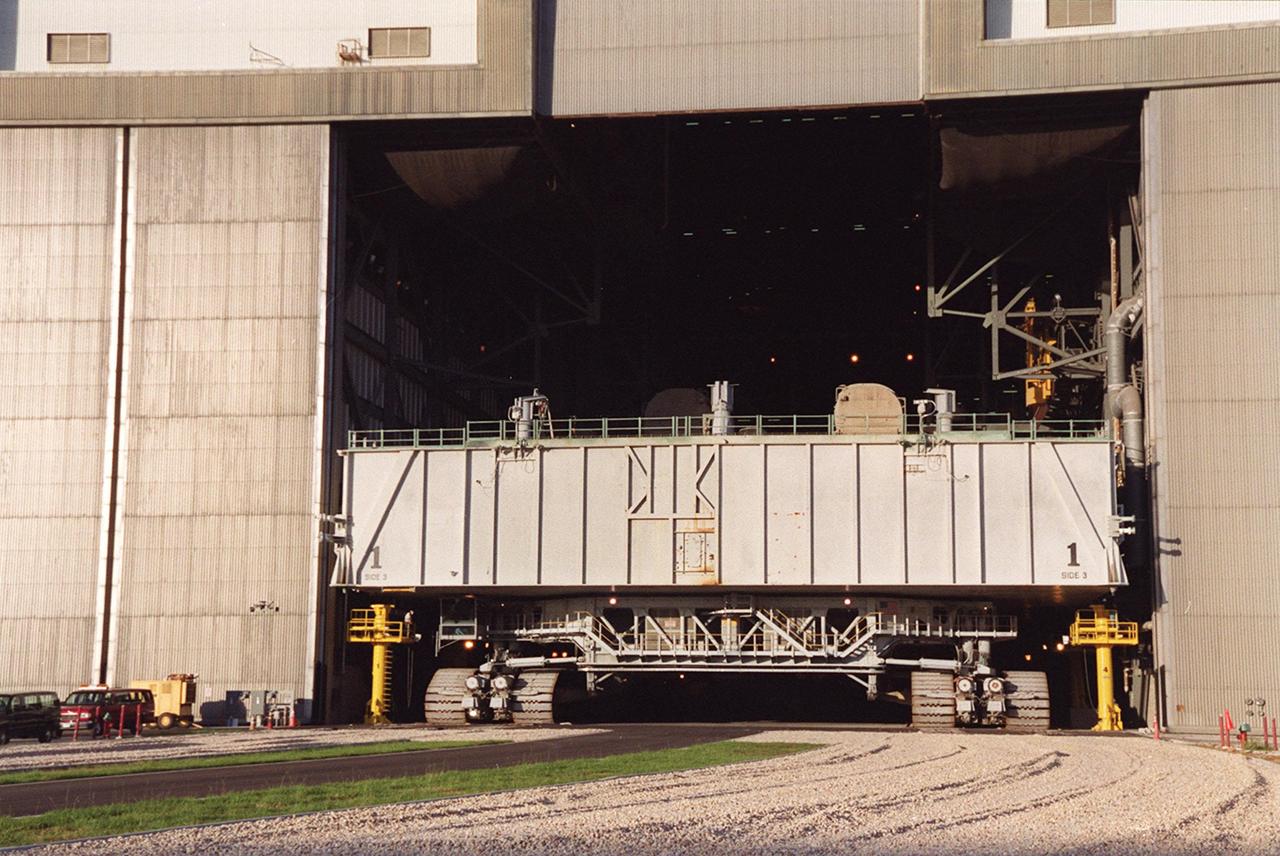
KENNEDY SPACE CENTER, FLA. -- A mobile launcher platform atop a crawler-transporter, moves into the Vehicle Assembly Building high bay 2. As part of the Safe Haven project, a once-buried portion of the crawlerway was restored to enable rollout of a Shuttle from this third stacking area. The primary goal of the Safe Haven construction project was to strengthen readiness for hurricane season by expanding the VAB’s storage capacity. The new area, in high bay 2, will allow NASA to preassemble stacks and still have room in the VAB to pull a Shuttle back from the pad if severe weather threatens. Potential rollouts of the Space Shuttle to the launch pad from high bay 2 will involve making a turn around the north side of the VAB in contrast to the straight rollouts from high bays 1 and 3, on the east side of the VAB facing the launch pads
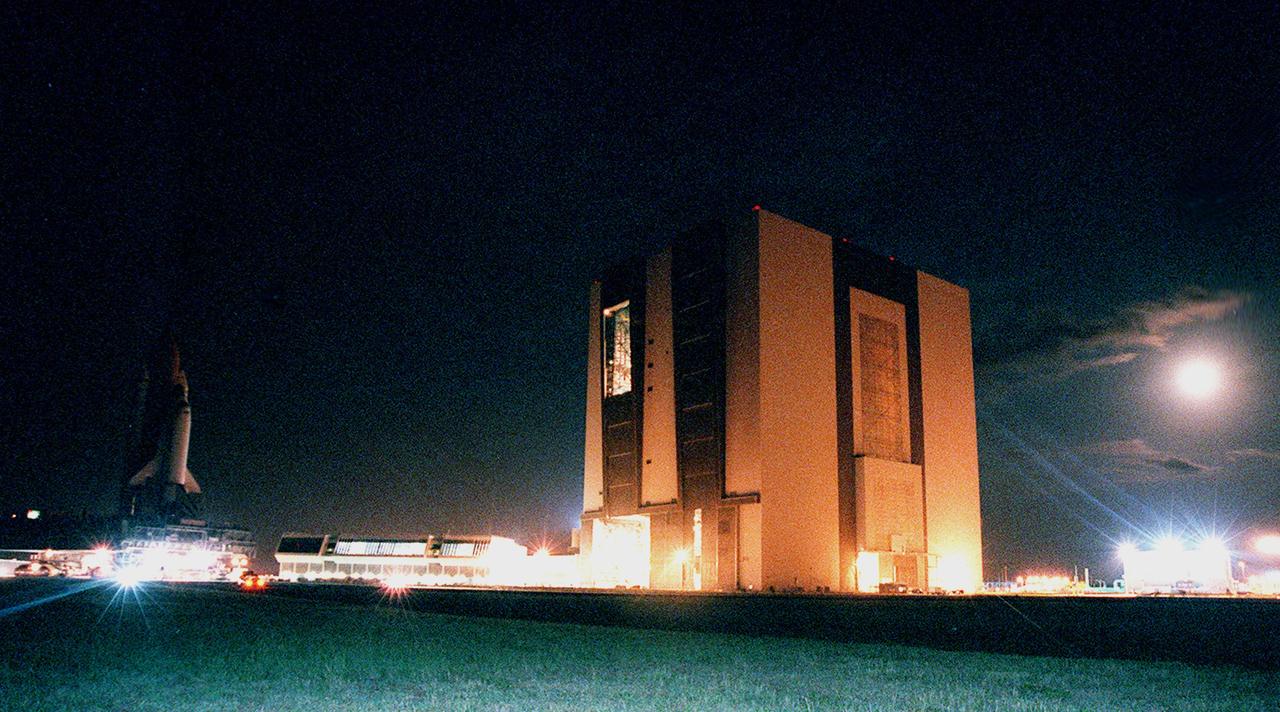
KENNEDY SPACE CENTER, FLA. -- This 30-second timed exposure captures the bright lights around the Vehicle Assembly Building (VAB) plus the equally bright moon (upper right) as Space Shuttle Atlantis (far left) rolls out of the east side bay 1. The Launch Control Center sits between the Shuttle and the VAB. The full stack of Shuttle, solid rocket boosters and external tank are taking part in a fit check for the newly renovated crawlerway and high bay 2, which is on the west side. The major modifications to the crawlerway and VAB provide Shuttle flight hardware more storage space and protection - "Safe Haven" - from hurricanes or tropical storms. Atlantis began moving out of VAB high bay 1 at 2:59 a.m. EDT. After the successful Safe Haven fit check, Shuttle Atlantis is scheduled to roll out to Launch Pad 39B in preparation for the STS-106 launch on Sept. 8.
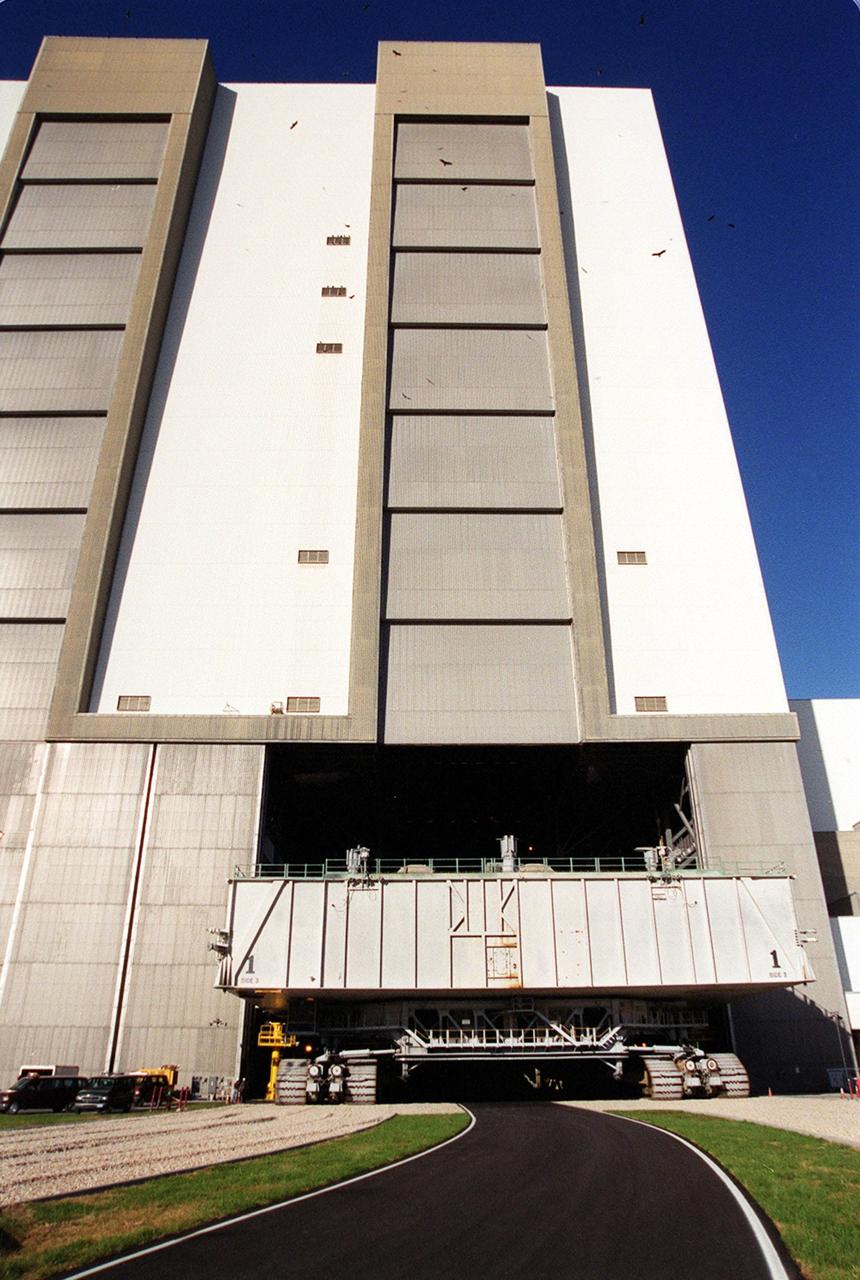
KENNEDY SPACE CENTER, FLA. -- A mobile launcher platform atop a crawler-transporter, heads through the open door of the Vehicle Assembly Building high bay 2. As part of the Safe Haven project, a once-buried portion of the crawlerway was restored to enable rollout of a Shuttle from this third stacking area. The primary goal of the Safe Haven construction project was to strengthen readiness for hurricane season by expanding the VAB’s storage capacity. The new area, in high bay 2, will allow NASA to preassemble stacks and still have room in the VAB to pull a Shuttle back from the pad if severe weather threatens. Potential rollouts of the Space Shuttle to the launch pad from high bay 2 will involve making a turn around the north side of the VAB in contrast to the straight rollouts from high bays 1 and 3, on the east side of the VAB facing the launch pads
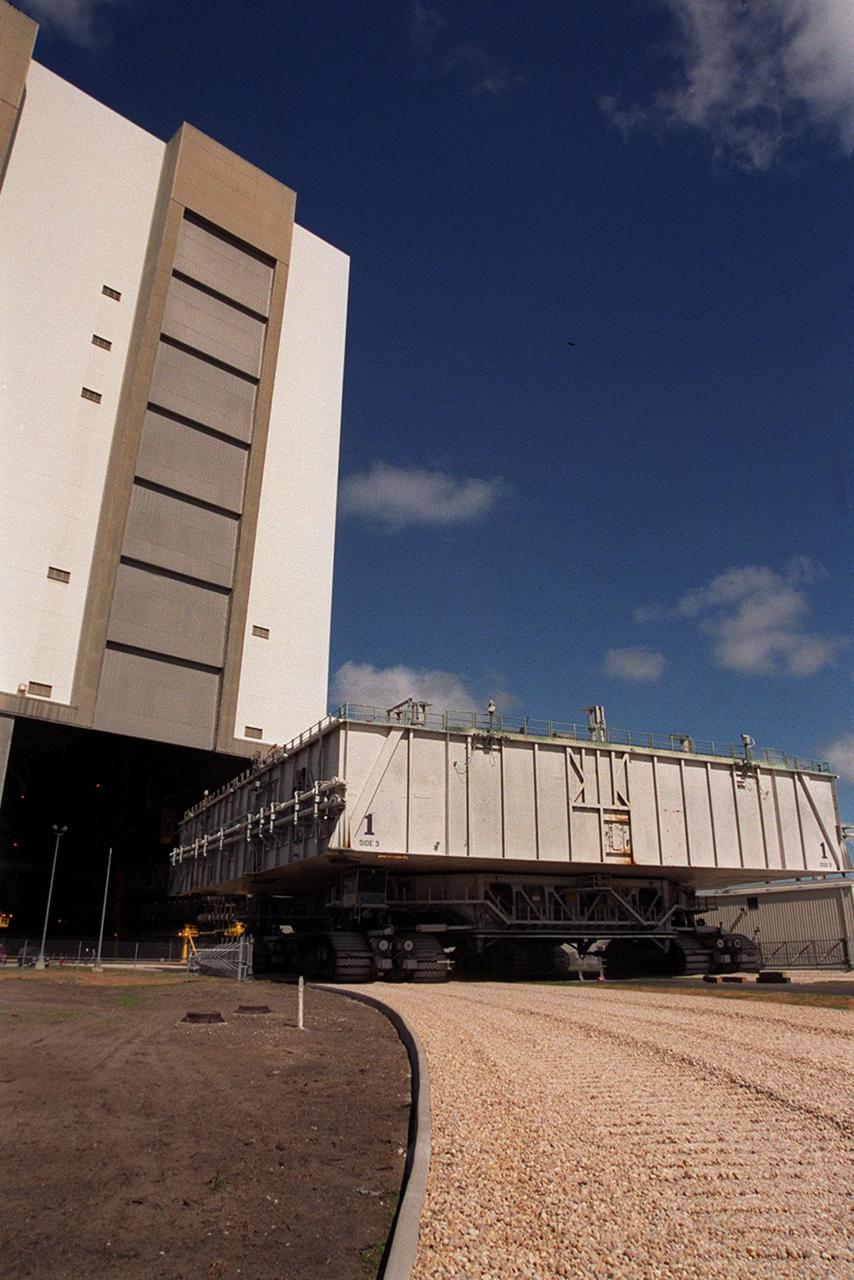
KENNEDY SPACE CENTER, FLA. -- A mobile launcher platform atop a crawler-transporter, heads to the open door of the Vehicle Assembly Building high bay 2. As part of the Safe Haven project, a once-buried portion of the crawlerway was restored to enable rollout of a Shuttle from this third stacking area. The primary goal of the Safe Haven construction project was to strengthen readiness for hurricane season by expanding the VAB’s storage capacity. The new area, in high bay 2, will allow NASA to preassemble stacks and still have room in the VAB to pull a Shuttle back from the pad if severe weather threatens. Potential rollouts of the Space Shuttle to the launch pad from high bay 2 will involve making a turn around the north side of the VAB in contrast to the straight rollouts from high bays 1 and 3, on the east side of the VAB facing the launch pads
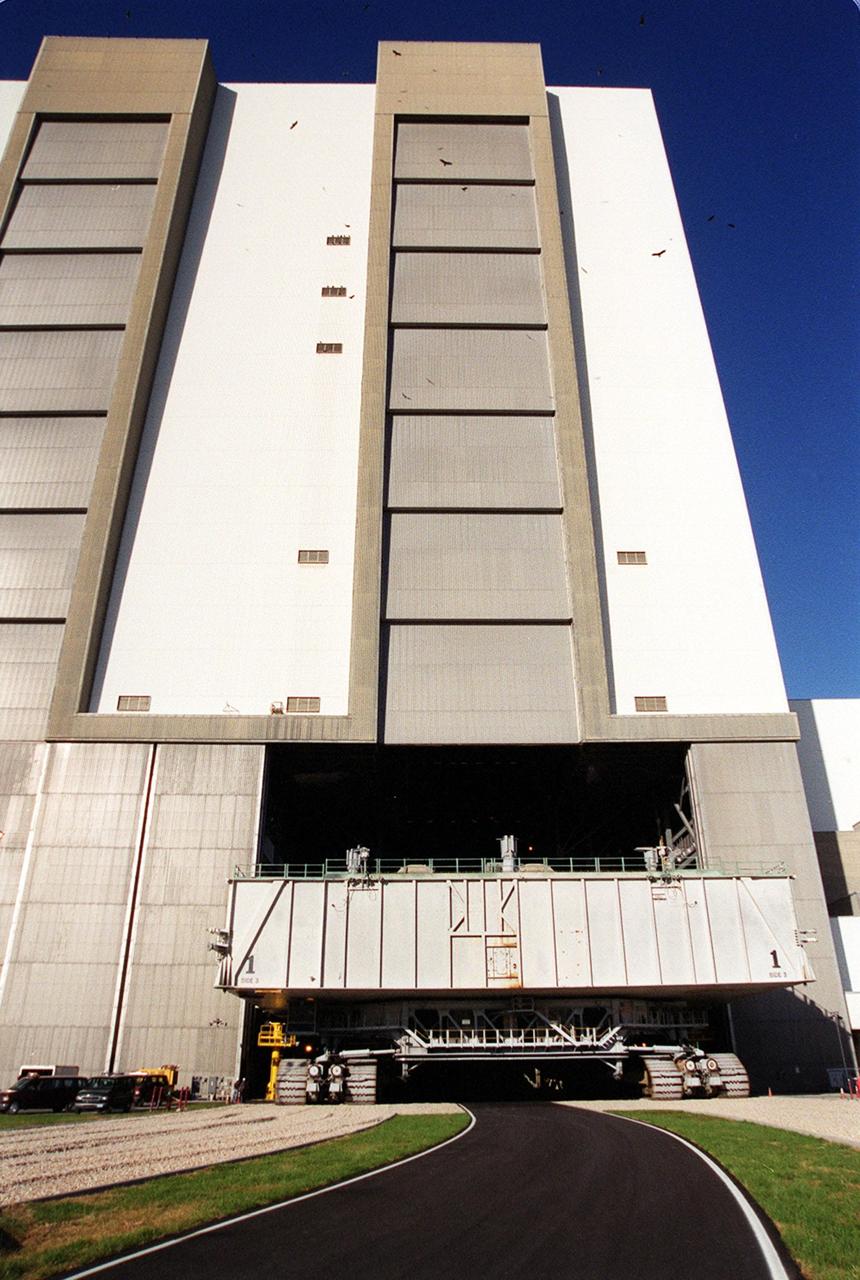
KENNEDY SPACE CENTER, FLA. -- A mobile launcher platform atop a crawler-transporter, heads through the open door of the Vehicle Assembly Building high bay 2. As part of the Safe Haven project, a once-buried portion of the crawlerway was restored to enable rollout of a Shuttle from this third stacking area. The primary goal of the Safe Haven construction project was to strengthen readiness for hurricane season by expanding the VAB’s storage capacity. The new area, in high bay 2, will allow NASA to preassemble stacks and still have room in the VAB to pull a Shuttle back from the pad if severe weather threatens. Potential rollouts of the Space Shuttle to the launch pad from high bay 2 will involve making a turn around the north side of the VAB in contrast to the straight rollouts from high bays 1 and 3, on the east side of the VAB facing the launch pads
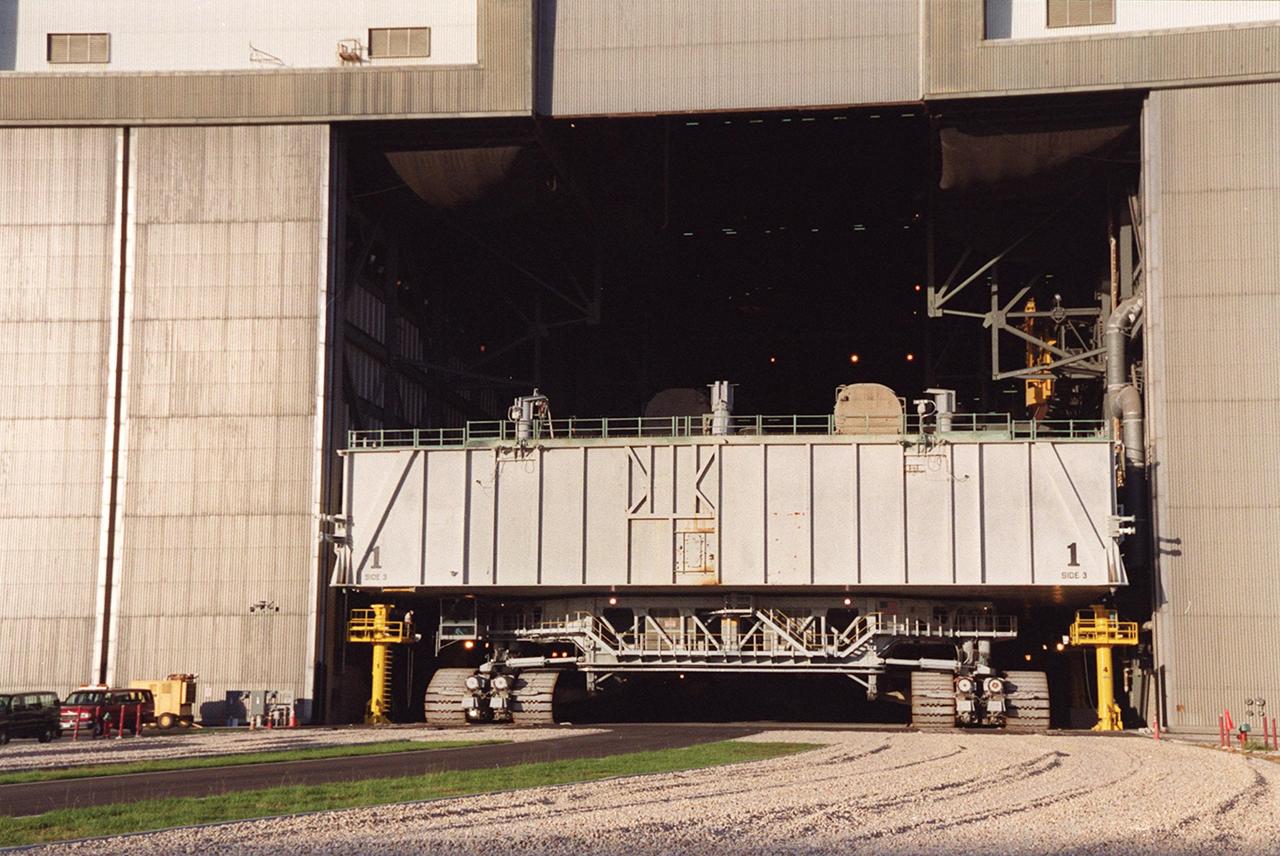
KENNEDY SPACE CENTER, FLA. -- A mobile launcher platform atop a crawler-transporter, moves into the Vehicle Assembly Building high bay 2. As part of the Safe Haven project, a once-buried portion of the crawlerway was restored to enable rollout of a Shuttle from this third stacking area. The primary goal of the Safe Haven construction project was to strengthen readiness for hurricane season by expanding the VAB’s storage capacity. The new area, in high bay 2, will allow NASA to preassemble stacks and still have room in the VAB to pull a Shuttle back from the pad if severe weather threatens. Potential rollouts of the Space Shuttle to the launch pad from high bay 2 will involve making a turn around the north side of the VAB in contrast to the straight rollouts from high bays 1 and 3, on the east side of the VAB facing the launch pads
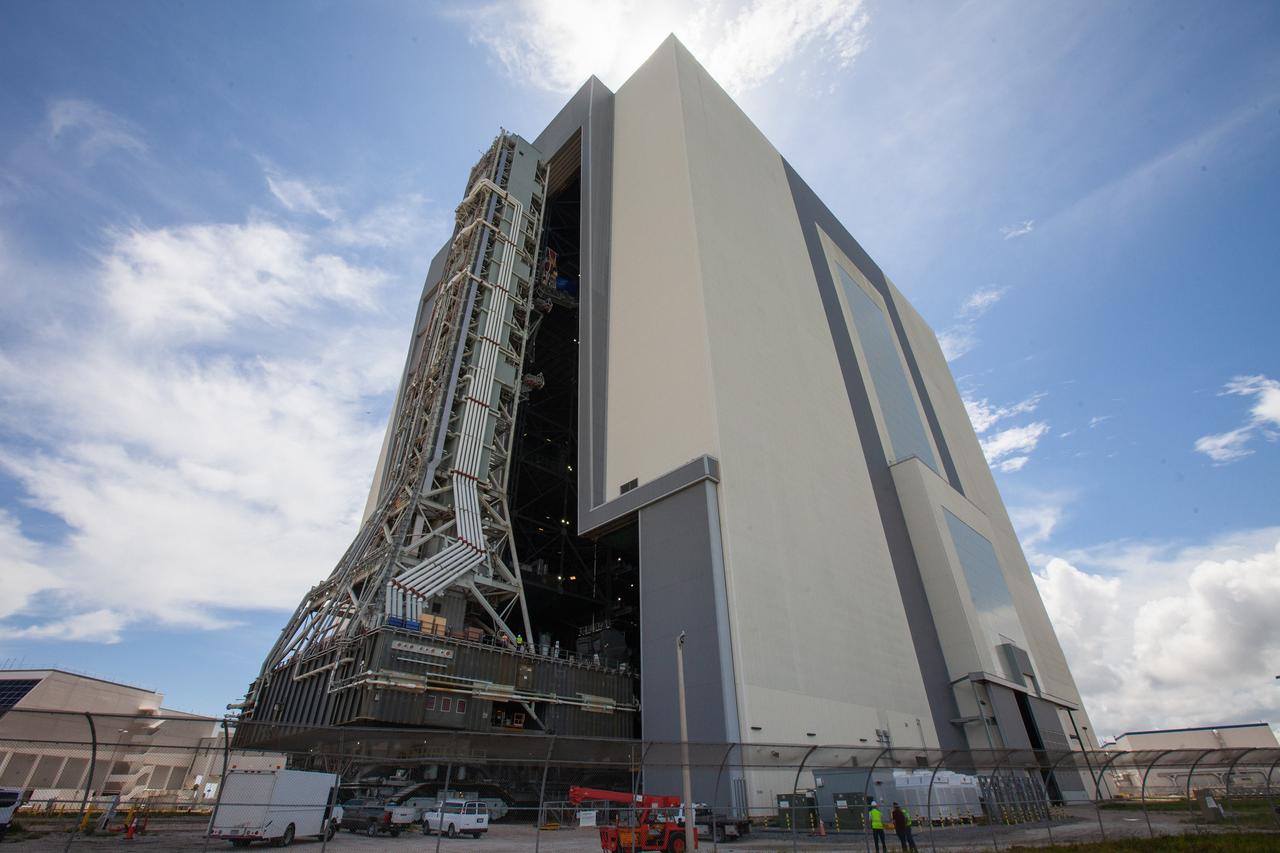
Exploration Ground Systems teams at NASA’s Kennedy Space Center in Florida take precautions to protect Artemis ground support equipment in advance of Hurricane Dorian. On Aug. 30, 2019, crawler-transporter 2 moved the mobile launcher (ML) from its current position at Launch Pad 39B to inside the Vehicle Assembly Building. In its final phases of development, the ML stands nearly 400 feet tall and is needed to assemble, process and launch NASA’s powerful Space Launch System rocket and Orion spacecraft on missions to the Moon and Mars.
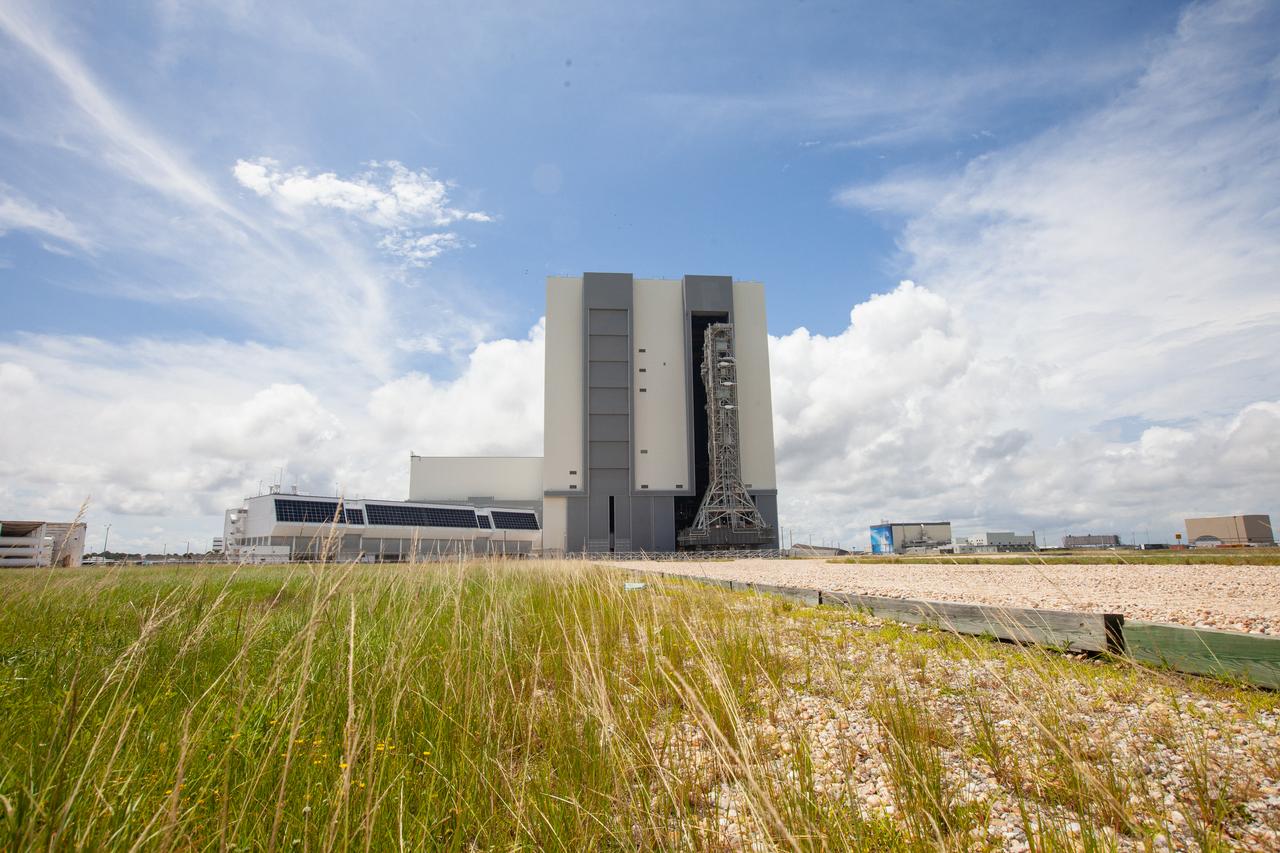
Exploration Ground Systems teams at NASA’s Kennedy Space Center in Florida take precautions to protect Artemis ground support equipment in advance of Hurricane Dorian. On Aug. 30, 2019, crawler-transporter 2 moved the mobile launcher (ML) from its current position at Launch Pad 39B to inside the Vehicle Assembly Building. In its final phases of development, the ML stands nearly 400 feet tall and is needed to assemble, process and launch NASA’s powerful Space Launch System rocket and Orion spacecraft on missions to the Moon and Mars.
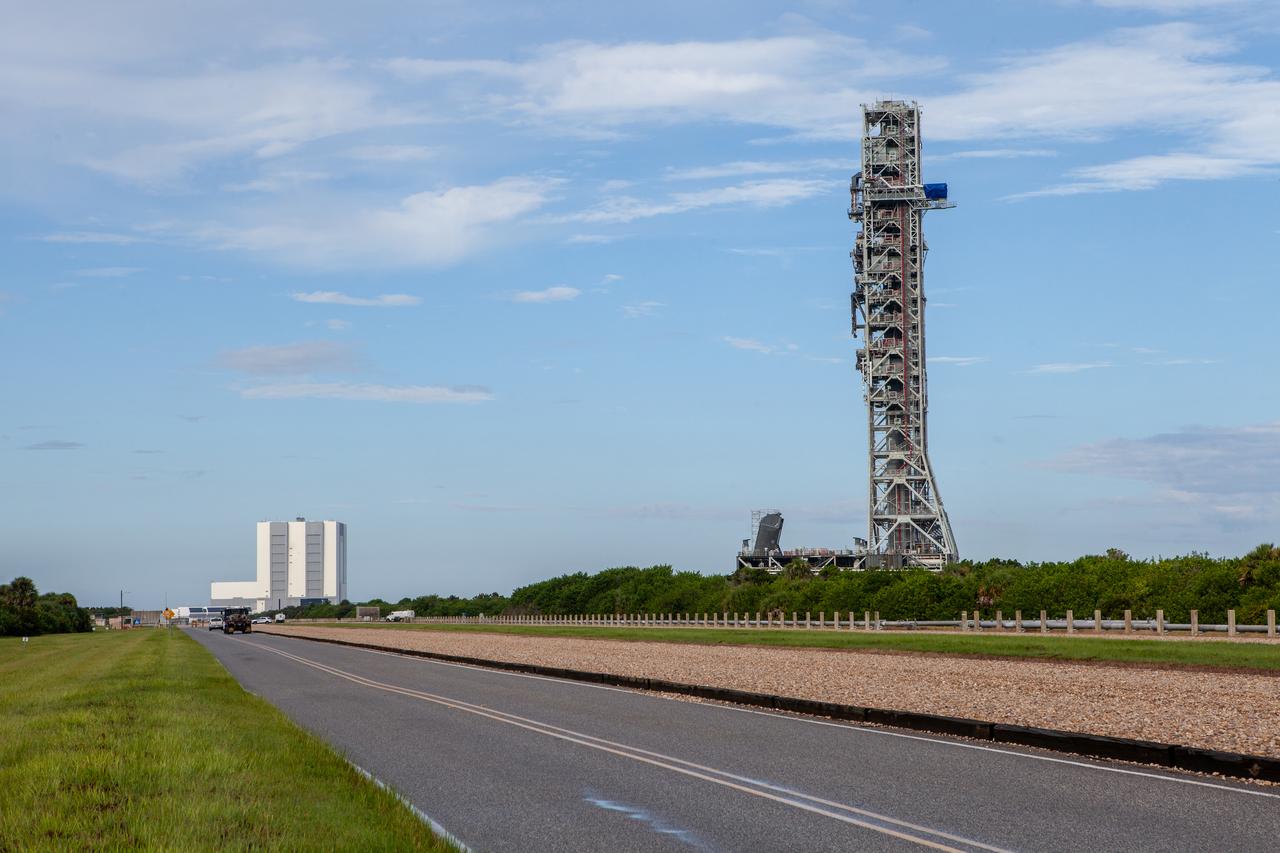
Exploration Ground Systems teams at NASA’s Kennedy Space Center in Florida take precautions to protect Artemis ground support equipment in advance of Hurricane Dorian. On Aug. 30, 2019, crawler-transporter 2 moved the mobile launcher (ML) from its current position at Launch Pad 39B to inside the Vehicle Assembly Building. In its final phases of development, the ML stands nearly 400 feet tall and is needed to assemble, process and launch NASA’s powerful Space Launch System rocket and Orion spacecraft on missions to the Moon and Mars.
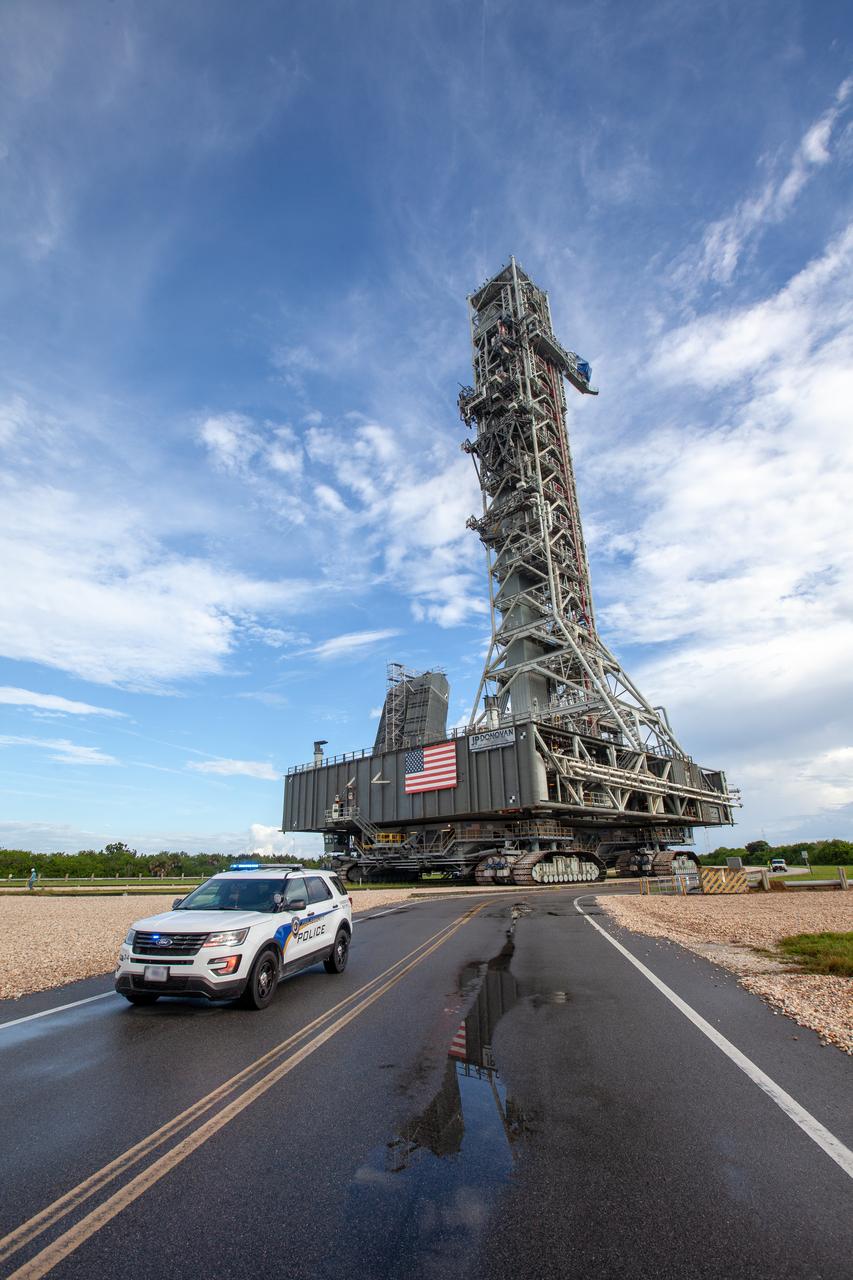
Exploration Ground Systems teams at NASA’s Kennedy Space Center in Florida take precautions to protect Artemis ground support equipment in advance of Hurricane Dorian. On Aug. 30, 2019, crawler-transporter 2 moved the mobile launcher (ML) from its current position at Launch Pad 39B to inside the Vehicle Assembly Building. In its final phases of development, the ML stands nearly 400 feet tall and is needed to assemble, process and launch NASA’s powerful Space Launch System rocket and Orion spacecraft on missions to the Moon and Mars.
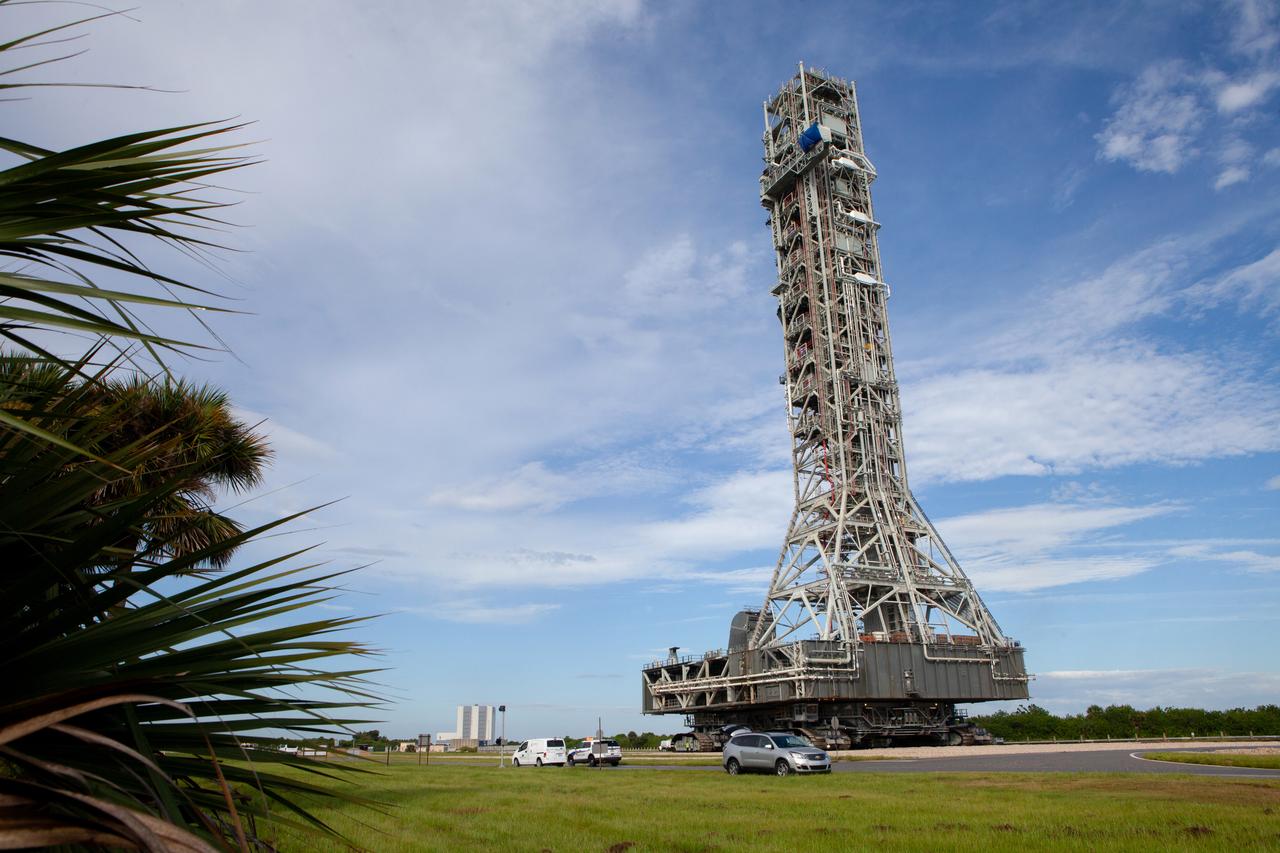
Exploration Ground Systems teams at NASA’s Kennedy Space Center in Florida take precautions to protect Artemis ground support equipment in advance of Hurricane Dorian. On Aug. 30, 2019, crawler-transporter 2 moved the mobile launcher (ML) from its current position at Launch Pad 39B to inside the Vehicle Assembly Building. In its final phases of development, the ML stands nearly 400 feet tall and is needed to assemble, process and launch NASA’s powerful Space Launch System rocket and Orion spacecraft on missions to the Moon and Mars.
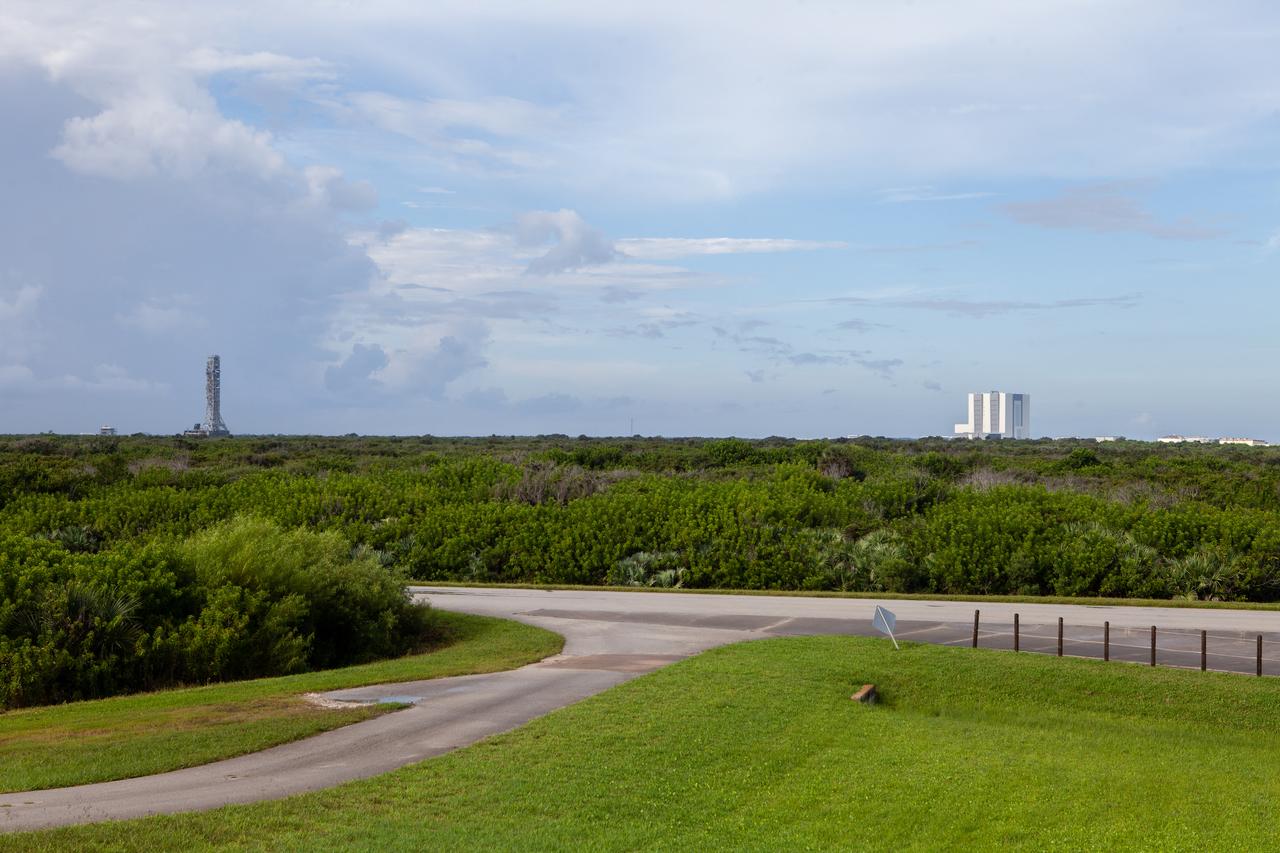
Exploration Ground Systems teams at NASA’s Kennedy Space Center in Florida take precautions to protect Artemis ground support equipment in advance of Hurricane Dorian. On Aug. 30, 2019, crawler-transporter 2 moved the mobile launcher (ML) from its current position at Launch Pad 39B to inside the Vehicle Assembly Building. In its final phases of development, the ML stands nearly 400 feet tall and is needed to assemble, process and launch NASA’s powerful Space Launch System rocket and Orion spacecraft on missions to the Moon and Mars.
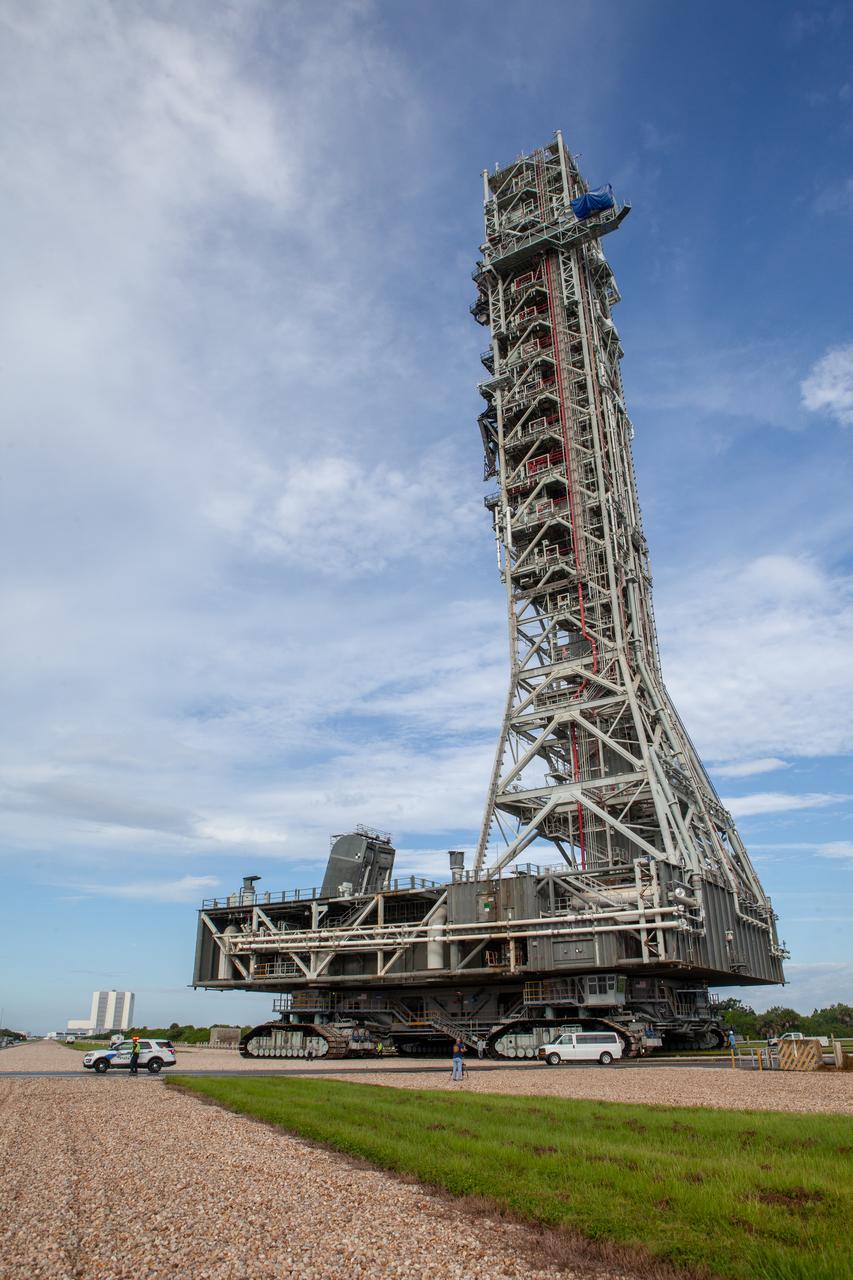
Exploration Ground Systems teams at NASA’s Kennedy Space Center in Florida take precautions to protect Artemis ground support equipment in advance of Hurricane Dorian. On Aug. 30, 2019, crawler-transporter 2 moved the mobile launcher (ML) from its current position at Launch Pad 39B to inside the Vehicle Assembly Building. In its final phases of development, the ML stands nearly 400 feet tall and is needed to assemble, process and launch NASA’s powerful Space Launch System rocket and Orion spacecraft on missions to the Moon and Mars.
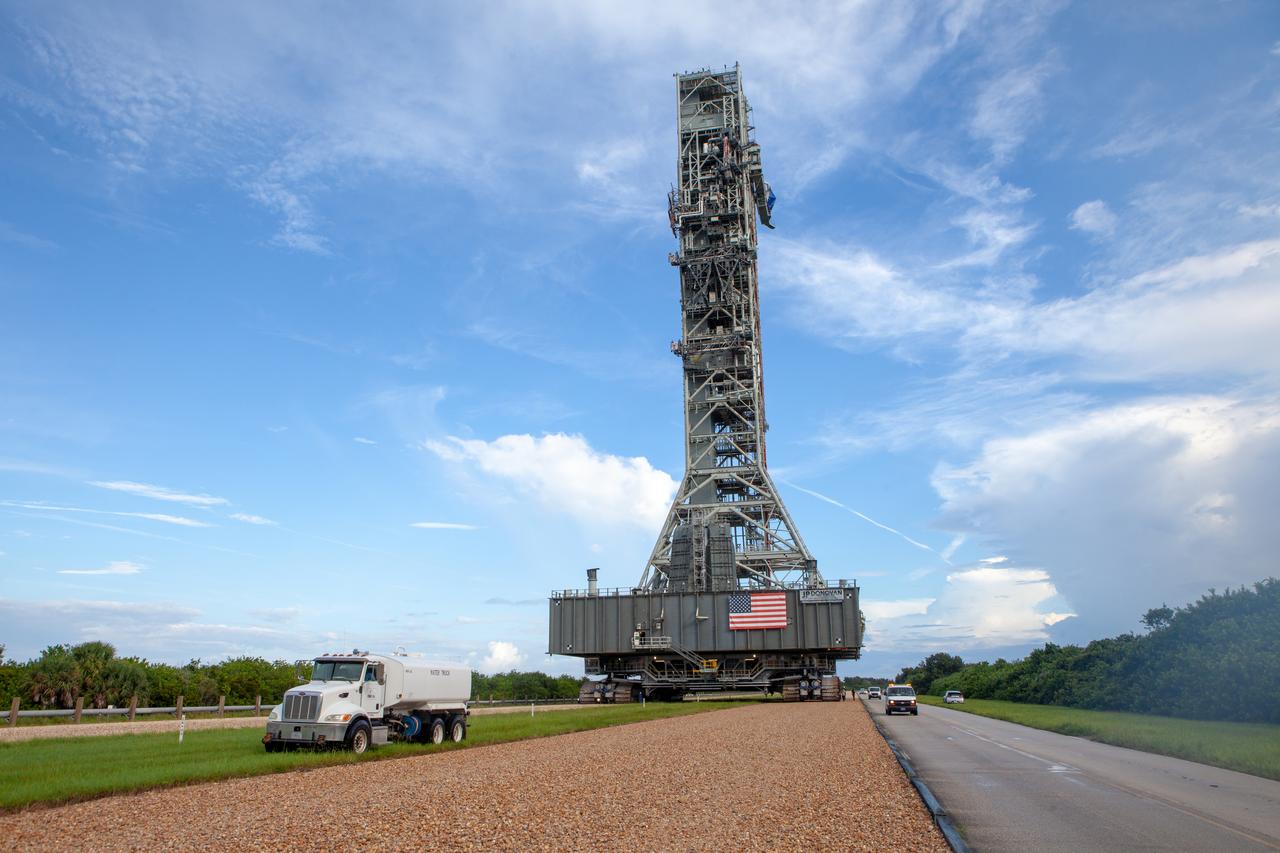
Exploration Ground Systems teams at NASA’s Kennedy Space Center in Florida take precautions to protect Artemis ground support equipment in advance of Hurricane Dorian. On Aug. 30, 2019, crawler-transporter 2 moved the mobile launcher (ML) from its current position at Launch Pad 39B to inside the Vehicle Assembly Building. In its final phases of development, the ML stands nearly 400 feet tall and is needed to assemble, process and launch NASA’s powerful Space Launch System rocket and Orion spacecraft on missions to the Moon and Mars.
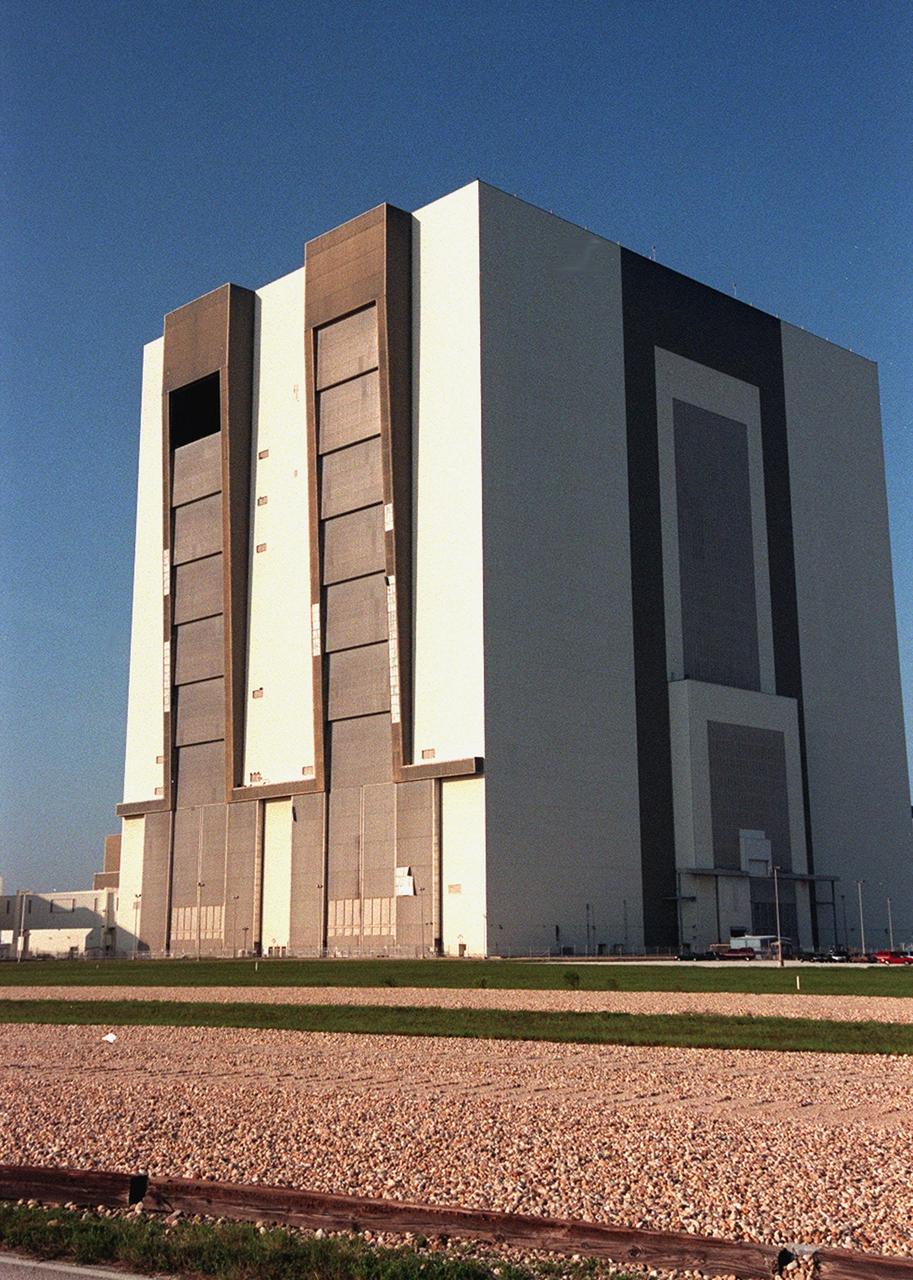
The east side of the Vehicle Assembly Building (VAB) at Kennedy Space Center shows missing panels around the leaves of the upper door, the effect of the high winds from Hurricane Floyd as it passed along the East Coast of Florida, Sept. 14-15. At a weather tower located between Shuttle Launch Pad 39A and Launch Complex 41, the highest winds recorded during the superstorm were 91 mph from the NNW at 4:50 a.m. on Wednesday, Sept. 15. The maximum sustained winds were recorded at 66 mph. The highest amount of rain recorded at KSC was 2.82 inches as the eye of Hurricane Floyd passed 121 miles east of Cape Canaveral at 4 a.m. Wednesday. A preliminary review of conditions at the Kennedy Space Center was positive after the worst of Hurricane Floyd passed. There appeared to be no major damage to NASA assets, including the launch pads, the four Space Shuttle Orbiters, and flight hardware

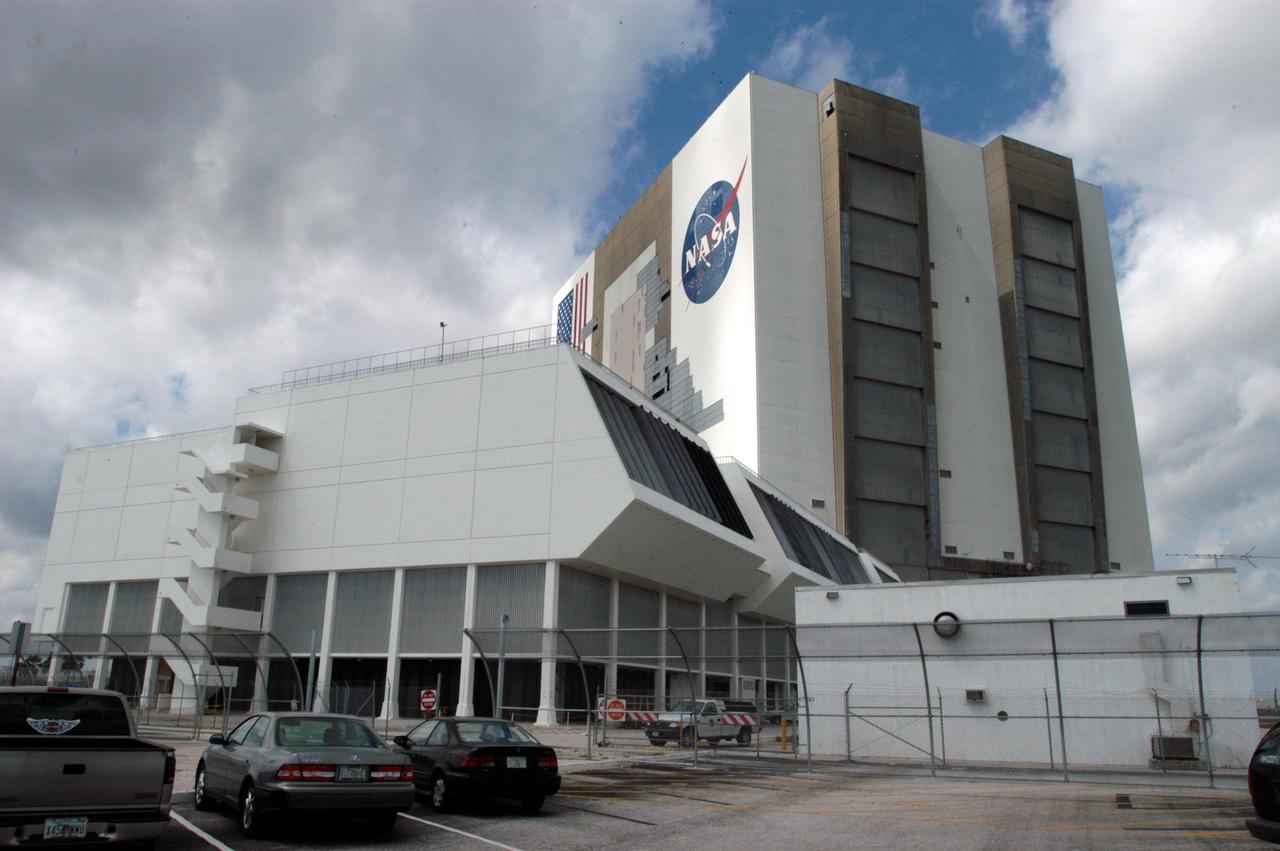
Painting of the NASA logo, also called the meatball, continues on the 525-foot-tall Vehicle Assembly Building (VAB) at the agency’s Kennedy Space Center in Florida on June 23, 2020. HM2 and H.I.S. Painting of Titusville, Florida, are repainting the meatball and the American Flag on the iconic building. The VAB was last painted in 2007 when the repairs were completed after 2004 Hurricanes Frances and Jeanne tore 845 panels off the building. It will take over 500 gallons of paint to paint the 209 X 110-foot flag and the 110’ X 132’ meatball.

Painting of the NASA logo, also called the meatball, continues on the 525-foot-tall Vehicle Assembly Building (VAB) at the agency’s Kennedy Space Center in Florida on June 23, 2020. HM2 and H.I.S. Painting of Titusville, Florida, are repainting the meatball and the American Flag on the iconic building. The VAB was last painted in 2007 when the repairs were completed after 2004 Hurricanes Frances and Jeanne tore 845 panels off the building. It will take over 500 gallons of paint to paint the 209 X 110-foot flag and the 110’ X 132’ meatball.
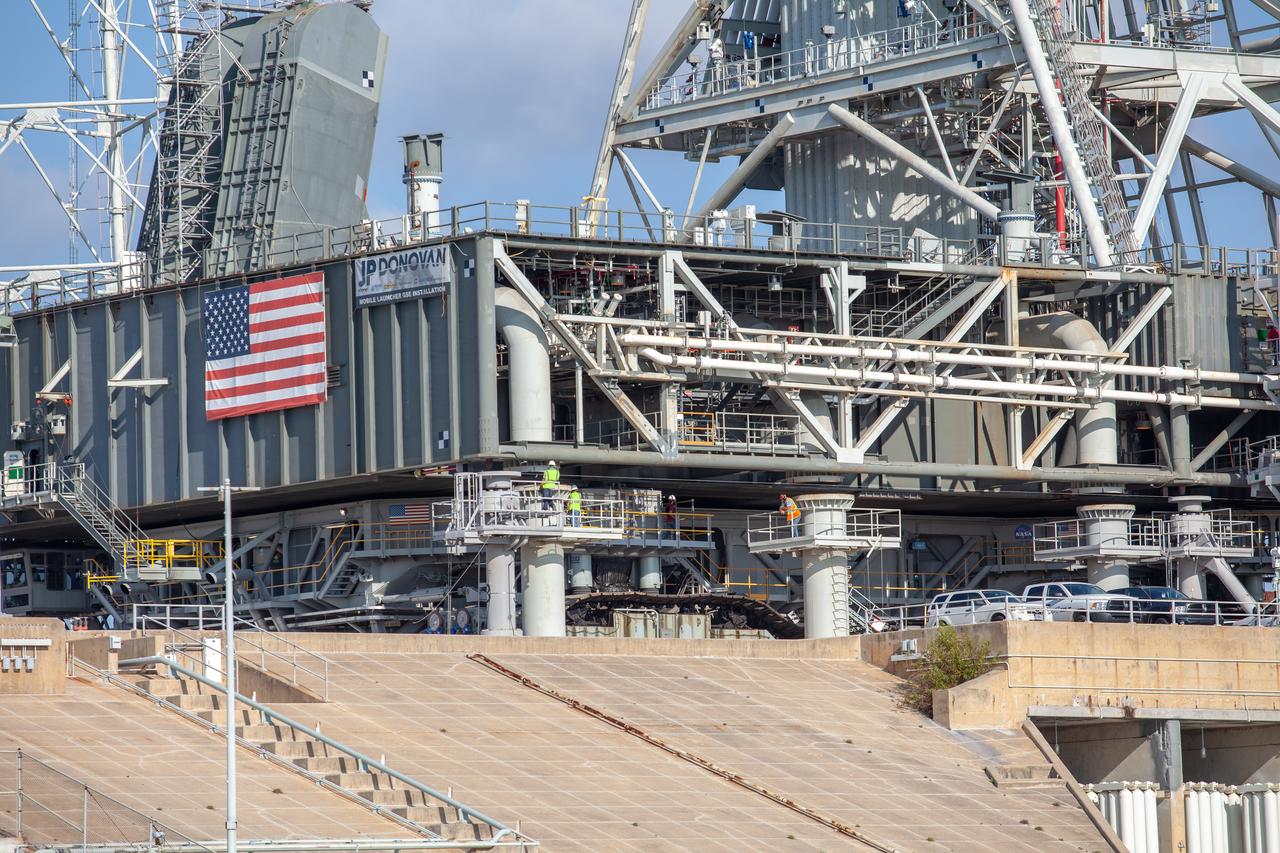
The mobile launcher for Artemis missions is at Launch Pad 39B on Sept. 11, 2019, at NASA’s Kennedy Space Center in Florida, after spending a week and a half inside the Vehicle Assembly Building (VAB) due to the approach of Hurricane Dorian. The nearly 400-foot-tall structure was moved from Launch Pad 39B to the VAB for safekeeping on Aug. 30. The storm passed about 70 miles east of the spaceport during the overnight hours Tuesday, Sept. 3, and Wednesday, Sept. 4. NASA’s Exploration Ground Systems moved the mobile launcher back to the launch pad, where teams will complete testing and checkout on the launcher in the coming weeks for the Artemis I mission.
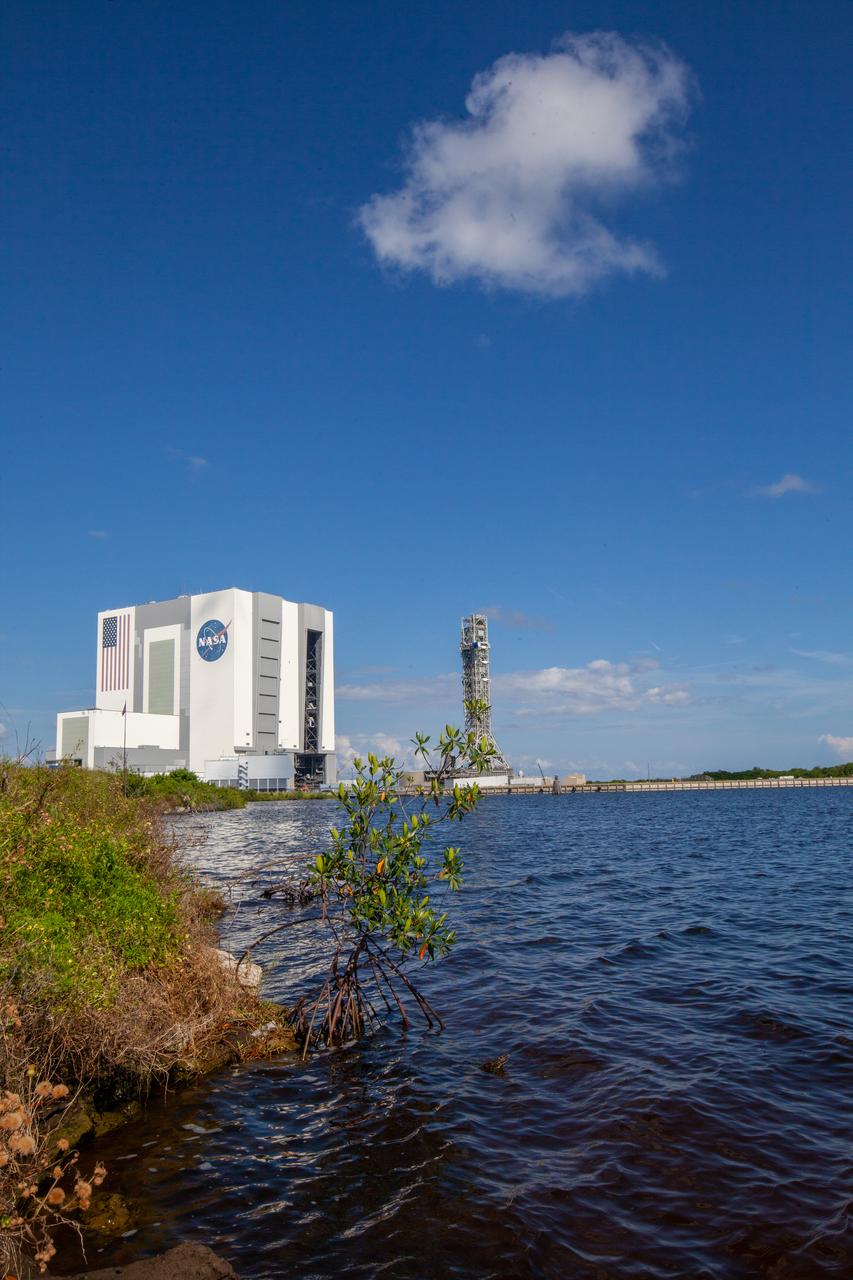
The mobile launcher for NASA’s Artemis missions rolls out of the Vehicle Assembly Building (VAB) at Kennedy Space Center in Florida on Sept. 10, 2019, after spending a week and a half inside due to the approach of Hurricane Dorian. The nearly 400-foot-tall structure was moved from Launch Pad 39B to the VAB for safekeeping on Aug. 30. The storm passed about 70 miles east of the spaceport during the overnight hours Tuesday, Sept. 3, and Wednesday, Sept. 4. NASA’s Exploration Ground Systems is moving the mobile launcher back to the launch pad, where teams will complete testing and checkout on the launcher in the coming weeks for the Artemis I mission.
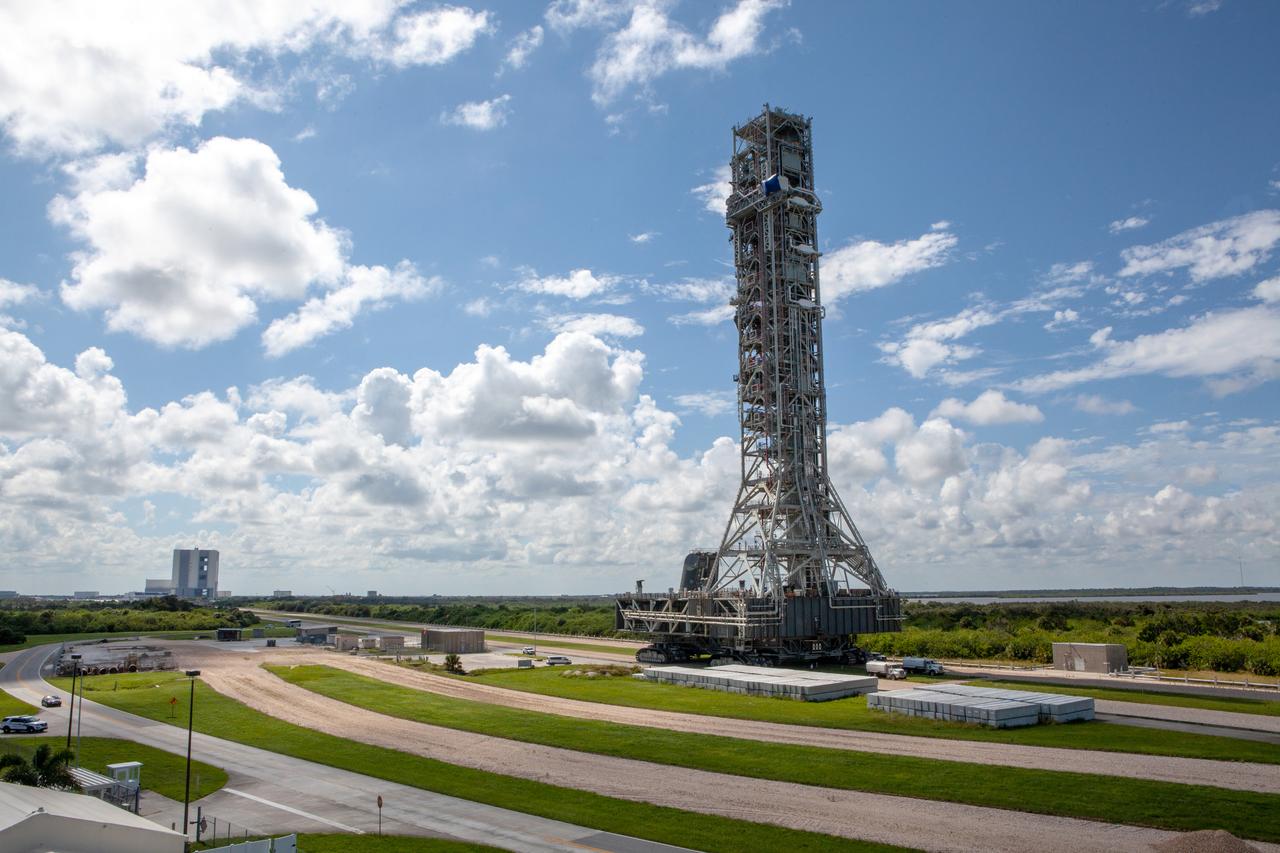
NASA’s mobile launcher (ML) atop crawler-transporter 2 moves along the crawlerway on Sept. 10, 2019, after spending a week and a half inside the Vehicle Assembly Building (VAB) at Kennedy Space Center in Florida due to the approach of Hurricane Dorian. The nearly 400-foot-tall structure was moved from Launch Pad 39B to the VAB for safekeeping on Aug. 30. The storm passed about 70 miles east of the spaceport during the overnight hours Tuesday, Sept. 3, and Wednesday, Sept. 4. NASA’s Exploration Ground Systems is moving the mobile launcher back to the launch pad, where teams will complete testing and checkout on the launcher in the coming weeks for the Artemis I mission.

The mobile launcher for Artemis missions is at Launch Pad 39B at NASA’s Kennedy Space Center in Florida on Sept. 11, 2019, after spending a week and a half inside the Vehicle Assembly Building (VAB) due to the approach of Hurricane Dorian. The nearly 400-foot-tall structure was moved from Launch Pad 39B to the VAB for safekeeping on Aug. 30. The storm passed about 70 miles east of the spaceport during the overnight hours Tuesday, Sept. 3, and Wednesday, Sept. 4. NASA’s Exploration Ground Systems moved the mobile launcher back to the launch pad, where teams will complete testing and checkout on the launcher in the coming weeks for the Artemis I mission.
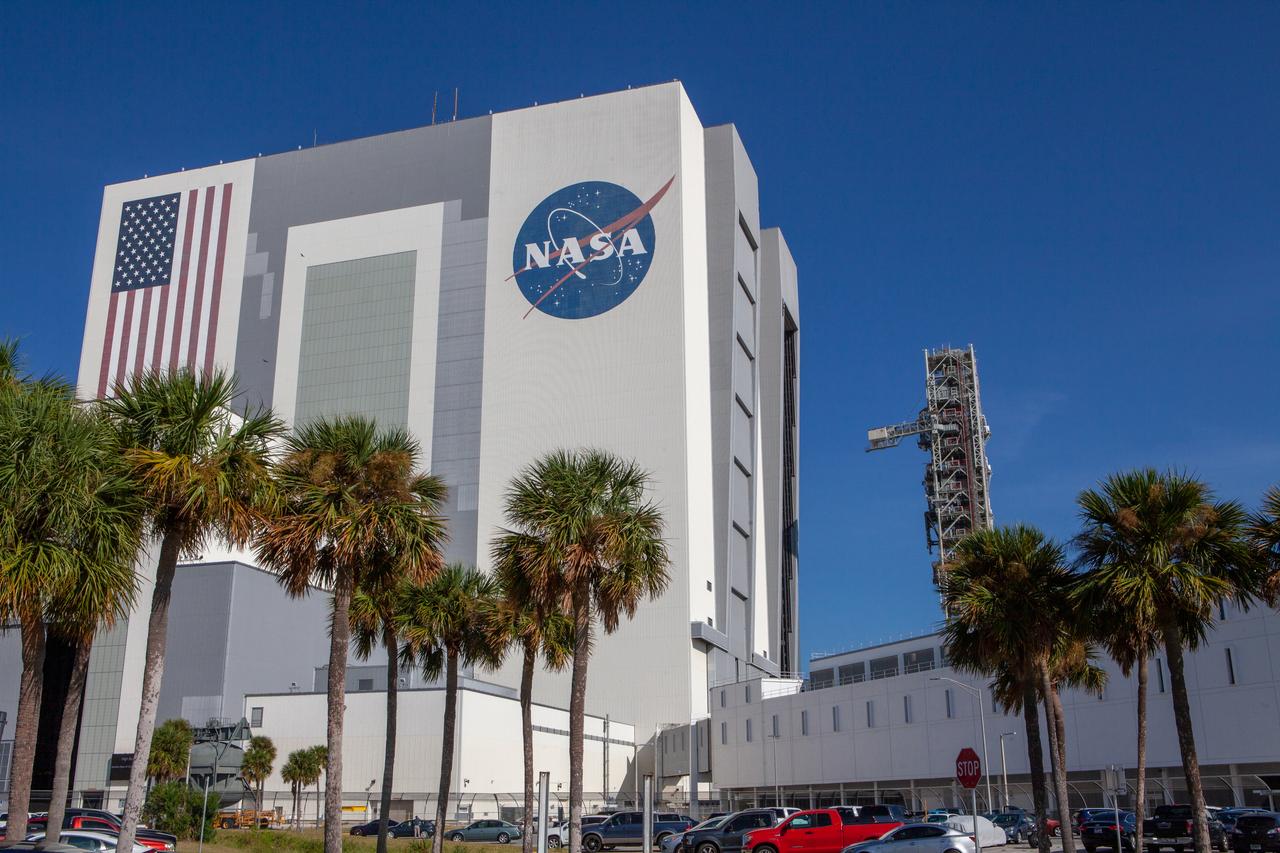
The mobile launcher for NASA’s Artemis missions rolls out of the Vehicle Assembly Building (VAB) and past the Launch Control Center at Kennedy Space Center in Florida on Sept. 10, 2019, after spending a week and a half inside due to the approach of Hurricane Dorian. The nearly 400-foot-tall structure was moved from Launch Pad 39B to the VAB for safekeeping on Aug. 30. The storm passed about 70 miles east of the spaceport during the overnight hours Tuesday, Sept. 3, and Wednesday, Sept. 4. NASA’s Exploration Ground Systems is moving the mobile launcher back to the launch pad, where teams will complete testing and checkout on the launcher in the coming weeks for the Artemis I mission.

Painting of the NASA logo, also called the meatball, continues on the 525-foot-tall Vehicle Assembly Building (VAB) at the agency’s Kennedy Space Center in Florida on June 23, 2020. HM2 and H.I.S. Painting of Titusville, Florida, are repainting the meatball and the American Flag on the iconic building. The VAB was last painted in 2007 when the repairs were completed after 2004 Hurricanes Frances and Jeanne tore 845 panels off the building. It will take over 500 gallons of paint to paint the 209 X 110-foot flag and the 110’ X 132’ meatball.

Painting of the NASA logo, also called the meatball, continues on the 525-foot-tall Vehicle Assembly Building (VAB) at the agency’s Kennedy Space Center in Florida on June 23, 2020. HM2 and H.I.S. Painting of Titusville, Florida, are repainting the meatball and the American Flag on the iconic building. The VAB was last painted in 2007 when the repairs were completed after 2004 Hurricanes Frances and Jeanne tore 845 panels off the building. It will take over 500 gallons of paint to paint the 209 X 110-foot flag and the 110’ X 132’ meatball.
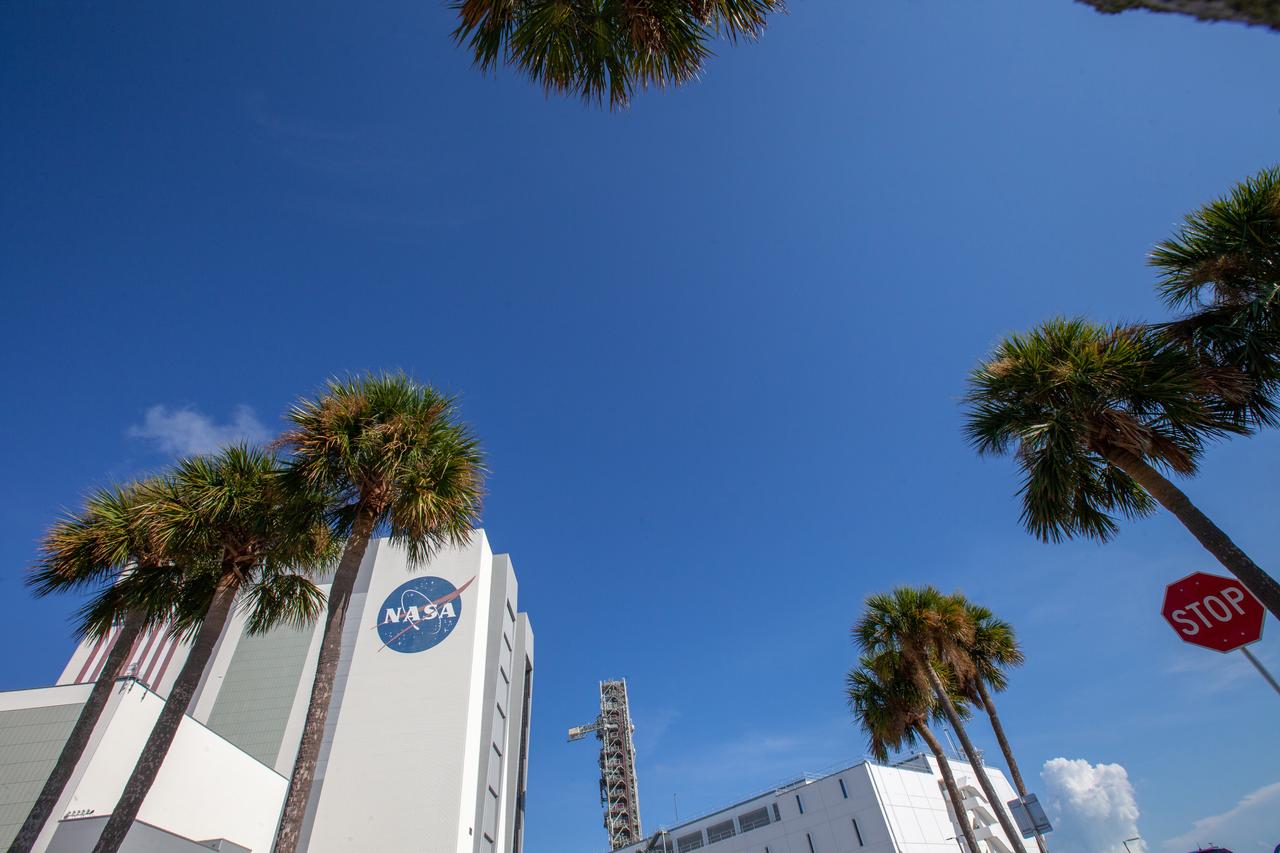
The mobile launcher for NASA’s Artemis missions rolls out of the Vehicle Assembly Building (VAB) at Kennedy Space Center in Florida on Sept. 10, 2019, after spending a week and a half inside due to the approach of Hurricane Dorian. The nearly 400-foot-tall structure was moved from Launch Pad 39B to the VAB for safekeeping on Aug. 30. The storm passed about 70 miles east of the spaceport during the overnight hours Tuesday, Sept. 3, and Wednesday, Sept. 4. NASA’s Exploration Ground Systems is moving the mobile launcher back to the launch pad, where teams will complete testing and checkout on the launcher in the coming weeks for the Artemis I mission.
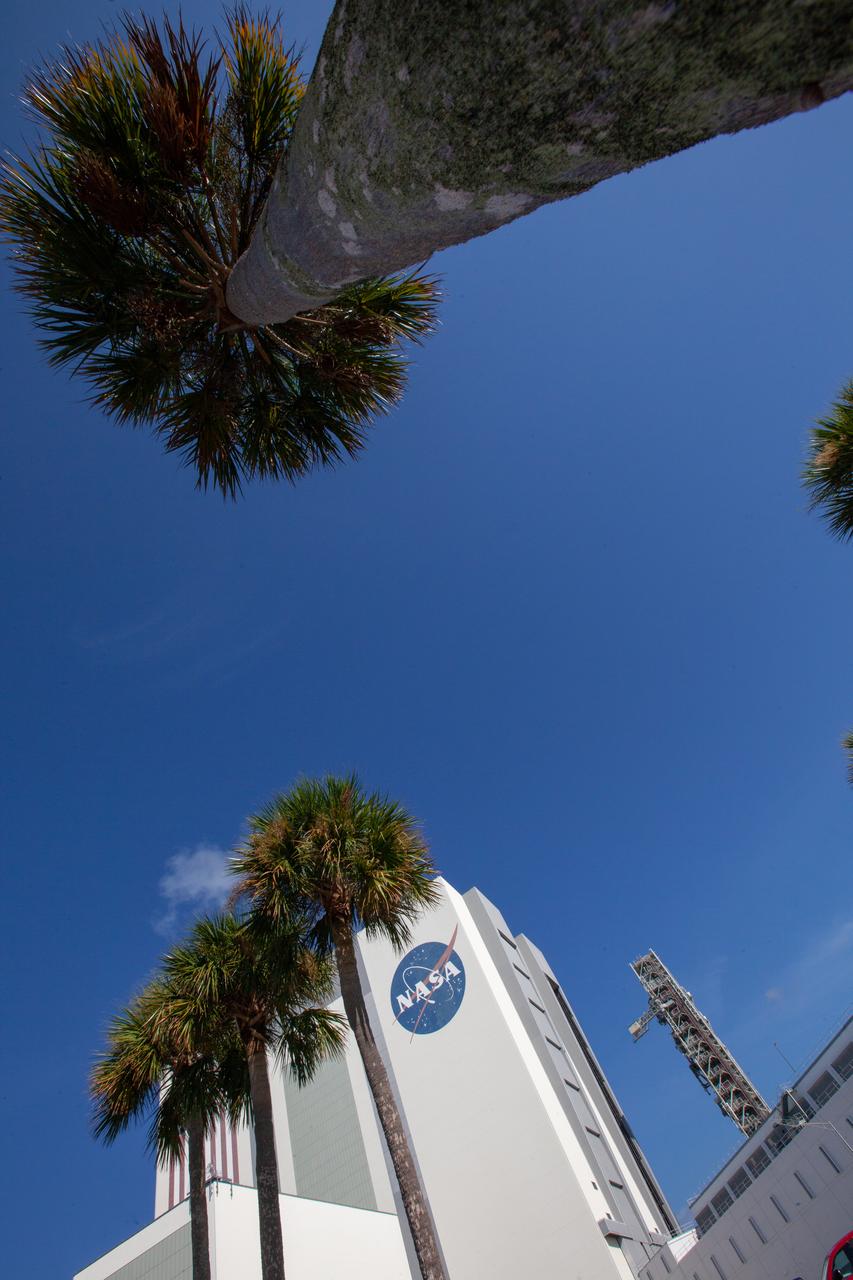
The mobile launcher for NASA’s Artemis missions rolls out of the Vehicle Assembly Building (VAB) at Kennedy Space Center in Florida on Sept. 10, 2019, after spending a week and a half inside due to the approach of Hurricane Dorian. The nearly 400-foot-tall structure was moved from Launch Pad 39B to the VAB for safekeeping on Aug. 30. The storm passed about 70 miles east of the spaceport during the overnight hours Tuesday, Sept. 3, and Wednesday, Sept. 4. NASA’s Exploration Ground Systems is moving the mobile launcher back to the launch pad, where teams will complete testing and checkout on the launcher in the coming weeks for the Artemis I mission.
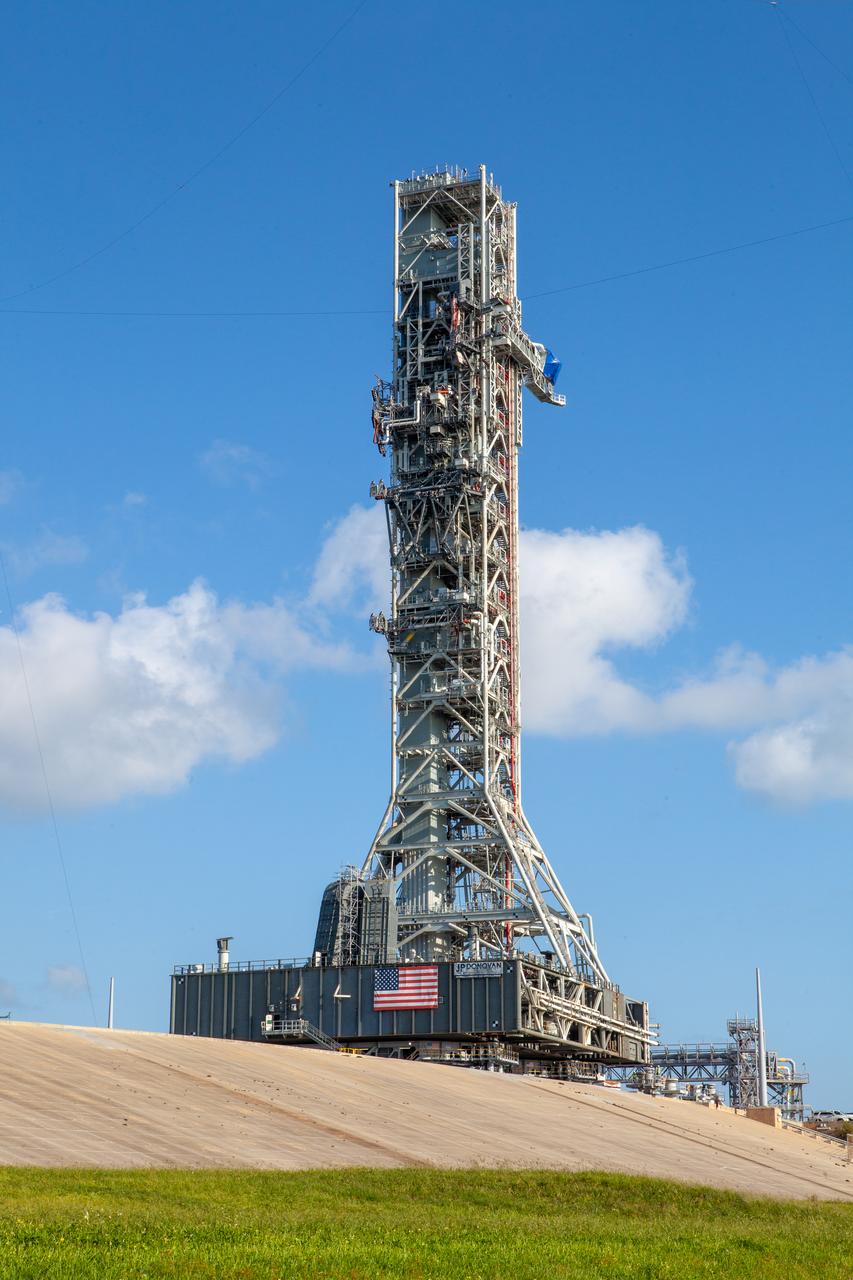
The mobile launcher for Artemis missions is at Launch Pad 39B on Sept. 11, 2019, at NASA’s Kennedy Space Center in Florida, after spending a week and a half inside the Vehicle Assembly Building (VAB) due to the approach of Hurricane Dorian. The nearly 400-foot-tall structure was moved from Launch Pad 39B to the VAB for safekeeping on Aug. 30. The storm passed about 70 miles east of the spaceport during the overnight hours Tuesday, Sept. 3, and Wednesday, Sept. 4. NASA’s Exploration Ground Systems moved the mobile launcher back to the launch pad, where teams will complete testing and checkout on the launcher in the coming weeks for the Artemis I mission.