It Not Just a Good Idea, It the Law
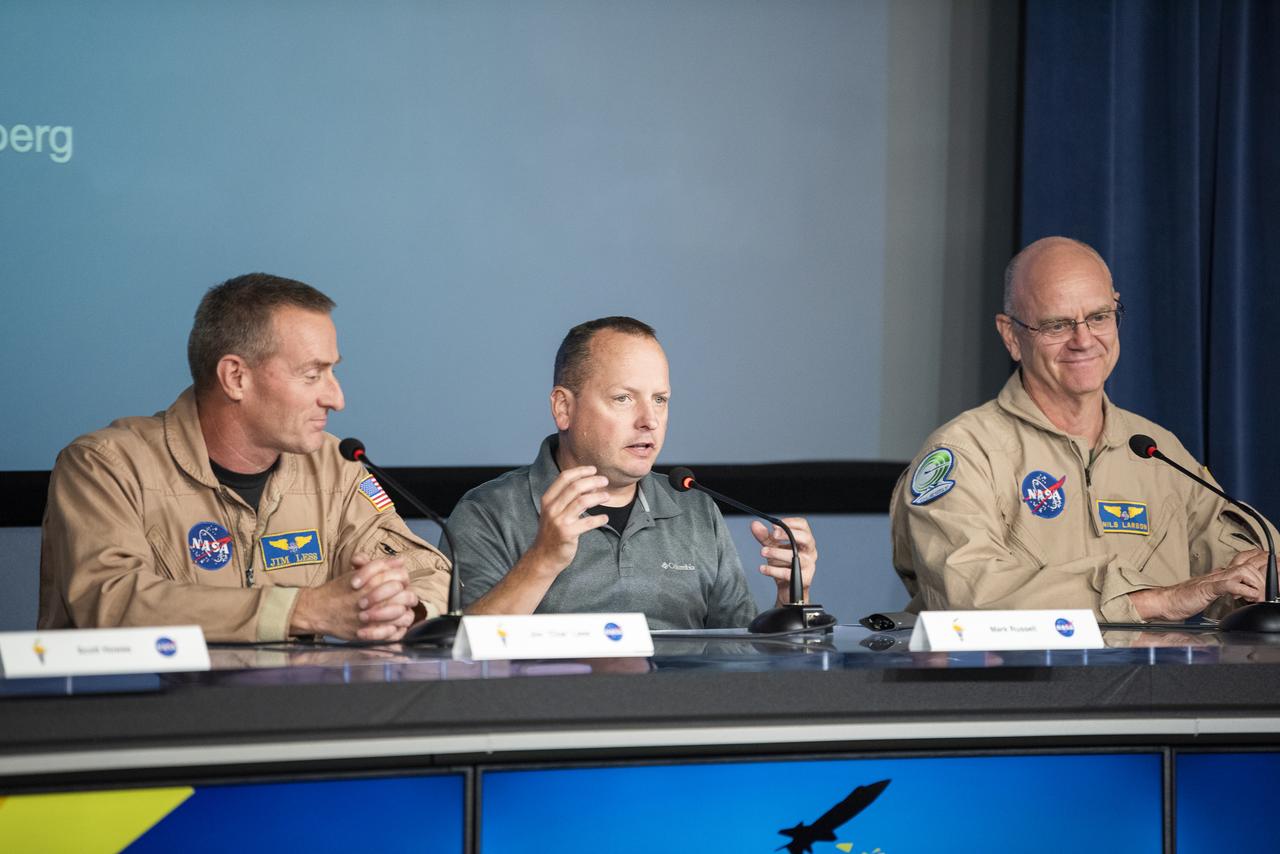
Mark Russell, center, a research pilot at NASA’s Glenn Research Center in Hampton, Virginia, explains the differences in flight environments at different NASA centers. Jim Less, a NASA pilot at NASA’s Armstrong Flight Research Center in Edwards, California, left, Russell, and Nils Larson, NASA Armstrong chief X-59 aircraft pilot and senior advisor on flight research, provided perspective on flight research at the Ideas to Flight Workshop on Sept. 18 at NASA Armstrong.
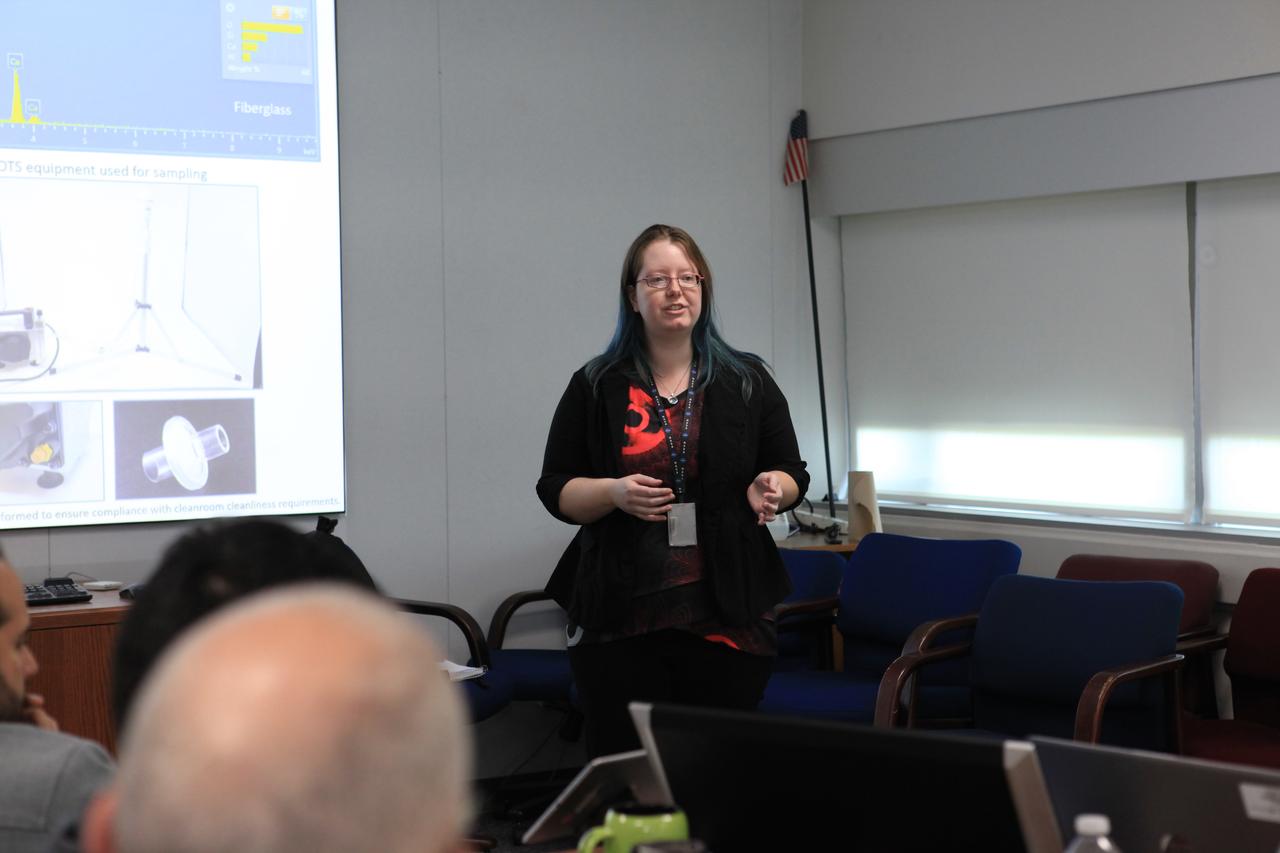
Athela Frandsen, an aerospace technologist with Kennedy Space Center’s analytical laboratories, presents her proposal concerning proactive approaches to cleanroom contamination to a panel of judges during the “Innovation Without Boundaries” event held inside the Space Station Processing Facility in Florida on June 14, 2019. A number of Kennedy employees presented their proposals as part of the Chief Technologist Innovation Call. Participants had five minutes to present their innovative ideas in one of three categories, which were innovative ideas that had little or no cost to implement, ideas with great returns on investments up to $20,000 and big ideas where participants could socialize ideas for projects that would take more than $20,000 to implement.
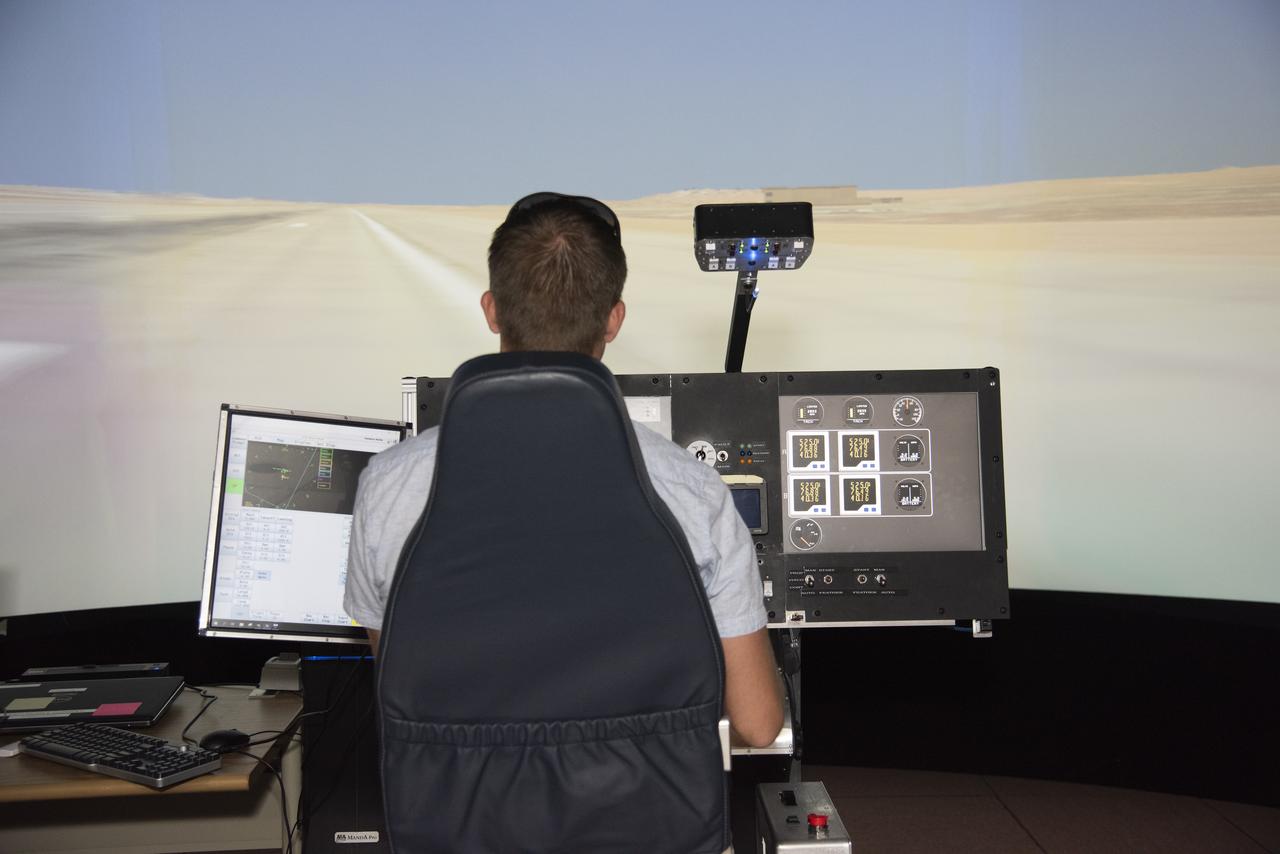
NASA's 2017 astronaut candidate Matthew Dominick practices flying in the X-57 aircraft simulator at Armstrong Flight Research Center in Southern California. Starting with the fuselage of a Tecnam P20067T, the X-57 Maxwell electric propulsion airplane is being built from ideas being researched that could lead to the development of electric propulsion-powered aircraft, which would be quieter, more efficient and environmentally friendly than today's commuter aircraft.
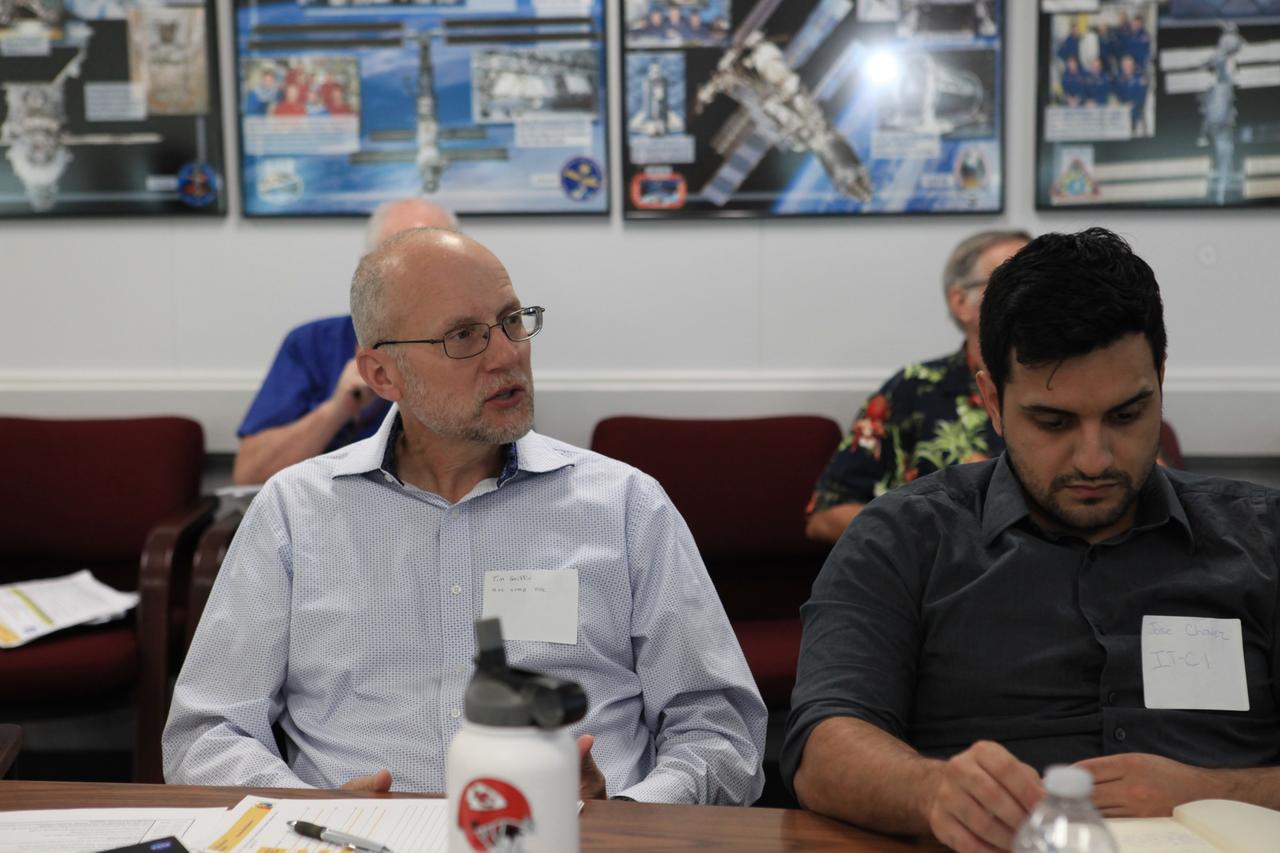
Tim Griffin, NASA’s Kennedy Space Center’s Space Technology Mission Directorate representative for this year’s “Innovation Without Boundaries” event held in Kennedy’s Space Station Processing Facility on June 14, 2019, asks a participant a question. A number of employees, including civil servants and contractors that opted to take part, presented their proposals to a panel of judges as part of the Chief Technologist Innovation Call. The three categories of awards were innovative ideas that had little cost, ideas with great returns on investment up to $20,000 and big ideas where participants could socialize ideas for projects that would take more than $20,000 to implement.
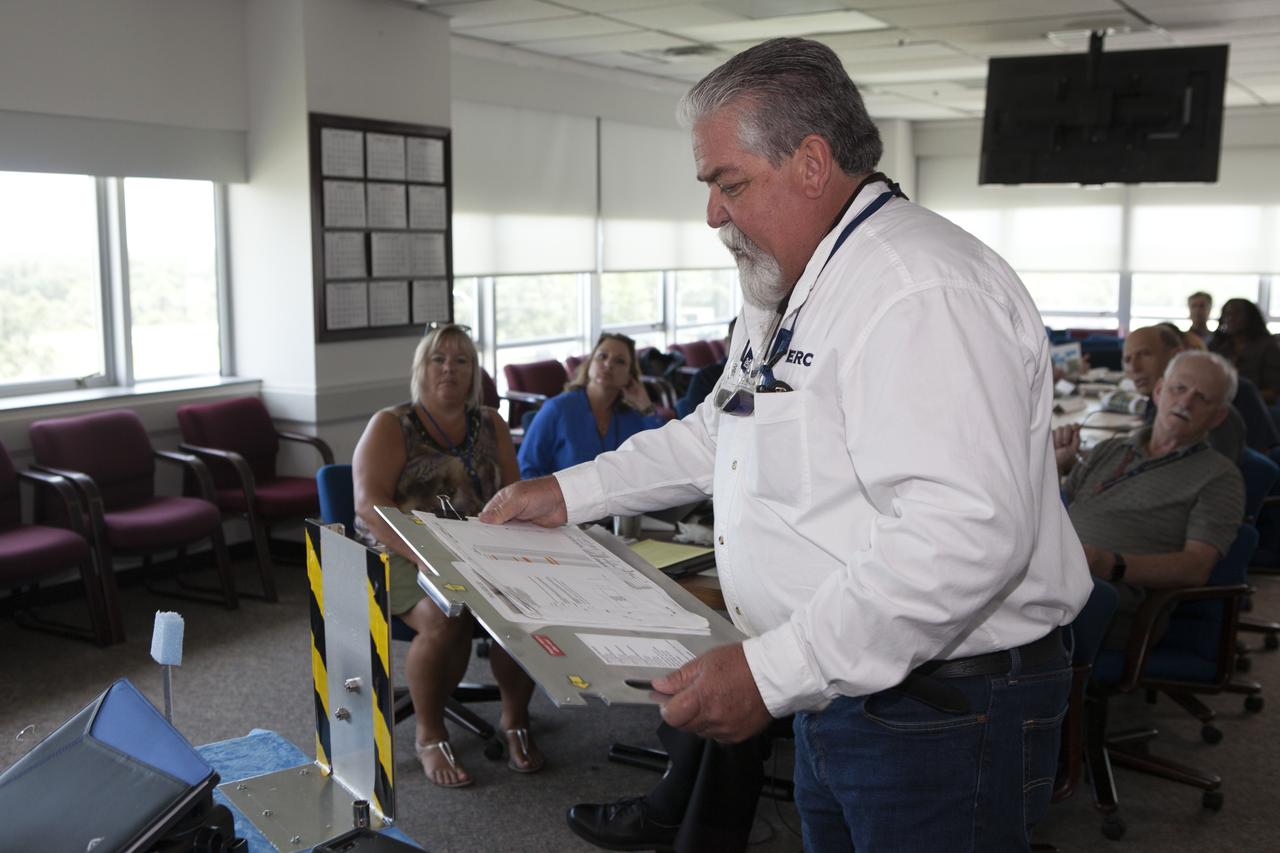
Guy Naylor, an associate engineer on the Test and Operations Support Contract (TOSC), presents his proposal to judges during the “Innovation Without Boundaries” event held in the Space Station Processing Facility at Kennedy Space Center in Florida on Thursday, Aug. 2. Naylor won first place for individual and team projects in the “innovation ideas with little or no associated costs” category. There were 39 proposals featuring a wide range of innovative ideas as part of the Chief Technologist Innovation Call. Presenters had two minutes to highlight their idea, followed by a three-minute question-and-answer period. The judging panel included senior staff, contractors and representatives throughout Kennedy.
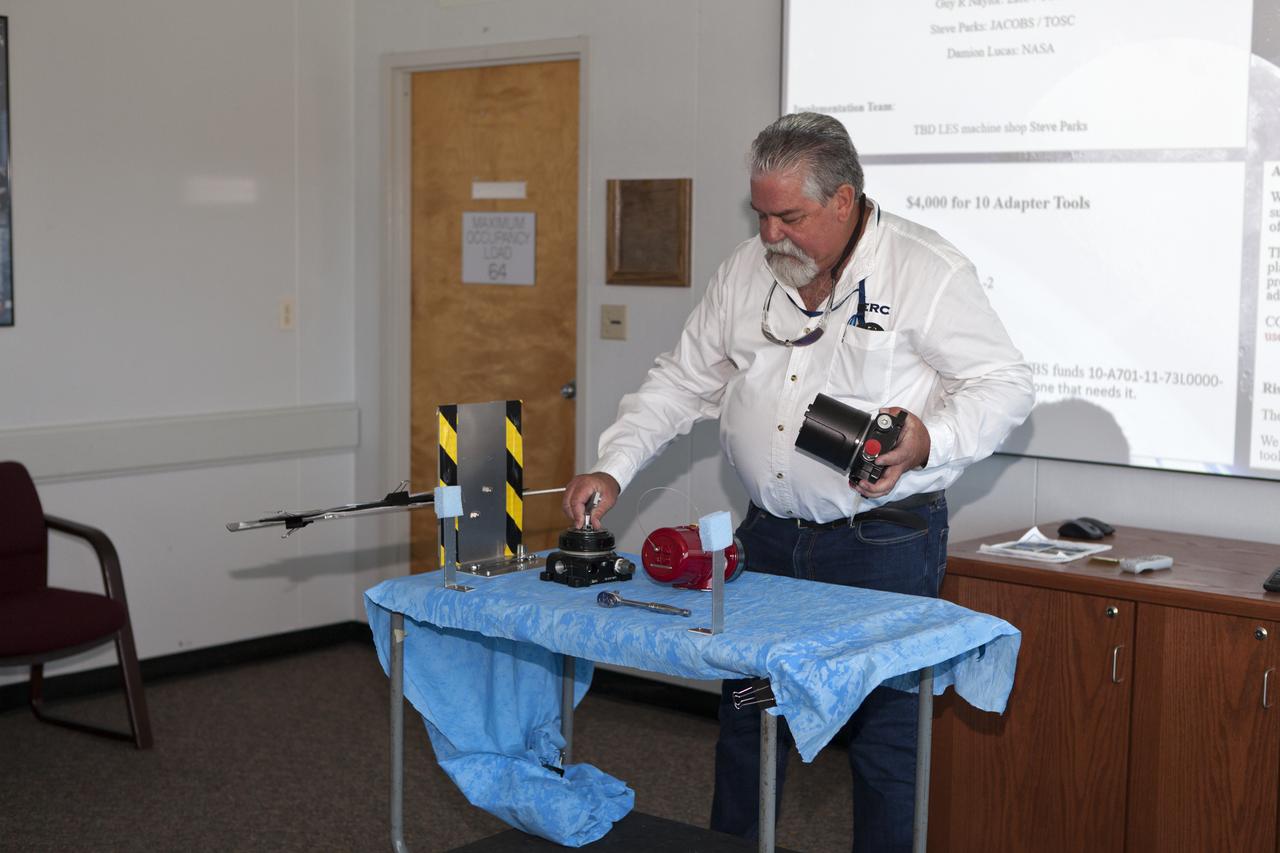
Guy Naylor, an associate engineer on the Test and Operations Support Contract (TOSC), presents his proposal to judges during the “Innovation Without Boundaries” event held in the Space Station Processing Facility at Kennedy Space Center in Florida on Thursday, Aug. 2. Naylor won first place for individual and team projects in the “innovation ideas with little or no associated costs” category. There were 39 proposals featuring a wide range of innovative ideas as part of the Chief Technologist Innovation Call. Presenters had two minutes to highlight their idea, followed by a three-minute question-and-answer period. The judging panel included senior staff, contractors and representatives throughout Kennedy.
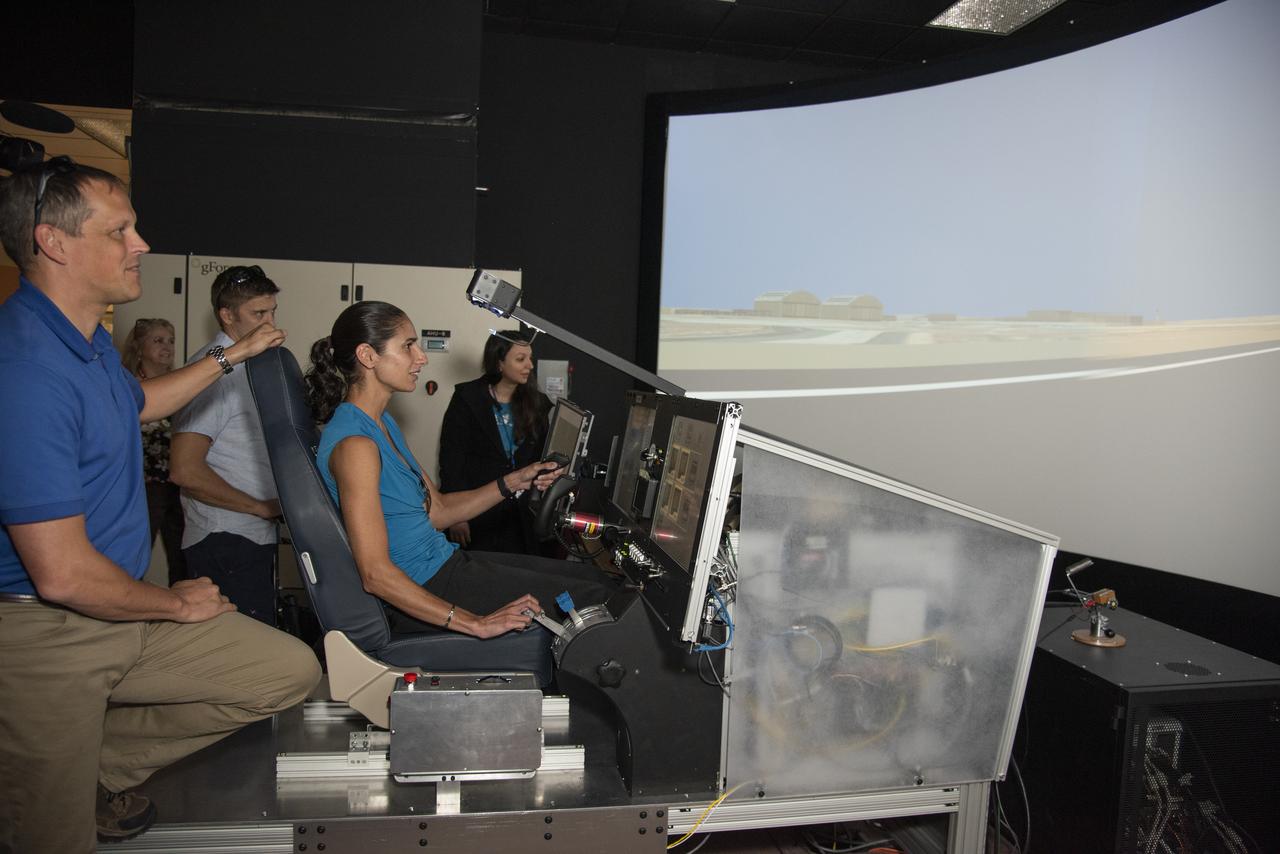
NASA's 2017 astronaut candidates (L to R) Bob Hines, Matthew Dominick and Jasmin Moghbeli practice flying in X-57 aircraft simulator at Armstrong Flight Research Center in Southern California. Starting with the fuselage of a Tecnam P20067T, the X-57 Maxwell electric propulsion airplane is being built from ideas being researched that could lead to the development of electric propulsion-powered aircraft, which would be quieter, more efficient and environmentally friendly than today's commuter aircraft.
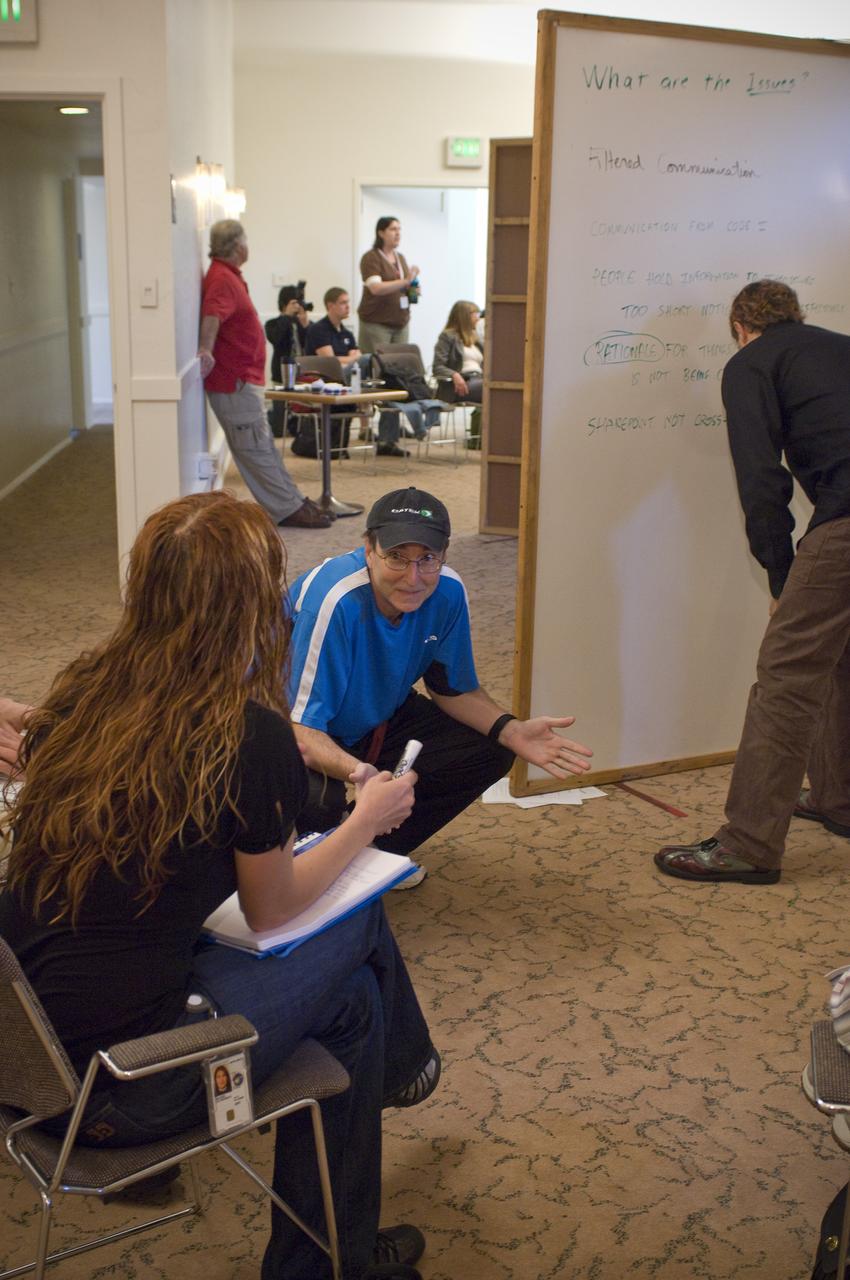
OpenAmes - OpenForum (to build creative ideas in workforce integration (contractor and civil servant, Imporving communicaiton tools, and PR and Morale) meeting in Bldg 3
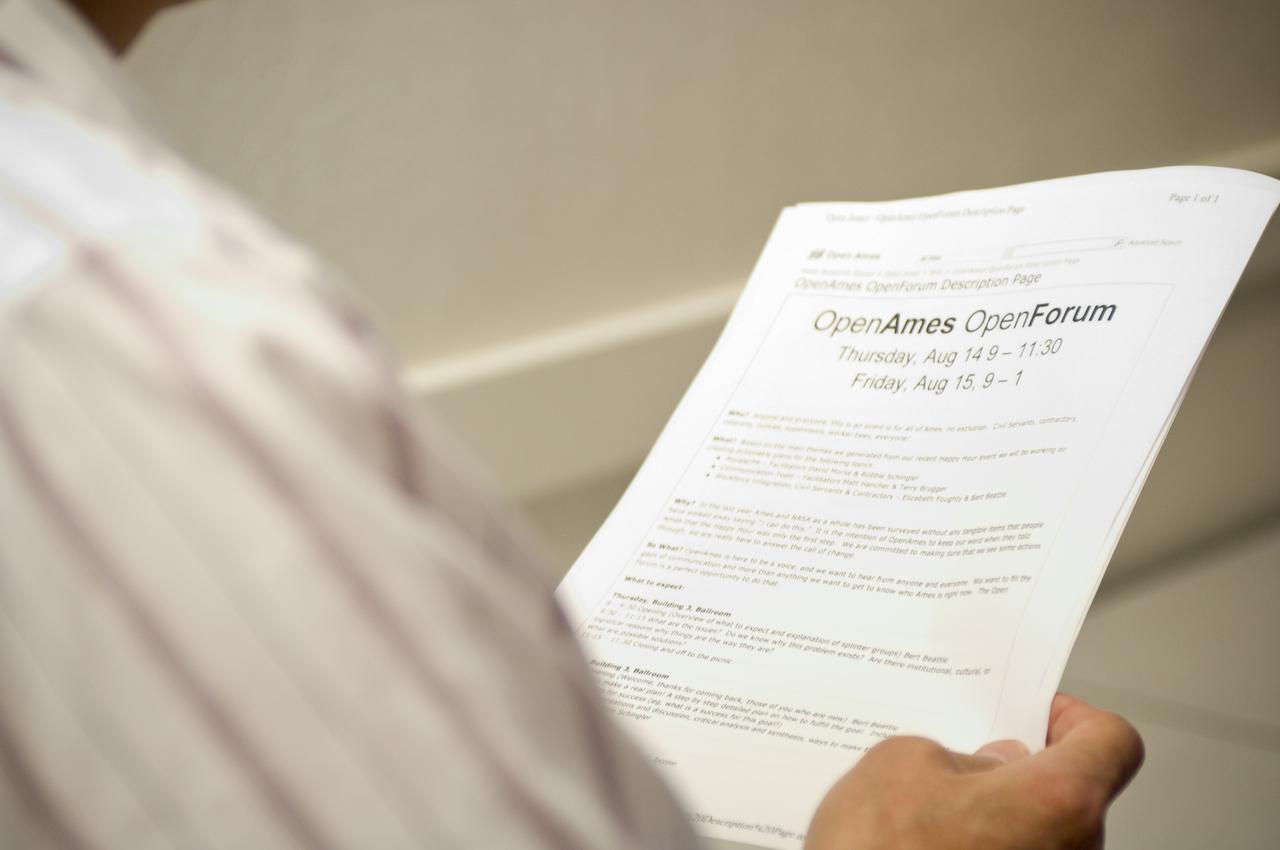
OpenAmes - OpenForum (to build creative ideas in workforce integration (contractor and civil servant, Imporving communicaiton tools, and PR and Morale) meeting in Bldg 3
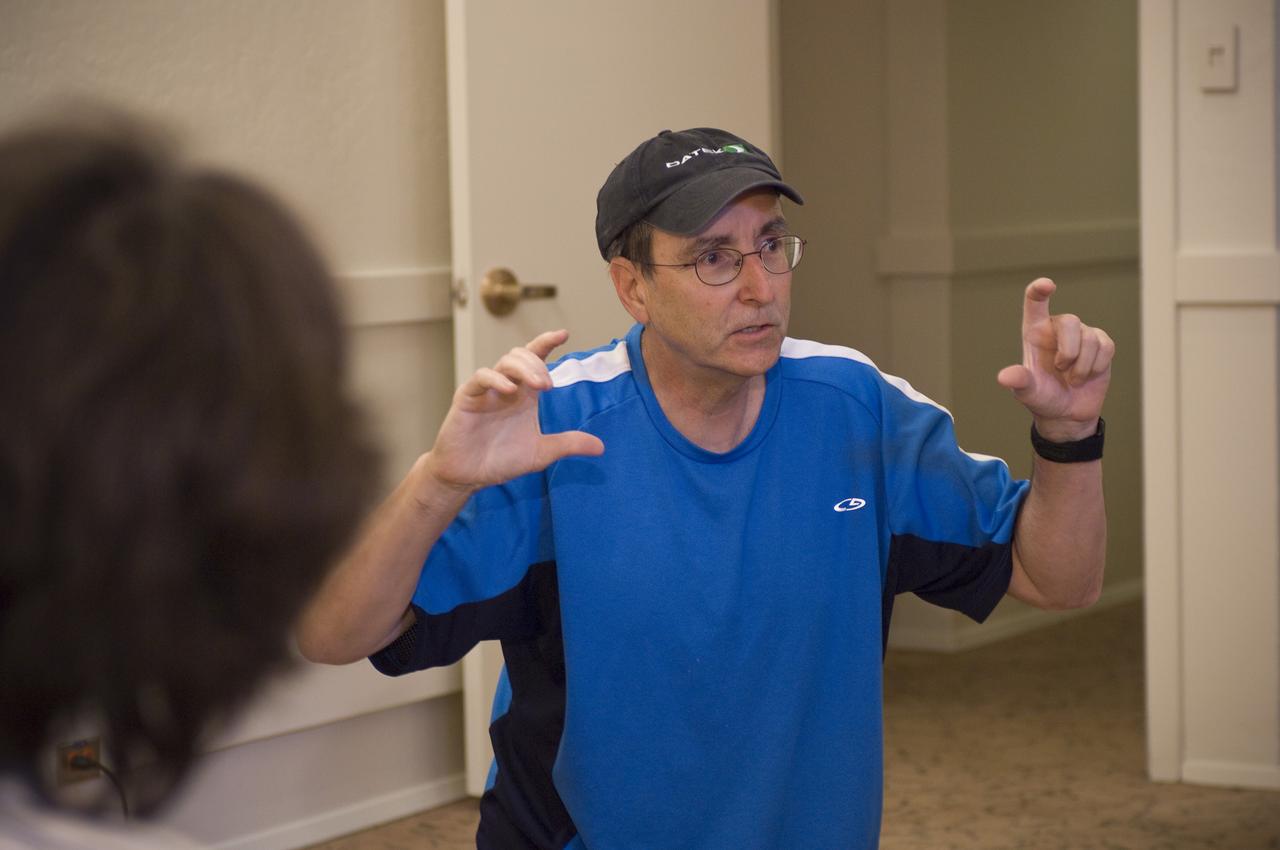
OpenAmes - OpenForum (to build creative ideas in workforce integration (contractor and civil servant, Imporving communicaiton tools, and PR and Morale) meeting in Bldg 3
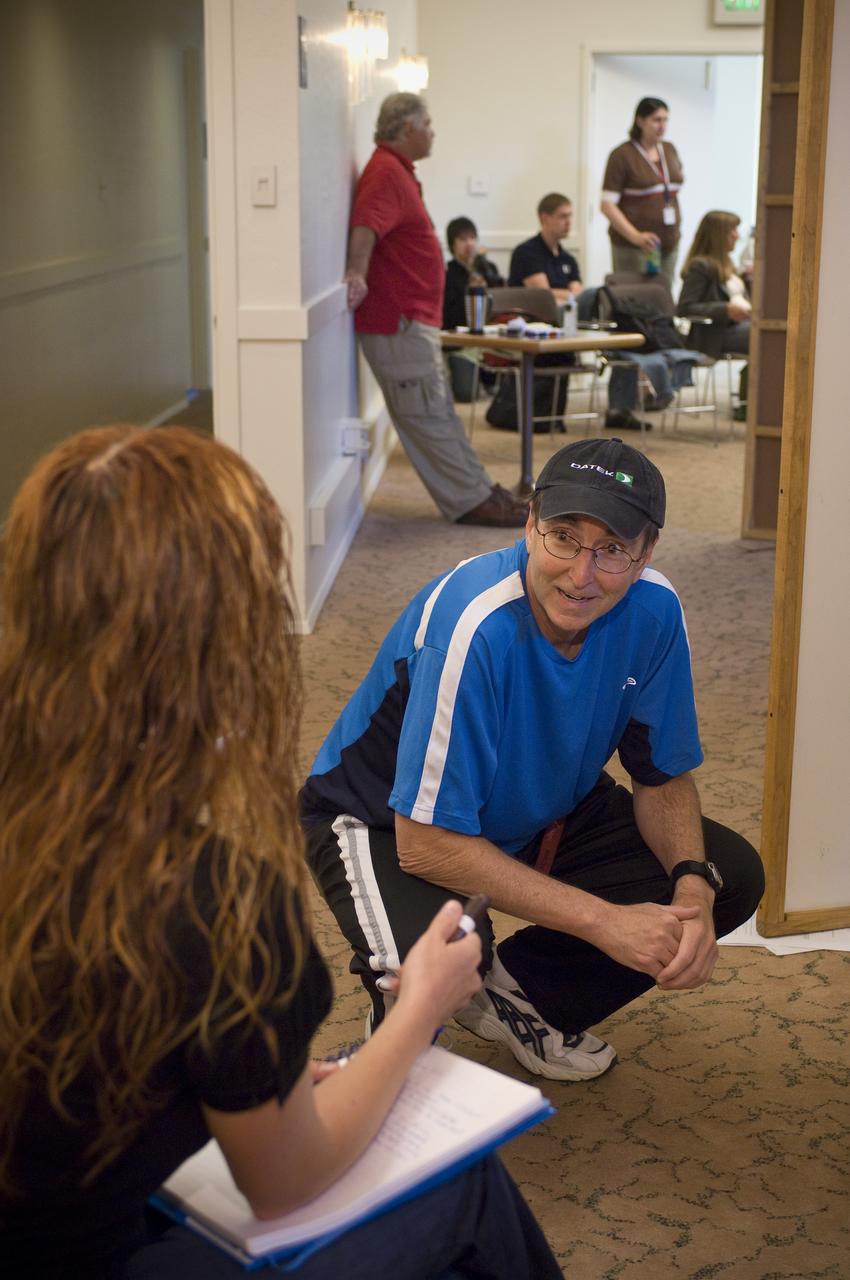
OpenAmes - OpenForum (to build creative ideas in workforce integration (contractor and civil servant, Imporving communicaiton tools, and PR and Morale) meeting in Bldg 3
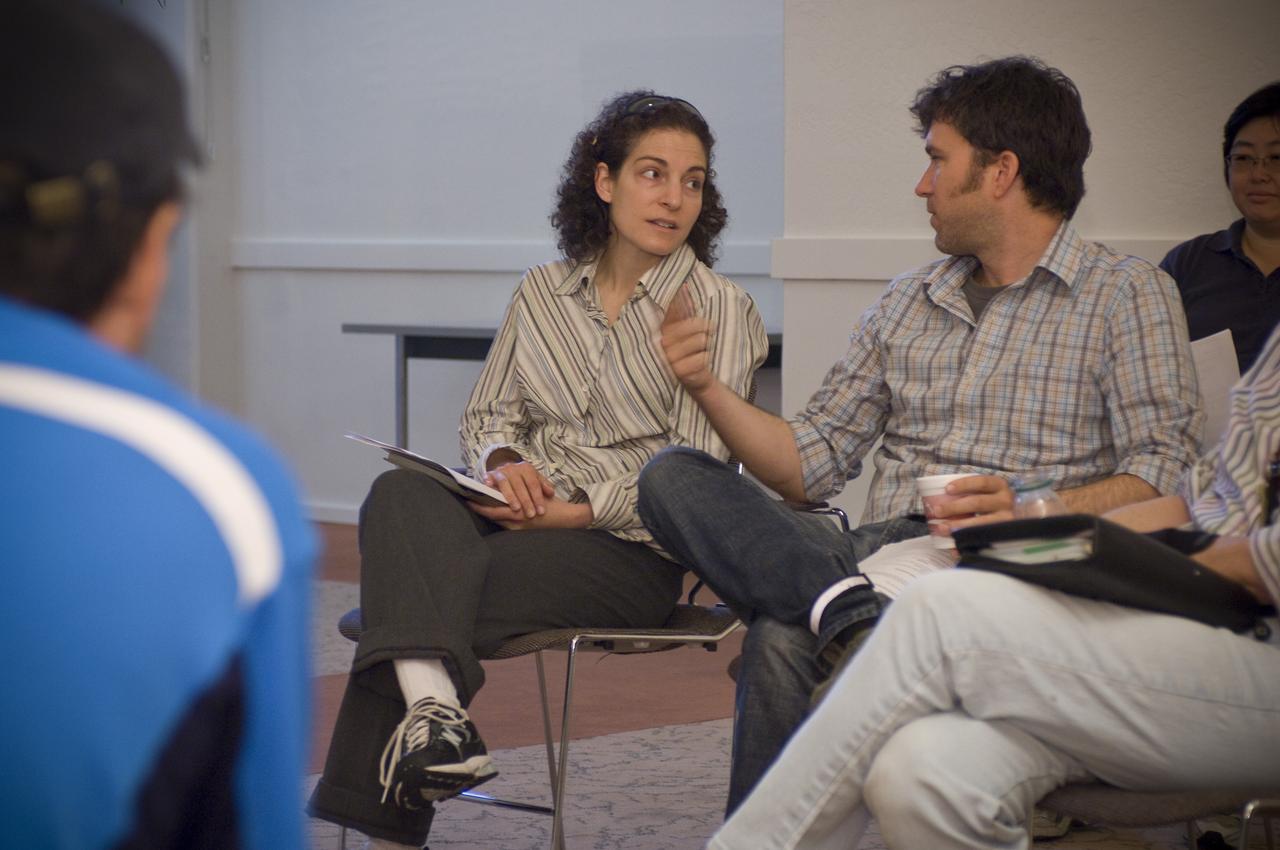
OpenAmes - OpenForum (to build creative ideas in workforce integration (contractor and civil servant, Imporving communicaiton tools, and PR and Morale) meeting in Bldg 3
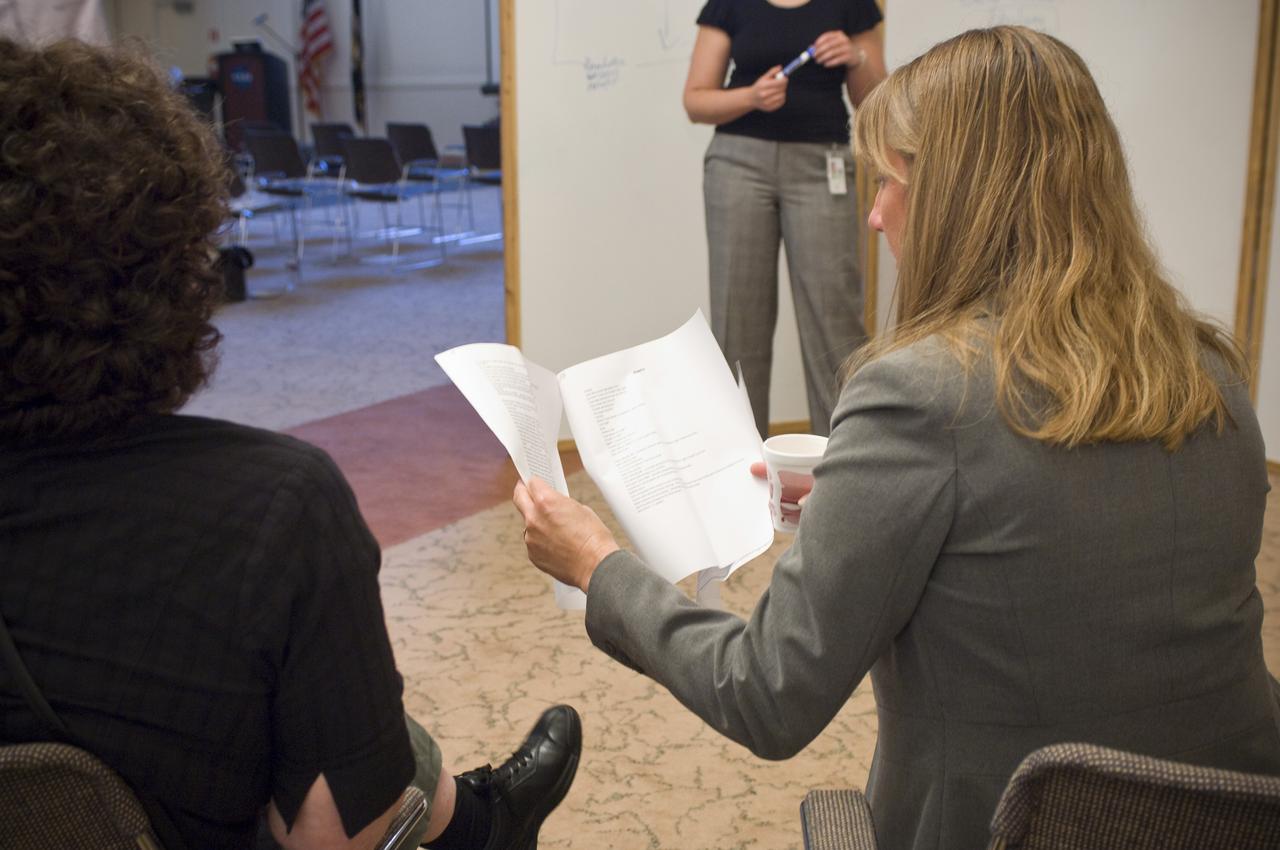
OpenAmes - OpenForum (to build creative ideas in workforce integration (contractor and civil servant, Imporving communicaiton tools, and PR and Morale) meeting in Bldg 3
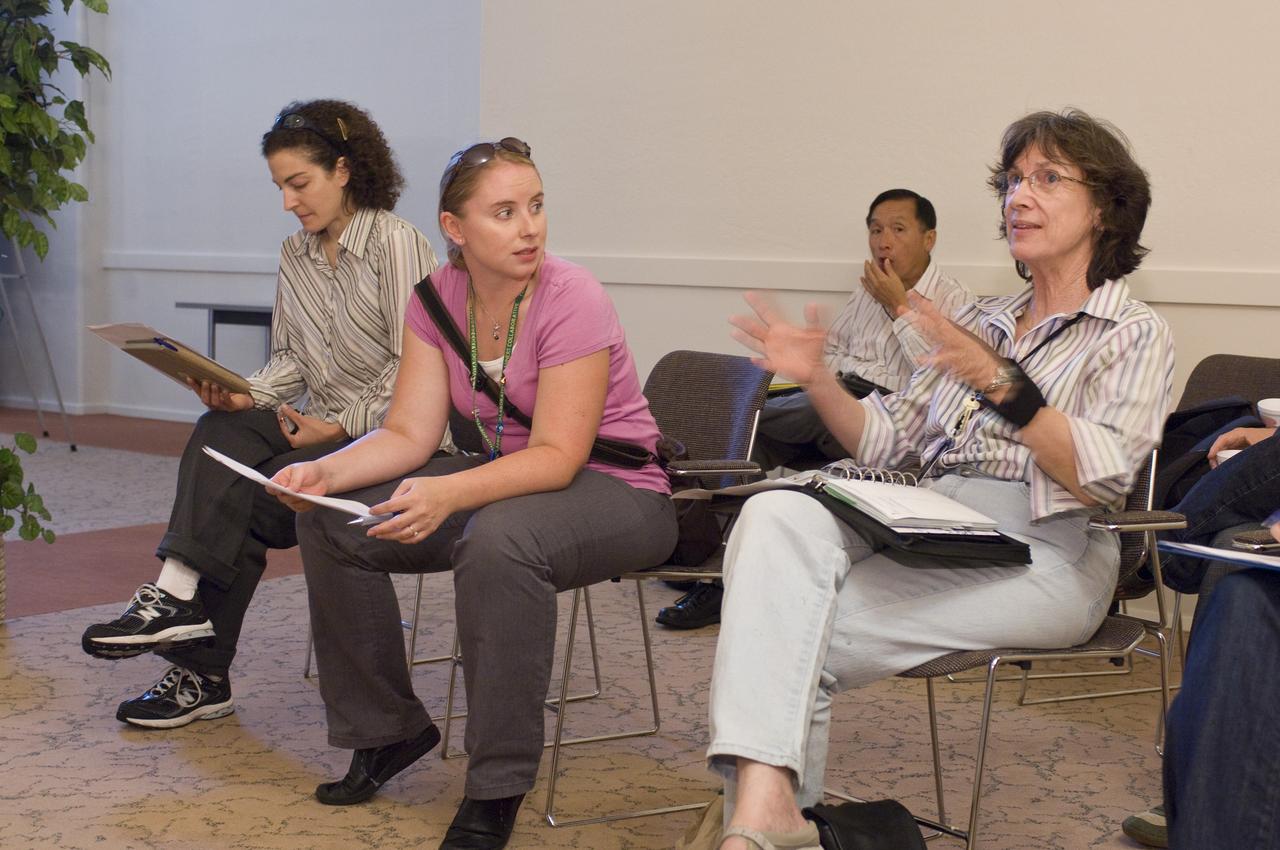
OpenAmes - OpenForum (to build creative ideas in workforce integration (contractor and civil servant, Imporving communicaiton tools, and PR and Morale) meeting in Bldg 3
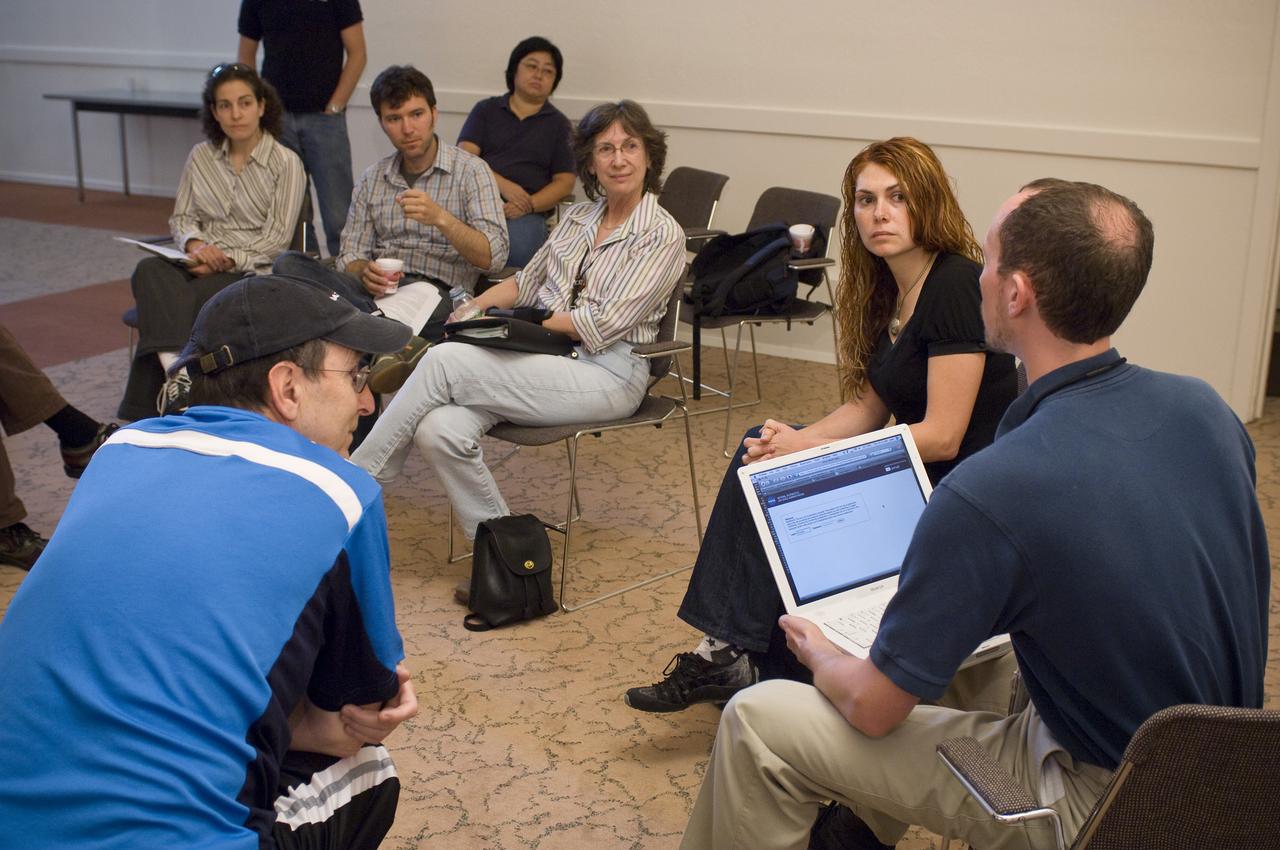
OpenAmes - OpenForum (to build creative ideas in workforce integration (contractor and civil servant, Imporving communicaiton tools, and PR and Morale) meeting in Bldg 3
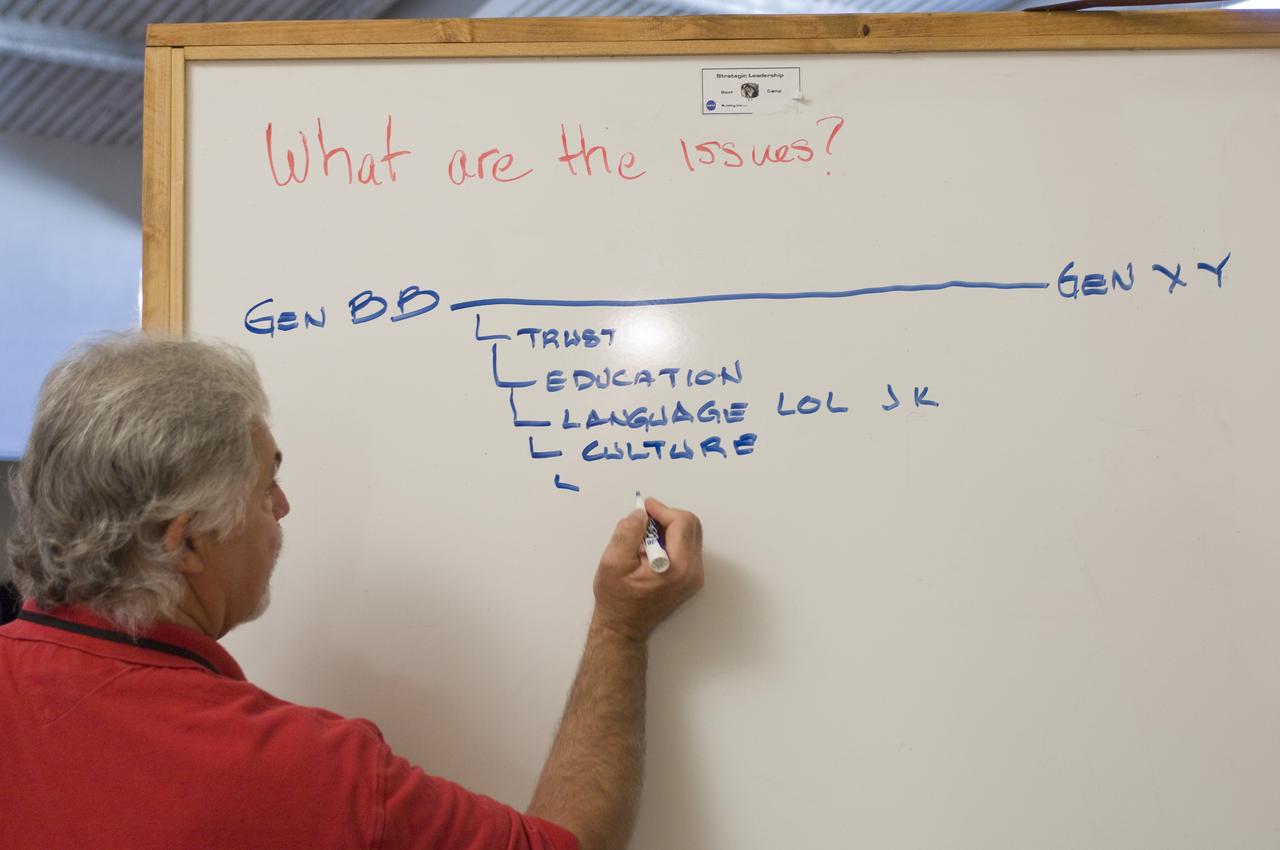
OpenAmes - OpenForum (to build creative ideas in workforce integration (contractor and civil servant, Imporving communicaiton tools, and PR and Morale) meeting in Bldg 3

OpenAmes - OpenForum (to build creative ideas in workforce integration (contractor and civil servant, Imporving communicaiton tools, and PR and Morale) meeting in Bldg 3
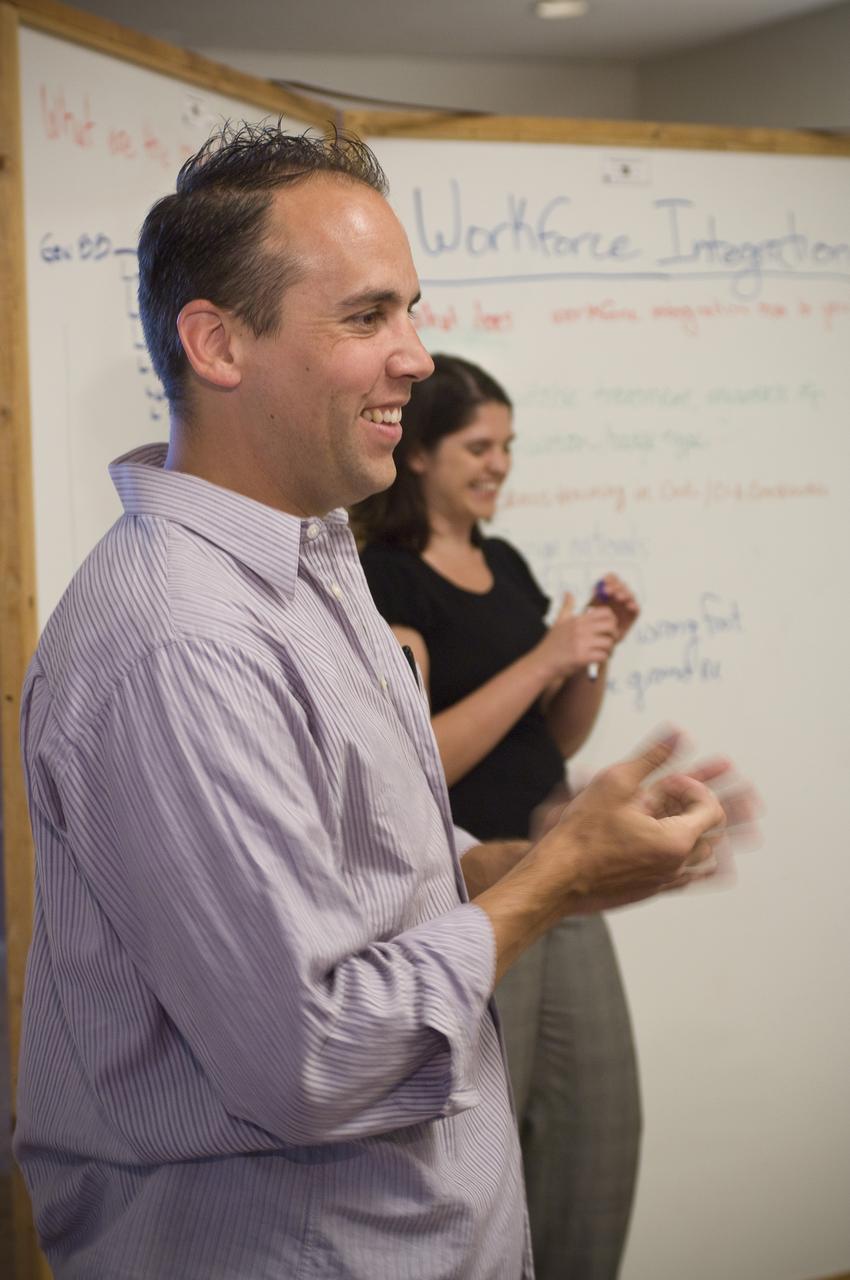
OpenAmes - OpenForum (to build creative ideas in workforce integration (contractor and civil servant, Imporving communicaiton tools, and PR and Morale) meeting in Bldg 3
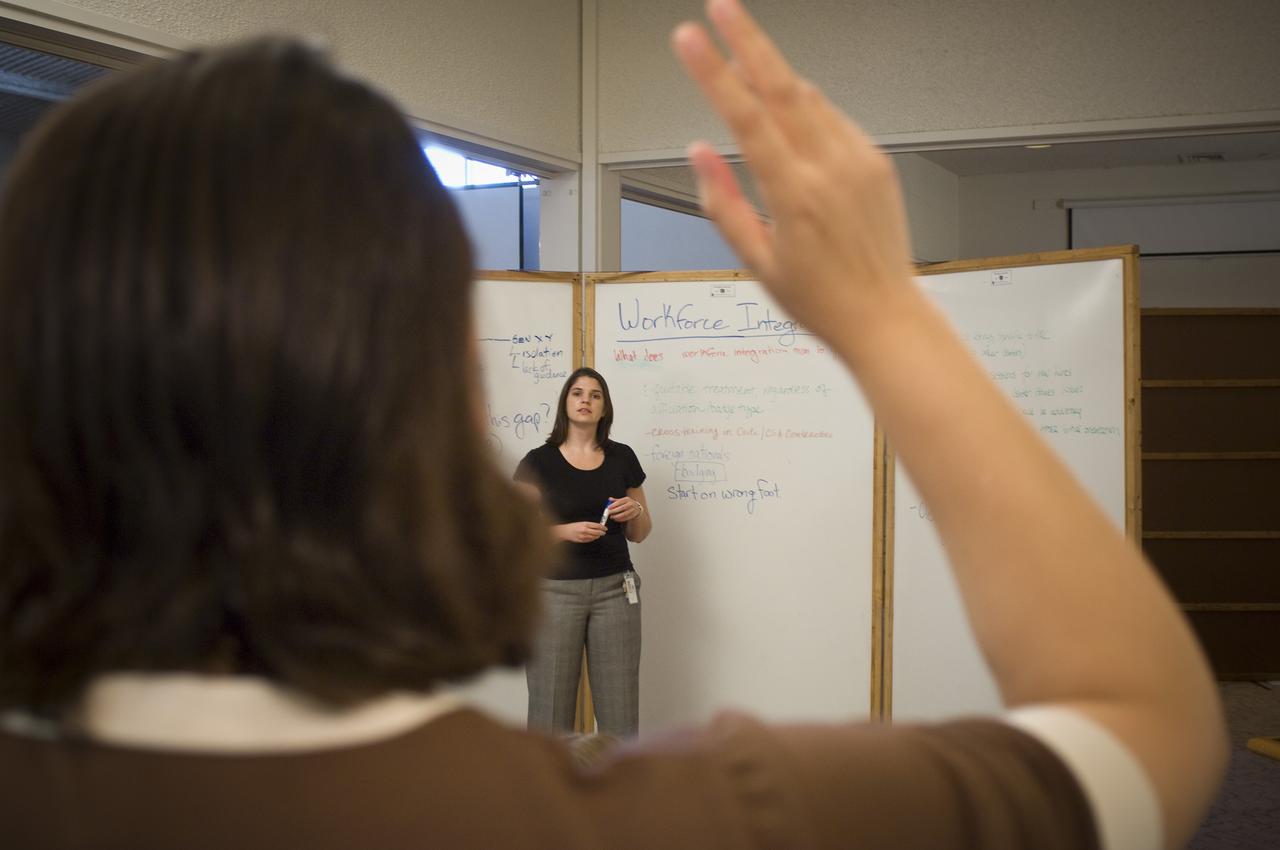
OpenAmes - OpenForum (to build creative ideas in workforce integration (contractor and civil servant, Imporving communicaiton tools, and PR and Morale) meeting in Bldg 3
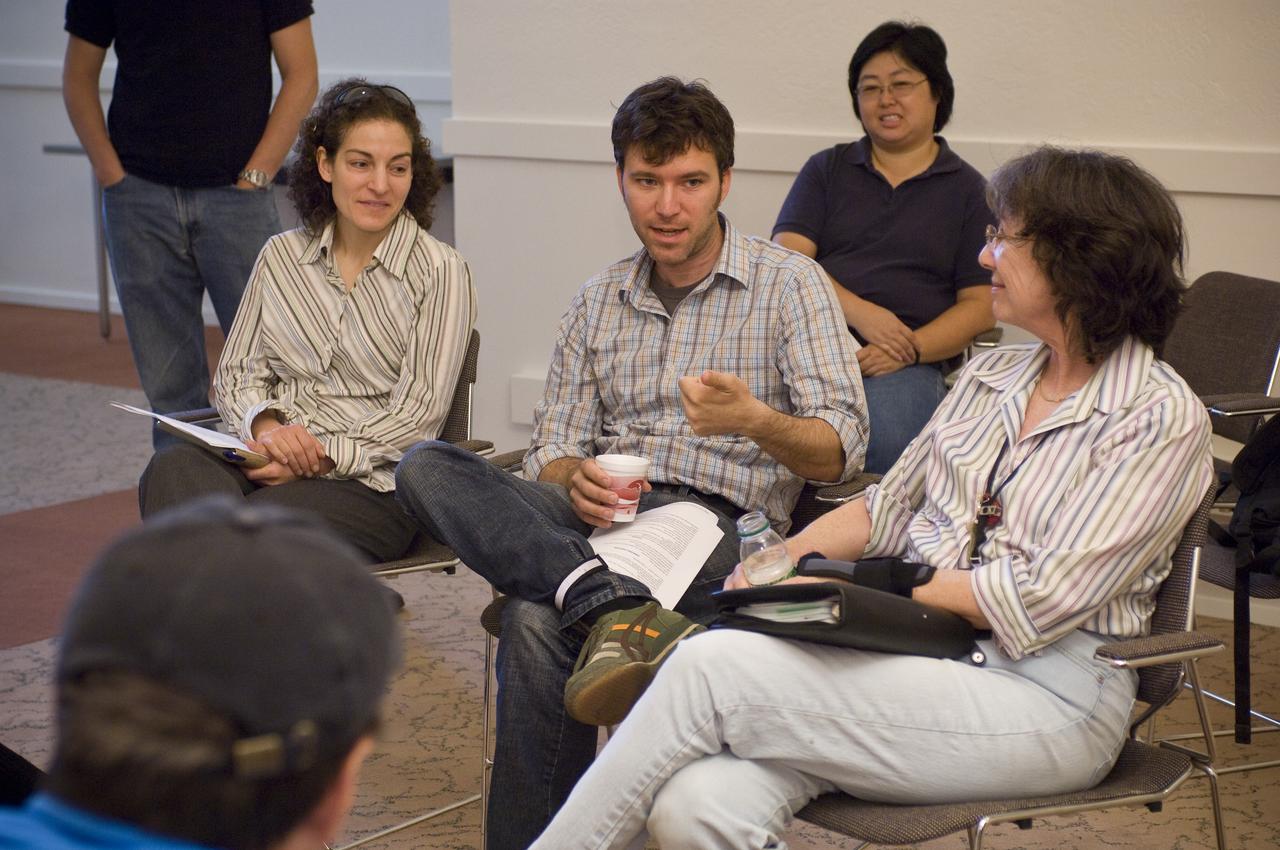
OpenAmes - OpenForum (to build creative ideas in workforce integration (contractor and civil servant, Imporving communicaiton tools, and PR and Morale) meeting in Bldg 3
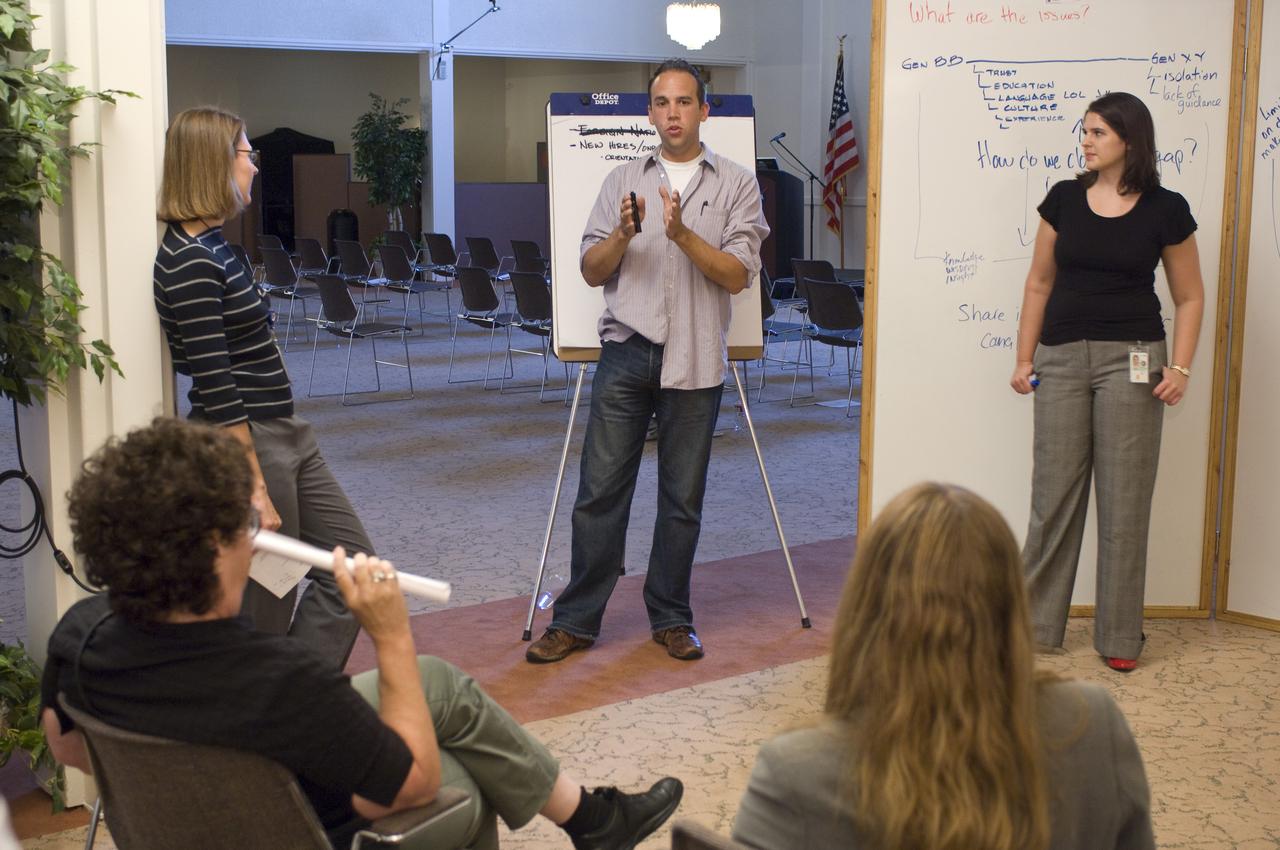
OpenAmes - OpenForum (to build creative ideas in workforce integration (contractor and civil servant, Imporving communicaiton tools, and PR and Morale) meeting in Bldg 3
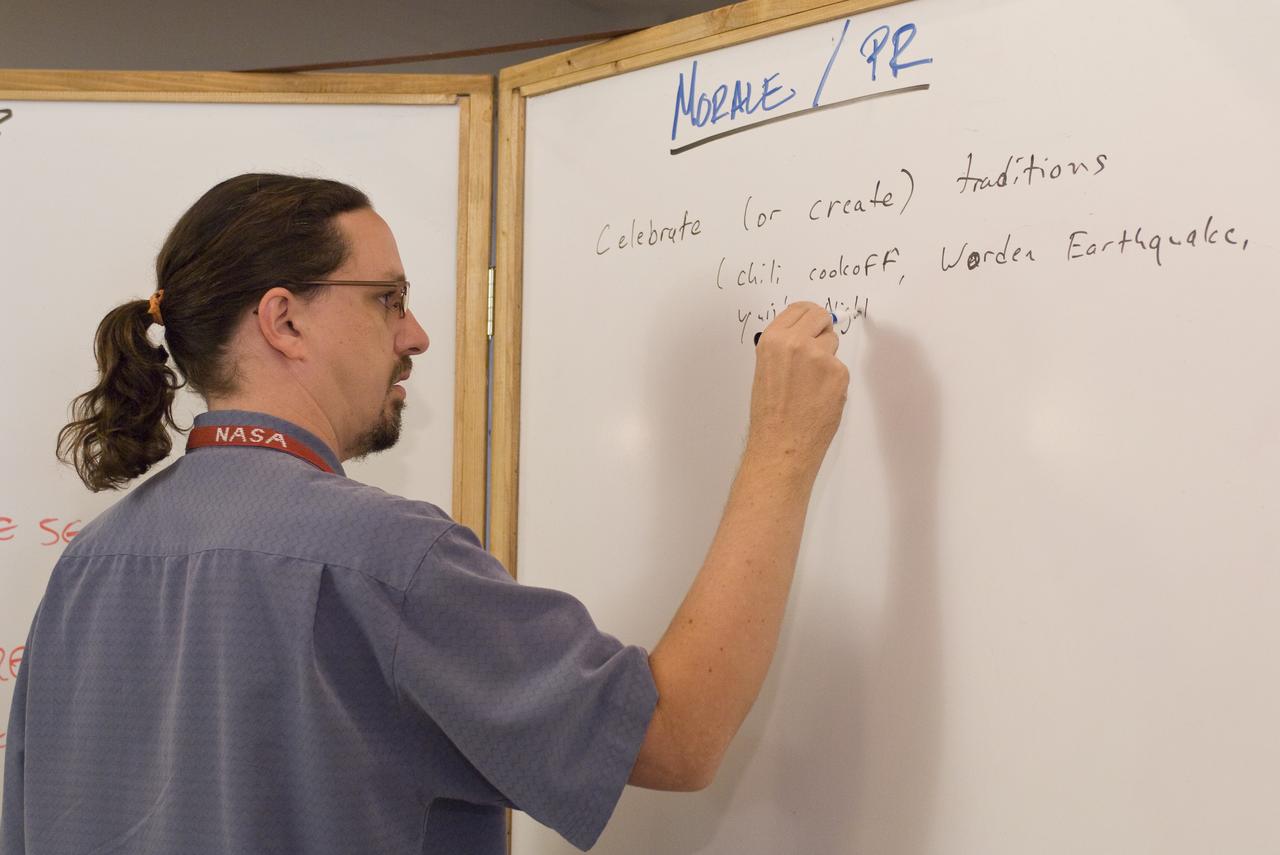
OpenAmes - OpenForum (to build creative ideas in workforce integration (contractor and civil servant, Imporving communicaiton tools, and PR and Morale) meeting in Bldg 3
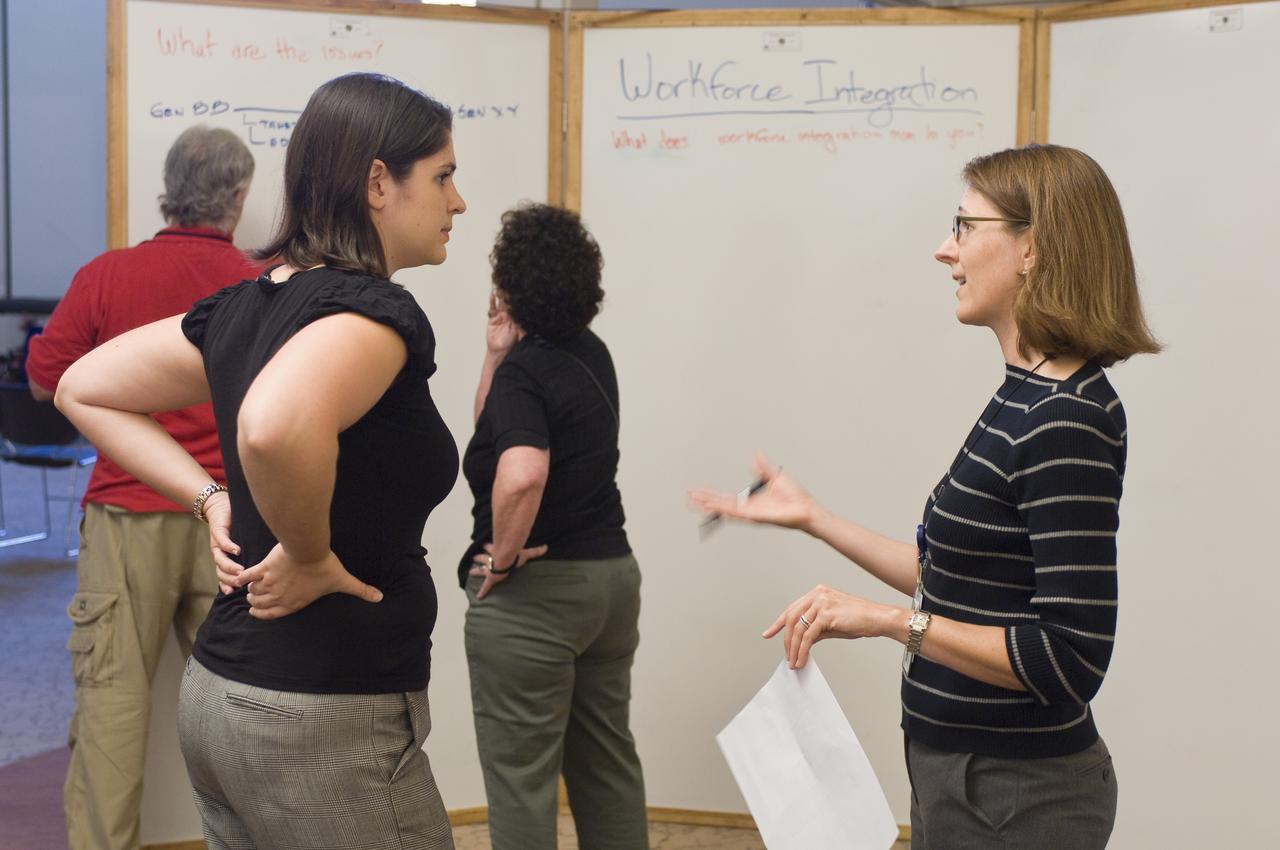
OpenAmes - OpenForum (to build creative ideas in workforce integration (contractor and civil servant, Imporving communicaiton tools, and PR and Morale) meeting in Bldg 3
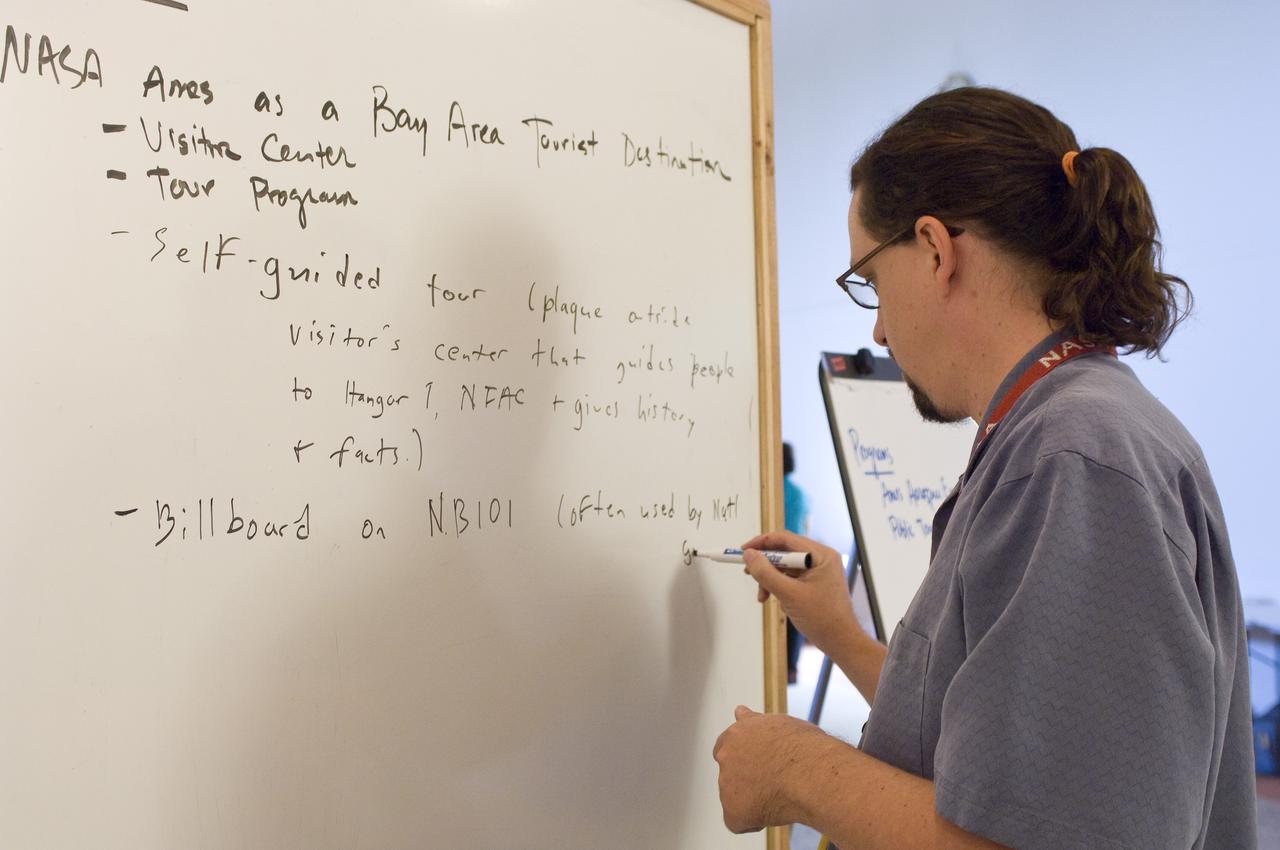
OpenAmes - OpenForum (to build creative ideas in workforce integration (contractor and civil servant, Imporving communicaiton tools, and PR and Morale) meeting in Bldg 3
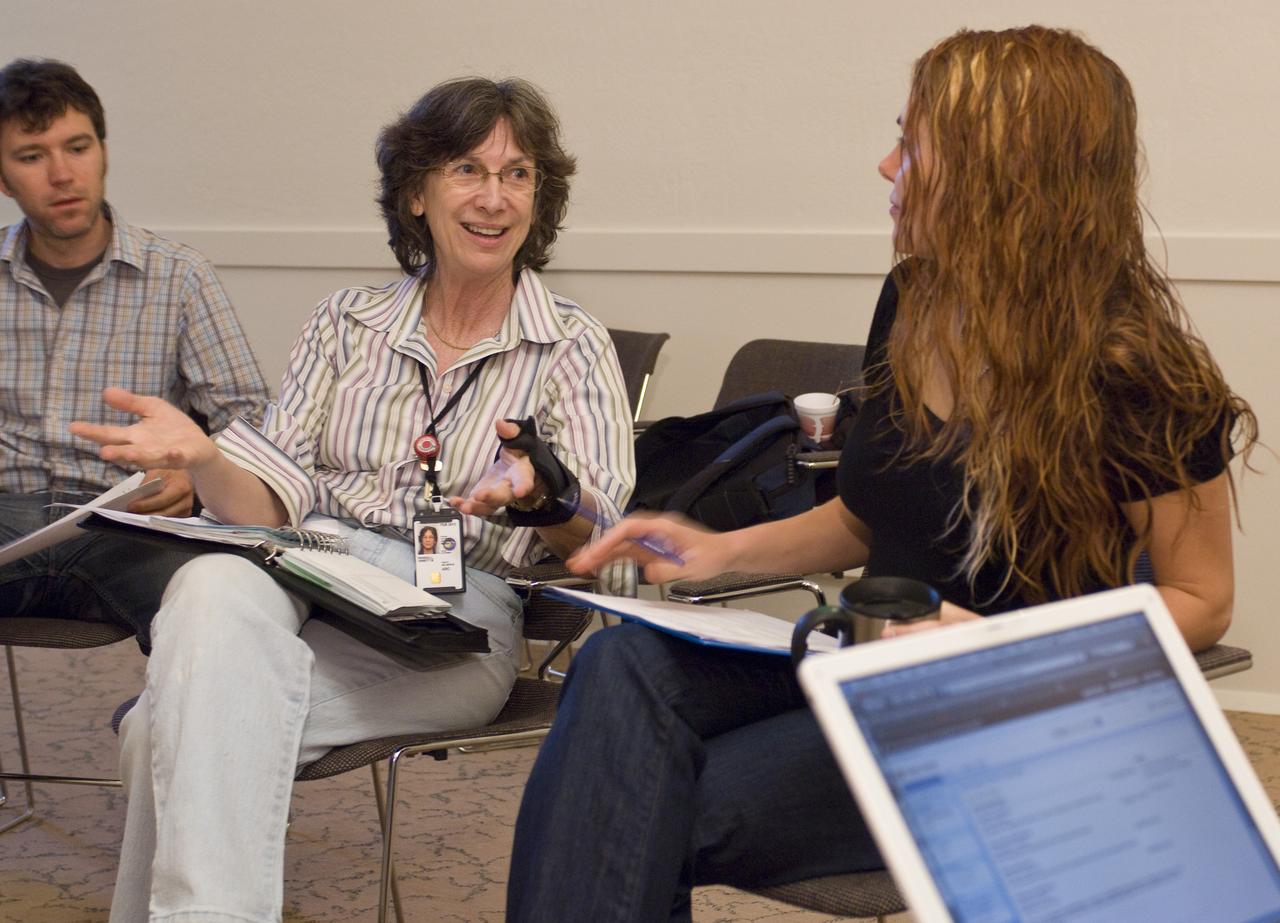
OpenAmes - OpenForum (to build creative ideas in workforce integration (contractor and civil servant, Imporving communicaiton tools, and PR and Morale) meeting in Bldg 3
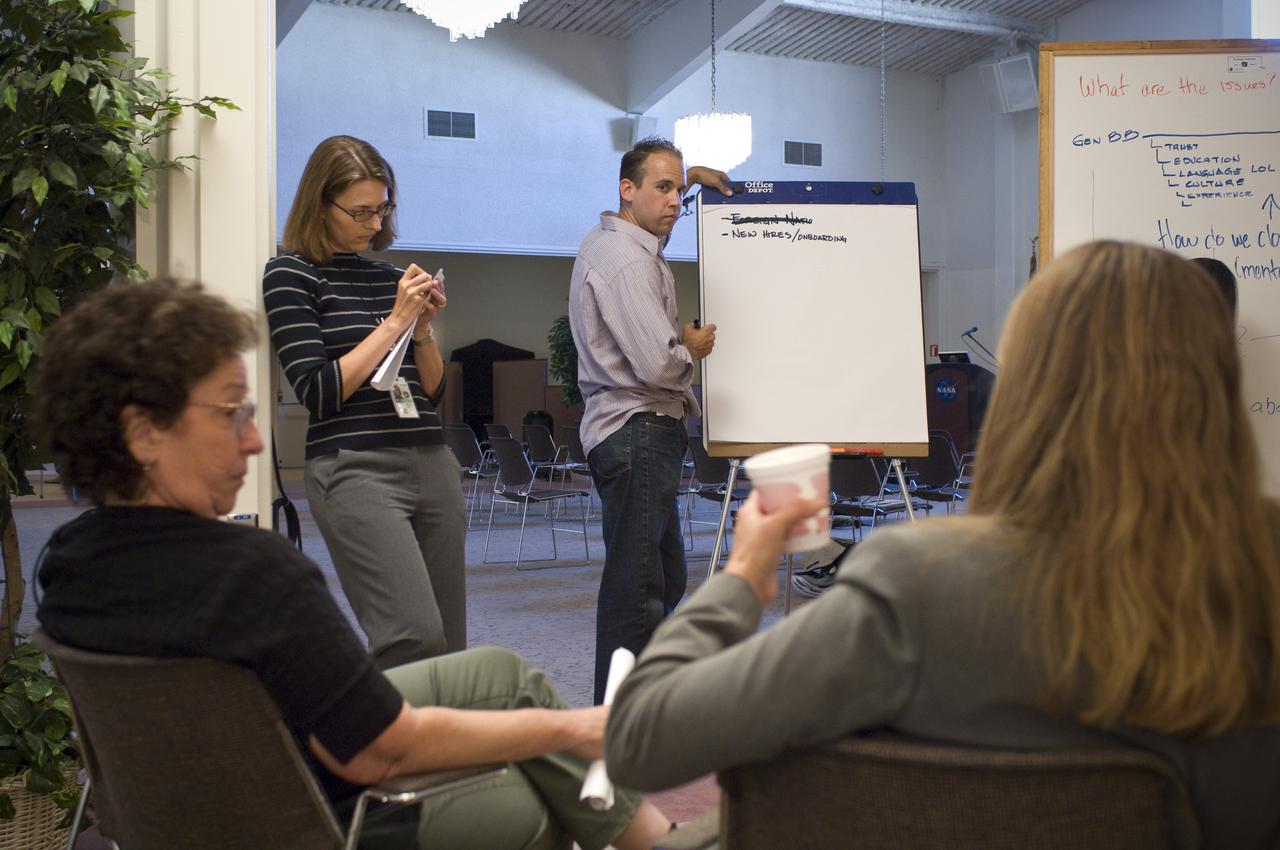
OpenAmes - OpenForum (to build creative ideas in workforce integration (contractor and civil servant, Imporving communicaiton tools, and PR and Morale) meeting in Bldg 3
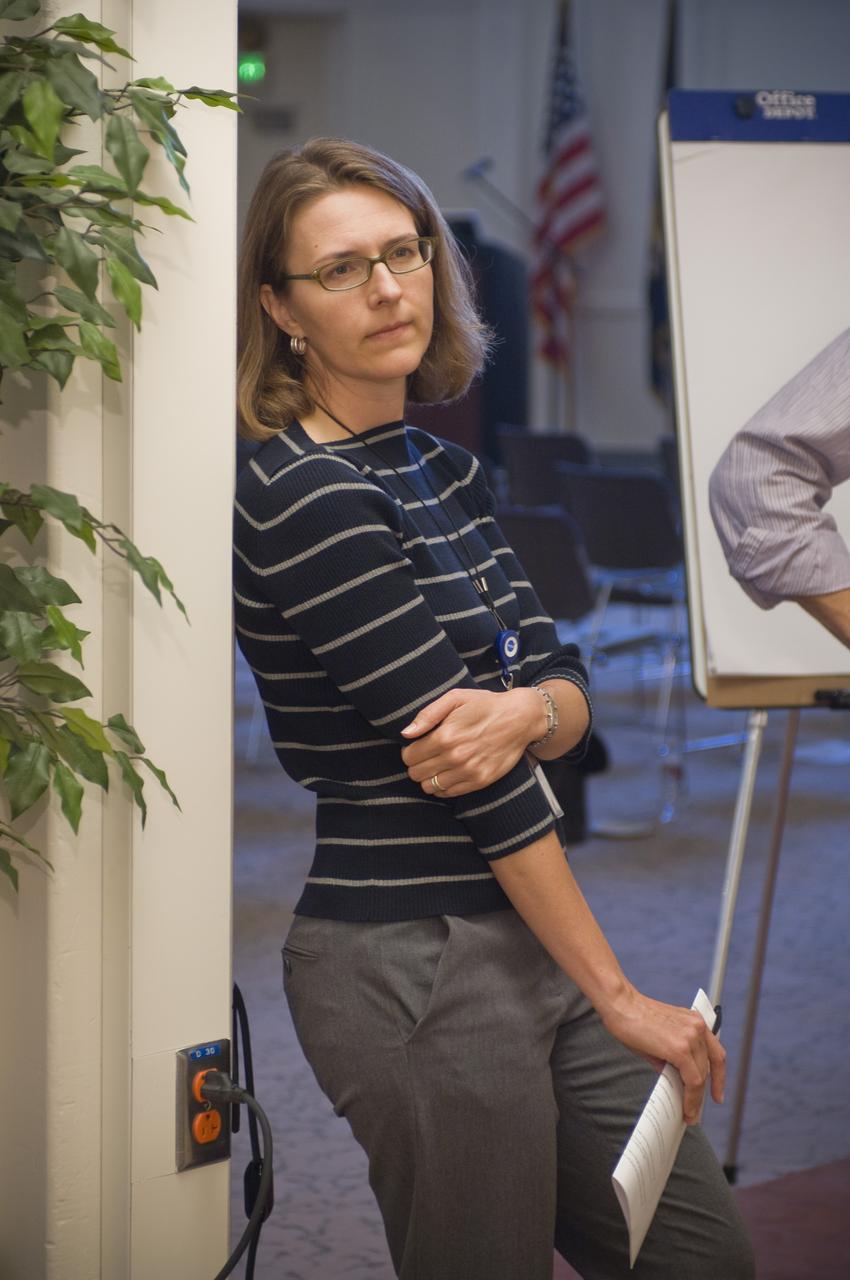
OpenAmes - OpenForum (to build creative ideas in workforce integration (contractor and civil servant, Imporving communicaiton tools, and PR and Morale) meeting in Bldg 3
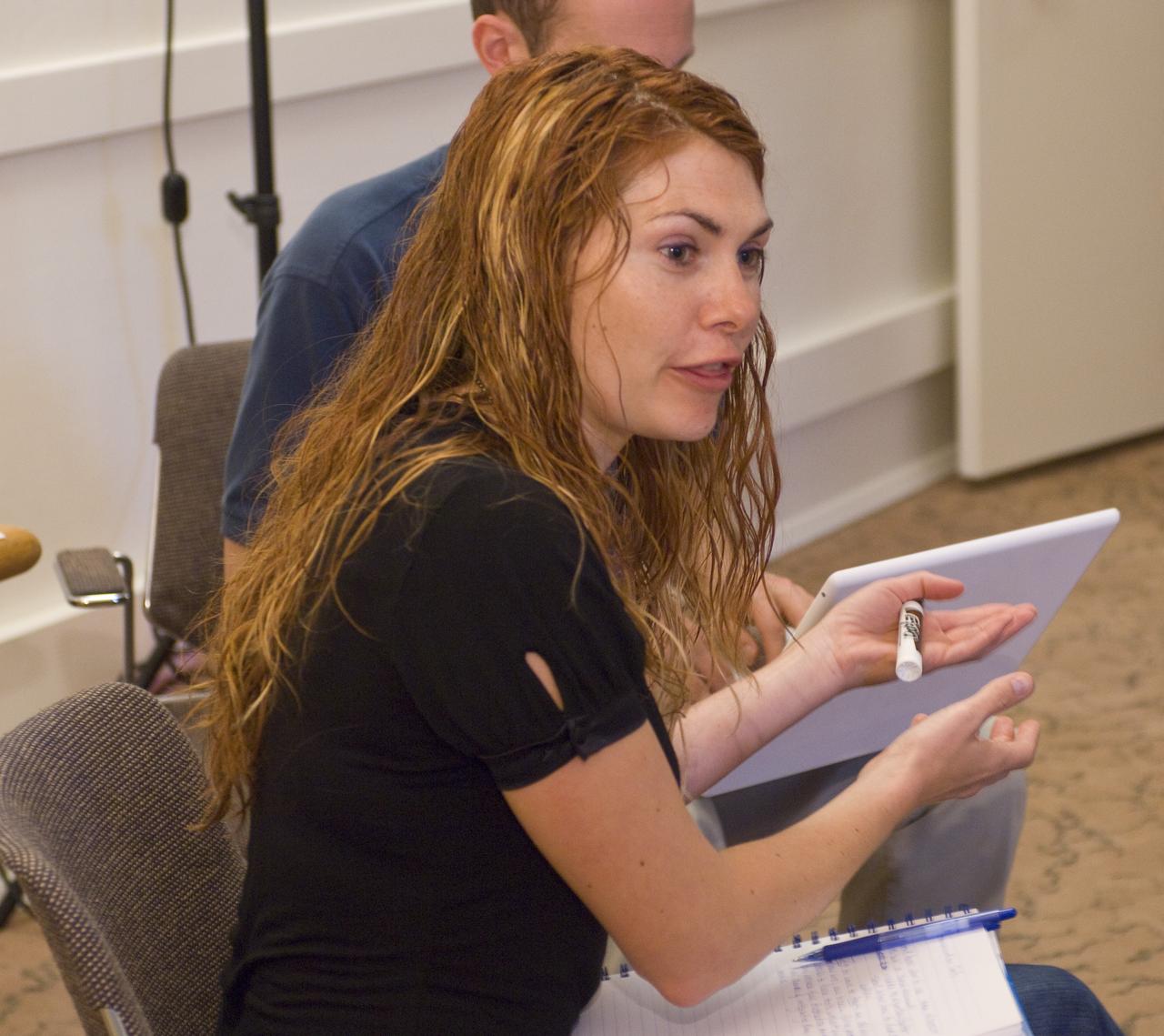
OpenAmes - OpenForum (to build creative ideas in workforce integration (contractor and civil servant, Imporving communicaiton tools, and PR and Morale) meeting in Bldg 3

Judges listen to a presentation during the “Innovation Without Boundaries” event held in the Space Station Processing Facility at Kennedy Space Center in Florida on Thursday, Aug. 2. There were 39 proposals from Kennedy civil servant and contractor employees, featuring a wide range of innovative ideas as part of the Chief Technologist Innovation Call. Presenters had two minutes to highlight their idea, followed by a three-minute question-and-answer period. The judging panel included senior staff, contractors and representatives throughout Kennedy.
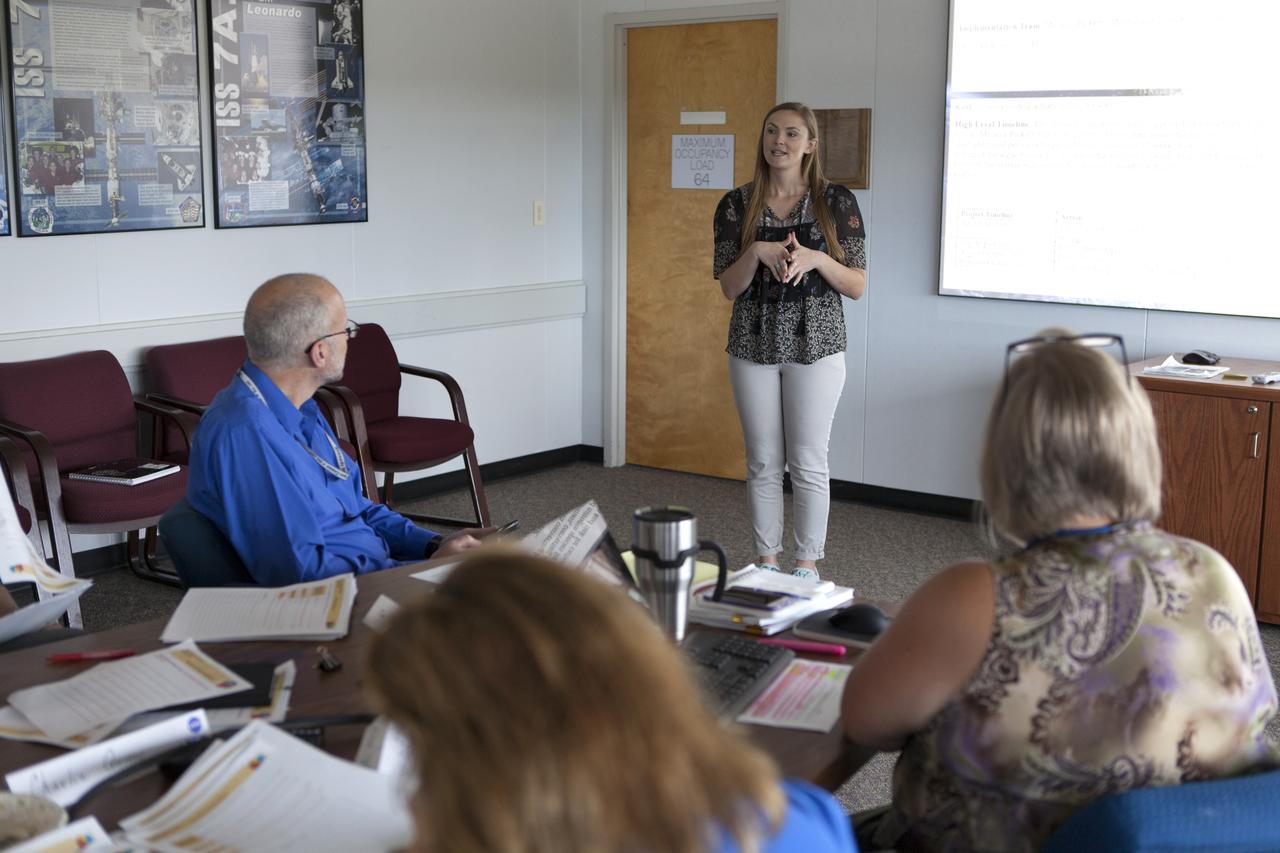
Melanie Pickett, from the Exploration Research and Technology Programs directorate, presents her proposal during the “Innovation Without Boundaries” event held in the Space Station Processing Facility at Kennedy Space Center in Florida on Thursday, Aug. 2. There were 39 proposals featuring a wide range of innovative ideas as part of the Chief Technologist Innovation Call. Presenters had two minutes to highlight their idea, followed by a three-minute question-and-answer period. The judging panel included senior staff, contractors and representatives throughout Kennedy.
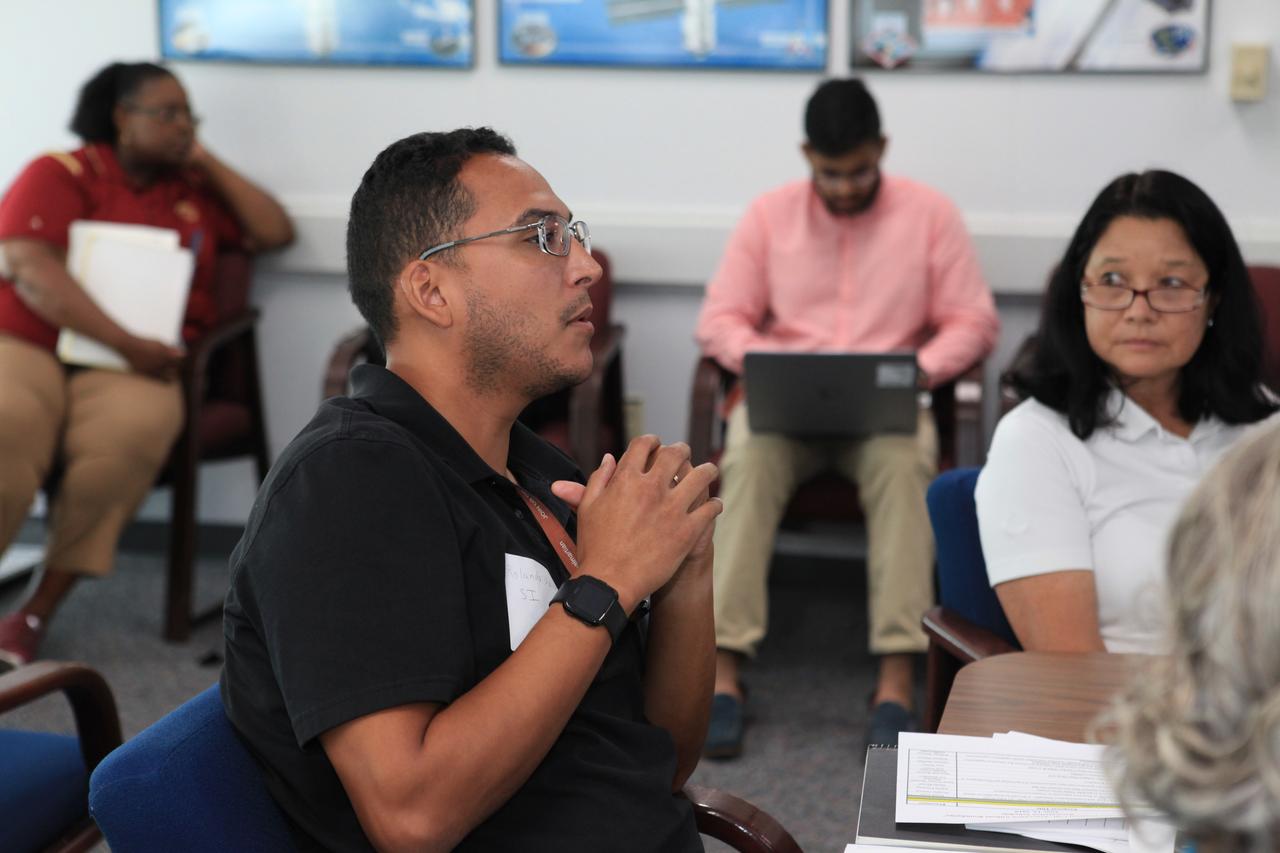
Rolando Valdez, serving as NASA’s Kennedy Space Center Spaceport Integration and Services representative for this year’s “Innovation Without Boundaries” event, gives feedback to participants in Kennedy’s Space Station Processing Facility on June 14, 2019. A number of employees presented their proposals to a panel of judges as part of the Chief Technologist Innovation Call. Participants had five minutes to present their innovative idea for the chance to receive an award of up to $500 for ideas with little-to-no cost that would make a significant impact.
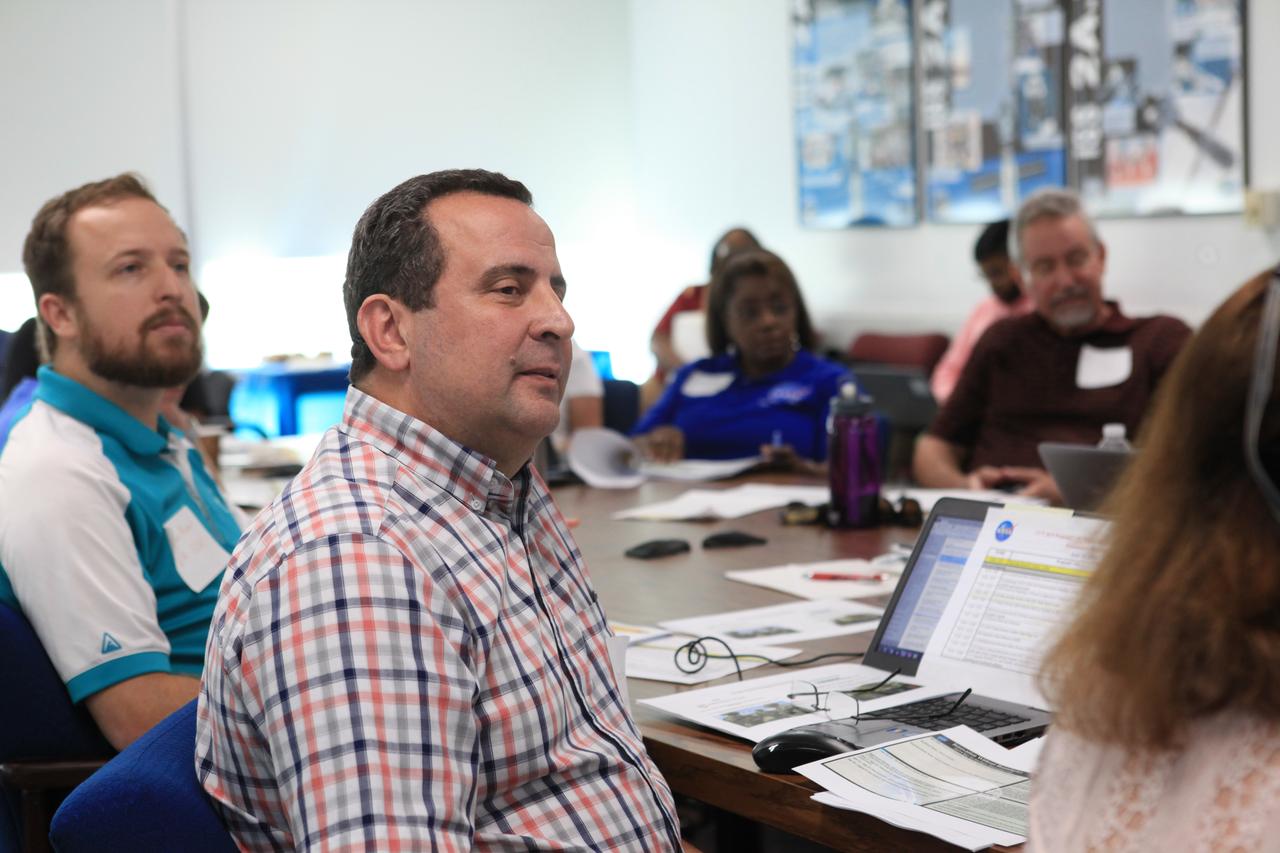
Employees at NASA’s Kennedy Space Center in Florida attend and participate in this year’s “Innovation Without Boundaries” event held in Kennedy’s Space Station Processing Facility on June 14, 2019. A number of employees presented their proposals to a panel of judges as part of the Chief Technologist Innovation Call. Participants had five minutes to present their innovative idea for the chance to receive an award of up to $500 for ideas with little-to-no cost that would make a significant impact.
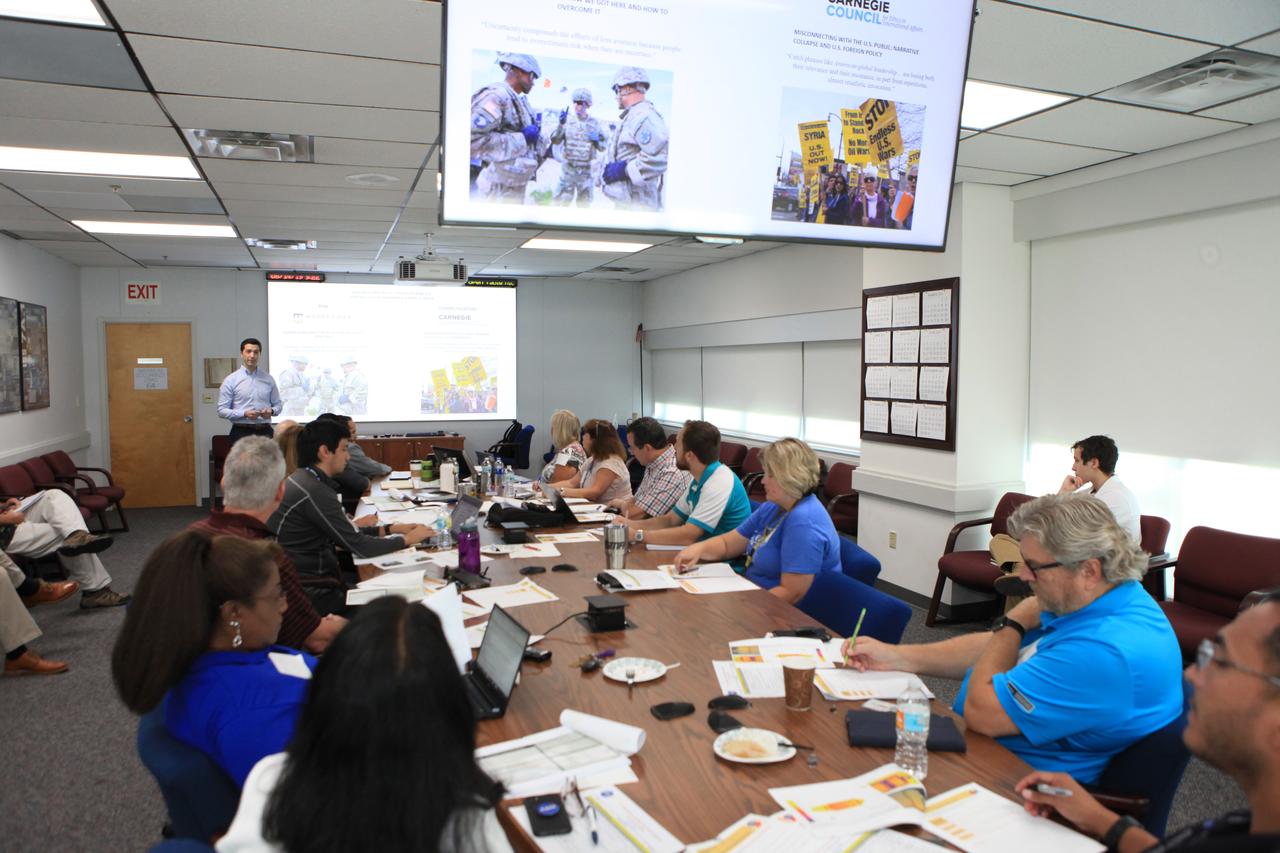
Pathways intern Douglas Jackson presents his proposal to a panel of judges during the “Innovation Without Boundaries” event held inside the Space Station Processing Facility at Kennedy Space Center in Florida on June 14, 2019. A number of Kennedy employees presented their proposals as part of the Chief Technologist Innovation Call. Participants had five minutes to present their innovative idea for the chance to receive an award of up to $500 for ideas with little-to-no cost that would make a significant impact.
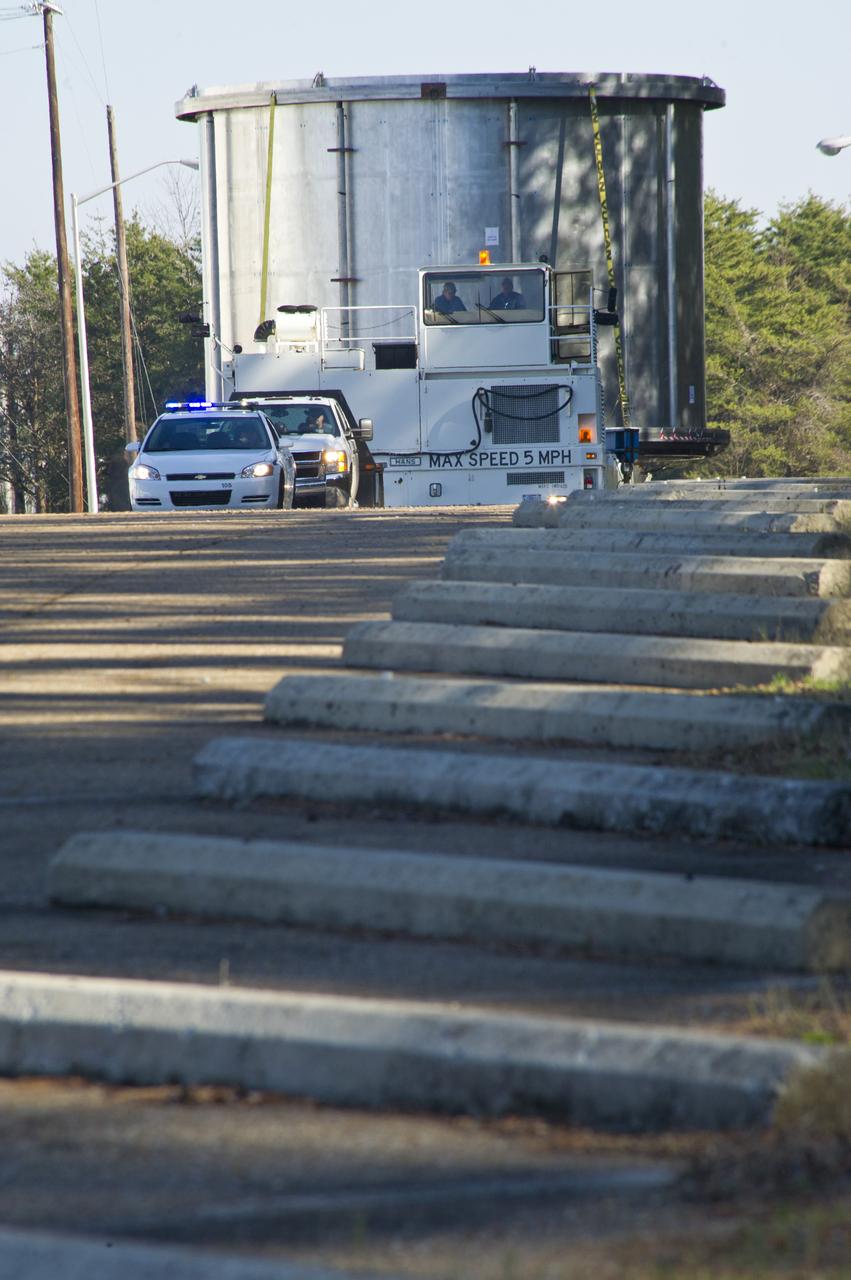
EXTERNAL TANK TEST ARTICLE (ETTA2) IS IN TRANSIT TO BE ROTATED 180° FOR INTERFACE RING INSTALLATION FOR SBKF (SHELL BUCKLING KNOCKDOWN FACTOR) CRITICAL FEEDBACK, UNDERSTANDING AND IDEAS THAT WILL ENABLE THE DEVELOPMENT AND IMPLEMENTATION OF NEW DESIGN APPROACHES AND TECHNOLOGY .
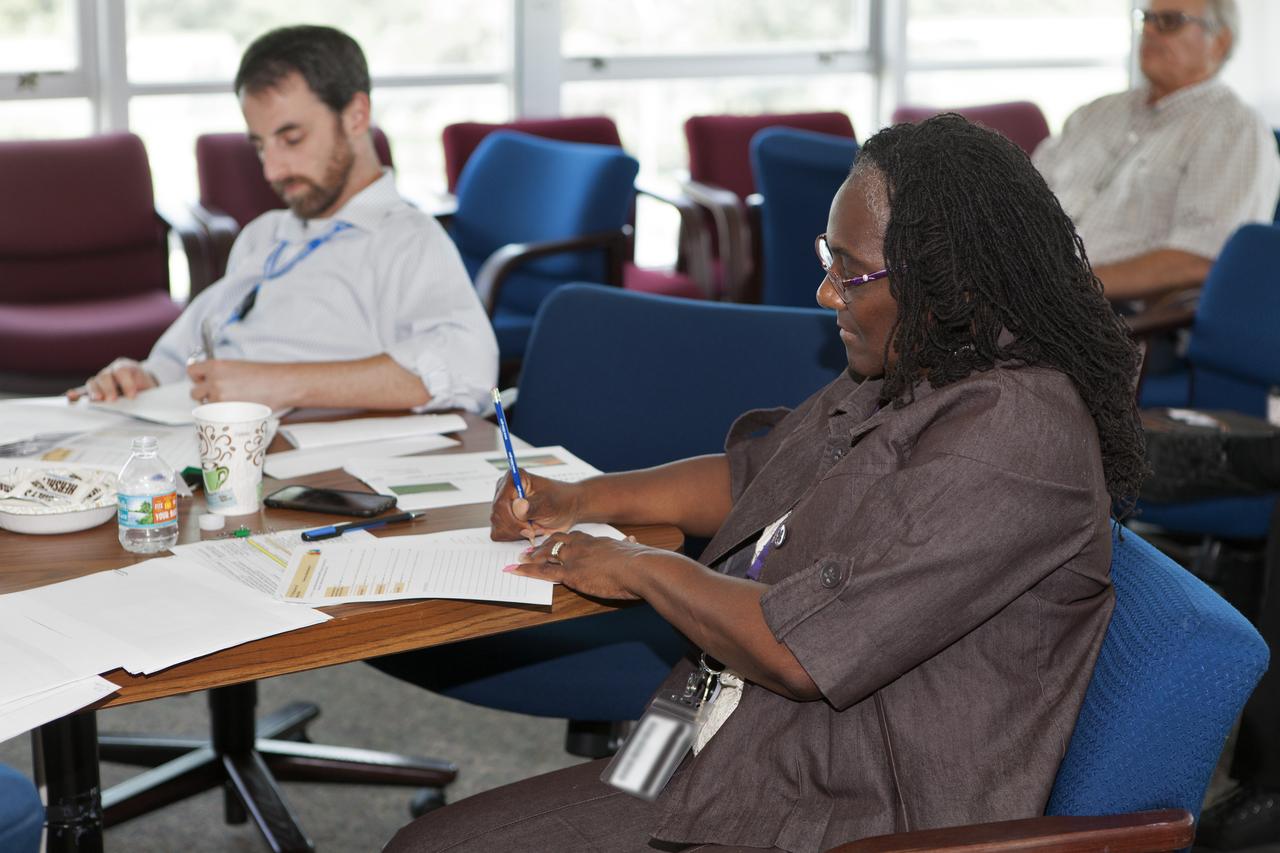
Judges Josh Santora, left, a program specialist with Kennedy Space Center’s Communication and Public Engagement (PX) directorate, and Hortense Diggs, PX deputy director, take notes during the “Innovation Without Boundaries” event held in the Florida spaceports’ Space Station Processing Facility on Thursday, Aug. 2. There were 39 proposals featuring a wide range of innovative ideas as part of the Chief Technologist Innovation Call. Presenters had two minutes to highlight their idea, followed by a three-minute question-and-answer period. The judging panel included senior staff, contractors and representatives throughout Kennedy.

With the theme of “Mission, People, Partners,” NASA’s Marshall Space Flight Center Director Jody Singer outlined how the center’s priorities align with the agency’s strategic plan in the first Marshall Association luncheon of the year March 14 in the Activities Building. The Marshall Association offers opportunities to network and share ideas with colleagues and members of the Marshall community. The Marshall Association offers opportunities to network and share ideas with colleagues and members of the Marshall community. Membership is open to NASA employees, retirees, contractors and community members. Membership dues support the annual scholarship program and other events throughout the year.
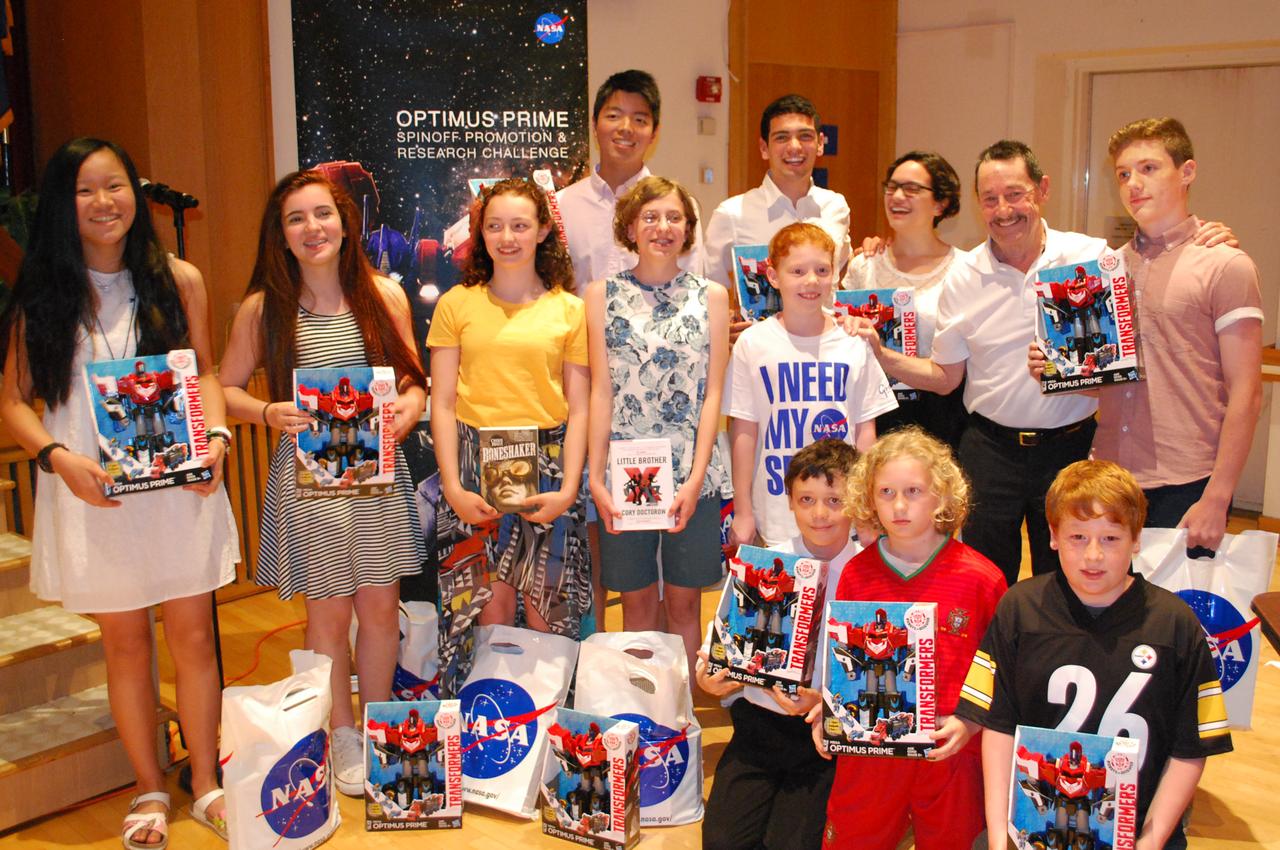
From June 28 through 30, 2016, the OPTIMUS PRIME Spinoff Promotion and Research Challenge (OPSPARC) gave the contest’s winning students the opportunity to explore NASA’s Goddard Space Flight Center in Greenbelt, Maryland. Three teams of students from elementary, middle and high school won the contest by creating the most popular ideas to use NASA technology in new and innovative ways. The students used an online platform called Glogster to make posters about their ideas, and the general public voted for their favorites. Sophia Sheehan won the elementary school prize for her invention of the “blow coat,” which would be powered by solar panels and blow warm air into winter coats, helping people in her hometown of Chicago stay warm in the winter. Heidi Long, Aubrey Nesti, Katherine Valbuena and Jasmine Wu won in the middle school category for their idea called Tent-cordion, which would use spacesuit and satellite insulation materials in a foldable tent to house refugees and the homeless. Finally, Jake Laddis, Alex Li, Isaac Wecht and Isabel Wecht won in the high school category for their idea to use James Webb Space Telescope sunshield technology to shield houses from summer heat and reduce the need for air conditioning around the world. The high school winners also had the opportunity to compete in the NASA InWorld challenge, sponsored by the James Webb Space Telescope project, and continued developing their idea in a virtual world and gaming environment. During their three-day workshop at Goddard, the students toured the center, met with scientists and engineers, took a look at the James Webb Space Telescope in Goddard’s clean room, and even made their own videos in Goddard’s TV studio. One of the students talked about how the experience inspired her. Read more: <a href="http://go.nasa.gov/298fGdQ" rel="nofollow">go.nasa.gov/298fGdQ</a>
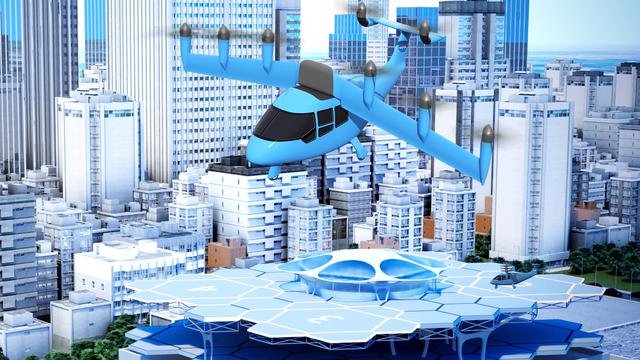
An idea for a future air taxi hovers over a municipal vertiport in this NASA illustration. Experts from NASA’s Advanced Air Mobility mission have signed agreements with four states and one city to host a series of workshops that will help local governments prepare their transportation plans to include this new form of air travel.
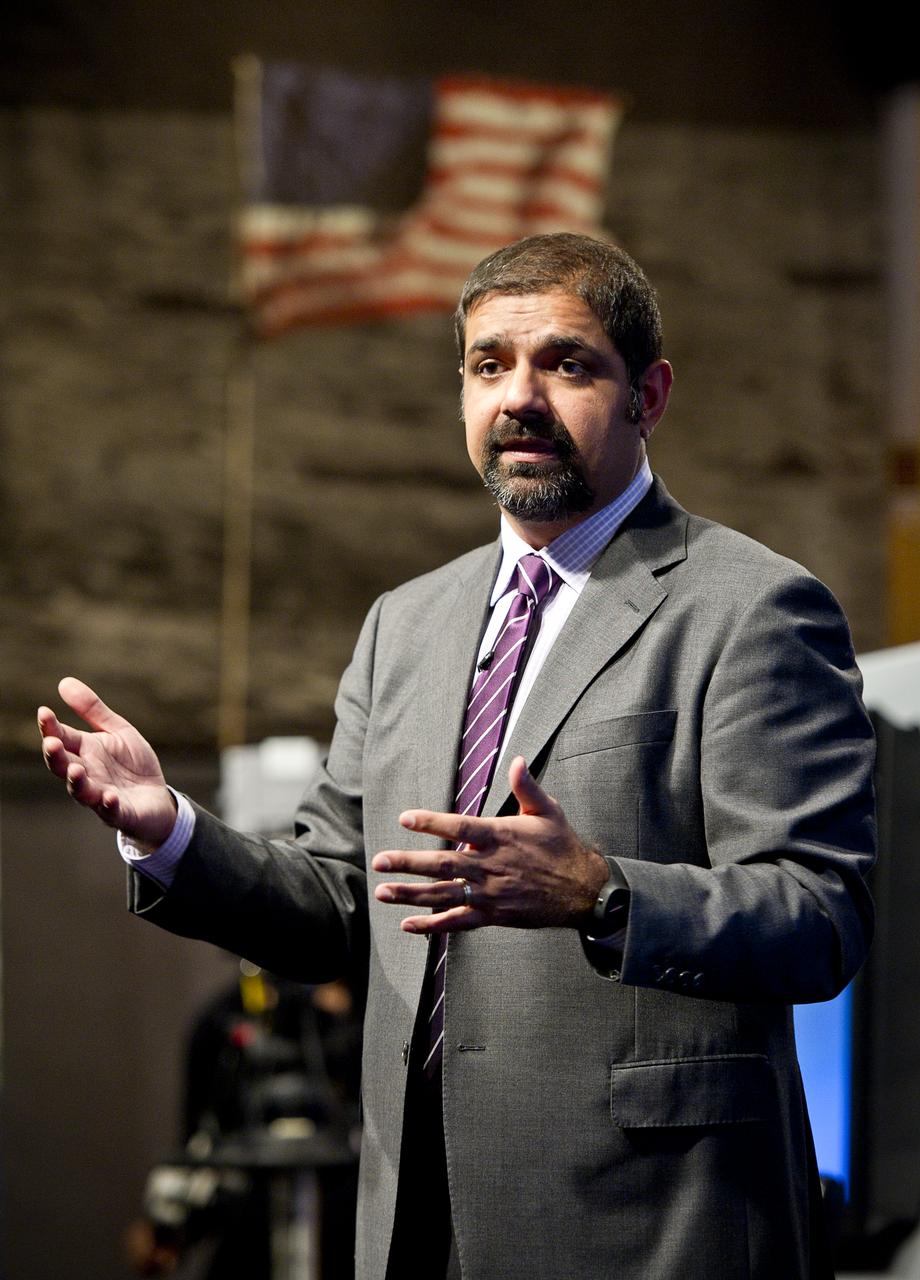
Karim R. Lakhani, assistant professor at Harvard Business School, kicked off the Office of the Chief Technologist TechNovation Lecture series with his talk "Accessing the Ideas Cloud" on Thursday, Feb. 17, 2011 at NASA Headquarters in Washington. Photo Credit: (NASA/Carla Cioffi)
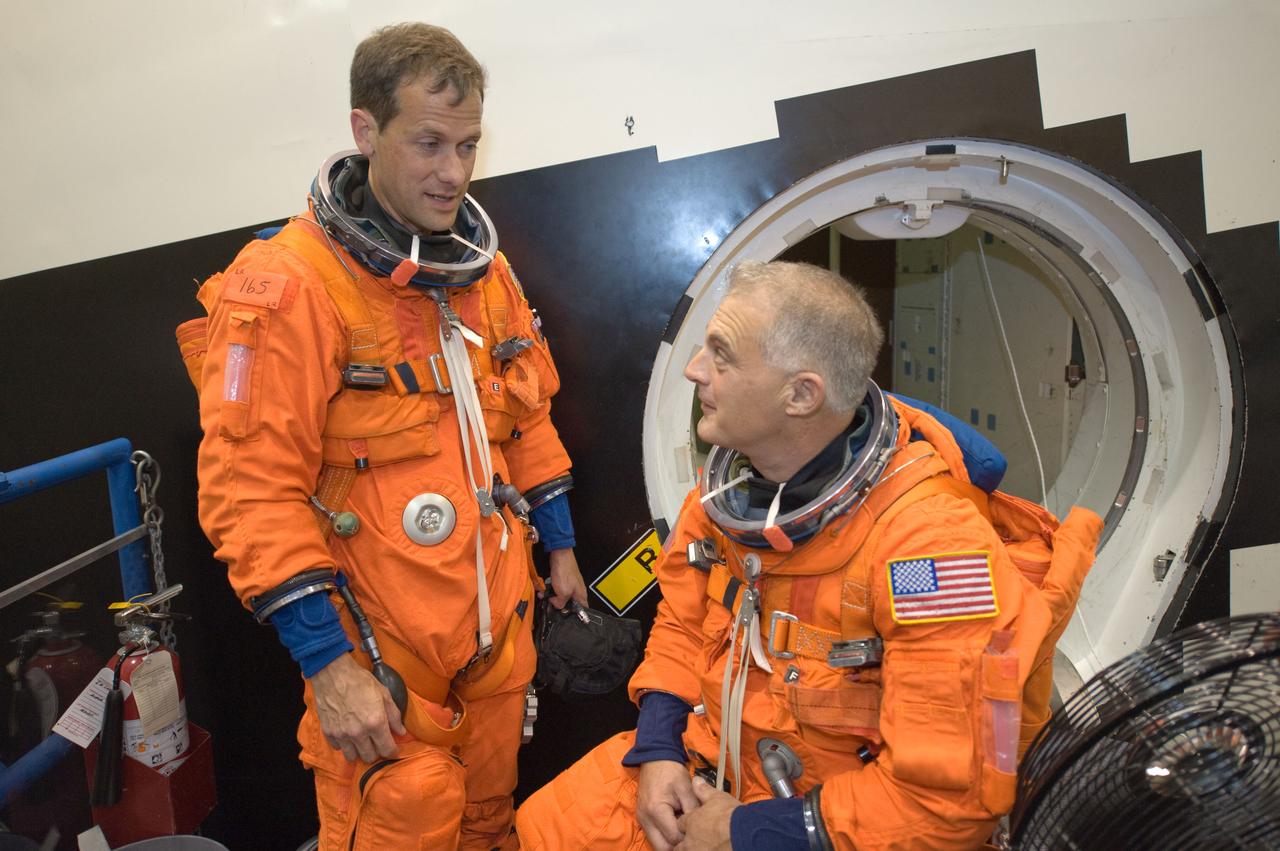
JSC2008-E-122430 (7 Oct. 2008) --- Attired in training versions of their shuttle launch and entry suits, astronauts Tom Marshburn (left) and Dave Wolf, both STS-127 mission specialists, exchange ideas during a training session in the Space Vehicle Mock-up Facility at NASA's Johnson Space Center.
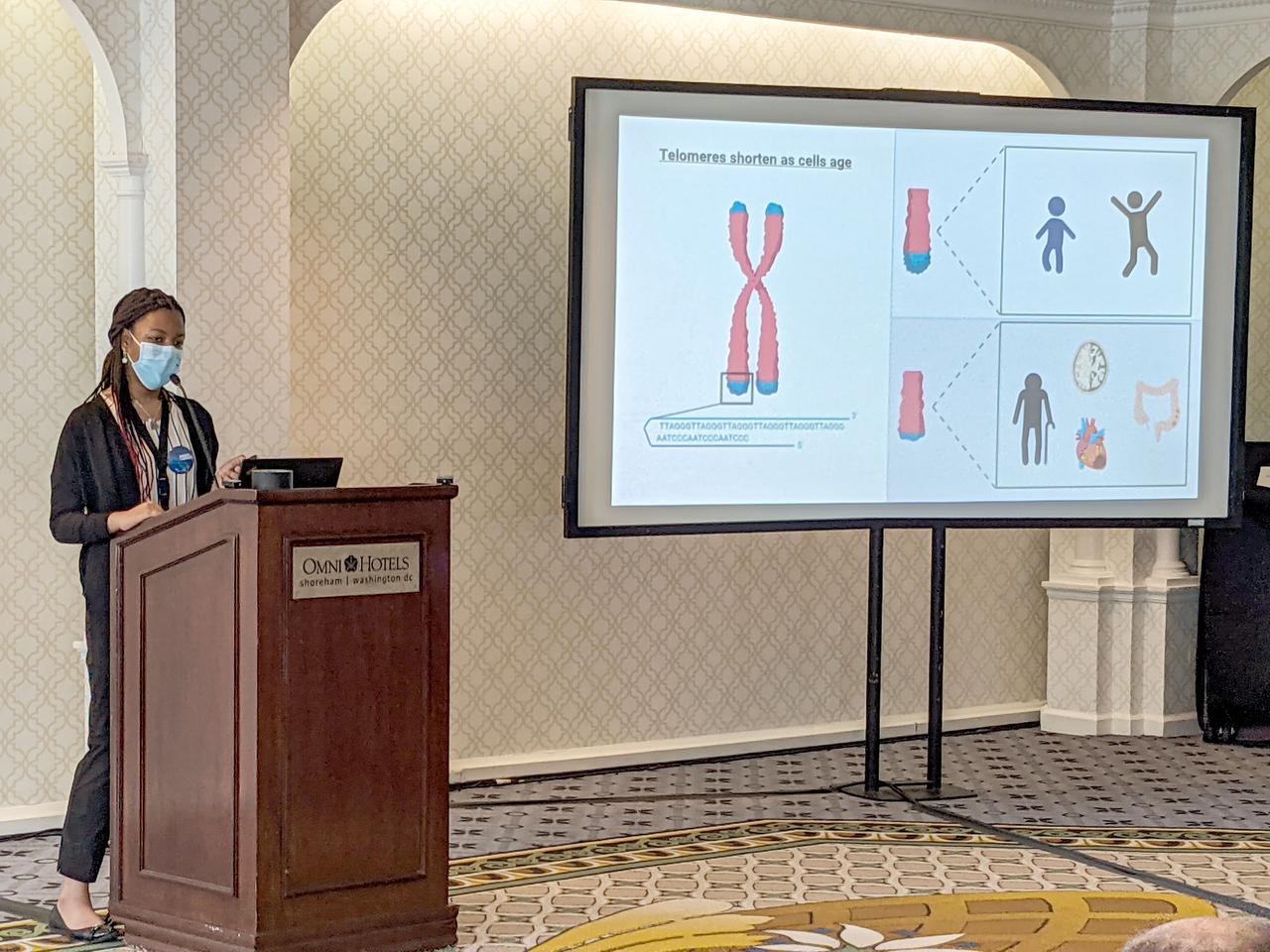
jsc2023e031078 (7/27/2022) --- Pristine Onuoha, Genes in Space-10 winner, presents her idea to contest judges. The Genes in Space program allows for 10 student projects to be selected for spaceflight analysis, which gives students a chance to attempt to solve real-world problems. Image courtesy of Genes in Space.
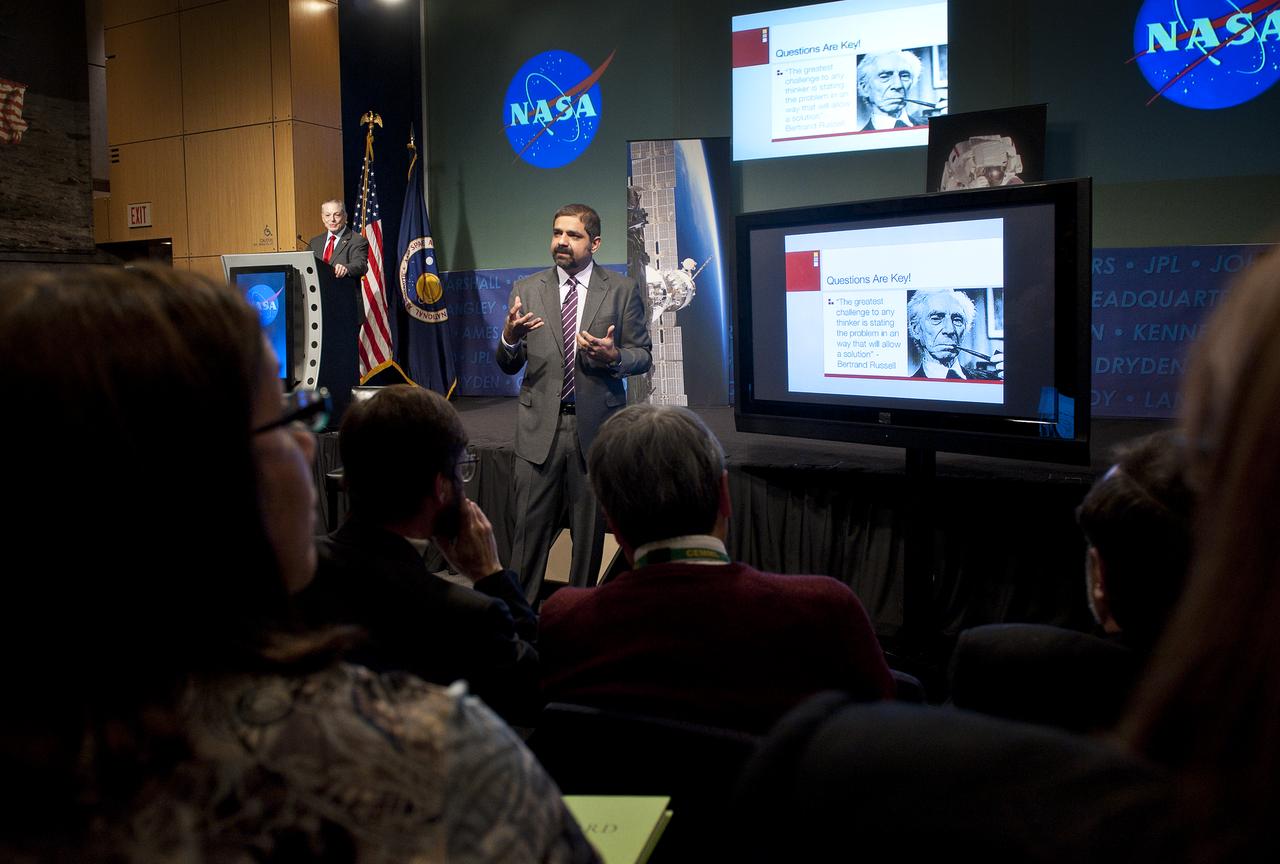
Karim R. Lakhani, assistant professor at Harvard Business School, kicked off the Office of the Chief Technologist TechNovation Lecture series with his talk "Accessing the Ideas Cloud" on Thursday, Feb. 17, 2011 at NASA Headquarters in Washington. Photo Credit: (NASA/Carla Cioffi)

The 51-J mission insignia, designed by Atlantis's first crew, pays tribute to the Statue of Liberty and the ideas it symbolizes. The historical gateway figure bears additional significance for Astronauts Karol J. Bobko, mission commander; and Ronald J. Grabe, pilot, both New Your Natives.
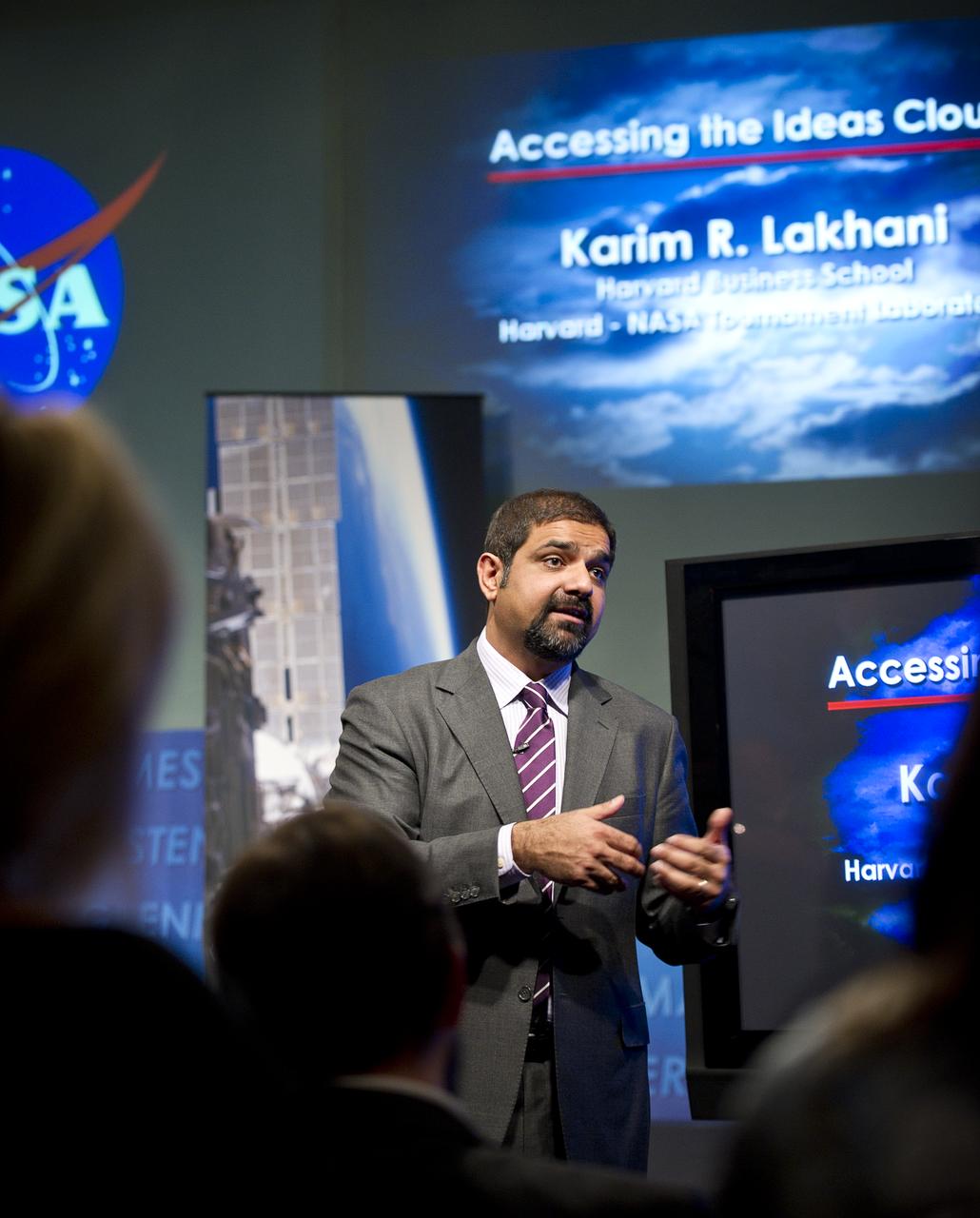
Karim R. Lakhani, assistant professor at Harvard Business School, kicked off the Office of the Chief Technologist TechNovation Lecture series with his talk "Accessing the Ideas Cloud" on Thursday, Feb. 17, 2011 at NASA Headquarters in Washington. Photo Credit: (NASA/Carla Cioffi)
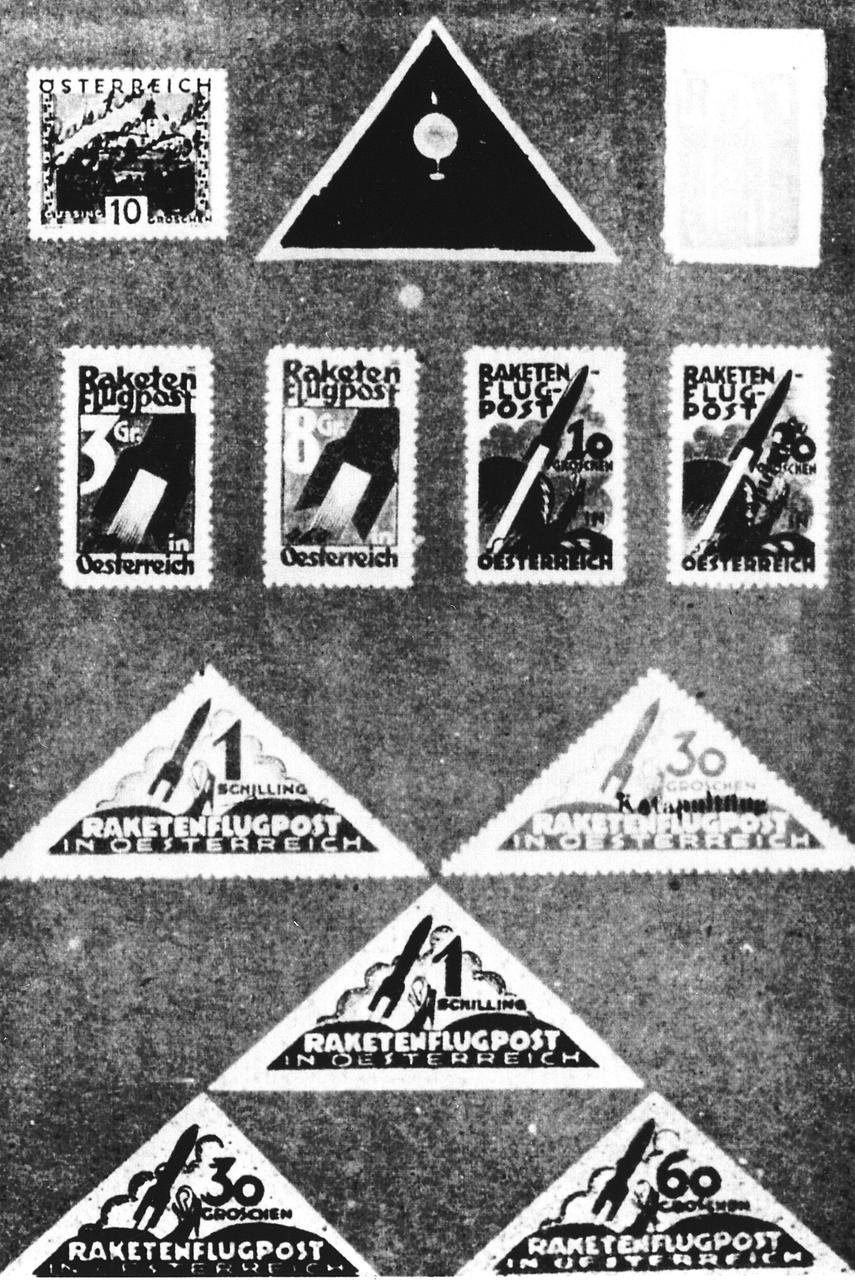
In the 19th Century, experiments in America, Europe, and elsewhere attempted to build postal rockets to deliver mail from one location to another. The idea was more novel than successful. Many stamps used in these early postal rockets have become collector's items.
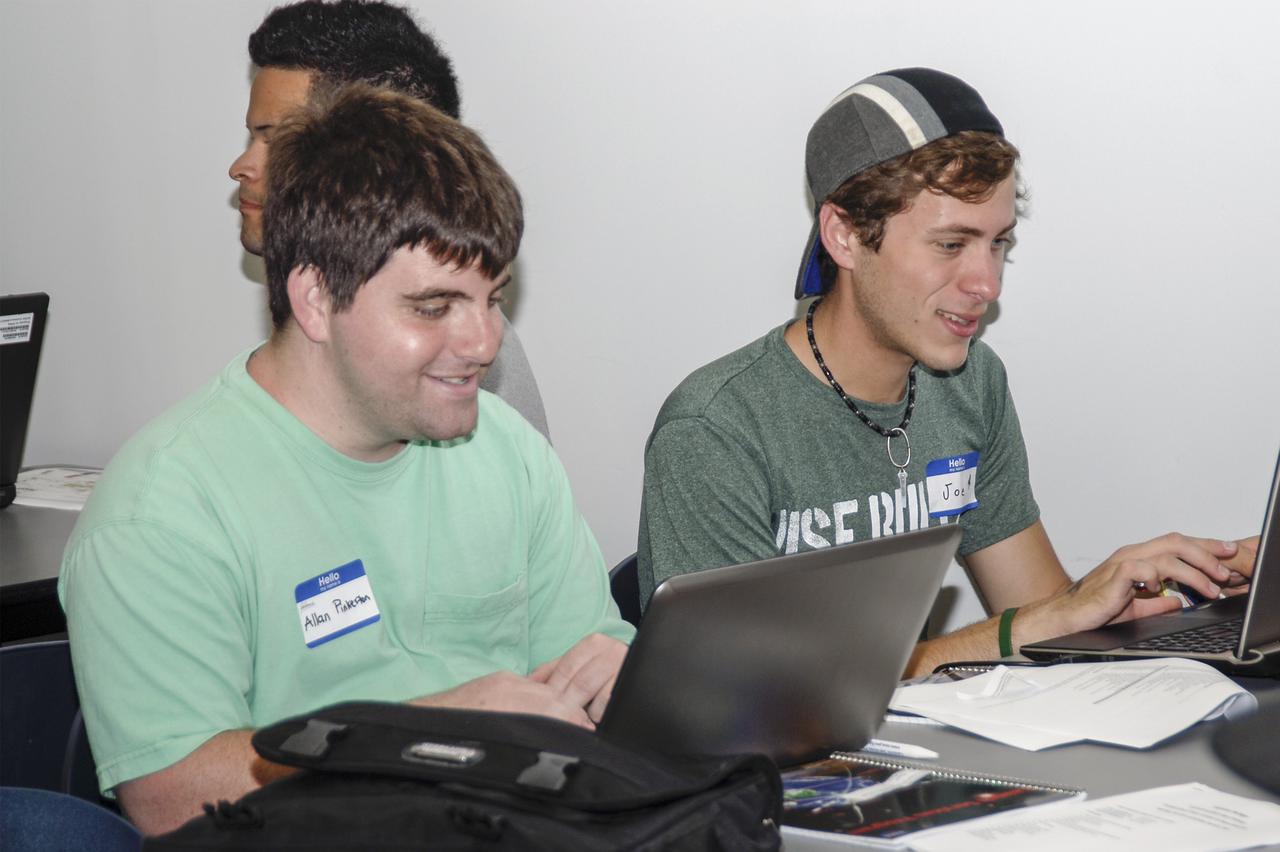
CAPE CANAVERAL, Fla. – Allan Pinkerton, at left, and Joey Vars, students from the University of South Florida at St. Petersburg, brainstorm ideas during the 2013 International Space Apps Challenge at the Center for Space Education at the Kennedy Space Center Visitor Complex in Florida. During the worldwide two-day challenge, more than 9,000 people and 484 organizations came together in 83 cities across 44 countries, as well as online, to develop new ways of solving challenges that NASA faces. At Kennedy, four teams brainstormed ideas with subject matter experts and others and worked nearly 32 hours straight to present their concepts to a panel of three technical and non-technical judges. Challenges tackled at Kennedy were: Deployable Greenhouse, Kennedy Space Center 2040, Seven Minutes of Science, and Moonville – Lunar Industry Game. Photo credit: NASA_Charisse Nahser
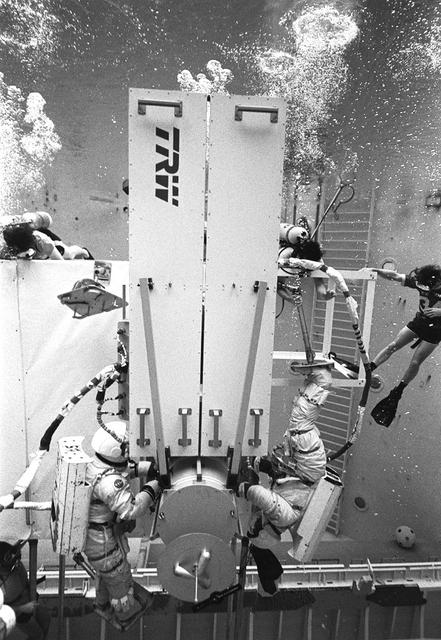
The Space Platform was first conceived as a launching site for deep space exploration. The original idea was to build this space platform either on the moon's surface or near lunar orbit. It would be used as a staging base, where the reusable launch vehicles (later known as Space Shuttles) would ferry machinery and equipment to assemble deep space exploration vehicles. Replaced by the Space Station concept, the space platform idea was never completed. However, early in the space platform development, astronauts trained at the Marshall Space Flight Center's (MSFC) Neutral Buoyancy Simulator (NBS), as pictured here, working on solar array equipment. This experiment was deployed from the shuttle to study the motions of large structures in space. Similar arrays will be used on the Space Station and large observatory spacecraft in the future.
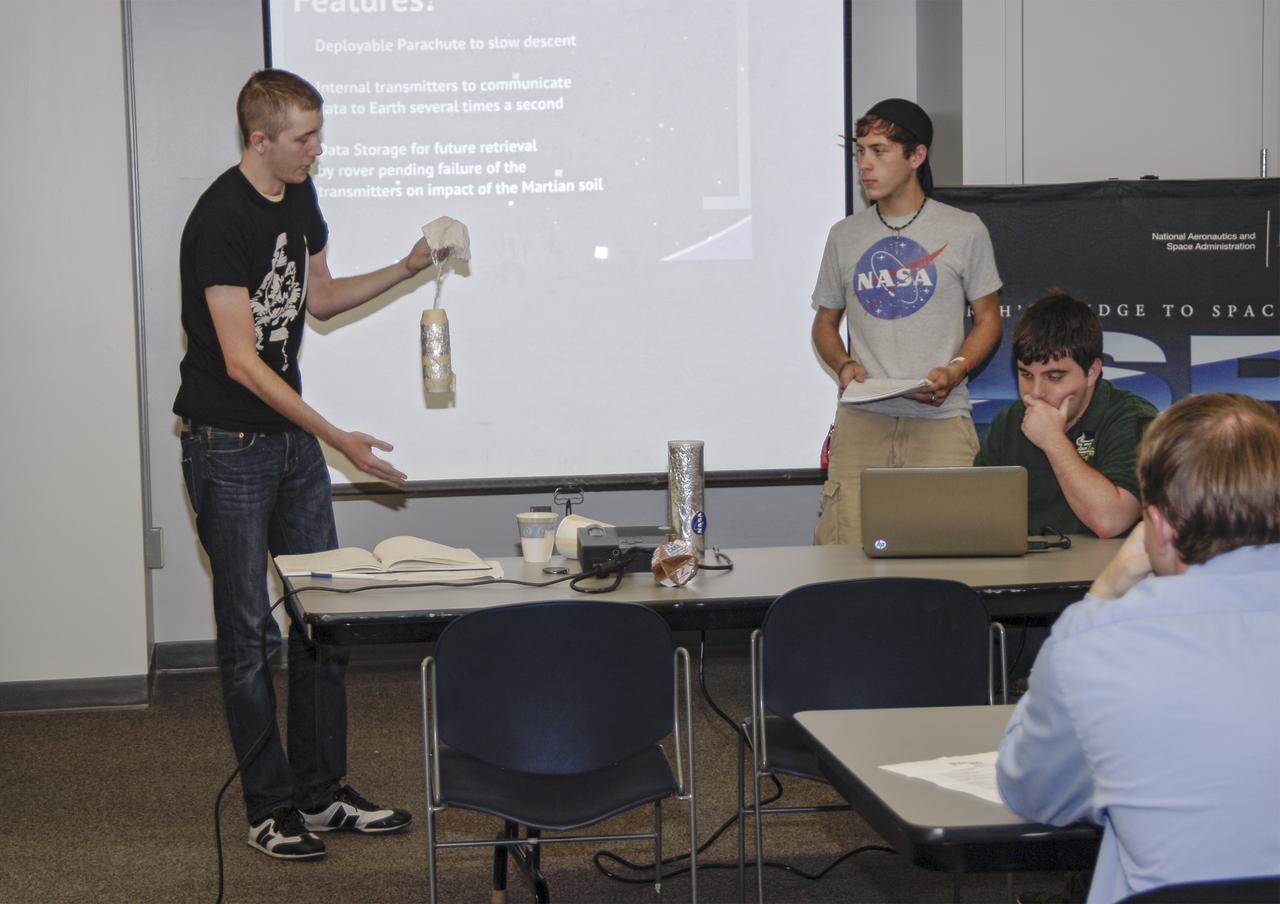
CAPE CANAVERAL, Fla. – Michael Strittmatter, at left, Joey Vars and Allan Pinkerton, all students at the University of South Florida St. Petersburg, present their ideas to a panel of technical and non-technical judges during the 2013 International Space Apps Challenge at The Astronaut Memorial Foundation’s Center for Space Education in Florida. During the worldwide two-day challenge, more than 9,000 people and 484 organizations came together in 83 cities across 44 countries, as well as online, to develop new ways of solving challenges that NASA faces. At Kennedy, four teams brainstormed ideas with subject matter experts and others and worked nearly 32 hours straight to present their concepts to a panel of three technical and non-technical judges. Challenges tackled at Kennedy were: Deployable Greenhouse, Kennedy Space Center 2040, Seven Minutes of Science, and Moonville – Lunar Industry Game. Photo credit: NASA_Charisse Nahser
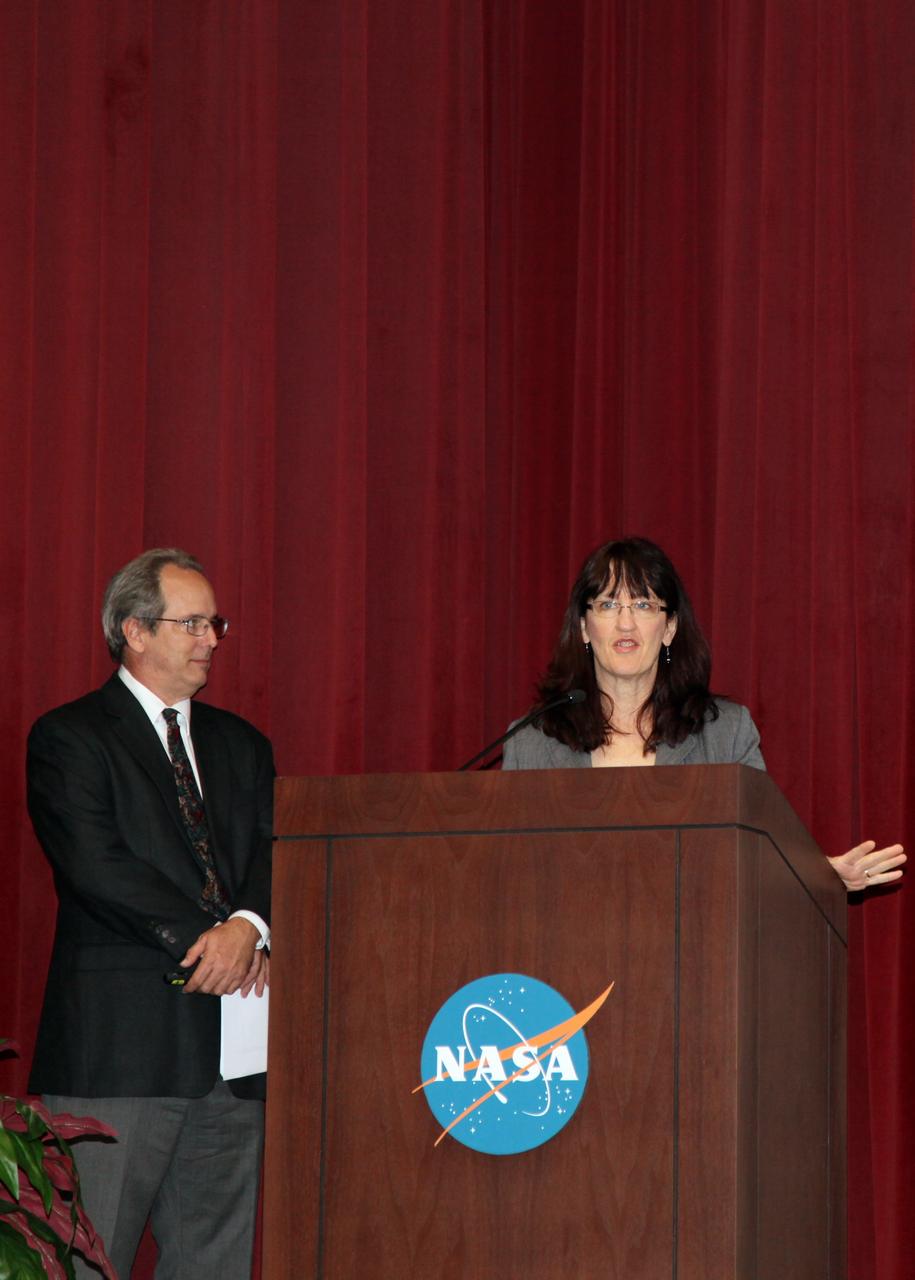
CAPE CANAVERAL, Fla. – During NASA's Innovation Expo at the Kennedy Space Center in Florida, Annie Williams, of NASA's Medical and Environmental Management Division, proposes an innovation to recycling space hardware as art. Kennedy Kick-Start Chair Mike Conroy looks on from the left. As Kennedy continues developing programs and infrastructure to become a 21st century spaceport, many employees are devising ways to do their jobs better and more efficiently. On Sept. 6, 2012, 16 Kennedy employees pitched their innovative ideas for improving the center at the Kennedy Kick-Start event. The competition was part of a center-wide effort designed to increase exposure for innovative ideas and encourage their implementation. For more information, visit http://www.nasa.gov/centers/kennedy/news/kick-start_competition.html Photo credit: NASA/Gianni Woods
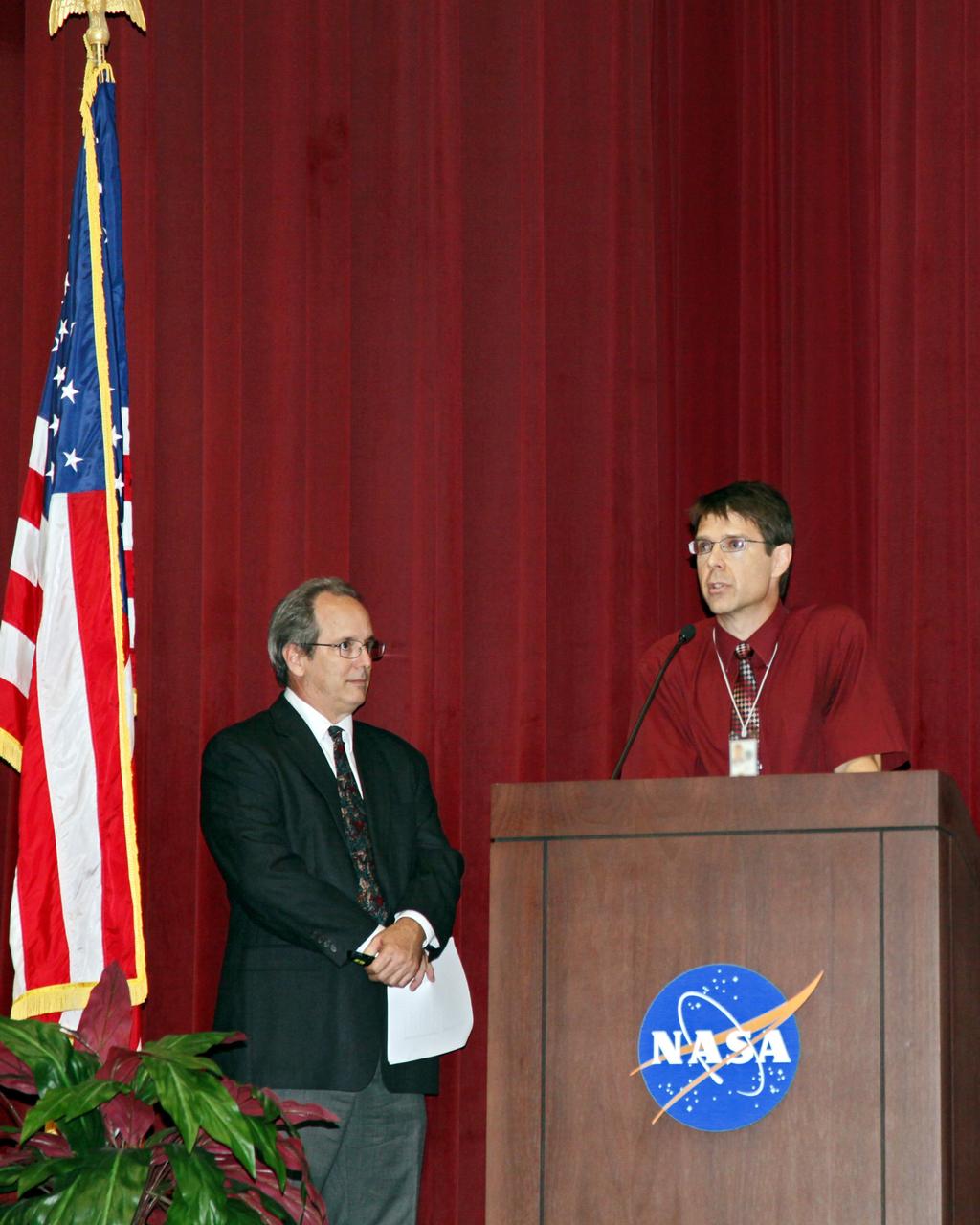
CAPE CANAVERAL, Fla. – During NASA's Innovation Expo at the Kennedy Space Center in Florida, William Merrill, of NASA's Communications Infrastructure Services Division, proposes an innovation that would make mission audio available by way of an Internet radio stream. Kennedy Kick-Start Chair Mike Conroy looks on from the left. As Kennedy continues developing programs and infrastructure to become a 21st century spaceport, many employees are devising ways to do their jobs better and more efficiently. On Sept. 6, 2012, 16 Kennedy employees pitched their innovative ideas for improving the center at the Kennedy Kick-Start event. The competition was part of a center-wide effort designed to increase exposure for innovative ideas and encourage their implementation. For more information, visit http://www.nasa.gov/centers/kennedy/news/kick-start_competition.html Photo credit: NASA/Gianni Woods
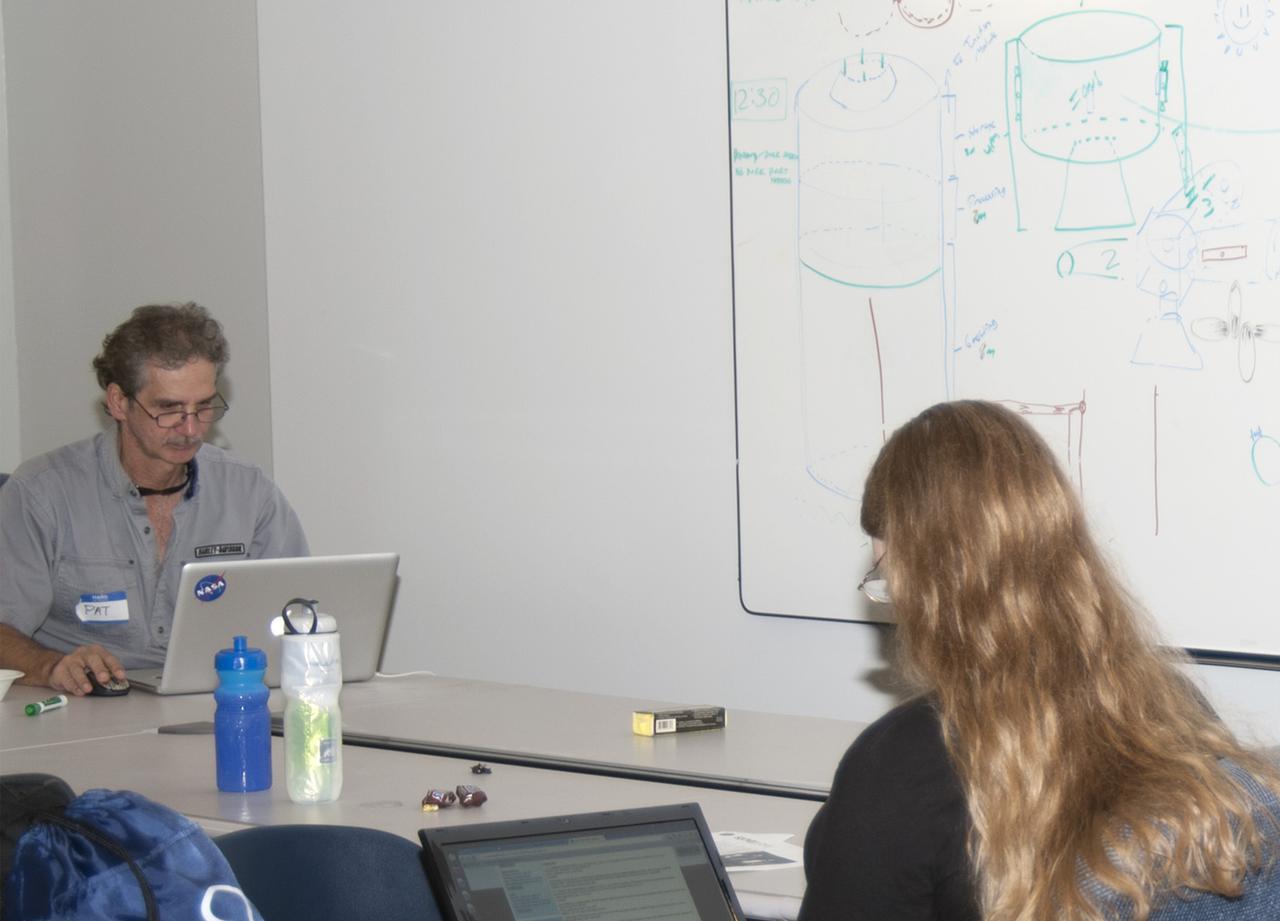
CAPE CANAVERAL, Fla. – Pat Starace, at left, from Orlando, and Kennedy Space Center engineer Jamie Szafran brainstorm ideas on deployable greenhouses during the 2013 International Space Apps Challenge, or ISAC, at The Astronaut Memorial Foundation’s Center for Space Education in Florida. During the worldwide two-day challenge, more than 9,000 people and 484 organizations came together in 83 cities across 44 countries, as well as online, to develop new ways of solving challenges that NASA faces. At Kennedy, four teams brainstormed ideas with subject matter experts and others and worked nearly 32 hours straight to present their concepts to a panel of three technical and non-technical judges. Challenges tackled at Kennedy were: Deployable Greenhouse, Kennedy Space Center 2040, Seven Minutes of Science, and Moonville – Lunar Industry Game. Photo credit: NASA_Charisse Nahser
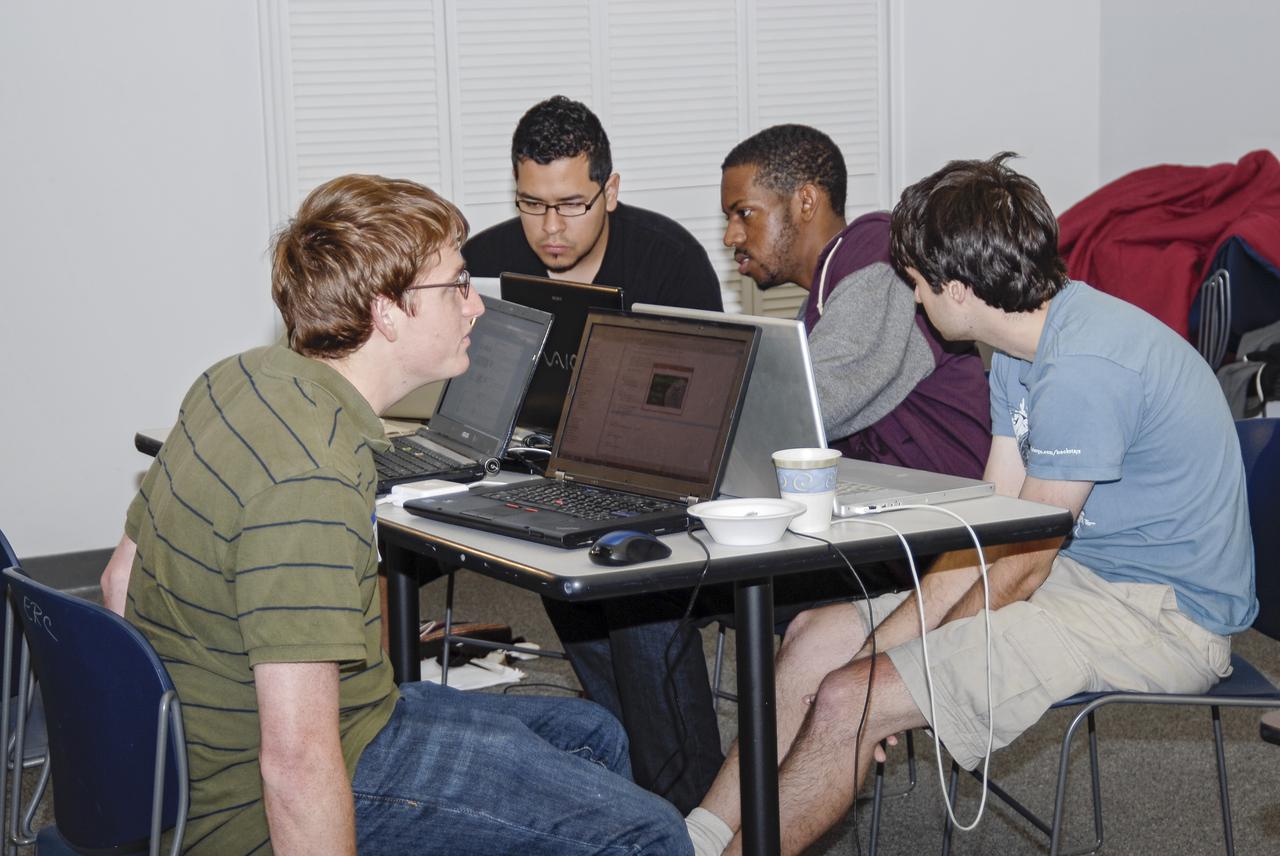
CAPE CANAVERAL, Fla. – Students from the University of Florida, University of Central Florida and the University of Puerto Rico brainstorm ideas during the 2013 International Space Apps Challenge, or ISAC, at The Astronaut Memorial Foundation’s Center for Space Education in Florida. During the worldwide two-day challenge, more than 9,000 people and 484 organizations came together in 83 cities across 44 countries, as well as online, to develop new ways of solving challenges that NASA faces. At Kennedy, four teams brainstormed ideas with subject matter experts and others and worked nearly 32 hours straight to present their concepts to a panel of three technical and non-technical judges. Challenges tackled at Kennedy were: Deployable Greenhouse, Kennedy Space Center 2040, Seven Minutes of Science, and Moonville – Lunar Industry Game. Photo credit: NASA_Charisse Nahser
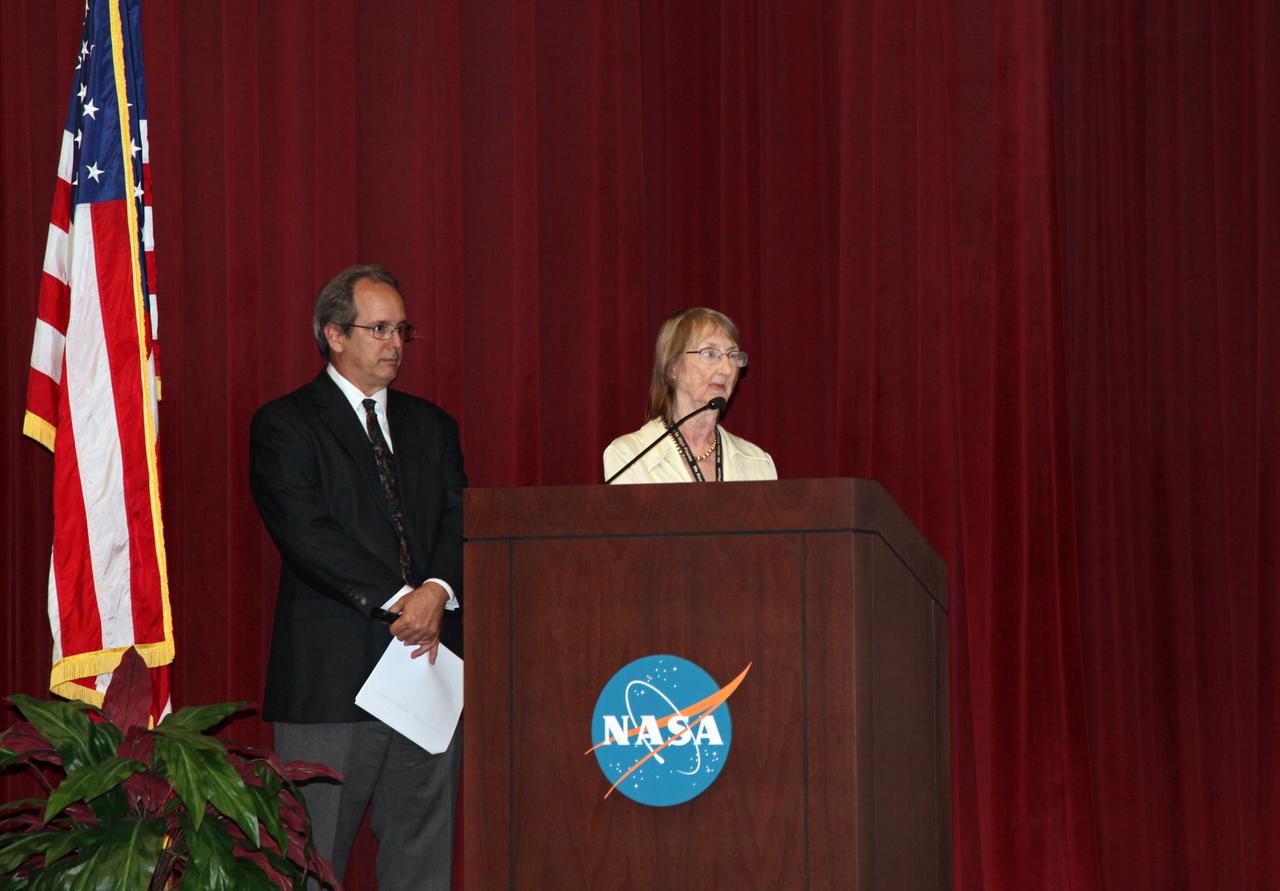
PE CANAVERAL, Fla. – During NASA's Innovation Expo at the Kennedy Space Center in Florida, Priscilla Elfrey, of NASA's Computational Sciences Branch, proposes that NASA to partner with two organizations to help improve minority employment. Kennedy Kick-Start Chair Mike Conroy looks on from the left. As Kennedy continues developing programs and infrastructure to become a 21st century spaceport, many employees are devising ways to do their jobs better and more efficiently. On Sept. 6, 2012, 16 Kennedy employees pitched their innovative ideas for improving the center at the Kennedy Kick-Start event. The competition was part of a center-wide effort designed to increase exposure for innovative ideas and encourage their implementation. For more information, visit http://www.nasa.gov/centers/kennedy/news/kick-start_competition.html Photo credit: NASA/Gianni Woods
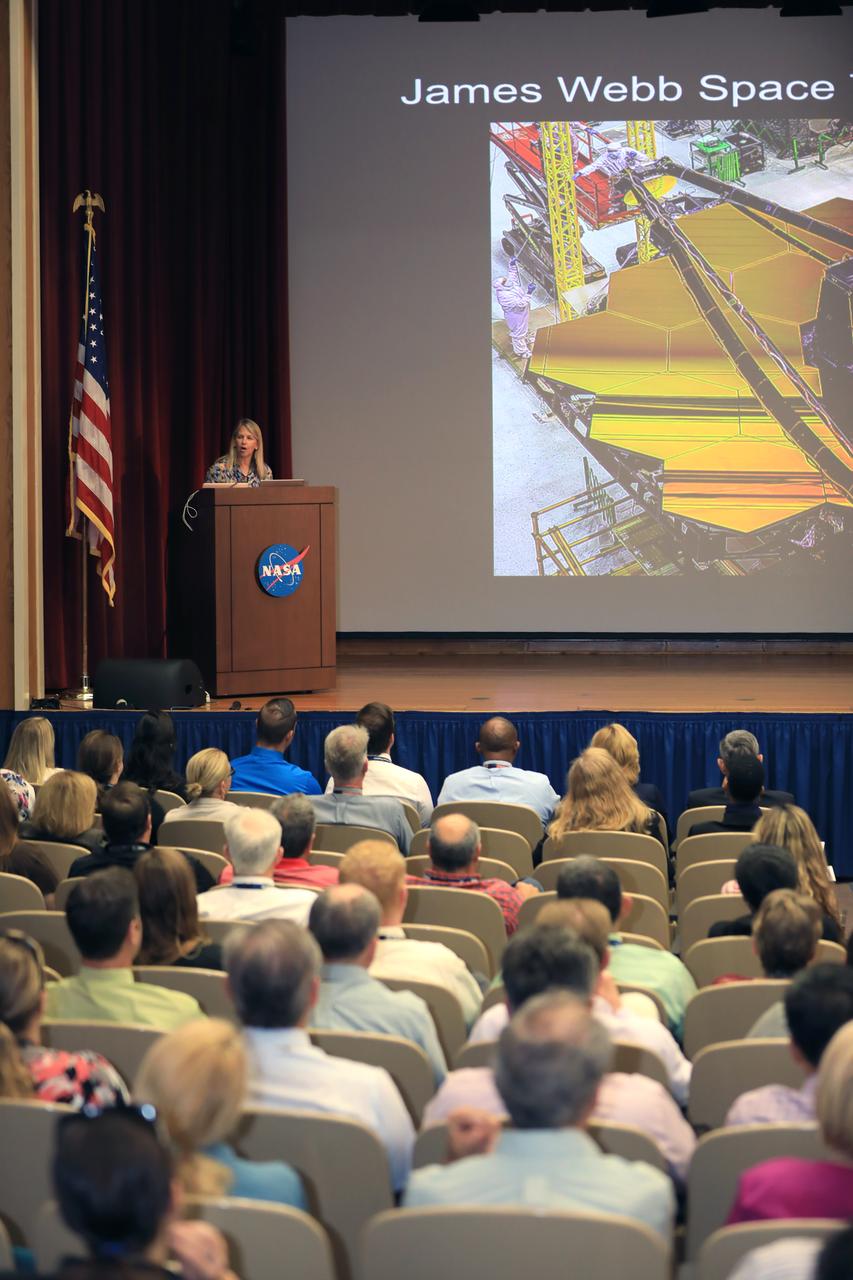
Dr. Dava Newman, NASA's deputy administrator, speaks to employees at the Florida spaceport during the annual KickStart Innovation Expo. The event gives employees an opportunity to present proposals for new ideas and processes. A small amount of funding is awarded to those selected allowing individuals or teams to procure needed items to implement their projects. Kennedy employees are encouraged to look for ways to do their work better and to propose concepts for tackling future mission needs.
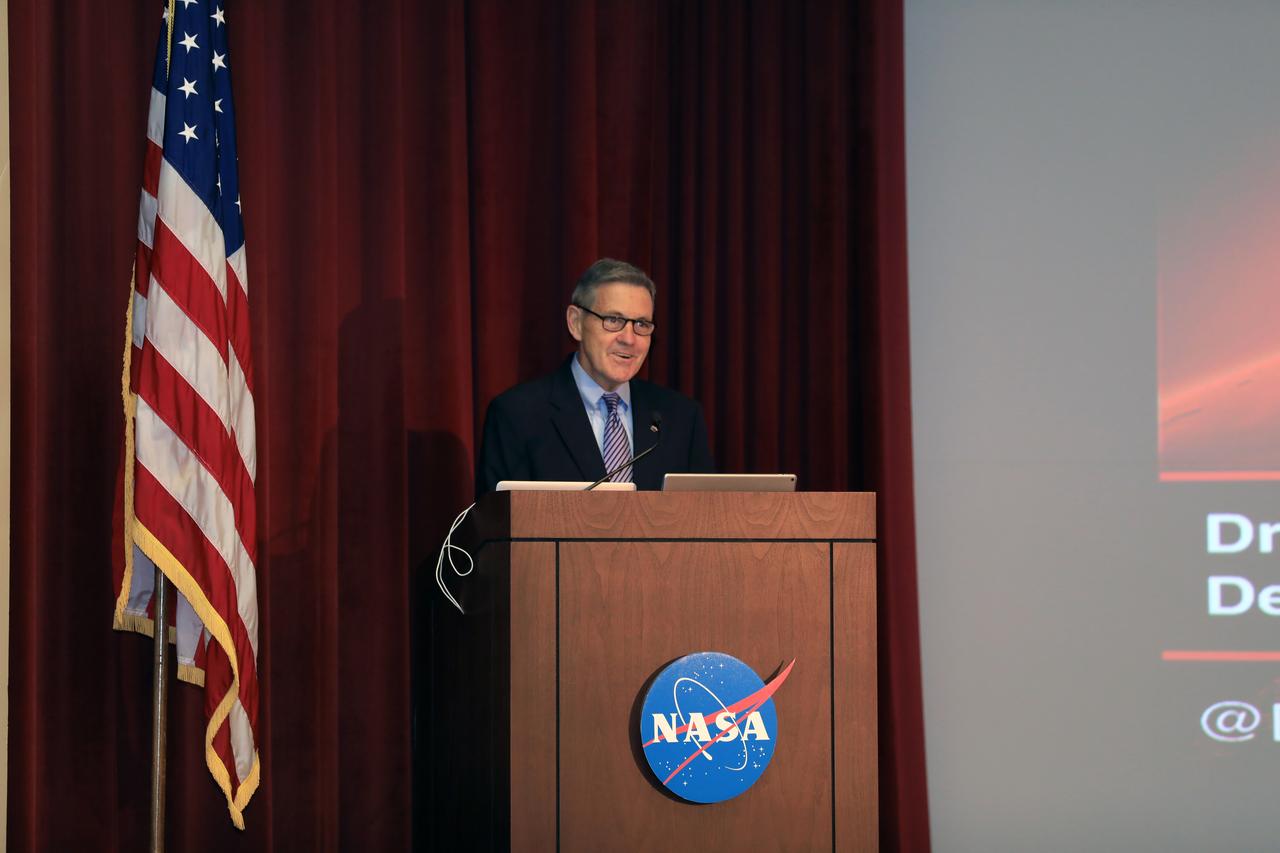
Kennedy Space Center Director Bob Cabana speaks to employees at the Florida spaceport during the annual KickStart Innovation Expo. The event gives employees an opportunity to present proposals for new ideas and processes. A small amount of funding is awarded to those selected allowing individuals or teams to procure needed items to implement their projects. Kennedy employees are encouraged to look for ways to do their work better and to propose concepts for tackling future mission needs.
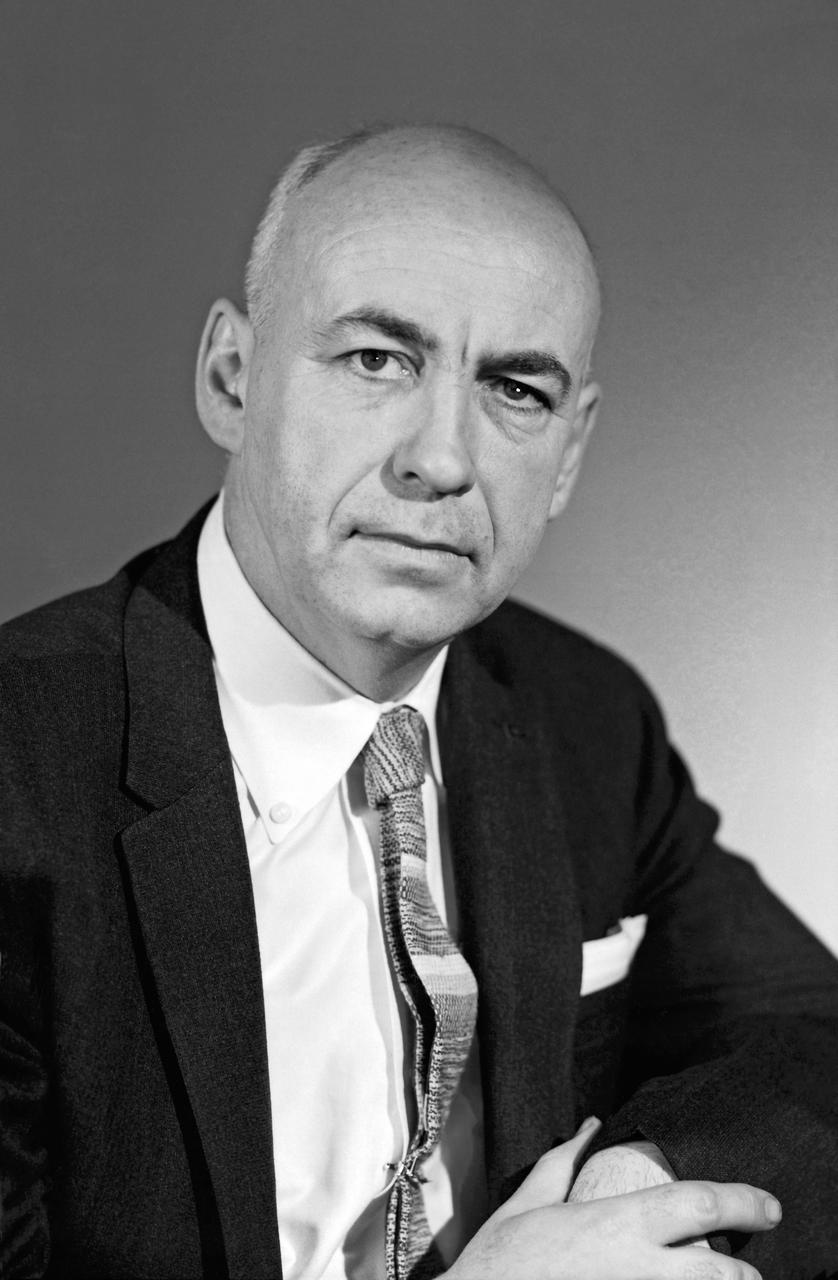
Portrait of Robert R. Gilruth. More than anyone else at Langley, began to push the idea that manned spaceflight was the next great challenge for aeronautic engineers. As head of NASA s Space Task Group, he was responsible for planning and carrying out Project Mercury, the country's first manned spaceflight program. Photograph published in Engineer in Charge: A History of the Langley Aeronautical Laboratory, 1917-1958 by James R. Hansen. Page 386.
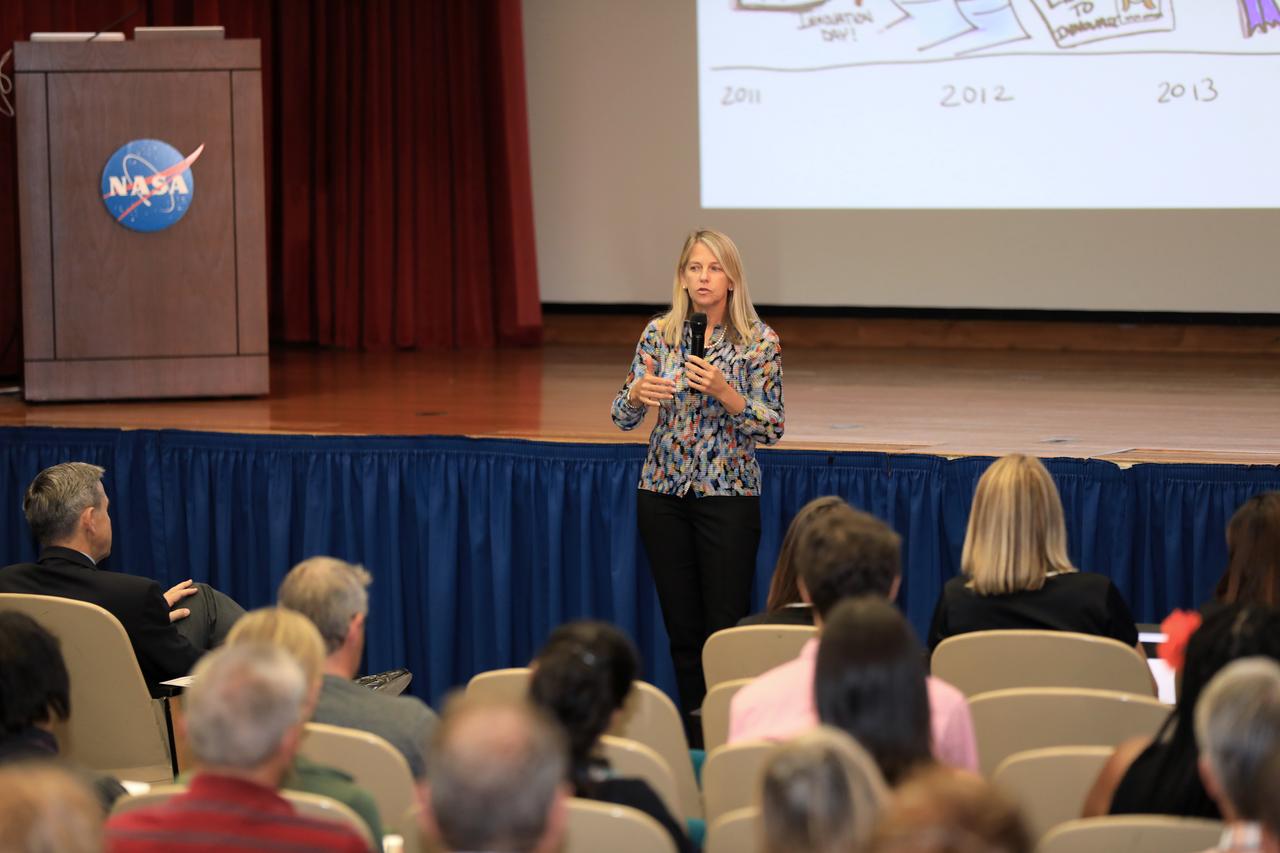
Dr. Dava Newman, NASA's deputy administrator, speaks to employees at the Florida spaceport during the annual KickStart Innovation Expo. The event gives employees an opportunity to present proposals for new ideas and processes. A small amount of funding is awarded to those selected allowing individuals or teams to procure needed items to implement their projects. Kennedy employees are encouraged to look for ways to do their work better and to propose concepts for tackling future mission needs.

Dr. Dava Newman, NASA's deputy administrator, speaks to employees at the Florida spaceport during the annual KickStart Innovation Expo The event gives employees an opportunity to present proposals for new ideas and processes. A small amount of funding is awarded to those selected allowing individuals or teams to procure needed items to implement their projects. Kennedy employees are encouraged to look for ways to do their work better and to propose concepts for tackling future mission needs.
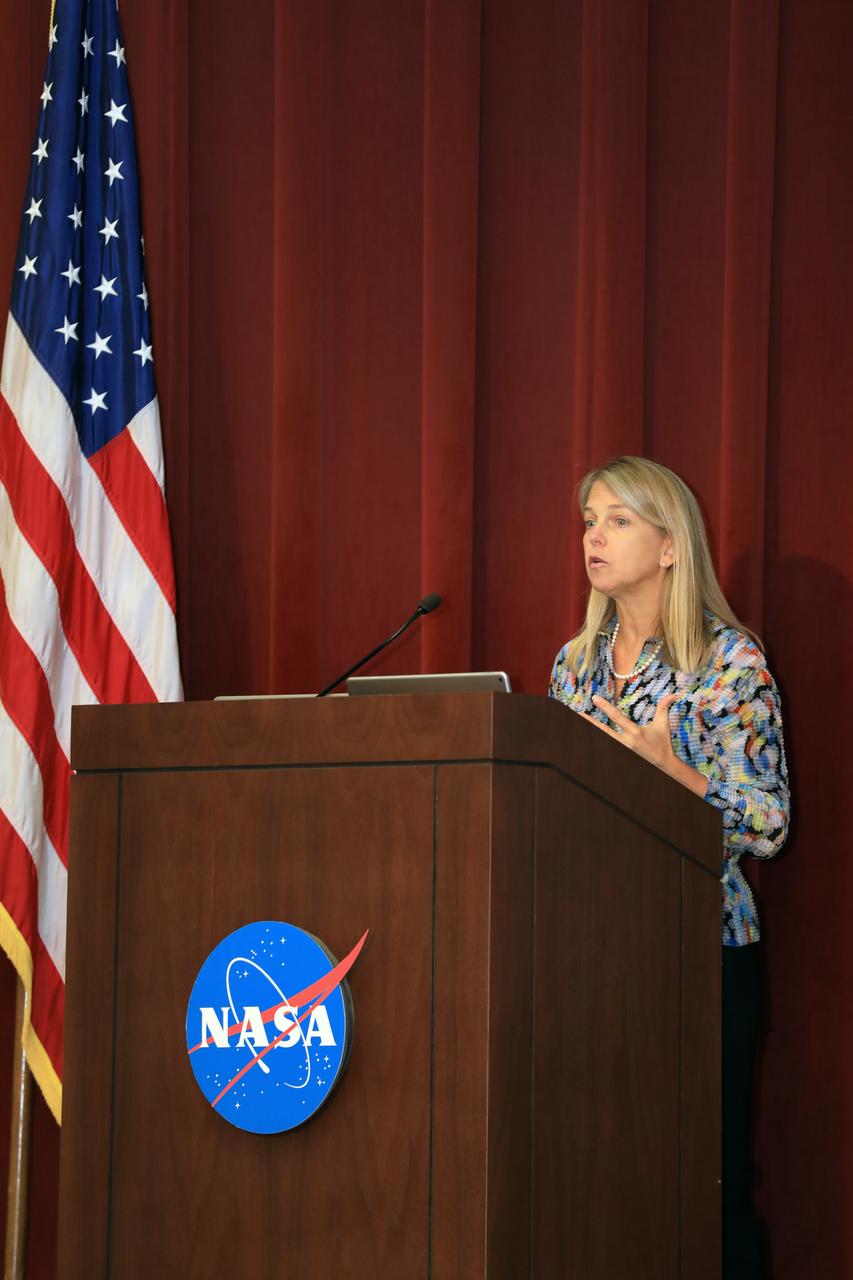
Dr. Dava Newman, NASA's deputy administrator, speaks to employees at the Florida spaceport during the annual KickStart Innovation Expo. The event gives employees an opportunity to present proposals for new ideas and processes. A small amount of funding is awarded to those selected allowing individuals or teams to procure needed items to implement their projects. Kennedy employees are encouraged to look for ways to do their work better and to propose concepts for tackling future mission needs.
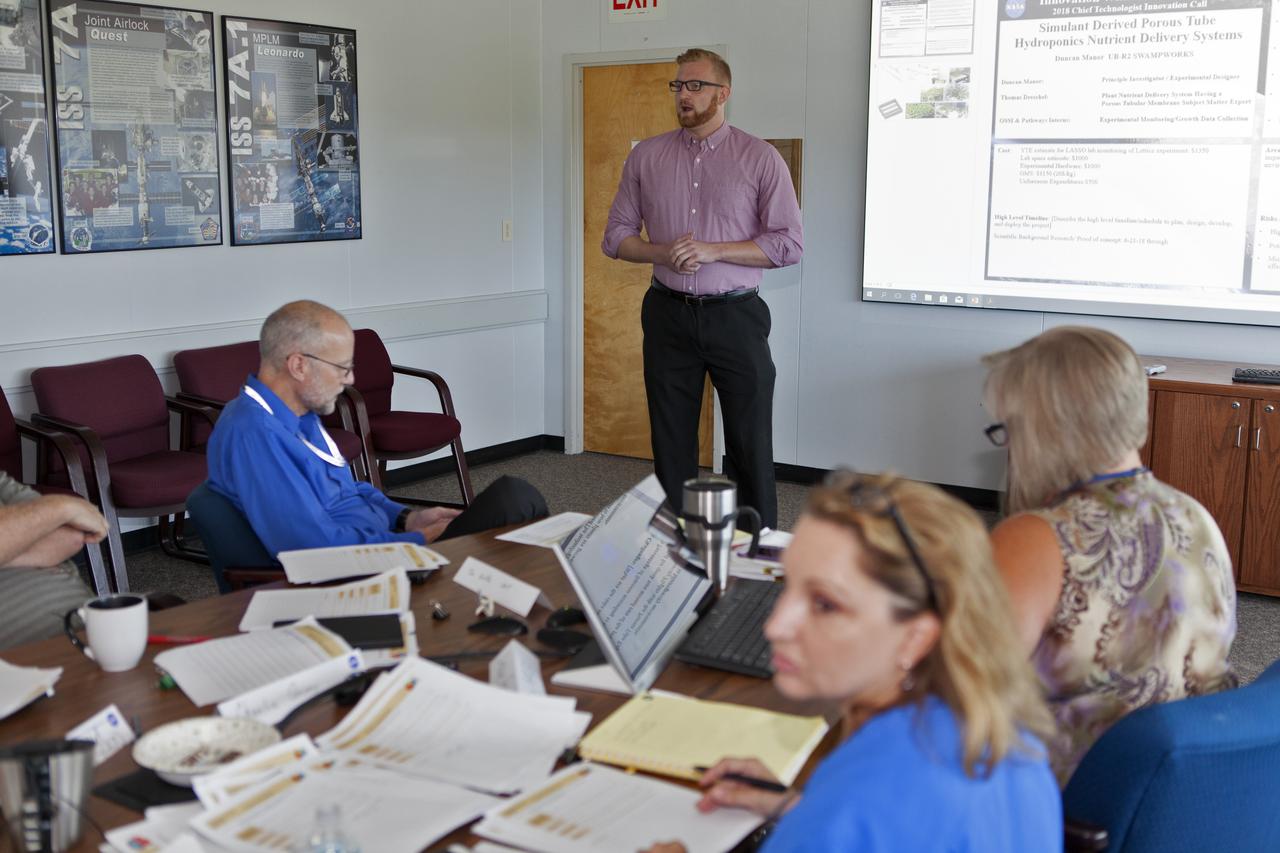
Pathways intern Duncan Manor presents his proposal during an “Innovation Without Boundaries” event held in the Space Station Processing Facility at Kennedy Space Center in Florida on Thursday, Aug. 2. Civil servants and contractors throughout Kennedy participated in the event, which featured 39 proposals as part of the Chief Technologist Innovation Call. Presenters had two minutes to highlight their idea, followed by a three-minute question-and-answer period. The judging panel included senior staff, contractors and representatives throughout the center.
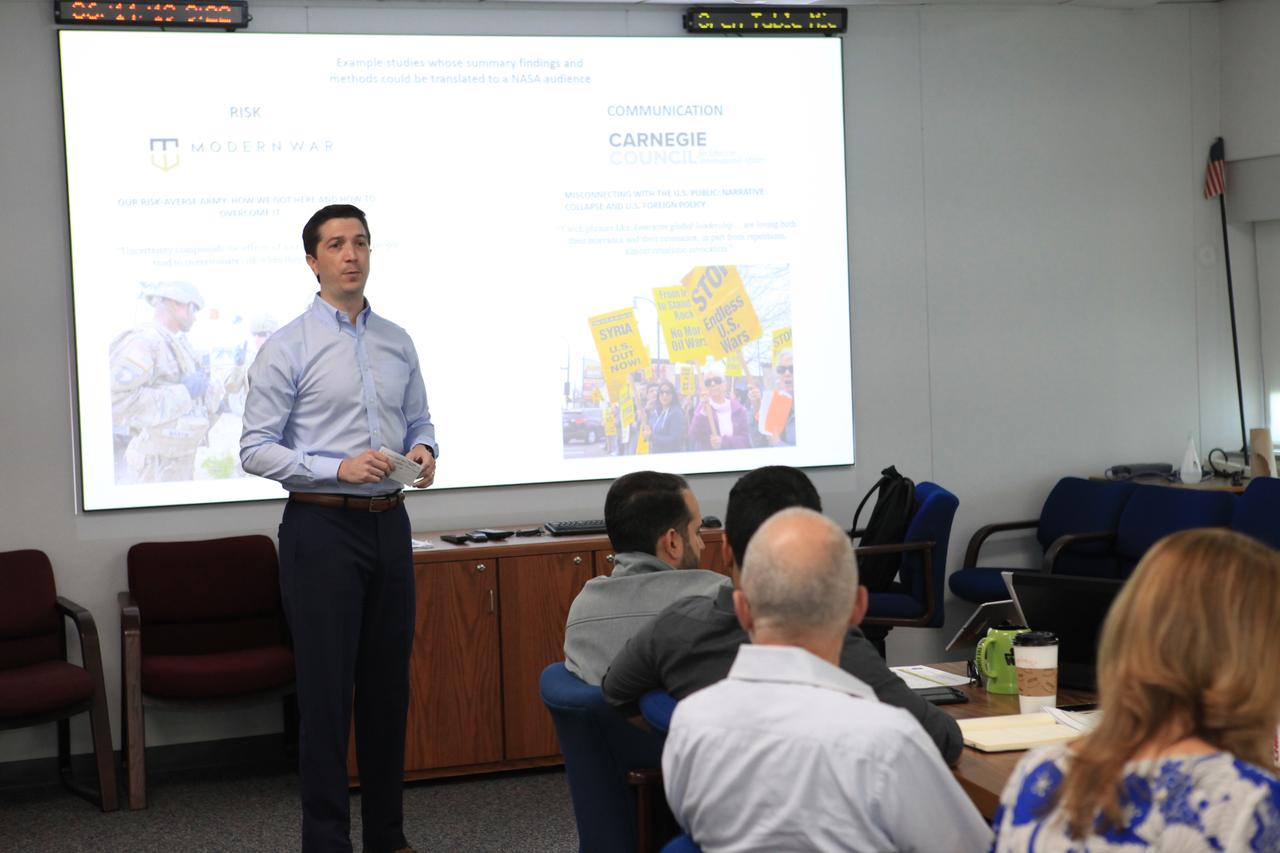
Pathways intern Douglas Jackson presents his proposal to a panel of judges during the “Innovation Without Boundaries” event held inside the Space Station Processing Facility at Kennedy Space Center in Florida on June 14, 2019. A number of Kennedy employees presented their proposals as part of the Chief Technologist Innovation Call. Representatives from across Kennedy evaluated ideas based on relevance, benefit, innovativeness, likelihood of success and sustainability.
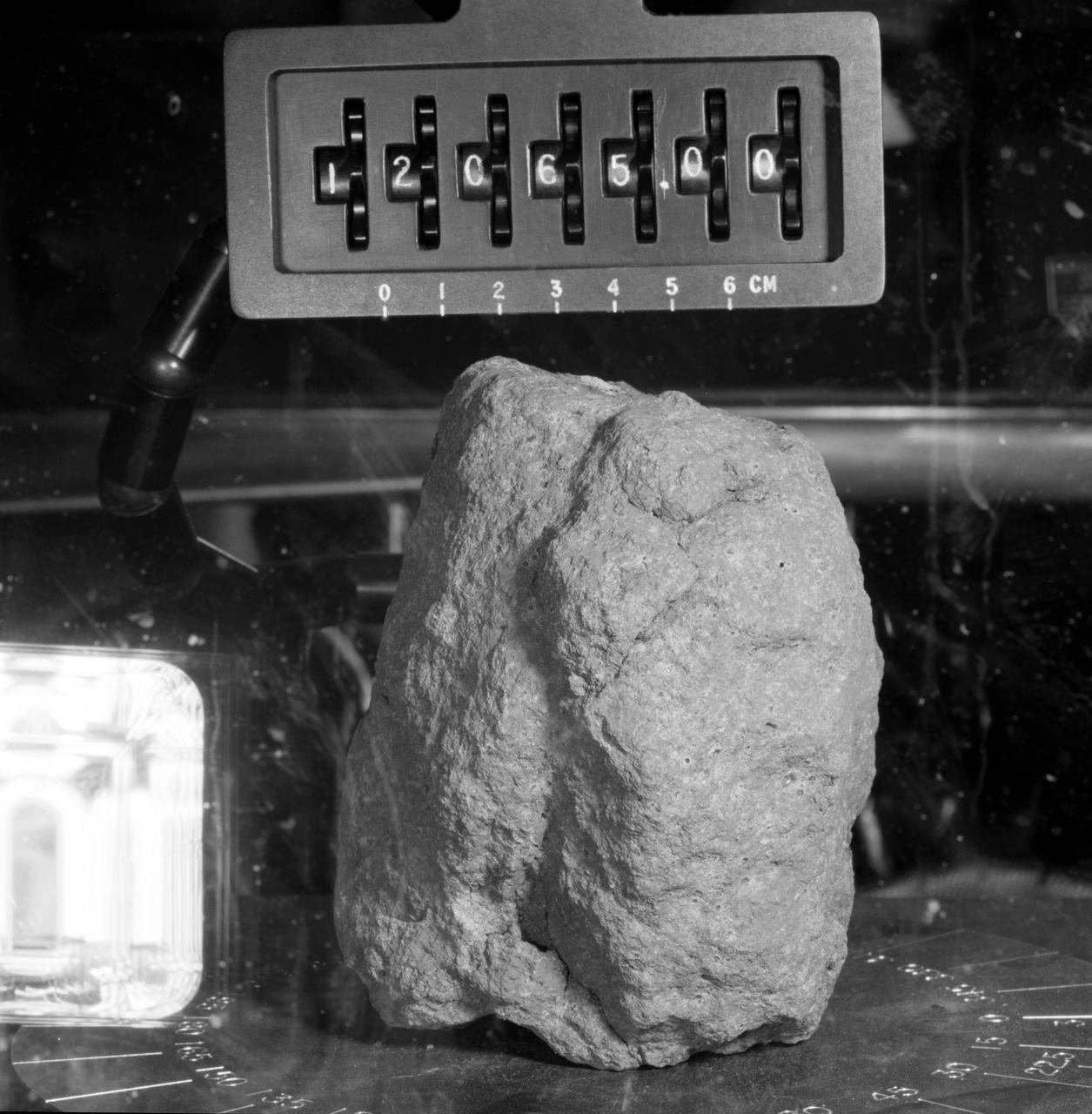
S69-60580 (November 1969) --- Close-up view of Apollo 12 sample 12,065 under observation in the Manned Spacecraft Center's (MSC) Lunar Receiving Laboratory (LRL). This sample, collected during the second Apollo 12 extravehicular activity (EVA) of astronauts Charles Conrad Jr. and Alan L. Bean, is a fine-grained rock. Note the glass-lined pits. Viewer can gain an idea of the size of the rock by reference to the gauge on the bottom portion of the number meter.
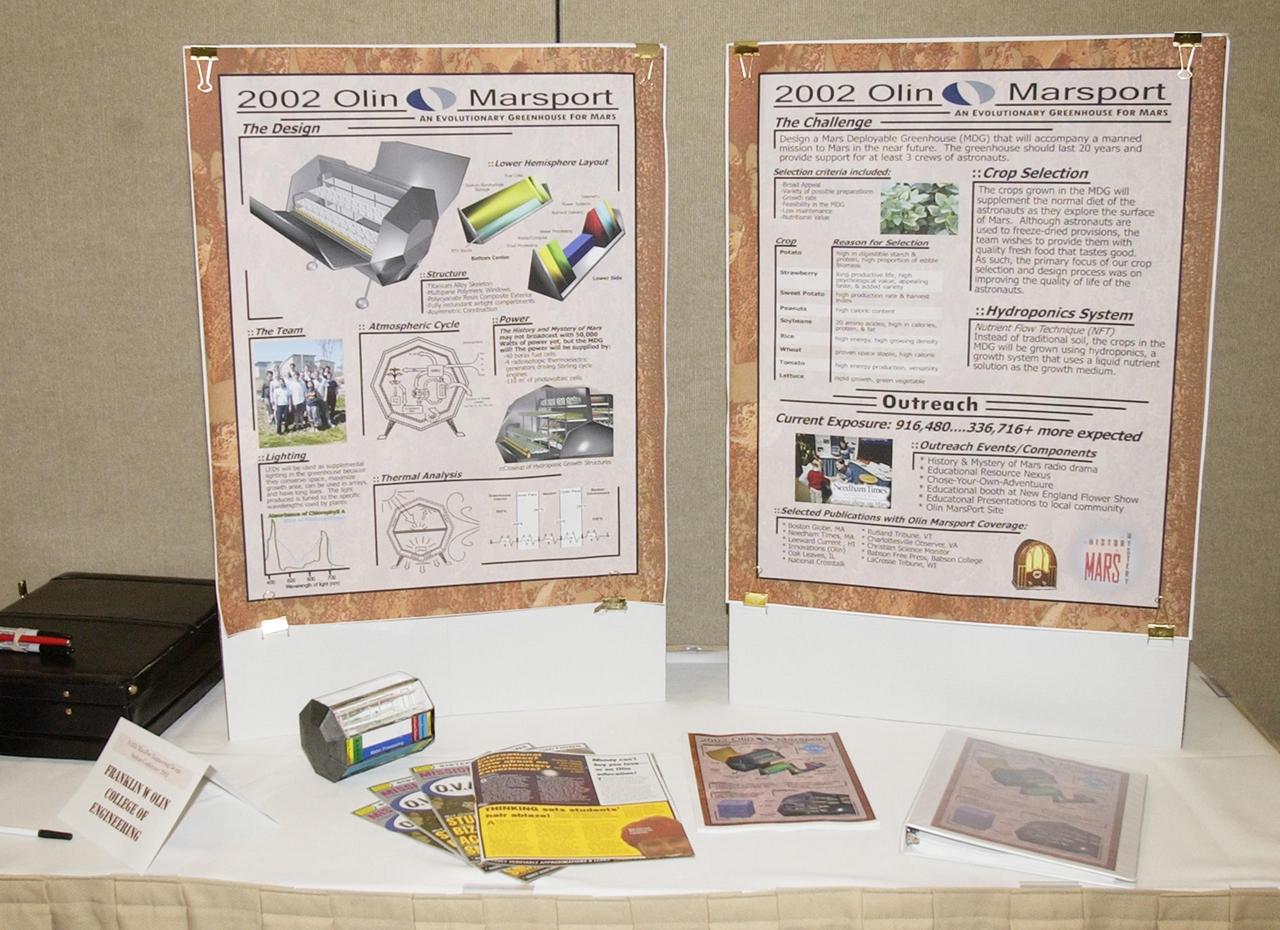
KENNEDY SPACE CENTER, FLA. -- A presentation by Franklin W. Olin College of Engineering is on display at the KSC Visitor Complex for this year's NASA MarsPort Engineering Design Student Competition 2002 conference. Participants are presenting papers on engineering trade studies to design optimal configurations for a MarsPort Deployable Greenhouse for operation on the surface of Mars. Judges in the competition were from KSC, Dynamac Corporation and Florida Institute of Technology. The winning team's innovative ideas will be used by NASA to evaluate and study other engineering trade concepts
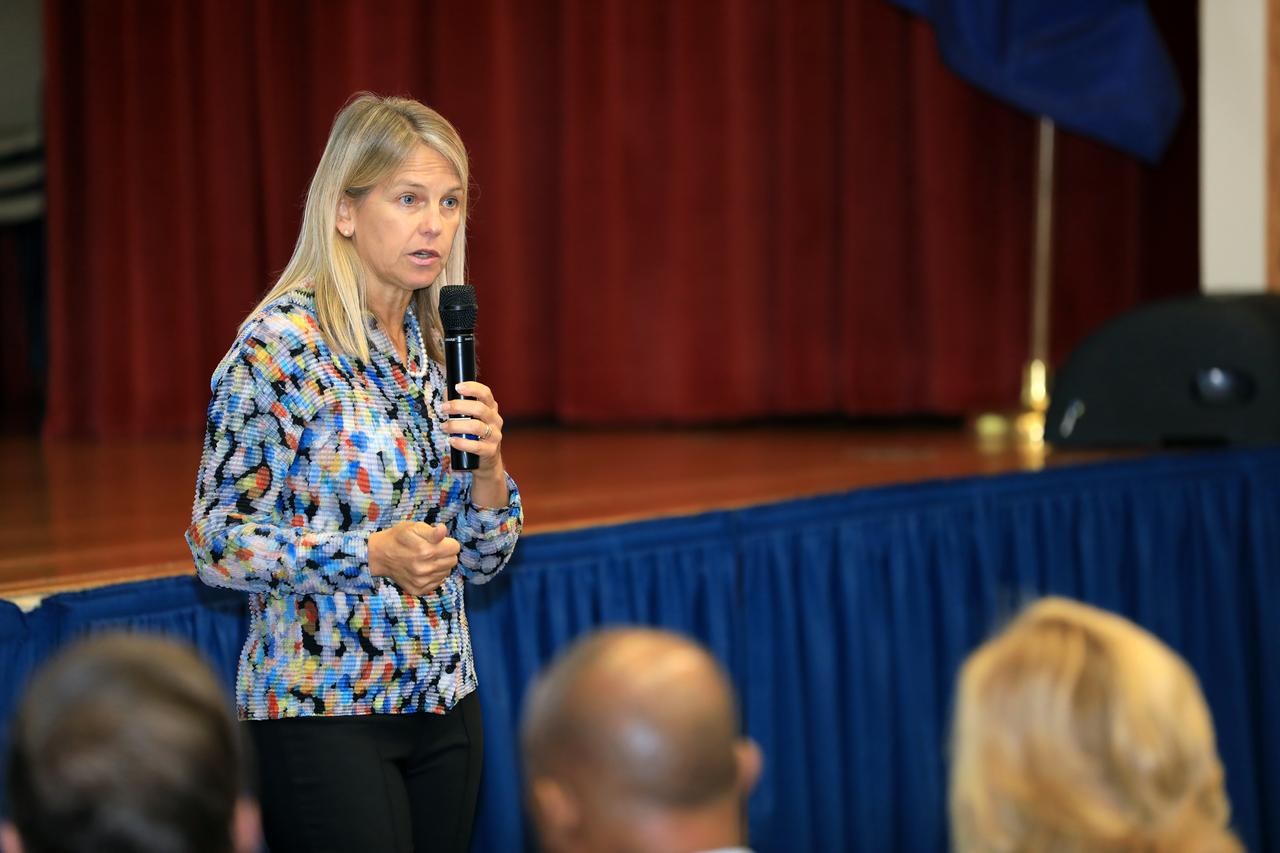
Dr. Dava Newman, NASA's deputy administrator, speaks to employees at the Florida spaceport during the annual KickStart Innovation Expo. The event gives employees an opportunity to present proposals for new ideas and processes. A small amount of funding is awarded to those selected allowing individuals or teams to procure needed items to implement their projects. Kennedy employees are encouraged to look for ways to do their work better and to propose concepts for tackling future mission needs.
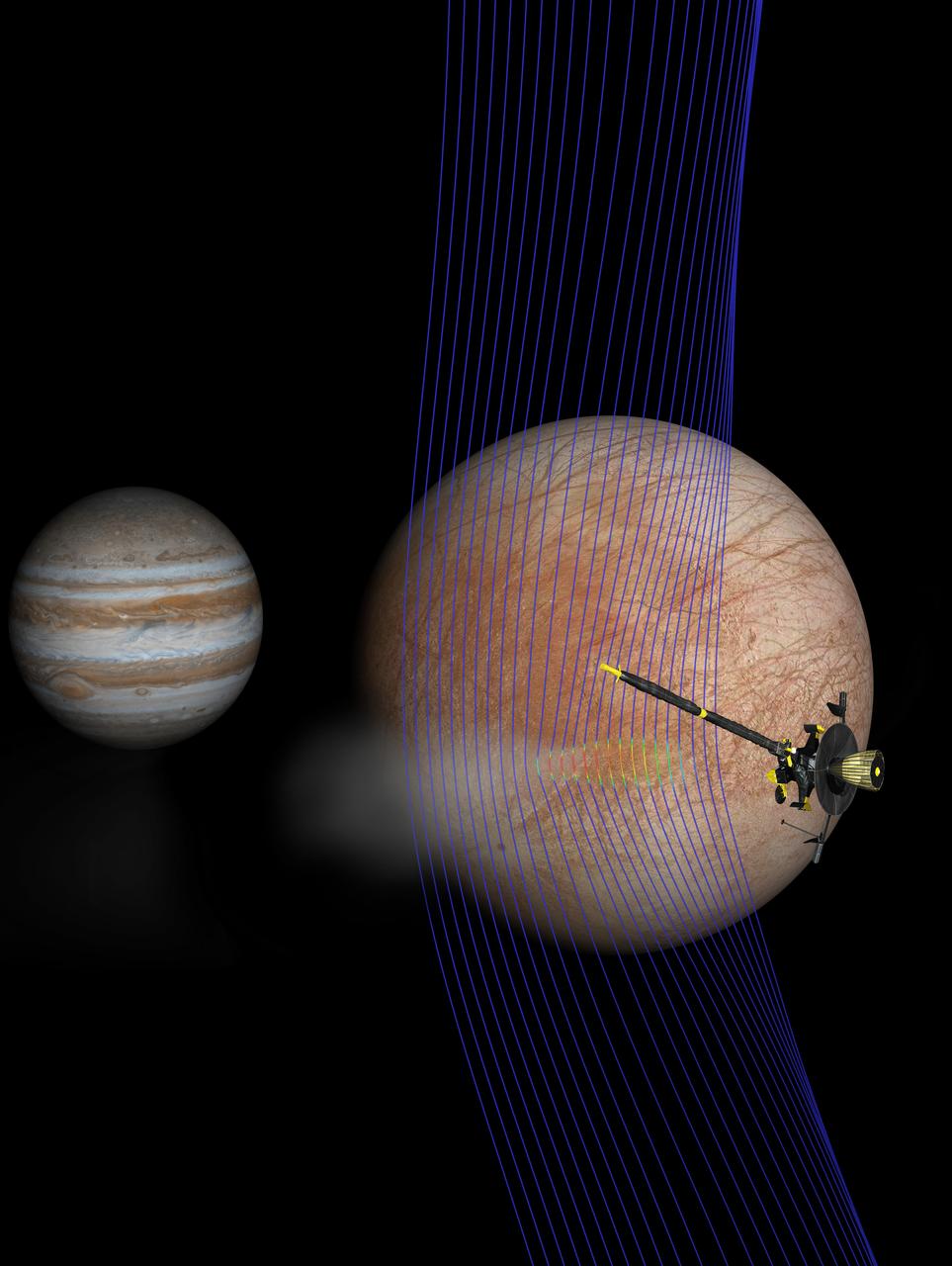
Artist's illustration of Jupiter and Europa (in the foreground) with the Galileo spacecraft after its pass through a plume erupting from Europa's surface. A new computer simulation gives us an idea of how the magnetic field interacted with a plume. The magnetic field lines (depicted in blue) show how the plume interacts with the ambient flow of Jovian plasma. The red colors on the lines show more dense areas of plasma. https://photojournal.jpl.nasa.gov/catalog/PIA21922
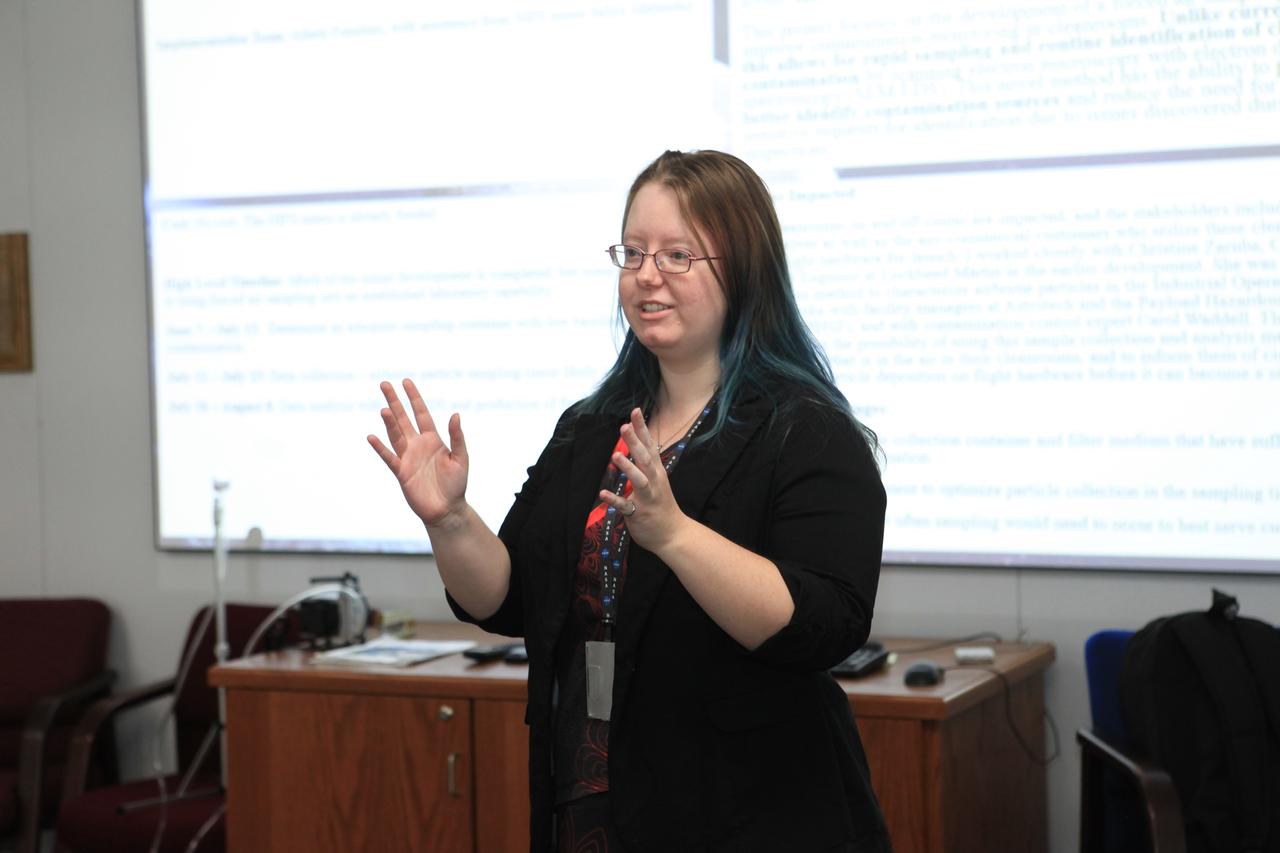
Athela Frandsen, an aerospace technologist with Kennedy Space Center’s analytical laboratories, presents her proposal concerning proactive approaches to cleanroom contamination to representatives from programs across Kennedy during the “Innovation Without Boundaries” event held inside the Space Station Processing Facility in Florida on June 14, 2019. A number of Kennedy employees presented their proposals as part of the Chief Technologist Innovation Call. The event sought out ideas based on relevance, benefit, innovativeness, likelihood of success and sustainability.
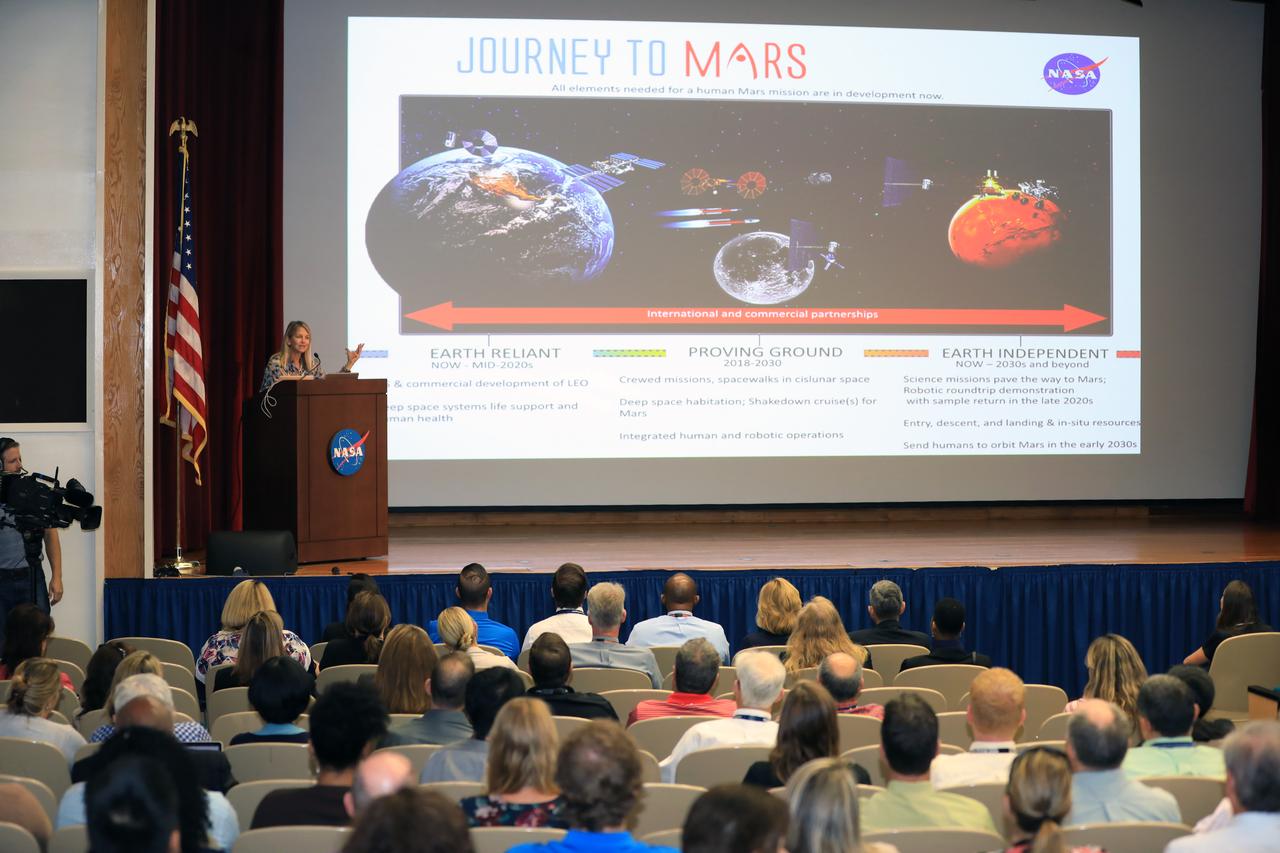
Dr. Dava Newman, NASA's deputy administrator, speaks to employees at the Florida spaceport during the annual KickStart Innovation Expo. The event gives employees an opportunity to present proposals for new ideas and processes. A small amount of funding is awarded to those selected allowing individuals or teams to procure needed items to implement their projects. Kennedy employees are encouraged to look for ways to do their work better and to propose concepts for tackling future mission needs.
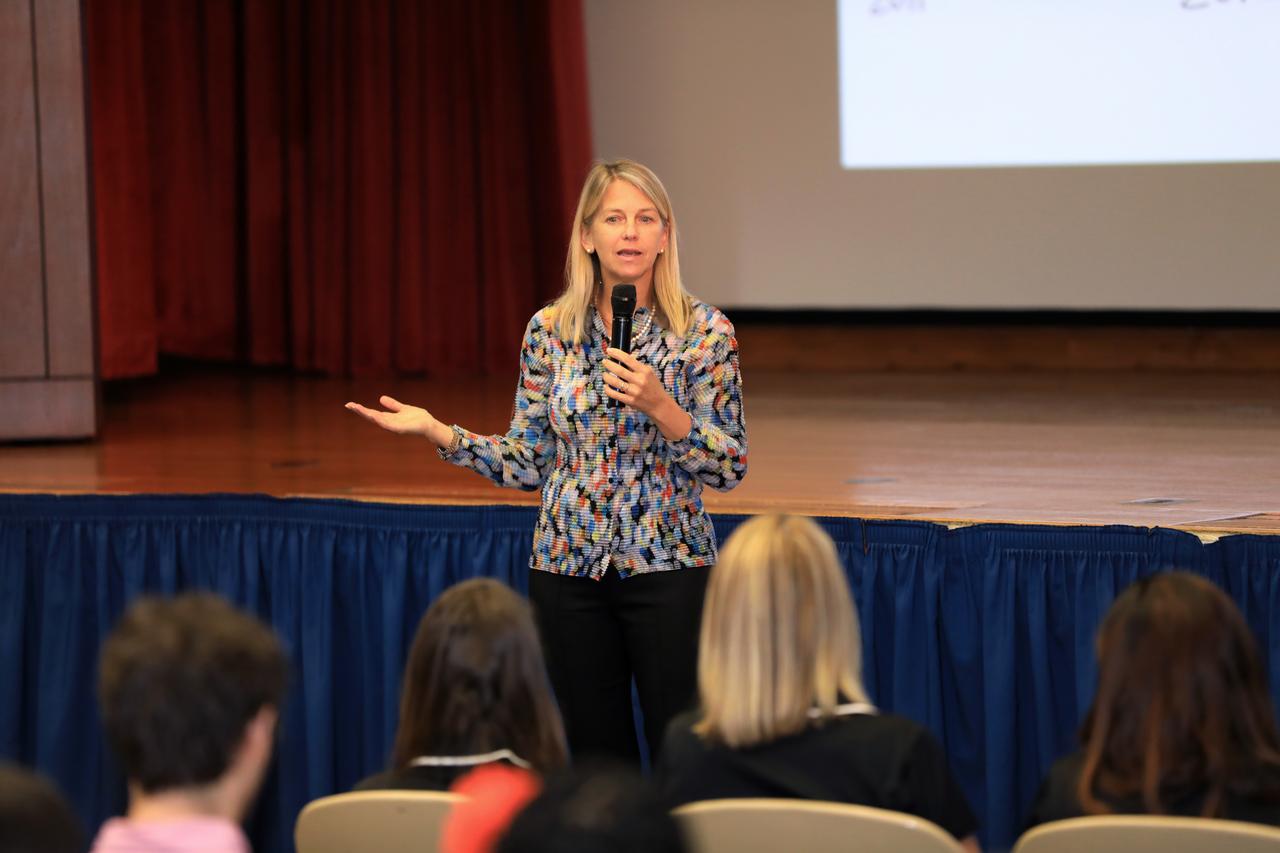
Dr. Dava Newman, NASA's deputy administrator, speaks to employees at the Florida spaceport during the annual KickStart Innovation Expo. The event gives employees an opportunity to present proposals for new ideas and processes. A small amount of funding is awarded to those selected allowing individuals or teams to procure needed items to implement their projects. Kennedy employees are encouraged to look for ways to do their work better and to propose concepts for tackling future mission needs.
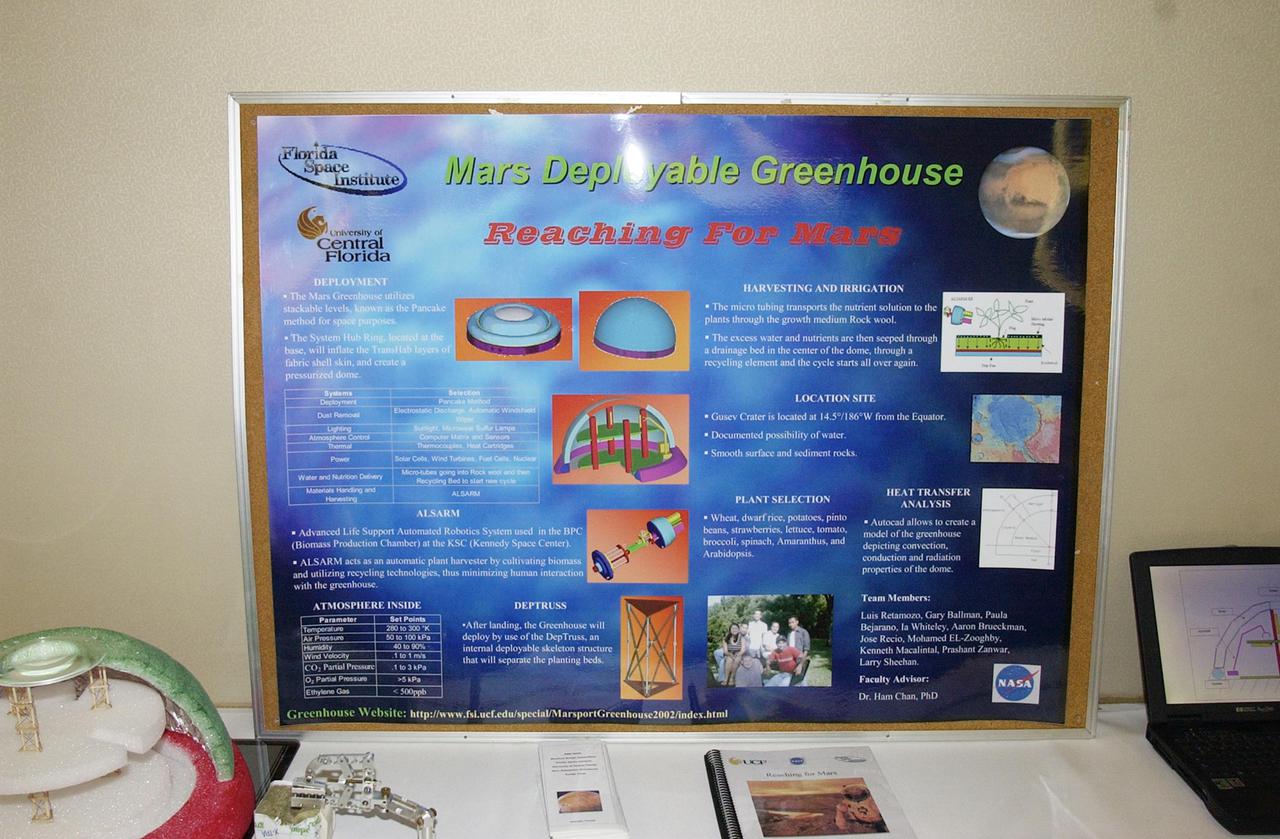
KENNEDY SPACE CENTER, FLA. -- A presentation by the University of Central Florida is on display at the KSC Visitor Complex for this year's NASA MarsPort Engineering Design Student Competition 2002 conference. Participants are presenting papers on engineering trade studies to design optimal configurations for a MarsPort Deployable Greenhouse for operation on the surface of Mars. Judges in the competition were from KSC, Dynamac Corporation and Florida Institute of Technology. The winning team's innovative ideas will be used by NASA to evaluate and study other engineering trade concepts.
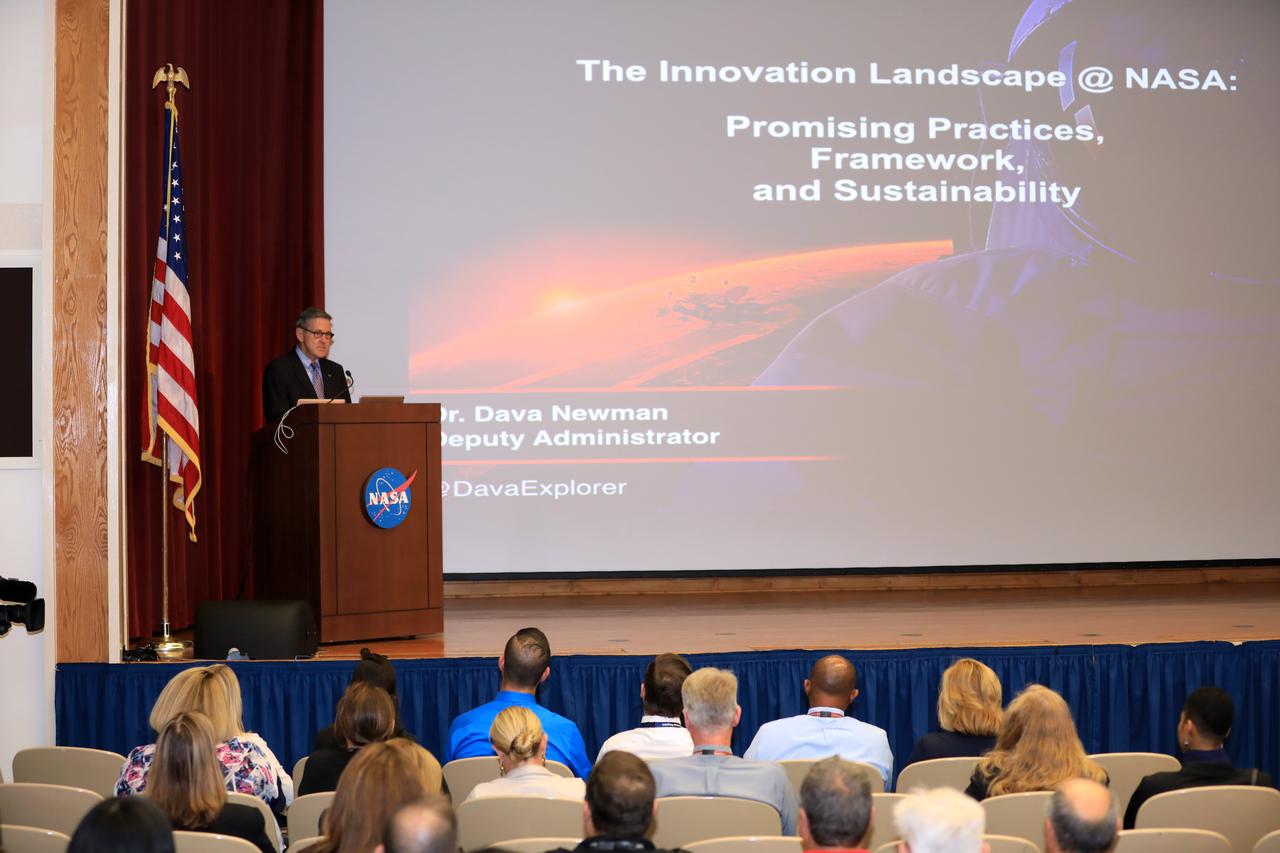
Kennedy Space Center Director Bob Cabana speaks to employees at the Florida spaceport during the annual KickStart Innovation Expo. The event gives employees an opportunity to present proposals for new ideas and processes. A small amount of funding is awarded to those selected allowing individuals or teams to procure needed items to implement their projects. Kennedy employees are encouraged to look for ways to do their work better and to propose concepts for tackling future mission needs.
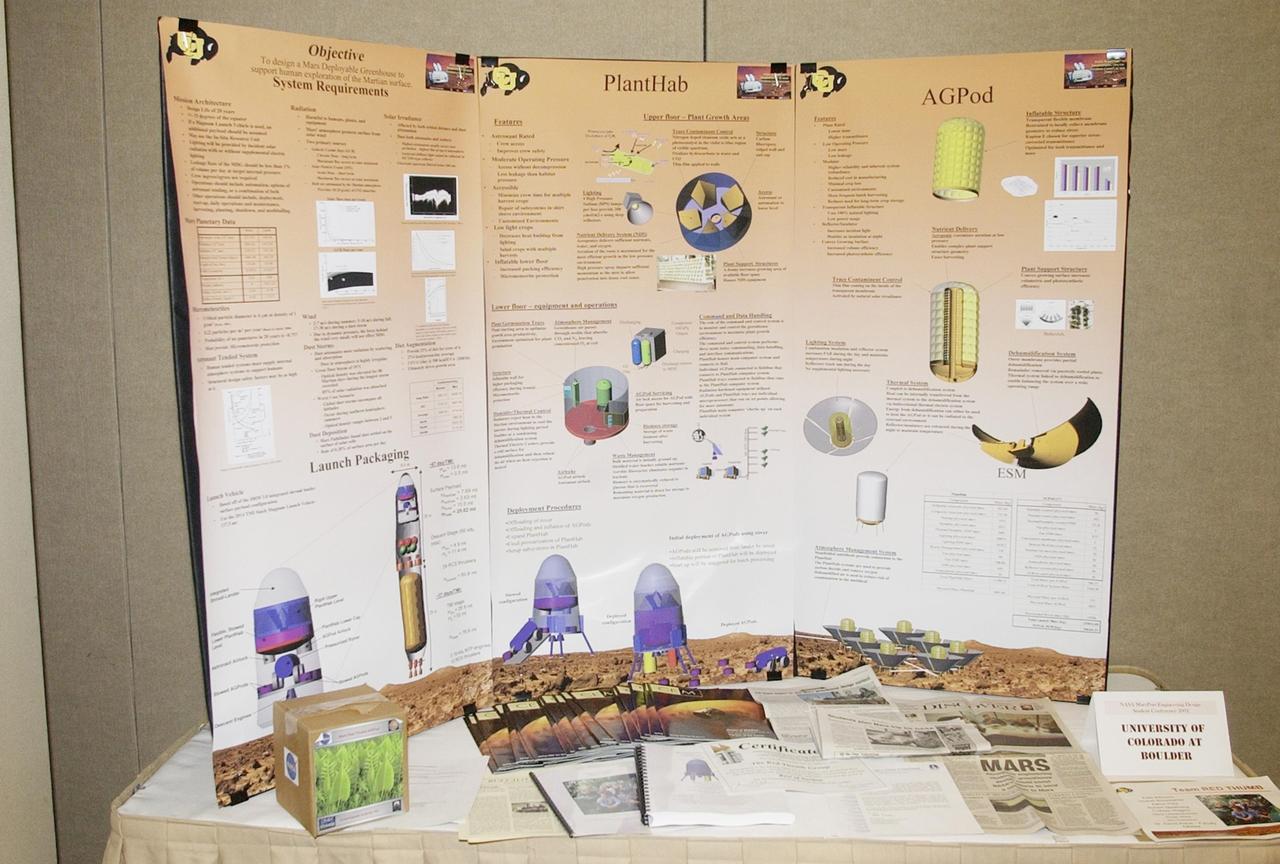
KENNEDY SPACE CENTER, FLA. -- During this year's NASA MarsPort Engineering Design Student Competition 2002 conference, the University of Colorado at Boulder presents this display. Participants are presenting papers on engineering trade studies to design optimal configurations for a MarsPort Deployable Greenhouse for operation on the surface of Mars. Judges in the competition were from KSC, Dynamac Corporation and Florida Institute of Technology. The winning team's innovative ideas will be used by NASA to evaluate and study other engineering trade concepts.

“I have to be honest, NASA had not really been on my radar until it just was. I went to grad school and in graduate school I actually studied myotonic dystrophy. At the end of my graduate school years I decided I want to go into public service. I applied for this thing called the Presidential Management Fellowship and NASA had an opening! I thought to myself ‘Oh this could be so interesting! They run so many technology and science programs. I'll apply and see what happens.’ “Lo and behold, I got an interview! I was so excited and the idea of working at an agency at NASA blew me out of the water and I said, ‘I am totally taking this.’ “I had a mentor say something to me that I think rings really true. He said, ‘when you work in public service, there’s no doubt that you’re doing the right thing.’ I think that idea drove me to public service. When you work for a company -- there’s absolutely nothing wrong with that, but you’re really helping the company to meet its bottom line. When you work for a federal agency or a state agency, you’re working to ensure the needs are met for the public. You're really doing something to benefit others. It’s not to benefit the company and many times it’s not just for yourself, so you always know you’re doing the right thing. I think what drove me was the idea of being able to do something that felt intrinsically fulfilling.” Dr. Ruth Siboni, executive officer for the Human Exploration and Operations (HEO) mission directorate poses for a photo, Monday, October 5, 2020 on the National Mall in Washington, DC. Photo Credit: (NASA/Aubrey Gemignani)
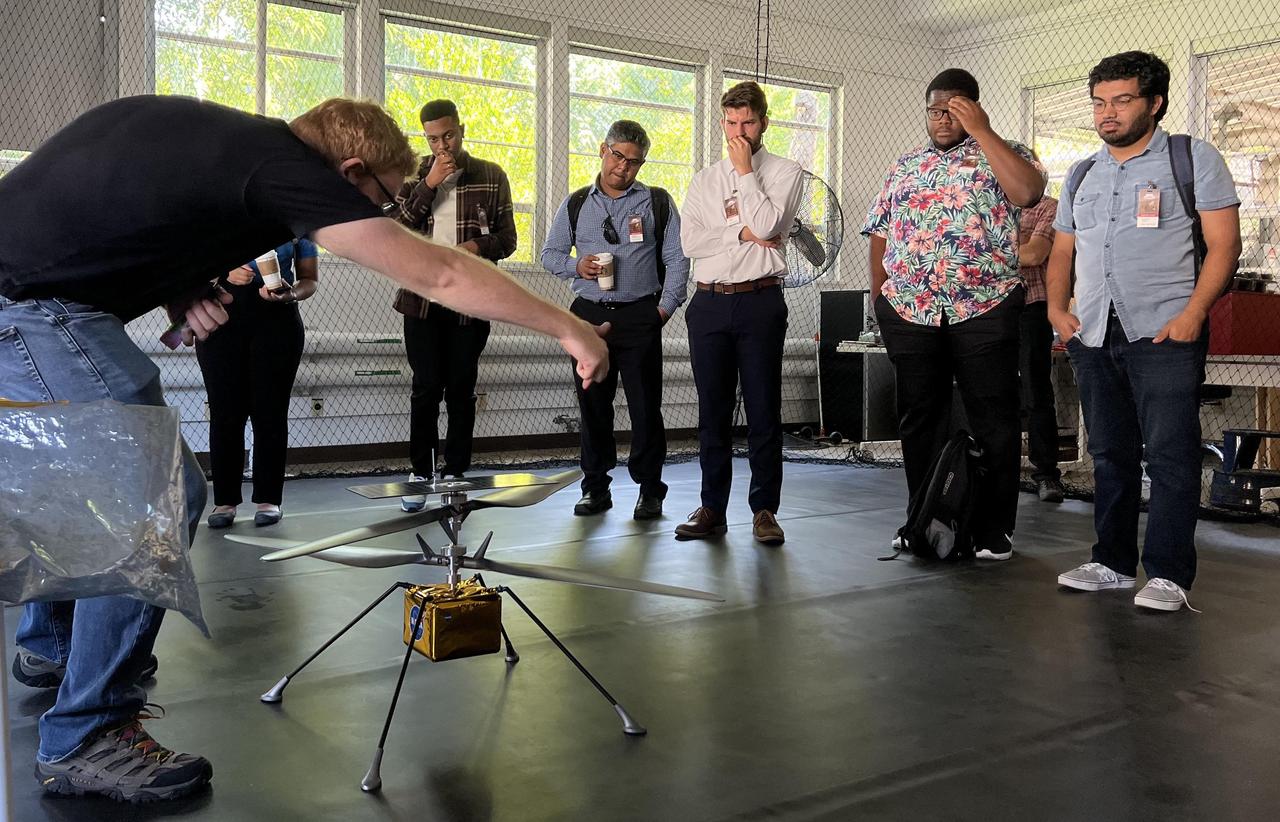
Participants in NASA's Minority Serving Institutions Space Accelerator program surround a full-scale model of NASA's Mars Ingenuity Helicopter as engineer Michael Starch discusses the mission. The group was visiting NASA's Jet Propulsion Laboratory on Aug. 18, 2022. These participants were members of three teams named as awardees in the first-of-its-kind accelerator program, a competition to advance the NASA's goals and meet its needs in the areas of machine learning, artificial intelligence, and development of autonomous systems while also engaging underrepresented academic institutions and reducing barriers for them to submit ideas to the agency. The program provides funding, business training through a 10-week accelerator course, and mentorship to help the teams develop ideas for systems that can operate without human oversight for future science missions in space and on Earth. The teams were made up of professors and students from Fayetteville State University in North Carolina, University of Massachusetts Boston, and California State University, Northridge. At the conclusion of the accelerator, participants arrived in Southern California for a variety of events, including two days at JPL. The program is a partnership between NASA's Science Mission Directorate, its Earth Science Technology Office, the Minority University Research Education Project within the agency's Office of STEM Engagement, JPL, and Starburst, a global aerospace accelerator company based in Los Angeles. https://photojournal.jpl.nasa.gov/catalog/PIA25315
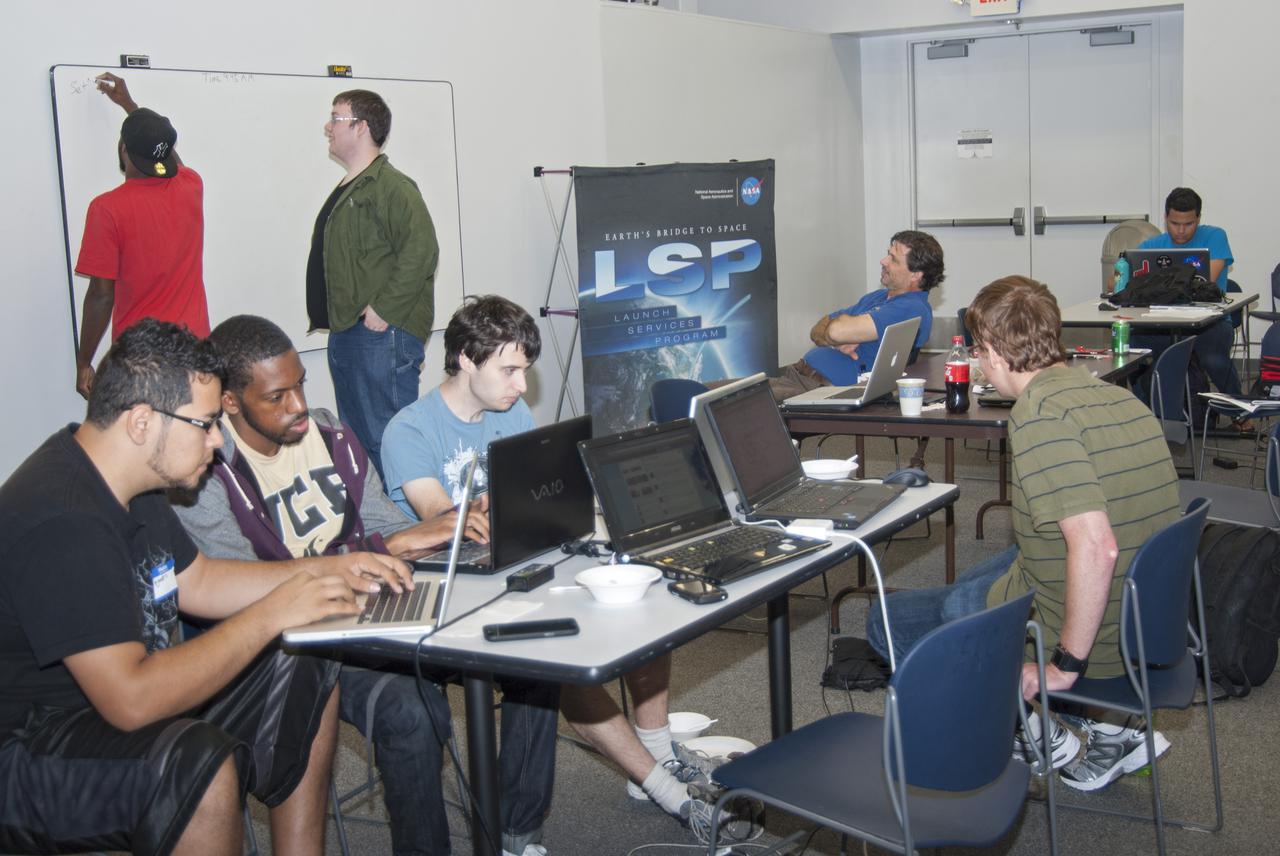
CAPE CANAVERAL, Fla. – Students from the University of Florida, the University of Central Florida, the University of Puerto Rico and private citizens brainstorm ideas during the 2013 International Space Apps Challenge, or ISAC, at The Astronaut Memorial Foundation’s Center for Space Education in Florida. Seated near the Launch Services Program poster is NASA subject matter expert Dr. Phil Metzger from Kennedy Space Center’s Swampworks Laboratory. During the worldwide two-day challenge, more than 9,000 people and 484 organizations came together in 83 cities across 44 countries, as well as online, to develop new ways of solving challenges that NASA faces. At Kennedy, four teams brainstormed ideas with subject matter experts and others and worked nearly 32 hours straight to present their concepts to a panel of three technical and non-technical judges. Challenges tackled at Kennedy were: Deployable Greenhouse, Kennedy Space Center 2040, Seven Minutes of Science, and Moonville – Lunar Industry Game. Photo credit: NASA_Charisse Nahser
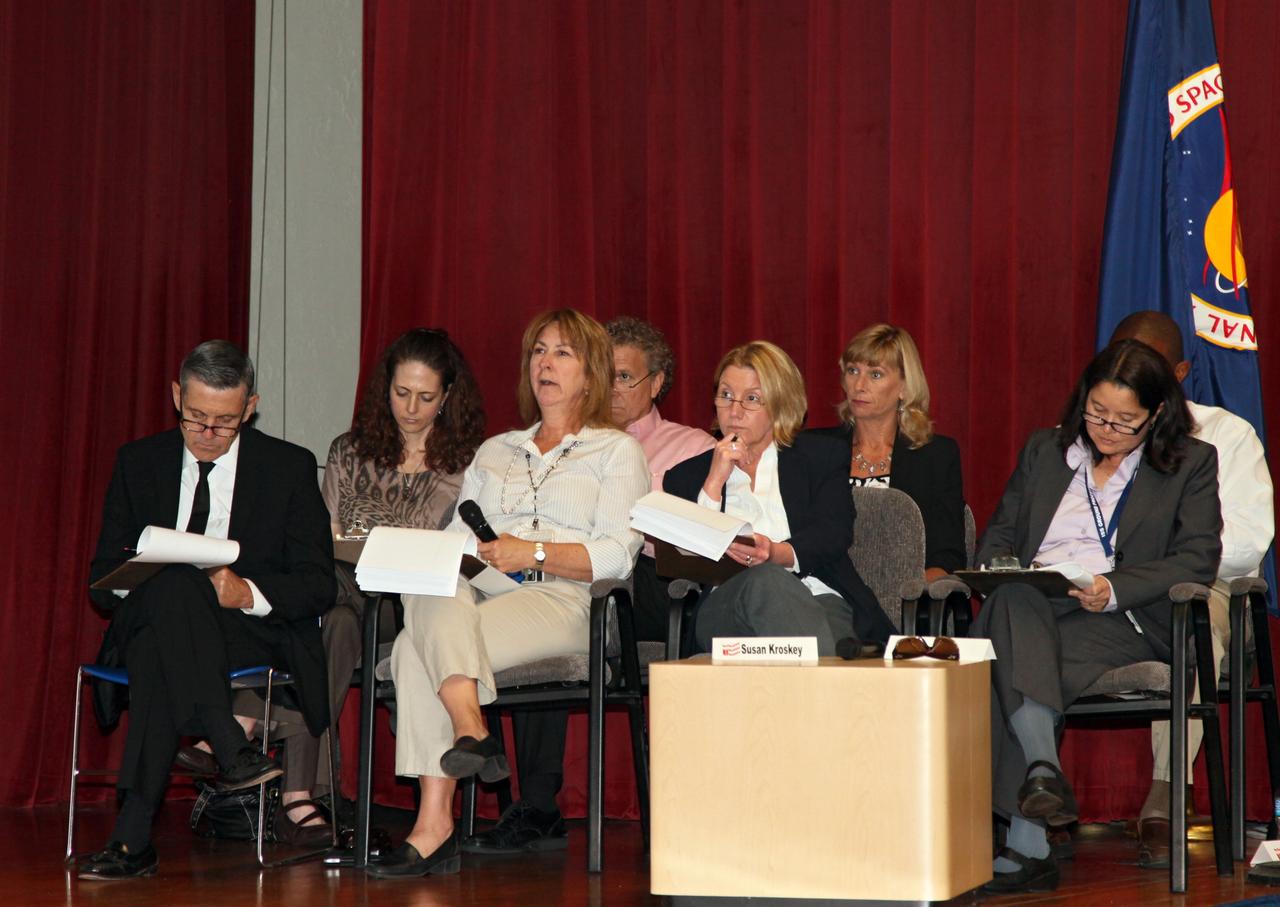
CAPE CANAVERAL, Fla. – An eight-member Kick-Start selection panel listens during a presentation by a Kennedy Space Center employee. Seated in the front row, left to right, are Bob Cabana, center director, Joyce Riquelme, director of Center Planning and Development, Susan Kroskey, center chief financial officer, and Josephine Burnett, director of International Space Station Ground Processing and Research. Back row, left to right are Tracy Anania Wetrich, director of Human Resources, Russell Romanella, director of Safety and Mission Assurance, Nancy Bray, deputy director of Center Operations, and Kelvin Manning, center associate director. As Kennedy continues developing programs and infrastructure to become a 21st century spaceport, many employees are devising ways to do their jobs better and more efficiently. On Sept. 6, 2012, 16 Kennedy employees pitched their innovative ideas for improving the center at the Kennedy Kick-Start event. The competition was part of a center-wide effort designed to increase exposure for innovative ideas and encourage their implementation. For more information, visit http://www.nasa.gov/centers/kennedy/news/kick-start_competition.html Photo credit: NASA/Gianni Woods
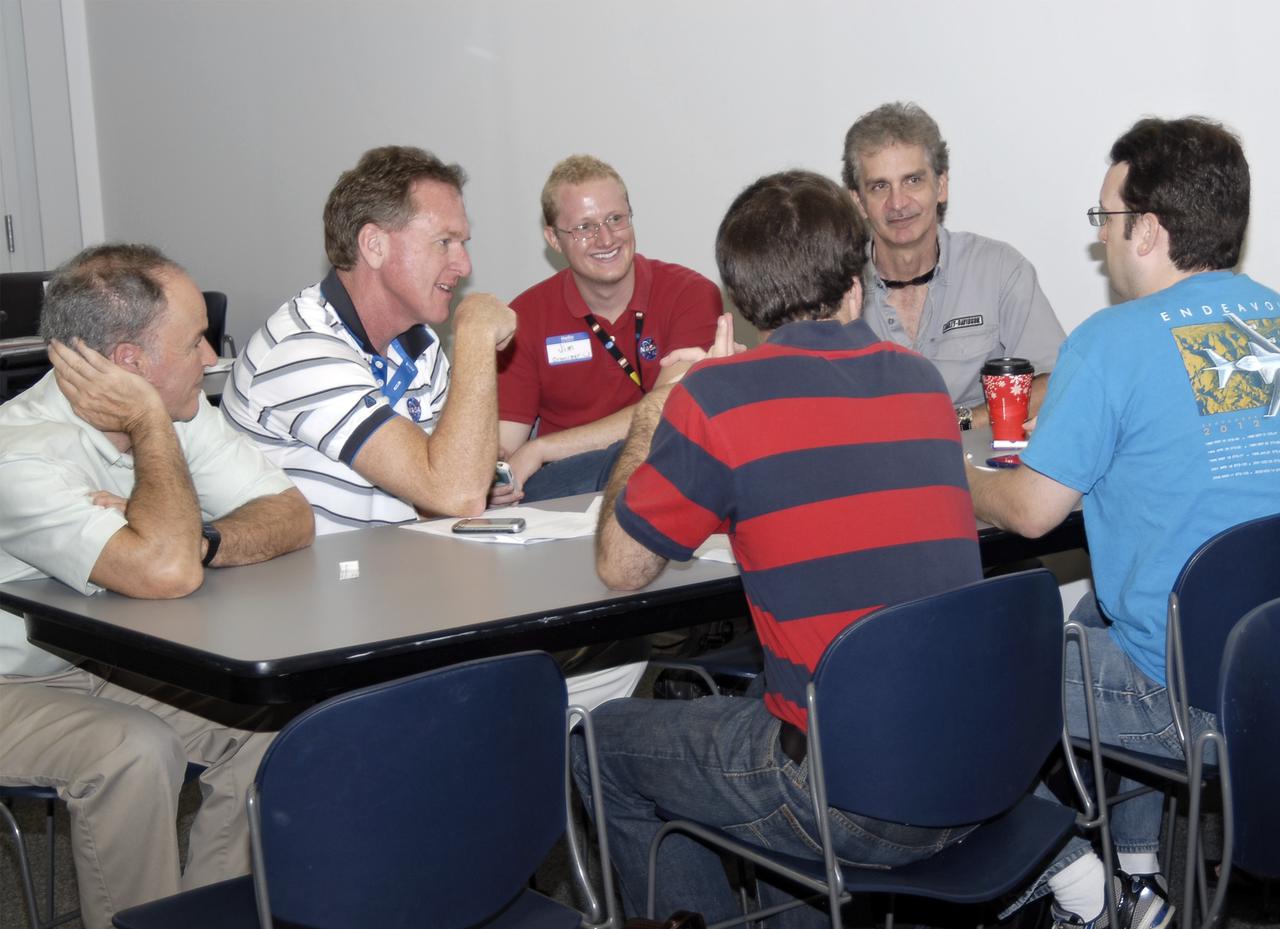
CAPE CANAVERAL, Fla. – Subject matter experts, event volunteers and participants discuss ideas during the 2013 International Space Apps Challenge at the Center for Space Education at the Kennedy Space Center Visitor Complex in Florida. From left, are Dr. Ray Wheeler, NASA subject matter expert Mike Bolger, Kennedy’s Information Technology director Jim Wood, event volunteer challenge participants Pat Starace and Mike King from Orlando and David Thorpe in Kennedy’s Center Planning and Development Directorate. During the worldwide two-day challenge, more than 9,000 people and 484 organizations came together in 83 cities across 44 countries, as well as online, to develop new ways of solving challenges that NASA faces. At Kennedy, four teams brainstormed ideas with subject matter experts and others and worked nearly 32 hours straight to present their concepts to a panel of three technical and non-technical judges. Challenges tackled at Kennedy were: Deployable Greenhouse, Kennedy Space Center 2040, Seven Minutes of Science, and Moonville – Lunar Industry Game. Photo credit: NASA_Charisse Nahser
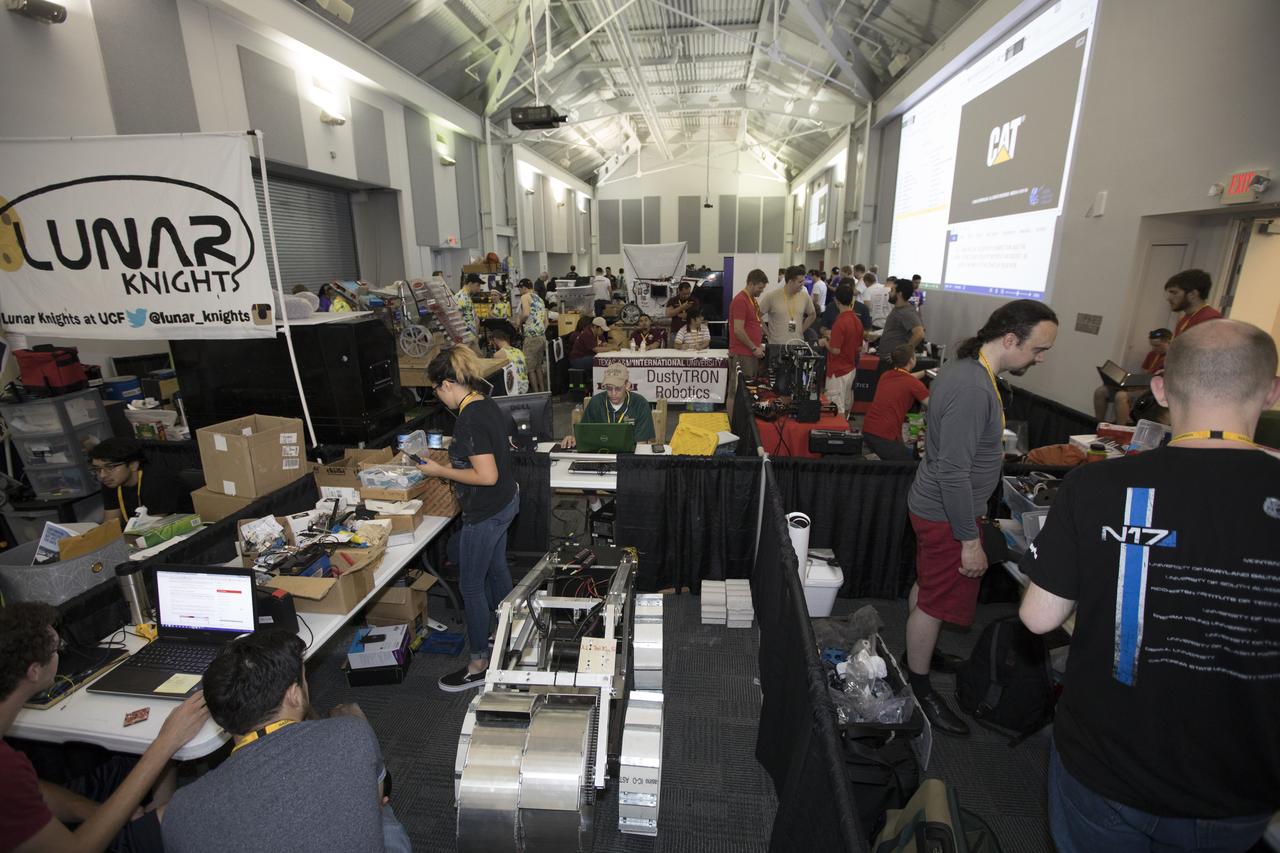
Energy levels are high in the RoboPit as teams prepare for NASA's 8th Annual Robotic Mining Competition at the Kennedy Space Center Visitor Complex in Florida. More than 40 student teams from colleges and universities around the U.S. arel using their mining robots to dig in a supersized sandbox filled with BP-1, or simulated Martian soil, and participate in other competition requirements. The Robotic Mining Competition is a NASA Human Exploration and Operations Mission Directorate project designed to encourage students in science, technology, engineering and math, or STEM fields. The project provides a competitive environment to foster innovative ideas and solutions that could be used on NASA's Journey to Mars.
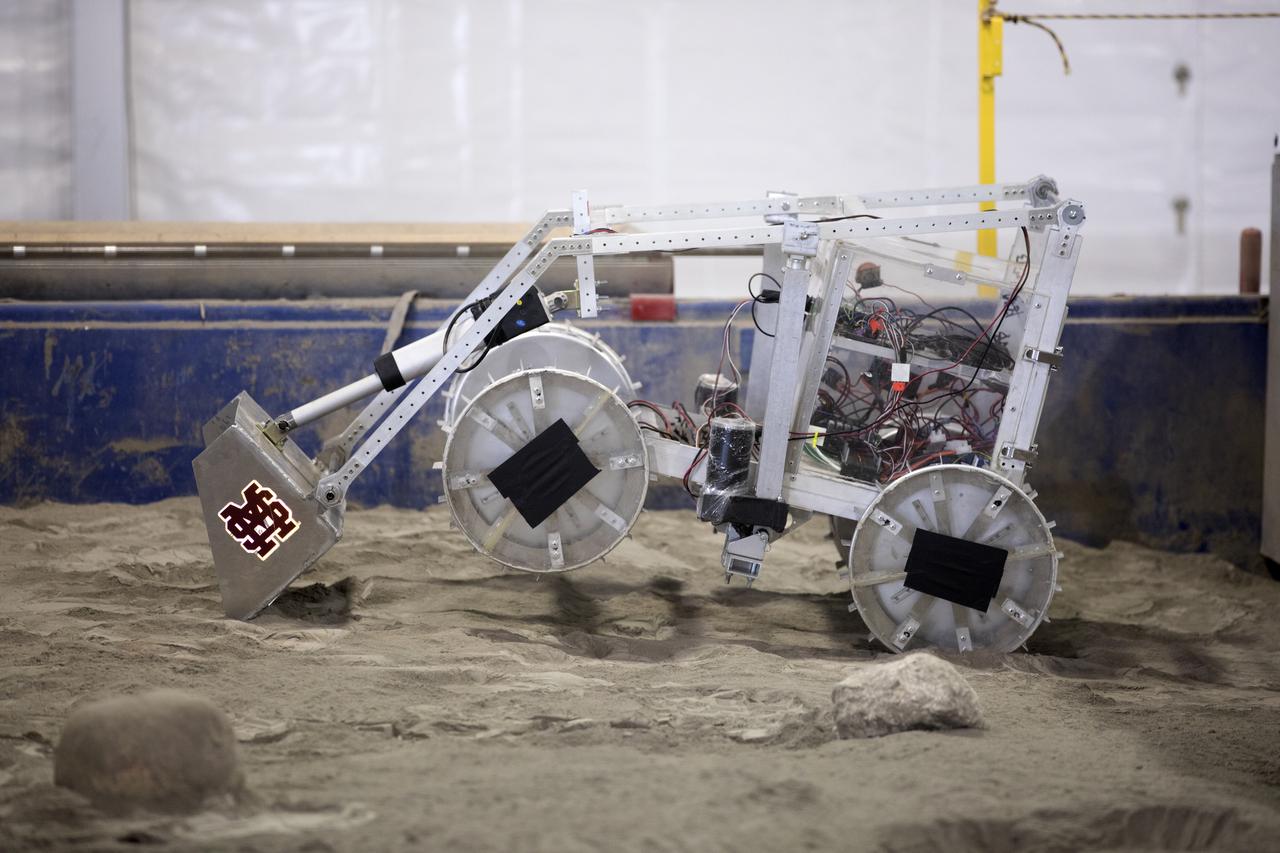
The robotic miner from Mississippi State University digs in the mining arena during NASA's 8th Annual Robotic Mining Competition at the Kennedy Space Center Visitor Complex in Florida. More than 40 student teams from colleges and universities around the U.S. are using their uniquely-designed mining robots to dig in a supersized sandbox filled with BP-1, or simulated Martian soil, and participate in other competition requirements. The Robotic Mining Competition is a NASA Human Exploration and Operations Mission Directorate project designed to encourage students in science, technology, engineering and math, or STEM fields. The project provides a competitive environment to foster innovative ideas and solutions that could be used on NASA's Journey to Mars.
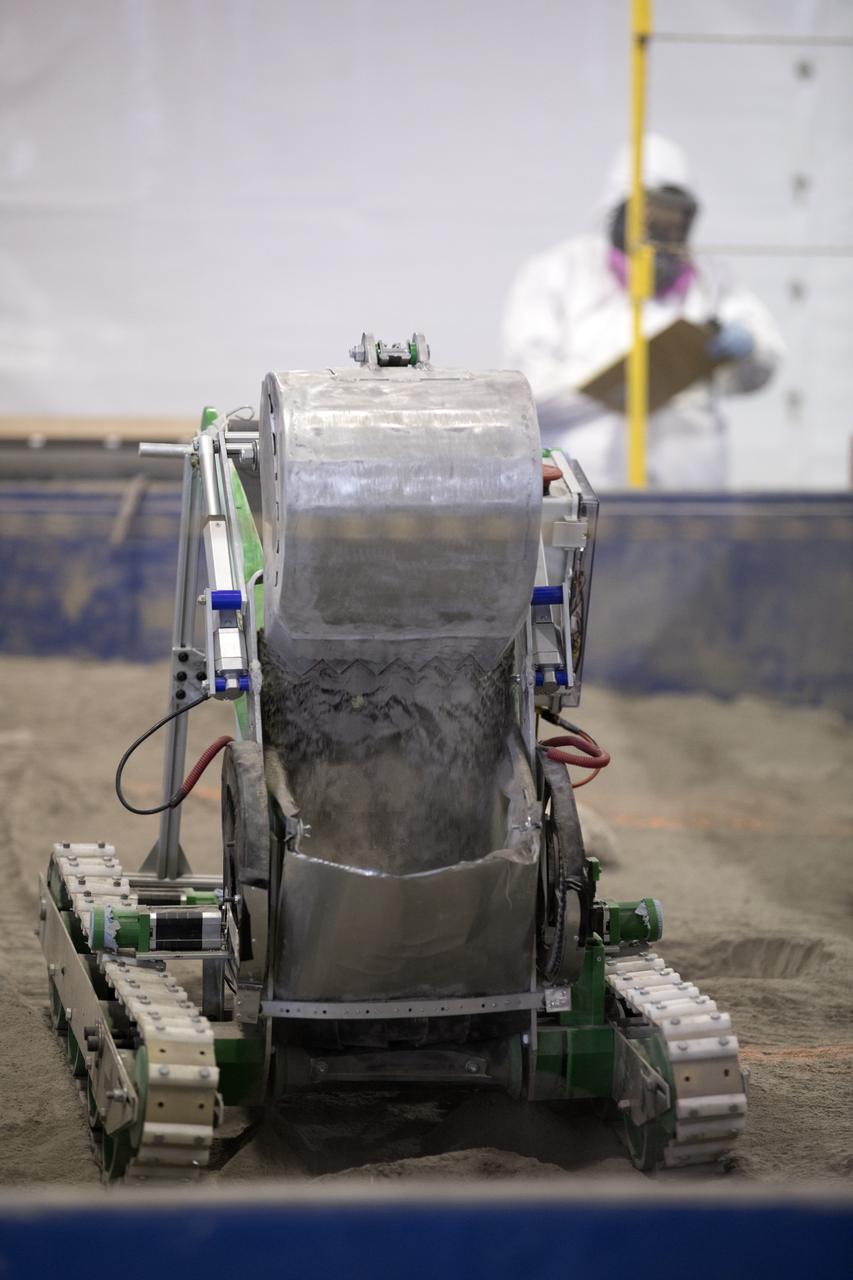
A robotic miner digs in the mining arena during NASA's 8th Annual Robotic Mining Competition at the Kennedy Space Center Visitor Complex in Florida. More than 40 student teams from colleges and universities around the U.S. are using their uniquely-designed mining robots to dig in a supersized sandbox filled with BP-1, or simulated Martian soil, and participate in other competition requirements. The Robotic Mining Competition is a NASA Human Exploration and Operations Mission Directorate project designed to encourage students in science, technology, engineering and math, or STEM fields. The project provides a competitive environment to foster innovative ideas and solutions that could be used on NASA's Journey to Mars.
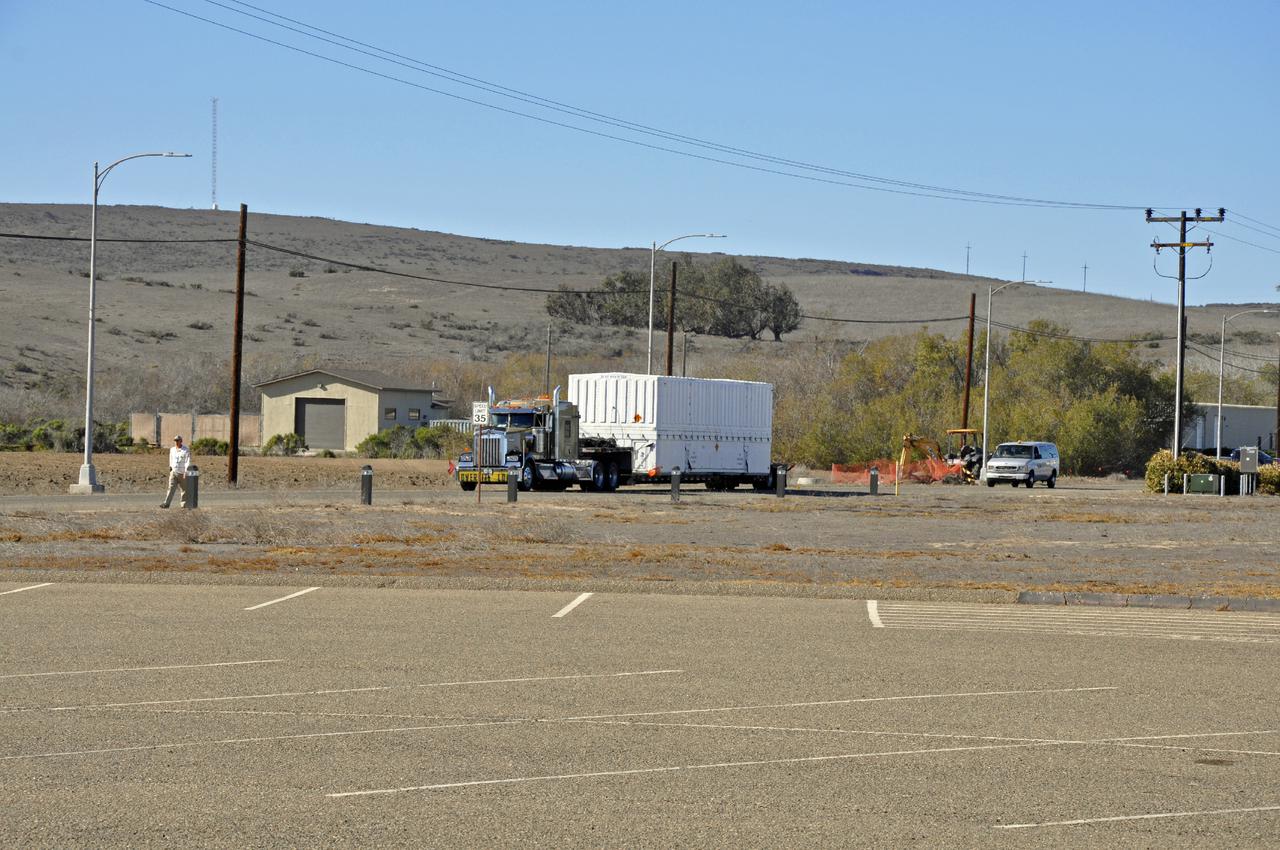
VANDENBERG AIR FORCE BASE, Calif. – The fairing for NASA's Orbiting Carbon Observatory-2, or OCO-2, mission arrives at Vandenberg Air Force Base in California. The fairing will protect OCO-2 during launch aboard a United Launch Alliance Delta II rocket from Space Launch Complex 2 in July. OCO-2 will collect precise global measurements of carbon dioxide in the Earth's atmosphere and provide scientists with a better idea of the chemical compound's impacts on climate change. Scientists will analyze this data to improve our understanding of the natural processes and human activities that regulate the abundance and distribution of this important atmospheric gas. Photo credit: NASA_Randy Beaudoin
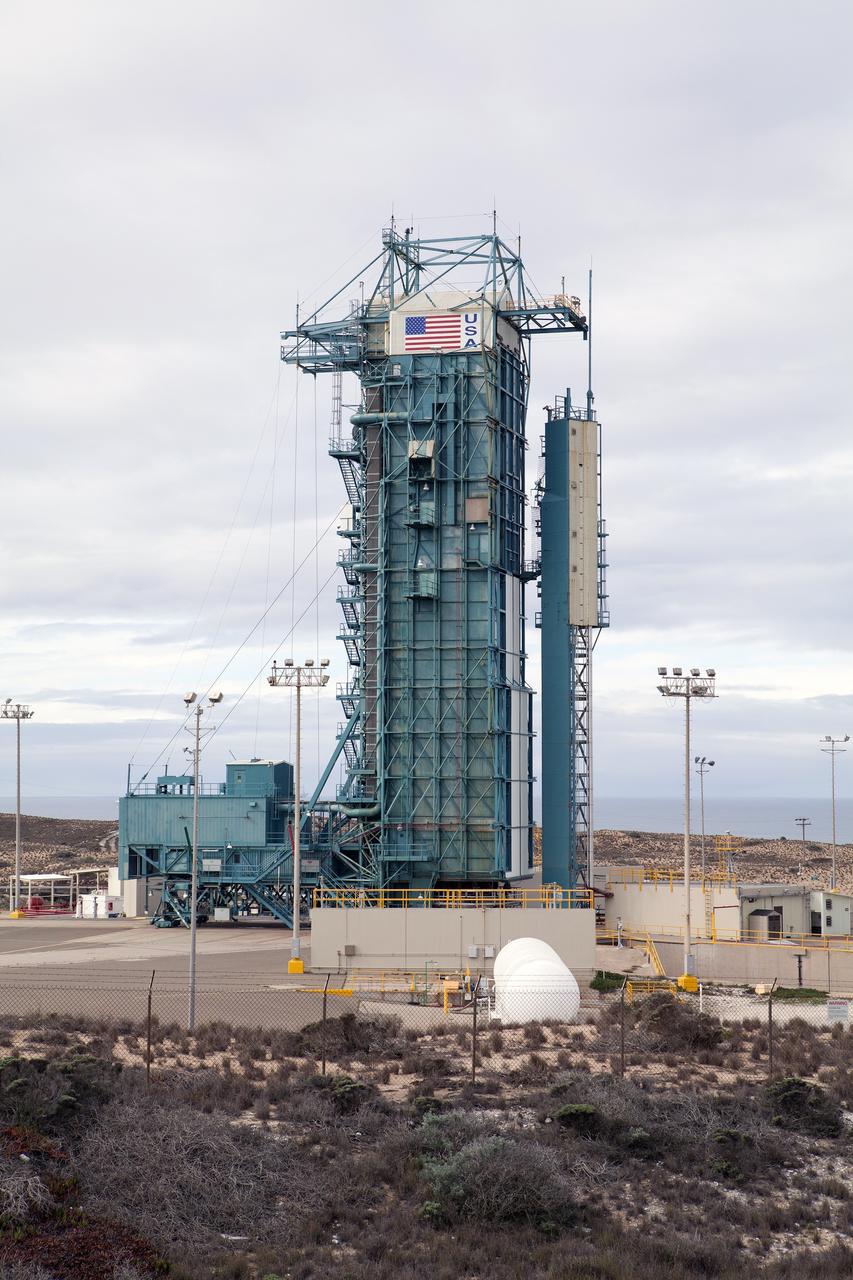
VANDENBERG AIR FORCE BASE, Calif. – An American flag adorns the top of the Delta II launcher at Space Launch Complex 2 on Vandenberg Air Force Base in California where preparations are underway for the upcoming launch of NASA's Orbiting Carbon Observatory-2 mission, or OCO-2, in July. The observatory will collect precise global measurements of carbon dioxide in the Earth's atmosphere and provide scientists with a better idea of the chemical compound's impacts on climate change. Scientists will analyze this data to improve our understanding of the natural processes and human activities that regulate the abundance and distribution of this important atmospheric gas. To learn more about OCO-2, visit http://oco.jpl.nasa.gov. Photo credit: NASA/Kim Shiflett
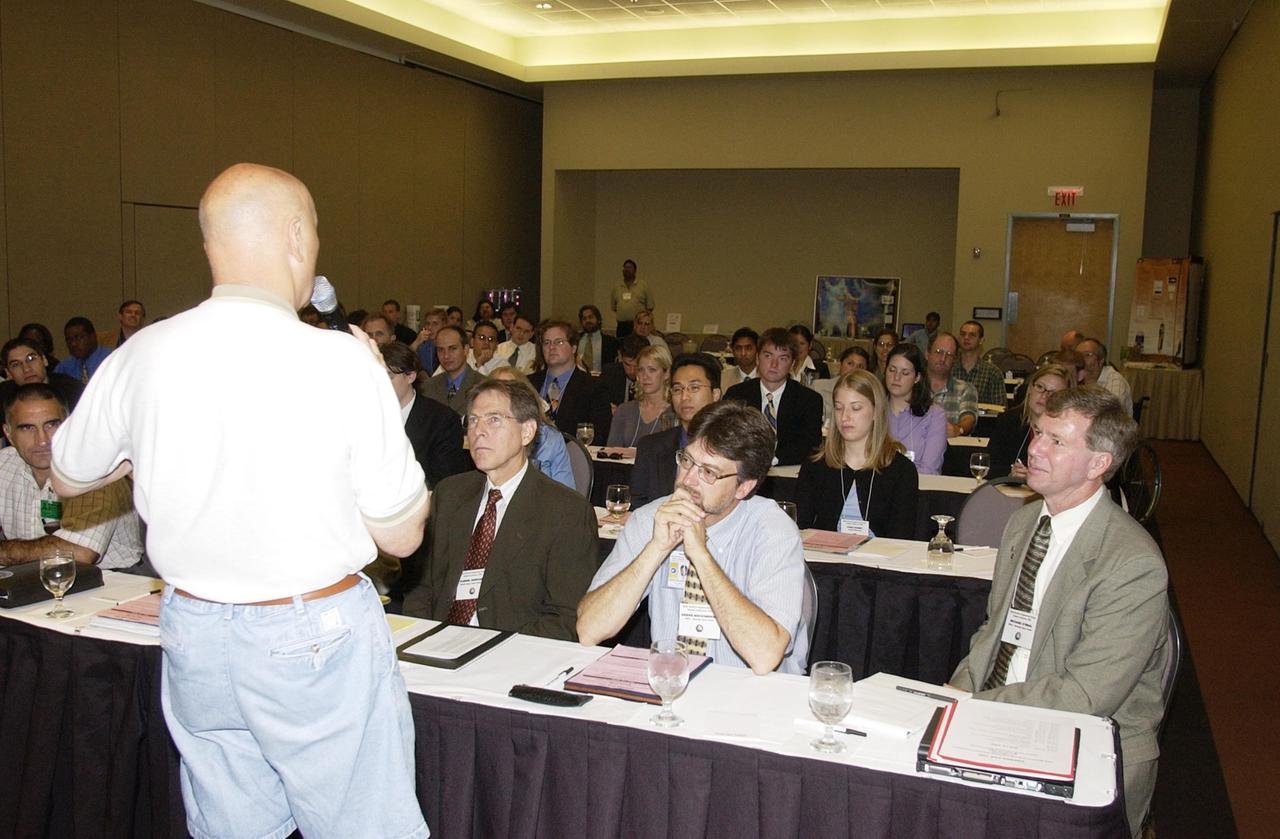
KENNEDY SPACE CENTER, FLA. -- Former astronaut Story Musgrave speaks to students and faculty from across the nation gathered at the KSC Visitor Complex for this year's NASA MarsPort Engineering Design Student Competition 2002 conference. The participants are presenting papers on engineering trade studies to design optimal configurations for a MarsPort Deployable Greenhouse for operation on the surface of Mars. Judges in the competition were from KSC, Dynamac Corporation and Florida Institute of Technology. The winning team's innovative ideas will be used by NASA to evaluate and study other engineering trade concepts. Featured at the opening ceremony were Dr. Sam Durrance, FSGC director and former astronaut, and Dr. Gary Stutte, plant scientist, Dynamac Corporation.

KENNEDY SPACE CENTER, Fla. -- The Microwave Anisotropy Probe (MAP) is mated to the upper stage of the Boeing Delta II rocket. The rocket is scheduled to launch the MAP instrument June 30 into a lunar-assisted trajectory to the Sun-Earth for a 27-month mission. MAP will measure small fluctuations in the temperature of the cosmic microwave background radiation to an accuracy of one millionth of a degree. These measurements should reveal the size, matter content, age, geometry and fate of the universe. They will also reveal the primordial structure that grew to form galaxies and will test ideas about the origins of these primordial structures. The MAP instrument will be continuously shaded from the Sun, Earth, and Moon by the spacecraft. It is a product of Goddard Space Flight Center in partnership with Princeton University

Kim Stratton, at left, with Caterpillar, talks to students during a Women in STEM breakfast inside the Debus Conference Center at the Kennedy Space Center Visitor Complex in Florida. STEM is science, technology, engineering and math. The special event gave students competing in NASA's 8th Annual Robotic Mining Competition the chance to learn from female NASA scientists, engineers and professionals about their careers and the paths they took to working at Kennedy. The Robotic Mining Competition is a NASA Human Exploration and Operations Mission Directorate project designed to encourage students in STEM fields. The project provides a competitive environment to foster innovative ideas and solutions that could be used on NASA's Journey to Mars.
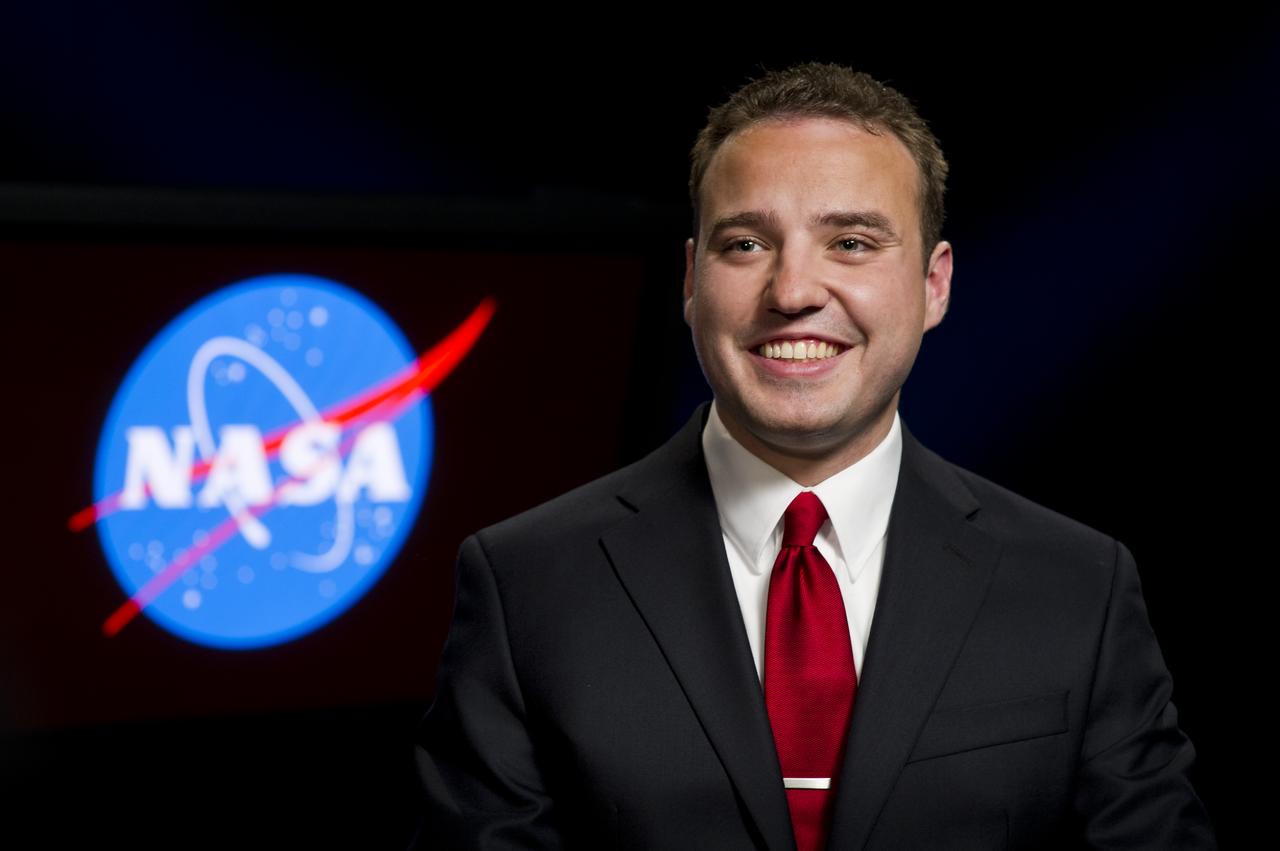
NASA Goddard Space Flight Center Financial Manager and White House 2011 SAVE award winner Matthew Ritsko is seen during a television interview at NASA Headquarters shortly after meeting with President Obama at the White House on Monday, Jan. 9, 2011, in Washington. The Presidential Securing Americans' Value and Efficiency (SAVE) program gives front-line federal workers the chance to submit their ideas on how their agencies can save money and work more efficiently. Matthew's proposal calls for NASA to create a "lending library" where specialized space tools and hardware purchased by one NASA organization will be made available to other NASA programs and projects. Photo Credit: (NASA/Bill Ingalls)

CAPE CANAVERAL, Fla. - University students gather for the opening ceremony of NASA's first Lunabotics Mining Competition at the Kennedy Space Center Visitor Complex's Astronaut Hall of Fame. Twenty-two teams from around the country will maneuver their remote controlled or autonomous excavators, called lunabots, in about 60 tons of ultra-fine simulated lunar soil, called BP-1. The competition is an Exploration Systems Mission Directorate project managed by Kennedy's Education Division. The purpose is to engage and retain students in science, technology, engineering and mathematics, or STEM, fields. It also provides a competitive environment that could result in innovative ideas and solutions for NASA's future excavation of the moon. Photo credit: NASA_Dimitri Gerondidakis

Kennedy Space Center Deputy Director Janet Petro speaks to students during a Women in STEM mentoring breakfast inside the Debus Conference Center at the Kennedy Space Center Visitor Complex in Florida. STEM is science, technology, engineering and math. The special event gave students competing in NASA's 8th Annual Robotic Mining Competition the chance to learn from female NASA scientists, engineers and professionals about their careers and the paths they took to working at Kennedy. The Robotic Mining Competition is a NASA Human Exploration and Operations Mission Directorate project designed to encourage students in STEM fields. The project provides a competitive environment to foster innovative ideas and solutions that could be used on NASA's Journey to Mars.
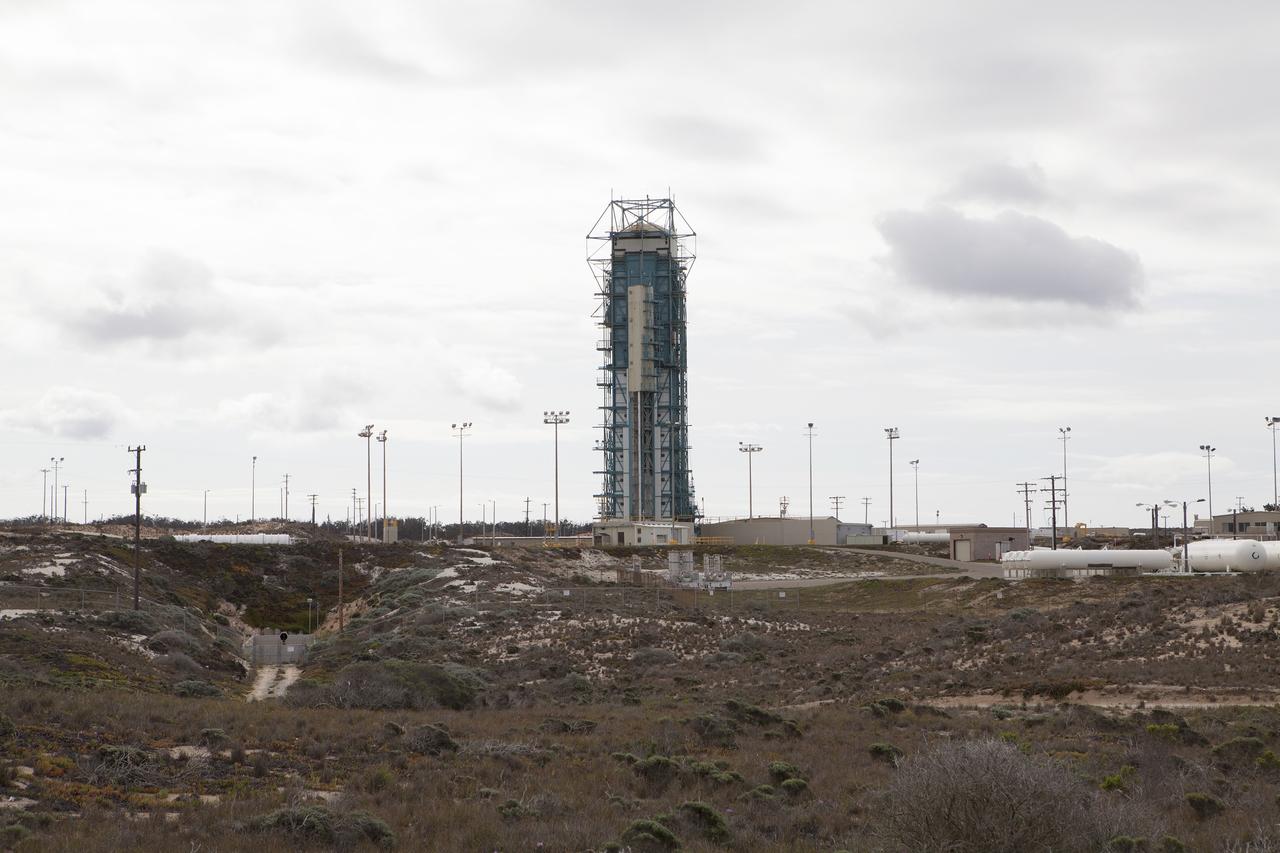
VANDENBERG AIR FORCE BASE, Calif. – Processing is underway at Space Launch Complex 2 on Vandenberg Air Force Base in California for the upcoming launch of NASA's Orbiting Carbon Observatory-2 mission, or OCO-2, aboard a United Launch Alliance Delta II rocket in July. The observatory will collect precise global measurements of carbon dioxide in the Earth's atmosphere and provide scientists with a better idea of the chemical compound's impacts on climate change. Scientists will analyze this data to improve our understanding of the natural processes and human activities that regulate the abundance and distribution of this important atmospheric gas. To learn more about OCO-2, visit http://oco.jpl.nasa.gov. Photo credit: NASA/Kim Shiflett
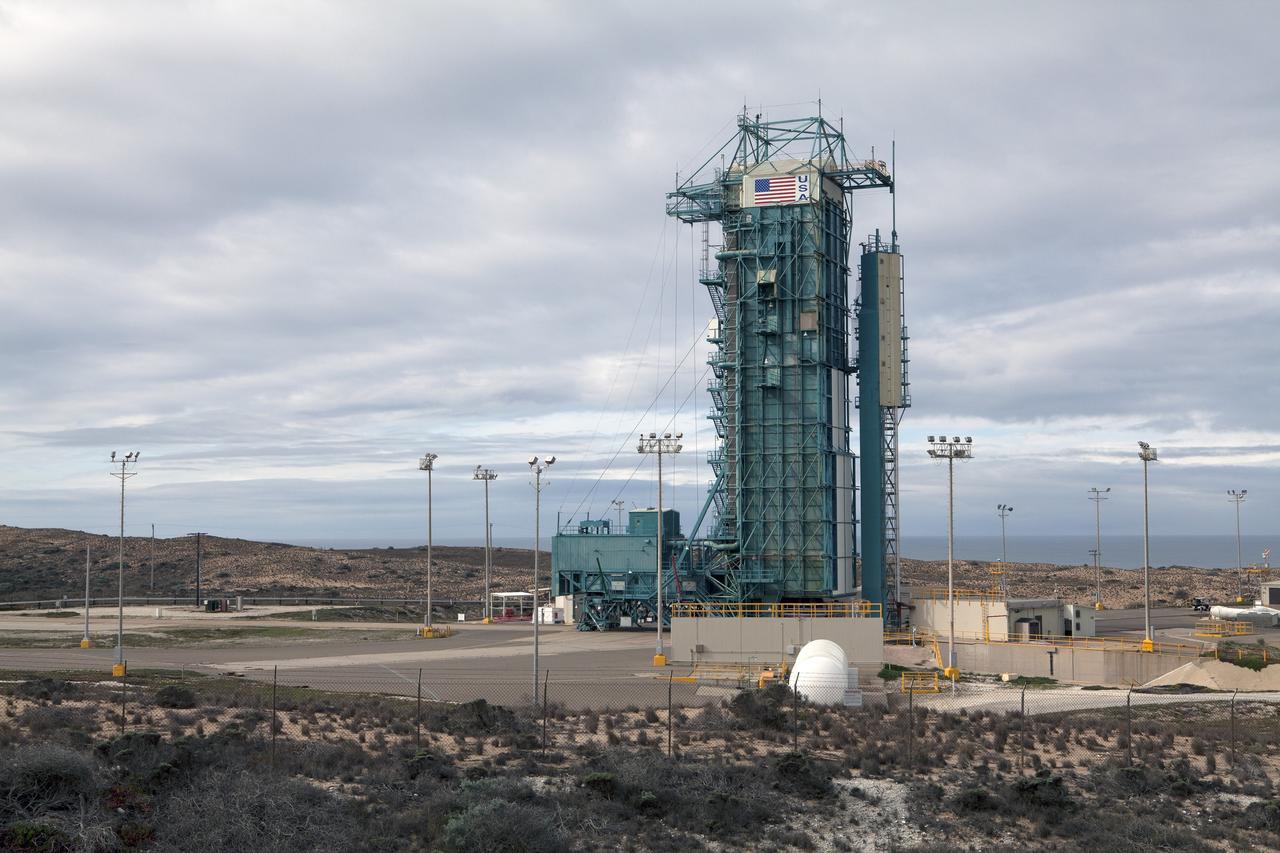
VANDENBERG AIR FORCE BASE, Calif. – Processing is underway at Space Launch Complex 2 on Vandenberg Air Force Base in California for the upcoming launch of NASA's Orbiting Carbon Observatory-2 mission, or OCO-2, aboard a United Launch Alliance Delta II rocket in July. The observatory will collect precise global measurements of carbon dioxide in the Earth's atmosphere and provide scientists with a better idea of the chemical compound's impacts on climate change. Scientists will analyze this data to improve our understanding of the natural processes and human activities that regulate the abundance and distribution of this important atmospheric gas. To learn more about OCO-2, visit http://oco.jpl.nasa.gov. Photo credit: NASA/Kim Shiflett

Kennedy Space Center Deputy Director Janet Petro speaks to students during a Women in STEM mentoring breakfast inside the Debus Conference Center at the Kennedy Space Center Visitor Complex in Florida. STEM is science, technology, engineering and math. The special event gave students competing in NASA's 8th Annual Robotic Mining Competition the chance to learn from female NASA scientists, engineers and professionals about their careers and the paths they took to working at Kennedy. The Robotic Mining Competition is a NASA Human Exploration and Operations Mission Directorate project designed to encourage students in STEM fields. The project provides a competitive environment to foster innovative ideas and solutions that could be used on NASA's Journey to Mars.
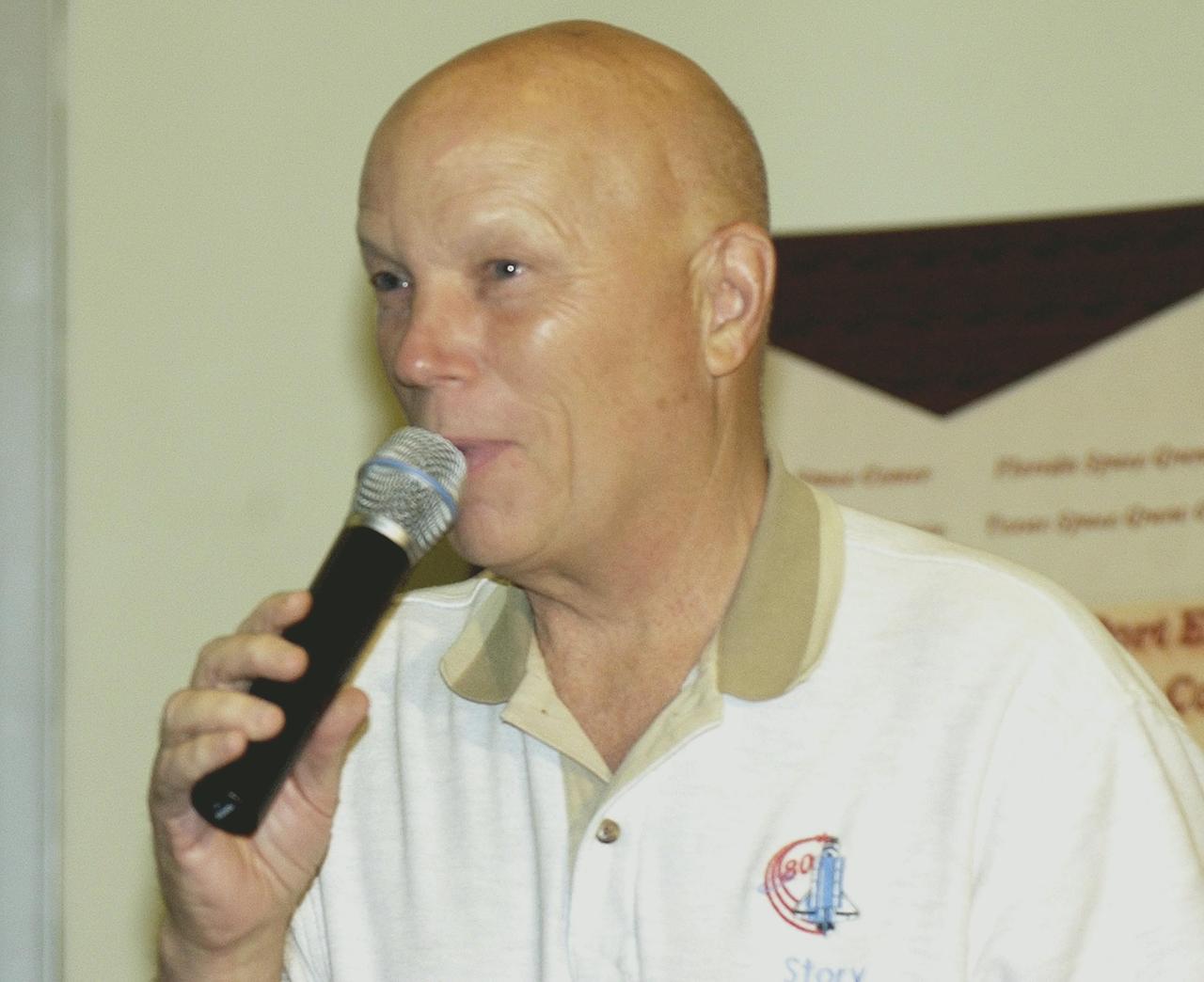
KENNEDY SPACE CENTER, FLA. -- Former astronaut Story Musgrave speaks to students and faculty from across the nation gathered at the KSC Visitor Complex for this year's NASA MarsPort Engineering Design Student Competition 2002 conference. The participants are presenting papers on engineering trade studies to design optimal configurations for a MarsPort Deployable Greenhouse for operation on the surface of Mars. Judges in the competition were from KSC, Dynamac Corporation and Florida Institute of Technology. The winning team's innovative ideas will be used by NASA to evaluate and study other engineering trade concepts. Featured at the opening ceremony were Dr. Sam Durrance, FSGC director and former astronaut, and Dr. Gary Stutte, plant scientist, Dynamac Corporation.

Gioia Massa, at left, a NASA payload scientist, talks to students during a Women in STEM breakfast inside the Debus Conference Center at the Kennedy Space Center Visitor Complex in Florida. STEM is science, technology, engineering and math. The special event gave students competing in NASA's 8th Annual Robotic Mining Competition the chance to learn from female NASA scientists, engineers and professionals about their careers and the paths they took to working at Kennedy. The Robotic Mining Competition is a NASA Human Exploration and Operations Mission Directorate project designed to encourage students in STEM fields. The project provides a competitive environment to foster innovative ideas and solutions that could be used on NASA's Journey to Mars.
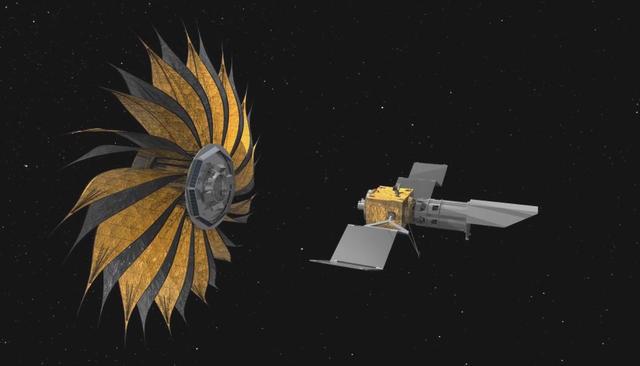
How do we find Earth-like planets outside our solar system? One idea is to send a giant structure that blocks starlight so that astronomers can more easily detect orbiting planets. This artist's rendering shows the proposed starshade concept flying in sync with a space telescope. The giant sunflower-like structure would be used to acquire images of Earth-like rocky planets around nearby stars. The proposed starshade could launch together with a telescope. Once in space, it would separate from the rocket and telescope, unfurl its petals, then move into position to block the light of stars. http://photojournal.jpl.nasa.gov/catalog/PIA20911

KENNEDY SPACE CENTER, Fla. -- At Launch Complex 17-B, Cape Canaveral Air Force Station, the canister is removed from the Microwave Anisotropy Probe (MAP). Launch of MAP via a Boeing Delta II rocket is scheduled for June 30. The launch will place MAP into a lunar-assisted trajectory to the Sun-Earth for a 27-month mission. The probe will measure small fluctuations in the temperature of the cosmic microwave background radiation to an accuracy of one millionth of a degree. These measurements should reveal the size, matter content, age, geometry and fate of the universe. They will also reveal the primordial structure that grew to form galaxies and will test ideas about the origins of these primordial structures
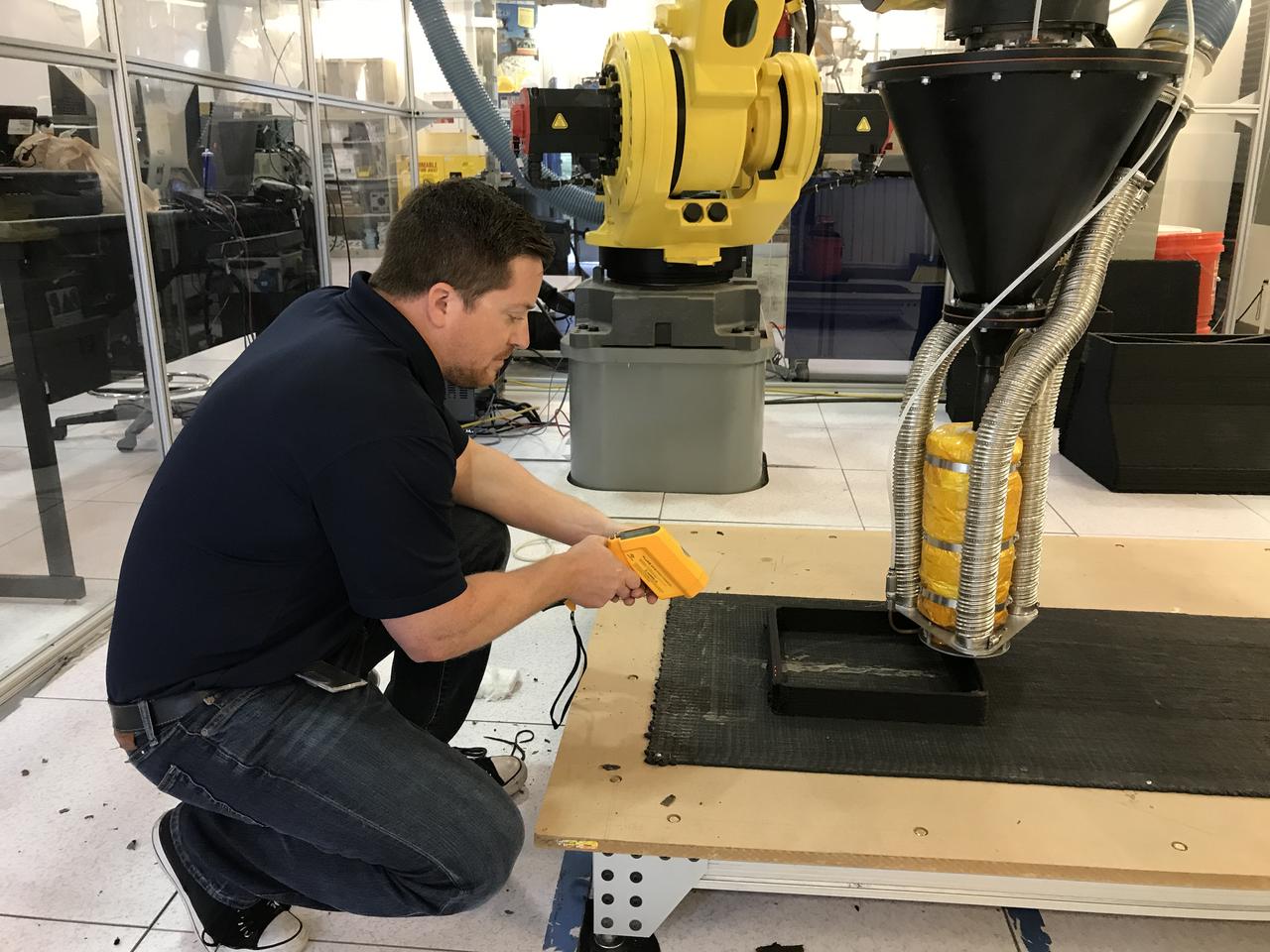
Packing light is the idea behind the Zero Launch Mass 3-D Printer. Instead of loading up on heavy building supplies, a large scale 3-D printer capable of using recycled plastic waste and dirt at the destination as construction material would save mass and money when launching robotic precursor missions to build infrastructure on the Moon or Mars in preparation for human habitation. To make this a reality, Nathan Gelino, a researcher engineer with NASA’s Swamp Works at Kennedy Space Center, measured the temperature of a test specimen from the 3-D printer Tuesday as an early step in characterizing printed material strength properties. Material temperature plays a large role in the strength of bonds between layers.
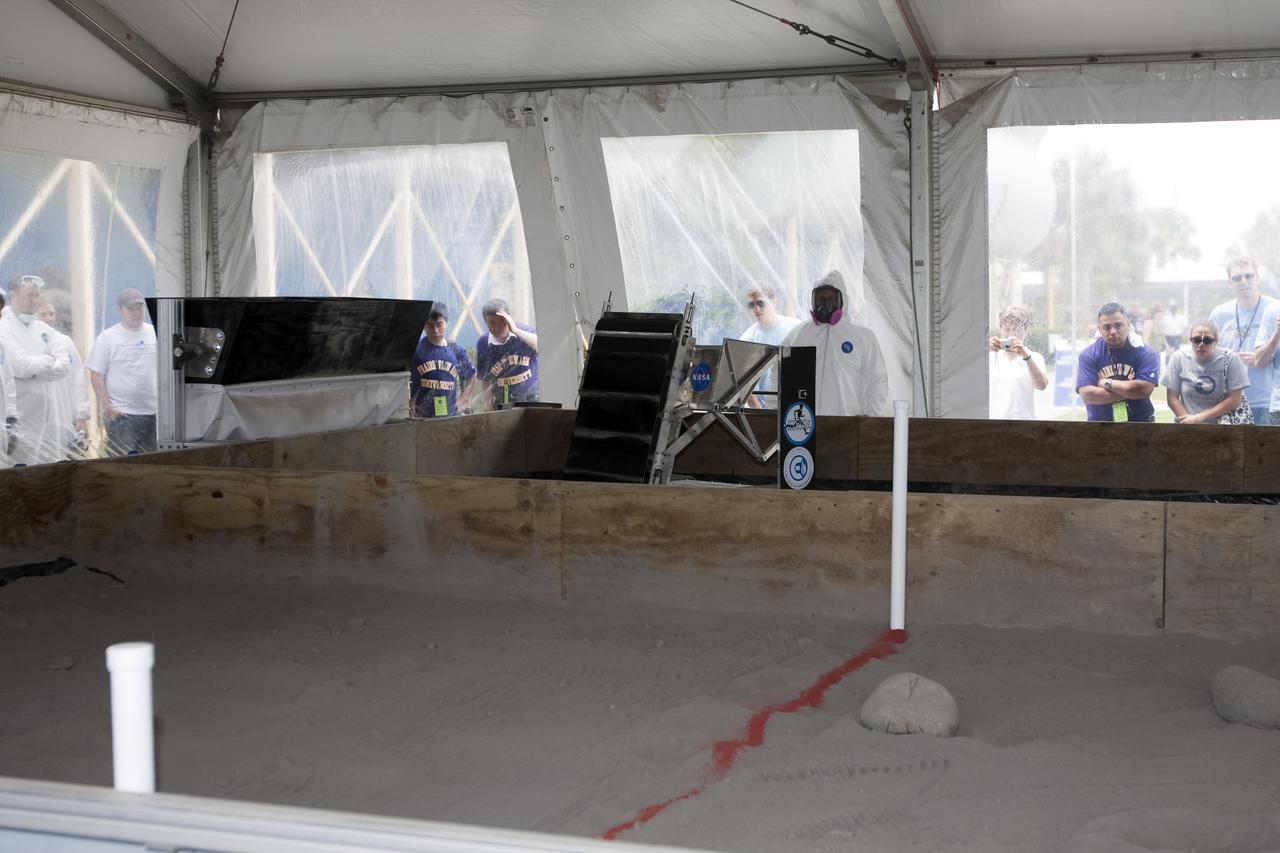
CAPE CANAVERAL, Fla. - Inside the 'Lunarena' at the Kennedy Space Center Visitor Complex's Astronaut Hall of Fame, university students are ready to maneuver their remote controlled or autonomous excavators, called lunabots, in about 60 tons of ultra-fine simulated lunar soil, called BP-1. Twenty-two teams from around the country are competing in NASA's first Lunabotics Mining Competition. The competition is an Exploration Systems Mission Directorate project managed by Kennedy's Education Division. The purpose is to engage and retain students in science, technology, engineering and mathematics, or STEM, fields. It also provides a competitive environment that could result in innovative ideas and solutions for NASA's future excavation of the moon. Photo credit: NASA_Dimitri Gerondidakis
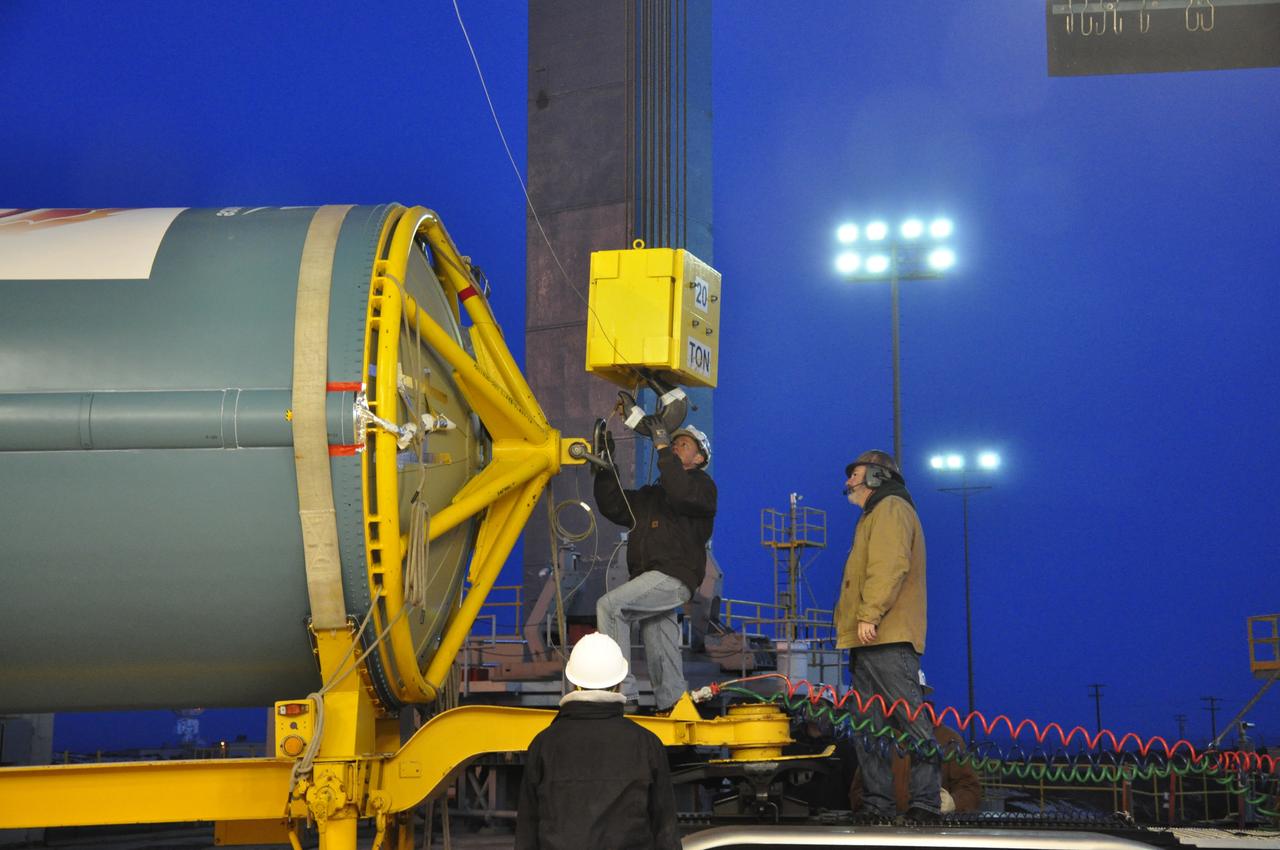
VANDENBERG AIR FORCE BASE, Calif. – Workers attach the United Launch Alliance Delta II rocket for NASA's Orbiting Carbon Observatory-2 mission, or OCO-2, to a lifting device at Space Launch Complex 2 on Vandenberg Air Force Base in California. Launch is scheduled for July 2014. The observatory will collect precise global measurements of carbon dioxide in the Earth's atmosphere and provide scientists with a better idea of the chemical compound's impacts on climate change. Scientists will analyze this data to improve our understanding of the natural processes and human activities that regulate the abundance and distribution of this important atmospheric gas. To learn more about OCO-2, visit http://oco.jpl.nasa.gov. Photo credit: NASA/Randy Beaudoin
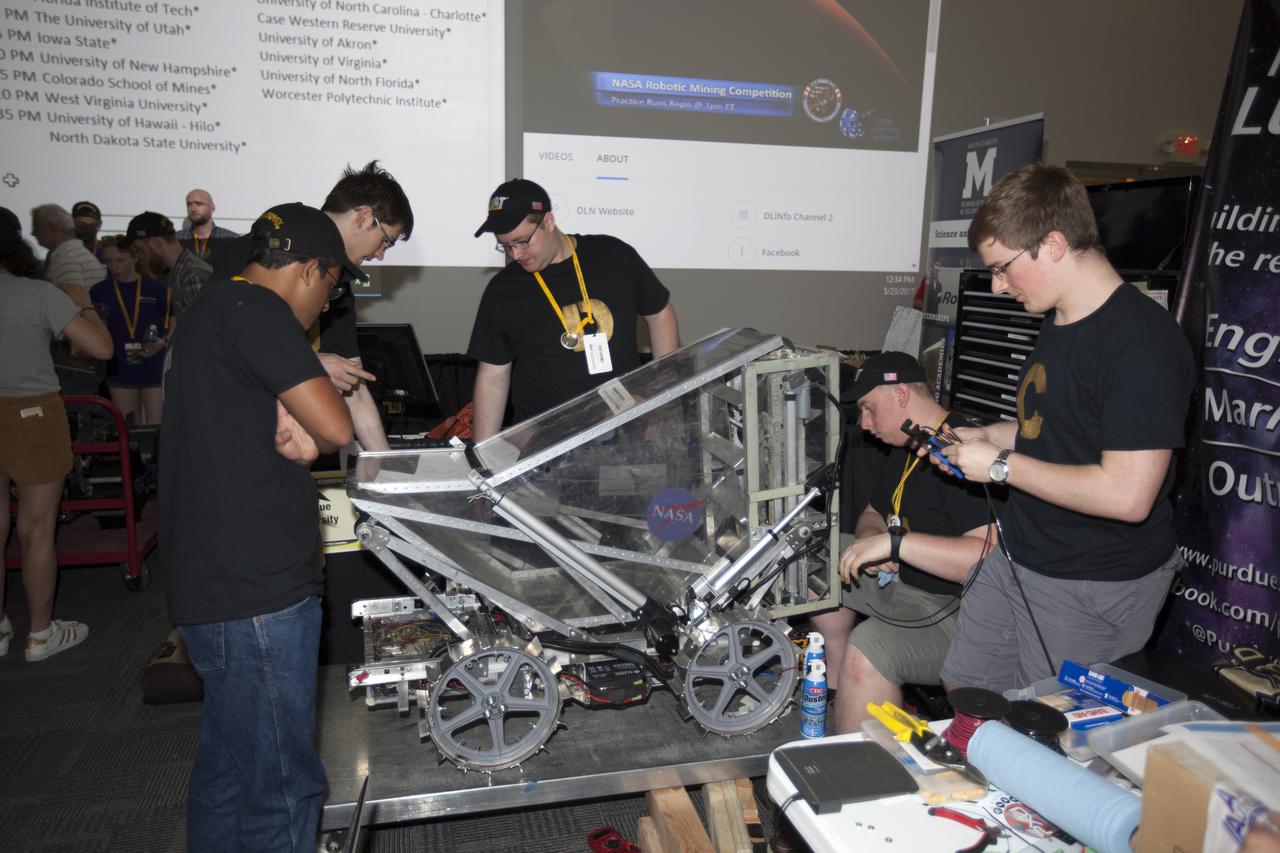
Team members from Purdue University prepare their uniquely-designed robot miner in the RoboPit at NASA's 8th Annual Robotic Mining Competition at the Kennedy Space Center Visitor Complex in Florida. More than 40 student teams from colleges and universities around the U.S. will use their uniquely-designed mining robots to dig in a supersized sandbox filled with BP-1, or simulated Martian soil, and participate in other competition requirements. The Robotic Mining Competition is a NASA Human Exploration and Operations Mission Directorate project designed to encourage students in science, technology, engineering and math, or STEM fields. The project provides a competitive environment to foster innovative ideas and solutions that could be used on NASA's Journey to Mars.
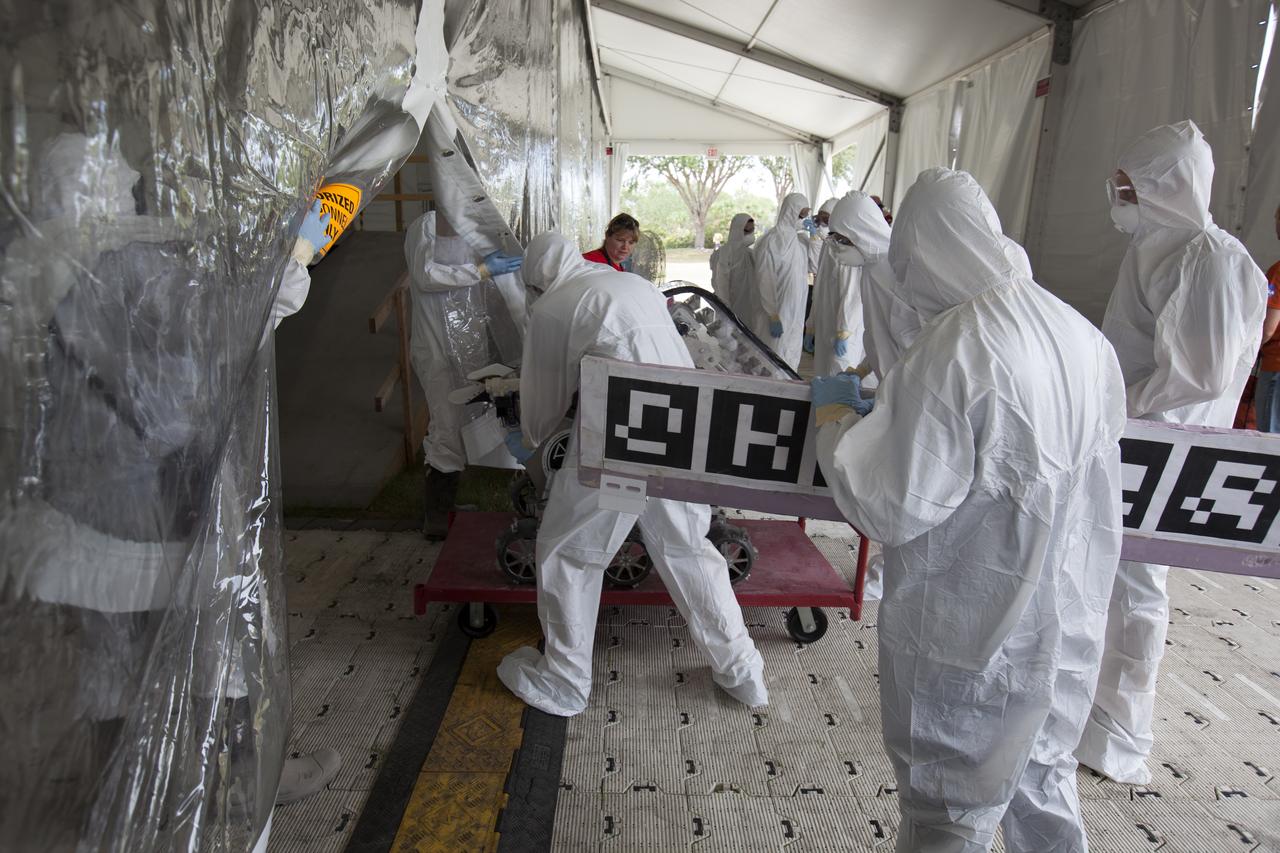
College team members prepare to enter the robotic mining arena for a test run during NASA's 8th Annual Robotic Mining Competition at the Kennedy Space Center Visitor Complex in Florida. More than 40 student teams from colleges and universities around the U.S. will use their uniquely-designed mining robots to dig in a supersized sandbox filled with BP-1, or simulated Martian soil, and participate in other competition requirements. The Robotic Mining Competition is a NASA Human Exploration and Operations Mission Directorate project designed to encourage students in science, technology, engineering and math, or STEM fields. The project provides a competitive environment to foster innovative ideas and solutions that could be used on NASA's Journey to Mars.