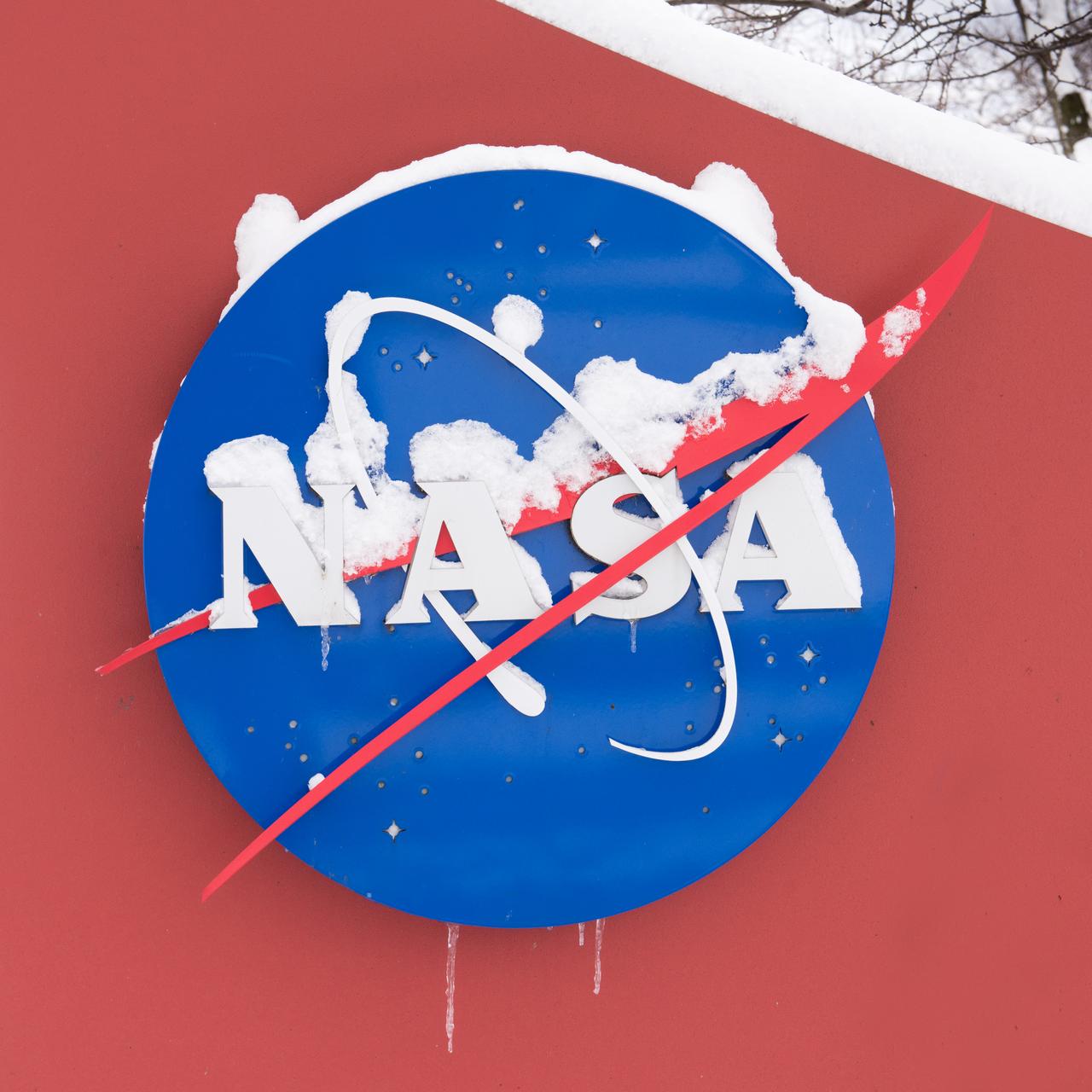
Late winter photograph of a snow-covered NASA Insignia at the Glenn Research Center in Cleveland, OH.
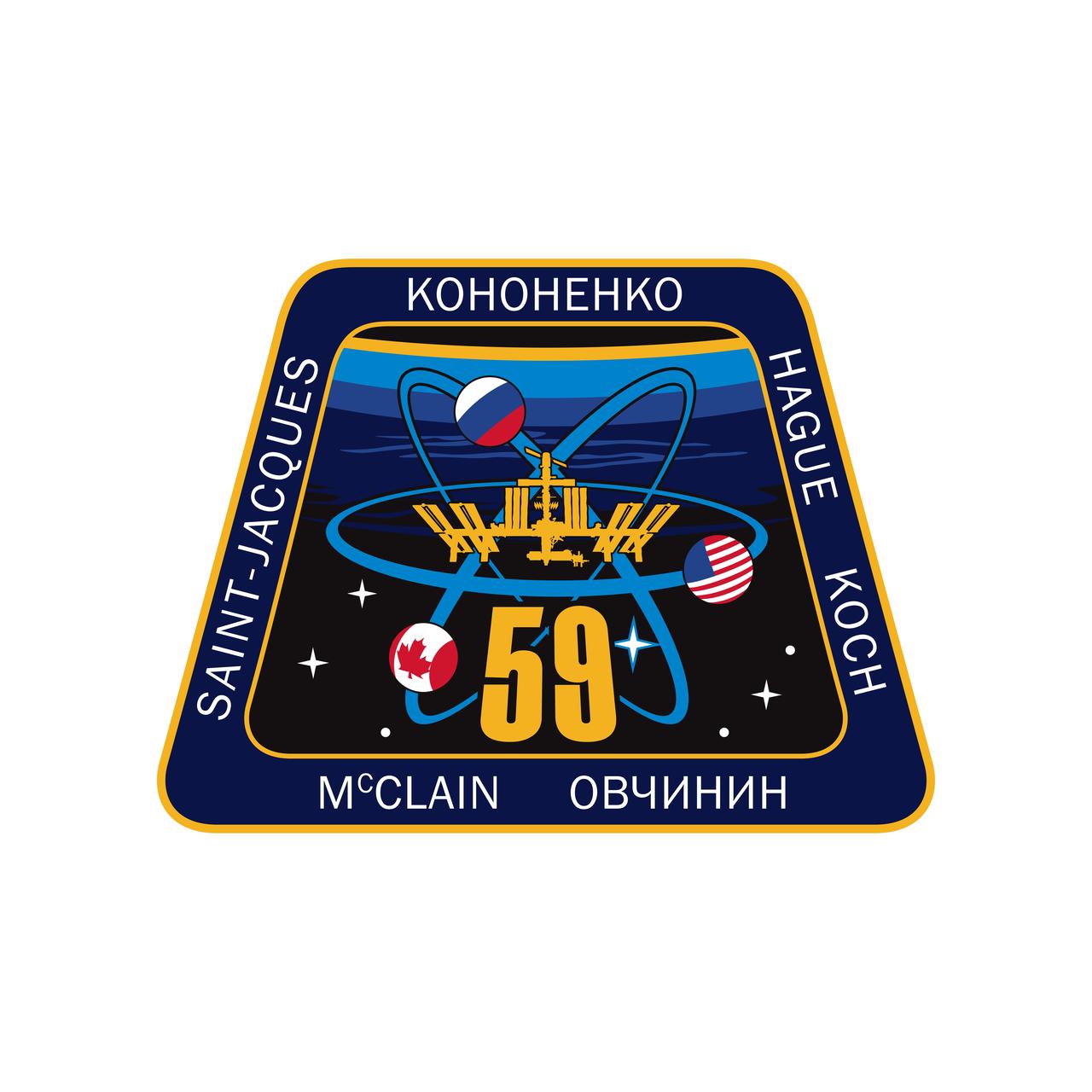
iss059-s-001 (May 16, 2018) --- The official mission insignia for Expedition 59.
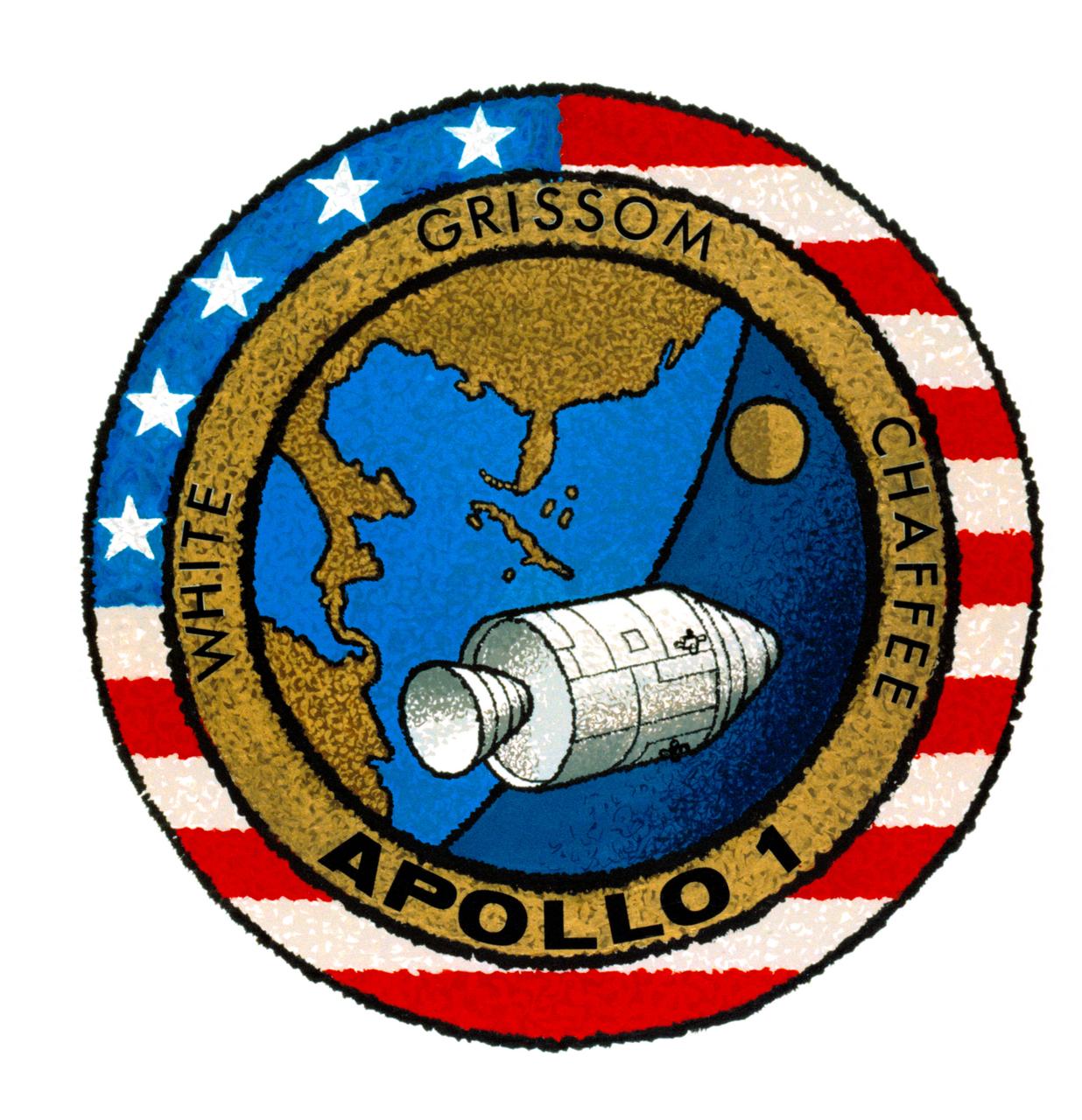
S66-36742 (1966) --- This is the insignia for the National Aeronautics and Space Administration's (NASA) Apollo 1 mission, the first manned Apollo flight. Crew members are astronauts Virgil I. Grissom, Edward H. White II and Roger B. Chaffee. The NASA insignia design for Apollo flights is reserved for use by the astronauts and for other official use as the NASA Administrator may authorize. Public availability has been approved only in the form of illustrations by the various news media. When and if there is any change in this policy, which we do not anticipate, it will be publicly announced. EDITOR'S NOTE: The three astronauts lost their lives in a fire during a simulation on the launch pad on Jan. 27, 1967.
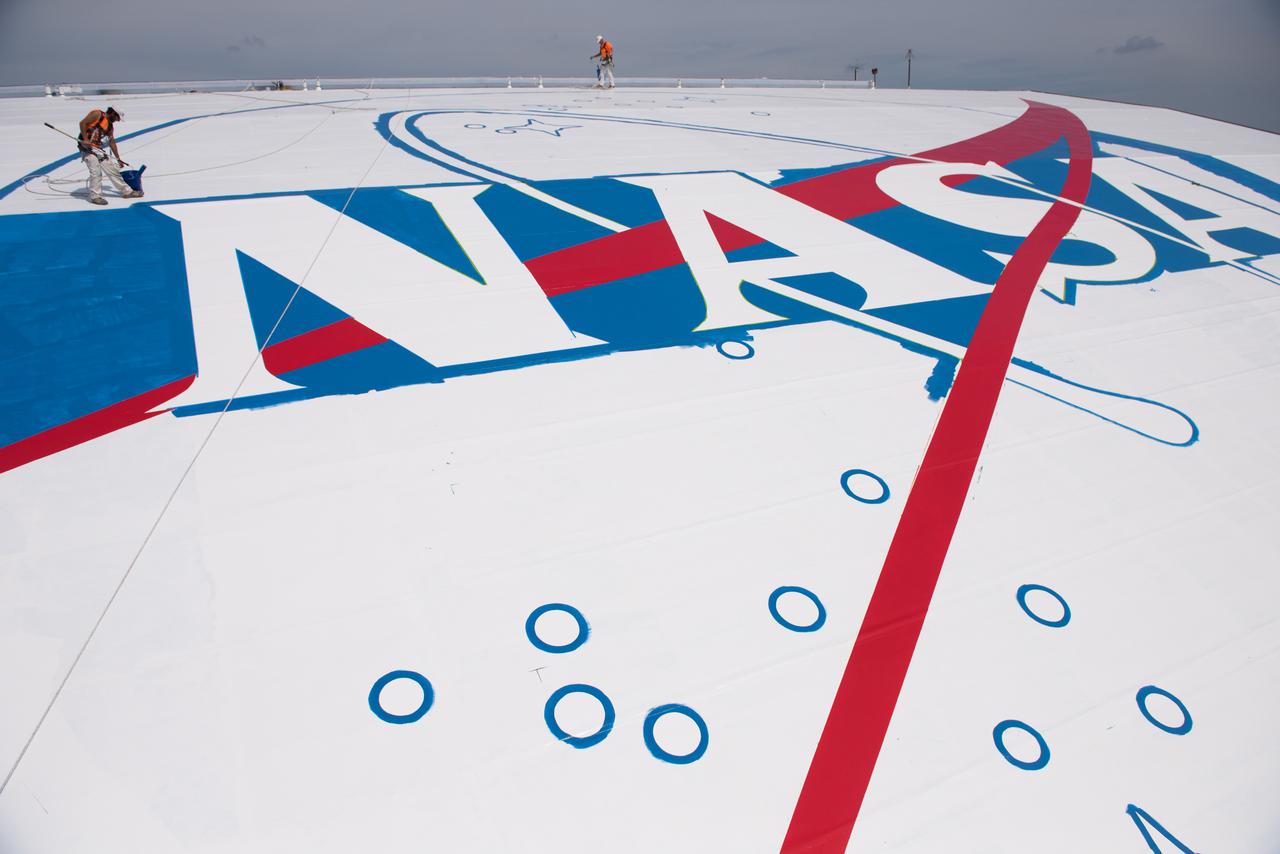
Painters paint the NASA Insignia or Meatball on the Hangar Roof
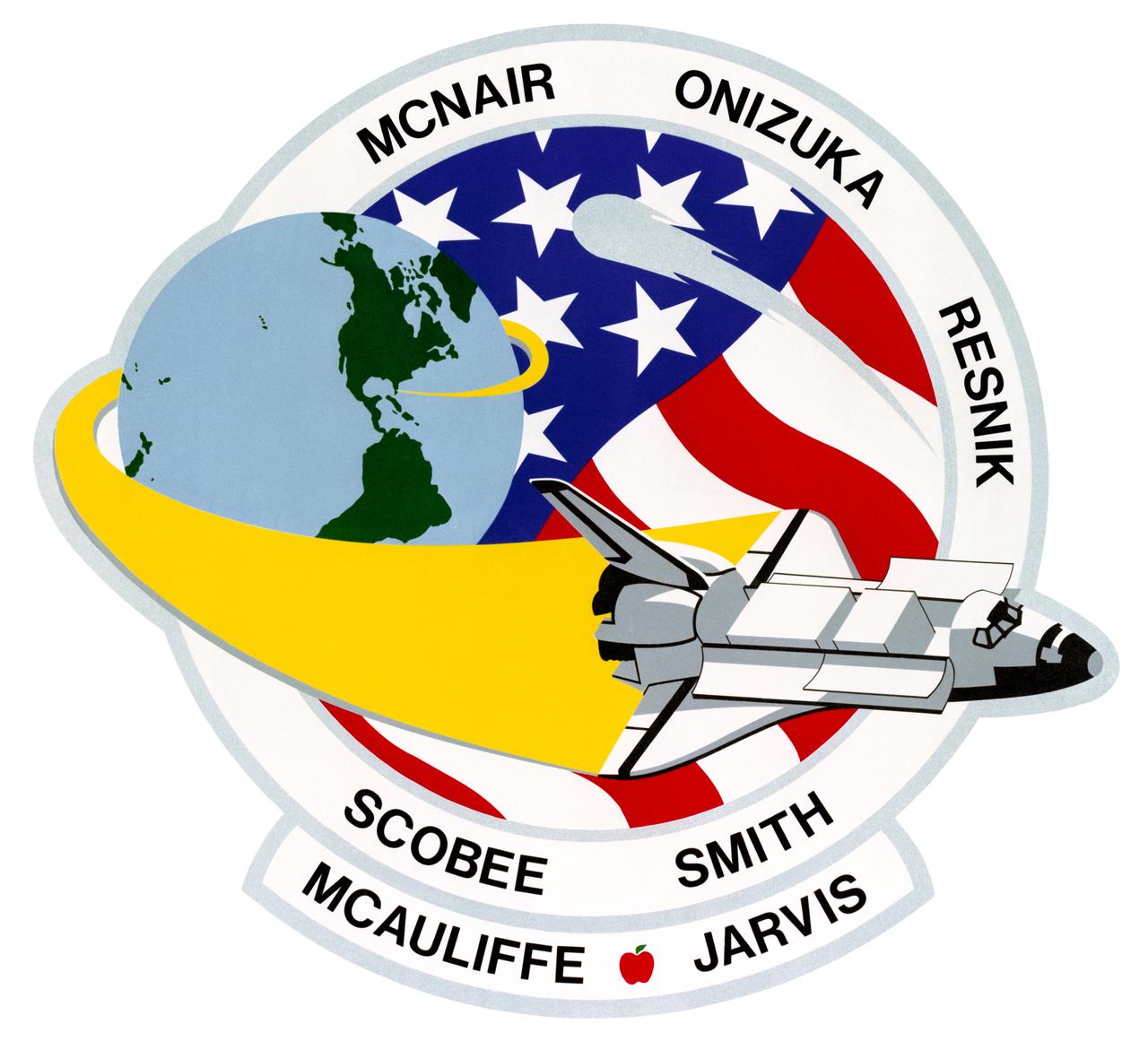
S85-46260 (20 Dec. 1985) --- Members of the STS-51L crew designed this patch which will represent their participation on NASA's late January 1986 mission aboard the space shuttle Challenger, depicted launching from Florida and soaring into space to carry out a variety of goals. Among the prescribed duties of the five astronauts and two payload specialists will be observation and photography of Halley's Comet, backdropped against the United States flag in the insignia. Surnames of the crew members encircle the scene, with the payload specialists being recognized below. Surname of the first teacher in space, Sharon Christa McAuliffe, is followed by a symbolic apple. Gregory Jarvis, representing Hughes, is the industrial payload specialist for the flight. NASA's crew members are astronauts Francis R. (Dick) Scobee, commander; Michael J. Smith, pilot; and Ronald E. McNair, Ellison S. Onizuka and Judith A. Resnik - all mission specialists. The NASA insignia design for space shuttle flights is reserved for use by the astronauts and for other official use as the NASA Administrator may authorize. Public availability has been approved only in the forms of illustrations by the various news media. When and if there is any change in this policy, which is not anticipated, the change will be publicly announced. Photo credit: NASA
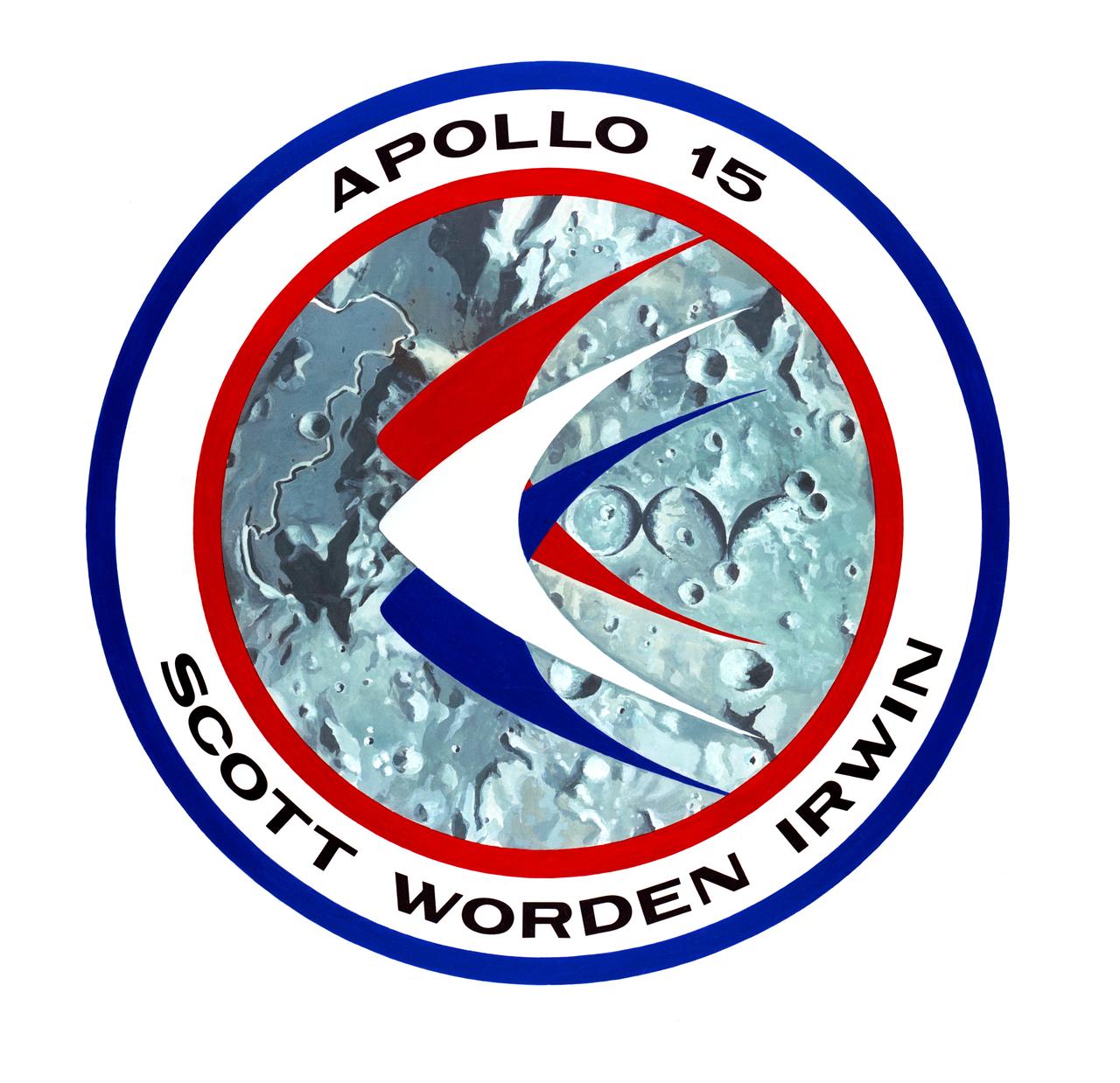
S71-30463 (May 1971) --- This is the insignia designed for the Apollo 15 lunar landing mission. The circular design features the colors red, white and blue. On the outer portion of the patch a narrow band of blue and a narrow band of red encircle a wider band of white. The large disc in the center of the emblem has red, white and blue symbols of flight, superimposed over an artist's concept of the Apollo 15 Hadley-Apennine landing site of gray tone. The surnames of the three names are centered in the white band at the bottom of the insignia. The Apollo 15 prime crew men are David R. Scott, commander; Alfred M. Worden, command module pilot; and James B. Irwin, lunar module pilot. This is the official Apollo 15 emblem, property of the government of the United States. It has been authorized only for use by the astronauts. Its production in any form other than in news, information and education media is not authorized without approval. Unauthorized use of the photograph is subject to the provisions of Title 18, U.S. Code, Section 701.
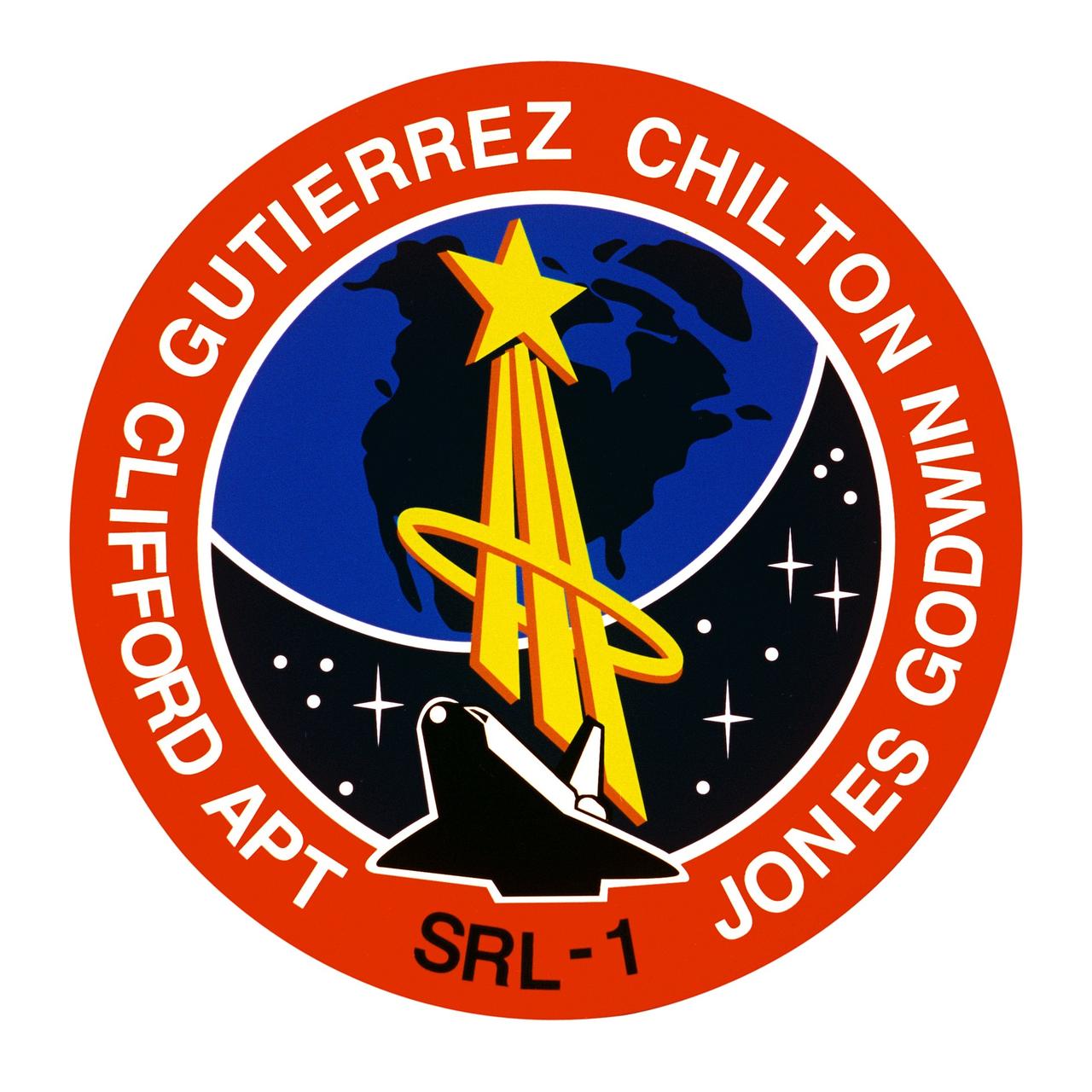
STS059-S-001 (November 1993) --- Designed by the crew members, the STS-59 insignia is dominated by Earth, reflecting the focus of the first Space Radar Laboratory (SRL-1) mission upon our planet's surface and atmosphere. The golden symbol of the astronaut corps emblem sweeps over Earth's surface from the space shuttle Endeavour, representing the operation of the SIR-C/Synthetic Aperture Radar (X-SAR) and the Measurement of Air Pollution from Space (MAPS) sensors. The astronaut emblem also signals the importance of the human element in space exploration and in the study of our planet. Using the unique vantage point of space, Endeavour and its crew -- along with scientists from around the world -- will study Earth and its environment. The starfield visible below Earth represents the many talents and skills of the international (SRL-1) team in working to make this "Mission to Planet Earth" (MTPE) a scientific and operational success. The NASA insignia design for space shuttle flights is reserved for use by the astronauts and for other official use as the NASA Administrator may authorize. Public availability has been approved only in the forms of illustrations by the various news media. When and if there is any change in this policy, which is not anticipated, the change will be publicly announced. Photo credit: NASA
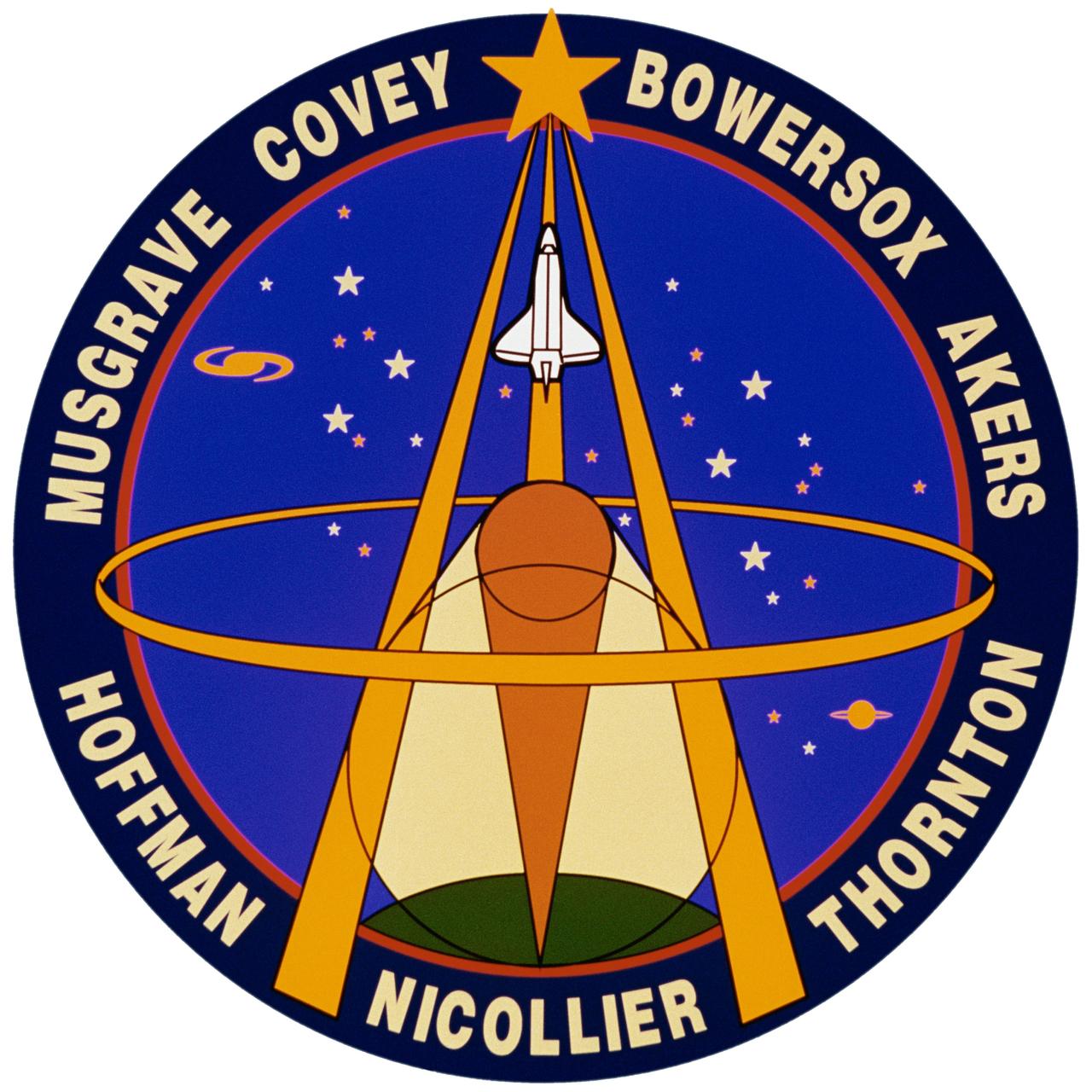
STS061-S-001 (1 Oct. 1993) --- Designed by the crew members, the STS-61 crew insignia depicts the astronaut symbol superimposed against the sky with the Earth underneath. Also seen are two circles representing the optical configuration of the Hubble Space Telescope (HST). Light is focused by reflections from a large primary mirror and a smaller secondary mirror. The light is analyzed by various instruments and, according to the crew members, "brings to us on Earth knowledge about planets, stars, galaxies and other celestial objects, allowing us to better understand the complex physical processes at work in the universe." The space shuttle Endeavour is also represented as the fundamental tool that allows the crew to perform the first servicing of the Hubble Space Telescope so its scientific deep space mission may be extended for several years to come. The overall design of the emblem, with lines converging to a high point, is also a symbolic representation of the large-scale Earth-based effort -- which involves space agencies, industry and the universities -- to reach goals of knowledge and perfection. The NASA insignia design for space shuttle flights is reserved for use by the astronauts and for other official use as the NASA Administrator may authorize. Public availability has been approved only in the forms of illustrations by the various news media. When and if there is any change in this policy, which is not anticipated, the change will be publicly announced. Photo credit: NASA
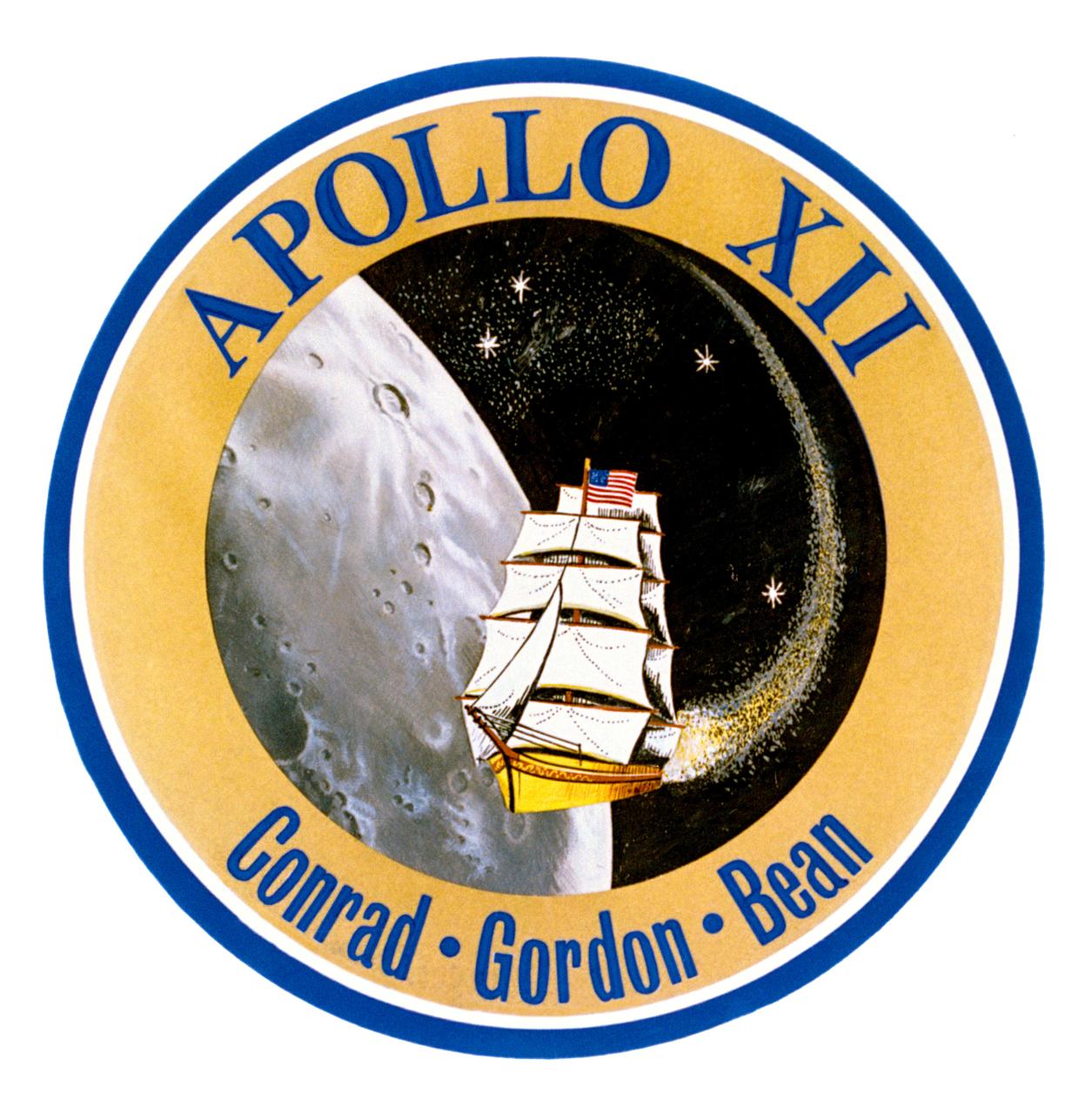
S69-52336 (September 1969) --- This is the official crew insignia for Apollo 12, the United States? second lunar landing mission. Crew members are astronauts Charles Conrad Jr., commander; Richard F. Gordon Jr., command module pilot; and Alan L. Bean, lunar module pilot. The clipper ship signifies that the crew is all Navy and symbolically relates the era of the clipper ship to the era of space flight. As the clipper ship brought foreign shores closer to the United States and marked the increased utilization of the seas by this nation, spacecraft have opened the way to the other planets and Apollo 12 marks the increased utilization of space-based on knowledge gained in earlier missions. The portion of the moon shown is representative of the Ocean of Storms area in which Apollo 12 will land. The NASA insignia design for Apollo flights is reserved for use by the astronauts and for other official use as the NASA Administrator may authorize. Public availability has been approved only in the form of illustrations by the various news media. When and if there is any change in this policy, which we do not anticipate, it will be publicly announced.
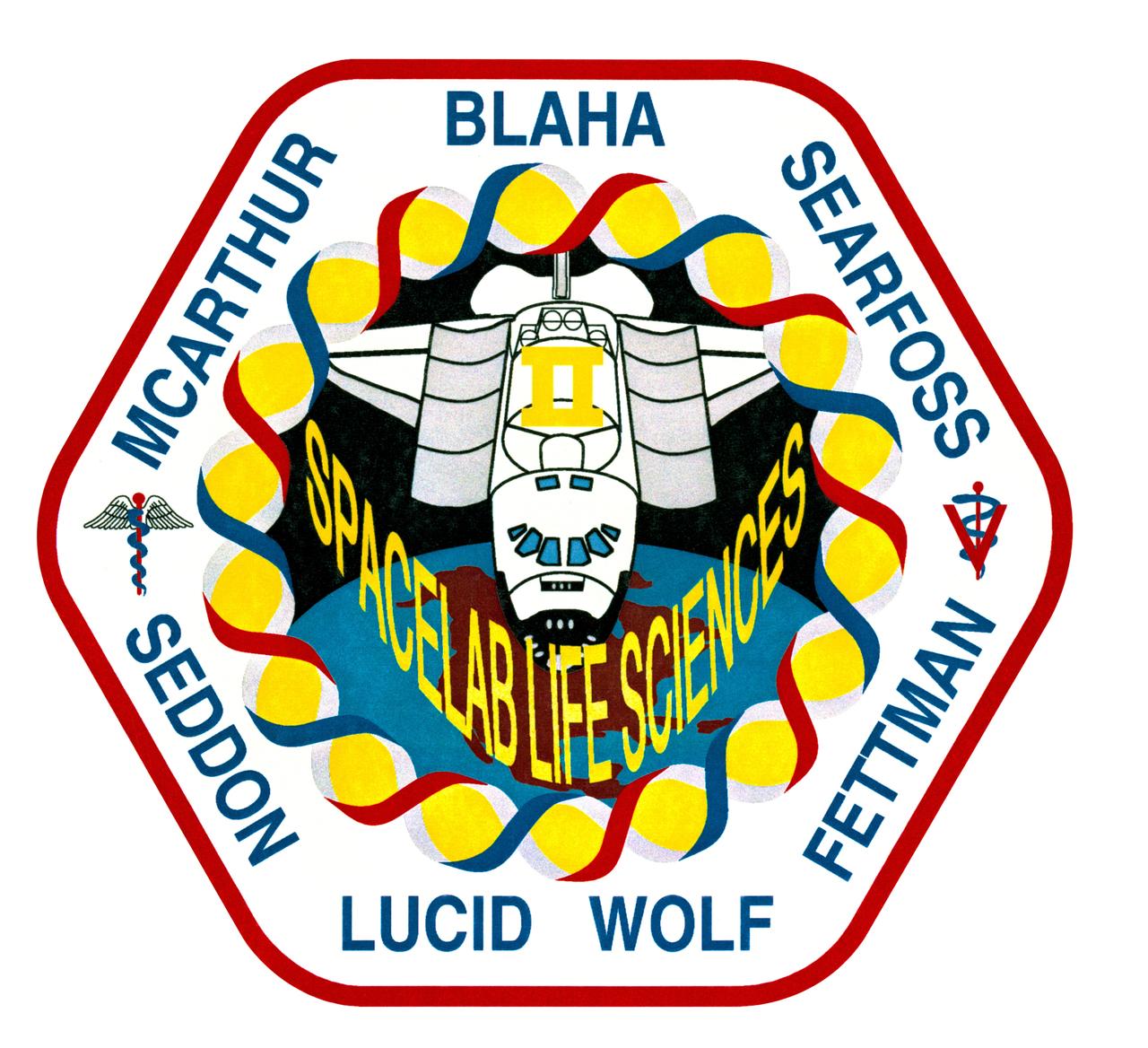
STS058-S-001 (May 1993) --- Designed by members of the flight crew, the STS-58 insignia depicts the space shuttle Columbia with a Spacelab module in its payload bay in orbit around Earth. The Spacelab and the lettering "Spacelab Life Sciences II" highlight the primary mission of the second space shuttle flight dedicated to life sciences research. An Extended Duration Orbiter (EDO) support pallet is shown in the aft payload bay, stressing the scheduled two-week duration of the longest space shuttle mission to date. The hexagonal shape of the patch depicts the carbon ring, a molecule common to all living organisms. Encircling the inner border of the patch is the double helix of DNA, representing the genetic basis of life. Its yellow background represents the sun, energy source for all life on Earth. Both medical and veterinary caducei are shown to represent the STS-58 life sciences experiments. The position of the spacecraft in orbit about Earth with the United States in the background symbolizes the ongoing support of the American people for scientific research intended to benefit all mankind. The NASA insignia design for space shuttle flights is reserved for use by the astronauts and for other official use as the NASA Administrator may authorize. Public availability has been approved only in the form of illustrations by the various news media. When and if there is any change in this policy, which we do not anticipate, it will be publicly announced. Photo credit: NASA
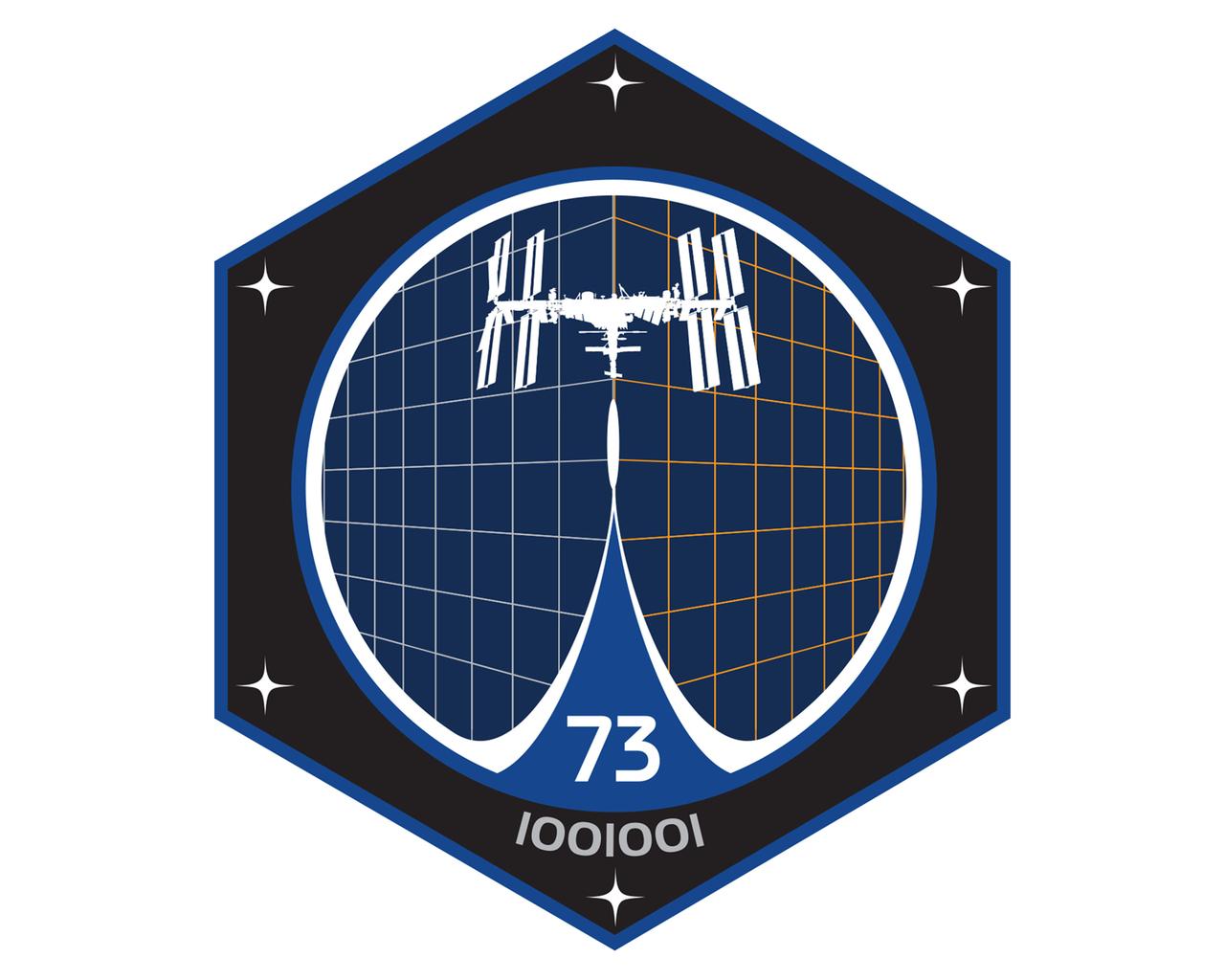
iss073-s-001 (July 15, 2024) --- The official insignia of the Expedition 73 crew on the International Space Station. Credit: NASA

S66-28075 (May 1966) --- Insignia of the Gemini IX spaceflight. Roman numeral indicates ninth flight in the Gemini series. Two spacecraft symbolize rendezvous and docking of Gemini with an Agena. Astronaut and umbilical (tether) line denote planned extravehicular activity (EVA). Astronauts Thomas P. Stafford, command pilot, and Eugene A. Cernan, pilot, are members of the Gemini IX prime crew. The NASA insignia design for Gemini flights is reserved for use by the astronauts and for other official use as the NASA Administrator may authorize. Public availability has been approved only in the form of illustrations by the various news media. When and if there is any change in this policy, which we do not anticipate, it will be publicly announced. Photo credit: NASA
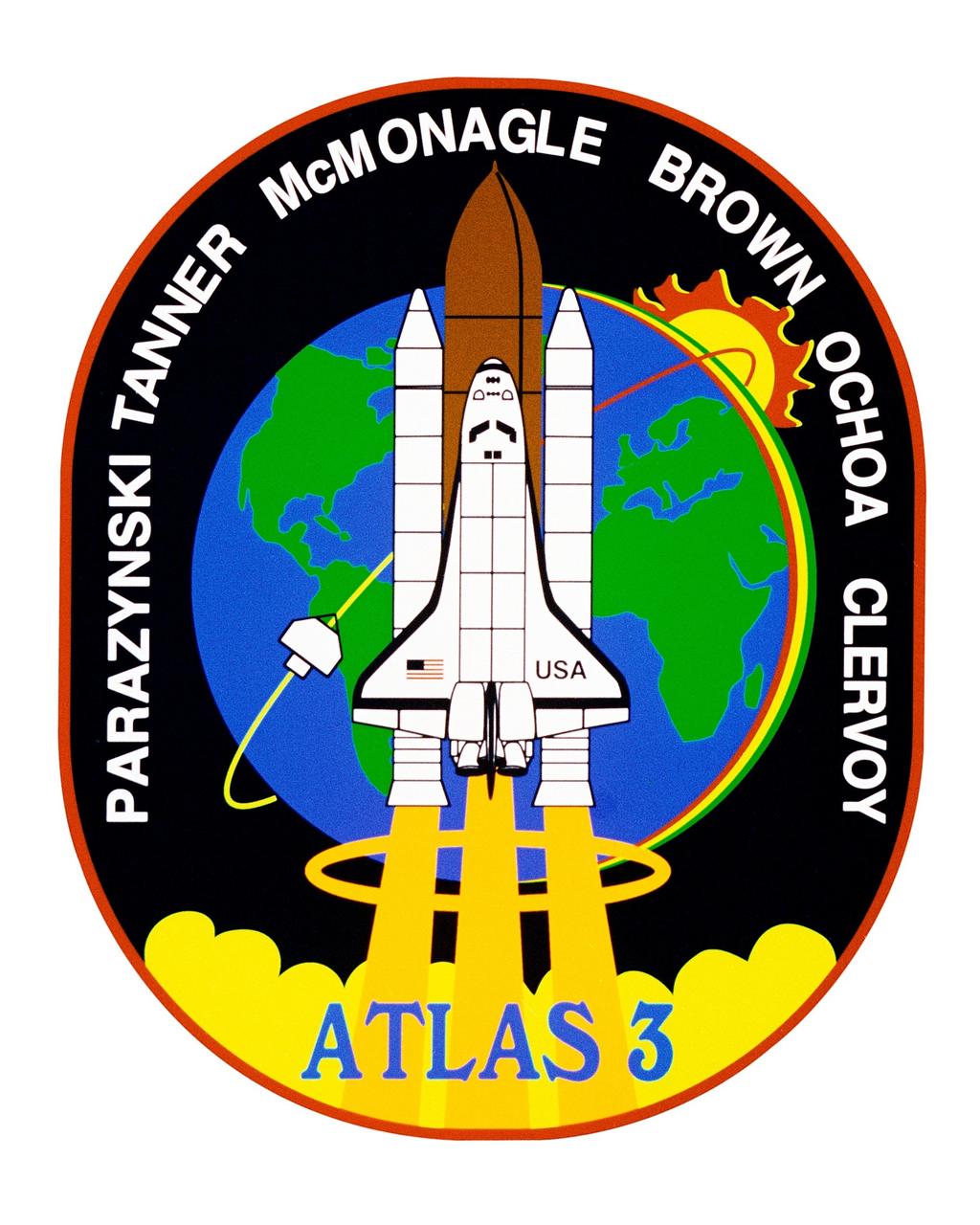
STS066-S-001 (October 1994) --- Designed by the crew members, the STS-66 insignia depicts the space shuttle Atlantis launching into Earth orbit to study global environmental change. The payload for the Atmospheric Laboratory for Applications and Science (ATLAS-3) and complementary experiments are part of a continuing study of the atmosphere and the sun's influence on it. The space shuttle is trailed by gold plumes representing the astronaut symbol and is superimposed over Earth, much of which is visible from the flight's high inclination orbit. Sensitive instruments aboard the ATLAS pallet in the shuttle payload bay and on the free-flying Cryogenic Infrared Spectrometers and Telescopes for the Atmospheric-Shuttle Pallet Satellite (CHRISTA-SPAS) will gaze down on Earth and toward the sun, illustrated by the stylized sunrise and visible spectrum. The NASA insignia design for space shuttle flights is reserved for use by the astronauts and for other official use as the NASA Administrator may authorize. Public availability has been approved only in the forms of illustrations by the various news media. When and if there is any change in this policy, which is not anticipated, the change will be publicly announced. Photo credit: NASA
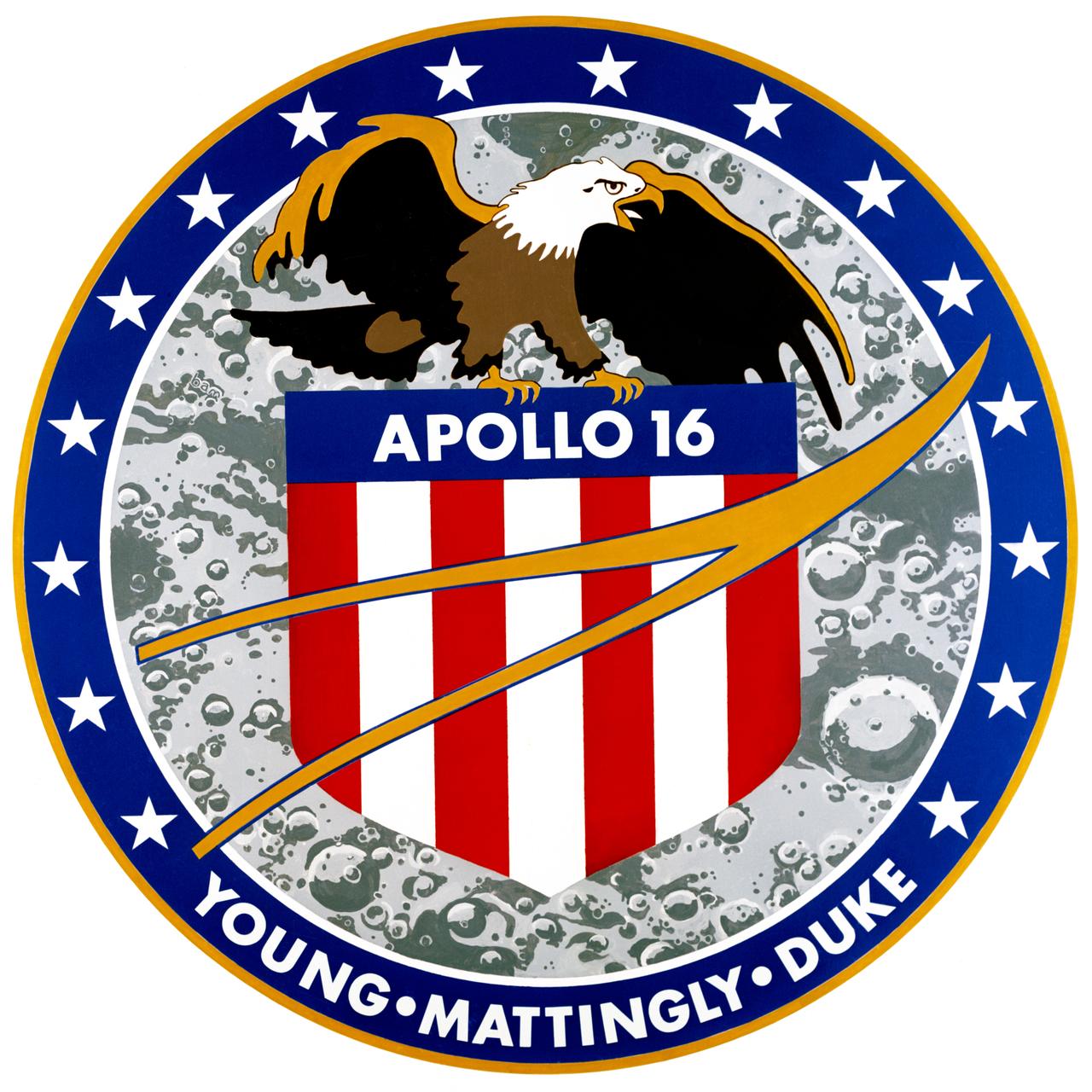
S71-56246 (November 1971) --- The Apollo 16 crew patch is dominated by an eagle perched atop a red, white and blue shield a superimposed on a lunar scene, surrounded by a blue circle of 16 stars with the crew's surnames completing the bottom are of the circle. Across the face of the shield is a gold symbol of flight outlined in blue, similar to that on the National Aeronautics and Space Administration (NASA) agency seal and insignia. The design was created by a NASA artist from ideas submitted by the three crew men: astronauts John W. Young, commander; Thomas K. Mattingly II, command module pilot; and Charles M. Duke Jr., lunar module pilot. This is the official Apollo 16 emblem, a property of the government of the United States. It has been authorized only for use by the astronauts. Its reproduction in any form other than in news, information and education media is not authorized without approval. Unauthorized use is subject to the provisions of Title 18, U.S. Code, Section 701.
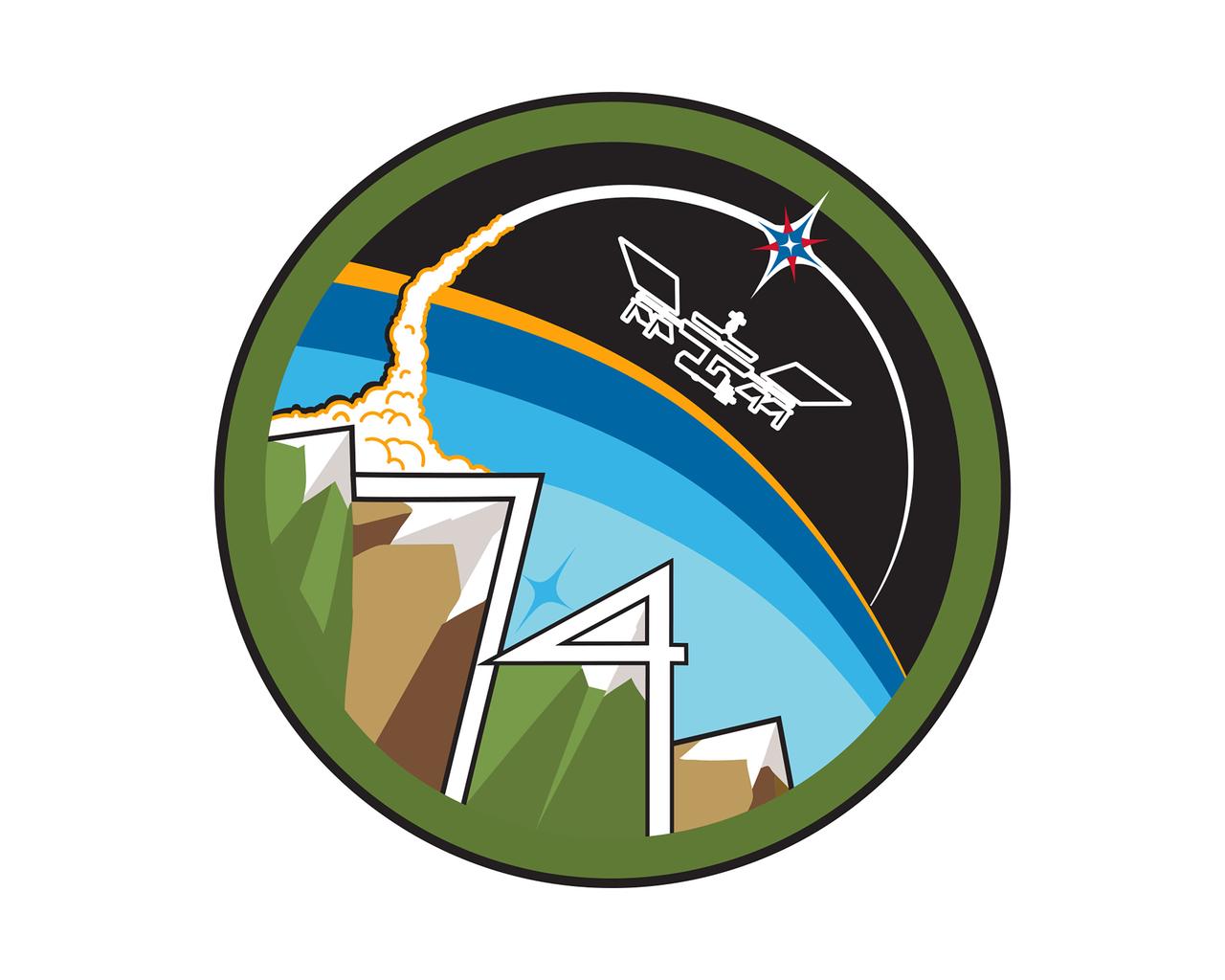
iss074-s-001 (Jan. 29, 2025) --- The official insignia of the Expedition 74 crew on the International Space Station. Credit: NASA
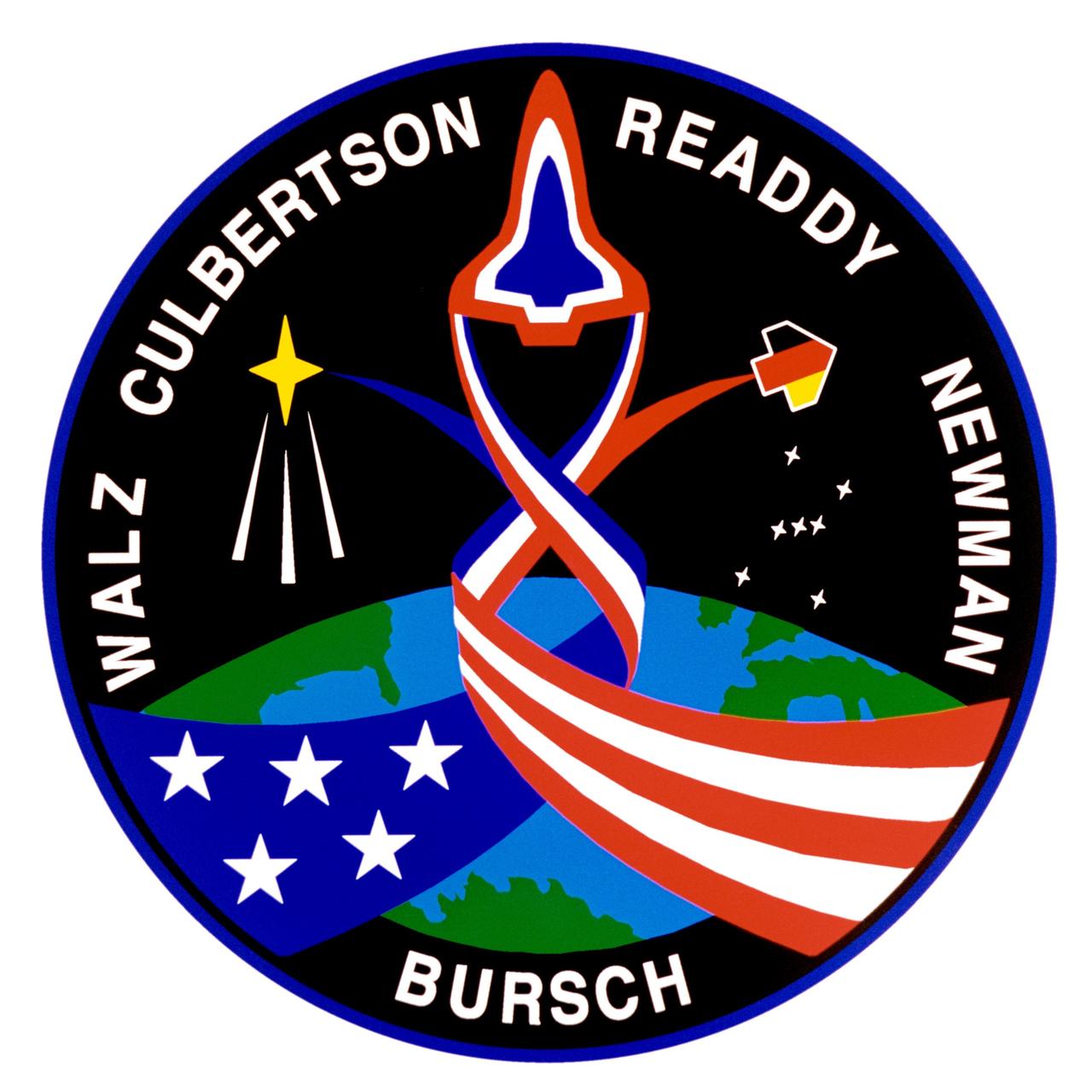
STS051-S-001 (January 1993) --- Designed by the crew members, the crew patch honors all who have contributed to mission success. It symbolizes NASA's continuing quest to increase mankind's knowledge and use of space through this multi-faceted mission. The gold star represents the United States Advanced Communications Technology Satellite (ACTS) boosted by the Transfer Orbit Stage (TOS). The rays below the ACT\TOS represent the innovative communication technologies to be tested by this experiment. The stylized Shuttle Pallet Satellite (SPAS) represents the German-sponsored ASTRO\SPAS mission. The constellation Orion below SPAS is representative of the types of stellar objects to be studied by its experimenters. The stars in Orion also commemorate the astronauts who have sacrificed their lives for the space program. The ascending spiral, symbolizing America's continuing commitment to leadership in space exploration and development, originates with the thousands of persons who ensure the success of each space shuttle flight. The five large white stars, representing the five crew members, along with the single gold star, form the mission's numerical designation. The NASA insignia design for space shuttle flights is reserved for use by the astronauts and for other official use as the NASA Administrator may authorize. Public availability has been approved only in the form of illustrations by the various news media. When and if there is any change in this policy, which we do not anticipate, it will be publicly announced. Photo credit: NASA
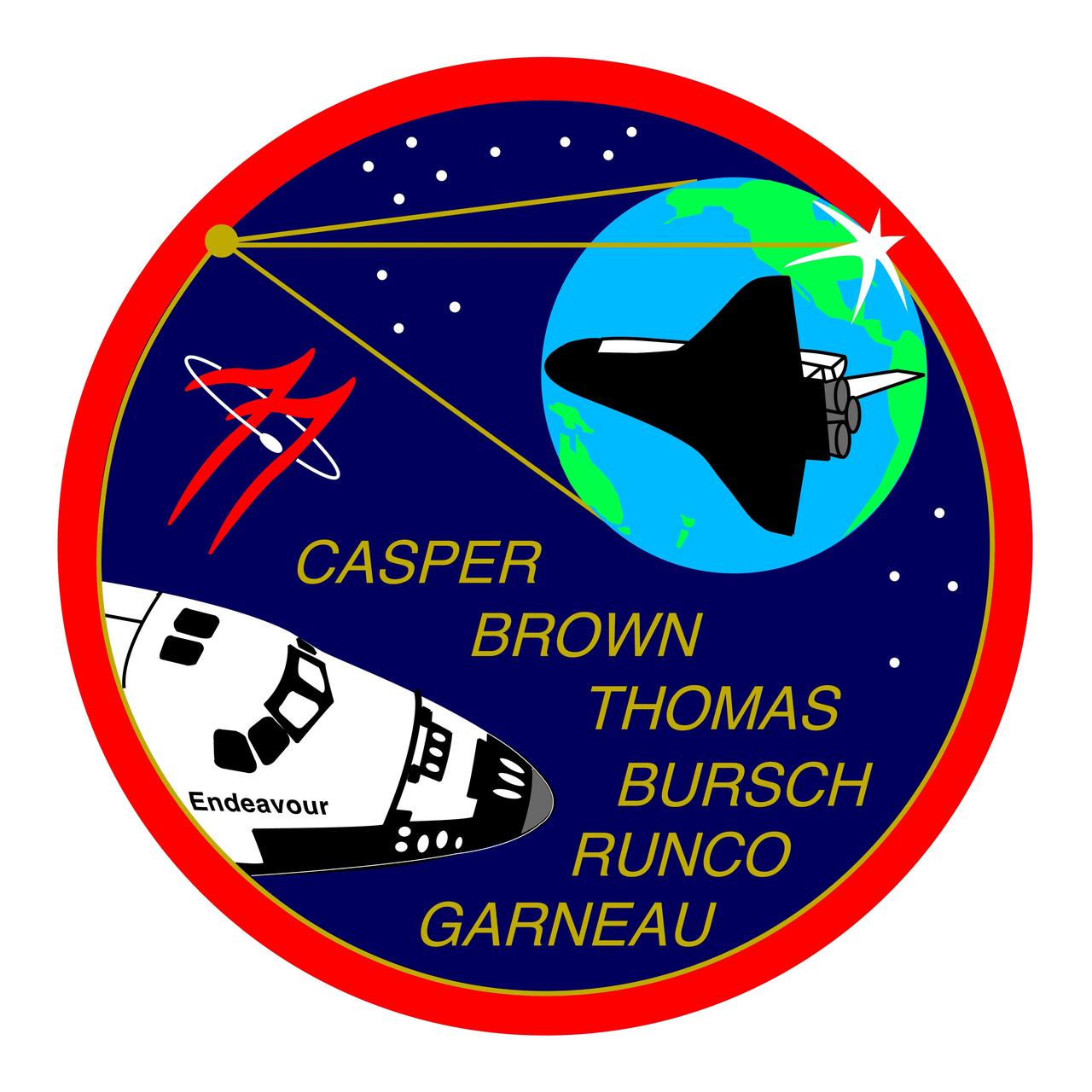
STS077-S-001 (February 1996) --- The STS-77 crew patch, designed by the crew members, displays the space shuttle Endeavour the lower left and its reflection within the tripod and concave parabolic mirror of the Shuttle Pointed Autonomous Research Tool for Astronomy (SPARTAN) Inflatable Antenna Experiment (IAE). The center leg of the tripod also delineates the top of the Spacehab?s shape, the rest of which is outlined in gold just inside the red perimeter. The Spacehab is carried in the payload bay and houses the Commercial Float Zone Furnace (CFZF) and Space Experiment Facility (SEF) experiments. Also depicted within the confines the IAE mirror are the mission?s rendezvous operations with the Passive Aerodynamically Stabilized Magnetically Damped Satellite/Satellite Test Unit (PAM/STU) satellite and a reflection of Earth. The PAM/STU satellite appears as a bright six-pointed star-like reflection of the sun on the edge of the mirror with the space shuttle Endeavour in position to track it. The sunglint on the mirror?s edge, which also appears as an orbital sunset, is located over Goddard Space Flight Center (GSFC), the development facility for the SPARTAN/IAE and Technology Experiments Advancing Missions in Space (TEAMS) experiments. The reflection of Earth is oriented to show the individual countries of the crew as well as the ocean which Captain Cook explored in the original Endeavour. The mission number ?77? is featured as twin stylized chevrons and an orbiting satellite as adapted from NASA?s logo. The stars at the top are arranged as seen in the northern sky in the vicinity of the constellation Ursa Minor. The field of 11 stars represents both the TEAMS cluster of experiments (the four antennae of Global Positioning System Attitude and Navigation Experiment (GANE), the single canister of Liquid Metal Thermal Experiment (LMTE), the three canisters of Vented Tank Resupply Experiment (VTRE), and the canisters of PAM/STU, and the 11th flight of the Endeavour. The constellation at the right shows the four stars of the Southern Cross for the fourth flight of Spacehab. The NASA insignia design for space shuttle flights is reserved for use by the astronauts and for other official use as the NASA Administrator may authorize. Public availability has been approved only in the forms of illustrations by the various news media. When and if there is any change in this policy, which is not anticipated, the change will be publicly announced. Photo credit: NASA
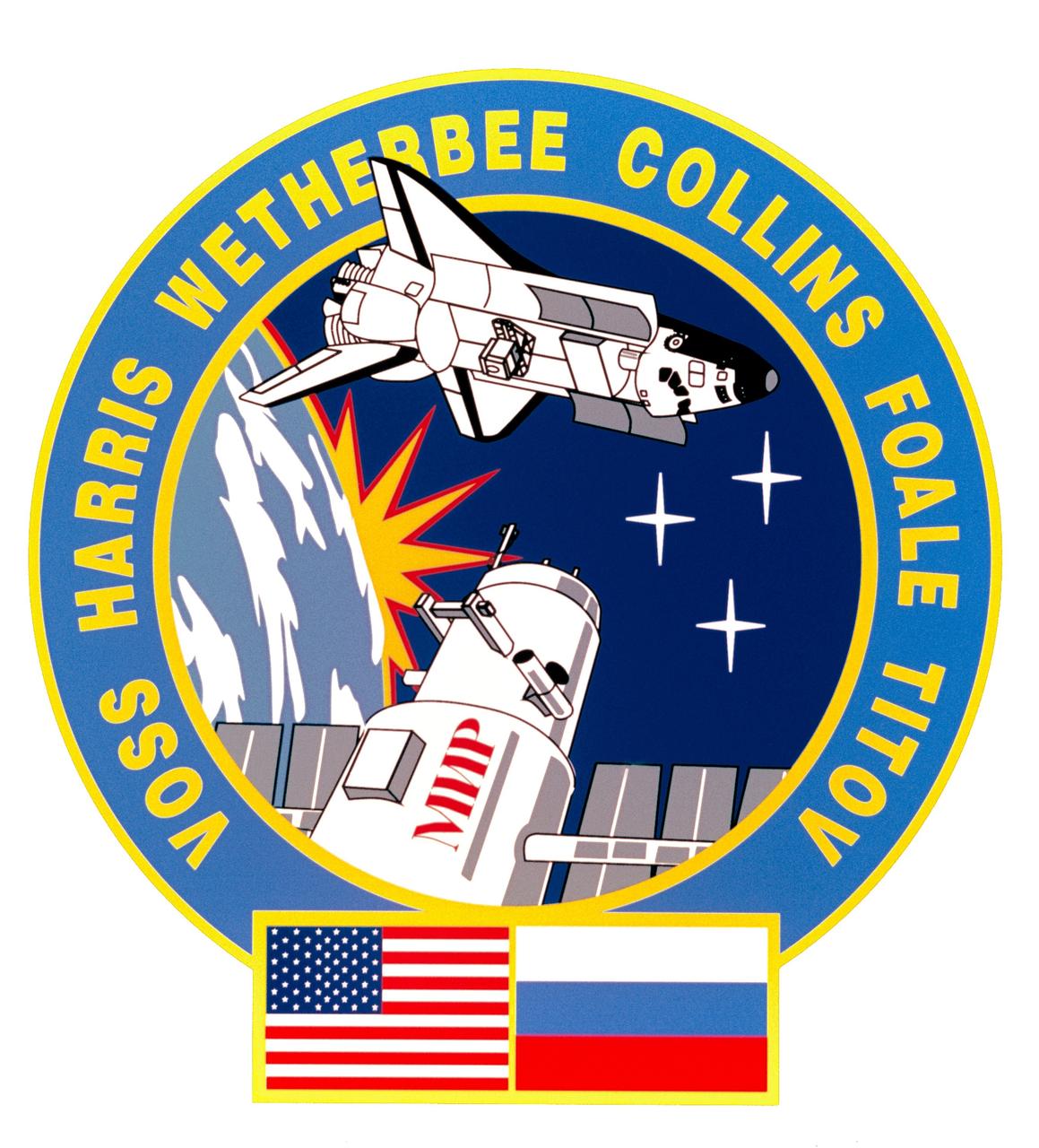
STS063-S-001 (September 1994) --- Designed by the crew members, the STS-63 crew patch depicts the orbiter maneuvering to rendezvous with Russia's Space Station Mir. The name is printed in Cyrillic on the side of the station. Visible in the orbiter's payload bay are the commercial space laboratory Spacehab and the Shuttle Pointed Autonomous Research Tool for Astronomy (SPARTAN) satellite which are major payloads on the flight. The six points on the rising sun and the three stars are symbolic of the mission's Space Transportation System (STS) numerical designation. Flags of the United States and Russia at the bottom of the patch symbolize the cooperative operations of this mission. The crew will be flying aboard the space shuttle Discovery. The NASA insignia design for space shuttle flights is reserved for use by the astronauts and for other official use as the NASA Administrator may authorize. Public availability has been approved only in the forms of illustrations by the various news media. When and if there is any change in this policy, which is not anticipated, the change will be publicly announced. Photo credit: NASA

S65-54129 (November 1965) --- Design for the emblem of the Gemini VII spaceflight. At left of hand-held torch is a Gemini spacecraft. Roman numeral indicates the seventh flight in the Gemini series. Prime crew men for the mission are astronauts Frank Borman, command pilot, and James A. Lovell Jr., pilot. The NASA insignia design for Gemini flights is reserved for use by the astronauts and for other official use as the NASA Administrator may authorize. Public availability has been approved only in the form of illustrations by the various news media. When and if there is any change in this policy, which we do not anticipate, it will be publicly announced. Photo credit: NASA
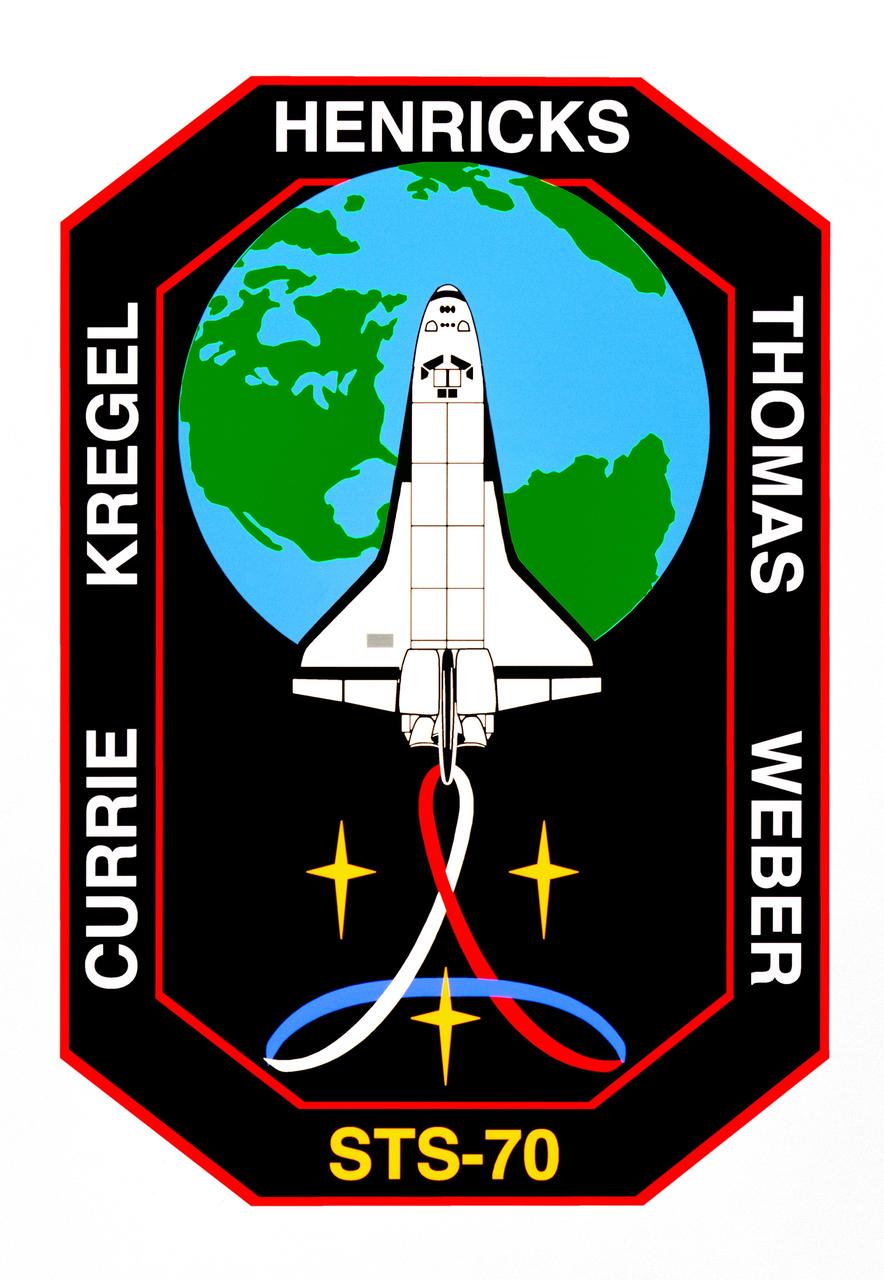
STS070-S-001 (March 1995) --- Designed by the crew members, the STS-70 crew patch depicts the space shuttle Discovery orbiting Earth in the vast blackness of space. The primary mission of deploying a NASA Tracking and Data Relay Satellite (TDRS) is depicted by three gold stars. They represent the triad composed of spacecraft transmitting data to Earth through the Tracking and Data Relay Satellite System (TDRSS). The stylized red, white and blue ribbon represents the American goal of linking space exploration to the advancement of all humankind. Surnames of the five astronaut crew members are spaced around the periphery of the patch. The NASA insignia design for space shuttle flights is reserved for use by the astronauts and for other official use as the NASA Administrator may authorize. Public availability has been approved only in the forms of illustrations by the various news media. When and if there is any change in this policy, which is not anticipated, the change will be publicly announced. Photo credit: NASA
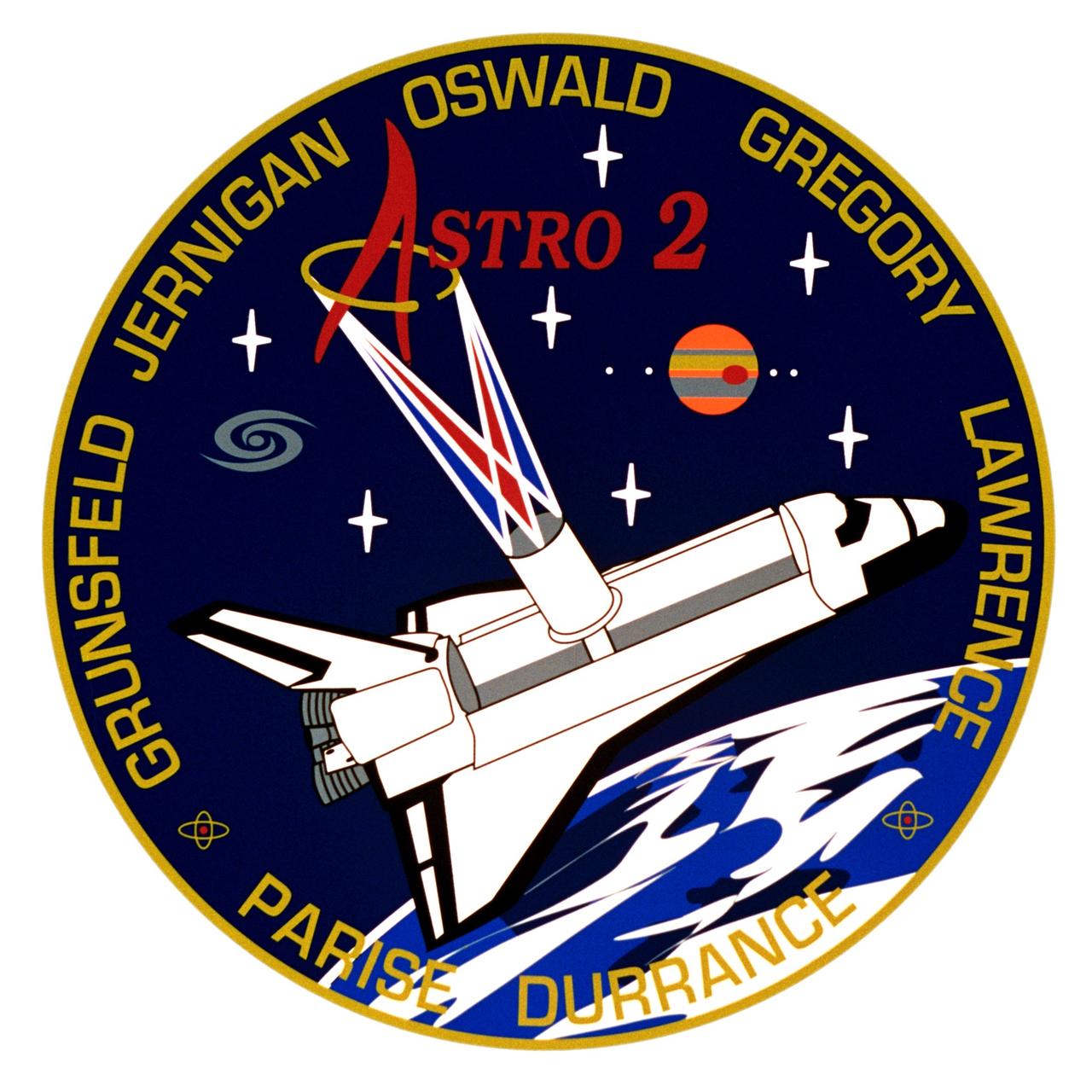
STS067-S-001 (October 1994) --- Observation and remote exploration of the Universe in the ultraviolet wavelengths of light are the focus of the STS-67/ASTRO-2 mission, as depicted in the crew patch designed by the crew members. The insignia shows the ASTRO-2 telescopes in the space shuttle Endeavour's payload bay, orbiting high above Earth's atmosphere. The three sets of rays, diverging from the telescope on the patch atop the Instrument Pointing System (IPS), correspond to the three ASTRO-2 telescopes -- the Hopkins Ultraviolet Telescope (HUT), the Ultraviolet Imaging Telescope (UIT), and the Wisconsin Ultraviolet Photo-Polarimeter Experiment (WUPPE). The telescopes are co-aligned to simultaneously view the same astronomical object, as shown by the convergence of rays on the NASA symbol. This symbol also represents the excellence of the union of the NASA teams and universality's in the exploration of the universe through astronomy. The celestial targets of ASTRO-2 include the observation of planets, stars and galaxies shown in the design. The two small atoms represent the search in the ultraviolet spectrum for the signature of primordial helium in intergalactic space left over from the Big Bang. The observations performed on ASTRO-2 will contribute to man's knowledge and understanding of the vast universe, from the planets in out system to the farthest reaches of space. The NASA insignia design for space shuttle flights is reserved for use by the astronauts and for other official use as the NASA Administrator may authorize. Public availability has been approved only in the forms of illustrations by the various news media. When and if there is any change in this policy, which is not anticipated, the change will be publicly announced. Photo credit: NASA
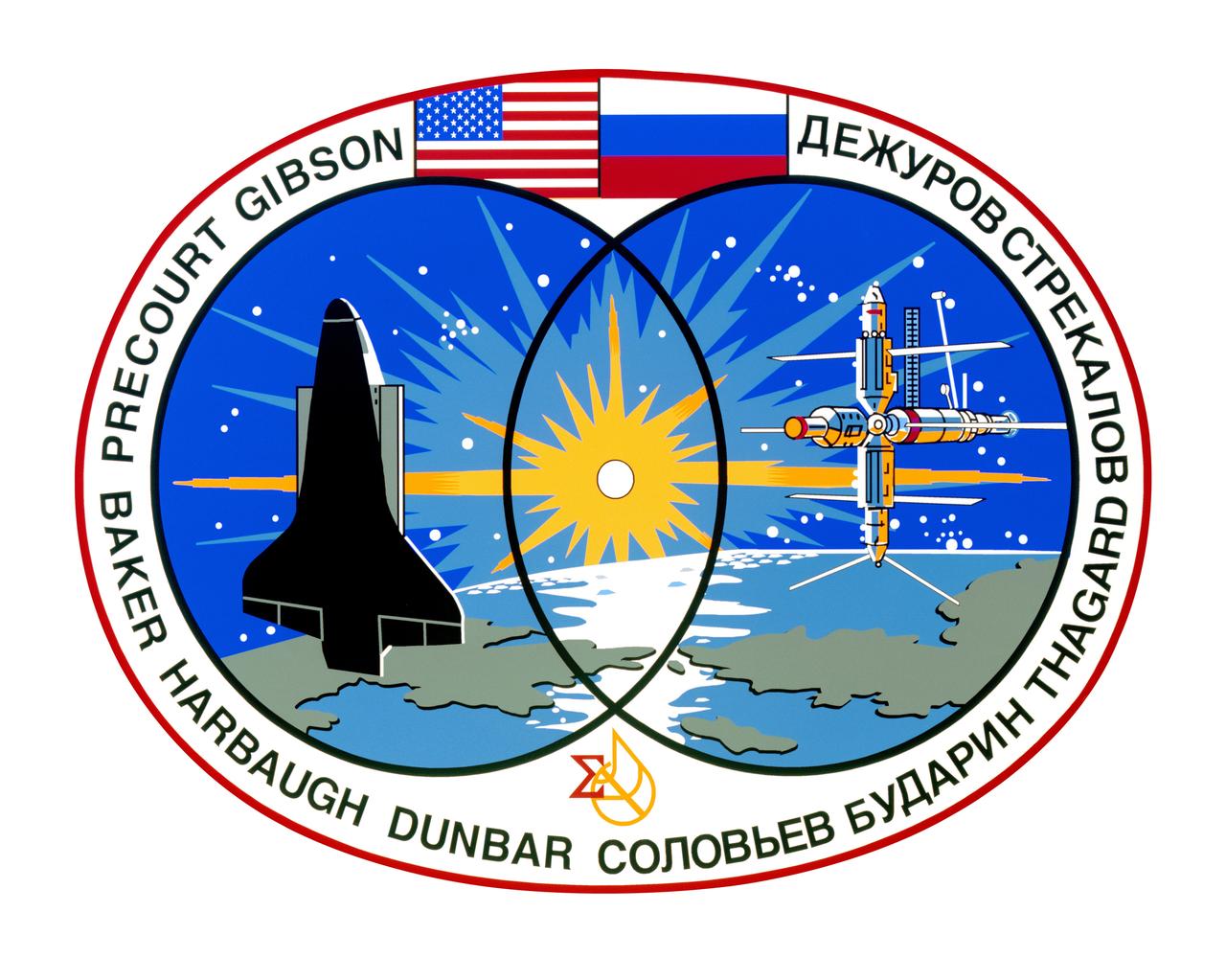
STS071-S-001 (April 1995) --- The STS-71 crew patch design depicts the orbiter Atlantis in the process of the first international docking mission of the space shuttle Atlantis with the Russian Mir Space Station. The names of the 10 astronauts and cosmonauts who will fly aboard the orbiter as shown along the outer border of the patch. The rising sun symbolizes the dawn of a new era of cooperation between the two countries. The vehicles Atlantis and Mir are shown in separate circles converging at the center of the emblem symbolizing the merger of the space programs of the two space faring nations. The flags of the United States and Russia emphasize the equal partnership of the mission. The joint program symbol at the lower center of the patch acknowledges the extensive contributions made by the Mission Control Centers (MCC) of both countries. The crew insignia was designed by aviation and space artist, Bob McCall, who also designed the crew patch for the Apollo-Soyuz Test Project (ASTP) in 1975, the first international space docking mission. The NASA insignia design for space shuttle flights is reserved for use by the astronauts and for other official use as the NASA Administrator may authorize. Public availability has been approved only in the forms of illustrations by the various news media. When and if there is any change in this policy, which is not anticipated, the change will be publicly announced. Photo credit: NASA
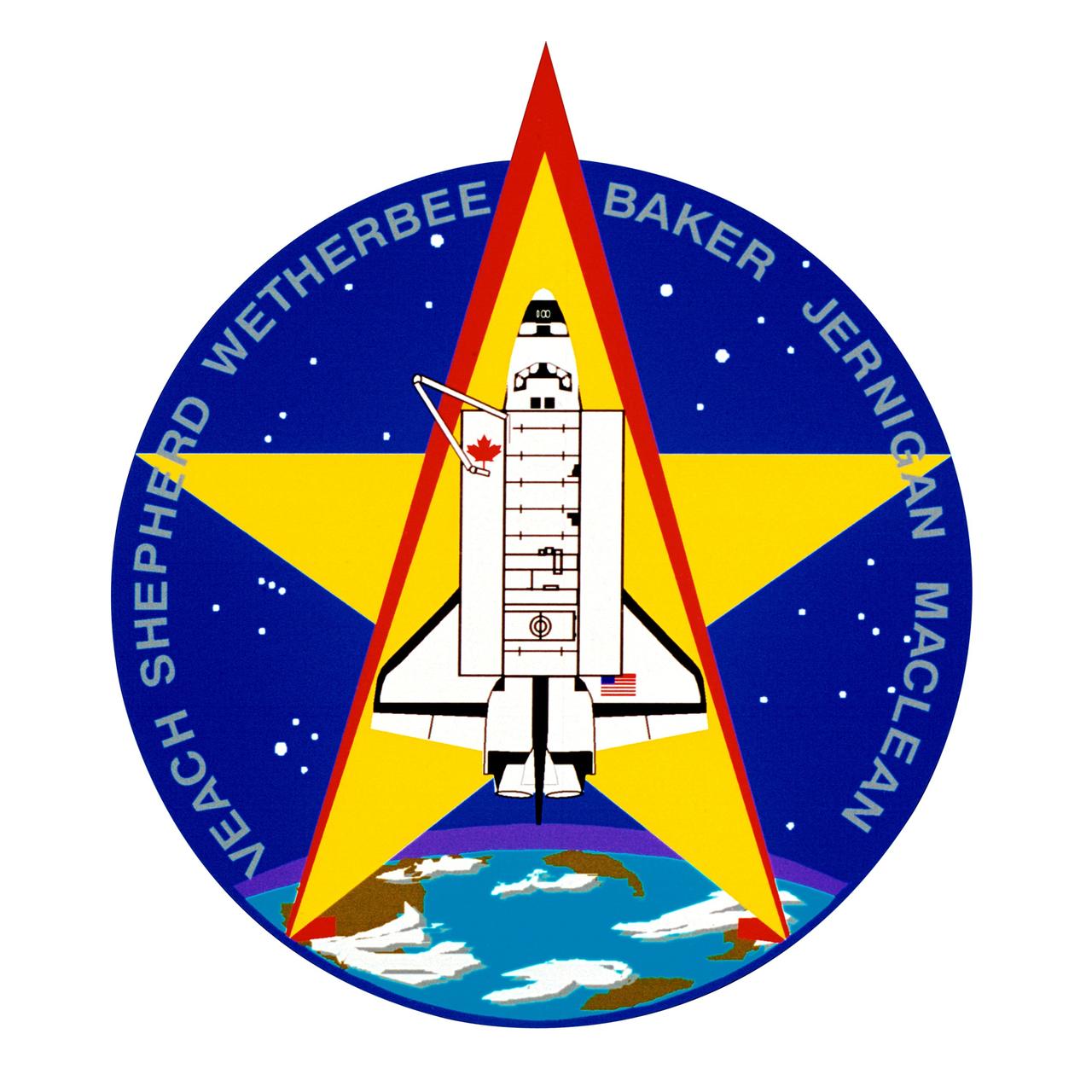
STS052-S-001 (July 1992) --- The insignia, designed by the STS-52 crew members, features a large gold star to symbolize the crew's mission on the frontiers of space. A gold star is often used to symbolize the frontier period of the American West. The red star in the shape of the Greek letter lambda represents both the laser measurements to be taken from the Laser Geodynamic Satellite (LAGEOS II) and the Lambda Point Experiment, which is part of the United States Microgravity Payload (USMP-1). The LAGEOS II is a joint Italian\United States satellite project intended to further our understanding of global plate tectonics. The USMP-1 is a microgravity facility which has French and United States experiments designed to test the theory of cooperative phase transitions and to study the solid\liquid interface of a metallic alloy in the low gravity environment. The Remote Manipulator System (RMS) and maple leaf are emblematic of the Canadian payload specialist who will conduct a series of Canadian flight experiments (CANEX-2), including the Space Vision System test. The NASA insignia design for space shuttle flights is reserved for use by the astronauts and for other official use as the NASA Administrator may authorize. Public availability has been approved only in the form of illustrations by the various news media. When and if there is any change in this policy, which we do not anticipate, it will be publicly announced. Photo credit: NASA
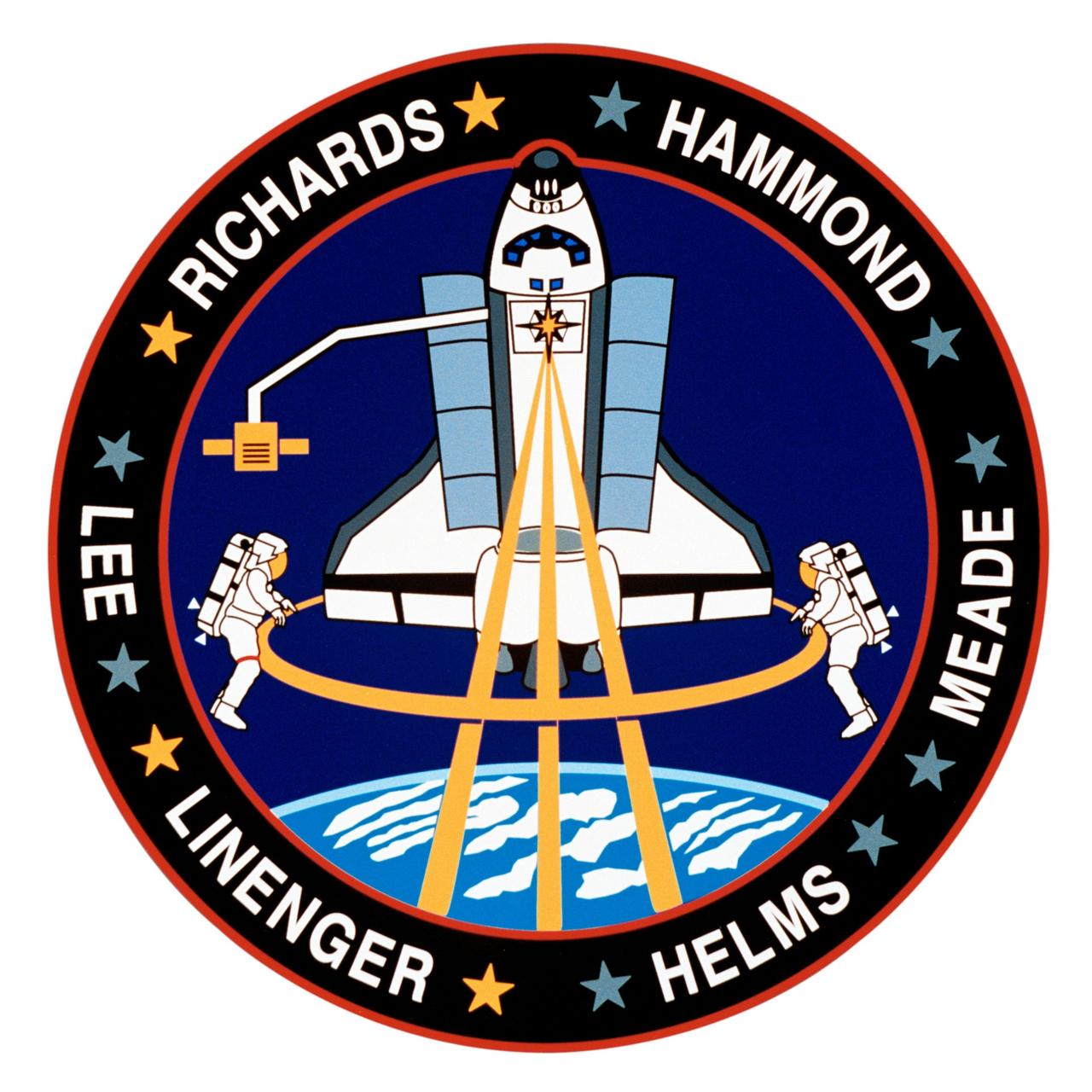
STS064-S-001 (July 1994) --- The patch depicts the space shuttle Discovery in a payload-bay-to-Earth attitude with its primary payload, Lidar In-Space Technology Experiment (LITE-1) operating in support of Mission to Planet Earth. LITE-1 is a lidar (light detection and ranging) system that uses a three-wavelength laser, symbolized by the three gold rays emanating from the star in the payload bay that form part of the astronaut symbol. The major objective of this first flight of LITE-1 is to validate its design and operating characteristics by gathering data about the Earth's troposphere and stratosphere, represented by the clouds and dual-colored Earth limb. A secondary payload on STS-64 is the free-flier SPARTAN-201 satellite shown on the Remote Manipulator System (RMS) arm post-retrieval. The objective of SPARTAN-201 is to investigate the physics of the solar wind and complement data being obtained from the ULYSSES satellite launched on STS-41. The RMS will also operate another secondary payload, Shuttle Plume Impingement Flight Experiment (SPIFEX), which will assess the plume effects from the Orbiter's Reaction Control System thrusters. Additionally, STS-64 will test a new extravehicular activity (EVA) maneuvering device, Simplified Aid for EVA Rescue (SAFER), represented symbolically by the two small nozzles on the backpacks of the two untethered EVA crew men. The names of the crew members encircle the patch: astronauts Richard N. Richards, commander; L. Blaine Hammond Jr., pilot; Jerry M. Linenger; Susan J. Helms, Carl J. Meade and Mark C. Lee, all mission specialists. The gold or silver stars by each name represent that person's parent service. The NASA insignia design for space shuttle flights is reserved for use by the astronauts and for other official use as the NASA Administrator may authorize. Public availability has been approved only in the forms of illustrations by the various news media. When and if there is any change in this policy, which is not anticipated, the change will be publicly announced. Photo credit: NASA
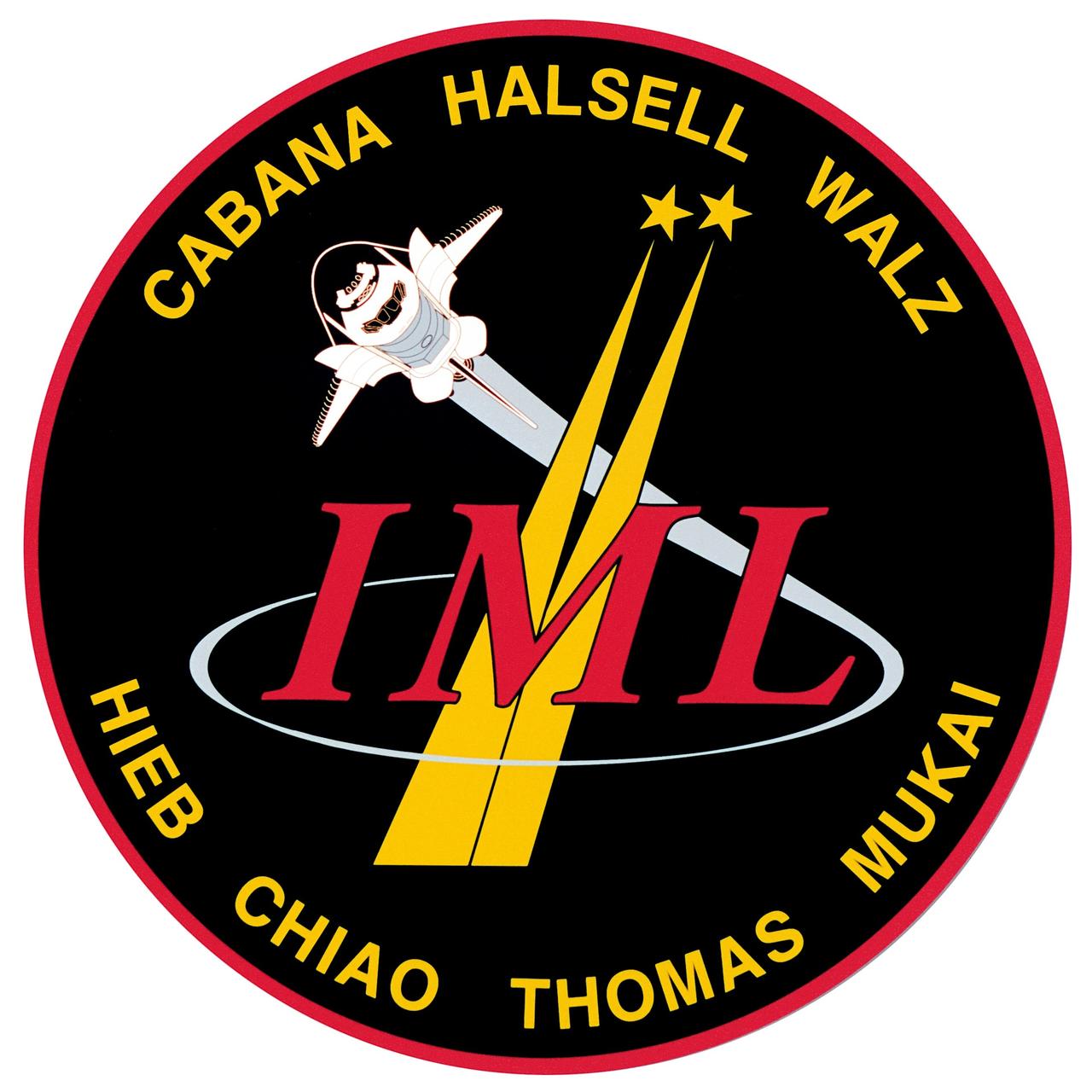
STS065-S-001 (March 1994) --- Designed by the crew members, the STS-65 insignia features the International Microgravity Laboratory (IML-2) mission and its Spacehab module which will fly aboard the space shuttle Columbia. IML-2 is reflected in the emblem by two gold stars shooting toward the heavens behind the IML lettering. The space shuttle Columbia is depicted orbiting the logo and reaching into space, with Spacehab on an international quest for a better understanding of the effects of spaceflight on materials processing and life sciences. The NASA insignia design for space shuttle flights is reserved for use by the astronauts and for other official use as the NASA Administrator may authorize. Public availability has been approved only in the forms of illustrations by the various news media. When and if there is any change in this policy, which is not anticipated, the change will be publicly announced. Photo credit: NASA
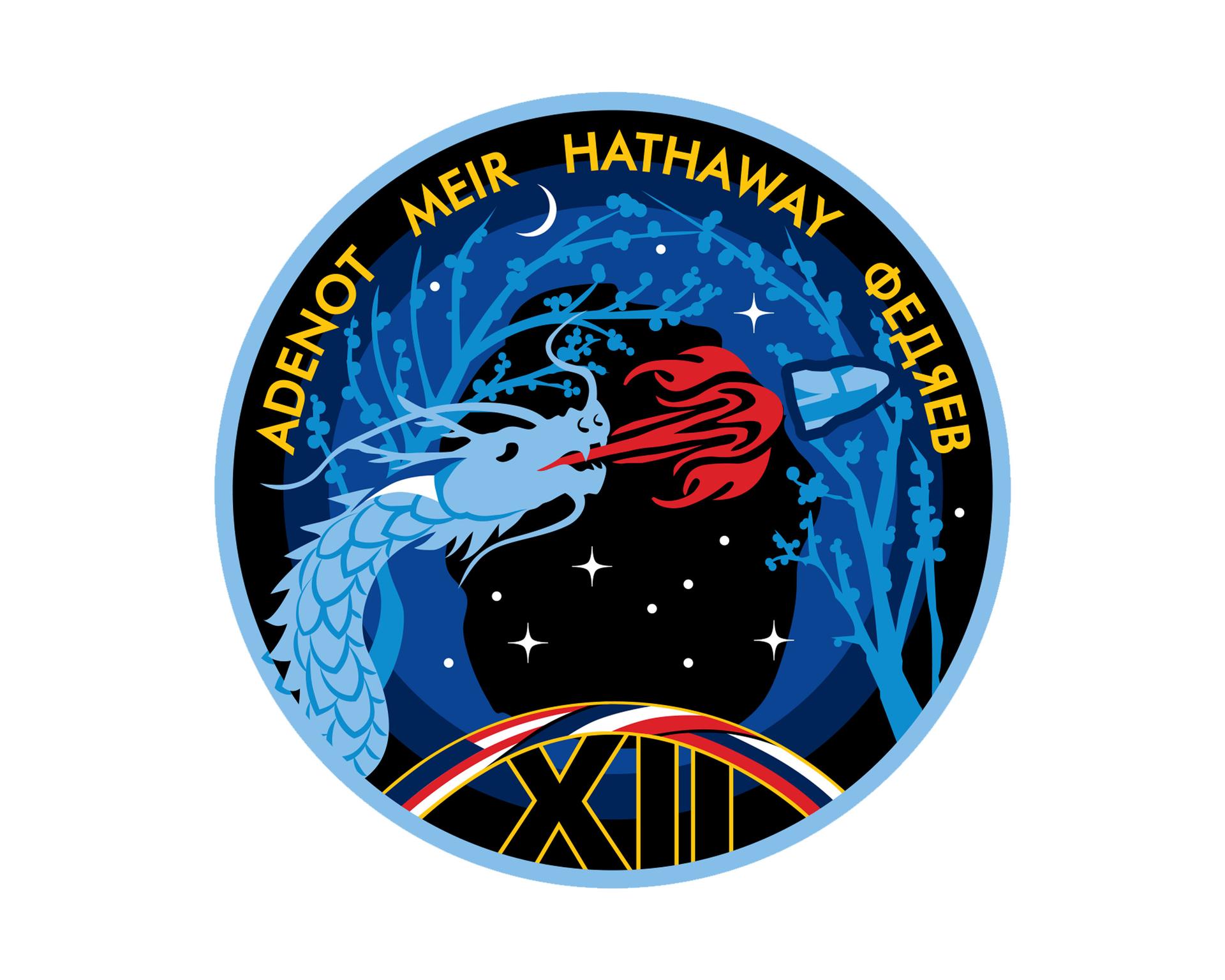
jsc2025e091193 (Dec. 1, 2025) --- The official insignia of NASA's SpaceX Crew-12 mission to the International Space Station.
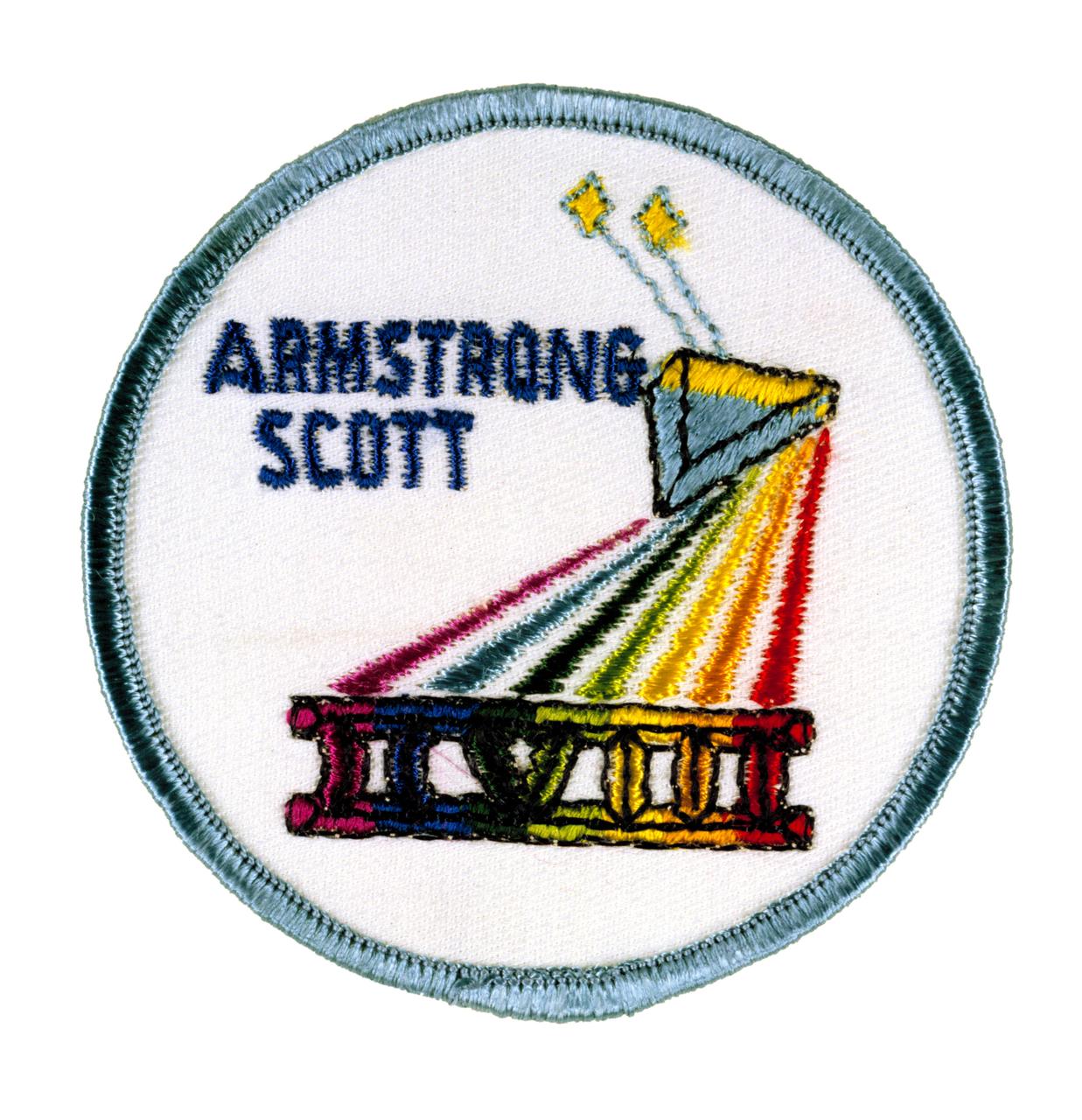
S66-23978 (March 1966) --- Color design for the emblem of the Gemini-8 spaceflight. Roman numeral indicates the eighth flight in the Gemini series. Prime crewmen for the mission are astronauts Neil A. Armstrong, command pilot; and David R. Scott, pilot. The NASA insignia design for Gemini flights is reserved for use by the astronauts and for other official use as the NASA Administrator may authorize. Public availability has been approved only in the form of illustrations by the various news media. When and if there is any change in this policy, which we do not anticipate, it will be publicly announced. Photo credit: NASA
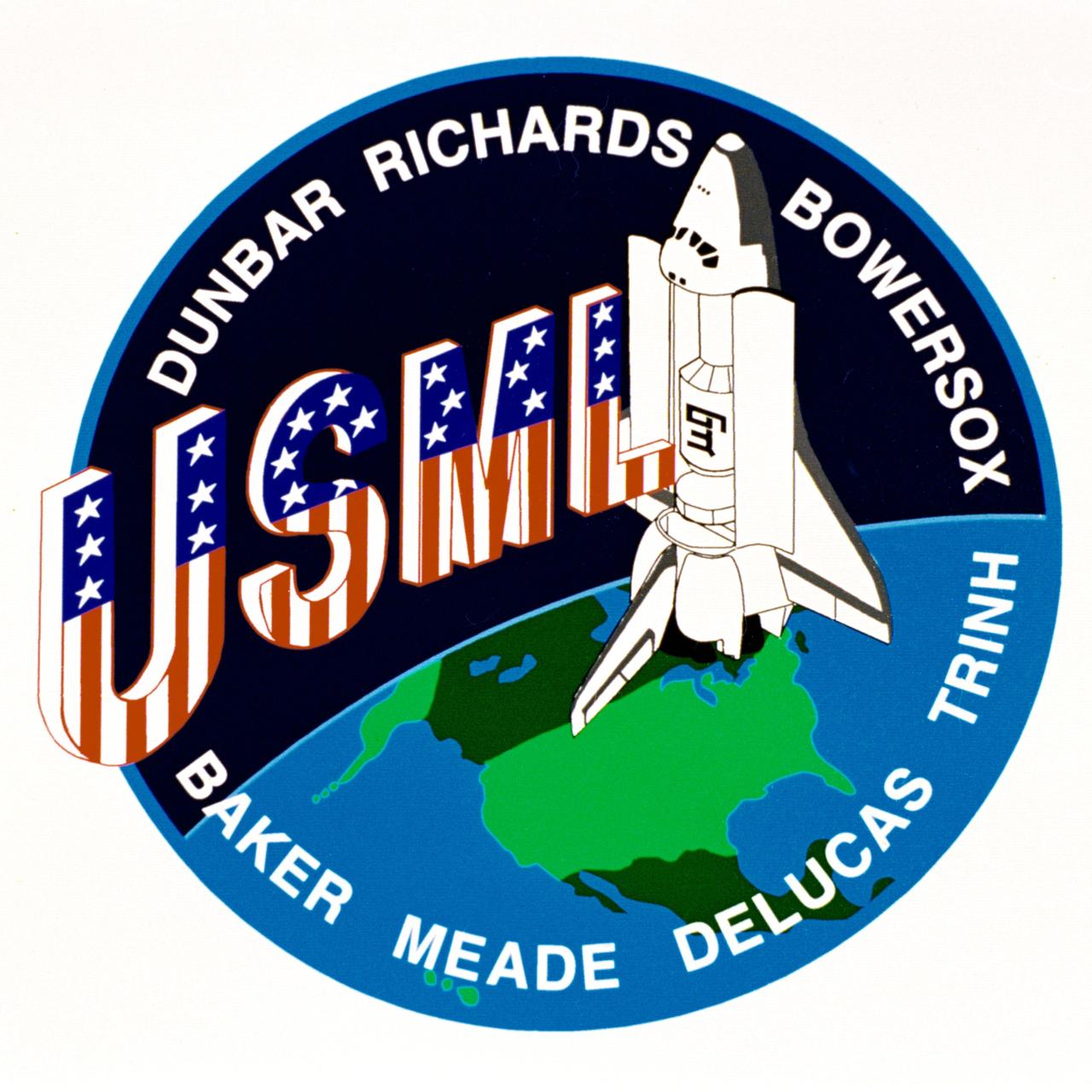
STS050-S-001 (January 1992) --- Designed by the flight crew, the insignia for the United States Microgravity Laboratory (USML-1), captures a space shuttle traveling above Earth while trailing the USML banner. The orbiter is oriented vertically in a typical attitude for microgravity science and in this position represents the numeral 1 in the mission's abbreviated title. This flight represents the first in a series of USML flights on which the primary objective is microgravity science, planned and executed through the combined efforts of the United States of America's government, industry and academia. Visible in the payload bay are the Spacelab module, and the extended duration orbiter "cryo" pallet which will be making its first flight. The small g and Greek letter mu on the Spacelab module symbolize the microgravity environment being used for research in the areas of materials science and fluid physics. The large block letter U extends outside the patch perimeter, symbolizing the potential for the experiments on this flight to expand the current boundaries of knowledge in microgravity science. The Stars and Stripes of the USML block letters and the United States landmass in the Earth scene below reflect the crew's pride in the United States origin of all onboard experiments. The NASA insignia design for space shuttle flights is reserved for use by the astronauts and for other official use as the NASA Administrator may authorize. Public availability has been approved only in the forms of illustrations by the various news media. When and if there is any change in this policy, which is not anticipated, the change will be publicly announced. Photo credit: NASA

STS057-S-001 (February 1993) --- Designed by the crew members, the STS-57 crew patch depicts the space shuttle Endeavour maneuvering to retrieve the European Space Agency's (ESA) microgravity experiment satellite EURECA. SpaceHab - the first commercial space laboratory - is depicted in the cargo bay, and its characteristic shape is represented by the inner red border of the patch. The three gold plumes surrounded by the five stars trailing EURECA are suggestive of the United States astronaut logo. The five gold stars together with the shape of the orbiter's mechanical arm form the mission's numerical designation. The six stars on the American flag represent the United States astronauts who comprise the crew. With detailed input from the crew members, the final artwork was accomplished by artist Tim Hall. The NASA insignia design for space shuttle flights is reserved for use by the astronauts and for other official use as the NASA Administrator may authorize. Public availability has been approved only in the form of illustrations by the various news media. When and if there is any change in this policy, which we do not anticipate, it will be publicly announced. Photo credit: NASA
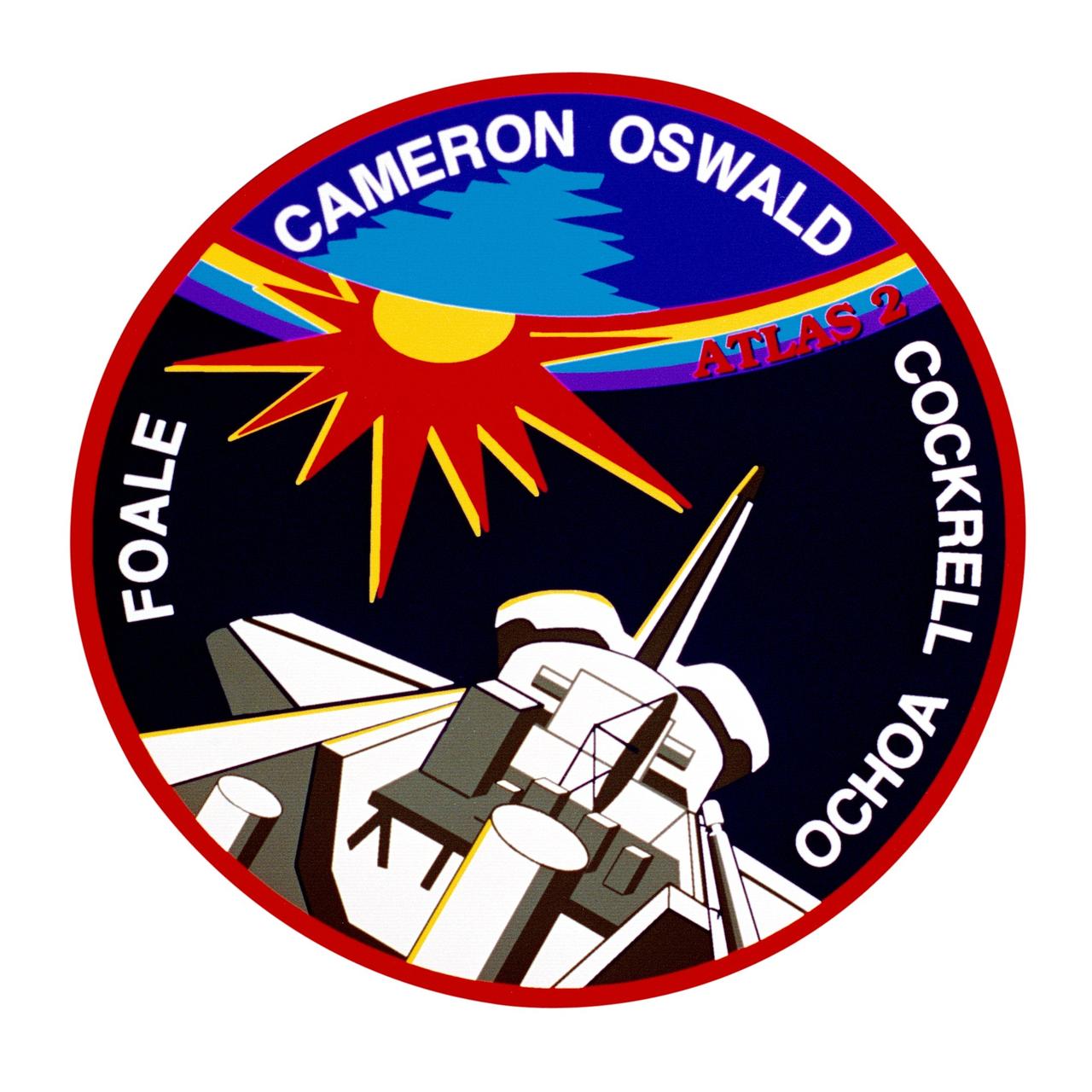
STS056-S-001 (January 1993) --- The patch is a pictorial representation of the STS-56/ATLAS-2 mission as seen from the crew's viewpoint. The payload bay is depicted with the ATLAS-2 pallet, Shuttle Solar Backscatter Ultra Violet (SSBUV) experiment, and Spartan -- the two primary scientific payloads on the flight. With ATLAS-2 serving as part of the "Mission to Planet Earth" (MTPE) project, the crew has depicted the planet prominently in the artwork. Two primary areas of study are the atmosphere and the sun. To highlight this, Earth's atmosphere is depicted as a stylized visible spectrum and the sunrise is represented with an enlarged two-colored corona. Surnames of the commander and pilot are inscribed in the Earth field, with the surnames of the mission specialists appearing in the space background. The NASA insignia design for space shuttle flights is reserved for use by the astronauts and for other official use as the NASA Administrator may authorize. Public availability has been approved only in the form of illustrations by the various news media. When and if there is any change in this policy, which we do not anticipate, it will be publicly announced. Photo credit: NASA
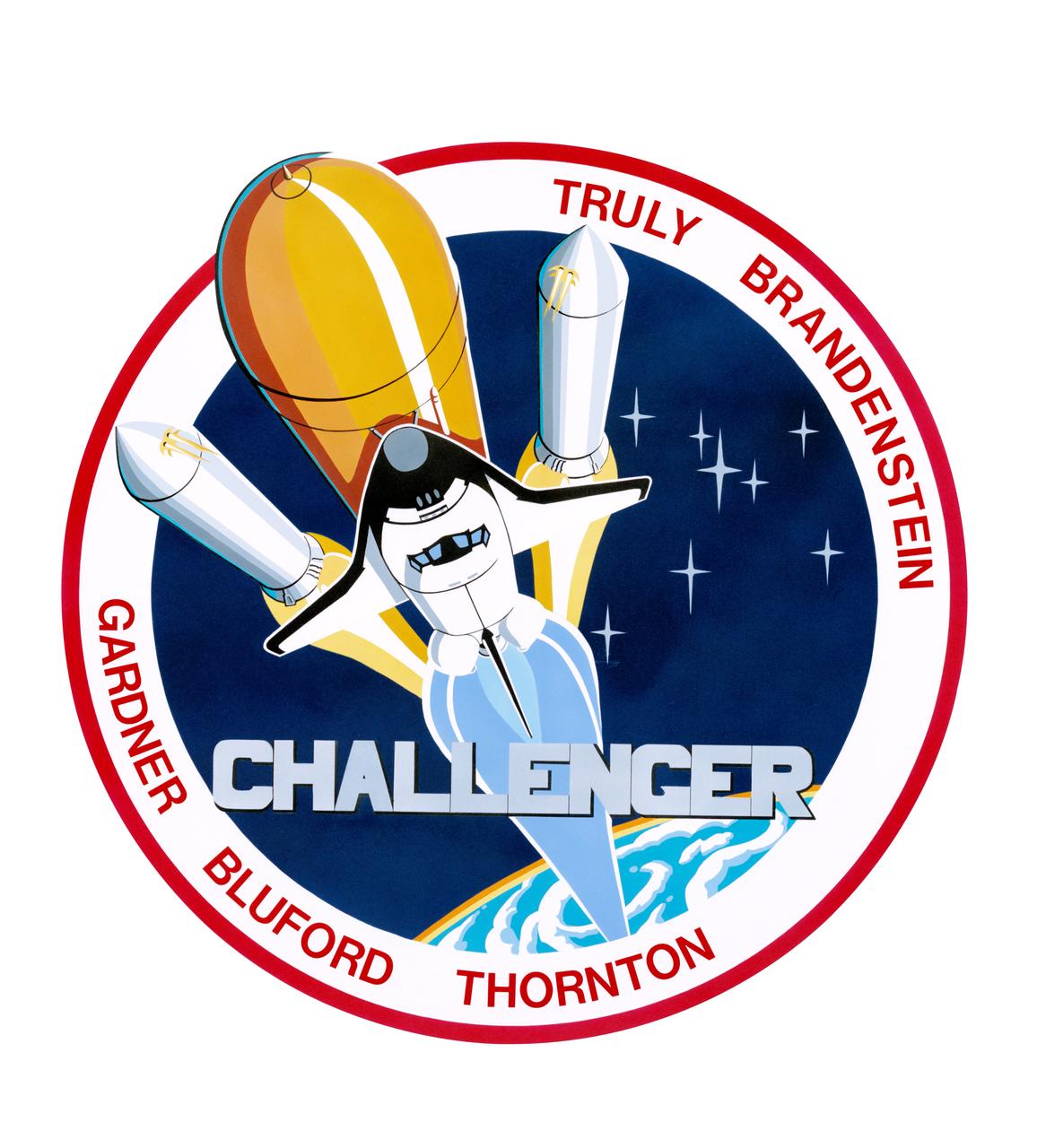
S83-30608 (29 April 1983) --- The night launch of the space shuttle Challenger heading toward its third Earth-orbital mission is featured in the official insignia for STS-8. The eighth flight of the United States Space Transportation System (STS) is represented by eight stars of the constellation Aquila, "The Eagle," astronauts Richard H. Truly, commander; Daniel C. Brandenstein, pilot; Dale A. Gardner, Guion S. Bluford, and William E. Thornton -- all mission specialists -- have their surnames on the border of the insignia. The NASA insignia design for space shuttle flights is reserved for use by the astronauts and for other official use as the NASA Administrator may authorize. Public availability has been approved only in the forms of illustrations by the various news media. When and if there is any change in this policy, which is not anticipated, the change will be publicly announced. Photo credit: NASA
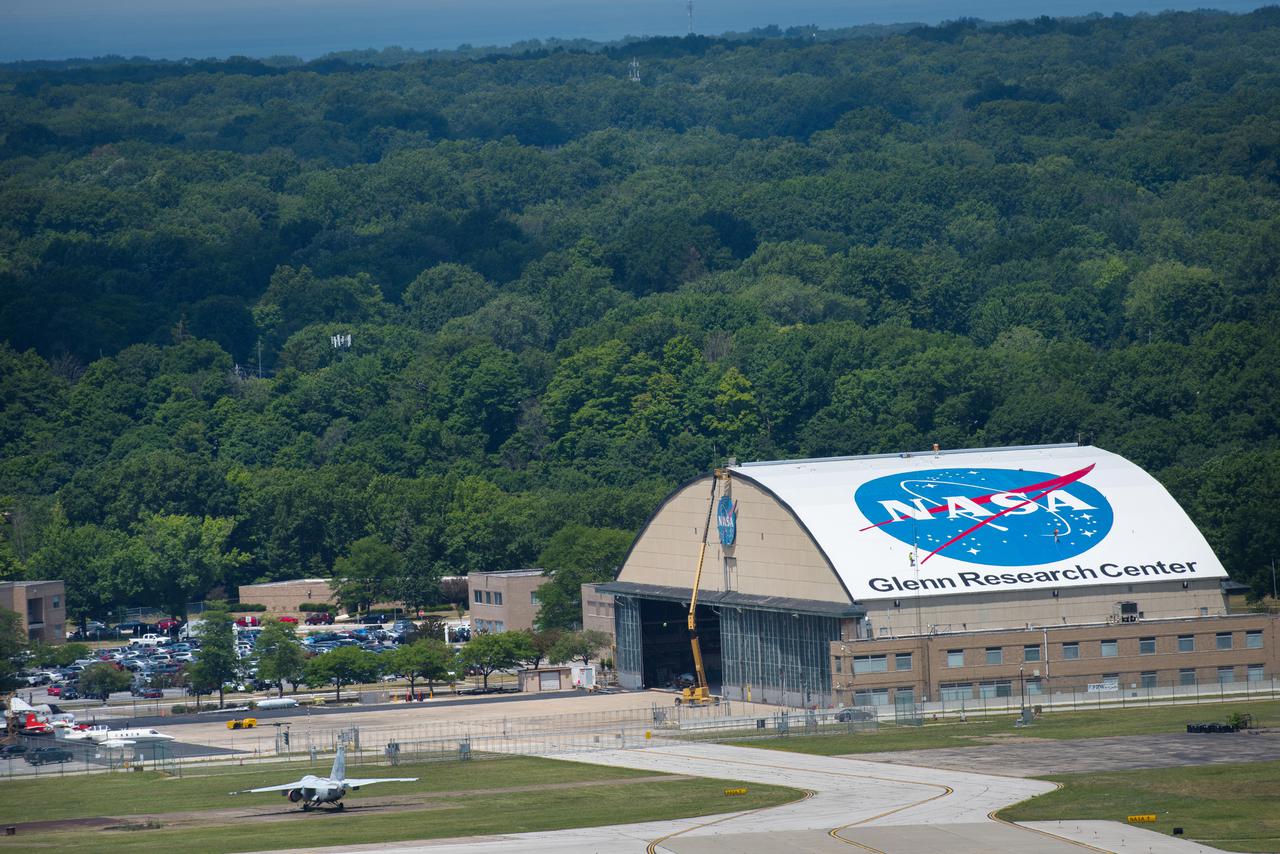
The NASA Insignia or Meatball, is painted on the Hangar Roof
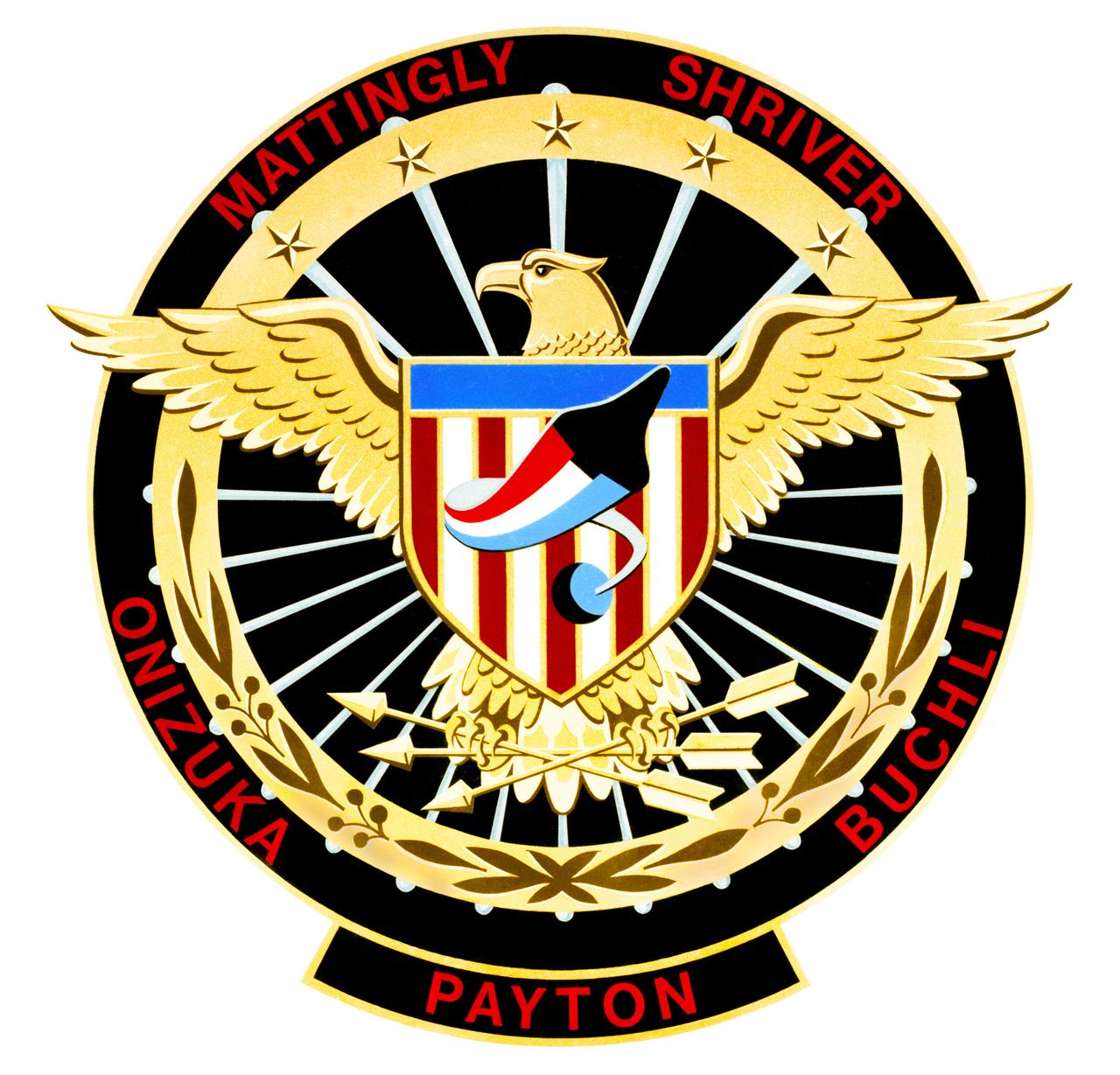
S84-42223 (10 Nov. 1984) --- The crew insignia for STS-51C includes the names of its five crew members are astronauts Thomas K. Mattingly, commander; Loren J. Shriver, pilot; Ellison L. Onizuka and James F. Buchli, mission specialists; and Gary E. Payton, payload specialist. The NASA insignia design for space shuttle flights is reserved for use by the astronauts and for other official use as the NASA Administrator may authorize. Public availability has been approved only in the forms of illustrations by the various news media. When and if there is any change in this policy, which is not anticipated, the change will be publicly announced. Photo credit: NASA
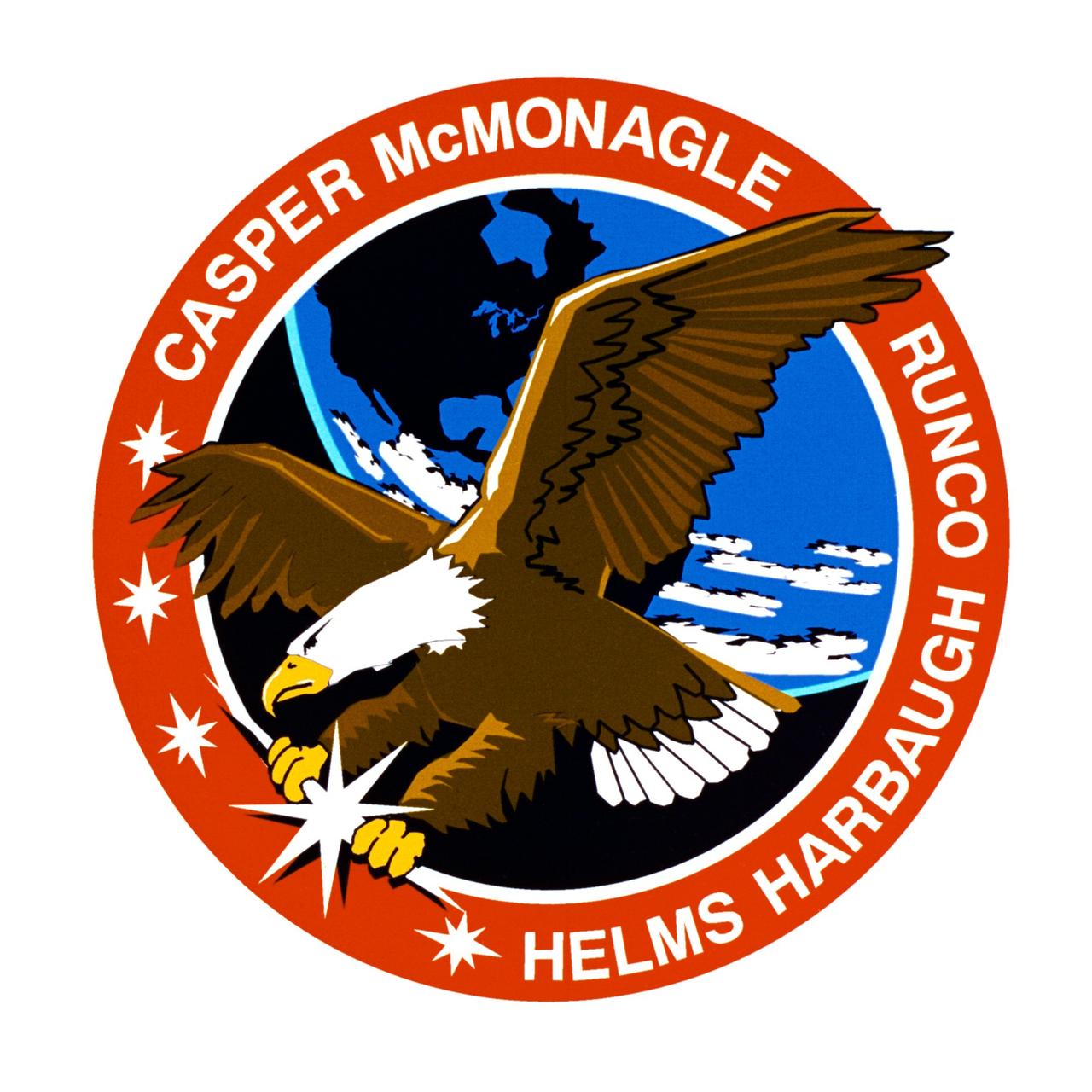
STS054-S-001 (July 1992) --- Designed by the crew members, the STS-54 crew patch depicts our national symbol, the American bald eagle, soaring above the Earth; and represents the United States Space Shuttle as a national asset in service to America and the world. The eagle is clutching an eight pointed star in its talons and is placing this larger star among a constellation of four others representing the placement of the fifth Tracking and Data Relay Satellite (TDRS) into orbit among the four already in service. The blackness of space with stars conspicuously absent represents the mission?s other primary objective in carrying the Diffuse X-ray Spectrometer into orbit to conduct astronomical observations of x-ray sources within the galaxy and throughout the universe. The depiction of our planet showing the crew?s home continent of North America is an expression of their and NASA?s intention that the medical and scientific experiments conducted onboard are for the benefit of all mankind. The clouds and blue of the Earth represent the crew?s part in NASA?s Mission to Planet Earth in conducting Earth observation photography. The NASA insignia design for space shuttle flights is reserved for use by the astronauts and for other official use as the NASA Administrator may authorize. Public availability has been approved only in the form of illustrations by the various news media. When and if there is any change in this policy, which we do not anticipate, it will be publicly announced. Photo credit: NASA
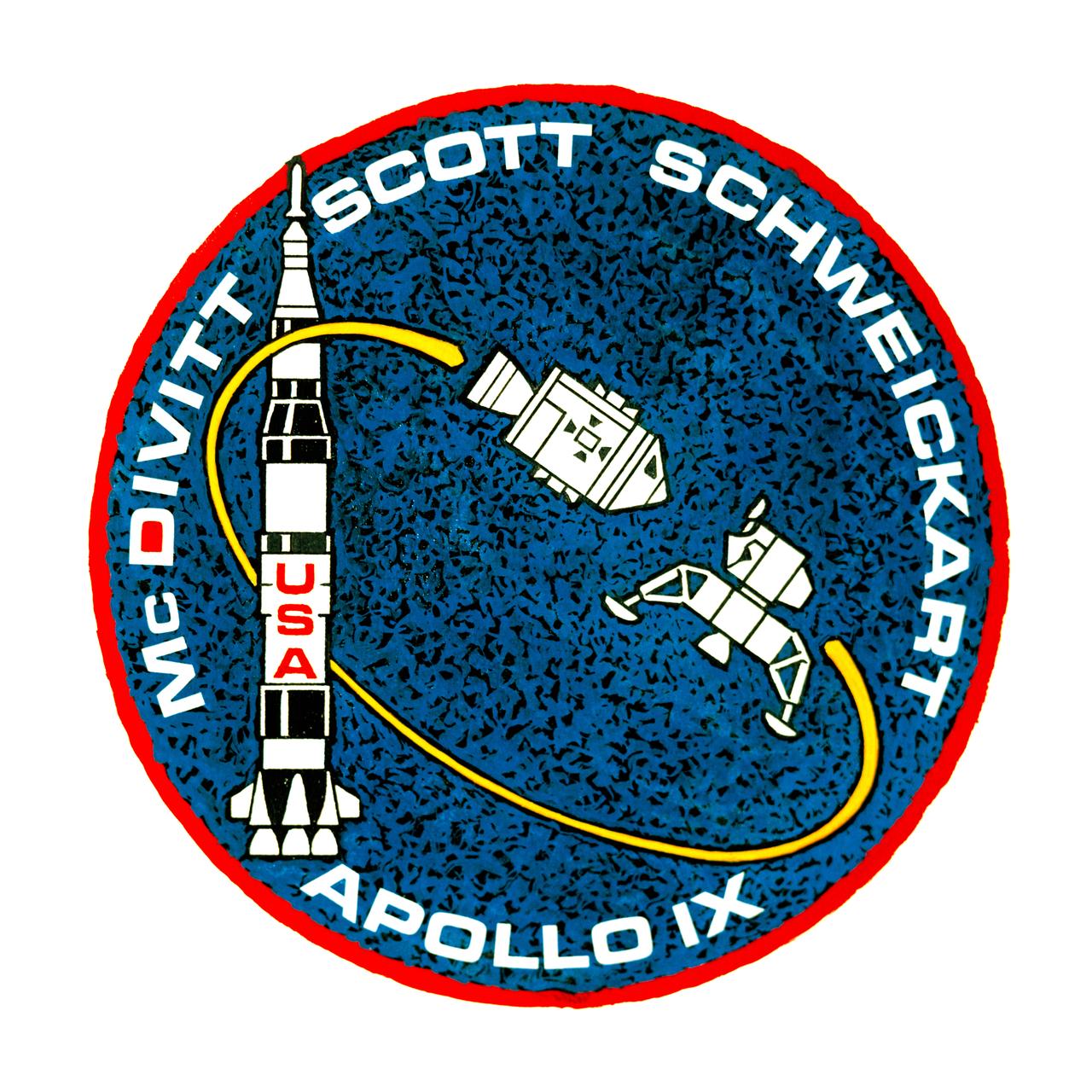
S69-18569 (February 1969) --- The insignia of the Apollo 9 space mission. The crew consist of astronauts James A. McDivitt, commander; David R. Scott, command module pilot; and Russell L. Schweickart, lunar module pilot. The Apollo 9 mission will evaluate spacecraft lunar module systems performance during manned Earth-orbital flight. The NASA insignia design for Apollo flights is reserved for use by the astronauts and for other official use as the NASA Administrator may authorize. Public availability has been approved only in the form of illustrations by the various news media. When and if there is any change in this policy, which we do not anticipate, it will be publicly announced.
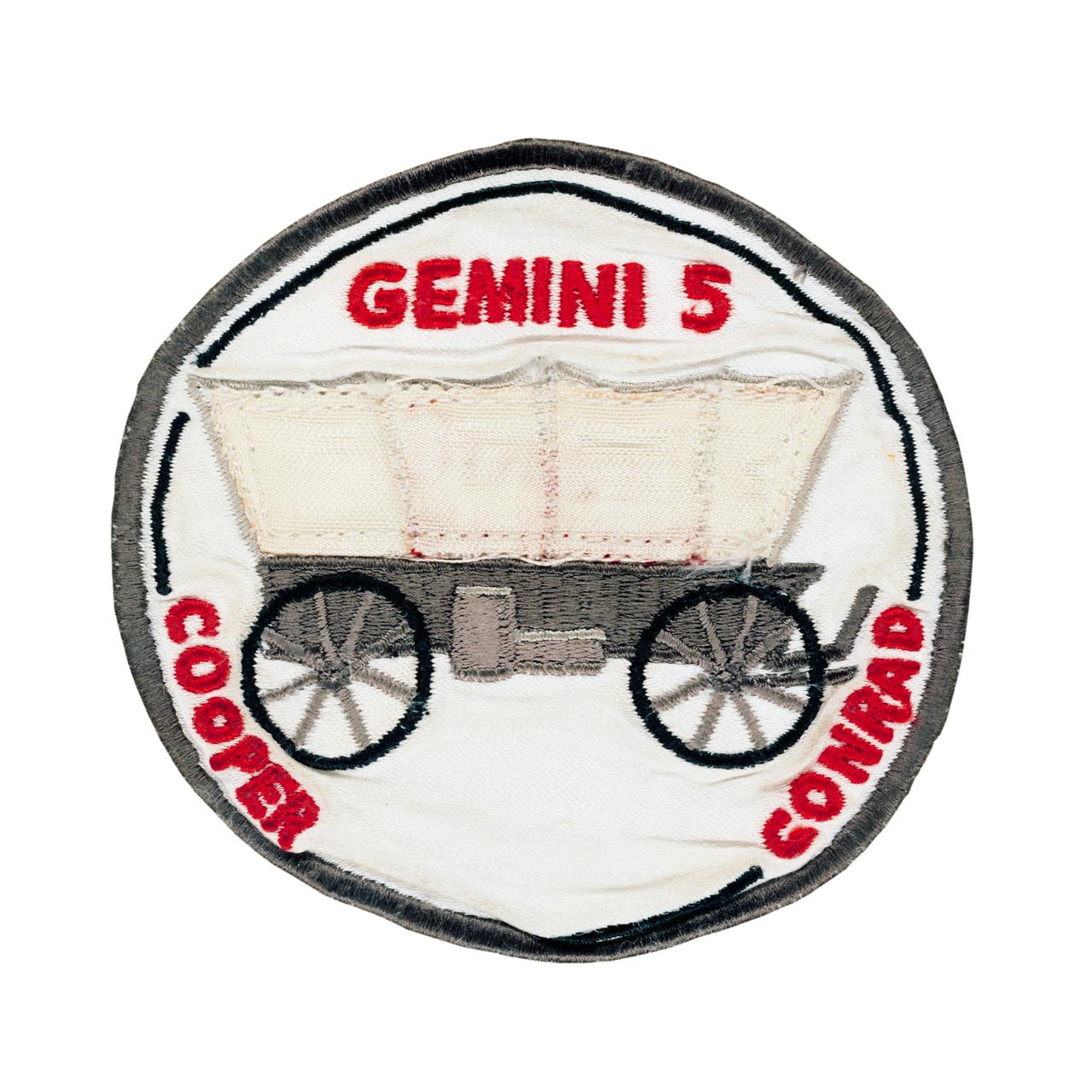
S66-59530 (August 1965) --- This is the insignia of the Gemini-Titan 5 (GT-5) spaceflight. The Gemini-5 prime crew members are astronauts L. Gordon Cooper Jr., command pilot; and Charles Conrad Jr., pilot. The covered wagon symbolizes pioneer spirit of space exploration. The NASA insignia design for Gemini flights is reserved for use by the astronauts and for other official use as the NASA Administrator may authorize. Public availability has been approved only in the form of illustrations by the various news media. When and if there is any change in this policy, which we do not anticipate, it will be publicly announced.
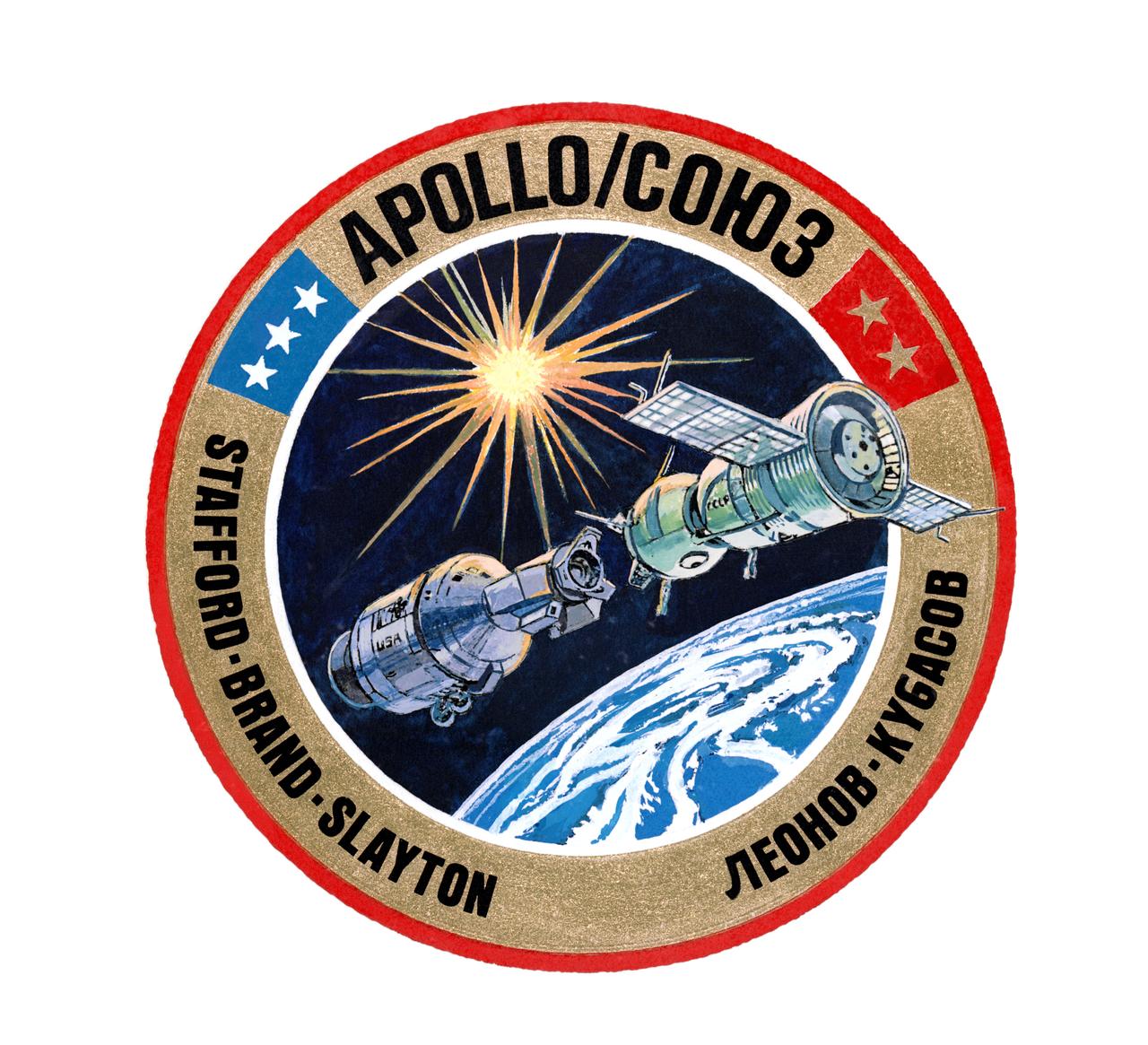
S75-20361 (27 Feb. 1975) --- This is the American crew insignia of the joint United States-USSR Apollo-Soyuz Test Project (ASTP) scheduled to take place in July 1975. Of circular design, the insignia has a colorful border area, outlined in red, with the names of the five crew members and the words Apollo in English and Soyuz in Russian around an artist?s concept of the Apollo and Soyuz spacecraft about to dock in Earth orbit. The bright sun and the blue and white Earth are in the background. The white stars on the blue background represent American astronauts Thomas P. Stafford, commander; Vance D. Brand, command module pilot; and Donald (Deke) K. Slayton, docking module pilot. The dark gold stars on the red background represent Soviet cosmonauts Aleksey A. Leonov, commander, and Valeriy N. Kubasov, engineer. Soyuz and Apollo will be launched separately from the USSR and United States, and will dock and remain together for as long as two days. The three Apollo astronauts will enter Soyuz and the two Soviet cosmonauts will visit the Apollo spacecraft via a docking module. The Russian word ?soyuz? means ?union? in English.
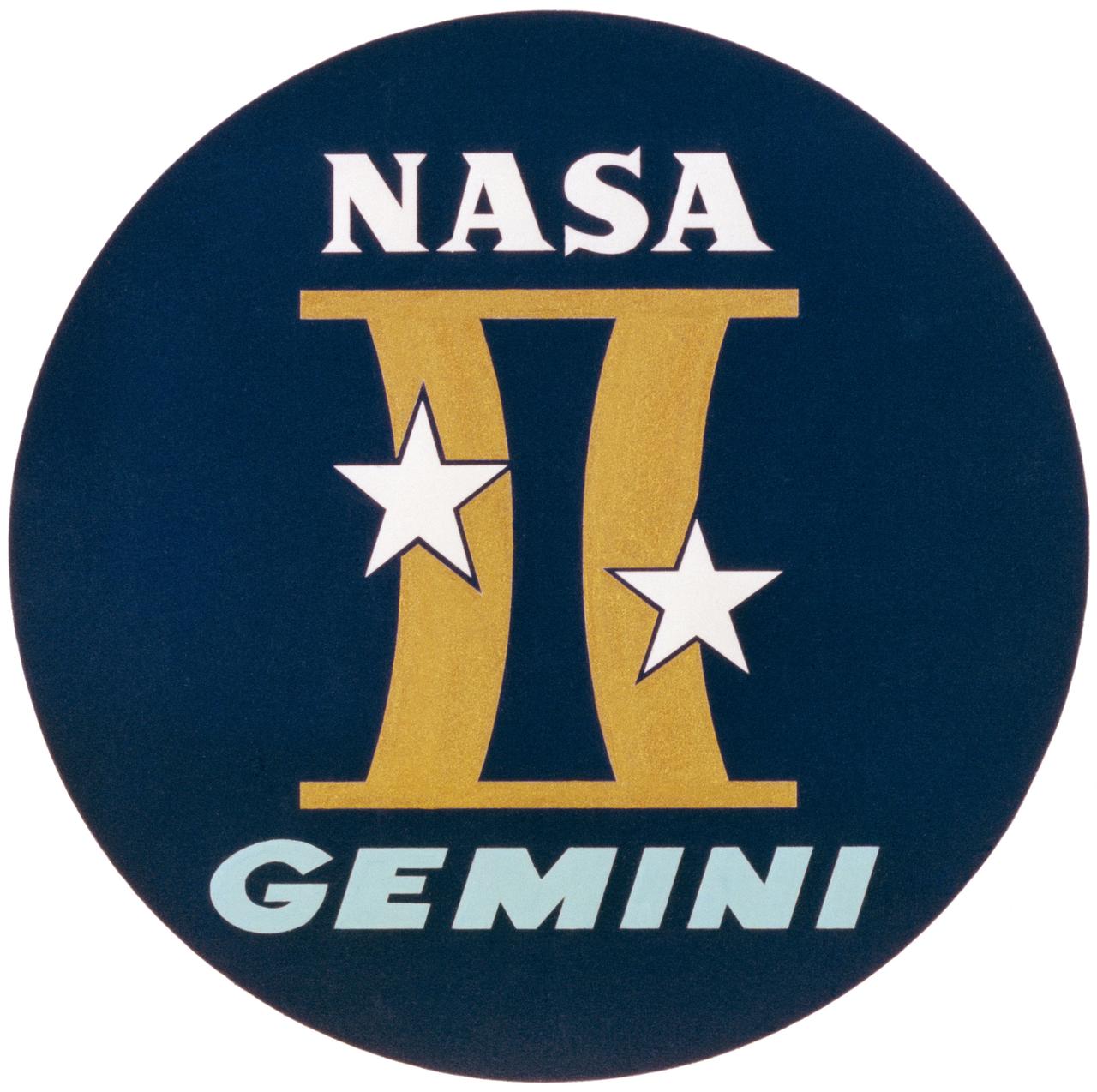
S65-54354 (30 Aug. 1965) --- The insignia of the Gemini Space Program is a disc of dark blue as a background for a gold Zodiac Gemini symbol. A white star on each of the two vertical curves of the Gemini symbol represent the Gemini twins, Pollux and Castor. The NASA insignia design for Gemini flights is reserved for use by the astronauts and for other official use as the NASA Administrator may authorize. Public availability has been approved only in the form of illustrations by the various news media. When and if there is any change in this policy, which we do not anticipate, it will be publicly announced.
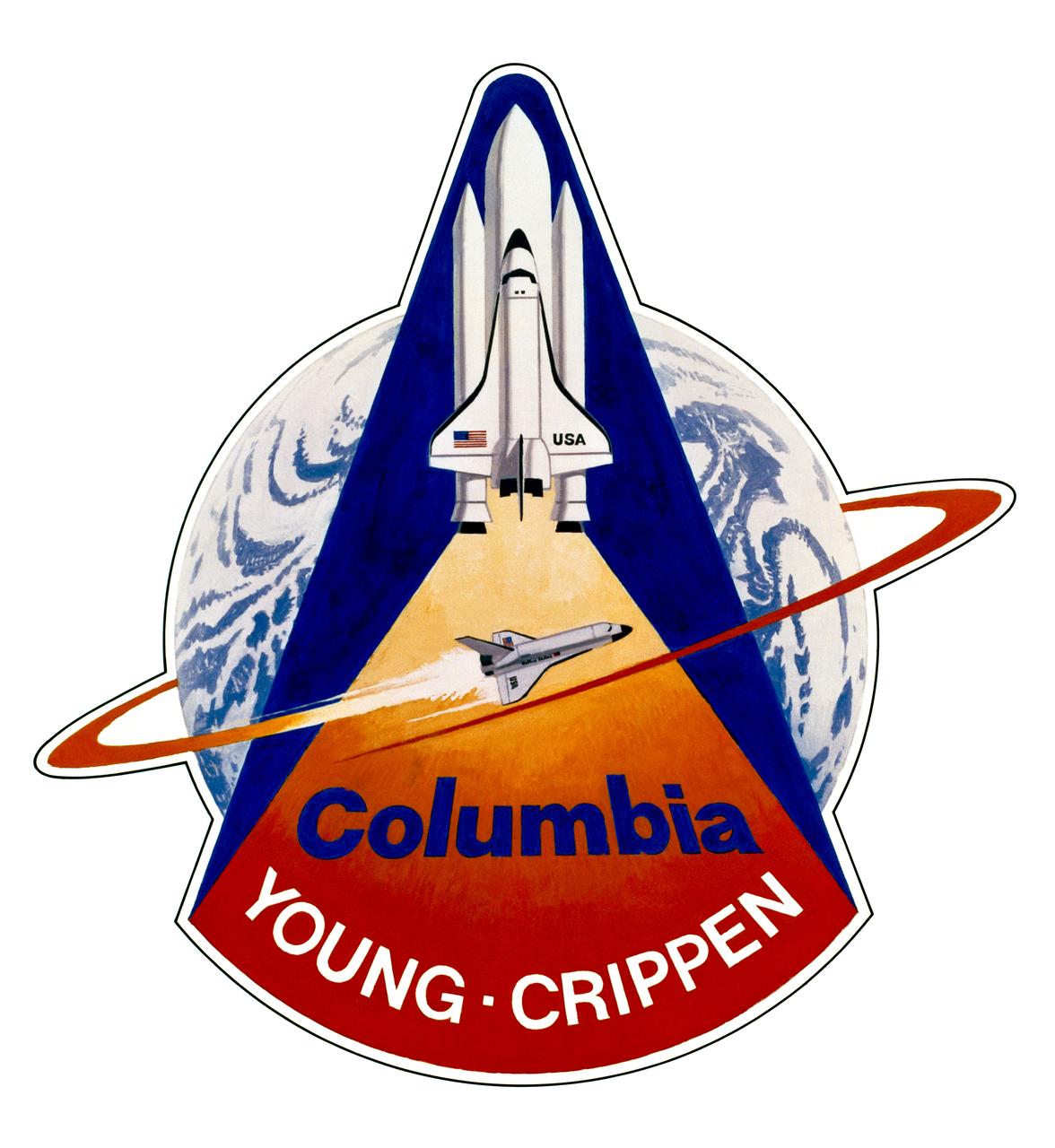
S79-30685 (10 March 1979) --- This is the official insignia for the first space shuttle orbital flight test (STS-1). Crew of the 102 Columbia on STS-1 will be astronauts John W. Young, commander, and Robert L. Crippen, pilot. The artwork was done by artist Robert McCall. The NASA insignia design for space shuttle flights is reserved for use by the astronauts and for other official use as the NASA Administrator may authorize. Public availability has been approved only in the forms of illustrations by the various news media. When and if there is any change in this policy, which is not anticipated, the change will be publicly announced. Photo credit: NASA
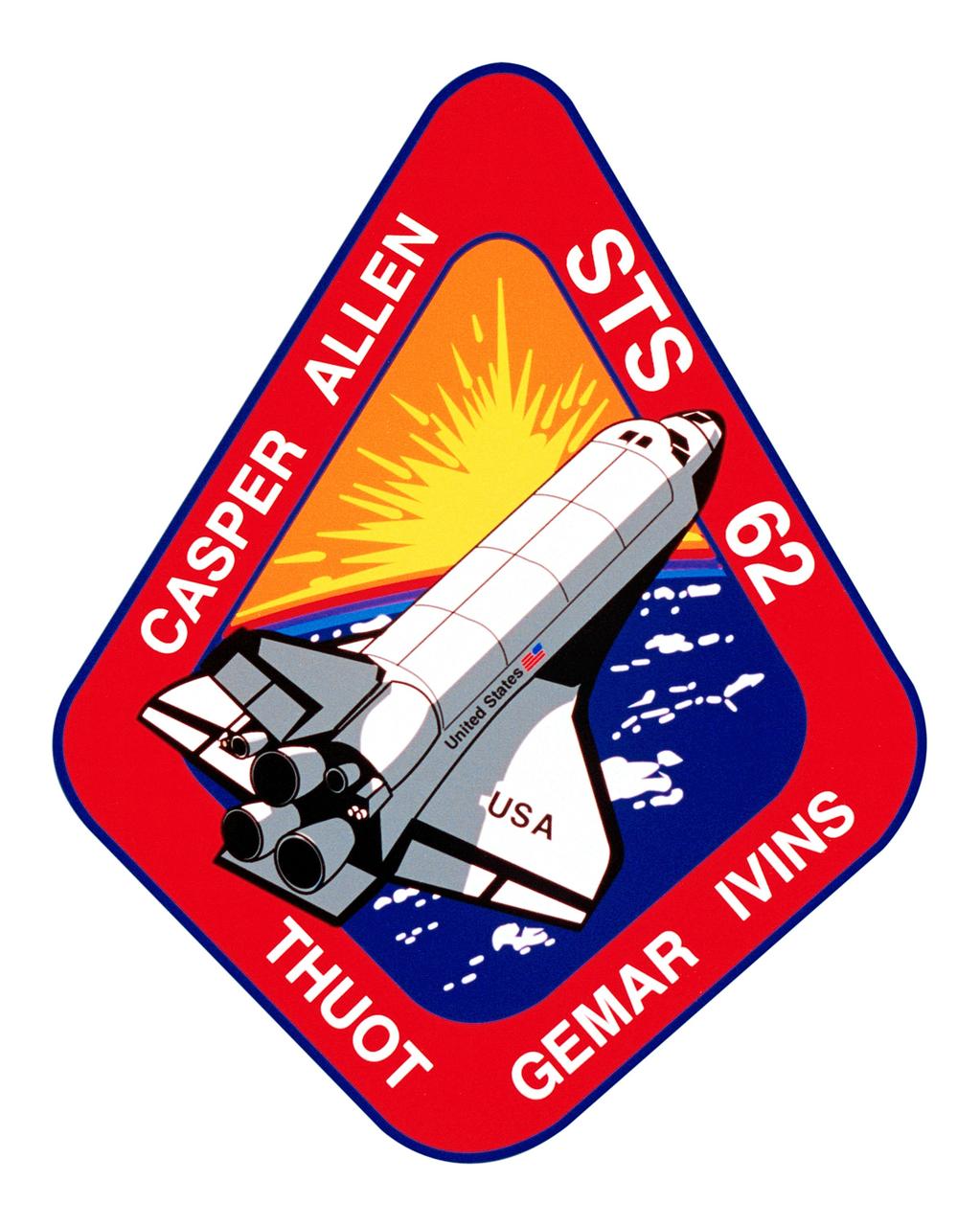
STS062-S-001 (October 1993) --- The crew patch depicts the world's first reusable spacecraft on its sixteenth flight. The space shuttle Columbia is in its entry-interface attitude as it prepares to return to Earth. The primary mission objectives of STS-62 include the United States Microgravity Payload (USMP-2) and the NASA Office of Aeronautics and Space Technology (OAST-2) payloads. These payloads represent a multifaceted array of space science and engineering experiments. The varied hues of the rainbow on the horizon connote the varied, but complementary, nature of all the payloads united on this mission. The upward-pointing vector shape of the patch is symbolic of America's reach for excellence in its in its unswerving pursuit to explore the frontiers of space. The brilliant sunrise just beyond Columbia suggests the promise that research in space holds for the hopes and dreams of future generations. The STS-62 insignia was designed by Mark Pestana. The NASA insignia design for space shuttle flights is reserved for use by the astronauts and for other official use as the NASA Administrator may authorize. Public availability has been approved only in the forms of illustrations by the various news media. When and if there is any change in this policy, which is not anticipated, the change will be publicly announced. Photo credit: NASA
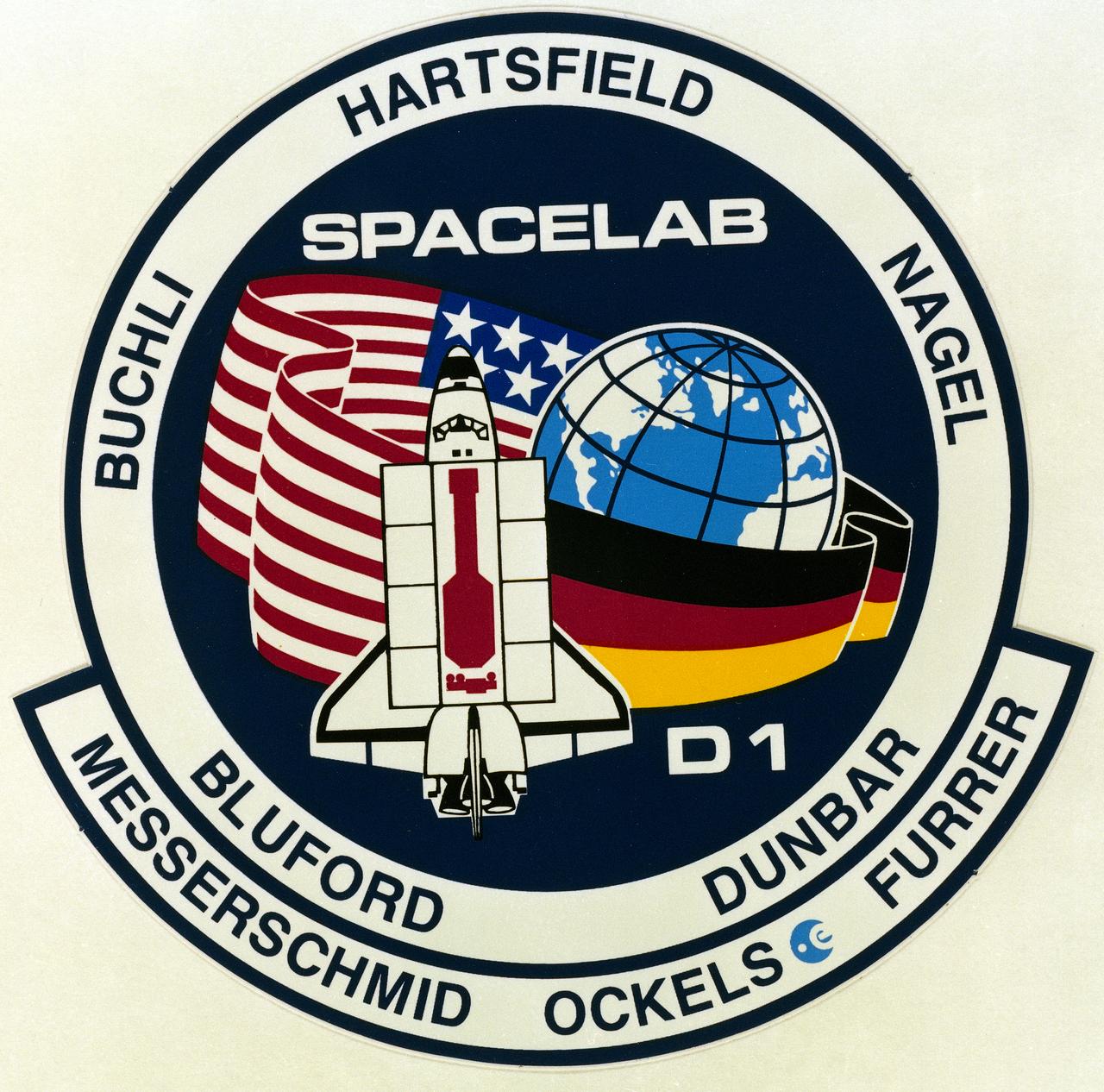
This insignia was chosen by the eight members of the STS-61A/D1 Spacelab mission to represent the record-sized Space Shuttle crew. Crewmembers surnames surround the colorful patch scene depicting Challenger carrying a long science module and an international crew from Europe and the United States.
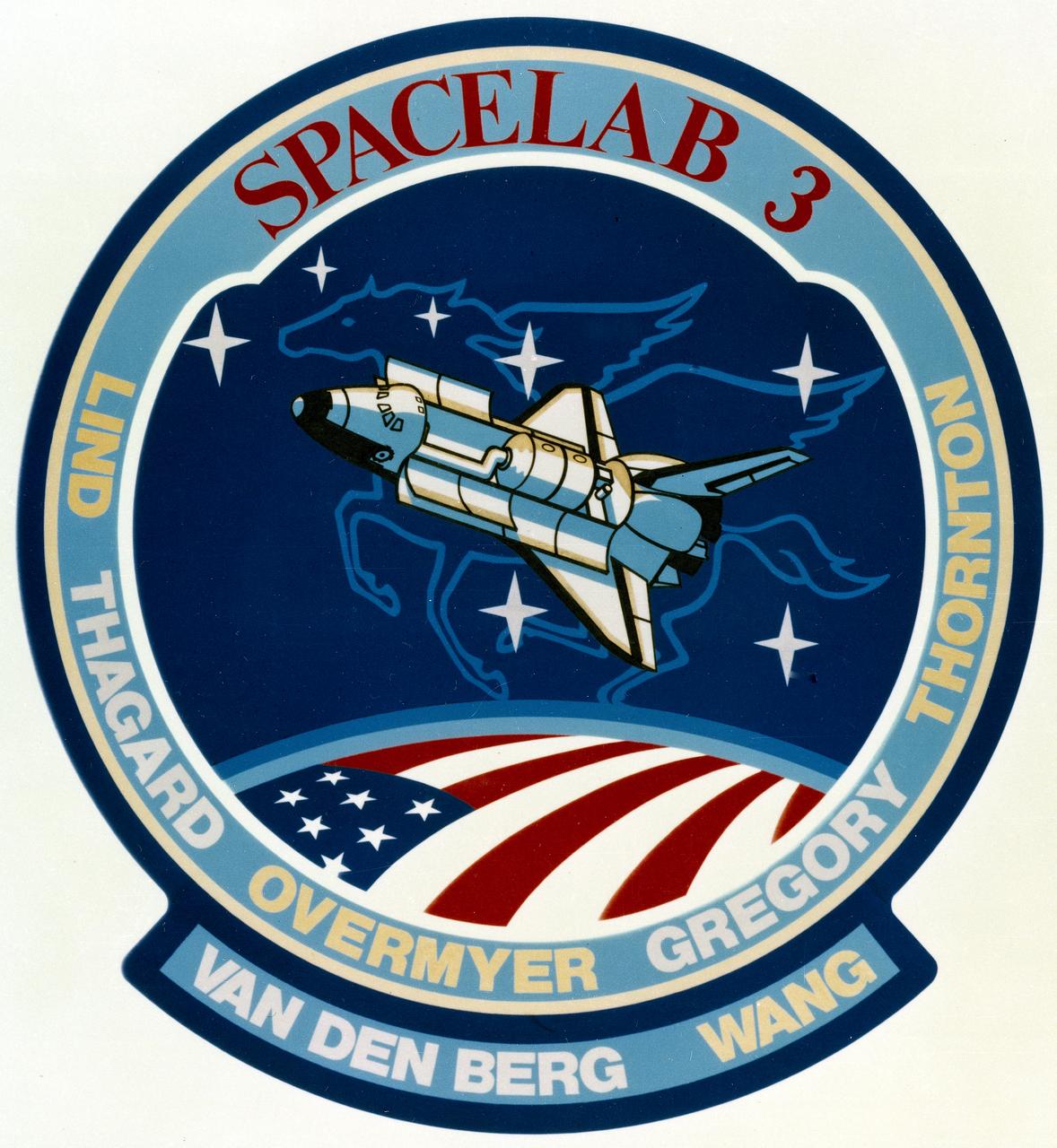
The Space Shuttle Discovery and its science module payload are featured in the insignia for the STS-51B / Spacelab-3 mission. The seven stars of the constellation Pegasus surround the orbiting spacehip above the flag draped Earth. Surnames of the seven crewmembers encircle the scene. The artwork was done by Carol Ann Lind.
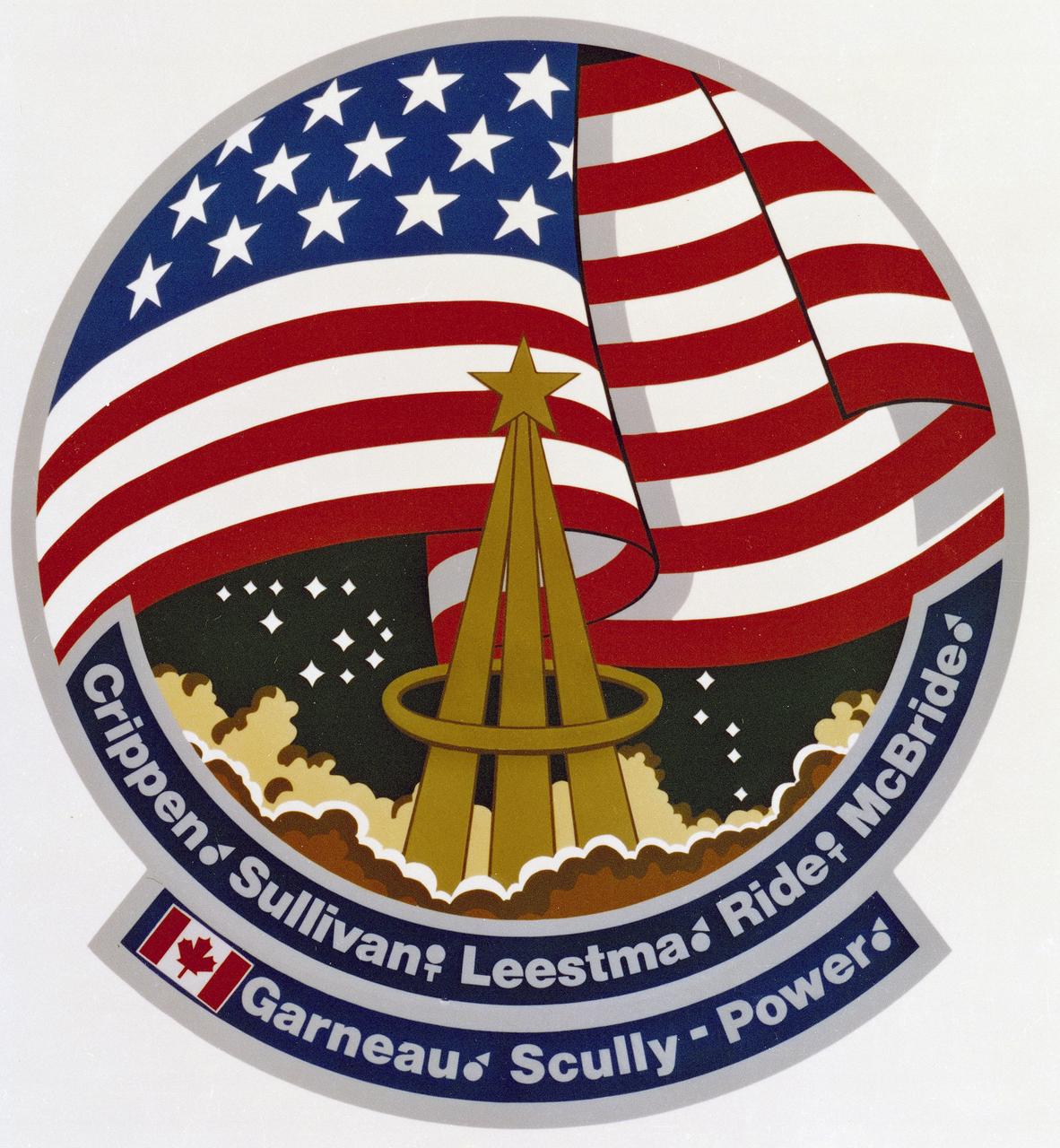
The 41-G mission insignia focuses on its seven crew members (first to exceed six), the U.S. Flag and the Unity symbol known as the astronaut pin. The pin design in center shows a trio of trajectories merging in infinite space, capped by a bright shining star and encircled by an elliptical wreath denoting orbital flight.
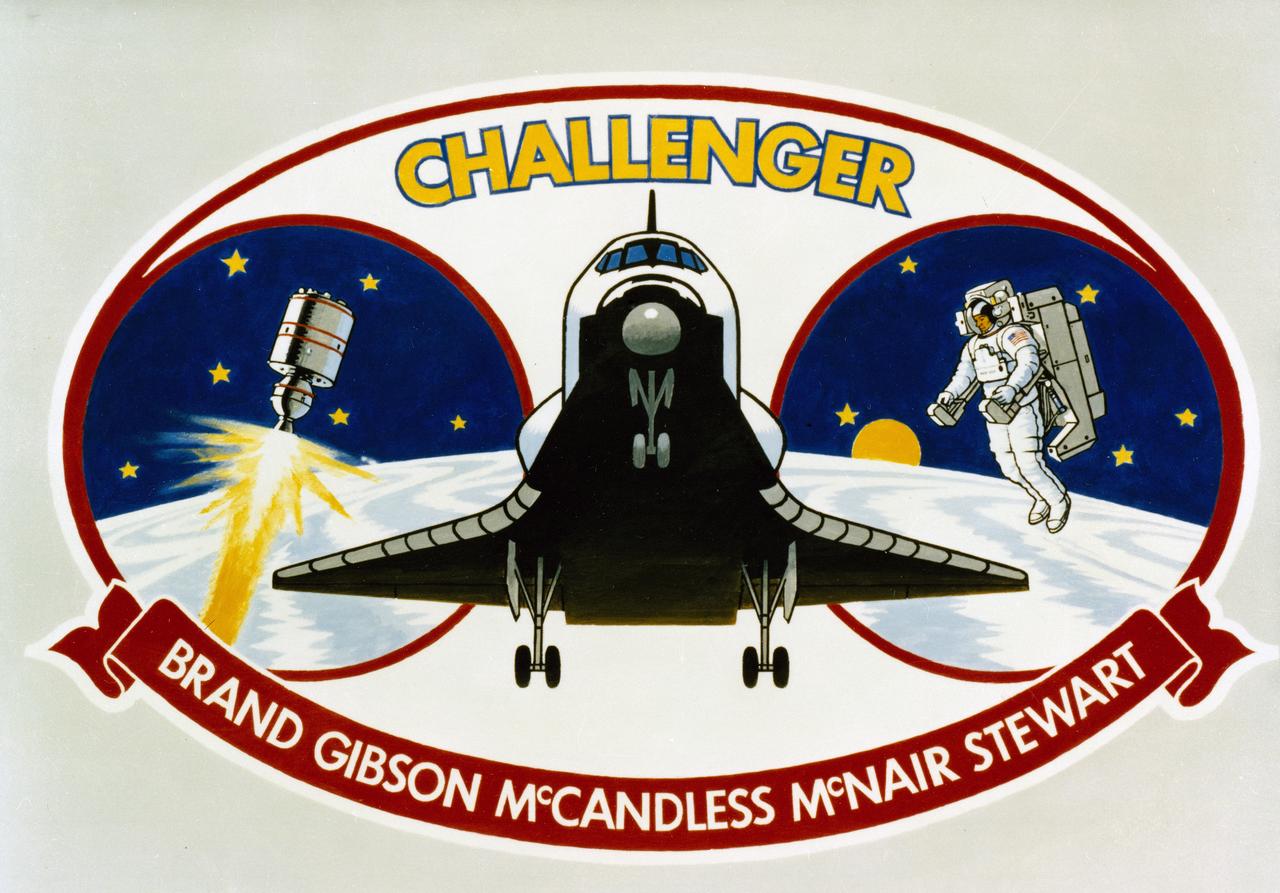
The Space Shuttle Challenger, making its fourth space flight, highlights the 41B insignia. The reusable vehicle is flanked in the oval by an illustration of a Payload Assist Module-D solid rocket motor (PAM-D) for assisted satellite deployment; an astronaut making the first non-tethered extravehicular activity (EVA); and eleven stars.

The 51-J mission insignia, designed by Atlantis's first crew, pays tribute to the Statue of Liberty and the ideas it symbolizes. The historical gateway figure bears additional significance for Astronauts Karol J. Bobko, mission commander; and Ronald J. Grabe, pilot, both New Your Natives.
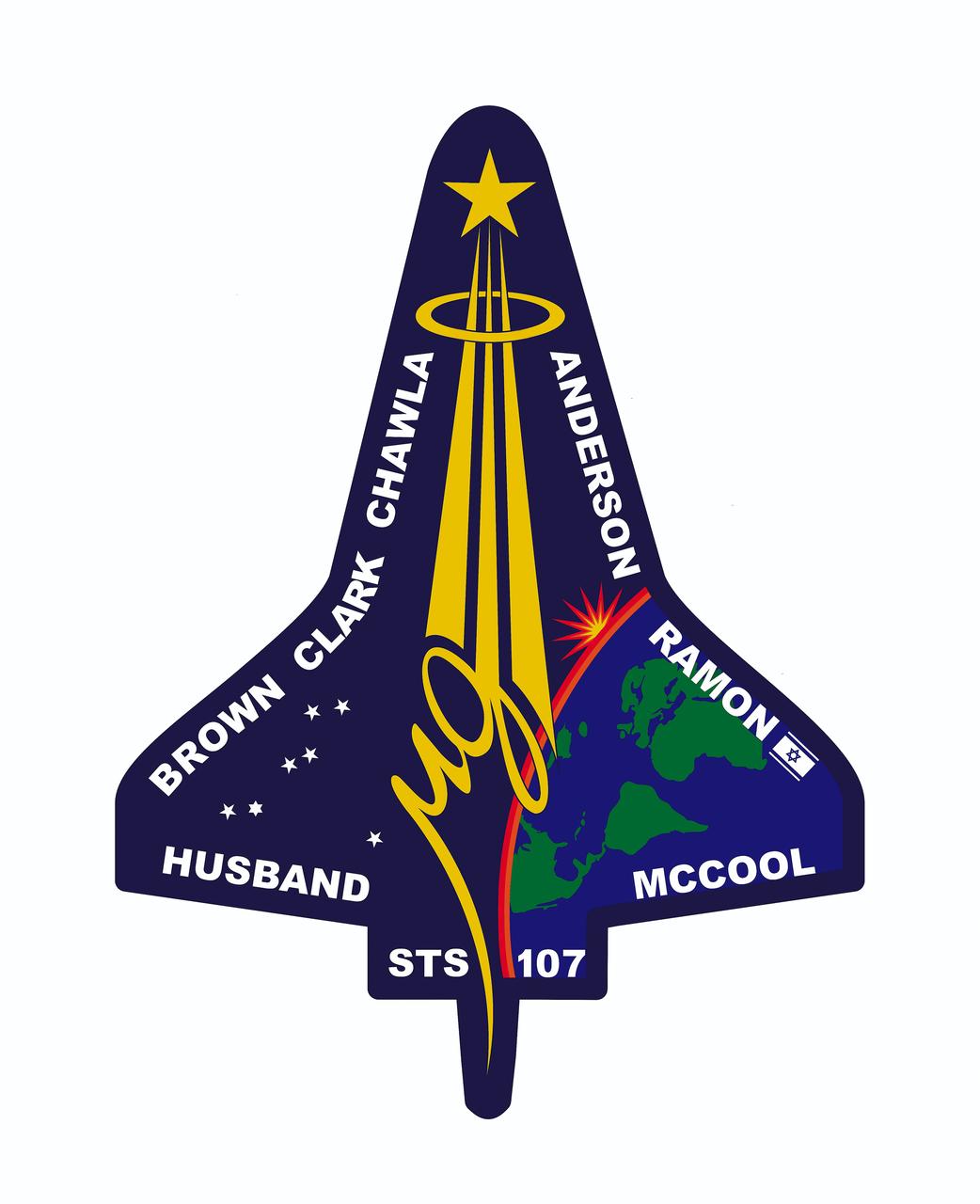
This is the insignia for the STS-107 mission which is a multidiscipline microgravity and Earth science research mission involving 80-plus International experiments to be performed by a crew of seven during the 16-day mission. The breadth of science conducted on this mission will have widespread benefits to life on Earth. Many of the experiments will be managed by the Marshall Space Flight Center in Huntsville, Alabama. The first shuttle mission in 2003, the STS-107 mission launched January 16, 2003, for the 28th flight of the Space Shuttle Orbiter Columbia and the 113th flight overall in NASA's Space Shuttle program.
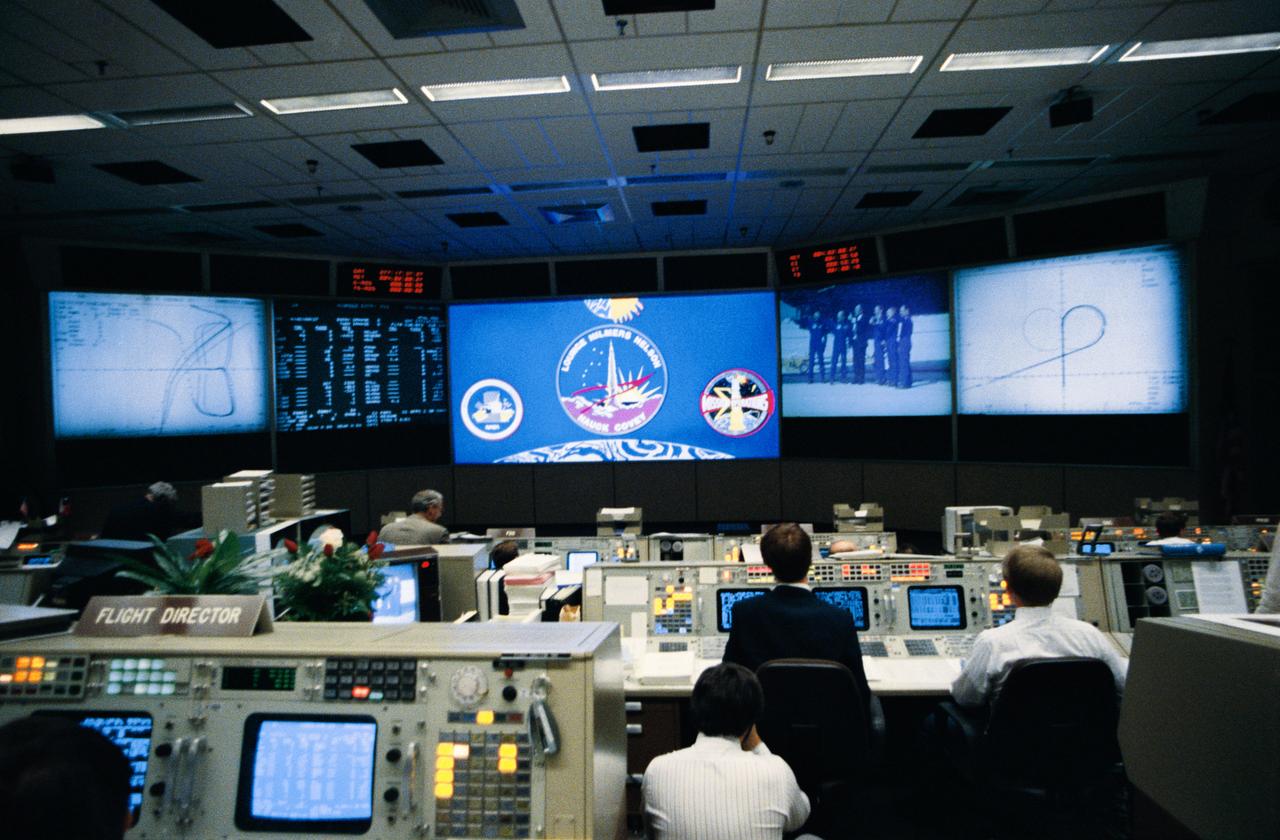
JSC Mission Control Center (MCC) Bldg 30 flight control room (FCR) personnel monitor STS-26 post landing activities and ceremonies at Edwards Air Force Base (EAFB) via their monitors. Displayed on front screens are approach and landing diagrams, data, the space shuttle program insignia, the STS-26 mission insignia, the Mission Operations Directorate insignia, and the STS-26 crew standing in front of Discovery, Orbiter Vehicle (OV) 103.

S66-44308 (September 1966) --- Insignia of the Gemini-Titan XI (GT-11) spaceflight. Roman numeral indicates eleventh flight in the Gemini series. Two spacecraft symbolize rendezvous and docking of Gemini with an Agena. Astronaut and umbilical (tether) line denotes planned extravehicular activity. Astronauts Charles Conrad Jr., command pilot, and Richard F. Gordon Jr., pilot, are members of the Gemini-11 prime crew. The NASA insignia design for Gemini flights is reserved for use by the astronauts and for other official use as the NASA Administrator may authorize. Public availability has been approved only in the form of illustrations by the various news media. When and if there is any change in this policy, which we do not anticipate, it will be publicly announced. Photo credit: NASA
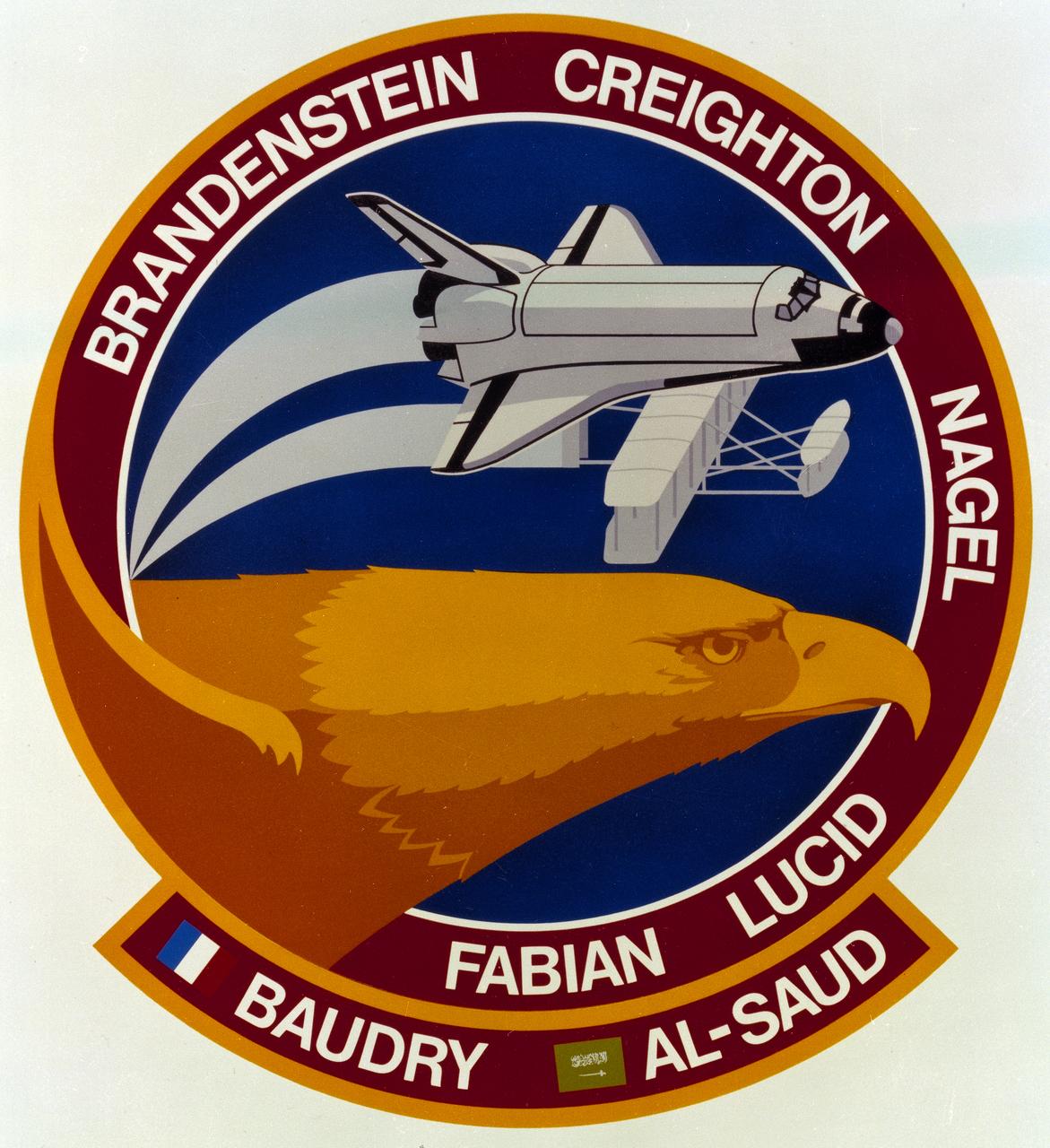
The STS-51G insignia illustrates the advances in aviation technology in the United States within a relatively short span of the twentieth century. The surnames of the crewmembers for the Discovery's mission appear near the center edge of the circular design.
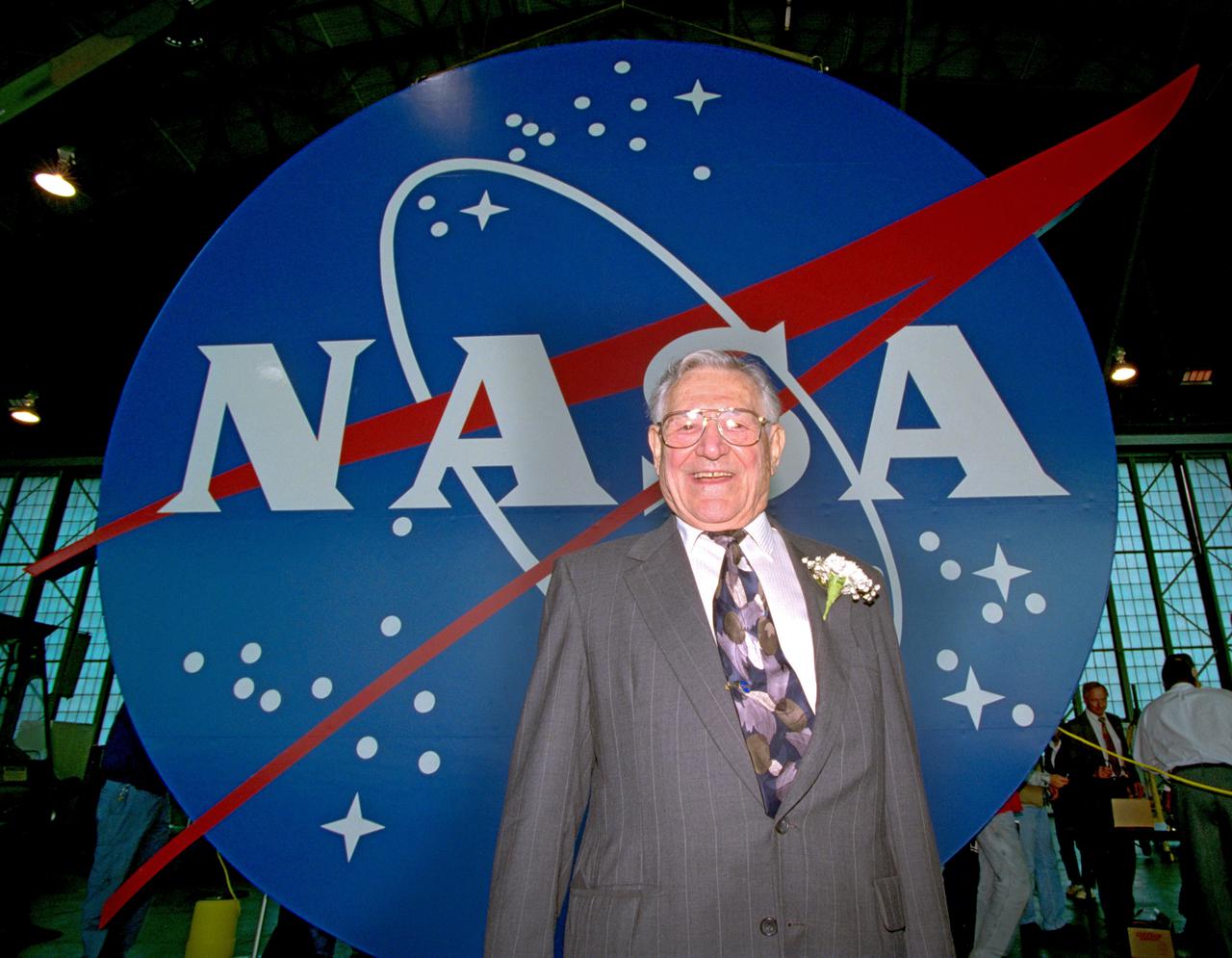
In 1949, after graduating from the Cleveland Institute of Art, James “Jim” Modarelli began his career as an artist-designer at the laboratory that would become the NASA Glenn Research Center. When the NACA was approved to be absorbed into the new space agency—NASA, employees were invited to submit designs for the Agency’s logo. Modarelli, who was serving as the Management Services Division Chief at the time, submitted the winning designs. The official NASA seal and the less formal NASA “meatball” insignia (shown here) are among the most recognized emblems in the world. The logos, which include symbols representing the space and aeronautics missions of NASA, became official in 1959. In July 1958, Modarelli participated in a tour at the Ames Unitary Plan Wind Tunnel, where he viewed a model of a radical supersonic airplane designed for flight at Mach 3.0. With a cambered, twisted arrow wing and an upturned nose, the model deeply impressed Modarelli. He later stylized the radical features of the arrow-wing configuration in his evolution of the NASA seal design; the wing would also become an element of the NASA insignia.
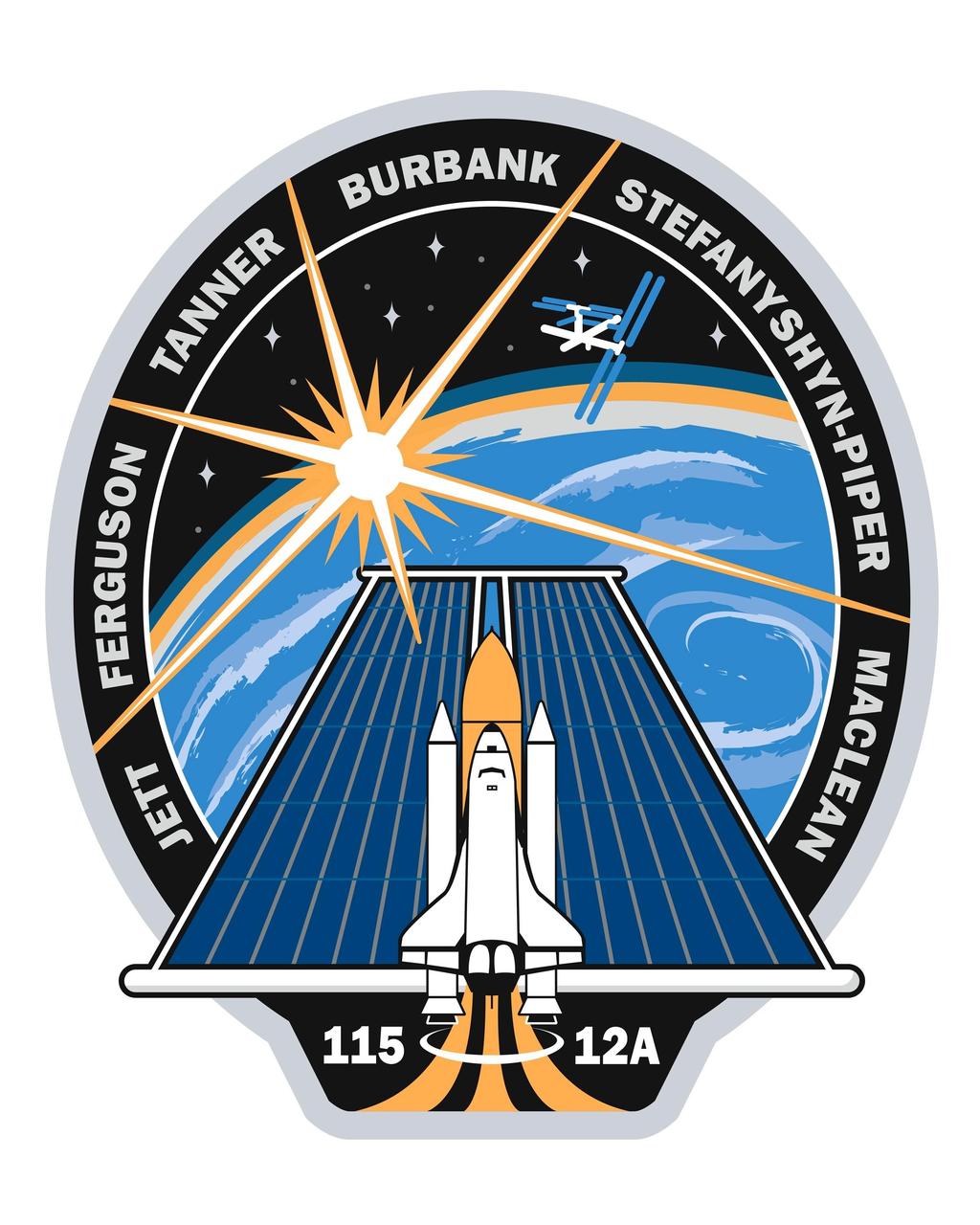
JOHNSON SPACE CENTER, TX - STS115-S-001 (February 2003) -- This is the STS-115 insignia. This mission continues the assembly of the International Space Station with the installation of the truss segments P3 and P4. Following the installation of the segments utilizing both the shuttle and the station robotic arms, a series of four space walks will complete the final connections and prepare for the deployment of the station's second set of solar arrays. To reflect the primary mission of the flight, the patch depicts a solar panel as the main element. As the Space Shuttle Atlantis launches towards the ISS, its trail depicts the symbol of the Astronaut Office. The starburst, representing the power of the sun, rises over the Earth and shines on the solar panel. The shuttle flight number 115 is shown at the bottom of the patch, along with the ISS assembly designation 12A (the 12th American assembly mission). The blue Earth in the background reminds us of the importance of space exploration and research to all of Earth's inhabitants. The NASA insignia design for shuttle flights is reserved for use by the astronauts and for other official use as the NASA Administrator may authorize. Public availability has been approved only in the forms of illustrations by the various news media. When and if there is any change in this policy, which is not anticipated, the change will be publicly announced.
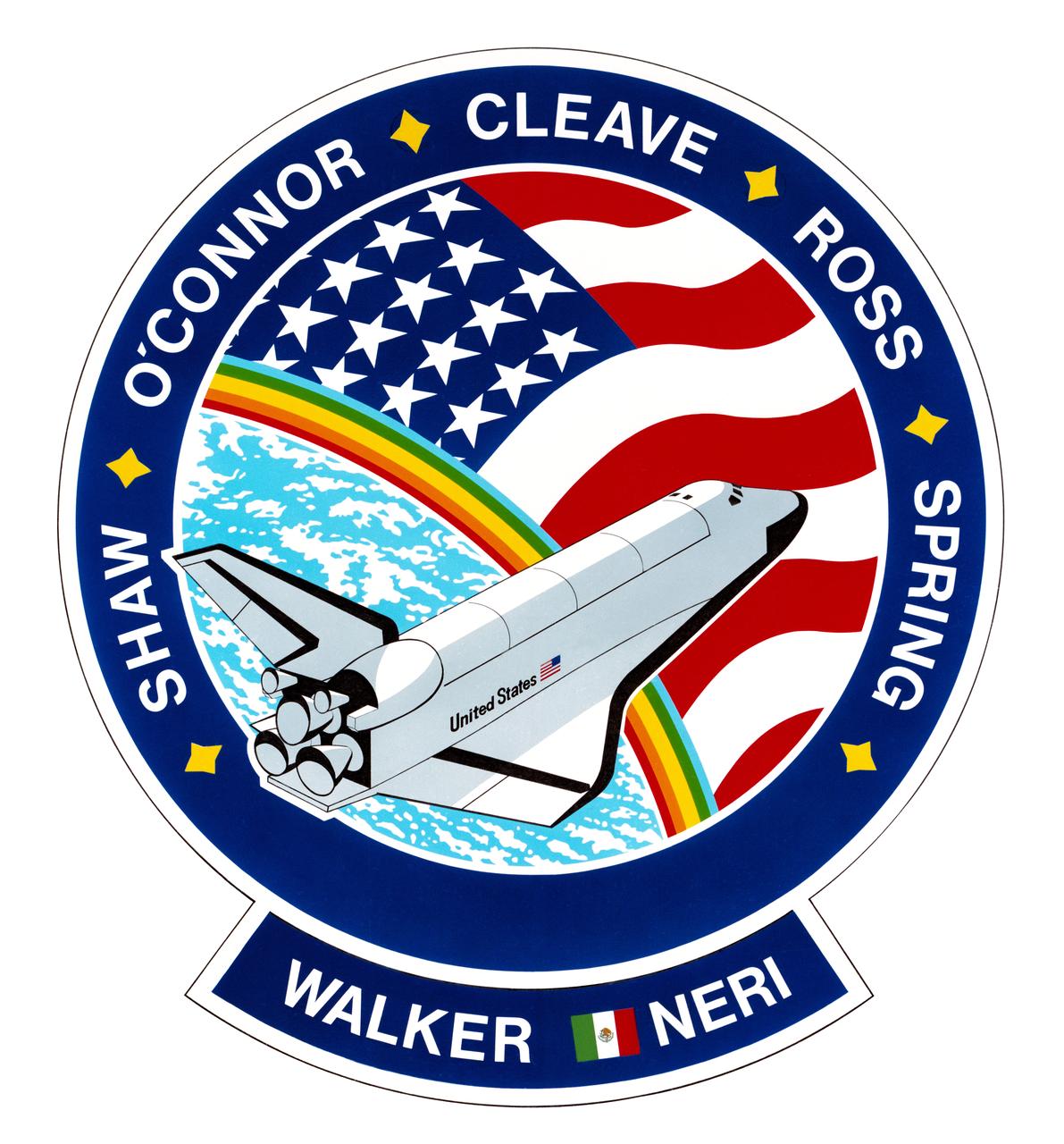
S85-36635 (October 1985) --- This is the insignia designed by the STS-61B crew members to represent their November 1985 mission aboard the space shuttle Atlantis, depicted here in Earth orbit, making only its second spaceflight. The design is surrounded by the surnames of the seven crew members. They are astronauts Brewster Shaw Jr., commander; Bryan D. O'Conner, pilot; Mary L. Cleave, Jerry L. Ross and Sherwood C. Spring, all mission specialists; and payload specialists Charles D. Walker, representing McDonnell Douglas, and Rodolfo Neri, representing Morelos of Mexico (note flag). The NASA insignia design for space shuttle flights is reserved for use by the astronauts and for other official use as the NASA Administrator may authorize. Public availability has been approved only in the forms of illustrations by the various news media. When and if there is any change in this policy, which is not anticipated, the change will be publicly announced. Photo credit: NASA
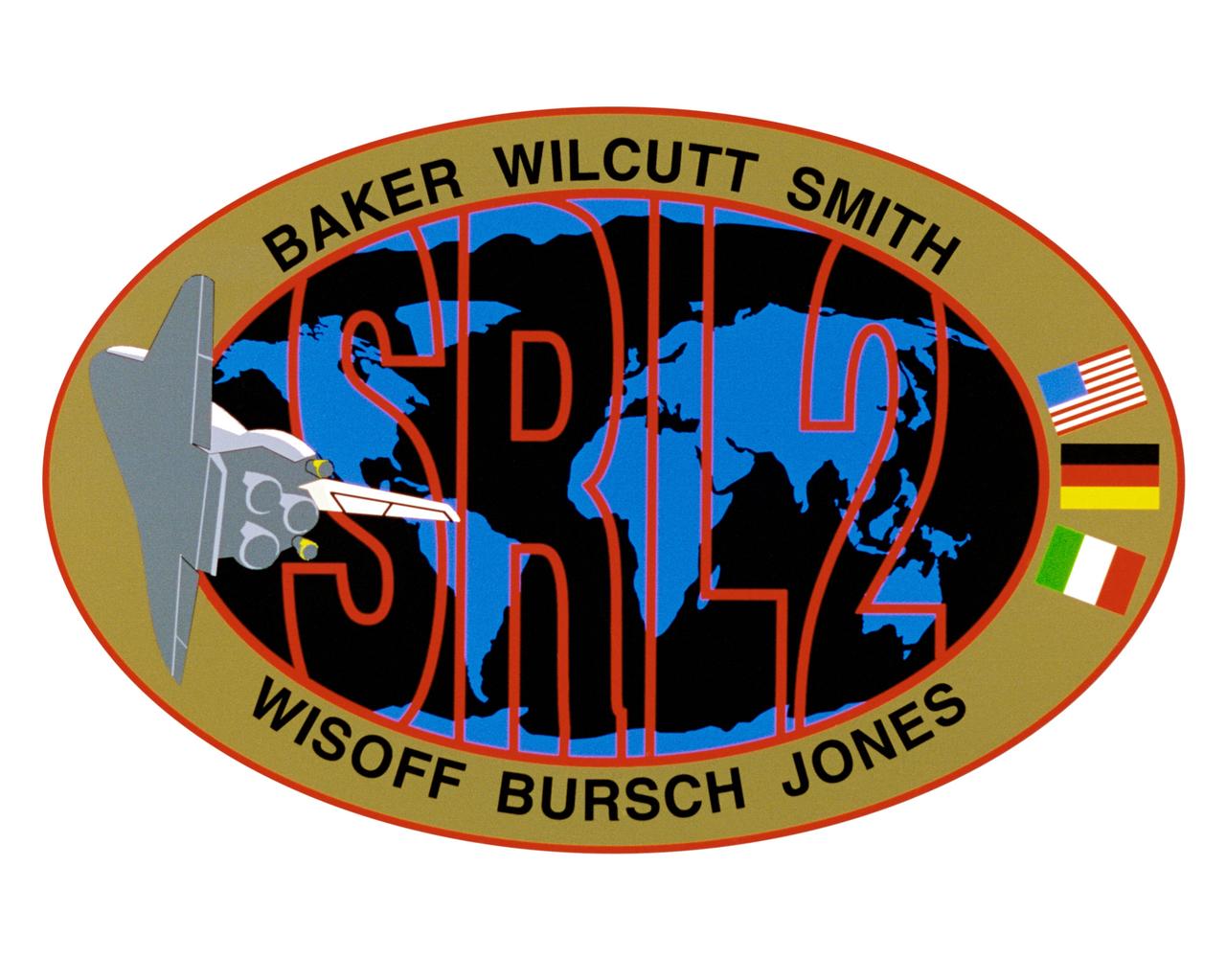
STS068-S-001 (March 1994) --- Exploration of Earth from space is the focus of the design of the STS-68 insignia, the second flight of the Space Radar Laboratory (SRL-2). SRL-2 is part of NASA's Mission to Planet Earth (MTPE) *project. The world's land masses and oceans dominate the center field, with the space shuttle Endeavour circling the globe. The SRL-2 letters span the width and breadth of planet Earth, symbolizing worldwide coverage of the two prime experiments of STS-68 - The Shuttle Imaging Radar-C and X-Band Synthetic Aperture Radar (SIR-C/X-SAR) instruments, and the Measurement of Air Pollution from Satellites (MAPS) sensor. The red, blue and black colors of the insignia represent the three operating wavelengths of SIR-C/X-SAR, and the gold band surrounding the globe symbolizes the atmospheric envelope examined by MAPS. The flags of international partners Germany and Italy are shown opposite Endeavour. The relationship of the orbiter to Earth highlights the usefulness of human spaceflights in understanding Earth's environment, and the monitoring its changing surface and atmosphere. In the words of the crew members, "the soaring orbiter also typifies the excellence of the NASA team in exploring our own world, using the tools which the Space Program developed to explore the other planets in the solar system". This STS-68 patch was designed by artist Sean Collins. The NASA insignia design for space shuttle flights is reserved for use by the astronauts and for other official use as the NASA Administrator may authorize. Public availability has been approved only in the forms of illustrations by the various news media. When and if there is any change in this policy, which is not anticipated, the change will be publicly announced. Photo credit: NASA
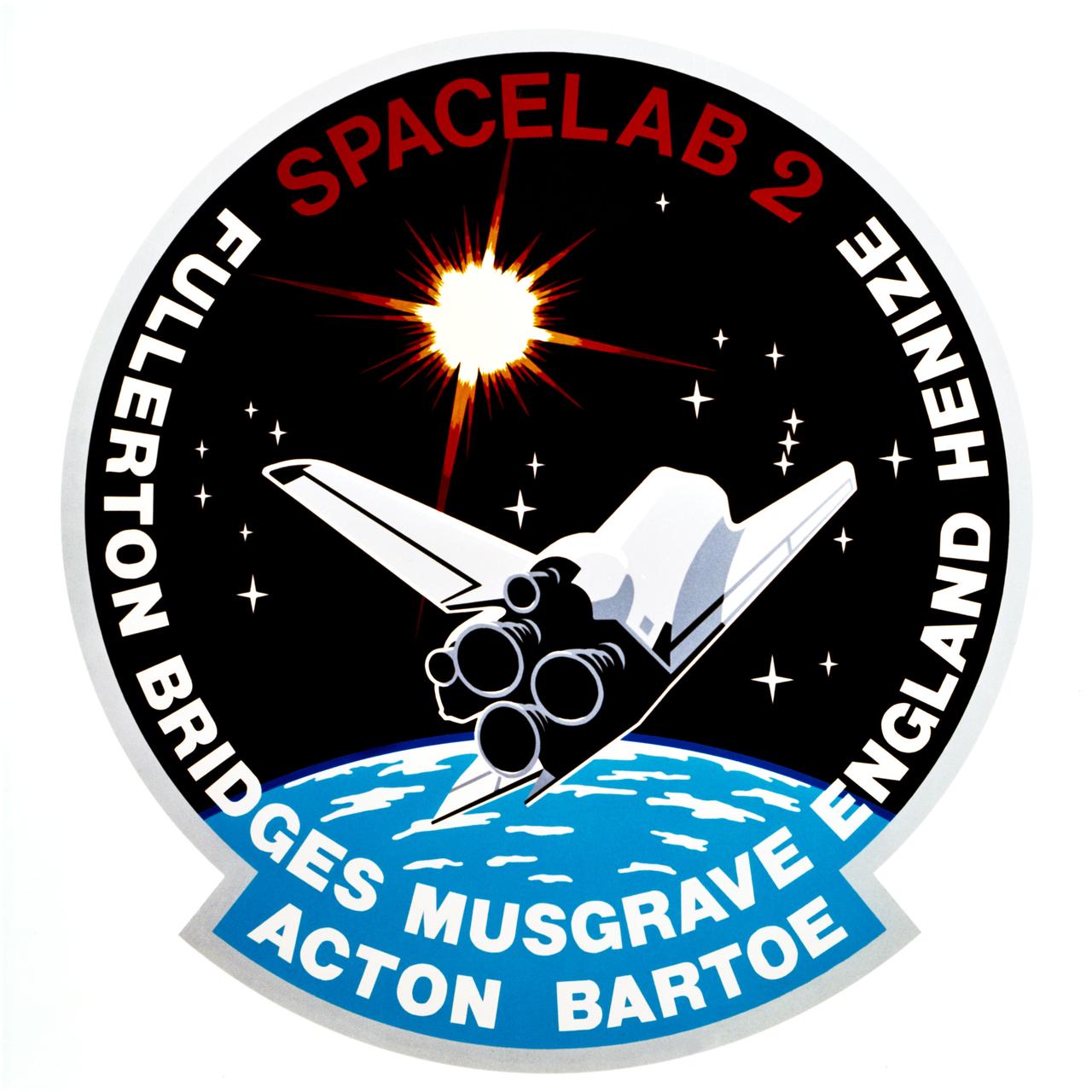
S85-29498 (June 1985) --- The crew members of space shuttle mission STS-51F have chosen as their insignia this design by Houston artist Skip Bradley. The space shuttle Challenger is depicted ascending toward the heavens in search of new knowledge in the field of solar and stellar astronomy, with its Spacelab 2 payload. The constellations Leo and Orion are in the positions they will be in, relative to the sun during the flight. The nineteen stars signify that this will be the 19th STS flight. Crew members for the mission are astronauts C. Gordon Fullerton, commander; Roy D. Bridges, pilot; F. Story Musgrave, Anthony W. England and Karl J. Henize, mission specialist; and payload specialists Loren W. Acton and John David Bartoe. The NASA insignia design for space shuttle flights is reserved for use by the astronauts and for other official use as the NASA Administrator may authorize. Public availability has been approved only in the forms of illustrations by the various news media. When and if there is any change in this policy, which is not anticipated, the change will be publicly announced. Photo credit: NASA
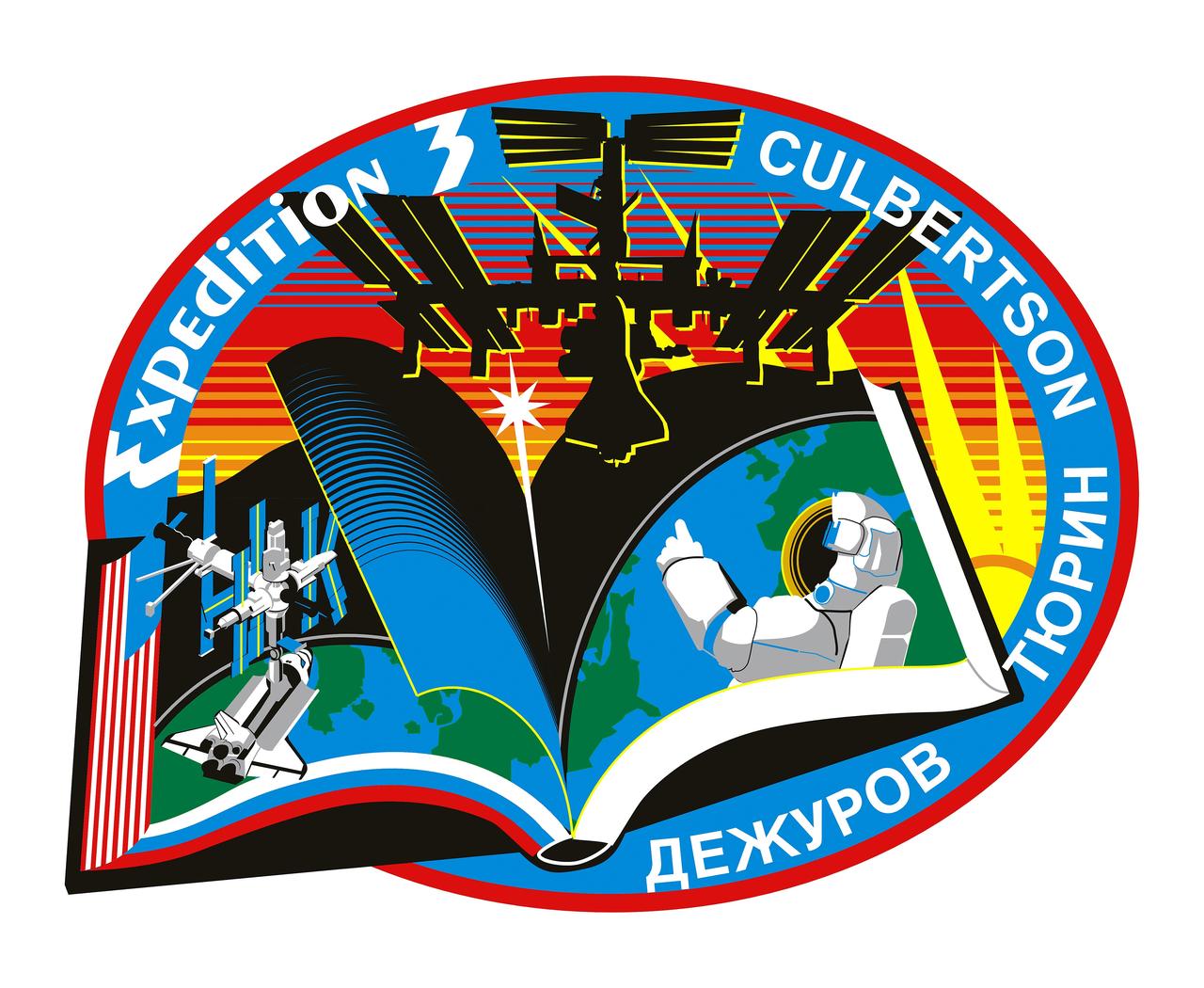
ISS003-S-001 (June 2001) --- The Expedition Three crew members--astronaut Frank L. Culbertson, Jr., commander, and cosmonauts Vladimir N. Dezhurov and Mikhail Tyurin, flight engineers--had the following to say about the insignia for their scheduled mission aboard the International Space Station (ISS): “The book of space history turns from the chapter written onboard the Russian Mir Station and the U.S. Space Shuttle to the next new chapter, one that will be written on the blank pages of the future by space explorers working for the benefit of the entire world. The space walker signifies the human element of this endeavor. The star representing the members of the third expedition, and the entire multi-national space station building team, streaks into the dawning era of cooperative space exploration, represented by the image of the International Space Station as it nears completion.” The insignia design for ISS flights is reserved for use by the astronauts and cosmonauts and for other official use as the NASA Administrator and NASA's international partners may authorize. Public availability has been approved only in the form of illustrations by the various news media. When and if there is any change in this policy, which we do not anticipate, it will be publicly announced.
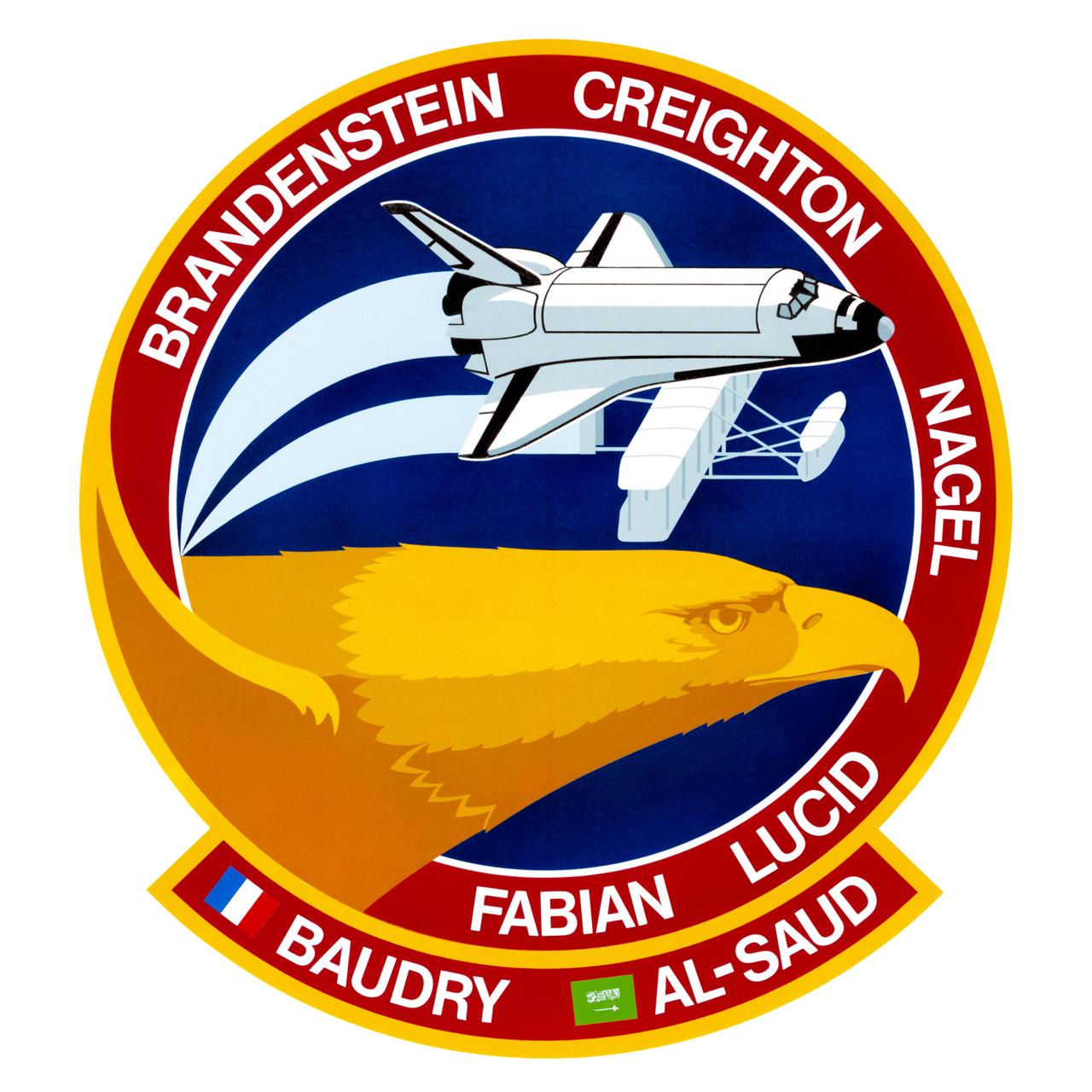
S85-31266 (May 1985) --- The STS-51G insignia illustrates the advances in aviation technology in the United States within a relatively short span of the twentieth century. The surnames of the crew members for the Discovery's mission appear near the center edge of the circular design. They are astronauts Daniel C. Brandenstein, mission commander; John O. Creighton, pilot; John M. Fabian, Steven R. Nagel and Shannon W. Lucid, mission specialists; Sultan Salman Abdelazize Al-Saud and Patrick Baudry, payload specialists. Al-Saud is flying as part of the reimbursable agreement with the Arab Satellite Communications Organization covering the launch of the Arabsat 1B communications satellite and Baudry represents France's Centre National d'Etudes Spatiales. The NASA insignia design for space shuttle flights is reserved for use by the astronauts and for other official use as the NASA Administrator may authorize. Public availability has been approved only in the forms of illustrations by the various news media. When and if there is any change in this policy, which is not anticipated, the change will be publicly announced. Photo credit: NASA
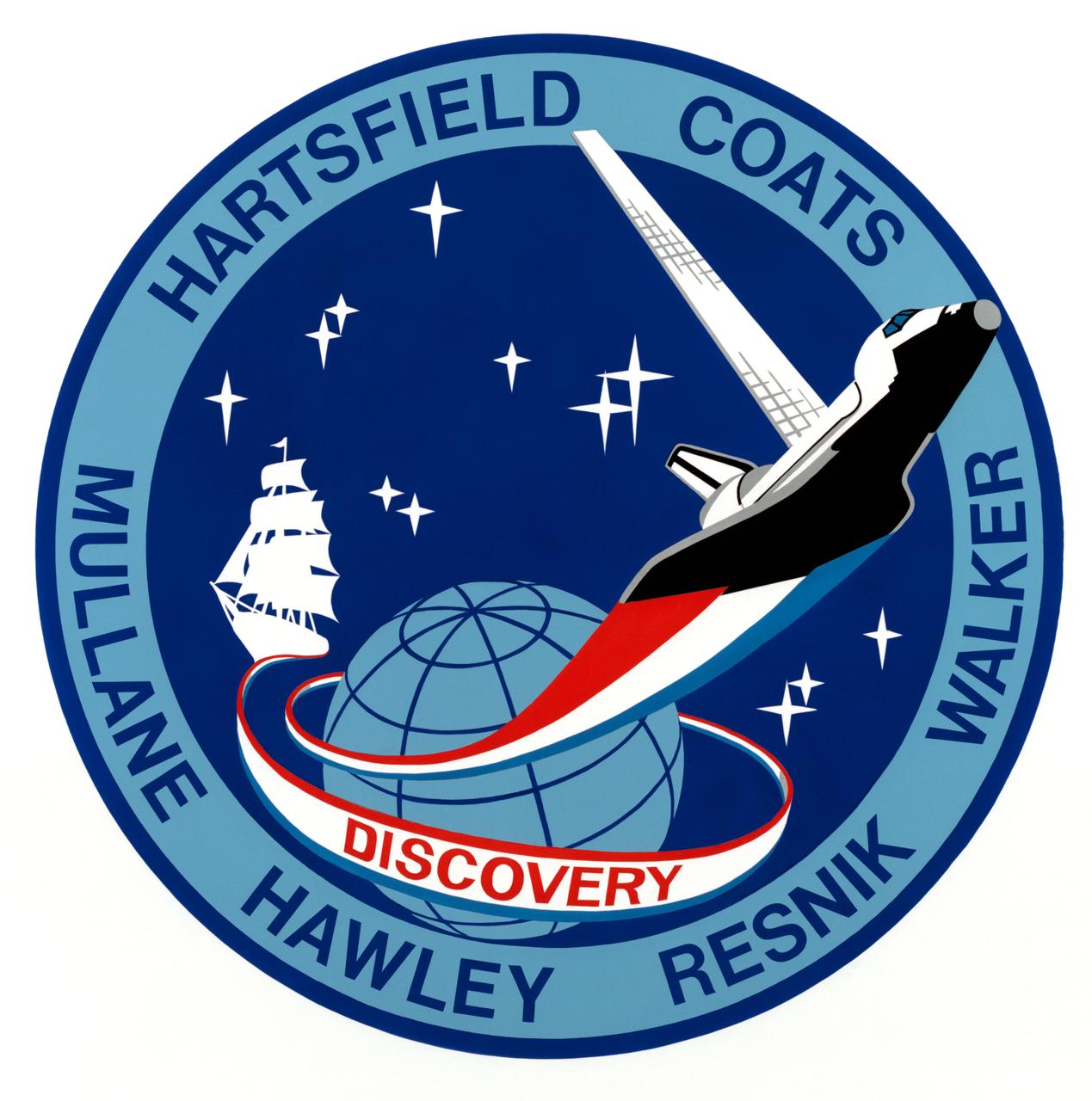
S84-26391 (3 April 1984) --- The official mission insignia for the 41-D space shuttle flight features the Discovery--NASA's third orbital vehicle--as it makes its maiden voyage. The ghost ship represents the orbiter's namesakes which have figured prominently in the history of exploration. The space shuttle Discovery heads for new horizons to extend that proud tradition. Surnames for the crew members of NASA's eleventh space shuttle mission encircle the red, white and blue scene. They are astronauts Henry W. Hartsfield Jr., commander; Michael L. Coats, pilot; Judith A. Resnik, Steven A. Hawley and Richard M. (Mike) Mullane, all mission specialists; and Charles D. Walker, payload specialist. The NASA insignia design for space shuttle flights is reserved for use by the astronauts and for other official use as the NASA Administrator may authorize. Public availability has been approved only in the forms of illustrations by the various news media. When and if there is any change in this policy, which is not anticipated, the change will be publicly announced. Photo credit: NASA

This is the crew insignia for STS-97 which delivered, assembled, and activated the U.S. electrical power system onboard the International Space Station (ISS). The electrical power system, which is built into a 47-foot integrated truss structure known as P6, consists of solar arrays, radiators, batteries, and electronics. P6 was prepared for subsequent deployments of larger solar arrays and radiator, a critical step in the activation of the electrical power system that will eventually provide the power necessary for the first ISS crews to live and work in the U.S. segment. The crew patch depicts the space shuttle docked to the ISS in low Earth orbit after the activation of the P6 electrical power system. Gold and silver were used to highlight the portion of the ISS that were installed by the STS-97 crew. The sun, central to the design, is the source of energy for the ISS. The crew member names surround the outer border of the patch.
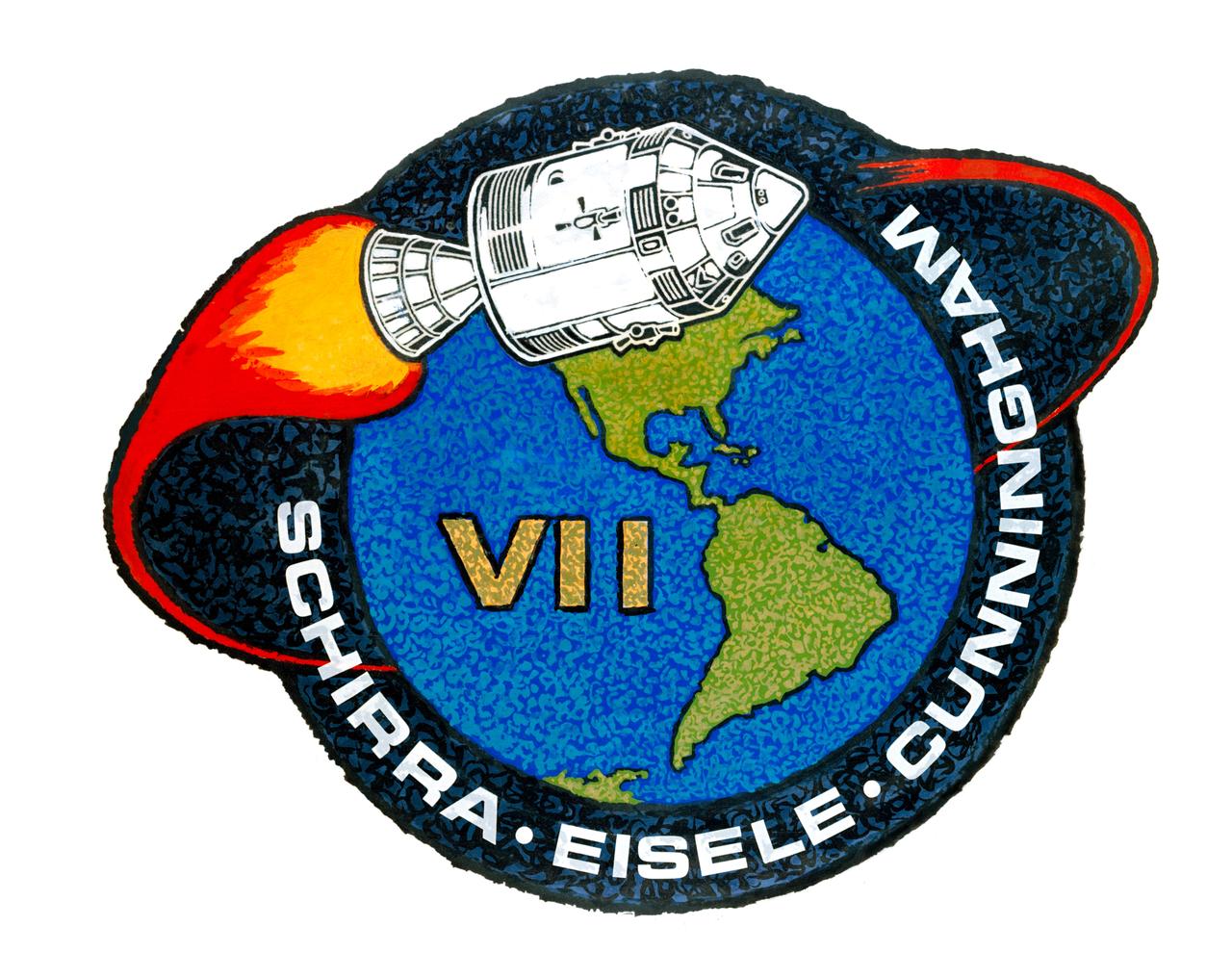
S68-26668 (June 1968) --- The official emblem of Apollo 7, the first manned Apollo space mission. The crew will consist of astronauts Walter M. Schirra Jr., Donn F. Eisele, and Walter Cunningham. The NASA insignia design for Apollo flights is reserved for use by the astronauts and for the official use as the NASA Administrator may authorize. Public availability has been approved only in the form of illustrations by the various news media. When and if there is any change in this policy, which we do not anticipate, it will be publicly announced.
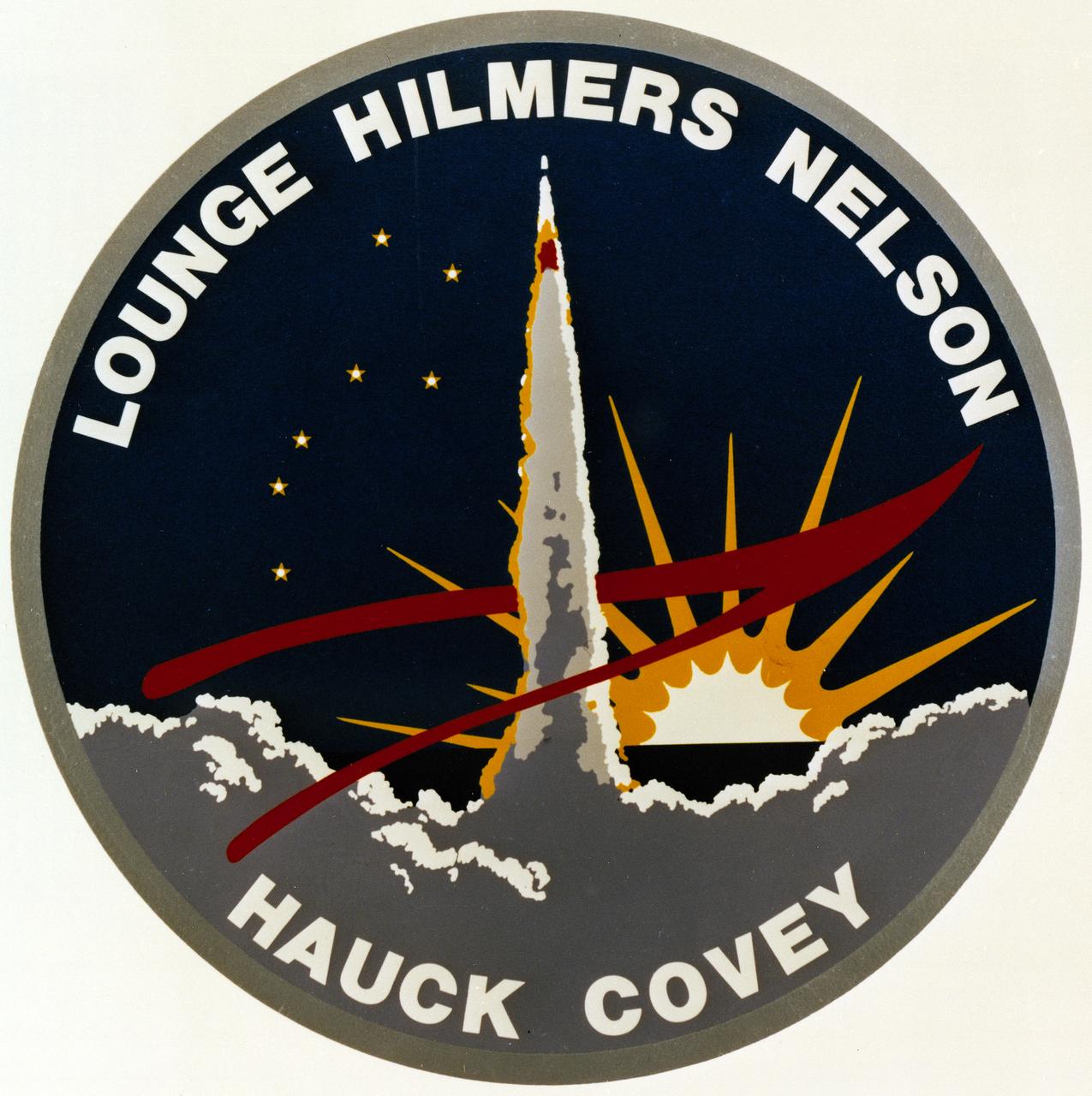
The predominant themes are: a new beginning (sunrise), a safe mission (stylized launch and plume), the building upon the traditional strengths of NASA (the red vector which symbolizes aeronautics on the original NASA insignia), and a remembrance of their seven colleagues who died aboard Challenger (the seven-starred Big Dipper). The patch was designed by artist Stephen R. Hustvedt of Annapolis, MD.
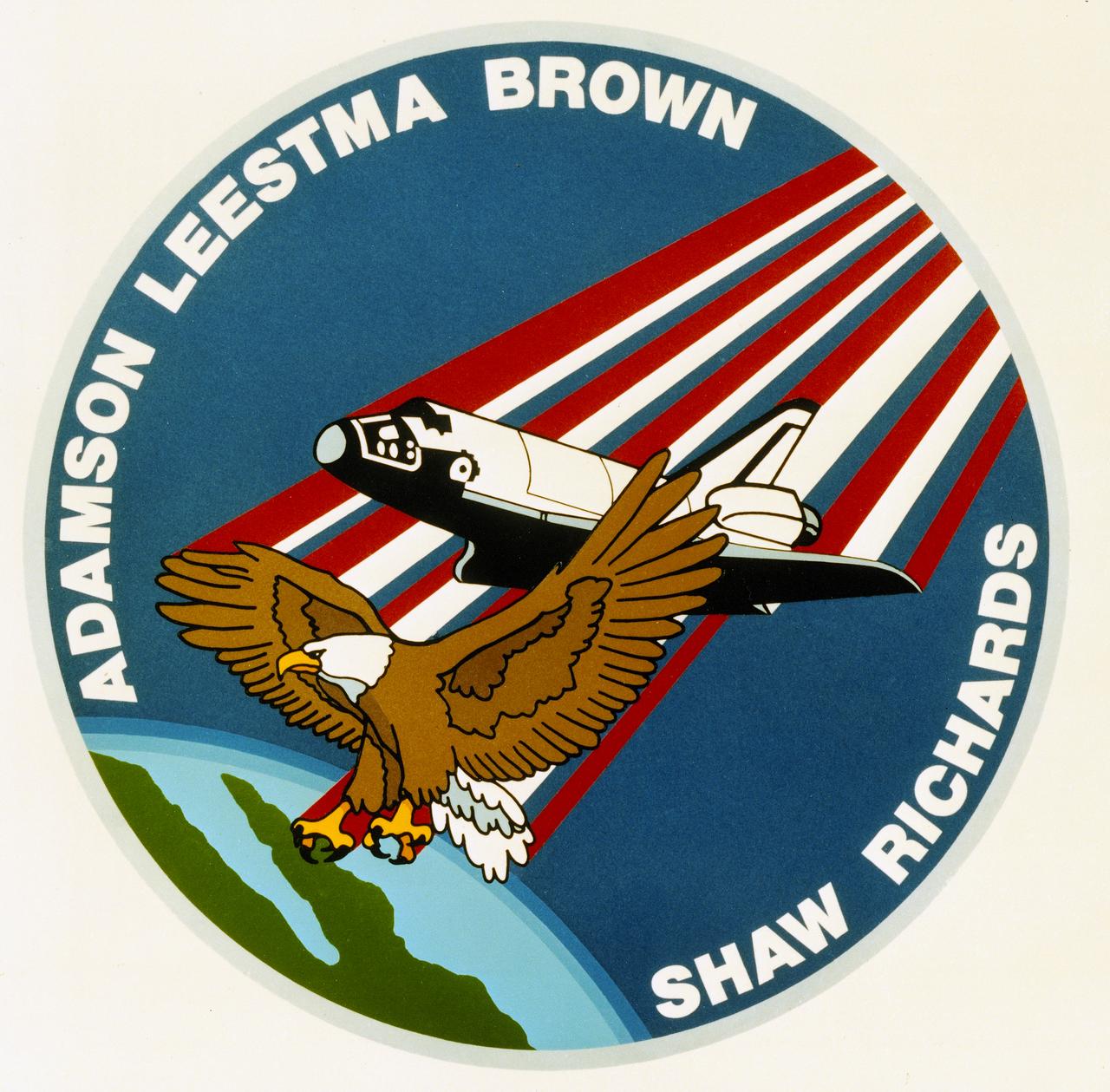
The STS-28 insignia was designed by the astronaut crew, who said it portrays the pride the American people have in their manned spaceflight program. It depicts America (the eagle) guiding the space program (the Space Shuttle) safely home from an orbital mission. The view looks south on Baja California and the west coast of the United States as the space travelers re-enter the atmosphere. The hypersonic contrails created by the eagle and Shuttle represent the American flag. The crew called the simple boldness of the design symbolic of America's unfaltering commitment to leadership in the exploration and development of space.
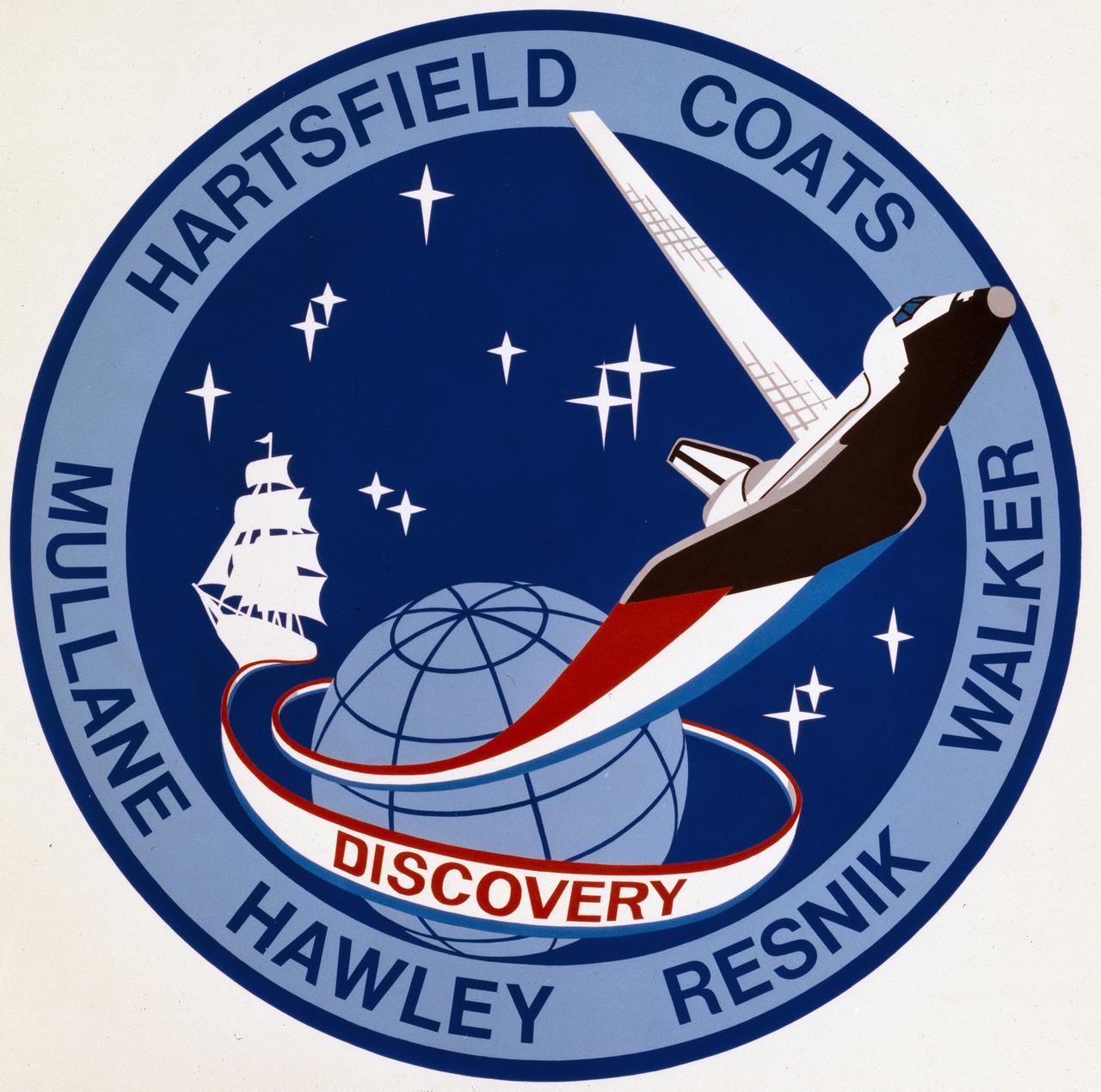
The official mission insignia for the 41-D Space Shuttle flight features the Discovery - NASA's third orbital vehicle - as it makes its maiden voyage. The ghost ship represents the orbiter's namesakes which have figured prominently in the history of exploration. The Space Shuttle Discovery heads for new horizons to extend that proud tradition. Surnames for the crewmembers of NASA's eleventh Space Shuttle mission encircle the red, white, and blue scene.

The rising sun signifies the dawn of a new era of human Spaceflight, the first phase of the United States/Russian space partnership, Shuttle-Mir. Mir is shown in its proposed final on orbit configuration. The Shuttle is shown in a generic tunnel/Spacehab configuration. The Shuttle/Mir combination, docked to acknowledge the union of the two space programs, orbits over an Earth devoid of any definable features or political borders to emphasize Earth as the home planet for all humanity. The individual stars near the Space Shuttle and the Russian Mir Space Station represent the previous individual accomplishments of Russia's space program and that of the United States. The binary star is a tribute to the previous United States-Russian joint human Spaceflight program, the Apollo-Soyuz Test Project (ASTP). The flags of the two nations are symbolized by flowing ribbons of the national colors interwoven in space to represent the two nations joint exploration of space. NASA SHUTTLE and PKA MNP are shown in the stylized logo fonts of the two agencies that are conducting this program.
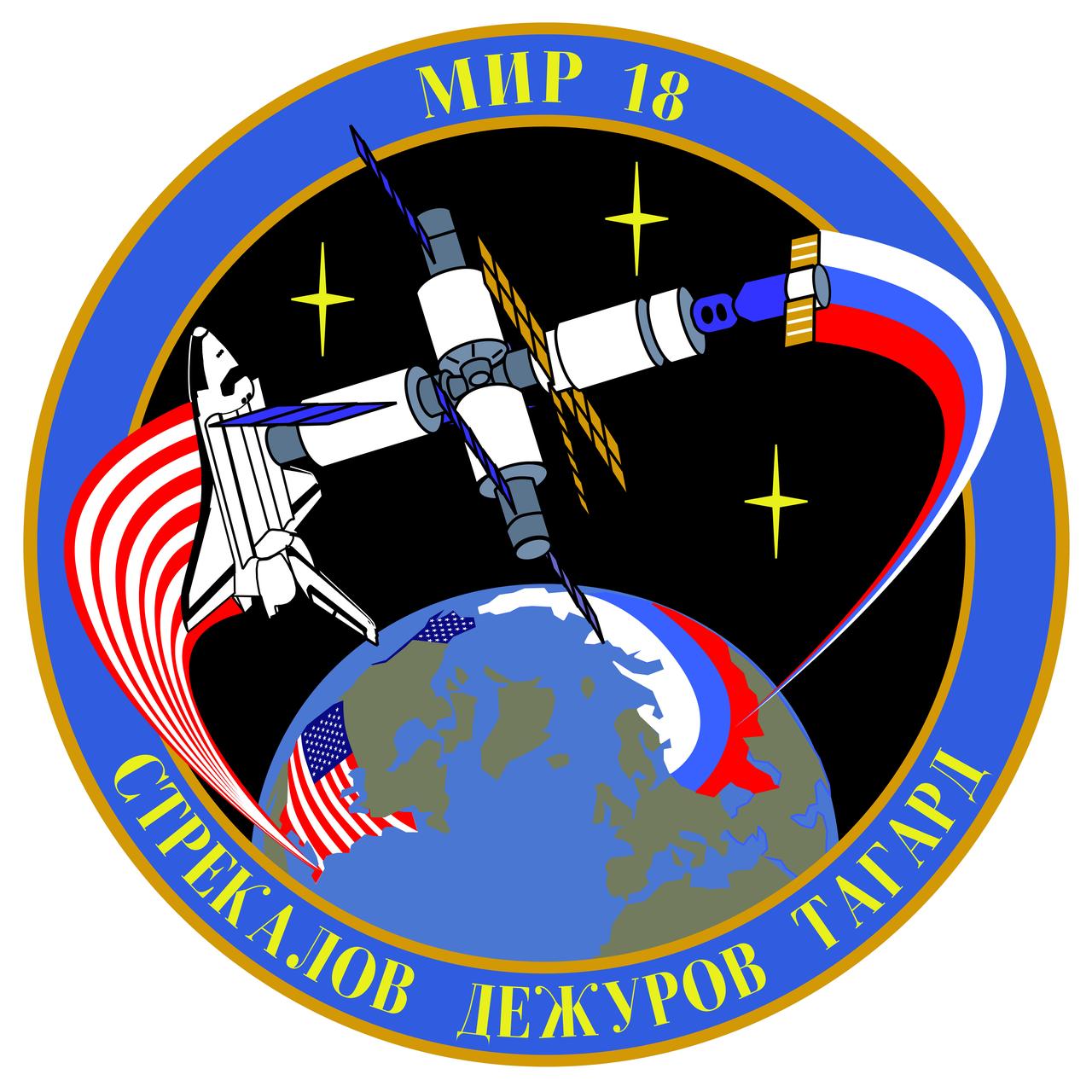
S94-36965 (20 Sept 1994) --- The rising sun signifies the dawn of a new era of human Spaceflight, the first phase of the U.S./Russian space partnership, Shuttle-Mir. Mir is shown in its proposed final on orbit configuration. The Shuttle is shown in a generic tunnel/Spacehab configuration. The Shuttle-Mir combination, docked to acknowledge the union of the two space programs, orbits over an Earth devoid of any definable features or political borders to emphasize Earth as the home planet for all humanity. The individual stars near the Shuttle and the Mir station represent the previous individual accomplishments of Russia's space program and that of the U.S. The binary star is a tribute to the previous U.S.-Russian joint human Spaceflight program, the Apollo-Soyuz Test Project. The flags of the two nations are symbolized by flowing ribbons of the national colors interwoven in space to represent the two nations joint exploration of space. NASA SHUTTLE and PKA MNP are shown in the stylized logo fonts of the two agencies that are conducting this program.
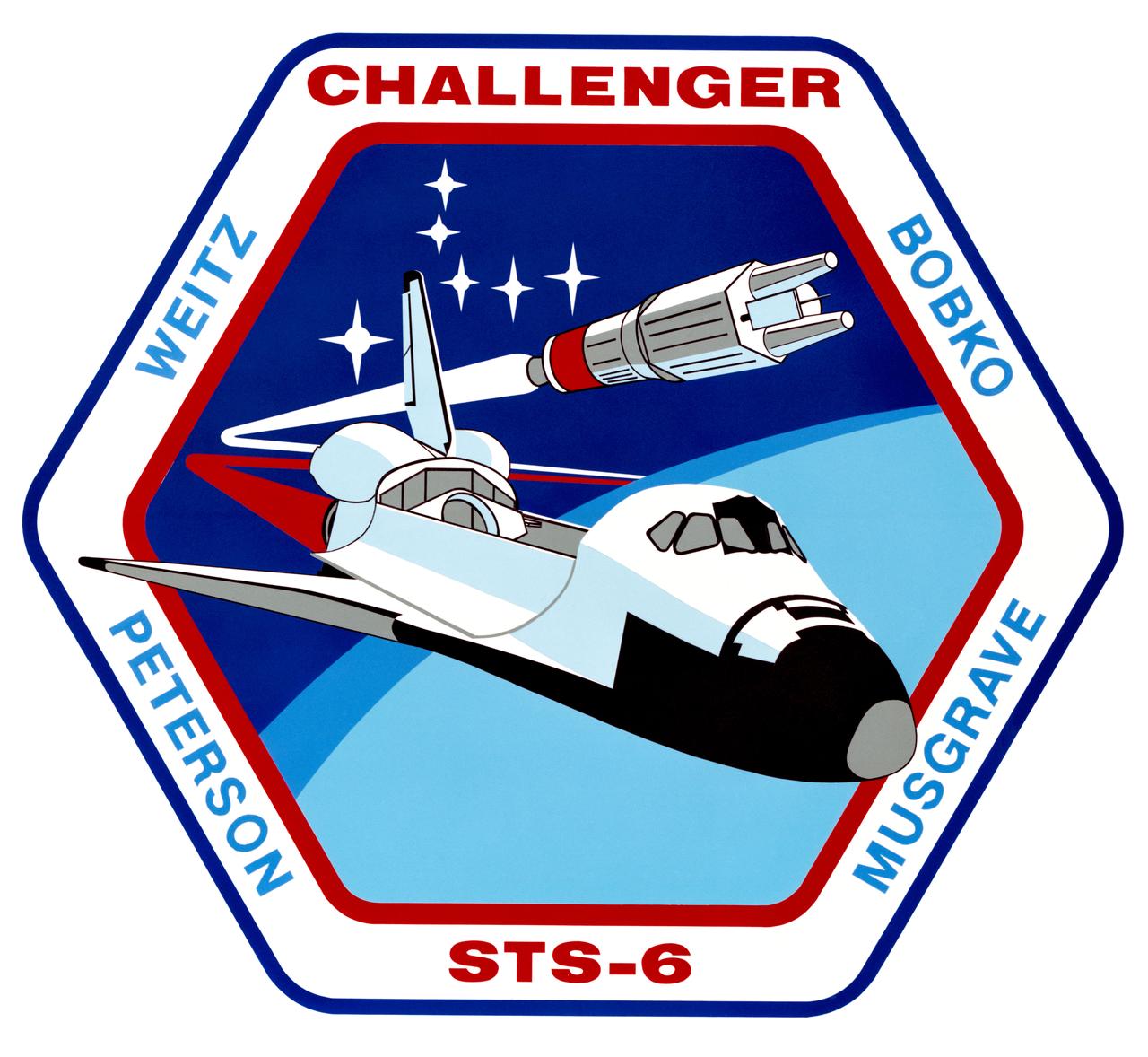
S82-39531 (December 1982) --- This is the official insignia for space shuttle mission STS-6. The crew members for this mission are astronauts Paul J. Weitz, commander; Karol J. Bobko, pilot; F. Story Musgrave, mission specialist; and Donald H. Peterson, mission specialist. The sixth space shuttle flight is represented by the hexagonal shape of the insignia and the six stars, in the portrayed constellation Virgo. The sign Virgo is also symbolic of the first flight of the space shuttle Challenger. Depicted above the spacecraft?s open cargo bay is the combined Inertial Upper Stage (IUS) and a Tracking and Data Relay Satellite. This is the first shuttle flight of the IUS rocket, which will carry the first TDRS to a geosynchronous orbit of 24,000 statute miles. The NASA insignia design for space shuttle flights is reserved for use by the astronauts and for other official use as the NASA Administrator may authorize. Public availability has been approved only in the forms of illustrations by the various news media. When and if there is any change in this policy, which is not anticipated, the change will be publicly announced. Photo credit: NASA
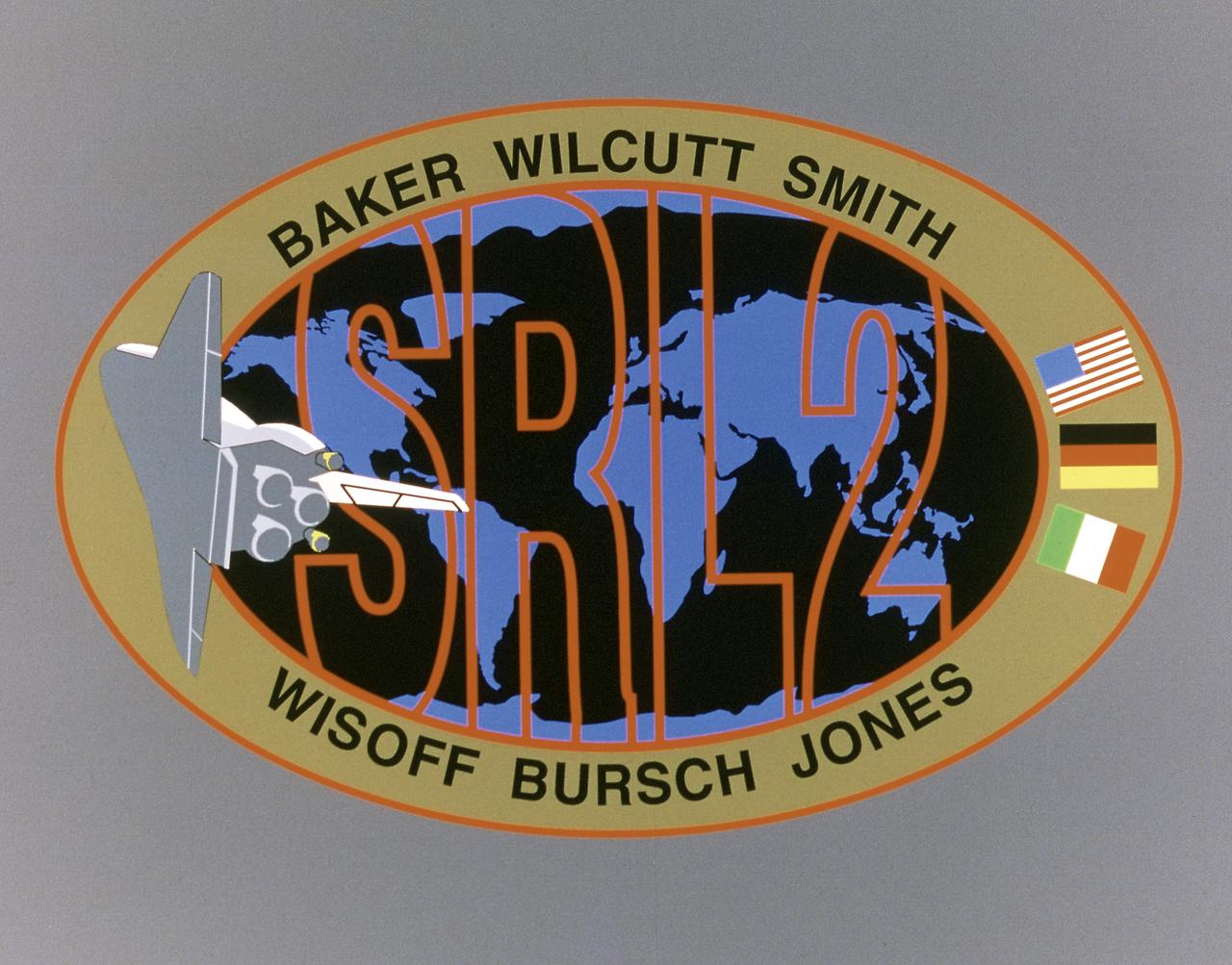
This STS-68 patch was designed by artist Sean Collins. Exploration of Earth from space is the focus of the design of the insignia, the second flight of the Space Radar Laboratory (SRL-2). SRL-2 was part of NASA's Mission to Planet Earth (MTPE) project. The world's land masses and oceans dominate the center field, with the Space Shuttle Endeavour circling the globe. The SRL-2 letters span the width and breadth of planet Earth, symbolizing worldwide coverage of the two prime experiments of STS-68: The Shuttle Imaging Radar-C and X-Band Synthetic Aperture Radar (SIR-C/X-SAR) instruments; and the Measurement of Air Pollution from Satellites (MAPS) sensor. The red, blue, and black colors of the insignia represent the three operating wavelengths of SIR-C/X-SAR, and the gold band surrounding the globe symbolizes the atmospheric envelope examined by MAPS. The flags of international partners Germany and Italy are shown opposite Endeavour. The relationship of the Orbiter to Earth highlights the usefulness of human space flights in understanding Earth's environment, and the monitoring of its changing surface and atmosphere. In the words of the crew members, the soaring Orbiter also typifies the excellence of the NASA team in exploring our own world, using the tools which the Space Program developed to explore the other planets in the solar system.
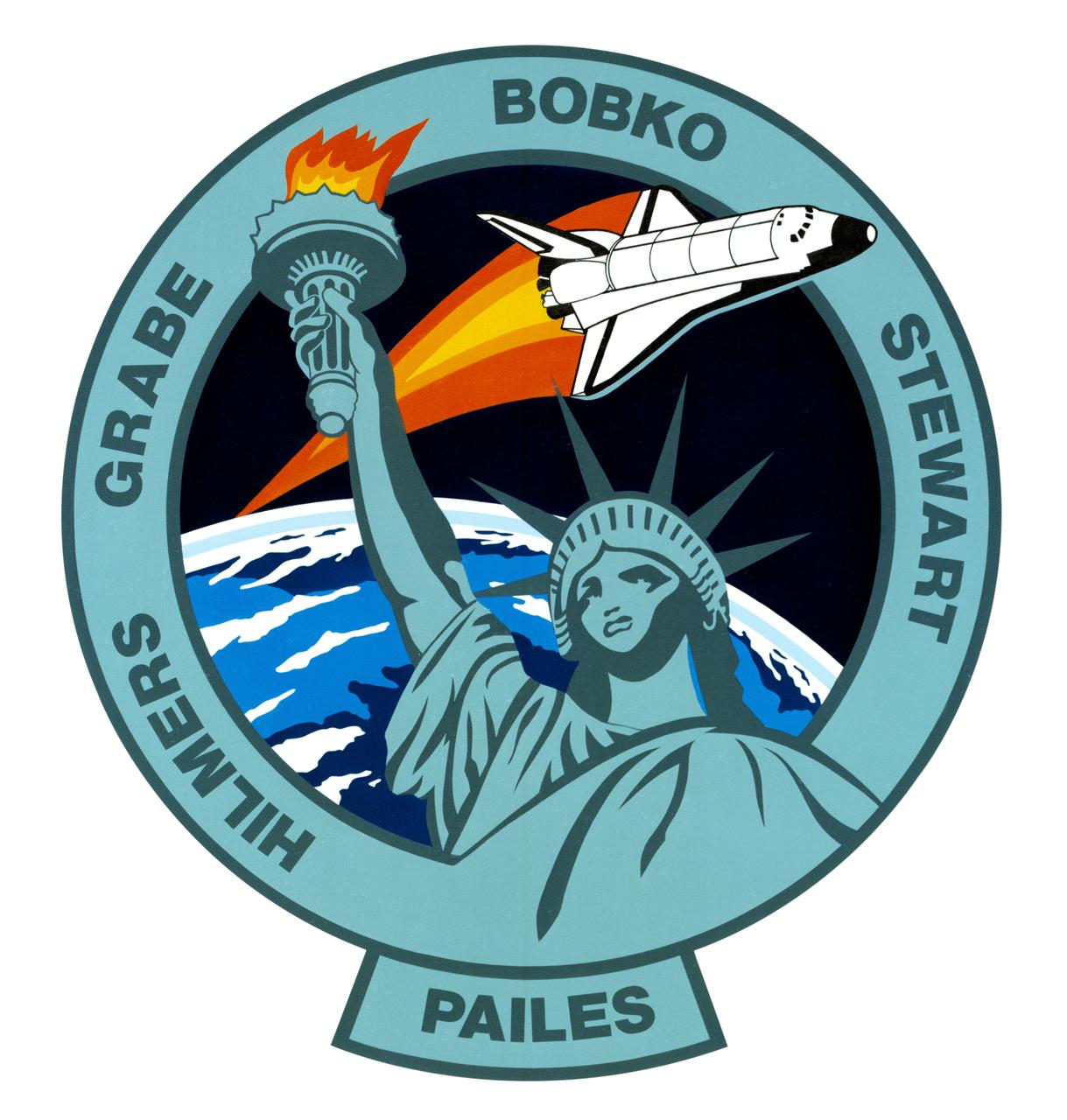
S85-39862 (1 Sept. 1985) --- The 51-J mission insignia, designed by Atlantis's first crew, pays tribute to the Statue of Liberty and the ideas it symbolizes. The historical gateway figure bears additional significance for astronauts Karol J. Bobko, mission commander; and Ronald J. Grabe, pilot, both New York natives. Other members of the five-man crew, whose surnames encircle the artwork, are Robert L. Stewart and David C. Hilmers, mission specialists; and William A. Pailes, payload specialist. The NASA insignia design for space shuttle flights is reserved for use by the astronauts and for other official use as the NASA Administrator may authorize. Public availability has been approved only in the forms of illustrations by the various news media. When and if there is any change in this policy, which is not anticipated, the change will be publicly announced. Photo credit: NASA
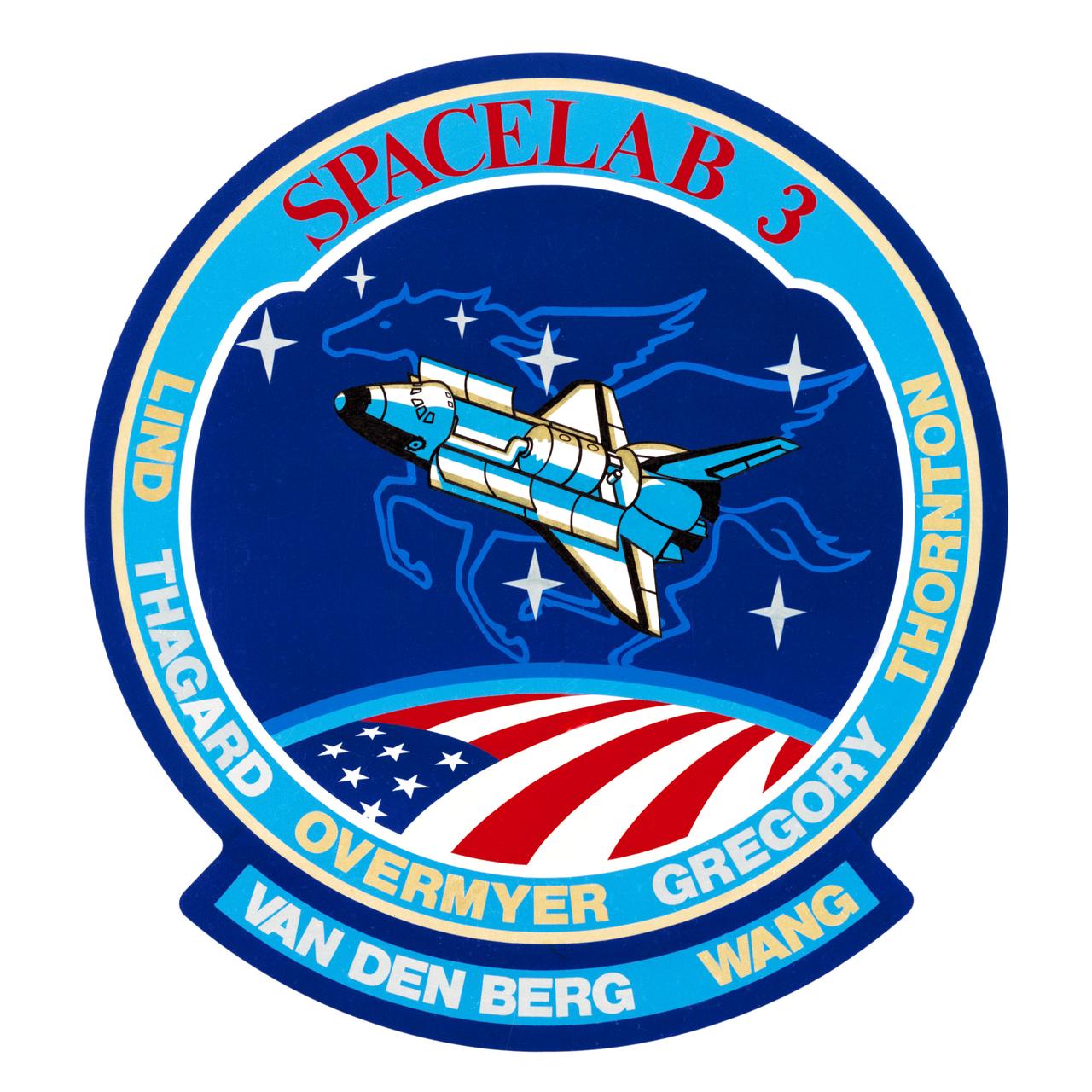
S84-44372 (December 1984) --- The space shuttle Discovery and its science module payload are featured in the insignia for the STS-51B/Spacelab 3 mission. The seven stars of the constellation Pegasus surround the orbiting spaceship above the flag draped Earth. Surnames of the seven crew members encircle the scene. Crew members are astronauts Robert F. Overmyer, Frederick D. Gregory, Don L. Lind, Norman E. Thagard and William E. Thornton; and payload specialists Lodewijk van den Berg and Taylor G. Wang. The artwork was done by Carol Ann Lind. The NASA insignia design for space shuttle flights is reserved for use by the astronauts and for other official use as the NASA Administrator may authorize. Public availability has been approved only in the forms of illustrations by the various news media. When and if there is any change in this policy, which is not anticipated, the change will be publicly announced. Photo credit: NASA
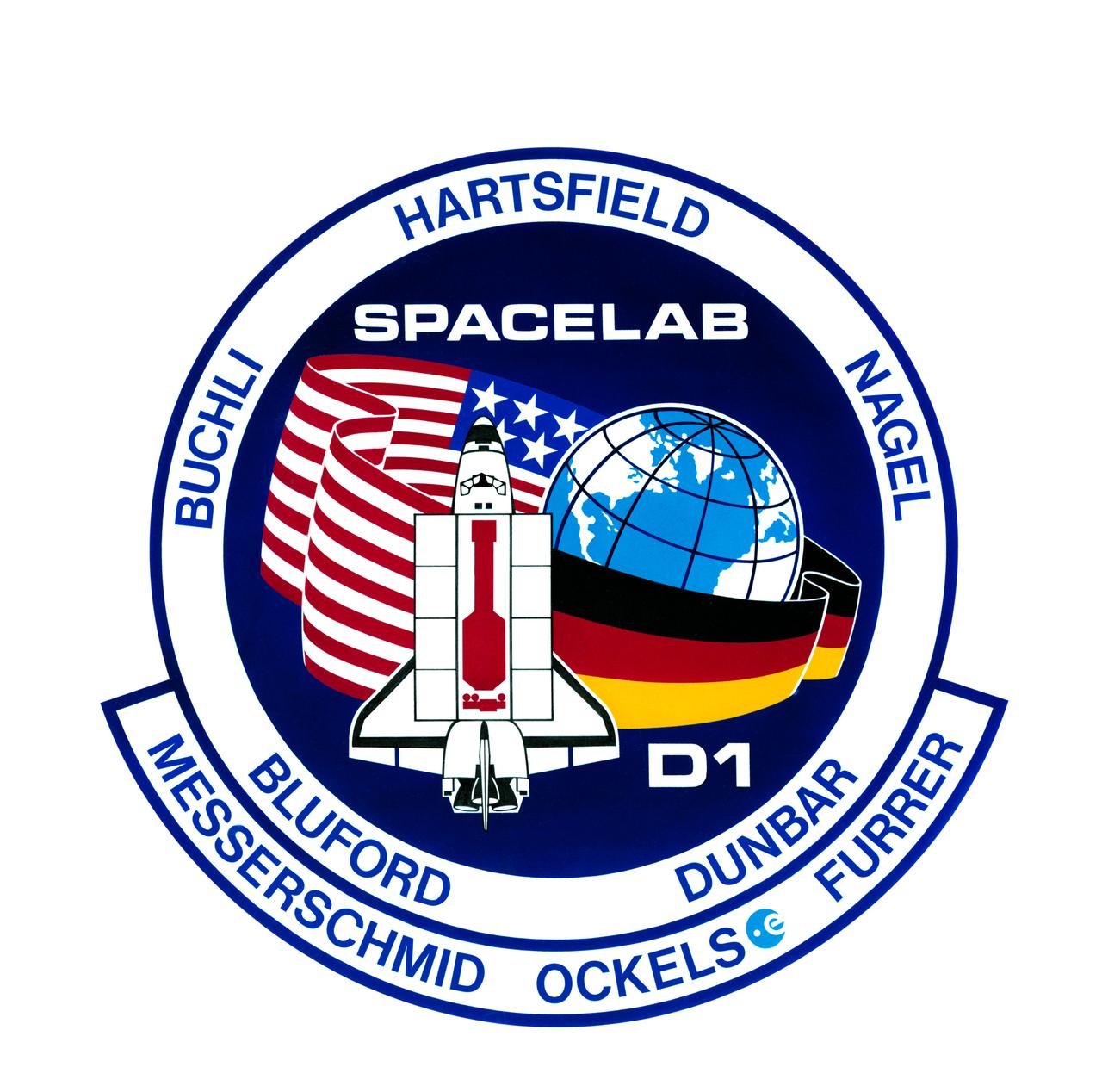
S85-38035 (August 1985) --- This insignia has been chosen by the eight members of the STS-61A/D1 Spacelab mission as the emblem they will wear on their spacesuits and which will represent the record-sized space shuttle crew on the scheduled autumn mission. Crew members' surnames surround the colorful patch scene depicting Challenger carrying a long science module and an international crew from Europe and the United States. Serving on the crew are Henry W. Hartsfield Jr., commander; Steven R. Nagel, pilot; Bonnie J. Dunbar, mission specialist; James F. Buchli, mission specialist; Guion S. Bluford Jr., mission specialist; Ernst Messerschmid, German payload specialist; Reinhard Furrer, German payload specialist; and Wubbo J. Ockels, Dutch payload specialist. The NASA insignia design for space shuttle flights is reserved for use by the astronauts and for other official use as the NASA Administrator may authorize. Public availability has been approved only in the forms of illustrations by the various news media. When and if there is any change in this policy, which is not anticipated, the change will be publicly announced. Photo credit: NASA
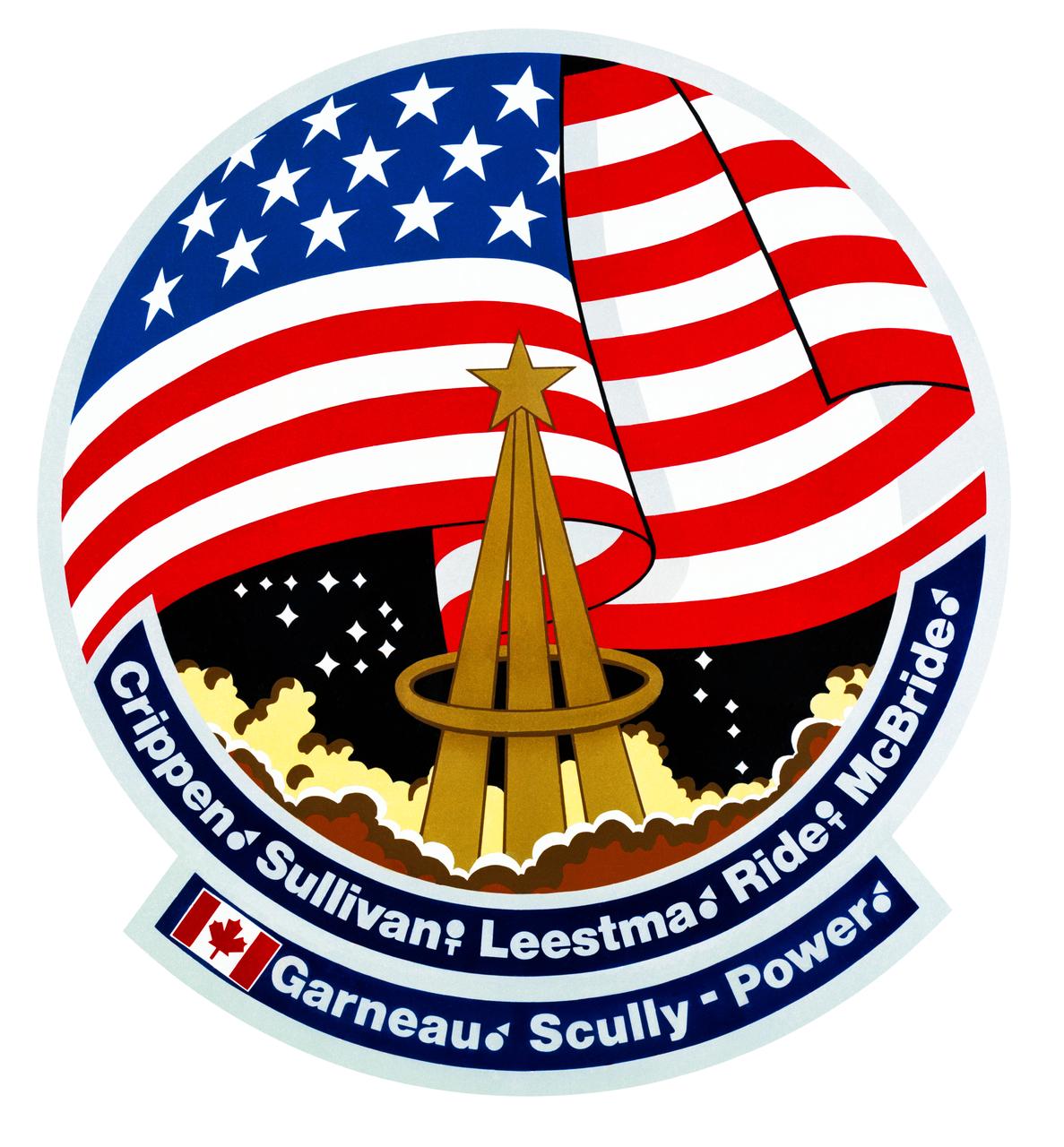
S84-36158 (June 1984) --- The STS-41G Challenger mission insignia focuses on its seven crew members (first to exceed six), the United States flag and the Unity symbol known as the astronaut pin. The pin design in center shows a trio of trajectories merging in infinite space, capped by a bright shining star and encircled by an elliptical wreath denoting orbital flight. Crew members for the (originally-scheduled 17th STS) mission include astronauts Robert L. Crippen and Jon A. McBride, commander and pilot, respectively, whose surnames flank those of the NASA mission specialists - astronauts Kathryn D. Sullivan, David C. Leestma and Sally K. Ride. Paul Scully-Power, a United States Navy oceanographer, and Marc Garneau, a Canadian, join the crew as payload specialists. The artwork was done for NASA by Patrick Rawlings. The NASA insignia design for space shuttle flights is reserved for use by the astronauts and for other official use as the NASA Administrator may authorize. Public availability has been approved only in the forms of illustrations by the various news media. When and if there is any change in this policy, which is not anticipated, the change will be publicly announced. Photo credit: NASA
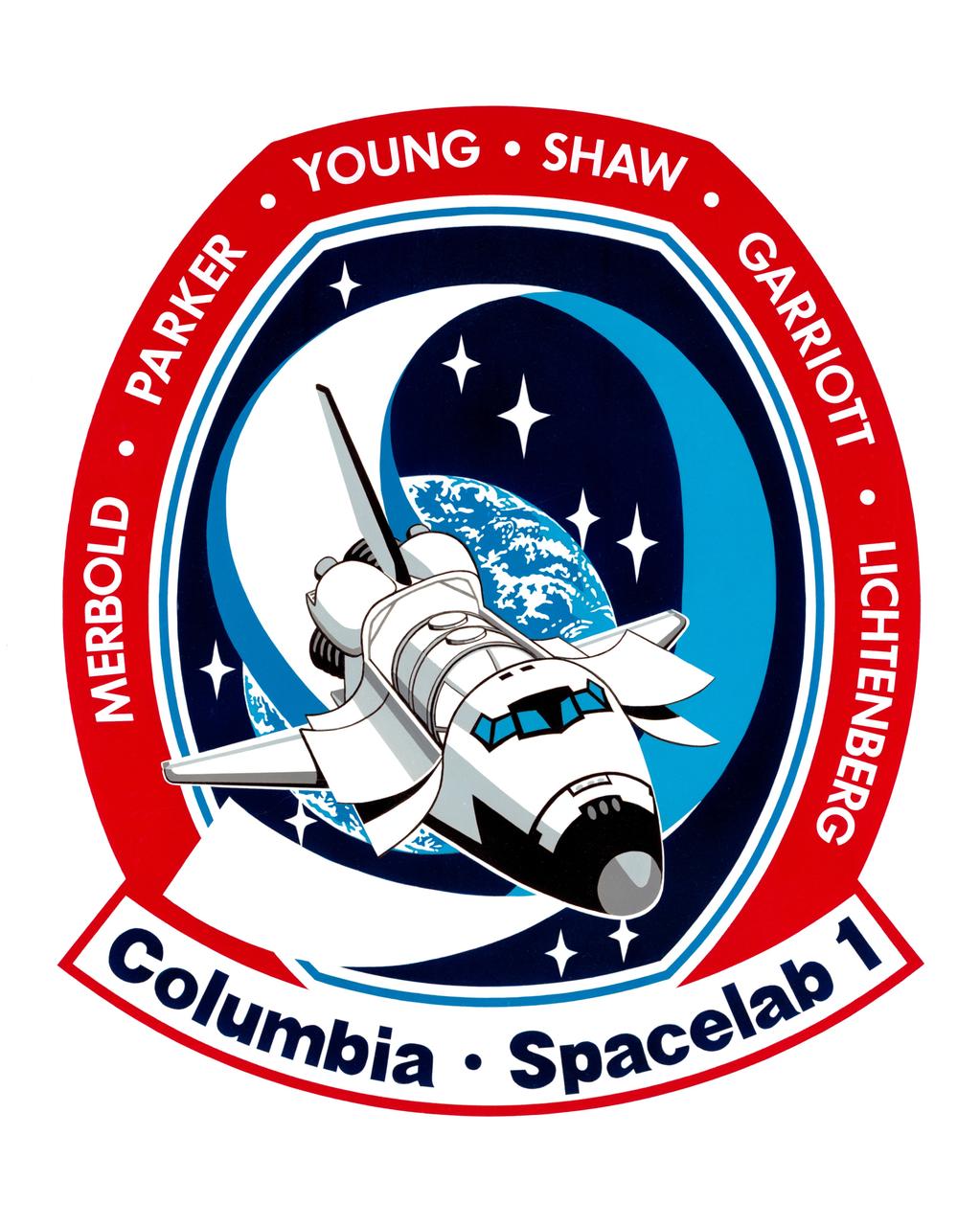
S83-32900 (25 May 1983) --- This is the official insignia for STS-9, the major payload of which is Spacelab-1, depicted in the cargo bay of the space shuttle Columbia. The nine stars and the path of the orbiter tell the flight's numerical designation in the Space Transportation System's mission sequence. Astronaut John W. Young is crew commander; Brewster H. Shaw Jr., pilot. NASA astronauts Owen K. Garriott and Robert A.R. Parker are mission specialists. Byron K. Lichtenberg of the Massachusetts Institute of Technology and Ulf Merbold of the Republic of West Germany are the Spacelab-1 payload specialists. Launch has been set for late 1983. Merbold is a physicist representing the European Space Agency (ESA). The NASA insignia design for space shuttle flights is reserved for use by the astronauts and for other official use as the NASA Administrator may authorize. Public availability has been approved only in the forms of illustrations by the various news media. When and if there is any change in this policy, which is not anticipated, the change will be publicly announced. Photo credit: NASA

S82-26315 (4 Feb. 1982) --- This is the insignia for NASA's third flight (STS-3) of the Space Transportation System's (STS) Columbia, depicted in the middle of the blue sphere against the background of the sun. The Columbia's tail, nose, and top will each be pointed at the sun for long periods to test its thermal response to extremes of temperatures. The three prominent rays represent the third STS flight. The surnames of astronauts Jack R. Lousma, commander, and C. Gordon Fullerton, pilot, flank the vehicle, and the name Columbia appears at the bottom. The spacecraft's payload bay doors are open, and the Remote Manipulator System (RMS) arm with an experimental payload is extended as it will be on several occasions during the actual flight, scheduled for spring of this year. The artwork was accomplished by space artist Robert C. McCall of Paradise Valley, Arizona. The NASA insignia design for space shuttle flights is reserved for use by the astronauts and for other official use as the NASA Administrator may authorize. Public availability has been approved only in the forms of illustrations by the various news media. When and if there is any change in this policy, which is not anticipated, the change will be publicly announced. Photo credit: NASA
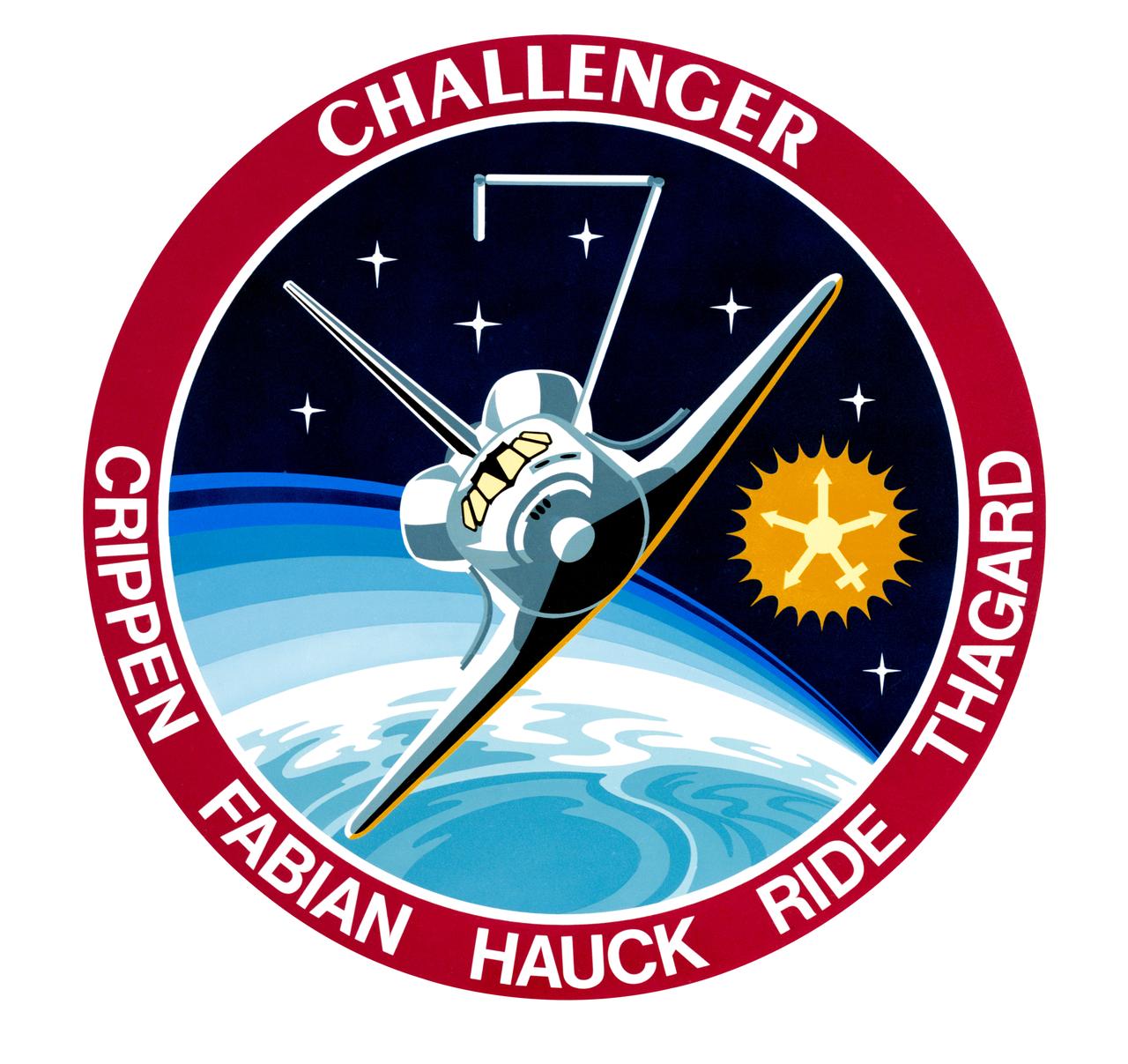
S83-28355 (March 1983) --- The space shuttle Challenger, making its second flight into space on STS-7, is featured in the art for the insignia for that NASA flight. The remote manipulator arm is positioned such that, the number 7 is formed. Likewise, seven stars are visible against the black sky. Within the sun?s center are representations for the five crew members, including, for the first time in NASA?s space program, a woman ? Dr. Sally K. Ride, mission specialist. The crew member?s surnames are listed along the outside edge of the sphere. They are astronauts Robert L. Crippen, commander; Frederick H. Hauck, pilot; John M. Fabian, Sally K. Ride and Norman E. Thagard, mission specialists. The flight is scheduled for the first week of June 1983. The NASA insignia design for space shuttle flights is reserved for use by the astronauts and for other official use as the NASA Administrator may authorize. Public availability has been approved only in the forms of illustrations by the various news media. When and if there is any change in this policy, which is not anticipated, the change will be publicly announced. Photo credit: NASA
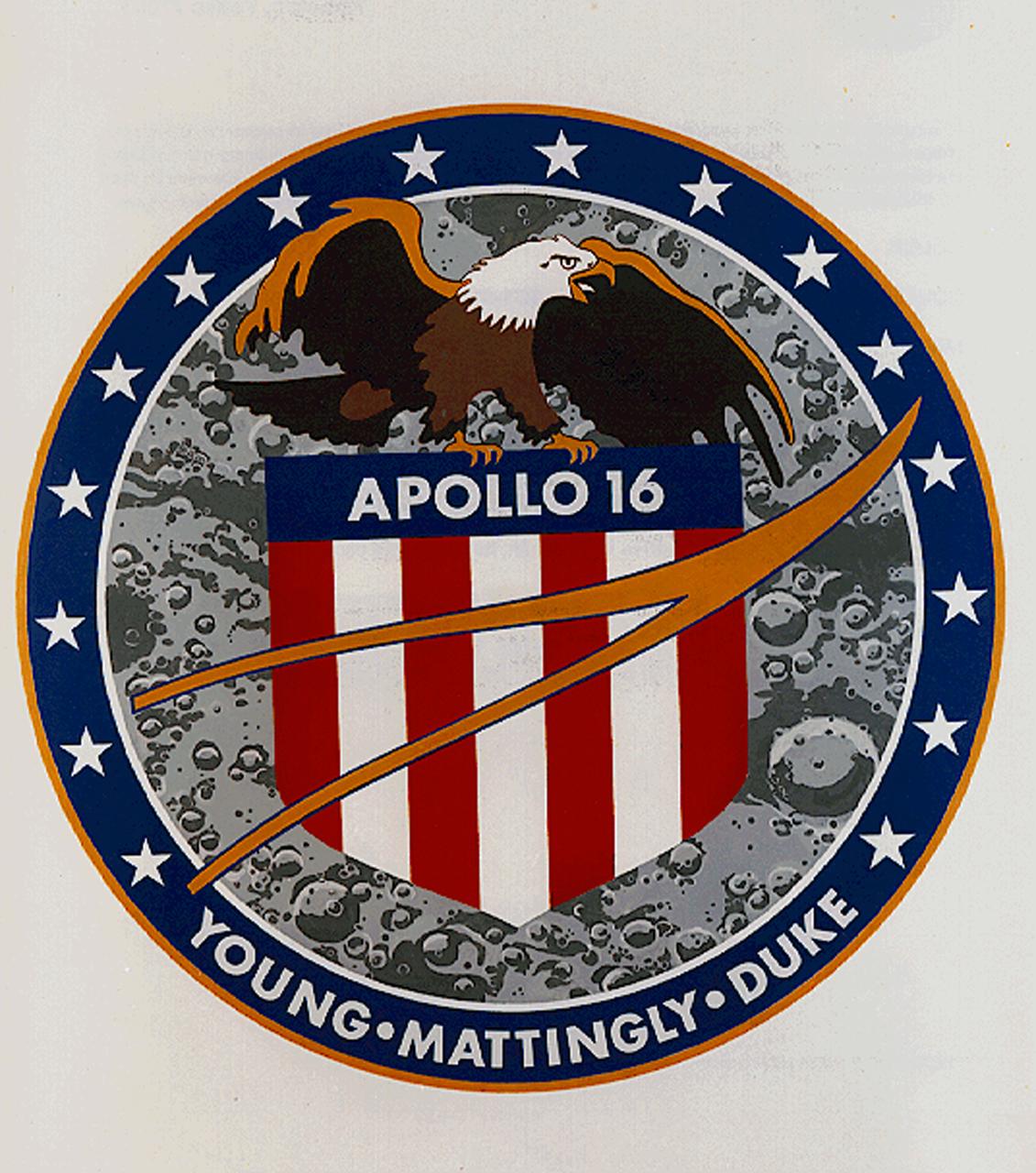
The Apollo 16 crew patch is dominated by an eagle perched atop a red, white, and blue shield superimposed on a lunar surface scene. Similar to that on the NASA agency shield and insignia, there is a gold symbol of flight outlined in blue across the face of the shield. The border surrounding the shield is a circle of 16 stars completed by the the crew’s surnames at the bottom. The patch was designed from ideas submitted by the Apollo 16 3-man crew: John W. Young, Mission Commander: Thomas K. Mattingly, Command Module pilot; and Charles M. Duke, Lunar Module pilot. (Note: This is the official Apollo 16 emblem, a property of the United States government. Its reproduction in any form other than in news, information, and education media is not authorized without approval. Unauthorized use is subject to the provisions of Title 18, U.S. Code, Section 701.)
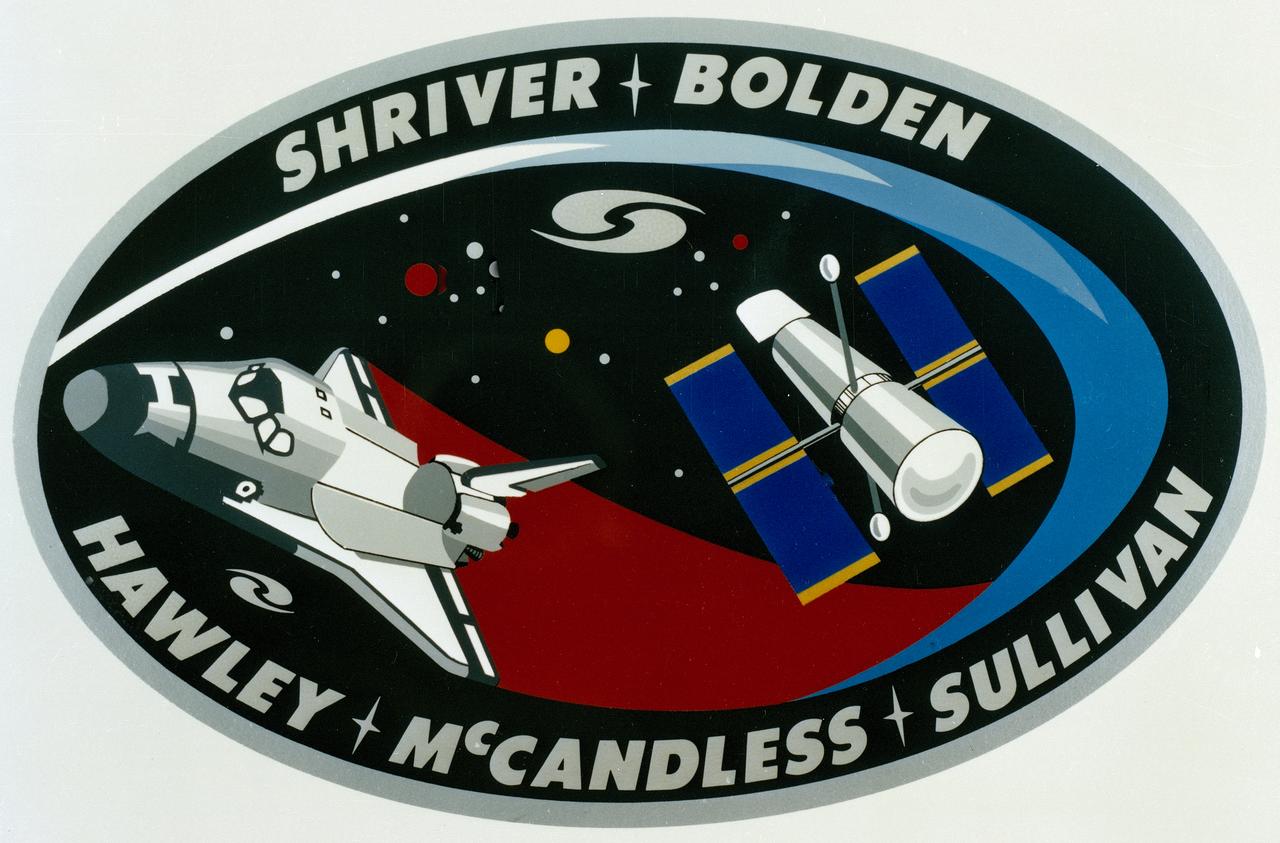
The mission insignia for NASA's STS-31 mission features the Hubble Space Telescope (HST) in its observing configuration against a background of the universe it will study. The cosmos includes a stylistic depiction of galaxies in recognition of the contribution made by Sir Edwin Hubble to our understanding of the nature of galaxies and the expansion of the universe. The STS-31 crew points out that is it in honor of Hubble's work that this great observatory in space bears his name. The depicted Space Shuttle trails a spectrum symbolic of both the red shift observations that were so important to Hubble's work and new information which will be obtained with the HST. Encircling the art work, designed by the crew, are the names of its members.
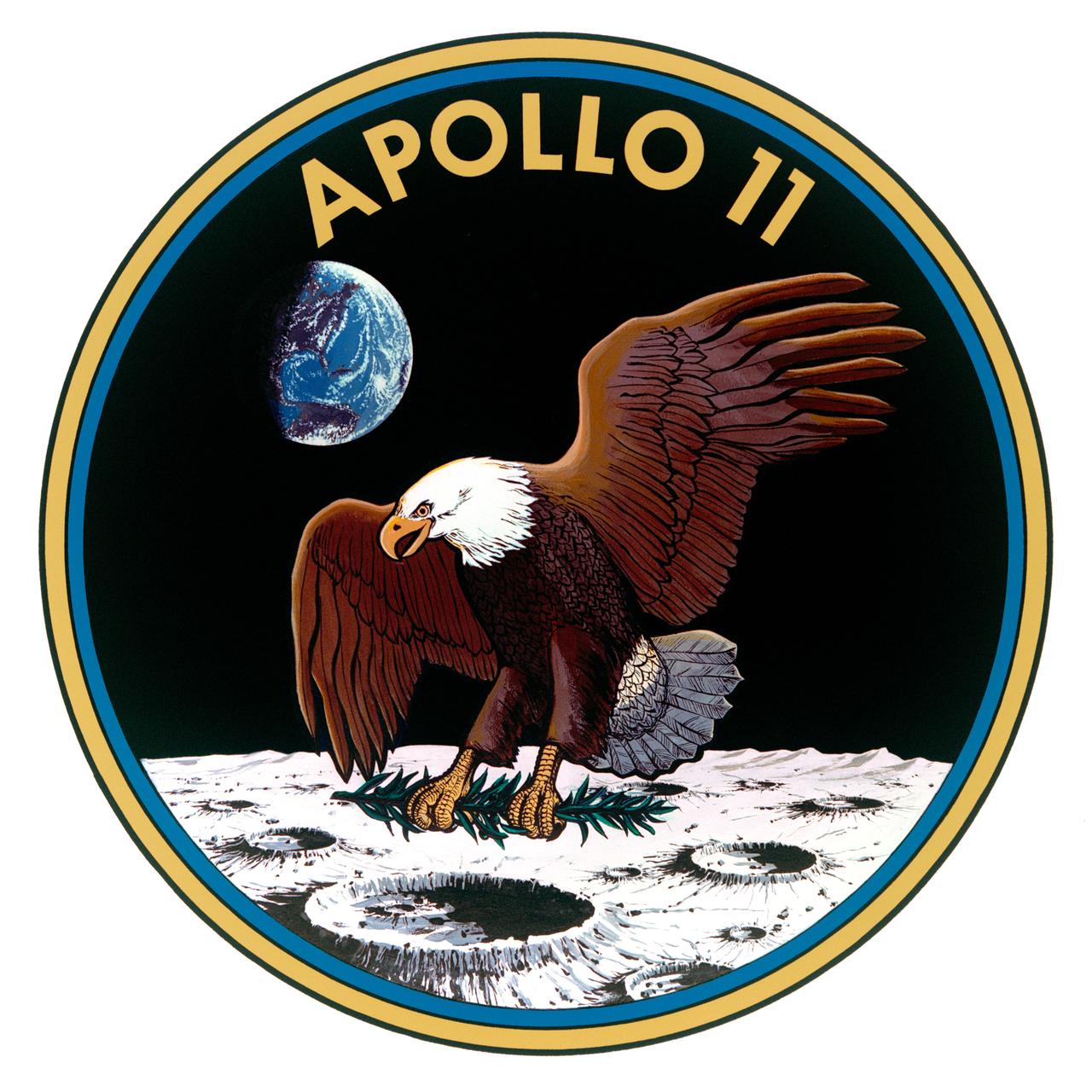
S69-34875 (June 1969) --- The official emblem of Apollo 11, the United States' first scheduled lunar landing mission. The Apollo 11 crew will be astronauts Neil A. Armstrong, commander; Michael Collins, command module pilot; and Edwin E. Aldrin Jr., lunar module pilot. The NASA insignia design for Apollo flights is reserved for use by the astronauts and for the official use as the NASA Administrator may authorize. Public availability has been approved only in the form of illustrations by the various news media. When and if there is any change in this policy, which we do not anticipate, it will be publicly announced.
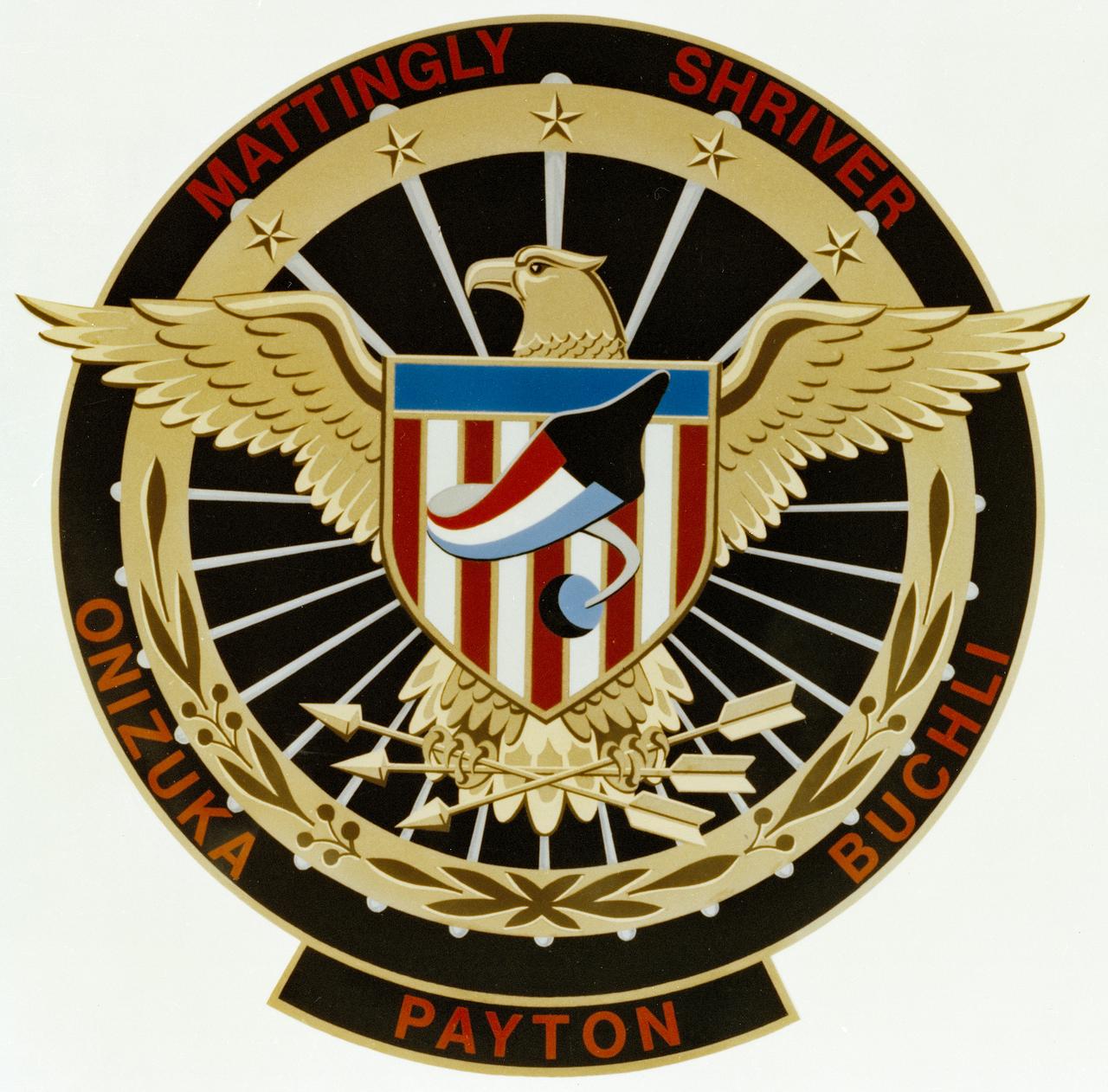
The crew insignia for STS Flight 51-C includes the names of its five crewmembers. The STS 51-C mission marked the third trip of the Space Shuttle Discovery into space. It was the first Space Shuttle mission totally dedicated to the Department of Defense. The U. S. Air Force Inertial Upper Stage Booster Rocket was successfully deployed. Due to the nature of the mission, few additional details of the flight were made available. Landing was made at the Kennedy Space Center, FL on January 27 at 4:23 PM EST. Mission duration was three days, one hour and 33 minutes.
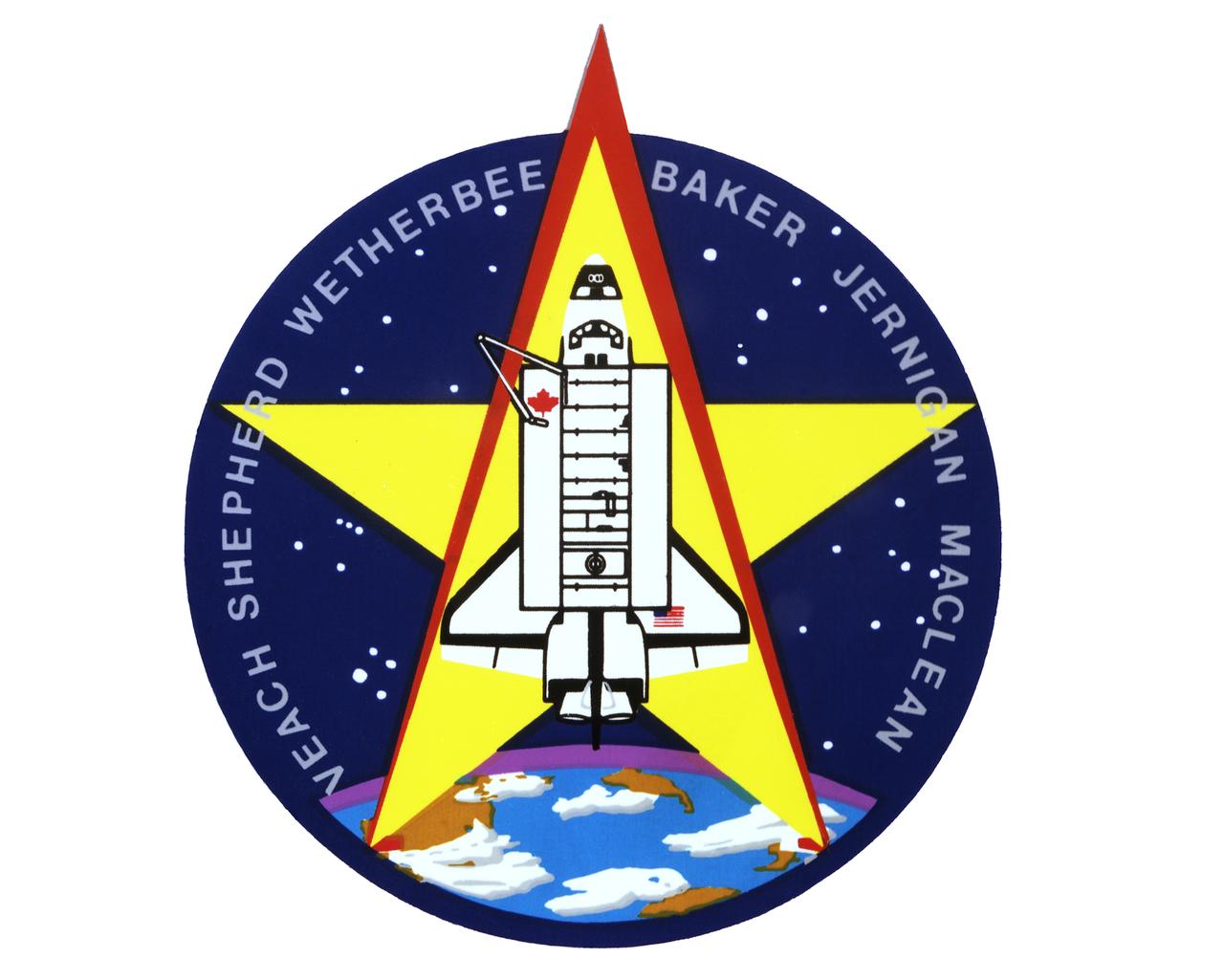
The STS-52 insignia, designed by the mission’s crew members, features a large gold star to symbolize the crew's mission on the frontiers of space. A gold star is often used to symbolize the frontier period of the American West. The red star in the shape of the Greek letter lambda represents both the laser measurements taken from the Laser Geodynamic Satellite (LAGEOS II) and the Lambda Point Experiment, which was part of the United States Microgravity Payload (USMP-l). The remote manipulator and maple leaf are emblematic of the Canadian payload specialist who conducted a series of Canadian flight experiments (CANEX-2), including the Space Vision System test.
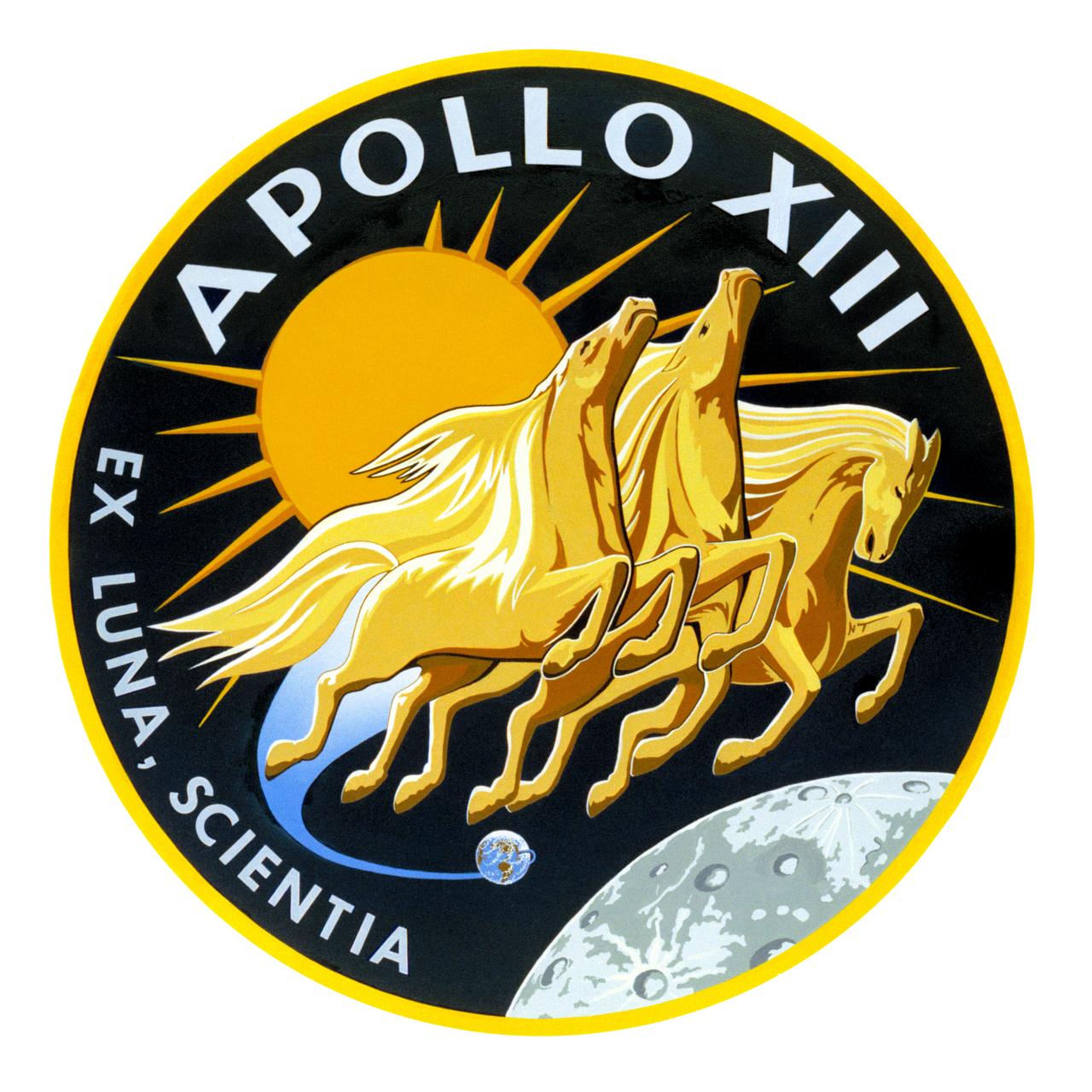
S69-60662 (December 1969) --- This is the insignia of the Apollo 13 lunar landing mission. The Apollo 13 prime crew will be astronauts James A. Lovell Jr., commander; Thomas K. Mattingly II, command module pilot; and Fred W. Haise Jr., lunar module pilot. Represented in the Apollo 13 emblem is Apollo, the sun god of Greek mythology, symbolizing how the Apollo flights have extended the light of knowledge to all mankind. The Latin phrase Ex Luna, Scientia means "From the Moon, Knowledge." Apollo 13 will be the National Aeronautics and Space Administration's (NASA) third lunar landing mission.
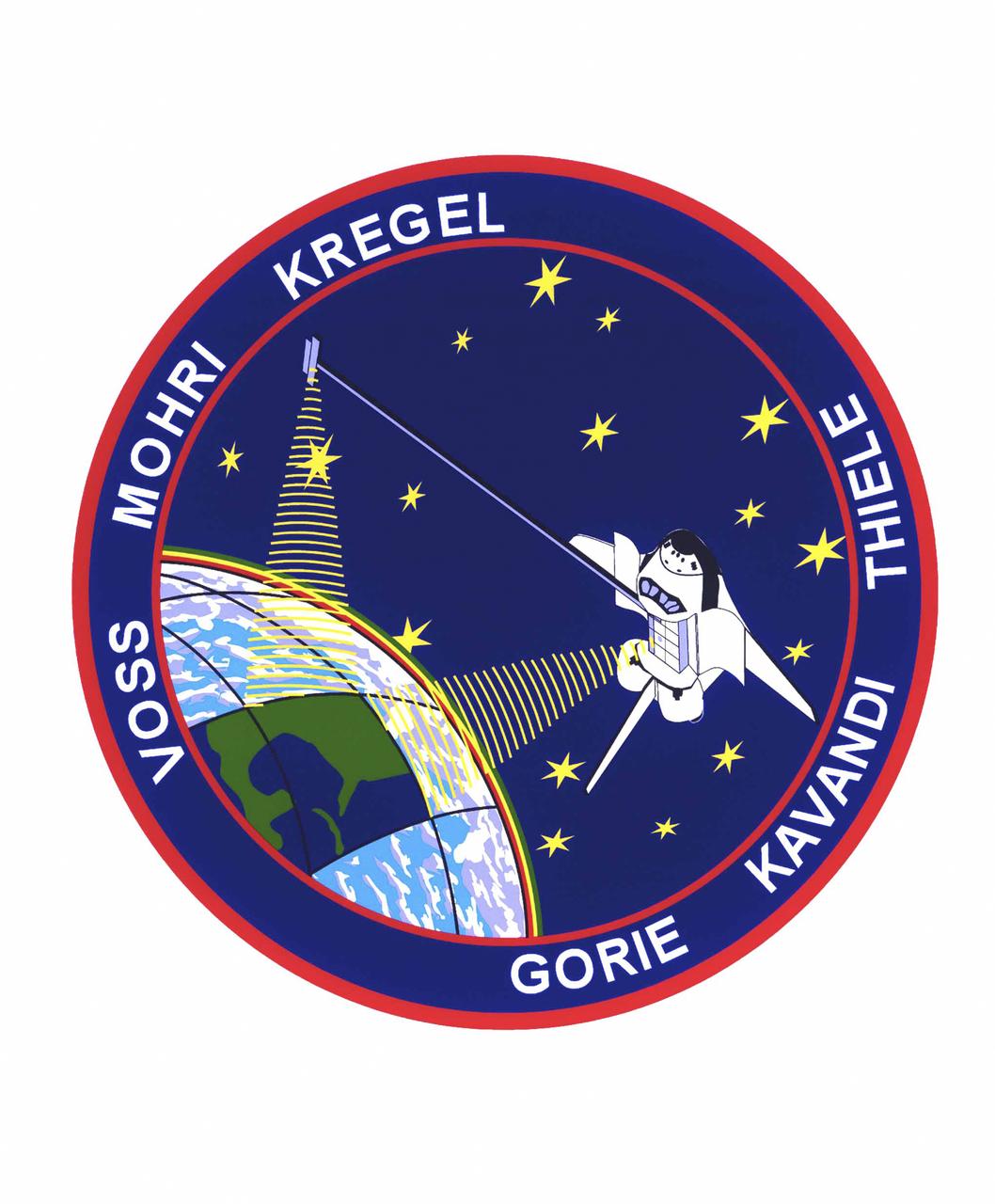
The STS-99 crew members designed the flight insignia for the Shuttle Radar Topography Mission (SRTM), the most ambitious Earth mapping mission to date. Two radar anternas, one located in the Shuttle bay and the other located on the end of a 60-meter deployable mast, was used during the mission to map Earth's features. The goal was to provide a 3-dimensional topographic map of the world's surface up to the Arctic and Antarctic Circles. In the patch, the clear portion of Earth illustrates the radar beams penetrating its cloudy atmosphere and the unique understanding of the home planet that is provided by space travel. The grid on Earth reflects the mapping character of the SRTM mission. The patch depicts the Space Shuttle Endeavour orbiting Earth in a star spangled universe. The rainbow along Earth's horizon resembles an orbital sunrise. The crew deems the bright colors of the rainbow as symbolic of the bright future ahead because of human beings' venturing into space. The crew of six launched aboard the Space Shuttle Endeavor on February 11, 2000 and completed 222 hours of around the clock radar mapping gathering enough information to fill more than 20,000 CDs.
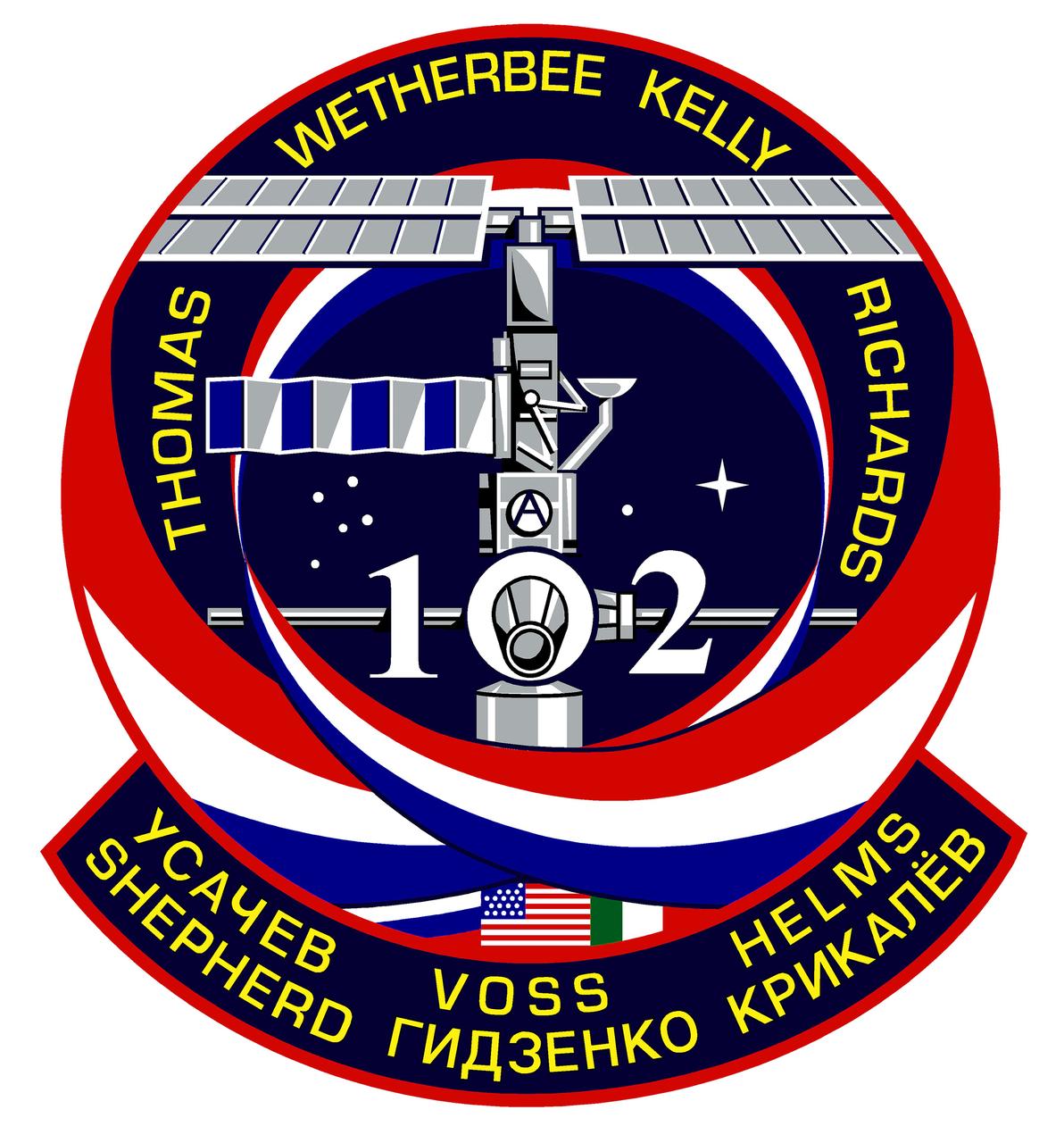
This is the STS-102 mission crew insignia. The central image on the crew patch depicts the International Space Station (ISS) in the build configuration that it had at the time of the arrival and docking of Discovery during the STS-102 mission, the first crew exchange flight to the Space Station. The station is shown along the direction of the flight as was seen by the shuttle crew during their final approach and docking, the so-called V-bar approach. The names of the shuttle crew members are depicted in gold around the top of the patch, and surnames of the Expedition crew members being exchanged are shown in the lower barner. The three ribbons swirling up to and around the station signify the rotation of these ISS crew members. The number 2 is for the Expedition 2 crew who flew up to the station, and the number 1 is for the Expedition 1 crew who then returned down to Earth. In conjunction with the face of the Lab module of the Station, these Expedition numbers create the shuttle mission number 102. Shown mated below the ISS is the Italian-built Multipurpose Logistics Module, Leonardo, that flew for the first time on this flight. The flags of the countries that were the major contributors to this effort, the United States, Russia, and Italy are also shown in the lower part of the patch. The build-sequence number of this flight in the overall station assembly sequence, 5A.1, is captured by the constellations in the background.
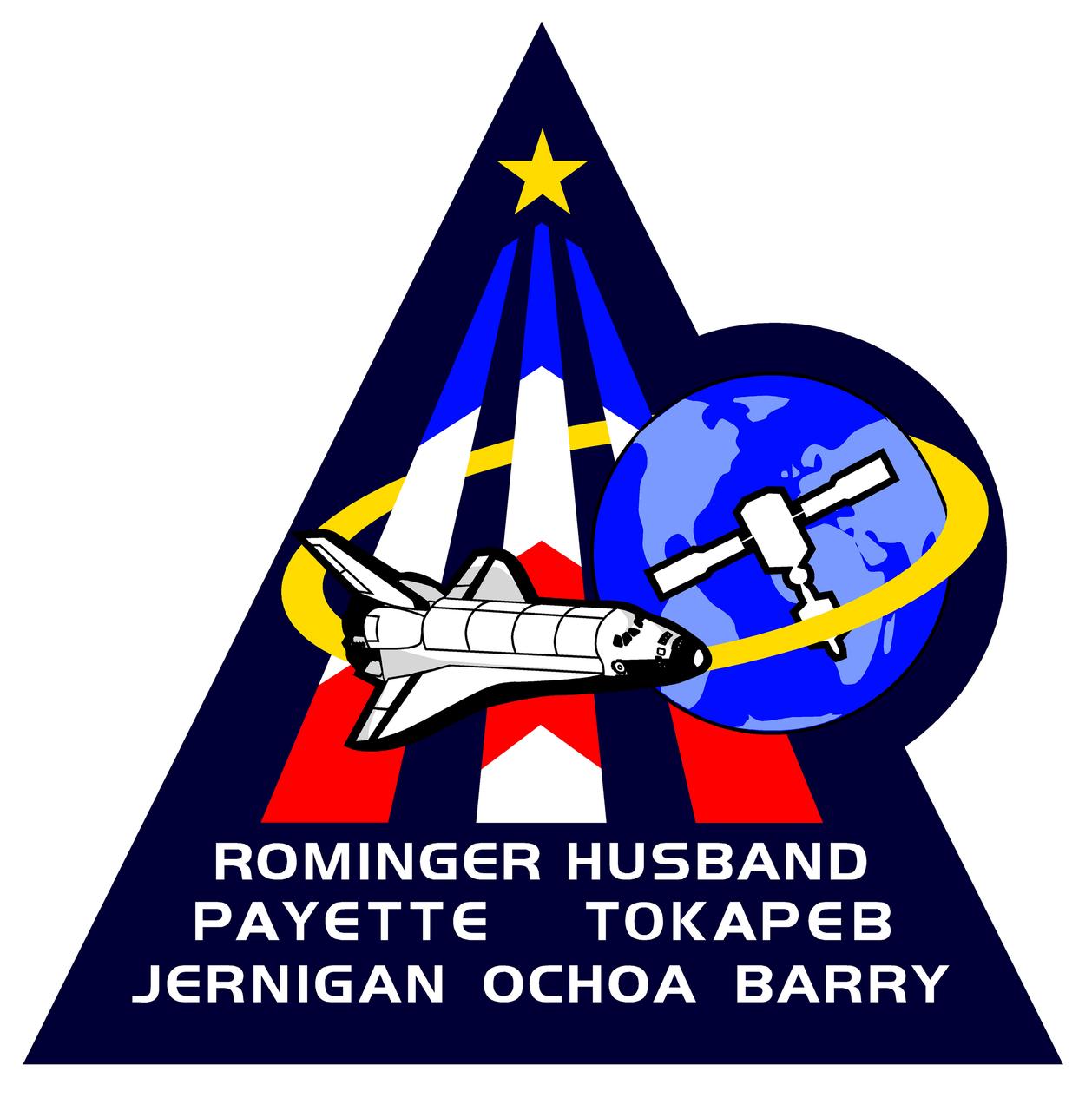
This is the astronaut designed mission insignia for the STS-96 space flight, the second Space Shuttle Mission dedicated to the assembly of the International Space Station (ISS). The crew member designed patch highlights the major themes of the Station program: Earth-directed research, the advancement of human space exploration, and international cooperation. The Space Shuttle Discovery is depicted shortly after reaching orbit as the crew prepares for the first docking with the new station. At this early stage in its construction, the ISS consisted of two modules; The Russian Zarya and the U.S. Unity, shown orbiting the Earth. The triangular shape represents building on the knowledge and experience of earlier missions, while the three vertical bars point toward future human endeavors in space. The five pointed star is symbolic of the five space agencies participating in the development of the ISS: NASA, the Russian Space Agency, the European Space Agency, the National Space Development Agency of Japan, and the Canadian Space Agency. The blend of red, white, and blue is a tribute to the nationalities of the STS-96 crew members who are from the United States, Russia, and Canada.
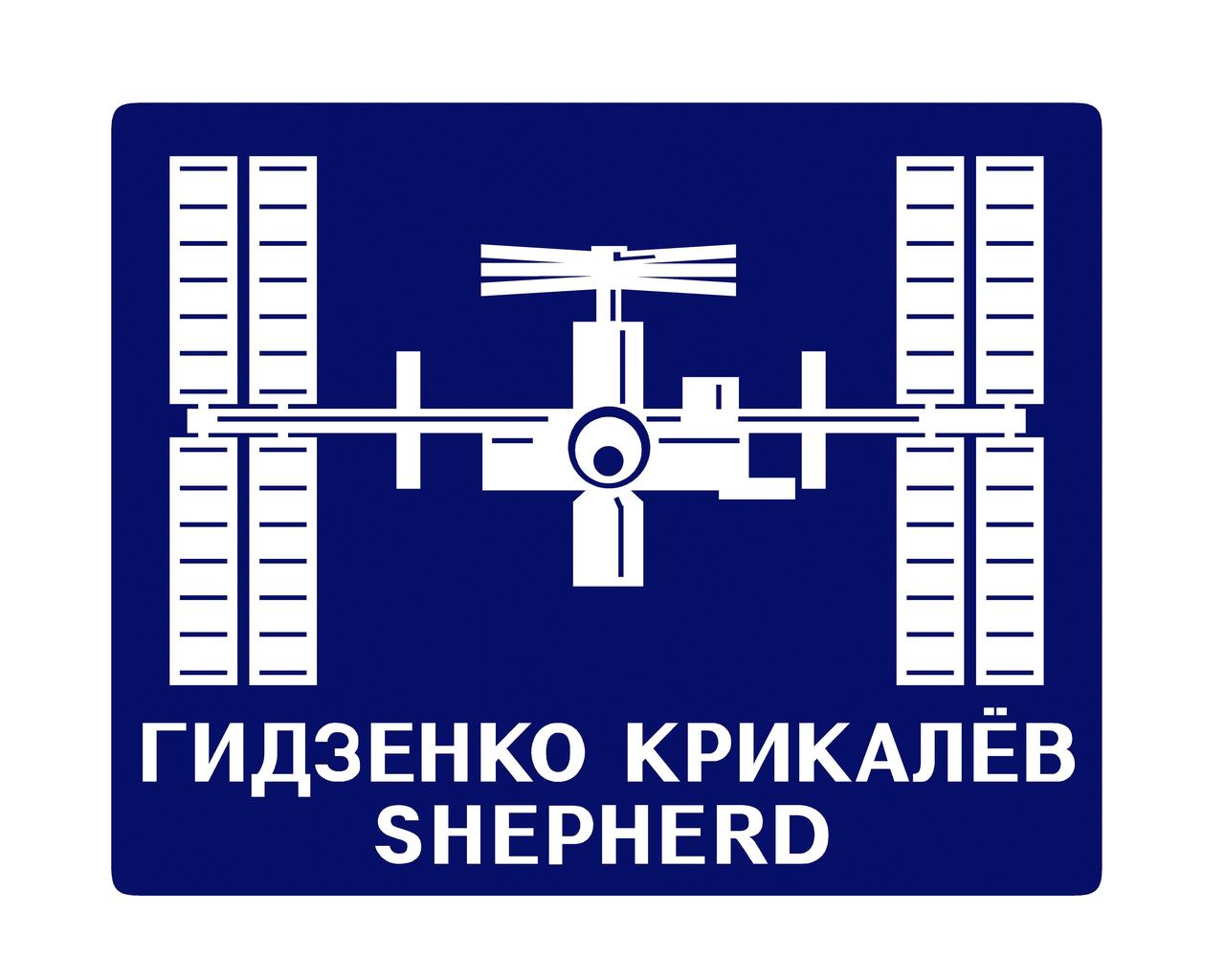
ISS001-S-001 (October 2000) --- The first International Space Station (ISS) crew patch is a simplified graphic of the station complex when fully completed. The station is seen with solar arrays turned forward. The last names of the Expedition One crew, Soyuz pilot Yuri Gidzenko, flight engineer Sergei Krikalev, and expedition commander William (Bill) Shepherd, appear under the station symbol. The insignia design for ISS flights is reserved for use by the astronauts and cosmonauts and for other official use as the NASA Administrator and NASA's international partners may authorize. Public availability has been approved only in the form of illustrations by the various news media. When and if there is any change in this policy, which we do not anticipate, it will be publicly announced.
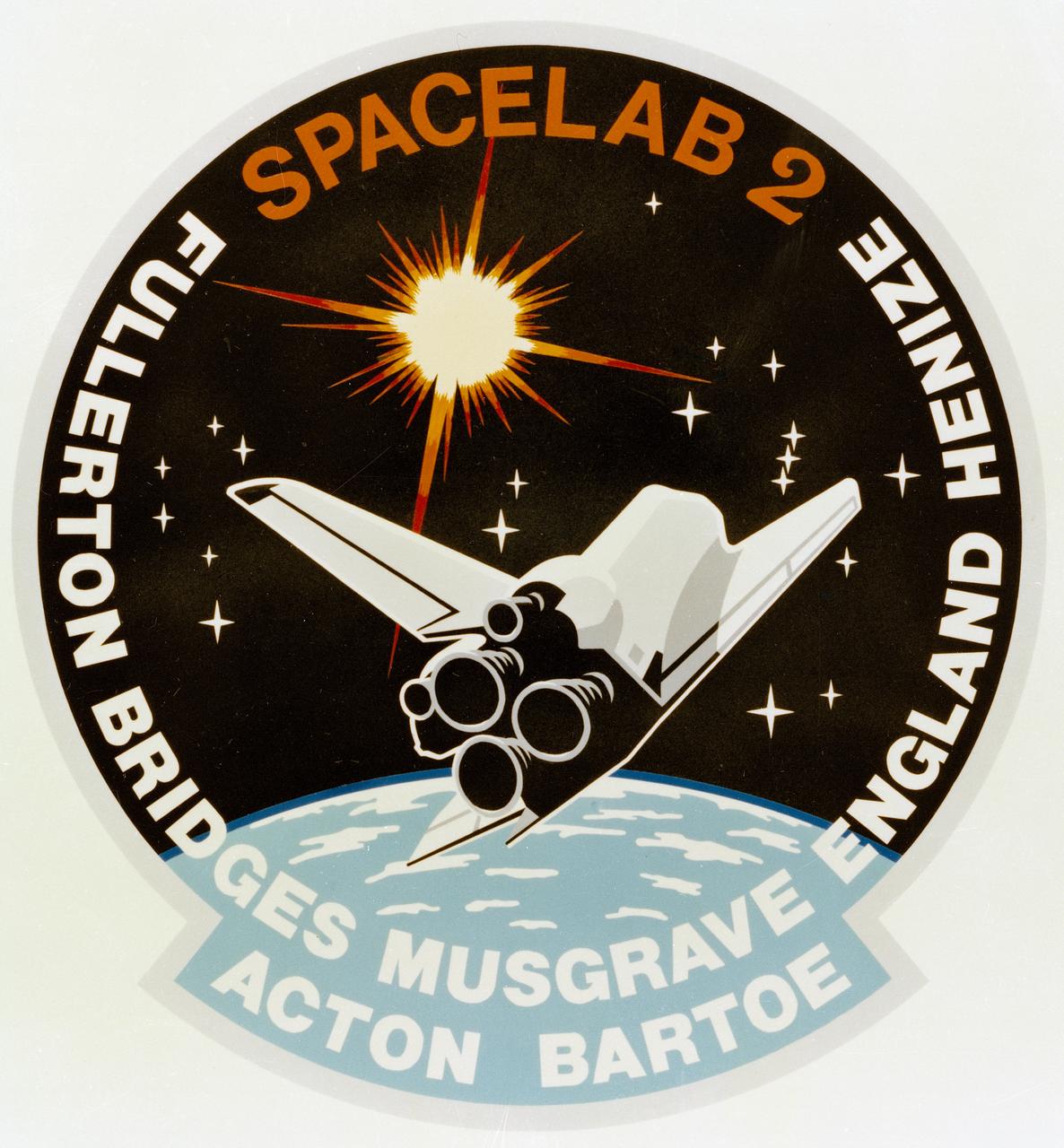
The crewmembers of Space Shuttle mission 51-F have chosen as their insignia this design by Houston artist Skip Bradley. The Space Shuttle Challenger is depicted ascending toward the heavens in search of new knowledge in the field of solar and steallar astronomy, with its Spacelab 2 payload. The constellations Leo and Orion are in the positions they will be in, relative to the sun during the flight. The nineteen stars signify that this will be the 19th STS flight.
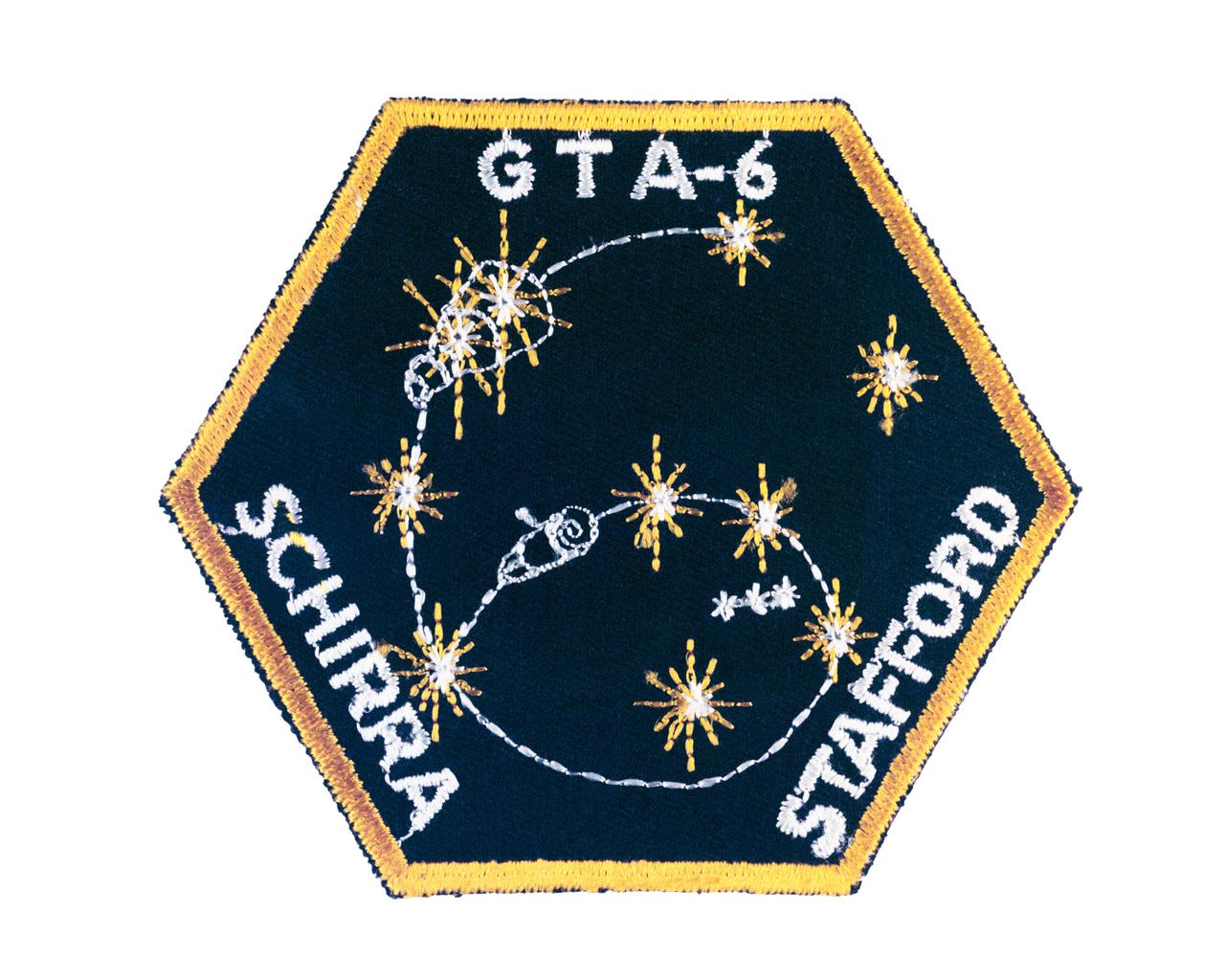
S65-55983 (8 Dec. 1965) --- This hexagonal-shaped insignia is the emblem of the Gemini-6 spaceflight. Astronauts Walter M. Schirra Jr., command pilot; and Thomas P. Stafford, pilot, are the prime crew. The National Aeronautics and Space Administration (NASA) has scheduled Gemini-6 as a two-day mission. Photo credit: NASA or National Aeronautics and Space Administration
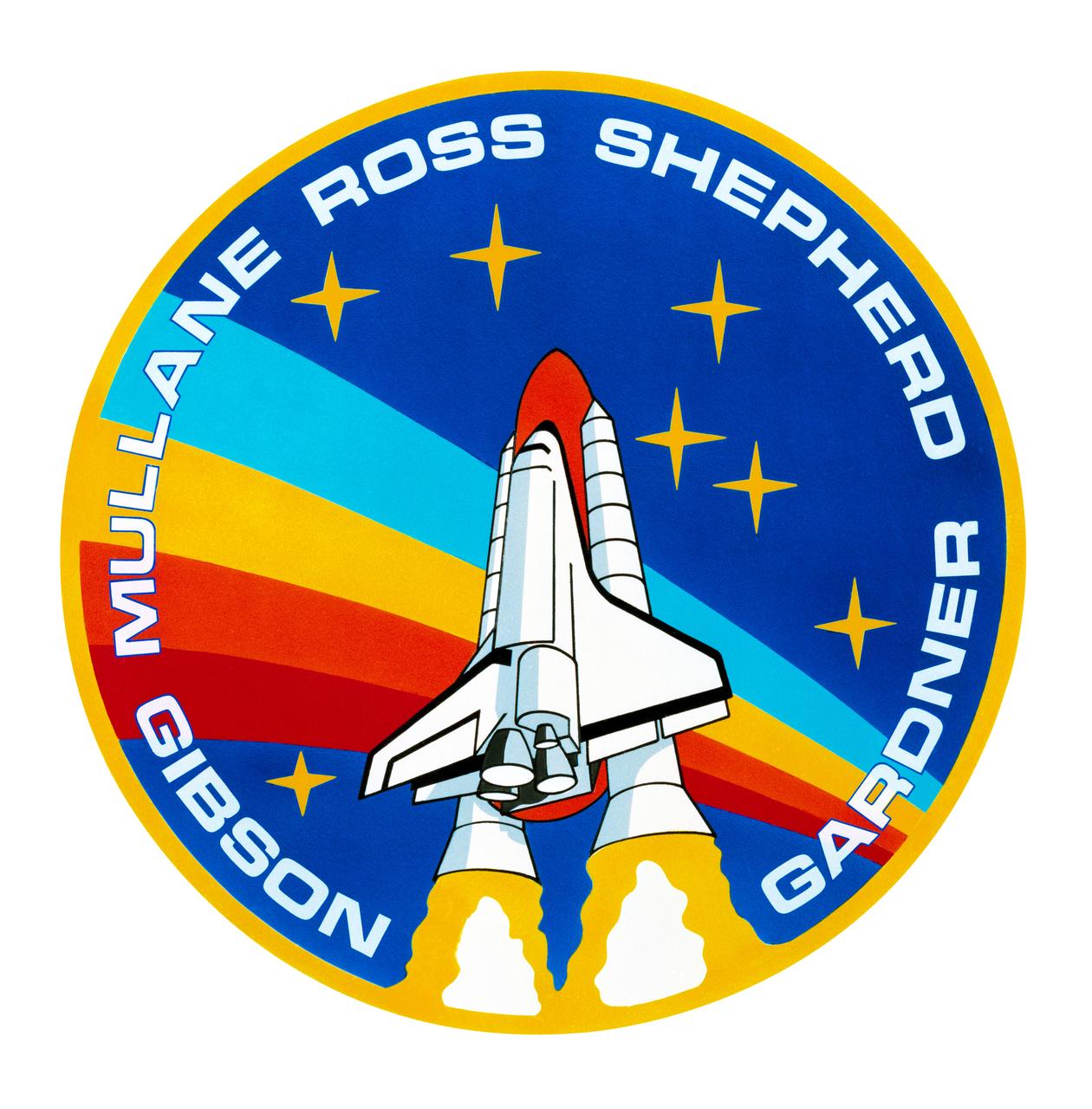
S88-41481 (15 July 1988) --- This is the official insignia of the NASA STS-27 mission. The patch depicts the space shuttle lifting off against the multi-colored backdrop of a rainbow, symbolizing the triumphal return to flight of our nation's manned space program. The design also commemorates the memory of the crew of Challenger mission STS51-L, represented by the seven stars. The names of the flight crew members of STS-27 are located along the border of the patch. They are astronauts Robert L. Gibson, commander; Guy S. Gardner, pilot; Jerry L. Ross, Richard M. (Mike) Mullane and William M. Shepherd, mission specialists. Each crew member contributed to the design of the insignia. The NASA insignia design for space shuttle flights is reserved for use by the astronauts and for other official use as the NASA Administrator may authorize. Public availability has been approved only in the forms of illustrations by the various news media. When and if there is any change in this policy, which is not anticipated, the change will be publicly announced. Photo credit: NASA
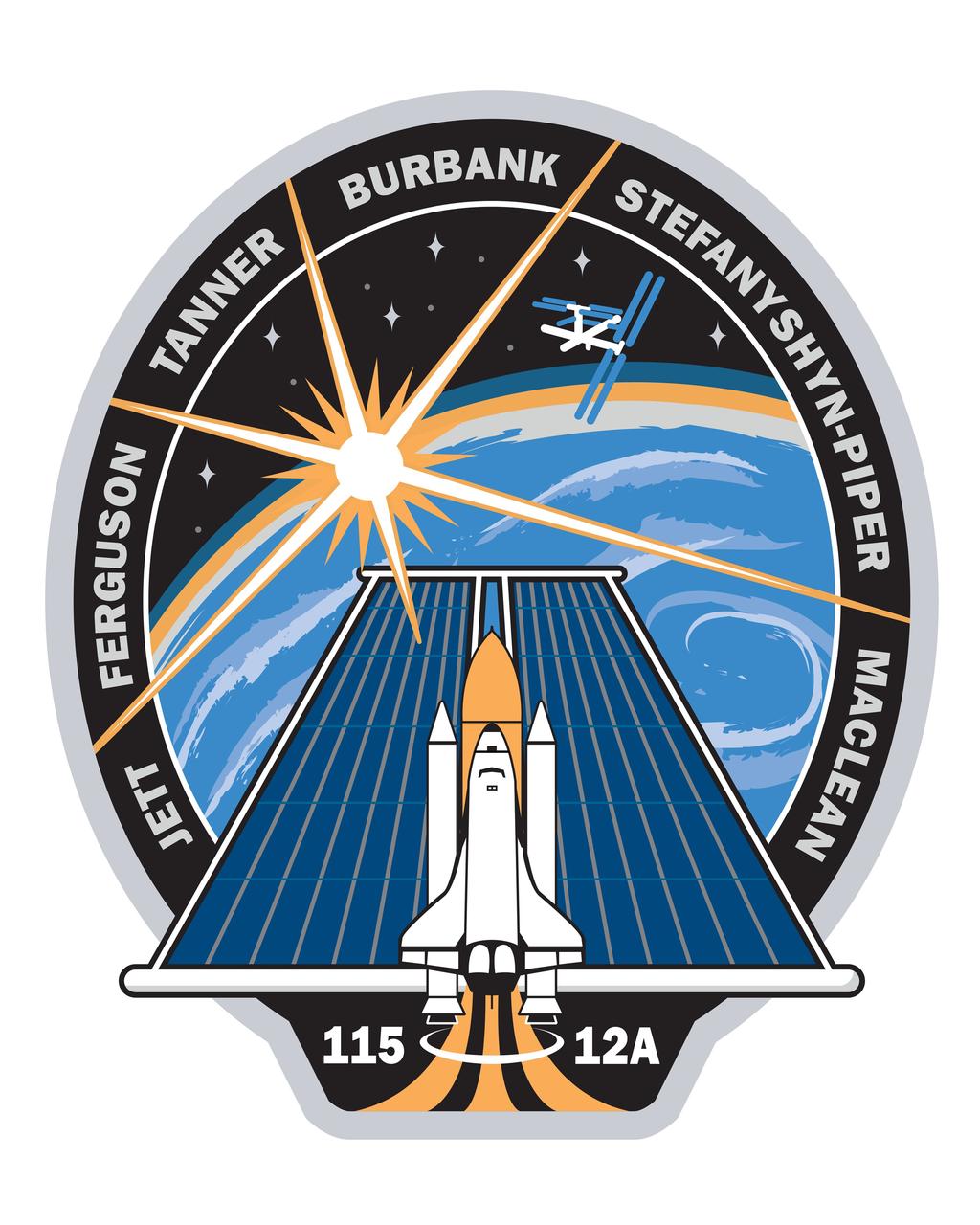
This is the STS-115 insignia. This mission continued the assembly of the International Space Station (ISS) with the installation of the truss segments P3 and P4. Following the installation of the segments utilizing both the shuttle and the station robotic arms, a series of three space walks completed the final connections and prepared for the deployment of the station's second set of solar arrays. To reflect the primary mission of the flight, the patch depicts a solar panel as the main element. As the Space Shuttle Atlantis launches towards the ISS, its trail depicts the symbol of the Astronaut Office. The star burst, representing the power of the sun, rises over the Earth and shines on the solar panel. The shuttle flight number 115 is shown at the bottom of the patch, along with the ISS assembly designation 12A (the 12th American assembly mission). The blue Earth in the background reminds us of the importance of space exploration and research to all of Earth's inhabitants.
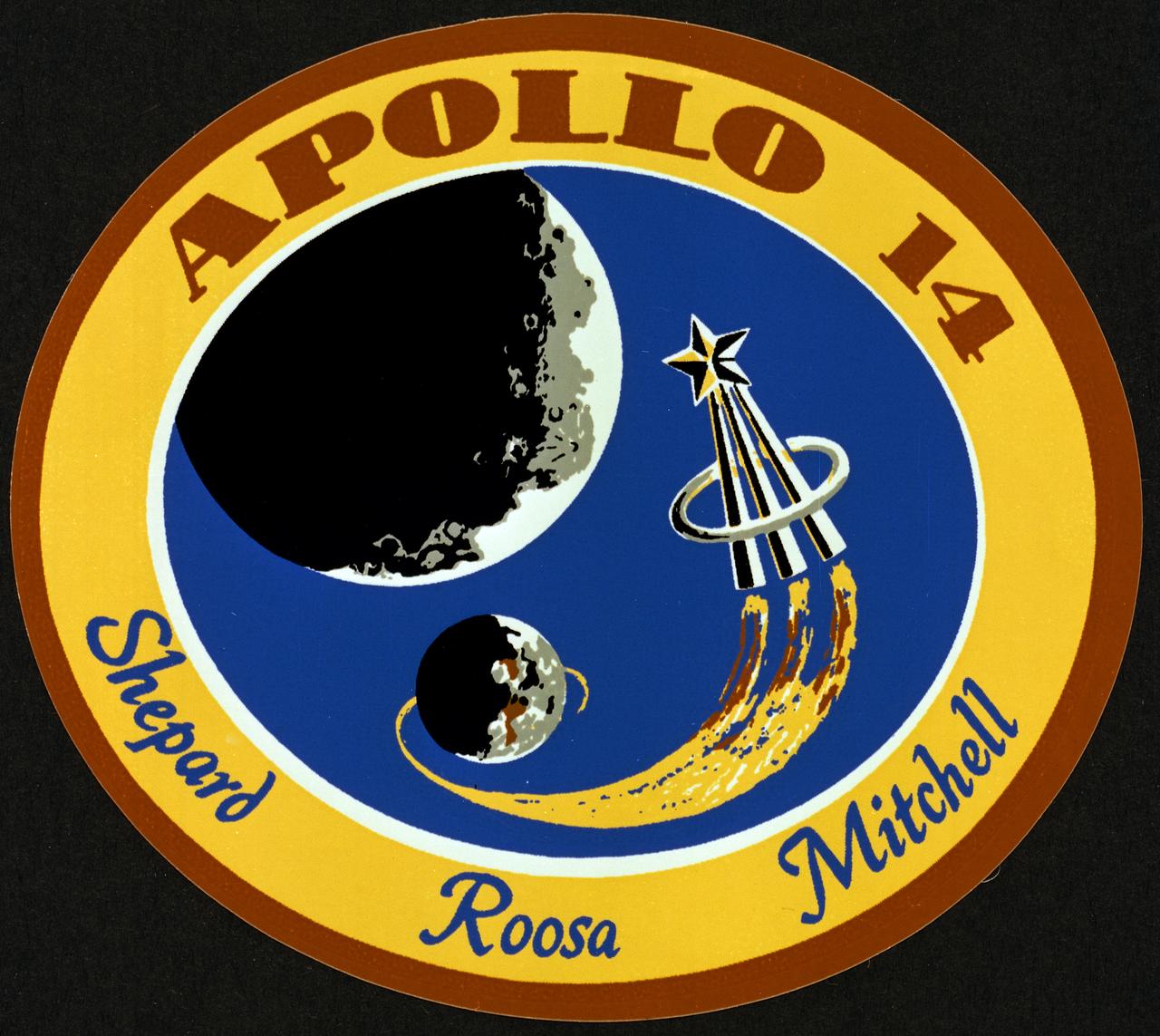
This is the Apollo 14 mission insignia or logo. The Apollo 14, carrying a crew of three astronauts: Stuart A. Roosa, Command Module pilot; Alan B. Shepard, Jr., mission commander; and Edgar D. Mitchell, Lunar Module pilot, lifted off from launch complex 39A at KSC on January 31, 1971. It was the third manned lunar landing, the first manned landing in exploration of the lunar highlands, and it demonstrated pinpoint landing capability. The major goal of Apollo 14 was the scientific exploration of the Moon in the foothills of the rugged Fra Mauro region. The lunar surface extravehicular activity (EVA) of astronauts Shepard and Mitchell included setting up an automated scientific laboratory called Apollo Lunar Scientific Experiments Package (ALSEP), and collecting a total of about 95 pounds (43 kilograms) of Moon rock and soil for a geological investigation back on the Earth. Apollo 14 safely returned to Earth on February 9, 1971.
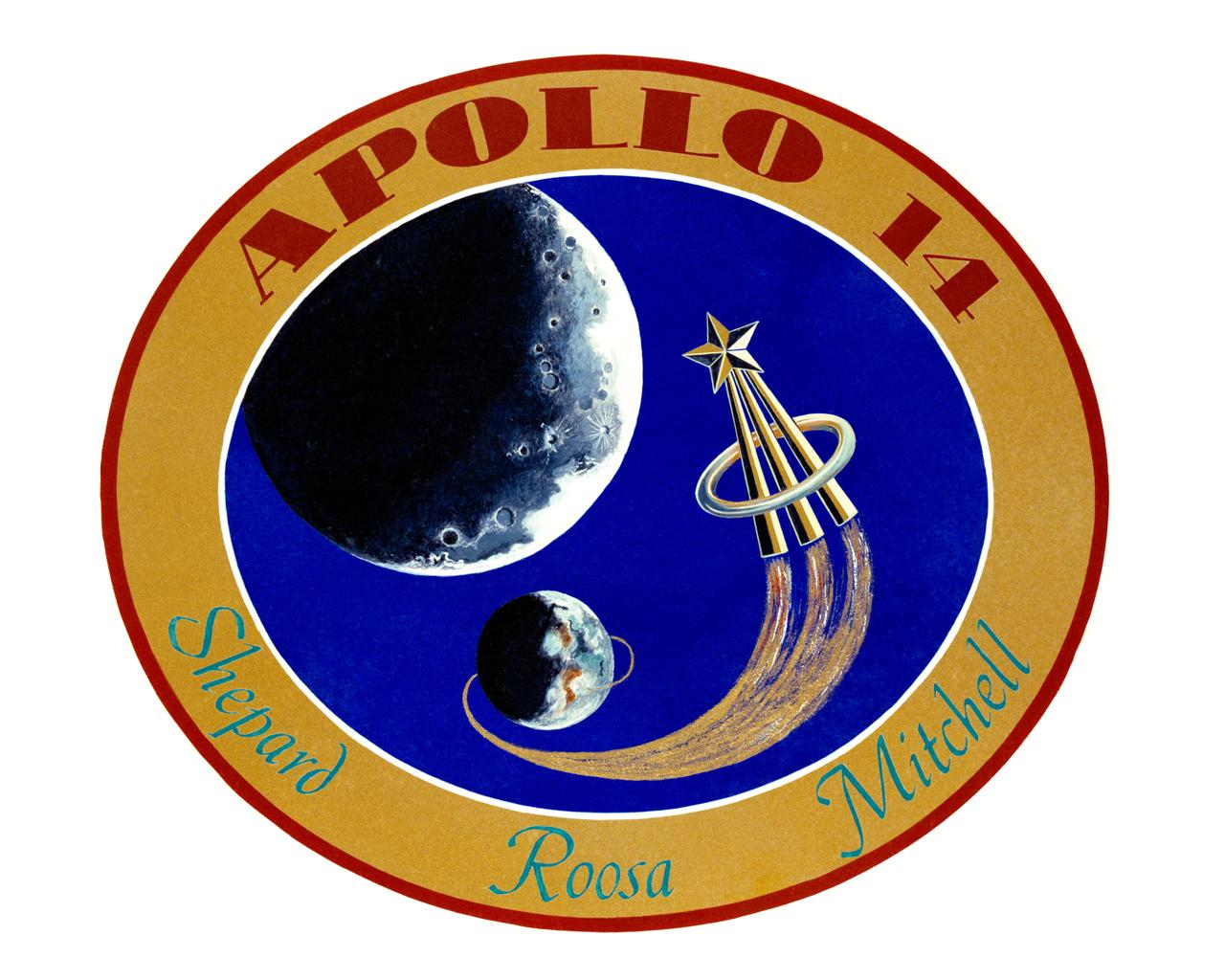
S70-17851 (September 1970) --- This is the Apollo 14 crew patch designed by astronauts Alan B. Shepard Jr., commander; Stuart A. Roosa, command module pilot; and Edgar D. Mitchell, lunar module pilot. It features the astronaut lapel pin approaching the moon and leaving a comet trail from the liftoff point on Earth. The pin design was adopted by the astronaut corps several years ago. Astronauts who have not yet flown in space wear silver pins. Those who have flown wear gold pins. The NASA insignia design for Apollo flights is reserved for use by the astronauts and for other official use as the NASA Administrator may authorize. Public availability has been approved only in the form of illustrations by the various news media. When and if there is any change in this policy, which we do not anticipate, it will be publicly announced.
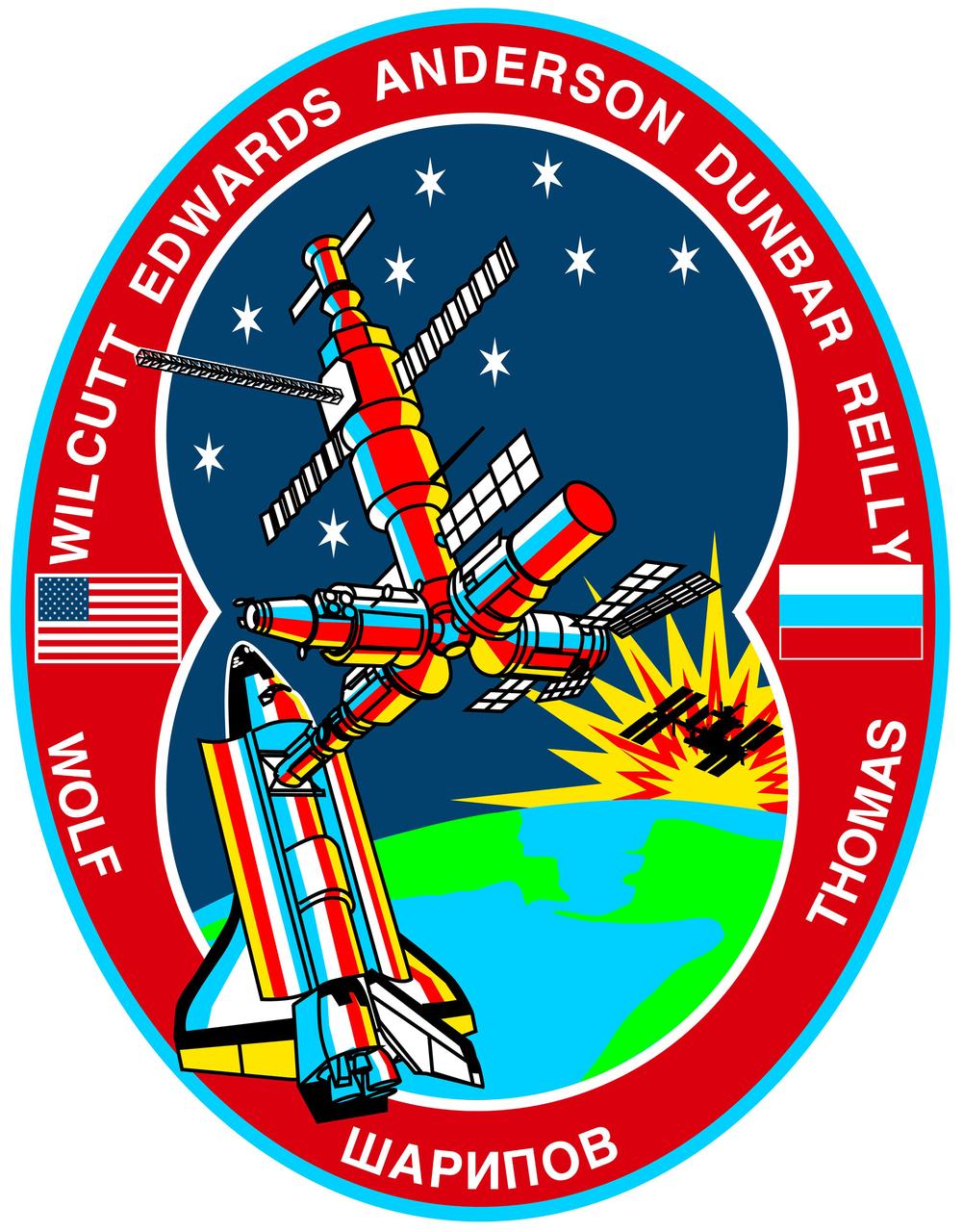
In the STS-89 crew insignia, the link between the United States and Russia is symbolically represented by the Space Shuttle Endeavour and Russia's Mir Space Station orbiting above the Bering Strait between Siberia and Alaska. The success of the joint United States-Russian missions is depicted by the Space Shuttle and Mir colored by the rising sun in the background. A shadowed representation of the International Space Station (ISS) rising with the sun represents the future program for which the Shuttle-Mir missions are prototypes. The inside rim of the insignia describes the outline of the number eight representing STS-89 as the eighth Shuttle/Mir docking mission. The nine stars represent the nine joint missions to be flown of the program and when combined with the number eight in the rim, reflect the mission number. The nine stars also symbolize the children of the crew members who will be the future beneficiaries of the joint development work of the space programs of the two countries. Along the rim are the crew members' names with David A. Wolf's name on the left and Andrew S. W. Thomas' name on the right, the returning and upgoing cosmonaut guest researcher crew members. In between and at the bottom is the name of Salizan S. Sharipov, payload specialist representing Russian Space Agency (RSA), in Cyrillic alphabet. The other crew members are Terrence W. Wilcutt, commander; Joe F. Edwards, Jr., pilot; and mission specialists Michael P. Anderson, Bonnie J. Dunbar, and James F. Reilly. The red, white and blue of the rim reflect the colors of the American and Russian flags which are also represented in the rim on either side of the joined spacecraft.
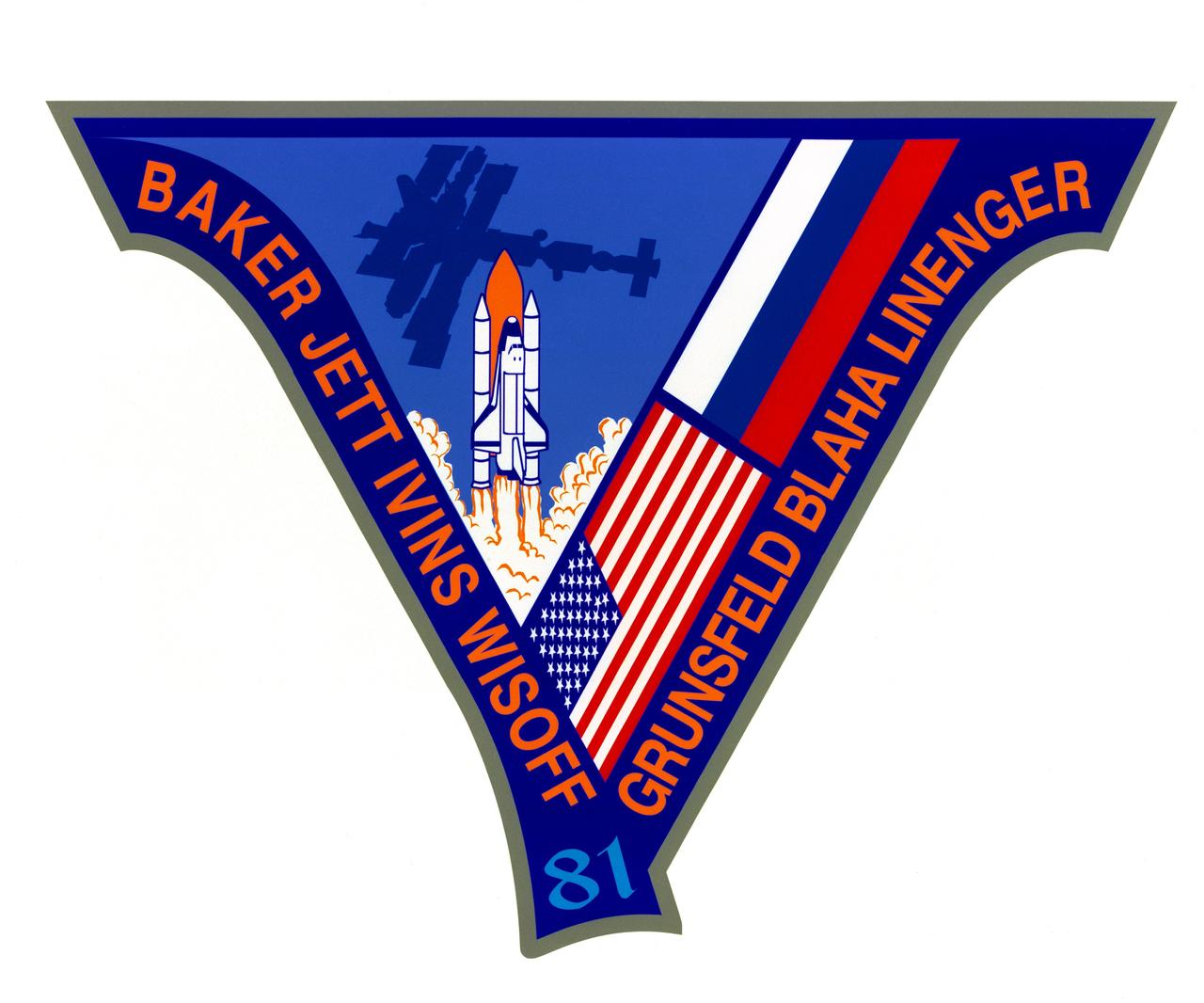
STS081-S-001 (June 1996) --- The STS-81 crew patch for the fifth Shuttle-Mir docking mission, is shaped to represent the Roman numeral V. The space shuttle Atlantis, OV-104, is launching toward a rendezvous with Russia?s Mir Space Station, silhouetted in the background. Atlantis and the STS-81 crew will spend several days docked to Mir during which time astronaut Jerry M. Linenger (NASA-Mir 4) will replace astronaut John E. Blaha (NASA-Mir 3) as the United States crew member onboard Mir. Scientific experiments and logistics will also be transferred between Atlantis and Mir. The United States and Russian flags are depicted along with the names of the shuttle crew members: Michael A. Baker, commander; Brent W. Jett, pilot; Peter J. K.(Jeff) Wisoff, mission specialist 1; John W. Grunsfeld, mission specialist 2; Marsha S. Ivins, mission specialist 3; Linenger; mission specialist 4; and Blaha, mission specialist 5. The NASA insignia design for space shuttle flights is reserved for use by the astronauts and for other official use as the NASA Administrator may authorize. Public availability has been approved only in the forms of illustrations by the various news media. When and if there is any change in this policy, which is not anticipated, the change will be publicly announced. Photo credit: NASA
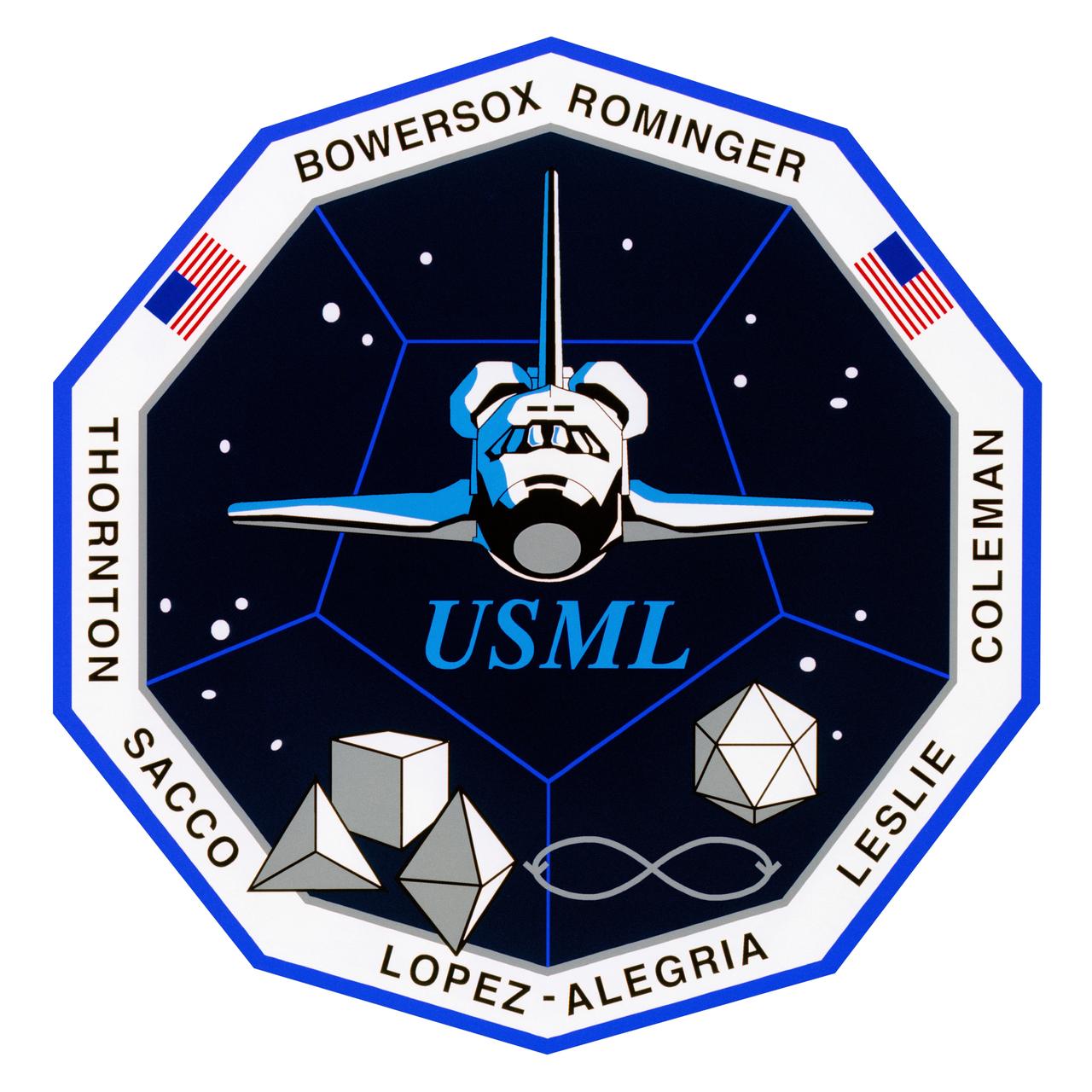
STS073-S-001 (May 1995) --- The crew patch of STS-73, the second flight of the United States Microgravity Laboratory (USML-2), depicts the space shuttle Columbia in the vastness of space. In the foreground are the classic regular polyhedrons that were investigated by Plato and later Euclid. The Pythagoreans were also fascinated by the symmetrical three-dimensional objects whose sides are the same regular polygon. The tetrahedron, the cube, the octahedron, and the icosahedron were each associated with the "Natural Elements" of that time: fire (on this mission represented as combustion science); Earth (crystallography), air and water (fluid physics). An additional icon shown as the infinity symbol was added to further convey the discipline of fluid mechanics. The shape of the emblem represents a fifth polyhedron, a dodecahedron, which the Pythagoreans thought corresponded to a fifth element that represented the cosmos. The NASA insignia design for space shuttle flights is reserved for use by the astronauts and for other official use as the NASA Administrator may authorize. Public availability has been approved only in the forms of illustrations by the various news media. When and if there is any change in this policy, which is not anticipated, the change will be publicly announced. Photo credit: NASA
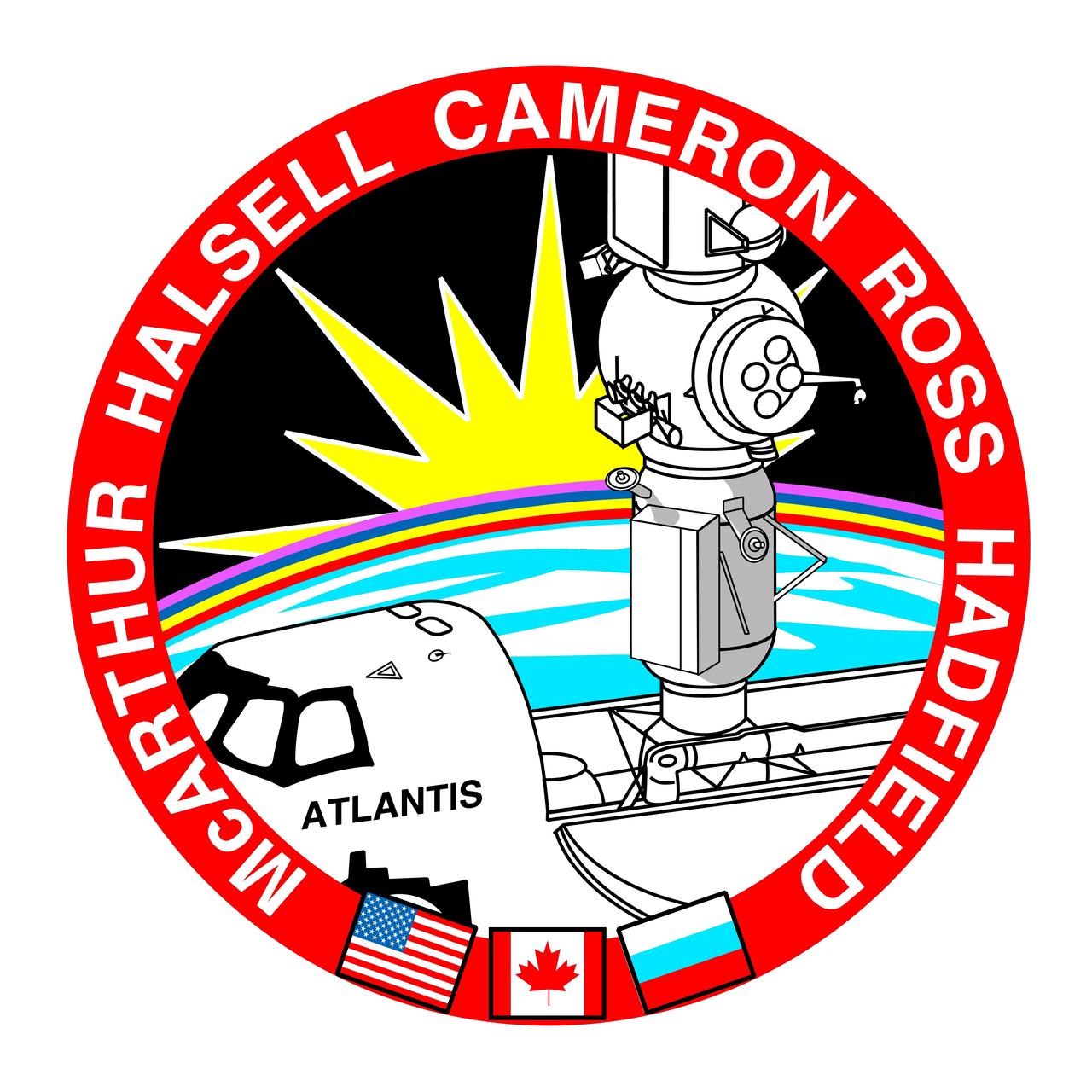
STS074-S-001 (July 1995) --- Designed by crew members, this STS-74 crew patch depicts the space shuttle Atlantis docked to Russia's Mir Space Station. The central focus is on the Russian-built Docking Module (DM), drawn with shading to accentuate its pivotal importance to both mission STS-74 and the NASA - Mir Program. The rainbow across the horizon represents Earth's atmosphere, the thin membrane protecting all nations, while the three flags across the bottom show those nations participating in STS-74 - Russia, Canada and the United States. The sunrise is symbolic of the dawn of a new era in NASA space flight - that of space station construction. The NASA insignia design for space shuttle flights is reserved for use by the astronauts and for other official use as the NASA Administrator may authorize. Public availability has been approved only in the forms of illustrations by the various news media. When and if there is any change in this policy, which is not anticipated, the change will be publicly announced. Photo credit: NASA
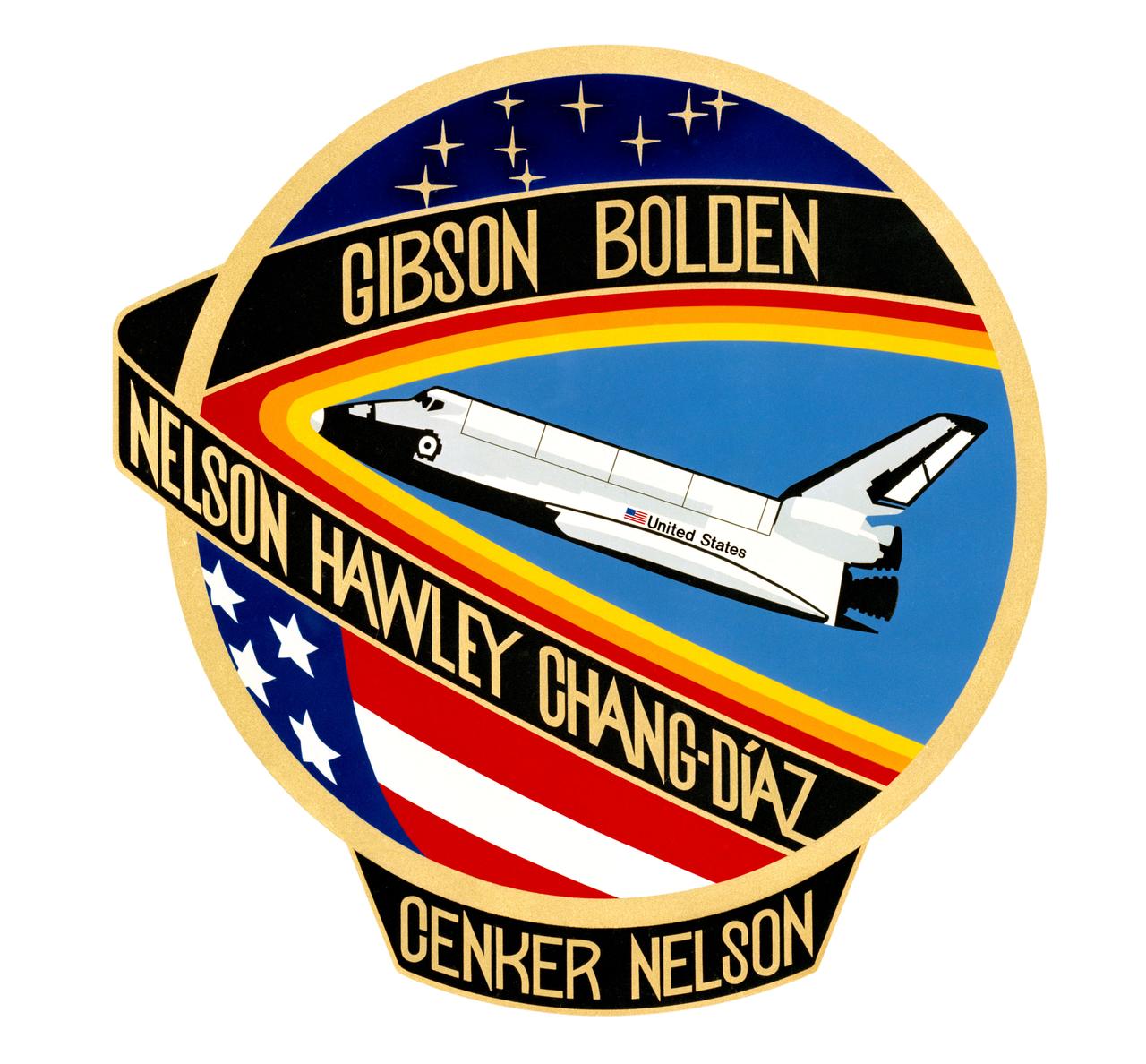
S85-41917 (October 1985) --- Columbia, which opened the era of the Space Transportation System with four orbital flight tests, is featured in re-entry in the emblem designed by the STS61-C crew to represent the seven team members who will man the vehicle for its seventh STS mission later this year. Gold lettering against black background honors the astronaut crew members on the delta pattern surrounding colorful re-entry shock waves, and the payload specialists are honored similarly below the sphere. Robert L. Gibson is mission commander; Charles F. Bolden, pilot; and mission specialists are George D. Nelson, Steven A. Hawley and Franklin R. Chang-Diaz. Payload specialists are Robert J. Cenker of RCA and Bill Nelson, U.S. Representative (D., Florida). Representations of the U.S. flag and the constellation Draco flank the emblem's core. The NASA insignia design for space shuttle flights is reserved for use by the astronauts and for other official use as the NASA Administrator may authorize. Public availability has been approved only in the forms of illustrations by the various news media. When and if there is any change in this policy, which is not anticipated, the change will be publicly announced. Photo credit: NASA
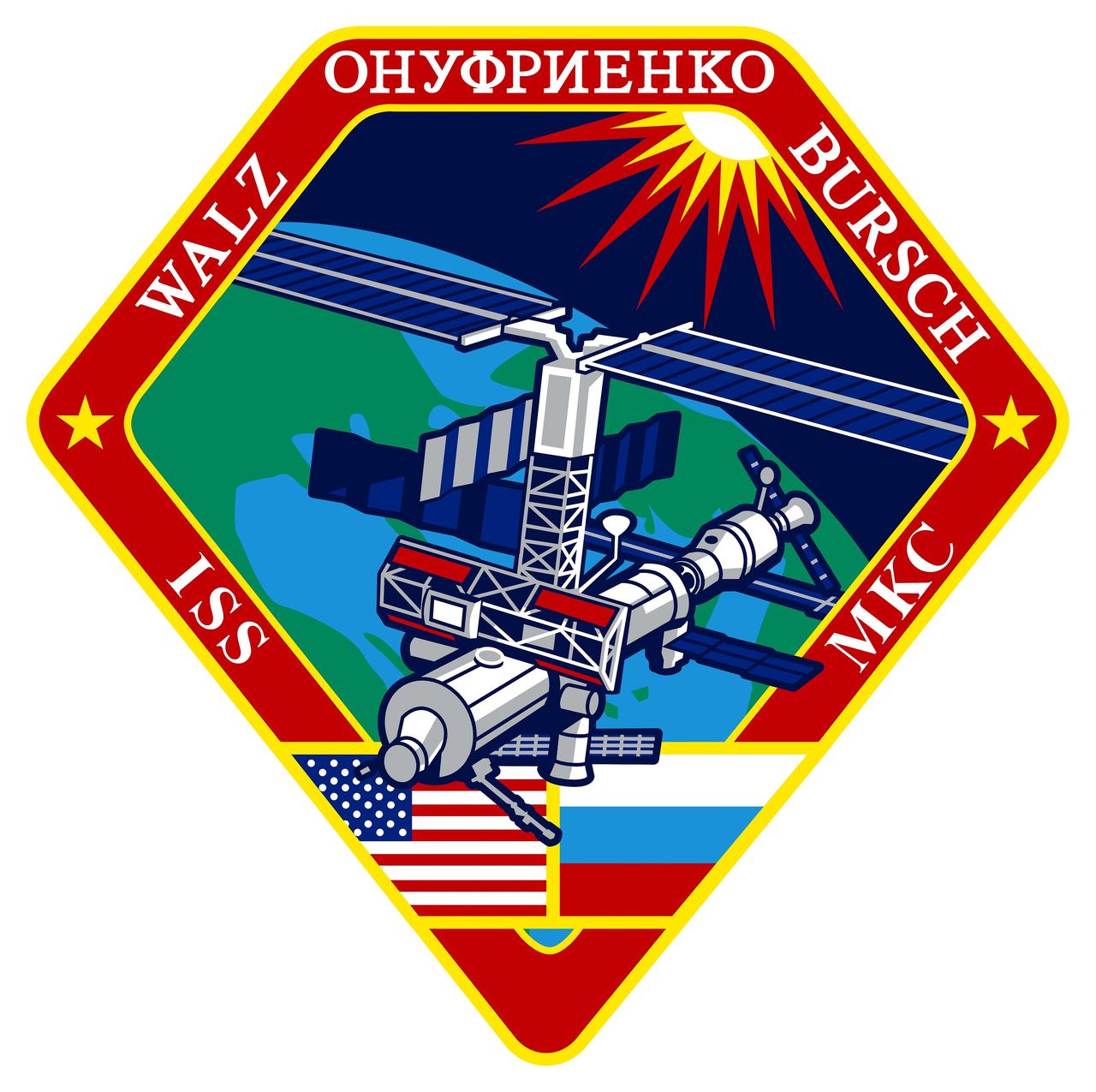
ISS004-S-001 (August 2001) --- The International Space Station (ISS) Expedition 4 crew patch has an overall diamond shape, showing the “diamond in the rough” configuration of the Station during expedition 4. The red hexagonal shape with stylized American and Russian flags represents the cross-sectional view of the S0 truss segment, which the crew will attach to the U.S. Lab Destiny. The persistent Sun shining on the Earth and Station represents the constant challenges that the crew and ground support team will face every day while operating the International Space Station, while shedding new light through daily research. The green portion of the Earth represents the fourth color in the visible spectrum and the black void of space represents humankind’s constant quest to explore the unknown. The NASA insignia design for Shuttle flights is reserved for use by the astronauts and for other official use as the NASA Administrator may authorize. Public availability has been approved only in the forms of illustrations by the various news media. When and if there is any change in this policy, which is not anticipated, the change will be publicly announced.
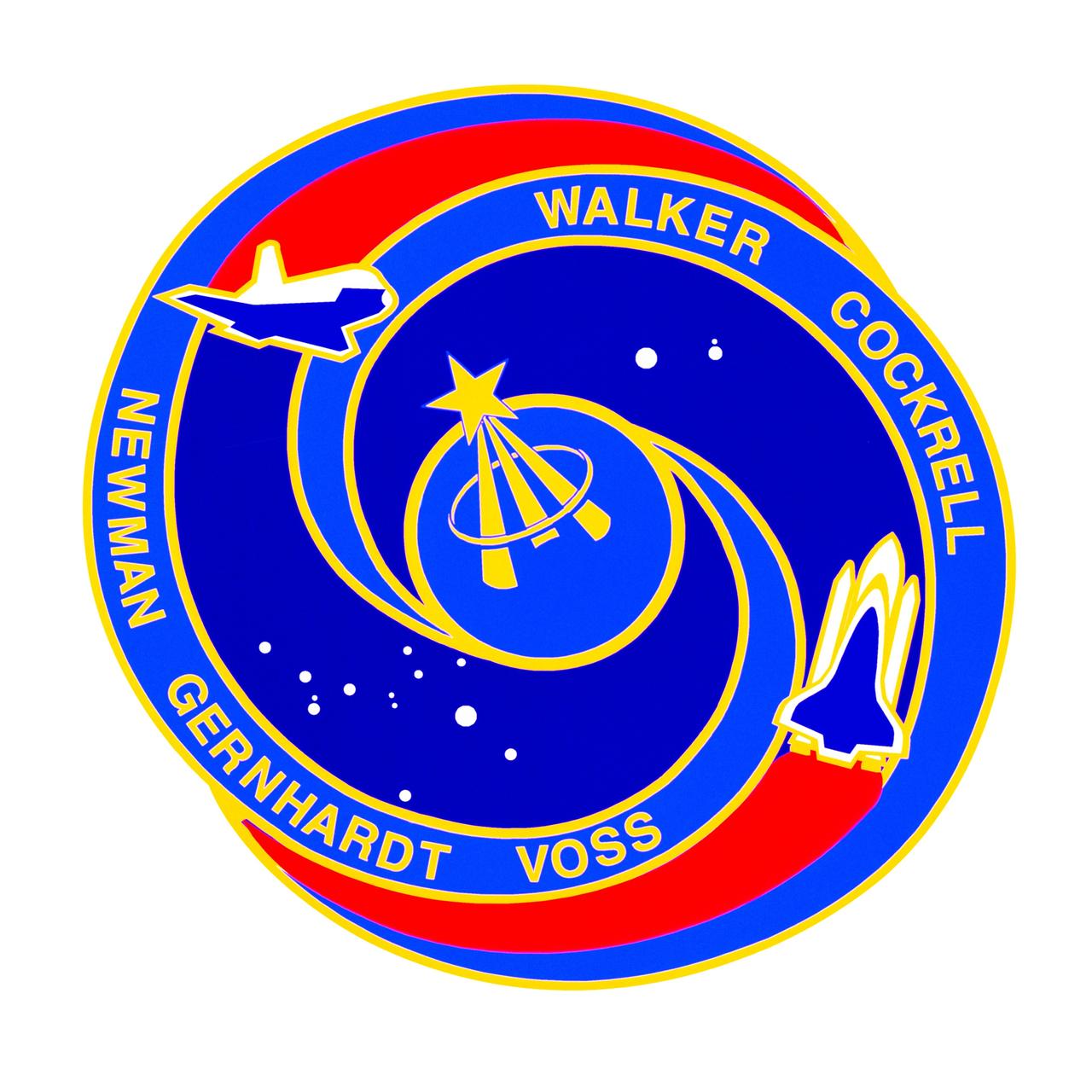
STS069-S-001 (May 1995) --- Designed by the crew members, the patch for STS-69 symbolizes the multifaceted nature of the flight's mission. The primary payload, Wake Shield Facility (WSF), is represented in the center by the astronaut emblem against a flat disk. The astronaut emblem also signifies the importance of human beings in space exploration, reflected by the planned spacewalk supporting space station assembly. The two stylized space shuttles highlight the ascent and entry phases of the mission. Along with the two spiral plumes, the stylized space shuttles symbolize a NASA first - the deployment and recovery on the same mission of two spacecraft (both the Wake Shield Facility and the Spartan). The constellations Canis Major and Canis Minor represent the astronomy objectives of the Spartan and International Extreme Ultraviolet Hitchhiker (IEH) payload. The two constellations also symbolize the talents and dedication of the support personnel who make space shuttle missions possible. The NASA insignia design for space shuttle flights is reserved for use by the astronauts and for other official use as the NASA Administrator may authorize. Public availability has been approved only in the forms of illustrations by the various news media. When and if there is any change in this policy, which is not anticipated, the change will be publicly announced. Photo credit: NASA
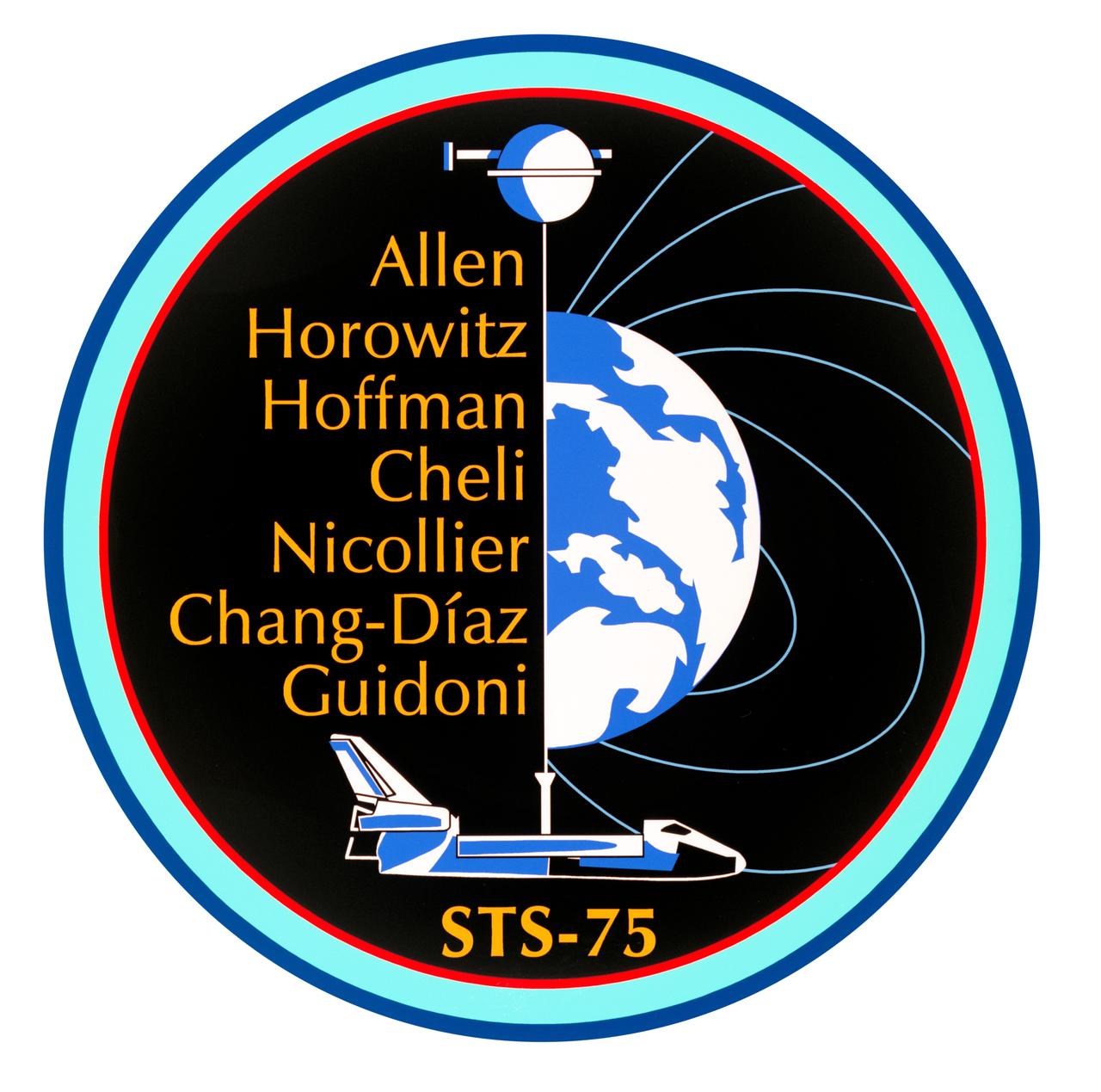
STS075-S-001 (September 1995) --- The STS-75 crew patch depicts the space shuttle Columbia and the Tethered Satellite connected by a 21-kilometer electronically conducting tether. The orbiter/satellite system is passing through Earth?s magnetic field which, like an electronic generator, will produce thousands of volts of electricity. Columbia is carrying the United States Microgravity pallet to conduct microgravity research in material science and thermodynamics. The tether is crossing Earth?s terminator signifying the dawn of a new era for space tether applications and in mankind?s knowledge of Earth?s ionosphere, material science, and thermodynamics. The patch was designed for the STS-75 crew members by Mike Sanni. The NASA insignia design for space shuttle flights is reserved for use by the astronauts and for other official use as the NASA Administrator may authorize. Public availability has been approved only in the forms of illustrations by the various news media. When and if there is any change in this policy, which is not anticipated, the change will be publicly announced. Photo credit: NASA
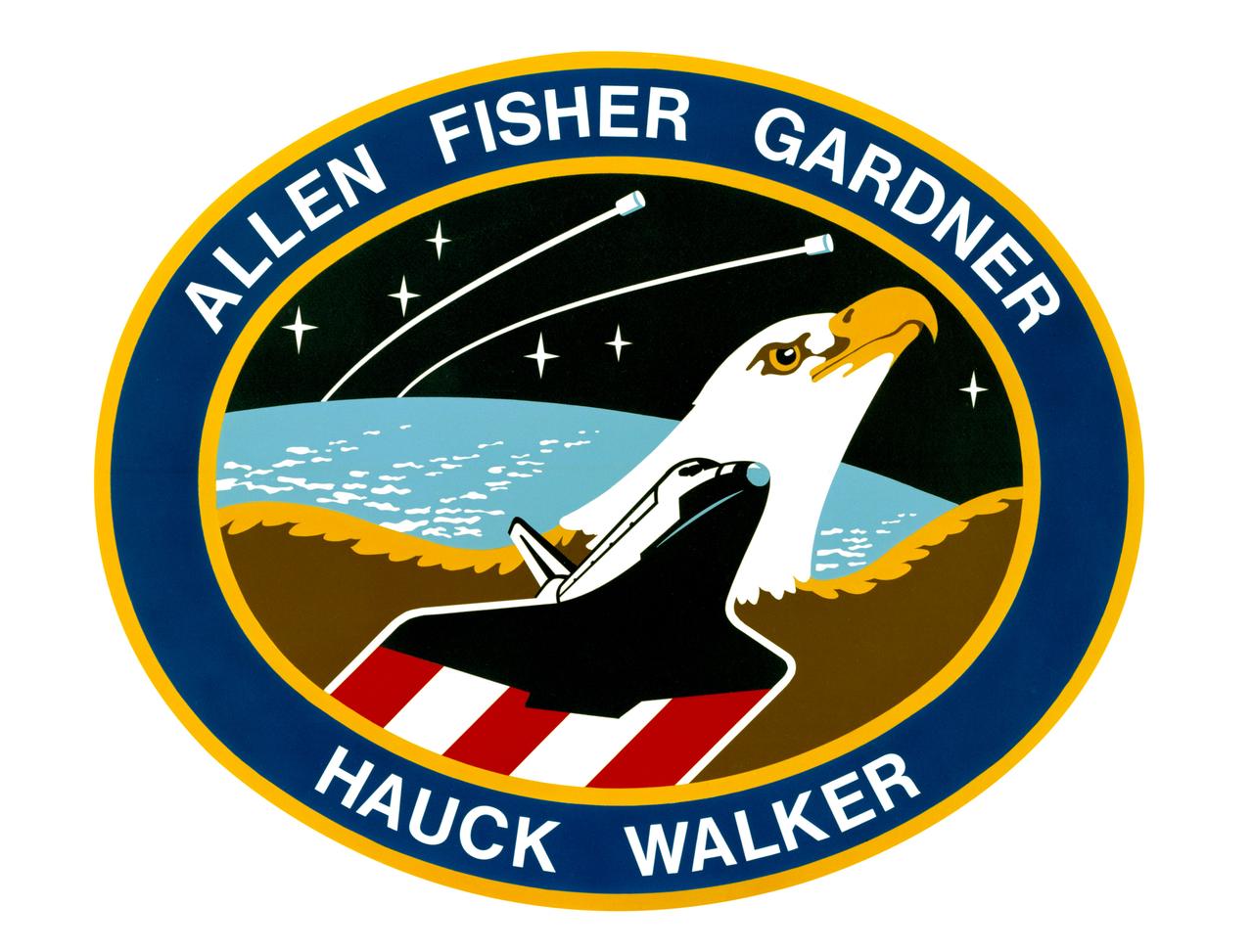
S84-40148 (8 Oct. 1984) --- The space shuttle Discovery en route to Earth orbit for NASA's 51-A mission is reminiscent of a soaring Eagle. The red and white trailing stripes and the blue background, along with the presence of the Eagle, generate memories of America's 208-year-old history and traditions. The two satellites orbiting Earth backgrounded amidst a celestial scene are a universal representation of the versatility of the space shuttle. White lettering against the blue border lists the surnames of the five-member crew--astronauts Frederick H. (Rick) Hauck, David M. Walker, Joseph P. Allen IV, Anna Lee Fisher and Dale A. Gardner. The artwork was done by artist Stephen R. Hustvedt. The NASA insignia design for space shuttle flights is reserved for use by the astronauts and for other official use as the NASA Administrator may authorize. Public availability has been approved only in the forms of illustrations by the various news media. When and if there is any change in this policy, which is not anticipated, the change will be publicly announced. Photo credit: NASA
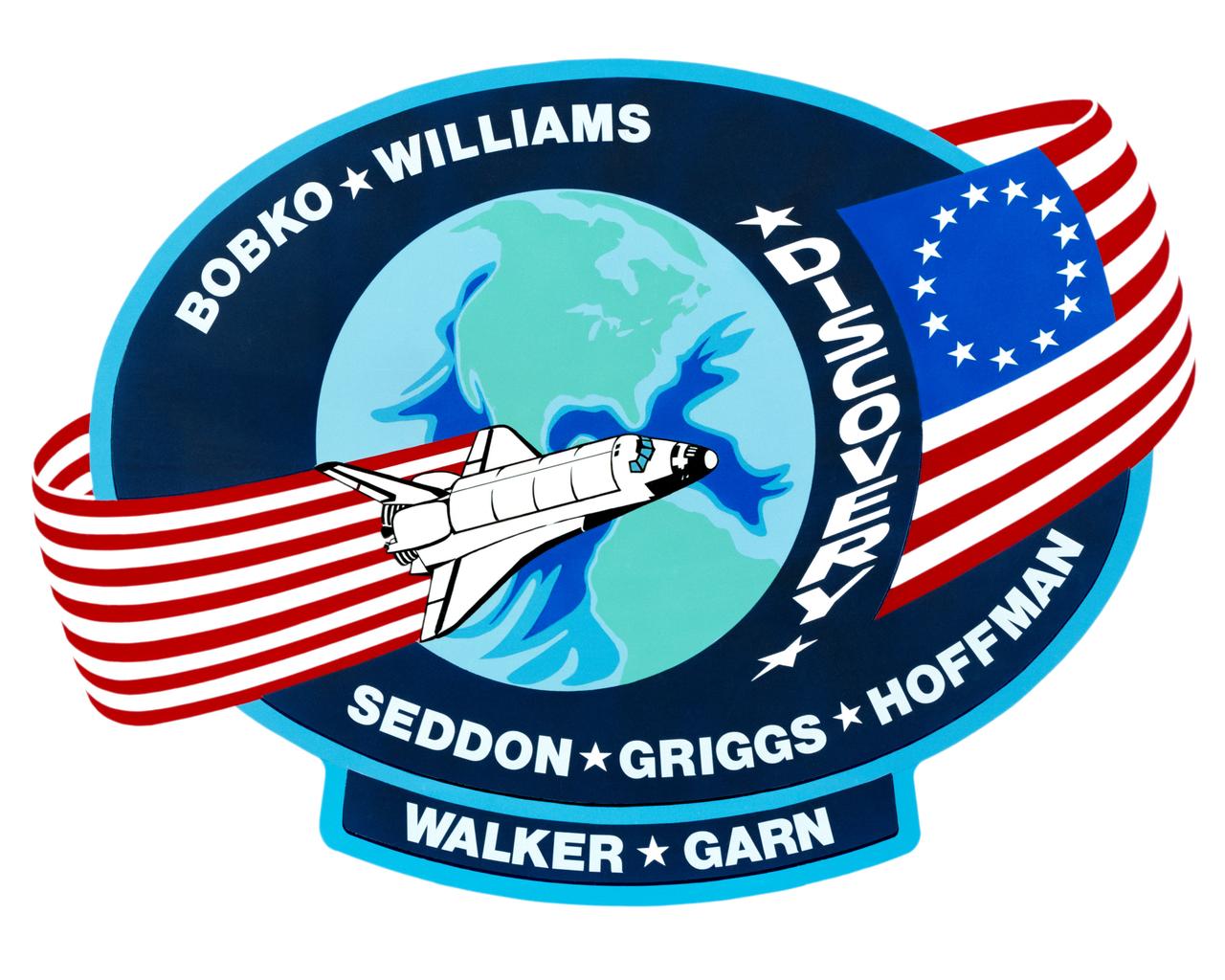
S85-28989 (March 1985) --- The dominant features of the STS-51D emblem are an orbit formed by a Colonial American flag and a space shuttle. The flag in orbit signifies the U.S. flag to indicate that it comes from this country and the American people. The original 13-star flag is used to symbolize a continuity of technical achievement and progress since colonial times. The name Discovery preceding the flag represents the spirit of Discovery and exploration of new frontiers which have been a hallmark of American people even before they were formed together as a nation. The crew members are Karol J. Bobko, Donald E. Williams, Rhea Seddon, S. David Griggs and Jeffrey A. Hoffman of NASA; and Charles D. Walker, representing McDonnell Douglas Corporation; and U. S. Senator Jake Garn. The NASA insignia design for space shuttle flights is reserved for use by the astronauts and for other official use as the NASA Administrator may authorize. Public availability has been approved only in the forms of illustrations by the various news media. When and if there is any change in this policy, which is not anticipated, the change will be publicly announced. Photo credit: NASA
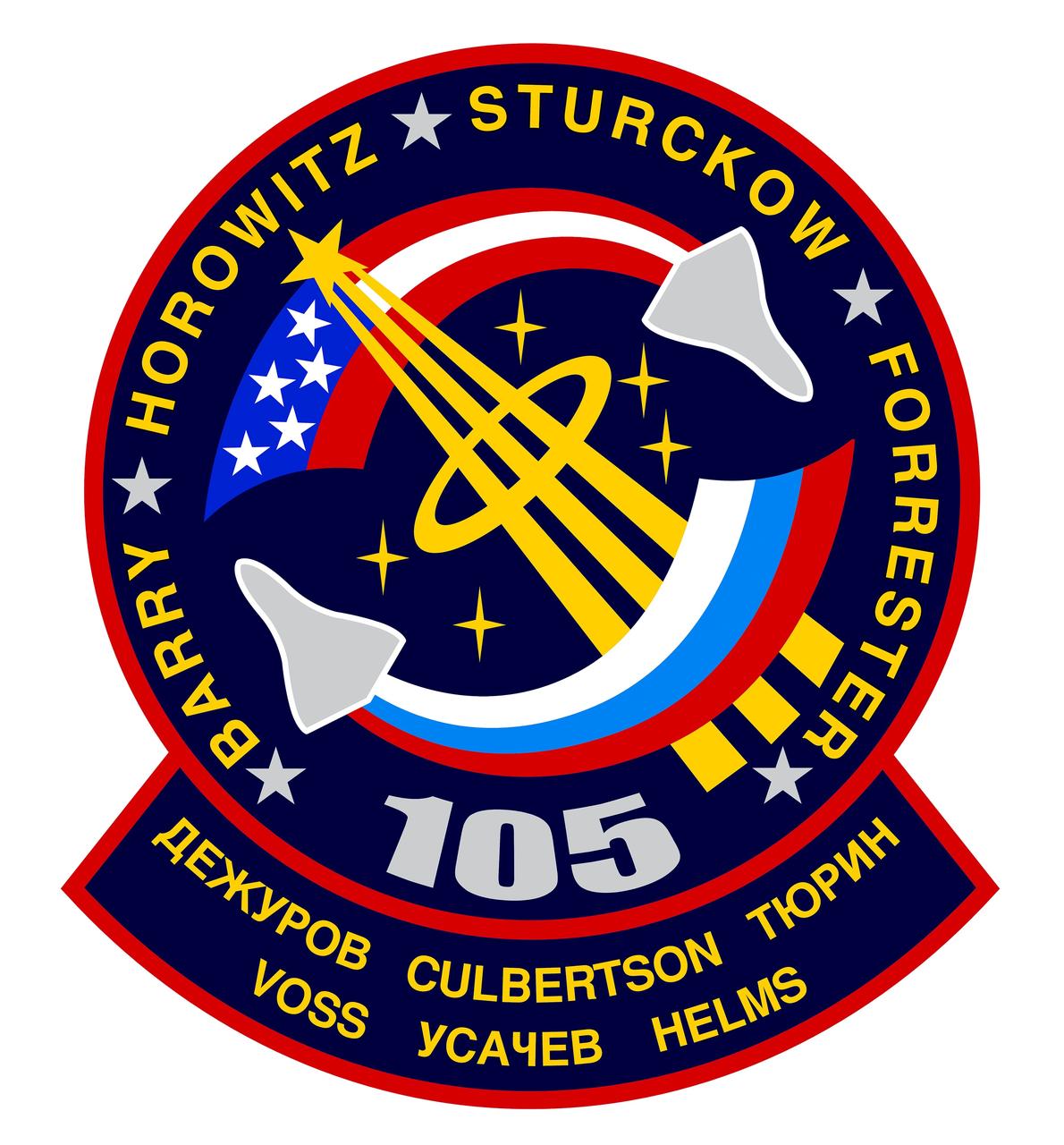
STS105-S-001 (April 2001) --- The STS-105 crew patch symbolizes the exchange of the Expedition Two and Expedition Three crews aboard the International Space Station. The three gold stars near the ascending orbiter represent the U.S. commanded Expedition Three crew as they journey into space, while the two gold stars near the descending orbiter represent the Russian commanded Expedition Two crew and their return to Earth. The plumes of each orbiter represent the flags of the United States and Russia and symbolize the close cooperation between the two countries. The Astronaut Office symbol, a star with three rays of light, depicts the unbroken link between Earth and the newest and brightest star on the horizon, the International Space Station (ISS). The ascending and descending orbiters form a circle that represents both the crew rotation and the continuous presence in space aboard the ISS. The names of the four astronauts who will crew Discovery are shown along the border of the patch. The names of the Expedition Three and Expedition Two crews are shown on the chevron at the bottom of the patch. The NASA insignia design for space shuttle flights is reserved for use by the astronauts and for other official use as the NASA Administrator may authorize. Public availability has been approved only in the forms of illustrations by the various news media. When and if there is any change in this policy, which is not anticipated, the change will be publicly announced. Photo credit: NASA