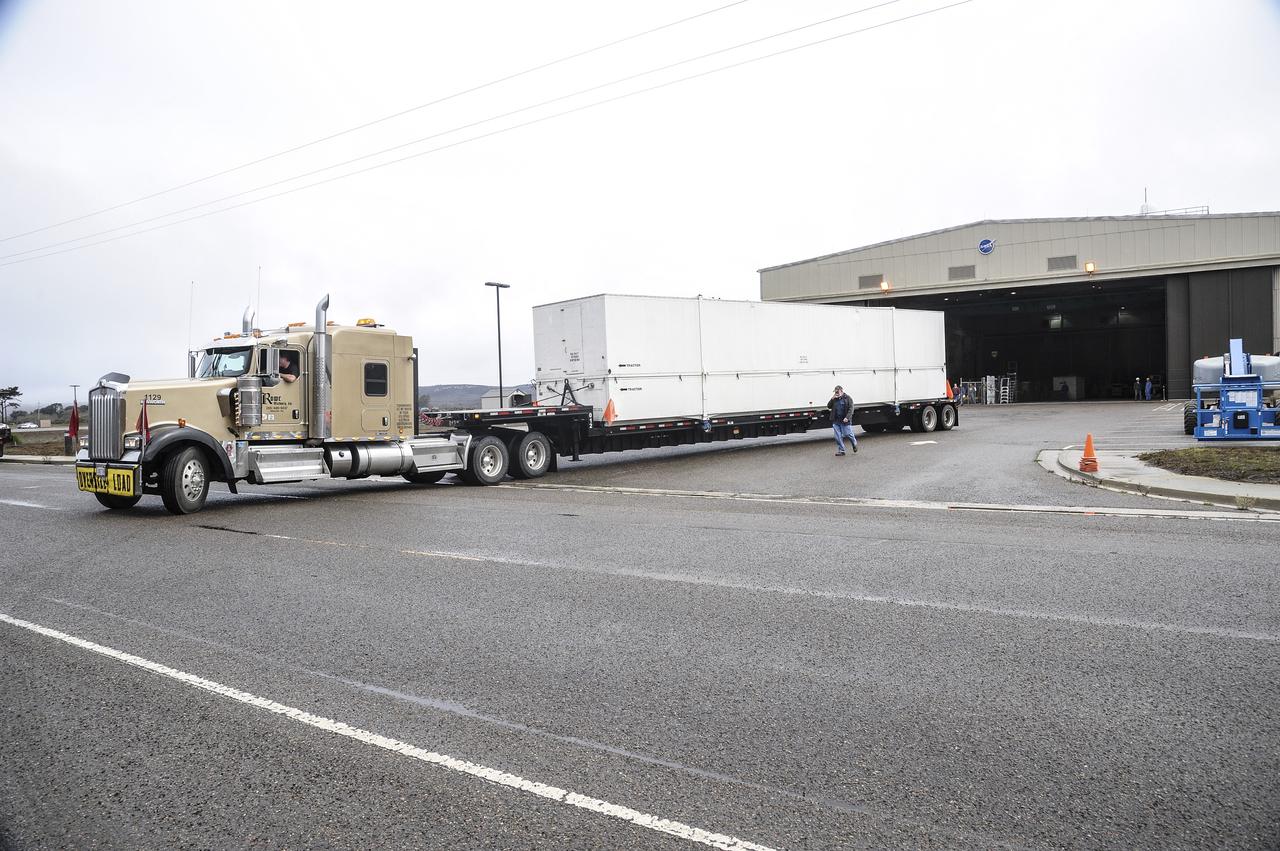
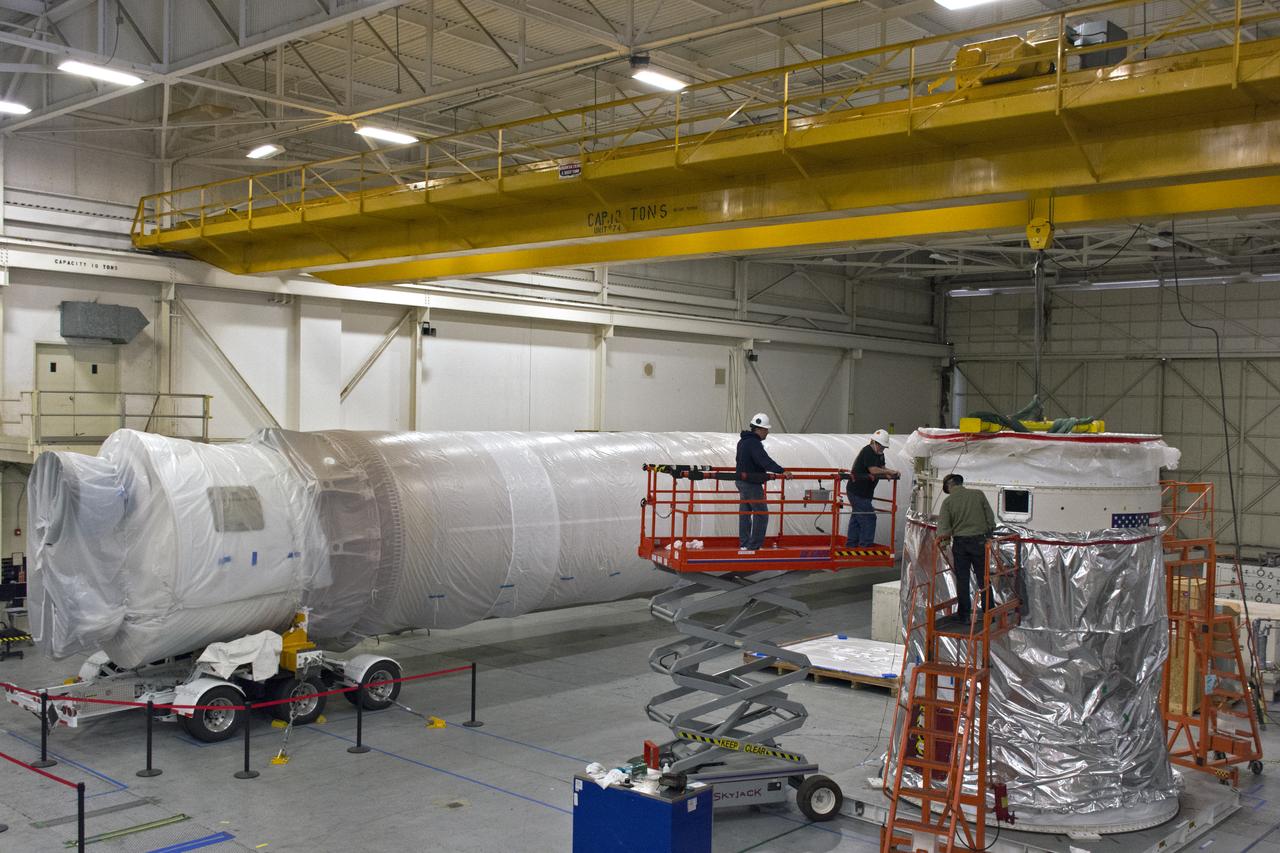
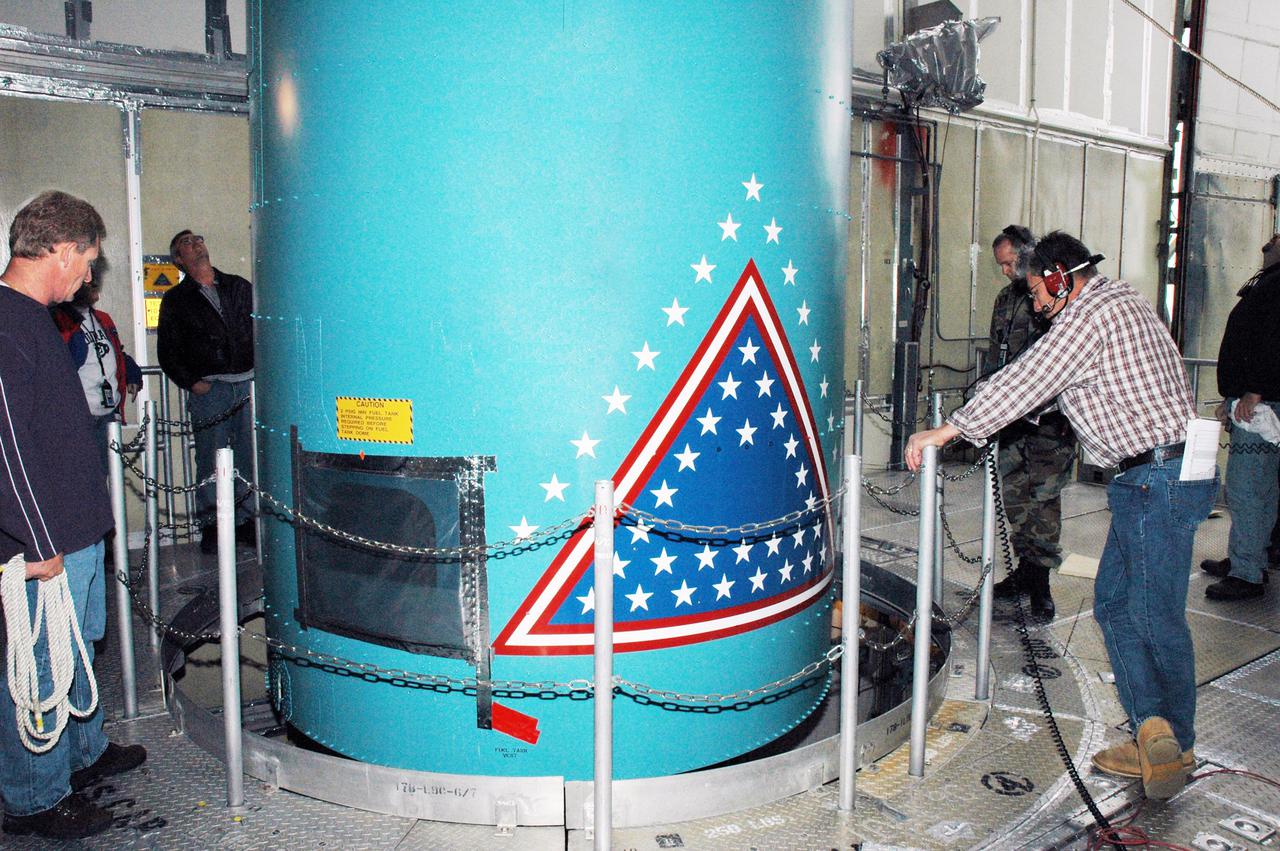
VANDENBERG AIR FORCE BASE, Calif. – The interstage adapter, or ISA, for NASA's Orbiting Carbon Observatory-2 mission, or OCO-2, arrives at the Building 836 hangar on Vandenberg Air Force Base in California. OCO-2 is scheduled to launch aboard a United Launch Alliance Delta II rocket from Space Launch Complex 2 in July. The ISA is the interface between the Delta II first and second stages. The second stage engine fits within the ISA. OCO-2 will collect precise global measurements of carbon dioxide in the Earth's atmosphere and provide scientists with a better idea of the chemical compound's impacts on climate change. Scientists will analyze this data to improve our understanding of the natural processes and human activities that regulate the abundance and distribution of this important atmospheric gas. To learn more about OCO-2, visit http://oco.jpl.nasa.gov. Photo credit: NASA/Jeremy Moore, 30th Space Wing, VAFB
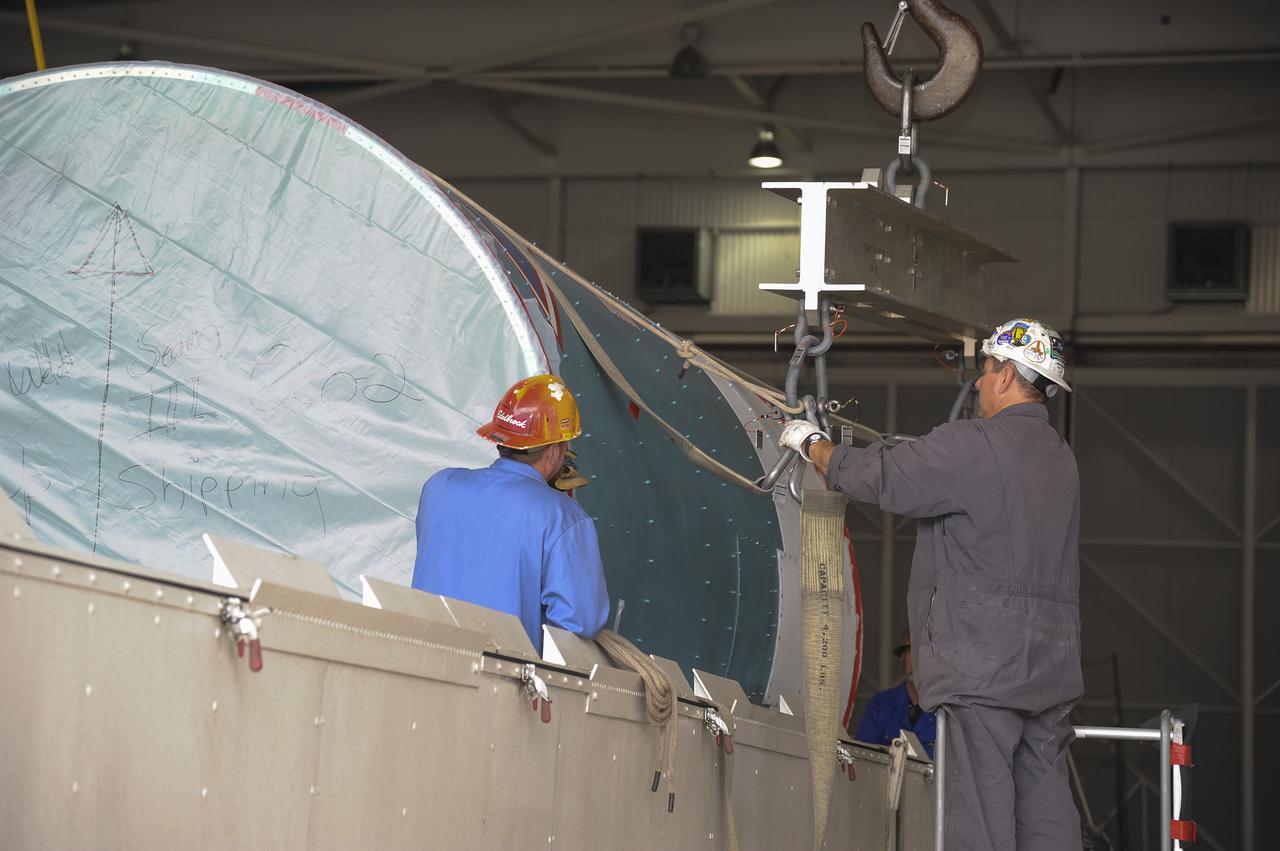
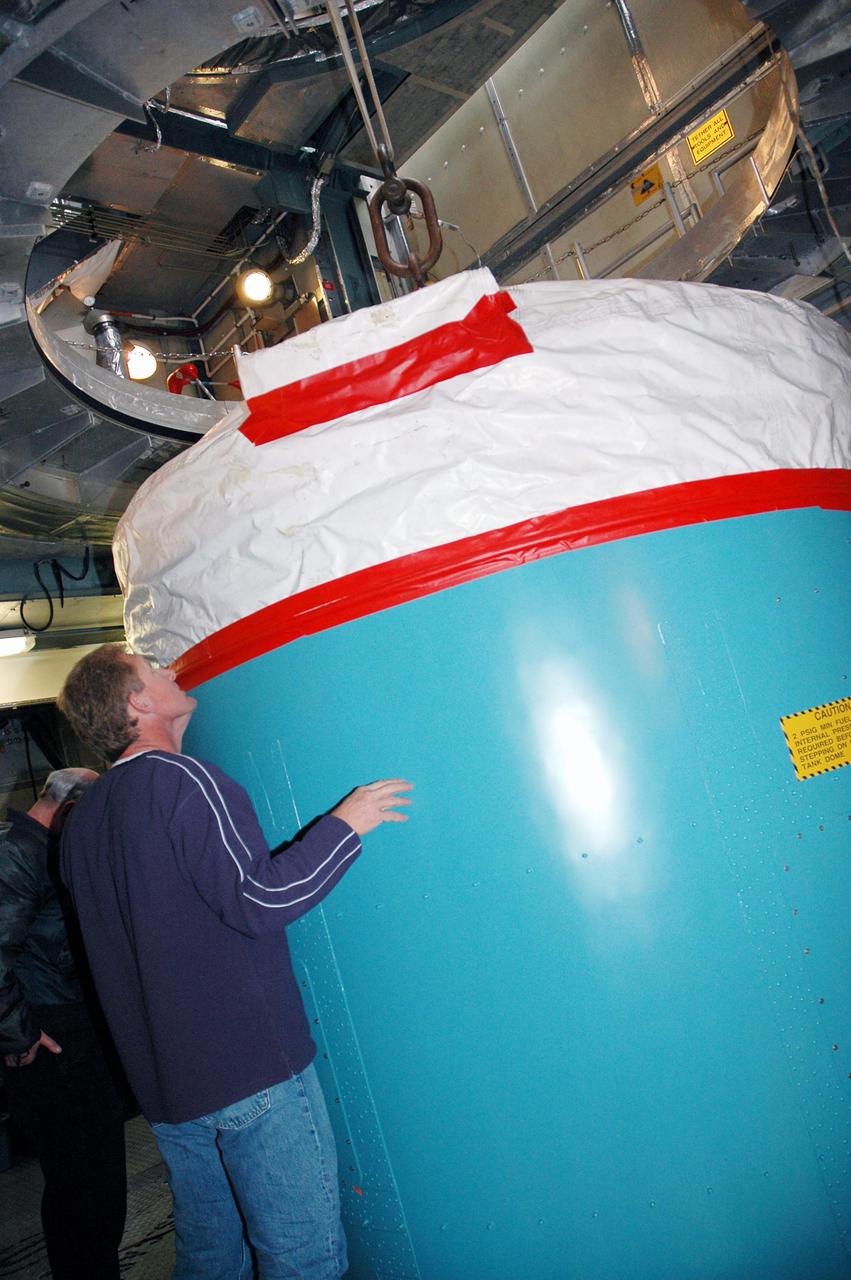
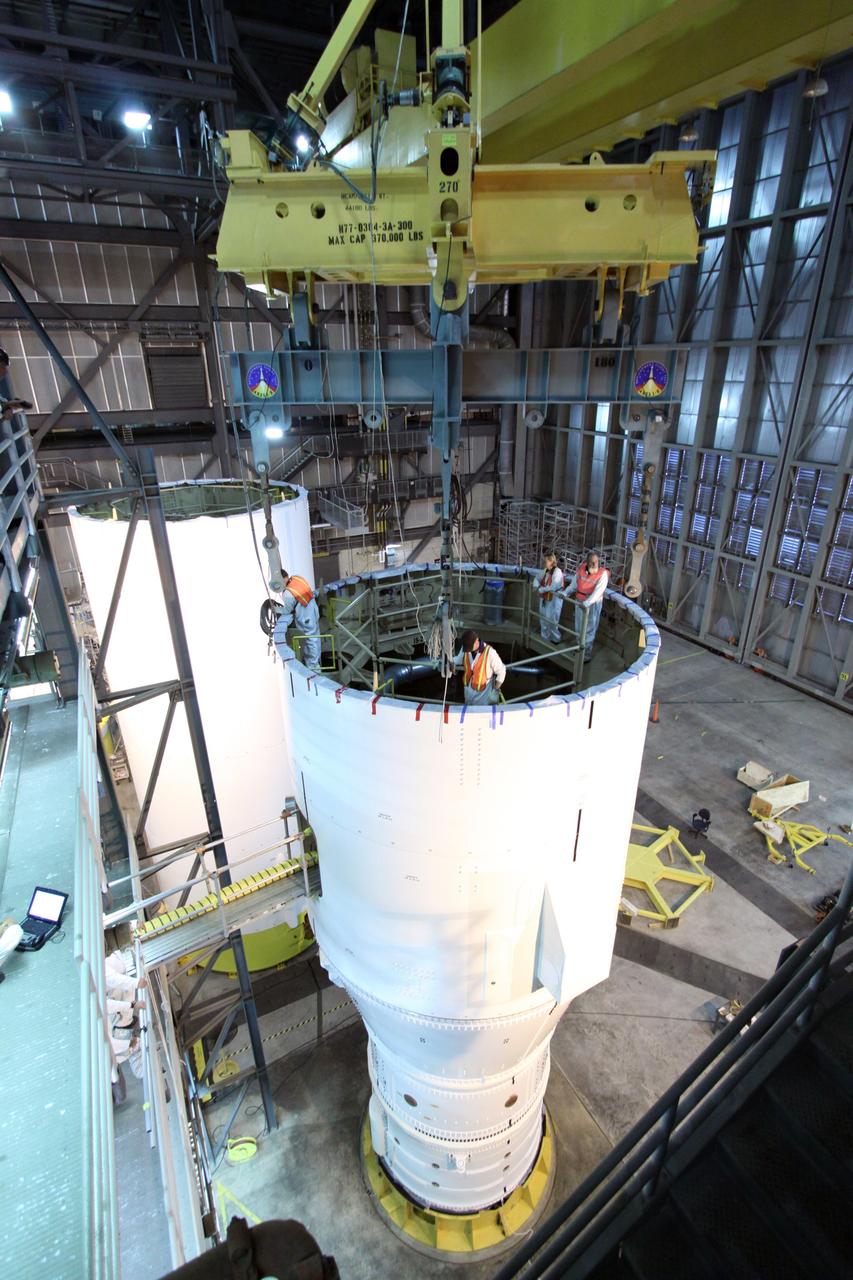
VANDENBERG AIR FORCE BASE, Calif. – Workers attach the interstage adapter, or ISA, for NASA's Orbiting Carbon Observatory-2 mission, or OCO-2, to a lifting device in the high bay of the Building 836 hangar on Vandenberg Air Force Base in California. OCO-2 is scheduled to launch aboard a United Launch Alliance Delta II rocket from Space Launch Complex 2 in July. The ISA is the interface between the Delta II first and second stages. The second stage engine fits within the ISA. OCO-2 will collect precise global measurements of carbon dioxide in the Earth's atmosphere and provide scientists with a better idea of the chemical compound's impacts on climate change. Scientists will analyze this data to improve our understanding of the natural processes and human activities that regulate the abundance and distribution of this important atmospheric gas. To learn more about OCO-2, visit http://oco.jpl.nasa.gov. Photo credit: NASA/Jeremy Moore, 30th Space Wing, VAFB
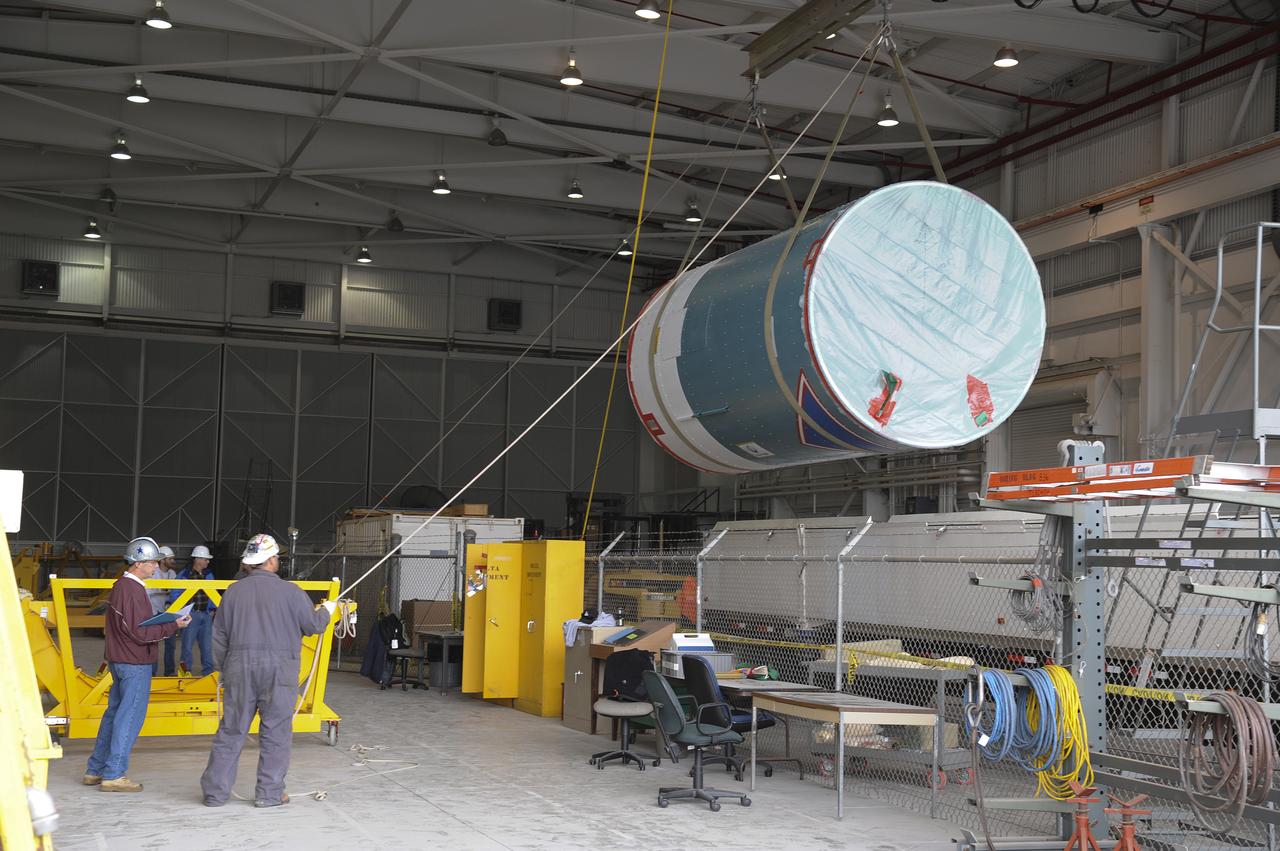
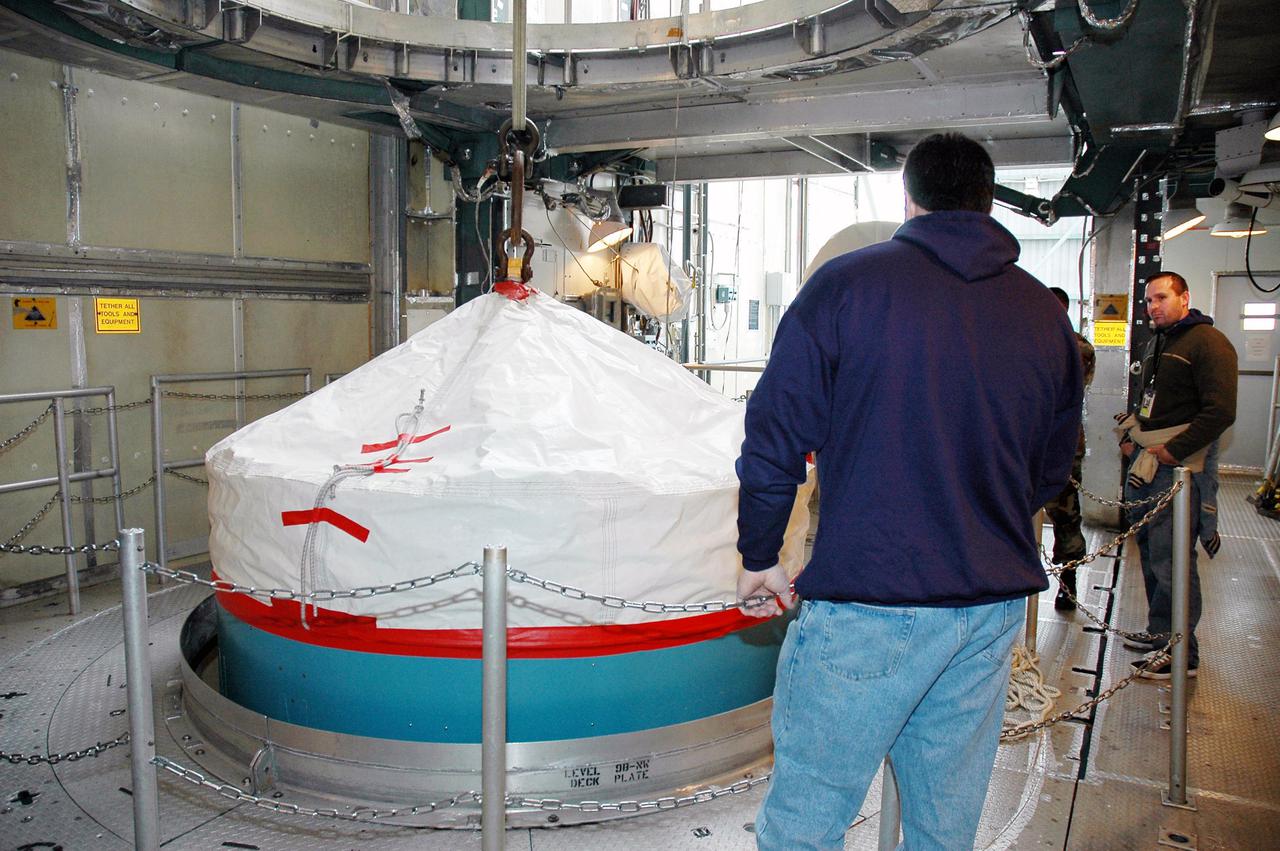
VANDENBERG AIR FORCE BASE, Calif. – Workers lift the interstage adapter, or ISA, for NASA's Orbiting Carbon Observatory-2 mission, or OCO-2, from its transportation trailer in the high bay of the Building 836 hangar on Vandenberg Air Force Base in California. OCO-2 is scheduled to launch aboard a United Launch Alliance Delta II rocket from Space Launch Complex 2 in July. The ISA is the interface between the Delta II first and second stages. The second stage engine fits within the ISA. OCO-2 will collect precise global measurements of carbon dioxide in the Earth's atmosphere and provide scientists with a better idea of the chemical compound's impacts on climate change. Scientists will analyze this data to improve our understanding of the natural processes and human activities that regulate the abundance and distribution of this important atmospheric gas. To learn more about OCO-2, visit http://oco.jpl.nasa.gov. Photo credit: NASA/Jeremy Moore, 30th Space Wing, VAFB
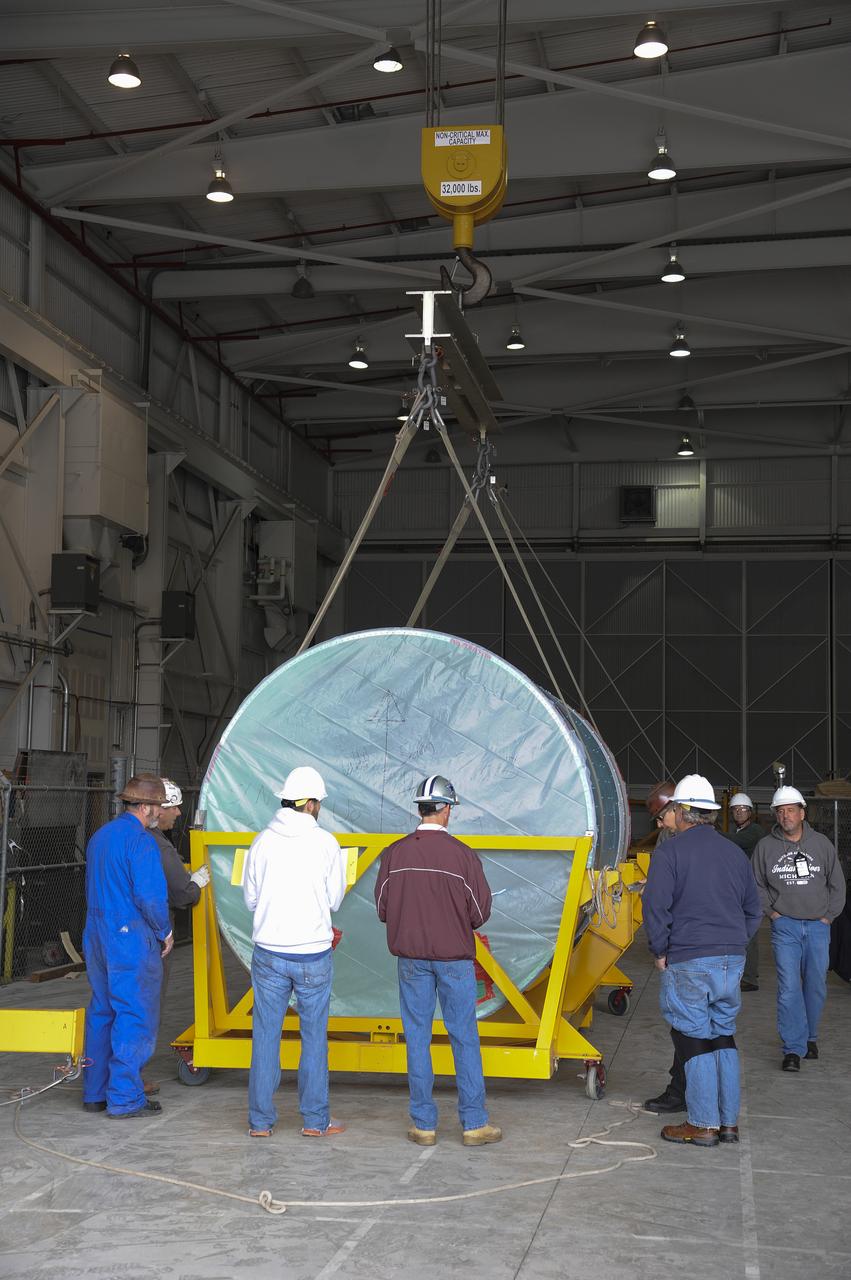
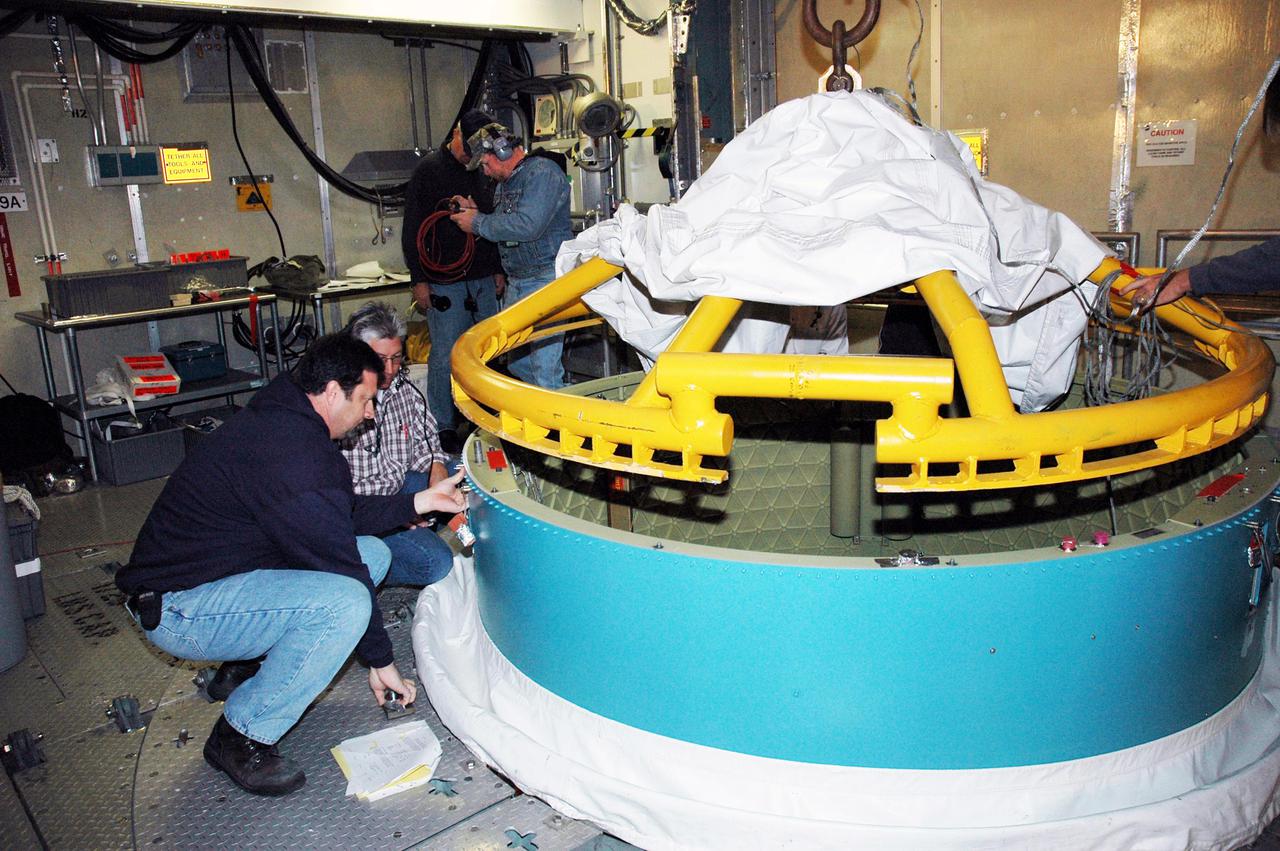
VANDENBERG AIR FORCE BASE, Calif. – Workers lower the interstage adapter, or ISA, for NASA's Orbiting Carbon Observatory-2 mission, or OCO-2, into a transportation hardware cradle in the high bay of the Building 836 hangar on Vandenberg Air Force Base in California. OCO-2 is scheduled to launch aboard a United Launch Alliance Delta II rocket from Space Launch Complex 2 in July. The ISA is the interface between the Delta II first and second stages. The second stage engine fits within the ISA. OCO-2 will collect precise global measurements of carbon dioxide in the Earth's atmosphere and provide scientists with a better idea of the chemical compound's impacts on climate change. Scientists will analyze this data to improve our understanding of the natural processes and human activities that regulate the abundance and distribution of this important atmospheric gas. To learn more about OCO-2, visit http://oco.jpl.nasa.gov. Photo credit: NASA/Jeremy Moore, 30th Space Wing, VAFB
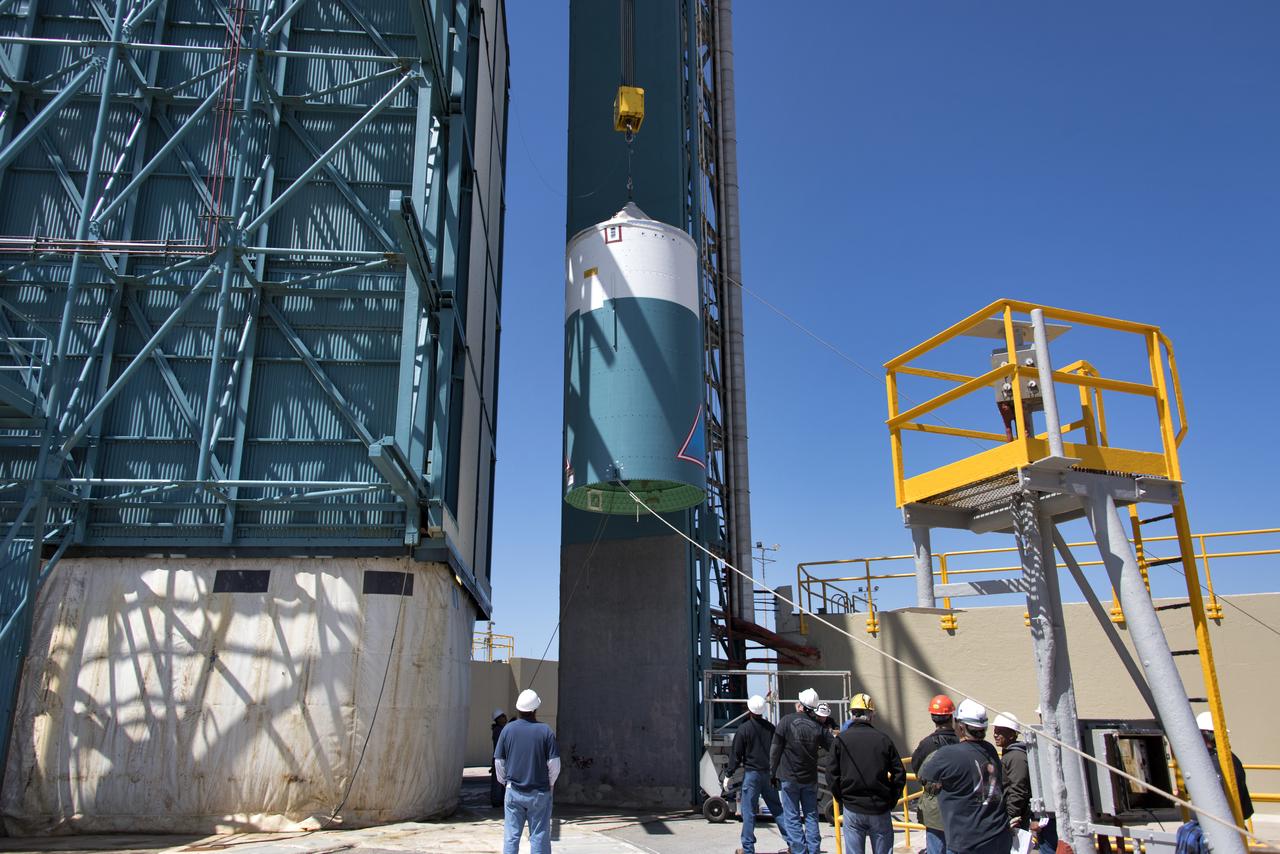
The United Launch Alliance Delta II interstage is lifted up at the Vertical Integration Facility at Space Launch Complex 2 on June 12, 2018, at Vandenberg Air Force Base in California. The interstage will be moved in and mated to the top of the booster, or first stage of the rocket. NASA's Ice, Cloud and land Elevation Satellite-2 (ICESat-2) will launch on the final Delta II rocket. ICESat-2 will measure the height of a changing Earth, one laser pulse at a time, 10,000 laser pulses a second. The satellite will carry a single instrument, the Advanced Topographic Laser Altimeter System. ICESat-2 will help scientists investigate why, and how much our planet's frozen and icy areas, called the cryosphere, is changing in a warming climate.
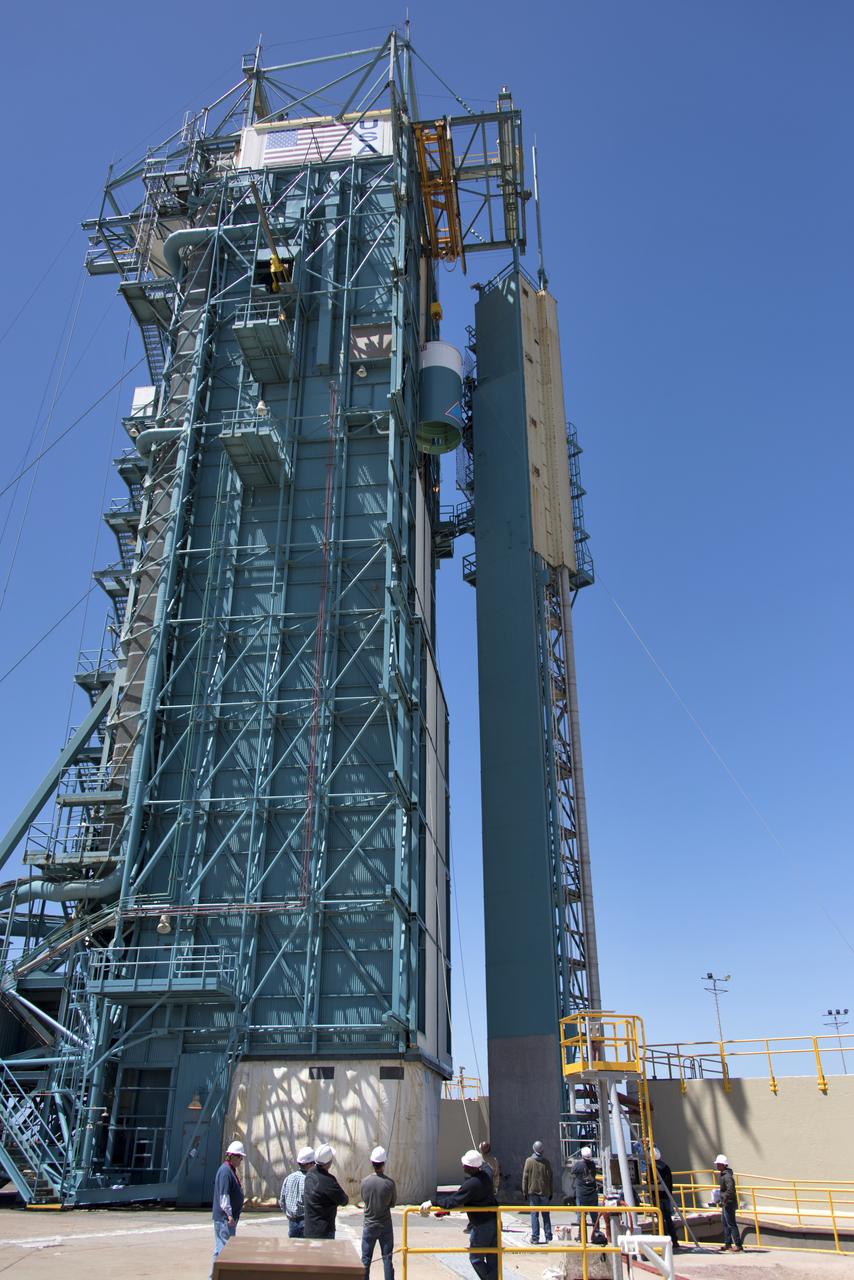
The United Launch Alliance Delta II interstage is lifted high up at the Vertical Integration Facility at Space Launch Complex 2 on June 12, 2018, at Vandenberg Air Force Base in California. The interstage will be moved in and mated to the top of the booster, or first stage of the rocket. NASA's Ice, Cloud and land Elevation Satellite-2 (ICESat-2) will launch on the final Delta II rocket. ICESat-2 will measure the height of a changing Earth, one laser pulse at a time, 10,000 laser pulses a second. The satellite will carry a single instrument, the Advanced Topographic Laser Altimeter System. ICESat-2 will help scientists investigate why, and how much our planet's frozen and icy areas, called the cryosphere, is changing in a warming climate.
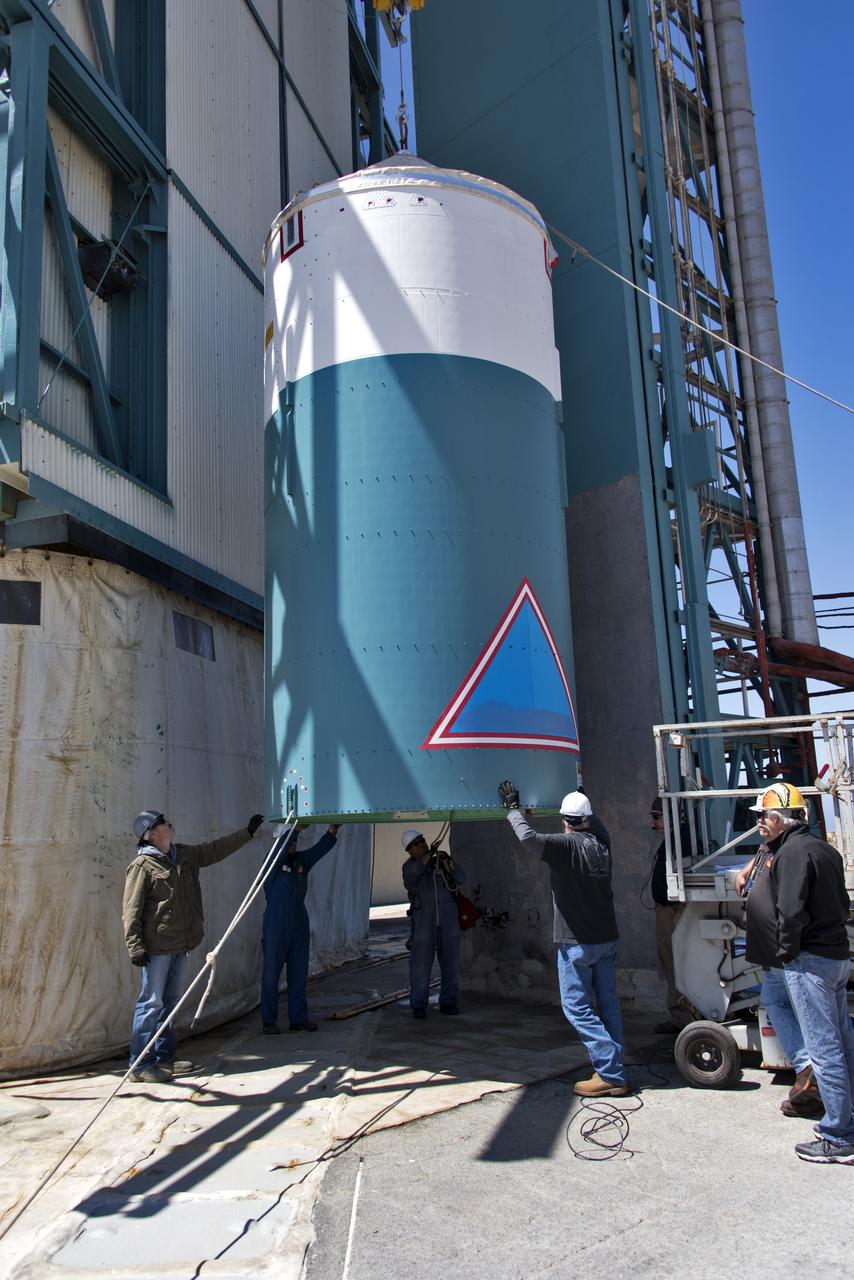
The United Launch Alliance Delta II interstage is lifted up at the Vertical Integration Facility at Space Launch Complex 2 on June 12, 2018, at Vandenberg Air Force Base in California. The interstage will be moved in and mated to the top of the booster, or first stage of the rocket. NASA's Ice, Cloud and land Elevation Satellite-2 (ICESat-2) will launch on the final Delta II rocket. ICESat-2 will measure the height of a changing Earth, one laser pulse at a time, 10,000 laser pulses a second. The satellite will carry a single instrument, the Advanced Topographic Laser Altimeter System. ICESat-2 will help scientists investigate why, and how much our planet's frozen and icy areas, called the cryosphere, is changing in a warming climate.
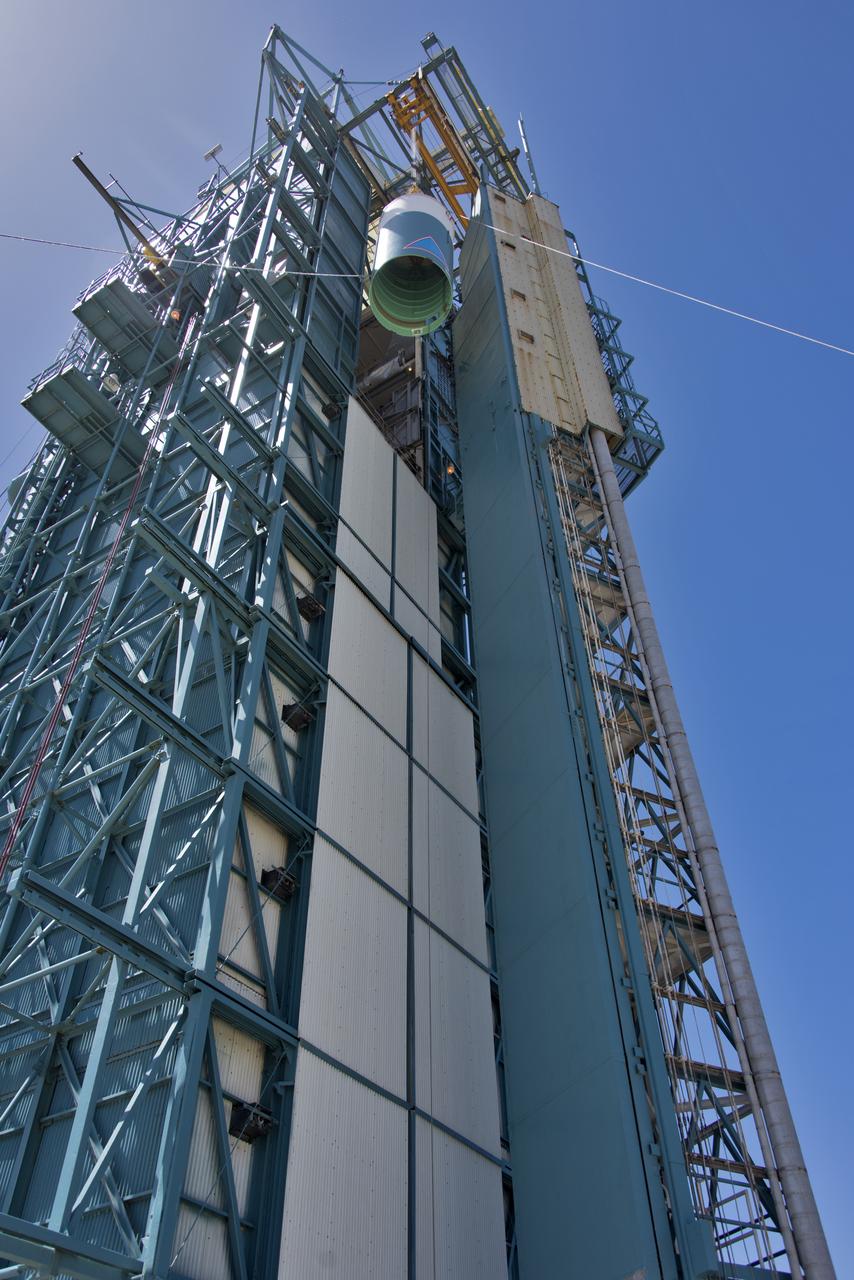
The United Launch Alliance Delta II interstage is lifted high up at the Vertical Integration Facility at Space Launch Complex 2 on June 12, 2018, at Vandenberg Air Force Base in California. The interstage will be moved in and mated to the top of the booster, or first stage of the rocket. NASA's Ice, Cloud and land Elevation Satellite-2 (ICESat-2) will launch on the final Delta II rocket. ICESat-2 will measure the height of a changing Earth, one laser pulse at a time, 10,000 laser pulses a second. The satellite will carry a single instrument, the Advanced Topographic Laser Altimeter System. ICESat-2 will help scientists investigate why, and how much our planet's frozen and icy areas, called the cryosphere, is changing in a warming climate.
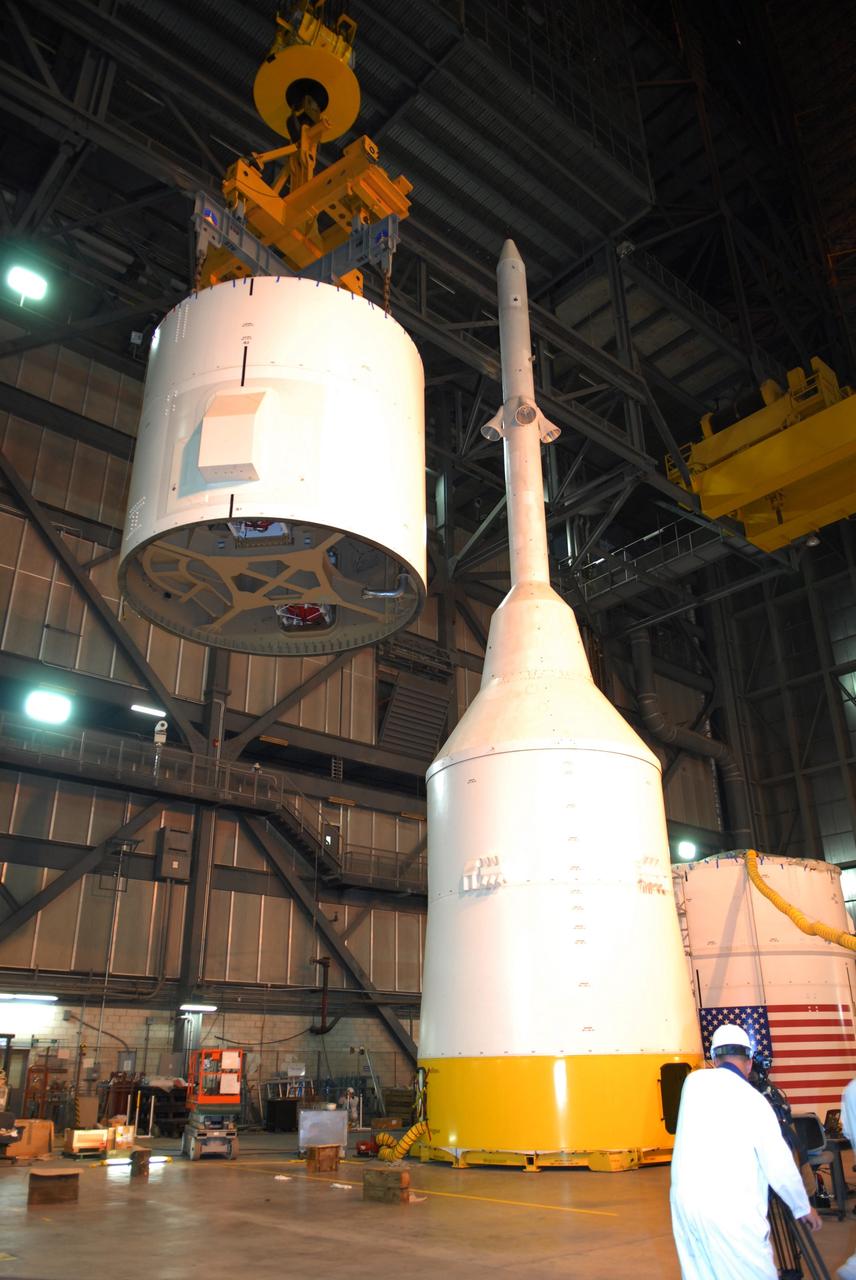
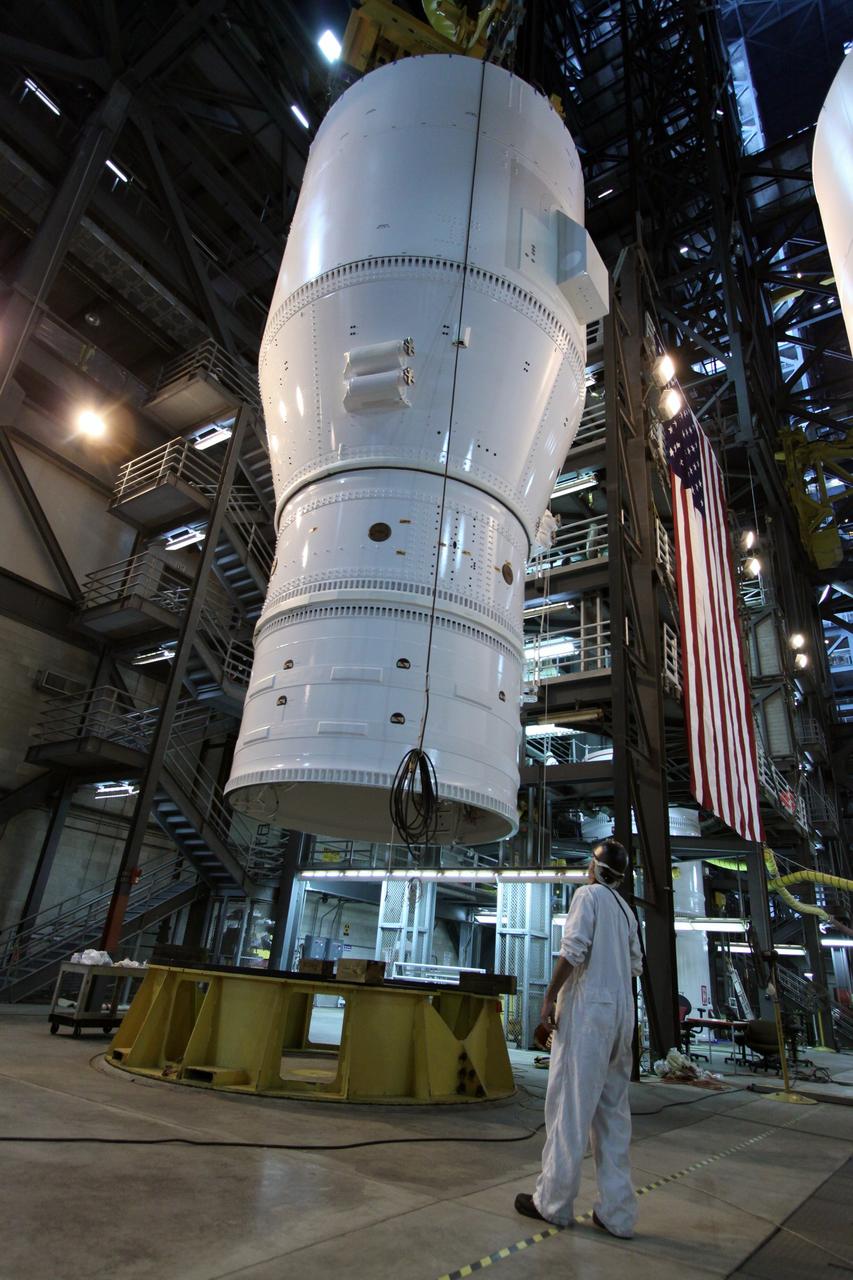
CAPE CANAVERAL, Fla. – In the Vehicle Assembly Building's High Bay 4 at NASA's Kennedy Space Center in Florida, the Ares I-X interstage 1 for the upper stage simulator is being moved to the forward assembly. The interstage will be mated with the frustum on the forward assembly. To the right is the crew module-launch abort system, or CM-LAS, and simulator service module-service adapter stack. Ares I-X is the flight test vehicle for the Ares I, a component of the Constellation Program. Ares I is the essential core of a safe, reliable, cost-effective space transportation system that eventually will carry crewed missions back to the moon, on to Mars and out into the solar system. Ares I-X is targeted for launch in August 2009. Photo credit: NASA/Tim Jacobs
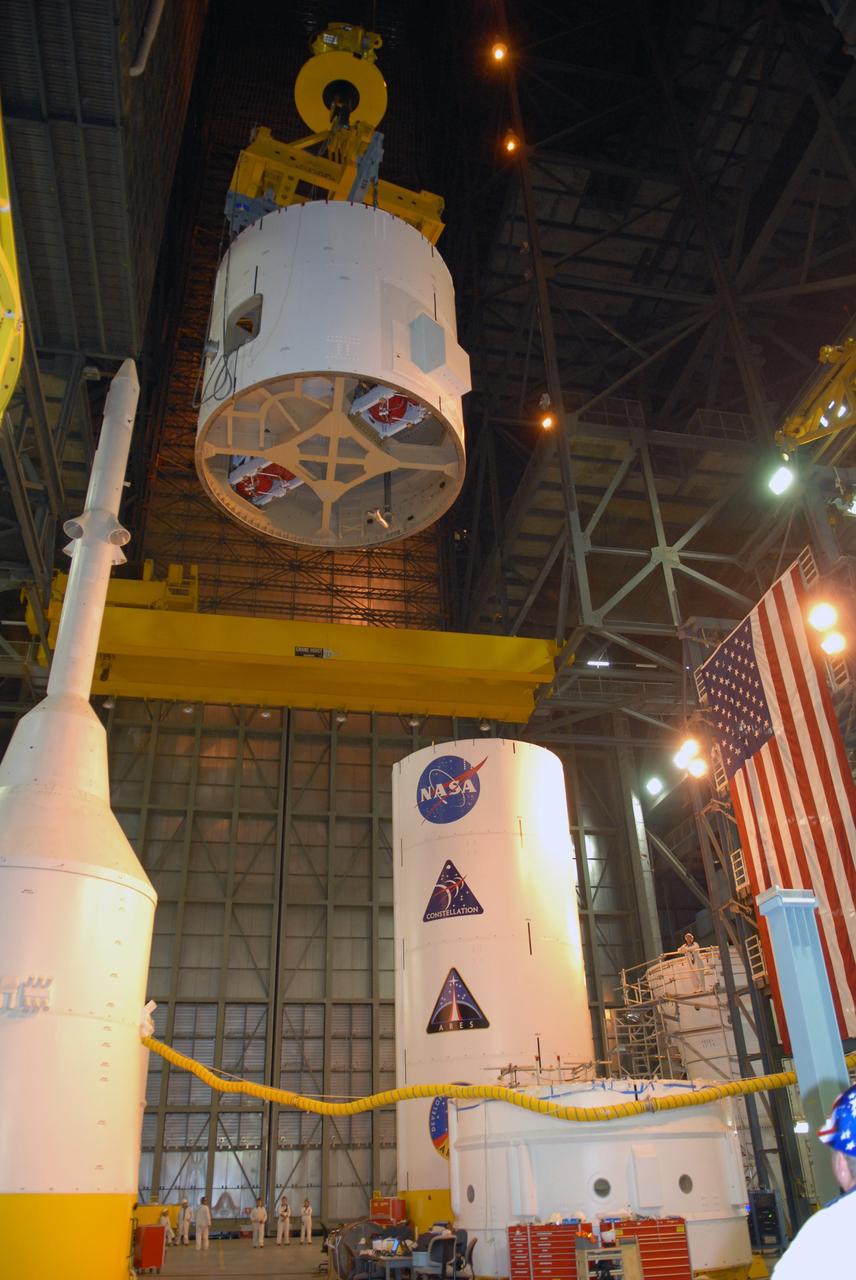
CAPE CANAVERAL, Fla. – In the Vehicle Assembly Building's High Bay 4 at NASA's Kennedy Space Center in Florida, the Ares I-X interstage 1 for the upper stage simulator is being moved to the forward assembly. The interstage will be mated with the frustum on the forward assembly. To the left is the crew module-launch abort system, or CM-LAS, and simulator service module-service adapter stack. Ares I-X is the flight test vehicle for the Ares I, a component of the Constellation Program. Ares I is the essential core of a safe, reliable, cost-effective space transportation system that eventually will carry crewed missions back to the moon, on to Mars and out into the solar system. Ares I-X is targeted for launch in August 2009. Photo credit: NASA/Tim Jacobs
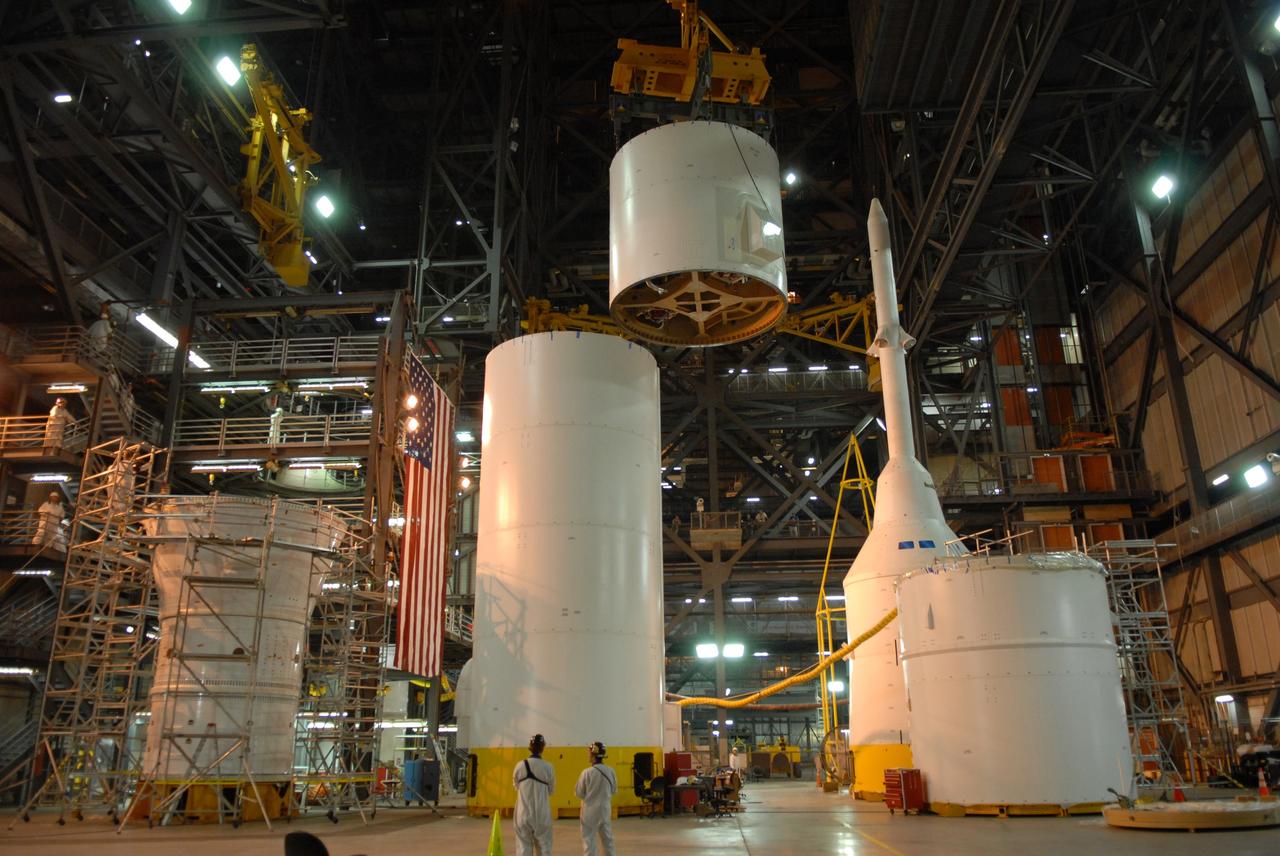
CAPE CANAVERAL, Fla. – In the Vehicle Assembly Building's High Bay 4 at NASA's Kennedy Space Center in Florida, the Ares I-X interstage 1 for the upper stage simulator (left) is being lifted to move it to the forward assembly. The interstage will be mated with the frustum on the forward assembly. At center is the crew module-launch abort system, or CM-LAS, and simulator service module-service adapter stack. Ares I-X is the flight test vehicle for the Ares I, a component of the Constellation Program. Ares I is the essential core of a safe, reliable, cost-effective space transportation system that eventually will carry crewed missions back to the moon, on to Mars and out into the solar system. Ares I-X is targeted for launch in August 2009. Photo credit: NASA/Tim Jacobs
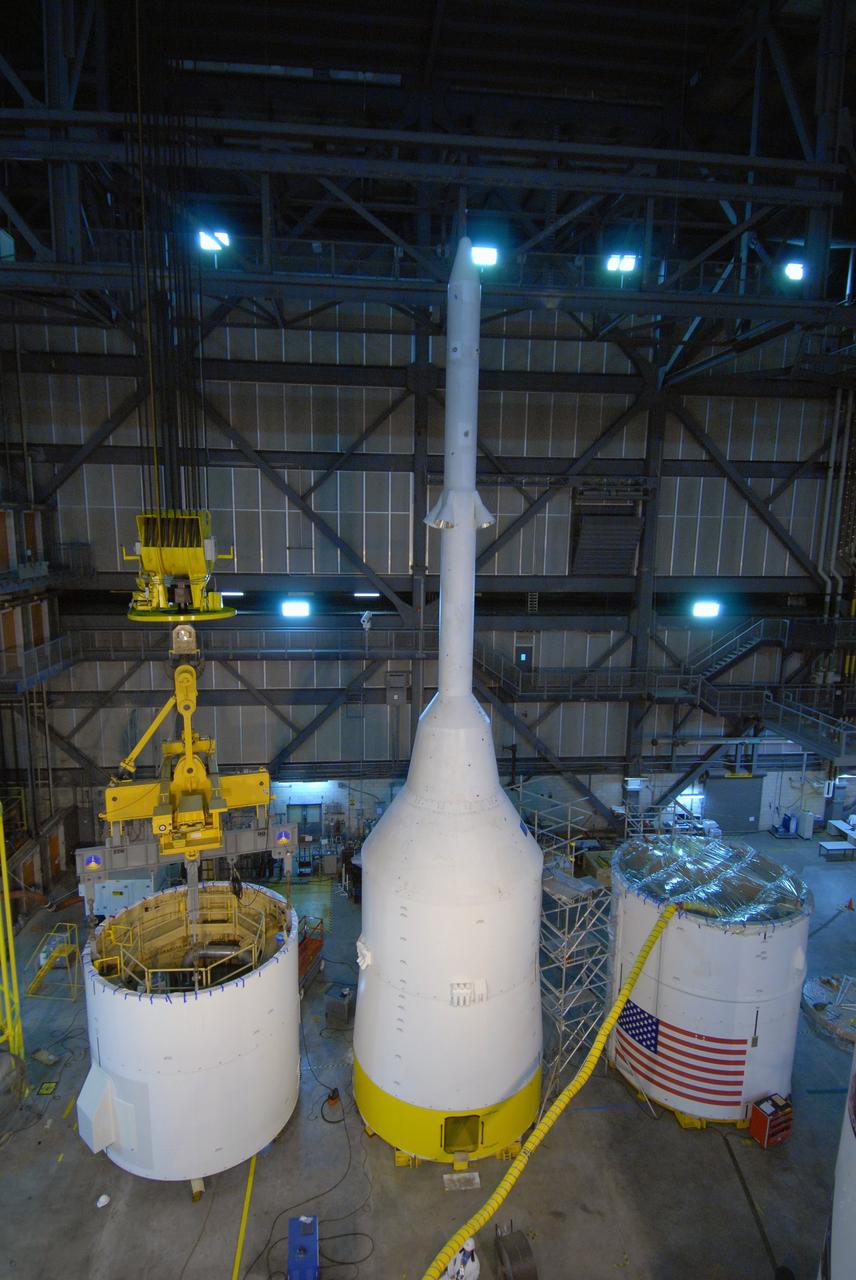
CAPE CANAVERAL, Fla. – In the Vehicle Assembly Building's High Bay 4 at NASA's Kennedy Space Center in Florida, the Ares I-X interstage 1 for the upper stage simulator is being moved to the forward assembly (far left). The interstage will be mated with the frustum on the forward assembly. To the right is the crew module-launch abort system, or CM-LAS, and simulator service module-service adapter stack. Ares I-X is the flight test vehicle for the Ares I, a component of the Constellation Program. Ares I is the essential core of a safe, reliable, cost-effective space transportation system that eventually will carry crewed missions back to the moon, on to Mars and out into the solar system. Ares I-X is targeted for launch in August 2009. Photo credit: NASA/Tim Jacobs
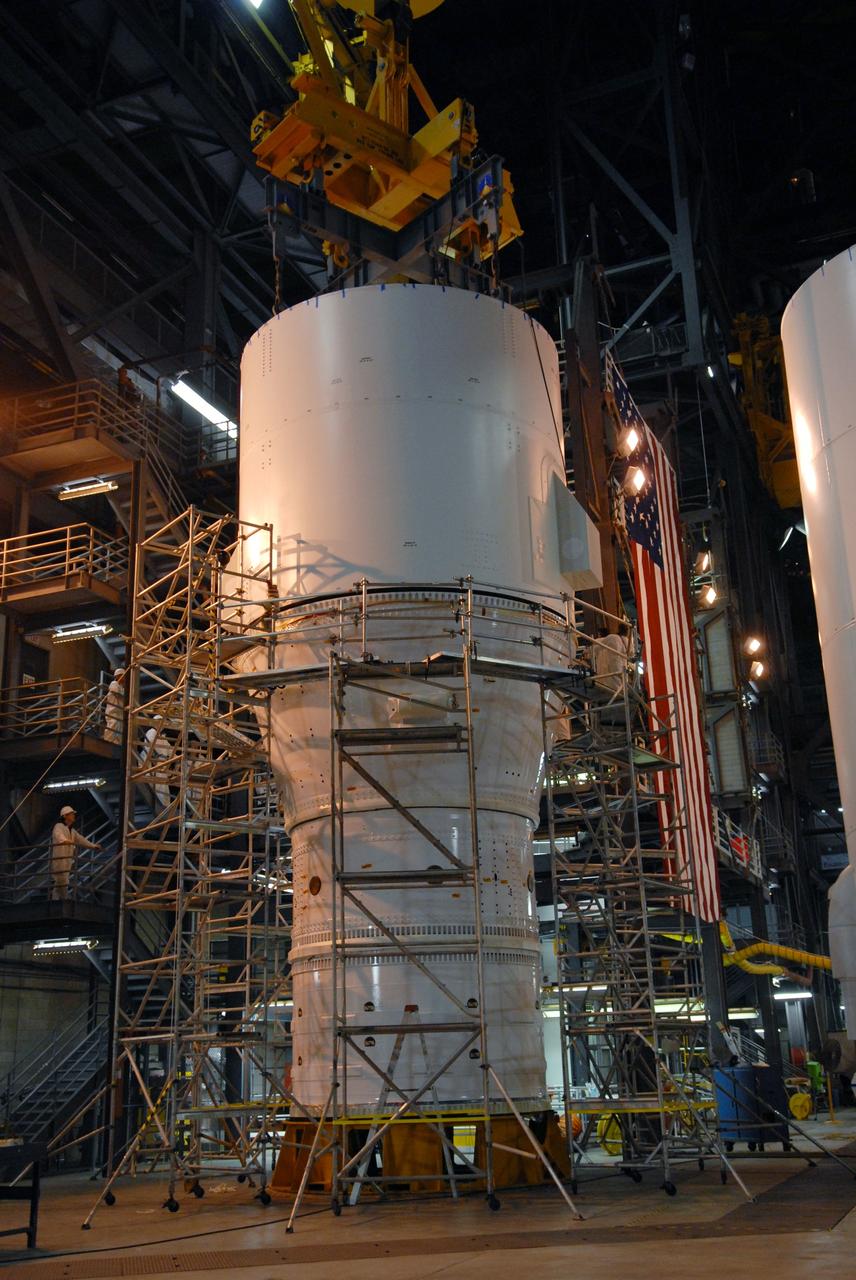
CAPE CANAVERAL, Fla. – In the Vehicle Assembly Building's High Bay 4 at NASA's Kennedy Space Center in Florida, the Ares I-X interstage 1 for the upper stage simulator is lowered onto the forward assembly. It will be mated with the frustum on top of the forward assembly. Ares I-X is the flight test vehicle for the Ares I, a component of the Constellation Program. Ares I is the essential core of a safe, reliable, cost-effective space transportation system that eventually will carry crewed missions back to the moon, on to Mars and out into the solar system. Ares I-X is targeted for launch in August 2009. Photo credit: NASA/Tim Jacobs
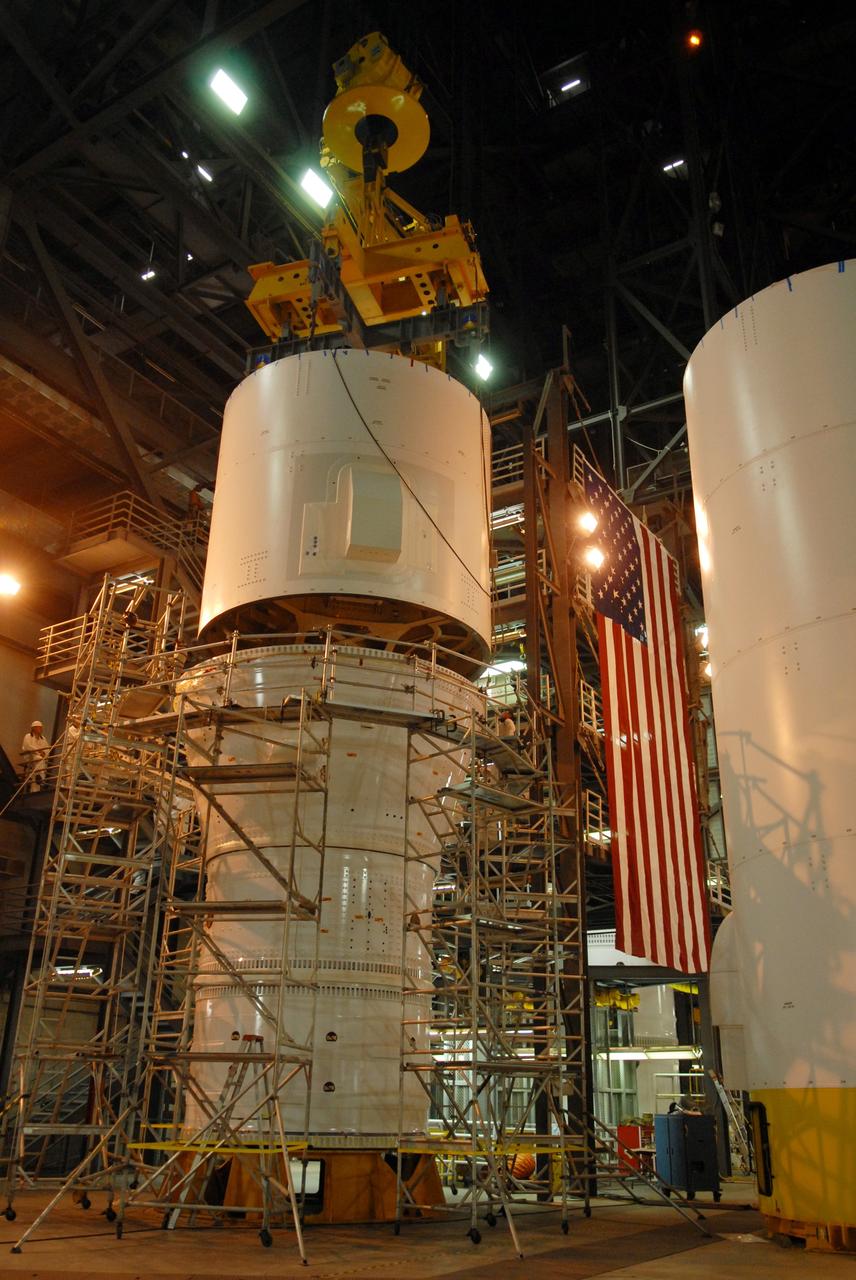
CAPE CANAVERAL, Fla. – In the Vehicle Assembly Building's High Bay 4 at NASA's Kennedy Space Center in Florida, the Ares I-X interstage 1 for the upper stage simulator is lowered onto the forward assembly. It will be mated with the frustum on top of the forward assembly. Ares I-X is the flight test vehicle for the Ares I, a component of the Constellation Program. Ares I is the essential core of a safe, reliable, cost-effective space transportation system that eventually will carry crewed missions back to the moon, on to Mars and out into the solar system. Ares I-X is targeted for launch in August 2009. Photo credit: NASA/Tim Jacobs
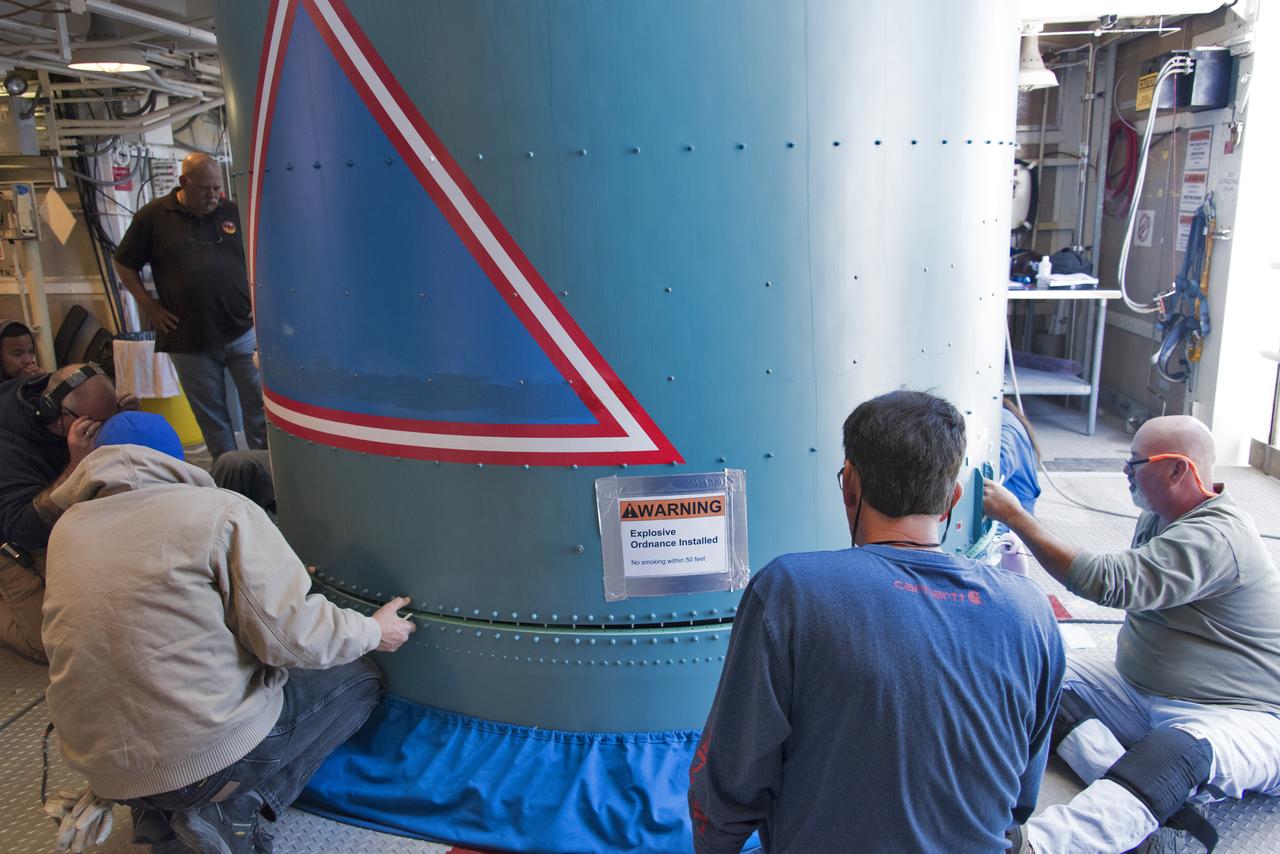
Inside the Vertical Integration Facility at Space Launch Complex 2 at Vandenberg Air Force Base in California, United Launch Alliance (ULA) workers help secure the Delta II interstage to the top of the booster, or first stage, on June 12, 2018. NASA's Ice, Cloud and land Elevation Satellite-2 (ICESat-2) will launch on the final Delta II rocket. ICESat-2 will measure the height of a changing Earth, one laser pulse at a time, 10,000 laser pulses a second. The satellite will carry a single instrument, the Advanced Topographic Laser Altimeter System. ICESat-2 will help scientists investigate why, and how much our planet's frozen and icy areas, called the cryosphere, is changing in a warming climate.
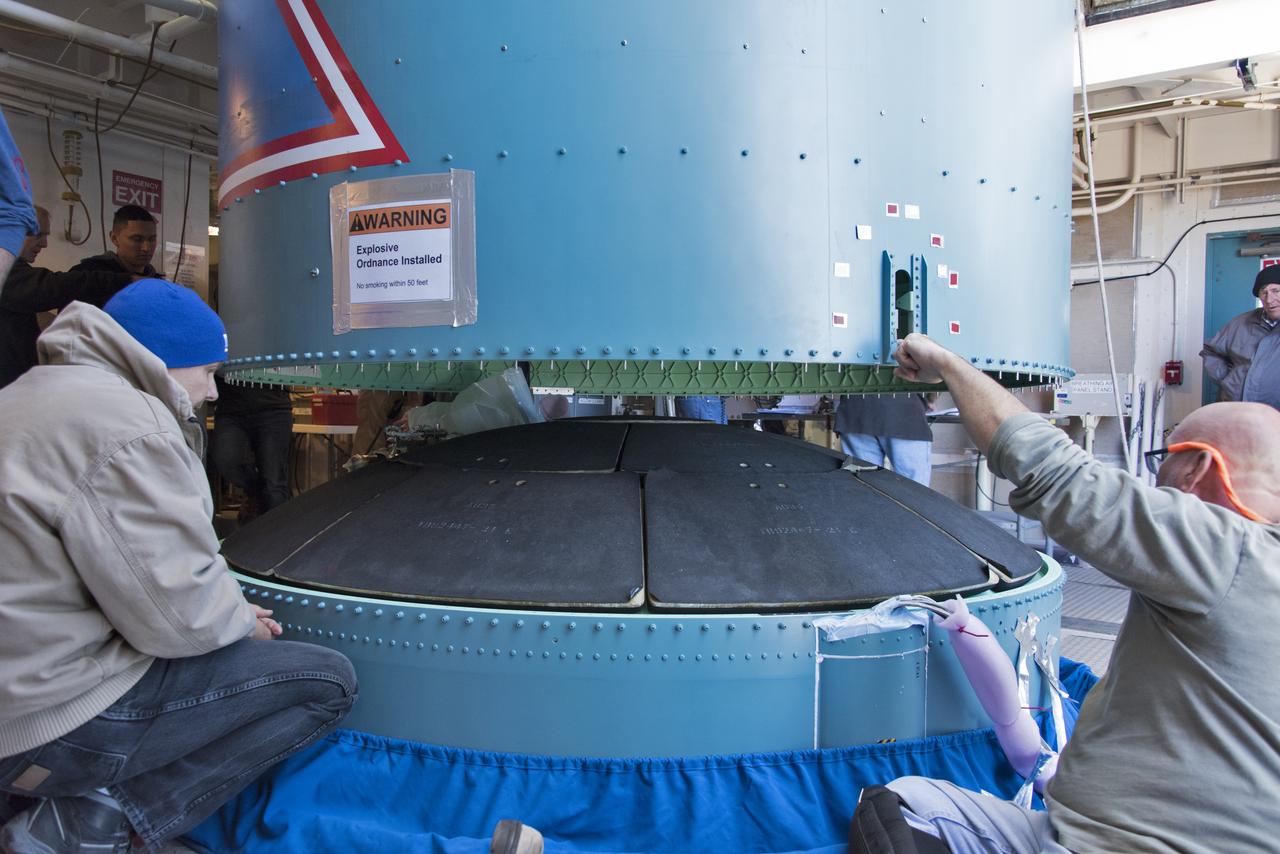
Inside the Vertical Integration Facility at Space Launch Complex 2 at Vandenberg Air Force Base in California, United Launch Alliance (ULA) workers assist as the Delta II interstage is lowered and mated to the booster, or first stage, on June 12, 2018. NASA's Ice, Cloud and land Elevation Satellite-2 (ICESat-2) will launch on the final Delta II rocket. ICESat-2 will measure the height of a changing Earth, one laser pulse at a time, 10,000 laser pulses a second. The satellite will carry a single instrument, the Advanced Topographic Laser Altimeter System. ICESat-2 will help scientists investigate why, and how much our planet's frozen and icy areas, called the cryosphere, is changing in a warming climate.
Inside Building B7525 at Vandenberg Air Force Base in California, the aft stub adapter (ASA) is installed to the interstage adapter (ISA) for a United Launch Alliance Atlas V rocket. The launch vehicle will send NASA's Interior Exploration using Seismic Investigations, Geodesy and Heat Transport, or InSight, spacecraft to land on Mars. InSight is the first mission to explore the Red Planet's deep interior. It will investigate processes that shaped the rocky planets of the inner solar system including Earth. Liftoff from Vandenberg is scheduled for May 5, 2018.

Inside Building B7525 at Vandenberg Air Force Base in California, the aft stub adapter (ASA) is installed to the interstage adapter (ISA) for a United Launch Alliance Atlas V rocket. The launch vehicle will send NASA's Interior Exploration using Seismic Investigations, Geodesy and Heat Transport, or InSight, spacecraft to land on Mars. InSight is the first mission to explore the Red Planet's deep interior. It will investigate processes that shaped the rocky planets of the inner solar system including Earth. Liftoff from Vandenberg is scheduled for May 5, 2018.
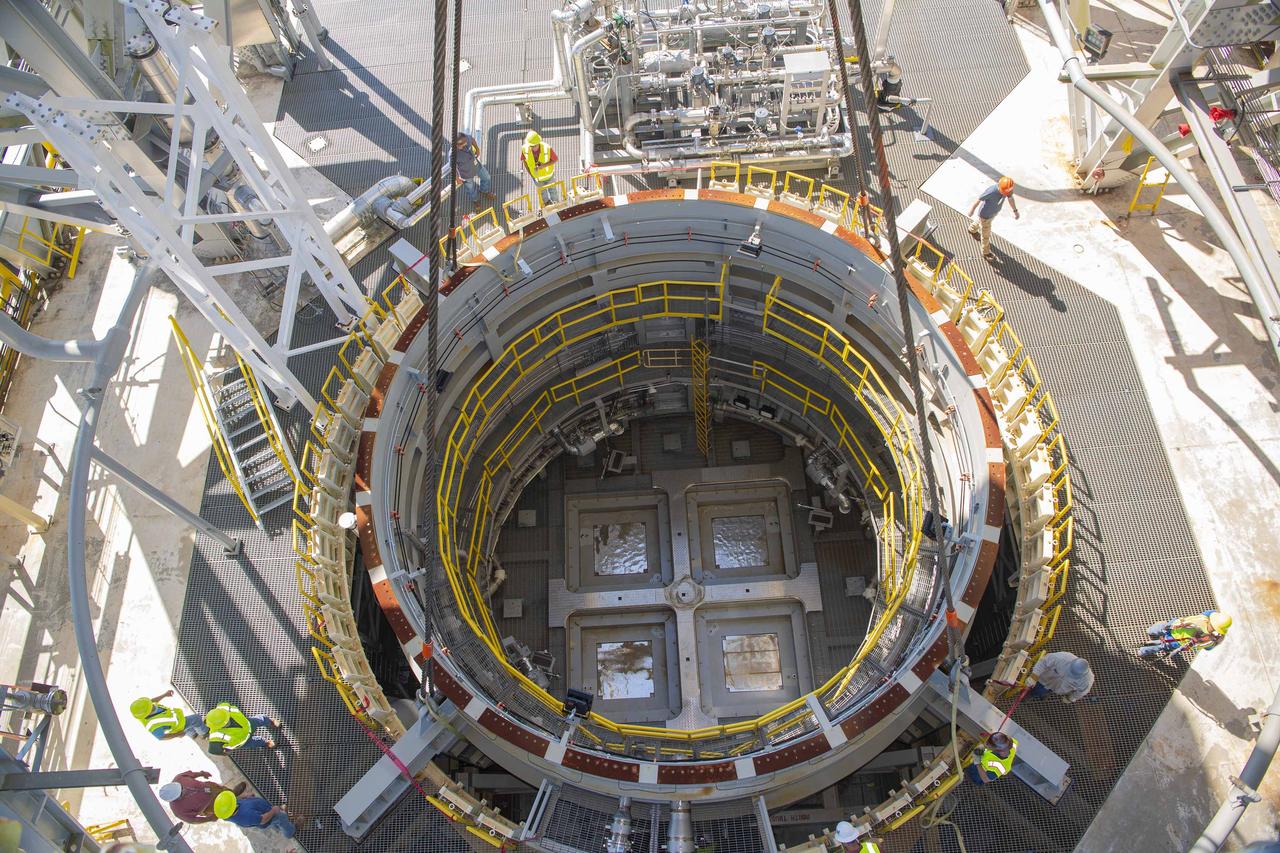
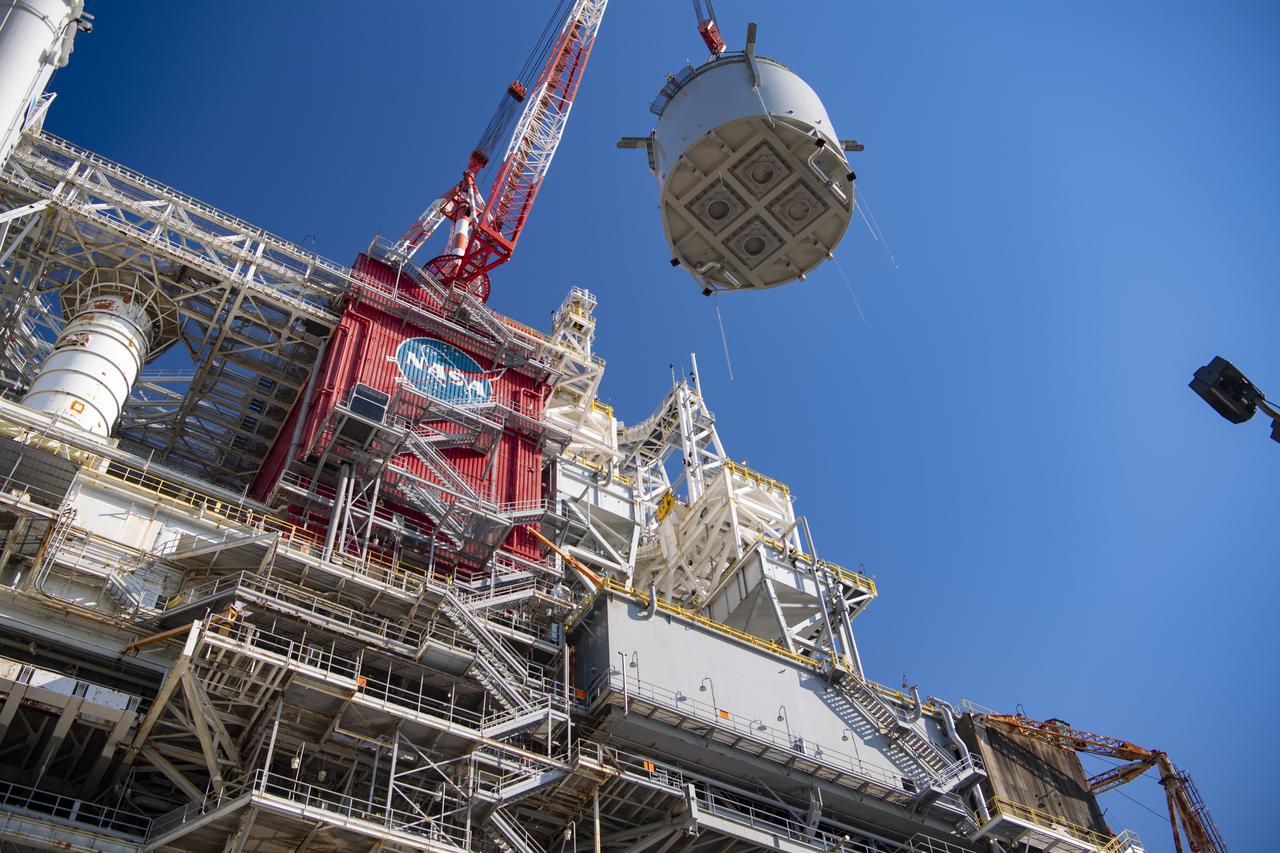
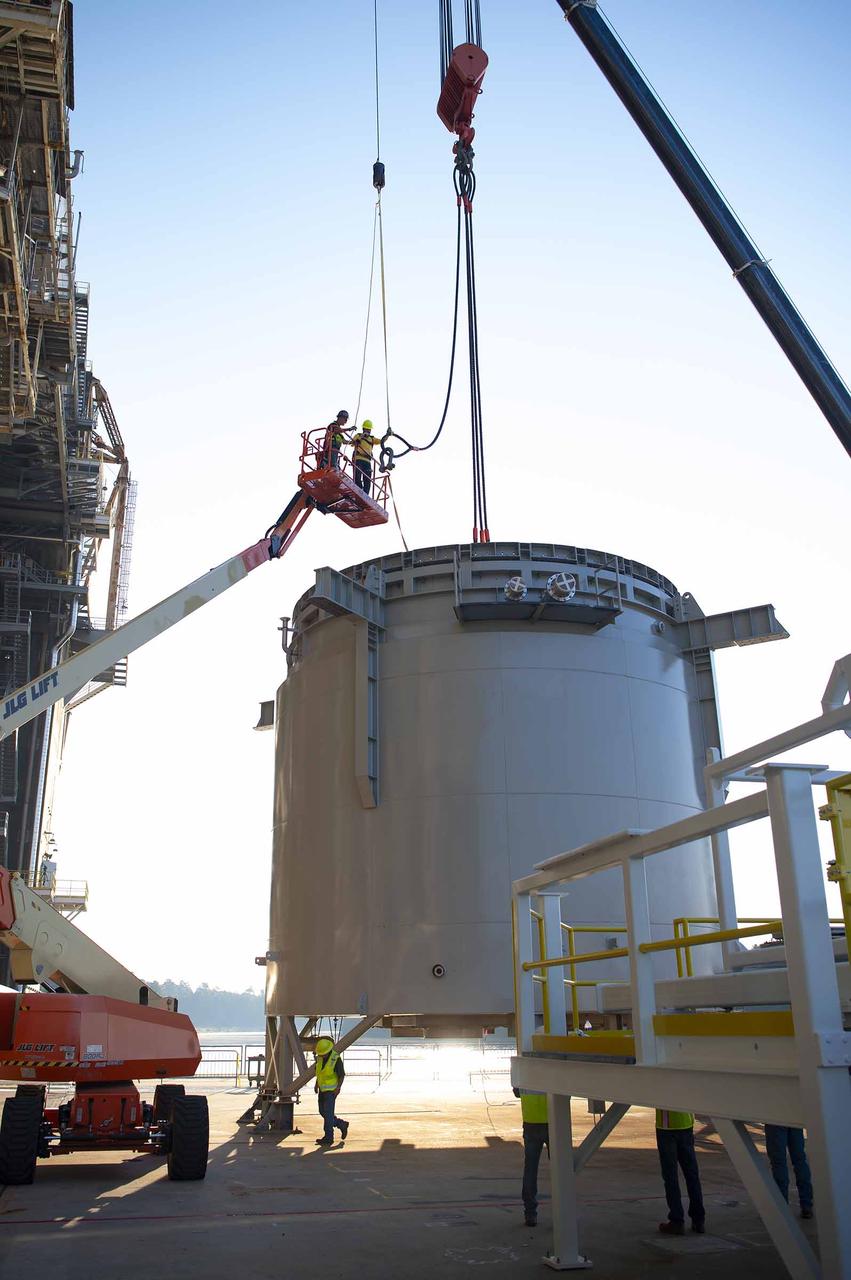
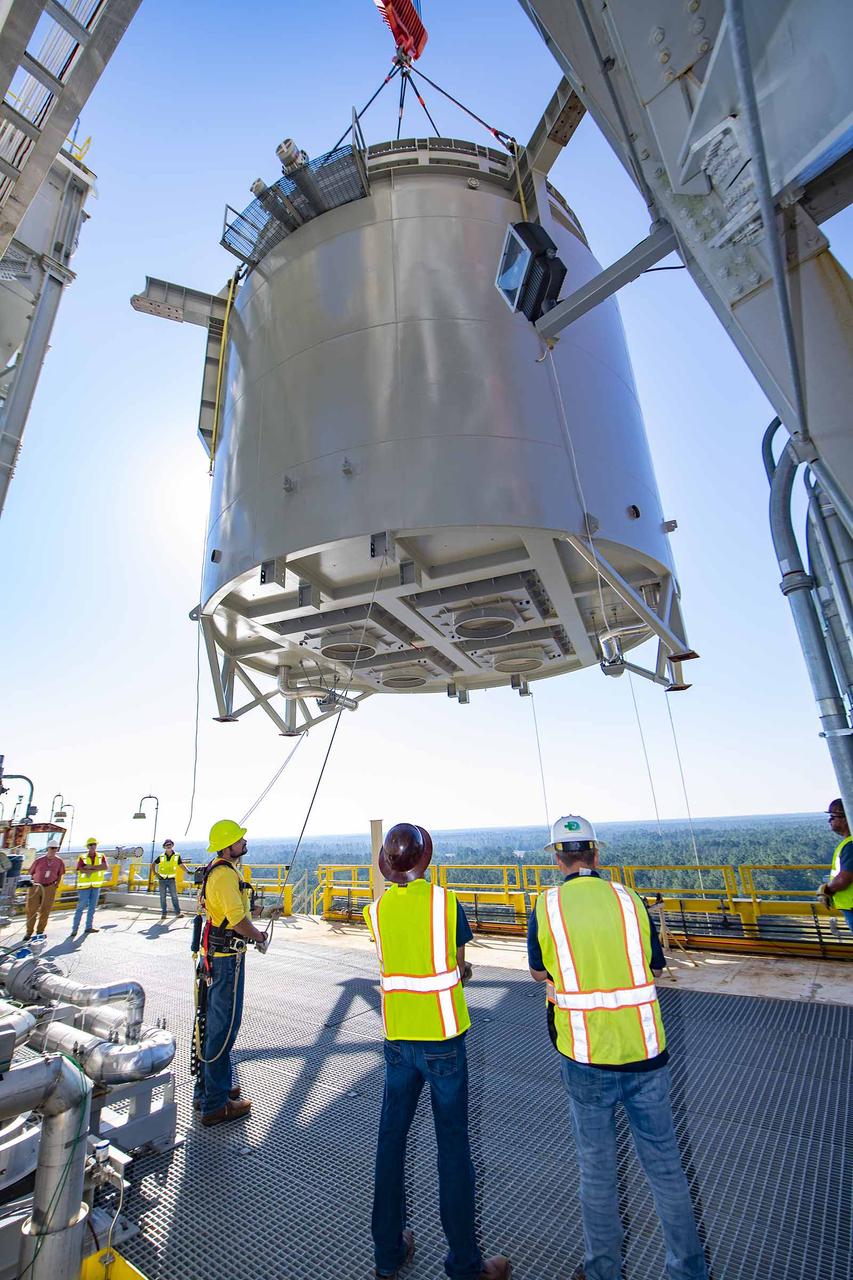
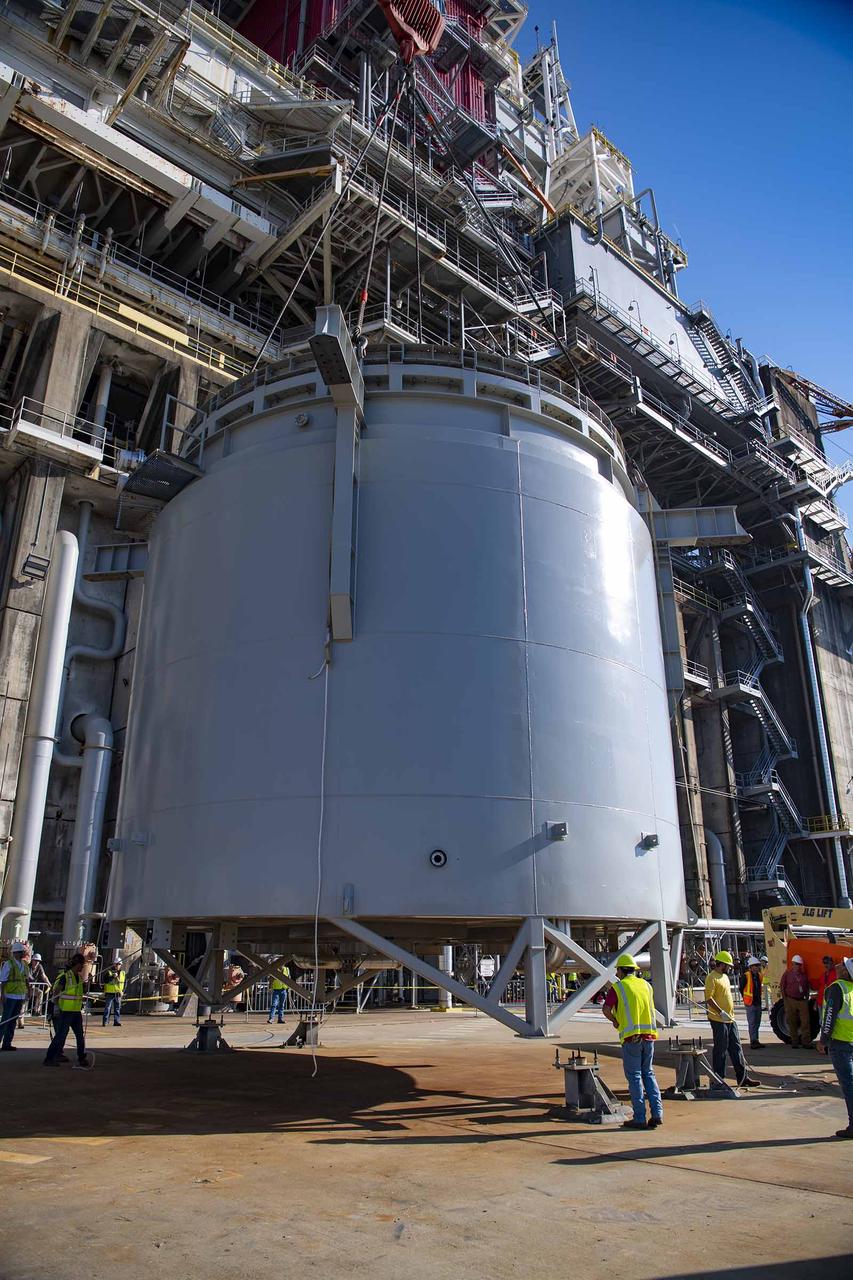
Teams at NASA’s Stennis Space Center complete a safe lift and install of an interstage simulator unit needed for future testing of NASA’s exploration upper stage (EUS) in the B-2 position of the Thad Cochran Test Stand. The lift and install, completed over a two-week period that began Oct. 10, marks a milestone for testing the new SLS (Space Launch System) rocket stage that will fly on future Artemis missions to the Moon and beyond. The EUS will undergo a series of Green Run tests of its integrated systems prior to its first flight. During testing, the interstage simulator component will function like the SLS interstage section that helps protect the upper stage during Artemis launches.
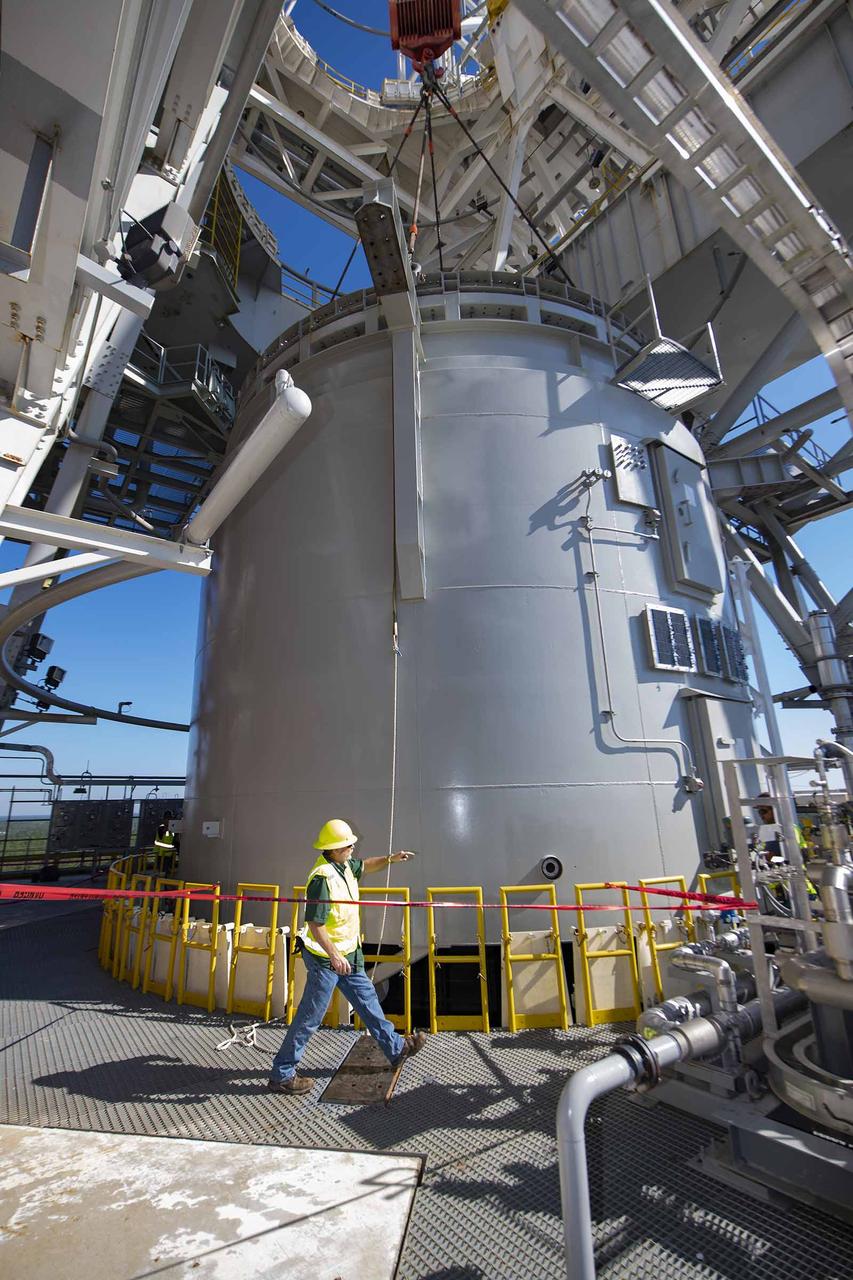
Teams at NASA’s Stennis Space Center complete a safe lift and install of an interstage simulator unit needed for future testing of NASA’s exploration upper stage (EUS) in the B-2 position of the Thad Cochran Test Stand. The lift and install, completed over a two-week period that began Oct. 10, marks a milestone for testing the new SLS (Space Launch System) rocket stage that will fly on future Artemis missions to the Moon and beyond. The EUS will undergo a series of Green Run tests of its integrated systems prior to its first flight. During testing, the interstage simulator component will function like the SLS interstage section that helps protect the upper stage during Artemis launches.
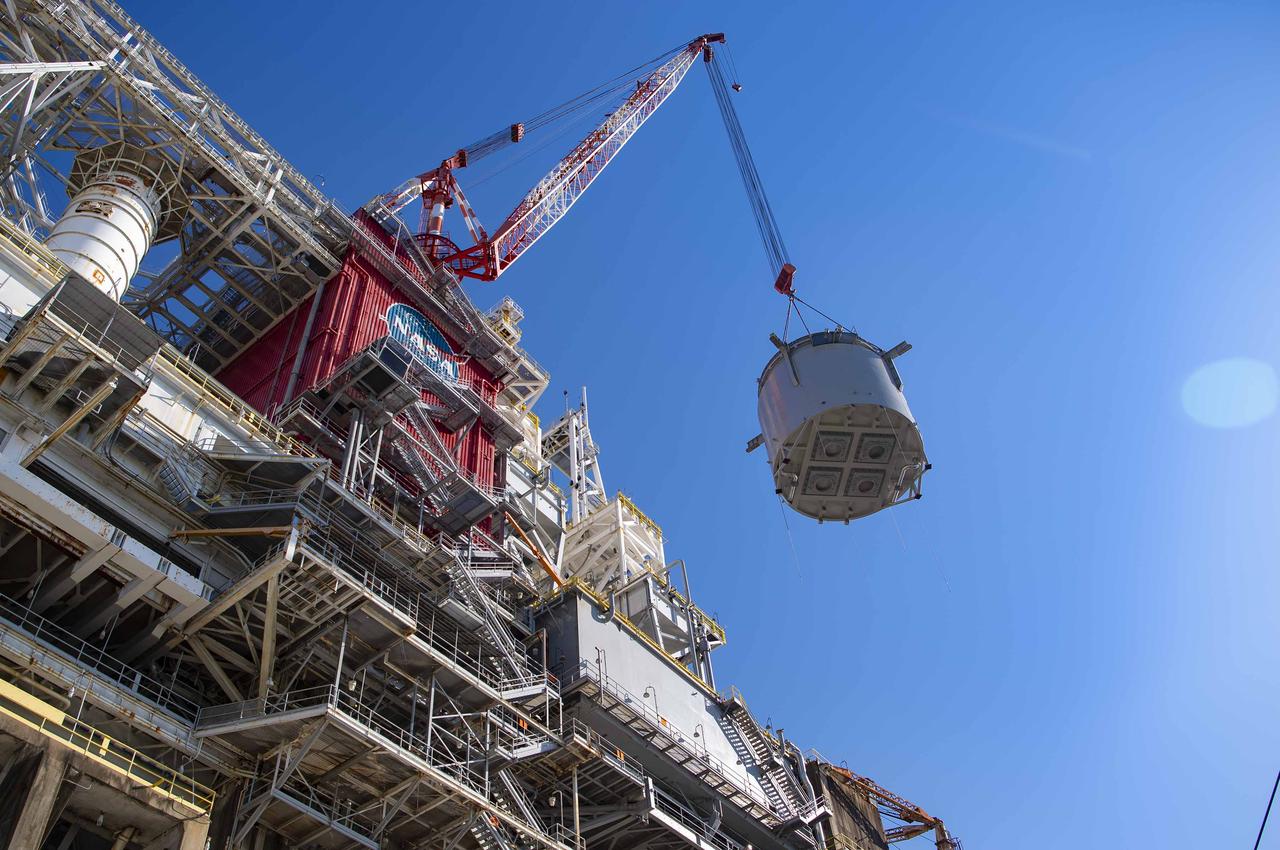
Teams at NASA’s Stennis Space Center complete a safe lift and install of an interstage simulator unit needed for future testing of NASA’s exploration upper stage (EUS) in the B-2 position of the Thad Cochran Test Stand. The lift and install, completed over a two-week period that began Oct. 10, marks a milestone for testing the new SLS (Space Launch System) rocket stage that will fly on future Artemis missions to the Moon and beyond. The EUS will undergo a series of Green Run tests of its integrated systems prior to its first flight. During testing, the interstage simulator component will function like the SLS interstage section that helps protect the upper stage during Artemis launches.
Teams at NASA’s Stennis Space Center complete a safe lift and install of an interstage simulator unit needed for future testing of NASA’s exploration upper stage (EUS) in the B-2 position of the Thad Cochran Test Stand. The lift and install, completed over a two-week period that began Oct. 10, marks a milestone for testing the new SLS (Space Launch System) rocket stage that will fly on future Artemis missions to the Moon and beyond. The EUS will undergo a series of Green Run tests of its integrated systems prior to its first flight. During testing, the interstage simulator component will function like the SLS interstage section that helps protect the upper stage during Artemis launches.
Teams at NASA’s Stennis Space Center complete a safe lift and install of an interstage simulator unit needed for future testing of NASA’s exploration upper stage (EUS) in the B-2 position of the Thad Cochran Test Stand. The lift and install, completed over a two-week period that began Oct. 10, marks a milestone for testing the new SLS (Space Launch System) rocket stage that will fly on future Artemis missions to the Moon and beyond. The EUS will undergo a series of Green Run tests of its integrated systems prior to its first flight. During testing, the interstage simulator component will function like the SLS interstage section that helps protect the upper stage during Artemis launches.
Teams at NASA’s Stennis Space Center complete a safe lift and install of an interstage simulator unit needed for future testing of NASA’s exploration upper stage (EUS) in the B-2 position of the Thad Cochran Test Stand. The lift and install, completed over a two-week period that began Oct. 10, marks a milestone for testing the new SLS (Space Launch System) rocket stage that will fly on future Artemis missions to the Moon and beyond. The EUS will undergo a series of Green Run tests of its integrated systems prior to its first flight. During testing, the interstage simulator component will function like the SLS interstage section that helps protect the upper stage during Artemis launches.
Teams at NASA’s Stennis Space Center complete a safe lift and install of an interstage simulator unit needed for future testing of NASA’s exploration upper stage (EUS) in the B-2 position of the Thad Cochran Test Stand. The lift and install, completed over a two-week period that began Oct. 10, marks a milestone for testing the new SLS (Space Launch System) rocket stage that will fly on future Artemis missions to the Moon and beyond. The EUS will undergo a series of Green Run tests of its integrated systems prior to its first flight. During testing, the interstage simulator component will function like the SLS interstage section that helps protect the upper stage during Artemis launches.
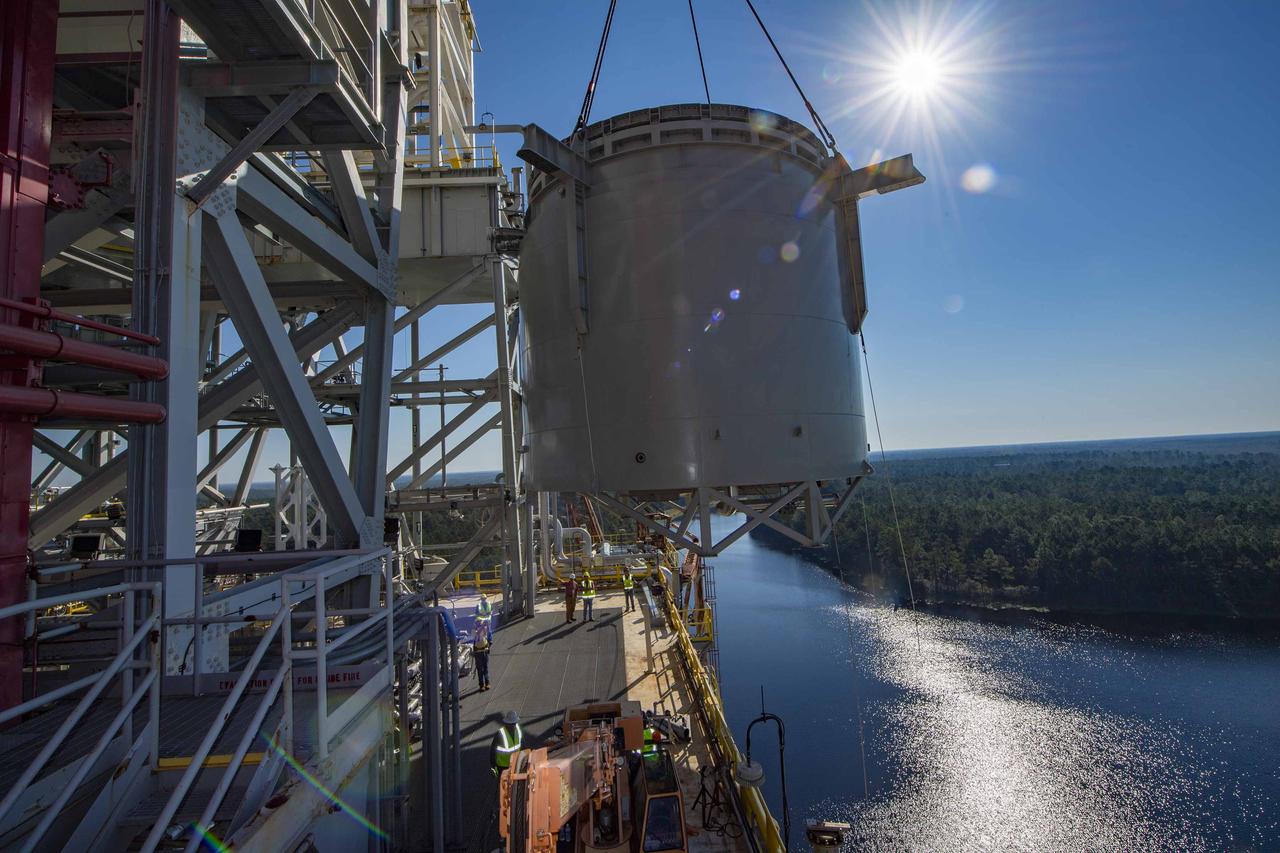
Teams at NASA’s Stennis Space Center complete a safe lift and install of an interstage simulator unit needed for future testing of NASA’s exploration upper stage (EUS) in the B-2 position of the Thad Cochran Test Stand. The lift and install, completed over a two-week period that began Oct. 10, marks a milestone for testing the new SLS (Space Launch System) rocket stage that will fly on future Artemis missions to the Moon and beyond. The EUS will undergo a series of Green Run tests of its integrated systems prior to its first flight. During testing, the interstage simulator component will function like the SLS interstage section that helps protect the upper stage during Artemis launches.
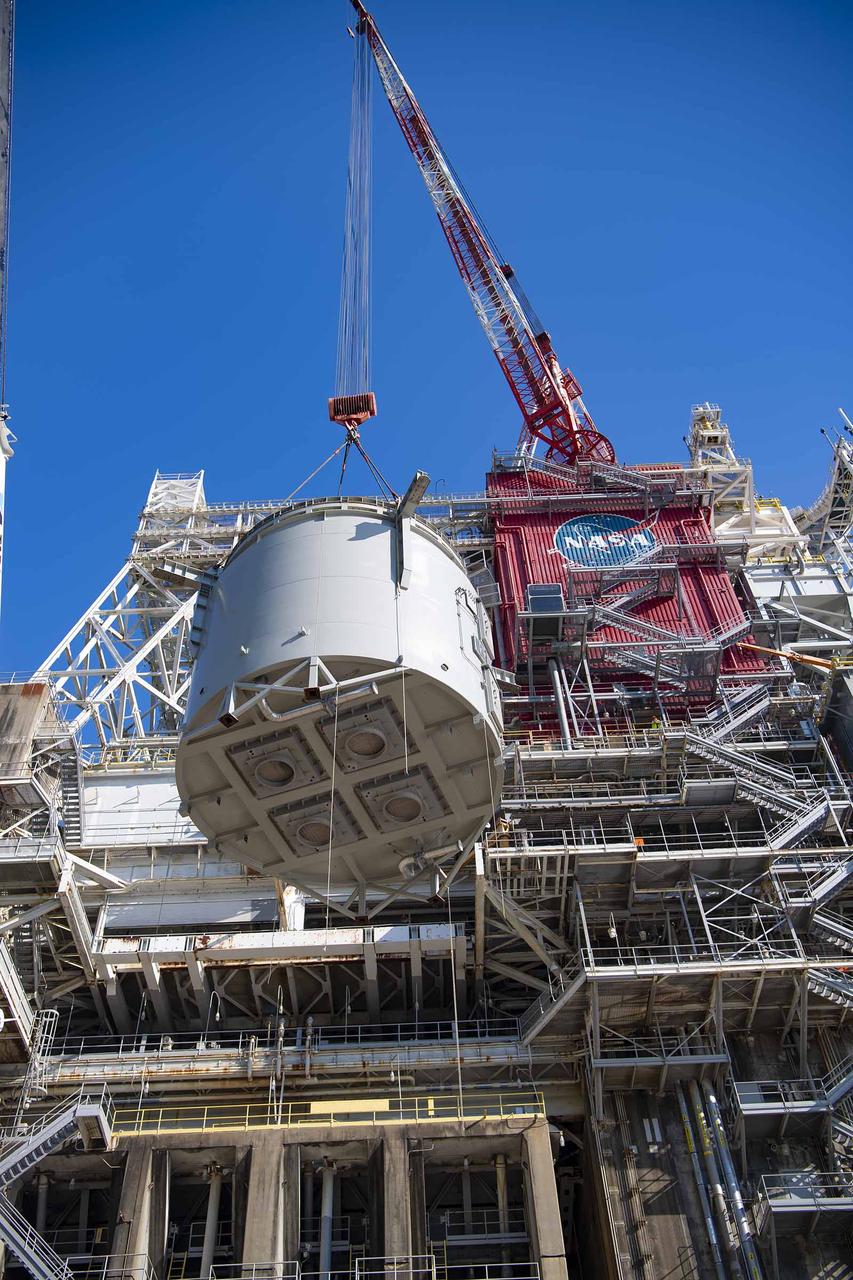
Teams at NASA’s Stennis Space Center complete a safe lift and install of an interstage simulator unit needed for future testing of NASA’s exploration upper stage (EUS) in the B-2 position of the Thad Cochran Test Stand. The lift and install, completed over a two-week period that began Oct. 10, marks a milestone for testing the new SLS (Space Launch System) rocket stage that will fly on future Artemis missions to the Moon and beyond. The EUS will undergo a series of Green Run tests of its integrated systems prior to its first flight. During testing, the interstage simulator component will function like the SLS interstage section that helps protect the upper stage during Artemis launches.
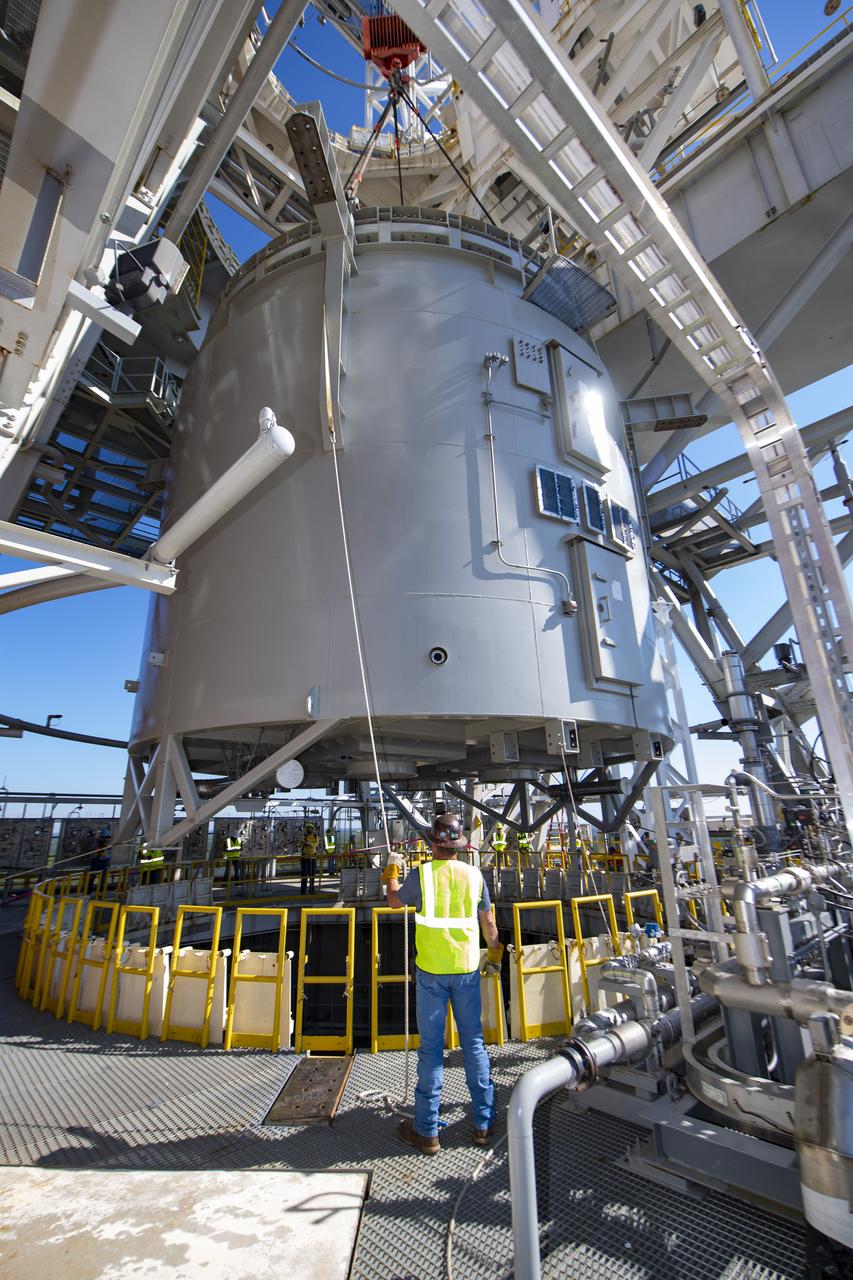
Teams at NASA’s Stennis Space Center complete a safe lift and install of an interstage simulator unit needed for future testing of NASA’s exploration upper stage (EUS) in the B-2 position of the Thad Cochran Test Stand. The lift and install, completed over a two-week period that began Oct. 10, marks a milestone for testing the new SLS (Space Launch System) rocket stage that will fly on future Artemis missions to the Moon and beyond. The EUS will undergo a series of Green Run tests of its integrated systems prior to its first flight. During testing, the interstage simulator component will function like the SLS interstage section that helps protect the upper stage during Artemis launches.
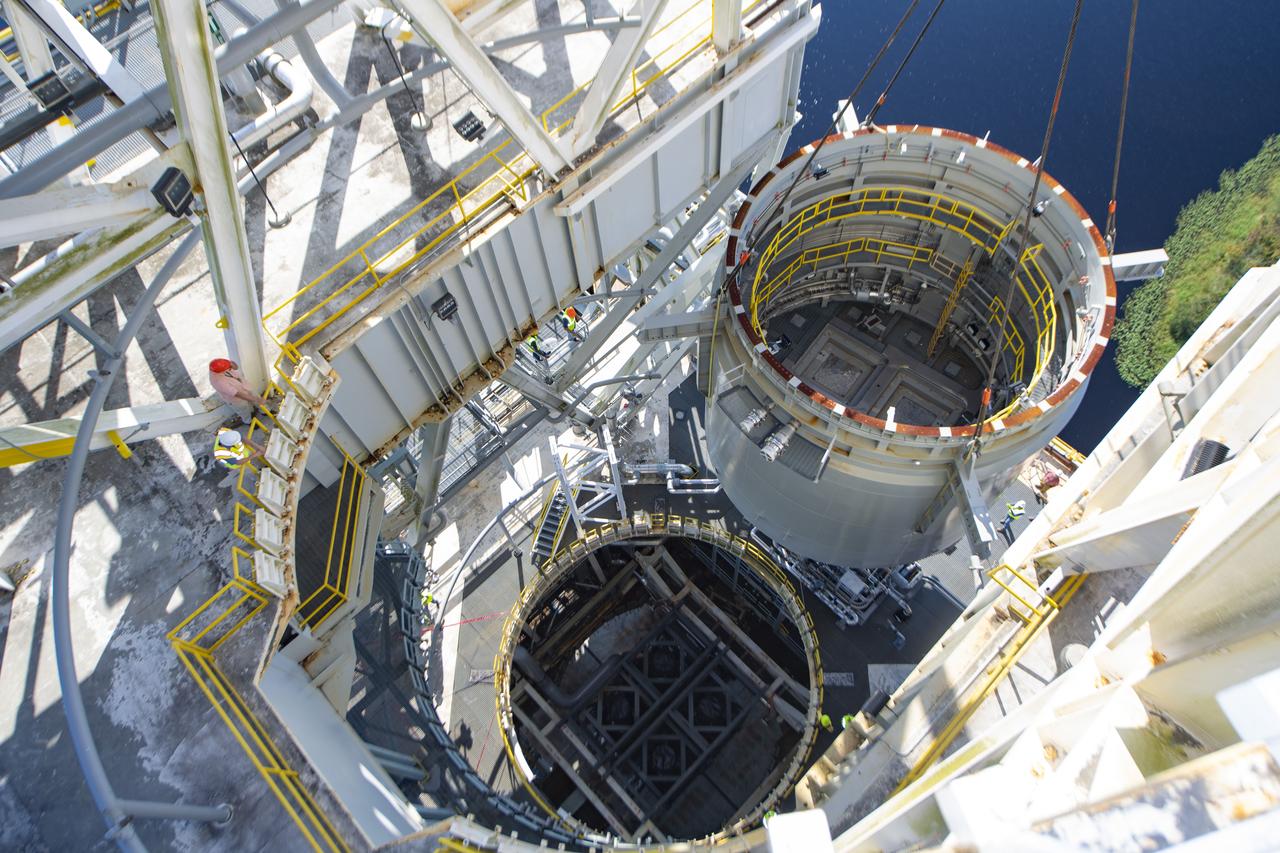
Teams at NASA’s Stennis Space Center complete a safe lift and install of an interstage simulator unit needed for future testing of NASA’s exploration upper stage (EUS) in the B-2 position of the Thad Cochran Test Stand. The lift and install, completed over a two-week period that began Oct. 10, marks a milestone for testing the new SLS (Space Launch System) rocket stage that will fly on future Artemis missions to the Moon and beyond. The EUS will undergo a series of Green Run tests of its integrated systems prior to its first flight. During testing, the interstage simulator component will function like the SLS interstage section that helps protect the upper stage during Artemis launches.
KENNEDY SPACE CENTER, FLA. - In the mobile service tower on Pad 17-B, Cape Canaveral Air Force Station , Fla., the Boeing Delta II interstage adapter is being lowered out of the tower. The interstage adapter was found to be faulty during a review of launch vehicle hardware. It will be replaced, and the second stage previously removed will be re-installed within a few days. Launch of Deep Impact is now scheduled no earlier than Jan. 12.
KENNEDY SPACE CENTER, FLA. - In the mobile service tower on Pad 17-B, Cape Canaveral Air Force Station , Fla., the Boeing Delta II interstage adapter is lifted away from the center body section. The interstage adapter was found to be faulty during a review of launch vehicle hardware. It will be replaced, and the second stage previously removed will be re-installed within a few days. Launch of Deep Impact is now scheduled no earlier than Jan. 12.
KENNEDY SPACE CENTER, FLA. - In the mobile service tower on Pad 17-B, Cape Canaveral Air Force Station , Fla., the Boeing Delta II interstage adapter is being removed. The interstage adapter was found to be faulty during a review of launch vehicle hardware. It will be replaced, and the second stage previously removed will be re-installed within a few days. Launch of Deep Impact is now scheduled no earlier than Jan. 12.
KENNEDY SPACE CENTER, FLA. - In the mobile service tower on Pad 17-B, Cape Canaveral Air Force Station , Fla., the Boeing Delta II interstage adapter is being lifted away from the center body section. The interstage adapter was found to be faulty during a review of launch vehicle hardware. It will be replaced, and the second stage previously removed will be re-installed within a few days. Launch of Deep Impact is now scheduled no earlier than Jan. 12.
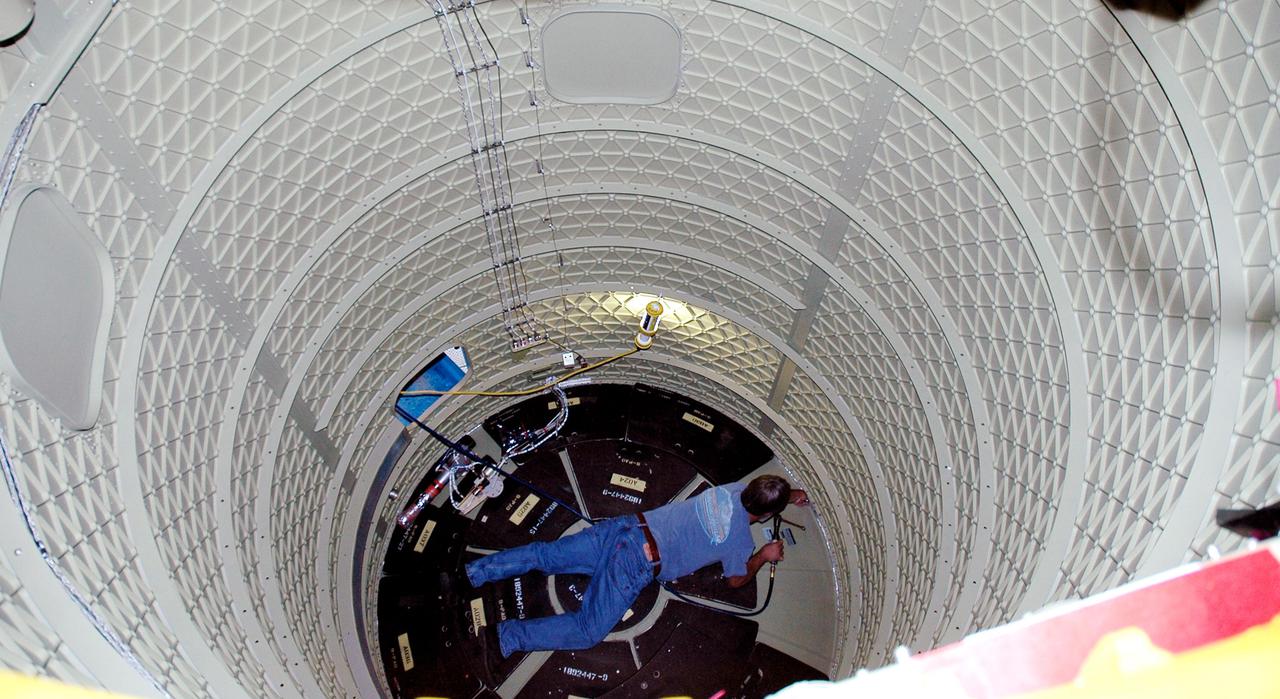
KENNEDY SPACE CENTER, FLA. - In the mobile service tower on Pad 17-B, Cape Canaveral Air Force Station , Fla., a technician works inside the Boeing Delta II interstage adapter, which is being removed. The interstage adapter was found to be faulty during a review of launch vehicle hardware. It will be replaced, and the second stage previously removed will be re-installed within a few days. Launch of Deep Impact is now scheduled no earlier than Jan. 12.
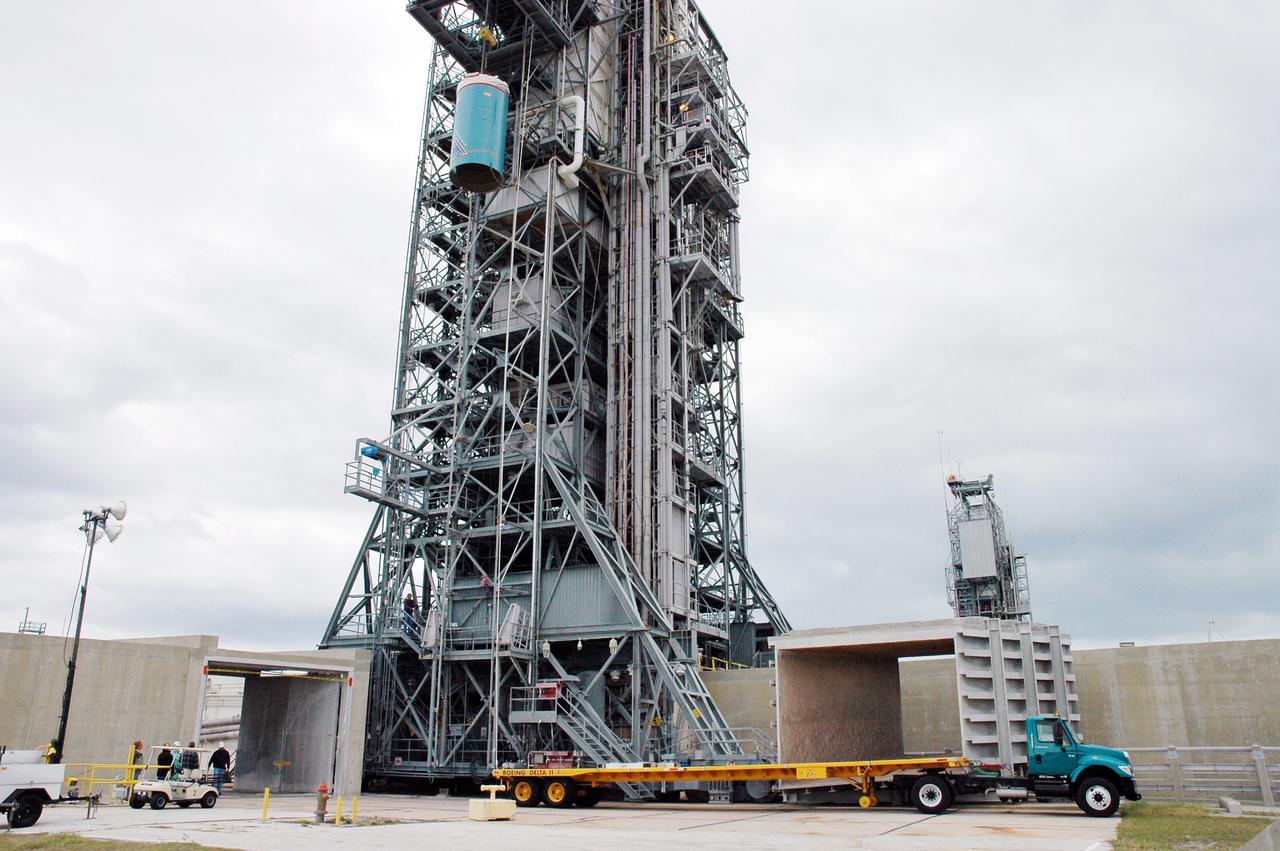
KENNEDY SPACE CENTER, FLA. - On Pad 17-B, Cape Canaveral Air Force Station , Fla., Boeing Delta II interstage adapter is seen being lowered toward the pad. The interstage adapter was found to be faulty during a review of launch vehicle hardware. It will be replaced, and the second stage previously removed will be re-installed within a few days. Launch of Deep Impact is now scheduled no earlier than Jan. 12.
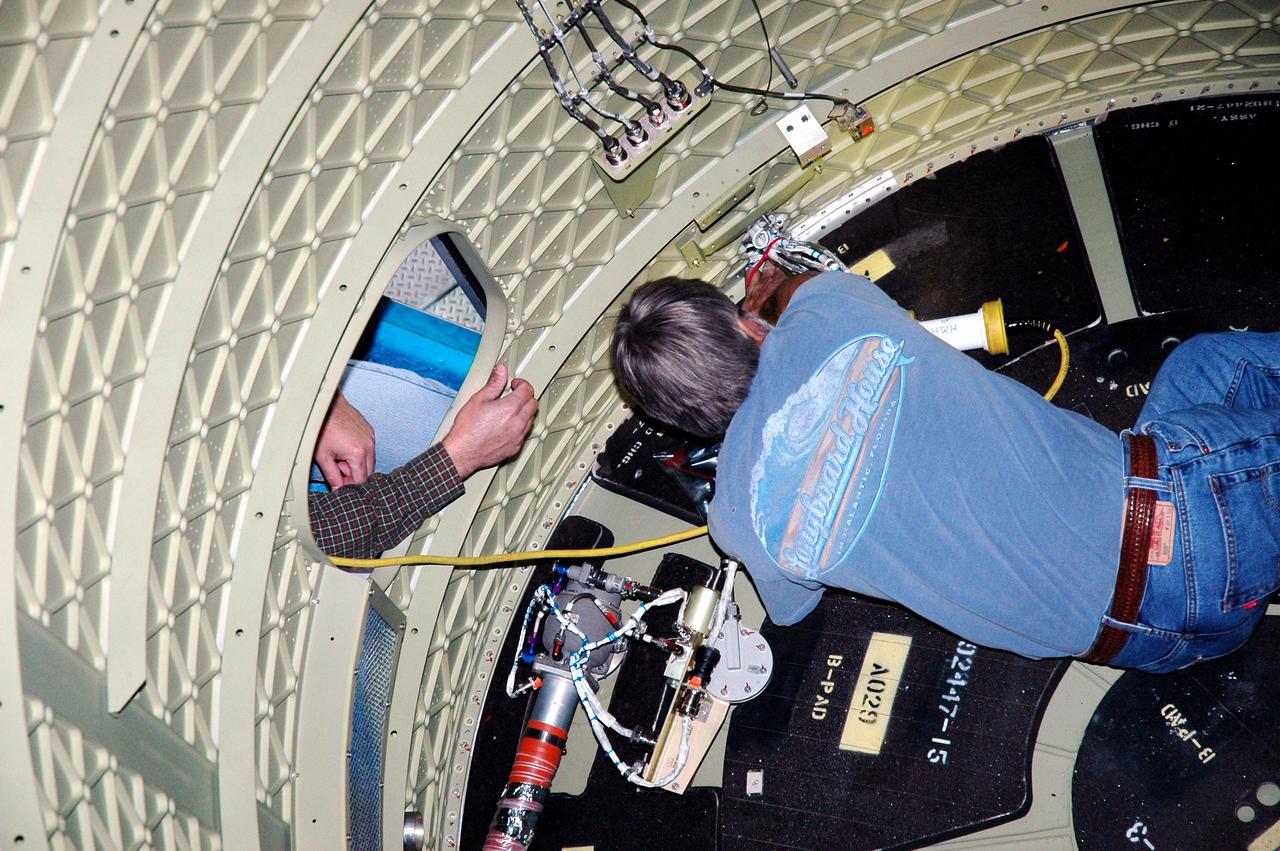
KENNEDY SPACE CENTER, FLA. - In the mobile service tower on Pad 17-B, Cape Canaveral Air Force Station , Fla., a technician works inside the Boeing Delta II interstage adapter, which is being removed. The interstage adapter was found to be faulty during a review of launch vehicle hardware. It will be replaced, and the second stage previously removed will be re-installed within a few days. Launch of Deep Impact is now scheduled no earlier than Jan. 12.
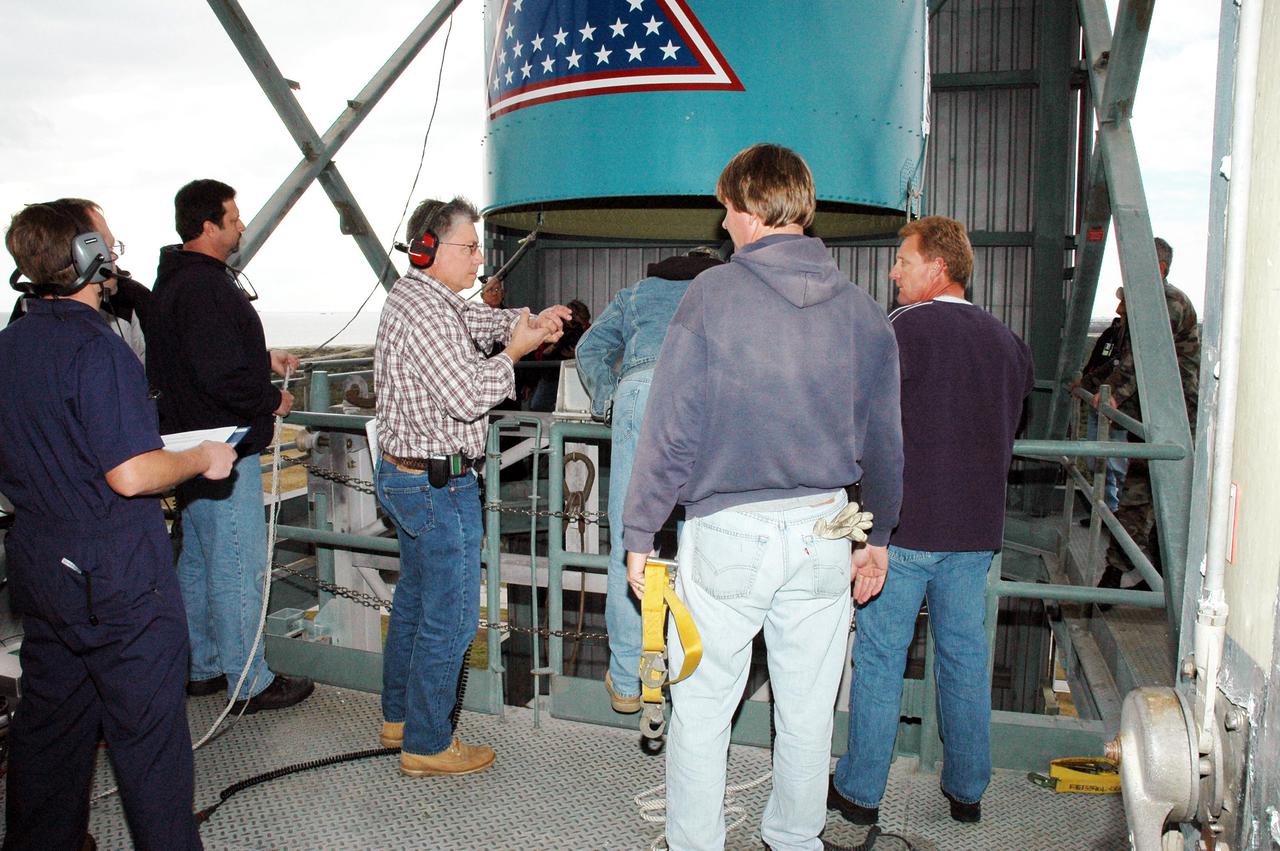
KENNEDY SPACE CENTER, FLA. - In the mobile service tower on Pad 17-B, Cape Canaveral Air Force Station , Fla., the Boeing Delta II interstage adapter is being lowered out of the tower. The interstage adapter was found to be faulty during a review of launch vehicle hardware. It will be replaced, and the second stage previously removed will be re-installed within a few days. Launch of Deep Impact is now scheduled no earlier than Jan. 12.
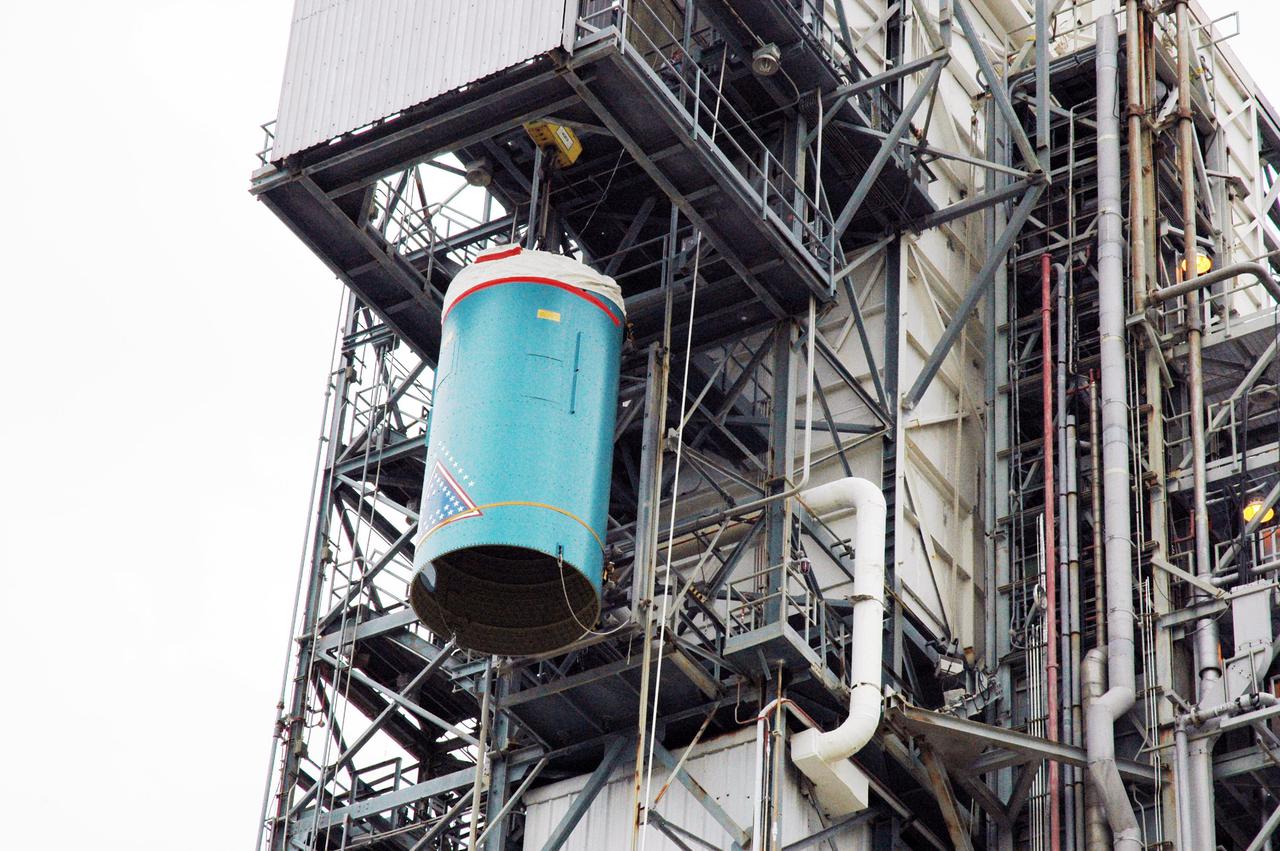
KENNEDY SPACE CENTER, FLA. - On Pad 17-B, Cape Canaveral Air Force Station , Fla., Boeing Delta II interstage adapter is seen being lowered toward the pad. The interstage adapter was found to be faulty during a review of launch vehicle hardware. It will be replaced, and the second stage previously removed will be re-installed within a few days. Launch of Deep Impact is now scheduled no earlier than Jan. 12.

KENNEDY SPACE CENTER, FLA. - On Pad 17-B, Cape Canaveral Air Force Station , Fla., Boeing Delta II interstage adapter reaches the pad after being removed from the center body section. The interstage adapter was found to be faulty during a review of launch vehicle hardware. It will be replaced, and the second stage previously removed will be re-installed within a few days. Launch of Deep Impact is now scheduled no earlier than Jan. 12.
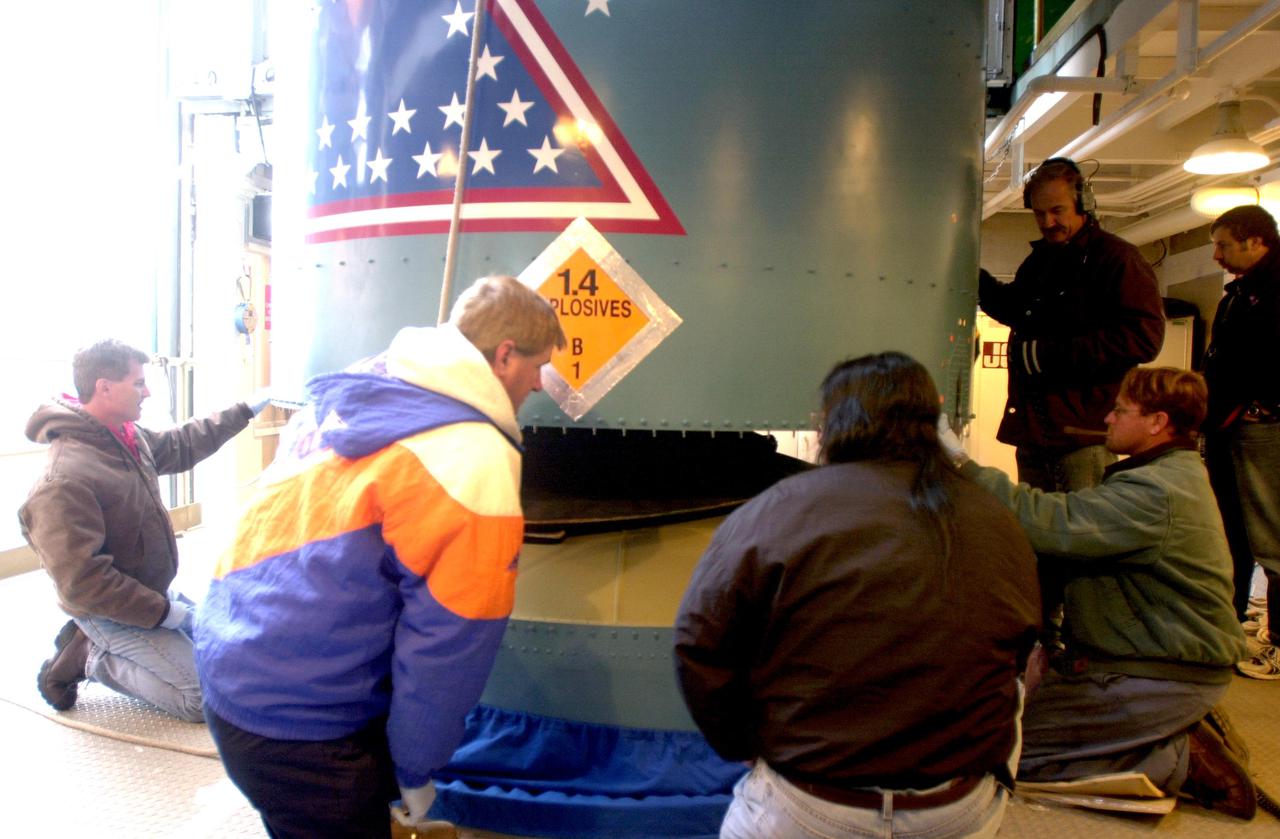
VANDENBERG AIR FORCE BASE, CALIF. - The interstage of a Boeing Delta 2 rocket is mated with the interstage adapter below it in the launch service tower on Space Launch Complex 2 at Vandenberg Air Force Base in California. The Delta 2 is the launch vehicle for the National Oceanic and Atmospheric Administration (NOAA-N) spacecraft. NOAA-N is the fourth in the series of support dedicated microwave instruments for the generation of temperature, moisture, surface, and hydrological products in cloudy regions where visible and infrared (IR) instruments have decreased capability. Launch aboard a Boeing Delta II rocket is currently scheduled for no earlier than May 11, 2005.
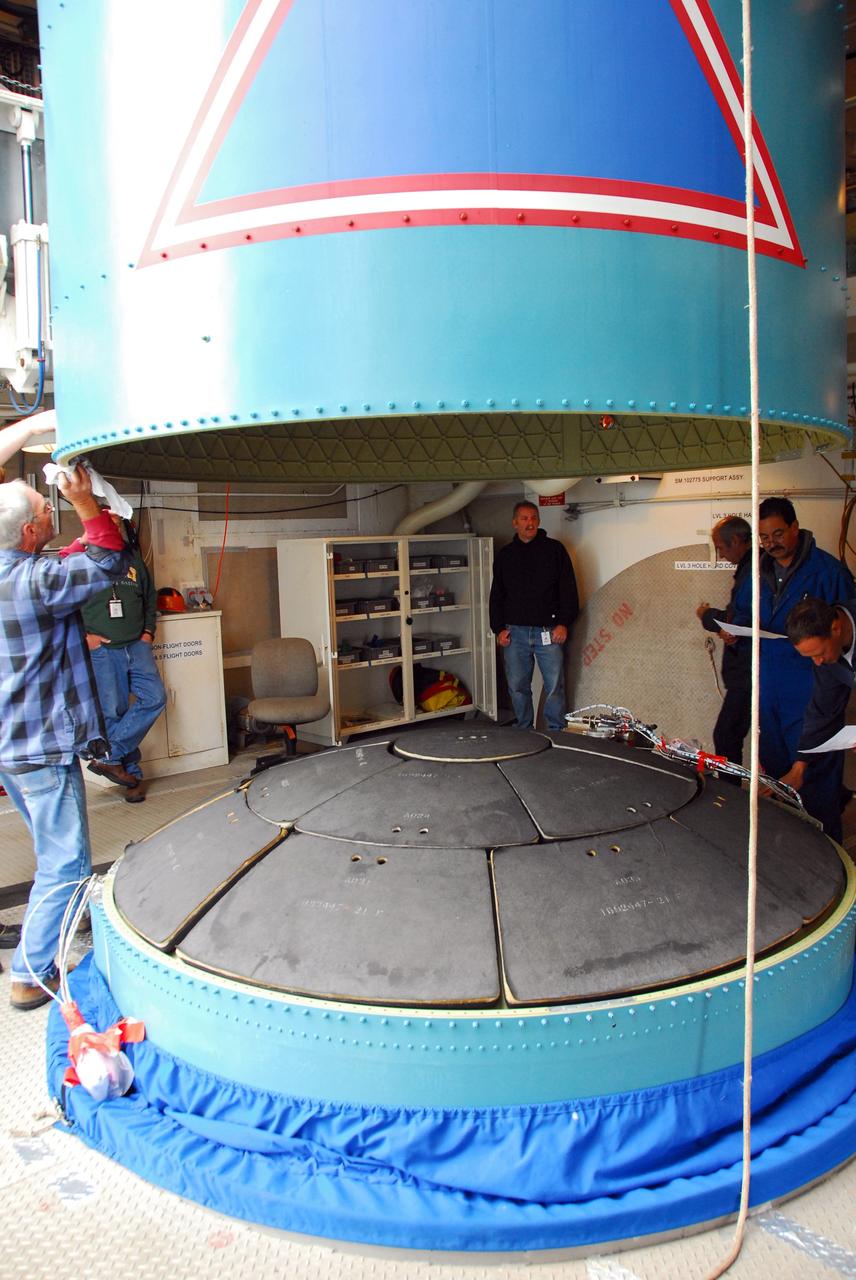
VANDENBERG AIR FORCE BASE, Calif. -- At NASA's Space Launch Complex-2 on Vandenberg Air Force Base in California, the interstage of the United Launch Alliance Delta II that will carry NASA's National Polar-orbiting Operational Environmental Satellite System Preparatory Project (NPP) satellite into space is lowered toward the rocket's first stage. The interstage provides an interface between the launch vehicle's first and second stages. NPP represents a critical first step in building the next-generation of Earth-observing satellites. NPP will carry the first of the new sensors developed for this satellite fleet, now known as the Joint Polar Satellite System (JPSS) to be launched in 2016. NPP is the bridge between NASA's Earth Observing System (EOS) satellites and the forthcoming series of JPSS satellites. The mission will test key technologies and instruments for the JPSS missions. For more information, visit http://www.nasa.gov/NPP. Photo credit: NASA/VAFB, Rudy Bledsoe
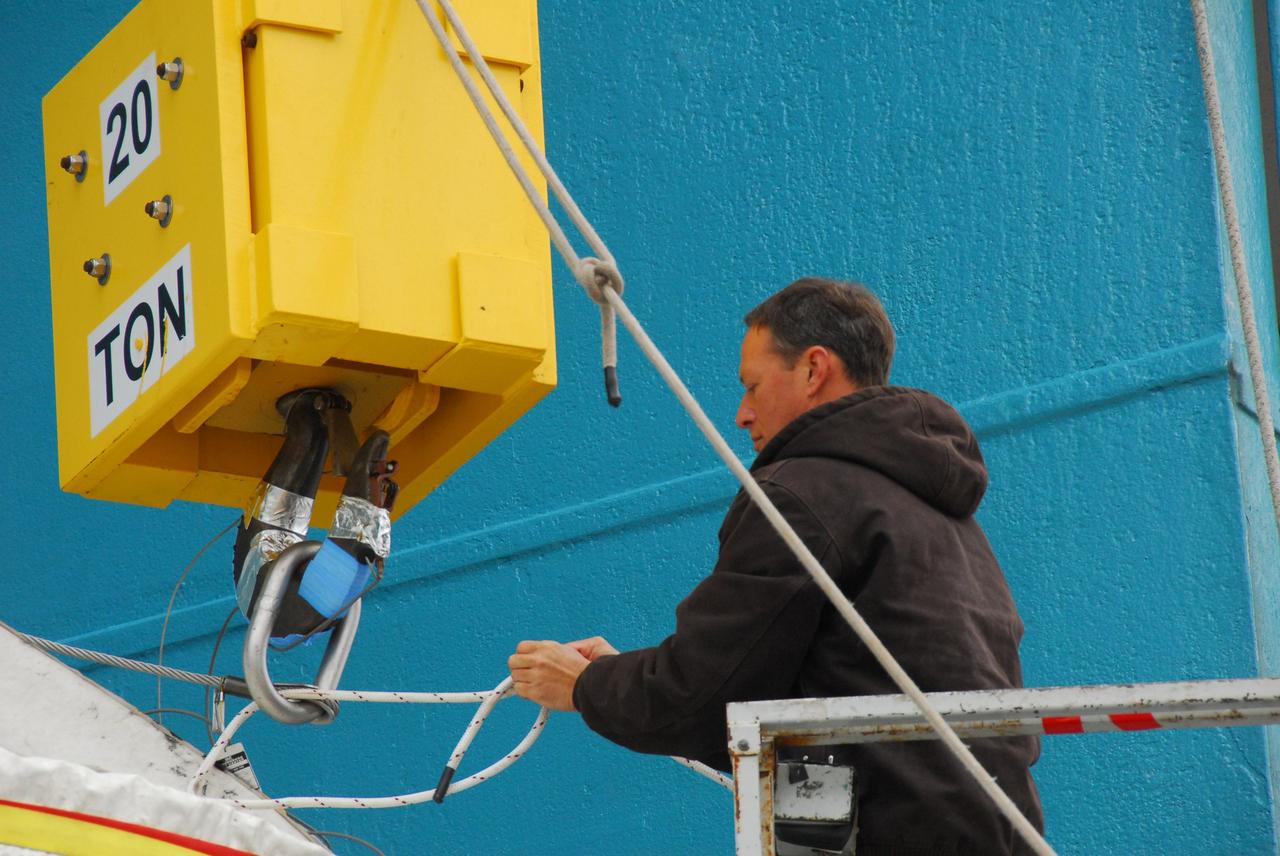
VANDENBERG AIR FORCE BASE, Calif. -- At NASA's Space Launch Complex-2 on Vandenberg Air Force Base in California, a spacecraft technician secures the interstage of the United Launch Alliance Delta II that will carry NASA's National Polar-orbiting Operational Environmental Satellite System Preparatory Project (NPP) satellite into space to a lifting device. The interstage provides an interface between the launch vehicle's first and second stages. NPP represents a critical first step in building the next-generation of Earth-observing satellites. NPP will carry the first of the new sensors developed for this satellite fleet, now known as the Joint Polar Satellite System (JPSS) to be launched in 2016. NPP is the bridge between NASA's Earth Observing System (EOS) satellites and the forthcoming series of JPSS satellites. The mission will test key technologies and instruments for the JPSS missions. For more information, visit http://www.nasa.gov/NPP. Photo credit: NASA/VAFB, Rudy Bledsoe
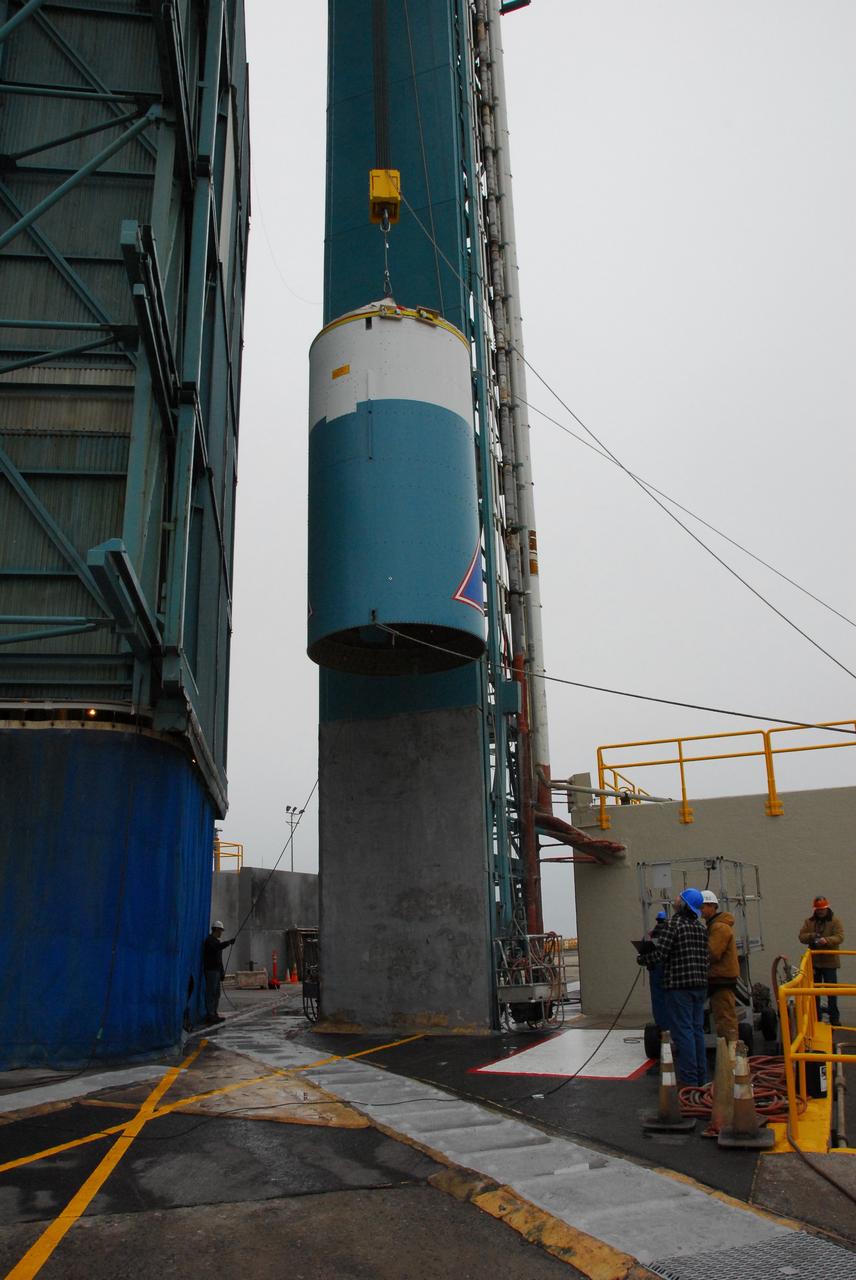
VANDENBERG AIR FORCE BASE, Calif. -- At Vandenberg Air Force Base in California, the interstage of the United Launch Alliance Delta II that will carry NASA's National Polar-orbiting Operational Environmental Satellite System Preparatory Project (NPP) satellite into space is lifted up the side of NASA's Space Launch Complex-2. The interstage provides an interface between the launch vehicle's first and second stages. NPP represents a critical first step in building the next-generation of Earth-observing satellites. NPP will carry the first of the new sensors developed for this satellite fleet, now known as the Joint Polar Satellite System (JPSS) to be launched in 2016. NPP is the bridge between NASA's Earth Observing System (EOS) satellites and the forthcoming series of JPSS satellites. The mission will test key technologies and instruments for the JPSS missions. For more information, visit http://www.nasa.gov/NPP. Photo credit: NASA/VAFB, Rudy Bledsoe
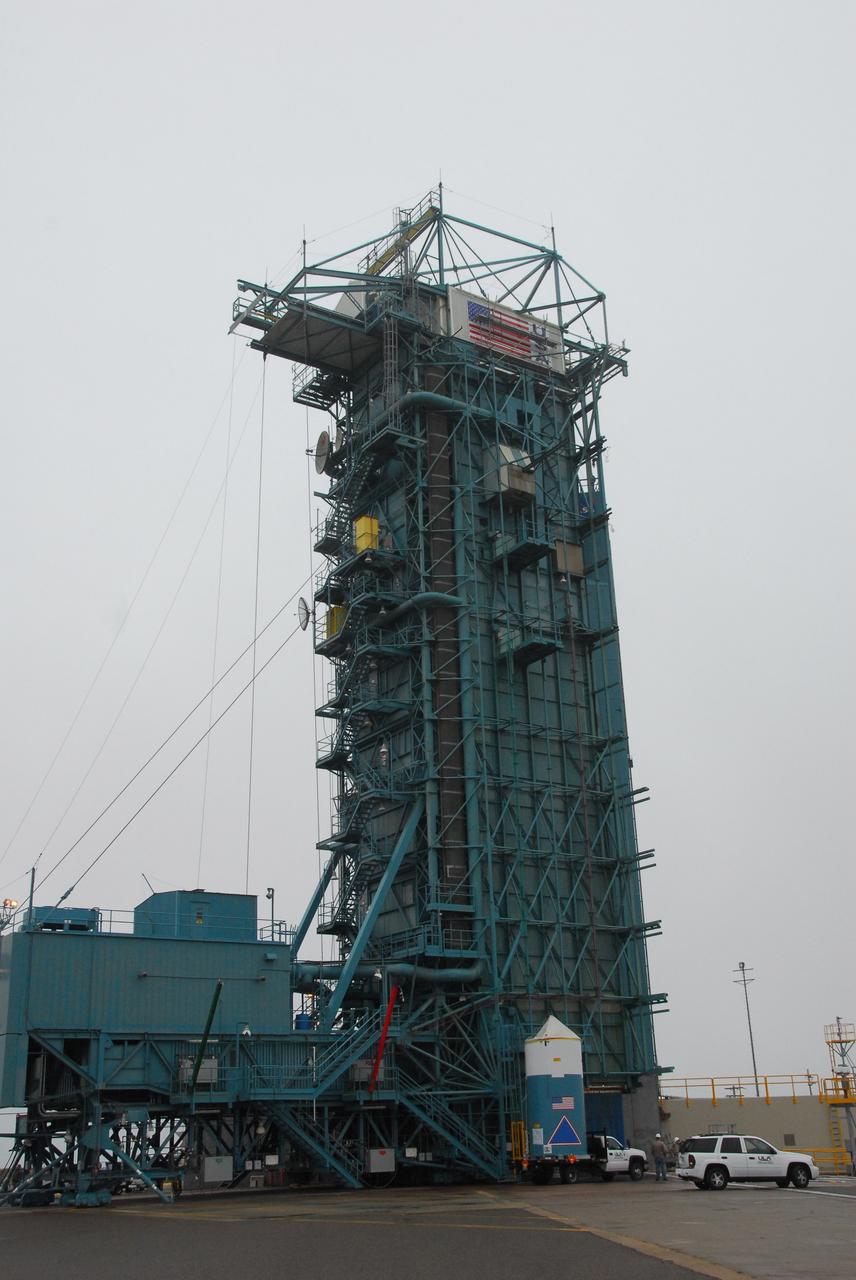
VANDENBERG AIR FORCE BASE, Calif. -- At Vandenberg Air Force Base in California, the interstage of the United Launch Alliance Delta II that will carry NASA's National Polar-orbiting Operational Environmental Satellite System Preparatory Project (NPP) satellite into space arrives at NASA's Space Launch Complex-2. The interstage provides an interface between the launch vehicle's first and second stages. NPP represents a critical first step in building the next-generation of Earth-observing satellites. NPP will carry the first of the new sensors developed for this satellite fleet, now known as the Joint Polar Satellite System (JPSS) to be launched in 2016. NPP is the bridge between NASA's Earth Observing System (EOS) satellites and the forthcoming series of JPSS satellites. The mission will test key technologies and instruments for the JPSS missions. For more information, visit http://www.nasa.gov/NPP. Photo credit: NASA/VAFB, Rudy Bledsoe
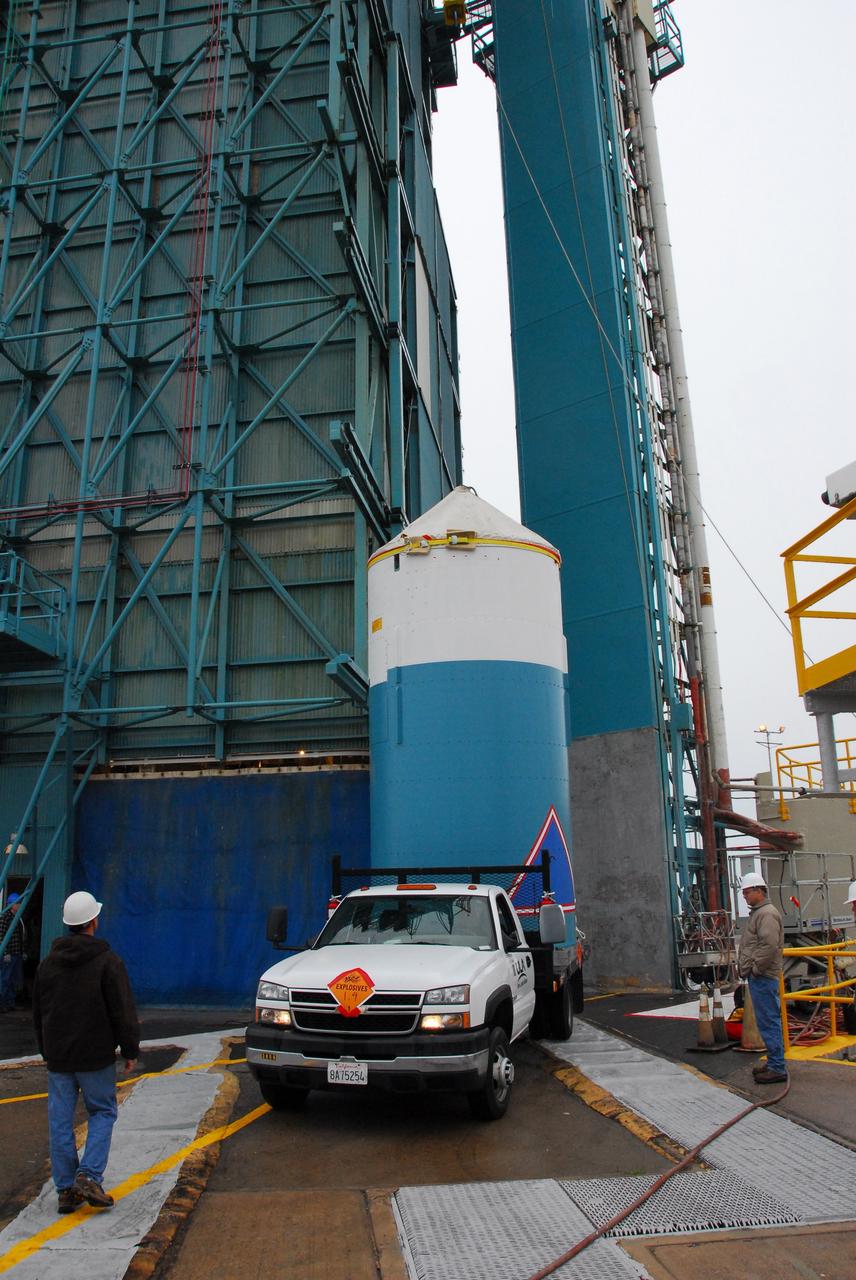
VANDENBERG AIR FORCE BASE, Calif. -- At Vandenberg Air Force Base in California, preparations are under way to lift the interstage of the United Launch Alliance Delta II that will carry NASA's National Polar-orbiting Operational Environmental Satellite System Preparatory Project (NPP) satellite into space at NASA's Space Launch Complex-2. The interstage provides an interface between the launch vehicle's first and second stages. NPP represents a critical first step in building the next-generation of Earth-observing satellites. NPP will carry the first of the new sensors developed for this satellite fleet, now known as the Joint Polar Satellite System (JPSS) to be launched in 2016. NPP is the bridge between NASA's Earth Observing System (EOS) satellites and the forthcoming series of JPSS satellites. The mission will test key technologies and instruments for the JPSS missions. For more information, visit http://www.nasa.gov/NPP. Photo credit: NASA/VAFB, Rudy Bledsoe
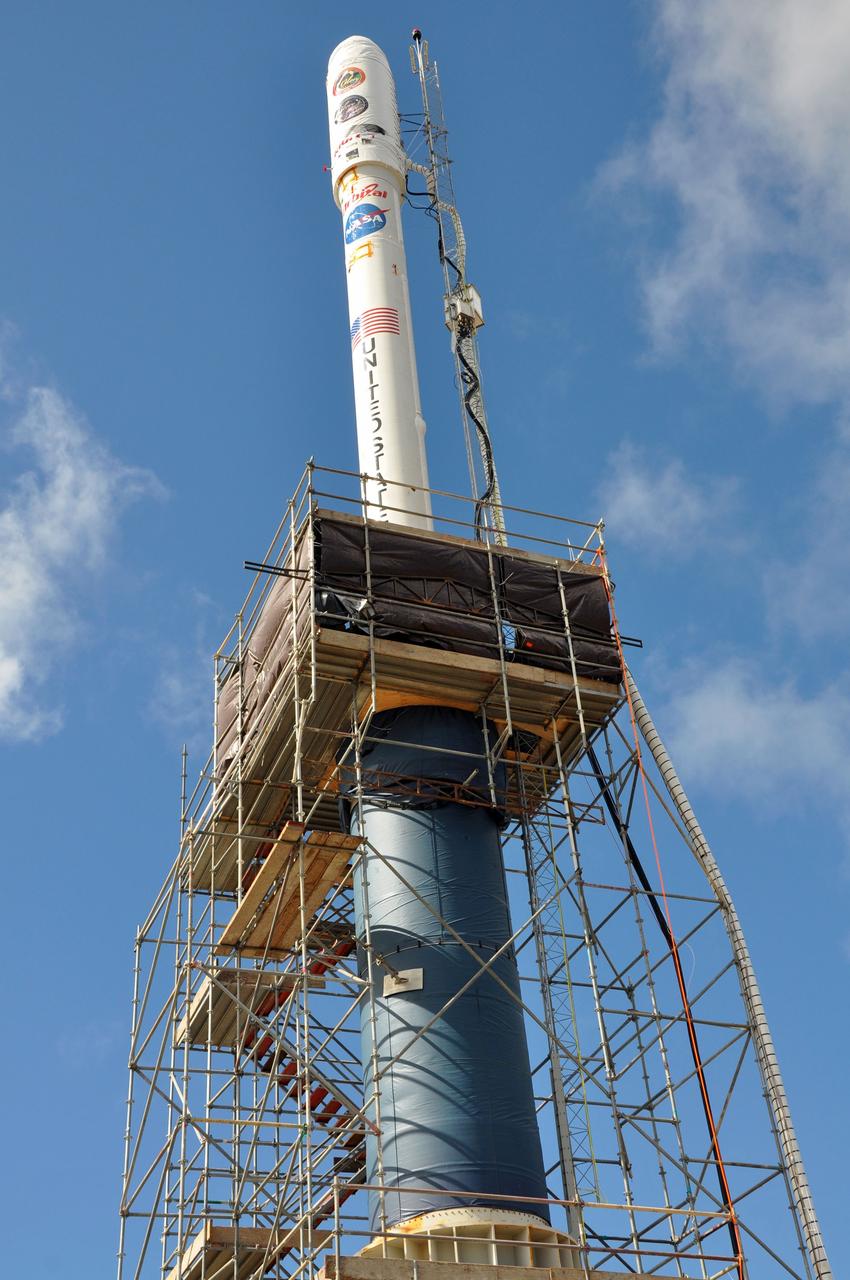
VANDENBERG AIR FORCE BASE, Calif. -- On Space Launch Complex 576-E at Vandenberg Air Force Base in California, the Taurus XL rocket is in its launch configuration. The upper stack, consisting of Stages 1, 2 and 3, as well as the encapsulated Glory spacecraft, is attached to an interstage and Stage 0 at the launch pad. The scaffolding around Stage 0 will be removed prior to next week's launch, after workers install 12 vent-door covers to the interstage. The Orbital Sciences Taurus XL rocket will launch Glory into low Earth orbit. Once Glory reaches orbit, it will collect data on the properties of aerosols and black carbon. It also will help scientists understand how the sun's irradiance affects Earth's climate. Launch is scheduled for 5:09 a.m. EST Feb. 23. For information, visit www.nasa.gov/glory. Photo credit: NASA/Randy Beaudoin, VAFB
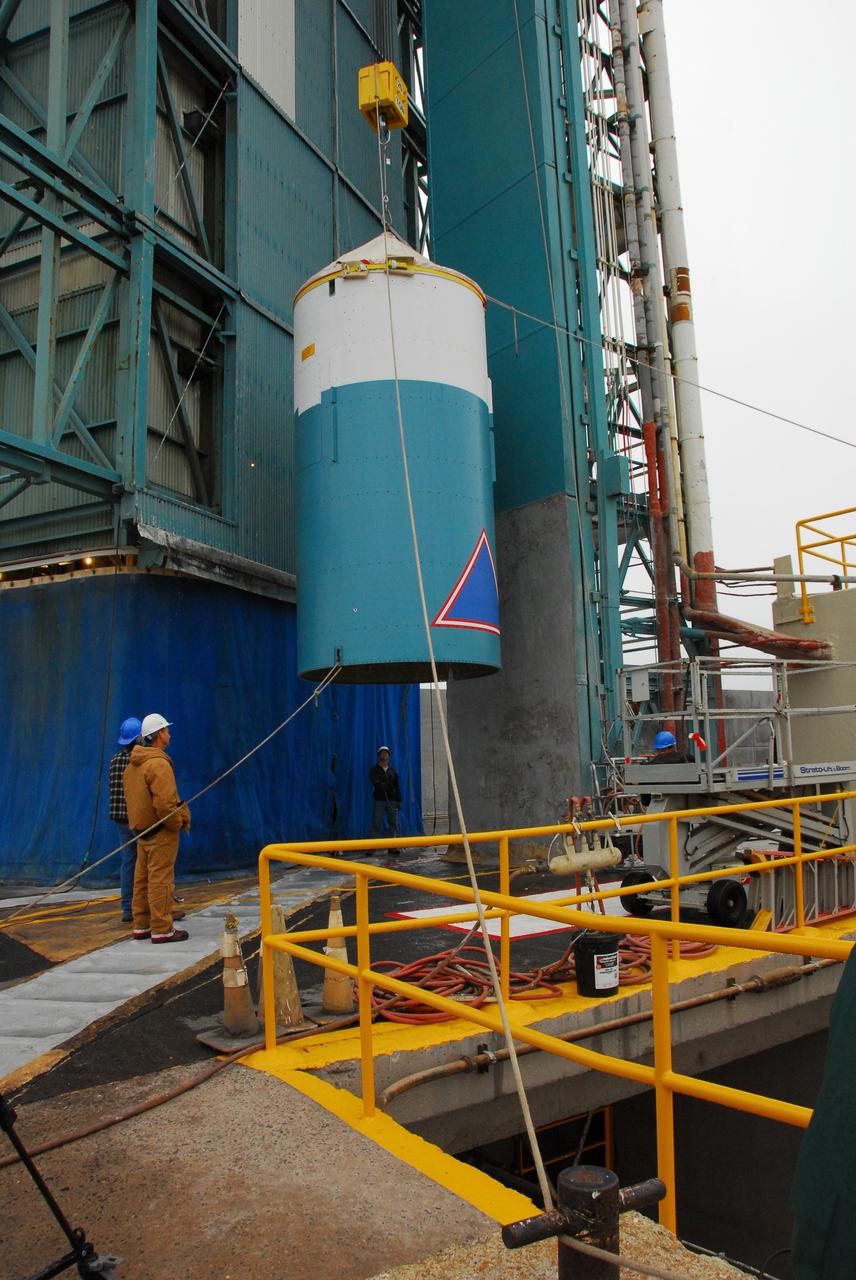
VANDENBERG AIR FORCE BASE, Calif. -- At Vandenberg Air Force Base in California, the interstage of the United Launch Alliance Delta II that will carry NASA's National Polar-orbiting Operational Environmental Satellite System Preparatory Project (NPP) satellite into space is lifted up the side of NASA's Space Launch Complex-2. The interstage provides an interface between the launch vehicle's first and second stages. NPP represents a critical first step in building the next-generation of Earth-observing satellites. NPP will carry the first of the new sensors developed for this satellite fleet, now known as the Joint Polar Satellite System (JPSS) to be launched in 2016. NPP is the bridge between NASA's Earth Observing System (EOS) satellites and the forthcoming series of JPSS satellites. The mission will test key technologies and instruments for the JPSS missions. For more information, visit http://www.nasa.gov/NPP. Photo credit: NASA/VAFB, Rudy Bledsoe
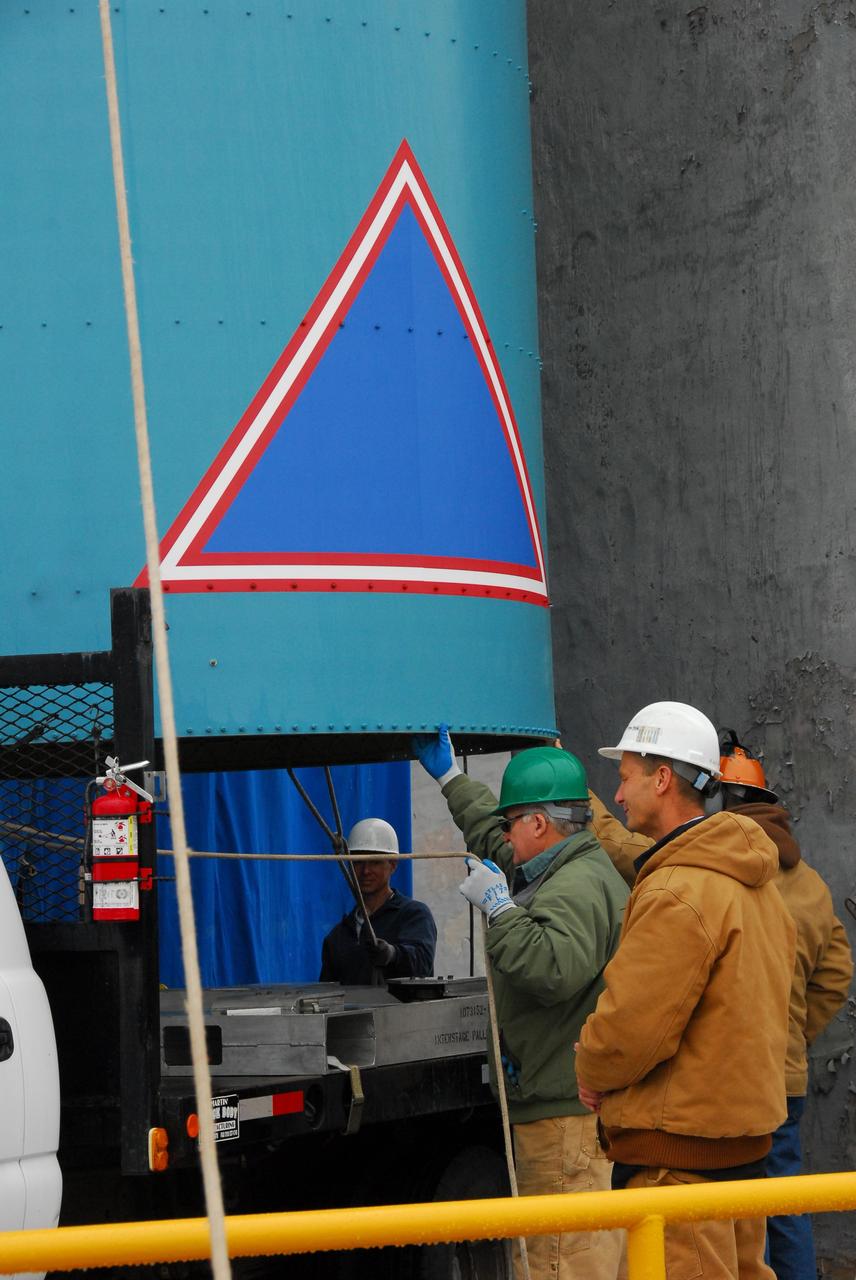
VANDENBERG AIR FORCE BASE, Calif. -- At NASA's Space Launch Complex-2 on Vandenberg Air Force Base in California, spacecraft technicians oversee the lift of the interstage of the United Launch Alliance Delta II that will carry NASA's National Polar-orbiting Operational Environmental Satellite System Preparatory Project (NPP) satellite into space from its transporter. The interstage provides an interface between the launch vehicle's first and second stages. NPP represents a critical first step in building the next-generation of Earth-observing satellites. NPP will carry the first of the new sensors developed for this satellite fleet, now known as the Joint Polar Satellite System (JPSS) to be launched in 2016. NPP is the bridge between NASA's Earth Observing System (EOS) satellites and the forthcoming series of JPSS satellites. The mission will test key technologies and instruments for the JPSS missions. For more information, visit http://www.nasa.gov/NPP. Photo credit: NASA/VAFB, Rudy Bledsoe
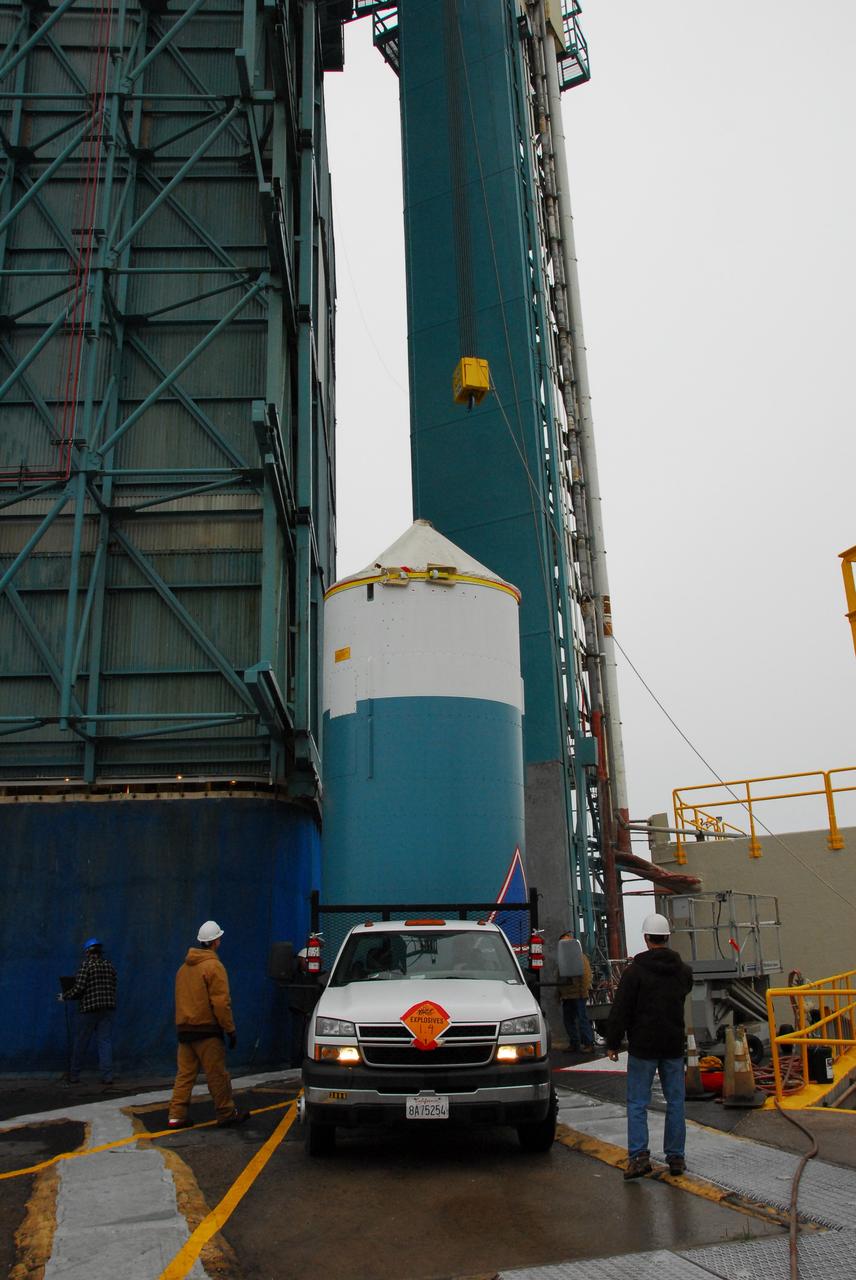
VANDENBERG AIR FORCE BASE, Calif. -- At NASA's Space Launch Complex-2 on Vandenberg Air Force Base in California, preparations are under way to attach the interstage of the United Launch Alliance Delta II that will carry NASA's National Polar-orbiting Operational Environmental Satellite System Preparatory Project (NPP) satellite into space to a lifting device. The interstage provides an interface between the launch vehicle's first and second stages. NPP represents a critical first step in building the next-generation of Earth-observing satellites. NPP will carry the first of the new sensors developed for this satellite fleet, now known as the Joint Polar Satellite System (JPSS) to be launched in 2016. NPP is the bridge between NASA's Earth Observing System (EOS) satellites and the forthcoming series of JPSS satellites. The mission will test key technologies and instruments for the JPSS missions. For more information, visit http://www.nasa.gov/NPP. Photo credit: NASA/VAFB, Rudy Bledsoe
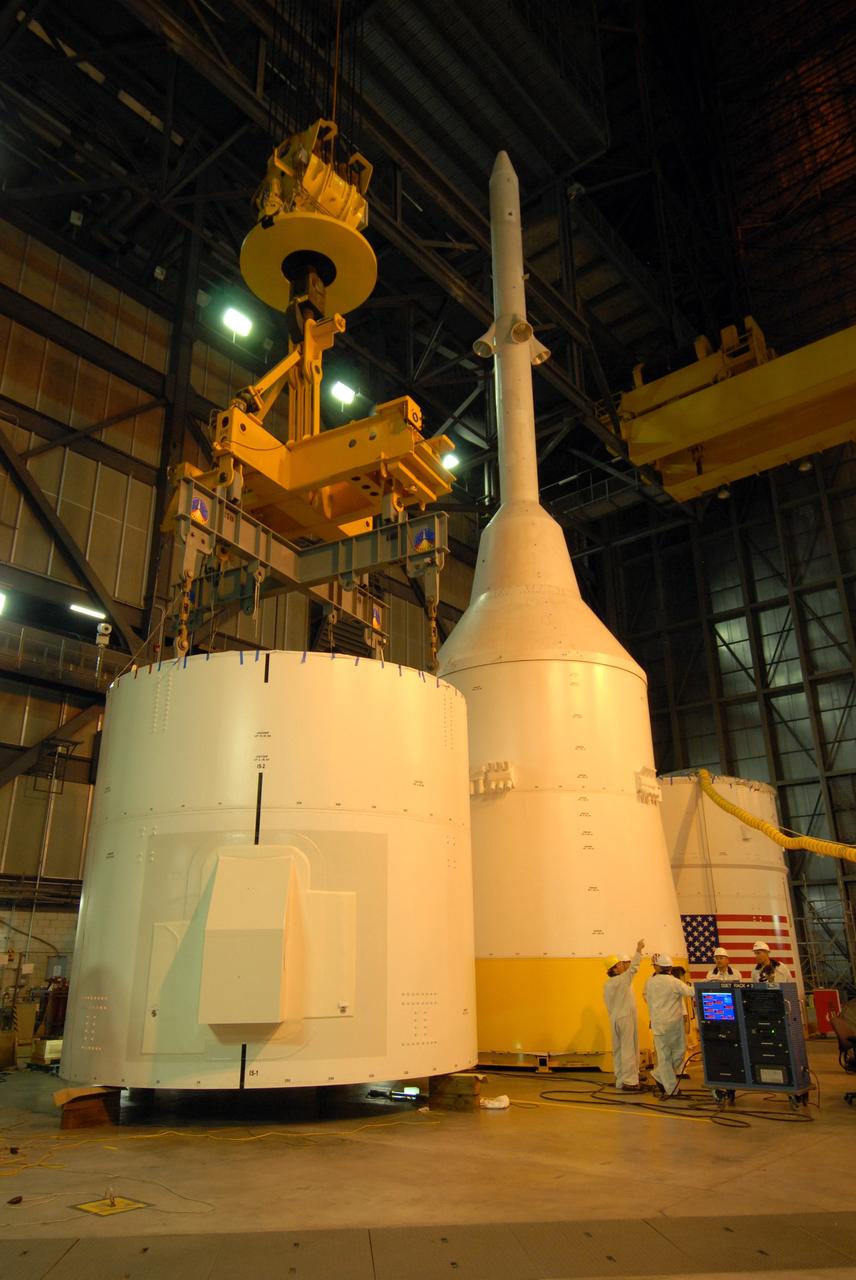
CAPE CANAVERAL, Fla. – In the Vehicle Assembly Building's High Bay 4 at NASA's Kennedy Space Center in Florida, the Ares I-X interstage 1 for the upper stage simulator is lifted to move it to the forward assembly. The interstage will be mated with the frustum on the forward assembly. To the right is the crew module-launch abort system, or CM-LAS, and simulator service module-service adapter stack. Ares I-X is the flight test vehicle for the Ares I, a component of the Constellation Program. Ares I is the essential core of a safe, reliable, cost-effective space transportation system that eventually will carry crewed missions back to the moon, on to Mars and out into the solar system. Ares I-X is targeted for launch in August 2009. Photo credit: NASA/Tim Jacobs

VANDENBERG AIR FORCE BASE, Calif. -- At Vandenberg Air Force Base in California, the interstage of the United Launch Alliance Delta II that will carry NASA's National Polar-orbiting Operational Environmental Satellite System Preparatory Project (NPP) satellite into space arrives at NASA's Space Launch Complex-2. The interstage provides an interface between the launch vehicle's first and second stages. NPP represents a critical first step in building the next-generation of Earth-observing satellites. NPP will carry the first of the new sensors developed for this satellite fleet, now known as the Joint Polar Satellite System (JPSS) to be launched in 2016. NPP is the bridge between NASA's Earth Observing System (EOS) satellites and the forthcoming series of JPSS satellites. The mission will test key technologies and instruments for the JPSS missions. For more information, visit http://www.nasa.gov/NPP. Photo credit: NASA/VAFB, Rudy Bledsoe
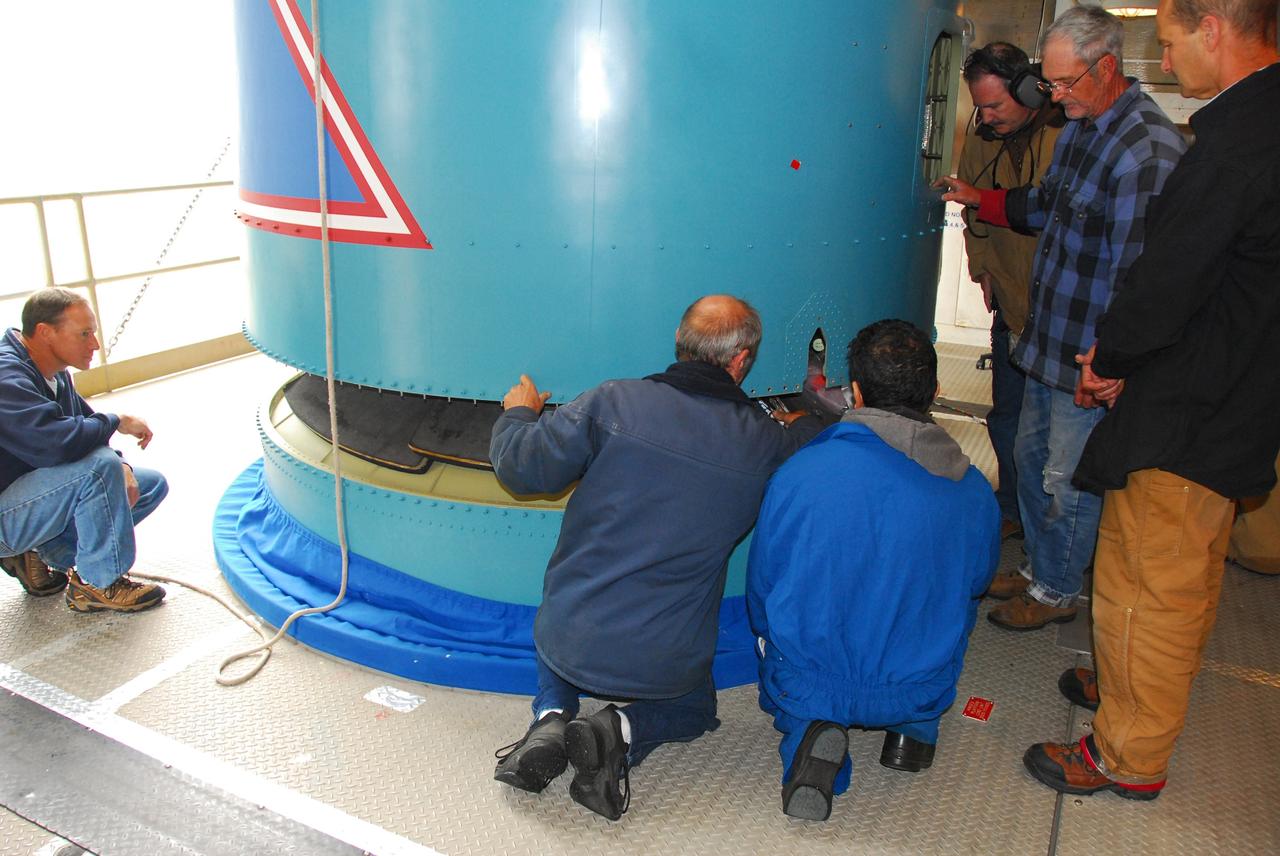
VANDENBERG AIR FORCE BASE, Calif. -- At NASA's Space Launch Complex-2 on Vandenberg Air Force Base in California, spacecraft technicians position the interstage of the United Launch Alliance Delta II that will carry NASA's National Polar-orbiting Operational Environmental Satellite System Preparatory Project (NPP) satellite into space onto the rocket's first stage. The interstage provides an interface between the launch vehicle's first and second stages. NPP represents a critical first step in building the next-generation of Earth-observing satellites. NPP will carry the first of the new sensors developed for this satellite fleet, now known as the Joint Polar Satellite System (JPSS) to be launched in 2016. NPP is the bridge between NASA's Earth Observing System (EOS) satellites and the forthcoming series of JPSS satellites. The mission will test key technologies and instruments for the JPSS missions. For more information, visit http://www.nasa.gov/NPP. Photo credit: NASA/VAFB, Rudy Bledsoe
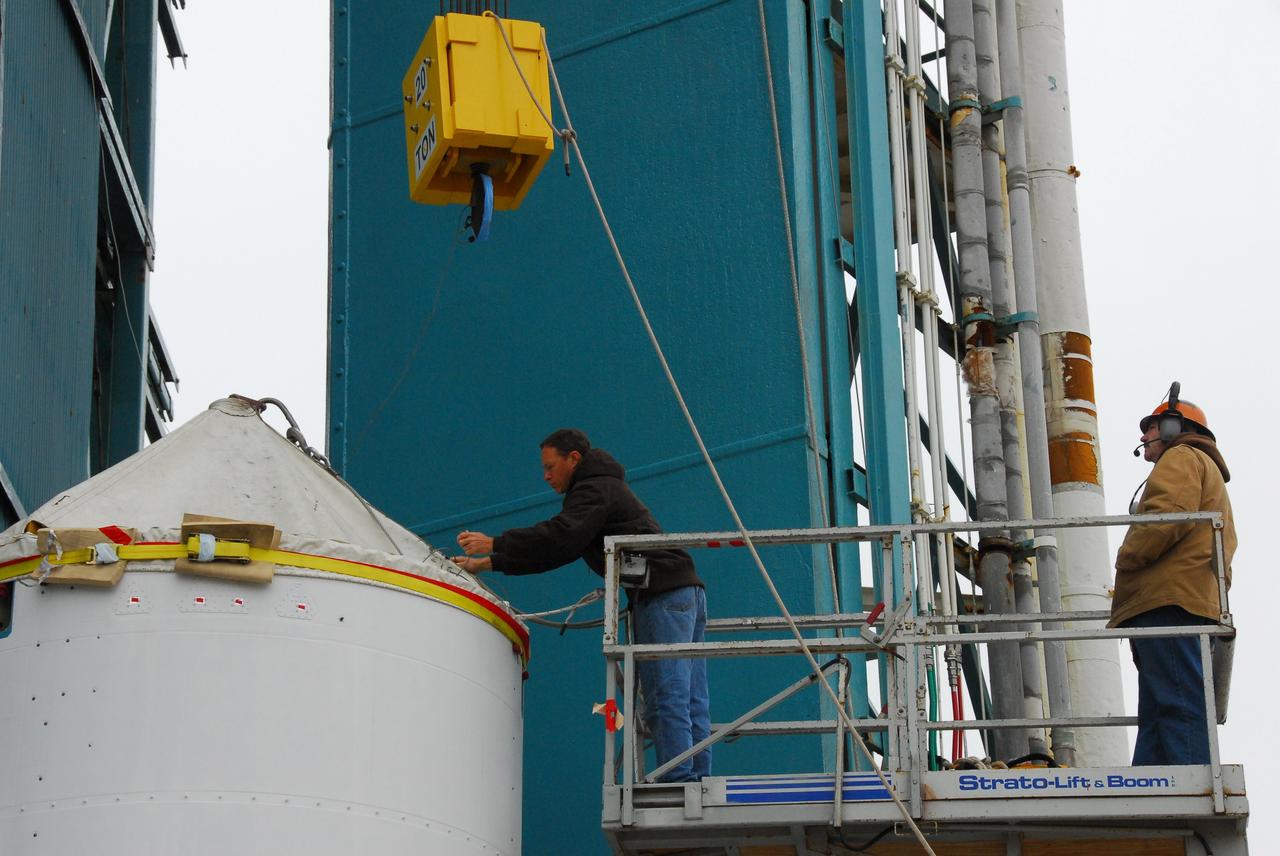
VANDENBERG AIR FORCE BASE, Calif. -- At NASA's Space Launch Complex-2 on Vandenberg Air Force Base in California, spacecraft technicians prepare to attach the interstage of the United Launch Alliance Delta II that will carry NASA's National Polar-orbiting Operational Environmental Satellite System Preparatory Project (NPP) satellite into space to a lifting device. The interstage provides an interface between the launch vehicle's first and second stages. NPP represents a critical first step in building the next-generation of Earth-observing satellites. NPP will carry the first of the new sensors developed for this satellite fleet, now known as the Joint Polar Satellite System (JPSS) to be launched in 2016. NPP is the bridge between NASA's Earth Observing System (EOS) satellites and the forthcoming series of JPSS satellites. The mission will test key technologies and instruments for the JPSS missions. For more information, visit http://www.nasa.gov/NPP. Photo credit: NASA/VAFB, Rudy Bledsoe
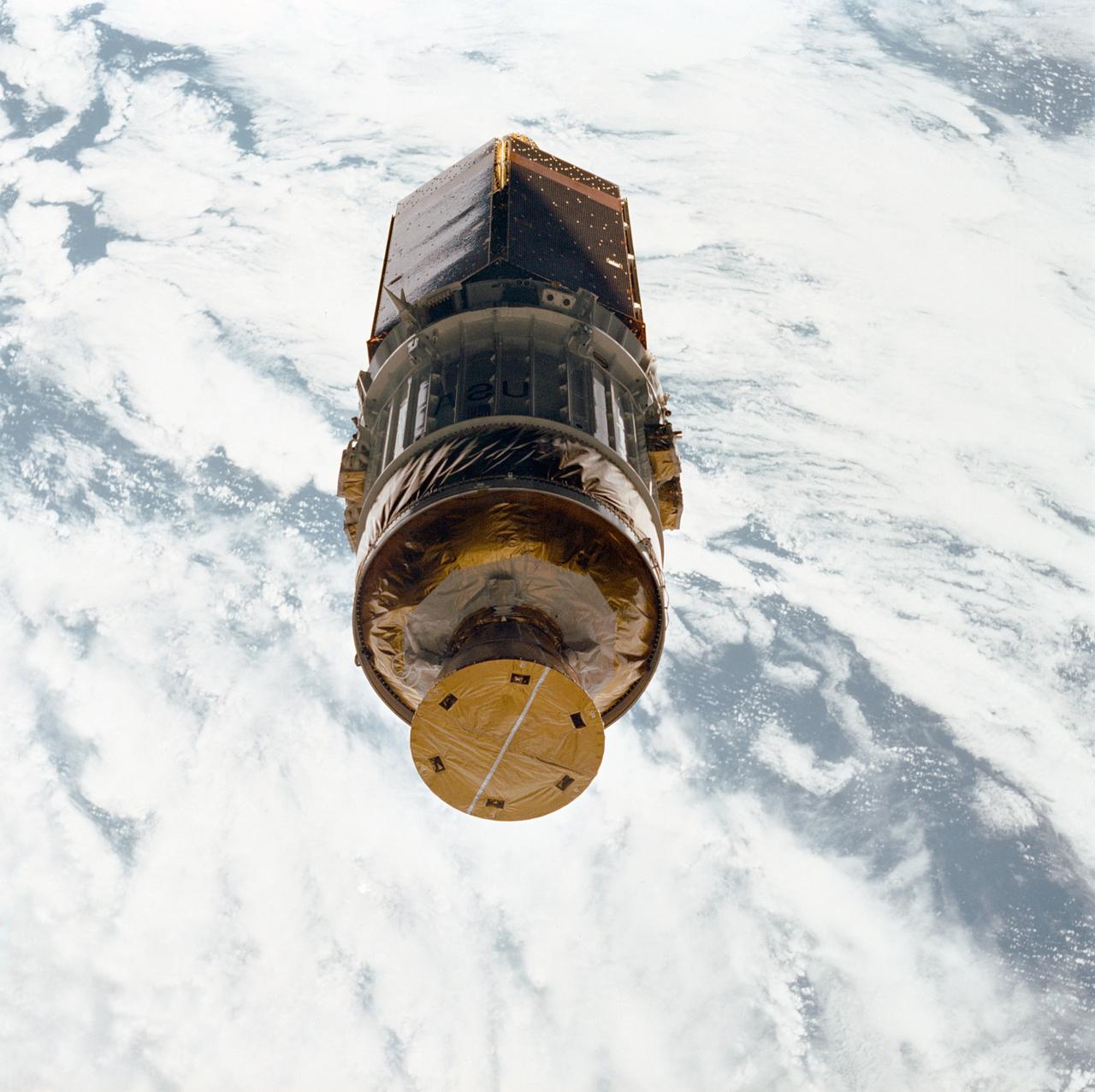
STS026-31-071 (3 Oct 1988) --- After deployment from Discovery, Orbiter Vehicle (OV) 103, the inertial upper stage (IUS) with the tracking and data relay satellite C (TDRS-C) drifts above the cloud-covered Earth surface. TDRS-C, in stowed configuration (solar array panels visible), is mounted atop the IUS with the interstage and solid rocket motor and nozzle seen in the foreground.
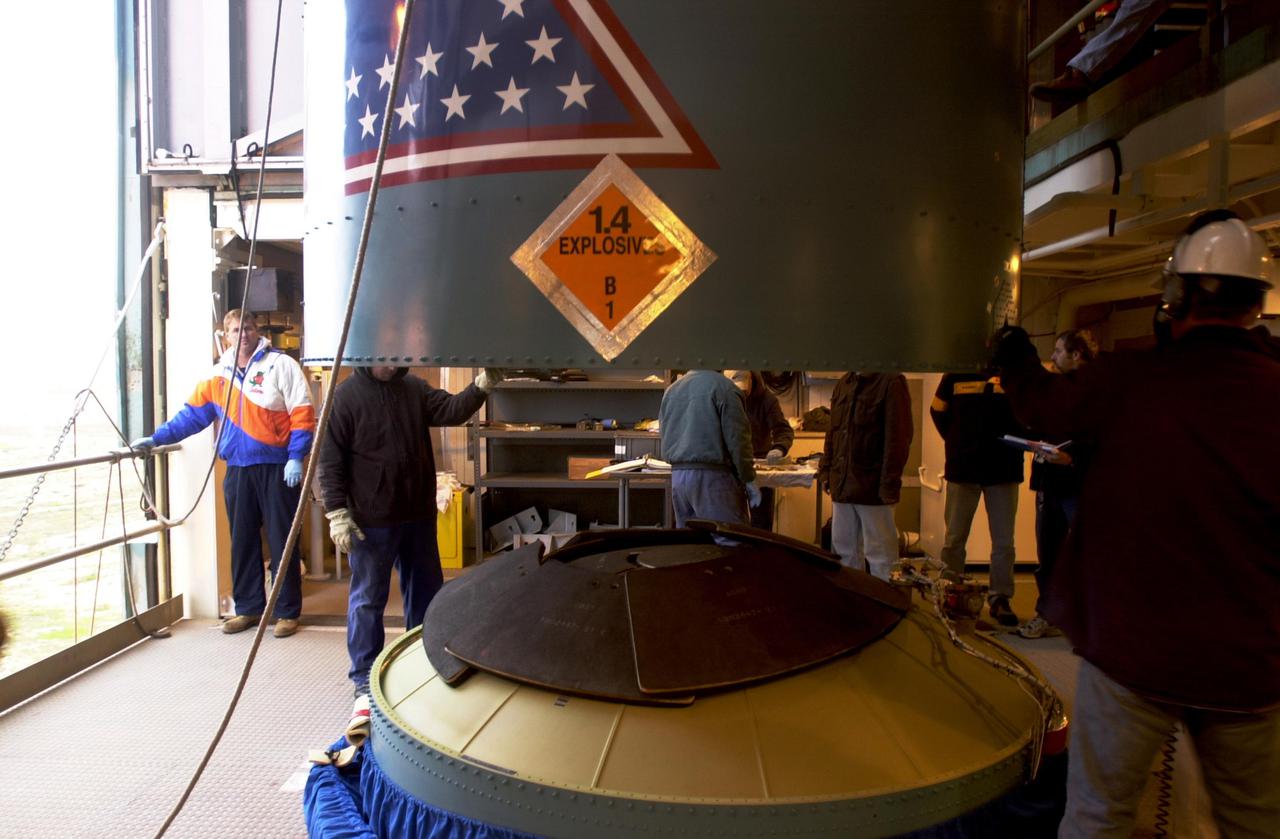
VANDENBERG AIR FORCE BASE, CALIF. - In the launch service tower on Space Launch Complex 2 at Vandenberg Air Force Base in California, the interstage of a Boeing Delta 2 rocket is lowered toward the interstage adapter. The two stages will be mated for launch of the National Oceanic and Atmospheric Administration (NOAA-N) spacecraft. The NOAA-N satellite will be placed into a polar orbit aboard a Boeing Delta 2 rocket. The spacecraft will continue to provide a polar-orbiting platform to support (1) environmental monitoring instruments for imaging and measuring the Earth's atmosphere, its surface, and cloud cover, including Earth radiation, atmospheric ozone, aerosol distribution, sea surface temperature, and vertical temperature and water profiles in the troposphere and stratosphere; (2) measurement of proton and electron flux at orbit altitude; (3) data collection from remote platforms; and (4) the Search and Rescue Satellite-Aided Tracking (SARSAT) system. Additionally, NOAA-N is the fourth in the series of support dedicated microwave instruments for the generation of temperature, moisture, surface, and hydrological products in cloudy regions where visible and infrared (IR) instruments have decreased capability. Launch is currently scheduled for no earlier than May 11, 2005.
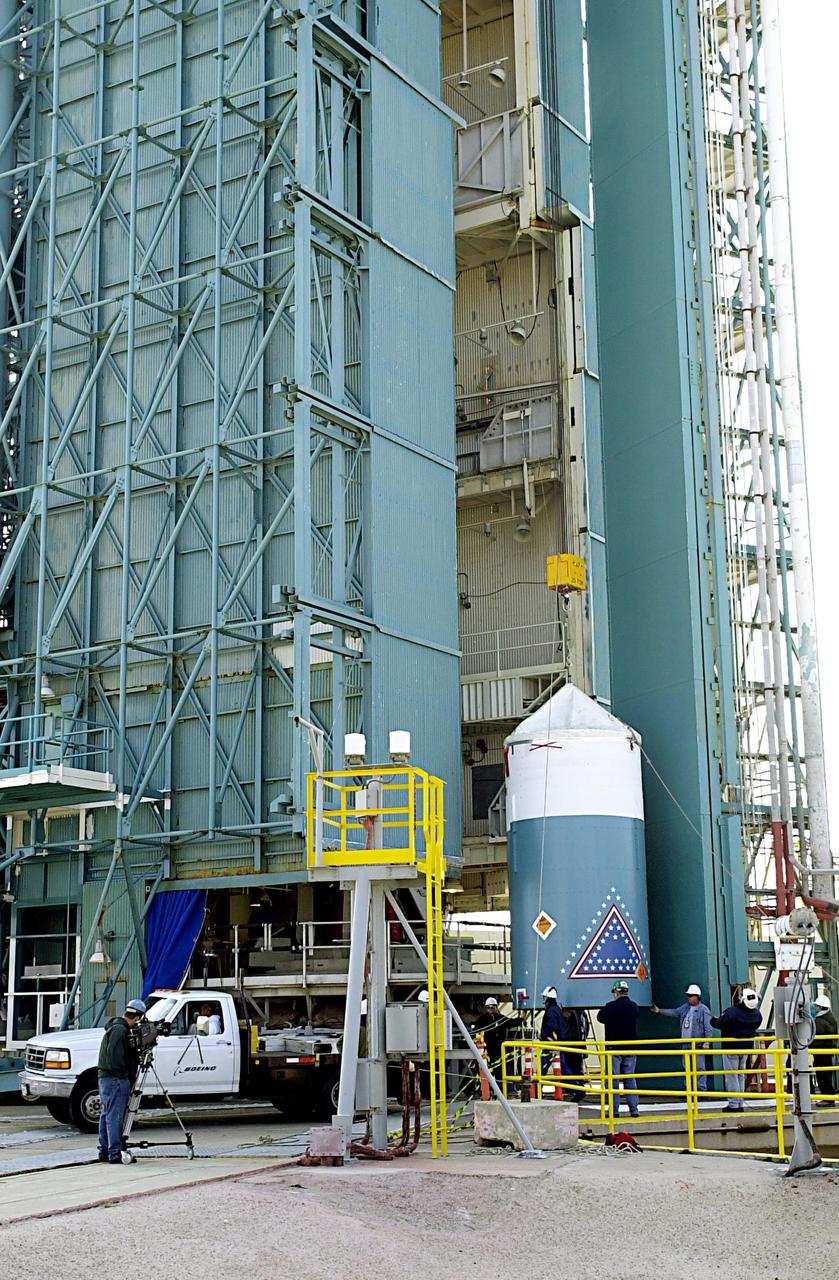
KENNEDY SPACE CENTER, FLA. - Workers at the base of the launch tower on NASA's Space Launch Complex 2 (SLC-2), Vandenberg Air Force Base, Calif., watch as the interstage of the Delta II rocket is lifted up the tower. The interstage will eventually house the second stage and will be mated with the first stage. The rocket will carry the ICESat and CHIPSat satellites into Earth orbits. ICESat is a 661-pound satellite known as Geoscience Laser Altimeter System (GLAS) that will revolutionize our understanding of ice and its role in global climate change and how we protect and understand our home planet. It will help scientists determine if the global sea level is rising or falling. It will look at the ice sheets that blanket the Earth's poles to see if they are growing or shrinking. It will assist in developing an understanding of how changes in the Earth's atmosphere and climate effect polar ice masses and global sea level. CHIPSat, a suitcase-size 131-pound satellite, will provide invaluable information into the origin, physical processes and properties of the hot gas contained in the interstellar medium. This can provide important clues about the formation and evolution of galaxies since the interstellar medium literally contains the seeds of future stars. The Delta II launch is scheduled for Jan. 11 between 4:45 p.m. - 5:30 p.m. PST.
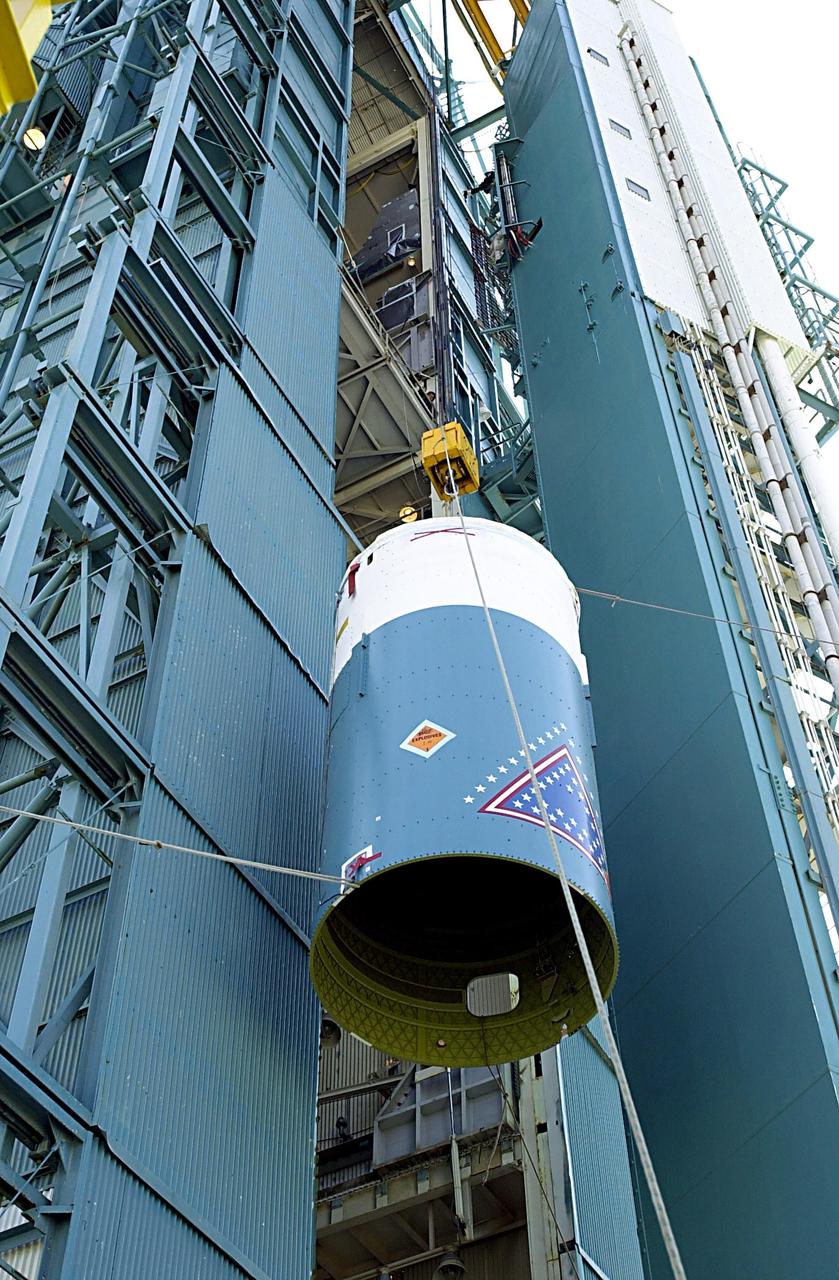
KENNEDY SPACE CENTER, FLA. - The interstage of the Delta II rocket is lifted up the launch tower on NASA's Space Launch Complex 2 (SLC-2), Vandenberg Air Force Base, Calif. The interstage will eventually house the second stage and will be mated with the first stage. The rocket will carry the ICESat and CHIPSat satellites into Earth orbits. ICESat is a 661-pound satellite known as Geoscience Laser Altimeter System (GLAS) that will revolutionize our understanding of ice and its role in global climate change and how we protect and understand our home planet. It will help scientists determine if the global sea level is rising or falling. It will look at the ice sheets that blanket the Earth's poles to see if they are growing or shrinking. It will assist in developing an understanding of how changes in the Earth's atmosphere and climate effect polar ice masses and global sea level. CHIPSat, a suitcase-size 131-pound satellite, will provide invaluable information into the origin, physical processes and properties of the hot gas contained in the interstellar medium. This can provide important clues about the formation and evolution of galaxies since the interstellar medium literally contains the seeds of future stars. The Delta II launch is scheduled for Jan. 11 between 4:45 p.m. - 5:30 p.m. PST.
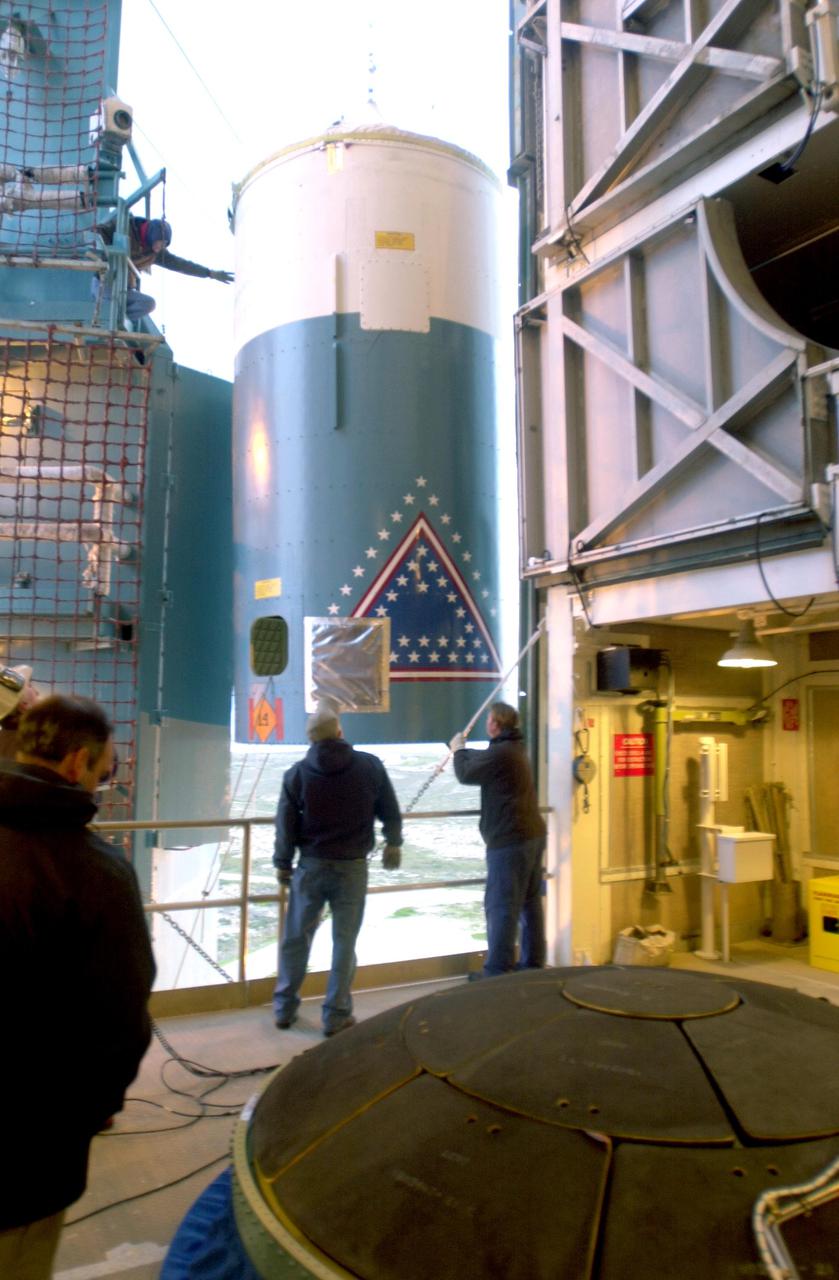
VANDENBERG AIR FORCE BASE, CALIF. - The interstage of a Boeing Delta 2 rocket is lifted to an upper level on the launch service tower on Space Launch Complex 2 at Vandenberg Air Force Base in California. It will be mated with the first stage in the launch service tower. In the foreground is the interstage adapter. The Delta 2 is the launch vehicle for the National Oceanic and Atmospheric Administration (NOAA-N) spacecraft. The NOAA-N satellite will be placed into a polar orbit aboard a Boeing Delta 2 rocket. The spacecraft will continue to provide a polar-orbiting platform to support (1) environmental monitoring instruments for imaging and measuring the Earth's atmosphere, its surface, and cloud cover, including Earth radiation, atmospheric ozone, aerosol distribution, sea surface temperature, and vertical temperature and water profiles in the troposphere and stratosphere; (2) measurement of proton and electron flux at orbit altitude; (3) data collection from remote platforms; and (4) the Search and Rescue Satellite-Aided Tracking (SARSAT) system. Additionally, NOAA-N is the fourth in the series of support dedicated microwave instruments for the generation of temperature, moisture, surface, and hydrological products in cloudy regions where visible and infrared (IR) instruments have decreased capability. Launch is currently scheduled for no earlier than May 11, 2005.
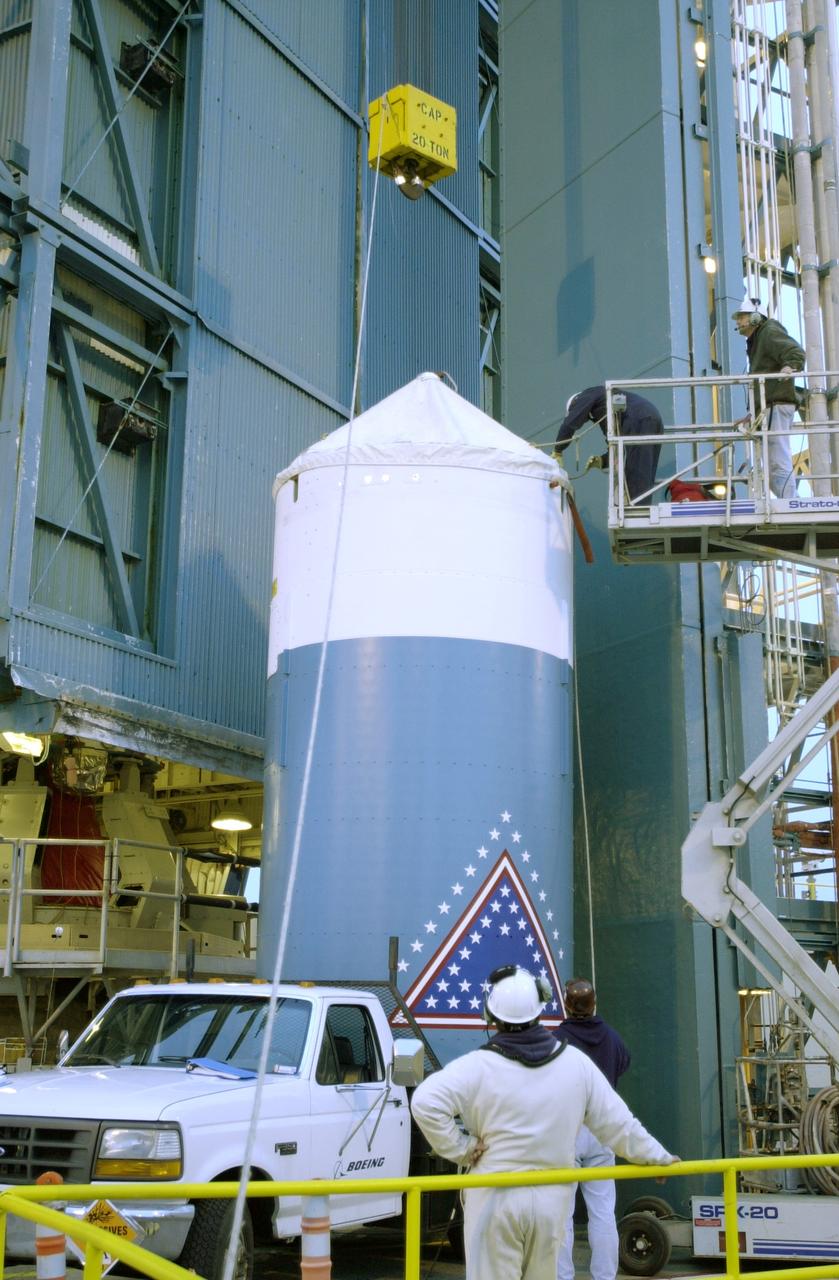
VANDENBERG AFB, CALIF. - The interstage of the Delta II launch vehicle for the Gravity Probe B experiment is prepared for lifting up the mobile service tower on Space Launch Complex 2, Vandenberg Air Force Base, Calif. It will enclose the second stage. The Gravity Probe B will launch a payload of four gyroscopes into low-Earth polar orbit to test two extraordinary predictions of Albert Einstein’s general theory of relativity: the geodetic effect (how space and time are warped by the presence of the Earth) and frame dragging (how Earth’s rotation drags space and time around with it). Once in orbit, for 18 months each gyroscope’s spin axis will be monitored as it travels through local spacetime, observing and measuring these effects. The experiment was developed by Stanford University, Lockheed Martin and NASA’s Marshall Space Flight Center. The targeted launch date is Dec. 6, 2003.

VANDENBERG AFB, CALIF. - The interstage of the Delta II launch vehicle for the Gravity Probe B experiment is moved into the mobile service tower on Space Launch Complex 2, Vandenberg Air Force Base, Calif., where it will be mated with the second stage. The Gravity Probe B will launch a payload of four gyroscopes into low-Earth polar orbit to test two extraordinary predictions of Albert Einstein’s general theory of relativity: the geodetic effect (how space and time are warped by the presence of the Earth) and frame dragging (how Earth’s rotation drags space and time around with it). Once in orbit, for 18 months each gyroscope’s spin axis will be monitored as it travels through local spacetime, observing and measuring these effects. The experiment was developed by Stanford University, Lockheed Martin and NASA’s Marshall Space Flight Center. The targeted launch date is Dec. 6, 2003.
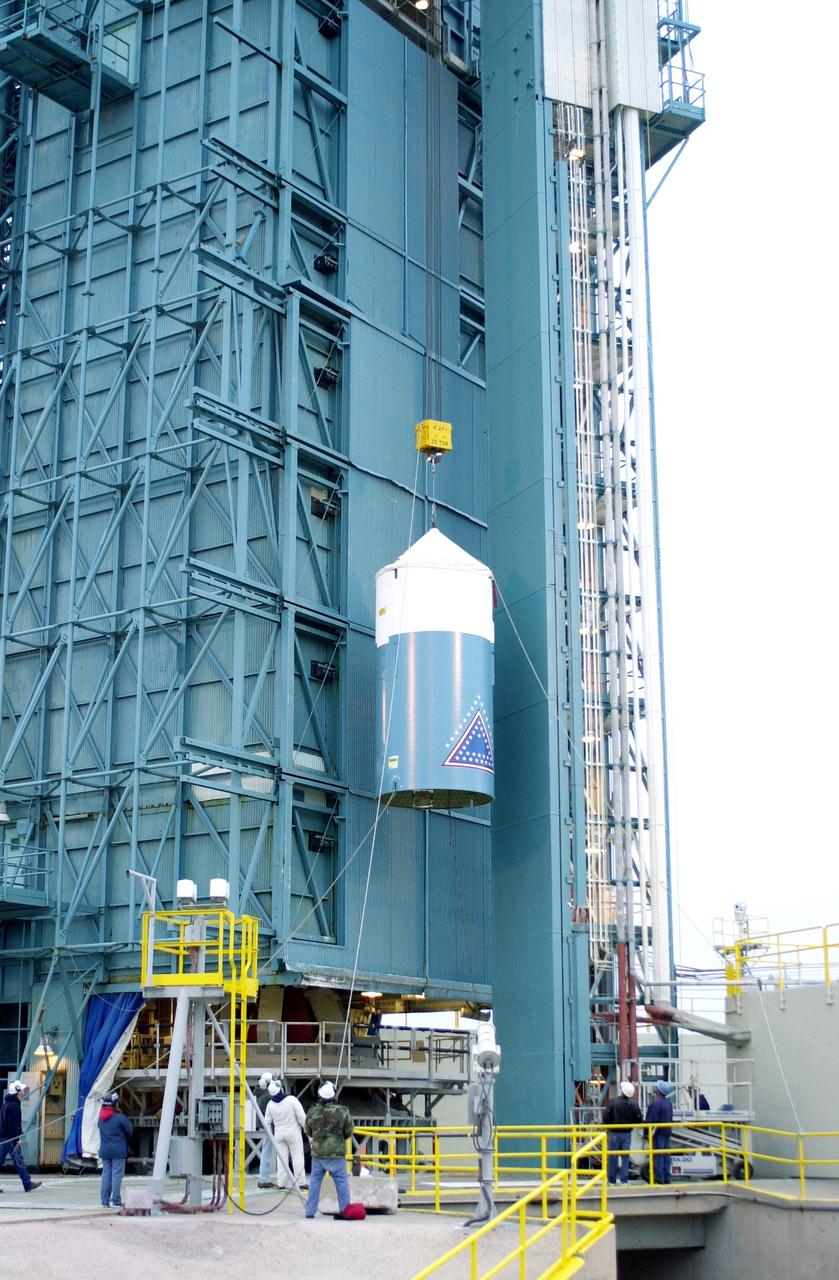
VANDENBERG AFB, CALIF. - The interstage of the Delta II launch vehicle for the Gravity Probe B experiment is lifted up the mobile service tower on Space Launch Complex 2, Vandenberg Air Force Base, Calif. It will enclose the second stage. The Gravity Probe B will launch a payload of four gyroscopes into low-Earth polar orbit to test two extraordinary predictions of Albert Einstein’s general theory of relativity: the geodetic effect (how space and time are warped by the presence of the Earth) and frame dragging (how Earth’s rotation drags space and time around with it). Once in orbit, for 18 months each gyroscope’s spin axis will be monitored as it travels through local spacetime, observing and measuring these effects. The experiment was developed by Stanford University, Lockheed Martin and NASA’s Marshall Space Flight Center. The targeted launch date is Dec. 6, 2003.
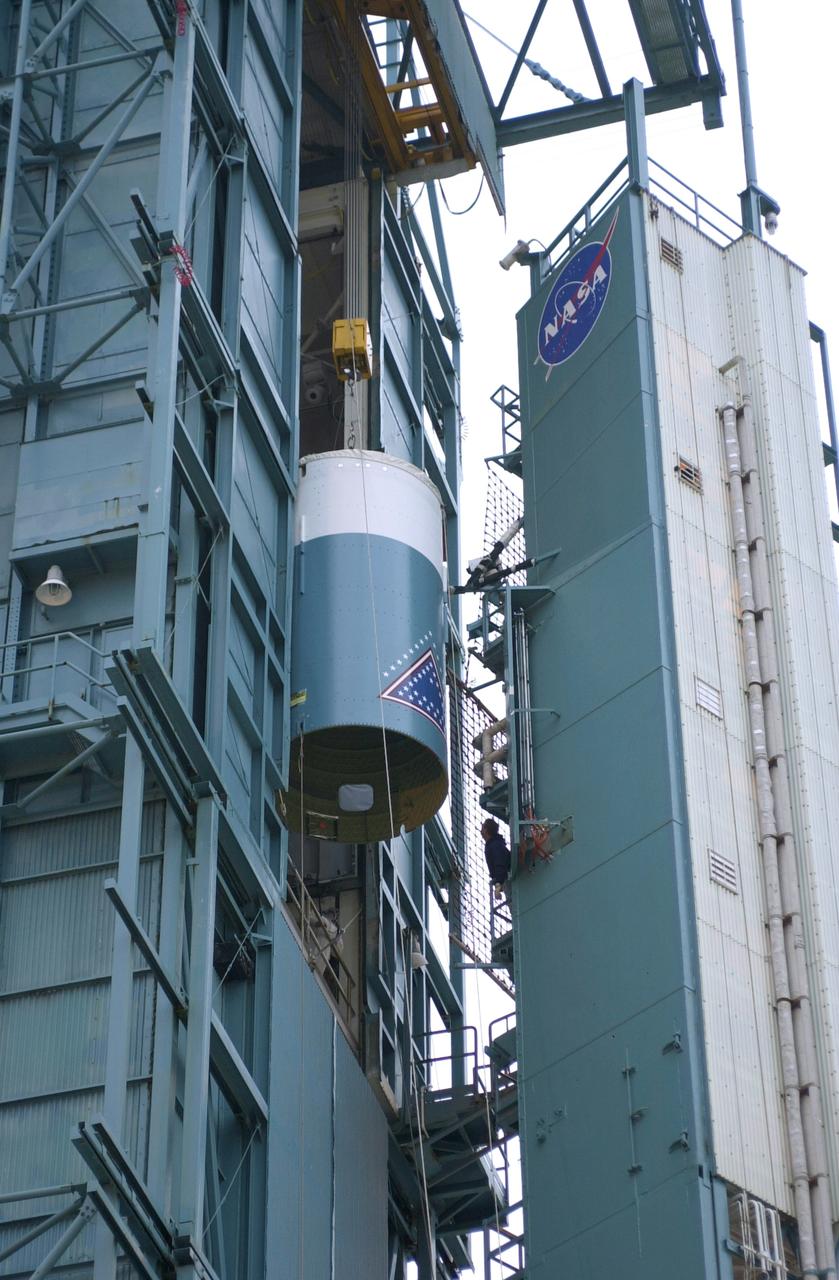
VANDENBERG AFB, CALIF. - The interstage of the Delta II launch vehicle for the Gravity Probe B experiment is moved into the mobile service tower on Space Launch Complex 2, Vandenberg Air Force Base, Calif., where it will be mated with the second stage. The Gravity Probe B will launch a payload of four gyroscopes into low-Earth polar orbit to test two extraordinary predictions of Albert Einstein’s general theory of relativity: the geodetic effect (how space and time are warped by the presence of the Earth) and frame dragging (how Earth’s rotation drags space and time around with it). Once in orbit, for 18 months each gyroscope’s spin axis will be monitored as it travels through local spacetime, observing and measuring these effects. The experiment was developed by Stanford University, Lockheed Martin and NASA’s Marshall Space Flight Center. The targeted launch date is Dec. 6, 2003.
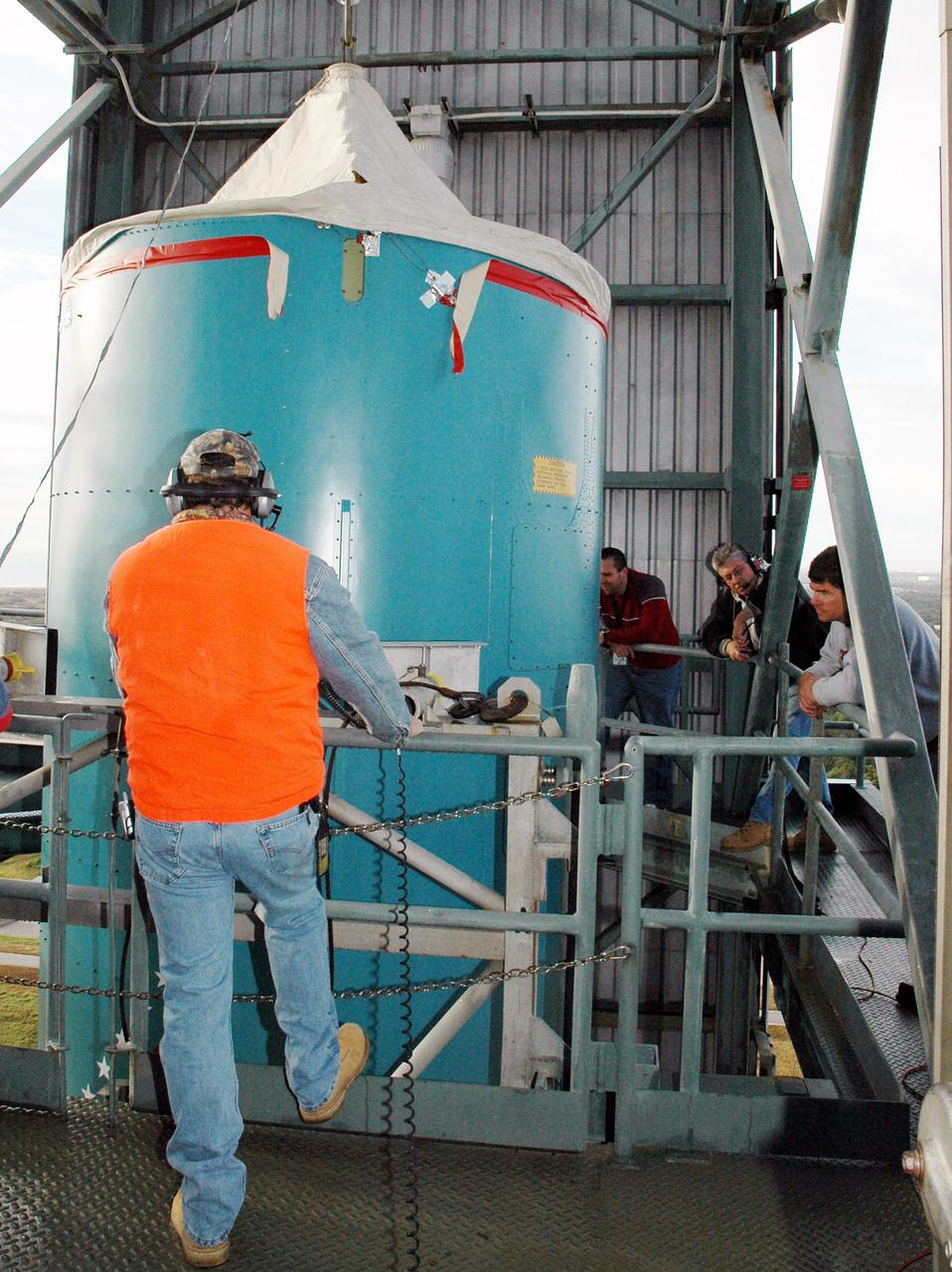
KENNEDY SPACE CENTER, FLA. - On the mobile service tower on Launch Pad 17-B, Cape Canaveral Air Force Station, Fla., Boeing workers stand by as the replacement interstage adapter for the Boeing Delta II is lowered. Boeing workers will attach the adapter to the rocket’s center body section. Later the second stage, which was removed to allow access to the previous adapter, will be reattached. The first adapter was removed after it was found to be faulty during a review of launch vehicle hardware. Launch of Deep Impact is now scheduled no earlier than Jan. 12.
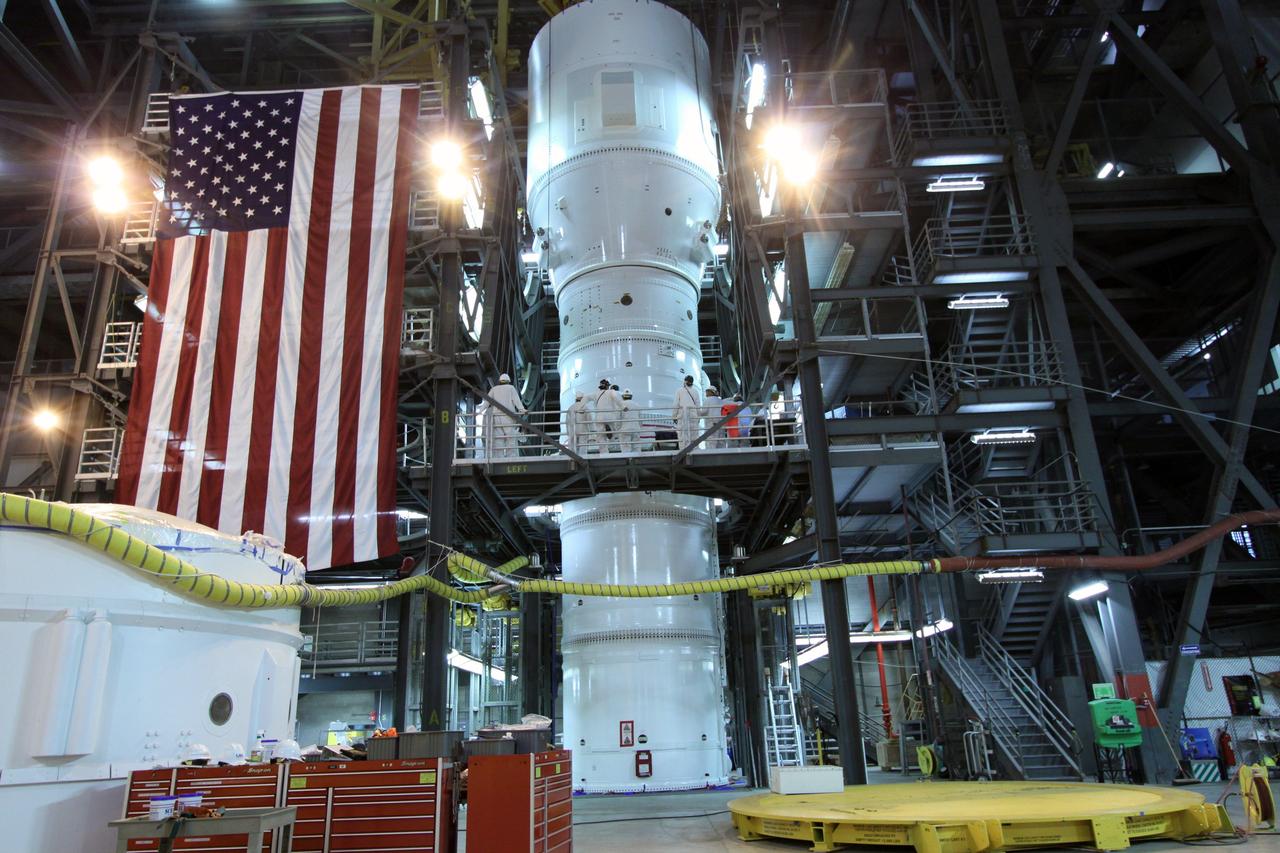
CAPE CANAVERAL, Fla. – In the Vehicle Assembly Building at NASA's Kennedy Space Center in Florida, segments of the Ares I-X first stage are mated to the fifth simulator segment, completing Super Stack 1. The super stack comprises the forward skirt, forward skirt extension, interstages 1 and 2 and the fifth segment simulator. Ares I-X is the test vehicle for the Ares I, which is part of the Constellation Program to return men to the moon and beyond. The Ares I-X flight test is targeted no earlier than Aug. 30 from Launch Pad 39B. Photo credit: NASA/Jack Pfaller
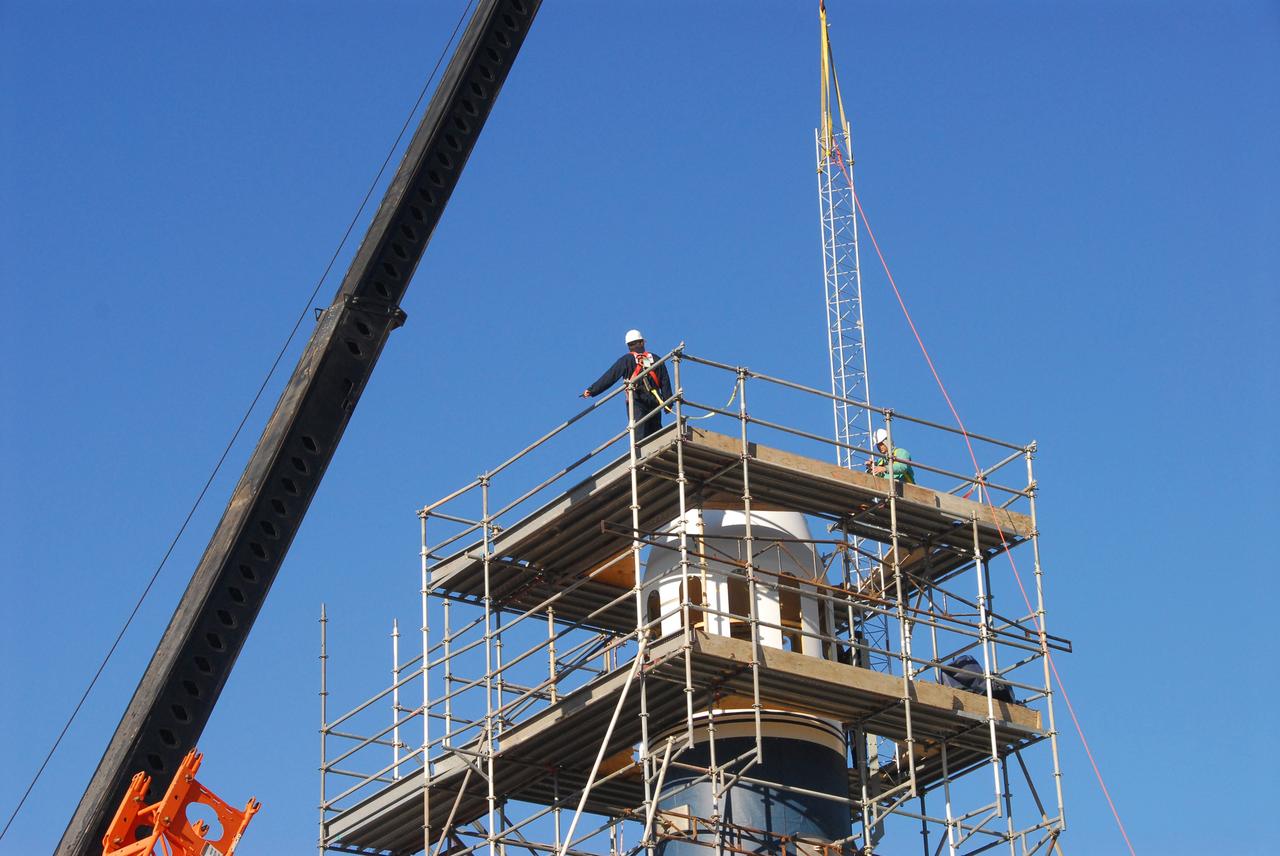
VANDENBERG AIR FORCE BASE, Calif. -- Workers at Vandenberg Air Force Base in California, guide the Stage 0/1 interstage, part of the four-stage Taurus XL rocket that will carry NASA's Glory spacecraft into low Earth orbit, into launch position at Space Launch Complex 576-E. Once Glory reaches orbit, it will collect data on the properties of aerosols and black carbon. It also will help scientists understand how the sun's irradiance affects Earth's climate. Launch is scheduled for 5:09 a.m. EST Feb. 23. For information, visit www.nasa.gov/glory. Photo credit: NASA/Roy Allison, VAFB
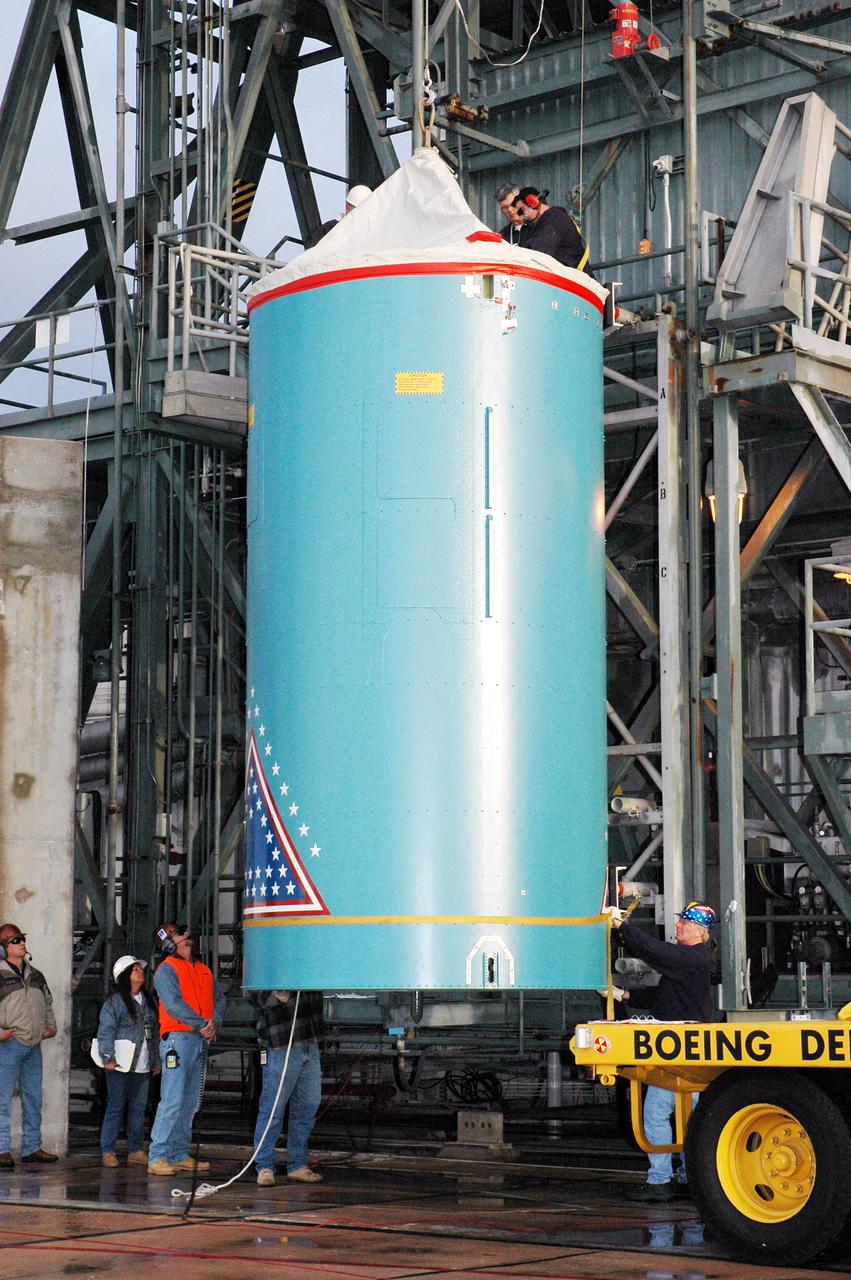
KENNEDY SPACE CENTER, FLA. - The replacement interstage adapter for the Boeing Delta II launch vehicle for the Deep Impact spacecraft is ready to be lifted up the mobile service tower on Launch Pad 17-B, Cape Canaveral Air Force Station, Fla. Boeing workers will attach the adapter to the rocket’s center body section. Later the second stage, which was removed to allow access to the previous adapter, will be reattached. The first adapter was removed after it was found to be faulty during a review of launch vehicle hardware. Launch of Deep Impact is now scheduled no earlier than Jan. 12.
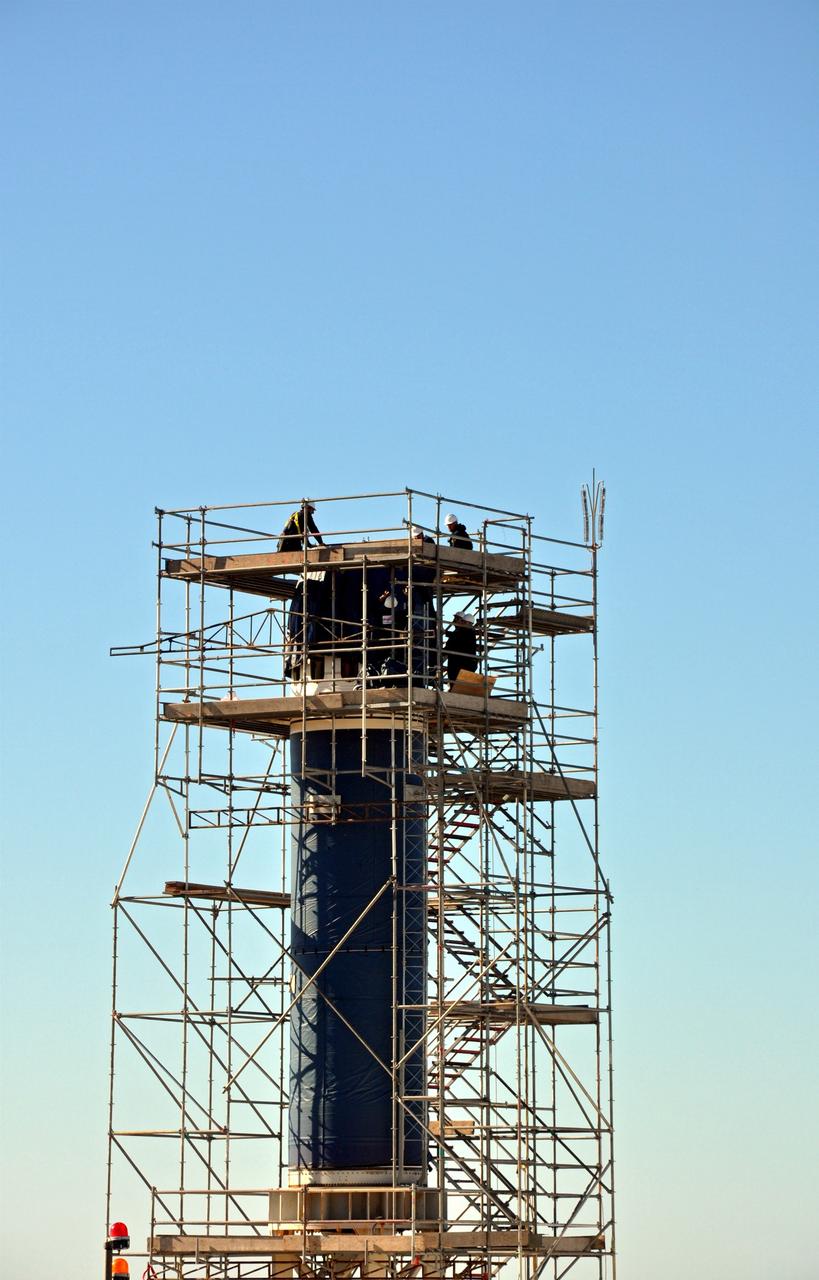
VANDENBERG AIR FORCE BASE, Calif. -- Workers at Space Launch Complex 576-E at Vandenberg Air Force Base in California, wrap the Stage 0/1 interstage in a weather-protective covering after it was secured to Stage 0 of the four-stage Taurus XL rocket that will carry NASA's Glory spacecraft into low Earth orbit. Once Glory reaches orbit, it will collect data on the properties of aerosols and black carbon. It also will help scientists understand how the sun's irradiance affects Earth's climate. Launch is scheduled for 5:09 a.m. EST Feb. 23. For information, visit www.nasa.gov/glory. Photo credit: NASA/Randy Beaudoin, VAFB
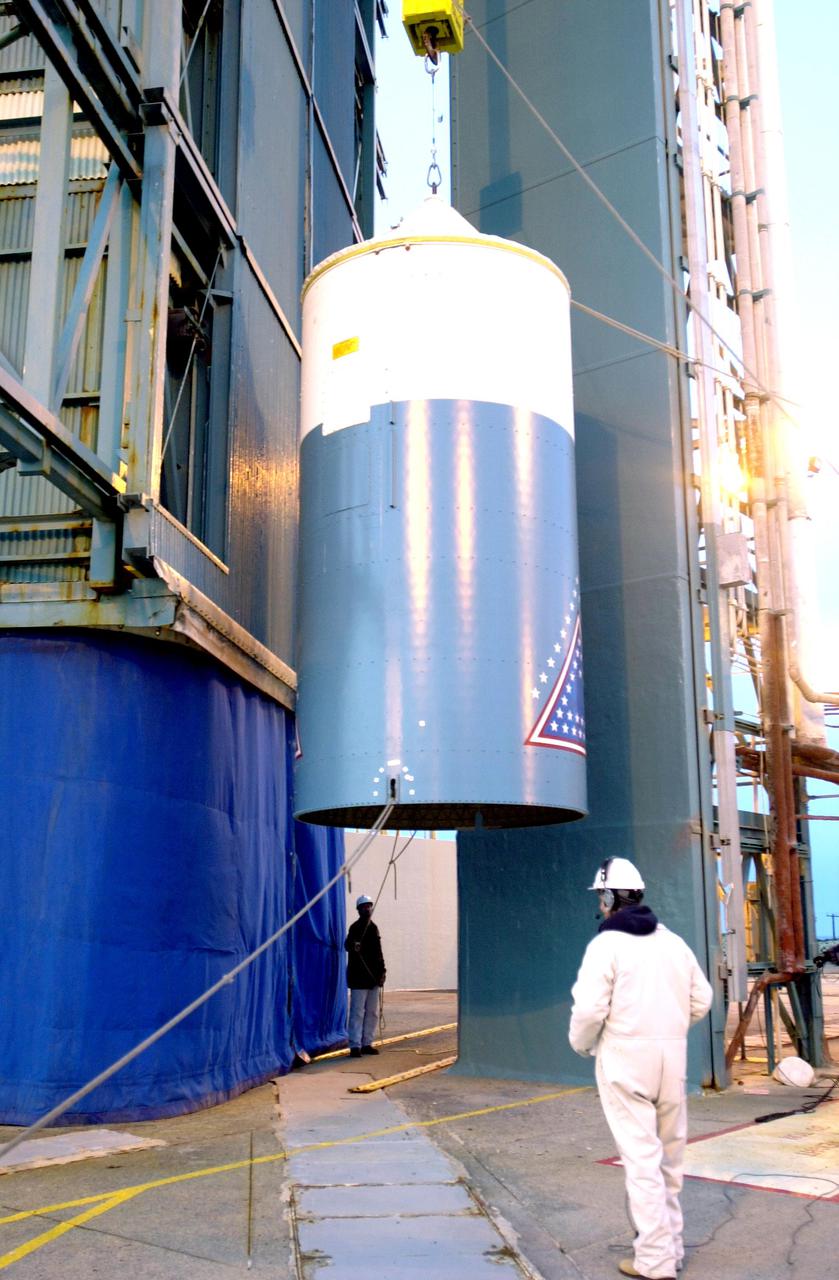
VANDENBERG AIR FORCE BASE, CALIF. - - The interstage of a Boeing Delta 2 rocket is lifted up the launch service tower on Space Launch Complex 2 at Vandenberg Air Force Base in California. It will be mated with the first stage in the launch service tower. The Delta 2 is the launch vehicle for the National Oceanic and Atmospheric Administration (NOAA-N) spacecraft. NOAA-N is the fourth in the series of support dedicated microwave instruments for the generation of temperature, moisture, surface, and hydrological products in cloudy regions where visible and infrared (IR) instruments have decreased capability. Launch aboard a Boeing Delta II rocket is currently scheduled for no earlier than May 11, 2005.
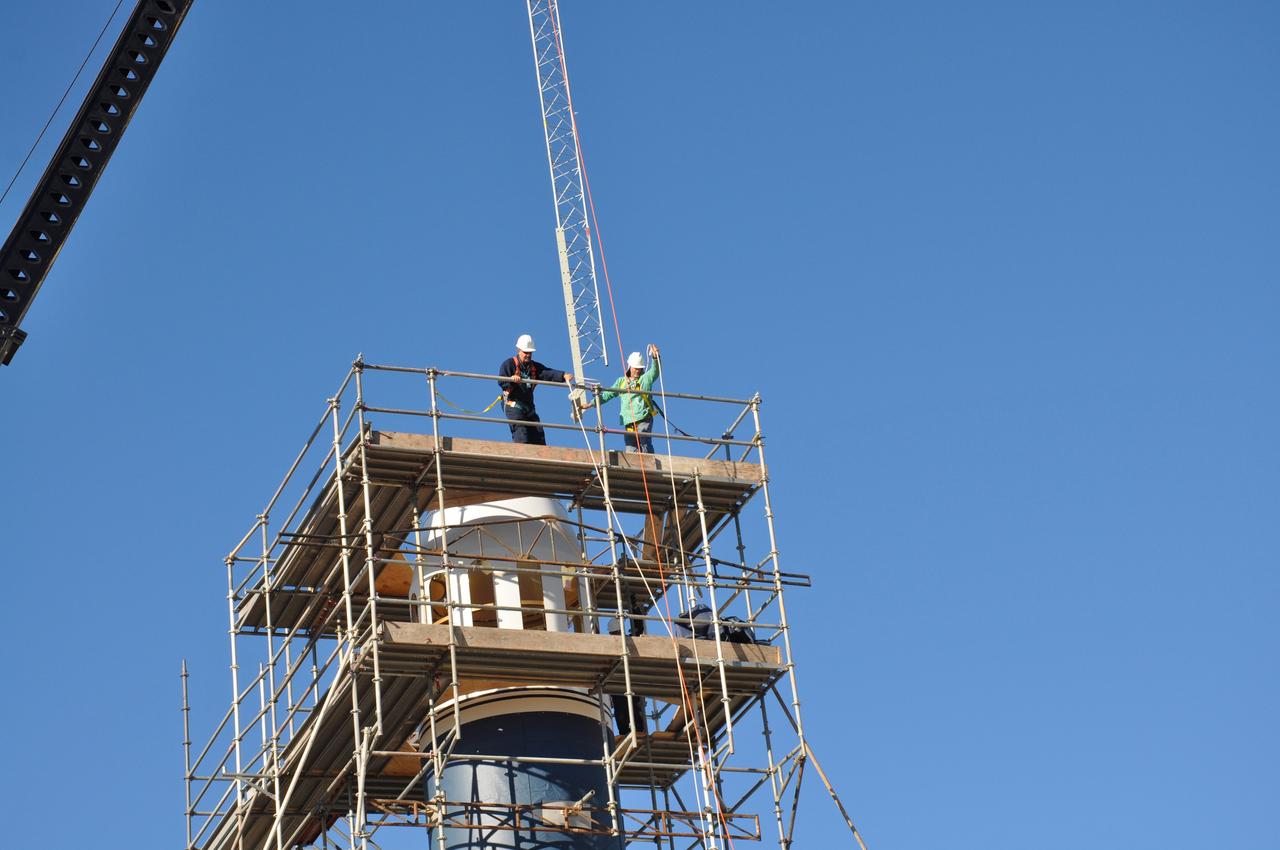
VANDENBERG AIR FORCE BASE, Calif. -- At Space Launch Complex 576-E at Vandenberg Air Force Base in California, workers unlatch the crane's guide wires from the Stage 0/1 interstage, part of the four-stage Taurus XL rocket that will carry NASA's Glory spacecraft into low Earth orbit, after it was lowered into launch position. Once Glory reaches orbit, it will collect data on the properties of aerosols and black carbon. It also will help scientists understand how the sun's irradiance affects Earth's climate. Launch is scheduled for 5:09 a.m. EST Feb. 23. For information, visit www.nasa.gov/glory. Photo credit: NASA/Randy Beaudoin, VAFB
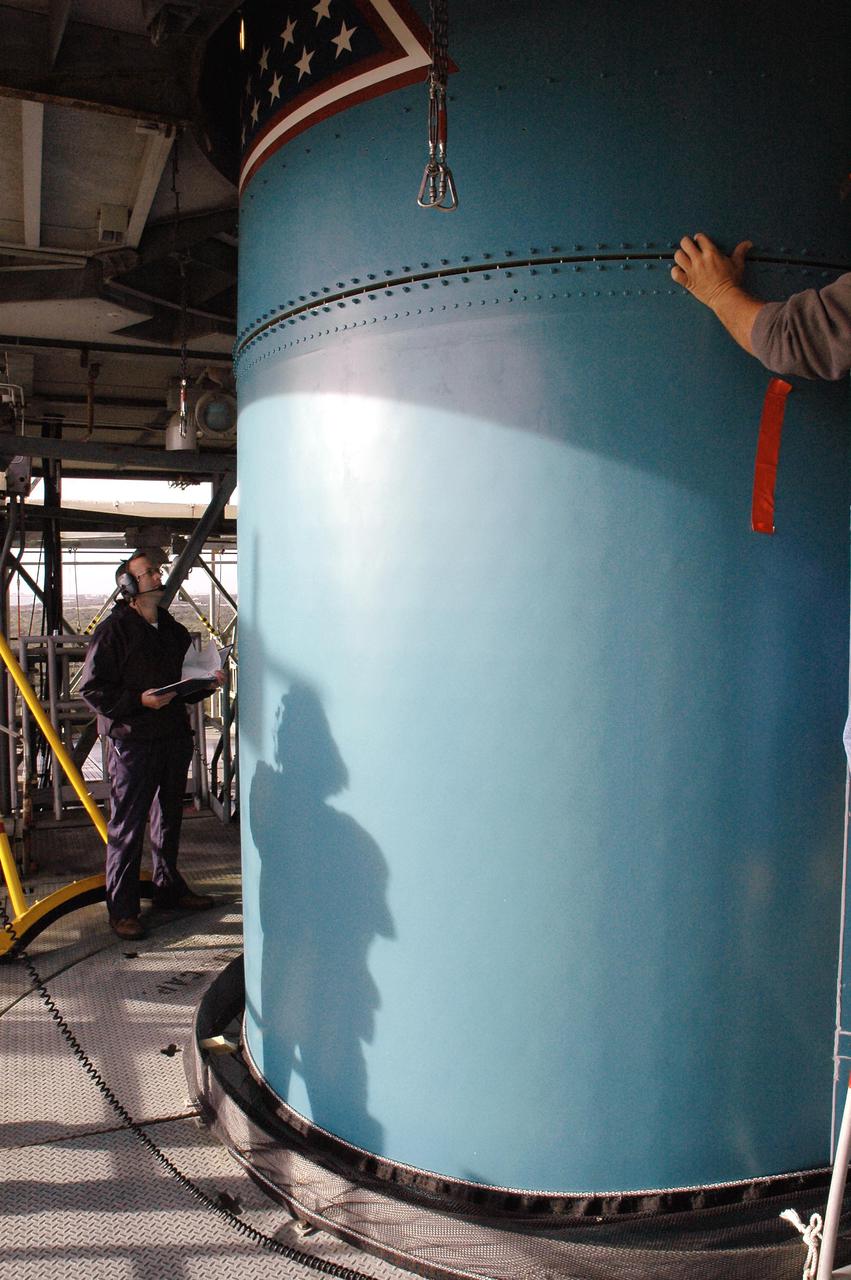
KENNEDY SPACE CENTER, FLA. - Inside the mobile service tower on Launch Pad 17-B, Cape Canaveral Air Force Station, Fla., Boeing workers aid in lowering the replacement interstage adapter toward the Boeing Delta II below. The rocket is the launch vehicle for the Deep Impact spacecraft. Boeing workers will attach the adapter to the rocket’s center body section. Later the second stage, which was removed to allow access to the previous adapter, will be reattached. The first adapter was removed after it was found to be faulty during a review of launch vehicle hardware. Launch of Deep Impact is now scheduled no earlier than Jan. 12.
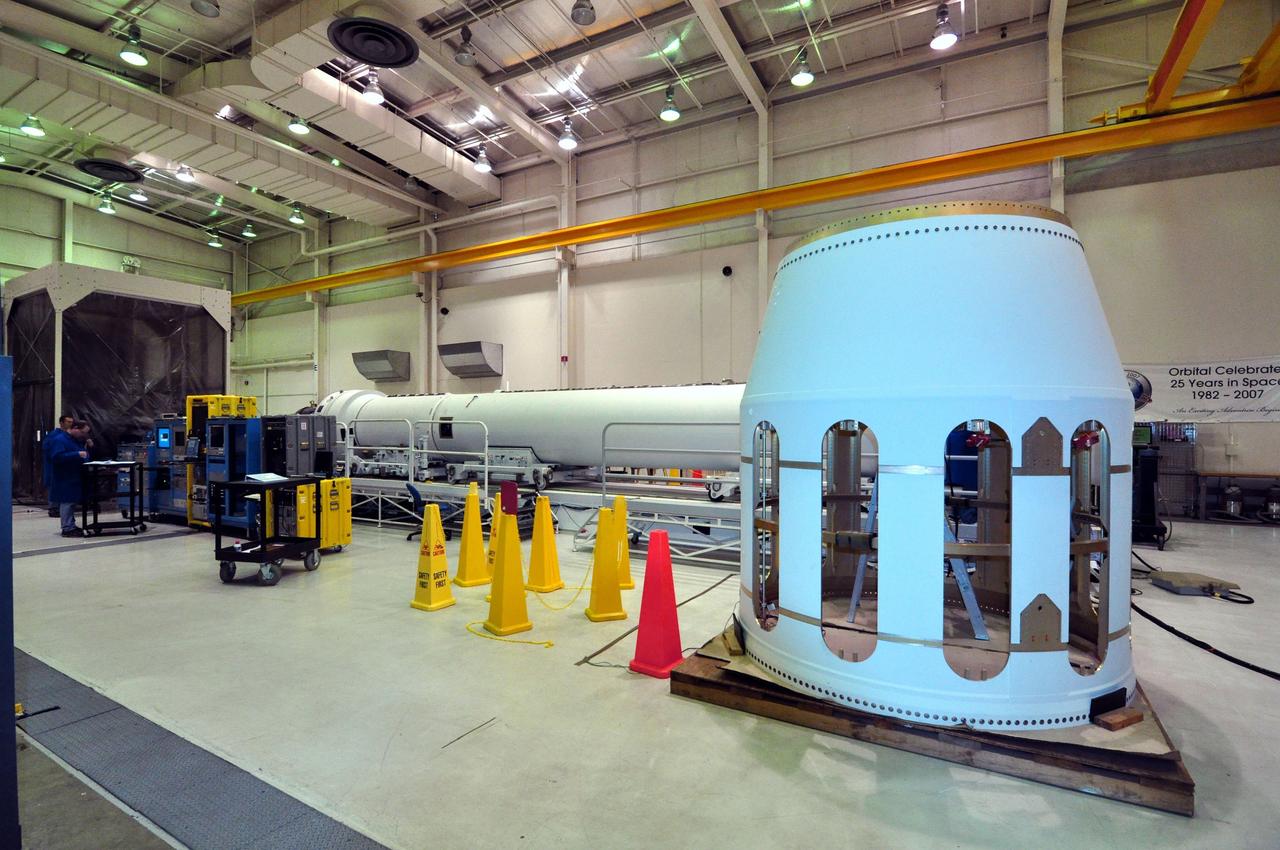
VANDENBERG AIR FORCE BASE, Calif. – In Orbital Sciences Corp. Building 1555 at Vandenberg Air Force Base in California, the first, second and third stages of the Taurus XL rocket are cabled up for a flight simulation. In front is the interstage associated with the first stage. The Orbital Sciences Taurus XL rocket, targeted to lift off Feb. 23, 2011, from Vandenberg's Space Launch Complex 576-E, will take NASA's Glory satellite into low Earth orbit. Once in orbit, Glory will collect data on the properties of aerosols and black carbon. It also will help scientists understand how the sun's irradiance affects Earth's climate. Photo credit: NASA/Randy Beaudoin, VAFB
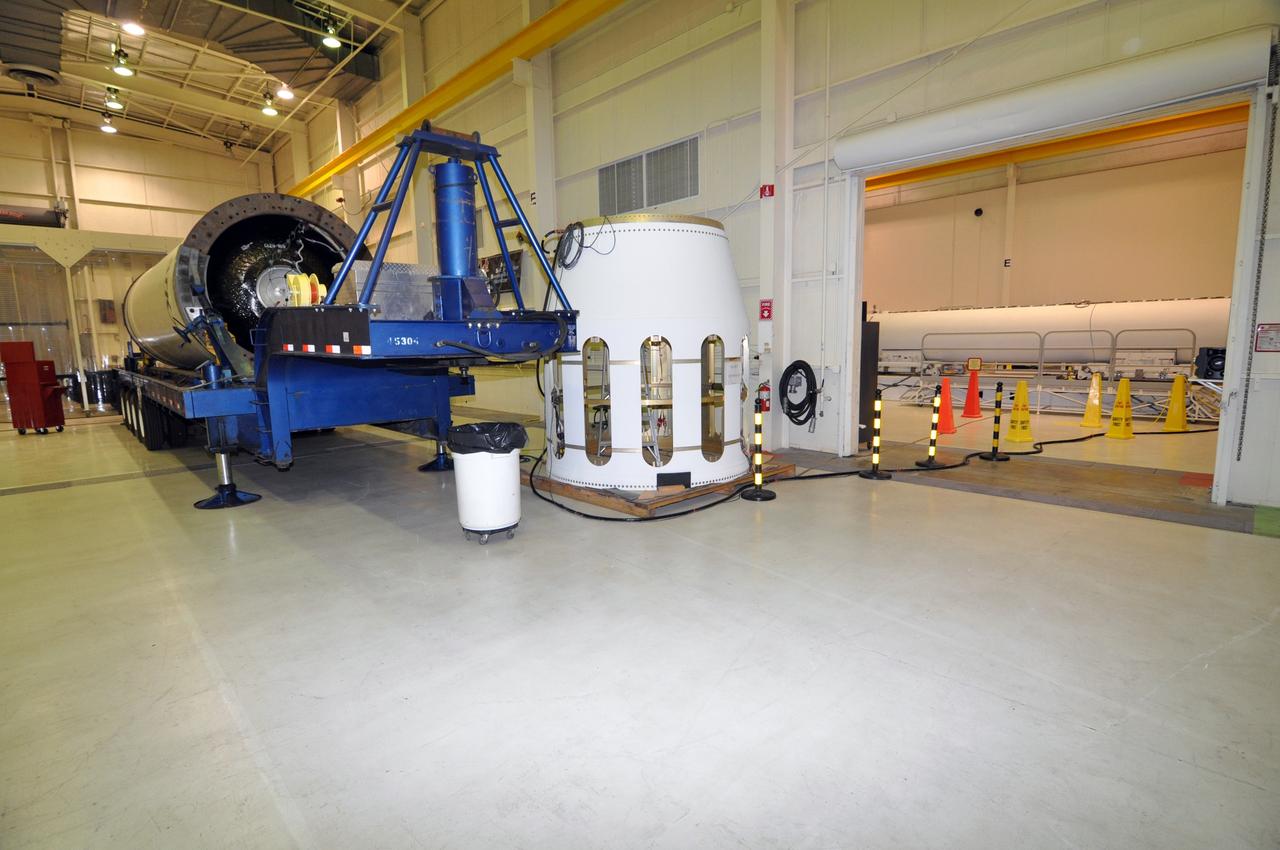
VANDENBERG AIR FORCE BASE, Calif. – The stage 0 motor, left, and the interstage associated with Stage 1 of the Taurus XL rocket are ready for more processing in the west high bay of Building 1555 at Vandenberg Air Force Base in California. In the east high bay, right, are the first, second and third stages. The rocket and NASA's Glory satellite are being prepared for a launch to low Earth orbit from Vandenberg's Space Launch Complex 576-E. Once Glory reaches orbit, it will collect data on the properties of aerosols and black carbon. It also will help scientists understand how the sun's irradiance affects Earth's climate. Photo credit: NASA/Randy Beaudoin, VAFB
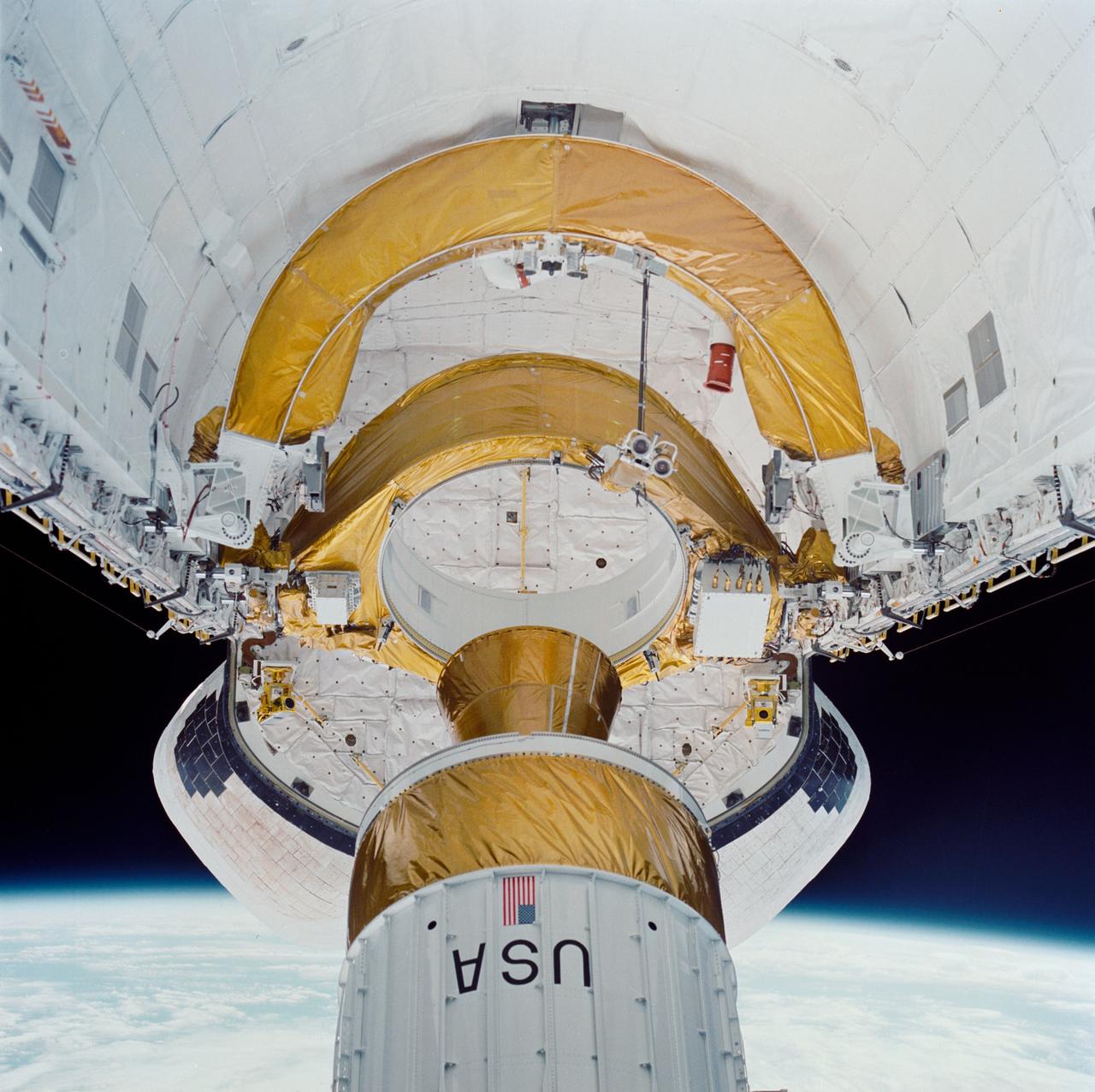
During STS-26, inertial upper stage (IUS) with the tracking and data relay satellite C (TDRS-C) drifts above Discovery, Orbiter Vehicle (OV) 103, payload bay (PLB) after being positioned in deployment attitude (an angle of 50 degrees) by the airborne support equipment (ASE). IUS vacates the ASE aft frame tilt actuator (AFTA) table in the PLB while the disconnected ASE umbilical boom floats above ASE forward cradle. IUS first stage rocket motor and nozzle and the interstage are visible as the IUS is deployed. In the background are the orbital maneuvering system (OMS) pods and the Earth's limb.

CAPE CANAVERAL, Fla. – In the Vehicle Assembly Building's High Bay 3, the Ares I-X "super stack 1" is being attached to the forward motor segment. Super stack 1 comprises the frustum, forward skirt, forward skirt extension, interstages 1 and 2 and the fifth segment simulator. Ares I-X is the test vehicle for the Ares I, which is part of the Constellation Program to return men to the moon and beyond. The Ares I-X flight test is targeted for Oct. 31, pending forma NASA Headquarters approval. Photo credit: NASA/Jack Pfaller
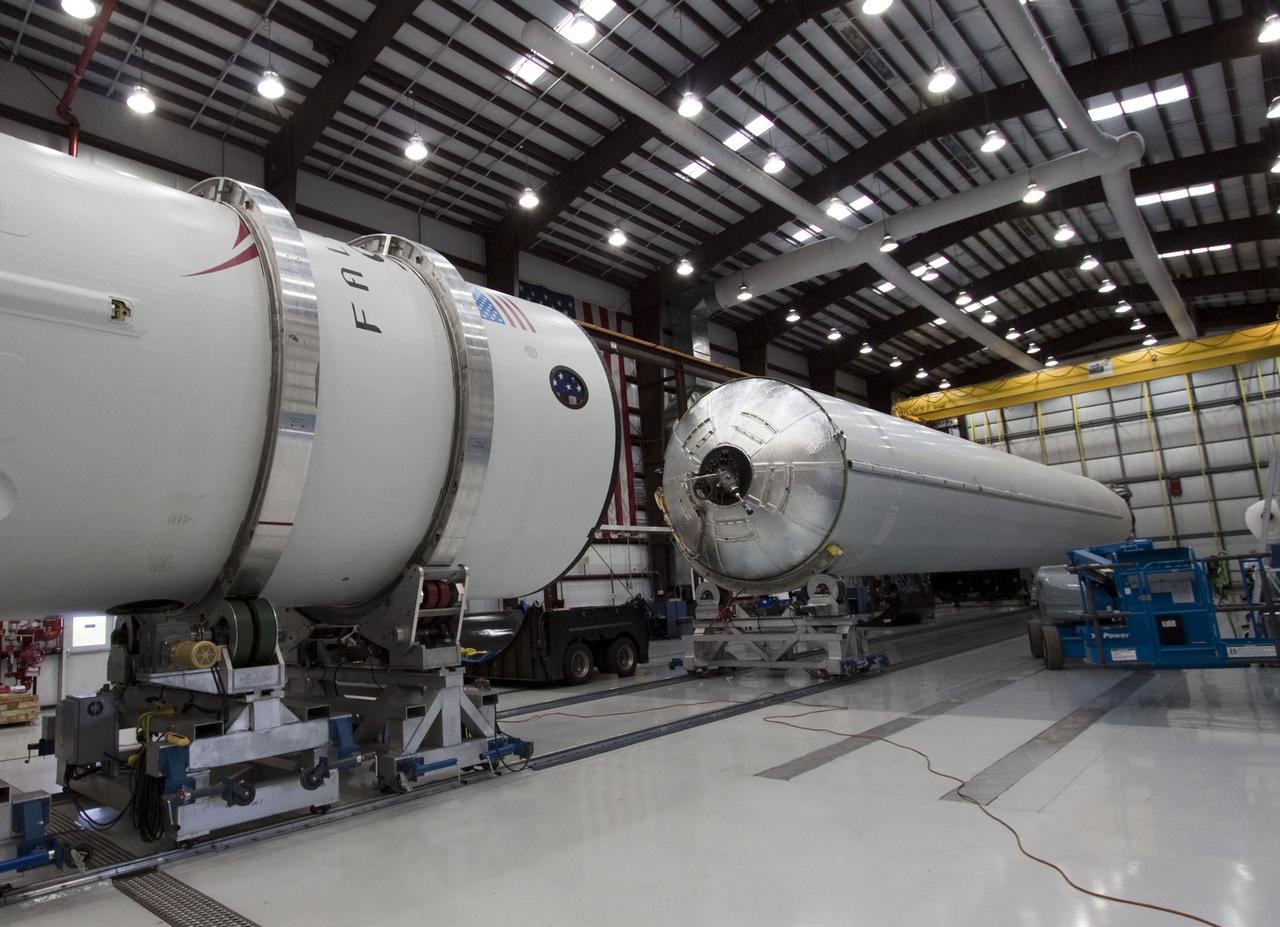
CAPE CANAVERAL, Fla. -- The first stage and interstage components of a Falcon 9 rocket sit on adjacent processing stands in the Space Exploration Technologies (SpaceX) hangar at Launch Complex 40 at Cape Canaveral Air Force Station in Florida. Technicians are preparing the rocket for the second launch in the Commercial Orbital Transportation Services, or COTS, program to demonstrate private companies' ability to launch uncrewed spacecraft into orbit. A follow-on contract, Commercial Resupply Services, calls for SpaceX to launch 12 resupply missions to the International Space Station between 2011 and 2015. Photo credit: NASA/Jack Pfaller
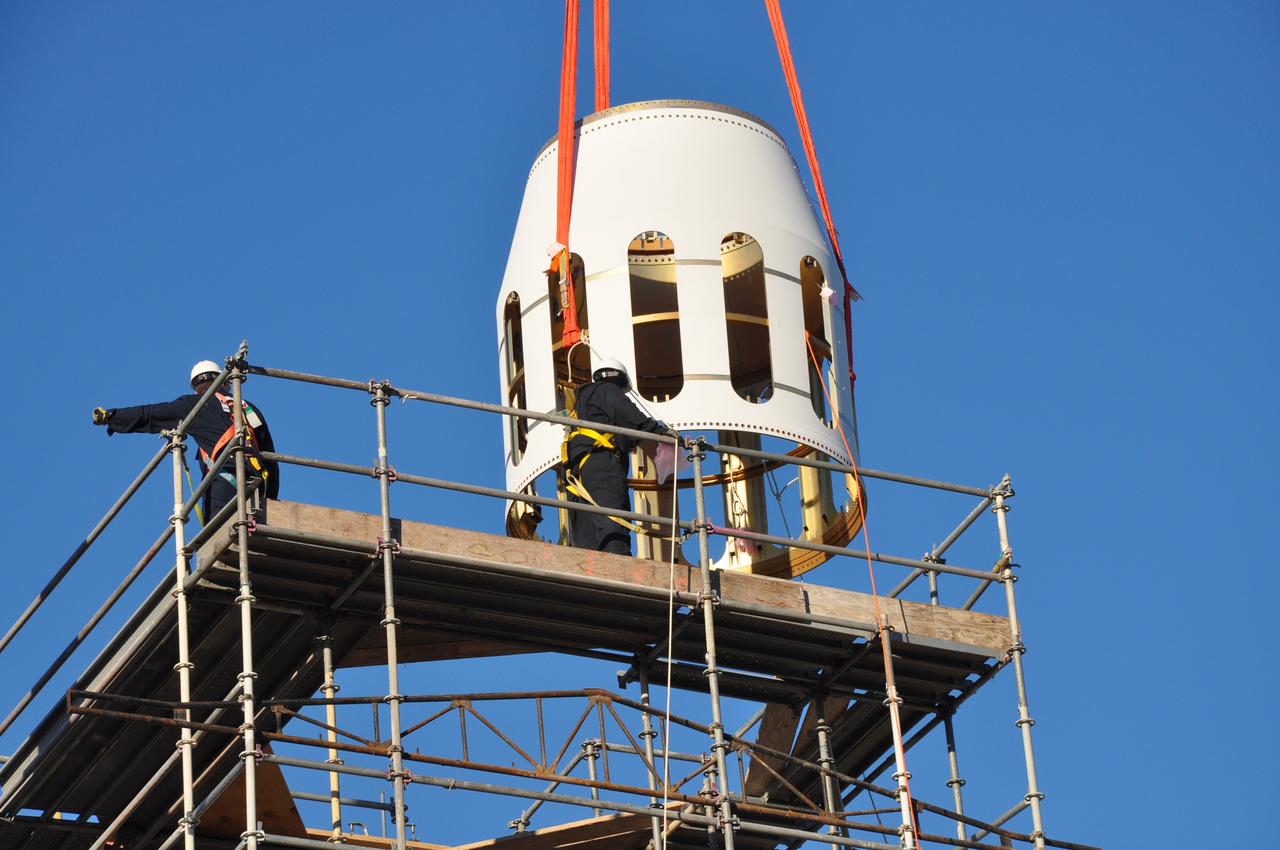
VANDENBERG AIR FORCE BASE, Calif. -- At Vandenberg Air Force Base in California, workers guide the Stage 0/1 interstage, part of the four-stage Taurus XL rocket that will carry NASA's Glory spacecraft into low Earth orbit, as it is lowered by crane into launch position at Space Launch Complex 576-E. Once Glory reaches orbit, it will collect data on the properties of aerosols and black carbon. It also will help scientists understand how the sun's irradiance affects Earth's climate. Launch is scheduled for 5:09 a.m. EST Feb. 23. For information, visit www.nasa.gov/glory. Photo credit: NASA/Randy Beaudoin, VAFB
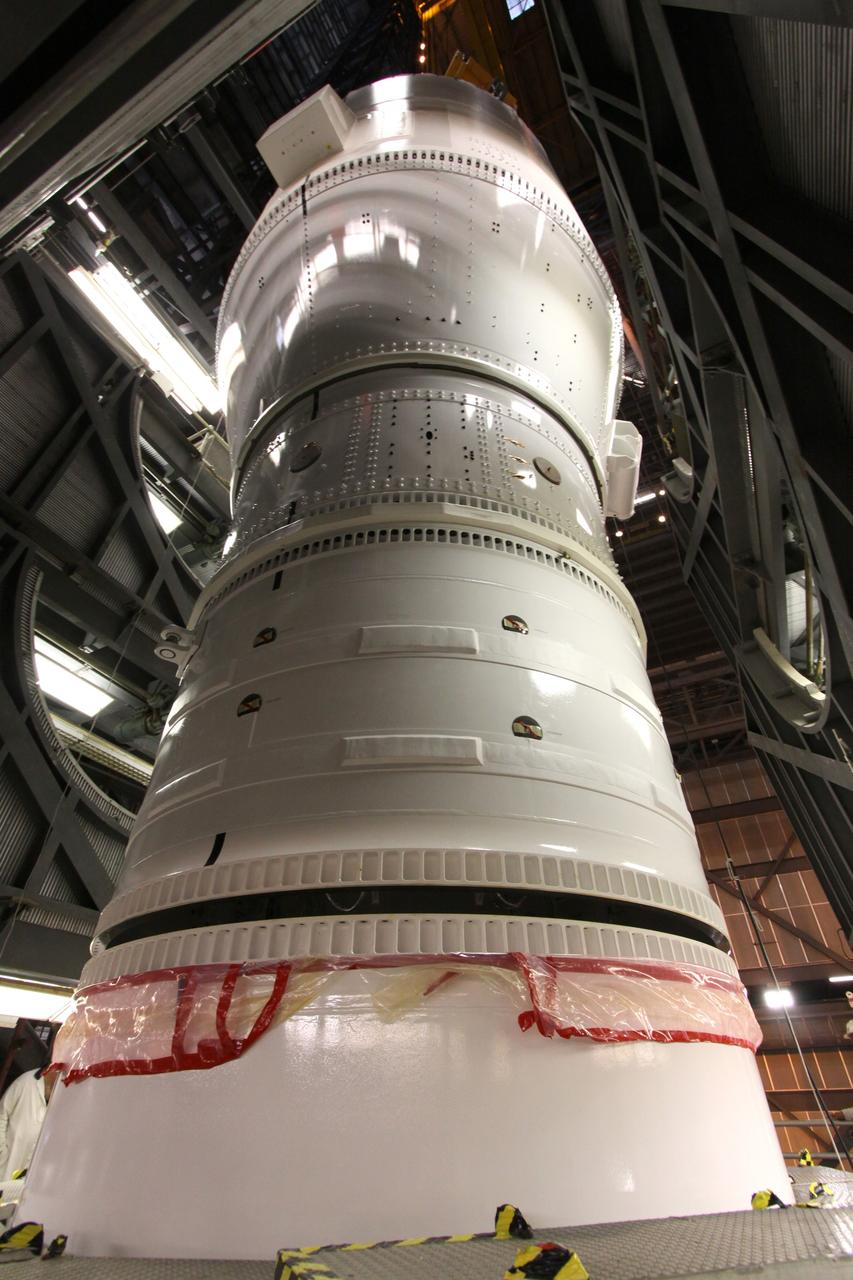
CAPE CANAVERAL, Fla. – In the Vehicle Assembly Building at NASA's Kennedy Space Center in Florida, segments of the Ares I-X first stage are lowered onto the fifth simulator segment for mating, to complete Super Stack 1. The super stack comprises the forward skirt, forward skirt extension, interstages 1 and 2 and the fifth segment simulator. Ares I-X is the test vehicle for the Ares I, which is part of the Constellation Program to return men to the moon and beyond. The Ares I-X flight test is targeted no earlier than Aug. 30 from Launch Pad 39B. Photo credit: NASA/Jack Pfaller

CAPE CANAVERAL, Fla. – In the Vehicle Assembly Building's High Bay 3, the Ares I-X "super stack 1" is being attached to the forward motor segment. Super stack 1 comprises the frustum, forward skirt, forward skirt extension, interstages 1 and 2 and the fifth segment simulator. Ares I-X is the test vehicle for the Ares I, which is part of the Constellation Program to return men to the moon and beyond. The Ares I-X flight test is targeted for Oct. 31, pending forma NASA Headquarters approval. Photo credit: NASA/Jack Pfaller
CAPE CANAVERAL, Fla. – In the Vehicle Assembly Building at NASA's Kennedy Space Center in Florida, the segments of the Ares I-X first stage are fitted with a crane to lift it to the fifth segment simulator for mating, completing Super Stack 1. The super stack comprises the forward skirt, forward skirt extension, interstages 1 and 2 and the fifth segment simulator. Ares I-X is the test vehicle for the Ares I, which is part of the Constellation Program to return men to the moon and beyond. The Ares I-X flight test is targeted no earlier than Aug. 30 from Launch Pad 39B. Photo credit: NASA/Jack Pfaller
CAPE CANAVERAL, Fla. – In the Vehicle Assembly Building at NASA's Kennedy Space Center in Florida, segments of the Ares I-X first stage are lifted from the stand. The segments are being moved for stacking and mating to the fifth segment simulator, completing Super Stack 1. The super stack comprises the forward skirt, forward skirt extension, interstages 1 and 2 and the fifth segment simulator. Ares I-X is the test vehicle for the Ares I, which is part of the Constellation Program to return men to the moon and beyond. The Ares I-X flight test is targeted no earlier than Aug. 30 from Launch Pad 39B. Photo credit: NASA/Jack Pfaller
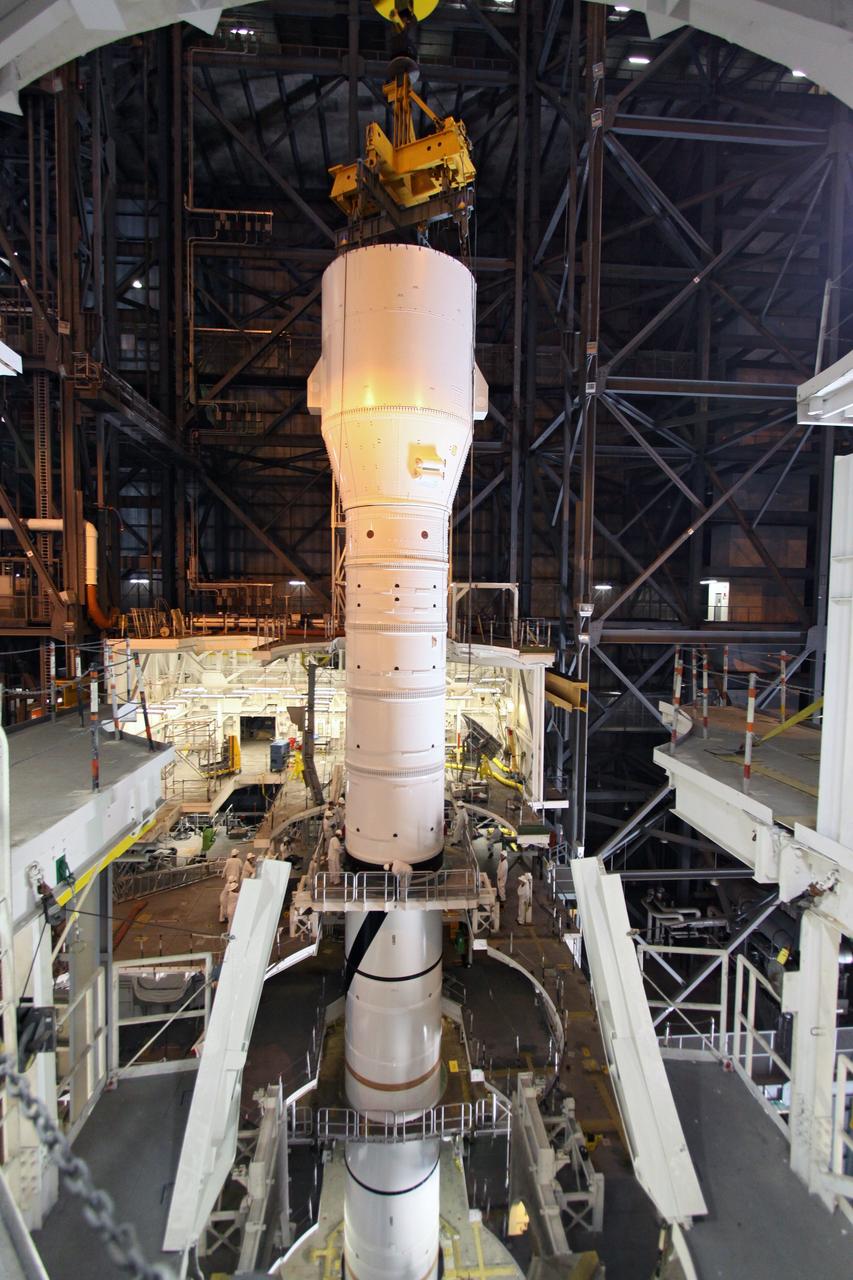
CAPE CANAVERAL, Fla. – In the Vehicle Assembly Building's High Bay 3, the Ares I-X "super stack 1" is being attached to the forward motor segment. Super stack 1 comprises the frustum, forward skirt, forward skirt extension, interstages 1 and 2 and the fifth segment simulator. Ares I-X is the test vehicle for the Ares I, which is part of the Constellation Program to return men to the moon and beyond. The Ares I-X flight test is targeted for Oct. 31, pending forma NASA Headquarters approval. Photo credit: NASA/Jack Pfaller
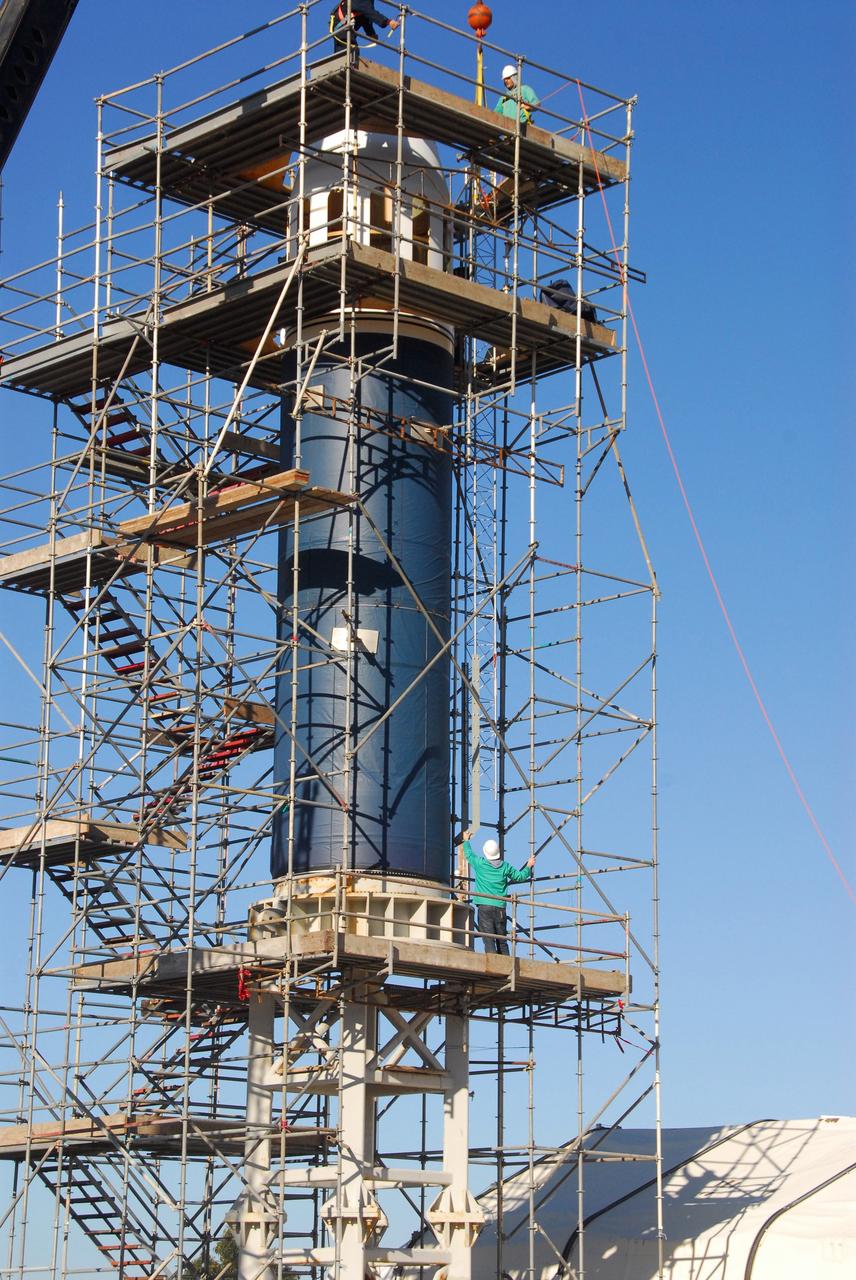
VANDENBERG AIR FORCE BASE, Calif. -- At Space Launch Complex 576-E at Vandenberg Air Force Base in California, the Stage 0/1 interstage is attached to Stage 0 of the four-stage Taurus XL rocket that will carry NASA's Glory spacecraft into low Earth orbit. Once Glory reaches orbit, it will collect data on the properties of aerosols and black carbon. It also will help scientists understand how the sun's irradiance affects Earth's climate. Launch is scheduled for 5:09 a.m. EST Feb. 23. For information, visit www.nasa.gov/glory. Photo credit: NASA/Roy Allison, VAFB
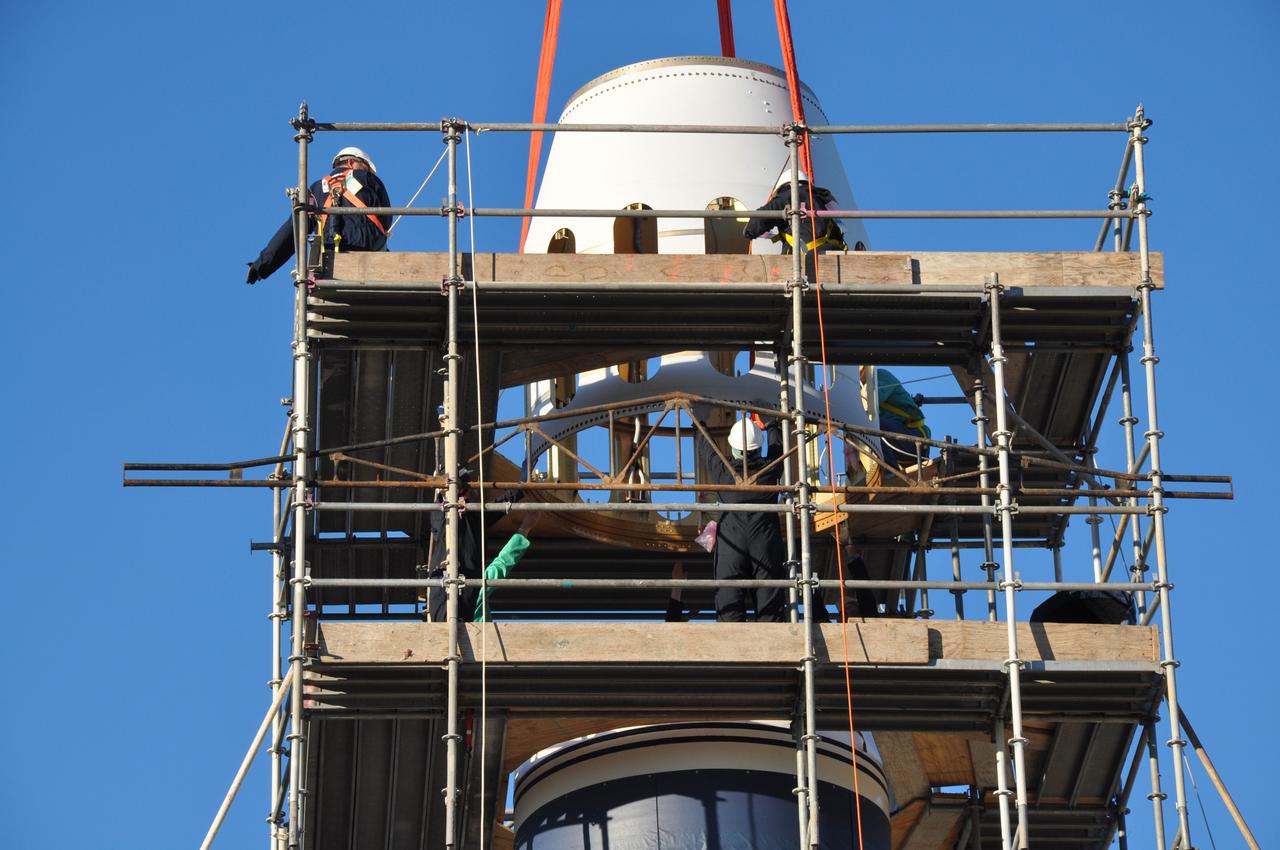
VANDENBERG AIR FORCE BASE, Calif. -- Workers at Vandenberg Air Force Base in California, guide the Stage 0/1 interstage, part of the four-stage Taurus XL rocket that will carry NASA's Glory spacecraft into low Earth orbit, into launch position at Space Launch Complex 576-E. Once Glory reaches orbit, it will collect data on the properties of aerosols and black carbon. It also will help scientists understand how the sun's irradiance affects Earth's climate. Launch is scheduled for 5:09 a.m. EST Feb. 23. For information, visit www.nasa.gov/glory. Photo credit: NASA/Randy Beaudoin, VAFB

VANDENBERG AIR FORCE BASE, Calif. - At Space Launch Complex 2 at Vandenberg Air Force Base in California, the interstage of the United Launch Alliance Delta II rocket for launch of NASA's Wide-field Infrared Survey Explorer, or WISE, is lifted up the side of the mobile service tower. WISE will survey the entire sky at infrared wavelengths, creating a cosmic clearinghouse of hundreds of millions of objects which will be catalogued and provide a vast storehouse of knowledge about the solar system, the Milky Way, and the universe. Launch is scheduled for Dec. 7. For additional information, visit http://wise.ssl.berkeley.edu. Photo credit: NASA/Roy Allison, VAFB

VANDENBERG AIR FORCE BASE, Calif. - At Space Launch Complex 2 at Vandenberg Air Force Base in California, workers guide the interstage of the United Launch Alliance Delta II rocket for launch of NASA's Wide-field Infrared Survey Explorer, or WISE, into place on top of the rocket's first stage in the pad's mobile service tower. WISE will survey the entire sky at infrared wavelengths, creating a cosmic clearinghouse of hundreds of millions of objects which will be catalogued and provide a vast storehouse of knowledge about the solar system, the Milky Way, and the universe. Launch is scheduled for Dec. 7. For additional information, visit http://wise.ssl.berkeley.edu. Photo credit: NASA/Roy Allison, VAFB
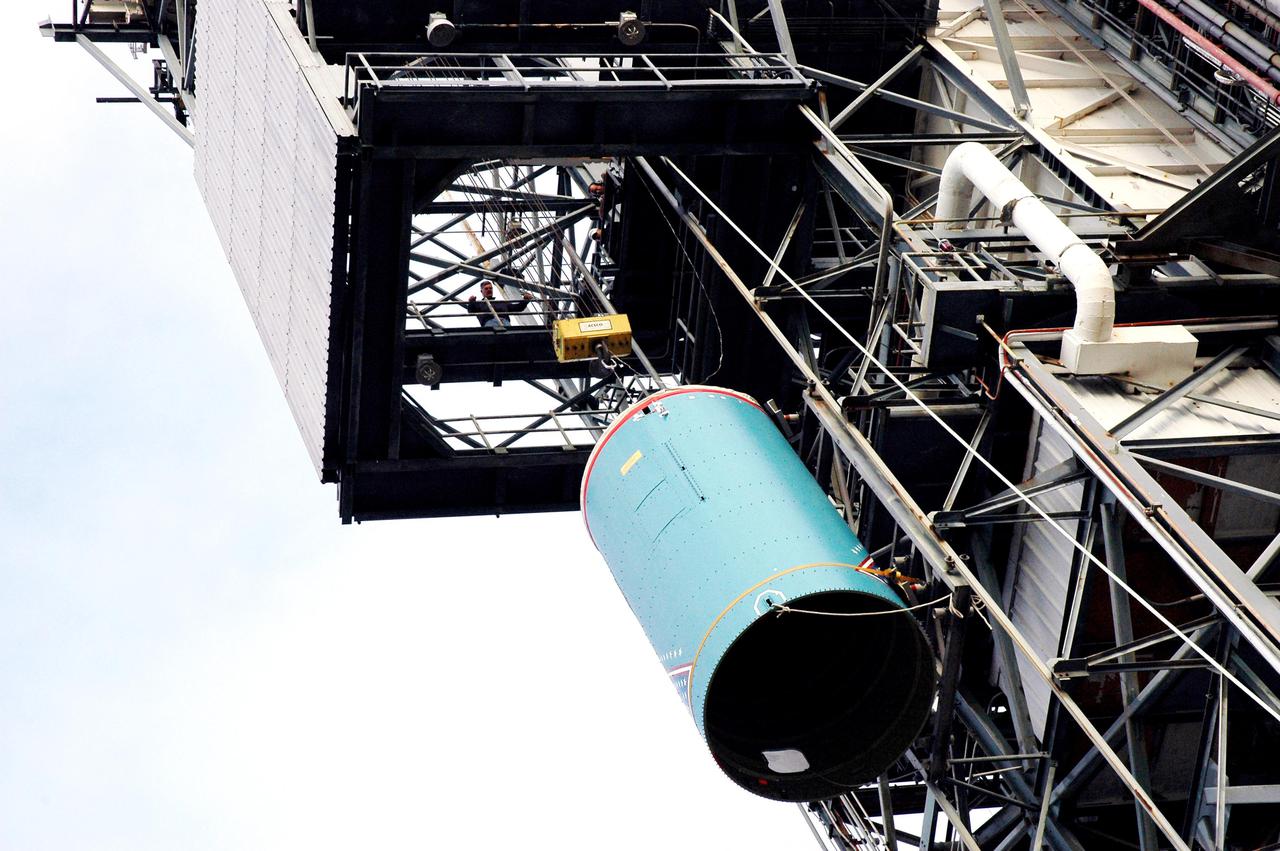
KENNEDY SPACE CENTER, FLA. - The replacement interstage adapter for the Boeing Delta II launch vehicle for the Deep Impact spacecraft is lifted up the mobile service tower on Launch Pad 17-B, Cape Canaveral Air Force Station, Fla. Boeing workers will attach the adapter to the rocket’s center body section. Later the second stage, which was removed to allow access to the previous adapter, will be reattached. The first adapter was removed after it was found to be faulty during a review of launch vehicle hardware. Launch of Deep Impact is now scheduled no earlier than Jan. 12.
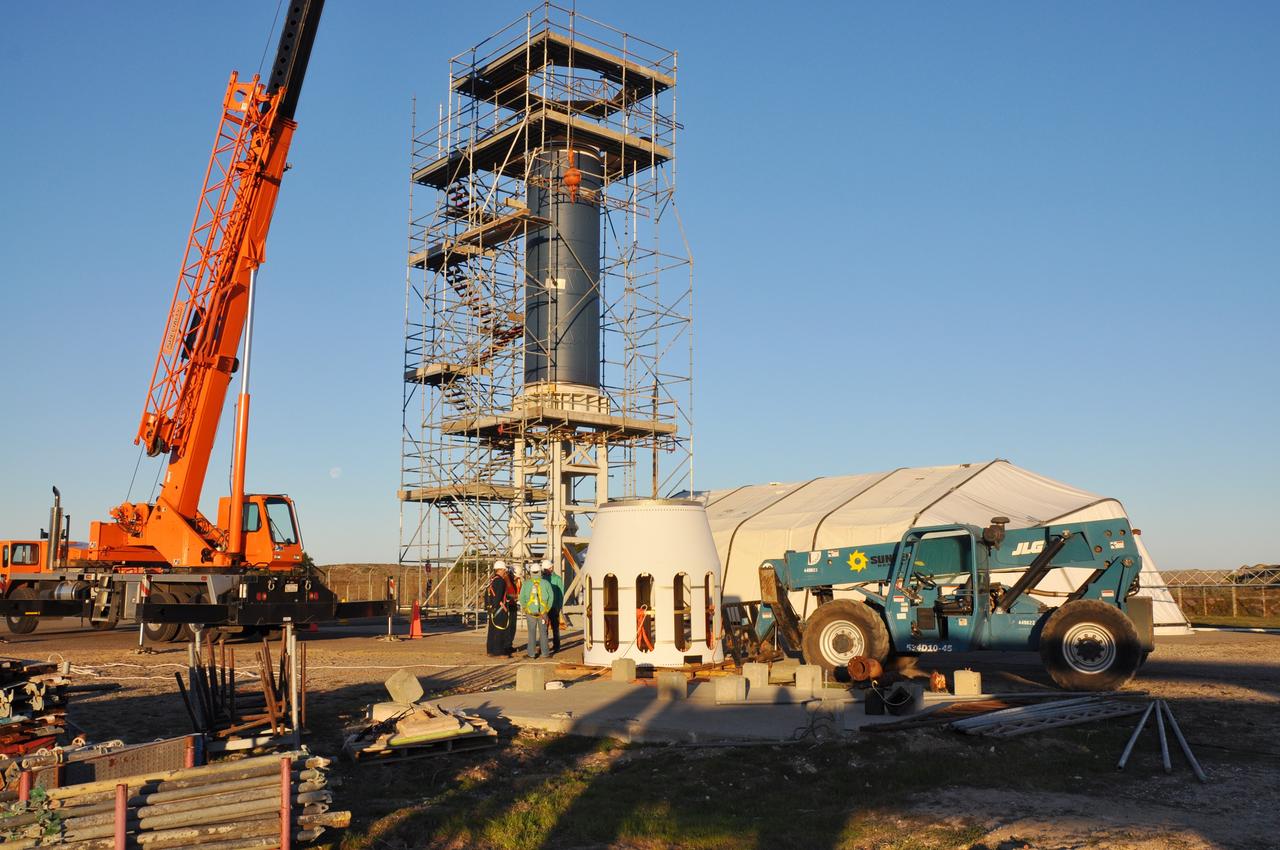
VANDENBERG AIR FORCE BASE, Calif. -- At Vandenberg Air Force Base in California, Stage 0/1 interstage, part of the four-stage Taurus XL rocket that will carry NASA's Glory spacecraft into low Earth orbit, arrives at Space Launch Complex 576-E. Once Glory reaches orbit, it will collect data on the properties of aerosols and black carbon. It also will help scientists understand how the sun's irradiance affects Earth's climate. Launch is scheduled for 5:09 a.m. EST Feb. 23. For information, visit www.nasa.gov/glory. Photo credit: NASA/Randy Beaudoin, VAFB
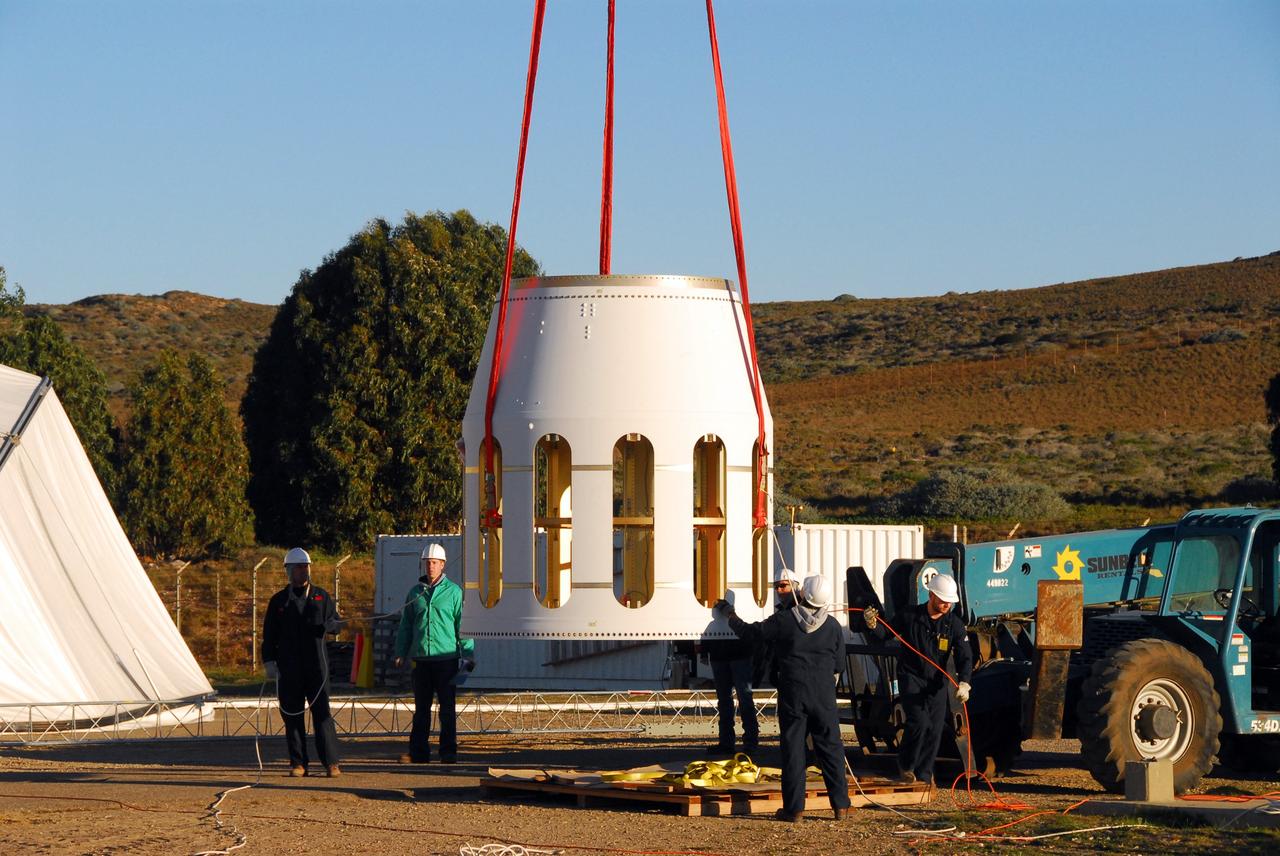
VANDENBERG AIR FORCE BASE, Calif. -- At Vandenberg Air Force Base in California, the Stage 0/1 interstage, part of the four-stage Taurus XL rocket that will carry NASA's Glory spacecraft into low Earth orbit, is lifted by crane toward the pad at Space Launch Complex 576-E. Once Glory reaches orbit, it will collect data on the properties of aerosols and black carbon. It also will help scientists understand how the sun's irradiance affects Earth's climate. Launch is scheduled for 5:09 a.m. EST Feb. 23. For information, visit www.nasa.gov/glory. Photo credit: NASA/Roy Allison, VAFB

VANDENBERG AIR FORCE BASE, Calif. - At Space Launch Complex 2 at Vandenberg Air Force Base in California, the interstage of the United Launch Alliance Delta II rocket for launch of NASA's Wide-field Infrared Survey Explorer, or WISE, arrives at the pad. WISE will survey the entire sky at infrared wavelengths, creating a cosmic clearinghouse of hundreds of millions of objects which will be catalogued and provide a vast storehouse of knowledge about the solar system, the Milky Way, and the universe. Launch is scheduled for Dec. 7. For additional information, visit http://wise.ssl.berkeley.edu. Photo credit: NASA/Roy Allison, VAFB
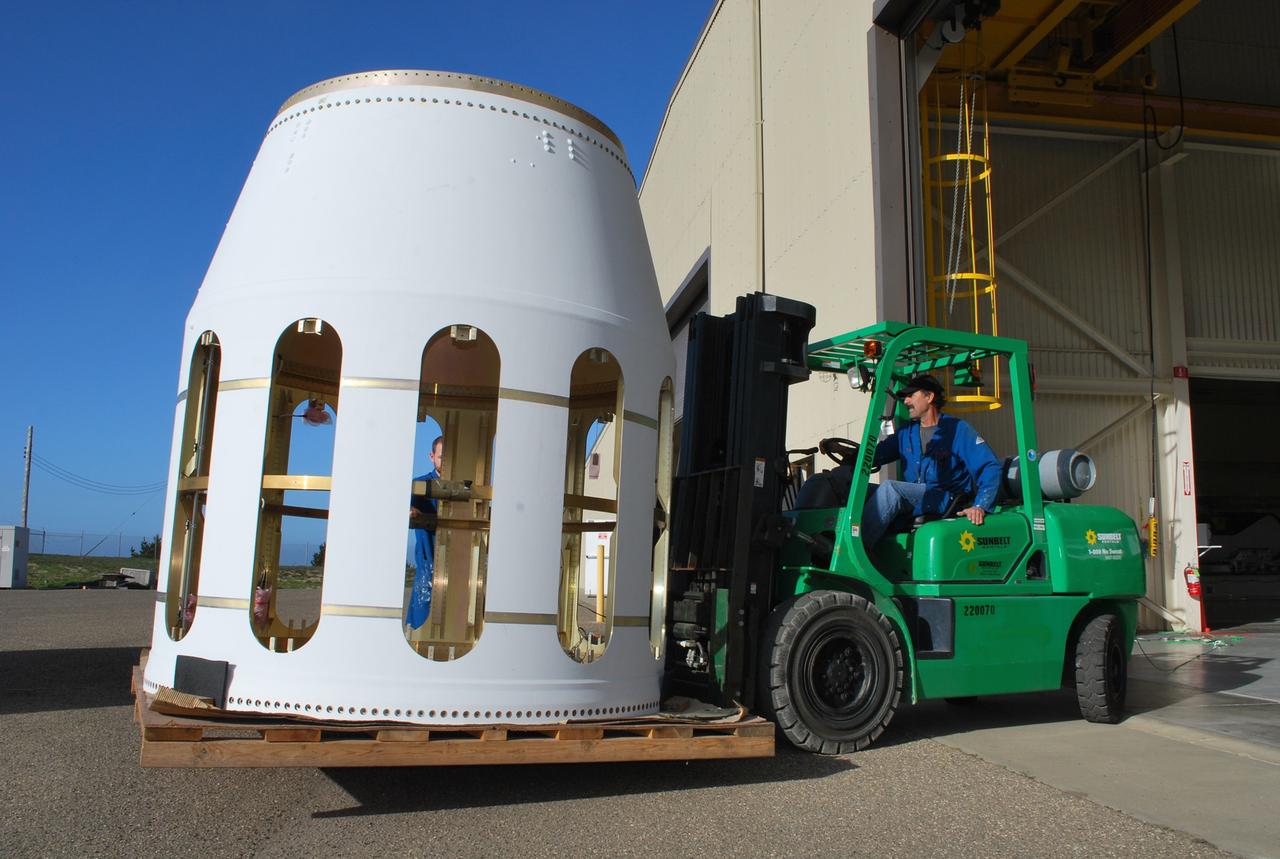
VANDENBERG AIR FORCE BASE, Calif. -- At the Orbital Sciences Corp. Building 1555 at Vandenberg Air Force Base in California, Stage 0/1 interstage, part of the four-stage Taurus XL rocket that will carry NASA's Glory spacecraft into low Earth orbit, is being prepared for transport to Space Launch Complex 576-E. Once Glory reaches orbit, it will collect data on the properties of aerosols and black carbon. It also will help scientists understand how the sun's irradiance affects Earth's climate. Launch is scheduled for 5:09 a.m. EST Feb. 23. For information, visit www.nasa.gov/glory. Photo credit: NASA/Randy Beaudoin, VAFB
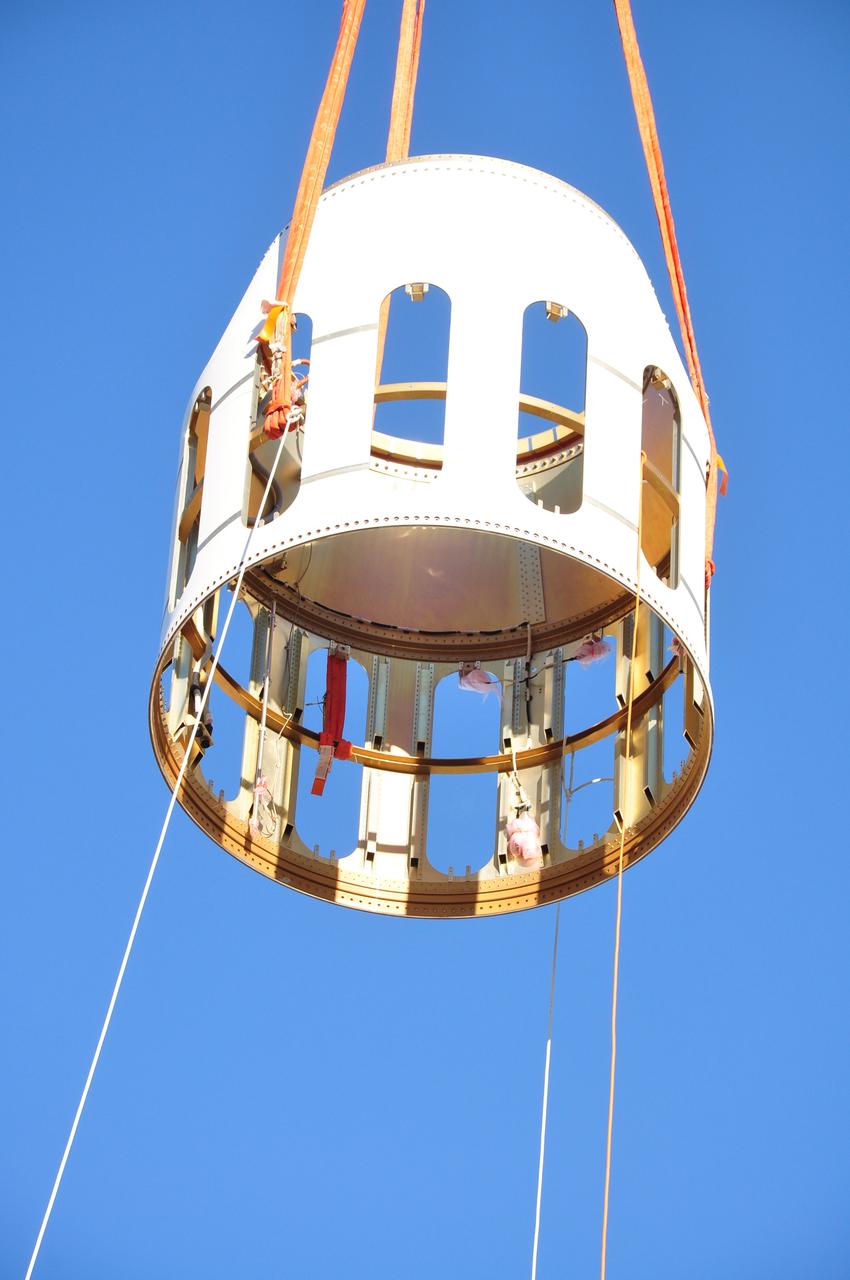
VANDENBERG AIR FORCE BASE, Calif. -- At Vandenberg Air Force Base in California, the Stage 0/1 interstage, part of the four-stage Taurus XL rocket that will carry NASA's Glory spacecraft into low Earth orbit, is lifted by crane toward the pad at Space Launch Complex 576-E. Once Glory reaches orbit, it will collect data on the properties of aerosols and black carbon. It also will help scientists understand how the sun's irradiance affects Earth's climate. Launch is scheduled for 5:09 a.m. EST Feb. 23. For information, visit www.nasa.gov/glory. Photo credit: NASA/Randy Beaudoin, VAFB

VANDENBERG AIR FORCE BASE, Calif. - At Space Launch Complex 2 at Vandenberg Air Force Base in California, the interstage of the United Launch Alliance Delta II rocket for launch of NASA's Wide-field Infrared Survey Explorer, or WISE, is in place on top of the rocket's first stage in the pad's mobile service tower. WISE will survey the entire sky at infrared wavelengths, creating a cosmic clearinghouse of hundreds of millions of objects which will be catalogued and provide a vast storehouse of knowledge about the solar system, the Milky Way, and the universe. Launch is scheduled for Dec. 7. For additional information, visit http://wise.ssl.berkeley.edu. Photo credit: NASA/Roy Allison, VAFB
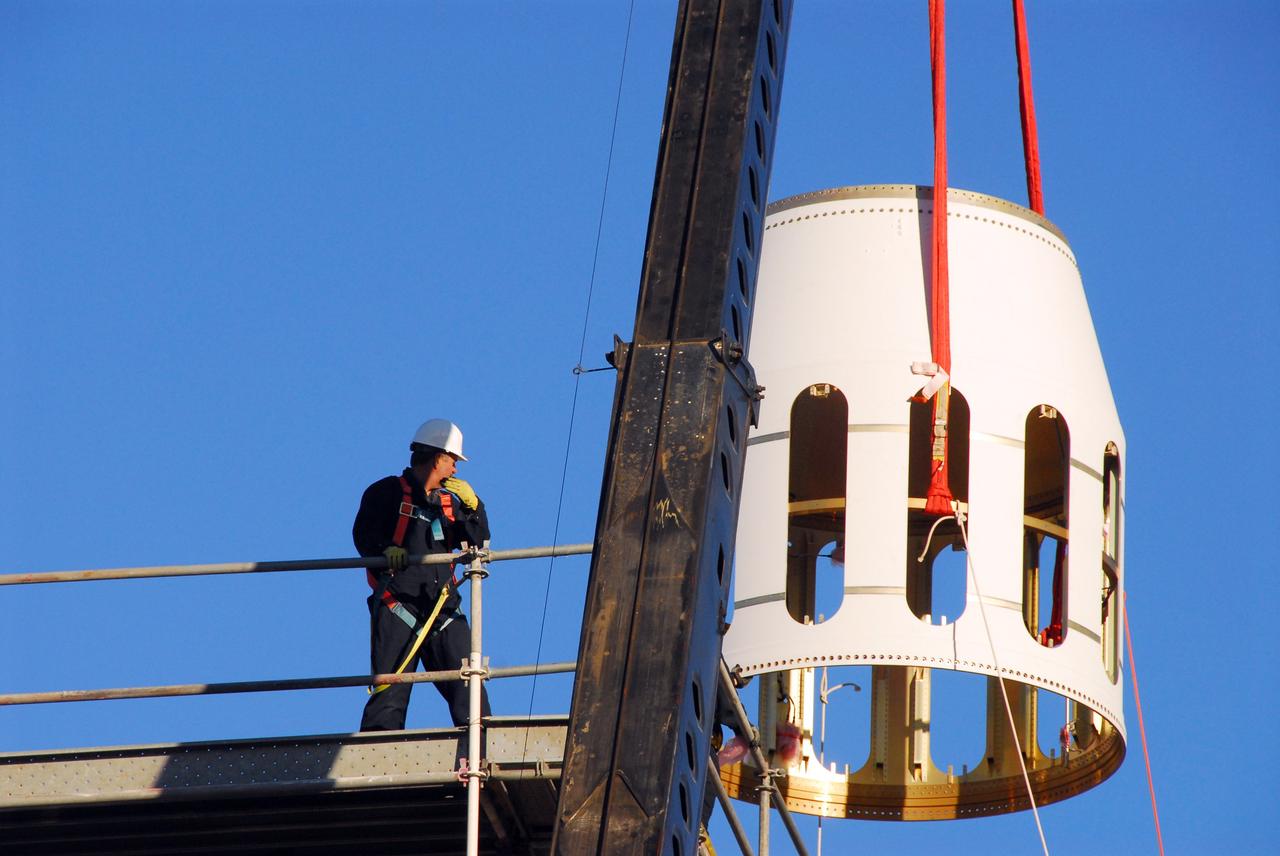
VANDENBERG AIR FORCE BASE, Calif. -- At Vandenberg Air Force Base in California, the Stage 0/1 interstage, part of the four-stage Taurus XL rocket that will carry NASA's Glory spacecraft into low Earth orbit, is lifted by crane toward the pad at Space Launch Complex 576-E. Once Glory reaches orbit, it will collect data on the properties of aerosols and black carbon. It also will help scientists understand how the sun's irradiance affects Earth's climate. Launch is scheduled for 5:09 a.m. EST Feb. 23. For information, visit www.nasa.gov/glory. Photo credit: NASA/Roy Allison, VAFB
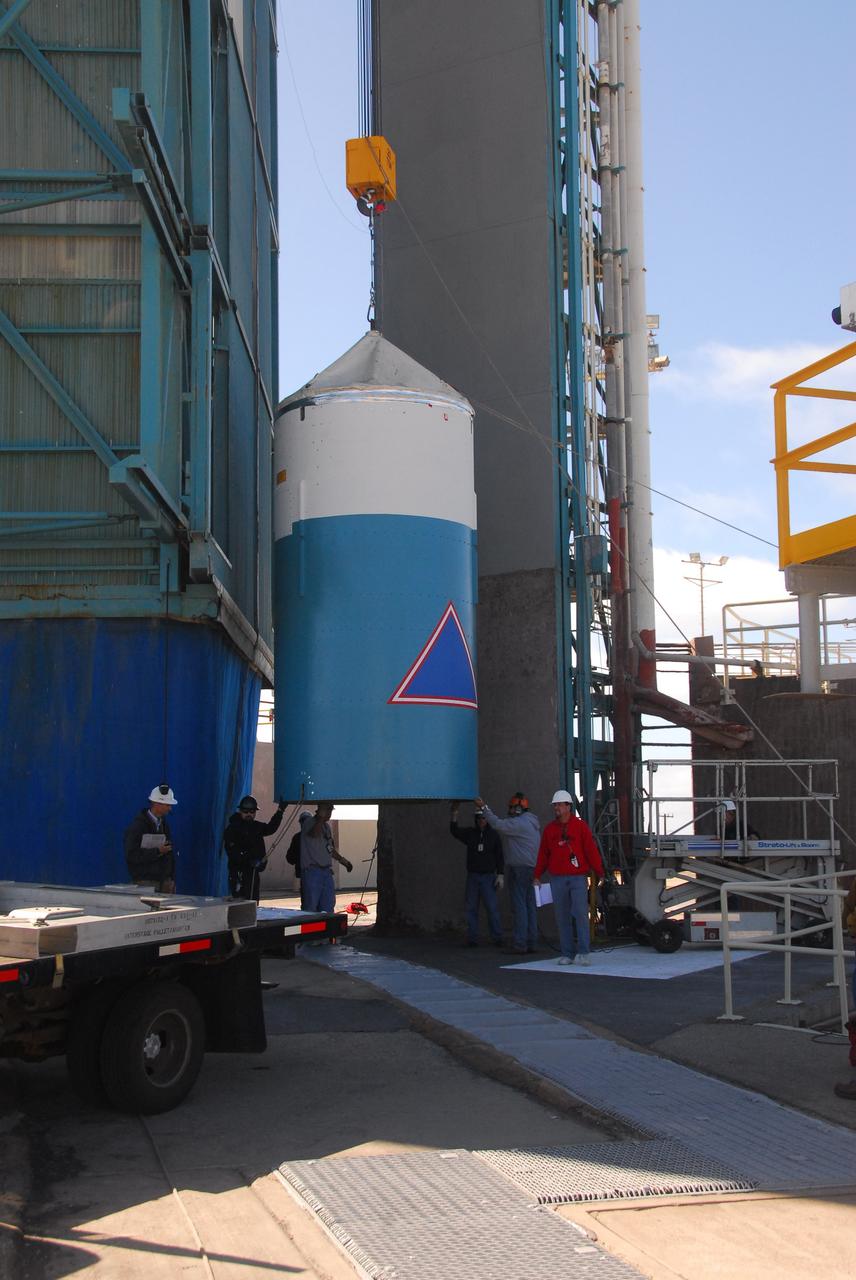
VANDENBERG AIR FORCE BASE, Calif. - At Space Launch Complex 2 at Vandenberg Air Force Base in California, the interstage of the United Launch Alliance Delta II rocket for launch of NASA's Wide-field Infrared Survey Explorer, or WISE, is lifted from its transporter. WISE will survey the entire sky at infrared wavelengths, creating a cosmic clearinghouse of hundreds of millions of objects which will be catalogued and provide a vast storehouse of knowledge about the solar system, the Milky Way, and the universe. Launch is scheduled for Dec. 7. For additional information, visit http://wise.ssl.berkeley.edu. Photo credit: NASA/Roy Allison, VAFB
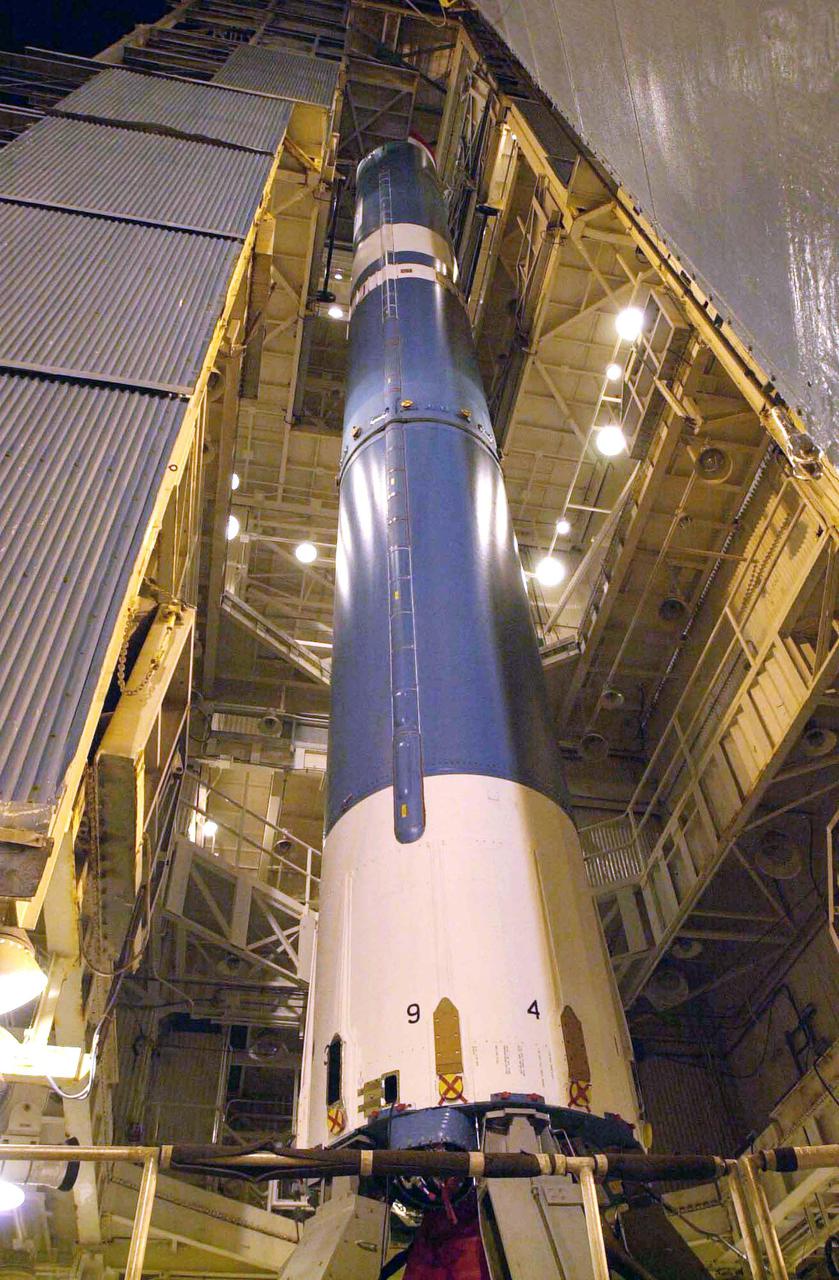
VANDENBERG AIR FORCE BASE, CALIF. - The first stage of a Boeing Delta II rocket is in the launch service tower of Space Launch Complex 2 on Vandenberg Air Force Base in California. It will be mated with an interstage adapter and Solid Rocket Boosters for the launch of the National Oceanic and Atmospheric Administration (NOAA-N) spacecraft. Launch of NOAA-N aboard the Boeing Delta II rocket is currently scheduled for May 11, 2005. NOAA-N is the fourth in the series of support dedicated microwave instruments for the generation of temperature, moisture, surface, and hydrological products in cloudy regions where visible and infrared (IR) instruments have decreased capability.
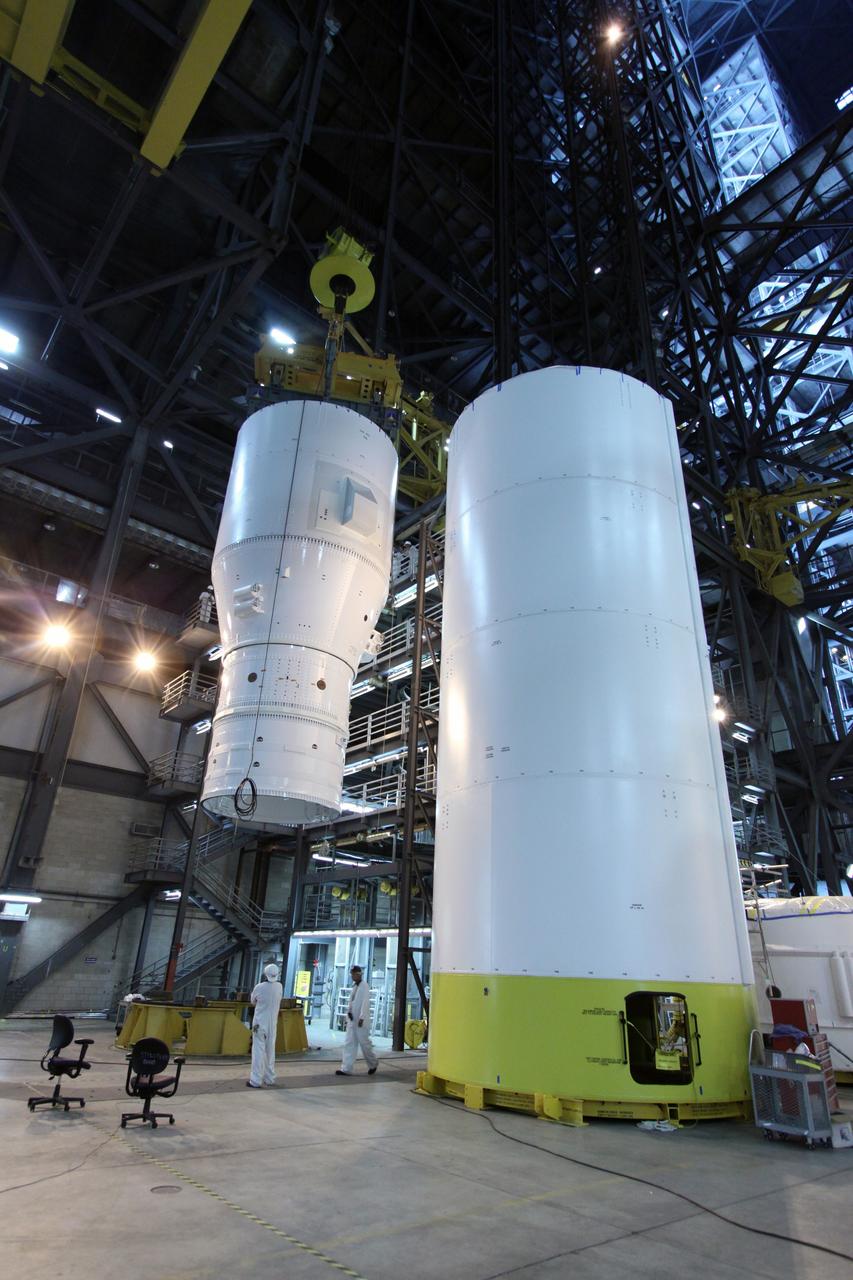
CAPE CANAVERAL, Fla. – In the Vehicle Assembly Building at NASA's Kennedy Space Center in Florida, segments of the Ares I-X first stage are moved across the bay. They will be stacked and mated to the fifth segment simulator, completing Super Stack 1. The super stack comprises the forward skirt, forward skirt extension, interstages 1 and 2 and the fifth segment simulator. Ares I-X is the test vehicle for the Ares I, which is part of the Constellation Program to return men to the moon and beyond. The Ares I-X flight test is targeted no earlier than Aug. 30 from Launch Pad 39B. Photo credit: NASA/Jack Pfaller
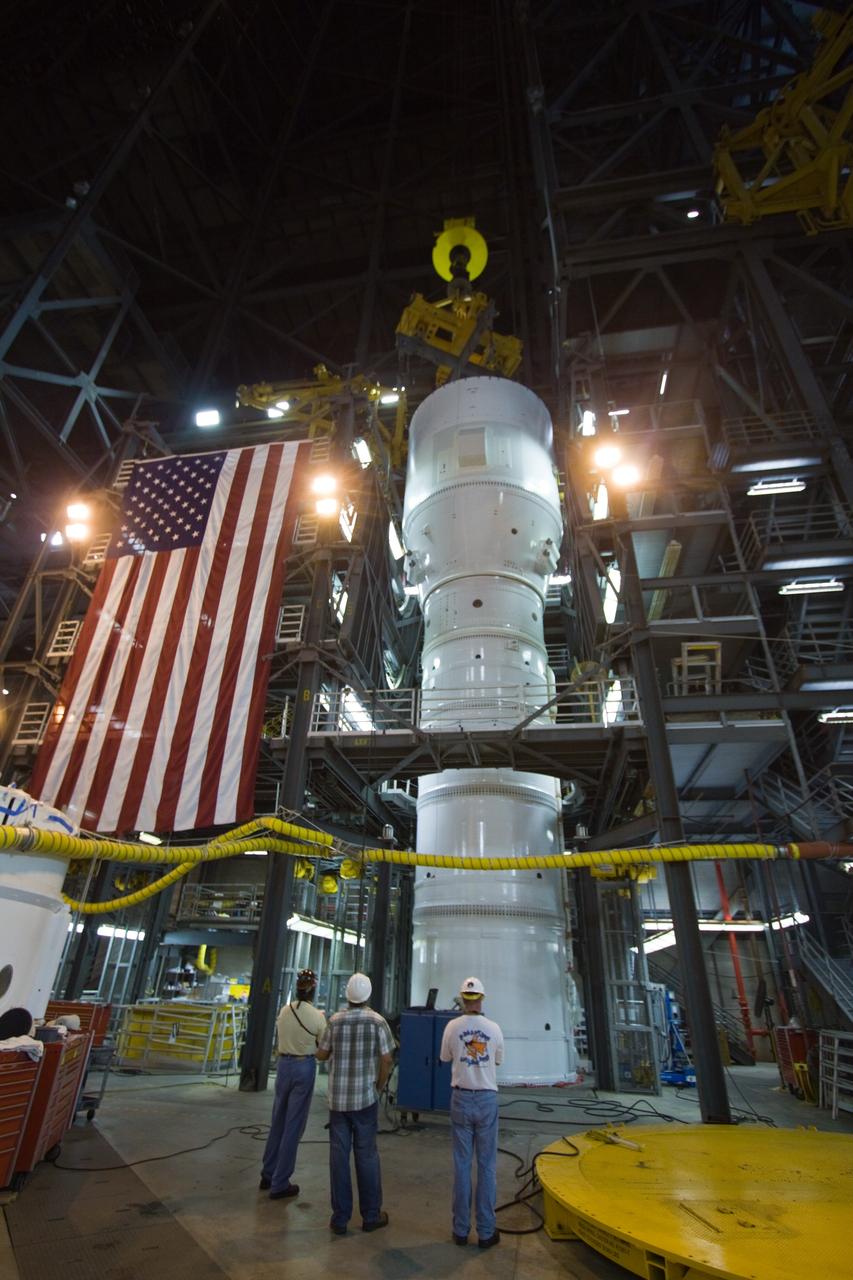
CAPE CANAVERAL, Fla. – In the Vehicle Assembly Building's High Bay 4, the Ares I-X "super stack 1" is to be lifted into High Bay 3 and attached to the forward motor segment. Super stack 1 comprises the frustum, forward skirt, forward skirt extension, interstages 1 and 2 and the fifth segment simulator. Ares I-X is the test vehicle for the Ares I, which is part of the Constellation Program to return men to the moon and beyond. The Ares I-X flight test is targeted for Oct. 31, pending forma NASA Headquarters approval. Photo credit: NASA/Jack Pfaller
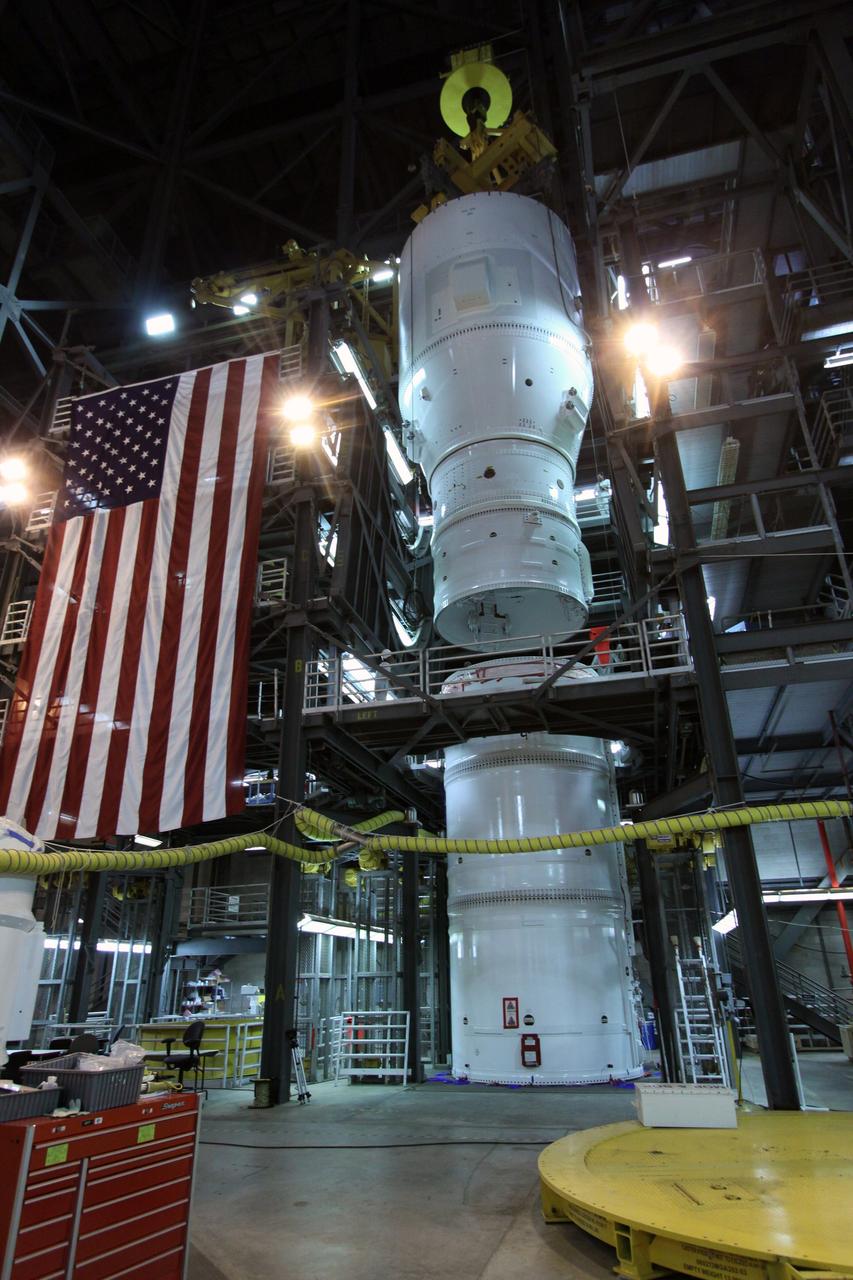
CAPE CANAVERAL, Fla. – In the Vehicle Assembly Building at NASA's Kennedy Space Center in Florida, segments of the Ares I-X first stage are lowered toward the fifth simulator segment for mating, to complete Super Stack 1. The super stack comprises the forward skirt, forward skirt extension, interstages 1 and 2 and the fifth segment simulator. Ares I-X is the test vehicle for the Ares I, which is part of the Constellation Program to return men to the moon and beyond. The Ares I-X flight test is targeted no earlier than Aug. 30 from Launch Pad 39B. Photo credit: NASA/Jack Pfaller

At the Orbital Sciences Corp. Building 1555 at Vandenberg Air Force Base in California, Stage 0/1 interstage, part of the four-stage Taurus XL rocket that will carry NASA's Glory spacecraft into low Earth orbit, is being prepared for transport to Space Launch Complex 576-E. Once Glory reaches orbit, it will collect data on the properties of aerosols and black carbon. It also will help scientists understand how the sun's irradiance affects Earth's climate. Launch is scheduled for 5:09 a.m. EST Feb. 23. For information, visit www.nasa.gov/glory. Photo credit: NASA/Randy Beaudoin, VAFB
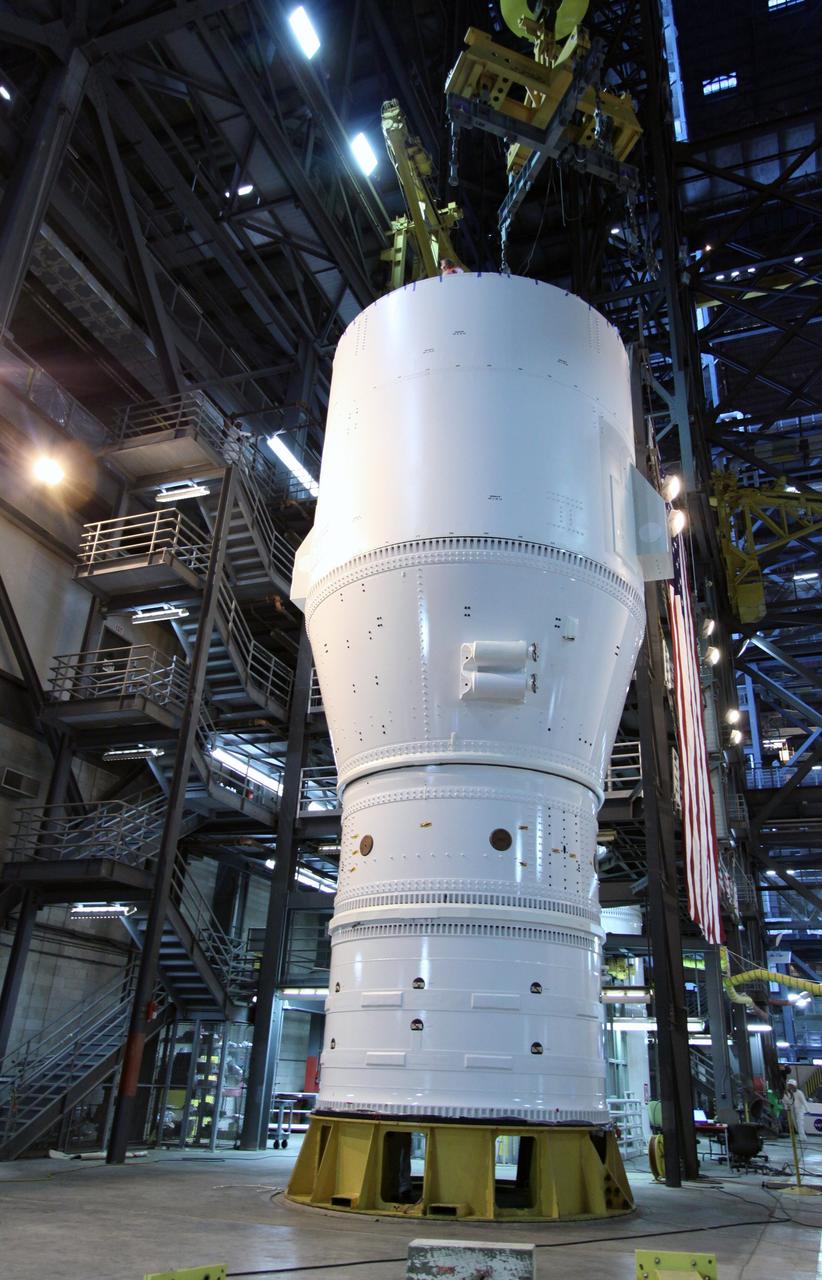
CAPE CANAVERAL, Fla. – In the Vehicle Assembly Building at NASA's Kennedy Space Center in Florida, segments of the Ares I-X first stage are fitted with a crane to lift it to the fifth segment simulator for mating, completing Super Stack 1. The super stack comprises the forward skirt, forward skirt extension, interstages 1 and 2 and the fifth segment simulator. Ares I-X is the test vehicle for the Ares I, which is part of the Constellation Program to return men to the moon and beyond. The Ares I-X flight test is targeted no earlier than Aug. 30 from Launch Pad 39B. Photo credit: NASA/Jack Pfaller