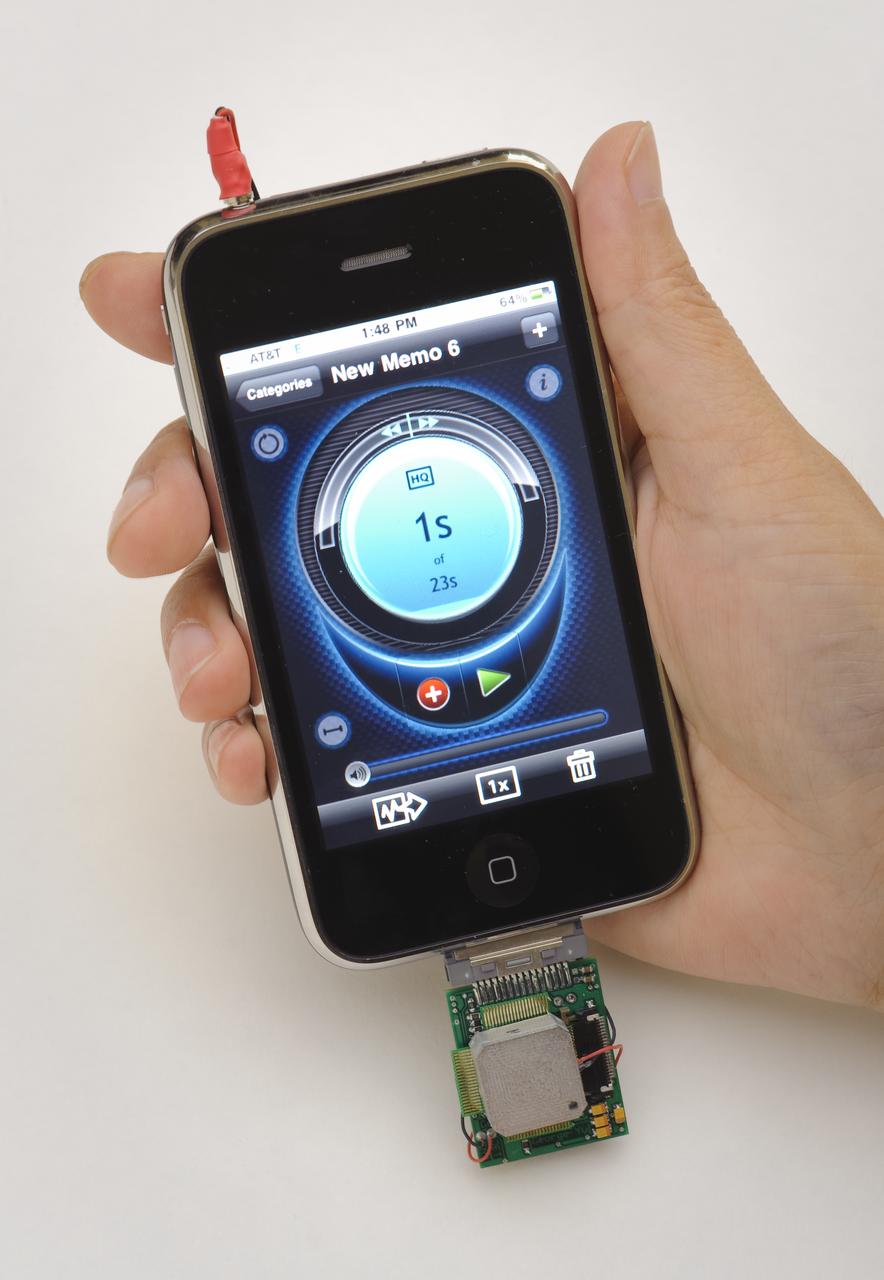
A Nanosensor Device for Cellphone Intergration and Chemical Sensing Network. iPhone with sensor chip, data aquisition board and sampling jet.(Note 4-4-2012:High Sensitive, Low Power and Compact Nano Sensors for Trache Chemical Detection' is the winner of the Government Invention of the Year Award 2012 (winning inventors Jing Li and Myya Meyyappan, NASA/ARC, and Yijiang Lu, University of California Santa Cruz. )

A tweetuup participant videotapes with her iPhone and tweets as astronaut Doug Wheelock discusses his experiences while living on the International Space Station during a tweetup at NASA Headquarters in Washington, Wednesday, March 16, 2011. Wheelock, who has accumulated a total of 178 days in space, assumed command of the International Space Station and the Expedition 25 crew. During Expedition 25, there were more than 120 microgravity experiments in human research; biology and biotechnology; physical and materials sciences; technology development; and Earth and space sciences. Wheelock also responded to an emergency shutdown of half of the station's external cooling system and supported three unplanned spacewalks to replace the faulty pump module that caused the shutdown. His efforts restored the station's critical cooling system to full function. The mission duration was 163 days. Photo Credit: (NASA/Paul E. Alers)
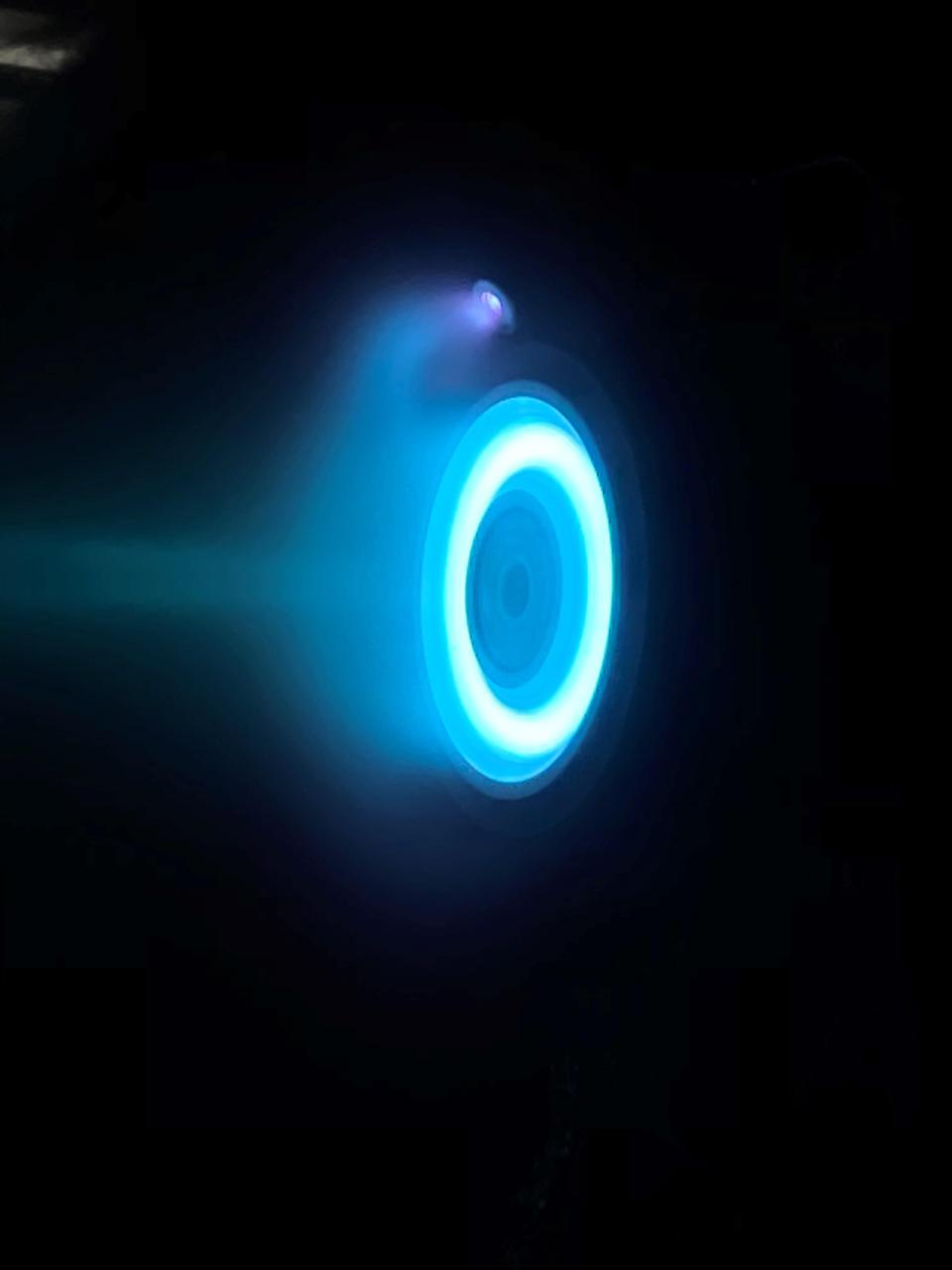
NASA's Psyche spacecraft, set to launch in August 2022, will travel to its target in the main asteroid belt between Mars and Jupiter under the power of super-efficient electric propulsion. This photo captures an operating electric Hall thruster identical to those that will be used to propel the Psyche spacecraft. This photo was taken at NASA's Jet Propulsion Laboratory in Southern California on May 20, 2020 with an iPhone, through the thick window of a vacuum chamber used to simulate the environment of deep space. The thruster works by turning xenon gas, a neutral gas used in car headlights and plasma TVs, into xenon ions. As the xenon ions are accelerated out of the thruster, they create the thrust that will propel the spacecraft. The xenon plasma emits a blue glow, seen here, as it operates. An observer in space traveling behind Psyche would see the blue glow of plasma trailing behind the spacecraft. Solar arrays will provide the electricity that powers the thrusters. Hall thrusters will be used for the first time beyond lunar orbit, demonstrating that they could play a role in supporting future missions to deep space. https://photojournal.jpl.nasa.gov/catalog/PIA23879
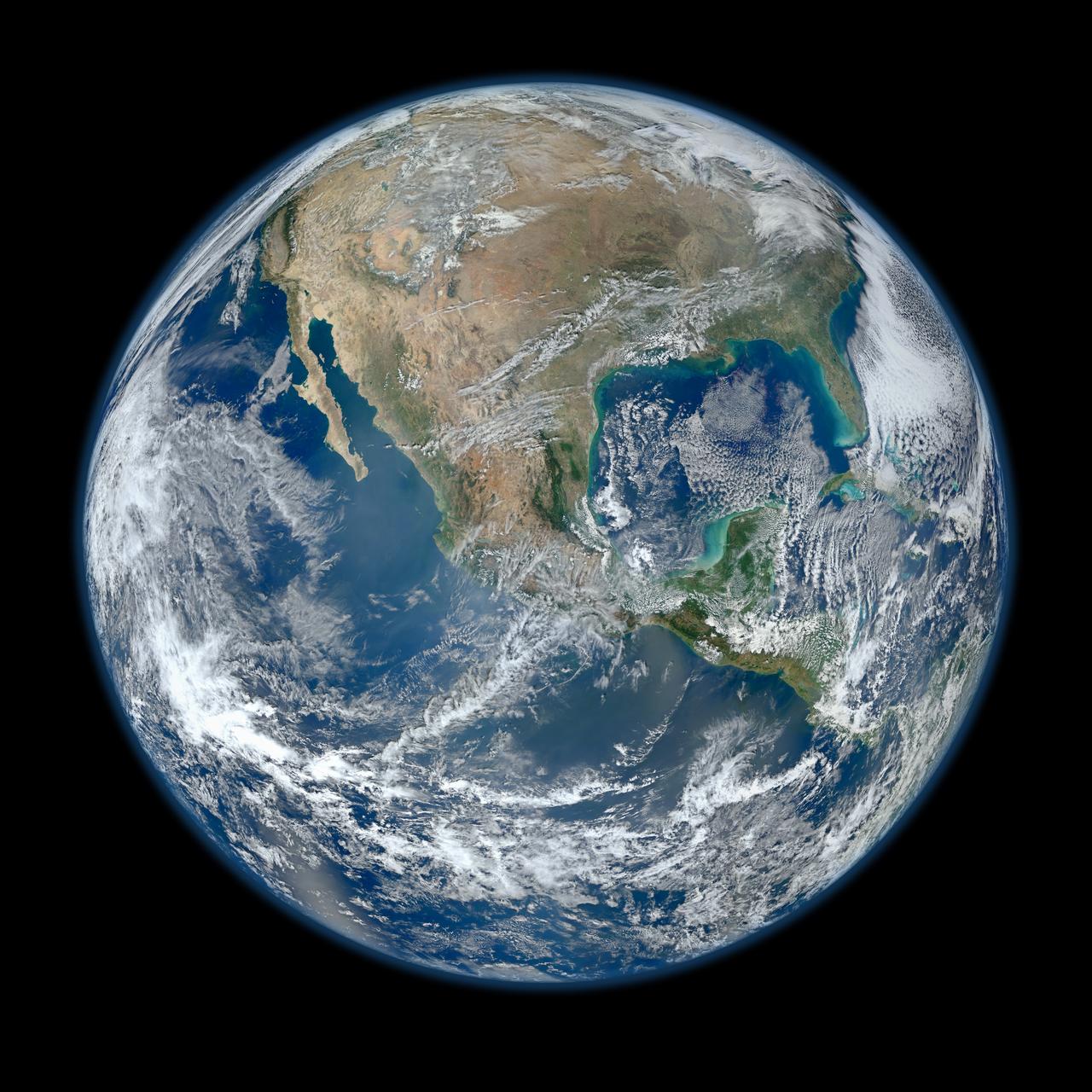
January 25, 2012 <b>*Updated February 2, 2012: According to Flickr, "The western hemisphere Blue Marble 2012 image has rocketed up to over 3.1 million views making it one of the all time most viewed images on the site after only one week."</b> A 'Blue Marble' image of the Earth taken from the VIIRS instrument aboard NASA's most recently launched Earth-observing satellite - Suomi NPP. This composite image uses a number of swaths of the Earth's surface taken on January 4, 2012. The NPP satellite was renamed 'Suomi NPP' on January 24, 2012 to honor the late Verner E. Suomi of the University of Wisconsin. Suomi NPP is NASA's next Earth-observing research satellite. It is the first of a new generation of satellites that will observe many facets of our changing Earth. Suomi NPP is carrying five instruments on board. The biggest and most important instrument is The Visible/Infrared Imager Radiometer Suite or VIIRS. To read more about NASA's Suomi NPP go to: <a href="http://www.nasa.gov/npp" rel="nofollow">www.nasa.gov/npp</a> Credit: NASA/NOAA/GSFC/Suomi NPP/VIIRS/Norman Kuring <b><a href="http://www.nasa.gov/audience/formedia/features/MP_Photo_Guidelines.html" rel="nofollow">NASA image use policy.</a></b> <b><a href="http://www.nasa.gov/centers/goddard/home/index.html" rel="nofollow">NASA Goddard Space Flight Center</a></b> enables NASA’s mission through four scientific endeavors: Earth Science, Heliophysics, Solar System Exploration, and Astrophysics. Goddard plays a leading role in NASA’s accomplishments by contributing compelling scientific knowledge to advance the Agency’s mission. <b>Follow us on <a href="http://twitter.com/NASAGoddardPix" rel="nofollow">Twitter</a></b> <b>Like us on <a href="http://www.facebook.com/pages/Greenbelt-MD/NASA-Goddard/395013845897?ref=tsd" rel="nofollow">Facebook</a></b> <b>Find us on <a href="http://instagrid.me/nasagoddard/?vm=grid" rel="nofollow">Instagram</a></b>