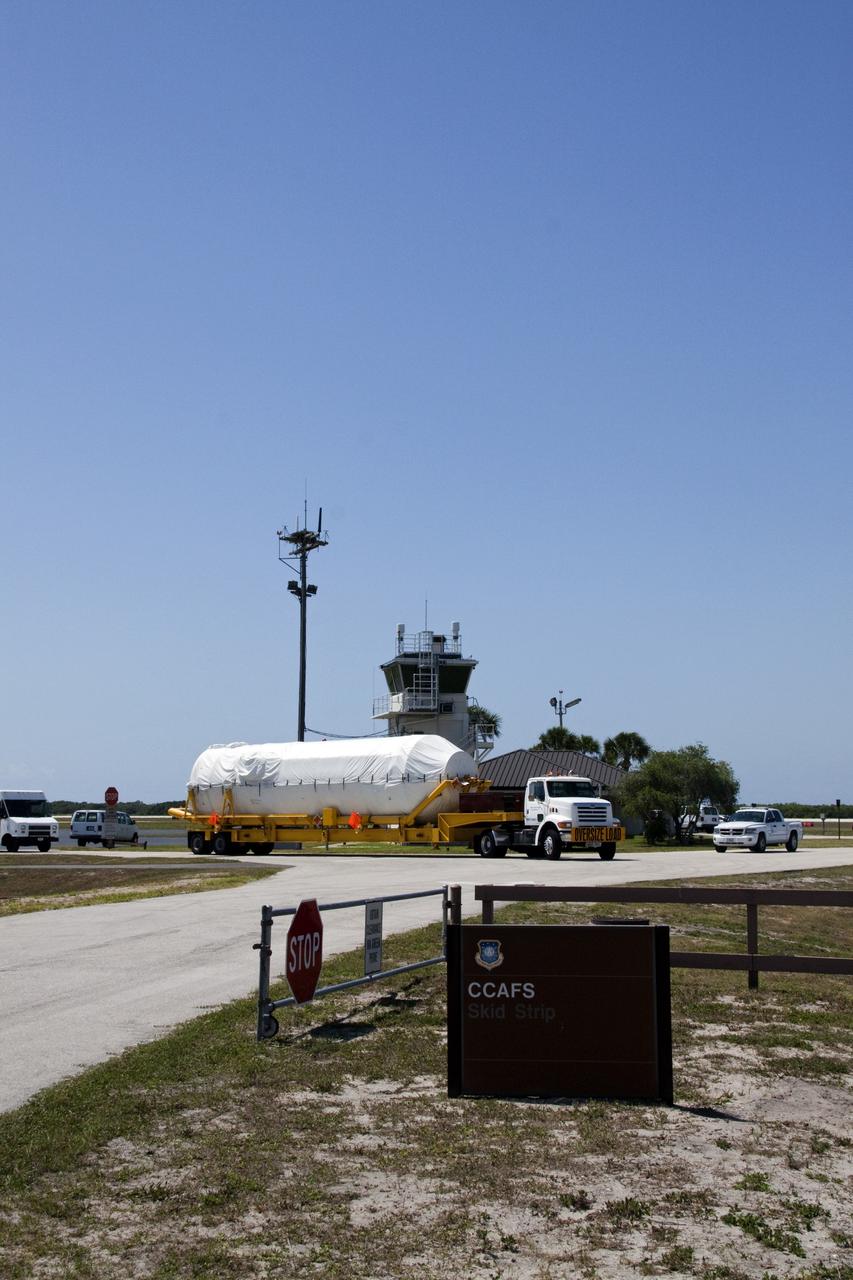
CAPE CANAVERAL, Fla. -- The Centaur upper stage for the United Launch Alliance Atlas V rocket slated to launch NASA's Juno spacecraft is being transported from the Skid Strip on Cape Canaveral Air Force Station in Florida to the Atlas Spaceflight Operations Center. NASA's Juno spacecraft is scheduled to launch aboard the Atlas V from Cape Canaveral, Fla. Aug. 5.The solar-powered spacecraft will orbit Jupiter's poles 33 times to find out more about the gas giant's origins, structure, atmosphere and magnetosphere and investigate the existence of a solid planetary core. For more information visit: www.nasa.gov/juno. Photo credit: NASA/Jack Pfaller
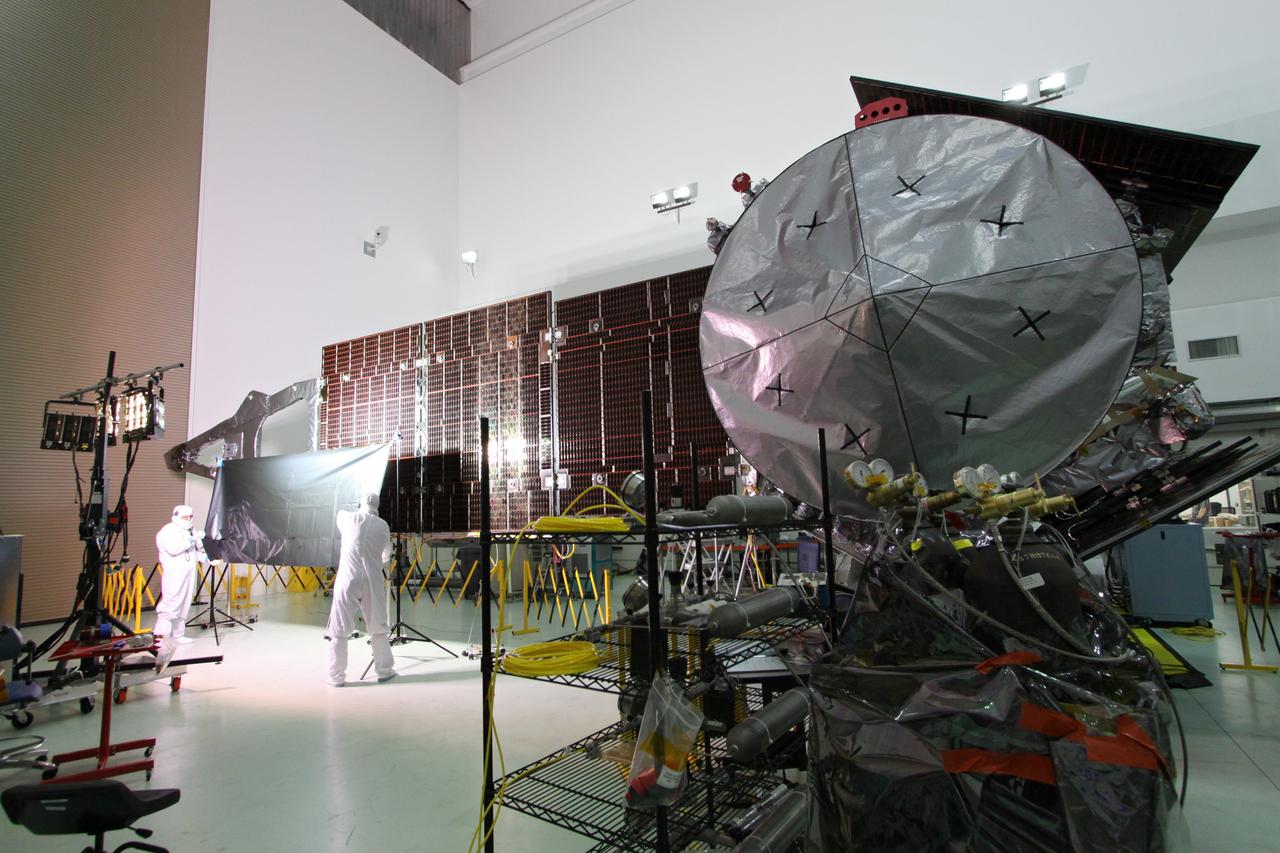
CAPE CANAVERAL, Fla. -- At Astrotech Space Operations in Titusville, Fla., technicians conduct illumination tests on solar array panel #1 with its magnetometer boom for NASA's Juno spacecraft. Juno is scheduled to launch aboard a United Launch Alliance Atlas V from Cape Canaveral, Fla. Aug. 5.The solar-powered spacecraft will orbit Jupiter's poles 33 times to find out more about the gas giant's origins, structure, atmosphere and magnetosphere and investigate the existence of a solid planetary core. For more information visit: www.nasa.gov/juno. Photo credit: NASA/Jack Pfaller
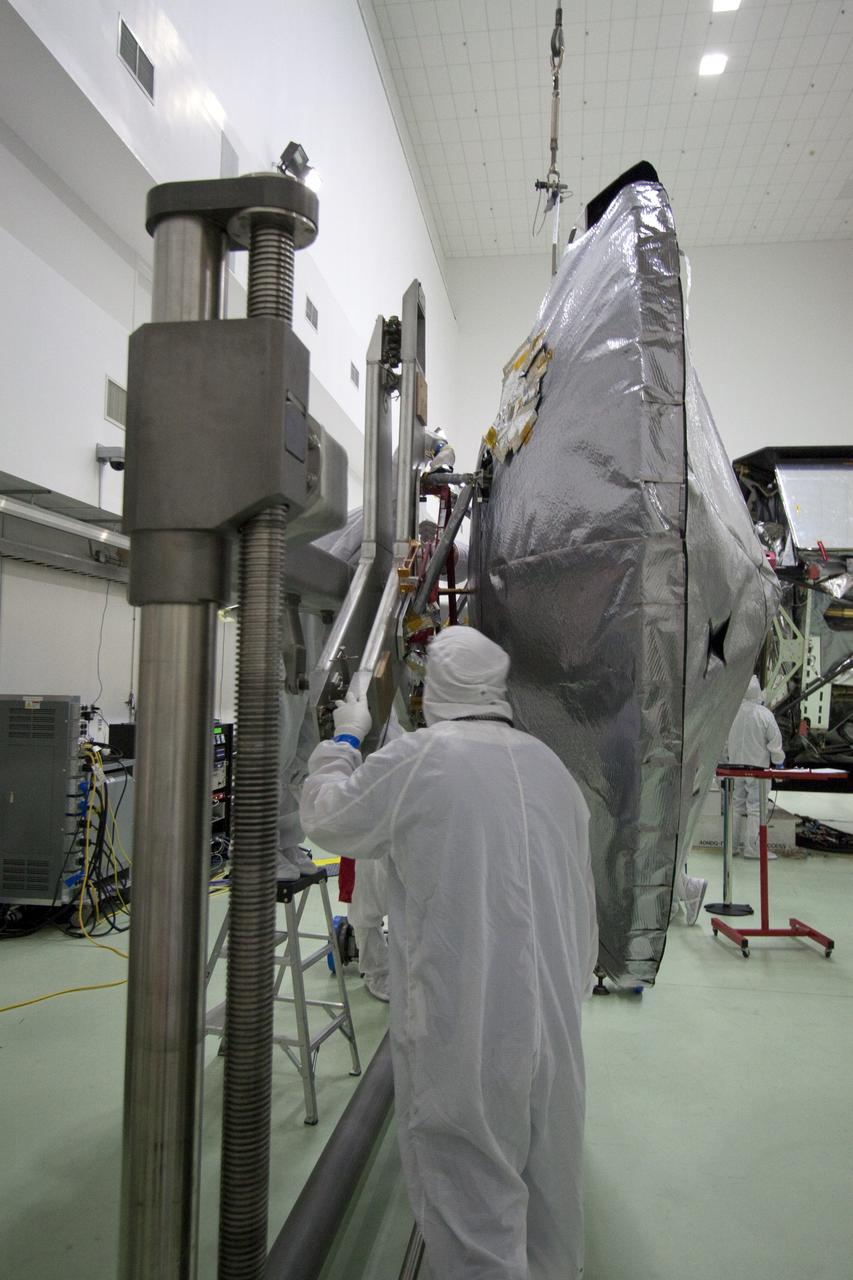
CAPE CANAVERAL, Fla. -- Technicians at Astrotech's payload processing facility in Titusville, Fla. attach an overhead crane to the high-gain antenna that will be installed to NASA's Juno spacecraft. Juno is scheduled to launch aboard an Atlas V rocket from Cape Canaveral, Fla. Aug. 5.The solar-powered spacecraft will orbit Jupiter's poles 33 times to find out more about the gas giant's origins, structure, atmosphere and magnetosphere and investigate the existence of a solid planetary core. For more information visit, www.nasa.gov/juno. Photo credit: NASA/Jack Pfaller
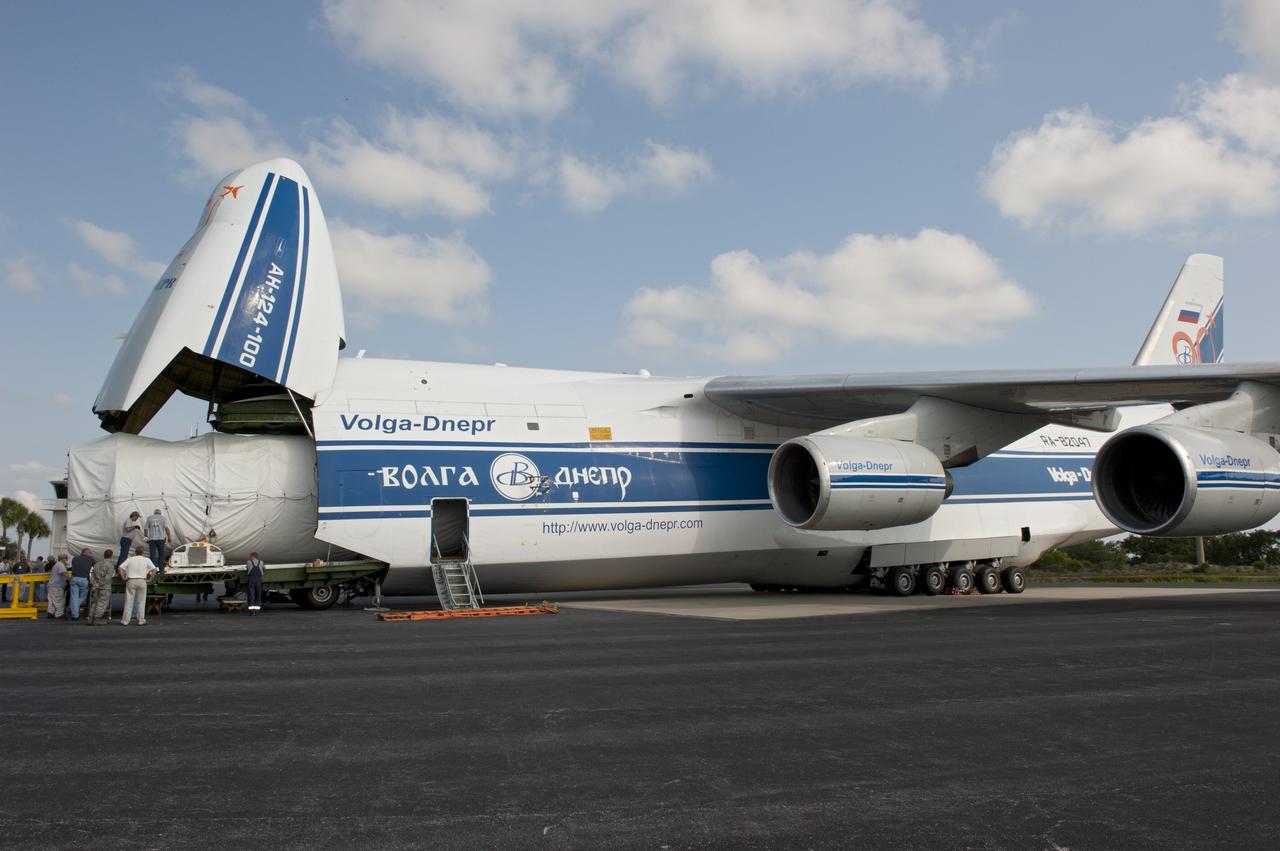
CAPE CANAVERAL, Fla. -- On the Skid Strip at Cape Canaveral Air Force Station in Florida, workers unload the first stage of the United Launch Alliance Atlas V rocket slated to launch NASA's Juno spacecraft from a Volga-Dnepr Antonov AN-124-100, a Ukranian/Russian cargo aircraft. Juno is scheduled to launch aboard an Atlas V rocket from Cape Canaveral, Fla., Aug. 5.The solar-powered spacecraft will orbit Jupiter's poles 33 times to find out more about the gas giant's origins, structure, atmosphere and magnetosphere and investigate the existence of a solid planetary core. For more information, visit www.nasa.gov/juno. Photo credit: NASA/Kim Shiflett
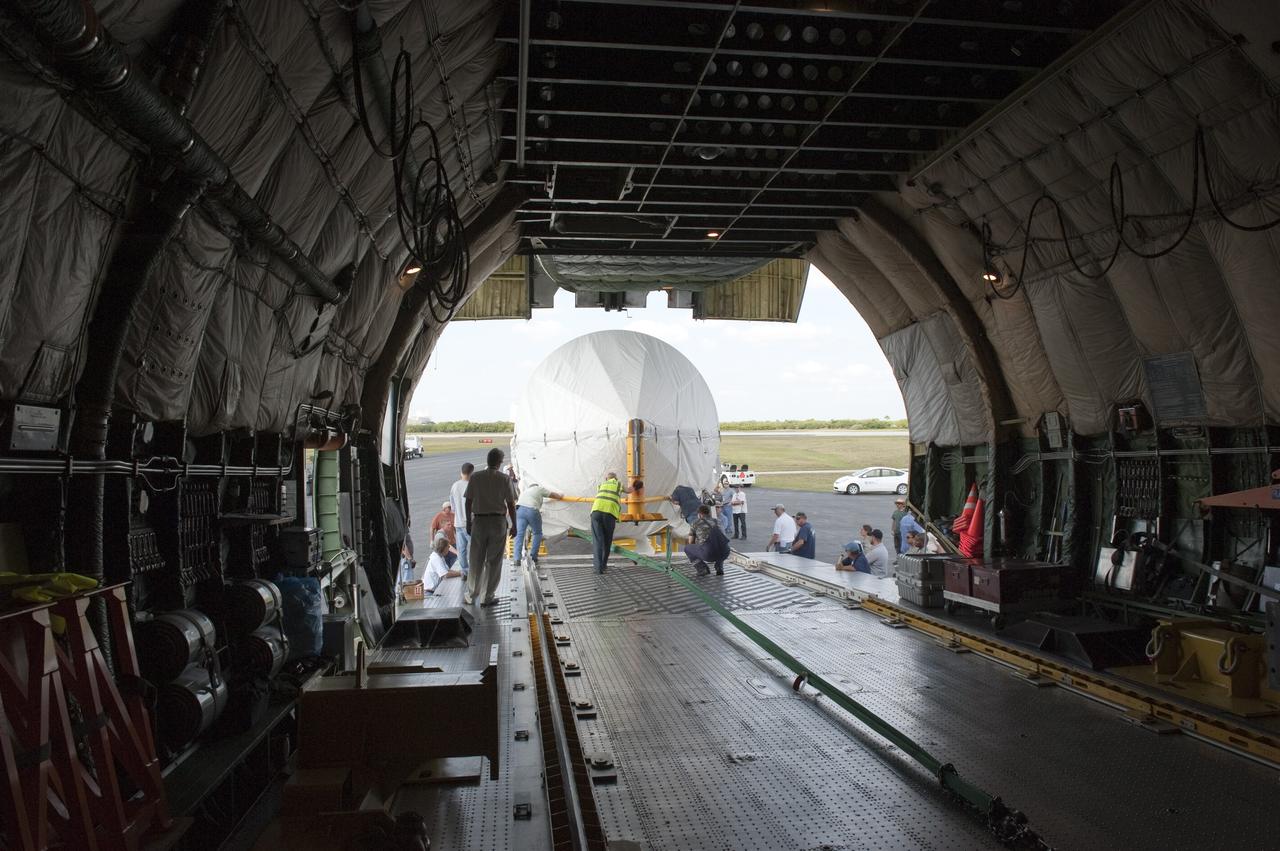
CAPE CANAVERAL, Fla. -- On the Skid Strip at Cape Canaveral Air Force Station in Florida, workers unload the first stage of the United Launch Alliance Atlas V rocket slated to launch NASA's Juno spacecraft from a Volga-Dnepr Antonov AN-124-100, a Ukranian/Russian cargo aircraft. Juno is scheduled to launch aboard an Atlas V rocket from Cape Canaveral, Fla., Aug. 5.The solar-powered spacecraft will orbit Jupiter's poles 33 times to find out more about the gas giant's origins, structure, atmosphere and magnetosphere and investigate the existence of a solid planetary core. For more information, visit www.nasa.gov/juno. Photo credit: NASA/Kim Shiflett
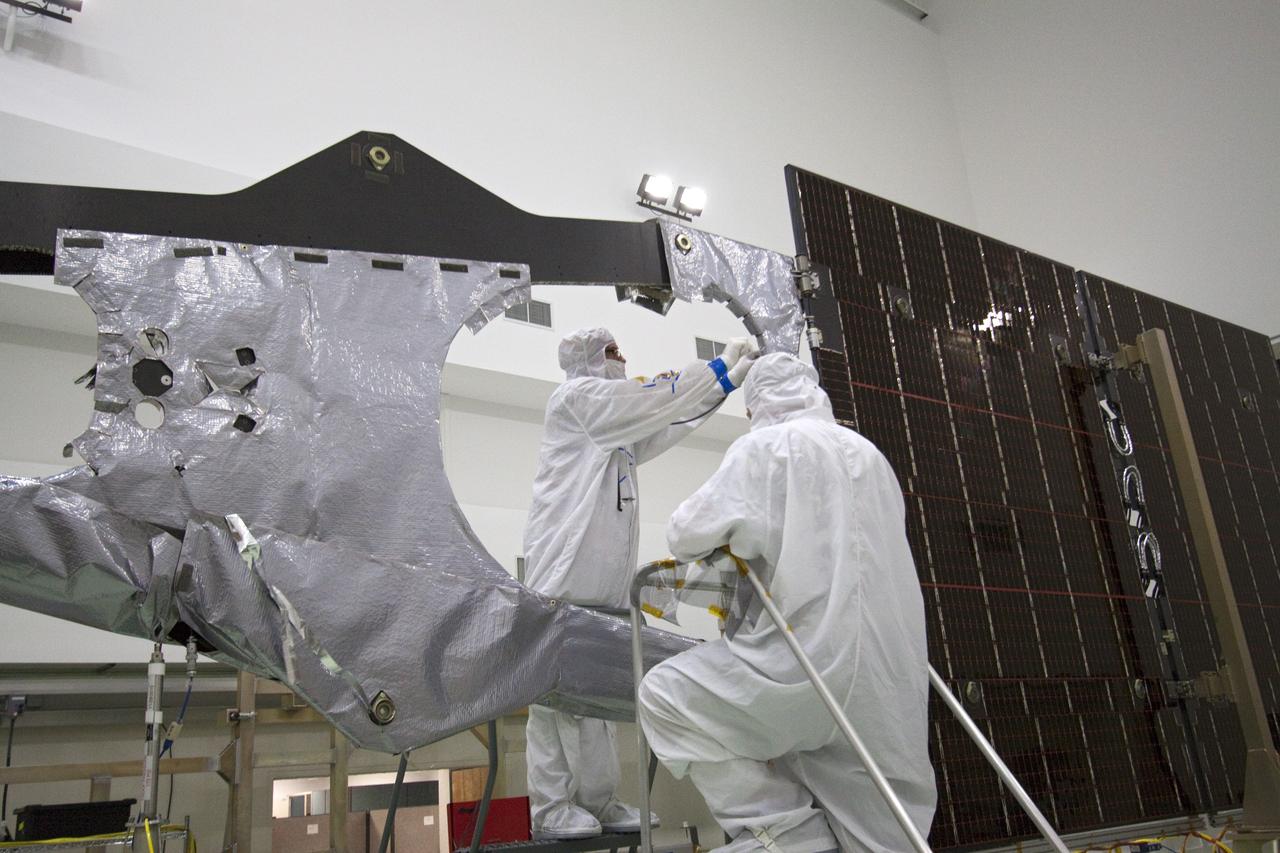
CAPE CANAVERAL, Fla. -- Technicians in the Astrotech payload processing facility in Titusville, Fla. install thermal insulation on NASA's Juno magnetometer boom. The boom structure is attached to Juno's solar array #1 that will help power the NASA spacecraft on its mission to Jupiter. The solar-powered spacecraft will orbit Jupiter's poles 33 times to find out more about the gas giant's origins, structure, atmosphere and magnetosphere and investigate the existence of a solid planetary core. Juno is scheduled to launch aboard an Atlas V rocket from Cape Canaveral, Fla. Aug. 5. For more information visit, www.nasa.gov/juno. Photo credit: NASA/Jack Pfaller It will splash down into the Atlantic Ocean where the ship and its crew will recover it and tow it back through Port Canaveral for refurbishing for another launch. The STS-124 mission is the second of three flights launching components to complete the Japan Aerospace Exploration Agency's Kibo laboratory. The shuttle crew will install Kibo's large Japanese Pressurized Module and its remote manipulator system, or RMS. Photo credit: USA/Jeff Suter
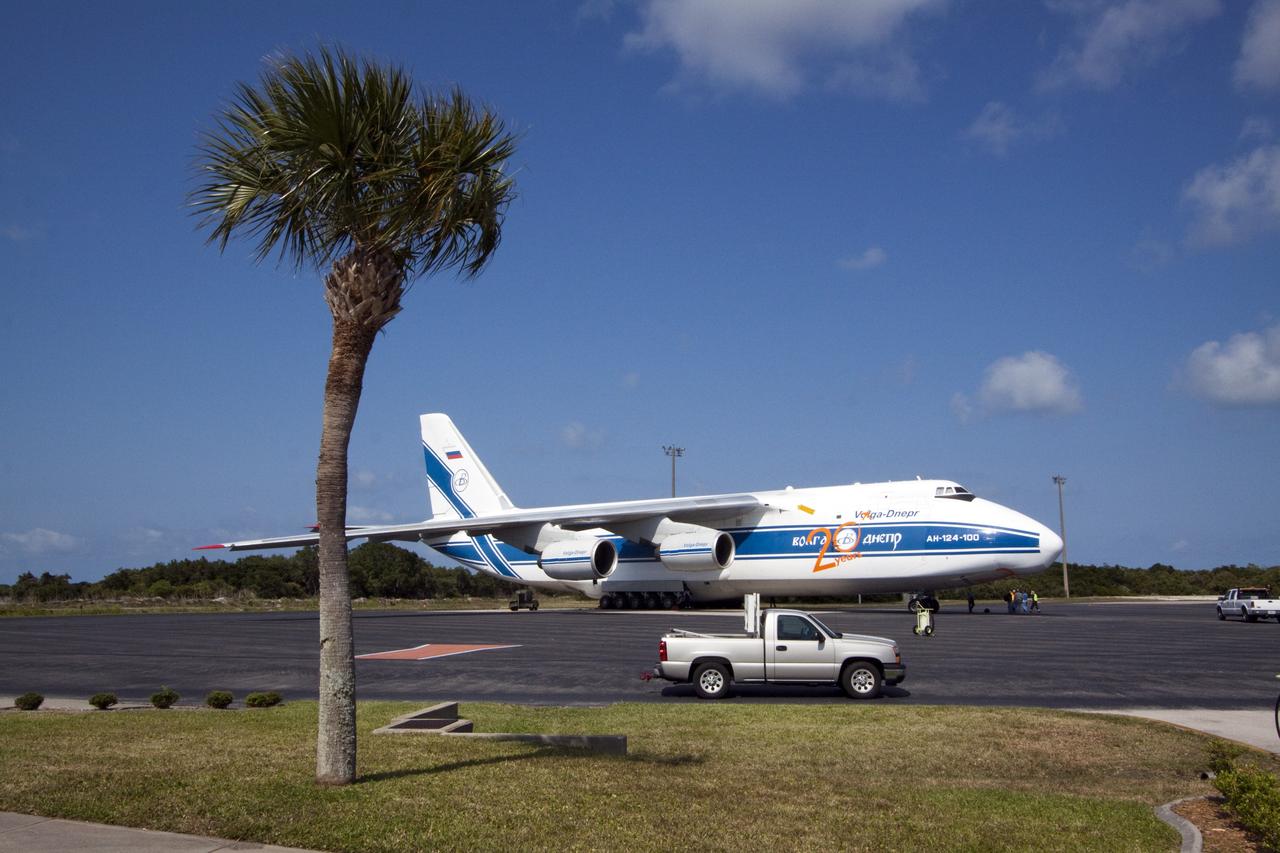
CAPE CANAVERAL, Fla. -- At Cape Canaveral Air Force Station in Florida, a Volga-Dnepr Antonov AN-124-100, Ukranian/Russian cargo aircraft has landed on the Skid Strip. The aircraft is delivering the Centaur upper stage of a United Launch Alliance Atlas V rocket. NASA's Juno spacecraft is scheduled to launch aboard the Atlas V from Cape Canaveral, Fla. Aug. 5.The solar-powered spacecraft will orbit Jupiter's poles 33 times to find out more about the gas giant's origins, structure, atmosphere and magnetosphere and investigate the existence of a solid planetary core. For more information visit: www.nasa.gov/juno. Photo credit: NASA/Jack Pfaller
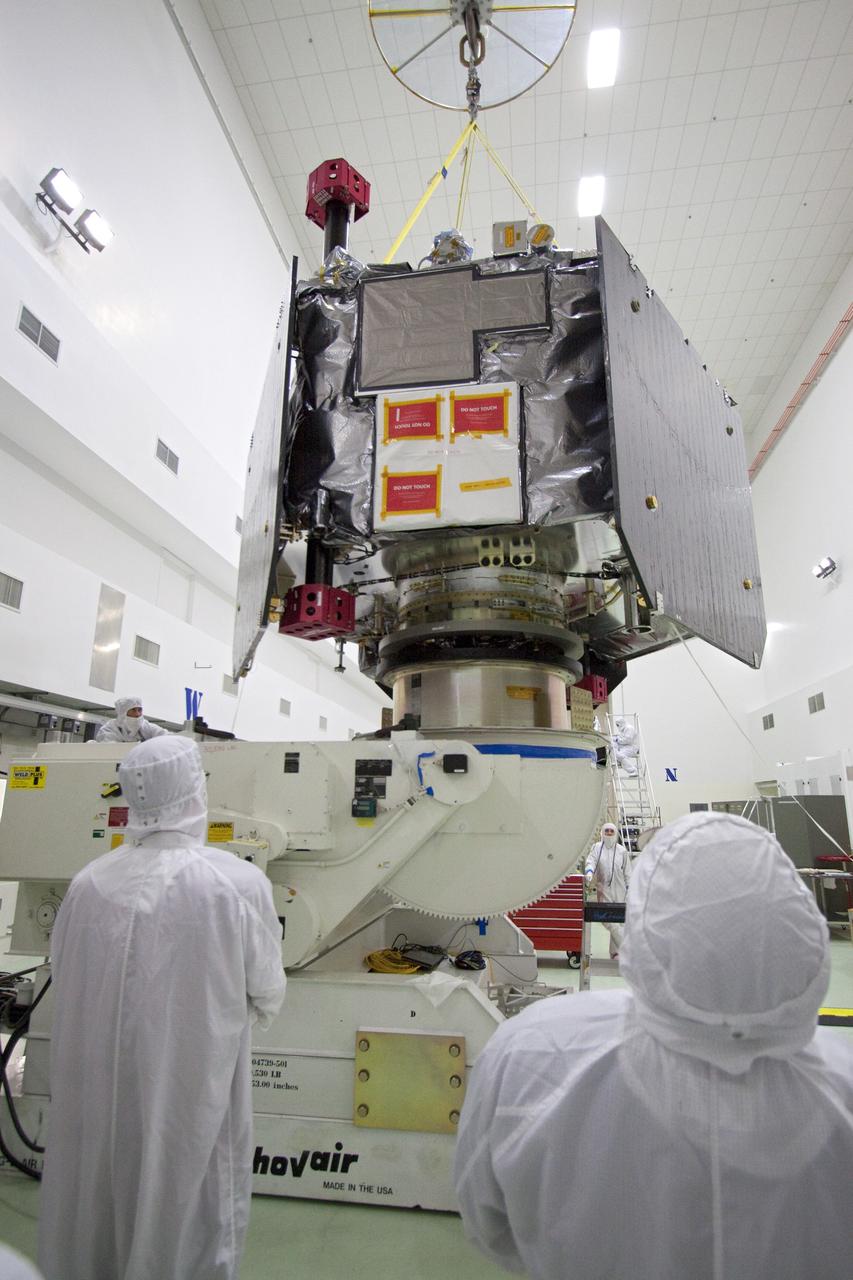
CAPE CANAVERAL, Fla. -- Technicians at Astrotech's payload processing facility in Titusville, Fla. guide NASA's Juno spacecraft, as it is lowered by overhead crane, onto the rotation stand for testing. The solar-powered spacecraft will orbit Jupiter's poles 33 times to find out more about the gas giant's origins, structure, atmosphere and magnetosphere and investigate the existence of a solid planetary core. Juno is scheduled to launch aboard an Atlas V rocket from Cape Canaveral, Fla. Aug. 5. For more information visit, www.nasa.gov/juno. Photo credit: NASA/Jack Pfaller
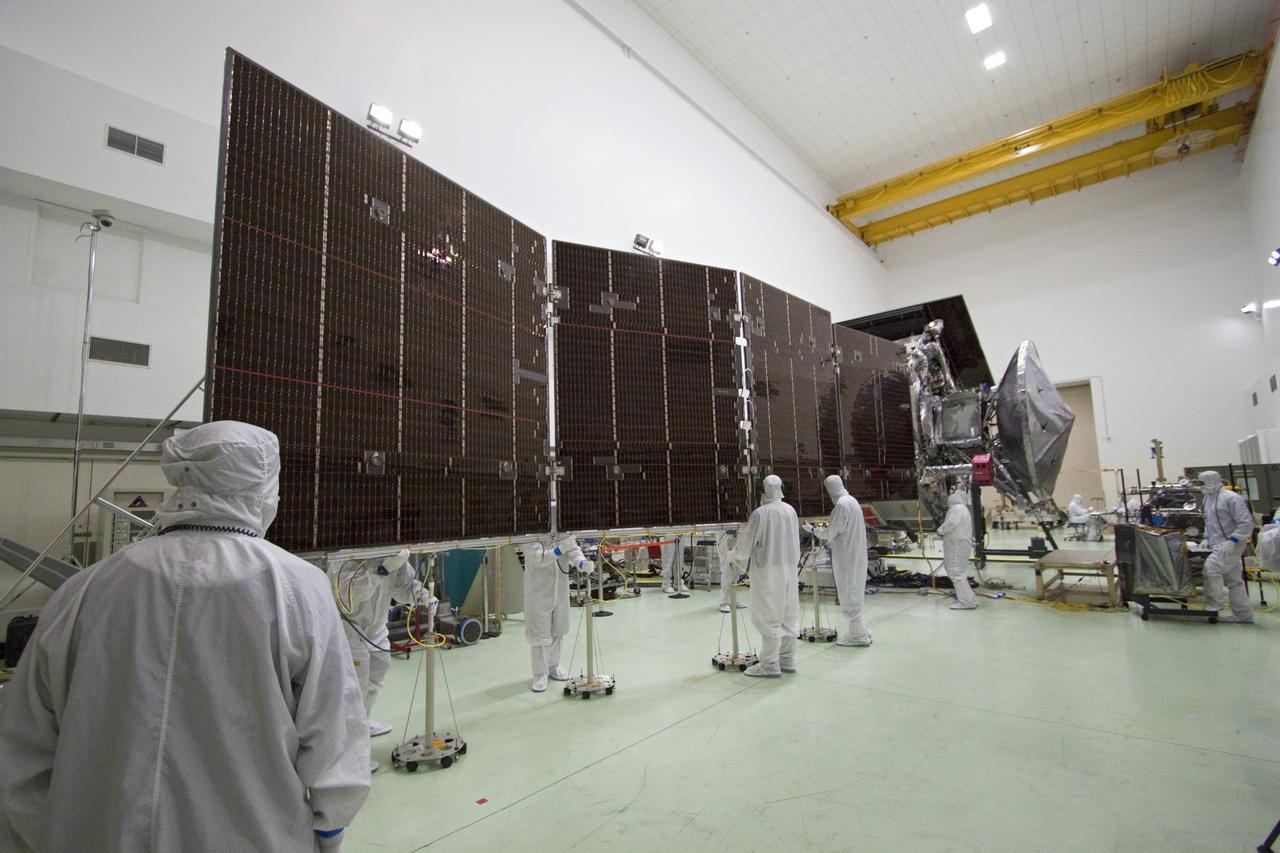
CAPE CANAVERAL, Fla. -- In a clean-room environment at Astrotech's payload processing facility in Titusville, Fla., technicians conduct deployment tests on solar array panels for NASA's Juno spacecraft prior to illumination testing. Juno is scheduled to launch aboard a United Launch Alliance Atlas V rocket from Cape Canaveral, Fla. Aug. 5.The solar-powered spacecraft will orbit Jupiter's poles 33 times to find out more about the gas giant's origins, structure, atmosphere and magnetosphere and investigate the existence of a solid planetary core. For more information visit: www.nasa.gov/juno. Photo credit: NASA/Jack Pfaller
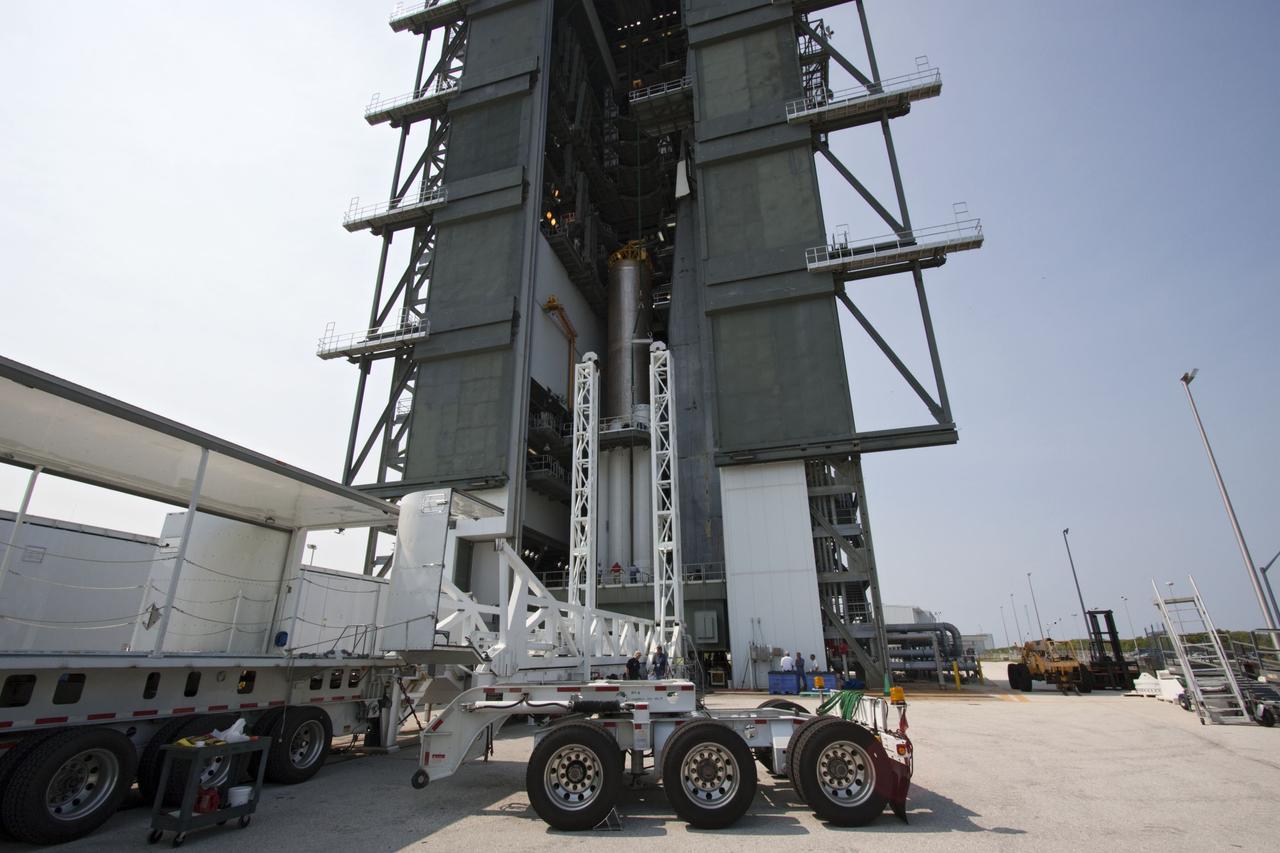
CAPE CANAVERAL, Fla. -- At Cape Canaveral Air Force Station in Florida, workers using an overhead crane lowered the fifth and final solid rocket booster into the Vertical Integration Facility at Launch Complex 41. It then will be attached to the United Launch Alliance Atlas V booster stage, already at the pad. NASA's Juno spacecraft is scheduled to launch aboard an Atlas V from Cape Canaveral, Fla. Aug. 5.The solar-powered spacecraft will orbit Jupiter's poles 33 times to find out more about the gas giant's origins, structure, atmosphere and magnetosphere and investigate the existence of a solid planetary core. For more information visit: www.nasa.gov/juno. Photo credit: NASA/Jim Grossmann

CAPE CANAVERAL, Fla. -- Technicians at Astrotech's payload processing facility in Titusville, Fla. inspect NASA's Juno spacecraft after testing for center of gravity, weighing and balancing on the rotation stand. The solar-powered spacecraft will orbit Jupiter's poles 33 times to find out more about the gas giant's origins, structure, atmosphere and magnetosphere and investigate the existence of a solid planetary core. Juno is scheduled to launch aboard an Atlas V rocket from Cape Canaveral, Fla. Aug. 5. For more information visit, www.nasa.gov/juno. Photo credit: NASA/Jack Pfaller
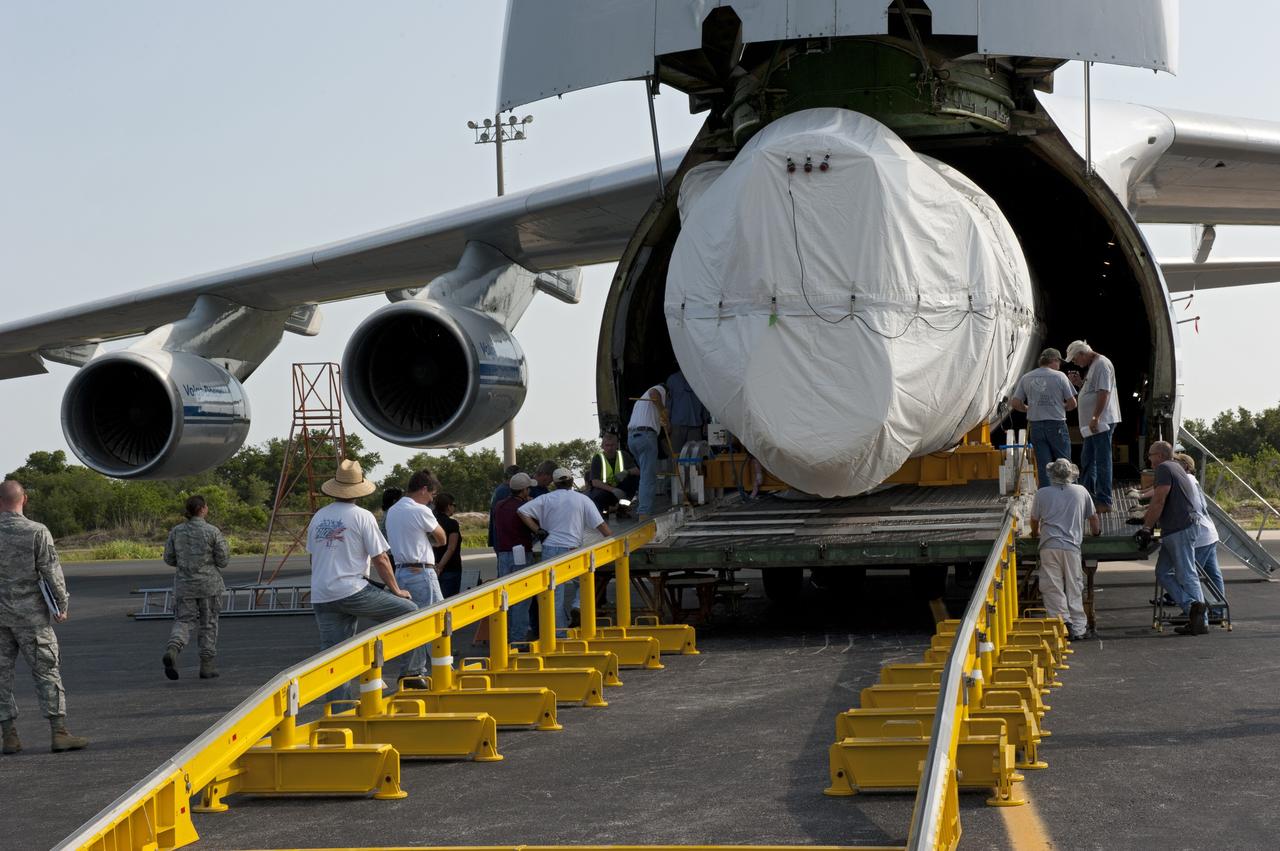
CAPE CANAVERAL, Fla. -- On the Skid Strip at Cape Canaveral Air Force Station in Florida, workers unload the first stage of the United Launch Alliance Atlas V rocket slated to launch NASA's Juno spacecraft from a Volga-Dnepr Antonov AN-124-100, a Ukranian/Russian cargo aircraft. Juno is scheduled to launch aboard an Atlas V rocket from Cape Canaveral, Fla., Aug. 5.The solar-powered spacecraft will orbit Jupiter's poles 33 times to find out more about the gas giant's origins, structure, atmosphere and magnetosphere and investigate the existence of a solid planetary core. For more information, visit www.nasa.gov/juno. Photo credit: NASA/Kim Shiflett
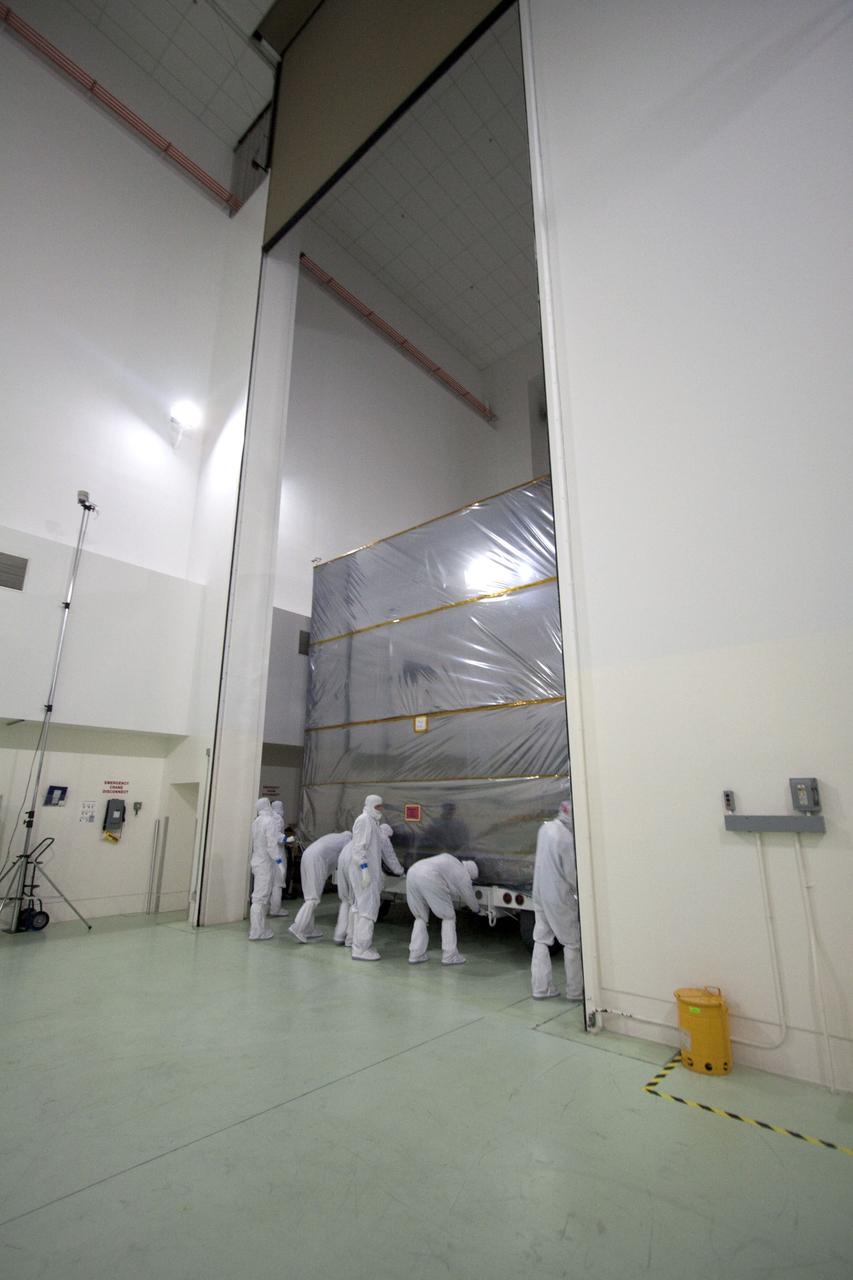
CAPE CANAVERAL, Fla., -- At the Astrotech Payload Processing Facility in Titusville, Fla., technicians stretch a protective cover over NASA's Juno spacecraft. Juno is being prepared for its move to the Hazardous Processing Facility for fueling. The spacecraft will be loaded with the propellant necessary for orbit maneuvers and the attitude control system. Juno is scheduled to launch aboard a United Launch Alliance Atlas V rocket from Cape Canaveral, Fla., Aug. 5.The solar-powered spacecraft will orbit Jupiter's poles 33 times to find out more about the gas giant's origins, structure, atmosphere and magnetosphere and investigate the existence of a solid planetary core. For more information visit: www.nasa.gov/juno. Photo credit: NASA/Troy Cryder
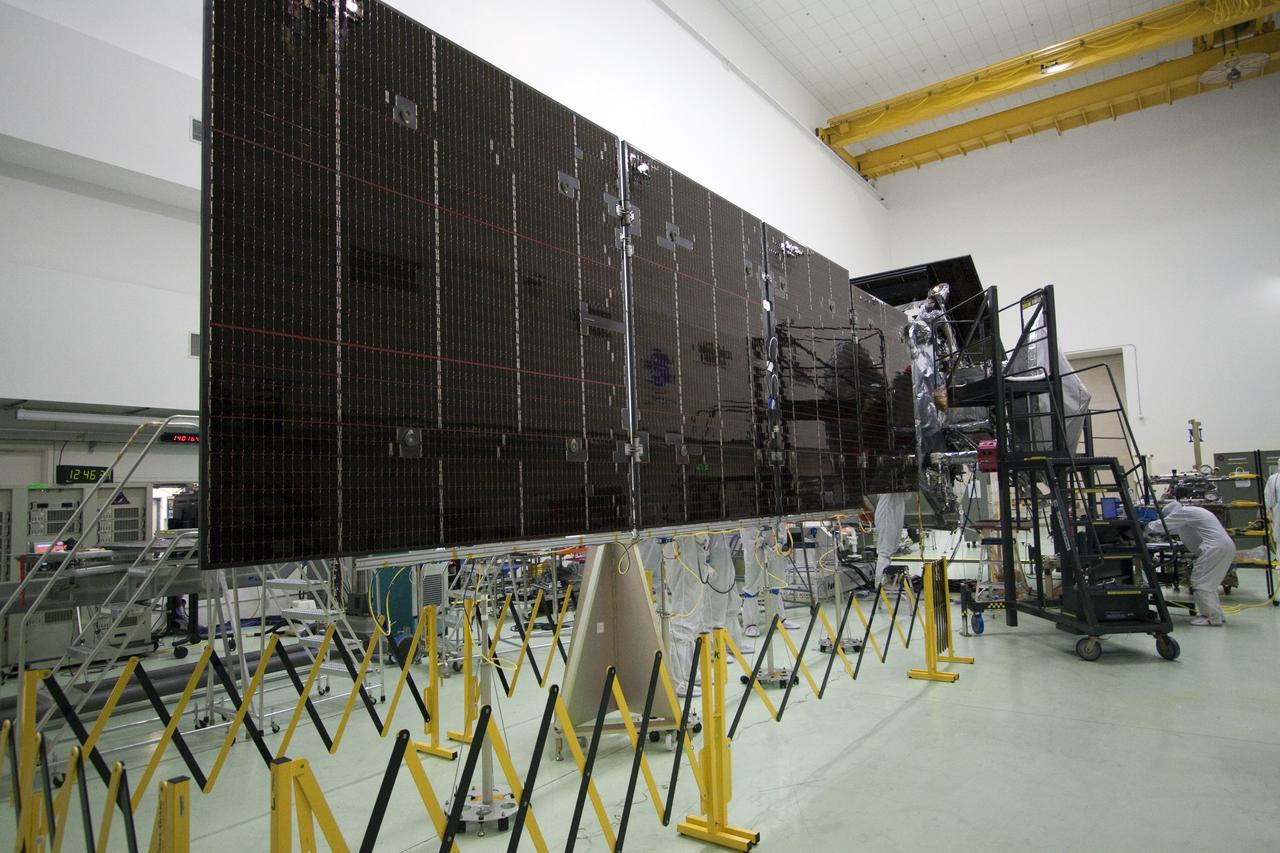
CAPE CANAVERAL, Fla. -- Technicians at Astrotech's payload processing facility in Titusville, Fla. are preparing to stow unfurled solar array #2 for NASA's Juno spacecraft. Later in processing, the magnetometer will be installed; a solar array illumination and magnetometer boom deployment test also are planned. Juno is scheduled to launch aboard an Atlas V rocket from Cape Canaveral, Fla. Aug. 5.The solar-powered spacecraft will orbit Jupiter's poles 33 times to find out more about the gas giant's origins, structure, atmosphere and magnetosphere and investigate the existence of a solid planetary core. For more information visit, www.nasa.gov/juno. Photo credit: NASA/Jack Pfaller
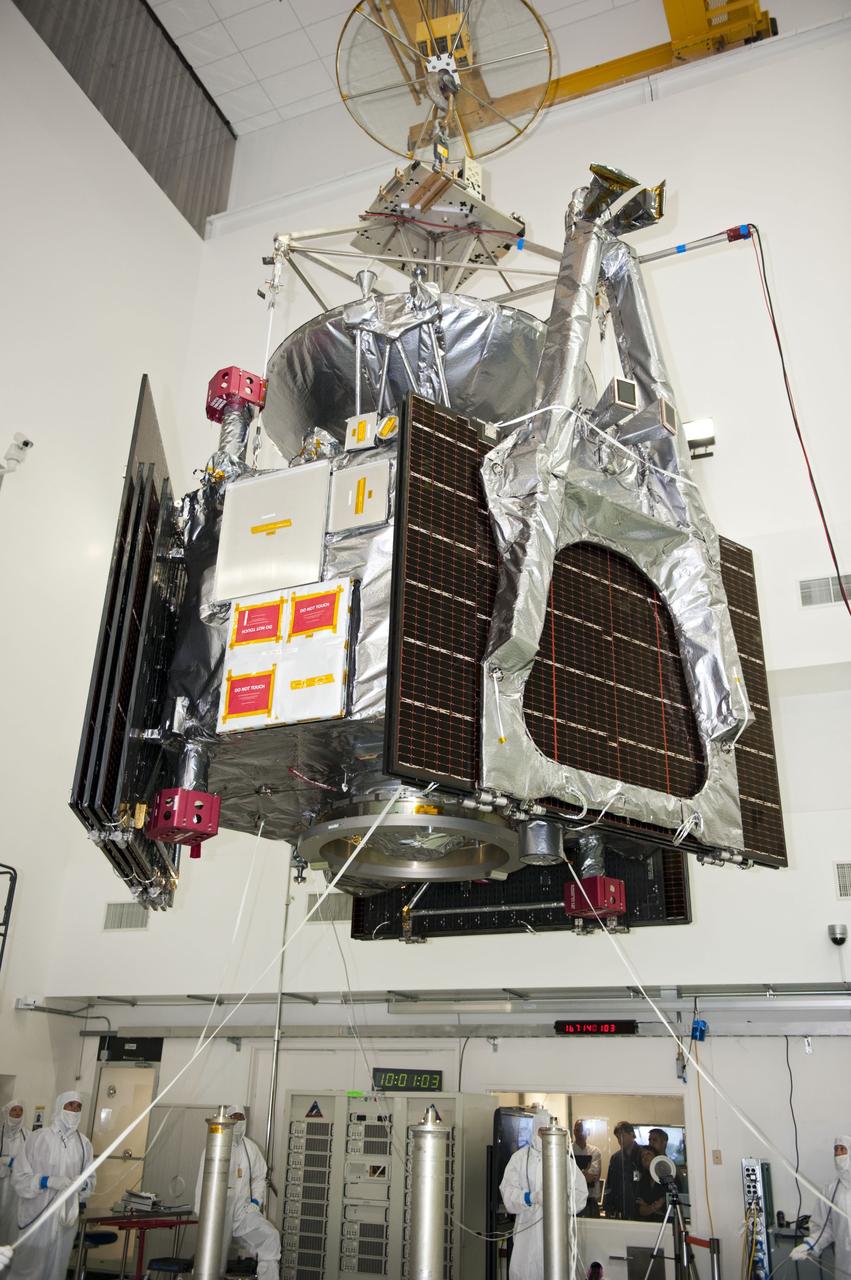
CAPE CANAVERAL, Fla. -- Technicians at Astrotech's payload processing facility in Titusville, Fla. monitor NASA's Juno spacecraft, as it is lifted by an overhead crane, for its move to a rotation stand for center of gravity, weighing and balancing testing. Juno is scheduled to launch aboard United Launch Alliance Atlas V rocket from Cape Canaveral, Fla. Aug. 5.The solar-powered spacecraft will orbit Jupiter's poles 33 times to find out more about the gas giant's origins, structure, atmosphere and magnetosphere and investigate the existence of a solid planetary core. For more information visit: www.nasa.gov/juno. Photo credit: NASA/Kim Shiflett
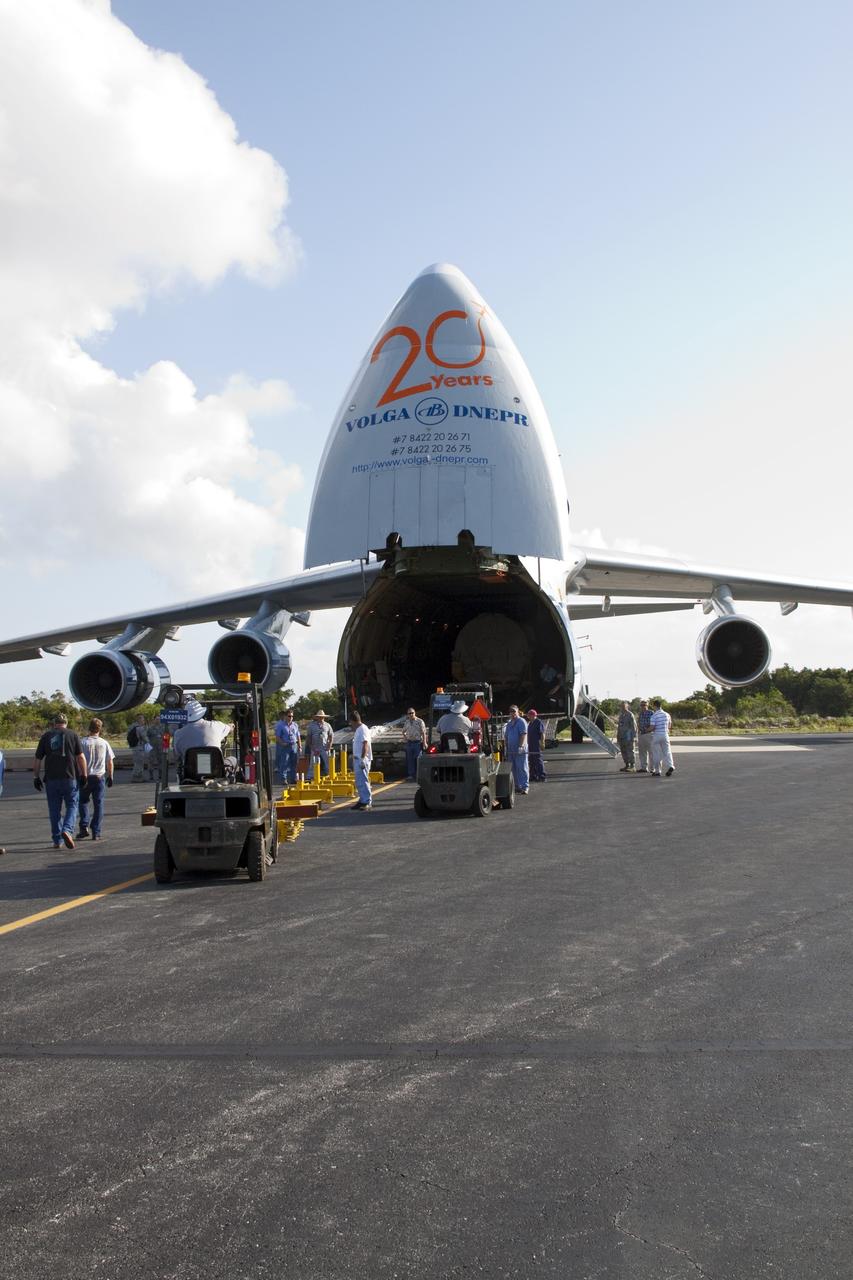
CAPE CANAVERAL, Fla. -- On the Skid Strip at Cape Canaveral Air Force Station in Florida, workers prepare to unload a Volga-Dnepr Antonov AN-124-100, a Ukranian/Russian cargo aircraft that has delivered the Centaur upper stage of the United Launch Alliance Atlas V rocket slated to launch NASA's Juno spacecraft. NASA's Juno spacecraft is scheduled to launch aboard the Atlas V from Cape Canaveral, Fla. Aug. 5.The solar-powered spacecraft will orbit Jupiter's poles 33 times to find out more about the gas giant's origins, structure, atmosphere and magnetosphere and investigate the existence of a solid planetary core. For more information visit: www.nasa.gov/juno. Photo credit: NASA/Jack Pfaller

CAPE CANAVERAL, Fla. -- Technicians at Astrotech's payload processing facility in Titusville, Fla. move NASA's Juno spacecraft into an airlock to begin final testing and preparations for launch. The solar-powered spacecraft will orbit Jupiter's poles 33 times to find out more about the gas giant's origins, structure, atmosphere and magnetosphere and investigate the existence of a solid planetary core. Juno is scheduled to launch aboard an Atlas V rocket from Cape Canaveral, Fla. Aug. 5. For more information visit, www.nasa.gov/juno. Photo credit: NASA/Jack Pfaller It will splash down into the Atlantic Ocean where the ship and its crew will recover it and tow it back through Port Canaveral for refurbishing for another launch. The STS-124 mission is the second of three flights launching components to complete the Japan Aerospace Exploration Agency's Kibo laboratory. The shuttle crew will install Kibo's large Japanese Pressurized Module and its remote manipulator system, or RMS. Photo credit: USA/Jeff Suter
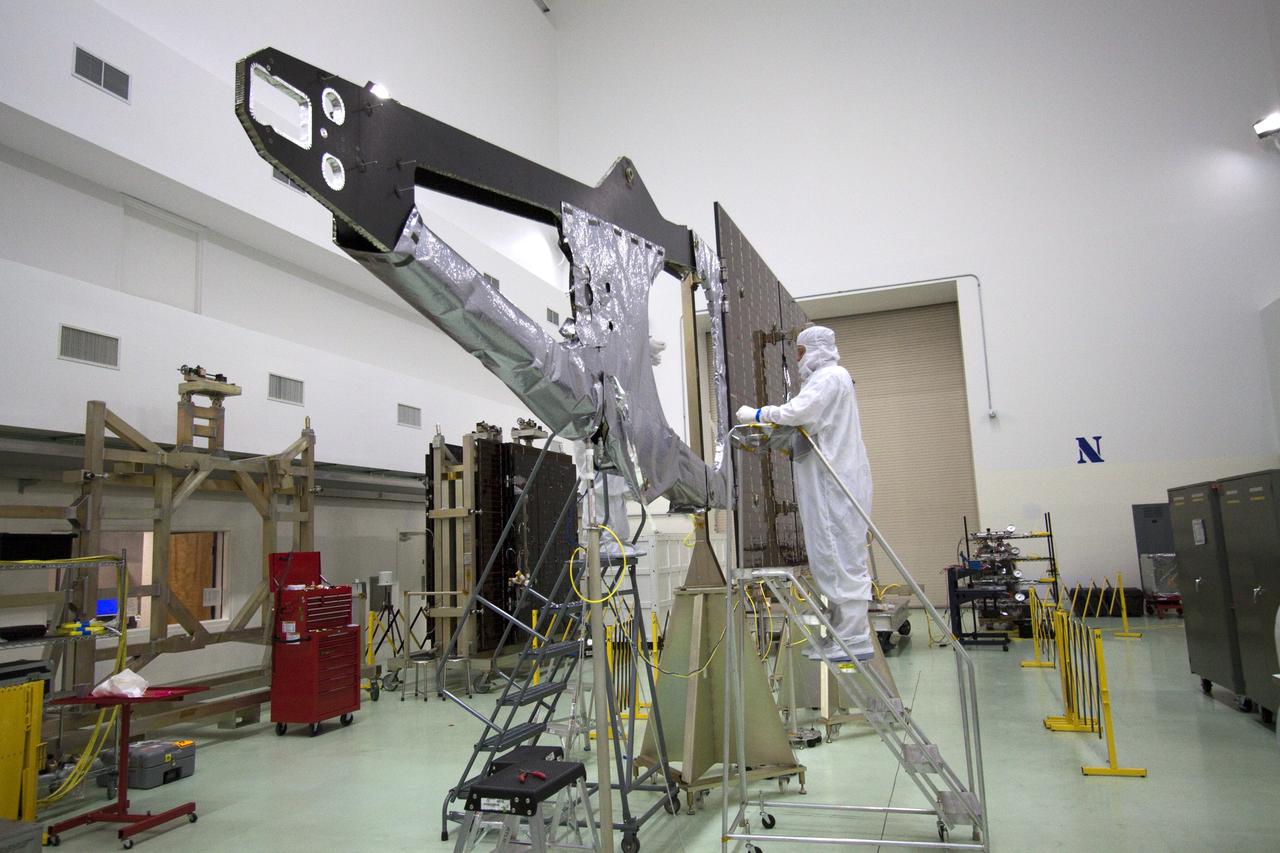
CAPE CANAVERAL, Fla. -- Technicians in the Astrotech payload processing facility in Titusville, Fla. install thermal insulation on NASA's Juno magnetometer boom. The boom structure is attached to Juno's solar array #1 that will help power the NASA spacecraft on its mission to Jupiter. The solar-powered spacecraft will orbit Jupiter's poles 33 times to find out more about the gas giant's origins, structure, atmosphere and magnetosphere and investigate the existence of a solid planetary core. Juno is scheduled to launch aboard an Atlas V rocket from Cape Canaveral, Fla. Aug. 5. For more information visit, www.nasa.gov/juno. Photo credit: NASA/Jack Pfaller It will splash down into the Atlantic Ocean where the ship and its crew will recover it and tow it back through Port Canaveral for refurbishing for another launch. The STS-124 mission is the second of three flights launching components to complete the Japan Aerospace Exploration Agency's Kibo laboratory. The shuttle crew will install Kibo's large Japanese Pressurized Module and its remote manipulator system, or RMS. Photo credit: USA/Jeff Suter
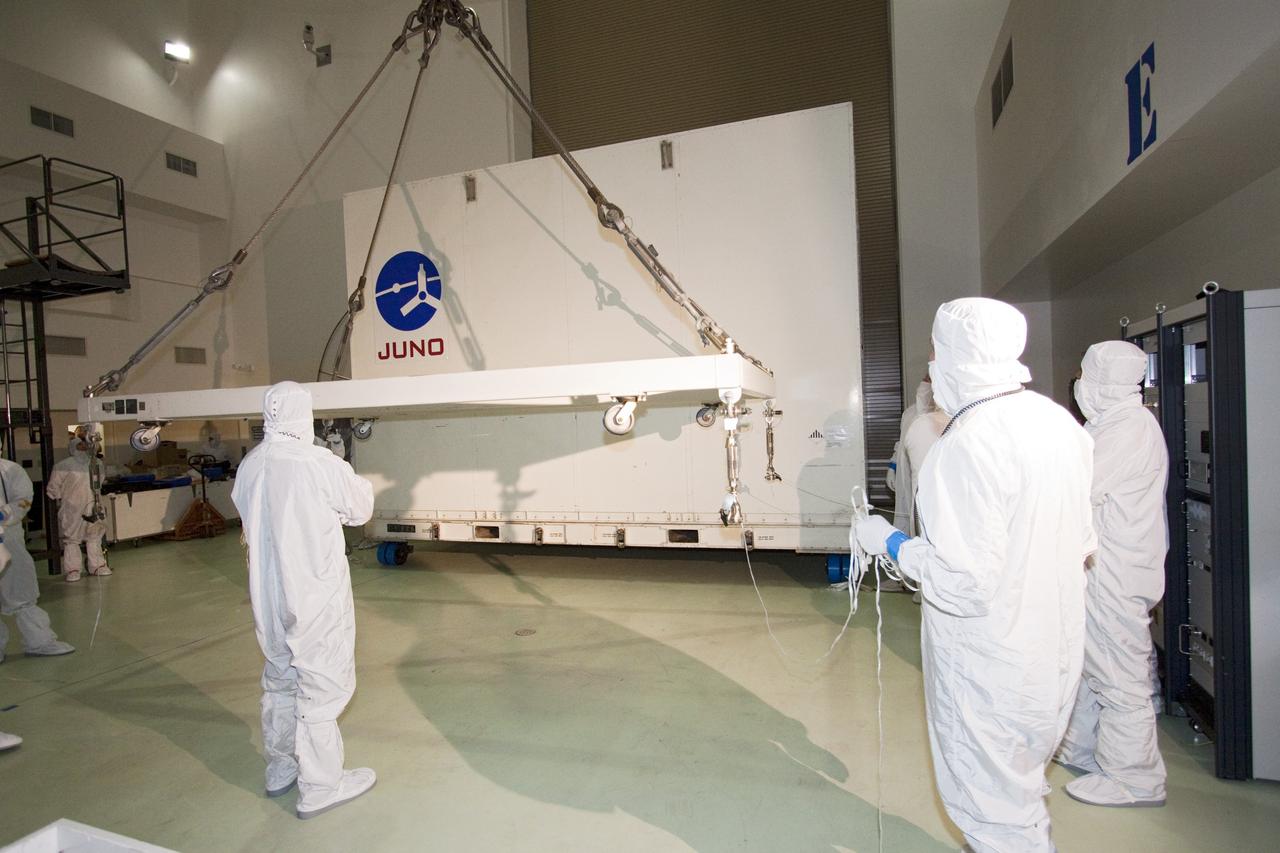
CAPE CANAVERAL, Fla. -- Technicians guide an overhead crane toward the container holding NASA's Juno spacecraft. The container will be lifted away from the spacecraft, moved into an airlock at Astrotech's payload processing facility in Titusville, Fla. to begin final testing and preparations for launch. The solar-powered spacecraft will orbit Jupiter's poles 33 times to find out more about the gas giant's origins, structure, atmosphere and magnetosphere and investigate the existence of a solid planetary core. Juno is scheduled to launch aboard an Atlas V rocket from Cape Canaveral, Fla. Aug. 5. For more information visit, www.nasa.gov/juno. Photo credit: NASA/Jack Pfaller It will splash down into the Atlantic Ocean where the ship and its crew will recover it and tow it back through Port Canaveral for refurbishing for another launch. The STS-124 mission is the second of three flights launching components to complete the Japan Aerospace Exploration Agency's Kibo laboratory. The shuttle crew will install Kibo's large Japanese Pressurized Module and its remote manipulator system, or RMS. Photo credit: USA/Jeff Suter
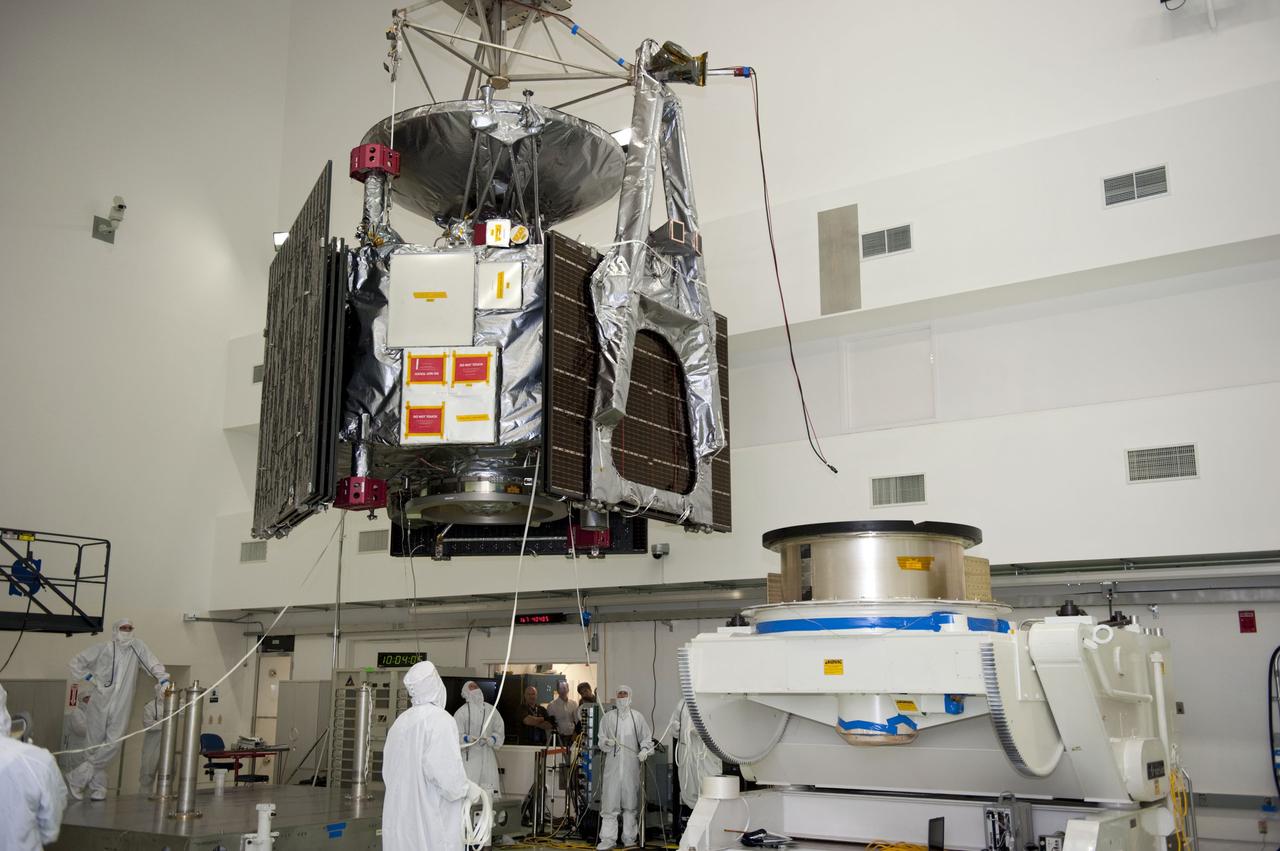
CAPE CANAVERAL, Fla. -- Technicians at Astrotech's payload processing facility in Titusville, Fla. monitor NASA's Juno spacecraft as it is moved by an overhead crane to a rotation stand for center of gravity, weighing and balancing testing. Juno is scheduled to launch aboard United Launch Alliance Atlas V rocket from Cape Canaveral, Fla. Aug. 5.The solar-powered spacecraft will orbit Jupiter's poles 33 times to find out more about the gas giant's origins, structure, atmosphere and magnetosphere and investigate the existence of a solid planetary core. For more information visit: www.nasa.gov/juno. Photo credit: NASA/Kim Shiflett
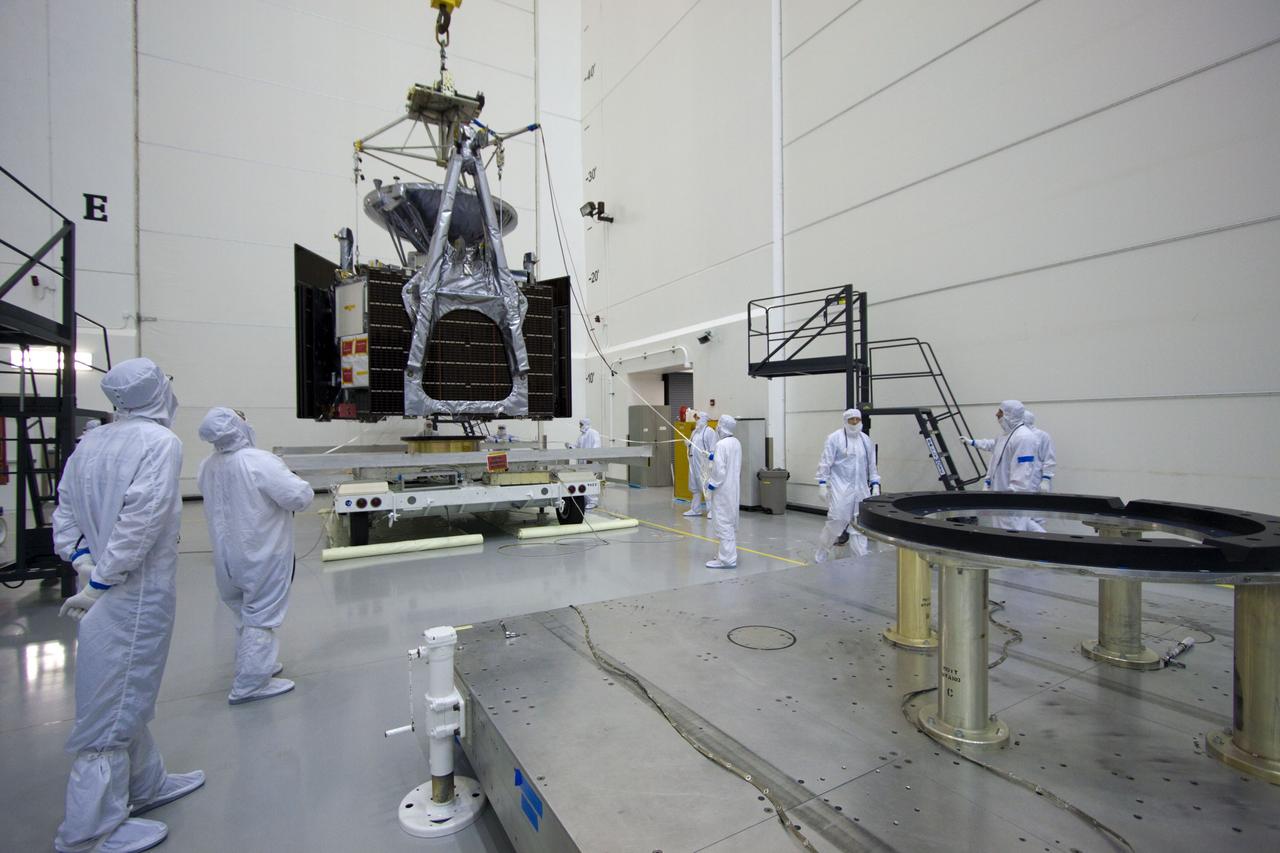
CAPE CANAVERAL, Fla. -- At Astrotech's Hazardous Processing Facility in Titusville, Fla., technicians using an overhead crane move NASA's Juno spacecraft to a fueling stand where the spacecraft will be loaded with the propellant necessary for orbit maneuvers and the attitude control system. Juno is scheduled to launch aboard a United Launch Alliance Atlas V rocket from Cape Canaveral, Fla., Aug. 5.The solar-powered spacecraft will orbit Jupiter's poles 33 times to find out more about the gas giant's origins, structure, atmosphere and magnetosphere and investigate the existence of a solid planetary core. For more information visit: www.nasa.gov/juno. Photo credit: NASA/Troy Cryder
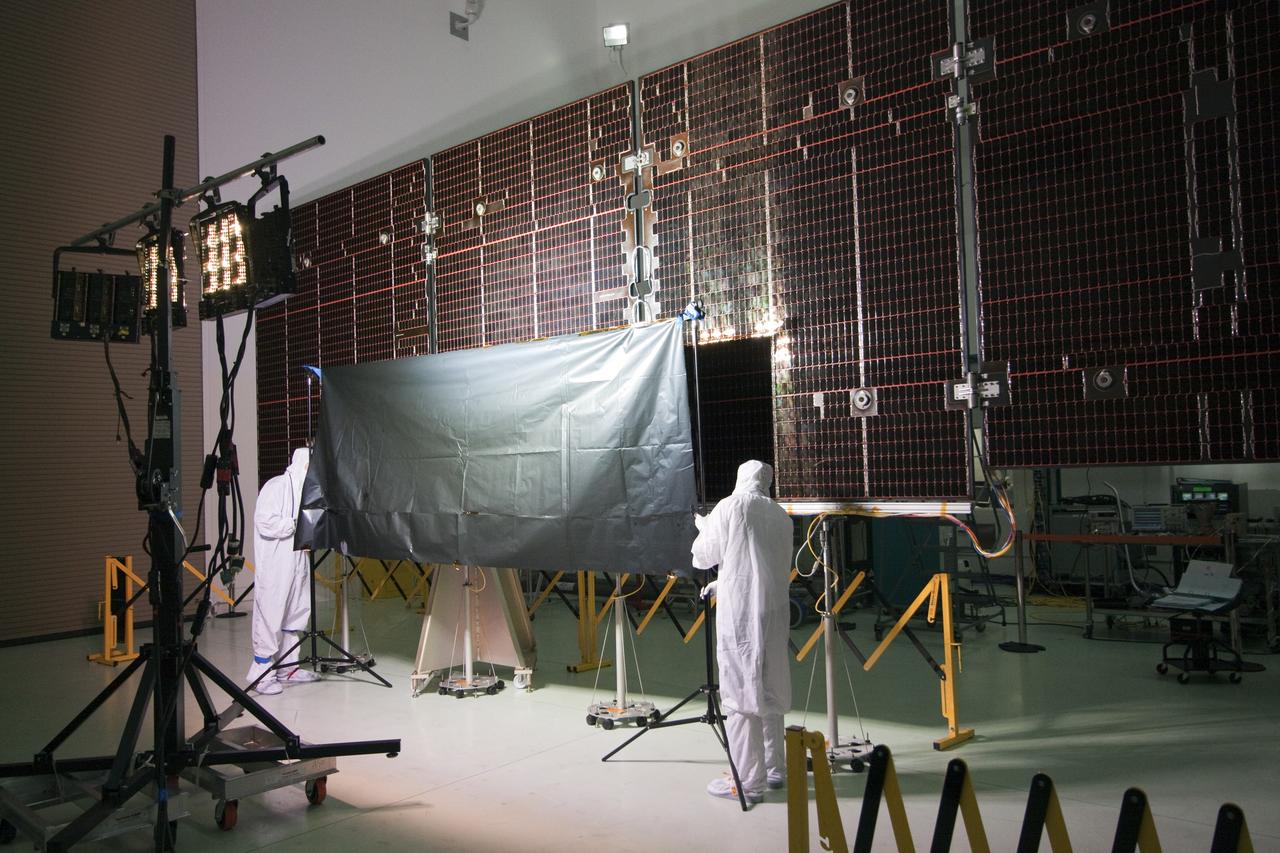
CAPE CANAVERAL, Fla. -- In a clean-room environment at Astrotech's payload processing facility in Titusville, Fla. technicians conduct an illumination test on the solar array panels for NASA's Juno spacecraft. Juno is scheduled to launch aboard a United Launch Alliance Atlas V rocket from Cape Canaveral, Fla. Aug. 5.The solar-powered spacecraft will orbit Jupiter's poles 33 times to find out more about the gas giant's origins, structure, atmosphere and magnetosphere and investigate the existence of a solid planetary core. For more information visit: www.nasa.gov/juno. Photo credit: NASA/Jack Pfaller
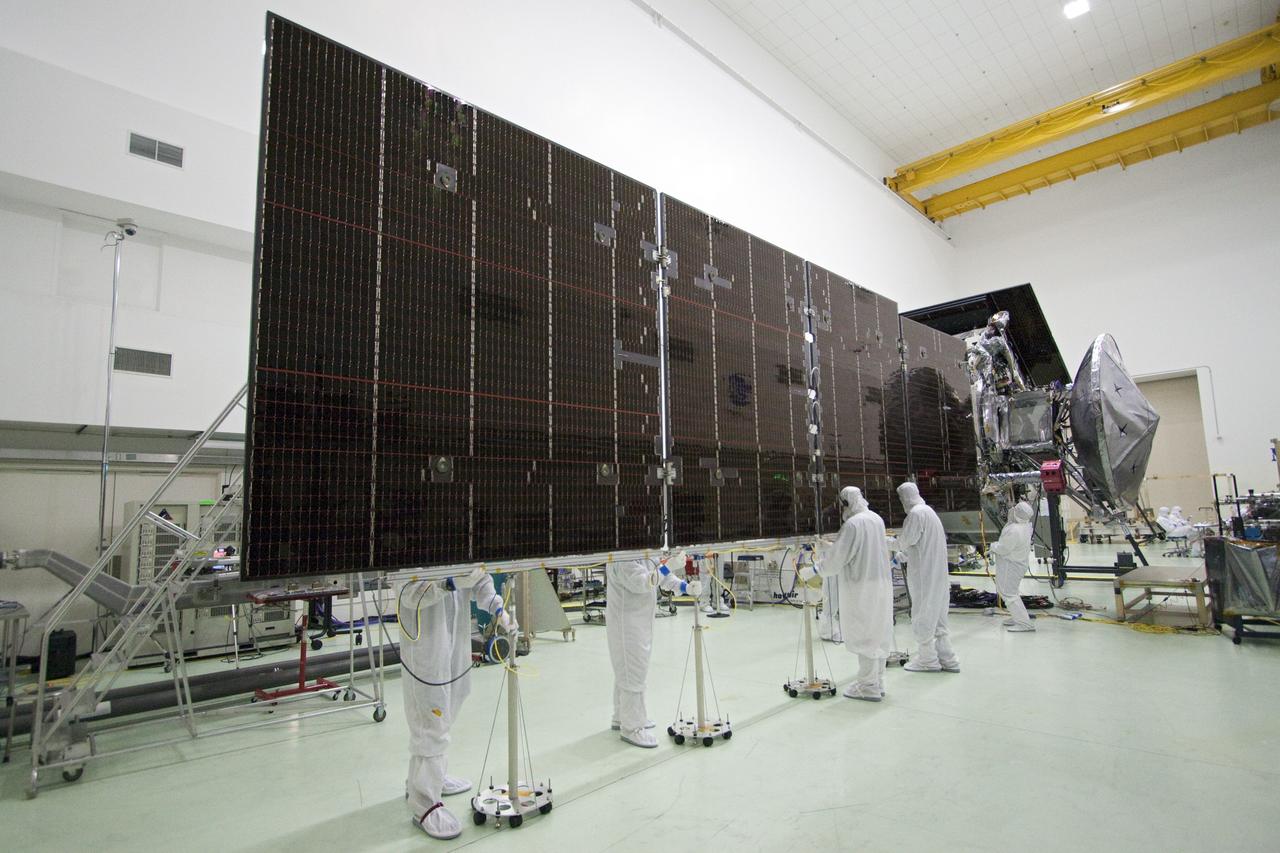
CAPE CANAVERAL, Fla. -- In a clean-room environment at Astrotech's payload processing facility in Titusville, Fla. technicians prepare solar array panels on NASA's Juno spacecraft for illumination testing. Juno is scheduled to launch aboard a United Launch Alliance Atlas V rocket from Cape Canaveral, Fla. Aug. 5.The solar-powered spacecraft will orbit Jupiter's poles 33 times to find out more about the gas giant's origins, structure, atmosphere and magnetosphere and investigate the existence of a solid planetary core. For more information visit: www.nasa.gov/juno. Photo credit: NASA/Jack Pfaller
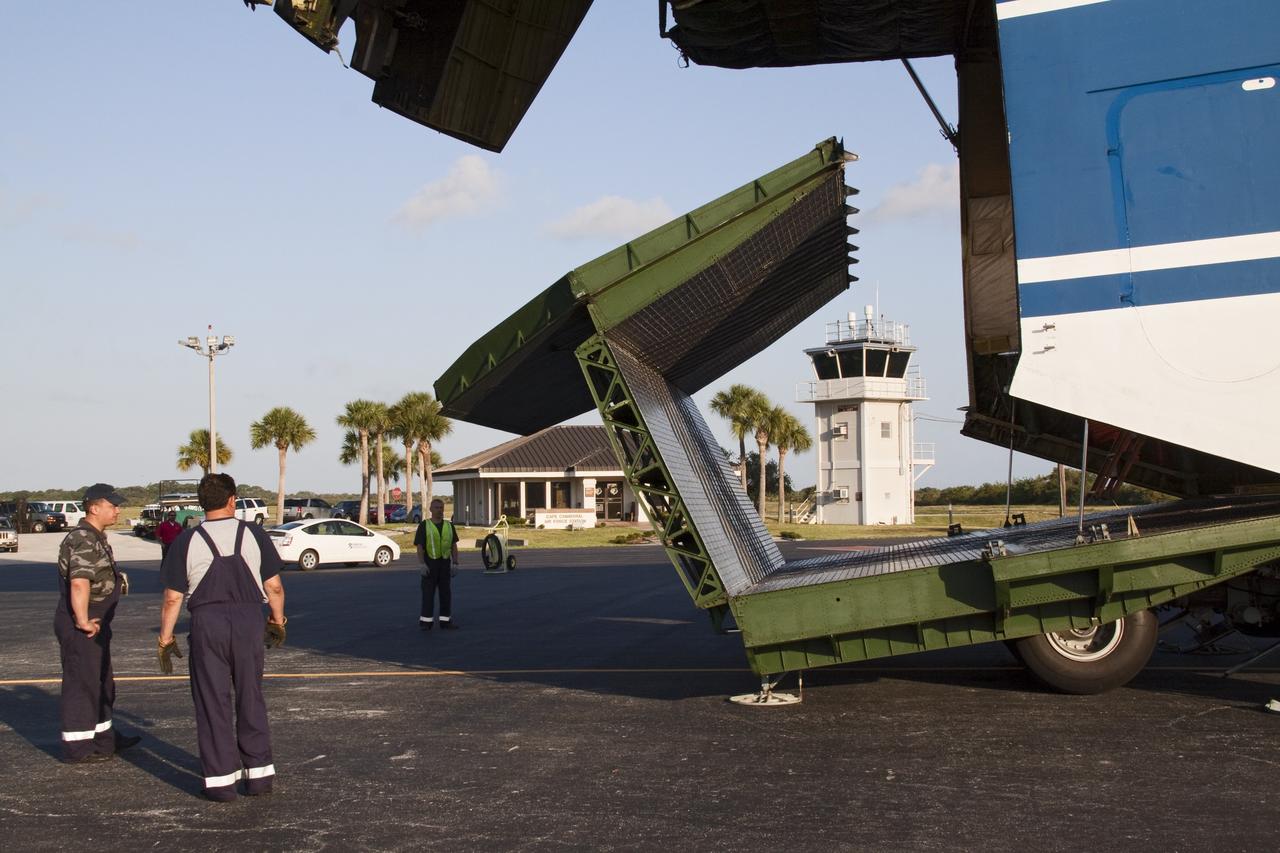
CAPE CANAVERAL, Fla. -- On the Skid Strip at Cape Canaveral Air Force Station in Florida, workers prepare to unload a Volga-Dnepr Antonov AN-124-100, a Ukranian/Russian cargo aircraft that has delivered the Centaur upper stage of the United Launch Alliance Atlas V rocket slated to launch NASA's Juno spacecraft. NASA's Juno spacecraft is scheduled to launch aboard the Atlas V from Cape Canaveral, Fla. Aug. 5.The solar-powered spacecraft will orbit Jupiter's poles 33 times to find out more about the gas giant's origins, structure, atmosphere and magnetosphere and investigate the existence of a solid planetary core. For more information visit: www.nasa.gov/juno. Photo credit: NASA/Jack Pfaller
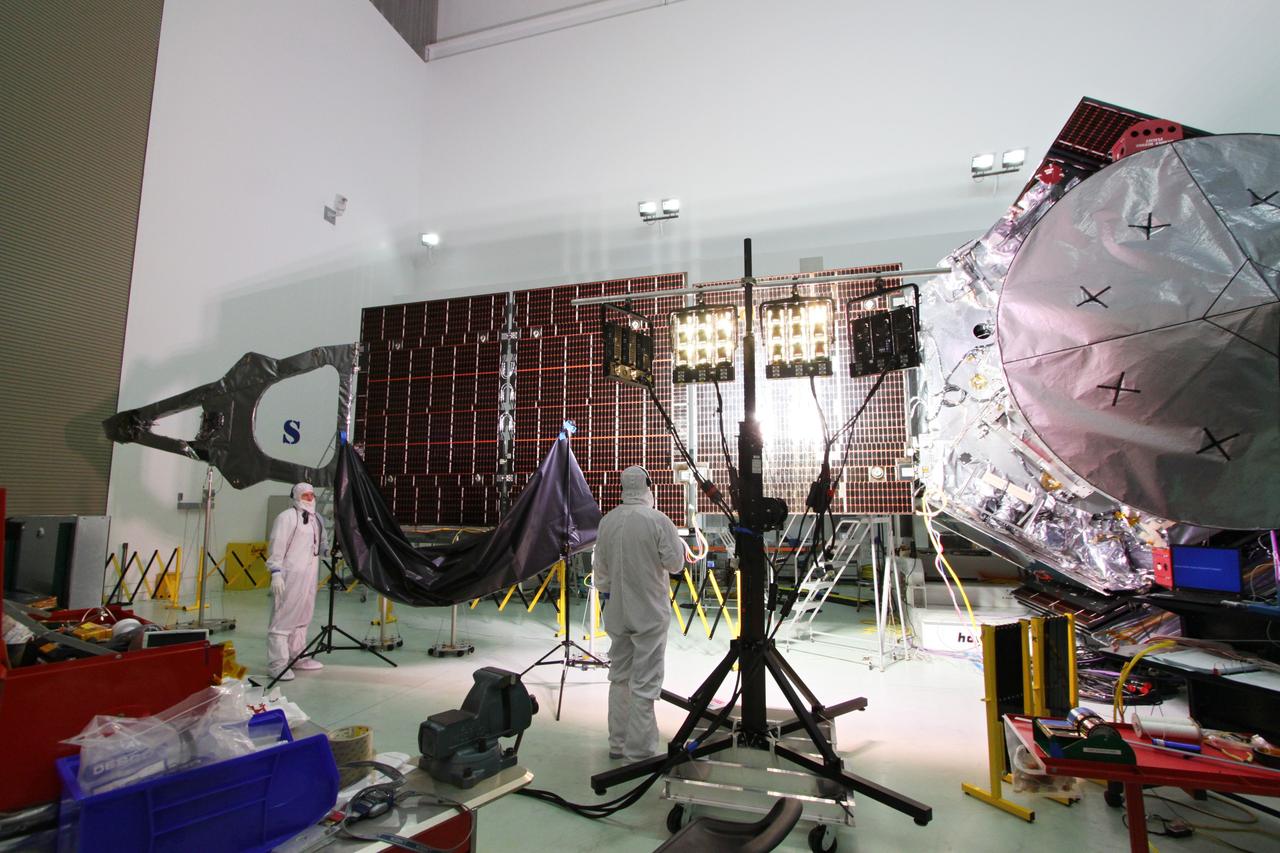
CAPE CANAVERAL, Fla. -- At Astrotech Space Operations in Titusville, Fla., technicians conduct illumination tests on solar array panel #1 with its magnetometer boom for NASA's Juno spacecraft. Juno is scheduled to launch aboard a United Launch Alliance Atlas V from Cape Canaveral, Fla. Aug. 5.The solar-powered spacecraft will orbit Jupiter's poles 33 times to find out more about the gas giant's origins, structure, atmosphere and magnetosphere and investigate the existence of a solid planetary core. For more information visit: www.nasa.gov/juno. Photo credit: NASA/Jack Pfaller
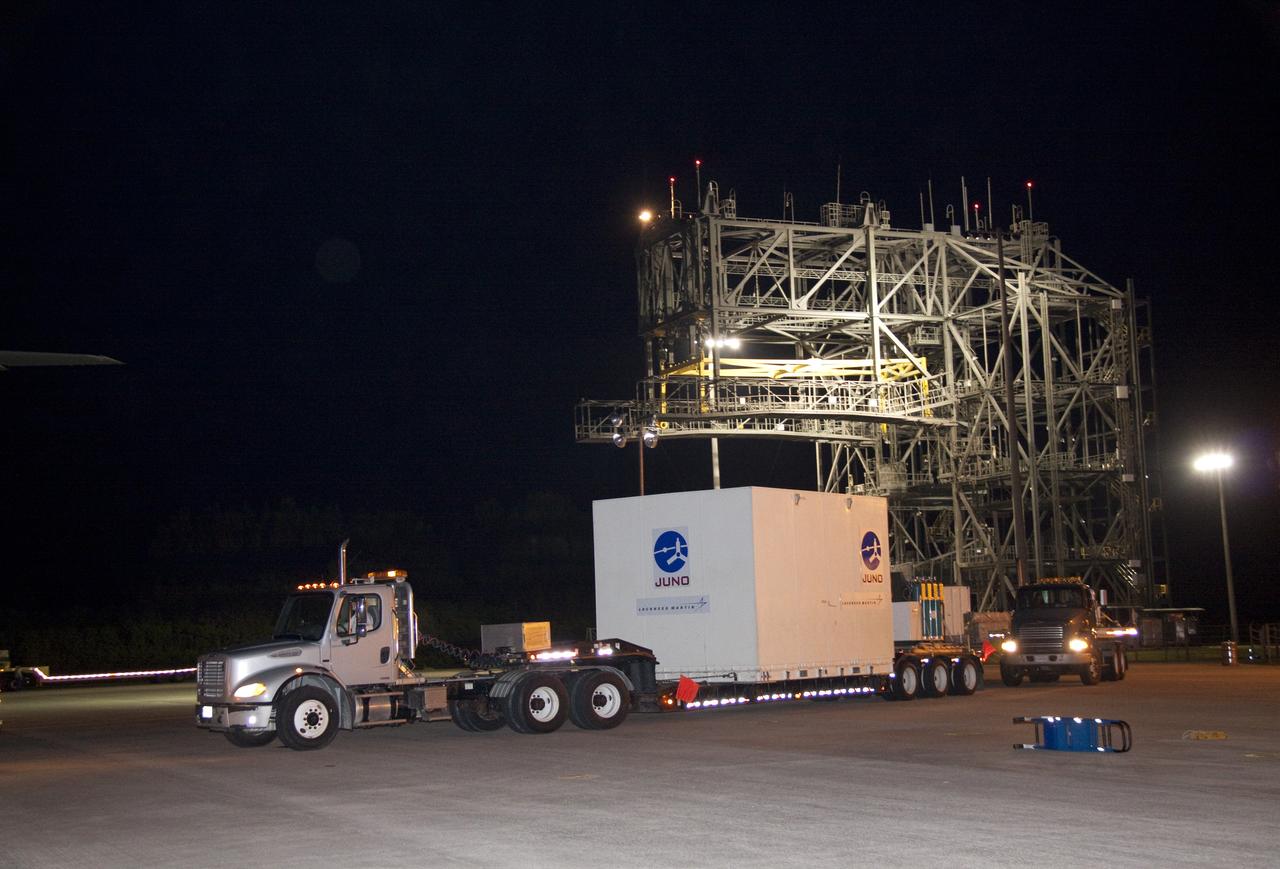
CAPE CANAVERAL, Fla. -- At the Shuttle Landing Facility at NASA's Kennedy Space Center in Florida, the containers holding NASA's Juno spacecraft and its high-gain antenna are secured on a truck that will transport it to Astrotech's payload processing facility in Titusville, Fla. to begin final preparations for launch. The solar-powered spacecraft will orbit Jupiter's poles 33 times to find out more about the gas giant's origins, structure, atmosphere and magnetosphere and investigate the existence of a solid planetary core. Juno is scheduled to launch aboard an Atlas V rocket from Cape Canaveral, Fla. Aug. 5. For more information visit, www.nasa.gov/juno. Photo credit: NASA/Jack Pfaller
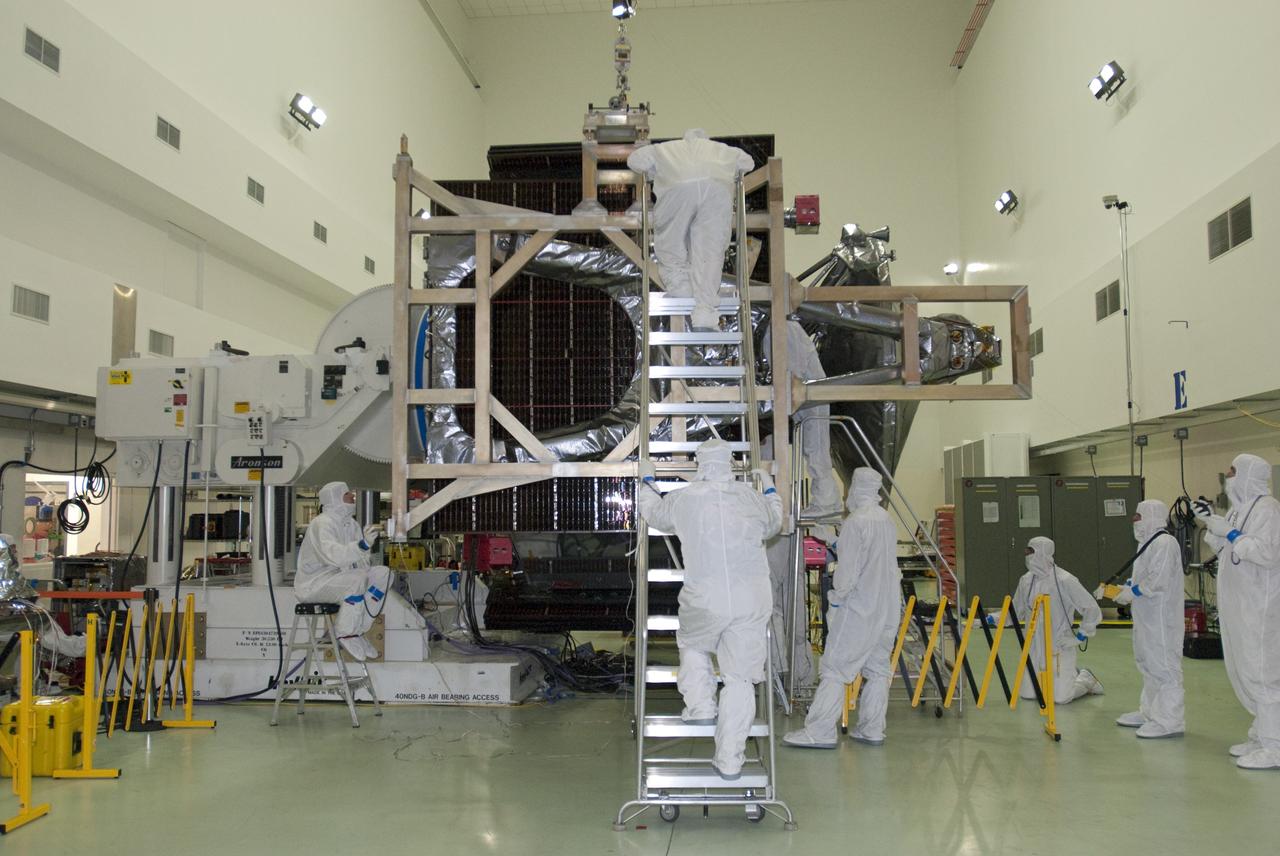
CAPE CANAVERAL, Fla. -- At Astrotech Space Operations in Titusville, Fla., technicians install solar array #1 with its magnetometer boom to NASA's Juno spacecraft. Juno is scheduled to launch aboard a United Launch Alliance Atlas V rocket from Cape Canaveral, Fla. Aug. 5.The solar-powered spacecraft will orbit Jupiter's poles 33 times to find out more about the gas giant's origins, structure, atmosphere and magnetosphere and investigate the existence of a solid planetary core. For more information visit: www.nasa.gov/juno. Photo credit: NASA/Charisse Nahser
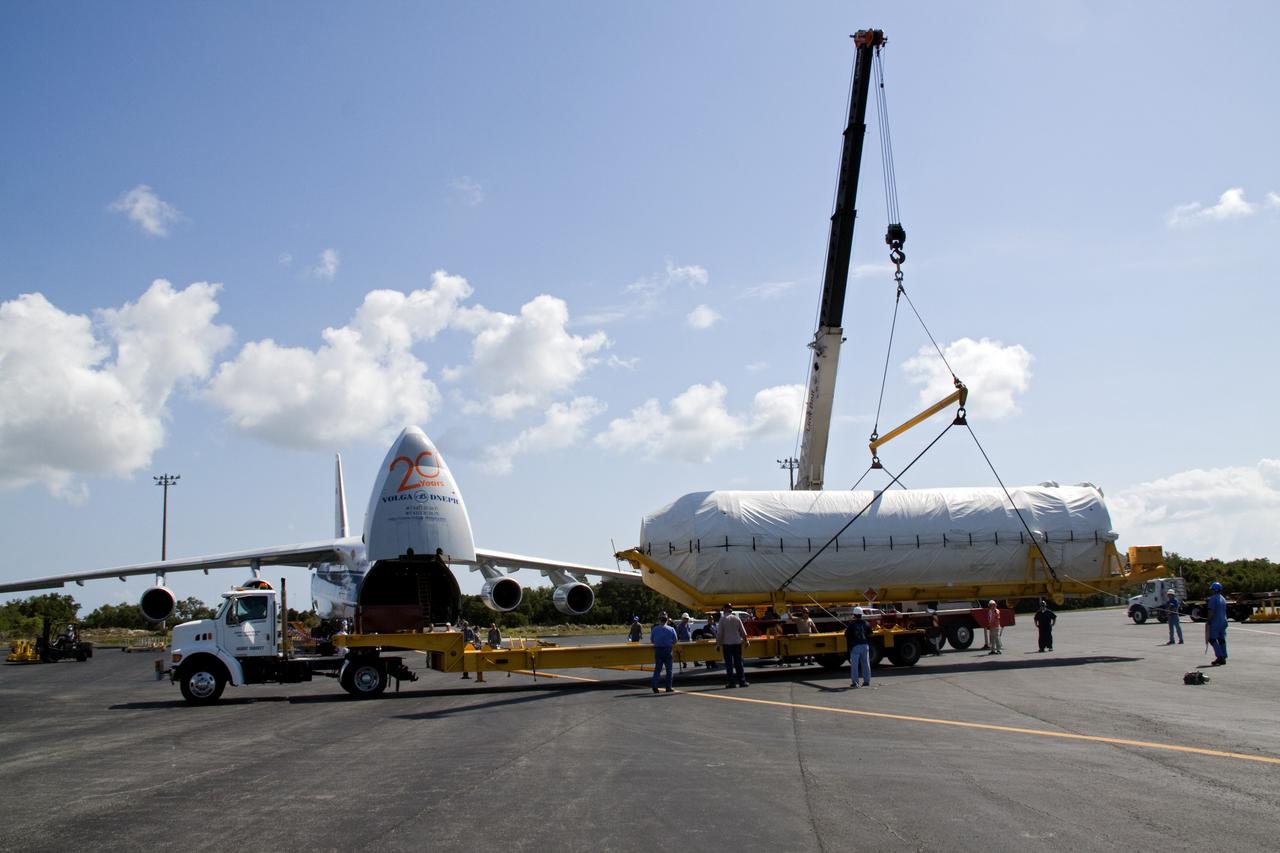
CAPE CANAVERAL, Fla. -- On the Skid Strip at Cape Canaveral Air Force Station in Florida, workers use a crane to lower the Centaur upper stage of the United Launch Alliance Atlas V rocket slated to launch NASA's Juno spacecraft onto a transporter. NASA's Juno spacecraft is scheduled to launch aboard the Atlas V from Cape Canaveral, Fla. Aug. 5.The solar-powered spacecraft will orbit Jupiter's poles 33 times to find out more about the gas giant's origins, structure, atmosphere and magnetosphere and investigate the existence of a solid planetary core. For more information visit: www.nasa.gov/juno. Photo credit: NASA/Jack Pfaller

CAPE CANAVERAL, Fla. -- In a clean-room environment at Astrotech's payload processing facility in Titusville, Fla. technicians conduct an illumination test on the solar array panels for NASA's Juno spacecraft. Juno is scheduled to launch aboard a United Launch Alliance Atlas V rocket from Cape Canaveral, Fla. Aug. 5.The solar-powered spacecraft will orbit Jupiter's poles 33 times to find out more about the gas giant's origins, structure, atmosphere and magnetosphere and investigate the existence of a solid planetary core. For more information visit: www.nasa.gov/juno. Photo credit: NASA/Jack Pfaller
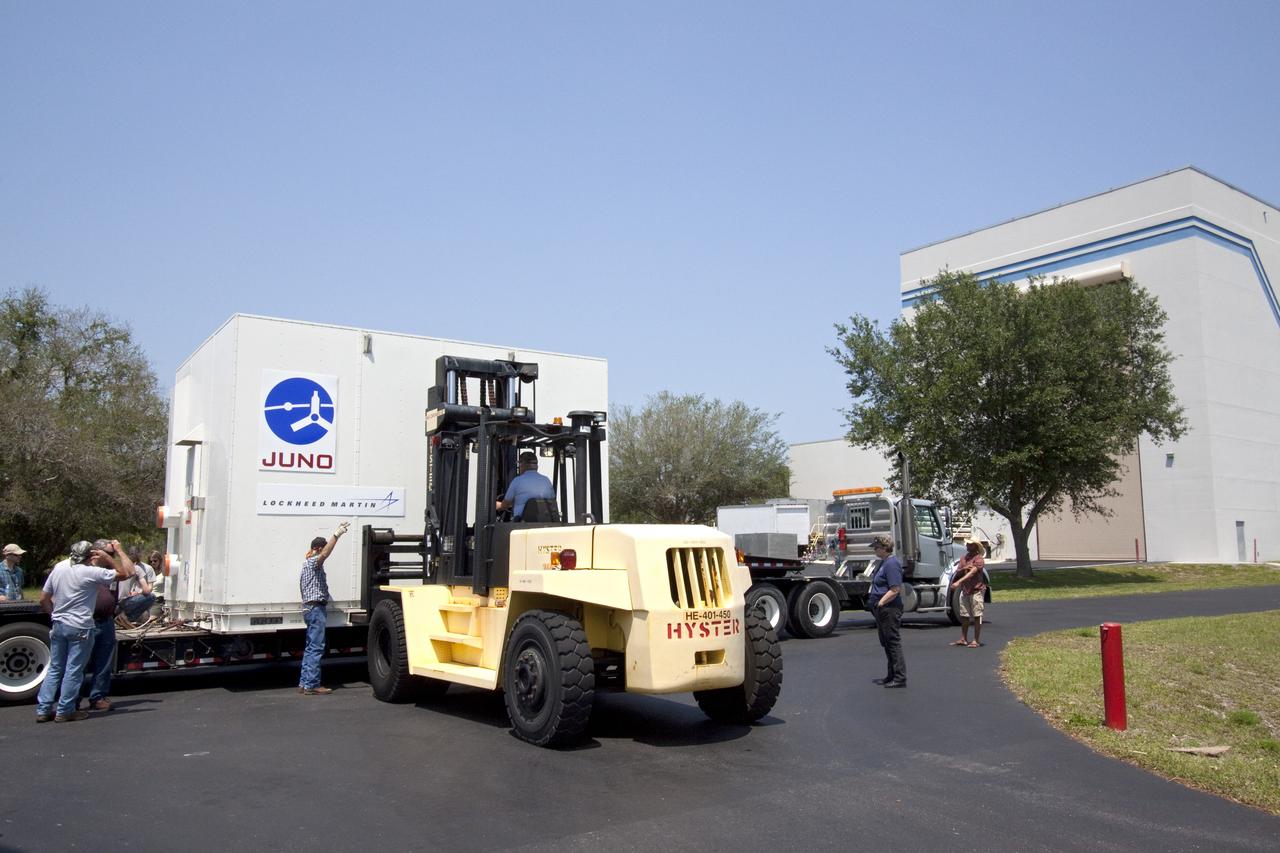
CAPE CANAVERAL, Fla. -- Workers use a Hyster forklift to move NASA's Juno spacecraft from a transport into Astrotech's payload processing facility in Titusville, Fla. to begin final testing and preparations for launch. The solar-powered spacecraft will orbit Jupiter's poles 33 times to find out more about the gas giant's origins, structure, atmosphere and magnetosphere and investigate the existence of a solid planetary core. Juno is scheduled to launch aboard an Atlas V rocket from Cape Canaveral, Fla. Aug. 5. For more information visit, www.nasa.gov/juno. Photo credit: NASA/Jack Pfaller It will splash down into the Atlantic Ocean where the ship and its crew will recover it and tow it back through Port Canaveral for refurbishing for another launch. The STS-124 mission is the second of three flights launching components to complete the Japan Aerospace Exploration Agency's Kibo laboratory. The shuttle crew will install Kibo's large Japanese Pressurized Module and its remote manipulator system, or RMS. Photo credit: USA/Jeff Suter

CAPE CANAVERAL, Fla. -- Technicians guide an overhead crane toward the container holding NASA's Juno spacecraft. The container will be lifted away from the spacecraft, moved into an airlock at Astrotech's payload processing facility in Titusville, Fla. to begin final testing and preparations for launch. The solar-powered spacecraft will orbit Jupiter's poles 33 times to find out more about the gas giant's origins, structure, atmosphere and magnetosphere and investigate the existence of a solid planetary core. Juno is scheduled to launch aboard an Atlas V rocket from Cape Canaveral, Fla. Aug. 5. For more information visit, www.nasa.gov/juno. Photo credit: NASA/Jack Pfaller It will splash down into the Atlantic Ocean where the ship and its crew will recover it and tow it back through Port Canaveral for refurbishing for another launch. The STS-124 mission is the second of three flights launching components to complete the Japan Aerospace Exploration Agency's Kibo laboratory. The shuttle crew will install Kibo's large Japanese Pressurized Module and its remote manipulator system, or RMS. Photo credit: USA/Jeff Suter
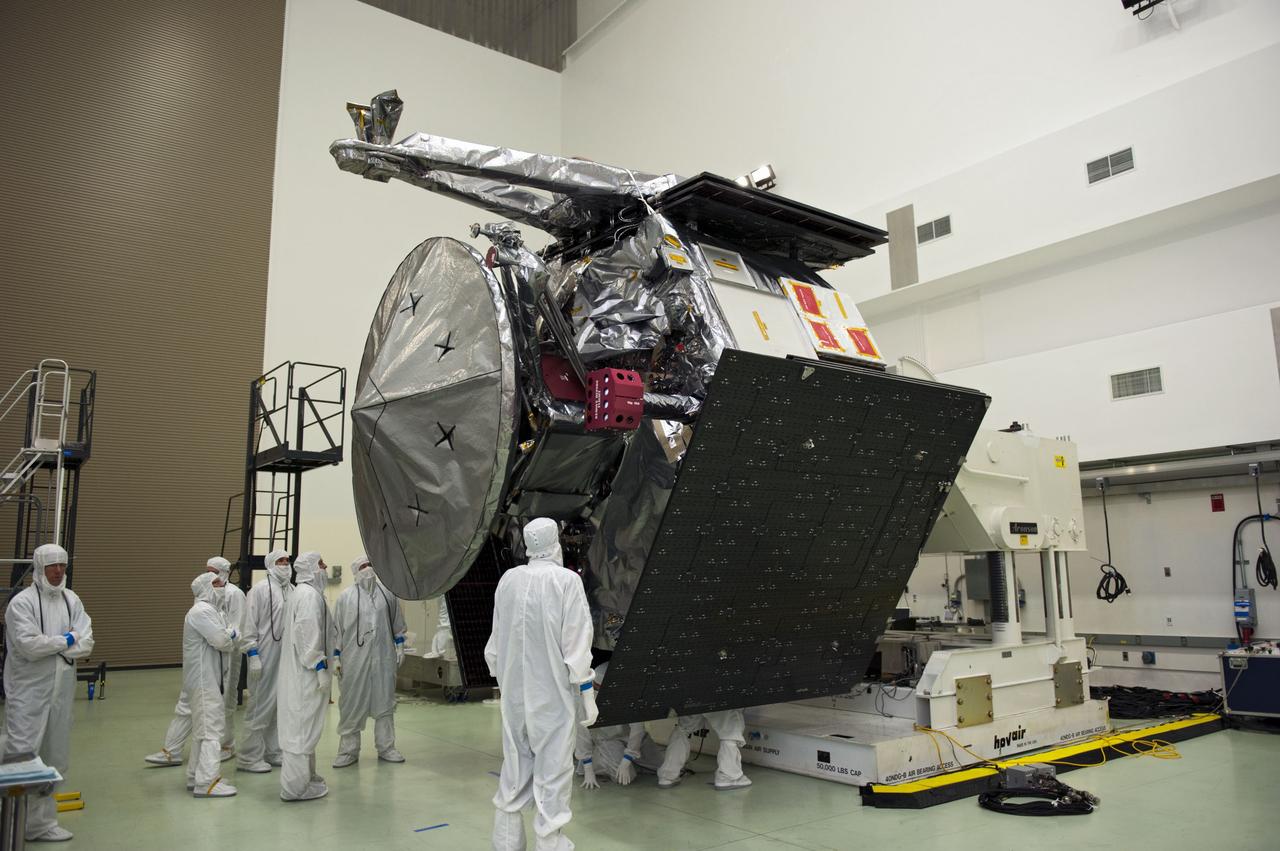
CAPE CANAVERAL, Fla. -- Technicians at Astrotech's payload processing facility in Titusville, Fla. watch vigilantly as NASA's Juno spacecraft is tested for center of gravity, weighing and balancing on the rotation stand. Juno is scheduled to launch aboard United Launch Alliance Atlas V rocket from Cape Canaveral, Fla. Aug. 5.The solar-powered spacecraft will orbit Jupiter's poles 33 times to find out more about the gas giant's origins, structure, atmosphere and magnetosphere and investigate the existence of a solid planetary core. For more information visit: www.nasa.gov/juno. Photo credit: NASA/Kim Shiflett

CAPE CANAVERAL, Fla. -- At Astrotech's Hazardous Processing Facility in Titusville, Fla., technicians prepare an overhead crane to move NASA's Juno spacecraft to a fueling stand where the spacecraft will be loaded with the propellant necessary for orbit maneuvers and the attitude control system. Juno is scheduled to launch aboard a United Launch Alliance Atlas V rocket from Cape Canaveral, Fla., Aug. 5.The solar-powered spacecraft will orbit Jupiter's poles 33 times to find out more about the gas giant's origins, structure, atmosphere and magnetosphere and investigate the existence of a solid planetary core. For more information visit: www.nasa.gov/juno. Photo credit: NASA/Troy Cryder

CAPE CANAVERAL, Fla. -- Technicians at Astrotech's payload processing facility in Titusville, Fla. guide the high-gain antenna toward NASA's Juno spacecraft for installation. Juno is scheduled to launch aboard an Atlas V rocket from Cape Canaveral, Fla. Aug. 5.The solar-powered spacecraft will orbit Jupiter's poles 33 times to find out more about the gas giant's origins, structure, atmosphere and magnetosphere and investigate the existence of a solid planetary core. For more information visit, www.nasa.gov/juno. Photo credit: NASA/Jack Pfaller
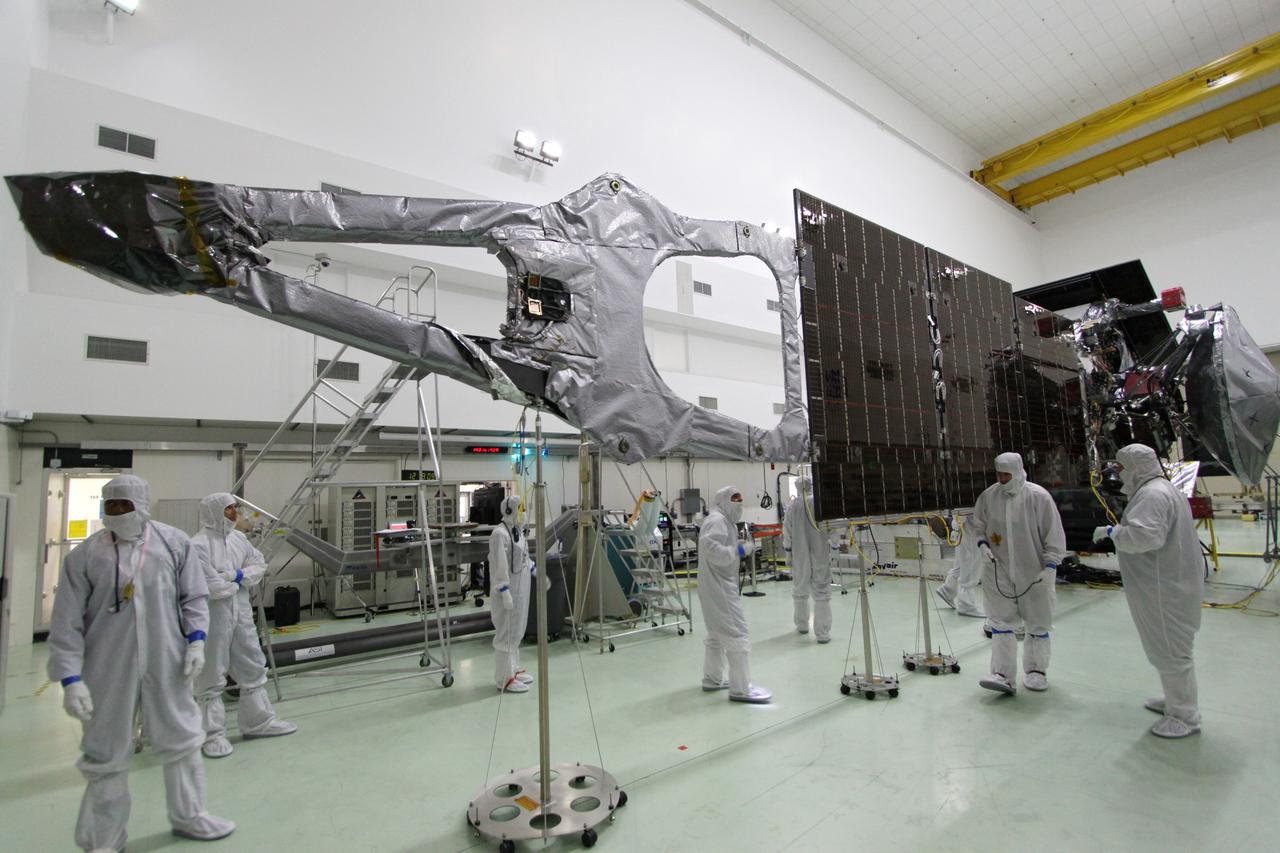
CAPE CANAVERAL, Fla. -- At Astrotech Space Operations in Titusville, Fla., technicians conduct deployment tests on solar array panel #1 with its magnetometer boom for NASA's Juno spacecraft prior to illumination testing. Juno is scheduled to launch aboard a United Launch Alliance Atlas V from Cape Canaveral, Fla. Aug. 5.The solar-powered spacecraft will orbit Jupiter's poles 33 times to find out more about the gas giant's origins, structure, atmosphere and magnetosphere and investigate the existence of a solid planetary core. For more information visit: www.nasa.gov/juno. Photo credit: NASA/Jack Pfaller

CAPE CANAVERAL, Fla. -- Lockheed-Martin technicians at Astrotech's payload processing facility in Titusville, Fla. remove the protective wrapping from NASA's Juno spacecraft to begin final testing and preparations for launch. The solar-powered spacecraft will orbit Jupiter's poles 33 times to find out more about the gas giant's origins, structure, atmosphere and magnetosphere and investigate the existence of a solid planetary core. Juno is scheduled to launch aboard an Atlas V rocket from Cape Canaveral, Fla. Aug. 5. For more information visit, www.nasa.gov/juno. Photo credit: NASA/Jack Pfaller It will splash down into the Atlantic Ocean where the ship and its crew will recover it and tow it back through Port Canaveral for refurbishing for another launch. The STS-124 mission is the second of three flights launching components to complete the Japan Aerospace Exploration Agency's Kibo laboratory. The shuttle crew will install Kibo's large Japanese Pressurized Module and its remote manipulator system, or RMS. Photo credit: USA/Jeff Suter
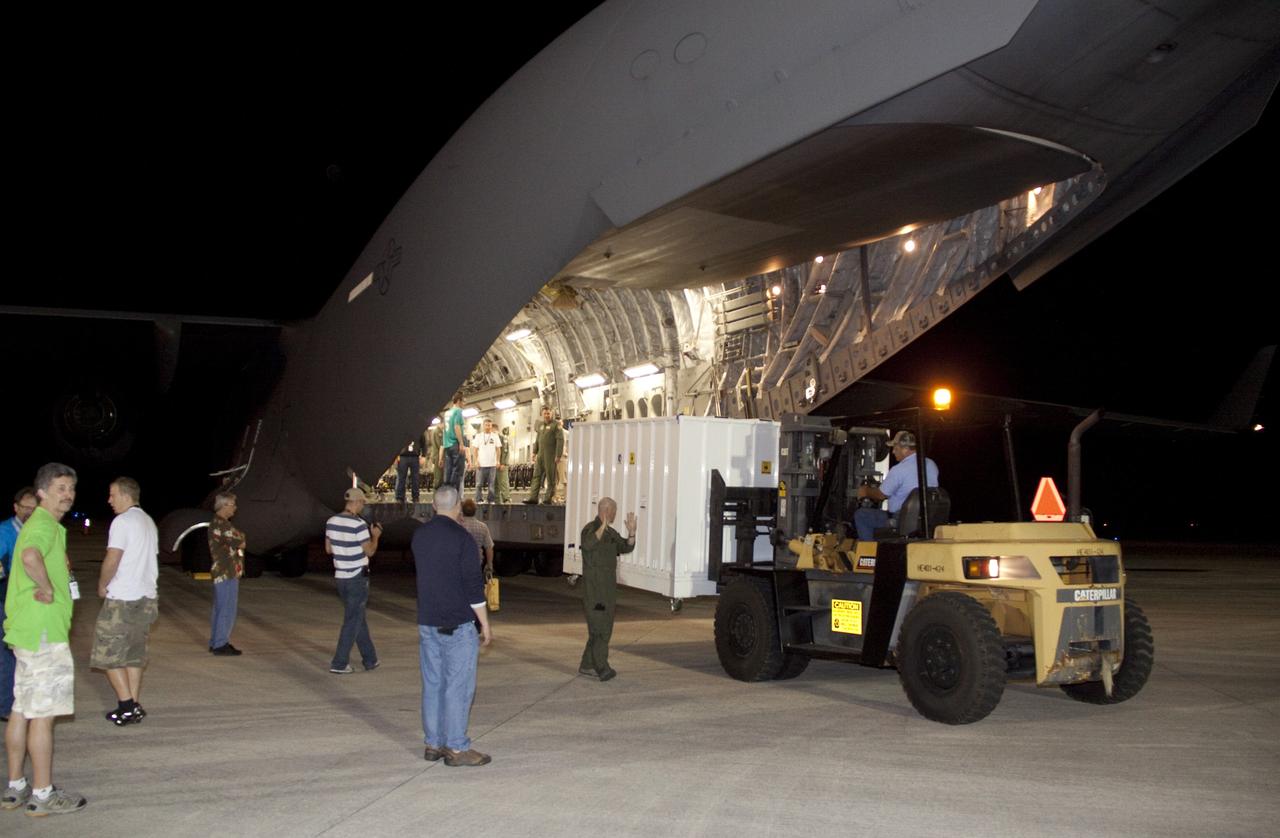
CAPE CANAVERAL, Fla. -- Workers move the container holding NASA's Juno high-gain antenna container away from the ramp of an Air Force C-17 jet at Kennedy Space Center's Shuttle Landing Facility in Florida. The spacecraft and its high-gain antenna was shipped from Lockheed Martin Space Systems in Denver and will be transported to Astrotech's payload processing facility in Titusville, Fla. to begin final preparations for launch. The solar-powered spacecraft will orbit Jupiter's poles 33 times to find out more about the gas giant's origins, structure, atmosphere and magnetosphere and investigate the existence of a solid planetary core. Juno is scheduled to launch aboard an Atlas V rocket from Cape Canaveral, Fla. Aug. 5. For more information visit, www.nasa.gov/juno. Photo credit: NASA/Jack Pfaller
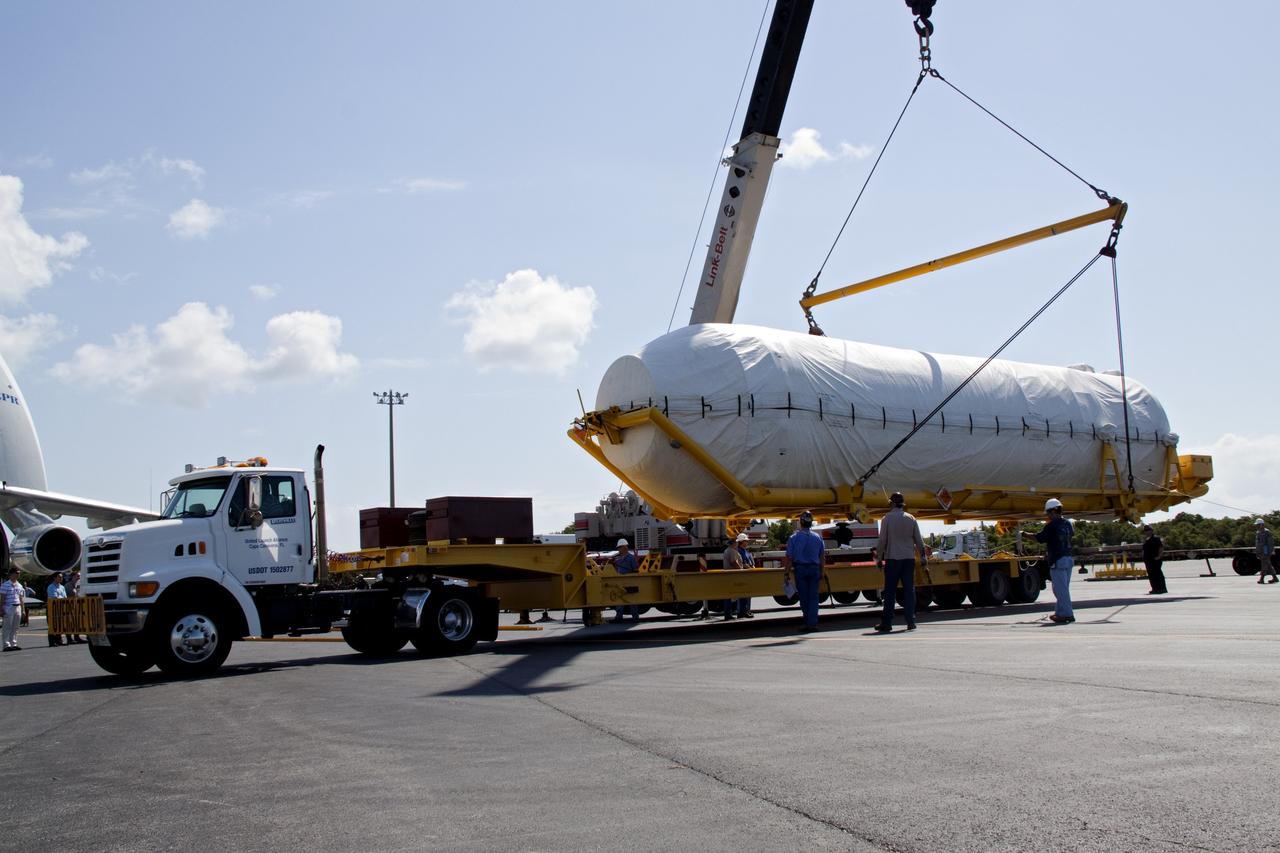
CAPE CANAVERAL, Fla. -- On the Skid Strip at Cape Canaveral Air Force Station in Florida, workers use a crane to lower the Centaur upper stage of the United Launch Alliance Atlas V rocket slated to launch NASA's Juno spacecraft onto a transporter. NASA's Juno spacecraft is scheduled to launch aboard the Atlas V from Cape Canaveral, Fla. Aug. 5.The solar-powered spacecraft will orbit Jupiter's poles 33 times to find out more about the gas giant's origins, structure, atmosphere and magnetosphere and investigate the existence of a solid planetary core. For more information visit: www.nasa.gov/juno. Photo credit: NASA/Jack Pfaller
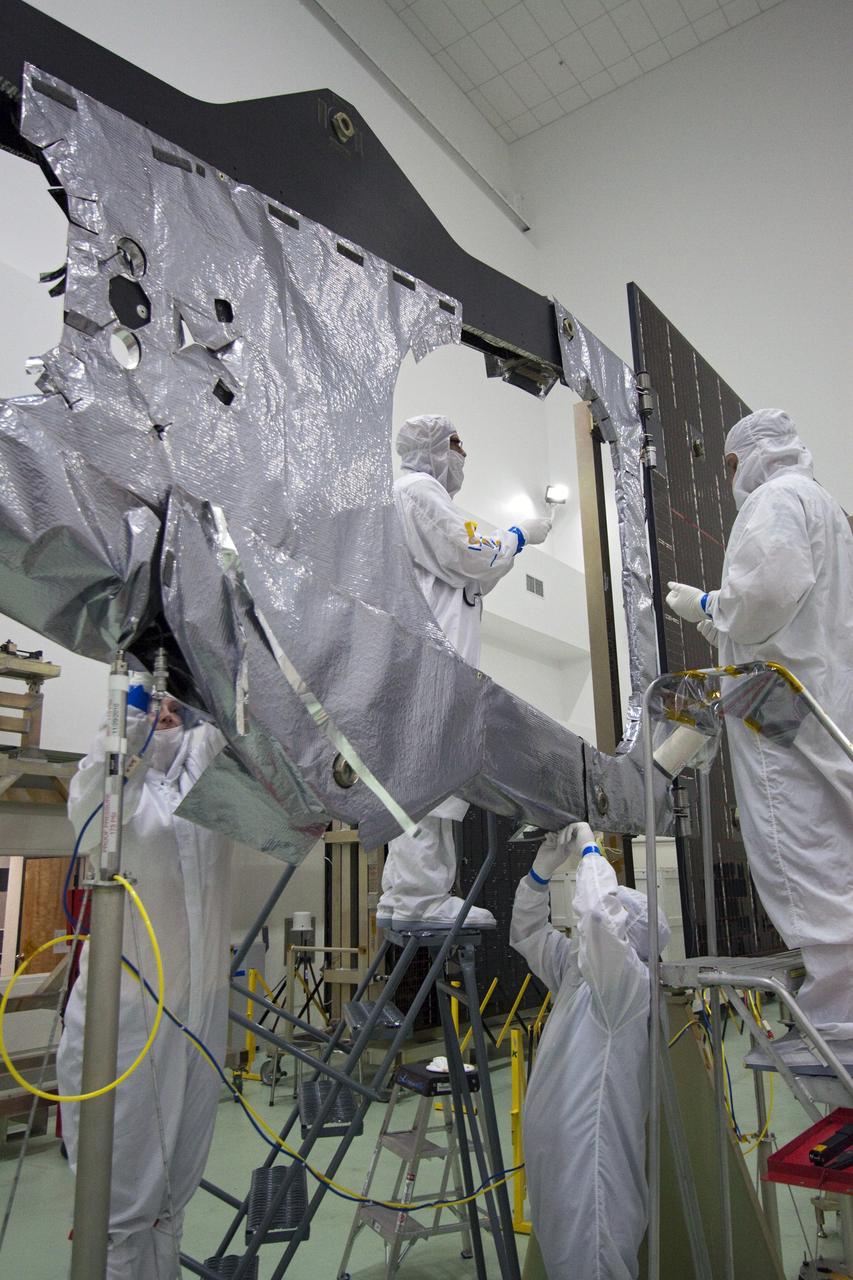
CAPE CANAVERAL, Fla. -- Technicians in the Astrotech payload processing facility in Titusville, Fla. install thermal insulation on NASA's Juno magnetometer boom. The boom structure is attached to Juno's solar array #1 that will help power the NASA spacecraft on its mission to Jupiter. The solar-powered spacecraft will orbit Jupiter's poles 33 times to find out more about the gas giant's origins, structure, atmosphere and magnetosphere and investigate the existence of a solid planetary core. Juno is scheduled to launch aboard an Atlas V rocket from Cape Canaveral, Fla. Aug. 5. For more information visit, www.nasa.gov/juno. Photo credit: NASA/Jack Pfaller It will splash down into the Atlantic Ocean where the ship and its crew will recover it and tow it back through Port Canaveral for refurbishing for another launch. The STS-124 mission is the second of three flights launching components to complete the Japan Aerospace Exploration Agency's Kibo laboratory. The shuttle crew will install Kibo's large Japanese Pressurized Module and its remote manipulator system, or RMS. Photo credit: USA/Jeff Suter
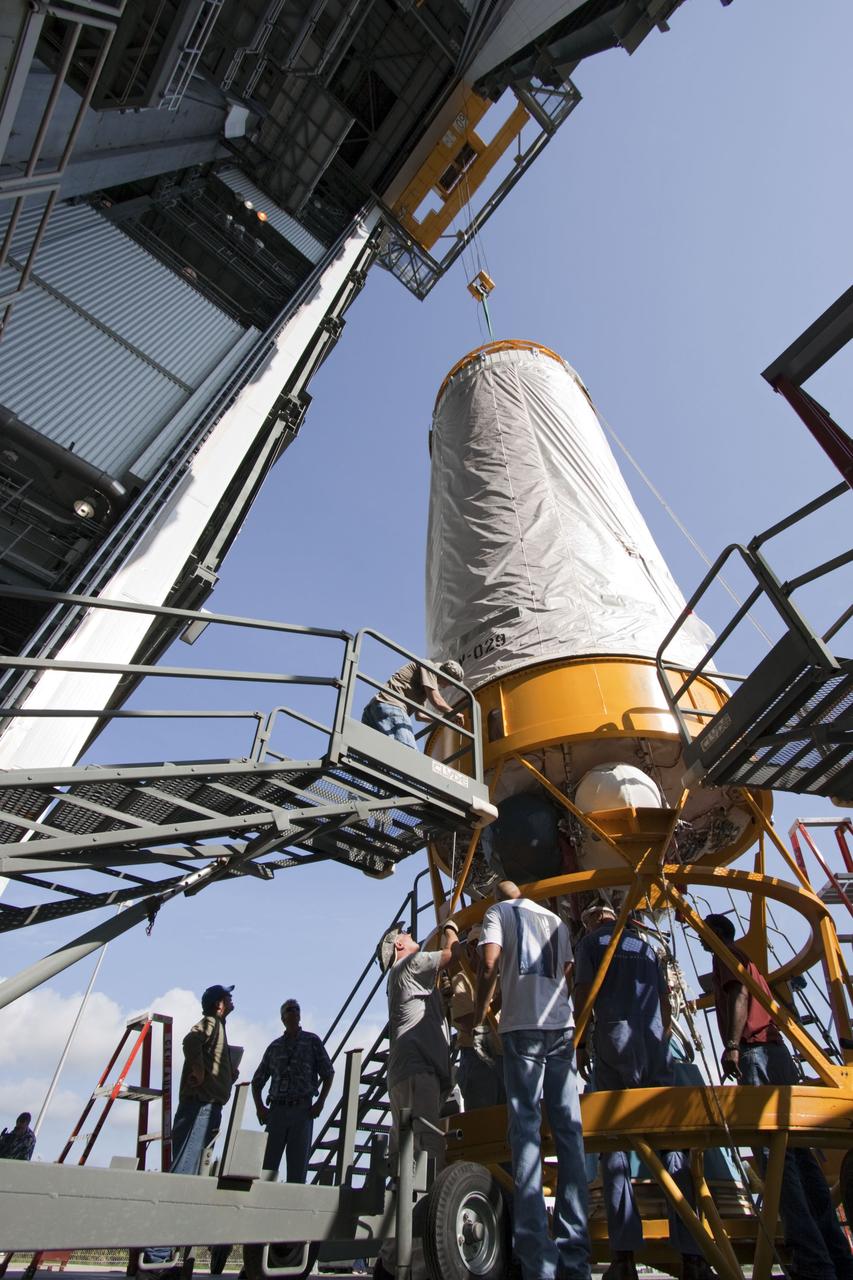
CAPE CANAVERAL, Fla. -- At Launch Complex 41 at Cape Canaveral Air Force Station in Florida, workers guide an overhead crane as it lifts the Centaur upper stage for the United Launch Alliance Atlas V, slated to launch NASA's Juno spacecraft, into the Vertical Integration Facility (VIF). After in position in the VIF it will be attached to the Atlas V booster stage, already at the pad. Juno is scheduled to launch aboard an Atlas V from Cape Canaveral, Fla. Aug. 5.The solar-powered spacecraft will orbit Jupiter's poles 33 times to find out more about the gas giant's origins, structure, atmosphere and magnetosphere and investigate the existence of a solid planetary core. For more information visit: www.nasa.gov/juno. Photo credit: NASA/Jim Grossmann
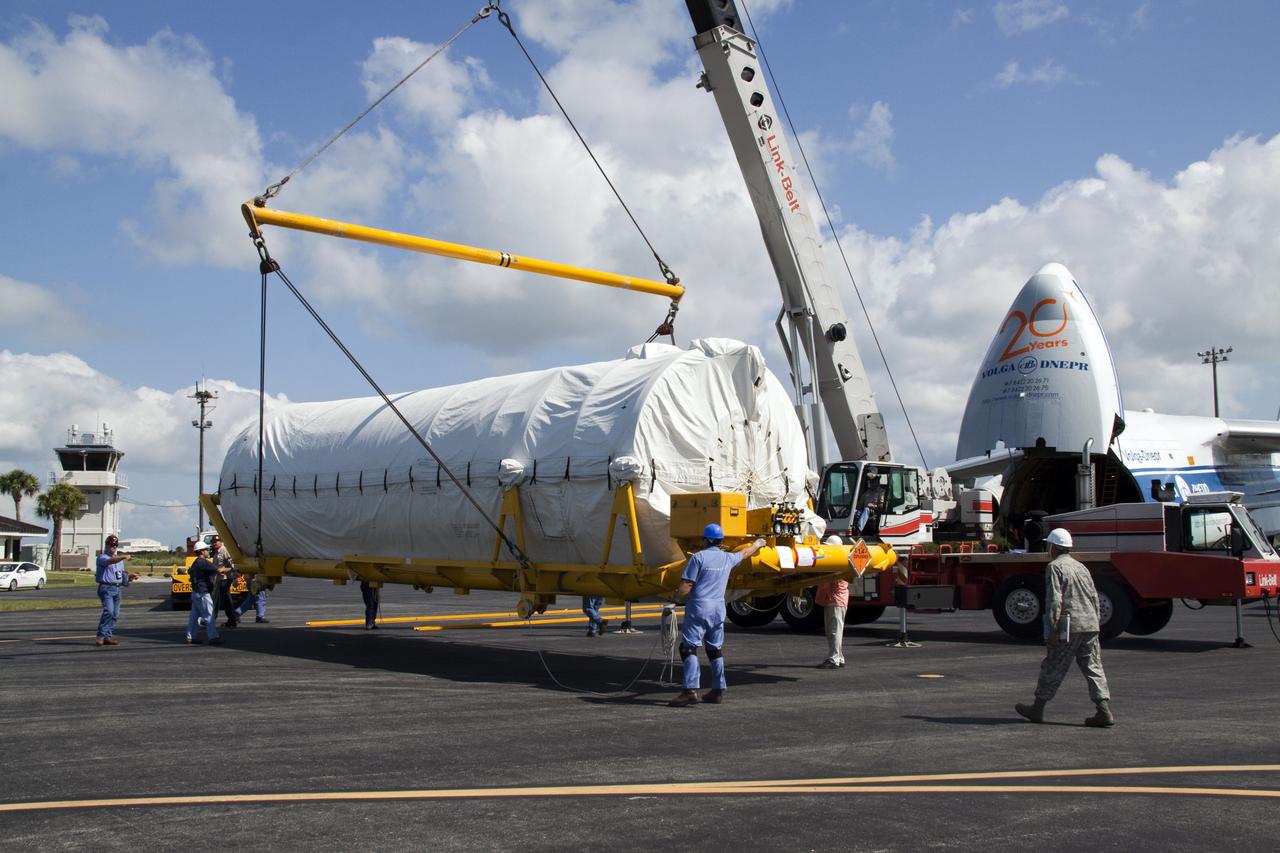
CAPE CANAVERAL, Fla. -- On the Skid Strip at Cape Canaveral Air Force Station in Florida, workers use a crane to lift the Centaur upper stage of the United Launch Alliance Atlas V rocket slated to launch NASA's Juno spacecraft onto a transporter. NASA's Juno spacecraft is scheduled to launch aboard the Atlas V from Cape Canaveral, Fla. Aug. 5.The solar-powered spacecraft will orbit Jupiter's poles 33 times to find out more about the gas giant's origins, structure, atmosphere and magnetosphere and investigate the existence of a solid planetary core. For more information visit: www.nasa.gov/juno. Photo credit: NASA/Jack Pfaller
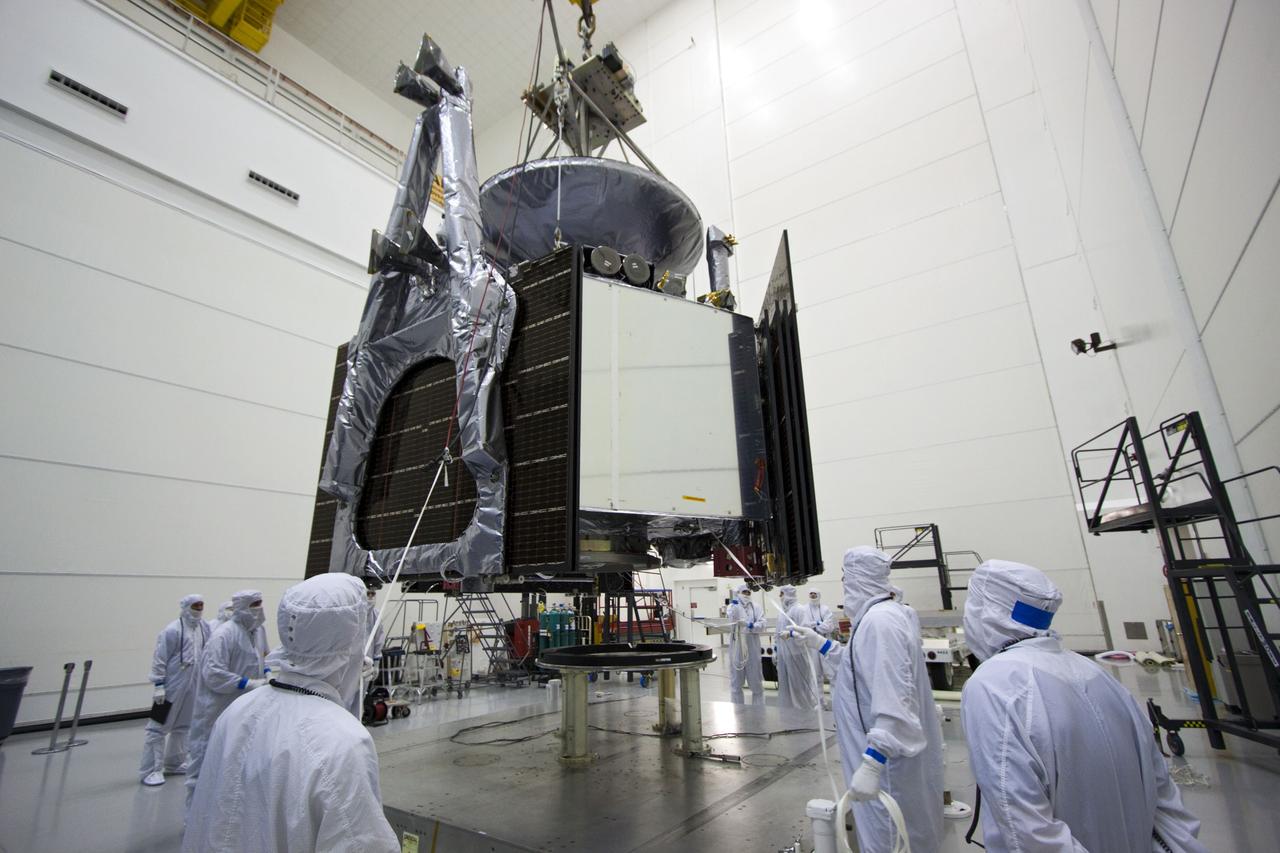
CAPE CANAVERAL, Fla. -- At Astrotech's Hazardous Processing Facility in Titusville, Fla., technicians using an overhead crane lower NASA's Juno spacecraft to a fueling stand where the spacecraft will be loaded with the propellant necessary for orbit maneuvers and the attitude control system. Juno is scheduled to launch aboard a United Launch Alliance Atlas V rocket from Cape Canaveral, Fla., Aug. 5.The solar-powered spacecraft will orbit Jupiter's poles 33 times to find out more about the gas giant's origins, structure, atmosphere and magnetosphere and investigate the existence of a solid planetary core. For more information visit: www.nasa.gov/juno. Photo credit: NASA/Troy Cryder
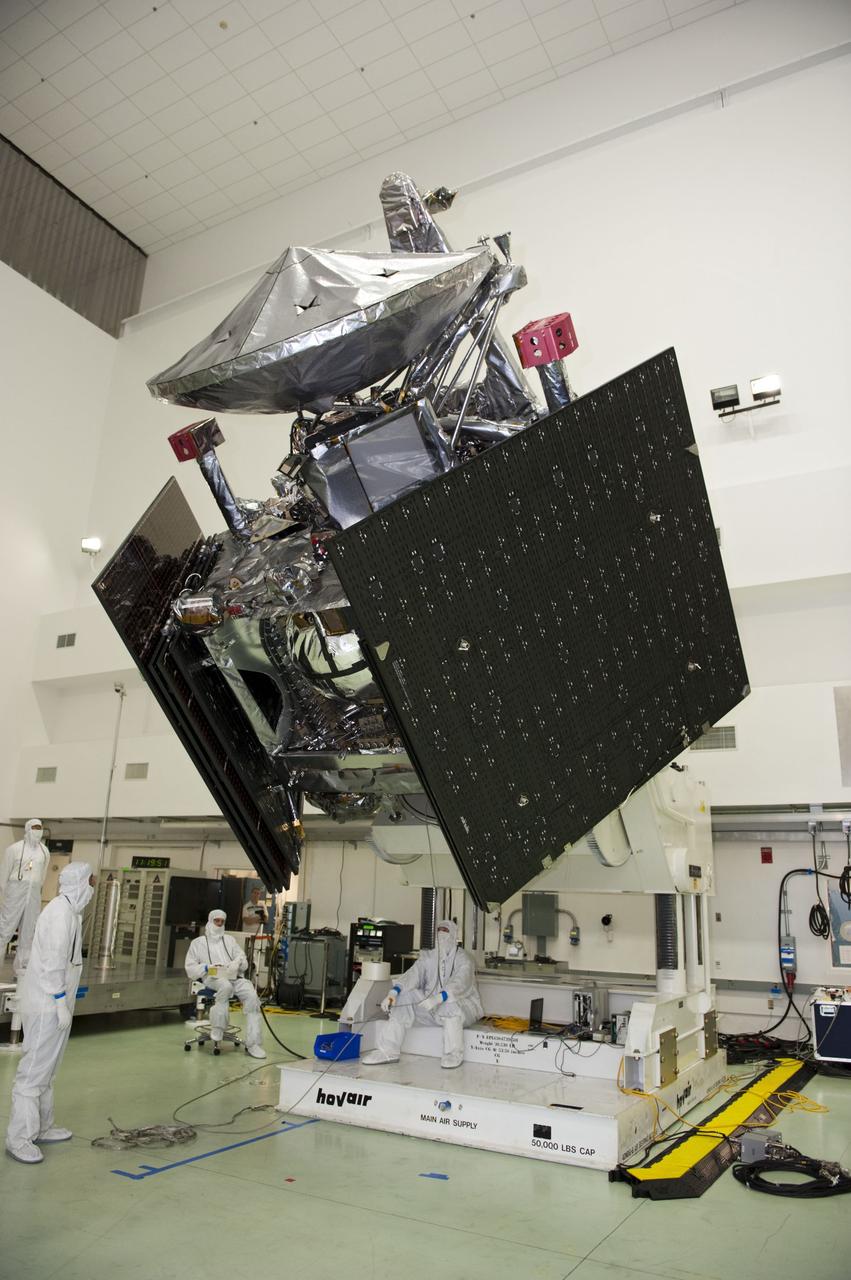
CAPE CANAVERAL, Fla. -- Technicians at Astrotech's payload processing facility in Titusville, Fla. watch vigilantly as NASA's Juno spacecraft is tested for center of gravity, weighing and balancing on the rotation stand. Juno is scheduled to launch aboard United Launch Alliance Atlas V rocket from Cape Canaveral, Fla. Aug. 5.The solar-powered spacecraft will orbit Jupiter's poles 33 times to find out more about the gas giant's origins, structure, atmosphere and magnetosphere and investigate the existence of a solid planetary core. For more information visit: www.nasa.gov/juno. Photo credit: NASA/Kim Shiflett
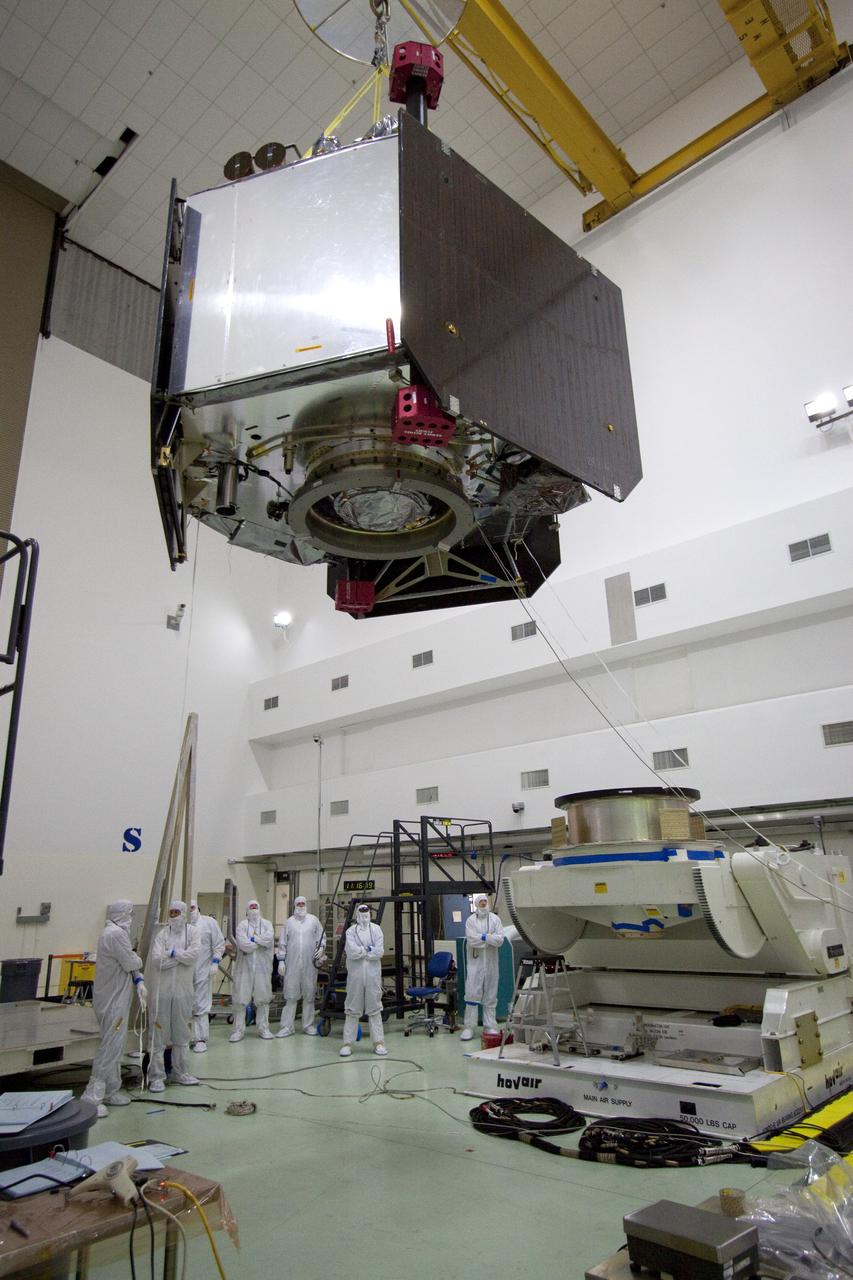
CAPE CANAVERAL, Fla. -- Technicians at Astrotech's payload processing facility in Titusville, Fla. monitor NASA's Juno spacecraft as it is moved by overhead crane to the rotation stand for testing. The solar-powered spacecraft will orbit Jupiter's poles 33 times to find out more about the gas giant's origins, structure, atmosphere and magnetosphere and investigate the existence of a solid planetary core. Juno is scheduled to launch aboard an Atlas V rocket from Cape Canaveral, Fla. Aug. 5. For more information visit, www.nasa.gov/juno. Photo credit: NASA/Jack Pfaller
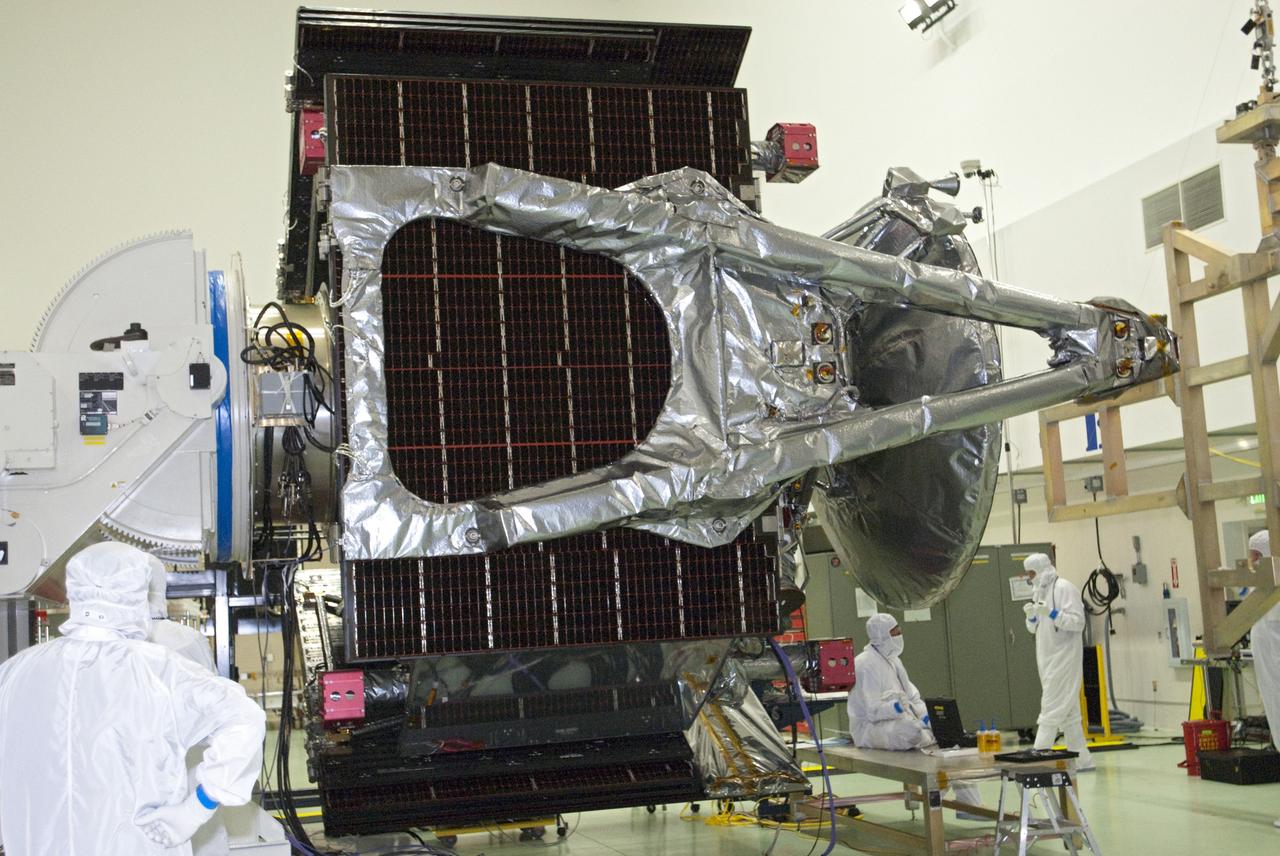
CAPE CANAVERAL, Fla. -- At Astrotech Space Operations in Titusville, Fla., technicians have installed solar array #1 with its magnetometer boom to NASA's Juno spacecraft. Juno is scheduled to launch aboard a United Launch Alliance Atlas V rocket from Cape Canaveral, Fla. Aug. 5.The solar-powered spacecraft will orbit Jupiter's poles 33 times to find out more about the gas giant's origins, structure, atmosphere and magnetosphere and investigate the existence of a solid planetary core. For more information visit: www.nasa.gov/juno. Photo credit: NASA/Charisse Nahser
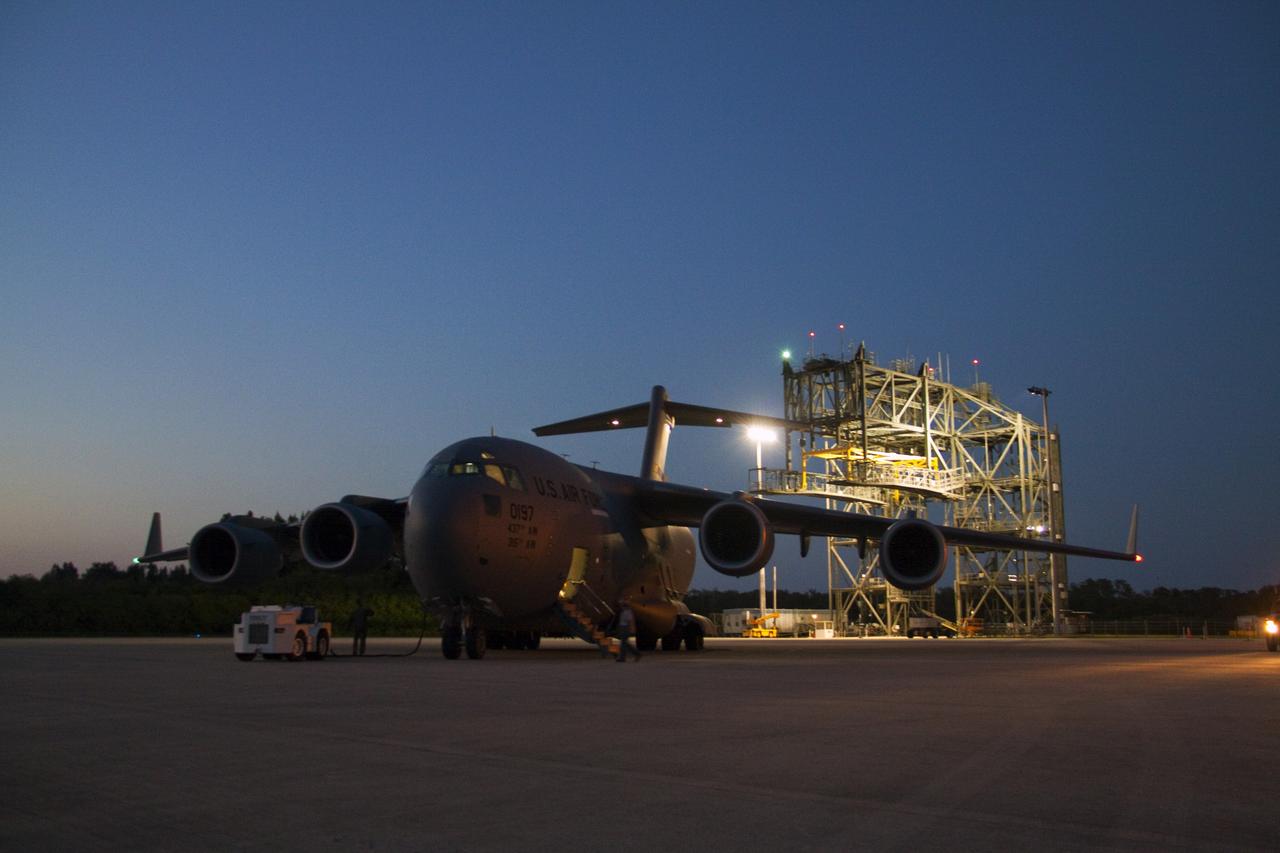
CAPE CANAVERAL, Fla. -- NASA's Juno spacecraft arrives at Kennedy Space Center's Shuttle Landing Facility in Florida aboard an Air Force C-17 jet. Juno was shipped from Lockheed Martin Space Systems in Denver and will be transported to Astrotech's payload processing facility in Titusville, Fla. to begin final preparations for launch. The solar-powered spacecraft will orbit Jupiter's poles 33 times to find out more about the gas giant's origins, structure, atmosphere and magnetosphere and investigate the existence of a solid planetary core. Juno is scheduled to launch aboard an Atlas V rocket from Cape Canaveral, Fla. Aug. 5. For more information visit, www.nasa.gov/juno. Photo credit: NASA/Jack Pfaller
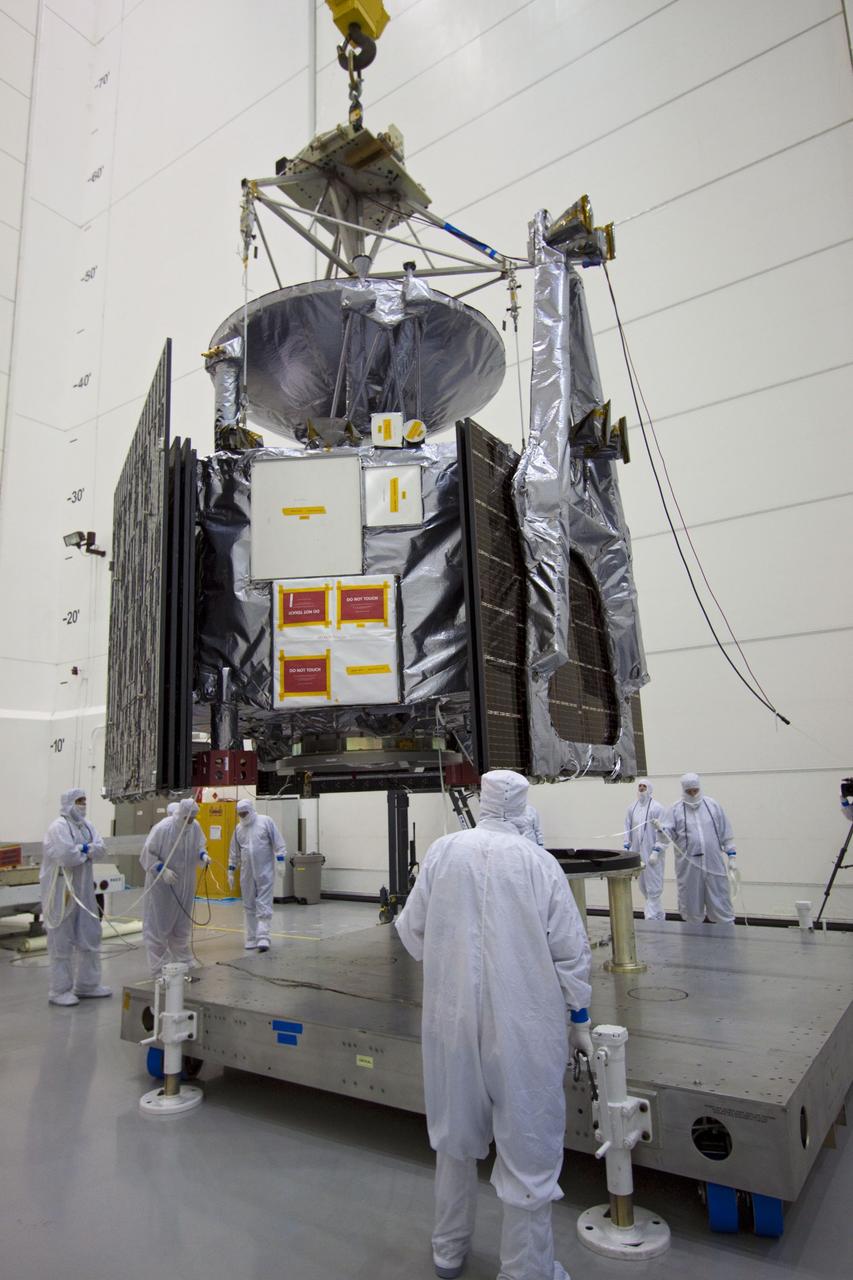
CAPE CANAVERAL, Fla. -- At Astrotech's Hazardous Processing Facility in Titusville, Fla., technicians using an overhead crane lower NASA's Juno spacecraft to a fueling stand where the spacecraft will be loaded with the propellant necessary for orbit maneuvers and the attitude control system. Juno is scheduled to launch aboard a United Launch Alliance Atlas V rocket from Cape Canaveral, Fla., Aug. 5.The solar-powered spacecraft will orbit Jupiter's poles 33 times to find out more about the gas giant's origins, structure, atmosphere and magnetosphere and investigate the existence of a solid planetary core. For more information visit: www.nasa.gov/juno. Photo credit: NASA/Troy Cryder
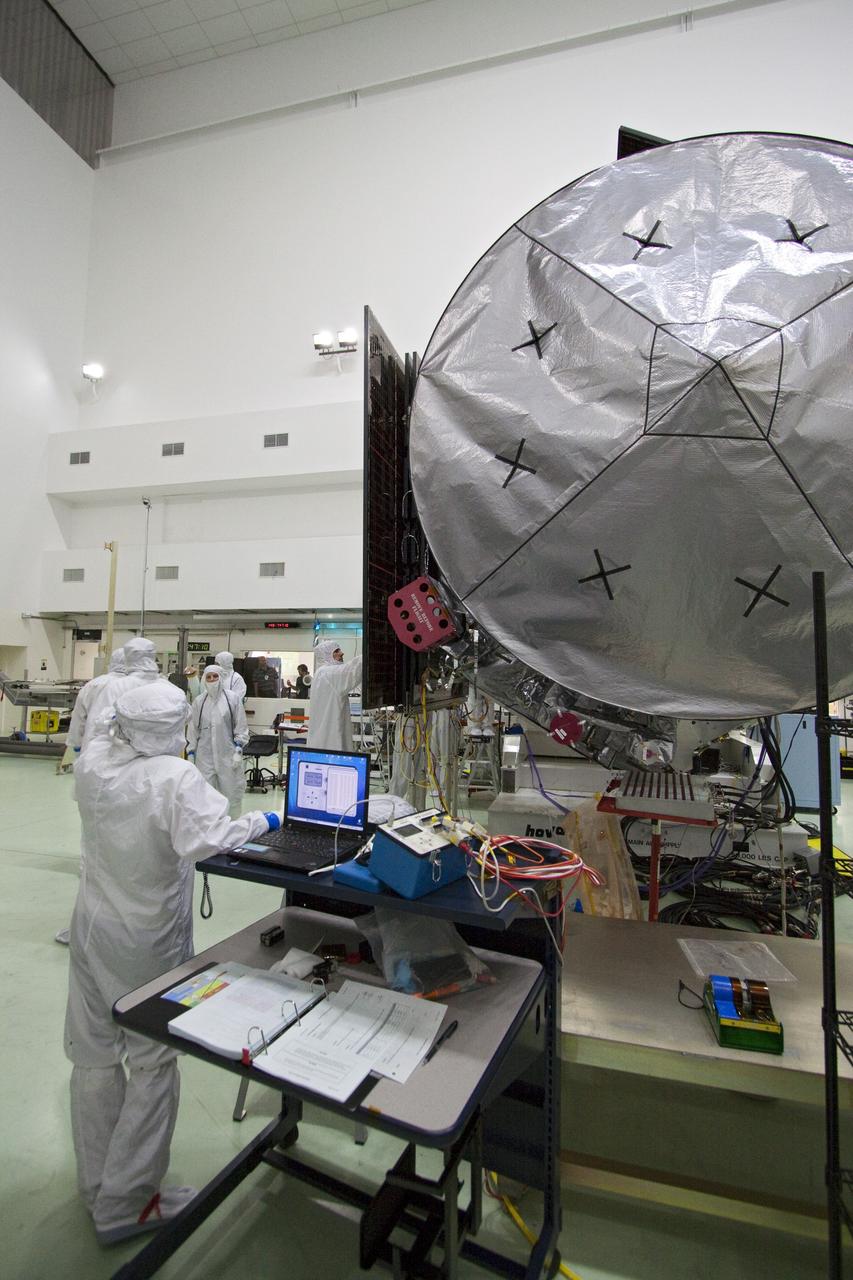
CAPE CANAVERAL, Fla. -- Technicians at Astrotech's payload processing facility in Titusville, Fla. have secured solar array #2 to NASA's Juno spacecraft. Later in processing, the magnetometer will be installed; a solar array illumination and magnetometer boom deployment test also are planned. Juno is scheduled to launch aboard an Atlas V rocket from Cape Canaveral, Fla. Aug. 5.The solar-powered spacecraft will orbit Jupiter's poles 33 times to find out more about the gas giant's origins, structure, atmosphere and magnetosphere and investigate the existence of a solid planetary core. For more information visit, www.nasa.gov/juno. Photo credit: NASA/Jack Pfaller
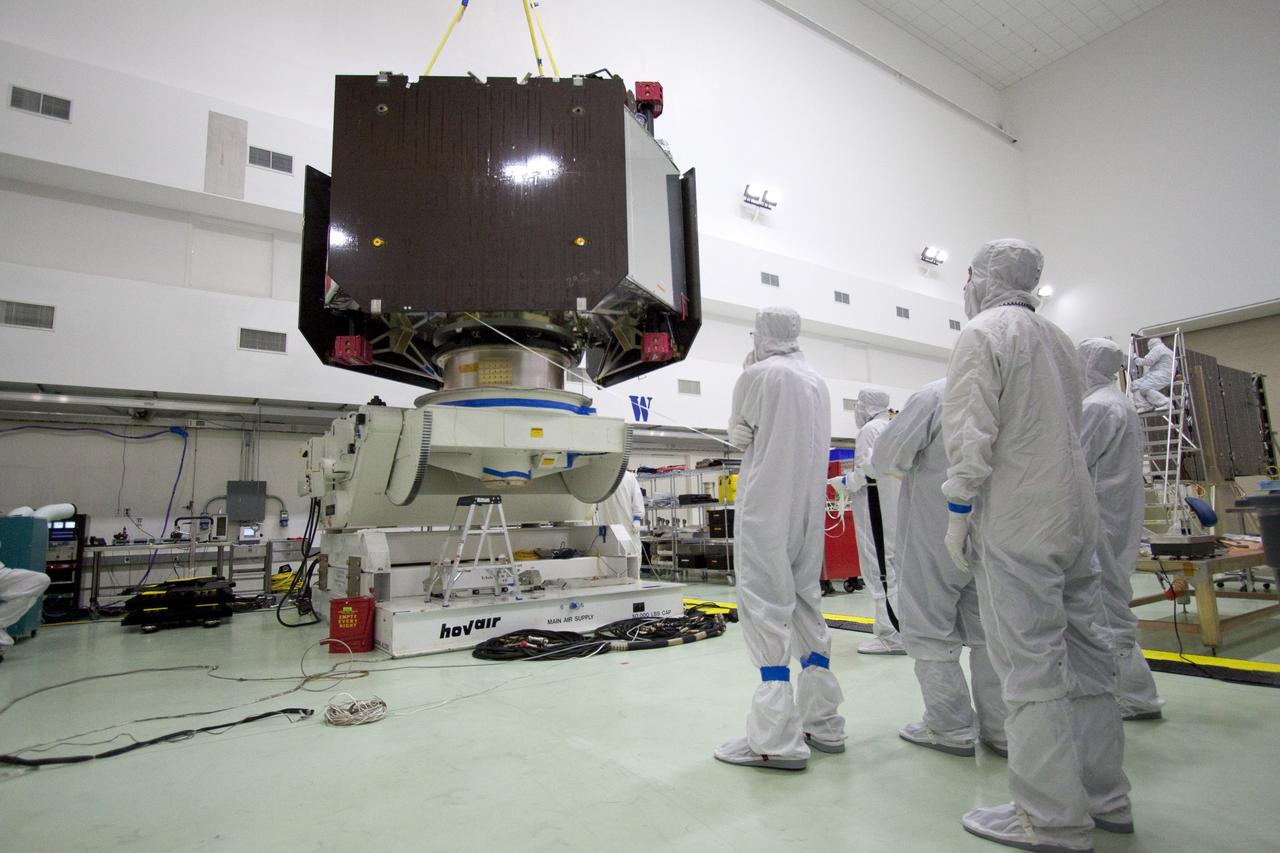
CAPE CANAVERAL, Fla. -- Technicians at Astrotech's payload processing facility in Titusville, Fla. guide NASA's Juno spacecraft, as it is lowered by overhead crane, onto the rotation stand for testing. The solar-powered spacecraft will orbit Jupiter's poles 33 times to find out more about the gas giant's origins, structure, atmosphere and magnetosphere and investigate the existence of a solid planetary core. Juno is scheduled to launch aboard an Atlas V rocket from Cape Canaveral, Fla. Aug. 5. For more information visit, www.nasa.gov/juno. Photo credit: NASA/Jack Pfaller
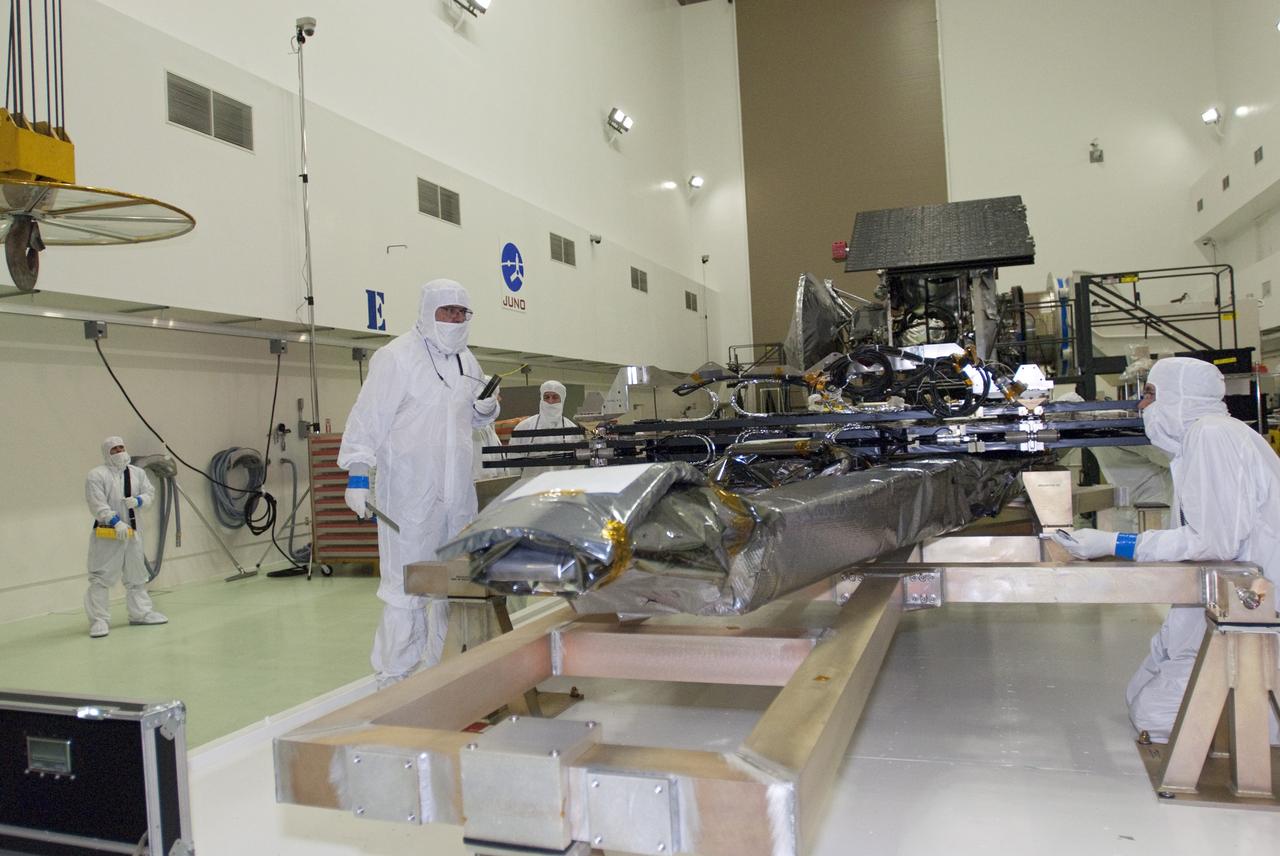
CAPE CANAVERAL, Fla. -- At Astrotech Space Operations in Titusville, Fla., technicians prepare solar array #1 with its magnetometer boom for installation to NASA's Juno spacecraft. Juno is scheduled to launch aboard a United Launch Alliance Atlas V rocket from Cape Canaveral, Fla. Aug. 5.The solar-powered spacecraft will orbit Jupiter's poles 33 times to find out more about the gas giant's origins, structure, atmosphere and magnetosphere and investigate the existence of a solid planetary core. For more information visit: www.nasa.gov/juno. Photo credit: NASA/Charisse Nahser
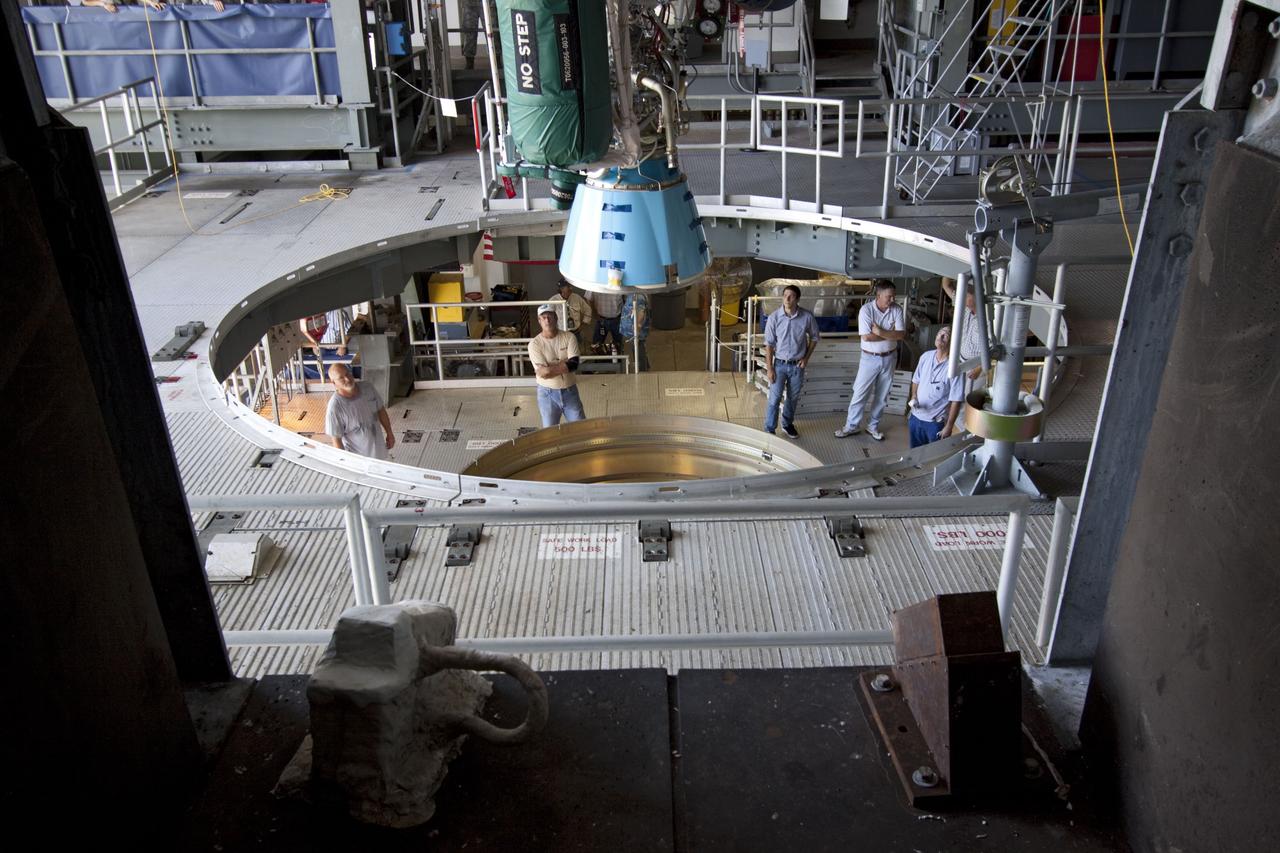
CAPE CANAVERAL, Fla. -- At Launch Complex 41 at Cape Canaveral Air Force Station in Florida, workers monitor an overhead crane as it lowers the Centaur upper stage for the United Launch Alliance Atlas V, slated to launch NASA's Juno spacecraft, into position in the Vertical Integration Facility (VIF). It then will be attached to the Atlas V booster stage, already at the pad. Juno is scheduled to launch aboard an Atlas V from Cape Canaveral, Fla. Aug. 5.The solar-powered spacecraft will orbit Jupiter's poles 33 times to find out more about the gas giant's origins, structure, atmosphere and magnetosphere and investigate the existence of a solid planetary core. For more information visit: www.nasa.gov/juno. Photo credit: NASA/Jim Grossmann
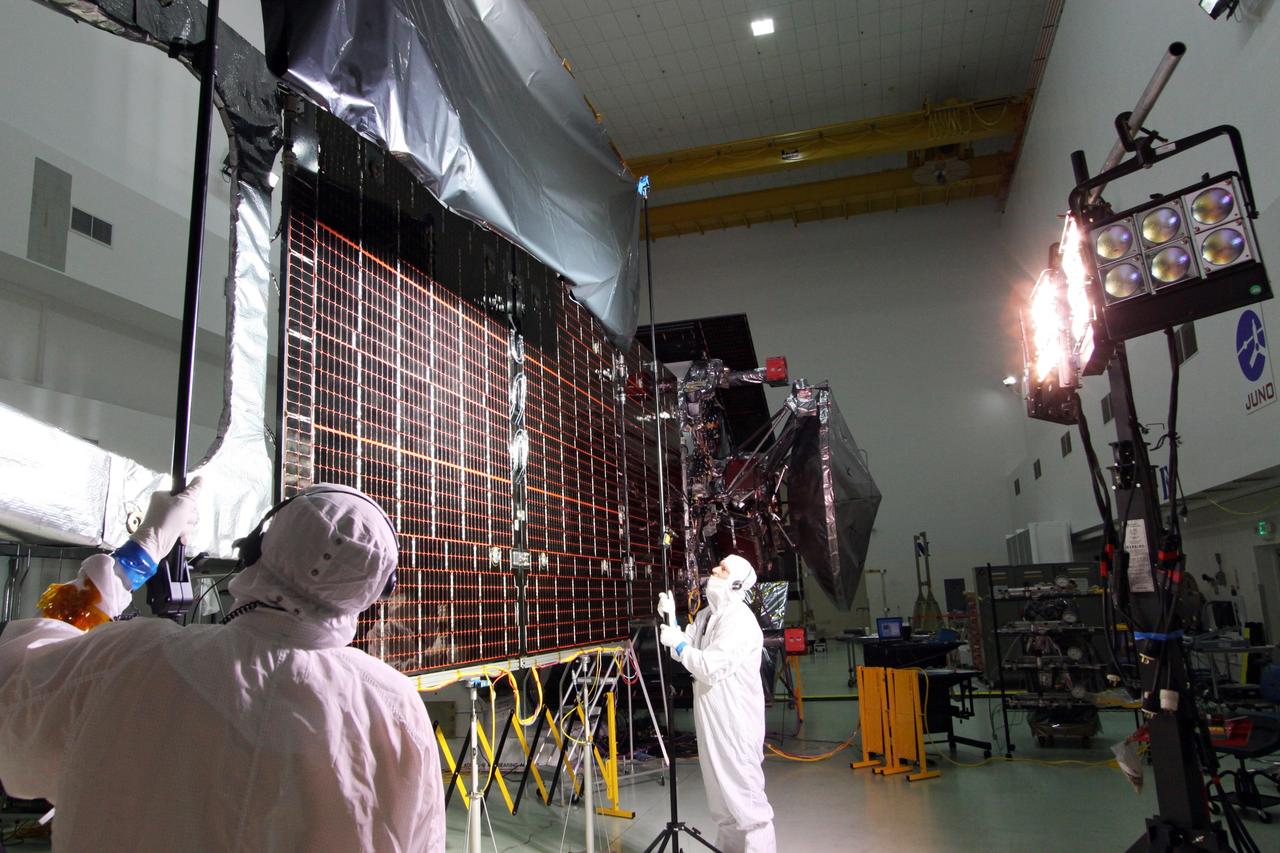
CAPE CANAVERAL, Fla. -- At Astrotech Space Operations in Titusville, Fla., technicians conduct illumination tests on solar array panel #1 with its magnetometer boom for NASA's Juno spacecraft. Juno is scheduled to launch aboard a United Launch Alliance Atlas V from Cape Canaveral, Fla. Aug. 5.The solar-powered spacecraft will orbit Jupiter's poles 33 times to find out more about the gas giant's origins, structure, atmosphere and magnetosphere and investigate the existence of a solid planetary core. For more information visit: www.nasa.gov/juno. Photo credit: NASA/Jack Pfaller

CAPE CANAVERAL, Fla. -- At Astrotech Space Operations in Titusville, Fla., technicians conduct illumination tests on solar array panel #1 with its magnetometer boom for NASA's Juno spacecraft. Juno is scheduled to launch aboard a United Launch Alliance Atlas V from Cape Canaveral, Fla. Aug. 5.The solar-powered spacecraft will orbit Jupiter's poles 33 times to find out more about the gas giant's origins, structure, atmosphere and magnetosphere and investigate the existence of a solid planetary core. For more information visit: www.nasa.gov/juno. Photo credit: NASA/Jack Pfaller

CAPE CANAVERAL, Fla. -- Technicians at Astrotech's payload processing facility in Titusville, Fla. secure NASA's Juno spacecraft to the rotation stand for center of gravity, weighing and balancing testing. Juno is scheduled to launch aboard United Launch Alliance Atlas V rocket from Cape Canaveral, Fla. Aug. 5.The solar-powered spacecraft will orbit Jupiter's poles 33 times to find out more about the gas giant's origins, structure, atmosphere and magnetosphere and investigate the existence of a solid planetary core. For more information visit: www.nasa.gov/juno. Photo credit: NASA/Kim Shiflett

CAPE CANAVERAL, Fla. -- At Astrotech's Hazardous Processing Facility in Titusville, Fla., technicians use an overhead crane to lift the cover from NASA's Juno spacecraft before its move to a fueling stand where the spacecraft will be loaded with the propellant necessary for orbit maneuvers and the attitude control system. Juno is scheduled to launch aboard a United Launch Alliance Atlas V rocket from Cape Canaveral, Fla., Aug. 5.The solar-powered spacecraft will orbit Jupiter's poles 33 times to find out more about the gas giant's origins, structure, atmosphere and magnetosphere and investigate the existence of a solid planetary core. For more information visit: www.nasa.gov/juno. Photo credit: NASA/Troy Cryder

CAPE CANAVERAL, Fla. -- At Cape Canaveral Air Force Station in Florida, a Volga-Dnepr Antonov AN-124-100, a Ukranian/Russian cargo aircraft has landed on the Skid Strip. The aircraft is delivering the booster stage of a United Launch Alliance Atlas V rocket slated to launch NASA's Juno spacecraft Aug. 5. The solar-powered spacecraft will orbit Jupiter's poles 33 times to find out more about the gas giant's origins, structure, atmosphere and magnetosphere and investigate the existence of a solid planetary core. For more information visit: www.nasa.gov/juno. Photo credit: NASA/Jack Pfaller

CAPE CANAVERAL, Fla. -- Technicians at Astrotech's payload processing facility in Titusville, Fla. guide the solar arrays toward NASA's Juno spacecraft for installation. Later in processing, the magnetometer will be installed; a solar array illumination and magnetometer boom deployment test also are planned. Juno is scheduled to launch aboard an Atlas V rocket from Cape Canaveral, Fla. Aug. 5.The solar-powered spacecraft will orbit Jupiter's poles 33 times to find out more about the gas giant's origins, structure, atmosphere and magnetosphere and investigate the existence of a solid planetary core. For more information visit www.nasa.gov/juno. Photo credit: NASA/Jack Pfaller
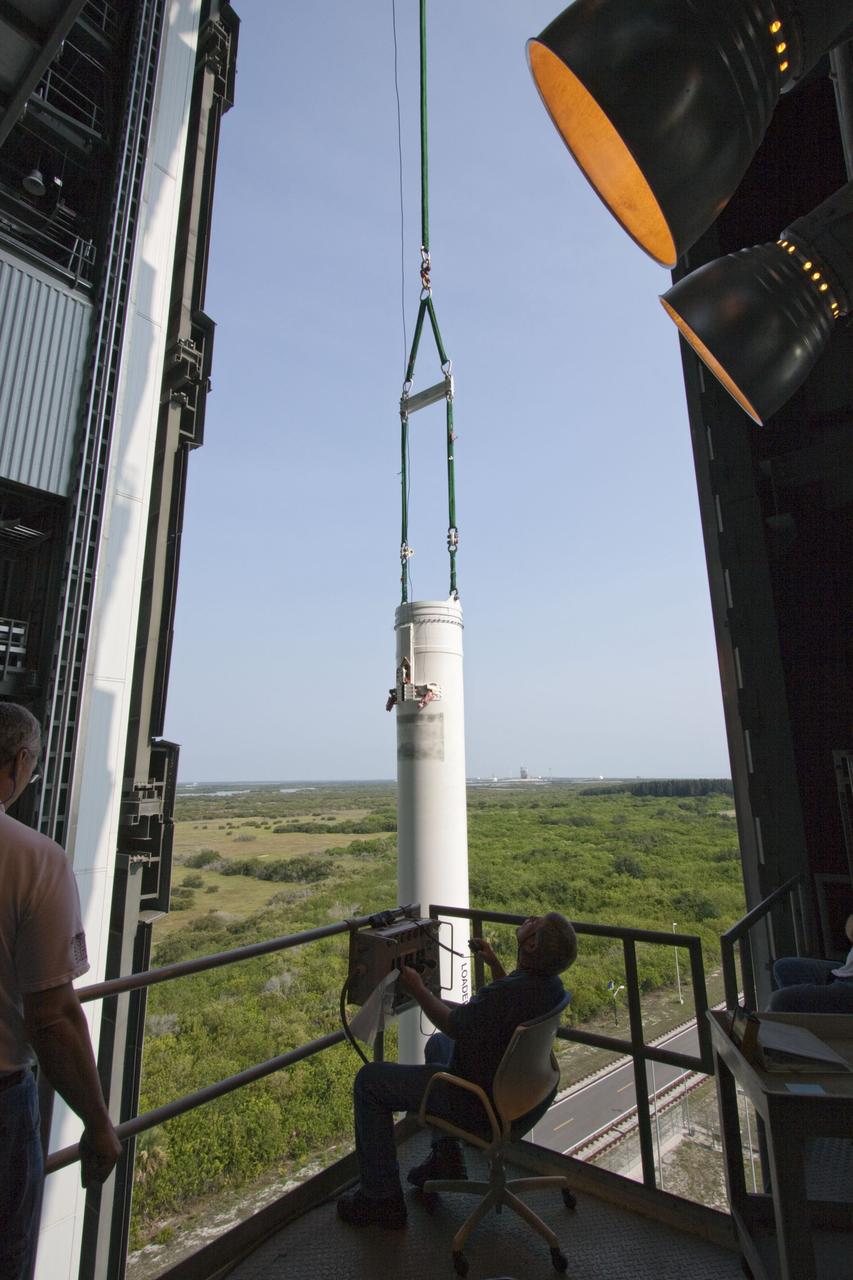
CAPE CANAVERAL, Fla. -- At Cape Canaveral Air Force Station in Florida, workers using an overhead crane lift the fifth and final solid rocket booster into the Vertical Integration Facility at Launch Complex 41. It then will be attached to the United Launch Alliance Atlas V booster stage, already at the pad. NASA's Juno spacecraft is scheduled to launch aboard an Atlas V from Cape Canaveral, Fla. Aug. 5.The solar-powered spacecraft will orbit Jupiter's poles 33 times to find out more about the gas giant's origins, structure, atmosphere and magnetosphere and investigate the existence of a solid planetary core. For more information visit: www.nasa.gov/juno. Photo credit: NASA/Jim Grossmann
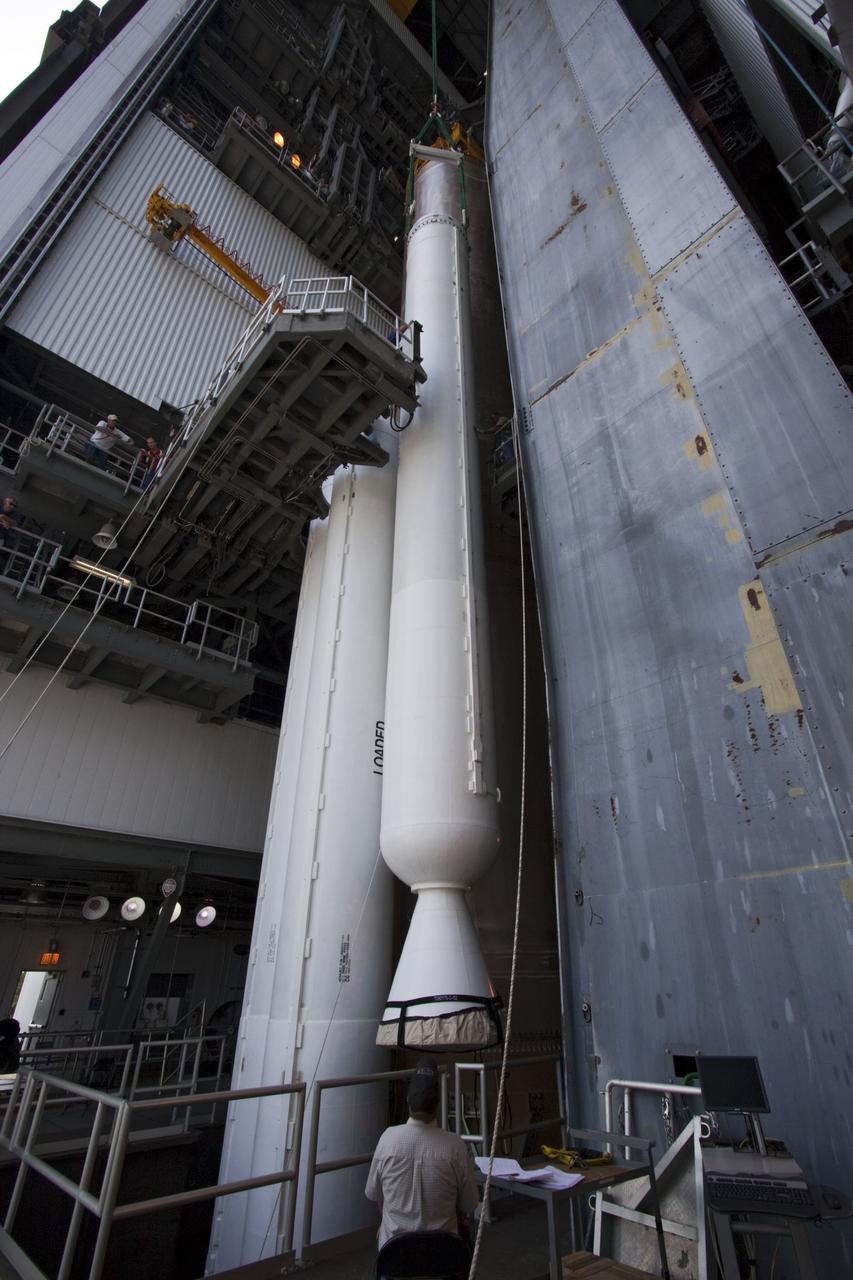
CAPE CANAVERAL, Fla. -- At Cape Canaveral Air Force Station in Florida, workers using an overhead crane lower the fifth and final solid rocket booster into the Vertical Integration Facility at Launch Complex 41. It then will be attached to the United Launch Alliance Atlas V booster stage, already at the pad. NASA's Juno spacecraft is scheduled to launch aboard an Atlas V from Cape Canaveral, Fla. Aug. 5.The solar-powered spacecraft will orbit Jupiter's poles 33 times to find out more about the gas giant's origins, structure, atmosphere and magnetosphere and investigate the existence of a solid planetary core. For more information visit: www.nasa.gov/juno. Photo credit: NASA/Jim Grossmann
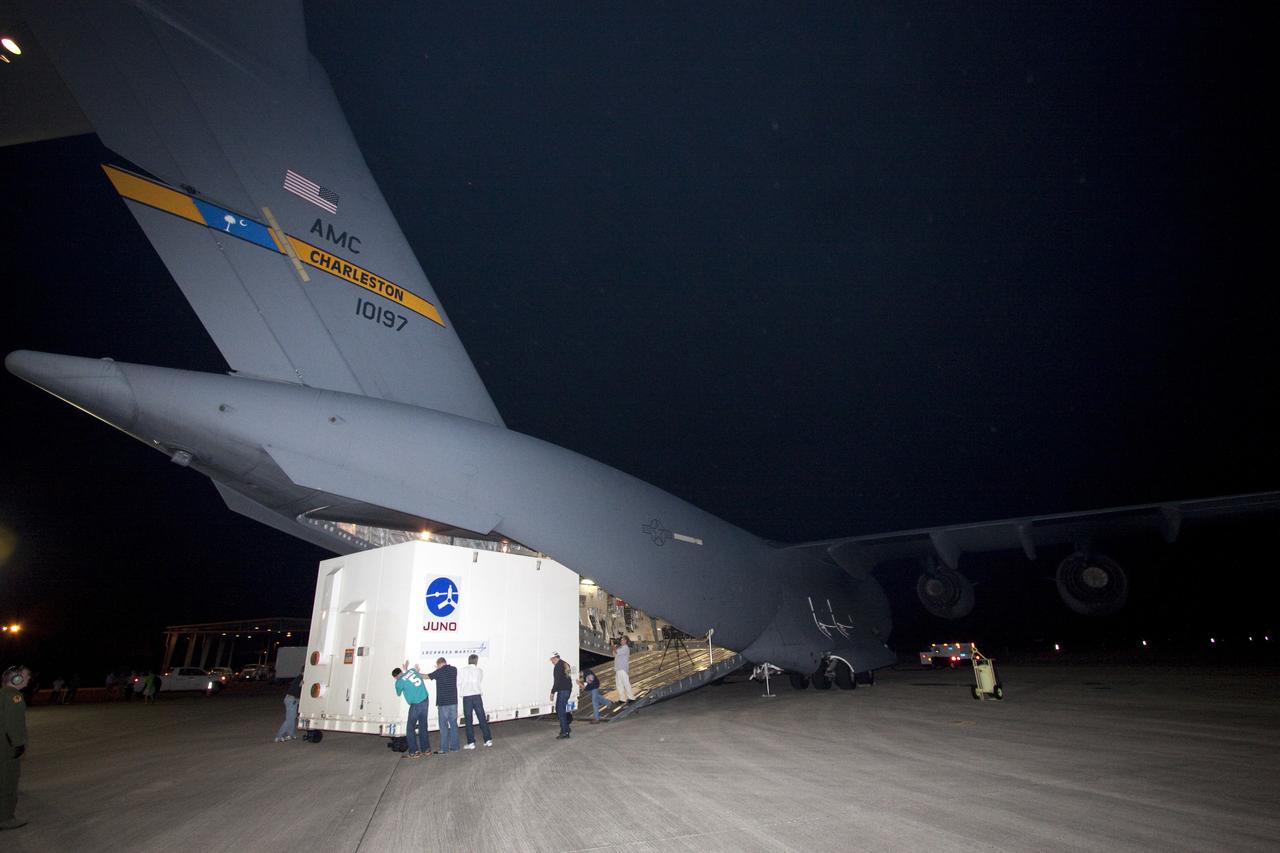
CAPE CANAVERAL, Fla. -- Workers move the container holding NASA's Juno spacecraft away from the ramp of an Air Force C-17 jet at Kennedy Space Center's Shuttle Landing Facility in Florida. Juno was shipped from Lockheed Martin Space Systems in Denver and will be transported to Astrotech's payload processing facility in Titusville, Fla. to begin final preparations for launch. The solar-powered spacecraft will orbit Jupiter's poles 33 times to find out more about the gas giant's origins, structure, atmosphere and magnetosphere and investigate the existence of a solid planetary core. Juno is scheduled to launch aboard an Atlas V rocket from Cape Canaveral, Fla. Aug. 5. For more information visit, www.nasa.gov/juno. Photo credit: NASA/Jack Pfaller
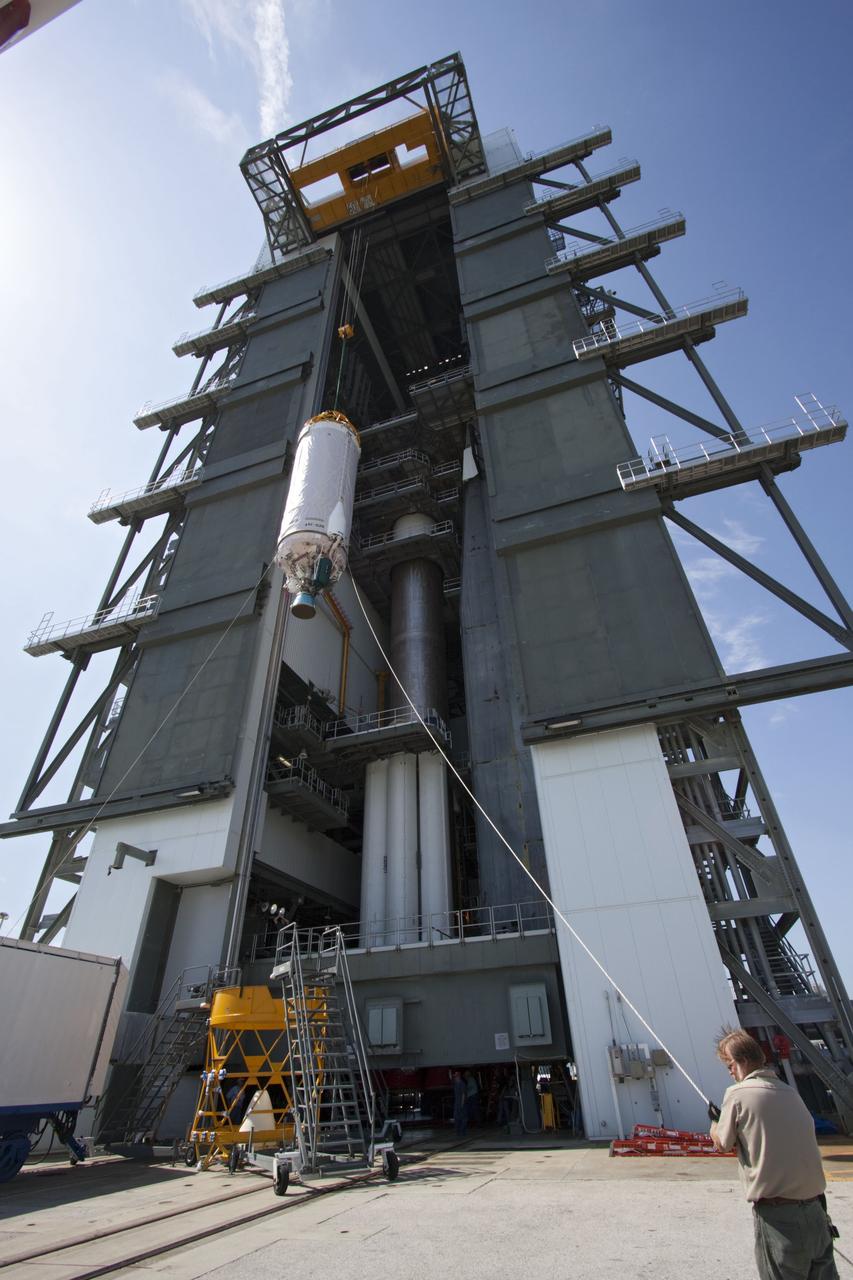
CAPE CANAVERAL, Fla. -- At Launch Complex 41 at Cape Canaveral Air Force Station in Florida, workers guide an overhead crane as it lifts the Centaur upper stage for the United Launch Alliance Atlas V, slated to launch NASA's Juno spacecraft, into the Vertical Integration Facility (VIF). After in position in the VIF it will be attached to the Atlas V booster stage, already at the pad. Juno is scheduled to launch aboard an Atlas V from Cape Canaveral, Fla. Aug. 5.The solar-powered spacecraft will orbit Jupiter's poles 33 times to find out more about the gas giant's origins, structure, atmosphere and magnetosphere and investigate the existence of a solid planetary core. For more information visit: www.nasa.gov/juno. Photo credit: NASA/Jim Grossmann
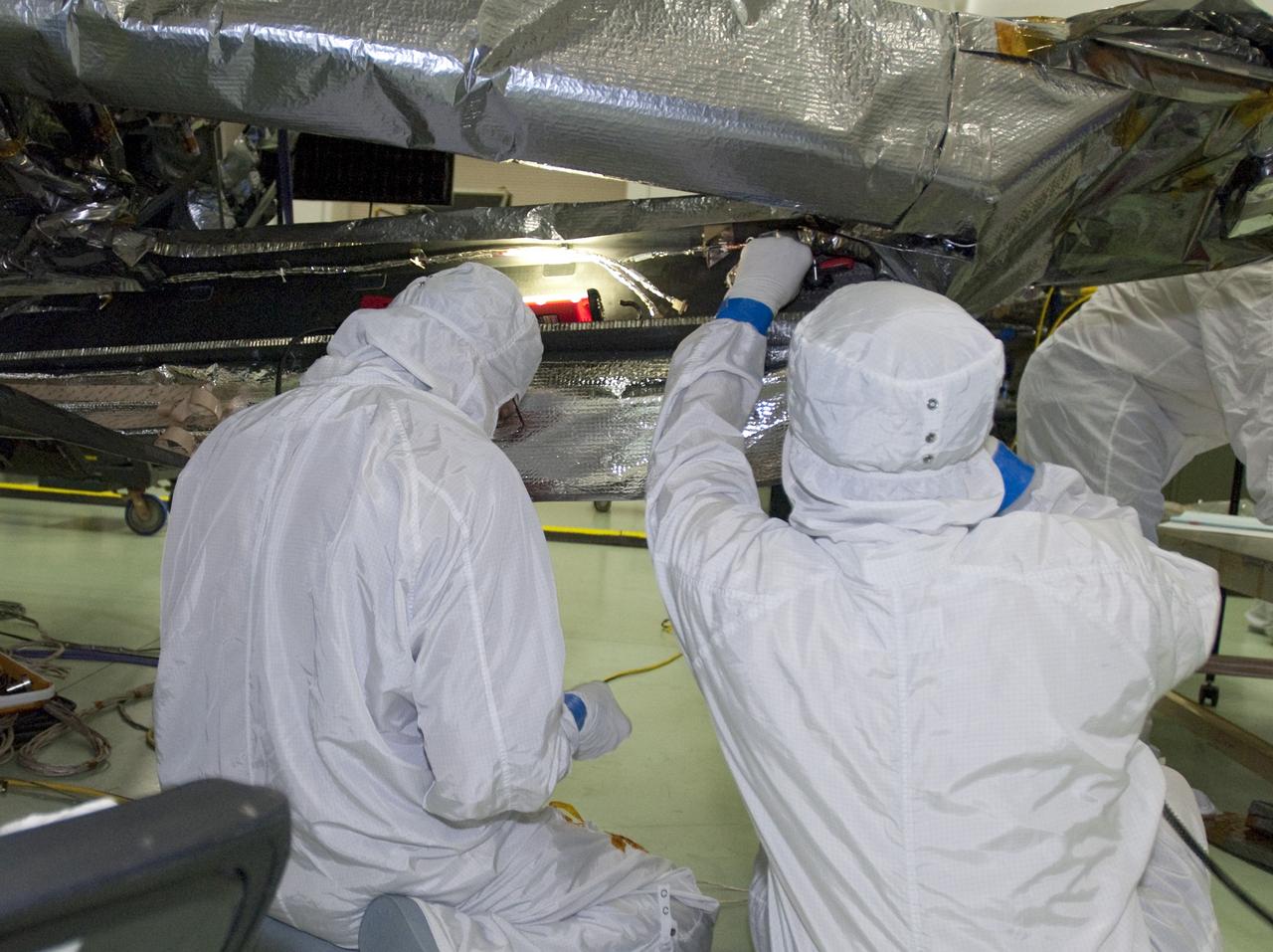
CAPE CANAVERAL, Fla. -- At Astrotech Space Operations in Titusville, Fla., technicians test the connections of solar array #1 with its magnetometer boom to NASA's Juno spacecraft after installation. Juno is scheduled to launch aboard a United Launch Alliance Atlas V rocket from Cape Canaveral, Fla. Aug. 5.The solar-powered spacecraft will orbit Jupiter's poles 33 times to find out more about the gas giant's origins, structure, atmosphere and magnetosphere and investigate the existence of a solid planetary core. For more information visit: www.nasa.gov/juno. Photo credit: NASA/Charisse Nahser
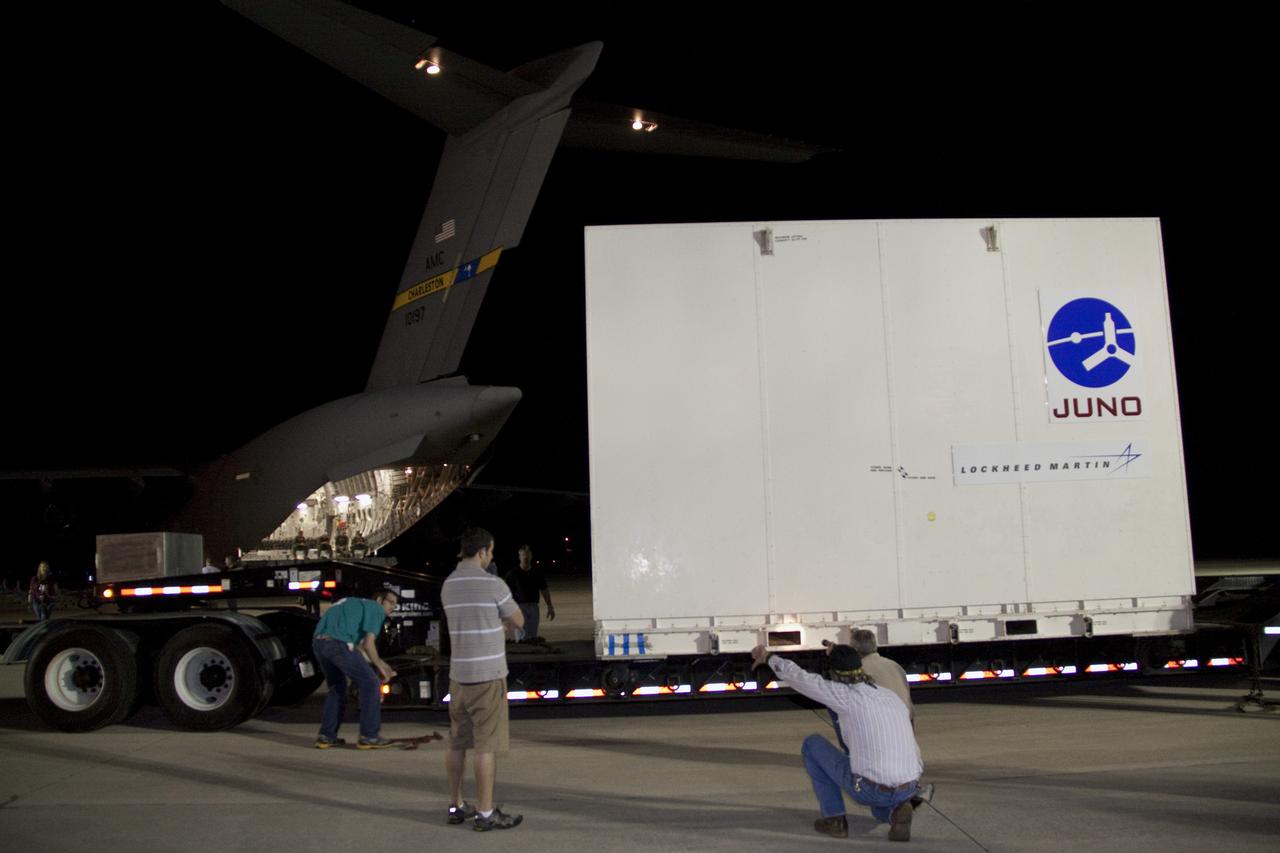
CAPE CANAVERAL, Fla. -- At the Shuttle Landing Facility at NASA's Kennedy Space Center in Florida, workers position the container holding NASA's Juno spacecraft on a truck that will transport it to Astrotech's payload processing facility in Titusville, Fla. to begin final preparations for launch. The solar-powered spacecraft will orbit Jupiter's poles 33 times to find out more about the gas giant's origins, structure, atmosphere and magnetosphere and investigate the existence of a solid planetary core. Juno is scheduled to launch aboard an Atlas V rocket from Cape Canaveral, Fla. Aug. 5. For more information visit, www.nasa.gov/juno. Photo credit: NASA/Jack Pfaller
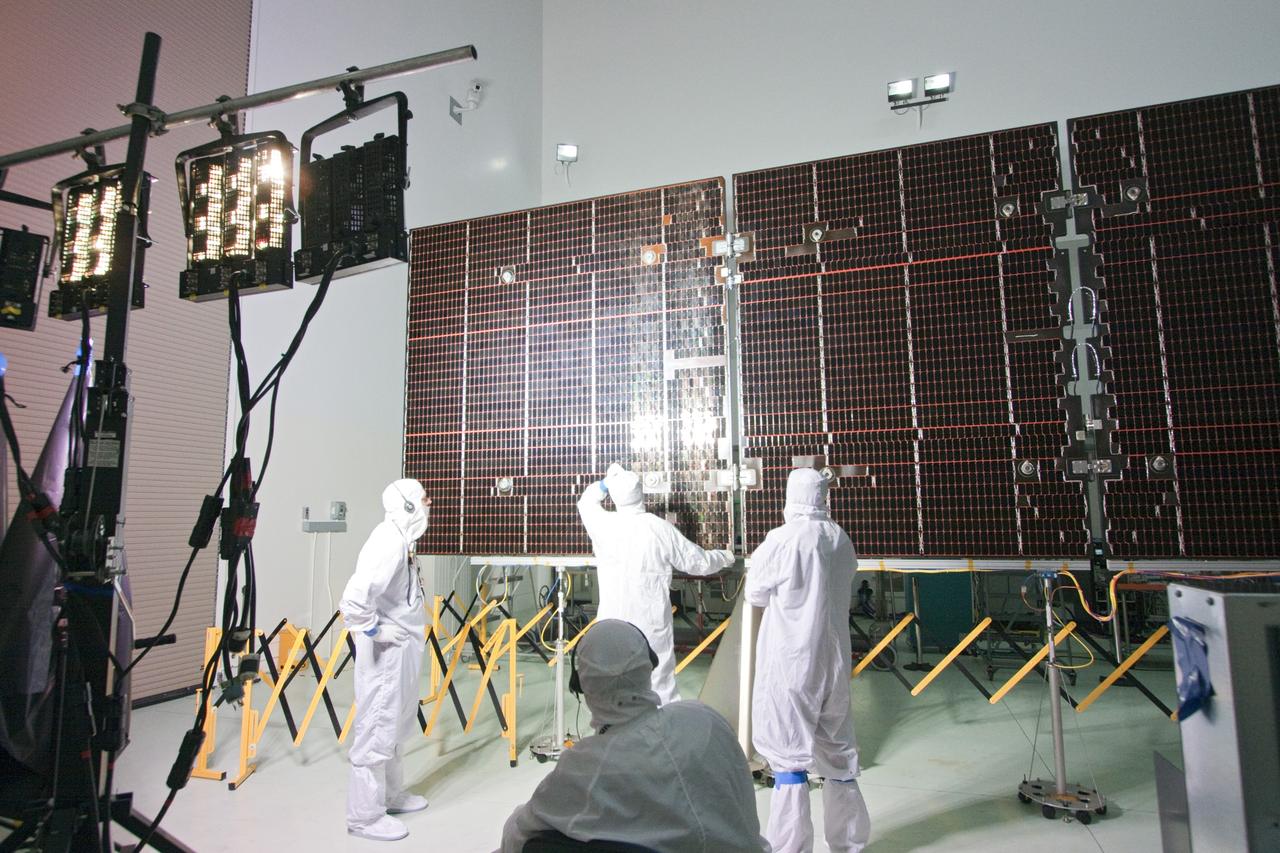
CAPE CANAVERAL, Fla. -- In a clean-room environment at Astrotech's payload processing facility in Titusville, Fla. technicians conduct an illumination test on the solar array panels for NASA's Juno spacecraft. Juno is scheduled to launch aboard a United Launch Alliance Atlas V rocket from Cape Canaveral, Fla. Aug. 5.The solar-powered spacecraft will orbit Jupiter's poles 33 times to find out more about the gas giant's origins, structure, atmosphere and magnetosphere and investigate the existence of a solid planetary core. For more information visit: www.nasa.gov/juno. Photo credit: NASA/Jack Pfaller
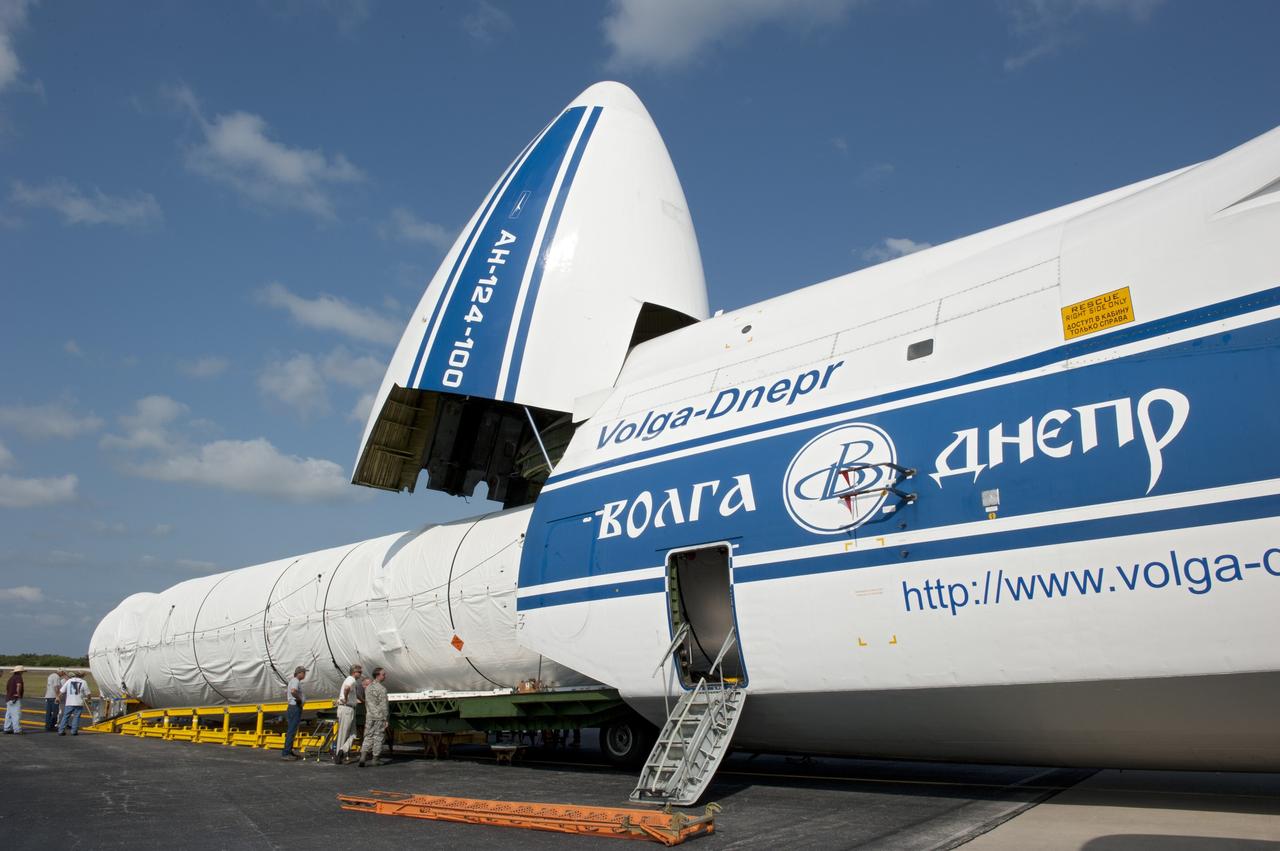
CAPE CANAVERAL, Fla. -- On the Skid Strip at Cape Canaveral Air Force Station in Florida, workers unload the first stage of the United Launch Alliance Atlas V rocket slated to launch NASA's Juno spacecraft from a Volga-Dnepr Antonov AN-124-100, a Ukranian/Russian cargo aircraft. Juno is scheduled to launch aboard an Atlas V rocket from Cape Canaveral, Fla., Aug. 5.The solar-powered spacecraft will orbit Jupiter's poles 33 times to find out more about the gas giant's origins, structure, atmosphere and magnetosphere and investigate the existence of a solid planetary core. For more information, visit www.nasa.gov/juno. Photo credit: NASA/Kim Shiflett
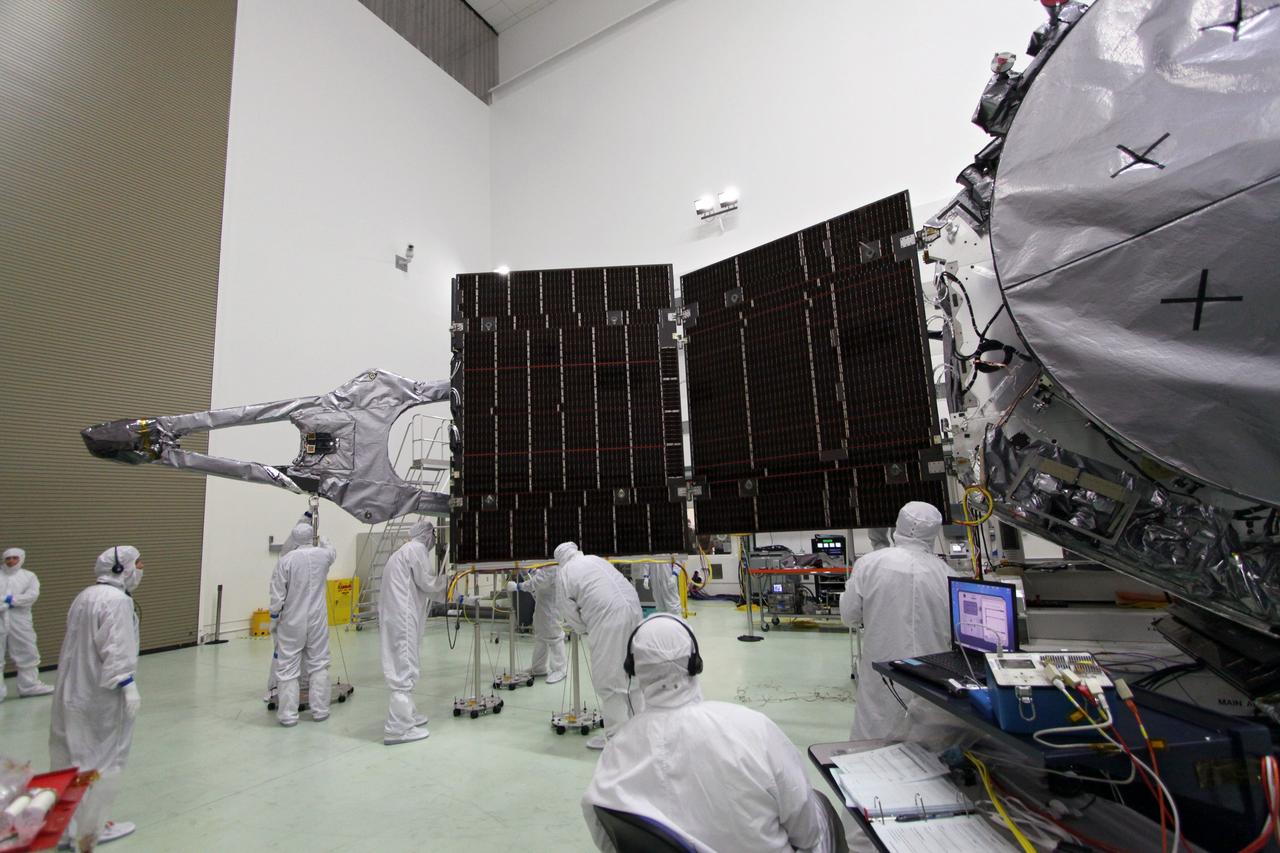
CAPE CANAVERAL, Fla. -- At Astrotech Space Operations in Titusville, Fla., technicians conduct deployment tests on solar array panel #1 with its magnetometer boom for NASA's Juno spacecraft prior to illumination testing. Juno is scheduled to launch aboard a United Launch Alliance Atlas V from Cape Canaveral, Fla. Aug. 5.The solar-powered spacecraft will orbit Jupiter's poles 33 times to find out more about the gas giant's origins, structure, atmosphere and magnetosphere and investigate the existence of a solid planetary core. For more information visit: www.nasa.gov/juno. Photo credit: NASA/Jack Pfaller
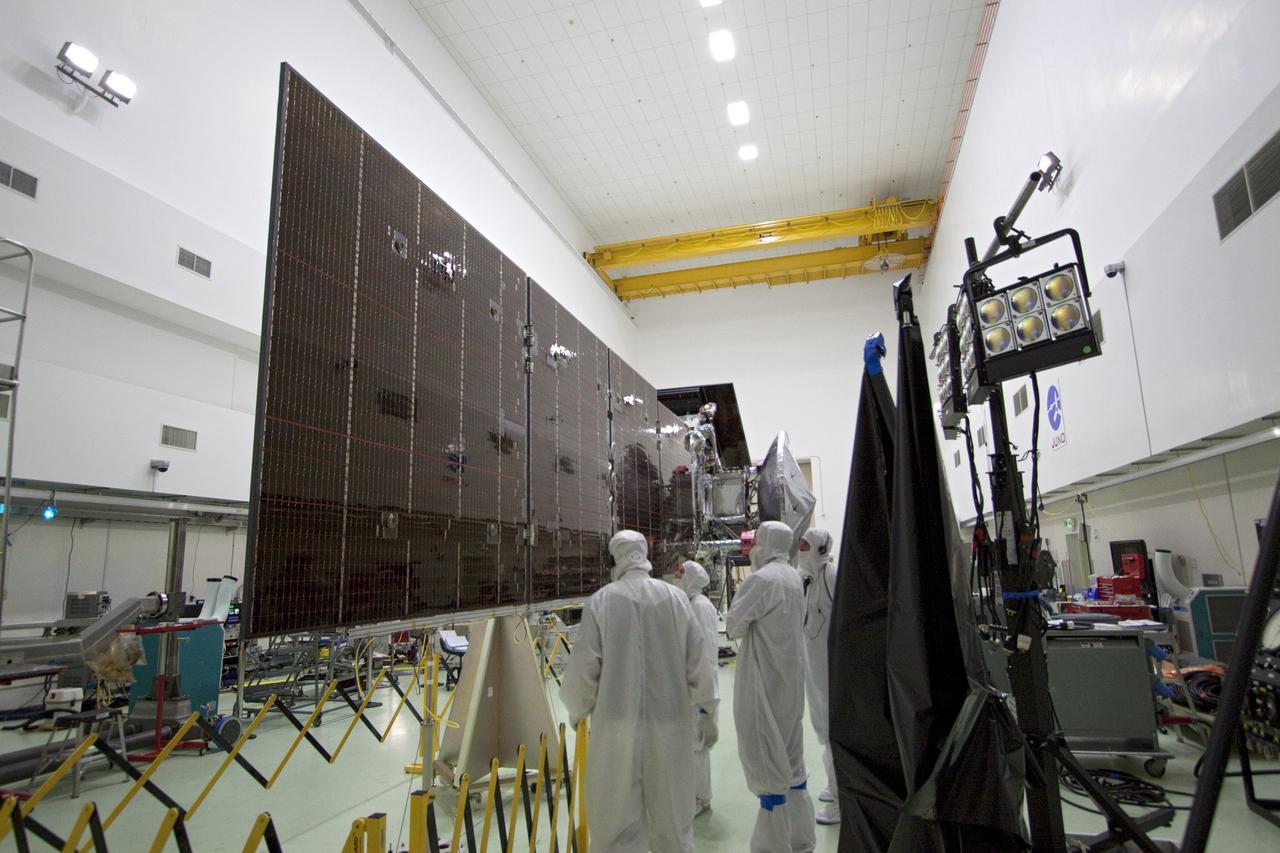
CAPE CANAVERAL, Fla. -- In a clean-room environment at Astrotech's payload processing facility in Titusville, Fla. technicians prepare solar array panels on NASA's Juno spacecraft for illumination testing. Juno is scheduled to launch aboard a United Launch Alliance Atlas V rocket from Cape Canaveral, Fla. Aug. 5.The solar-powered spacecraft will orbit Jupiter's poles 33 times to find out more about the gas giant's origins, structure, atmosphere and magnetosphere and investigate the existence of a solid planetary core. For more information visit: www.nasa.gov/juno. Photo credit: NASA/Jack Pfaller
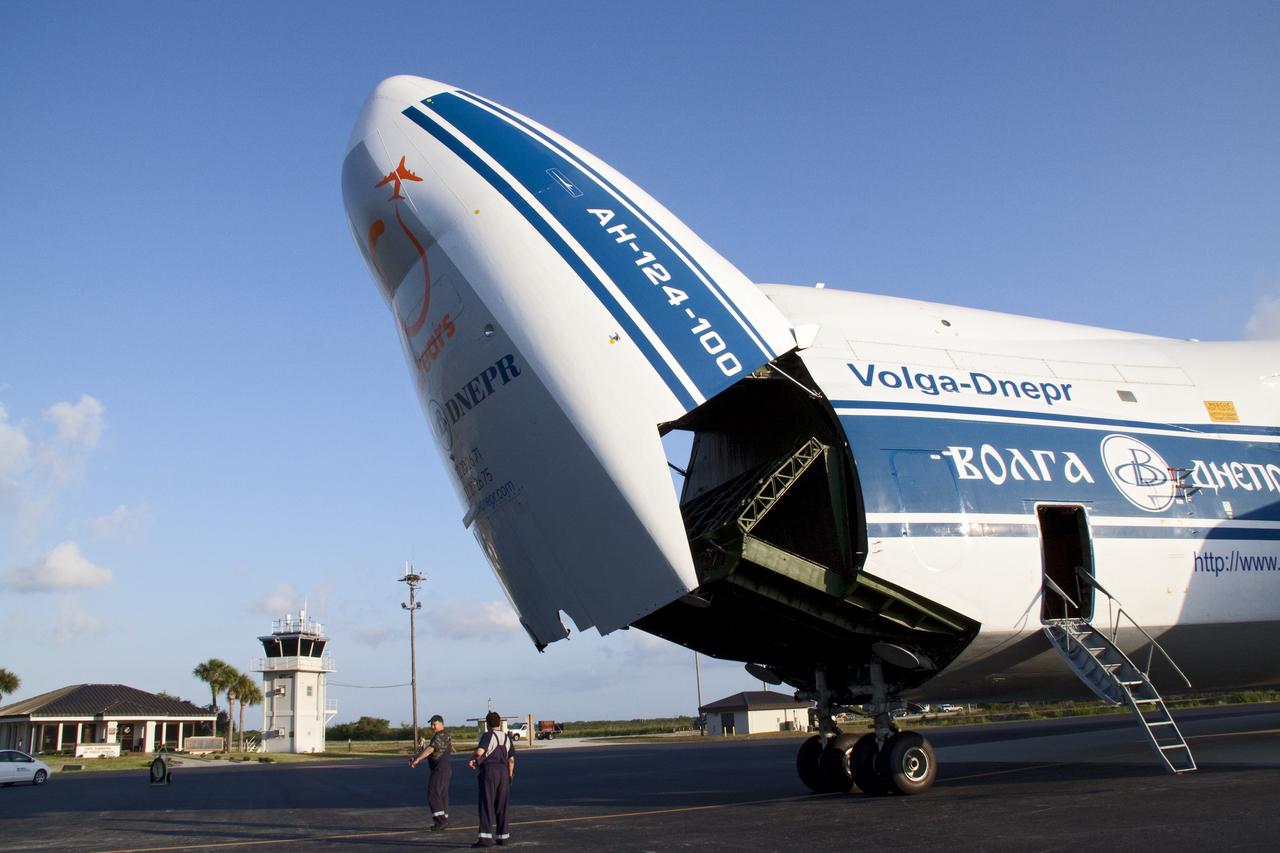
CAPE CANAVERAL, Fla. -- On the Skid Strip at Cape Canaveral Air Force Station in Florida, workers prepare to unload a Volga-Dnepr Antonov AN-124-100, a Ukranian/Russian cargo aircraft that has delivered the Centaur upper stage of the United Launch Alliance Atlas V rocket slated to launch NASA's Juno spacecraft. NASA's Juno spacecraft is scheduled to launch aboard the Atlas V from Cape Canaveral, Fla. Aug. 5.The solar-powered spacecraft will orbit Jupiter's poles 33 times to find out more about the gas giant's origins, structure, atmosphere and magnetosphere and investigate the existence of a solid planetary core. For more information visit: www.nasa.gov/juno. Photo credit: NASA/Jack Pfaller
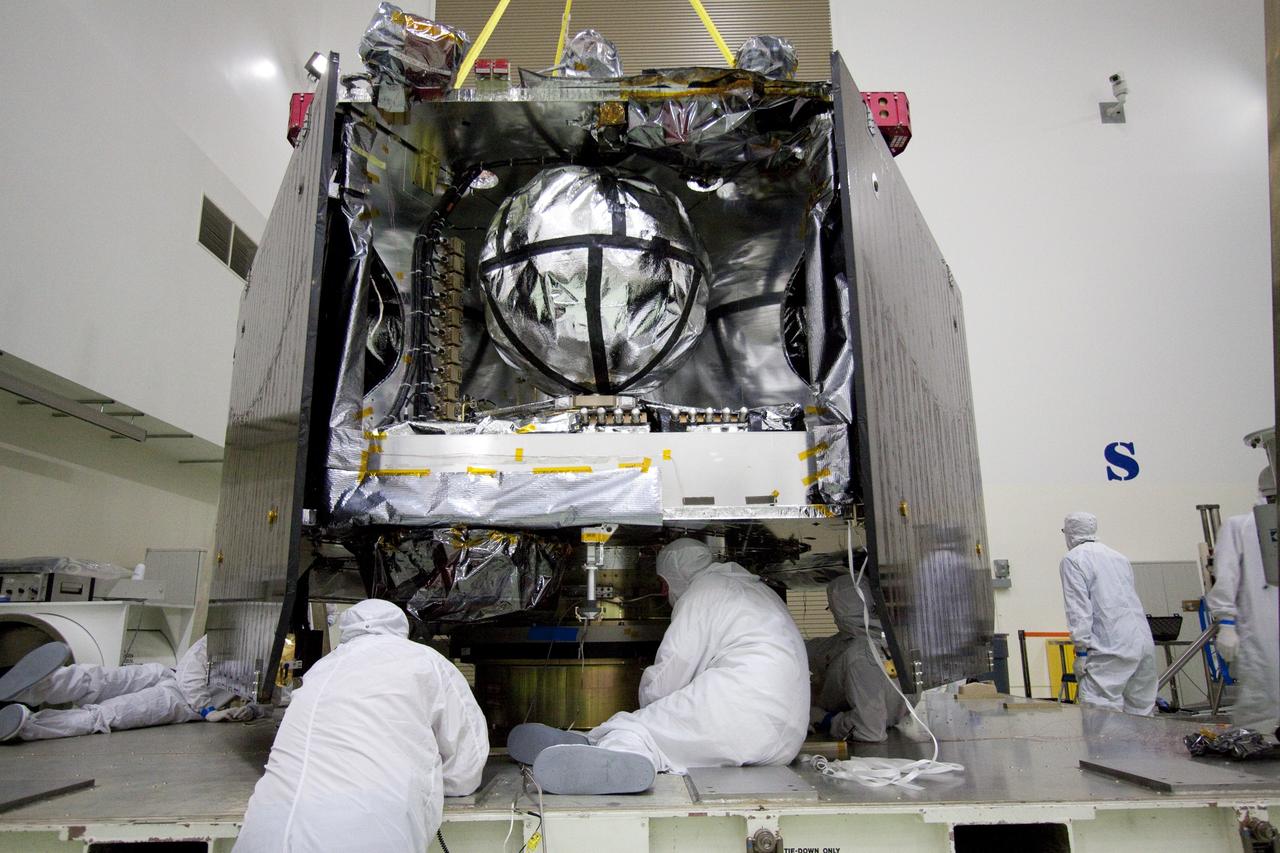
CAPE CANAVERAL, Fla. -- Technicians at Astrotech's payload processing facility in Titusville, Fla. prepare NASA's Juno spacecraft for its move to the rotation stand for testing. The solar-powered spacecraft will orbit Jupiter's poles 33 times to find out more about the gas giant's origins, structure, atmosphere and magnetosphere and investigate the existence of a solid planetary core. Juno is scheduled to launch aboard an Atlas V rocket from Cape Canaveral, Fla. Aug. 5. For more information visit, www.nasa.gov/juno. Photo credit: NASA/Jack Pfaller
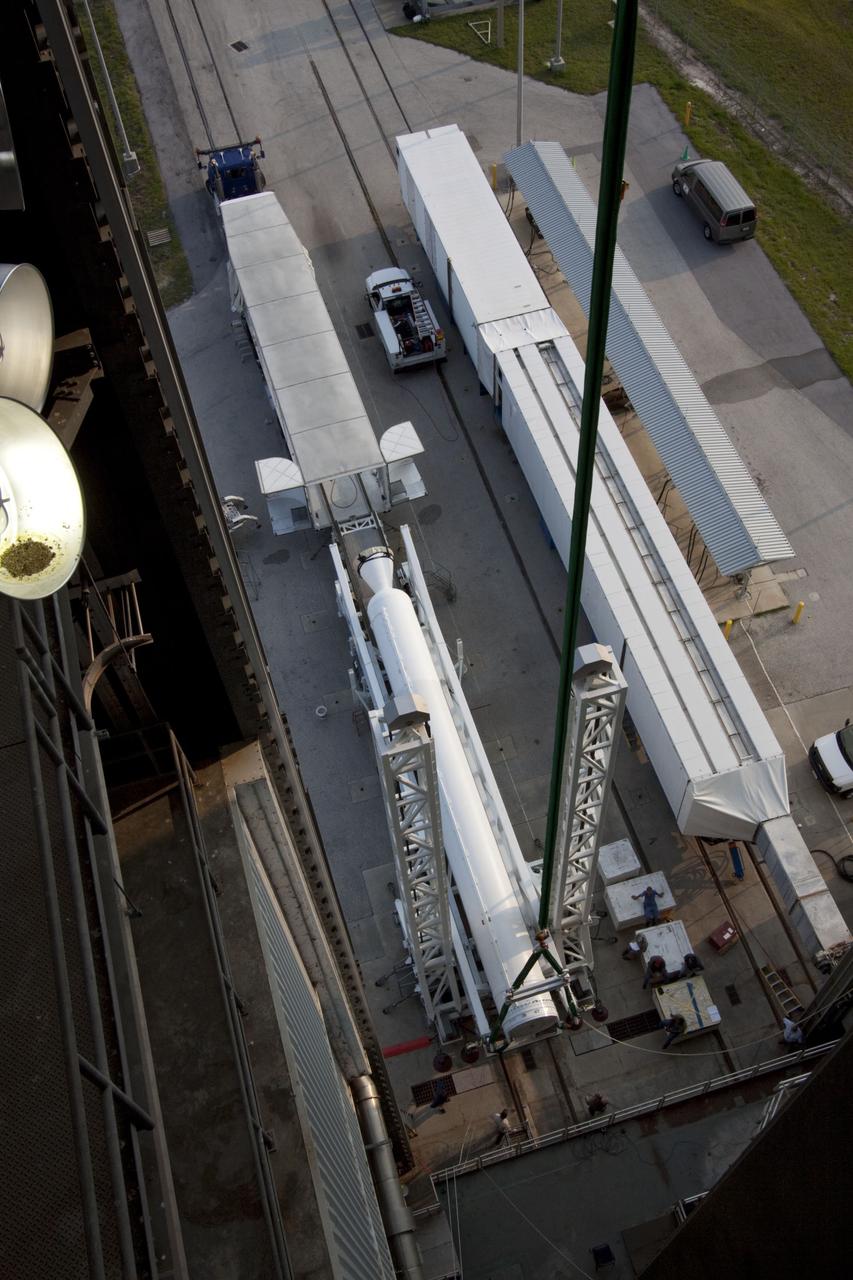
CAPE CANAVERAL, Fla. -- At Cape Canaveral Air Force Station in Florida, workers using an overhead crane lift the fifth and final solid rocket booster into the Vertical Integration Facility at Launch Complex 41. It then will be attached to the United Launch Alliance Atlas V booster stage, already at the pad. NASA's Juno spacecraft is scheduled to launch aboard an Atlas V from Cape Canaveral, Fla. Aug. 5.The solar-powered spacecraft will orbit Jupiter's poles 33 times to find out more about the gas giant's origins, structure, atmosphere and magnetosphere and investigate the existence of a solid planetary core. For more information visit: www.nasa.gov/juno. Photo credit: NASA/Jim Grossmann
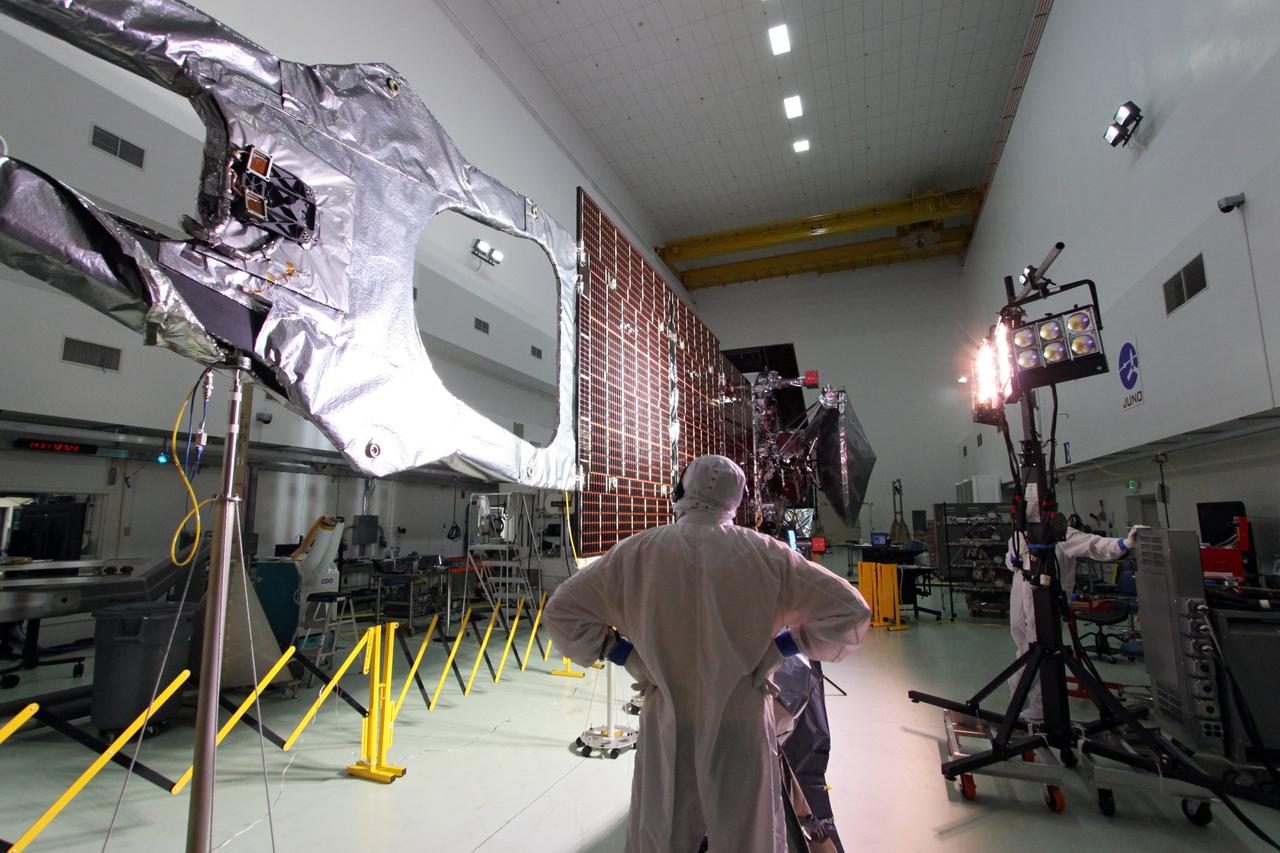
CAPE CANAVERAL, Fla. -- At Astrotech Space Operations in Titusville, Fla., technicians conduct illumination tests on solar array panel #1 with its magnetometer boom for NASA's Juno spacecraft. Juno is scheduled to launch aboard a United Launch Alliance Atlas V from Cape Canaveral, Fla. Aug. 5.The solar-powered spacecraft will orbit Jupiter's poles 33 times to find out more about the gas giant's origins, structure, atmosphere and magnetosphere and investigate the existence of a solid planetary core. For more information visit: www.nasa.gov/juno. Photo credit: NASA/Jack Pfaller
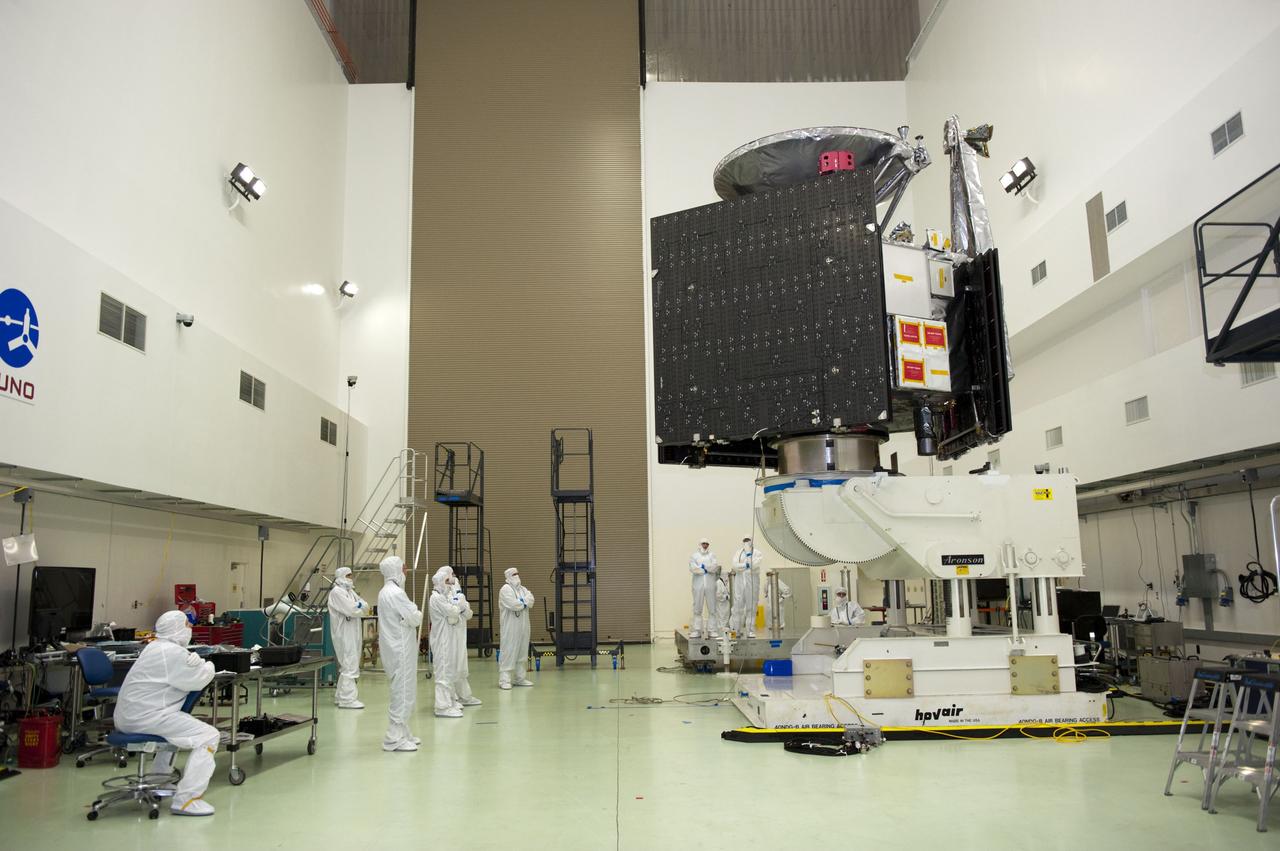
CAPE CANAVERAL, Fla. -- Technicians at Astrotech's payload processing facility in Titusville, Fla. watch vigilantly as NASA's Juno spacecraft is tested for center of gravity, weighing and balancing on the rotation stand. Juno is scheduled to launch aboard United Launch Alliance Atlas V rocket from Cape Canaveral, Fla. Aug. 5.The solar-powered spacecraft will orbit Jupiter's poles 33 times to find out more about the gas giant's origins, structure, atmosphere and magnetosphere and investigate the existence of a solid planetary core. For more information visit: www.nasa.gov/juno. Photo credit: NASA/Kim Shiflett
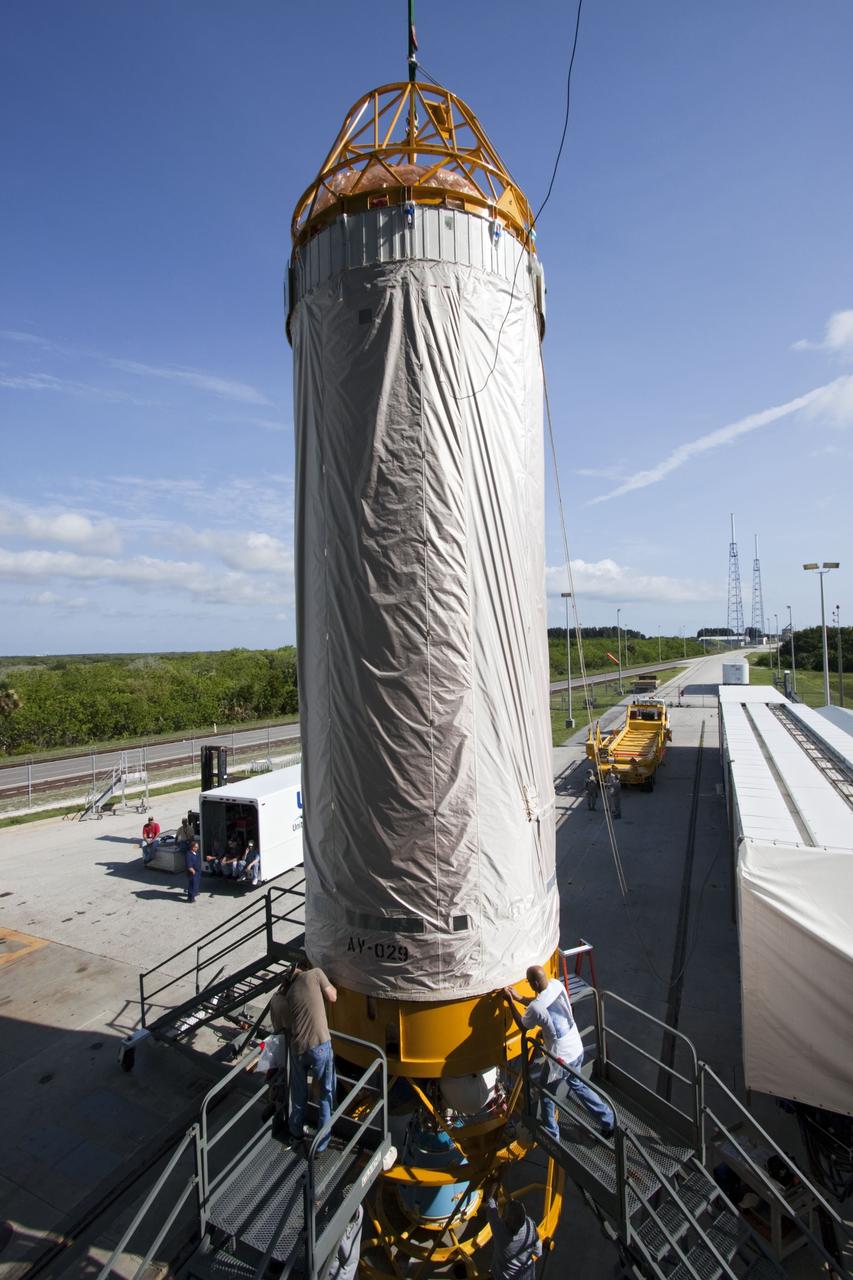
CAPE CANAVERAL, Fla. -- At Launch Complex 41 at Cape Canaveral Air Force Station in Florida, workers roll down the protective cover on the Centaur upper stage for the United Launch Alliance Atlas V, slated to launch NASA's Juno spacecraft, as it lifted into the Vertical Integration Facility (VIF). After in position in the VIF it will be attached to the Atlas V booster stage, already at the pad. Juno is scheduled to launch aboard an Atlas V from Cape Canaveral, Fla. Aug. 5.The solar-powered spacecraft will orbit Jupiter's poles 33 times to find out more about the gas giant's origins, structure, atmosphere and magnetosphere and investigate the existence of a solid planetary core. For more information visit: www.nasa.gov/juno. Photo credit: NASA/Jim Grossmann
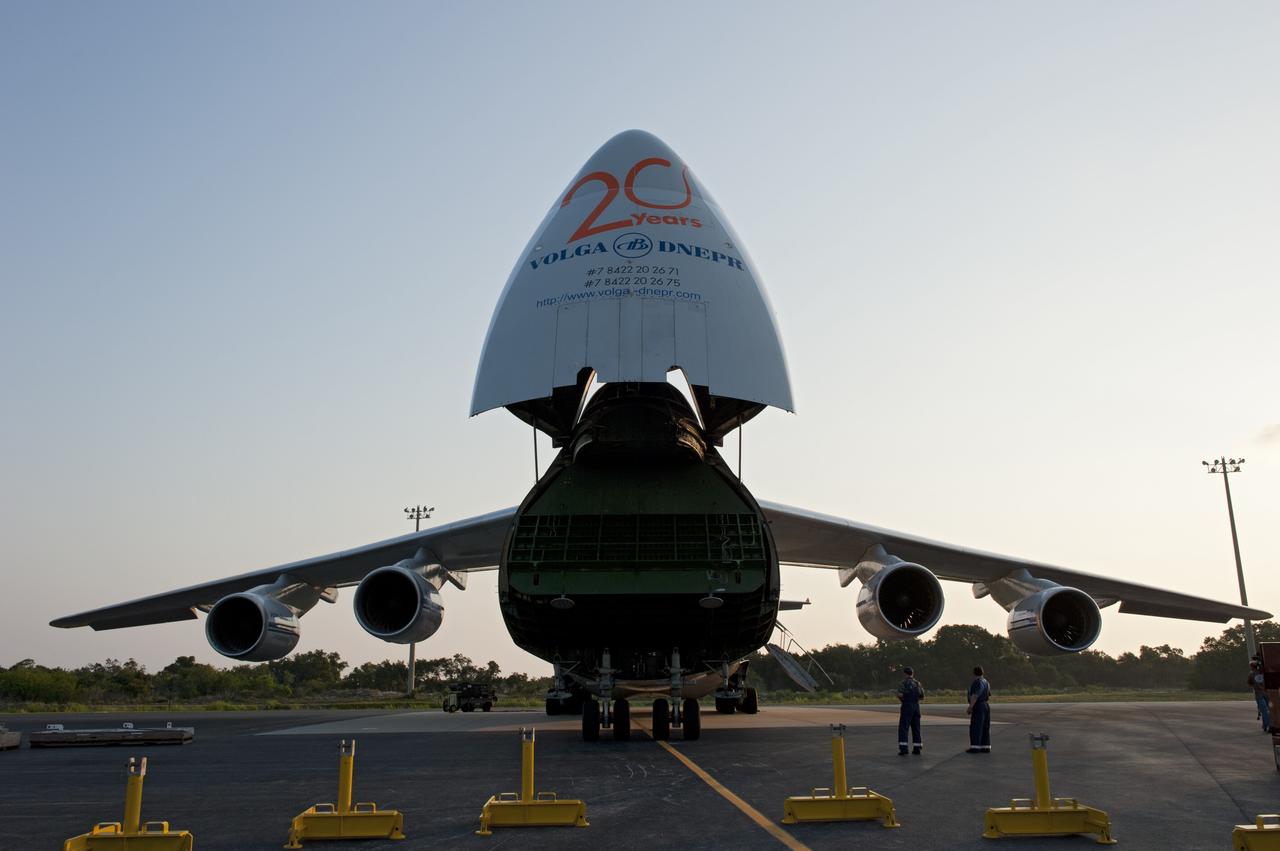
CAPE CANAVERAL, Fla. -- On the Skid Strip at Cape Canaveral Air Force Station in Florida, workers prepare to unload a Volga-Dnepr Antonov AN-124-100, a Ukranian/Russian cargo aircraft that has delivered the first stage of the United Launch Alliance Atlas V rocket slated to launch NASA's Juno spacecraft. Juno is scheduled to launch aboard an Atlas V rocket from Cape Canaveral, Fla., Aug. 5.The solar-powered spacecraft will orbit Jupiter's poles 33 times to find out more about the gas giant's origins, structure, atmosphere and magnetosphere and investigate the existence of a solid planetary core. For more information, visit www.nasa.gov/juno. Photo credit: NASA/Kim Shiflett
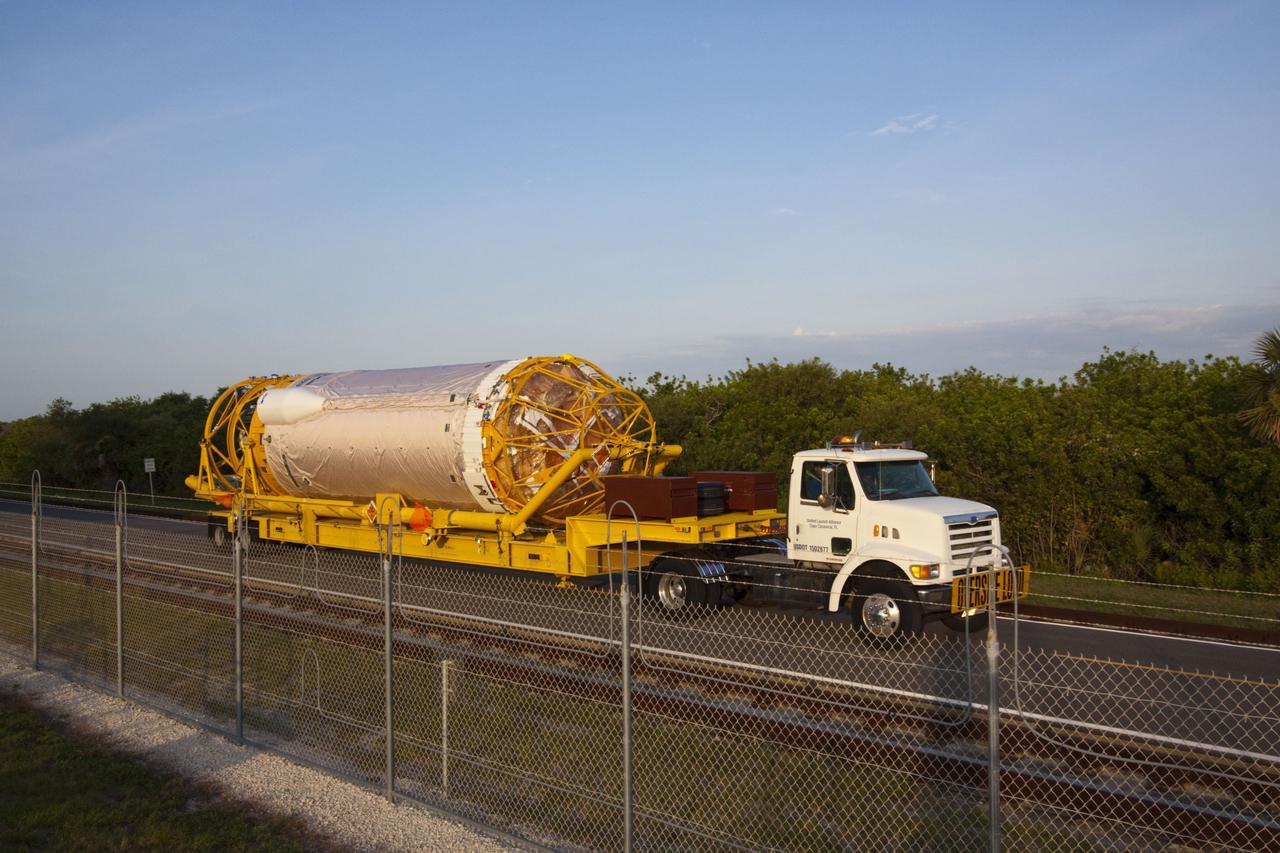
CAPE CANAVERAL, Fla. -- At Cape Canaveral Air Force Station in Florida, the Centaur upper stage for the United Launch Alliance Atlas V, slated to launch NASA's Juno spacecraft, is being transported from the Atlas Spaceflight Operations Center for delivery to Launch Complex 41. It then will be lifted into the Vertical Integration Facility and attached to the Atlas V booster stage, already at the pad. Juno is scheduled to launch aboard an Atlas V from Cape Canaveral, Fla. Aug. 5.The solar-powered spacecraft will orbit Jupiter's poles 33 times to find out more about the gas giant's origins, structure, atmosphere and magnetosphere and investigate the existence of a solid planetary core. For more information visit: www.nasa.gov/juno. Photo credit: NASA/Jim Grossmann
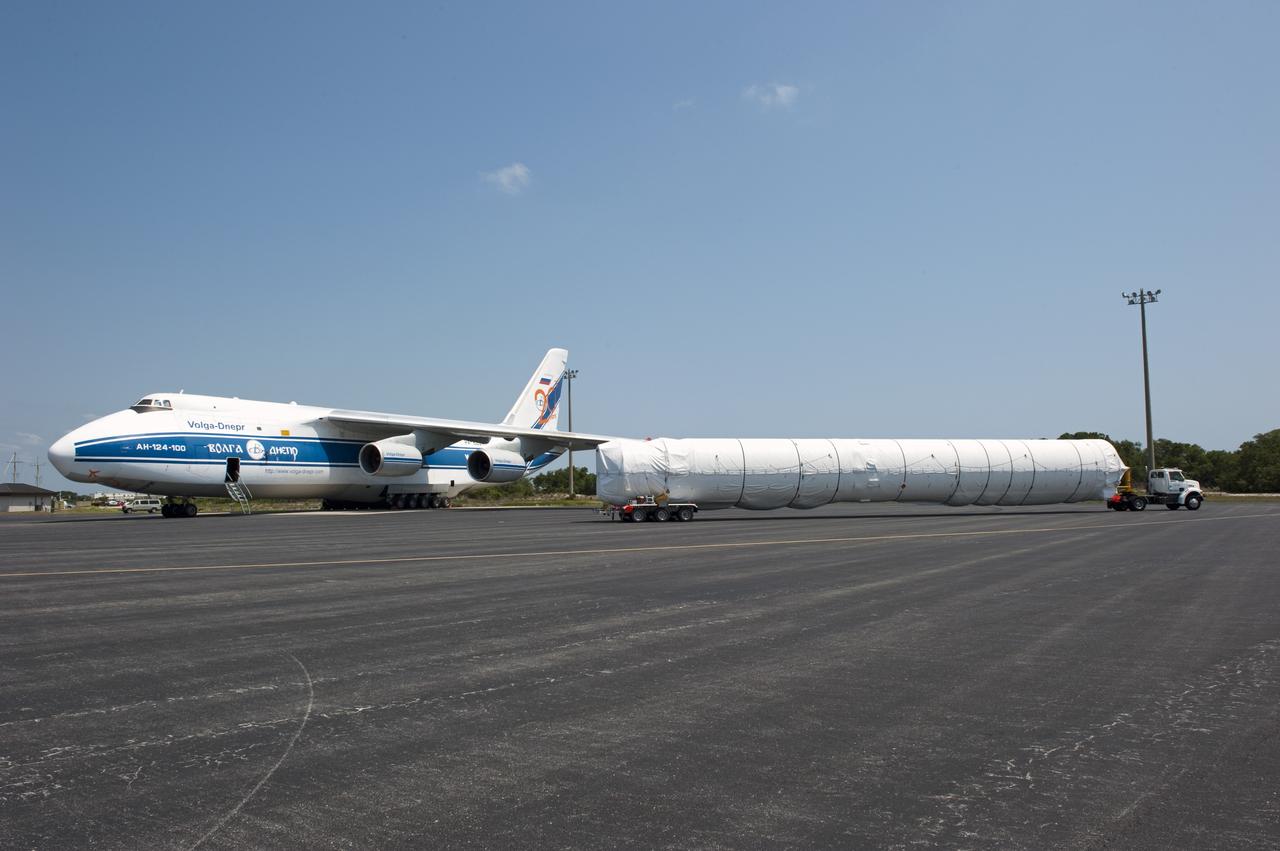
CAPE CANAVERAL, Fla. -- The first stage for the United Launch Alliance Atlas V rocket slated to launch NASA's Juno spacecraft is being transported from the Skid Strip on Cape Canaveral Air Force Station in Florida to the Atlas Spaceflight Operations Center. Juno is scheduled to launch aboard an Atlas V rocket from Cape Canaveral, Fla., Aug. 5.The solar-powered spacecraft will orbit Jupiter's poles 33 times to find out more about the gas giant's origins, structure, atmosphere and magnetosphere and investigate the existence of a solid planetary core. For more information, visit www.nasa.gov/juno. Photo credit: NASA/Kim Shiflett
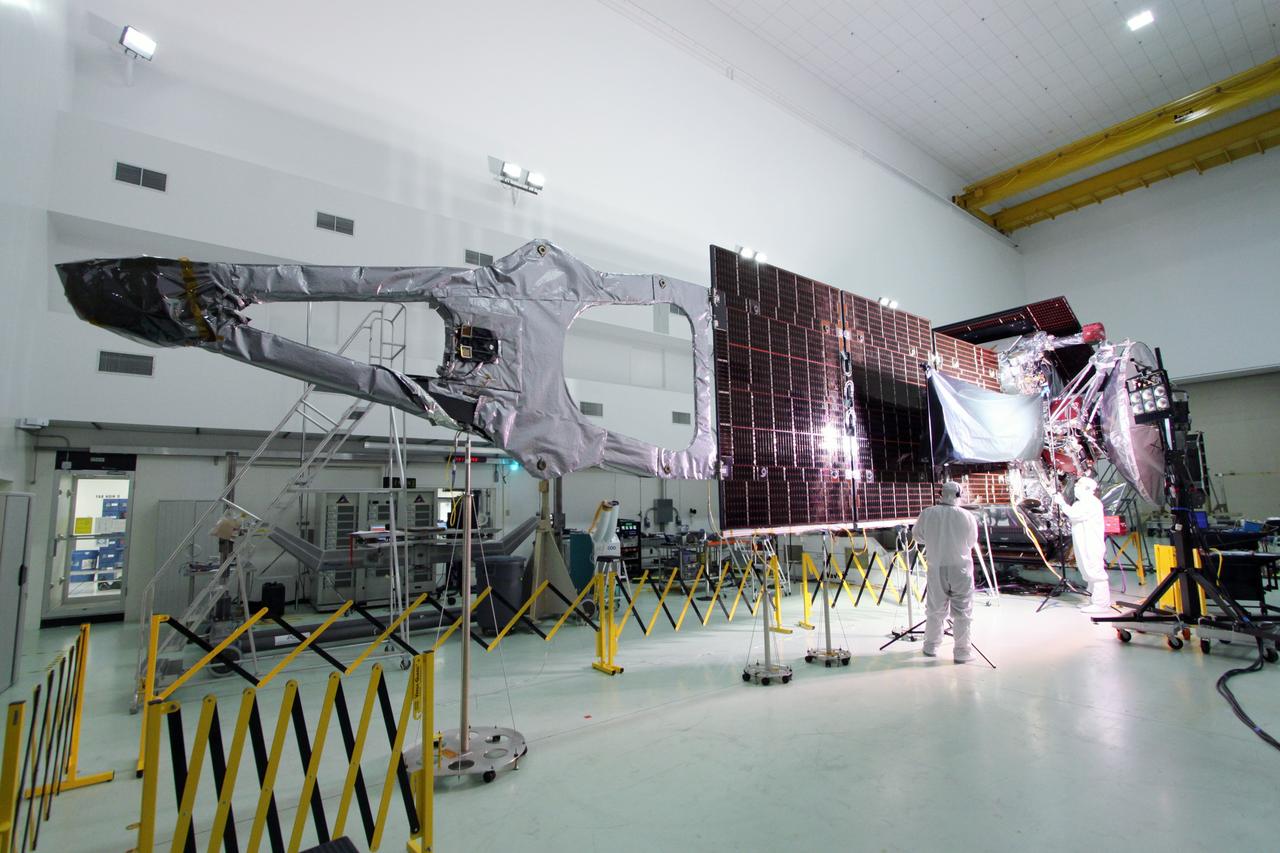
CAPE CANAVERAL, Fla. -- At Astrotech Space Operations in Titusville, Fla., technicians conduct illumination tests on solar array panel #1 with its magnetometer boom for NASA's Juno spacecraft. Juno is scheduled to launch aboard a United Launch Alliance Atlas V from Cape Canaveral, Fla. Aug. 5.The solar-powered spacecraft will orbit Jupiter's poles 33 times to find out more about the gas giant's origins, structure, atmosphere and magnetosphere and investigate the existence of a solid planetary core. For more information visit: www.nasa.gov/juno. Photo credit: NASA/Jack Pfaller
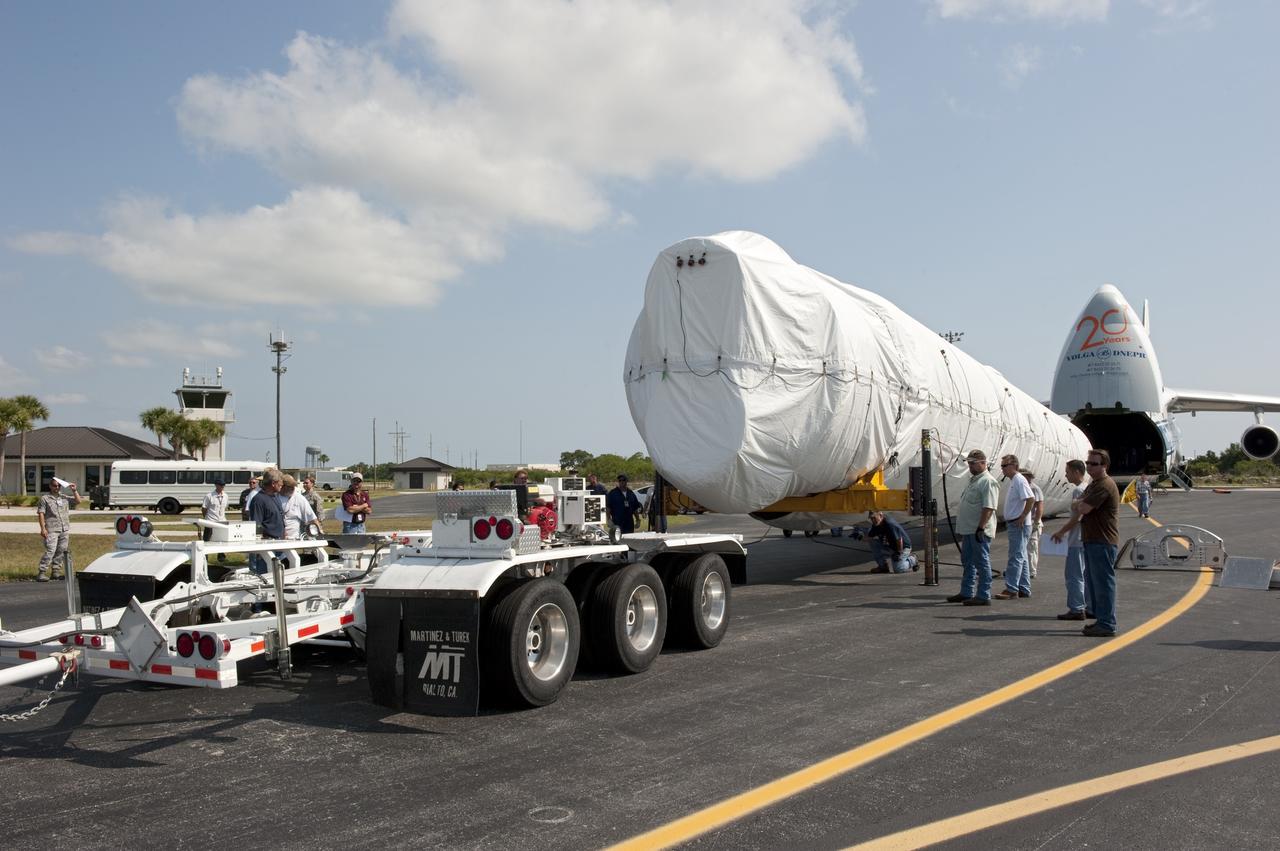
CAPE CANAVERAL, Fla. -- On the Skid Strip at Cape Canaveral Air Force Station in Florida, workers begin to load the first stage of the United Launch Alliance Atlas V rocket slated to launch NASA's Juno spacecraft onto a transporter. Juno is scheduled to launch aboard an Atlas V rocket from Cape Canaveral, Fla., Aug. 5.The solar-powered spacecraft will orbit Jupiter's poles 33 times to find out more about the gas giant's origins, structure, atmosphere and magnetosphere and investigate the existence of a solid planetary core. For more information, visit www.nasa.gov/juno. Photo credit: NASA/Kim Shiflett
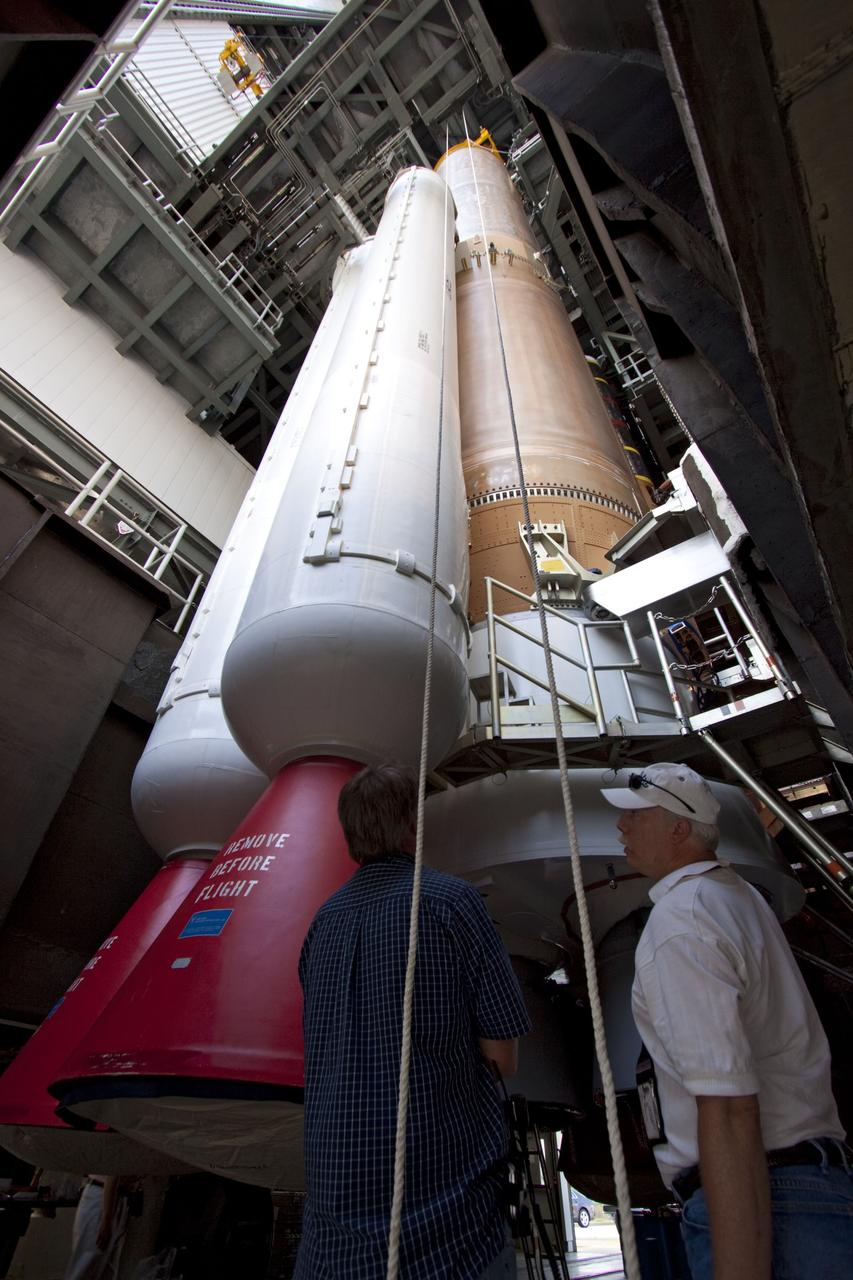
CAPE CANAVERAL, Fla. -- At Cape Canaveral Air Force Station in Florida, workers prepare the fifth and final solid rocket booster for lifting into the Vertical Integration Facility at Launch Complex 41. It then will be lifted into position and attached to the United Launch Alliance Atlas V booster stage, already at the pad. NASA's Juno spacecraft is scheduled to launch aboard an Atlas V from Cape Canaveral, Fla. Aug. 5.The solar-powered spacecraft will orbit Jupiter's poles 33 times to find out more about the gas giant's origins, structure, atmosphere and magnetosphere and investigate the existence of a solid planetary core. For more information visit: www.nasa.gov/juno. Photo credit: NASA/Jim Grossmann
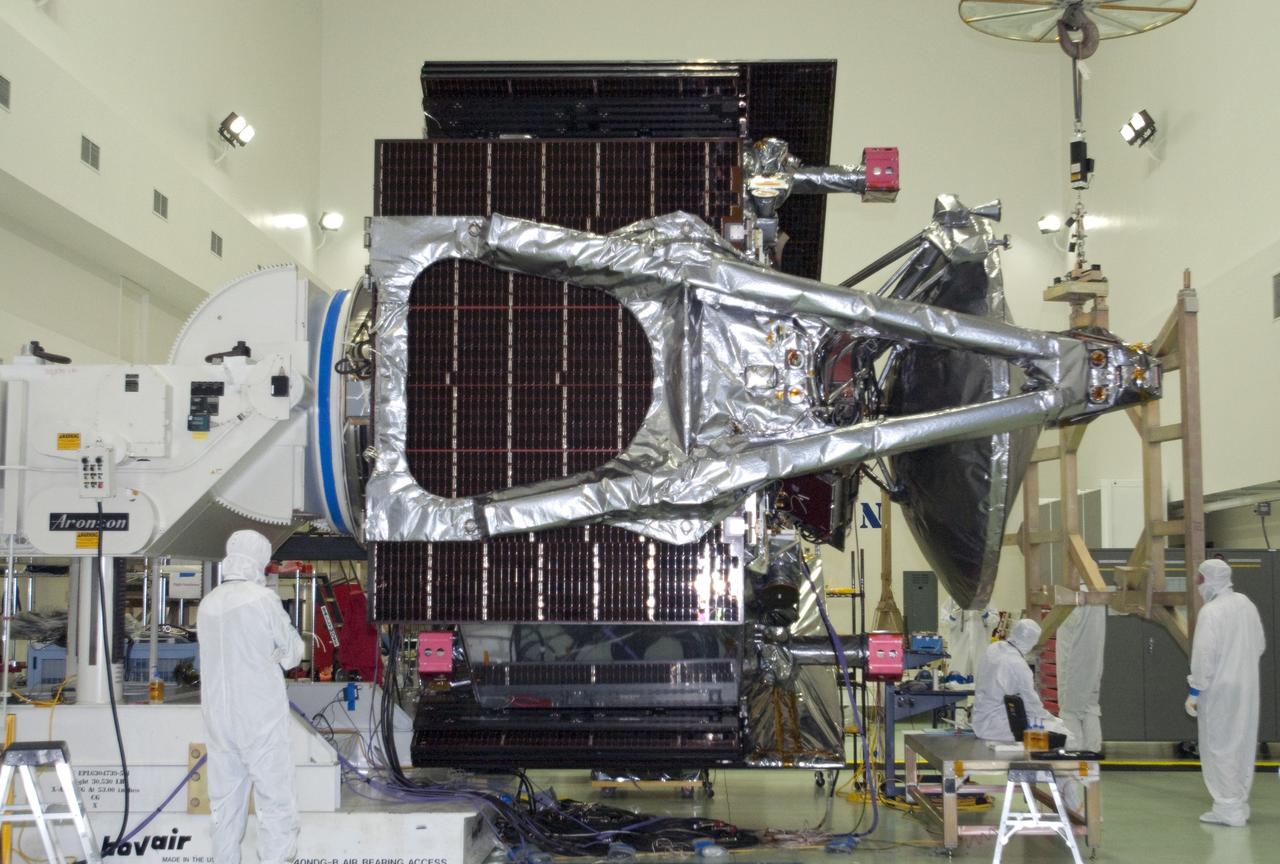
CAPE CANAVERAL, Fla. -- At Astrotech Space Operations in Titusville, Fla., technicians have installed solar array #1 with its magnetometer boom to NASA's Juno spacecraft. Juno is scheduled to launch aboard a United Launch Alliance Atlas V rocket from Cape Canaveral, Fla. Aug. 5.The solar-powered spacecraft will orbit Jupiter's poles 33 times to find out more about the gas giant's origins, structure, atmosphere and magnetosphere and investigate the existence of a solid planetary core. For more information visit: www.nasa.gov/juno. Photo credit: NASA/Charisse Nahser
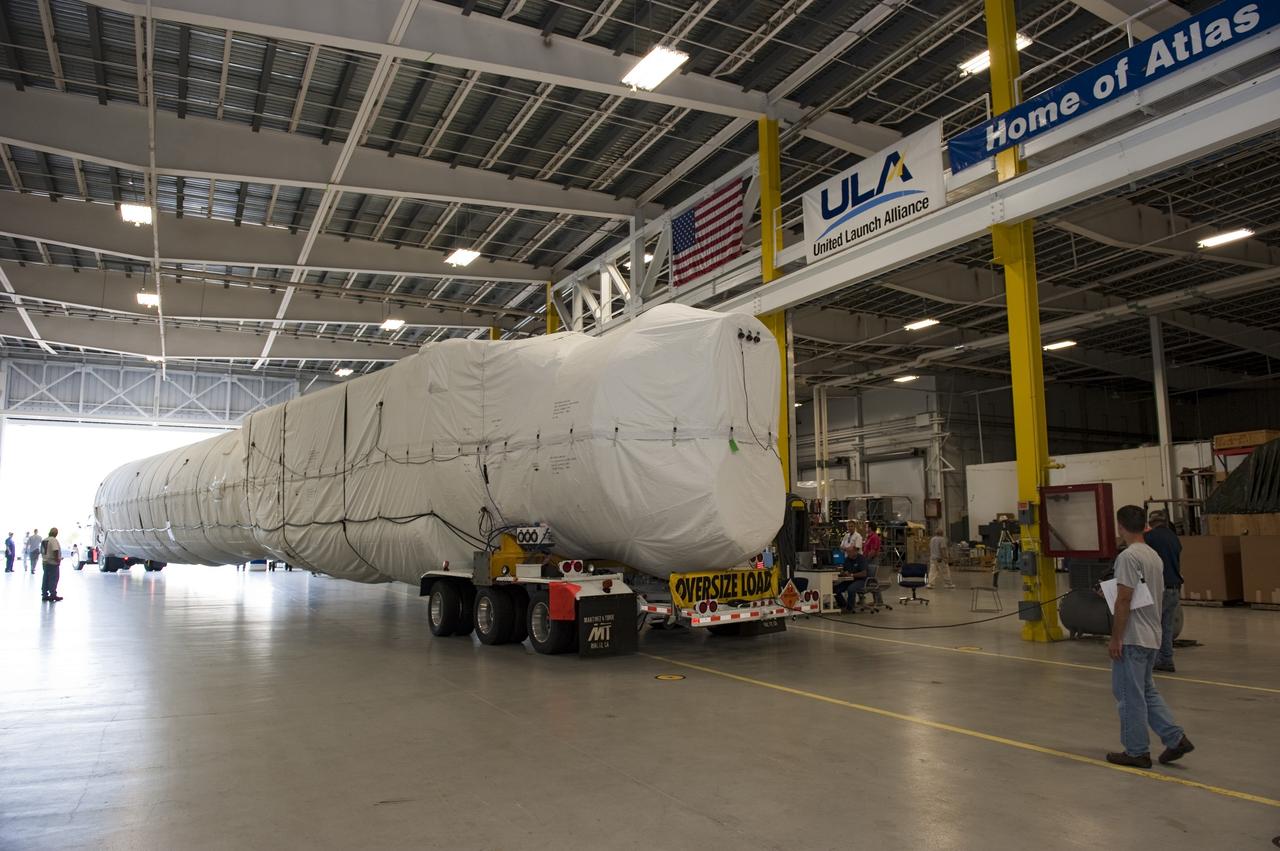
CAPE CANAVERAL, Fla. -- The first stage for the United Launch Alliance Atlas V rocket slated to launch NASA's Juno spacecraft has arrived at the Atlas Spaceflight Operations Center at Cape Canaveral Air Force Station in Florida. Juno is scheduled to launch aboard an Atlas V rocket from Cape Canaveral, Fla., Aug. 5.The solar-powered spacecraft will orbit Jupiter's poles 33 times to find out more about the gas giant's origins, structure, atmosphere and magnetosphere and investigate the existence of a solid planetary core. For more information, visit www.nasa.gov/juno. Photo credit: NASA/Kim Shiflett
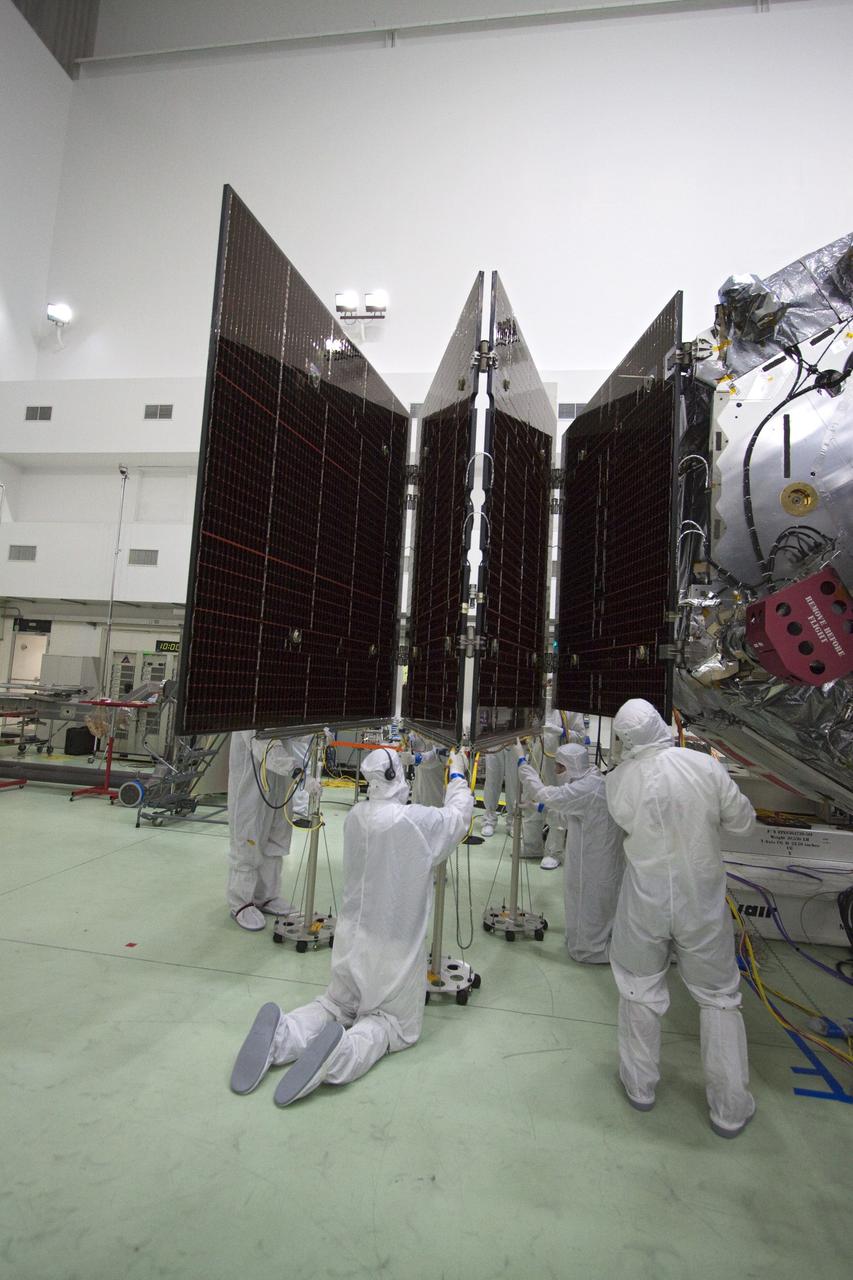
CAPE CANAVERAL, Fla. -- In a clean-room environment at Astrotech's payload processing facility in Titusville, Fla., technicians conduct deployment tests on solar array panels for NASA's Juno spacecraft prior to illumination testing. Juno is scheduled to launch aboard a United Launch Alliance Atlas V rocket from Cape Canaveral, Fla. Aug. 5.The solar-powered spacecraft will orbit Jupiter's poles 33 times to find out more about the gas giant's origins, structure, atmosphere and magnetosphere and investigate the existence of a solid planetary core. For more information visit: www.nasa.gov/juno. Photo credit: NASA/Jack Pfaller
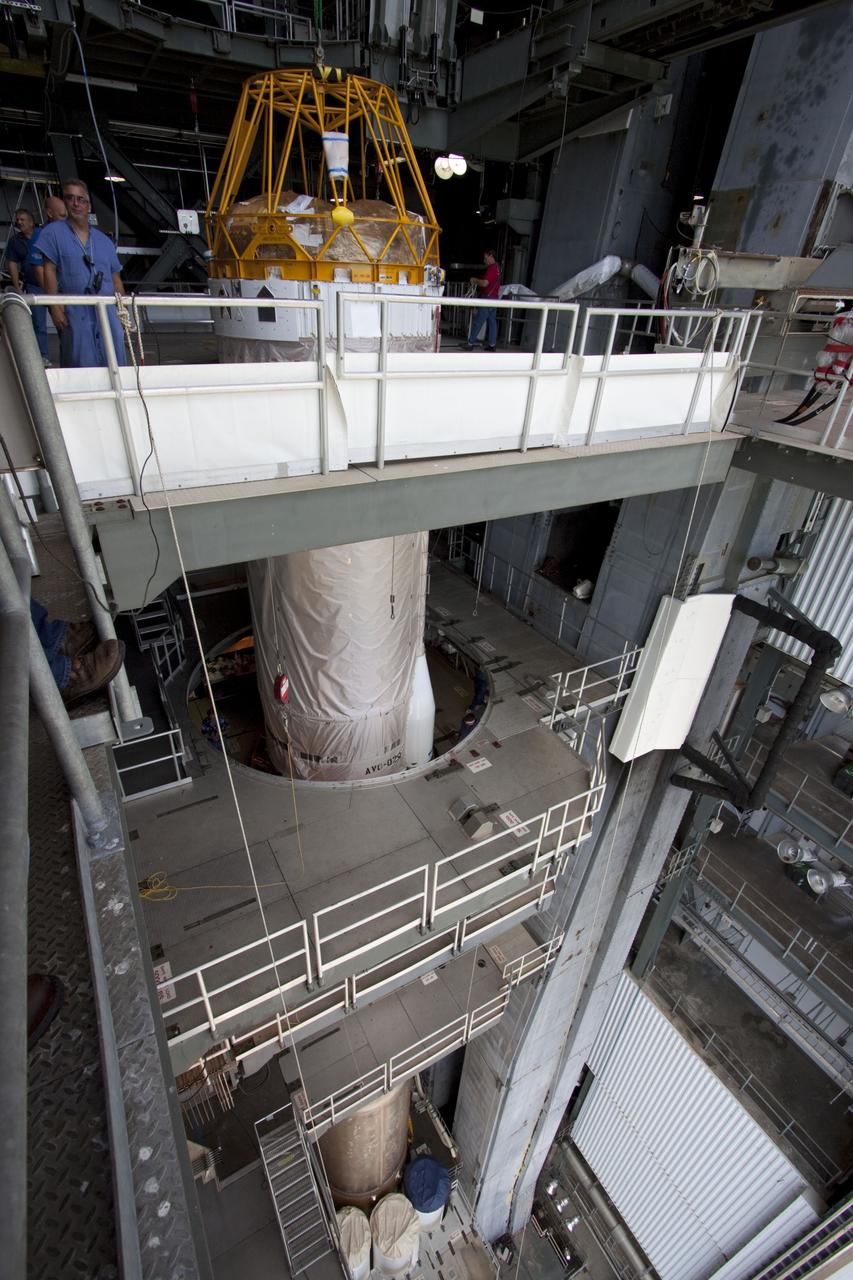
CAPE CANAVERAL, Fla. -- At Launch Complex 41 at Cape Canaveral Air Force Station in Florida, the Centaur upper stage for the United Launch Alliance Atlas V, slated to launch NASA's Juno spacecraft, is in position in the Vertical Integration Facility (VIF). It then will be attached to the Atlas V booster stage, already at the pad. Juno is scheduled to launch aboard an Atlas V from Cape Canaveral, Fla. Aug. 5.The solar-powered spacecraft will orbit Jupiter's poles 33 times to find out more about the gas giant's origins, structure, atmosphere and magnetosphere and investigate the existence of a solid planetary core. For more information visit: www.nasa.gov/juno. Photo credit: NASA/Jim Grossmann

CAPE CANAVERAL, Fla. -- At Astrotech's payload processing facility in Titusville, Fla., NASA's Juno spacecraft is lifted by overhead crane for its move to the rotation stand for testing. The solar-powered spacecraft will orbit Jupiter's poles 33 times to find out more about the gas giant's origins, structure, atmosphere and magnetosphere and investigate the existence of a solid planetary core. Juno is scheduled to launch aboard an Atlas V rocket from Cape Canaveral, Fla. Aug. 5. For more information visit, www.nasa.gov/juno. Photo credit: NASA/Jack Pfaller
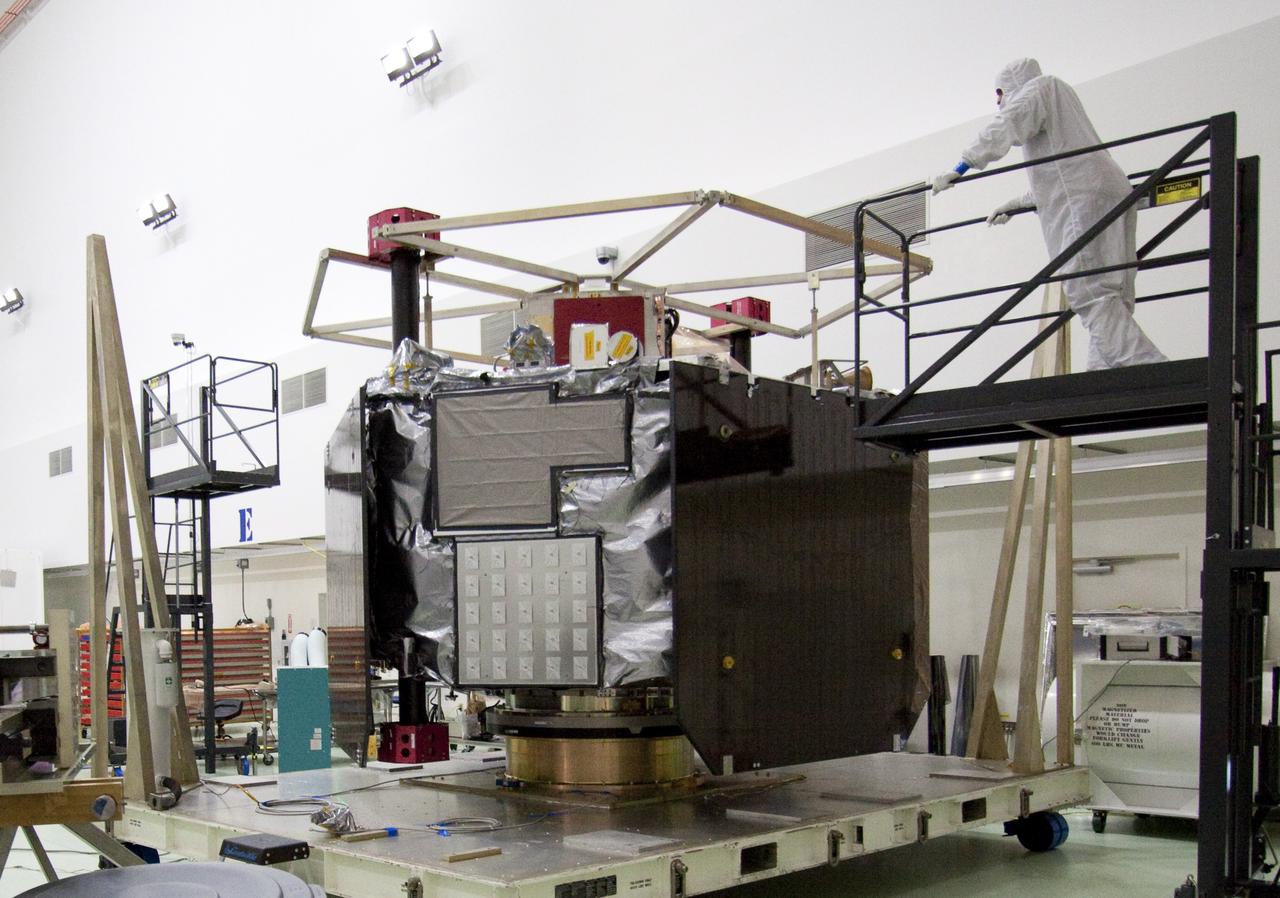
CAPE CANAVERAL, Fla. -- Lockheed-Martin technicians at Astrotech's payload processing facility in Titusville, Fla. have removed the protective wrapping from NASA's Juno spacecraft and begin an inspection prior to final testing and preparations for launch. The solar-powered spacecraft will orbit Jupiter's poles 33 times to find out more about the gas giant's origins, structure, atmosphere and magnetosphere and investigate the existence of a solid planetary core. Juno is scheduled to launch aboard an Atlas V rocket from Cape Canaveral, Fla. Aug. 5. For more information visit, www.nasa.gov/juno. Photo credit: NASA/Jack Pfaller It will splash down into the Atlantic Ocean where the ship and its crew will recover it and tow it back through Port Canaveral for refurbishing for another launch. The STS-124 mission is the second of three flights launching components to complete the Japan Aerospace Exploration Agency's Kibo laboratory. The shuttle crew will install Kibo's large Japanese Pressurized Module and its remote manipulator system, or RMS. Photo credit: USA/Jeff Suter
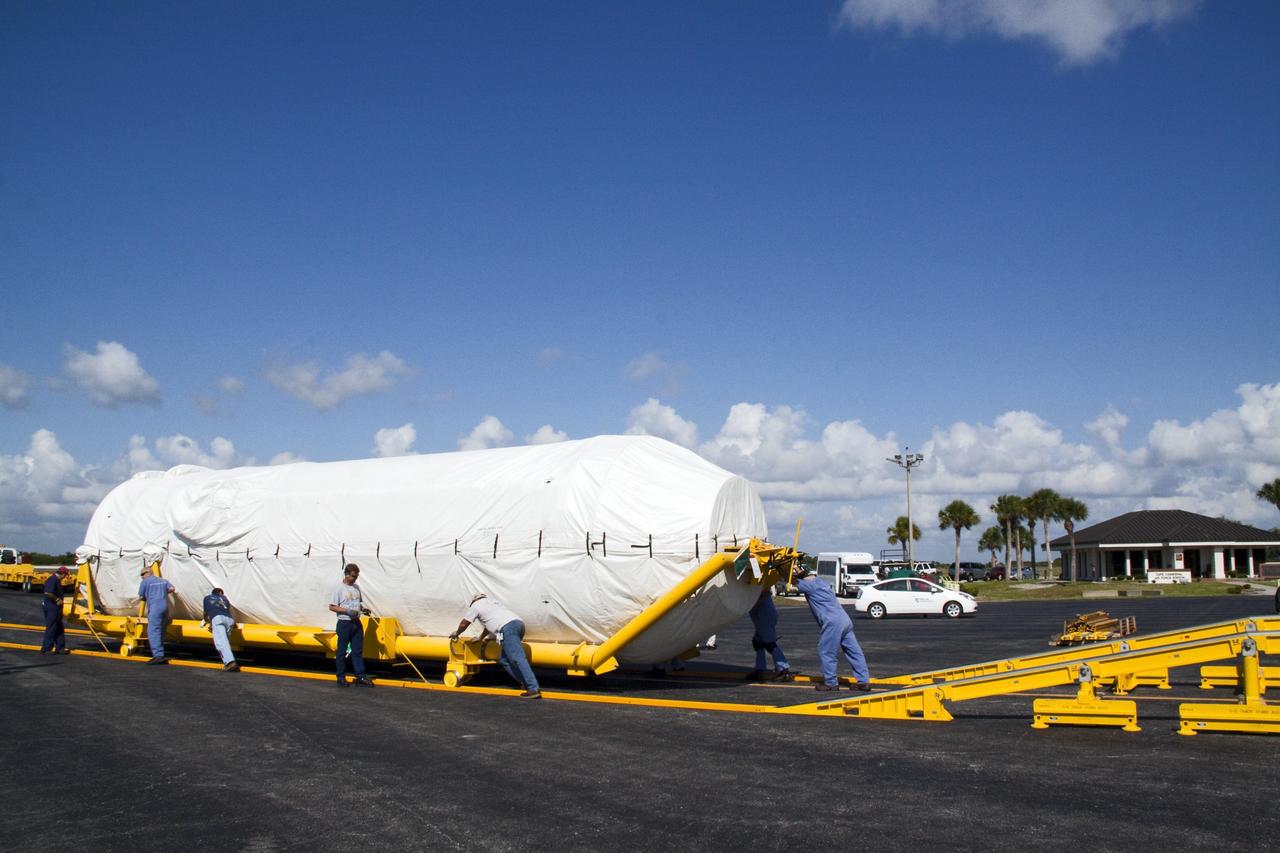
CAPE CANAVERAL, Fla. -- On the Skid Strip at Cape Canaveral Air Force Station in Florida, workers unload the Centaur upper stage of the United Launch Alliance Atlas V rocket slated to launch NASA's Juno spacecraft from a Volga-Dnepr Antonov AN-124-100, a Ukranian/Russian cargo aircraft. NASA's Juno spacecraft is scheduled to launch aboard the Atlas V from Cape Canaveral, Fla. Aug. 5.The solar-powered spacecraft will orbit Jupiter's poles 33 times to find out more about the gas giant's origins, structure, atmosphere and magnetosphere and investigate the existence of a solid planetary core. For more information visit: www.nasa.gov/juno. Photo credit: NASA/Jack Pfaller
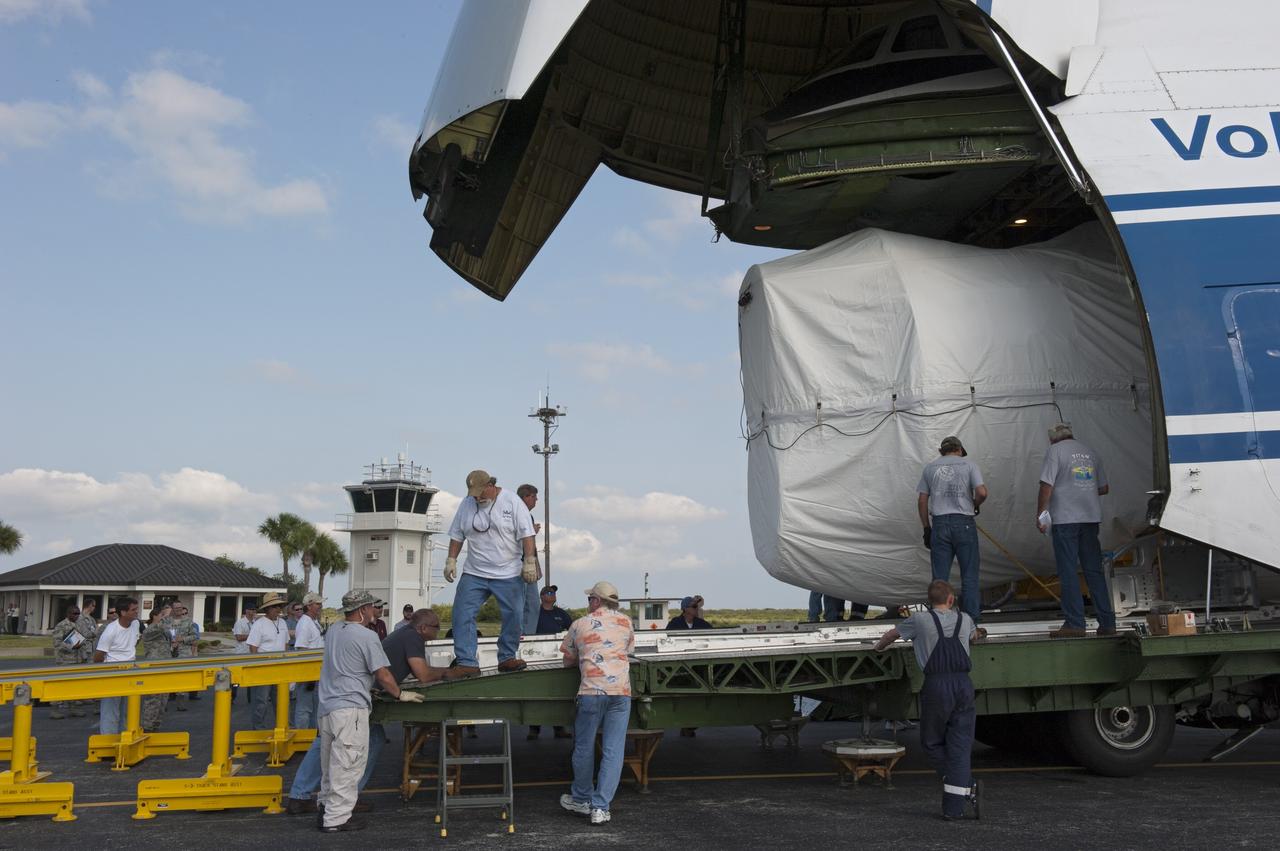
CAPE CANAVERAL, Fla. -- On the Skid Strip at Cape Canaveral Air Force Station in Florida, workers unload the first stage of the United Launch Alliance Atlas V rocket slated to launch NASA's Juno spacecraft from a Volga-Dnepr Antonov AN-124-100, a Ukranian/Russian cargo aircraft. Juno is scheduled to launch aboard an Atlas V rocket from Cape Canaveral, Fla., Aug. 5.The solar-powered spacecraft will orbit Jupiter's poles 33 times to find out more about the gas giant's origins, structure, atmosphere and magnetosphere and investigate the existence of a solid planetary core. For more information, visit www.nasa.gov/juno. Photo credit: NASA/Kim Shiflett
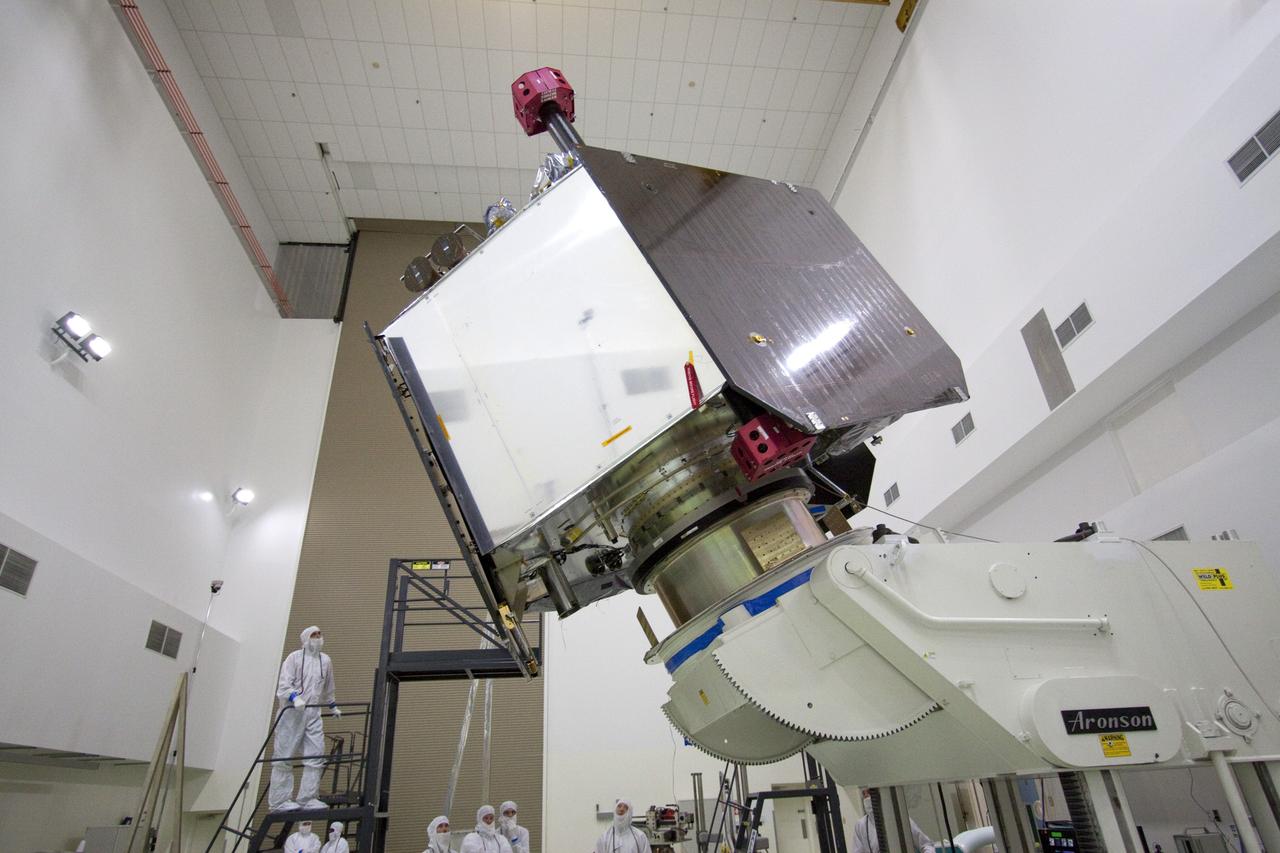
CAPE CANAVERAL, Fla. -- Technicians at Astrotech's payload processing facility in Titusville, Fla. watch vigilantly as NASA's Juno spacecraft is tested for center of gravity, weighing and balancing on the rotation stand. The solar-powered spacecraft will orbit Jupiter's poles 33 times to find out more about the gas giant's origins, structure, atmosphere and magnetosphere and investigate the existence of a solid planetary core. Juno is scheduled to launch aboard an Atlas V rocket from Cape Canaveral, Fla. Aug. 5. For more information visit, www.nasa.gov/juno. Photo credit: NASA/Jack Pfaller
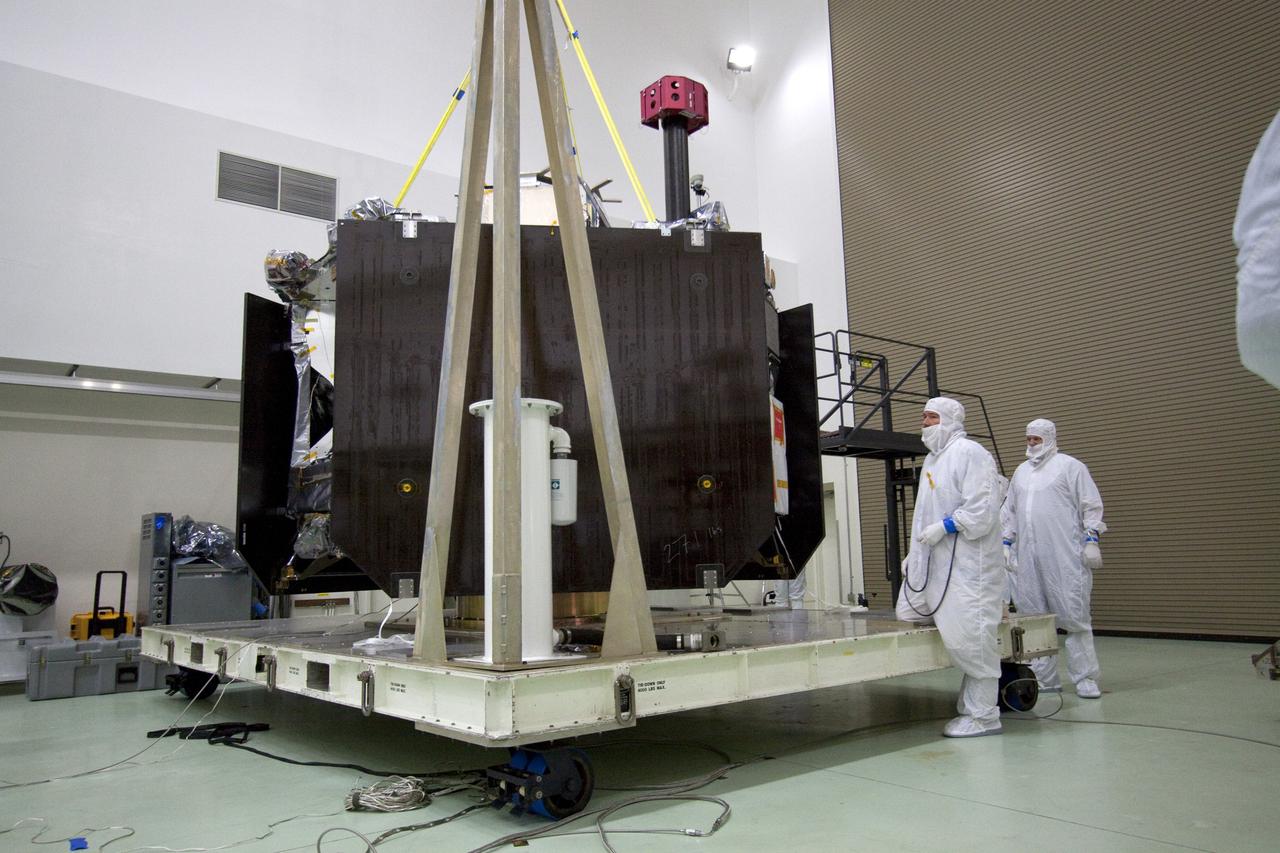
CAPE CANAVERAL, Fla. -- Technicians at Astrotech's payload processing facility in Titusville, Fla. attach an overhead crane to NASA's Juno spacecraft for its move to the rotation stand for testing. The solar-powered spacecraft will orbit Jupiter's poles 33 times to find out more about the gas giant's origins, structure, atmosphere and magnetosphere and investigate the existence of a solid planetary core. Juno is scheduled to launch aboard an Atlas V rocket from Cape Canaveral, Fla. Aug. 5. For more information visit, www.nasa.gov/juno. Photo credit: NASA/Jack Pfaller
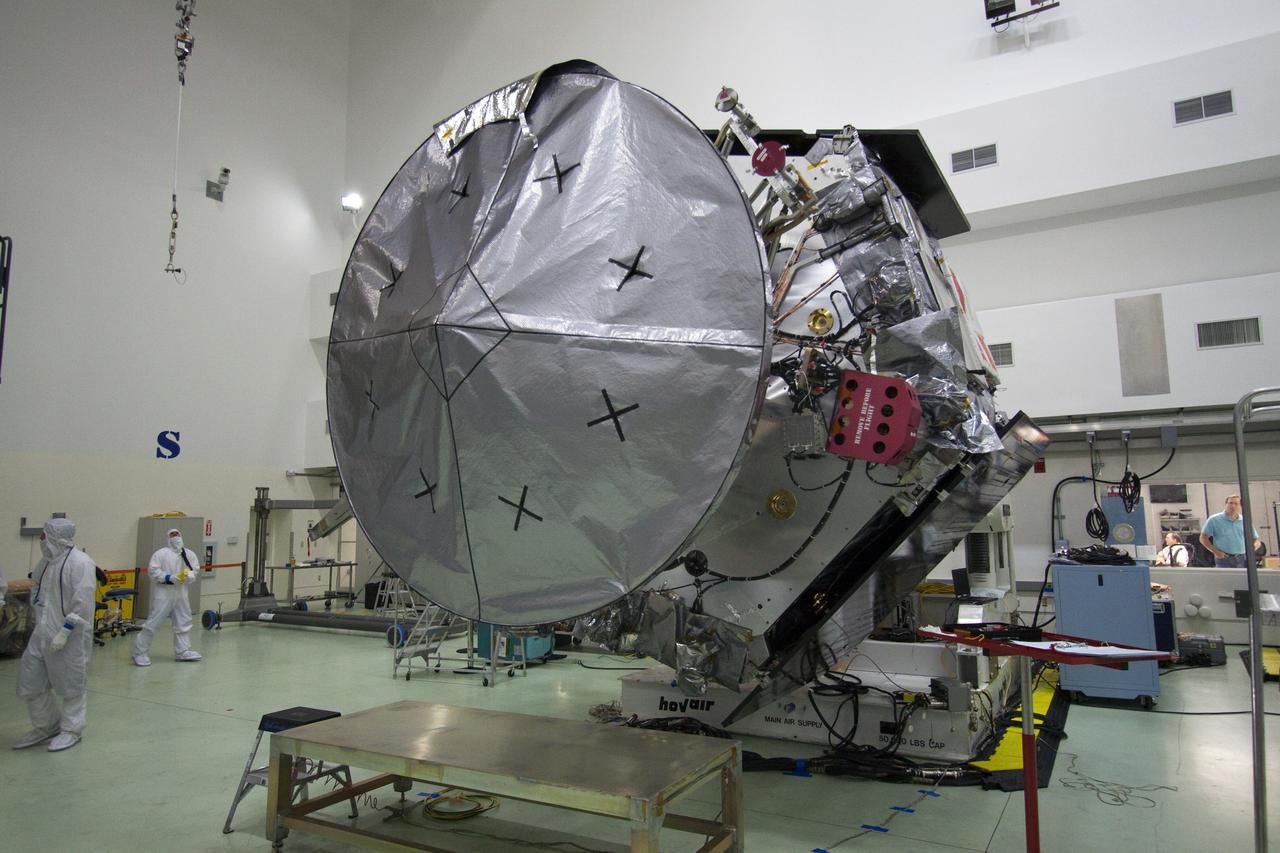
CAPE CANAVERAL, Fla. -- Technicians at Astrotech's payload processing facility in Titusville, Fla. have installed the high-gain antenna to NASA's Juno spacecraft. Juno is scheduled to launch aboard an Atlas V rocket from Cape Canaveral, Fla. Aug. 5.The solar-powered spacecraft will orbit Jupiter's poles 33 times to find out more about the gas giant's origins, structure, atmosphere and magnetosphere and investigate the existence of a solid planetary core. For more information visit, www.nasa.gov/juno. Photo credit: NASA/Jack Pfaller
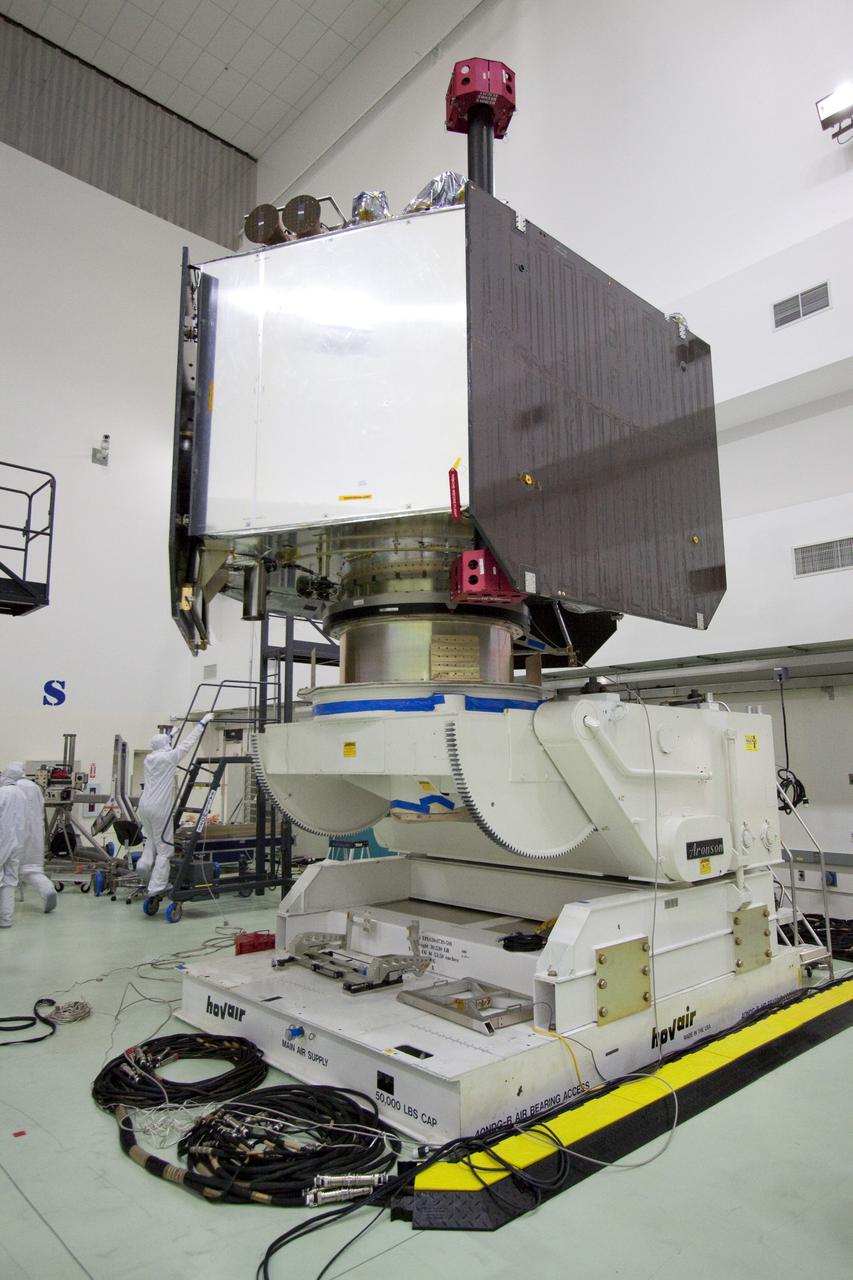
CAPE CANAVERAL, Fla. -- NASA's Juno spacecraft is secured to the rotation stand for testing in Astrotech's payload processing facility in Titusville, Fla. The solar-powered spacecraft will orbit Jupiter's poles 33 times to find out more about the gas giant's origins, structure, atmosphere and magnetosphere and investigate the existence of a solid planetary core. Juno is scheduled to launch aboard an Atlas V rocket from Cape Canaveral, Fla. Aug. 5. For more information visit, www.nasa.gov/juno. Photo credit: NASA/Jack Pfaller
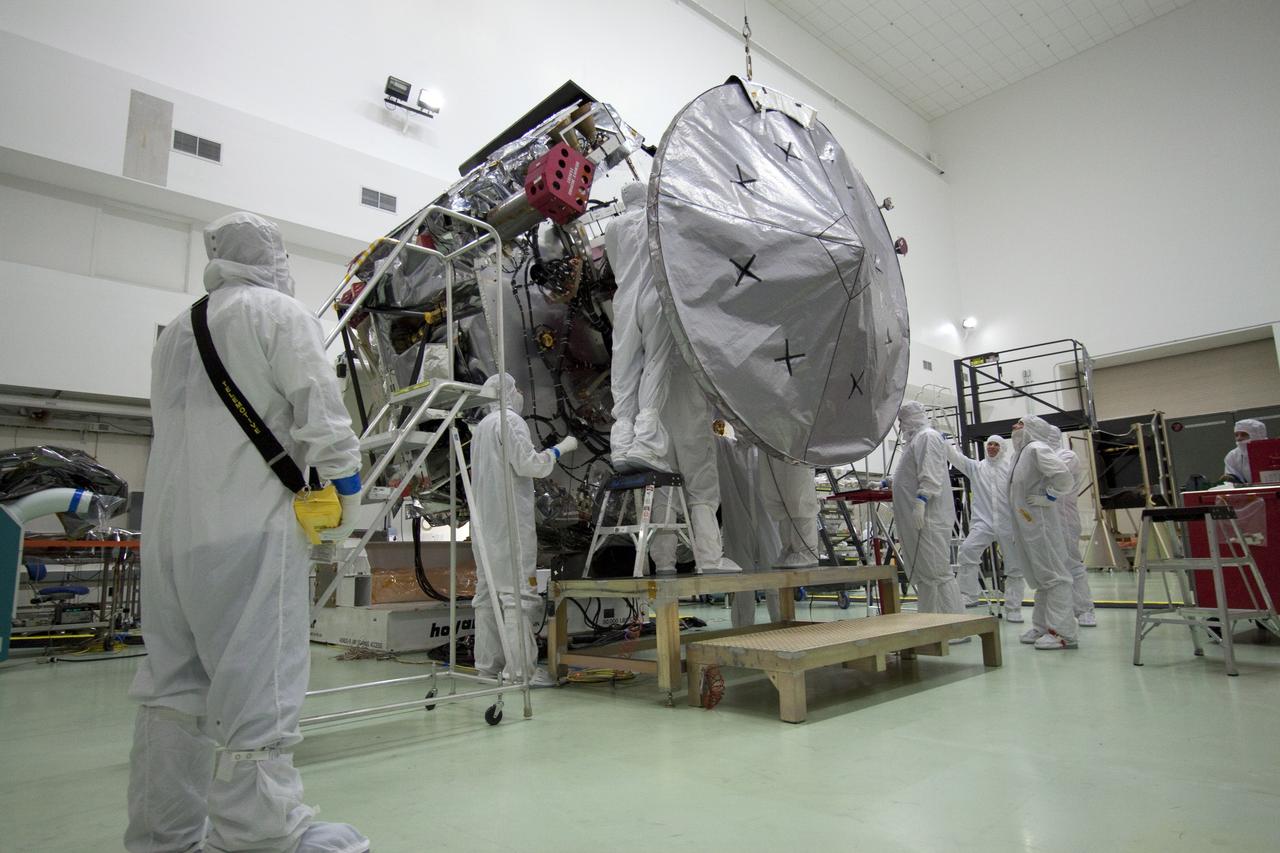
CAPE CANAVERAL, Fla. -- Technicians at Astrotech's payload processing facility in Titusville, Fla. install the high-gain antenna to NASA's Juno spacecraft. Juno is scheduled to launch aboard an Atlas V rocket from Cape Canaveral, Fla. Aug. 5.The solar-powered spacecraft will orbit Jupiter's poles 33 times to find out more about the gas giant's origins, structure, atmosphere and magnetosphere and investigate the existence of a solid planetary core. For more information visit, www.nasa.gov/juno. Photo credit: NASA/Jack Pfaller

CAPE CANAVERAL, Fla. -- Technicians at Astrotech's payload processing facility in Titusville, Fla. attach an overhead crane to the high-gain antenna that will be installed to NASA's Juno spacecraft. Juno is scheduled to launch aboard an Atlas V rocket from Cape Canaveral, Fla. Aug. 5.The solar-powered spacecraft will orbit Jupiter's poles 33 times to find out more about the gas giant's origins, structure, atmosphere and magnetosphere and investigate the existence of a solid planetary core. For more information visit, www.nasa.gov/juno. Photo credit: NASA/Jack Pfaller
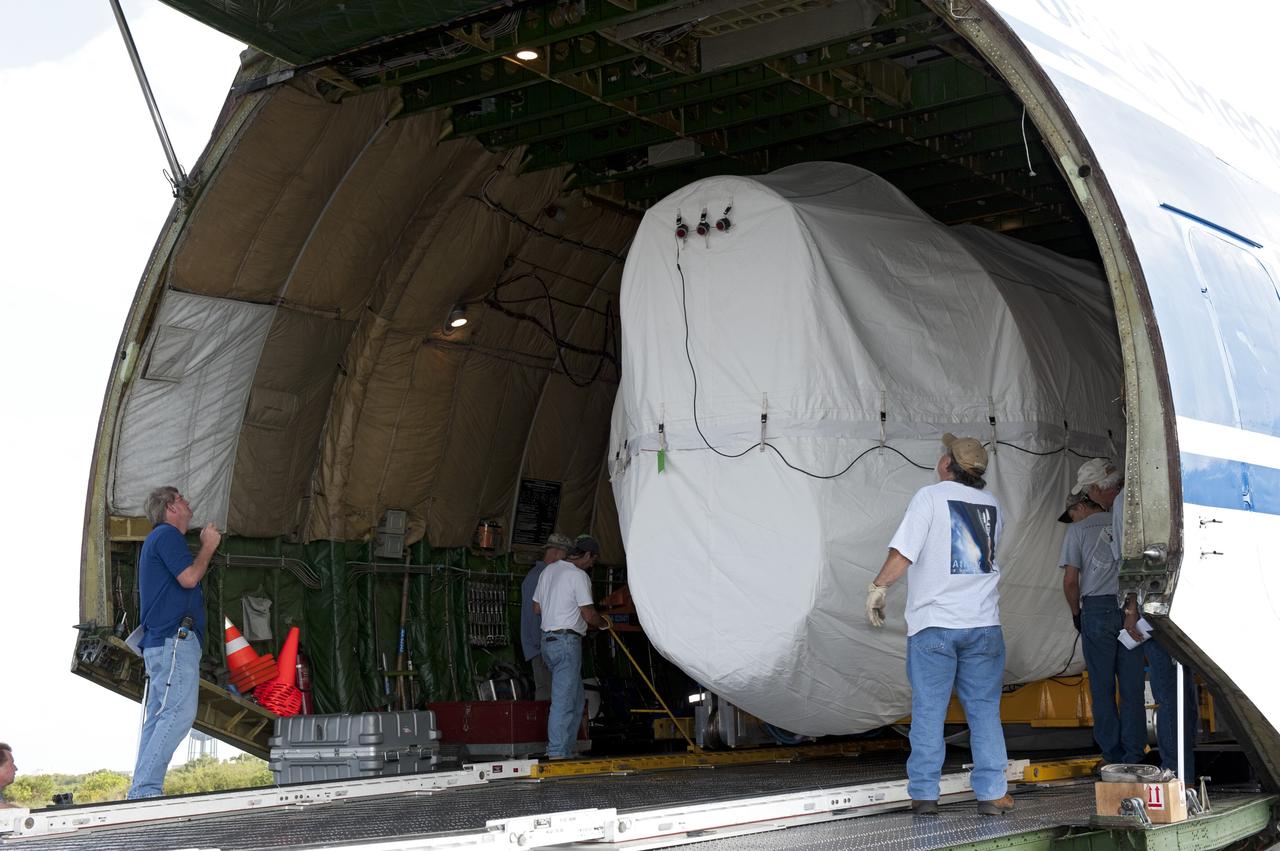
CAPE CANAVERAL, Fla. -- On the Skid Strip at Cape Canaveral Air Force Station in Florida, workers begin to unload the first stage of the United Launch Alliance Atlas V rocket slated to launch NASA's Juno spacecraft from a Volga-Dnepr Antonov AN-124-100, a Ukranian/Russian cargo aircraft. Juno is scheduled to launch aboard an Atlas V rocket from Cape Canaveral, Fla., Aug. 5.The solar-powered spacecraft will orbit Jupiter's poles 33 times to find out more about the gas giant's origins, structure, atmosphere and magnetosphere and investigate the existence of a solid planetary core. For more information, visit www.nasa.gov/juno. Photo credit: NASA/Kim Shiflett
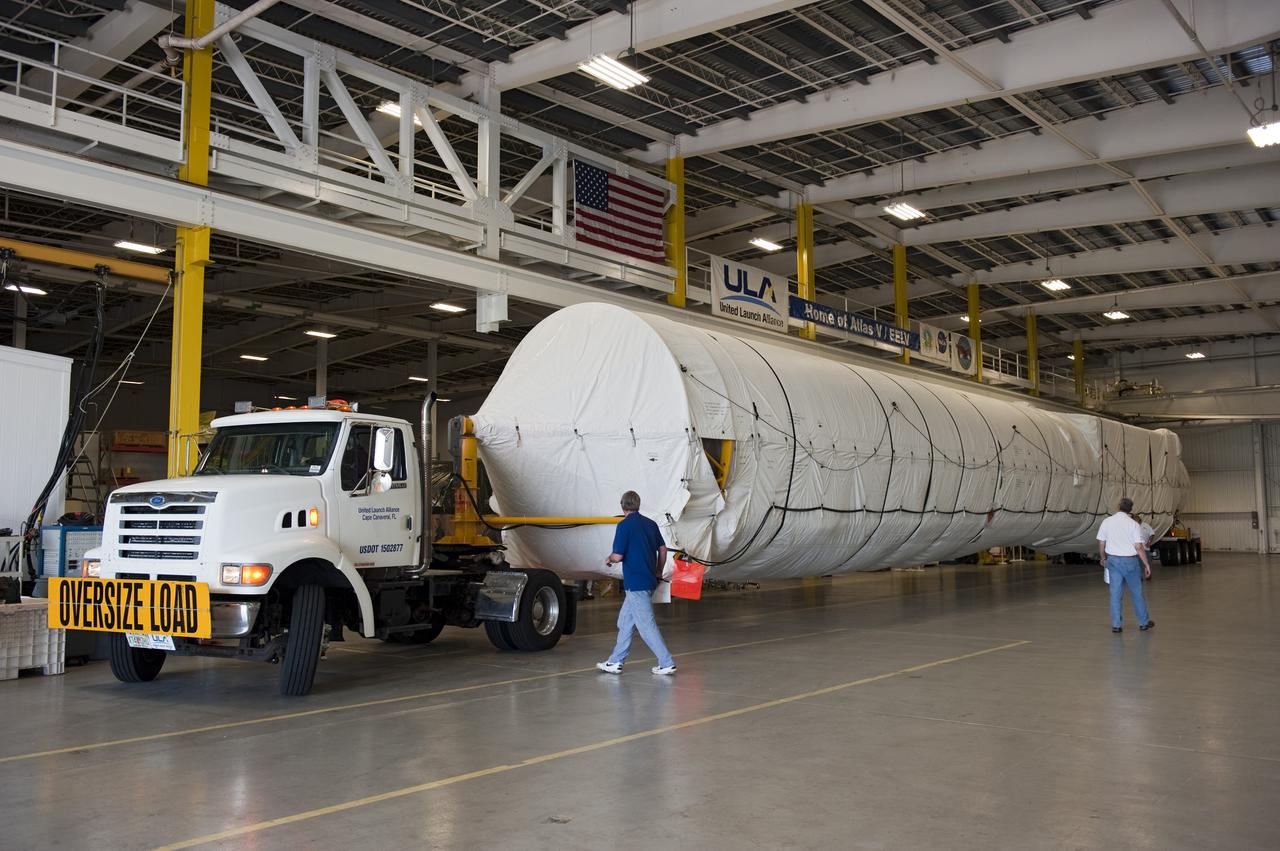
CAPE CANAVERAL, Fla. -- The first stage for the United Launch Alliance Atlas V rocket slated to launch NASA's Juno spacecraft has arrived at the Atlas Spaceflight Operations Center at Cape Canaveral Air Force Station in Florida. Juno is scheduled to launch aboard an Atlas V rocket from Cape Canaveral, Fla., Aug. 5.The solar-powered spacecraft will orbit Jupiter's poles 33 times to find out more about the gas giant's origins, structure, atmosphere and magnetosphere and investigate the existence of a solid planetary core. For more information, visit www.nasa.gov/juno. Photo credit: NASA/Kim Shiflett
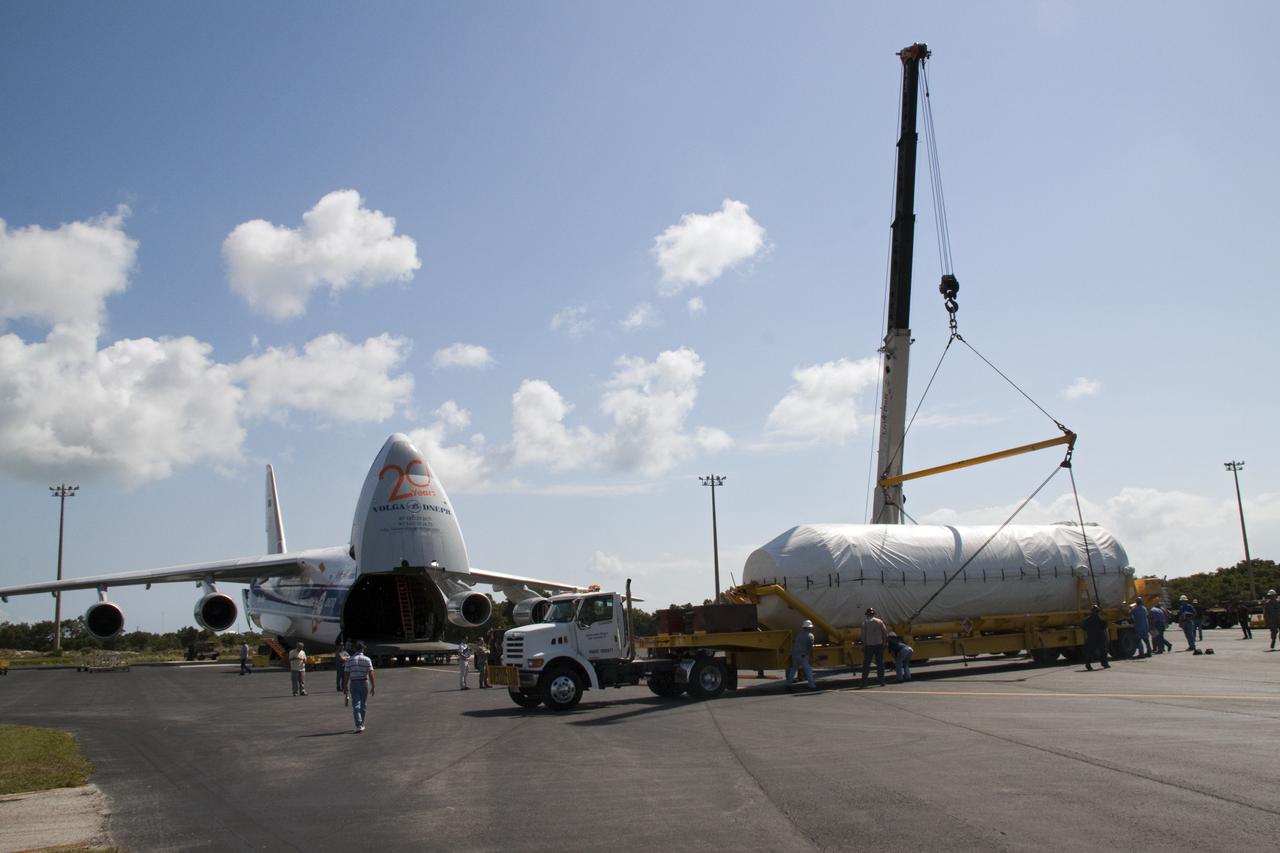
CAPE CANAVERAL, Fla. -- On the Skid Strip at Cape Canaveral Air Force Station in Florida, workers use a crane to lower the Centaur upper stage of the United Launch Alliance Atlas V rocket slated to launch NASA's Juno spacecraft onto a transporter. NASA's Juno spacecraft is scheduled to launch aboard the Atlas V from Cape Canaveral, Fla. Aug. 5.The solar-powered spacecraft will orbit Jupiter's poles 33 times to find out more about the gas giant's origins, structure, atmosphere and magnetosphere and investigate the existence of a solid planetary core. For more information visit: www.nasa.gov/juno. Photo credit: NASA/Jack Pfaller
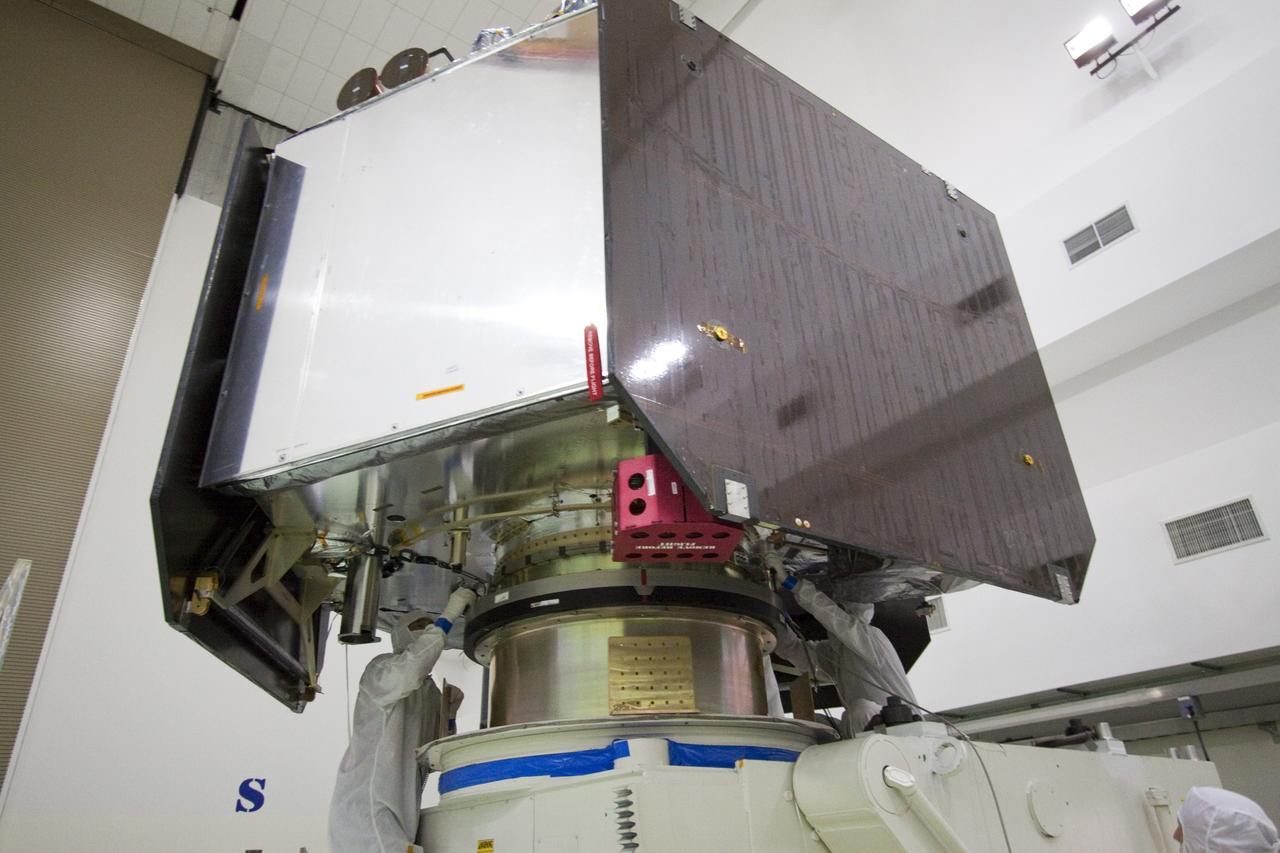
CAPE CANAVERAL, Fla. -- Technicians at Astrotech's payload processing facility in Titusville, Fla. secure NASA's Juno spacecraft to the rotation stand for testing. The solar-powered spacecraft will orbit Jupiter's poles 33 times to find out more about the gas giant's origins, structure, atmosphere and magnetosphere and investigate the existence of a solid planetary core. Juno is scheduled to launch aboard an Atlas V rocket from Cape Canaveral, Fla. Aug. 5. For more information visit, www.nasa.gov/juno. Photo credit: NASA/Jack Pfaller
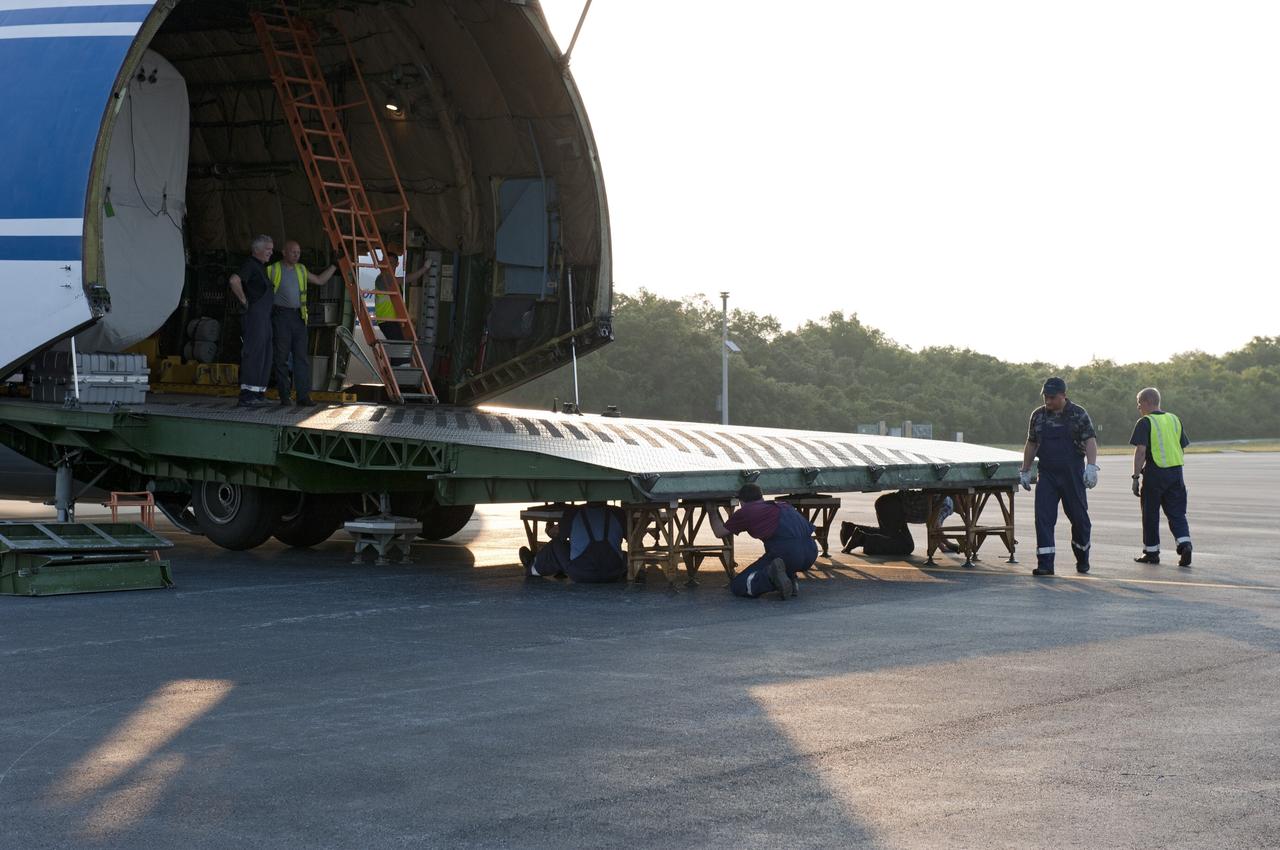
CAPE CANAVERAL, Fla. -- On the Skid Strip at Cape Canaveral Air Force Station in Florida, workers prepare to unload a Volga-Dnepr Antonov AN-124-100, a Ukranian/Russian cargo aircraft that has delivered the first stage of the United Launch Alliance Atlas V rocket slated to launch NASA's Juno spacecraft. Juno is scheduled to launch aboard an Atlas V rocket from Cape Canaveral, Fla., Aug. 5.The solar-powered spacecraft will orbit Jupiter's poles 33 times to find out more about the gas giant's origins, structure, atmosphere and magnetosphere and investigate the existence of a solid planetary core. For more information, visit www.nasa.gov/juno. Photo credit: NASA/Kim Shiflett
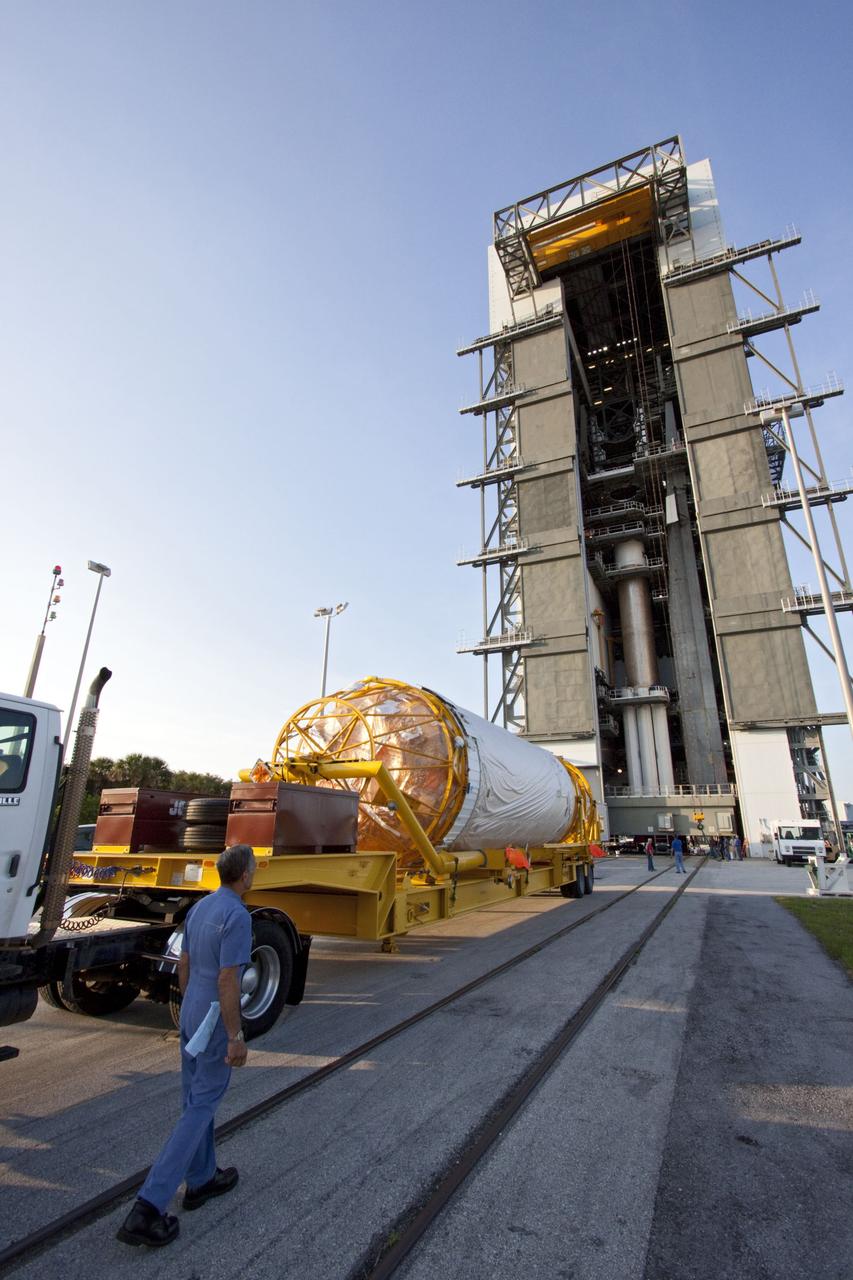
CAPE CANAVERAL, Fla. -- At Cape Canaveral Air Force Station in Florida, the Centaur upper stage for the United Launch Alliance Atlas V slated to launch NASA's Juno spacecraft, arrived at Launch Complex 41 after being transported from the Atlas Spaceflight Operations Center. It then will be lifted into the Vertical Integration Facility and attached to the Atlas V booster stage, already at the pad. Juno is scheduled to launch aboard an Atlas V from Cape Canaveral, Fla. Aug. 5.The solar-powered spacecraft will orbit Jupiter's poles 33 times to find out more about the gas giant's origins, structure, atmosphere and magnetosphere and investigate the existence of a solid planetary core. For more information visit: www.nasa.gov/juno. Photo credit: NASA/Jim Grossmann
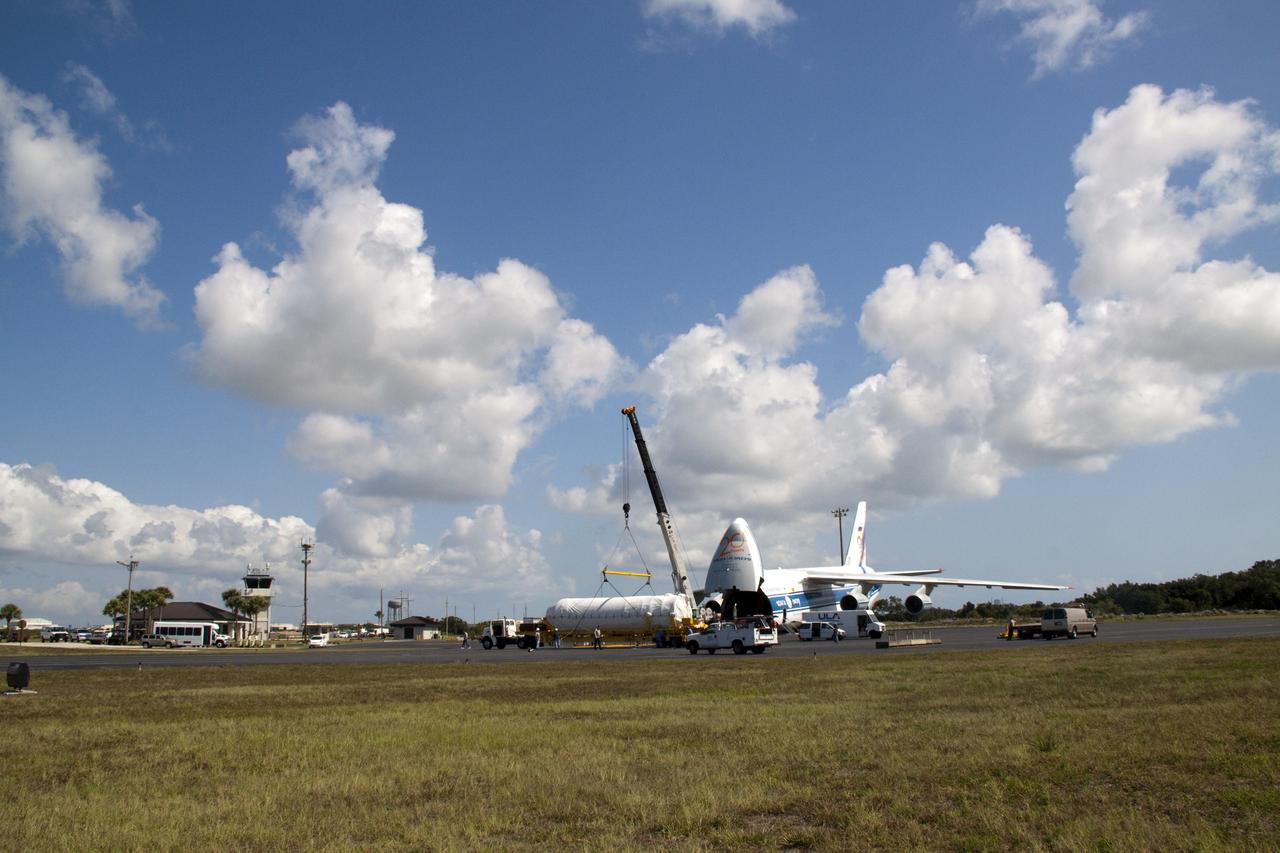
CAPE CANAVERAL, Fla. -- On the Skid Strip at Cape Canaveral Air Force Station in Florida, workers use a crane to lower the Centaur upper stage of the United Launch Alliance Atlas V rocket slated to launch NASA's Juno spacecraft onto a transporter. NASA's Juno spacecraft is scheduled to launch aboard the Atlas V from Cape Canaveral, Fla. Aug. 5.The solar-powered spacecraft will orbit Jupiter's poles 33 times to find out more about the gas giant's origins, structure, atmosphere and magnetosphere and investigate the existence of a solid planetary core. For more information visit: www.nasa.gov/juno. Photo credit: NASA/Jack Pfaller