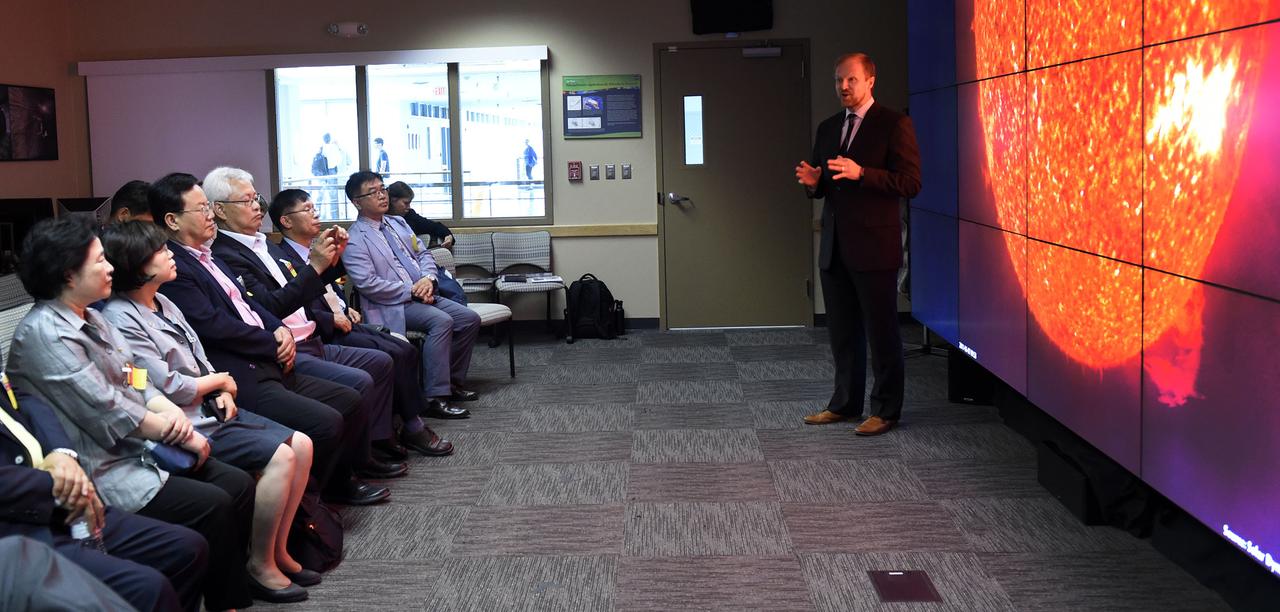
Korean delegates toured Goddard facilities with Center Director Chris Scolese on August 11, 2017
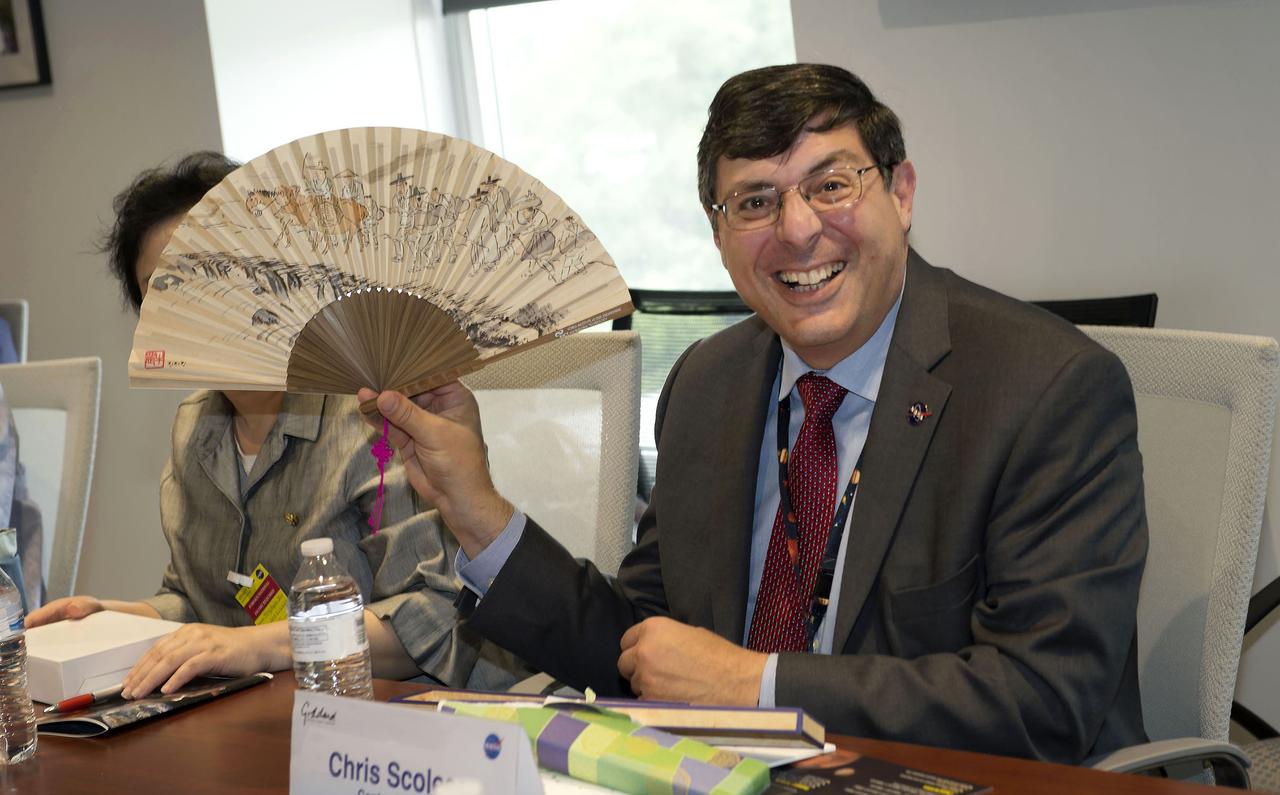
Korean delegation toured Goddard with Center Director Chris Scolese on August 11, 2017
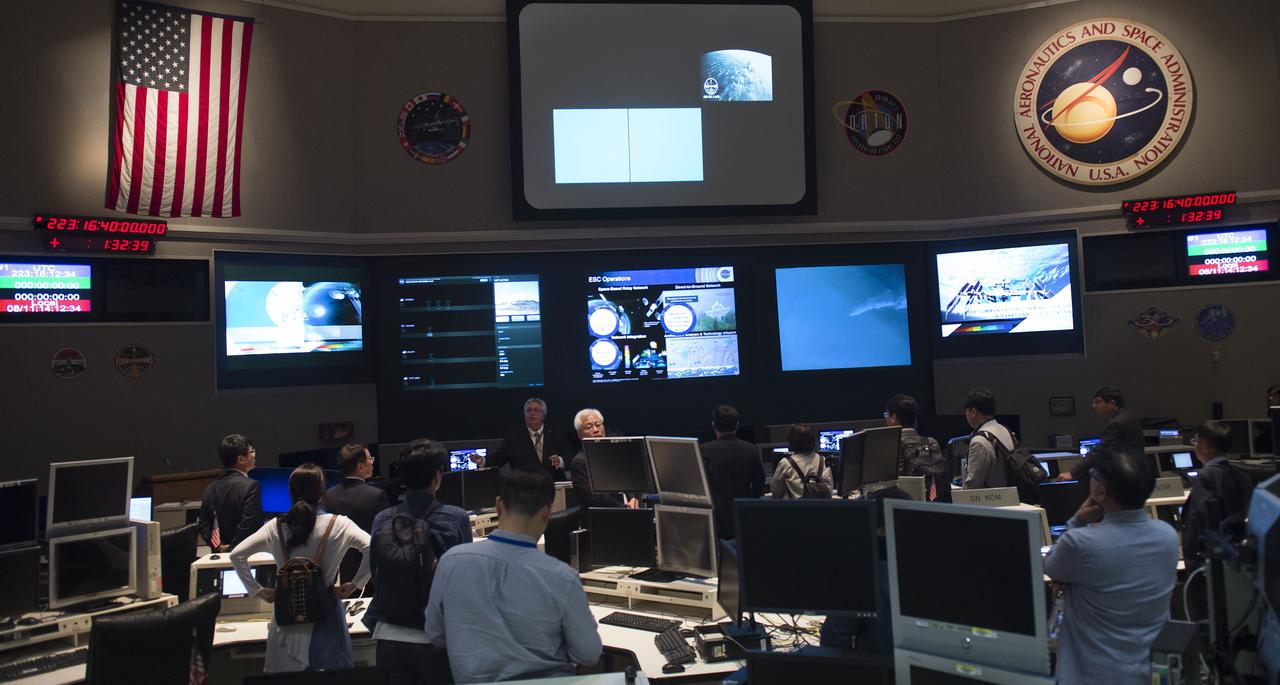
Korean delegates toured Goddard facilities with Center Director Chris Scolese on August 11, 2017
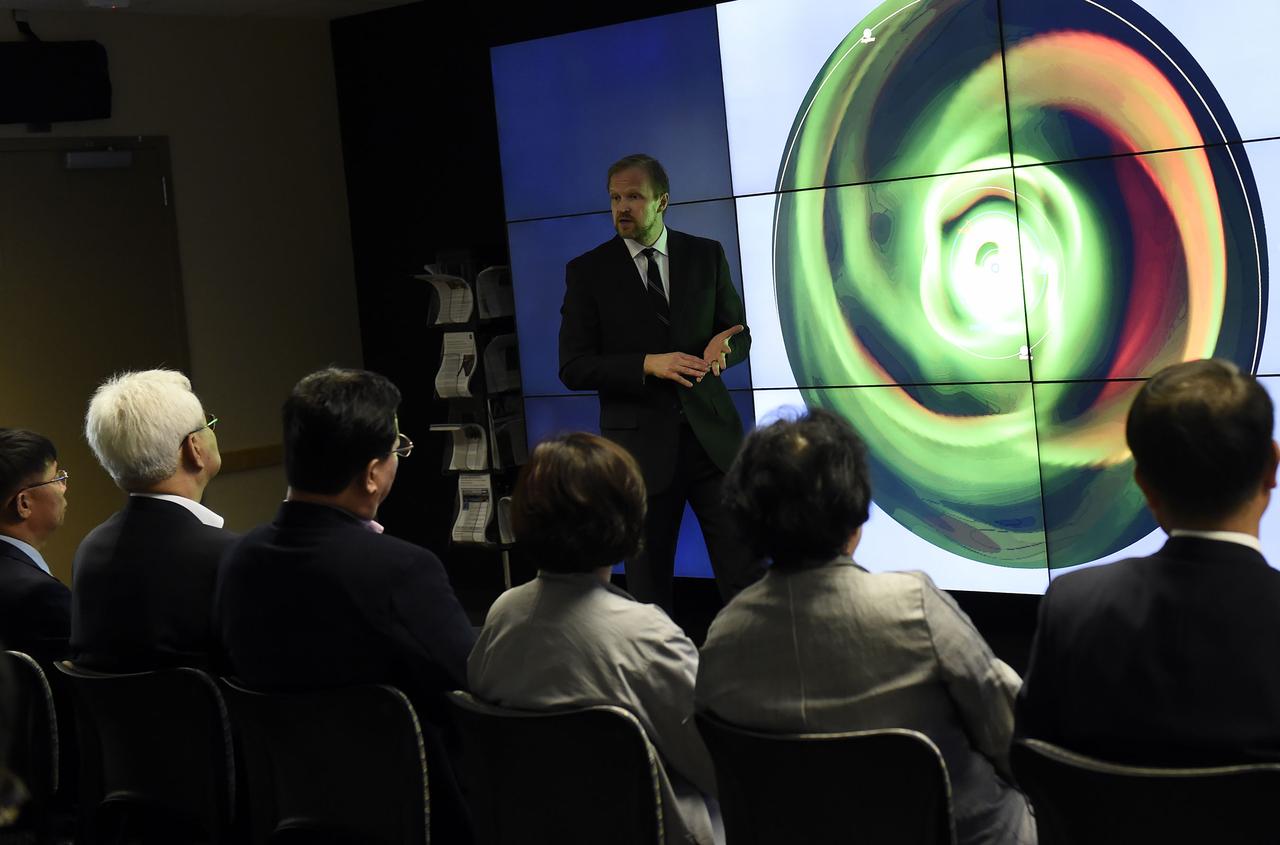
Korean delegates toured Goddard facilities with Center Director Chris Scolese on August 11, 2017
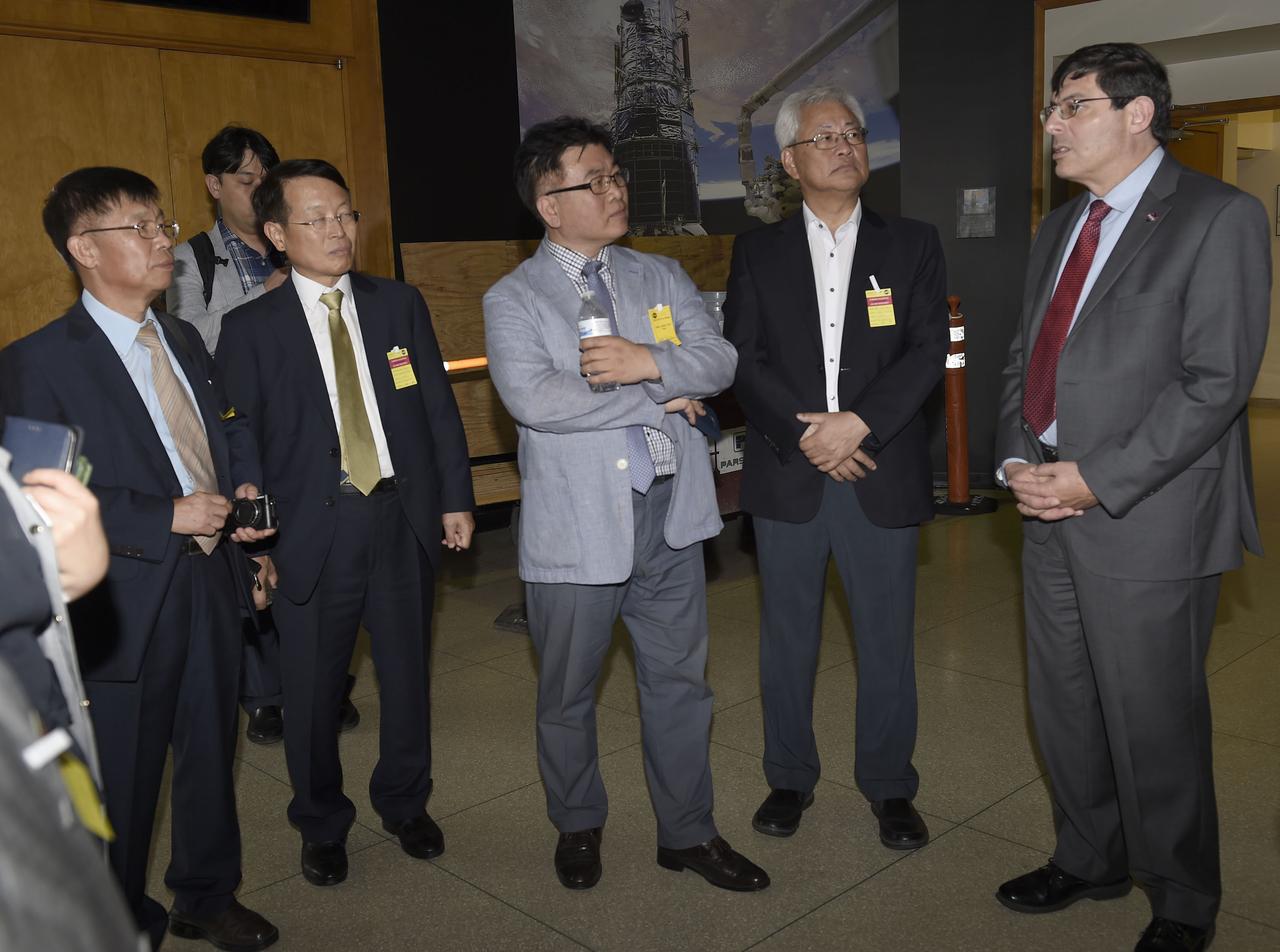
Korean delegates toured Goddard facilities with Center Director Chris Scolese on August 11, 2017
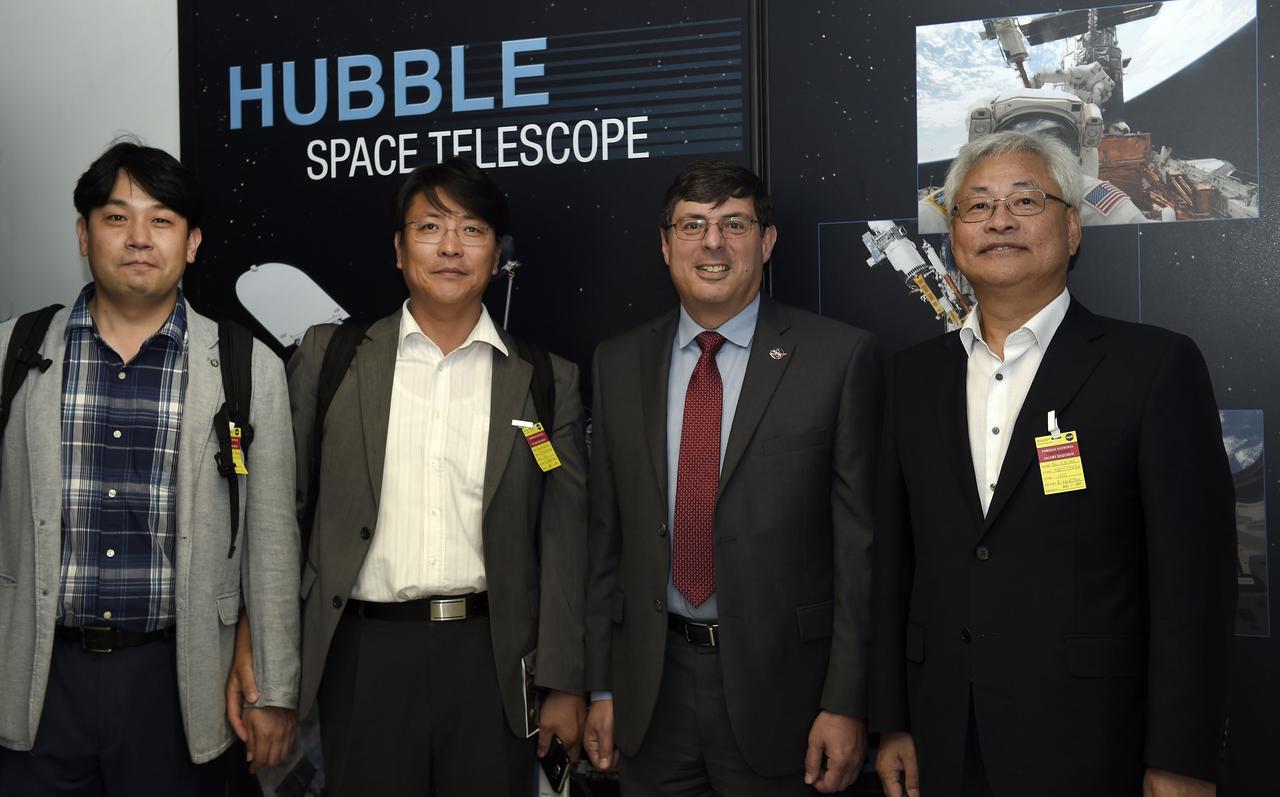
Korean delegates toured Goddard facilities with Center Director Chris Scolese on August 11, 2017

Maxime Faget explains a model of the Apollo Spacecraft to members of the Korean National Assembly.( 19431 thru 19432 ); MSC, HOUSTON, TX B&W
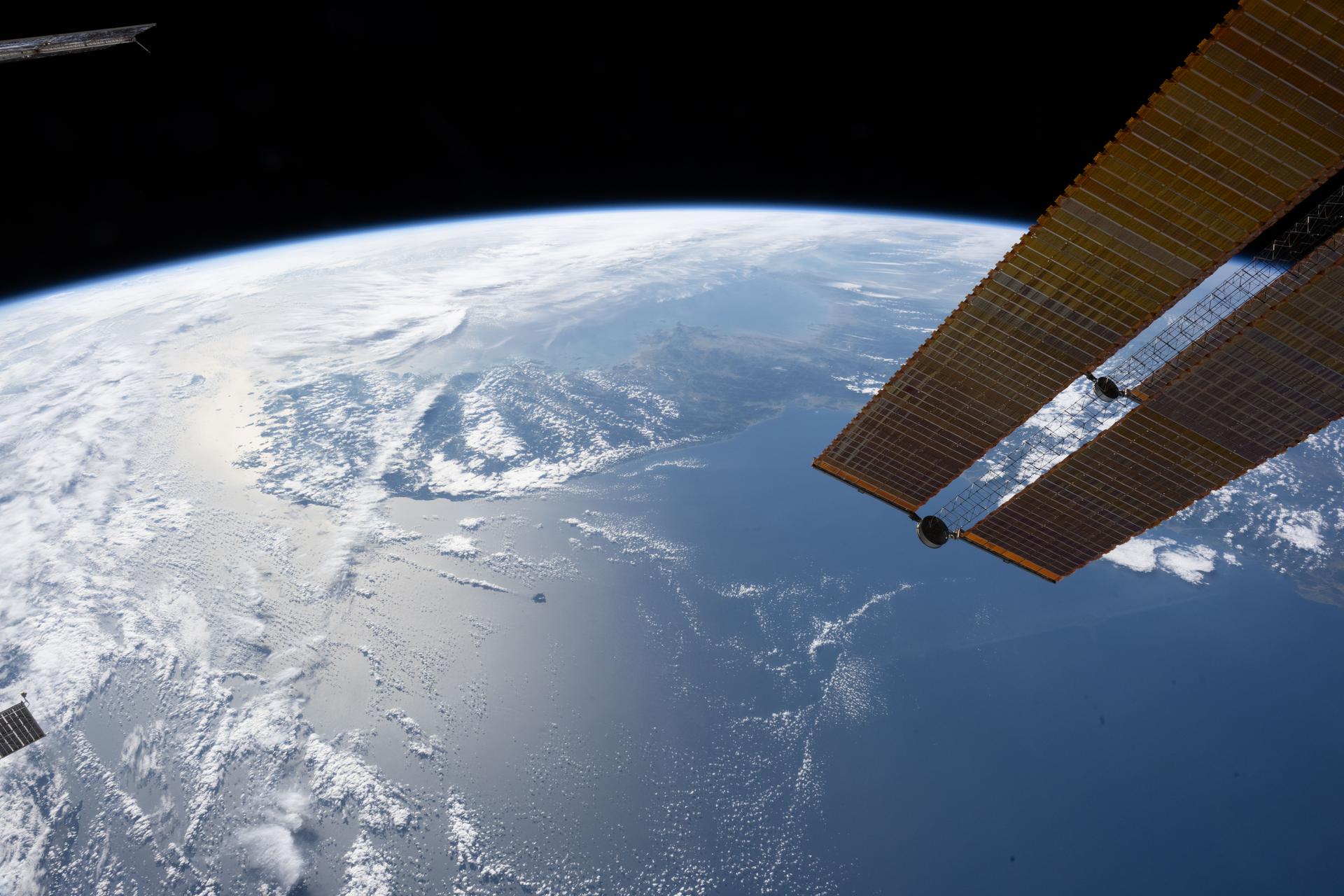
iss073e0983131 (Sept. 21, 2025) --- A partly cloudy Korean Peninsula, surrounded by the sun's glint reflecting off the Sea of Japan and the Yellow Sea, is pictured from the International Space Station as it orbited 259 miles above Earth off the coast of western Japan.
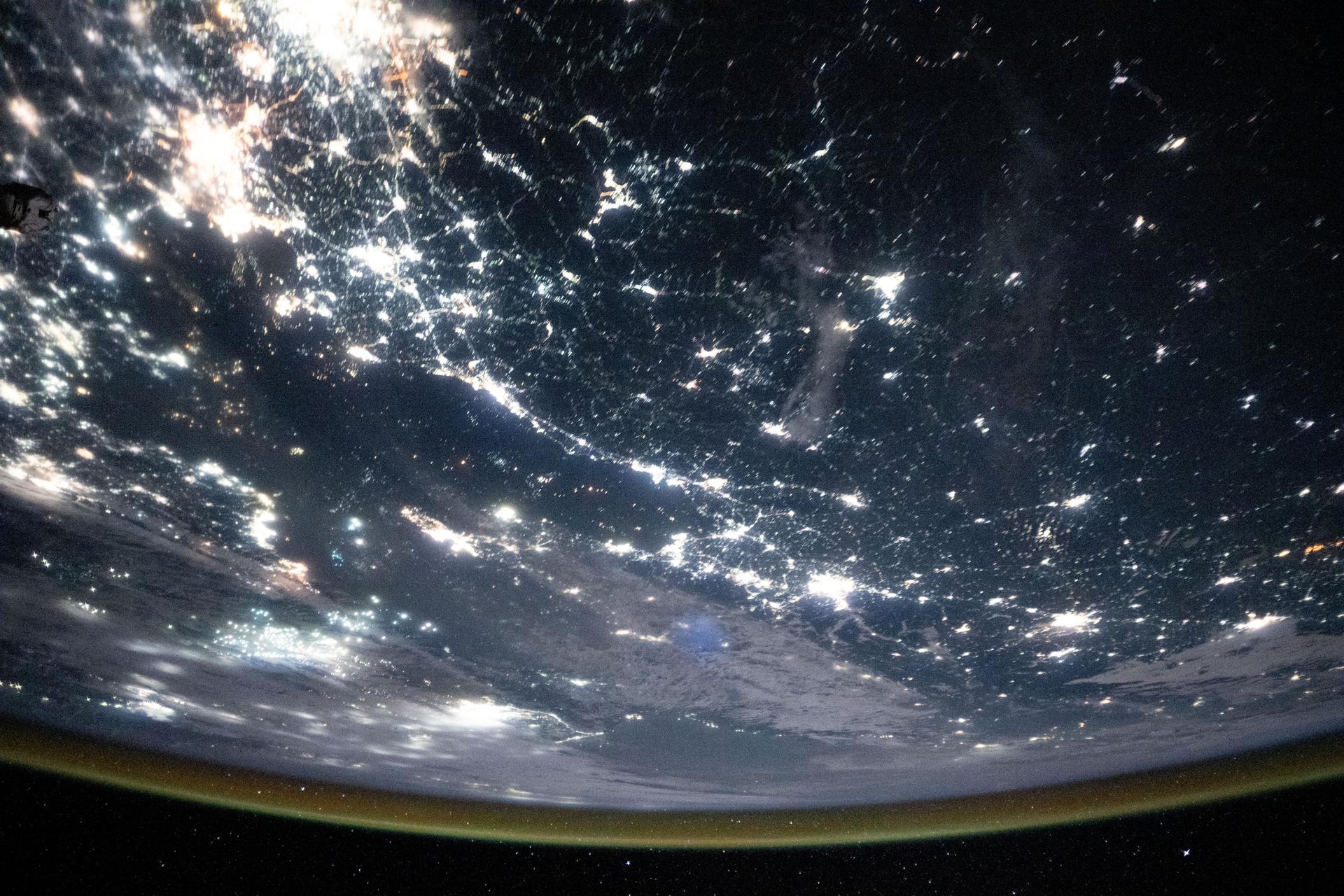
iss073e0824130 (Sept. 14, 2025) --- The Korean Peninsula—highlighted by Seoul, South Korea (bottom left)—and Northeast China—illuminated by the Beijing Municipality (top left)—are pictured from the International Space Station as it orbited 262 miles above Asia at approximately 12:42 a.m. local time.
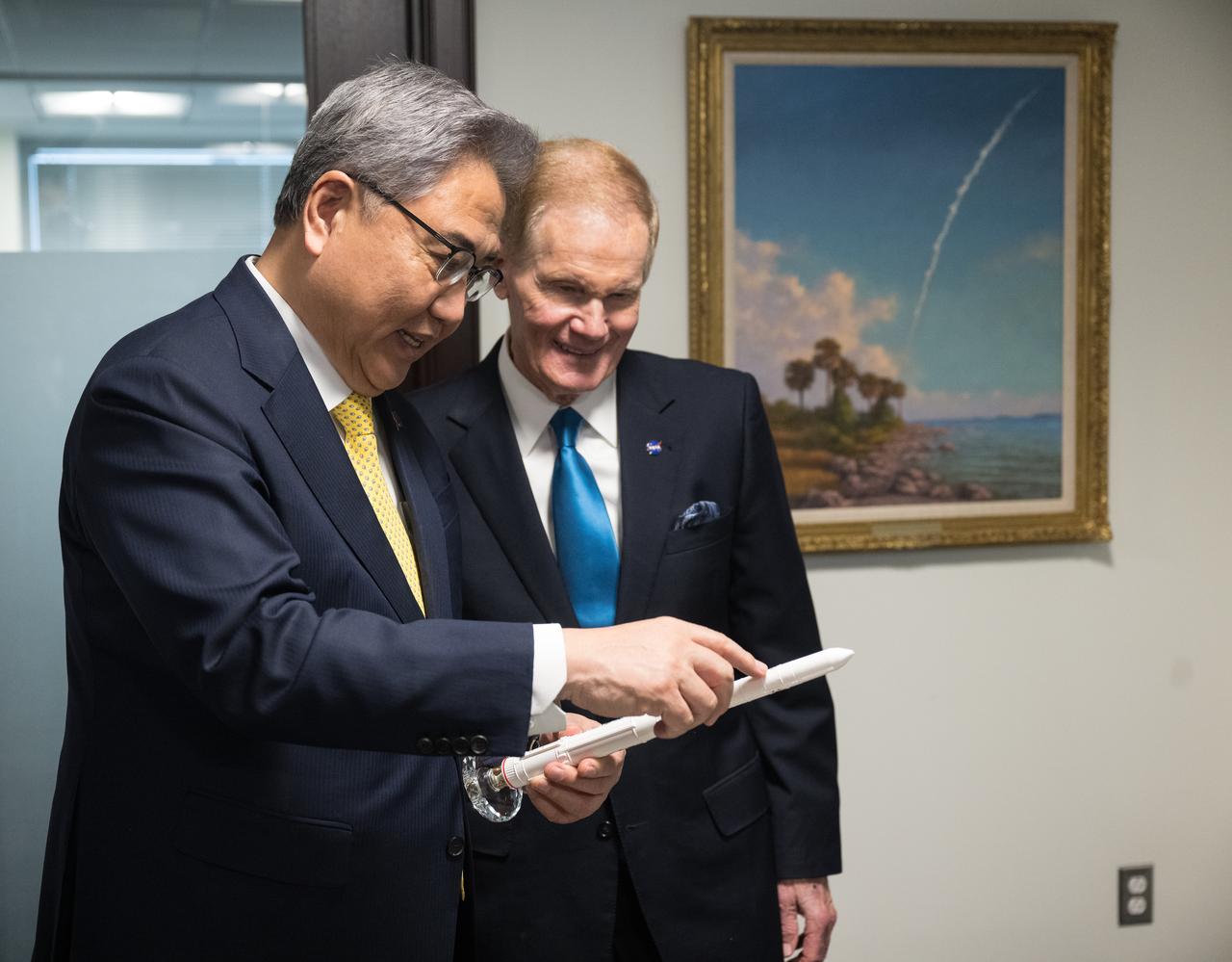
NASA Administrator Bill Nelson shows Republic of Korea Minister of Foreign Affairs, Jin Park, a model of the Korean Space Launch Vehicle-II, Thursday, Feb. 2, 2023 at the Mary W. Jackson NASA Headquarters building in Washington DC. Photo Credit: (NASA/Aubrey Gemignani)
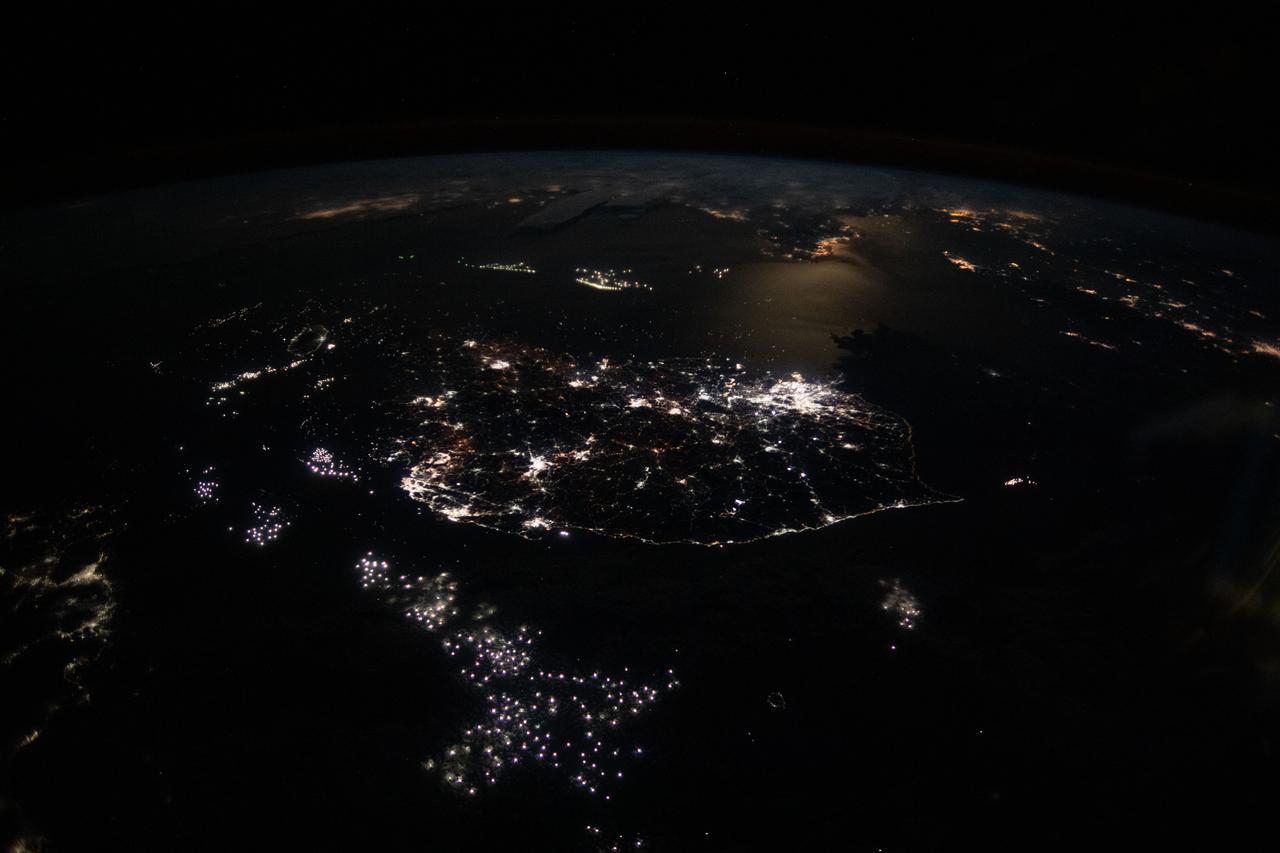
iss061e120106 (Jan. 4, 2020) --- The lights of South Korean cities and fishing boats on the Sea of Japan and the Yellow Sea are pictured as the International Space Station orbited 260 miles in altitude off the coast of Japan near Hiroshima. The brightest city lights toward the center represent the South Korean capital city of Seoul.
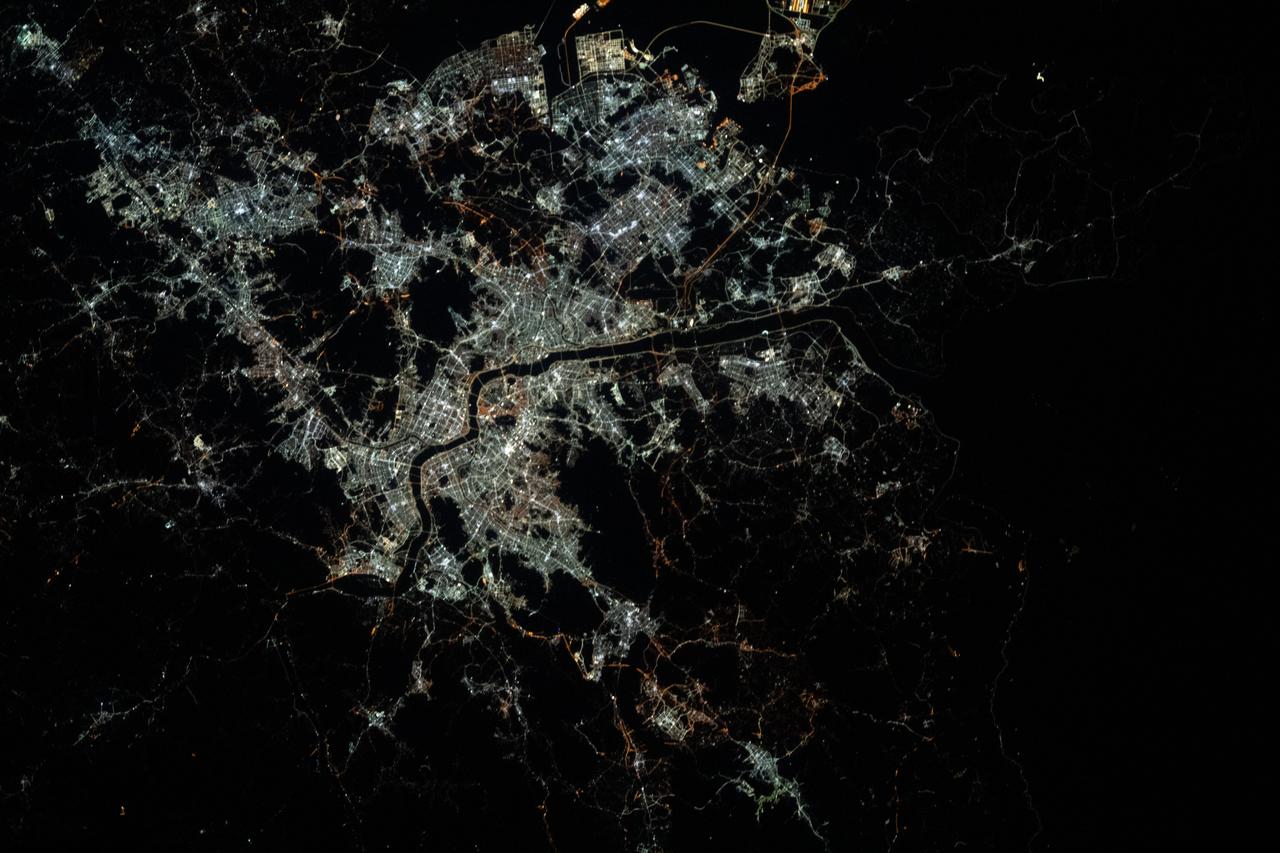
iss062e082060 (March 5, 2020) --- The night lights of Seoul, South Korea, and surrounding cities are pictured from the International Space Station as it orbited 261 miles above the Korean peninsula.
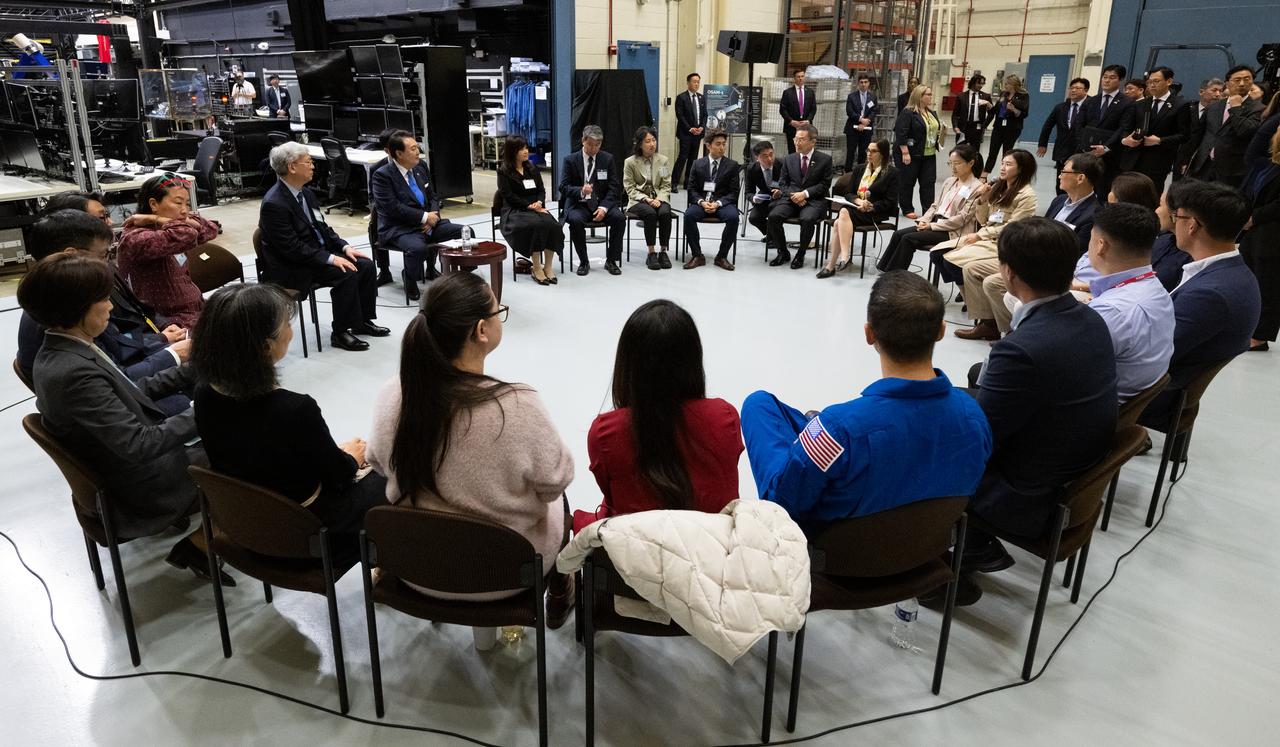
President Yoon Suk Yeol of the Republic of Korea meets with Korean-American employees during a tour of NASA’s Goddard Space Flight Center, Tuesday, April 25, 2023, in Greenbelt, Md. Photo Credit: (NASA/Joel Kowsky)
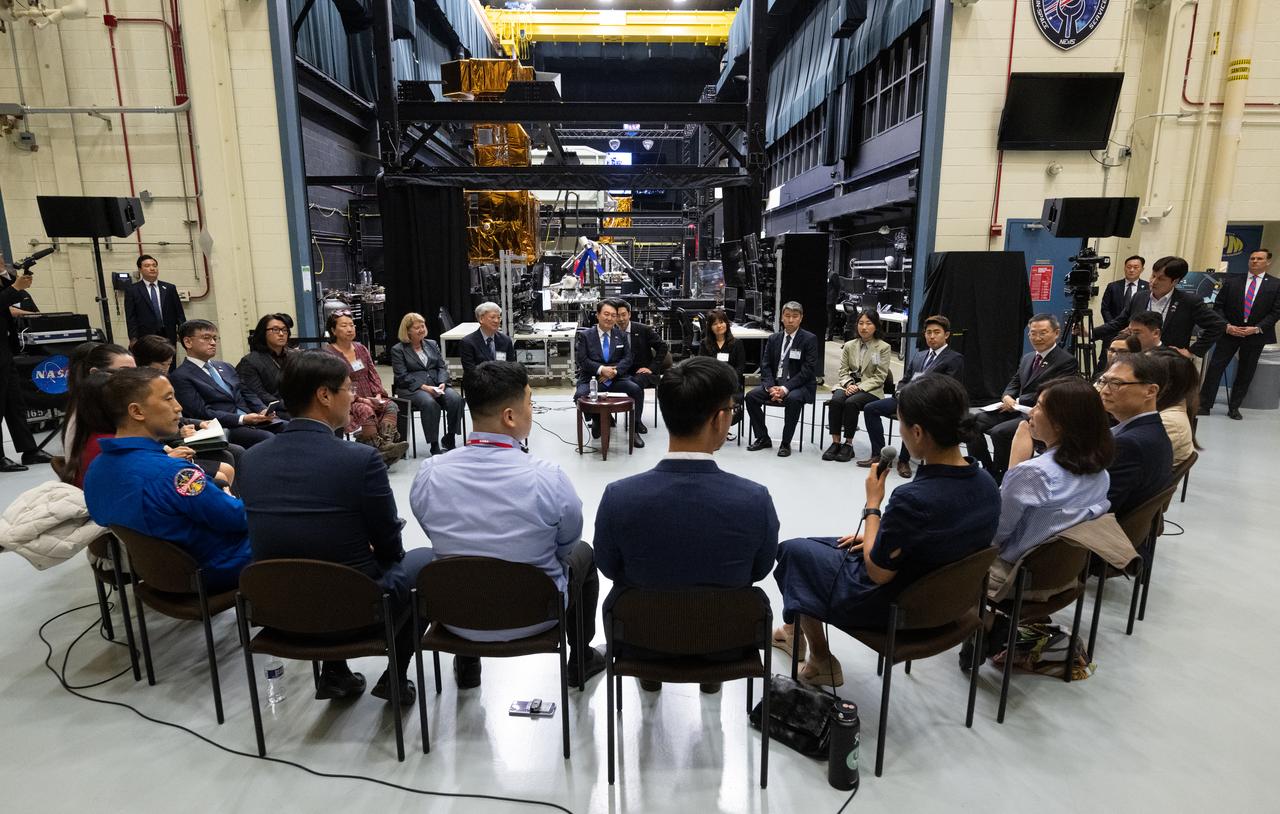
President Yoon Suk Yeol of the Republic of Korea, center, meets with Korean-American employees during a tour of NASA’s Goddard Space Flight Center, Tuesday, April 25, 2023, in Greenbelt, Md. Photo Credit: (NASA/Joel Kowsky)
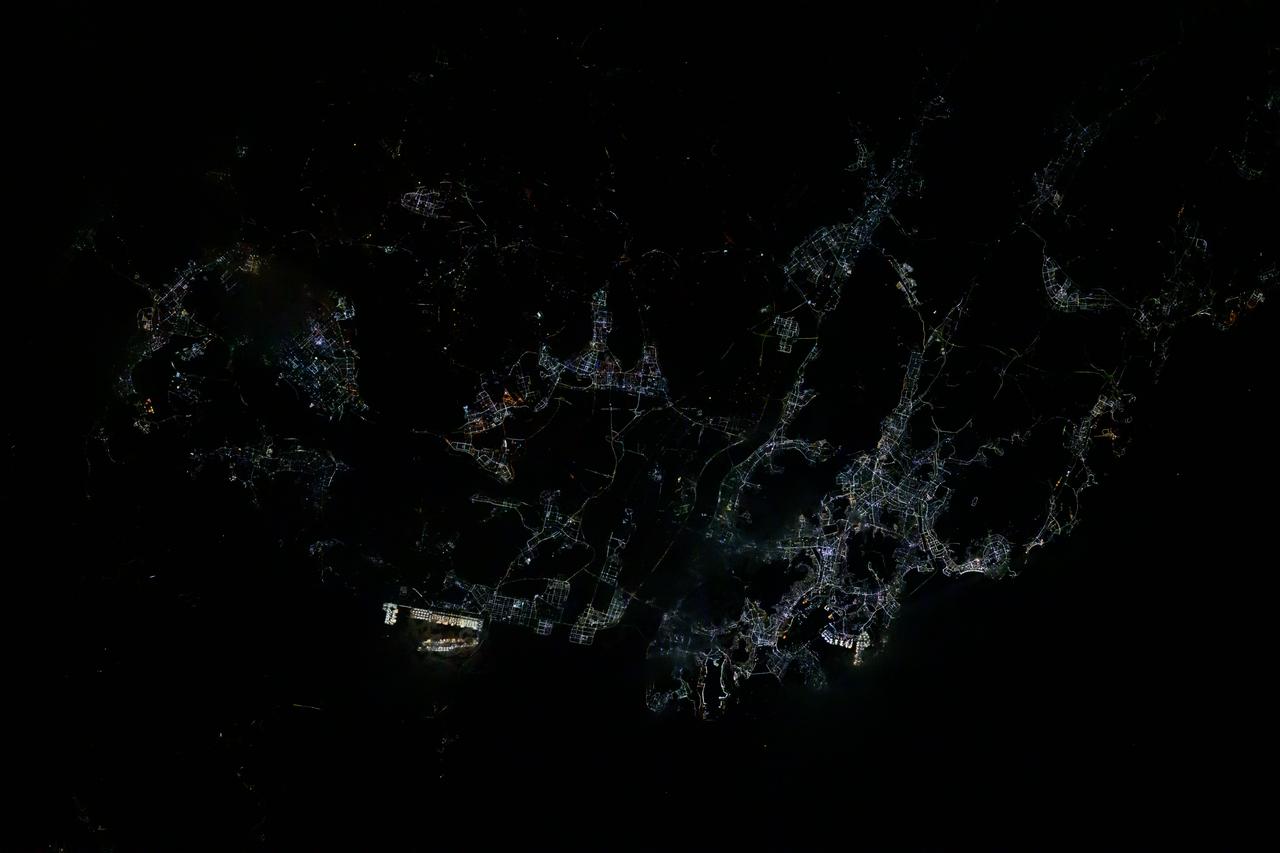
iss072e399852 (Dec. 20, 2024) --- The city lights of Busan, South Korea, a port city with a population of over 3.3 million on the Korean Strait, are pictured at approximately 4:19 a.m. local time from the International Space Station as it orbited 257 miles above.
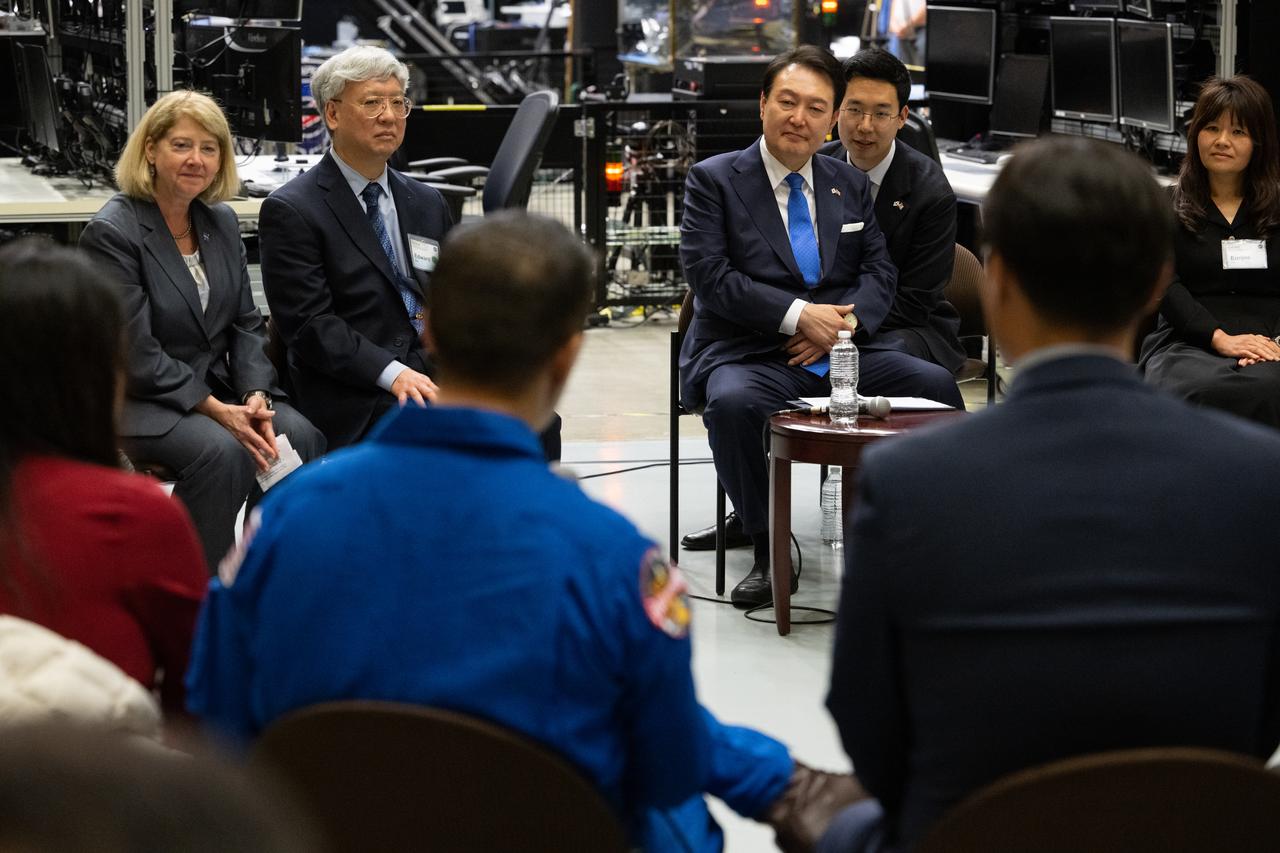
NASA Deputy Administrator Pam Melroy left, is seen along with President Yoon Suk Yeol of the Republic of Korea, right, as he meets with Korean-American employees during a tour of NASA’s Goddard Space Flight Center, Tuesday, April 25, 2023, in Greenbelt, Md. Photo Credit: (NASA/Joel Kowsky)
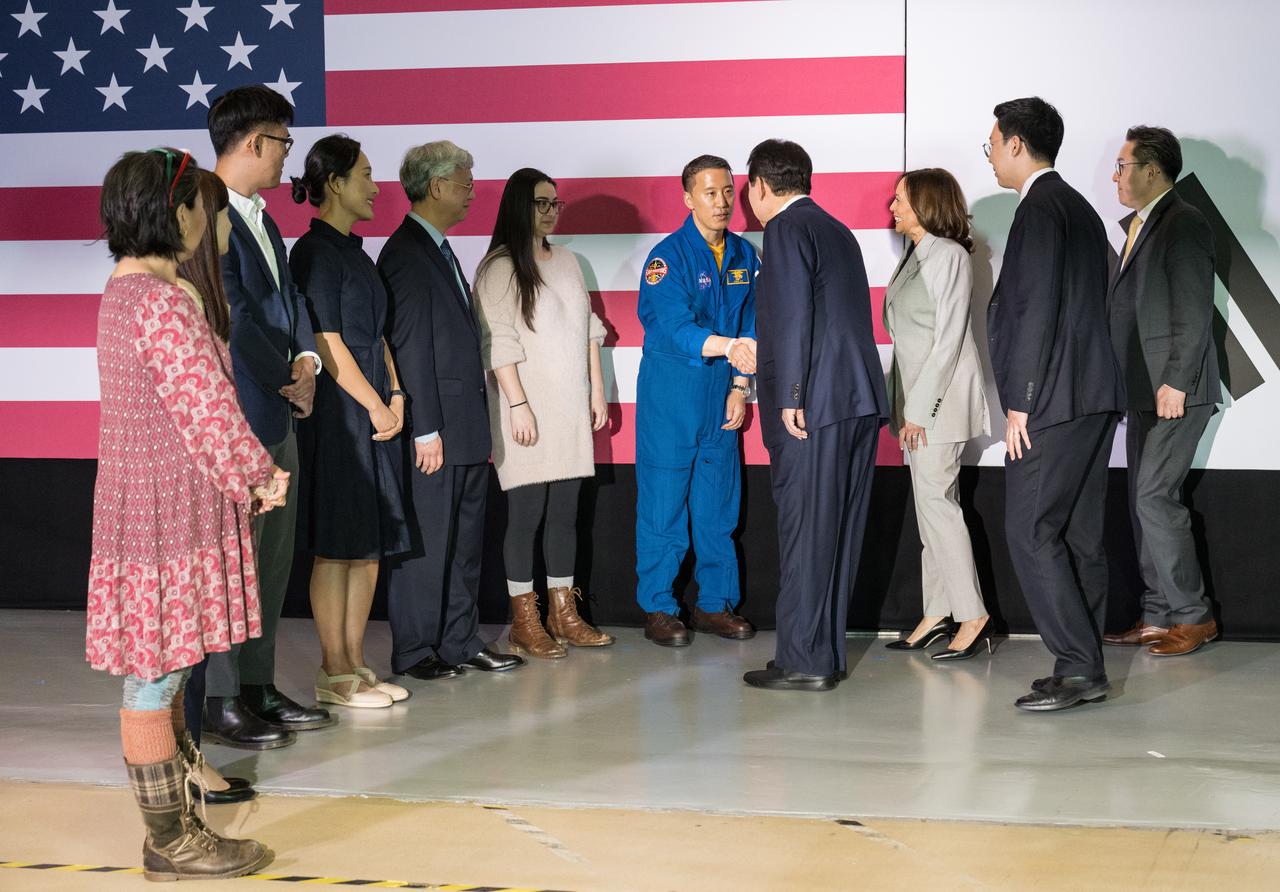
President Yoon Suk Yeol of the Republic of Korea shakes hands with NASA astronaut Jonny Kim as he and Vice President Kamala Harris meet with Korean-American scientists during a tour of NASA’s Goddard Space Flight Center, Tuesday, April 25, 2023, in Greenbelt, Md. Photo Credit: (NASA/Aubrey Gemignani)

NASA astronaut Jonny Kim shakes hands with President Yoon Suk Yeol of the Republic of Korea as he and Vice President Kamala Harris meet with Korean-American scientists during a tour of NASA’s Goddard Space Flight Center, Tuesday, April 25, 2023, in Greenbelt, Md. Photo Credit: (NASA/Joel Kowsky)
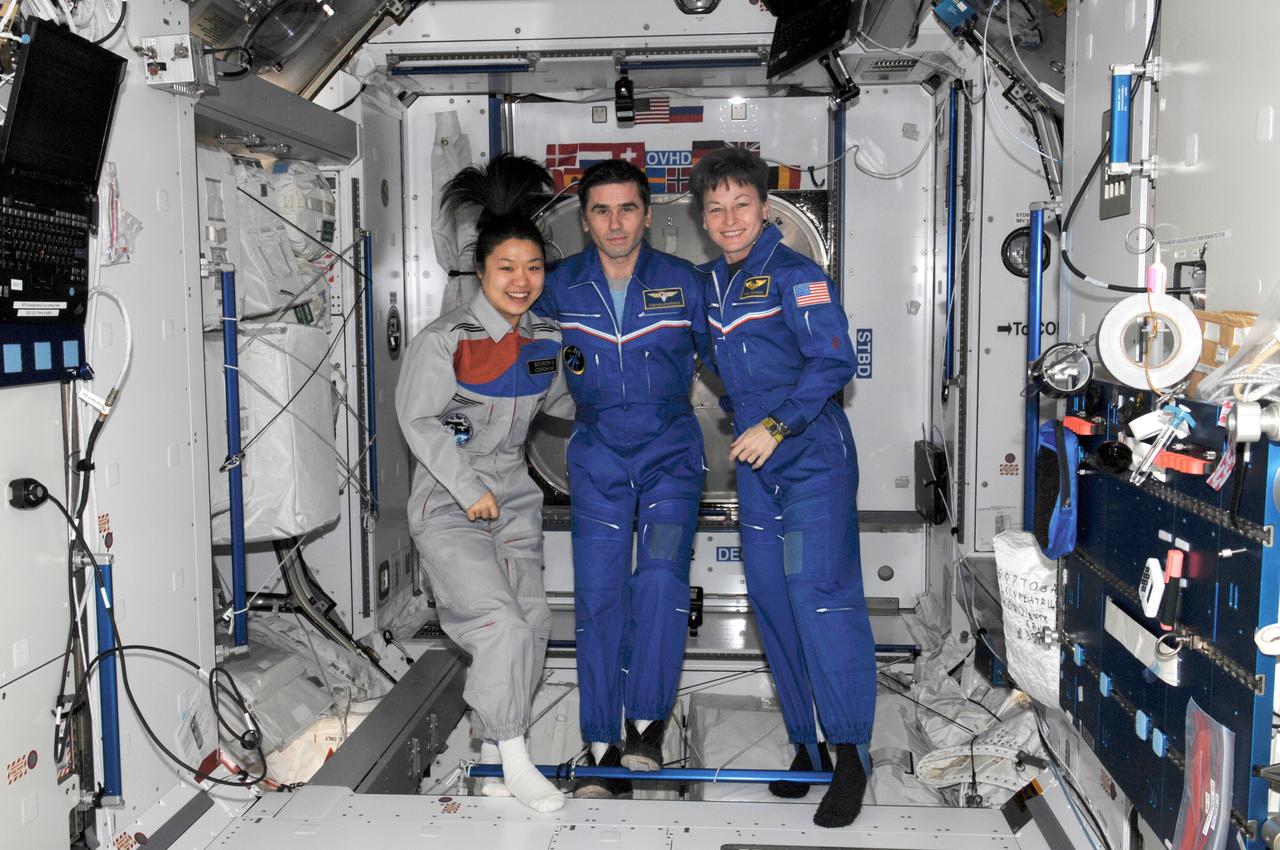
ISS016-E-036365 (17 April 2008) --- NASA astronaut Peggy Whitson (right), Expedition 16 commander; Russian Federal Space Agency cosmonaut Yuri Malenchenko, flight engineer; and South Korean spaceflight participant So-yeon Yi pose for a photo in the Harmony node of the International Space Station.

NASA astronaut Jonny Kim is seen as President Yoon Suk Yeol of the Republic of Korea meets with Korean-American employees during a tour of NASA’s Goddard Space Flight Center, Tuesday, April 25, 2023, in Greenbelt, Md. Photo Credit: (NASA/Joel Kowsky)

NASA Deputy Administrator Pam Melroy speaks with Korean-American scientists during a tour of NASA’s Goddard Space Flight Center with Vice President Kamala Harris and President Yoon Suk Yeol of the Republic of Korea, Tuesday, April 25, 2023, in Greenbelt, Md. Photo Credit: (NASA/Joel Kowsky)
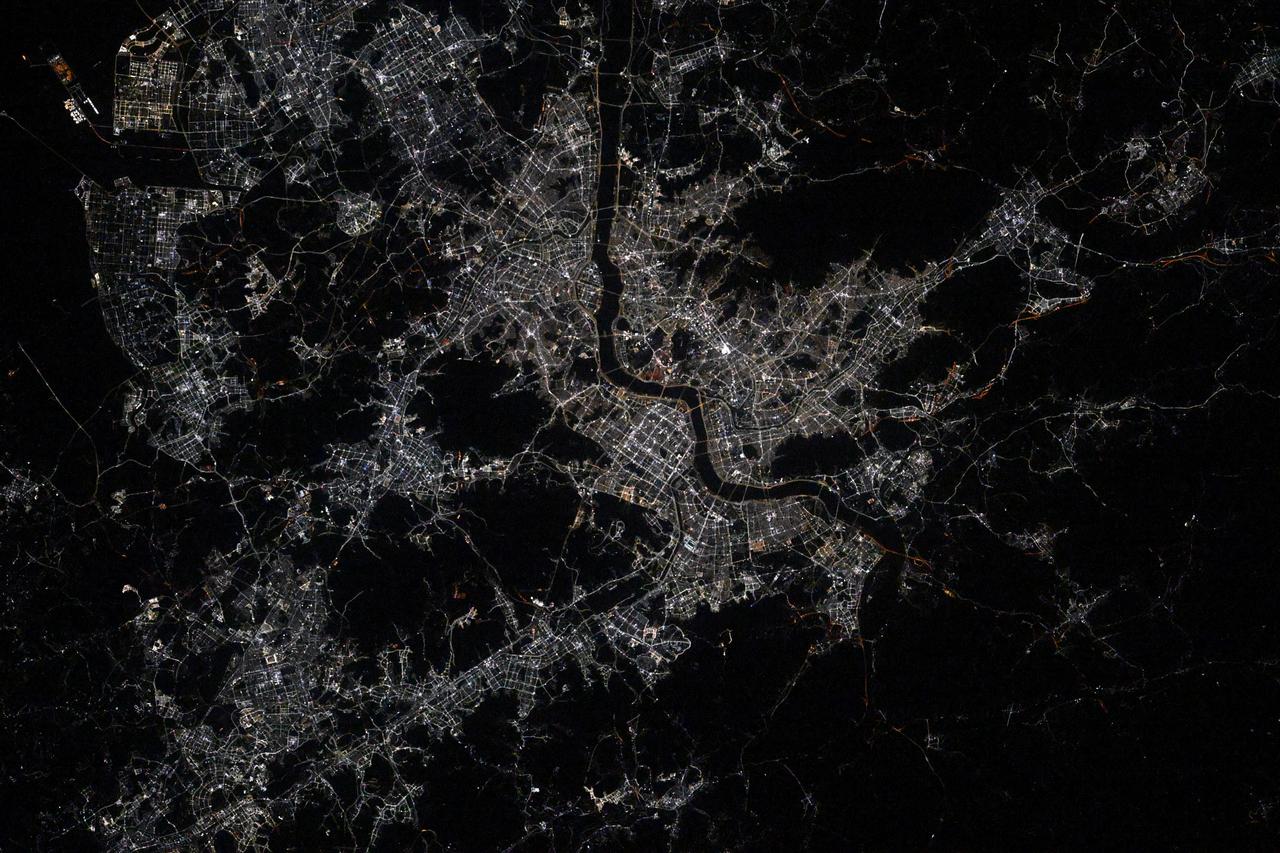
iss073e0003716 (April 24, 2025) --- Seoul, South Korea, the capital of the nation on the southern half of the Korean Peninsula with a population of about 9.6 million and split by the Han River, is pictured at approximately 2:58 a.m. local time from the International Space Station as it orbited 259 miles above the Sea of Japan.
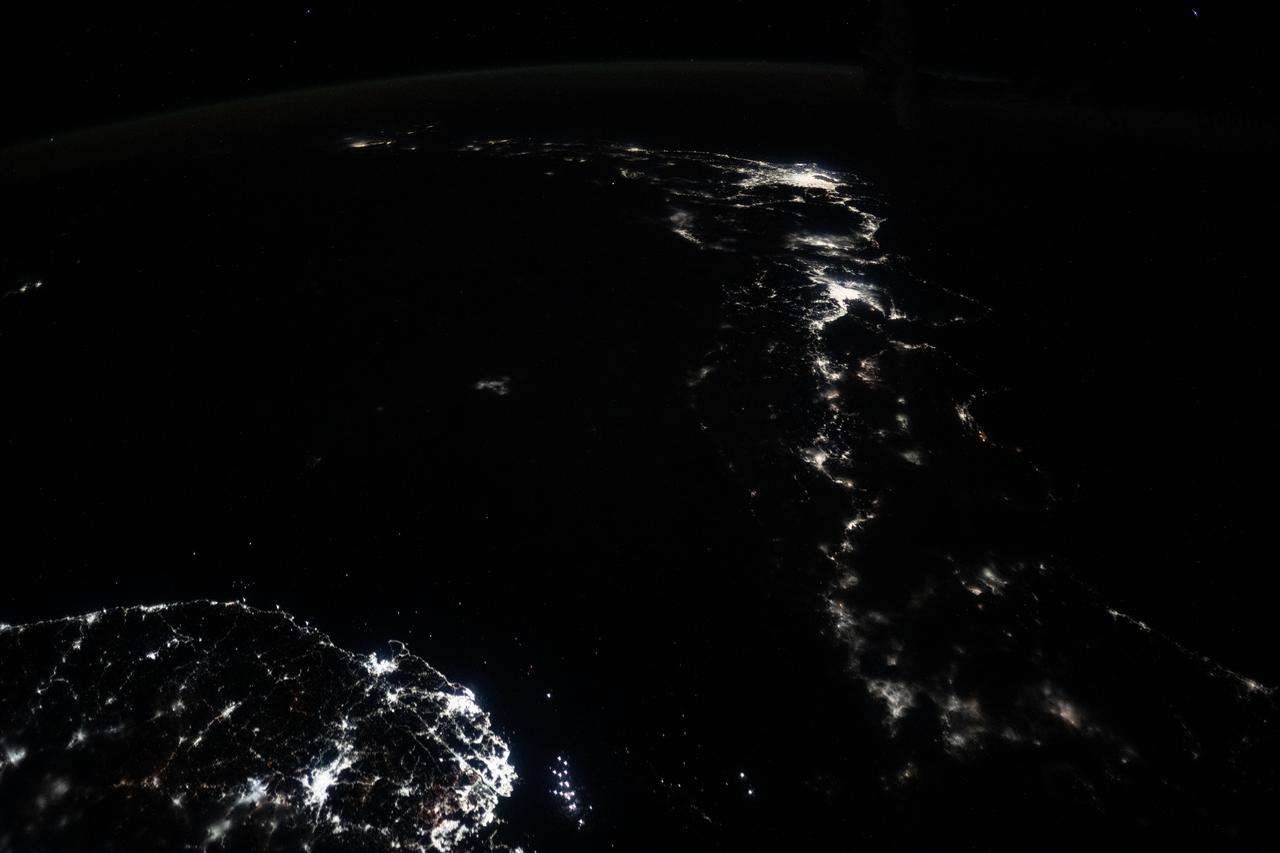
iss072e436132 (Dec. 28, 2024) --- The Korea Strait separates Busan, Korea (bottom left), and Fukuoka, Japan, in this photograph taken approximately 12:55 a.m. local time from the International Space Station as it orbited 258 miles above the Korean coast. Toward the top right, are the city lights of Osaka, Nagoya, and Tokyo.

Vice President Kamala Harris and President Yoon Suk Yeol of the Republic of Korea speak with Korean-American scientists during a tour of NASA’s Goddard Space Flight Center, Tuesday, April 25, 2023, in Greenbelt, Md. Photo Credit: (NASA/Aubrey Gemignani)
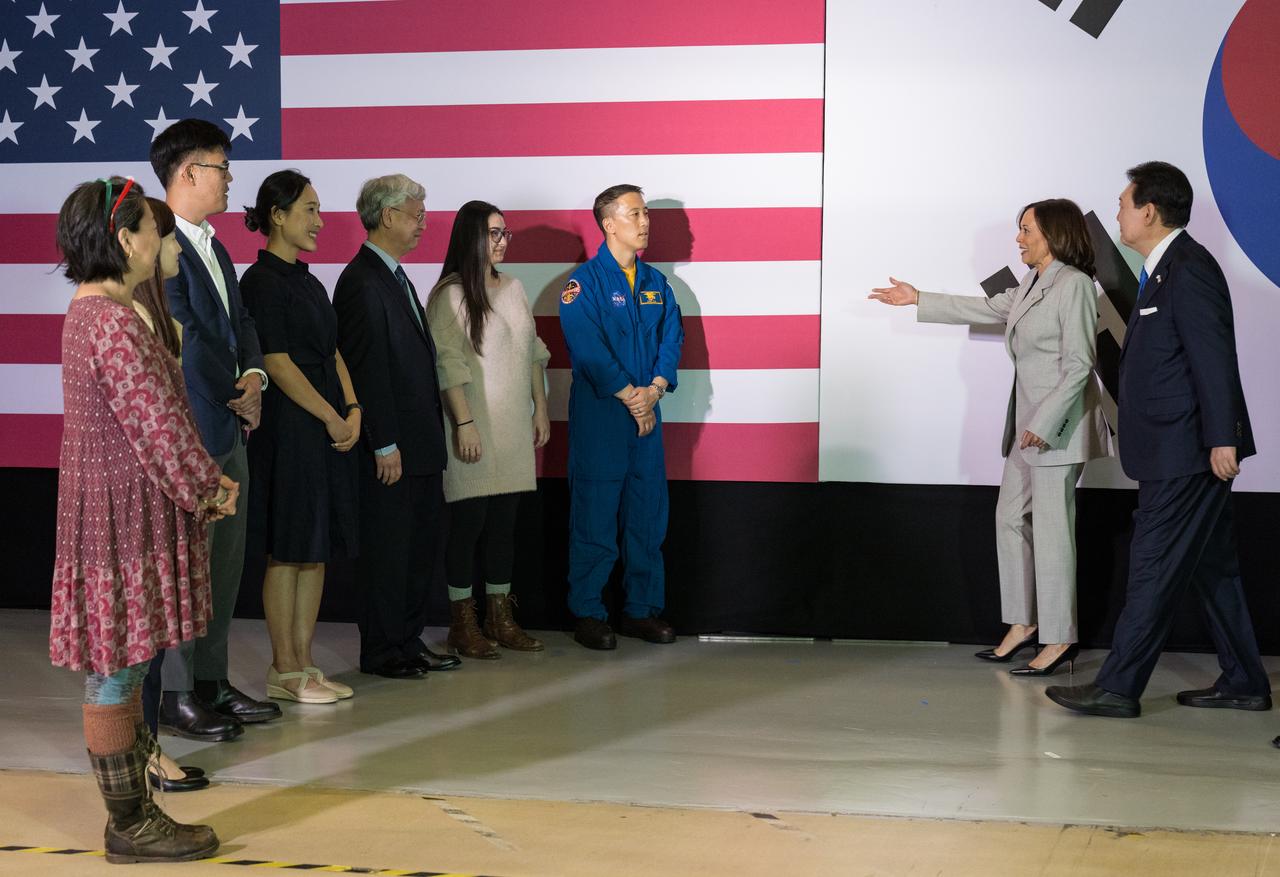
Vice President Kamala Harris and President Yoon Suk Yeol of the Republic of Korea speak with Korean-American scientists during a tour of NASA’s Goddard Space Flight Center, Tuesday, April 25, 2023, in Greenbelt, Md. Photo Credit: (NASA/Aubrey Gemignani)

Vice President Kamala Harris and President Yoon Suk Yeol of the Republic of Korea speak with Korean-American scientists during a tour of NASA’s Goddard Space Flight Center, Tuesday, April 25, 2023, in Greenbelt, Md. Photo Credit: (NASA/Aubrey Gemignani)
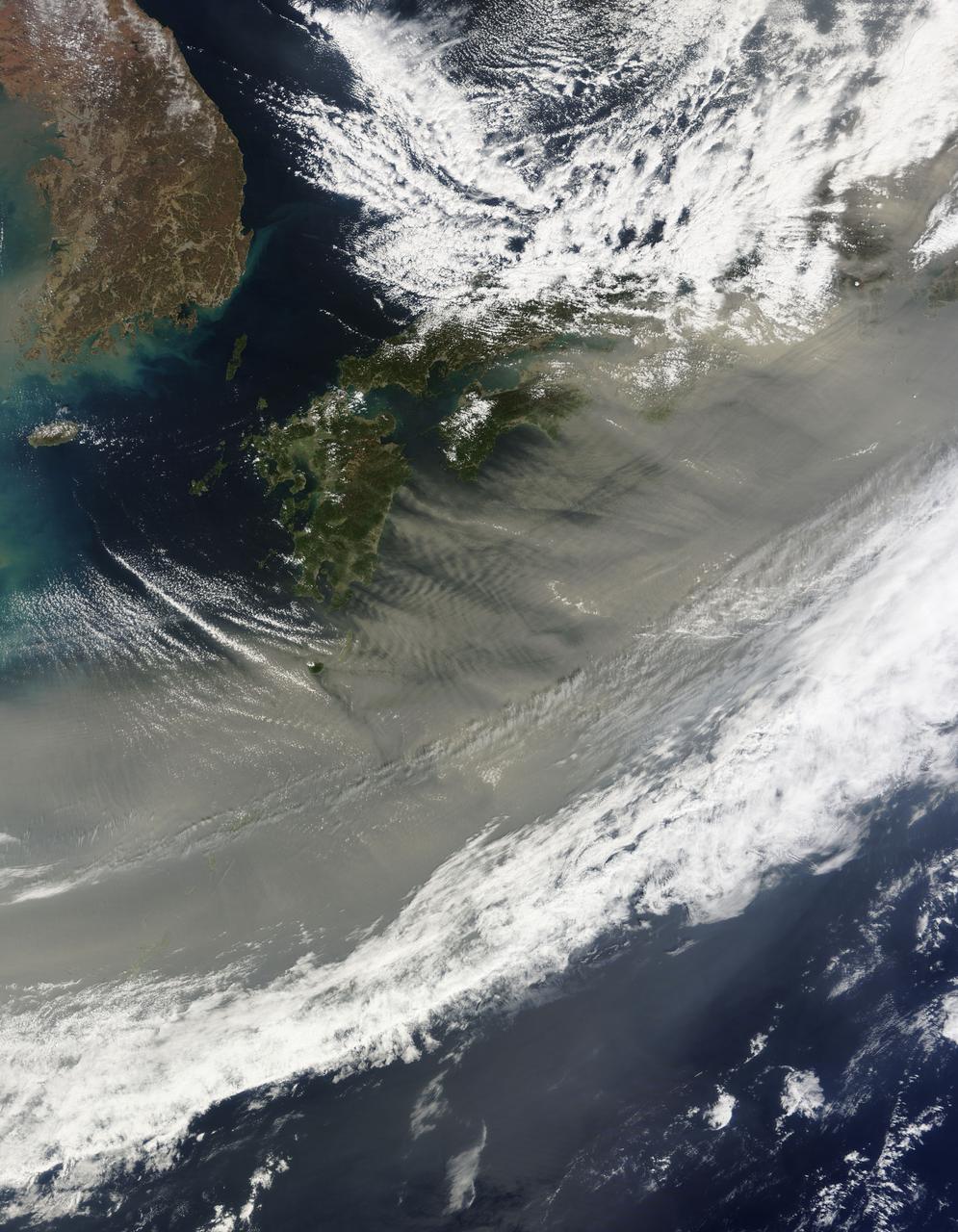
March 24, 2010 - Dust over Japan This image of gray/brown dust being blown over Japan was captured on March 21, 2010 by the MODIS on the Terra satellite. On the left is the Korean peninsula. Japan stretches diagonally across the image, up to the top right corner. The dust is likely from the sandstorm that swept across the China the previous day. The sand and dust originated from the south and east of Inner Mongolia. In this image from March 20, the dust is nearly obscuring the Bohai Sea, which is just west of the Korean peninsula. Here is a handy map. For more information related to this image go to: <a href="http://modis.gsfc.nasa.gov/gallery/individual.php?db_date=2010-03-24" rel="nofollow">modis.gsfc.nasa.gov/gallery/individual.php?db_date=2010-0...</a> For more information about Goddard Space Flight Center go here: <a href="http://www.nasa.gov/centers/goddard/home/index.html" rel="nofollow">www.nasa.gov/centers/goddard/home/index.html</a>

As part of her visit to the United States, President Park Geun-hye of South Korea visited NASA’s Goddard Space Flight Center in Greenbelt, Md. On Oct. 14, 2015. The visit offered an opportunity to celebrate past collaborative efforts between the American and South Korean space programs along with presentations on current projects and programs underway at Goddard. Credit: NASA/Goddard/Bill Hrybyk <b><a href="http://www.nasa.gov/audience/formedia/features/MP_Photo_Guidelines.html" rel="nofollow">NASA image use policy.</a></b> <b><a href="http://www.nasa.gov/centers/goddard/home/index.html" rel="nofollow">NASA Goddard Space Flight Center</a></b> enables NASA’s mission through four scientific endeavors: Earth Science, Heliophysics, Solar System Exploration, and Astrophysics. Goddard plays a leading role in NASA’s accomplishments by contributing compelling scientific knowledge to advance the Agency’s mission. <b>Follow us on <a href="http://twitter.com/NASAGoddardPix" rel="nofollow">Twitter</a></b> <b>Like us on <a href="http://www.facebook.com/pages/Greenbelt-MD/NASA-Goddard/395013845897?ref=tsd" rel="nofollow">Facebook</a></b> <b>Find us on <a href="http://instagrid.me/nasagoddard/?vm=grid" rel="nofollow">Instagram</a></b>
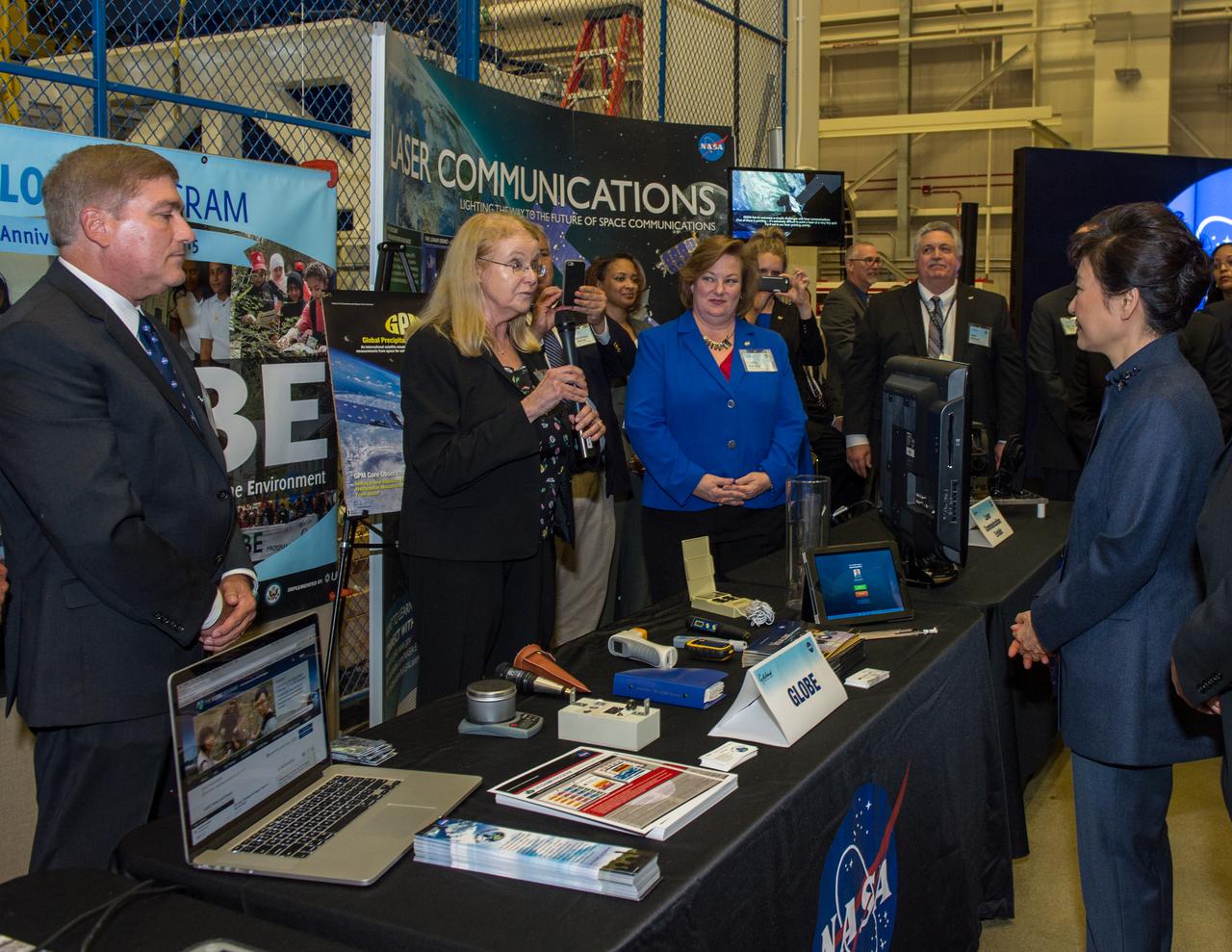
As part of her visit to the United States, President Park Geun-hye of South Korea visited NASA’s Goddard Space Flight Center in Greenbelt, Md. On Oct. 14, 2015. The visit offered an opportunity to celebrate past collaborative efforts between the American and South Korean space programs along with presentations on current projects and programs underway at Goddard. Credit: NASA/Goddard/Bill Hrybyk <b><a href="http://www.nasa.gov/audience/formedia/features/MP_Photo_Guidelines.html" rel="nofollow">NASA image use policy.</a></b> <b><a href="http://www.nasa.gov/centers/goddard/home/index.html" rel="nofollow">NASA Goddard Space Flight Center</a></b> enables NASA’s mission through four scientific endeavors: Earth Science, Heliophysics, Solar System Exploration, and Astrophysics. Goddard plays a leading role in NASA’s accomplishments by contributing compelling scientific knowledge to advance the Agency’s mission. <b>Follow us on <a href="http://twitter.com/NASAGoddardPix" rel="nofollow">Twitter</a></b> <b>Like us on <a href="http://www.facebook.com/pages/Greenbelt-MD/NASA-Goddard/395013845897?ref=tsd" rel="nofollow">Facebook</a></b> <b>Find us on <a href="http://instagrid.me/nasagoddard/?vm=grid" rel="nofollow">Instagram</a></b>
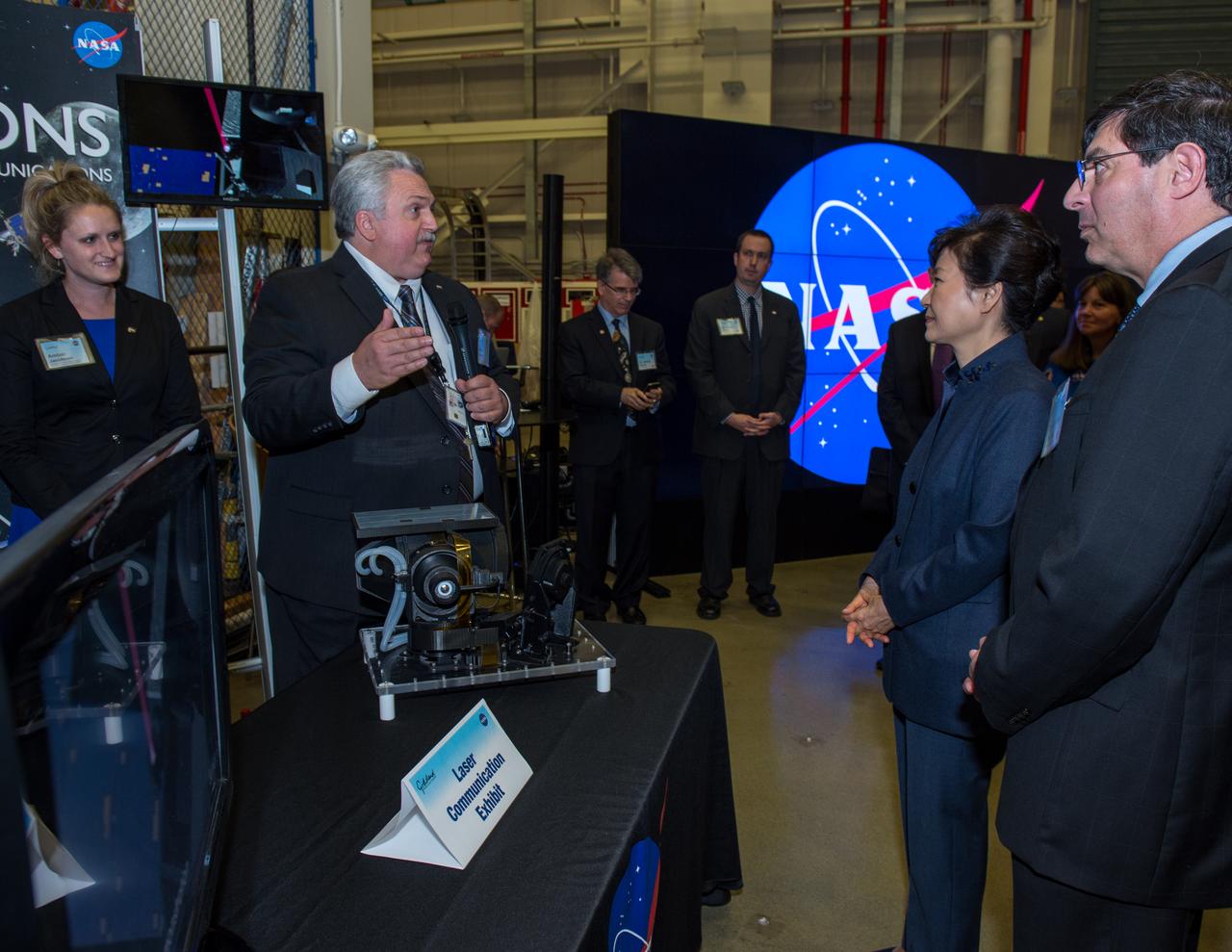
As part of her visit to the United States, President Park Geun-hye of South Korea visited NASA’s Goddard Space Flight Center in Greenbelt, Md. On Oct. 14, 2015. The visit offered an opportunity to celebrate past collaborative efforts between the American and South Korean space programs along with presentations on current projects and programs underway at Goddard. Credit: NASA/Goddard/Bill Hrybyk <b><a href="http://www.nasa.gov/audience/formedia/features/MP_Photo_Guidelines.html" rel="nofollow">NASA image use policy.</a></b> <b><a href="http://www.nasa.gov/centers/goddard/home/index.html" rel="nofollow">NASA Goddard Space Flight Center</a></b> enables NASA’s mission through four scientific endeavors: Earth Science, Heliophysics, Solar System Exploration, and Astrophysics. Goddard plays a leading role in NASA’s accomplishments by contributing compelling scientific knowledge to advance the Agency’s mission. <b>Follow us on <a href="http://twitter.com/NASAGoddardPix" rel="nofollow">Twitter</a></b> <b>Like us on <a href="http://www.facebook.com/pages/Greenbelt-MD/NASA-Goddard/395013845897?ref=tsd" rel="nofollow">Facebook</a></b> <b>Find us on <a href="http://instagrid.me/nasagoddard/?vm=grid" rel="nofollow">Instagram</a></b>
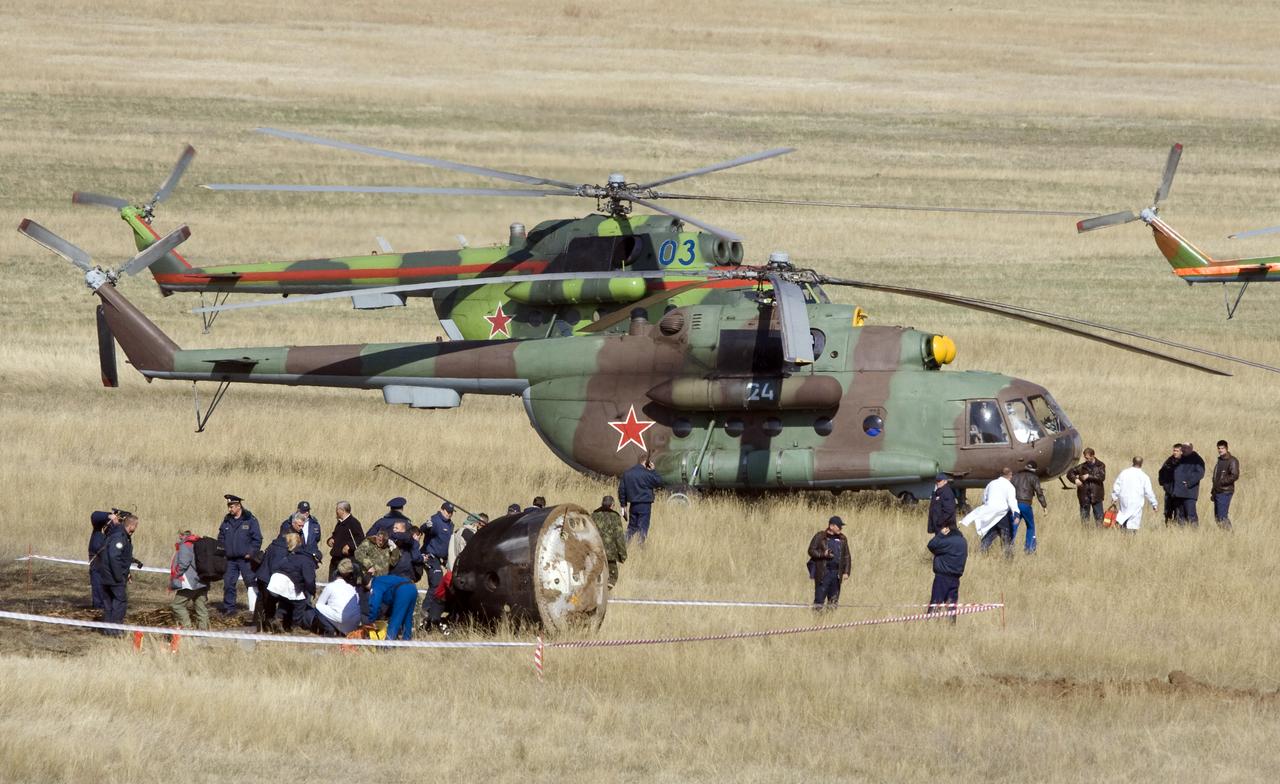
Russian ground crews walk around the Soyuz TMA-11 spacecraft after it landed carrying Expedition 16 Commander Peggy Whitson, Flight Engineer and Soyuz Commander Yuri Malenchenko and South Korean spaceflight participant So-yeon Yi, Friday, April 19, 2008, in central Kazakhstan to complete 192 days in space for Whitson and Malenchenko and 11 days in orbit for Yi. Photo Credit: (NASA/Reuters/Pool)
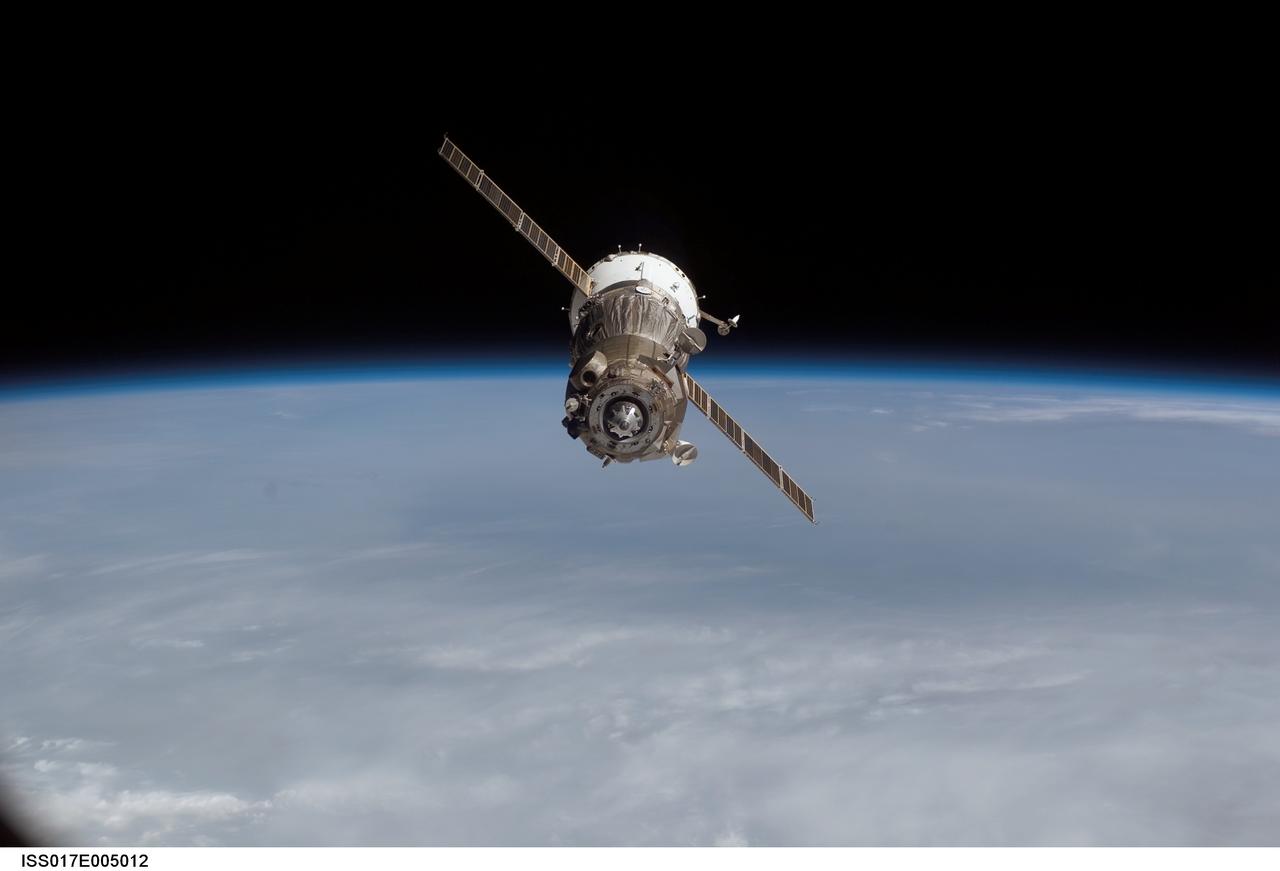
ISS017-E-005012 (19 April 2008) --- Backdropped by the blackness of space and Earth's horizon, the Soyuz TMA-11 spacecraft departs from the International Space Station carrying NASA astronaut Peggy Whitson, Expedition 16 commander; Russian Federal Space Agency cosmonaut Yuri Malenchenko, flight engineer and Soyuz commander; and South Korean spaceflight participant So-yeon Yi. Undocking occurred at 1:06 a.m. (EDT) on April 19, 2008.
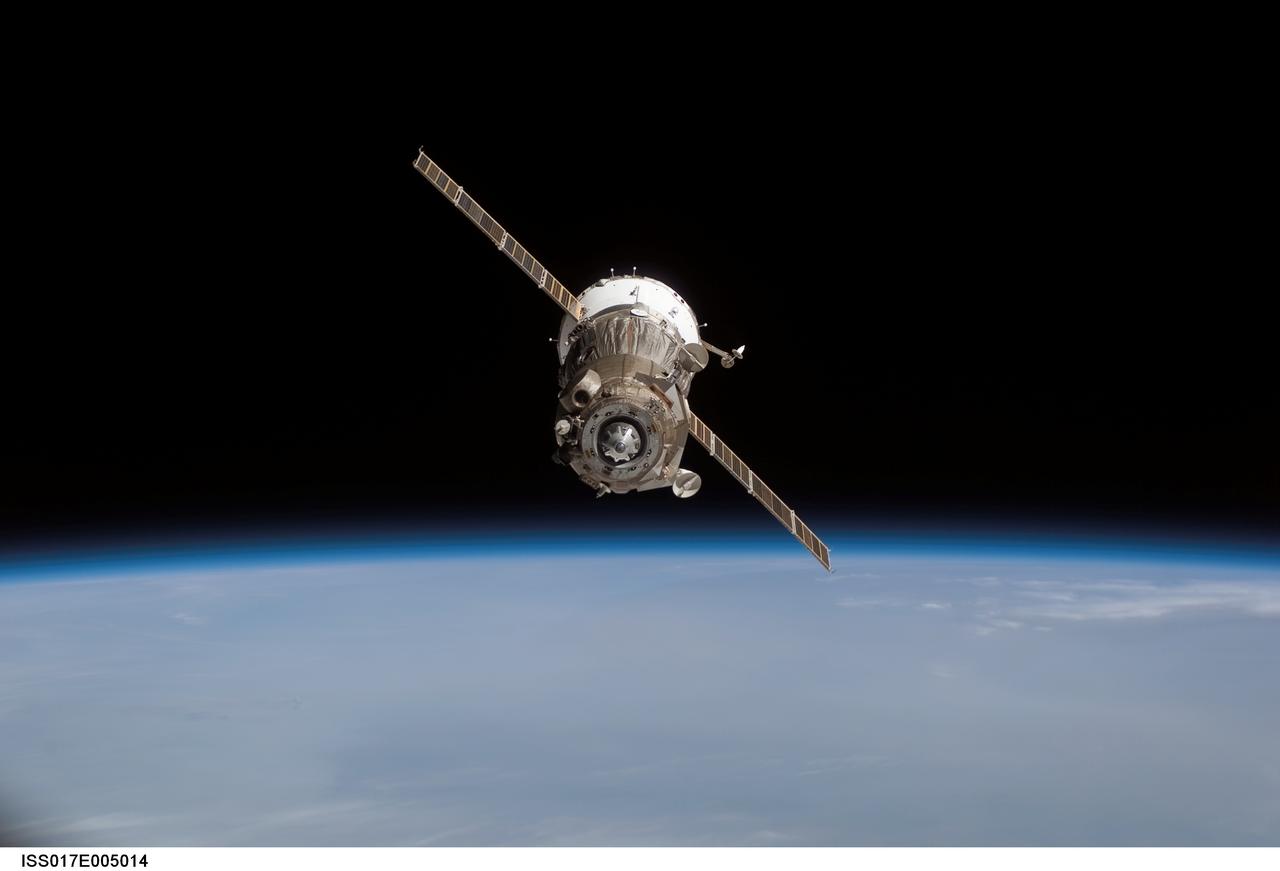
ISS017-E-005014 (19 April 2008) --- Backdropped by the blackness of space and Earth's horizon, the Soyuz TMA-11 spacecraft departs from the International Space Station carrying NASA astronaut Peggy Whitson, Expedition 16 commander; Russian Federal Space Agency cosmonaut Yuri Malenchenko, flight engineer and Soyuz commander; and South Korean spaceflight participant So-yeon Yi. Undocking occurred at 1:06 a.m. (EDT) on April 19, 2008.
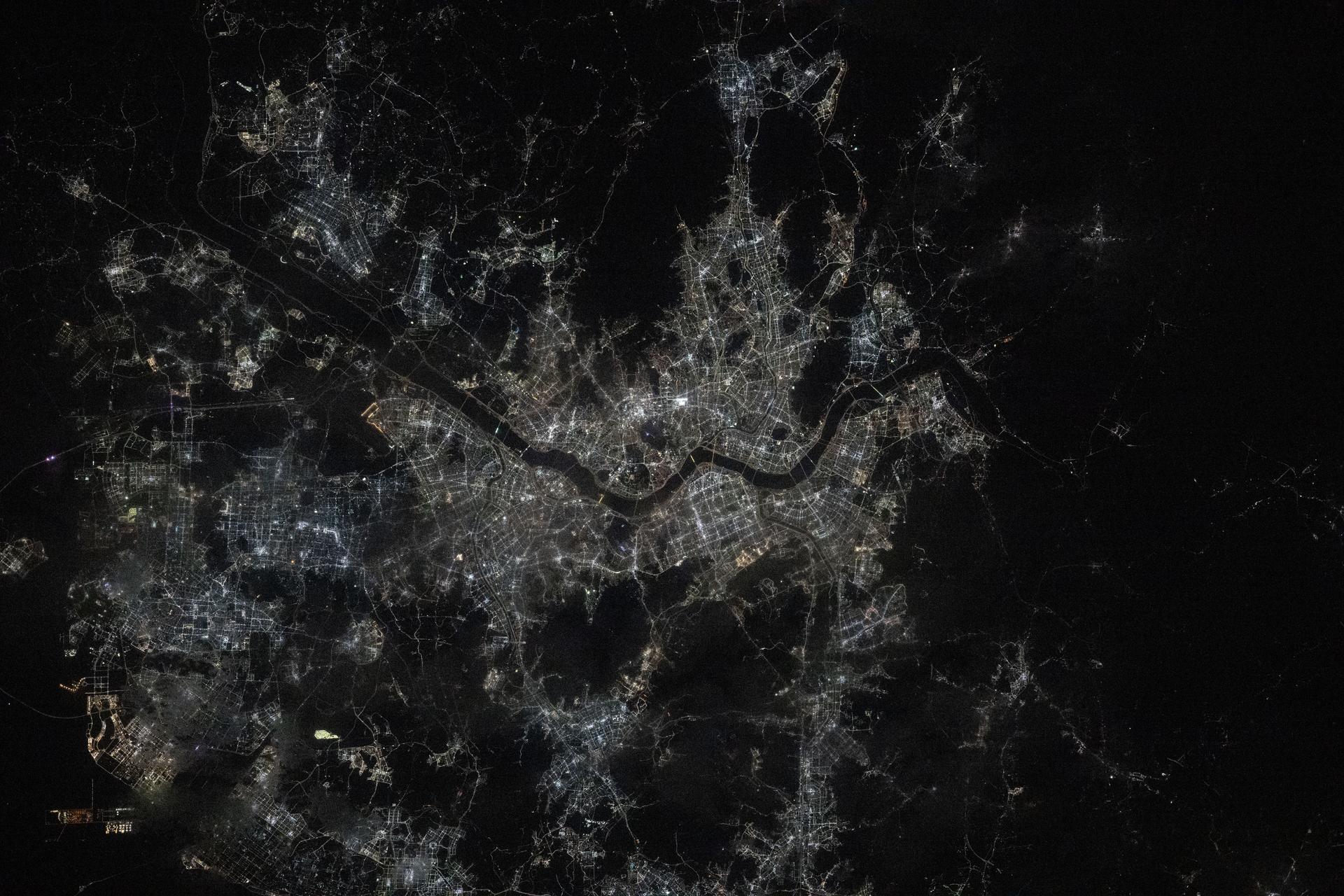
iss072e757318 (March 5, 2025) --- Seoul, South Korea—home to approximately 10 million residents and split by the Han River—is pictured from the International Space Station at approximately 10:56 p.m. local time as it orbited 260 miles above the Korean Peninsula. One of the most densely populated cities in the world, Seoul is also home to four UNESCO World Heritage Sites that reflect the legacy of Korea’s longest continuous dynasty, the Joseon Dynasty. These include a Confucian shrine, royal tombs, a palace complex, and a mountain fortress.
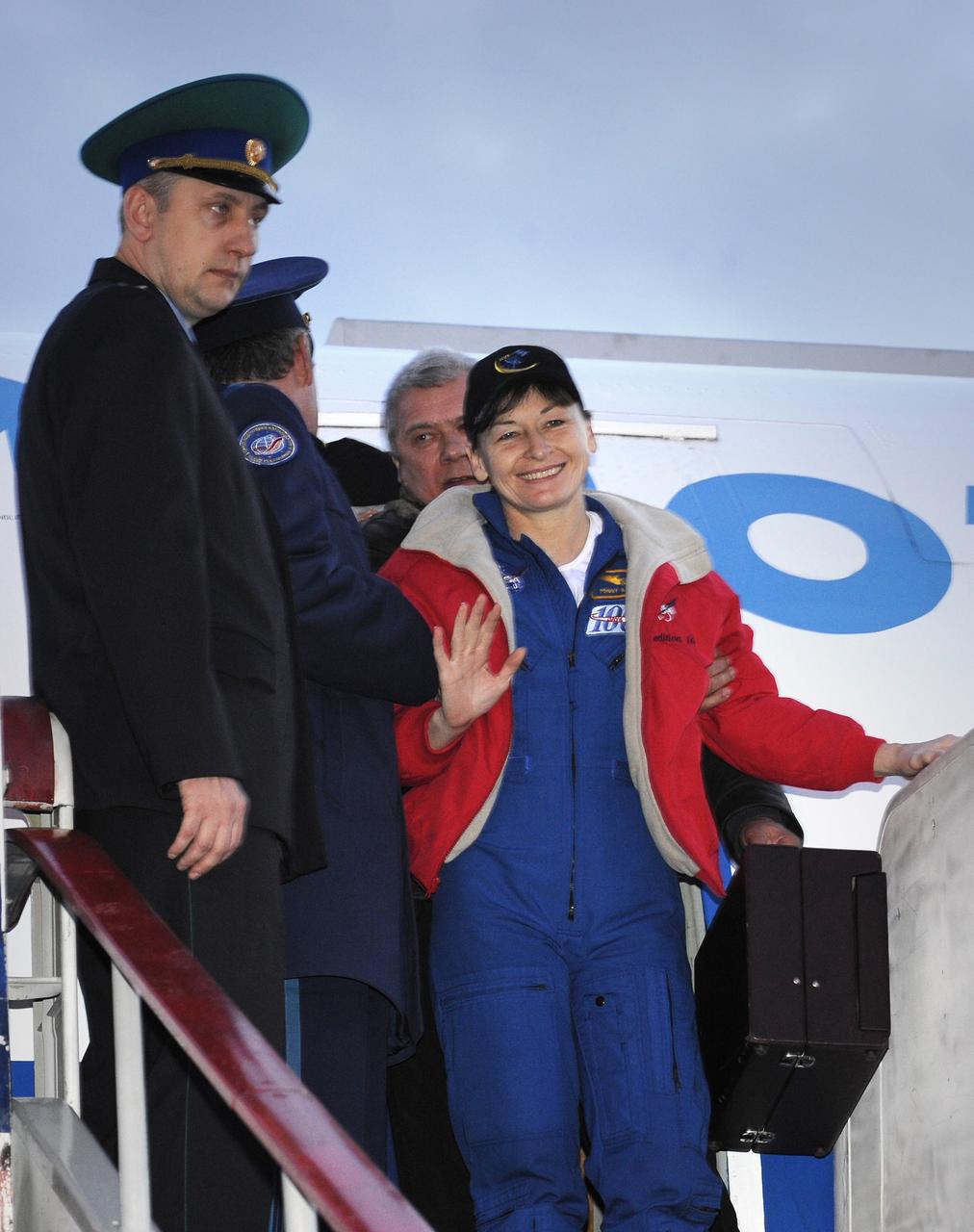
CHKALOVSKY, Russia -- Expedition 16 Commander Peggy Whitson waves to a crowd of well wishers from the top of the airplane steps as she arrives at Chkalovsky airport near Star City along with Flight Engineer and Soyuz Commander Yuri Malenchenko and South Korean So-yeon Yi. Whitson, Malechenko and Yi landed their Soyuz TMA-11 spacecraft on April 19, 2008 in central Kazakhstan to complete 192 days in space for Whitson and Malenchenko and 11 days in orbit for Yi. Photo Credit: (NASA/Bill Ingalls)
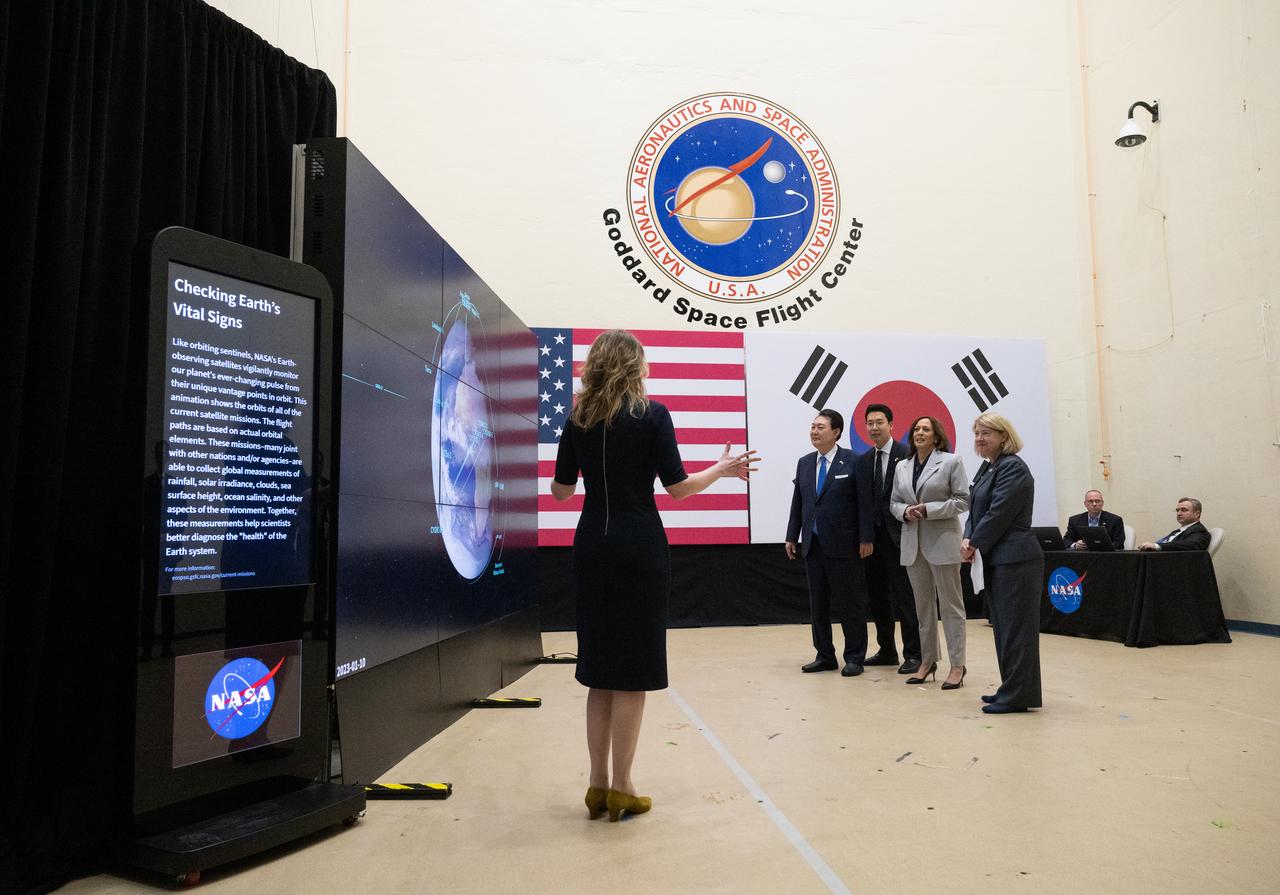
Dr. Lesley Ott, research meteorologist and climate scientist at NASA’s Goddard Space Flight Center briefs Vice President Kamala Harris, center, President Yoon Suk Yeol of the Republic of Korea, left, and NASA Deputy Administrator Pam Melroy on U.S. and Korean partnerships to improve the way scientists observe air quality and the use of space in addressing the climate crisis, Tuesday, April 25, 2023, during a tour of NASA’s Goddard Space Flight Center in Greenbelt, Md. Photo Credit: (NASA/Joel Kowsky)
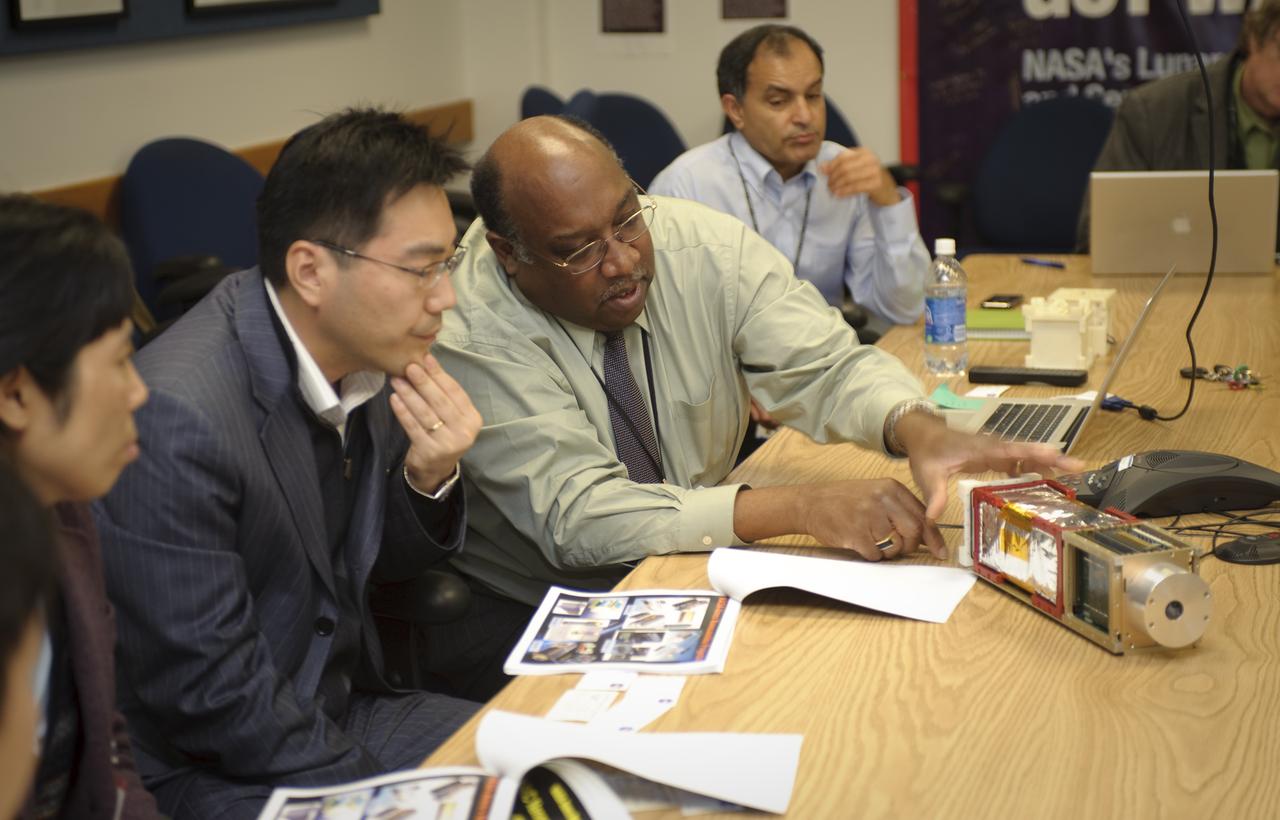
Korean High Level Delegation Visit Ames Certer Director and various Senior staff: John Hines, Ames Center Chief Technologist (middel left) explains PharmaSat (small Satellites) to Soon-Duk Bae, Deputy Director, Big Science Policy Division, Ministry of Educaiton, Science Technology, Young-Mok Hyun, Deputy Director, Space Development Division, Ministry of Educaiton, Science Technology, Seorium Lee, Senior Researcher, International Relations Korea Aerospace Research Institute. Unkonw person at the end of table.

President Yoon Suk Yeol of the Republic of Korea is seen during a briefing by Dr. Lesley Ott, research meteorologist and climate scientist at NASA’s Goddard Space Flight Center, on U.S. and Korean partnerships to improve the way scientists observe air quality and the use of space in addressing the climate crisis, Tuesday, April 25, 2023, during a tour of NASA’s Goddard Space Flight Center in Greenbelt, Md. Photo Credit: (NASA/Joel Kowsky)
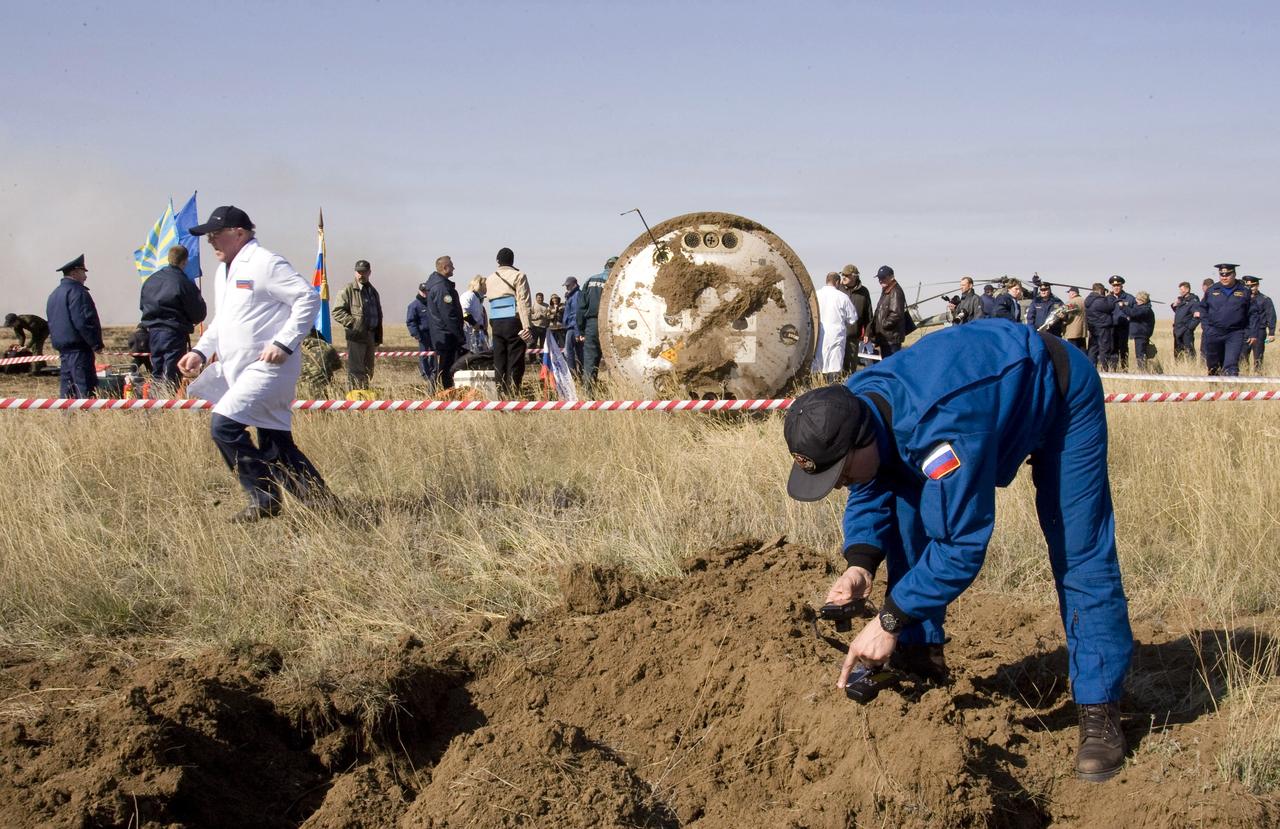
A Russian ground crew member examines the over turned soil near the Soyuz TMA-11 spacecraft after it landed carrying Expedition 16 Commander Peggy Whitson, Flight Engineer and Soyuz Commander Yuri Malenchenko and South Korean spaceflight participant So-yeon Yi, Friday, April 19, 2008, in central Kazakhstan to complete 192 days in space for Whitson and Malenchenko and 11 days in orbit for Yi. Photo Credit: (NASA/Reuters/Pool)
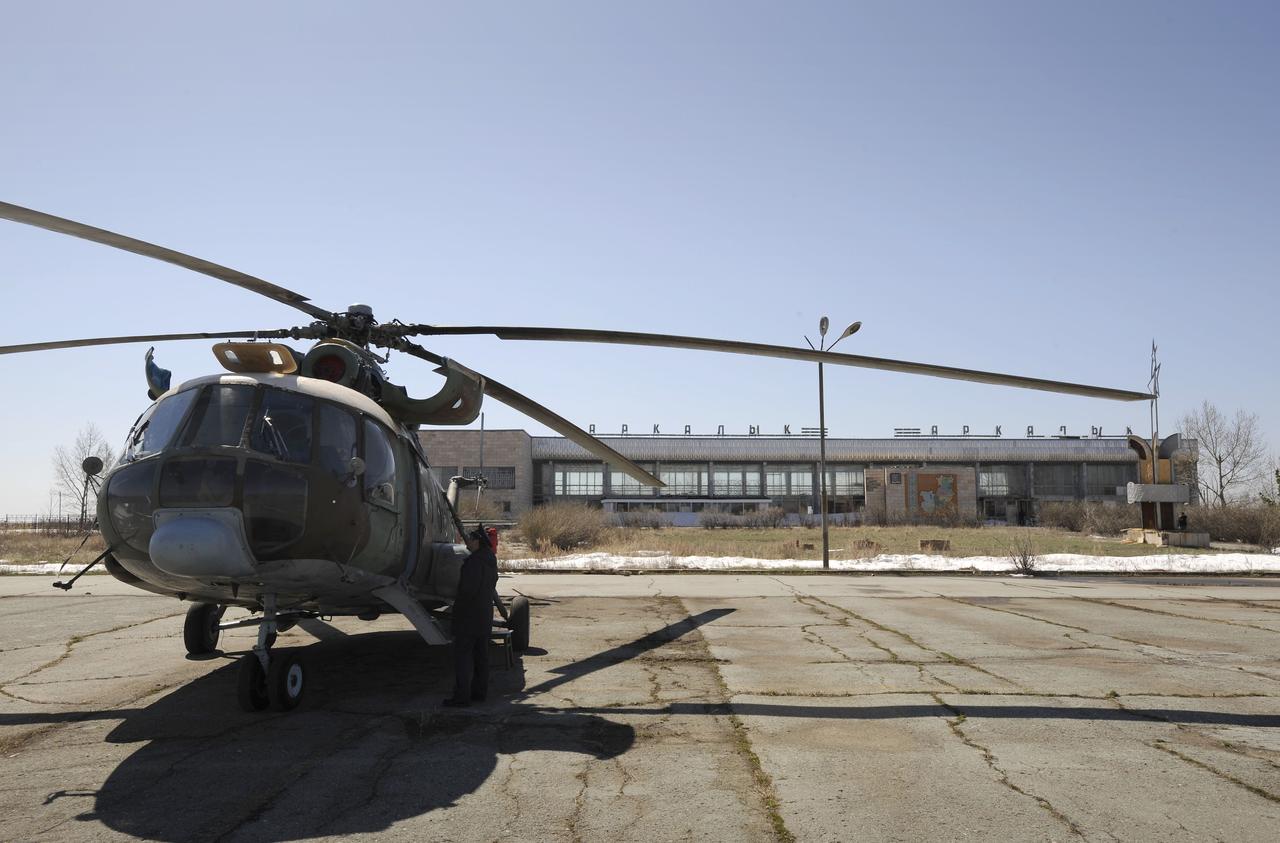
A Russian Search and Rescue helicopter waits for refueling at the Arkalyk airport in Kazakhstan prior to taking off for the landing of the Soyuz TMA-11 spacecraft carrying Expedition 16 Commander Peggy Whitson, Flight Engineer and Soyuz Commander Yuri Malenchenko and South Korean spaceflight participant So-yeon Yi, Friday, April, 19, 2008. The Soyuz made a ballistic landing, touching down more then 400 kilometers short of the intended target in central Kazakhstan. Photo Credit: (NASA/Bill Ingalls)
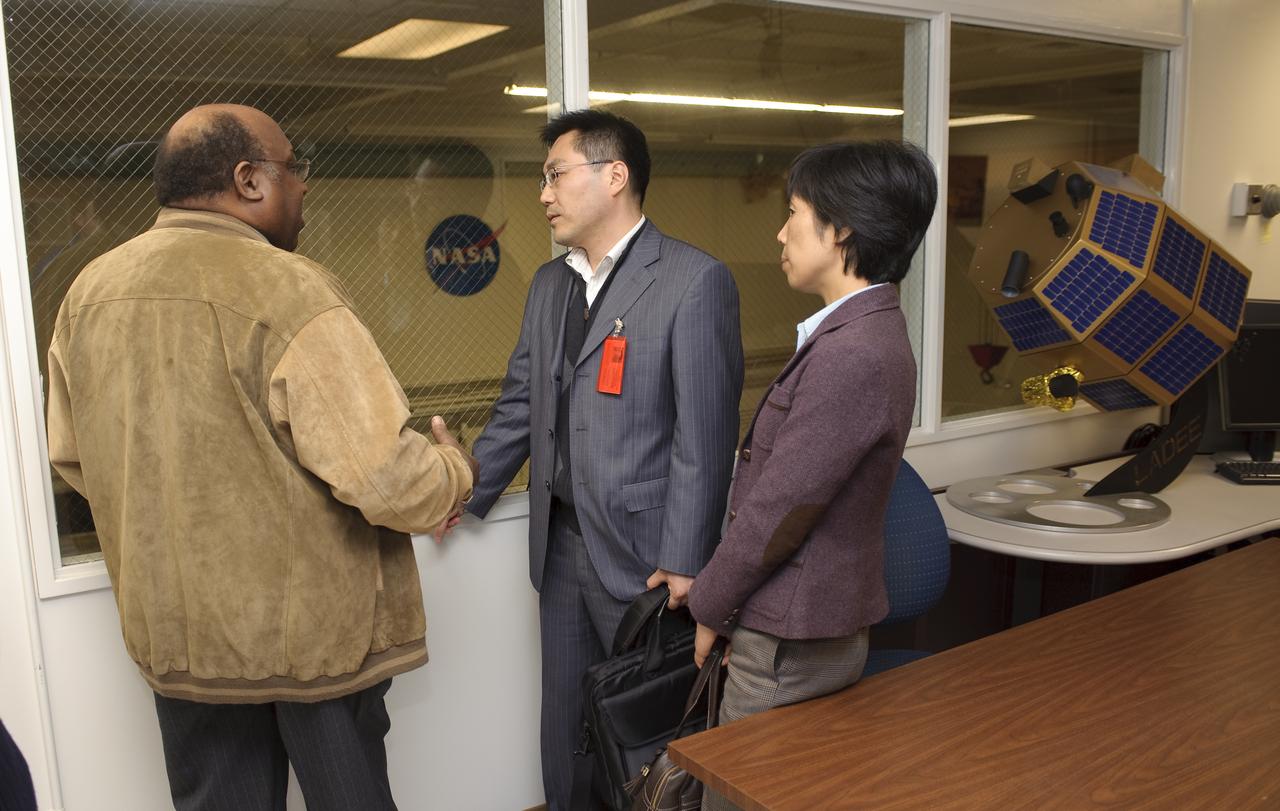
Korean High Level Delegation Visit Ames Certer Director and various Senior staff: John Hines, Ames Center Chief Technologist (middel left) explains operations at the LADEE lab to Soon-Duk Bae, Deputy Director, Big Science Policy Division, Ministry of Educaiton, Science Technology, Young-Mok Hyun, Deputy Director, Space Development Division, Ministry of Educaiton, Science Technology, Seorium Lee, Senior Researcher, International Relations Korea Aerospace Research Institute.
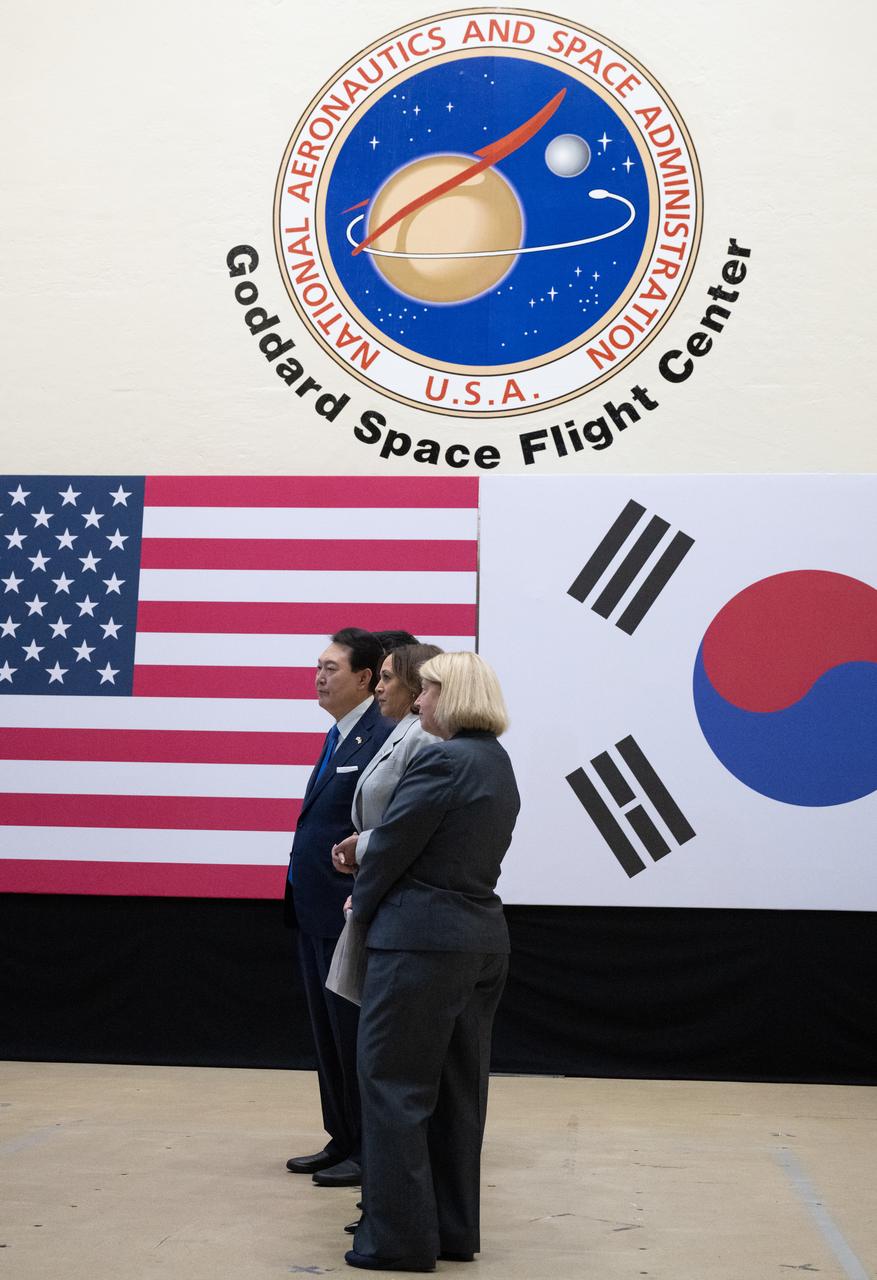
NASA Deputy Administrator Pam Melroy, front, Vice President Kamala Harris, and President Yoon Suk Yeol of the Republic of Korea, are seen during a briefing by Dr. Lesley Ott, research meteorologist and climate scientist at NASA’s Goddard Space Flight Center, on U.S. and Korean partnerships to improve the way scientists observe air quality and the use of space in addressing the climate crisis, Tuesday, April 25, 2023, during a tour of NASA’s Goddard Space Flight Center in Greenbelt, Md. Photo Credit: (NASA/Joel Kowsky)

Expedition 16 Flight Engineer and Soyuz Commander Yuri Malenchenko sits in a helicopter after he and fellow crew members Expedition 16 Commander Peggy Whitson and South Korean spaceflight participant So-yeon Yi landed their Soyuz TMA-11 capsule, Friday, April 19, 2008, in central Kazakhstan. Whitson and Malenchenko completed 192 days in space and Yi 11 days in orbit. Photo Credit: (NASA/Reuters/Pool)
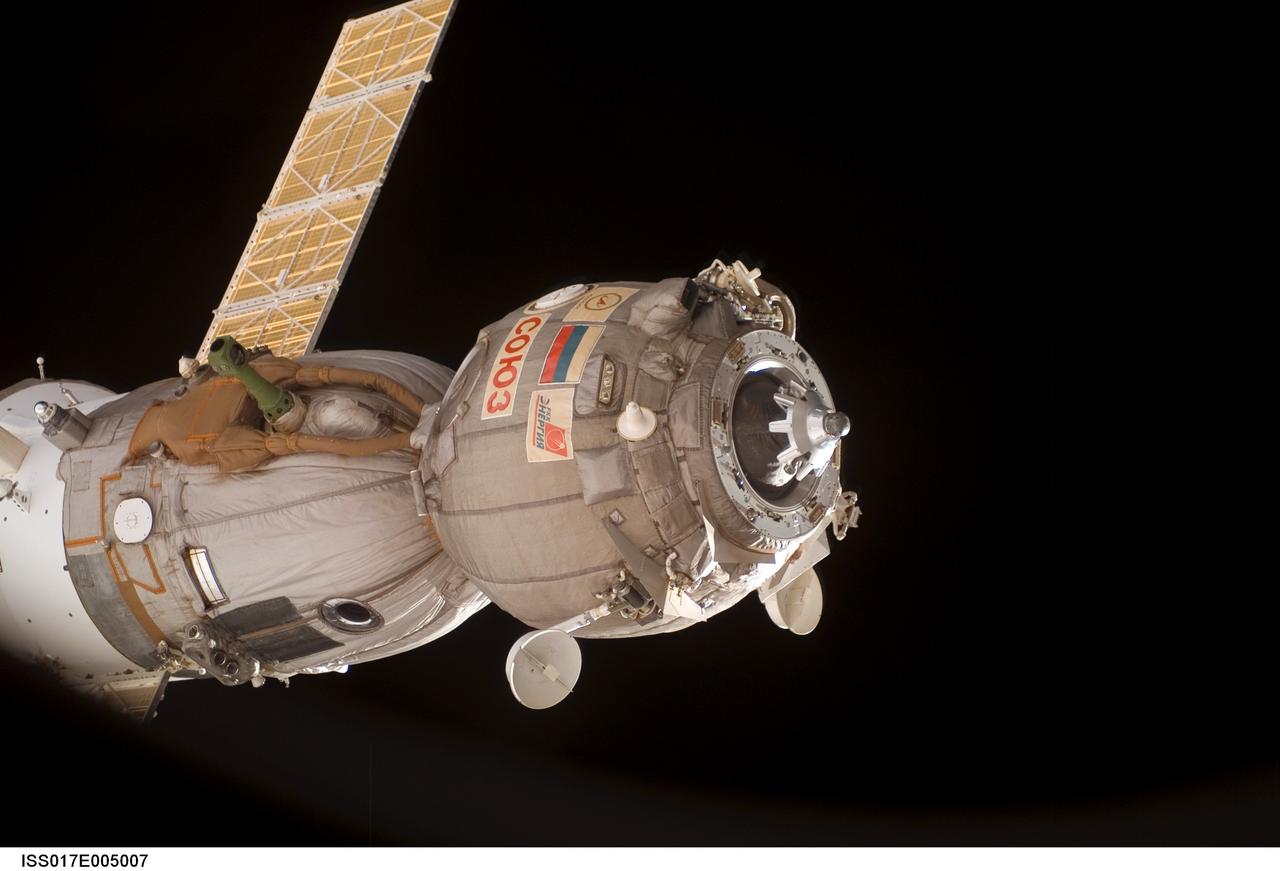
ISS017-E-005007 (19 April 2008) --- Backdropped by the blackness of space, the Soyuz TMA-11 spacecraft departs from the International Space Station carrying NASA astronaut Peggy Whitson, Expedition 16 commander; Russian Federal Space Agency cosmonaut Yuri Malenchenko, flight engineer and Soyuz commander; and South Korean spaceflight participant So-yeon Yi. Undocking occurred at 1:06 a.m. (EDT) on April 19, 2008.
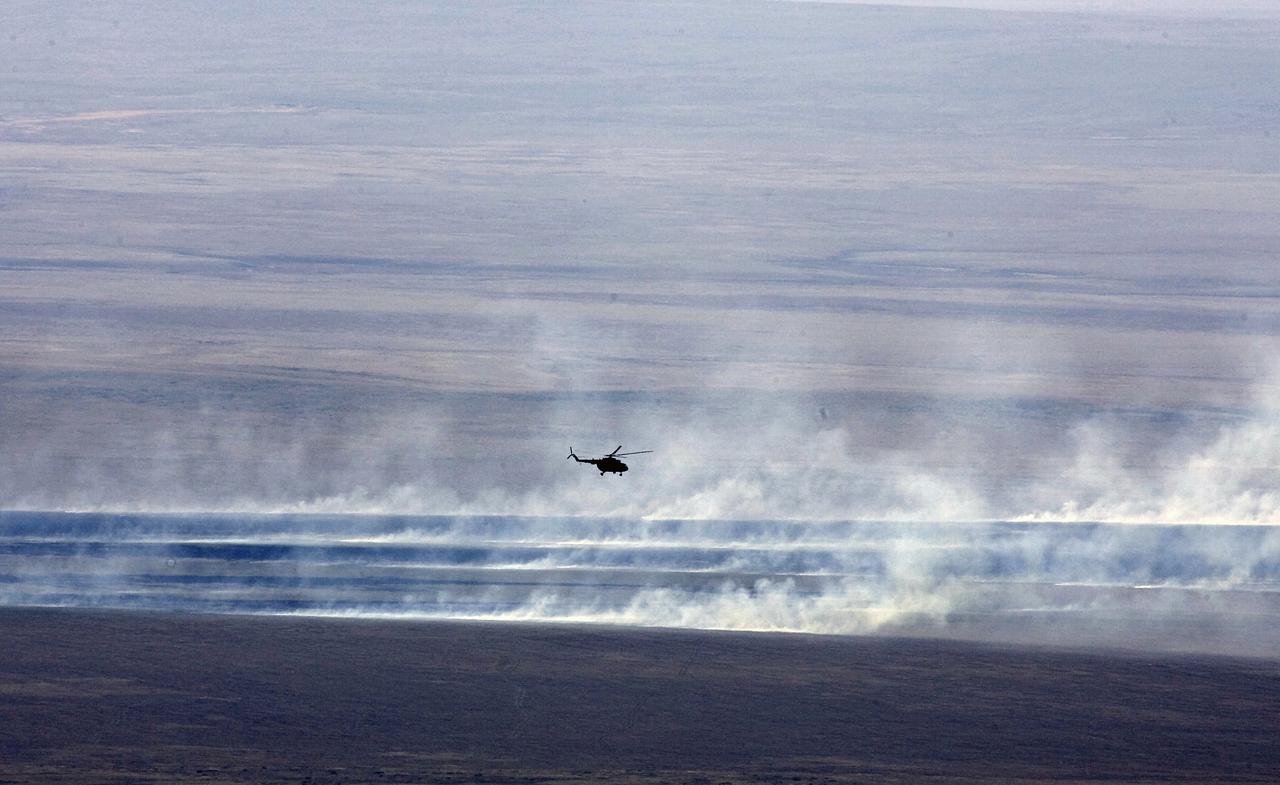
A Russian search and rescue helicopter flies over the burning Kazakh steppe after Expedition 16 Commander Peggy Whitson, Flight Engineer and Soyuz Commander Yuri Malenchenko and South Korean spaceflight participant So-yeon Yi landed their Soyuz TMA-11 spacecraft, Friday, April 19, 2008, in central Kazakhstan to complete 192 days in space for Whitson and Malenchenko and 11 days in orbit for Yi. Photo Credit: (NASA/Reuters/Pool)
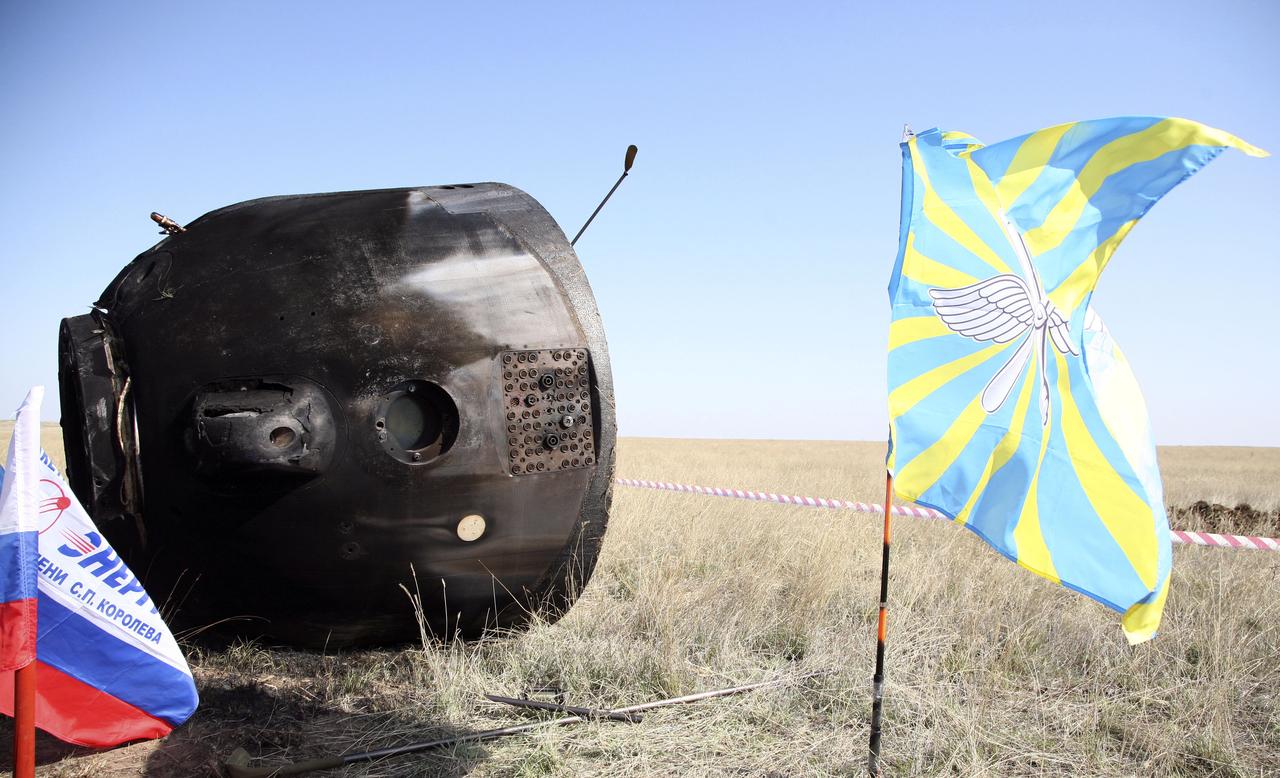
The Soyuz TMA-11 capsule lays on its side on the Kazakh steppe, Friday, April 19, 2008. Expedition 16 Commander Peggy Whitson, Flight Engineer and Soyuz Commander Yuri Malenchenko and South Korean spaceflight participant So-yeon Yi landed their Soyuz TMA-11 spacecraft in central Kazakhstan to complete 192 days in space for Whitson and Malenchenko and 11 days in orbit for Yi. Photo Credit: (NASA/Reuters/Pool)
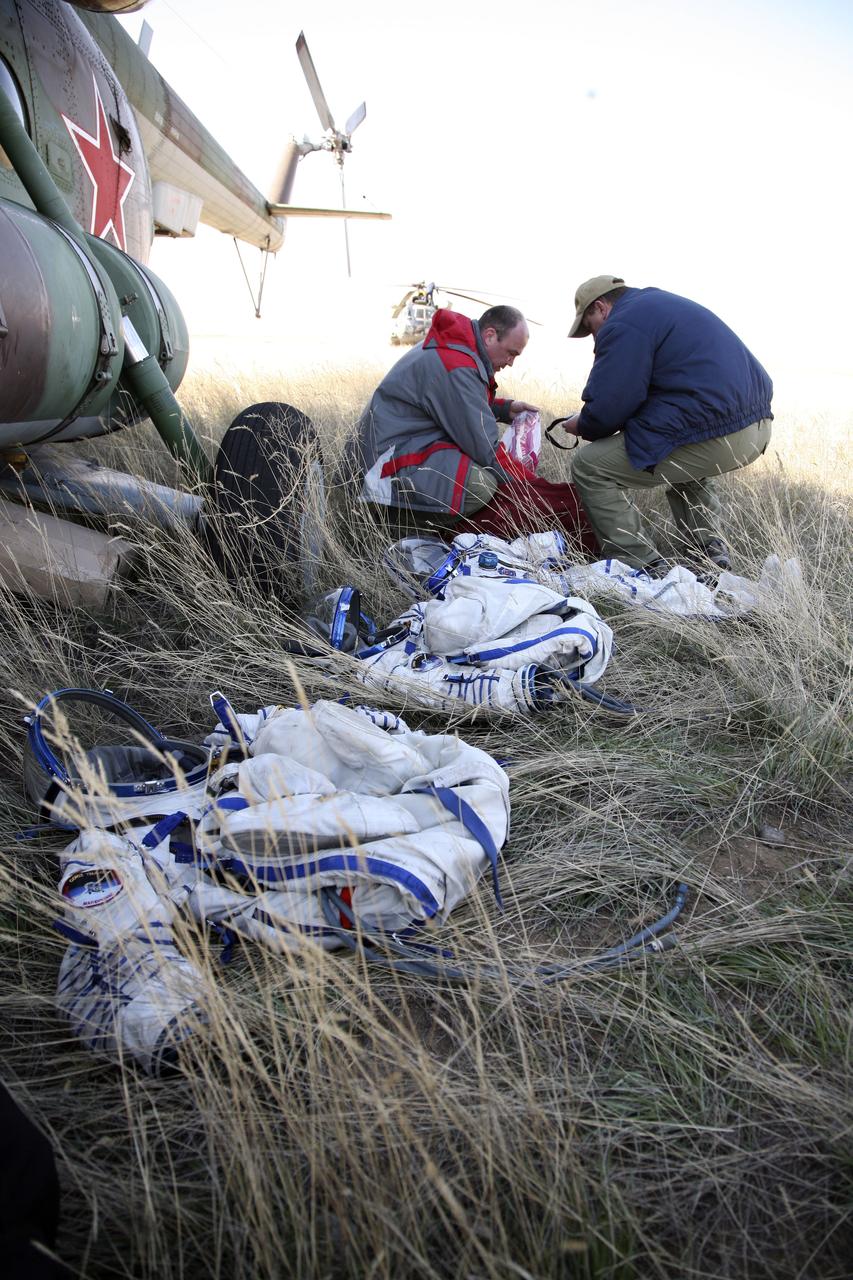
Russian Sokol flight suits of Expedition 16 Commander Peggy Whitson, Flight Engineer and Soyuz Commander Yuri Malenchenko and South Korean spaceflight participant So-yeon Yi are seen laying on the ground shortly after their Soyuz TMA-11 spacecraft landed in central Kazakhstan, Friday, April 19, 2008, to complete 192 days in space for Whitson and Malenchenko and 11 days in orbit for Yi. Photo Credit: (NASA/Reuters/Pool)
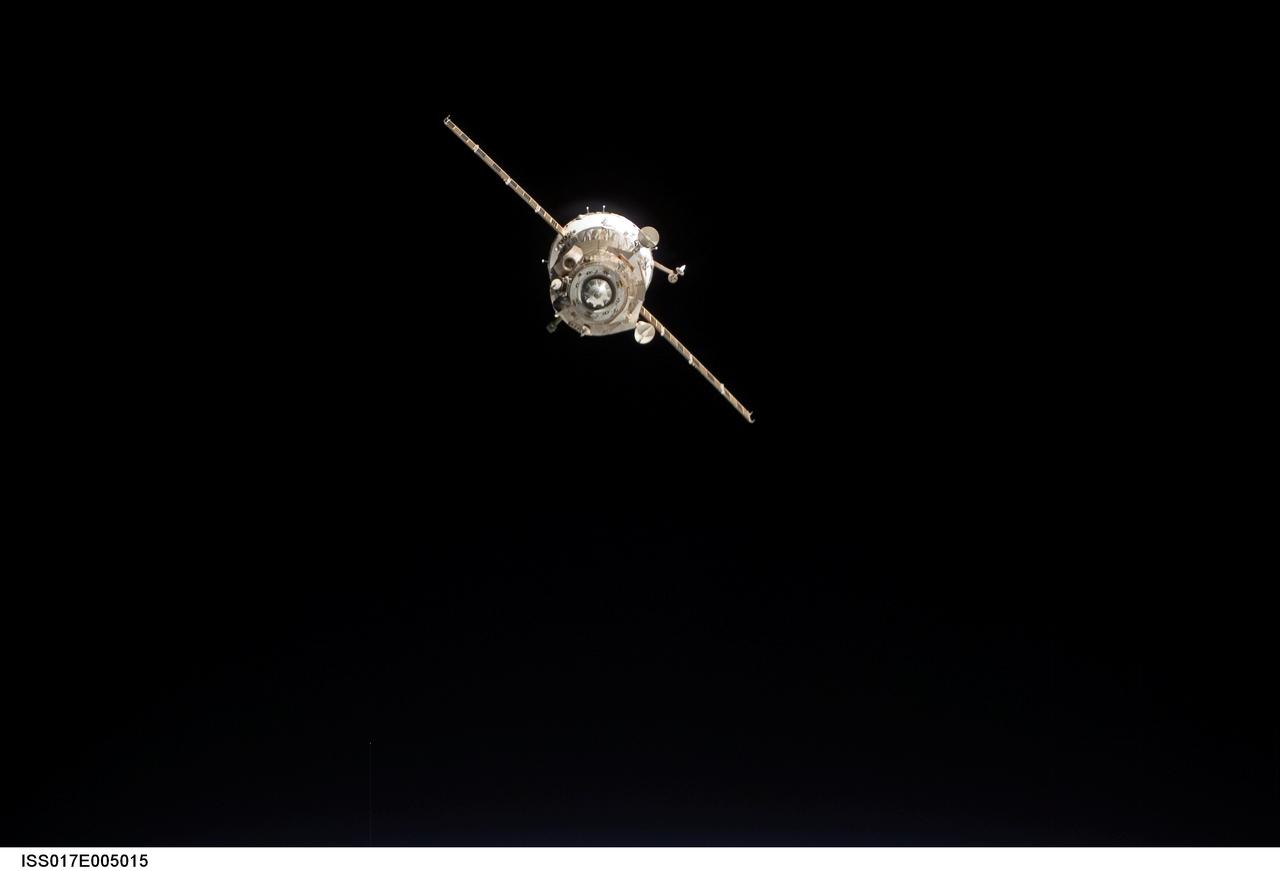
ISS017-E-005015 (19 April 2008) --- Backdropped by the blackness of space, the Soyuz TMA-11 spacecraft departs from the International Space Station carrying NASA astronaut Peggy Whitson, Expedition 16 commander; Russian Federal Space Agency cosmonaut Yuri Malenchenko, flight engineer and Soyuz commander; and South Korean spaceflight participant So-yeon Yi. Undocking occurred at 1:06 a.m. (EDT) on April 19, 2008.
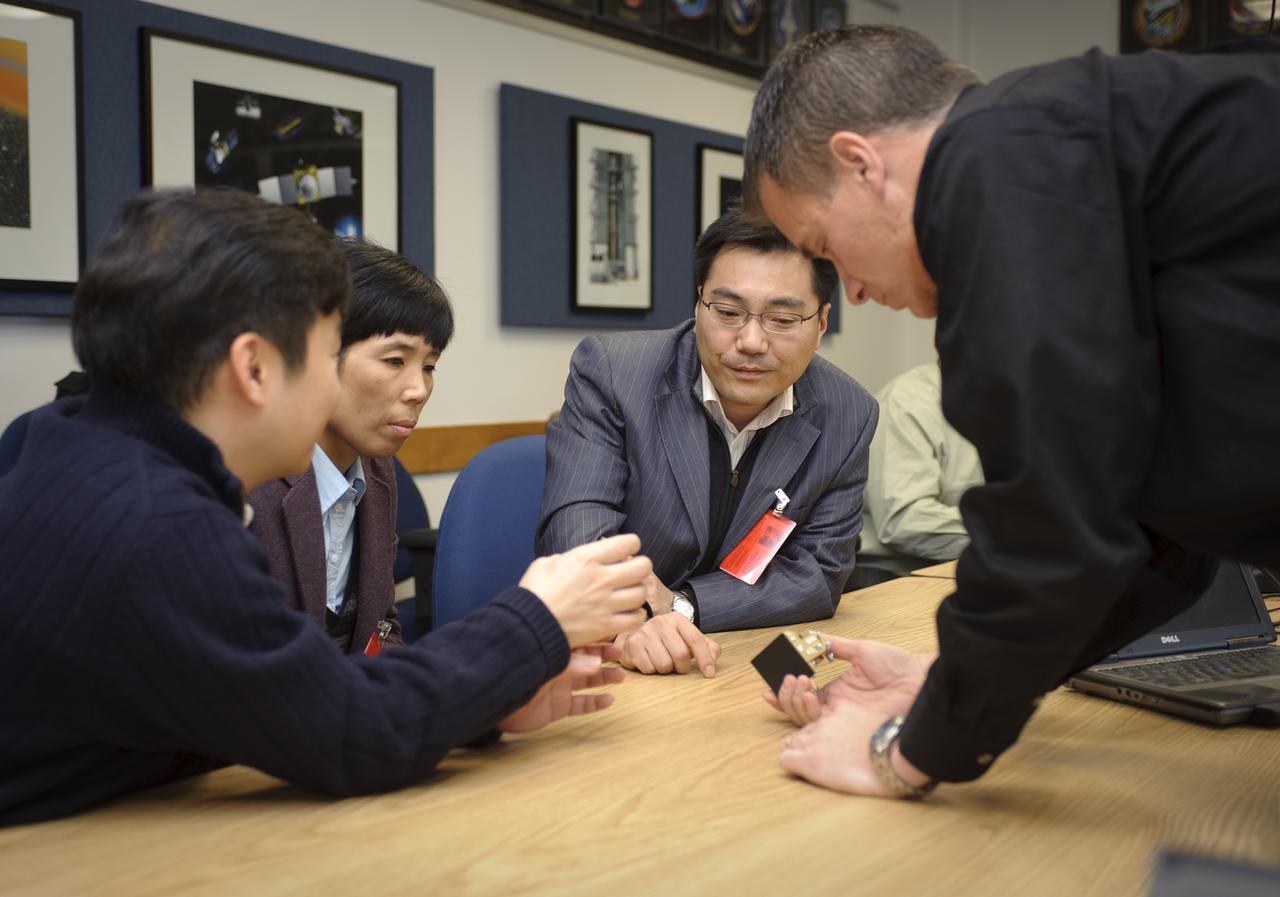
Korean High Level Delegation Visit Ames Certer Director and various Senior staff: Dan Andrews give presentation about LCROSS/LRO to Seorium Lee, Senior Researcher, International Relations Korea Aerospace Research Institute, Soon-Duk Bae, Deputy Director, Big Science Policy Division, Ministry of Educaiton, Science Technology, Young-Mok Hyun, Deputy Director, Space Development Division, Ministry of Educaiton, Science Technology, Seorium Lee, Senior Researcher, International Relations Korea Aerospace Research Institute.
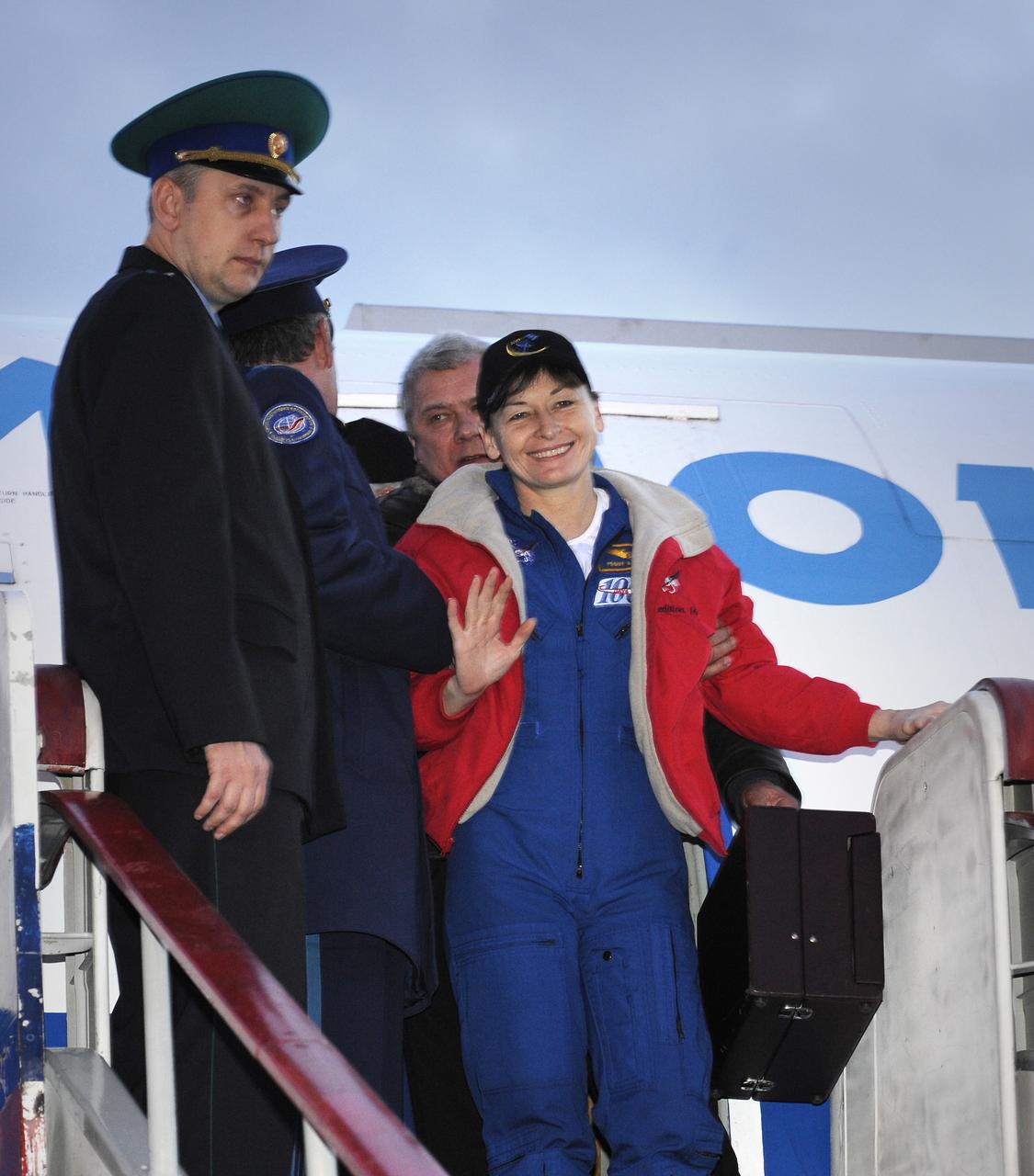
Expedition 16 Commander Peggy Whitson waves to a crowd of well-wishers from the top of the airplane steps as she arrives at Chkalovsky Airport near Star City, Russia along with Flight Engineer and Soyuz Commander Yuri Malenchenko and South Korean spaceflight participant So-yeon Yi, Friday, April 19, 2008. Whitson, Malechenko and Yi landed their Soyuz TMA-11 spacecraft in central Kazakhstan to complete 192 days in space for Whitson and Malenchenko and 11 days in orbit for Yi. Photo Credit: (NASA/Bill Ingalls)

Expedition 16 Commander Peggy Whitson is helped out of a helicopter after landing in northern Kazakhstan, Friday, April 19, 2008. Whitson, Flight Engineer and Soyuz Commander Yuri Malenchenko and South Korean spaceflight participant So-yeon Yi landed their Soyuz TMA-11 spacecraft in central Kazakhstan to complete 192 days in space for Whitson and Malenchenko and 11 days in orbit for Yi. Photo Credit: (NASA/Reuters/Pool)
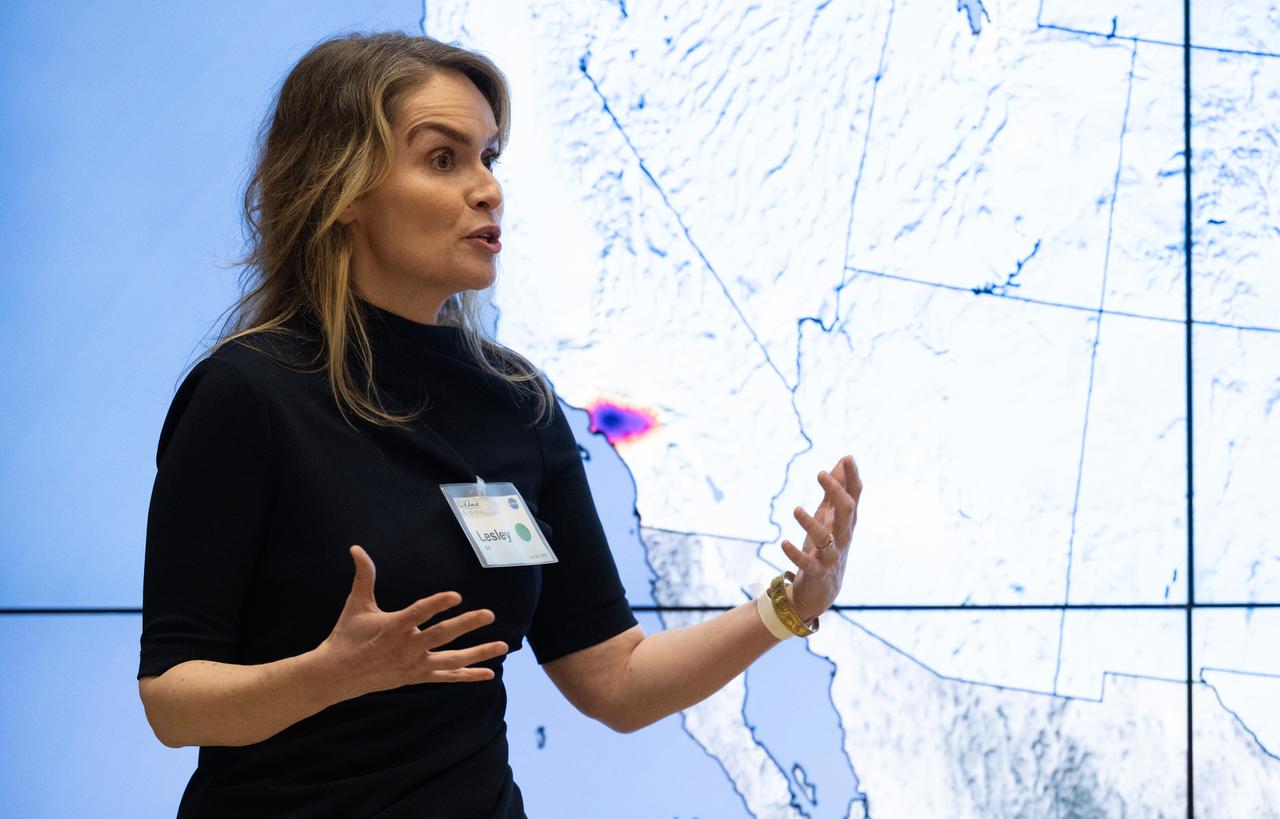
Dr. Lesley Ott, research meteorologist and climate scientist at NASA’s Goddard Space Flight Center briefs Vice President Kamala Harris, President Yoon Suk Yeol of the Republic of Korea, and NASA Deputy Administrator Pam Melroy on U.S. and Korean partnerships to improve the way scientists observe air quality and the use of space in addressing the climate crisis, Tuesday, April 25, 2023, during a tour of NASA’s Goddard Space Flight Center in Greenbelt, Md. Photo Credit: (NASA/Joel Kowsky)
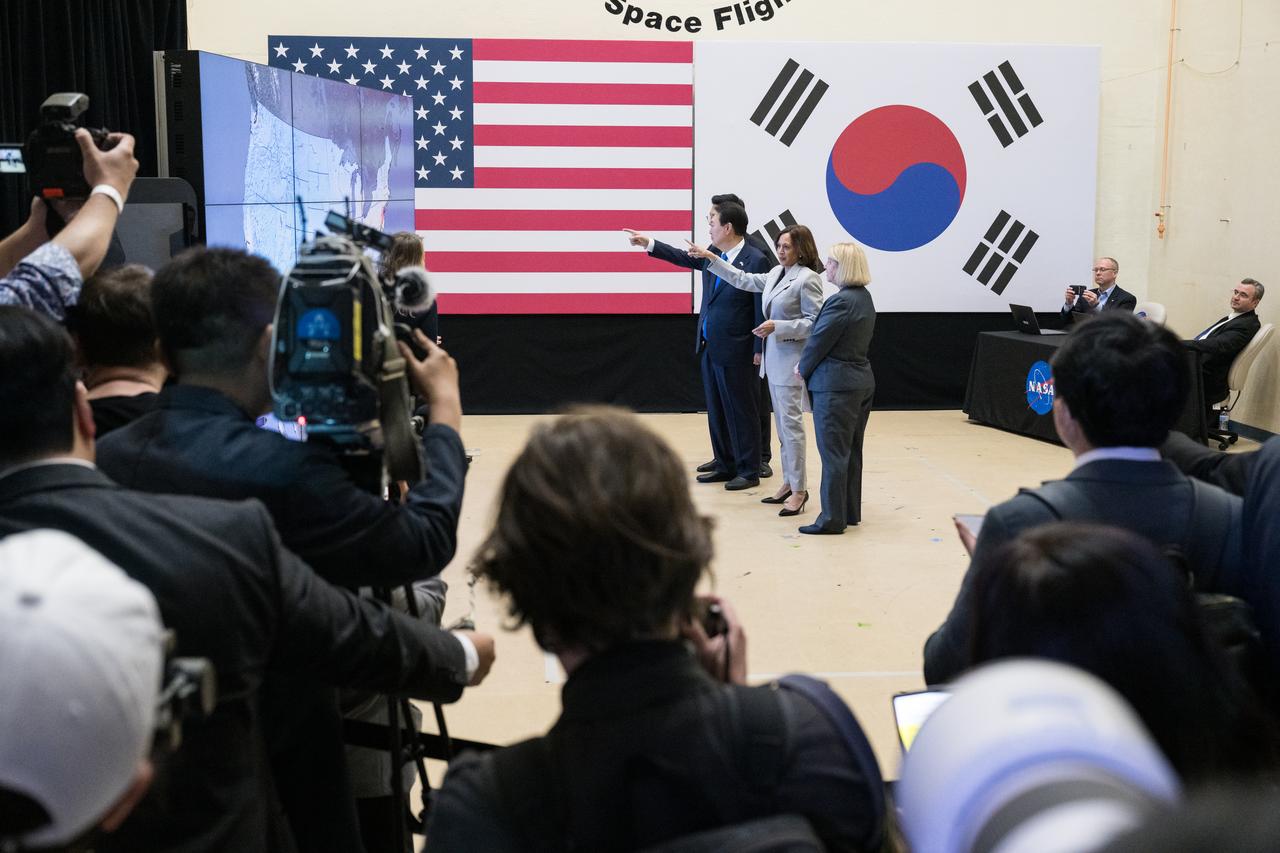
Dr. Lesley Ott, research meteorologist and climate scientist at NASA’s Goddard Space Flight Center briefs from left to right, President Yoon Suk Yeol of the Republic of Korea, Vice President Kamala Harris, and NASA Deputy Administrator Pam Melroy on U.S. and Korean partnerships to improve the way scientists observe air quality and the use of space in addressing the climate crisis, Tuesday, April 25, 2023, during a tour of NASA’s Goddard Space Flight Center in Greenbelt, Md. Photo Credit: (NASA/Aubrey Gemignani)
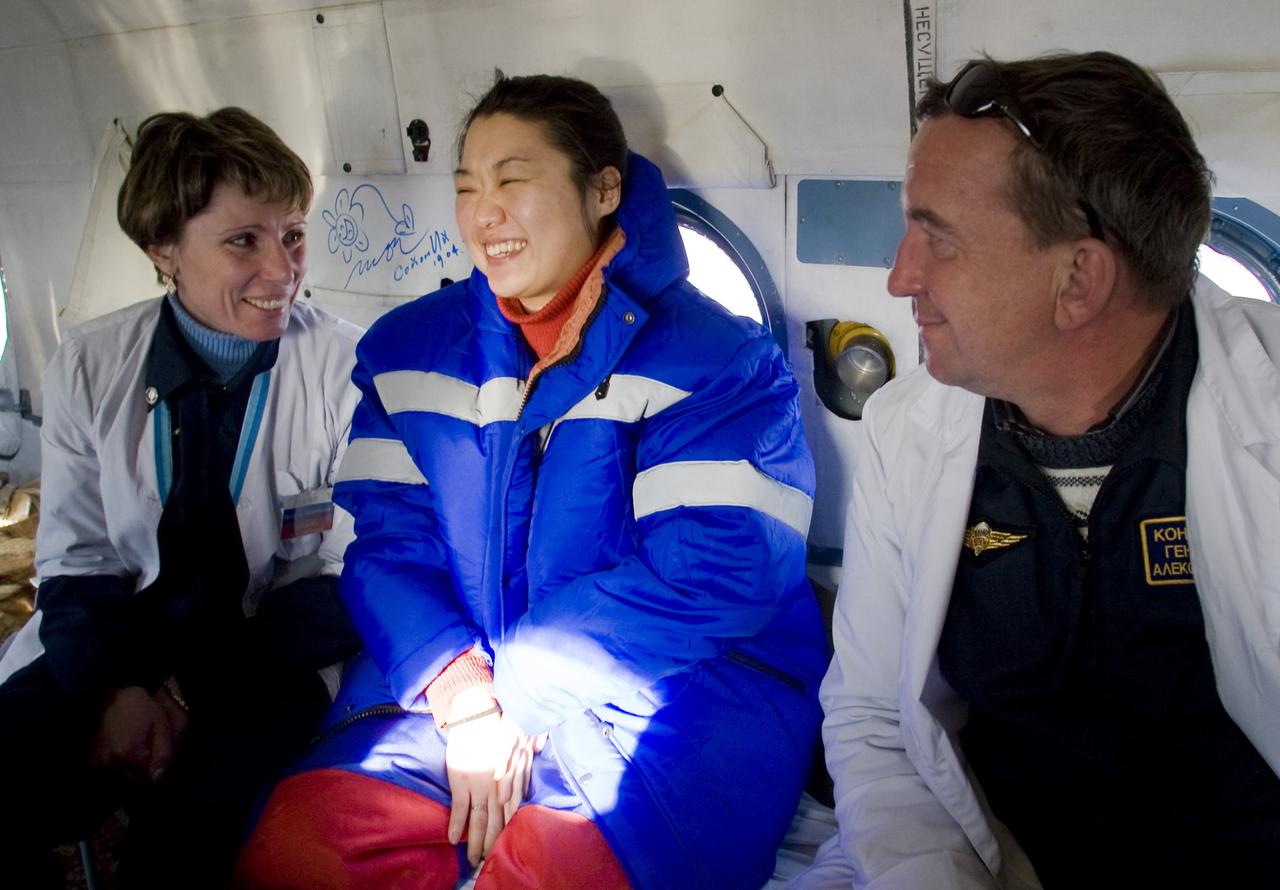
South Korean spaceflight participant So-Yeon YI jokes with Russian doctors in a helicopter after she and fellow crew members Expedition 16 Commander Peggy Whitson and Flight Engineer and Soyuz Commander Yuri Malenchenko landed their Soyuz TMA-11 capsule, Friday, April 19, 2008, in central Kazakhstan. Whitson and Malenchenko completed 192 days in space and Yi 11 days in orbit. Photo Credit: (NASA/Reuters/Pool)
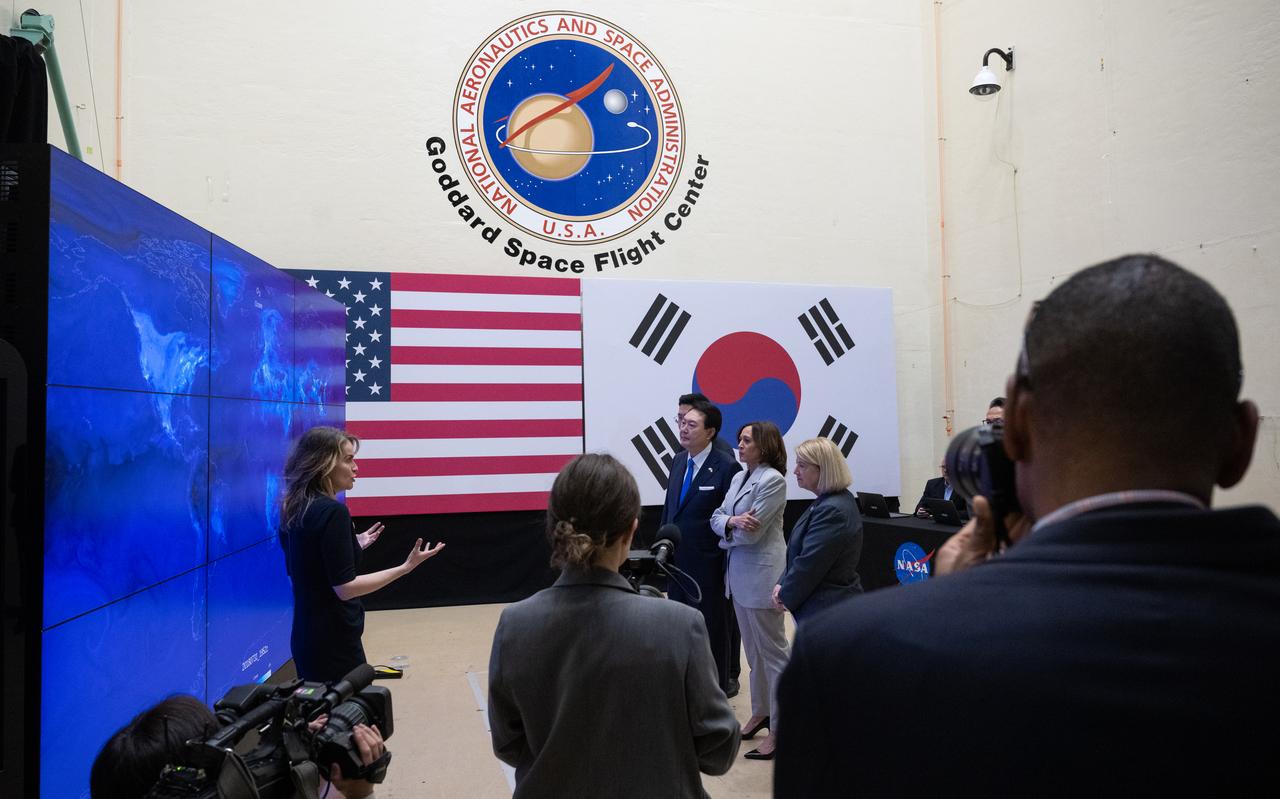
Dr. Lesley Ott, research meteorologist and climate scientist at NASA’s Goddard Space Flight Center, left, briefs Vice President Kamala Harris, President Yoon Suk Yeol of the Republic of Korea, and NASA Deputy Administrator Pam Melroy, on U.S. and Korean partnerships to improve the way scientists observe air quality and the use of space in addressing the climate crisis, Tuesday, April 25, 2023, during a tour of NASA’s Goddard Space Flight Center in Greenbelt, Md. Photo Credit: (NASA/Joel Kowsky)

Expedition 16 Commander Peggy Whitson is helped out of a helicopter after landing in northern Kazakhstan, Friday, April 19, 2008. Whitson, Flight Engineer and Soyuz Commander Yuri Malenchenko and South Korean spaceflight participant So-yeon Yi landed their Soyuz TMA-11 spacecraft in central Kazakhstan to complete 192 days in space for Whitson and Malenchenko and 11 days in orbit for Yi. Photo Credit: (NASA/Reuters/Pool)
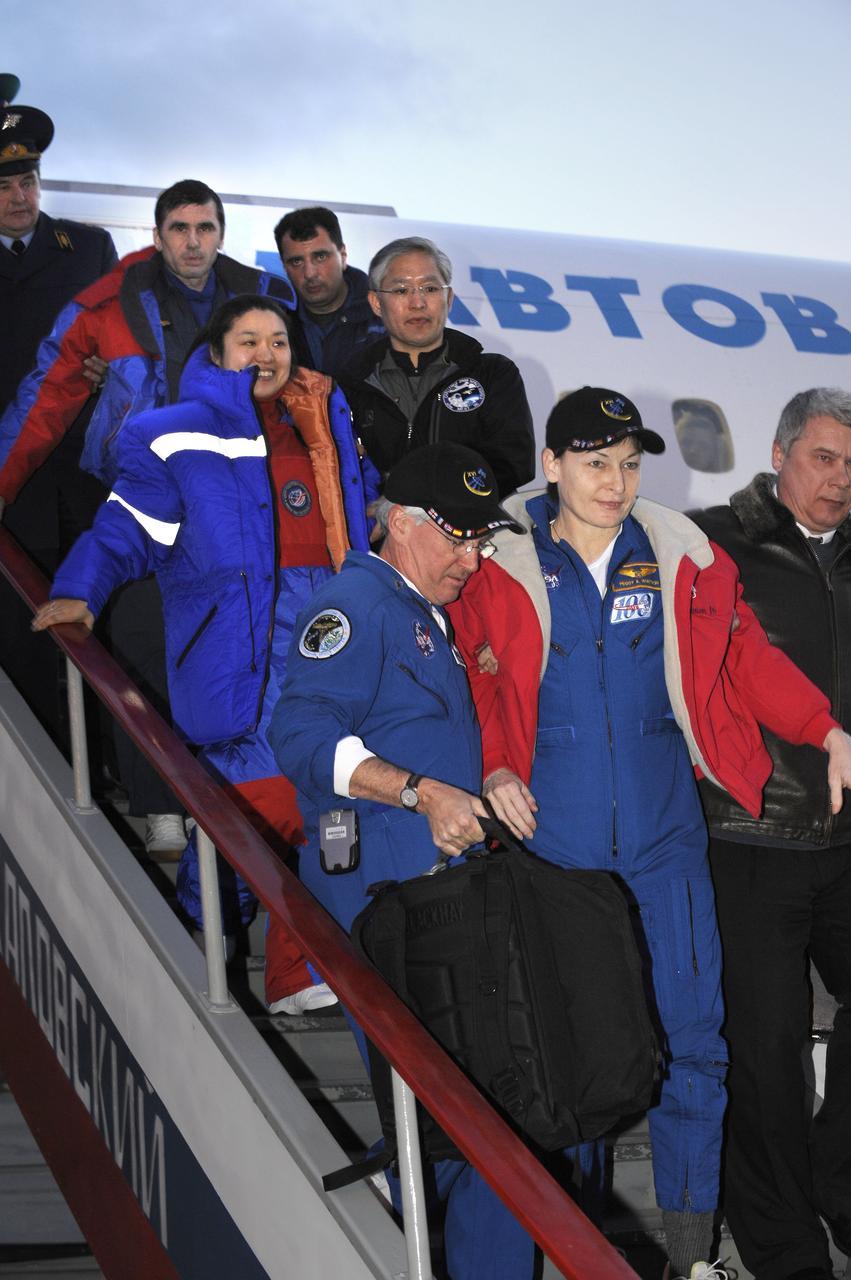
Expedition 16 Commander Peggy Whitson, bottom, South Korean spaceflight participant So-yeon Yi and Flight Engineer and Soyuz Commander Yuri Malenchenko, top, walk down the airplane steps as they arrive at Chkalovsky Airport near Star City, Russia, Friday, April 19, 2008. Whitson, Malechenko and Yi landed their Soyuz TMA-11 spacecraft on April 19, 2008 in central Kazakhstan to complete 192 days in space for Whitson and Malenchenko and 11 days in orbit for Yi. Photo Credit: (NASA/Bill Ingalls)

Dr. Lesley Ott, research meteorologist and climate scientist at NASA’s Goddard Space Flight Center briefs from left to right, President Yoon Suk Yeol of the Republic of Korea, Vice President Kamala Harris, and NASA Deputy Administrator Pam Melroy on U.S. and Korean partnerships to improve the way scientists observe air quality and the use of space in addressing the climate crisis, Tuesday, April 25, 2023, during a tour of NASA’s Goddard Space Flight Center in Greenbelt, Md. Photo Credit: (NASA/Aubrey Gemignani)
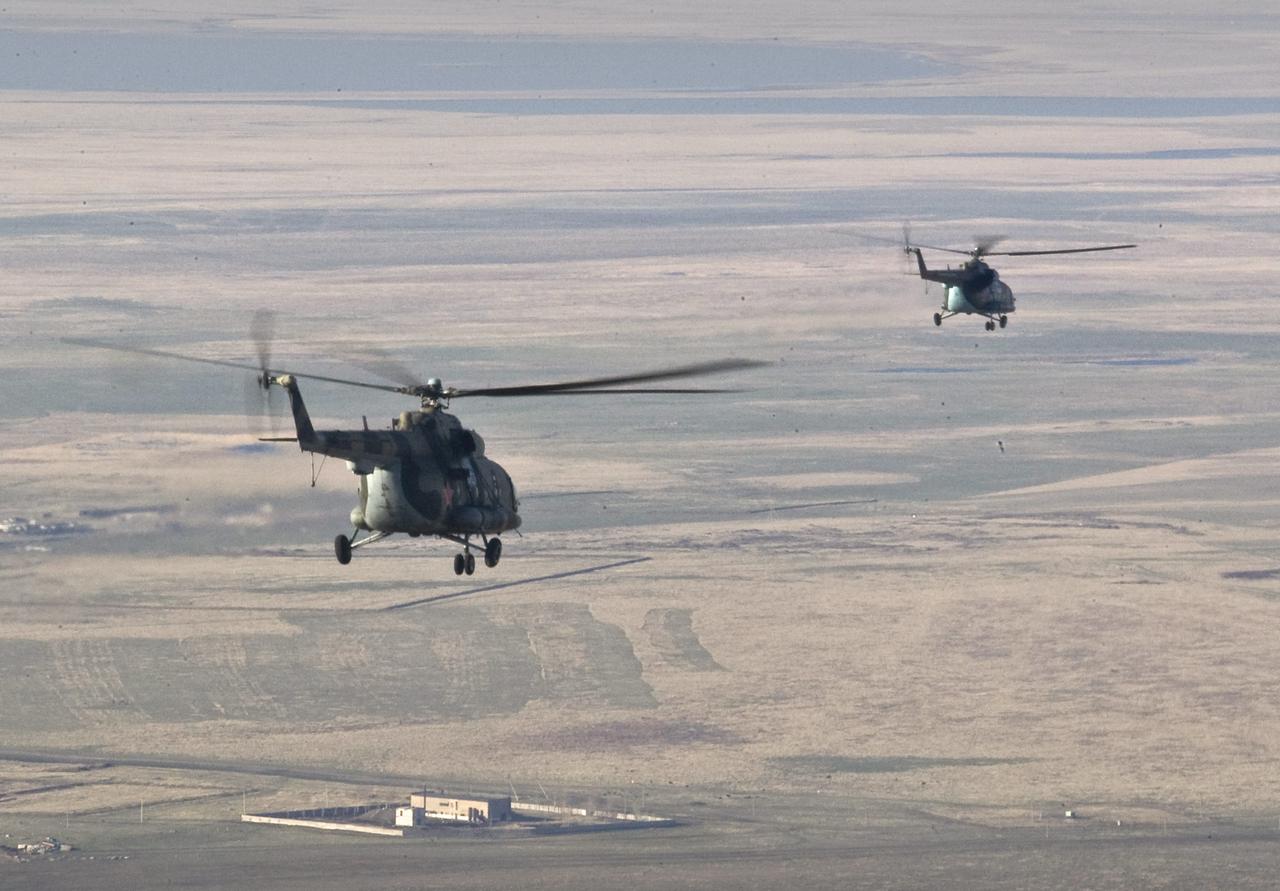
Rescue helicopters fly Expedition 16 Commander Peggy Whitson, Flight Engineer and Soyuz Commander Yuri Malenchenko and South Korean spaceflight participant So-yeon Yi to Kustanay, Kazakhstan shortly after their Soyuz TMA-11 spacecraft landed in central Kazakhstan, Friday, April 19, 2008. Whitson and Malenchenko completed 192 days in space and Yi spent 11 days in orbit. Photo Credit: (NASA/Reuters/Pool)
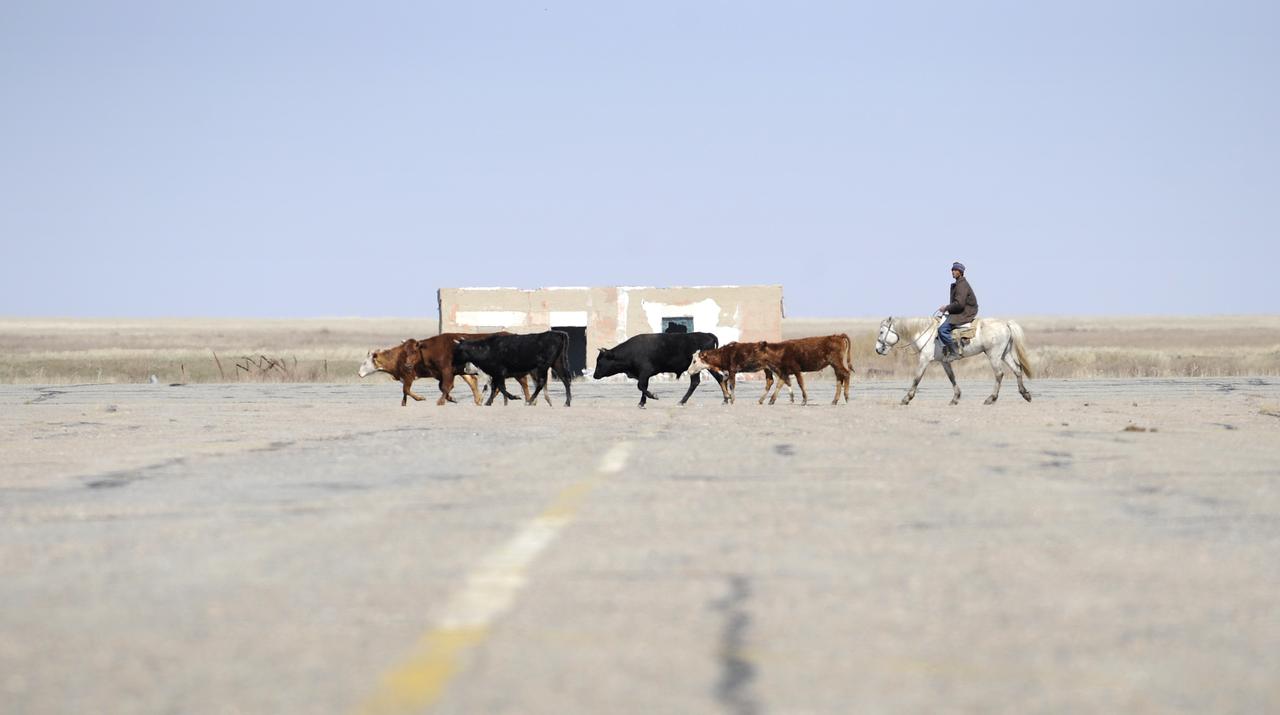
A Kazakh man herds cattle across the tarmac at the Arkalyk airport in Kazakhstan, Friday, April, 19, 2008. Arkalyk was used as one of the helicopter staging areas for the landing of the Soyuz TMA-11 spacecraft carrying Expedition 16 Commander Peggy Whitson, Flight Engineer and Soyuz Commander Yuri Malenchenko and South Korean spaceflight participant So-yeon Yi. The Soyuz made a ballistic landing, touching down more then 400 kilometers short of the intended target in central Kazakhstan. Photo Credit: (NASA/Bill Ingalls)

Women in traditional Kazakh dress wait to welcome Expedition 16 Commander Peggy Whitson, Flight Engineer and Soyuz Commander Yuri Malenchenko and South Korean spaceflight participant So-yeon Yi at the Kustanay airport in Kazakhstan, Friday, April 19, 2008. Whitson, Malenchenko and Yi landed their Soyuz TMA-11 capule in central Kazakhstan to complete 192 days in space for Whitson and Malenchenko and 11 days in orbit for Yi. Photo Credit: (NASA/Bill Ingalls)
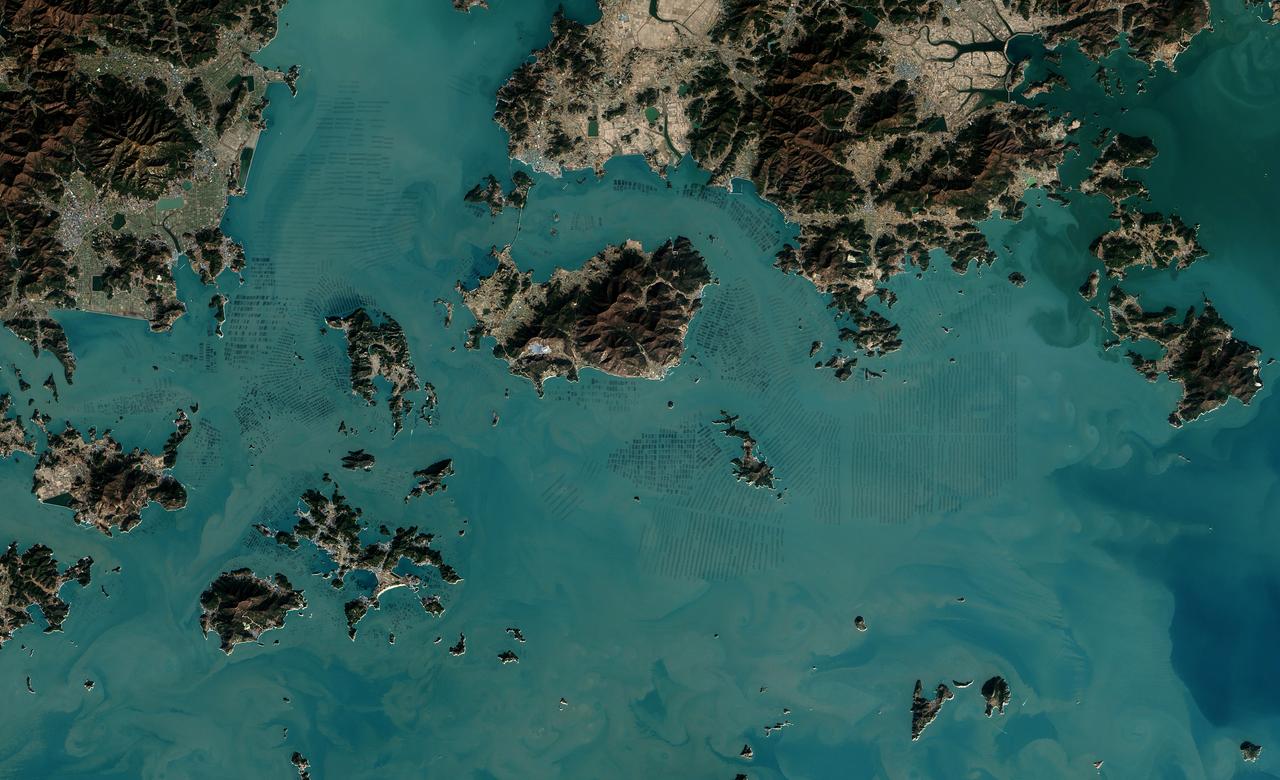
The dark squares that make up the checkerboard pattern in this image are fields of a sort—fields of seaweed. Along the south coast of South Korea, seaweed is often grown on ropes, which are held near the surface with buoys. This technique ensures that the seaweed stays close enough to the surface to get enough light during high tide but doesn’t scrape against the bottom during low tide. The Operational Land Imager (OLI) on Landsat 8 acquired this image of seaweed cultivation in the shallow waters around Sisan Island on January 31, 2014. Home to a thriving aquaculture industry, the south coast of South Korea produces about 90 percent of the country’s seaweed crop. The waters around Sisan are not the only place where aquaculture is common. View the large image to see how ubiquitous seaweed aquaculture is along the coast in Jeollanam-do, the southernmost province on the Korean peninsula. Two main types of seaweed are cultivated in South Korea: Undaria (known as miyeok in Korean, wakame in Japanese) and Pyropia (gim in Korean, nori in Japanese). Both types are used generously in traditional Korean, Japanese, and Chinese food. Since 1970, farmed seaweed production has increased by approximately 8 percent per year. Today, about 90 percent of all the seaweed that humans consume globally is farmed. That may be good for the environment. In comparison to other types of food production, seaweed farming has a light environmental footprint because it does not require fresh water or fertilizer. NASA Earth Observatory image by Jesse Allen, using Landsat data from the U.S. Geological Survey. Caption by Adam Voiland. Credit: <b><a href="http://www.earthobservatory.nasa.gov/" rel="nofollow"> NASA Earth Observatory</a></b> <b><a href="http://www.nasa.gov/audience/formedia/features/MP_Photo_Guidelines.html" rel="nofollow">NASA image use policy.</a></b> <b><a href="http://www.nasa.gov/centers/goddard/home/index.html" rel="nofollow">NASA Goddard Space Flight Center</a></b> enables NASA’s mission through four scientific endeavors: Earth Science, Heliophysics, Solar System Exploration, and Astrophysics. Goddard plays a leading role in NASA’s accomplishments by contributing compelling scientific knowledge to advance the Agency’s mission. <b>Follow us on <a href="http://twitter.com/NASAGoddardPix" rel="nofollow">Twitter</a></b> <b>Like us on <a href="http://www.facebook.com/pages/Greenbelt-MD/NASA-Goddard/395013845897?ref=tsd" rel="nofollow">Facebook</a></b> <b>Find us on <a href="http://instagrid.me/nasagoddard/?vm=grid" rel="nofollow">Instagram</a></b>

The dark squares that make up the checkerboard pattern in this image are fields of a sort—fields of seaweed. Along the south coast of South Korea, seaweed is often grown on ropes, which are held near the surface with buoys. This technique ensures that the seaweed stays close enough to the surface to get enough light during high tide but doesn’t scrape against the bottom during low tide. The Operational Land Imager (OLI) on Landsat 8 acquired this image of seaweed cultivation in the shallow waters around Sisan Island on January 31, 2014. Home to a thriving aquaculture industry, the south coast of South Korea produces about 90 percent of the country’s seaweed crop. The waters around Sisan are not the only place where aquaculture is common. View the large image to see how ubiquitous seaweed aquaculture is along the coast in Jeollanam-do, the southernmost province on the Korean peninsula. Two main types of seaweed are cultivated in South Korea: Undaria (known as miyeok in Korean, wakame in Japanese) and Pyropia (gim in Korean, nori in Japanese). Both types are used generously in traditional Korean, Japanese, and Chinese food. Since 1970, farmed seaweed production has increased by approximately 8 percent per year. Today, about 90 percent of all the seaweed that humans consume globally is farmed. That may be good for the environment. In comparison to other types of food production, seaweed farming has a light environmental footprint because it does not require fresh water or fertilizer. NASA Earth Observatory image by Jesse Allen, using Landsat data from the U.S. Geological Survey. Caption by Adam Voiland. Credit: <b><a href="http://www.earthobservatory.nasa.gov/" rel="nofollow"> NASA Earth Observatory</a></b> <b><a href="http://www.nasa.gov/audience/formedia/features/MP_Photo_Guidelines.html" rel="nofollow">NASA image use policy.</a></b> <b><a href="http://www.nasa.gov/centers/goddard/home/index.html" rel="nofollow">NASA Goddard Space Flight Center</a></b> enables NASA’s mission through four scientific endeavors: Earth Science, Heliophysics, Solar System Exploration, and Astrophysics. Goddard plays a leading role in NASA’s accomplishments by contributing compelling scientific knowledge to advance the Agency’s mission. <b>Follow us on <a href="http://twitter.com/NASAGoddardPix" rel="nofollow">Twitter</a></b> <b>Like us on <a href="http://www.facebook.com/pages/Greenbelt-MD/NASA-Goddard/395013845897?ref=tsd" rel="nofollow">Facebook</a></b> <b>Find us on <a href="http://instagrid.me/nasagoddard/?vm=grid" rel="nofollow">Instagram</a></b>
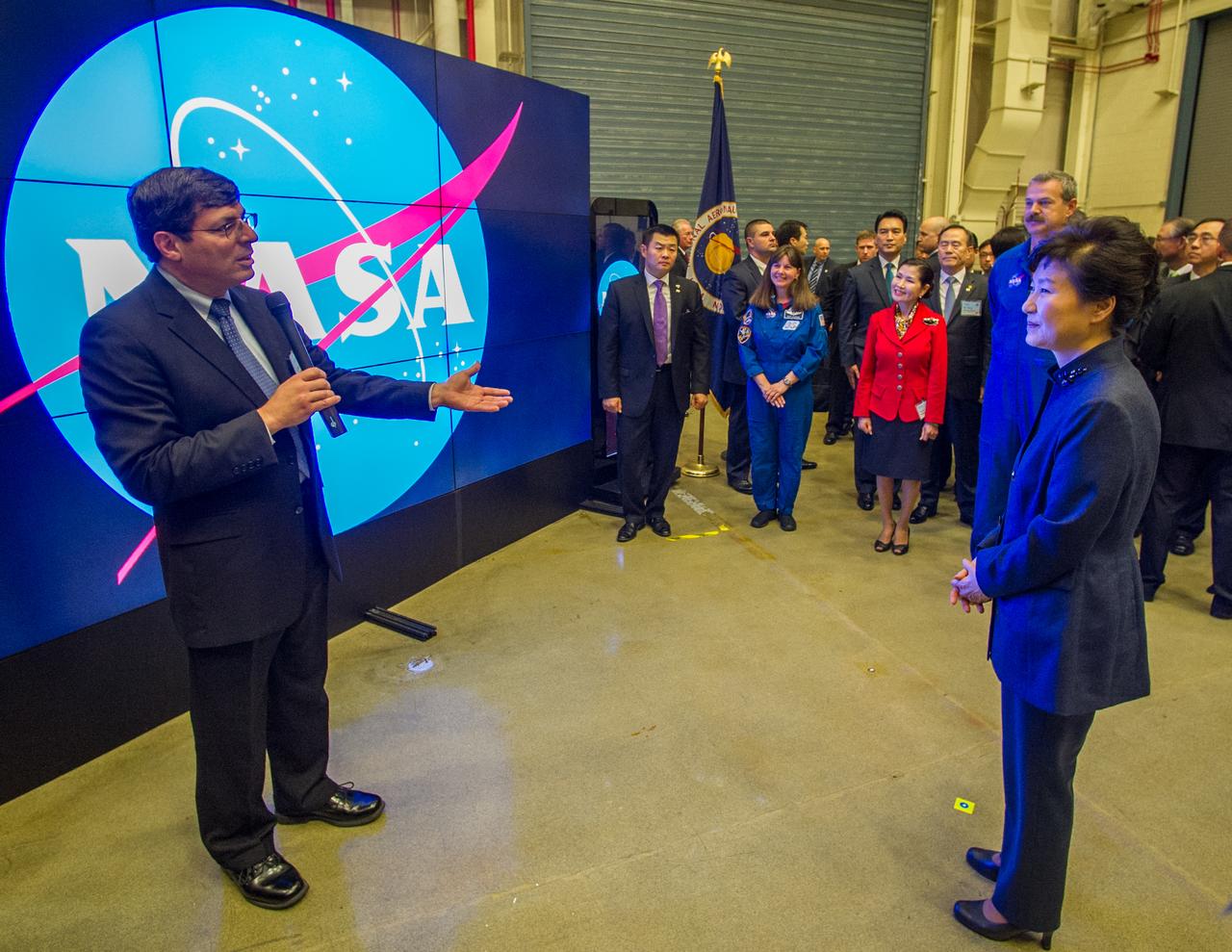
As part of her visit to the United States, President Park Geun-hye of South Korea visited NASA’s Goddard Space Flight Center in Greenbelt, Md. On Oct. 14, 2015. The visit offered an opportunity to celebrate past collaborative efforts between the American and South Korean space programs along with presentations on current projects and programs underway at Goddard. Caption: Goddard's Director Christopher Scolese welcomes President Park Geun-hye of South Korea and other Korean visitors to NASA Goddard on Oct. 14, 2015. Madam Park’s visit to Goddard offered an opportunity to celebrate past collaborative efforts between the American and South Korean space programs along with presentations on current projects and programs underway at Goddard. Credit: NASA/Goddard/Bill Hrybyk <b><a href="http://www.nasa.gov/audience/formedia/features/MP_Photo_Guidelines.html" rel="nofollow">NASA image use policy.</a></b> <b><a href="http://www.nasa.gov/centers/goddard/home/index.html" rel="nofollow">NASA Goddard Space Flight Center</a></b> enables NASA’s mission through four scientific endeavors: Earth Science, Heliophysics, Solar System Exploration, and Astrophysics. Goddard plays a leading role in NASA’s accomplishments by contributing compelling scientific knowledge to advance the Agency’s mission. <b>Follow us on <a href="http://twitter.com/NASAGoddardPix" rel="nofollow">Twitter</a></b> <b>Like us on <a href="http://www.facebook.com/pages/Greenbelt-MD/NASA-Goddard/395013845897?ref=tsd" rel="nofollow">Facebook</a></b> <b>Find us on <a href="http://instagrid.me/nasagoddard/?vm=grid" rel="nofollow">Instagram</a></b>
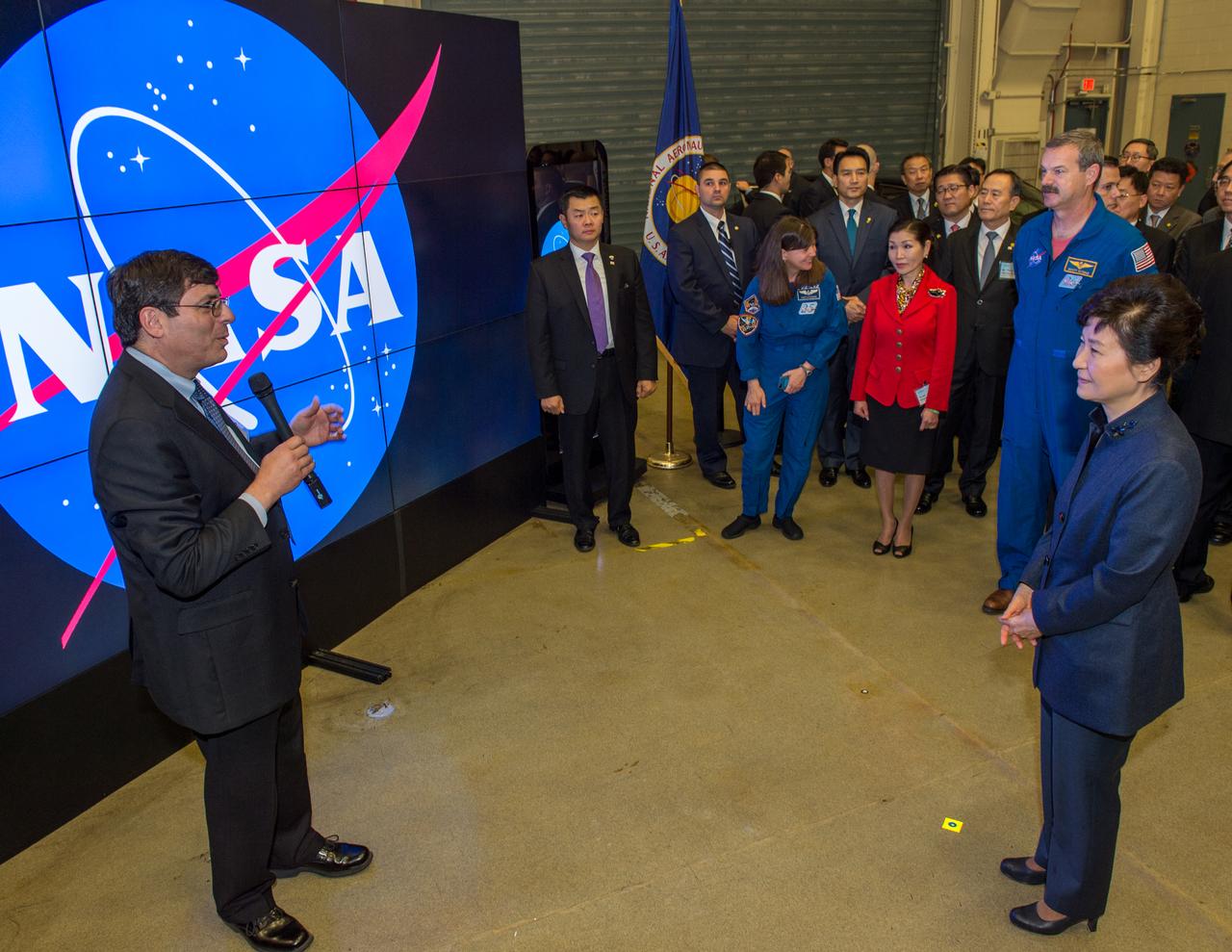
As part of her visit to the United States, President Park Geun-hye of South Korea visited NASA’s Goddard Space Flight Center in Greenbelt, Md. On Oct. 14, 2015. The visit offered an opportunity to celebrate past collaborative efforts between the American and South Korean space programs along with presentations on current projects and programs underway at Goddard. Caption: Goddard's Director Christopher Scolese welcomes President Park Geun-hye of South Korea and other Korean visitors to NASA Goddard on Oct. 14, 2015. Madam Park’s visit to Goddard offered an opportunity to celebrate past collaborative efforts between the American and South Korean space programs along with presentations on current projects and programs underway at Goddard. Credit: NASA/Goddard/Bill Hrybyk <b><a href="http://www.nasa.gov/audience/formedia/features/MP_Photo_Guidelines.html" rel="nofollow">NASA image use policy.</a></b> <b><a href="http://www.nasa.gov/centers/goddard/home/index.html" rel="nofollow">NASA Goddard Space Flight Center</a></b> enables NASA’s mission through four scientific endeavors: Earth Science, Heliophysics, Solar System Exploration, and Astrophysics. Goddard plays a leading role in NASA’s accomplishments by contributing compelling scientific knowledge to advance the Agency’s mission. <b>Follow us on <a href="http://twitter.com/NASAGoddardPix" rel="nofollow">Twitter</a></b> <b>Like us on <a href="http://www.facebook.com/pages/Greenbelt-MD/NASA-Goddard/395013845897?ref=tsd" rel="nofollow">Facebook</a></b> <b>Find us on <a href="http://instagrid.me/nasagoddard/?vm=grid" rel="nofollow">Instagram</a></b>
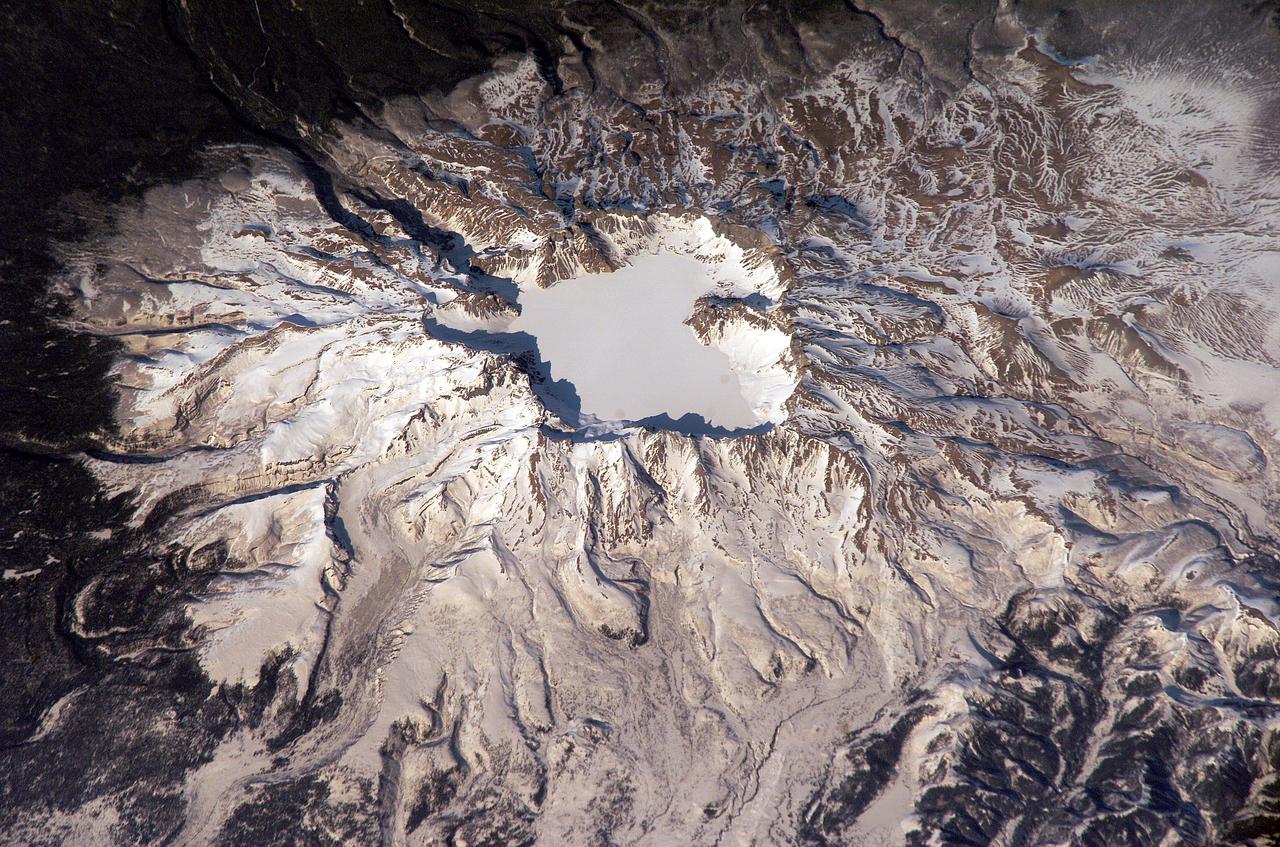
ISS006-E-43366 (4 April 2003) --- This view featuring Baitoushan Volcano, China and North Korea, was photographed by an Expedition 6 crewmember on the International Space Station (ISS). One of the largest known Holocene eruptions occurred at Baitoushan Volcano (also known as Changbaishan in China and P’aektu-san in Korea) about 1000 A.D., with erupted material deposited as far away as northern Japan – a distance of approximately 1200 kilometers. The eruption also created the 4.5 kilometer diameter, 850 meters deep summit caldera of the volcano that is now filled with the waters of Lake Tianchi (or Sky Lake). This oblique photograph was taken during the winter season, and snow highlights frozen Lake Tianchi along with lava flow lobes along the southern face of the volcano. Baitoushan last erupted in 1702 and is considered a dormant volcano. Gas emissions were reported from the summit and nearby hot springs in 1994, but no evidence of renewed activity of the volcano was observed. The Chinese-Korean border runs directly through the center of the summit caldera, and the mountain is considered sacred by the dominantly Korean population living near the volcano. Lake Tianchi is a popular resort destination, both for its natural beauty and alleged sightings of unidentified creatures living in its depths (similar to legendary Loch Ness Monster in Scotland).
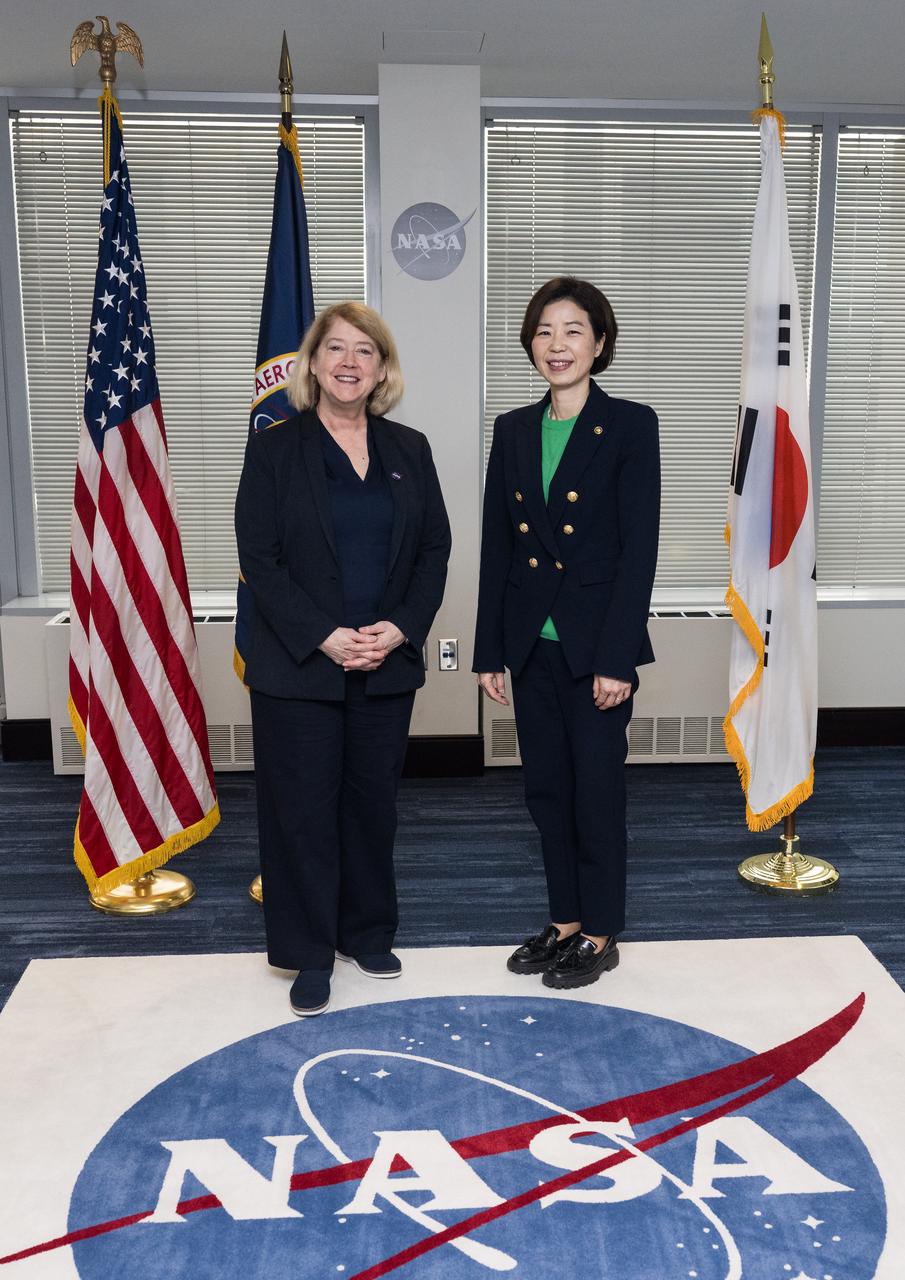
NASA Deputy Administrator Pam Melroy, left, poses for a photo with Vice Minister, Ministry of Science and ICT of Korea, Seong Kyung Cho, Tuesday, Jan. 23, 2024, at the Mary W. Jackson NASA Headquarters building in Washington. Photo Credit: (NASA/Aubrey Gemignani)

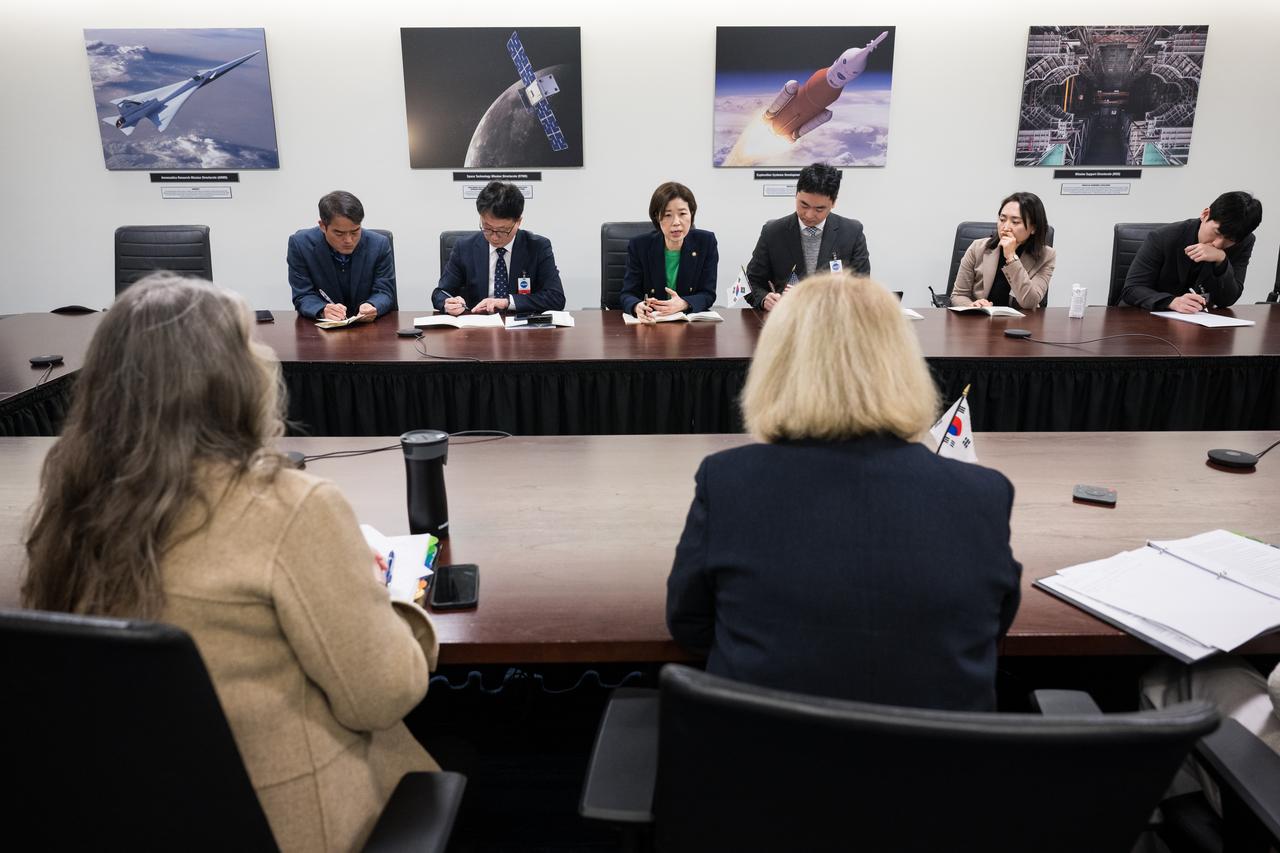
NASA Deputy Administrator Pam Melroy speaks during a meeting with Vice Minister, Ministry of Science and ICT of Korea, Seong Kyung Cho (not pictured), Tuesday, Jan. 23, 2024, at the Mary W. Jackson NASA Headquarters building in Washington. Photo Credit: (NASA/Aubrey Gemignani)

NASA Deputy Administrator Pam Melroy, right, meets with Vice Minister, Ministry of Science and ICT of Korea, Seong Kyung Cho, Tuesday, Jan. 23, 2024, at the Mary W. Jackson NASA Headquarters building in Washington. Photo Credit: (NASA/Aubrey Gemignani)

Director, Americas and Asia Cooperation Division, Ministry of Science and ICT of Korea, Kyoung Lim Lee, second from right, speaks during a meeting with NASA Deputy Administrator Pam Melroy (not pictured), Tuesday, Jan. 23, 2024, at the Mary W. Jackson NASA Headquarters building in Washington. Also present were from left to right, Science and ICT Counselor, Embassy of Republic of Korea, Kyu Chul Song, Special Advisor of International Space Cooperation, Ministry of Science and ICT of Korea, Byung Il Choi, Vice Minister, Ministry of Science and ICT of Korea, Seong Kyung Cho, Translator, Ministry of Science and ICT of Korea, Ji Ho Kim, and Deputy Director, Americas and Asia Cooperation Division, Ministry of Science and ICT of Korea, Sang Won Kim. Photo Credit: (NASA/Aubrey Gemignani)
NASA Deputy Administrator Pam Melroy meets with from left to right, Science and ICT Counselor, Embassy of Republic of Korea, Kyu Chul Song, Special Advisor of International Space Cooperation, Ministry of Science and ICT of Korea, Byung Il Choi, Vice Minister, Ministry of Science and ICT of Korea, Seong Kyung Cho, Translator, Ministry of Science and ICT of Korea, Ji Ho Kim, Director, Americas and Asia Cooperation Division, Ministry of Science and ICT of Korea, Kyoung Lim Lee, and Deputy Director, Americas and Asia Cooperation Division, Ministry of Science and ICT of Korea, Sang Won Kim, Tuesday, Jan. 23, 2024, at the Mary W. Jackson NASA Headquarters building in Washington. . Photo Credit: (NASA/Aubrey Gemignani)

NASA Deputy Administrator Pam Melroy, second from right, along with NASA Associate Administrator for International and Interagency Relations, Karen Feldstein, third from right, Deputy Associate Administrator for International and Interagency Relations Meredith McKay, right, and NASA International Program Specialist Melanie Dalby, meet with from left to right, Science and ICT Counselor, Embassy of Republic of Korea, Kyu Chul Song, Special Advisor of International Space Cooperation, Ministry of Science and ICT of Korea, Byung Il Choi, Vice Minister, Ministry of Science and ICT of Korea, Seong Kyung Cho, Translator, Ministry of Science and ICT of Korea, Ji Ho Kim, Director, Americas and Asia Cooperation Division, Ministry of Science and ICT of Korea, Kyoung Lim Lee, and Deputy Director, Americas and Asia Cooperation Division, Ministry of Science and ICT of Korea, Sang Won Kim, Tuesday, Jan. 23, 2024, at the Mary W. Jackson NASA Headquarters building in Washington. Photo Credit: (NASA/Aubrey Gemignani)

NASA Deputy Administrator Pam Melroy speaks during a meeting with Vice Minister, Ministry of Science and ICT of Korea, Seong Kyung Cho (not pictured), Tuesday, Jan. 23, 2024, at the Mary W. Jackson NASA Headquarters building in Washington. Photo Credit: (NASA/Aubrey Gemignani)
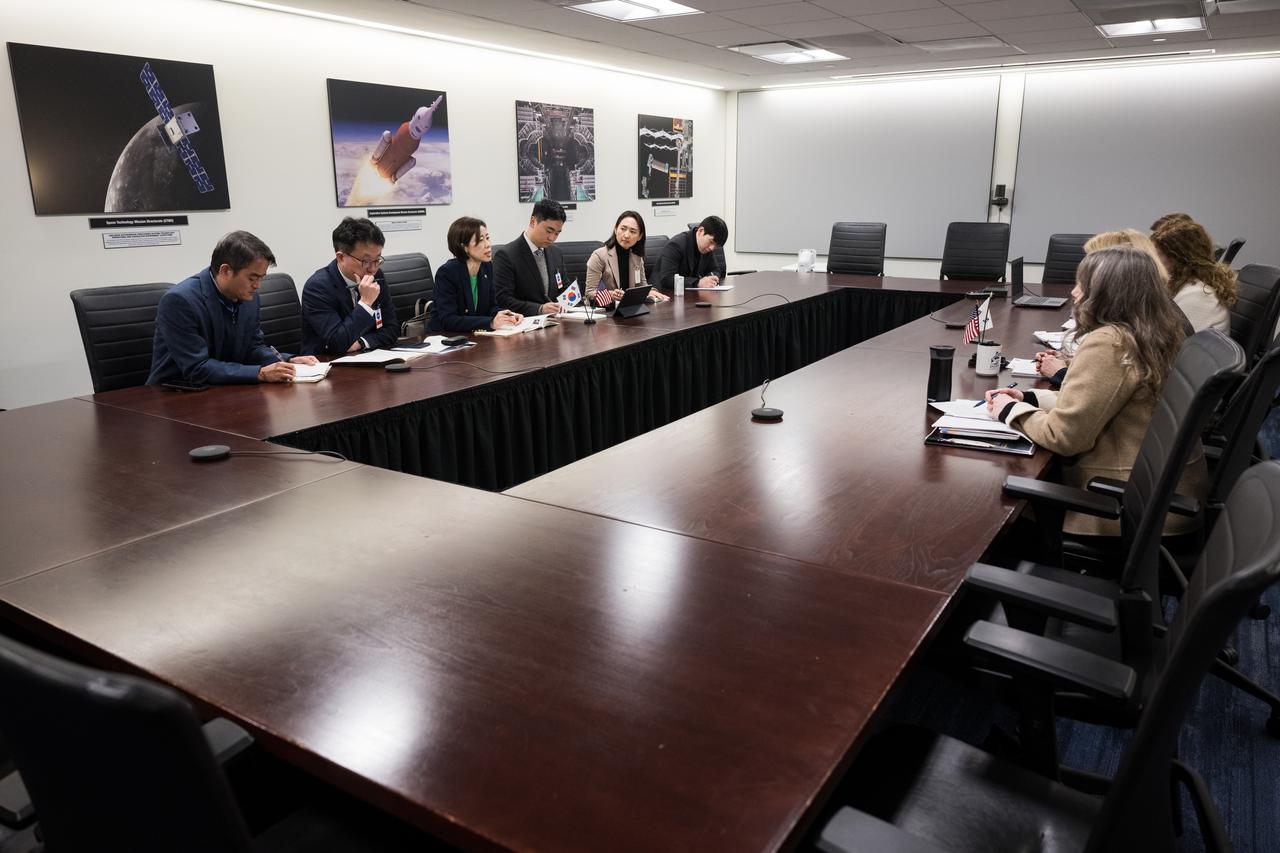
From left to right, Science and ICT Counselor, Embassy of Republic of Korea, Kyu Chul Song, Special Advisor of International Space Cooperation, Ministry of Science and ICT of Korea, Byung Il Choi, Vice Minister, Ministry of Science and ICT of Korea, Seong Kyung Cho, Translator, Ministry of Science and ICT of Korea, Ji Ho Kim, Director, Americas and Asia Cooperation Division, Ministry of Science and ICT of Korea, Kyoung Lim Lee, and Deputy Director, Americas and Asia Cooperation Division, Ministry of Science and ICT of Korea, Sang Won Kim meet with NASA Deputy Administrator Pam Melroy, Tuesday, Jan. 23, 2024, at the Mary W. Jackson NASA Headquarters building in Washington. Photo Credit: (NASA/Aubrey Gemignani)
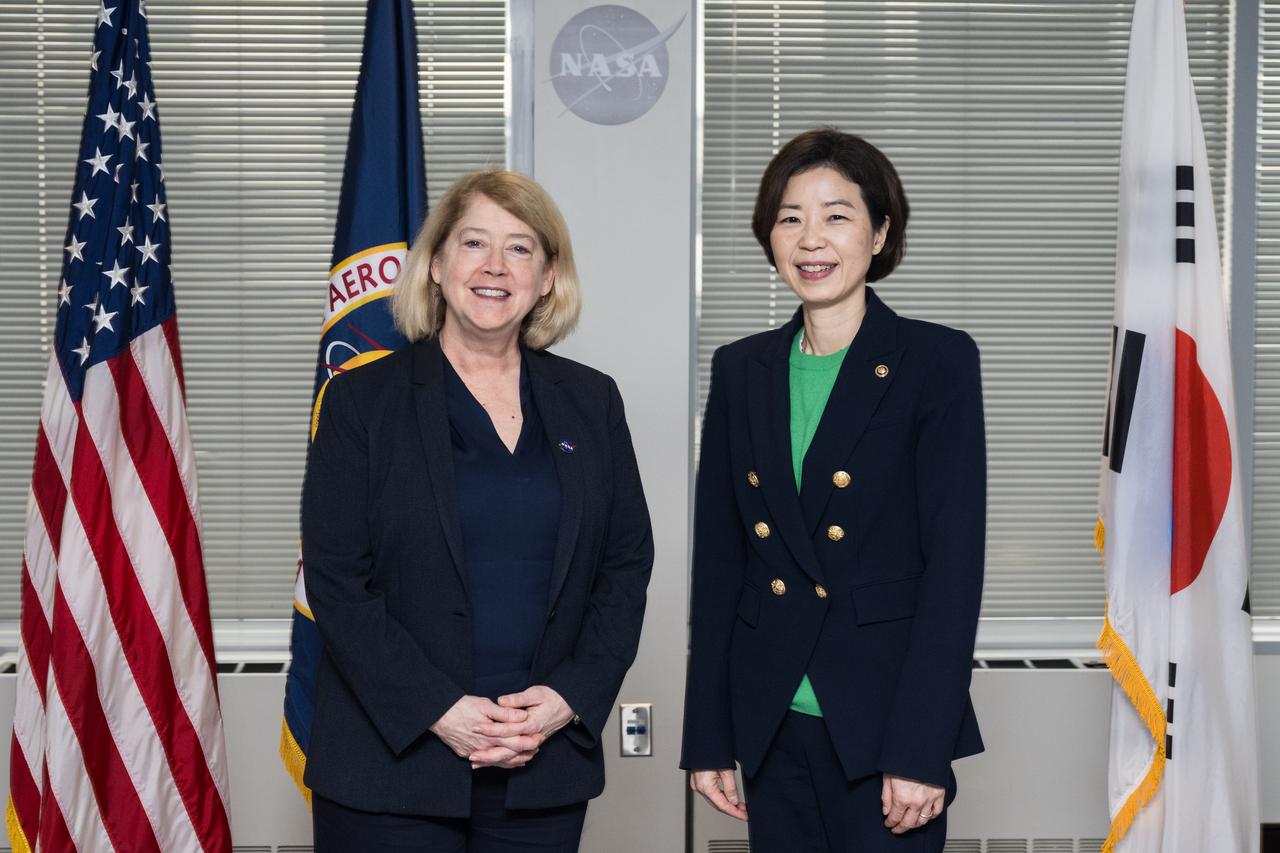
NASA Deputy Administrator Pam Melroy, left, poses for a photo with Vice Minister, Ministry of Science and ICT of Korea, Seong Kyung Cho, Tuesday, Jan. 23, 2024, at the Mary W. Jackson NASA Headquarters building in Washington. Photo Credit: (NASA/Aubrey Gemignani)
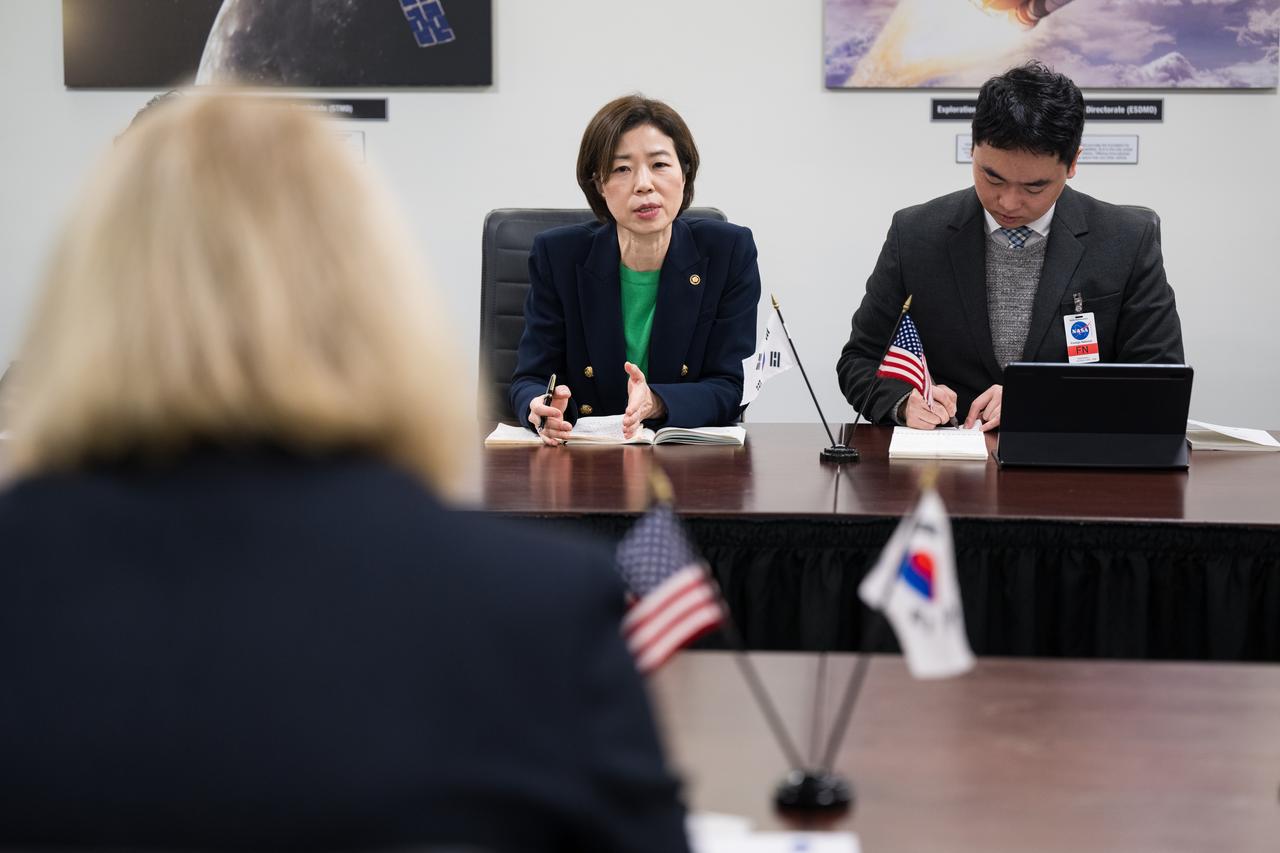
Vice Minister, Ministry of Science and ICT of Korea, Seong Kyung Cho, left, speaks to NASA Deputy Administrator Pam Melroy during a meeting, Tuesday, Jan. 23, 2024, at the Mary W. Jackson NASA Headquarters building in Washington. Photo Credit: (NASA/Aubrey Gemignani)

Vice Minister, Ministry of Science and ICT of Korea, Seong Kyung Cho speaks during a meeting with NASA Deputy Administrator Pam Melroy, Tuesday, Jan. 23, 2024, at the Mary W. Jackson NASA Headquarters building in Washington. Photo Credit: (NASA/Aubrey Gemignani)
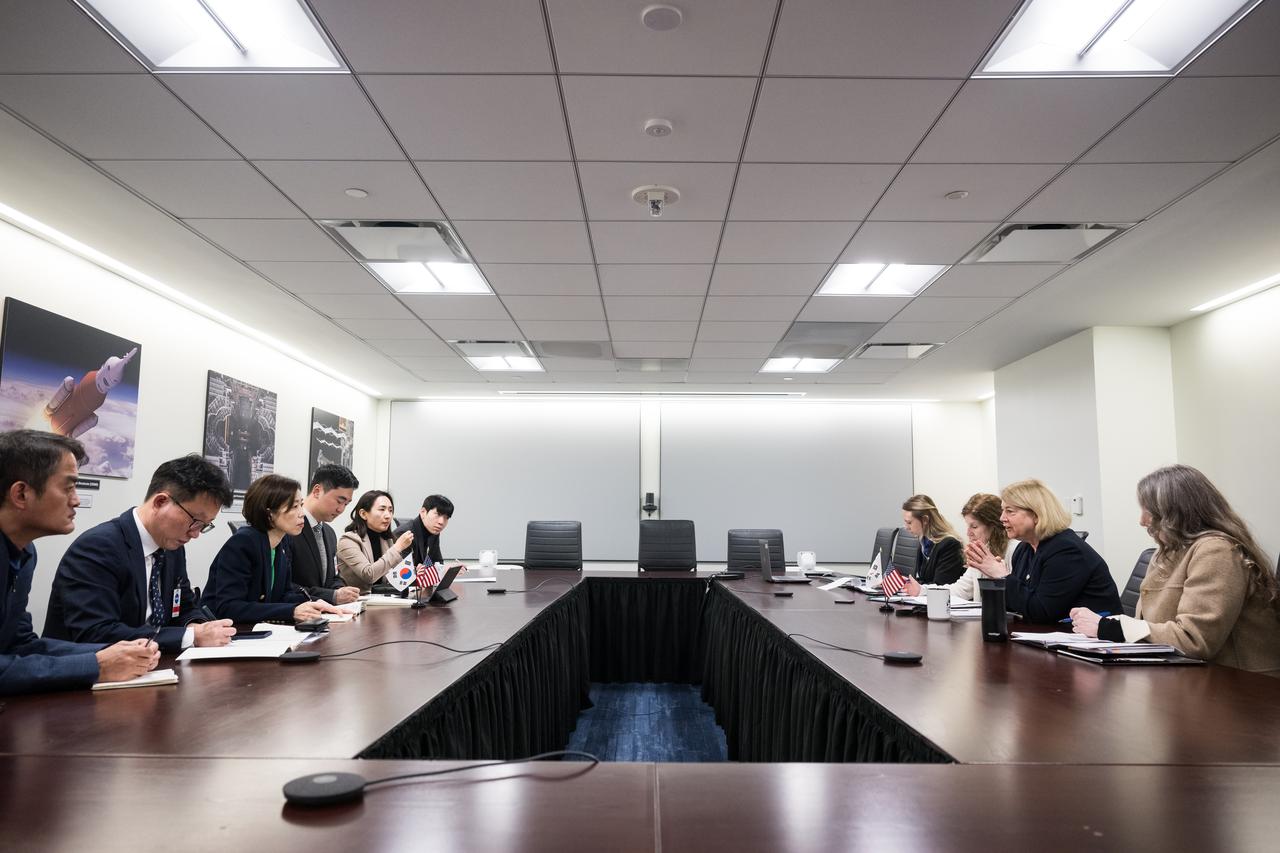
NASA Deputy Administrator Pam Melroy, second from right, along with NASA Associate Administrator for International and Interagency Relations, Karen Feldstein, third from right, Deputy Associate Administrator for International and Interagency Relations Meredith McKay, right, and NASA International Program Specialist Melanie Dalby, meet with from left to right, Science and ICT Counselor, Embassy of Republic of Korea, Kyu Chul Song, Special Advisor of International Space Cooperation, Ministry of Science and ICT of Korea, Byung Il Choi, Vice Minister, Ministry of Science and ICT of Korea, Seong Kyung Cho, Translator, Ministry of Science and ICT of Korea, Ji Ho Kim, Director, Americas and Asia Cooperation Division, Ministry of Science and ICT of Korea, Kyoung Lim Lee, and Deputy Director, Americas and Asia Cooperation Division, Ministry of Science and ICT of Korea, Sang Won Kim, Tuesday, Jan. 23, 2024, at the Mary W. Jackson NASA Headquarters building in Washington. Photo Credit: (NASA/Aubrey Gemignani)
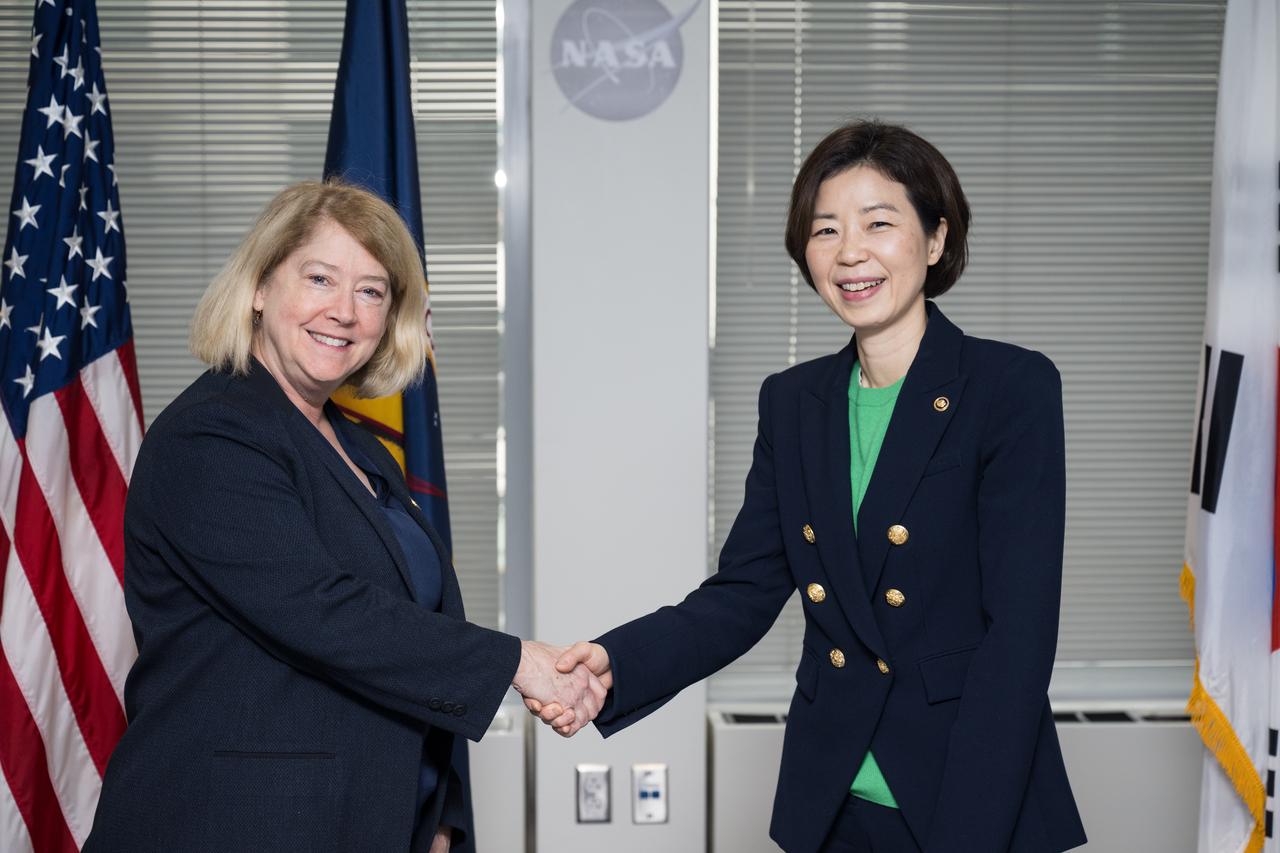
NASA Deputy Administrator Pam Melroy, left, shakes hands with Vice Minister, Ministry of Science and ICT of Korea, Seong Kyung Cho, Tuesday, Jan. 23, 2024, at the Mary W. Jackson NASA Headquarters building in Washington. Photo Credit: (NASA/Aubrey Gemignani)

NASA Deputy Administrator Pam Melroy meets with Vice Minister, Ministry of Science and ICT of Korea, Seong Kyung Cho, Tuesday, Jan. 23, 2024, at the Mary W. Jackson NASA Headquarters building in Washington. Photo Credit: (NASA/Aubrey Gemignani)

Monica Manning, Assistant Administrator for Procurement at NASA, introduces Retired U.S. Air Force Honorary Brigadier General Charles McGee and NASA astronaut Alvin Drew during a Black History Month program titled “Trailblazers, The Story of a Tuskegee Airman,” Wednesday, Feb. 5, 2020, at NASA Headquarters in Washington, DC. McGee, a pilot with the Tuskegee Airmen during World War II, was a career officer in the Air Force also serving during the Korean and Vietnam Wars. Over his 30 years of service he flew 409 combat missions. Of the 355 Tuskegee pilots who flew in combat, McGee is one of only nine surviving. Photo Credit: (NASA/Joel Kowsky)
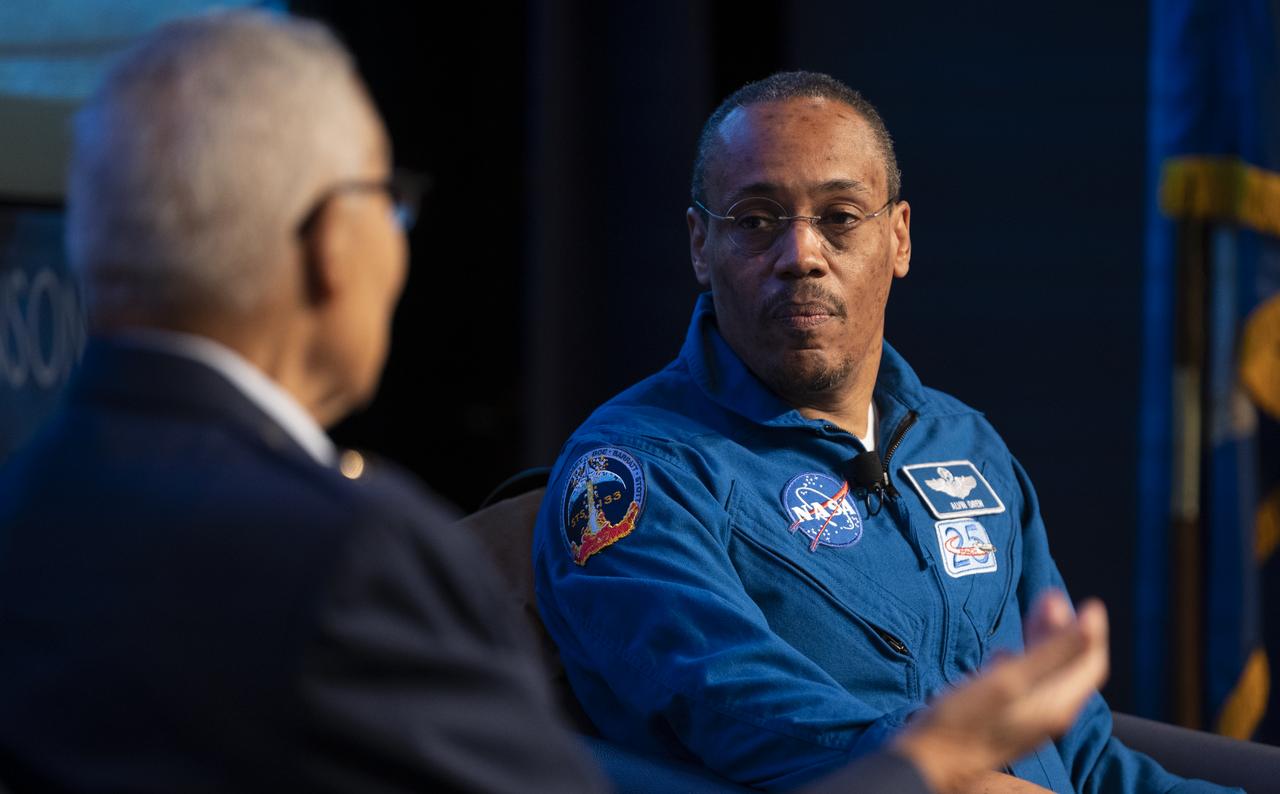
NASA astronaut Alvin Drew speaks with retired U.S. Air Force Honorary Brigadier General Charles McGee during a Black History Month program titled “Trailblazers, The Story of a Tuskegee Airman,” Wednesday, Feb. 5, 2020, at NASA Headquarters in Washington, DC. McGee, a pilot with the Tuskegee Airmen during World War II, was a career officer in the Air Force also serving during the Korean and Vietnam Wars. Over his 30 years of service he flew 409 combat missions. Of the 355 Tuskegee pilots who flew in combat, McGee is one of only nine surviving. Photo Credit: (NASA/Joel Kowsky)
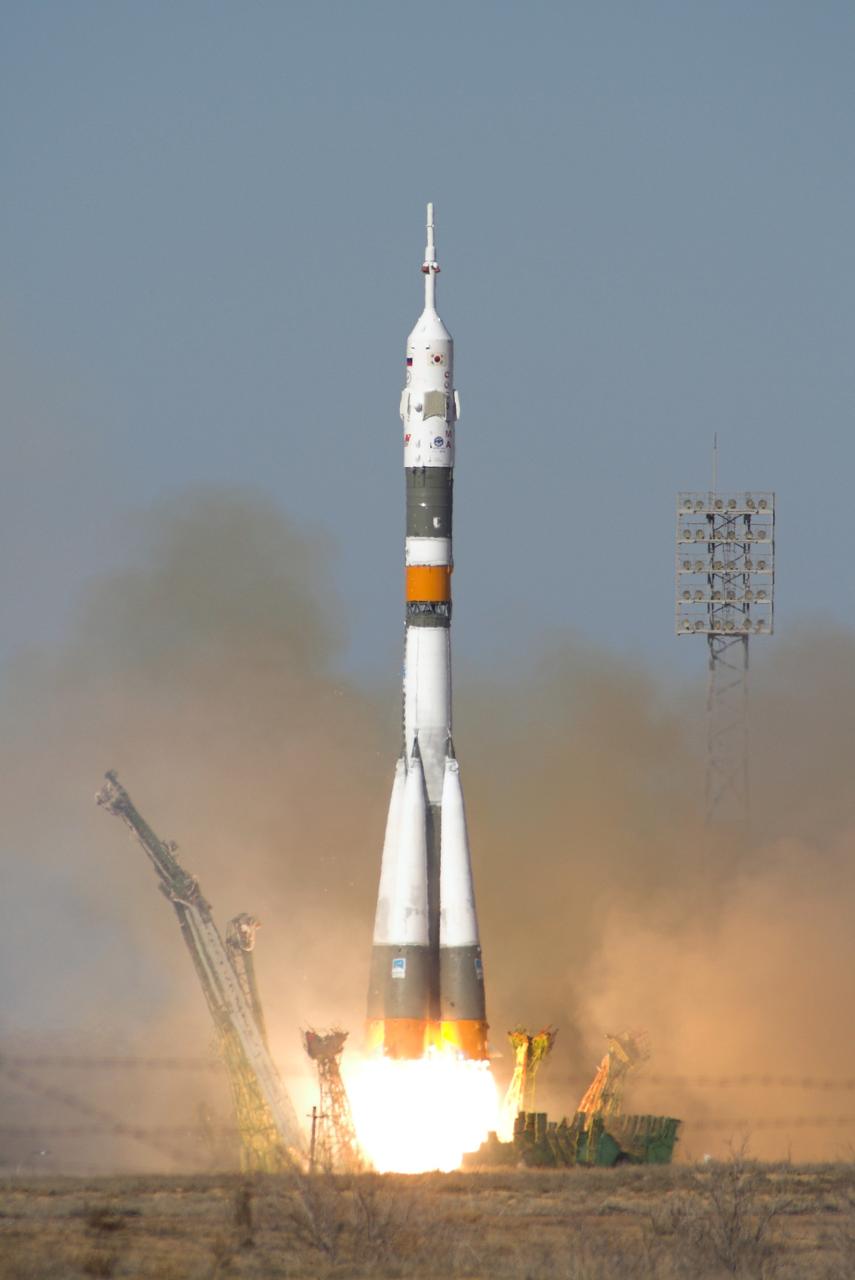
JSC2008-E-032796 (8 April 2008) --- At the Baikonur Cosmodrome in Kazakhstan, the Soyuz TMA-12 spacecraft lifted off into a cloudless sky April 8, 2008 at 5:16 p.m. Baikonur time to carry Expedition 17 Commander Sergei Volkov, Flight Engineer Oleg Kononenko and South Korean spaceflight participant So-yeon Yi to the International Space Station and a docking on April 10. Volkov and Kononenko will spend six months on the station while Yi will spend nine days on the complex under a commercial agreement between South Korea and the Russian Federal Space Agency. Photo Credit: NASA /Victor Zelentsov

Retired U.S. Air Force Honorary Brigadier General Charles McGee, left, speaks with NASA astronaut Alvin Drew during a Black History Month program titled “Trailblazers, The Story of a Tuskegee Airman,” Wednesday, Feb. 5, 2020, at NASA Headquarters in Washington, DC. McGee, a pilot with the Tuskegee Airmen during World War II, was a career officer in the Air Force also serving during the Korean and Vietnam Wars. Over his 30 years of service he flew 409 combat missions. Of the 355 Tuskegee pilots who flew in combat, McGee is one of only nine surviving. Photo Credit: (NASA/Joel Kowsky)
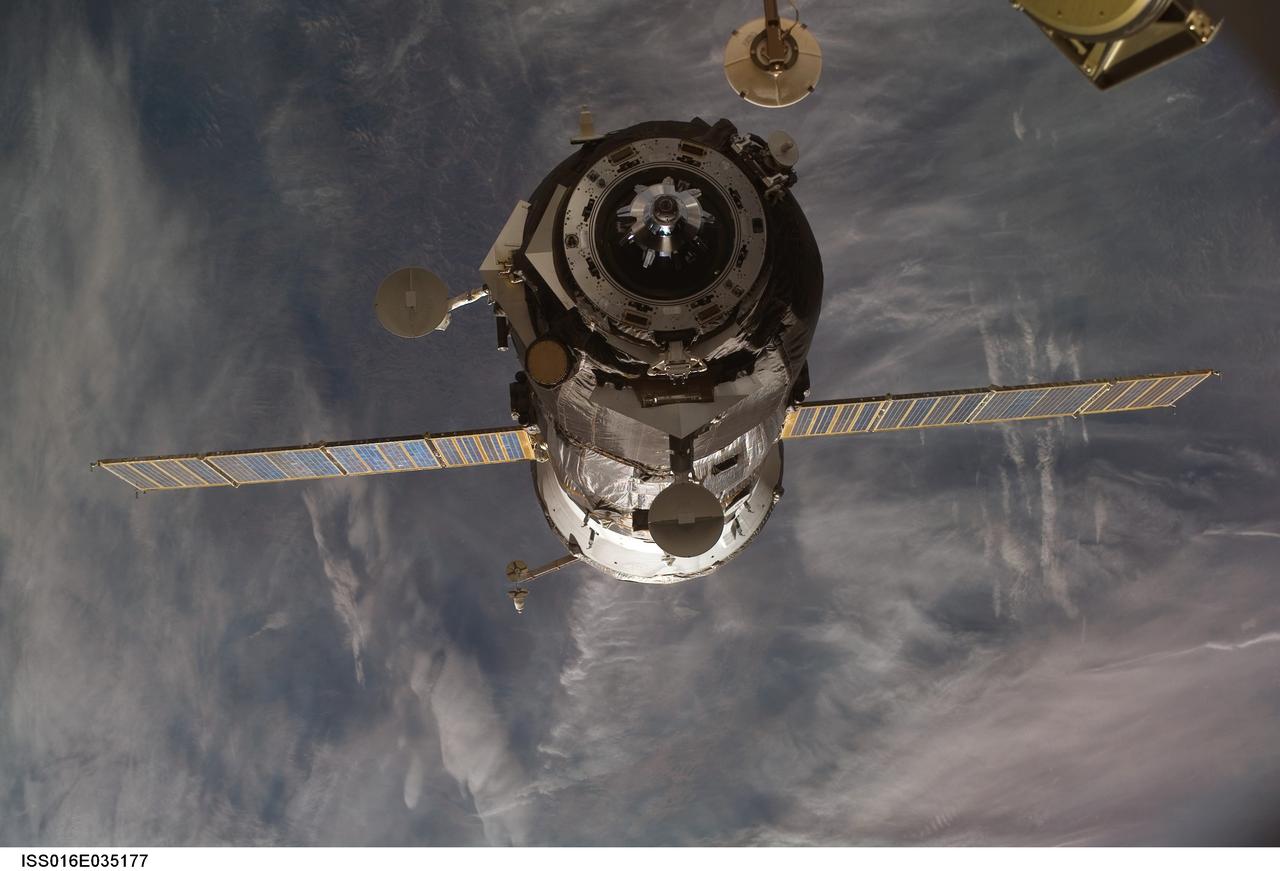
ISS016-E-035177 (7 April 2008) --- An unpiloted Progress 28 resupply vehicle departs from the Pirs Docking Compartment of the International Space Station at 4:50 a.m. (EDT) on Monday, April 7, 2008, and headed into its deorbit and destructive re-entry into Earth's atmosphere over the Pacific Ocean. The Progress, which has been attached to the station since February, had been loaded with trash and discards before its departure. The undocking clears the way for the arrival Thursday of the Soyuz TMA-12 spacecraft carrying the Expedition 17 crew and a South Korean spaceflight participant.
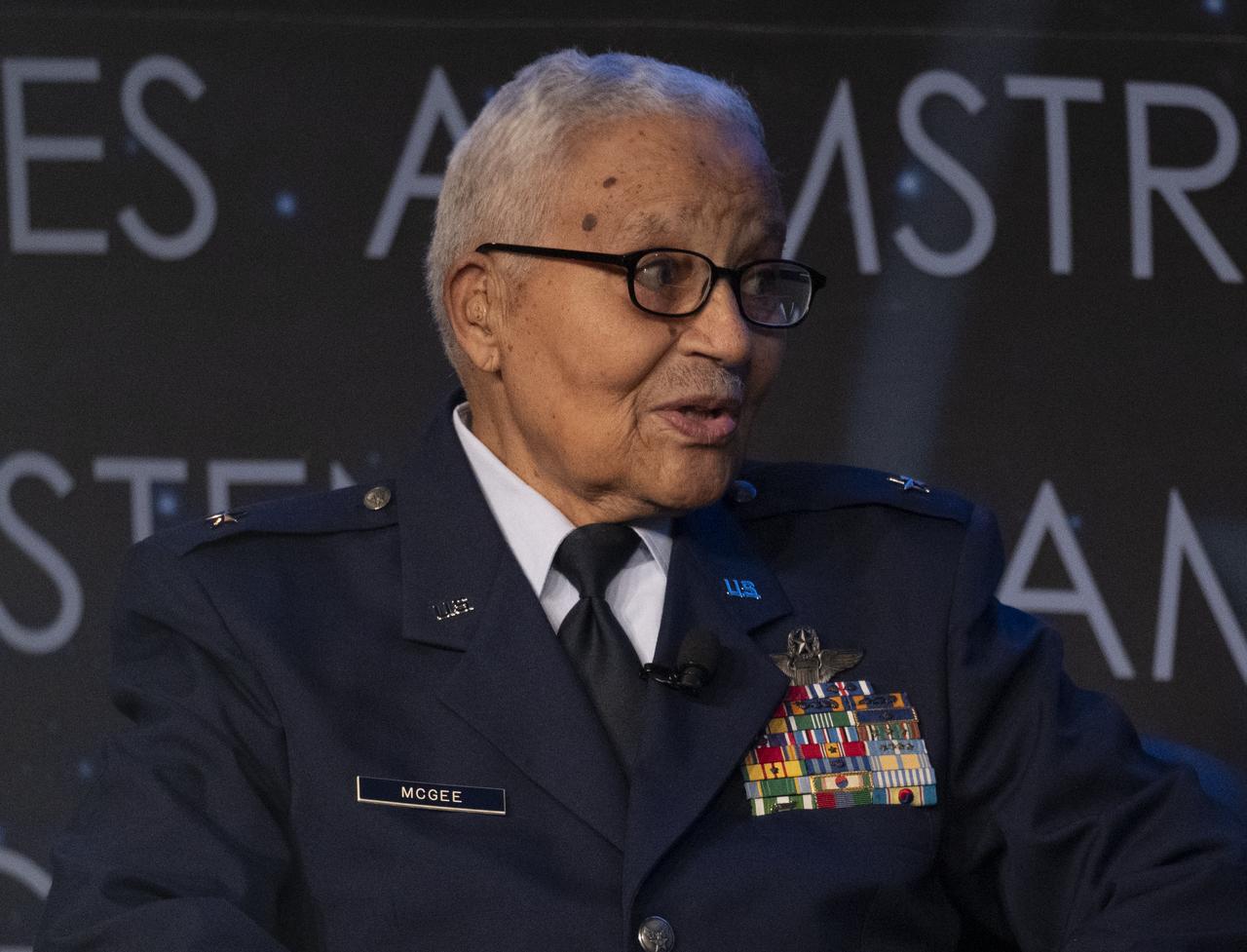
Retired U.S. Air Force Honorary Brigadier General Charles McGee is seen as he speaks with NASA astronaut Alvin Drew during a Black History Month program titled “Trailblazers, The Story of a Tuskegee Airman,” Wednesday, Feb. 5, 2020, at NASA Headquarters in Washington, DC. McGee, a pilot with the Tuskegee Airmen during World War II, was a career officer in the Air Force also serving during the Korean and Vietnam Wars. Over his 30 years of service he flew 409 combat missions. Of the 355 Tuskegee pilots who flew in combat, McGee is one of only nine surviving. Photo Credit: (NASA/Joel Kowsky)
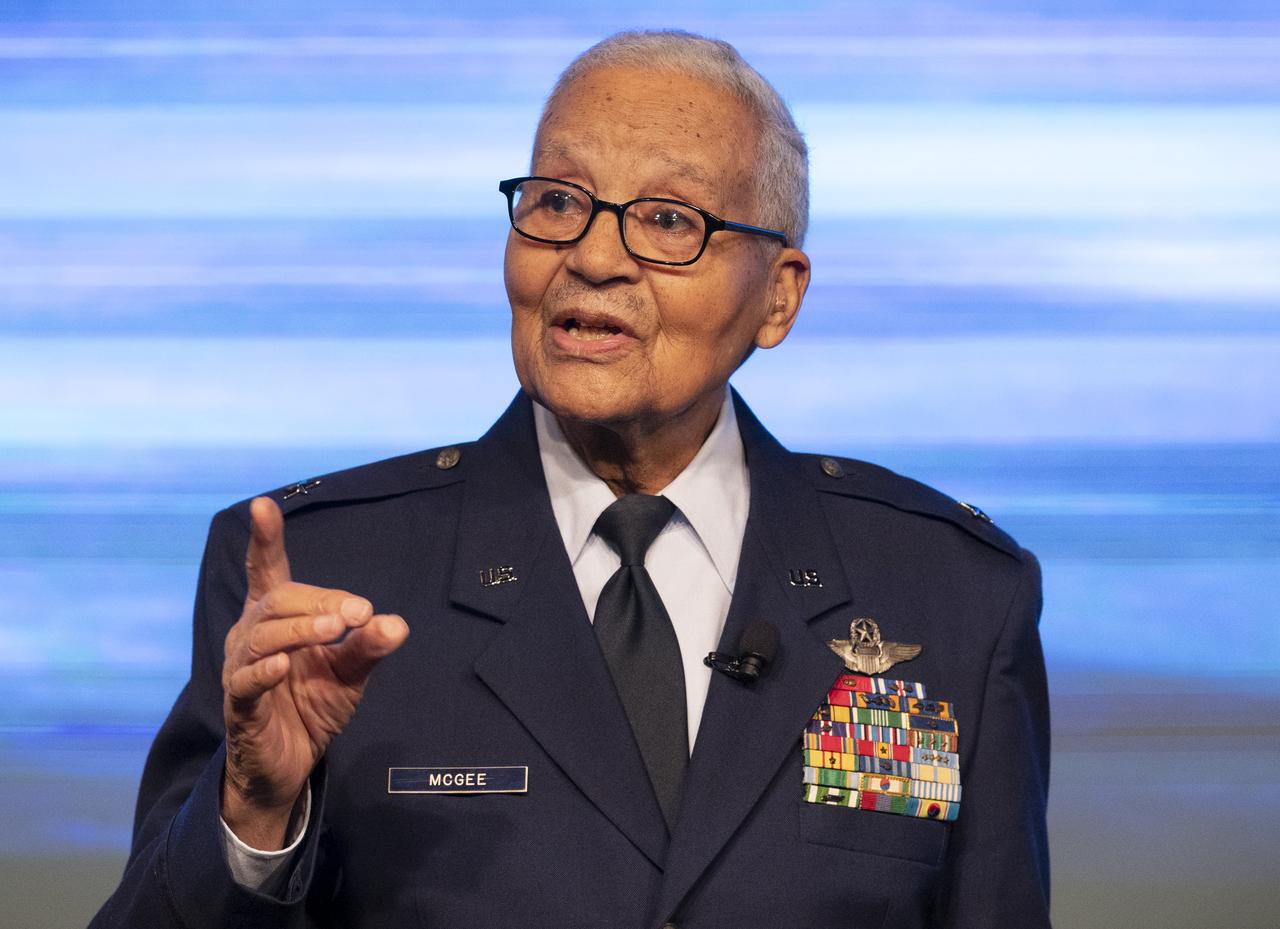
Retired U.S. Air Force Honorary Brigadier General Charles McGee is seen during a Black History Month program titled “Trailblazers, The Story of a Tuskegee Airman,” Wednesday, Feb. 5, 2020, at NASA Headquarters in Washington, DC. McGee, a pilot with the Tuskegee Airmen during World War II, was a career officer in the Air Force also serving during the Korean and Vietnam Wars. Over his 30 years of service he flew 409 combat missions. Of the 355 Tuskegee pilots who flew in combat, McGee is one of only nine surviving. Photo Credit: (NASA/Joel Kowsky)

The NACA’s Lewis Flight Propulsion Laboratory acquired the Grumman S2F-1 Tracker from the Navy in 1955 to study icing instrumentation. Lewis’s icing research program was winding down at the time. The use of jet engines was increasing thus reducing the threat of ice accumulation. Nonetheless Lewis continued research on the instrumentation used to detect icing conditions. The S2F-1 Tracker was a carrier-based submarine hunter for the Navy. Grumman developed the Tracker as a successor to its Korean War-era Guardian patrol aircraft. Prototypes first flew in late 1952 and battle-ready versions entered Naval service in early 1954. The Navy utilized the Trackers to protect fleets from attack.
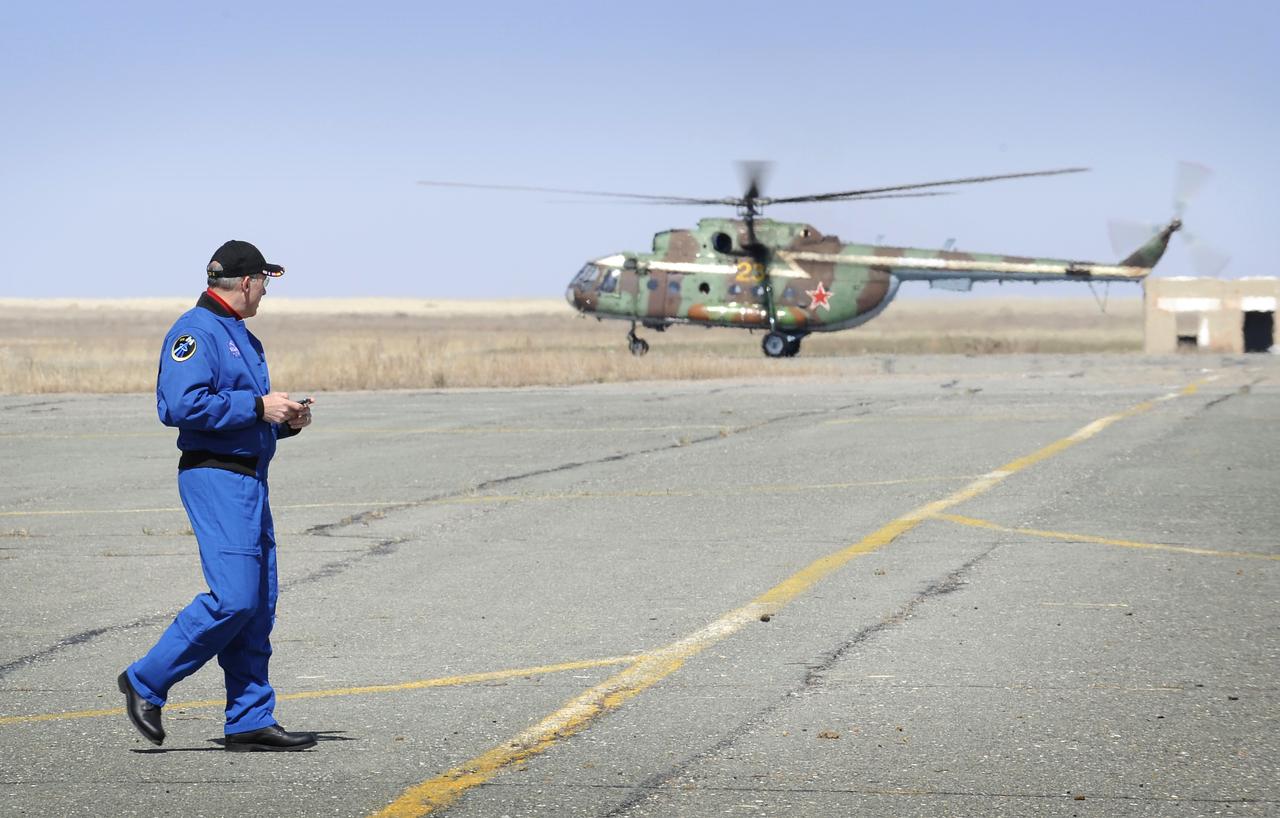
International Space Station Program Manager Michael Suffredini watches as the first wave of helicopters leaves the Arkalyk airport in Kazakhstan in preparation for the Soyuz TMA-11 landing, Friday, April 19, 2008. The Soyuz TMA-11 spacecraft carrying Expedition 16 Commander Peggy Whitson, Flight Engineer and Soyuz Commander Yuri Malenchenko and South Korean spacelfight participant So-yeon Yi landed in central Kazakhstan to complete 192 days in space for Whitson and Malenchenko and 11 days in orbit for Yi. Photo Credit: (NASA/Bill Ingalls)
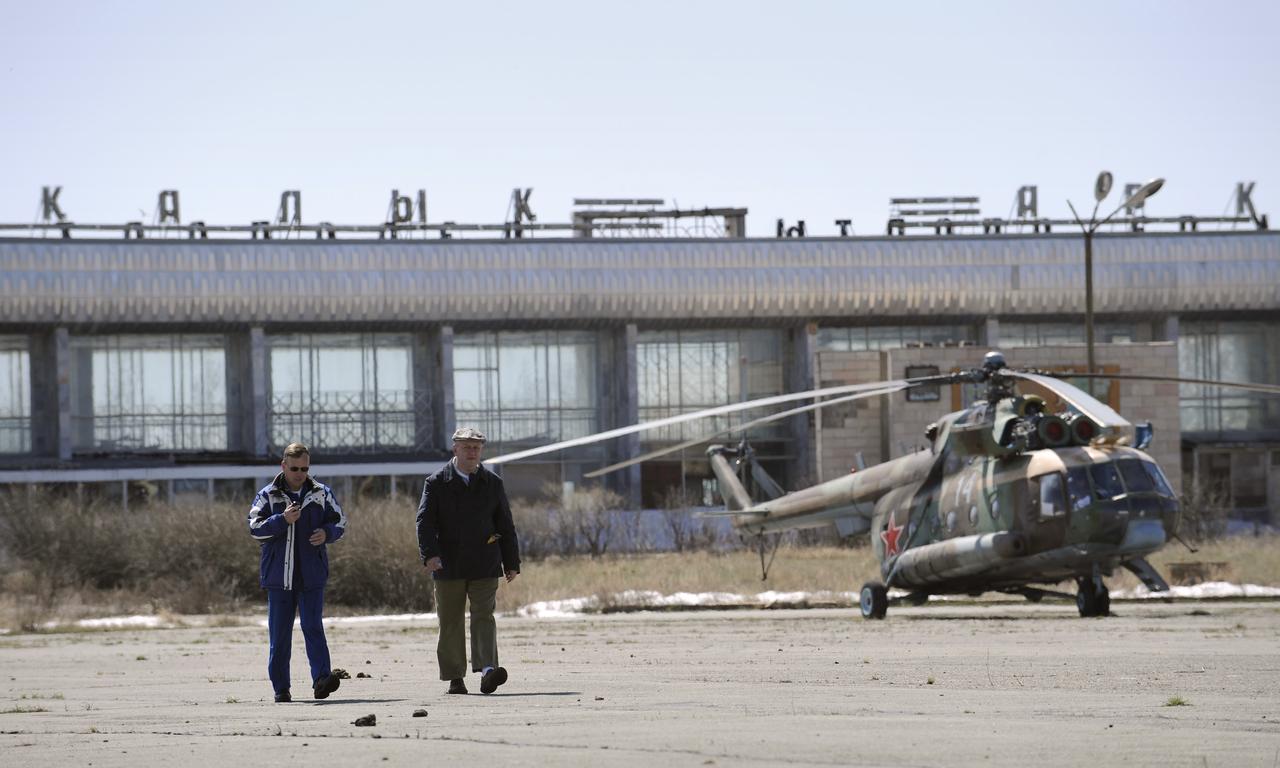
Chief of the NASA Astronaut office, Steve Lindsey, left, and interpreter Paul Kharmats wait at the Arkalyk airport in Kazakhstan as Russian helicopters are refueled, Friday, April 19, 2008. Arkalyk was used as one of the helicopter staging areas for the landing of the Soyuz TMA-11 spacecraft carrying Expedition 16 Commander Peggy Whitson, Flight Engineer and Soyuz Commander Yuri Malenchenko and South Korean spaceflight participant So-yeon Yi. The Soyuz made a ballistic landing, touching down more then 400 kilometers short of the intended target in central Kazakhstan. Photo Credit: (NASA/Bill Ingalls)
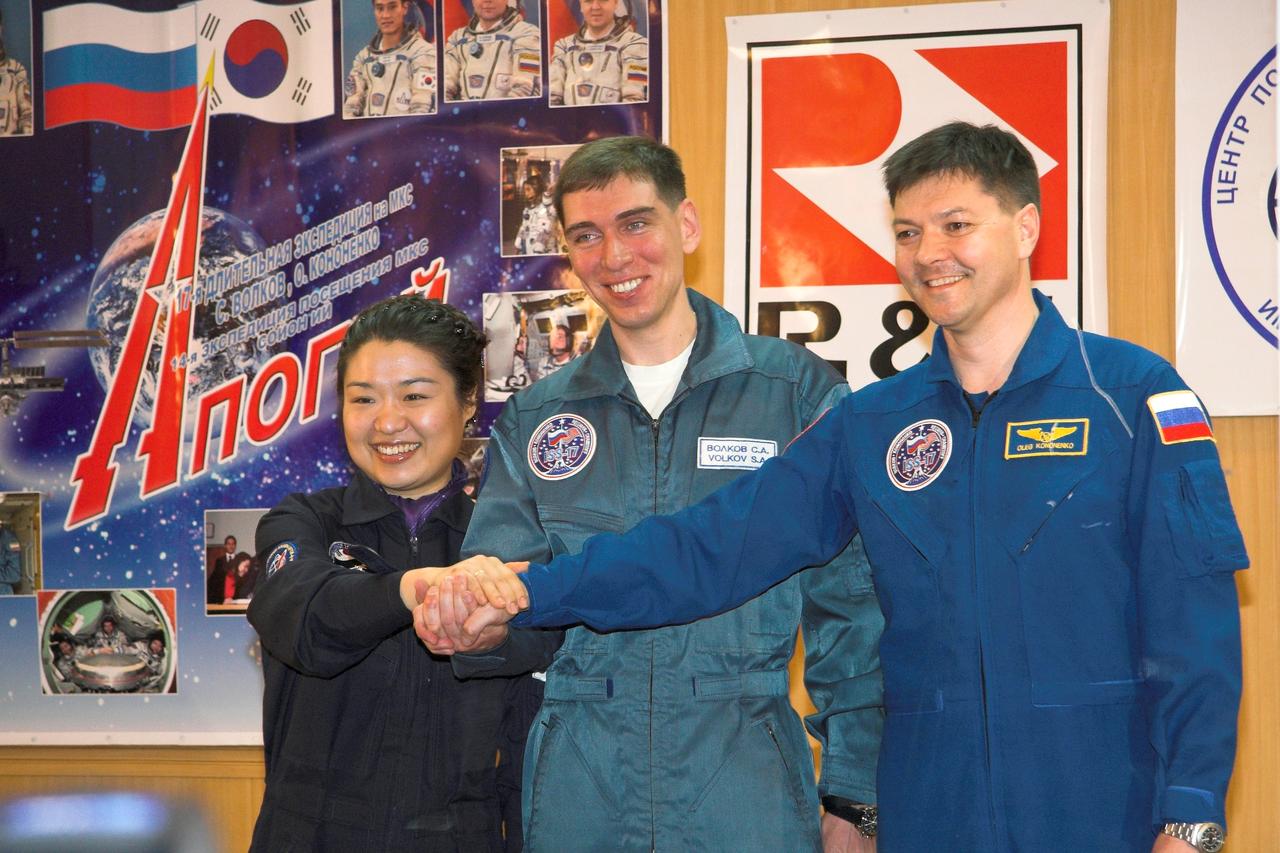
JSC2008-E-032248 (7 April 2008) --- At their crew quarters in Baikonur, Kazakhstan, Expedition 17 Commander Sergei Volkov (center), Flight Engineer Oleg Kononenko (right) and South Korean spaceflight participant So-yeon Yi clasp hands for photographers on April 7, 2008, the eve of their launch to the International Space Station. Volkov, Kononenko and Yi are scheduled to launch to the station on the Soyuz TMA-12 spacecraft from the Baikonur Cosmodrome on April 8 and arrive at the ISS on April 10 to begin what will be six months in space for Volkov and Kononenko. Yi will be in space nine days on the complex, returning to Earth with two of the Expedition 16 crewmembers currently on the station. Photo Credit: NASA /Victor Zelentsov
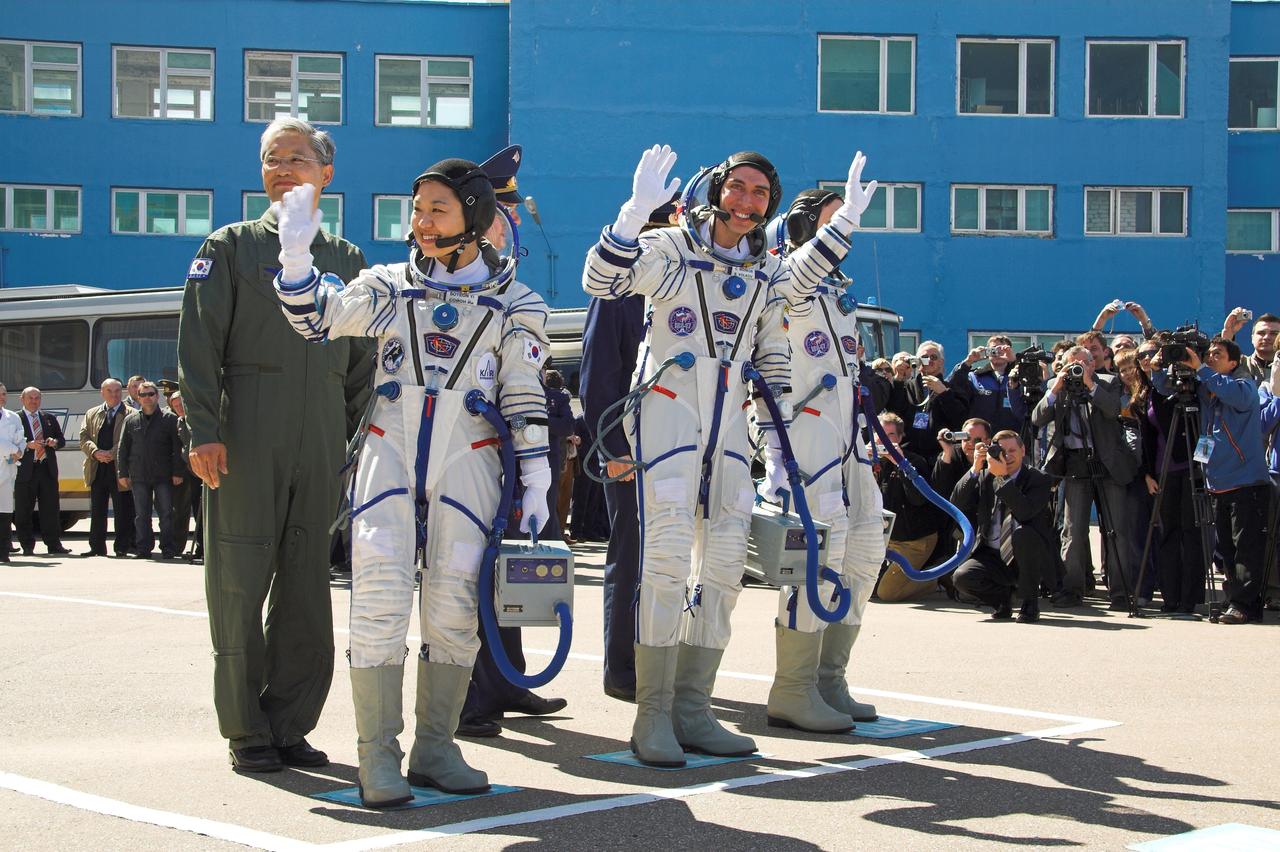
JSC2008-E-032795 (8 April 2008) --- At the Baikonur Cosmodrome in Kazakhstan, Expedition 17 Commander Sergei Volkov (center), Flight Engineer Oleg Kononenko (right) and South Korean spaceflight participant So-yeon Yi bid farewell to well wishers April 8, 2008 prior to heading to the launch pad for their liftoff on the Soyuz TMA-12 spacecraft to the International Space Station. Volkov and Kononenko will spend six months on the station, while Yi will spend nine days on the complex under a commercial agreement between South Korea and the Russian Federal Space Agency. Photo Credit: NASA /Victor Zelentsov
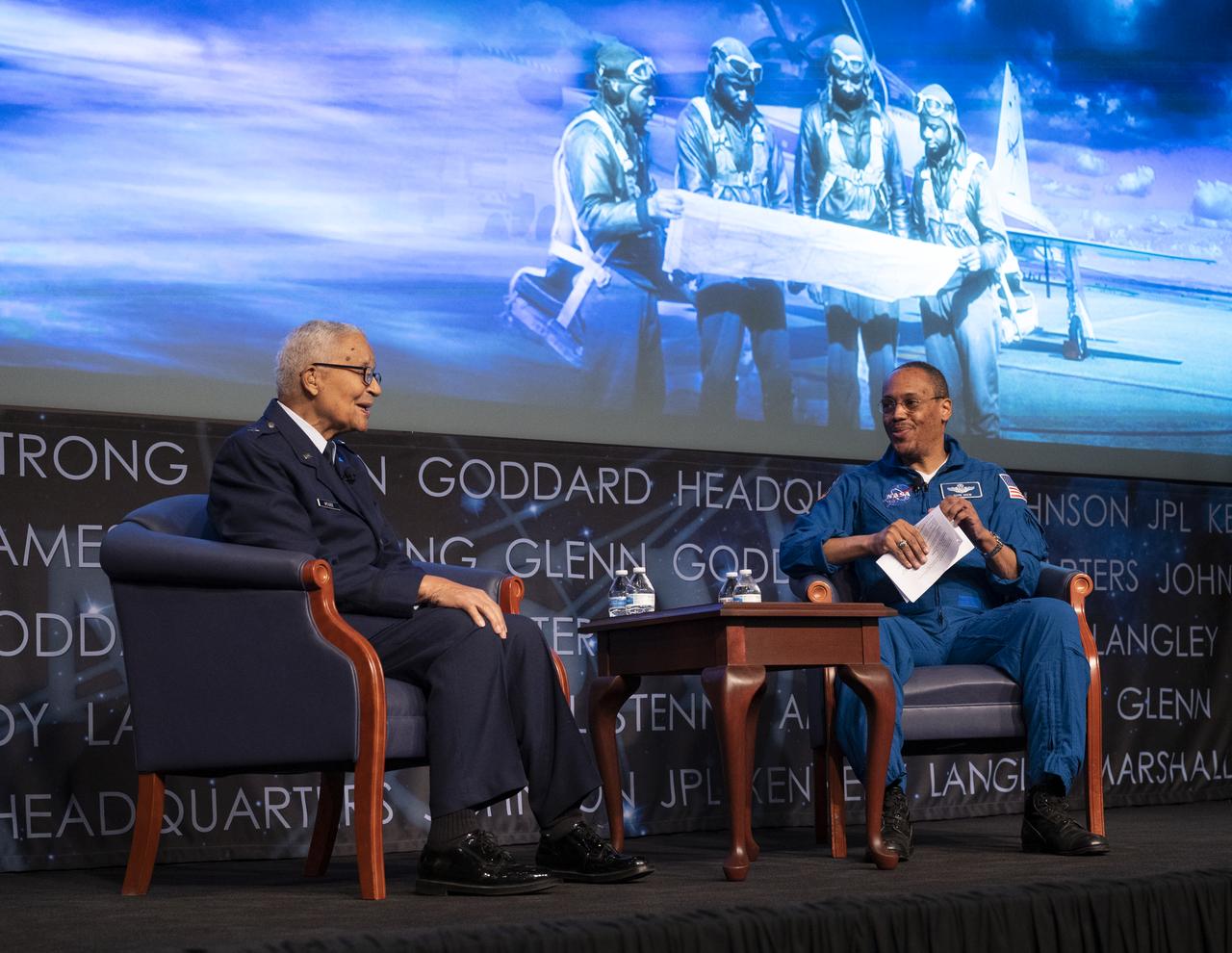
Retired U.S. Air Force Honorary Brigadier General Charles McGee, left, speaks with NASA astronaut Alvin Drew during a Black History Month program titled “Trailblazers, The Story of a Tuskegee Airman,” Wednesday, Feb. 5, 2020, at NASA Headquarters in Washington, DC. McGee, a pilot with the Tuskegee Airmen during World War II, was a career officer in the Air Force also serving during the Korean and Vietnam Wars. Over his 30 years of service he flew 409 combat missions. Of the 355 Tuskegee pilots who flew in combat, McGee is one of only nine surviving. Photo Credit: (NASA/Joel Kowsky)
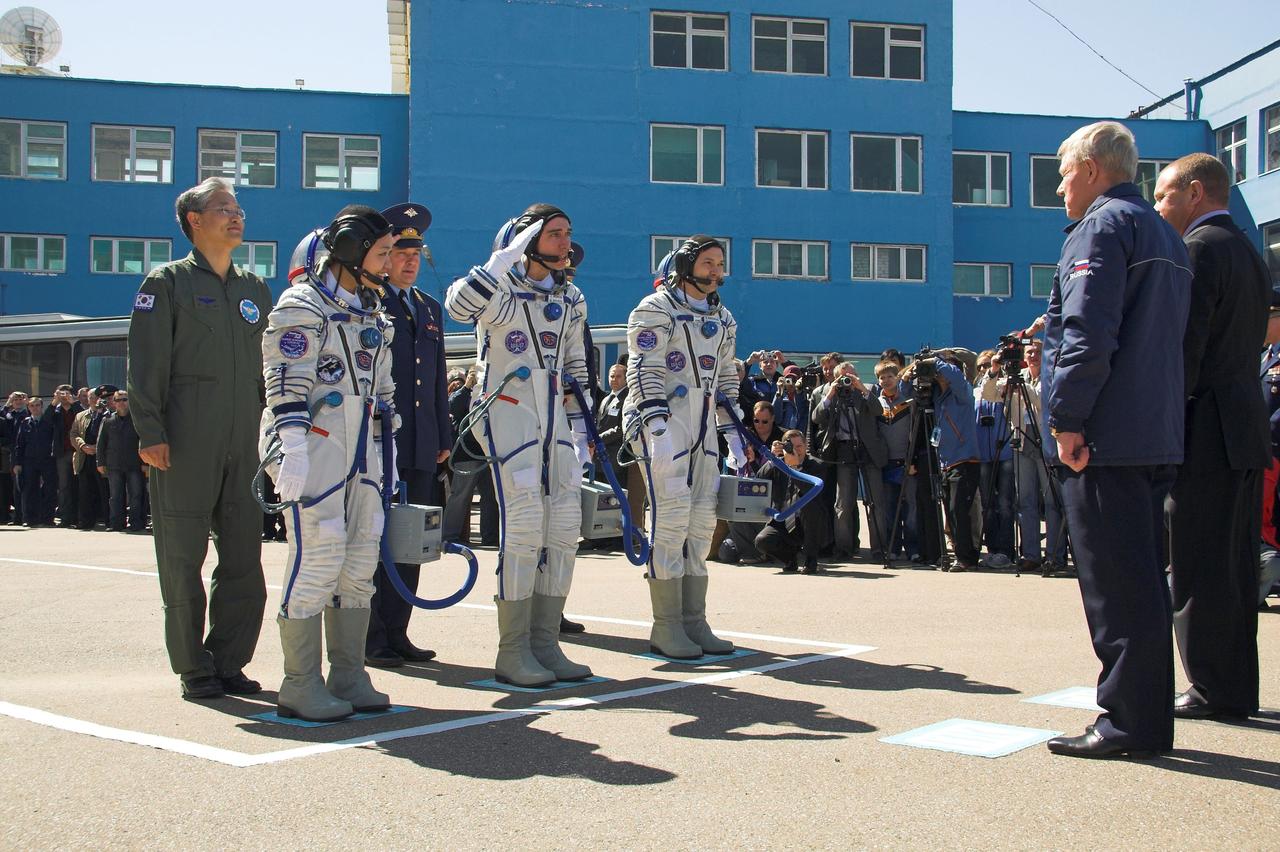
JSC2008-E-032794 (8 April 2008) --- At the Baikonur Cosmodrome in Kazakhstan, Expedition 17 Commander Sergei Volkov (center), Flight Engineer Oleg Kononenko (right) and South Korean spaceflight participant So-yeon Yi bid farewell to Anatoly Perminov, the head of the Russian Federal Space Agency on April 8, 2008, prior to heading to the launch pad for their liftoff on the Soyuz TMA-12 spacecraft to the International Space Station. Volkov and Kononenko will spend six months on the station, while Yi will spend nine days on the complex under a commercial agreement between South Korea and the Russian Federal Space Agency. Photo Credit: NASA /Victor Zelentsov
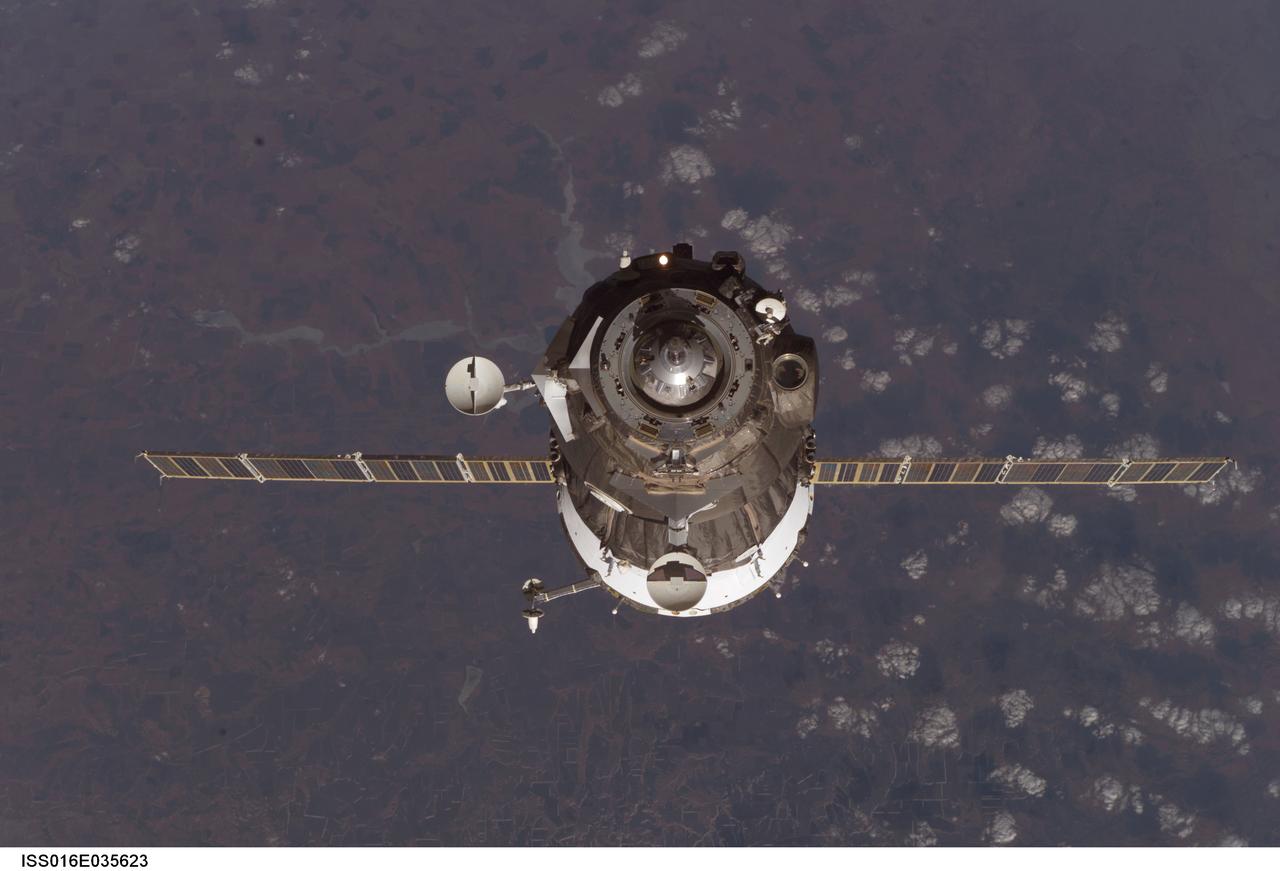
ISS016-E-035623 (10 April 2008) --- The Soyuz TMA-12 spacecraft approaches the International Space Station, carrying Russian Federal Space Agency cosmonauts Sergei Volkov, Expedition 17 commander; Oleg Kononenko, flight engineer; and South Korean spaceflight participant So-yeon Yi. Volkov and Kononenko will spend six months on the station, while Yi will return to Earth April 19 with two of the Expedition 16 crewmembers currently on the complex. Docking with the Pirs Docking Compartment occurred at 8:57 a.m. (EDT) on April 10, 2008.
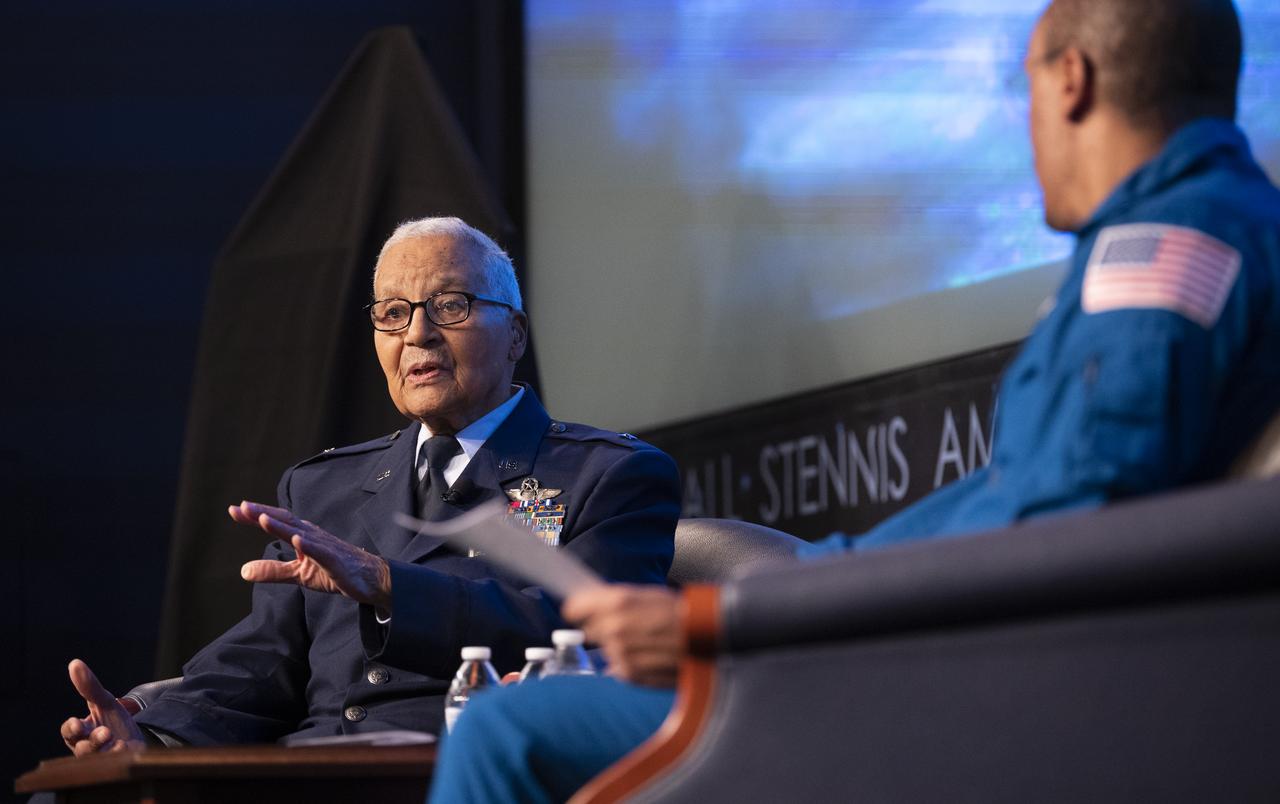
Retired U.S. Air Force Honorary Brigadier General Charles McGee speaks with NASA astronaut Alvin Drew during a Black History Month program titled “Trailblazers, The Story of a Tuskegee Airman,” Wednesday, Feb. 5, 2020, at NASA Headquarters in Washington, DC. McGee, a pilot with the Tuskegee Airmen during World War II, was a career officer in the Air Force also serving during the Korean and Vietnam Wars. Over his 30 years of service he flew 409 combat missions. Of the 355 Tuskegee pilots who flew in combat, McGee is one of only nine surviving. Photo Credit: (NASA/Joel Kowsky)
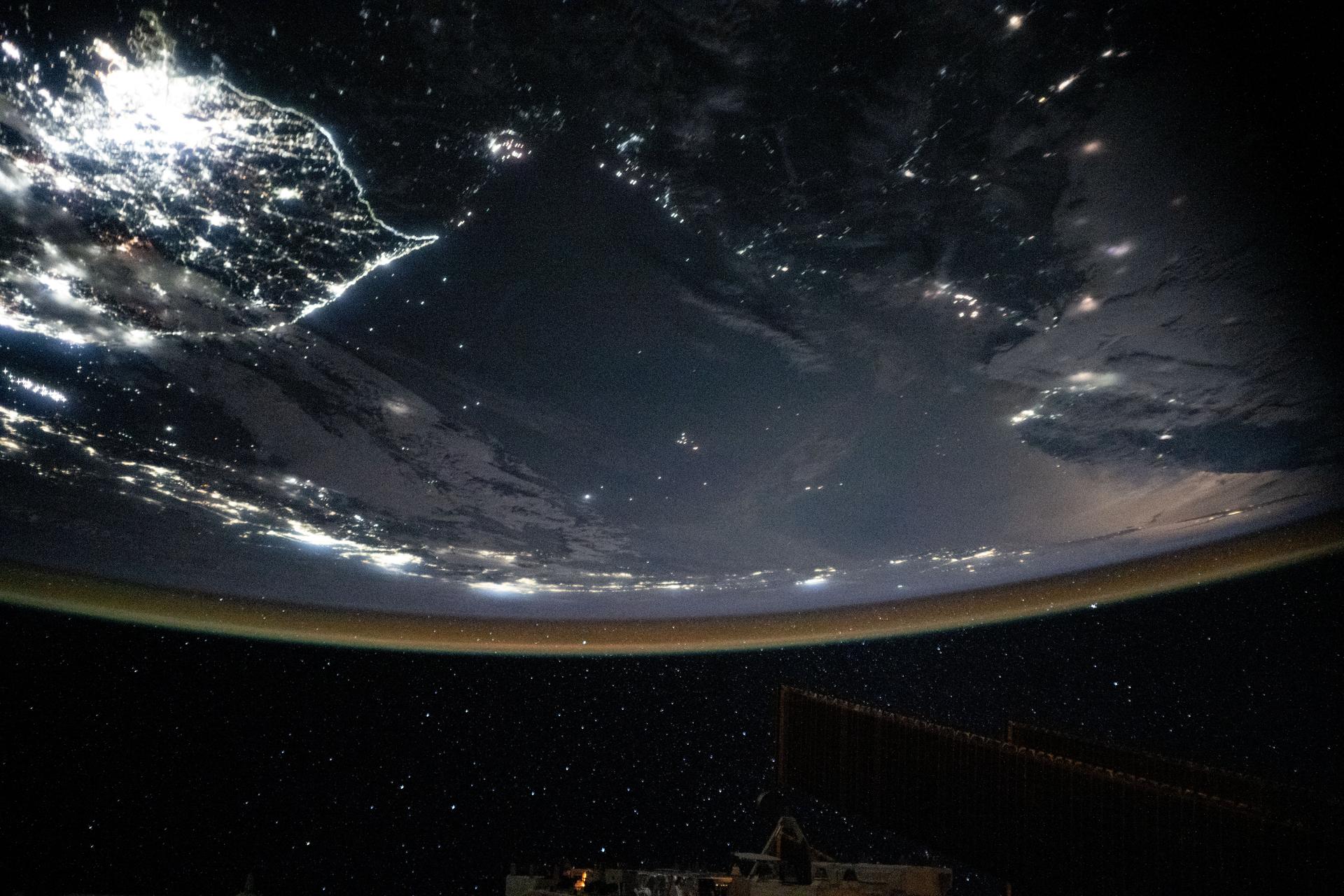
iss073e0842436 (Sept. 15, 2025) --- At top left, the bright lights of the Korean Peninsula abruptly end at the border between South Korea and North Korea highlighting stark differences in energy infrastructure. The Seoul Capital Area—comprised of Seoul, Incheon, and Gyeonggi Province, and home to over 25 million people—is prominent in this nighttime image. Japan stretches across the center of the frame near Earth’s horizon, illuminated beneath a red-yellow airglow. The International Space Station was orbiting 262 miles above Earth at approximately 12:55 a.m. local time when this photograph was taken.
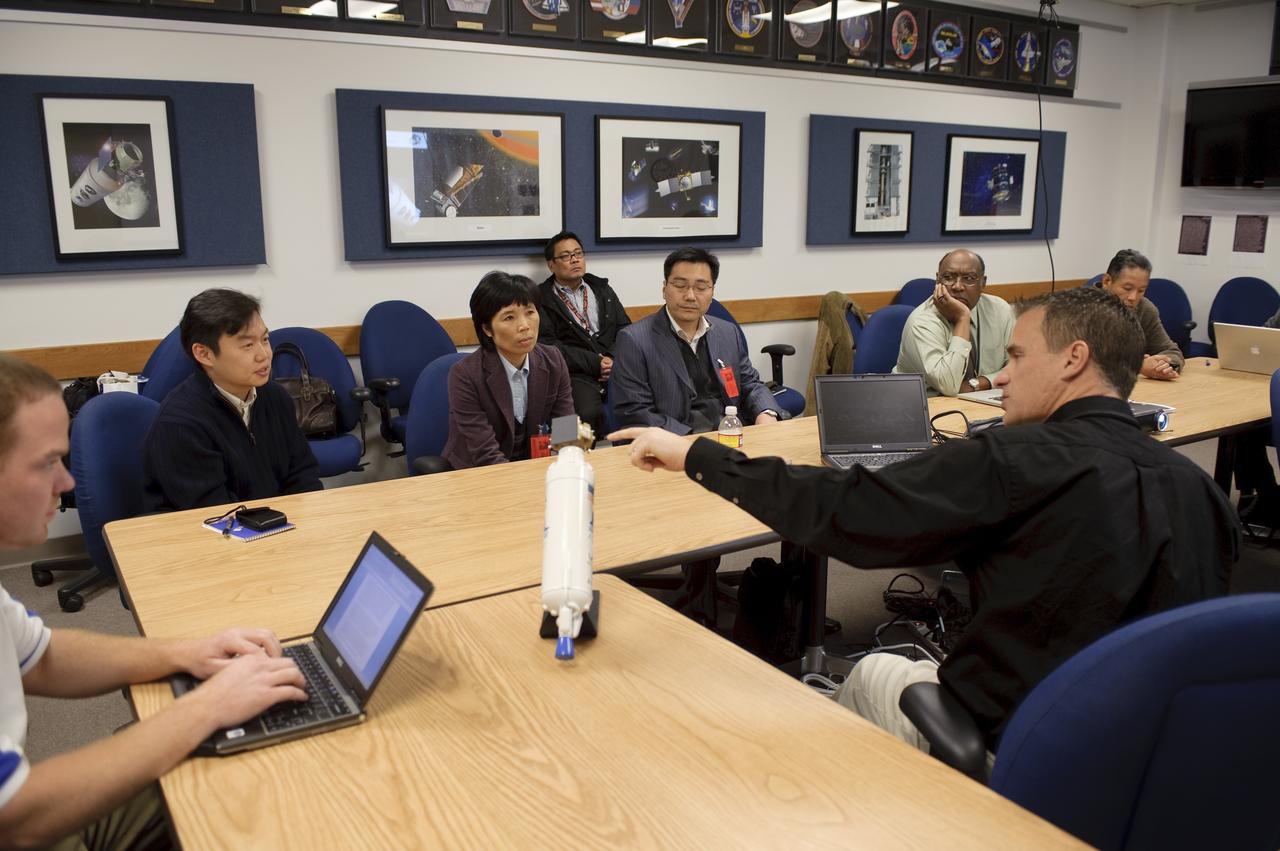
Korean High Level Delegation Visit Ames Certer Director and various Senior staff: Dan Andrews give presentation about LCROSS/LRO to Seorium Lee, Senior Researcher, International Relations Korea Aerospace Research Institute, Soon-Duk Bae, Deputy Director, Big Science Policy Division, Ministry of Educaiton, Science Technology, Young-Mok Hyun, Deputy Director, Space Development Division, Ministry of Educaiton, Science Technology. Also at table are Chris Giulietti, NASA HQ, John Hines, Ames Center Chief Technologist, Unknow person and Terry Pagaduan, Government Relations/Legislative Affairs office.

Retired U.S. Air Force Honorary Brigadier General Charles McGee, left, speaks with NASA astronaut Alvin Drew during a Black History Month program titled “Trailblazers, The Story of a Tuskegee Airman,” Wednesday, Feb. 5, 2020, at NASA Headquarters in Washington, DC. McGee, a pilot with the Tuskegee Airmen during World War II, was a career officer in the Air Force also serving during the Korean and Vietnam Wars. Over his 30 years of service he flew 409 combat missions. Of the 355 Tuskegee pilots who flew in combat, McGee is one of only nine surviving. Photo Credit: (NASA/Joel Kowsky)

ISS016-E-035178 (7 April 2008) --- An unpiloted Progress 28 resupply vehicle departs from the Pirs Docking Compartment of the International Space Station at 4:50 a.m. (EDT) on Monday, April 7, 2008, and headed into its deorbit and destructive re-entry into Earth's atmosphere over the Pacific Ocean. The Progress, which has been attached to the station since February, had been loaded with trash and discards before its departure. The undocking clears the way for the arrival Thursday of the Soyuz TMA-12 spacecraft carrying the Expedition 17 crew and a South Korean spaceflight participant.