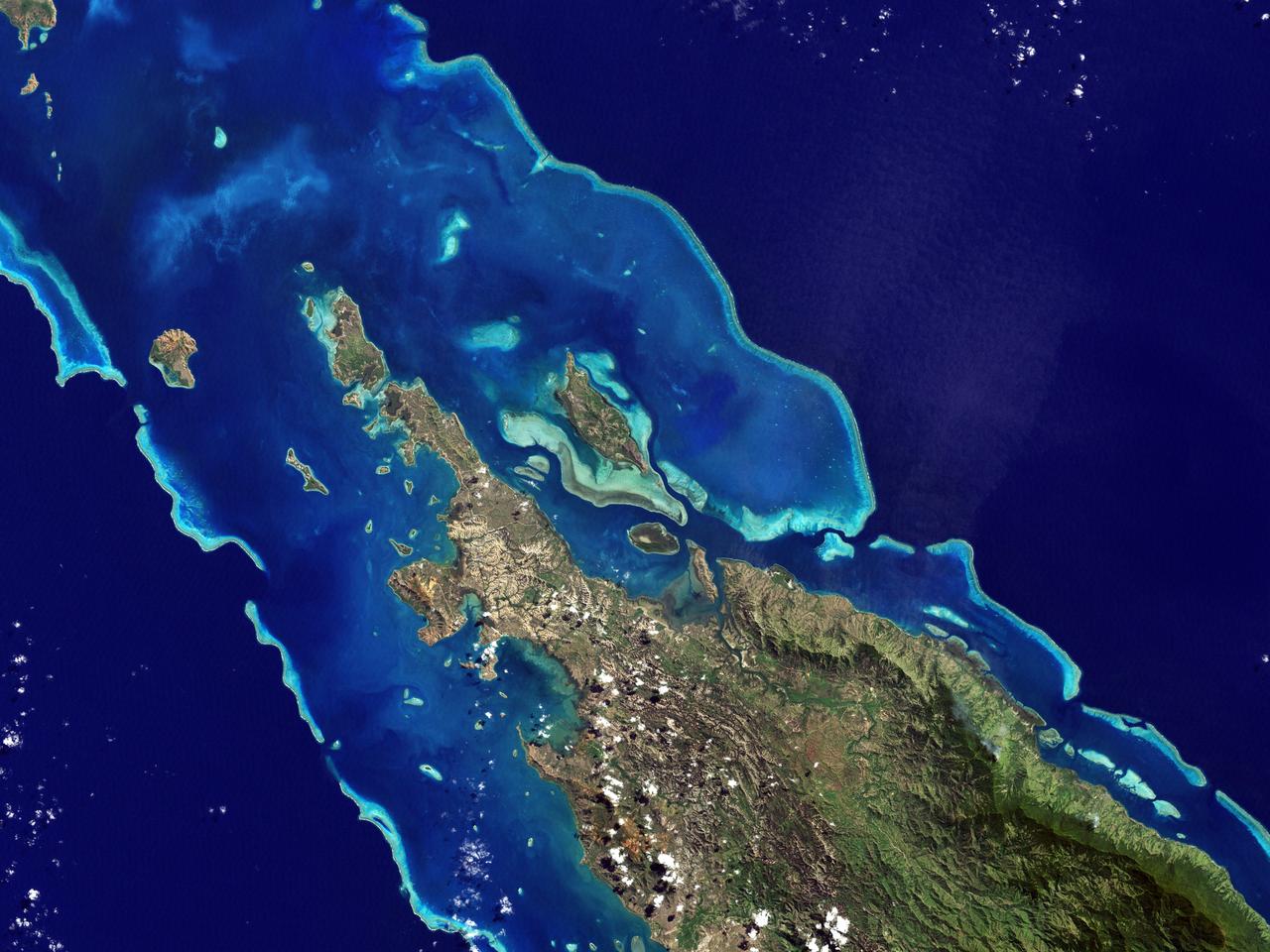
NASA image acquired May 10, 2001 In July 2008, the United Nations Educational, Scientific, and Cultural Organization (UNESCO) added 27 new areas to its list of World Heritage sites. One of those areas included the lagoons of New Caledonia. Some 1,200 kilometers (750 miles) east of Australia, this French-governed archipelago contains the world’s third-largest coral reef structure. The coral reefs enclose the waters near the islands in shallow lagoons of impressive biodiversity. On May 10, 2001, the Enhanced Thematic Mapper Plus on NASA’s Landsat 7 satellite captured this image of Île Balabio, off the northern tip of Grande Terra, New Caledonia’s main island. In this natural-color image, the islands appear in shades of green and brown—mixtures of vegetation and bare ground. The surrounding waters range in color from pale aquamarine to deep blue, and the color differences result from varying depths. Over coral reef ridges and sand bars, the water is shallowest and palest in color. Darker shades of blue characterize deeper waters. Reef-enclosed, shallow waters surround Île Balabio, and a larger, semi-enclosed lagoon appears immediately east of that island. Immediately north of Grande Terra, unenclosed, deeper waters predominate. The coral reefs around New Caledonia support an unusual diversity of species, including large numbers of predators and big fish, turtles, and the world’s third-largest dugong population. NASA image created by Jesse Allen, using Landsat data provided by the United States Geological Survey. Caption by Michon Scott. Instrument: Landsat 7 - ETM+ Credit: NASA/GSFC/Landsat <b><a href="http://www.nasa.gov/centers/goddard/home/index.html" rel="nofollow">NASA Goddard Space Flight Center</a></b> enables NASA’s mission through four scientific endeavors: Earth Science, Heliophysics, Solar System Exploration, and Astrophysics. Goddard plays a leading role in NASA’s accomplishments by contributing compelling scientific knowledge to advance the Agency’s mission. <b>Follow us on <a href="http://twitter.com/NASA_GoddardPix" rel="nofollow">Twitter</a></b> <b>Join us on <a href="http://www.facebook.com/pages/Greenbelt-MD/NASA-Goddard/395013845897?ref=tsd" rel="nofollow">Facebook</a></b>
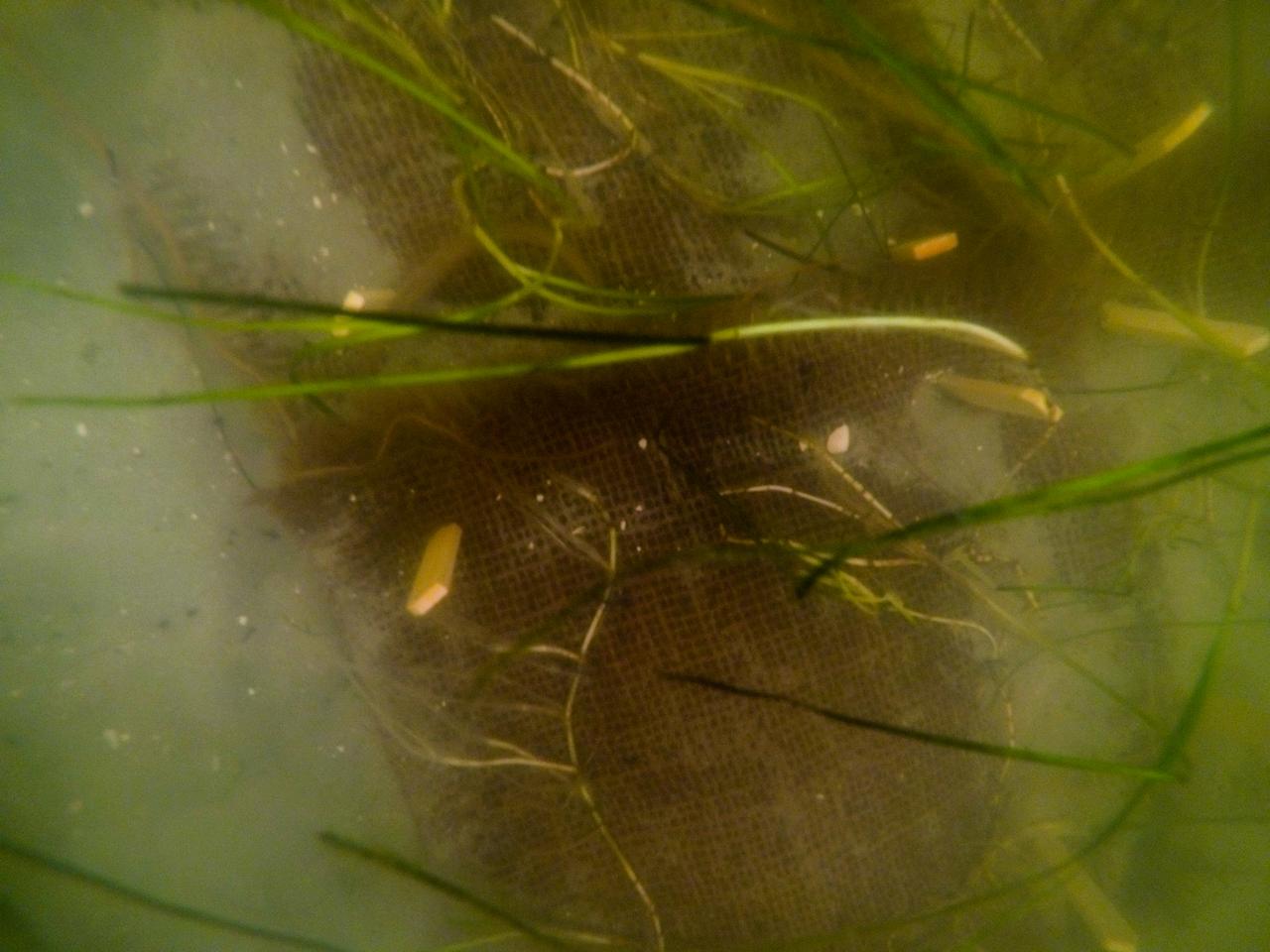
Seen here is a close-up view of newly planted seagrass in the Banana River – one of three bodies of water that make up the Indian River Lagoon (IRL) – at NASA’s Kennedy Space Center in Florida on March 29, 2023. Kennedy’s Environmental Management Branch is working to plant a minimum of 28,000 shoots of seagrass divided into 18 sites across three areas at the Florida spaceport as part of a pilot project for seagrass restoration efforts. Each “plot” of seagrass contains 16 shoots tied to a burlap mesh square with floral ties and has bamboo skewers at each corner that are staked into the sediment. The project, which involves using all biodegradable materials, will look at the feasibility of replanting seagrass in Kennedy waters and, if successful, could lead to the spaceport becoming a donor site where shoots of grass can be broken off and relocated to other areas within Kennedy or along the Indian River Lagoon to promote growth.
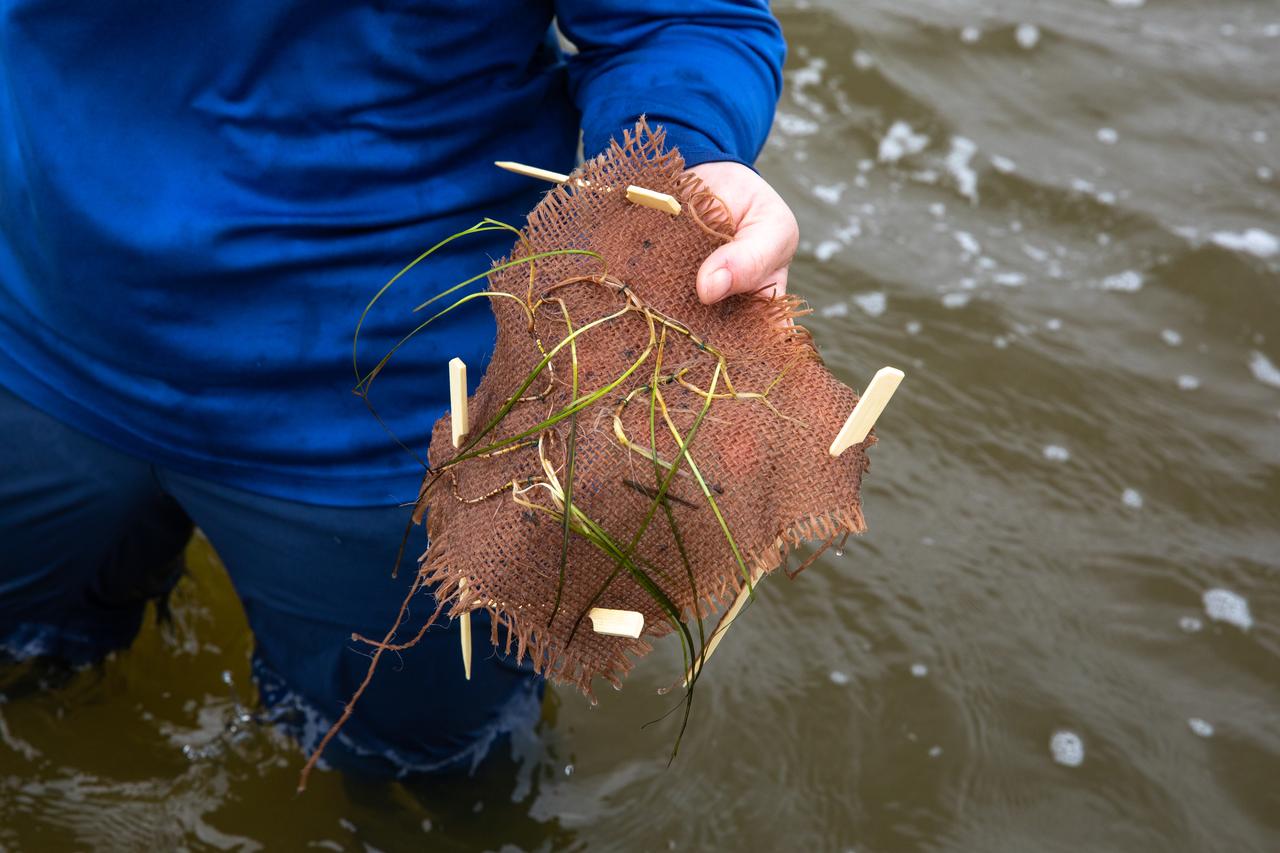
Seen here is a close-up view of one “plot” of seagrass being planted in the Banana River – one of three bodies of water that make up the Indian River Lagoon (IRL) – at NASA’s Kennedy Space Center in Florida on March 29, 2023. Kennedy’s Environmental Management Branch is working to plant a minimum of 28,000 shoots of seagrass divided into 18 sites across three areas at the Florida spaceport as part of a pilot project for seagrass restoration efforts. Each “plot” of seagrass contains 16 shoots tied to a burlap mesh square with floral ties and has bamboo skewers at each corner that are staked into the sediment. The project, which involves using all biodegradable materials, will look at the feasibility of replanting seagrass in Kennedy waters and, if successful, could lead to the spaceport becoming a donor site where shoots of grass can be broken off and relocated to other areas within Kennedy or along the Indian River Lagoon to promote growth.

Seen here is a close-up view of one “plot” of seagrass being planted in the Banana River – one of three bodies of water that make up the Indian River Lagoon (IRL) – at NASA’s Kennedy Space Center in Florida on March 29, 2023. Kennedy’s Environmental Management Branch is working to plant a minimum of 28,000 shoots of seagrass divided into 18 sites across three areas at the Florida spaceport as part of a pilot project for seagrass restoration efforts. Each “plot” of seagrass contains 16 shoots tied to a burlap mesh square with floral ties and has bamboo skewers at each corner that are staked into the sediment. The project, which involves using all biodegradable materials, will look at the feasibility of replanting seagrass in Kennedy waters and, if successful, could lead to the spaceport becoming a donor site where shoots of grass can be broken off and relocated to other areas within Kennedy or along the Indian River Lagoon to promote growth.

Lorae Simpson, director of research and conservation with the Florida Oceanographic Society, prepares to plant seagrass in the Banana River – one of three bodies of water that make up the Indian River Lagoon (IRL) – at NASA’s Kennedy Space Center in Florida on March 29, 2023. Kennedy’s Environmental Management Branch is working to plant a minimum of 28,000 shoots of seagrass divided into 18 sites across three areas at the Florida spaceport as part of a pilot project for seagrass restoration efforts. Each “plot” of seagrass contains 16 shoots tied to a burlap mesh square with floral ties and has bamboo skewers at each corner that are staked into the sediment. The project, which involves using all biodegradable materials, will look at the feasibility of replanting seagrass in Kennedy waters and, if successful, could lead to the spaceport becoming a donor site where shoots of grass can be broken off and relocated to other areas within Kennedy or along the Indian River Lagoon to promote growth.
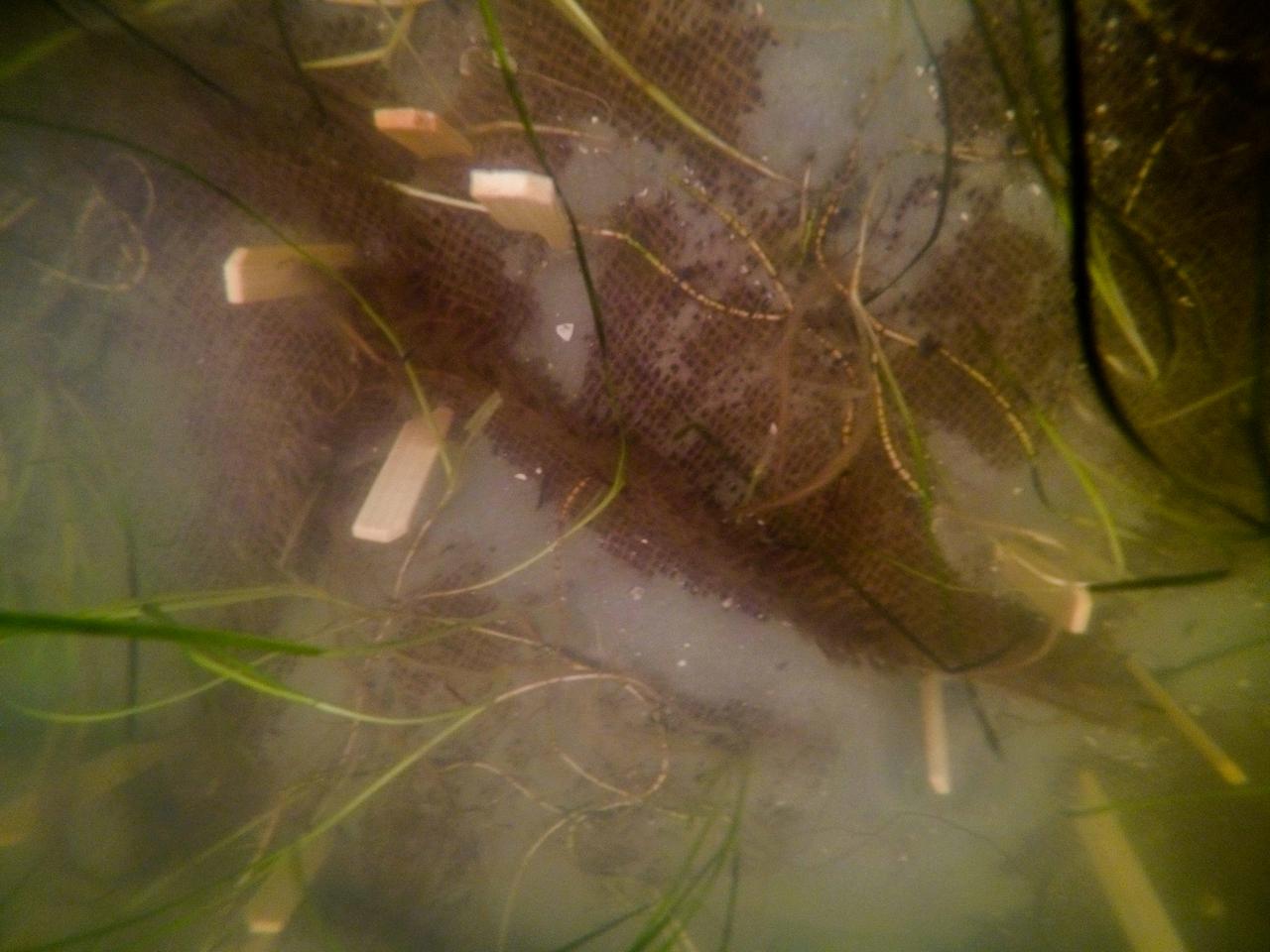
Seen here is a close-up view of newly planted seagrass in the Banana River – one of three bodies of water that make up the Indian River Lagoon (IRL) – at NASA’s Kennedy Space Center in Florida on March 29, 2023. Kennedy’s Environmental Management Branch is working to plant a minimum of 28,000 shoots of seagrass divided into 18 sites across three areas at the Florida spaceport as part of a pilot project for seagrass restoration efforts. Each “plot” of seagrass contains 16 shoots tied to a burlap mesh square with floral ties and has bamboo skewers at each corner that are staked into the sediment. The project, which involves using all biodegradable materials, will look at the feasibility of replanting seagrass in Kennedy waters and, if successful, could lead to the spaceport becoming a donor site where shoots of grass can be broken off and relocated to other areas within Kennedy or along the Indian River Lagoon to promote growth.
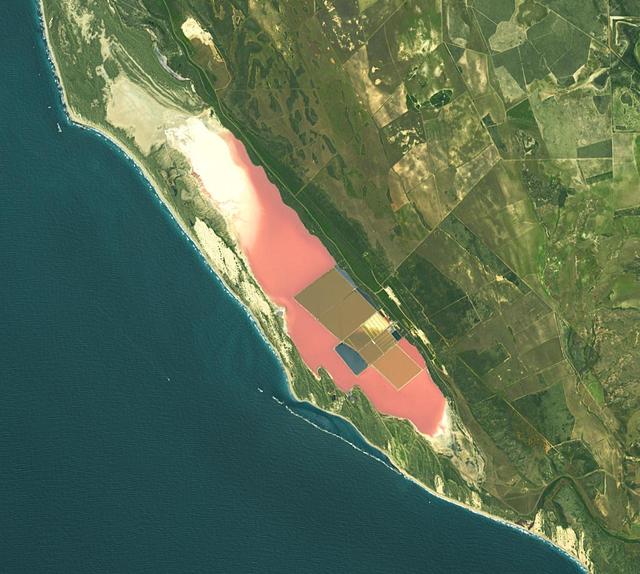
Hutt Lagoon is an elongate lake, located in a dune swale adjacent to the coast of the Indian Ocean, in the mid west region of Western Australia. Port Gregory is located between the ocean and the lake's southern shore. Hutt Lagoon is a pink lake, due to the presence of an algae that produces beta-carotene. A microalgae production plant is the world's largest. The image was acquired September 30, 2012, covers an area of 16.5 by 18.3 km, and is locate at 28.1 degrees south, 114.2 degrees east. https://photojournal.jpl.nasa.gov/catalog/PIA26510

Image release date September 22, 2010 To view a video of this image go here: <a href="http://www.flickr.com/photos/gsfc/5014452203">www.flickr.com/photos/gsfc/5014452203</a> Caption: A spectacular new NASA/ESA Hubble Space Telescope image reveals the heart of the Lagoon Nebula. Seen as a massive cloud of glowing dust and gas, bombarded by the energetic radiation of new stars, this placid name hides a dramatic reality. The Advanced Camera for Surveys (ACS) on the NASA/ESA Hubble Space Telescope has captured a dramatic view of gas and dust sculpted by intense radiation from hot young stars deep in the heart of the Lagoon Nebula (Messier 8). This spectacular object is named after the wide, lagoon-shaped dust lane that crosses the glowing gas of the nebula. This structure is prominent in wide-field images, but cannot be seen in this close-up. However the strange billowing shapes and sandy texture visible in this image make the Lagoon Nebula’s watery name eerily appropriate from this viewpoint too. Located four to five thousand light-years away, in the constellation of Sagittarius (the Archer), Messier 8 is a huge region of star birth that stretches across one hundred light-years. Clouds of hydrogen gas are slowly collapsing to form new stars, whose bright ultraviolet rays then light up the surrounding gas in a distinctive shade of red. The wispy tendrils and beach-like features of the nebula are not caused by the ebb and flow of tides, but rather by ultraviolet radiation’s ability to erode and disperse the gas and dust into the distinctive shapes that we see. In recent years astronomers probing the secrets of the Lagoon Nebula have found the first unambiguous proof that star formation by accretion of matter from the gas cloud is ongoing in this region. Young stars that are still surrounded by an accretion disc occasionally shoot out long tendrils of matter from their poles. Several examples of these jets, known as Herbig-Haro objects, have been found in this nebula in the last five years, providing strong support for astronomers’ theories about star formation in such hydrogen-rich regions. The Lagoon Nebula is faintly visible to the naked eye on dark nights as a small patch of grey in the heart of the Milky Way. Without a telescope, the nebula looks underwhelming because human eyes are unable to distinguish clearly between colours at low light levels. Charles Messier, the 18th century French astronomer, observed the nebula and included it in his famous astronomical catalogue, from which the nebula’s alternative name comes. But his relatively small refracting telescope would only have hinted at the dramatic structures and colours now visible thanks to Hubble. The Hubble Space Telescope is a project of international cooperation between ESA and NASA. Image credit: NASA, ESA <b><a href="http://www.nasa.gov/audience/formedia/features/MP_Photo_Guidelines.html" rel="nofollow">NASA image use policy.</a></b> <b><a href="http://www.nasa.gov/centers/goddard/home/index.html" rel="nofollow">NASA Goddard Space Flight Center</a></b> enables NASA’s mission through four scientific endeavors: Earth Science, Heliophysics, Solar System Exploration, and Astrophysics. Goddard plays a leading role in NASA’s accomplishments by contributing compelling scientific knowledge to advance the Agency’s mission. <b>Follow us on <a href="http://twitter.com/NASAGoddardPix" rel="nofollow">Twitter</a></b> <b>Like us on <a href="http://www.facebook.com/pages/Greenbelt-MD/NASA-Goddard/395013845897?ref=tsd" rel="nofollow">Facebook</a></b> <b>Find us on <a href="http://instagram.com/nasagoddard?vm=grid" rel="nofollow">Instagram</a></b> To learn more about the Hubble Space Telescope go here: <a href="http://www.nasa.gov/mission_pages/hubble/main/index.html" rel="nofollow">www.nasa.gov/mission_pages/hubble/main/index.html</a>

Swirling dust clouds and bright newborn stars dominate the view in this image of the Lagoon nebula from NASA Spitzer Space Telescope. The nebula lies in the general direction of the center of our galaxy in the constellation Sagittarius.
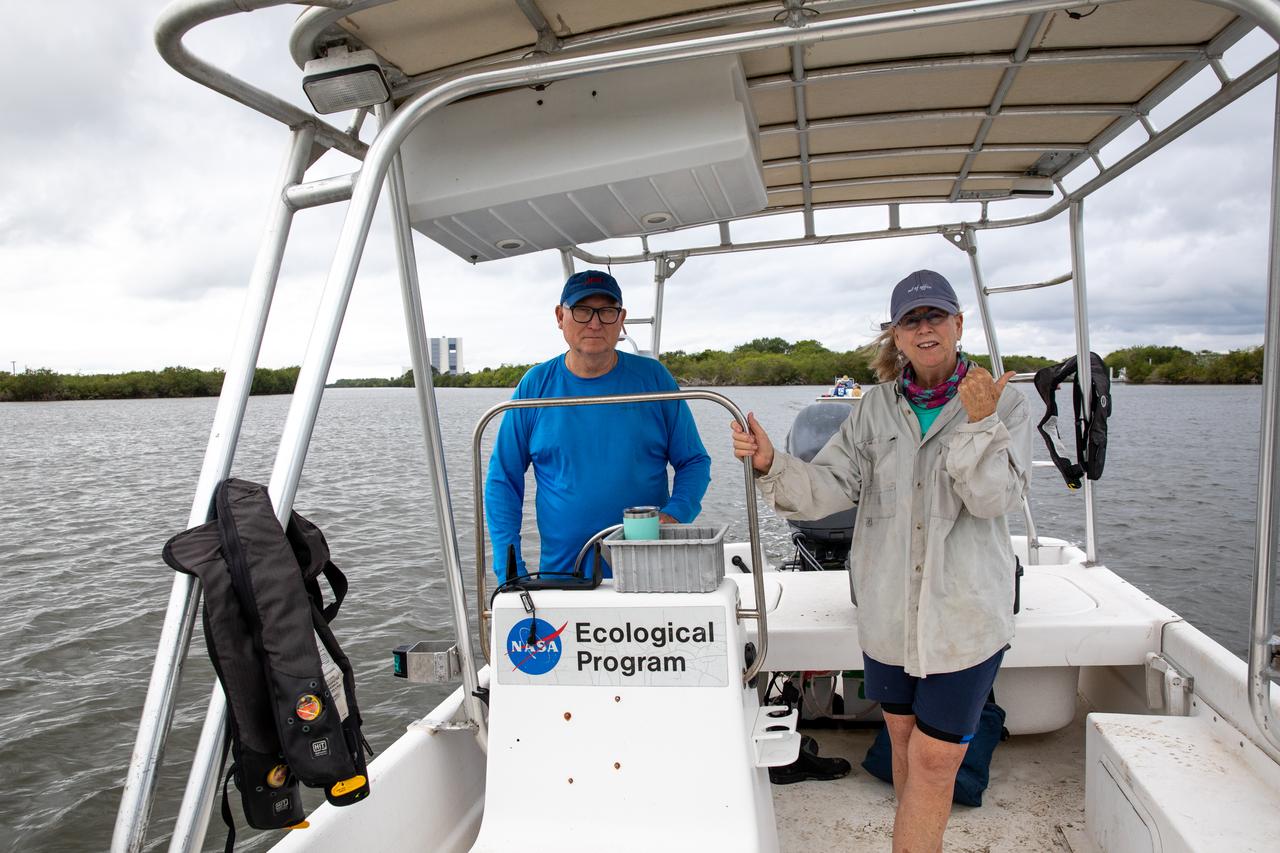
Kennedy Space Center’s Doug Scheidt (left), an ecologist working on NASA’s Environmental and Medical Contract (NEMCON), and Jane Provancha, manager of the ecological group for NEMCON, oversee seagrass restoration efforts at the Florida spaceport on March 29, 2023. Kennedy’s Environmental Management Branch is working to plant a minimum of 28,000 shoots of seagrass divided into 18 sites across three areas at the Florida spaceport as part of a pilot project for seagrass restoration efforts. The project will look at the feasibility of replanting seagrass in Kennedy waters and, if successful, could lead to the spaceport becoming a donor site where shoots of grass can be broken off and relocated to other areas within Kennedy or along the Indian River Lagoon to promote growth.
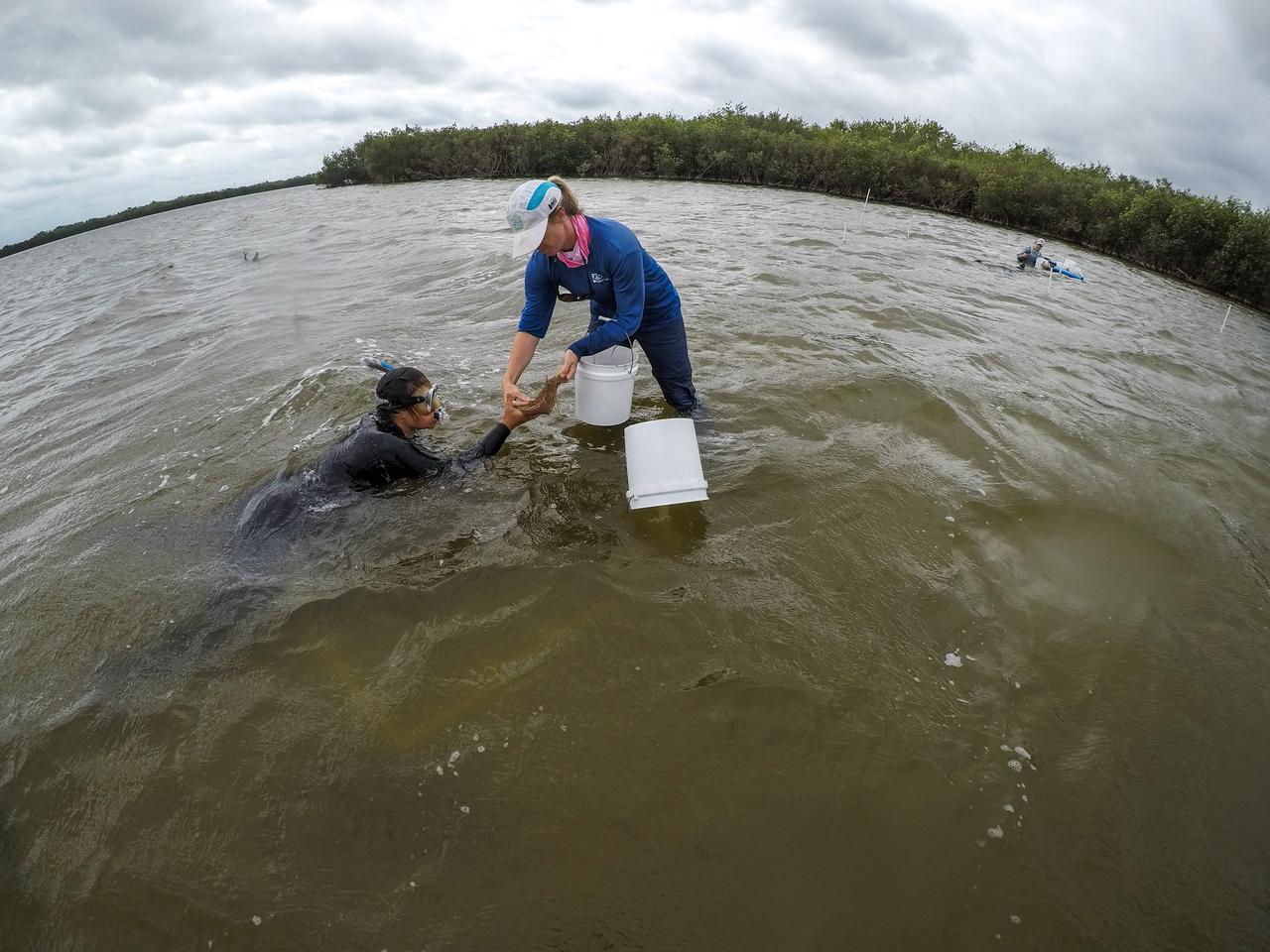
Members of the Florida Oceanographic Society plant seagrass in the Banana River – one of three bodies of water that make up the Indian River Lagoon (IRL) – at NASA’s Kennedy Space Center in Florida on March 29, 2023. Kennedy’s Environmental Management Branch is working to plant a minimum of 28,000 shoots of seagrass divided into 18 sites across three areas at the Florida spaceport as part of a pilot project for seagrass restoration efforts. The project will look at the feasibility of replanting seagrass in Kennedy waters and, if successful, could lead to the spaceport becoming a donor site where shoots of grass can be broken off and relocated to other areas within Kennedy or along the IRL to promote growth.
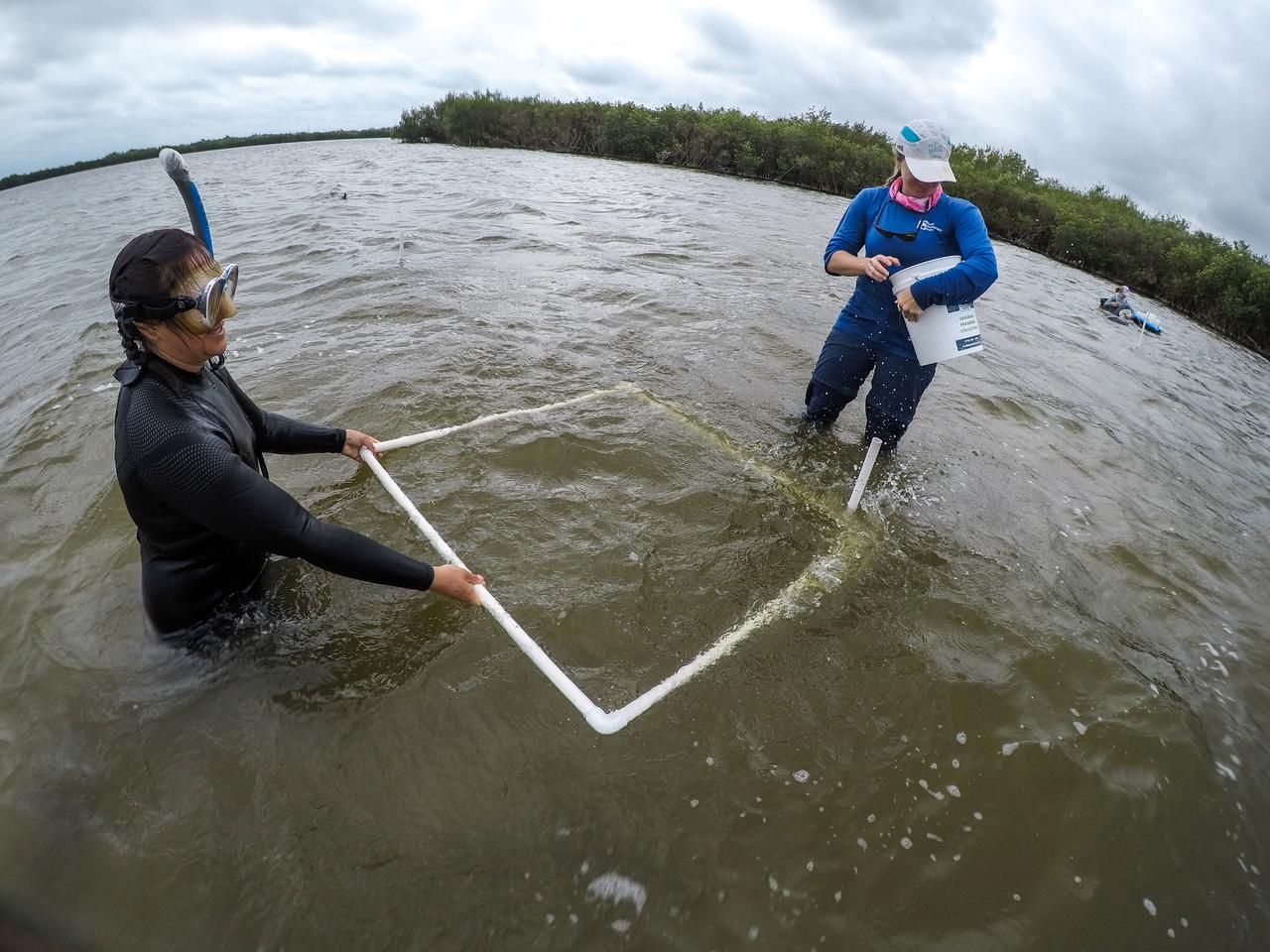
Members of the Florida Oceanographic Society prepare to plant seagrass in the Banana River – one of three bodies of water that make up the Indian River Lagoon (IRL) – at NASA’s Kennedy Space Center in Florida on March 29, 2023. Kennedy’s Environmental Management Branch is working to plant a minimum of 28,000 shoots of seagrass divided into 18 sites across three areas at the Florida spaceport as part of a pilot project for seagrass restoration efforts. The project will look at the feasibility of replanting seagrass in Kennedy waters and, if successful, could lead to the spaceport becoming a donor site where shoots of grass can be broken off and relocated to other areas within Kennedy or along the IRL to promote growth.
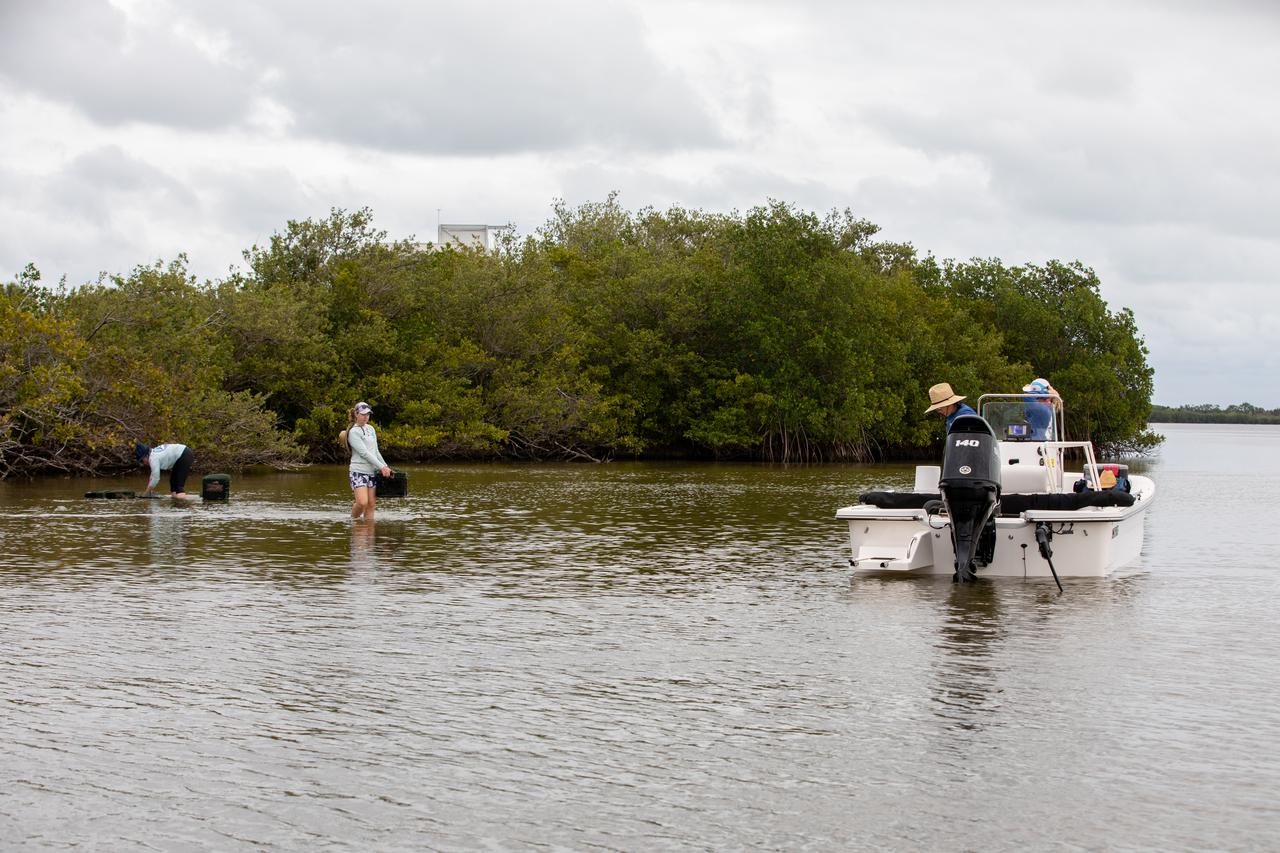
Members of the Florida Oceanographic Society collect mats of seagrass from their storage site at NASA’s Kennedy Space Center in Florida as they prepare to plant them in the Banana River – one of three bodies of water that make up the Indian River Lagoon (IRL) – on March 29, 2023. Kennedy’s Environmental Management Branch is working to plant a minimum of 28,000 shoots of seagrass divided into 18 sites across three areas at the Florida spaceport as part of a pilot project for seagrass restoration efforts. The project will look at the feasibility of replanting seagrass in Kennedy waters and, if successful, could lead to the spaceport becoming a donor site where shoots of grass can be broken off and relocated to other areas within Kennedy or along the IRL to promote growth.
Members of the Florida Oceanographic Society collect mats of seagrass from their storage site at NASA’s Kennedy Space Center in Florida as they prepare to plant them in the Banana River – one of three bodies of water that make up the Indian River Lagoon (IRL) – on March 29, 2023. Kennedy’s Environmental Management Branch is working to plant a minimum of 28,000 shoots of seagrass divided into 18 sites across three areas at the Florida spaceport as part of a pilot project for seagrass restoration efforts. The project will look at the feasibility of replanting seagrass in Kennedy waters and, if successful, could lead to the spaceport becoming a donor site where shoots of grass can be broken off and relocated to other areas within Kennedy or along the IRL to promote growth.
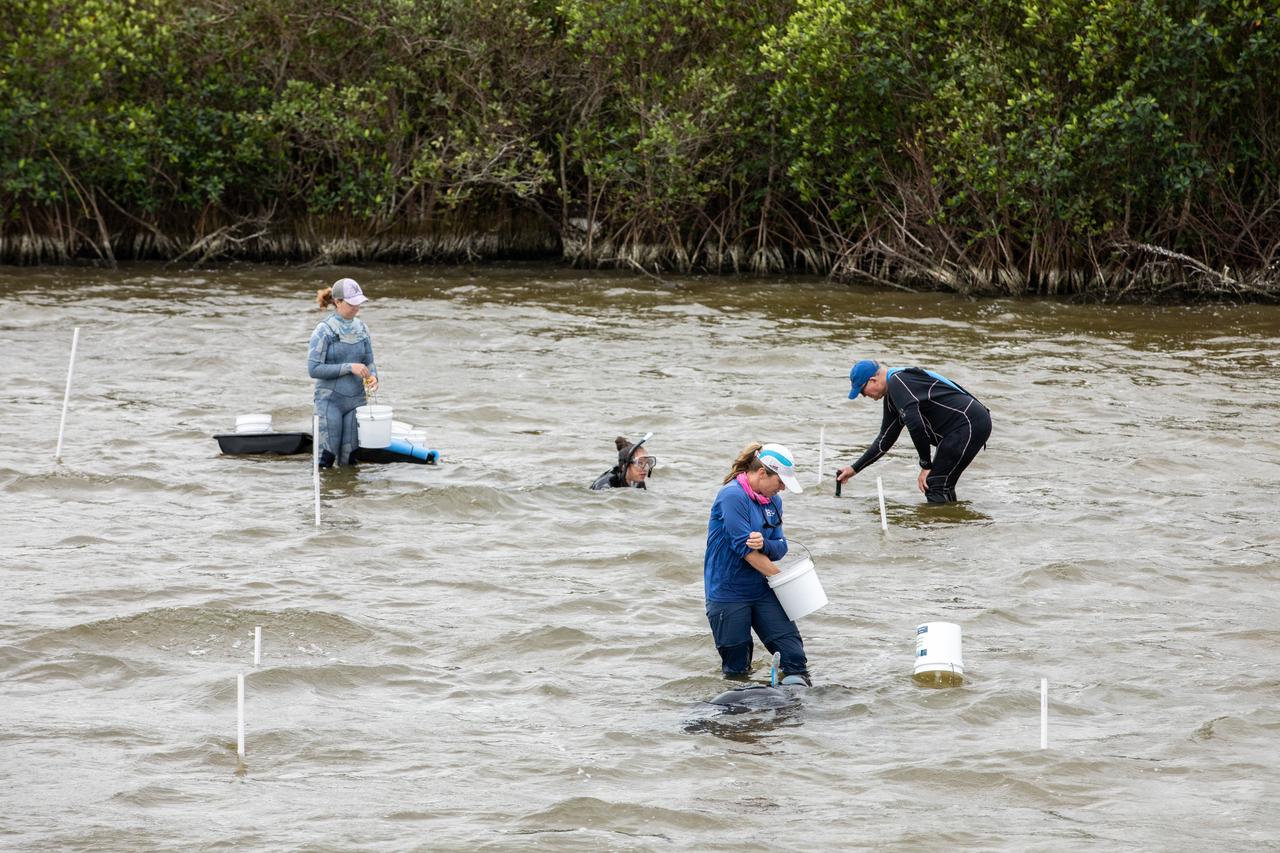
Members of the Florida Oceanographic Society begin planting seagrass in the Banana River – one of three bodies of water that make up the Indian River Lagoon (IRL) – at NASA’s Kennedy Space Center in Florida on March 29, 2023. At the top right is Doug Scheidt, an ecologist working on NASA’s Environmental and Medical Contract at Kennedy. Kennedy’s Environmental Management Branch is working to plant a minimum of 28,000 shoots of seagrass divided into 18 sites across three areas at the Florida spaceport as part of a pilot project for seagrass restoration efforts. The project will look at the feasibility of replanting seagrass in Kennedy waters and, if successful, could lead to the spaceport becoming a donor site where shoots of grass can be broken off and relocated to other areas within Kennedy or along the IRL to promote growth.
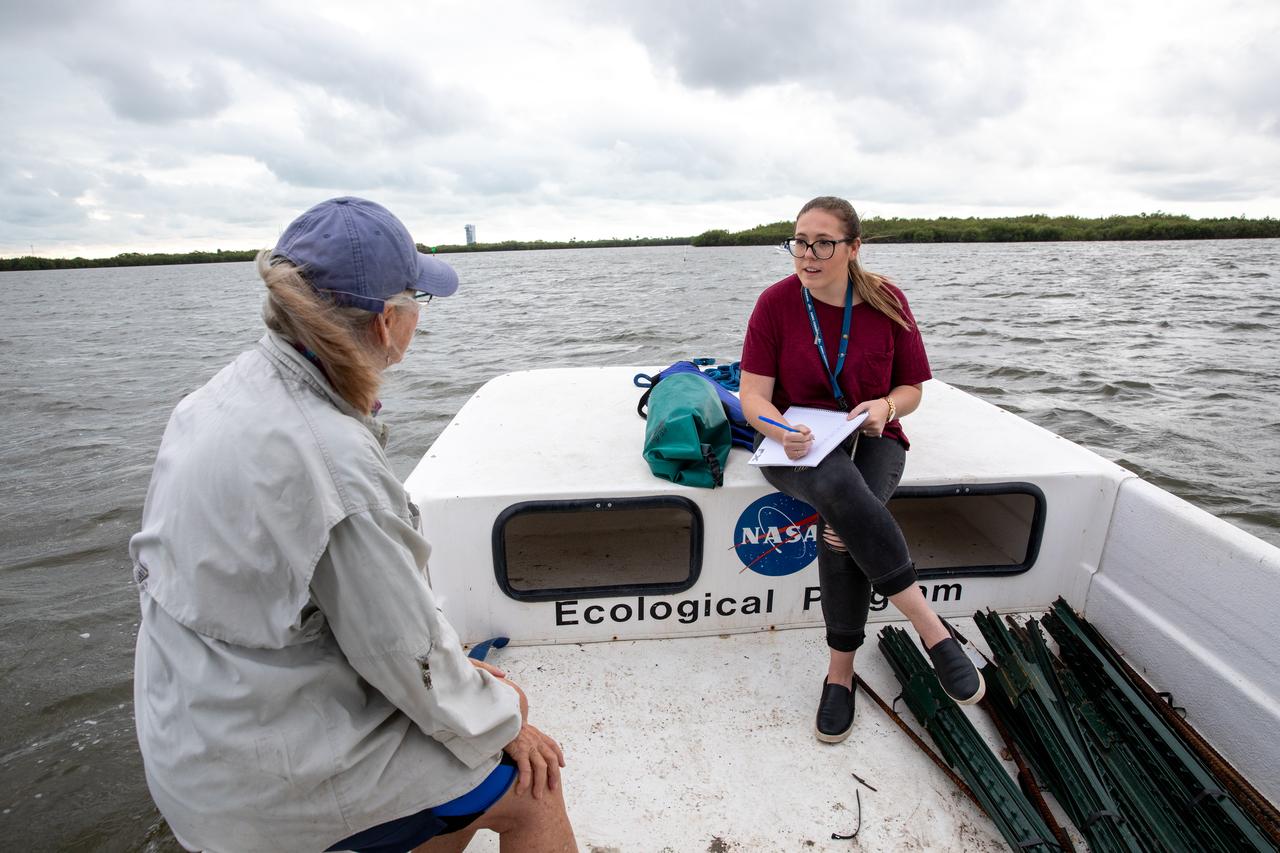
Kennedy Space Center Public Affairs Writer Danielle Sempsrott (right) interviews Jane Provancha, manager of the ecological group for NASA’s Environmental and Medical Contract (NEMCON) at Kennedy, for a web feature highlighting seagrass restoration efforts taking place at the Florida spaceport on March 29, 2023. Kennedy’s Environmental Management Branch is working to plant a minimum of 28,000 shoots of seagrass divided into 18 sites across three areas at the Florida spaceport as part of a pilot project for seagrass restoration efforts. The project will look at the feasibility of replanting seagrass in Kennedy waters and, if successful, could lead to the spaceport becoming a donor site where shoots of grass can be broken off and relocated to other areas within Kennedy or along the Indian River Lagoon to promote growth.
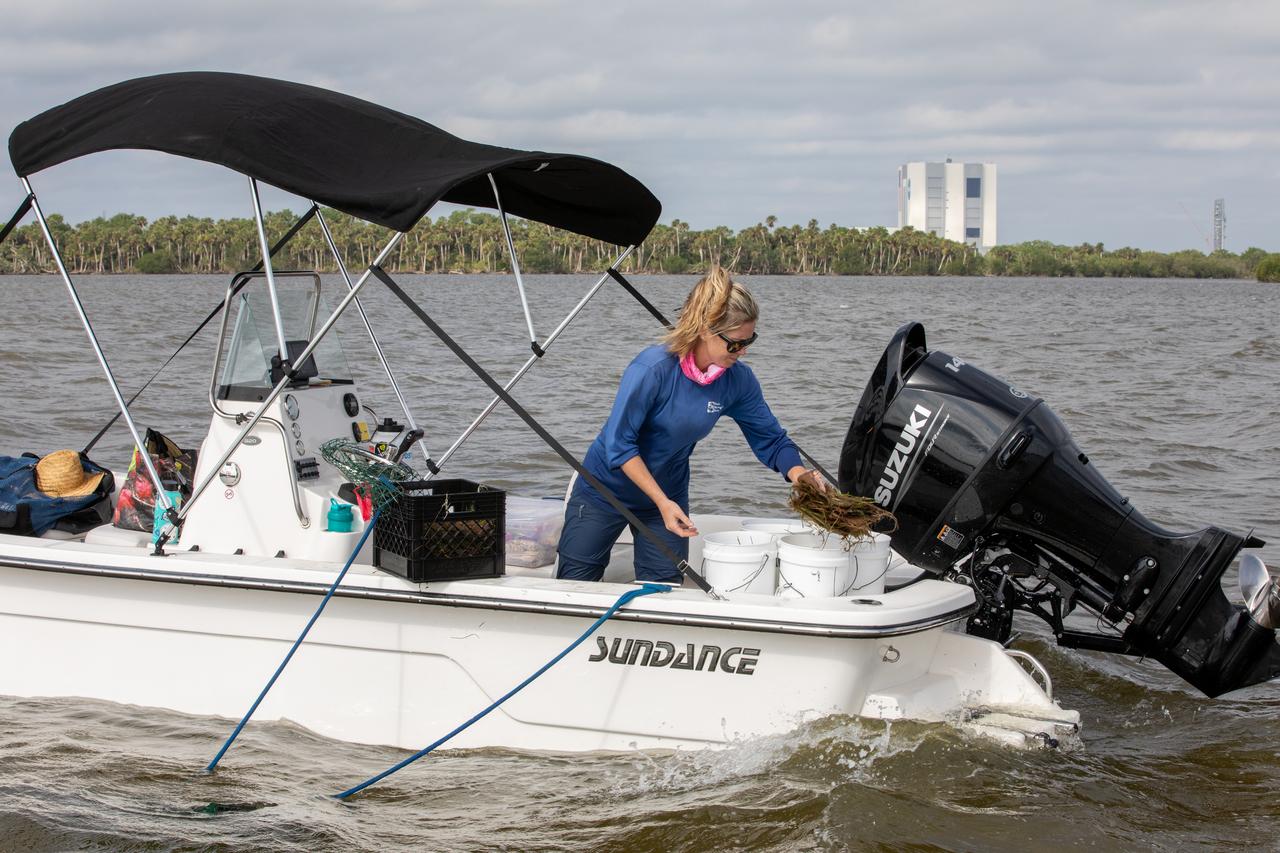
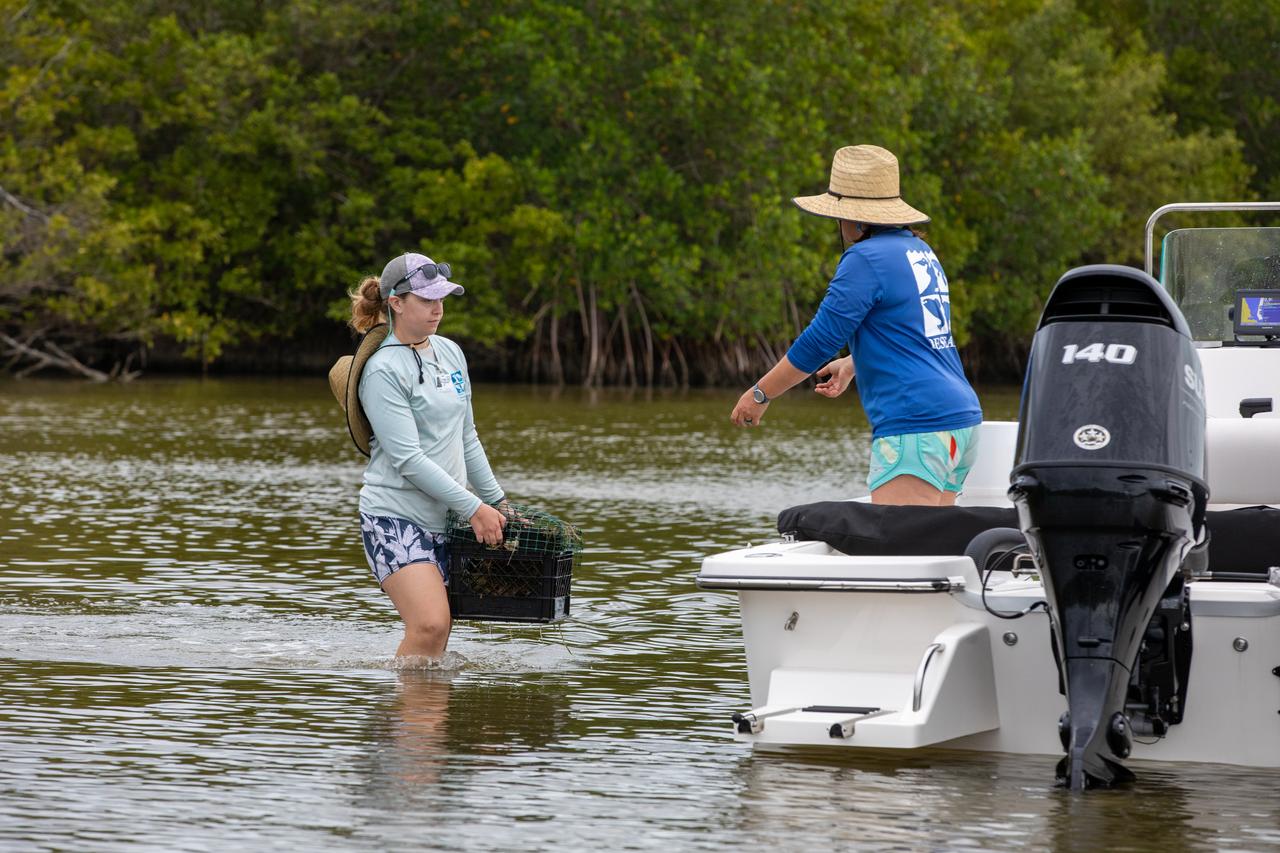
Lorae Simpson, director of research and conservation with the Florida Oceanographic Society, gathers “plots” of seagrass as her team prepares to plant them in the Banana River – one of three bodies of water that make up the Indian River Lagoon (IRL) – at NASA’s Kennedy Space Center in Florida on March 29, 2023. Kennedy’s Environmental Management Branch is working to plant a minimum of 28,000 shoots of seagrass divided into 18 sites across three areas at the Florida spaceport as part of a pilot project for seagrass restoration efforts. The project will look at the feasibility of replanting seagrass in Kennedy waters and, if successful, could lead to the spaceport becoming a donor site where shoots of grass can be broken off and relocated to other areas within Kennedy or along the IRL to promote growth.
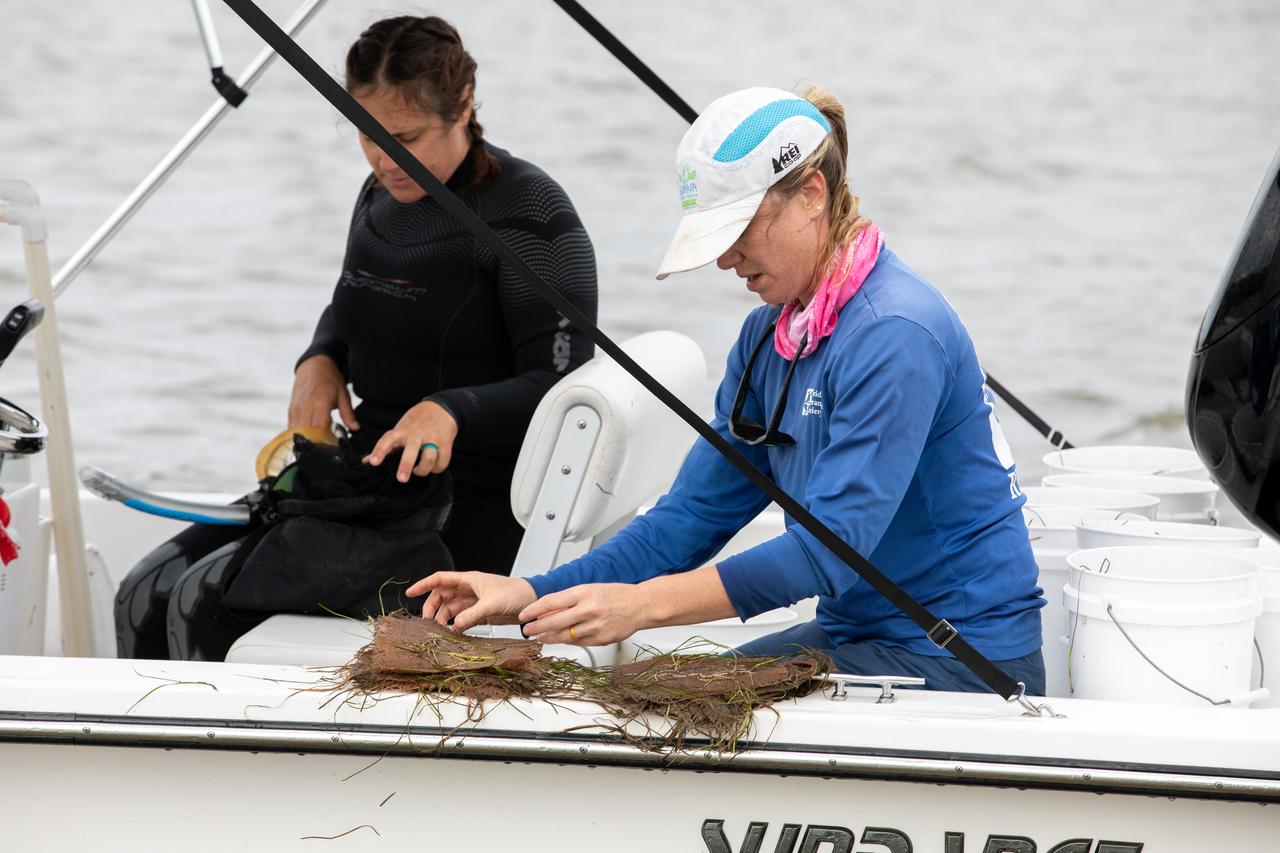
Lorae Simpson, director of research and conservation with the Florida Oceanographic Society, gathers “plots” of seagrass as her team prepares to plant them in the Banana River – one of three bodies of water that make up the Indian River Lagoon (IRL) – at NASA’s Kennedy Space Center in Florida on March 29, 2023. Kennedy’s Environmental Management Branch is working to plant a minimum of 28,000 shoots of seagrass divided into 18 sites across three areas at the Florida spaceport as part of a pilot project for seagrass restoration efforts. The project will look at the feasibility of replanting seagrass in Kennedy waters and, if successful, could lead to the spaceport becoming a donor site where shoots of grass can be broken off and relocated to other areas within Kennedy or along the IRL to promote growth.
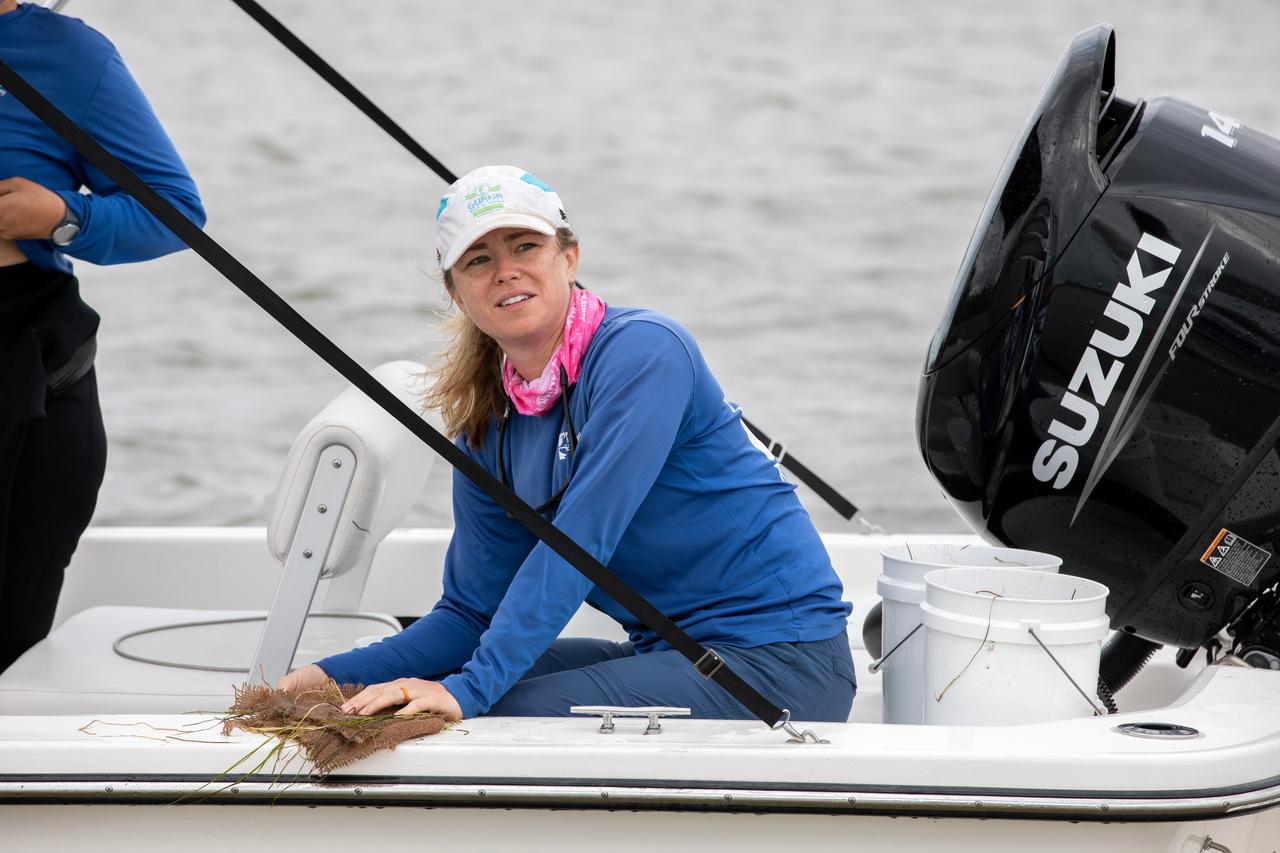
Lorae Simpson, director of research and conservation with the Florida Oceanographic Society, gathers “plots” of seagrass as her team prepares to plant them in the Banana River – one of three bodies of water that make up the Indian River Lagoon (IRL) – at NASA’s Kennedy Space Center in Florida on March 29, 2023. Kennedy’s Environmental Management Branch is working to plant a minimum of 28,000 shoots of seagrass divided into 18 sites across three areas at the Florida spaceport as part of a pilot project for seagrass restoration efforts. The project will look at the feasibility of replanting seagrass in Kennedy waters and, if successful, could lead to the spaceport becoming a donor site where shoots of grass can be broken off and relocated to other areas within Kennedy or along the IRL to promote growth.
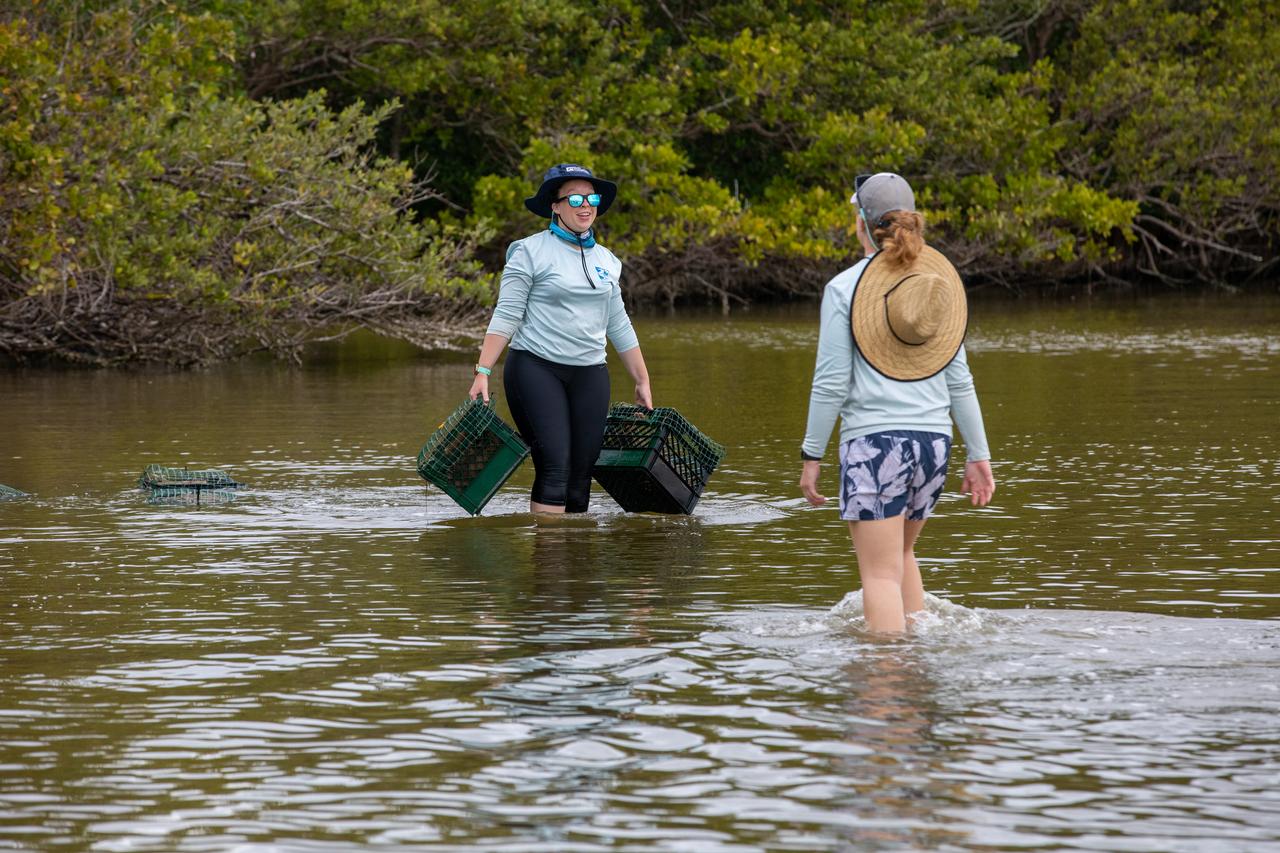
Members of the Florida Oceanographic Society collect mats of seagrass from their storage site at NASA’s Kennedy Space Center in Florida as they prepare to plant them in the Banana River – one of three bodies of water that make up the Indian River Lagoon (IRL) – on March 29, 2023. Kennedy’s Environmental Management Branch is working to plant a minimum of 28,000 shoots of seagrass divided into 18 sites across three areas at the Florida spaceport as part of a pilot project for seagrass restoration efforts. The project will look at the feasibility of replanting seagrass in Kennedy waters and, if successful, could lead to the spaceport becoming a donor site where shoots of grass can be broken off and relocated to other areas within Kennedy or along the IRL to promote growth.
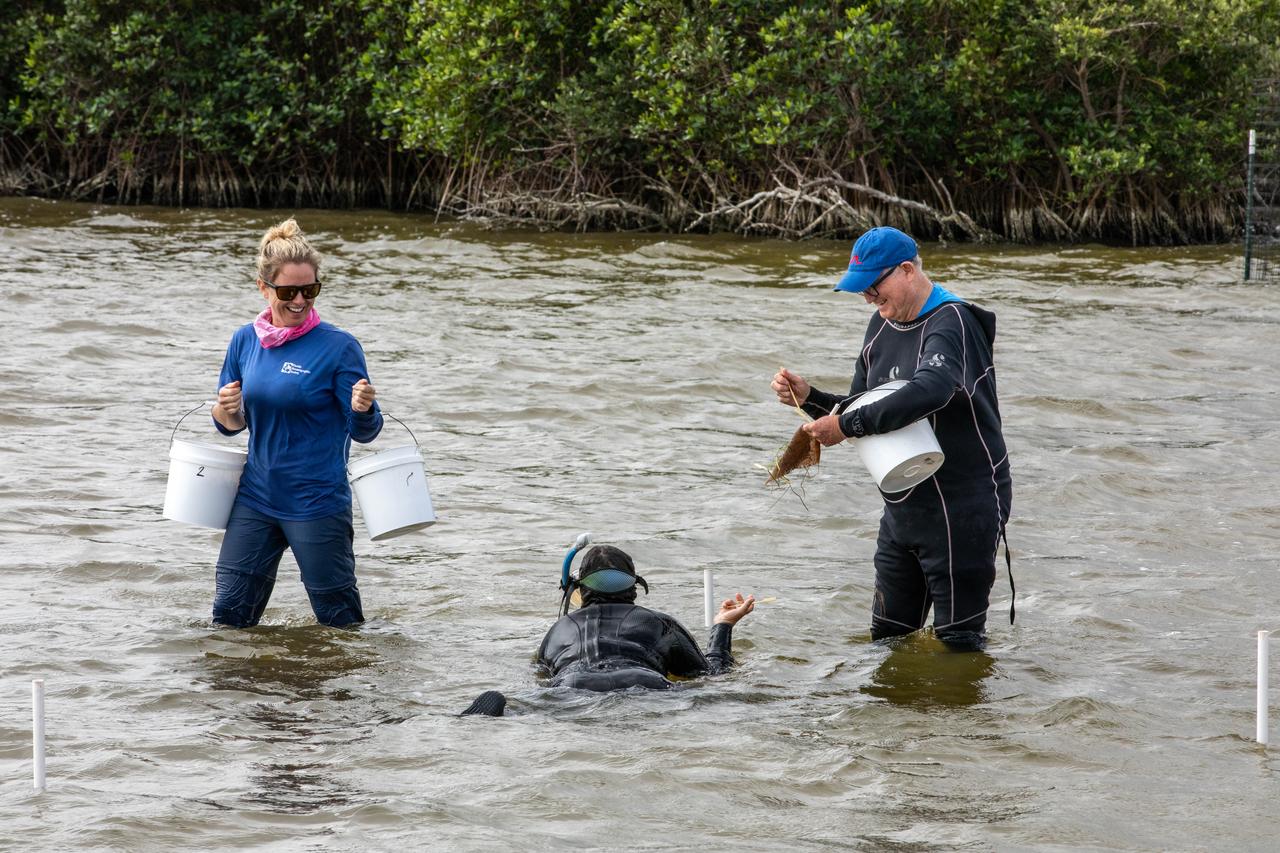
Lorae Simpson (left), director of research and conservation with the Florida Oceanographic Society, and Doug Scheidt (right), an ecologist working on NASA’s Environmental and Medical Contract (NEMCON), begin planting seagrass in the Banana River – one of three bodies of water that make up the Indian River Lagoon (IRL) – at NASA’s Kennedy Space Center in Florida on March 29, 2023. Scheidt is handing each “plot” of seagrass to another Florida Oceanographic Society member in the water, who then uses bamboo skewers to stake each one into the sediment. Kennedy’s Environmental Management Branch is working to plant a minimum of 28,000 shoots of seagrass divided into 18 sites across three areas at the Florida spaceport as part of a pilot project for seagrass restoration efforts. The project will look at the feasibility of replanting seagrass in Kennedy waters and, if successful, could lead to the spaceport becoming a donor site where shoots of grass can be broken off and relocated to other areas within Kennedy or along the IRL to promote growth.

This colorful picture is a mosaic of Messier 8, or the Lagoon nebula, taken by NASA Wide-field Infrared Survey Explorer. This nebula is composed of clouds of gas and dust in which new stars are forming.

What look like giant twisters are spotted by the Hubble Space Telescope (HST). These images are, in actuality, pillars of gases that are in the process of the formation of a new star. These pillars can be billions of miles in length and may have been forming for millions of years. This one formation is located in the Lagoon Nebula and was captured by the Hubble's wide field planetary camera-2 (WFPC-2).

This is a photograph of giant twisters and star wisps in the Lagoon Nebula. This superb Hubble Space Telescope (HST) image reveals a pair of one-half light-year long interstellar twisters, eerie furnels and twisted rope structures (upper left), in the heart of the Lagoon Nebula (Messier 8) that lies 5,000 light-years away in the direction of the constellation Sagittarius. This image was taken by the Hubble Space Telescope Wide Field/Planetary Camera 2 (WF/PC2).
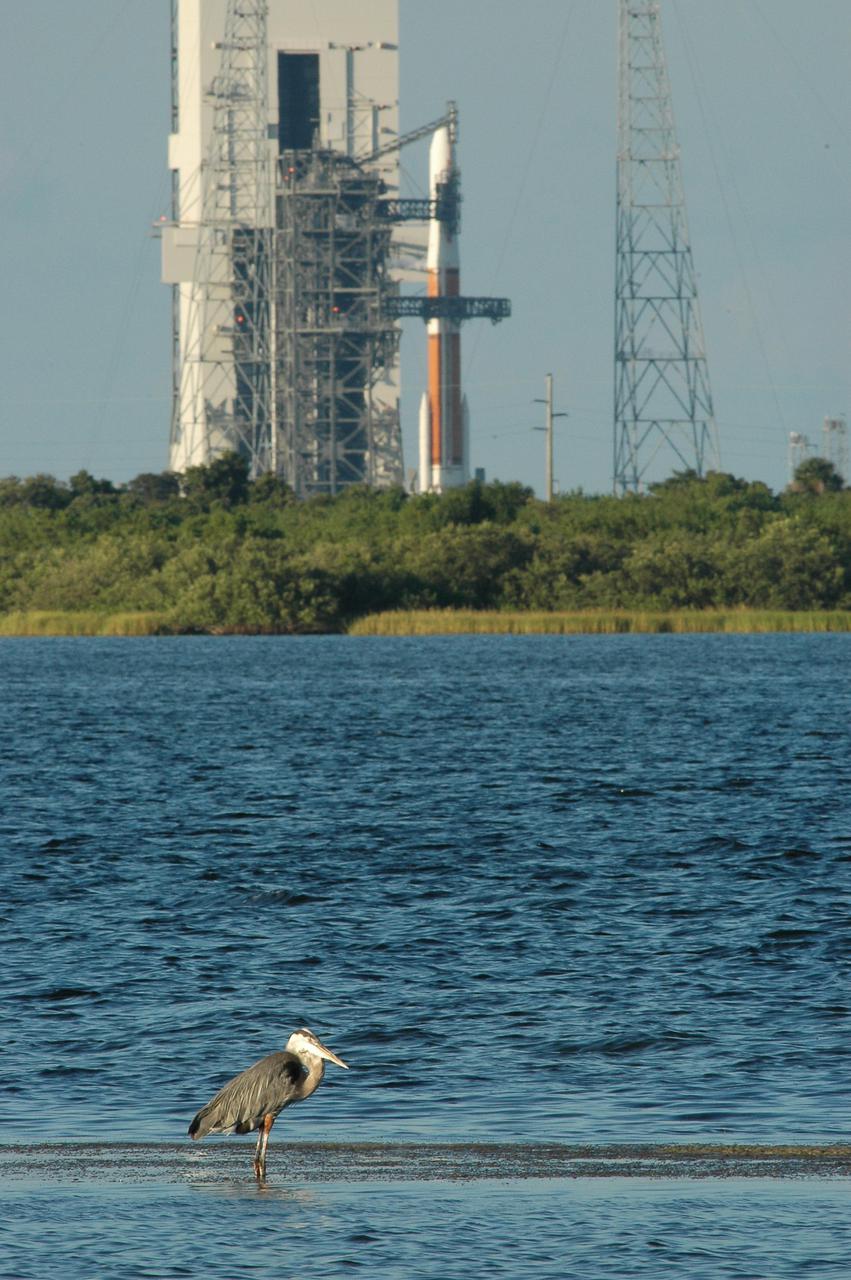
KENNEDY SPACE CENTER, FLA. - On Launch Complex 37 at Cape Canaveral Air Force Station in Florida, the Delta IV rocket and GOES-N satellite are being safed after the launch was scrubbed due to technical issues and postponed to a later date. In the foreground is a heron, wading in shallow water in the Indian River Lagoon. GOES-N is the latest in a series of Geostationary Operational Environmental Satellites providing continuous monitoring necessary for intensive data analysis.
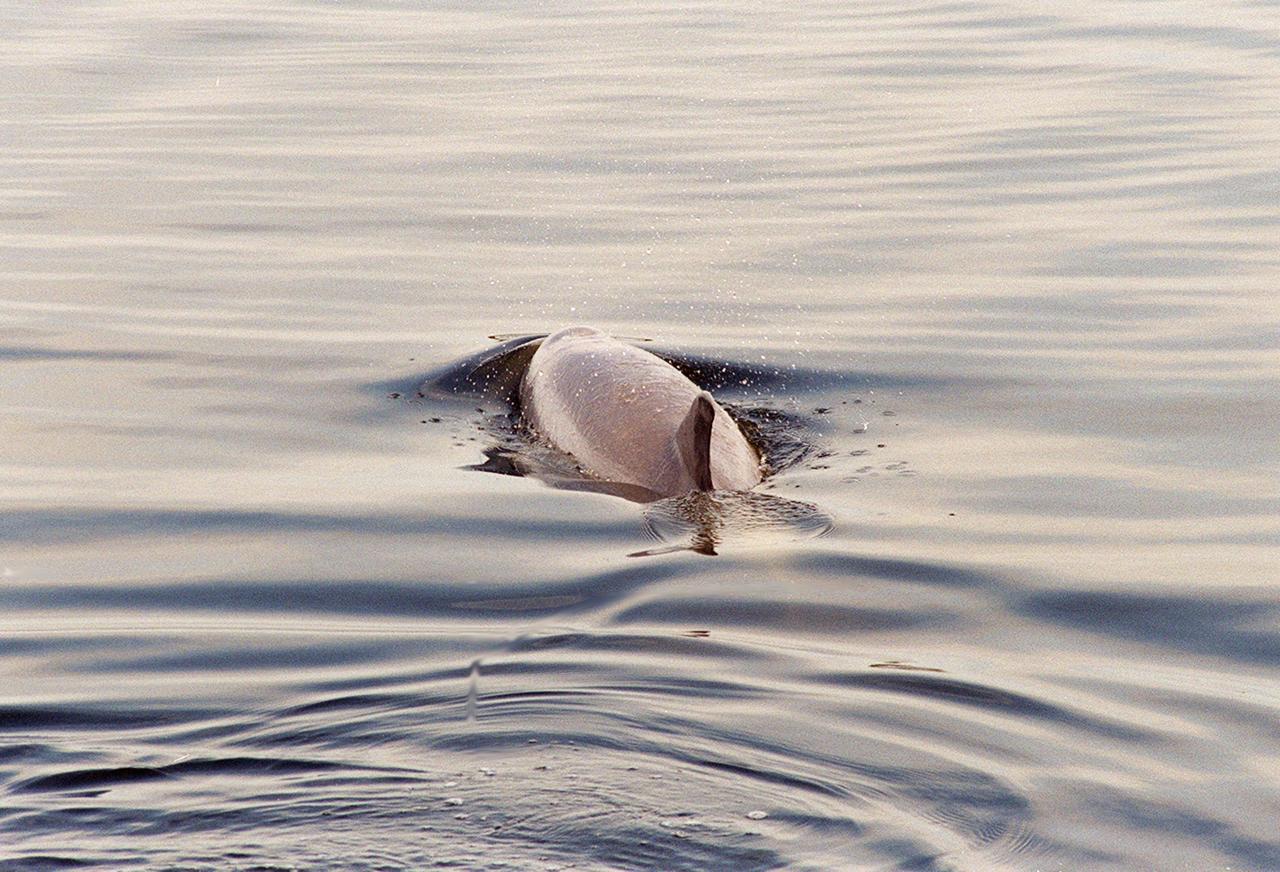
KENNEDY SPACE CENTER, FLA. -- A dolphin glides through the water looking for fish in the turn basin, which is located east of the Vehicle Assembly Building and next to the crawlerway. Dolphins inhabit the waters, known as the Indian River Lagoon, around Kennedy Space Center, along with many different species of oceanic and lagoon fish and shellfish. Mosquito Lagoon to the north, Banana River and Creek to the south and the Indian River to the west make up a special type of estuary called a lagoon, a body of water separated from the ocean by barrier islands, with limited exchange with the ocean through inlets. The Indian River Lagoon has one of the most diverse bird populations anywhere in America. Also, nearly one-third of the nation's manatee population lives here or migrates through the lagoon seasonally. The lagoon varies in width from ½ mile to 5 miles and averages only 3 feet in depth
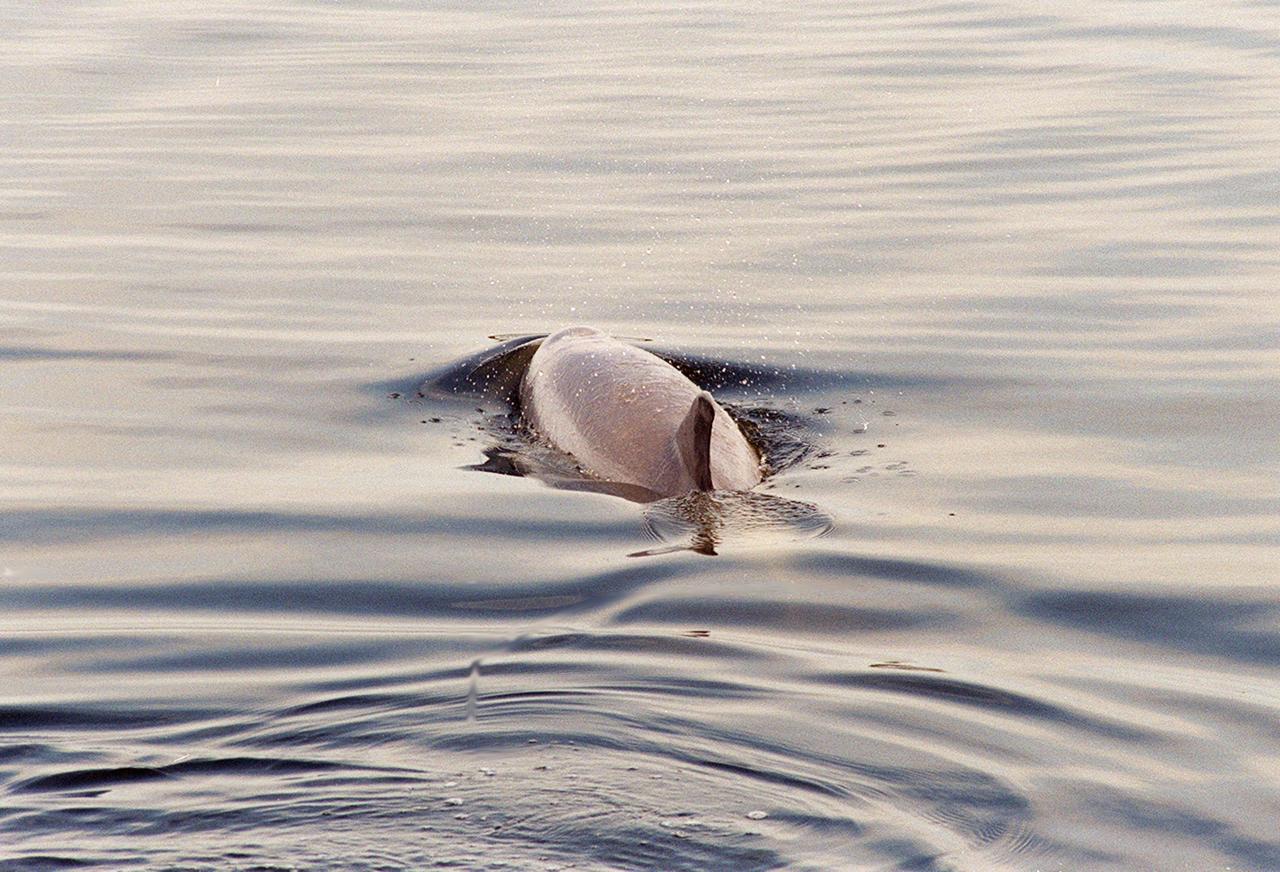
KENNEDY SPACE CENTER, FLA. -- A dolphin glides through the water looking for fish in the turn basin, which is located east of the Vehicle Assembly Building and next to the crawlerway. Dolphins inhabit the waters, known as the Indian River Lagoon, around Kennedy Space Center, along with many different species of oceanic and lagoon fish and shellfish. Mosquito Lagoon to the north, Banana River and Creek to the south and the Indian River to the west make up a special type of estuary called a lagoon, a body of water separated from the ocean by barrier islands, with limited exchange with the ocean through inlets. The Indian River Lagoon has one of the most diverse bird populations anywhere in America. Also, nearly one-third of the nation's manatee population lives here or migrates through the lagoon seasonally. The lagoon varies in width from ½ mile to 5 miles and averages only 3 feet in depth
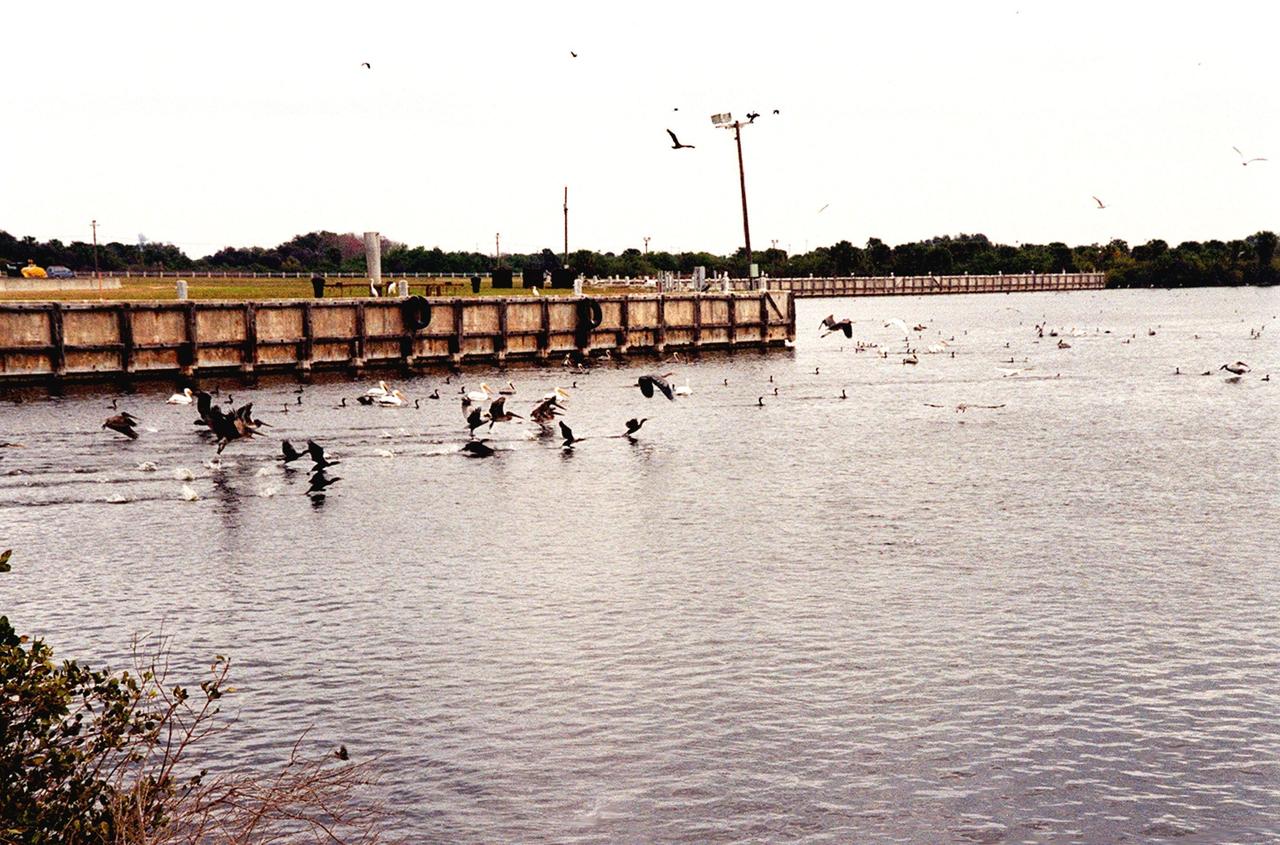
KENNEDY SPACE CENTER, FLA. -- The water in the turn basin, east of the Vehicle Assembly Building and next to the crawlerway, teems with fish and draws white pelicans, gray pelicans, cormorants, sea gulls and more looking for a meal. The turn basin is part of the Indian River Lagoon, composed of Mosquito Lagoon to the north, Banana River and Creek to the south and the Indian River to the west. The Indian River Lagoon has one of the most diverse bird populations anywhere in America. Also, nearly one-third of the nation's manatee population lives here or migrates through the lagoon seasonally. The lagoon varies in width from ½ mile to 5 miles and averages only 3 feet in depth
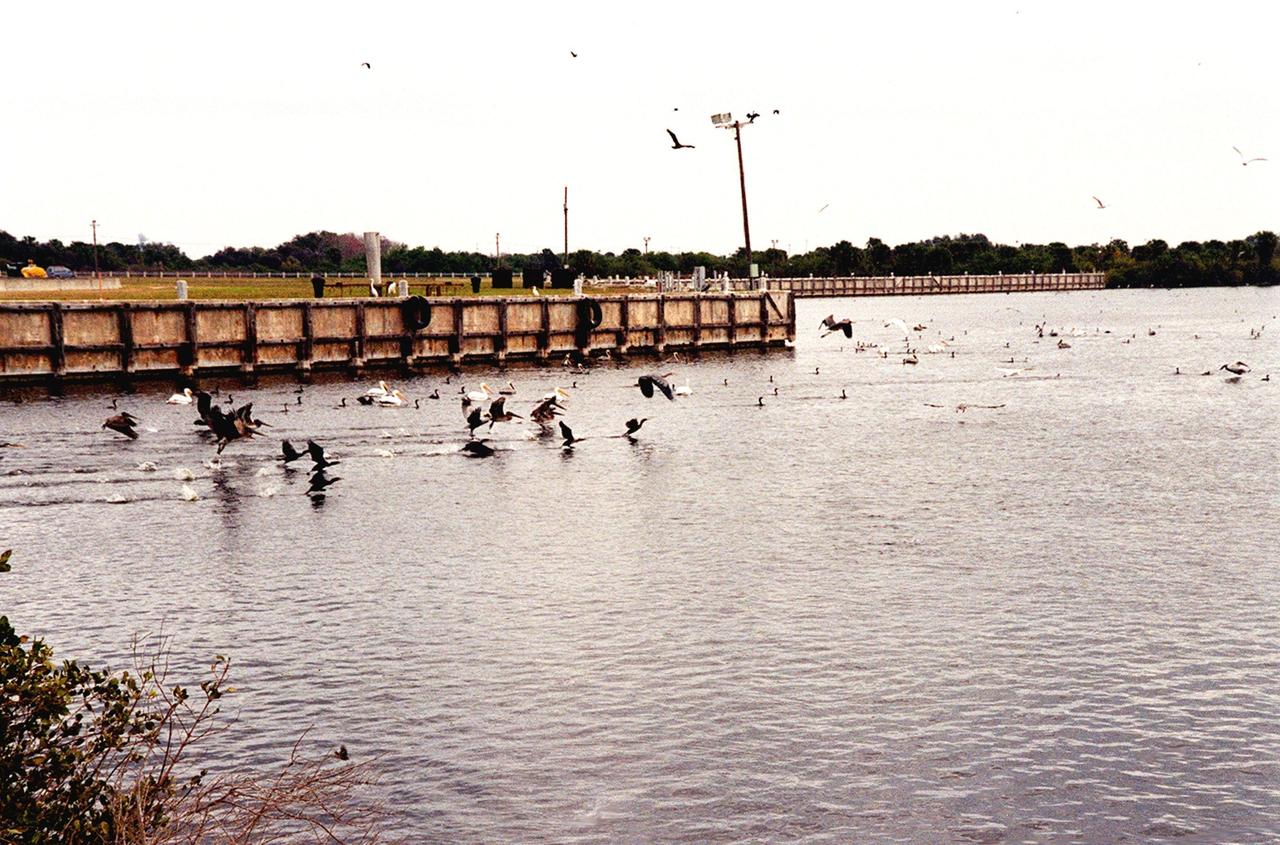
KENNEDY SPACE CENTER, FLA. -- The water in the turn basin, east of the Vehicle Assembly Building and next to the crawlerway, teems with fish and draws white pelicans, gray pelicans, cormorants, sea gulls and more looking for a meal. The turn basin is part of the Indian River Lagoon, composed of Mosquito Lagoon to the north, Banana River and Creek to the south and the Indian River to the west. The Indian River Lagoon has one of the most diverse bird populations anywhere in America. Also, nearly one-third of the nation's manatee population lives here or migrates through the lagoon seasonally. The lagoon varies in width from ½ mile to 5 miles and averages only 3 feet in depth
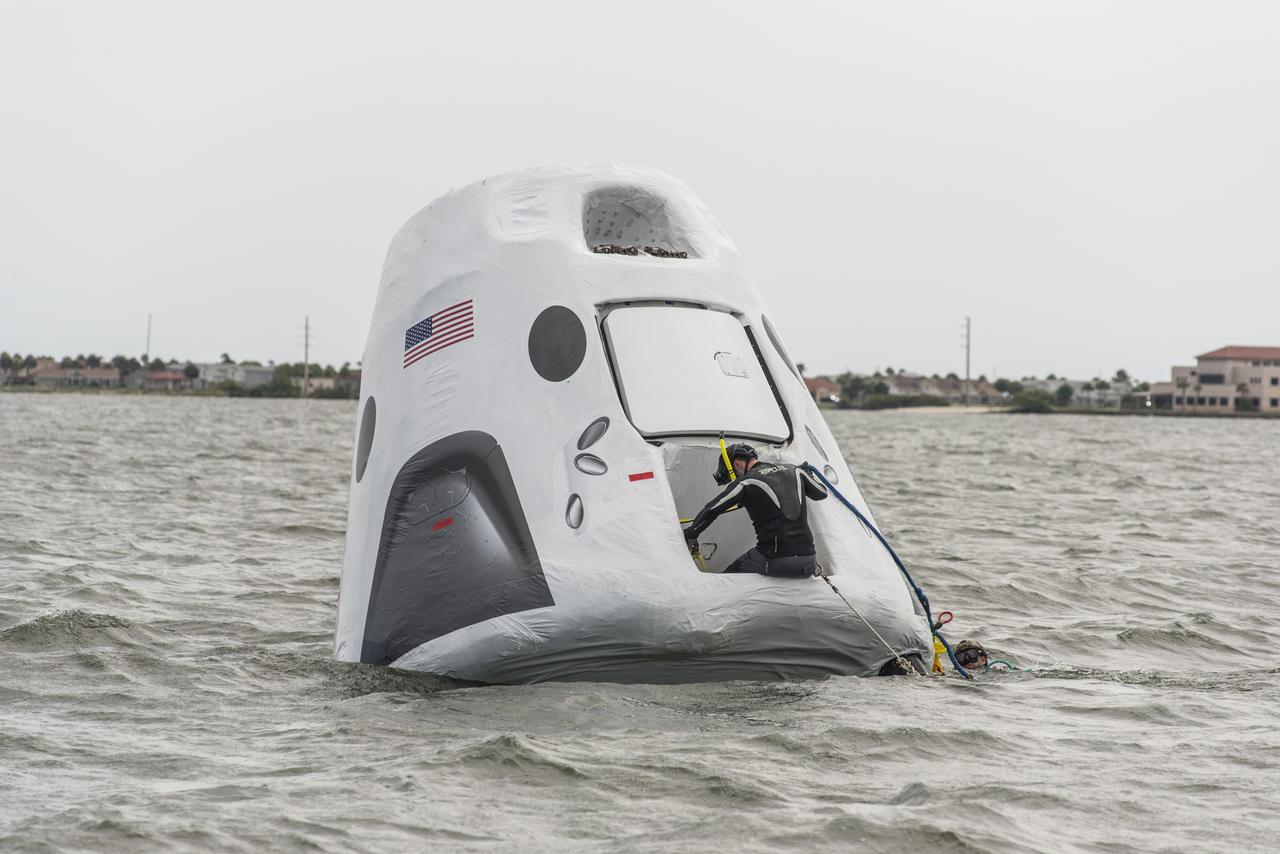
Personnel from NASA, SpaceX and the U.S. Air Force have begun practicing recovery operations for the SpaceX Crew Dragon. Using a full-size model of the spacecraft that will take astronauts to the International Space Station, Air Force parajumpers practice helping astronauts out of the SpaceX Crew Dragon following a mission. In certain unusual recovery situations, SpaceX may need to work with Air Force for parajumpers to recover astronauts from the capsule following a water landing. The recovery trainer was recently lowered into the Indian River Lagoon near NASA’s Kennedy Space Center allowing Air Force pararescue and others to refine recovery procedures. SpaceX is developing the Crew Dragon in partnership with NASA’s Commercial Crew Program to carry astronauts to and from the International Space Station.
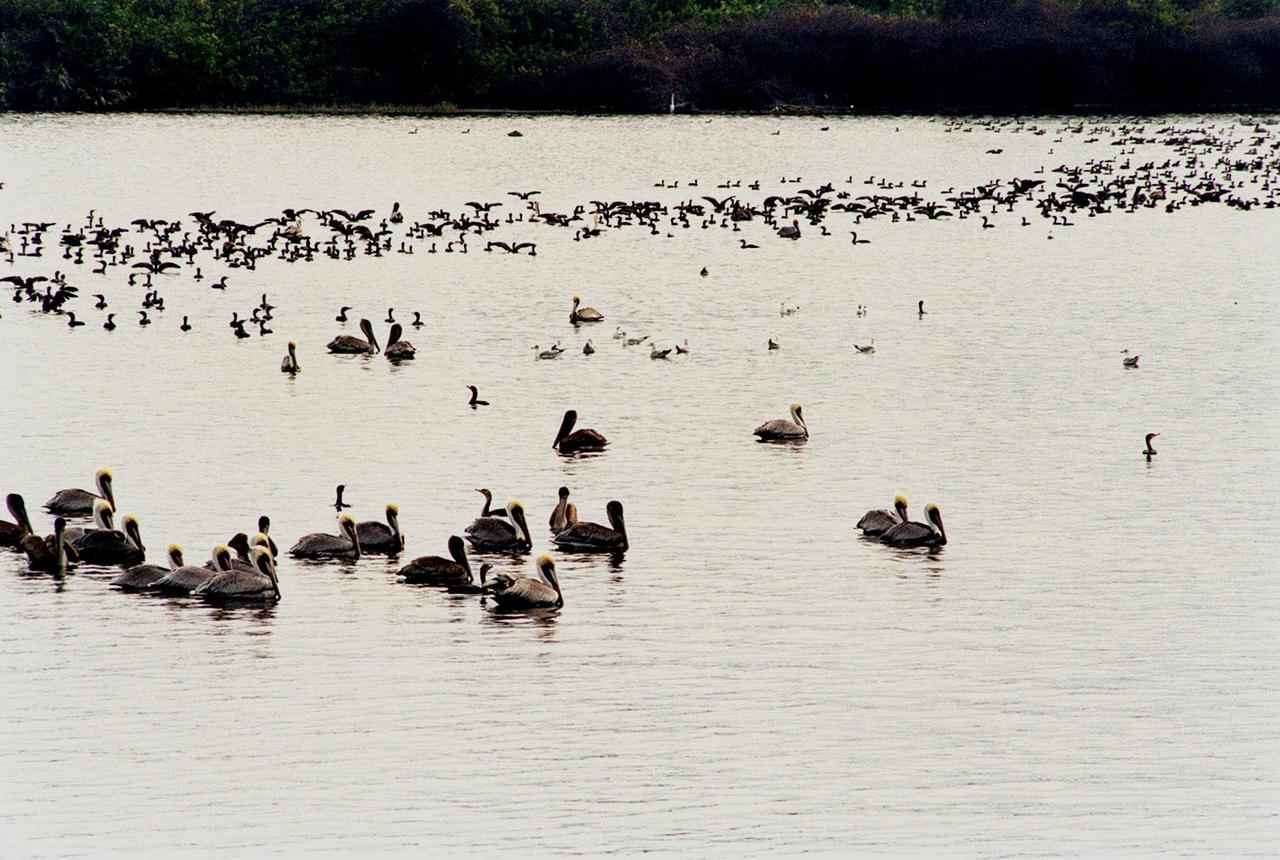
KENNEDY SPACE CENTER, FLA. -- Hundreds of birds, especially gray and white pelicans and cormorants, cover the water in the turn basin, located east of the Vehicle Assembly Building and next to the crawlerway. The basin is teeming with fish, attracting the crowd for a meal. The turn basin is part of the Indian River Lagoon, composed of Mosquito Lagoon to the north, Banana River and Creek to the south and the Indian River to the west. The lagoon has one of the most diverse bird populations anywhere in America, plus many different species of oceanic and lagoon fish, shellfish and dolphins. Also, nearly one-third of the nation's manatee population lives here or migrates through the Lagoon seasonally. The Lagoon varies in width from ½ mile to 5 miles and averages only 3 feet in depth
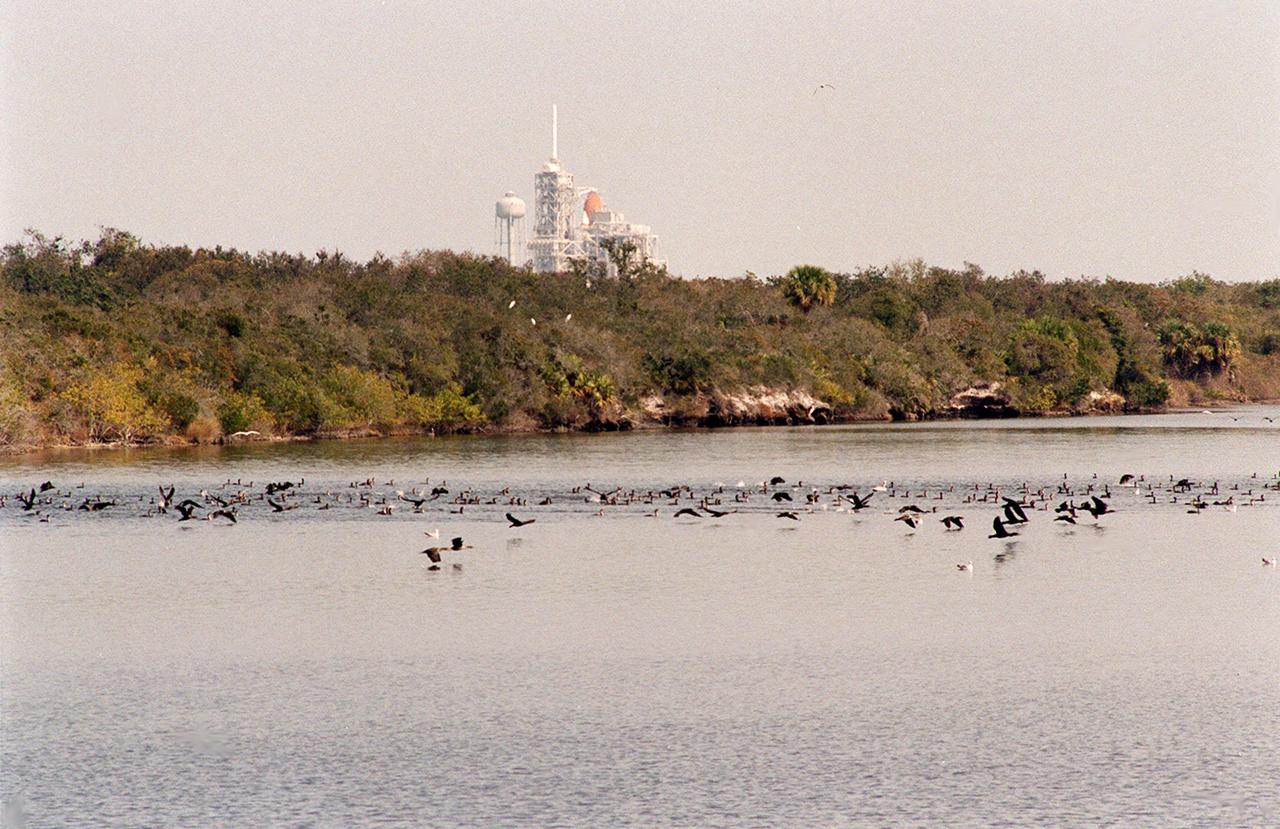
KENNEDY SPACE CENTER, FLA. -- Birds by the score, especially gray and white pelicans, cormorants, sea gulls, herons and ospreys, flock to the turn basin east of the Vehicle Assembly Building in a feeding frenzy as schools of fish fill the waters. In the background is Launch Pad A with Space Shuttle Endeavour waiting for launch on Friday, Feb. 11 for mission STS-99. The basin is part of the Indian River Lagoon, which is made up of Mosquito Lagoon to the north, Banana River and Creek to the south and the Indian River to the west. It is called a lagoon because it is a body of water separated from the ocean by barrier islands, with limited exchange with the ocean through inlets. The Indian River Lagoon has one of the most diverse bird populations anywhere in America. Also, nearly one-third of the nation's manatee population lives here or migrates through the lagoon seasonally. The lagoon varies in width from ½ mile to 5 miles and averages only 3 feet in depth
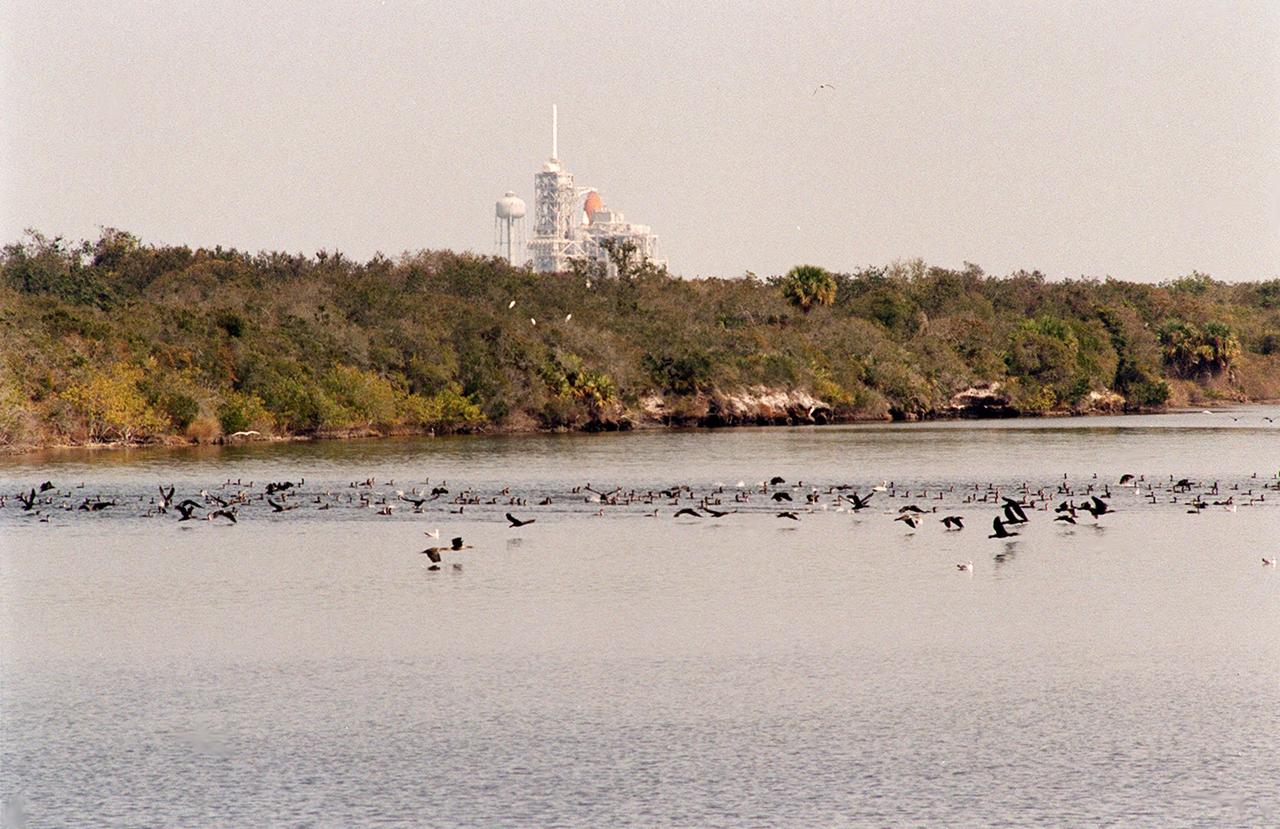
KENNEDY SPACE CENTER, FLA. -- Birds by the score, especially gray and white pelicans, cormorants, sea gulls, herons and ospreys, flock to the turn basin east of the Vehicle Assembly Building in a feeding frenzy as schools of fish fill the waters. In the background is Launch Pad A with Space Shuttle Endeavour waiting for launch on Friday, Feb. 11 for mission STS-99. The basin is part of the Indian River Lagoon, which is made up of Mosquito Lagoon to the north, Banana River and Creek to the south and the Indian River to the west. It is called a lagoon because it is a body of water separated from the ocean by barrier islands, with limited exchange with the ocean through inlets. The Indian River Lagoon has one of the most diverse bird populations anywhere in America. Also, nearly one-third of the nation's manatee population lives here or migrates through the lagoon seasonally. The lagoon varies in width from ½ mile to 5 miles and averages only 3 feet in depth
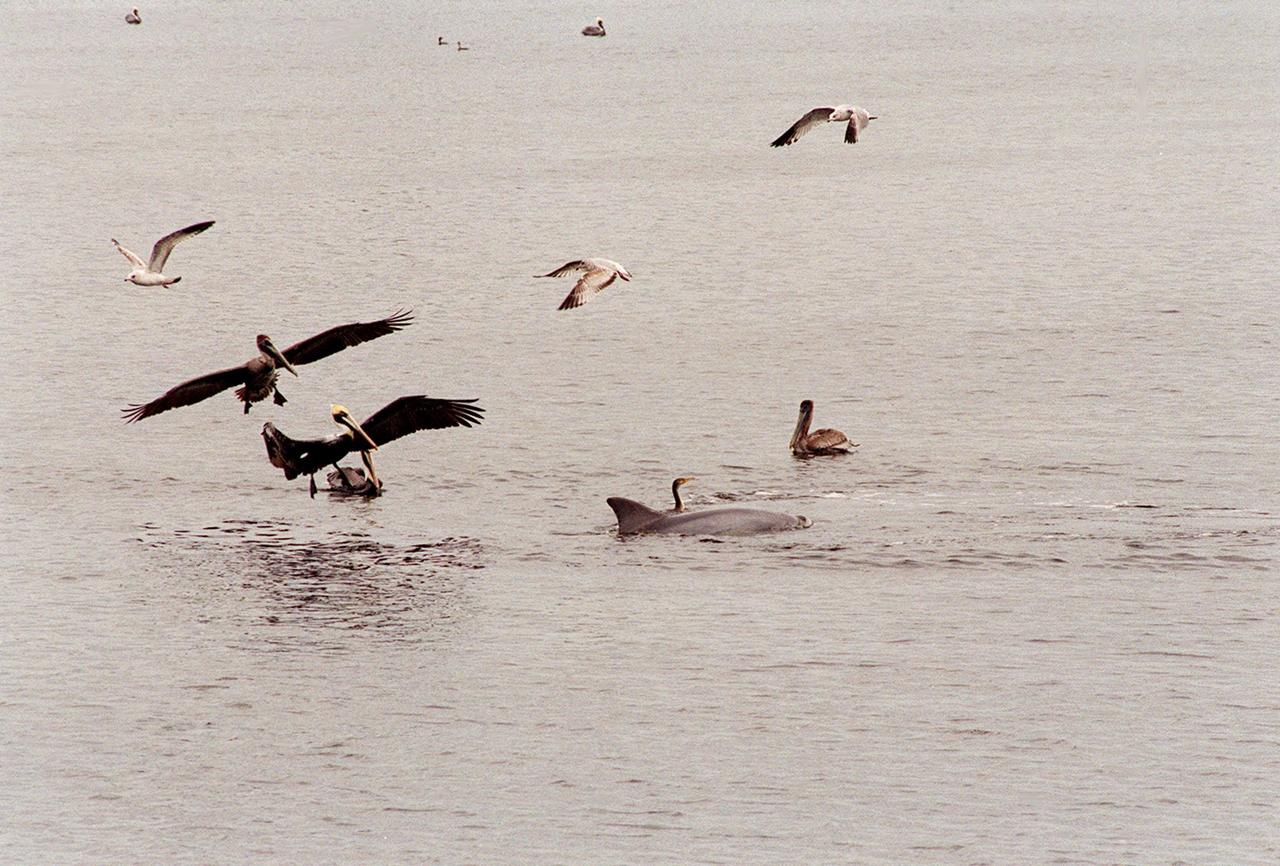
KENNEDY SPACE CENTER, FLA. -- A gray and a white pelican glide down to the water near a dolphin and cormorant in the turn basin to search for a meal in the fish-teeming water. Sea gulls also approach. The turn basin, which is east of the Vehicle Assembly Building and next to the crawlerway, is part of the Indian River Lagoon, composed of Mosquito Lagoon to the north, Banana River and Creek to the south and the Indian River to the west. The lagoon has one of the most diverse bird populations anywhere in America, plus many different species of oceanic and lagoon fish, shellfish and dolphins. Also, nearly one-third of the nation's manatee population lives here or migrates through the Lagoon seasonally. The Lagoon varies in width from ½ mile to 5 miles and averages only 3 feet in depth

KENNEDY SPACE CENTER, FLA. -- A gray and a white pelican glide down to the water near a dolphin and cormorant in the turn basin to search for a meal in the fish-teeming water. Sea gulls also approach. The turn basin, which is east of the Vehicle Assembly Building and next to the crawlerway, is part of the Indian River Lagoon, composed of Mosquito Lagoon to the north, Banana River and Creek to the south and the Indian River to the west. The lagoon has one of the most diverse bird populations anywhere in America, plus many different species of oceanic and lagoon fish, shellfish and dolphins. Also, nearly one-third of the nation's manatee population lives here or migrates through the Lagoon seasonally. The Lagoon varies in width from ½ mile to 5 miles and averages only 3 feet in depth
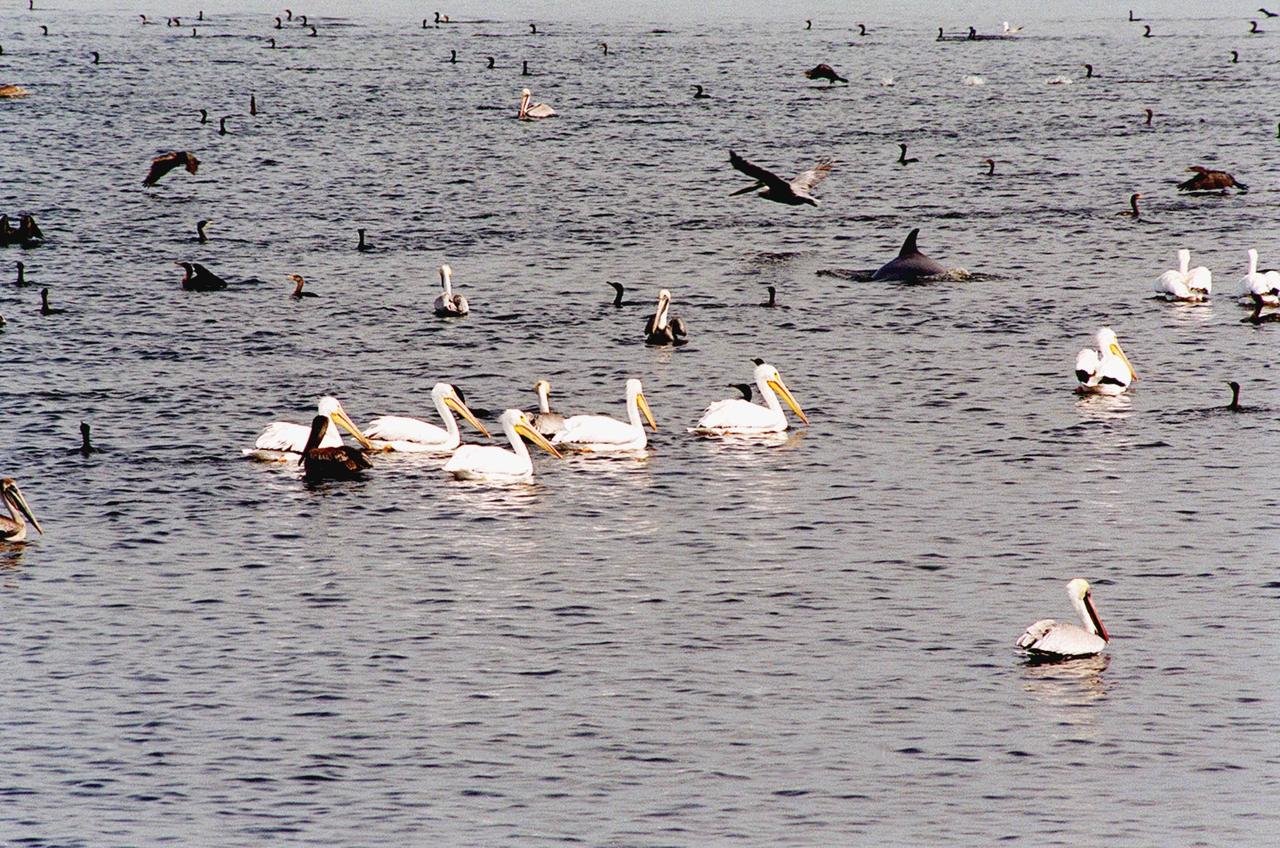
KENNEDY SPACE CENTER, FLA. -- The water in the turn basin, located east of the Vehicle Assembly Building and next to the crawlerway, teems with fish and draws white pelicans, gray pelicans, cormorants, sea gulls and one of several dolphins looking for a meal. The turn basin is part of the Indian River Lagoon, composed of Mosquito Lagoon to the north, Banana River and Creek to the south and the Indian River to the west. The lagoon has one of the most diverse bird populations anywhere in America, plus many different species of oceanic and lagoon fish, shellfish and dolphins. Also, nearly one-third of the nation's manatee population lives here or migrates through the lagoon seasonally. The lagoon varies in width from ½ mile to 5 miles and averages only 3 feet in depth
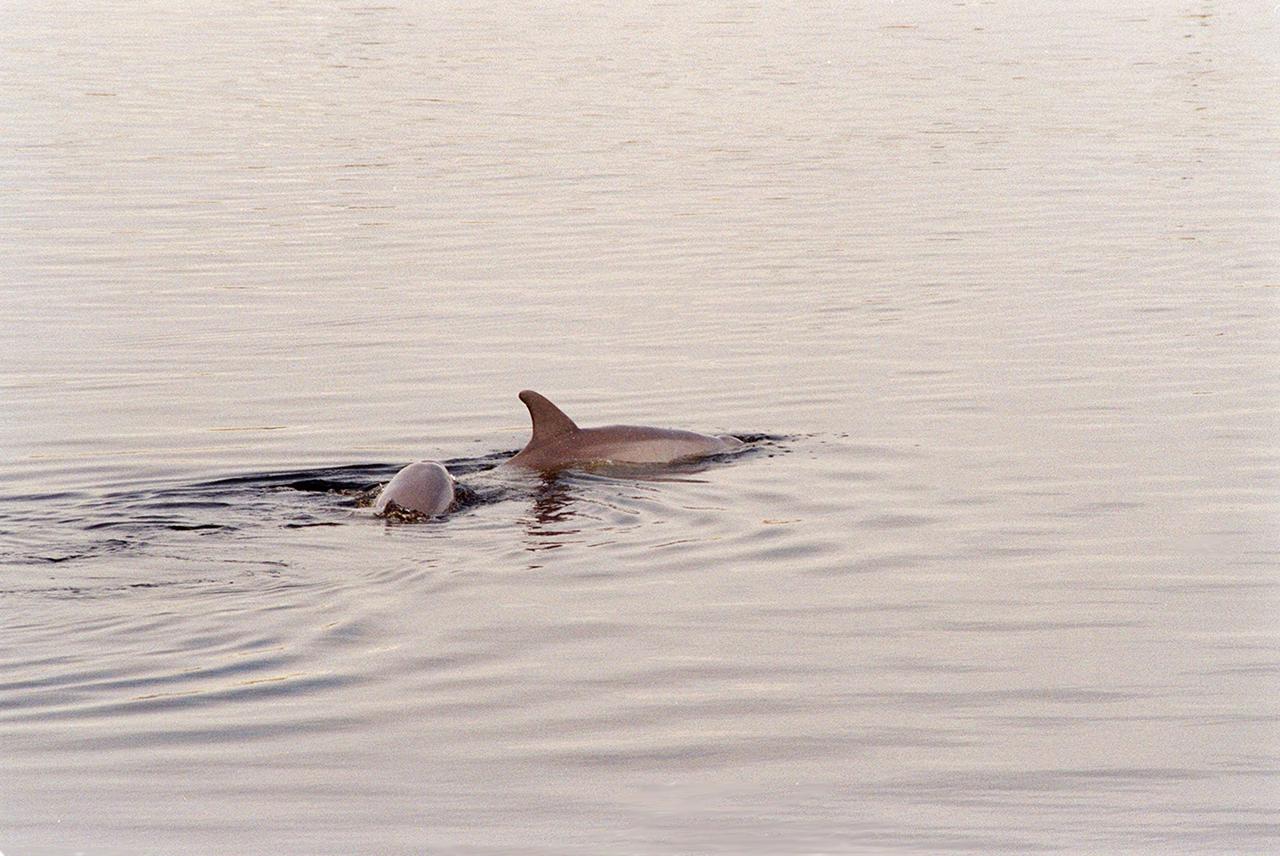
KENNEDY SPACE CENTER, FLA. -- In the turn basin east of the Vehicle Assembly Building and next to the crawlerway, a mother dolphin guides her baby through the water to search for food. Dolphins inhabit the waters around Kennedy Space Center, along with many different species of oceanic and lagoon fish and shellfish. Mosquito Lagoon to the north, Banana River and Creek to the south and the Indian River to the west make up a special type of estuary called a lagoon, a body of water separated from the ocean by barrier islands, with limited exchange with the ocean through inlets. The Indian River Lagoon has one of the most diverse bird populations anywhere in America. Also, nearly one-third of the nation's manatee population lives here or migrates through the lagoon seasonally. The lagoon varies in width from ½ mile to 5 miles and averages only 3 feet in depth
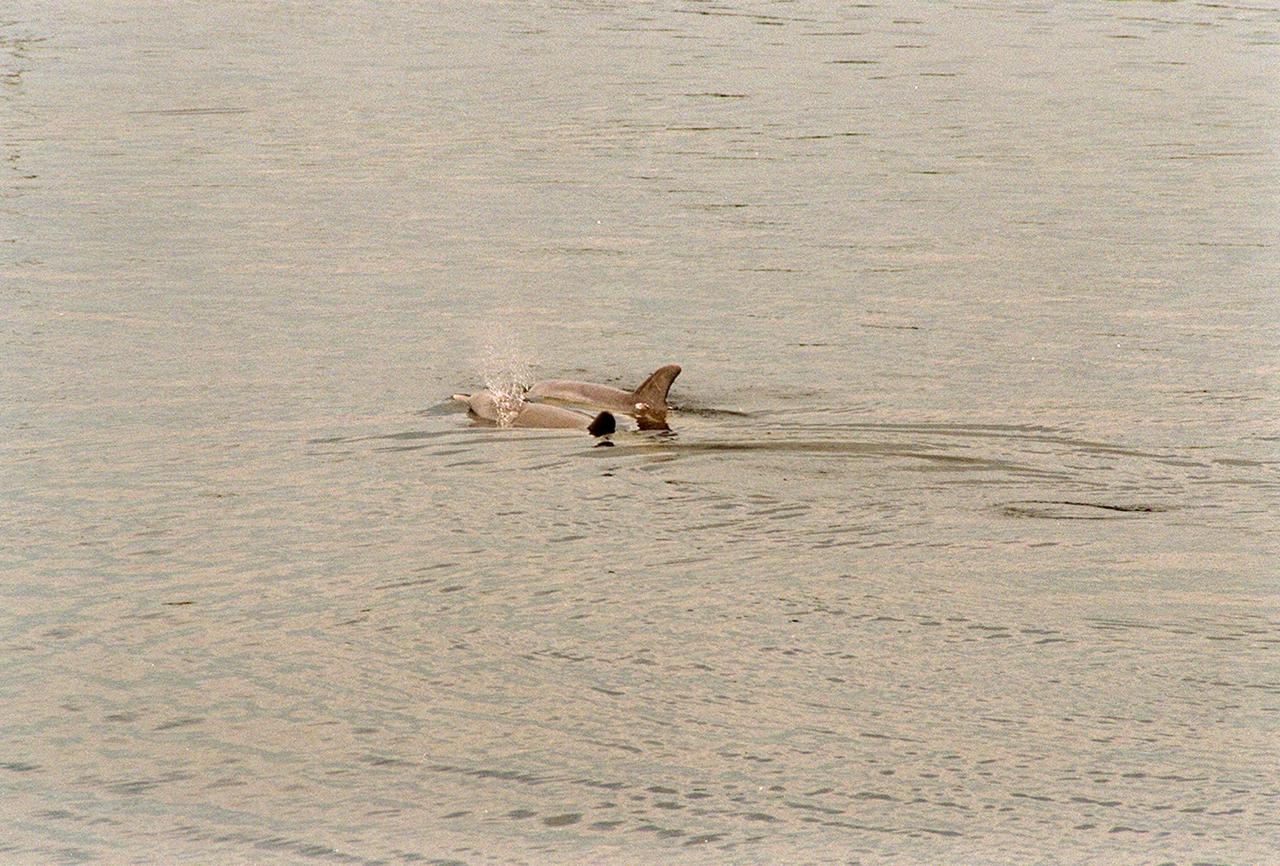
KENNEDY SPACE CENTER, FLA. -- In the turn basin east of the Vehicle Assembly Building and next to the crawlerway, a mother dolphin guides her baby through the water to search for food. Next to them on a rock is an osprey eating a fish. Dolphins inhabit the waters around Kennedy Space Center, along with many different species of oceanic and lagoon fish and shellfish. Mosquito Lagoon to the north, Banana River and Creek to the south and the Indian River to the west make up a special type of estuary called a lagoon, a body of water separated from the ocean by barrier islands, with limited exchange with the ocean through inlets. The Lagoon varies in width from ½ mile to 5 miles and averages only 3 feet in depth. Nearly one-third of the nation's manatee population lives here or migrates through the Lagoon seasonally. The lagoon also has one of the most diverse bird populations anywhere in America
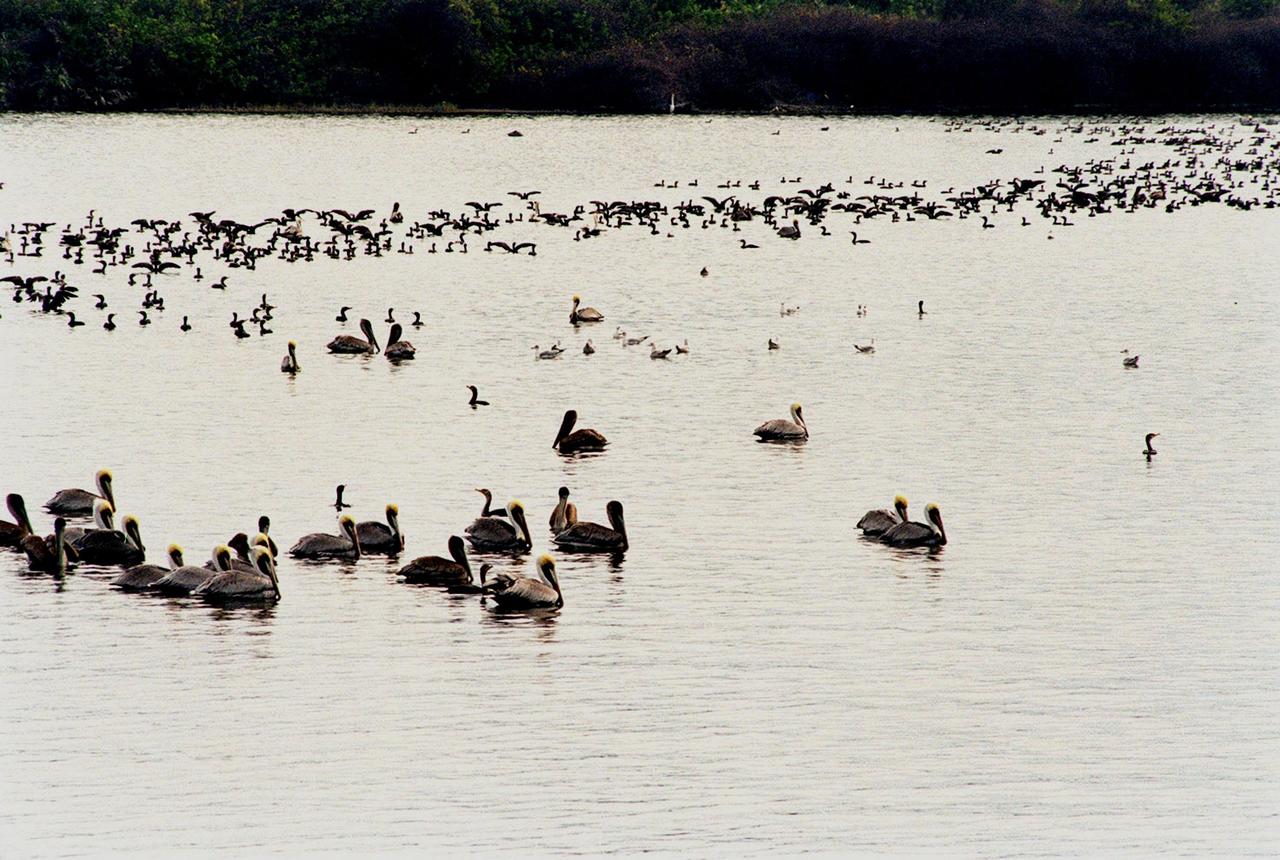
KENNEDY SPACE CENTER, FLA. -- Hundreds of birds, especially gray and white pelicans and cormorants, cover the water in the turn basin, located east of the Vehicle Assembly Building and next to the crawlerway. The basin is teeming with fish, attracting the crowd for a meal. The turn basin is part of the Indian River Lagoon, composed of Mosquito Lagoon to the north, Banana River and Creek to the south and the Indian River to the west. The lagoon has one of the most diverse bird populations anywhere in America, plus many different species of oceanic and lagoon fish, shellfish and dolphins. Also, nearly one-third of the nation's manatee population lives here or migrates through the Lagoon seasonally. The Lagoon varies in width from ½ mile to 5 miles and averages only 3 feet in depth
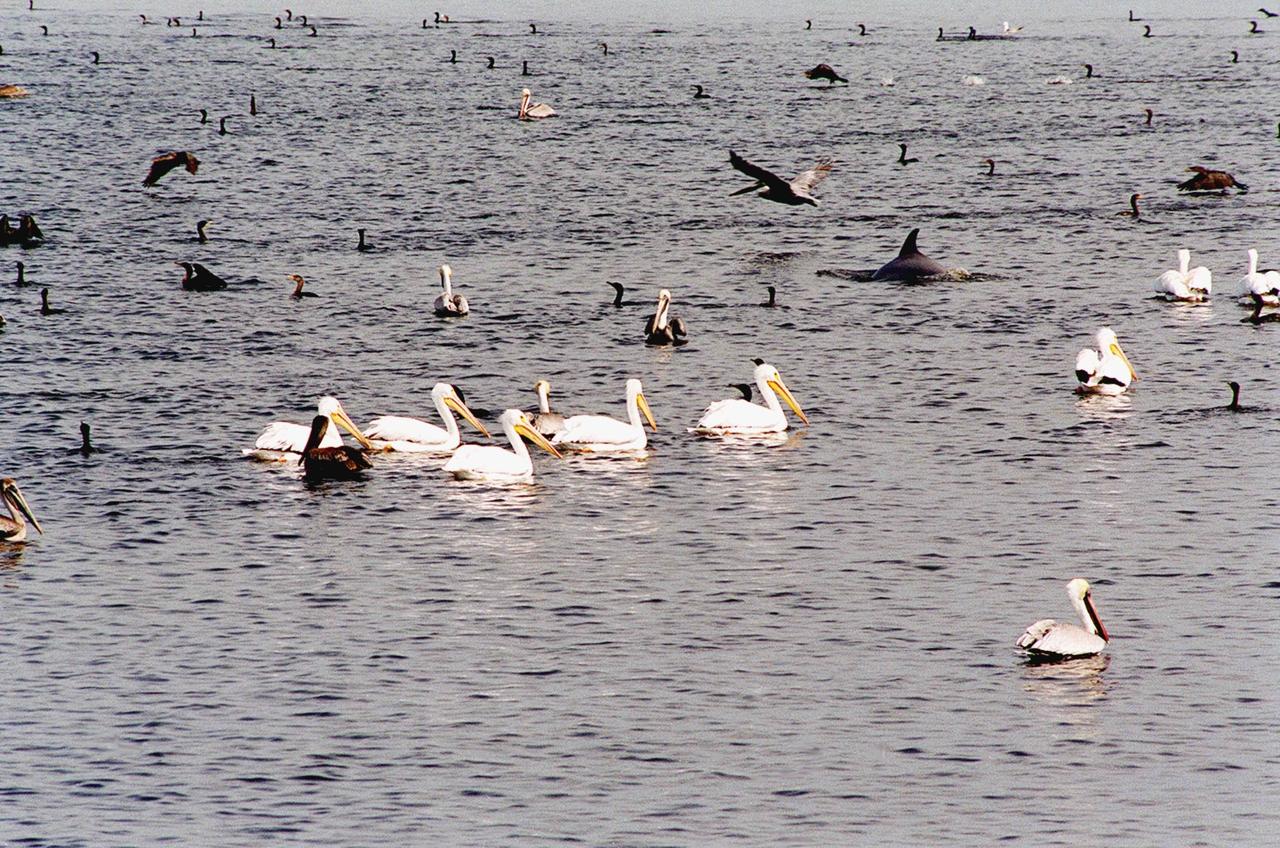
KENNEDY SPACE CENTER, FLA. -- The water in the turn basin, located east of the Vehicle Assembly Building and next to the crawlerway, teems with fish and draws white pelicans, gray pelicans, cormorants, sea gulls and one of several dolphins looking for a meal. The turn basin is part of the Indian River Lagoon, composed of Mosquito Lagoon to the north, Banana River and Creek to the south and the Indian River to the west. The lagoon has one of the most diverse bird populations anywhere in America, plus many different species of oceanic and lagoon fish, shellfish and dolphins. Also, nearly one-third of the nation's manatee population lives here or migrates through the lagoon seasonally. The lagoon varies in width from ½ mile to 5 miles and averages only 3 feet in depth
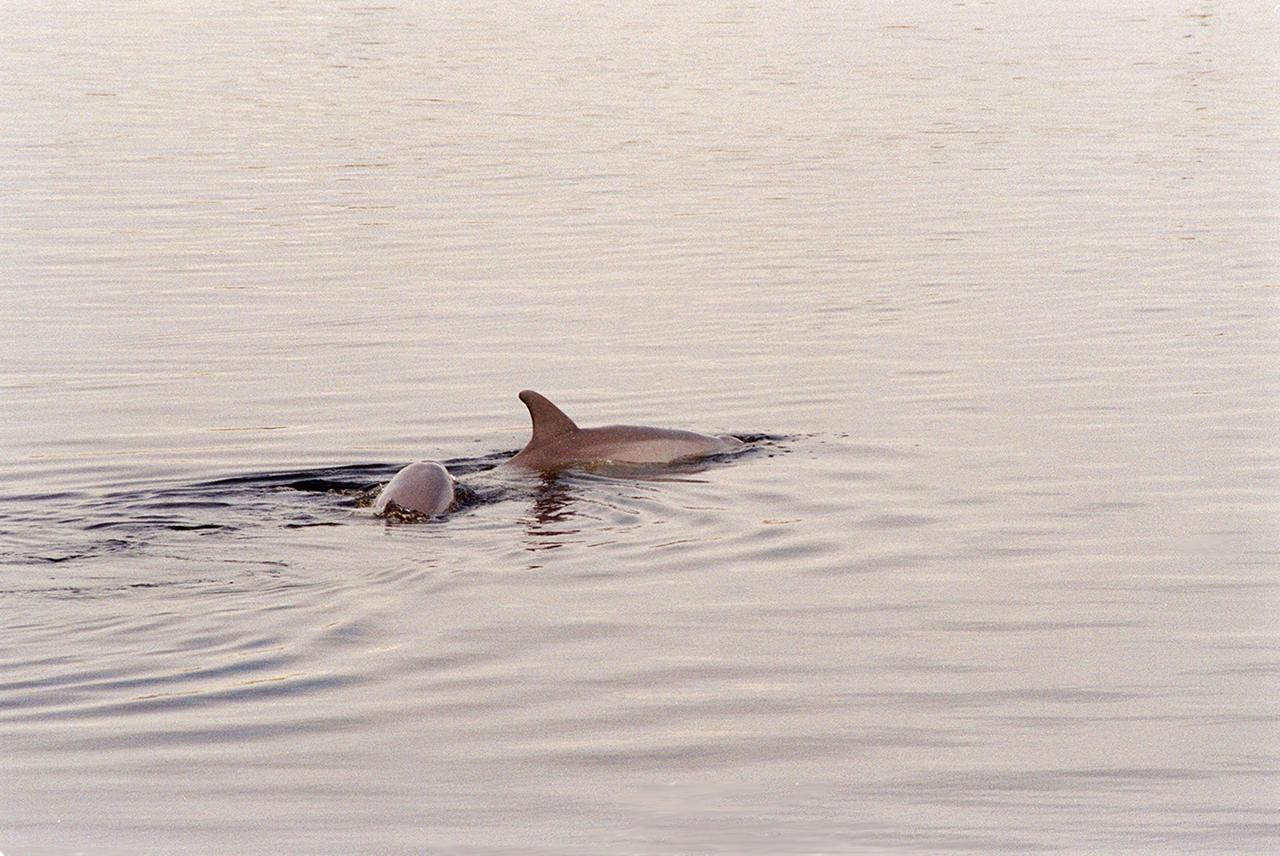
KENNEDY SPACE CENTER, FLA. -- In the turn basin east of the Vehicle Assembly Building and next to the crawlerway, a mother dolphin guides her baby through the water to search for food. Dolphins inhabit the waters around Kennedy Space Center, along with many different species of oceanic and lagoon fish and shellfish. Mosquito Lagoon to the north, Banana River and Creek to the south and the Indian River to the west make up a special type of estuary called a lagoon, a body of water separated from the ocean by barrier islands, with limited exchange with the ocean through inlets. The Indian River Lagoon has one of the most diverse bird populations anywhere in America. Also, nearly one-third of the nation's manatee population lives here or migrates through the lagoon seasonally. The lagoon varies in width from ½ mile to 5 miles and averages only 3 feet in depth
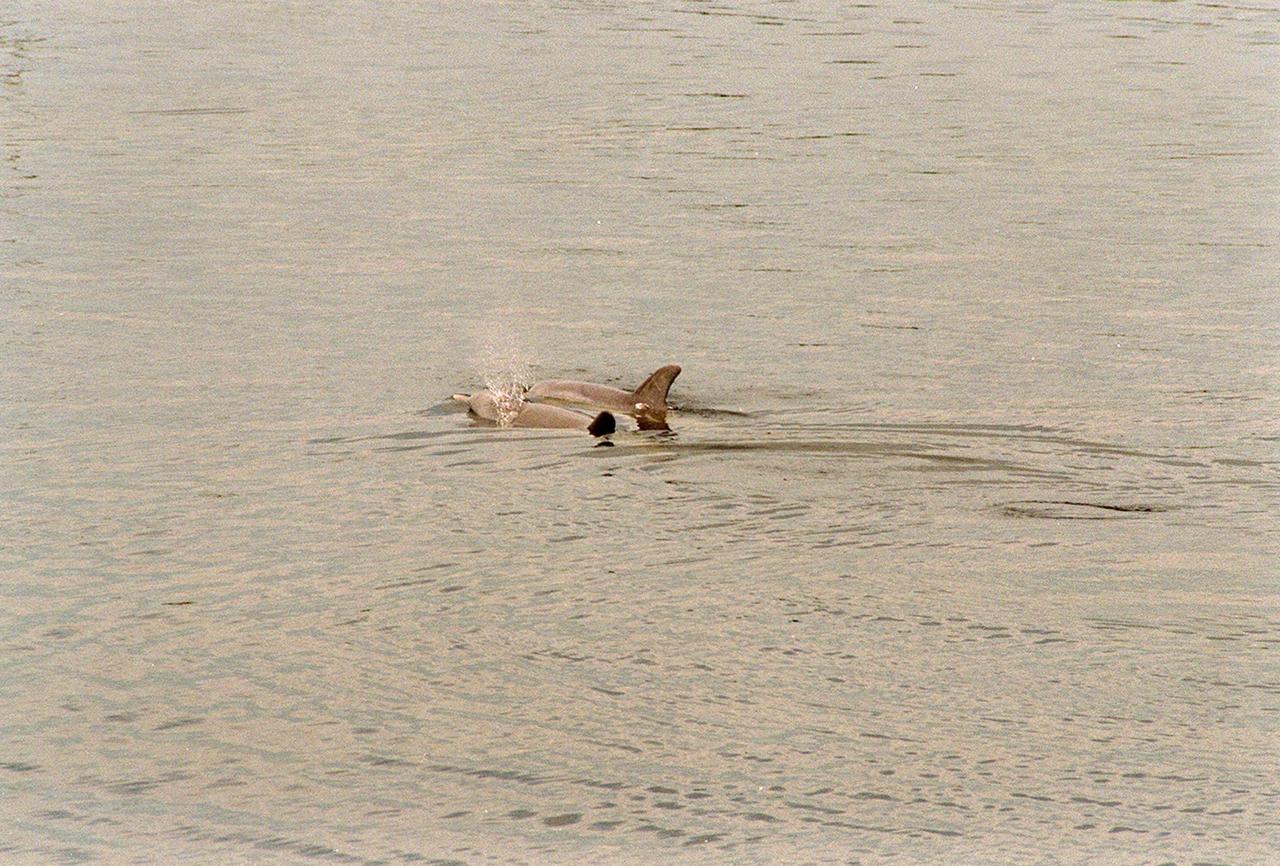
KENNEDY SPACE CENTER, FLA. -- In the turn basin east of the Vehicle Assembly Building and next to the crawlerway, a mother dolphin guides her baby through the water to search for food. Next to them on a rock is an osprey eating a fish. Dolphins inhabit the waters around Kennedy Space Center, along with many different species of oceanic and lagoon fish and shellfish. Mosquito Lagoon to the north, Banana River and Creek to the south and the Indian River to the west make up a special type of estuary called a lagoon, a body of water separated from the ocean by barrier islands, with limited exchange with the ocean through inlets. The Lagoon varies in width from ½ mile to 5 miles and averages only 3 feet in depth. Nearly one-third of the nation's manatee population lives here or migrates through the Lagoon seasonally. The lagoon also has one of the most diverse bird populations anywhere in America
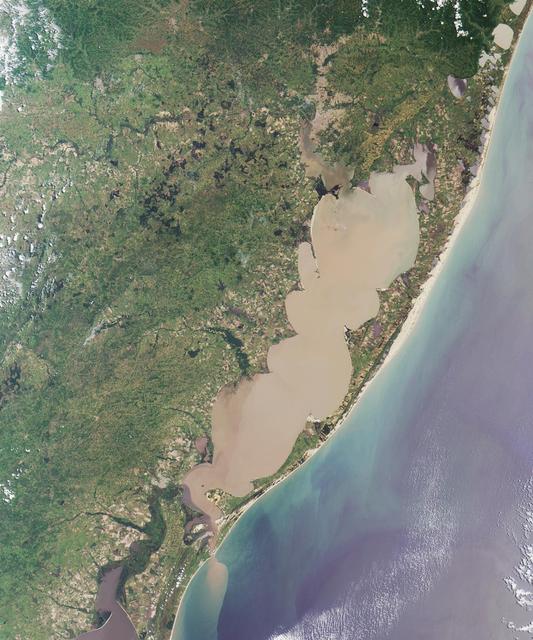
The Lagoa dos Patos, in the Brazilian state of Rio Grande do Sul, translates to the Duck Lagoon. This image from NASA Terra satellite is MISR Mystery Image Quiz #5.
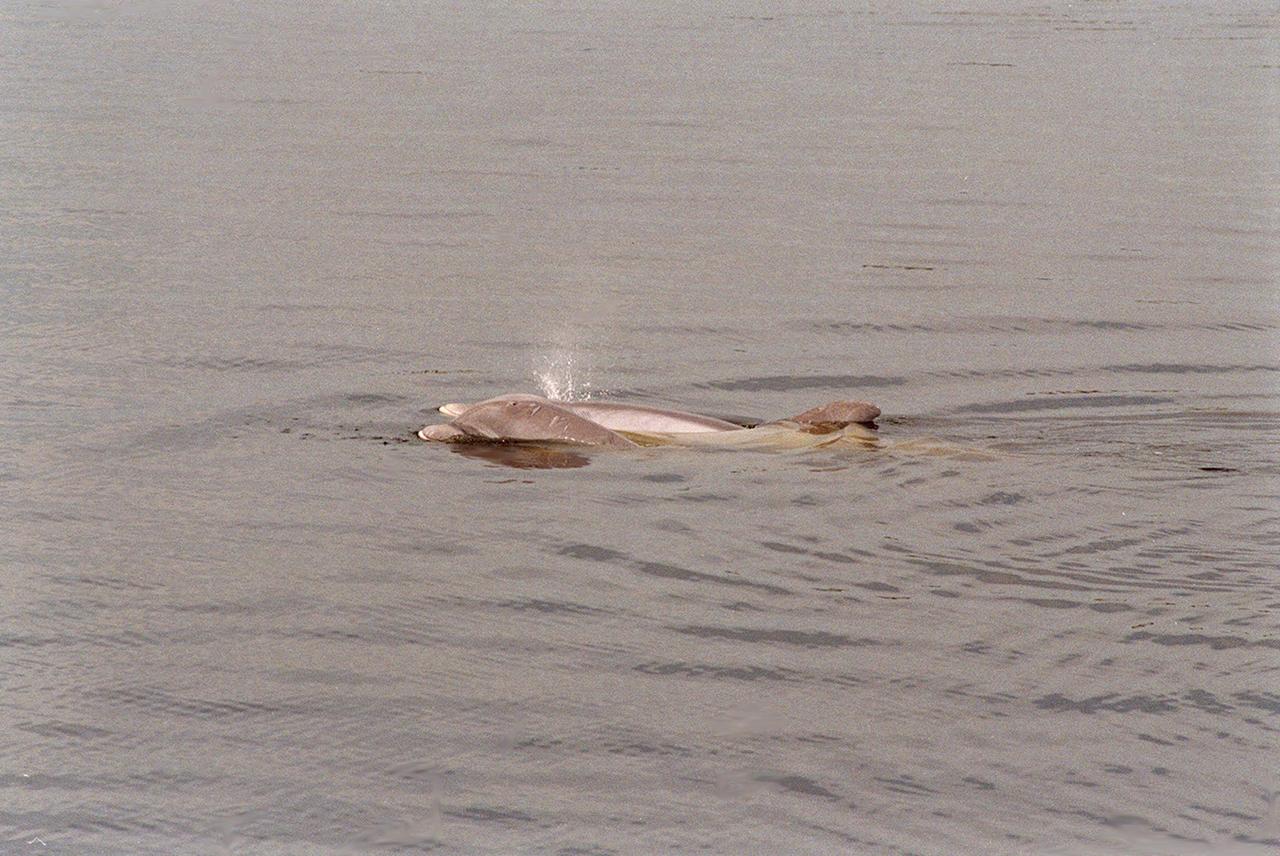
KENNEDY SPACE CENTER, FLA. -- In the turn basin east of the Vehicle Assembly Building and next to the crawlerway, a mother dolphin guides her baby through the water to search for food. Dolphins inhabit the waters around Kennedy Space Center, along with many different species of oceanic and lagoon fish and shellfish. Mosquito Lagoon to the north, Banana River and Creek to the south and the Indian River to the west make up a special type of estuary called a lagoon, a body of water separated from the ocean by barrier islands, with limited exchange with the ocean through inlets. The Lagoon varies in width from ½ mile to 5 miles and averages only 3 feet in depth. Nearly one-third of the nation's manatee population lives here or migrates through the Lagoon seasonally
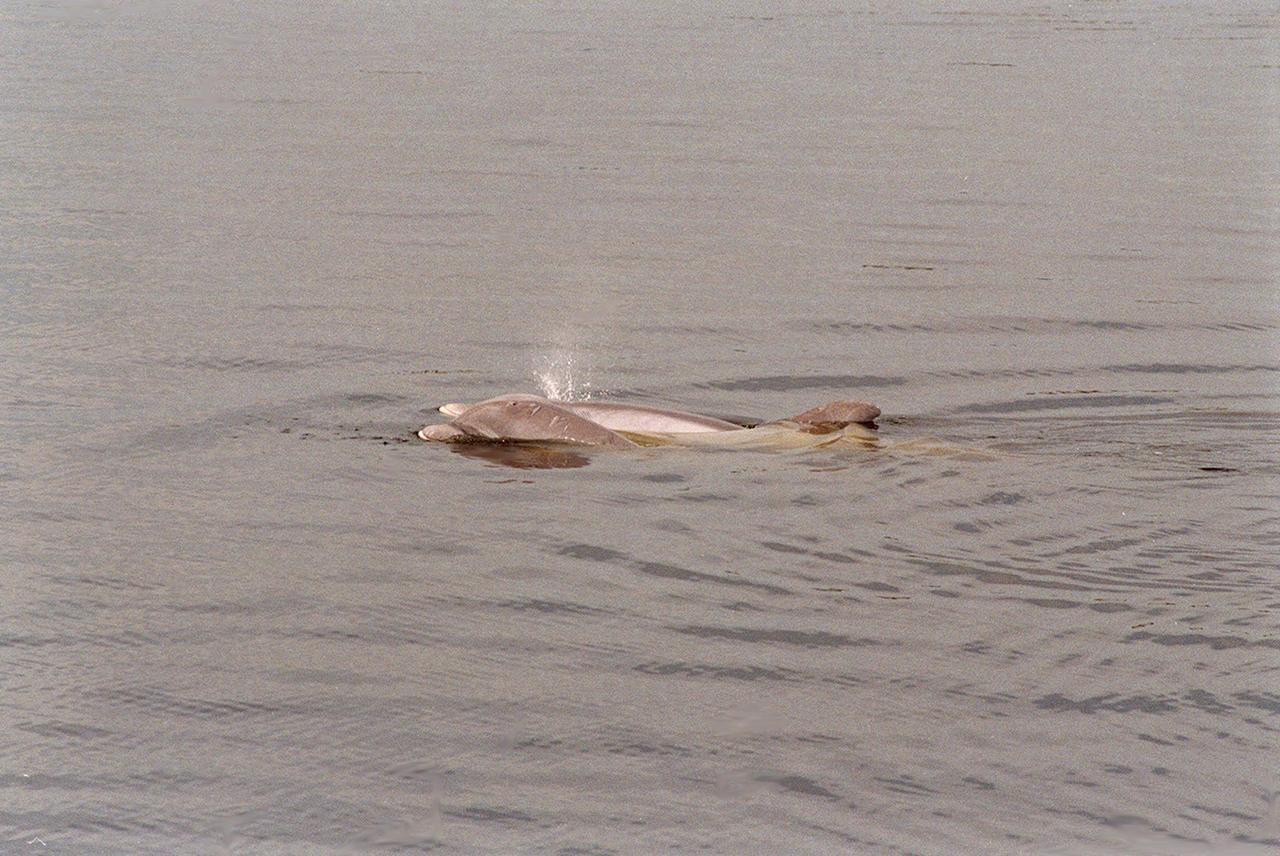
KENNEDY SPACE CENTER, FLA. -- In the turn basin east of the Vehicle Assembly Building and next to the crawlerway, a mother dolphin guides her baby through the water to search for food. Dolphins inhabit the waters around Kennedy Space Center, along with many different species of oceanic and lagoon fish and shellfish. Mosquito Lagoon to the north, Banana River and Creek to the south and the Indian River to the west make up a special type of estuary called a lagoon, a body of water separated from the ocean by barrier islands, with limited exchange with the ocean through inlets. The Lagoon varies in width from ½ mile to 5 miles and averages only 3 feet in depth. Nearly one-third of the nation's manatee population lives here or migrates through the Lagoon seasonally
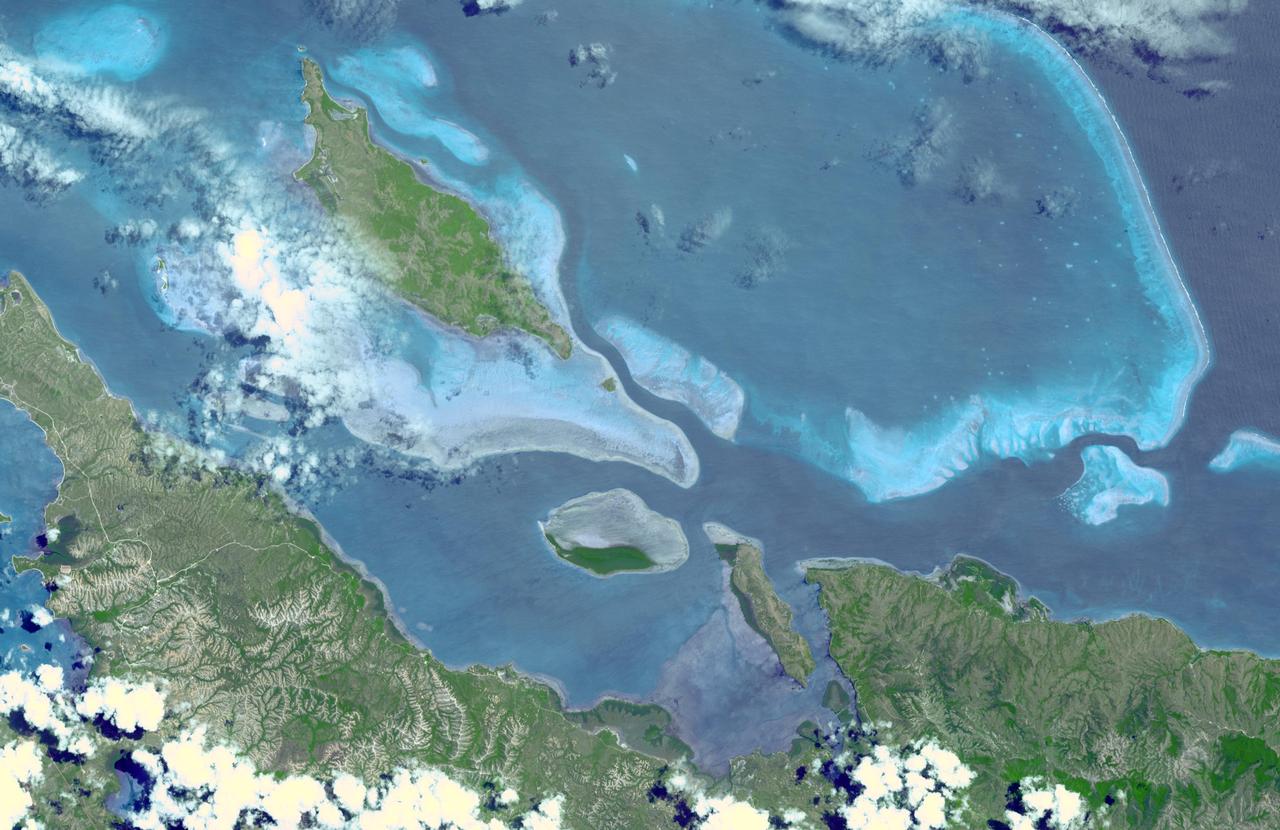
In this image, taken by NASA Terra spacecraft, six marine clusters represent the main diversity of coral reefs and associated ecosystems in the French Pacific Ocean archipelago of New Caledonia.
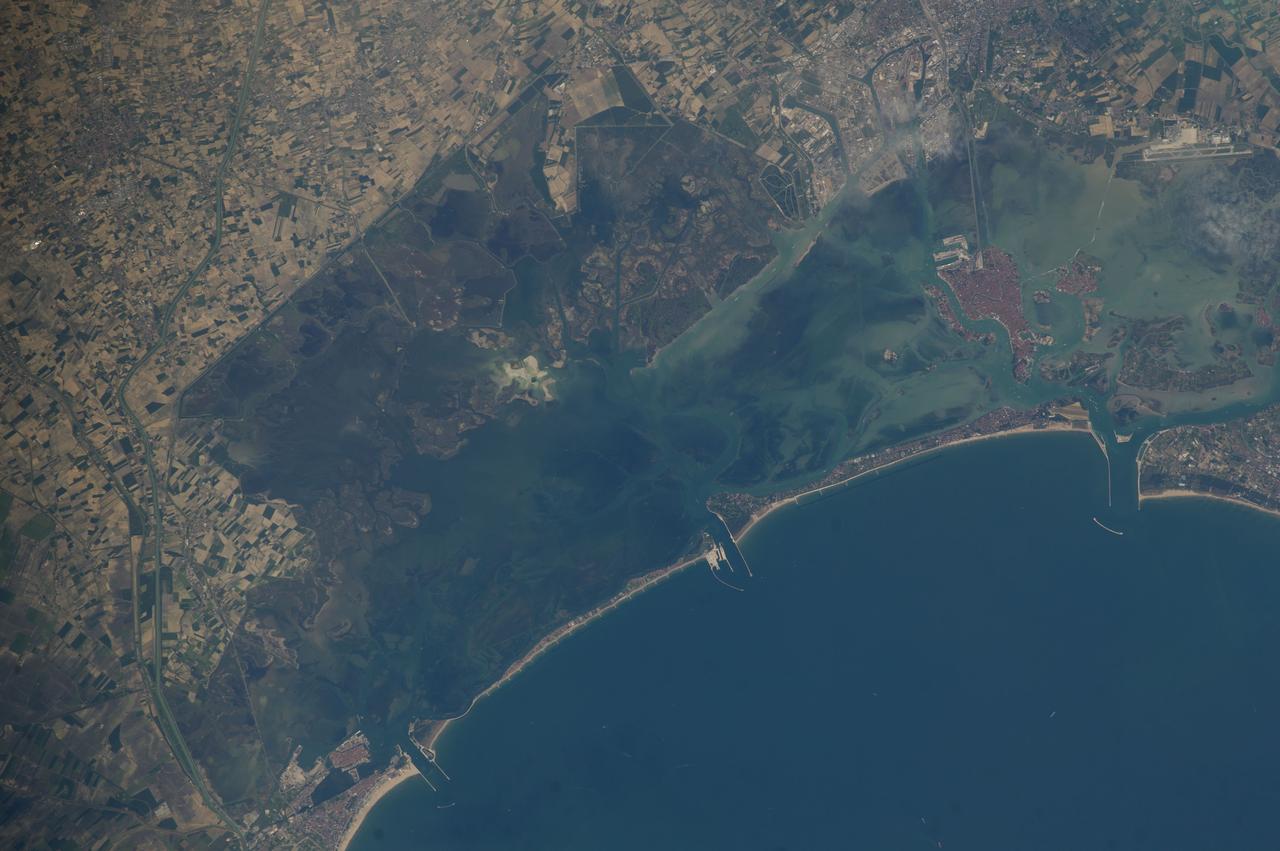
ISS039-E-019482 (9 May 2014) --- One of the Expedition 39 crew members aboard the Earth-orbiting International Space Station used a 400mm lens to take this photograph of Venice Lagoon, Italy on May 9, 2014. A narrow barrier island protects the Lagoon of Venice from storm waves in the northern Adriatic Sea, and breakwaters protect inlets to the lagoon. Red tiles of the roofs of the edifices on the island of Venice contrast with the grays of the mainland sister city of Mestre. The cities are joined by a prominent causeway. Another causeway joins the island to the airport (top right). Small bright agricultural fields of well drained soils (top left) contrast with the darker vegetation of back bay swamps where fishing is a popular pastime. Dense urban populations on its shores and heavy use by craft of all kinds result in turbid water in the northern half of the lagoon.

Atlas Image mosaic, covering 14.8 x 20.0 on the sky, of the Trifid Nebula, aka Messier 20 and NGC 6514. The Trifid is only about 1.5 degrees northwest on the sky of the larger Lagoon Nebula Messier 8 in the constellation Sagittarius

ISS013-E-76441 (4 Sept. 2006) --- Aquaculture in the Nile delta, Egypt is featured in this image photographed by an Expedition 13 crewmember on the International Space Station. In the last three decades, a series of lagoons and lakes with greater and lesser connection to the sea have been greatly modified for the production of fish along the northeast coast of the Nile delta. Partial sunglint in this image reveals numerous details in one such fishery. Waves generated by northwesterly winds (lower left to upper right) have generated the frond-like sand spit along the coast (top). Faint sea swells are visible at upper left. Dark patches in the center are shadows cast by small clouds (also visible as dull white masses against the silver-grey sunglint). Dark curved lines on the inshore (western) side of the spit show prior positions of the spit. Most of Musallas Lagoon occupies the lower half of the image. By contrast with spit, the shores of the lagoon are everywhere occupied by a network of man-made structures--mainly short dikes enclosing hundreds of aquaculture ponds. The total area under fish production is estimated to be 8,000 hectares in the lagoon, which provides more than half of the aquaculture production for Egypt, largely in the form of two species of mullet. An outlet to the Mediterranean Sea (top right), allows sea-water recharge to the lagoon. Wind helps to circulate the water in this shallow lagoon--bright wind streaks on the lagoon (lower left) show this circulation driven by the north-northwest wind on this day.

CAPE CANAVERAL, Fla. – A few of the green sea turtles are seen inside the headquarters building of the Merritt Island Wildlife Refuge located on NASA's Kennedy Space Center in Florida. The turtles were some of many "stunned" by the recent drop in temperatures in Florida. Many of the turtles were rescued from the Mosquito Lagoon, with others coming from the Indian River Lagoon and Cocoa Beach. Photo credit: NASA/Amanda Diller
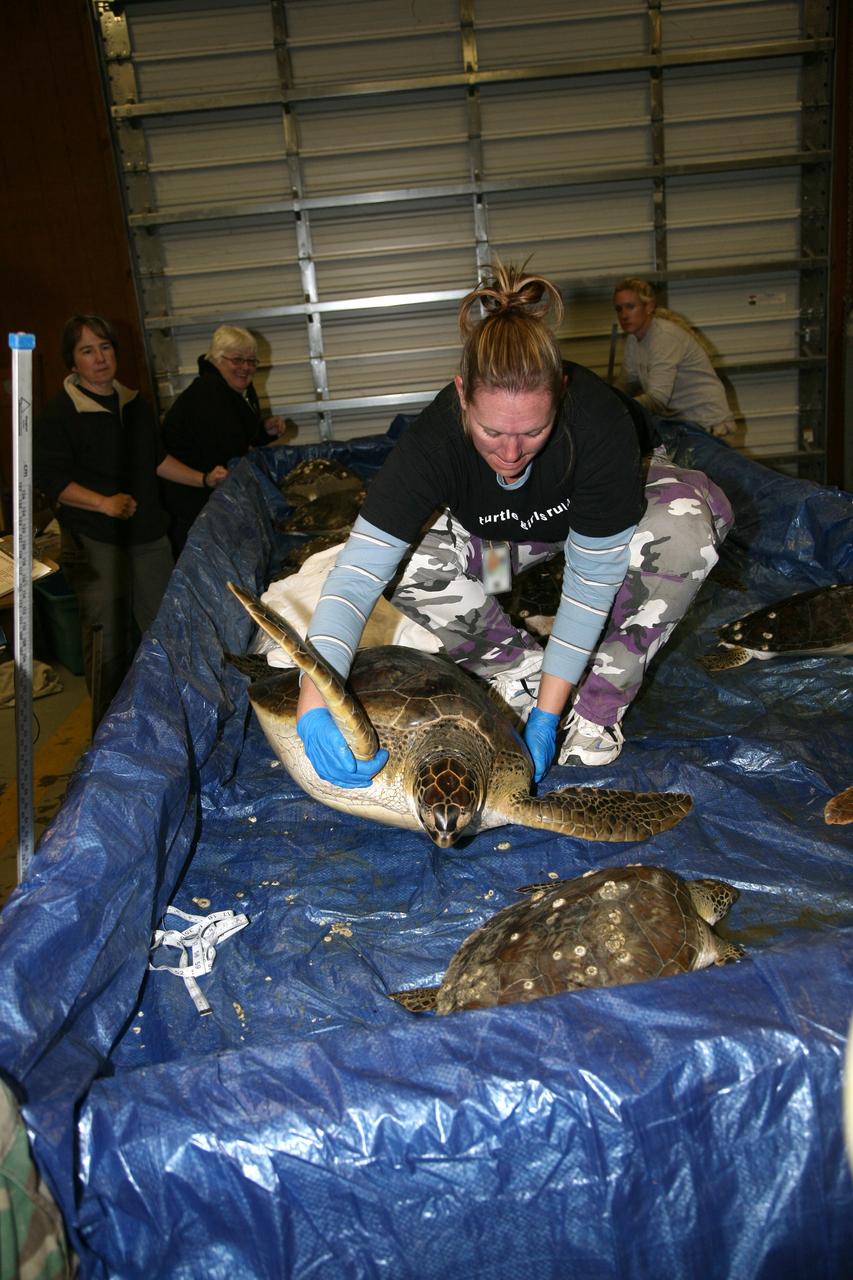
CAPE CANAVERAL, Fla. – A Fish and Wildlife Conservation Commission worker moves a green sea turtle inside the headquarters building of the Merritt Island Wildlife Refuge located on NASA's Kennedy Space Center in Florida. The turtle was one of many "stunned" by the recent drop in temperatures in Florida. Many of the turtles were rescued from the Mosquito Lagoon, with others coming from the Indian River Lagoon and Cocoa Beach. Photo credit: NASA/Amanda Diller
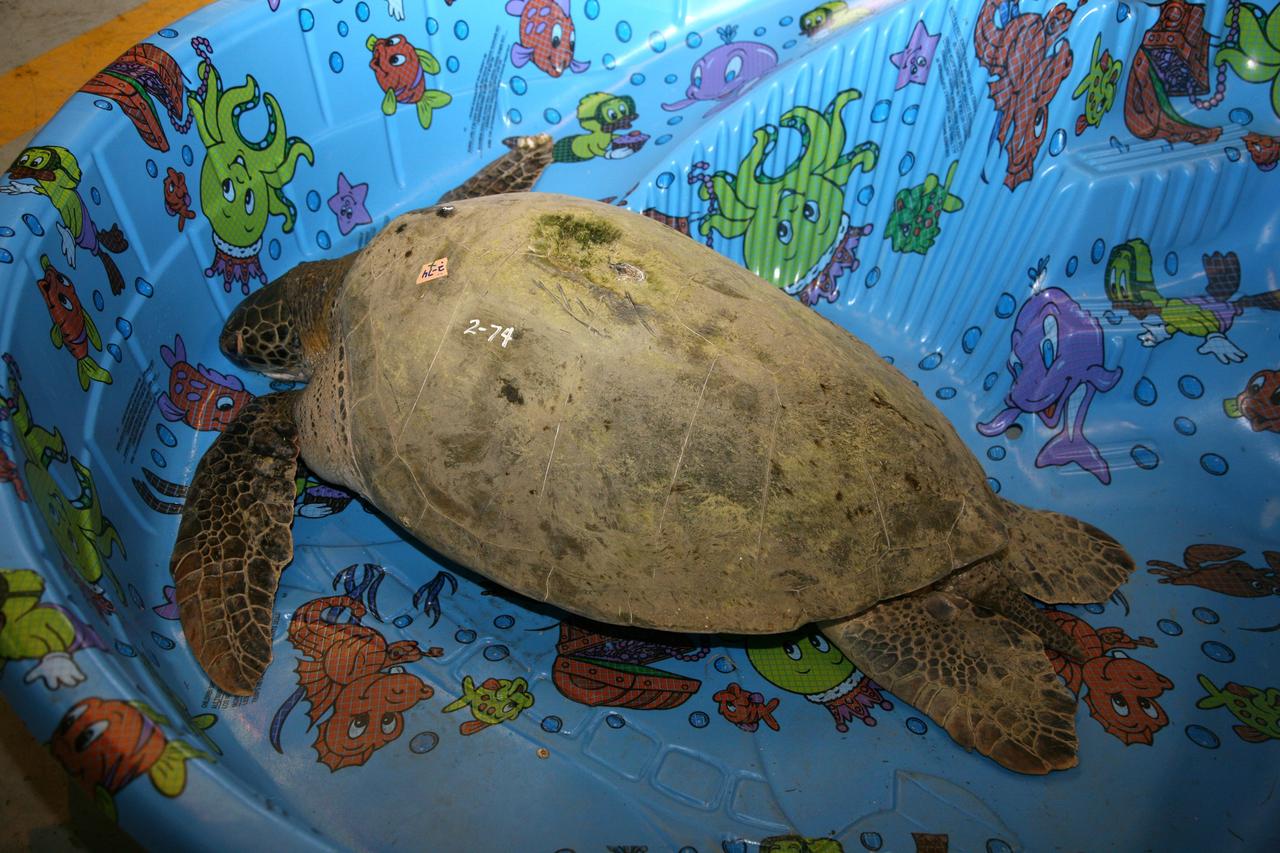
CAPE CANAVERAL, Fla. – On Friday, this sea turtle affected by the cold temperatures in Florida was among those taken inside the Merritt Island Wildlife Refuge headquarters building at NASA's Kennedy Space Center. The turtle was one of many "stunned" by the recent drop in temperatures in Florida. Many of the turtles were rescued from the Mosquito Lagoon, with others coming from the Indian River Lagoon and Cocoa Beach. Photo credit: NASA/Amanda Diller
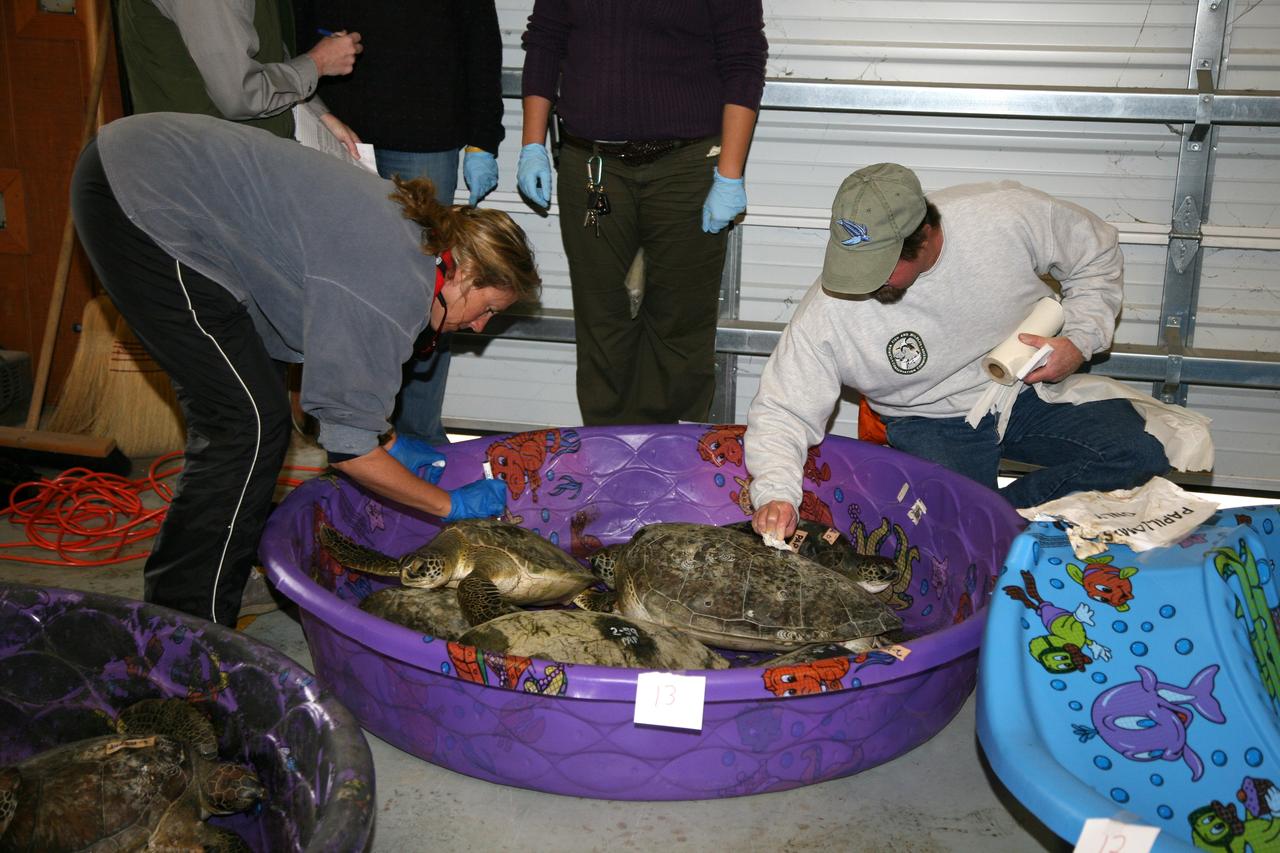
CAPE CANAVERAL, Fla. – Fish and Wildlife Conservation Commission workers evaluate a green sea turtle at the headquarters building of the Merritt Island Wildlife Refuge located on NASA's Kennedy Space Center in Florida. The turtle was one of many "stunned" by the recent drop in temperatures in Florida. Many of the turtles were rescued from the Mosquito Lagoon, with others coming from the Indian River Lagoon and Cocoa Beach. Photo credit: NASA/Amanda Diller
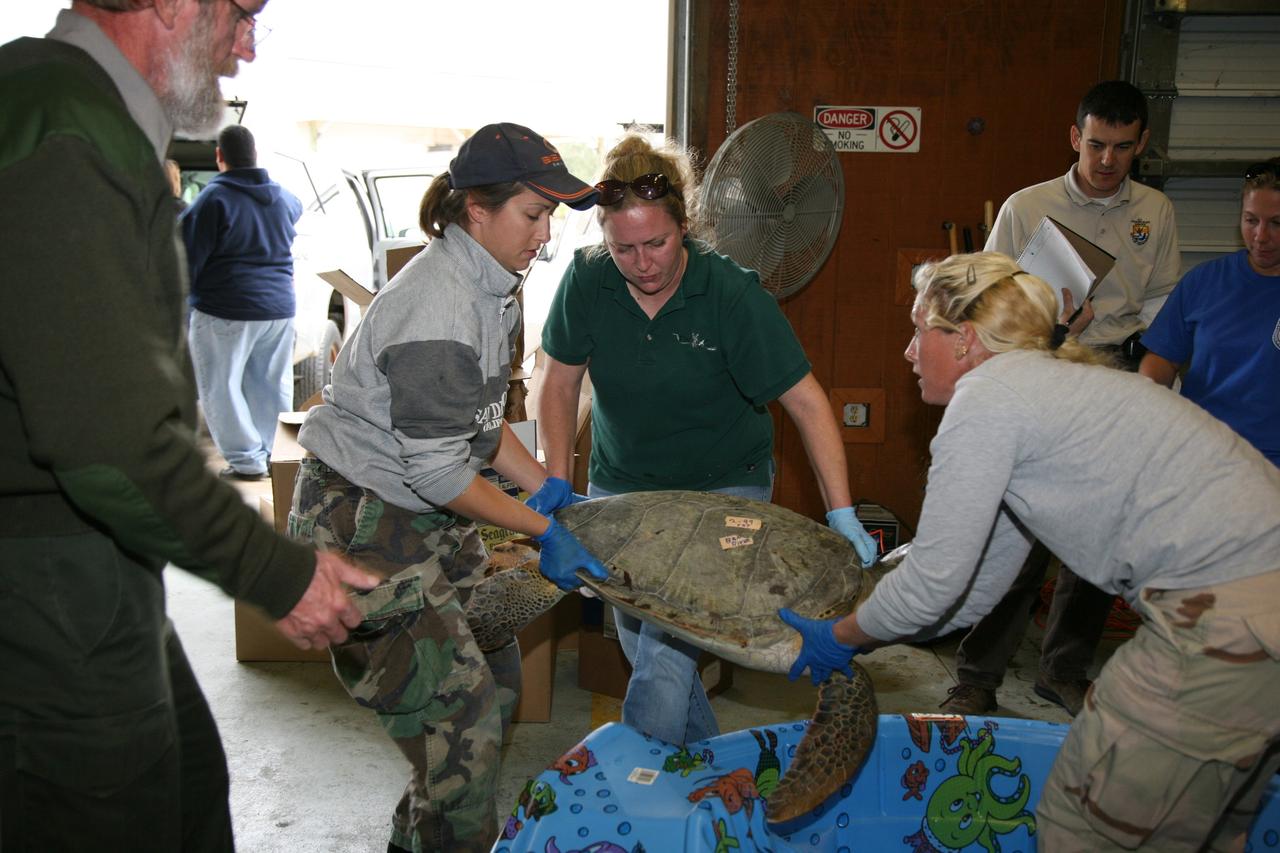
CAPE CANAVERAL, Fla. – Fish and Wildlife Conservation Commission workers move a green sea turtle into the headquarters building of the Merritt Island Wildlife Refuge located on NASA's Kennedy Space Center in Florida. The turtle was one of many "stunned" by the recent drop in temperatures in Florida. Many of the turtles were rescued from the Mosquito Lagoon, with others coming from the Indian River Lagoon and Cocoa Beach. Photo credit: NASA/Amanda Diller
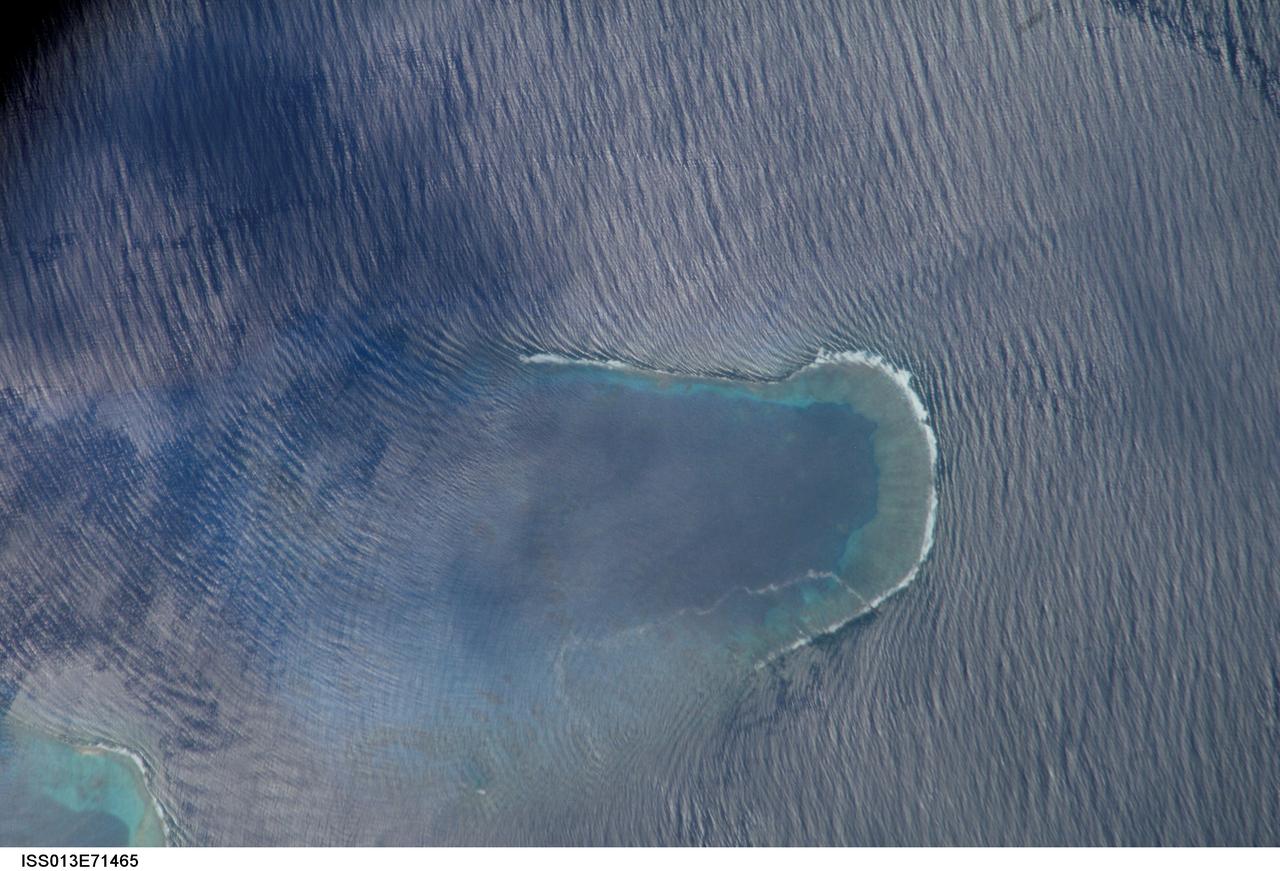
ISS013-E-71465 (27 Aug. 2006) --- Bajo Nuevo Reef in the western Caribbean Sea is featured in this image photographed by an Expedition 13 crewmember on the International Space Station. The Bajo Nuevo reef is approximately 26 kilometers long, comprising two separate U-shaped cays, with only tiny sandy islands associated with them. The eastern cay, shown in this image, encloses a lagoon. Protected from open-sea swells, the water surface is calmer and some back reef detail is visible within the lagoon. Cloud shadows darken the top left corner. The clearest feature is the broad pattern of swells which show two slightly different orientations, producing a tightly crossed pattern. These swells are oriented transverse to the wind direction and were probably set in motion by two different storms hundreds of kilometers east of the reef. A single irregular line of light color--also suggestive of surface oil--traces a path along the south side of the lagoon.
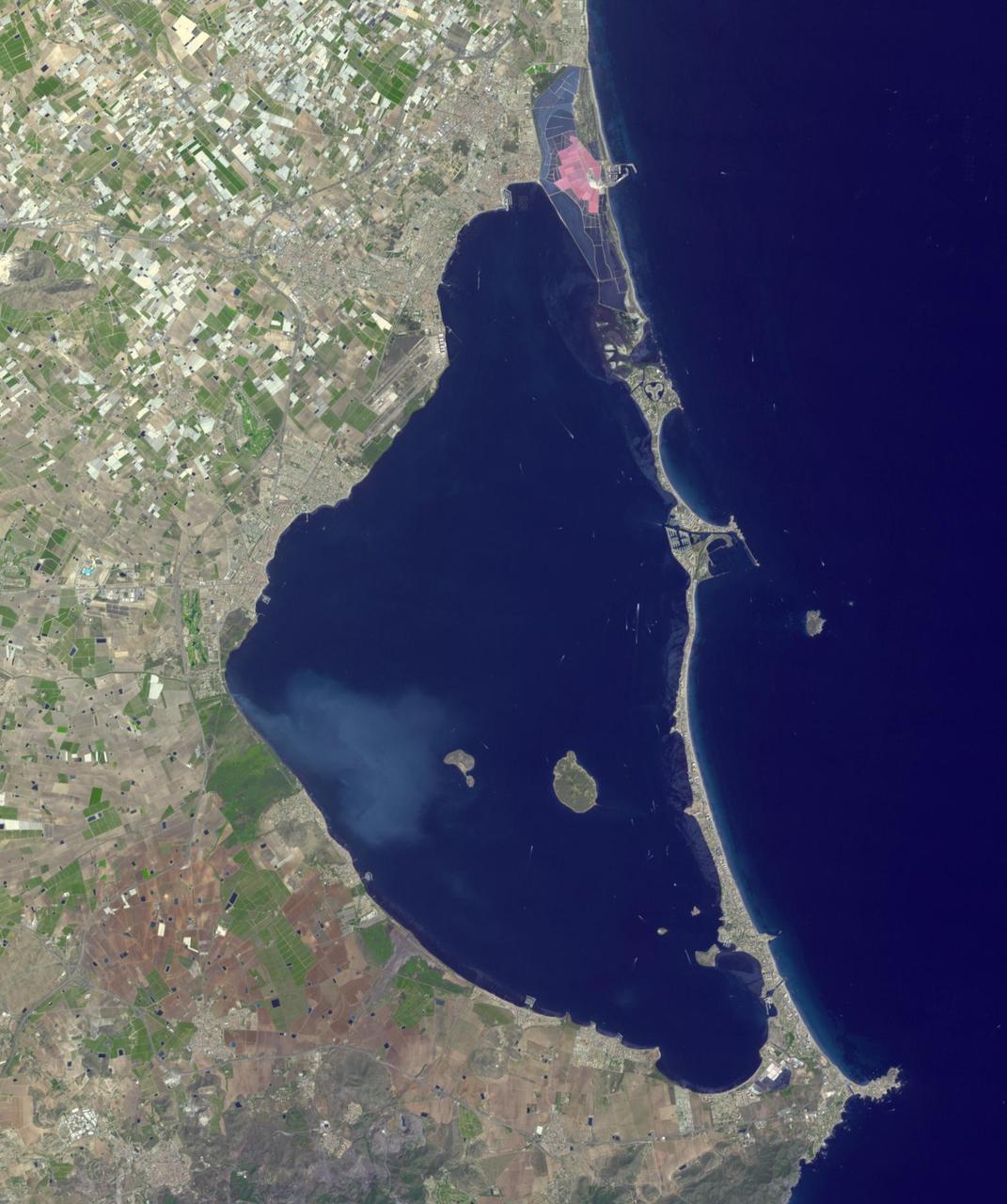
Mar Menor, in southeast Spain, is Europe's largest coastal saltwater lagoon. For the past 40 years, Mar Menor has faced severe contamination from agricultural runoff, leading to large algal blooms, and ecological degradation. Now, major restoration and prevention programs are in place to restore the lagoon, and try to reverse the damage. The image was acquired August 24, 2023, covers an area of 22.6 by 27.4 km, and is located at 37.7 degrees north, 0.8 degrees west. With its 14 spectral bands from the visible to the thermal infrared wavelength region and its high spatial resolution of about 50 to 300 feet (15 to 90 meters), ASTER images Earth to map and monitor the changing surface of our planet. ASTER is one of five Earth-observing instruments launched Dec. 18, 1999, on Terra. The instrument was built by Japan's Ministry of Economy, Trade and Industry. A joint U.S./Japan science team is responsible for validation and calibration of the instrument and data products. The broad spectral coverage and high spectral resolution of ASTER provides scientists in numerous disciplines with critical information for surface mapping and monitoring of dynamic conditions and temporal change. Example applications are monitoring glacial advances and retreats; monitoring potentially active volcanoes; identifying crop stress; determining cloud morphology and physical properties; wetlands evaluation; thermal pollution monitoring; coral reef degradation; surface temperature mapping of soils and geology; and measuring surface heat balance. https://photojournal.jpl.nasa.gov/catalog/PIA26009

Four hundred bridges cross the labyrinth of canals that form the 120 islands of Venice, situated in a saltwater lagoon between the mouths of the Po and Piave rivers in northeast Italy. All traffic in the city moves by boat. Venice is connected to the mainland, 4 kilometers (2.5 miles) away, by ferries as well as a causeway for road and rail traffic. The Grand Canal winds through the city for about 3 kilometers (about 2 miles), dividing it into two nearly equal sections. According to tradition, Venice was founded in 452, when the inhabitants of Aquileia, Padua, and several other northern Italian cities took refuge on the islands of the lagoon from the Teutonic tribes invading Italy at that time. This image was acquired on December 9, 2001 by the Advanced Spaceborne Thermal Emission and Reflection Radiometer (ASTER) on NASA's Terra satellite. With its 14 spectral bands from the visible to the thermal infrared wavelength region, and its high spatial resolution of 15 to 90 meters (about 50 to 300 feet), ASTER will image Earth for the next 6 years to map and monitor the changing surface of our planet. http://photojournal.jpl.nasa.gov/catalog/PIA03860
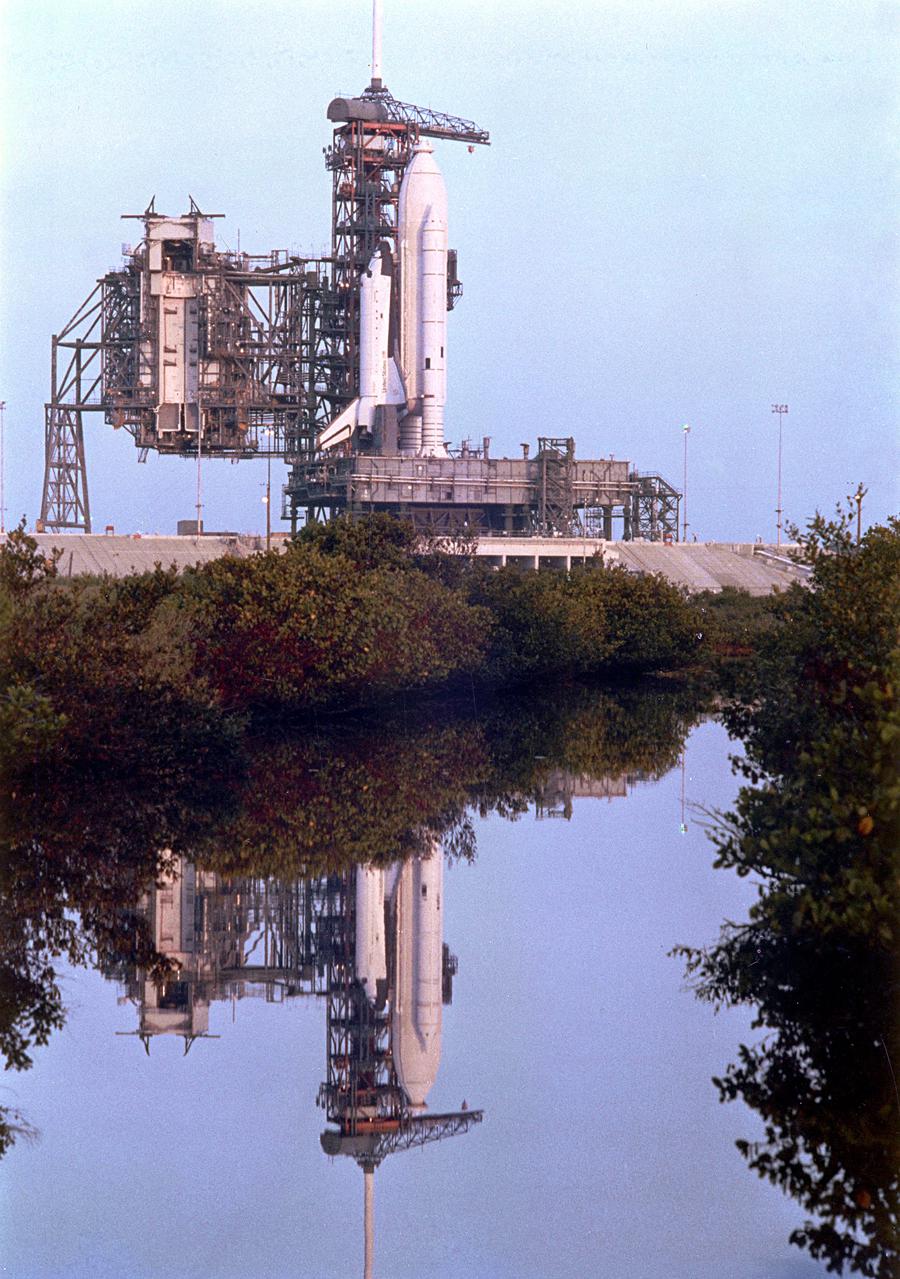
KENNEDY SPACE CENTER, FLA. - The Space Shuttle Columbia, undergoing final preparations for launch at Pad 39A, is reflected in the waters of the nearby ocean lagoon. The Rotating Service Structure is in the retracted position for launch.
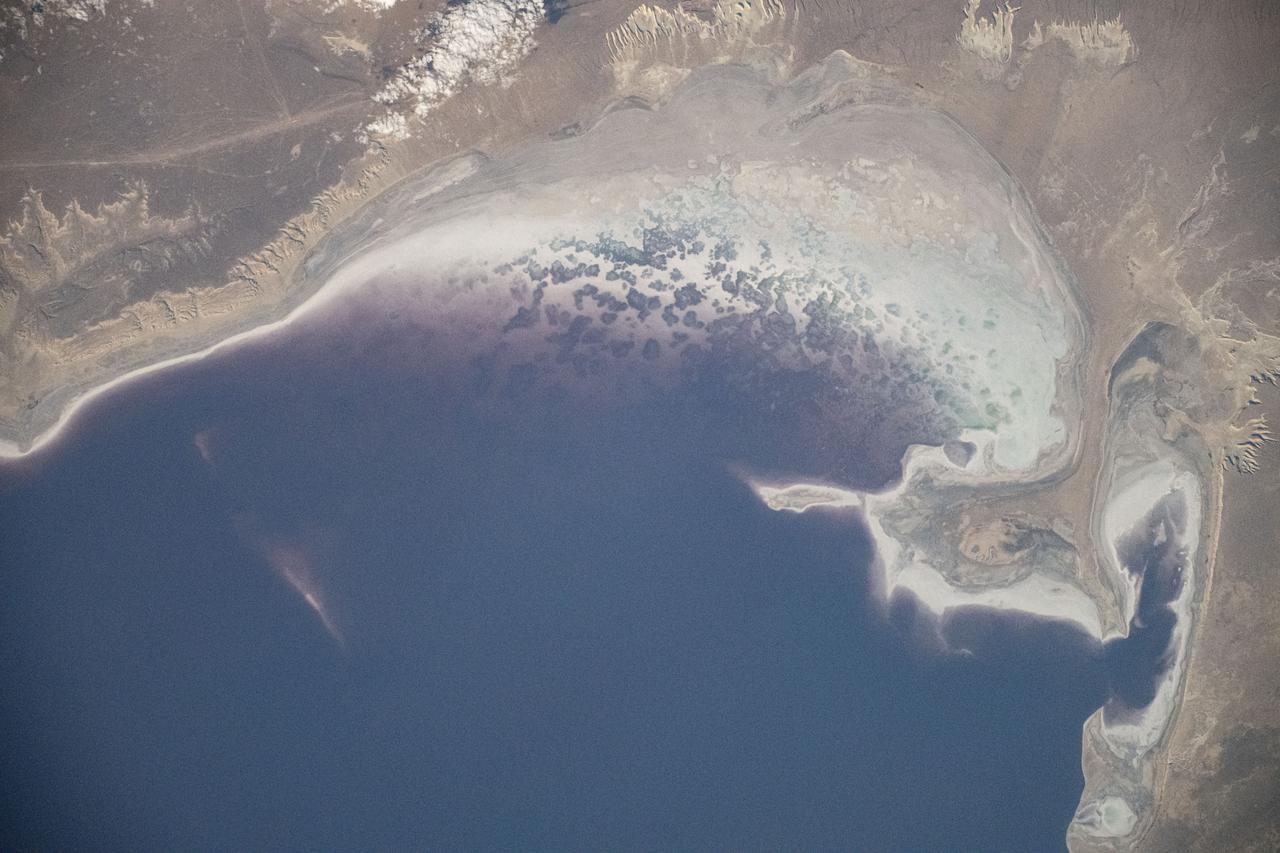
iss071e364940 (July 19, 2024) -- Off the eastern coast of the Caspian Sea is the Garabogazköl Basin, a high saline lagoon in Turkmenistan, pictured here from the International Space Station as it orbited 257 miles above.
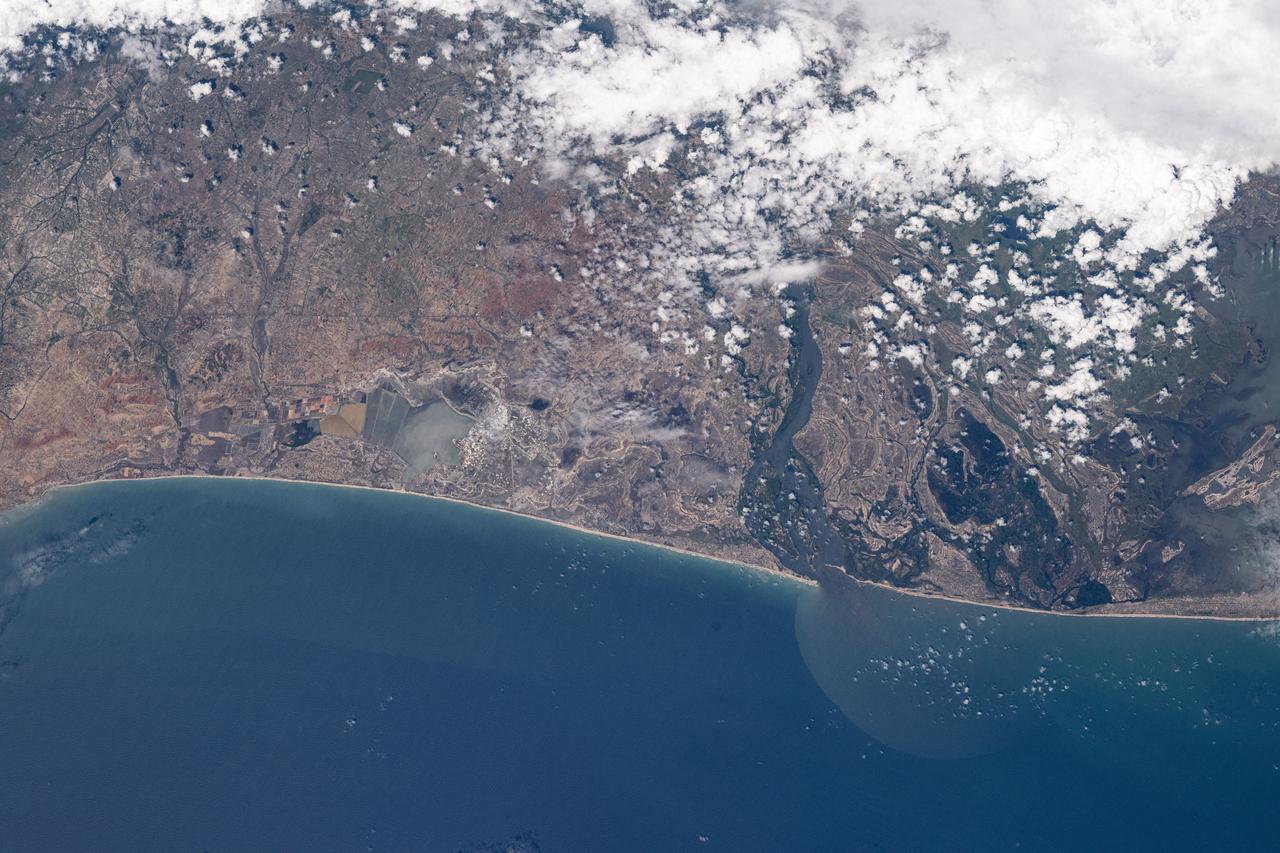
iss072e097260 (Oct. 22, 2024) --- Volta River in the African nation of Ghana, east of the Songoor Lagoon Protected Area (left), leads into the Gulf of Guinea in this photograph from the International Space Station as it orbited 258 miles above.
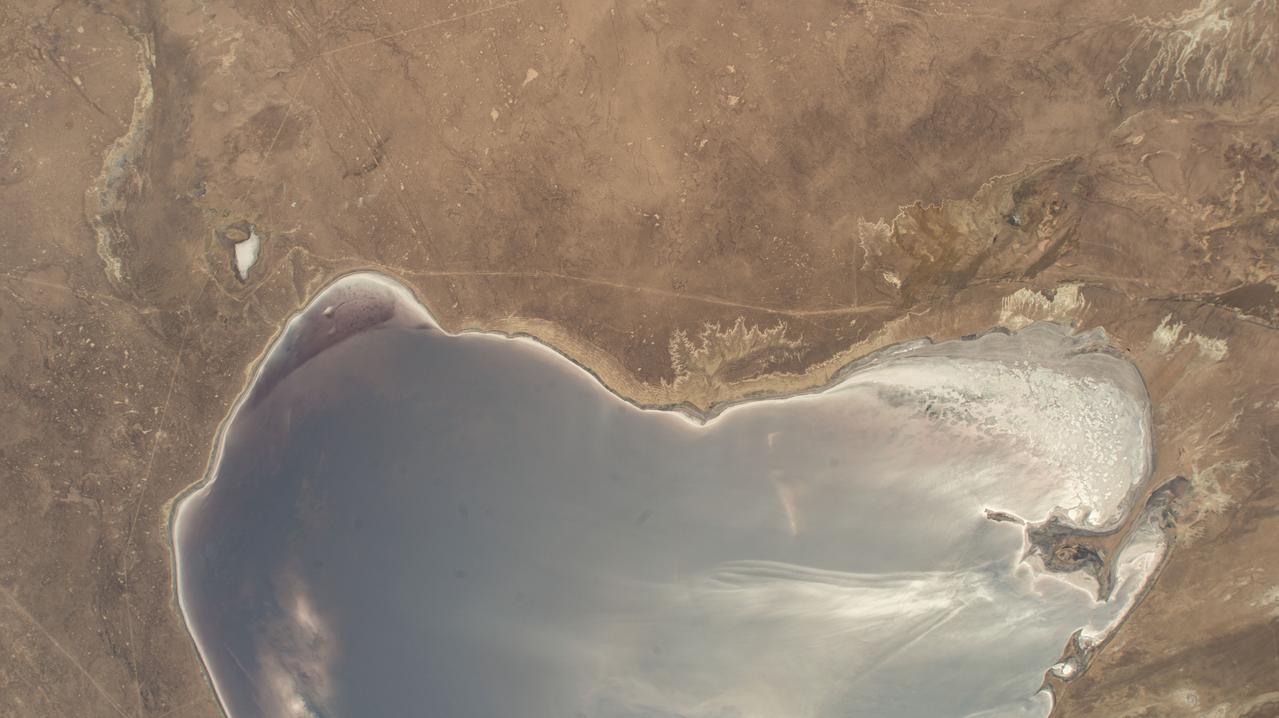
iss071e144922 (May 31, 2024) --- Garabogazköl Basin, a highly saline lagoon off the Caspian Sea, located in Turkmenistan is pictured from the International Space Station as it orbited 262 miles above the central Asian nation.
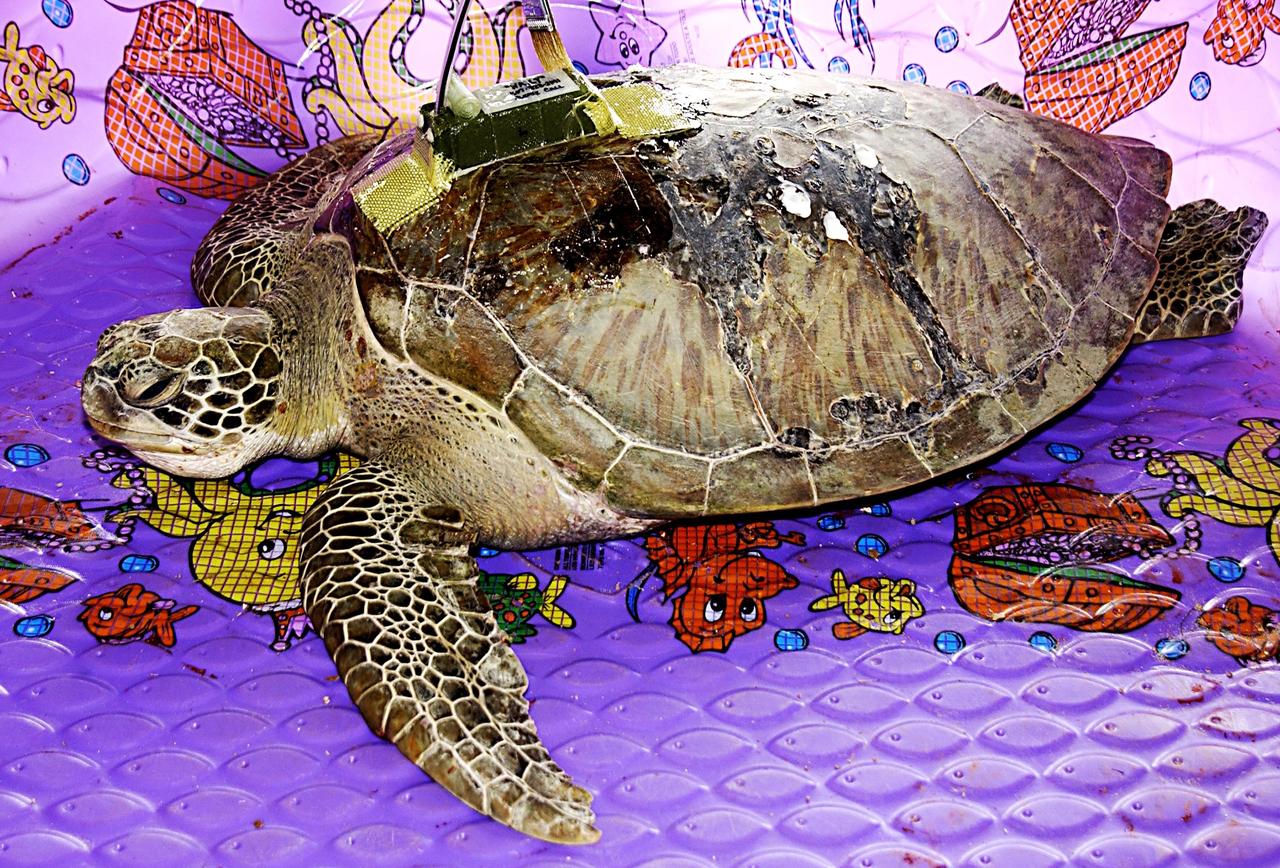
KENNEDY SPACE CENTER, FLA. -- A sea turtle rescued from the Mosquito Lagoon is seen with a transmitter recently attached to its back. Several turtles were found stunned, impacted by the unseasonal cold temperatures experienced in Central Florida. The cooperative effort of KSC contractor Dynamac Corporation's Aquatics Program and the Merritt Island National Wildlife Refuge warmed the turtles and evaluated them for release. Most were tagged and one received the transmitter, provided by the University of Central Florida, for satellite tracking. The turtles were then transported in a skiff through the Haulover Canal to a location away from the main channel and released back into the Mosquito Lagoon.
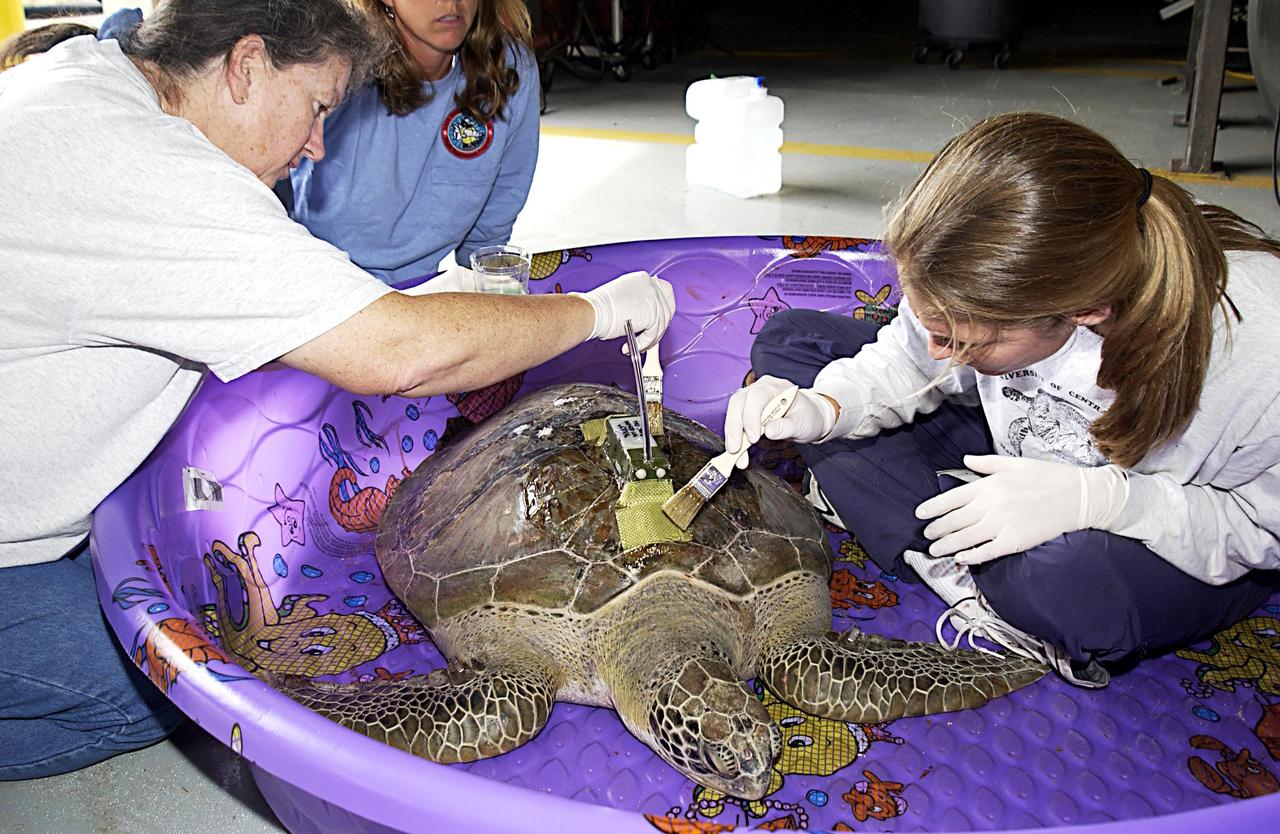
KENNEDY SPACE CENTER, FLA. -- A sea turtle rescued from the Mosquito Lagoon is prepared to receive a transmitter on its back. Several turtles were found stunned, impacted by the unseasonal cold temperatures experienced in Central Florida. The cooperative effort of KSC contractor Dynamac Corporation's Aquatics Program and the Merritt Island National Wildlife Refuge warmed the turtles and evaluated them for release. Most were tagged and one received the transmitter, provided by the University of Central Florida, for satellite tracking. The turtles were then transported in a skiff through the Haulover Canal to a location away from the main channel and released into the Indian River Lagoon.
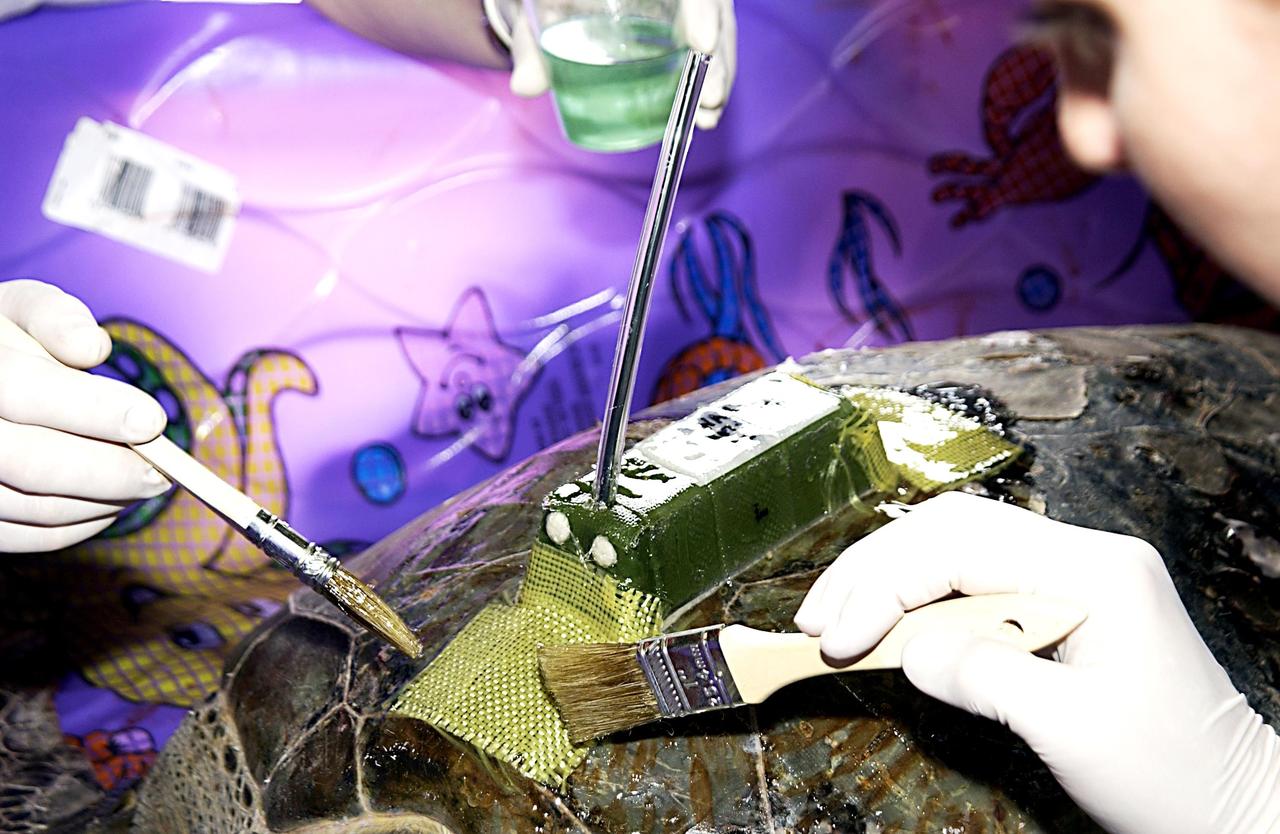
KENNEDY SPACE CENTER, FLA. -- This closeup shows the transmitter being attached to a sea turtle rescued from the Mosquito Lagoon. Several turtles were found stunned, impacted by the unseasonal cold temperatures experienced in Central Florida. The cooperative effort of KSC contractor Dynamac Corporation's Aquatics Program and the Merritt Island National Wildlife Refuge warmed the turtles and evaluated them for release. Most were tagged and one received the transmitter, provided by the University of Central Florida, for satellite tracking. The turtles were then transported in a skiff through the Haulover Canal to a location away from the main channel and released into the Indian River Lagoon.
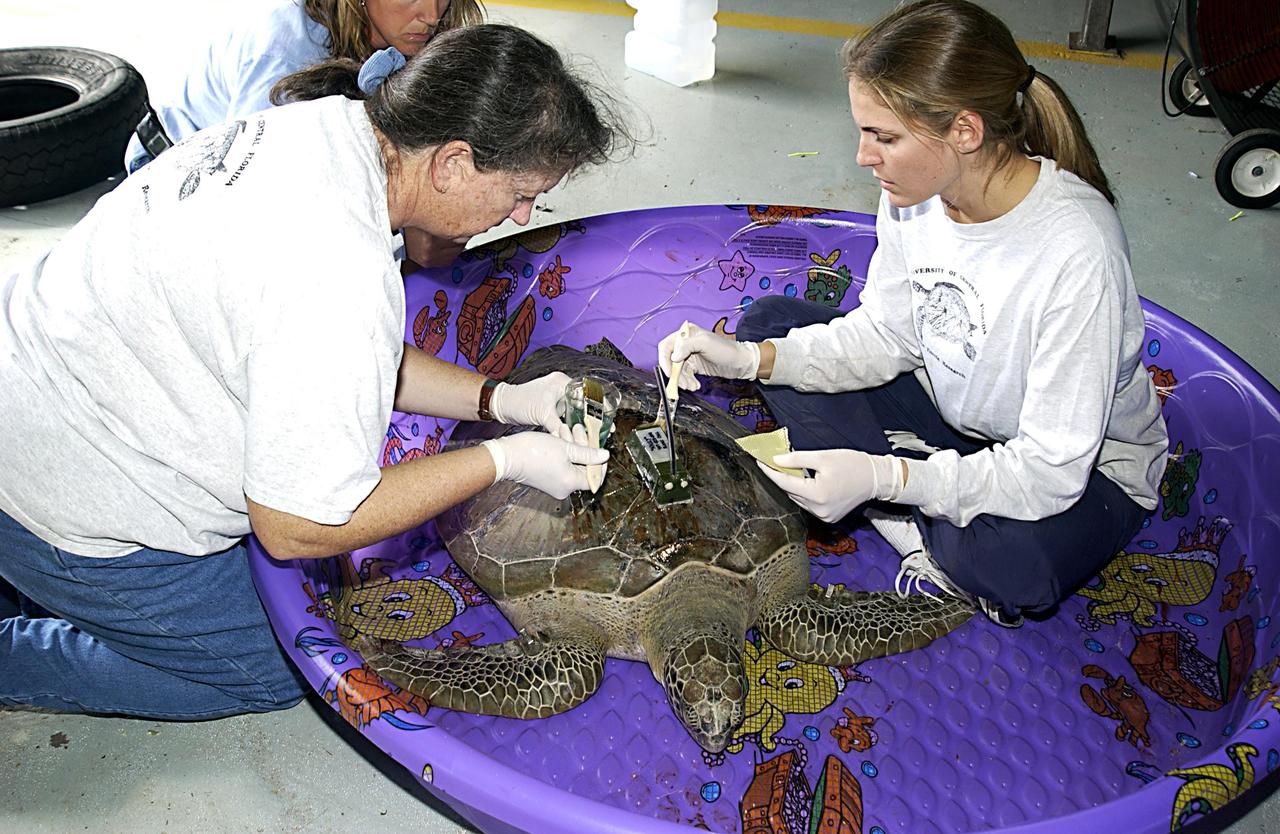
KENNEDY SPACE CENTER, FLA. - A sea turtle rescued from the Mosquito Lagoon is prepared to receive a transmitter on its back. Several turtles were found stunned, impacted by the unseasonal cold temperatures experienced in Central Florida. The cooperative effort of KSC contractor Dynamac Corporation's Aquatics Program and the Merritt Island National Wildlife Refuge warmed the turtles and evaluated them for release. Most were tagged and one received the transmitter, provided by the University of Central Florida, for satellite tracking. The turtles were then transported in a skiff through the Haulover Canal to a location away from the main channel and released into the Indian River Lagoon.
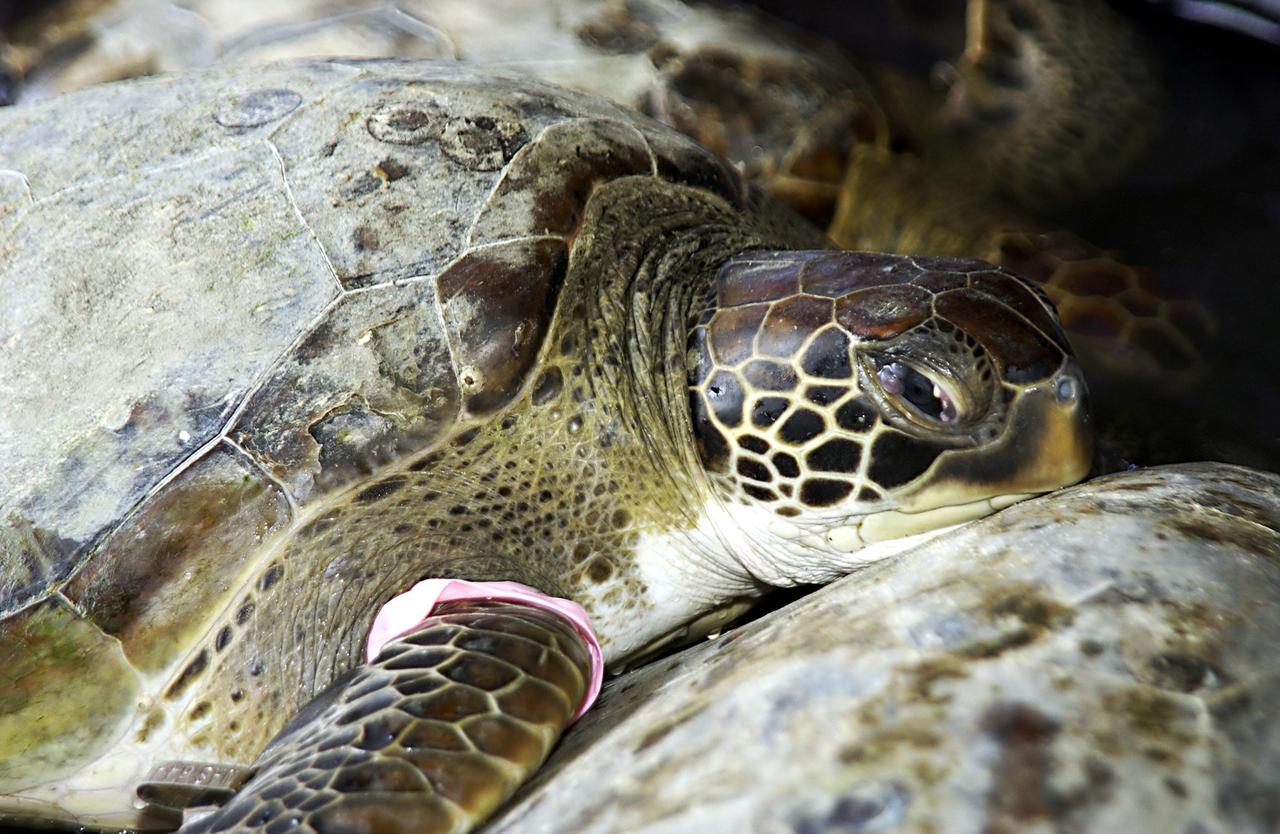
KENNEDY SPACE CENTER, FLA. - One of several sea turtles rescued from the Mosquito Lagoon is ready for release. The turtles were found stunned, impacted by the unseasonal cold temperatures experienced in Central Florida. The cooperative effort of KSC contractor Dynamac Corporation's Aquatics Program and the Merritt Island National Wildlife Refuge warmed the turtles and evaluated them for release. Most were tagged and one received the transmitter, provided by the University of Central Florida, for satellite tracking. The turtles were then transported in a skiff through the Haulover Canal to a location away from the main channel and released back into the Mosquito Lagoon.
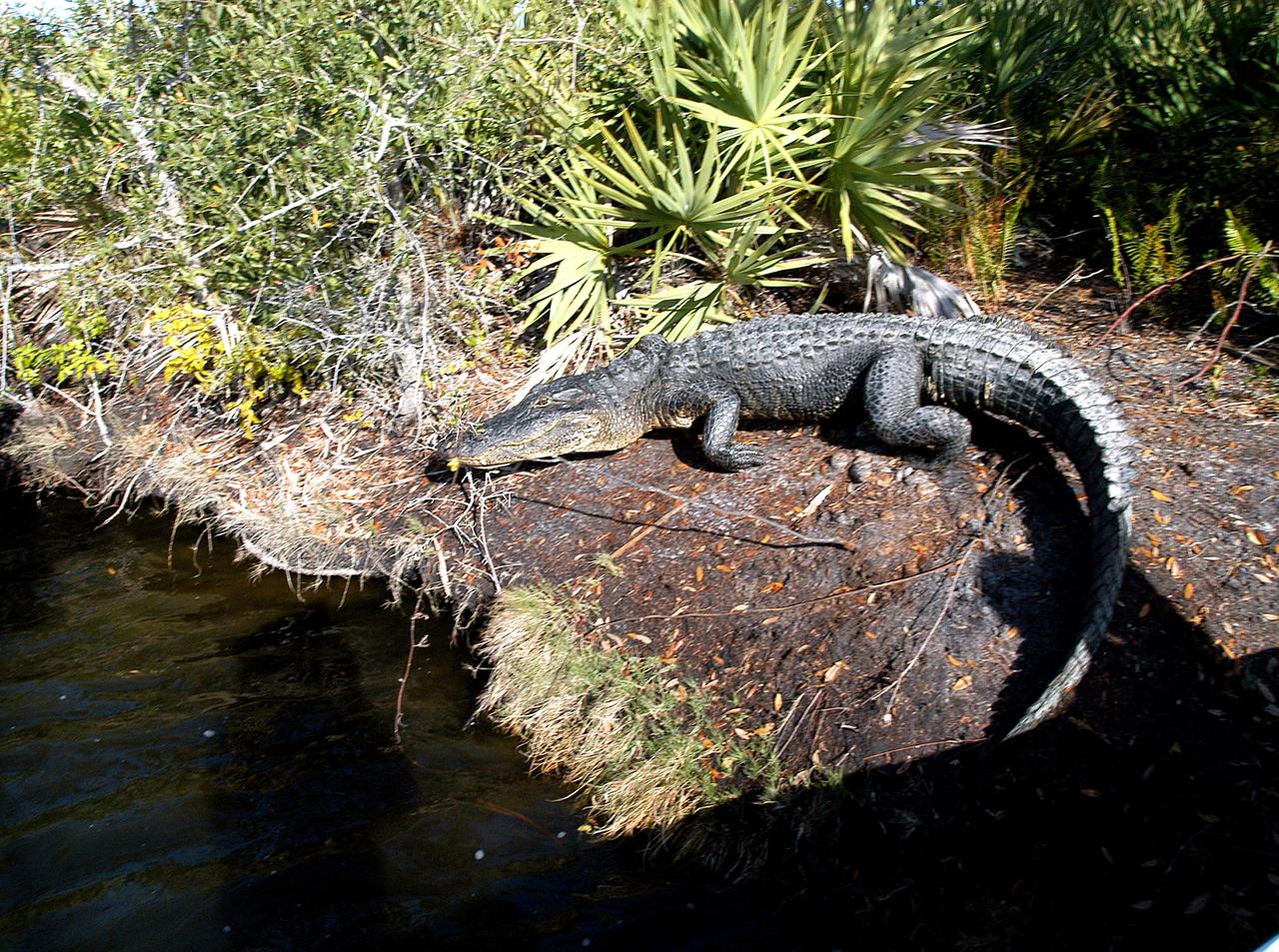
KENNEDY SPACE CENTER, FLA. - As Karen Holloway-Adkins, KSC wildlife specialist, begins a tour of the Banana River, this alligator sunning itself attracts attention. Holloway-Adkins is studying the life history of sea turtles, especially what they eat, where they lay their eggs and what factors might harm their survival. On the boat trip she is also monitoring the growth of sea grasses and algae and the water quality of estuaries and lagoons used by sea turtles and other aquatic wildlife.
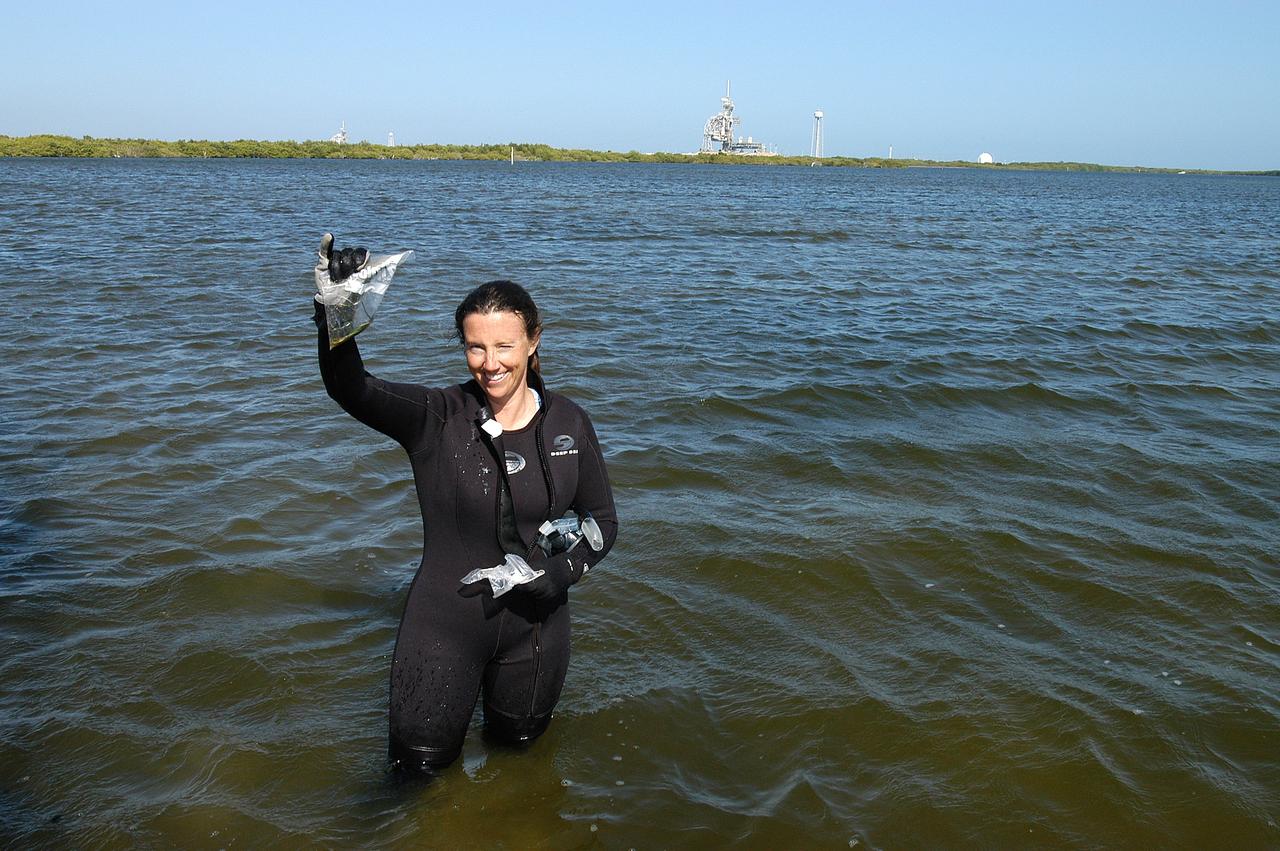
KENNEDY SPACE CENTER, FLA. - Karen Holloway-Adkins, KSC wildlife specialist, shows a sample of the sea grass she collected from the floor of the Banana River. She is studying the life history of sea turtles, especially what they eat, where they lay their eggs and what factors might harm their survival. On the boat trip she is also monitoring the growth of sea grasses and algae and the water quality of estuaries and lagoons used by sea turtles and other aquatic wildlife.
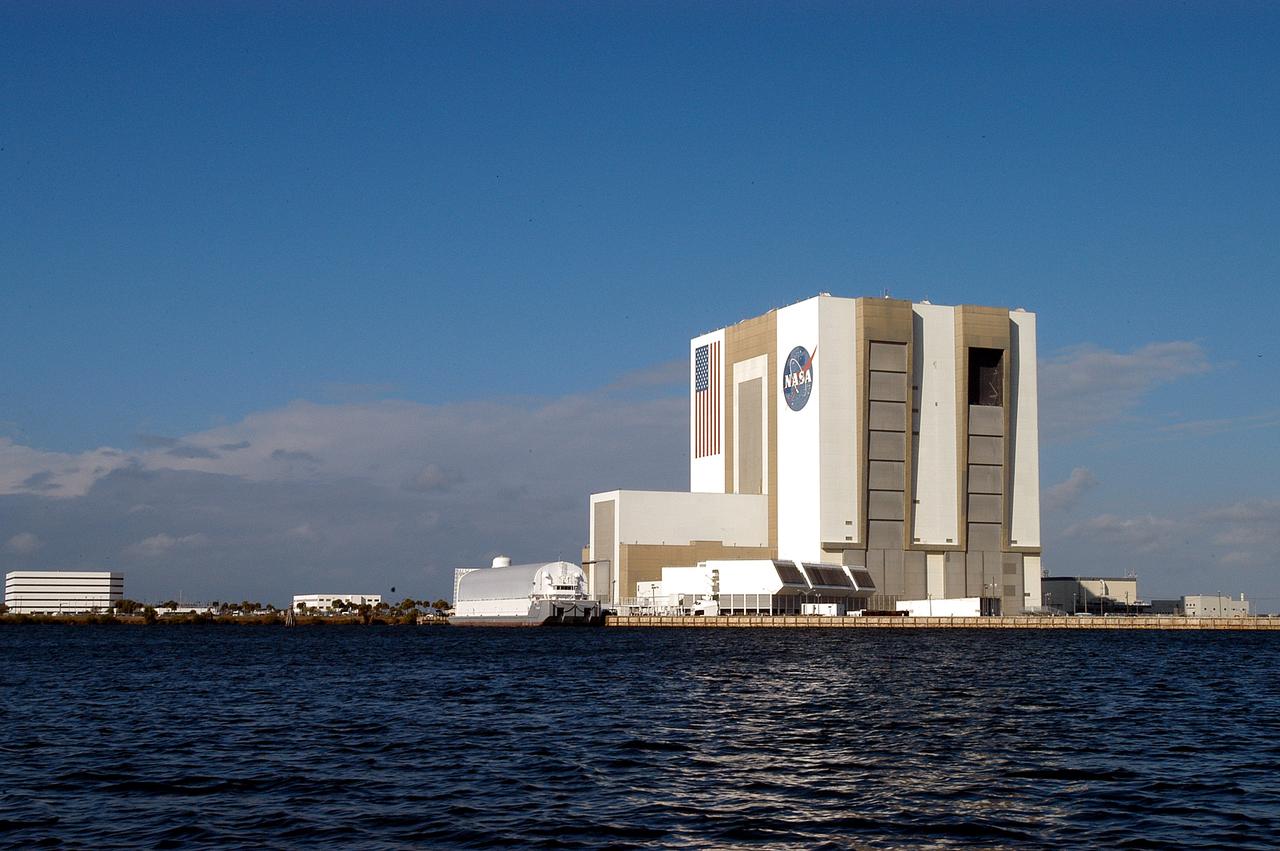
KENNEDY SPACE CENTER, FLA. - From a boat on the Banana River the Vehicle Assembly Building looms over the water. The boat holds Karen Holloway-Adkins, KSC wildlife specialist, who is studying the life history of sea turtles, especially what they eat, where they lay their eggs and what factors might harm their survival. On the boat trip she is also monitoring the growth of sea grasses and algae and the water quality of estuaries and lagoons used by sea turtles and other aquatic wildlife.
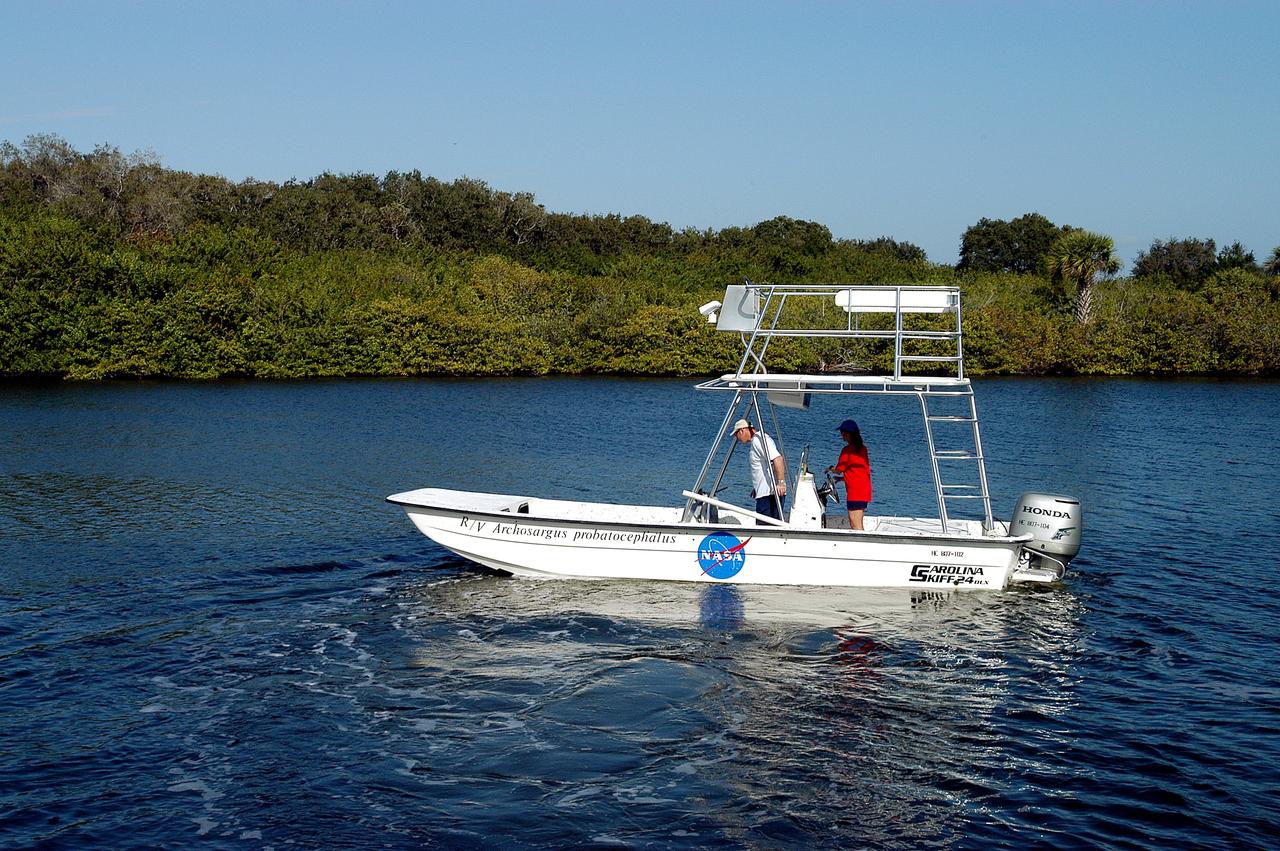
KENNEDY SPACE CENTER, FLA. - Karen Holloway-Adkins, KSC wildlife specialist, at the helm of a boat on the Banana River, heads for a research area. She is studying the life history of sea turtles, especially what they eat, where they lay their eggs and what factors might harm their survival. On the boat trip she is also monitoring the growth of sea grasses and algae and the water quality of estuaries and lagoons used by sea turtles and other aquatic wildlife.
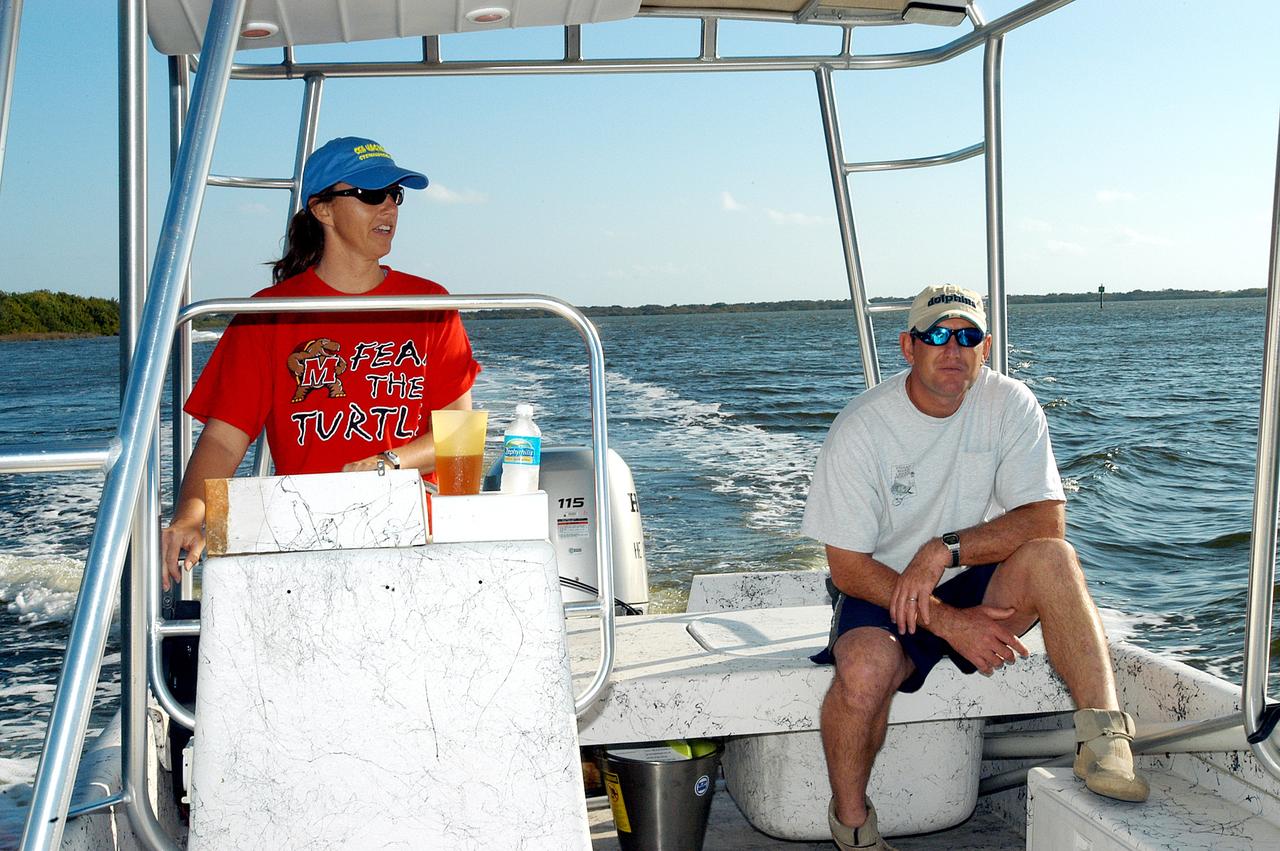
KENNEDY SPACE CENTER, FLA. - Karen Holloway-Adkins, KSC wildlife specialist, takes the helm on the boat as she begins a tour of the Banana River. She is studying the life history of sea turtles, especially what they eat, where they lay their eggs and what factors might harm their survival. On the boat trip she is also monitoring the growth of sea grasses and algae and the water quality of estuaries and lagoons used by sea turtles and other aquatic wildlife.
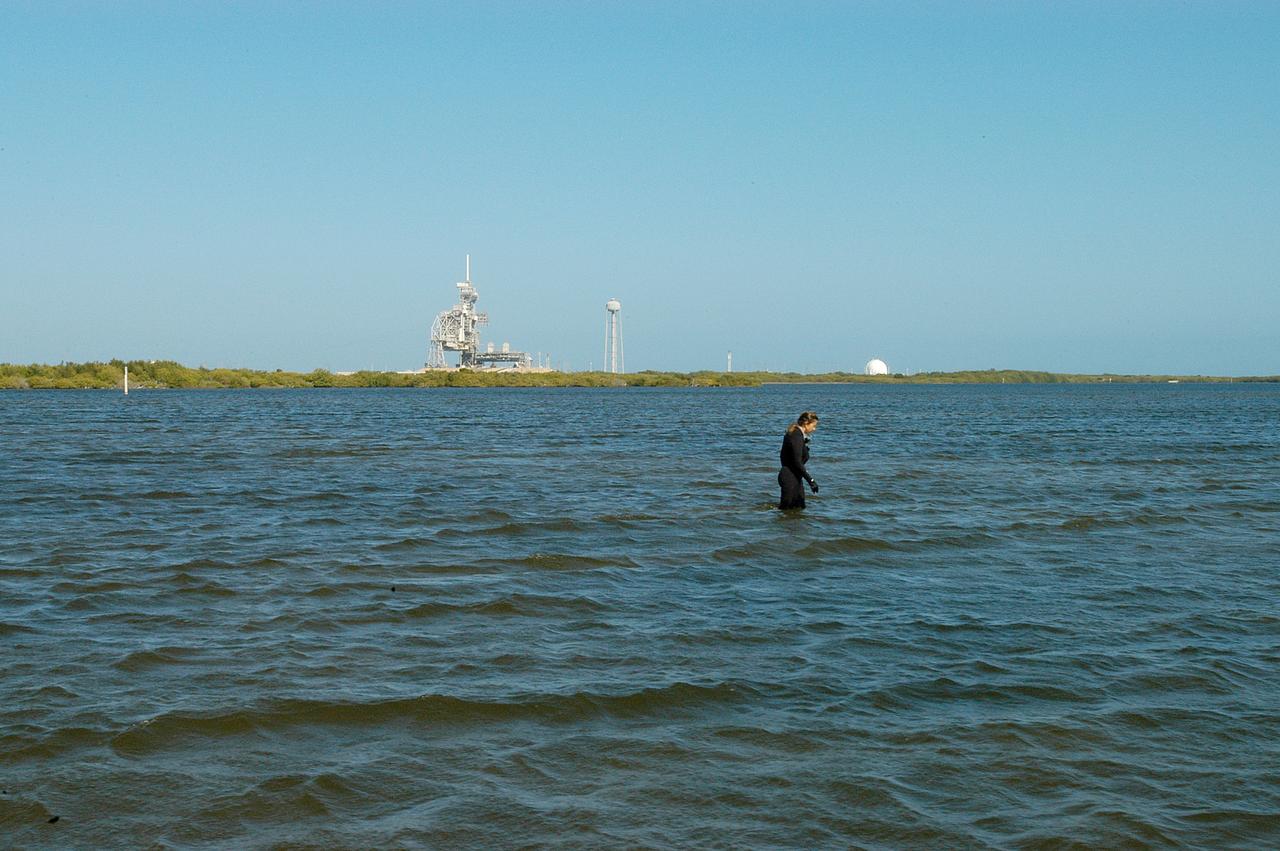
KENNEDY SPACE CENTER, FLA. - Karen Holloway-Adkins, KSC wildlife specialist, searches the Banana River for a grass specimen. In the background is one of the launch pads. The biologist is studying the life history of sea turtles, especially what they eat, where they lay their eggs and what factors might harm their survival. On the boat trip she is also monitoring the growth of sea grasses and algae and the water quality of estuaries and lagoons used by sea turtles and other aquatic wildlife.
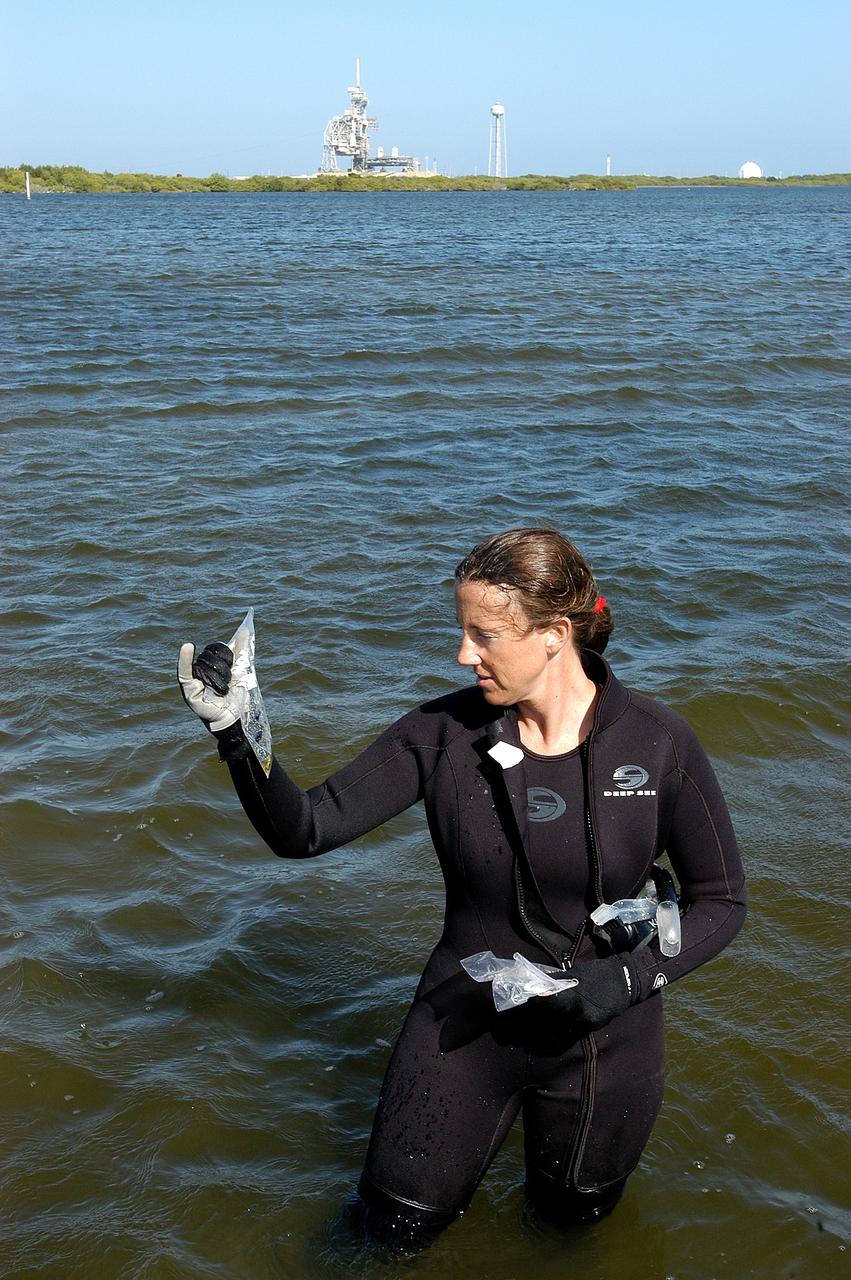
KENNEDY SPACE CENTER, FLA. - Karen Holloway-Adkins, KSC wildlife specialist, holds a sample of the sea grass she collected from the floor of the Banana River. She is studying the life history of sea turtles, especially what they eat, where they lay their eggs and what factors might harm their survival. On the boat trip she is also monitoring the growth of sea grasses and algae and the water quality of estuaries and lagoons used by sea turtles and other aquatic wildlife.
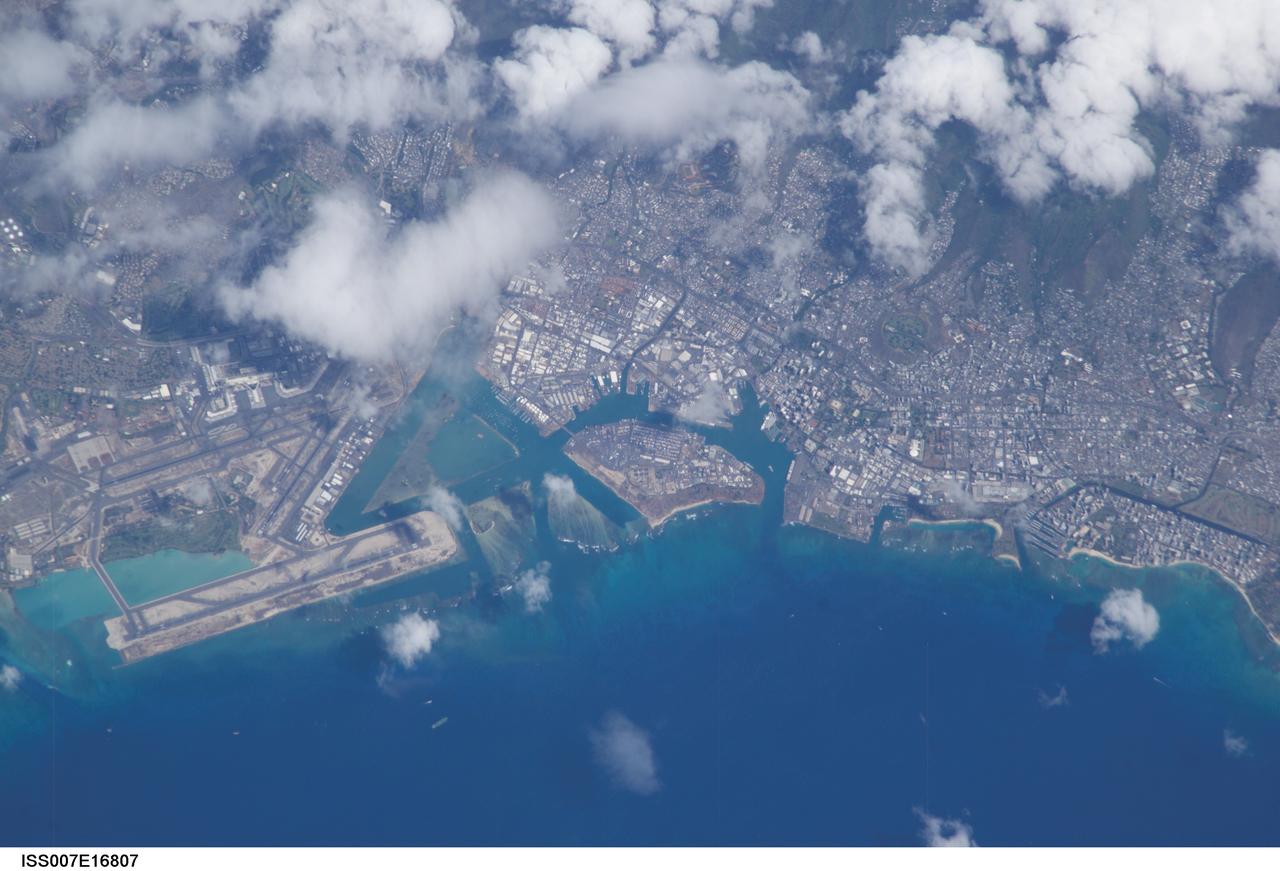
ISS007-E-16807 (8 October 2003) --- The Honolulu International Airport runway juts into the water on the left side of this image of Oahu, taken by an Expedition 7 crewmember onboard the International Space Station (ISS). In the center is Ke’ehi Lagoon and on the right is Sand Island.

CAPE CANAVERAL, Fla. –– Space shuttle Atlantis on Launch Pad 39A is viewed across the lagoon at NASA's Kennedy Space Center in Florida. Atlantis is targeted to launch May 12 on the STS-125 mission to upgrade NASA's Hubble Space Telescope. Photo credit: NASA/Jack Pfaller
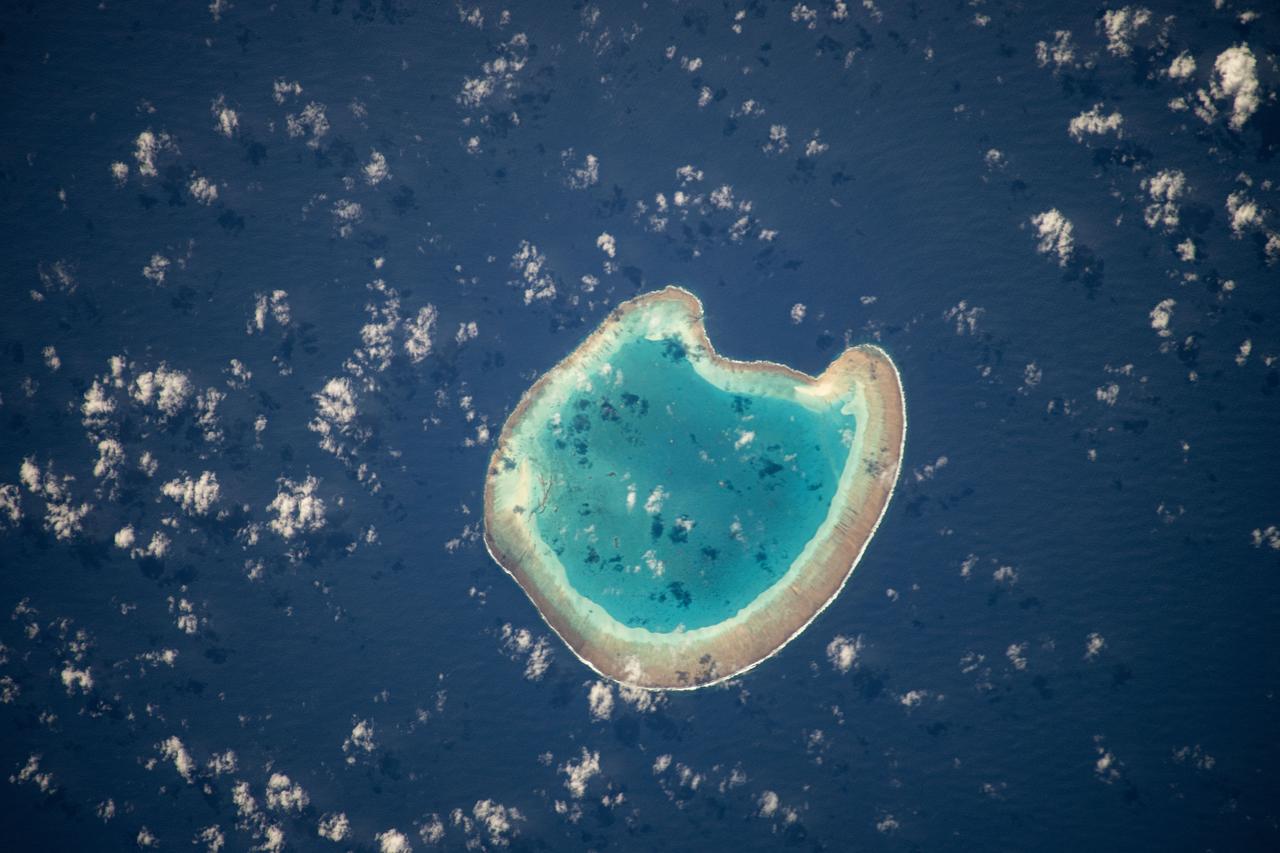
iss071e111610 (May 23, 2024) -- Nearly halfway between Madagascar and Mozambique lies the Bassas da India atoll in the Mozambique Channel. The uninhabited ring-shaped island spans roughly 330 feet (~100 meters) around a shallow lagoon. The International Space Station was soaring 260 miles above as this photo was taken.
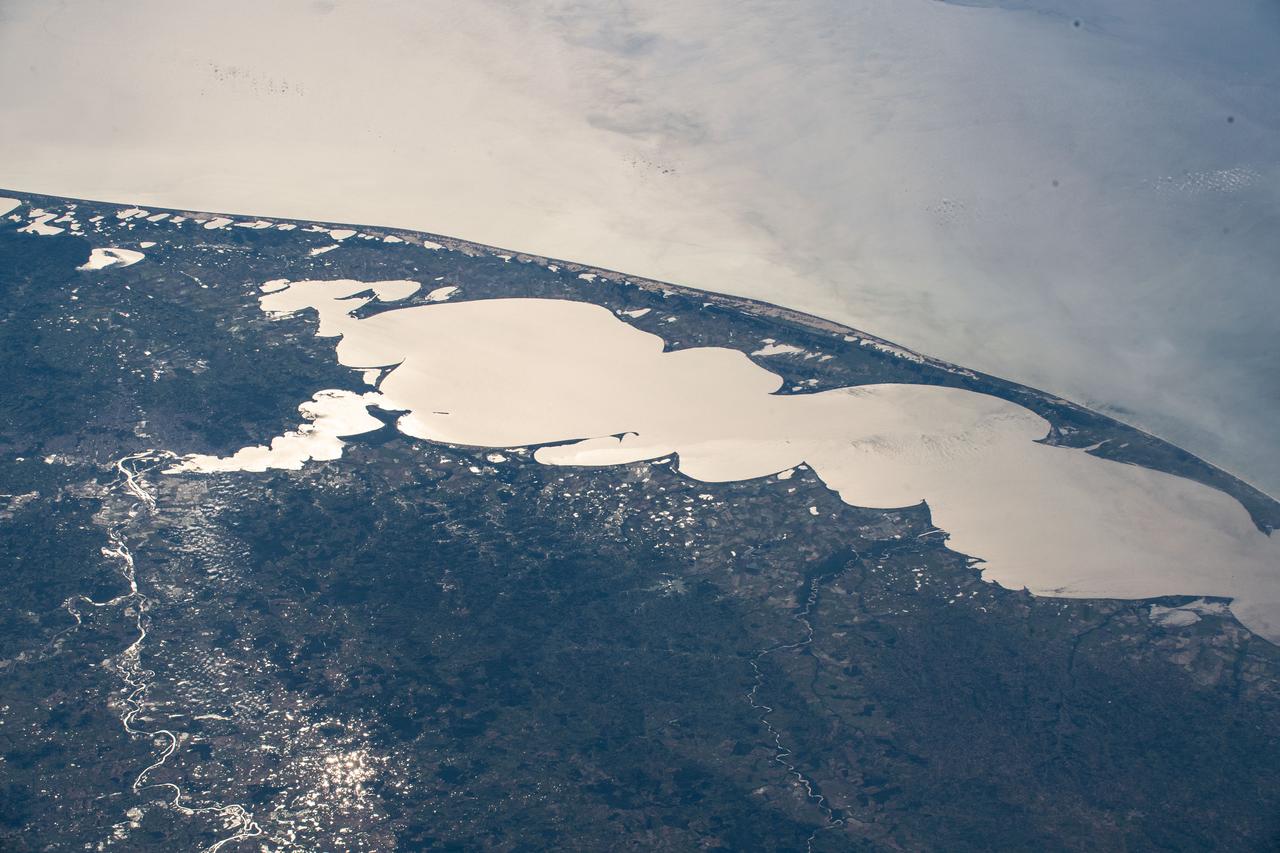
iss061e048125 (Nov. 19, 2019) --- The Sun's glint beaming off Brazil's largest lagoon, Lagos dos Patos, on the nation's southernmost tip is pictured from an altitude of 260 miles as the International Space Station orbited across the South American continent's Atlantic coast.
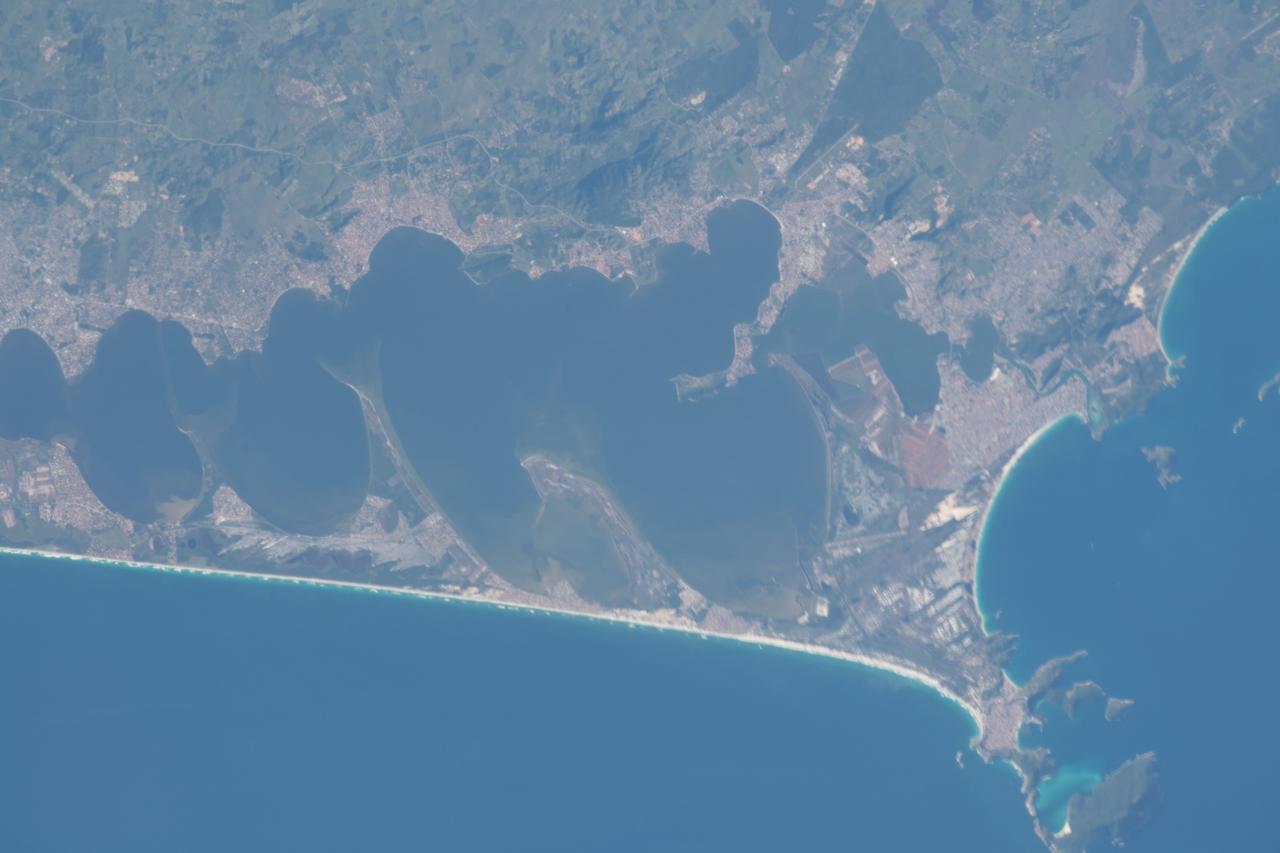
iss063e003285 (April 24, 2020) --- The Araruama Lagoon is about 52 miles east of Rio de Janeiro on the Atlantic coast of Brazil. The International Space Station was flying just north of Sao Paolo, South America's largest city when this photograph was taken.
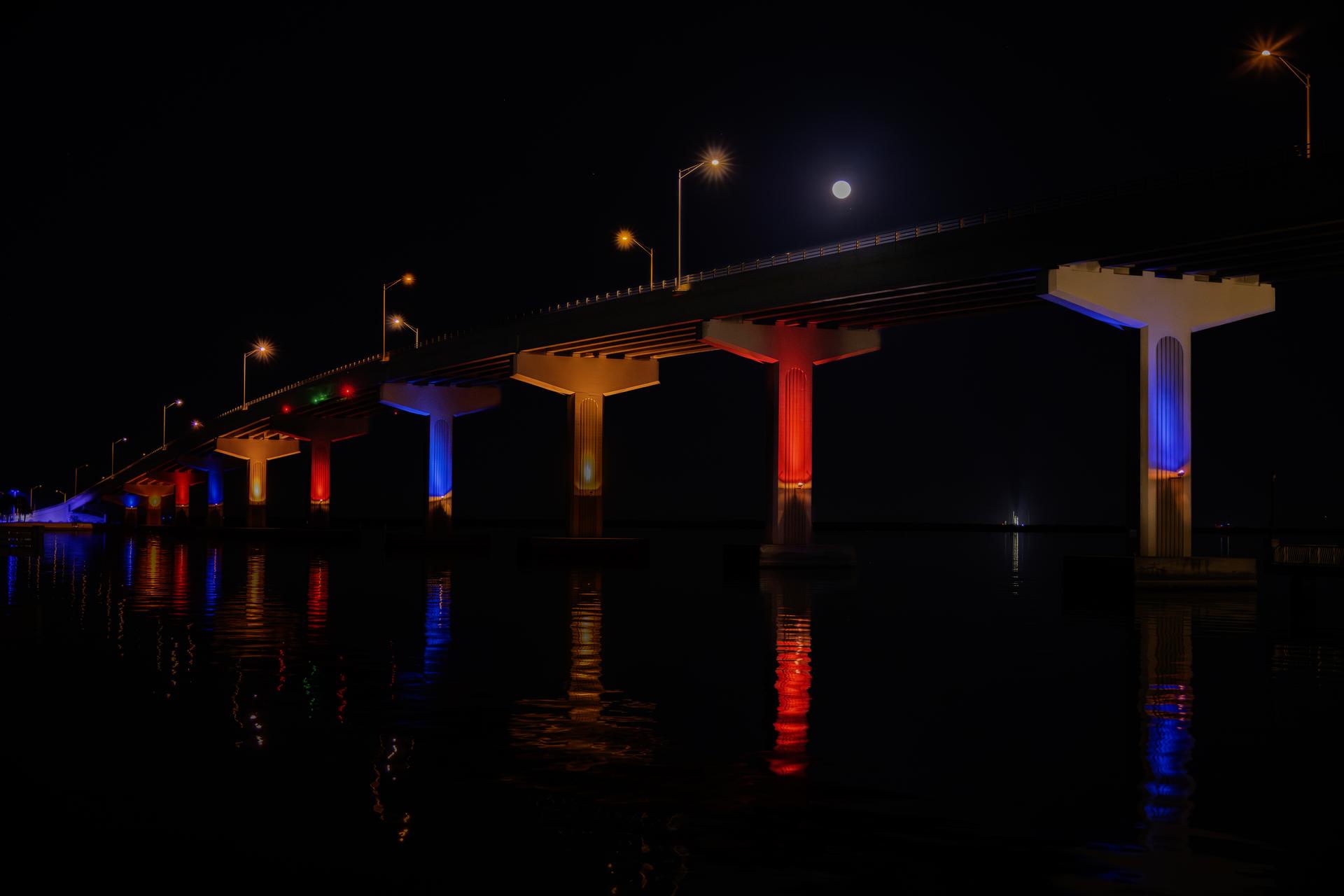
The Moon shines over the Max Brewer Bridge during the Artemis II wet dress rehearsal on Monday, Feb. 2, 2026, in Titusville, Florida. The bridge spanning the Indian River Lagoon is a popular launch viewing location for Kennedy Space Center and Cape Canaveral Space Force Station.
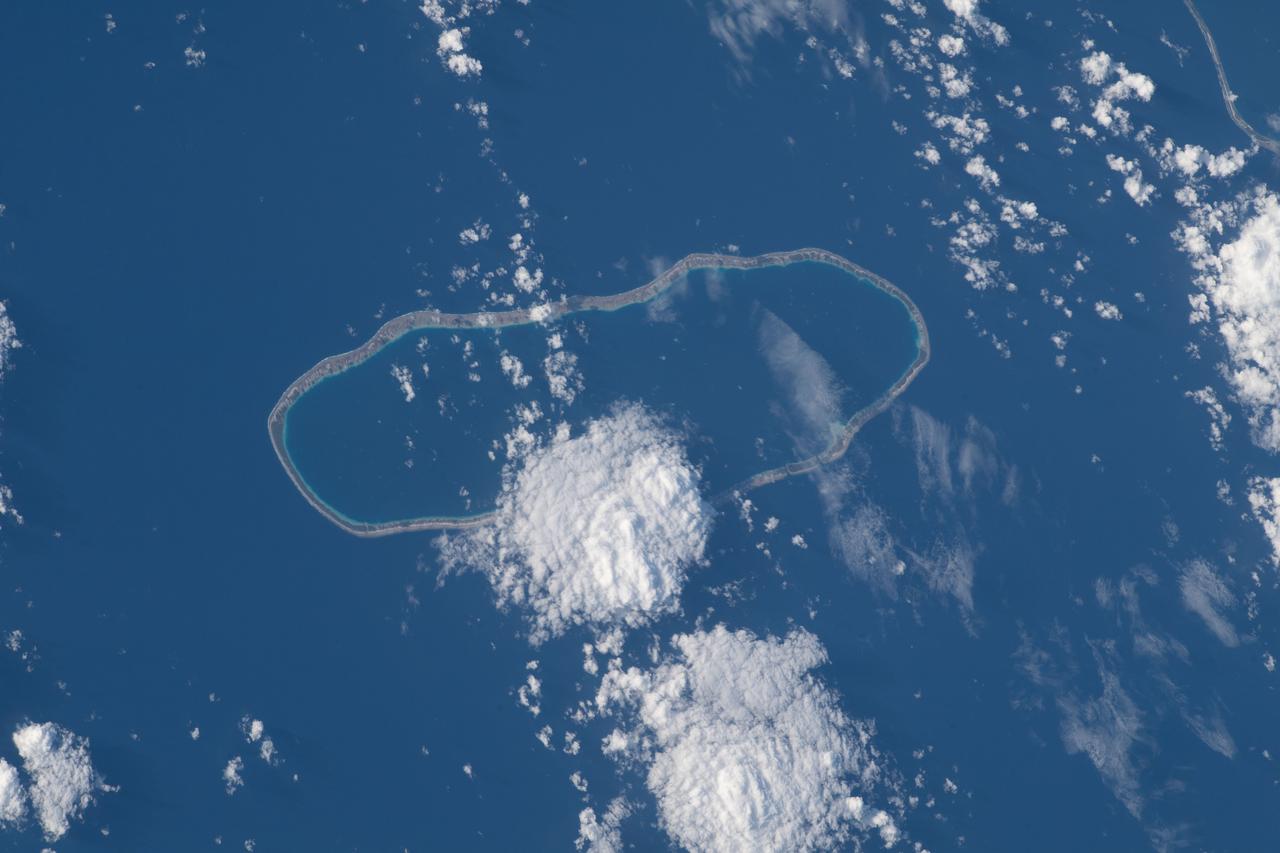
iss069e054648 (August 4, 2023) -- Amanu, a ring-shaped island—or an atoll—is roughly 560 miles (900 kilometers) from Tahiti. Only 10 miles (~15 kilometers) of its land is above water, creating a lagoon in its center. The International Space Station soared 261 miles above the Pacific Ocean as this image was taken.
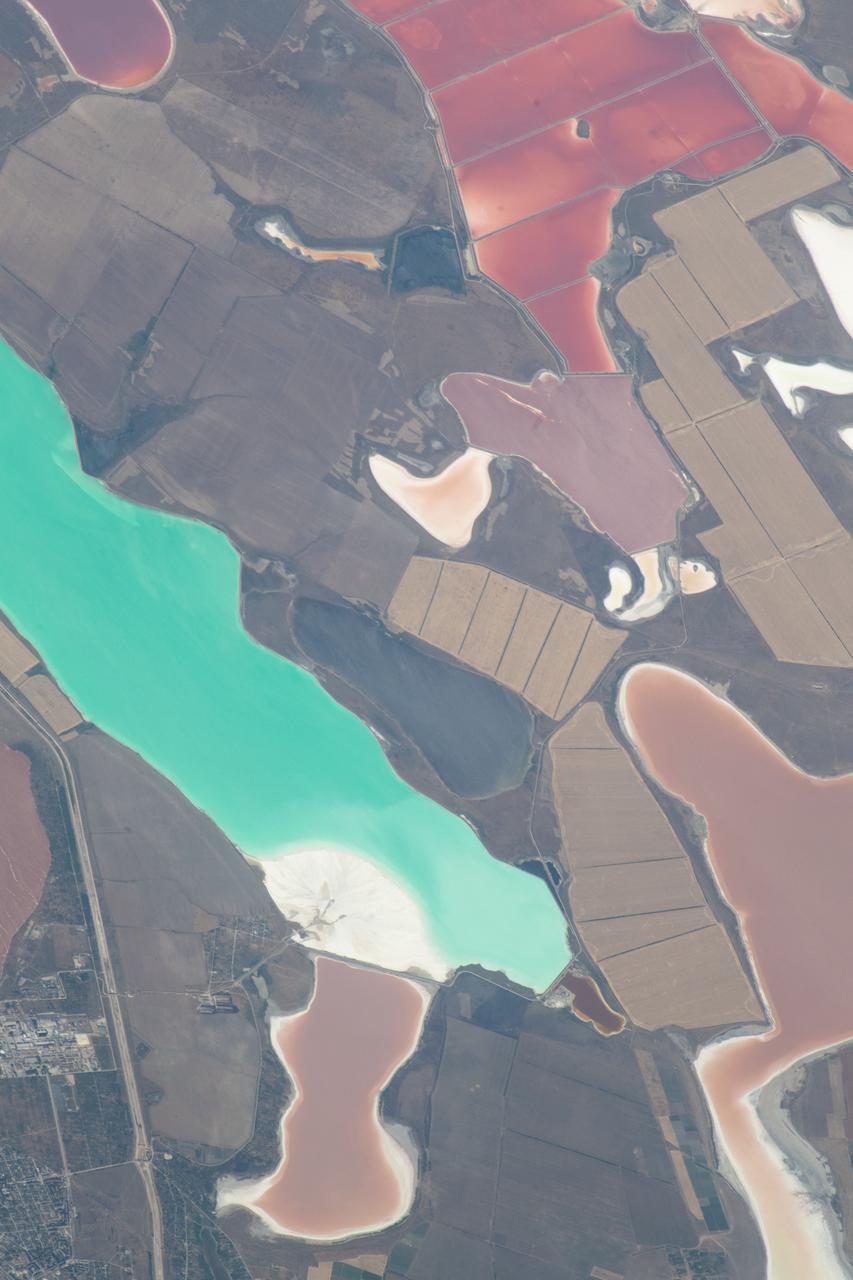
iss056e032828 (June 24, 2018) --- An Expedition 56 crew member aboard the International Space Station pictured lagoons in the Crimea between the Sea of Azov and the Black Sea which appear different colors due to shallow waters and their varied chemical composition.
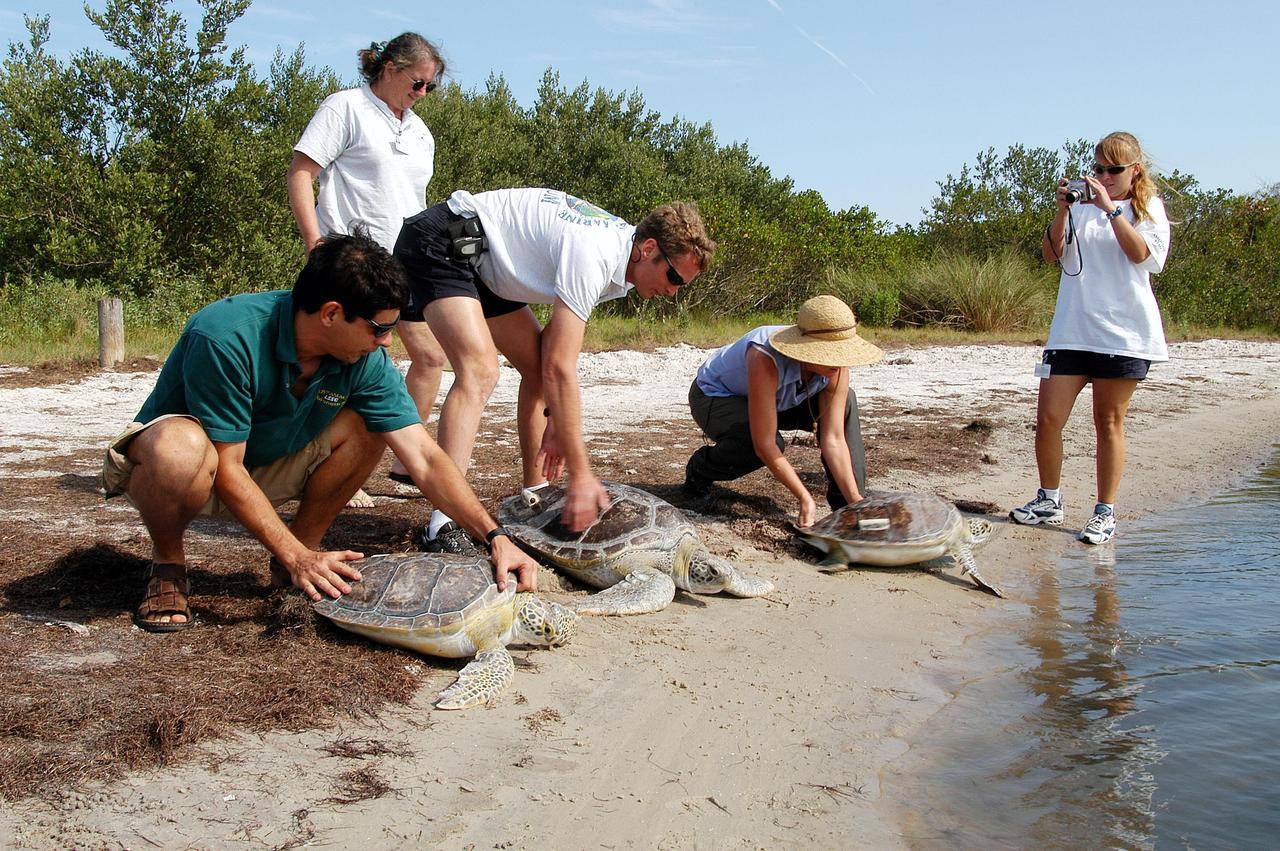
KENNEDY SPACE CENTER, FLA. - Three green sea turtles are being released into the Mosquito Lagoon at KSC. The turtles were rescued at KSC in January 2003, after being found stunned, impacted by the unseasonal cold temperatures experienced in Central Florida, and rehabilitated at the Clearwater Aquarium. They were fitted with sonic tracking devices.
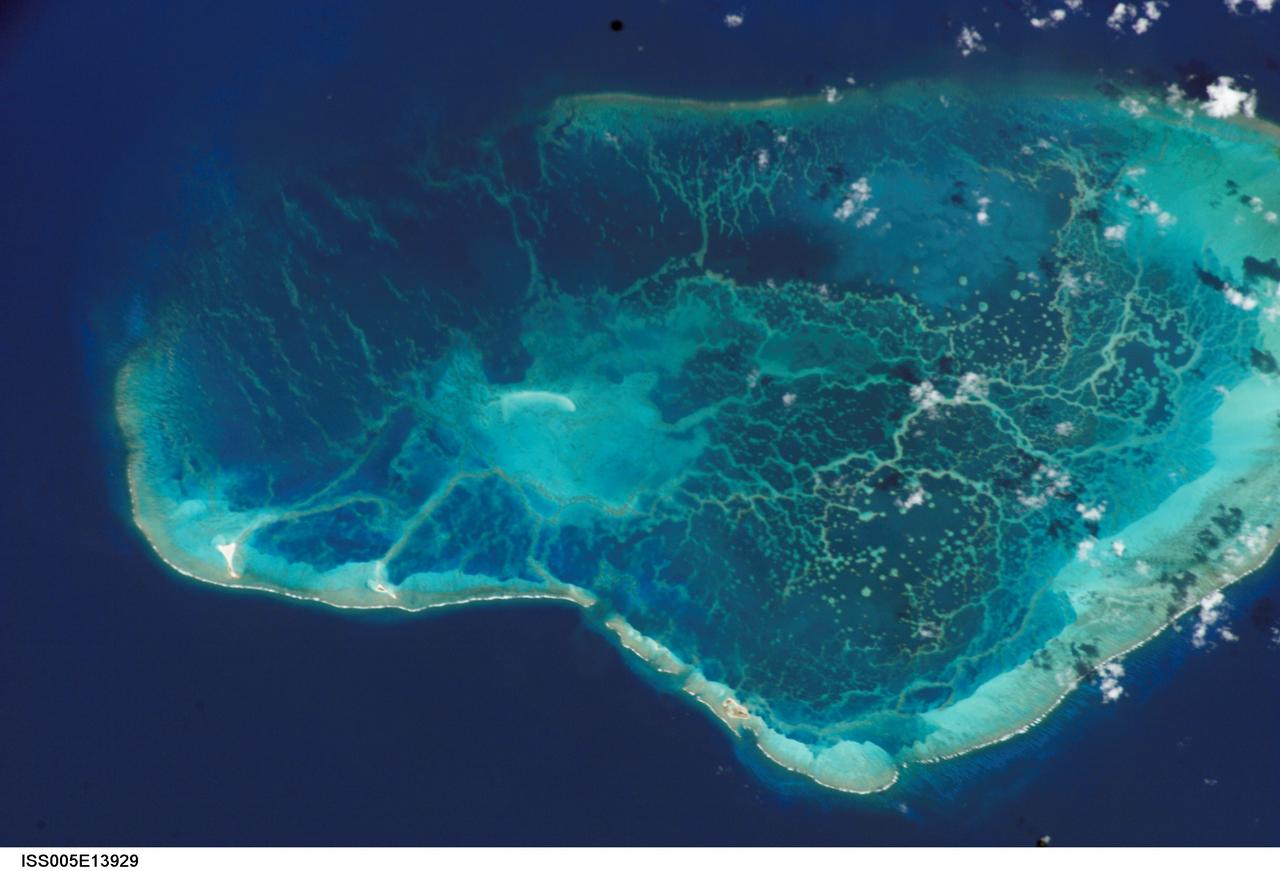
ISS005-E-13929 (12 September 2002) --- Pearl and Hermes Reef, northwest Hawaii, are featured in this image photographed by an Expedition 5 crewmember onboard the International Space Station (ISS). A new technique developed by NOAA scientists has made it possible to plot the depths of lagoon features using digital astronaut photography from the ISS.
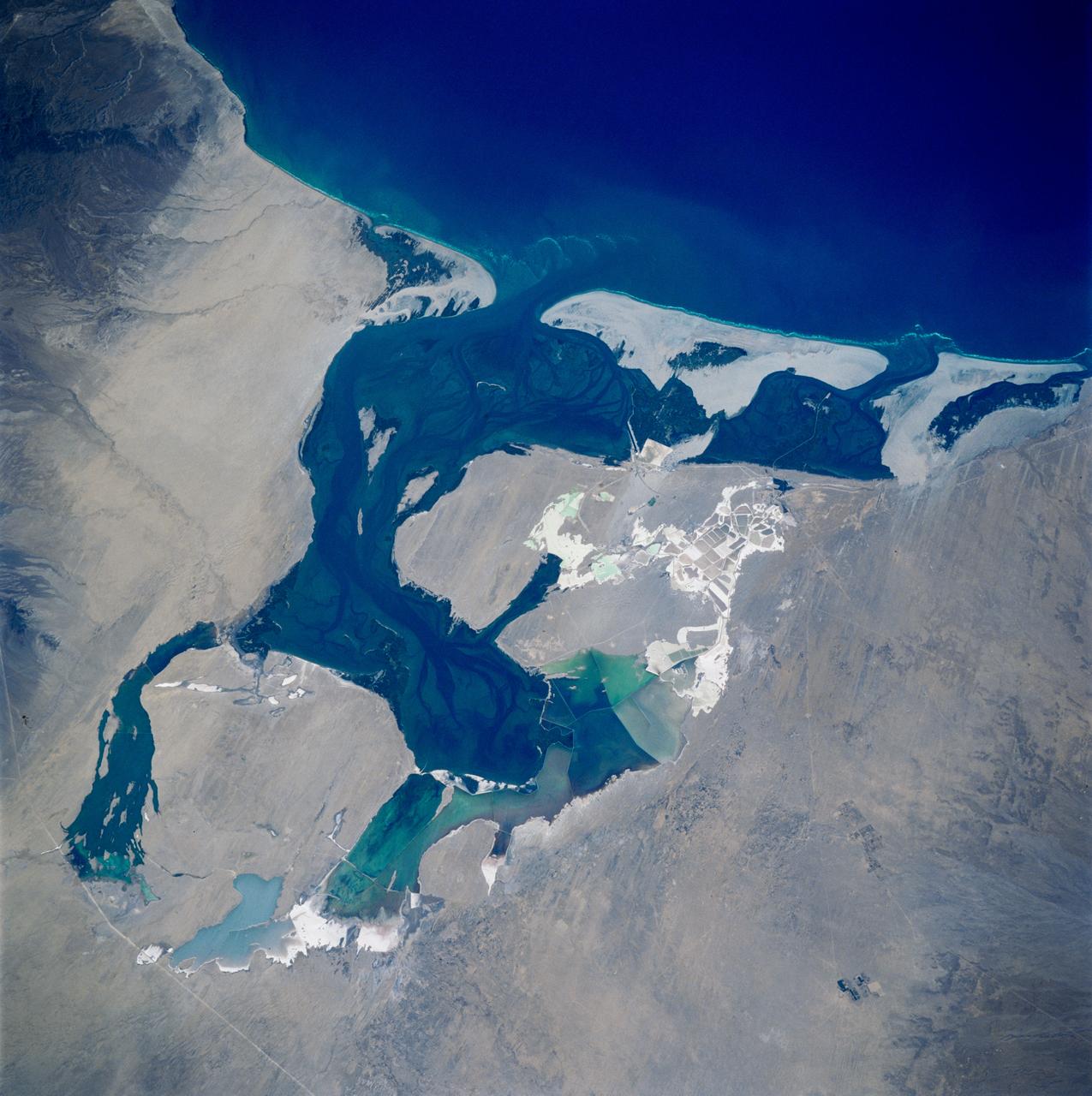
STS083-749-084 (4-8 April 1997) --- Laguna Oja De Liebre, Baja, gray whale breeding ground Laguna Oja De Liebre, Baja (Scammons Lagoon) is located on the west coast in the plains of the central Baja. This lagoon and others like it along the Baja coast are used for breeding grounds for the gray whale. One group of gray whales inhabits the Sea of Okhotsk in summer, migrating south in winter then breed off southern Korea. The other summers in the Bering and Chukchi seas and travels south to winter breeding grounds along the coast of Baja California. The gray whale was hunted almost to extinction by 1925 but was placed under complete international protection and since the 1940s has increased in numbers. The white grids seen in the photo are commercial salt ponds.
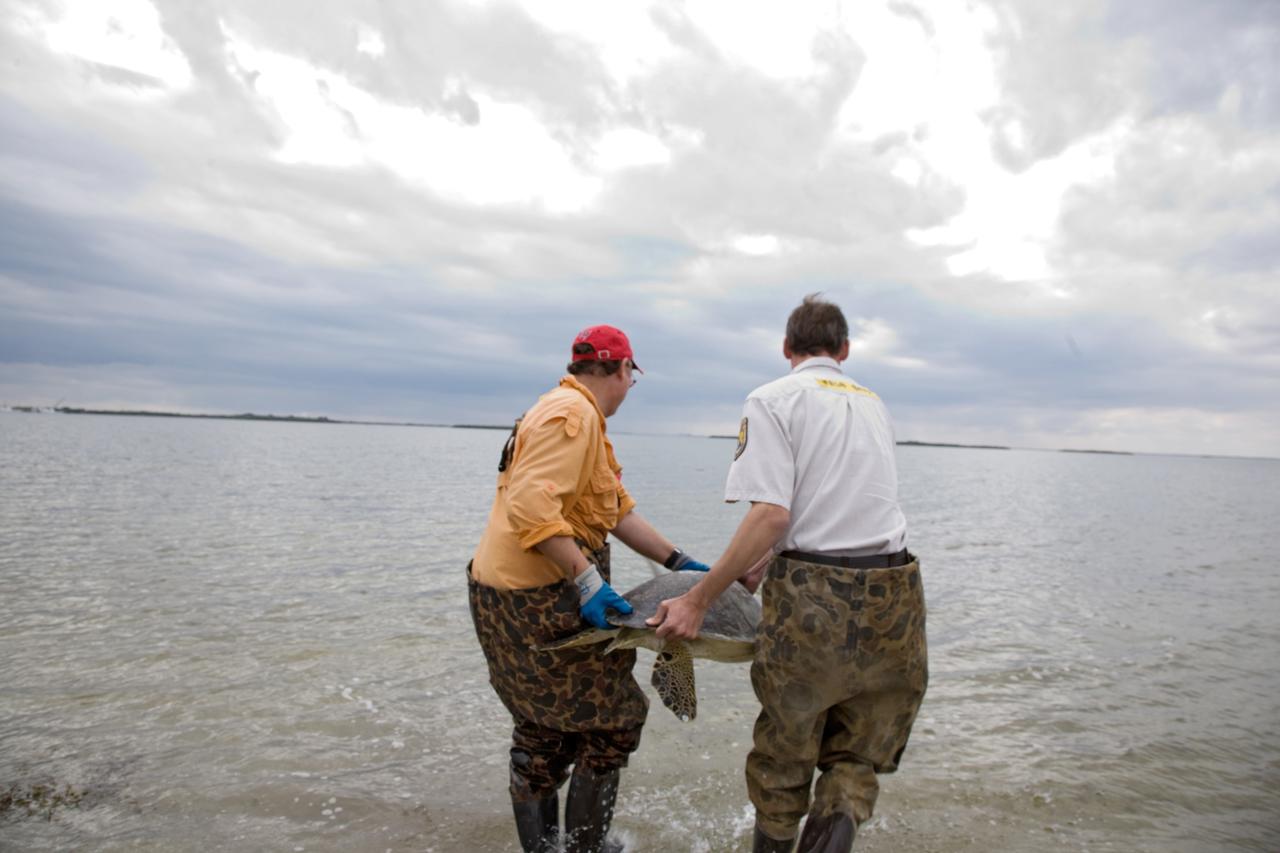
CAPE CANAVERAL, Fla. - Wildlife personnel carry an endangered green sea turtle toward the Banana River at NASA's Kennedy Space Center in Florida, ready to release the animal back into its usual environment. A recent cold snap left this turtle and nearly 2,000 others "stunned" and in need of help. Many of the turtles were rescued from the Mosquito Lagoon, with others coming from the Indian River Lagoon and Cocoa Beach. Biologists, environmentalists, wildlife experts and other volunteers joined forces with a massive rescue effort at the Merritt Island National Wildlife Refuge, where the turtles were identified, examined and transported to rehabilitation facilities throughout Florida and South Georgia. The animals stayed at these facilities until local waters warmed up to safe temperatures. Photo credit: NASA/Troy Cryder
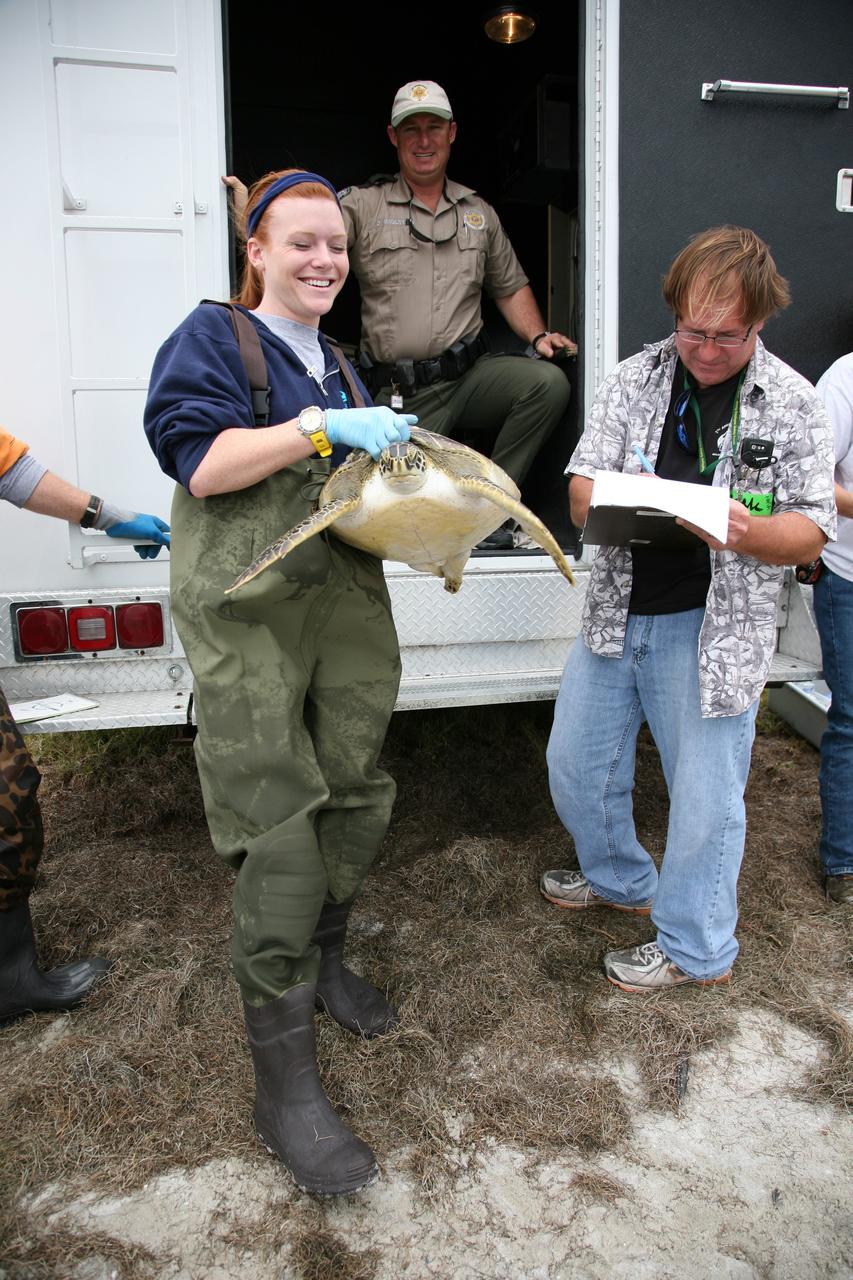
CAPE CANAVERAL, Fla. - Wildlife personnel carry an endangered green sea turtle away from a transport van prior to the animal's release into the Banana River at NASA's Kennedy Space Center in Florida. The turtle was one of nearly 2,000 that were "stunned" by a recent drop in temperatures. Many of the turtles were rescued from the Mosquito Lagoon, with others coming from the Indian River Lagoon and Cocoa Beach. Biologists, environmentalists, wildlife experts and other volunteers joined forces with a massive rescue effort at the Merritt Island National Wildlife Refuge, where the turtles were identified, examined and transported to rehabilitation facilities throughout Florida and South Georgia. The animals stayed at these facilities until local waters warmed up to safe temperatures. Photo credit: NASA/Troy Cryder
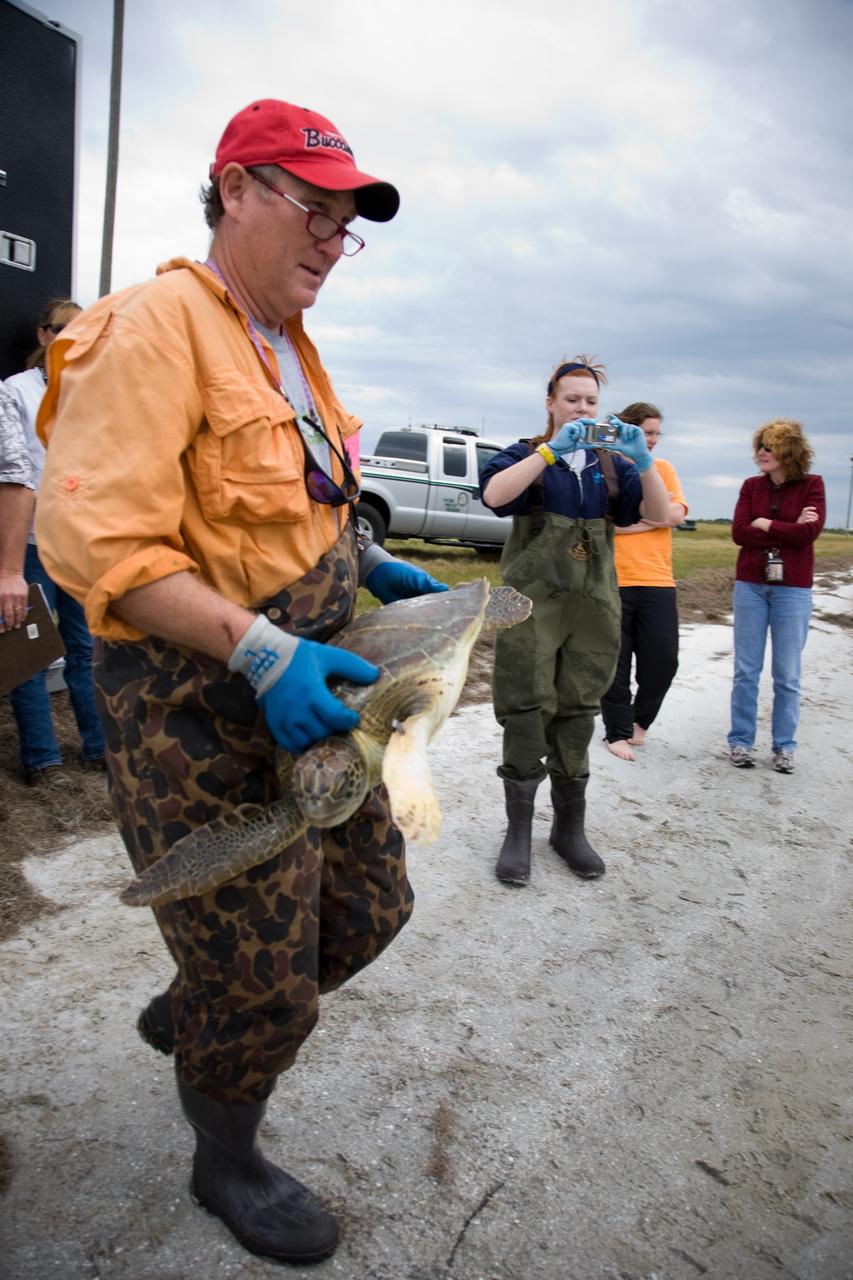
CAPE CANAVERAL, Fla. - Doug Scheidt, an employee of Innovative Health Applications at NASA's Kennedy Space Center in Florida, carries a green sea turtle to be released into the Banana River. The turtle was one of nearly 2,000 that were "stunned" by a recent drop in temperatures. Many of the turtles were rescued from the Mosquito Lagoon, with others coming from the Indian River Lagoon and Cocoa Beach. Biologists, environmentalists, wildlife experts and other volunteers joined forces with a massive rescue effort at the Merritt Island National Wildlife Refuge, where the turtles were identified, examined and transported to rehabilitation facilities throughout Florida and South Georgia. The animals stayed at these facilities until local waters warmed up to safe temperatures. Photo credit: NASA/Troy Cryder
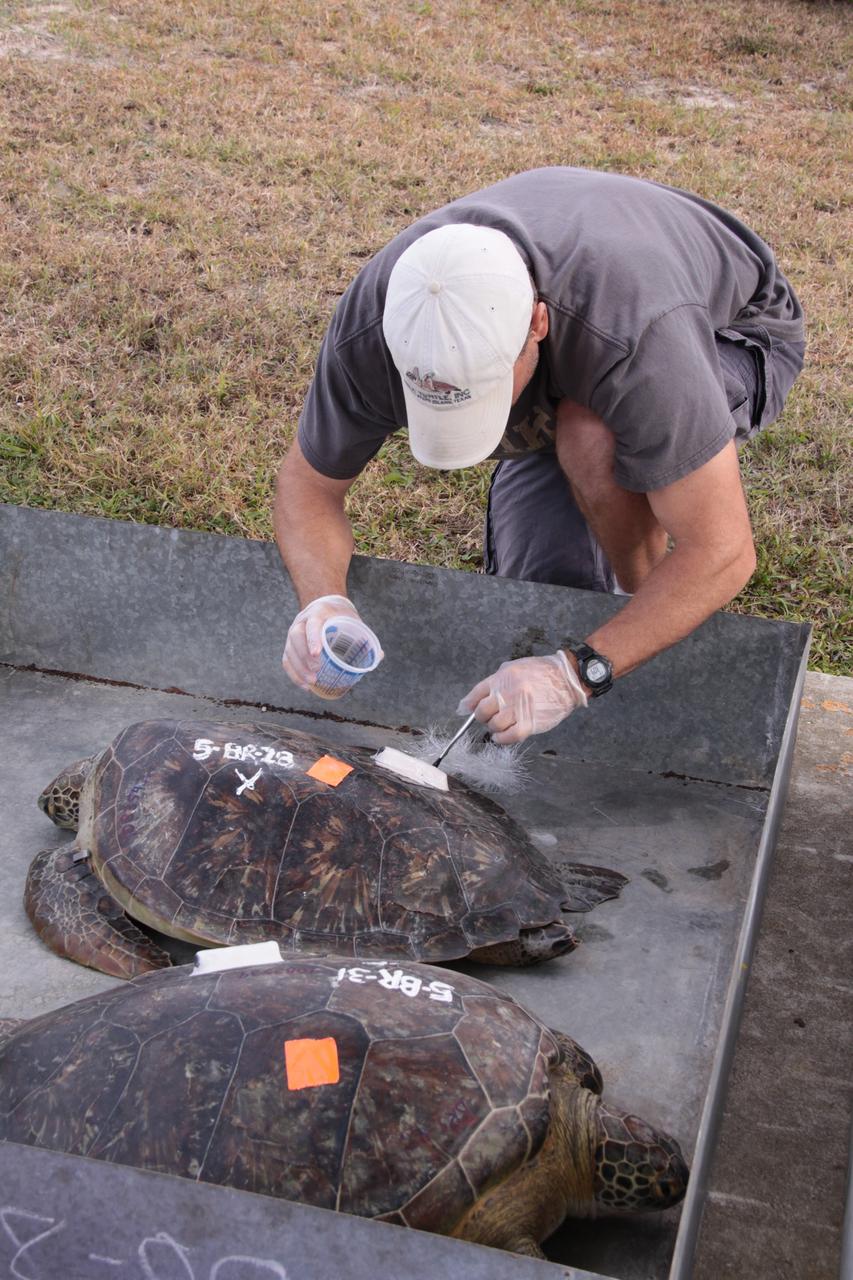
CAPE CANAVERAL, Fla. - A tracking transmitter is installed on the shell of an endangered green sea turtle at Cape Canaveral Air Force Station in Florida. A recent cold snap left this turtle and nearly 2,000 others "stunned" and in need of help. Many of the turtles were rescued from the Mosquito Lagoon, with others coming from the Indian River Lagoon and Cocoa Beach. Biologists, environmentalists, wildlife experts and other volunteers joined forces with a massive rescue effort at the Merritt Island National Wildlife Refuge, where the turtles were identified, examined and transported to rehabilitation facilities throughout Florida and South Georgia. The animals stayed at these facilities until local waters warmed up to safe temperatures. Photo credit: NASA/Jack Pfaller
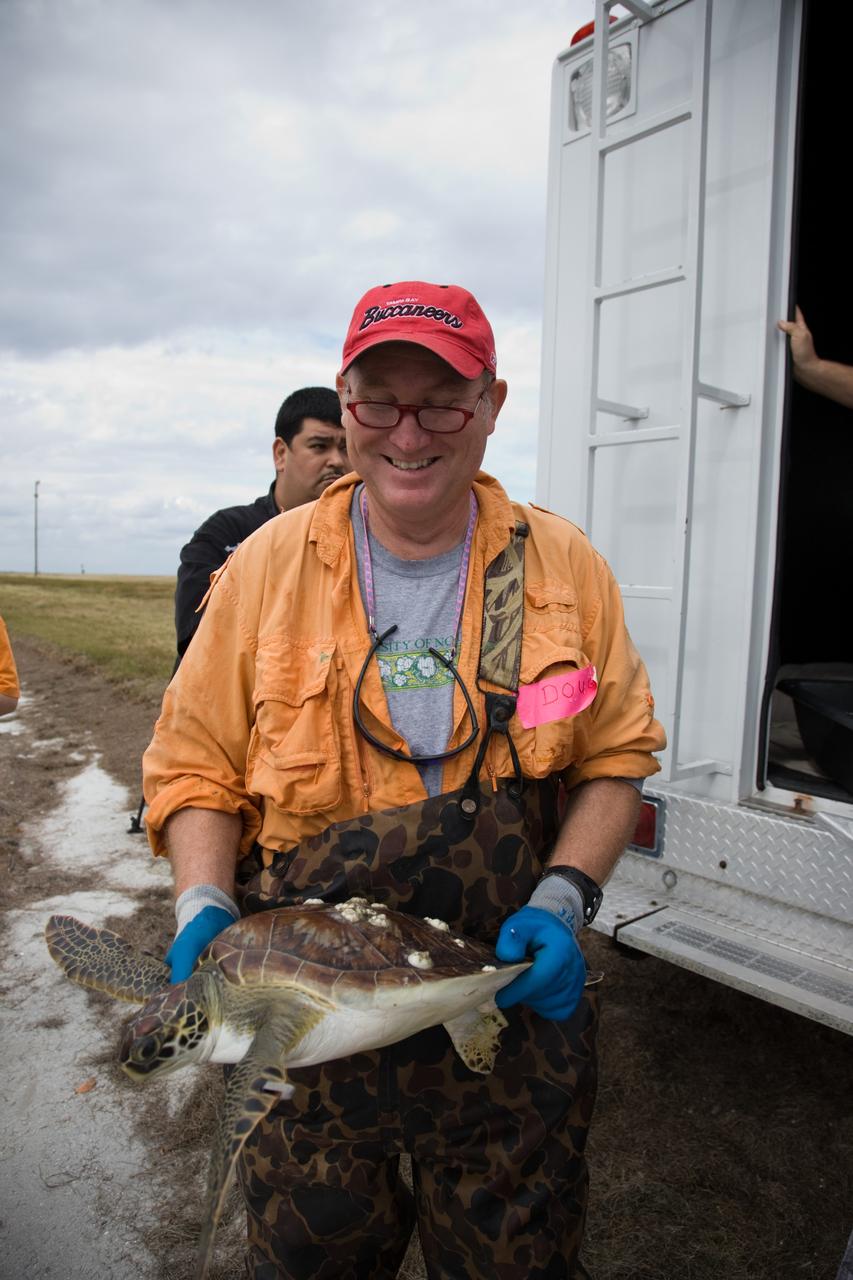
CAPE CANAVERAL, Fla. - Doug Scheidt, an employee of Innovative Health Applications at NASA's Kennedy Space Center in Florida, holds a juvenile green sea turtle prior to its release into the Banana River. The turtle was one of nearly 2,000 that were "stunned" by a recent drop in temperatures. Many of the turtles were rescued from the Mosquito Lagoon, with others coming from the Indian River Lagoon and Cocoa Beach. Biologists, environmentalists, wildlife experts and other volunteers joined forces with a massive rescue effort at the Merritt Island National Wildlife Refuge, where the turtles were identified, examined and transported to rehabilitation facilities throughout Florida and South Georgia. The animals stayed at these facilities until local waters warmed up to safe temperatures. Photo credit: NASA/Troy Cryder
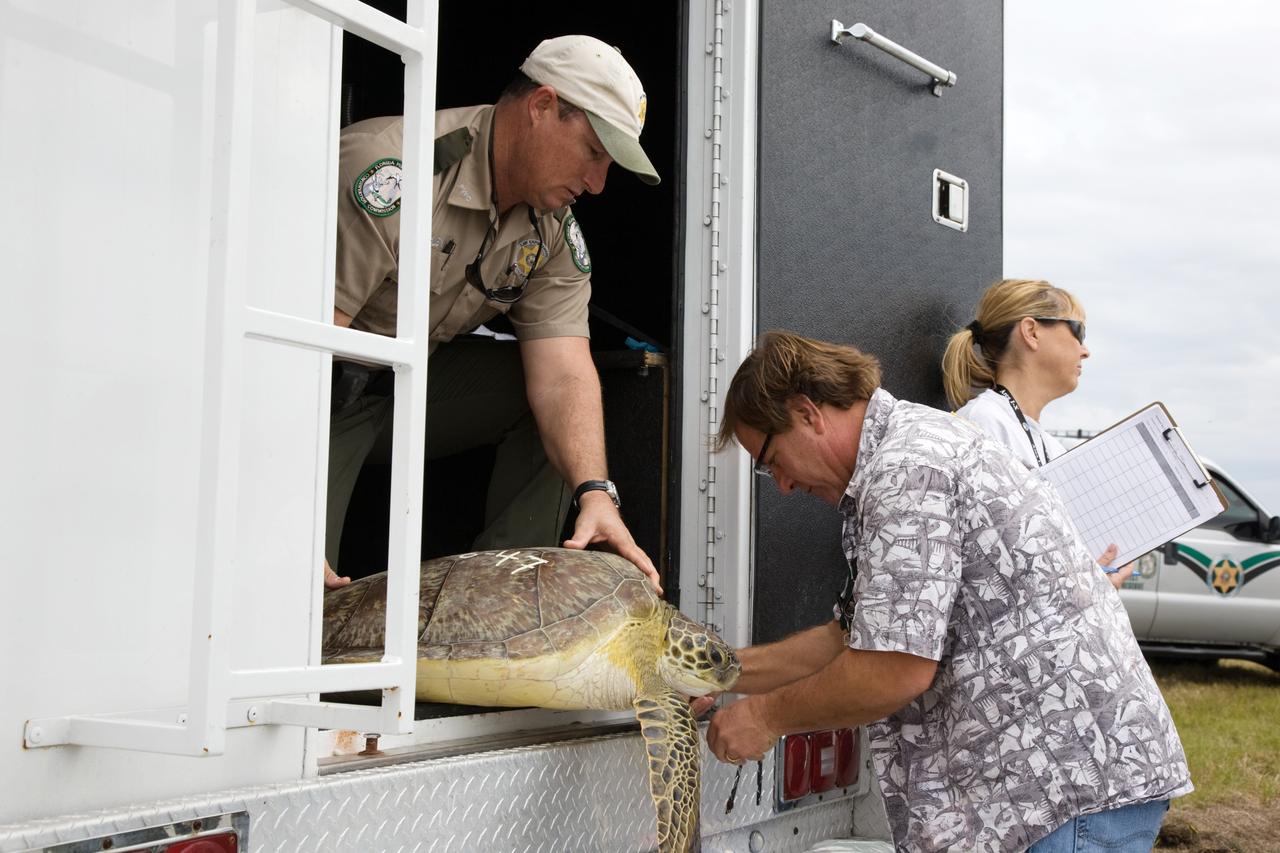
CAPE CANAVERAL, Fla. - An endangered green sea turtle is unloaded from a truck prior to its release into the waters of the Banana River at NASA's Kennedy Space Center in Florida. Wildlife personnel and volunteers are releasing groups of the federally protected turtles after nearly 2,000 of the animals were "stunned" by prolonged cold temperatures. Many of the turtles were rescued from the Mosquito Lagoon, with others coming from the Indian River Lagoon and Cocoa Beach. Biologists, environmentalists, wildlife experts and other volunteers joined forces with a massive rescue effort at the Merritt Island National Wildlife Refuge, where the turtles were identified, examined and transported to rehabilitation facilities throughout Florida and South Georgia. The animals stayed at these facilities until local waters warmed up to safe temperatures. Photo credit: NASA/Troy Cryder
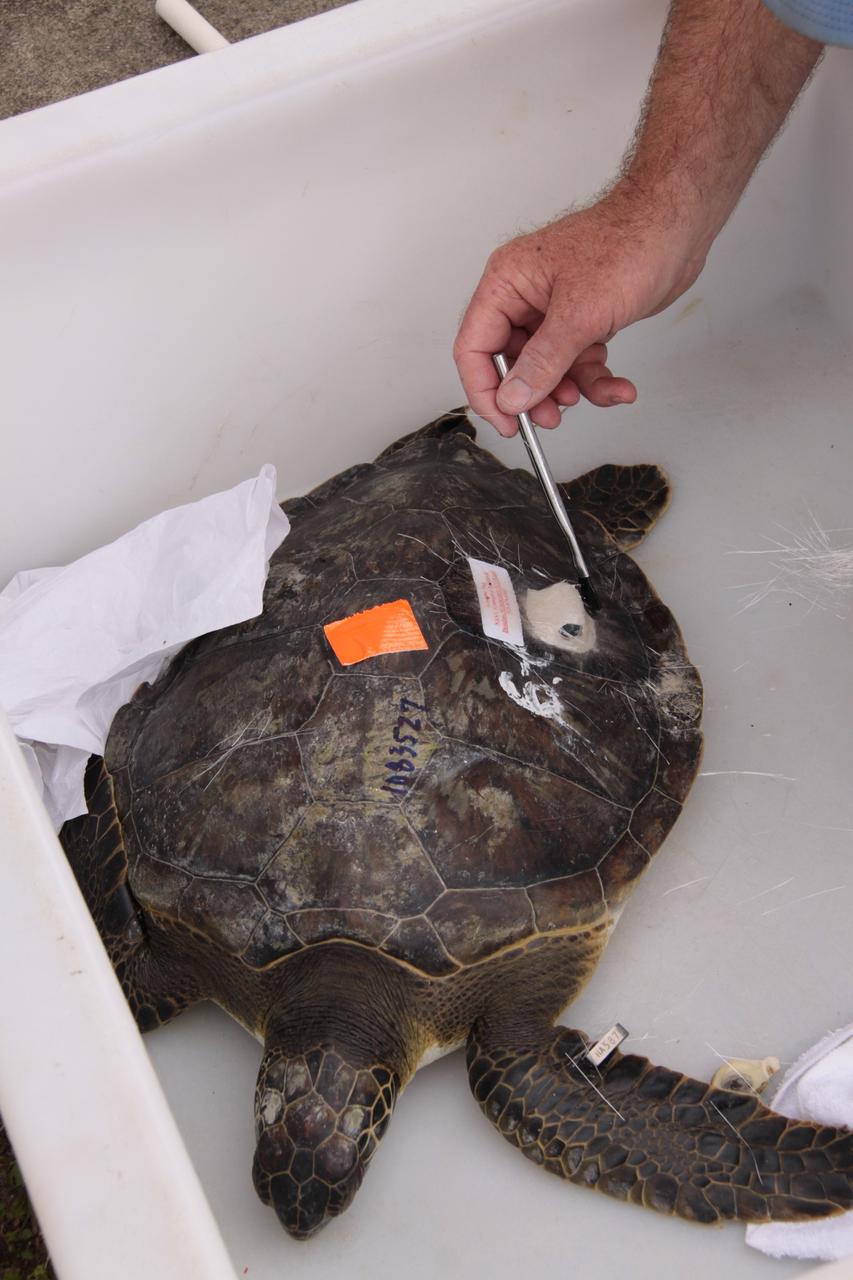
CAPE CANAVERAL, Fla. - An endangered green sea turtle awaits release as its shell is tagged with a tracking transmitter at Cape Canaveral Air Force Station in Florida. A recent cold snap left this turtle and nearly 2,000 others "stunned" and in need of help. Many of the turtles were rescued from the Mosquito Lagoon, with others coming from the Indian River Lagoon and Cocoa Beach. Biologists, environmentalists, wildlife experts and other volunteers joined forces with a massive rescue effort at the Merritt Island National Wildlife Refuge, where the turtles were identified, examined and transported to rehabilitation facilities throughout Florida and South Georgia. The animals stayed at these facilities until local waters warmed up to safe temperatures. Photo credit: NASA/Jack Pfaller
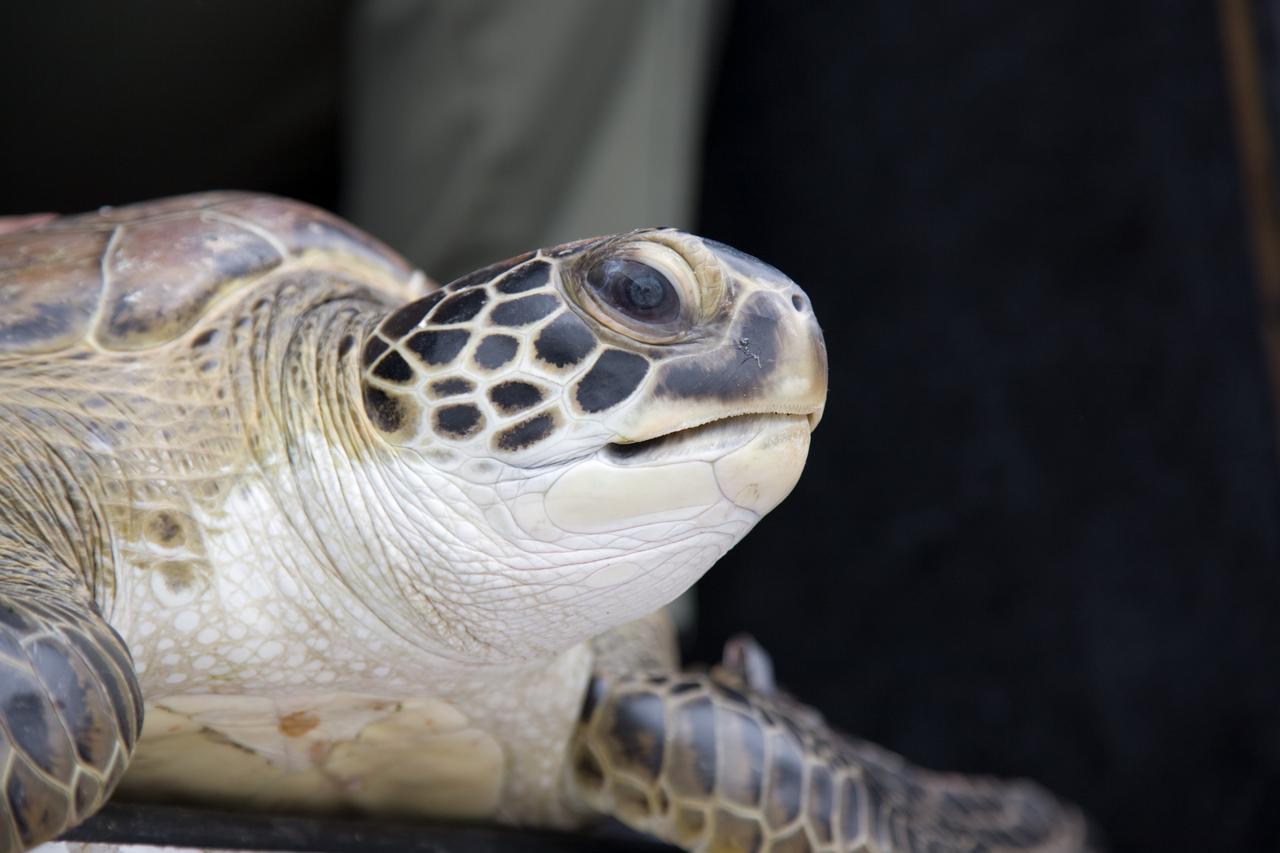
CAPE CANAVERAL, Fla. - This juvenile green sea turtle is ready to swim off into the waters of the Banana River at NASA's Kennedy Space Center in Florida. A recent cold snap left this turtle and nearly 2,000 others "stunned" and in need of help. Many of the turtles were rescued from the Mosquito Lagoon, with others coming from the Indian River Lagoon and Cocoa Beach. Biologists, environmentalists, wildlife experts and other volunteers joined forces with a massive rescue effort at the Merritt Island National Wildlife Refuge, where the turtles were identified, examined and transported to rehabilitation facilities throughout Florida and South Georgia. The animals stayed at these facilities until local waters warmed up to safe temperatures. Photo credit: NASA/Troy Cryder
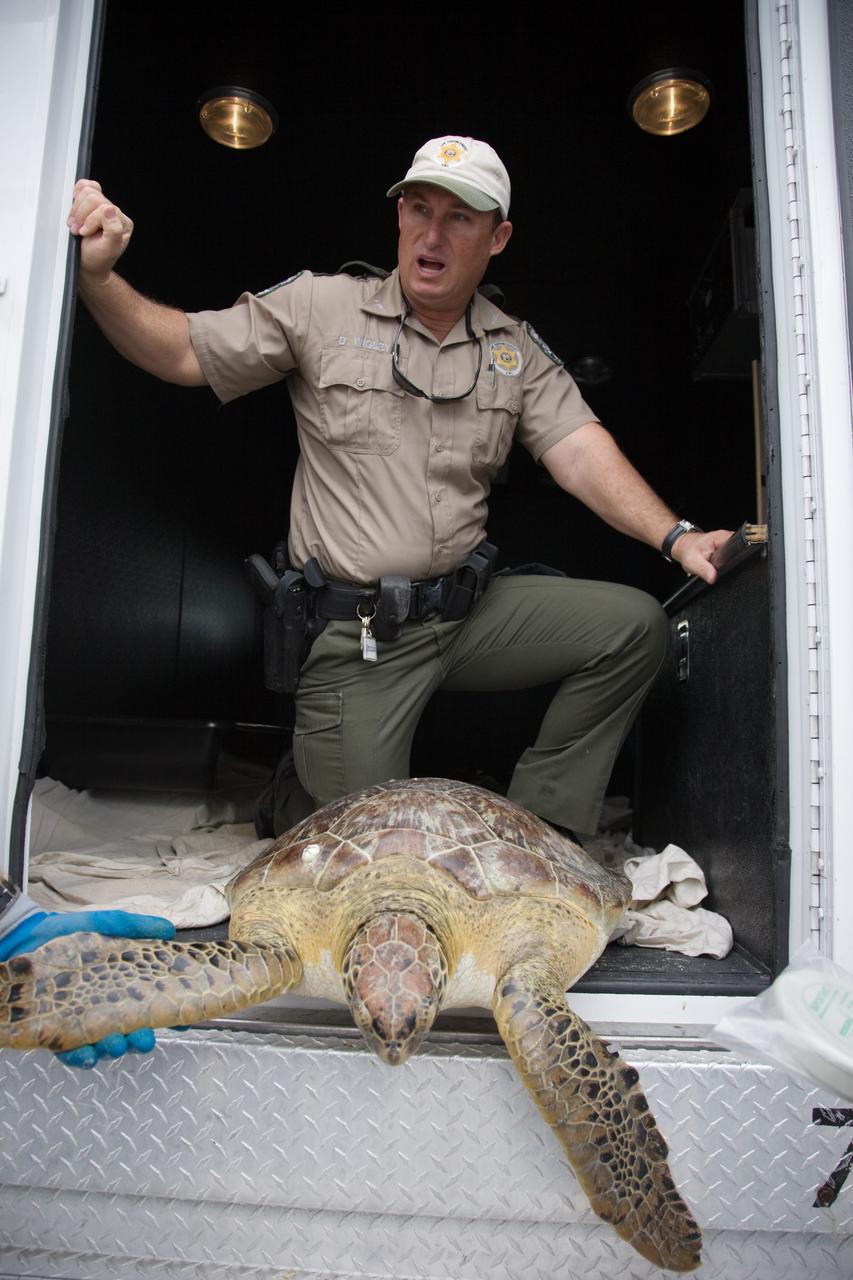
CAPE CANAVERAL, Fla. - A wildlife officer offers assistance as an endangered green sea turtle is prepared for release into the waters of the Banana River at NASA's Kennedy Space Center in Florida. The turtle was one of nearly 2,000 that were "stunned" by a recent drop in temperatures. Many of the turtles were rescued from the Mosquito Lagoon, with others coming from the Indian River Lagoon and Cocoa Beach. Biologists, environmentalists, wildlife experts and other volunteers joined forces with a massive rescue effort at the Merritt Island National Wildlife Refuge, where the turtles were identified, examined and transported to rehabilitation facilities throughout Florida and South Georgia. The animals stayed at these facilities until local waters warmed up to safe temperatures. Photo credit: NASA/Troy Cryder
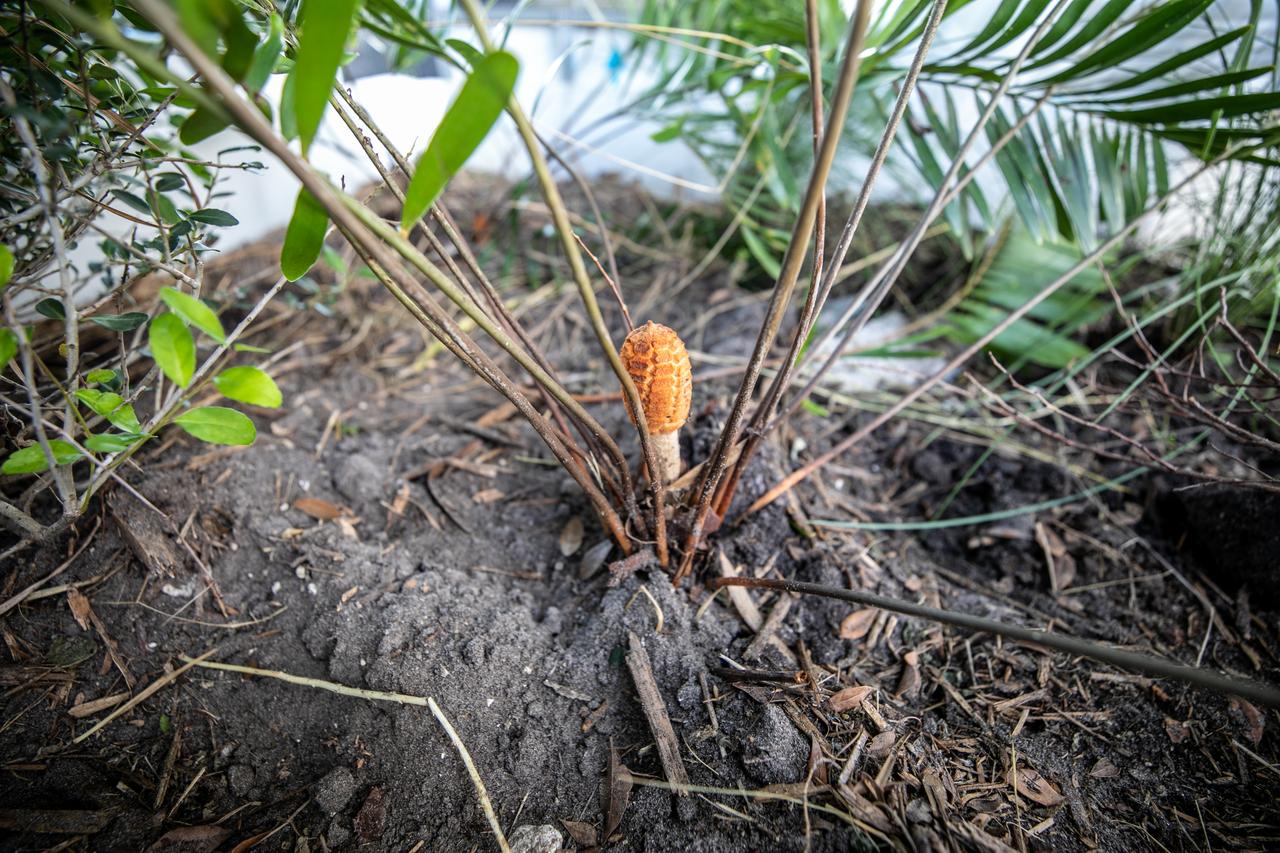
NASA Kennedy Space Center’s unrivaled dedication to the environment is highlighted through a variety of environmental programs and projects. An up-close view of the plants that make up a bio-filter constructed by teams with Kennedy and Jacobs Technology, Inc. is shown on Sept. 29, 2020. The bio-filter – made of layered rock, soil, and native plants – is used to catch and filter zinc out of rainwater that runs off of the roof at the Florida spaceport’s Launch Complex 39 observation tower. Many facilities at Kennedy have galvanized roofs, which contain a coating of zinc to help protect the metal from rust or corrosion but can have serious effects on fish and other aquatic life if it runs into the Indian River Lagoon. The plants in the bio-filter bind to the zinc so that when the water comes out of the bottom, it’s clean and safe to go into the lagoon – its waterline located about 20 to 30 feet away.
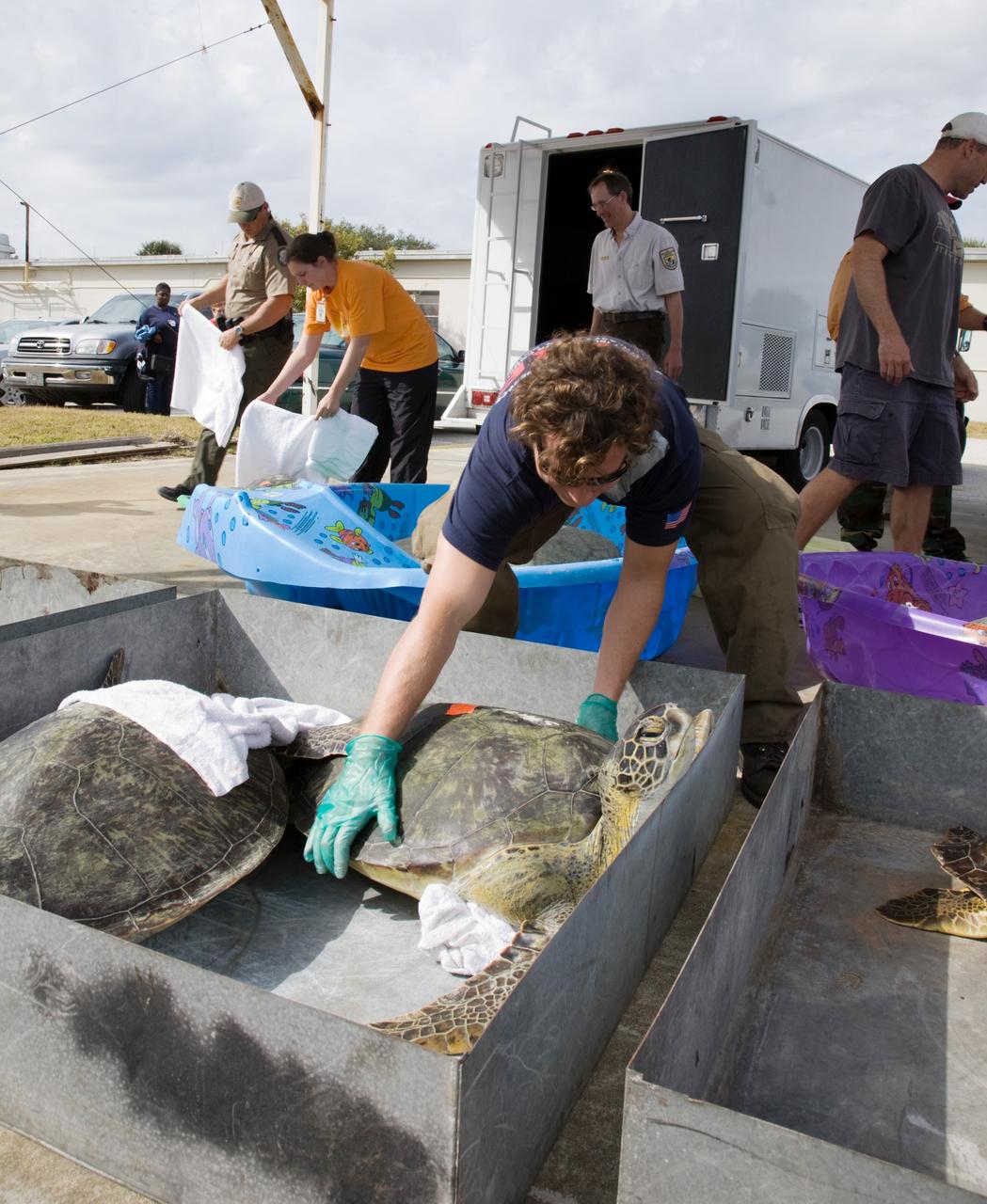
CAPE CANAVERAL, Fla. - Wildlife personnel prepare to release several endangered green sea turtles into the waters of the Banana River at NASA's Kennedy Space Center in Florida. The turtles were some of nearly 2,000 that were "stunned" by the recent drop in temperatures. Many of the turtles were rescued from the Mosquito Lagoon, with others coming from the Indian River Lagoon and Cocoa Beach. Biologists, environmentalists, wildlife experts and other volunteers joined forces with a massive rescue effort at the Merritt Island National Wildlife Refuge, where the turtles were identified, examined and transported to rehabilitation facilities throughout Florida and South Georgia. The animals stayed at these facilities until local waters warmed up to safe temperatures. Photo credit: NASA/Troy Cryder
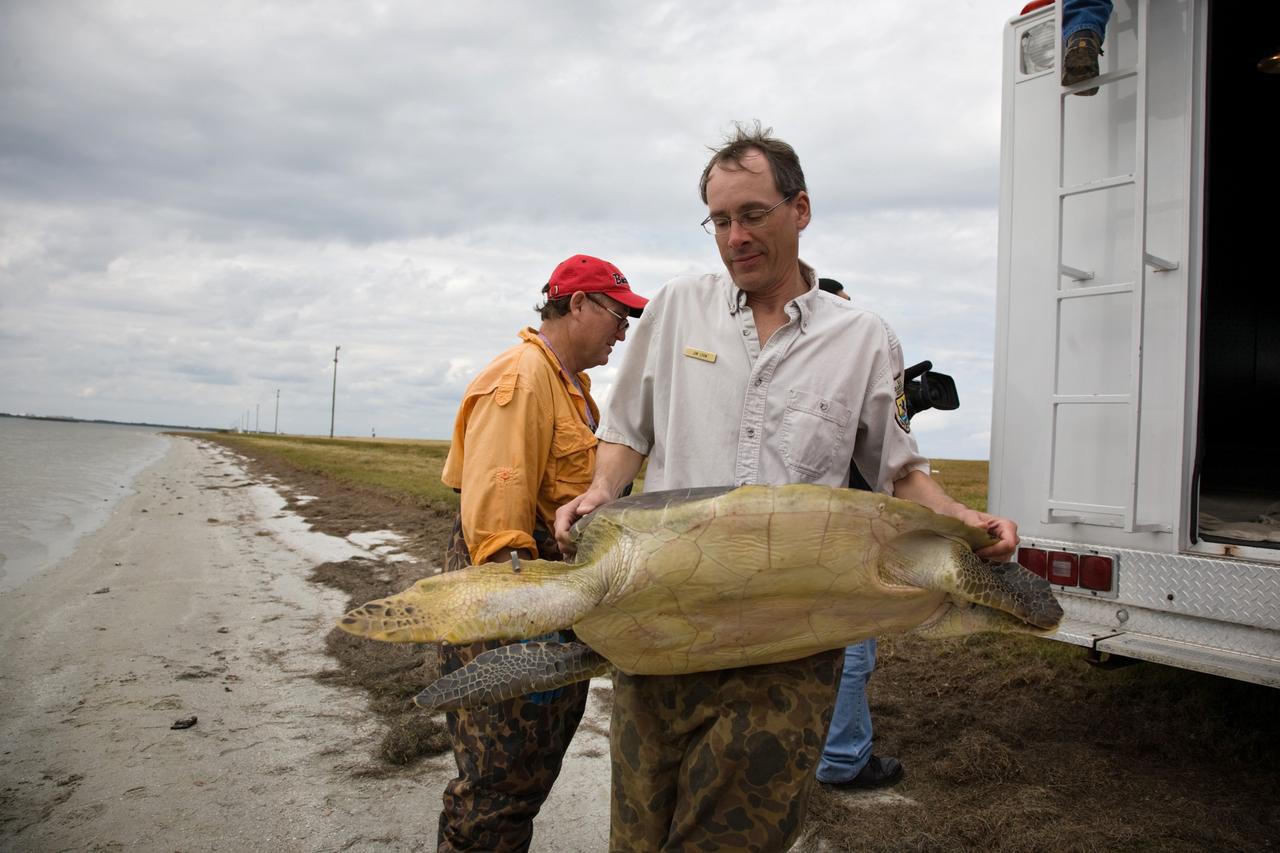
CAPE CANAVERAL, Fla. - Jim Lyon, biological science technician with the Merritt Island National Wildlife Refuge, carries a green sea turtle toward the waterline of the Banana River at NASA's Kennedy Space Center in Florida. A recent cold snap left this turtle and nearly 2,000 others "stunned" and in need of help. Many of the turtles were rescued from the Mosquito Lagoon, with others coming from the Indian River Lagoon and Cocoa Beach. Biologists, environmentalists, wildlife experts and other volunteers joined forces with a massive rescue effort at the Merritt Island National Wildlife Refuge, where the turtles were identified, examined and transported to rehabilitation facilities throughout Florida and South Georgia. The animals stayed at these facilities until local waters warmed up to safe temperatures. Photo credit: NASA/Troy Cryder
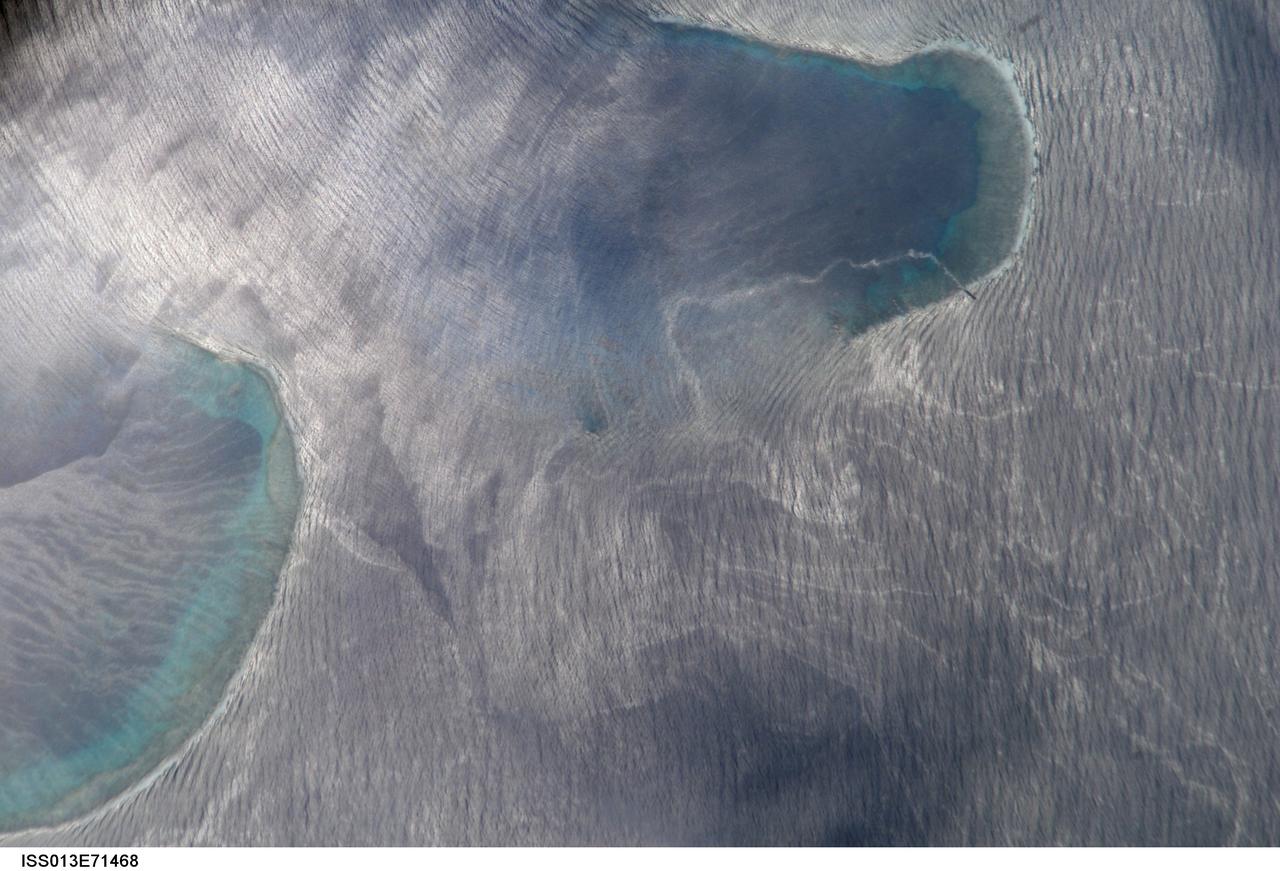
ISS013-E-71468 (27 Aug. 2006) --- Bajo Nuevo Reef in the western Caribbean Sea is featured in this image photographed by an Expedition 13 crewmember on the International Space Station. The Bajo Nuevo reef is approximately 26 kilometers long, comprising two separate U-shaped cays, with only tiny sandy islands associated with them. This detailed view reveals small, low islands that fringe the upwind side (image right) of the lagoon. These islands seem dwarfed by wave swells, which almost appear to wash over them. The clearest feature is the broad pattern of swells which show two slightly different orientations, producing a tightly crossed pattern. These swells are oriented transverse to the wind direction and were probably set in motion by two different storms hundreds of kilometers east of the reef. A single irregular line of light color--also suggestive of surface oil--traces a path along the south side of the lagoon.
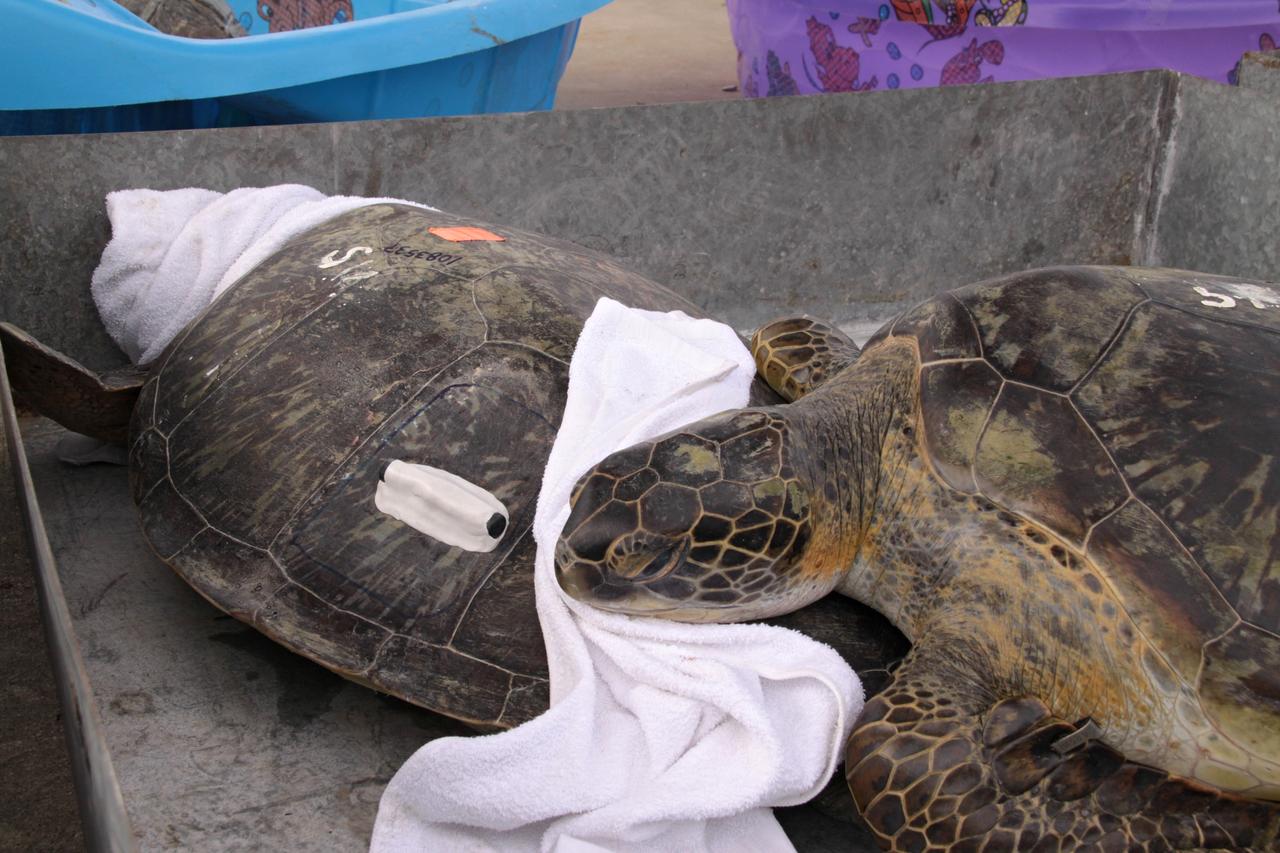
CAPE CANAVERAL, Fla. - A green sea turtle rests its head on a companion as the animals are tagged with tracking transmitters and prepared for release at Cape Canaveral Air Force Station in Florida. The turtles were some of nearly 2,000 that were "stunned" by the recent drop in temperatures. Many of the turtles were rescued from the Mosquito Lagoon, with others coming from the Indian River Lagoon and Cocoa Beach. Biologists, environmentalists, wildlife experts and other volunteers joined forces with a massive rescue effort at the Merritt Island National Wildlife Refuge, where the turtles were identified, examined and transported to rehabilitation facilities throughout Florida and South Georgia. The animals stayed at these facilities until local waters warmed up to safe temperatures. Photo credit: NASA/Jack Pfaller
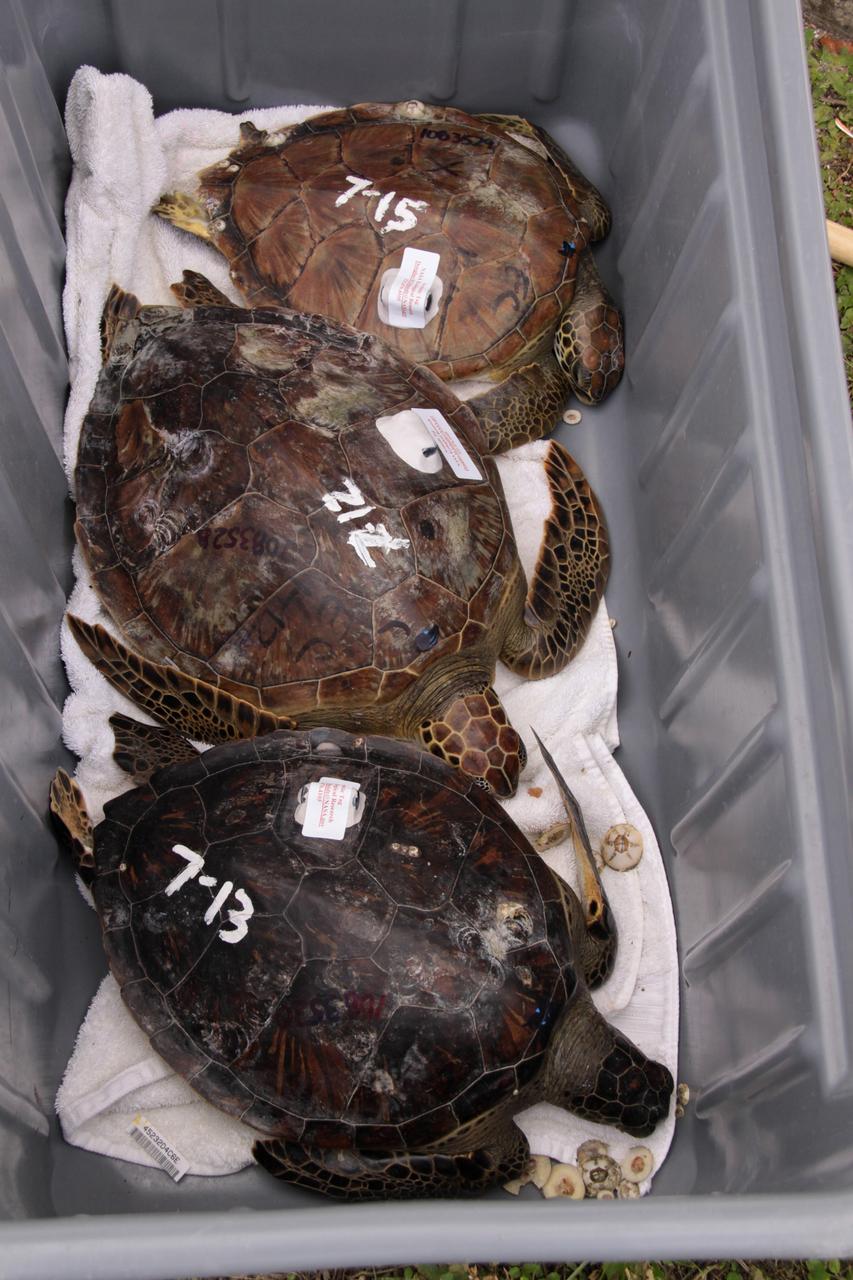
CAPE CANAVERAL, Fla. - A trio of green sea turtles rest in a box at Cape Canaveral Air Force Station in Florida after the animals were outfitted with tracking transmitters. The turtles were some of nearly 2,000 that were "stunned" by the recent drop in temperatures. Many of the turtles were rescued from the Mosquito Lagoon, with others coming from the Indian River Lagoon and Cocoa Beach. Biologists, environmentalists, wildlife experts and other volunteers joined forces with a massive rescue effort at the Merritt Island National Wildlife Refuge, where the turtles were identified, examined and transported to rehabilitation facilities throughout Florida and South Georgia. The animals stayed at these facilities until local waters warmed up to safe temperatures. Photo credit: NASA/Jack Pfaller
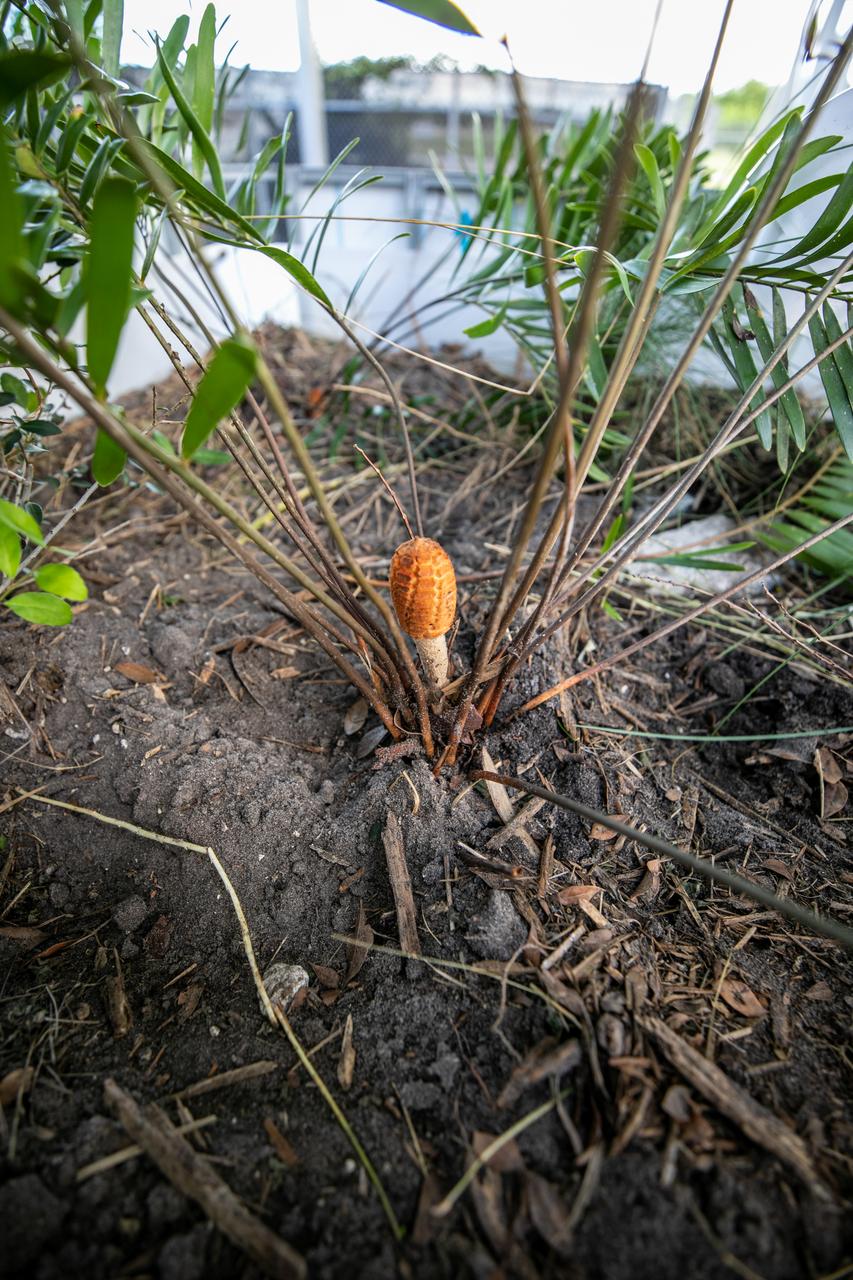
NASA Kennedy Space Center’s unrivaled dedication to the environment is highlighted through a variety of environmental programs and projects. An up-close view of the plants that make up a bio-filter constructed by teams with Kennedy and Jacobs Technology, Inc. is shown on Sept. 29, 2020. The bio-filter – made of layered rock, soil, and native plants – is used to catch and filter zinc out of rainwater that runs off of the roof at the Florida spaceport’s Launch Complex 39 observation tower. Many facilities at Kennedy have galvanized roofs, which contain a coating of zinc to help protect the metal from rust or corrosion but can have serious effects on fish and other aquatic life if it runs into the Indian River Lagoon. The plants in the bio-filter bind to the zinc so that when the water comes out of the bottom, it’s clean and safe to go into the lagoon – its waterline located about 20 to 30 feet away.