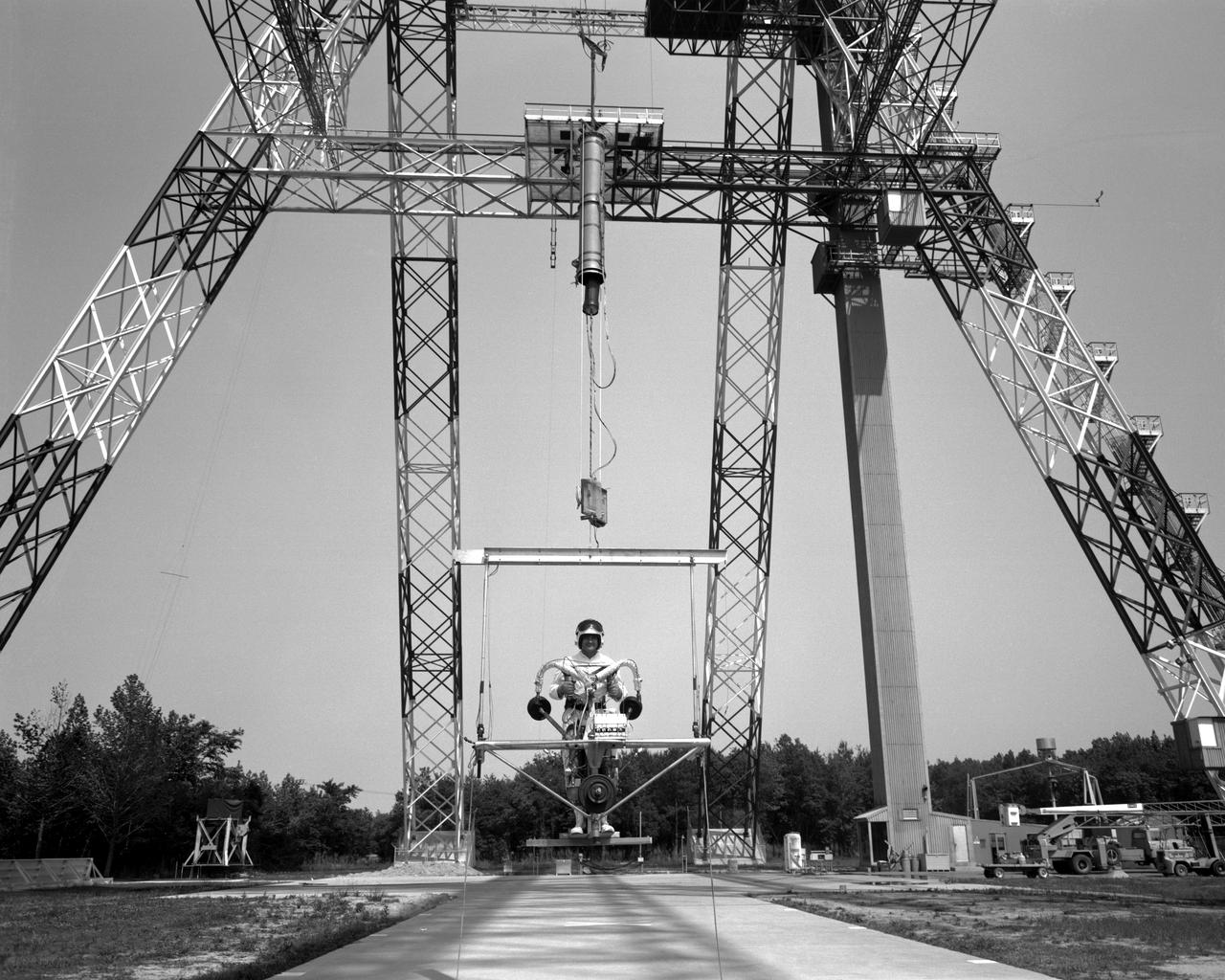
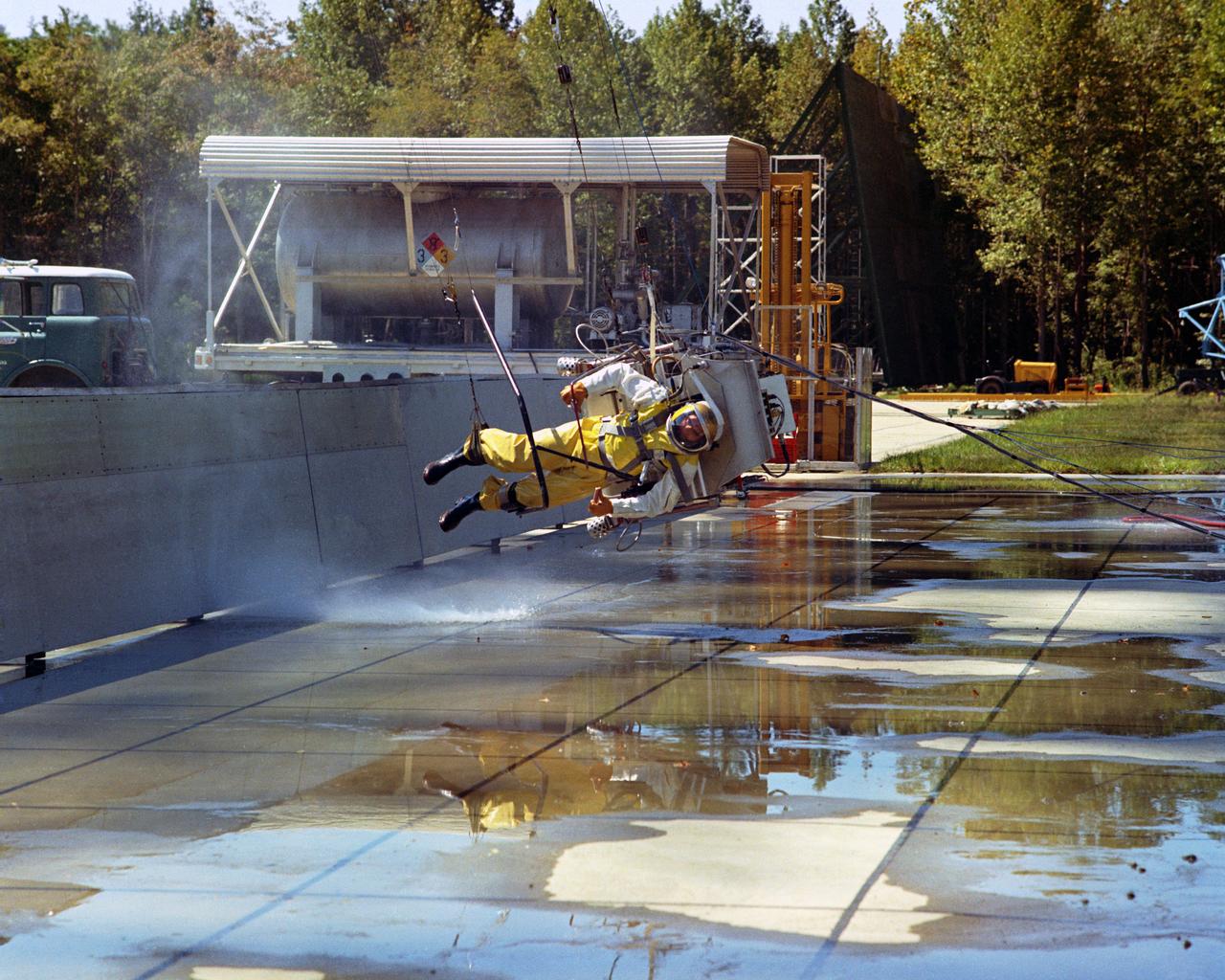
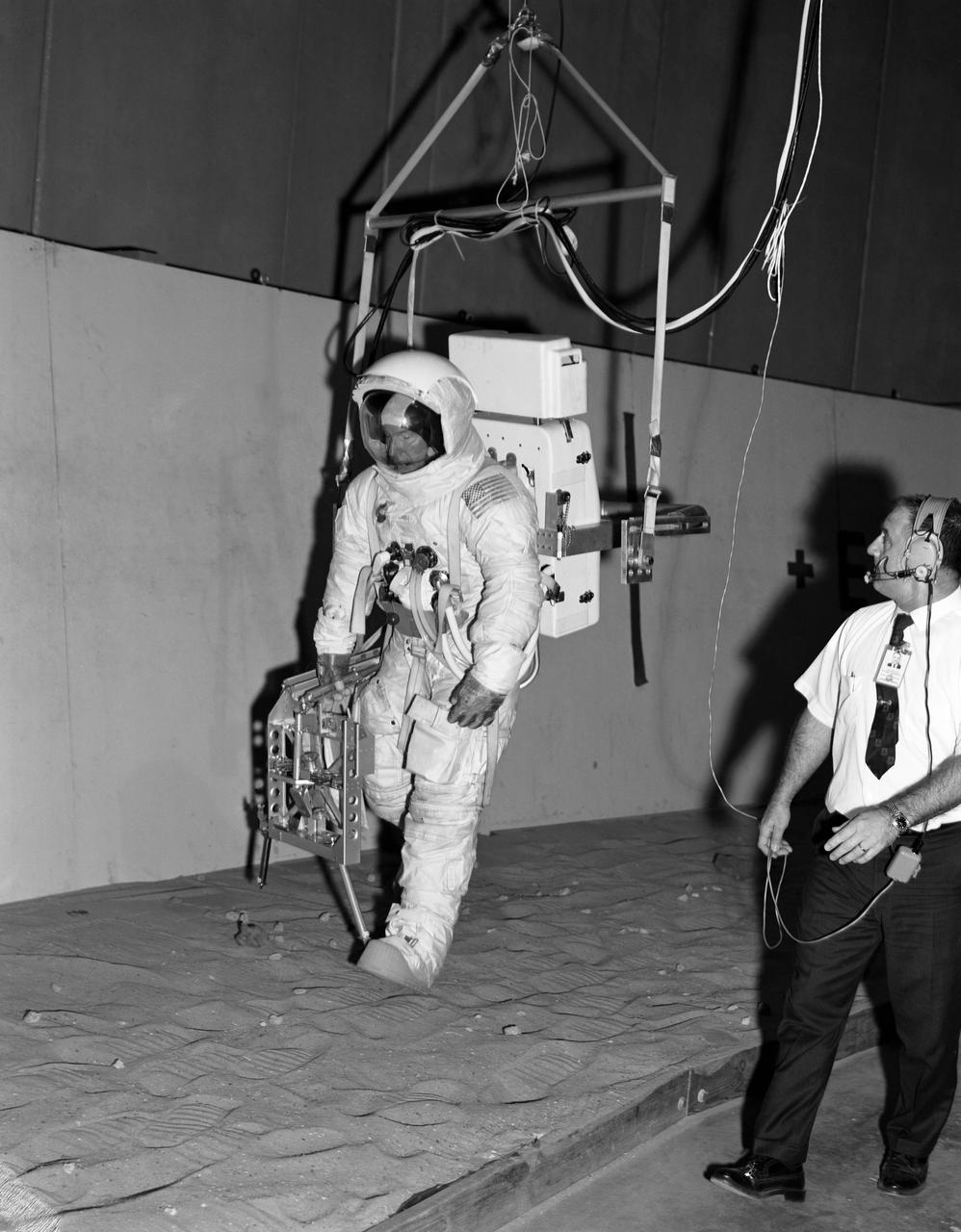
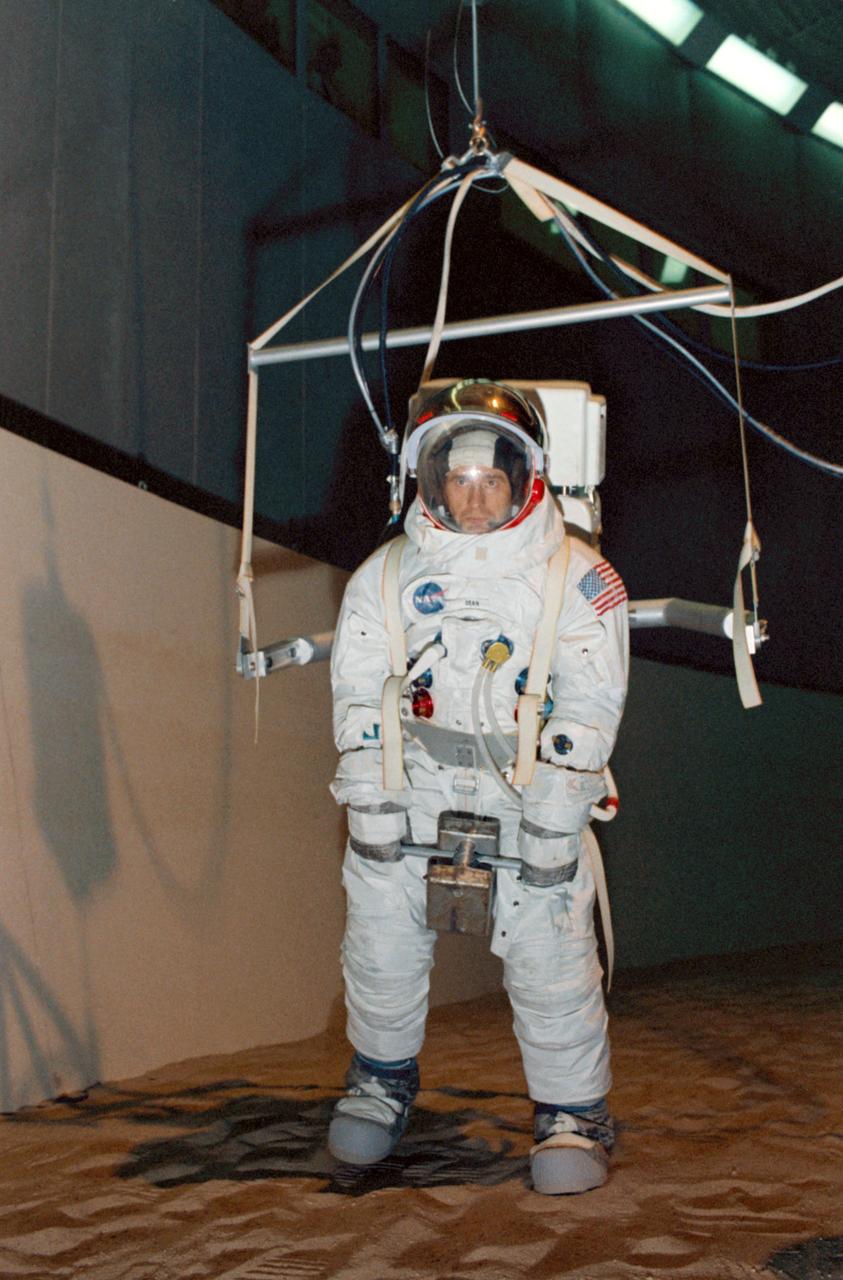
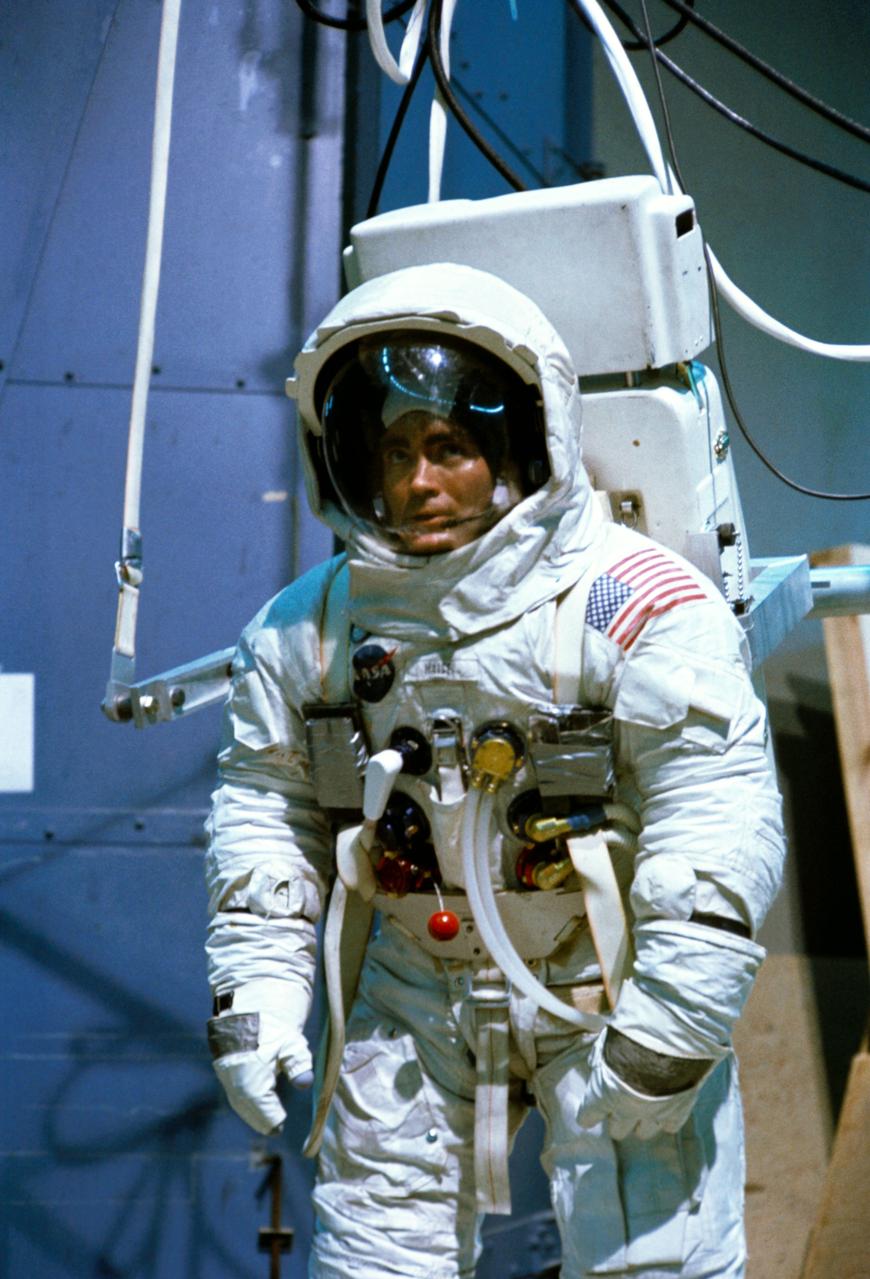
Lunar Landing Walking Simulator: Researchers at Langley study the ability of astronauts to walk, run and perform other tasks required during lunar exploration. The Reduced Gravity Simulator gave researchers the opportunity to look at the effects of one-sixth normal gravity on self-locomotion. Several Apollo astronauts practiced lunar waling at the facility.
Lunar Landing Walking Simulator
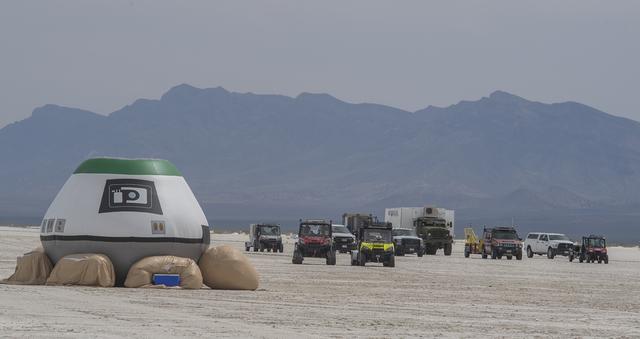
Boeing, NASA and U.S. Army teams rehearse safely bringing the CST-100 Starliner spacecraft home to Earth on Wed., June 6, 2018, at the U.S. Army's White Sands Missile Range in New Mexico. During the detailed landing simulation, engineers, technicians and spaceflight specialists worked through tight timelines and intense heat running through simulations of the spacecraft's landing and recovery, an operation that will cap each Starliner mission. For flight controllers at Mission Control in Houston, the simulation offered the chance to evaluate their own processes and rehearse everything from undocking the Starliner from the space station to communicating with the recovery teams in the field.
Boeing CST-100 Starliner Landing Simulation
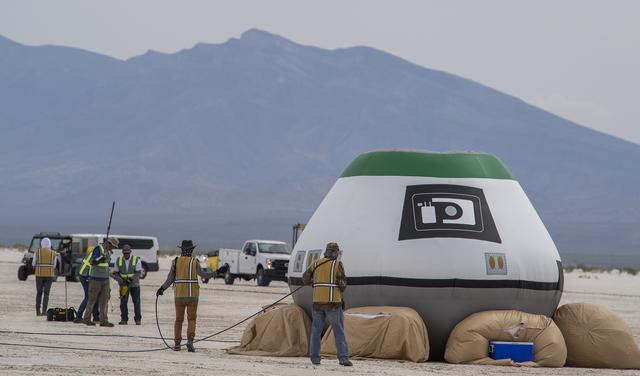
Boeing, NASA and U.S. Army teams rehearse safely bringing the CST-100 Starliner spacecraft home to Earth on Wed., June 6, 2018, at the U.S. Army's White Sands Missile Range in New Mexico. During the detailed landing simulation, engineers, technicians and spaceflight specialists worked through tight timelines and intense heat running through simulations of the spacecraft's landing and recovery, an operation that will cap each Starliner mission. For flight controllers at Mission Control in Houston, the simulation offered the chance to evaluate their own processes and rehearse everything from undocking the Starliner from the space station to communicating with the recovery teams in the field.
Boeing CST-100 Starliner Landing Simulation
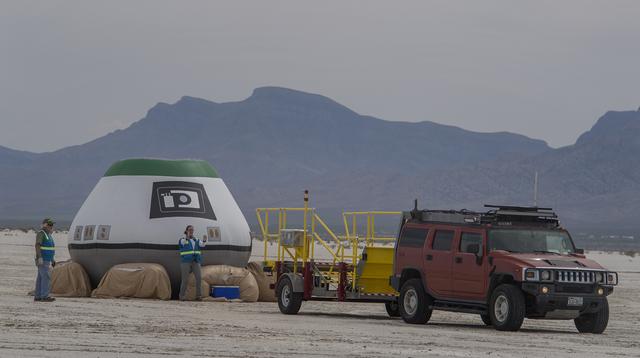
Boeing, NASA and U.S. Army teams rehearse safely bringing the CST-100 Starliner spacecraft home to Earth on Wed., June 6, 2018, at the U.S. Army's White Sands Missile Range in New Mexico. During the detailed landing simulation, engineers, technicians and spaceflight specialists worked through tight timelines and intense heat running through simulations of the spacecraft's landing and recovery, an operation that will cap each Starliner mission. For flight controllers at Mission Control in Houston, the simulation offered the chance to evaluate their own processes and rehearse everything from undocking the Starliner from the space station to communicating with the recovery teams in the field.
Boeing CST-100 Starliner Landing Simulation
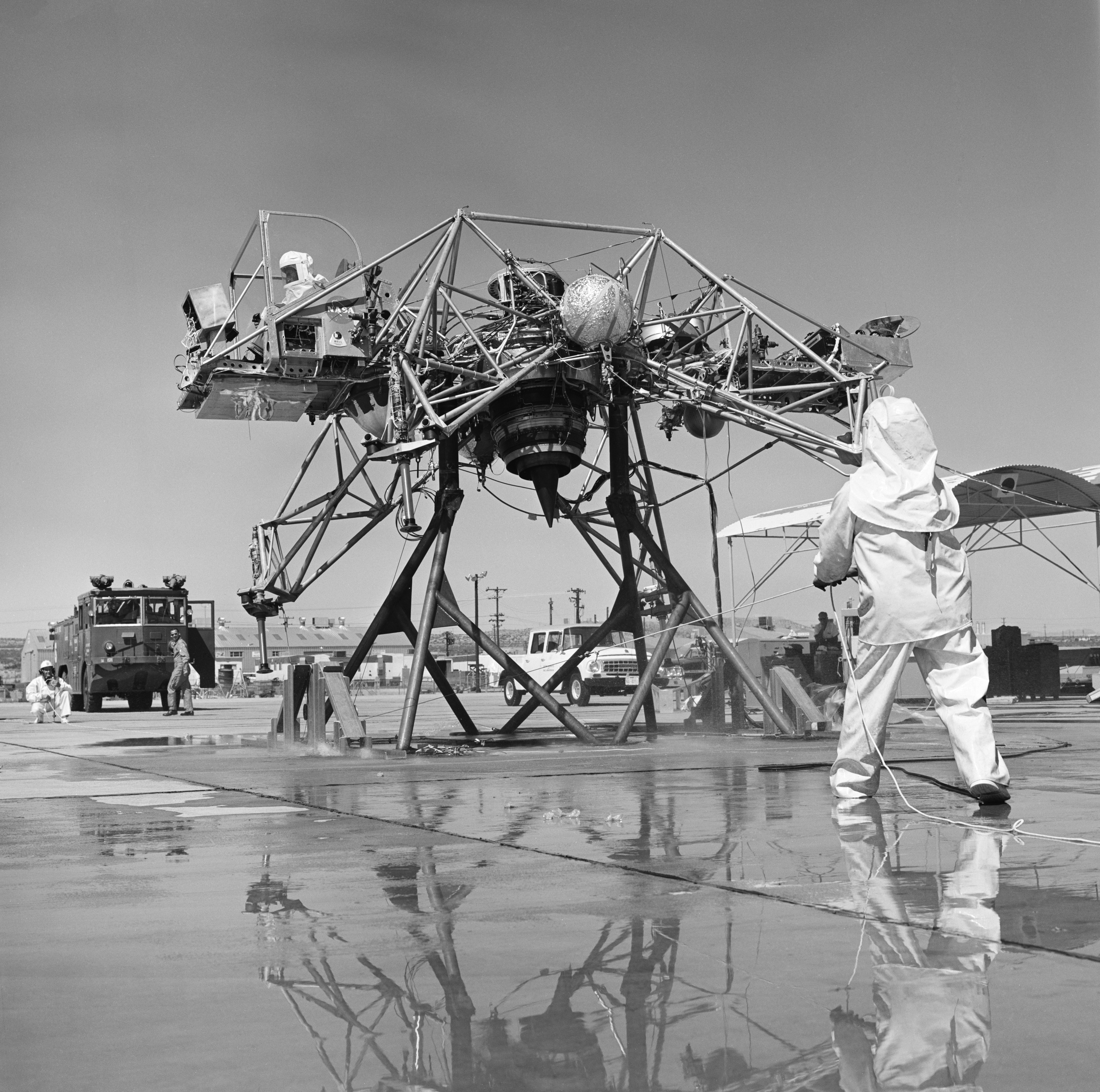
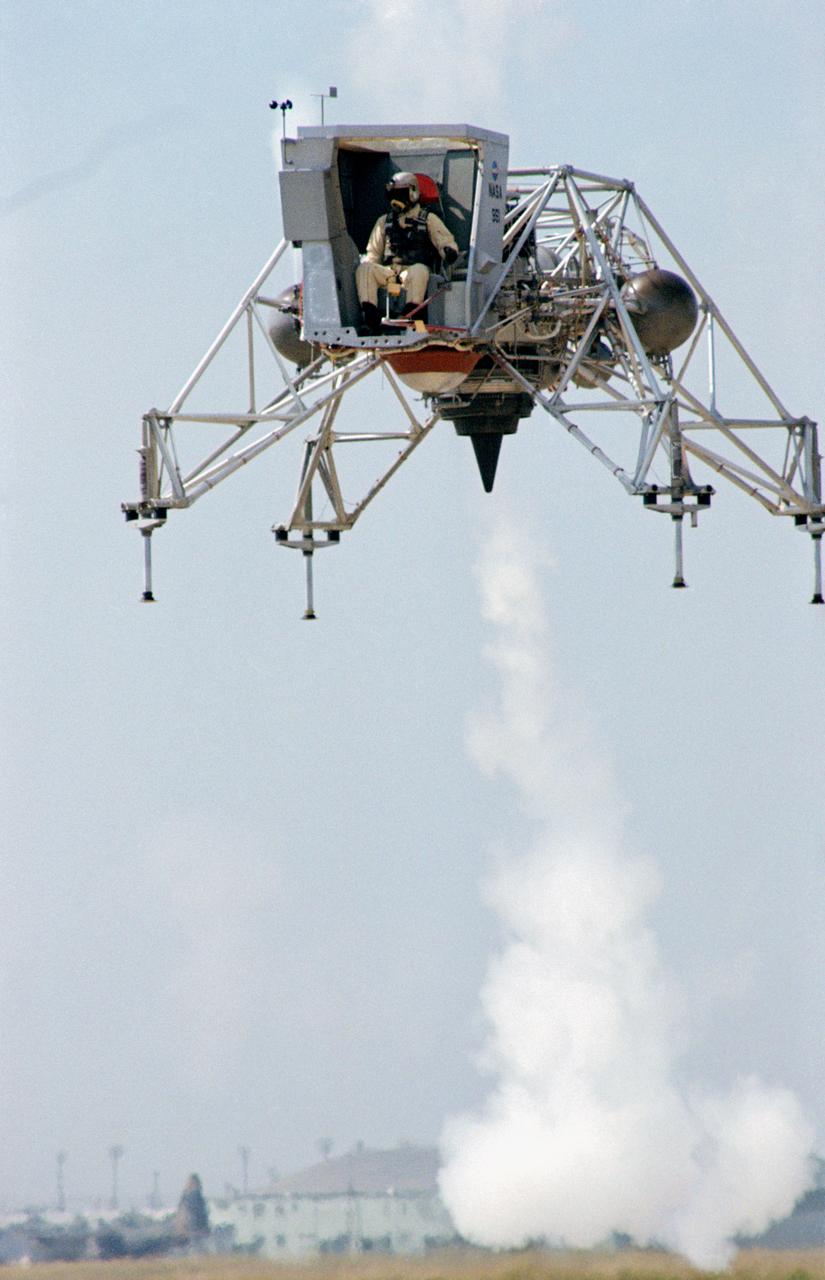
Mechanics are dressed in fire suits because the Lunar Landing Research Vehicle, a simulator to train astronauts for a moon landing, had 90% pure hydrogen peroxide thrusters.
LLVR Simulator
POGO is a device that uses cables connected to the ceiling to suspend an astronaut. POGO supports five-sixths of a person's weight; it mimics the one-sixth gravity of the moon. An astronaut walking around on POGO has the sensation of walking on the moon. POGO has been around since the Apollo days - in fact, the device gets its name from the way Apollo astronauts tended to bounce when suspended from it. The real name for POGO is the Partial Gravity Simulator.
POGO Partial Gravity Simulator at Lunar Landing Facility
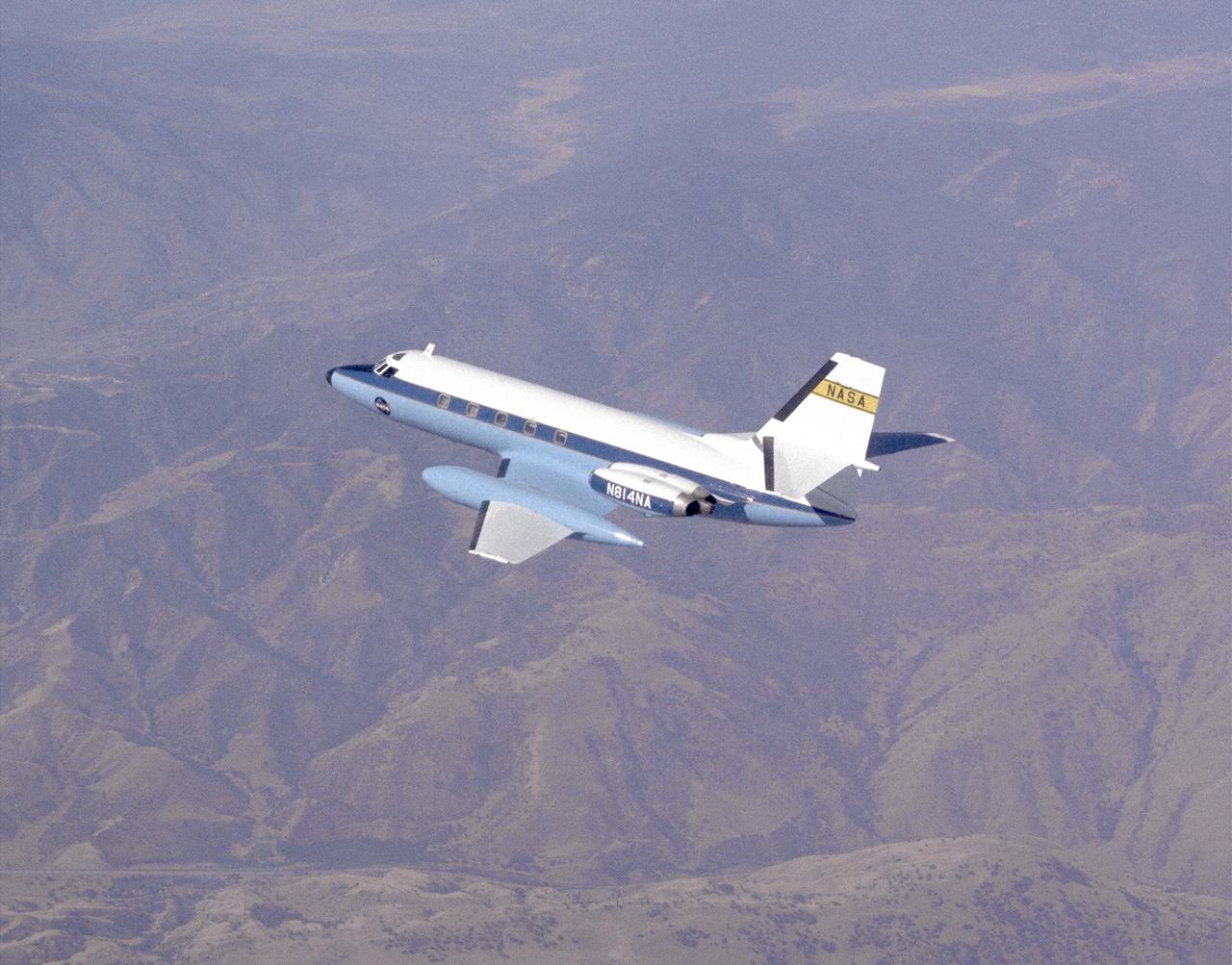
The C-140 JetStar was reconfigured as the General Purpose Airborne Simulator (GPAS) to simulate the flight characteristics of other aircraft. The JetStar was used for research for supersonic transports, general aviation aircraft, and as a training support aircraft for the Space Shuttle Approach and Landing tests at Dryden Flight Research Center (under different names) at Edwards, CA, in 1977. One of the engineers on the GPAS program was Ken Szalai, who later became Dryden's director from 1990 to August 1998.
ECN-2478
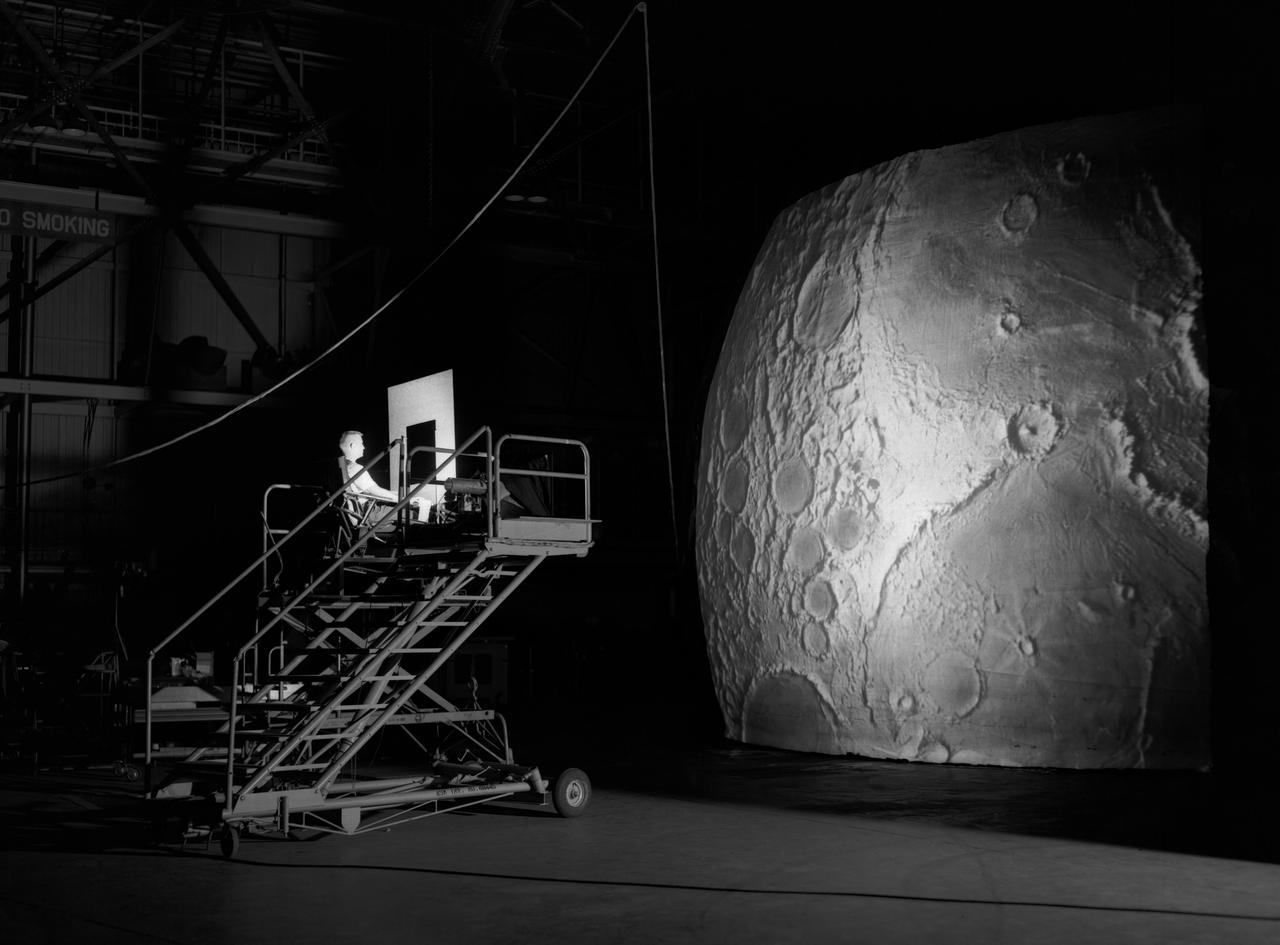
Test subject sitting at the controls: Project LOLA or Lunar Orbit and Landing Approach was a simulator built at Langley to study problems related to landing on the lunar surface. It was a complex project that cost nearly $2 million dollars. James Hansen wrote: "This simulator was designed to provide a pilot with a detailed visual encounter with the lunar surface; the machine consisted primarily of a cockpit, a closed-circuit TV system, and four large murals or scale models representing portions of the lunar surface as seen from various altitudes. The pilot in the cockpit moved along a track past these murals which would accustom him to the visual cues for controlling a spacecraft in the vicinity of the moon. Unfortunately, such a simulation--although great fun and quite aesthetic--was not helpful because flight in lunar orbit posed no special problems other than the rendezvous with the LEM, which the device did not simulate. Not long after the end of Apollo, the expensive machine was dismantled." (p. 379) Ellis J. White further described this simulator in his paper , "Discussion of Three Typical Langley Research Center Simulation Programs," (Paper presented at the Eastern Simulation Council (EAI's Princeton Computation Center), Princeton, NJ, October 20, 1966.) "A typical mission would start with the first cart positioned on model 1 for the translunar approach and orbit establishment. After starting the descent, the second cart is readied on model 2 and, at the proper time, when superposition occurs, the pilot's scene is switched from model 1 to model 2. then cart 1 is moved to and readied on model 3. The procedure continues until an altitude of 150 feet is obtained. The cabin of the LM vehicle has four windows which represent a 45 degree field of view. The projection screens in front of each window represent 65 degrees which allows limited head motion before the edges of the display can be seen. The lunar scene is presented to the pilot by rear projection on the screens with four Schmidt television projectors. The attitude orientation of the vehicle is represented by changing the lunar scene through the portholes determined by the scan pattern of four orthicons. The stars are front projected onto the upper three screens with a four-axis starfield generation (starball) mounted over the cabin and there is a separate starball for the low window." -- Published in James R. Hansen, Spaceflight Revolution: NASA Langley Research Center From Sputnik to Apollo, (Washington: NASA, 1995), p. 379.
Project LOLA or Lunar Orbit and Landing Approach was a simulator built at Langley
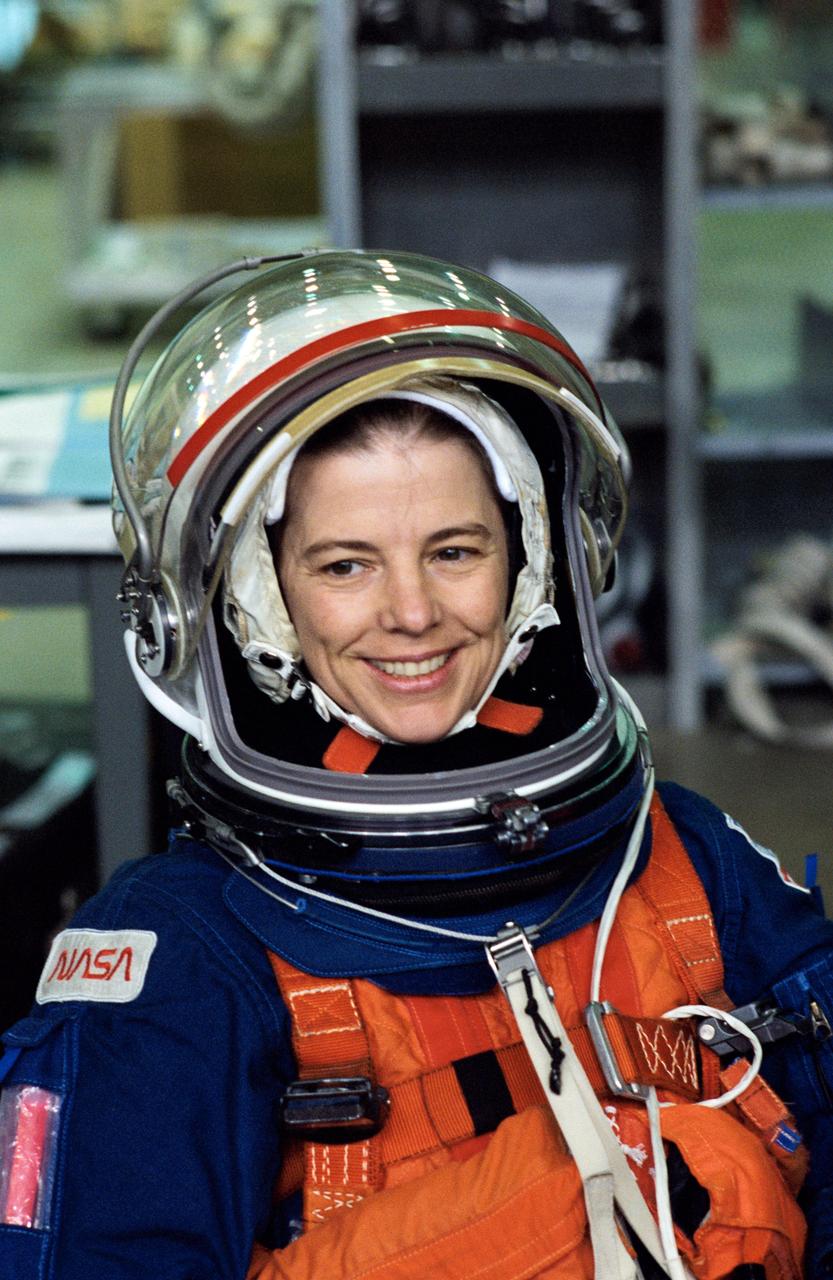
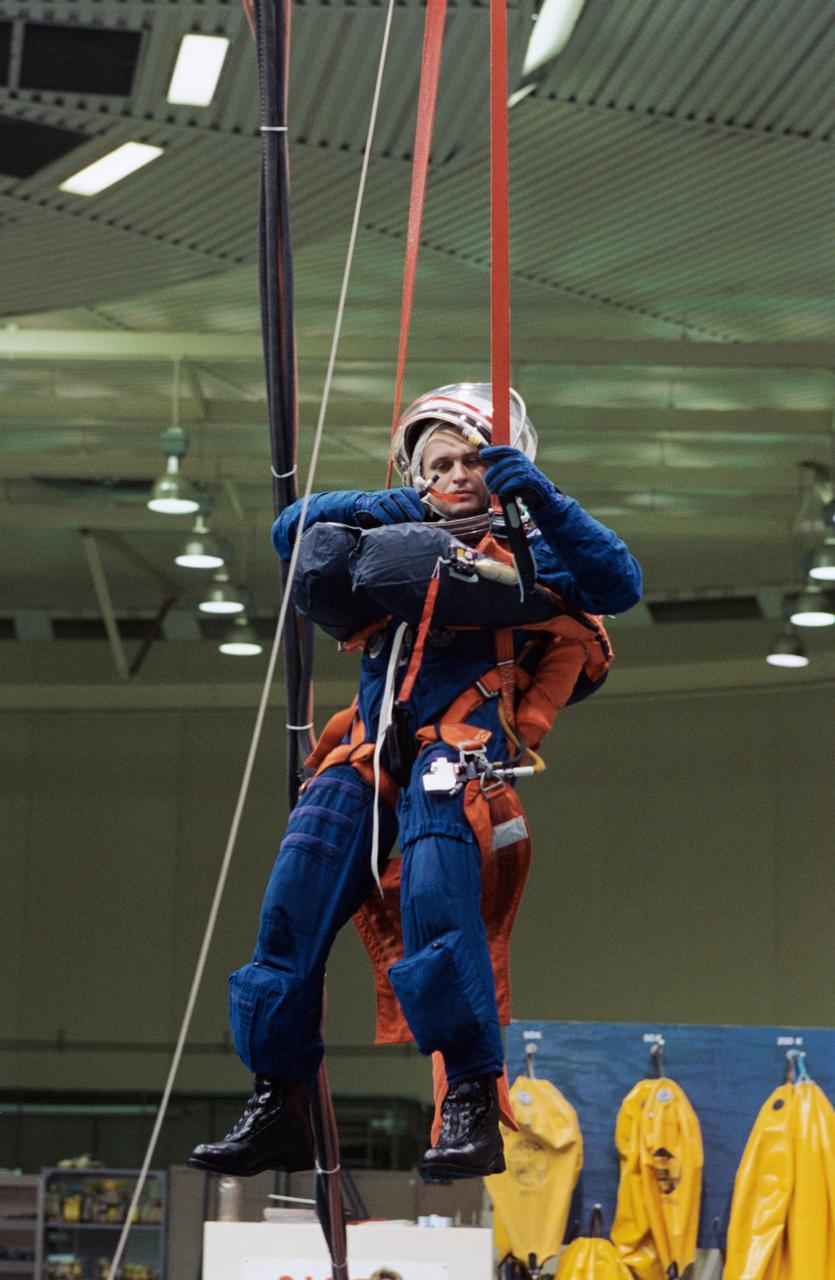
S94-47256 (13 Oct 1994) --- Astronaut Bonnie J. Dunbar, STS-71 mission specialist, smiles as she watches a crew mate (out of frame) make a simulated parachute landing in nearby water. The action came as part of an emergency bailout training session in the Johnson Space Center's (JSC) Weightless Environment Training Facility's (WET-F) 25-feet-deep pool.
Astronaut Bonnie Dunbar watches crewmates during training
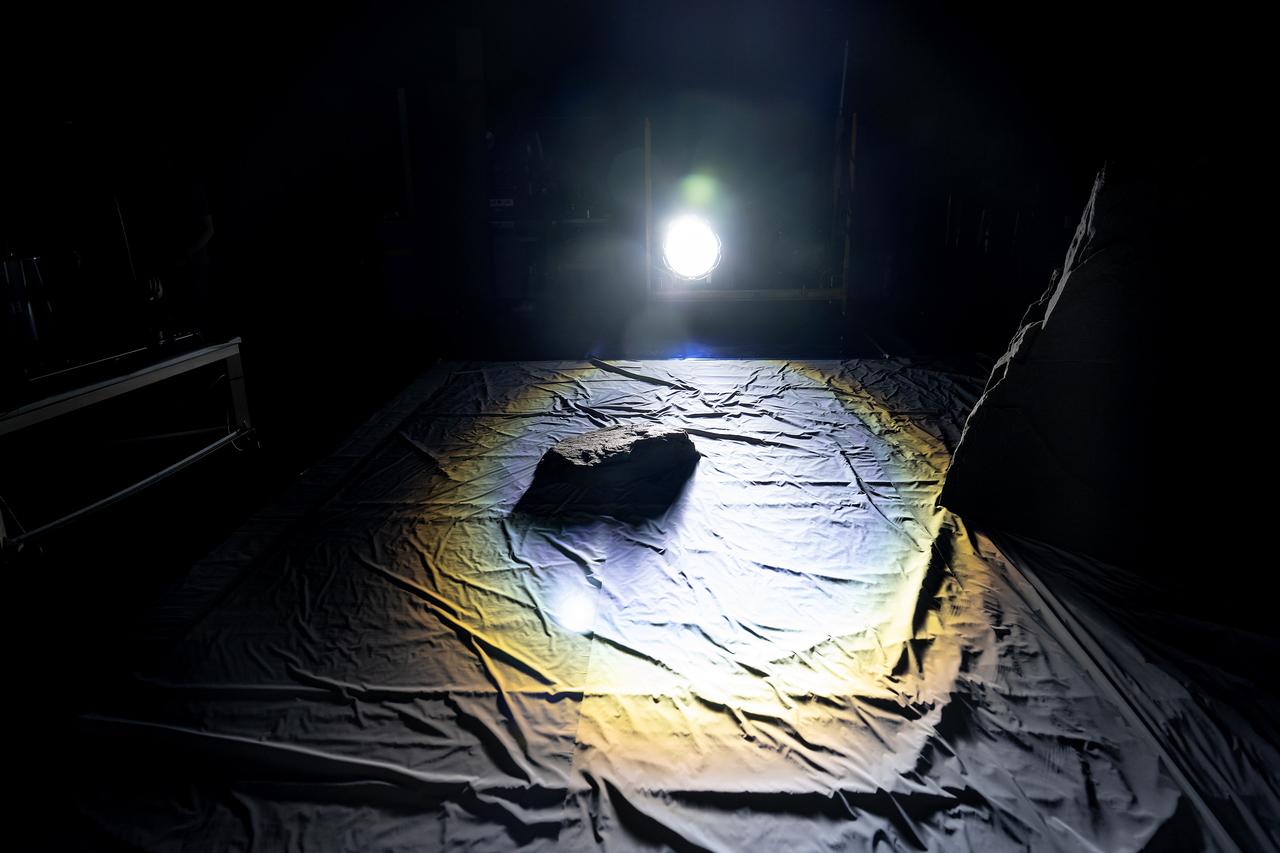
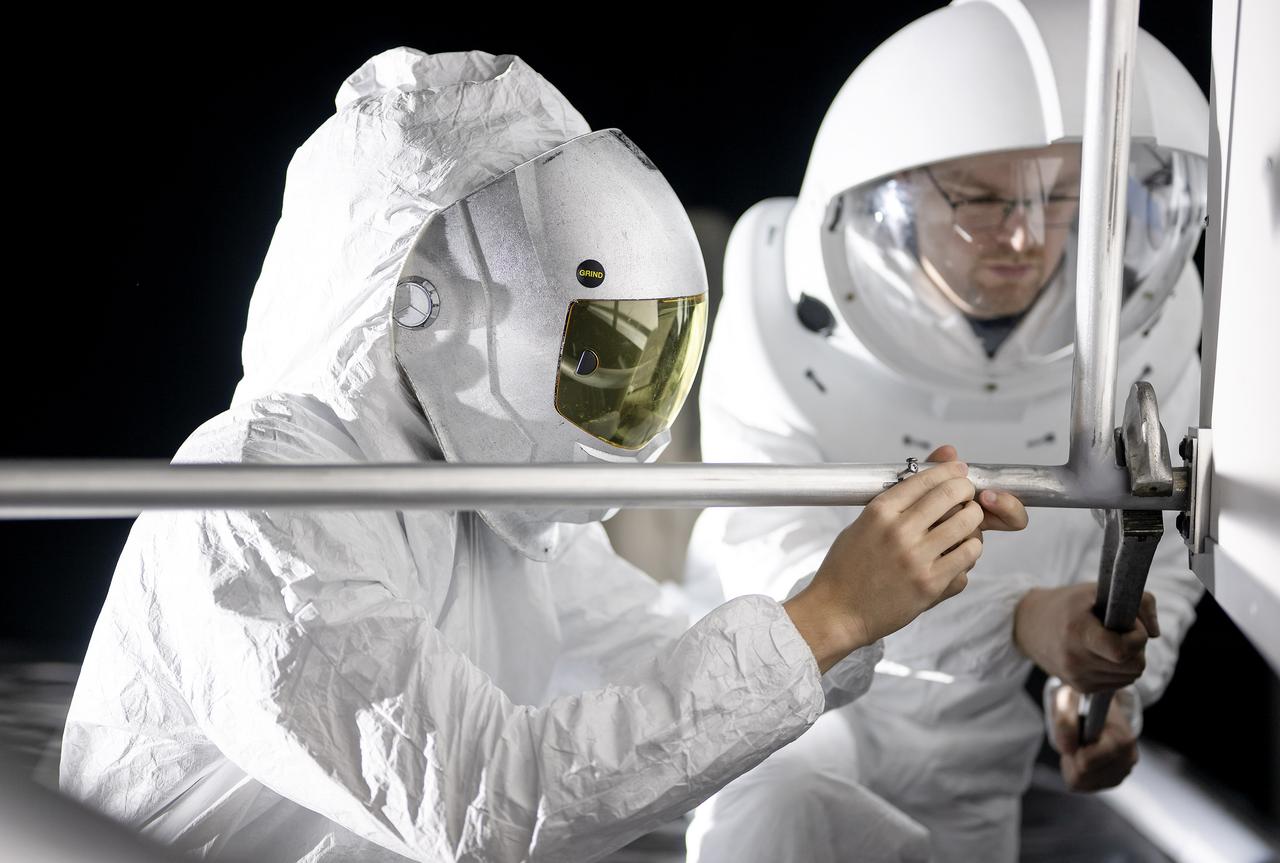
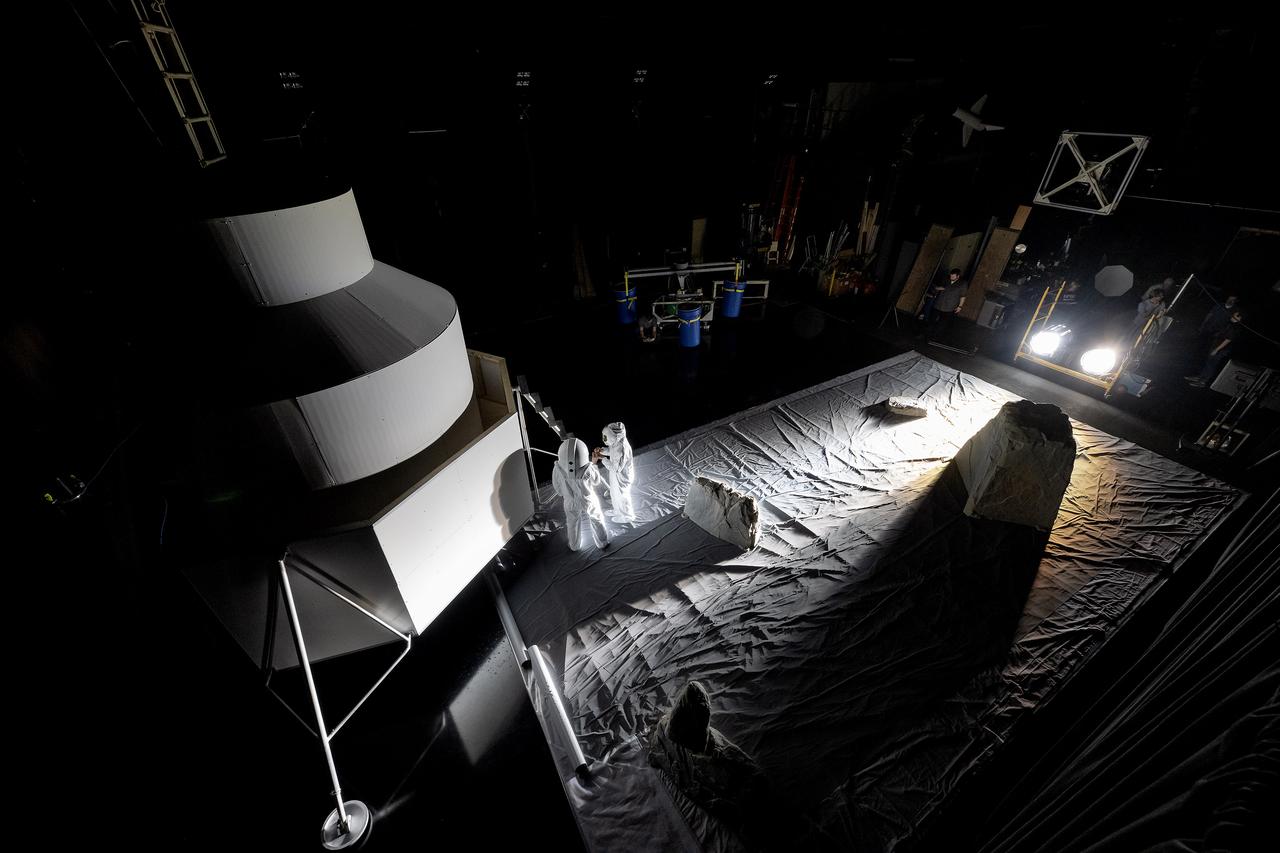
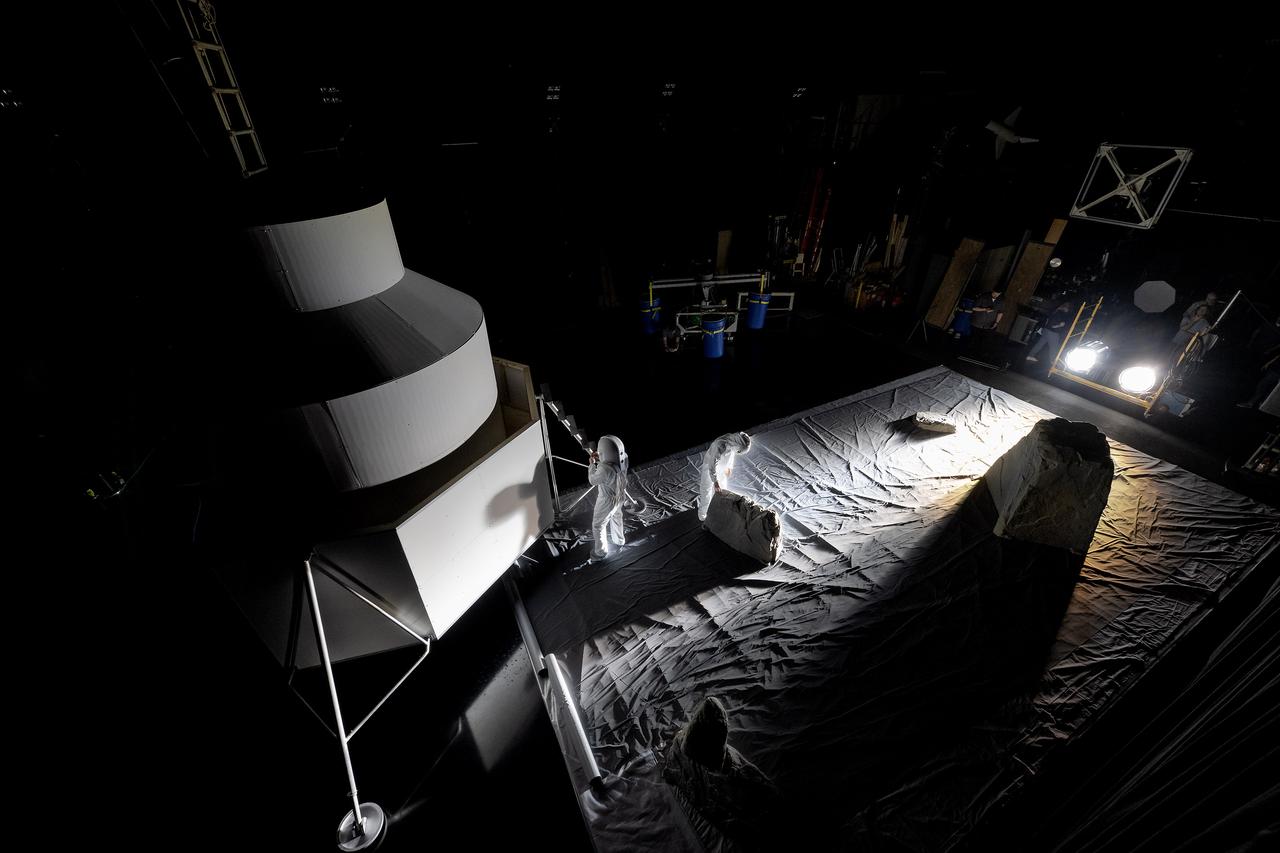
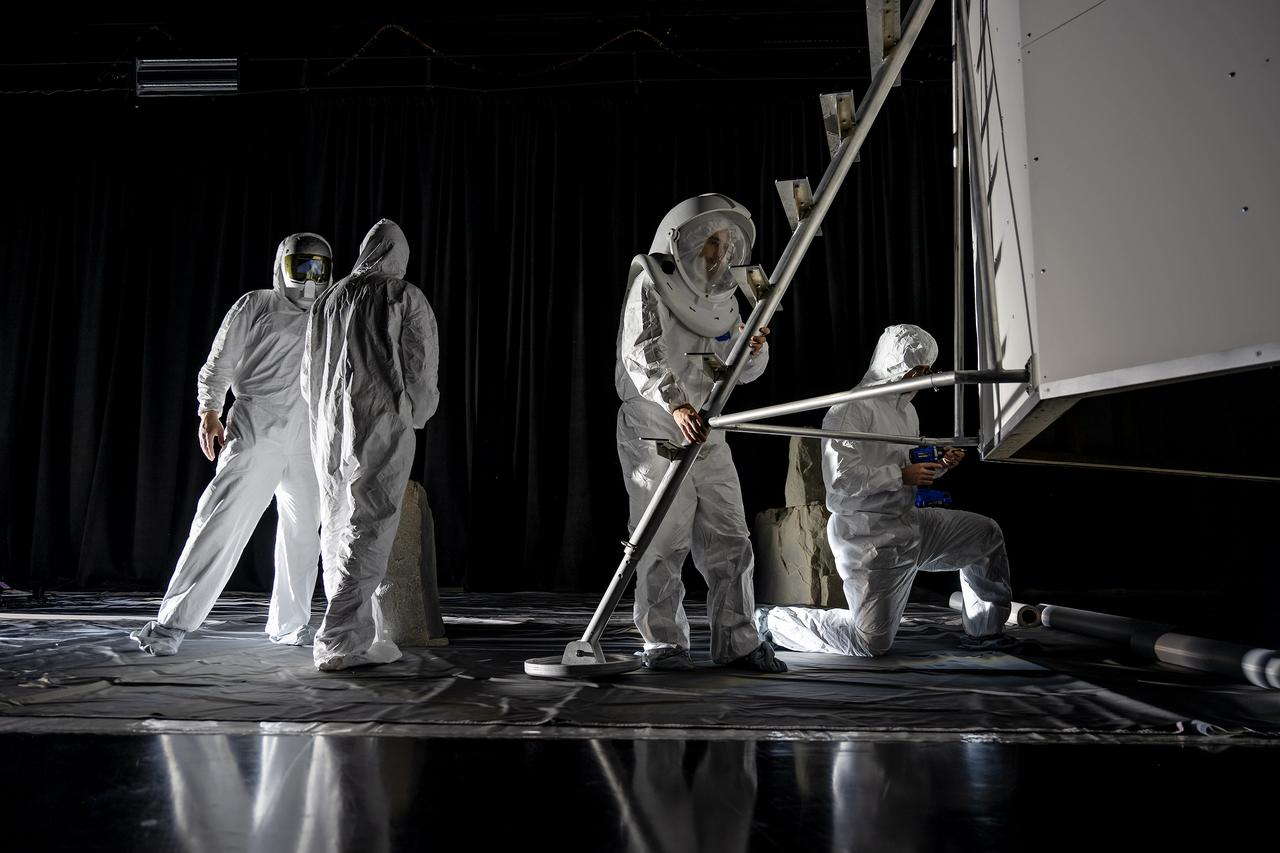
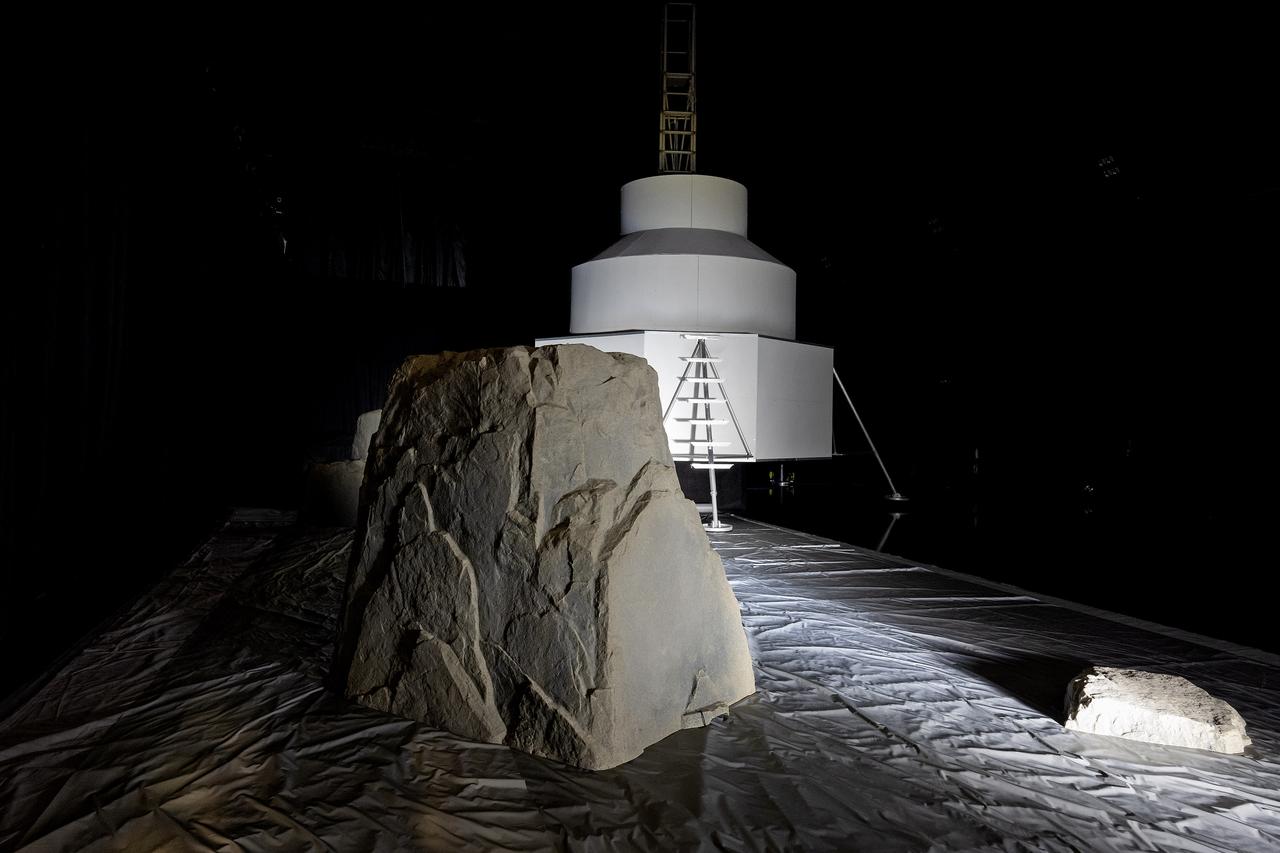
These photos show how teams at NASA’s Marshall Space Flight Center in Huntsville, Alabama, are using the Flat Floor Facility (Building 4619) to understand the lunar lighting environment in preparation for the Artemis III crewed lunar landing mission, slated for 2027. The Flat Floor Facility is an air-bearing floor, providing full-scale simulation capabilities for lunar surface systems by simulating zero gravity in two dimensions. Wearing low-fidelity materials, test engineers can understand how the extreme lighting of the Moon’s South Pole could affect surface operations during Artemis III. High-intensity lights are positioned at a low angle to replicate the strong shadows that are cast across the lunar South Pole by the Sun. Data and analysis from testing at NASA Marshall are improving models Artemis astronauts will use in preparation for lander and surface operations on the Moon during Artemis III. Testing in the facility is also helping cross-agency teams evaluate various tools astronauts may use. NASA Marshall manages the Human Landing System (HLS) Program.  For more information, contact NASA Marshall’s Office of Communications at 256-544-0034.
NASA Engineers Simulate Lunar Lighting for Artemis III Moon Landing
These photos show how teams at NASA’s Marshall Space Flight Center in Huntsville, Alabama, are using the Flat Floor Facility (Building 4619) to understand the lunar lighting environment in preparation for the Artemis III crewed lunar landing mission, slated for 2027. The Flat Floor Facility is an air-bearing floor, providing full-scale simulation capabilities for lunar surface systems by simulating zero gravity in two dimensions. Wearing low-fidelity materials, test engineers can understand how the extreme lighting of the Moon’s South Pole could affect surface operations during Artemis III. High-intensity lights are positioned at a low angle to replicate the strong shadows that are cast across the lunar South Pole by the Sun. Data and analysis from testing at NASA Marshall are improving models Artemis astronauts will use in preparation for lander and surface operations on the Moon during Artemis III. Testing in the facility is also helping cross-agency teams evaluate various tools astronauts may use. NASA Marshall manages the Human Landing System (HLS) Program.  For more information, contact NASA Marshall’s Office of Communications at 256-544-0034.
NASA Engineers Simulate Lunar Lighting for Artemis III Moon Landing
These photos show how teams at NASA’s Marshall Space Flight Center in Huntsville, Alabama, are using the Flat Floor Facility (Building 4619) to understand the lunar lighting environment in preparation for the Artemis III crewed lunar landing mission, slated for 2027. The Flat Floor Facility is an air-bearing floor, providing full-scale simulation capabilities for lunar surface systems by simulating zero gravity in two dimensions. Wearing low-fidelity materials, test engineers can understand how the extreme lighting of the Moon’s South Pole could affect surface operations during Artemis III. High-intensity lights are positioned at a low angle to replicate the strong shadows that are cast across the lunar South Pole by the Sun. Data and analysis from testing at NASA Marshall are improving models Artemis astronauts will use in preparation for lander and surface operations on the Moon during Artemis III. Testing in the facility is also helping cross-agency teams evaluate various tools astronauts may use. NASA Marshall manages the Human Landing System (HLS) Program.  For more information, contact NASA Marshall’s Office of Communications at 256-544-0034.
NASA Engineers Simulate Lunar Lighting for Artemis III Moon Landing
These photos show how teams at NASA’s Marshall Space Flight Center in Huntsville, Alabama, are using the Flat Floor Facility (Building 4619) to understand the lunar lighting environment in preparation for the Artemis III crewed lunar landing mission, slated for 2027. The Flat Floor Facility is an air-bearing floor, providing full-scale simulation capabilities for lunar surface systems by simulating zero gravity in two dimensions. Wearing low-fidelity materials, test engineers can understand how the extreme lighting of the Moon’s South Pole could affect surface operations during Artemis III. High-intensity lights are positioned at a low angle to replicate the strong shadows that are cast across the lunar South Pole by the Sun. Data and analysis from testing at NASA Marshall are improving models Artemis astronauts will use in preparation for lander and surface operations on the Moon during Artemis III. Testing in the facility is also helping cross-agency teams evaluate various tools astronauts may use. NASA Marshall manages the Human Landing System (HLS) Program.  For more information, contact NASA Marshall’s Office of Communications at 256-544-0034.
NASA Engineers Simulate Lunar Lighting for Artemis III Moon Landing
These photos show how teams at NASA’s Marshall Space Flight Center in Huntsville, Alabama, are using the Flat Floor Facility (Building 4619) to understand the lunar lighting environment in preparation for the Artemis III crewed lunar landing mission, slated for 2027. The Flat Floor Facility is an air-bearing floor, providing full-scale simulation capabilities for lunar surface systems by simulating zero gravity in two dimensions. Wearing low-fidelity materials, test engineers can understand how the extreme lighting of the Moon’s South Pole could affect surface operations during Artemis III. High-intensity lights are positioned at a low angle to replicate the strong shadows that are cast across the lunar South Pole by the Sun. Data and analysis from testing at NASA Marshall are improving models Artemis astronauts will use in preparation for lander and surface operations on the Moon during Artemis III. Testing in the facility is also helping cross-agency teams evaluate various tools astronauts may use. NASA Marshall manages the Human Landing System (HLS) Program.  For more information, contact NASA Marshall’s Office of Communications at 256-544-0034.
NASA Engineers Simulate Lunar Lighting for Artemis III Moon Landing
These photos show how teams at NASA’s Marshall Space Flight Center in Huntsville, Alabama, are using the Flat Floor Facility (Building 4619) to understand the lunar lighting environment in preparation for the Artemis III crewed lunar landing mission, slated for 2027. The Flat Floor Facility is an air-bearing floor, providing full-scale simulation capabilities for lunar surface systems by simulating zero gravity in two dimensions. Wearing low-fidelity materials, test engineers can understand how the extreme lighting of the Moon’s South Pole could affect surface operations during Artemis III. High-intensity lights are positioned at a low angle to replicate the strong shadows that are cast across the lunar South Pole by the Sun. Data and analysis from testing at NASA Marshall are improving models Artemis astronauts will use in preparation for lander and surface operations on the Moon during Artemis III. Testing in the facility is also helping cross-agency teams evaluate various tools astronauts may use. NASA Marshall manages the Human Landing System (HLS) Program.  For more information, contact NASA Marshall’s Office of Communications at 256-544-0034.
NASA Engineers Simulate Lunar Lighting for Artemis III Moon Landing
These photos show how teams at NASA’s Marshall Space Flight Center in Huntsville, Alabama, are using the Flat Floor Facility (Building 4619) to understand the lunar lighting environment in preparation for the Artemis III crewed lunar landing mission, slated for 2027. The Flat Floor Facility is an air-bearing floor, providing full-scale simulation capabilities for lunar surface systems by simulating zero gravity in two dimensions. Wearing low-fidelity materials, test engineers can understand how the extreme lighting of the Moon’s South Pole could affect surface operations during Artemis III. High-intensity lights are positioned at a low angle to replicate the strong shadows that are cast across the lunar South Pole by the Sun. Data and analysis from testing at NASA Marshall are improving models Artemis astronauts will use in preparation for lander and surface operations on the Moon during Artemis III. Testing in the facility is also helping cross-agency teams evaluate various tools astronauts may use. NASA Marshall manages the Human Landing System (HLS) Program.  For more information, contact NASA Marshall’s Office of Communications at 256-544-0034.
NASA Engineers Simulate Lunar Lighting for Artemis III Moon Landing
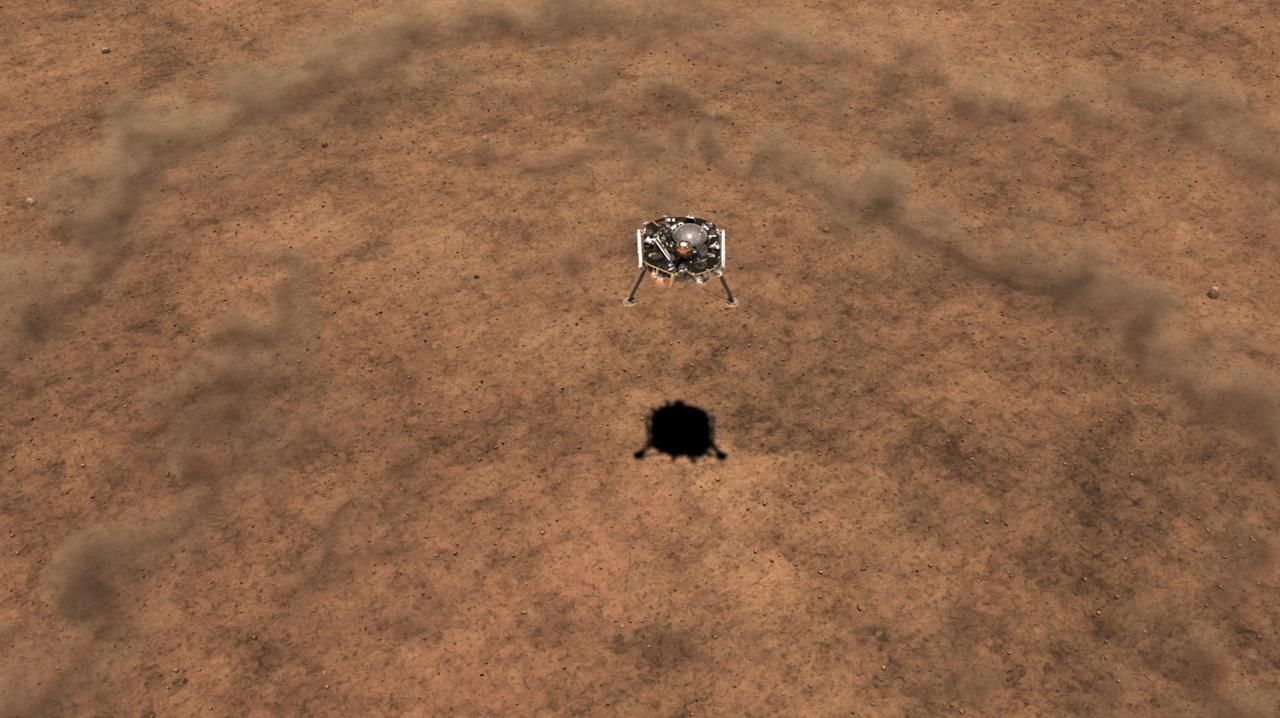
This illustration shows a simulated view of NASA's InSight lander kicking up dust as it lands on the Martian surface.  https://photojournal.jpl.nasa.gov/catalog/PIA22811
InSight Touching Down on Mars (Illustration)
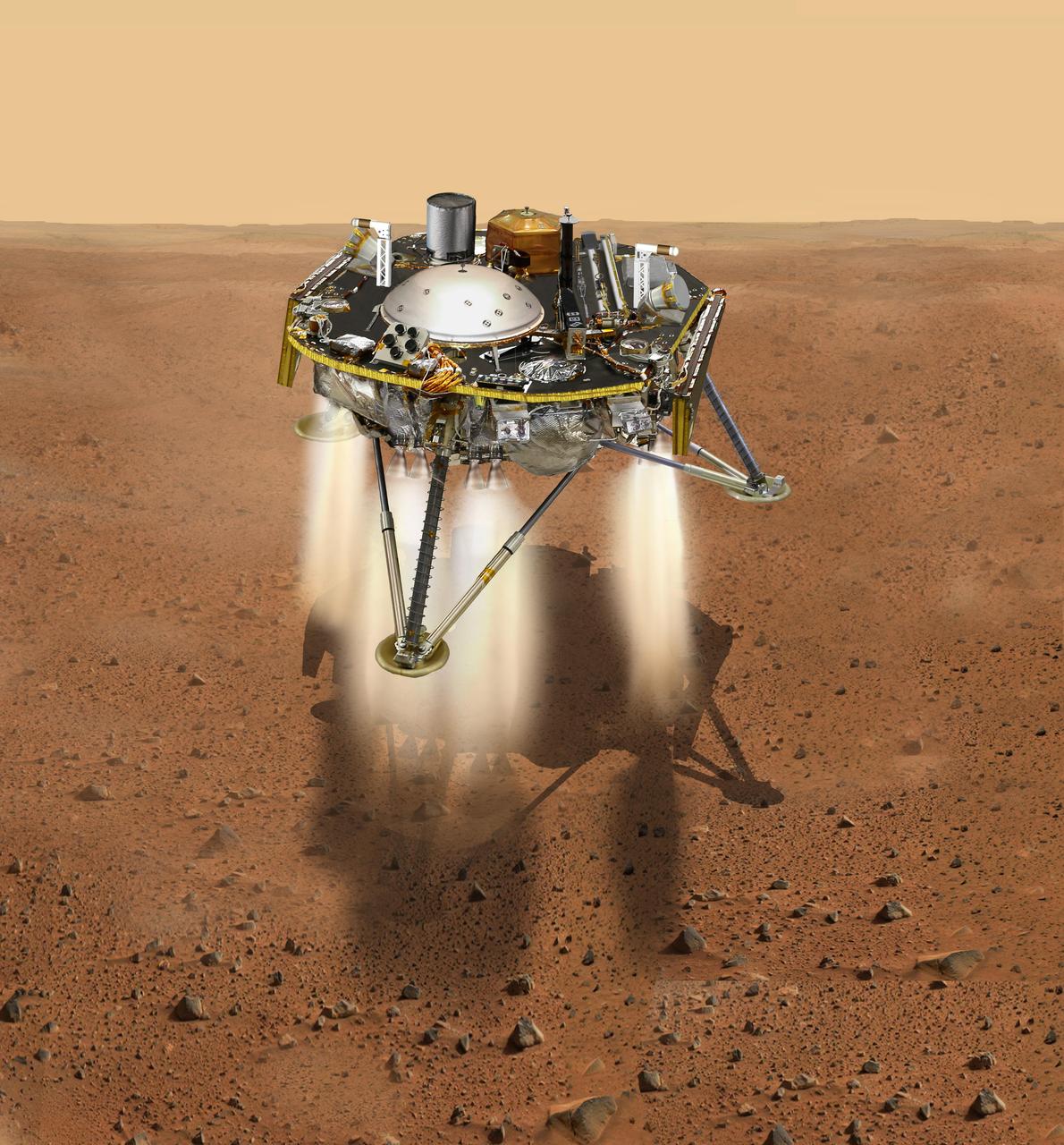
This is an illustration showing a simulated view of NASA's InSight about to land on the surface of Mars. This view shows the top of the spacecraft.  https://photojournal.jpl.nasa.gov/catalog/PIA22813
InSight Moments Away From Landing, Top View (Illustration)
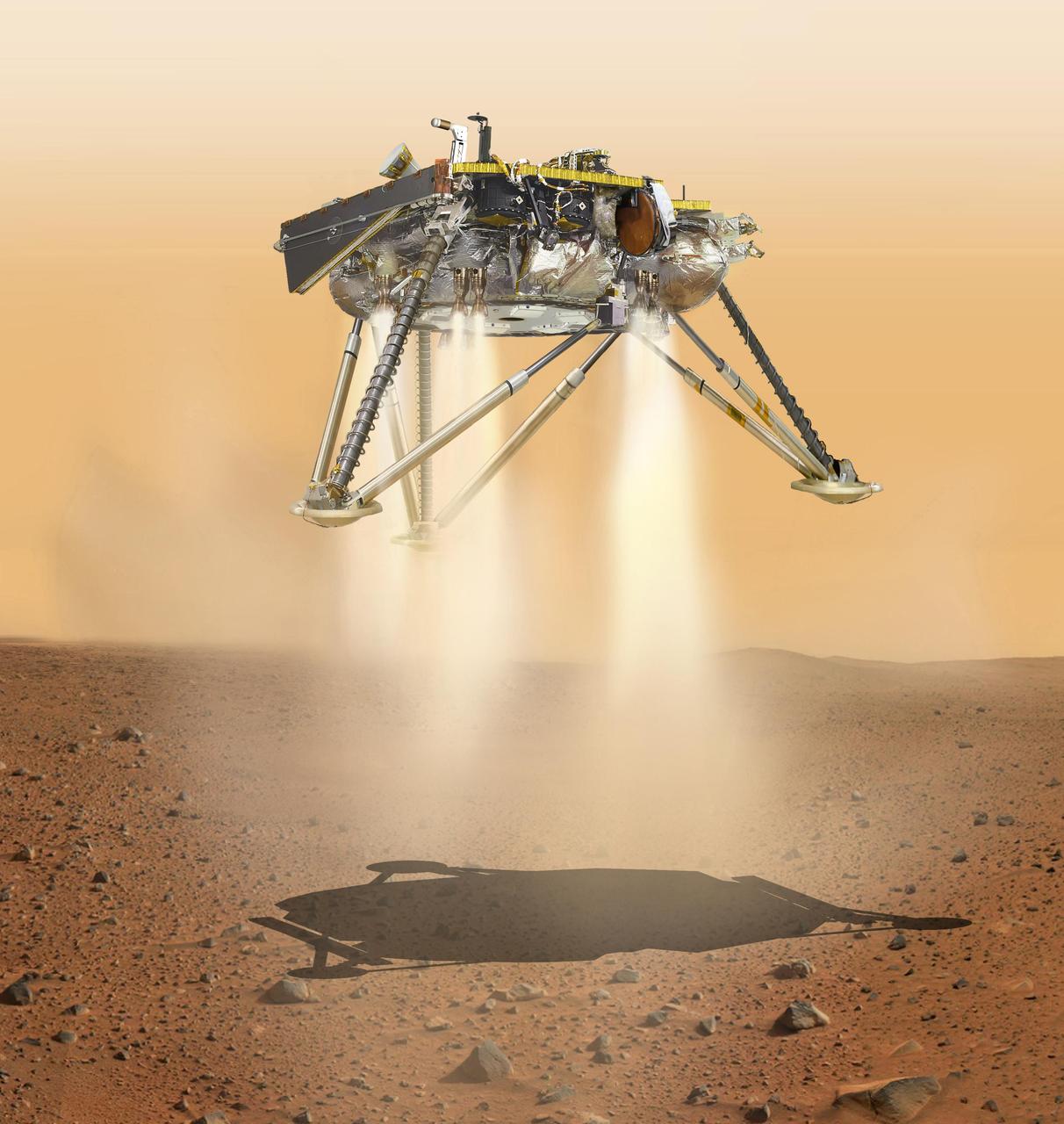
This is an illustration showing a simulated view of NASA's InSight lander about to land on the surface of Mars. This view shows the underside of the spacecraft.  https://photojournal.jpl.nasa.gov/catalog/PIA22812
InSight Moments Away From Landing, Underside View (Illustration)
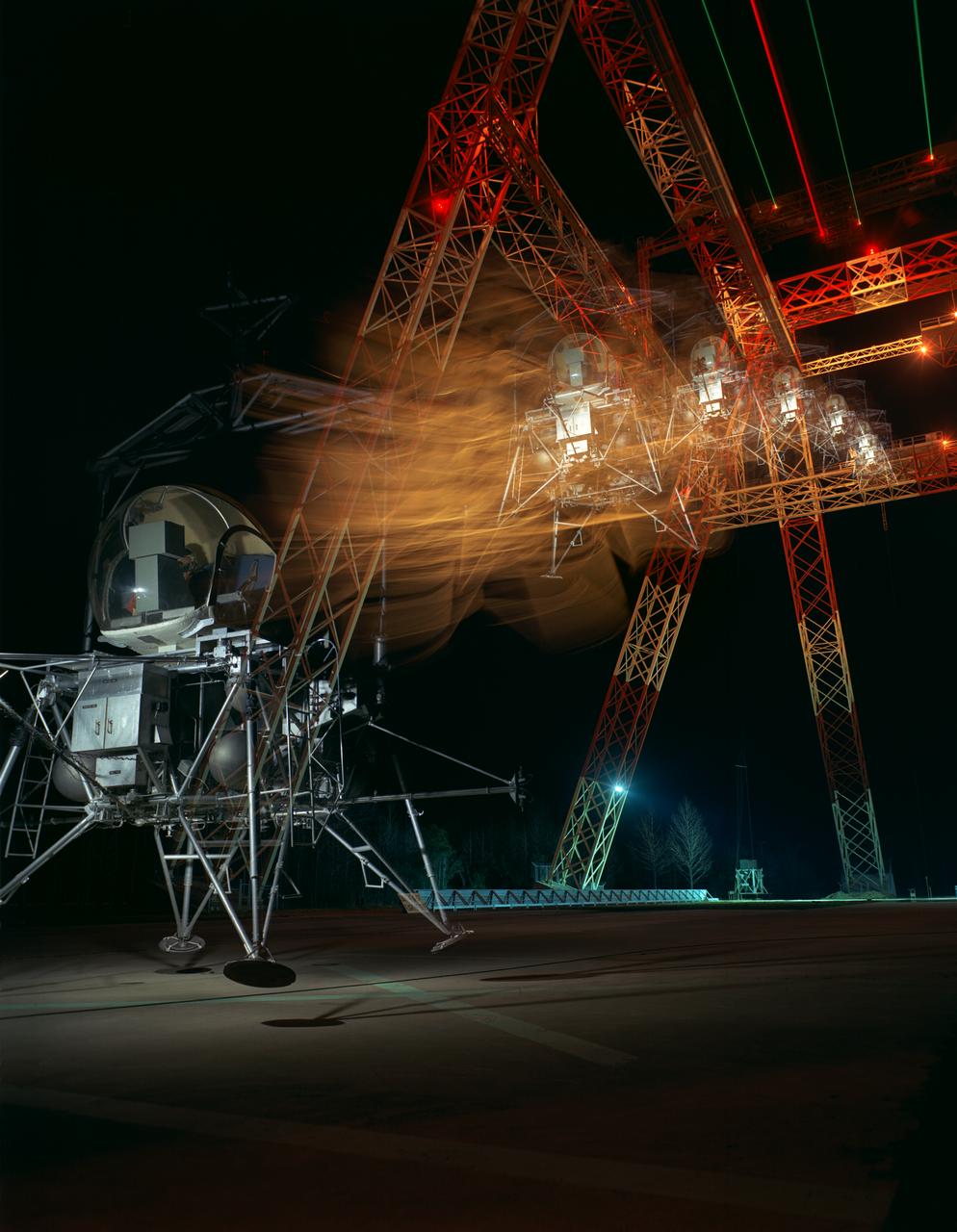
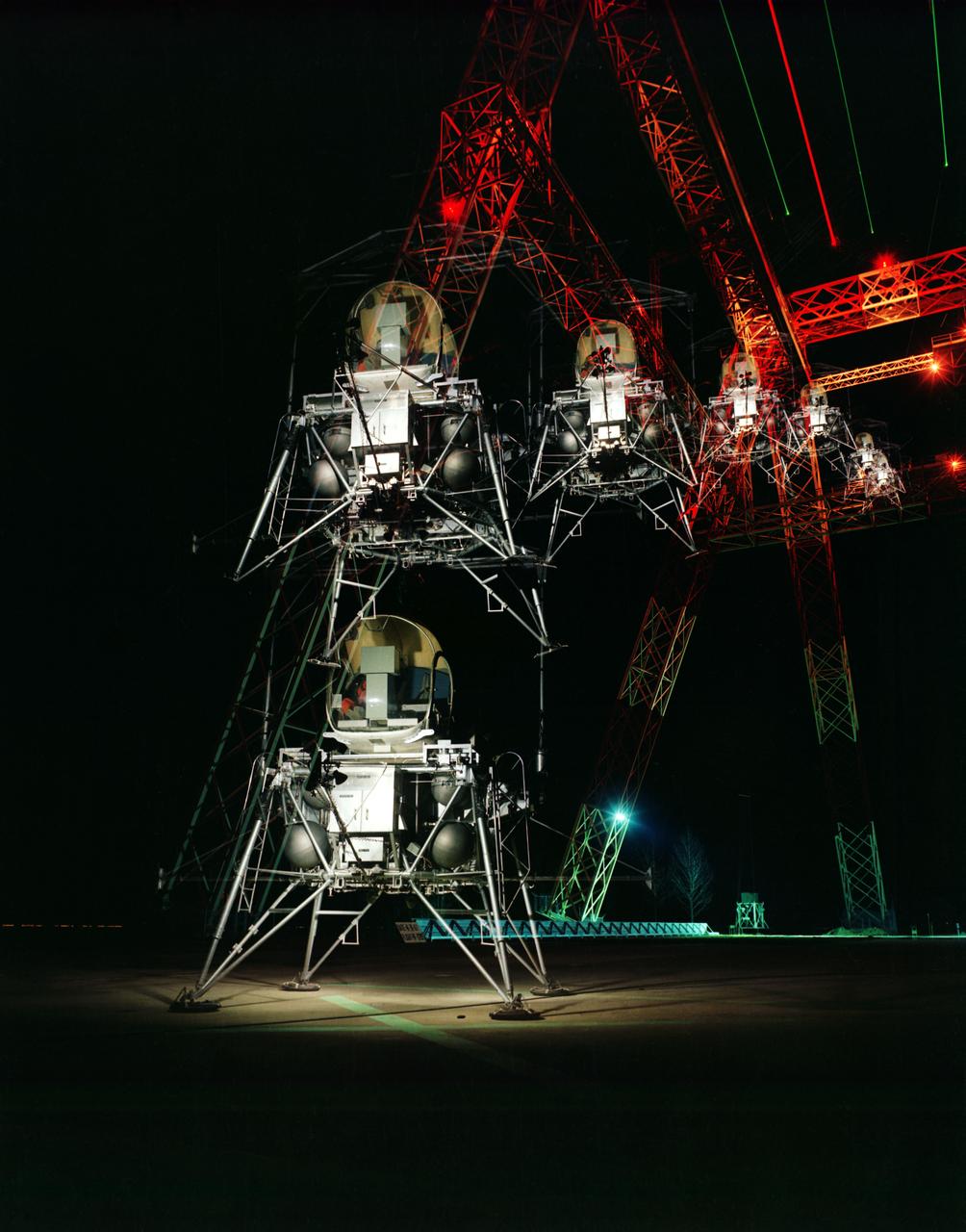
During a nighttime training session, a multiple exposure captures the movement of the Lunar Excursion Module Simulator (LEMS). The LEMS was a manned vehicle used to familiarize the Apollo astronauts with the handling characteristics of lunar-landing type vehicle.  The Apollo Program is best known for the astronaut Neal Armstrong s first step on the Moon July 20, 1969. In its earliest test period, the LEMS featured a helicopter crew cabin atop the lunar landing module. Later, the helicopter crew cabin was replaced with a stand-up rectangular cabin which was more efficient for controlling maneuvers and for better viewing by the pilot.  The vehicle was designed at Langley Research Center in Hampton, VA.  This multiple exposure shows a simulated Moon landing of the (LEMS) trainer at Langley s Lunar Landing Research Facility.  -- Photograph published in Winds of Change, 75th Anniversary NASA publication (page 70), by James Shultz. Also published in  " A Century at Langley" by Joseph Chambers, pg. 93.
Lunar Lander night sequence (Langley)
During a nighttime training session, a multiple exposure captures the movement of the Lunar Excursion Module Simulator (LEMS). The LEMS was a manned vehicle used to familiarize the Apollo astronauts with the handling characteristics of lunar-landing type vehicle.  The Apollo Program is best known for the astronaut Neal Armstrong s first step on the Moon July 20, 1969. In its earliest test period, the LEMS featured a helicopter crew cabin atop the lunar landing module. Later, the helicopter crew cabin was replaced with a stand-up rectangular cabin which was more efficient for controlling maneuvers and for better viewing by the pilot.  The vehicle was designed at Langley Research Center in Hampton, VA.  This multiple exposure shows a simulated Moon landing of the (LEMS) trainer at Langley s Lunar Landing Research Facility.  -- Photograph published in Winds of Change, 75th Anniversary NASA publication (page 70), by James Shultz. Also published in  " A Century at Langley" by Joseph Chambers, pg. 93.
Lunar Lander night sequence (Langley)
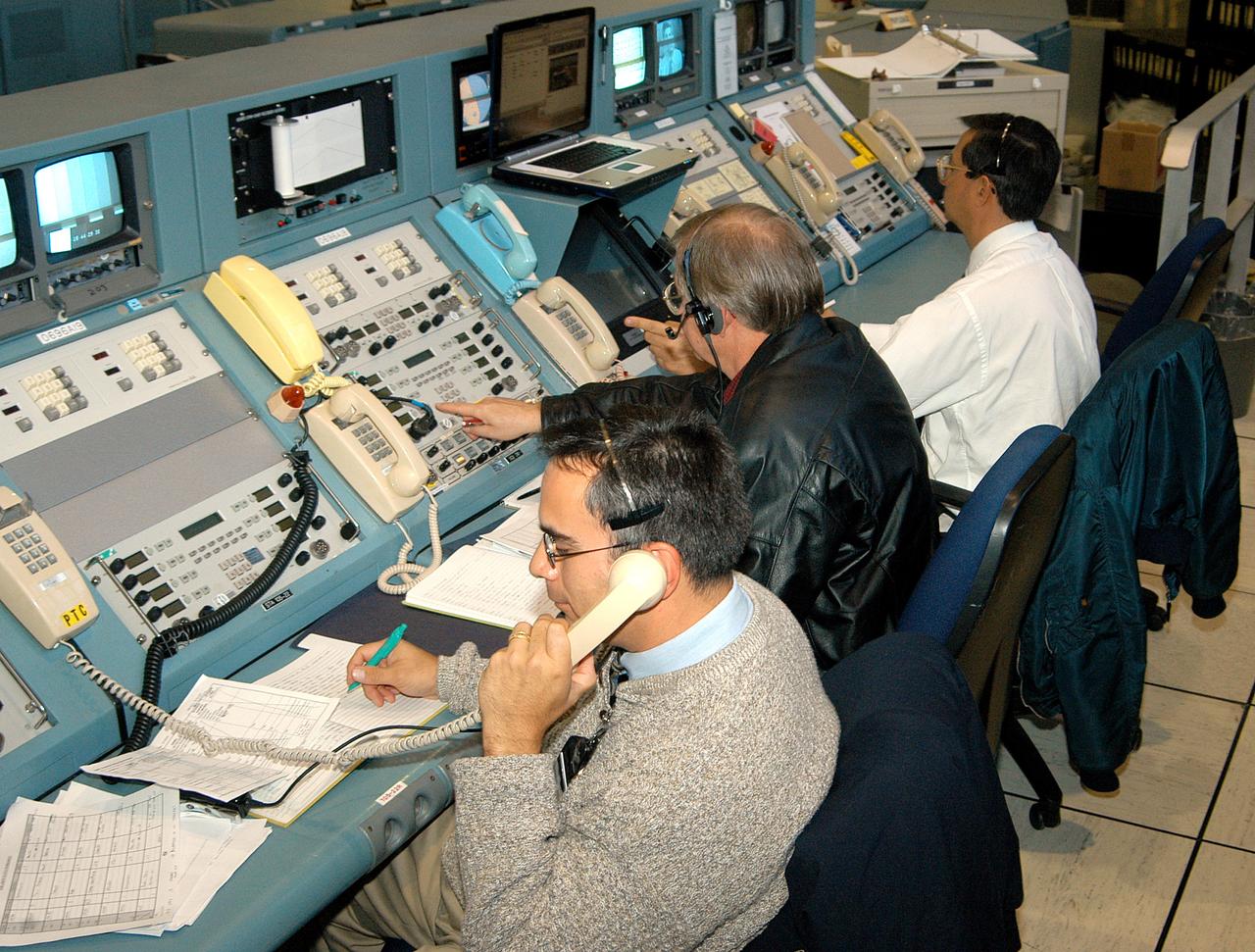
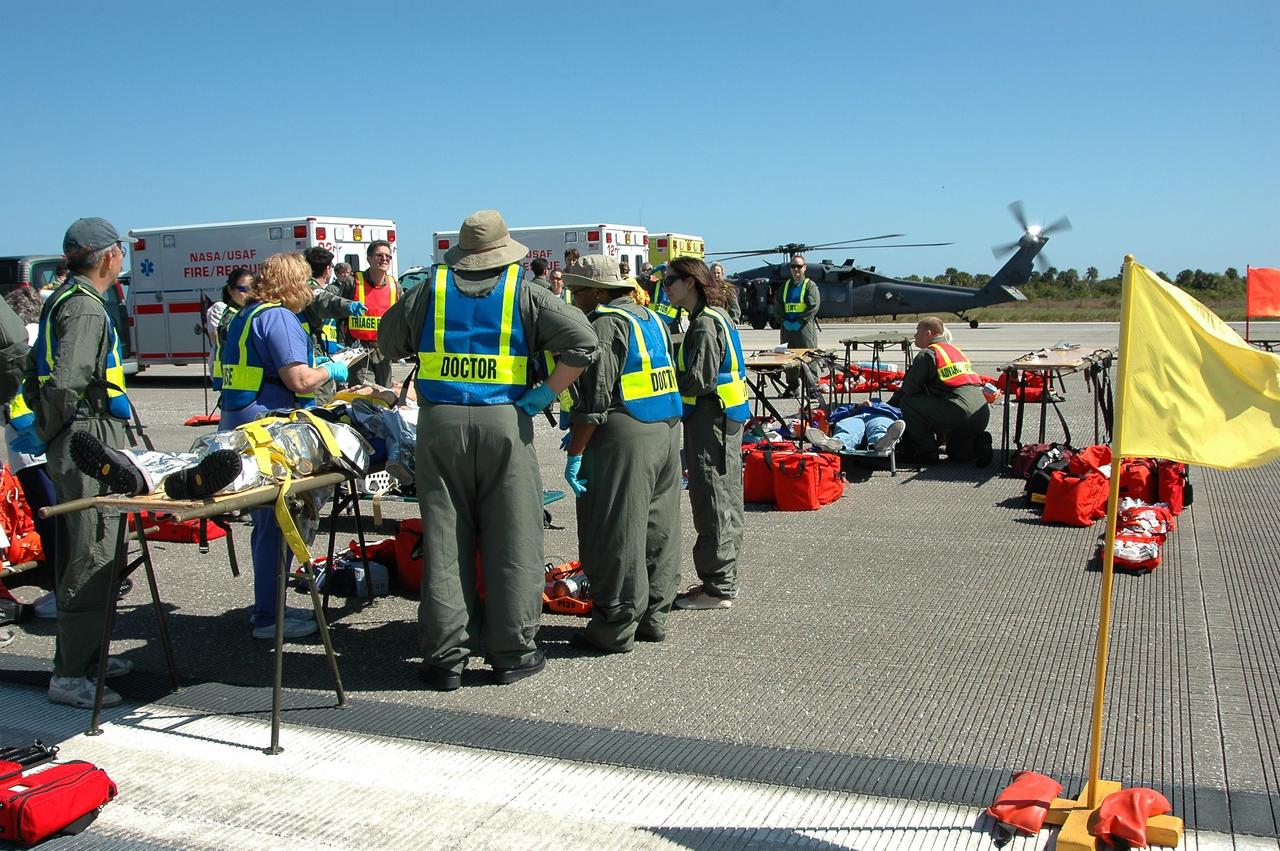
KENNEDY SPACE CENTER, FLA. - In the Launch Control Center, Robert Holl (left),  Landing Recovery directo, and Donald Hammel, from the Shuttle Project Office, are in contact with the leaders of the “Mode VII” emergency landing simulation at Kennedy Space Center.  The simulation is being managed and directed from the LCC.  The purpose of the Mode VII is to exercise emergency preparedness personnel, equipment and facilities in rescuing astronauts from a downed orbiter and providing immediate medical attention.  This simulation presents an orbiter that has crashed short of the Shuttle Landing Facility in a wooded area 2-1/2 miles south of Runway 33.  Emergency crews are responding to the volunteer “astronauts” who are simulating various injuries inside the crew compartment mock-up.  Rescuers must remove the crew, provide triage and transport to hospitals those who need further treatment.  Local hospitals are participating in the exercise.
KENNEDY SPACE CENTER, FLA. - In the Launch Control Center, Robert Holl (left), Landing Recovery directo, and Donald Hammel, from the Shuttle Project Office, are in contact with the leaders of the “Mode VII” emergency landing simulation at Kennedy Space Center. The simulation is being managed and directed from the LCC. The purpose of the Mode VII is to exercise emergency preparedness personnel, equipment and facilities in rescuing astronauts from a downed orbiter and providing immediate medical attention. This simulation presents an orbiter that has crashed short of the Shuttle Landing Facility in a wooded area 2-1/2 miles south of Runway 33. Emergency crews are responding to the volunteer “astronauts” who are simulating various injuries inside the crew compartment mock-up. Rescuers must remove the crew, provide triage and transport to hospitals those who need further treatment. Local hospitals are participating in the exercise.
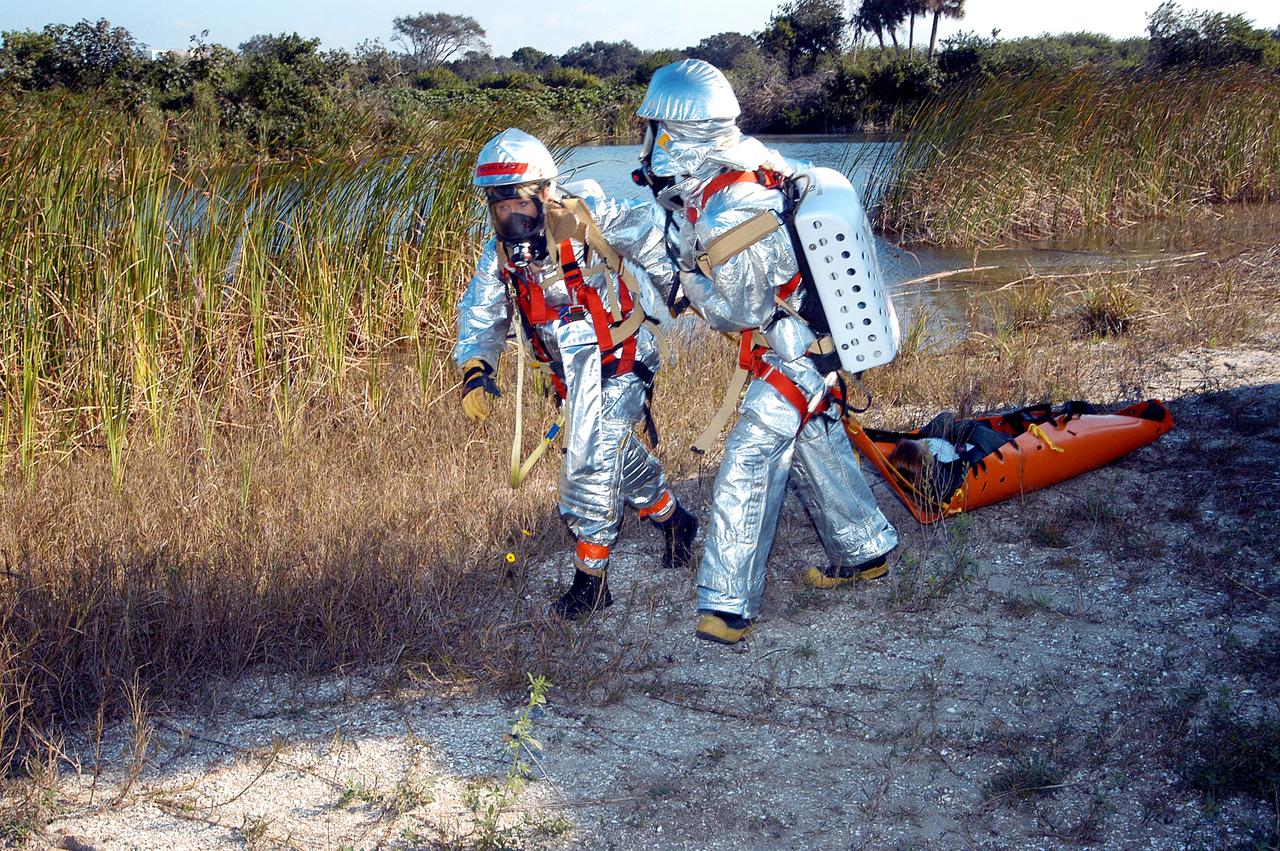
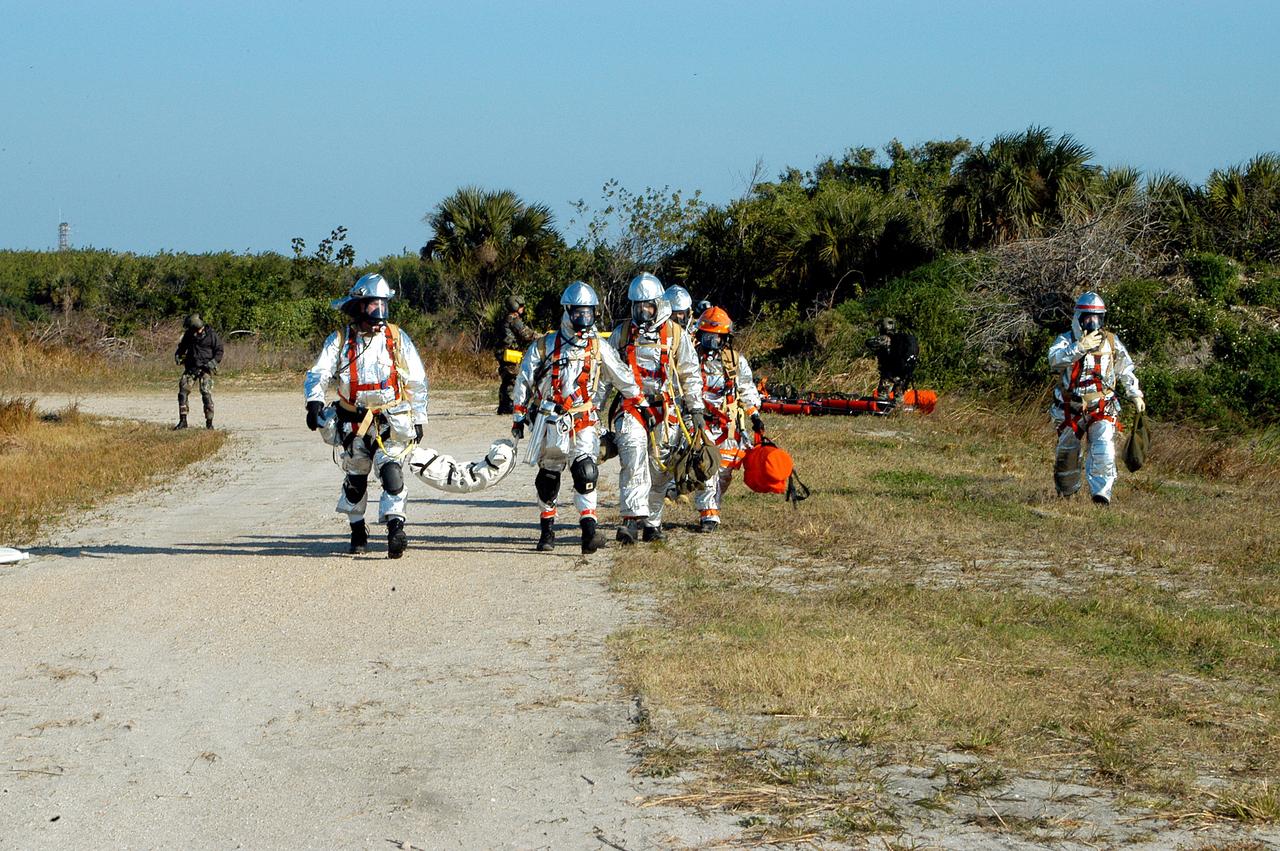
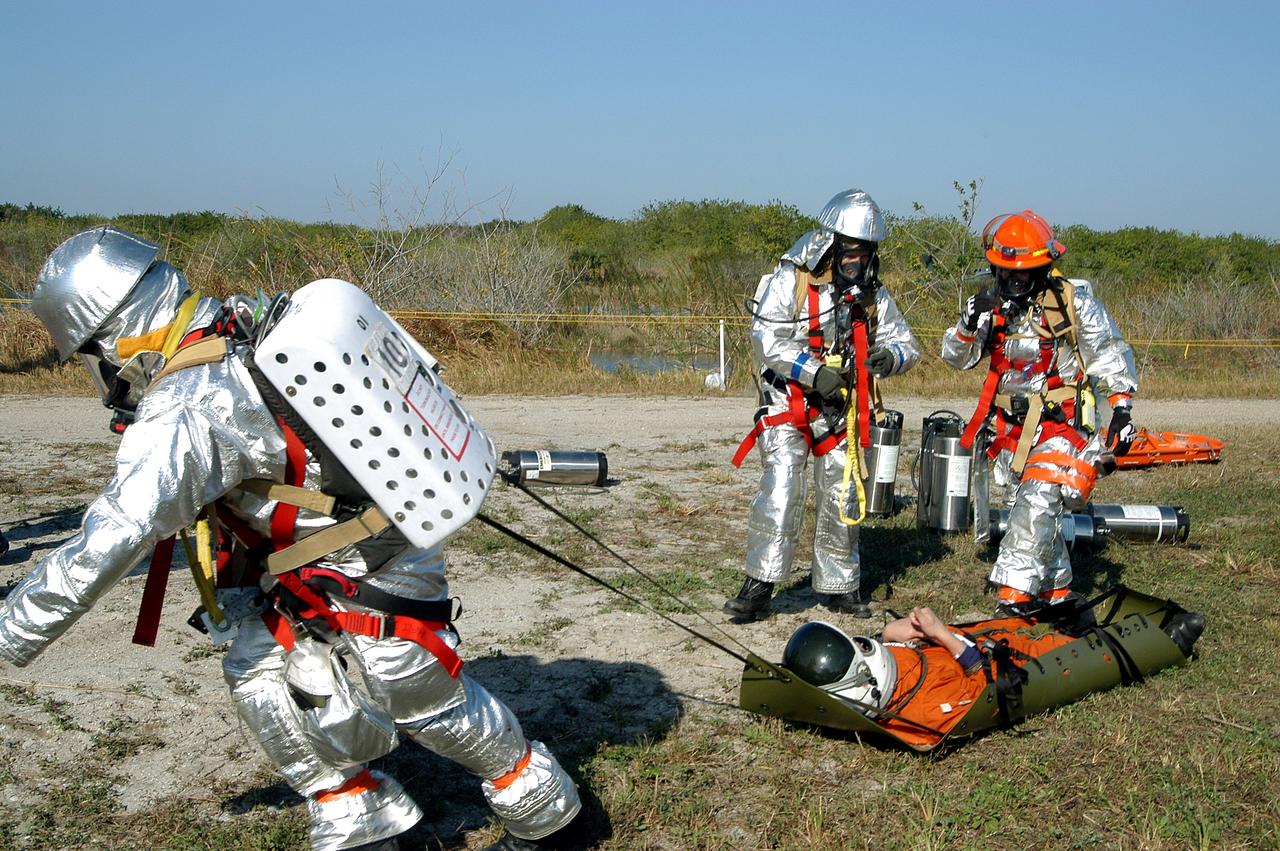
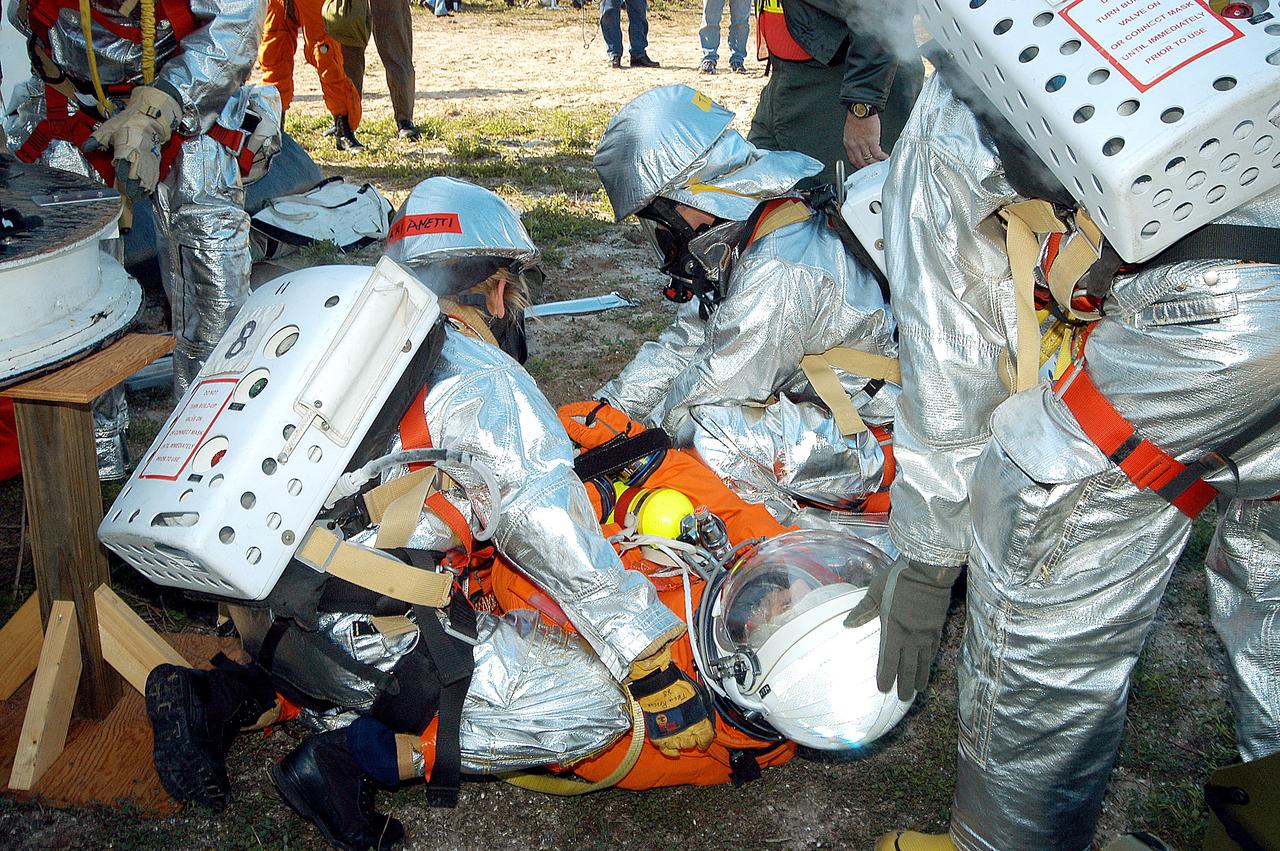
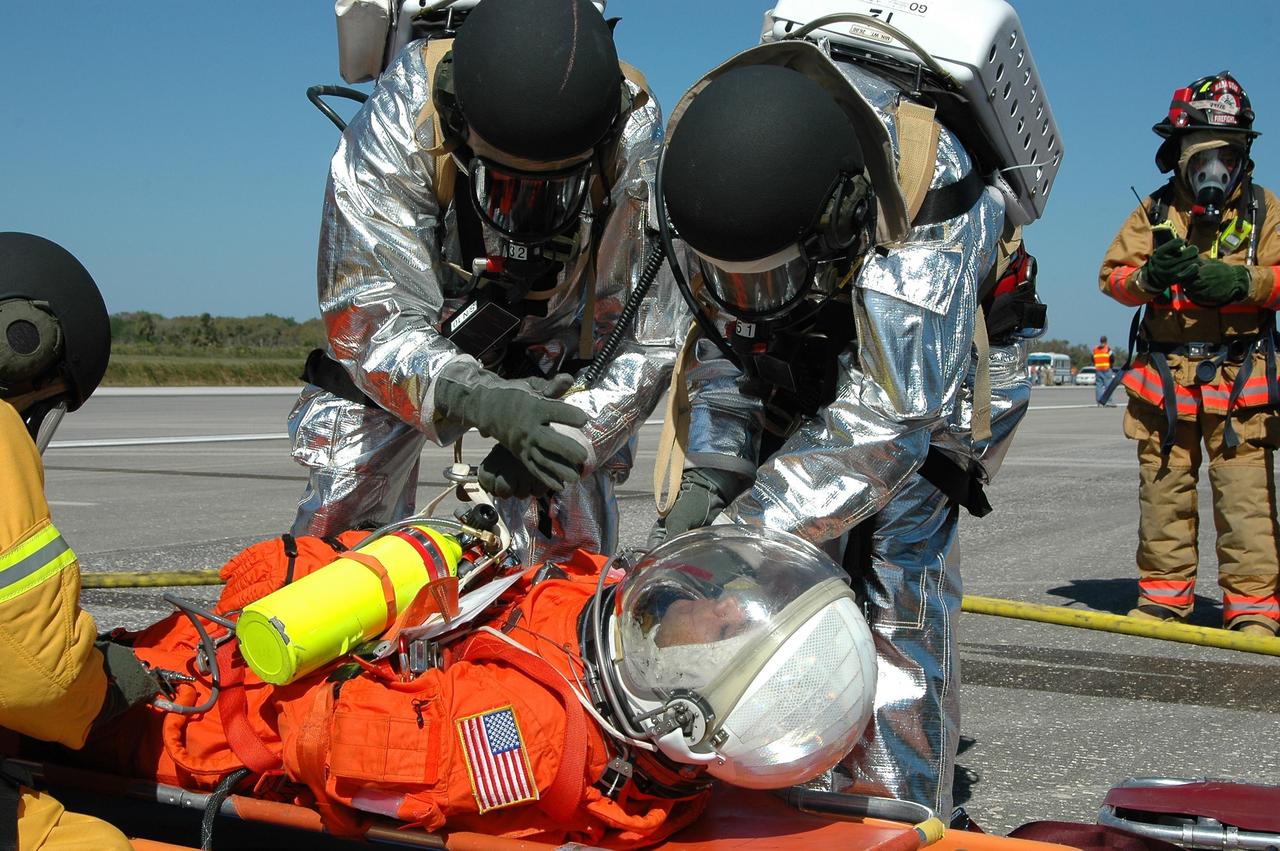
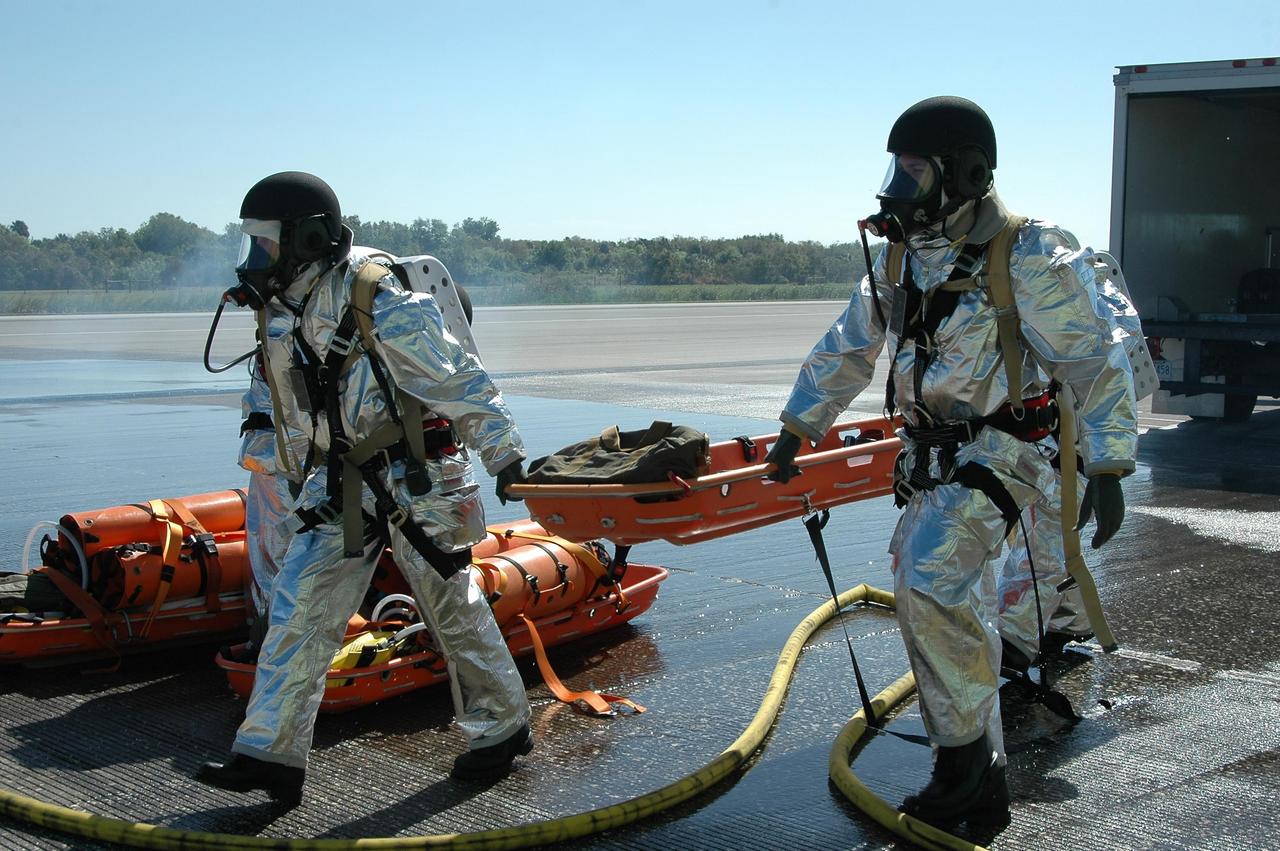
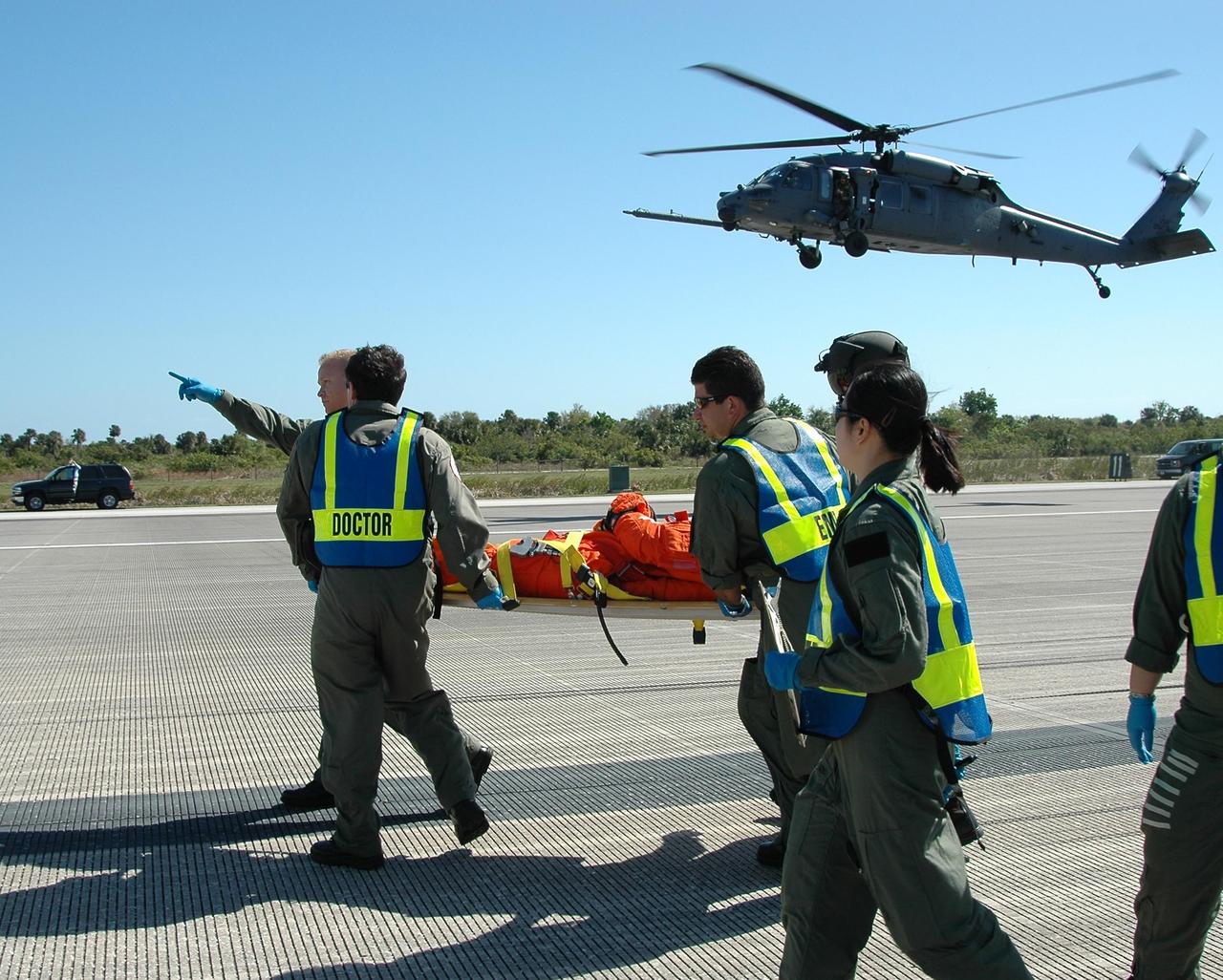
KENNEDY SPACE CENTER, FLA. - Emergency crew members transport an “injured” astronaut during a “Mode VII” emergency landing simulation at Kennedy Space Center.  The purpose of the Mode VII is to exercise emergency preparedness personnel, equipment and facilities in rescuing astronauts from a downed orbiter and providing immediate medical attention.  This simulation presents an orbiter that has crashed short of the Shuttle Landing Facility in a wooded area 2-1/2 miles south of Runway 33.  Emergency crews are responding to the volunteer astronauts who are simulating various injuries.  Rescuers must remove the crew, provide triage and transport to hospitals those who need further treatment.  Local hospitals are participating in the exercise.
KENNEDY SPACE CENTER, FLA. - Emergency crew members transport an “injured” astronaut during a “Mode VII” emergency landing simulation at Kennedy Space Center. The purpose of the Mode VII is to exercise emergency preparedness personnel, equipment and facilities in rescuing astronauts from a downed orbiter and providing immediate medical attention. This simulation presents an orbiter that has crashed short of the Shuttle Landing Facility in a wooded area 2-1/2 miles south of Runway 33. Emergency crews are responding to the volunteer astronauts who are simulating various injuries. Rescuers must remove the crew, provide triage and transport to hospitals those who need further treatment. Local hospitals are participating in the exercise.
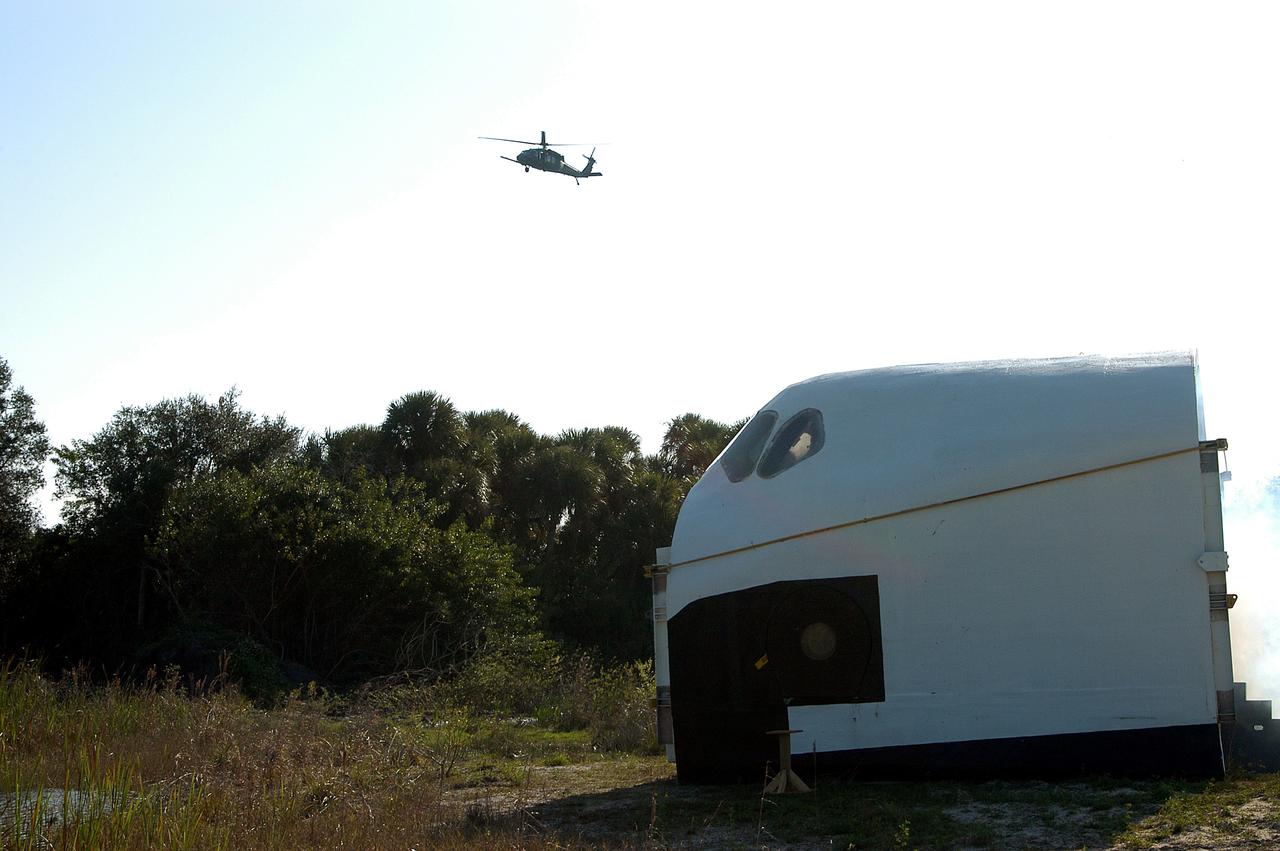
KENNEDY SPACE CENTER, FLA. - A helicopter approaches an orbiter crew compartment mock-up as part of a “Mode VII” emergency landing simulation at Kennedy Space Center.  The purpose is to exercise emergency preparedness personnel, equipment and facilities in rescuing astronauts from a downed orbiter and providing immediate medical attention.  This simulation presents an orbiter that has crashed short of the Shuttle Landing Facility in a wooded area 2-1/2 miles south of Runway 33.  Emergency crews will respond to the volunteer “astronauts” simulating various injuries.  Rescuers must remove the crew, provide triage and transport to hospitals those who need further treatment.  Local hospitals are participating in the exercise.
KENNEDY SPACE CENTER, FLA. - A helicopter approaches an orbiter crew compartment mock-up as part of a “Mode VII” emergency landing simulation at Kennedy Space Center. The purpose is to exercise emergency preparedness personnel, equipment and facilities in rescuing astronauts from a downed orbiter and providing immediate medical attention. This simulation presents an orbiter that has crashed short of the Shuttle Landing Facility in a wooded area 2-1/2 miles south of Runway 33. Emergency crews will respond to the volunteer “astronauts” simulating various injuries. Rescuers must remove the crew, provide triage and transport to hospitals those who need further treatment. Local hospitals are participating in the exercise.
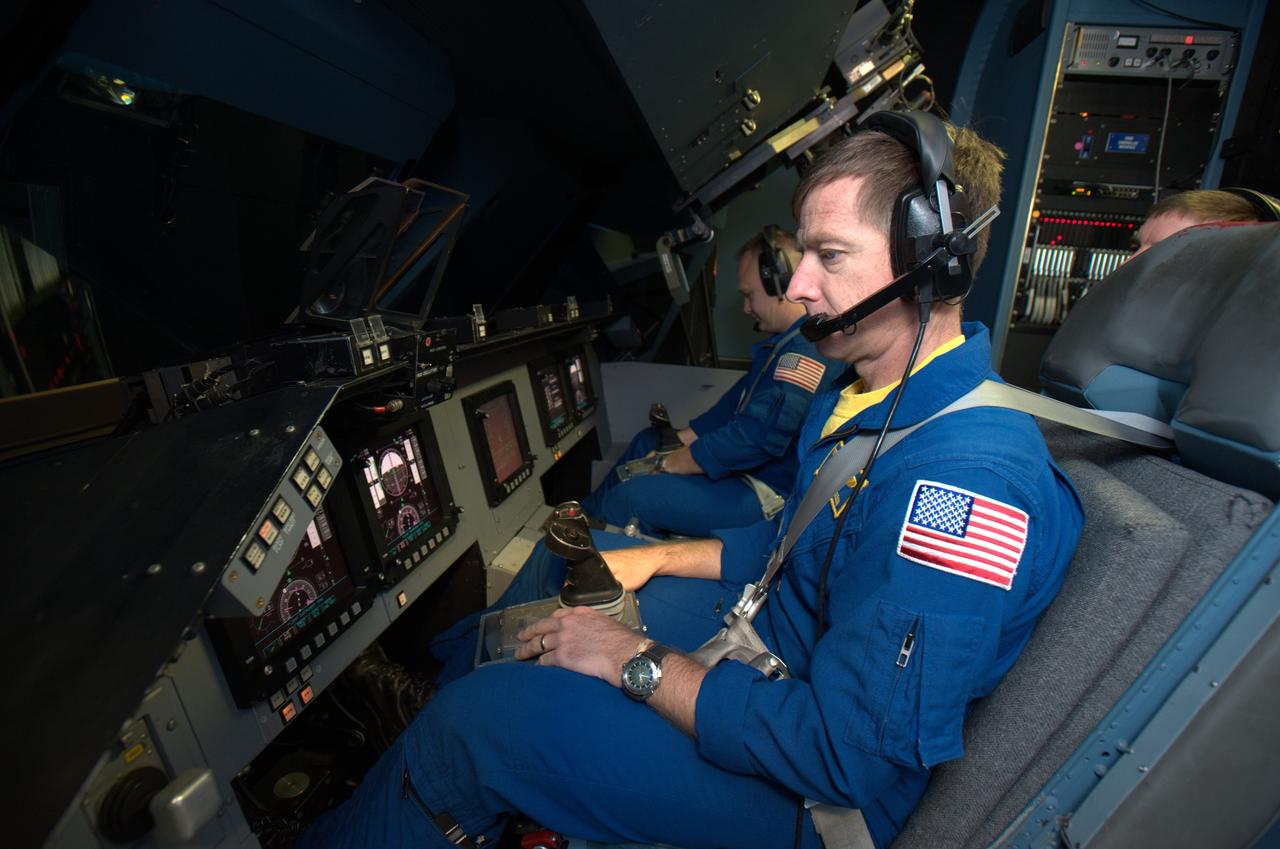
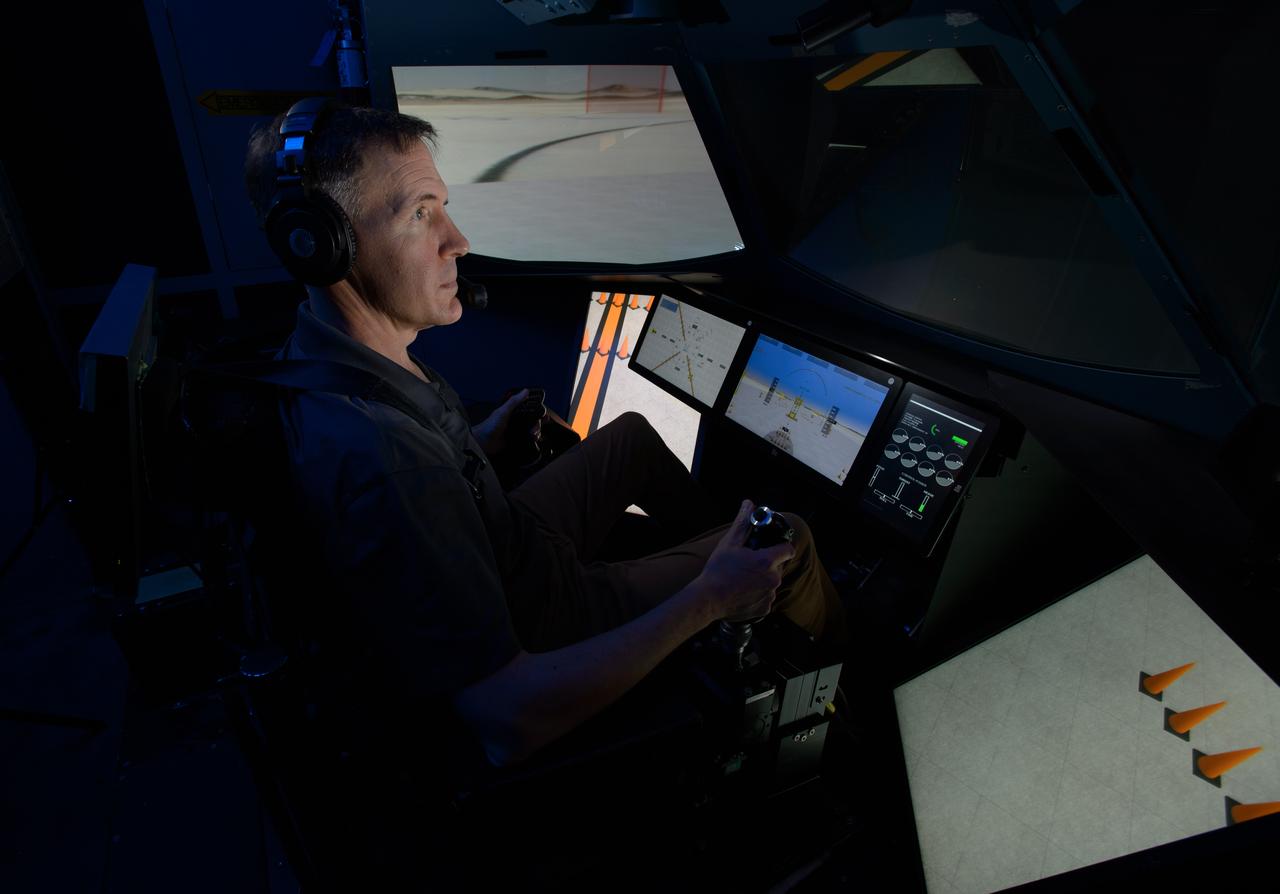
NASA Administrator Charlie Bolden, a former pilot and astronaut who flew on four shuttle missions, appeared natural at the controls of the X-57 simulator cockpit, and flew a pair of simulations where he landed on the Edwards Air Force Base runway.
NASA X-57 Simulator Prepares Pilots, Engineers for Flight of Electric X-Plane
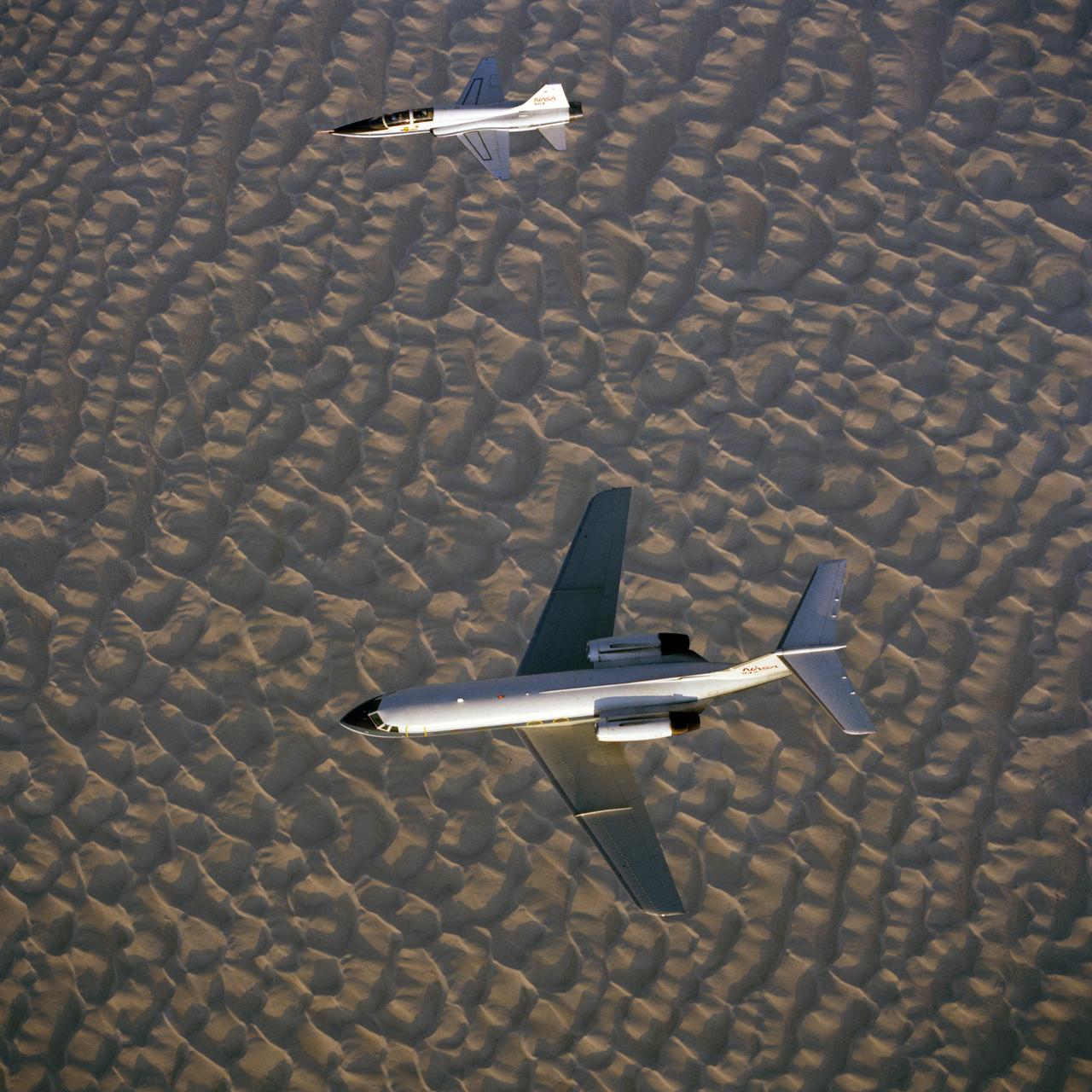
S82-32204 (October 1982) --- NASA 947 and NASA 904, two aircraft stationed at Ellington Air Base for the Johnson Space Center (JSC), are captured during a training and familiarization flight over White Sands, New Mexico. The Gulfstream aircraft (bottom) is NASA?s Space Shuttle Training Aircraft (STA) and the T-38 jet serves as a chase plane. Photo credit: NASA
SIMULATION (LANDING) - SHUTTLE - CA
Project LOLA. Test subject sitting at the controls: Project LOLA or Lunar Orbit and Landing Approach was a simulator built at Langley to study problems related to landing on the lunar surface. It was a complex project that cost nearly  2 million dollars. James Hansen wrote:  This simulator was designed to provide a pilot with a detailed visual encounter with the lunar surface  the machine consisted primarily of a cockpit, a closed-circuit TV system, and four large murals or scale models representing portions of the lunar surface as seen from various altitudes. The pilot in the cockpit moved along a track past these murals which would accustom him to the visual cues for controlling a spacecraft in the vicinity of the moon. Unfortunately, such a simulation--although great fun and quite aesthetic--was not helpful because flight in lunar orbit posed no special problems other than the rendezvous with the LEM, which the device did not simulate. Not long after the end of Apollo, the expensive machine was dismantled.  (p. 379) Ellis J. White wrote in his paper,  Discussion of Three Typical Langley Research Center Simulation Programs  :  A typical mission would start with the first cart positioned on model 1 for the translunar approach and orbit establishment. After starting the descent, the second cart is readied on model 2 and, at the proper time, when superposition occurs, the pilot s scene is switched from model 1 to model 2. then cart 1 is moved to and readied on model 3. The procedure continues until an altitude of 150 feet is obtained. The cabin of the LM vehicle has four windows which represent a 45 degree field of view. The projection screens in front of each window represent 65 degrees which allows limited head motion before the edges of the display can be seen. The lunar scene is presented to the pilot by rear projection on the screens with four Schmidt television projectors. The attitude orientation of the vehicle is represented by changing the lunar scene through the portholes determined by the scan pattern of four orthicons. The stars are front projected onto the upper three screens with a four-axis starfield generation (starball) mounted over the cabin and there is a separate starball for the low window.  -- Published in James R. Hansen, Spaceflight Revolution: NASA Langley Research Center From Sputnik to Apollo, (Washington: NASA, 1995), p. 379  Ellis J. White,  Discussion of Three Typical Langley Research Center Simulation Programs,  Paper presented at the Eastern Simulation Council (EAI s Princeton Computation Center), Princeton, NJ, October 20, 1966.
Apollo - LOLA Project
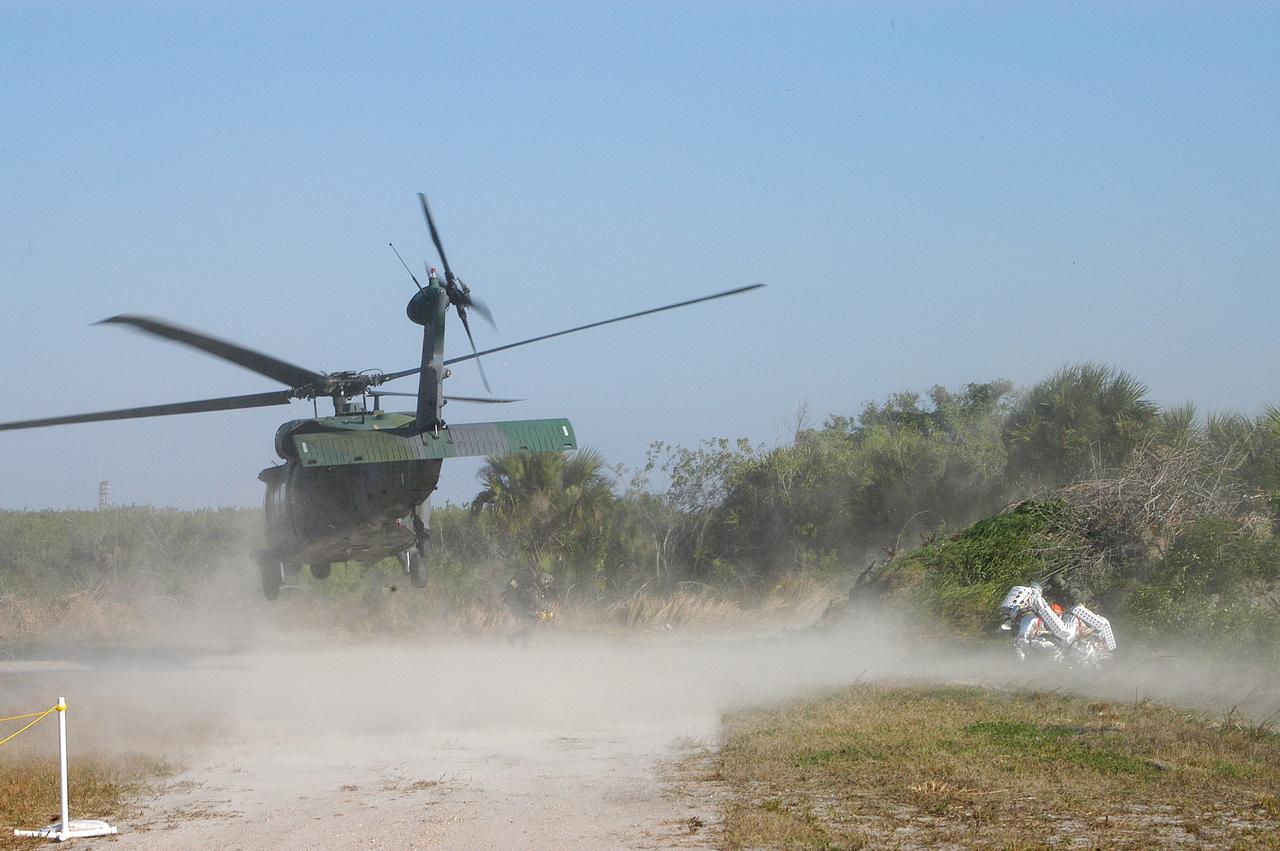
KENNEDY SPACE CENTER, FLA. - A helicopter is landing near rescue team members taking part in a “Mode VII” emergency landing simulation at Kennedy Space Center.  The purpose of Mode VII is to exercise emergency preparedness personnel, equipment and facilities in rescuing astronauts from a downed orbiter and providing immediate medical attention.  This simulation presents an orbiter that has crashed short of the Shuttle Landing Facility in a wooded area 2-1/2 miles south of Runway 33.  Emergency crews are responding to the volunteer “astronauts” simulating various injuries inside an orbiter crew compartment mock-up.  Rescuers must remove the crew, provide triage and transport to hospitals those who need further treatment.  Local hospitals are participating in the exercise.
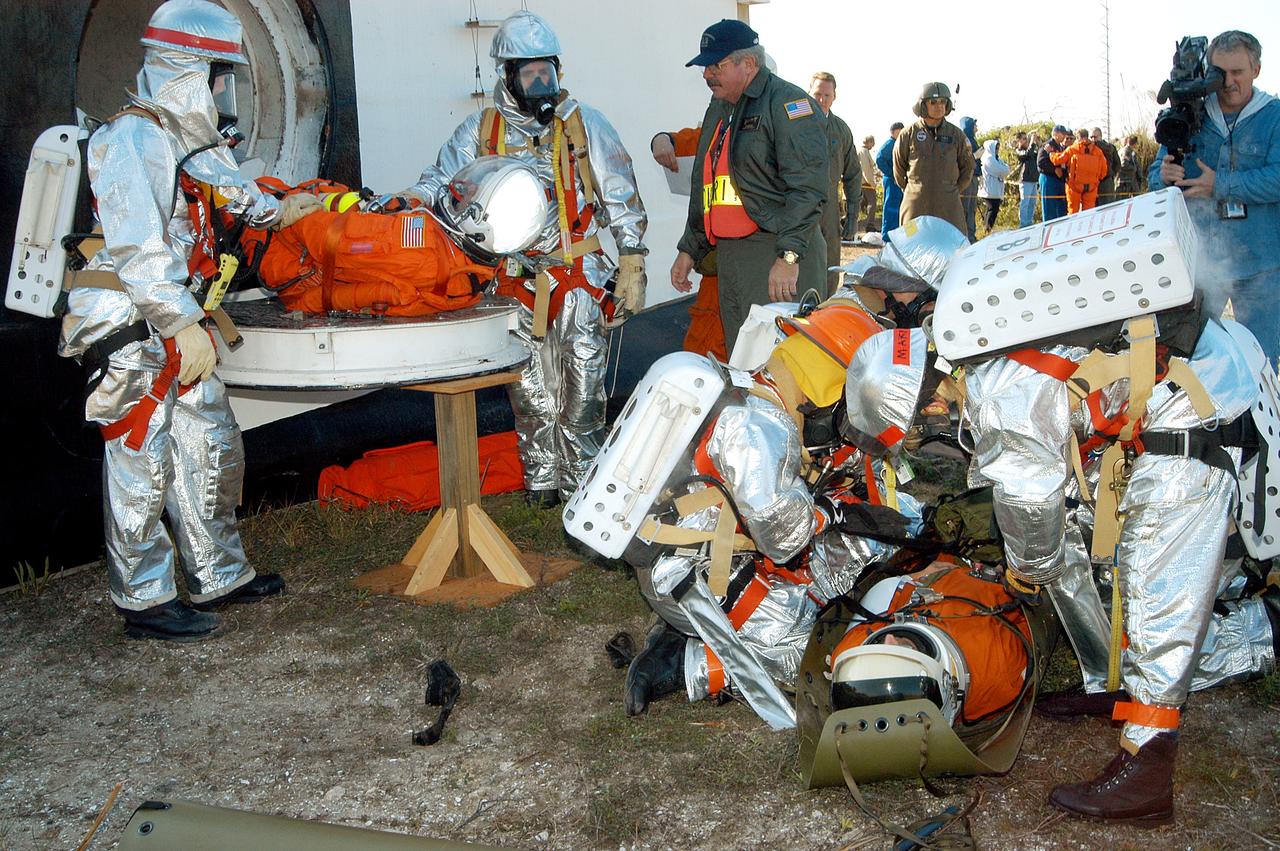
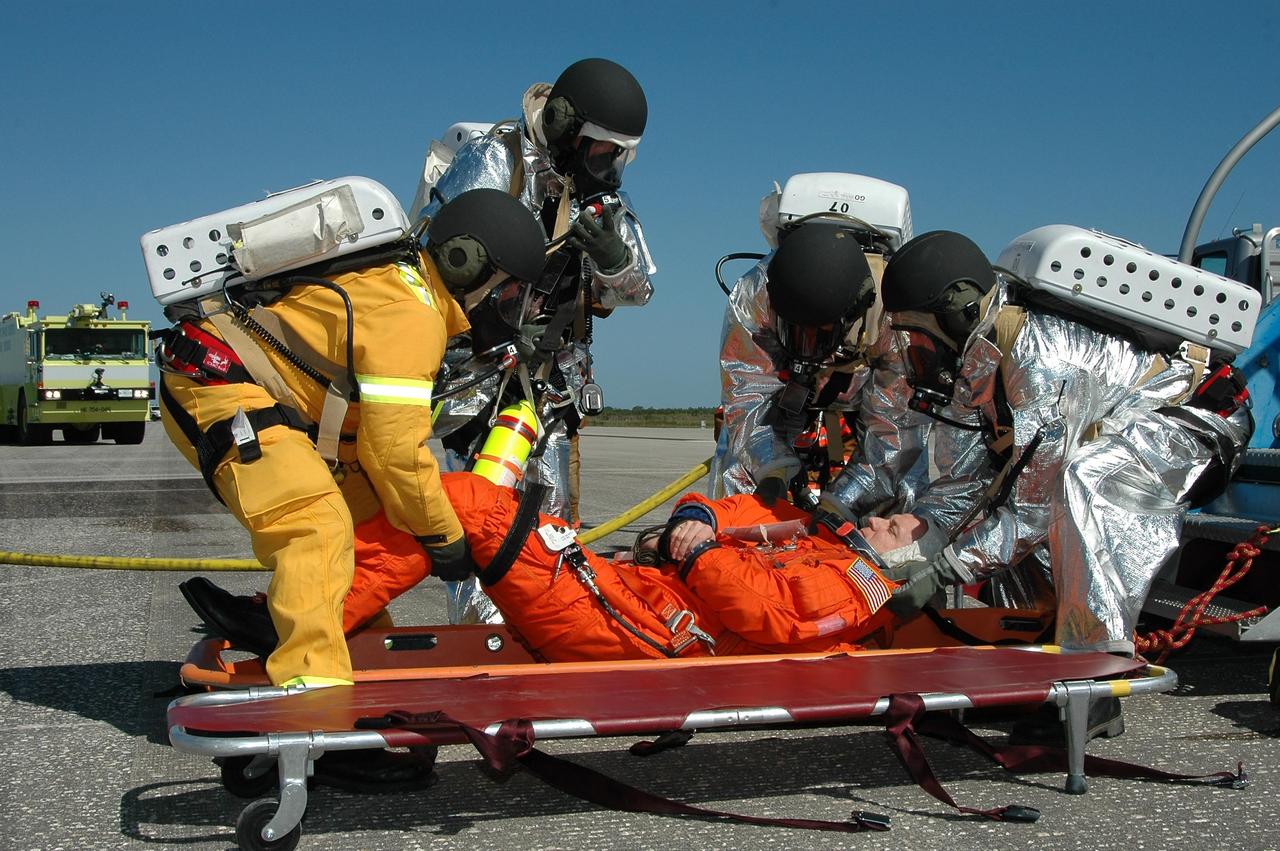
KENNEDY SPACE CENTER, FLA. - A helicopter is landing near rescue team members taking part in a “Mode VII” emergency landing simulation at Kennedy Space Center. The purpose of Mode VII is to exercise emergency preparedness personnel, equipment and facilities in rescuing astronauts from a downed orbiter and providing immediate medical attention. This simulation presents an orbiter that has crashed short of the Shuttle Landing Facility in a wooded area 2-1/2 miles south of Runway 33. Emergency crews are responding to the volunteer “astronauts” simulating various injuries inside an orbiter crew compartment mock-up. Rescuers must remove the crew, provide triage and transport to hospitals those who need further treatment. Local hospitals are participating in the exercise.
This video shows images taken through infrared range cameras during a  recovery simulation at the Utah Test and Training Range on Dec 13, 2005. Infrared cameras will track the landing.
Rehearsal: Infrared Views of Landing and Retrieval Animation
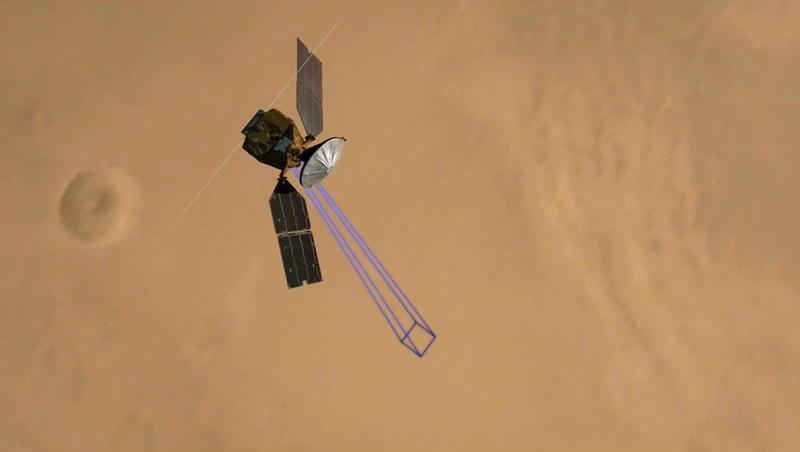
NASA Mars Reconnaissance Orbiter using the High Resolution Imaging Science Experiment HiRISE camera to take a picture of the Phoenix lander roughly 22 hours after landing.
Simulated Imaging of Phoenix Landing Site
KENNEDY SPACE CENTER, FLA. - Emergency crew members “rescue” an injured astronaut from the orbiter crew compartment mock-up during a “Mode VII” emergency landing simulation at Kennedy Space Center.  The purpose of the Mode VII is to exercise emergency preparedness personnel, equipment and facilities in rescuing astronauts from a downed orbiter and providing immediate medical attention.  This simulation presents an orbiter that has crashed short of the Shuttle Landing Facility in a wooded area 2-1/2 miles south of Runway 33.  Emergency crews are responding to the volunteer astronauts who are simulating various injuries.  Rescuers must remove the crew, provide triage and transport to hospitals those who need further treatment.  Local hospitals are participating in the exercise.
KENNEDY SPACE CENTER, FLA. - Emergency crew members “rescue” an injured astronaut from the orbiter crew compartment mock-up during a “Mode VII” emergency landing simulation at Kennedy Space Center. The purpose of the Mode VII is to exercise emergency preparedness personnel, equipment and facilities in rescuing astronauts from a downed orbiter and providing immediate medical attention. This simulation presents an orbiter that has crashed short of the Shuttle Landing Facility in a wooded area 2-1/2 miles south of Runway 33. Emergency crews are responding to the volunteer astronauts who are simulating various injuries. Rescuers must remove the crew, provide triage and transport to hospitals those who need further treatment. Local hospitals are participating in the exercise.
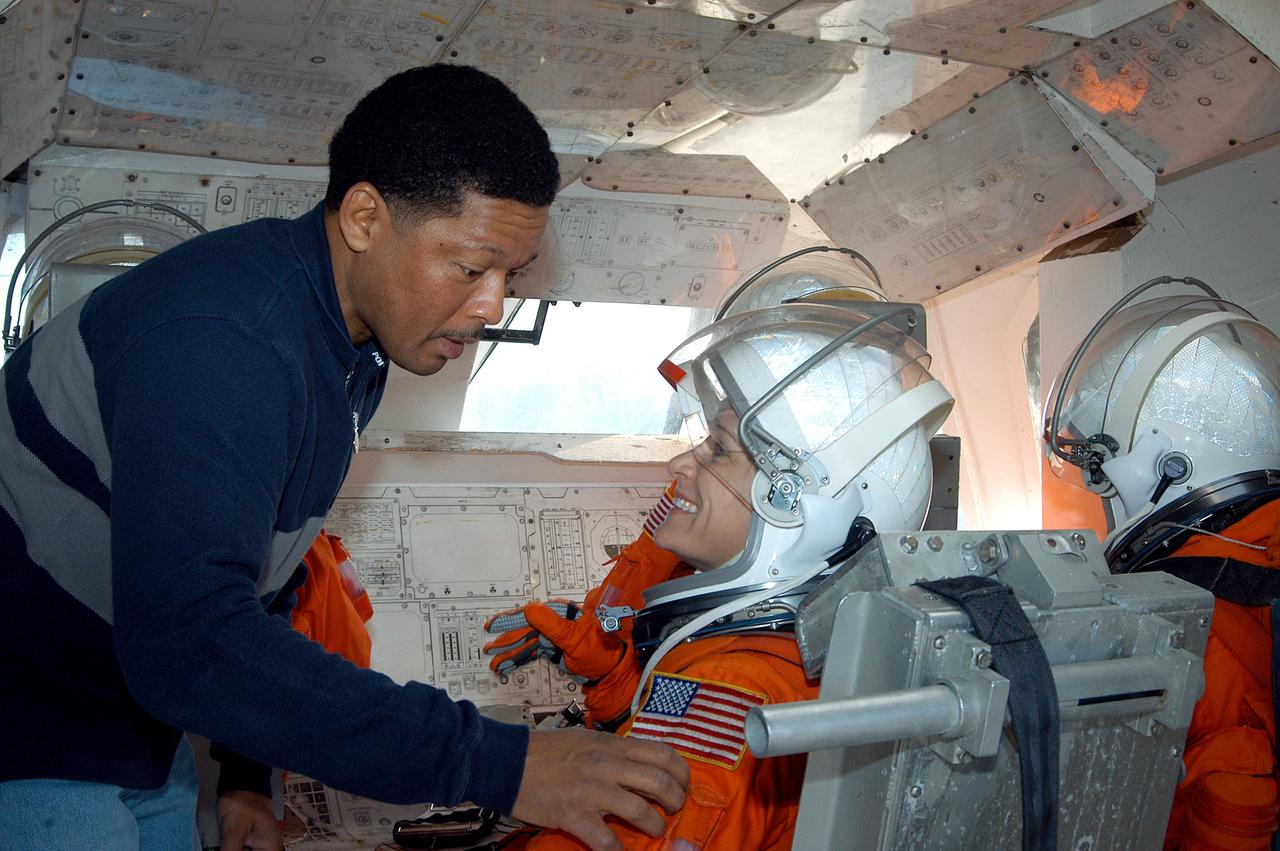
KENNEDY SPACE CENTER, FLA. - Volunteers from the KSC Fire-Rescue team dressed in launch and entry suits settle into seats in an orbiter crew compartment mock-up under the guidance of George Brittingham, USA suit technician on the Closeout Crew. Brittingham is helping Catherine Di Biase, a nurse with Bionetics Life Sciences. They are all taking part in a “Mode VII” emergency landing simulation at Kennedy Space Center.  The purpose is to exercise emergency preparedness personnel, equipment and facilities in rescuing astronauts from a downed orbiter and providing immediate medical attention.  This simulation presents an orbiter that has crashed short of the Shuttle Landing Facility in a wooded area 2-1/2 miles south of Runway 33.  Emergency crews will respond to the volunteer “astronauts” simulating various injuries.  Rescuers must remove the crew, provide triage and transport to hospitals those who need further treatment.  Local hospitals are participating in the exercise.
KENNEDY SPACE CENTER, FLA. - Volunteers from the KSC Fire-Rescue team dressed in launch and entry suits settle into seats in an orbiter crew compartment mock-up under the guidance of George Brittingham, USA suit technician on the Closeout Crew. Brittingham is helping Catherine Di Biase, a nurse with Bionetics Life Sciences. They are all taking part in a “Mode VII” emergency landing simulation at Kennedy Space Center. The purpose is to exercise emergency preparedness personnel, equipment and facilities in rescuing astronauts from a downed orbiter and providing immediate medical attention. This simulation presents an orbiter that has crashed short of the Shuttle Landing Facility in a wooded area 2-1/2 miles south of Runway 33. Emergency crews will respond to the volunteer “astronauts” simulating various injuries. Rescuers must remove the crew, provide triage and transport to hospitals those who need further treatment. Local hospitals are participating in the exercise.
KENNEDY SPACE CENTER, FLA. - In a “Mode VII” emergency landing simulation at Kennedy Space Center, a helicopter crew helps “rescued” astronauts.  The purpose of Mode VII is to exercise emergency preparedness personnel, equipment and facilities in rescuing astronauts from a downed orbiter and providing immediate medical attention.  This simulation presents an orbiter that has crashed short of the Shuttle Landing Facility in a wooded area 2-1/2 miles south of Runway 33.  Emergency crews are responding to the volunteer “astronauts” simulating various injuries inside an orbiter crew compartment mock-up.  Rescuers must remove the crew, provide triage and transport to hospitals those who need further treatment.  Local hospitals are participating in the exercise.
KENNEDY SPACE CENTER, FLA. - In a “Mode VII” emergency landing simulation at Kennedy Space Center, a helicopter crew helps “rescued” astronauts. The purpose of Mode VII is to exercise emergency preparedness personnel, equipment and facilities in rescuing astronauts from a downed orbiter and providing immediate medical attention. This simulation presents an orbiter that has crashed short of the Shuttle Landing Facility in a wooded area 2-1/2 miles south of Runway 33. Emergency crews are responding to the volunteer “astronauts” simulating various injuries inside an orbiter crew compartment mock-up. Rescuers must remove the crew, provide triage and transport to hospitals those who need further treatment. Local hospitals are participating in the exercise.
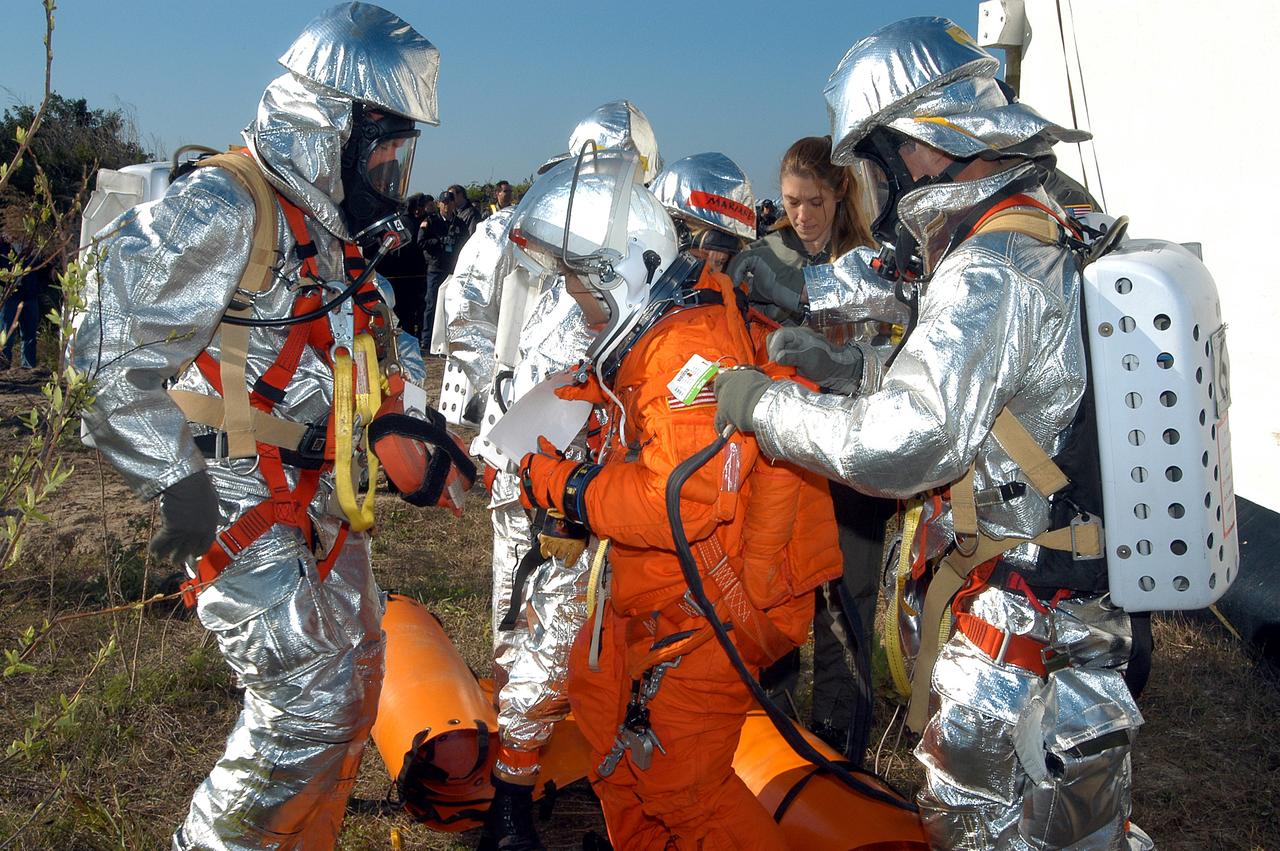
KENNEDY SPACE CENTER, FLA. - A helicopter rescue team prepares another “injured” astronaut for transportation to a local hospital.  They are all taking part in a “Mode VII” emergency landing simulation at Kennedy Space Center.  The purpose of the Mode VII is to exercise emergency preparedness personnel, equipment and facilities in rescuing astronauts from a downed orbiter and providing immediate medical attention.  This simulation presents an orbiter that has crashed short of the Shuttle Landing Facility in a wooded area 2-1/2 miles south of Runway 33.  Emergency crews are responding to the volunteer “astronauts” who are simulating various injuries inside the crew compartment mock-up.  Rescuers must remove the crew, provide triage and transport to hospitals those who need further treatment.  Local hospitals are participating in the exercise.
KENNEDY SPACE CENTER, FLA. - A helicopter rescue team prepares another “injured” astronaut for transportation to a local hospital. They are all taking part in a “Mode VII” emergency landing simulation at Kennedy Space Center. The purpose of the Mode VII is to exercise emergency preparedness personnel, equipment and facilities in rescuing astronauts from a downed orbiter and providing immediate medical attention. This simulation presents an orbiter that has crashed short of the Shuttle Landing Facility in a wooded area 2-1/2 miles south of Runway 33. Emergency crews are responding to the volunteer “astronauts” who are simulating various injuries inside the crew compartment mock-up. Rescuers must remove the crew, provide triage and transport to hospitals those who need further treatment. Local hospitals are participating in the exercise.
KENNEDY SPACE CENTER, FLA. - Emergency crews leave the scene after a helicopter removed “rescued” astronauts from the scene.  They are taking part in a “Mode VII” emergency landing simulation at Kennedy Space Center, in order to exercise emergency preparedness personnel, equipment and facilities in rescuing astronauts from a downed orbiter and providing immediate medical attention.  This simulation presents an orbiter that has crashed short of the Shuttle Landing Facility in a wooded area 2-1/2 miles south of Runway 33.  Emergency crews are responding to the volunteer “astronauts” simulating various injuries inside an orbiter crew compartment mock-up.  Rescuers must remove the crew, provide triage and transport to hospitals those who need further treatment.  Local hospitals are participating in the exercise.
KENNEDY SPACE CENTER, FLA. - Emergency crews leave the scene after a helicopter removed “rescued” astronauts from the scene. They are taking part in a “Mode VII” emergency landing simulation at Kennedy Space Center, in order to exercise emergency preparedness personnel, equipment and facilities in rescuing astronauts from a downed orbiter and providing immediate medical attention. This simulation presents an orbiter that has crashed short of the Shuttle Landing Facility in a wooded area 2-1/2 miles south of Runway 33. Emergency crews are responding to the volunteer “astronauts” simulating various injuries inside an orbiter crew compartment mock-up. Rescuers must remove the crew, provide triage and transport to hospitals those who need further treatment. Local hospitals are participating in the exercise.
KENNEDY SPACE CENTER, FLA. - Emergency crew members help an “injured” astronaut from the orbiter crew compartment mock-up during a “Mode VII” emergency landing simulation at Kennedy Space Center.  Another is on the ground.  The purpose of the Mode VII is to exercise emergency preparedness personnel, equipment and facilities in rescuing astronauts from a downed orbiter and providing immediate medical attention.  This simulation presents an orbiter that has crashed short of the Shuttle Landing Facility in a wooded area 2-1/2 miles south of Runway 33.  Emergency crews are responding to the volunteer astronauts who are simulating various injuries.  Rescuers must remove the crew, provide triage and transport to hospitals those who need further treatment.  Local hospitals are participating in the exercise.
KENNEDY SPACE CENTER, FLA. - Emergency crew members help an “injured” astronaut from the orbiter crew compartment mock-up during a “Mode VII” emergency landing simulation at Kennedy Space Center. Another is on the ground. The purpose of the Mode VII is to exercise emergency preparedness personnel, equipment and facilities in rescuing astronauts from a downed orbiter and providing immediate medical attention. This simulation presents an orbiter that has crashed short of the Shuttle Landing Facility in a wooded area 2-1/2 miles south of Runway 33. Emergency crews are responding to the volunteer astronauts who are simulating various injuries. Rescuers must remove the crew, provide triage and transport to hospitals those who need further treatment. Local hospitals are participating in the exercise.
KENNEDY SPACE CENTER, FLA. - A helicopter rescue team prepares another “injured” astronaut for transportation to a local hospital.  They are all taking part in a “Mode VII” emergency landing simulation at Kennedy Space Center.  The purpose of the Mode VII is to exercise emergency preparedness personnel, equipment and facilities in rescuing astronauts from a downed orbiter and providing immediate medical attention.  This simulation presents an orbiter that has crashed short of the Shuttle Landing Facility in a wooded area 2-1/2 miles south of Runway 33.  Emergency crews are responding to the volunteer “astronauts” who are simulating various injuries inside the crew compartment mock-up.  Rescuers must remove the crew, provide triage and transport to hospitals those who need further treatment.  Local hospitals are participating in the exercise.
KENNEDY SPACE CENTER, FLA. - A helicopter rescue team prepares another “injured” astronaut for transportation to a local hospital. They are all taking part in a “Mode VII” emergency landing simulation at Kennedy Space Center. The purpose of the Mode VII is to exercise emergency preparedness personnel, equipment and facilities in rescuing astronauts from a downed orbiter and providing immediate medical attention. This simulation presents an orbiter that has crashed short of the Shuttle Landing Facility in a wooded area 2-1/2 miles south of Runway 33. Emergency crews are responding to the volunteer “astronauts” who are simulating various injuries inside the crew compartment mock-up. Rescuers must remove the crew, provide triage and transport to hospitals those who need further treatment. Local hospitals are participating in the exercise.
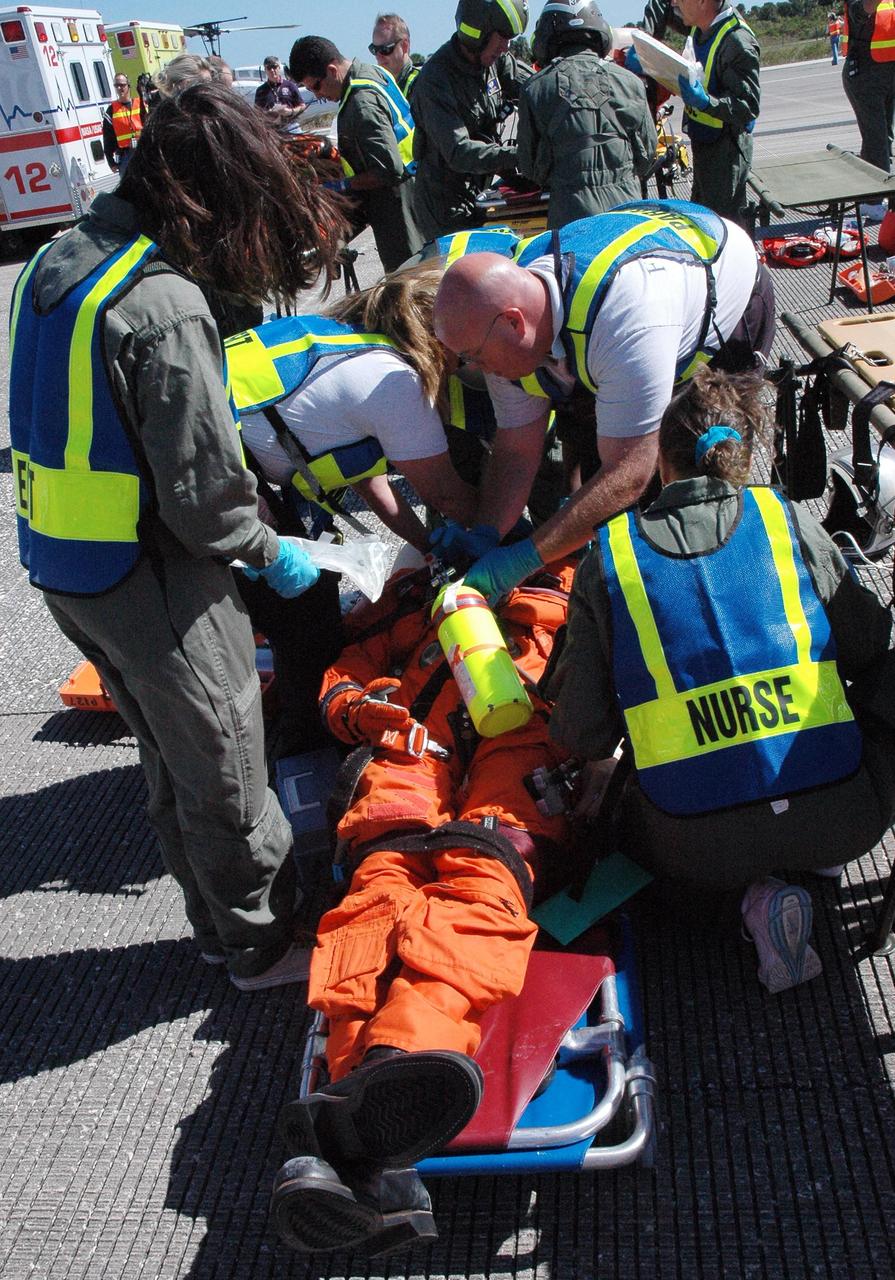
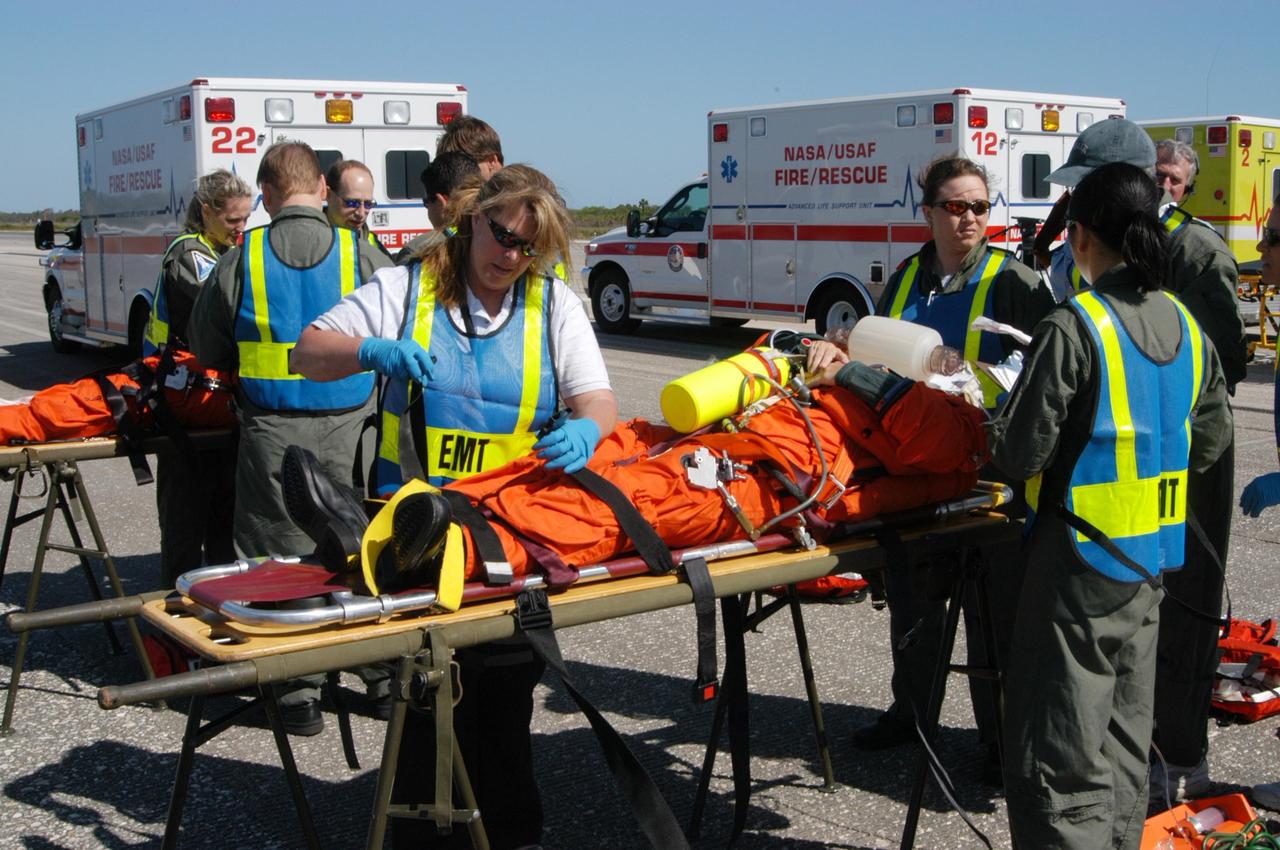
KENNEDY SPACE CENTER, FLA. - Emergency crew members assess medical needs on “injured” astronauts removed from the orbiter crew compartment mock-up during a “Mode VII” emergency landing simulation at Kennedy Space Center.  The purpose of the Mode VII is to exercise emergency preparedness personnel, equipment and facilities in rescuing astronauts from a downed orbiter and providing immediate medical attention.  This simulation presents an orbiter that has crashed short of the Shuttle Landing Facility in a wooded area 2-1/2 miles south of Runway 33.  Emergency crews are responding to the volunteer astronauts who are simulating various injuries.  Rescuers must remove the crew, provide triage and transport to hospitals those who need further treatment.  Local hospitals are participating in the exercise.
KENNEDY SPACE CENTER, FLA. - Emergency crew members assess medical needs on “injured” astronauts removed from the orbiter crew compartment mock-up during a “Mode VII” emergency landing simulation at Kennedy Space Center. The purpose of the Mode VII is to exercise emergency preparedness personnel, equipment and facilities in rescuing astronauts from a downed orbiter and providing immediate medical attention. This simulation presents an orbiter that has crashed short of the Shuttle Landing Facility in a wooded area 2-1/2 miles south of Runway 33. Emergency crews are responding to the volunteer astronauts who are simulating various injuries. Rescuers must remove the crew, provide triage and transport to hospitals those who need further treatment. Local hospitals are participating in the exercise.
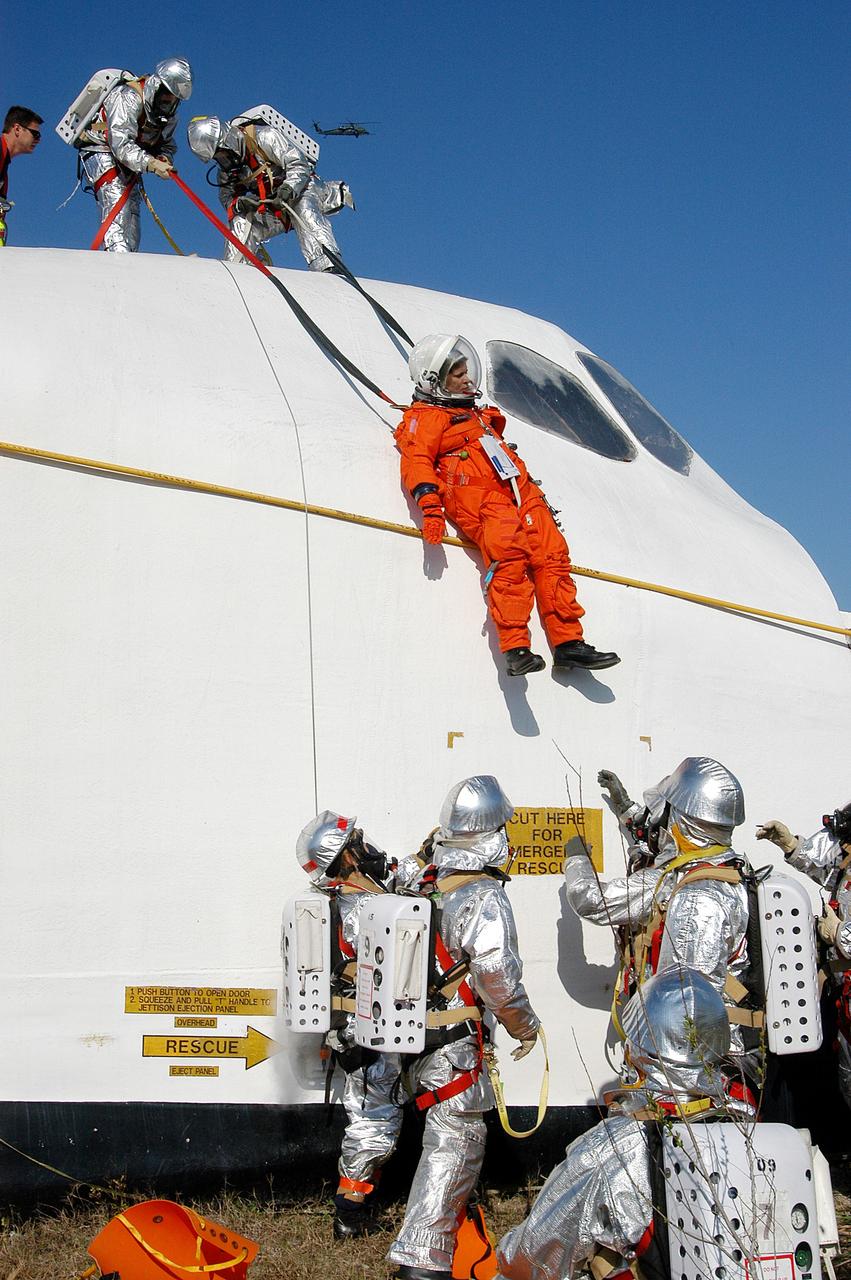
KENNEDY SPACE CENTER, FLA. - Emergency crew members help a volunteer “astronaut” onto the ground after being lowered from the top of the orbiter crew compartment mock-up that is the scene of a “Mode VII” emergency landing simulation at Kennedy Space Center.  The purpose of the Mode VII is to exercise emergency preparedness personnel, equipment and facilities in rescuing astronauts from a downed orbiter and providing immediate medical attention.  This simulation presents an orbiter that has crashed short of the Shuttle Landing Facility in a wooded area 2-1/2 miles south of Runway 33.  Emergency crews are responding to the volunteer astronauts who are simulating various injuries.  Rescuers must remove the crew, provide triage and transport to hospitals those who need further treatment.  Local hospitals are participating in the exercise.
KENNEDY SPACE CENTER, FLA. - Emergency crew members help a volunteer “astronaut” onto the ground after being lowered from the top of the orbiter crew compartment mock-up that is the scene of a “Mode VII” emergency landing simulation at Kennedy Space Center. The purpose of the Mode VII is to exercise emergency preparedness personnel, equipment and facilities in rescuing astronauts from a downed orbiter and providing immediate medical attention. This simulation presents an orbiter that has crashed short of the Shuttle Landing Facility in a wooded area 2-1/2 miles south of Runway 33. Emergency crews are responding to the volunteer astronauts who are simulating various injuries. Rescuers must remove the crew, provide triage and transport to hospitals those who need further treatment. Local hospitals are participating in the exercise.
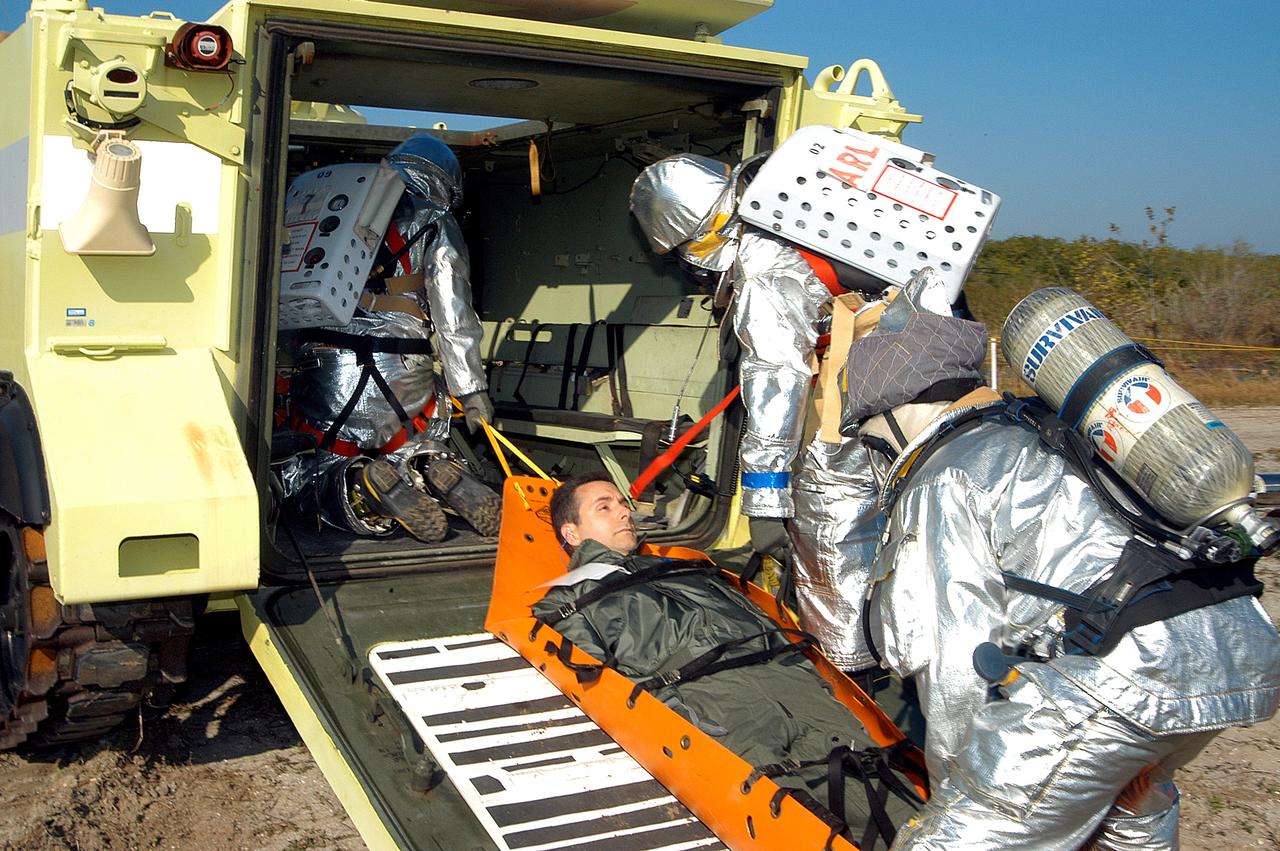
KENNEDY SPACE CENTER, FLA. - An “injured” rescue worker is lifted into an M-113 armored personnel carrier provided for transportation during a “Mode VII” emergency landing simulation at Kennedy Space Center.  The purpose of the Mode VII is to exercise emergency preparedness personnel, equipment and facilities in rescuing astronauts from a downed orbiter and providing immediate medical attention.  This simulation presents an orbiter that has crashed short of the Shuttle Landing Facility in a wooded area 2-1/2 miles south of Runway 33.  Emergency crews are responding to the volunteer astronauts who are simulating various injuries inside the crew compartment mock-up.  Rescuers must remove the crew, provide triage and transport to hospitals those who need further treatment.  Local hospitals are participating in the exercise.
KENNEDY SPACE CENTER, FLA. - An “injured” rescue worker is lifted into an M-113 armored personnel carrier provided for transportation during a “Mode VII” emergency landing simulation at Kennedy Space Center. The purpose of the Mode VII is to exercise emergency preparedness personnel, equipment and facilities in rescuing astronauts from a downed orbiter and providing immediate medical attention. This simulation presents an orbiter that has crashed short of the Shuttle Landing Facility in a wooded area 2-1/2 miles south of Runway 33. Emergency crews are responding to the volunteer astronauts who are simulating various injuries inside the crew compartment mock-up. Rescuers must remove the crew, provide triage and transport to hospitals those who need further treatment. Local hospitals are participating in the exercise.
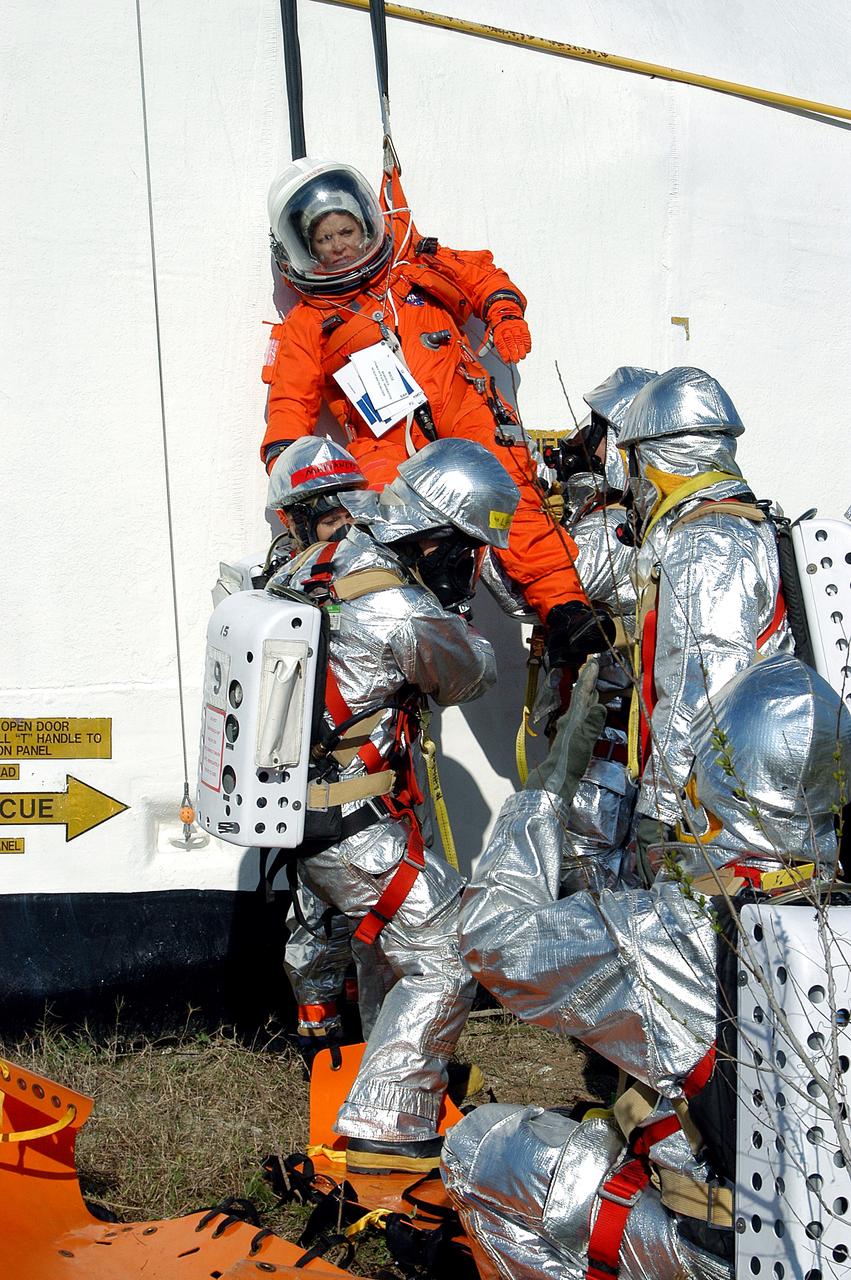
KENNEDY SPACE CENTER, FLA. - Emergency crew members lower a volunteer “astronaut” from the top of the orbiter crew compartment mock-up that is the scene of a “Mode VII” emergency landing simulation at Kennedy Space Center.  The purpose of the Mode VII is to exercise emergency preparedness personnel, equipment and facilities in rescuing astronauts from a downed orbiter and providing immediate medical attention.  This simulation presents an orbiter that has crashed short of the Shuttle Landing Facility in a wooded area 2-1/2 miles south of Runway 33.  Emergency crews are responding to the volunteer “astronauts” who are simulating various injuries.  Rescuers must remove the crew, provide triage and transport to hospitals those who need further treatment.  Local hospitals are participating in the exercise.
KENNEDY SPACE CENTER, FLA. - Emergency crew members lower a volunteer “astronaut” from the top of the orbiter crew compartment mock-up that is the scene of a “Mode VII” emergency landing simulation at Kennedy Space Center. The purpose of the Mode VII is to exercise emergency preparedness personnel, equipment and facilities in rescuing astronauts from a downed orbiter and providing immediate medical attention. This simulation presents an orbiter that has crashed short of the Shuttle Landing Facility in a wooded area 2-1/2 miles south of Runway 33. Emergency crews are responding to the volunteer “astronauts” who are simulating various injuries. Rescuers must remove the crew, provide triage and transport to hospitals those who need further treatment. Local hospitals are participating in the exercise.
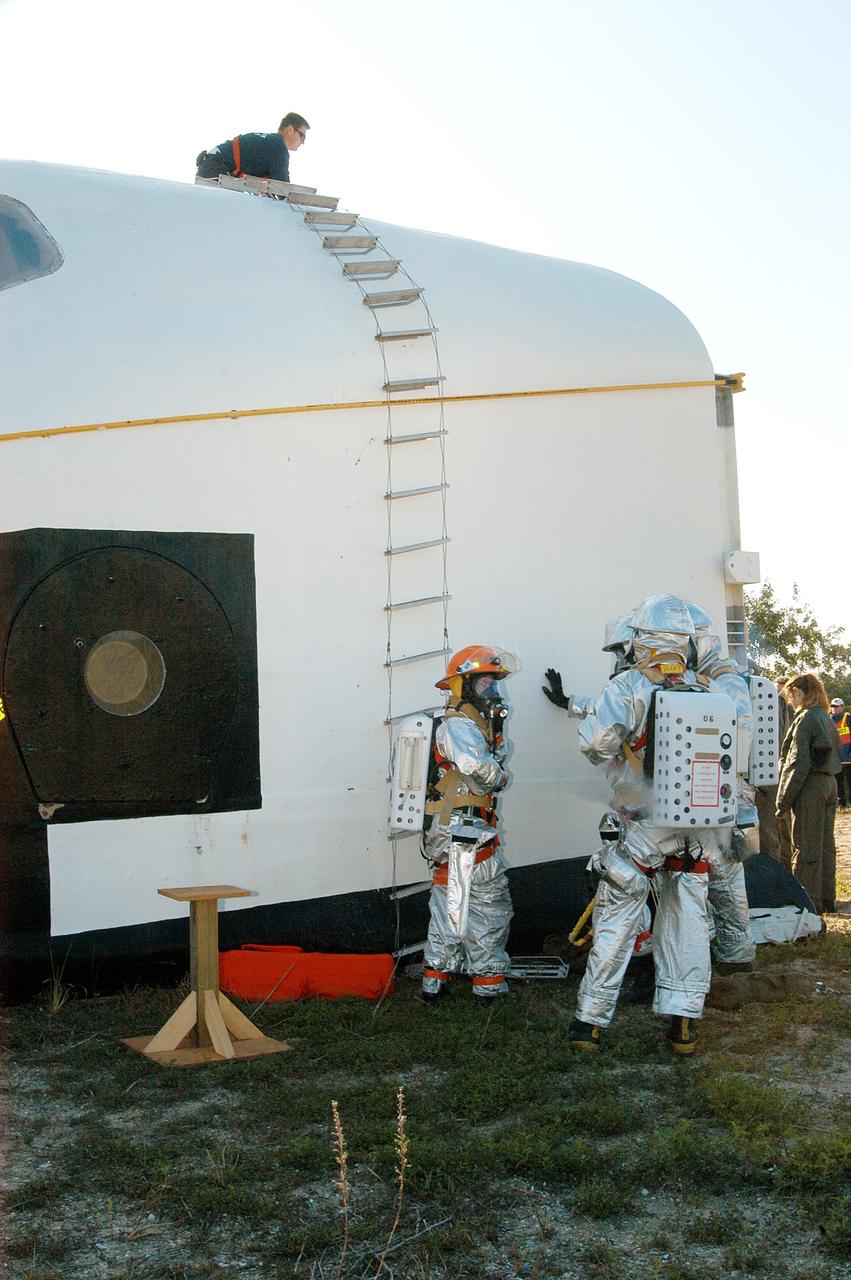
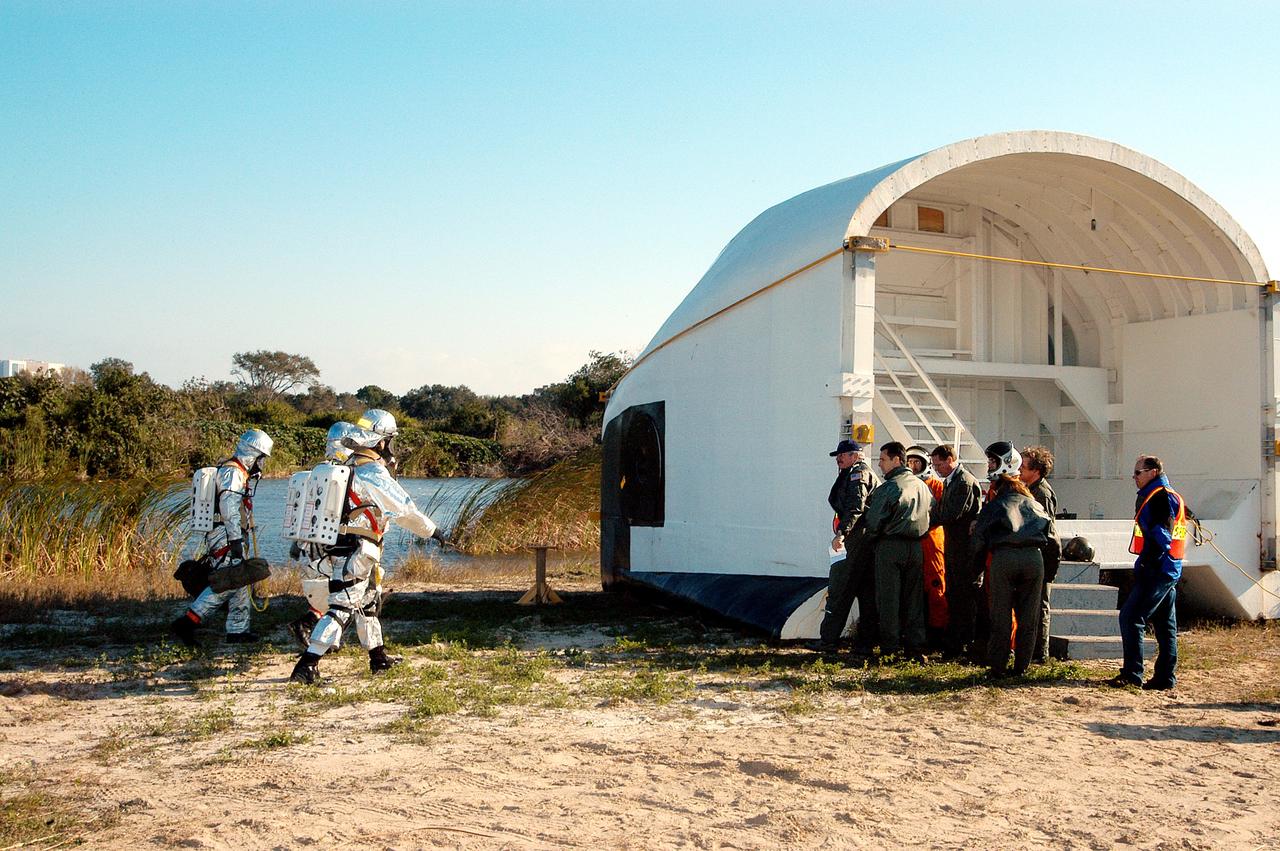
KENNEDY SPACE CENTER, FLA. - Emergency crew members return to the orbiter crew compartment mock-up that is the scene of a “Mode VII” emergency landing simulation at Kennedy Space Center.  The purpose of the Mode VII is to exercise emergency preparedness personnel, equipment and facilities in rescuing astronauts from a downed orbiter and providing immediate medical attention.  This simulation presents an orbiter that has crashed short of the Shuttle Landing Facility in a wooded area 2-1/2 miles south of Runway 33.  Emergency crews are responding to the volunteer “astronauts” simulating various injuries inside the mock-up compartment.  Rescuers have had to remove the crew, provide triage and transport to hospitals those who need further treatment.  Local hospitals are participating in the exercise.
KENNEDY SPACE CENTER, FLA. - Emergency crew members return to the orbiter crew compartment mock-up that is the scene of a “Mode VII” emergency landing simulation at Kennedy Space Center. The purpose of the Mode VII is to exercise emergency preparedness personnel, equipment and facilities in rescuing astronauts from a downed orbiter and providing immediate medical attention. This simulation presents an orbiter that has crashed short of the Shuttle Landing Facility in a wooded area 2-1/2 miles south of Runway 33. Emergency crews are responding to the volunteer “astronauts” simulating various injuries inside the mock-up compartment. Rescuers have had to remove the crew, provide triage and transport to hospitals those who need further treatment. Local hospitals are participating in the exercise.
KENNEDY SPACE CENTER, FLA. - In the Launch Control Center, officials monitor the “Mode VII” emergency landing simulation being conducted at Kennedy Space Center and managed and directed from the LCC.  From left are Dr. Luis Moreno and Dr. David Reed, with Bionetics Life Sciences, and Dr. Philip Scarpa, with the KSC Safety, Occupational Health and Environment Division.  The purpose of the Mode VII is to exercise emergency preparedness personnel, equipment and facilities in rescuing astronauts from a downed orbiter and providing immediate medical attention.  This simulation presents an orbiter that has crashed short of the Shuttle Landing Facility in a wooded area 2-1/2 miles south of Runway 33.  Emergency crews are responding to the volunteer “astronauts” who are simulating various injuries inside the crew compartment mock-up.  Rescuers must remove the crew, provide triage and transport to hospitals those who need further treatment.  Local hospitals are participating in the exercise.
KENNEDY SPACE CENTER, FLA. - In the Launch Control Center, officials monitor the “Mode VII” emergency landing simulation being conducted at Kennedy Space Center and managed and directed from the LCC. From left are Dr. Luis Moreno and Dr. David Reed, with Bionetics Life Sciences, and Dr. Philip Scarpa, with the KSC Safety, Occupational Health and Environment Division. The purpose of the Mode VII is to exercise emergency preparedness personnel, equipment and facilities in rescuing astronauts from a downed orbiter and providing immediate medical attention. This simulation presents an orbiter that has crashed short of the Shuttle Landing Facility in a wooded area 2-1/2 miles south of Runway 33. Emergency crews are responding to the volunteer “astronauts” who are simulating various injuries inside the crew compartment mock-up. Rescuers must remove the crew, provide triage and transport to hospitals those who need further treatment. Local hospitals are participating in the exercise.
KENNEDY SPACE CENTER, FLA. - Emergency crew members prepare to rescue another “astronaut” from inside the orbiter crew compartment mock-up that is the scene of a “Mode VII” emergency landing simulation at Kennedy Space Center.  The purpose of the Mode VII is to exercise emergency preparedness personnel, equipment and facilities in rescuing astronauts from a downed orbiter and providing immediate medical attention.  This simulation presents an orbiter that has crashed short of the Shuttle Landing Facility in a wooded area 2-1/2 miles south of Runway 33.  Emergency crews are responding to the volunteer astronauts who are simulating various injuries.  Rescuers must remove the crew, provide triage and transport to hospitals those who need further treatment.  Local hospitals are participating in the exercise.
KENNEDY SPACE CENTER, FLA. - Emergency crew members prepare to rescue another “astronaut” from inside the orbiter crew compartment mock-up that is the scene of a “Mode VII” emergency landing simulation at Kennedy Space Center. The purpose of the Mode VII is to exercise emergency preparedness personnel, equipment and facilities in rescuing astronauts from a downed orbiter and providing immediate medical attention. This simulation presents an orbiter that has crashed short of the Shuttle Landing Facility in a wooded area 2-1/2 miles south of Runway 33. Emergency crews are responding to the volunteer astronauts who are simulating various injuries. Rescuers must remove the crew, provide triage and transport to hospitals those who need further treatment. Local hospitals are participating in the exercise.
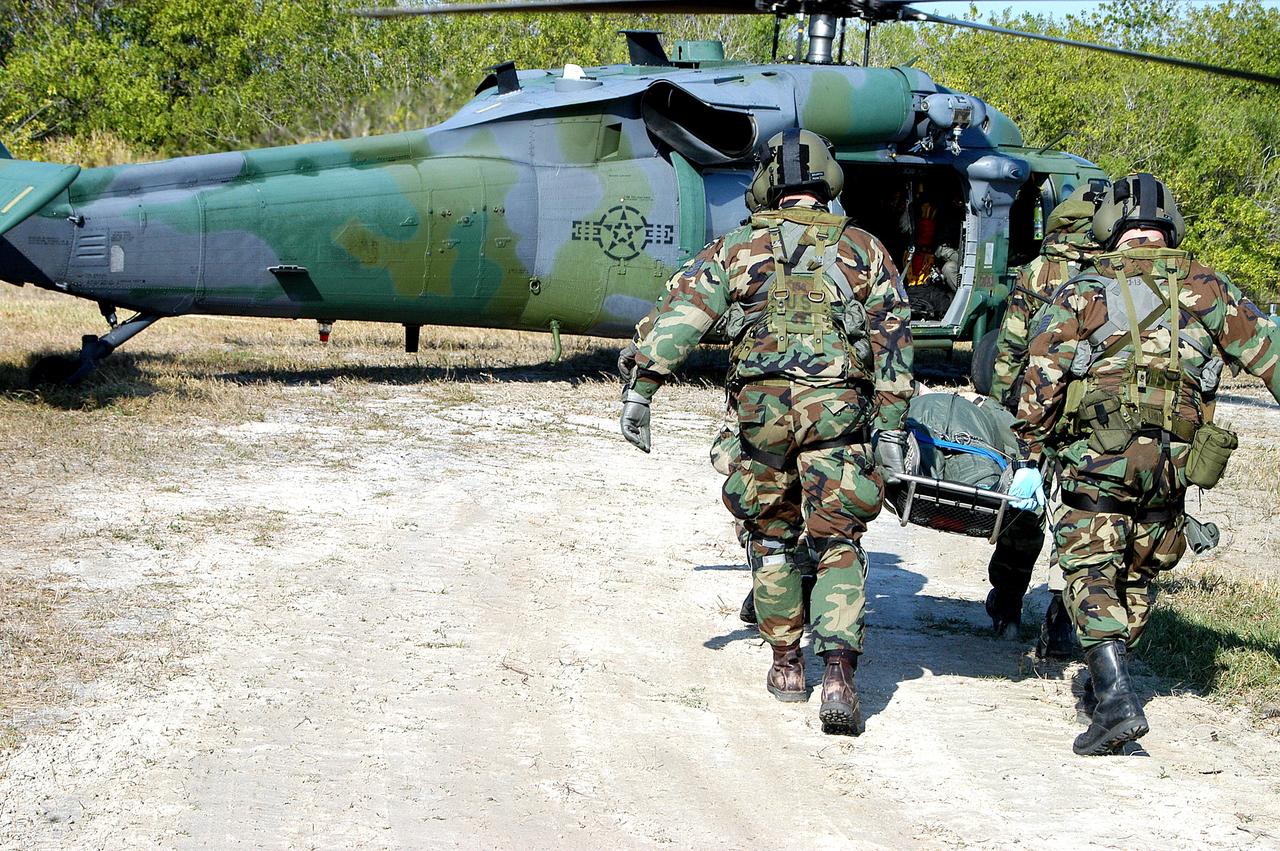
KENNEDY SPACE CENTER, FLA. - A helicopter rescue team carries another “injured” astronaut to a helicopter for transportation to a local hospital.  They are all taking part in a “Mode VII” emergency landing simulation at Kennedy Space Center.  The purpose of the Mode VII is to exercise emergency preparedness personnel, equipment and facilities in rescuing astronauts from a downed orbiter and providing immediate medical attention.  This simulation presents an orbiter that has crashed short of the Shuttle Landing Facility in a wooded area 2-1/2 miles south of Runway 33.  Emergency crews are responding to the volunteer “astronauts” who are simulating various injuries inside the crew compartment mock-up.  Rescuers must remove the crew, provide triage and transport to hospitals those who need further treatment.  Local hospitals are participating in the exercise.
KENNEDY SPACE CENTER, FLA. - A helicopter rescue team carries another “injured” astronaut to a helicopter for transportation to a local hospital. They are all taking part in a “Mode VII” emergency landing simulation at Kennedy Space Center. The purpose of the Mode VII is to exercise emergency preparedness personnel, equipment and facilities in rescuing astronauts from a downed orbiter and providing immediate medical attention. This simulation presents an orbiter that has crashed short of the Shuttle Landing Facility in a wooded area 2-1/2 miles south of Runway 33. Emergency crews are responding to the volunteer “astronauts” who are simulating various injuries inside the crew compartment mock-up. Rescuers must remove the crew, provide triage and transport to hospitals those who need further treatment. Local hospitals are participating in the exercise.
KENNEDY SPACE CENTER, FLA. - Emergency crew members on the ground take hold of a volunteer “astronaut” lowered from the top of the orbiter crew compartment mock-up that is the scene of a “Mode VII” emergency landing simulation at Kennedy Space Center.  The purpose of the Mode VII is to exercise emergency preparedness personnel, equipment and facilities in rescuing astronauts from a downed orbiter and providing immediate medical attention.  This simulation presents an orbiter that has crashed short of the Shuttle Landing Facility in a wooded area 2-1/2 miles south of Runway 33.  Emergency crews are responding to the volunteer astronauts who are simulating various injuries.  Rescuers must remove the crew, provide triage and transport to hospitals those who need further treatment.  Local hospitals are participating in the exercise.
KENNEDY SPACE CENTER, FLA. - Emergency crew members on the ground take hold of a volunteer “astronaut” lowered from the top of the orbiter crew compartment mock-up that is the scene of a “Mode VII” emergency landing simulation at Kennedy Space Center. The purpose of the Mode VII is to exercise emergency preparedness personnel, equipment and facilities in rescuing astronauts from a downed orbiter and providing immediate medical attention. This simulation presents an orbiter that has crashed short of the Shuttle Landing Facility in a wooded area 2-1/2 miles south of Runway 33. Emergency crews are responding to the volunteer astronauts who are simulating various injuries. Rescuers must remove the crew, provide triage and transport to hospitals those who need further treatment. Local hospitals are participating in the exercise.
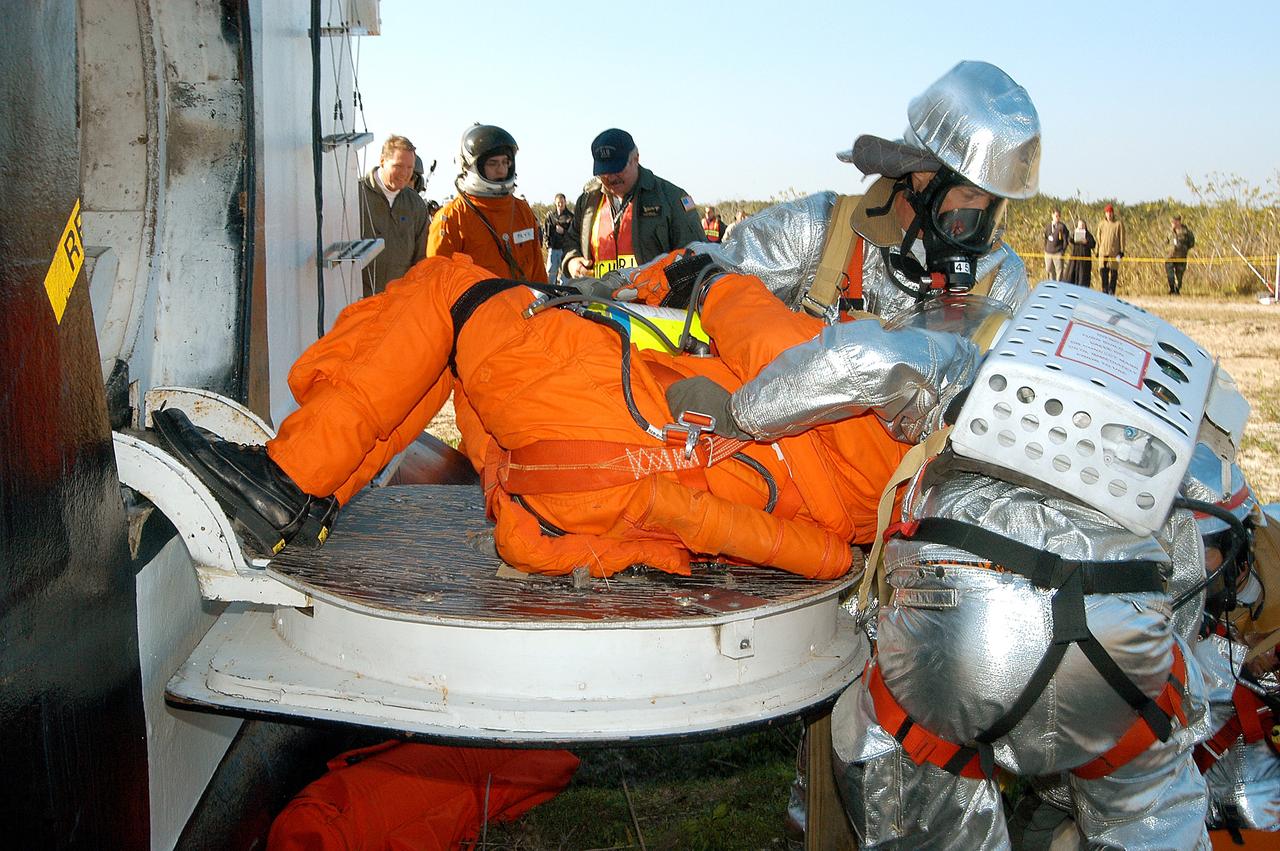
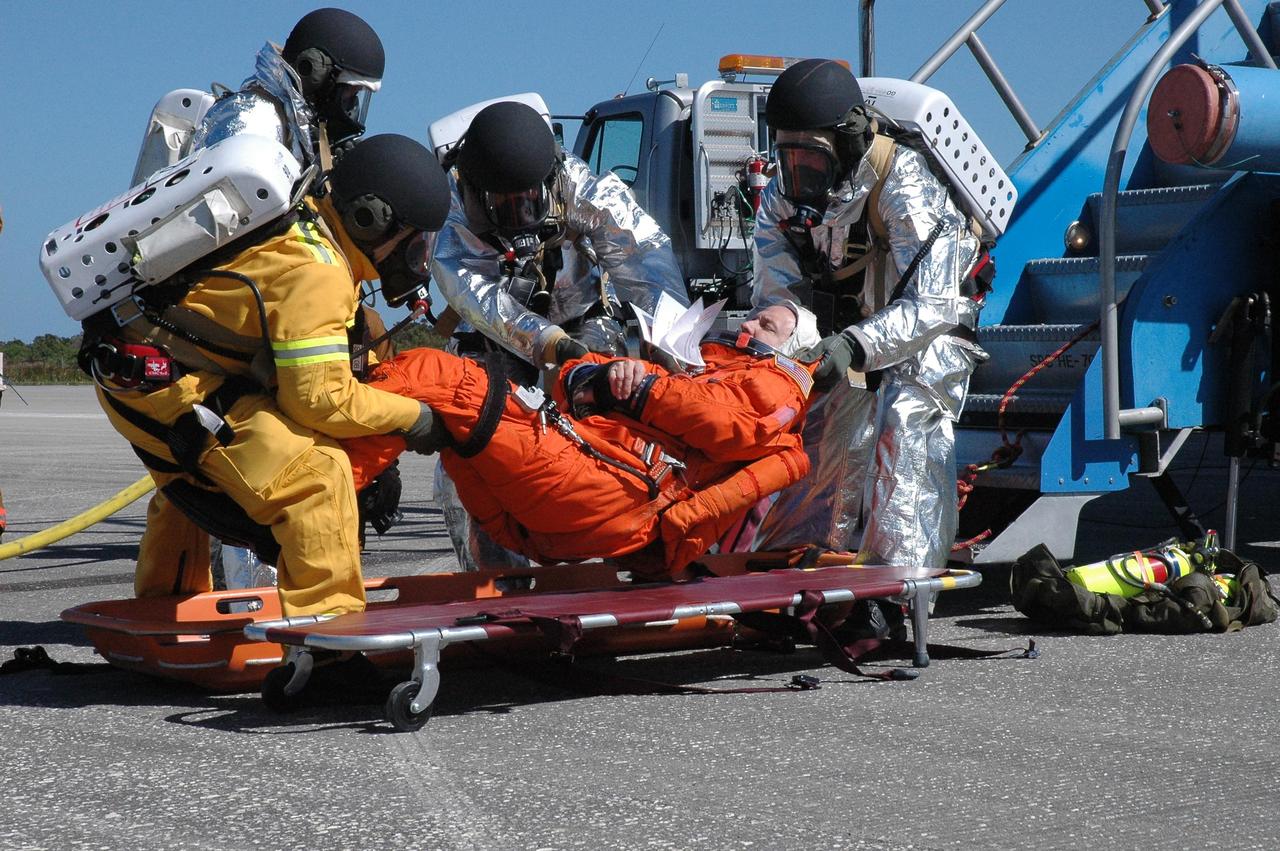
KENNEDY SPACE CENTER, FLA. - Emergency crew members help an injured astronaut after removing him from the orbiter crew compartment mock-up during a “Mode VII” emergency landing simulation at Kennedy Space Center.  The purpose of the Mode VII is to exercise emergency preparedness personnel, equipment and facilities in rescuing astronauts from a downed orbiter and providing immediate medical attention.  This simulation presents an orbiter that has crashed short of the Shuttle Landing Facility in a wooded area 2-1/2 miles south of Runway 33.  Emergency crews are responding to the volunteer astronauts who are simulating various injuries.  Rescuers must remove the crew, provide triage and transport to hospitals those who need further treatment.  Local hospitals are participating in the exercise.
KENNEDY SPACE CENTER, FLA. - Emergency crew members help an injured astronaut after removing him from the orbiter crew compartment mock-up during a “Mode VII” emergency landing simulation at Kennedy Space Center. The purpose of the Mode VII is to exercise emergency preparedness personnel, equipment and facilities in rescuing astronauts from a downed orbiter and providing immediate medical attention. This simulation presents an orbiter that has crashed short of the Shuttle Landing Facility in a wooded area 2-1/2 miles south of Runway 33. Emergency crews are responding to the volunteer astronauts who are simulating various injuries. Rescuers must remove the crew, provide triage and transport to hospitals those who need further treatment. Local hospitals are participating in the exercise.
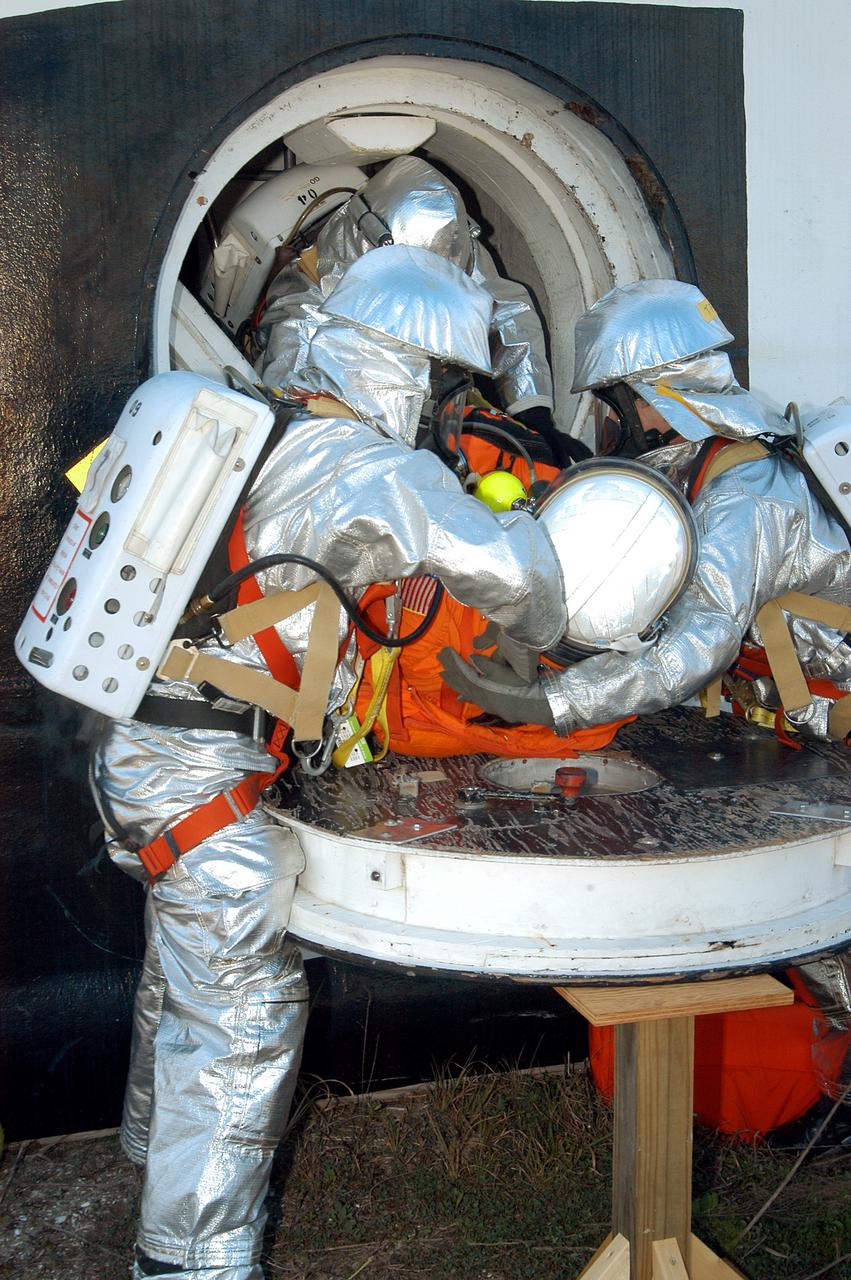
KENNEDY SPACE CENTER, FLA. - Emergency crew members “rescue” an astronaut from inside the orbiter crew compartment mock-up that is the scene of a “Mode VII” emergency landing simulation at Kennedy Space Center.  The purpose of the Mode VII is to exercise emergency preparedness personnel, equipment and facilities in rescuing astronauts from a downed orbiter and providing immediate medical attention.  This simulation presents an orbiter that has crashed short of the Shuttle Landing Facility in a wooded area 2-1/2 miles south of Runway 33.  Emergency crews are responding to the volunteer “astronauts” who are simulating various injuries.  Rescuers must remove the crew, provide triage and transport to hospitals those who need further treatment.  Local hospitals are participating in the exercise.
KENNEDY SPACE CENTER, FLA. - Emergency crew members “rescue” an astronaut from inside the orbiter crew compartment mock-up that is the scene of a “Mode VII” emergency landing simulation at Kennedy Space Center. The purpose of the Mode VII is to exercise emergency preparedness personnel, equipment and facilities in rescuing astronauts from a downed orbiter and providing immediate medical attention. This simulation presents an orbiter that has crashed short of the Shuttle Landing Facility in a wooded area 2-1/2 miles south of Runway 33. Emergency crews are responding to the volunteer “astronauts” who are simulating various injuries. Rescuers must remove the crew, provide triage and transport to hospitals those who need further treatment. Local hospitals are participating in the exercise.
KENNEDY SPACE CENTER, FLA. - Emergency crew members “rescue” an injured astronaut from the orbiter crew compartment mock-up during a “Mode VII” emergency landing simulation at Kennedy Space Center.  The purpose of the Mode VII is to exercise emergency preparedness personnel, equipment and facilities in rescuing astronauts from a downed orbiter and providing immediate medical attention.  This simulation presents an orbiter that has crashed short of the Shuttle Landing Facility in a wooded area 2-1/2 miles south of Runway 33.  Emergency crews are responding to the volunteer astronauts who are simulating various injuries.  Rescuers must remove the crew, provide triage and transport to hospitals those who need further treatment.  Local hospitals are participating in the exercise.
KENNEDY SPACE CENTER, FLA. - Emergency crew members “rescue” an injured astronaut from the orbiter crew compartment mock-up during a “Mode VII” emergency landing simulation at Kennedy Space Center. The purpose of the Mode VII is to exercise emergency preparedness personnel, equipment and facilities in rescuing astronauts from a downed orbiter and providing immediate medical attention. This simulation presents an orbiter that has crashed short of the Shuttle Landing Facility in a wooded area 2-1/2 miles south of Runway 33. Emergency crews are responding to the volunteer astronauts who are simulating various injuries. Rescuers must remove the crew, provide triage and transport to hospitals those who need further treatment. Local hospitals are participating in the exercise.
KENNEDY SPACE CENTER, FLA. - Emergency crew members help an “injured” astronaut who was removed from the orbiter crew compartment mock-up during a “Mode VII” emergency landing simulation at Kennedy Space Center.  The purpose of the Mode VII is to exercise emergency preparedness personnel, equipment and facilities in rescuing astronauts from a downed orbiter and providing immediate medical attention.  This simulation presents an orbiter that has crashed short of the Shuttle Landing Facility in a wooded area 2-1/2 miles south of Runway 33.  Emergency crews are responding to the volunteer astronauts who are simulating various injuries.  Rescuers must remove the crew, provide triage and transport to hospitals those who need further treatment.  Local hospitals are participating in the exercise.
KENNEDY SPACE CENTER, FLA. - Emergency crew members help an “injured” astronaut who was removed from the orbiter crew compartment mock-up during a “Mode VII” emergency landing simulation at Kennedy Space Center. The purpose of the Mode VII is to exercise emergency preparedness personnel, equipment and facilities in rescuing astronauts from a downed orbiter and providing immediate medical attention. This simulation presents an orbiter that has crashed short of the Shuttle Landing Facility in a wooded area 2-1/2 miles south of Runway 33. Emergency crews are responding to the volunteer astronauts who are simulating various injuries. Rescuers must remove the crew, provide triage and transport to hospitals those who need further treatment. Local hospitals are participating in the exercise.
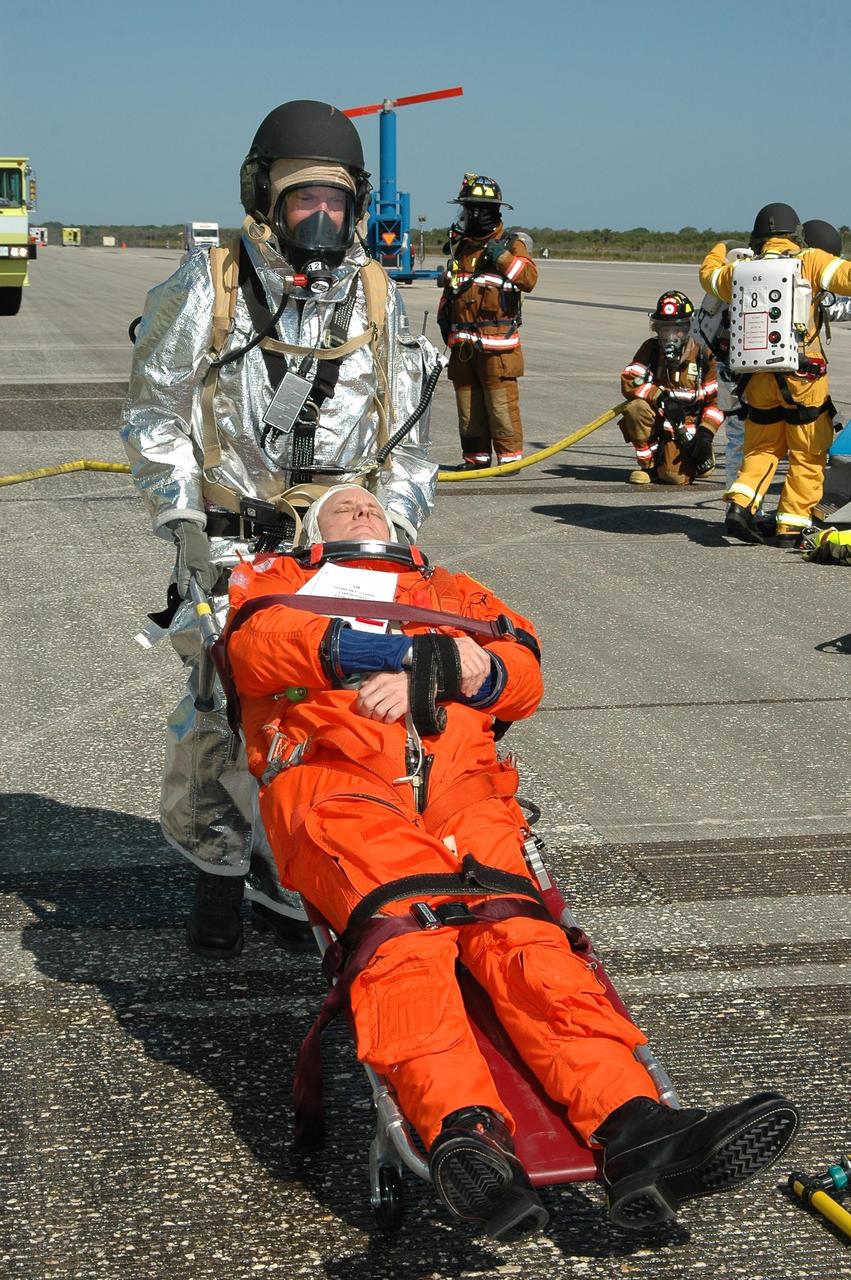
KENNEDY SPACE CENTER, FLA. - Emergency crew members transport an “injured”  astronaut during a “Mode VII” emergency landing simulation at Kennedy Space Center.  The purpose of the Mode VII is to exercise emergency preparedness personnel, equipment and facilities in rescuing astronauts from a downed orbiter and providing immediate medical attention.  This simulation presents an orbiter that has crashed short of the Shuttle Landing Facility in a wooded area 2-1/2 miles south of Runway 33.  Emergency crews are responding to the volunteer astronauts who are simulating various injuries inside the crew compartment mock-up.  Rescuers must remove the crew, provide triage and transport to hospitals those who need further treatment.  Local hospitals are participating in the exercise.
KENNEDY SPACE CENTER, FLA. - Emergency crew members transport an “injured” astronaut during a “Mode VII” emergency landing simulation at Kennedy Space Center. The purpose of the Mode VII is to exercise emergency preparedness personnel, equipment and facilities in rescuing astronauts from a downed orbiter and providing immediate medical attention. This simulation presents an orbiter that has crashed short of the Shuttle Landing Facility in a wooded area 2-1/2 miles south of Runway 33. Emergency crews are responding to the volunteer astronauts who are simulating various injuries inside the crew compartment mock-up. Rescuers must remove the crew, provide triage and transport to hospitals those who need further treatment. Local hospitals are participating in the exercise.
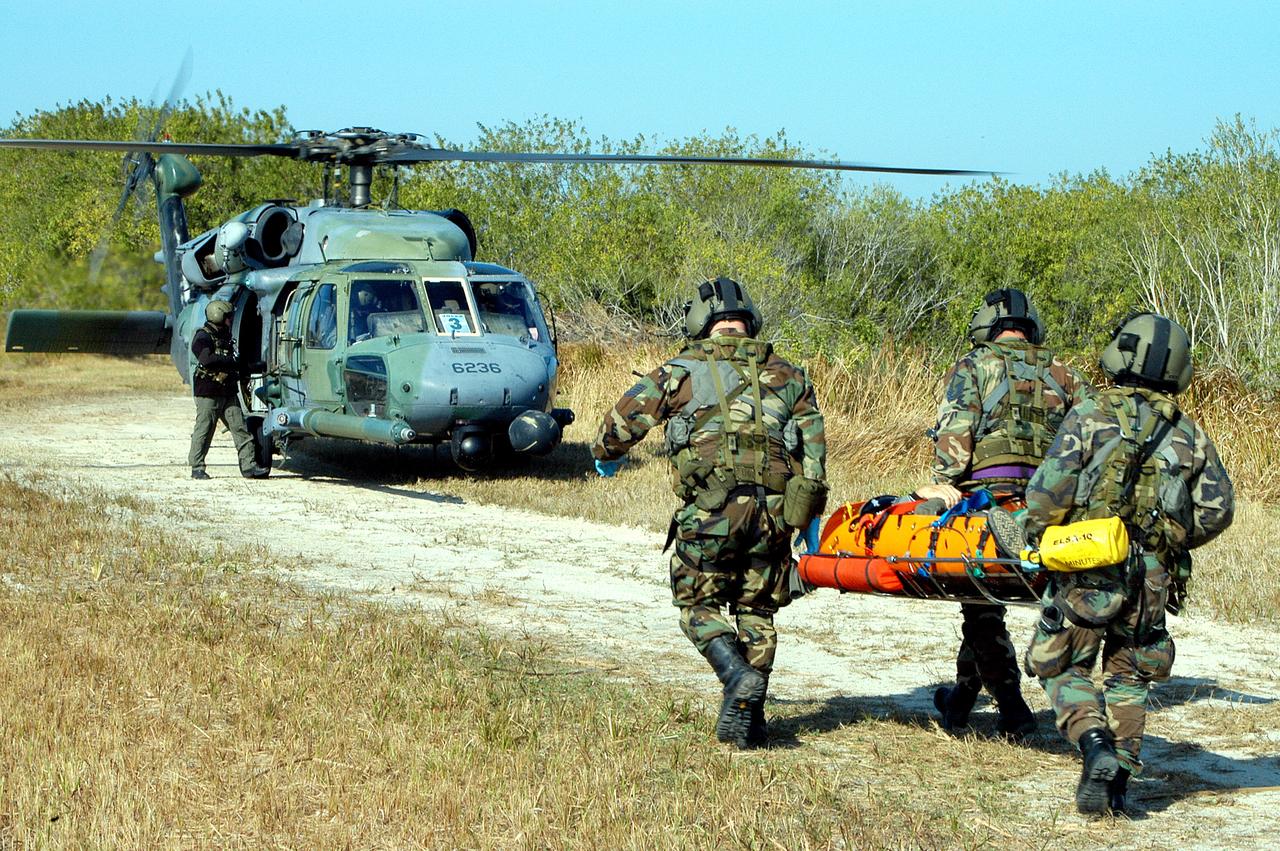
KENNEDY SPACE CENTER, FLA. - A rescue team carries an “injured” astronaut toward the helicopter for transportation to a local hospital.  They are all taking part in a “Mode VII” emergency landing simulation at Kennedy Space Center.  The purpose of the Mode VII is to exercise emergency preparedness personnel, equipment and facilities in rescuing astronauts from a downed orbiter and providing immediate medical attention.  This simulation presents an orbiter that has crashed short of the Shuttle Landing Facility in a wooded area 2-1/2 miles south of Runway 33.  Emergency crews are responding to the volunteer astronauts who are simulating various injuries inside the crew compartment mock-up.  Rescuers must remove the crew, provide triage and transport to hospitals those who need further treatment.  Local hospitals are participating in the exercise. Emergency crews are responding to the volunteer astronauts who are simulating various injuries inside the crew compartment mock-up.  Rescuers must remove the crew, provide triage and transport to hospitals those who need further treatment.  Local hospitals are participating in the exercise.
KENNEDY SPACE CENTER, FLA. - A rescue team carries an “injured” astronaut toward the helicopter for transportation to a local hospital. They are all taking part in a “Mode VII” emergency landing simulation at Kennedy Space Center. The purpose of the Mode VII is to exercise emergency preparedness personnel, equipment and facilities in rescuing astronauts from a downed orbiter and providing immediate medical attention. This simulation presents an orbiter that has crashed short of the Shuttle Landing Facility in a wooded area 2-1/2 miles south of Runway 33. Emergency crews are responding to the volunteer astronauts who are simulating various injuries inside the crew compartment mock-up. Rescuers must remove the crew, provide triage and transport to hospitals those who need further treatment. Local hospitals are participating in the exercise. Emergency crews are responding to the volunteer astronauts who are simulating various injuries inside the crew compartment mock-up. Rescuers must remove the crew, provide triage and transport to hospitals those who need further treatment. Local hospitals are participating in the exercise.
S94-47232 (13 Oct 1994) --- Cosmonaut Yuriy I. Onufriyenko (right), in the United States to participate in training for joint Russia-United States space missions, simulates a parachute drop into water. The training took place in the Johnson Space Center's (JSC) Weightless Environment Training Facility (WET-F) because it contains a 25-feet-deep pool. Onufriyenko, a Mir reserve team member, and a number of other cosmonauts and astronauts participating in the joint program were in Houston, Texas to prepare for upcoming missions which involve crewmembers from the two nations.
Cosmonaut Yuriy Onufriyenko simulates parachute drop into water
STS-135 astronaut training in the Vertical Motion Simulator, Ames Research Center, Moffett Field, CA. Mission Chris Ferguson commander in forground, Doug Hurley, pilot in background are in VMS S-cab cockpit for simulated landing practice under a variety of landing sites and conditions.
ARC-2011-ACD11-0032-008
Michael Feary pilots a simulated electric vertical takeoff and landing, or eVTOL, aircraft in the VMS’s R-Cab during the AFCM subproject simulation FAA-2 flight tests in the VMS, N243.
Automated Flight and Contingency Management, or AFCM, Subproject
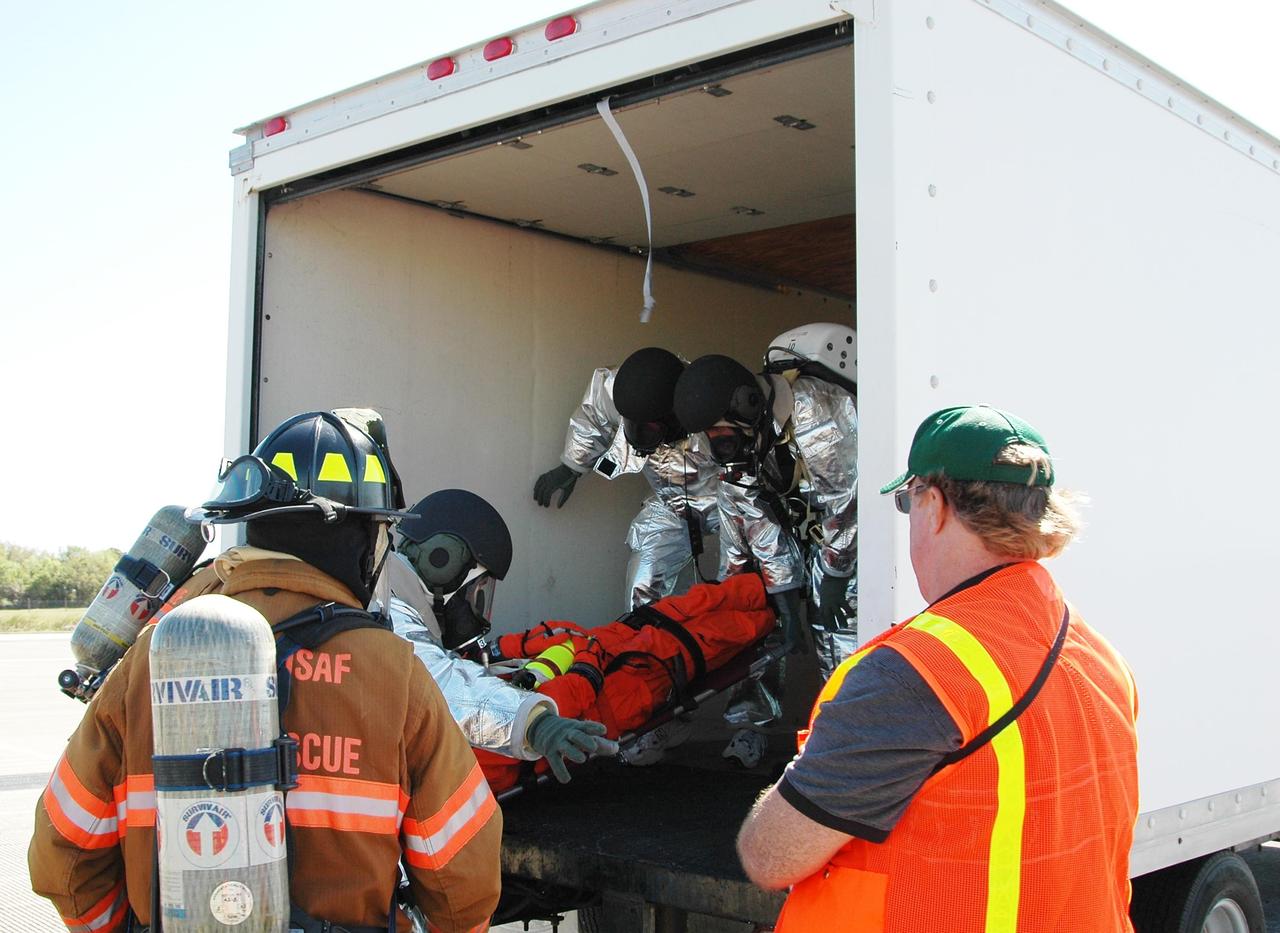
KENNEDY SPACE CENTER, FLA.  -  During a simulated emergency landing of a shuttle crew at NASA Kennedy Space Center's Shuttle Landing Facility, medevac personnel tend to an "injured astronaut" in the helicopter.  The astronaut will be taken to an area hospital participating in the simulation.  Known as a Mode VI exercise, the operation uses volunteer workers from the Center to pose as astronauts. The purpose of the simulation is to exercise emergency preparedness personnel, equipment and facilities in rescuing astronauts from a downed orbiter and providing immediate medical attention. Photo credit: NASA/Kim Shiflett
KSC-06pd0502
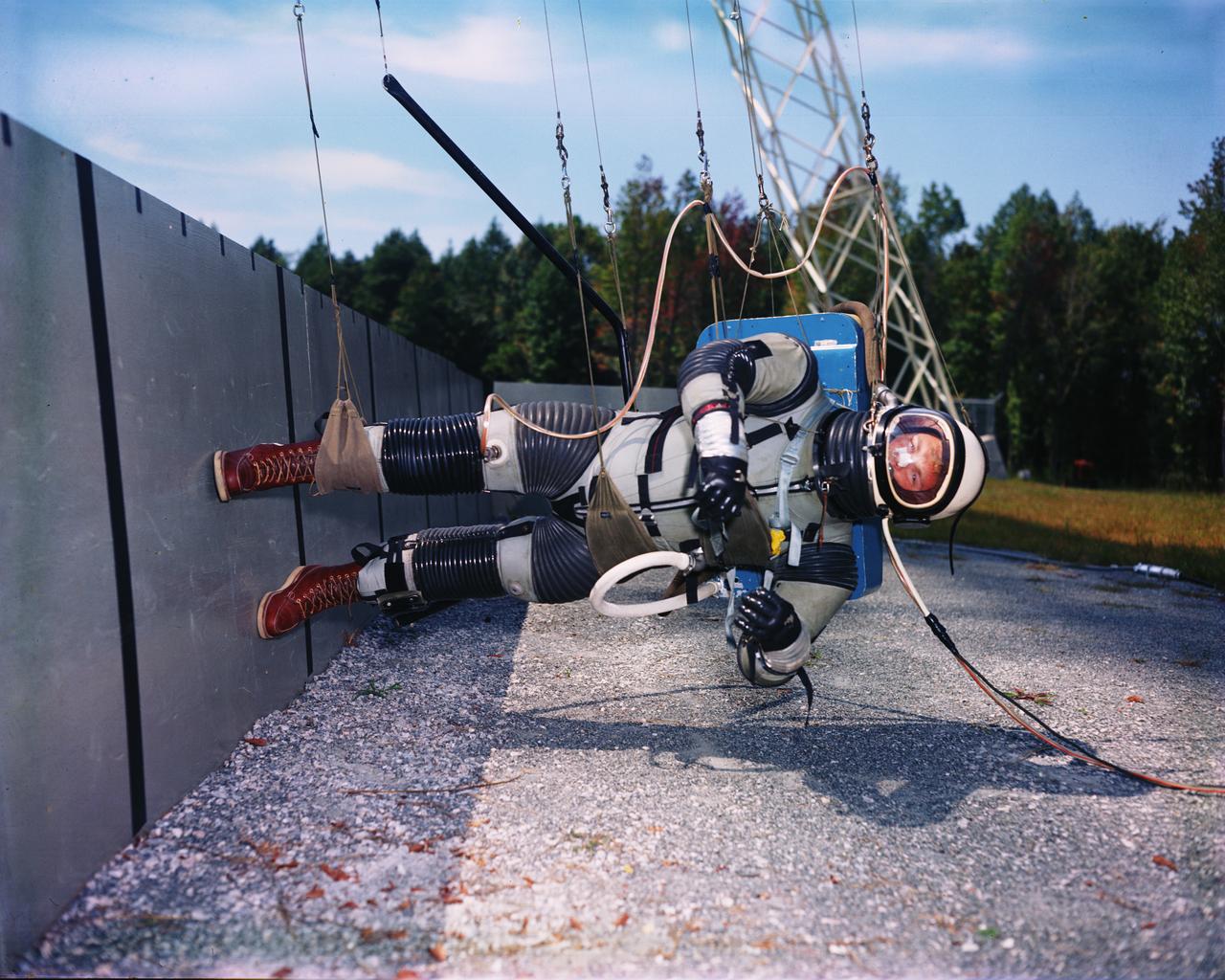
Icarus Lunar Walker,Lunar Landing Research Facility. Langley study of the backpack propulsion unit, by Bell Aerosystems.  Icarus full scale test at Lunar Landing Research Facility - low gravity simulator. A NASA Langley researcher moon walks  under the Lunar Landing Research Facility's gantry. More information on this can be read in the Document.  "STUDIES OF PILOTING PROBLEMS OF ONE-MAN FLYING UNITS OPERATED IN SIMULATED LUNAR GRAVITY"  BY Donald E. Hewes
Icarus Lunar Walker,Lunar Landing Research Facility
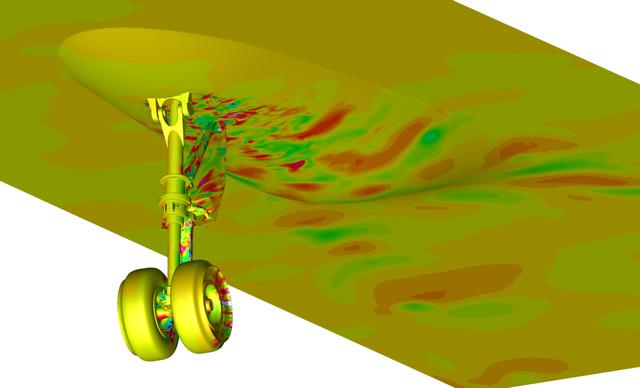
Snapshot from a simulation run on the Pleiades supercomputer. It depicts a fluctuating pressure field on aircraft nose landing gear and fuselage surfaces. The simulation helped scientists better understand the effects of landing gear and acoustic noise. The goal of the study was to improve the current understanding of aircraft nose landing gear noise, which will lead to quieter, more efficient airframe components for future aircraft designs. The visualization was produced with help from the NAS Data Analysis & Visualization group. Investigator: Mehdi Khorrami, NASA Langley Research Center.
ARC-2012-ACD12-0020-006
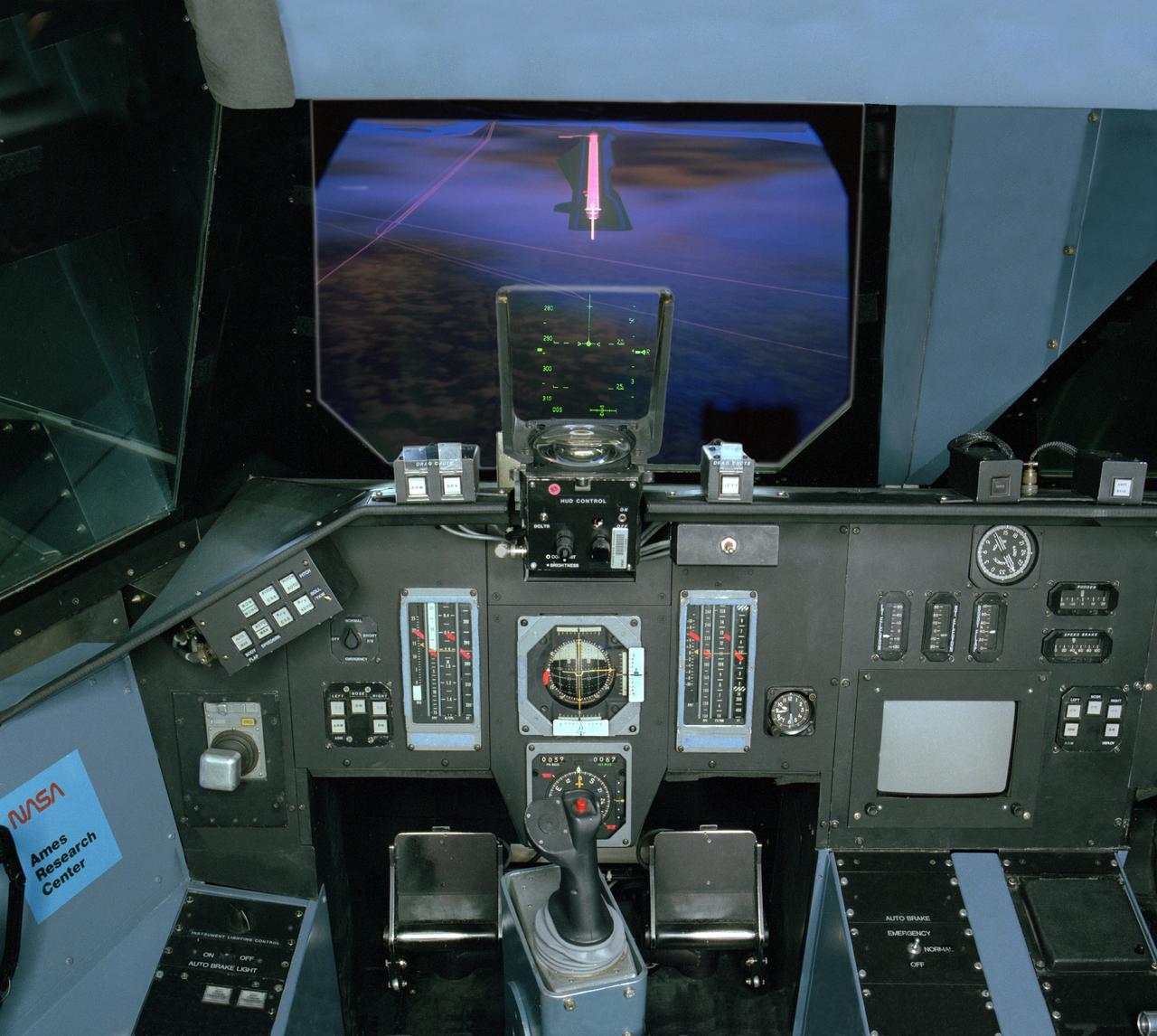
NASA Ames VMS (Vertical Motion simulator) S-cab Space Shuttle sim with out the window views 'DFRC landing'
ARC-1994-ACD94-0123-17
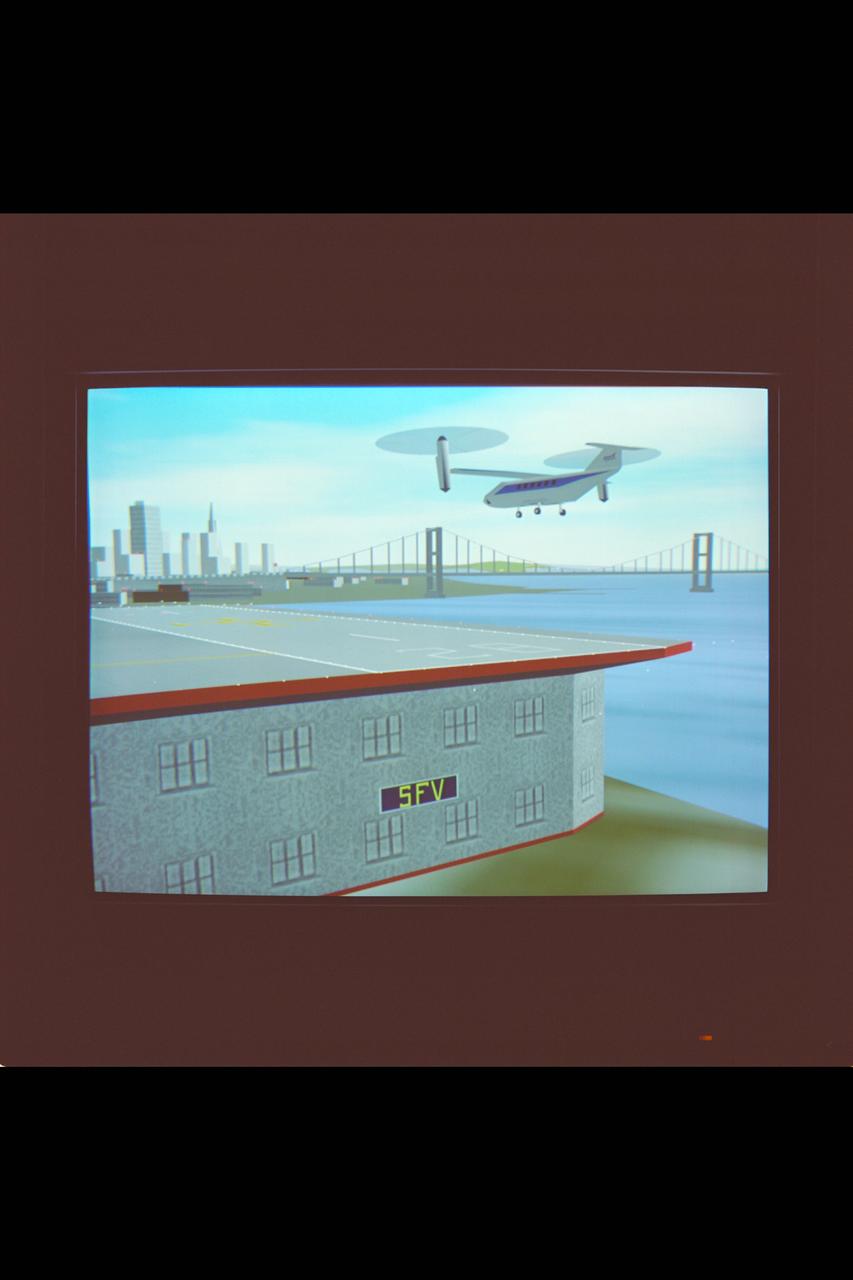
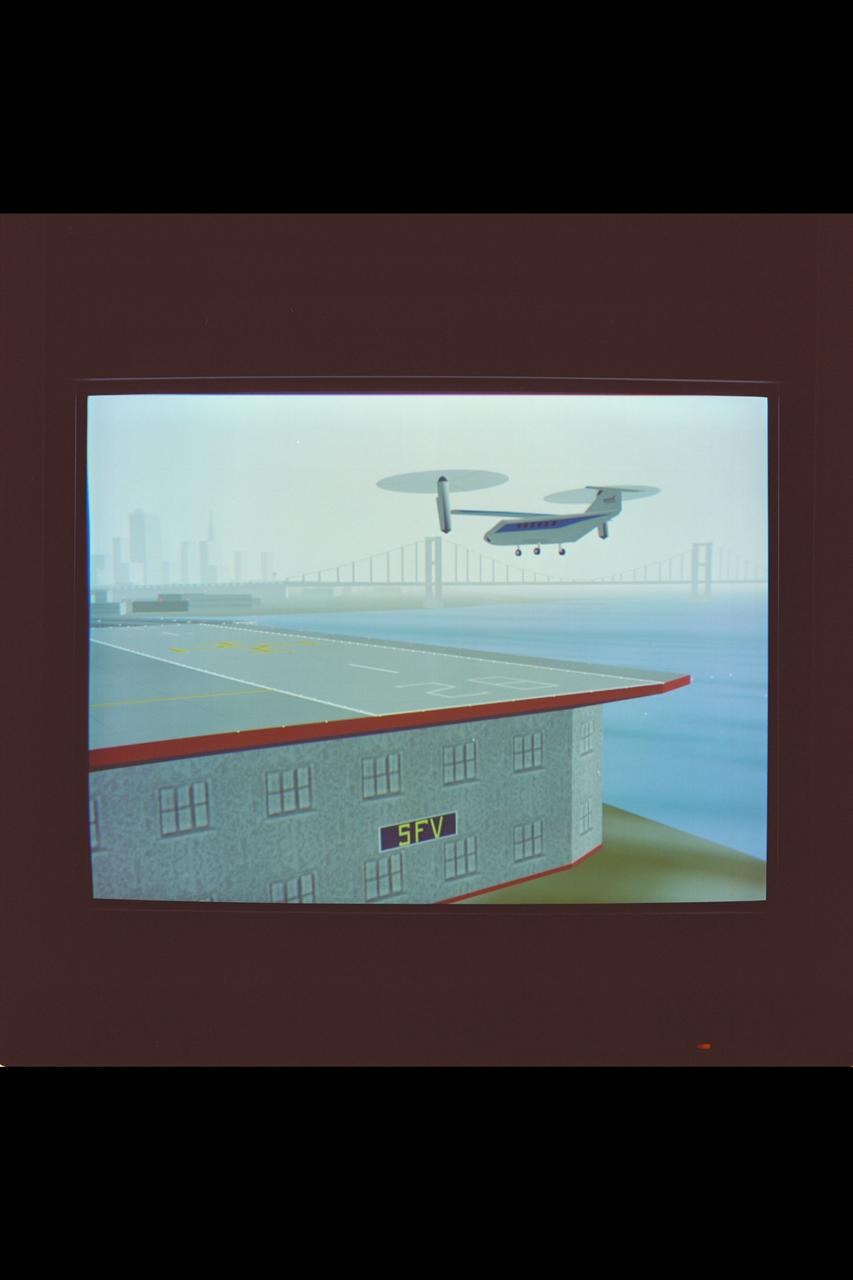
N-243 VMS R-Cab; Civil Tiltrotor Simulation  screen showing heliport (SFV) landing of CTR
ARC-1994-AC94-0503-56
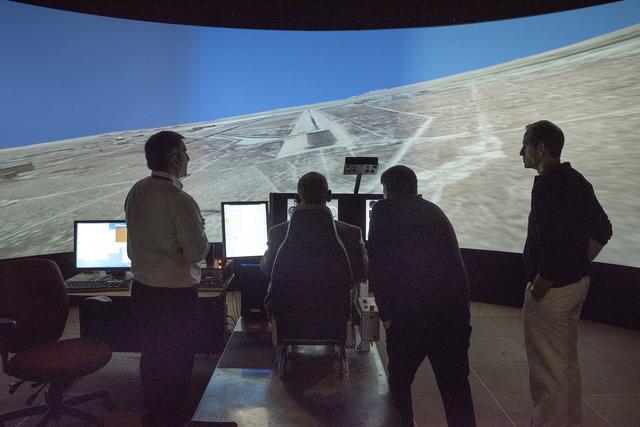
Future Flight Central (FFC) tower: Kennedy Space Center (KSC) shuttle landing simulation
ARC-2002-AC02-0124-001
NASA Ames VMS (Vertical Motion simulator) S-cab Space Shuttle sim with out the window views  'night landing'
ARC-1994-ACD94-0123-16
N-243 VMS R-Cab; Civil Tiltrotor Simulation  screne showing heliport (SFV) landing of CTR
ARC-1994-AC94-0503-62
S69-56058 (25 Oct. 1969) --- Astronaut Charles Conrad Jr., commander of the Apollo 12 lunar landing mission, sits in the cockpit of a Lunar Landing Training Vehicle (LLTV) during a lunar simulation flight at Ellington Air Force Base. The LLTV is used to train Apollo crews in lunar landing techniques.
Astronaut Charles Conrad - Cockpit - Lunar Landing Training Vehicle - Ellington AFB (EAFB), TX
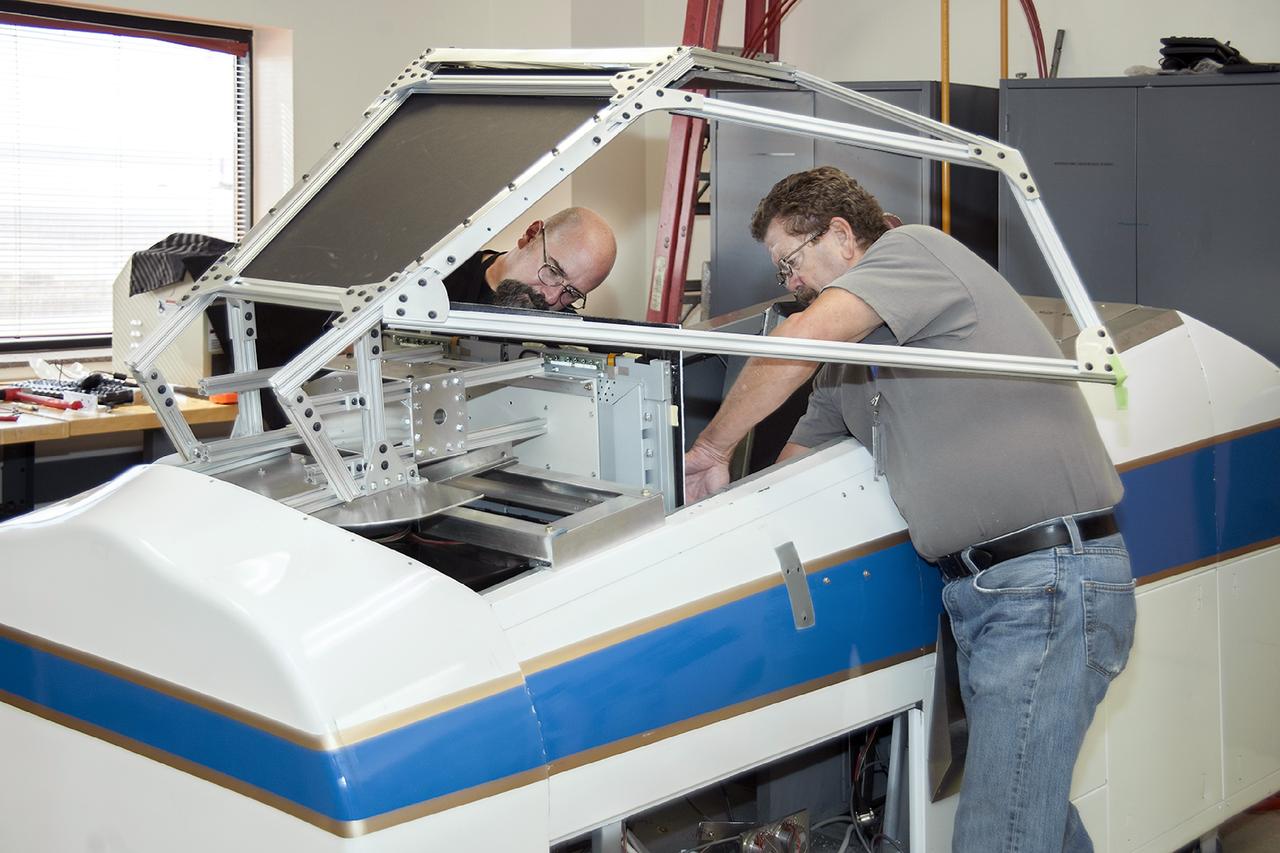
DRYDEN FLIGHT RESEARCH CENTER, Calif. - Simulation technicians Brent Bieber, left, and Dennis Pitts install a boilerplate Dream Chaser canopy structure over the cockpit of a flight simulator in the simulation laboratory at NASA's Dryden Flight Research Center in California. The modification will give Dream Chaser pilot-astronauts a more representative view of the actual flight profiles the spacecraft would fly during piloted approach and landing tests. Sierra Nevada Corporation's Space Systems division is conducting uncrewed captive- and free-flight approach and landing tests of its Dream Chaser at Dryden during the summer and fall. Photo credit: NASA/Ken Ulbrich
KSC-2013-3561
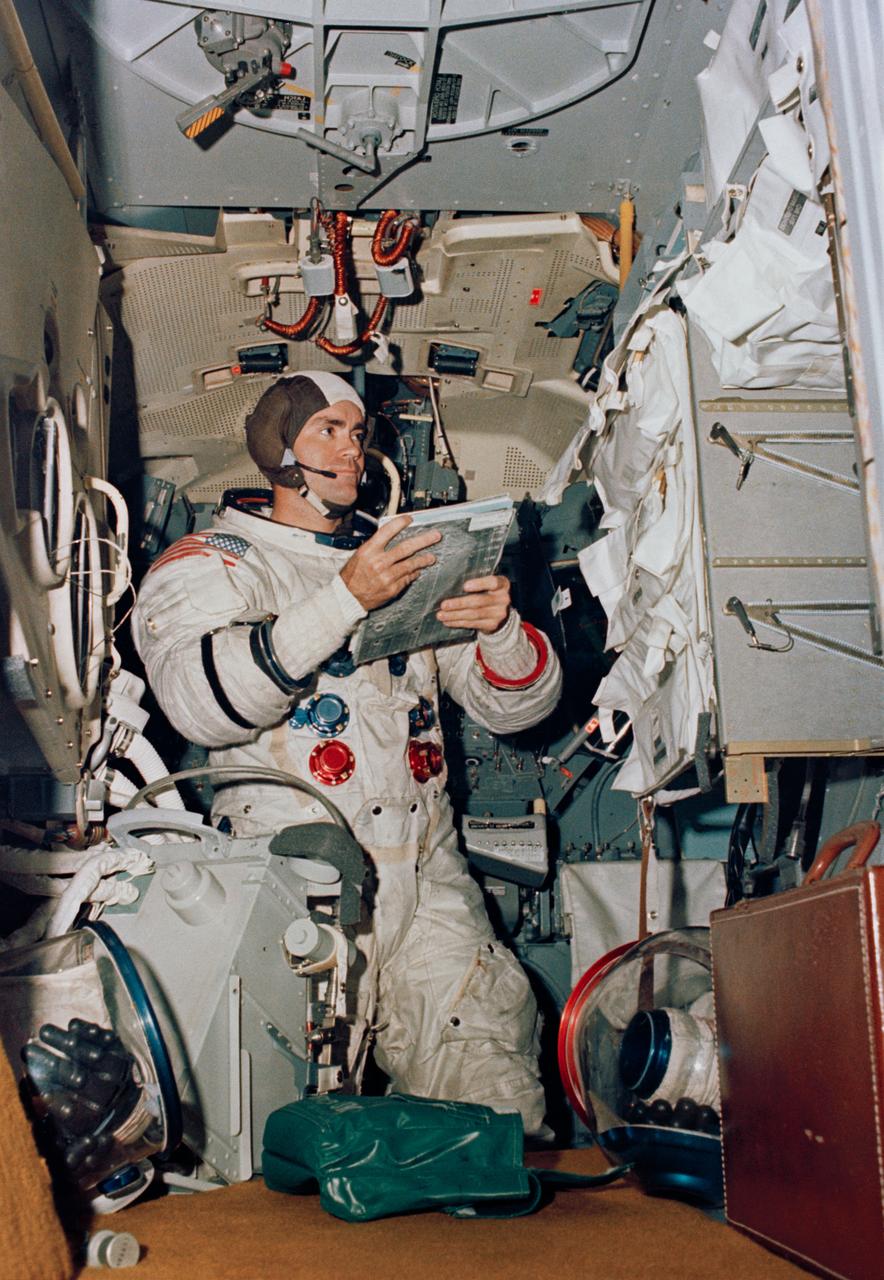
S70-34412 (4 April 1970) --- Astronaut Fred W. Haise Jr., Apollo 13 lunar module pilot, participates in simulation training in preparation for the scheduled lunar landing mission. He is in the Apollo Lunar Module Mission Simulator in the Kennedy Space Center's Flight Crew Training building.
Astronaut Fred Haise participates in simulation training
S69-56059 (24 Oct. 1969) --- Astronaut Alan L. Bean, lunar module pilot of the Apollo 12 lunar landing mission, participates in lunar surface simulation training in Building 29 at the Manned Spacecraft Center (MSC). Bean is strapped to a one-sixth gravity simulator.
Astronaut Alan Bean participates in lunar surface simulation
S70-24012 (19 Jan. 1970) --- Astronaut Fred W. Haise Jr., lunar module pilot of the Apollo 13 lunar landing mission, participates in lunar surface simulation training at the Manned Spacecraft Center (MSC).  Haise is attached to a Six Degrees of Freedom Simulator.
Apollo 13 Astronaut Fred Haise during lunar surface simulation training
S70-28229 (16 Jan. 1970) --- Astronaut James A. Lovell Jr., commander of the Apollo 13 lunar landing mission, participates in lunar surface simulation training at the Manned Spacecraft Center.  Lovell is attached to a Six Degrees of Freedom Simulator.  He is carrying an Apollo Lunar Hand Tools carrier in his right hand.
Apollo 13 Astronaut James Lovel during lunar surface simulation training
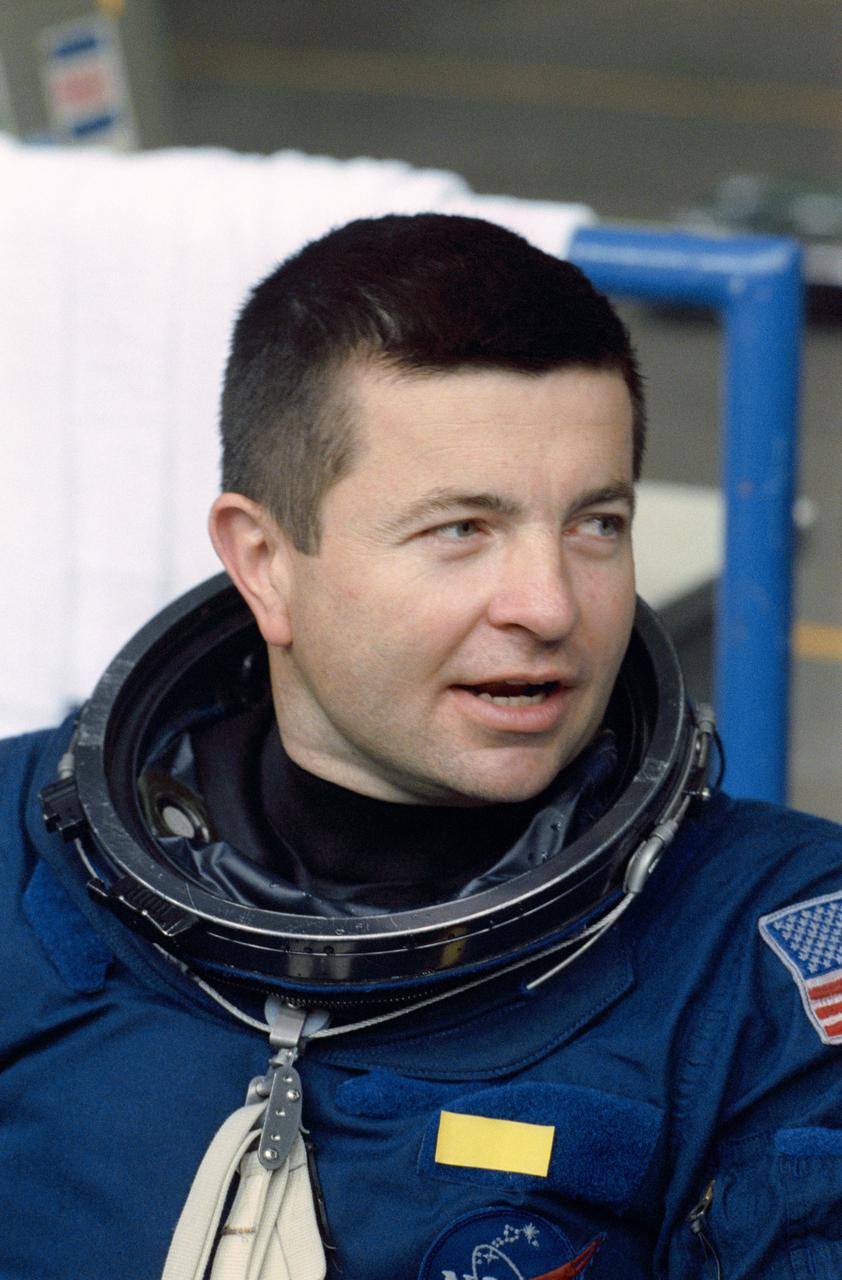
STS-37 Pilot Kenneth D. Cameron, wearing launch and entry suit (LES), discusses simulated emergency egress training on the pool side of JSC's Weightless Environment Training Facility (WETF) Bldg 29. Cameron will be dropped into a simulated ocean, the WETF's 25-ft pool, into which a parachute landing might be made.
STS-37 Pilot Kenneth D. Cameron during egress training in JSC's WETF Bldg 29
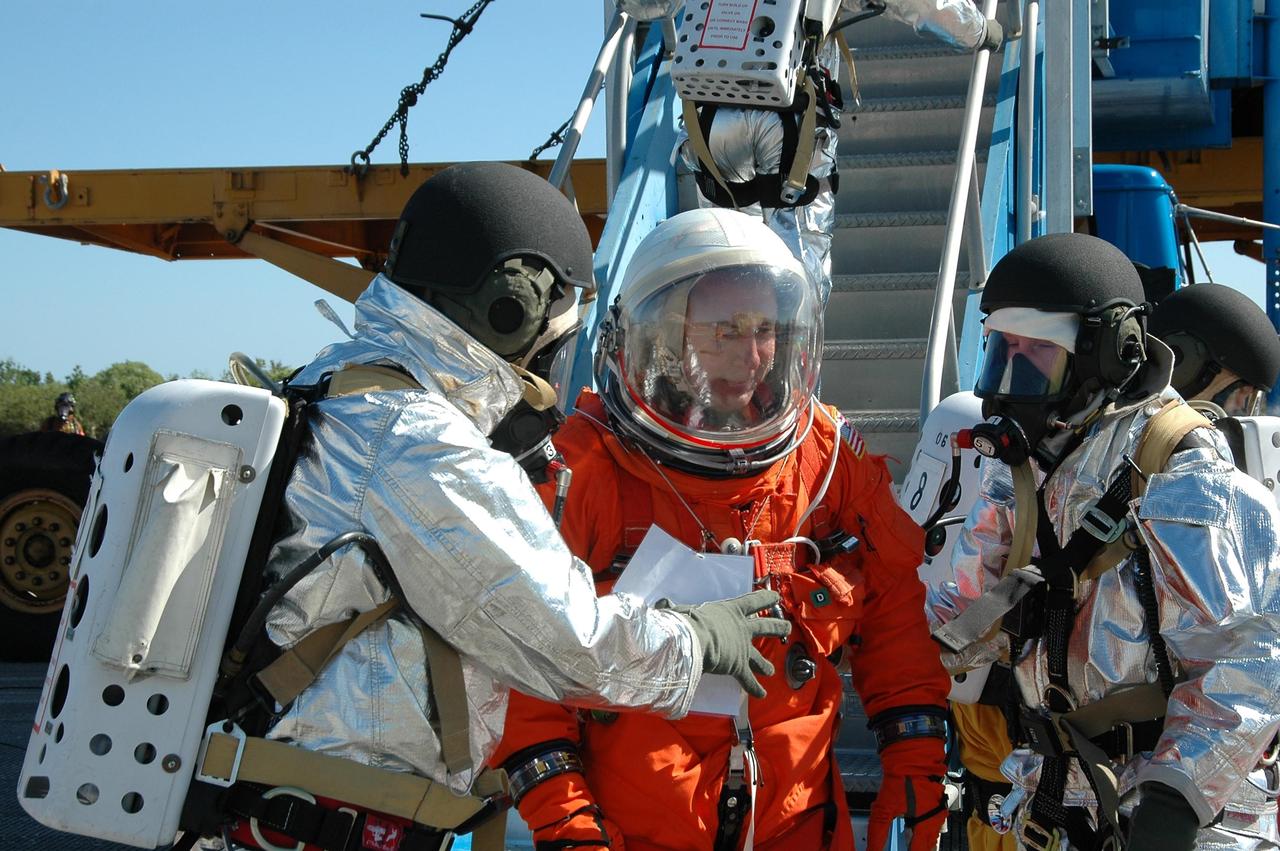
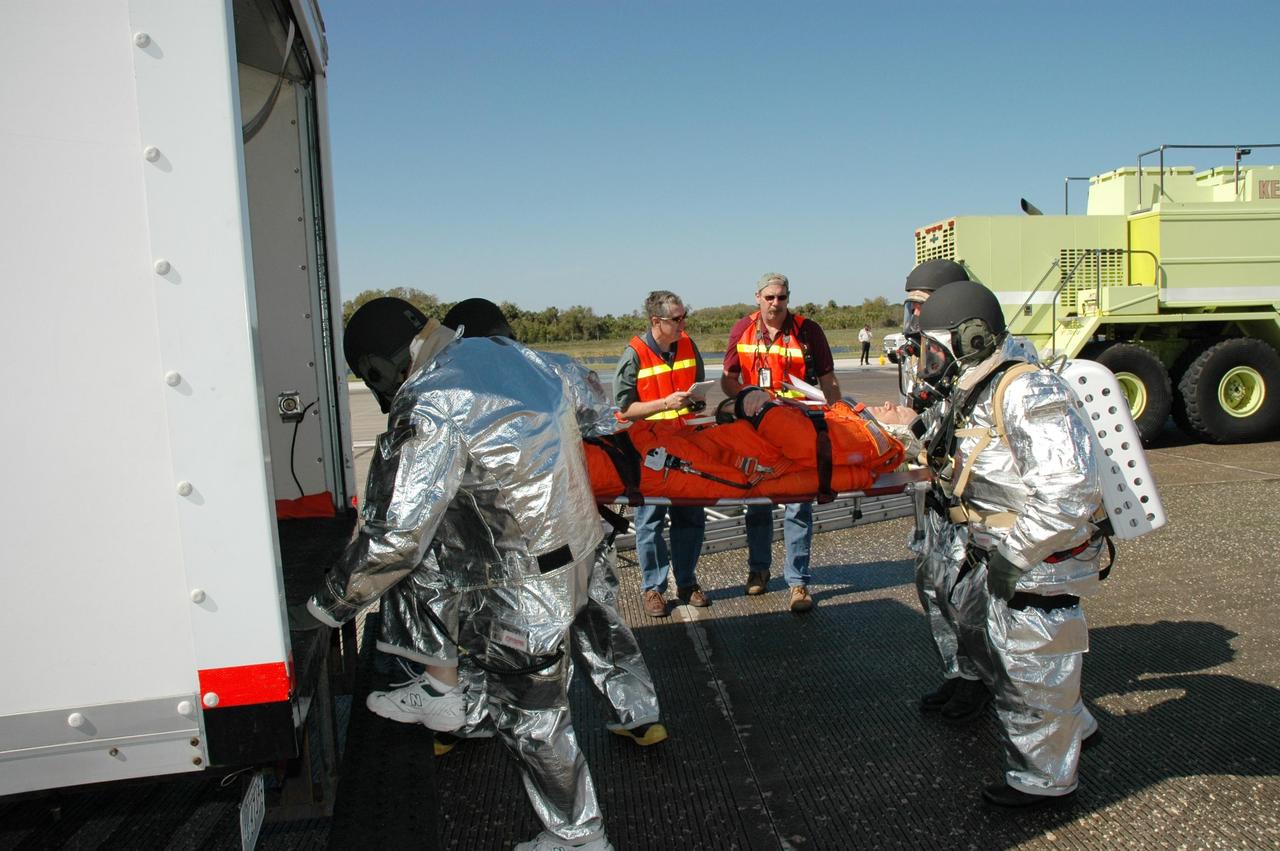
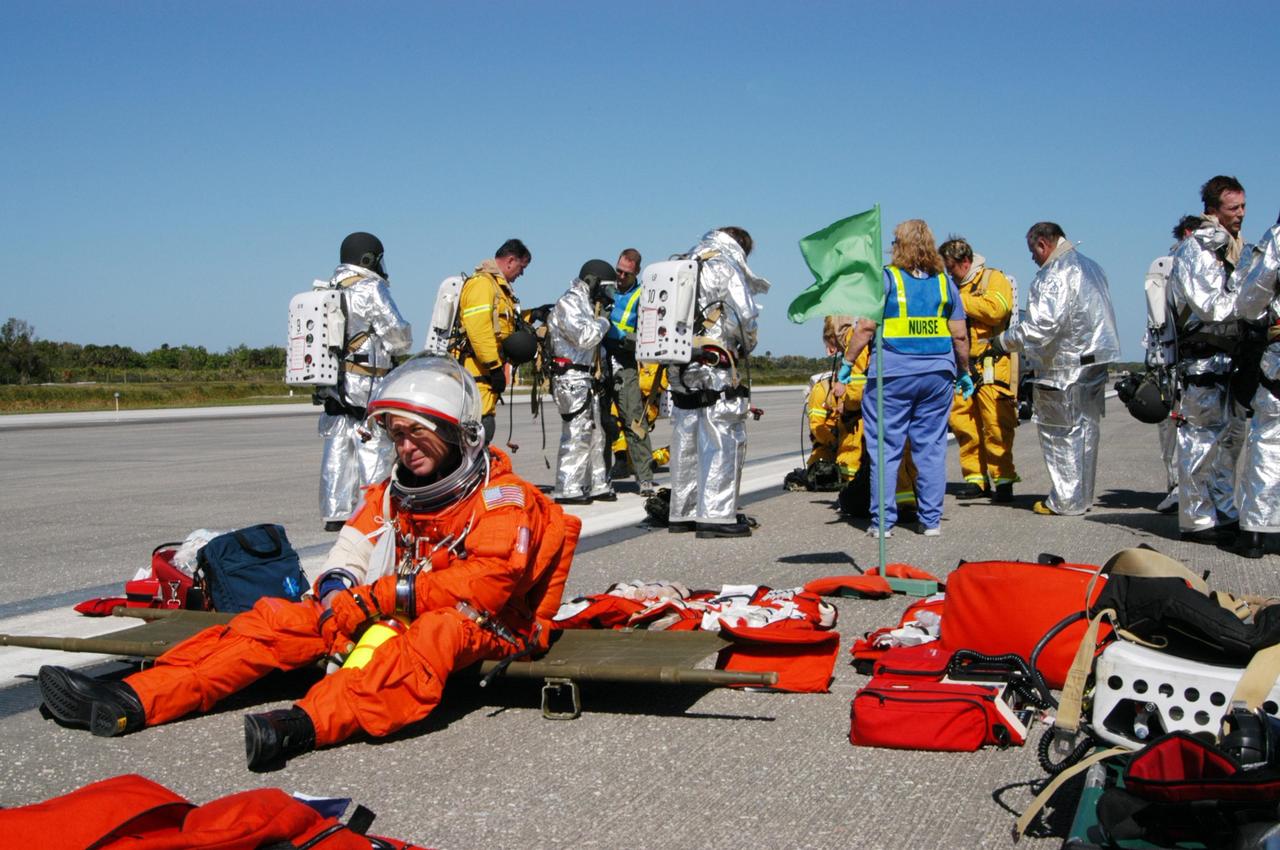
KENNEDY SPACE CENTER, FLA.  -  In a simulated emergency landing of a shuttle crew at NASA Kennedy Space Center's Shuttle Landing Facility, emergency rescue personnel place an "injured astronaut" onto a stretcher.  Known as a Mode VI exercise, the operation uses volunteer workers from the Center to pose as astronauts. The purpose of the simulation is to exercise emergency preparedness personnel, equipment and facilities in rescuing astronauts from a downed orbiter and providing immediate medical attention. Photo credit: NASA/Kim Shiflett
KSC-06pd0491
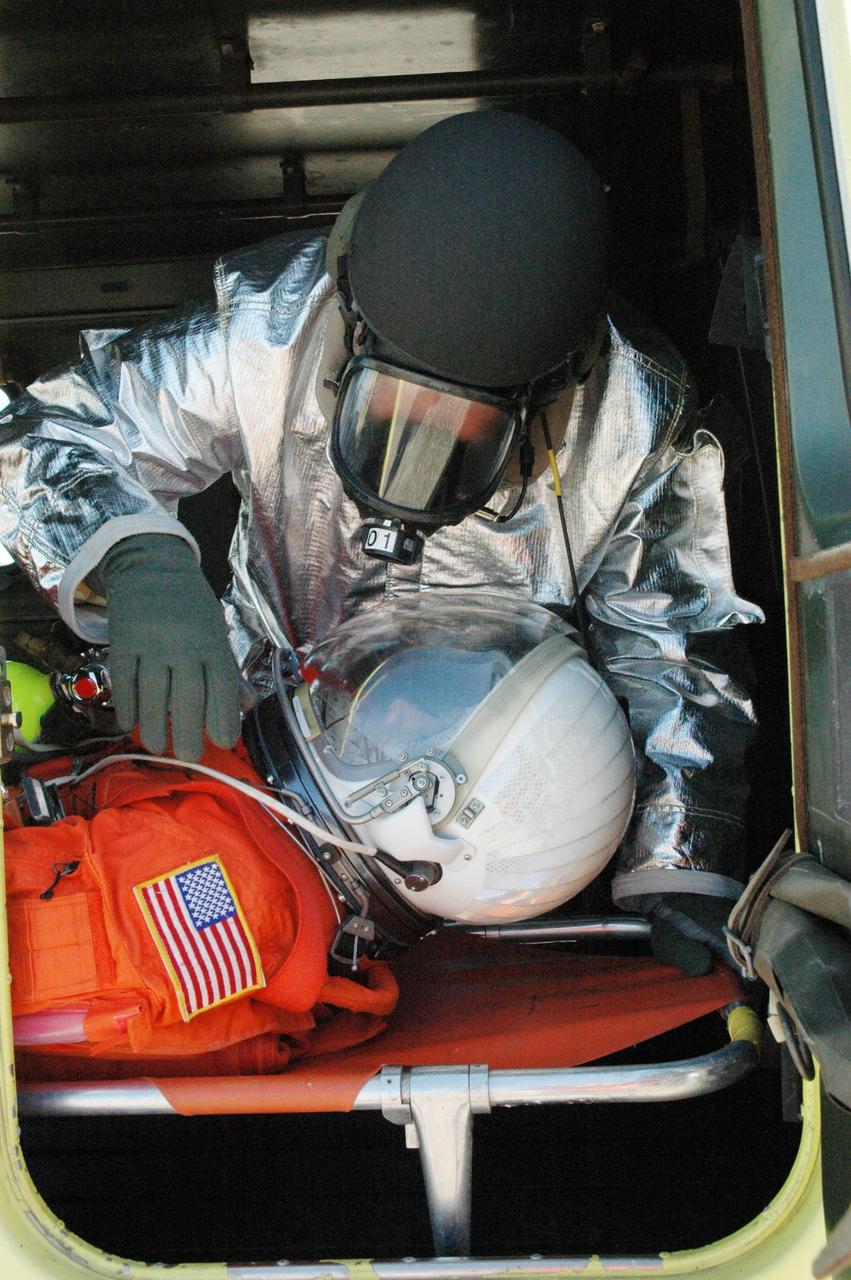
KENNEDY SPACE CENTER, FLA.  -   In a simulated emergency landing of a shuttle crew at NASA Kennedy Space Center's Shuttle Landing Facility, emergency rescue personnel place an "injured astronaut" into a rescue vehicle.  Known as a Mode VI exercise, the operation uses volunteer workers from the Center to pose as astronauts. The purpose of the simulation is to exercise emergency preparedness personnel, equipment and facilities in rescuing astronauts from a downed orbiter and providing immediate medical attention. Photo credit: NASA/Kim Shiflett
KSC-06pd0496
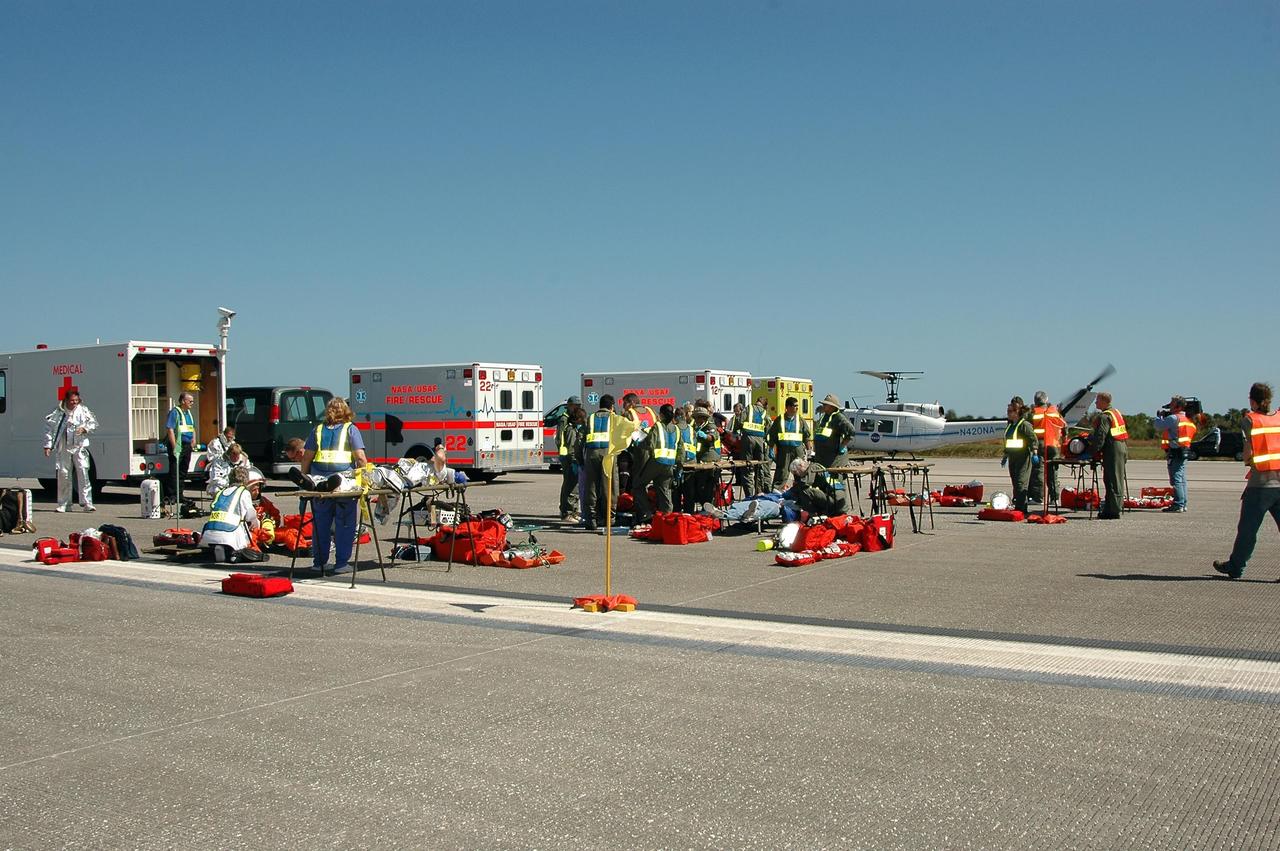
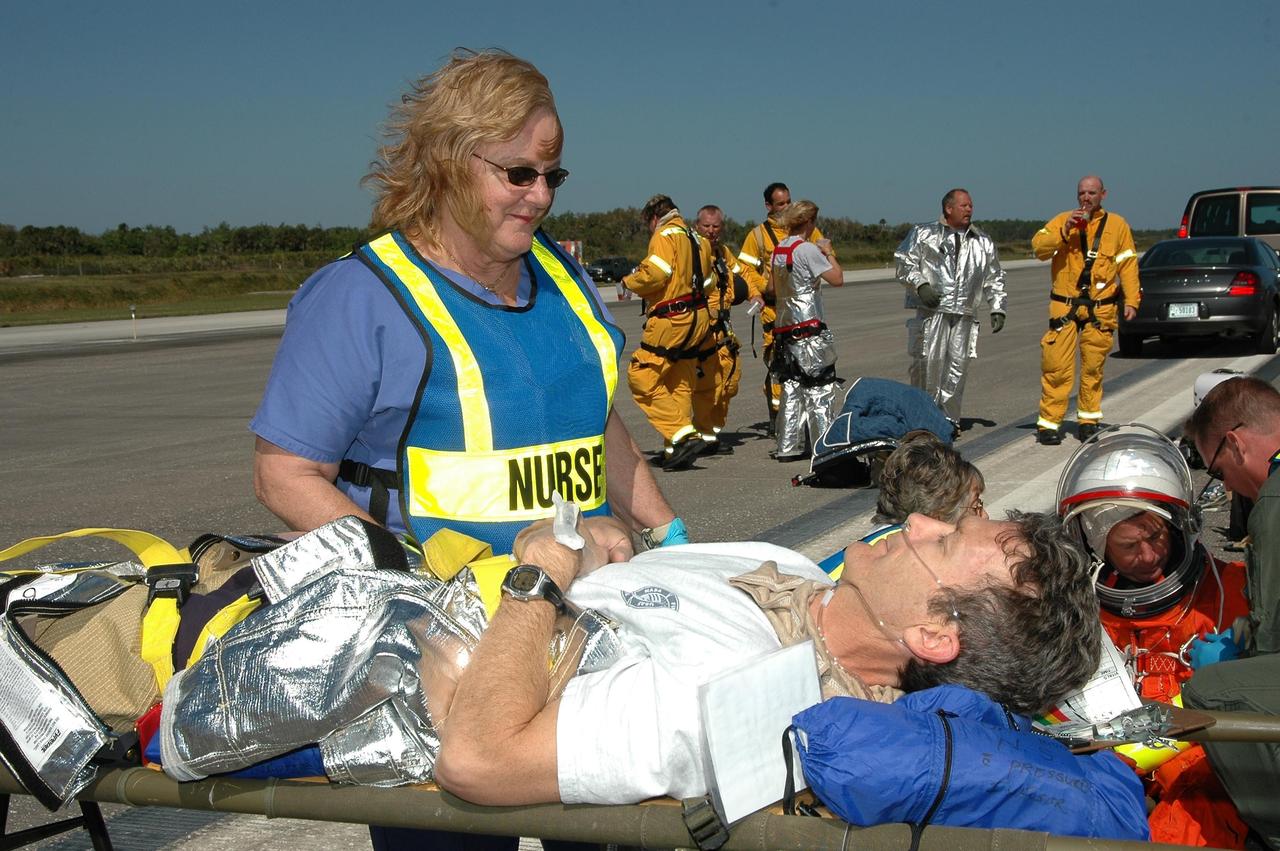
KENNEDY SPACE CENTER, FLA.  -  At NASA Kennedy Space Center's Shuttle Landing Facility, emergency rescue worker tend to "injured astronauts" during a simulated emergency landing of a shuttle crew.   Known as a Mode VI exercise, the operation uses volunteer workers from the Center to pose as astronauts. The purpose of the simulation is to exercise emergency preparedness personnel, equipment and facilities in rescuing astronauts from a downed orbiter and providing immediate medical attention. Photo credit: NASA/Troy Cryder
KSC-06pd0518
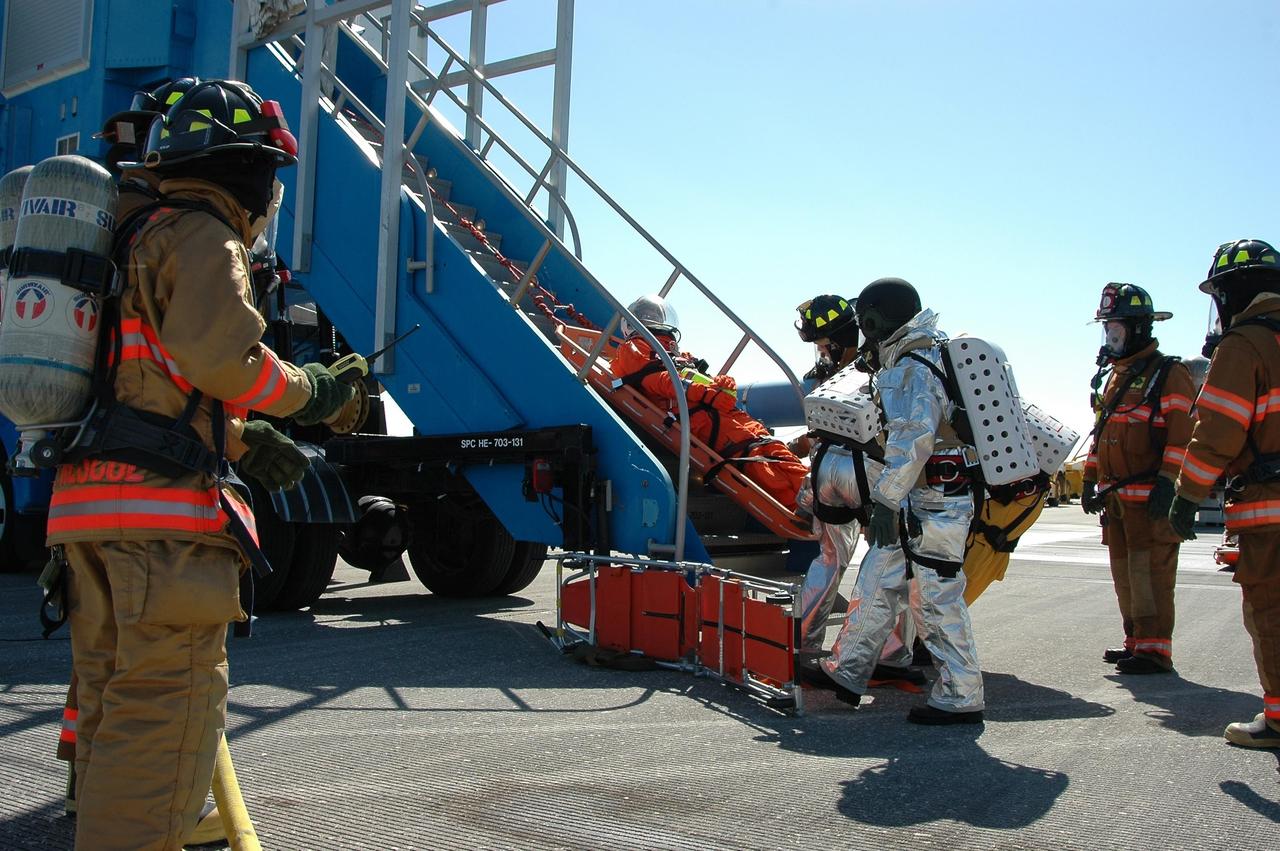
KENNEDY SPACE CENTER, FLA.  -  At NASA Kennedy Space Center's Shuttle Landing Facility, emergency personnel carry an "injured astronaut" to a rescue vehicle during a simulated emergency landing of a shuttle crew.  Known as a Mode VI exercise, the operation uses volunteer workers from the Center to pose as astronauts. The purpose of the simulation is to exercise emergency preparedness personnel, equipment and facilities in rescuing astronauts from a downed orbiter and providing immediate medical attention. Photo credit: NASA/Jim Grossmann
KSC-06pd0514
STS-135 astronaut training in the Vertical Motion Simulator, Ames Research Center, Moffett Field, CA. In this overhead view are Chris Ferguson commander on right, Doug Hurley, pilot on left and Rex Walheim, mission specialist, center back  are in VMS S-cab cockpit for simulated landing practice under a variety of landing sites and conditions.
ARC-2011-ACD11-0032-009
KENNEDY SPACE CENTER, FLA.  -  At NASA Kennedy Space Center's Shuttle Landing Facility, emergency personnel tend to "injured astronauts" during a simulated emergency landing of a shuttle crew.  Known as a Mode VI exercise, the operation uses volunteer workers from the Center to pose as astronauts. The purpose of the simulation is to exercise emergency preparedness personnel, equipment and facilities in rescuing astronauts from a downed orbiter and providing immediate medical attention. Photo credit: NASA/Kim Shiflett
KSC-06pd0499
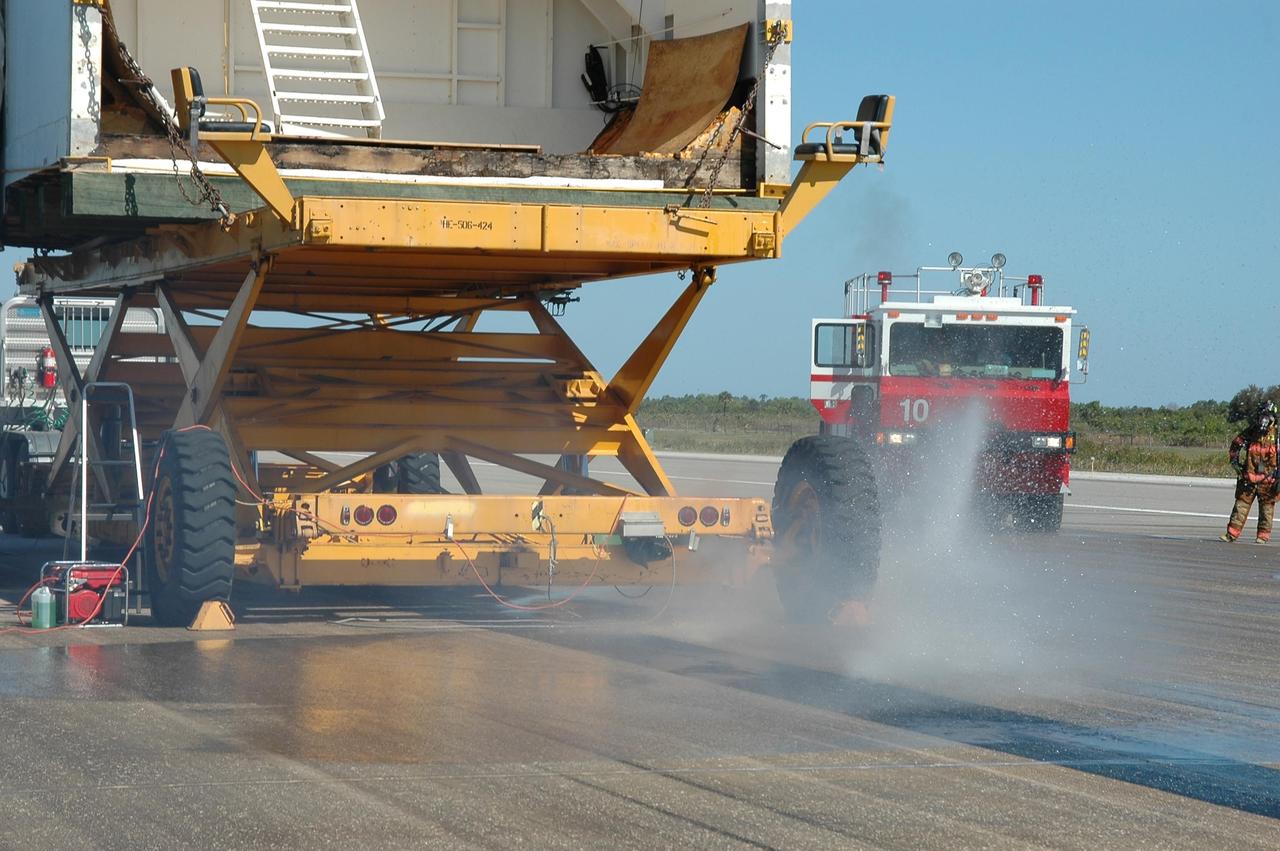
KENNEDY SPACE CENTER, FLA.  -  At NASA Kennedy Space Center's Shuttle Landing Facility, emergency rescue personnel gently place an "injured astronaut" onto a stretcher.  Volunteers and emergency rescue workers are participating in a simulated emergency landing of a shuttle crew. Known as a Mode VI exercise, the operation uses volunteer workers from the Center to pose as astronauts. The purpose of the simulation is to exercise emergency preparedness personnel, equipment and facilities in rescuing astronauts from a downed orbiter and providing immediate medical attention. Photo credit: NASA/Troy Cryder
KSC-06pd0516
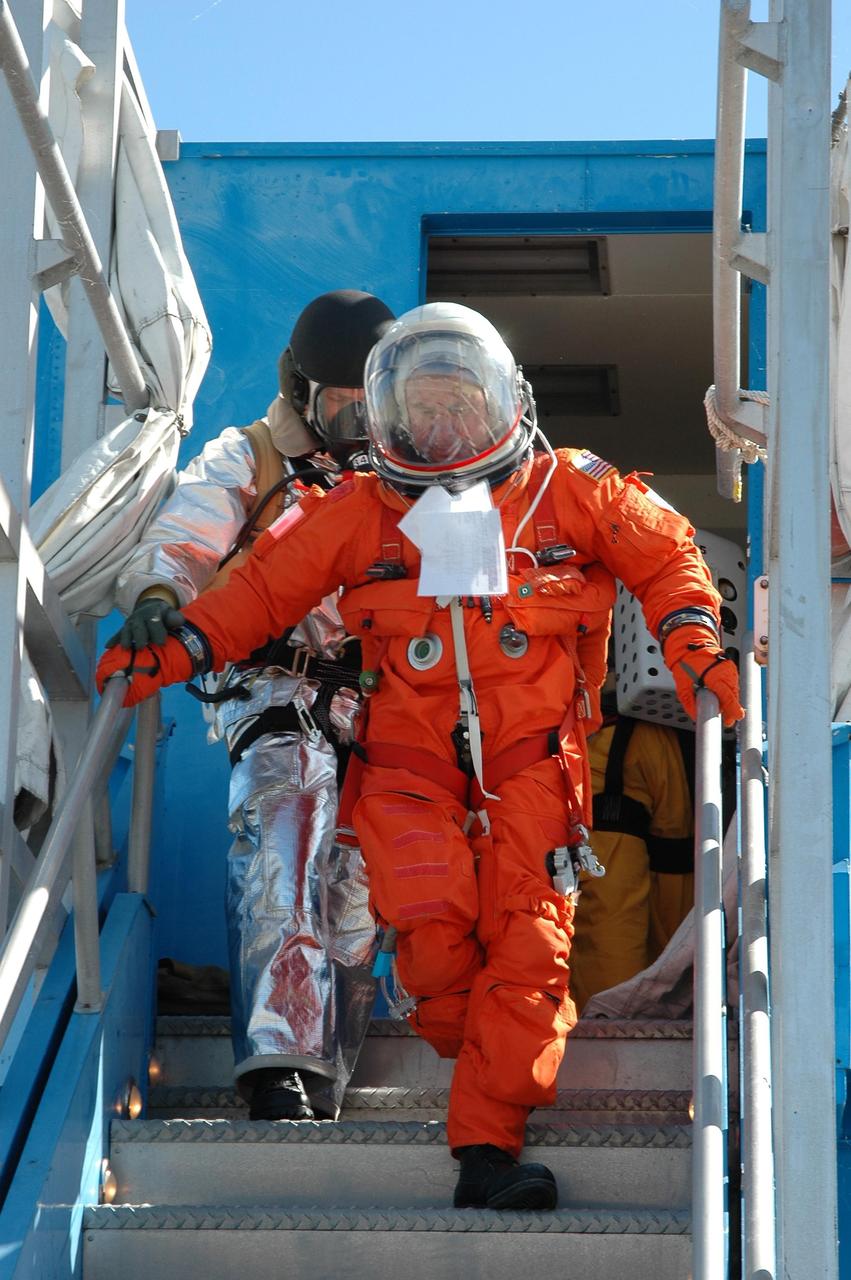
KENNEDY SPACE CENTER, FLA.  -  In a simulated emergency landing of a shuttle crew at NASA Kennedy Space Center's Shuttle Landing Facility, an "astronaut" exits the orbiter mockup.  Emergency rescue personnel are behind.   Known as a Mode VI exercise, the operation uses volunteer workers from the Center to pose as astronauts. The purpose of the simulation is to exercise emergency preparedness personnel, equipment and facilities in rescuing astronauts from a downed orbiter and providing immediate medical attention. Photo credit: NASA/Kim Shiflett
KSC-06pd0489
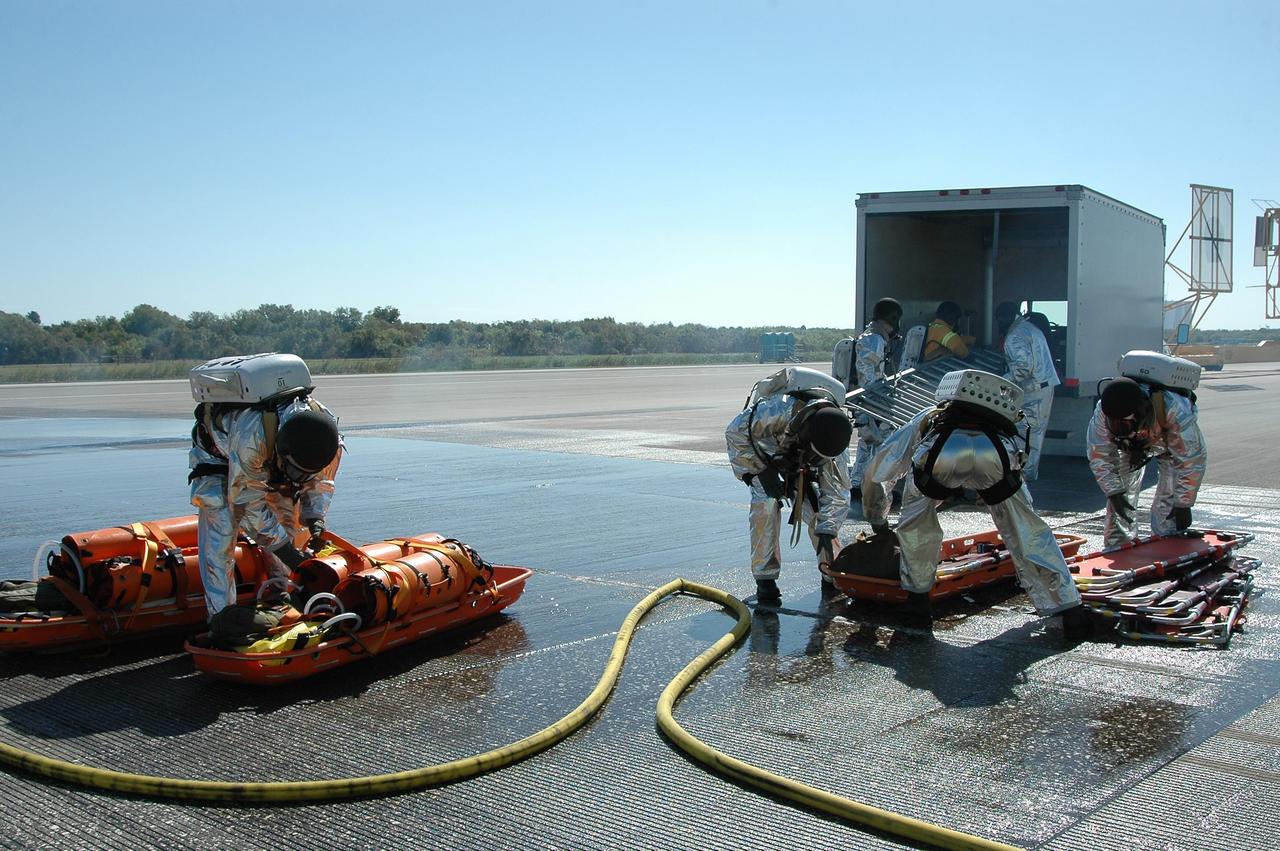
KENNEDY SPACE CENTER, FLA.  -  At NASA Kennedy Space Center's Shuttle Landing Facility,  rescue vehicles and personnel are lined up to take part in the simulated emergency landing of a shuttle crew.  Known as a Mode VI exercise, the operation uses volunteer workers from the Center to pose as astronauts. The purpose of the simulation is to exercise emergency preparedness personnel, equipment and facilities in rescuing astronauts from a downed orbiter and providing immediate medical attention. Photo credit: NASA/Kim Shiflett
KSC-06pd0497
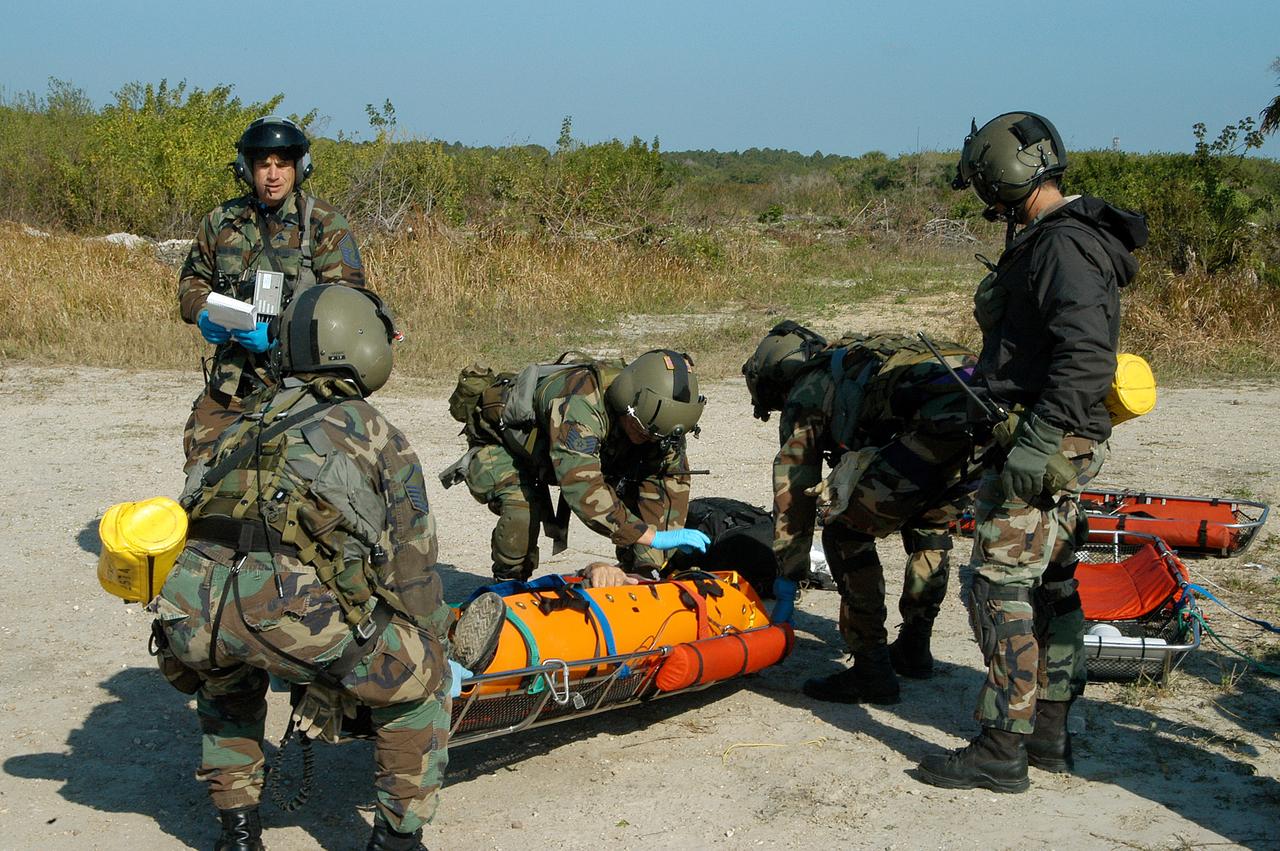
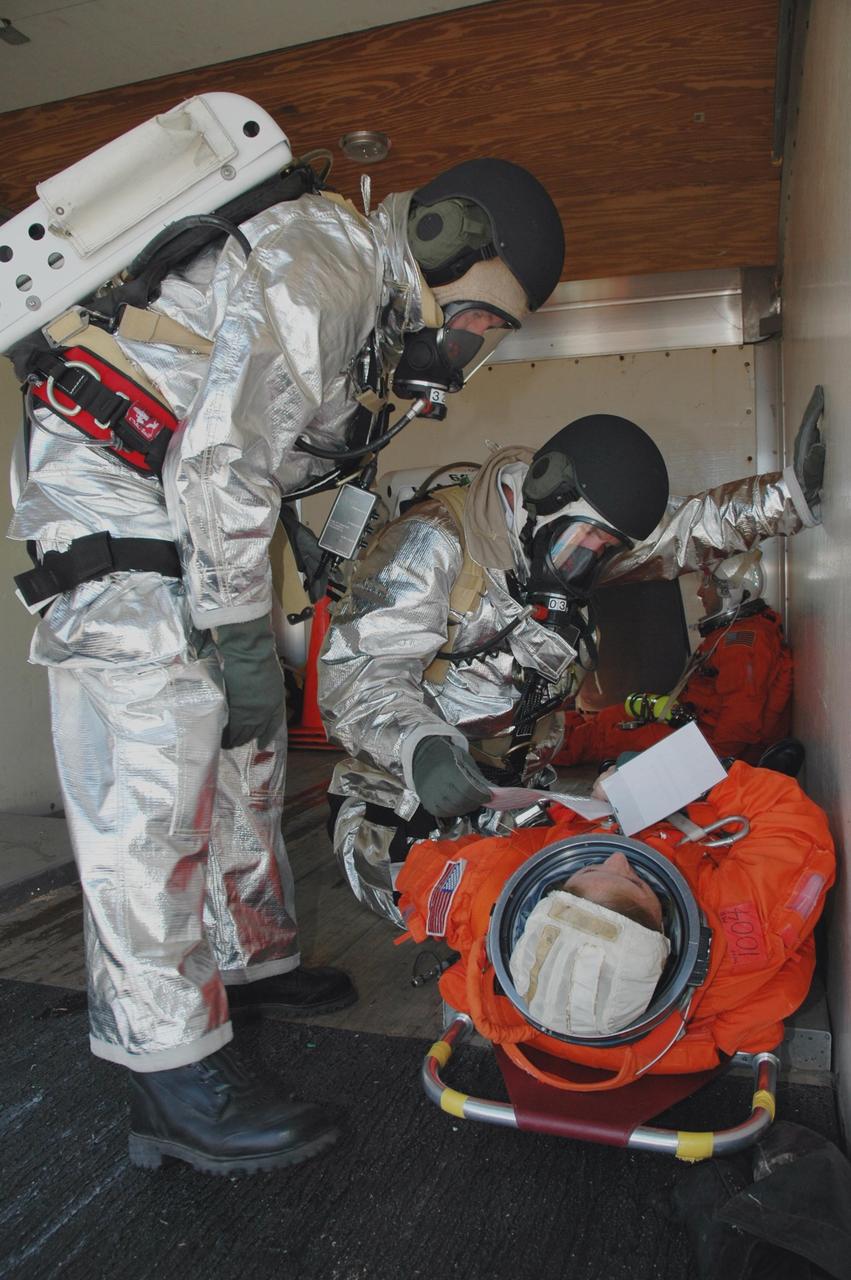
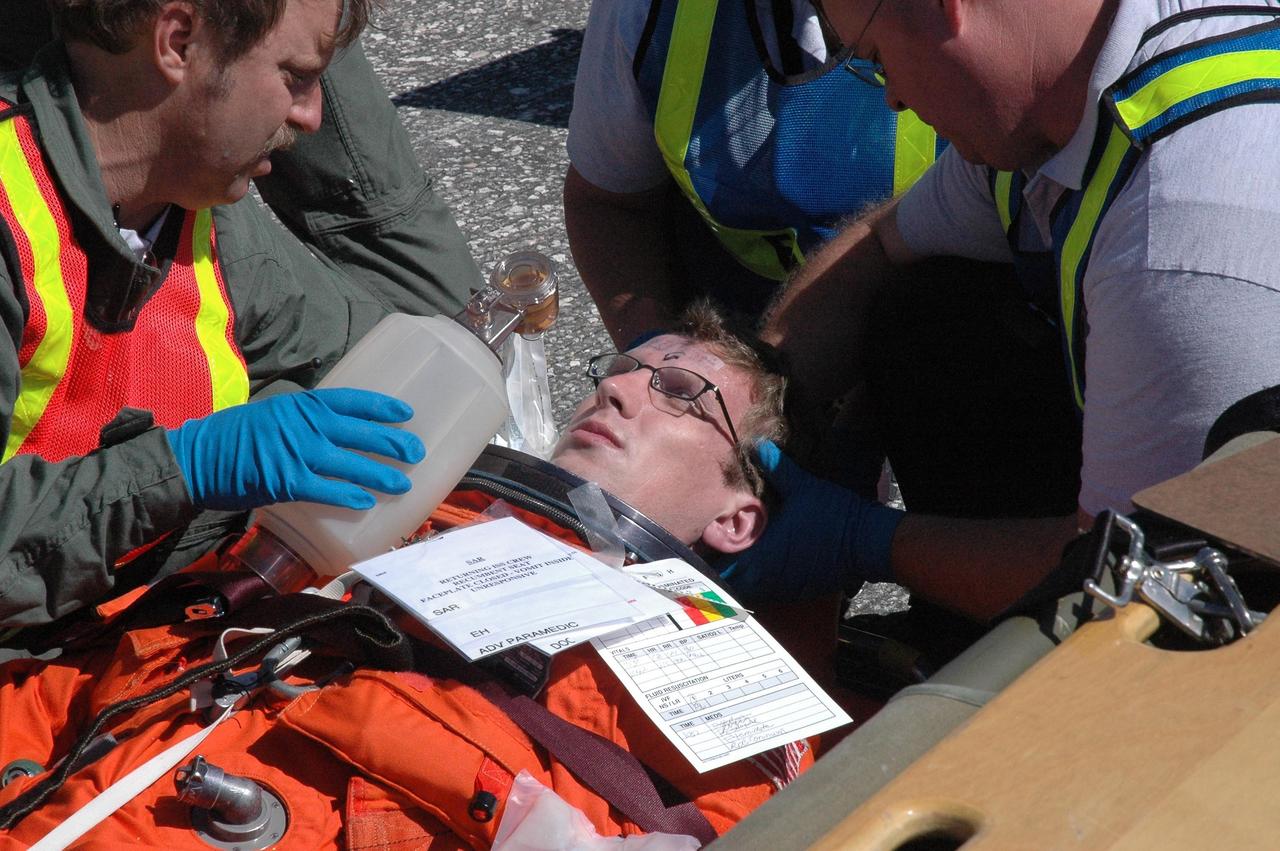
KENNEDY SPACE CENTER, FLA.  -  In a simulated emergency landing of a shuttle crew at NASA Kennedy Space Center's Shuttle Landing Facility, emergency rescue personnel tend to an "injured astronaut."   Known as a Mode VI exercise, the operation uses volunteer workers from the Center to pose as astronauts. The purpose of the simulation is to exercise emergency preparedness personnel, equipment and facilities in rescuing astronauts from a downed orbiter and providing immediate medical attention. Photo credit: NASA/Kim Shiflett
KSC-06pd0493
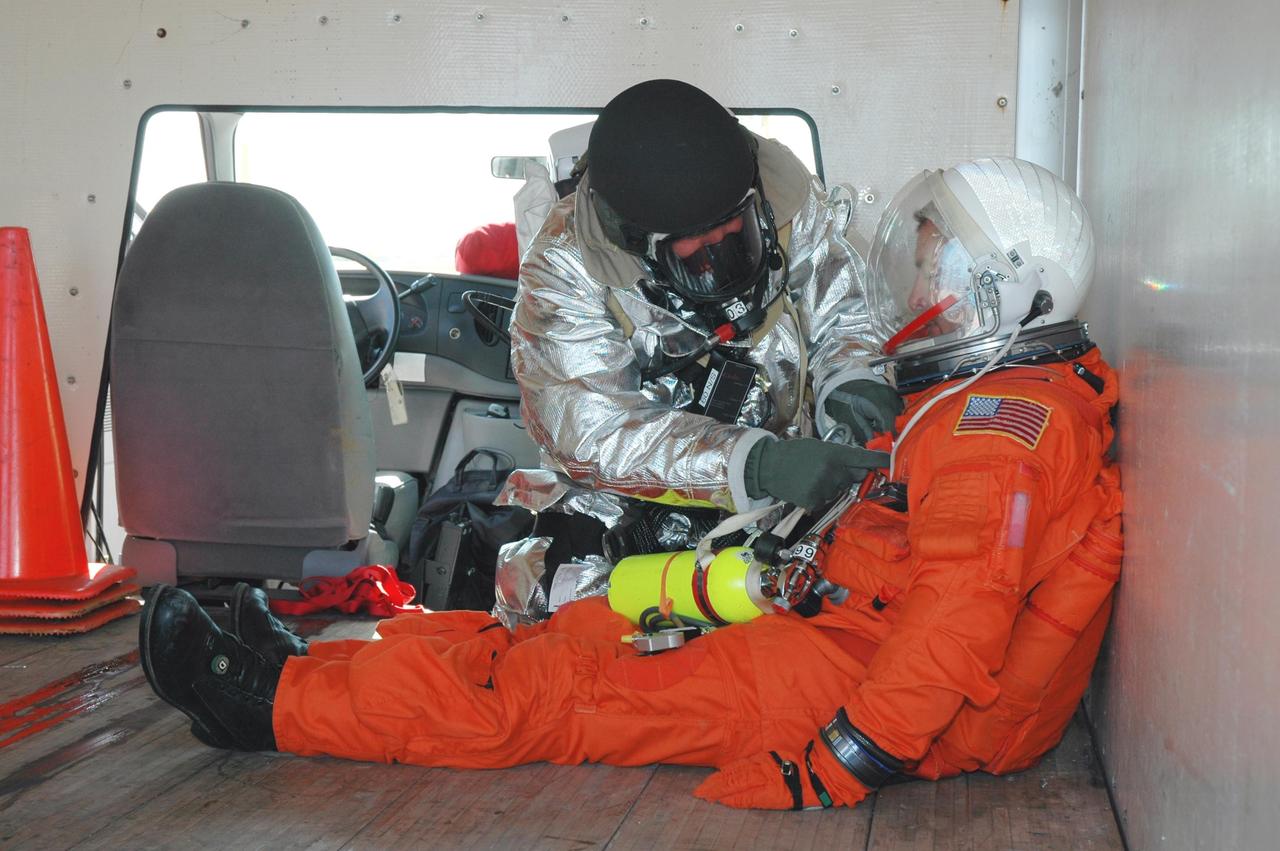
KENNEDY SPACE CENTER, FLA.  -  At NASA Kennedy Space Center's Shuttle Landing Facility, an emergency rescue worker tends to an "injured astronaut" inside a rescue vehicle.  Volunteers and emergency rescue workers are participating in a simulated emergency landing of a shuttle crew.   Known as a Mode VI exercise, the operation uses volunteer workers from the Center to pose as astronauts. The purpose of the simulation is to exercise emergency preparedness personnel, equipment and facilities in rescuing astronauts from a downed orbiter and providing immediate medical attention. Photo credit: NASA/Troy Cryder
KSC-06pd0517
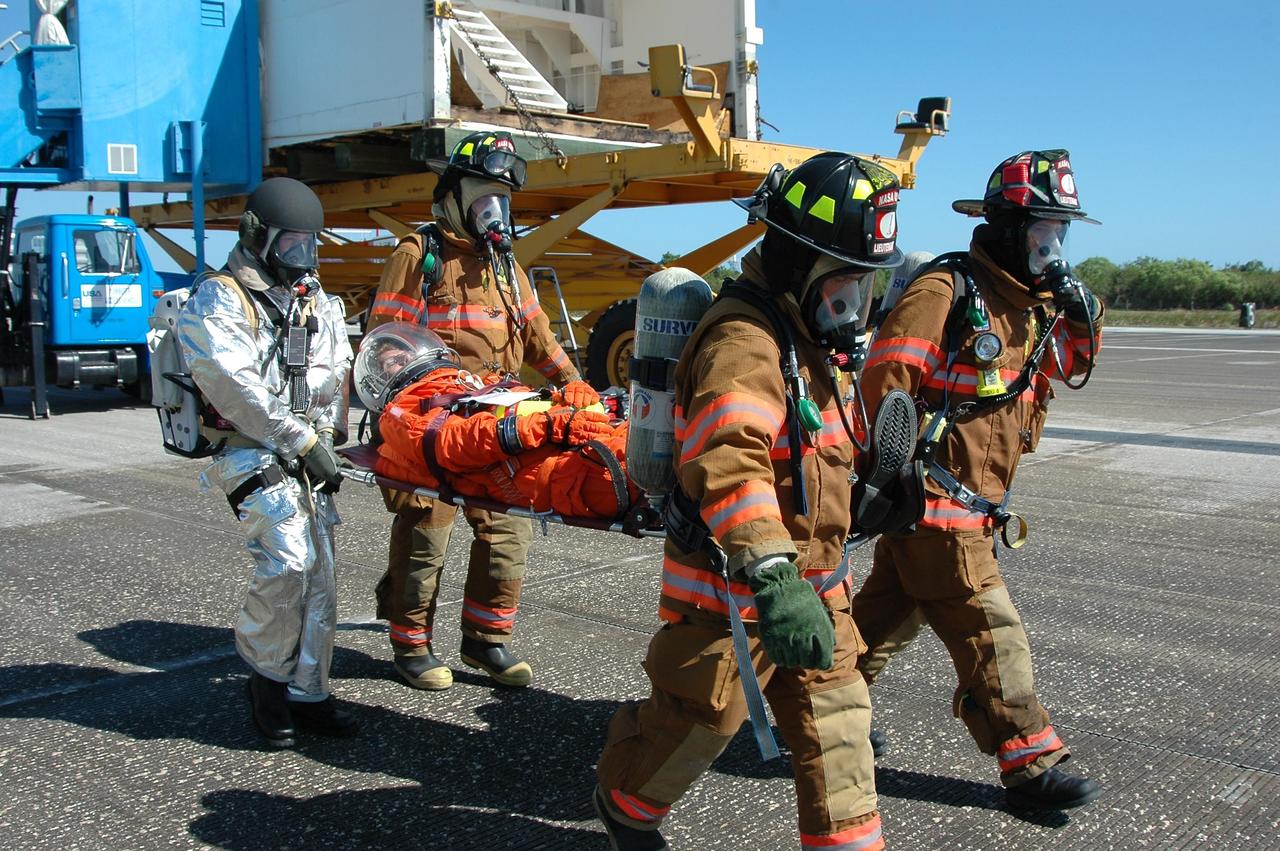
KENNEDY SPACE CENTER, FLA.  -  In a simulated emergency landing of a shuttle crew at NASA Kennedy Space Center's Shuttle Landing Facility, emergency rescue personnel carry an "injured astronaut" away from the orbiter mockup.  Known as a Mode VI exercise, the operation uses volunteer workers from the Center to pose as astronauts. The purpose of the simulation is to exercise emergency preparedness personnel, equipment and facilities in rescuing astronauts from a downed orbiter and providing immediate medical attention. Photo credit: NASA/Kim Shiflett
KSC-06pd0495
KENNEDY SPACE CENTER, FLA.  -  At NASA Kennedy Space Center's Shuttle Landing Facility, emergency personnel tends to an "injured astronaut" inside a rescue vehicle during a simulated emergency landing of a shuttle crew.  Known as a Mode VI exercise, the operation uses volunteer workers from the Center to pose as astronauts. The purpose of the simulation is to exercise emergency preparedness personnel, equipment and facilities in rescuing astronauts from a downed orbiter and providing immediate medical attention. Photo credit: NASA/Jim Grossmann
KSC-06pd0512
KENNEDY SPACE CENTER, FLA.  -   At NASA Kennedy Space Center's Shuttle Landing Facility, emergency personnel tend to "injured astronauts" during a simulated emergency landing of a shuttle crew.  Known as a Mode VI exercise, the operation uses volunteer workers from the Center to pose as astronauts. The purpose of the simulation is to exercise emergency preparedness personnel, equipment and facilities in rescuing astronauts from a downed orbiter and providing immediate medical attention. Photo credit: NASA/George Shelton
KSC-06pd0510
KENNEDY SPACE CENTER, FLA.  -  During a simulated emergency landing of a shuttle crew at NASA Kennedy Space Center's Shuttle Landing Facility, emergency rescue personnel carry an "injured astronaut" to a waiting helicopter.  Known as a Mode VI exercise, the operation uses volunteer workers from the Center to pose as astronauts. The purpose of the simulation is to exercise emergency preparedness personnel, equipment and facilities in rescuing astronauts from a downed orbiter and providing immediate medical attention. Photo credit: NASA/Kim Shiflett
KSC-06pd0501
KENNEDY SPACE CENTER, FLA.  -  In a simulated emergency landing of a shuttle crew at NASA Kennedy Space Center's Shuttle Landing Facility, emergency rescue personnel move an "injured astronaut" away from the orbiter mockup.  Known as a Mode VI exercise, the operation uses volunteer workers from the Center to pose as astronauts. The purpose of the simulation is to exercise emergency preparedness personnel, equipment and facilities in rescuing astronauts from a downed orbiter and providing immediate medical attention. Photo credit: NASA/Kim Shiflett
KSC-06pd0492
KENNEDY SPACE CENTER, FLA.  -  Equipment is in place at NASA Kennedy Space Center's Shuttle Landing Facility for a simulated emergency rescue of a shuttle crew after landing.  At center is the orbiter mockup. Known as a Mode VI exercise, the operation uses volunteer workers from the Center to pose as astronauts. The purpose of the simulation is to exercise emergency preparedness personnel, equipment and facilities in rescuing astronauts from a downed orbiter and providing immediate medical attention. Photo credit: NASA/Kim Shiflett
KSC-06pd0486
KENNEDY SPACE CENTER, FLA.  -   At NASA Kennedy Space Center's Shuttle Landing Facility, emergency personnel tend to "injured astronauts" during a simulated emergency landing of a shuttle crew.  Known as a Mode VI exercise, the operation uses volunteer workers from the Center to pose as astronauts. The purpose of the simulation is to exercise emergency preparedness personnel, equipment and facilities in rescuing astronauts from a downed orbiter and providing immediate medical attention. Photo credit: NASA/George Shelton
KSC-06pd0511
KENNEDY SPACE CENTER, FLA.  -  In a simulated emergency landing of a shuttle crew at NASA Kennedy Space Center's Shuttle Landing Facility, emergency rescue personnel tend to an "injured astronaut" on a stretcher at the bottom of the steps to the orbiter mockup.   Known as a Mode VI exercise, the operation uses volunteer workers from the Center to pose as astronauts. The purpose of the simulation is to exercise emergency preparedness personnel, equipment and facilities in rescuing astronauts from a downed orbiter and providing immediate medical attention. Photo credit: NASA/Kim Shiflett
KSC-06pd0494
KENNEDY SPACE CENTER, FLA.  -  At NASA Kennedy Space Center's Shuttle Landing Facility, emergency personnel tend to "injured astronauts" during a simulated emergency landing of a shuttle crew.  Known as a Mode VI exercise, the operation uses volunteer workers from the Center to pose as astronauts. The purpose of the simulation is to exercise emergency preparedness personnel, equipment and facilities in rescuing astronauts from a downed orbiter and providing immediate medical attention. Photo credit: NASA/Kim Shiflett
KSC-06pd0498
KENNEDY SPACE CENTER, FLA.  -  At NASA Kennedy Space Center's Shuttle Landing Facility, emergency rescue personnel begin the simulated emergency rescue of a shuttle crew after landing.  Known as a Mode VI exercise, the operation uses volunteer workers from the Center to pose as astronauts. The purpose of the simulation is to exercise emergency preparedness personnel, equipment and facilities in rescuing astronauts from a downed orbiter and providing immediate medical attention. Photo credit: NASA/Kim Shiflett
KSC-06pd0488
KENNEDY SPACE CENTER, FLA.  -  During a simulated emergency landing of a shuttle crew at NASA Kennedy Space Center's Shuttle Landing Facility, emergency rescue personnel carry an "injured astronaut" to a waiting helicopter.  Known as a Mode VI exercise, the operation uses volunteer workers from the Center to pose as astronauts. The purpose of the simulation is to exercise emergency preparedness personnel, equipment and facilities in rescuing astronauts from a downed orbiter and providing immediate medical attention. Photo credit: NASA/Kim Shiflett
KSC-06pd0500
KENNEDY SPACE CENTER, FLA.  -  At NASA Kennedy Space Center's Shuttle Landing Facility, emergency rescue personnel get equipment ready for a simulated emergency rescue of a shuttle crew after landing.  Known as a Mode VI exercise, the operation uses volunteer workers from the Center to pose as astronauts. The purpose of the simulation is to exercise emergency preparedness personnel, equipment and facilities in rescuing astronauts from a downed orbiter and providing immediate medical attention. Photo credit: NASA/Kim Shiflett
KSC-06pd0487
KENNEDY SPACE CENTER, FLA.  -  At NASA Kennedy Space Center's Shuttle Landing Facility, emergency personnel tends to an "injured astronaut" inside a rescue vehicle during a simulated emergency landing of a shuttle crew. Known as a Mode VI exercise, the operation uses volunteer workers from the Center to pose as astronauts. The purpose of the simulation is to exercise emergency preparedness personnel, equipment and facilities in rescuing astronauts from a downed orbiter and providing immediate medical attention. Photo credit: NASA/Jim Grossmann
KSC-06pd0513
KENNEDY SPACE CENTER, FLA.  -  In a simulated emergency landing of a shuttle crew at NASA Kennedy Space Center's Shuttle Landing Facility, emergency rescue personnel aid an "astronaut" who just left the orbiter mockup.  Known as a Mode VI exercise, the operation uses volunteer workers from the Center to pose as astronauts. The purpose of the simulation is to exercise emergency preparedness personnel, equipment and facilities in rescuing astronauts from a downed orbiter and providing immediate medical attention. Photo credit: NASA/Kim Shiflett
KSC-06pd0490
KENNEDY SPACE CENTER, FLA.  -  At NASA Kennedy Space Center's Shuttle Landing Facility, volunteer Charlie Plain poses as an injured astronaut during a simulated emergency landing of a shuttle crew.  Plain is a Public Affairs Web writer.   Known as a Mode VI exercise, the operation uses volunteer workers from the Center to pose as astronauts. The purpose of the simulation is to exercise emergency preparedness personnel, equipment and facilities in rescuing astronauts from a downed orbiter and providing immediate medical attention. Photo credit: NASA/Troy Cryder
KSC-06pd0519
KENNEDY SPACE CENTER, FLA.  -  At NASA Kennedy Space Center's Shuttle Landing Facility, emergency personnel tend to "injured astronauts" during a simulated emergency landing of a shuttle crew.  Known as a Mode VI exercise, the operation uses volunteer workers from the Center to pose as astronauts. The purpose of the simulation is to exercise emergency preparedness personnel, equipment and facilities in rescuing astronauts from a downed orbiter and providing immediate medical attention. Photo credit: NASA/Kim Shiflett
KSC-06pd0503
CAPE CANAVERAL, Fla. -   STS-125 Pilot Gregory C. Johnson exits the shuttle training aircraft at the Shuttle Landing Facility at NASA's Kennedy Space Center in Florida after practicing shuttle landings in the aircraft.  The STA is a Grumman American Aviation-built Gulf Stream II jet that was modified to simulate a shuttle’s cockpit, motion and visual cues, and handling qualities. In flight, the aircraft duplicates the shuttle’s atmospheric descent trajectory from approximately 35,000 feet altitude to landing on a runway. The practice is part of a terminal countdown demonstration test, or TCDT, to prepare for launch.  TCDT provides astronauts and ground crews with an opportunity to participate in various simulated countdown activities, including equipment familiarization, emergency training and a simulated launch countdown. Space shuttle Atlantis’ STS-125 mission to service NASA’s Hubble Space Telescope is targeted to launch Oct. 10.  Photo credit: NASA/Kim Shiflett
KSC-08pd2841
CAPE CANAVERAL, Fla. -  STS-125 Pilot Gregory C. Johnson takes his seat in the shuttle training aircraft for practice shuttle landings on the runway of the Shuttle Landing Facility at NASA's Kennedy Space Center in Florida. The STA is a Grumman American Aviation-built Gulf Stream II jet that was modified to simulate a shuttle’s cockpit, motion and visual cues, and handling qualities. In flight, the aircraft duplicates the shuttle’s atmospheric descent trajectory from approximately 35,000 feet altitude to landing on a runway. The practice is part of a terminal countdown demonstration test, or TCDT, to prepare for launch.  TCDT provides astronauts and ground crews with an opportunity to participate in various simulated countdown activities, including equipment familiarization, emergency training and a simulated launch countdown. Space shuttle Atlantis’ STS-125 mission to service NASA’s Hubble Space Telescope is targeted to launch Oct. 10.  Photo credit: NASA/Kim Shiflett
KSC-08pd2835
CAPE CANAVERAL, Fla. -  One of the shuttle training aircraft takes off from the Shuttle Landing Facility at NASA's Kennedy Space Center in Florida.  STS-125 Commander Scott Altman and Pilot Gregory C. Johnson are practicing shuttle landings in the aircraft.    The STA is a Grumman American Aviation-built Gulf Stream II jet that was modified to simulate a shuttle’s cockpit, motion and visual cues, and handling qualities. In flight, the aircraft duplicates the shuttle’s atmospheric descent trajectory from approximately 35,000 feet altitude to landing on a runway. The practice is part of a terminal countdown demonstration test, or TCDT, to prepare for launch.  TCDT provides astronauts and ground crews with an opportunity to participate in various simulated countdown activities, including equipment familiarization, emergency training and a simulated launch countdown. Space shuttle Atlantis’ STS-125 mission to service NASA’s Hubble Space Telescope is targeted to launch Oct. 10.  Photo credit: NASA/Kim Shiflett
KSC-08pd2839