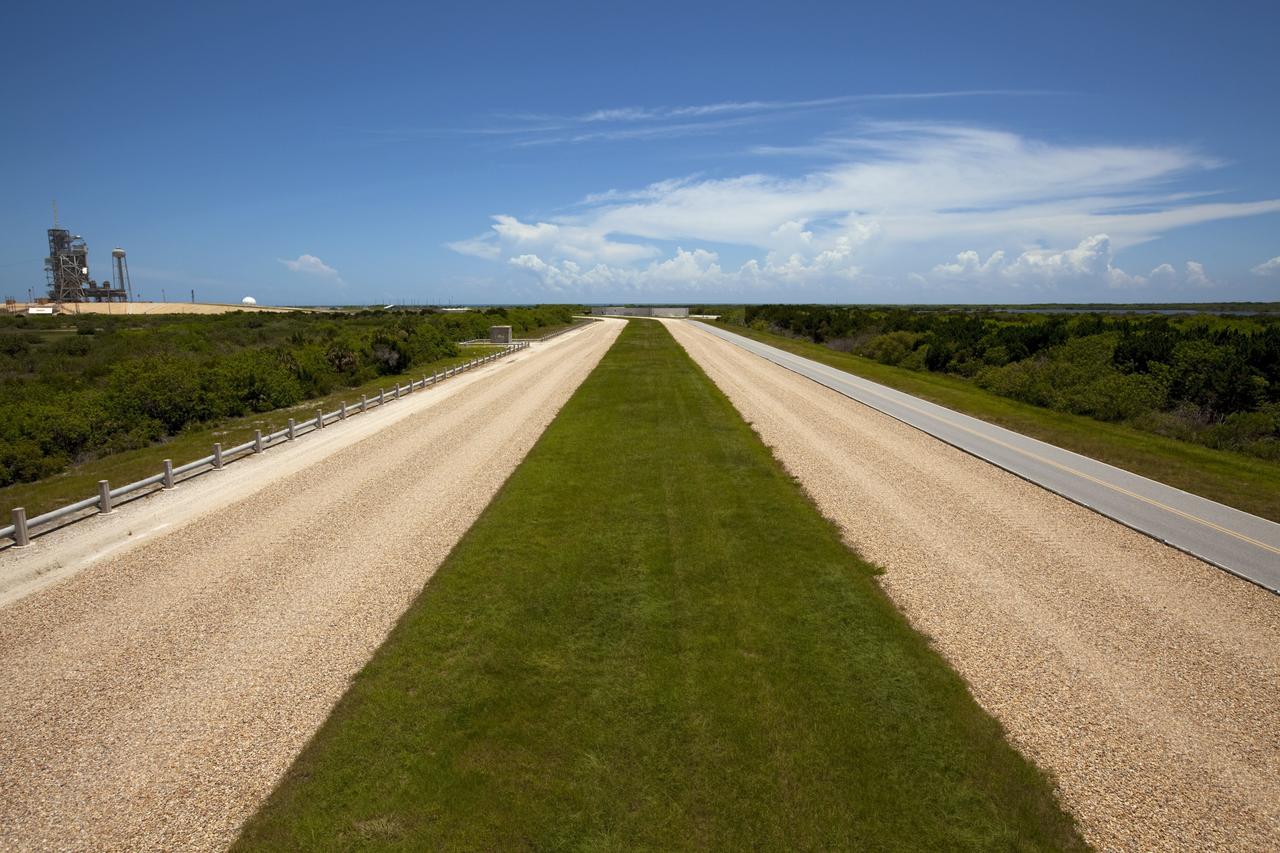
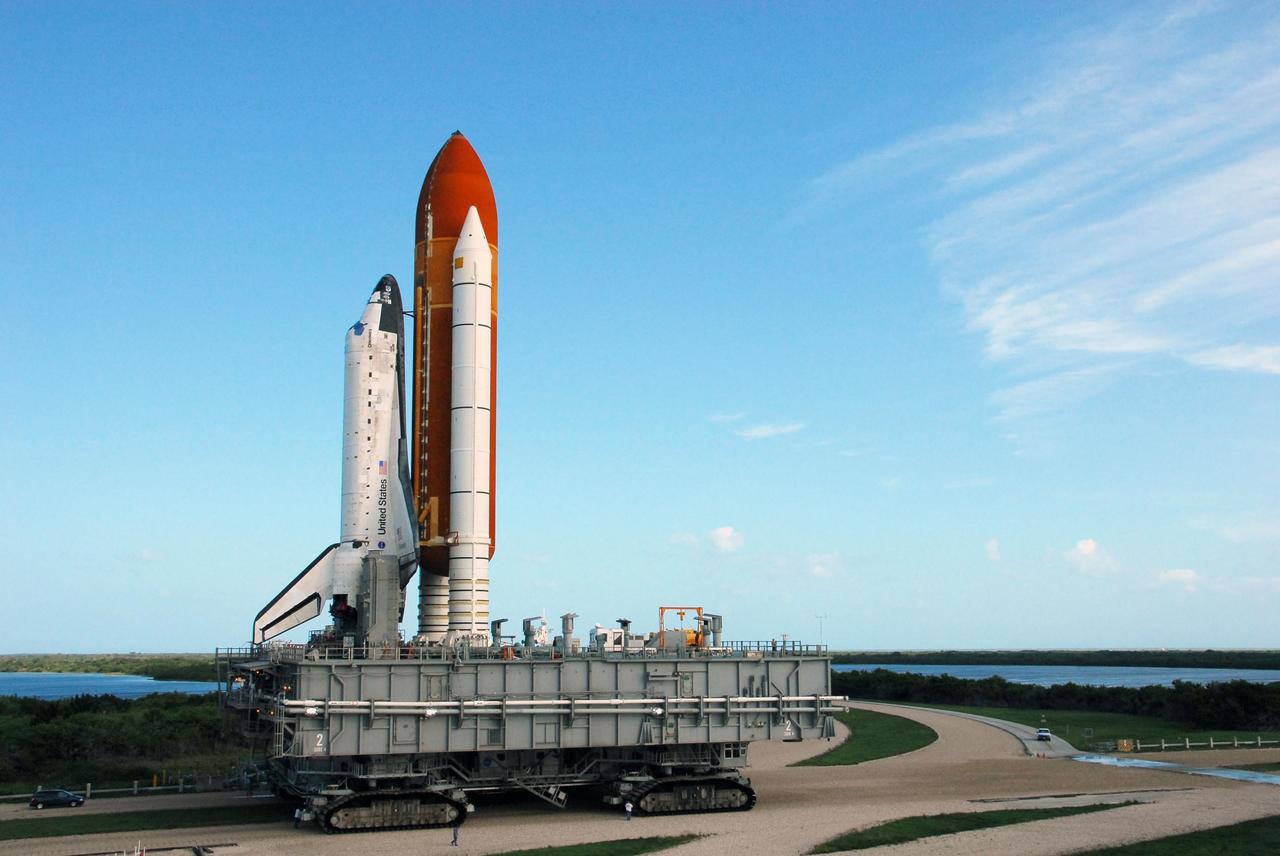
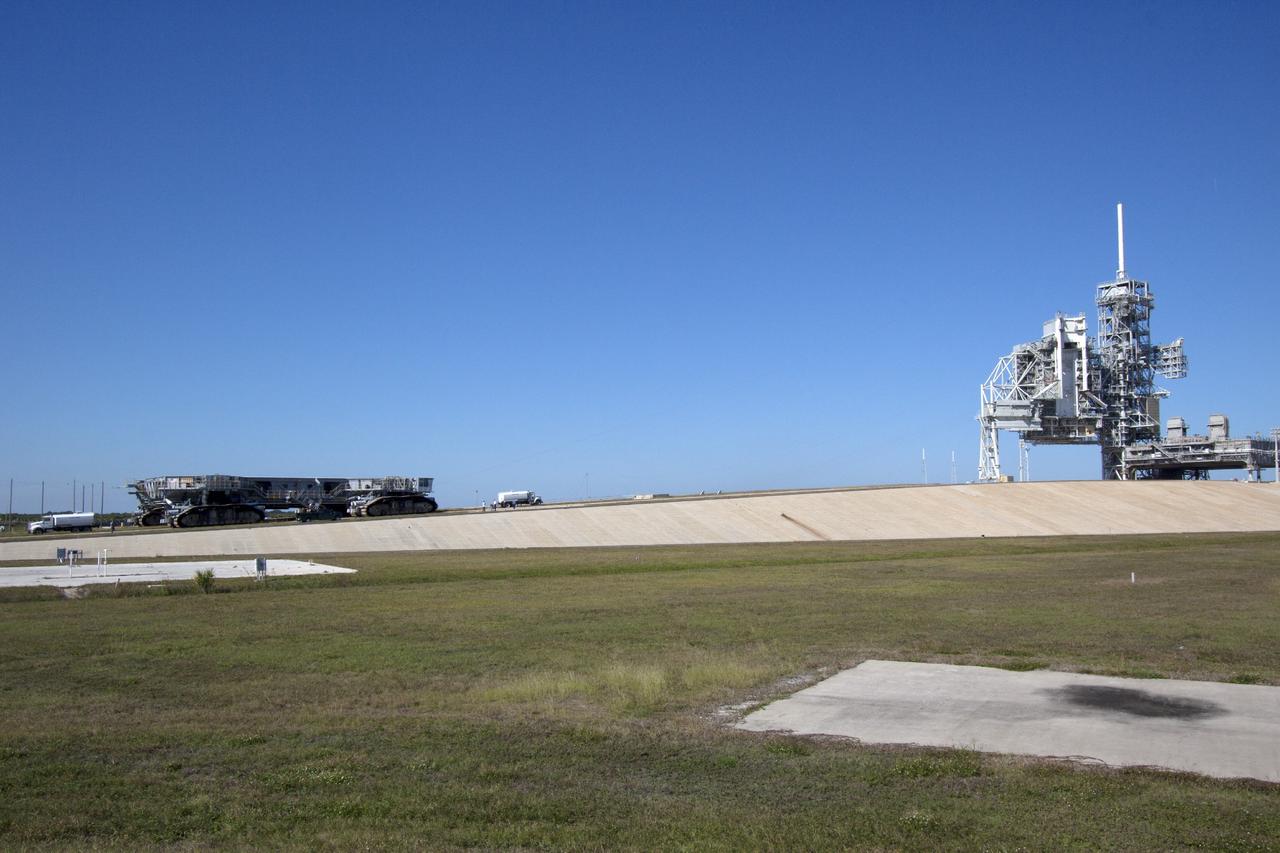
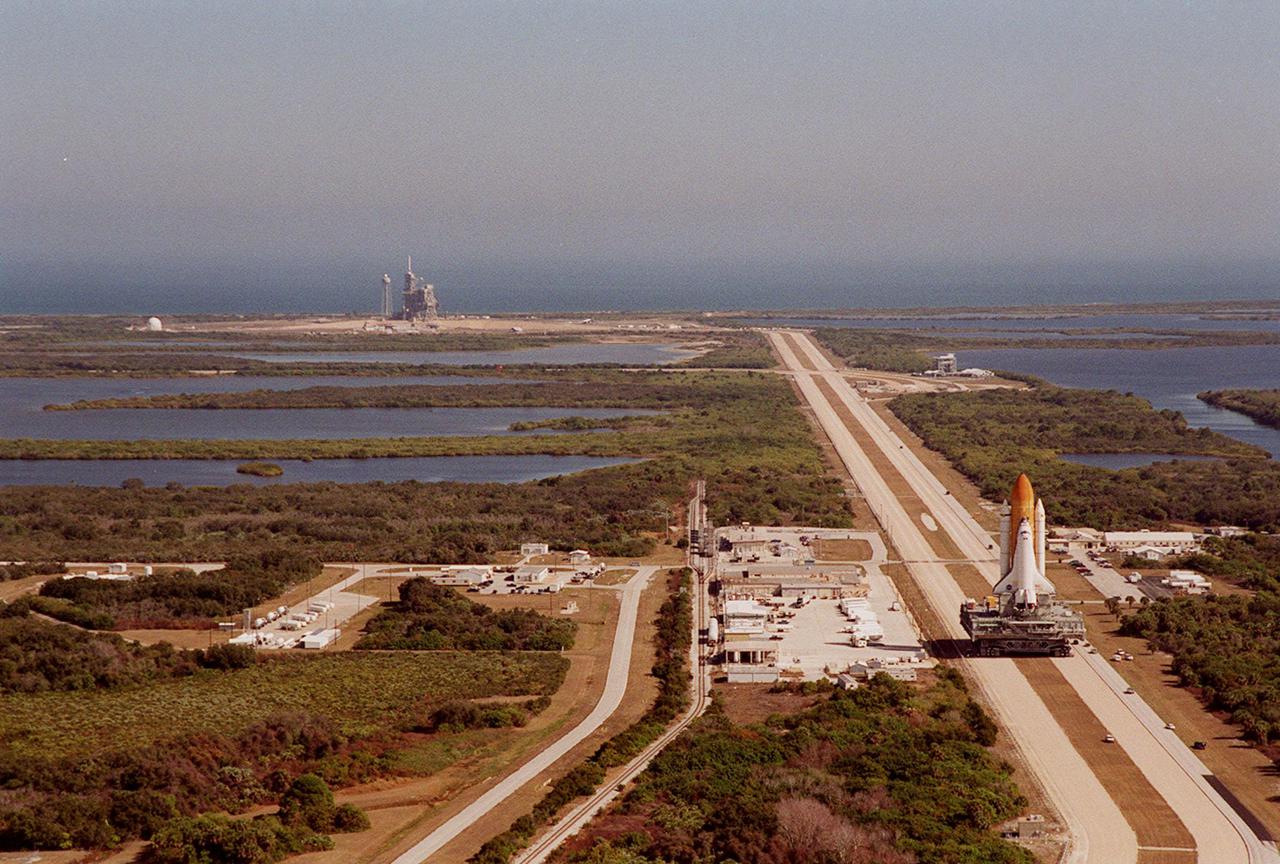
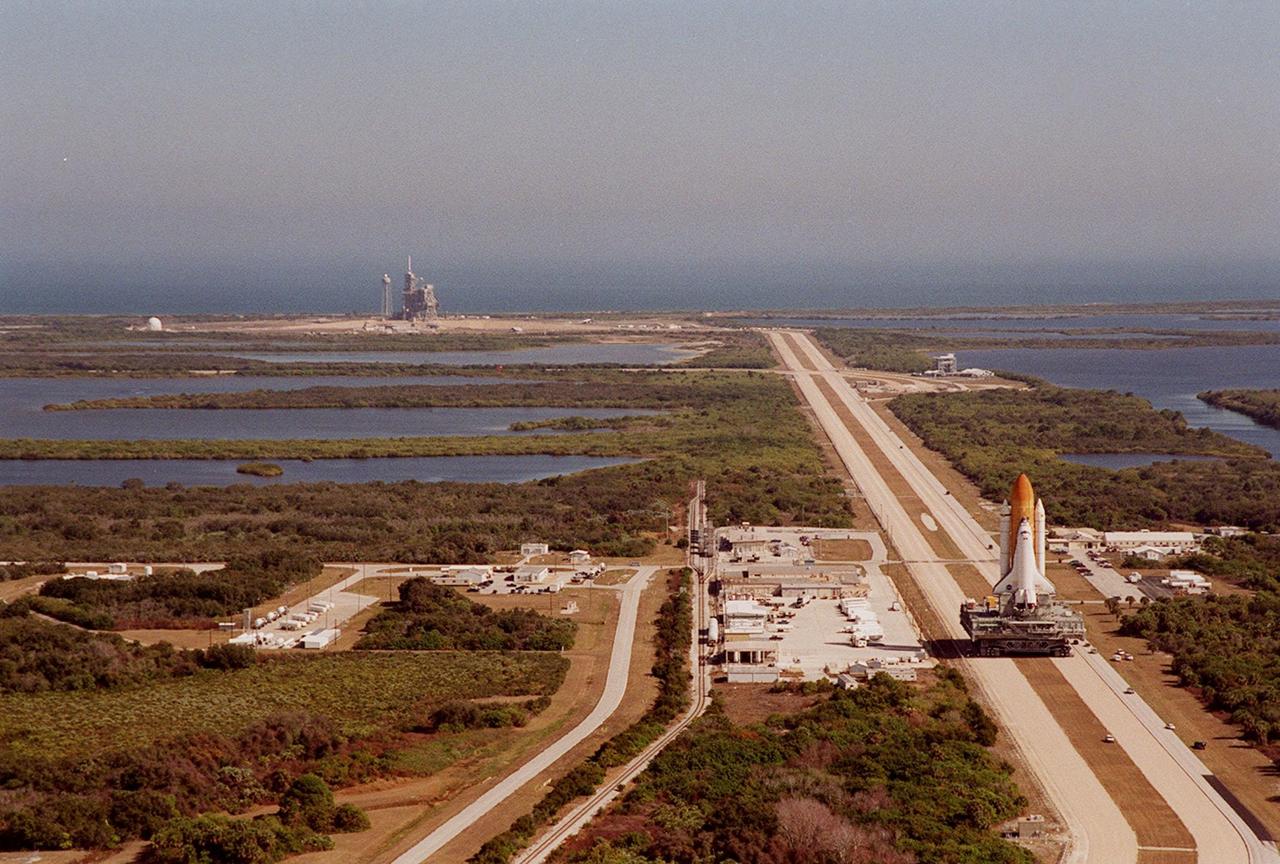
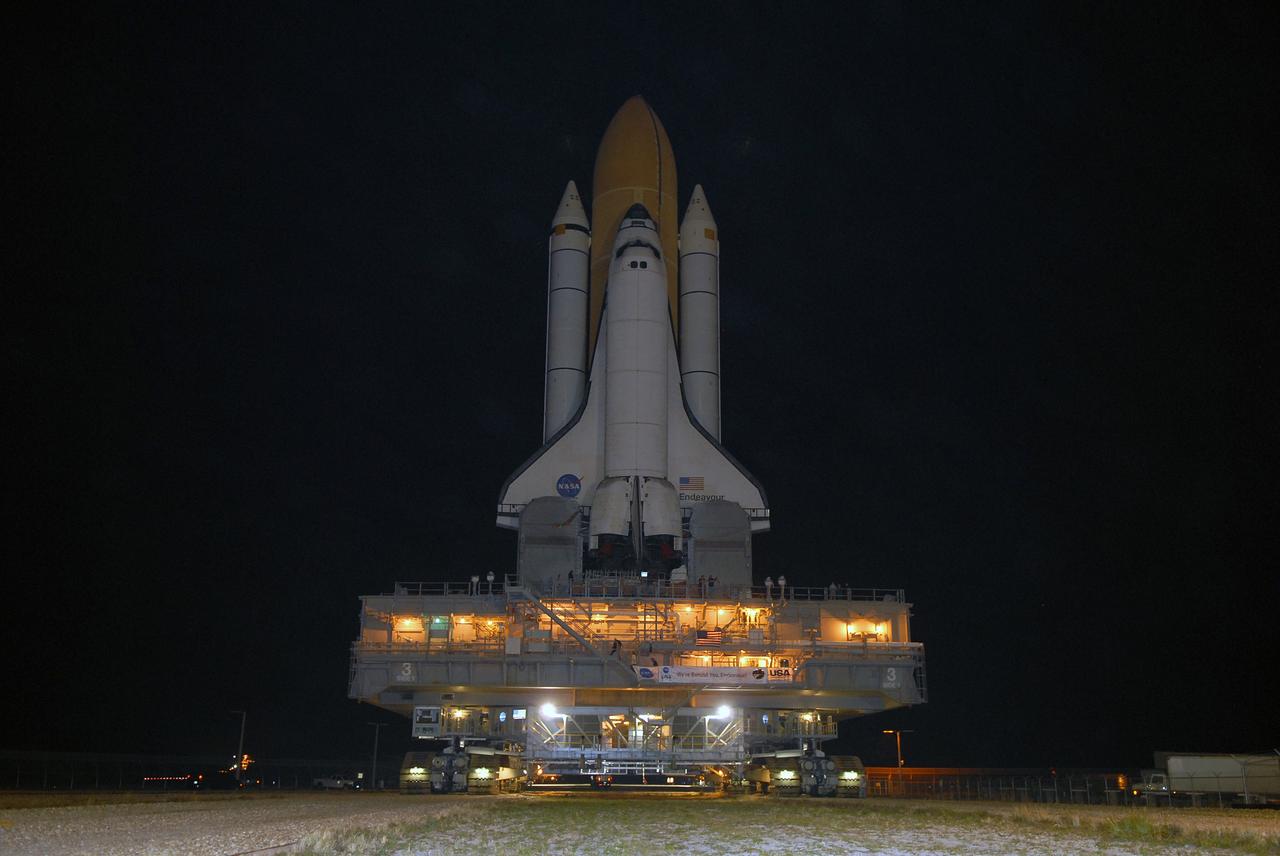
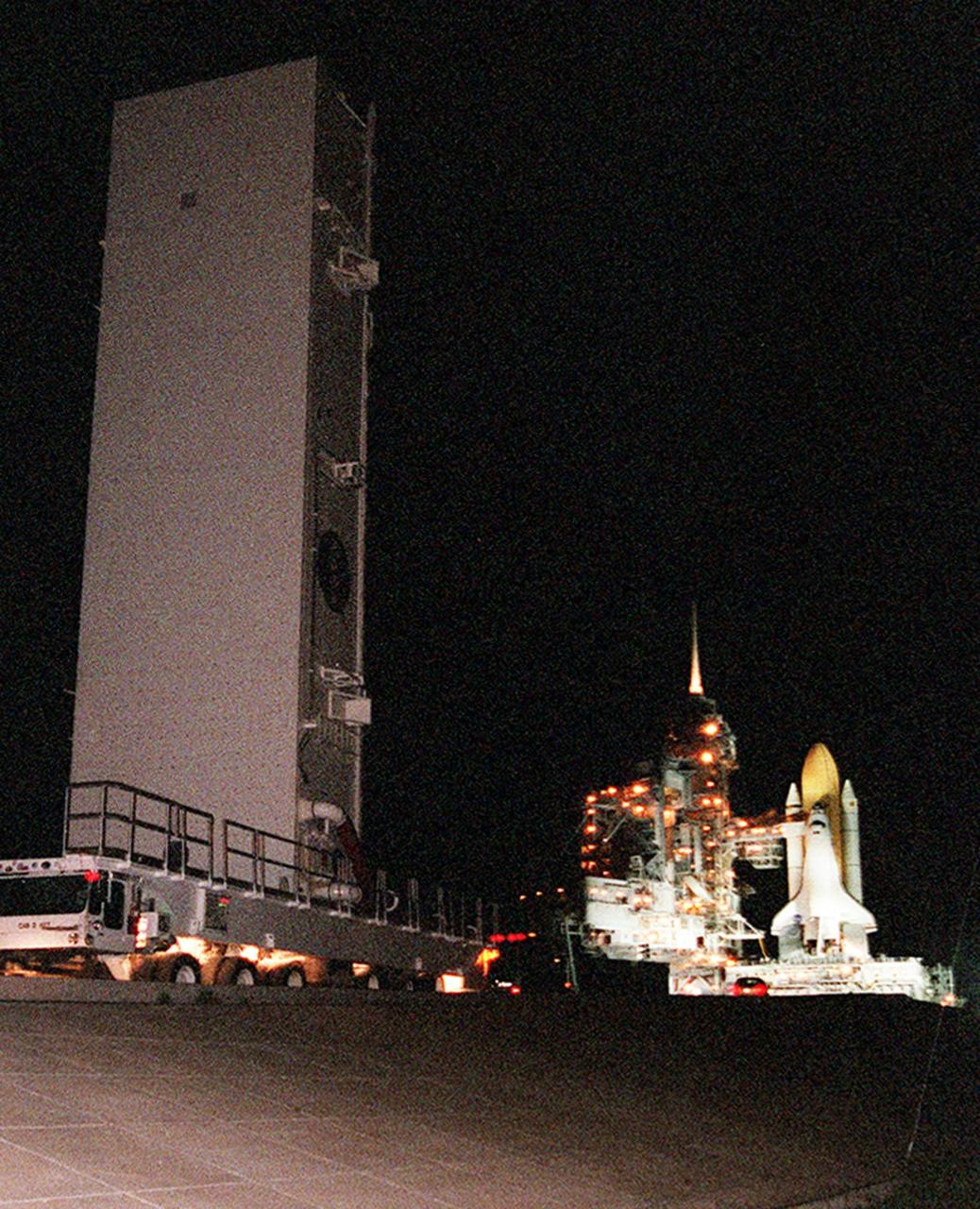
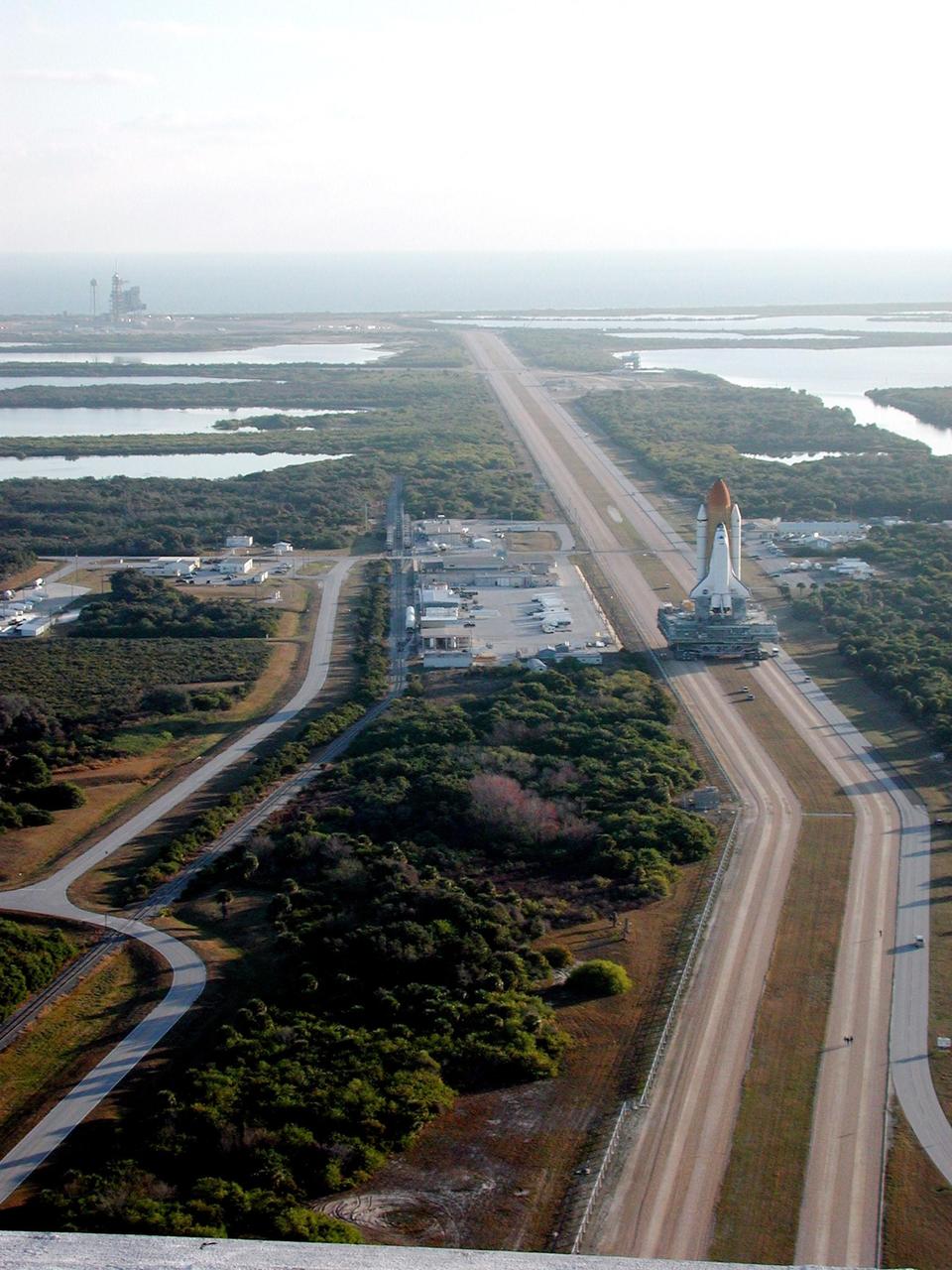
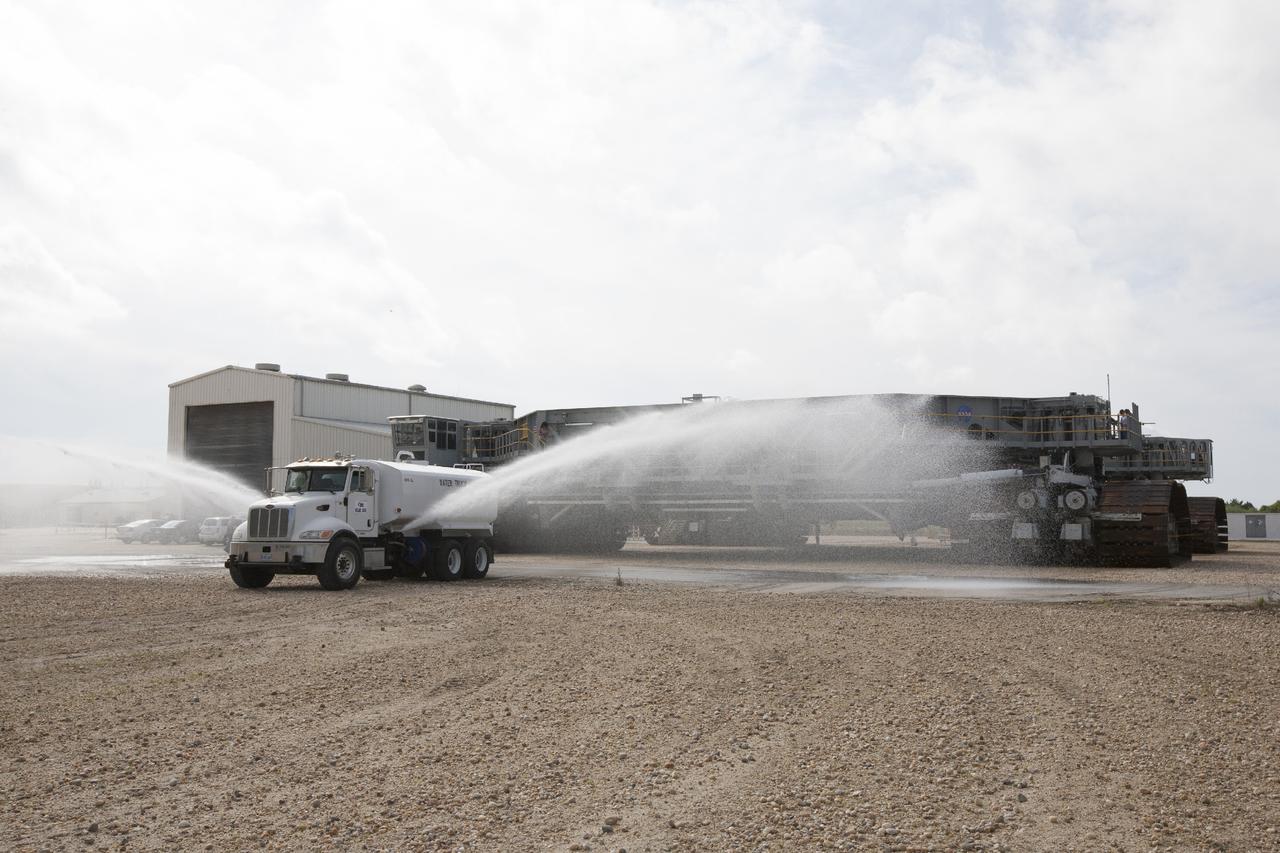
CAPE CANAVERAL, Fla. – The gravel crawlerway is seen as if from a crawler transporter making the approach to Launch Complex 39 pad A at the Kennedy Space Center in Florida. The crawlerways are 130 feet wide, about the size of an 8-lane freeway. The river rock paths have been used since 1966 to move launch vehicles from the Vehicle Assembly Building, or VAB, along the 3.4-mile path to pad A and 6.8 miles to pad B.      The crawlerways were originally built to support transporting Apollo Saturn V rockets to the launch pads. The crawlerways were again used during the Space Shuttle Program moving the 4.5 million-pound shuttles mounted on an 8-million-pound mobile launcher platform atop a six-million-pound crawler transporter -- totaling an 18.5-million-pound vehicle lumbering along to the pad. The paths are specially constructed with four layers. The top is eight inches thick on curves and four inches on straightaway sections. Then there is a four-foot layer of graded, crushed stone. Beneath that is 2.5 feet of fill, followed by one foot of compact fill. Plans call for the crawlerways to be used in the future for transporting launch vehicles from the VAB to pads A and B. For more information, visit http://www.nasa.gov/transition Photo credit: NASA/Kim Shiflett
KSC-2012-3984
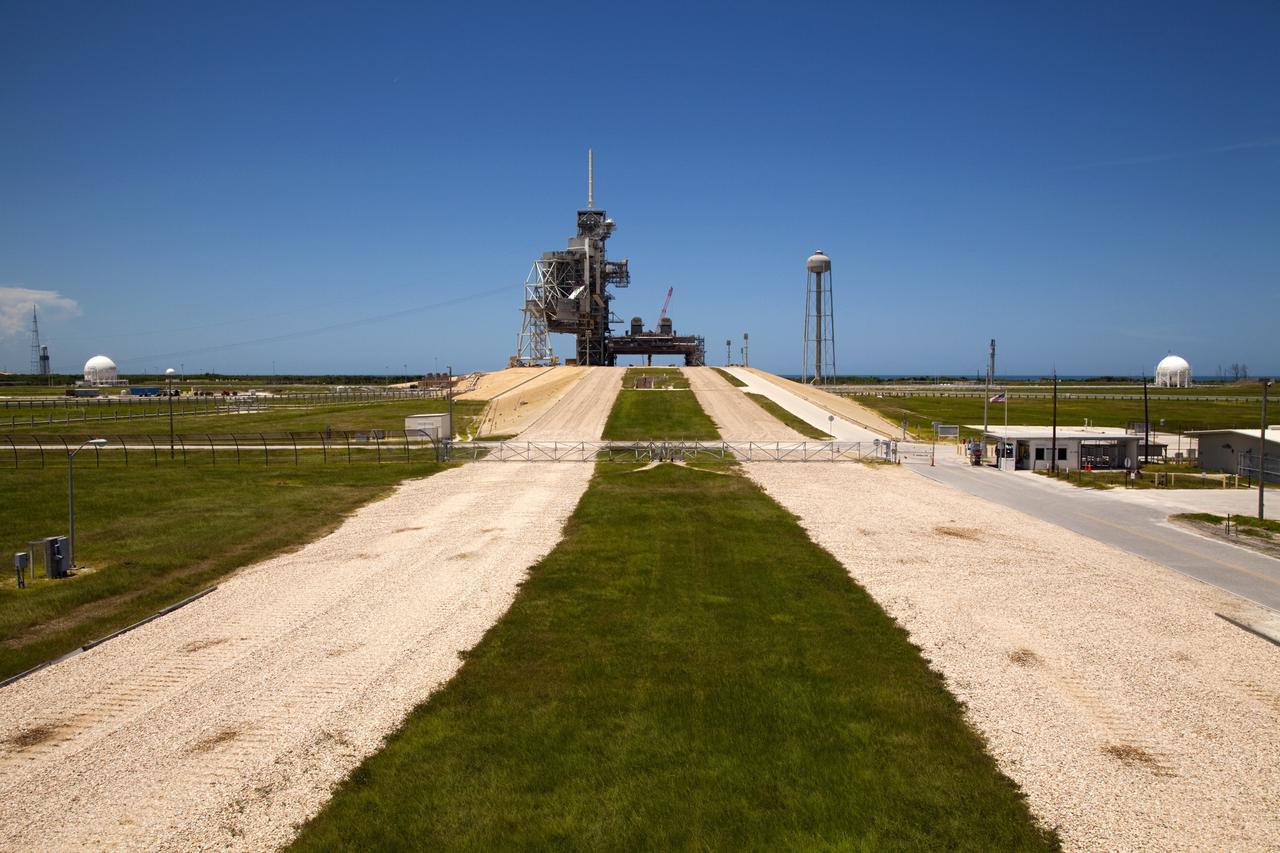
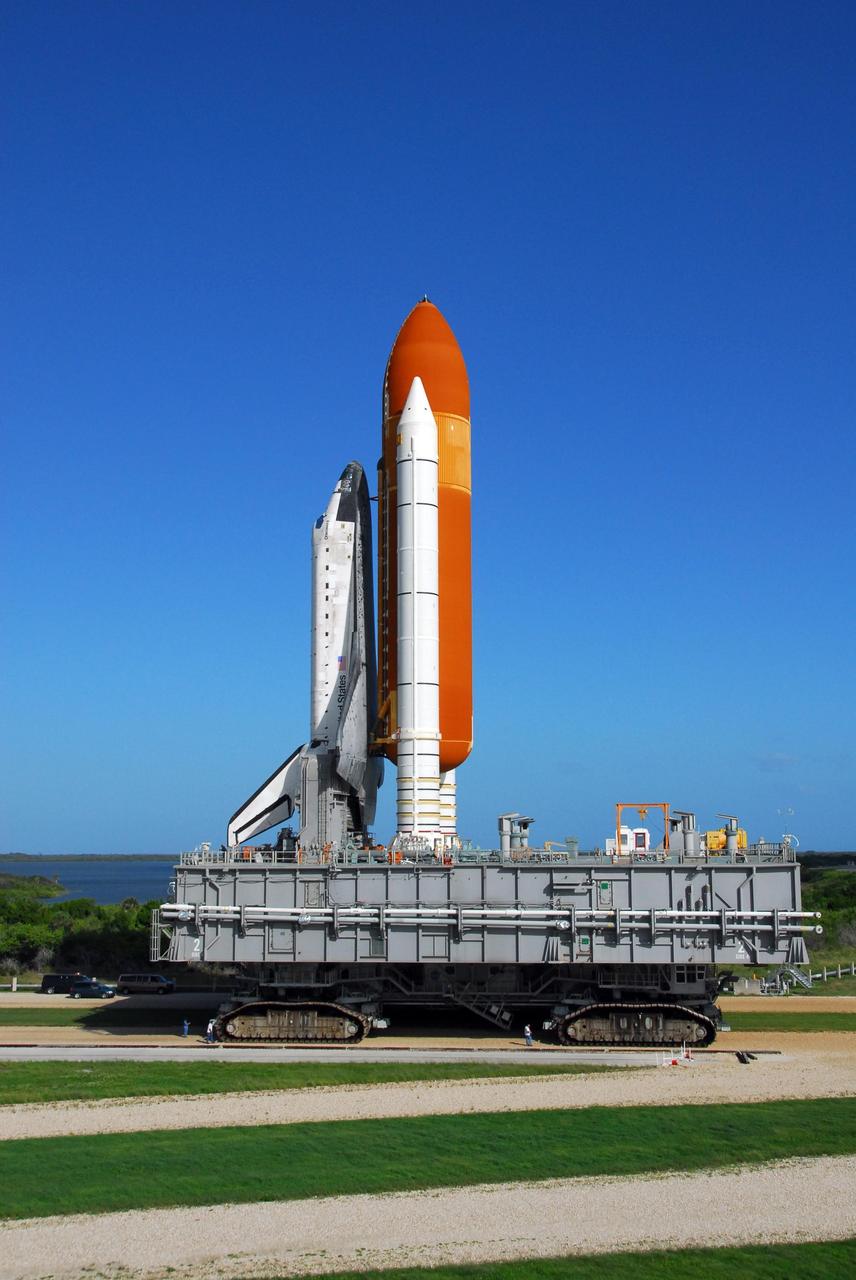
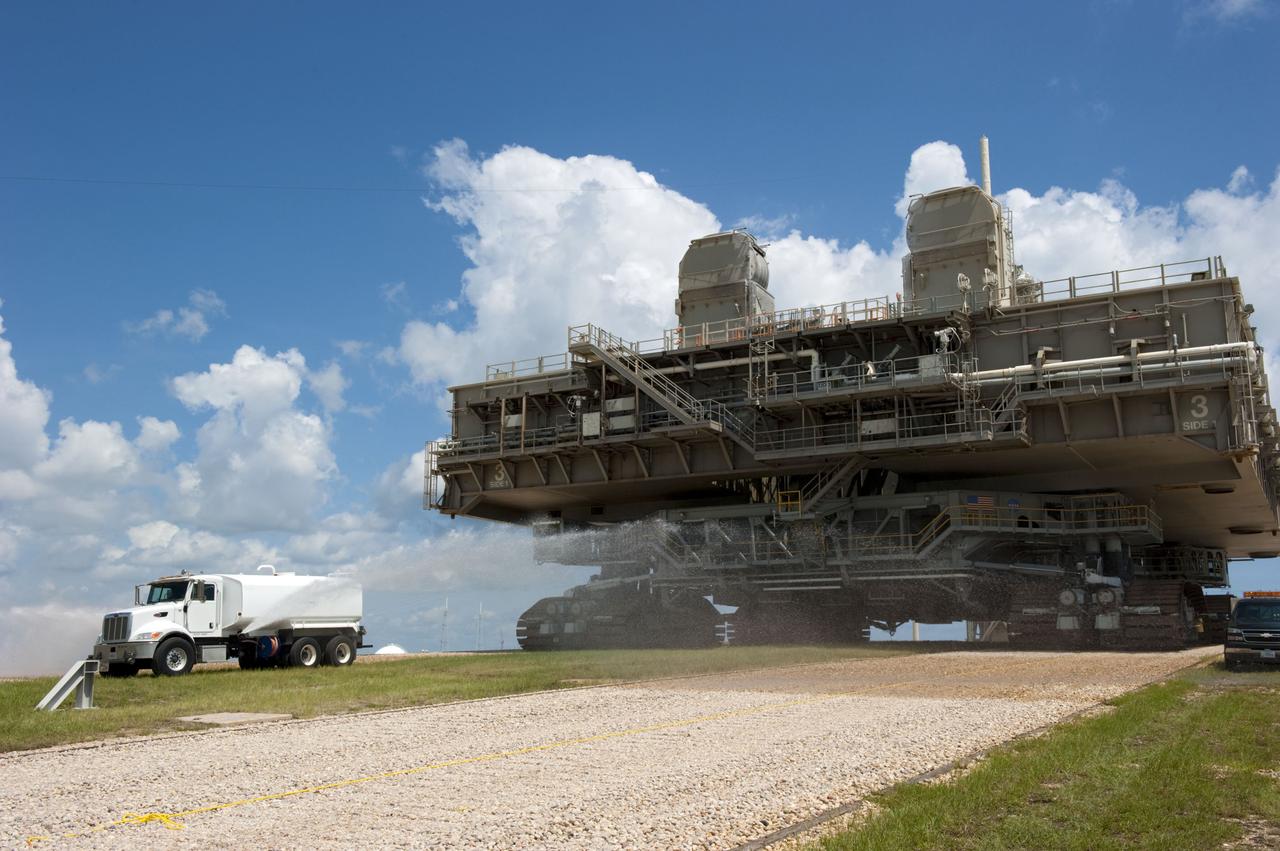
CAPE CANAVERAL, Fla. – The gravel crawlerway is seen as if from a crawler transporter approaching Launch Complex 39 pad A at the Kennedy Space Center in Florida. The crawlerways are 130 feet wide, about the size of an 8-lane freeway. The river rock paths have been used since 1966 to move launch vehicles from the Vehicle Assembly Building, or VAB, along the 3.4-mile path to pad A and 6.8 miles to pad B.      The crawlerways were originally built to support transporting Apollo Saturn V rockets to the launch pads. The crawlerways were again used during the Space Shuttle Program moving the 4.5 million-pound shuttles mounted on an 8-million-pound mobile launcher platform atop a six-million-pound crawler transporter -- totaling an 18.5-million-pound vehicle lumbering along to the pad. The paths are specially constructed with four layers. The top is eight inches thick on curves and four inches on straightaway sections. Then there is a four-foot layer of graded, crushed stone. Beneath that is 2.5 feet of fill, followed by one foot of compact fill. Plans call for the crawlerways to be used in the future for transporting launch vehicles from the VAB to pads A and B. For more information, visit http://www.nasa.gov/transition Photo credit: NASA/Kim Shiflett
KSC-2012-3981
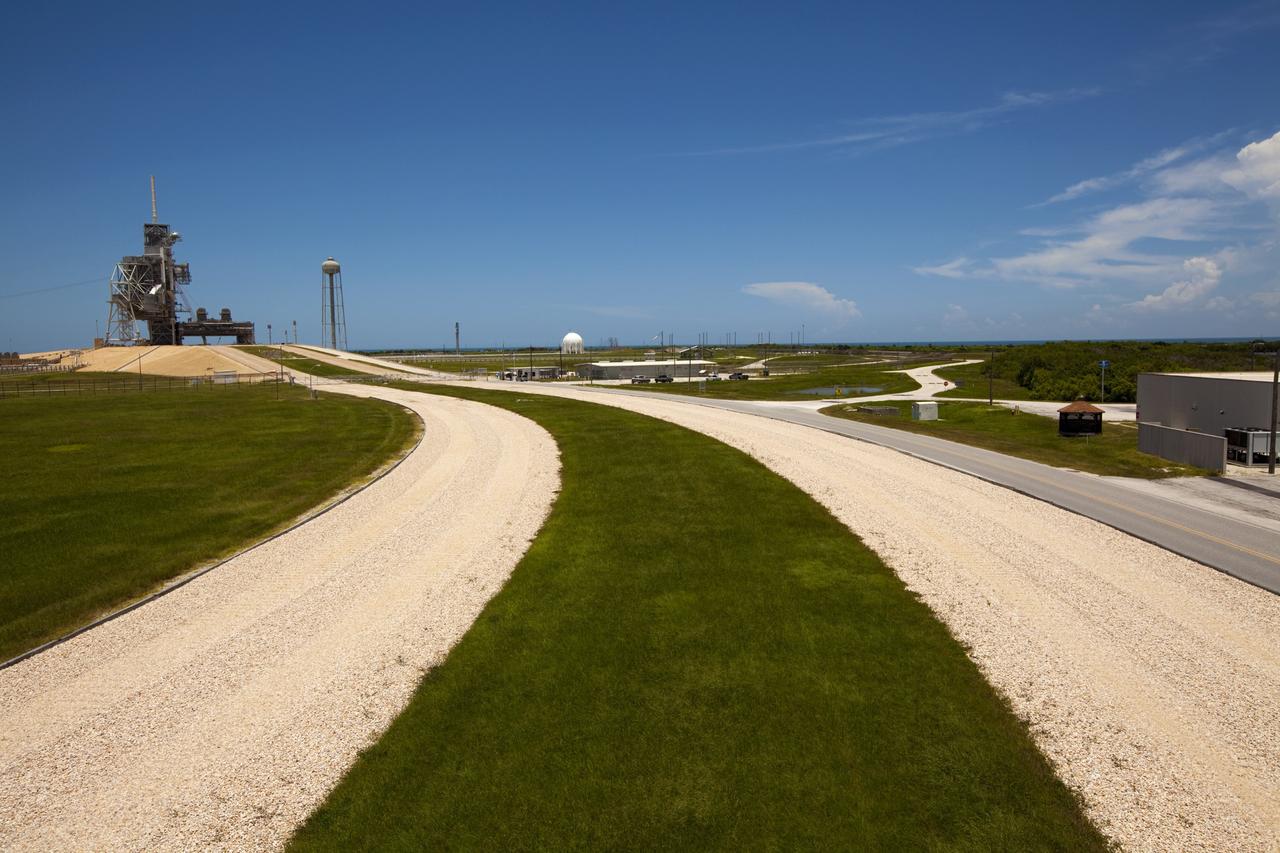
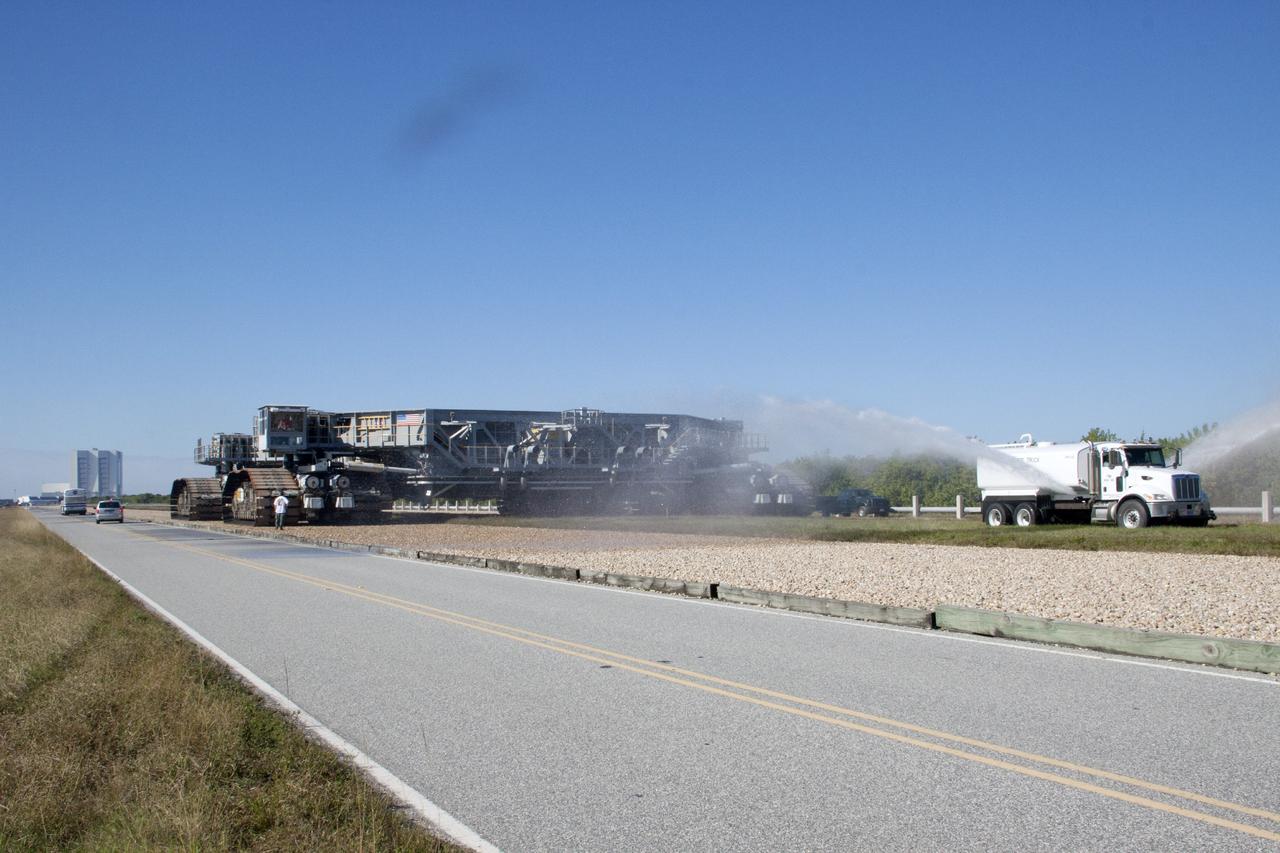
CAPE CANAVERAL, Fla. – The gravel crawlerway is seen as if from a crawler transporter making a turn to approach Launch Complex 39 pad A at the Kennedy Space Center in Florida. The crawlerways are 130 feet wide, about the size of an 8-lane freeway. The river rock paths have been used since 1966 to move launch vehicles from the Vehicle Assembly Building, or VAB, along the 3.4-mile path to pad A and 6.8 miles to pad B.      The crawlerways were originally built to support transporting Apollo Saturn V rockets to the launch pads. The crawlerways were again used during the Space Shuttle Program moving the 4.5 million-pound shuttles mounted on an 8-million-pound mobile launcher platform atop a six-million-pound crawler transporter -- totaling an 18.5-million-pound vehicle lumbering along to the pad. The paths are specially constructed with four layers. The top is eight inches thick on curves and four inches on straightaway sections. Then there is a four-foot layer of graded, crushed stone. Beneath that is 2.5 feet of fill, followed by one foot of compact fill. Plans call for the crawlerways to be used in the future for transporting launch vehicles from the VAB to pads A and B. For more information, visit http://www.nasa.gov/transition Photo credit: NASA/Kim Shiflett
KSC-2012-3983
CAPE CANAVERAL, Fla. – The gravel crawlerway is seen as if from a crawler transporter approaching Launch Complex 39 pad A at the Kennedy Space Center in Florida. The crawlerways are 130 feet wide, about the size of an 8-lane freeway. The river rock paths have been used since 1966 to move launch vehicles from the Vehicle Assembly Building, or VAB, along the 3.4-mile path to pad A and 6.8 miles to pad B.    The crawlerways were originally built to support transporting Apollo Saturn V rockets to the launch pads. The crawlerways were again used during the Space Shuttle Program moving the 4.5 million-pound shuttles mounted on an 8-million-pound mobile launcher platform atop a six-million-pound crawler transporter -- totaling an 18.5-million-pound vehicle lumbering along to the pad. The paths are specially constructed with four layers. The top is eight inches thick on curves and four inches on straightaway sections. Then there is a four-foot layer of graded, crushed stone. Beneath that is 2.5 feet of fill, followed by one foot of compact fill. Plans call for the crawlerways to be used in the future for transporting launch vehicles from the VAB to pads A and B. For more information, visit http://www.nasa.gov/transition Photo credit: NASA/Kim Shiflett
KSC-2012-3982
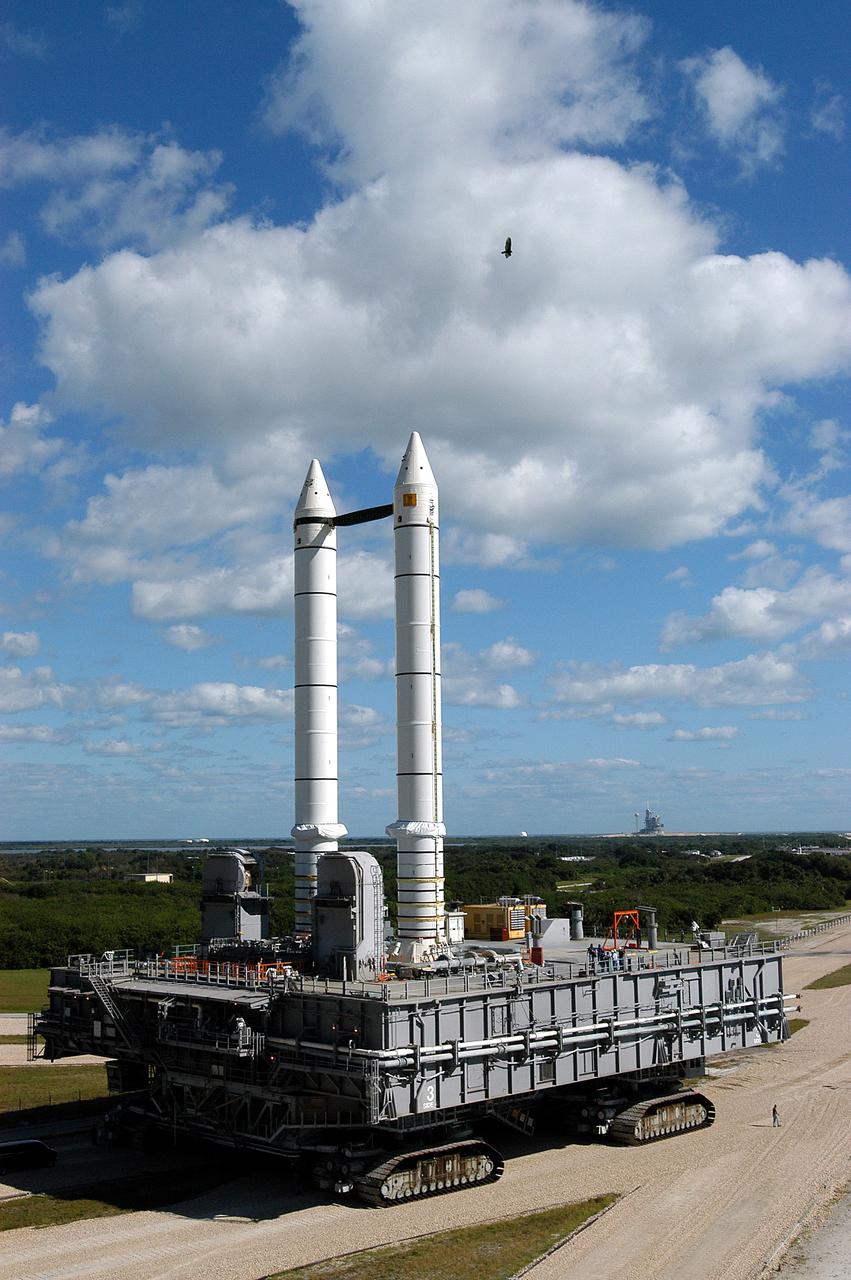
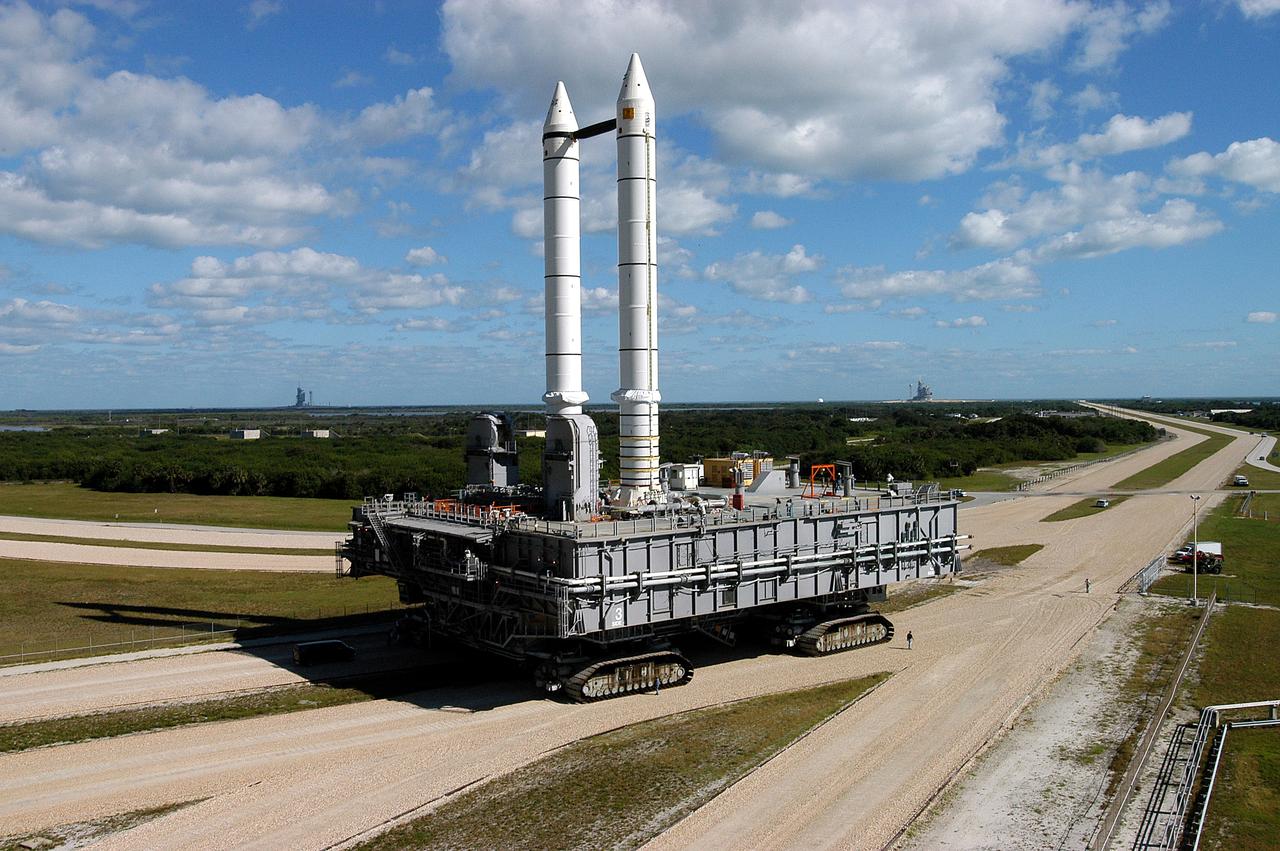
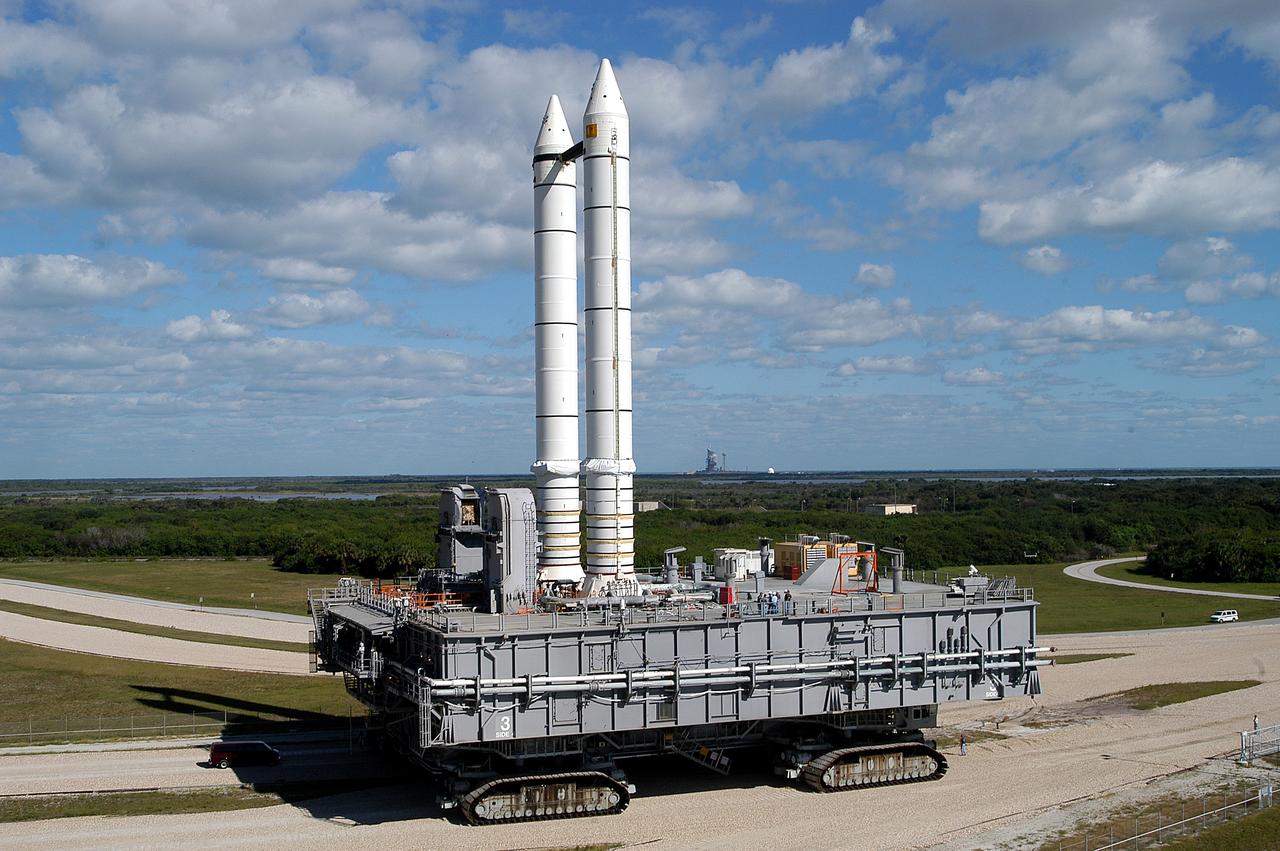
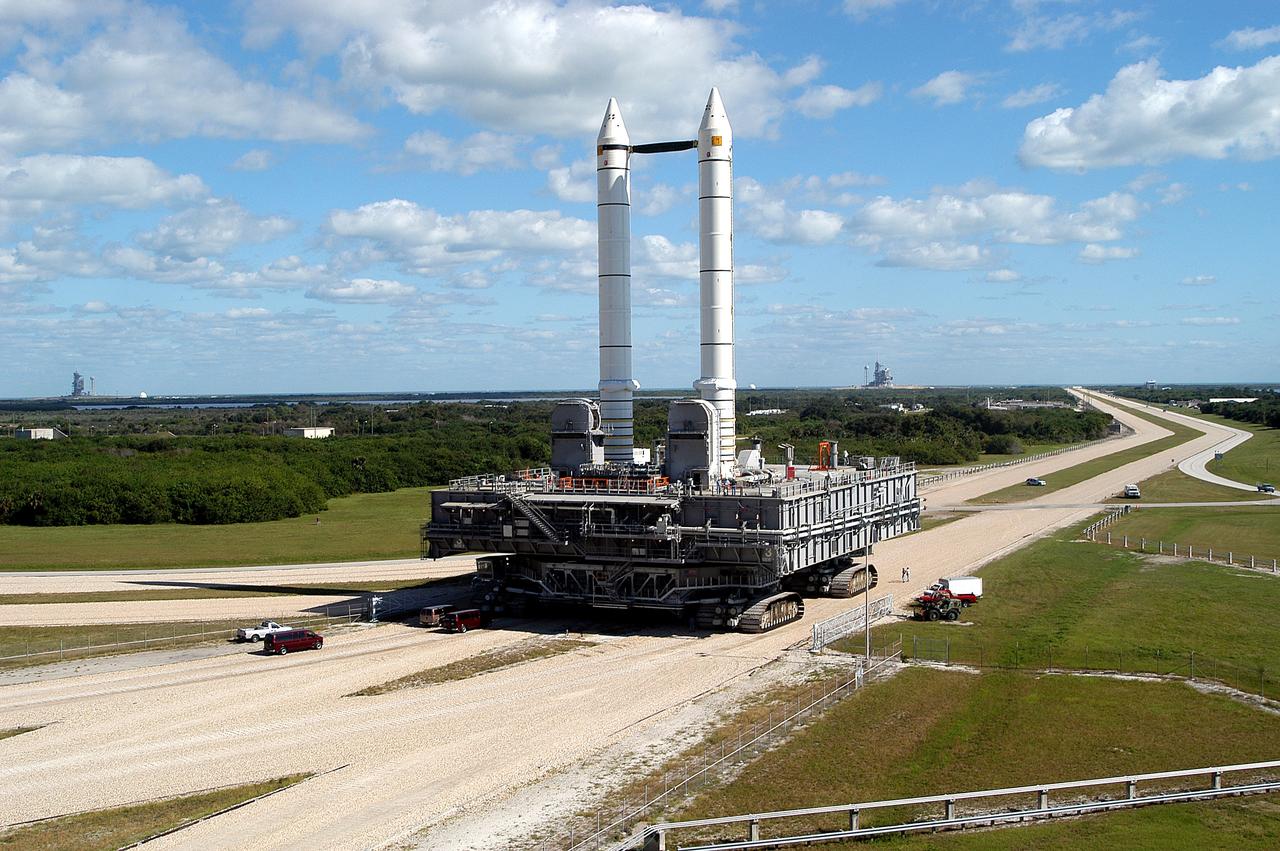
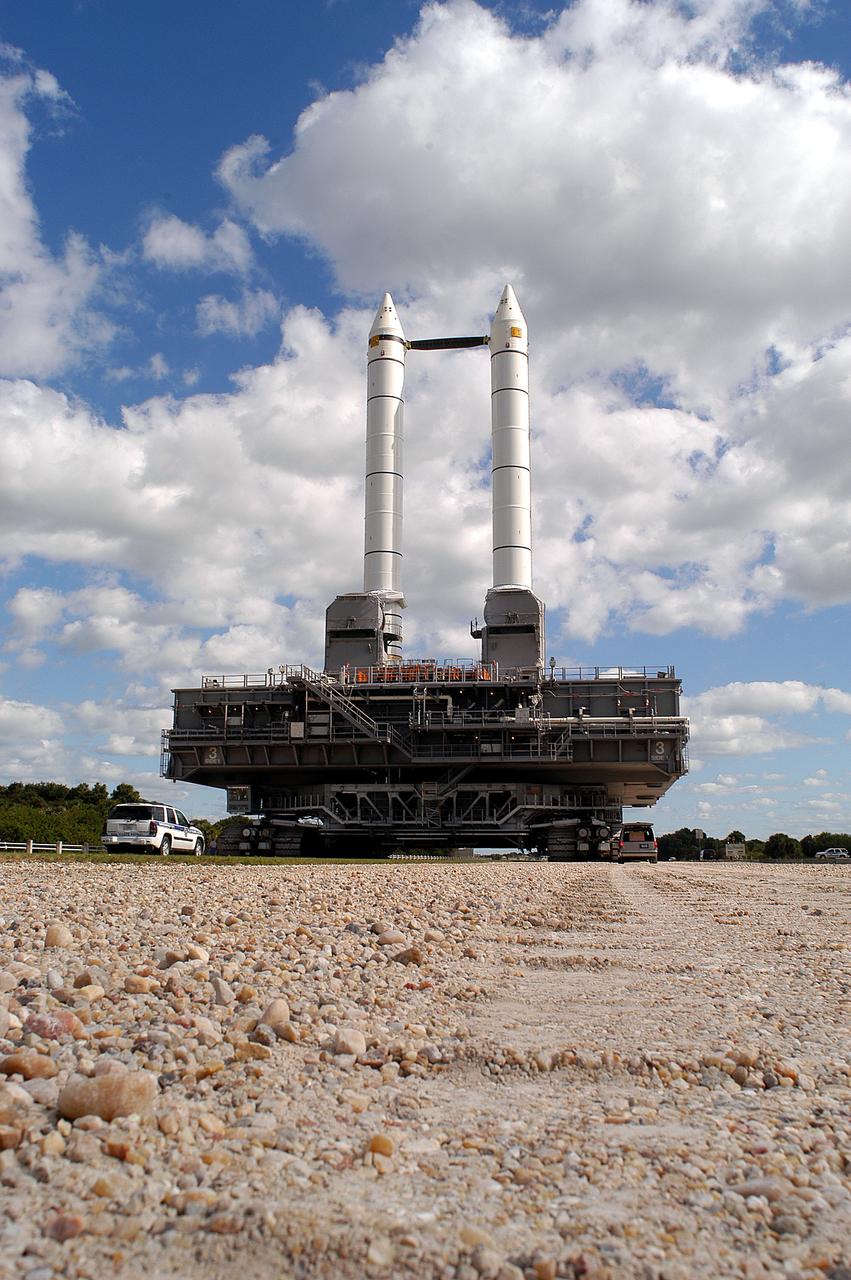
KENNEDY SPACE CENTER, FLA. -  A high-flying bird takes a closer look at the Mobile Launcher Platform (MLP) number 3 with twin solid rocket boosters bolted to it as it crawls toward Launch Pad 39A, in the background.  The crawler is moving along the crawlerway at various speeds up to 1 mph in an effort to achieve vibration data gathering goals as it travels toward Launch Pad 39A and then returns.  The boosters are braced at the top for stability.  The primary purpose of these rollout tests is to gather data to develop future maintenance requirements on the transport equipment and the flight hardware. Various parts of the MLP and crawler transporter have been instrumented with vibration data collection equipment.
KENNEDY SPACE CENTER, FLA. - A high-flying bird takes a closer look at the Mobile Launcher Platform (MLP) number 3 with twin solid rocket boosters bolted to it as it crawls toward Launch Pad 39A, in the background. The crawler is moving along the crawlerway at various speeds up to 1 mph in an effort to achieve vibration data gathering goals as it travels toward Launch Pad 39A and then returns. The boosters are braced at the top for stability. The primary purpose of these rollout tests is to gather data to develop future maintenance requirements on the transport equipment and the flight hardware. Various parts of the MLP and crawler transporter have been instrumented with vibration data collection equipment.
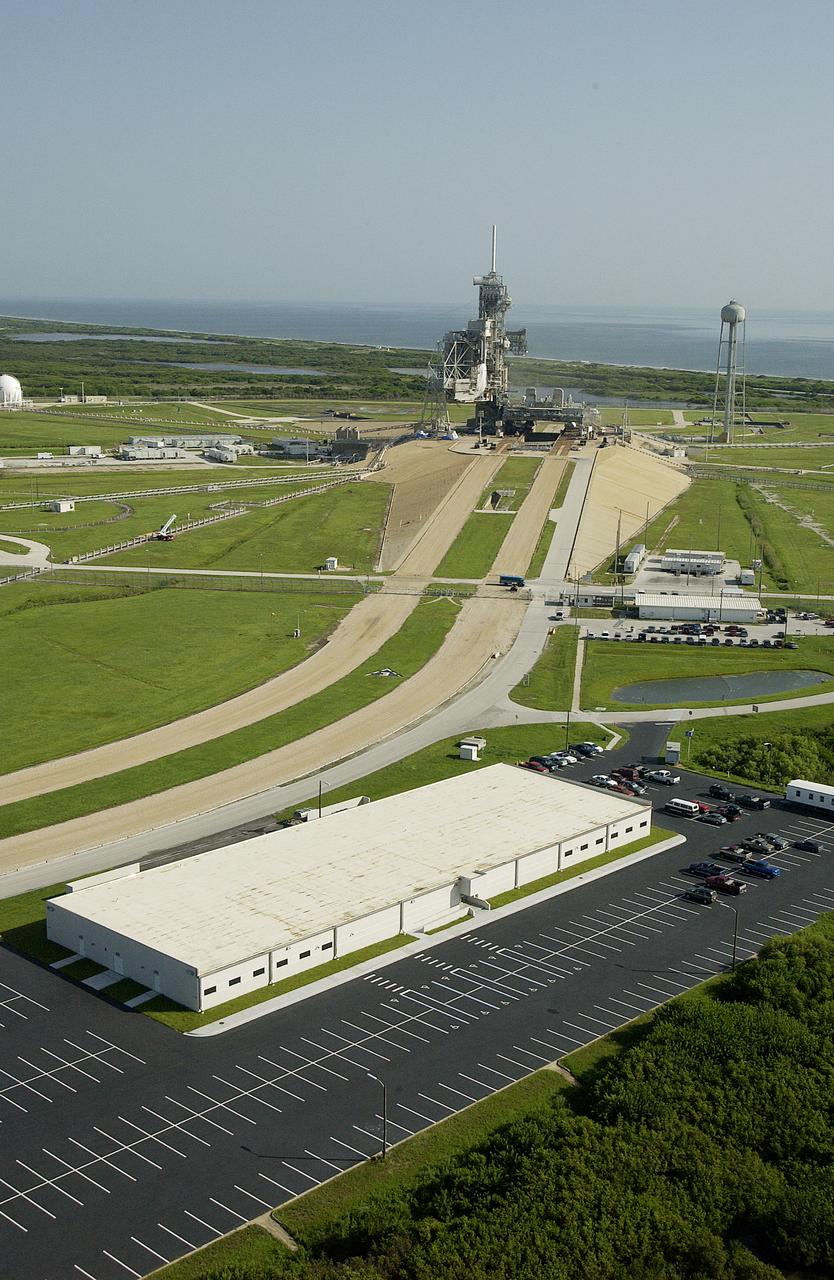
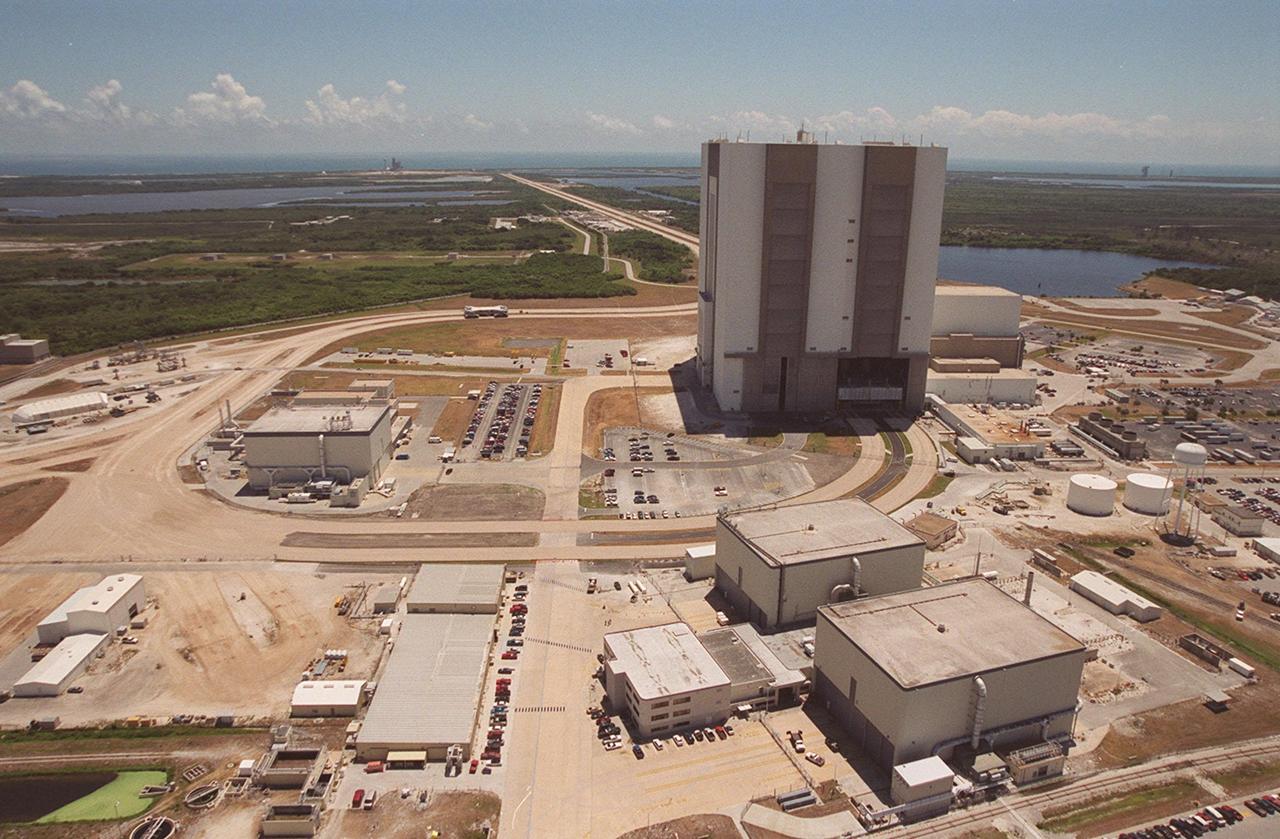
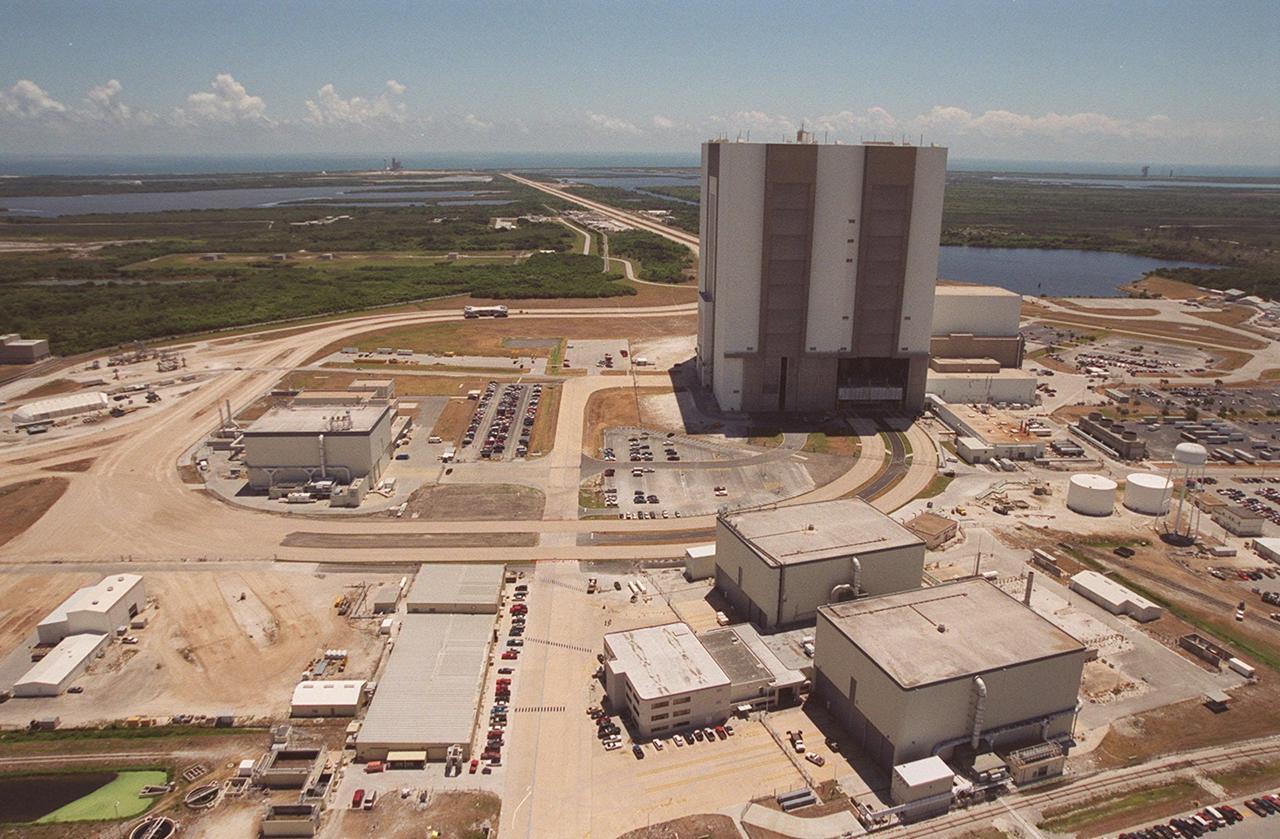
KENNEDY SPACE CENTER, FLA. –  In this aerial view, the crawlerway (center) leads to Launch Pad 39A.  At right is one of the new Launch Pad facilities buildings that provides both office and shop space.
03pd2220
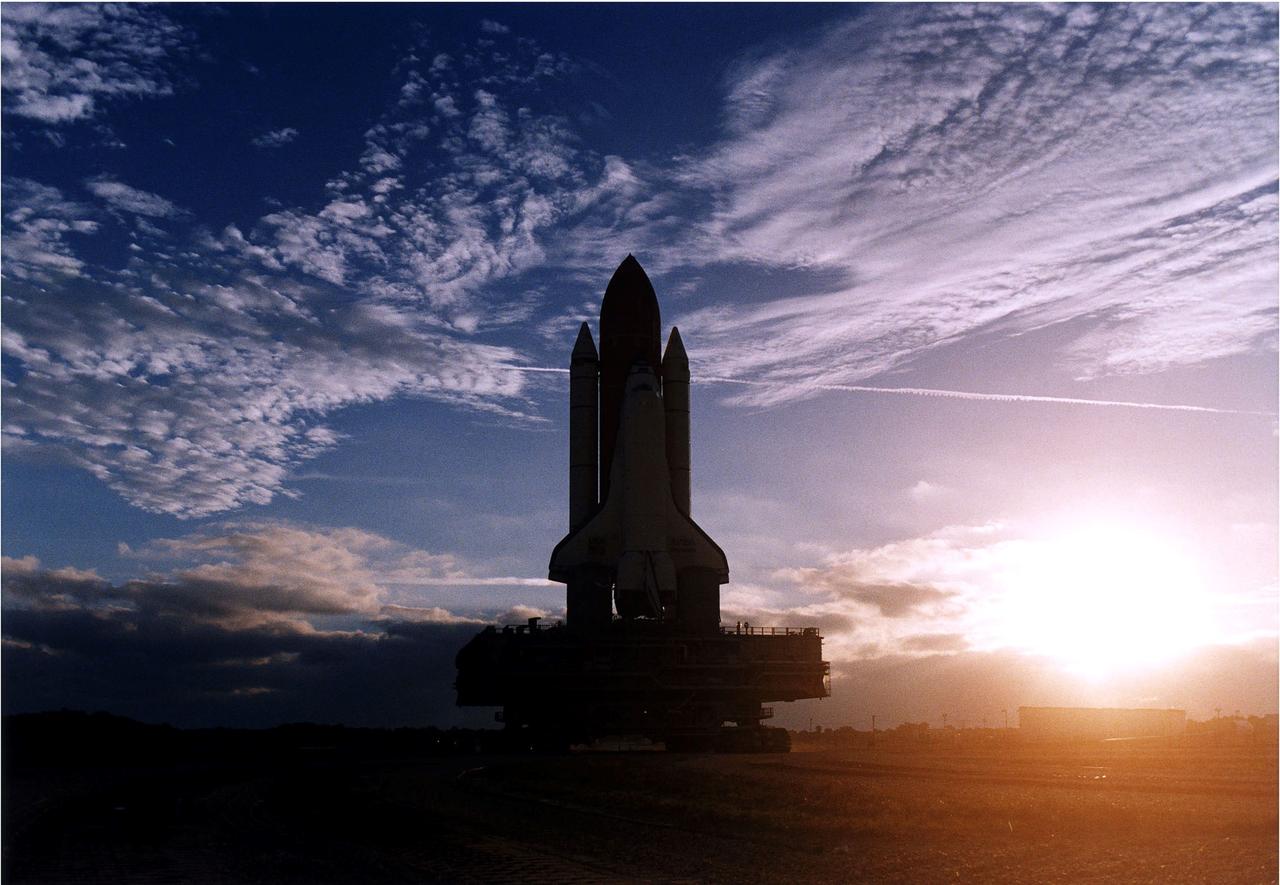
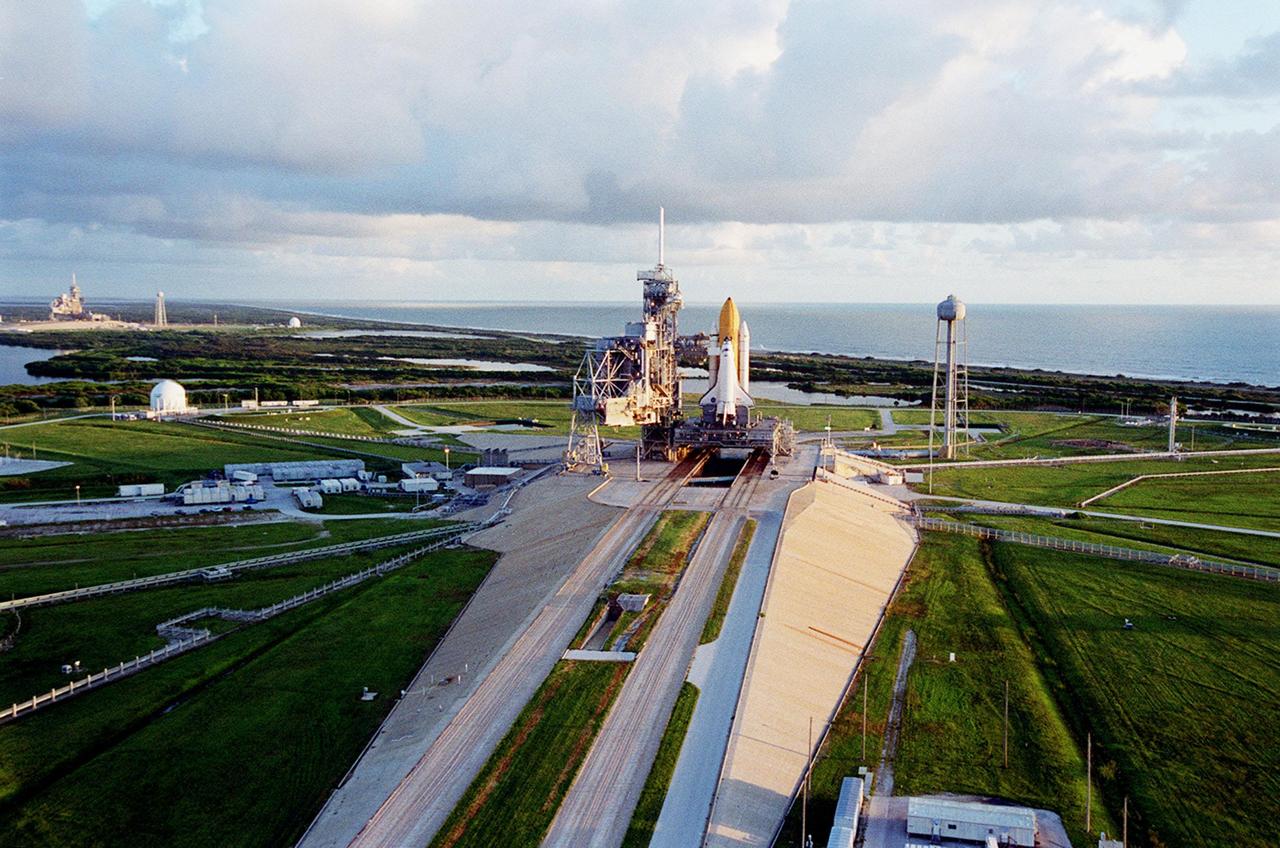
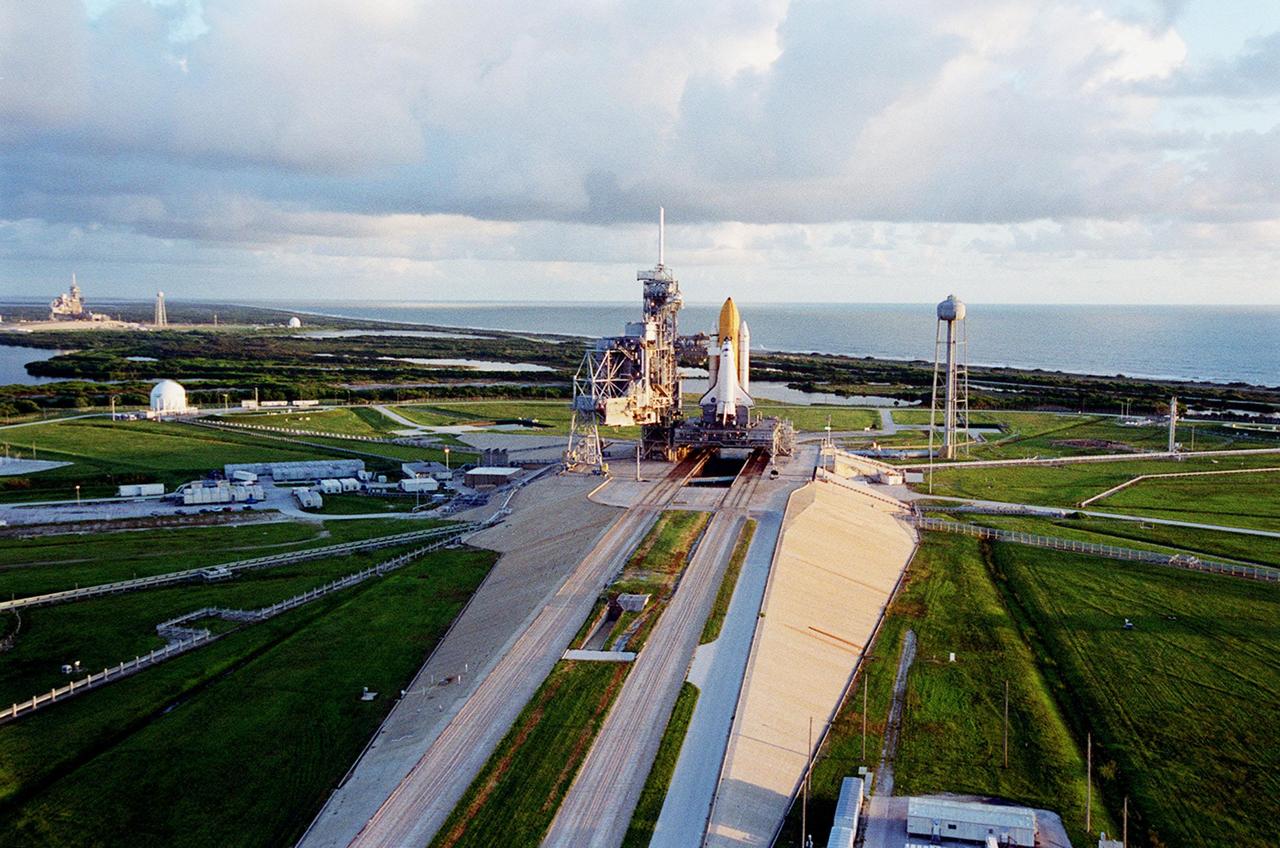
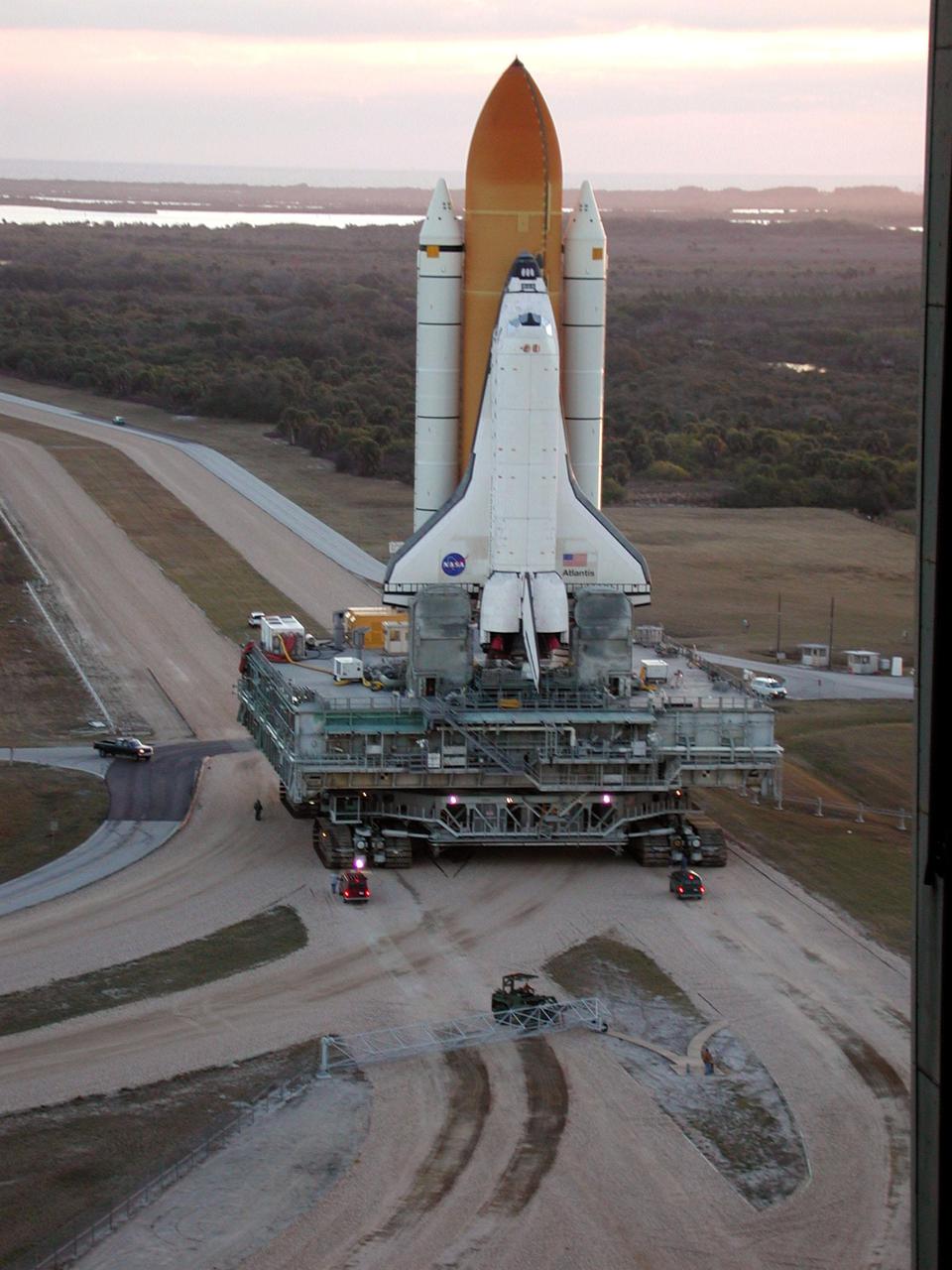
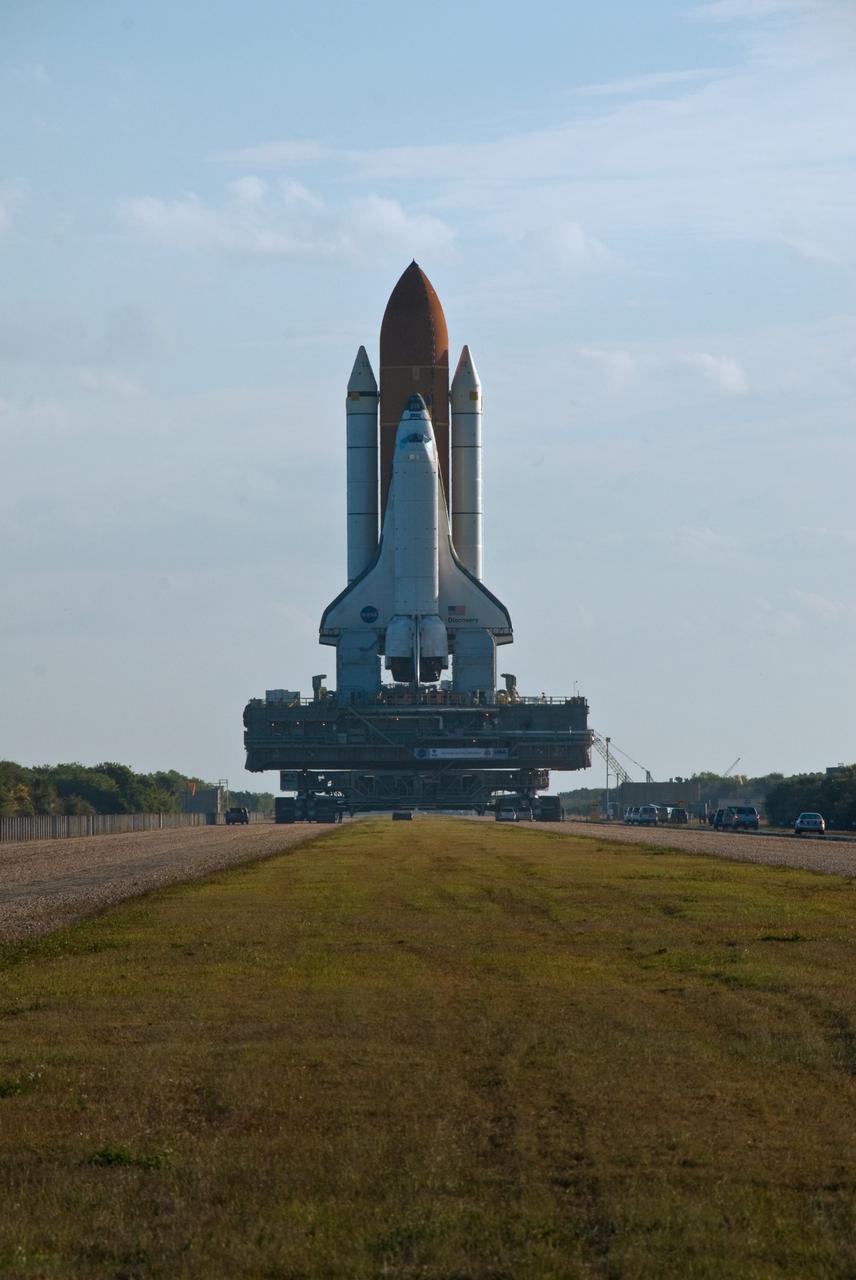
KENNEDY SPACE CENTER, FLA. -  The rising sun and some scattered clouds provide a picturesque backdrop for the Space Shuttle Discovery as it travels along the crawlerway toward Launch Pad 39A in preparation for the STS-82 mission.  The Shuttle is on a Mobile Launcher Platform, and the entire assemblage is being carried by a large, tracked vehicle called the crawler transporter.  A seven-member crew will perform the second servicing of the orbiting Hubble Space Telescope (HST) during the 10-day STS-82 flight, whcih is targeted for a Feb. 11 liftoff.
KENNEDY SPACE CENTER, FLA. - The rising sun and some scattered clouds provide a picturesque backdrop for the Space Shuttle Discovery as it travels along the crawlerway toward Launch Pad 39A in preparation for the STS-82 mission. The Shuttle is on a Mobile Launcher Platform, and the entire assemblage is being carried by a large, tracked vehicle called the crawler transporter. A seven-member crew will perform the second servicing of the orbiting Hubble Space Telescope (HST) during the 10-day STS-82 flight, whcih is targeted for a Feb. 11 liftoff.
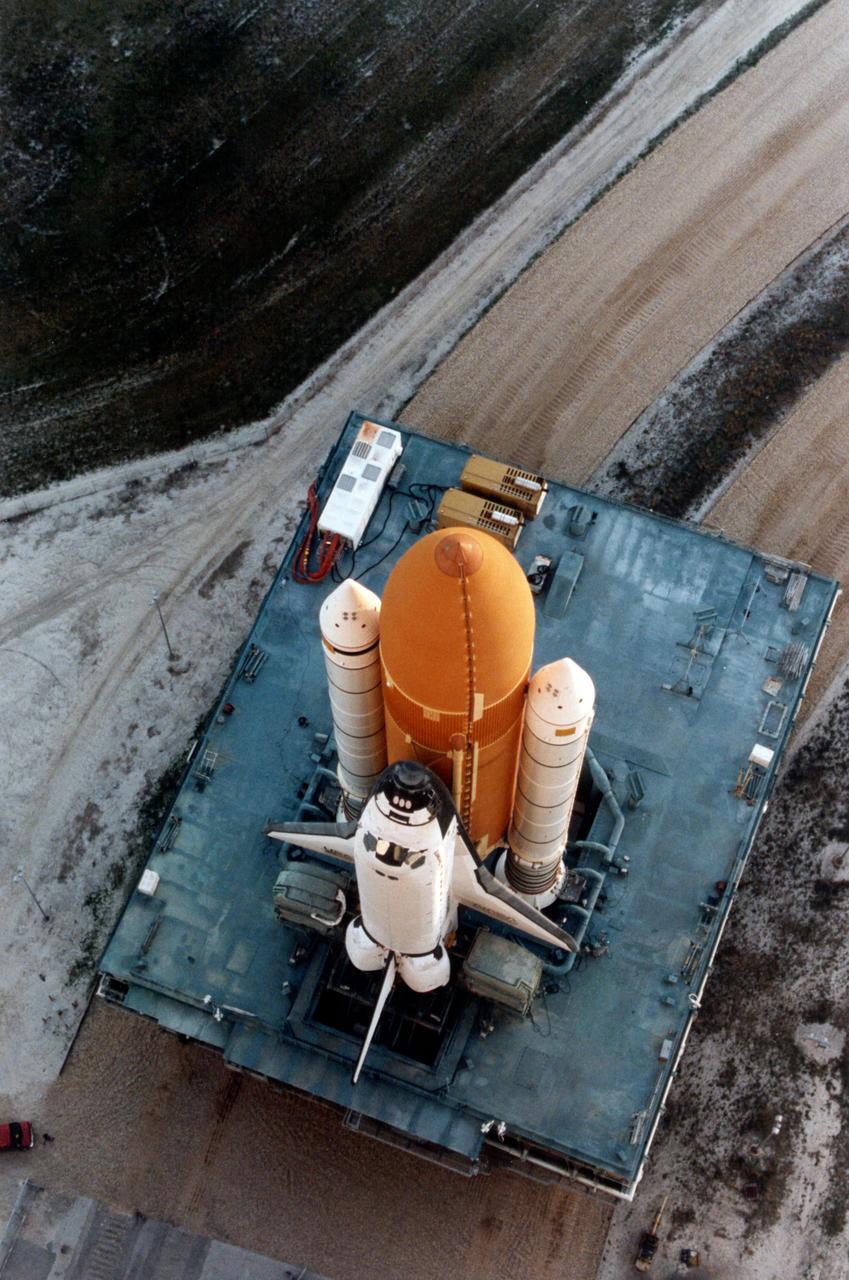
KENNEDY SPACE CENTER, FLA. -  After leaving the Vehicle Assembly Building, the Space Shuttle Discovery makes its slow - up to 1 mile per hour - trek along the crawlerway to Launch Pad 39A in preparation for the STS-82 mission.  The Shuttle is assembled on a Mobile Launcher Platform, seen in this view taken from above, and the entire assemblage is carried out to the launch pad on the crawler transporter, which is underneath the MLP.  A seven-member crew will perform the second servicing of the orbiting Hubble Space Telescope (HST) during the 10-day STS-82 mission, which is targeted for a Feb. 11 liftoff.
KENNEDY SPACE CENTER, FLA. - After leaving the Vehicle Assembly Building, the Space Shuttle Discovery makes its slow - up to 1 mile per hour - trek along the crawlerway to Launch Pad 39A in preparation for the STS-82 mission. The Shuttle is assembled on a Mobile Launcher Platform, seen in this view taken from above, and the entire assemblage is carried out to the launch pad on the crawler transporter, which is underneath the MLP. A seven-member crew will perform the second servicing of the orbiting Hubble Space Telescope (HST) during the 10-day STS-82 mission, which is targeted for a Feb. 11 liftoff.
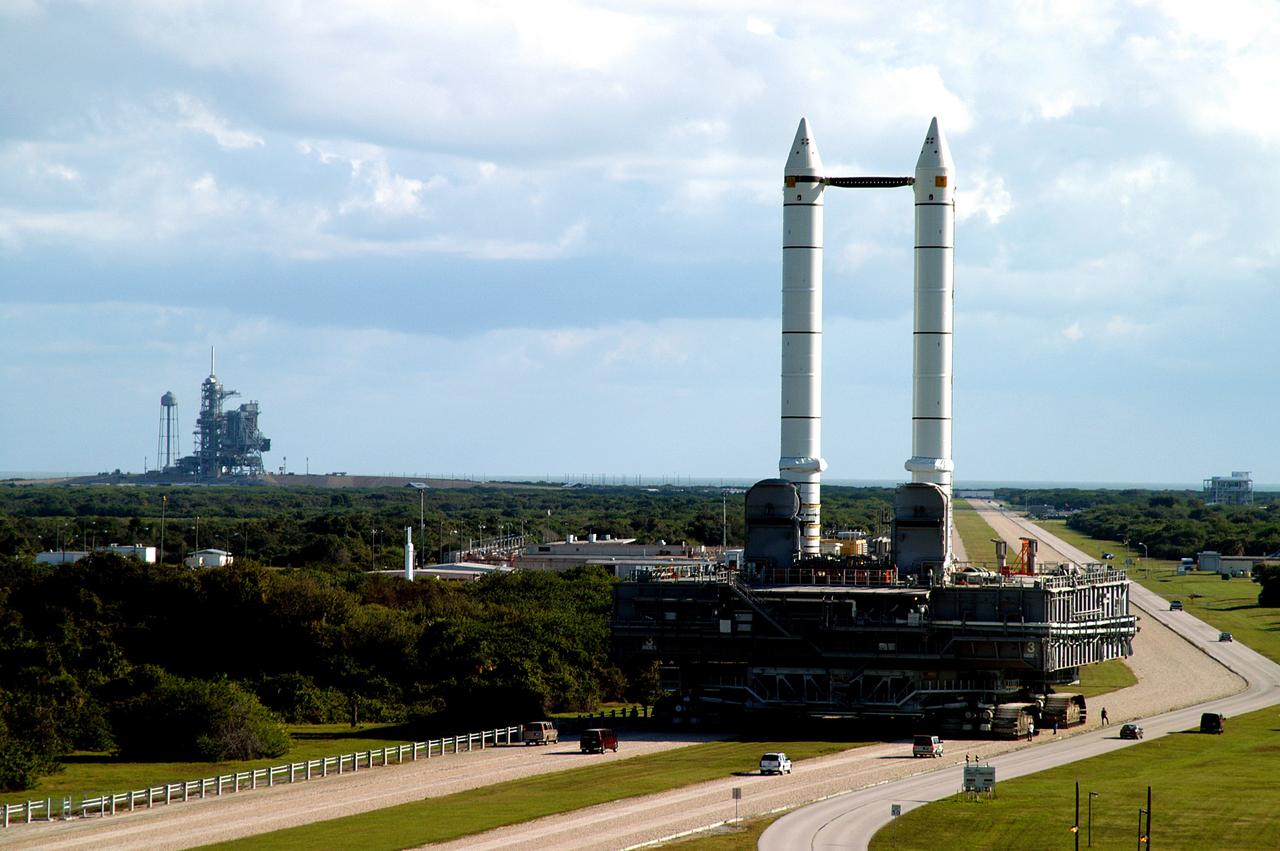
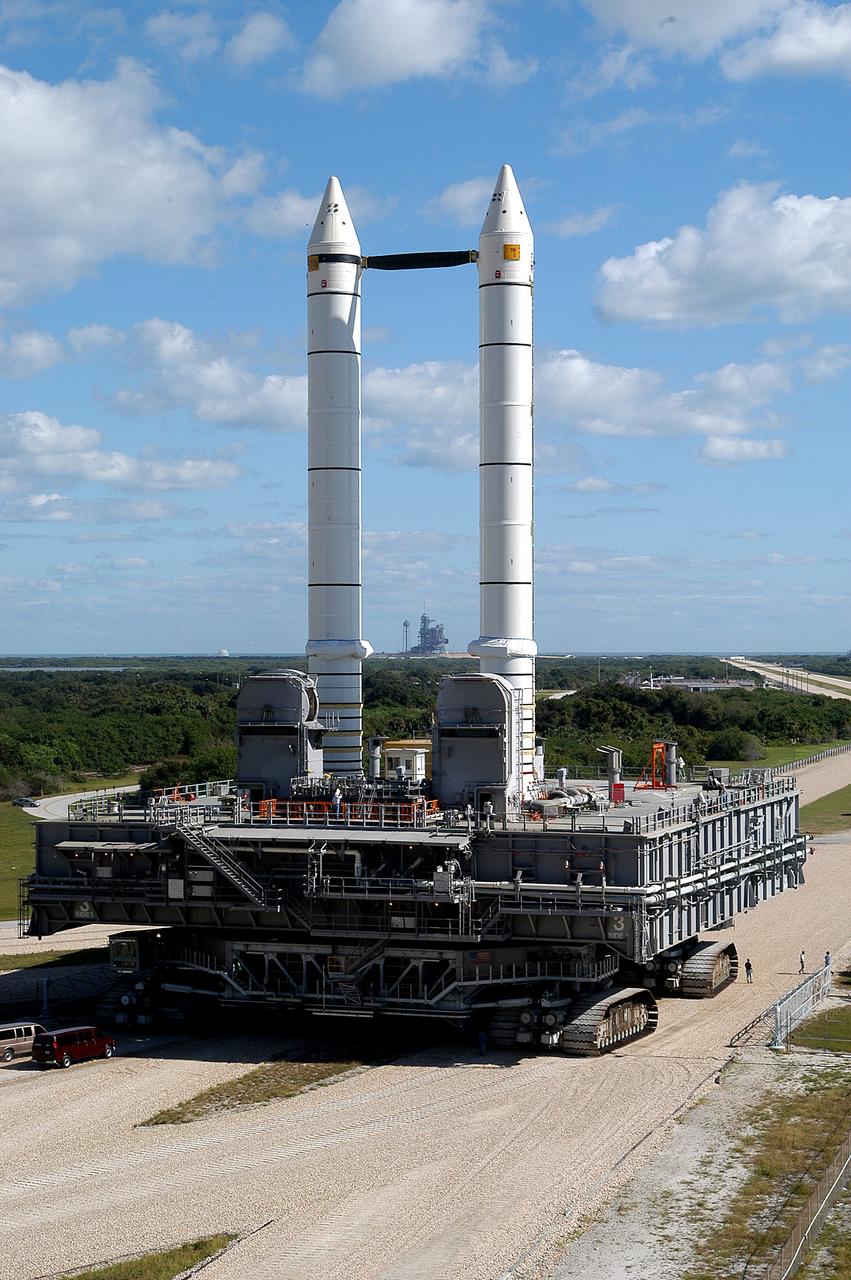
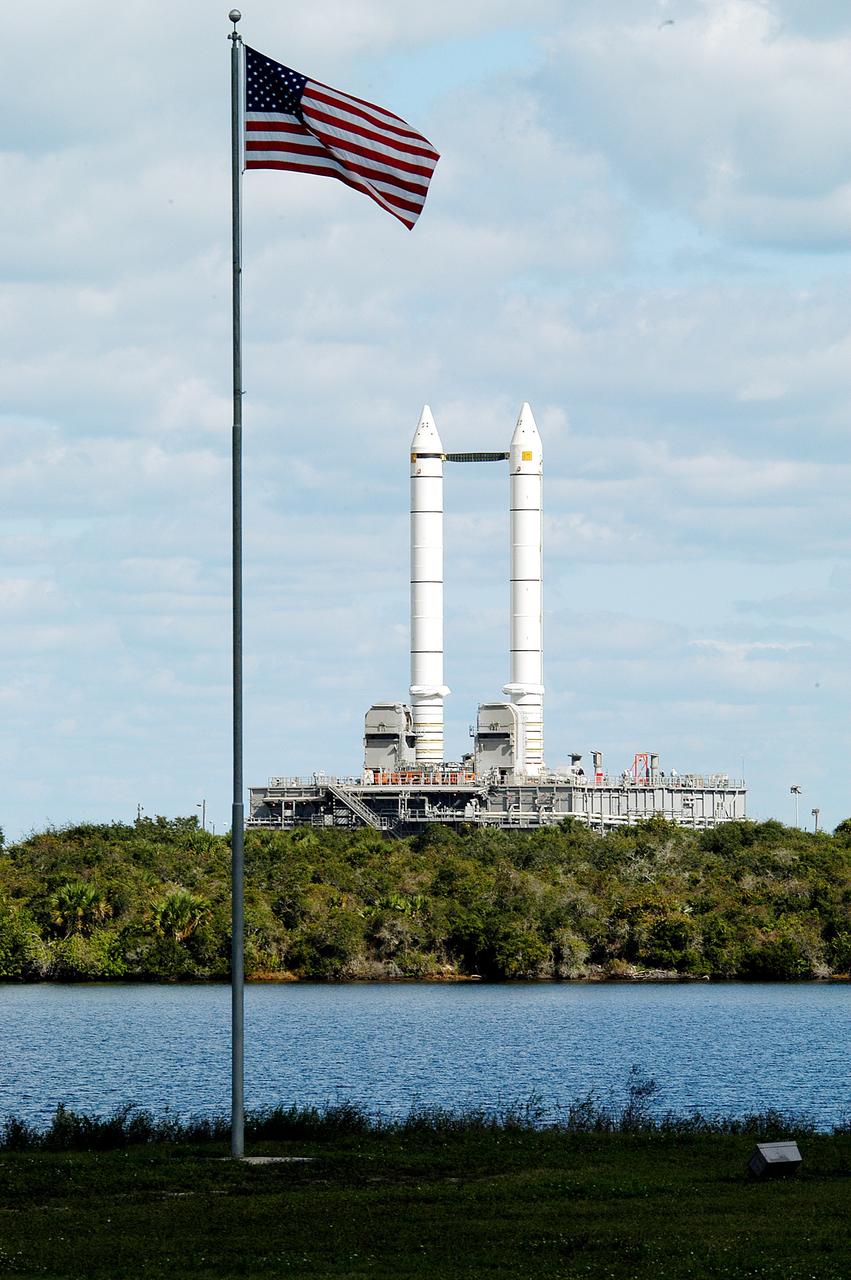
KENNEDY SPACE CENTER, FLA. -  Mobile Launcher Platform (MLP) number 3 and a set of twin solid rocket boosters bolted to it, atop the crawler-transporter, crawl to the intersection in the crawlerway in support of the second engineering analysis vibration test on the crawler and MLP.  In the background are Launch Pads 39A (right) and 39B (left).  The crawler is moving at various speeds up to 1 mph in an effort to achieve vibration data gathering goals as it leaves the VAB, travels toward Launch Pad 39A and then returns.  The boosters are braced at the top for stability.  The primary purpose of these rollout tests is to gather data to develop future maintenance requirements on the transport equipment and the flight hardware. Various parts of the MLP and crawler transporter have been instrumented with vibration data collection equipment.
KENNEDY SPACE CENTER, FLA. - Mobile Launcher Platform (MLP) number 3 and a set of twin solid rocket boosters bolted to it, atop the crawler-transporter, crawl to the intersection in the crawlerway in support of the second engineering analysis vibration test on the crawler and MLP. In the background are Launch Pads 39A (right) and 39B (left). The crawler is moving at various speeds up to 1 mph in an effort to achieve vibration data gathering goals as it leaves the VAB, travels toward Launch Pad 39A and then returns. The boosters are braced at the top for stability. The primary purpose of these rollout tests is to gather data to develop future maintenance requirements on the transport equipment and the flight hardware. Various parts of the MLP and crawler transporter have been instrumented with vibration data collection equipment.
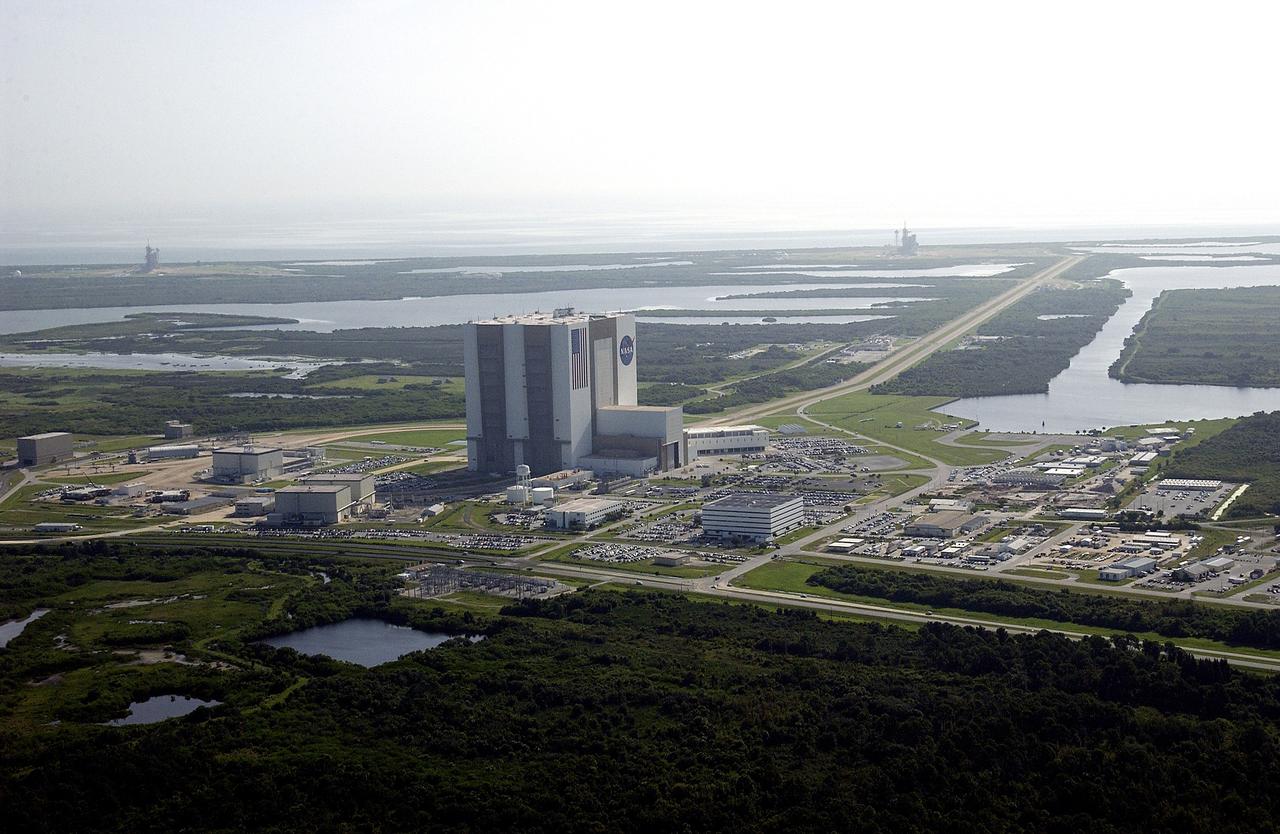
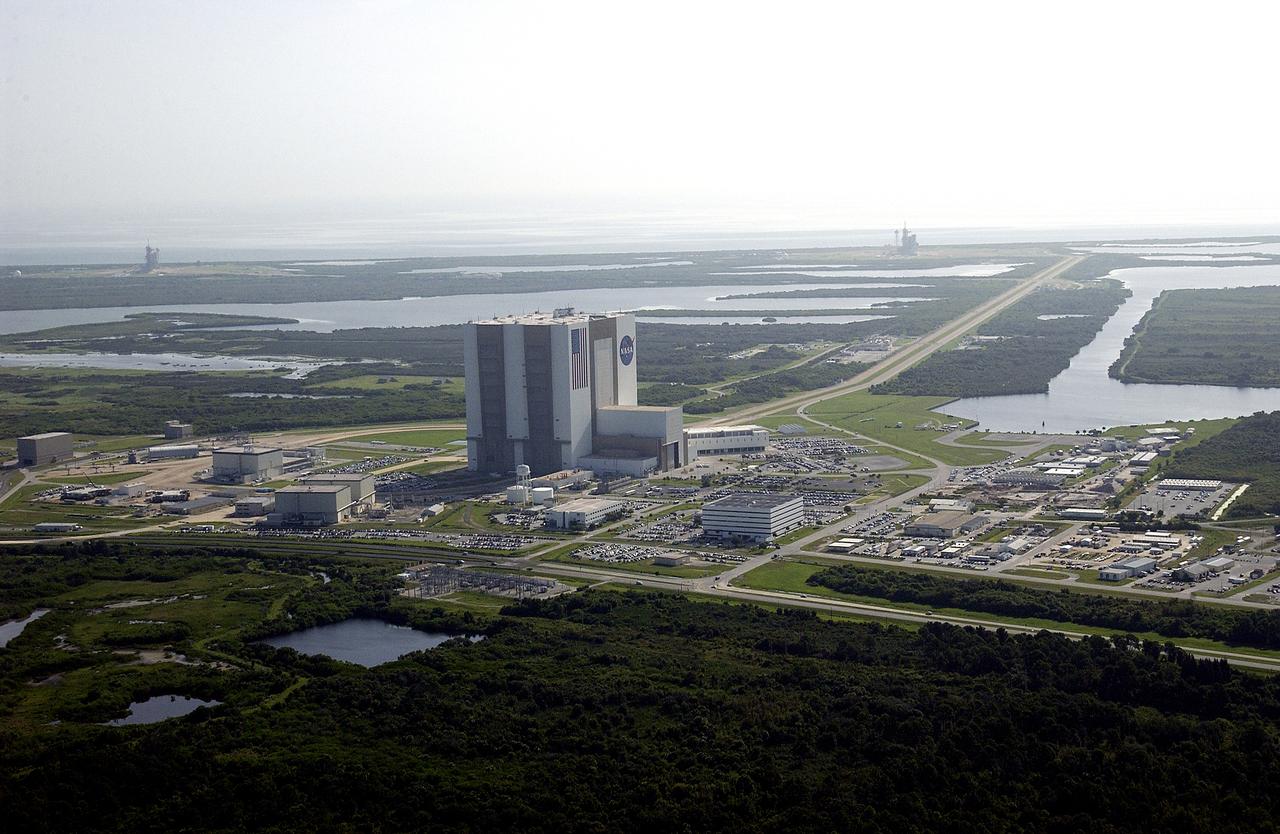
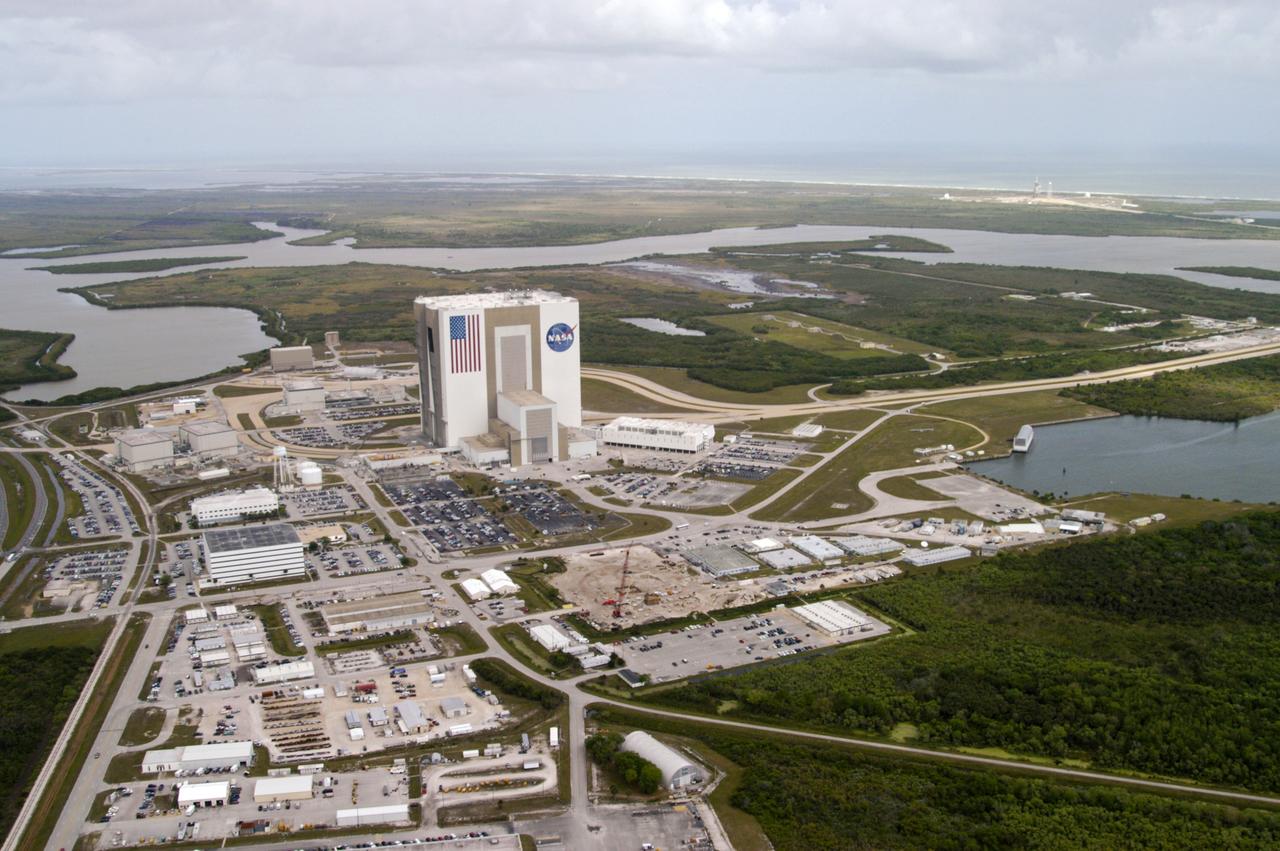
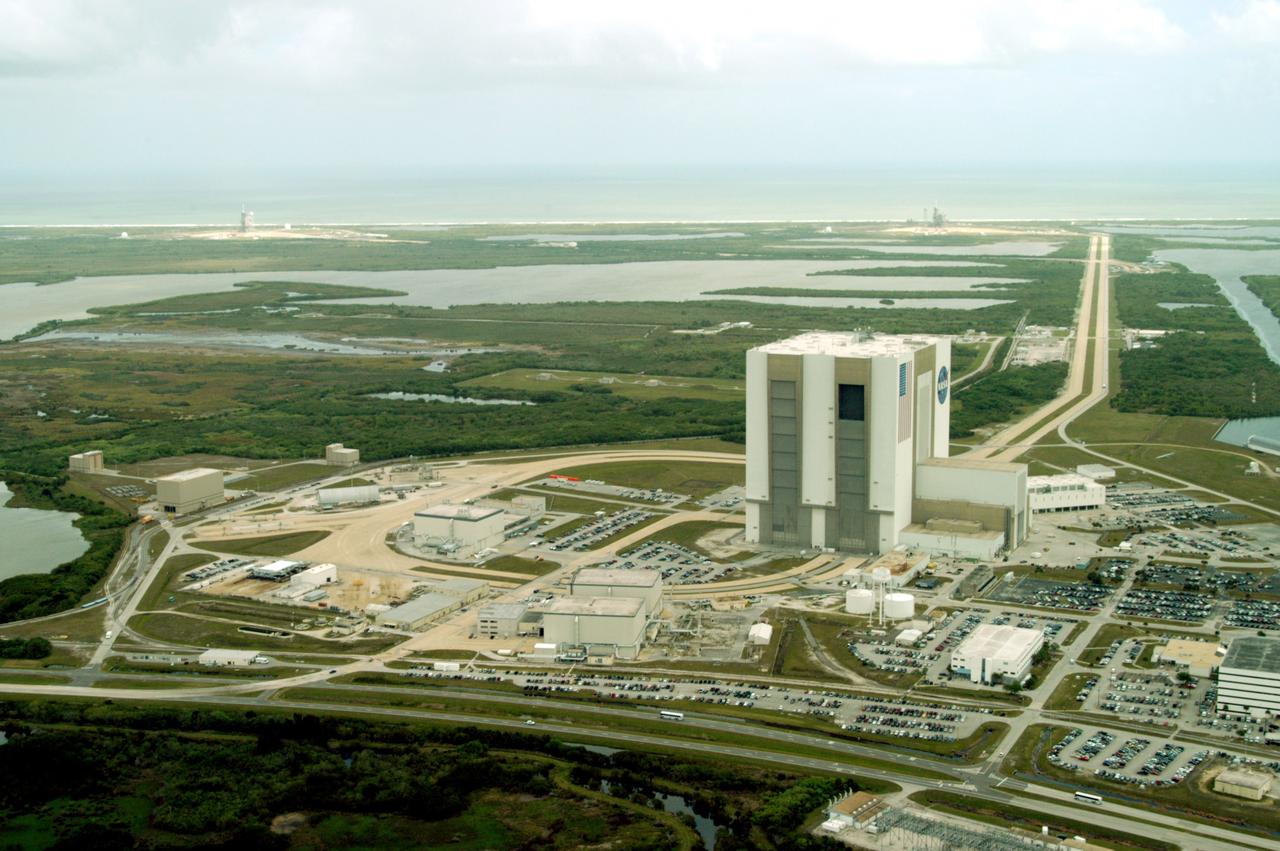
CAPE CANAVERAL, Fla. -- This aerial view shows the Launch Complex 39 Area.  At center is the 525-foot-tall Vehicle Assembly Building.  On the horizon at the far left is Launch Pad 39B to the right is Launch Pad 39A.  The crawlerway can be seen stretching from the VAB toward Pad A.  Waters of the Banana Creek and Banana River surround the pads.  At center right is the Turn Basin.    Photo credit: NASA
KSC-03pd2202
KENNEDY SPACE CENTER, FLA. –  This aerial view shows Launch Complex 39 Area.  At center is the 525-foot-tall Vehicle Assembly Building.  On the horizon at the far left is Launch Pad 39B; to the right is Launch Pad 39A.  The crawlerway can be seen stretching from the VAB toward Pad A.  Waters of the Banana Creek and Banana River surround the pads.  At center right is the Turn Basin.
03pd2202
CAPE CANAVERAL, Fla. -- As NASA's Kennedy Space Center in Florida, Launch Pad 39A is seen from the Saturn Causeway. On launch day, space shuttle astronauts ride to their launch pad and spacecraft in NASA's silver Astrovan. Along the way, they pass the Vehicle Assembly Building, Launch Control Center and Press Site.     Adjacent to the road is the crawlerway, which is the route shuttles take to Kennedy's Launch Complex 39 launch pads on top of a crawler-transporter. Photo credit: NASA/Frankie Martin
KSC-2010-4396
KENNEDY SPACE CENTER, FLA. -  Mobile Launcher Platform (MLP) number 3 and a set of twin solid rocket boosters, atop the crawler-transporter, inch along the crawlerway in support of the second engineering analysis vibration test on the crawler and MLP. The crawler is moving at various speeds up to 1 mph in an effort to achieve vibration data gathering goals as it leaves the VAB, travels toward Launch Pad 39A (framed between the boosters), and then returns.  The boosters are braced at the top for stability.  The primary purpose of these rollout tests is to gather data to develop future maintenance requirements on the transport equipment and the flight hardware. Various parts of the MLP and crawler transporter have been instrumented with vibration data collection equipment.
KENNEDY SPACE CENTER, FLA. - Mobile Launcher Platform (MLP) number 3 and a set of twin solid rocket boosters, atop the crawler-transporter, inch along the crawlerway in support of the second engineering analysis vibration test on the crawler and MLP. The crawler is moving at various speeds up to 1 mph in an effort to achieve vibration data gathering goals as it leaves the VAB, travels toward Launch Pad 39A (framed between the boosters), and then returns. The boosters are braced at the top for stability. The primary purpose of these rollout tests is to gather data to develop future maintenance requirements on the transport equipment and the flight hardware. Various parts of the MLP and crawler transporter have been instrumented with vibration data collection equipment.
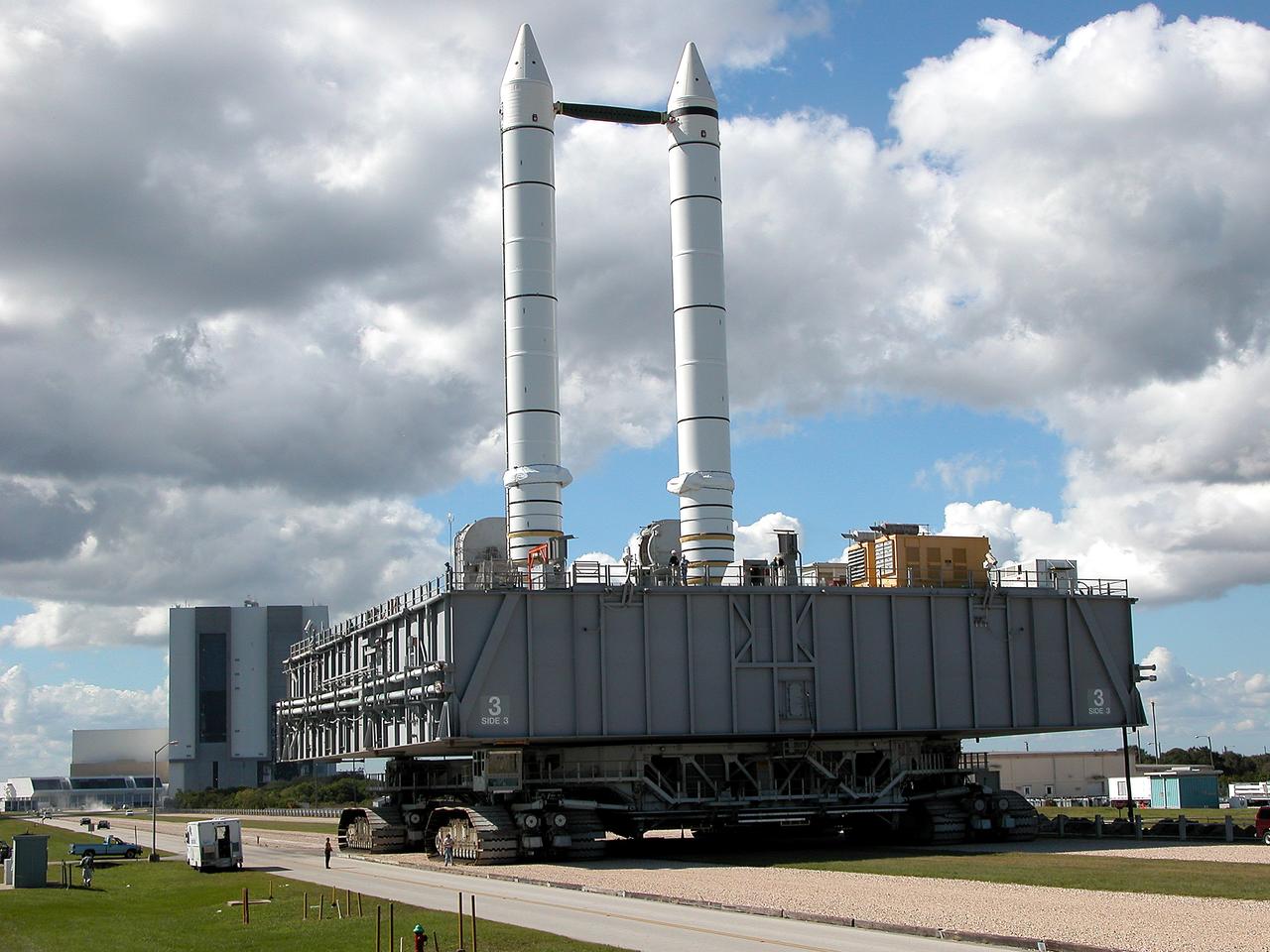
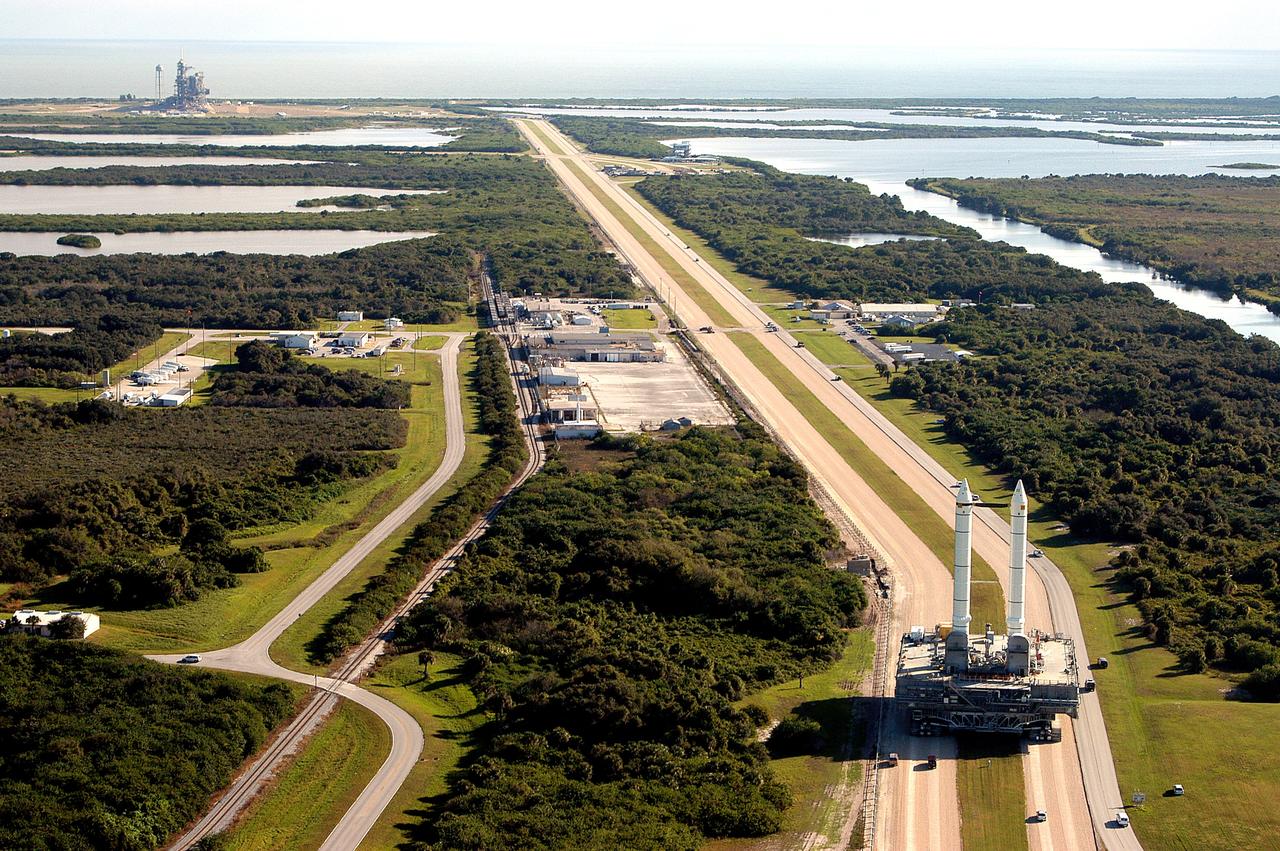
KENNEDY SPACE CENTER, FLA. -  The crawler transporter slowly moves the Mobile Launcher Platform (MLP), carrying a set of twin solid rocket boosters, along the crawlerway in support of engineering analysis vibration tests on the crawler and MLP.   In the distance, at left, is Launch Pad 39A. The crawler is moving at various speeds up to 1 mph in an effort to achieve vibration data gathering goals as it leaves the VAB and then returns.  The boosters are braced at the top for stability.  The primary purpose of these rollout tests is to gather data to develop future maintenance requirements on the transport equipment and the flight hardware. Various parts of the MLP and crawler transporter have been instrumented with vibration data collection equipment.
KENNEDY SPACE CENTER, FLA. - The crawler transporter slowly moves the Mobile Launcher Platform (MLP), carrying a set of twin solid rocket boosters, along the crawlerway in support of engineering analysis vibration tests on the crawler and MLP. In the distance, at left, is Launch Pad 39A. The crawler is moving at various speeds up to 1 mph in an effort to achieve vibration data gathering goals as it leaves the VAB and then returns. The boosters are braced at the top for stability. The primary purpose of these rollout tests is to gather data to develop future maintenance requirements on the transport equipment and the flight hardware. Various parts of the MLP and crawler transporter have been instrumented with vibration data collection equipment.
KENNEDY SPACE CENTER, FLA. -  Mobile Launcher Platform (MLP) number 3 and a set of twin solid rocket boosters, atop the crawler-transporter, inch along the crawlerway in support of the second engineering analysis vibration test on the crawler and MLP. The crawler is moving at various speeds up to 1 mph in an effort to achieve vibration data gathering goals as it leaves the VAB, travels toward Launch Pad 39A (on the horizon) and then returns.  The boosters are braced at the top for stability.  The primary purpose of these rollout tests is to gather data to develop future maintenance requirements on the transport equipment and the flight hardware. Various parts of the MLP and crawler transporter have been instrumented with vibration data collection equipment.
KENNEDY SPACE CENTER, FLA. - Mobile Launcher Platform (MLP) number 3 and a set of twin solid rocket boosters, atop the crawler-transporter, inch along the crawlerway in support of the second engineering analysis vibration test on the crawler and MLP. The crawler is moving at various speeds up to 1 mph in an effort to achieve vibration data gathering goals as it leaves the VAB, travels toward Launch Pad 39A (on the horizon) and then returns. The boosters are braced at the top for stability. The primary purpose of these rollout tests is to gather data to develop future maintenance requirements on the transport equipment and the flight hardware. Various parts of the MLP and crawler transporter have been instrumented with vibration data collection equipment.
This aerial photo shows the areas recently opened as part of KSC’s Safe Haven project. The curved road in the center is the newly restored crawlerway leading around the Vehicle Assembly Building (VAB) and Orbiter Processing Facility 3 (OPF-3) into the VAB high bay 2 (open on the lower right), where a mobile launcher platform/crawler-transporter currently sits. The Safe Haven project will enable the storage of orbiters during severe weather. OPF1 and OPF-2 are at the lower right. The crawlerway also extends from the east side of the VAB out to the two launch pads. Launch Pad 39A is visible to the left of the crawlerway. In the distance is the Atlantic Ocean. To the right of the VAB is the turn basin, into which ships tow the barge for offloading new external tanks from Louisiana
KSC00pp0728
This aerial photo shows the areas recently opened as part of KSC’s Safe Haven project. The curved road in the center is the newly restored crawlerway leading around the Vehicle Assembly Building (VAB) and Orbiter Processing Facility 3 (OPF-3) into the VAB high bay 2 (open on the lower right), where a mobile launcher platform/crawler-transporter currently sits. The Safe Haven project will enable the storage of orbiters during severe weather. OPF1 and OPF-2 are at the lower right. The crawlerway also extends from the east side of the VAB out to the two launch pads. Launch Pad 39A is visible to the left of the crawlerway. In the distance is the Atlantic Ocean. To the right of the VAB is the turn basin, into which ships tow the barge for offloading new external tanks from Louisiana
KSC-00pp0728
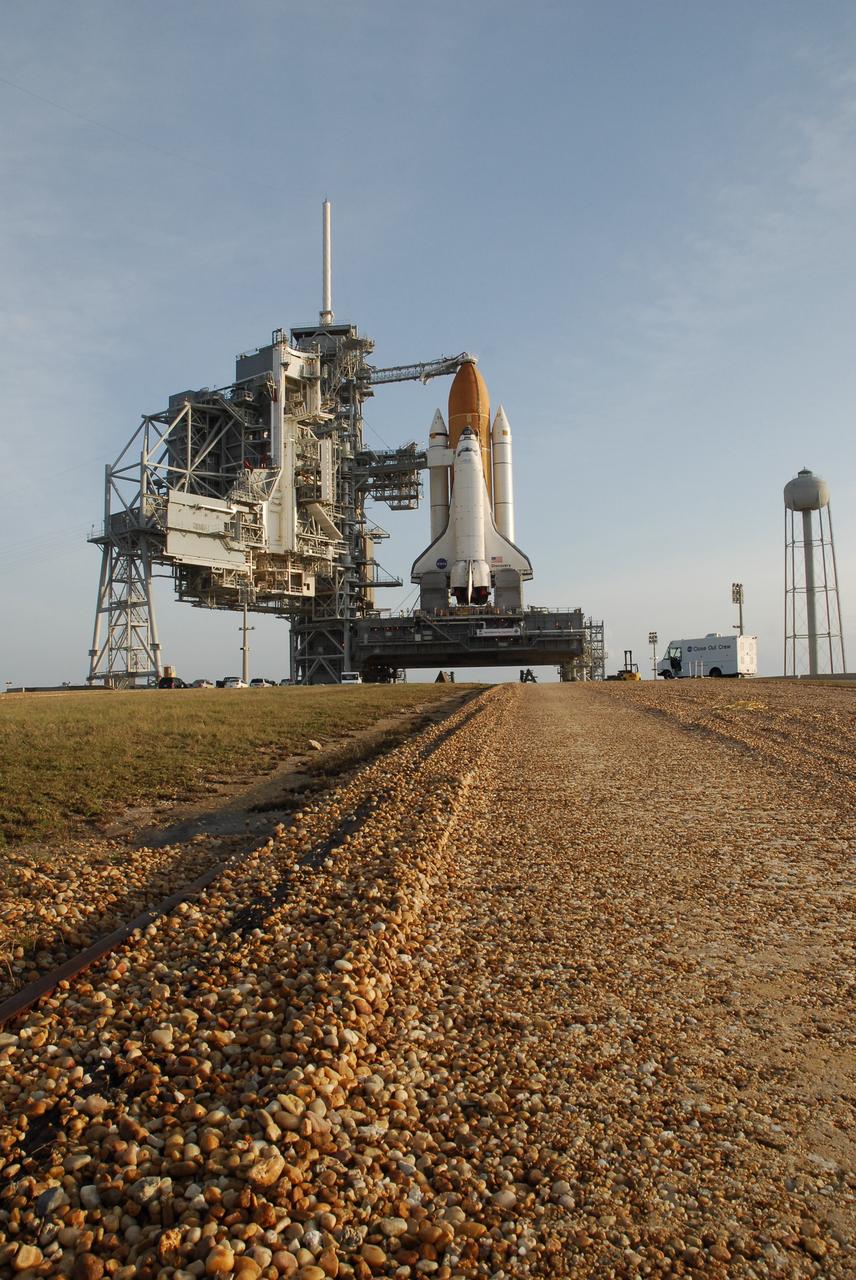
KENNEDY SPACE CENTER, Fla. --  The early morning sun falls on Launch Pad 39A and Space Shuttle Discovery, which is waiting for launch on mission STS-92 Oct. 5, 2000. Leading to the pad (from the foreground) is the ramp leading from the crawlerway, the specially built road that provides the Shuttles access to the pads from the Vehicle Assembly Building. At the right of the pad is the 300,000-gallon water tank that is part of the sound suppression system during launches. Beyond is the Atlantic Ocean. At the far left can be seen Launch Pad 39B with its water tank
KSC00pp1298
KENNEDY SPACE CENTER, Fla. --  The early morning sun falls on Launch Pad 39A and Space Shuttle Discovery, which is waiting for launch on mission STS-92 Oct. 5, 2000. Leading to the pad (from the foreground) is the ramp leading from the crawlerway, the specially built road that provides the Shuttles access to the pads from the Vehicle Assembly Building. At the right of the pad is the 300,000-gallon water tank that is part of the sound suppression system during launches. Beyond is the Atlantic Ocean. At the far left can be seen Launch Pad 39B with its water tank
KSC-00pp1298
KENNEDY SPACE CENTER, FLA. -  Mobile Launcher Platform (MLP) number 3 and a set of twin solid rocket boosters, atop the crawler-transporter, inch along the crawlerway in support of the second engineering analysis vibration test on the crawler and MLP. The crawler is moving at various speeds up to 1 mph in an effort to achieve vibration data gathering goals as it leaves the VAB, travels toward Launch Pad 39A (on the horizon at right; Pad 39B is at far left), and then returns.  The boosters are braced at the top for stability.  The primary purpose of these rollout tests is to gather data to develop future maintenance requirements on the transport equipment and the flight hardware. Various parts of the MLP and crawler transporter have been instrumented with vibration data collection equipment.
KENNEDY SPACE CENTER, FLA. - Mobile Launcher Platform (MLP) number 3 and a set of twin solid rocket boosters, atop the crawler-transporter, inch along the crawlerway in support of the second engineering analysis vibration test on the crawler and MLP. The crawler is moving at various speeds up to 1 mph in an effort to achieve vibration data gathering goals as it leaves the VAB, travels toward Launch Pad 39A (on the horizon at right; Pad 39B is at far left), and then returns. The boosters are braced at the top for stability. The primary purpose of these rollout tests is to gather data to develop future maintenance requirements on the transport equipment and the flight hardware. Various parts of the MLP and crawler transporter have been instrumented with vibration data collection equipment.
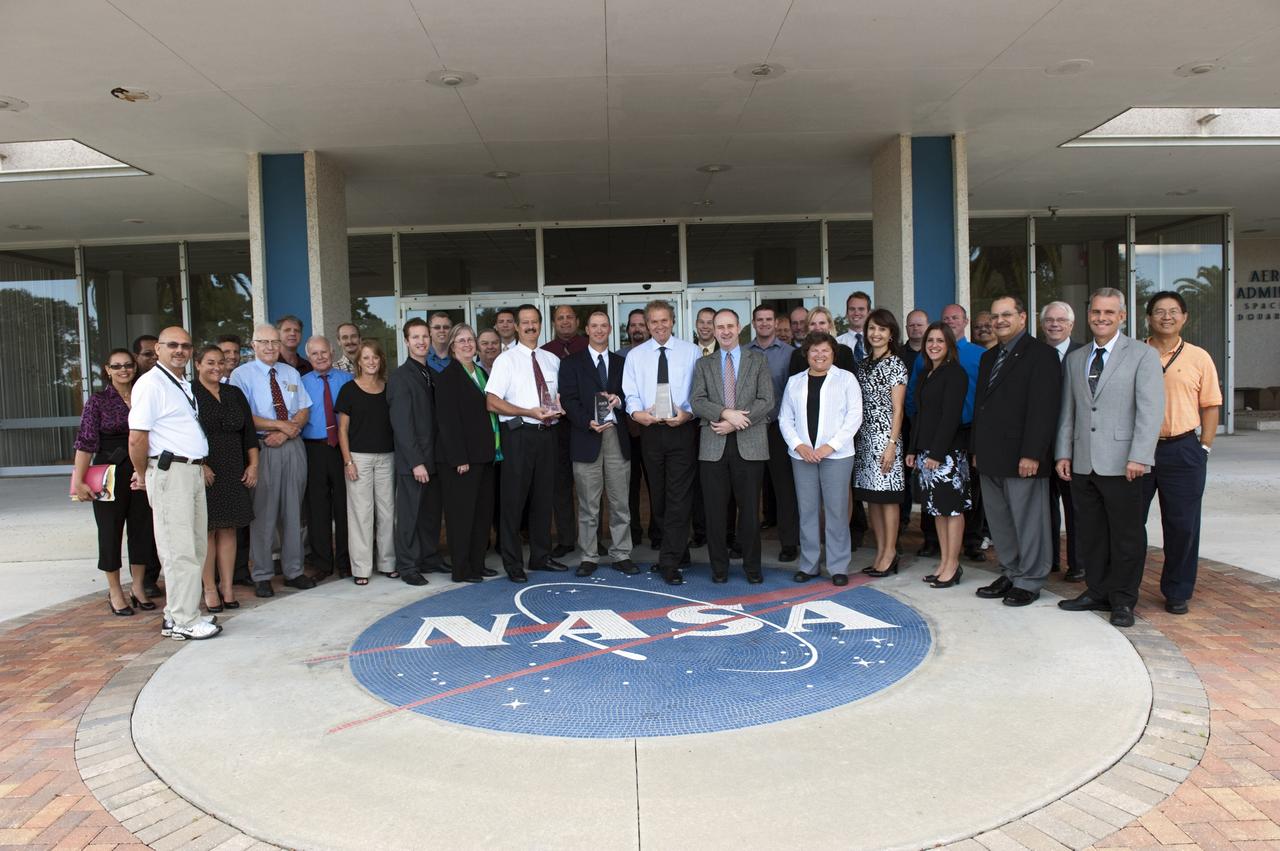
CAPE CANAVERAL, Fla. -- Members of the crawlerway system evaluation team pose for a group portrait in front of the Headquarters Building at NASA's Kennedy Space Center in Florida.  The team received the Florida Project of the Year award from the American Society of Civil Engineers (ASCE).    The Cape Canaveral branch of the ASCE nominated the team for its project, the Crawlerway Evaluation to Support a Heavy-Lift Program. The crawlerway is a 130-foot-wide, specialty-built roadway between Kennedy's Vehicle Assembly Building (VAB), where rockets and spacecraft are prepared for flight, and Launch Pad 39A and 39B. The team's more than two-year evaluation confirmed the crawlerway system would be able to support the weight of moving the agency's future heavy-lift rockets and potential commercial vehicles from the VAB to the launch pads. The award honors the team's outstanding engineering efforts in research, design, construction and management, recognizing the complexity of multi-agency coordination and cost-effective engineering advances. For more information on the American Society of Civil Engineers, visit:  http://www.asce.org. Photo credit: NASA/Kim Shiflett
KSC-2011-7246
CAPE CANAVERAL, Fla. -- NASA managers at NASA's Kennedy Space Center in Florida show off the Florida Project of the Year trophies that the crawlerway system evaluation team received from the American Society of Civil Engineers (ASCE).  From left are Michael Benik, director of Center Operations; Pepper Phillips, manager of the 21st Century Ground Systems Program Office; and Russell Romanella, associate director for Engineering and Technical Operations.    The Cape Canaveral branch of the ASCE nominated the team for its project, the Crawlerway Evaluation to Support a Heavy-Lift Program. The crawlerway is a 130-foot-wide, specialty-built roadway between Kennedy's Vehicle Assembly Building (VAB), where rockets and spacecraft are prepared for flight, and Launch Pad 39A and 39B. The team's more than two-year evaluation confirmed the crawlerway system would be able to support the weight of moving the agency's future heavy-lift rockets and potential commercial vehicles from the VAB to the launch pads. The award honors the team's outstanding engineering efforts in research, design, construction and management, recognizing the complexity of multi-agency coordination and cost-effective engineering advances. For more information on the American Society of Civil Engineers, visit:  http://www.asce.org. Photo credit: NASA/Kim Shiflett
KSC-2011-7245
CAPE CANAVERAL, Fla. -- The 525-foot high Vehicle Assembly Building dominates the Launch Complex 39 Area.  On the right is the Launch Control Center.  Behind the VAB meanders the Banana Creek.  The two-lane crawlerway stretches from the VAB toward the coast, site of Launch Pad 39A and 39B, seen here.  The Turn Basin is at right, ending at the parking area for the NASA KSC News Center.  At center foreground is the construction area for Operations Support Building 2.          Photo credit: NASA
KSC-04pd0662
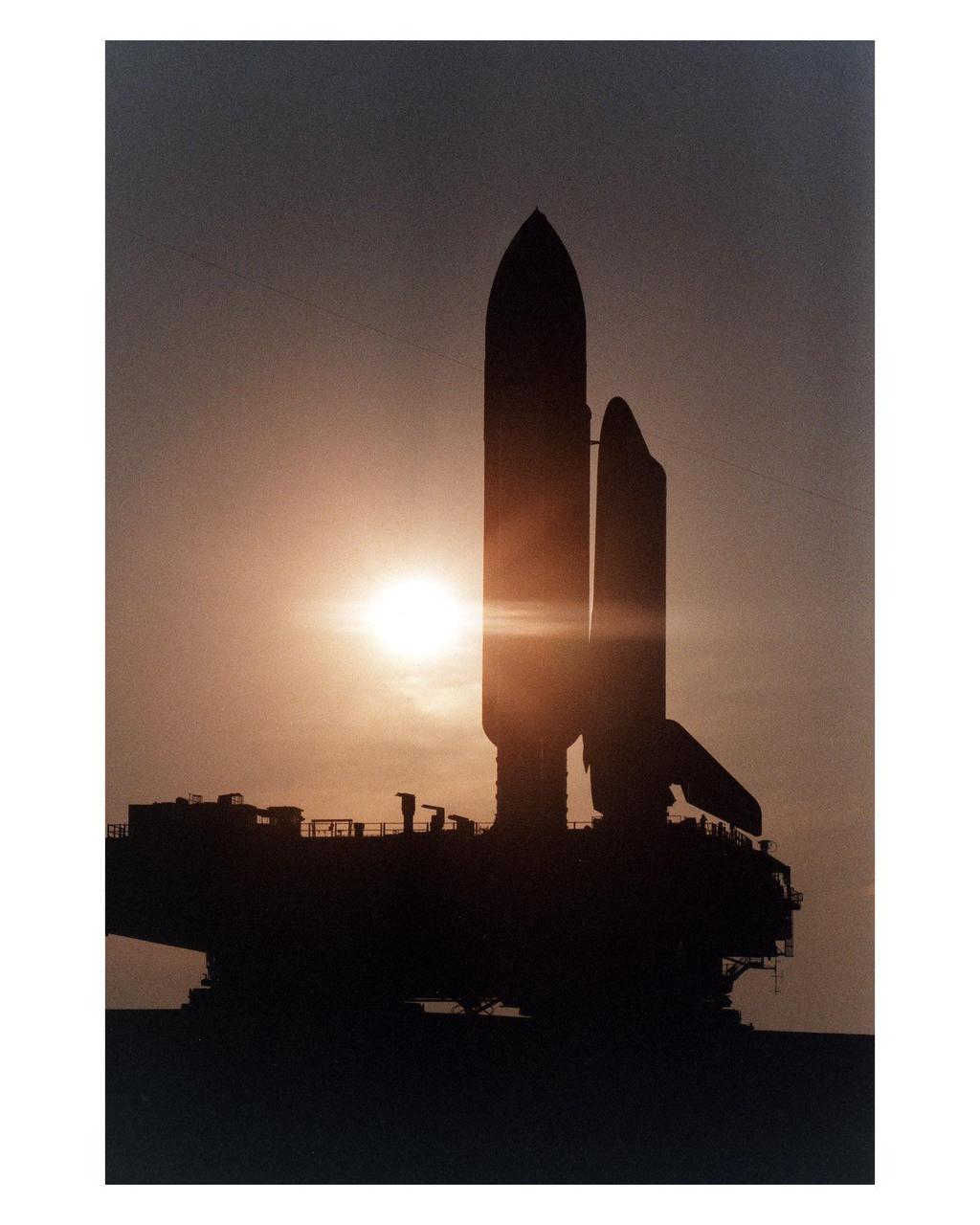
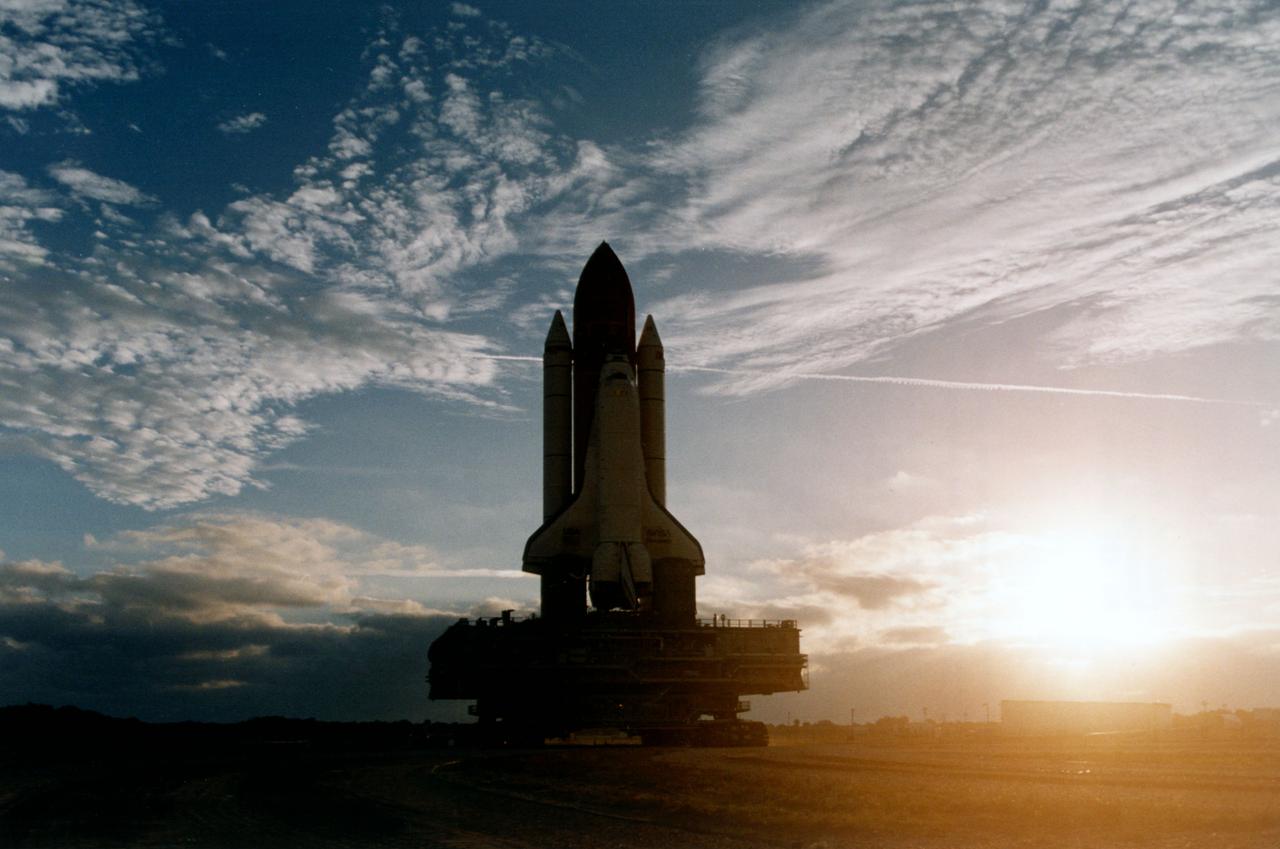
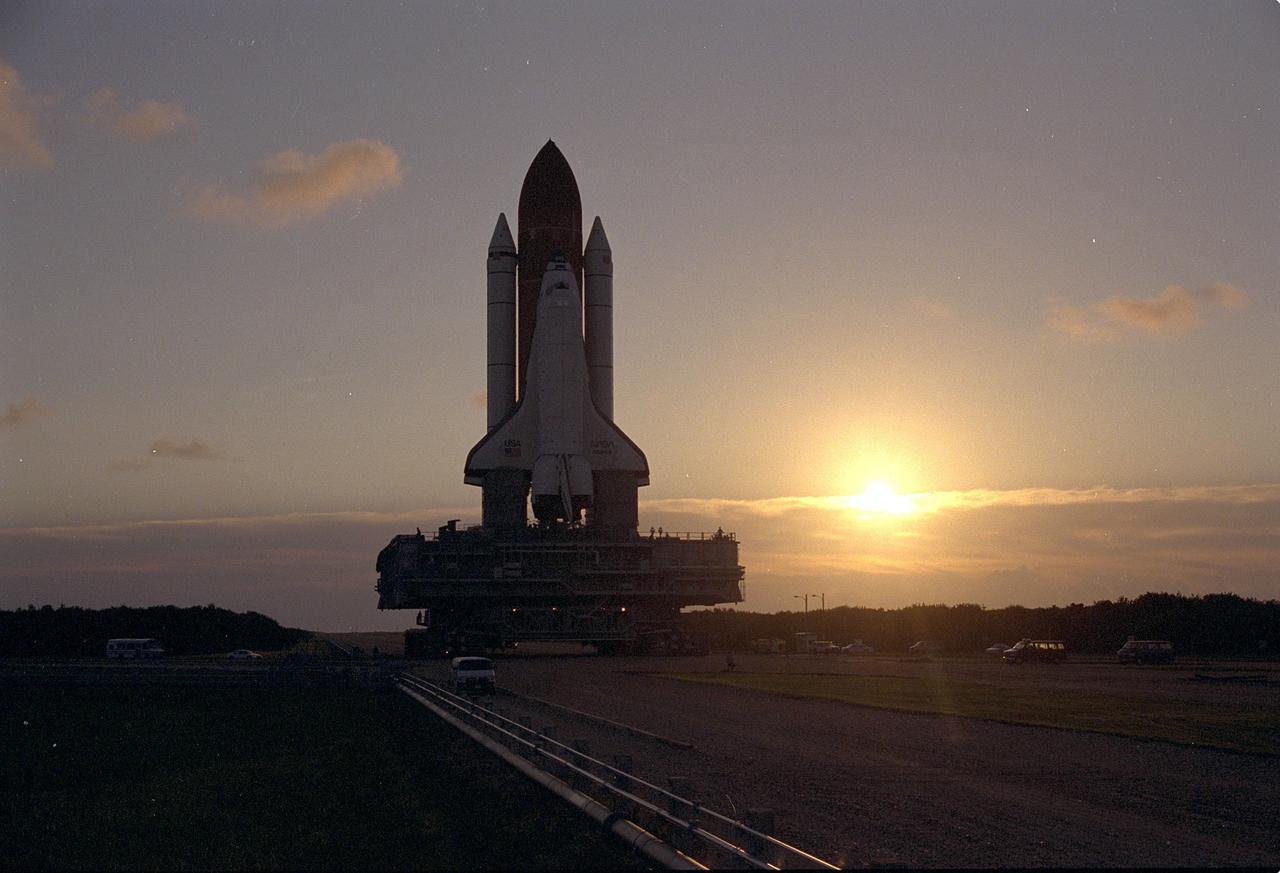
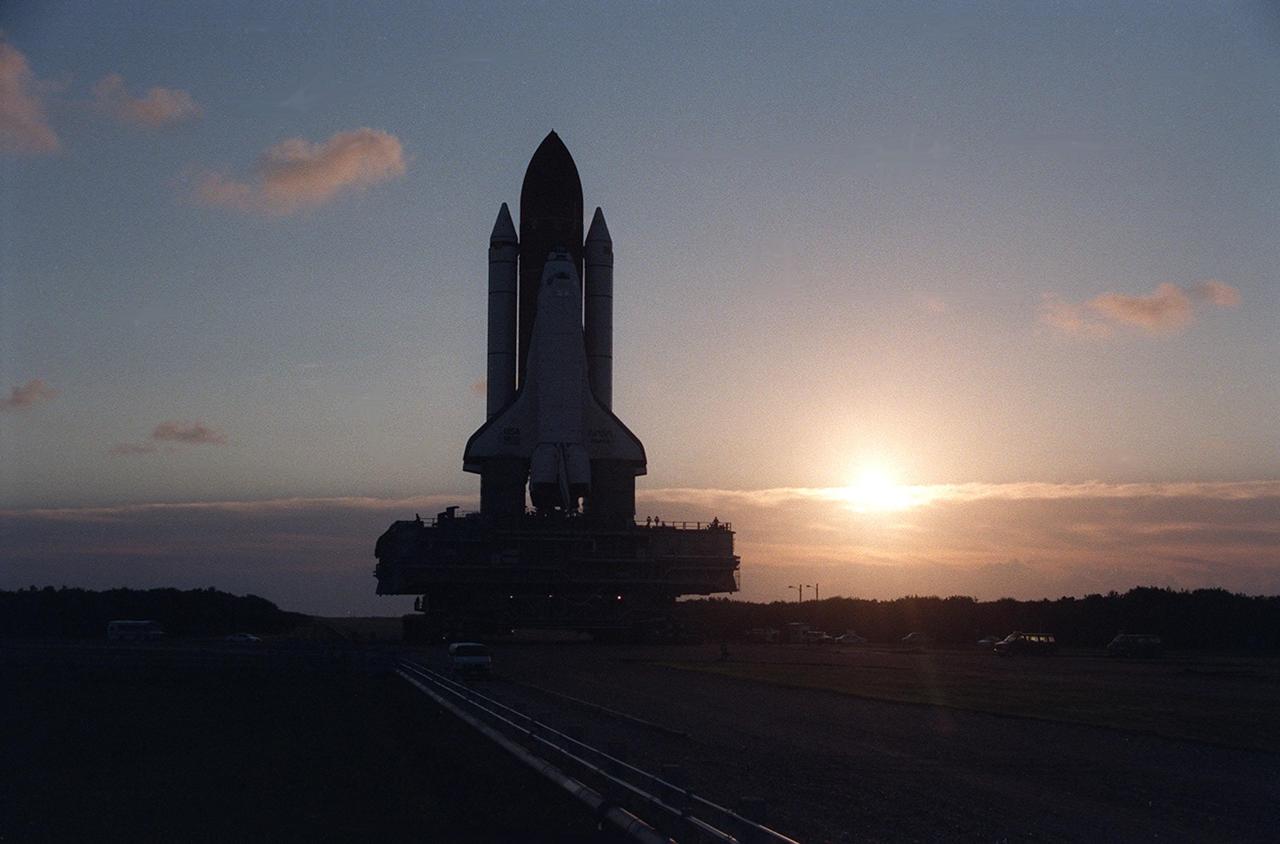
KENNEDY SPACE CENTER, Fla. --  Cast in silhouette by the rising sun, the Space Shuttle Atlantis slowly and carefully makes the journey along the Crawlerway between the Vehicle Assembly Building and Launch Pad 39A. Atlantis and its crew of seven are targeted for a May 15 launch. STS-84 will be the sixth Shuttle docking with the Russian Space Station Mir as part of Phase 1 of the International Space Station program
KSC-97pc710
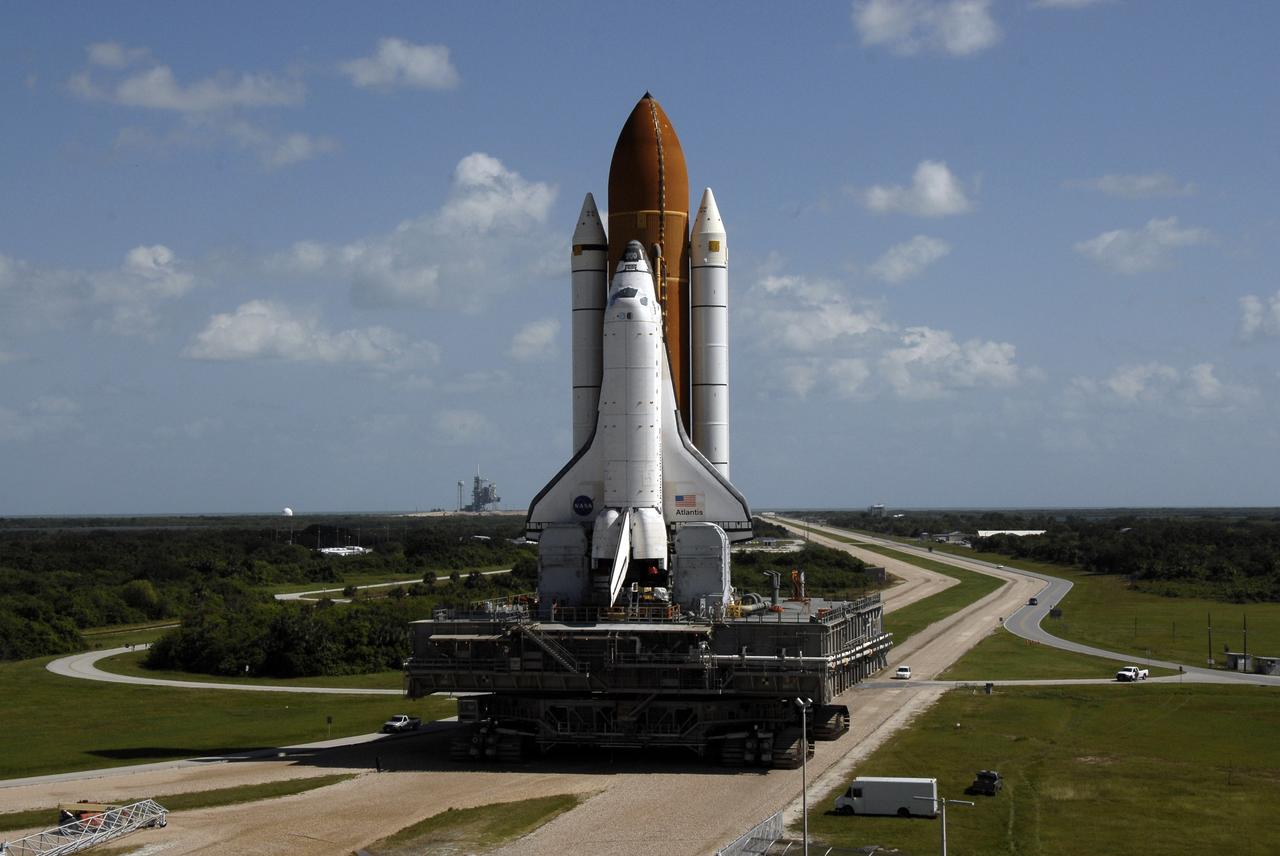
KENNEDY SPACE CENTER, FLA. --   As Space Shuttle Atlantis, atop the mobile launcher platform and crawler-transporter, slowly makes its way to Launch Pad 39A, it passes the payload canister (foreground) that delivered the payload to the pad.  First motion of the shuttle out of the Vehicle Assembly Building was at 8:19 a.m.  The 3.4-mile trip to the pad along the crawlerway takes about 6 hours.  The mission payload aboard Space Shuttle Atlantis is the S3/S4 integrated truss structure, along with a third set of solar arrays and batteries. The crew of six astronauts will install the truss to continue assembly of the International Space Station.  Launch is targeted for March 15.  Photo credit: NASA/Kim Shiflett
KSC-07pd0396
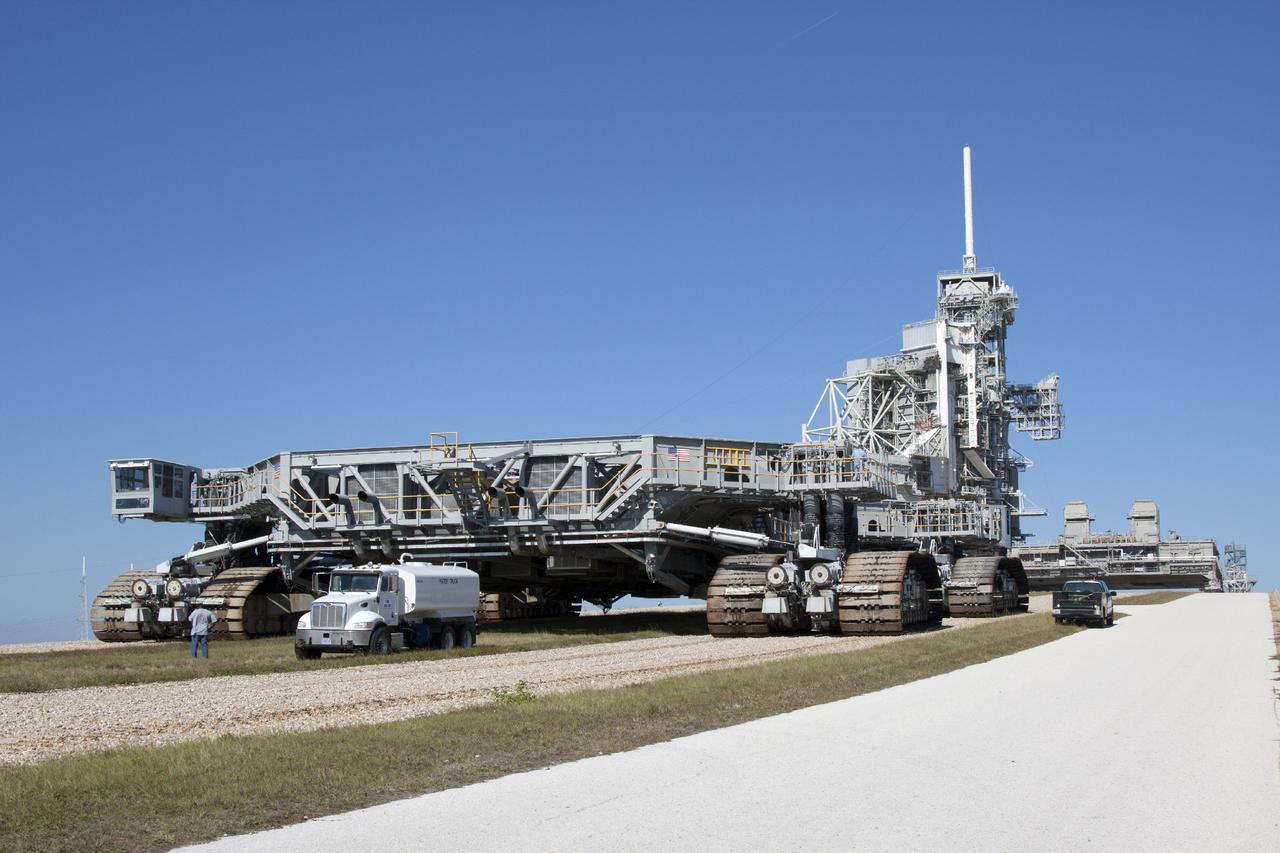
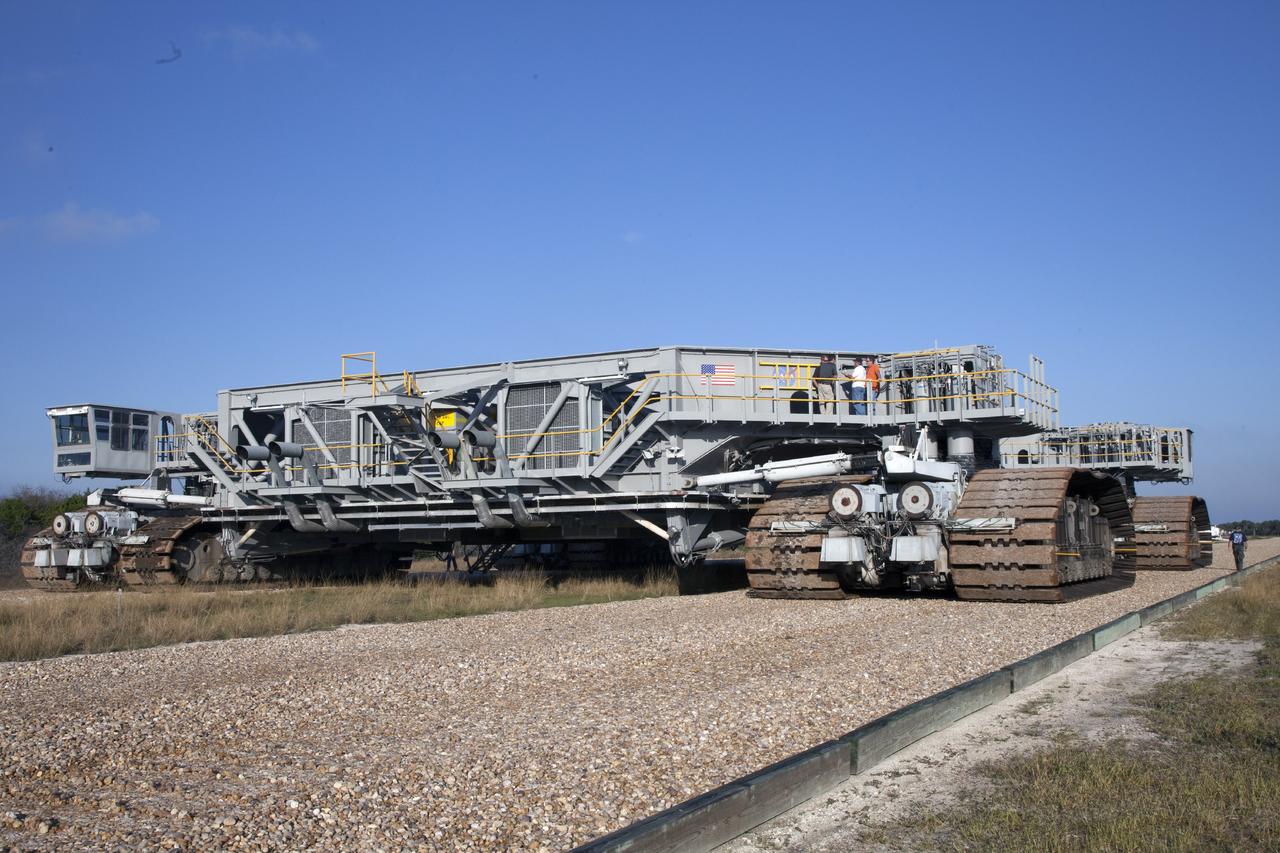
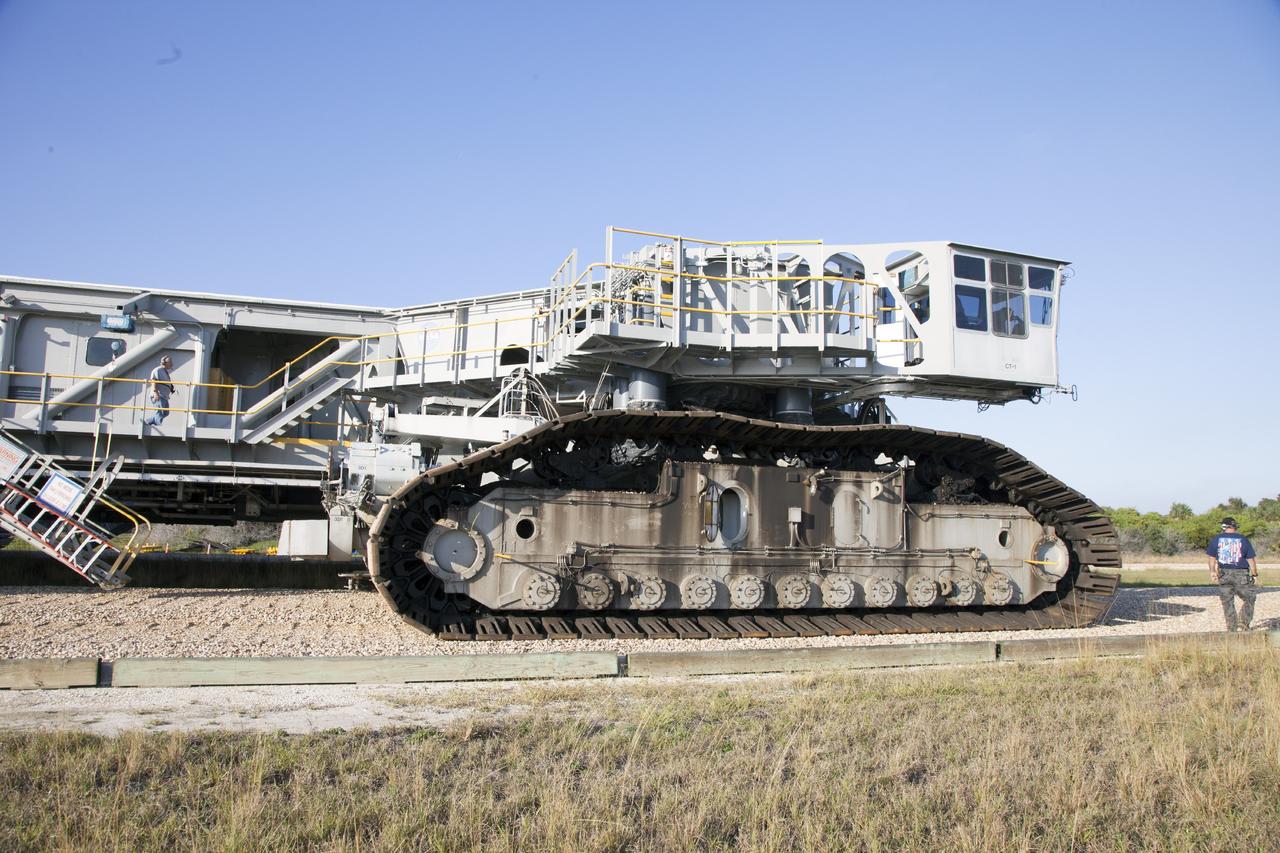
CAPE CANAVERAL, Fla. -- Crawler-transporter 1 continues its trek on the crawlerway to Launch Pad 39A at NASA’s Kennedy Space Center in Florida. New jacking, equalizing and leveling, or JEL, hydraulic cylinders were installed on CT-1 and will be tested for increased load carrying capacity and reliability.    The Ground Systems Development and Operations Program at Kennedy continues to upgrade the crawler-transporter as part of its general maintenance. CT-1 could be available to carry a variety of launch vehicles to the launch pad. Two crawler-transporters were used to carry the mobile launcher platform and space shuttle to Launch Complex 39 for space shuttle launches for 30 years. Photo credit: NASA/Jim Grossmann
KSC-2013-4210
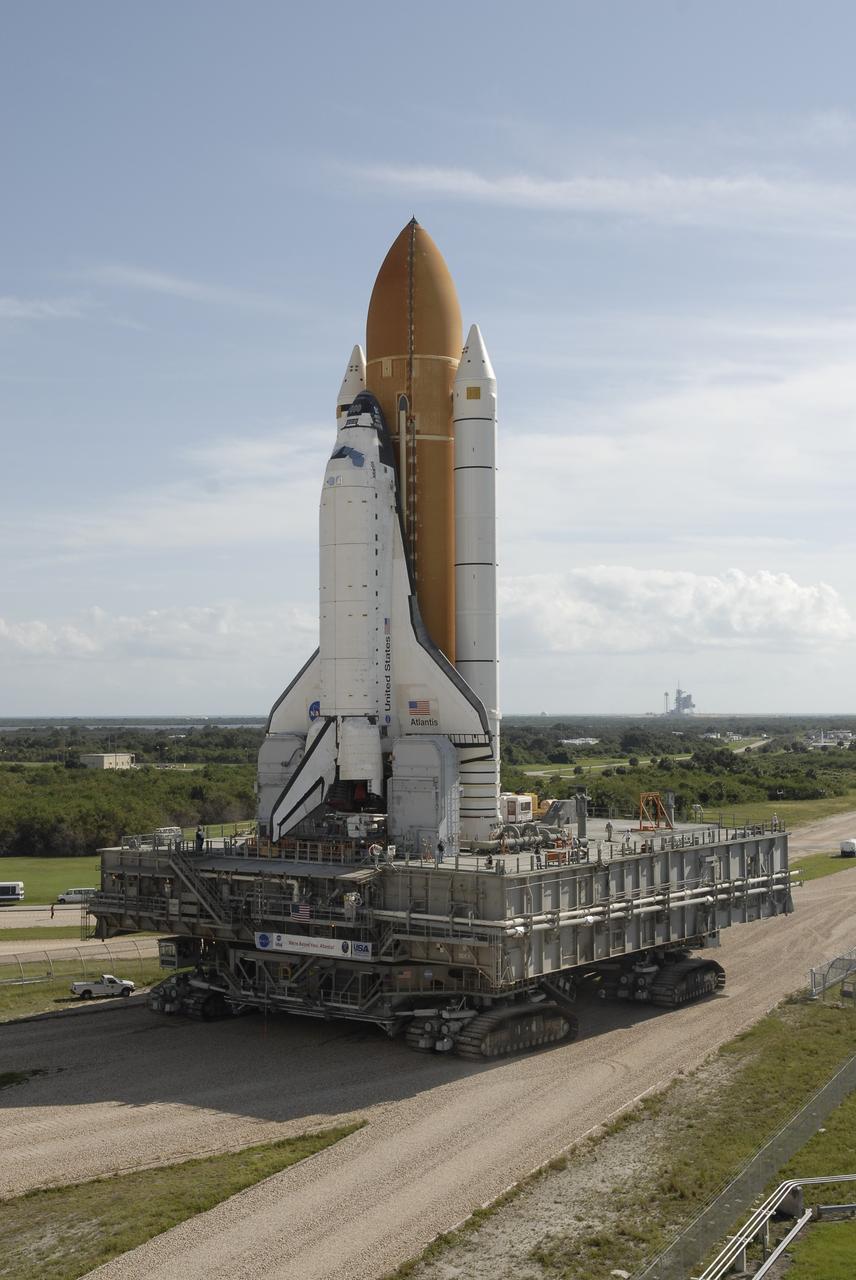
CAPE CANAVERAL, Fla. - Space shuttle Atlantis rolls via the crawlerway to the Vehicle Assembly Building at NASA's Kennedy Space Center in Florida after rolling back from Launch Pad 39A. In the VAB, Atlantis will await launch on its STS-125 mission to repair NASA's Hubble Space Telescope.  First motion of Atlantis off the pad was at 6:48 a.m. EDT. The journey was expected to take about six hours. Atlantis' targeted launch on Oct. 14 was delayed when a system that transfers science data from the orbiting observatory to Earth malfunctioned on Sept. 27. The new target launch date is under review.  Photo credit: NASA/Kim Shiflett
KSC-08pd3274
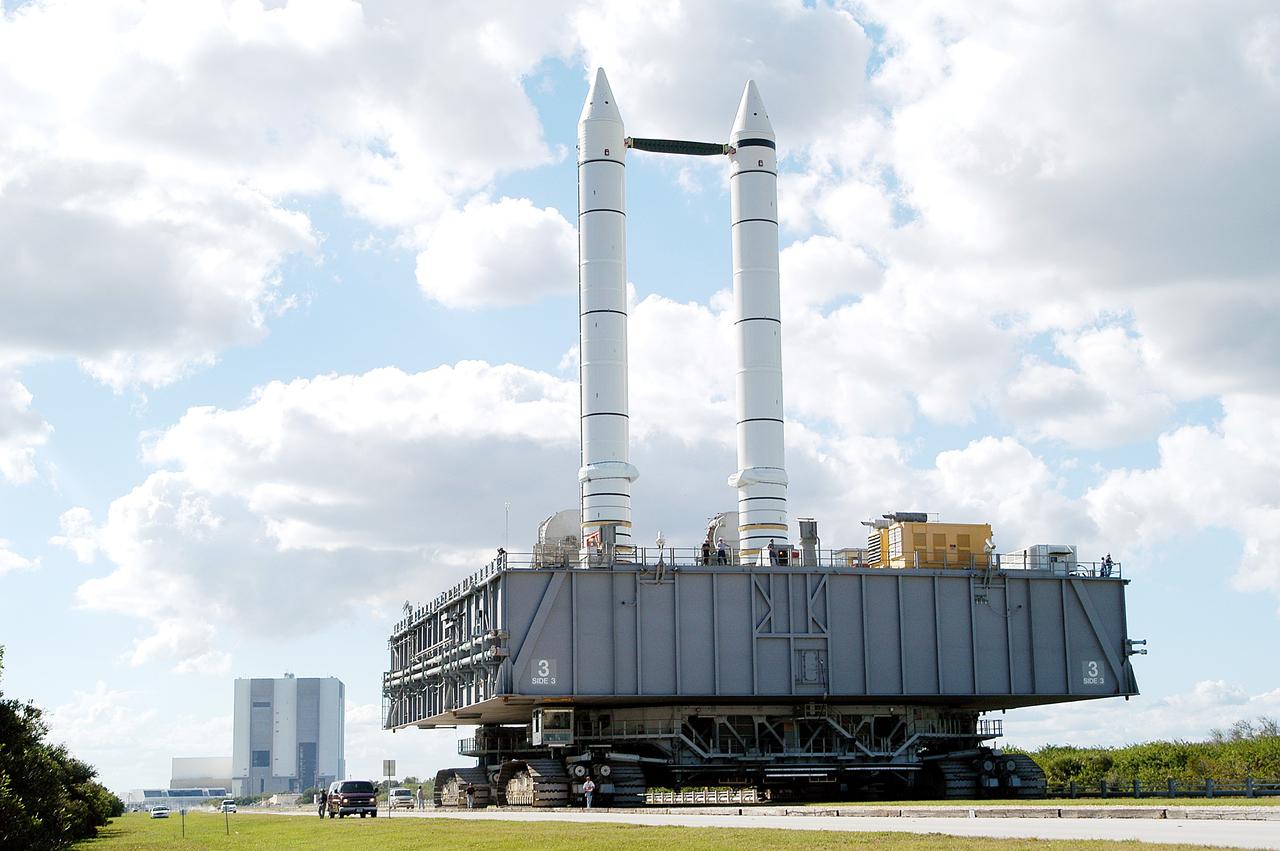
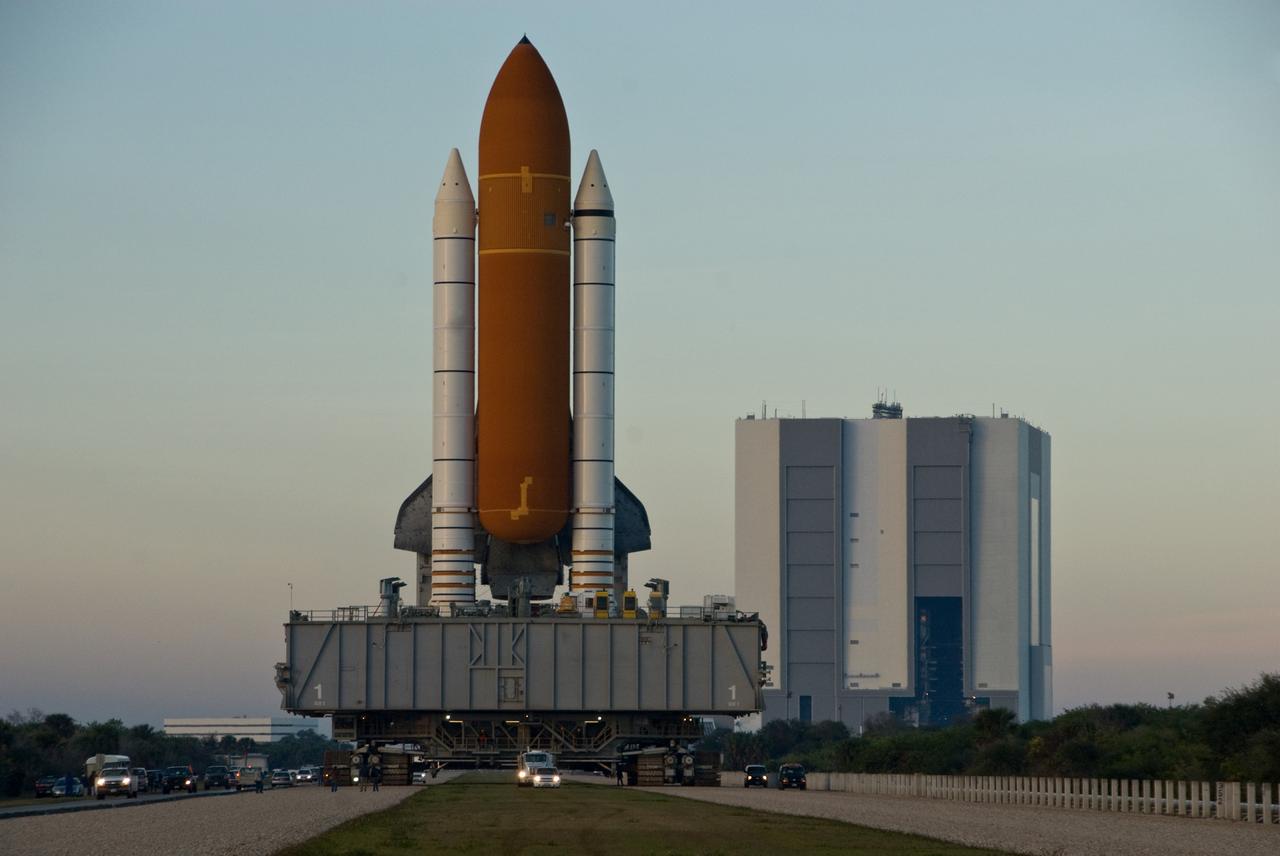
KENNEDY SPACE CENTER, FLA. - A crawler-transporter carrying Mobile Launcher Platform (MLP) number 3, with a set of twin solid rocket boosters bolted atop, crawls to the intersection in the crawlerway in support of the second engineering analysis vibration test on the crawler and MLP.  From this perspective, the Launch Control Center (left) and the 525-foot-tall Vehicle Assembly Building (right) in the background appear dwarfed by the 184-foot-tall boosters. The crawler is moving at various speeds up to 1 mph in an effort to achieve vibration data gathering goals as it leaves the VAB, travels toward Launch Pad 39A and then returns. The boosters are braced at the top for stability. The primary purpose of these rollout tests is to gather data to develop future maintenance requirements on the transport equipment and the flight hardware. Various parts of the MLP and crawler transporter have been instrumented with vibration data collection equipment.
KENNEDY SPACE CENTER, FLA. - A crawler-transporter carrying Mobile Launcher Platform (MLP) number 3, with a set of twin solid rocket boosters bolted atop, crawls to the intersection in the crawlerway in support of the second engineering analysis vibration test on the crawler and MLP. From this perspective, the Launch Control Center (left) and the 525-foot-tall Vehicle Assembly Building (right) in the background appear dwarfed by the 184-foot-tall boosters. The crawler is moving at various speeds up to 1 mph in an effort to achieve vibration data gathering goals as it leaves the VAB, travels toward Launch Pad 39A and then returns. The boosters are braced at the top for stability. The primary purpose of these rollout tests is to gather data to develop future maintenance requirements on the transport equipment and the flight hardware. Various parts of the MLP and crawler transporter have been instrumented with vibration data collection equipment.
KENNEDY SPACE CENTER, FLA. - The crawler-transporter carrying Mobile Launcher Platform (MLP) number 3, with a set of twin solid rocket boosters bolted atop, crawls to the intersection in the crawlerway in support of the second engineering analysis vibration test on the crawler and MLP.  From this perspective, the Launch Control Center (left) and the 525-foot-tall Vehicle Assembly Building (right) in the background appear dwarfed by the 184-foot-tall boosters. The crawler is moving at various speeds up to 1 mph in an effort to achieve vibration data gathering goals as it leaves the VAB, travels toward Launch Pad 39A and then returns. The boosters are braced at the top for stability. The primary purpose of these rollout tests is to gather data to develop future maintenance requirements on the transport equipment and the flight hardware. Various parts of the MLP and crawler transporter have been instrumented with vibration data collection equipment.
KENNEDY SPACE CENTER, FLA. - The crawler-transporter carrying Mobile Launcher Platform (MLP) number 3, with a set of twin solid rocket boosters bolted atop, crawls to the intersection in the crawlerway in support of the second engineering analysis vibration test on the crawler and MLP. From this perspective, the Launch Control Center (left) and the 525-foot-tall Vehicle Assembly Building (right) in the background appear dwarfed by the 184-foot-tall boosters. The crawler is moving at various speeds up to 1 mph in an effort to achieve vibration data gathering goals as it leaves the VAB, travels toward Launch Pad 39A and then returns. The boosters are braced at the top for stability. The primary purpose of these rollout tests is to gather data to develop future maintenance requirements on the transport equipment and the flight hardware. Various parts of the MLP and crawler transporter have been instrumented with vibration data collection equipment.
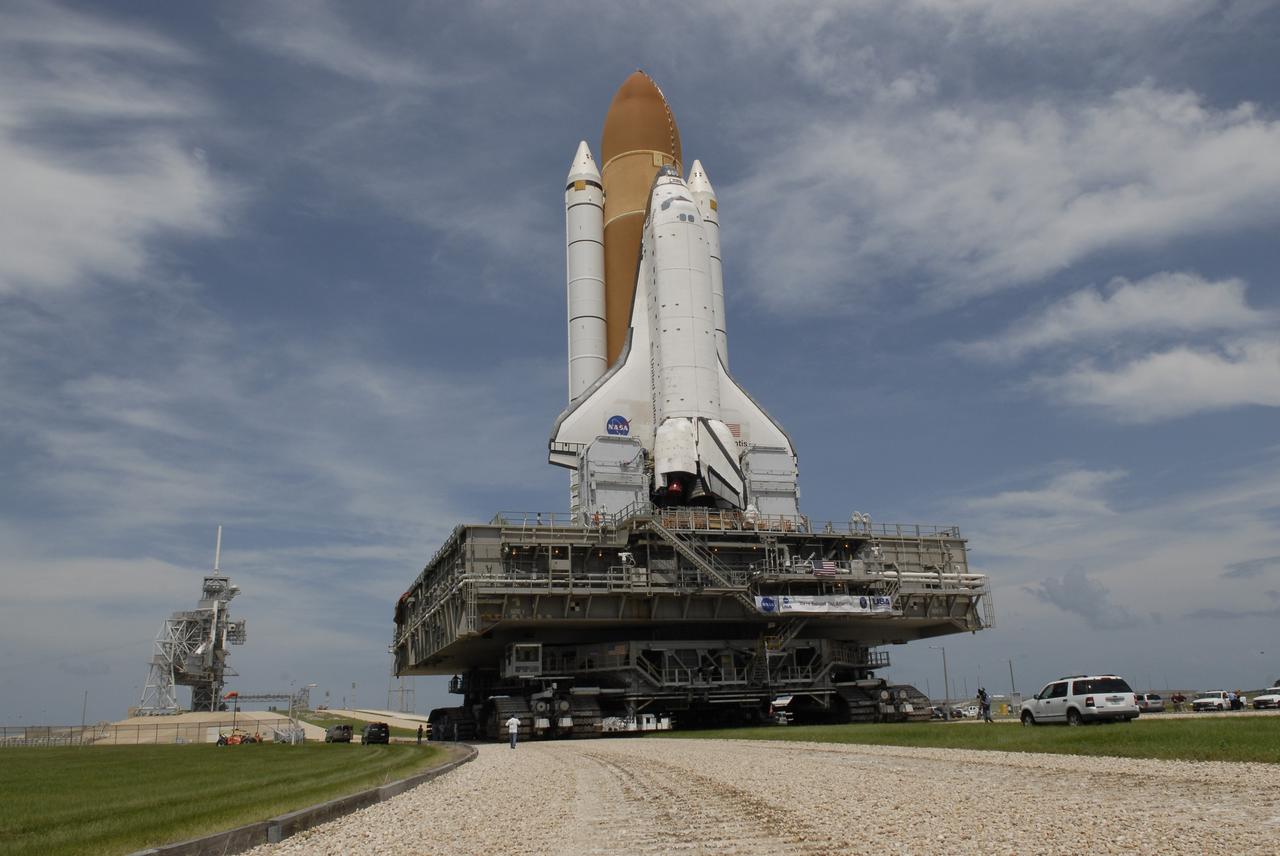
KENNEDY SPACE CENTER, FLA. -- The crawler transporter, moving Space Shuttle Discovery atop its mobile launch platform from the Vehicle Assembly Building, heads in the direction of Launch Pad 39A. The journey has reached the intersection in the crawlerway of the paths to Pad 39A and Pad 39B. First motion out of the VAB was at 6:47 a.m. EDT.  The crawler transporter, mobile launch platform and unfueled space shuttle weigh a total of approximately 17.5 million pounds.  Rollout is a milestone for Discovery's launch to the International Space Station on mission STS-120, targeted for Oct. 23. The crew will be delivering and installing the Italian-built U.S. Node 2, named Harmony. The pressurized module will act as an internal connecting port and passageway to additional international science labs and cargo spacecraft. In addition to increasing the living and working space inside the station, it also will serve as a work platform outside for the station's robotic arm.   Photo credit: NASA/George Shelton
KSC-07pd2627
KENNEDY SPACE CENTER, FLA. -- The crawler transporter, moving Space Shuttle Discovery atop its mobile launch platform from the Vehicle Assembly Building, follows the path to Launch Pad 39A. The journey has reached the intersection in the crawlerway of the roads to Pad 39A and Pad 39B. First motion out of the VAB was at 6:47 a.m. EDT.  The crawler transporter, mobile launch platform and unfueled space shuttle weigh a total of approximately 17.5 million pounds.  Rollout is a milestone for Discovery's launch to the International Space Station on mission STS-120, targeted for Oct. 23. The crew will be delivering and installing the Italian-built U.S. Node 2, named Harmony. The pressurized module will act as an internal connecting port and passageway to additional international science labs and cargo spacecraft. In addition to increasing the living and working space inside the station, it also will serve as a work platform outside for the station's robotic arm.   Photo credit: NASA/George Shelton
KSC-07pd2626
CAPE CANAVERAL, Fla. -- This aerial photo shows the expanse of the Launch Complex 39 Area, bordered at the top by the Atlantic and a cloud-filled sky. At center right, towering above  the surrounding sites, is the Vehicle Assembly Building. To the left is the Orbiter Processing Facility's Bay 3. In the foreground are OPF Bays 1 and 2. The two-lane crawlerway stretches from  the VAB toward the coast, site of Launch Pad 39A, closest, and Launch Pad 39B, far left. Between the VAB and the ocean sprawl the Banana Creek and the Banana River. Photo credit: NASA
KSC-04pd0659
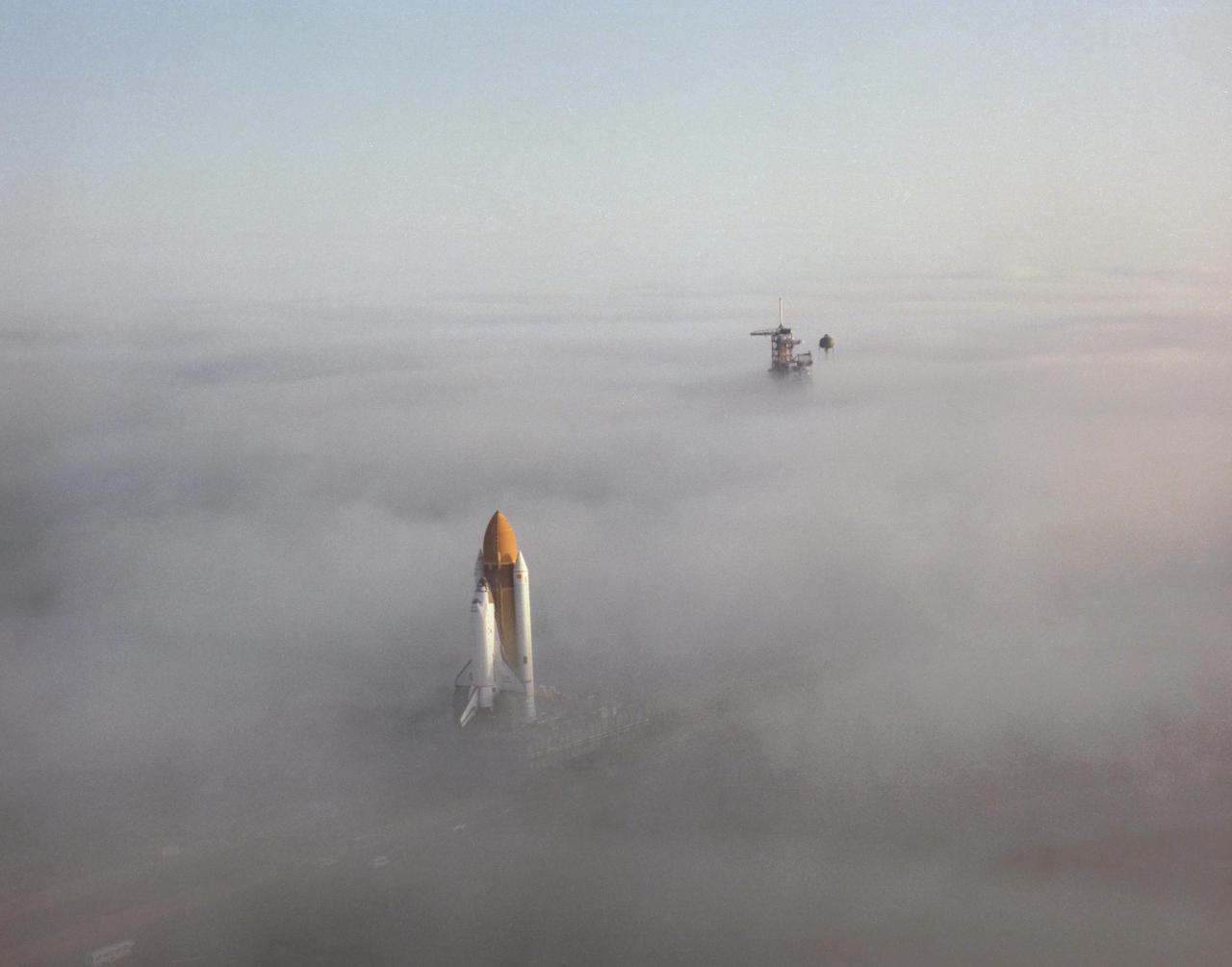
KENNEDY SPACE CENTER, FLA. -  The Space Shuttle Challenger presents a surrealistic impression as it moves through the fog on its way down the 3 ½-mile crawlerway enroute to Launch Pad 39A.  The fully assembled Shuttle, weighing 12,000 pounds less than its predecessor Columbia, completed the trip from the Vehicle Assembly Building in shortly over 6 hours.  The sixth Shuttle flight, which will be the first for the Challenger, is scheduled for no earlier than January 24, 1983.
KSC-82pc-1325
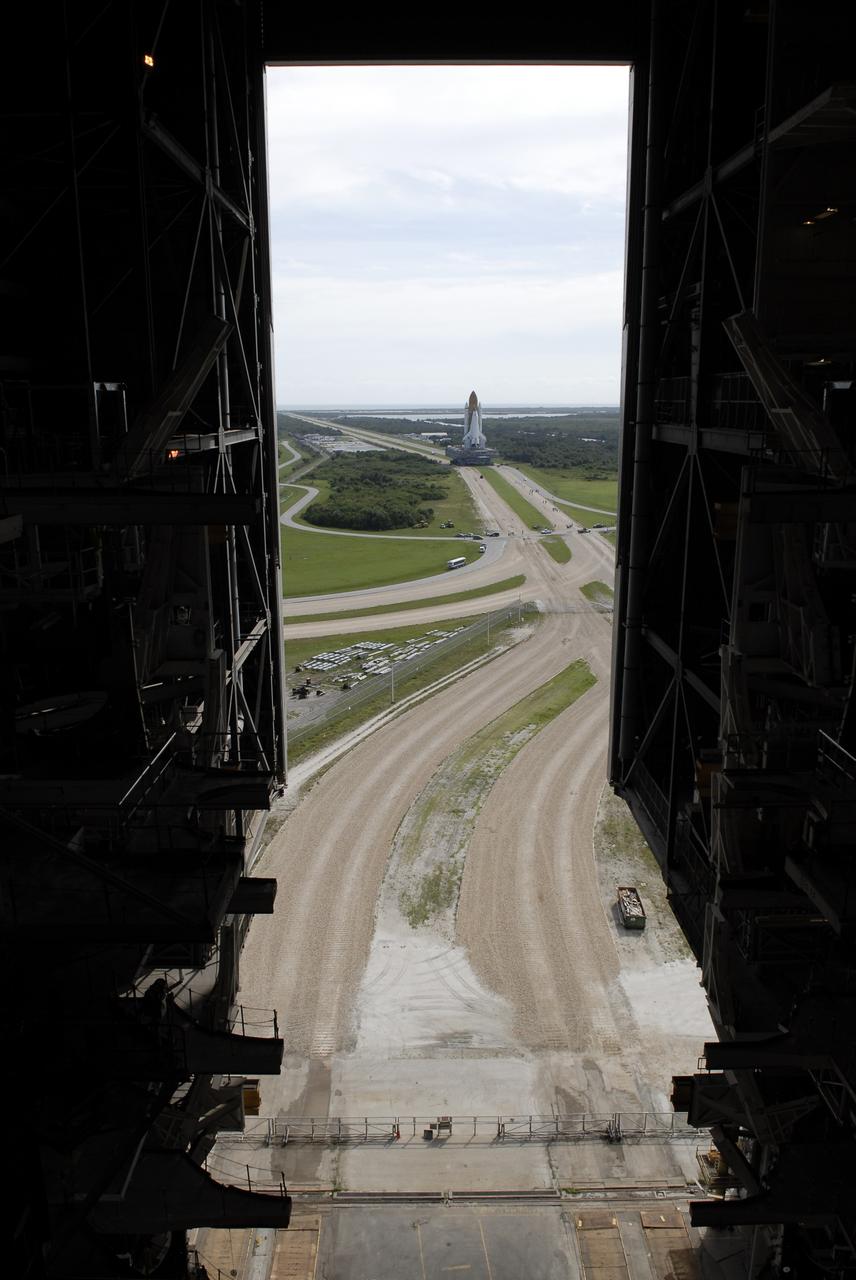
CAPE CANAVERAL, Fla. –   The crawlerway stretches toward the horizon as viewed from inside the Vehicle Assembly Building at NASA’s Kennedy Space Center.  Space shuttle Atlantis nears the bend in the crawlerway to take it to  Launch Pad 39A.  The shuttle stack, with solid rocket boosters and external fuel tank attached to Atlantis, rest on the mobile launcher platform.  Movement is provided by the crawler-transporter underneath.  First motion occurred at 9:19 a.m. EDT. The Sept. 2 rollout date was postponed due to Tropical Storm Hanna’s shift to a northern track. Atlantis is scheduled to launch on the STS-125 mission to service NASA’s Hubble Space Telescope.  Launch is targeted for Oct. 8.  Photo credit: NASA/Kim Shiflett
KSC-08pd2538
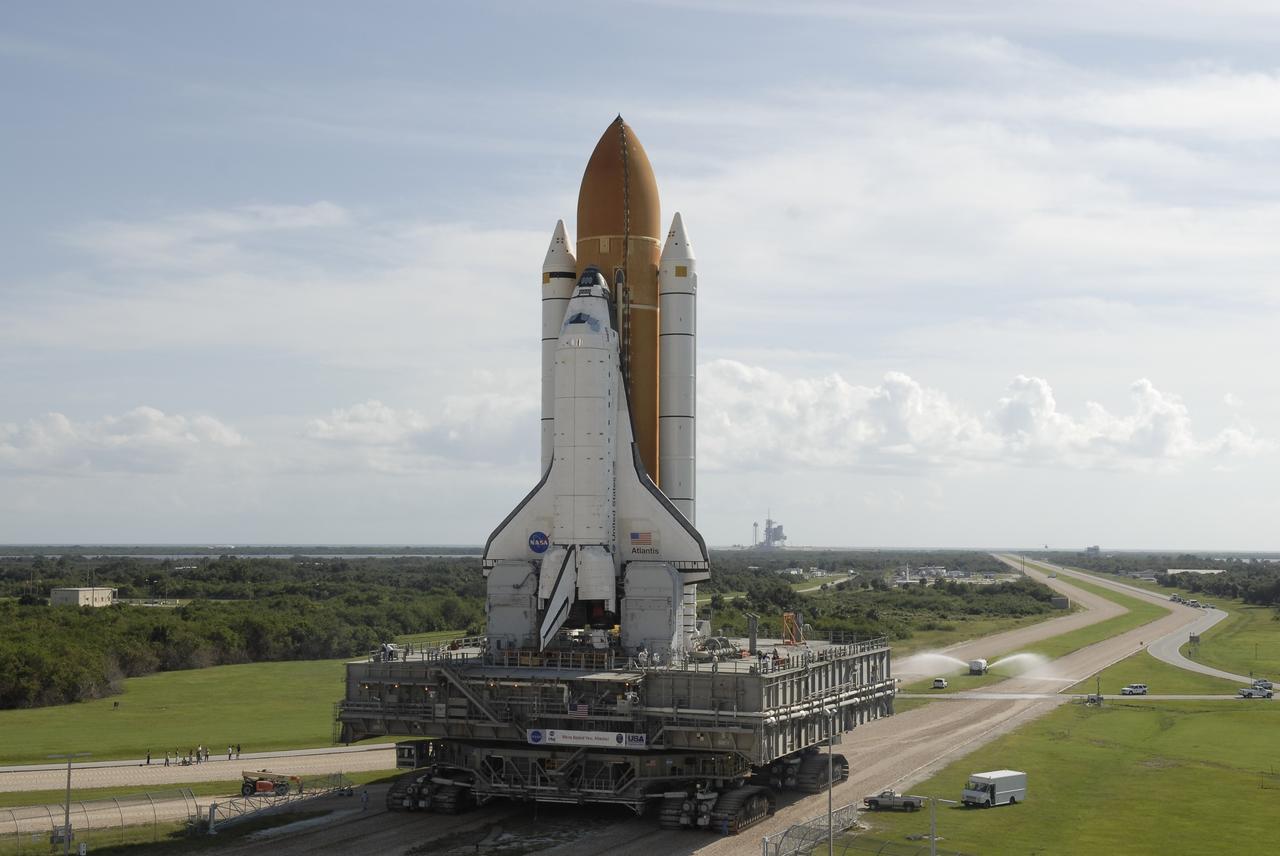
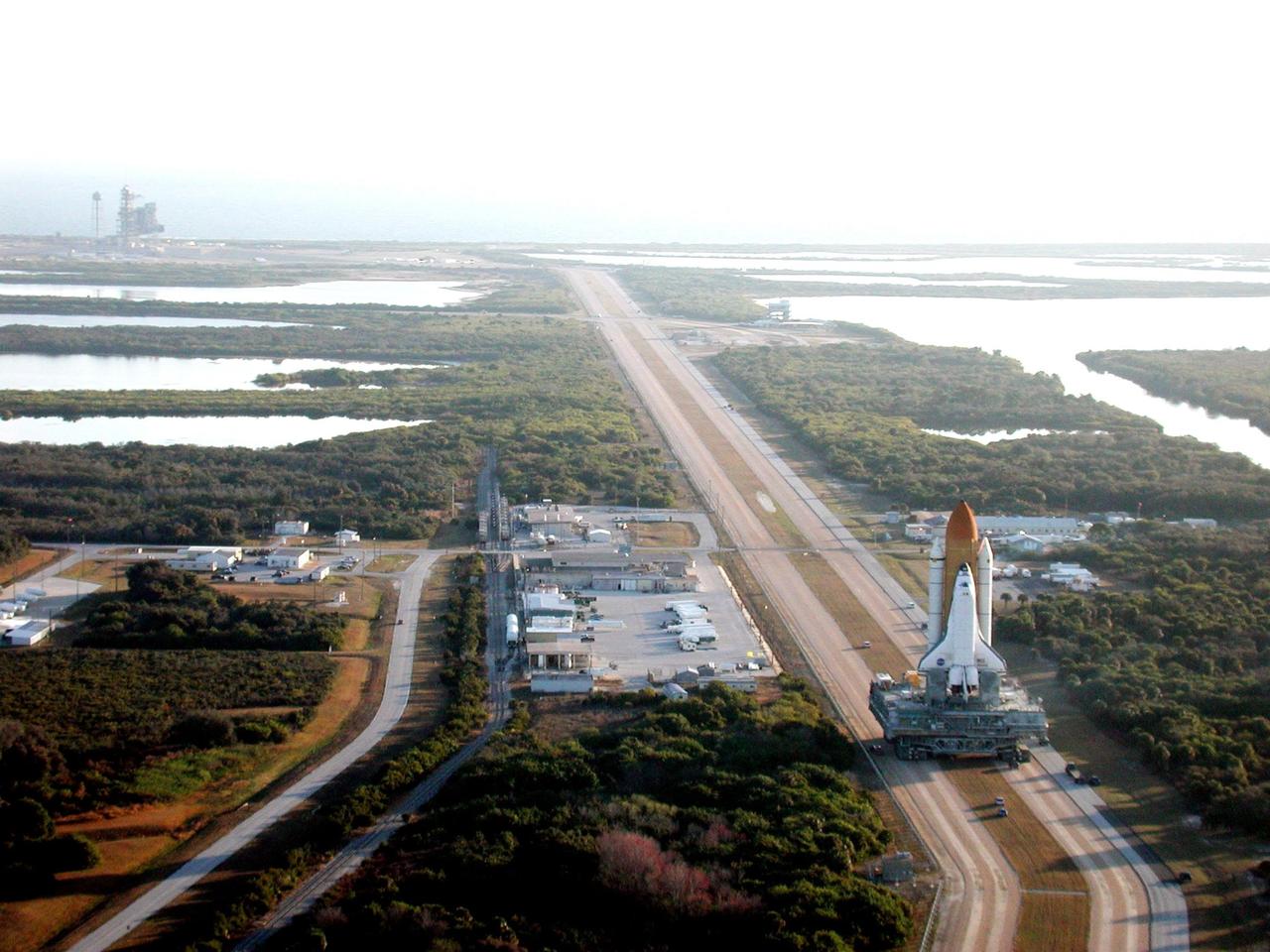
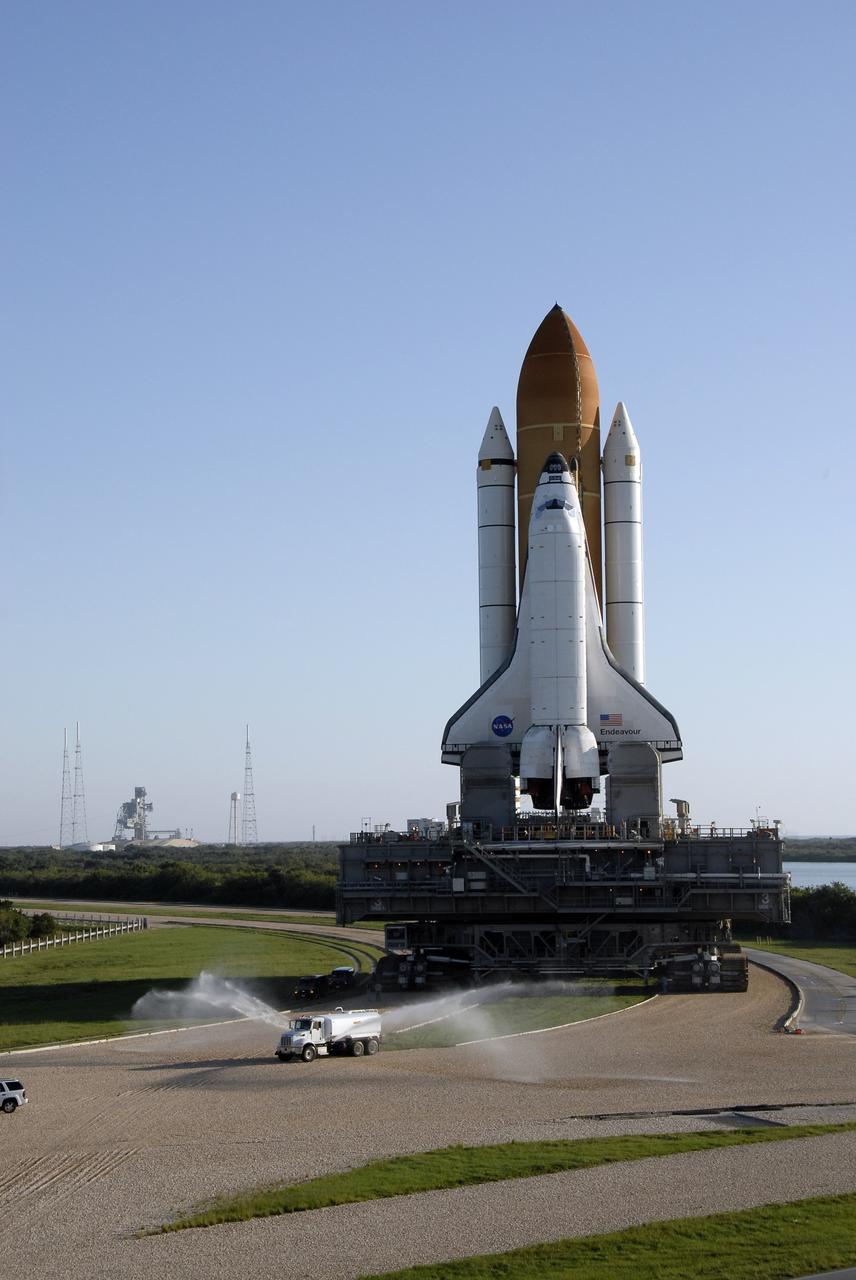
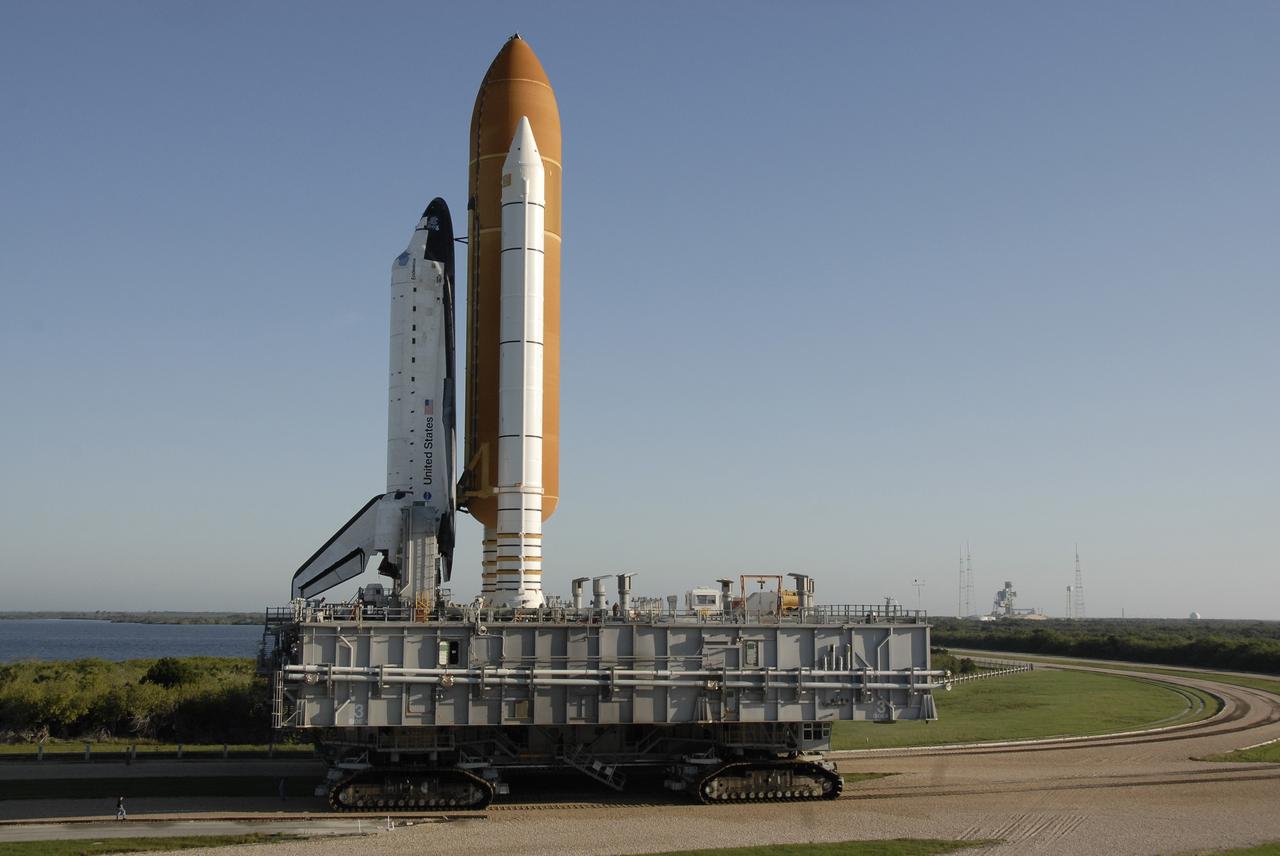
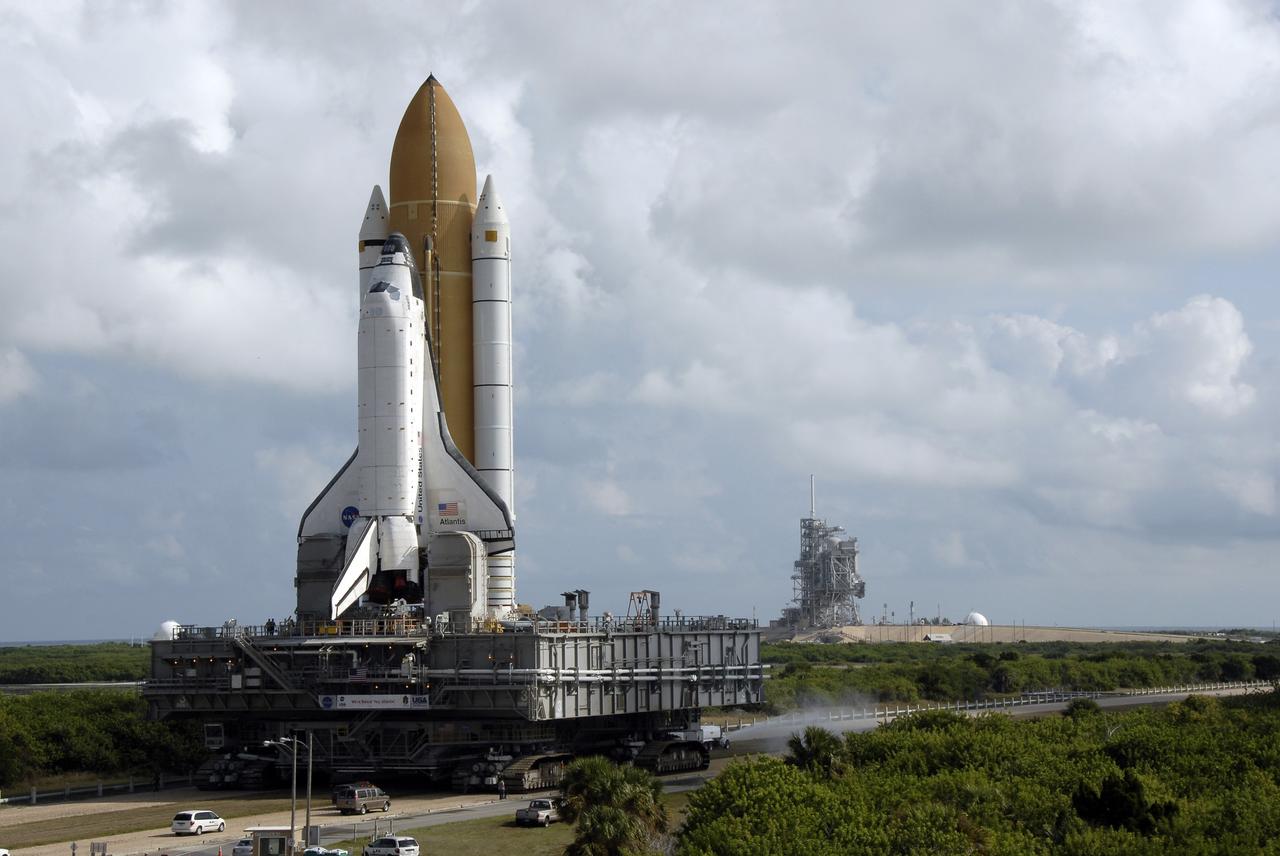
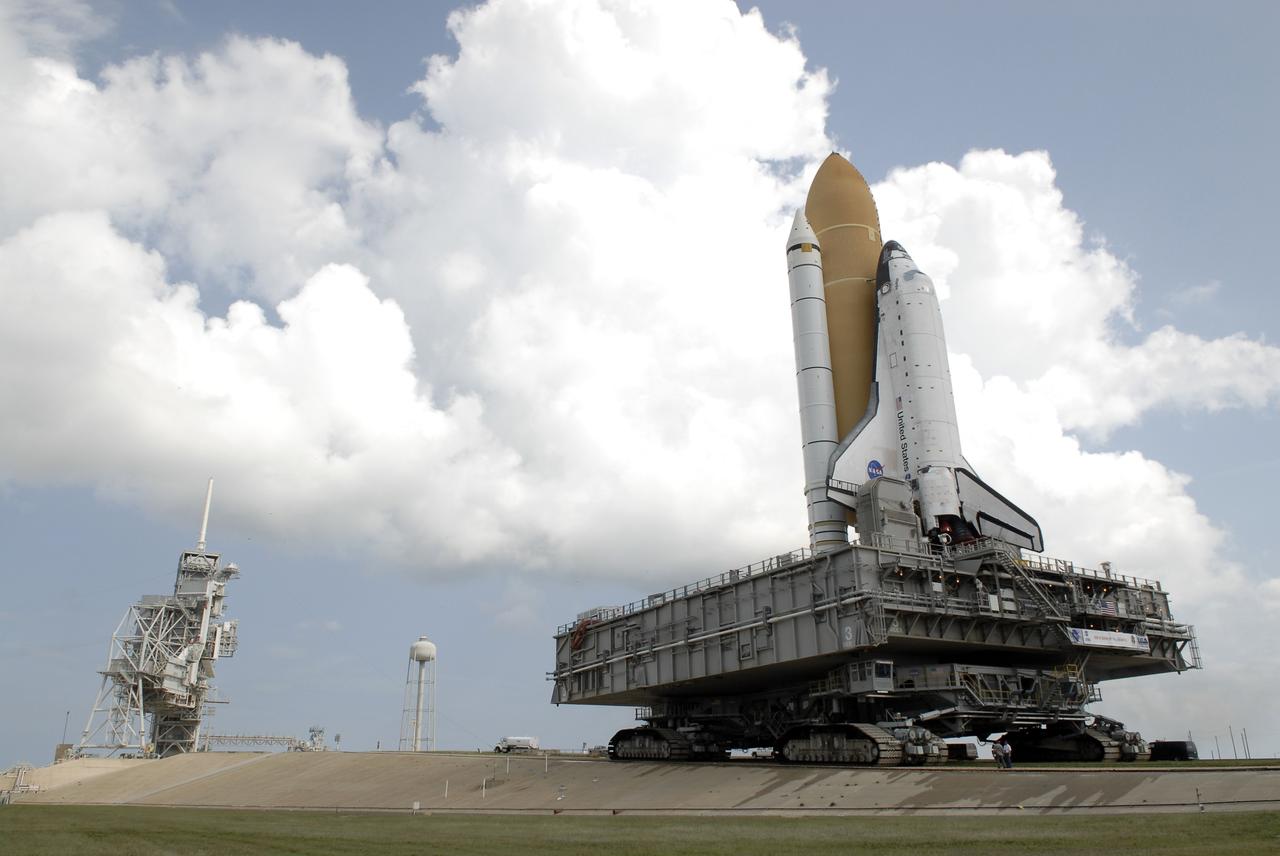
CAPE CANAVERAL, Fla. –  Space shuttle Atlantis rolls along the crawlerway toward Launch pad 39A, in the background, after leaving the Vehicle Assembly Building at NASA’s Kennedy Space Center.  A water truck sprays the crawlerway to minimize dust. The shuttle stack, with solid rocket boosters and external fuel tank attached to Atlantis, rest on the mobile launcher platform.  Movement is provided by the crawler-transporter underneath.  First motion occurred at 9:19 a.m. EDT. The Sept. 2 rollout date was postponed due to Tropical Storm Hanna’s shift to a northern track. Atlantis is scheduled to launch on the STS-125 mission to service NASA’s Hubble Space Telescope.  Launch is targeted for Oct. 8.  Photo credit: NASA/Kim Shiflett
KSC-08pd2535
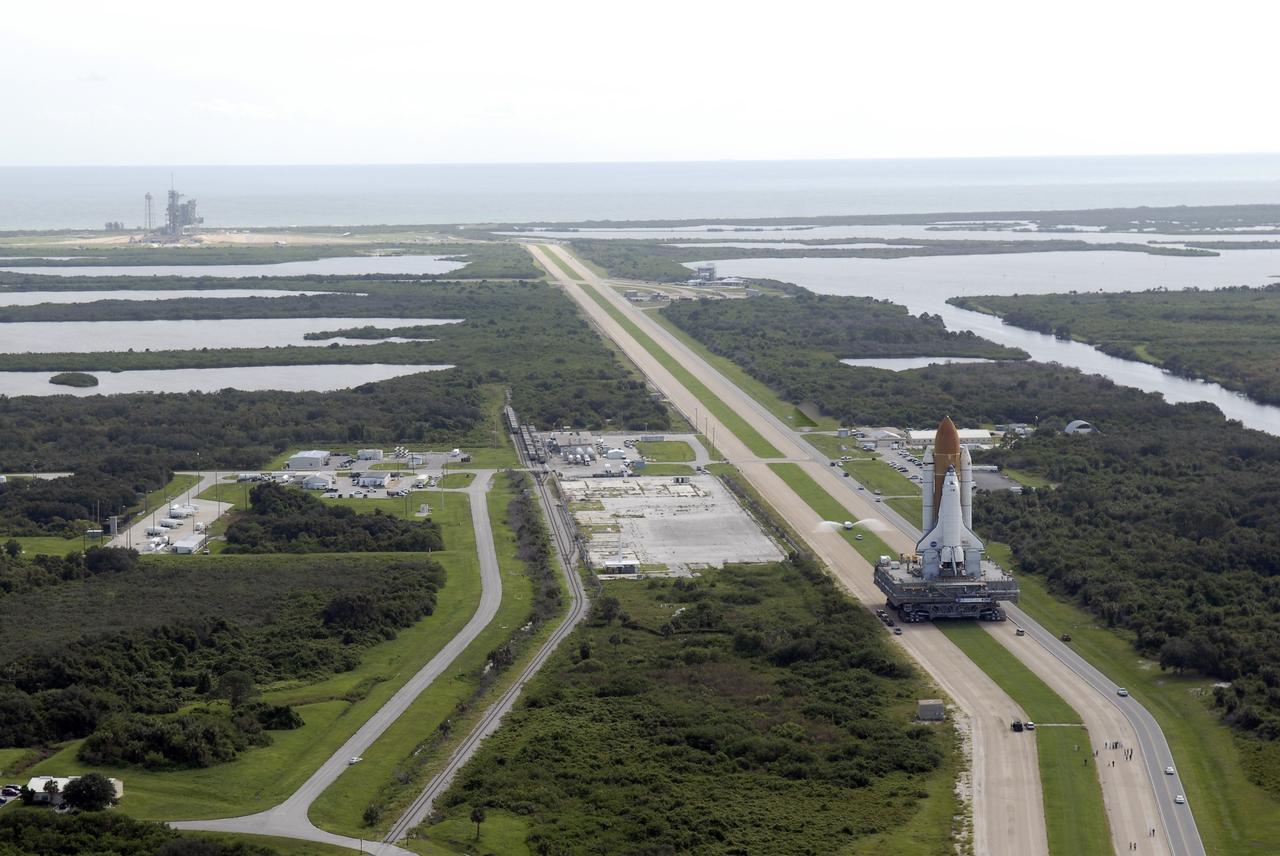
CAPE CANAVERAL, Fla. –  Space shuttle Atlantis has passed the bend in the crawlerway taking it to  Launch Pad 39A, above left, at NASA's Kennedy Space Center.  The crawlerway is flanked by the Banana River at right and Banana Creek at left.  The Atlantic Ocean stretches across the horizon. The shuttle stack, with solid rocket boosters and external fuel tank attached to Atlantis, rest on the mobile launcher platform.  Movement is provided by the crawler-transporter underneath.  First motion occurred at 9:19 a.m. EDT. The Sept. 2 rollout date was postponed due to Tropical Storm Hanna’s shift to a northern track. Atlantis is scheduled to launch on the STS-125 mission to service NASA’s Hubble Space Telescope.  Launch is targeted for Oct. 8.  Photo credit: NASA/Kim Shiflett
KSC-08pd2539
KENNEDY SPACE CENTER, FLA. -- Space Shuttle Atlantis passes the turn basin as it slowly wends its way toward Launch Pad 39A.  First motion out of the Vehicle Assembly Building was at 8:19 a.m.  The 3.4-mile trip to the pad along the crawlerway will take about 6 hours. The mission payload aboard Space Shuttle Atlantis is the S3/S4 integrated truss structure, along with a third set of solar arrays and batteries. The crew of six astronauts will install the truss to continue assembly of the International Space Station.  Launch is targeted for March 15.  Photo credit: NASA/Ken Thornsley
KSC-07pd0390
KENNEDY SPACE CENTER, FLA. -- In the clear morning light, Space Shuttle Atlantis , atop the mobile launcher platform and crawler-transporter, slowly makes its way to Launch Pad 39A.  First motion out of the Vehicle Assembly Building was at 8:19 a.m.  The 3.4-mile trip to the pad along the crawlerway will take about 6 hours.  The mission payload aboard Space Shuttle Atlantis is the S3/S4 integrated truss structure, along with a third set of solar arrays and batteries. The crew of six astronauts will install the truss to continue assembly of the International Space Station.  Launch is targeted for March 15.  Photo credit: NASA/Ken Thornsley
KSC-07pd0392
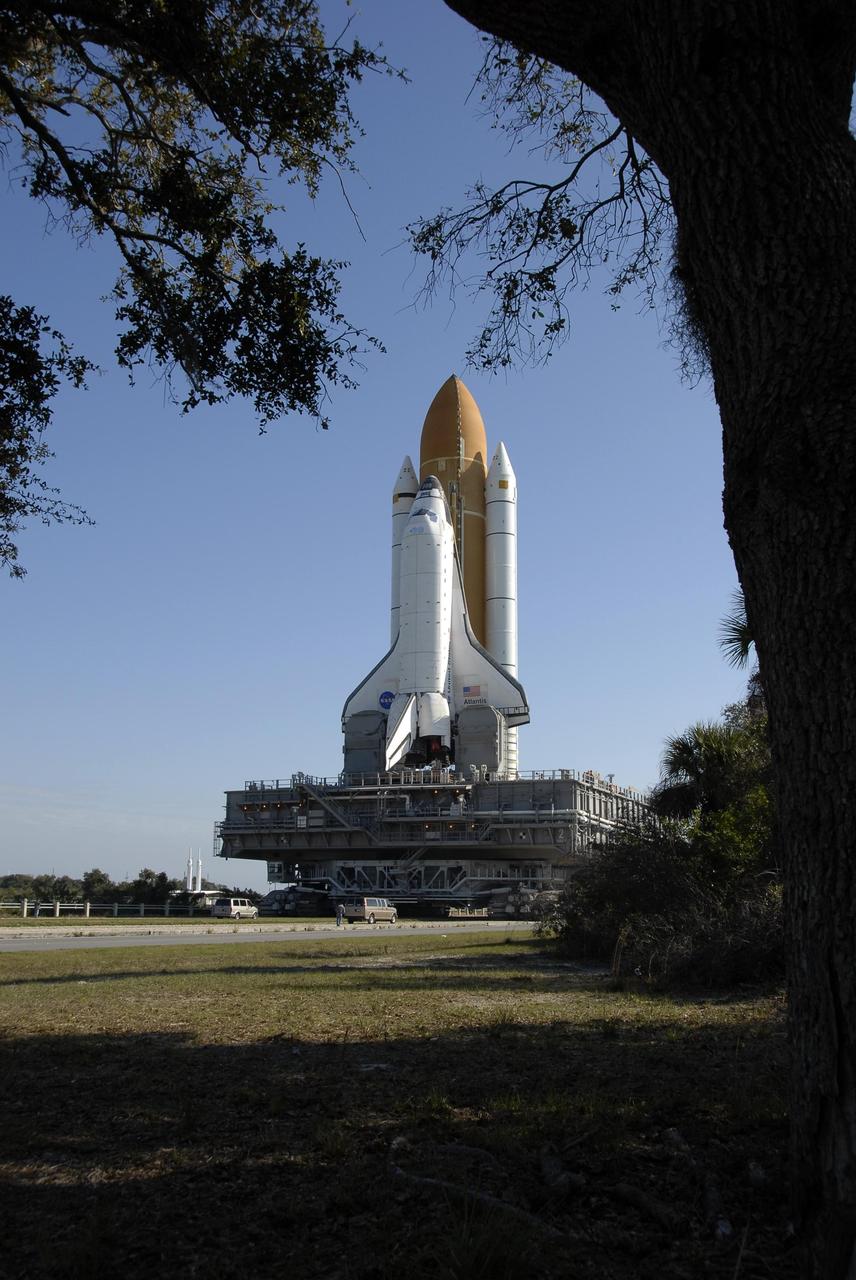
KENNEDY SPACE CENTER, FLA. -- Sunlight bathes Space Shuttle Atlantis and oak Leaves frame the image as the shuttle moves slowly toward Launch Pad 39A.  First motion out of the Vehicle Assembly Building was at 8:19 a.m.  The 3.4-mile trip to the pad along the crawlerway will take about 6 hours. The mission payload aboard Space Shuttle Atlantis is the S3/S4 integrated truss structure, along with a third set of solar arrays and batteries. The crew of six astronauts will install the truss to continue assembly of the International Space Station.  Launch is targeted for March 15.  Photo credit: NASA/Kim Shiflett
KSC-07pd0388
KENNEDY SPACE CENTER, FLA. -- Pelicans and seagulls witness the slow rollout of Space Shuttle Atlantis to Launch Pad 39A.  First motion out of the Vehicle Assembly Building was at 8:19 a.m.  The 3.4-mile trip to the pad along the crawlerway will take about 6 hours.  The mission payload aboard Space Shuttle Atlantis is the S3/S4 integrated truss structure, along with a third set of solar arrays and batteries. The crew of six astronauts will install the truss to continue assembly of the International Space Station.  Launch is targeted for March 15.  Photo credit: NASA/Ken Thornsley
KSC-07pd0393
KENNEDY SPACE CENTER, FLA. --  Space Shuttle Atlantis, atop the mobile launcher platform and crawler-transporter, slowly makes its way to Launch Pad 39A, at left.    First motion of the shuttle out of the Vehicle Assembly Building was at 8:19 a.m.  The 3.4-mile trip to the pad along the crawlerway takes about 6 hours.  The mission payload aboard Space Shuttle Atlantis is the S3/S4 integrated truss structure, along with a third set of solar arrays and batteries. The crew of six astronauts will install the truss to continue assembly of the International Space Station.  Launch is targeted for March 15.  Photo credit: NASA/Kim Shiflett
KSC-07pd0395
KENNEDY SPACE CENTER, FLA. --  In the clear morning light, Space Shuttle Atlantis, atop the mobile launcher platform and crawler-transporter, slowly makes its way to Launch Pad 39A.  First motion out of the Vehicle Assembly Building was at 8:19 a.m.  The 3.4-mile trip to the pad along the crawlerway will take about 6 hours. The mission payload aboard Space Shuttle Atlantis is the S3/S4 integrated truss structure, along with a third set of solar arrays and batteries. The crew of six astronauts will install the truss to continue assembly of the International Space Station.  Launch is targeted for March 15.  Photo credit: NASA/Kim Shiflett
KSC-07pd0394
KENNEDY SPACE CENTER, FLA. -- Atop the massive mobile launcher platform and crawler-transporter, Space Shuttle Atlantis looms above a flock of pelicans perched on the retaining wall below.  The shuttle is rolling out to Launch Pad 39A.  First motion out of the Vehicle Assembly Building was at 8:19 a.m.  The 3.4-mile trip to the pad along the crawlerway will take about 6 hours.  The mission payload aboard Space Shuttle Atlantis is the S3/S4 integrated truss structure, along with a third set of solar arrays and batteries. The crew of six astronauts will install the truss to continue assembly of the International Space Station.  Launch is targeted for March 15.  Photo credit: NASA/Ken Thornsley
KSC-07pd0391
CAPE CANAVERAL, Fla. -   With the Vehicle Assembly Building at NASA's Kennedy Space Center left behind (at left), the crawler-transporter slowly rolls along the crawlerway with space shuttle Endeavour on top. First motion was at 11:15 p.m. Sept. 18. Endeavour completed the 4.2-mile journey to Launch Pad 39B on Sept. 19 at 6:59 a.m. EDT. For the first time since July 2001, two shuttles are on the launch pads at the same time at the center. Endeavour will stand by at pad B in the unlikely event that a rescue mission is necessary during space shuttle Atlantis' upcoming mission to repair NASA's Hubble Space Telescope, targeted to launch Oct. 10. After Endeavour is cleared from its duty as a rescue spacecraft, it will be moved to Launch Pad 39A for the STS-126 mission to the International Space Station. That flight is targeted for launch Nov. 12. Photo credit: NASA/Dimitri Gerondidakis
KSC-08pd2665
KENNEDY SPACE CENTER, FLA. -  The crawler transporter slowly moves the Mobile Launcher Platform (MLP), carrying a set of twin solid rocket boosters, away from the Vehicle Assembly Building (VAB) in support of engineering analysis vibration tests on the crawler and MLP.   In the distance, at left, is Launch Pad 39A.  The water on the right of the crawlerway is the Banana River.  The crawler is moving at various speeds up to 1 mph in an effort to achieve vibration data gathering goals as it leaves the VAB and then returns.  The boosters are braced at the top for stability.  The primary purpose of these rollout tests is to gather data to develop future maintenance requirements on the transport equipment and the flight hardware. Various parts of the MLP and crawler transporter have been instrumented with vibration data collection equipment.
KENNEDY SPACE CENTER, FLA. - The crawler transporter slowly moves the Mobile Launcher Platform (MLP), carrying a set of twin solid rocket boosters, away from the Vehicle Assembly Building (VAB) in support of engineering analysis vibration tests on the crawler and MLP. In the distance, at left, is Launch Pad 39A. The water on the right of the crawlerway is the Banana River. The crawler is moving at various speeds up to 1 mph in an effort to achieve vibration data gathering goals as it leaves the VAB and then returns. The boosters are braced at the top for stability. The primary purpose of these rollout tests is to gather data to develop future maintenance requirements on the transport equipment and the flight hardware. Various parts of the MLP and crawler transporter have been instrumented with vibration data collection equipment.
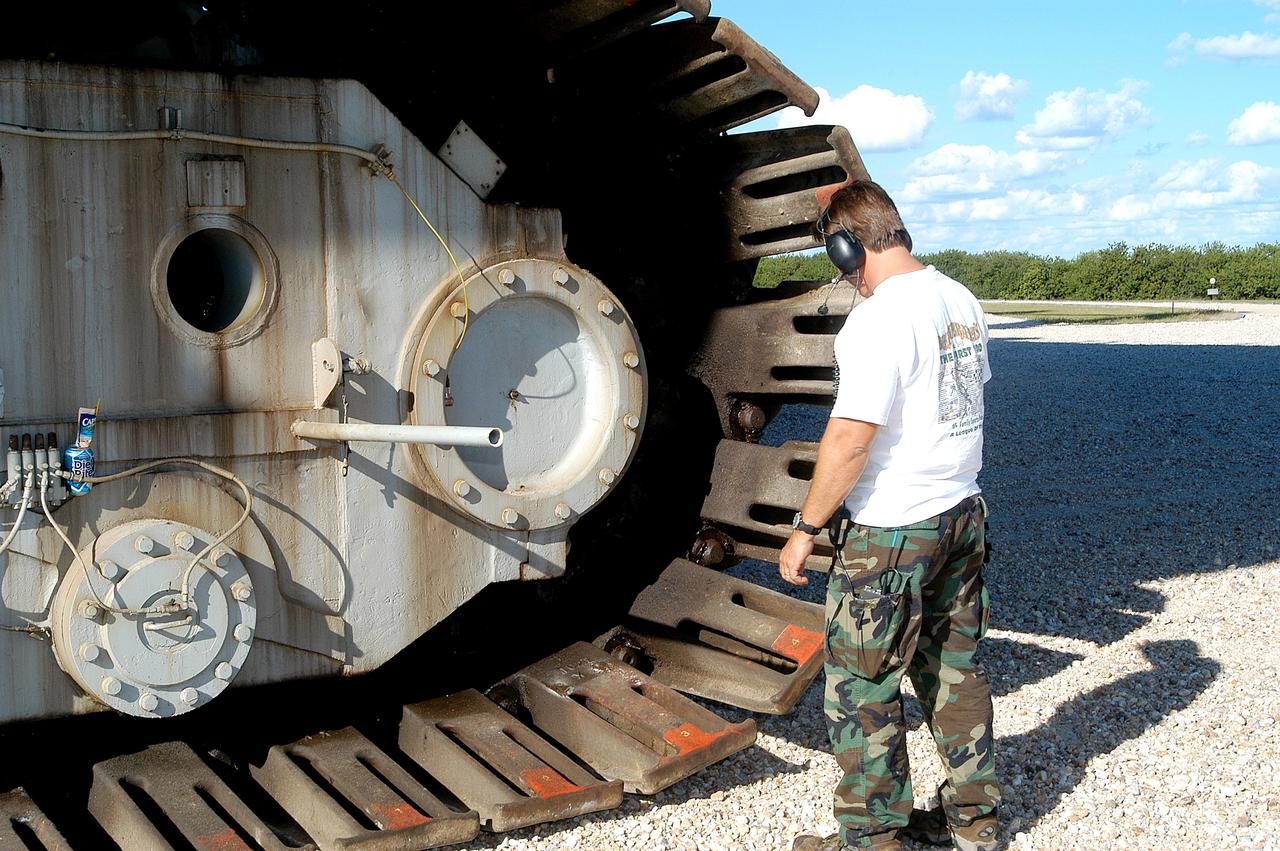
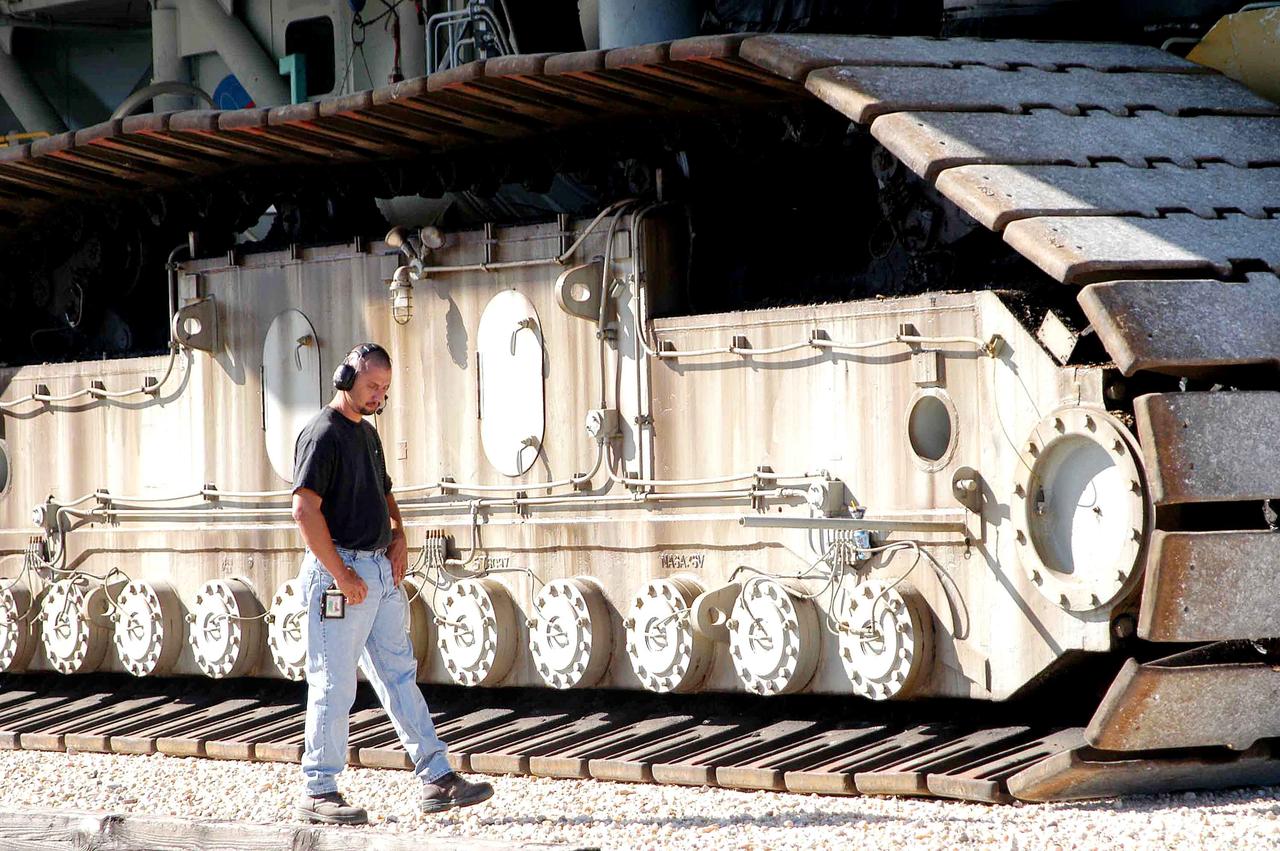
KENNEDY SPACE CENTER, FLA. - A Kennedy Space Center technician inspects the shoes on one of eight tracks of a crawler-transporter (CT).  The CT is moving Mobile Launcher Platform (MLP) number 3 with a set of twin solid rocket boosters bolted on top to the intersection in the crawlerway in support of the second engineering analysis vibration test on the crawler and MLP.  The crawler is moving at various speeds up to 1 mph in an effort to achieve vibration data gathering goals as it leaves the VAB, travels toward Launch Pad 39A and then returns. The boosters are braced at the top for stability. The primary purpose of these rollout tests is to gather data to develop future maintenance requirements on the transport equipment and the flight hardware. Various parts of the MLP and crawler transporter have been instrumented with vibration data collection equipment.
KENNEDY SPACE CENTER, FLA. - A Kennedy Space Center technician inspects the shoes on one of eight tracks of a crawler-transporter (CT). The CT is moving Mobile Launcher Platform (MLP) number 3 with a set of twin solid rocket boosters bolted on top to the intersection in the crawlerway in support of the second engineering analysis vibration test on the crawler and MLP. The crawler is moving at various speeds up to 1 mph in an effort to achieve vibration data gathering goals as it leaves the VAB, travels toward Launch Pad 39A and then returns. The boosters are braced at the top for stability. The primary purpose of these rollout tests is to gather data to develop future maintenance requirements on the transport equipment and the flight hardware. Various parts of the MLP and crawler transporter have been instrumented with vibration data collection equipment.
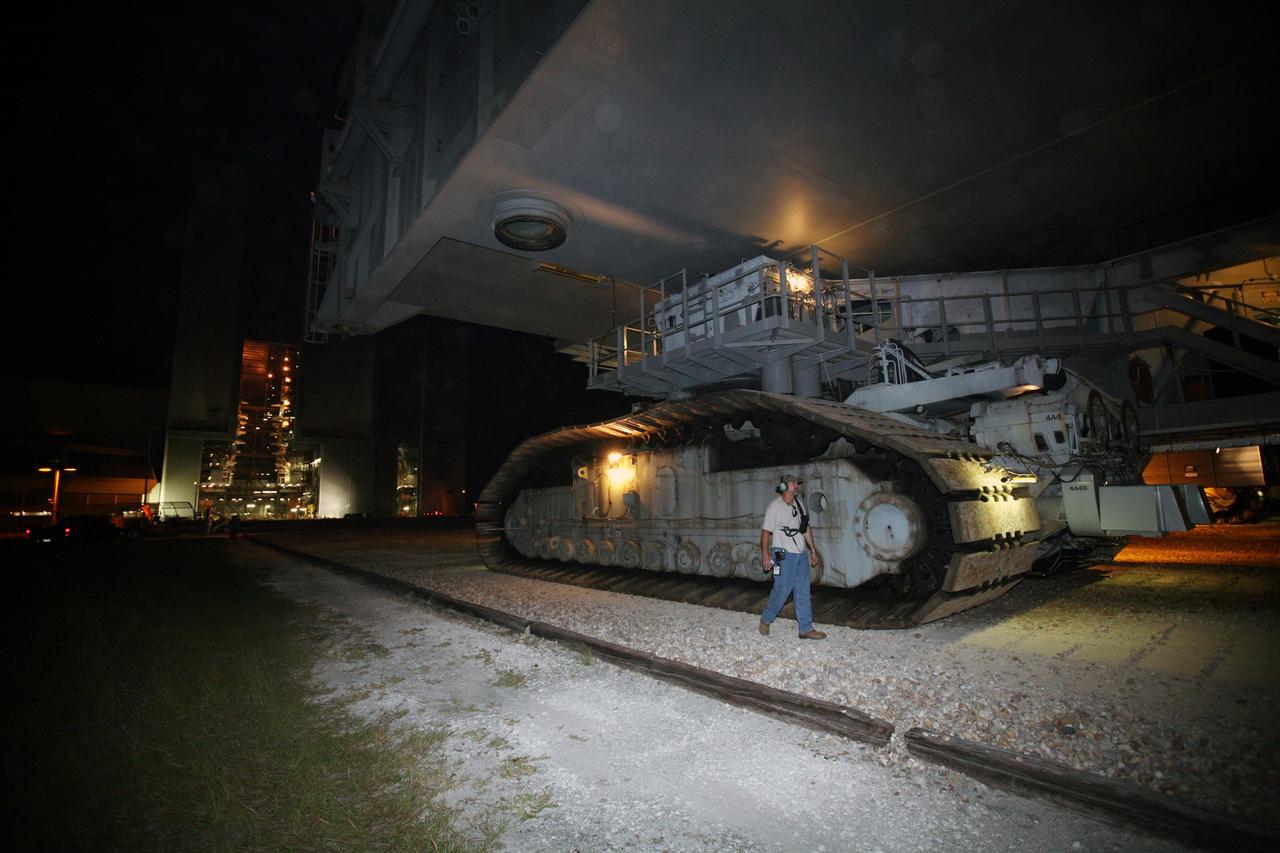
KENNEDY SPACE CENTER, FLA. - A Kennedy Space Center technician monitors the performance of a crawler-transporter as it moves Mobile Launcher Platform (MLP) number 3, with a set of twin solid rocket boosters bolted atop, to the intersection in the crawlerway during the second engineering analysis vibration test on the crawler and MLP.  The crawler is moving at various speeds up to 1 mph in an effort to achieve vibration data gathering goals as it leaves the VAB, travels toward Launch Pad 39A, and then returns. The boosters are braced at the top for stability. The primary purpose of these rollout tests is to gather data to develop future maintenance requirements on the transport equipment and the flight hardware. Various parts of the MLP and crawler transporter have been instrumented with vibration data collection equipment.
KENNEDY SPACE CENTER, FLA. - A Kennedy Space Center technician monitors the performance of a crawler-transporter as it moves Mobile Launcher Platform (MLP) number 3, with a set of twin solid rocket boosters bolted atop, to the intersection in the crawlerway during the second engineering analysis vibration test on the crawler and MLP. The crawler is moving at various speeds up to 1 mph in an effort to achieve vibration data gathering goals as it leaves the VAB, travels toward Launch Pad 39A, and then returns. The boosters are braced at the top for stability. The primary purpose of these rollout tests is to gather data to develop future maintenance requirements on the transport equipment and the flight hardware. Various parts of the MLP and crawler transporter have been instrumented with vibration data collection equipment.
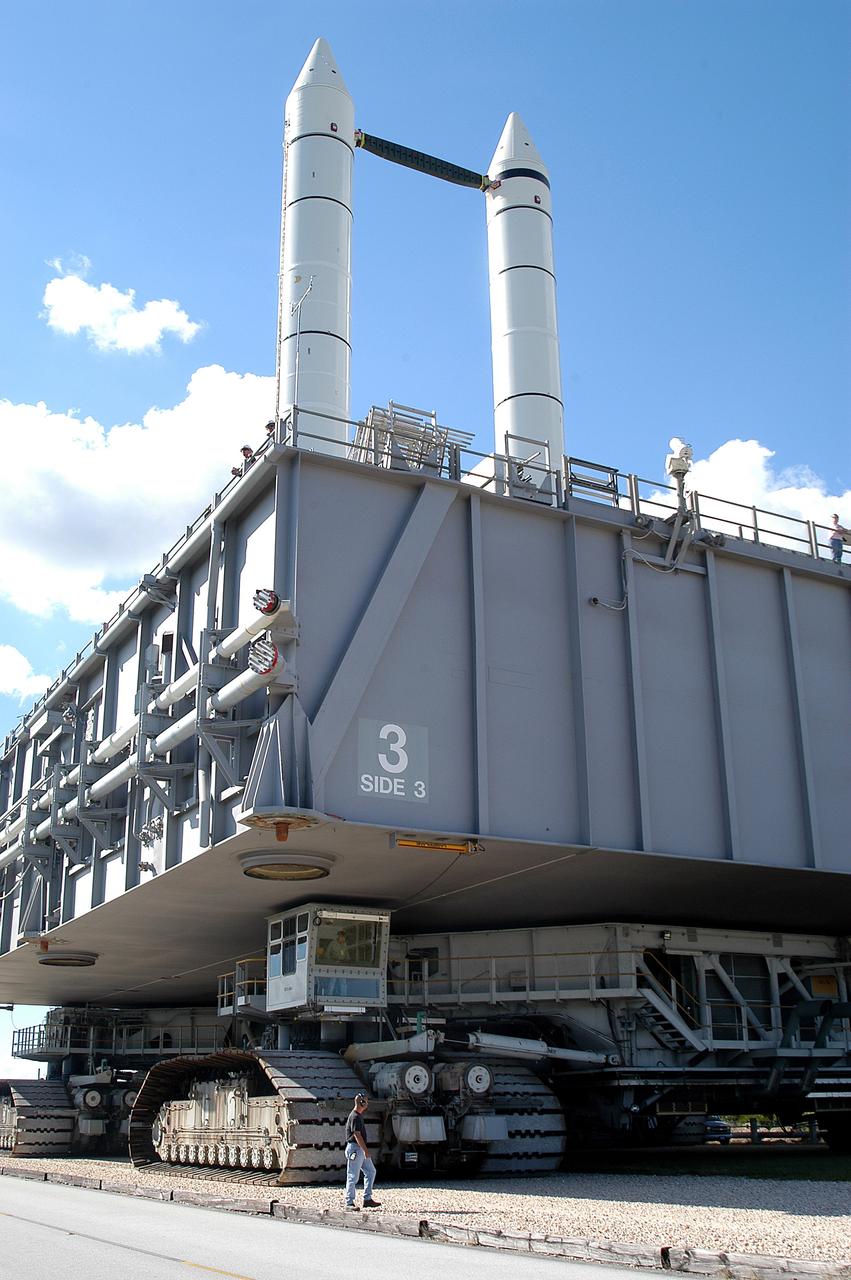
KENNEDY SPACE CENTER, FLA. - A Kennedy Space Center technician walks towards the intersection of the crawlerway beside a crawler-transporter moving Mobile Launcher Platform (MLP) number 3, with a set of twin solid rocket boosters bolted atop, during the second engineering analysis vibration test on the crawler and MLP.  The crawler is moving at various speeds up to 1 mph in an effort to achieve vibration data gathering goals as it leaves the VAB, travels toward Launch Pad 39A, and then returns. The boosters are braced at the top for stability. The primary purpose of these rollout tests is to gather data to develop future maintenance requirements on the transport equipment and the flight hardware. Various parts of the MLP and crawler transporter have been instrumented with vibration data collection equipment.
KENNEDY SPACE CENTER, FLA. - A Kennedy Space Center technician walks towards the intersection of the crawlerway beside a crawler-transporter moving Mobile Launcher Platform (MLP) number 3, with a set of twin solid rocket boosters bolted atop, during the second engineering analysis vibration test on the crawler and MLP. The crawler is moving at various speeds up to 1 mph in an effort to achieve vibration data gathering goals as it leaves the VAB, travels toward Launch Pad 39A, and then returns. The boosters are braced at the top for stability. The primary purpose of these rollout tests is to gather data to develop future maintenance requirements on the transport equipment and the flight hardware. Various parts of the MLP and crawler transporter have been instrumented with vibration data collection equipment.
KENNEDY SPACE CENTER, FLA. -  Mobile Launcher Platform (MLP) number 3 and a set of twin solid rocket boosters bolted to it, atop the crawler-transporter, inches along the crawlerway in support of the second engineering analysis vibration test on the crawler and MLP.  The MLP is viewed from the KSC News Center across the turn basin.  The crawler is moving at various speeds up to 1 mph in an effort to achieve vibration data gathering goals as it leaves the VAB, travels toward Launch Pad 39A and then returns.  The boosters are braced at the top for stability.  The primary purpose of these rollout tests is to gather data to develop future maintenance requirements on the transport equipment and the flight hardware. Various parts of the MLP and crawler transporter have been instrumented with vibration data collection equipment.
KENNEDY SPACE CENTER, FLA. - Mobile Launcher Platform (MLP) number 3 and a set of twin solid rocket boosters bolted to it, atop the crawler-transporter, inches along the crawlerway in support of the second engineering analysis vibration test on the crawler and MLP. The MLP is viewed from the KSC News Center across the turn basin. The crawler is moving at various speeds up to 1 mph in an effort to achieve vibration data gathering goals as it leaves the VAB, travels toward Launch Pad 39A and then returns. The boosters are braced at the top for stability. The primary purpose of these rollout tests is to gather data to develop future maintenance requirements on the transport equipment and the flight hardware. Various parts of the MLP and crawler transporter have been instrumented with vibration data collection equipment.
KENNEDY SPACE CENTER, FLA. -  Mobile Launcher Platform (MLP) number 3 and a set of twin solid rocket boosters, atop the crawler-transporter, inch along the crawlerway in support of the second engineering analysis vibration test on the crawler and MLP. The view reveals the river gravel surface that is 4 inches thick on the straightaway sections and 8 inches thick on curves. The crawler is moving at various speeds up to 1 mph in an effort to achieve vibration data gathering goals as it leaves the VAB, travels toward Launch Pad 39A and then returns.  The boosters are braced at the top for stability.  The primary purpose of these rollout tests is to gather data to develop future maintenance requirements on the transport equipment and the flight hardware. Various parts of the MLP and crawler transporter have been instrumented with vibration data collection equipment.
KENNEDY SPACE CENTER, FLA. - Mobile Launcher Platform (MLP) number 3 and a set of twin solid rocket boosters, atop the crawler-transporter, inch along the crawlerway in support of the second engineering analysis vibration test on the crawler and MLP. The view reveals the river gravel surface that is 4 inches thick on the straightaway sections and 8 inches thick on curves. The crawler is moving at various speeds up to 1 mph in an effort to achieve vibration data gathering goals as it leaves the VAB, travels toward Launch Pad 39A and then returns. The boosters are braced at the top for stability. The primary purpose of these rollout tests is to gather data to develop future maintenance requirements on the transport equipment and the flight hardware. Various parts of the MLP and crawler transporter have been instrumented with vibration data collection equipment.
CAPE CANAVERAL, Fla. –  Space shuttle Atlantis rolls along the crawlerway toward Launch pad 39A after leaving the Vehicle Assembly Building at NASA’s Kennedy Space Center. The shuttle stack, with solid rocket boosters and external fuel tank attached to Atlantis, rest on the mobile launcher platform.  Movement is provided by the crawler-transporter underneath.  First motion occurred at 9:19 a.m. EDT. The Sept. 2 rollout date was postponed due to Tropical Storm Hanna’s shift to a northern track. Atlantis is scheduled to launch on the STS-125 mission to service NASA’s Hubble Space Telescope.  Launch is targeted for Oct. 8.  Photo credit: NASA/Kim Shiflett
KSC-08pd2534
CAPE CANAVERAL, Fla. –  Space Space shuttle Atlantis curves toward Launch Pad 39A (at left) on the crawlerway at NASA's Kennedy Space Center after rolling from the Vehicle Assembly Building. The shuttle stack, with solid rocket boosters and external fuel tank attached to Atlantis, rest on the mobile launcher platform.  Movement is provided by the crawler-transporter underneath.  First motion occurred at 9:19 a.m. EDT. The Sept. 2 rollout date was postponed due to Tropical Storm Hanna’s shift to a northern track. Atlantis is scheduled to launch on the STS-125 mission to service NASA’s Hubble Space Telescope.  Launch is targeted for Oct. 8.  Photo credit: NASA/Kim Shiflett
KSC-08pd2543
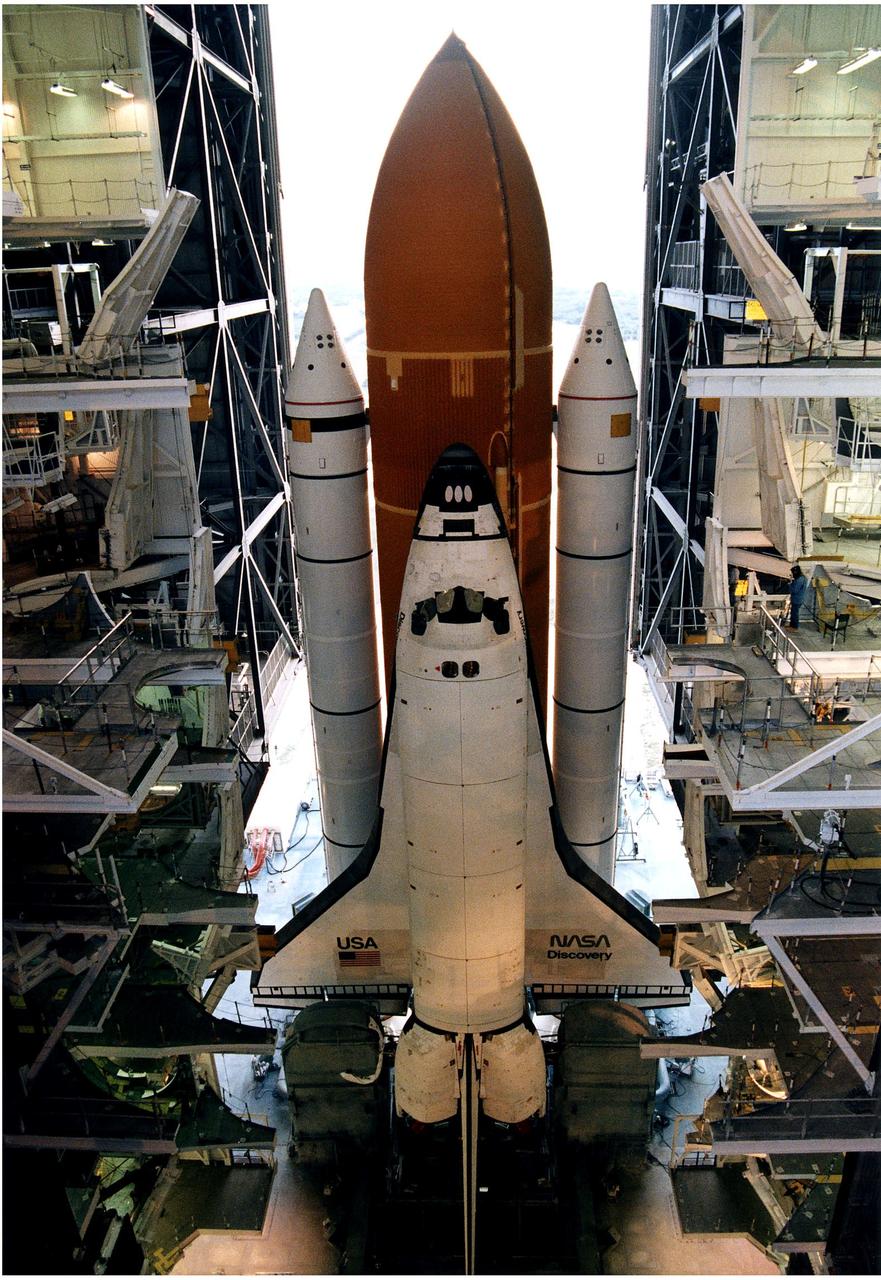
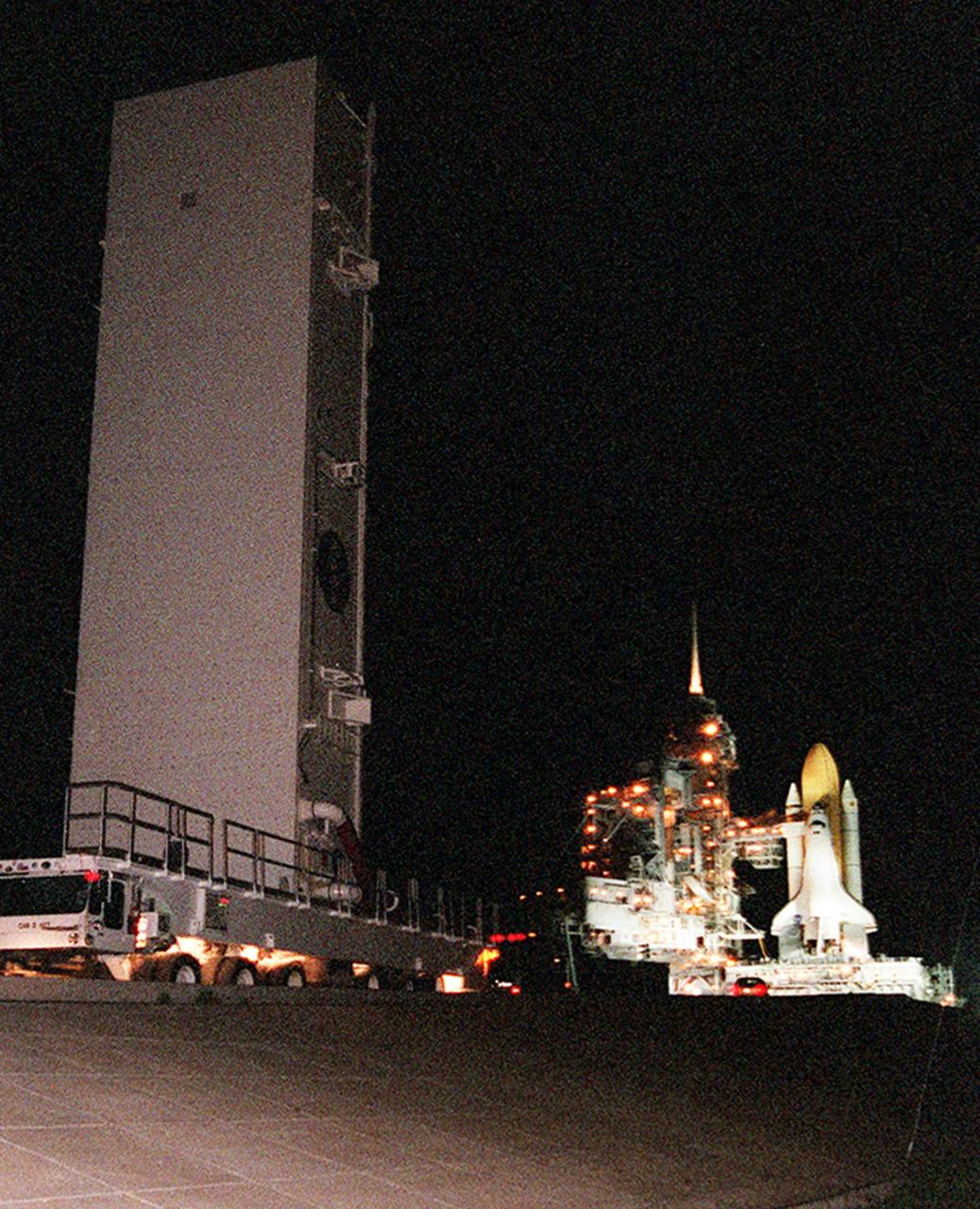
KENNEDY SPACE CENTER, FLORIDA  STS-82 ROLL-OUT VIEW --- After departing the Vehicle Assembly Building (VAB), the Space Shuttle Discovery moves slowly - about one mile per hour - along the Kennedy Space Center (KSC) Crawlerway toward Launch Pad 39A in preparation for the STS-82 mission.  The Shuttle is on a mobile launch platform, and the entire assemblage is being carried by a large tracked vehicle called the Crawler Transporter.  A seven-member crew of astronauts will perform the second servicing of the orbiting Hubble Space Telescope (HST) during the scheduled ten-day STS-82 flight.  Launch is currently targeted for February 11, 1997.
STS-82 Discovery moves toward Launch Pad 39A
KENNEDY SPACE CENTER, FLORIDA  STS-82 PREPARATIONS VIEW --- Scattered clouds at dawn provide the backdrop for the Space Shuttle Discovery as it moves along the Kennedy Space Center (KSC) Crawlerway toward Launch Pad 39A in preparation for the STS-82 mission.  The Space Shuttle is on a mobile launch platform, and the entire assemblage is being carried by a large tracked vehicle called the Crawler Transporter.  A seven-member crew of astronauts will perform the second servicing of the orbiting Hubble Space Telescope (HST) during the scheduled ten-day STS-82 flight.  Launch is currently targeted for February 11, 1997.
STS-82 Discovery moves toward Launch Pad 39A
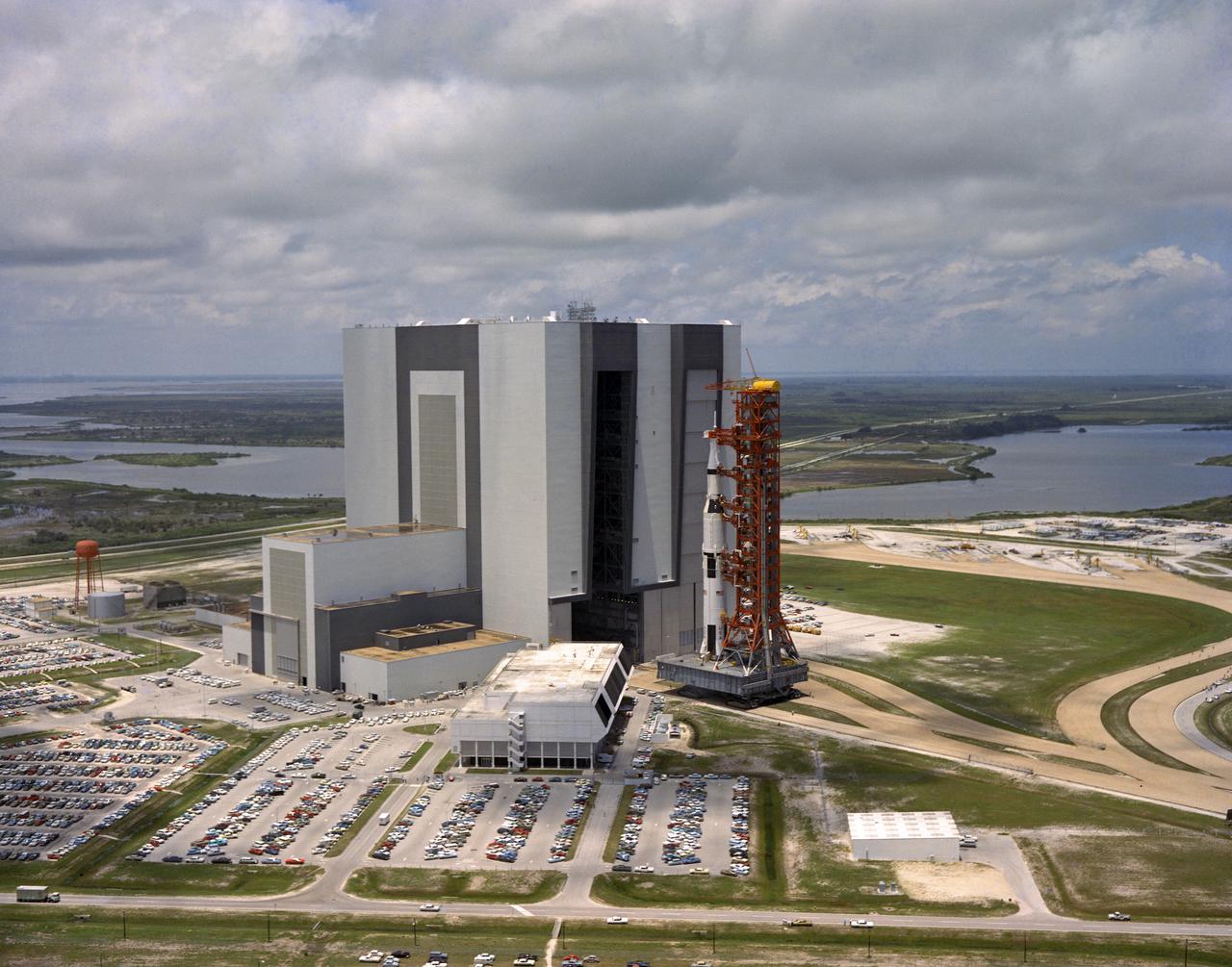
CAPE CANAVERAL, Fla. -- The 363-foot-high Apollo 11 space vehicle towers over the Spaceport’s crawlerway and personnel during its rollout today from the Vehicle Assembly Building’s high bay 1 to Launch Complex 39A.  The transporter carried the vehicle and its mobile launcher along the 3.5-mile-roadway at an average speed of less than one mile per hour, arriving at the launch pad some seven hours after rollout began.  The vehicle is to launch Apollo 11 astronauts Neil A. Armstrong, Michael Colins and Edwin E. Aldrin Jr. on the nation’s first manned lunar landing mission.   Photo credit: NASA
KSC-69PC-0238
CAPE CANAVERAL, Fla. -- Crawler-transporter 1 approaches the slope on the crawlerway leading up to Launch Pad 39A at NASA’s Kennedy Space Center in Florida. New jacking, equalizing and leveling, or JEL, hydraulic cylinders were installed on CT-1 and will undergo a leveling and turning test as the crawler travels along the slope to the top of the pad.     The Ground Systems Development and Operations Program at Kennedy continues to upgrade the crawler-transporter as part of its general maintenance. CT-1 could be available to carry a variety of launch vehicles to the launch pad. Two crawler-transporters were used to carry the mobile launcher platform and space shuttle to Launch Complex 39 for space shuttle launches for 30 years. Photo credit: NASA/Jim Grossmann
KSC-2013-4211
CAPE CANAVERAL, Fla. -- Crawler-transporter 1 approaches the top of Launch Pad 39A after traveling along the crawlerway at NASA’s Kennedy Space Center in Florida. New jacking, equalizing and leveling, or JEL, hydraulic cylinders were installed on CT-1 and are undergoing a leveling and turning test as the crawler travels along the slope to the top of the pad.     The Ground Systems Development and Operations Program at Kennedy continues to upgrade the crawler-transporter as part of its general maintenance. CT-1 could be available to carry a variety of launch vehicles to the launch pad. Two crawler-transporters were used to carry the mobile launcher platform and space shuttle to Launch Complex 39 for space shuttle launches for 30 years. Photo credit: NASA/Jim Grossmann
KSC-2013-4213
CAPE CANAVERAL, Fla. -- Crawler-transporter 1 continues its trek up the slope on the crawlerway leading up to Launch Pad 39A at NASA’s Kennedy Space Center in Florida. New jacking, equalizing and leveling, or JEL, hydraulic cylinders were installed on CT-1 and are undergoing a leveling and turning test as the crawler travels along the slope to the top of the pad.     The Ground Systems Development and Operations Program at Kennedy continues to upgrade the crawler-transporter as part of its general maintenance. CT-1 could be available to carry a variety of launch vehicles to the launch pad. Two crawler-transporters were used to carry the mobile launcher platform and space shuttle to Launch Complex 39 for space shuttle launches for 30 years. Photo credit: NASA/Jim Grossmann
KSC-2013-4212
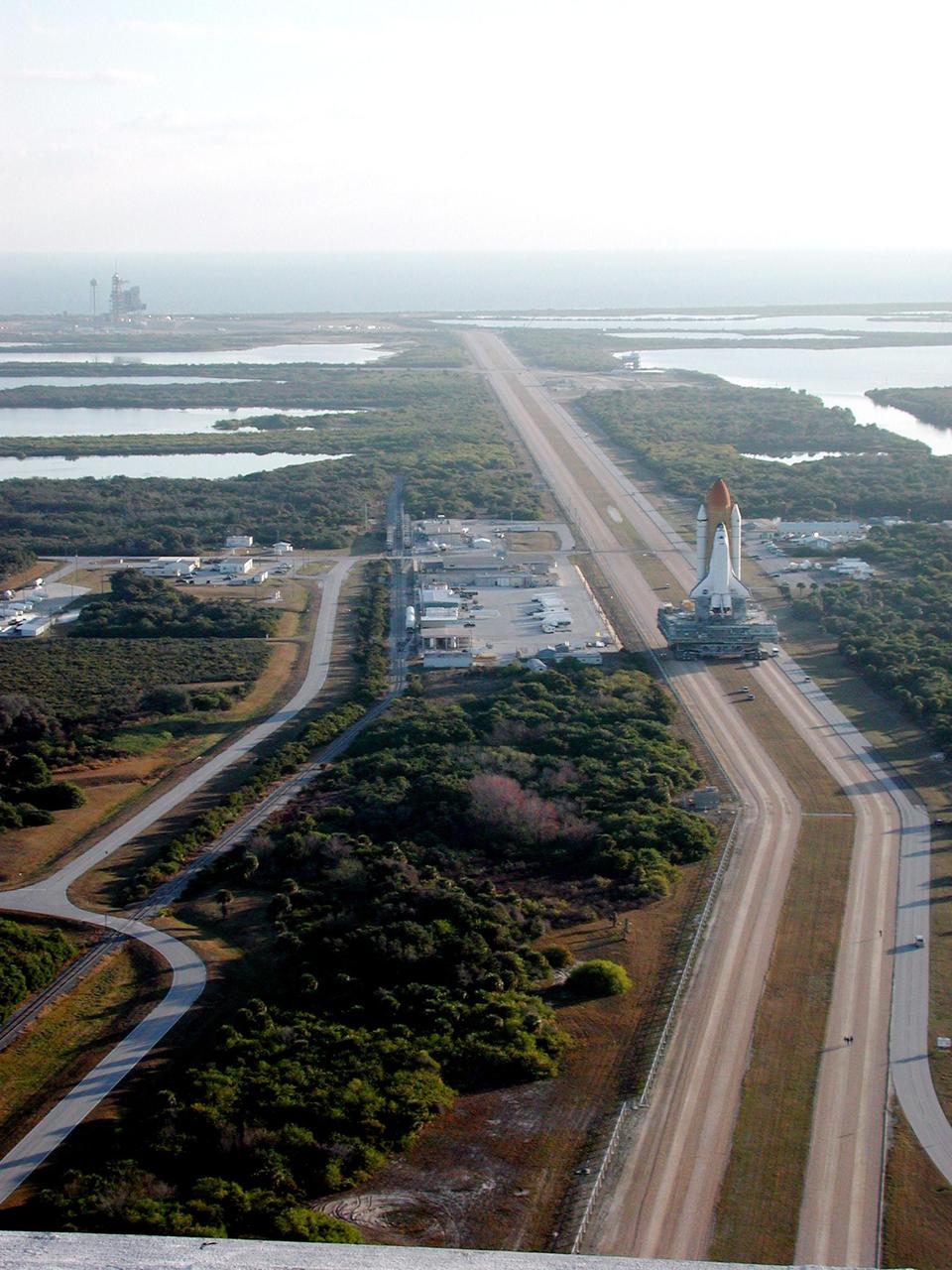
KENNEDY SPACE CENTER, FLA. -- Space Shuttle <a href='.._.._subjects_atlantis.htm'> Atlantis<_a> (right) inches its way at 1 mph atop the crawler-transporter back to the <a href='.._.._subjects_vab.htm'> Vehicle Assembly Building<_a> from <a href='.._.._subjects_lc39a.htm'> Launch Pad 39A<_a> (upper left). A panorama view from the top of the VAB shows the proximity of the pad to the Atlantic Ocean (background) plus the 3.4-mile crawlerway leading from the pad to the VAB. The water areas on both sides of the crawlerway are part of the Banana River. In the VAB workers will conduct inspections, make continuity checks and conduct X-ray analysis on the 36 solid rocket booster cables located inside each booster’s external system tunnel. An extensive evaluation of NASA’s SRB cable inventory revealed conductor damage in four (of about 200) cables on the shelf. Shuttle managers decided to prove the integrity of the system tunnel cables already on Atlantis before launching. The launch has been rescheduled no earlier than Feb. 6
KSC-01PP-0140
KENNEDY SPACE CENTER, FLA. -- Space Shuttle <a href="../../subjects/atlantis.htm"> Atlantis</a> (right) inches its way at 1 mph atop the crawler-transporter back to the <a href="../../subjects/vab.htm"> Vehicle Assembly Building</a> from <a href="../../subjects/lc39a.htm"> Launch Pad 39A</a> (upper left). A panorama view from the top of the VAB shows the proximity of the pad to the Atlantic Ocean (background) plus the 3.4-mile crawlerway leading from the pad to the VAB. The water areas on both sides of the crawlerway are part of the Banana River. In the VAB workers will conduct inspections, make continuity checks and conduct X-ray analysis on the 36 solid rocket booster cables located inside each booster’s external system tunnel. An extensive evaluation of NASA’s SRB cable inventory revealed conductor damage in four (of about 200) cables on the shelf. Shuttle managers decided to prove the integrity of the system tunnel cables already on Atlantis before launching. The launch has been rescheduled no earlier than Feb. 6
KSC01pp0140
CAPE CANAVERAL, Fla. – Space shuttle Endeavour, installed on the mobile launcher platform  atop the crawler-transporter, moves along the crawlerway at NASA's Kennedy Space Center in Florida as it rolls out to Launch Pad 39B.  First motion out of the Vehicle Assembly Building was at 11:57 p.m. EDT April 16.  The 4.2-mile journey is expected to take approximately 7 hours. Endeavour will be prepared on the pad for liftoff in the unlikely event that a rescue mission is necessary following space shuttle Atlantis' launch on the STS-125 mission to service NASA's  Hubble Space Telescope. After Atlantis is cleared to land, Endeavour will move to Launch Pad 39A for its upcoming STS-127 mission to the International Space Station, targeted to launch June 13.   Photo credit: NASA/Jack Pfaller
KSC-2009-2688
CAPE CANAVERAL, Fla. – Space shuttle Endeavour, installed on the mobile launcher platform  atop the crawler-transporter, moves along the crawlerway at NASA's Kennedy Space Center in Florida as it rolls out to Launch Pad 39B.  First motion was at 11:57 p.m. EDT April 16.  The 4.2-mile journey is expected to take approximately 7 hours.  Endeavour will be prepared on the pad for liftoff in the unlikely event that a rescue mission is necessary following space shuttle Atlantis' launch on the STS-125 mission to service NASA's  Hubble Space Telescope. After Atlantis is cleared to land, Endeavour will move to Launch Pad 39A for its upcoming STS-127 mission to the International Space Station, targeted to launch June 13.   Photo credit: NASA/Jack Pfaller
KSC-2009-2687
KENNEDY SPACE CENTER, FLA. - As the sun begins to rise in the early-morning sky, the Space Shuttle Atlantis slowly travels on the Crawlerway toward the Vehicle Assembly Building after its departure from Launch Pad 39A. This marks the second rollback for Atlantis since July because of hurricane threats. Atlantis, which is targeted for liftoff later this month on the STS-79 Shuttle mission, is returning to the VAB because of the threat from Hurrican Fran. The threat of Hurrican Bertha forced the rollback of Atlantis in July. Atlantis is currently scheduled for launch on the fourth Shuttle-MIR docking mission around mid-September
ksc-96pc1038
KENNEDY SPACE CENTER, FLA. --   The morning light spills through the open door of the Vehicle Assembly Building as Space Shuttle Atlantis begins rolling out to Launch Pad 39A.  First motion was at 8:19 a.m. The 3.4-mile trip along the crawlerway will take about 6 hours. The mission payload aboard Space Shuttle Atlantis is the S3/S4 integrated truss structure, along with a third set of solar arrays and batteries. The crew of six astronauts will install the truss to continue assembly of the International Space Station.  Launch is targeted for March 15.  Photo credit: NASA/Kim Shiflett
KSC-07pd0378
KENNEDY SPACE CENTER, Fla. -- In the early morning light, Space Shuttle Atlantis makes the turn from the Vehicle Assembly Building onto the crawlerway for the trek to Launch Pad 39A. The Shuttle has been in the VAB undergoing tests on the solid rocket booster cables. A prior extensive evaluation of NASA’s SRB cable inventory on the shelf revealed conductor damage in four (of about 200) cables. Shuttle managers decided to prove the integrity of the system tunnel cables already on Atlantis, causing return of the Shuttle to the VAB a week ago. Launch of Atlantis on STS-98 has been rescheduled to Feb. 7 at 6:11 p.m. EST
KSC-01PADIG-029
KENNEDY SPACE CENTER, FLA. -  As the sun begins to rise in the early-morning sky after its departure from Launch Pad 39A, the Space Shuttle Atlantis slowly travels on the crawlerway toward the Vehicle Assembly Building.  This marks the second rollback for Atlantis since July because of hurricane threats.  Atlantis, which is targeted fo liftoff later this month on the STS-79 Shuttle mission, is returning to the VAB because of the threat from Hurricane Fran.  The threat of Hurricane Bertha forced the rollback of Atlantis in July.  Atlantis currently is scheduled for launch on the fourth Shuttle-Mir docking mission around mid-September.
KSC-96pc1038
KENNEDY SPACE CENTER, Fla. -- Photographed from the top of the Vehicle Assembly Building, Space Shuttle Atlantis creeps along the crawlerway for the trek to Launch Pad 39A (upper left). In the background is the Atlantic Ocean. The Shuttle has been in the VAB undergoing tests on the solid rocket booster cables. A prior extensive evaluation of NASA’s SRB cable inventory on the shelf revealed conductor damage in four (of about 200) cables. Shuttle managers decided to prove the integrity of the system tunnel cables already on Atlantis, causing return of the Shuttle to the VAB a week ago. Launch of Atlantis on STS-98 has been rescheduled to Feb. 7 at 6:11 p.m. EST
KSC01padig031
KENNEDY SPACE CENTER, FLA. --   On a slow roll, Space Shuttle Atlantis moves through the open door of the Vehicle Assembly Building for the journey to Launch Pad 39A.  First motion was at 8:19 a.m. The 3.4-mile trip along the crawlerway will take about 6 hours. The mission payload aboard Space Shuttle Atlantis is the S3/S4 integrated truss structure, along with a third set of solar arrays and batteries. The crew of six astronauts will install the truss to continue assembly of the International Space Station.  Launch is targeted for March 15.  Photo credit: NASA/Kim Shiflett
KSC-07pd0381
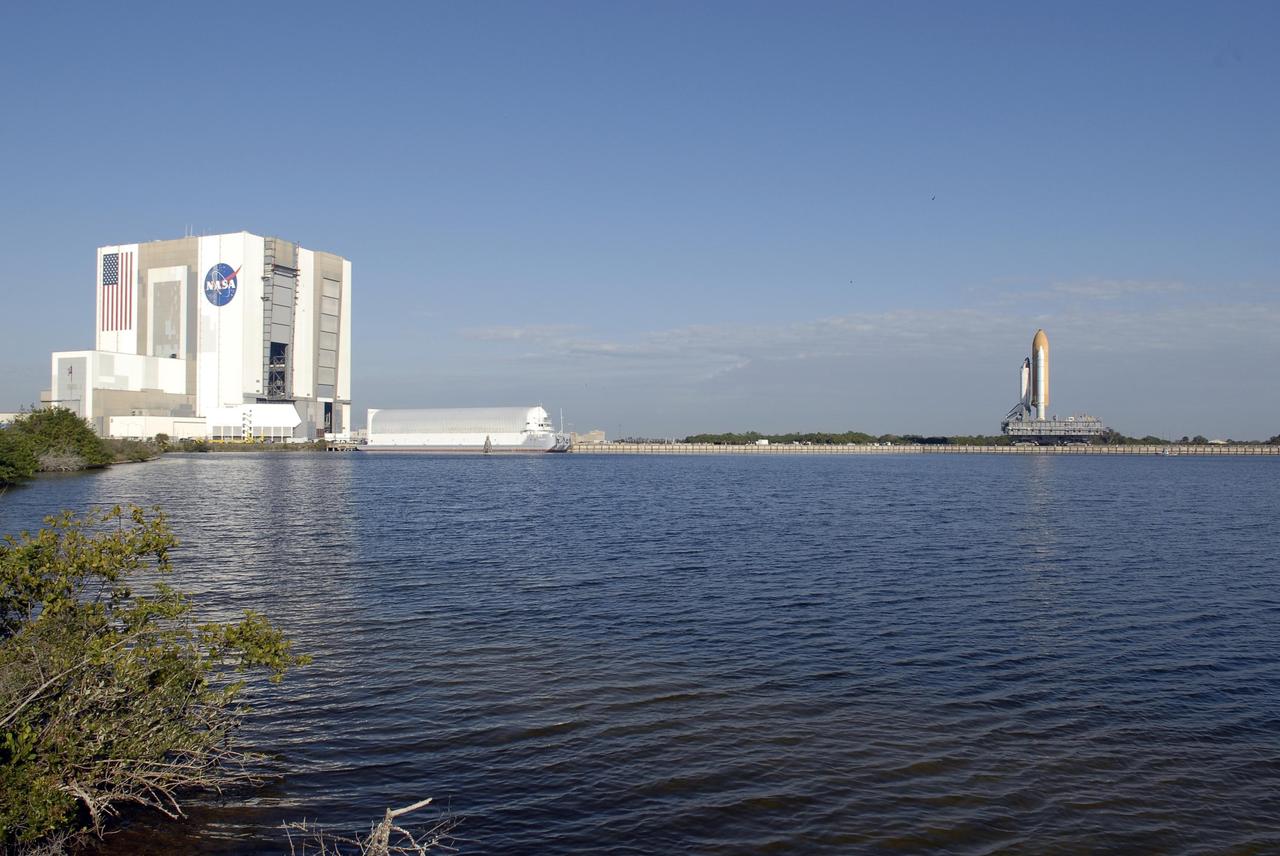
CAPE CANAVERAL, Fla. -- Space shuttle Discovery, atop the mobile launcher platform, makes the slow 3.4-mile journey via the broad, two-track crawlerway to Launch Pad 39A at NASA's Kennedy Space Center in Florida.  First motion out of the Vehicle Assembly Building (at right) was at 5:17 a.m. EST. Discovery is targeted to launch to the International Space Station Feb. 12. During Discovery's 14-day mission, the crew will install the S6 truss segment and its solar arrays to the starboard side of the station, completing the station's backbone, or truss, enabling a six-person crew to live there starting in May.  Photo credit: NASA/Troy Cryder
KSC-2009-1121
CAPE CANAVERAL, Fla. -- Space Space shuttle Discovery, atop the mobile launcher platform, makes the slow 3.4-mile journey via the broad, two-track crawlerway to Launch Pad 39A at NASA's Kennedy Space Center in Florida.  First motion out of the Vehicle Assembly Building (at right) was at 5:17 a.m. EST. Discovery is targeted to launch to the International Space Station Feb. 12. During Discovery's 14-day mission, the crew will install the S6 truss segment and its solar arrays to the starboard side of the station, completing the station's backbone, or truss, enabling a six-person crew to live there starting in May.  Photo credit: NASA/Troy Cryder
KSC-2009-1122
KENNEDY SPACE CENTER, Fla. --  Before dawn, the payload canister (left) with the Integrated Truss Structure Z1 moves slowly up the crawlerway ramp on Launch Pad 39A toward Space Shuttle Discovery in the background. The canister will be lifted up the Rotating Service Structure to the Payload Changeout Room where the Z1 will be removed and transferred to Discovery’s payload bay. The Z1 truss is the first of 10 that will become the backbone of the International Space Station, eventually stretching the length of a football field. Along with its companion payload, the third Pressurized Mating Adapter, the Z1 is scheduled to be launched aboard Discovery Oct. 5 at 9:38 p.m. EDT
KSC-00pp1350
KENNEDY SPACE CENTER, FLA. --   Viewed from above, Space Shuttle Atlantis begins moving through the open door of the Vehicle Assembly Building for the rollout to Launch Pad 39A.  First motion was at 8:19 a.m. The 3.4-mile trip along the crawlerway will take about 6 hours. The mission payload aboard Space Shuttle Atlantis is the S3/S4 integrated truss structure, along with a third set of solar arrays and batteries. The crew of six astronauts will install the truss to continue assembly of the International Space Station.  Launch is targeted for March 15.  Photo credit: NASA/Kim Shiflett
KSC-07pd0377
KENNEDY SPACE CENTER, FLA. --   Majestic in its formation, Space Shuttle Atlantis begins moving through the open door of the Vehicle Assembly Building for the rollout to Launch Pad 39A.  First motion was at 8:19 a.m. The 3.4-mile trip along the crawlerway will take about 6 hours. The mission payload aboard Space Shuttle Atlantis is the S3/S4 integrated truss structure, along with a third set of solar arrays and batteries. The crew of six astronauts will install the truss to continue assembly of the International Space Station.  Launch is targeted for March 15.  Photo credit: NASA/Kim Shiflett
KSC-07pd0380
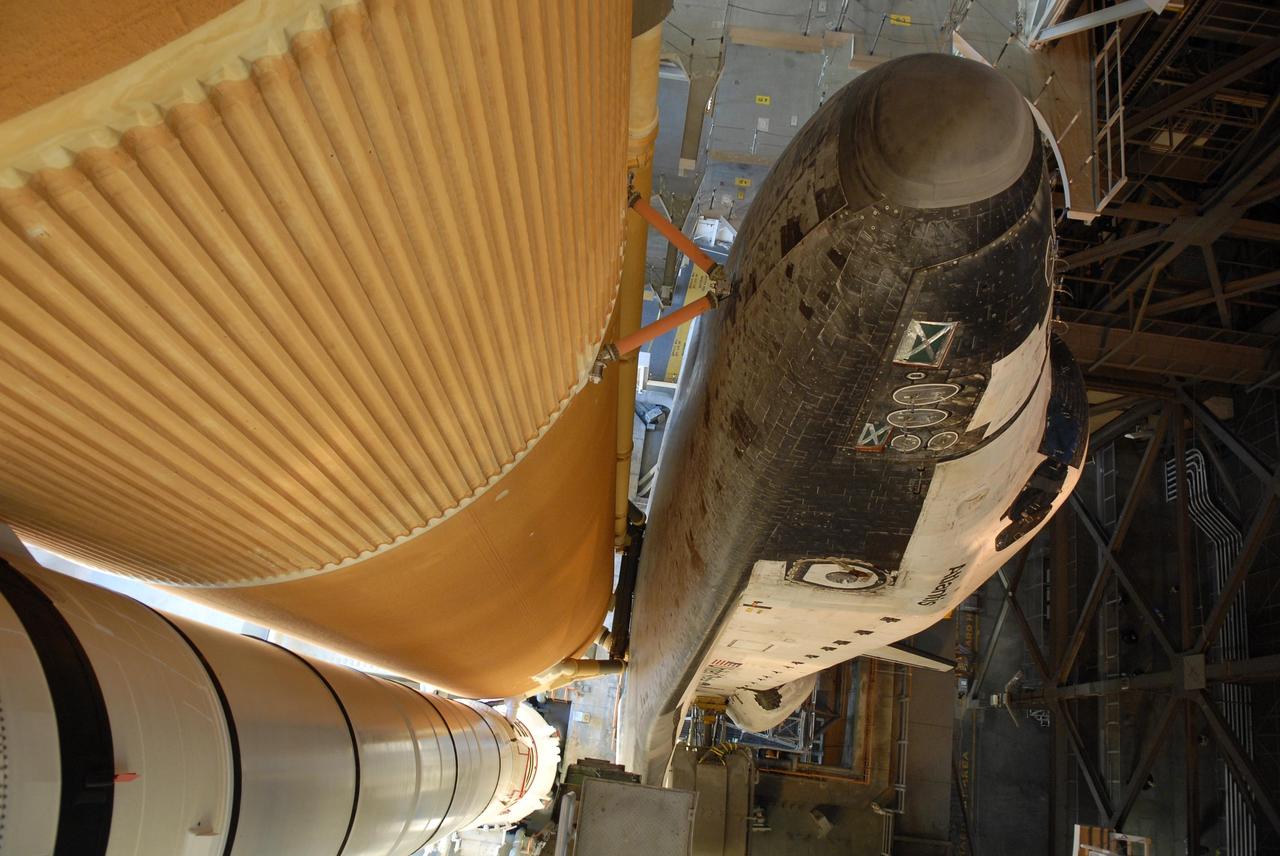
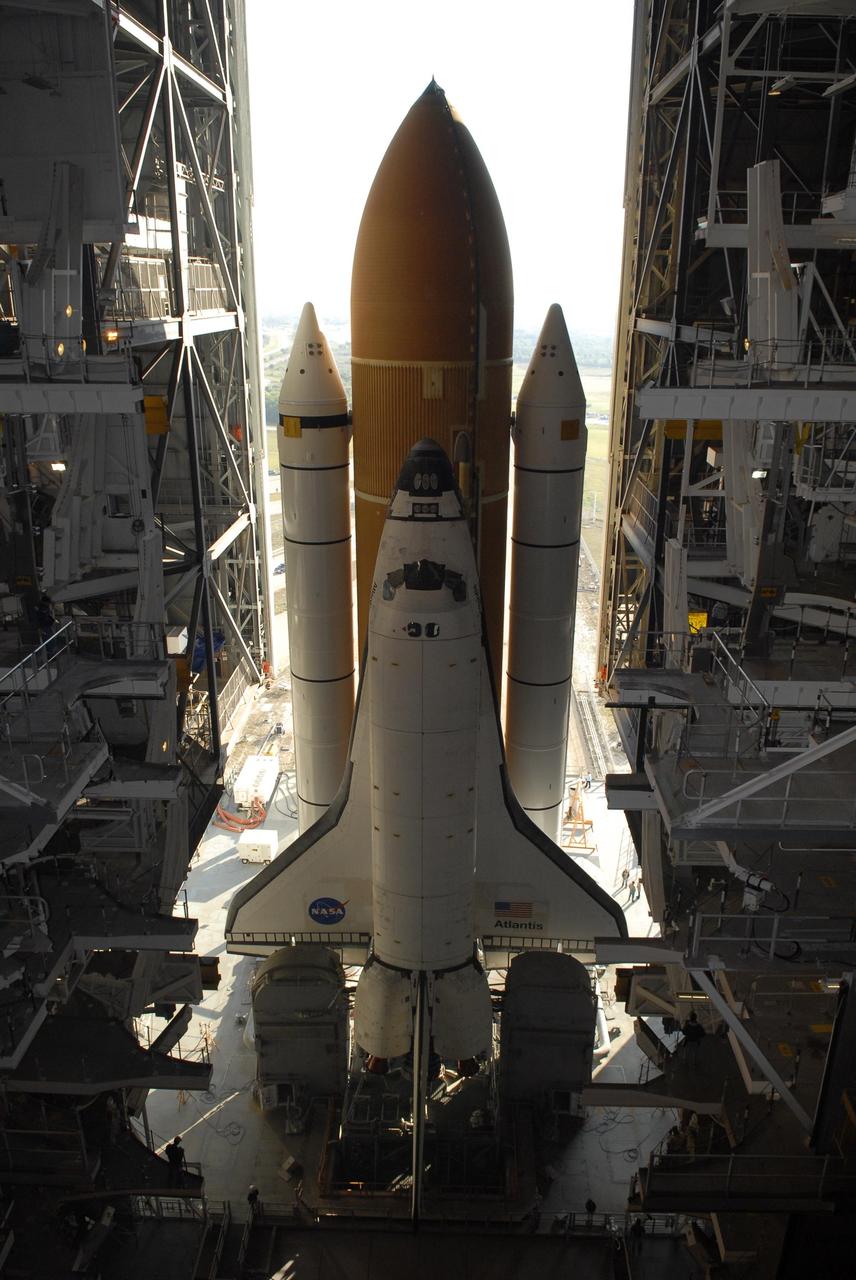
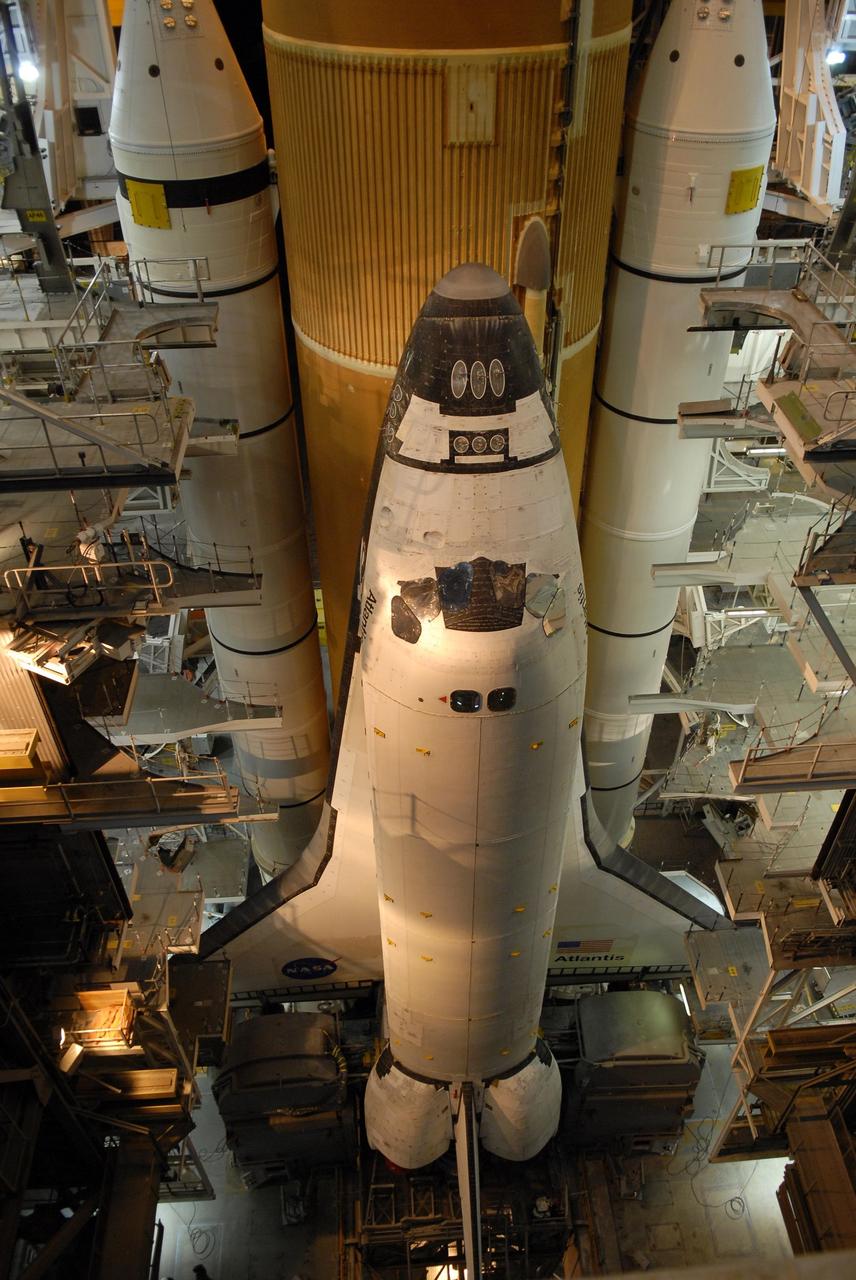
KENNEDY SPACE CENTER, FLA. --  Space Shuttle Atlantis is poised inside the Vehicle Assembly Building to begin its slow rollout to Launch Pad 39A.  A shuttle comprises the orbiter, external tank and twin solid rocket boosters. The 3.4-mile trip along the crawlerway will take about 6 hours. The mission payload aboard Space Shuttle Atlantis is the S3/S4 integrated truss structure, along with a third set of solar arrays and batteries. The crew of six astronauts will install the truss to continue assembly of the International Space Station.  Launch is targeted for March 15.  Photo credit: NASA/Kim Shiflett
KSC-07pd0376
KENNEDY SPACE CENTER, FLA. --   The morning light streams through the open door of the Vehicle Assembly Building as Space Shuttle Atlantis begins rolling out to Launch Pad 39A.  First motion was at 8:19 a.m. The 3.4-mile trip along the crawlerway will take about 6 hours. The mission payload aboard Space Shuttle Atlantis is the S3/S4 integrated truss structure, along with a third set of solar arrays and batteries. The crew of six astronauts will install the truss to continue assembly of the International Space Station.  Launch is targeted for March 15.  Photo credit: NASA/Kim Shiflett
KSC-07pd0379
KENNEDY SPACE CENTER, Fla. --  Before dawn, the payload canister (left) with the Integrated Truss Structure Z1 moves slowly up the crawlerway ramp on Launch Pad 39A toward Space Shuttle Discovery in the background. The canister will be lifted up the Rotating Service Structure to the Payload Changeout Room where the Z1 will be removed and transferred to Discovery’s payload bay. The Z1 truss is the first of 10 that will become the backbone of the International Space Station, eventually stretching the length of a football field. Along with its companion payload, the third Pressurized Mating Adapter, the Z1 is scheduled to be launched aboard Discovery Oct. 5 at 9:38 p.m. EDT
KSC00pp1350
KENNEDY SPACE CENTER, Fla. -- As the early morning light casts a glow over the landscape, Space Shuttle Atlantis moves slowly along the crawlerway for the trek to Launch Pad 39A (upper left). The Shuttle has been in the VAB undergoing tests on the solid rocket booster cables. A prior extensive evaluation of NASA’s SRB cable inventory on the shelf revealed conductor damage in four (of about 200) cables. Shuttle managers decided to prove the integrity of the system tunnel cables already on Atlantis, causing return of the Shuttle to the VAB a week ago. Launch of Atlantis on STS-98 has been rescheduled to Feb. 7 at 6:11 p.m. EST
KSC01padig030
KENNEDY SPACE CENTER, FLA. --  Across the expanse of the turn basin, Space Shuttle Atlantis is seen as it creeps toward Launch Pad 39A.  At left is the 525-foot-tall Vehicle Assembly Building. First motion was at 8:19 a.m. The 3.4-mile trip along the crawlerway will take about 6 hours. The mission payload aboard Space Shuttle Atlantis is the S3/S4 integrated truss structure, along with a third set of solar arrays and batteries. The crew of six astronauts will install the truss to continue assembly of the International Space Station.  Launch is targeted for March 15.  Photo credit: NASA/Kim Shiflett
KSC-07pd0383
KENNEDY SPACE CENTER, Fla. -- Photographed from the top of the Vehicle Assembly Building, Space Shuttle Atlantis creeps along the crawlerway for the trek to Launch Pad 39A (upper left). In the background is the Atlantic Ocean. The Shuttle has been in the VAB undergoing tests on the solid rocket booster cables. A prior extensive evaluation of NASA’s SRB cable inventory on the shelf revealed conductor damage in four (of about 200) cables. Shuttle managers decided to prove the integrity of the system tunnel cables already on Atlantis, causing return of the Shuttle to the VAB a week ago. Launch of Atlantis on STS-98 has been rescheduled to Feb. 7 at 6:11 p.m. EST
KSC-01PADIG-031
CAPE CANAVERAL, Fla. – At NASA's Kennedy Space Center in Florida, space shuttle Endeavour reaches the fork in the crawlerway between Launch Pad 39B, at left, and Launch Pad 39A.  First motion of the 3.4-mile rollaround was at 3:16 a.m. EDT.  Endeavour was on standby on Pad 39B to be used in the unlikely event that a rescue mission was necessary during space shuttle Atlantis' STS-125 mission to NASA's Hubble Space Telescope. The payload on the STS-127 mission includes the Japan Aerospace Exploration Agency's Kibo Exposed Facility and the Experiment Logistics Module Exposed Section of the International Space Station. They will be installed on the Kibo laboratory already on the station. Launch of STS-127 is targeted for June 13. Photo credit: NASA/Kim Shiflett
KSC-2009-3329
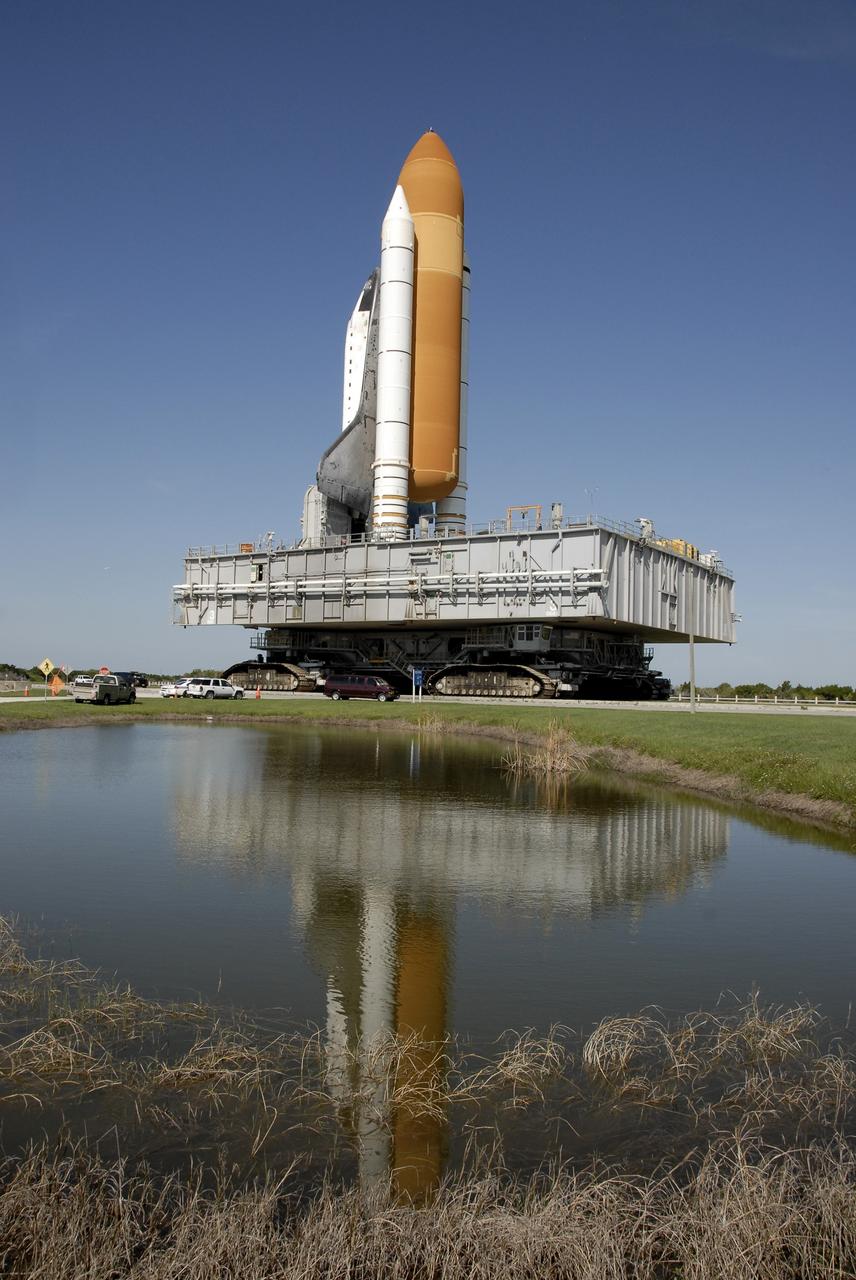
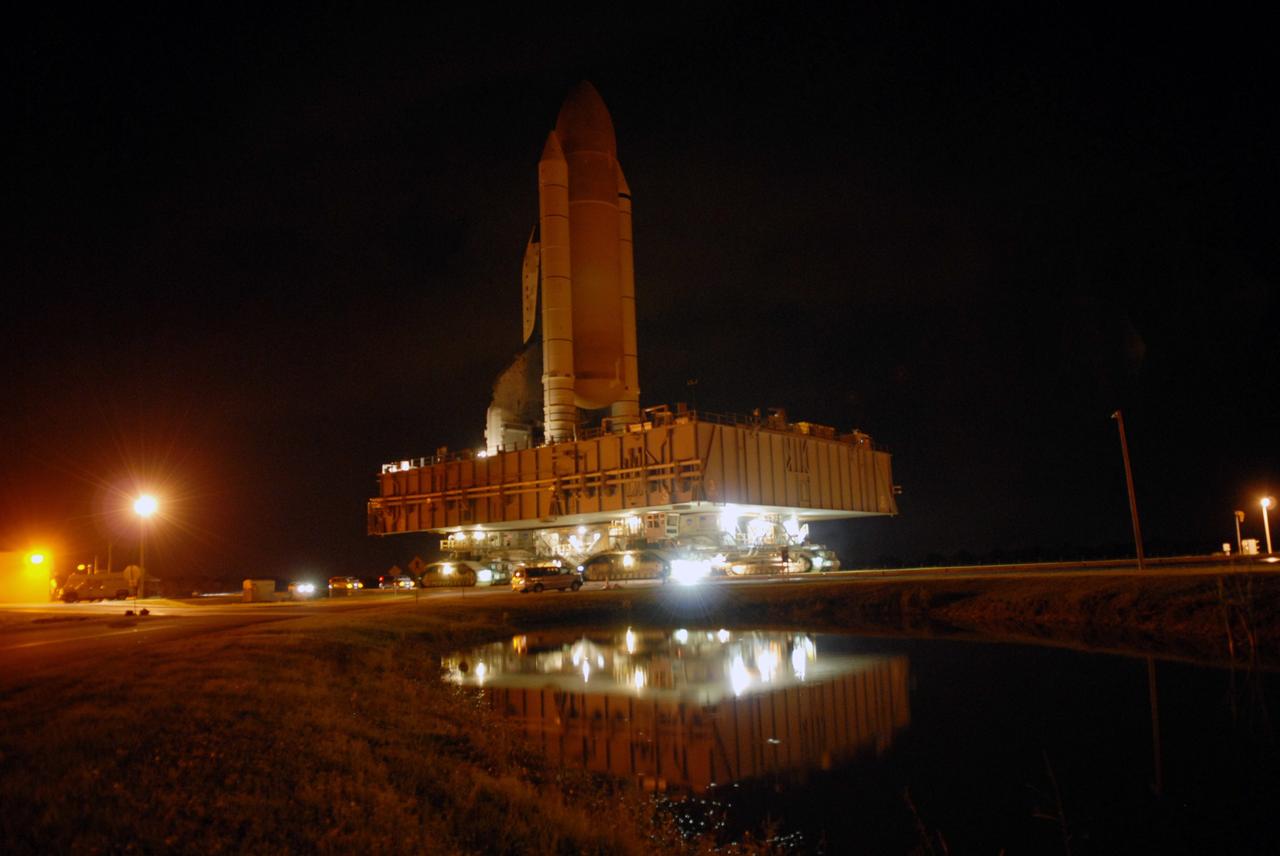
CAPE CANAVERAL, Fla. – At NASA's Kennedy Space Center in Florida, space shuttle Endeavour is reflected in standing water near the crawlerway on its trek to Launch Pad 39A.   First motion of the 3.4-mile rollaround from Launch Pad 39B was at 3:16 a.m. EDT.  Endeavour was on standby on Pad 39B to be used in the unlikely event that a rescue mission was necessary during space shuttle Atlantis' STS-125 mission to NASA's Hubble Space Telescope. The payload on Endeavour's next mission, STS-127, includes the Japan Aerospace Exploration Agency's Kibo Exposed Facility and the Experiment Logistics Module Exposed Section of the International Space Station. They will be installed on the Kibo laboratory already on the station. Launch of STS-127 is targeted for June 13. Photo credit: NASA/Kim Shiflett
KSC-2009-3335
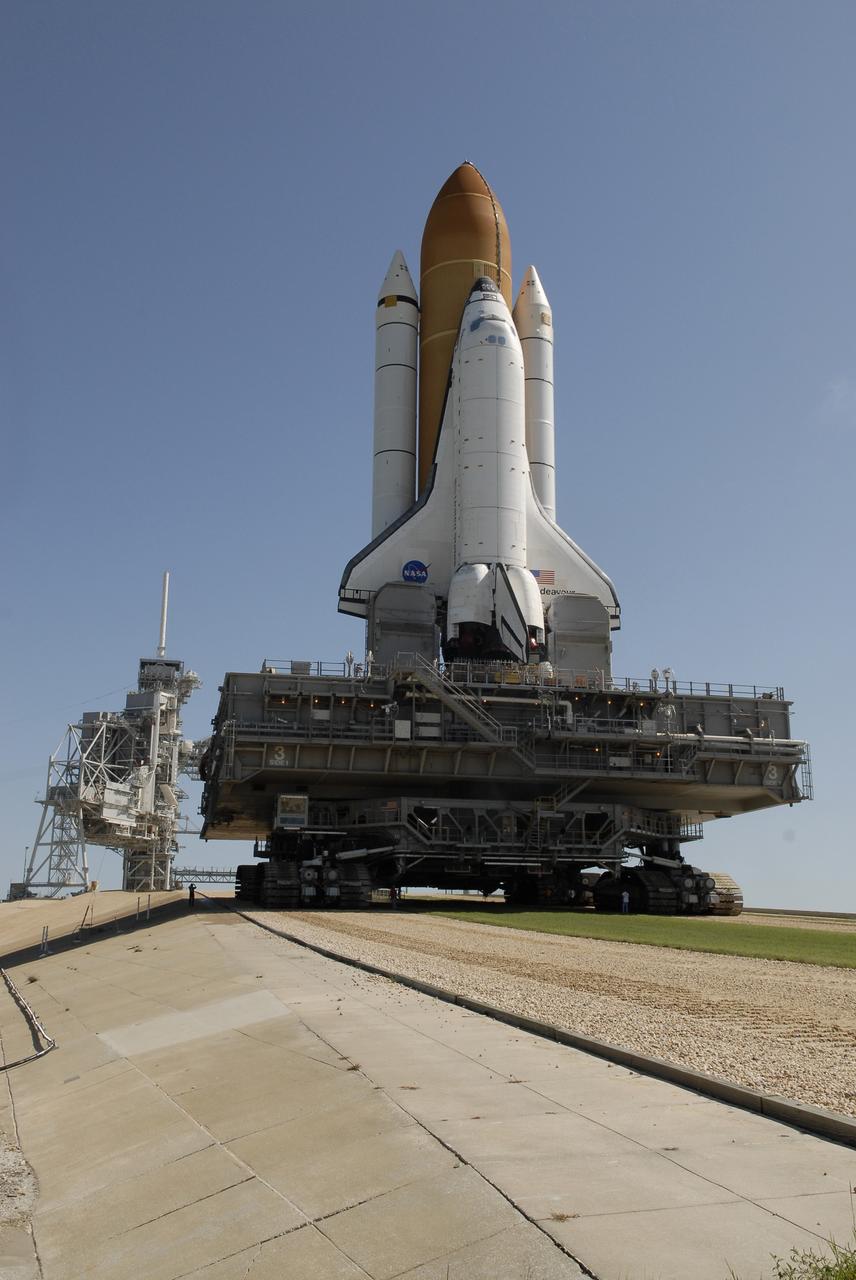
CAPE CANAVERAL, Fla. – At NASA's Kennedy Space Center in Florida, space shuttle Endeavour climbs the five percent grade of the crawlerway to the hardstand on Launch Pad 39A.   First motion of the 3.4-mile rollaround from Launch Pad 39B was at 3:16 a.m. EDT. Endeavour was on standby on Pad 39B to be used in the unlikely event that a rescue mission was necessary during space shuttle Atlantis' STS-125 mission to NASA's Hubble Space Telescope. The payload on Endeavour's next mission, STS-127, includes the Japan Aerospace Exploration Agency's Kibo Exposed Facility and the Experiment Logistics Module Exposed Section of the International Space Station. They will be installed on the Kibo laboratory already on the station. Launch of STS-127 is targeted for June 13. Photo credit: NASA/Kim Shiflett
KSC-2009-3338
CAPE CANAVERAL, Fla. – At NASA's Kennedy Space Center in Florida, space shuttle Endeavour passes the fork in the crawlerway between Launch Pad 39B, at right, and Launch Pad 39A.  First motion of the 3.4-mile rollaround was at 3:16 a.m. EDT.  Endeavour was on standby on Pad 39B to be used in the unlikely event that a rescue mission was necessary during space shuttle Atlantis' STS-125 mission to NASA's Hubble Space Telescope. The payload on the STS-127 mission includes the Japan Aerospace Exploration Agency's Kibo Exposed Facility and the Experiment Logistics Module Exposed Section of the International Space Station. They will be installed on the Kibo laboratory already on the station. Launch of STS-127 is targeted for June 13. Photo credit: NASA/Kim Shiflett
KSC-2009-3330
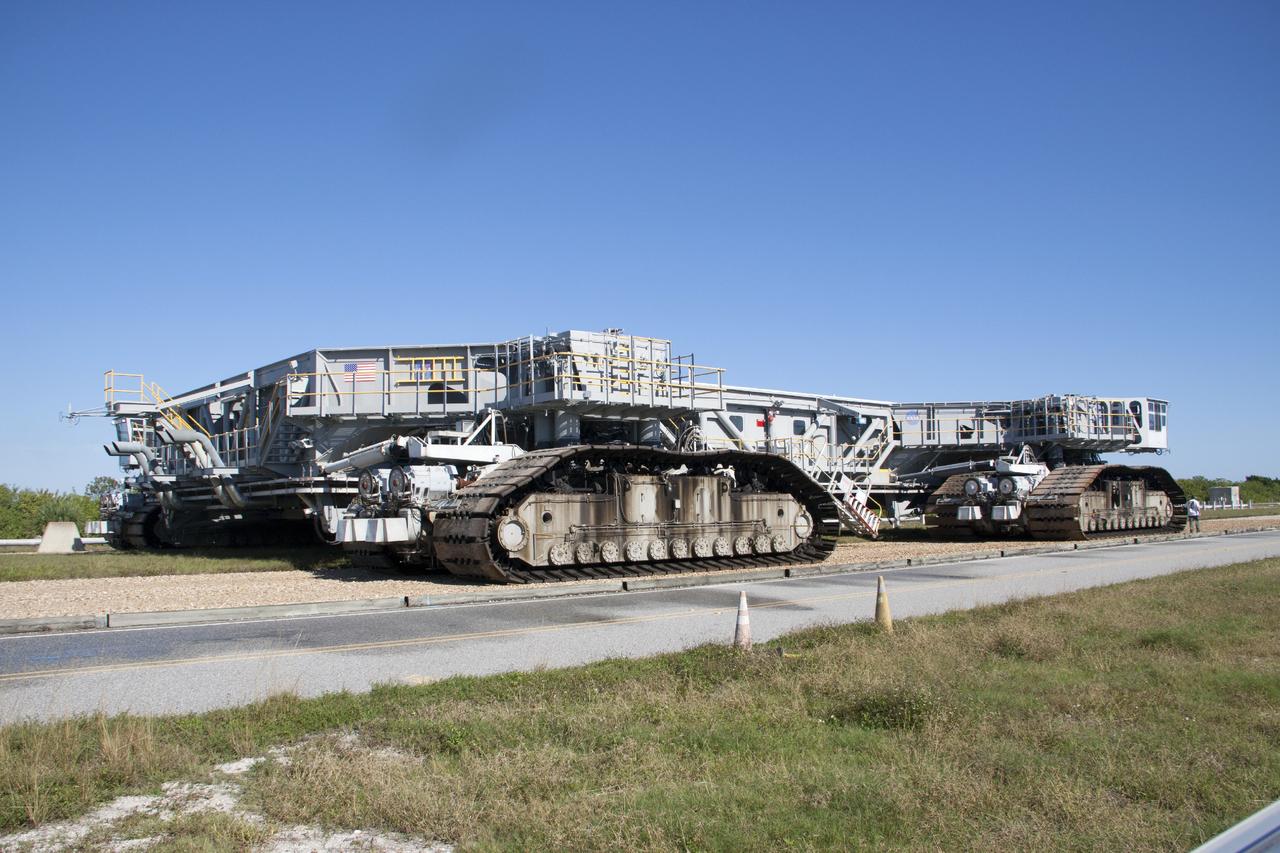
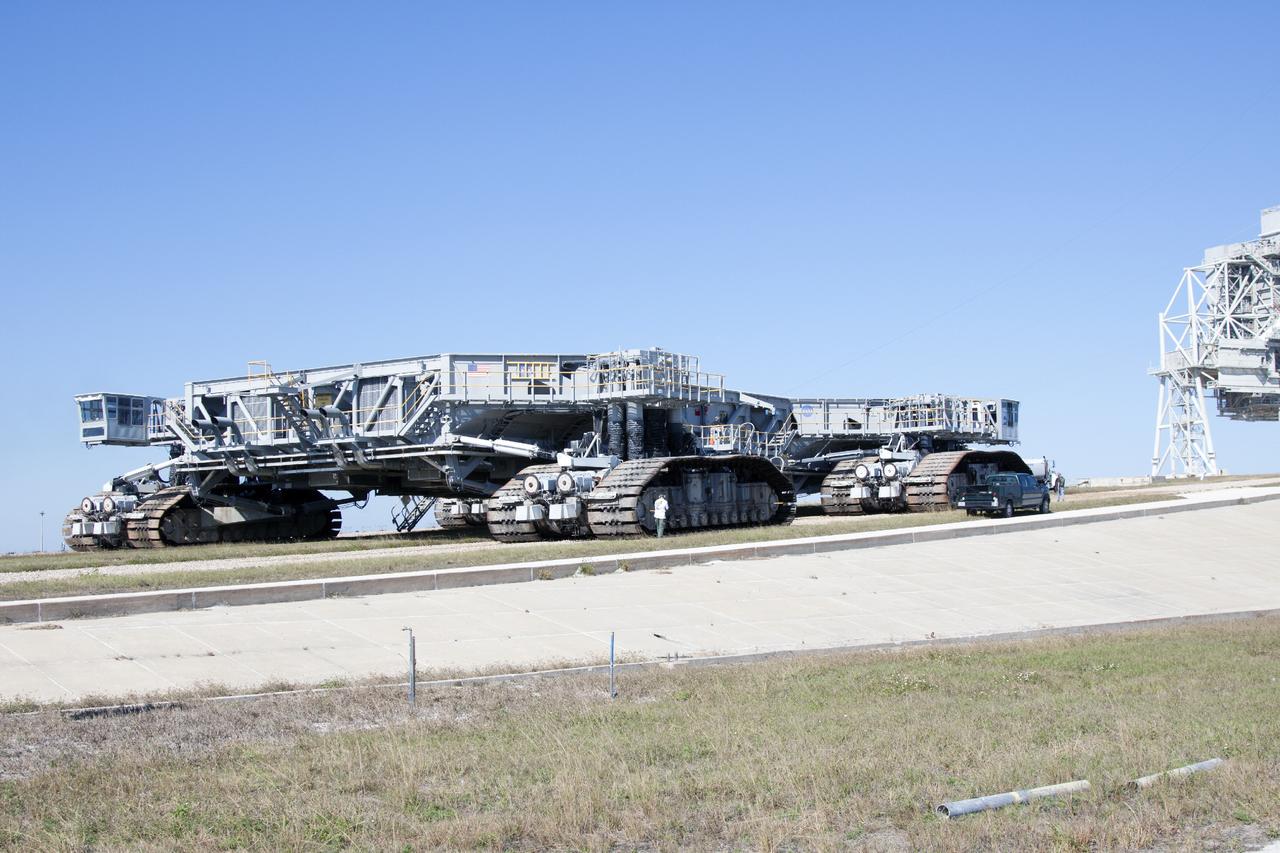
CAPE CANAVERAL, Fla. – Crawler-transporter 2, or CT-2, travels along the crawlerway toward the Vehicle Assembly Building at NASA’s Kennedy Space Center in Florida. The Ground Systems Development and Operations Program completed a roller bearing assembly test on CT-2 truck sections A and C. The left- and right-hand steering was tested in both directions. The temperature of the roller assemblies was monitored and recorded as it traveled along the crawlerway. Engineers and technicians performed visual inspections of the roller bearing pumps, valves and lines to ensure that the grease injectors worked properly and provided the required flow of grease to the new roller assemblies.  Work continues in high bay 2 to upgrade CT-2. The modifications are designed to ensure CT-2’s ability to transport launch vehicles currently in development, such as the agency’s Space Launch System, to the launch pad. The Ground Systems Development and Operations Program office at Kennedy is overseeing the upgrades. For more than 45 years the crawler-transporters were used to transport the mobile launcher platform and the Apollo-Saturn V rockets and, later, space shuttles to Launch Pads 39A and B. For more information, visit: http:__www.nasa.gov_exploration_systems_ground_crawler-transporter. Photo credit: NASA_Kim Shiflett
KSC-2014-1310
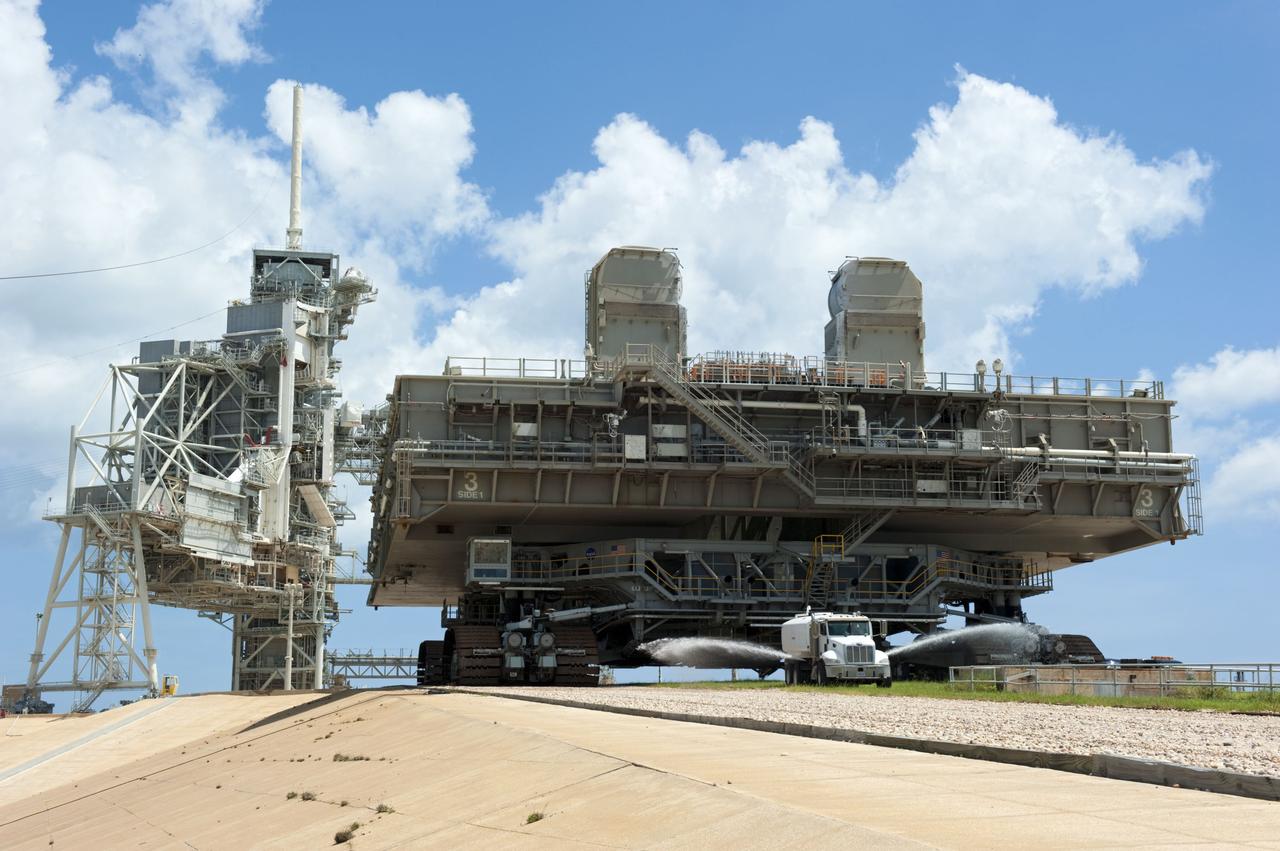
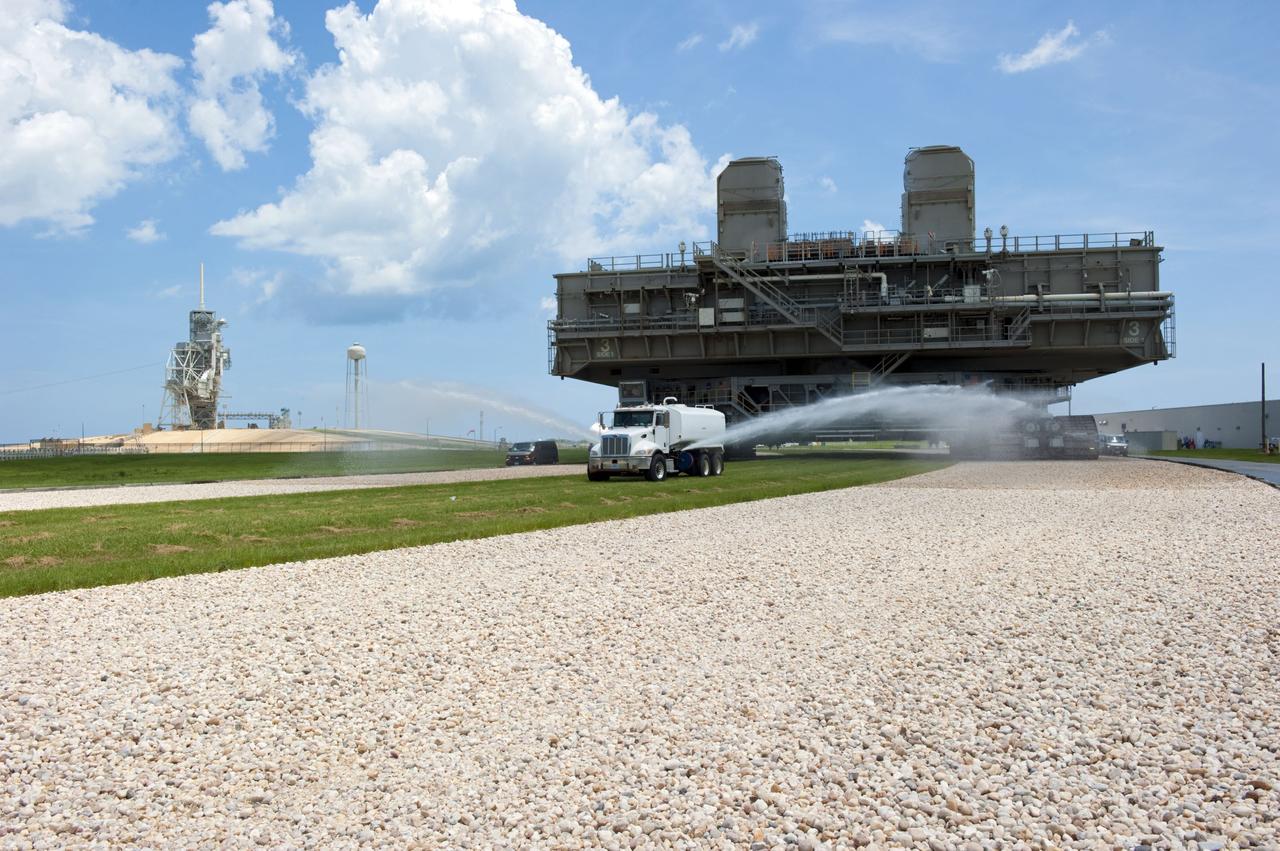
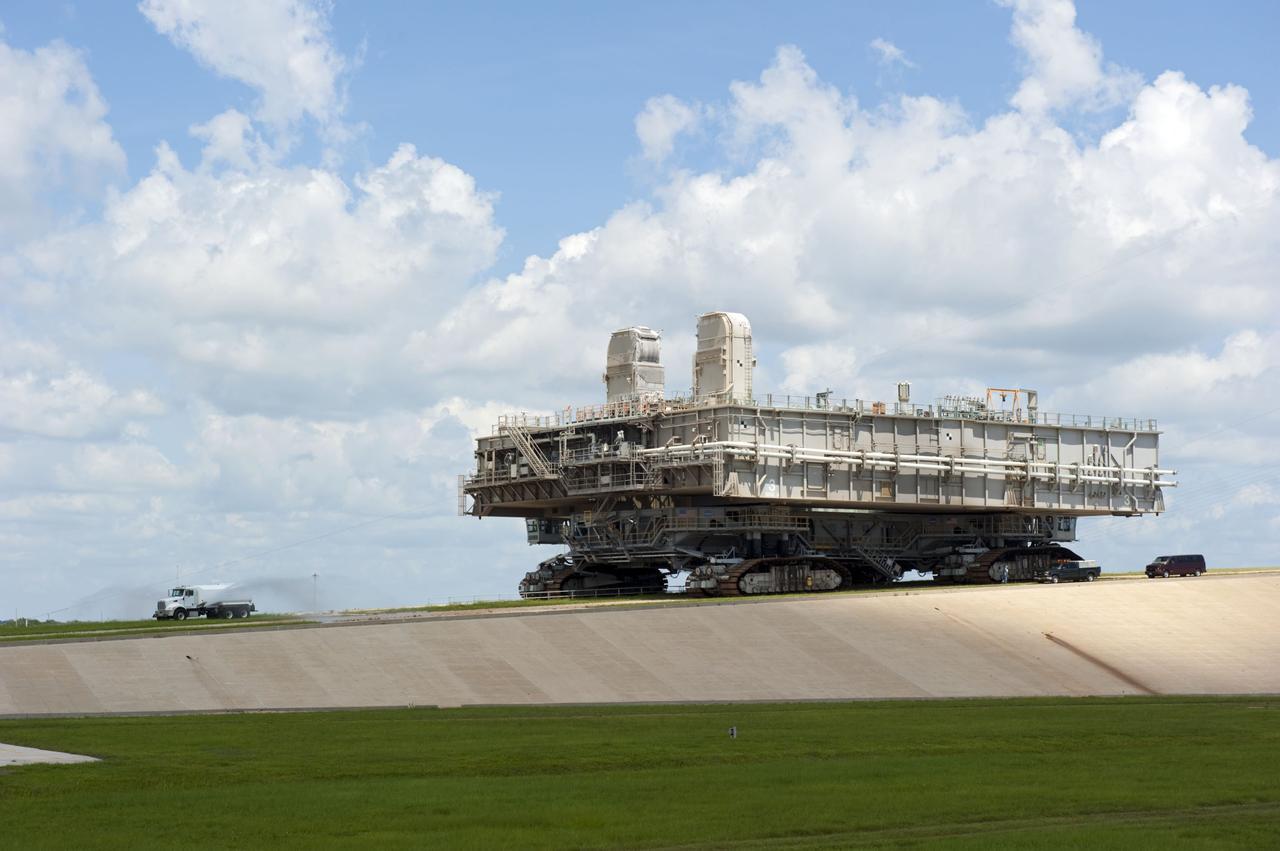
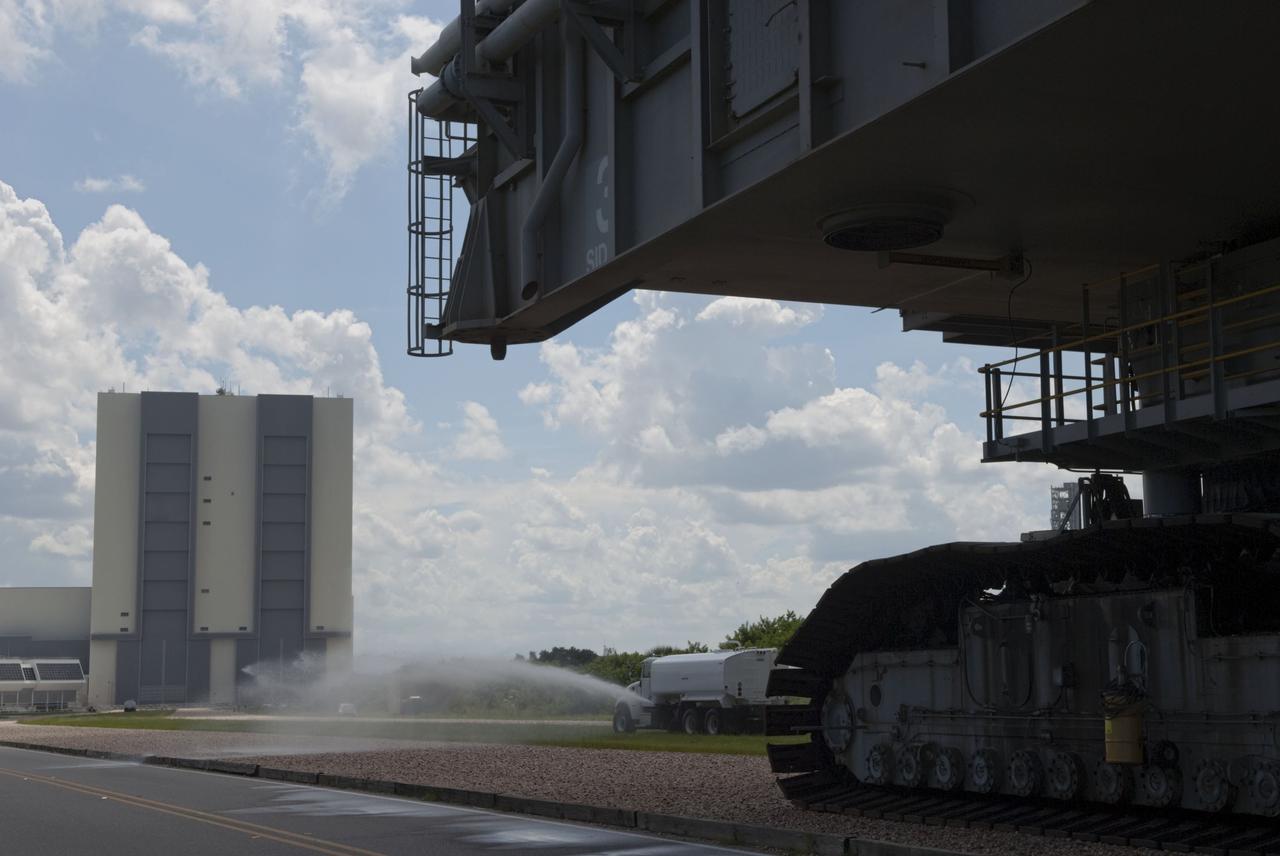
CAPE CANAVERAL, Fla. -- At NASA's Kennedy Space Center in Florida, Mobile Launcher Platform-3 (MLP), which supported space shuttle Atlantis for its final flight to the International Space Station on the STS-135 mission, is taking its last journey from Launch Pad 39A to the Vehicle Assembly Building (VAB). A massive crawler-transporter positioned under the MLP -- the last mobile launcher platform to launch a shuttle, begins the trek back to the VAB. A water truck leads the way spraying water on the dry crawlerway to reduce dust particles in the air.                     For more than 40 years, the MLPs have traveled between the massive VAB to both launch pads at Launch Complex 39, and then returned to the VAB for future use. MLP-3 was first used to launch Columbia on the STS-32 mission on Jan. 9, 1990. Photo credit: NASA/Kim Shiflett
KSC-2011-5590
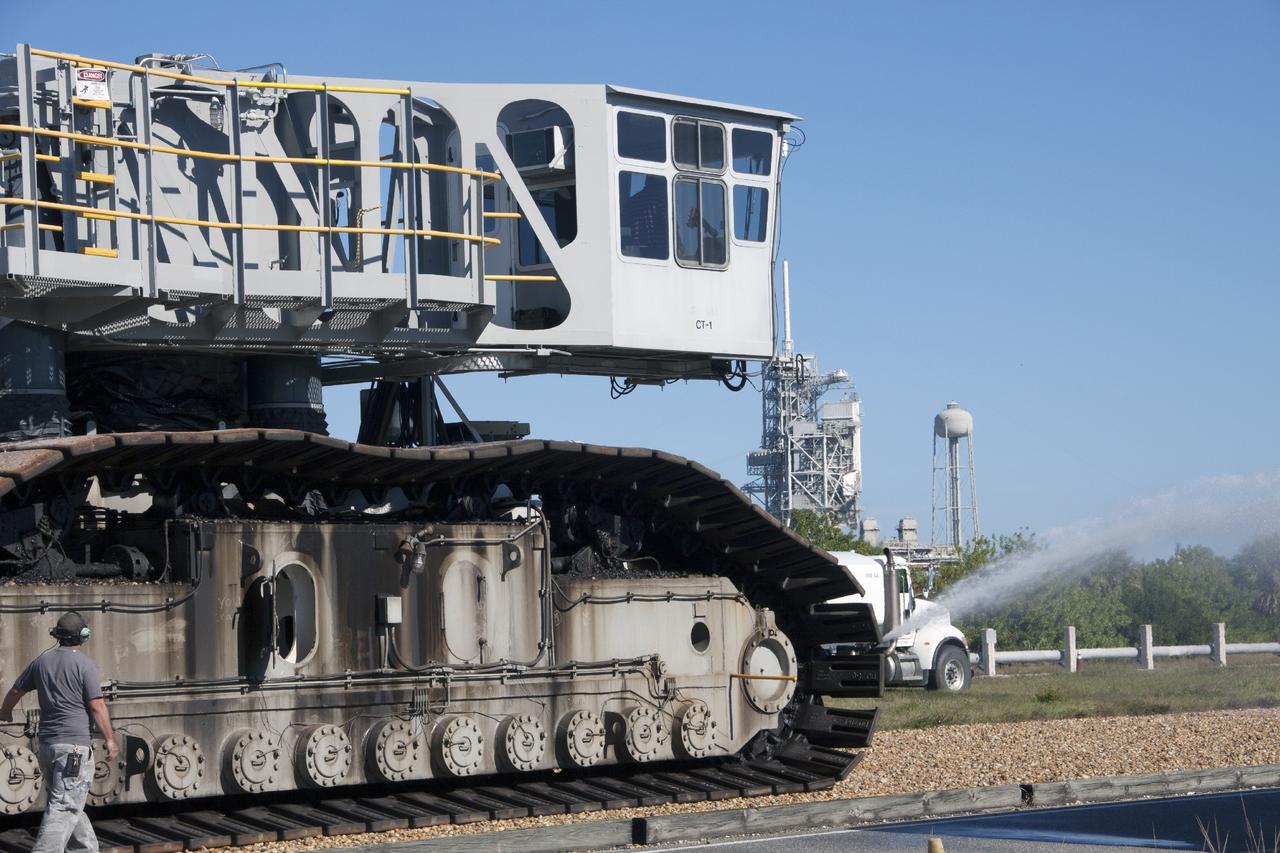
CAPE CANAVERAL, Fla. -- A driver works the controls inside the cab on crawler-transporter 1 as it makes the trek on the crawlerway to Launch Pad 39A at NASA’s Kennedy Space Center in Florida. New jacking, equalizing and leveling, or JEL, hydraulic cylinders were installed on CT-1. They will be tested for increased load carrying capacity and reliability.    The Ground Systems Development and Operations Program at Kennedy continues to upgrade the crawler-transporter as part of its general maintenance. CT-1 could be available to carry a variety of launch vehicles to the launch pad. Two crawler-transporters were used to carry the mobile launcher platform and space shuttle to Launch Complex 39 for space shuttle launches for 30 years. Photo credit: NASA/Jim Grossmann
KSC-2013-4209
CAPE CANAVERAL, Fla. -- Crawler-transporter 1 continues its trek along the crawlerway to Launch Pad 39A at NASA’s Kennedy Space Center in Florida. New jacking, equalizing and leveling, or JEL, hydraulic cylinders were installed on CT-1 and are being tested for increased load carrying capacity and reliability.     The Ground Systems Development and Operations Program at Kennedy continues to upgrade the crawler-transporter as part of its general maintenance. CT-1 could be available to carry a variety of launch vehicles to the launch pad. Two crawler-transporters were used to carry the mobile launcher platform and space shuttle to Launch Complex 39 for space shuttle launches for 30 years. Photo credit: NASA/Daniel Casper
KSC-2013-4206
CAPE CANAVERAL, Fla. -- At NASA's Kennedy Space Center in Florida, Mobile Launcher Platform-3 (MLP), which supported space shuttle Atlantis for its final flight to the International Space Station on the STS-135 mission, is taking its last journey from Launch Pad 39A to the Vehicle Assembly Building (VAB). A massive crawler-transporter positioned under the MLP -- the last mobile launcher platform to launch a shuttle, begins the trek back to the VAB. A water truck leads the way spraying water on the dry crawlerway to reduce dust particles in the air.                     For more than 40 years, the MLPs have traveled between the massive VAB to both launch pads at Launch Complex 39, and then returned to the VAB for future use. MLP-3 was first used to launch Columbia on the STS-32 mission on Jan. 9, 1990. Photo credit: NASA/Kim Shiflett
KSC-2011-5594
CAPE CANAVERAL, Fla. -- Ground support equipment technicians monitor the progress as crawler-transporter 1 continues its trek along the crawlerway to Launch Pad 39A at NASA’s Kennedy Space Center in Florida. New jacking, equalizing and leveling, or JEL, hydraulic cylinders were installed on CT-1 and are being tested for increased load carrying capacity and reliability.     The Ground Systems Development and Operations Program at Kennedy continues to upgrade the crawler-transporter as part of its general maintenance. CT-1 could be available to carry a variety of launch vehicles to the launch pad. Two crawler-transporters were used to carry the mobile launcher platform and space shuttle to Launch Complex 39 for space shuttle launches for 30 years. Photo credit: NASA/Daniel Casper
KSC-2013-4207
CAPE CANAVERAL, Fla. -- At NASA's Kennedy Space Center in Florida, Mobile Launcher Platform-3 (MLP), which supported space shuttle Atlantis for its final flight to the International Space Station on the STS-135 mission, is taking its last journey from Launch Pad 39A to the Vehicle Assembly Building (VAB). A massive crawler-transporter positioned under the MLP -- the last mobile launcher platform to launch a shuttle, begins the trek back to the VAB. A water truck leads the way spraying water on the dry crawlerway to reduce dust particles in the air.                     For more than 40 years, the MLPs have traveled between the massive VAB to both launch pads at Launch Complex 39, and then returned to the VAB for future use. MLP-3 was first used to launch Columbia on the STS-32 mission on Jan. 9, 1990. Photo credit: NASA/Kim Shiflett
KSC-2011-5588
CAPE CANAVERAL, Fla. -- A truck sprays water along the crawlerway to reduce dust ahead of crawler-transporter 1 as it continues its trek to Launch Pad 39A at NASA’s Kennedy Space Center in Florida. New jacking, equalizing and leveling, or JEL, hydraulic cylinders were installed on CT-1 and will be tested for increased load carrying capacity and reliability.    The Ground Systems Development and Operations Program at Kennedy continues to upgrade the crawler-transporter as part of its general maintenance. CT-1 could be available to carry a variety of launch vehicles to the launch pad. Two crawler-transporters were used to carry the mobile launcher platform and space shuttle to Launch Complex 39 for space shuttle launches for 30 years. Photo credit: NASA/Jim Grossmann
KSC-2013-4208
CAPE CANAVERAL, Fla. -- At NASA's Kennedy Space Center in Florida, Mobile Launcher Platform-3 (MLP), which supported space shuttle Atlantis for its final flight to the International Space Station on the STS-135 mission, is taking its last journey from Launch Pad 39A to the Vehicle Assembly Building (VAB). A massive crawler-transporter positioned under the MLP -- the last mobile launcher platform to launch a shuttle, begins the trek back to the VAB. A water truck leads the way spraying water on the dry crawlerway to reduce dust particles in the air.                     For more than 40 years, the MLPs have traveled between the massive VAB to both launch pads at Launch Complex 39, and then returned to the VAB for future use. MLP-3 was first used to launch Columbia on the STS-32 mission on Jan. 9, 1990. Photo credit: NASA/Kim Shiflett
KSC-2011-5587
CAPE CANAVERAL, Fla. -- A truck sprays water along the crawlerway to reduce dust ahead of crawler-transporter 1 as it begins its trek to Launch Pad 39A at NASA’s Kennedy Space Center in Florida. New jacking, equalizing and leveling, or JEL, hydraulic cylinders were installed on CT-1 and are being tested for increased load carrying capacity and reliability.    The Ground Systems Development and Operations Program at Kennedy continues to upgrade the crawler-transporter as part of its general maintenance. CT-1 could be available to carry a variety of launch vehicles to the launch pad. Two crawler-transporters were used to carry the mobile launcher platform and space shuttle to Launch Complex 39 for space shuttle launches for 30 years. Photo credit: NASA/Daniel Casper
KSC-2013-4202
CAPE CANAVERAL, Fla. – At NASA's Kennedy Space Center in Florida, the crawlerway is sprayed with water to minimize the dust cloud generated by the passing of the crawler-transporter. Space shuttle Atlantis is making its 3.4-mile trek from the Vehicle Assembly Building to Launch Pad 39A in the background. First motion was at 6:38 a.m. EDT Oct. 14. The move, known as rollout, is expected to take about six hours.    Liftoff of Atlantis on its STS-129 mission to the International Space Station is targeted for Nov. 12. For information on the STS-129 mission and crew, visit http://www.nasa.gov/mission_pages/shuttle/shuttlemissions/sts129/index.html. Photo credit: NASA/Kim Shiflett
KSC-2009-5435
CAPE CANAVERAL, Fla. – At NASA's Kennedy Space Center in Florida, a crawler-transporter keeps space shuttle Atlantis level as it travels up the five percent grade to the top of the crawlerway at Launch Complex 39A. First motion on the 3.4-mile trip from the Vehicle Assembly Building, known as rollout, was at 6:38 a.m. EDT Oct. 14. The rollout took about six hours, and the shuttle was secure on the pad at 1:31 p.m.    Liftoff of Atlantis on its STS-129 mission to the International Space Station is targeted for Nov. 12. For information on the STS-129 mission and crew, visit http://www.nasa.gov/mission_pages/shuttle/shuttlemissions/sts129/index.html. Photo credit: NASA/Kim Shiflett
KSC-2009-5440
CAPE CANAVERAL, Fla. -- At NASA's Kennedy Space Center, a crawler transporter moves space shuttle Discovery, secured atop a mobile launch platform, along the crawlerway from the Vehicle Assembly Building to Launch Pad 39A to prepare for the STS-124 mission.  The 3.4-mile journey from the Vehicle Assembly Building began at 11:47 p.m. on May 2.  The shuttle arrived at the launch pad at 4:25 a.m. EDT May 3 and was secured, or hard down, by 6:06 a.m.  On the 13-day mission, Discovery and its crew will deliver the Japan Aerospace Exploration Agency's Japanese Experiment Module – Pressurized Module and the Japanese Remote Manipulator System. Launch is targeted for May 31.  Photo credit: NASA/Troy Cryder
KSC-08pd1101
CAPE CANAVERAL, Fla. -- At NASA's Kennedy Space Center, space shuttle Discovery, secured atop a mobile launch platform, is reflected in water beside the crawlerway as it is moved from the Vehicle Assembly Building to Launch Pad 39A to prepare for the STS-124 mission.  The 3.4-mile journey from the Vehicle Assembly Building began at 11:47 p.m. on May 2.  The shuttle arrived at the launch pad at 4:25 a.m. EDT May 3 and was secured, or hard down, by 6:06 a.m.  On the 13-day mission, Discovery and its crew will deliver the Japan Aerospace Exploration Agency's Japanese Experiment Module – Pressurized Module and the Japanese Remote Manipulator System. Launch is targeted for May 31.  Photo credit: NASA/Troy Cryder
KSC-08pd1102
CAPE CANAVERAL, Fla. -- Modifications continue on the Mobile Launcher, or ML, at the Mobile Launcher Park Site at NASA’s Kennedy Space Center in Florida. In view from the top of the ML is the crawlerway that leads to Launch Pads 39A and 39B. The ML is being modified and strengthened to accommodate the weight, size and thrust at launch of NASA's Space Launch System, or SLS, and Orion spacecraft.    In 2013, the agency awarded a contract to J.P. Donovan Construction Inc. of Rockledge, Fla., to modify the ML, which is one of the key elements of ground support equipment that is being upgraded by the Ground Systems Development and Operations Program office at Kennedy. The existing 24-foot exhaust hole is being enlarged and strengthened for the larger, heavier SLS rocket. The ML will carry the SLS rocket and Orion spacecraft to Launch Pad 39B for its first mission, Exploration Mission-1, in 2017. Photo credit: NASA/Daniel Casper
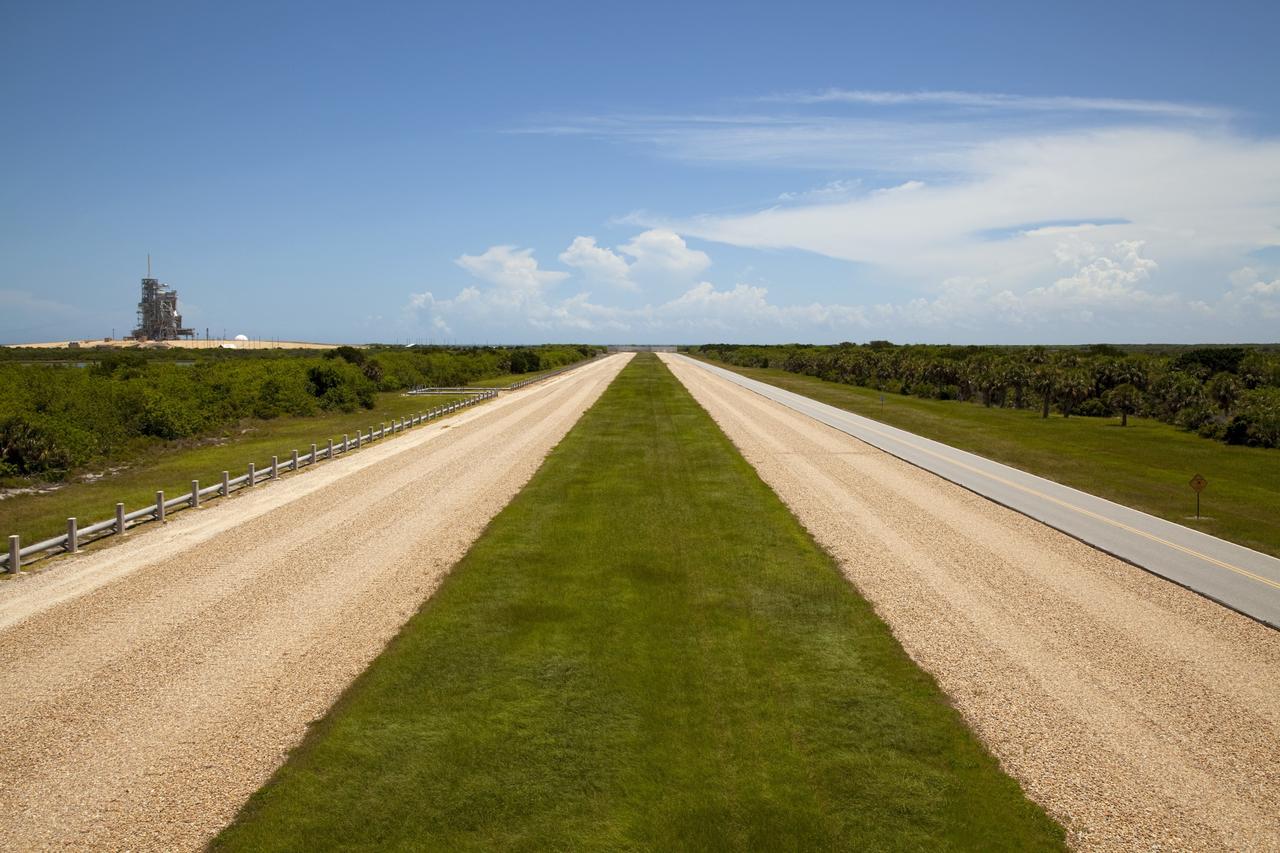
KSC-2014-2891
CAPE CANAVERAL, Fla. -- At NASA's Kennedy Space Center, tread marks from the shoes on the crawler-transporter are visible along the crawlerway leading up to the hardstand on Launch Pad 39A.  Space shuttle Discovery, secured atop the mobile launch platform below, has just arrived for final prelaunch processing for the STS-124 mission. The 3.4-mile journey from the Vehicle Assembly Building began at 11:47 p.m. on May 2.  The shuttle arrived at the launch pad at 4:25 a.m. EDT May 3 and was secured, or hard down, by 6:06 a.m.  On the 13-day mission, Discovery and its crew will deliver the Japan Aerospace Exploration Agency's Japanese Experiment Module – Pressurized Module and the Japanese Remote Manipulator System. Launch is targeted for May 31.  Photo credit: NASA/Troy Cryder
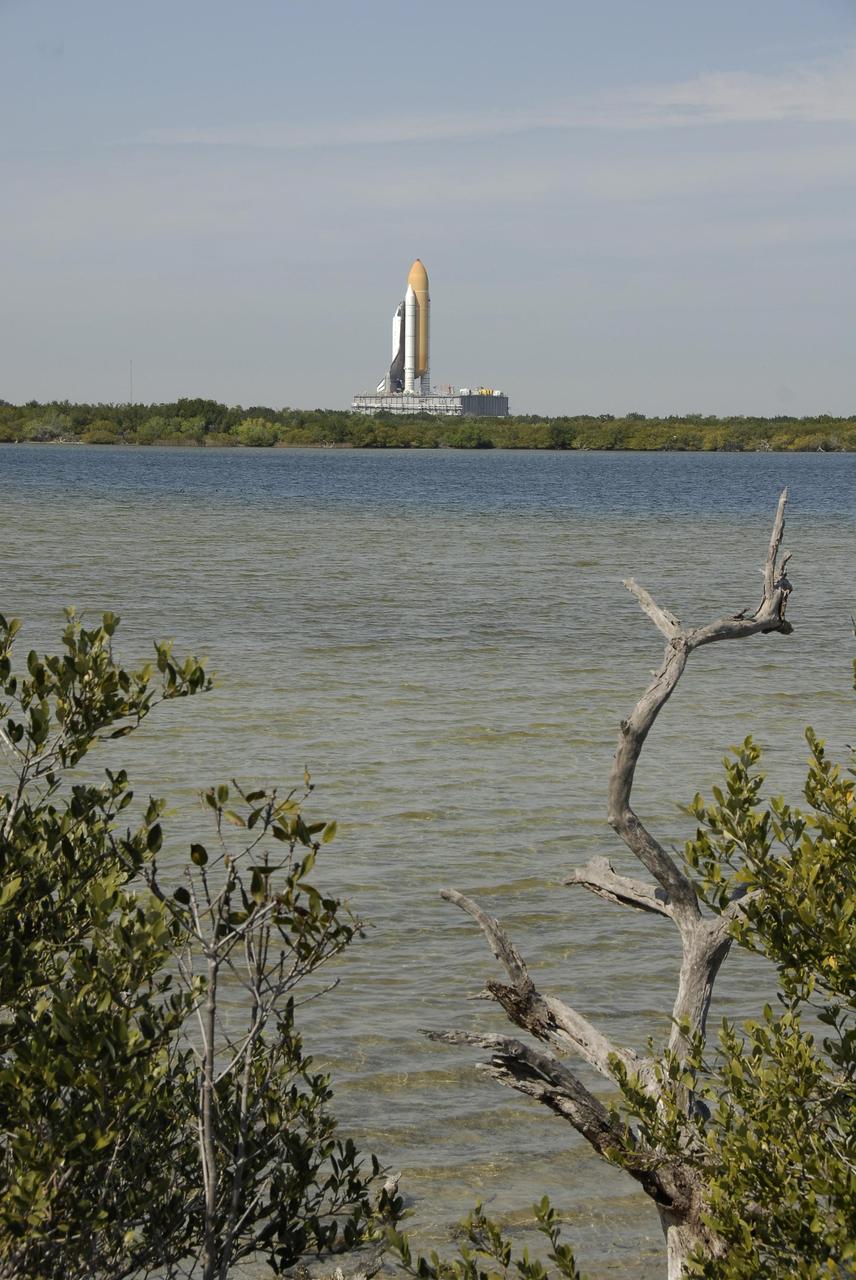
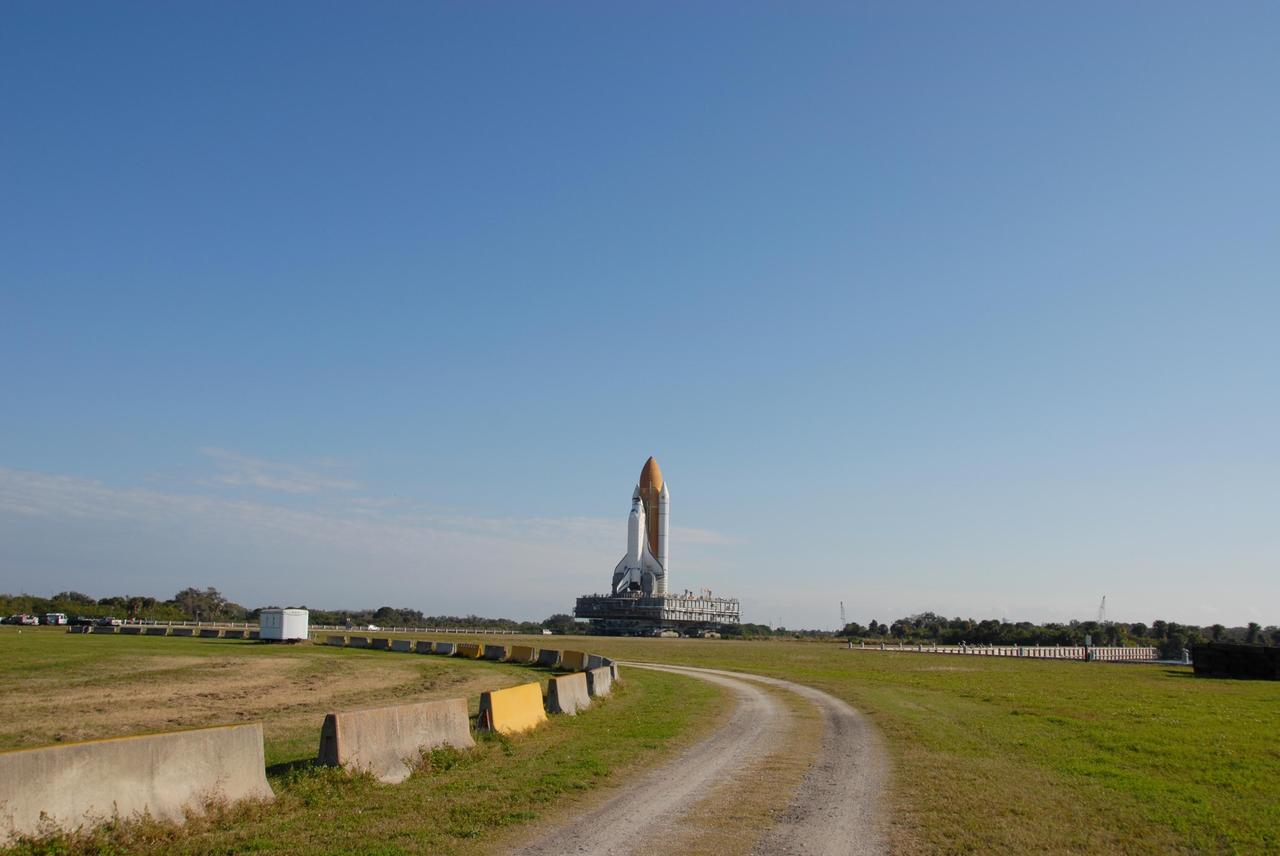
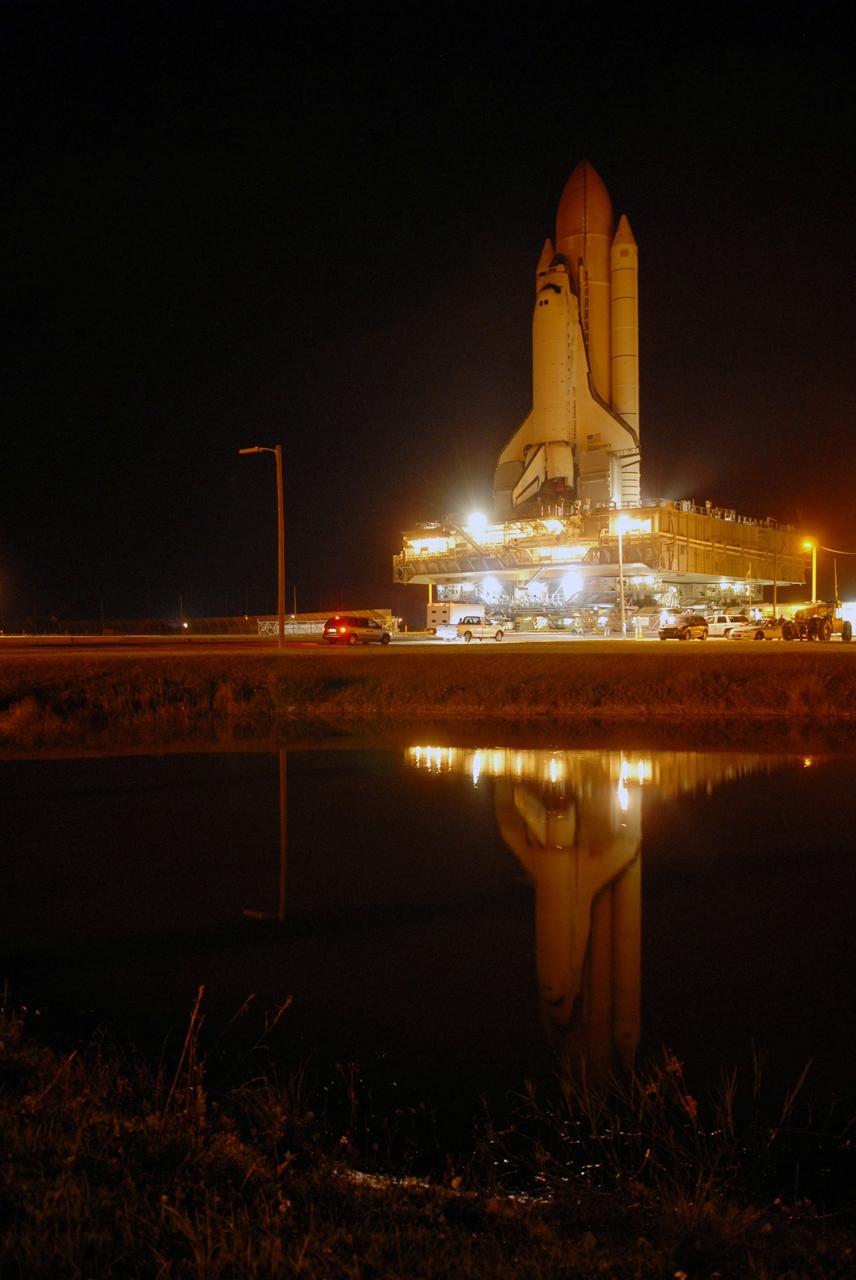
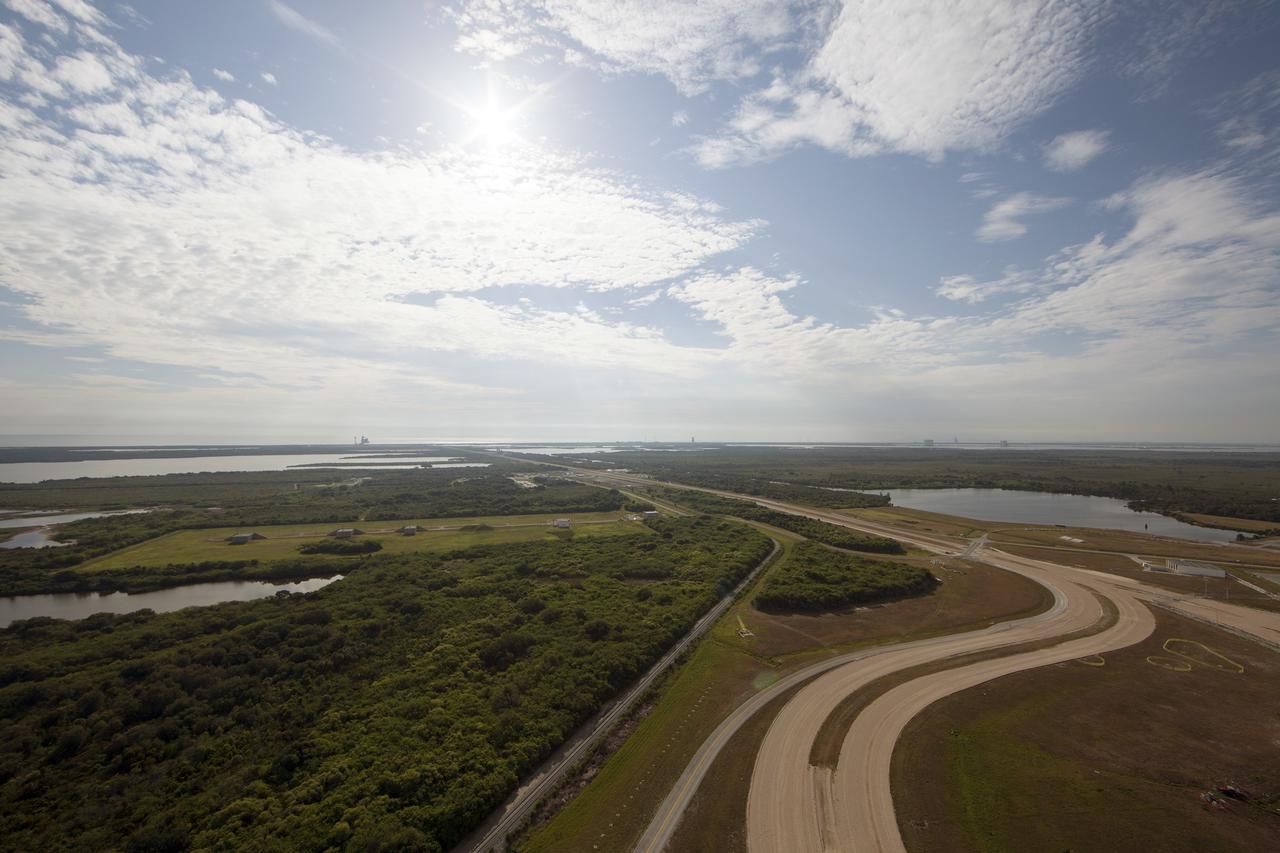
KSC-08pd1112
CAPE CANAVERAL, Fla. - Space shuttle Atlantis (right) rolls toward the Vehicle Assembly Building (far left) via the crawlerway at NASA's Kennedy Space Center in Florida after rolling back from Launch Pad 39A. In the VAB, Atlantis will await launch on its STS-125 mission to repair NASA's Hubble Space Telescope.  Between them is the Pegasus barge in the turn basin.  First motion of Atlantis off the pad was at 6:48 a.m. EDT. The journey was expected to take about six hours. Atlantis' targeted launch on Oct. 14 was delayed when a system that transfers science data from the orbiting observatory to Earth malfunctioned on Sept. 27. The new target launch date is under review.  Photo credit: NASA/Kim Shiflett
KSC-08pd3273