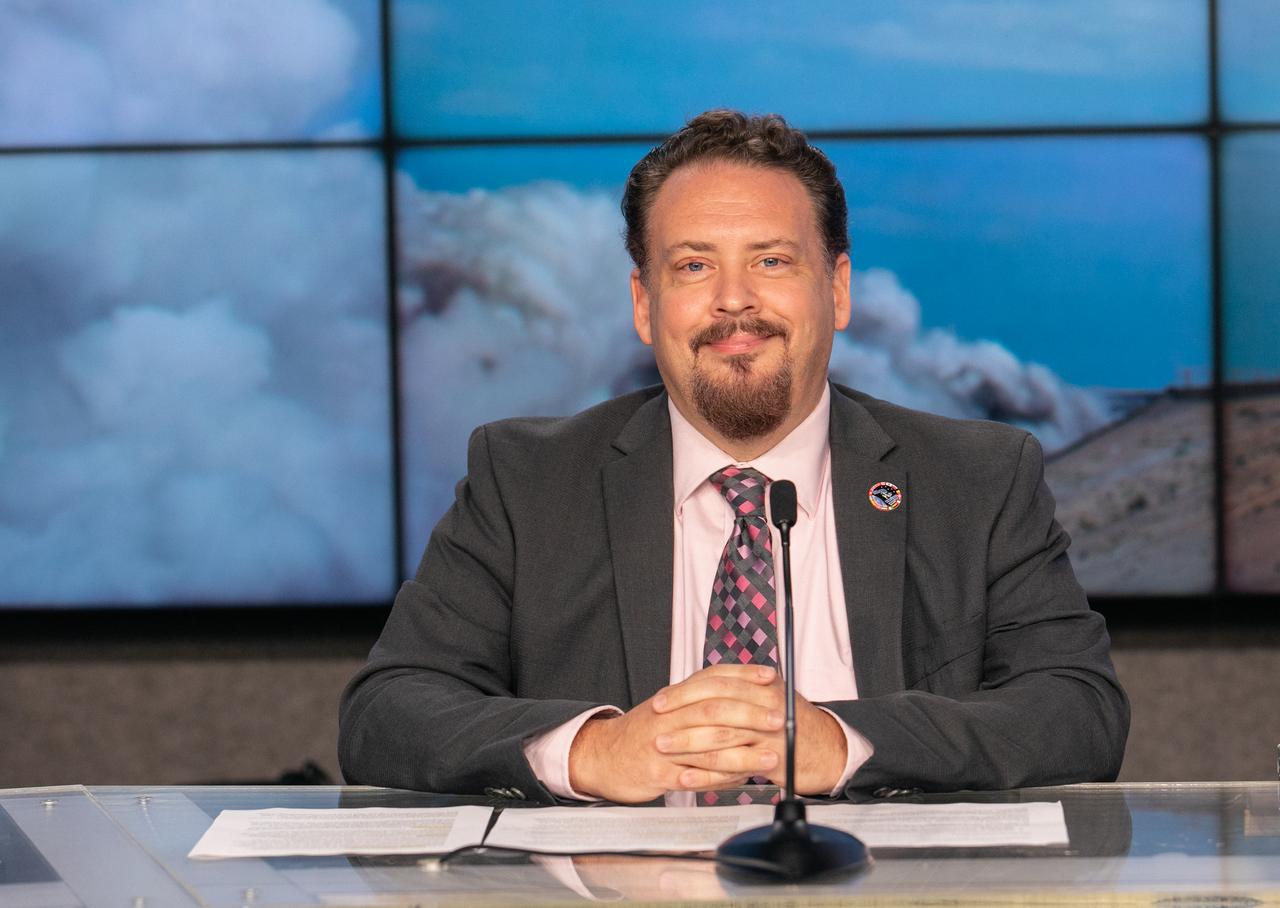
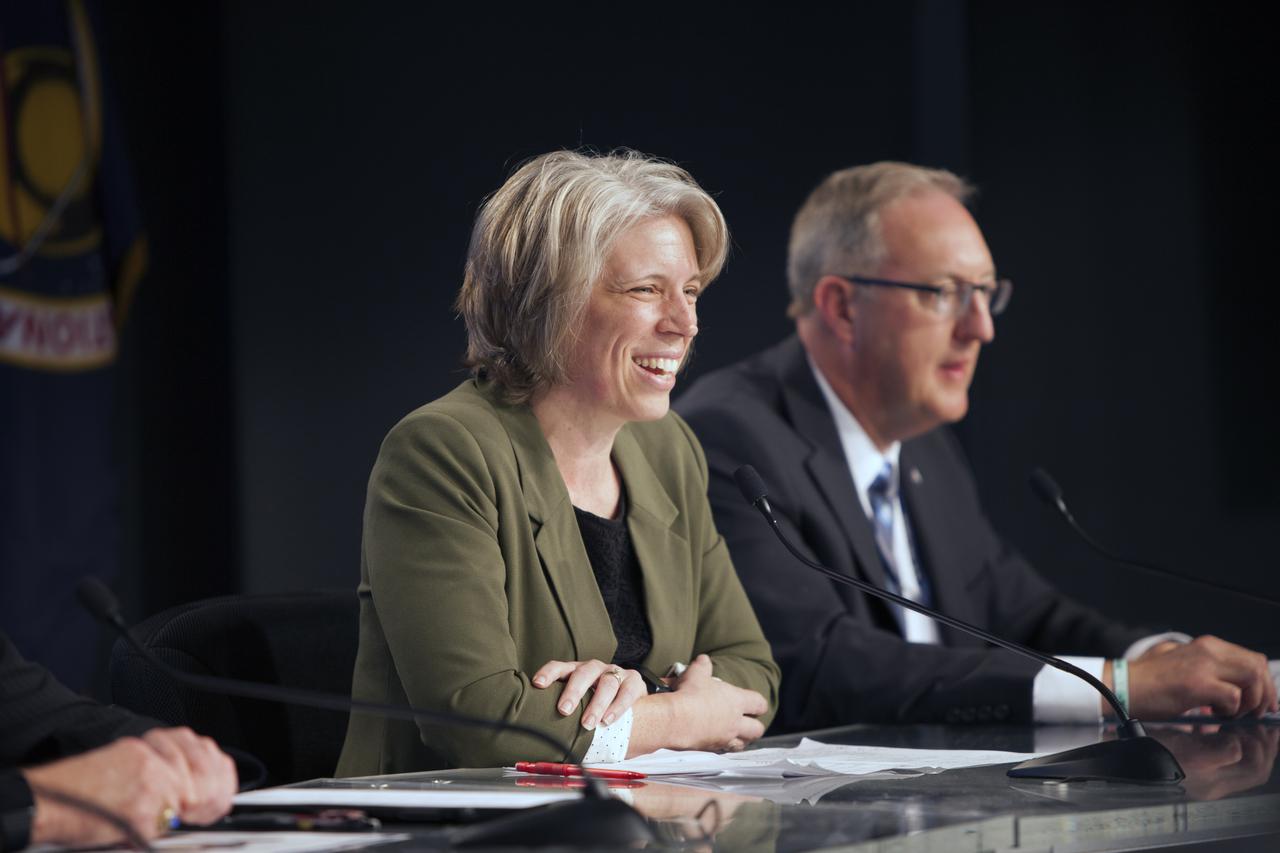
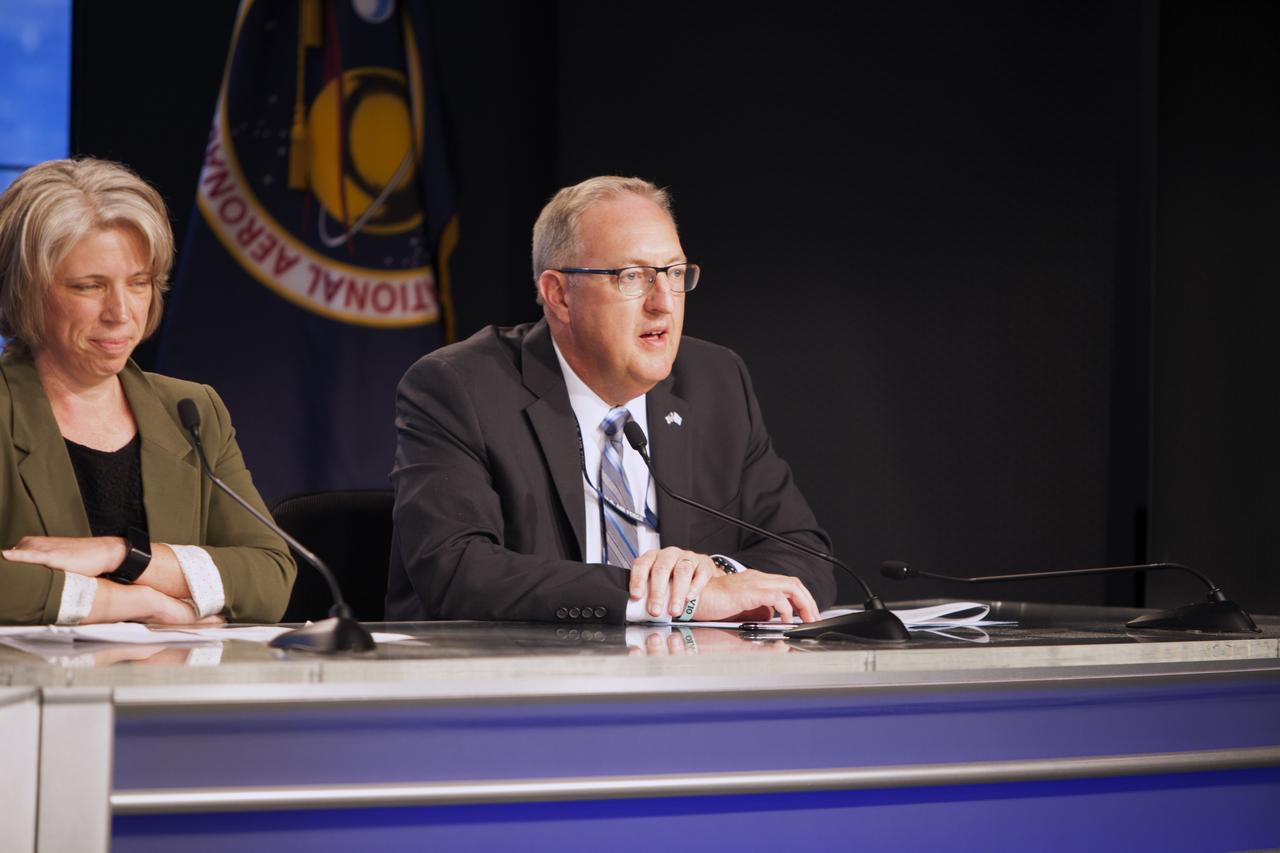
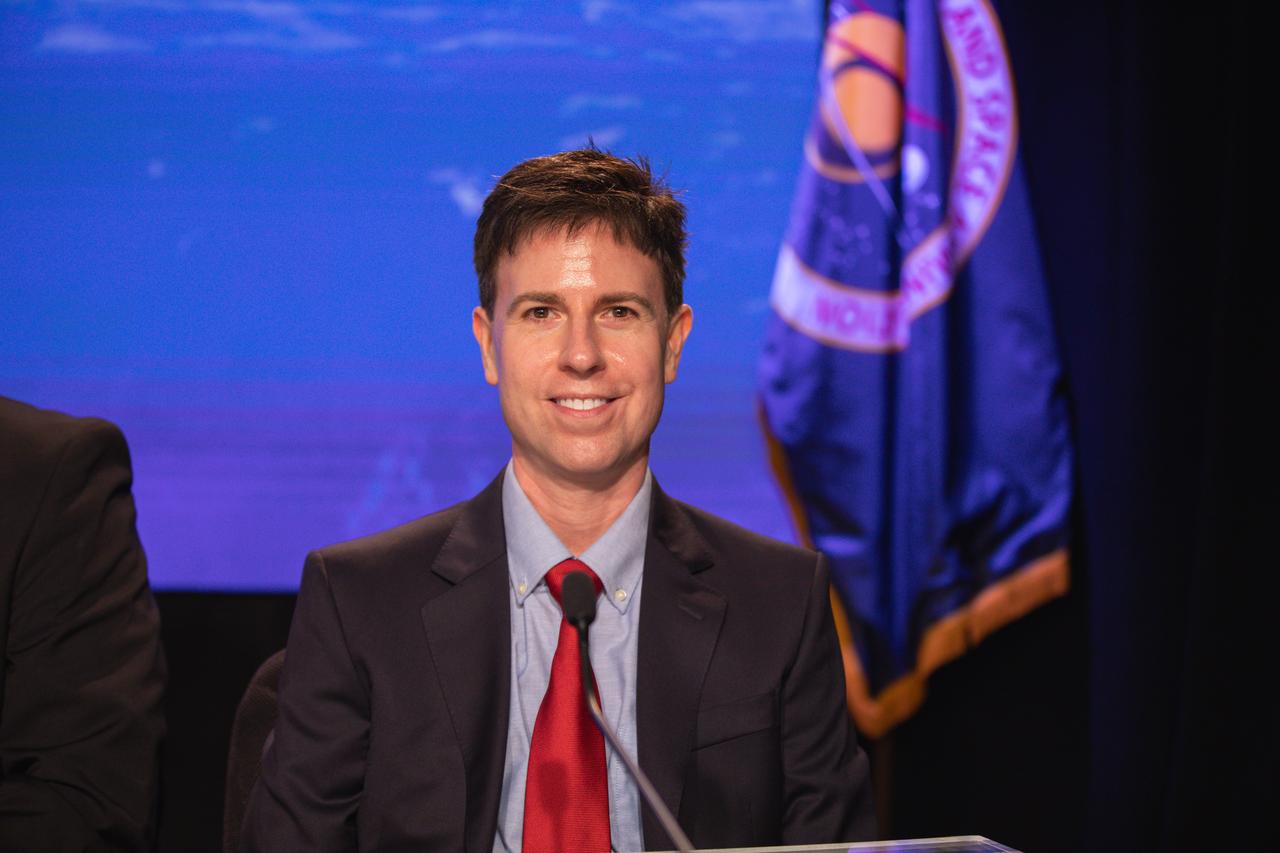
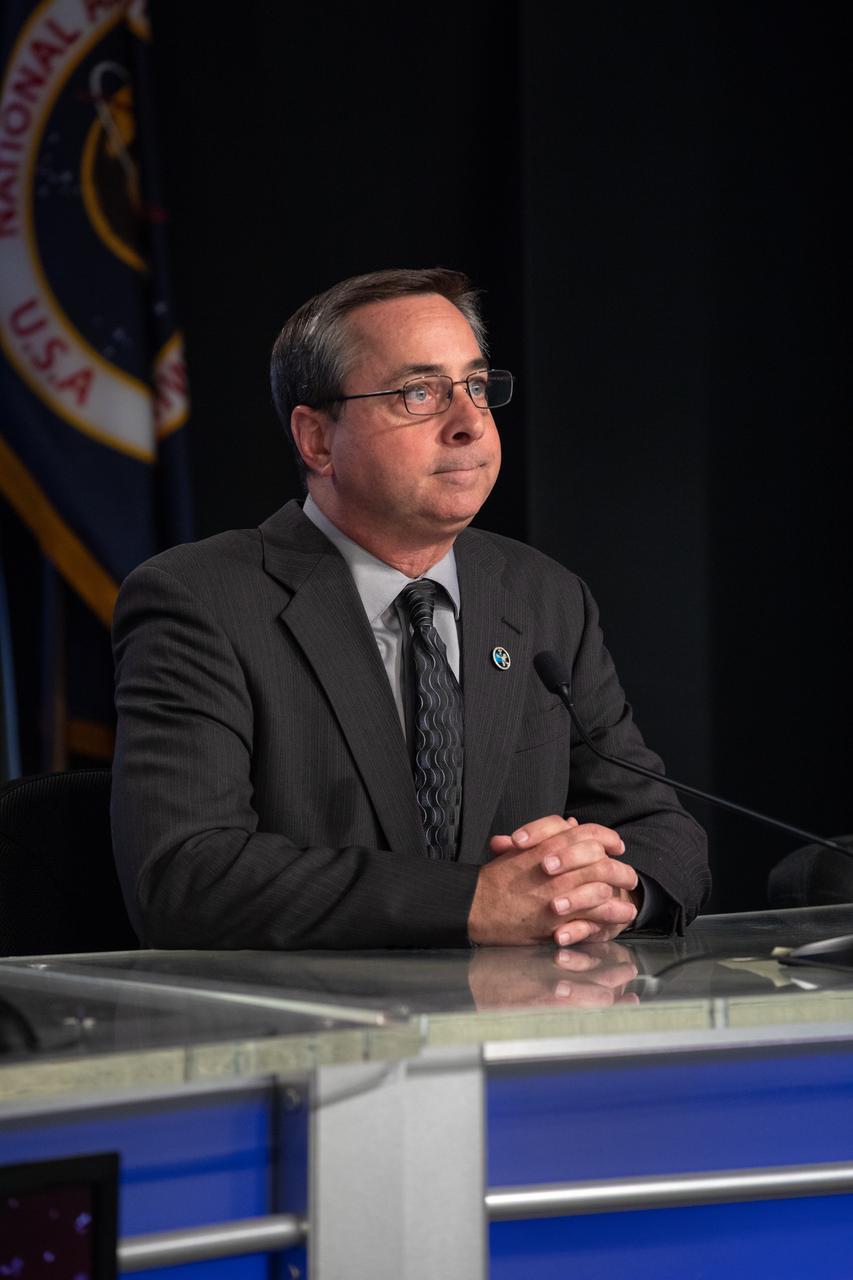
Kirt Costello, chief scientist, International Space Station Program Office, is introduced during a CRS-21 prelaunch news conference at NASA’s Kennedy Space Center in Florida on Dec. 4, 2020. Kenny Todd, deputy program manager, International Space Station Program Office; Sarah Walker, director, Dragon Mission Management, SpaceX; and Melody Lovin, launch weather officer, U.S. Air Force 45th Space Wing, also participated in the event, which was moderated by NASA Communications’ Jasmine Hopkins. SpaceX’s Falcon 9 rocket, with the upgraded version of the Cargo Dragon spacecraft atop, is targeted to lift off from Kennedy’s Launch Complex 39A Saturday, Dec. 5, at 11:39 a.m. EST. CRS-21 will deliver supplies, equipment, and critical materials needed to support a variety of science and research investigations on the International Space Station.
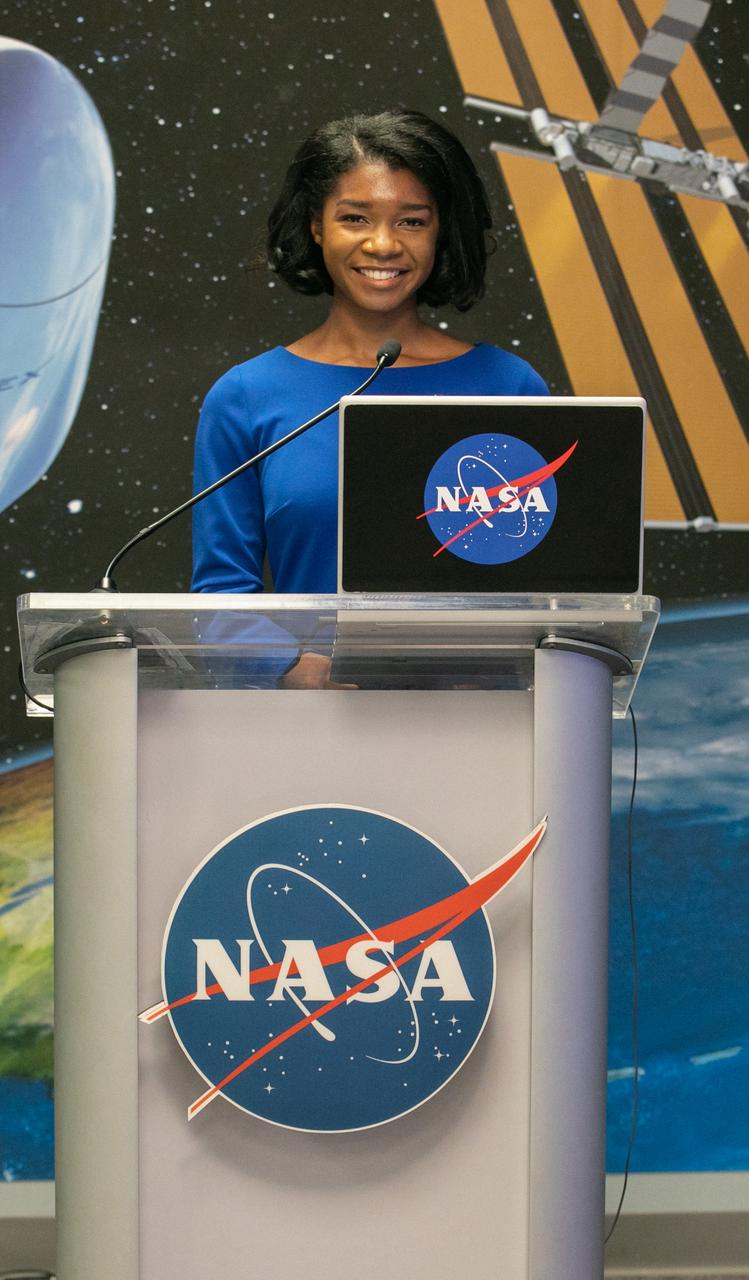
NASA Communications’ Jasmine Hopkins moderates a CRS-21 prelaunch news conference at Kennedy Space Center in Florida on Dec. 4, 2020. Participants included Kenny Todd, deputy program manager, International Space Station Program Office; Kirt Costello, chief scientist, International Space Station Program Office; Sarah Walker, director, Dragon Mission Management, SpaceX; and Melody Lovin, launch weather officer, U.S. Air Force 45th Space Wing. SpaceX’s Falcon 9 rocket, with the upgraded version of the Cargo Dragon spacecraft atop, is targeted to lift off from Kennedy’s Launch Complex 39A Saturday, Dec. 5, at 11:39 a.m. EST. CRS-21 will deliver supplies, equipment, and critical materials needed to support a variety of science and research investigations on the International Space Station.

Melody Lovin, launch weather officer, U.S. Air Force 45th Space Wing, responds to a question during a CRS-21 prelaunch news conference at NASA’s Kennedy Space Center in Florida on Dec. 4, 2020. Sarah Walker, director, Dragon Mission Management, SpaceX, Kirt Costello, chief scientist, International Space Station Program Office, and Kenny Todd, deputy program manager, International Space Station Program Office, also participated in the event, which was moderated by NASA Communications’ Jasmine Hopkins. SpaceX’s Falcon 9 rocket, with the upgraded version of the Cargo Dragon spacecraft atop, is targeted to lift off from Kennedy’s Launch Complex 39A Saturday, Dec. 5, at 11:39 a.m. EST. CRS-21 will deliver supplies, equipment, and critical materials needed to support a variety of science and research investigations on the International Space Station.
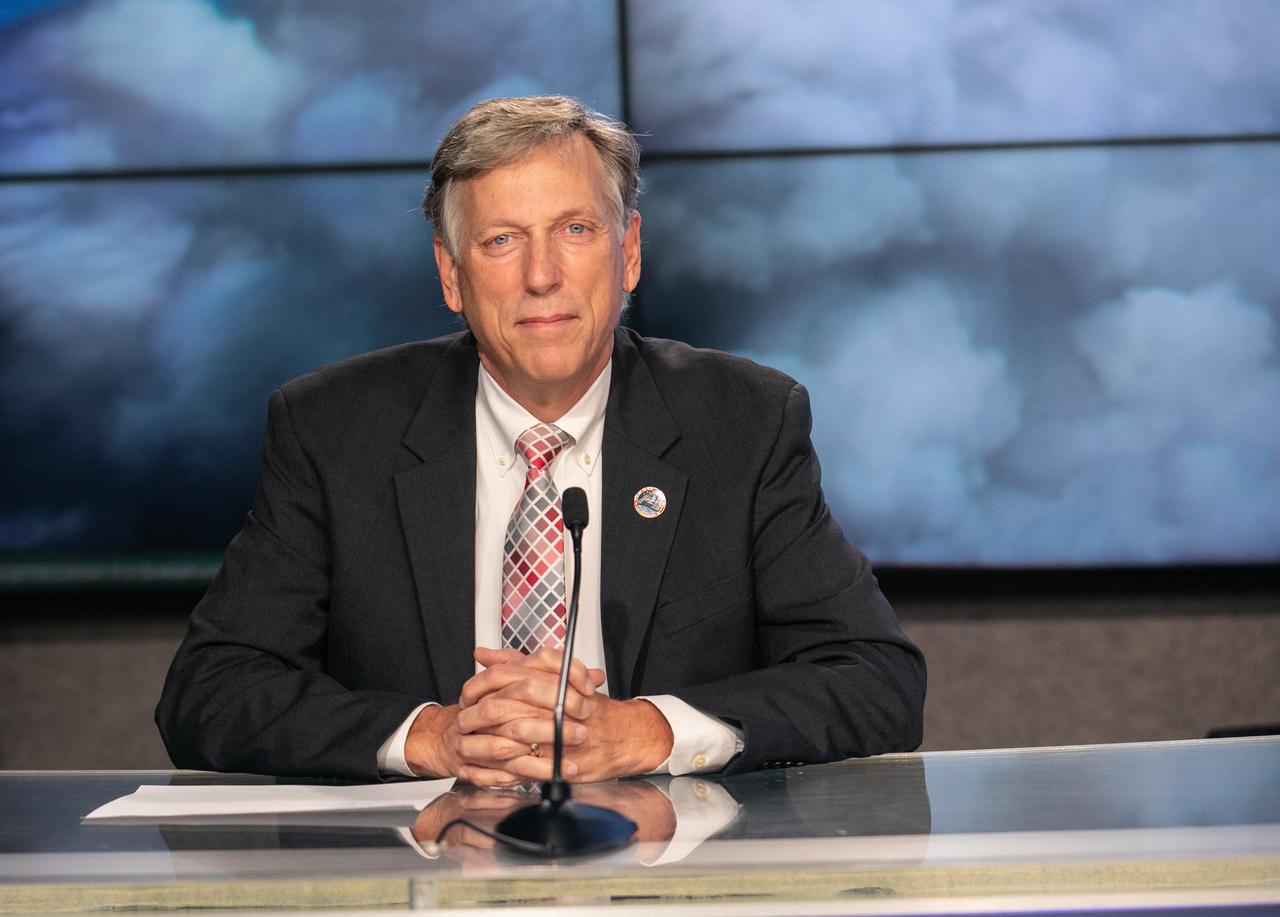
Kenny Todd, deputy program manager, International Space Station Program Office, is introduced during a CRS-21 prelaunch news conference at NASA’s Kennedy Space Center in Florida on Dec. 4, 2020. Kirt Costello, chief scientist, International Space Station Program Office; Sarah Walker, director, Dragon Mission Management, SpaceX; and Melody Lovin, launch weather officer, U.S. Air Force 45th Space Wing, also participated in the event, which was moderated by NASA Communications’ Jasmine Hopkins. SpaceX’s Falcon 9 rocket, with the upgraded version of the Cargo Dragon spacecraft atop, is targeted to lift off from Kennedy’s Launch Complex 39A Saturday, Dec. 5, at 11:39 a.m. EST. CRS-21 will deliver supplies, equipment, and critical materials needed to support a variety of science and research investigations on the International Space Station.

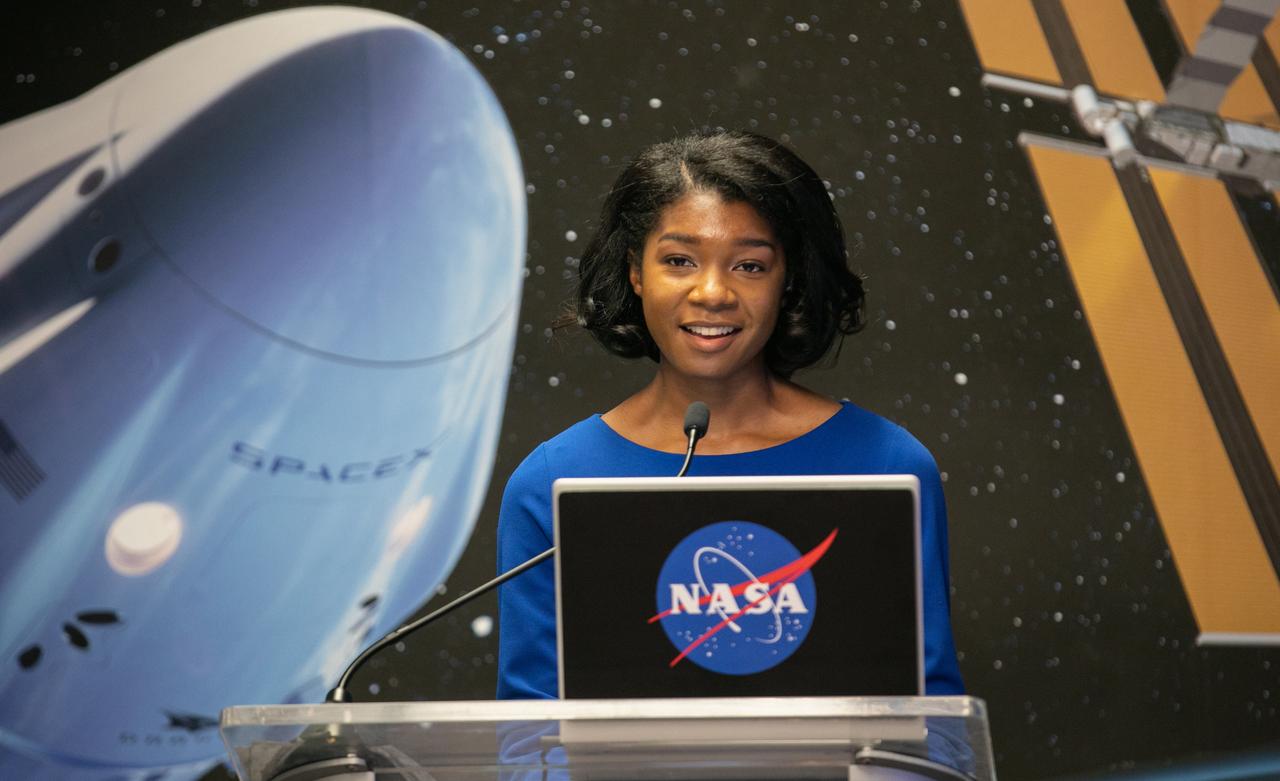
Melody Lovin, launch weather officer, U.S. Air Force 45th Space Wing, is introduced during a CRS-21 prelaunch news conference at NASA’s Kennedy Space Center in Florida on Dec. 4, 2020. Sarah Walker, director, Dragon Mission Management, SpaceX, Kirt Costello, chief scientist, International Space Station Program Office, and Kenny Todd, deputy program manager, International Space Station Program Office, also participated in the event, which was moderated by NASA Communications’ Jasmine Hopkins. SpaceX’s Falcon 9 rocket, with the upgraded version of the Cargo Dragon spacecraft atop, is targeted to lift off from Kennedy’s Launch Complex 39A Saturday, Dec. 5, at 11:39 a.m. EST. CRS-21 will deliver supplies, equipment, and critical materials needed to support a variety of science and research investigations on the International Space Station.
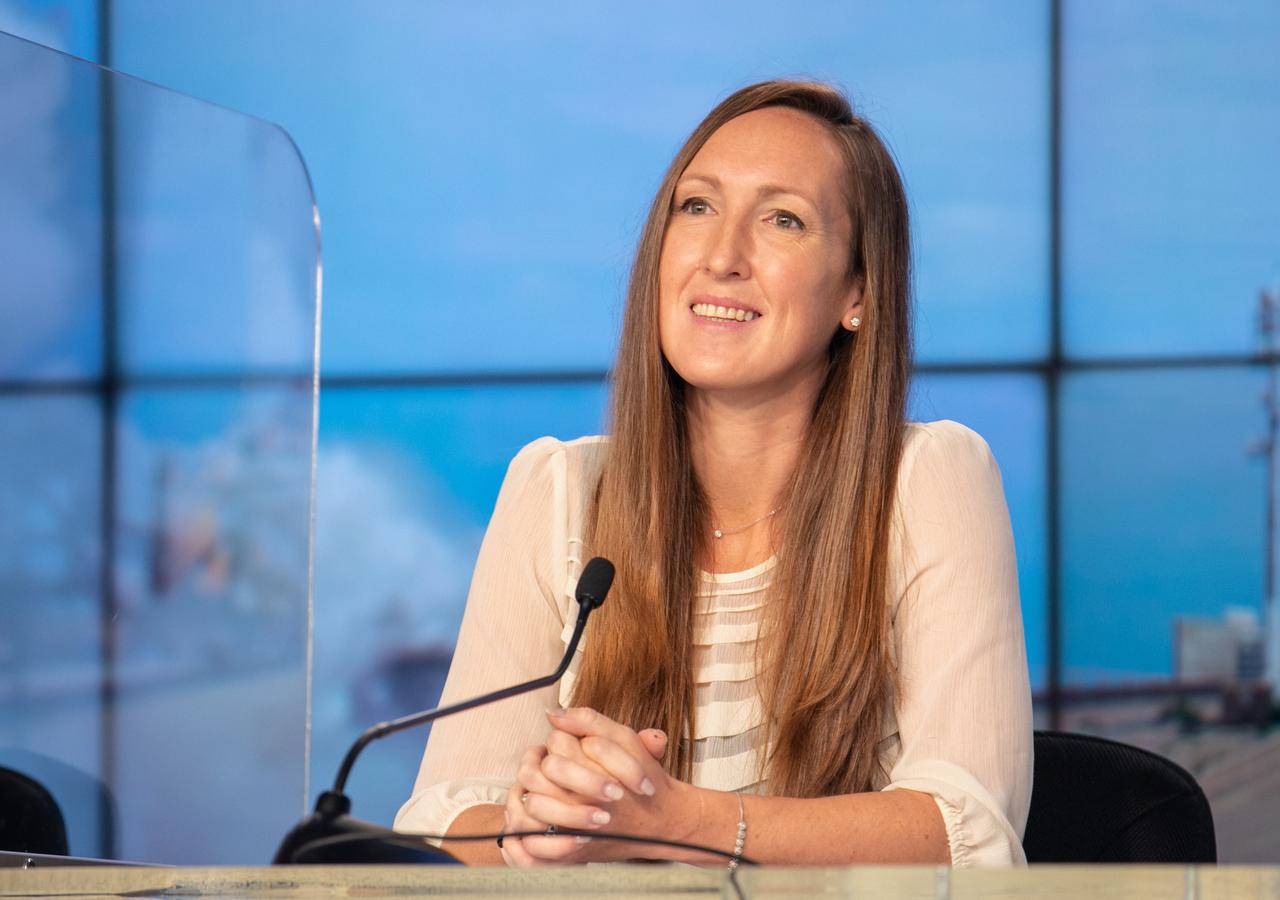
Sarah Walker, director, Dragon Mission Management, SpaceX, listens to a question during a CRS-21 prelaunch news conference at NASA’s Kennedy Space Center in Florida on Dec. 4, 2020. Kirt Costello, chief scientist, International Space Station Program Office, Kenny Todd, deputy program manager, International Space Station Program Office; and Melody Lovin, launch weather officer, U.S. Air Force 45th Space Wing, also participated in the event, which was moderated by NASA Communications’ Jasmine Hopkins. SpaceX’s Falcon 9 rocket, with the upgraded version of the Cargo Dragon spacecraft atop, is targeted to lift off from Kennedy’s Launch Complex 39A Saturday, Dec. 5, at 11:39 a.m. EST. CRS-21 will deliver supplies, equipment, and critical materials needed to support a variety of science and research investigations on the International Space Station.
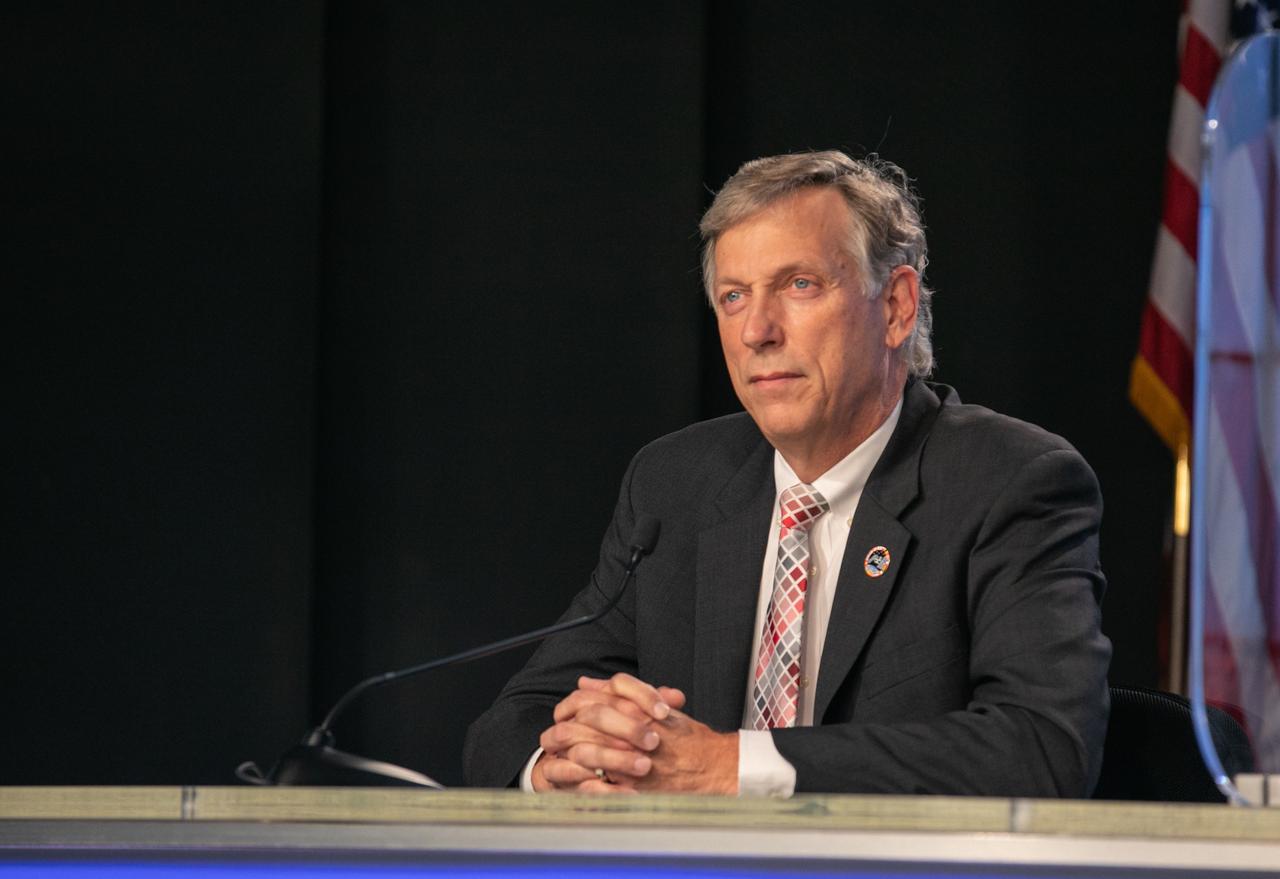
Kenny Todd, deputy program manager, International Space Station Program Office, listens to a question during a CRS-21 prelaunch news conference at NASA’s Kennedy Space Center in Florida on Dec. 4, 2020. Kirt Costello, chief scientist, International Space Station Program Office; Sarah Walker, director, Dragon Mission Management, SpaceX; and Melody Lovin, launch weather officer, U.S. Air Force 45th Space Wing, also participated in the event, which was moderated by NASA Communications’ Jasmine Hopkins. SpaceX’s Falcon 9 rocket, with the upgraded version of the Cargo Dragon spacecraft atop, is targeted to lift off from Kennedy’s Launch Complex 39A Saturday, Dec. 5, at 11:39 a.m. EST. CRS-21 will deliver supplies, equipment, and critical materials needed to support a variety of science and research investigations on the International Space Station.
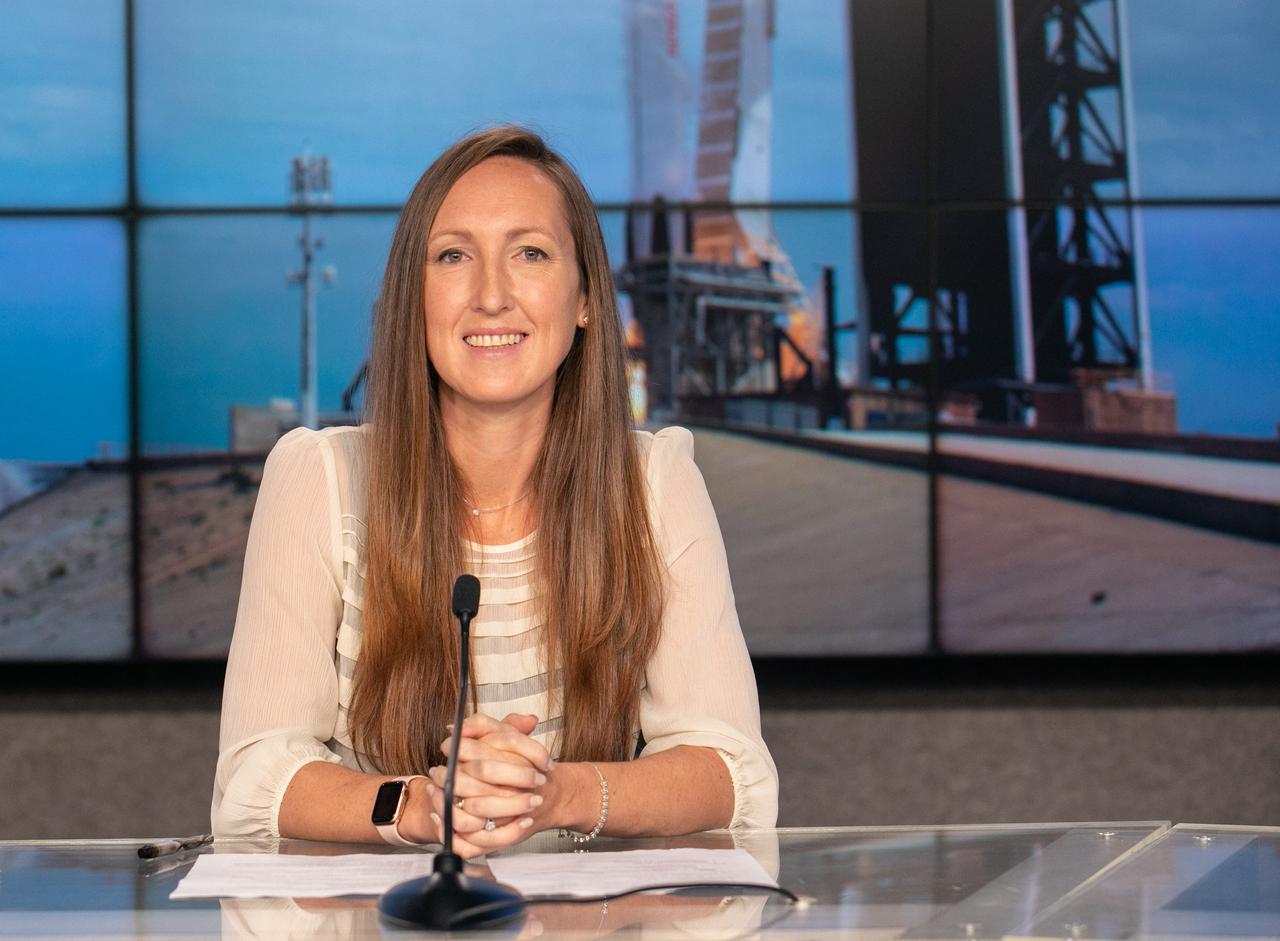
Sarah Walker, director, Dragon Mission Management, SpaceX, is introduced during a CRS-21 prelaunch news conference at NASA’s Kennedy Space Center in Florida on Dec. 4, 2020. Kirt Costello, chief scientist, International Space Station Program Office, Kenny Todd, deputy program manager, International Space Station Program Office; and Melody Lovin, launch weather officer, U.S. Air Force 45th Space Wing, also participated in the event, which was moderated by NASA Communications’ Jasmine Hopkins. SpaceX’s Falcon 9 rocket, with the upgraded version of the Cargo Dragon spacecraft atop, is targeted to lift off from Kennedy’s Launch Complex 39A Saturday, Dec. 5, at 11:39 a.m. EST. CRS-21 will deliver supplies, equipment, and critical materials needed to support a variety of science and research investigations on the International Space Station.
NASA Communications’ Jasmine Hopkins moderates a CRS-21 prelaunch news conference at Kennedy Space Center in Florida on Dec. 4, 2020. Participants included Kenny Todd, deputy program manager, International Space Station Program Office; Kirt Costello, chief scientist, International Space Station Program Office; Sarah Walker, director, Dragon Mission Management, SpaceX; and Melody Lovin, launch weather officer, U.S. Air Force 45th Space Wing. SpaceX’s Falcon 9 rocket, with the upgraded version of the Cargo Dragon spacecraft atop, is targeted to lift off from Kennedy’s Launch Complex 39A Saturday, Dec. 5, at 11:39 a.m. EST. CRS-21 will deliver supplies, equipment, and critical materials needed to support a variety of science and research investigations on the International Space Station.

Kirt Costello, chief scientist, International Space Station Program Office, listens to a question during a CRS-21 prelaunch news conference at NASA’s Kennedy Space Center in Florida on Dec. 4, 2020. Kenny Todd, deputy program manager, International Space Station Program Office; Sarah Walker, director, Dragon Mission Management, SpaceX; and Melody Lovin, launch weather officer, U.S. Air Force 45th Space Wing, also participated in the event, which was moderated by NASA Communications’ Jasmine Hopkins. SpaceX’s Falcon 9 rocket, with the upgraded version of the Cargo Dragon spacecraft atop, is targeted to lift off from Kennedy’s Launch Complex 39A Saturday, Dec. 5, at 11:39 a.m. EST. CRS-21 will deliver supplies, equipment, and critical materials needed to support a variety of science and research investigations on the International Space Station.

Sarah Walker, director, Dragon Mission Management, SpaceX, responds to a question during a CRS-21 prelaunch news conference at NASA’s Kennedy Space Center in Florida on Dec. 4, 2020. Kirt Costello, chief scientist, International Space Station Program Office, Kenny Todd, deputy program manager, International Space Station Program Office; and Melody Lovin, launch weather officer, U.S. Air Force 45th Space Wing, also participated in the event, which was moderated by NASA Communications’ Jasmine Hopkins. SpaceX’s Falcon 9 rocket, with the upgraded version of the Cargo Dragon spacecraft atop, is targeted to lift off from Kennedy’s Launch Complex 39A Saturday, Dec. 5, at 11:39 a.m. EST. CRS-21 will deliver supplies, equipment, and critical materials needed to support a variety of science and research investigations on the International Space Station.
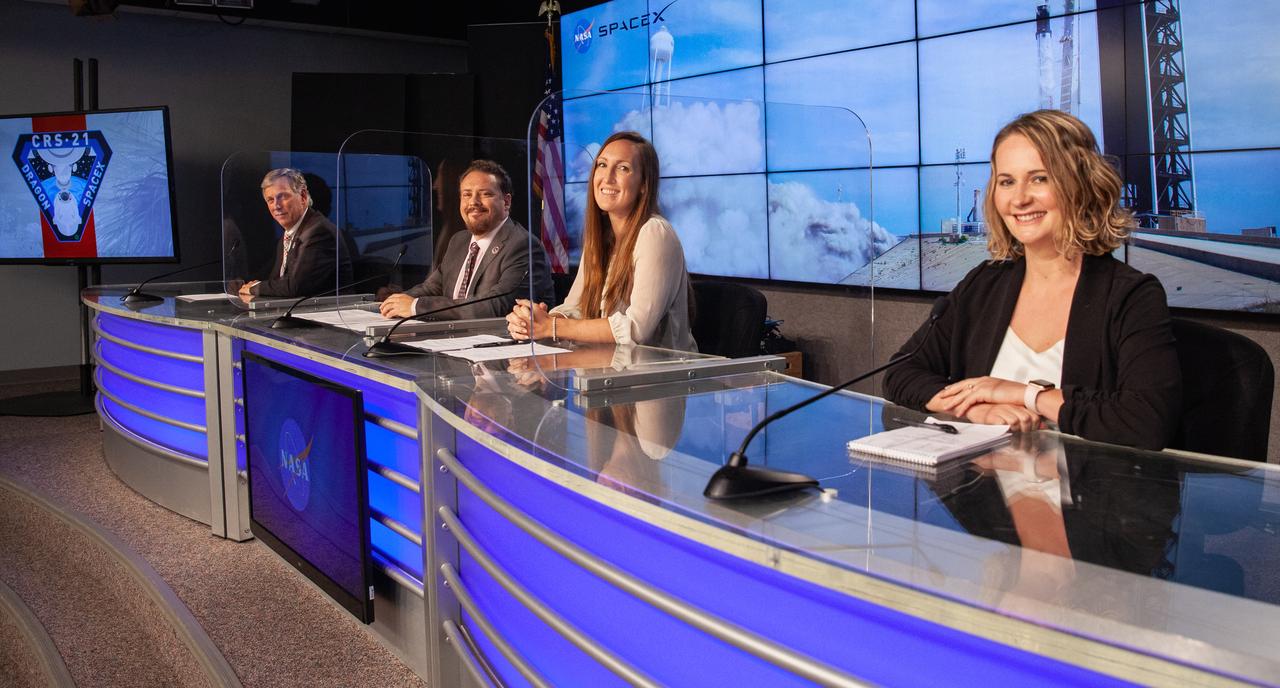
From left, Kenny Todd, deputy program manager, International Space Station Program Office; Kirt Costello, chief scientist, International Space Station Program Office; Sarah Walker, director, Dragon Mission Management, SpaceX; and Melody Lovin, launch weather officer, U.S. Air Force 45th Space Wing, participate in a CRS-21 prelaunch news conference at Kennedy Space Center in Florida on Dec. 4, 2020. NASA Communications’ Jasmine Hopkins moderated the event. SpaceX’s Falcon 9 rocket, with the upgraded version of the Cargo Dragon spacecraft atop, is targeted to lift off from Kennedy’s Launch Complex 39A Saturday, Dec. 5, at 11:39 a.m. EST. CRS-21 will deliver supplies, equipment, and critical materials needed to support a variety of science and research investigations on the International Space Station.

Officials from NASA, Boeing, United Launch Alliance and the U.S. Air Force 45th Weather Squadron participate in a prelaunch briefing for Boeing’s Orbital Flight Test at the agency’s Kennedy Space Center in Florida, Dec. 17, 2019. From left are John Elbon, chief operating officer, United Launch Alliance; Joel Montalbano, deputy manager, International Space Station Program; Pat Forrester, Astronaut Office chief, Johnson Space Center; and Will Ulrich, launch weather officer, 45th Weather Squadron. Boeing’s CST-100 Starliner spacecraft will launch atop a United Launch Alliance Atlas V rocket from Space Launch Complex 41 at Cape Canaveral Air Force Station. The uncrewed Orbital Flight Test will be the Starliner’s first flight to the International Space Station for NASA’s Commercial Crew Program.
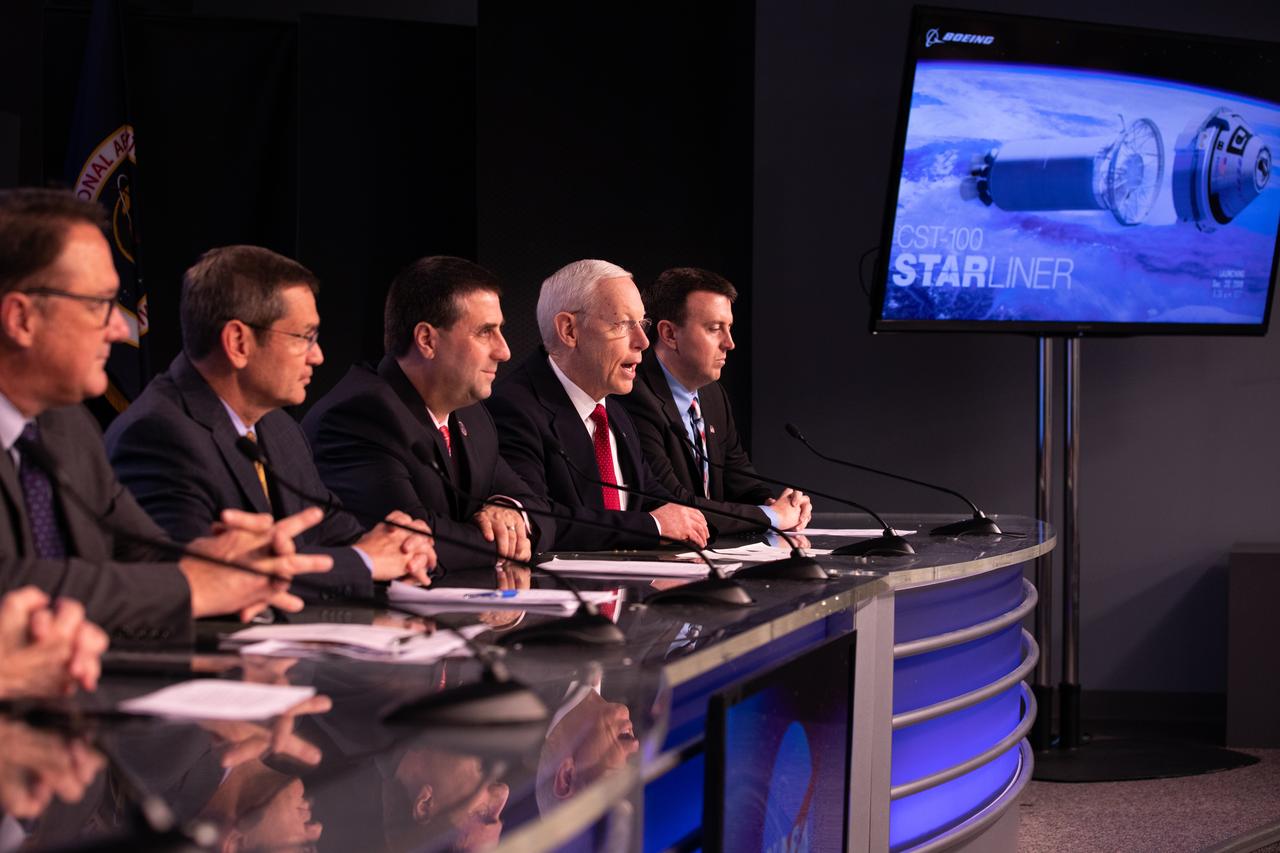
Officials from NASA, Boeing, United Launch Alliance and the U.S. Air Force 45th Weather Squadron participate in a prelaunch briefing for Boeing’s Orbital Flight Test at the agency’s Kennedy Space Center in Florida, Dec. 17, 2019. From left are John Mulholland, vice president and program manager, Boeing Commercial Crew Program; John Elbon, chief operating officer, United Launch Alliance; Joel Montalbano, deputy manager, International Space Station Program; Pat Forrester, Astronaut Office chief, Johnson Space Center; and Will Ulrich, launch weather officer, 45th Weather Squadron. Boeing’s CST-100 Starliner spacecraft will launch atop a United Launch Alliance Atlas V rocket from Space Launch Complex 41 at Cape Canaveral Air Force Station. The uncrewed Orbital Flight Test will be the Starliner’s first flight to the International Space Station for NASA’s Commercial Crew Program.
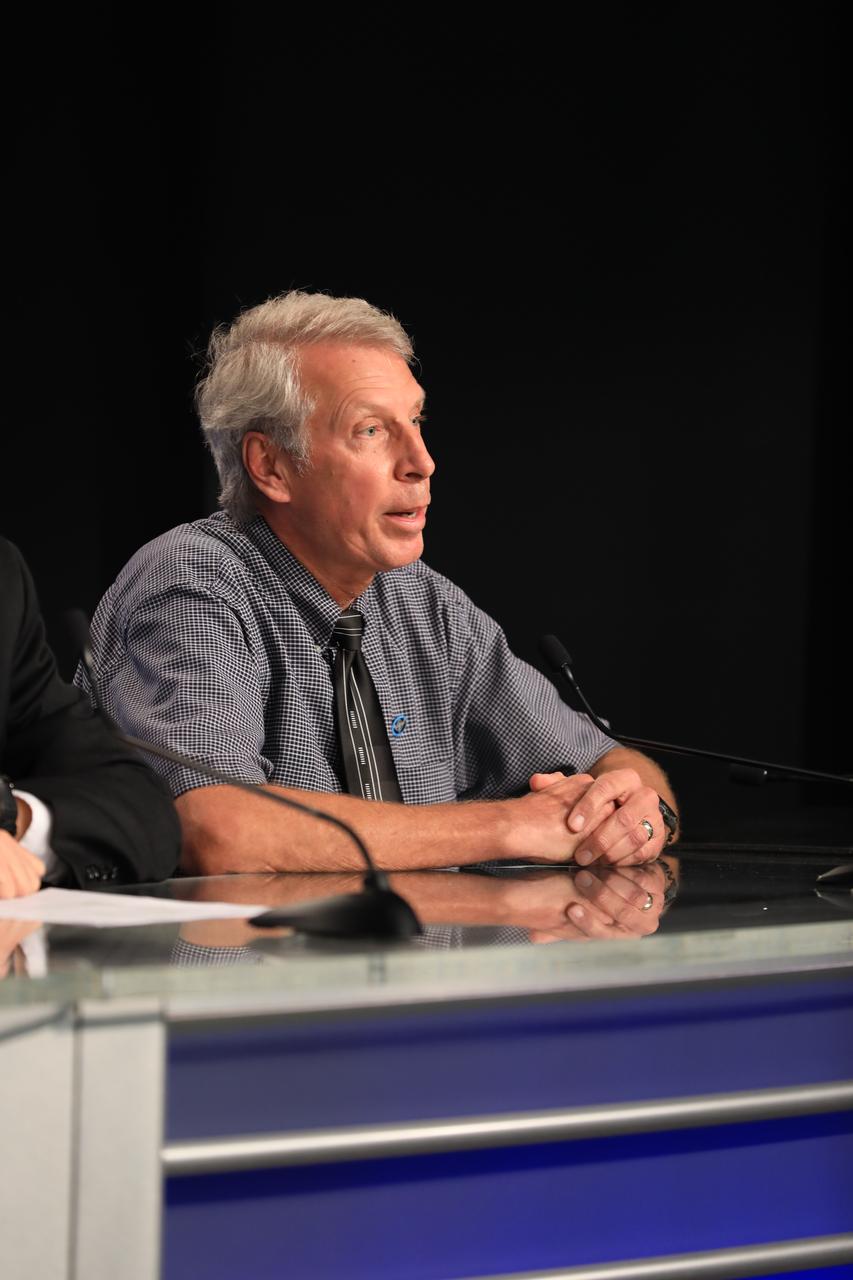
Clay Flinn, launch weather officer, 4th Weather Squadron, Cape Canaveral Air Force Station, speaks to members of the news media during a Geostationary Operational Environmental Satellite (GOES-R) prelaunch news conference in the Kennedy Space Center's Press Site auditorium in Florida.
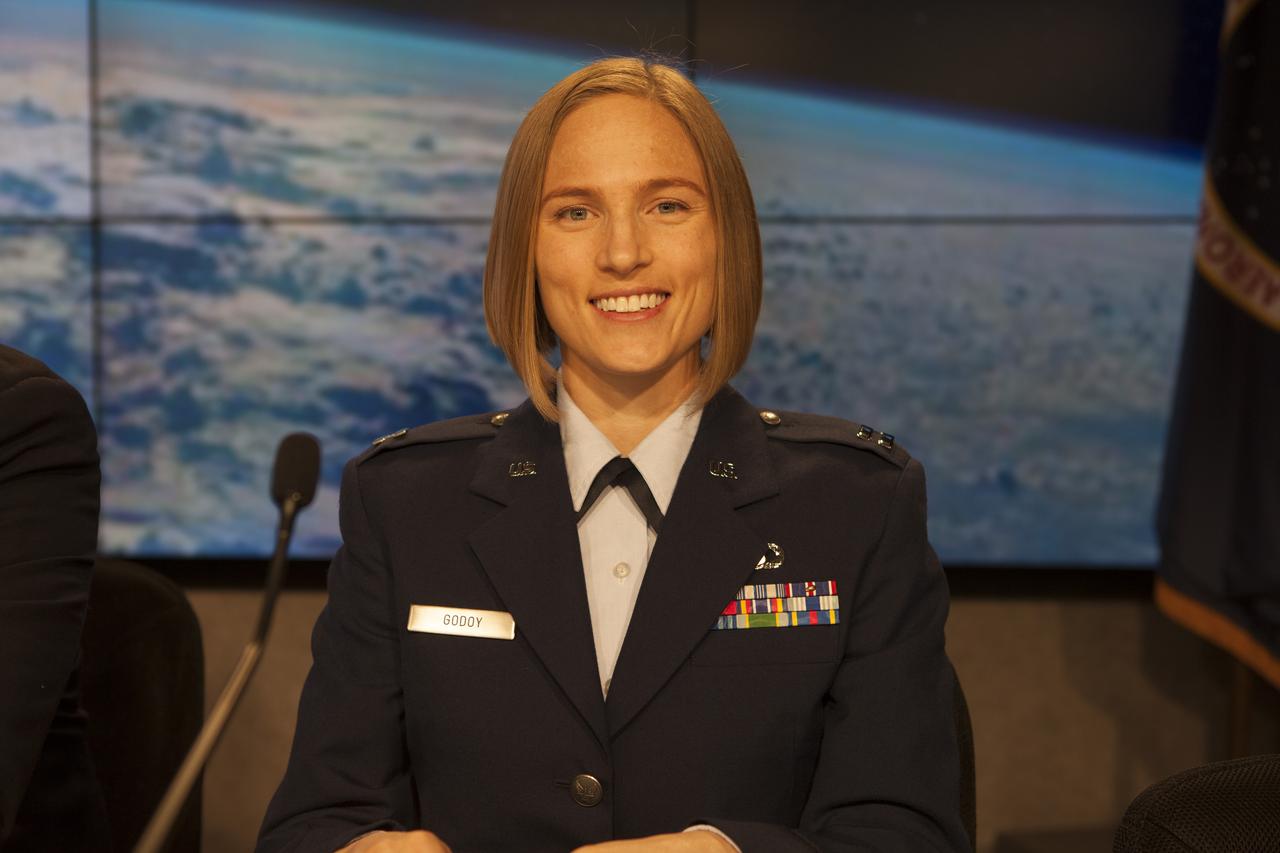
In the Kennedy Space Center’s Press Site auditorium, Capt. Laura Godoy, launch weather officer of the U.S. Air Force 45th Weather Squadron, speaks to members of the media at a prelaunch news conference for Orbital ATK CRS-6 commercial resupply services mission to the International Space Station.
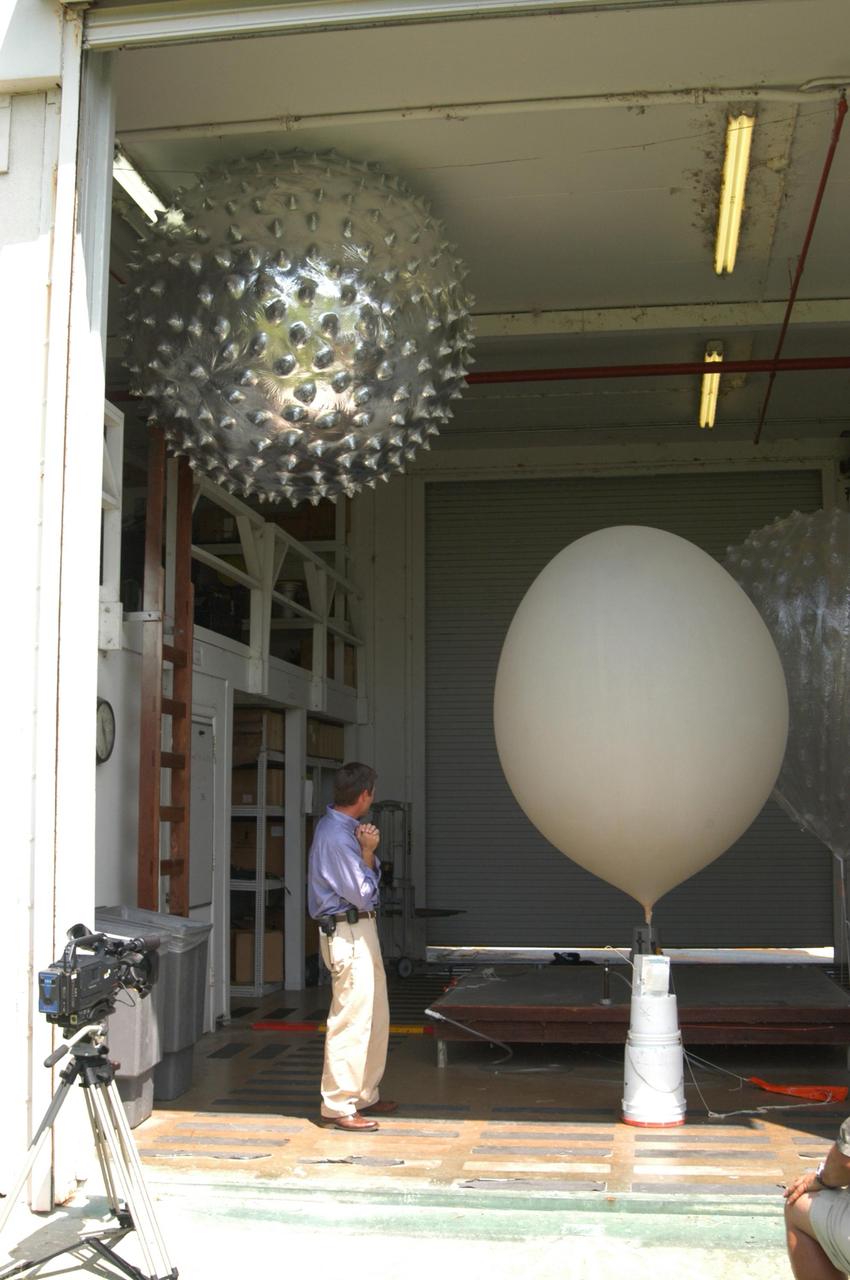
KENNEDY SPACE CENTER, FLA. - At the Cape Canaveral weather station in Florida, a member of the weather team looks over the weather balloons inside. The release of a Rawinsonde weather balloon was planned as part of a media tour prior to the launch of Space Shuttle Discovery on mission STS-121 July 1. At the facility, which is operated by the U.S. Air Force 45th Weather Squadron, media saw the tools used by the weather team to create the forecast for launch day. They received a briefing on how the launch weather forecast is developed by Shuttle Weather Officer Kathy Winters and met the forecasters for the space shuttle and the expendable launch vehicles. Also participating were members of the Applied Meteorology Unit who provide special expertise to the forecasters by analyzing and interpreting unusual or inconsistent weather data. The media were able to see the release of the Rawinsonde weather balloon carrying instruments aloft to be used as part of developing the forecast. Photo credit: NASA/George Shelton
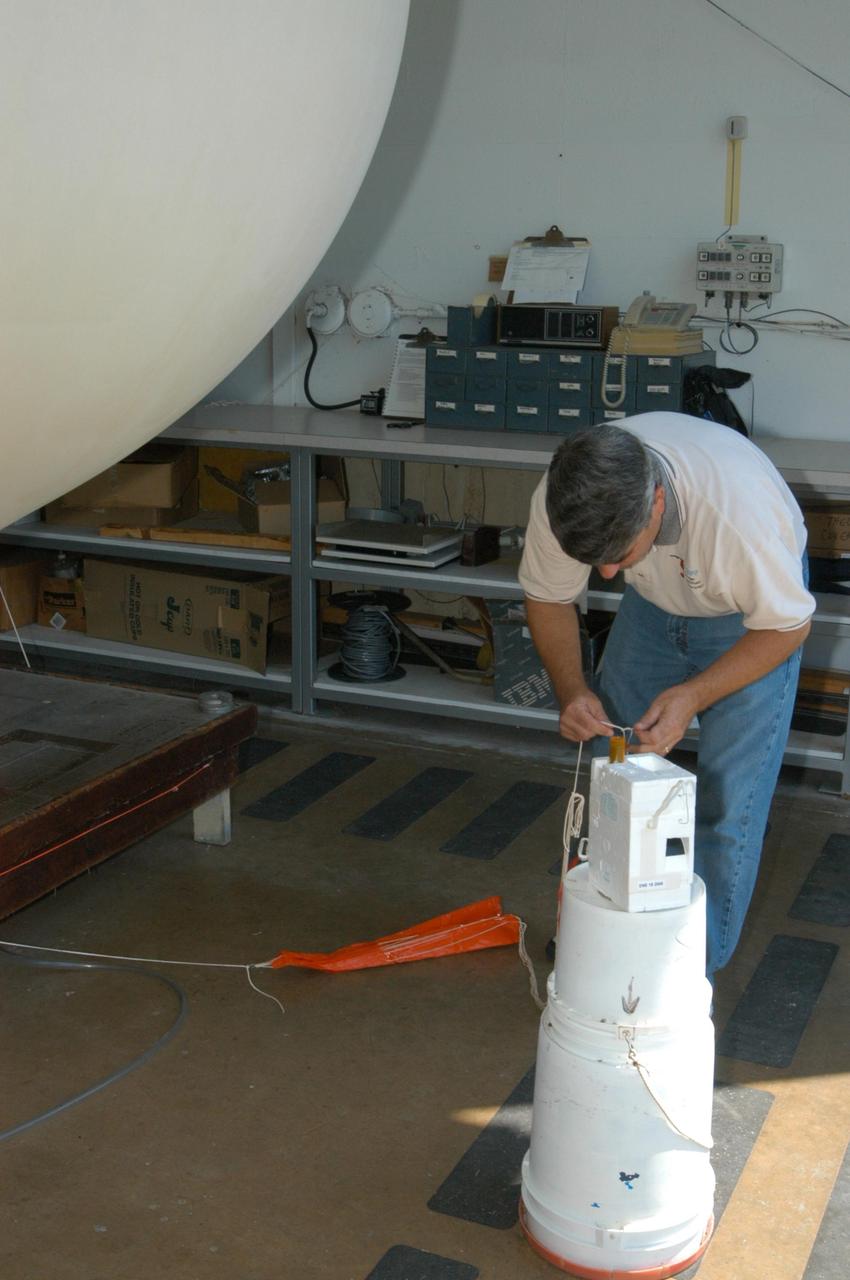
KENNEDY SPACE CENTER, FLA. - At the Cape Canaveral weather station in Florida, a member of the weather team prepares a Rawinsonde weather balloon for release. The release was planned as part of a media tour prior to the launch of Space Shuttle Discovery on mission STS-121 July 1. At the facility, which is operated by the U.S. Air Force 45th Weather Squadron, media saw the tools used by the weather team to create the forecast for launch day. They received a briefing on how the launch weather forecast is developed by Shuttle Weather Officer Kathy Winters and met the forecasters for the space shuttle and the expendable launch vehicles. Also participating were members of the Applied Meteorology Unit who provide special expertise to the forecasters by analyzing and interpreting unusual or inconsistent weather data. The media were able to see the release of the Rawinsonde weather balloon carrying instruments aloft to be used as part of developing the forecast. Photo credit: NASA/George Shelton
A prelaunch status briefing for Orbital ATK's seventh commercial resupply mission, CRS-7, to the International Space Station, is held at NASA Kennedy Space Center's Press Site in Florida. Participating in the briefing are, from left, Tara Ruttley, Johnson Space Center Program Science Office; and David Craft, weather officer, 45th Weather Squadron. Orbital ATK's Cygnus pressurized cargo module is set to launch atop the ULA Atlas V rocket from Space Launch Complex 41 at Cape Canaveral Air Force Station on April 18. Cygnus will deliver 7,600 pounds of supplies, equipment and scientific research materials to the space station. Liftoff is scheduled for 11:11 a.m. EDT.
A prelaunch status briefing for Orbital ATK's seventh commercial resupply mission, CRS-7, to the International Space Station, is held at NASA Kennedy Space Center's Press Site in Florida. Participating in the briefing are, from left, Tara Ruttley, Johnson Space Center Program Science Office; and David Craft, weather officer, 45th Weather Squadron. Orbital ATK's Cygnus pressurized cargo module is set to launch atop the ULA Atlas V rocket from Space Launch Complex 41 at Cape Canaveral Air Force Station on April 18. Cygnus will deliver 7,600 pounds of supplies, equipment and scientific research materials to the space station. Liftoff is scheduled for 11:11 a.m. EDT.
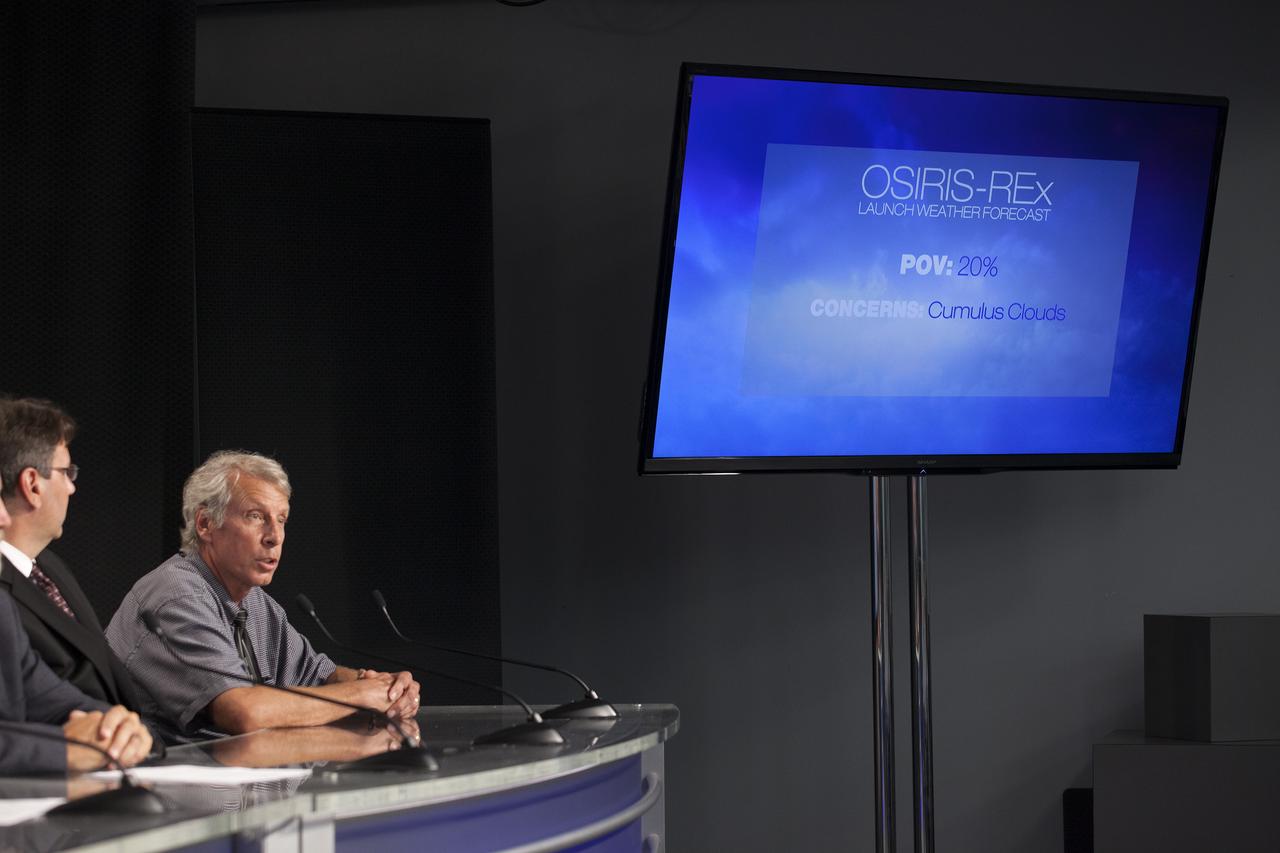
In the Kennedy Space Center’s Press Site auditorium, Clay Flinn, launch weather officer for the 45th Weather Squadron at Cape Canaveral Air Force Station, Florida speaks to members of the media abouth the weather forecast at a prelaunch news conference for the agency’s Origins, Spectral Interpretation, Resource Identification, Security-Regolith Explorer, or OSIRIS-REx spacecraft. To Flinn’s right is Rich Kuhns, OSIRIS-REx program manager for Lockheed Martin Space Systems in Denver.
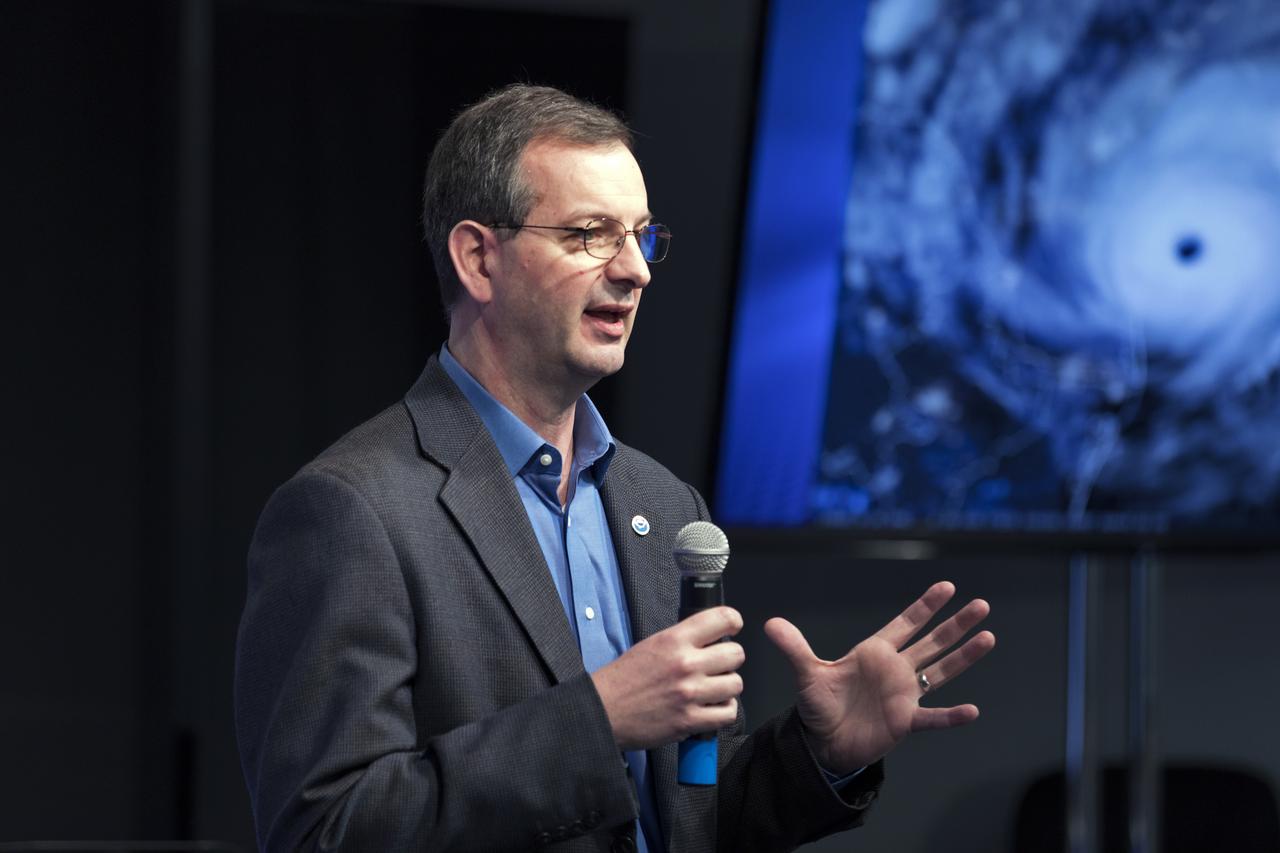
Joe Pica, director of the Office of Observations for the National Oceanic and Atmospheric Administration's, or NOAA’s, National Weather Service, speaks to members of social media in the Kennedy Space Center’s Press Site auditorium. The briefing focused on the Geostationary Operational Environmental Satellite, or GOES-S, the second spacecraft in a series of next-generation NOAA weather satellites. It will launch to a geostationary position over the U.S. to provide images of storms and help predict weather forecasts, severe weather outlooks, watches, warnings, lightning conditions and longer-term forecasting. GOES-S is slated to lift off at 5:02 p.m. EST on March 1, 2018 aboard a United Launch Alliance Atlas V rocket.
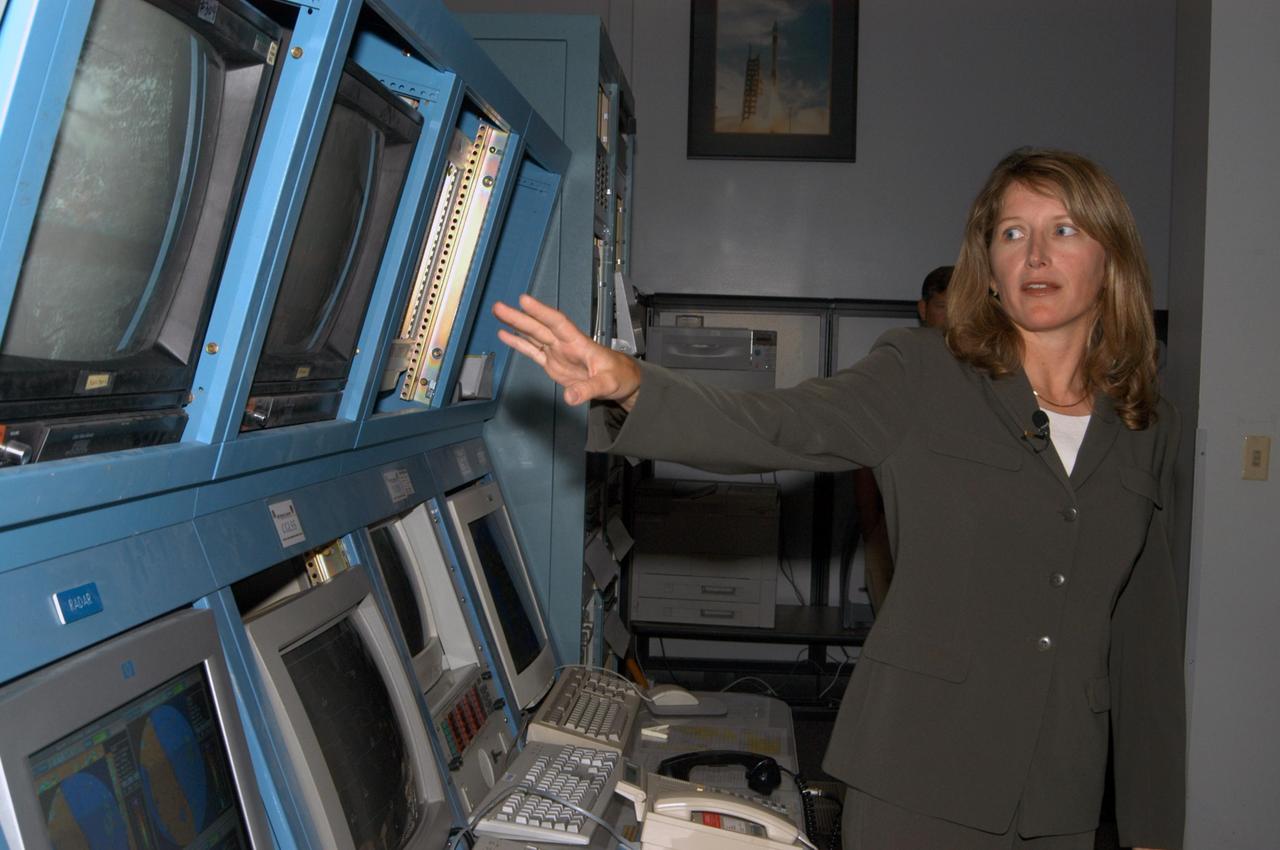
KENNEDY SPACE CENTER, FLA. - At the Cape Canaveral forecast facility in Florida, Shuttle Weather Officer Kathy Winters briefs the media on how the launch weather forecast is developed. Attendees also were able to meet the forecasters for the space shuttle and the expendable launch vehicles. Also participating were members of the Applied Meteorology Unit who provide special expertise to the forecasters by analyzing and interpreting unusual or inconsistent weather data. The media were able to see the release of the Rawinsonde weather balloon carrying instruments aloft to be used as part of developing the forecast. Photo credit: NASA/George Shelton

Will Ulrich, launch weather officer, U.S. Space Force, 45th Weather Squadron, participates in a prelaunch briefing for Boeing’s Orbital Flight Test-2 (OFT-2) at the agency’s Kennedy Space Center in Florida, July 27, 2021. Boeing’s CST-100 Starliner spacecraft will launch atop a United Launch Alliance Atlas V rocket from Space Launch Complex-41 at Cape Canaveral Space Force Station. The uncrewed OFT-2 will be the Starliner’s second flight NASA’s Commercial Crew Program.
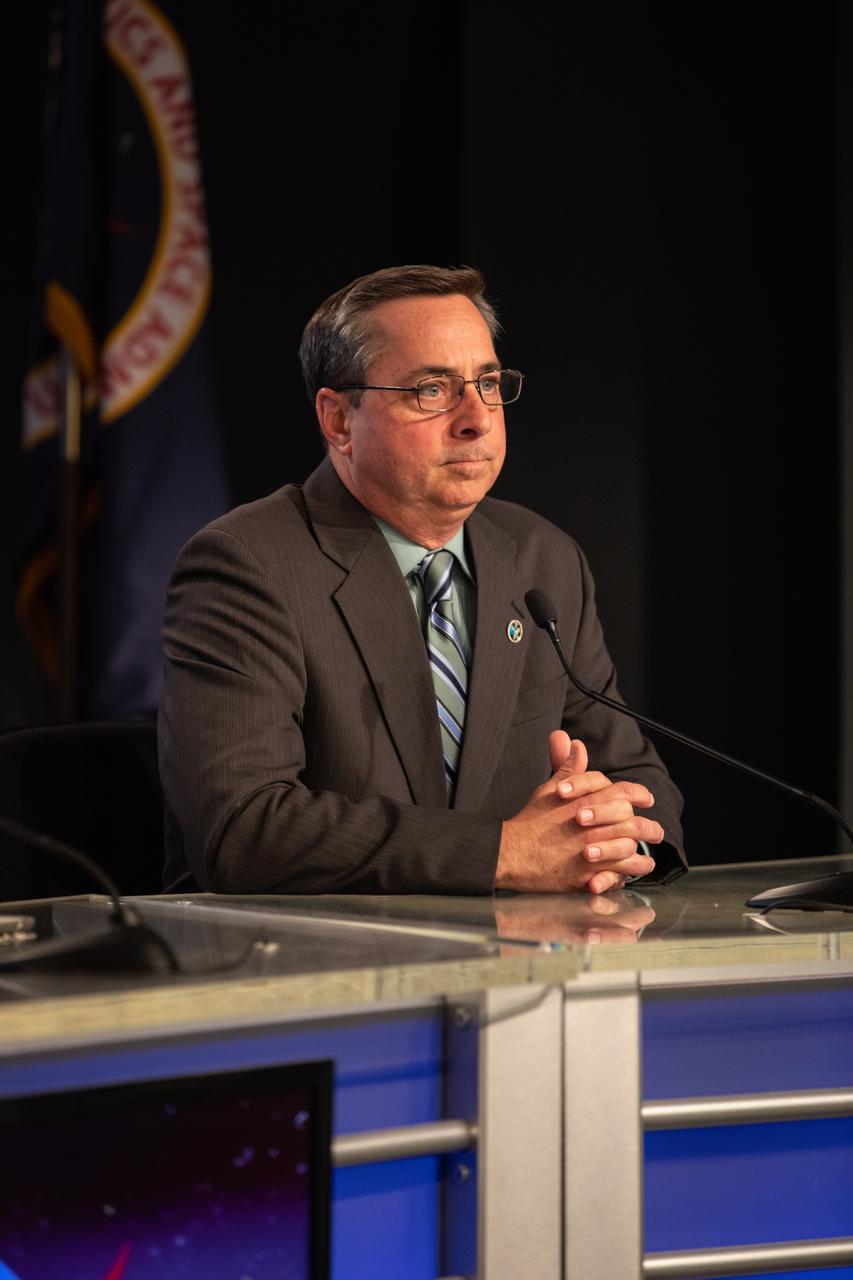
Mike McAleenan, launch weather officer with the U.S. Air Force 45th Weather Squadron, participates in a briefing at NASA’s Kennedy Space Center in Florida on Jan. 17, 2020, prior to launch of SpaceX’s uncrewed In-Flight Abort Test. A SpaceX Falcon 9 rocket topped by the company’s Crew Dragon spacecraft will lift off from Kennedy’s Launch Complex 39A, then begin the launch-abort sequence. The spacecraft will demonstrate its escape capabilities in preparation for crewed flights to the International Space Station as part of the agency’s Commercial Crew Program.
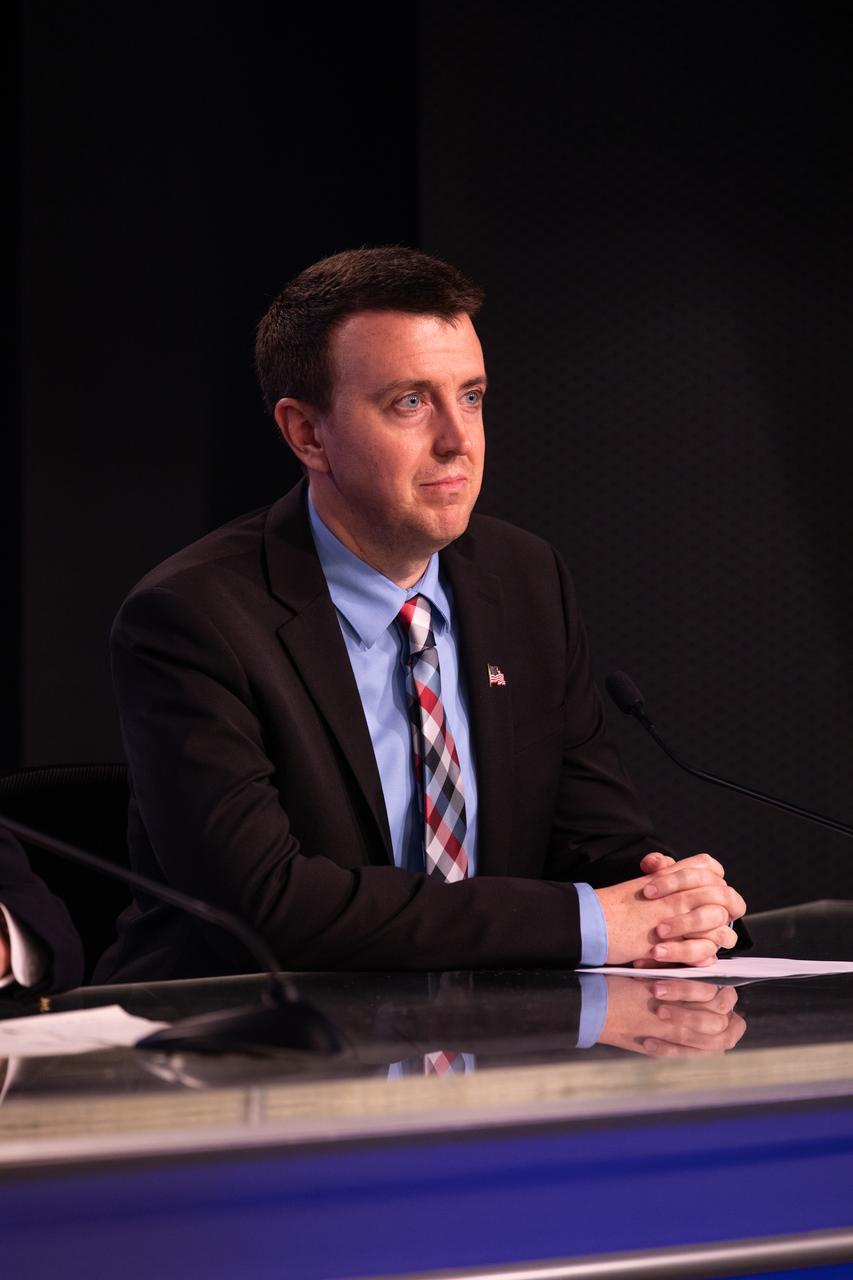
Will Ulrich, launch weather officer, 45th Weather Squadron, speaks during a prelaunch briefing for Boeing’s Orbital Flight Test at the agency’s Kennedy Space Center in Florida, Dec. 17, 2019. Boeing’s CST-100 Starliner spacecraft will launch atop a United Launch Alliance Atlas V rocket from Space Launch Complex 41 at Cape Canaveral Air Force Station. The uncrewed Orbital Flight Test will be the Starliner’s first flight to the International Space Station for NASA’s Commercial Crew Program.

In the Kennedy Space Center’s Press Site auditorium, Mike McAleenan, launch weather officer for the U.S. Air Force 45th Weather Squadron, speaks to members of the media during a prelaunch news conference for the SpaceX CRS-11 commercial resupply services mission to the International Space Station. A Dragon spacecraft is scheduled to be launched from Kennedy’s Launch Complex 39A on June 1 atop a SpaceX Falcon 9 rocket on the company's 11th Commercial Resupply Services mission to the space station.

Will Ulrich, launch weather officer with the U.S. Air Force 45th Space Wing, discusses the liftoff weather forecast during the prelaunch news conference for SpaceX’s 18th Commercial Resupply Services (CRS-18) mission to the International Space Station, July 24, 2019, at NASA’s Kennedy Space Center in Florida. The SpaceX Falcon 9 rocket and uncrewed Dragon spacecraft are scheduled to launch July 24, 2019, from Space Launch Complex 40 at Florida’s Cape Canaveral Air Force Station.
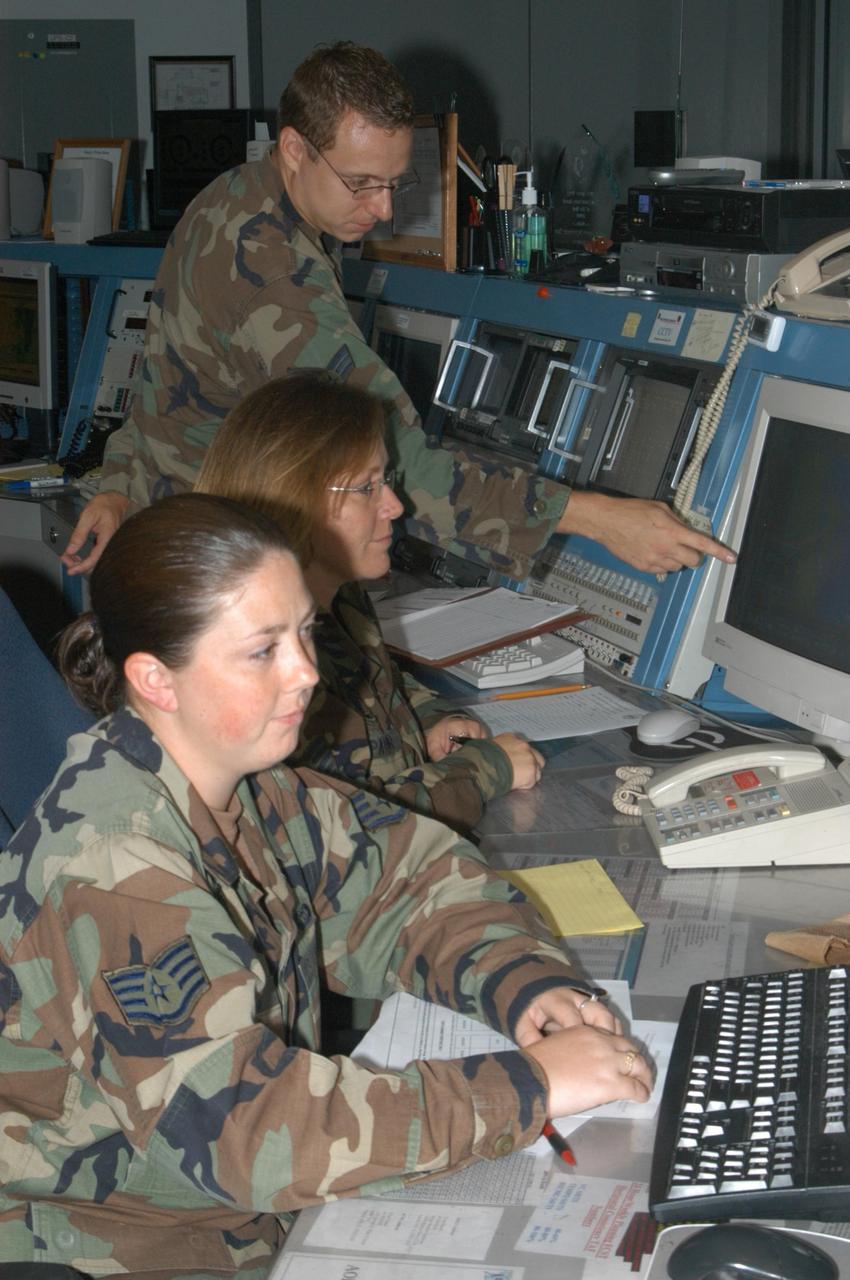
KENNEDY SPACE CENTER, FLA. - At the Cape Canaveral forecast facility in Florida, media were able to meet members of the weather team who review data used for forecasts as part of a tour of the facility. The team will play a role in the July 1 launch of Space Shuttle Discovery on mission STS-121. At the facility, which is operated by the U.S. Air Force 45th Weather Squadron, received a briefing on how the launch weather forecast is developed by Shuttle Weather Officer Kathy Winters and met the forecasters for the space shuttle and the expendable launch vehicles. Also participating were members of the Applied Meteorology Unit who provide special expertise to the forecasters by analyzing and interpreting unusual or inconsistent weather data. The media were able to see the release of the Rawinsonde weather balloon carrying instruments aloft to be used as part of developing the forecast. Photo credit: NASA/George Shelton
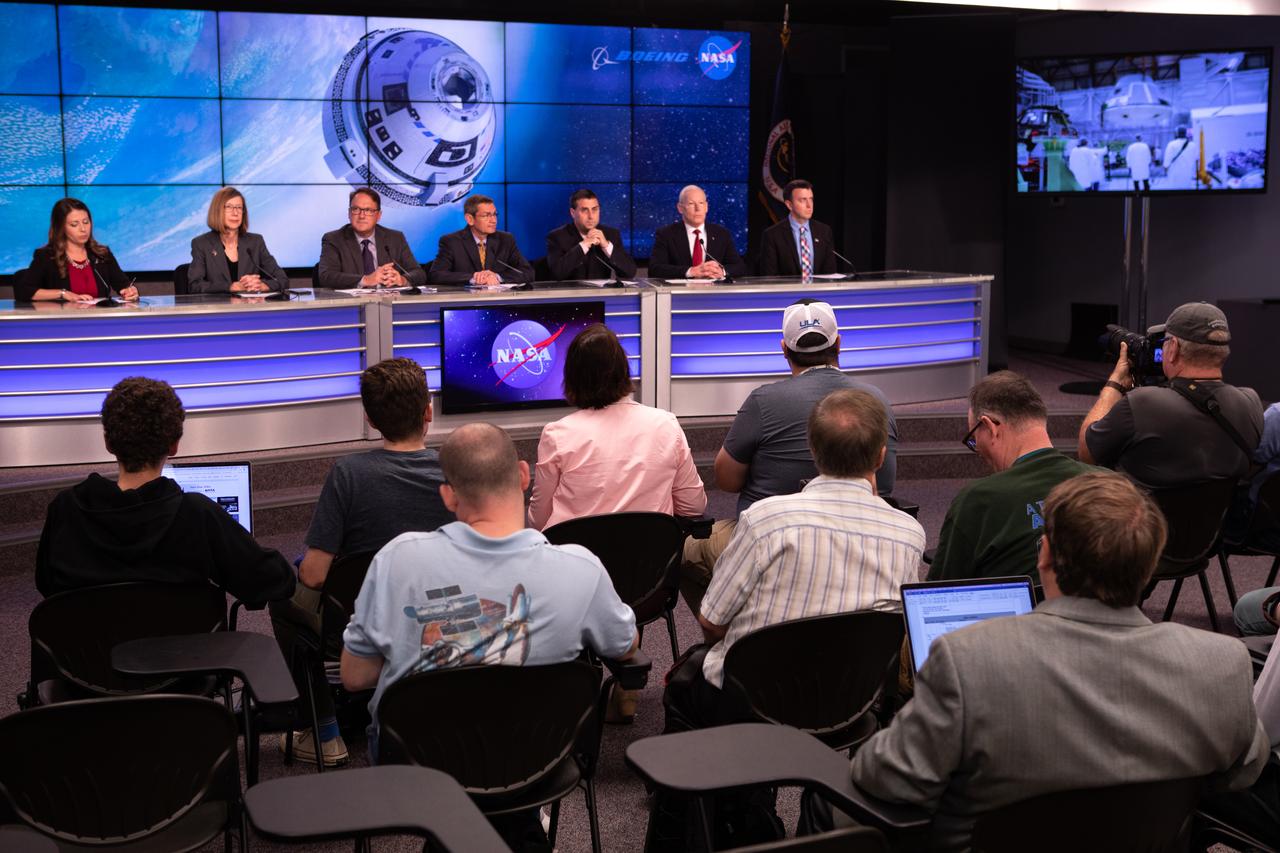
Officials from NASA, Boeing, United Launch Alliance and the U.S. Air Force 45th Weather Squadron participate in a prelaunch briefing for Boeing’s Orbital Flight Test at the agency’s Kennedy Space Center in Florida, Dec. 17, 2019. From left to right are Marie Lewis, NASA Communications; Kathy Lueders, NASA Commercial Crew Program; John Mulholland, vice president and program manager, Boeing Commercial Crew Program; John Elbon, chief operating officer, United Launch Alliance; Joel Montalbano, deputy manager, International Space Station Program; Pat Forrester, Astronaut Office chief, Johnson Space Center; and Will Ulrich, launch weather officer, 45th Weather Squadron. Boeing’s CST-100 Starliner spacecraft will launch atop a United Launch Alliance Atlas V rocket from Space Launch Complex 41 at Cape Canaveral Air Force Station. The uncrewed Orbital Flight Test will be the Starliner’s first flight to the International Space Station for NASA’s Commercial Crew Program.
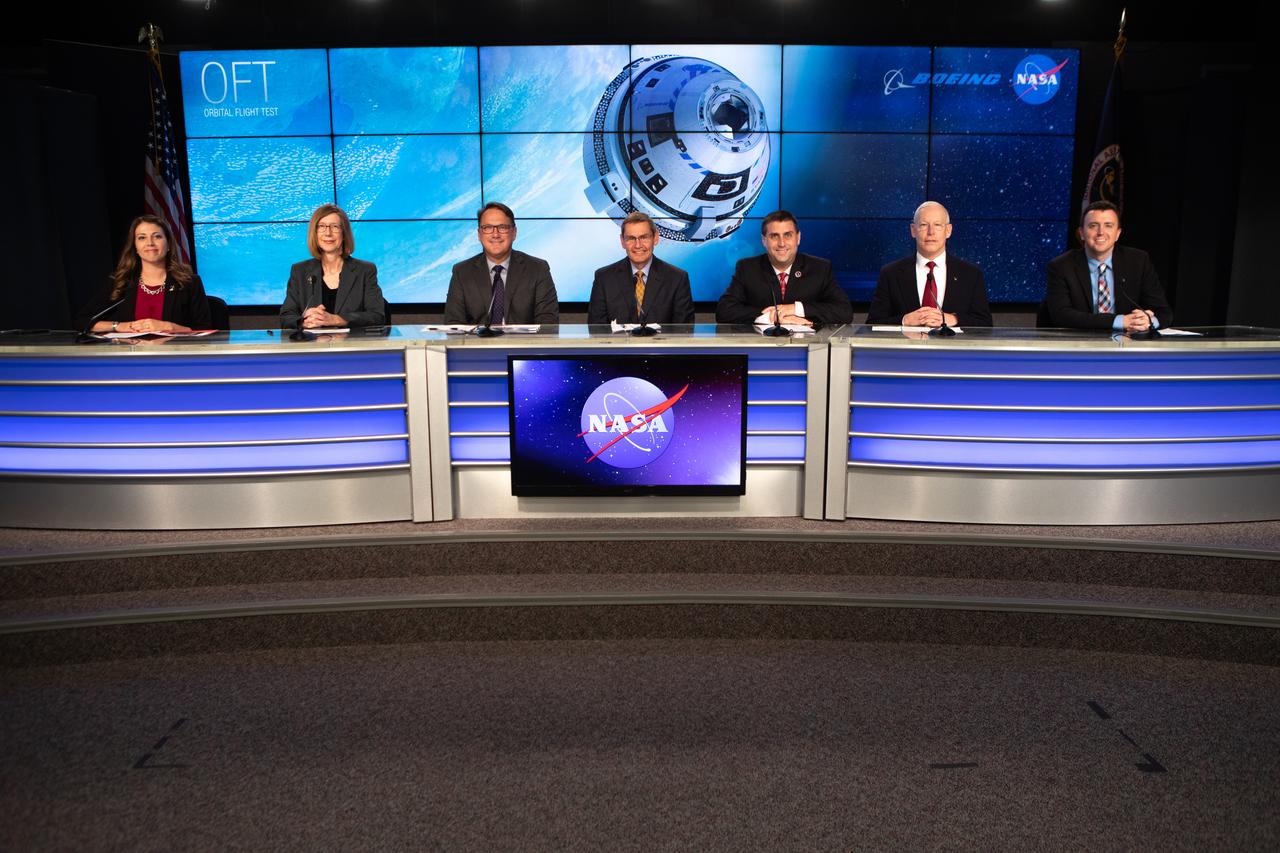
Officials from NASA, Boeing, United Launch Alliance and the U.S. Air Force 45th Weather Squadron participate in a prelaunch briefing for Boeing’s Orbital Flight Test at the agency’s Kennedy Space Center in Florida, Dec. 17, 2019. From left to right are Marie Lewis, NASA Communications; Kathy Lueders, NASA Commercial Crew Program; John Mulholland, vice president and program manager, Boeing Commercial Crew Program; John Elbon, chief operating officer, United Launch Alliance; Joel Montalbano, deputy manager, International Space Station Program; Pat Forrester, Astronaut Office chief, Johnson Space Center; and Will Ulrich, launch weather officer, 45th Weather Squadron. Boeing’s CST-100 Starliner spacecraft will launch atop a United Launch Alliance Atlas V rocket from Space Launch Complex 41 at Cape Canaveral Air Force Station. The uncrewed Orbital Flight Test will be the Starliner’s first flight to the International Space Station for NASA’s Commercial Crew Program.
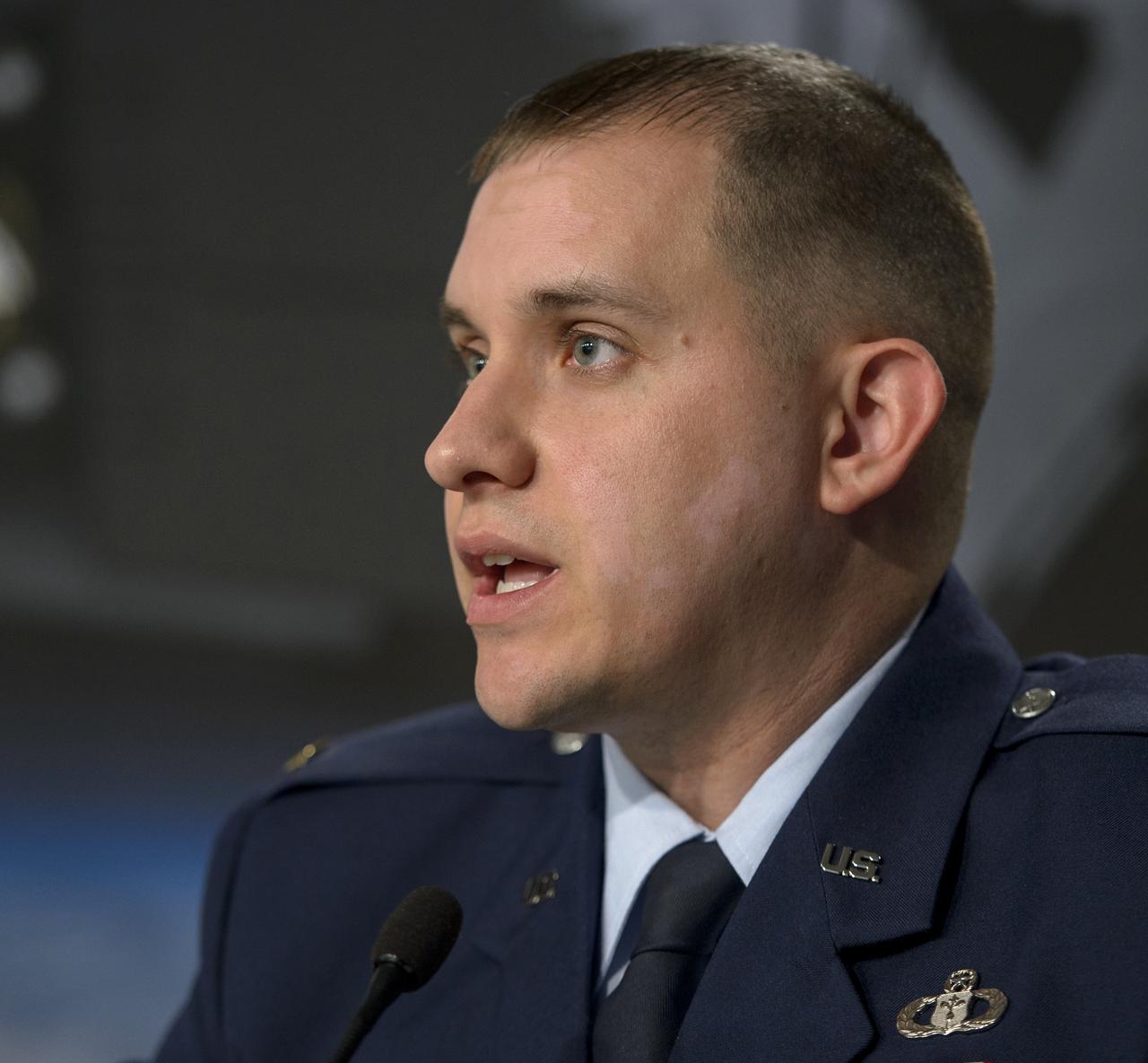
Lt. Joseph Round, launch weather officer, USAF 30th Space Wing Weather Squadron, discusses the weather forecast for launch of NASA’s Orbiting Carbon Observatory-2 (OCO-2) onboard a ULA Delta II rocket, during a press briefing, Sunday, June 29, 2014, at the Vandenberg Air Force Base, Calif. OCO-2 will measure the global distribution of carbon dioxide, the leading human-produced greenhouse gas driving changes in Earth’s climate. OCO-2 is set to launch on July 1, 2014 at 2:59 a.m. PDT. Photo Credit: (NASA/Bill Ingalls)
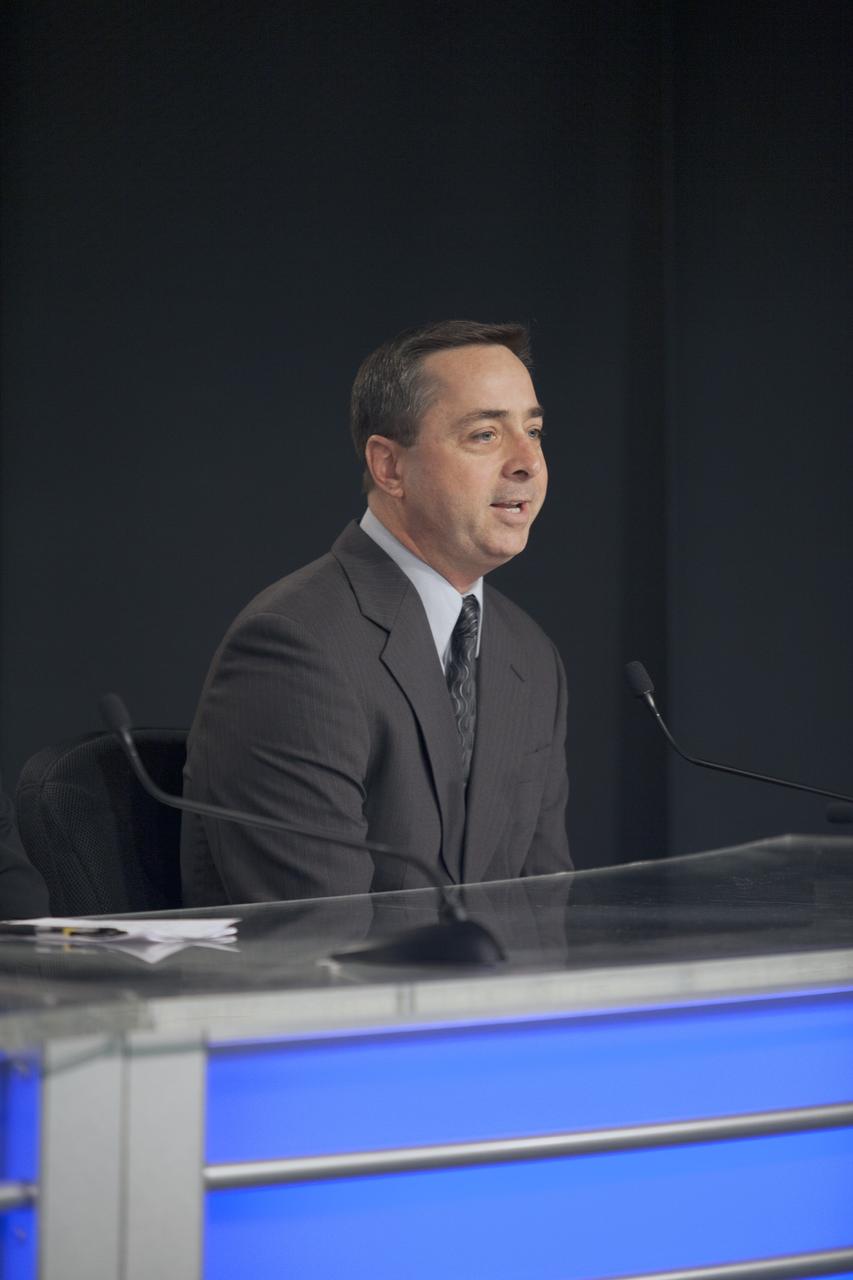
CAPE CANAVERAL, Fla. – Mike McAleenan, launch weather officer with the U.S. Air Force 45th Weather Squadron, provides an on the launch-day forecast during a briefing regarding NOAA’s Deep Space Climate Observatory spacecraft, or DSCOVR. DSCOVR will launch aboard a SpaceX Falcon 9 rocket. The mission is a partnership between NOAA, NASA and the U.S. Air Force. DSCOVR will maintain the nation's real-time solar wind monitoring capabilities which are critical to the accuracy and lead time of NOAA's space weather alerts and forecasts. To learn more about DSCOVR, visit http://www.nesdis.noaa.gov/DSCOVR. Photo credit: NASA/Kim Shiflett
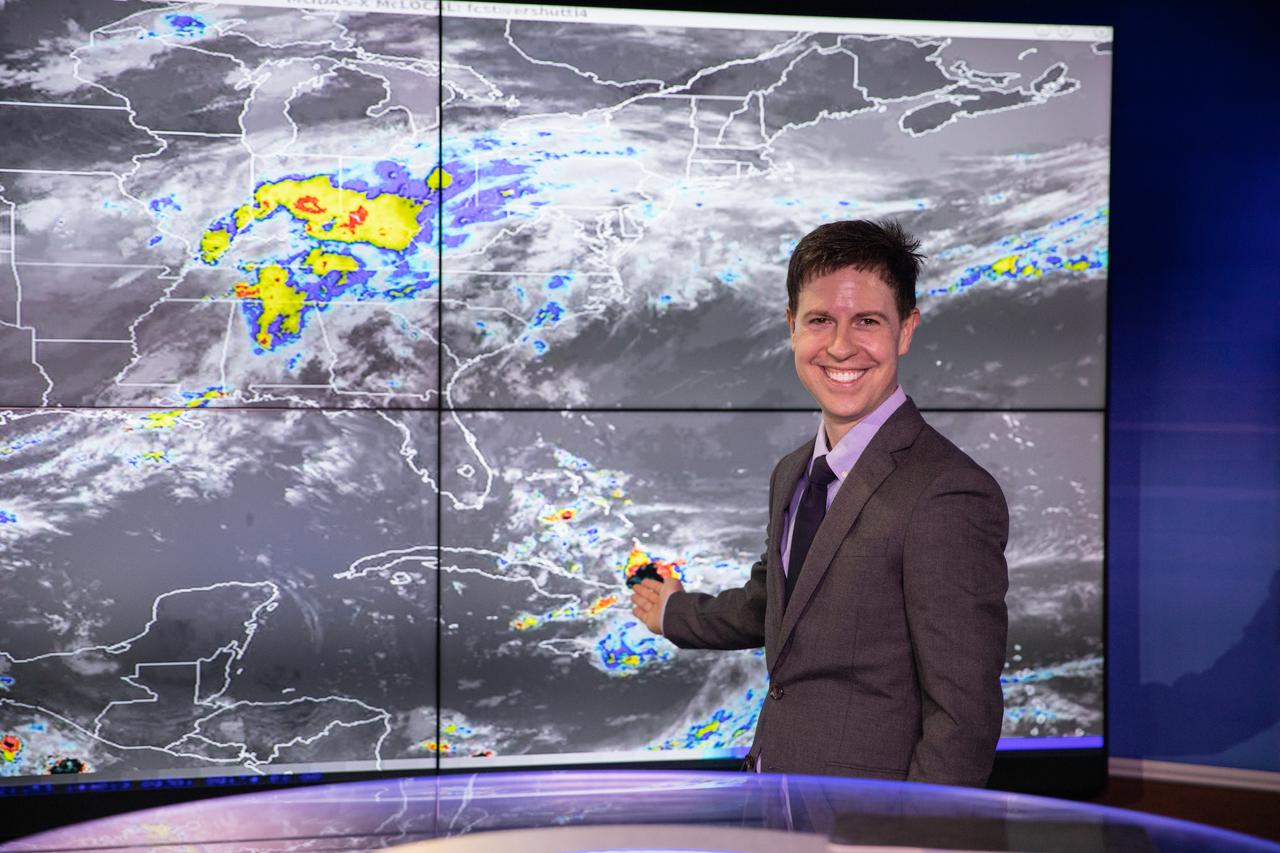
Mark Burger, launch weather officer, 45th Weather Squadron, Cape Canaveral Space Force Station, participates in a prelaunch news conference for SpaceX’s 22nd Commercial Resupply Services mission for NASA to the International Space Station on June 2, 2021 at Kennedy Space Center in Florida. The Dragon capsule atop SpaceX’s Falcon 9 rocket is scheduled to lift off from Launch Complex 39A at 1:29 p.m. EDT on June 3. Dragon will deliver more than 7,300 pounds of cargo to the space station.
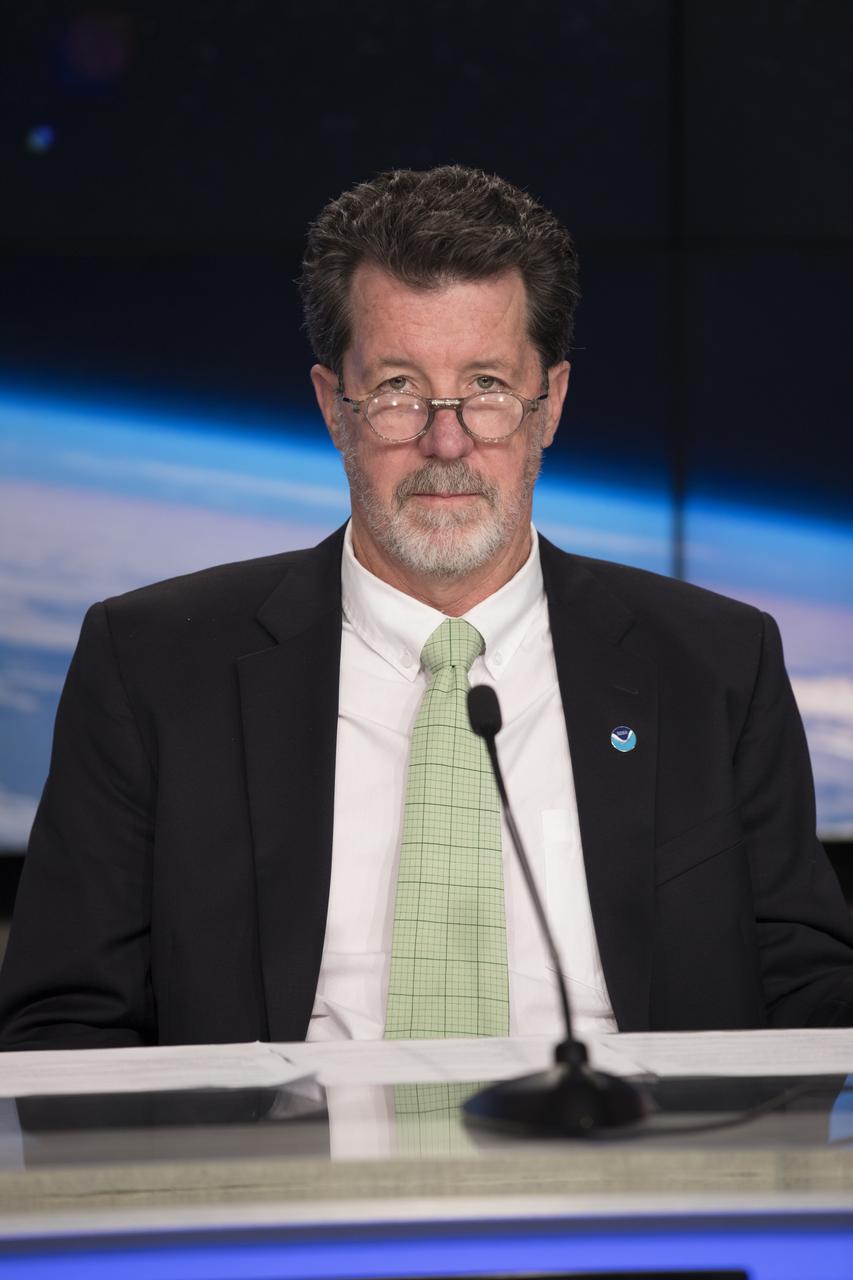
In the Kennedy Space Center's Press Site auditorium, Jim Roberts, a scientist with the Earth System Research Laboratory's Office of Atmospheric Research for NOAA, speaks to members of the media at a mission briefing on National Oceanic and Atmospheric Administration's, or NOAA's, Geostationary Operational Environmental Satellite, or GOES-S. The spacecraft is the second satellite in a series of next-generation NOAA weather satellites. It will launch to a geostationary position over the U.S. to provide images of storms and help predict weather forecasts, severe weather outlooks, watches, warnings, lightning conditions and longer-term forecasting. GOES-S is slated to lift off at 5:02 p.m. EST on March 1, 2018 aboard a United Launch Alliance Atlas V rocket.
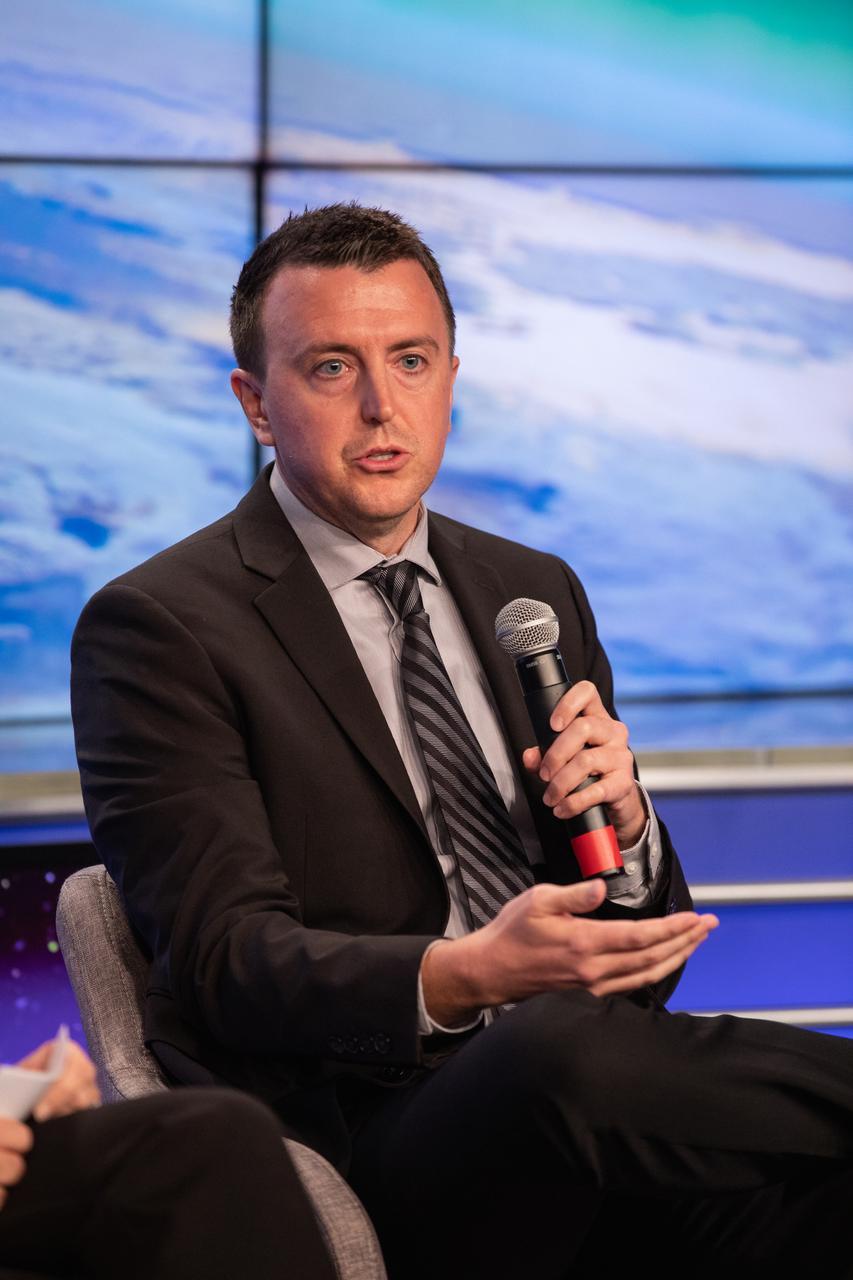
Will Ulrich, launch weather officer with the U.S. Air Force 45th Space Wing, speaks to news media during a prelaunch mission briefing for NASA’s Ionospheric Connection Explorer (ICON), on Oct. 8, 2019, in the News Center auditorium at the agency’s Kennedy Space Center in Florida. ICON is targeted to launch from Cape Canaveral Air Force Station in Florida on Oct. 9, 2019, aboard a Northrop Grumman Pegasus XL rocket carried aloft by the company’s Stargazer L-1011 aircraft. The explorer will study the frontier of space - the dynamic zone high in Earth's atmosphere where terrestrial weather from below meets space weather above.
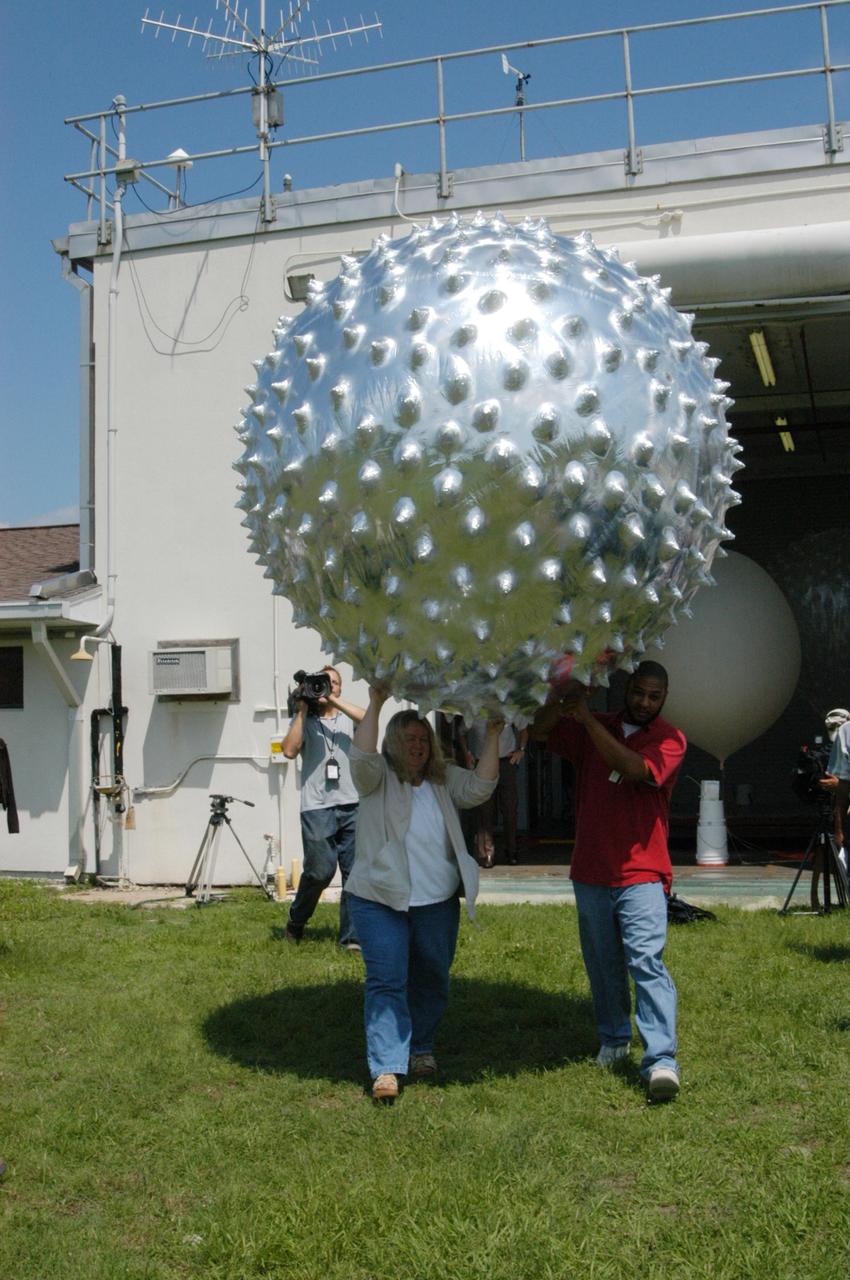
KENNEDY SPACE CENTER, FLA. - At the Cape Canaveral weather station in Florida, workers carry an upper-level weather balloon outside for release. The release was part of a media tour prior to the launch of Space Shuttle Discovery on mission STS-121 July 1. The radar-tracked balloon detects wind shears that can affect a shuttle launch. At the facility, which is operated by the U.S. Air Force 45th Weather Squadron, media saw the tools used by the weather team to create the forecast for launch day. They received a briefing on how the launch weather forecast is developed by Shuttle Weather Officer Kathy Winters and met the forecasters for the space shuttle and the expendable launch vehicles. Also participating were members of the Applied Meteorology Unit who provide special expertise to the forecasters by analyzing and interpreting unusual or inconsistent weather data. The media were able to see the release of the Rawinsonde weather balloon carrying instruments aloft to be used as part of developing the forecast. Photo credit: NASA/George Shelton
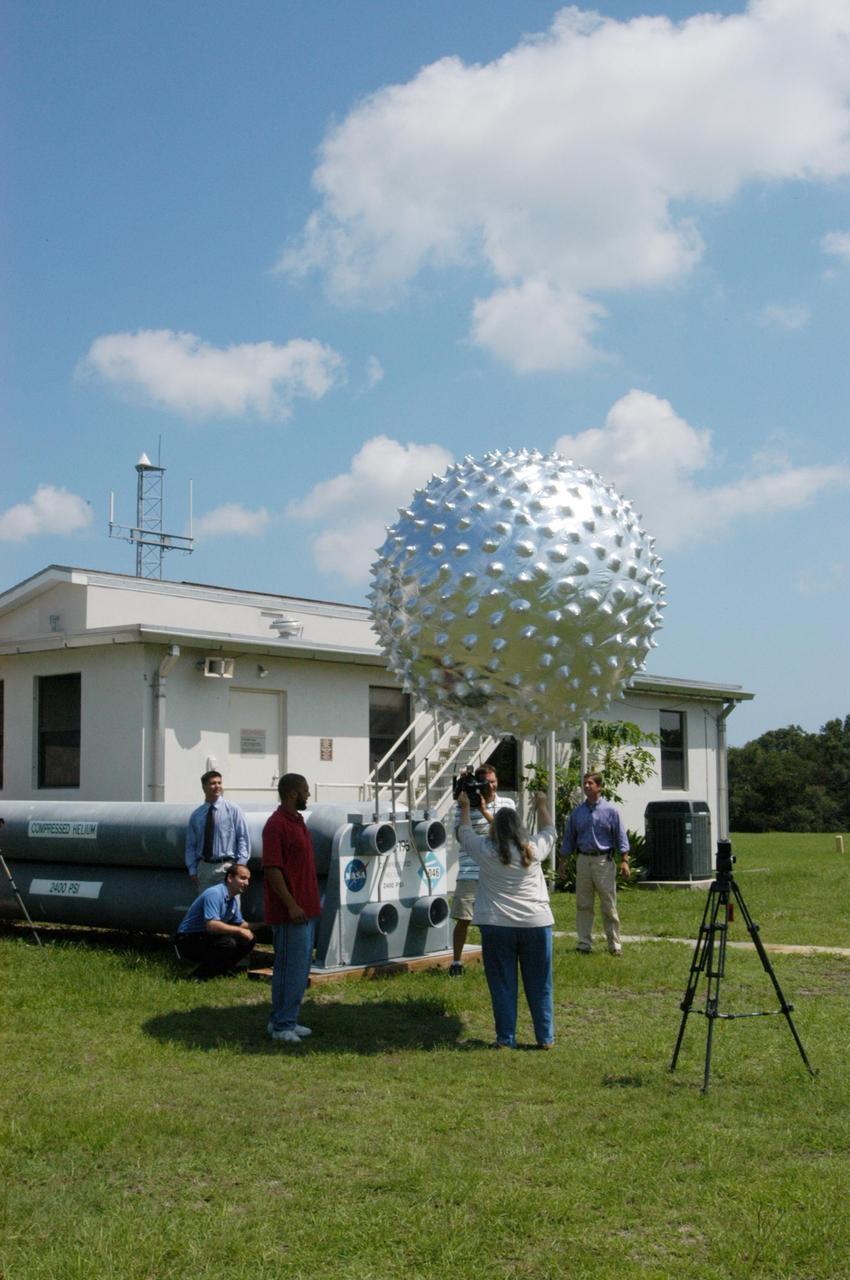
KENNEDY SPACE CENTER, FLA. - At the Cape Canaveral weather station in Florida, workers release an upper-level weather balloon while several newscasters watch. The release of the balloon was part of a media tour prior to the launch of Space Shuttle Discovery on mission STS-121 July 1. The radar-tracked balloon detects wind shears that can affect a shuttle launch. At the facility, which is operated by the U.S. Air Force 45th Weather Squadron, media saw the tools used by the weather team to create the forecast for launch day. They received a briefing on how the launch weather forecast is developed by Shuttle Weather Officer Kathy Winters and met the forecasters for the space shuttle and the expendable launch vehicles. Also participating were members of the Applied Meteorology Unit who provide special expertise to the forecasters by analyzing and interpreting unusual or inconsistent weather data. The media were able to see the release of the Rawinsonde weather balloon carrying instruments aloft to be used as part of developing the forecast. Photo credit: NASA/George Shelton
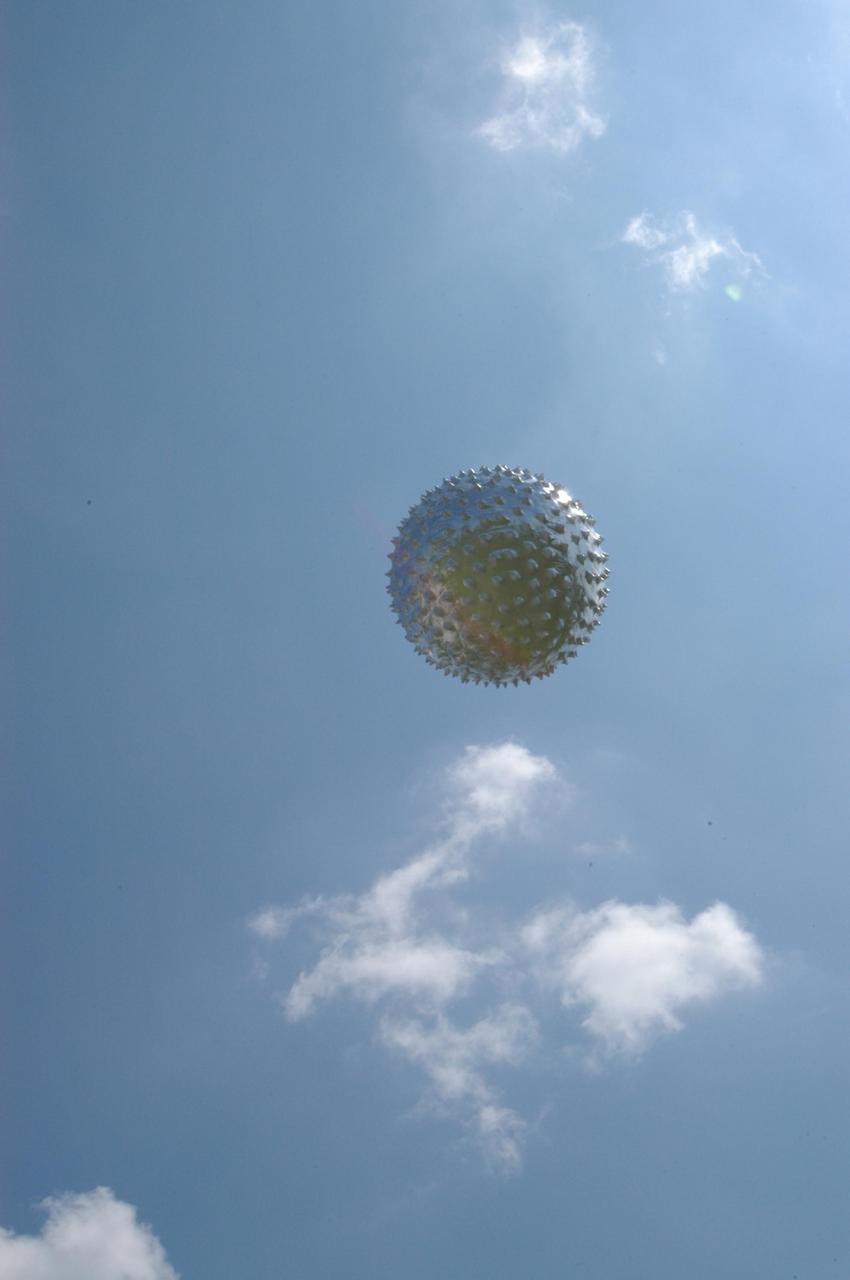
KENNEDY SPACE CENTER, FLA. - An upper-level weather balloon sails into the sky after release from the Cape Canaveral weather station in Florida. The release was planned as part of a media tour prior to the launch of Space Shuttle Discovery on mission STS-121 July 1. The radar-tracked balloon detects wind shears that can affect a shuttle launch. At the facility, which is operated by the U.S. Air Force 45th Weather Squadron, media saw the tools used by the weather team to create the forecast for launch day. They received a briefing on how the launch weather forecast is developed by Shuttle Weather Officer Kathy Winters and met the forecasters for the space shuttle and the expendable launch vehicles. Also participating were members of the Applied Meteorology Unit who provide special expertise to the forecasters by analyzing and interpreting unusual or inconsistent weather data. The media were able to see the release of the Rawinsonde weather balloon carrying instruments aloft to be used as part of developing the forecast. Photo credit: NASA/George Shelton
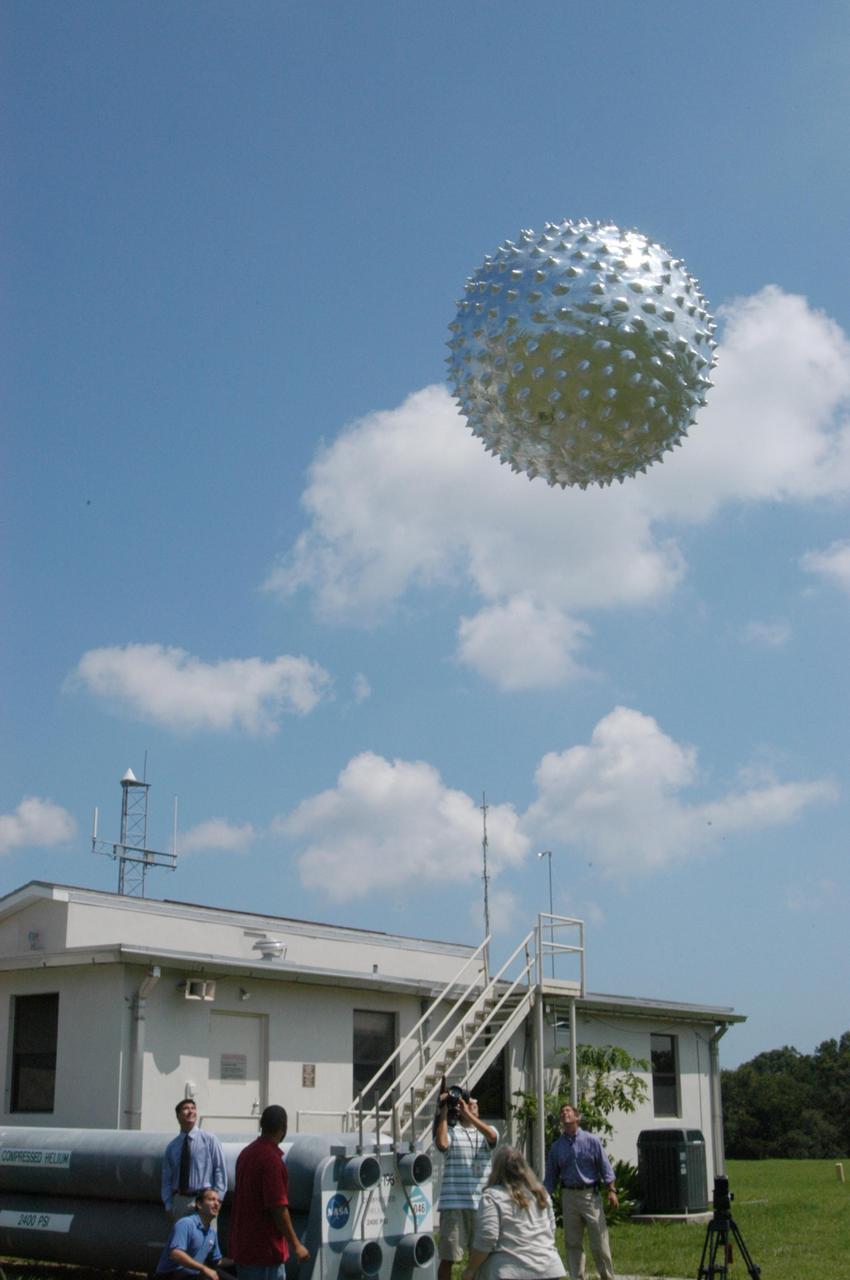
KENNEDY SPACE CENTER, FLA. - Under the watchful eyes of the media, an upper-level weather balloon begins its lift into the sky. The release of the balloon at the Cape Canaveral weather station in Florida was part of a media tour prior to the launch of Space Shuttle Discovery on mission STS-121 July 1. The radar-tracked balloon detects wind shears that can affect a shuttle launch. At the facility, which is operated by the U.S. Air Force 45th Weather Squadron, media saw the tools used by the weather team to create the forecast for launch day. They received a briefing on how the launch weather forecast is developed by Shuttle Weather Officer Kathy Winters and met the forecasters for the space shuttle and the expendable launch vehicles. Also participating were members of the Applied Meteorology Unit who provide special expertise to the forecasters by analyzing and interpreting unusual or inconsistent weather data. The media were able to see the release of the Rawinsonde weather balloon carrying instruments aloft to be used as part of developing the forecast. Photo credit: NASA/George Shelton
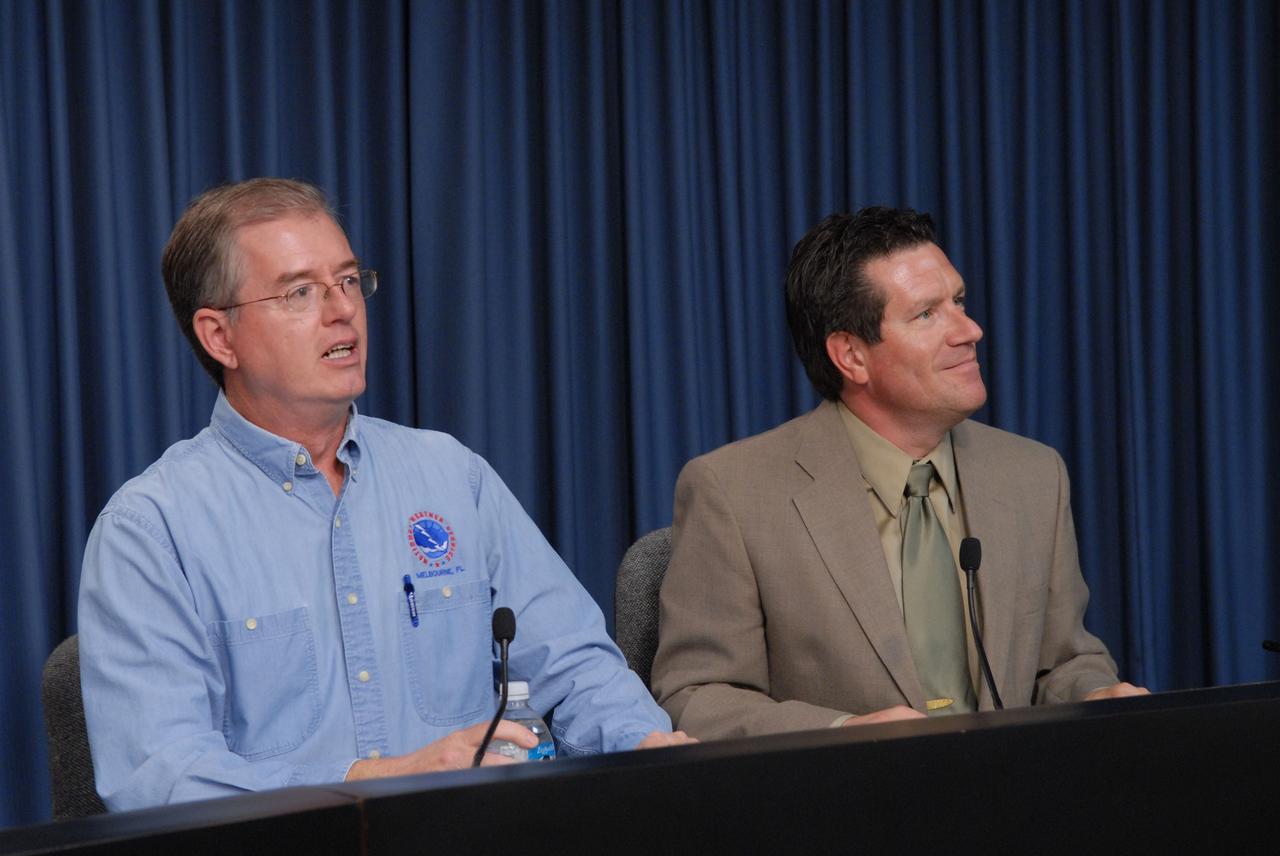
CAPE CANAVERAL, Fla. – Bart Hagemeyer, at left, meteorologist in charge, NOAA National Weather Service forecast office, Melbourne, Fla., and Joel Tumbiolo, Delta IV launch weather officer, 45th Weather Squadron, Cape Canaveral Air Force Station, participate in a prelaunch news conference on the Geostationary Operational Environmental Satellite-O mission in NASA's Kennedy Space Center press site auditorium. The GOES-O satellite is targeted to launch June 26. The latest Geostationary Operational Environmental Satellite, GOES-O was developed by NASA for the National Oceanic and Atmospheric Administration, or NOAA. Each of the GOES satellites continuously provides observations of 60 percent of the Earth including the continental United States, providing weather monitoring and forecast operations as well as a continuous and reliable stream of environmental information and severe weather warnings. Once in orbit, GOES-O will be designated GOES-14, and NASA will provide on-orbit checkout and then transfer operational responsibility to NOAA. Photo credit: NASA/Jim Grossmann

Arlena Moses, launch weather officer, 45th Weather Squadron, Cape Canaveral Space Force Station, is introduced during a prelaunch news conference for SpaceX’s 24th commercial resupply services mission at Kennedy Space Center in Florida on Tuesday, Dec. 20, 2021. Liftoff of the SpaceX Falcon 9 rocket with the company’s Dragon spacecraft on board is targeted for Tuesday, Dec. 21, 2021, at 5:07 a.m. EST. The mission will deliver new science investigations, supplies, and equipment to the crew on board the International Space Station.
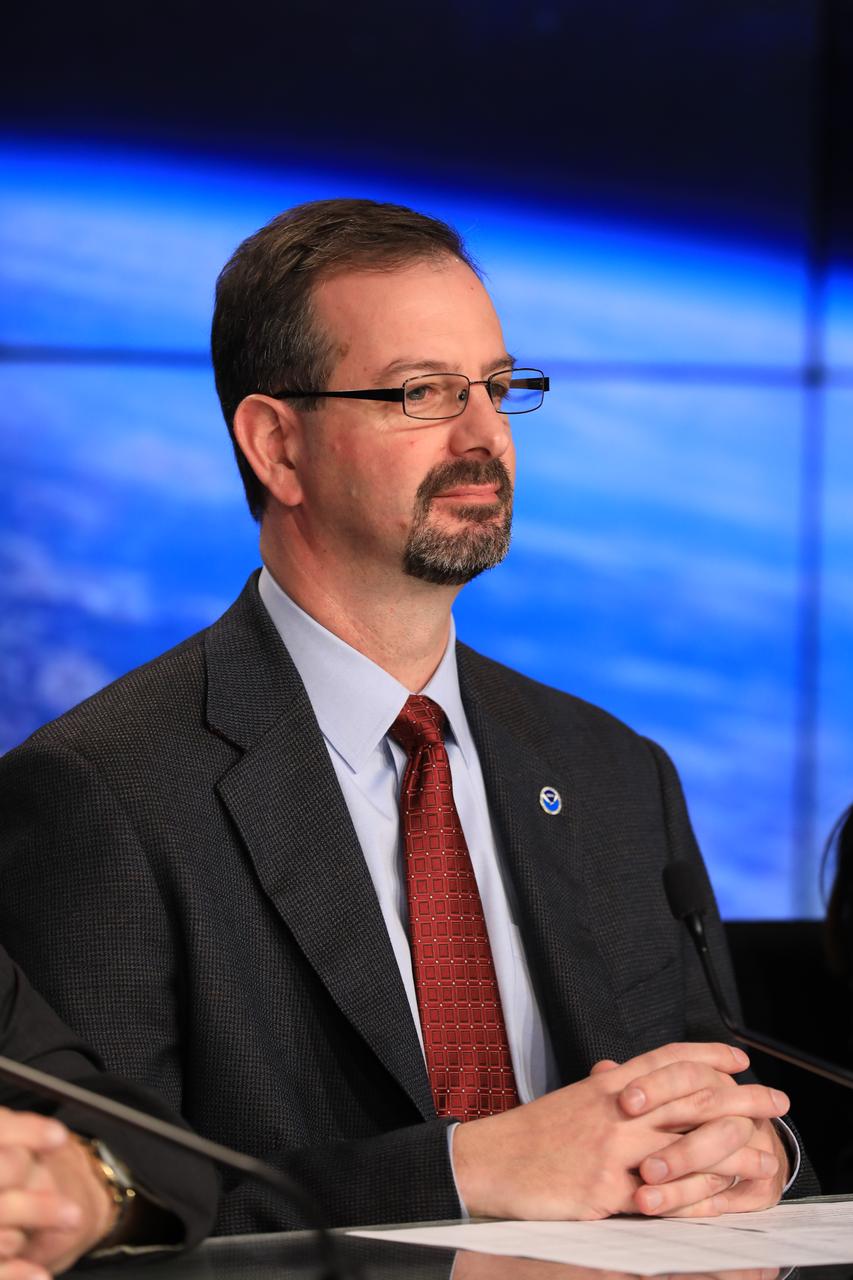
In the Kennedy Space Center's Press Site auditorium, Joseph A. Pica, director of the National Weather Service Office of Observations, speaks to the media during a mission briefing on the Geostationary Operational Environmental Satellite (GOES-R). GOES-R is the first satellite in a series of next-generation GOES satellites for NOAA, the National Oceanographic and Atmospheric Administration. It will launch to a geostationary orbit over the western hemisphere to provide images of storms and help meteorologists predict severe weather conditionals and develop long-range forecasts.
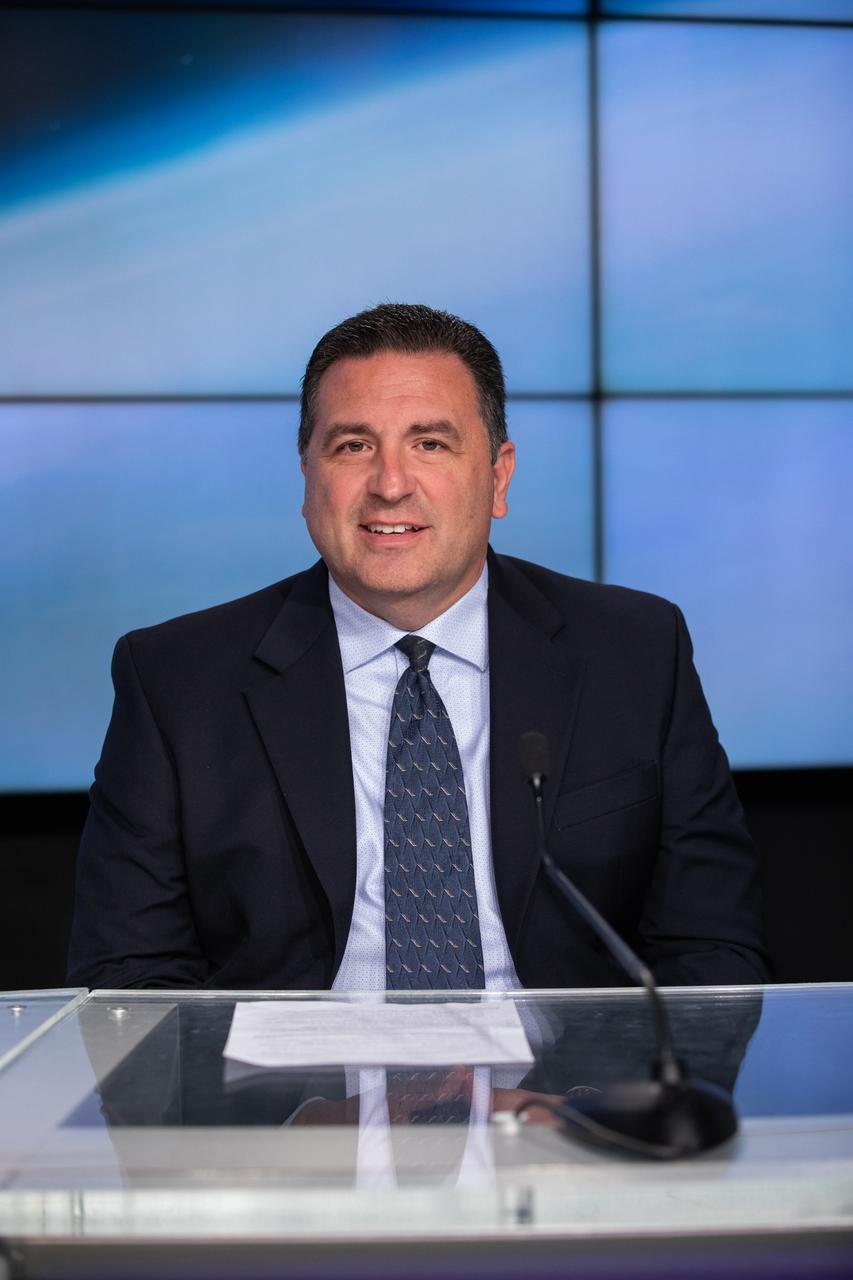
Gary Wentz, vice president, Government and Commercial Programs, United Launch Alliance, launch weather officer, U.S. Space Force, 45th Weather Squadron, Space Launch Delta 45, participates in a prelaunch briefing for NASA’s uncrewed Boeing Orbital Flight Test (OFT-2) at the agency’s Kennedy Space Center in Florida, May 17, 2022. Boeing’s CST-100 Starliner is targeted to launch at 6:54 p.m. EDT on Thursday, May 19, on a United Launch Alliance Atlas V rocket from Space Launch Complex-41 at Cape Canaveral Space Force Station in Florida to rendezvous and dock with the International Space Station.
CAPE CANAVERAL, Fla. -- NASA Public Affairs Officer Candrea Thomas, NASA Test Director Steve Payne and Shuttle Launch Weather Officer Kathy Winters talk to media about the progression of the countdown to launch space shuttle Discovery on the STS-133 mission to the International Space Station and the launch-day weather forecast. Scheduled to lift off Feb. 24 at 4:50 p.m. EST, Discovery and its six-member crew will deliver the Permanent Multipurpose Module, packed with supplies and critical spare parts, as well as Robonaut 2, the dexterous humanoid astronaut helper, to the orbiting outpost. For more information on the STS-133 mission, visit www.nasa.gov/mission_pages/shuttle/shuttlemissions/sts133/. Photo credit: NASA/Jim Grossmann
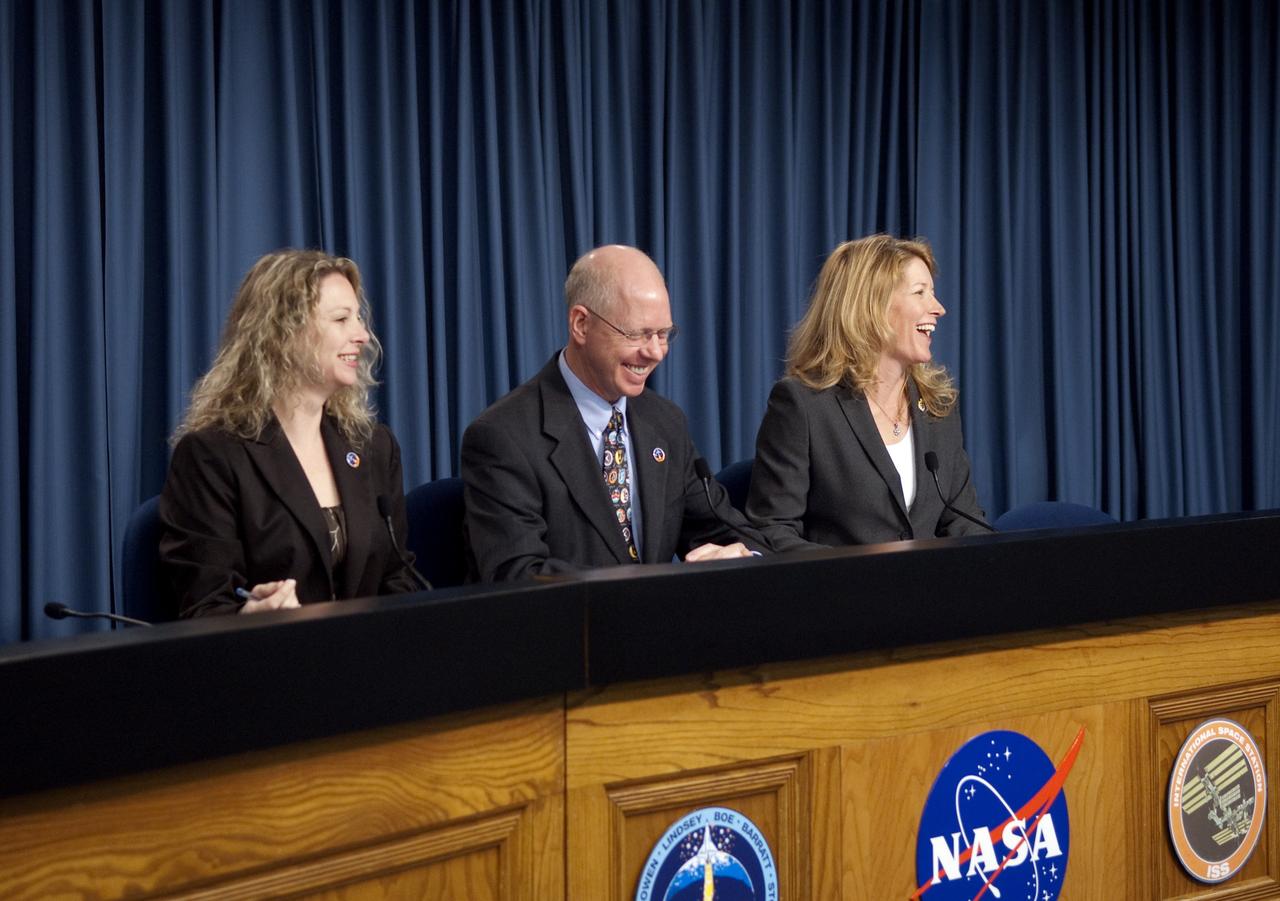
CAPE CANAVERAL, Fla. -- NASA Public Affairs Officer Candrea Thomas, NASA Test Director Steve Payne and Shuttle Launch Weather Officer Kathy Winters talk to media about the progression of the countdown to launch space shuttle Discovery on the STS-133 mission to the International Space Station and the launch-day weather forecast. Scheduled to lift off Feb. 24 at 4:50 p.m. EST, Discovery and its six-member crew will deliver the Permanent Multipurpose Module, packed with supplies and critical spare parts, as well as Robonaut 2, the dexterous humanoid astronaut helper, to the orbiting outpost. For more information on the STS-133 mission, visit www.nasa.gov/mission_pages/shuttle/shuttlemissions/sts133/. Photo credit: NASA/Jim Grossmann
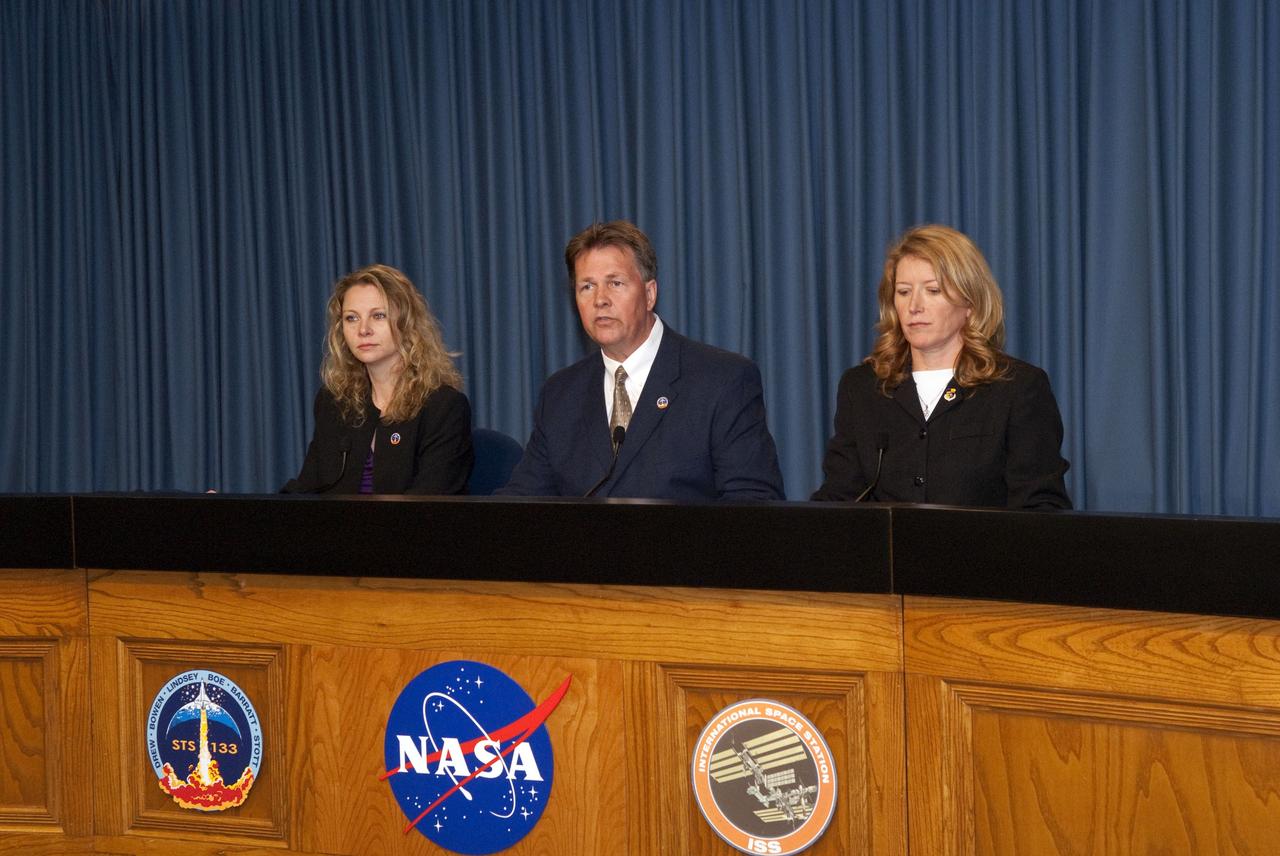
CAPE CANAVERAL, Fla. -- NASA Public Affairs Officer Candrea Thomas, NASA Test Director Jeff Spaulding and Shuttle Launch Weather Officer Kathy Winters talk to media about picking up the countdown to launch space shuttle Discovery on the STS-133 mission to the International Space Station and the launch-day weather forecast. Scheduled to lift off Feb. 24 at 4:50 p.m. EST, Discovery and its six-member crew will deliver the Permanent Multipurpose Module, packed with supplies and critical spare parts, as well as Robonaut 2, the dexterous humanoid astronaut helper, to the orbiting outpost. For more information on the STS-133 mission, visit www.nasa.gov/mission_pages/shuttle/shuttlemissions/sts133/. Photo credit: NASA/Jim Grossmann

Will Ulrich, launch weather officer, U.S. Space Force, 45th Weather Squadron, Space Launch Delta 45, participates in a prelaunch briefing for NASA’s uncrewed Boeing Orbital Flight Test (OFT-2) at the agency’s Kennedy Space Center in Florida, May 17, 2022. Boeing’s CST-100 Starliner is targeted to launch at 6:54 p.m. EDT on Thursday, May 19, on a United Launch Alliance Atlas V rocket from Space Launch Complex-41 at Cape Canaveral Space Force Station in Florida to rendezvous and dock with the International Space Station.
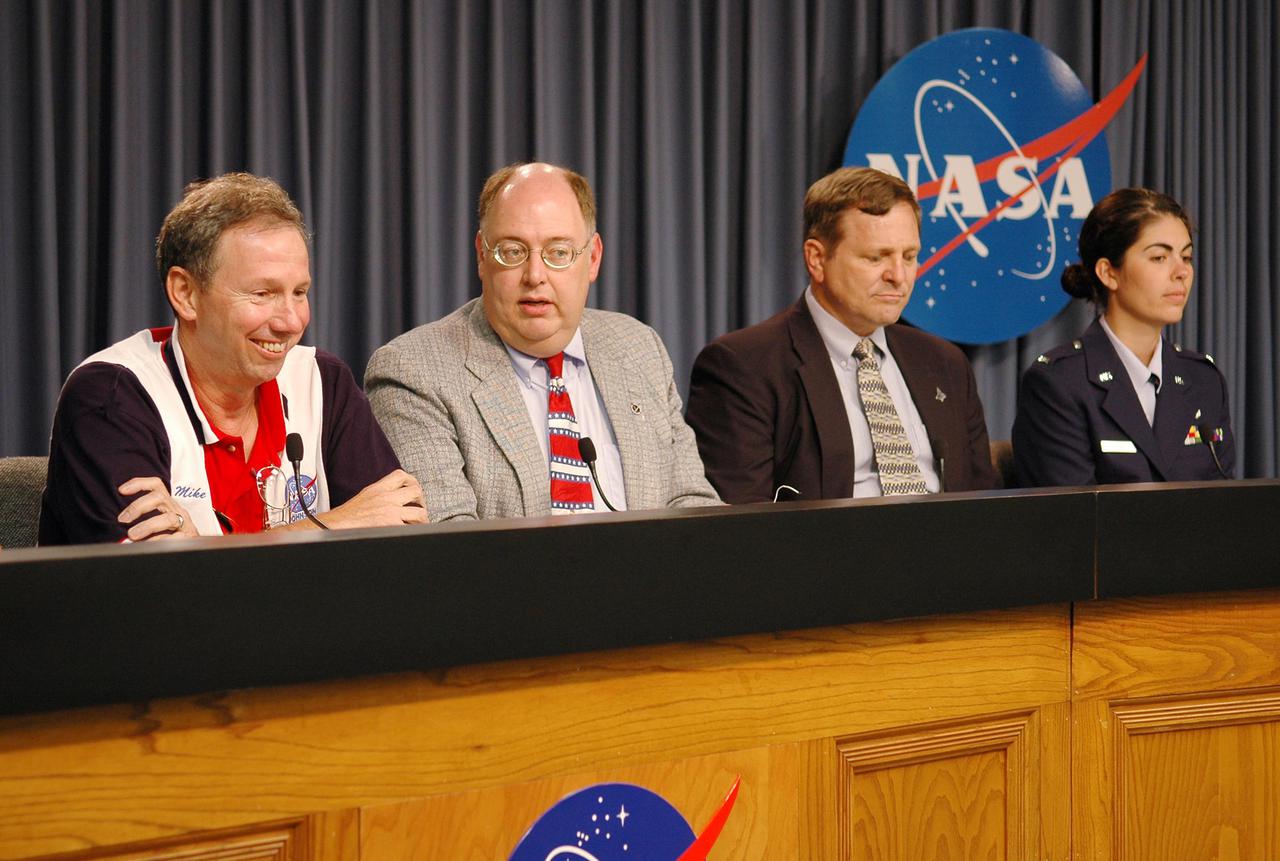
KENNEDY SPACE CENTER, FLA. - At the STS-114 Launch Readiness Press Conference at NASA Kennedy Space Center, NASA officials confirm the July 26 launch. Seated from left are NASA Administrator Mike Griffin, Space Shuttle Deputy Program Manager Wayne Hale, Shuttle Processing Director Mike Wetmore and launch weather officer 1st Lt. Mindy Chavez, with the U.S. Air Force 45th Weather Squadron. Liftoff of Space Shuttle Discovery on the Return to Flight mission STS-114 is scheduled for 10:39 a.m. EDT July 26 from Launch Pad 39B.

Officials from NASA, National Oceanic and Atmospheric Administration (NOAA), SpaceX participate in a prelaunch news conference on Monday, June 24, 2024, at NASA’s Kennedy Space Center in Florida for the launch of GOES-U (Geostationary Operational Environmental Satellite U) mission. From left to right, Steve Volz, assistant administrator, NOAA’s Satellite and Information Service; Pam Sullivan, director, GOES-R Program, NOAA; John Gagosian, director, Joint Agency Satellite Division; Denton Gibson, launch director, Launch Services Program, NASA; Julianna Scheiman, director, NASA Science Missions, SpaceX; Brian Cizek, launch weather officer, 45th Weather Squadron, U.S. Space Force

Arlena Moses, launch weather officer, U.S. Air Force 45th Weather Squadron, answers questions during a virtual prelaunch news conference Nov. 13, 2020, inside the Press Site auditorium at NASA’s Kennedy Space Center in Florida ahead of the agency’s SpaceX Crew-1 launch. Crew-1 is the first regular crew mission of a U.S. commercial spacecraft with astronauts to the International Space Station as part of NASA’s Commercial Crew Program. The SpaceX Crew Dragon Resilience capsule will launch atop the company’s Falcon 9 rocket from Launch Complex 39A to the space station for a six-month science mission.

Officials from NASA, National Oceanic and Atmospheric Administration (NOAA), SpaceX participate in a prelaunch news conference on Monday, June 24, 2024, at NASA’s Kennedy Space Center in Florida for the launch of GOES-U (Geostationary Operational Environmental Satellite U) mission. From left to right, Steve Volz, assistant administrator, NOAA’s Satellite and Information Service; Pam Sullivan, director, GOES-R Program, NOAA; John Gagosian, director, Joint Agency Satellite Division; Denton Gibson, launch director, Launch Services Program, NASA; Julianna Scheiman, director, NASA Science Missions, SpaceX; Brian Cizek, launch weather officer, 45th Weather Squadron, U.S. Space Force
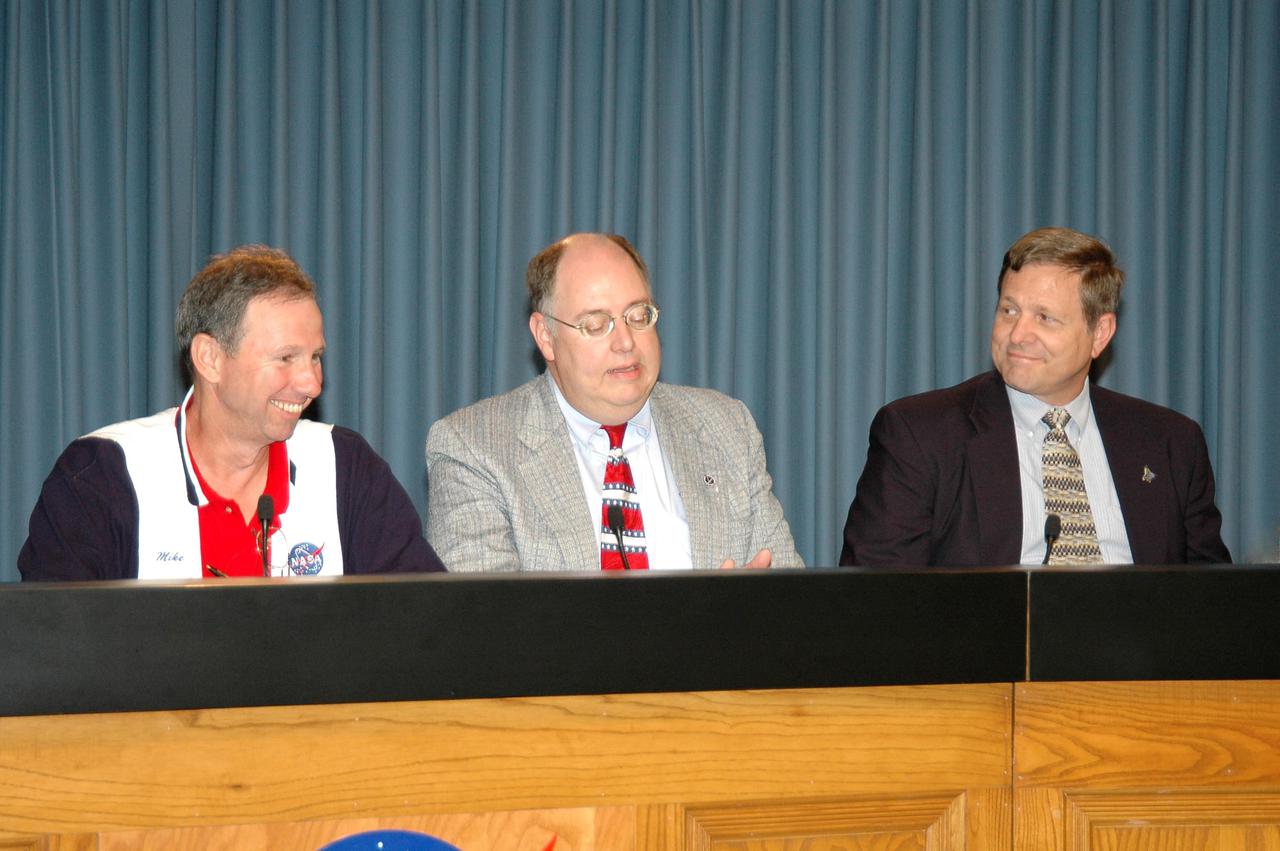
KENNEDY SPACE CENTER, FLA. - At the STS-114 Launch Readiness Press Conference at NASA Kennedy Space Center, Space Shuttle Deputy Program Manager Wayne Hale (center) answers a question from the media. At the conference, NASA officials confirmed the July 26 launch. Others seated with Hale on the stage are NASA Administrator Mike Griffin (left) and Shuttle Processing Director Mike Wetmore (right). Not pictured is launch weather officer 1st Lt. Mindy Chavez, with the U.S. Air Force 45th Weather Squadron. Liftoff of Space Shuttle Discovery on the Return to Flight mission STS-114 is scheduled for 10:39 a.m. EDT July 26 from Launch Pad 39B.
Mark Burger, launch weather officer, U.S. Space Force, 45th Weather Squadron, participates in a prelaunch briefing for NASA’s Boeing Crew Flight Test at the agency’s Kennedy Space Center in Florida, Friday, May 31, 2024. As part of the agency’s Commercial Crew Program, NASA astronauts Butch Wilmore and Suni Williams are the first to launch aboard Boeing’s Starliner spacecraft atop a United Launch Alliance Atlas V rocket from Space Launch Complex-41 at Cape Canaveral Space Force Station in Florida. Liftoff is scheduled for 12:25 p.m. ET on Saturday, June 1.
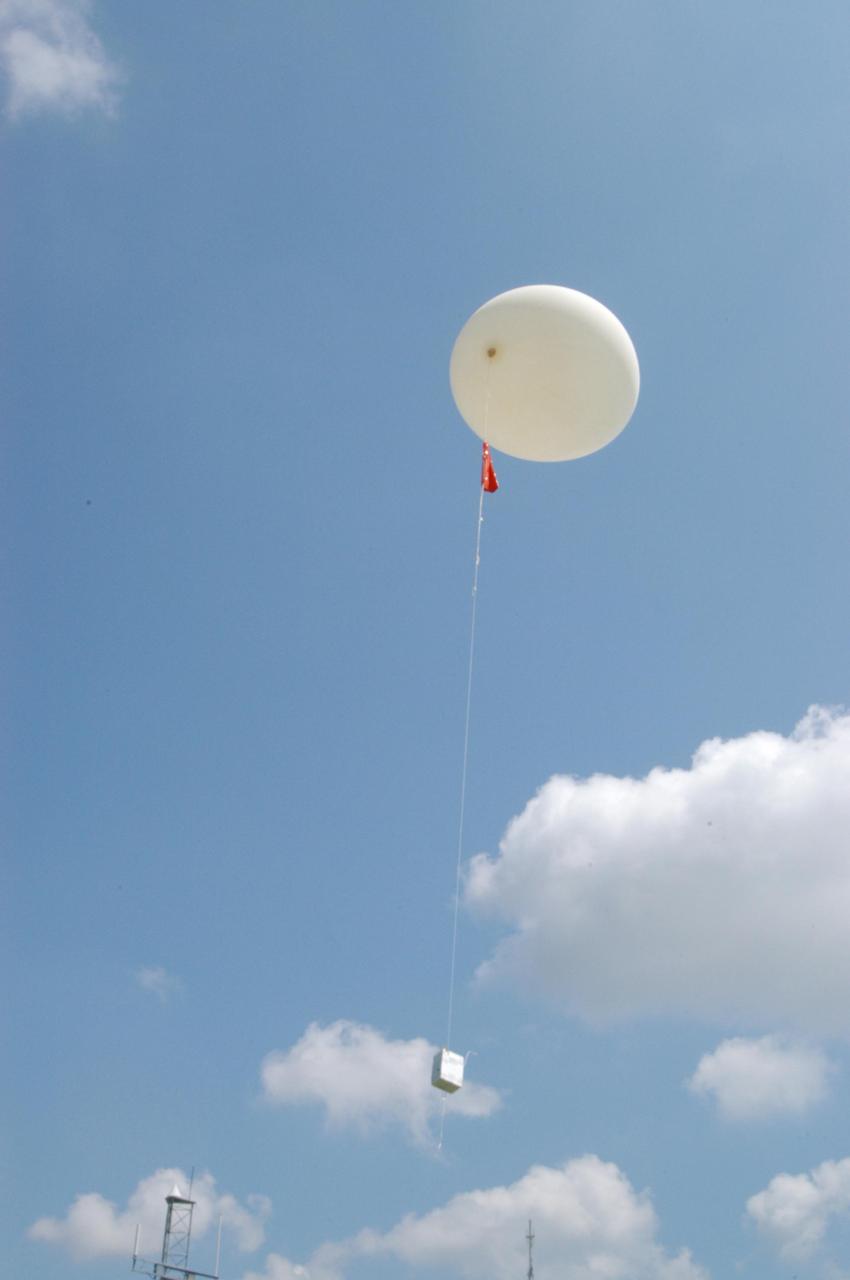
KENNEDY SPACE CENTER, FLA. - A Rawinsonde weather balloon sails into the sky after release from the Cape Canaveral forecast facility in Florida. The release was planned as part of a media tour prior to the launch of Space Shuttle Discovery on mission STS-121 July 1. Rawinsonde balloons are GPS-tracked and can collect such data as atmospheric pressure, temperature, humidity and wind speed and direction up to 100,000 feet. At the facility, which is operated by the U.S. Air Force 45th Weather Squadron, media saw the tools used by the weather team to create the forecast for launch day. They received a briefing on how the launch weather forecast is developed by Shuttle Weather Officer Kathy Winters and met the forecasters for the space shuttle and the expendable launch vehicles. Also participating were members of the Applied Meteorology Unit who provide special expertise to the forecasters by analyzing and interpreting unusual or inconsistent weather data. The media were able to see the release of the Rawinsonde weather balloon carrying instruments aloft to be used as part of developing the forecast. Photo credit: NASA/George Shelton
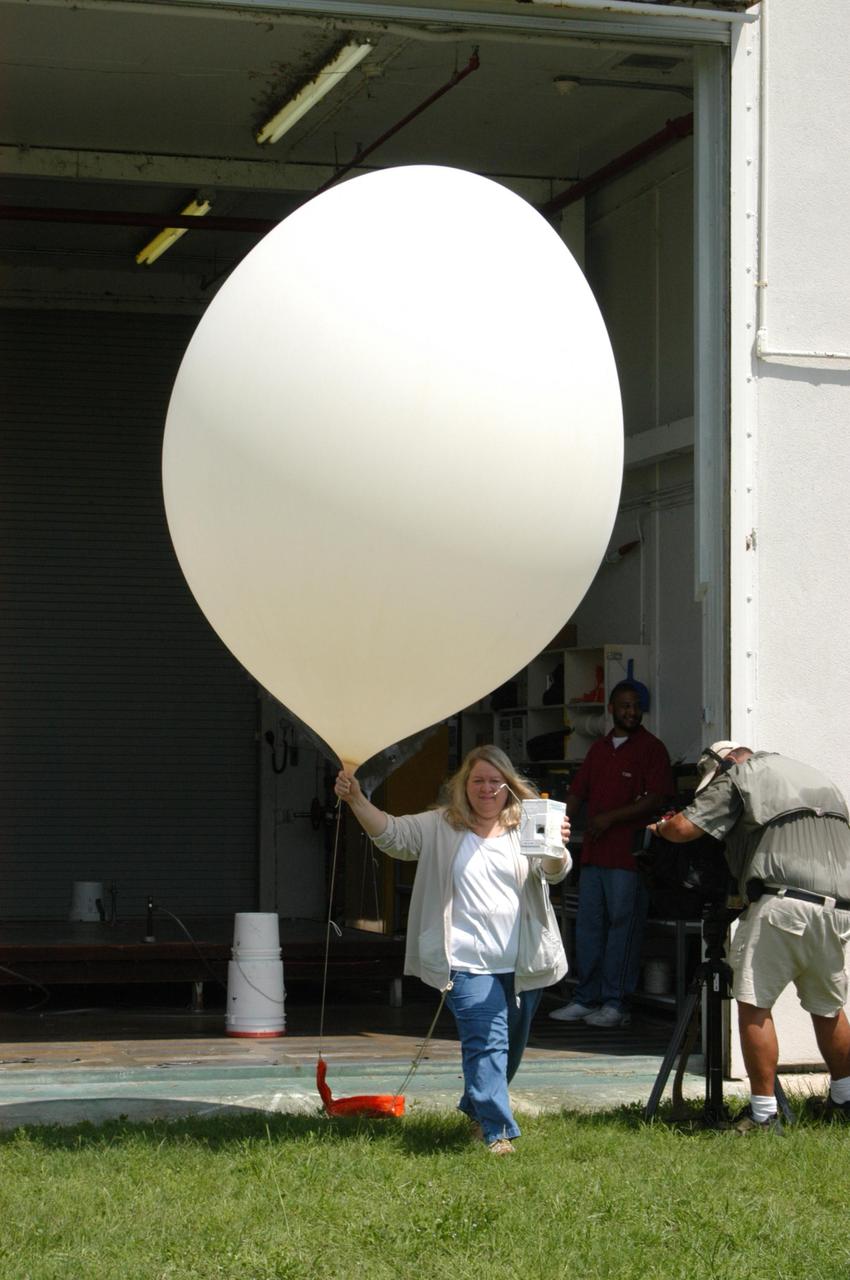
KENNEDY SPACE CENTER, FLA. - At the Cape Canaveral forecast facility in Florida, a worker carries a Rawinsonde weather balloon outside for release. Rawinsonde balloons are GPS-tracked and can collect such data as atmospheric pressure, temperature, humidity and wind speed and direction up to 100,000 feet. The release was planned as part of a media tour prior to the launch of Space Shuttle Discovery on mission STS-121 July 1. At the facility, which is operated by the U.S. Air Force 45th Weather Squadron, media saw the tools used by the weather team to create the forecast for launch day. They received a briefing on how the launch weather forecast is developed by Shuttle Weather Officer Kathy Winters and met the forecasters for the space shuttle and the expendable launch vehicles. Also participating were members of the Applied Meteorology Unit who provide special expertise to the forecasters by analyzing and interpreting unusual or inconsistent weather data. The media were able to see the release of the Rawinsonde weather balloon carrying instruments aloft to be used as part of developing the forecast. Photo credit: NASA/George Shelton

KENNEDY SPACE CENTER, FLA. - At the Cape Canaveral forecast facility in Florida, a worker releases a Rawinsonde weather balloon outside for release. Rawinsonde balloons are GPS-tracked and can collect such data as atmospheric pressure, temperature, humidity and wind speed and direction up to 100,000 feet. The release was planned as part of a media tour prior to the launch of Space Shuttle Discovery on mission STS-121 July 1. At the facility, which is operated by the U.S. Air Force 45th Weather Squadron, media saw the tools used by the weather team to create the forecast for launch day. They received a briefing on how the launch weather forecast is developed by Shuttle Weather Officer Kathy Winters and met the forecasters for the space shuttle and the expendable launch vehicles. Also participating were members of the Applied Meteorology Unit who provide special expertise to the forecasters by analyzing and interpreting unusual or inconsistent weather data. The media were able to see the release of the Rawinsonde weather balloon carrying instruments aloft to be used as part of developing the forecast. Photo credit: NASA/George Shelton
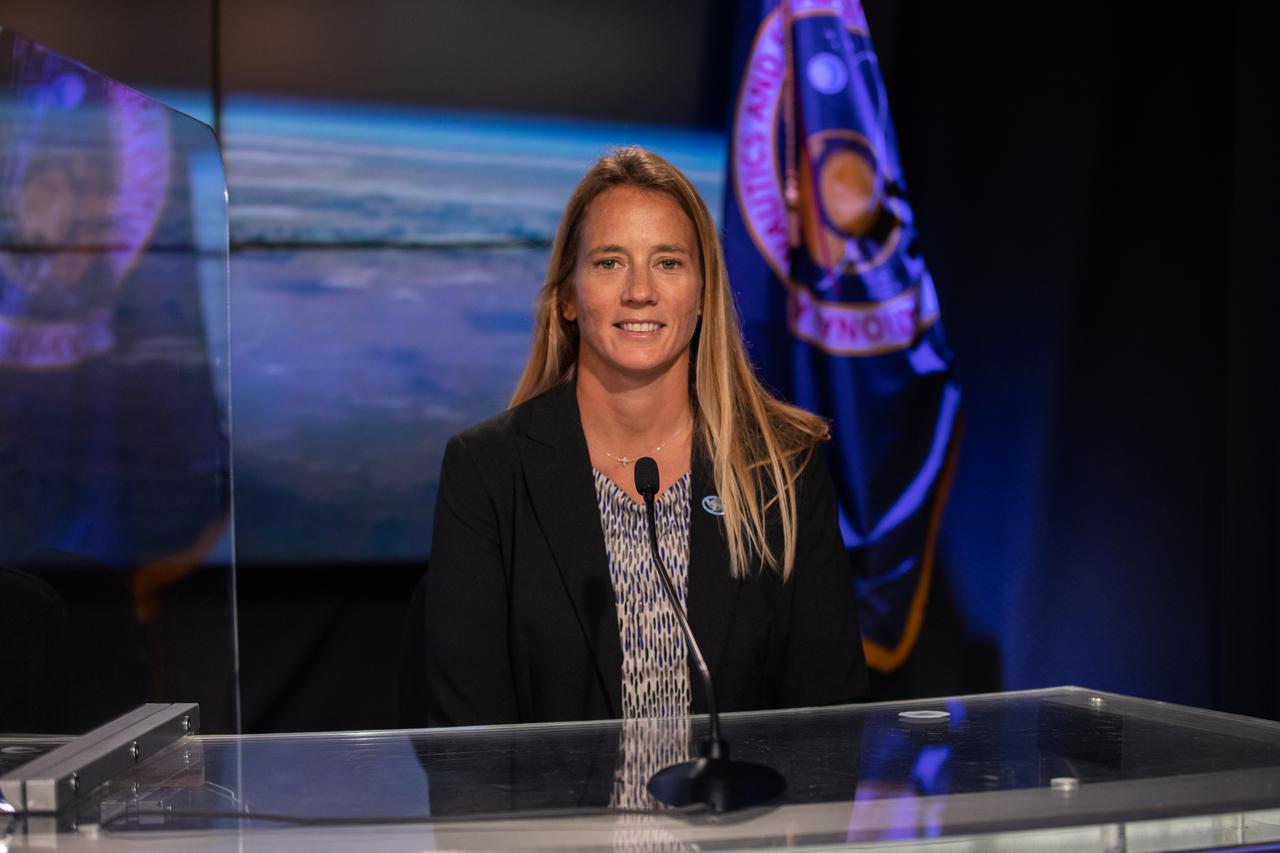
A prelaunch news conference for the National Oceanic and Atmospheric Administration’s (NOAA) Geostationary Operational Environmental Satellite-T (GOES-T) is held on Feb. 26, 2022, at NASA’s Kennedy Space Center in Florida. Jessica Williams, launch weather officer, 45th Weather Squadron, Space Launch Delta 45, answers questions during the news conference. GOES-T is scheduled to lift off on a United Launch Alliance Atlas V 541 rocket from Space Launch Complex 41 at Cape Canaveral Space Force Station in Florida on March 1, 2022, at 4:38 p.m. GOES-T is the third satellite in the GOES-R series that will continue to help meteorologists observe and predict local weather events that affect public safety. The launch is being managed by NASA’s Launch Services Program based at Kennedy Space Center in Florida, America’s multi-user spaceport.
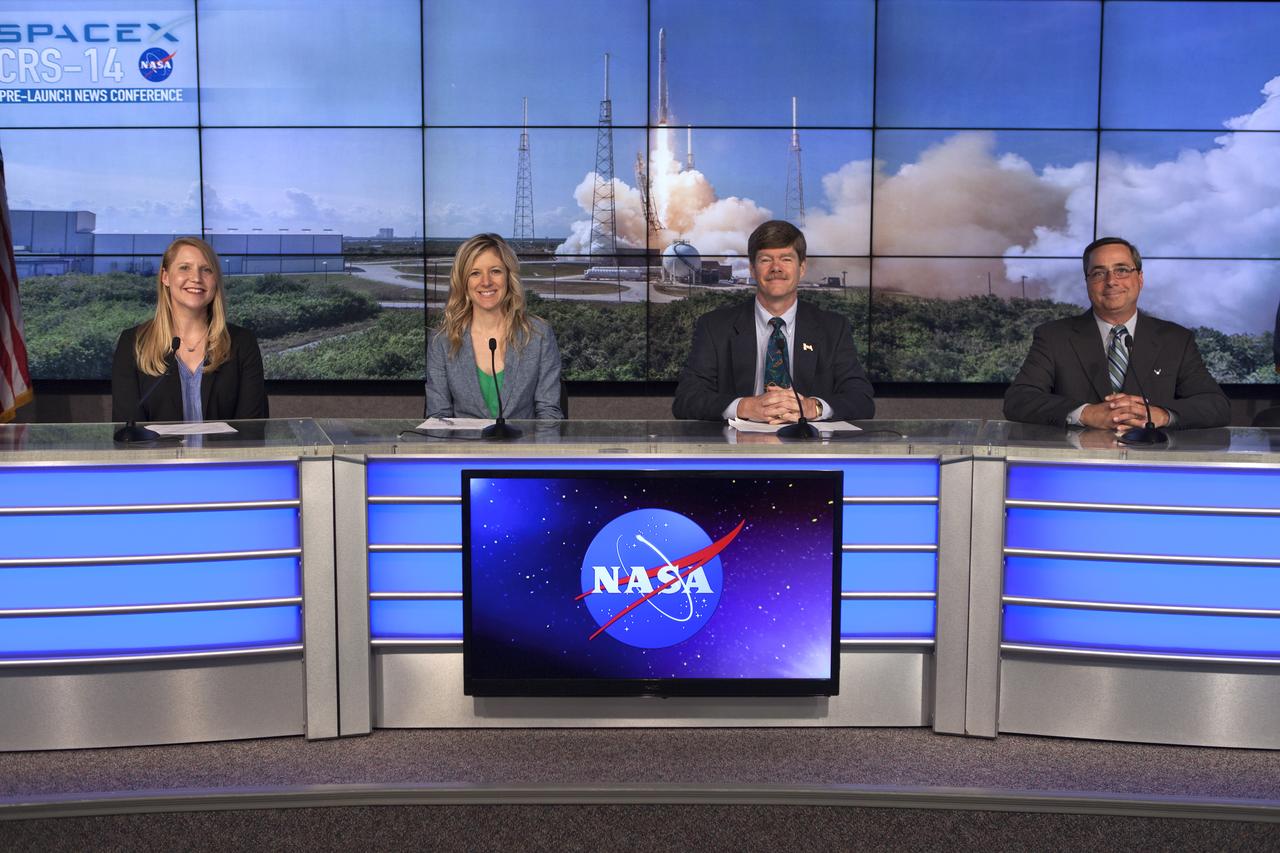
In the Kennedy Space Center’s Press Site auditorium, NASA and industry leaders speak to members of the media during a prelaunch news conference for the SpaceX CRS-14 commercial resupply services mission to the International Space Station. From left, are Stephanie Schierholz, of NASA Communications; Jessica Jensen, director, Dragon Mission Management, SpaceX; Pete Hasbrook, associate program scientist, ISS Program Science Office at NASA's Johnson Space Center in Houston; and Mike McAleenan, weather officer, 45th Weather Squadron. Joining on the phone is Joel Montalbano, deputy manager, ISS Program at Johnson. A Dragon spacecraft is scheduled to be launched from Space Launch Complex 40 at Cape Canaveral Air Force Station at 4:30 p.m. EST, on April 2, 2018. The SpaceX Falcon 9 rocket will lift off on the company's 14th Commercial Resupply Services mission to the space station.
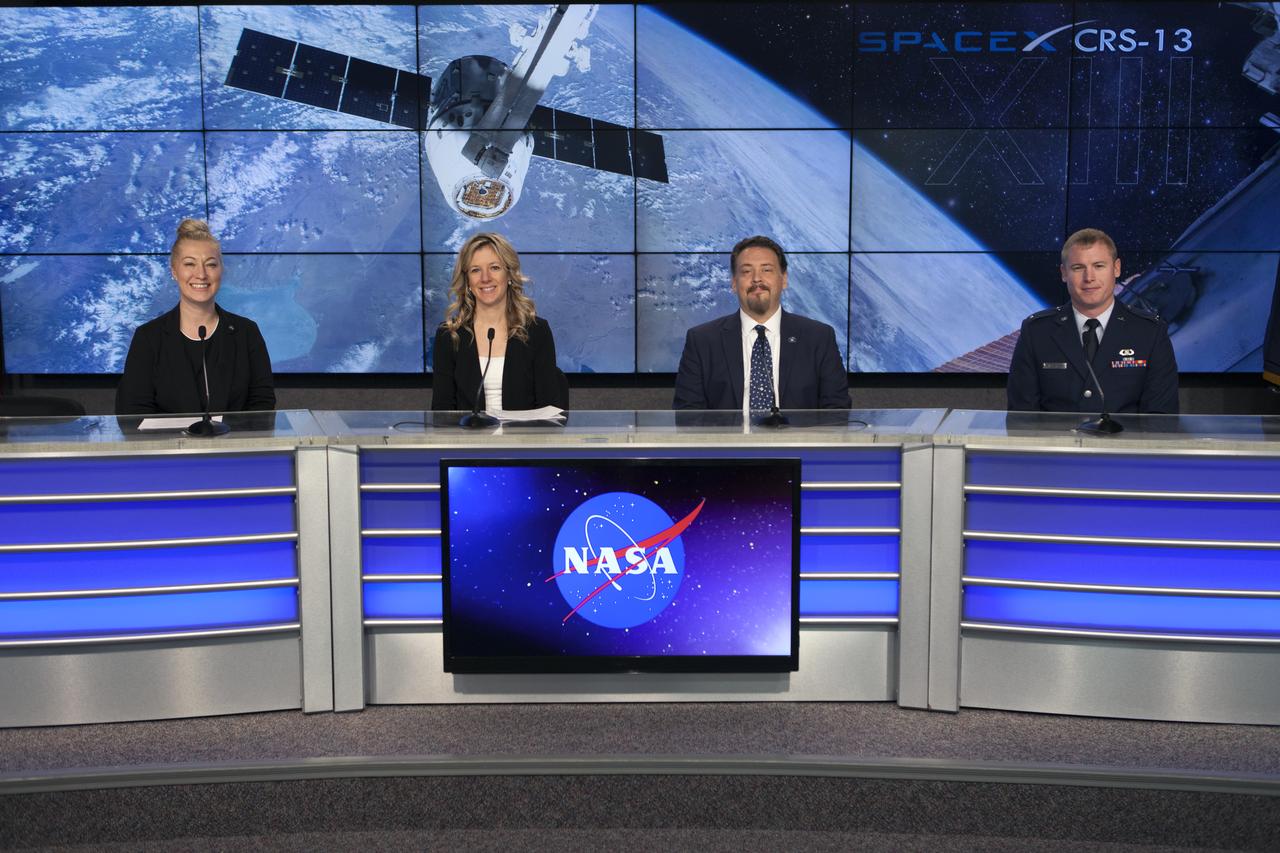
In the Kennedy Space Center’s Press Site auditorium, NASA and industry leaders speak to members of the media during a prelaunch news conference for the SpaceX CRS-13 commercial resupply services mission to the International Space Station. From left are: Cheryl Warner of NASA Communications, Jessica Jensen, SpaceX director of Dragon Mission Management, Kirt Costello, deputy chief scientist for the International Space Station Program Science Office at NASA’s Johnson Space Center in Houston, and Lt. David Myers, weather officer for the 45th Weather Squadron. Kirk Shireman, International Space Station Program manager at Johnson, participated by video link. A Dragon spacecraft is scheduled to be launched from Space Launch Complex 40 at Cape Canaveral Air Force Station at 11:46 a.m. EST, on Dec. 12, 2017. The SpaceX Falcon 9 rocket will lift off on the company's 13th Commercial Resupply Services mission to the space station.
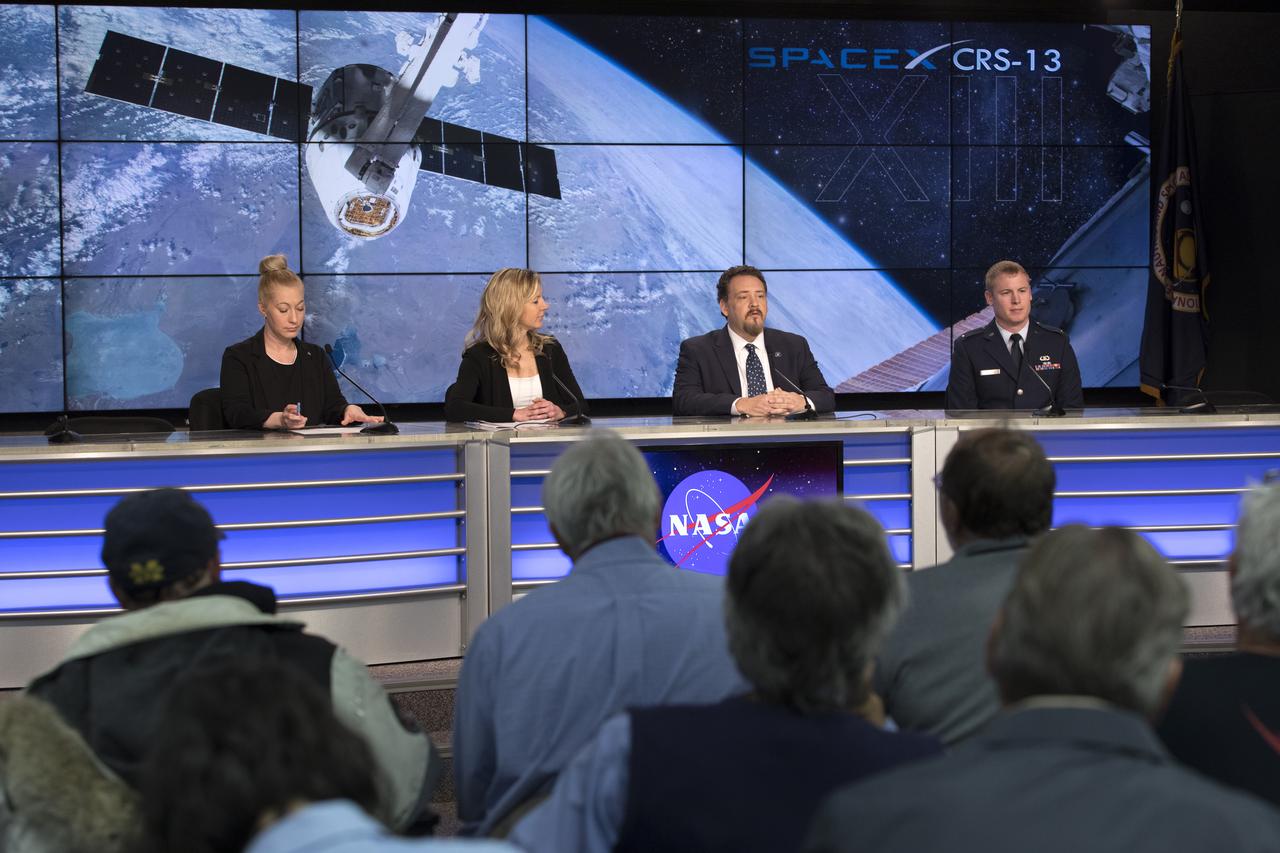
In the Kennedy Space Center’s Press Site auditorium, NASA and industry leaders speak to members of the media during a prelaunch news conference for the SpaceX CRS-13 commercial resupply services mission to the International Space Station. From left are: Cheryl Warner of NASA Communications, Jessica Jensen, SpaceX director of Dragon Mission Management, Kirt Costello, deputy chief scientist for the International Space Station Program Science Office at NASA’s Johnson Space Center in Houston, and Lt. David Myers, weather officer for the 45th Weather Squadron. Kirk Shireman, International Space Station Program manager at Johnson, participated by video link. A Dragon spacecraft is scheduled to be launched from Space Launch Complex 40 at Cape Canaveral Air Force Station at 11:46 a.m. EST, on Dec. 12, 2017. The SpaceX Falcon 9 rocket will lift off on the company's 13th Commercial Resupply Services mission to the space station.
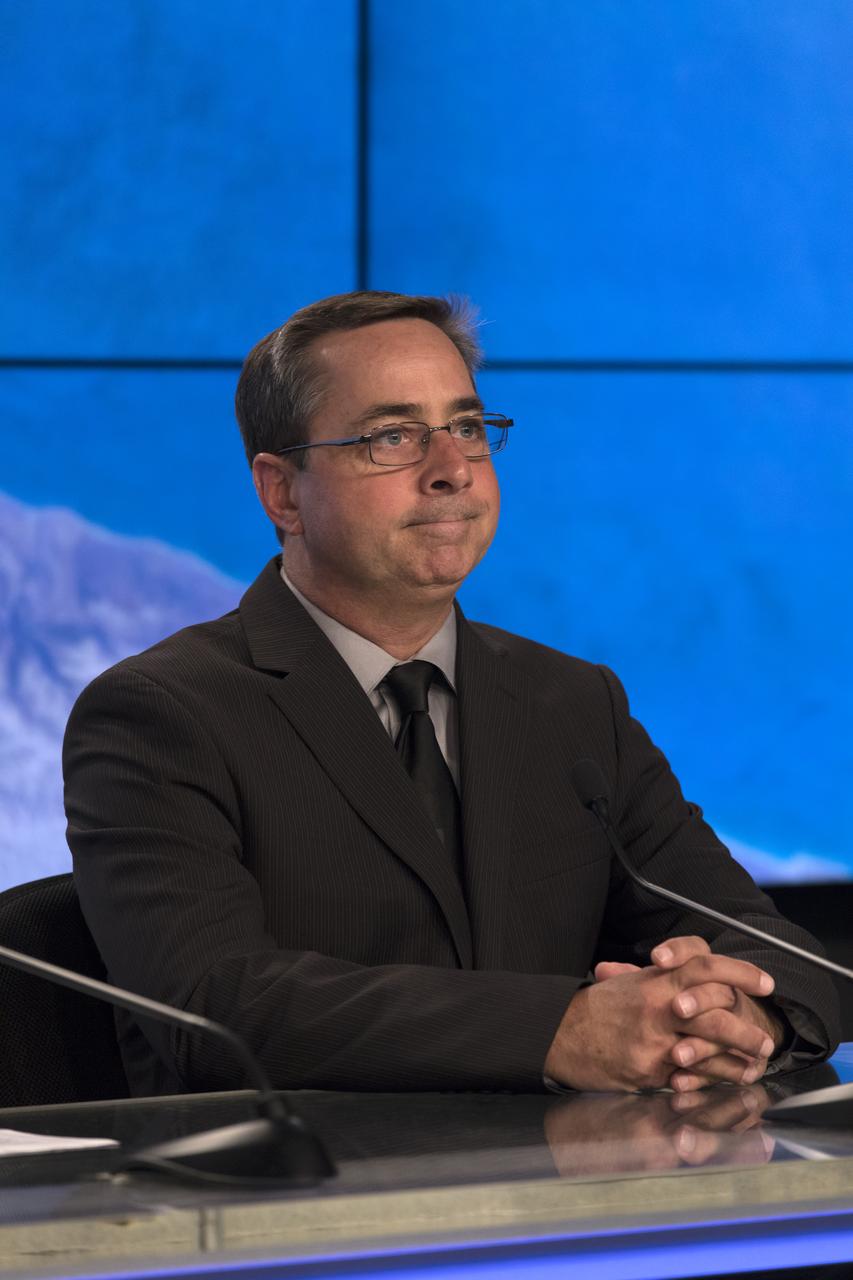
In the Kennedy Space Center’s Press Site auditorium, Mike McAleenan, launch weather officer for the U.S. Air Force 45th Weather Squadron at Cape Canaveral Air Force Station, speaks to members of the media during a prelaunch news conference for the SpaceX CRS-15 Commercial Resupply Services mission to the International Space Station. A SpaceX Dragon spacecraft is scheduled to be launched from Space Launch Complex 40 at Cape Canaveral Air Force Station. The SpaceX Falcon 9 rocket will lift off on the company's 15th Commercial Resupply Services mission to the space station.
Mike McAleenan, launch weather officer, U.S. Air Force 45th Space Wing, gives a weather update to members of the news media during a prelaunch news conference on Dec. 3, 2019, for SpaceX’s 19th Commercial Resupply Services (CRS-19) mission for NASA to the International Space Station, at the agency’s Kennedy Space Center in Florida. NASA and industry leaders speak to members of the news media during the news conference. The SpaceX Falcon 9 rocket and Dragon cargo module are scheduled to launch on Dec. 4, 2019, from Space Launch Complex 40 on Cape Canaveral Air Force Station in Florida.
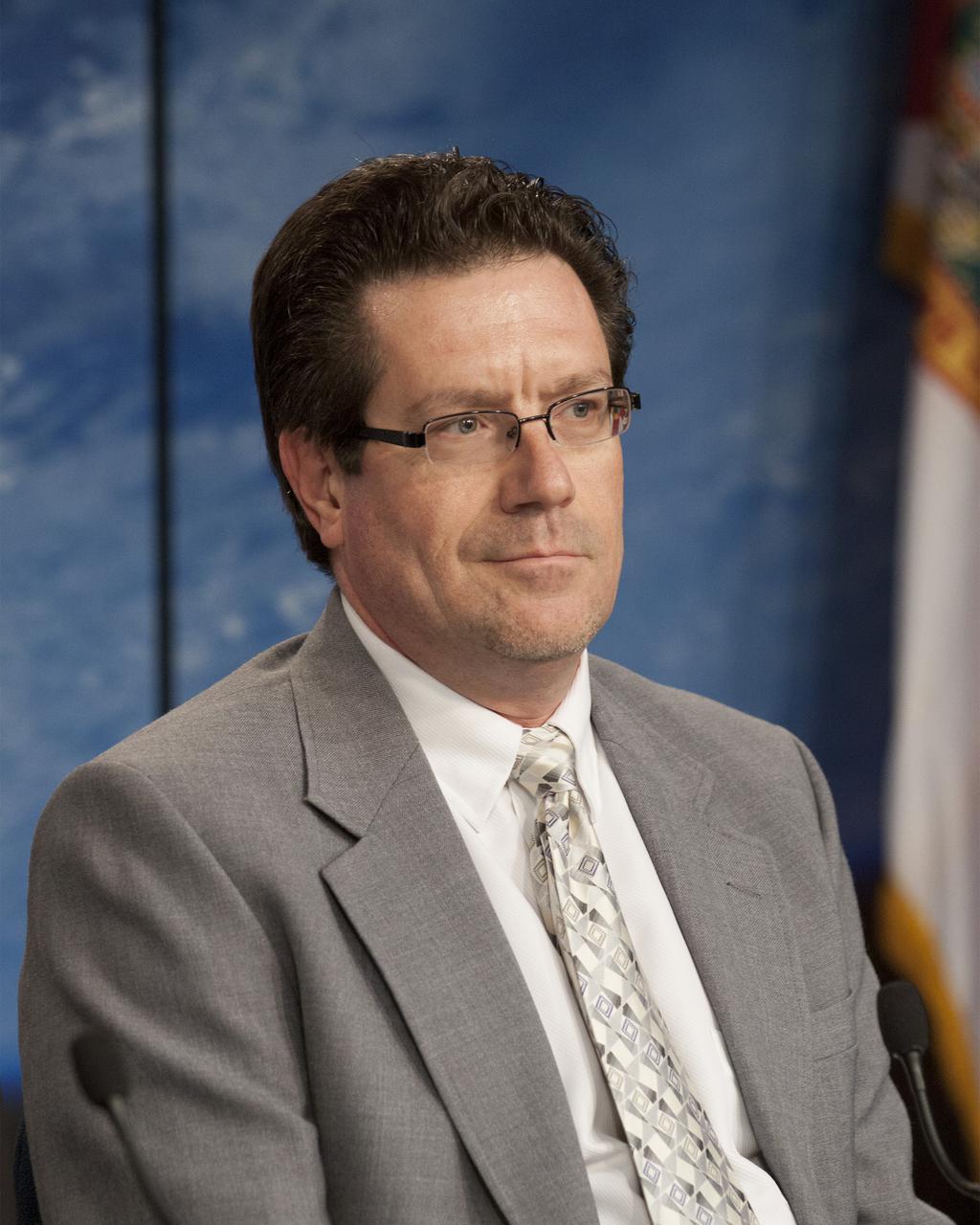
CAPE CANAVERAL, Fla. - Media attending a pre-launch news conference at the Kennedy Space Center, Fla. heard from Joel Tumbiolo, launch weather officer for the 45th Weather Squadron at Cape Canaveral Air Force Station. Scheduled for launch March 1 atop a Falcon 9 rocket, the SpaceX Dragon capsule will be making its third trip to the space station. The mission is the second of 12 SpaceX flights contracted by NASA to resupply the orbiting laboratory. For more information, visit http:__www.nasa.gov_mission_pages_station_structure_launch_spacex2-feature.html Photo credit: NASA_Kim Shiflett
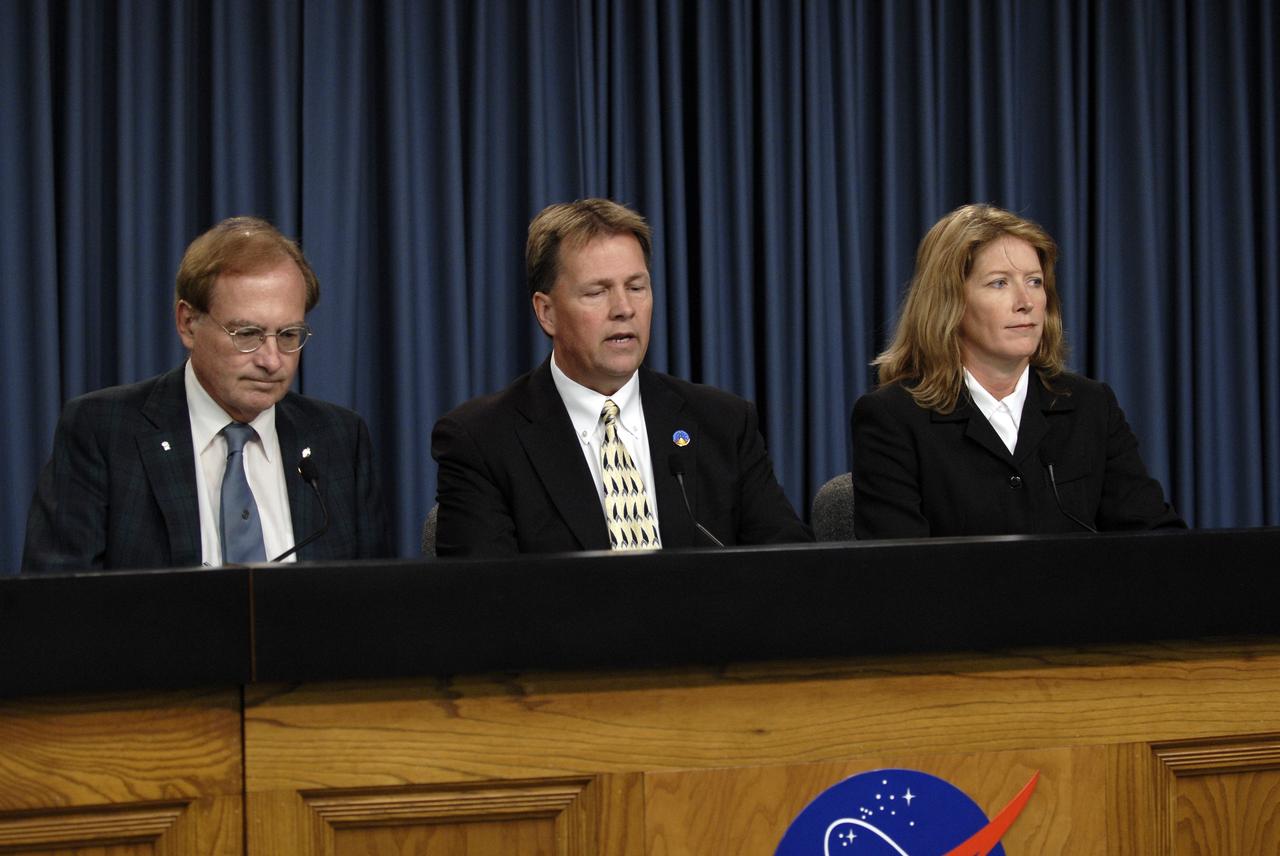
CAPE CANAVERAL, Fla. – At NASA's Kennedy Space Center in Florida, a launch status briefing for the Ares I-X rocket's flight test is held in the Press Site auditorium. From left are moderator George Diller, NASA Public Affairs officer; Jeff Spaulding, NASA test director for Ares I-X; and Kathy Winters, launch weather officer. The team is not tracking any problems, the rocket is in great shape, and they are ready for liftoff from Launch Pad 39B on Oct. 27 at 8 a.m. EDT. For information on the Ares I-X vehicle and flight test, visit http://www.nasa.gov/aresIX. Photo credit: NASA/Kim Shiflett
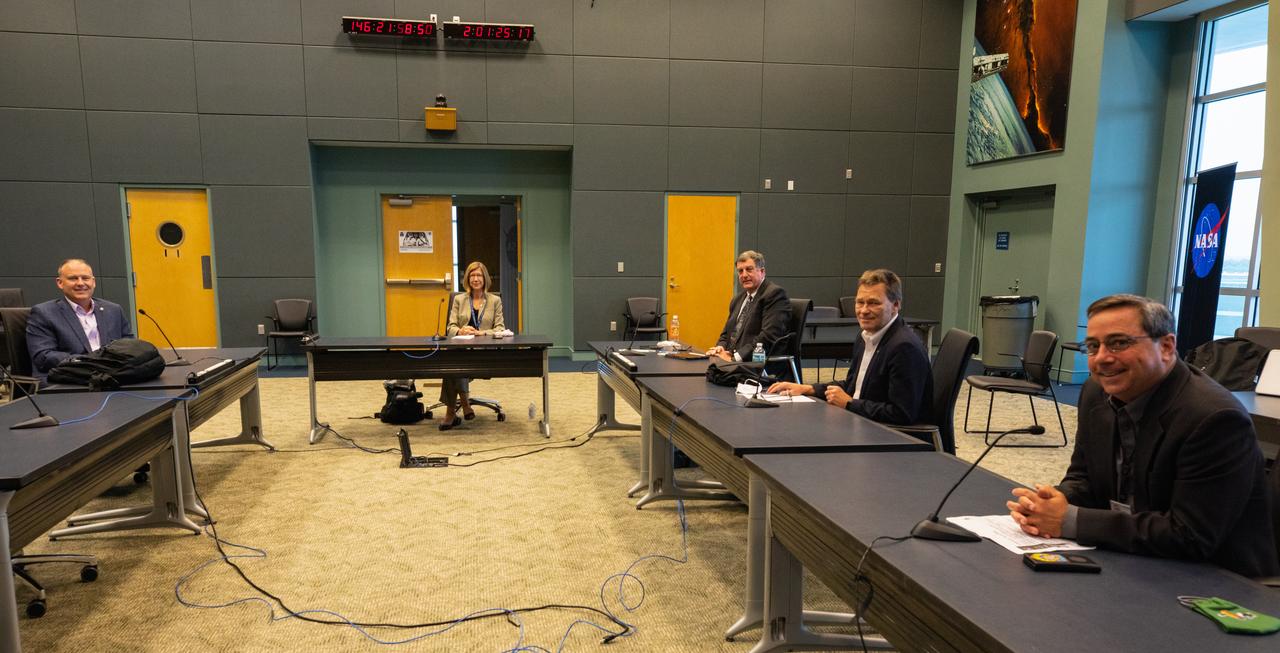
Representatives from NASA, SpaceX and the U.S. Space Force 45th Weather Squadron participate in a news conference following the Launch Readiness Review at the agency’s Kennedy Space Center in Florida on Monday, May 25, 2020, in advance of NASA’s SpaceX Demo-2 Flight Test to the International Space Station as part of NASA’s Commercial Crew Program. From the left are: Norm Knight, deputy director, NASA Johnson Space Center Flight Operations Kathy Lueders, manager, NASA Commercial Crew Program; Kirk Shireman, manager, International Space Station Program; Hans Koenigsmann, vice president, Build and Flight Reliability, SpaceX; and Mike McAleenan, launch weather officer, 45th Weather Squadron. Launch is currently targeted for 4:33 p.m. EDT Wednesday, May 27. The SpaceX Crew Dragon spacecraft will launch on a Falcon 9 rocket from historic Launch Complex 39A at NASA’s Kennedy Space Center in Florida.
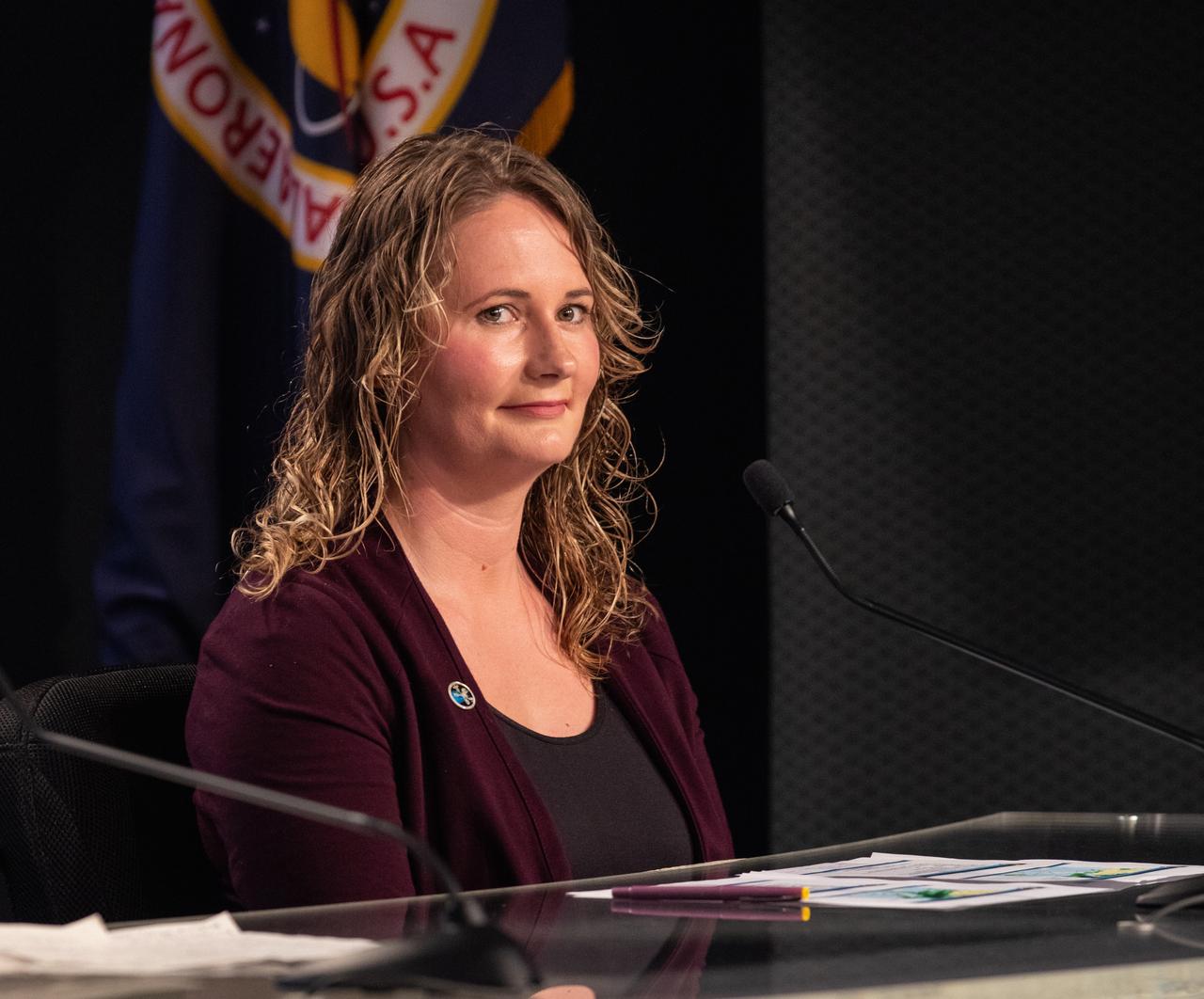
Melody C. Lovin, launch weather officer, 45th Weather Squadron, speaks to members of the media during a prelaunch news conference with NASA, SpaceX and the 45th Weather Squadron leaders Thursday, Feb. 28, prior to the Saturday, March 2 launch of the SpaceX Demo-1 Commercial Crew Program (CCP) mission to the International Space Station. The inaugural flight of the SpaceX Crew Dragon, known as Demo-1, is scheduled to lift off from Kennedy’s Launch Complex 39A Saturday at 2:49 EST. A SpaceX Falcon 9 rocket will launch the uncrewed spacecraft on a mission designed to validate end-to-end systems and capabilities, leading to certification to fly crew. NASA has worked with SpaceX and Boeing in developing the Commercial Crew Program spacecraft to facilitate new human spaceflight systems launching from U.S. soil with the goal of safe, reliable and cost-effective access to low-Earth orbit destinations, such as the International Space Station.
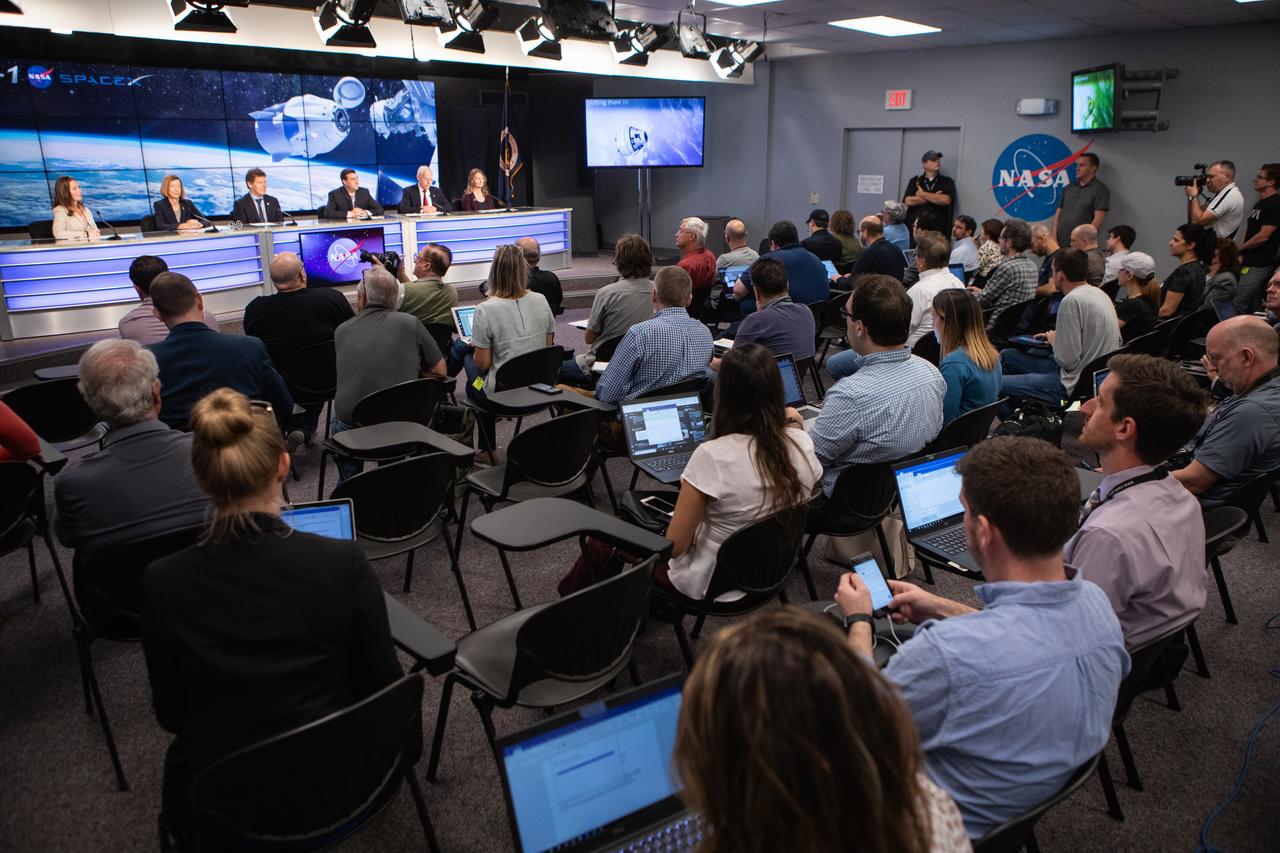
In the Kennedy Space Center’s Press Site TV auditorium, NASA, SpaceX and the 45th Weather Squadron leaders speak to members of the media during a prelaunch news conference Thursday, Feb. 28, prior to the Saturday, March 2 launch of the SpaceX Demo-1 Commercial Crew Program (CCP) mission to the International Space Station. From left are: Stephanie Martin of NASA Communications, Kathy Lueders, manager, NASA’s Commercial Crew Program; Hans Koenigsmann, vice president, Build and Flight Reliability, SpaceX; Joel Montalbano, deputy manager, International Space Station Program; Pat Forrester, chief, Astronaut Office, Johnson Space Center; and Melody C. Lovin, launch weather officer, 45th Weather Squadron. The inaugural flight of the SpaceX Crew Dragon, known as Demo-1, is scheduled to lift off from Kennedy’s Launch Complex 39A Saturday at 2:49 EST. A SpaceX Falcon 9 rocket will launch the uncrewed spacecraft on a mission designed to validate end-to-end systems and capabilities, leading to certification to fly crew. NASA has worked with SpaceX and Boeing in developing the Commercial Crew Program spacecraft to facilitate new human spaceflight systems launching from U.S. soil with the goal of safe, reliable and cost-effective access to low-Earth orbit destinations, such as the International Space Station.
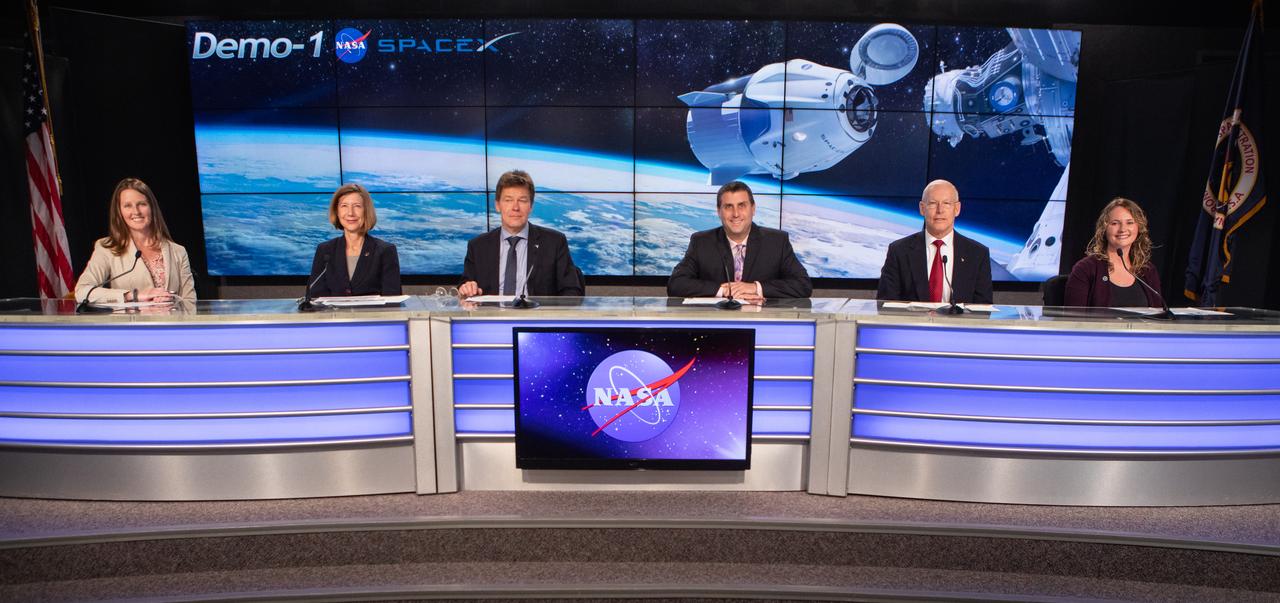
In the Kennedy Space Center’s Press Site TV auditorium, NASA, SpaceX and the 45th Weather Squadron leaders speak to members of the media during a prelaunch news conference Thursday, Feb. 28, prior to the Saturday, March 2 launch of the SpaceX Demo-1 Commercial Crew Program (CCP) mission to the International Space Station. From left are: Stephanie Martin of NASA Communications, Kathy Lueders, manager, NASA’s Commercial Crew Program; Hans Koenigsmann, vice president, Build and Flight Reliability, SpaceX; Joel Montalbano, deputy manager, International Space Station Program; Pat Forrester, chief, Astronaut Office, Johnson Space Center; and Melody C. Lovin, launch weather officer, 45th Weather Squadron. The inaugural flight of the SpaceX Crew Dragon, known as Demo-1, is scheduled to lift off from Kennedy’s Launch Complex 39A Saturday at 2:49 EST. A SpaceX Falcon 9 rocket will launch the uncrewed spacecraft on a mission designed to validate end-to-end systems and capabilities, leading to certification to fly crew. NASA has worked with SpaceX and Boeing in developing the Commercial Crew Program spacecraft to facilitate new human spaceflight systems launching from U.S. soil with the goal of safe, reliable and cost-effective access to low-Earth orbit destinations, such as the International Space Station.
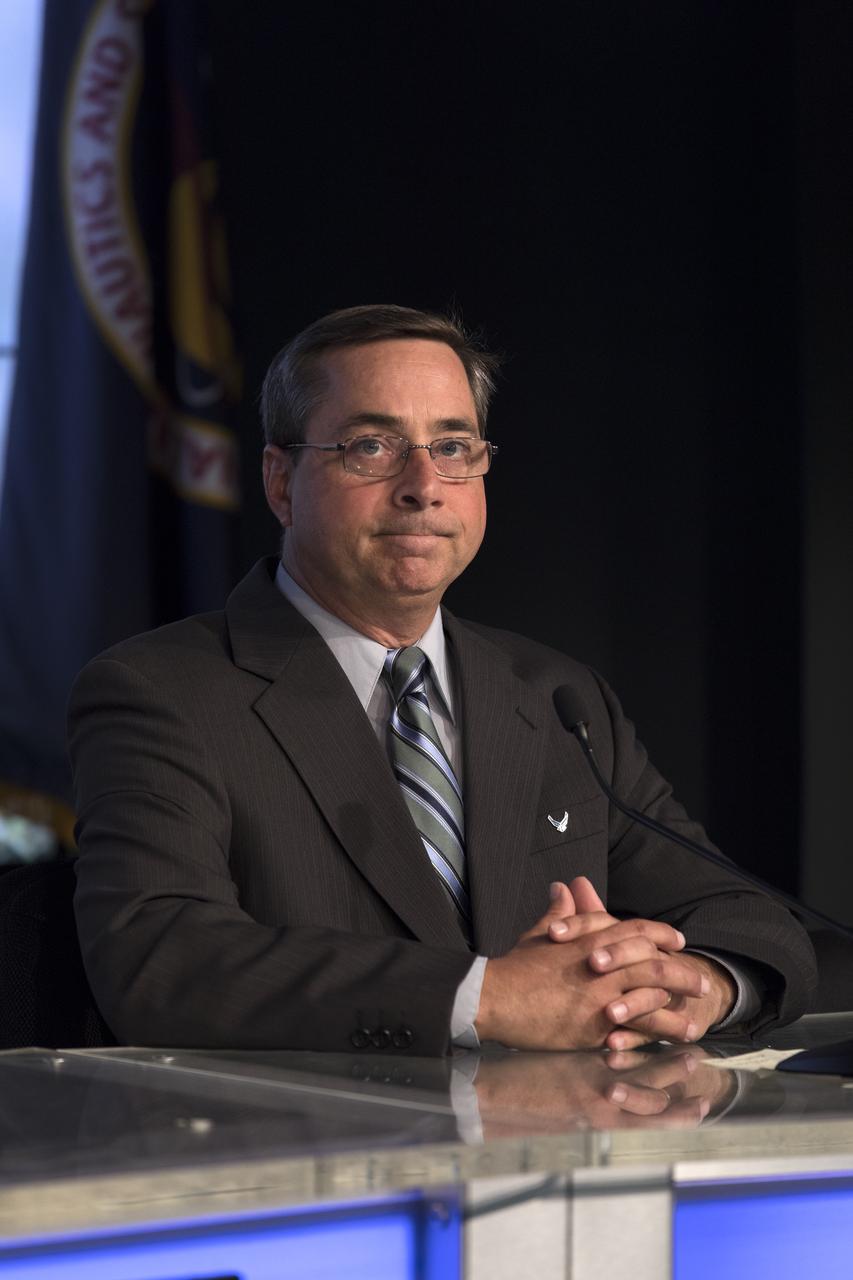
In the Kennedy Space Center’s Press Site auditorium, NASA and industry leaders speak to members of the media during a prelaunch news conference for the SpaceX CRS-14 commercial resupply services mission to the International Space Station. Mike McAleenan, weather officer, 45th Weather Squadron, participates in the news conference. A Dragon spacecraft is scheduled to be launched from Space Launch Complex 40 at Cape Canaveral Air Force Station at 4:30 p.m. EST, on April 2, 2018. The SpaceX Falcon 9 rocket will lift off on the company's 14th Commercial Resupply Services mission to the space station.
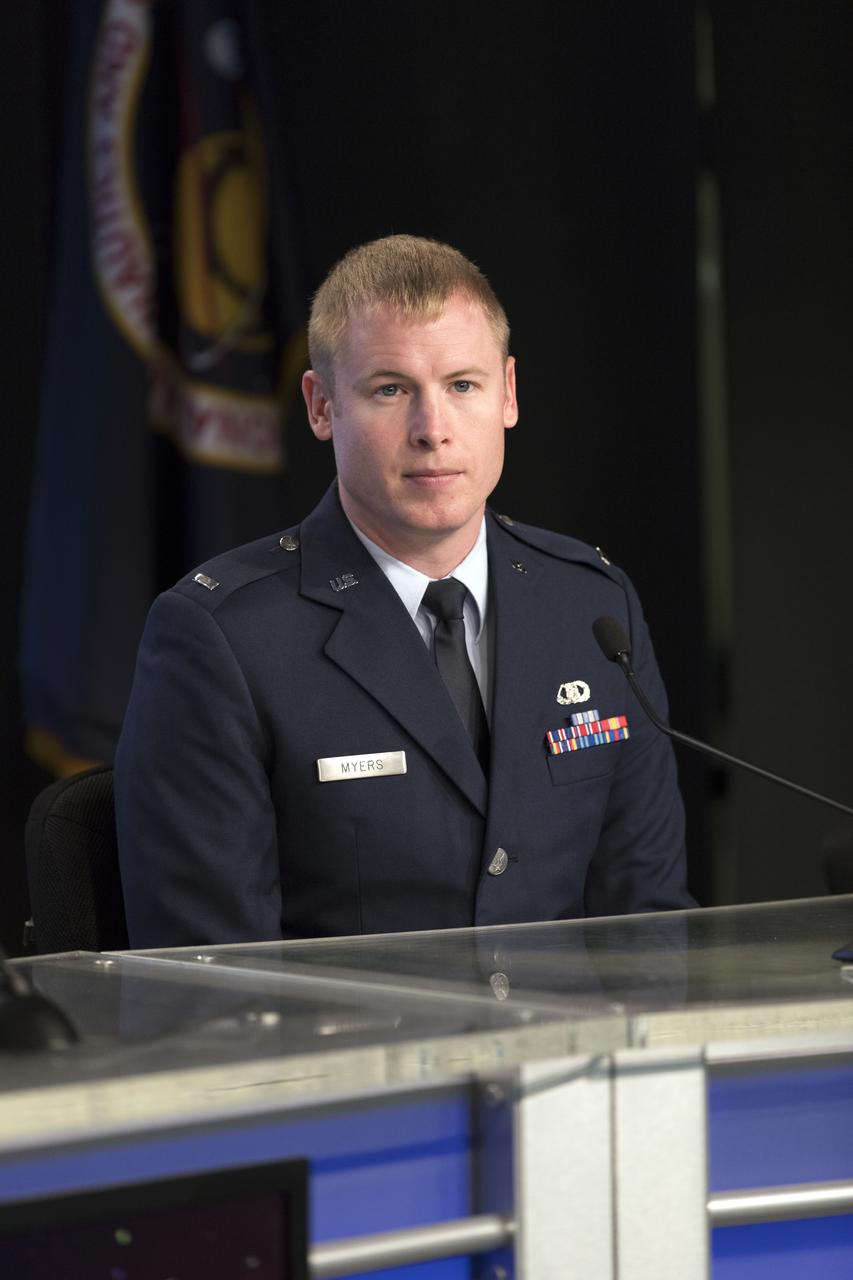
In the Kennedy Space Center’s Press Site auditorium, Lt. David Myers, weather officer for the 45th Weather Squadron, speaks to members of the media during a prelaunch news conference for the SpaceX CRS-13 commercial resupply services mission to the International Space Station. A Dragon spacecraft is scheduled to be launched from Space Launch Complex 40 at Cape Canaveral Air Force Station at 11:46 a.m. EST, on Dec. 12, 2017. The SpaceX Falcon 9 rocket will lift off on the company's 13th Commercial Resupply Services mission to the space station.
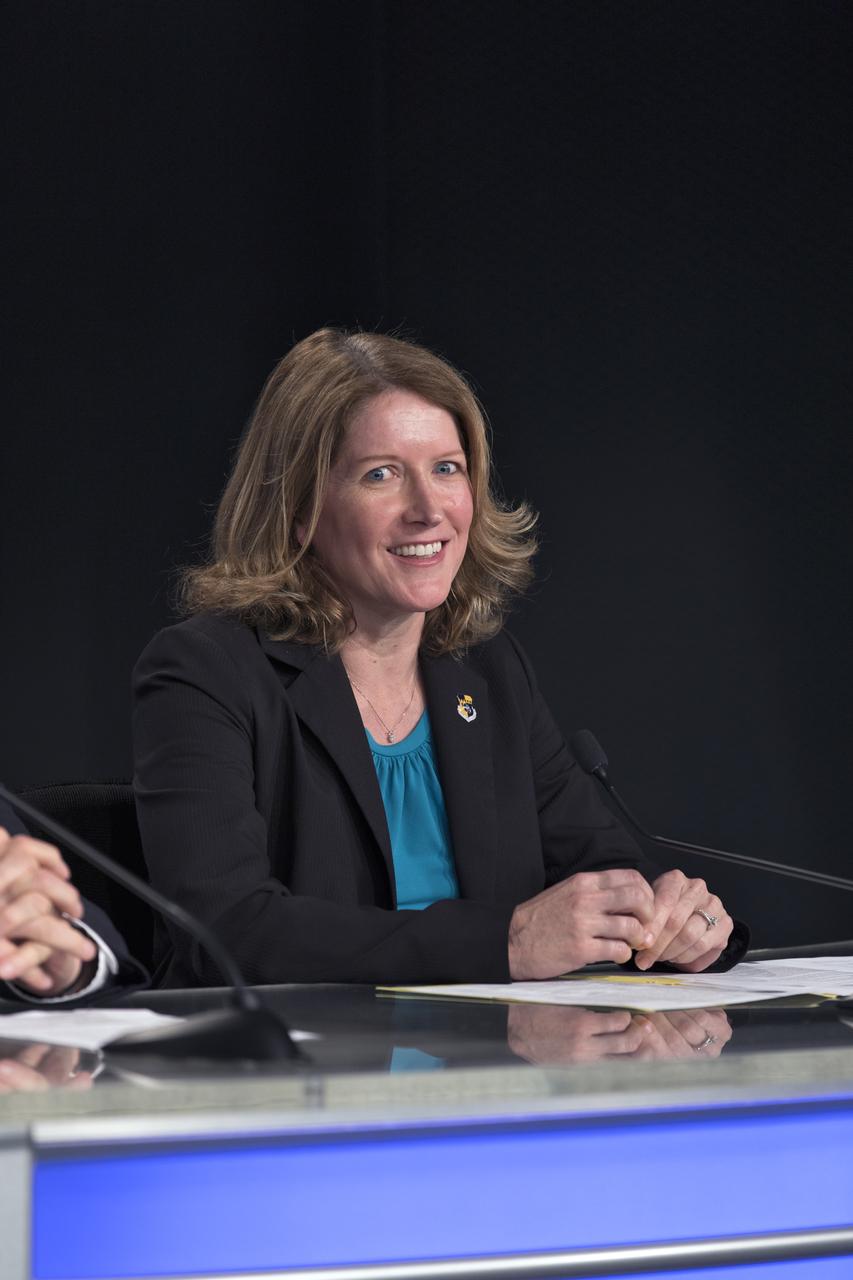
In the Kennedy Space Center's Press Site auditorium, and Kathy Winters, launch weather officer for the U.S. Air Force 45th Weather Squadron at Cape Canaveral Air Force Station, speaks to members of the media at a prelaunch news conference about National Oceanic and Atmospheric Administration's, or NOAA's, Geostationary Operational Environmental Satellite, or GOES-S. The GOES series of satellites will significantly improve the detection and observation of environmental phenomena that directly affect public safety, protection of property and the nation's economic health and prosperity. GOES-S is slated to lift off at 5:02 p.m. EST on March 1, 2018 aboard a United Launch Alliance Atlas V rocket.

Brian Cizek, launch weather officer, 45th Weather Squadron, U.S. Space Force, participates in the SpaceX Crew-2 prelaunch news conference held at NASA’s Kennedy Space Center in Florida on April 20, 2021. NASA astronauts Shane Kimbrough and Megan McArthur, JAXA astronaut Akihiko Hoshide, and ESA astronaut Thomas Pesquet will fly on Crew-2, the second crew rotation mission to the International Space Station as part of NASA’s Commercial Crew Program. They will launch aboard SpaceX’s Crew Dragon spacecraft, named Endeavour, powered by the company’s Falcon 9 rocket. Liftoff is set for Earth Day, Thursday, April 22, at 6:11 a.m. EDT.
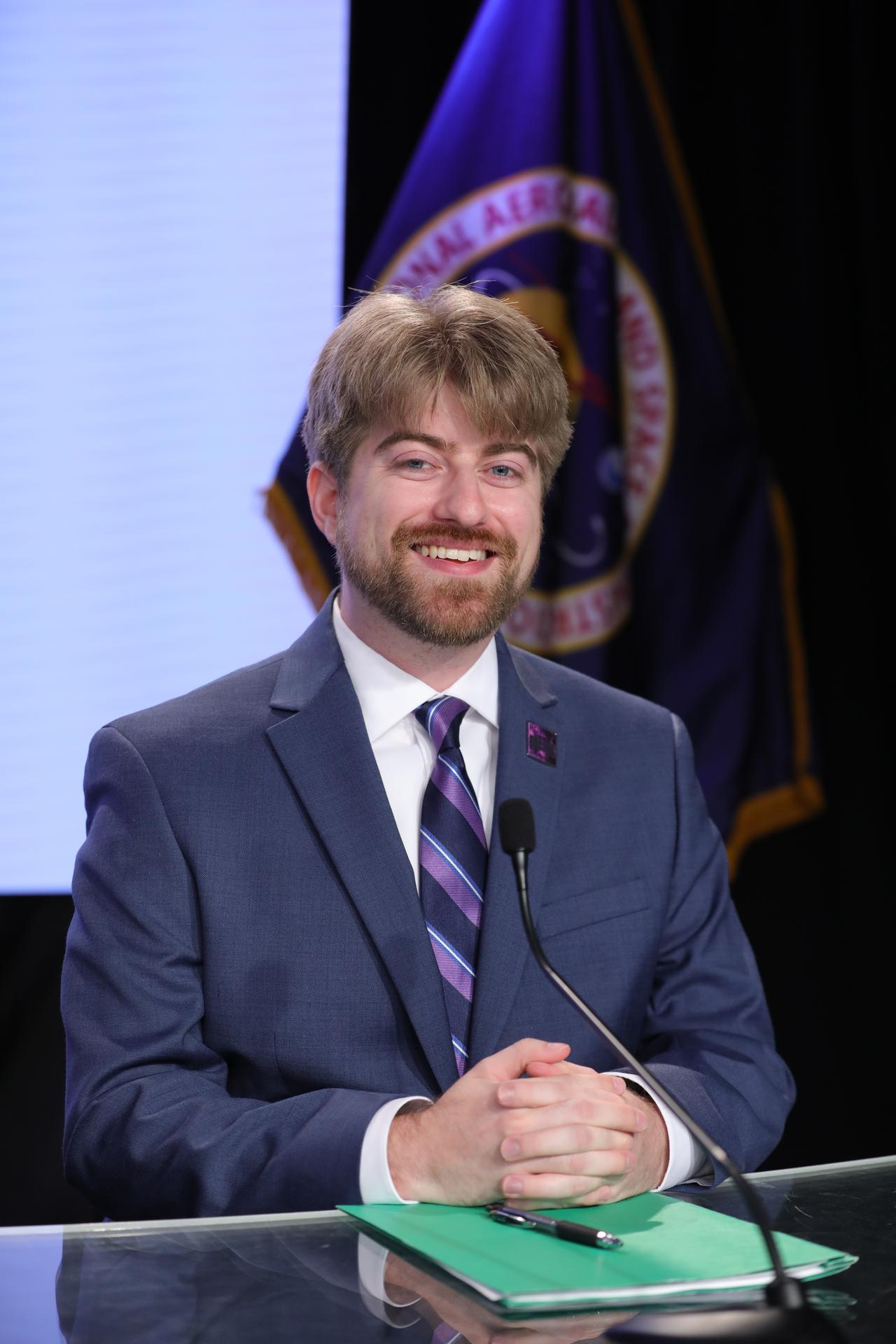
Justin McReynolds, launch weather officer, 45th Weather Squadron, U.S. Space Force, participates in a prelaunch news conference for the agency’s Nancy Grace Roman Space Telescope inside the NASA News Center’s John Holliman Auditorium at Kennedy Space Center in Florida, on Saturday, Aug. 29, 2026. Roman will investigate dark energy and dark matter, conduct a statistical census of planetary systems, and enable a broad range of additional astrophysics research. Liftoff from Launch Complex 39A at Kennedy is targeted for no earlier than Sunday, Aug. 30, 2026.
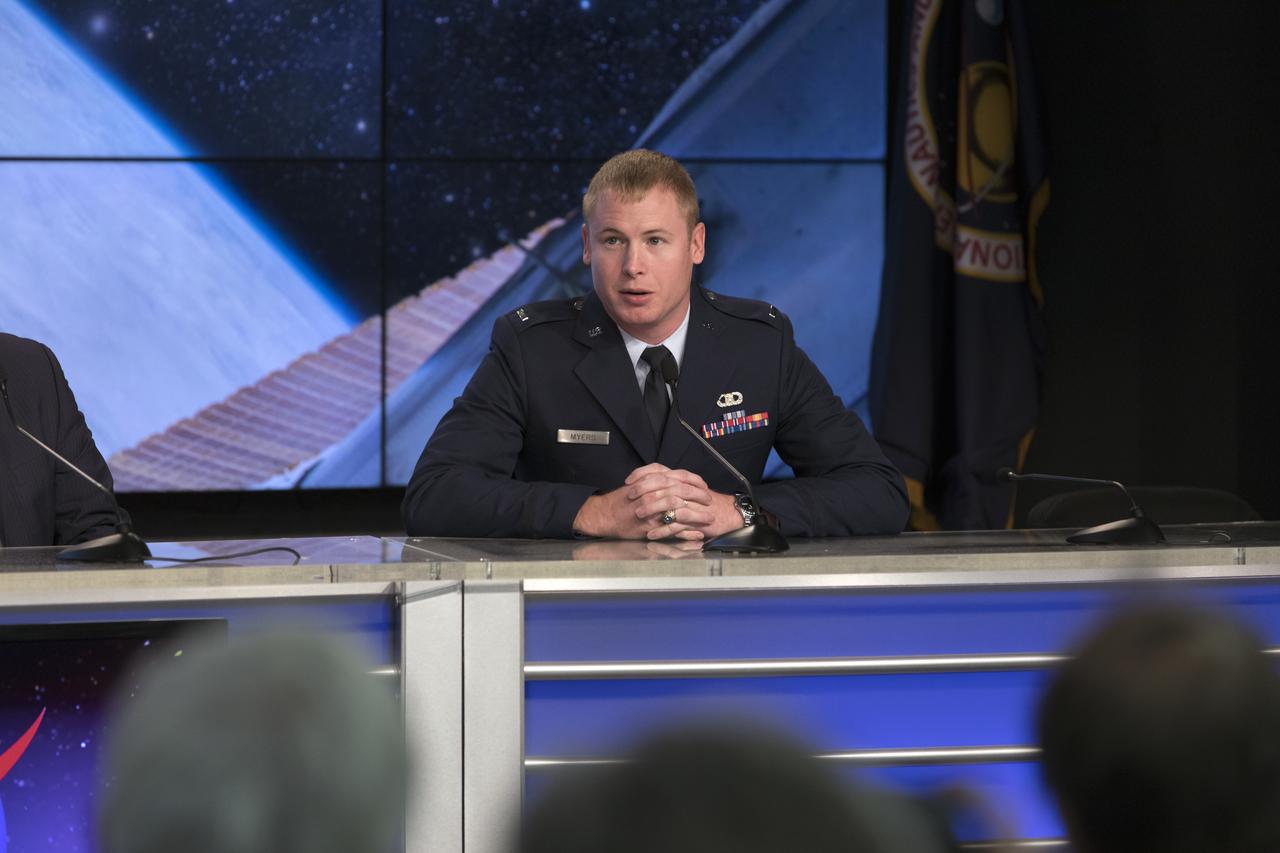
In the Kennedy Space Center’s Press Site auditorium, Lt. David Myers, weather officer for the 45th Weather Squadron, speaks to members of the media during a prelaunch news conference for the SpaceX CRS-13 commercial resupply services mission to the International Space Station. A Dragon spacecraft is scheduled to be launched from Space Launch Complex 40 at Cape Canaveral Air Force Station at 11:46 a.m. EST, on Dec. 12, 2017. The SpaceX Falcon 9 rocket will lift off on the company's 13th Commercial Resupply Services mission to the space station.

CAPE CANAVERAL, Fla. -- In the Press Site auditorium at NASA's Kennedy Space Center in Florida, Shuttle Weather Officer Kathy Winters speaks to media about the launch-day weather for space shuttle Endeavour's STS-134 mission. Endeavour and its crew will deliver the Express Logistics Carrier-3, Alpha Magnetic Spectrometer-2 (AMS), a high-pressure gas tank and additional spare parts for the Dextre robotic helper to the International Space Station. Launch is scheduled for April 29 at 3:47 p.m. EDT. This will be the final spaceflight for Endeavour. For more information visit, www.nasa.gov_mission_pages_shuttle_shuttlemissions_sts134_index.html. Photo credit: NASA_Jack Pfaller
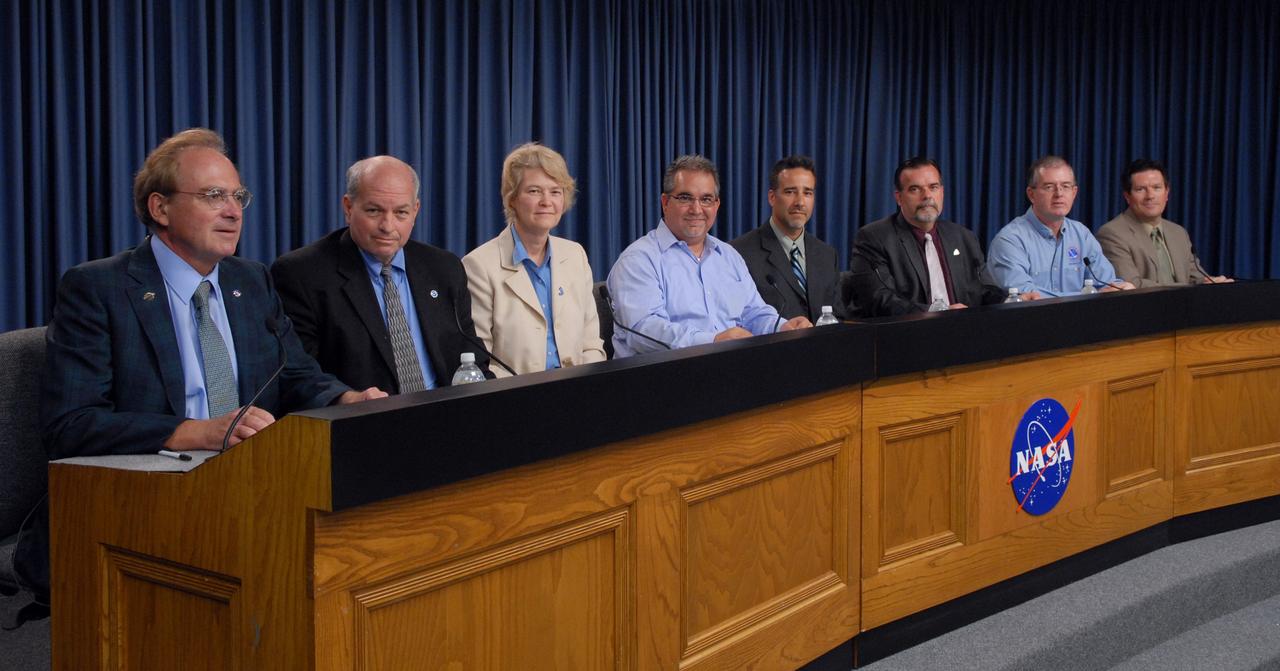
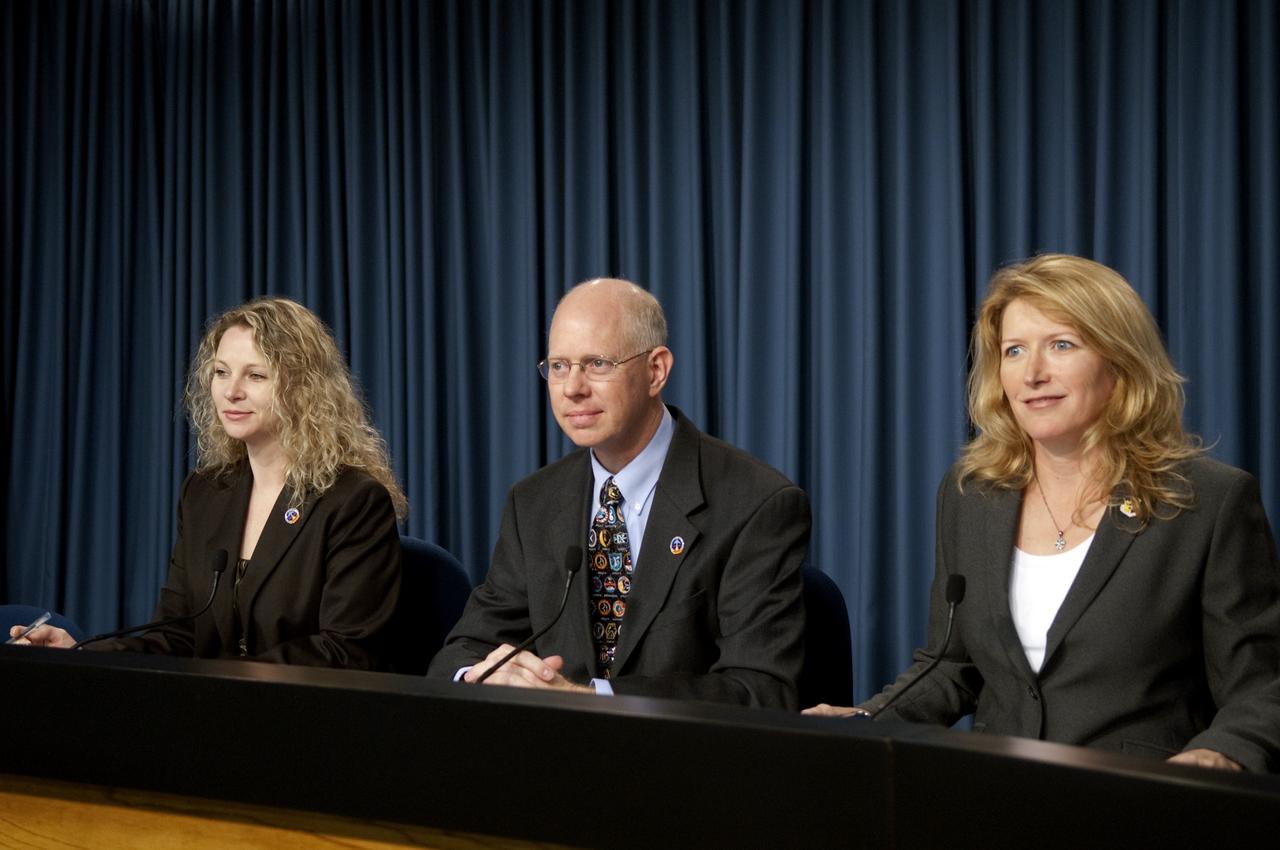
CAPE CANAVERAL, Fla. – A prelaunch news conference on the Geostationary Operational Environmental Satellite-O mission is held in NASA's Kennedy Space Center press site auditorium. From left, the participants are George H. Diller, moderator, Media Services, Kennedy Space Center; Gary Davis, director, Office of Systems Development, NOAA Satellite and Information Service, Suitland, Md.; Kris Walsh, Commercial Programs manager, United Launch Alliance, Houston; Kevin Reyes, director, Business Development, Boeing Launch Services; Andre Dress, GOES-O deputy project manager, Goddard Space Flight Center; Charlie Maloney, GOES-O program manager, Boeing Space and Intelligence Systems, Seal Beach, Calif.; Bart Hagemeyer, meteorologist in charge, NOAA National Weather Service forecast office, Melbourne, Fla.; and Joel Tumbiolo, Delta IV launch weather officer, 45th Weather Squadron, Cape Canaveral Air Force Station. The GOES-O satellite is targeted to launch June 26. The latest Geostationary Operational Environmental Satellite, GOES-O was developed by NASA for the National Oceanic and Atmospheric Administration, or NOAA. Each of the GOES satellites continuously provides observations of 60 percent of the Earth including the continental United States, providing weather monitoring and forecast operations as well as a continuous and reliable stream of environmental information and severe weather warnings. Once in orbit, GOES-O will be designated GOES-14, and NASA will provide on-orbit checkout and then transfer operational responsibility to NOAA. Photo credit: NASA/Jim Grossmann

Arlena Moses, launch weather officer, 45th Weather Squadron, U.S. Space Force, participates in a prelaunch news conference on Sunday, Sept. 21, 2025, at the agency’s Kennedy Space Center in Florida for NASA's IMAP (Interstellar Mapping and Acceleration Probe) mission. NASA’s IMAP will use 10 science instruments to study and map the heliosphere, a vast magnetic bubble surrounding the Sun protecting our solar system from radiation incoming from interstellar space. This mission and its two rideshares – NASA’s exosphere-studying Carruthers Geocorona Observatory and National Oceanic and Atmospheric Administration’s (NOAA) Space Weather Follow On–Lagrange 1 (SWFO-L1) observatory – will orbit the Sun near Lagrange point 1, about one million miles from Earth. Launch is targeting 7:32 a.m. EDT, Tuesday, Sept. 23, from Launch Complex 39A at NASA Kennedy.
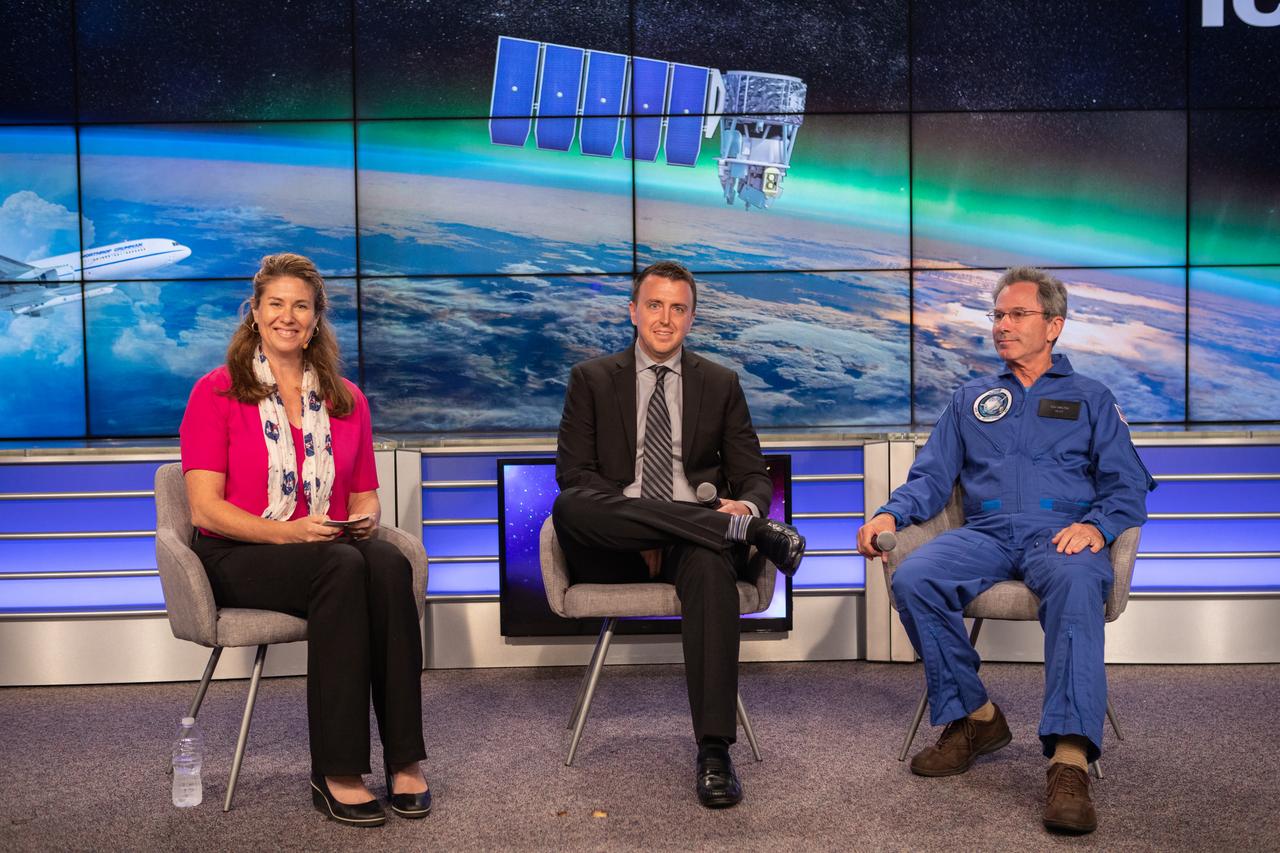
Launch and mission managers for NASA’s Ionospheric Connection Explorer (ICON) participate in a prelaunch mission briefing on Oct. 8, 2019, in the News Center auditorium at the agency’s Kennedy Space Center in Florida. From left to right are Karen Fox, NASA Communications; Will Ulrich, launch weather officer with the U.S. Air Force 45th Space Wing; and Don Walters, chief pilot of the L-1011 Stargazer aircraft. ICON is targeted to launch from Cape Canaveral Air Force Station in Florida on Oct. 9, 2019, aboard a Northrop Grumman Pegasus XL rocket carried aloft by the company’s Stargazer L-1011 aircraft. The explorer will study the frontier of space - the dynamic zone high in Earth's atmosphere where terrestrial weather from below meets space weather above.
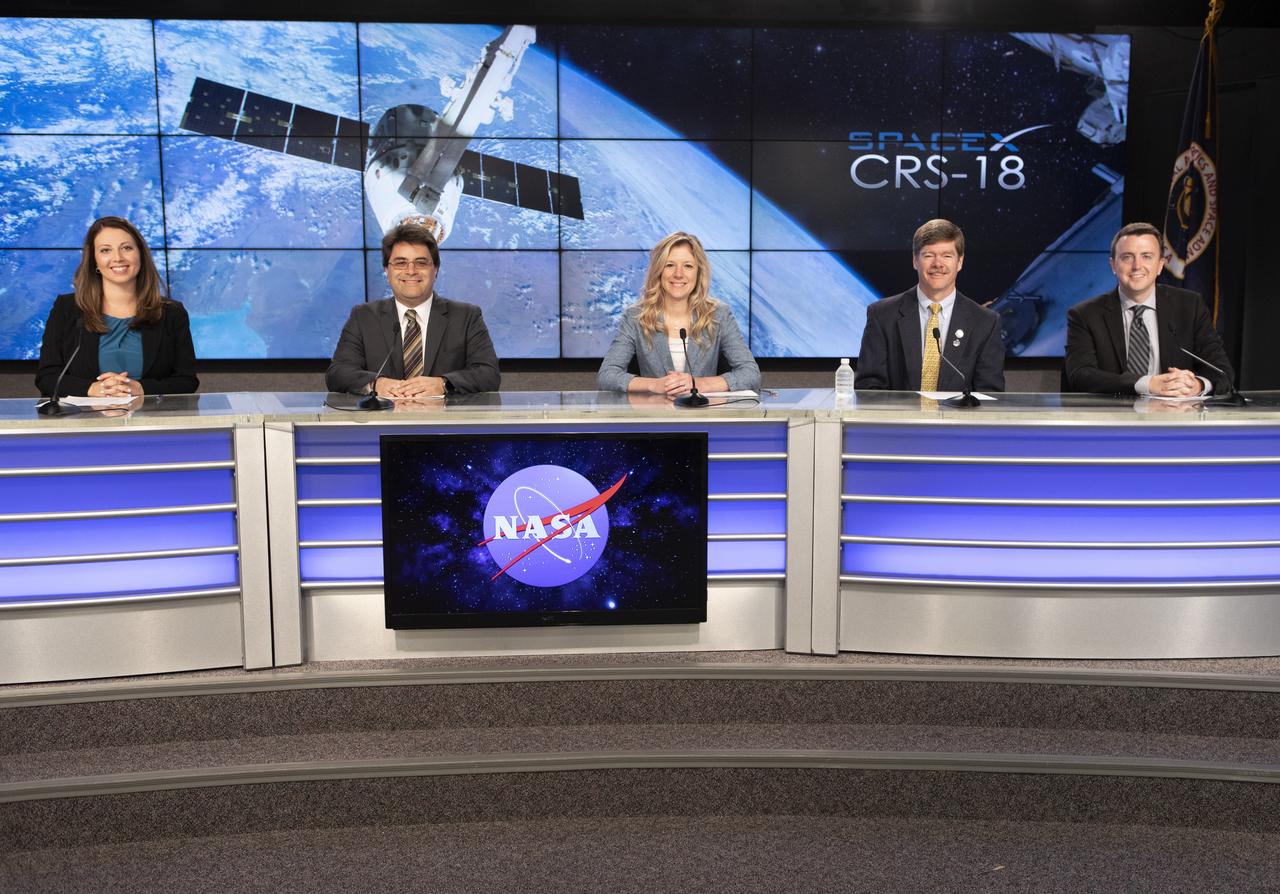
A prelaunch news conference for SpaceX’s 18th Commercial Resupply Services (CRS-18) mission to the International Space Station for NASA is held July 24, 2019, at the agency’s Kennedy Space Center in Florida. From left are Marie Lewis, NASA Communications moderator; Bill Spetch, deputy manager of the International Space Station Transportation Integration Office at NASA’s Johnson Space Center in Houston; Jessica Jensen, director of Dragon mission management at SpaceX; Pete Hasbrook, manager of the space station’s Program Science Office at Johnson; and Will Ulrich, launch weather officer with the U.S. Air Force 45th Space Wing. The SpaceX Falcon 9 rocket and uncrewed Dragon spacecraft are scheduled to launch July 24, 2019, from Space Launch Complex 40 at Florida’s Cape Canaveral Air Force Station.
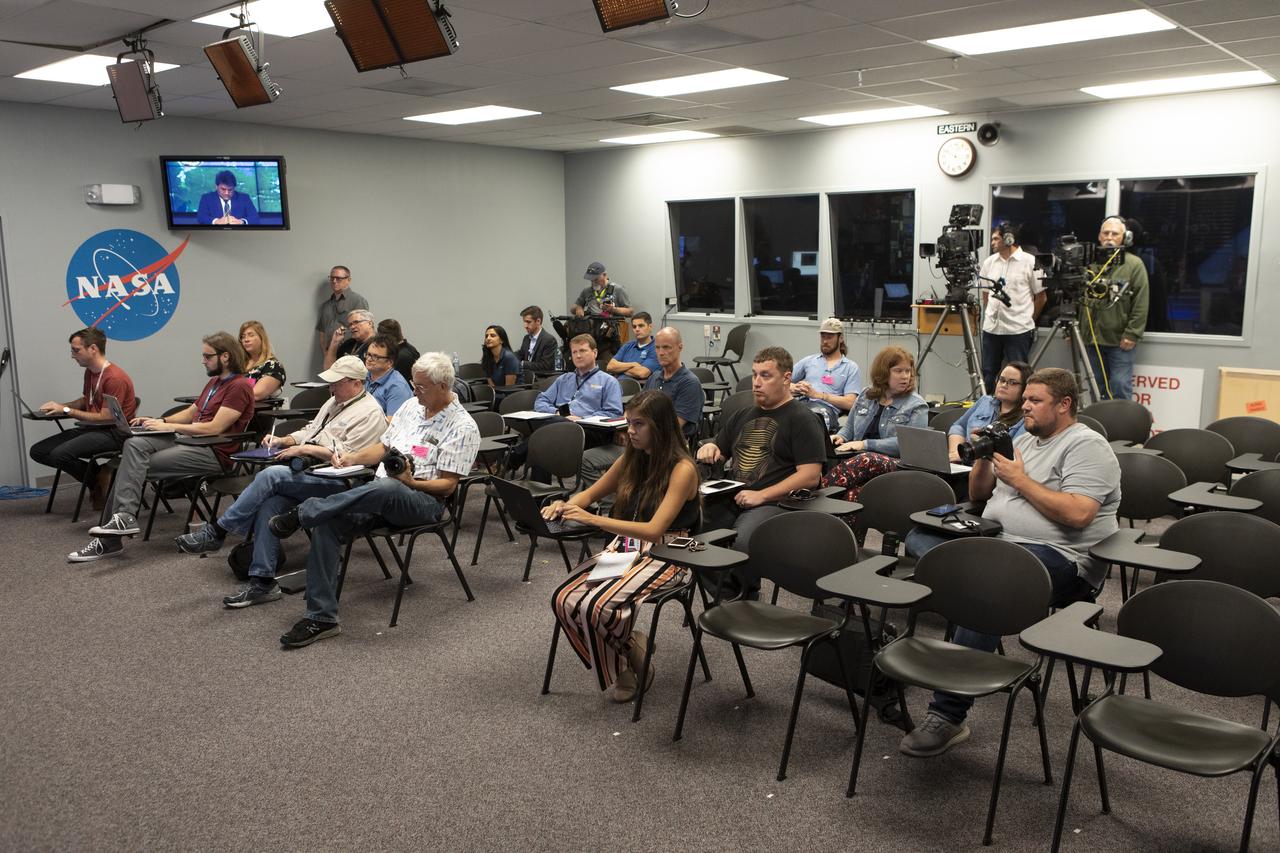
Members of the news media attend the prelaunch news conference for SpaceX’s 18th Commercial Resupply Services (CRS-18) mission to the International Space Station, July 24, 2019, at NASA’s Kennedy Space Center in Florida. Participants were Marie Lewis, NASA Communications moderator; Bill Spetch, deputy manager of the International Space Station Transportation Integration Office at the agency’s Johnson Space Center in Houston; Jessica Jensen, director of Dragon mission management at SpaceX; Pete Hasbrook, manager of the space station’s Program Science Office at Johnson; and Will Ulrich, launch weather officer with the U.S. Air Force 45th Space Wing. The SpaceX Falcon 9 rocket and uncrewed Dragon spacecraft are scheduled to launch July 24, 2019, from Space Launch Complex 40 at Florida’s Cape Canaveral Air Force Station.
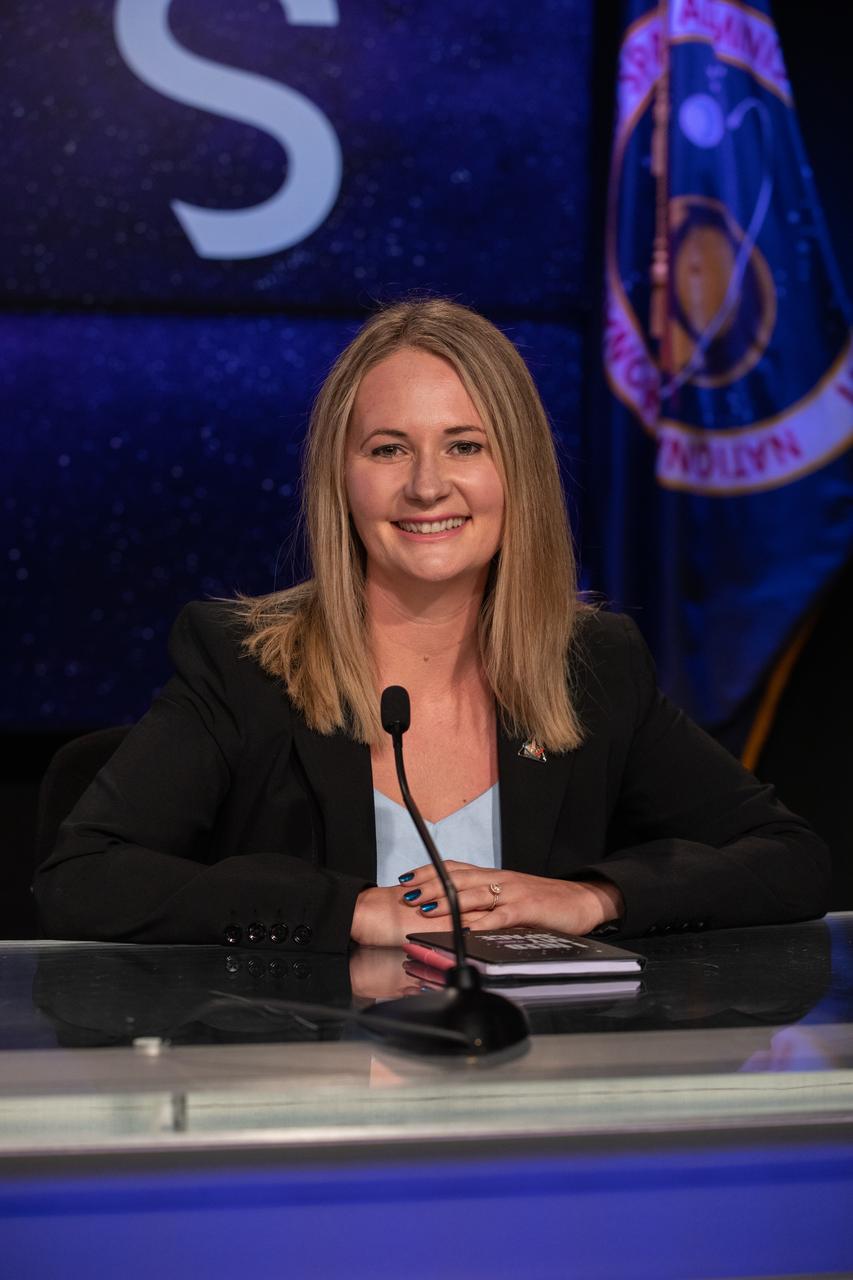
Melody Lovin, weather officer, Space Launch Delta 45, is introduced during an Artemis I mission status press briefing at NASA’s Kennedy Space Center in Florida on Aug. 27, 2022. NASA’s Space Launch System rocket and Orion spacecraft are targeted to lift off from Kennedy’s Launch Complex 39B no earlier than Aug. 29, 2022, at 8:33 a.m. EDT.
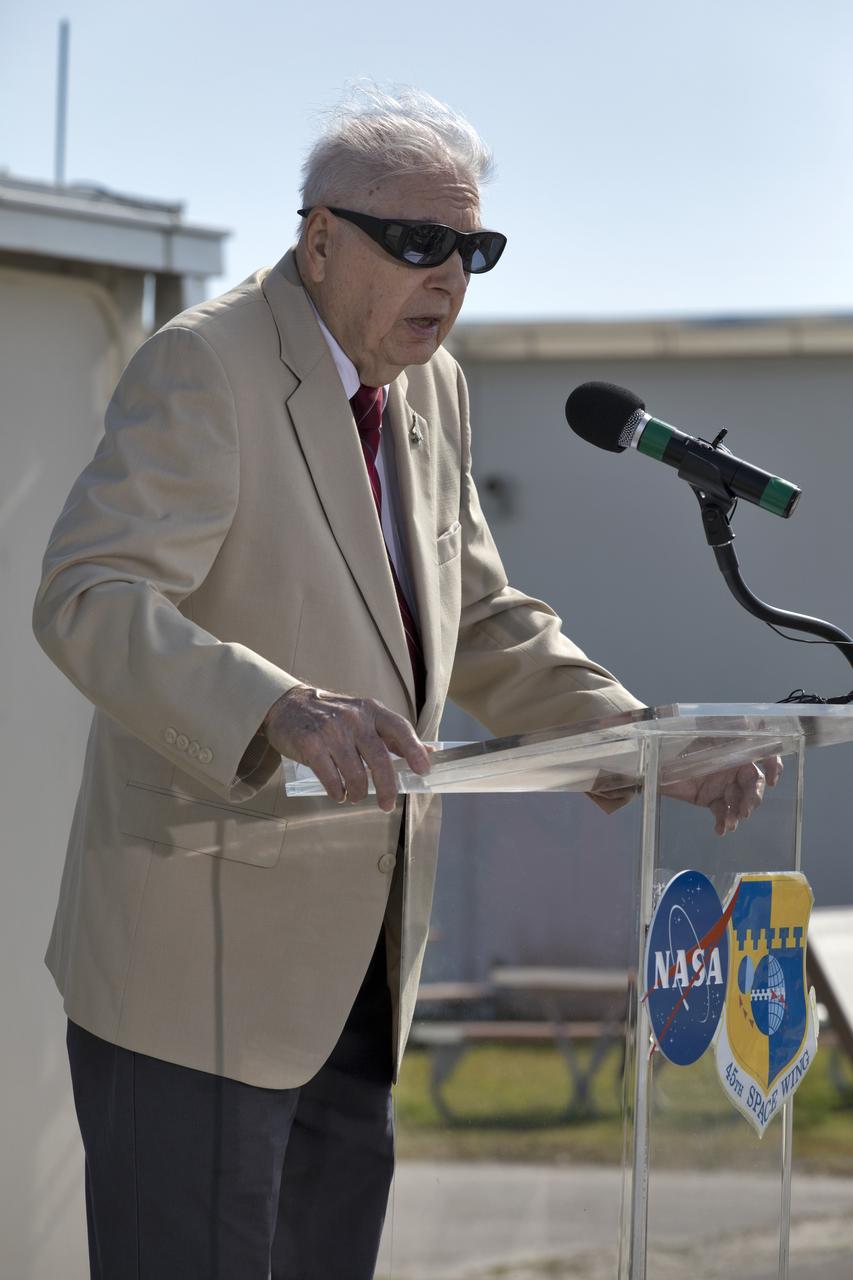
Dr. John Meisenheimer, launch weather officer for Explorer 1, speaks to guests at an event celebrating the 60th anniversary of America's first satellite. The ceremony took place in front of the Space Launch Complex 26 blockhouse at Cape Canaveral Air Force Station where the Explorer 1 satellite was launched atop a Jupiter C rocket on Jan. 31, 1958. During operation, the satellite's cosmic ray detector discovered radiation belts around Earth which were named for Dr. James Van Allen, principal investigator for the satellite.
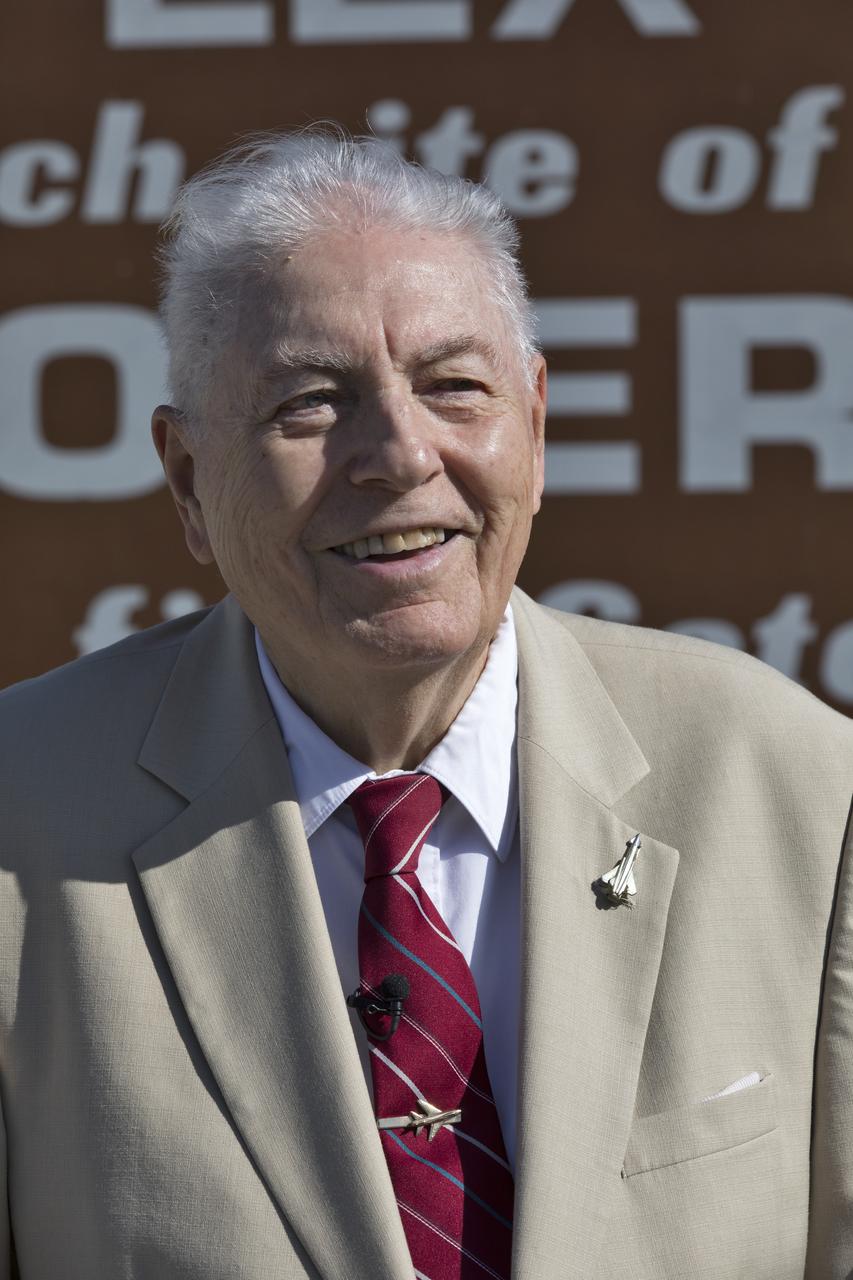
Dr. John Meisenheimer, launch weather officer for Explorer 1, speaks to guests at an event celebrating the 60th anniversary of America's first satellite. The ceremony took place in front of the Space Launch Complex 26 blockhouse at Cape Canaveral Air Force Station where the Explorer 1 satellite was launched atop a Jupiter C rocket on Jan. 31, 1958. During operation, the satellite's cosmic ray detector discovered radiation belts around Earth which were named for Dr. James Van Allen, principal investigator for the satellite.
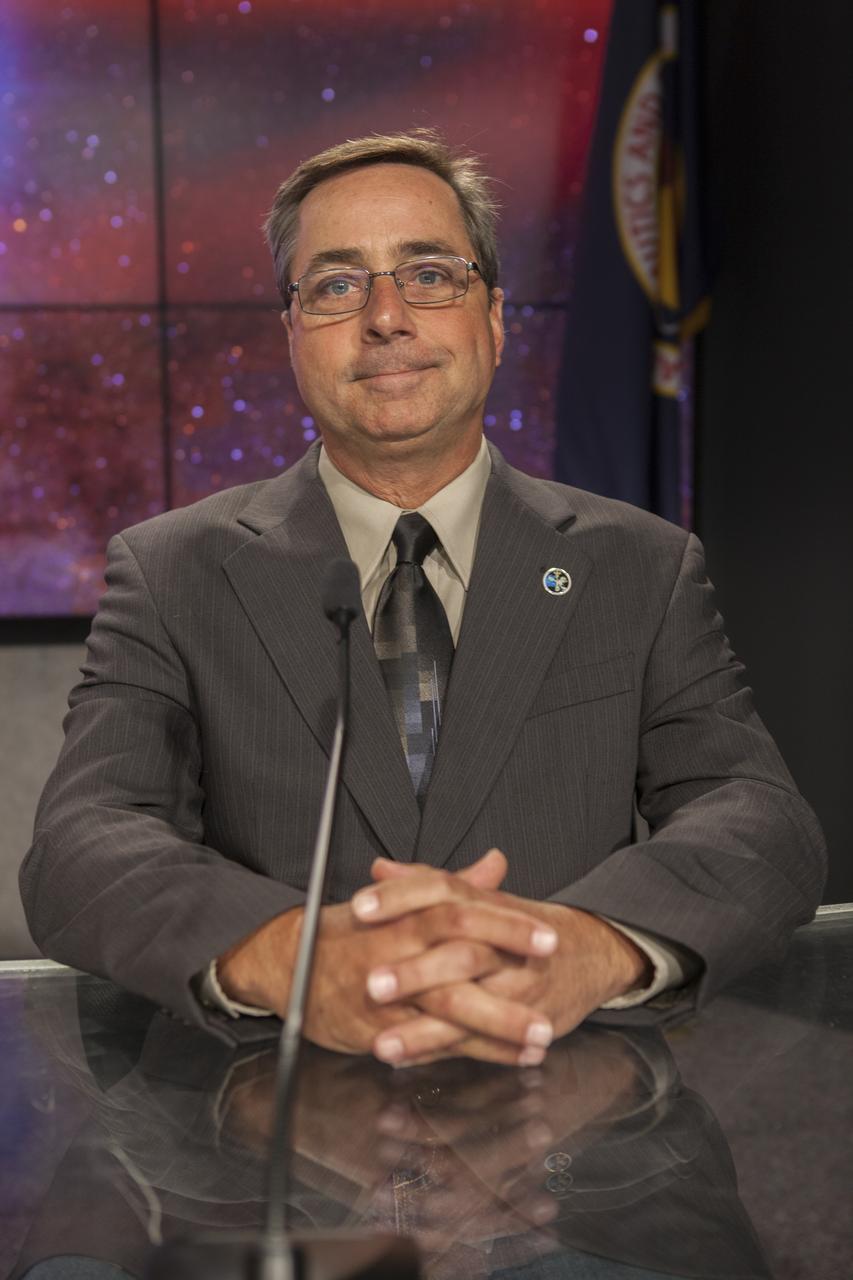
In Kennedy Space Center's Press Site auditorium, members of the media participate in a mission briefing on NASA's Transiting Exoplanet Survey Satellite (TESS). Mike McAleenan, weather officer, 45th Weather Squadron, gives a weather update and answers questions during the briefing. TESS is the next step in the search for planets outside of our solar system. The mission will find exoplanets that periodically block part of the light from their host stars, events called transits. The satellite will survey the nearest and brightest stars for two years to search for transiting exoplanets. TESS will launch on a SpaceX Falcon 9 rocket from Space Launch Complex 40 at Cape Canaveral Air Force Station no earlier than 6:32 p.m. EDT on Monday, April 16.
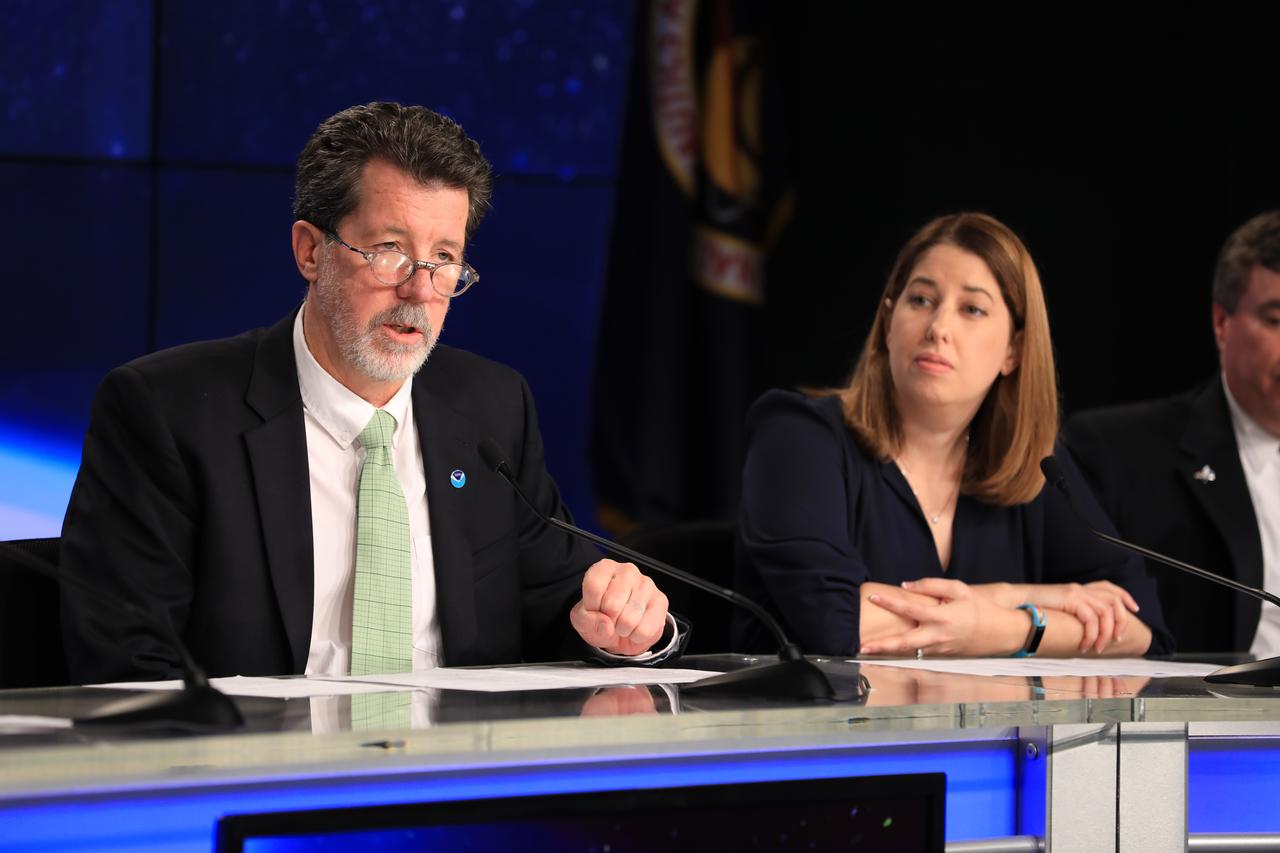
In the Kennedy Space Center's Press Site auditorium, Jim Roberts, a scientist with the Earth System Research Laboratory's Office of Atmospheric Research for NOAA, left, and Kristin Calhoun, a research scientist with NOAA's National Severe Storms Laboratory, speak to members of the media at a mission briefing on National Oceanic and Atmospheric Administration's, or NOAA's, Geostationary Operational Environmental Satellite, or GOES-S. The spacecraft is the second satellite in a series of next-generation NOAA weather satellites. It will launch to a geostationary position over the U.S. to provide images of storms and help predict weather forecasts, severe weather outlooks, watches, warnings, lightning conditions and longer-term forecasting. GOES-S is slated to lift off at 5:02 p.m. EST on March 1, 2018 aboard a United Launch Alliance Atlas V rocket.
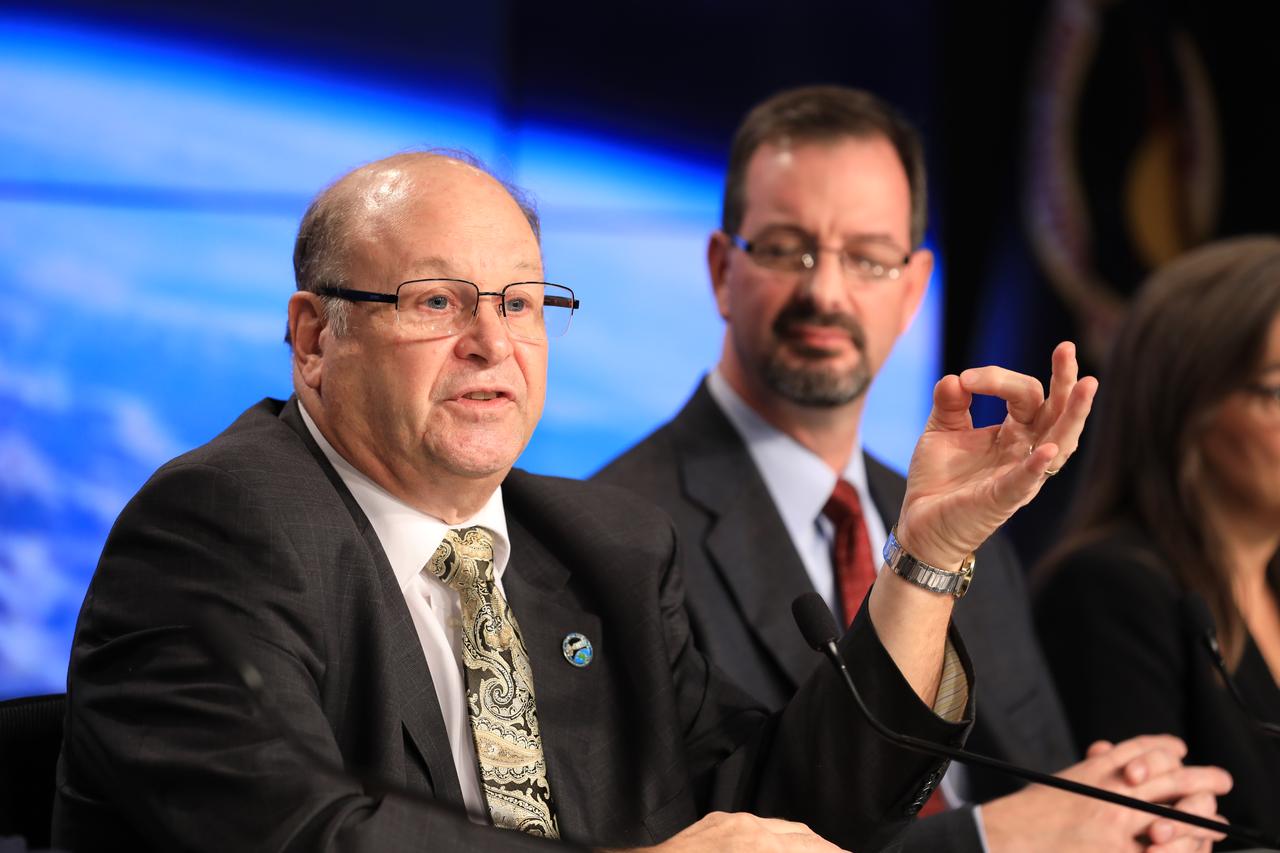
In the Kennedy Space Center's Press Site auditorium, members of the media participate in a mission briefing on the Geostationary Operational Environmental Satellite (GOES-R). Briefing participants included Steven Goodman, NOAA's GOES-R program scientist, and Joseph A. Pica, director of the National Weather Service Office of Observations. GOES-R is the first satellite in a series of next-generation GOES satellites for NOAA, the National Oceanographic and Atmospheric Administration. It will launch to a geostationary orbit over the western hemisphere to provide images of storms and help meteorologists predict severe weather conditionals and develop long-range forecasts.
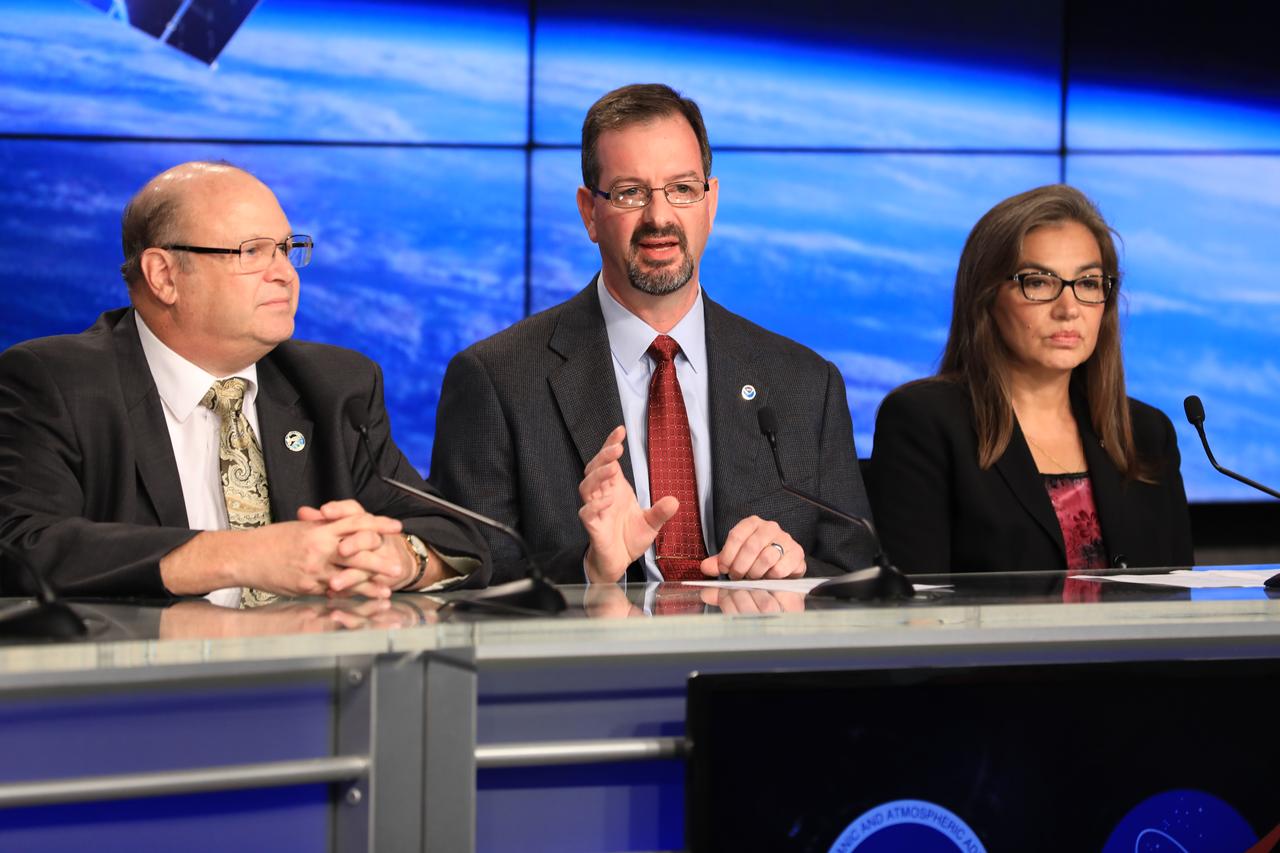
In the Kennedy Space Center's Press Site auditorium, members of the media participate in a mission briefing on the Geostationary Operational Environmental Satellite (GOES-R). Briefing participants from left are: Steven Goodman, NOAA's GOES-R program scientist; Joseph A. Pica, director of the National Weather Service Office of Observations; and Sandra Cauffman, deputy director of NASA's Earth Science Division. GOES-R is the first satellite in a series of next-generation GOES satellites for NOAA, the National Oceanographic and Atmospheric Administration. It will launch to a geostationary orbit over the western hemisphere to provide images of storms and help meteorologists predict severe weather conditionals and develop long-range forecasts.
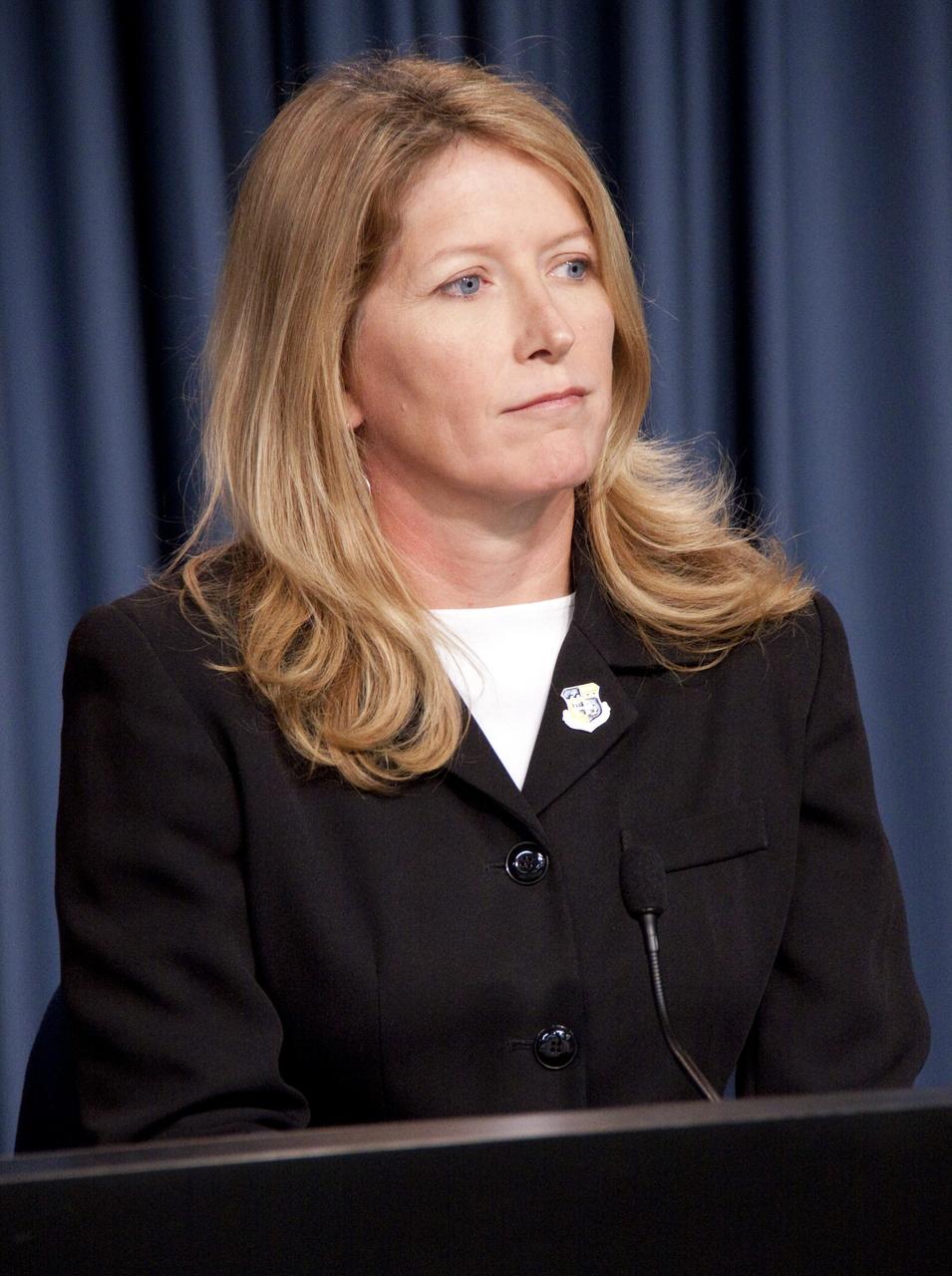
CAPE CANAVERAL, Fla. -- At NASA's Kennedy Space Center in Florida, Shuttle Weather Officer Kathy Winters talks to media about the weather forecast for space shuttle Discovery's upcoming launch to the International Space Station during a Countdown Status Briefing. Scheduled to lift off Nov. 3 at 3:52 p.m. EDT, Discovery and crew will deliver the Permanent Multipurpose Module, packed with supplies and critical spare parts, as well as Robonaut 2, the dexterous humanoid astronaut helper, to the orbiting outpost. For more information on the STS-133 mission, visit www.nasa.gov/mission_pages/shuttle/shuttlemissions/sts133/. Photo credit: NASA/Jack Pfaller
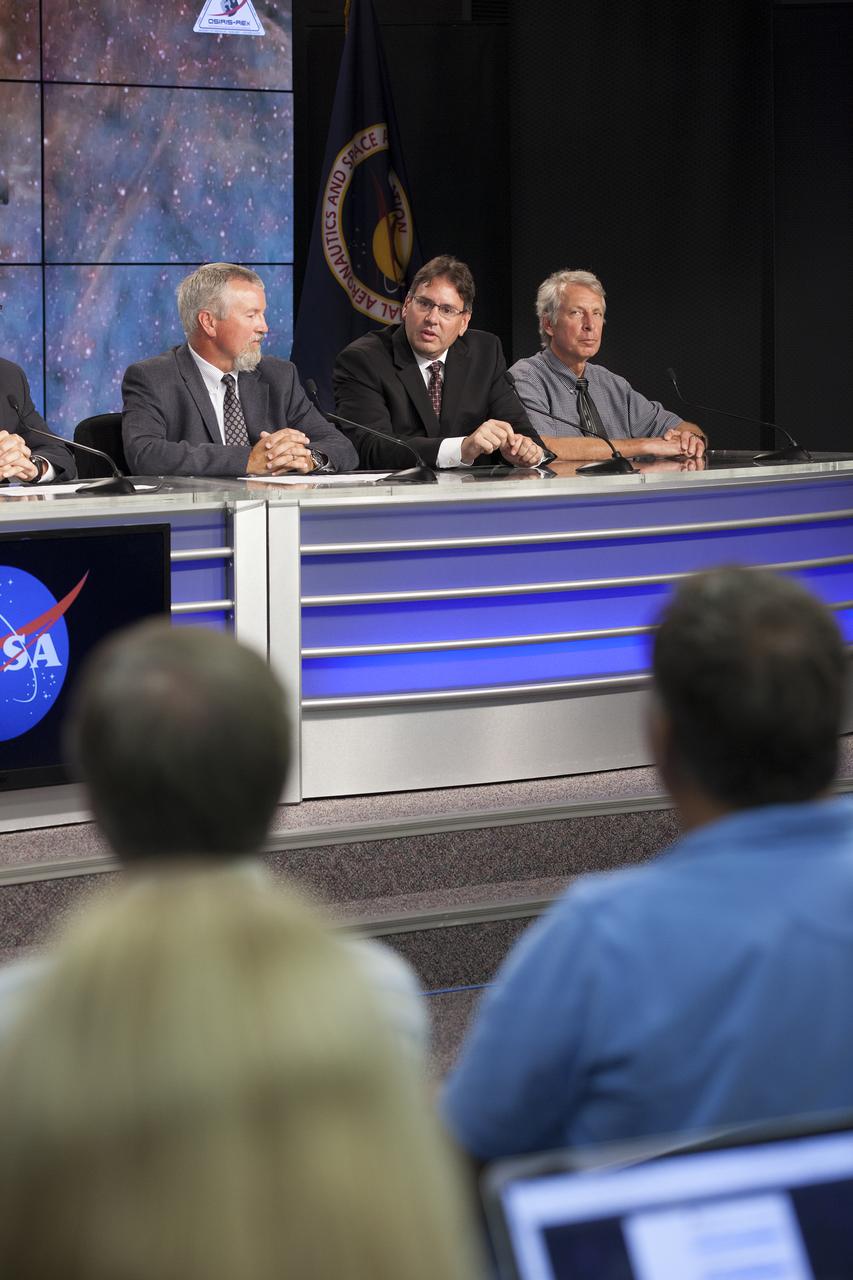
In the Kennedy Space Center’s Press Site auditorium, NASA and industry leaders speak to members of the media at a prelaunch news conference for the agency’s Origins, Spectral Interpretation, Resource Identification, Security-Regolith Explorer, or OSIRIS-REx spacecraft. From left are: Michael Donnelly, OSIRIS-REx project manager at NASA’s Goddard Space Flight Center in Greenbelt, Maryland; Rich Kuhns, OSIRIS-REx program manager for Lockheed Martin Space Systems in Denver; and Clay Flinn, launch weather officer for the 45th Weather Squadron at Cape Canaveral Air Force Station, Florida.
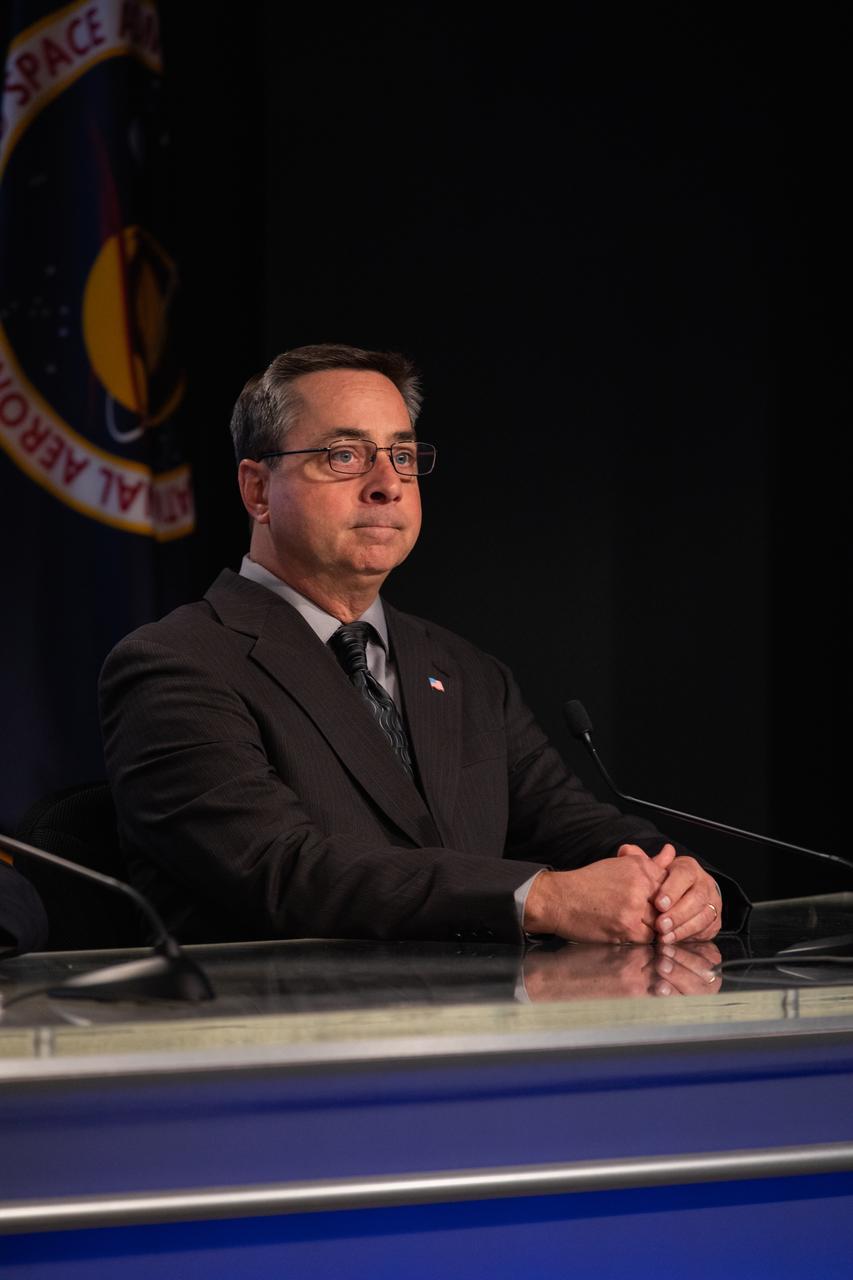
Mike McAleenan, launch weather officer with the U.S. Air Force 45th Space Wing, participates in a prelaunch news conference for SpaceX’s 20th Commercial Resupply Services (CRS-20) mission to the International Space Station at NASA’s Kennedy Space Center in Florida on March 6, 2020. The company’s Falcon 9 rocket and cargo Dragon spacecraft are scheduled to lift off from Cape Canaveral Air Force Station’s Space Launch Complex 40 at 11:50 p.m. EST on March 6, 2020.
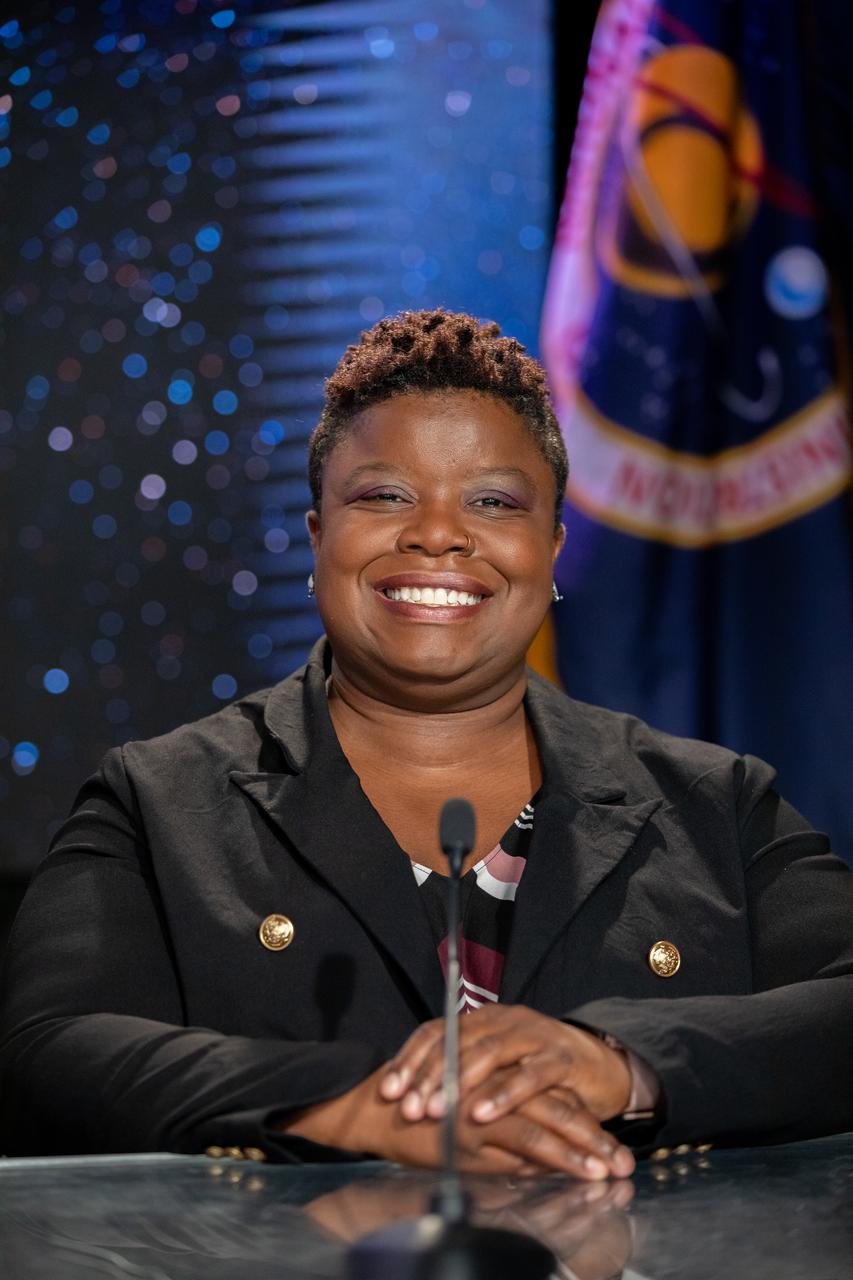
Arlena Moses, launch weather officer, U.S. Space Force, SpaceX, participates in a Psyche mission prelaunch news conference at NASA’s Kennedy Space Center in Florida on Wednesday, Oct. 11, 2023. Psyche is the first mission to explore an asteroid with a surface that likely contains substantial amounts of metal rather than rock or ice. Liftoff of NASA’s Psyche spacecraft, atop a SpaceX Falcon Heavy rocket, is targeted for 10:16 a.m. EDT Thursday, Oct. 12, from Kennedy’s Launch Complex 39A.
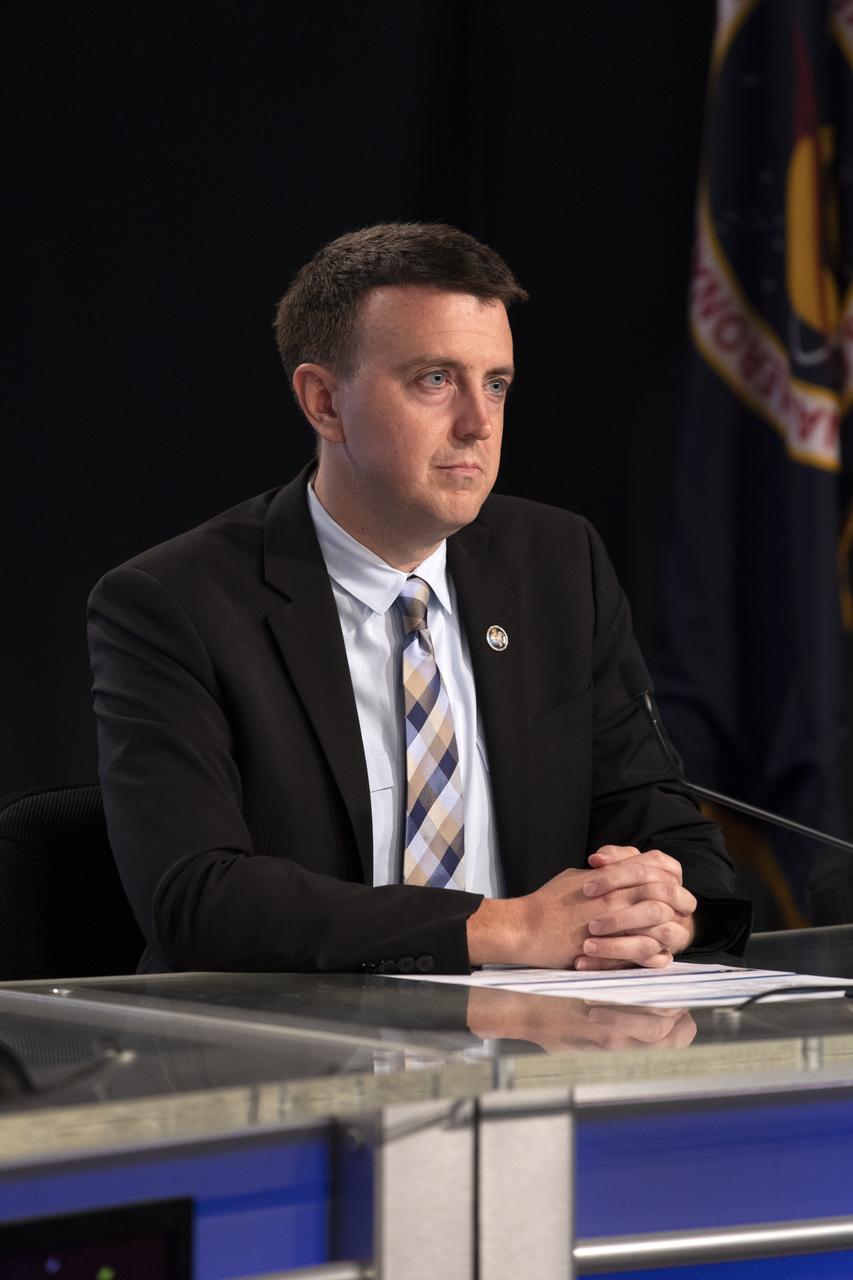
Will Ulrich, 45th Space Wing weather officer with the U.S. Air Force, speaks to members of the news media during a prelaunch news conference for SpaceX’s 17th Commercial Resupply Services (CRS-17) mission for NASA to the International Space Station on May 2, 2019, at the agency’s Kennedy Space Center in Florida. The SpaceX Falcon 9 rocket and Dragon cargo module are scheduled to launch no earlier than May 3, 2019, from Space Launch Complex 40 on Cape Canaveral Air Force Station in Florida.

John P. Shannon, Manager, NASA Space Shuttle Program Office watches the latest weather radar in Firing Room Four of the Launch Control Center at NASA's Kennedy Space Center in Cape Canaveral, Florida, Sunday, July 12, 2009. Endeavour is set to launch at 7:13p.m. EDT with the crew of STS-127 and start a 16-day mission that will feature five spacewalks and complete construction of the Japan Aerospace Exploration Agency's Kibo laboratory. Photo Credit: (NASA/Bill Ingalls)
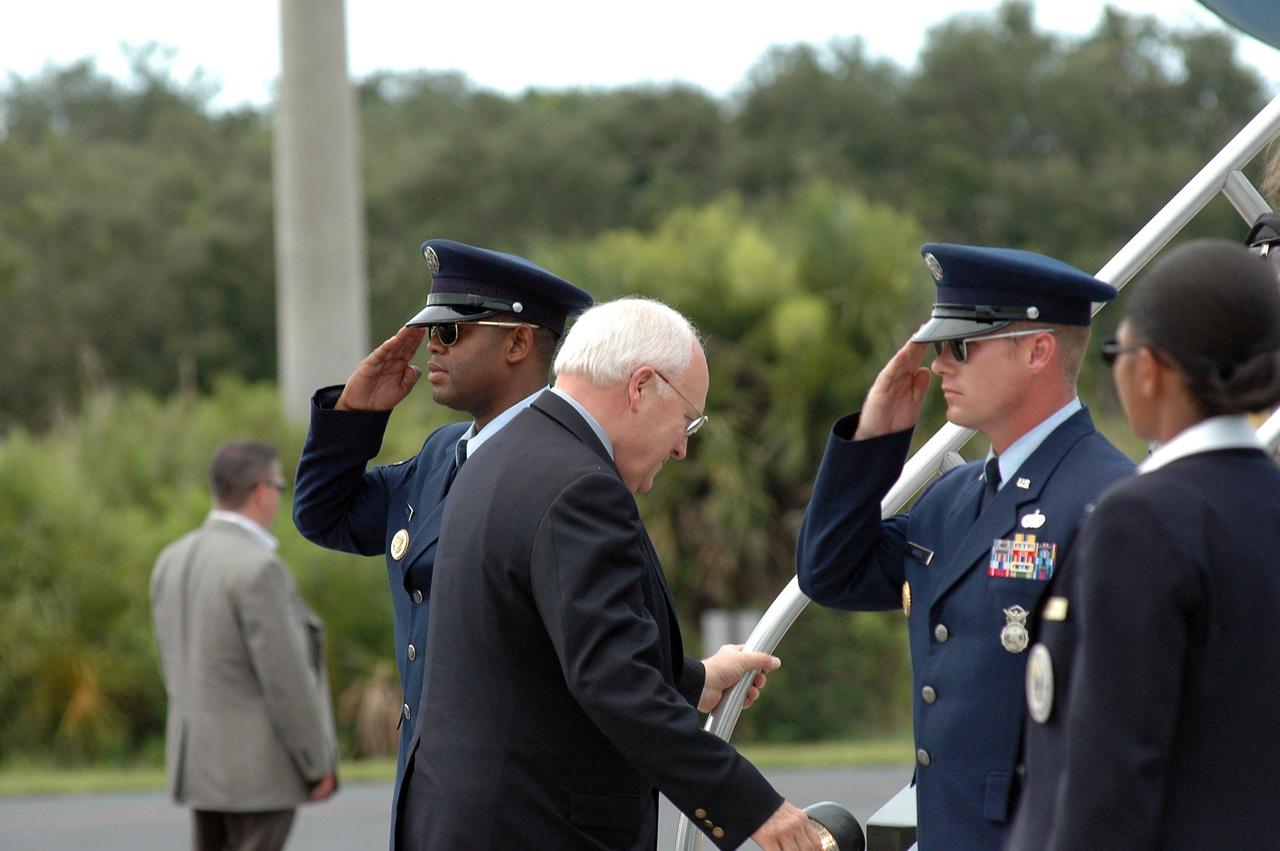
KENNEDY SPACE CENTER, FLA. - On the Skid Strip at Cape Canaveral Air Force Station in Florida, U.S. Vice President Dick Cheney is saluted by officers from Patrick Air Force Base as he boards Air Force Two for a return trip to Washington. Cheney and his family flew in earlier to witness the launch of Space Shuttle Discovery on mission STS-121. The launch was scrubbed due to weather concerns and postponed 24 hours. Photo credit: NASA/Kim Shiflett
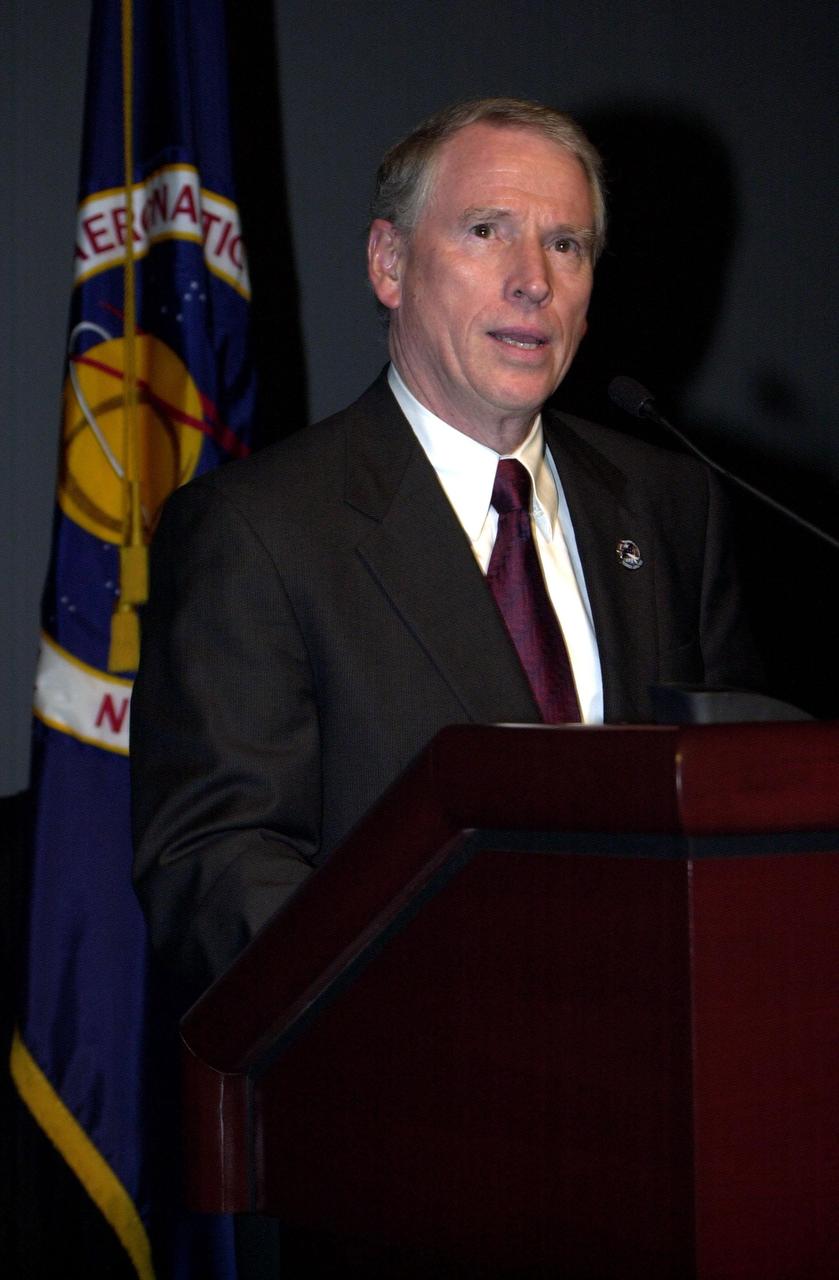
KENNEDY SPACE CENTER, Fla. -- NASA Acting Administrator Daniel Mulville talks to other guests at the KSC Protocol Office. Mulville was one of many visitors attending the launch of Space Shuttle Endeavour on mission STS-108. The launch was delayed by one day Dec. 4, 2001, due to poor weather at Kennedy. Space Shuttle Endeavour is now scheduled to lift off at 5:19 p.m. EST (2219 GMT) Dec. 5
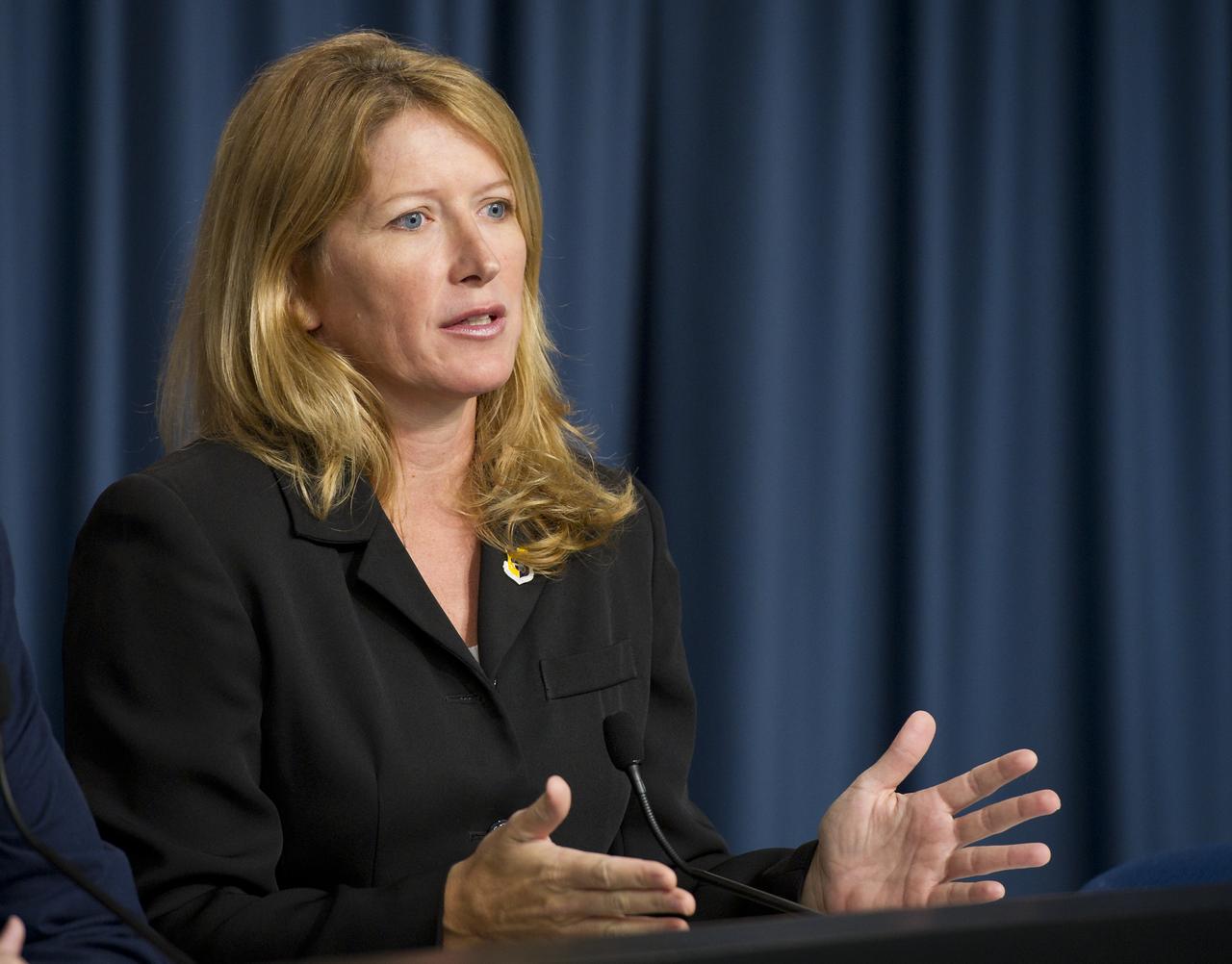
NASA Shuttle Weather Officer Kathy Winters participates in the space shuttle Discovery launch status briefing on Friday, Oct. 29, 2010 at the NASA Kennedy Space Center in Cape Canaveral, Fla. Discovery and it's STS-133 mission crew of six are currently targeted to launch at 4:17p.m. EDT on Tuesday, Nov. 2, 2010. Photo Credit: (NASA/Bill Ingalls)
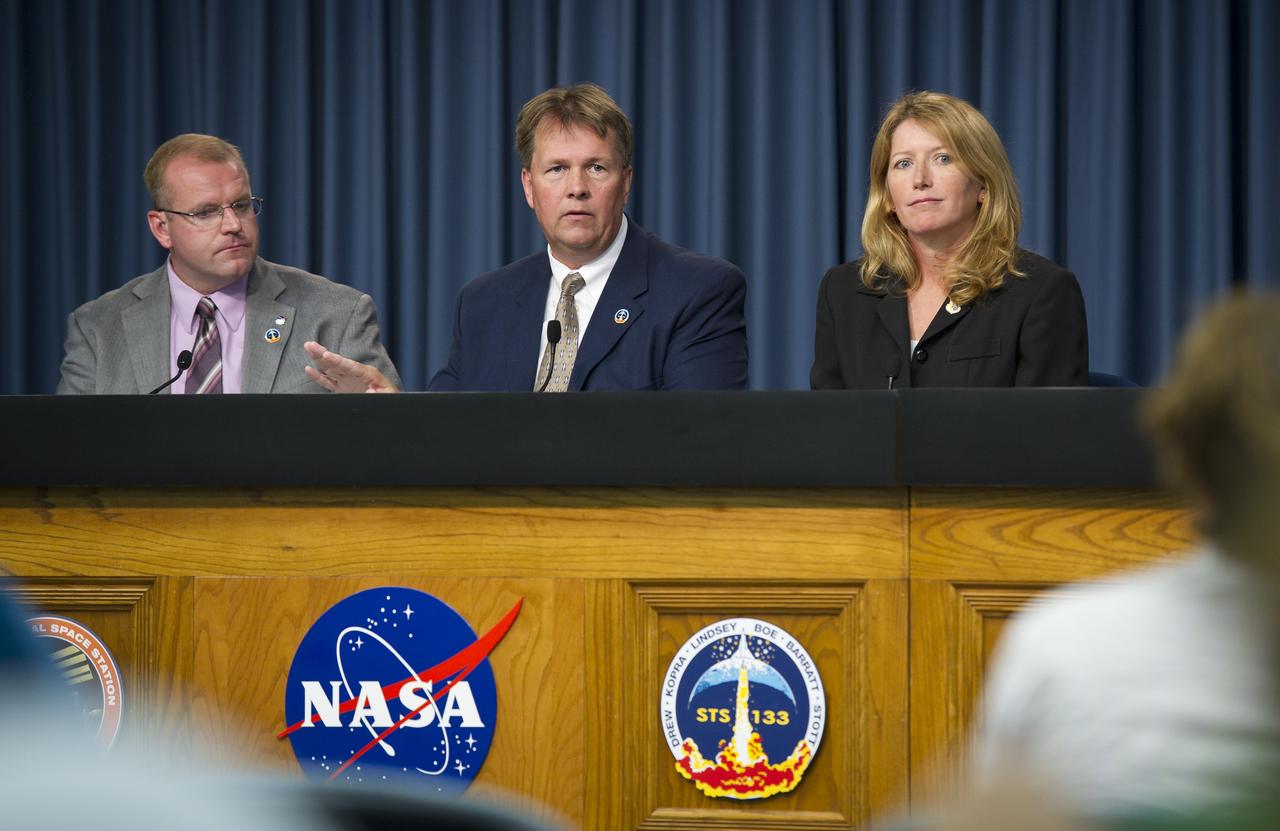
NASA Spokesperson Allard Beutel, left, NASA Test Director Jeff Spaulding and Shuttle Weather Officer Kathy Winters, right, participate in the space shuttle Discovery launch status briefing on Friday, Oct. 29, 2010 at the NASA Kennedy Space Center in Cape Canaveral, Fla. Discovery and it's STS-133 mission crew of six are currently targeted to launch at 4:17p.m. EDT on Tuesday, Nov. 2, 2010. Photo Credit: (NASA/Bill Ingalls)
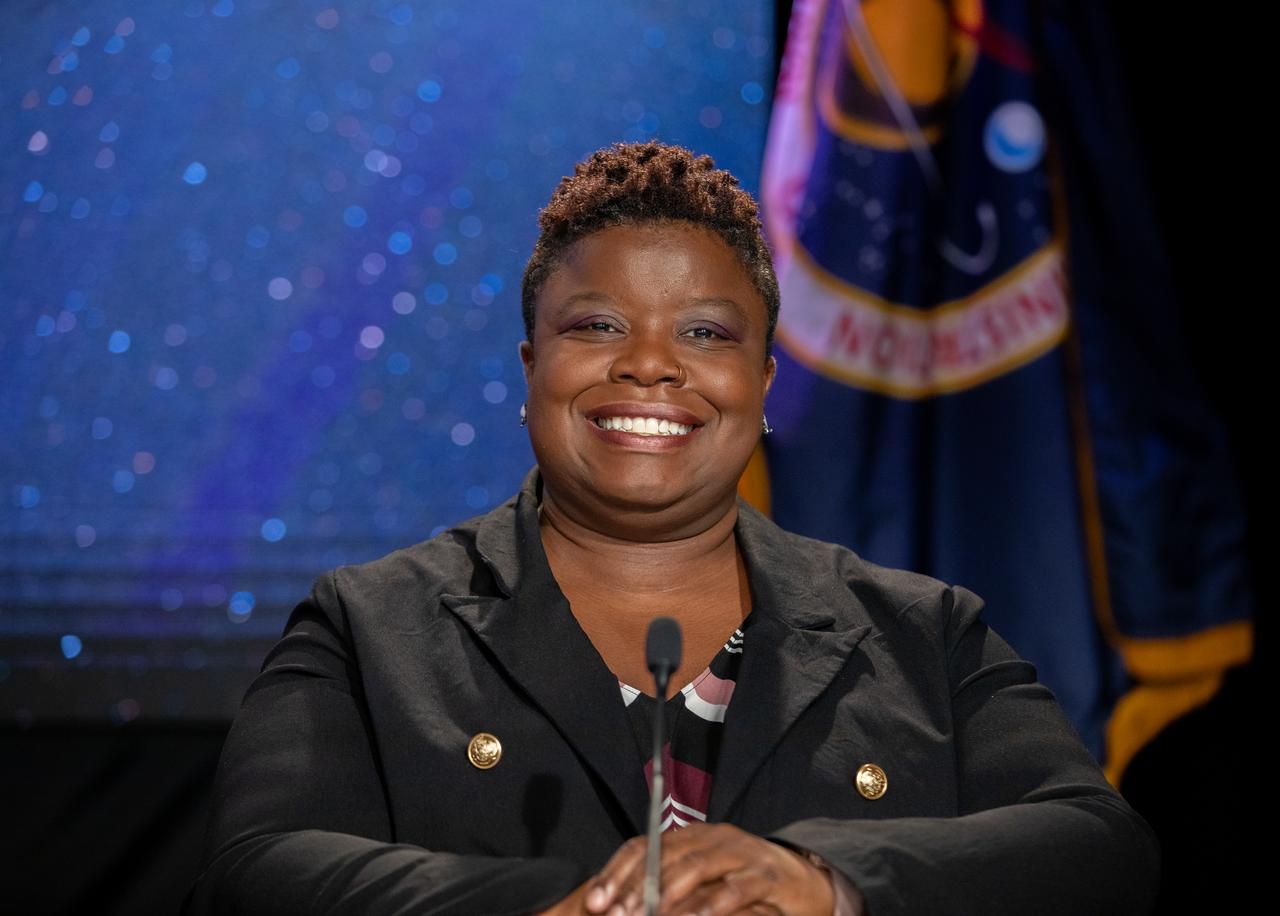
Arlena Moses, launch weather officer, U.S. Space Force, SpaceX, participates in a Psyche mission prelaunch news conference at NASA’s Kennedy Space Center in Florida on Wednesday, Oct. 11, 2023. Psyche is the first mission to explore an asteroid with a surface that likely contains substantial amounts of metal rather than rock or ice. Liftoff of NASA’s Psyche spacecraft, atop a SpaceX Falcon Heavy rocket, is targeted for 10:16 a.m. EDT Thursday, Oct. 12, from Kennedy’s Launch Complex 39A.
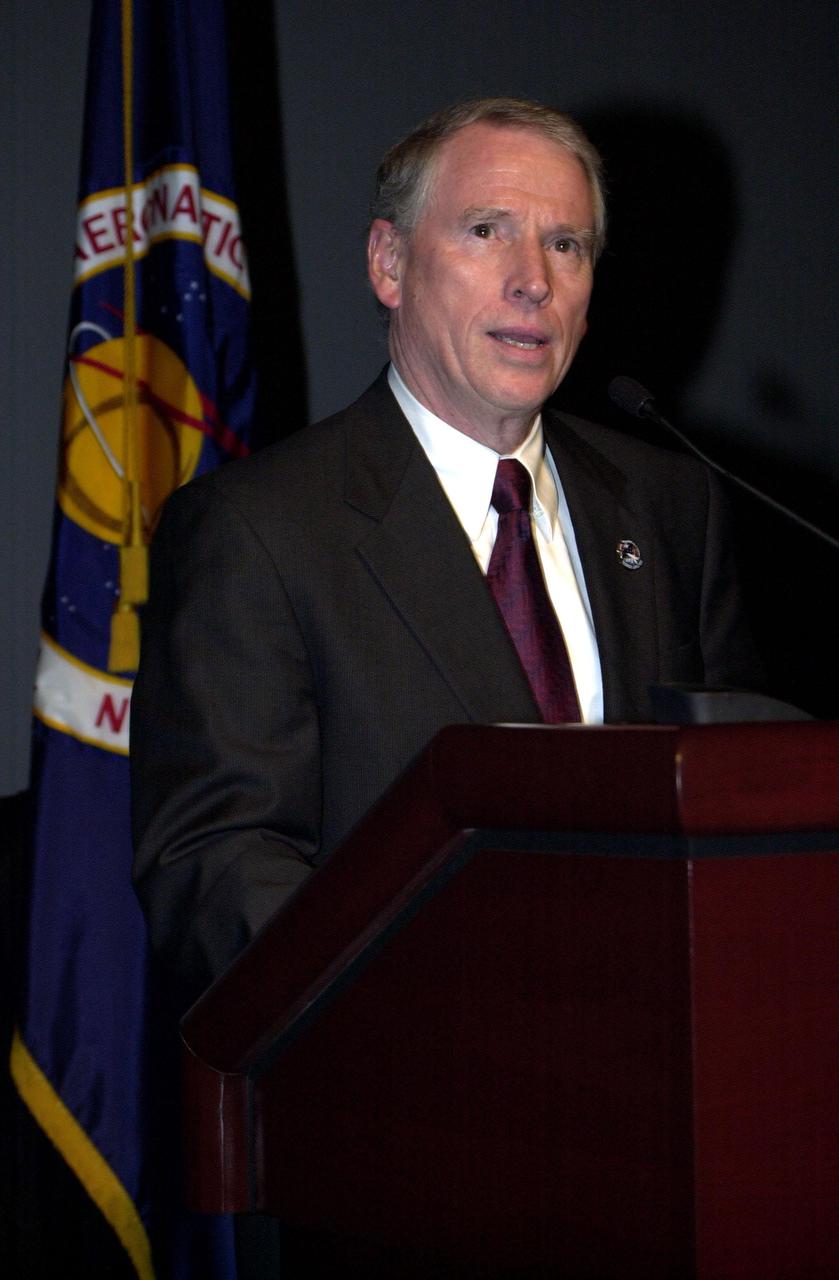
KENNEDY SPACE CENTER, Fla. -- NASA Acting Administrator Daniel Mulville talks to other guests at the KSC Protocol Office. Mulville was one of many visitors attending the launch of Space Shuttle Endeavour on mission STS-108. The launch was delayed by one day Dec. 4, 2001, due to poor weather at Kennedy. Space Shuttle Endeavour is now scheduled to lift off at 5:19 p.m. EST (2219 GMT) Dec. 5