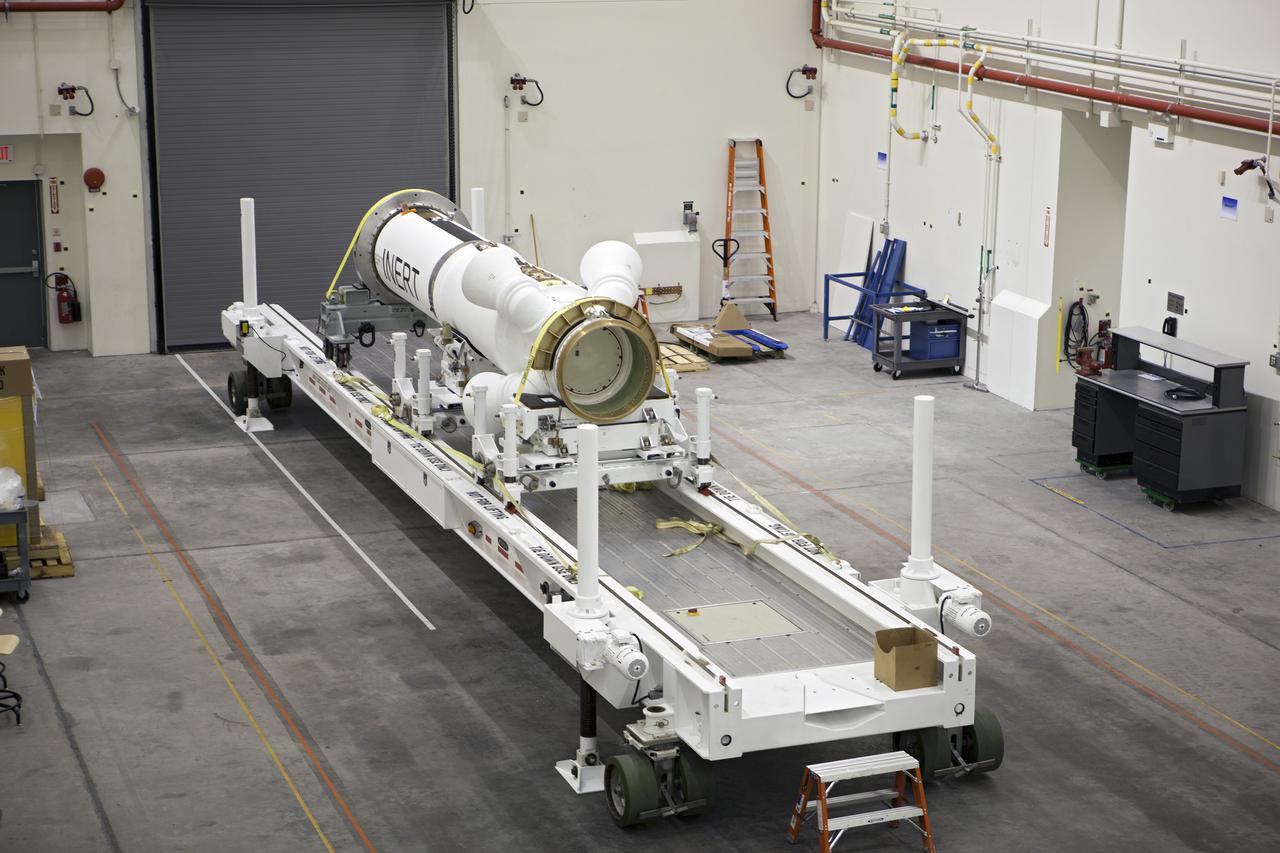
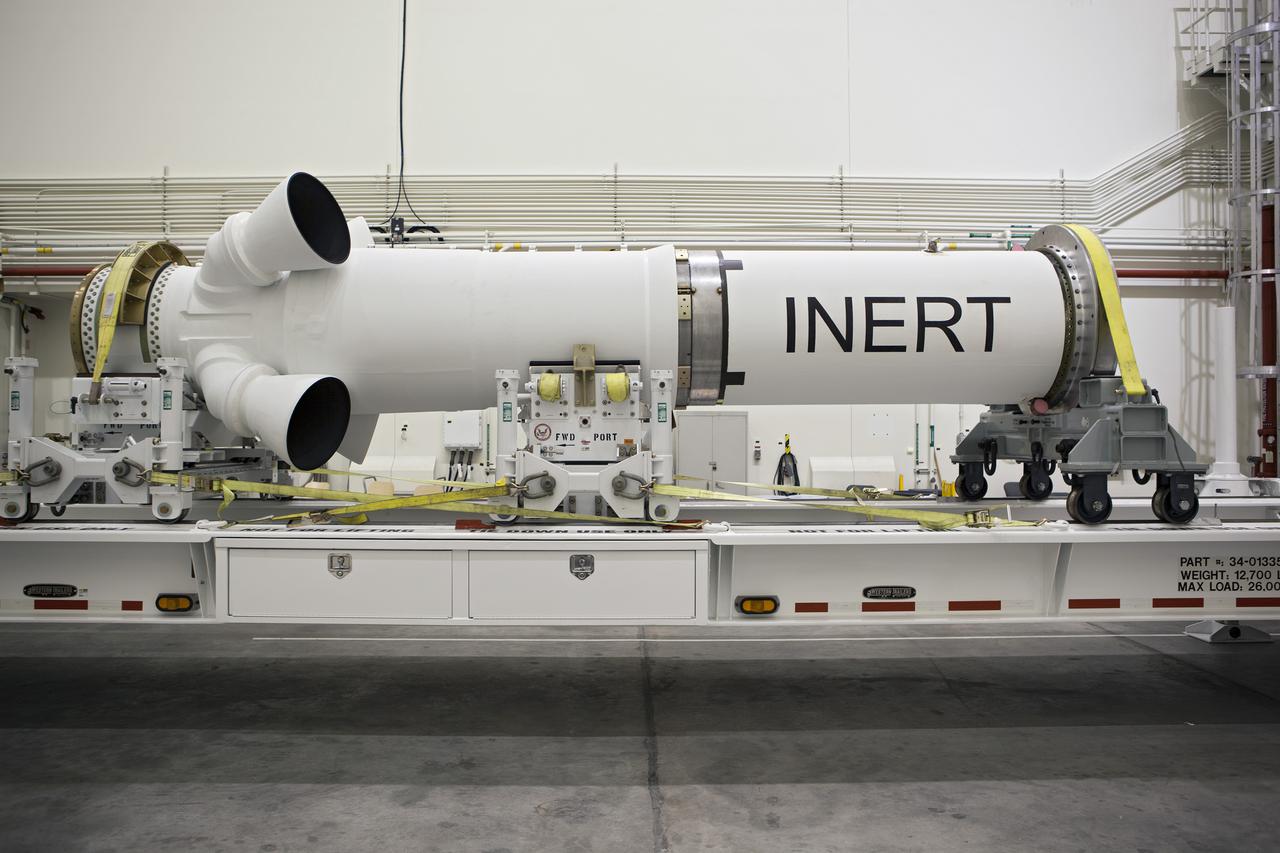
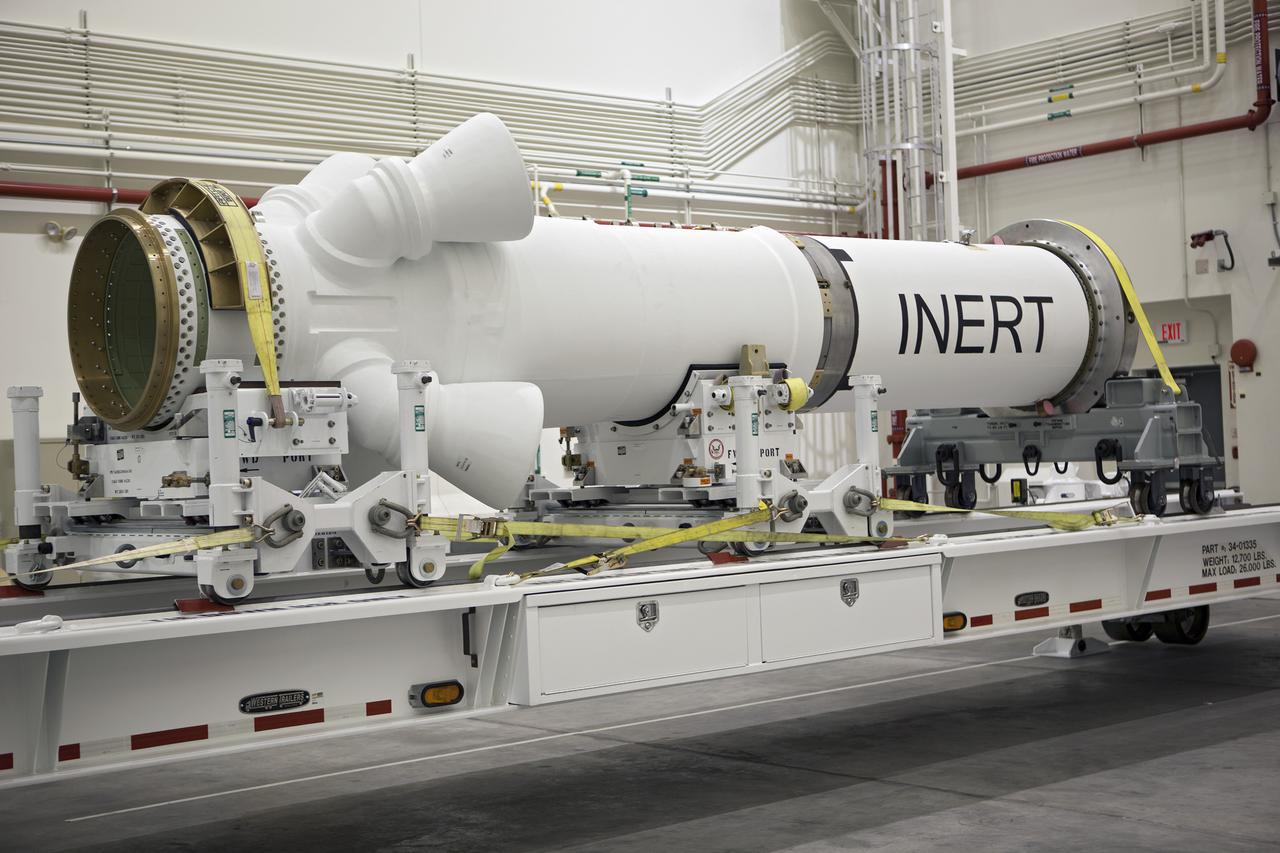
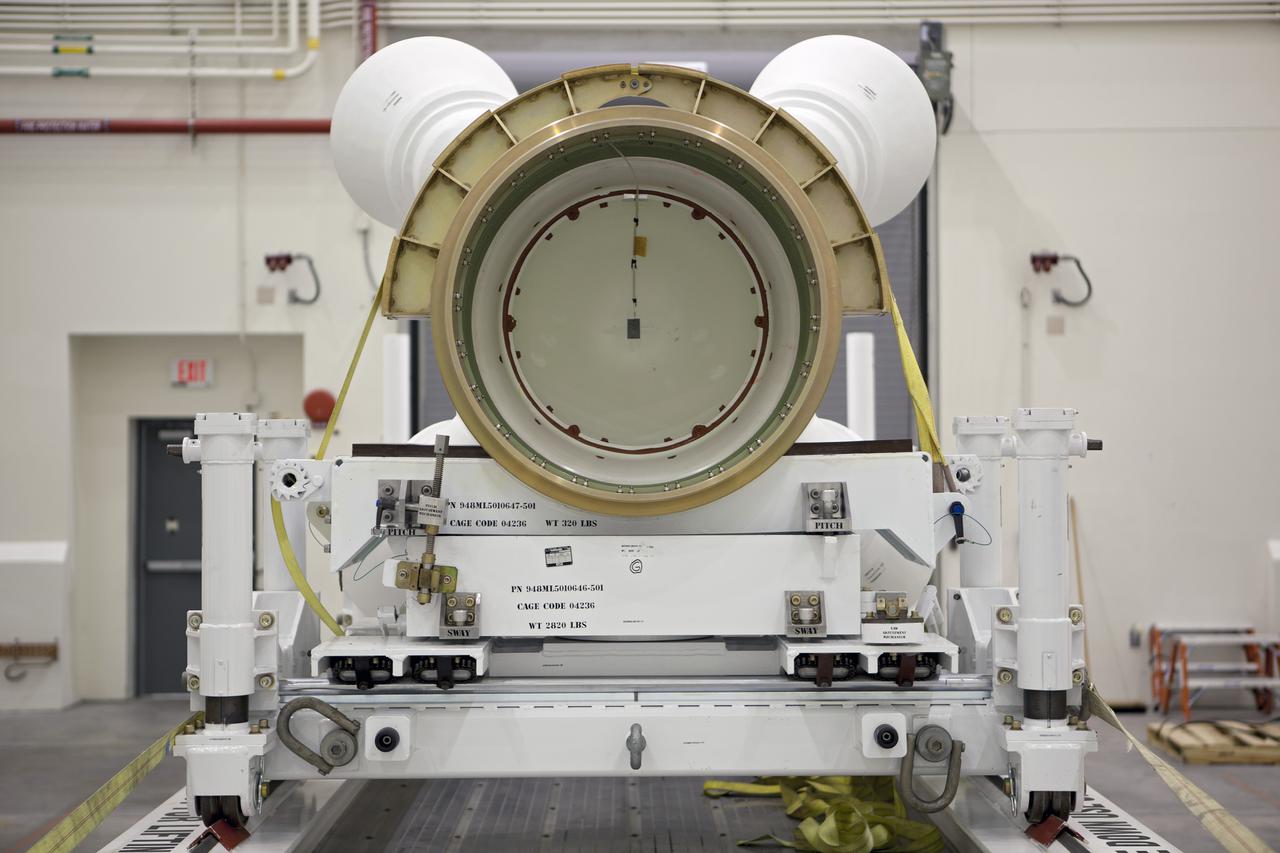
CAPE CANAVERAL, Fla. – At NASA’s Kennedy Space Center in Florida, members of the media viewed the Alliant Techsystems, or ATK, launch abort motor inside the Launch Abort System Facility. ATK’s abort motor is one of the components of Orion’s Launch Abort System, which will be used for Exploration Flight Test 1, or EFT-1. The system is designed to safely pull the Orion crew module away from the launch vehicle in the event of an emergency on the launch pad or during the initial ascent of NASA’s Space Launch System, or SLS, rocket. The test flight abort motor is configured with inert propellant. Orion is the exploration spacecraft designed to carry crews to space beyond low Earth orbit. It will provide emergency abort capability, sustain the crew during the space travel and provide safe re-entry from deep space return velocities. Orion’s first unpiloted test flight is scheduled to launch in 2014 atop a Delta IV rocket. A second uncrewed flight test is scheduled for 2017 on the SLS rocket. For more information, visit http:__www.nasa.gov_orion. Photo credit: NASA_Dimitri Gerondidakis
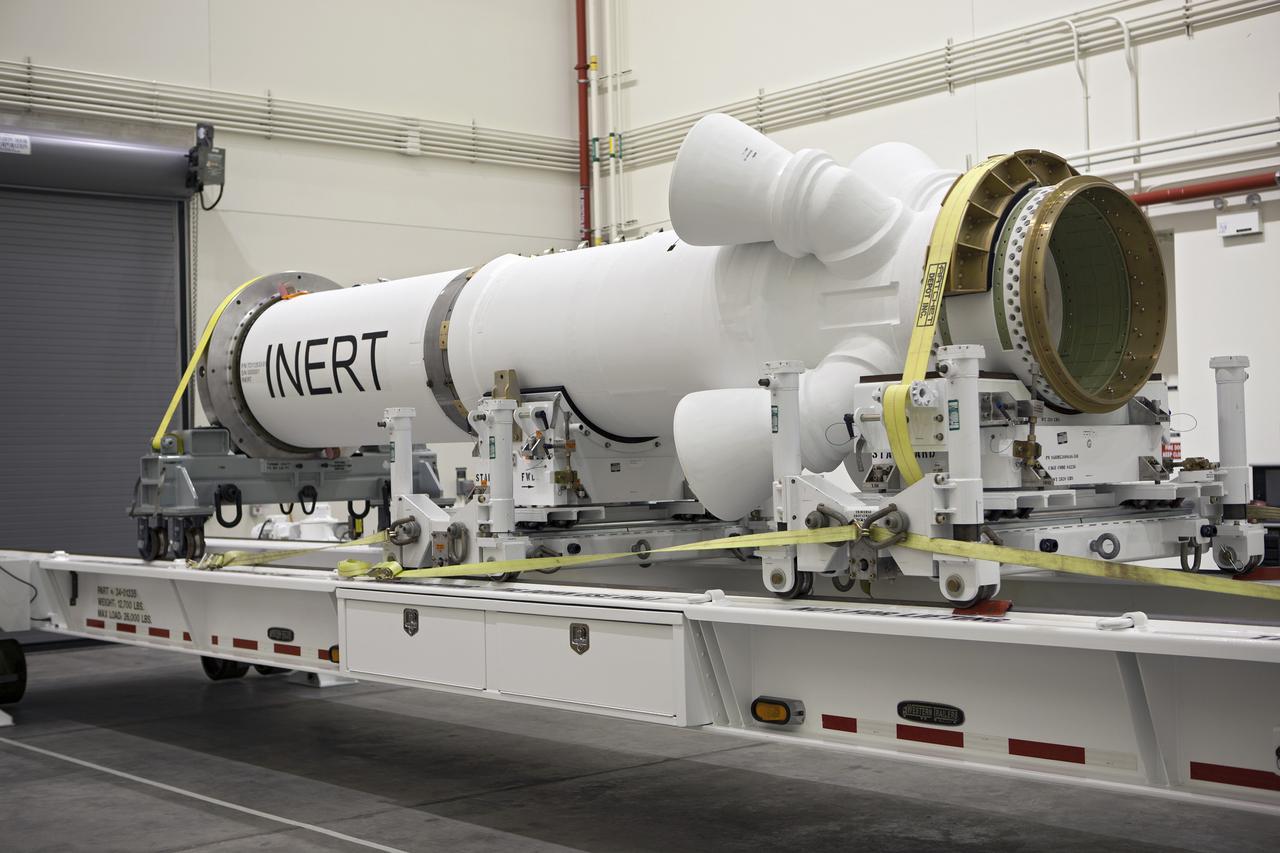
CAPE CANAVERAL, Fla. – At NASA’s Kennedy Space Center in Florida, members of the media viewed the Alliant Techsystems, or ATK, launch abort motor inside the Launch Abort System Facility. ATK’s abort motor is one of the components of Orion’s Launch Abort System, which will be used for Exploration Flight Test 1, or EFT-1. The system is designed to safely pull the Orion crew module away from the launch vehicle in the event of an emergency on the launch pad or during the initial ascent of NASA’s Space Launch System, or SLS, rocket. The test flight abort motor is configured with inert propellant. Orion is the exploration spacecraft designed to carry crews to space beyond low Earth orbit. It will provide emergency abort capability, sustain the crew during the space travel and provide safe re-entry from deep space return velocities. Orion’s first unpiloted test flight is scheduled to launch in 2014 atop a Delta IV rocket. A second uncrewed flight test is scheduled for 2017 on the SLS rocket. For more information, visit http:__www.nasa.gov_orion. Photo credit: NASA_Dimitri Gerondidakis
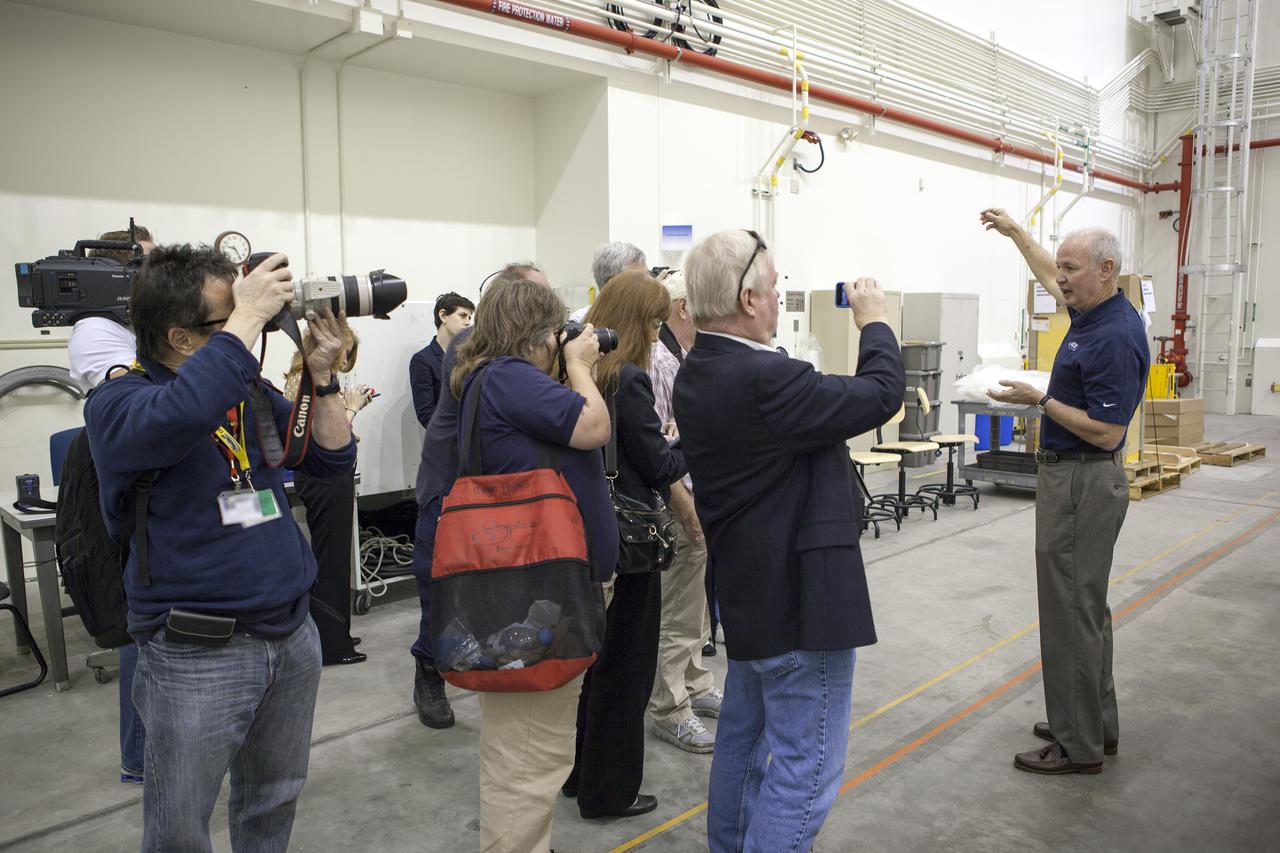
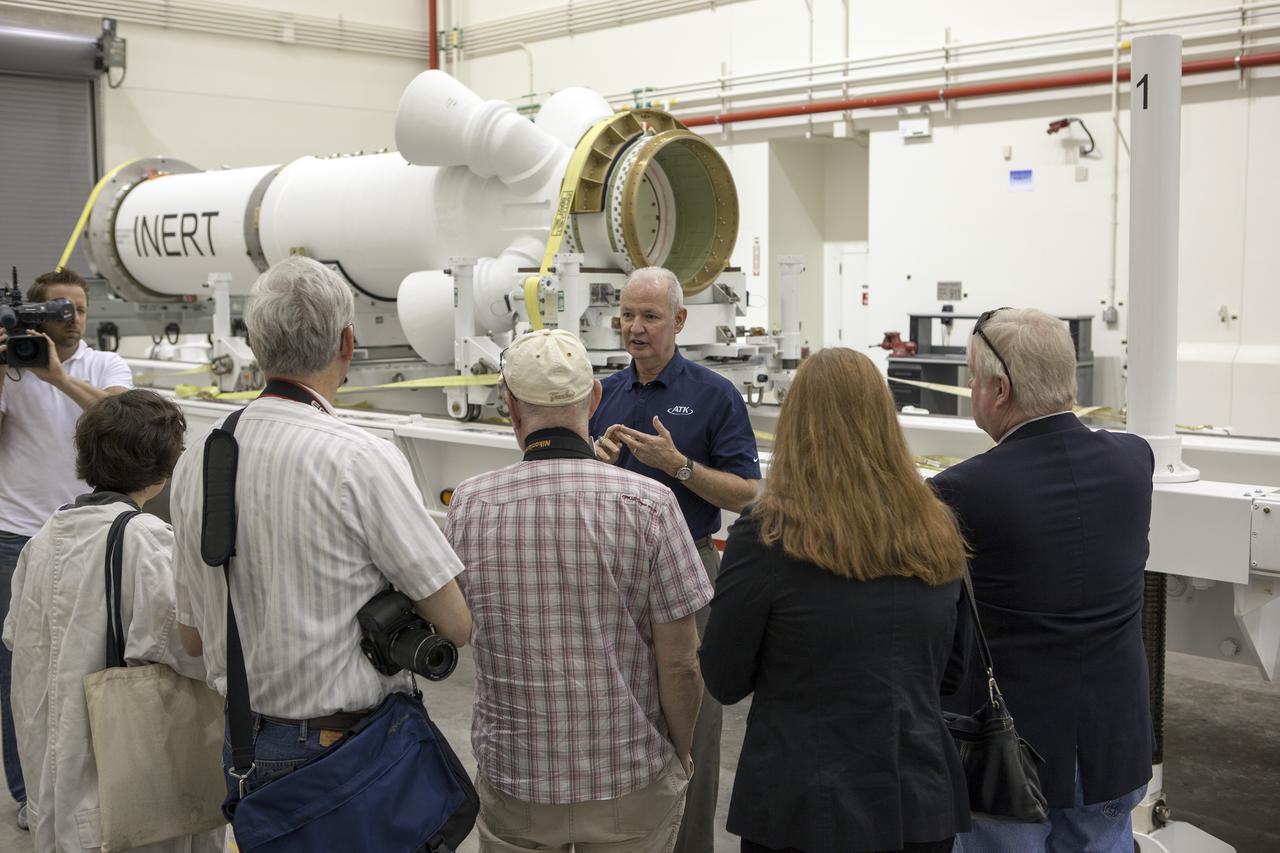
CAPE CANAVERAL, Fla. – At NASA’s Kennedy Space Center in Florida, Brian Duffy, the vice president and Johnson Space Center manager for Exploration Systems with ATK Aerospace Systems, talks with members of the media during a viewing of ATK’s launch abort motor inside the Launch Abort System Facility. The abort motor is one of the components of Orion’s Launch Abort System, which will be used for Exploration Flight Test 1, or EFT-1. The system is designed to safely pull the Orion crew module away from the launch vehicle in the event of an emergency on the launch pad or during the initial ascent of NASA’s Space Launch System, or SLS, rocket. The test flight abort motor is configured with inert propellant. Orion is the exploration spacecraft designed to carry crews to space beyond low Earth orbit. It will provide emergency abort capability, sustain the crew during the space travel and provide safe re-entry from deep space return velocities. Orion’s first unpiloted test flight is scheduled to launch in 2014 atop a Delta IV rocket. A second uncrewed flight test is scheduled for 2017 on the SLS rocket. For more information, visit http:__www.nasa.gov_orion. Photo credit: NASA_Dimitri Gerondidakis
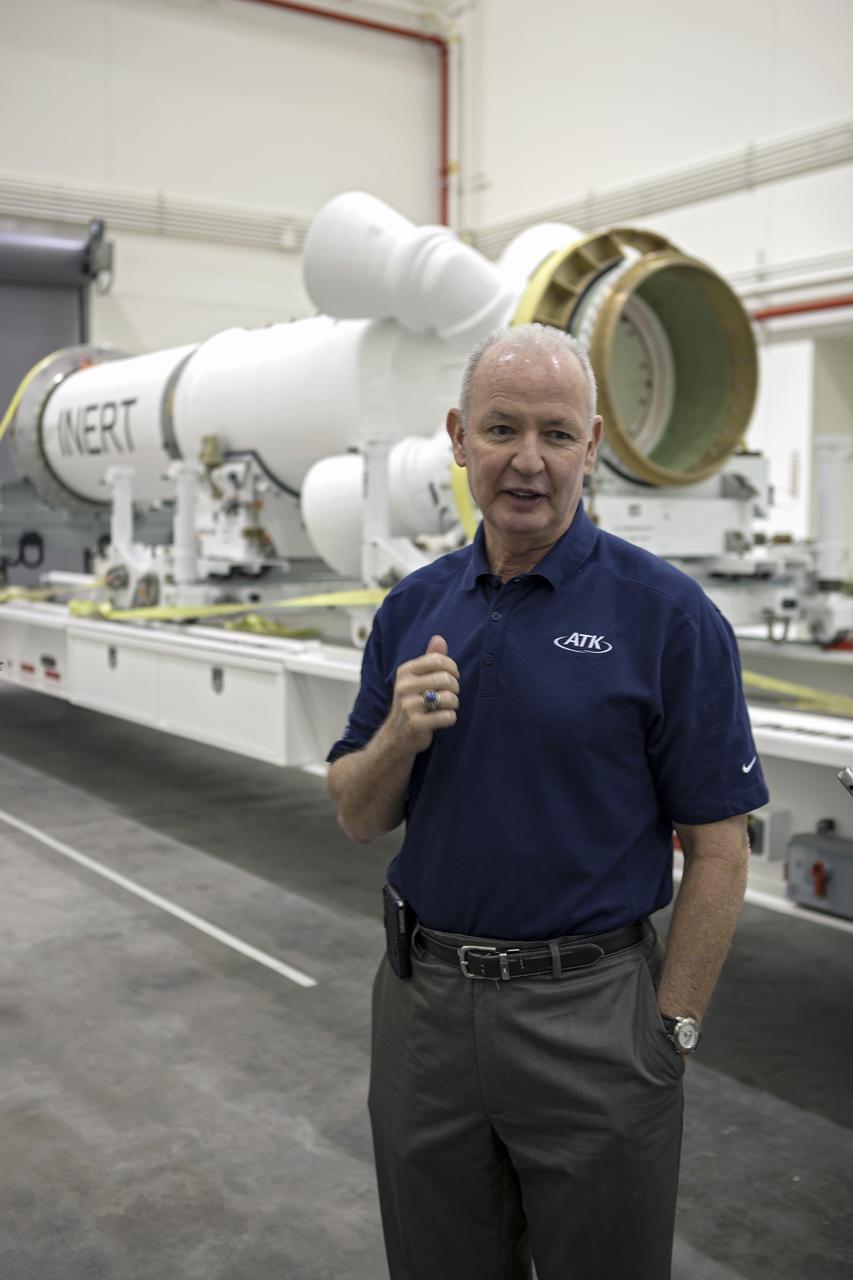
CAPE CANAVERAL, Fla. – At NASA’s Kennedy Space Center in Florida, Brian Duffy, the vice president and Johnson Space Center manager for Exploration Systems with ATK Aerospace Systems, talks with members of the media during a viewing of ATK’s launch abort motor inside the Launch Abort System Facility. The abort motor is one of the components of Orion’s Launch Abort System, which will be used for Exploration Flight Test 1, or EFT-1. The system is designed to safely pull the Orion crew module away from the launch vehicle in the event of an emergency on the launch pad or during the initial ascent of NASA’s Space Launch System, or SLS, rocket. The test flight abort motor is configured with inert propellant. Orion is the exploration spacecraft designed to carry crews to space beyond low Earth orbit. It will provide emergency abort capability, sustain the crew during the space travel and provide safe re-entry from deep space return velocities. Orion’s first unpiloted test flight is scheduled to launch in 2014 atop a Delta IV rocket. A second uncrewed flight test is scheduled for 2017 on the SLS rocket. For more information, visit http:__www.nasa.gov_orion. Photo credit: NASA_Dimitri Gerondidakis
CAPE CANAVERAL, Fla. – At NASA’s Kennedy Space Center in Florida, members of the media viewed the Alliant Techsystems, or ATK, launch abort motor inside the Launch Abort System Facility. ATK’s abort motor is one of the components of Orion’s Launch Abort System, which will be used for Exploration Flight Test 1, or EFT-1. The system is designed to safely pull the Orion crew module away from the launch vehicle in the event of an emergency on the launch pad or during the initial ascent of NASA’s Space Launch System, or SLS, rocket. The test flight abort motor is configured with inert propellant. Orion is the exploration spacecraft designed to carry crews to space beyond low Earth orbit. It will provide emergency abort capability, sustain the crew during the space travel and provide safe re-entry from deep space return velocities. Orion’s first unpiloted test flight is scheduled to launch in 2014 atop a Delta IV rocket. A second uncrewed flight test is scheduled for 2017 on the SLS rocket. For more information, visit http:__www.nasa.gov_orion. Photo credit: NASA_Dimitri Gerondidakis
CAPE CANAVERAL, Fla. – At NASA’s Kennedy Space Center in Florida, Brian Duffy, the vice president and Johnson Space Center manager for Exploration Systems with ATK Aerospace Systems, talks with members of the media during a viewing of ATK’s launch abort motor inside the Launch Abort System Facility. The abort motor is one of the components of Orion’s Launch Abort System, which will be used for Exploration Flight Test 1, or EFT-1. The system is designed to safely pull the Orion crew module away from the launch vehicle in the event of an emergency on the launch pad or during the initial ascent of NASA’s Space Launch System, or SLS, rocket. The test flight abort motor is configured with inert propellant. Orion is the exploration spacecraft designed to carry crews to space beyond low Earth orbit. It will provide emergency abort capability, sustain the crew during the space travel and provide safe re-entry from deep space return velocities. Orion’s first unpiloted test flight is scheduled to launch in 2014 atop a Delta IV rocket. A second uncrewed flight test is scheduled for 2017 on the SLS rocket. For more information, visit http:__www.nasa.gov_orion. Photo credit: NASA_Dimitri Gerondidakis
CAPE CANAVERAL, Fla. – At NASA’s Kennedy Space Center in Florida, members of the media viewed the Alliant Techsystems, or ATK, launch abort motor inside the Launch Abort System Facility. ATK’s abort motor is one of the components of Orion’s Launch Abort System, which will be used for Exploration Flight Test 1, or EFT-1. The system is designed to safely pull the Orion crew module away from the launch vehicle in the event of an emergency on the launch pad or during the initial ascent of NASA’s Space Launch System, or SLS, rocket. The test flight abort motor is configured with inert propellant. Orion is the exploration spacecraft designed to carry crews to space beyond low Earth orbit. It will provide emergency abort capability, sustain the crew during the space travel and provide safe re-entry from deep space return velocities. Orion’s first unpiloted test flight is scheduled to launch in 2014 atop a Delta IV rocket. A second uncrewed flight test is scheduled for 2017 on the SLS rocket. For more information, visit http:__www.nasa.gov_orion. Photo credit: NASA_Dimitri Gerondidakis
CAPE CANAVERAL, Fla. – At NASA’s Kennedy Space Center in Florida, members of the media viewed the Alliant Techsystems, or ATK, launch abort motor inside the Launch Abort System Facility. ATK’s abort motor is one of the components of Orion’s Launch Abort System, which will be used for Exploration Flight Test 1, or EFT-1. The system is designed to safely pull the Orion crew module away from the launch vehicle in the event of an emergency on the launch pad or during the initial ascent of NASA’s Space Launch System, or SLS, rocket. The test flight abort motor is configured with inert propellant. Orion is the exploration spacecraft designed to carry crews to space beyond low Earth orbit. It will provide emergency abort capability, sustain the crew during the space travel and provide safe re-entry from deep space return velocities. Orion’s first unpiloted test flight is scheduled to launch in 2014 atop a Delta IV rocket. A second uncrewed flight test is scheduled for 2017 on the SLS rocket. For more information, visit http:__www.nasa.gov_orion. Photo credit: NASA_Dimitri Gerondidakis
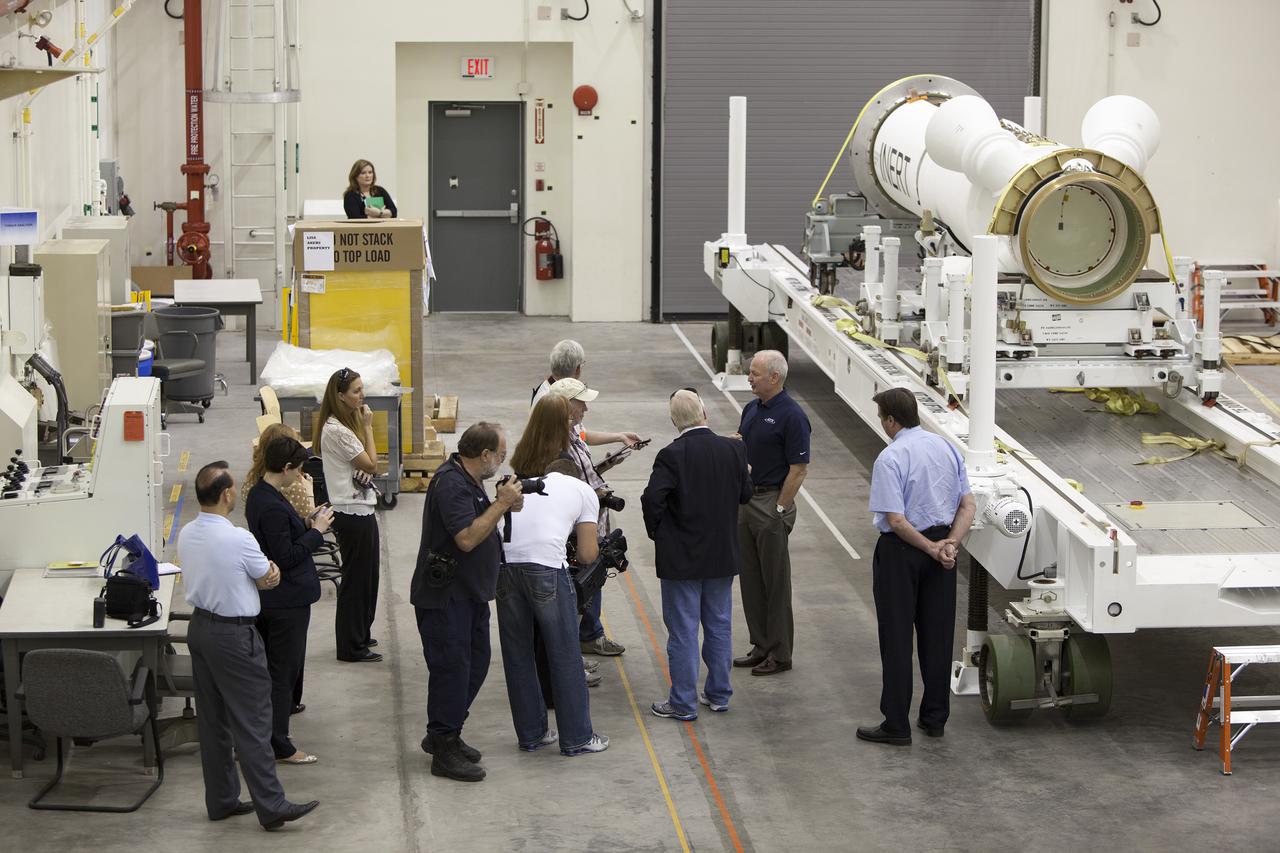
CAPE CANAVERAL, Fla. – At NASA’s Kennedy Space Center in Florida, Brian Duffy, the vice president and Johnson Space Center manager for Exploration Systems with ATK Aerospace Systems, talks with members of the media during a viewing of ATK’s launch abort motor inside the Launch Abort System Facility. The abort motor is one of the components of Orion’s Launch Abort System, which will be used for Exploration Flight Test 1, or EFT-1. The system is designed to safely pull the Orion crew module away from the launch vehicle in the event of an emergency on the launch pad or during the initial ascent of NASA’s Space Launch System, or SLS, rocket. The test flight abort motor is configured with inert propellant. Orion is the exploration spacecraft designed to carry crews to space beyond low Earth orbit. It will provide emergency abort capability, sustain the crew during the space travel and provide safe re-entry from deep space return velocities. Orion’s first unpiloted test flight is scheduled to launch in 2014 atop a Delta IV rocket. A second uncrewed flight test is scheduled for 2017 on the SLS rocket. For more information, visit http:__www.nasa.gov_orion. Photo credit: NASA_Dimitri Gerondidakis