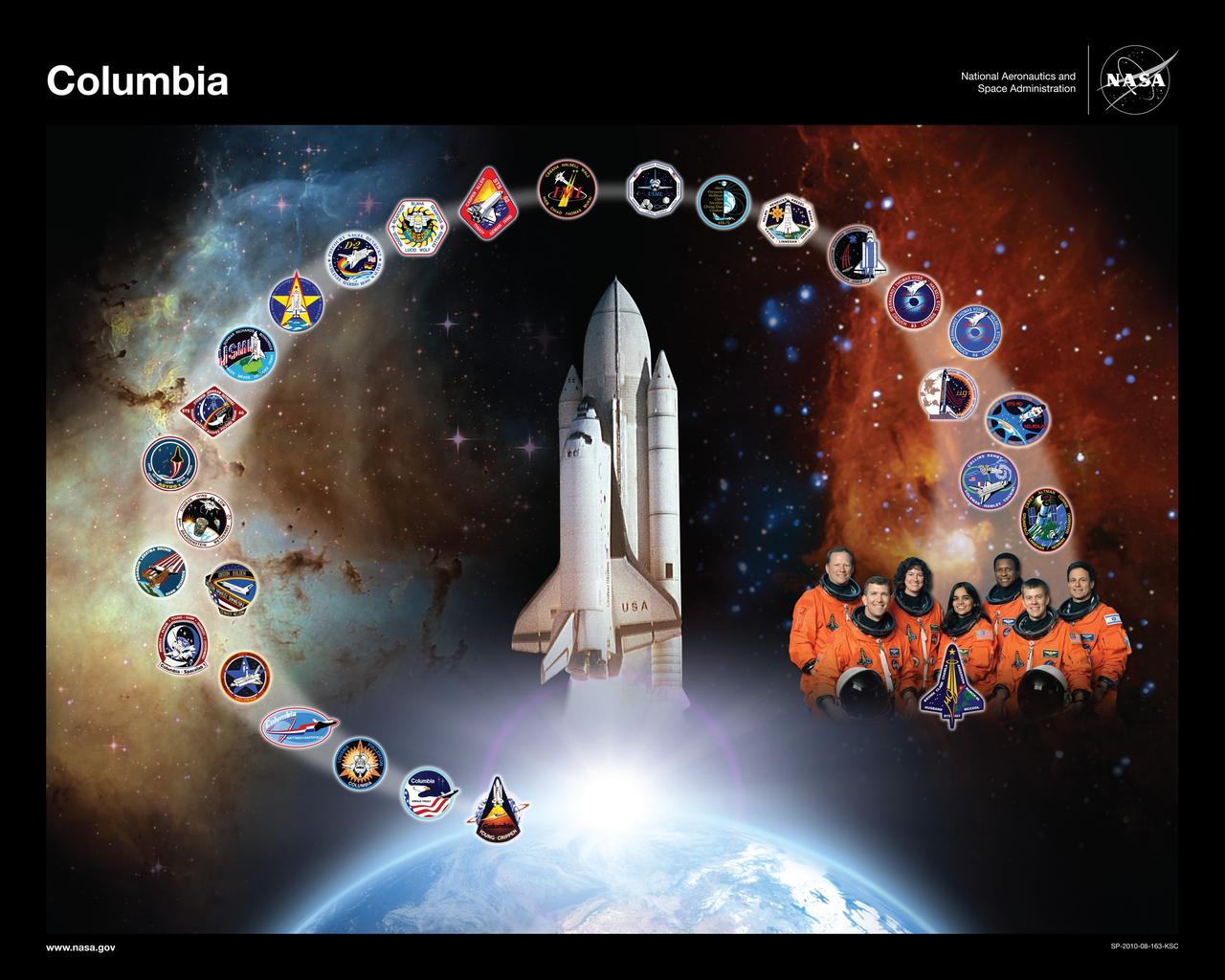
CAPE CANAVERAL, Fla. -- This is a printable version of space shuttle Columbia's orbiter tribute, or OV-102, which hangs in Firing Room 4 of the Launch Control Center at NASA's Kennedy Space Center in Florida. The tribute features Columbia, the “first of the fleet," rising above Earth at the dawn of the Space Shuttle Program. Columbia's accomplishments include the launch and deployment of NASA's Chandra X-ray Observatory on STS-93, the first shuttle landing at White Sands Space Harbor in New Mexico on STS-3, the first deployment of commercial satellites and the first four-member crew during STS-5, the first Spacelab mission and first six-member crew on STS-9, the first female commander, Eileen Collins, on STS-93, as well as several laboratory missions with international partners. Crew-designed patches for each of Columbia’s missions lead from Earth toward a remembrance of the STS-107 crew, which was lost during re-entry on Feb. 1, 2003. Five orbiter tributes are on display in the firing room, representing Atlantis, Challenger, Columbia, Endeavour and Discovery. Graphic design credit: NASA/Amy Lombardo. NASA publication number: SP-2010-08-163-KSC
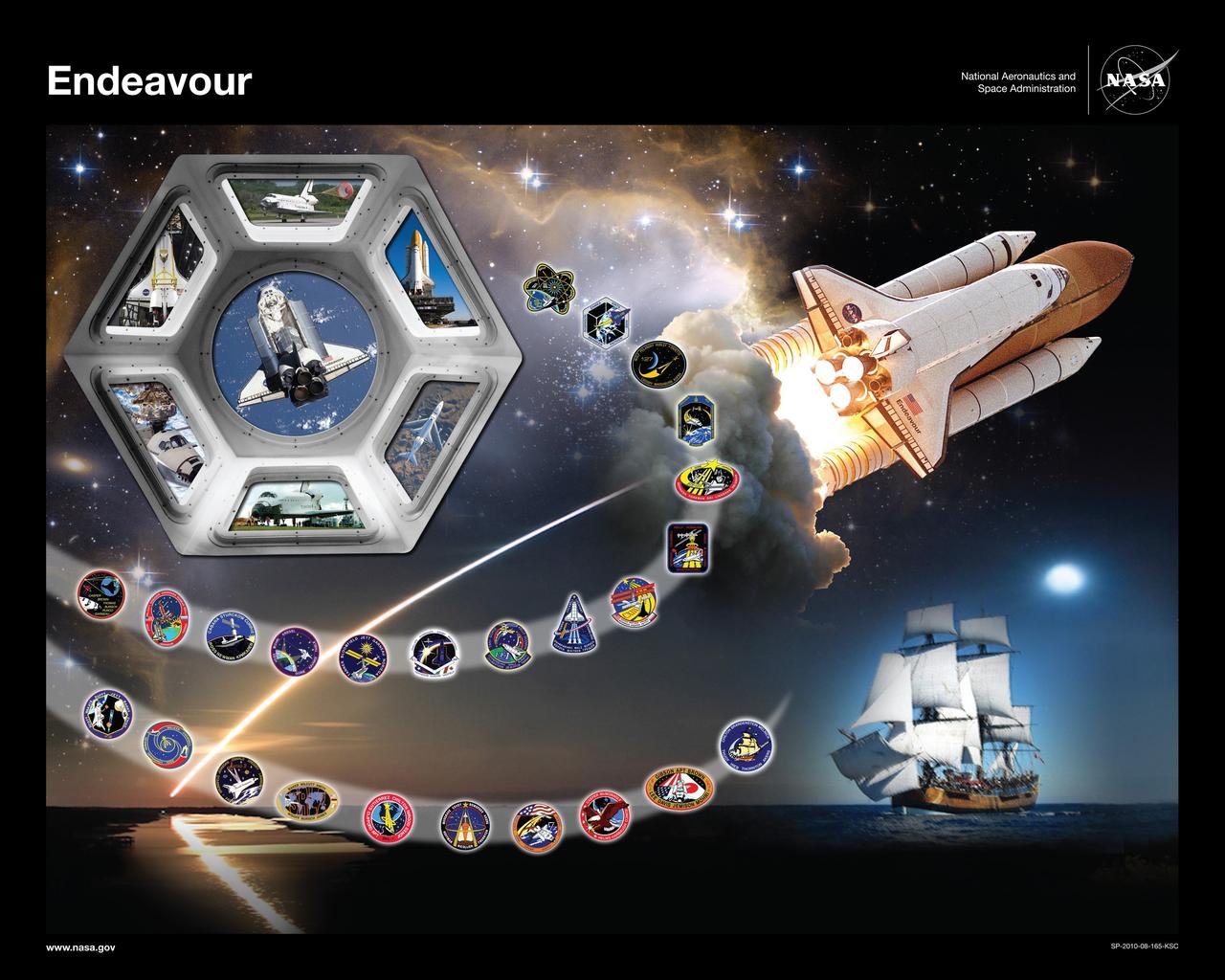
CAPE CANAVERAL, Fla. -- This is a printable version of space shuttle Endeavour's orbiter tribute, or OV-105, which hangs in Firing Room 4 of the Launch Control Center at NASA's Kennedy Space Center in Florida. It features Endeavour soaring into orbit above the sailing vessel HMS Endeavour for which it was named. The Cupola, delivered to the International Space Station by Endeavour on STS-130, frames various images that represent the processing and execution of the Space Shuttle Program. Clockwise from top, are the first-ever use of a drag chute during the STS-49 landing, rollout to a launch pad, a ferry flight return to Kennedy, rolling into an orbiter processing facility, docking to the International Space Station, and lifting operations before being mated to an external fuel tank and solid rocket boosters in the Vehicle Assembly Building. The background image was captured by the Hubble Space Telescope and signifies the first shuttle servicing mission, which was performed by Endeavour's STS-61 crew. Crew-designed patches from Endeavour’s maiden voyage through its final mission are shown ascending toward the stars. Five orbiter tributes are on display in the firing room, representing Atlantis, Challenger, Columbia, Endeavour and Discovery. Graphic design credit: NASA/Amy Lombardo. NASA publication number: SP-2010-08-165-KSC
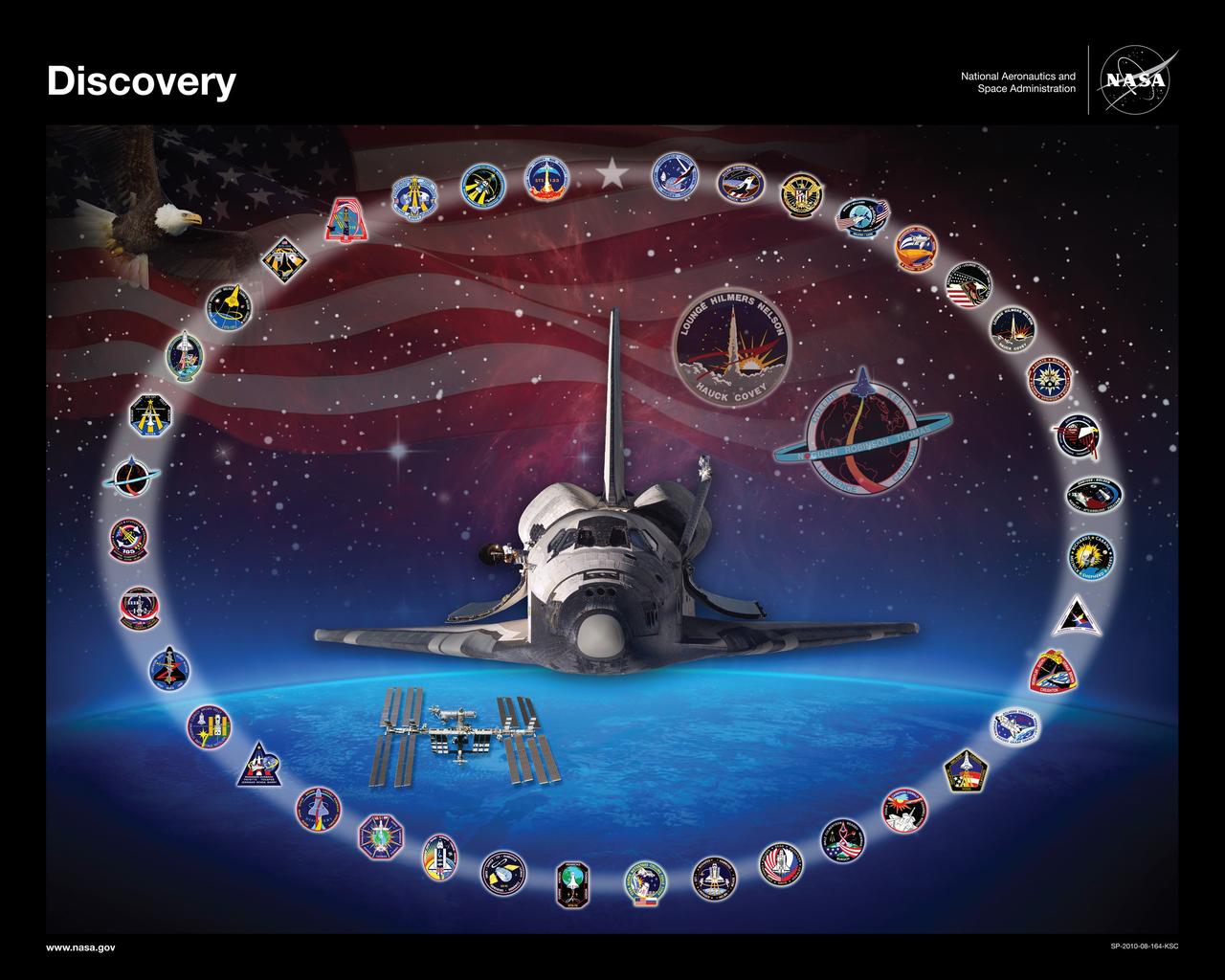
CAPE CANAVERAL, Fla. -- This is a printable version of space shuttle Discovery's orbiter tribute, or OV-103, which hangs in Firing Room 4 of the Launch Control Center at NASA's Kennedy Space Center in Florida. Discovery’s accomplishments include the first female shuttle pilot, Eileen Collins, on STS-63, John Glenn’s legendary return to space on STS-95, and the celebration of the 100th shuttle mission with STS-92. In addition, Discovery supported a number of Department of Defense programs, satellite deploy and repair missions and 13 International Space Station construction and operation flights. The tribute features Discovery demonstrating the rendezvous pitch maneuver on approach to the International Space Station during STS-114. Having accumulated the most space shuttle flights, Discovery’s 39 mission patches are shown circling the spacecraft. The background image was taken from the Hubble Space Telescope, which launched aboard Discovery on STS-31 and serviced by Discovery on STS-82 and STS-103. The American Flag and Bald Eagle represent Discovery’s two Return-to-Flight missions -- STS-26 and STS-114 -- and symbolize Discovery’s role in returning American astronauts to space. Five orbiter tributes are on display in the firing room, representing Atlantis, Challenger, Columbia, Endeavour and Discovery. Graphic design credit: NASA/Amy Lombardo. NASA publication number: SP-2010-08-164-KSC
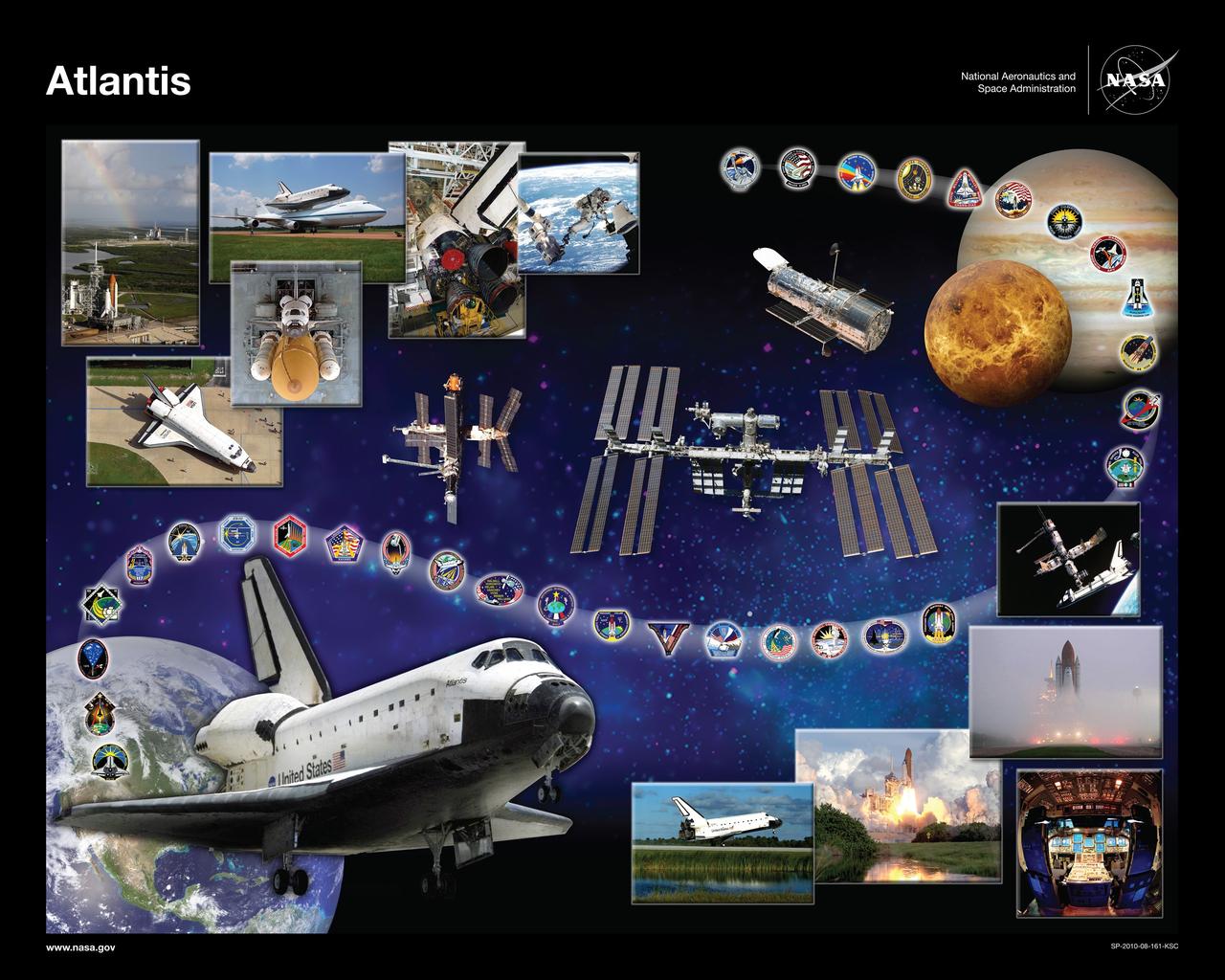
CAPE CANAVERAL, Fla. -- This is a printable version of space shuttle Atlantis' orbiter tribute, or OV-104, which hangs in Firing Room 4 of the Launch Control Center at NASA's Kennedy Space Center in Florida. In the lower-left corner, it features Atlantis soaring above Earth and threaded through the design are the mission patches for each of Atlantis’ flights. Atlantis' accomplishments include seven missions to the Russian space station Mir and several assembly, construction and resupply missions to the International Space Station. Atlantis also flew the last Hubble Space Telescope servicing mission on STS-125. In the tribute, the planet Venus represents the Magellan probe being deployed during STS-30, and Jupiter represents the Galileo probe being deployed during STS-34. The inset photos illustrate various aspects of shuttle processing as well as significant achievements, such as the glass cockpit and the first shuttle docking with Mir during STS-71. The inset photo in the upper-left corner shows a rainbow over Atlantis on Launch Pad 39A and shuttle Endeavour on Launch Pad 39B at Kennedy. Endeavour was the assigned vehicle had Atlantis’ STS-125 mission needed rescue, and this was the last time both launch pads were occupied at the same time. The stars in the background represent the many people who have worked with Atlantis and their contributions to the vehicle’s success. Graphic design credit: NASA/Amy Lombardo. NASA publication number: SP-2010-08-161-KSC
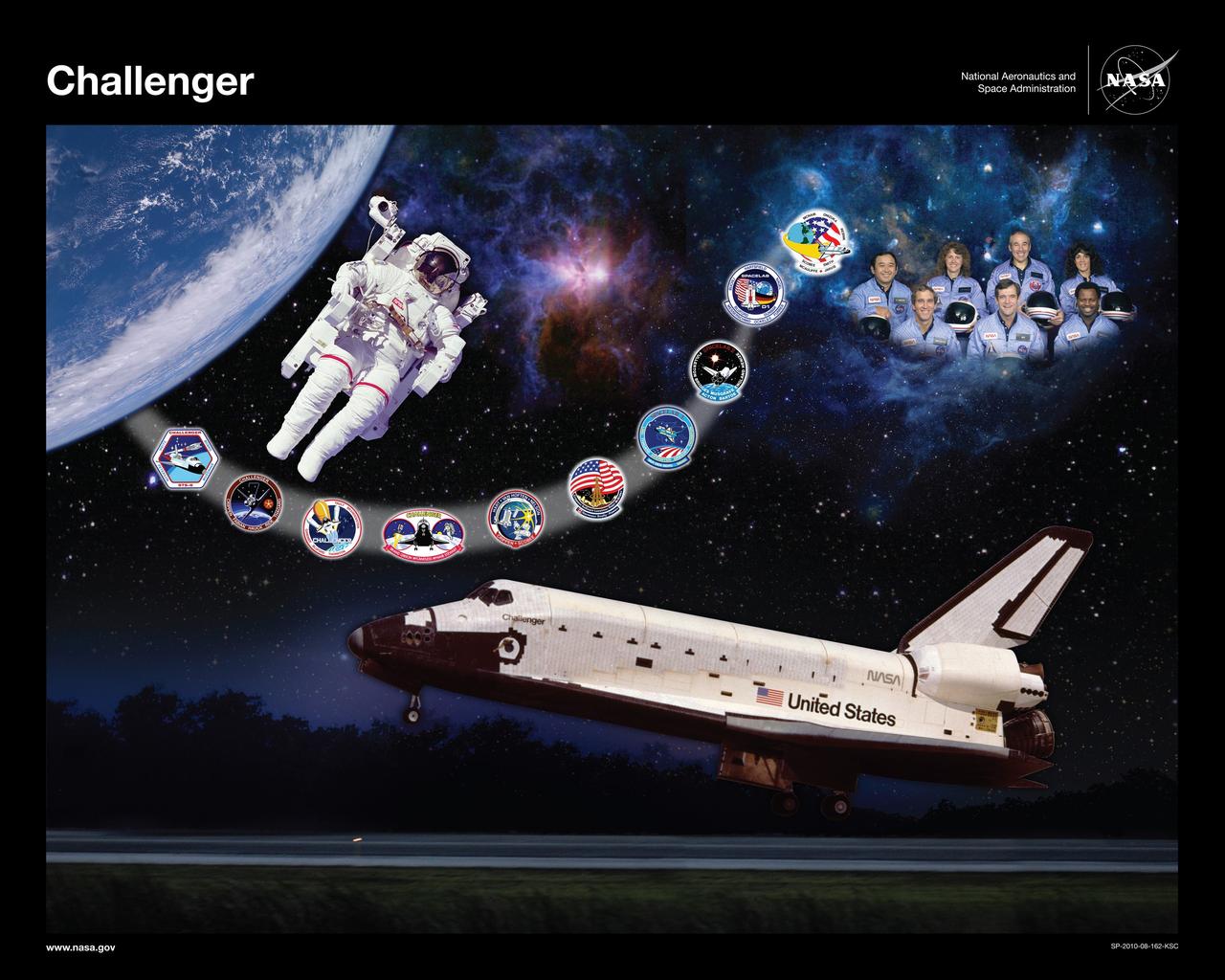
CAPE CANAVERAL, Fla. -- This is a printable version of space shuttle Challenger's orbiter tribute, or OV-099, which hangs in Firing Room 4 of the Launch Control Center at NASA's Kennedy Space Center in Florida. Challenger's accomplishments include the first night launch and first African-American in space, Guion Bluford, on STS-8, the first in-flight capture, repair and redeployment of an orbiting satellite during STS-41C, the first American woman in space, Sally Ride, on STS-7, and the first American woman to walk in space, Kathryn Sullivan, during STS-41G. Challenger is credited with blazing a trail for NASA's other orbiters with the first night landing at Edwards Air Force Base in California on STS-8 and the first landing at Kennedy on STS-41B. The spacewalker in the tribute represents Challenger’s role in the first spacewalk during STS-6 and the first untethered spacewalk on STS-41B. Crew-designed patches for each of Challenger’s missions lead from Earth toward a remembrance of the STS-51L crew, which was lost 73 seconds after liftoff on Jan. 28, 1986. Five orbiter tributes are on display in the firing room, representing Atlantis, Challenger, Columbia, Endeavour and Discovery. Graphic design credit: NASA/Lynda Brammer. NASA publication number: SP-2010-08-162-KSC
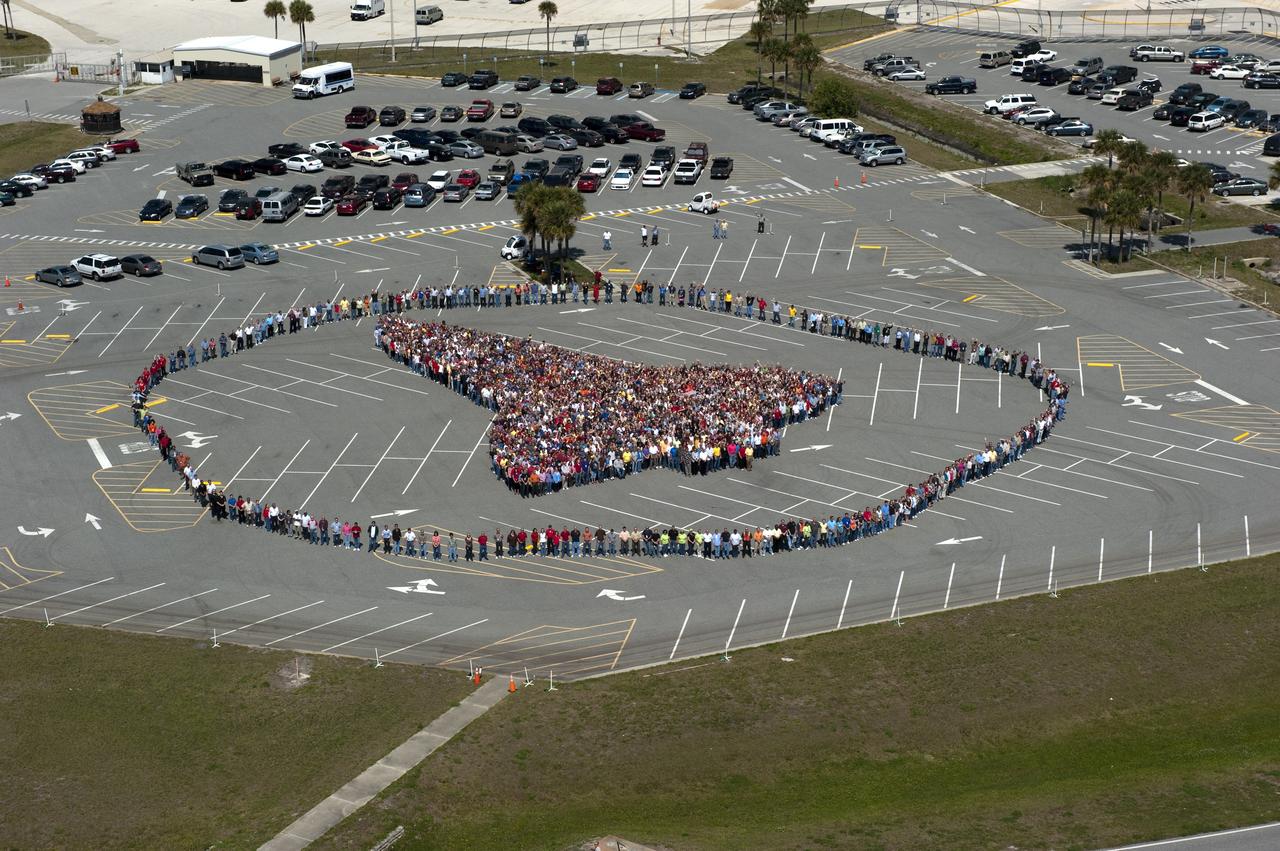
CAPE CANAVERAL, Fla. -- Thousands of NASA Kennedy Space Center employees stand side-by-side to form a full-scale outline of a space shuttle orbiter outside the Vehicle Assembly Building. The unique photo opportunity was designed to honor the Space Shuttle Program's 30-year legacy and the people who contribute to safely processing, launching and landing the vehicle. To learn more about the space shuttle era, including videos, photos and feature stories, go to www.nasa.gov/mission_pages/shuttle/flyout/index.html. Photo credit: NASA/Kim Shiflett
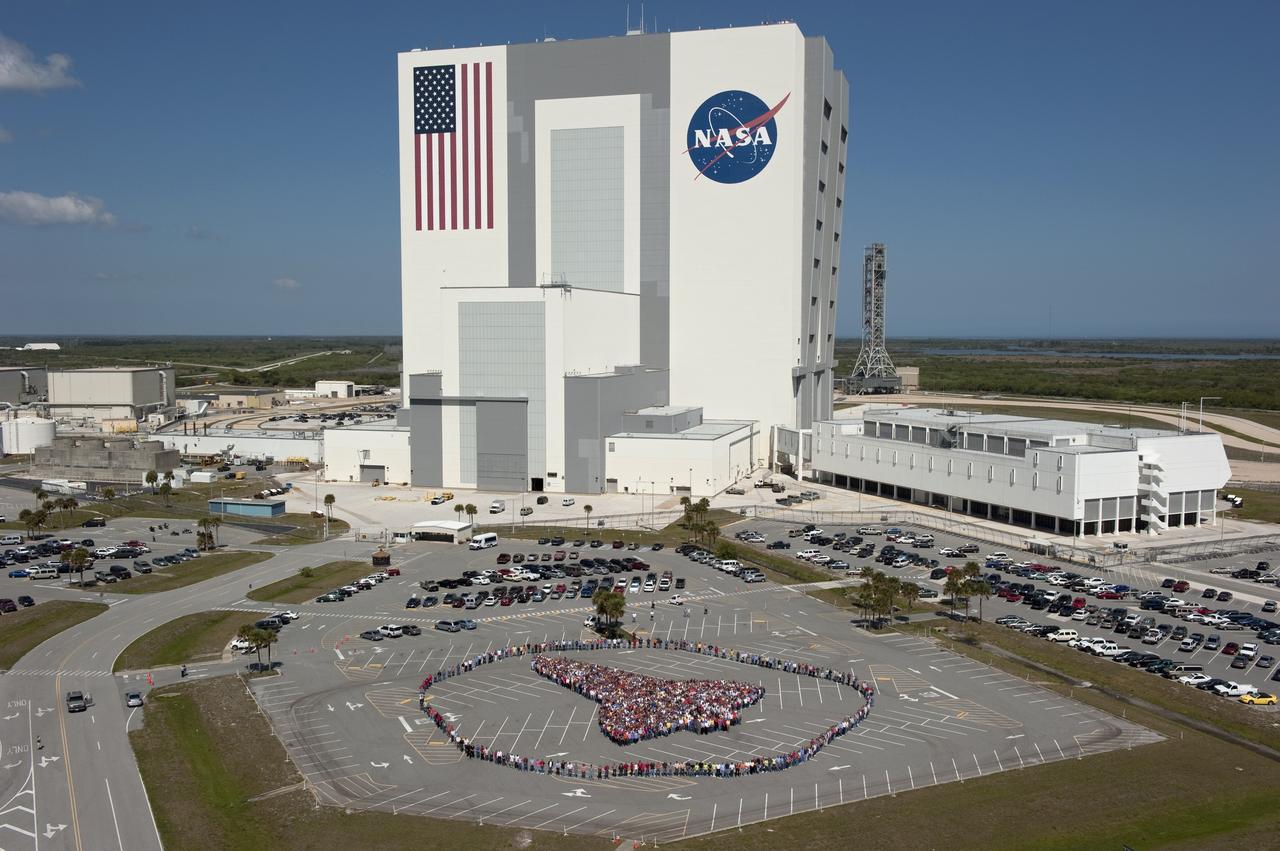
CAPE CANAVERAL, Fla. -- Thousands of NASA Kennedy Space Center employees stand side-by-side to form a full-scale outline of a space shuttle orbiter outside the Vehicle Assembly Building. The unique photo opportunity was designed to honor the Space Shuttle Program's 30-year legacy and the people who contribute to safely processing, launching and landing the vehicle. To learn more about the space shuttle era, including videos, photos and feature stories, go to www.nasa.gov/mission_pages/shuttle/flyout/index.html. Photo credit: NASA/Kim Shiflett
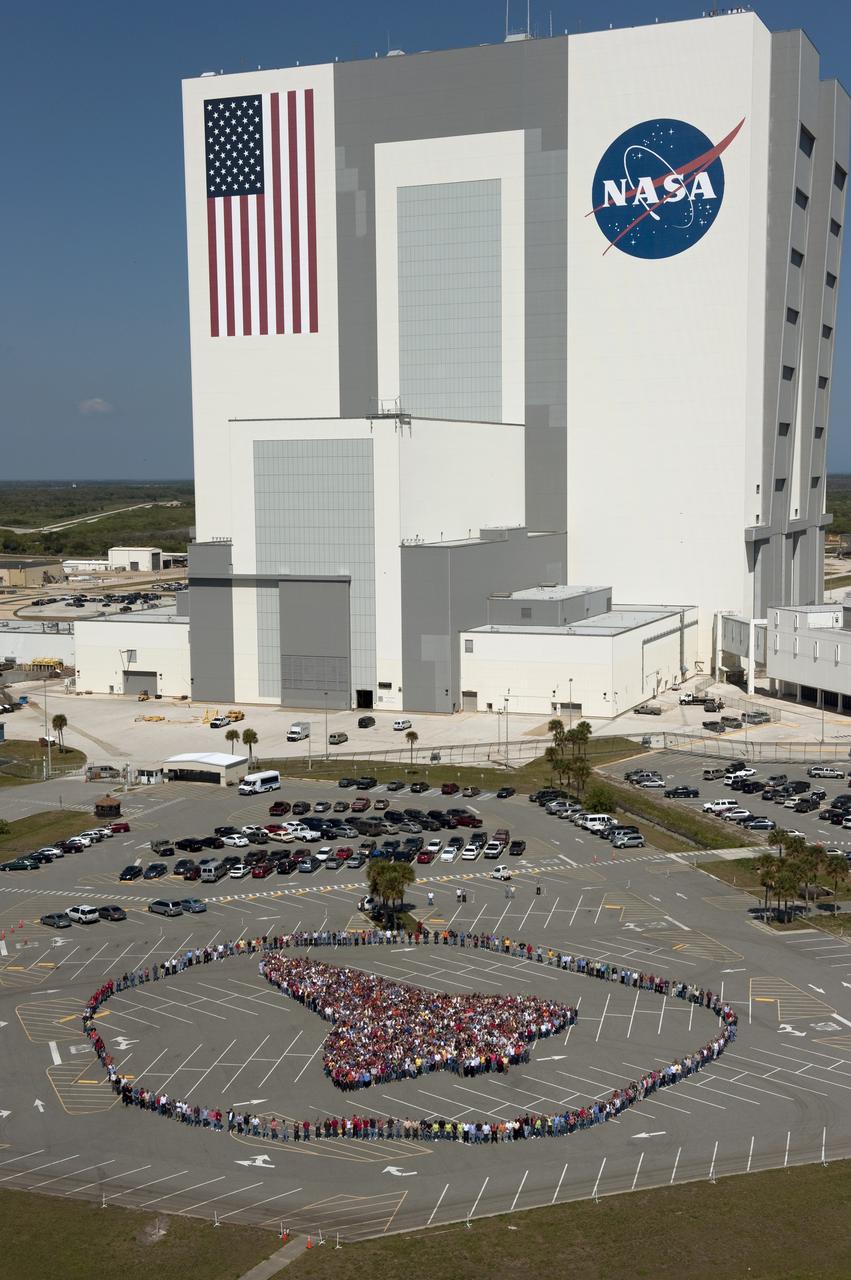
CAPE CANAVERAL, Fla. -- Thousands of NASA Kennedy Space Center employees stand side-by-side to form a full-scale outline of a space shuttle orbiter outside the Vehicle Assembly Building. The unique photo opportunity was designed to honor the Space Shuttle Program's 30-year legacy and the people who contribute to safely processing, launching and landing the vehicle. To learn more about the space shuttle era, including videos, photos and feature stories, go to www.nasa.gov/mission_pages/shuttle/flyout/index.html. Photo credit: NASA/Kim Shiflett
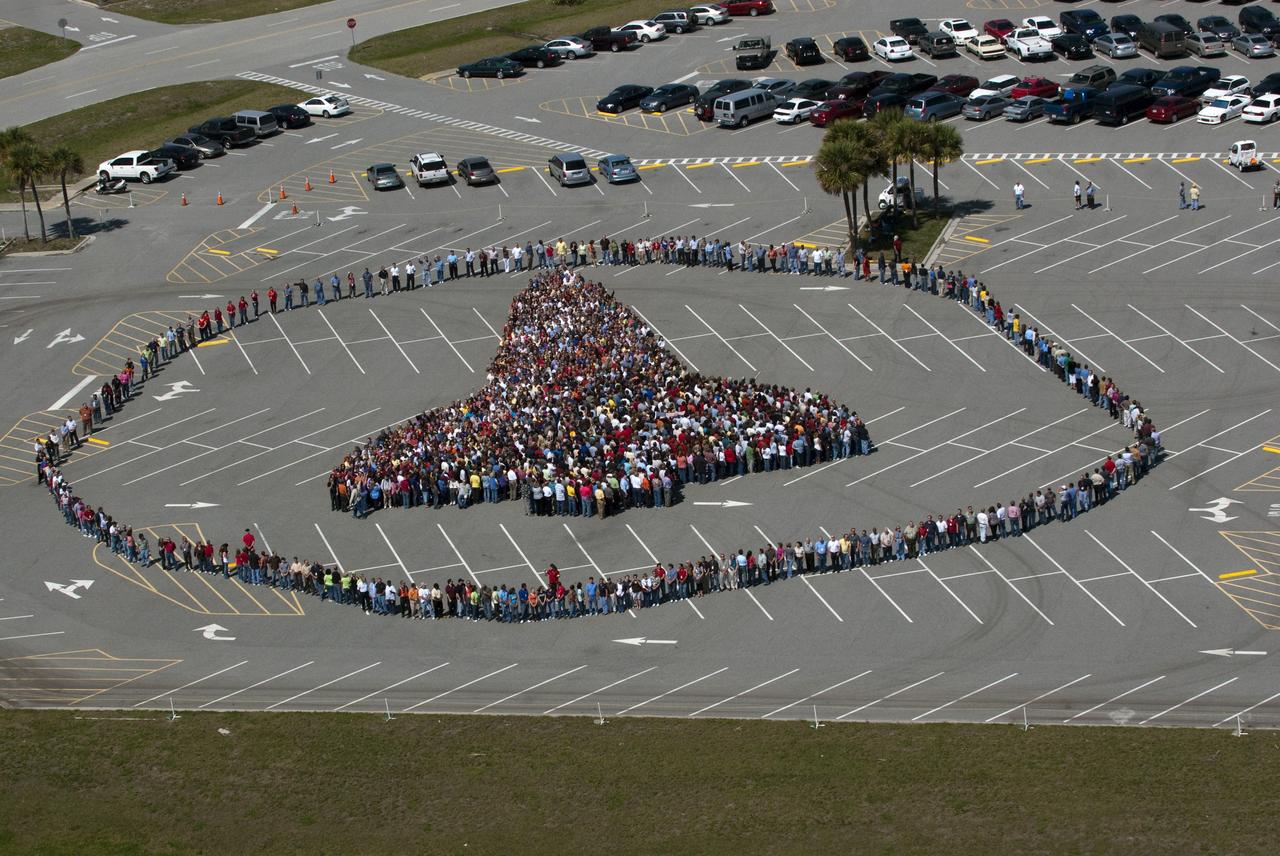
CAPE CANAVERAL, Fla. -- Thousands of NASA Kennedy Space Center employees stand side-by-side to form a full-scale outline of a space shuttle orbiter outside the Vehicle Assembly Building. The unique photo opportunity was designed to honor the Space Shuttle Program's 30-year legacy and the people who contribute to safely processing, launching and landing the vehicle. To learn more about the space shuttle era, including videos, photos and feature stories, go to www.nasa.gov/mission_pages/shuttle/flyout/index.html. Photo credit: NASA/Kim Shiflett
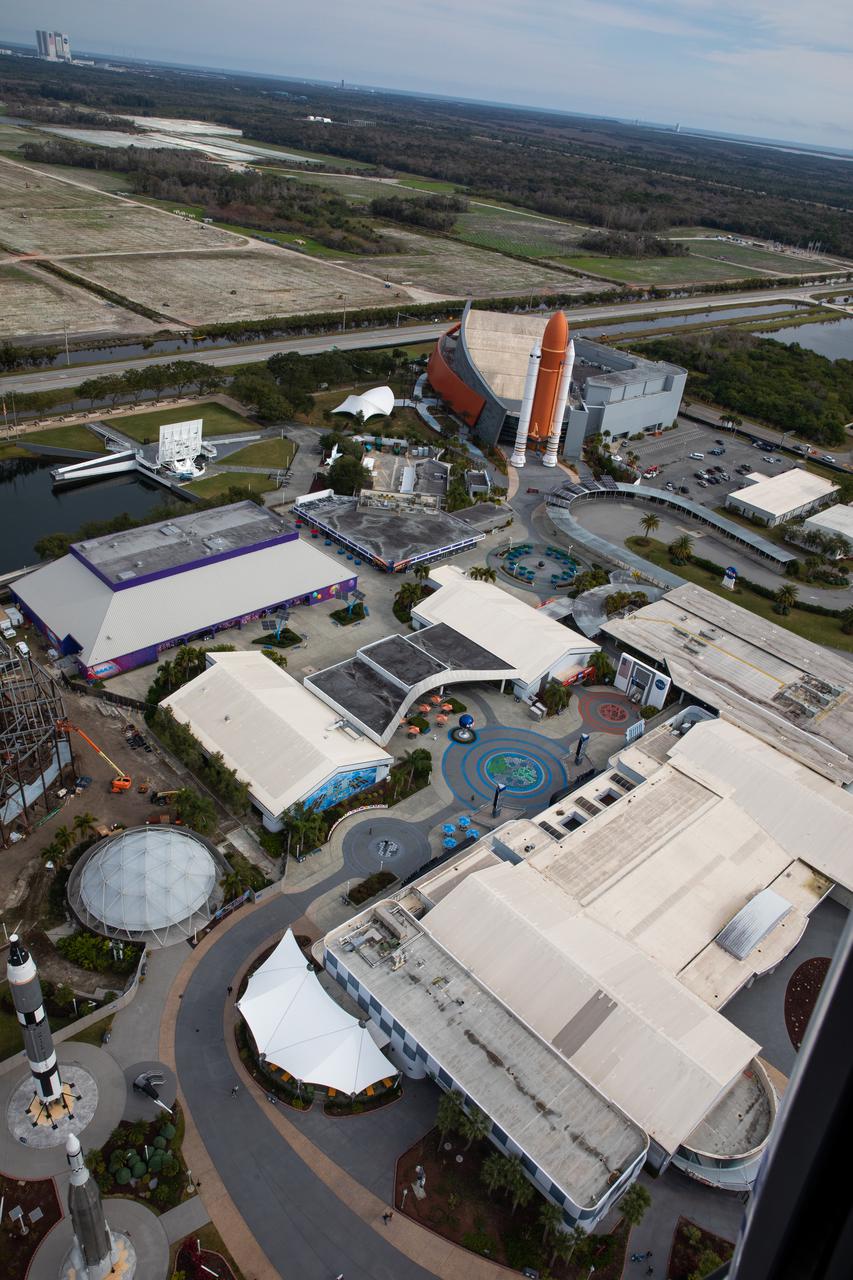
An aerial view of nearby Kennedy Space Center Visitor Complex in Florida on Jan. 13, 2021. In view is a full-scale mockup of the space shuttle’s external tank and twin solid rocket boosters serving as the entranceway to the Space Shuttle Atlantis attraction. Inside, visitor complex guests have the opportunity to come nose-to-nose with the orbiter in its permanent home while also discovering the legacy of NASA’s Space Shuttle Program. Seen at the top left of the image is the Vehicle Assembly Building (VAB) at NASA’s Kennedy Space Center
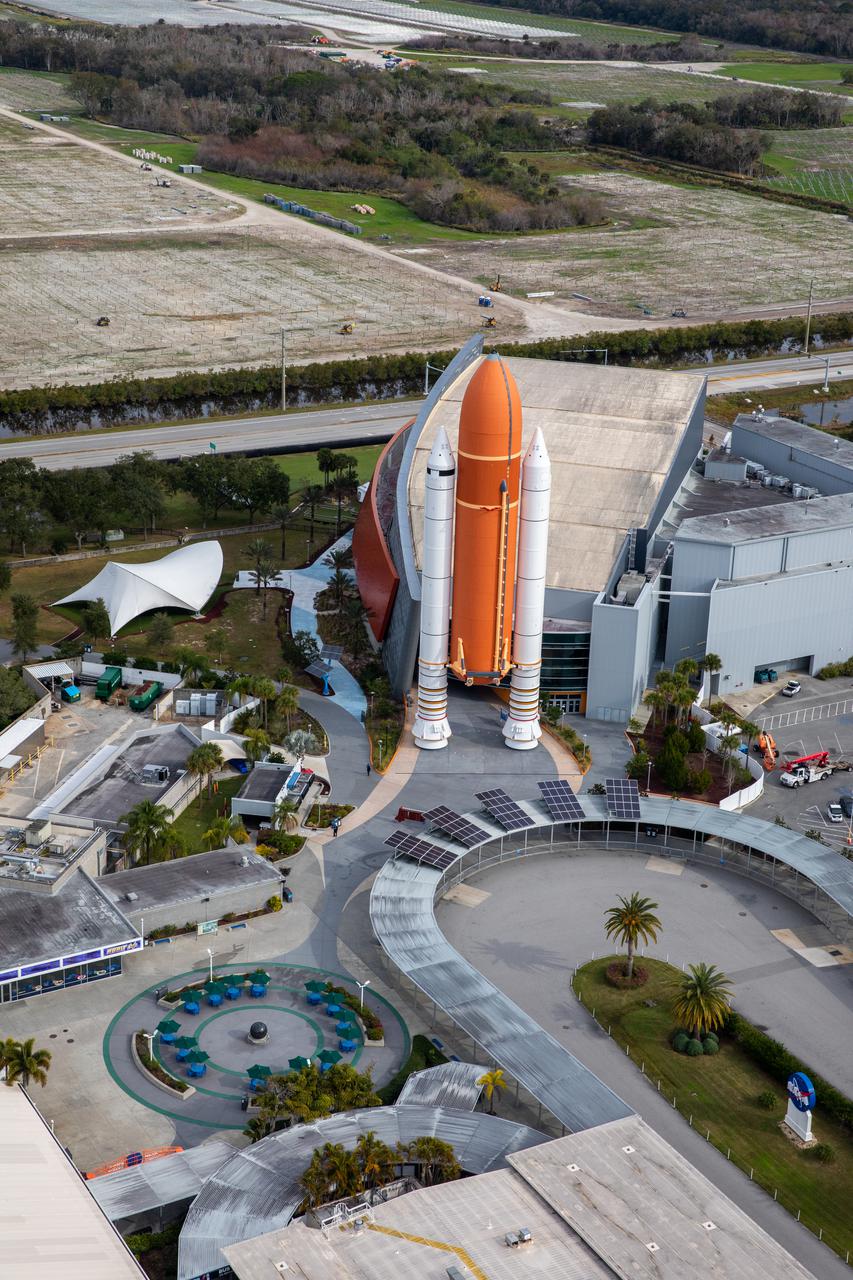
An aerial view of nearby Kennedy Space Center Visitor Complex in Florida on Jan. 13, 2021. In view is a full-scale mockup of the space shuttle’s external tank and twin solid rocket boosters serving as the entranceway to the Space Shuttle Atlantis attraction. Inside, visitor complex guests have the opportunity to come nose-to-nose with the orbiter in its permanent home while also discovering the legacy of NASA’s Space Shuttle Program.
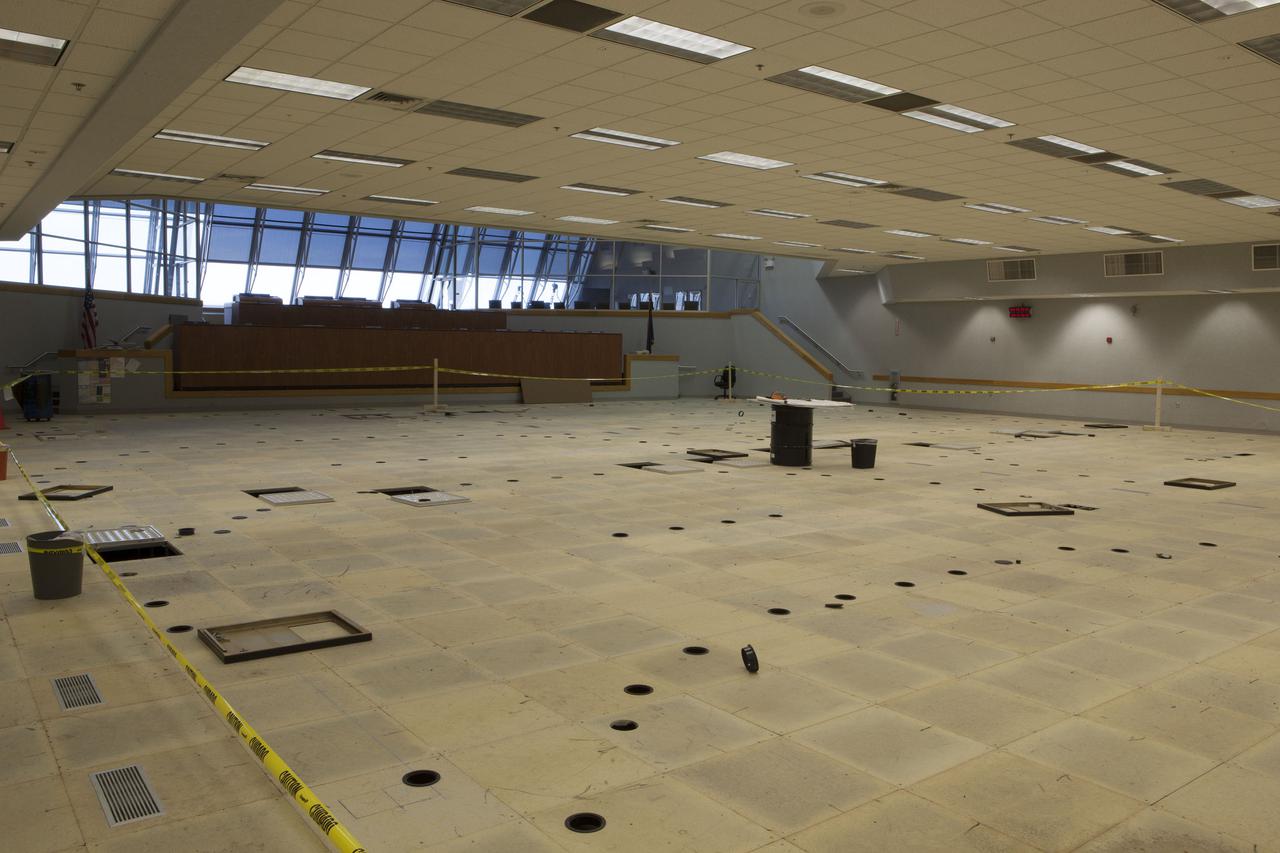
CAPE CANAVERAL, Fla. – In Firing Room 4 in the Launch Control Center at NASA’s Kennedy Space Center in Florida, the legacy consoles, Launch Processing System and cabling that once supported the Space Shuttle Program have been removed. The Ground Systems Development and Operations Program is overseeing the construction in progress on a multi-use control room that will support NASA and commercial launch needs. The design of Firing Room 4 will incorporate five control room areas that are flexible to meet current and future user requirements. The equipment and consoles from Firing Room 4 are being moved to Firing Room 2 for possible future reuse. Photo credit: NASA_Dimitri Gerondidakis
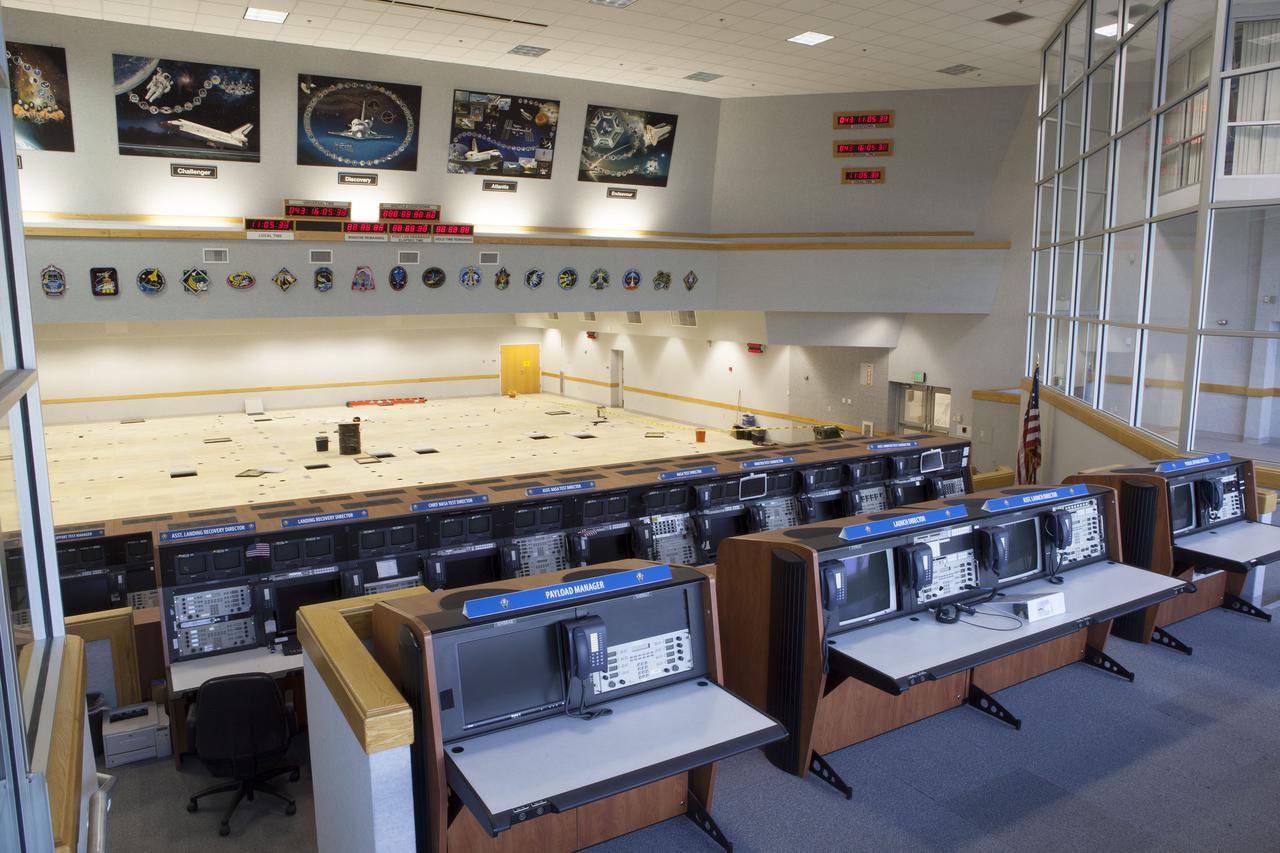
CAPE CANAVERAL, Fla. – In Firing Room 4 in the Launch Control Center at NASA’s Kennedy Space Center in Florida, the legacy consoles, Launch Processing System and cabling that once supported the Space Shuttle Program have been removed. The Ground Systems Development and Operations Program is overseeing the construction in progress on a multi-use control room that will support NASA and commercial launch needs. The design of Firing Room 4 will incorporate five control room areas that are flexible to meet current and future user requirements. The equipment and consoles from Firing Room 4 are being moved to Firing Room 2 for possible future reuse. Photo credit: NASA_Dimitri Gerondidakis
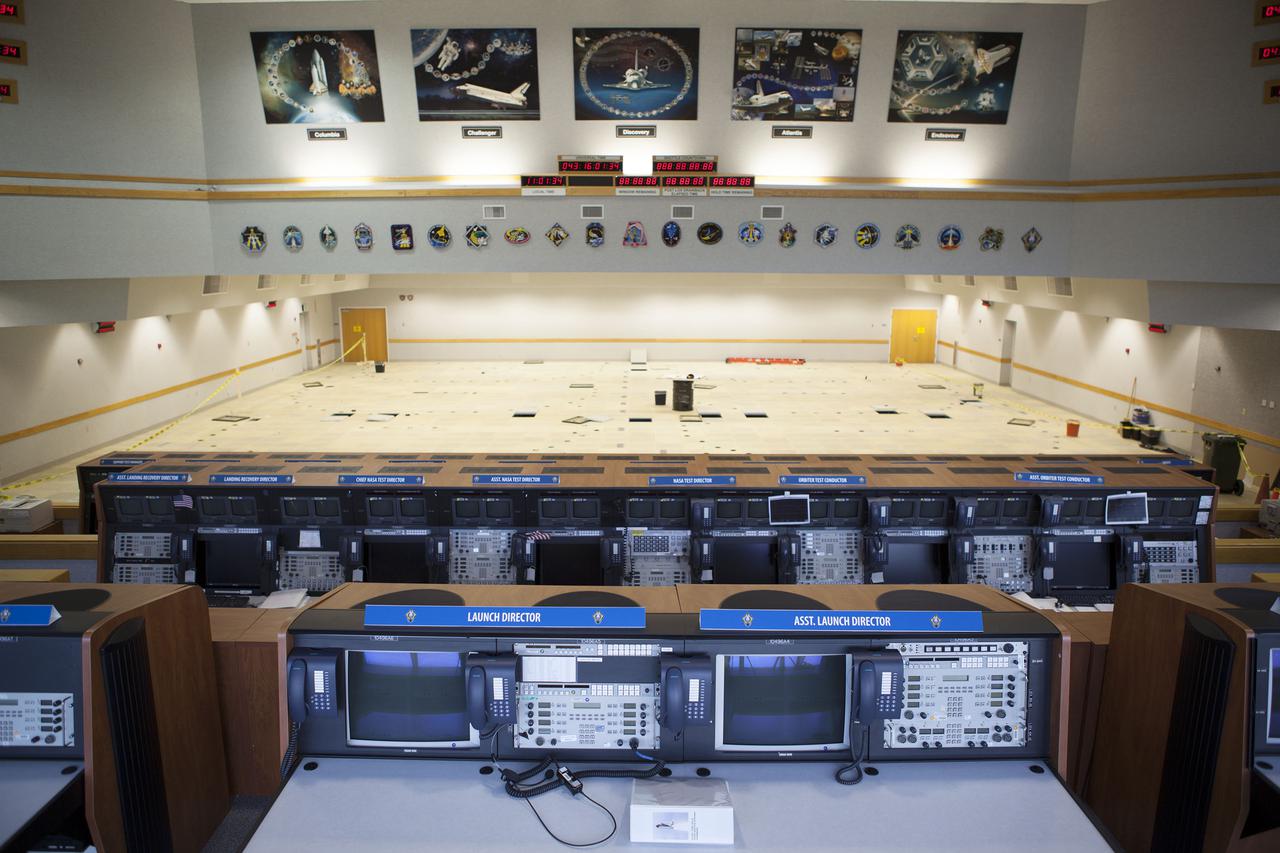
CAPE CANAVERAL, Fla. – In Firing Room 4 in the Launch Control Center at NASA’s Kennedy Space Center in Florida, the legacy consoles, Launch Processing System and cabling that once supported the Space Shuttle Program have been removed. The Ground Systems Development and Operations Program is overseeing the construction in progress on a multi-use control room that will support NASA and commercial launch needs. The design of Firing Room 4 will incorporate five control room areas that are flexible to meet current and future user requirements. The equipment and consoles from Firing Room 4 are being moved to Firing Room 2 for possible future reuse. Photo credit: NASA_Dimitri Gerondidakis
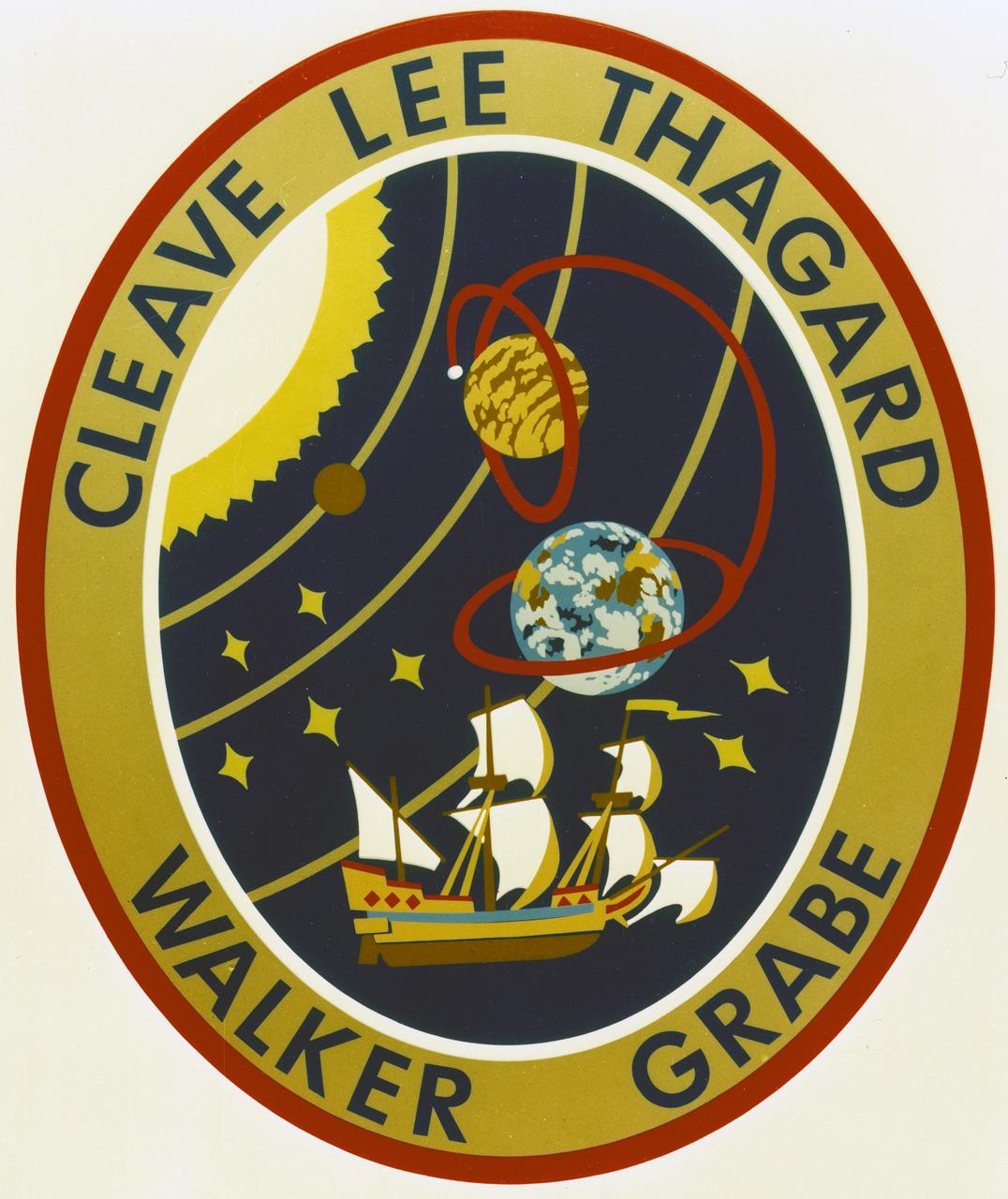
The STS-30 patch depicts the joining of NASA's manned and unmanned space programs. The sun and inner planets of our solar system are shown with the curve connecting Earth and Venus symbolizing the shuttle orbit, the spacecraft trajectory toward Venus, and its subsequent orbit around our sister planet. A Spanish caravel similar to the ship on the official Magellan program logo commemorates the 16th century explorer's journey and his legacy of adventure and discovery. Seven stars on the patch honor the crew of Challenger. The five-star cluster in the shape of the constellation Cassiopeia represent the five STS-30 crewmembers - Astronauts David Walker, Ronald Grabe, Norman Thagard, Mary Cleave and Mark Lee - who collectively designed the patch.
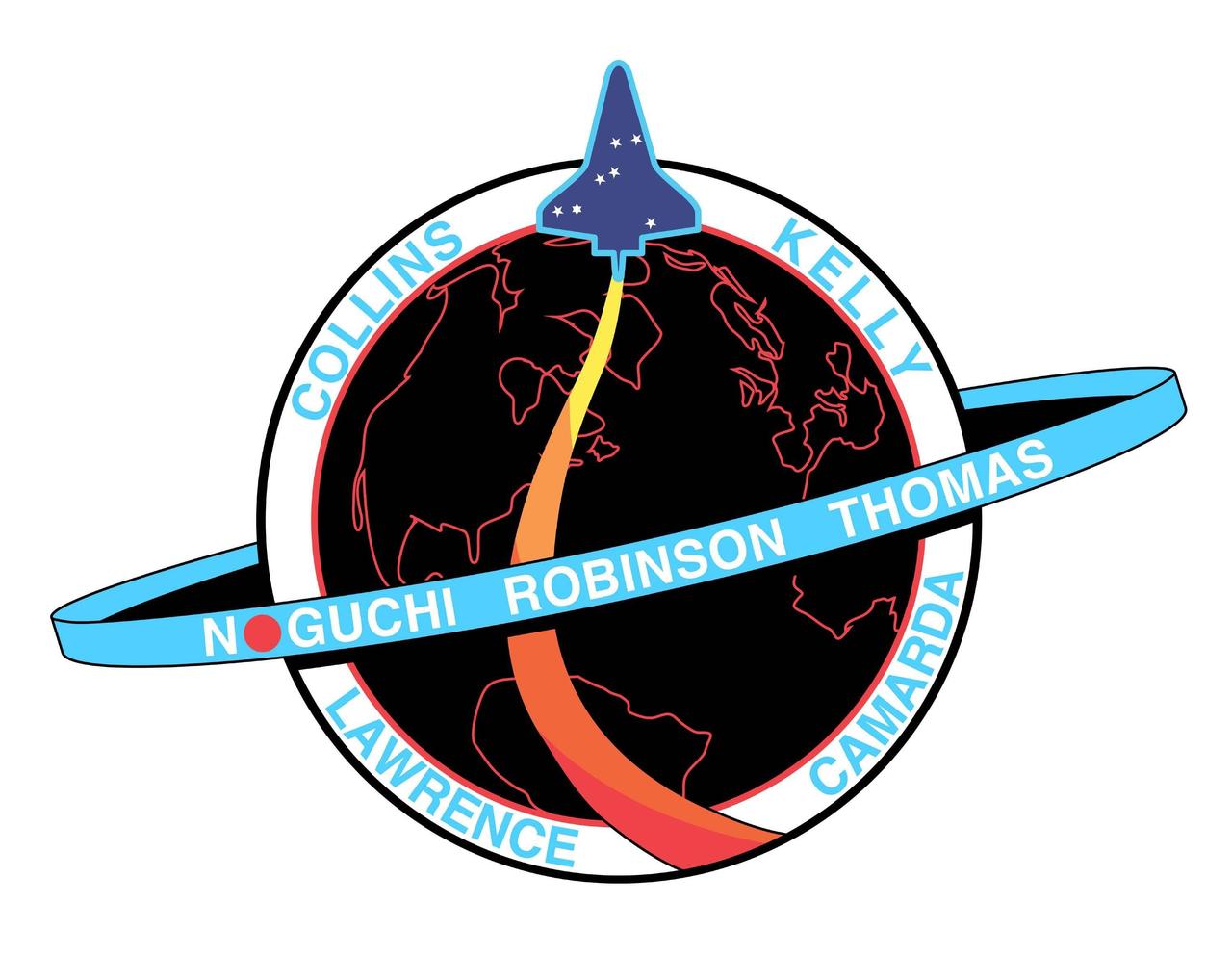
JOHNSON SPACE CENTER, Houston - The STS-114 patch design signifies the return of the Space Shuttle to flight and honors the memory of the STS-107 Columbia crew. The blue Shuttle rising above Earth’s horizon includes the Columbia constellation of seven stars, echoing the STS-107 patch and commemorating the seven members of that mission. The crew of STS-114 will carry the memory of their friends on Columbia and the legacy of their mission back into Earth orbit. The dominant design element of the STS-114 patch is the planet Earth, which represents the unity and dedication of the many people whose efforts allows the Shuttle to safely return to flight. Against the background of the Earth at night, the blue orbit represents the International Space Station (ISS), with the EVA crewmembers named on the orbit. The red sun on the orbit signifies the contributions of the Japanese Space Agency to the mission and to the ISS program. The multi-colored Shuttle plume represents the broad spectrum of challenges for this mission, including Shuttle inspection and repair experiments, and International Space Station re-supply and repair. The NASA insignia design for Shuttle flights is reserved for use by the astronauts and for other official use as the NASA Administrator may authorize. Public availability has been approved only in the forms of illustrations by the various news media. When and if there is any change in this policy, which is not anticipated, the change will be publicly announced.
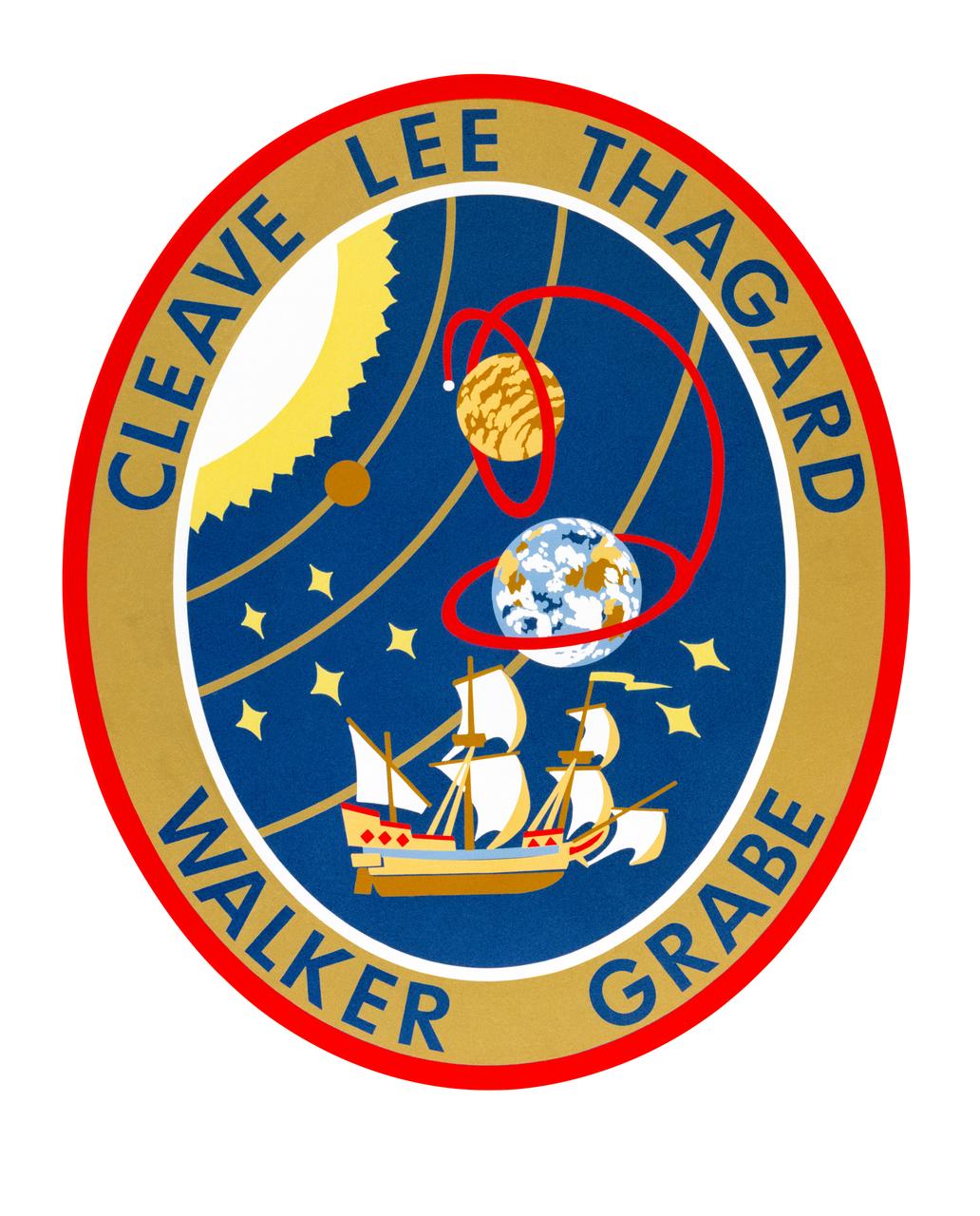
S89-20025 (3 March 1989) --- The STS-30 patch depicts the joining of NASA's manned and unmanned space programs. The sun and inner planets of our solar system are shown with the curve connecting Earth and Venus symbolizing the shuttle orbit, the spacecraft trajectory toward Venus and its subsequent orbit around our sister planet. A Spanish caravel similar to the ship on the official Magellan program logo commemorates the 16th century explorer's journey and his legacy of adventure and discovery. Seven stars on the patch honor the crew of Challenger. The five-star cluster in the shape of the constellation Cassiopeia represent the five STS-30 crew members--astronauts David M. Walker, Ronald J. Grabe, Norman E. Thagard, Mary L. Cleave and Mark C. Lee-who collectively designed the patch. The NASA insignia design for space shuttle flights is reserved for use by the astronauts and for other official use as the NASA Administrator may authorize. Public availability has been approved only in the forms of illustrations by the various news media. When and if there is any change in this policy, which is not anticipated, the change will be publicly announced. Photo credit: NASA
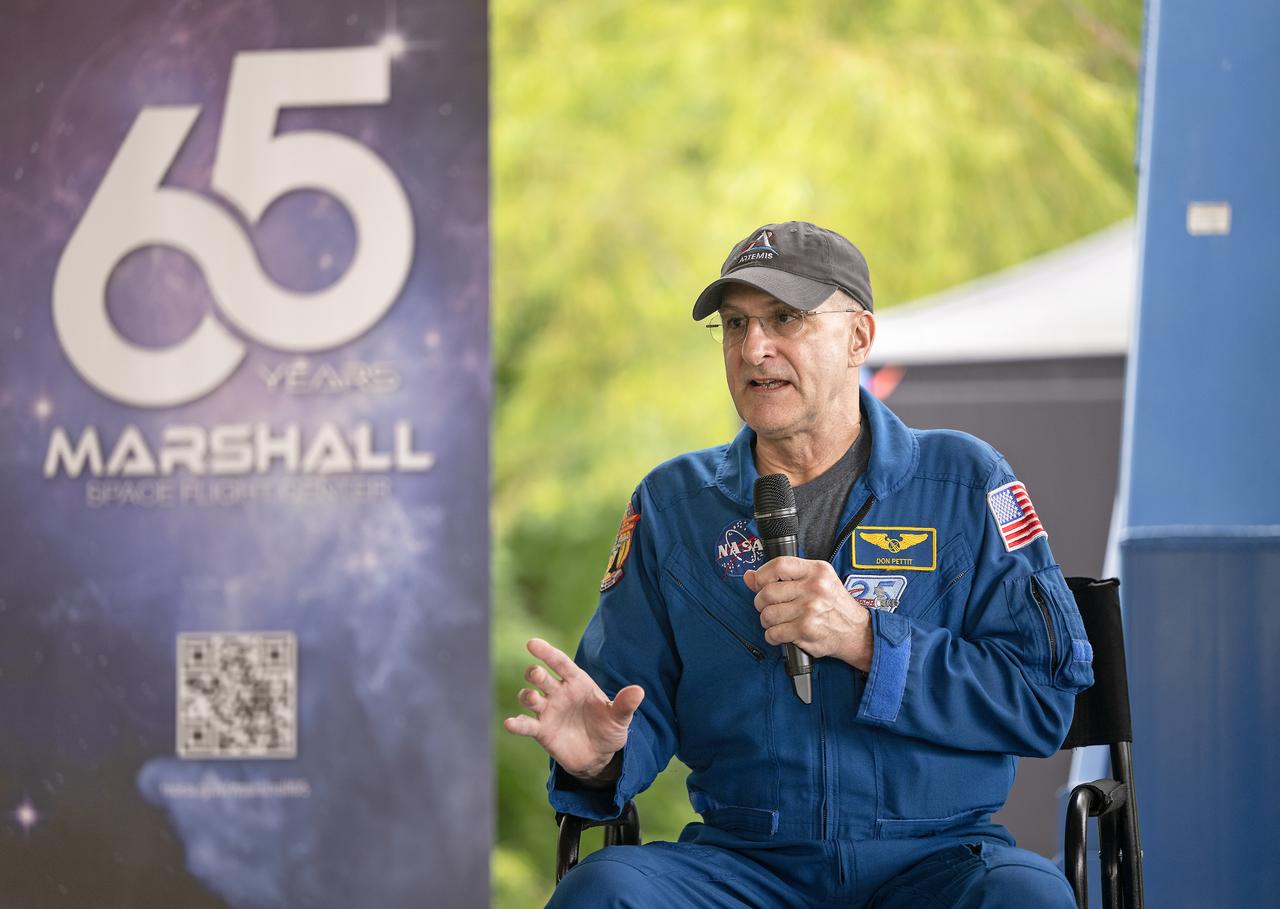
NASA’s Marshall Space Flight Center celebrated the 65th anniversary of its founding on July 19, 2025, with a free, public celebration at The Orion Amphitheater in Huntsville, Alabama. Thousands of team members, families, and “Rocket City” residents took part, enjoying live music, games, food, and exhibits commemorating Marshall’s legacy of ingenuity and service to the U.S. space program. During a program for the celebration, guests heard remarks from Joseph Pelfrey, director of NASA Marshall, Huntsville Mayor Tommy Battle, and Kamerra Liles, assistant general manager of The Orion Amphitheater, followed by Pelfrey sharing a new video overview about Marshall. The program continued with a video presentation from NASA astronauts from the Expedition 72 crew – which contributed more than 1,000 total hours of scientific studies on plant growth, stem cell growth for treating diseases, the resilience of microorganisms to the harsh space environment, and more on the International Space Station. NASA astronauts Suni Williams and Don Pettit, who served as space station commander and flight engineer, respectively, shared their experiences in space with the community and told the audience how vital Marshall’s on the ground support was to their mission success. Marshall has shaped and expanded human space exploration every decade since the NASA center opened its doors on July 1, 1960. The center’s civil service and contract workers built the nation’s flagship rockets, from the Saturn V to the SLS (Space Launch System), managed the space shuttle propulsion program, delivered the Chandra X-ray Observatory and critical elements of the International Space Station to orbit, and continue to spearhead numerous advances in science and engineering.
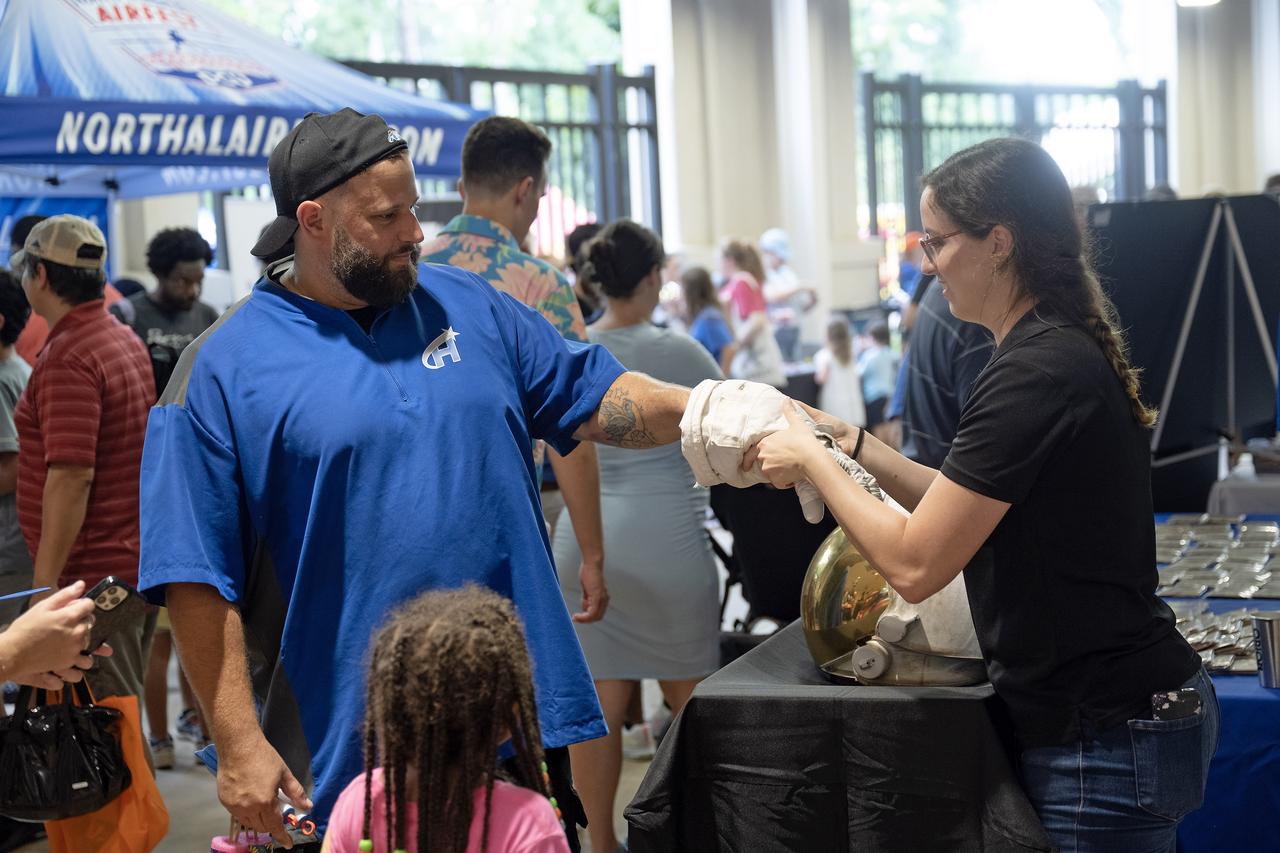
NASA’s Marshall Space Flight Center celebrated the 65th anniversary of its founding on July 19, 2025, with a free, public celebration at The Orion Amphitheater in Huntsville, Alabama. Thousands of team members, families, and “Rocket City” residents took part, enjoying live music, games, food, and exhibits commemorating Marshall’s legacy of ingenuity and service to the U.S. space program. During a program for the celebration, guests heard remarks from Joseph Pelfrey, director of NASA Marshall, Huntsville Mayor Tommy Battle, and Kamerra Liles, assistant general manager of The Orion Amphitheater, followed by Pelfrey sharing a new video overview about Marshall. The program continued with a video presentation from NASA astronauts from the Expedition 72 crew – which contributed more than 1,000 total hours of scientific studies on plant growth, stem cell growth for treating diseases, the resilience of microorganisms to the harsh space environment, and more on the International Space Station. NASA astronauts Suni Williams and Don Pettit, who served as space station commander and flight engineer, respectively, shared their experiences in space with the community and told the audience how vital Marshall’s on the ground support was to their mission success. Marshall has shaped and expanded human space exploration every decade since the NASA center opened its doors on July 1, 1960. The center’s civil service and contract workers built the nation’s flagship rockets, from the Saturn V to the SLS (Space Launch System), managed the space shuttle propulsion program, delivered the Chandra X-ray Observatory and critical elements of the International Space Station to orbit, and continue to spearhead numerous advances in science and engineering.
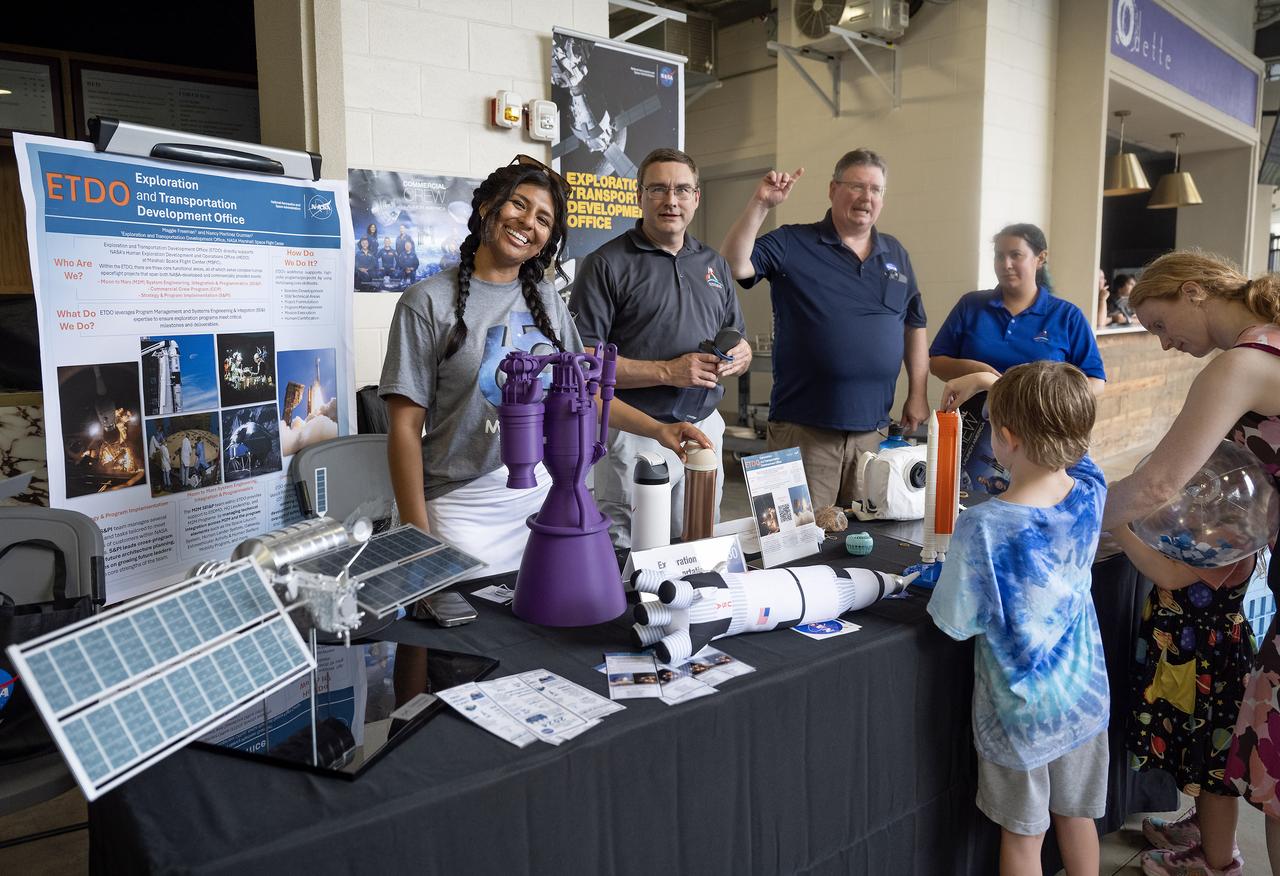
NASA’s Marshall Space Flight Center celebrated the 65th anniversary of its founding on July 19, 2025, with a free, public celebration at The Orion Amphitheater in Huntsville, Alabama. Thousands of team members, families, and “Rocket City” residents took part, enjoying live music, games, food, and exhibits commemorating Marshall’s legacy of ingenuity and service to the U.S. space program. During a program for the celebration, guests heard remarks from Joseph Pelfrey, director of NASA Marshall, Huntsville Mayor Tommy Battle, and Kamerra Liles, assistant general manager of The Orion Amphitheater, followed by Pelfrey sharing a new video overview about Marshall. The program continued with a video presentation from NASA astronauts from the Expedition 72 crew – which contributed more than 1,000 total hours of scientific studies on plant growth, stem cell growth for treating diseases, the resilience of microorganisms to the harsh space environment, and more on the International Space Station. NASA astronauts Suni Williams and Don Pettit, who served as space station commander and flight engineer, respectively, shared their experiences in space with the community and told the audience how vital Marshall’s on the ground support was to their mission success. Marshall has shaped and expanded human space exploration every decade since the NASA center opened its doors on July 1, 1960. The center’s civil service and contract workers built the nation’s flagship rockets, from the Saturn V to the SLS (Space Launch System), managed the space shuttle propulsion program, delivered the Chandra X-ray Observatory and critical elements of the International Space Station to orbit, and continue to spearhead numerous advances in science and engineering.
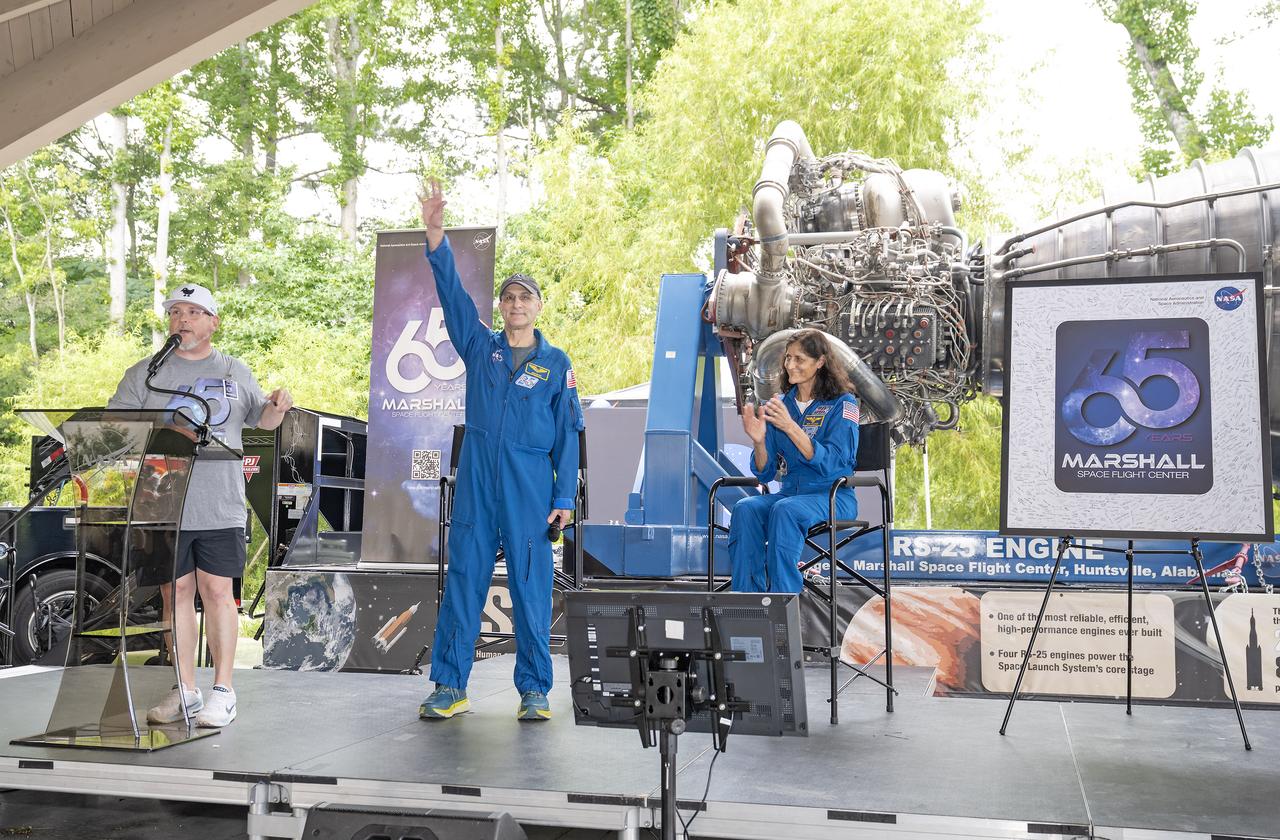
NASA’s Marshall Space Flight Center celebrated the 65th anniversary of its founding on July 19, 2025, with a free, public celebration at The Orion Amphitheater in Huntsville, Alabama. Thousands of team members, families, and “Rocket City” residents took part, enjoying live music, games, food, and exhibits commemorating Marshall’s legacy of ingenuity and service to the U.S. space program. During a program for the celebration, guests heard remarks from Joseph Pelfrey, director of NASA Marshall, Huntsville Mayor Tommy Battle, and Kamerra Liles, assistant general manager of The Orion Amphitheater, followed by Pelfrey sharing a new video overview about Marshall. The program continued with a video presentation from NASA astronauts from the Expedition 72 crew – which contributed more than 1,000 total hours of scientific studies on plant growth, stem cell growth for treating diseases, the resilience of microorganisms to the harsh space environment, and more on the International Space Station. NASA astronauts Suni Williams and Don Pettit, who served as space station commander and flight engineer, respectively, shared their experiences in space with the community and told the audience how vital Marshall’s on the ground support was to their mission success. Marshall has shaped and expanded human space exploration every decade since the NASA center opened its doors on July 1, 1960. The center’s civil service and contract workers built the nation’s flagship rockets, from the Saturn V to the SLS (Space Launch System), managed the space shuttle propulsion program, delivered the Chandra X-ray Observatory and critical elements of the International Space Station to orbit, and continue to spearhead numerous advances in science and engineering.
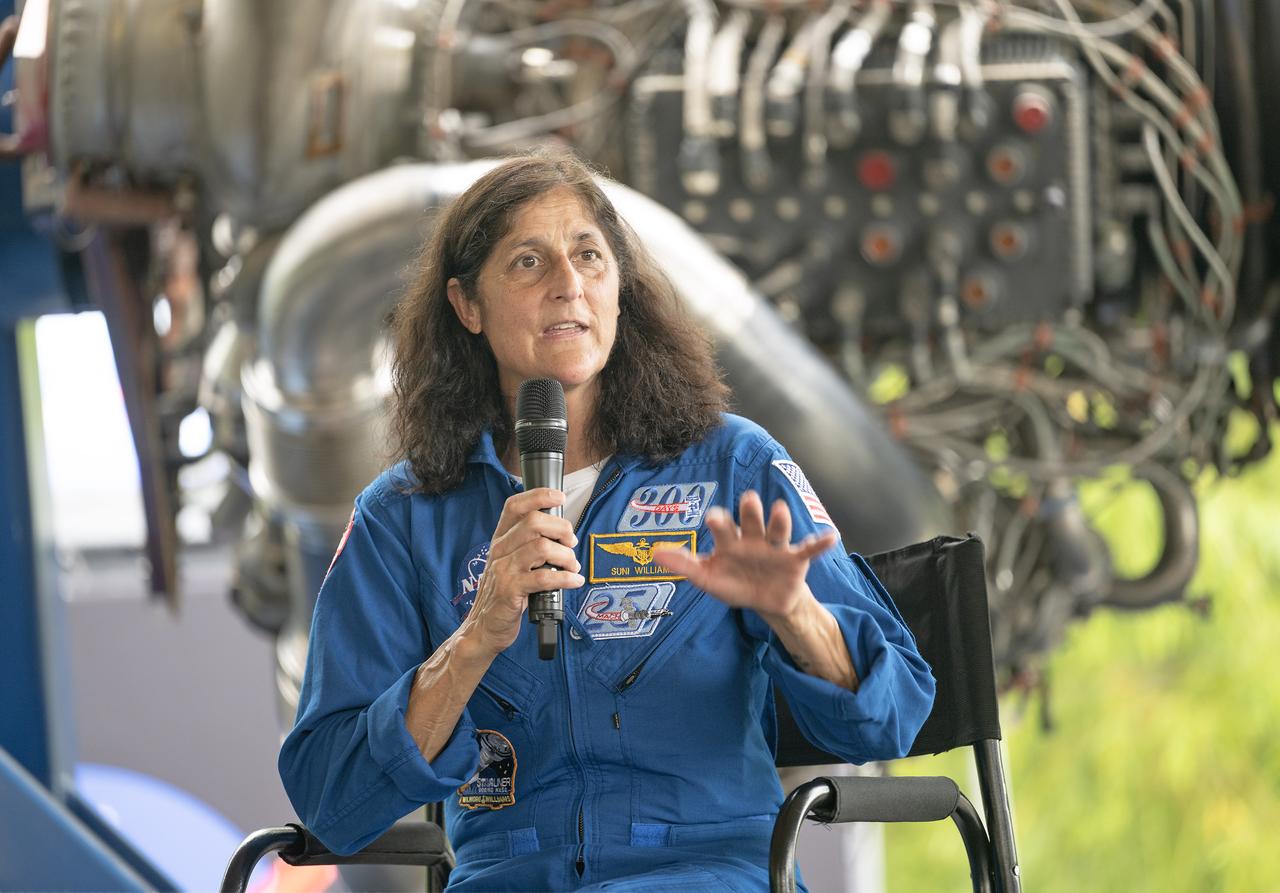
NASA’s Marshall Space Flight Center celebrated the 65th anniversary of its founding on July 19, 2025, with a free, public celebration at The Orion Amphitheater in Huntsville, Alabama. Thousands of team members, families, and “Rocket City” residents took part, enjoying live music, games, food, and exhibits commemorating Marshall’s legacy of ingenuity and service to the U.S. space program. During a program for the celebration, guests heard remarks from Joseph Pelfrey, director of NASA Marshall, Huntsville Mayor Tommy Battle, and Kamerra Liles, assistant general manager of The Orion Amphitheater, followed by Pelfrey sharing a new video overview about Marshall. The program continued with a video presentation from NASA astronauts from the Expedition 72 crew – which contributed more than 1,000 total hours of scientific studies on plant growth, stem cell growth for treating diseases, the resilience of microorganisms to the harsh space environment, and more on the International Space Station. NASA astronauts Suni Williams and Don Pettit, who served as space station commander and flight engineer, respectively, shared their experiences in space with the community and told the audience how vital Marshall’s on the ground support was to their mission success. Marshall has shaped and expanded human space exploration every decade since the NASA center opened its doors on July 1, 1960. The center’s civil service and contract workers built the nation’s flagship rockets, from the Saturn V to the SLS (Space Launch System), managed the space shuttle propulsion program, delivered the Chandra X-ray Observatory and critical elements of the International Space Station to orbit, and continue to spearhead numerous advances in science and engineering.
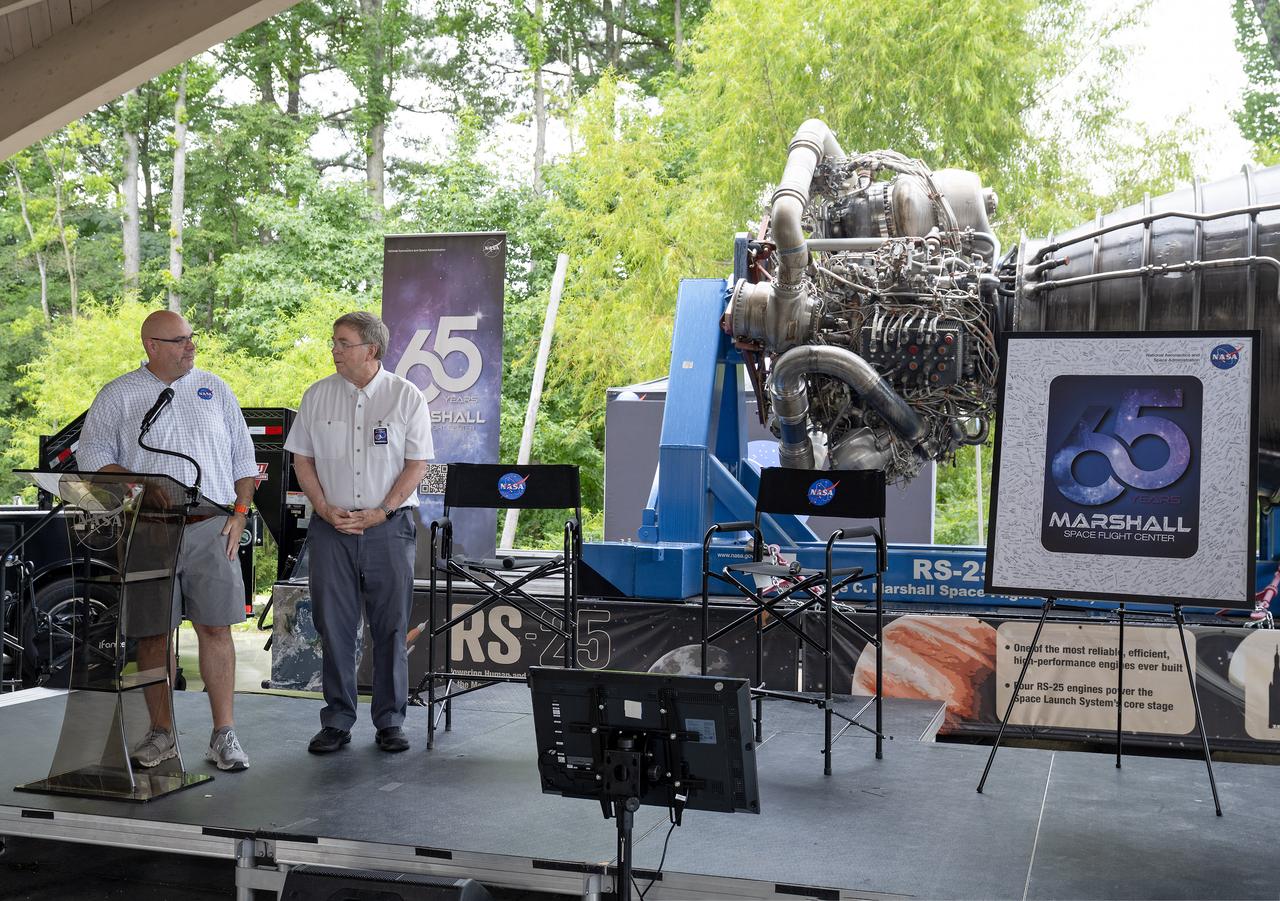
NASA’s Marshall Space Flight Center celebrated the 65th anniversary of its founding on July 19, 2025, with a free, public celebration at The Orion Amphitheater in Huntsville, Alabama. Thousands of team members, families, and “Rocket City” residents took part, enjoying live music, games, food, and exhibits commemorating Marshall’s legacy of ingenuity and service to the U.S. space program. During a program for the celebration, guests heard remarks from Joseph Pelfrey, director of NASA Marshall, Huntsville Mayor Tommy Battle, and Kamerra Liles, assistant general manager of The Orion Amphitheater, followed by Pelfrey sharing a new video overview about Marshall. The program continued with a video presentation from NASA astronauts from the Expedition 72 crew – which contributed more than 1,000 total hours of scientific studies on plant growth, stem cell growth for treating diseases, the resilience of microorganisms to the harsh space environment, and more on the International Space Station. NASA astronauts Suni Williams and Don Pettit, who served as space station commander and flight engineer, respectively, shared their experiences in space with the community and told the audience how vital Marshall’s on the ground support was to their mission success. Marshall has shaped and expanded human space exploration every decade since the NASA center opened its doors on July 1, 1960. The center’s civil service and contract workers built the nation’s flagship rockets, from the Saturn V to the SLS (Space Launch System), managed the space shuttle propulsion program, delivered the Chandra X-ray Observatory and critical elements of the International Space Station to orbit, and continue to spearhead numerous advances in science and engineering.
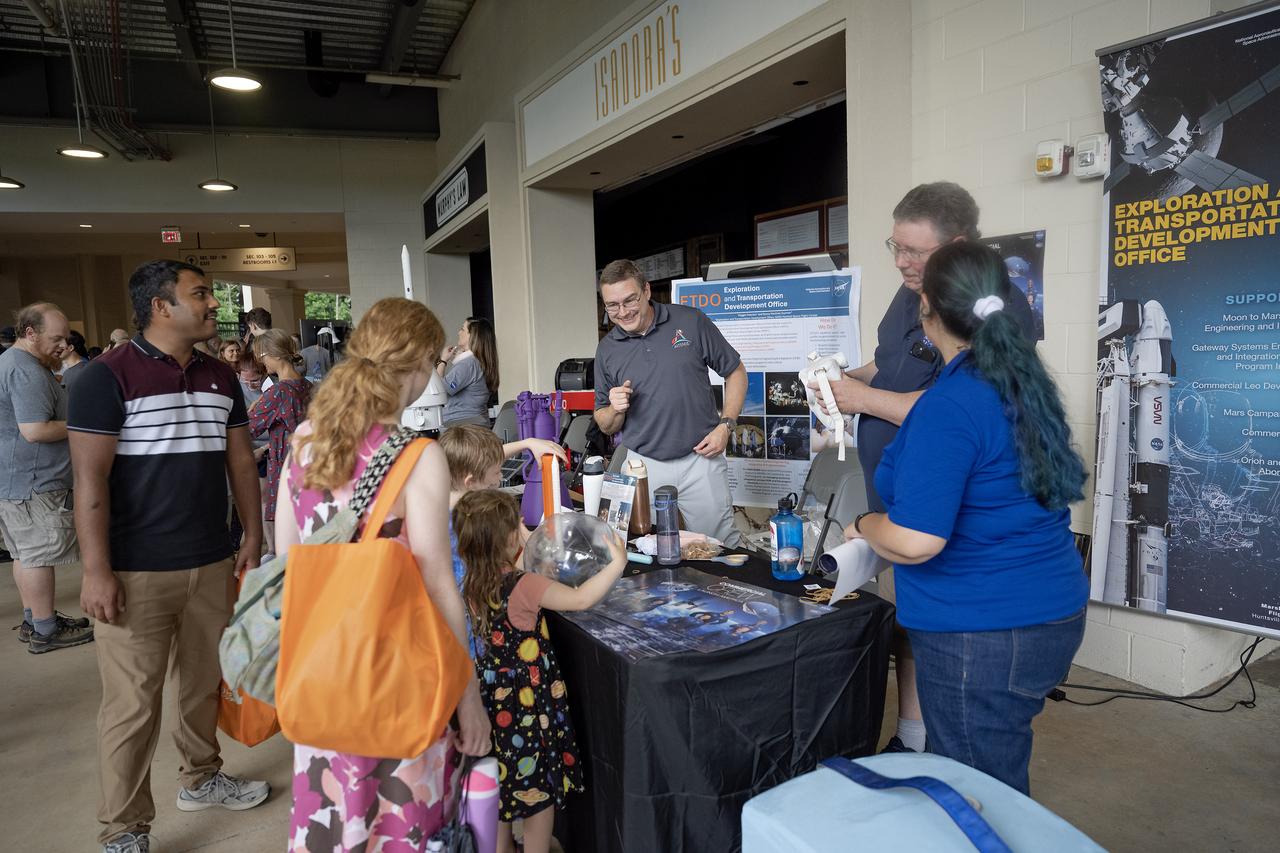
NASA’s Marshall Space Flight Center celebrated the 65th anniversary of its founding on July 19, 2025, with a free, public celebration at The Orion Amphitheater in Huntsville, Alabama. Thousands of team members, families, and “Rocket City” residents took part, enjoying live music, games, food, and exhibits commemorating Marshall’s legacy of ingenuity and service to the U.S. space program. During a program for the celebration, guests heard remarks from Joseph Pelfrey, director of NASA Marshall, Huntsville Mayor Tommy Battle, and Kamerra Liles, assistant general manager of The Orion Amphitheater, followed by Pelfrey sharing a new video overview about Marshall. The program continued with a video presentation from NASA astronauts from the Expedition 72 crew – which contributed more than 1,000 total hours of scientific studies on plant growth, stem cell growth for treating diseases, the resilience of microorganisms to the harsh space environment, and more on the International Space Station. NASA astronauts Suni Williams and Don Pettit, who served as space station commander and flight engineer, respectively, shared their experiences in space with the community and told the audience how vital Marshall’s on the ground support was to their mission success. Marshall has shaped and expanded human space exploration every decade since the NASA center opened its doors on July 1, 1960. The center’s civil service and contract workers built the nation’s flagship rockets, from the Saturn V to the SLS (Space Launch System), managed the space shuttle propulsion program, delivered the Chandra X-ray Observatory and critical elements of the International Space Station to orbit, and continue to spearhead numerous advances in science and engineering.