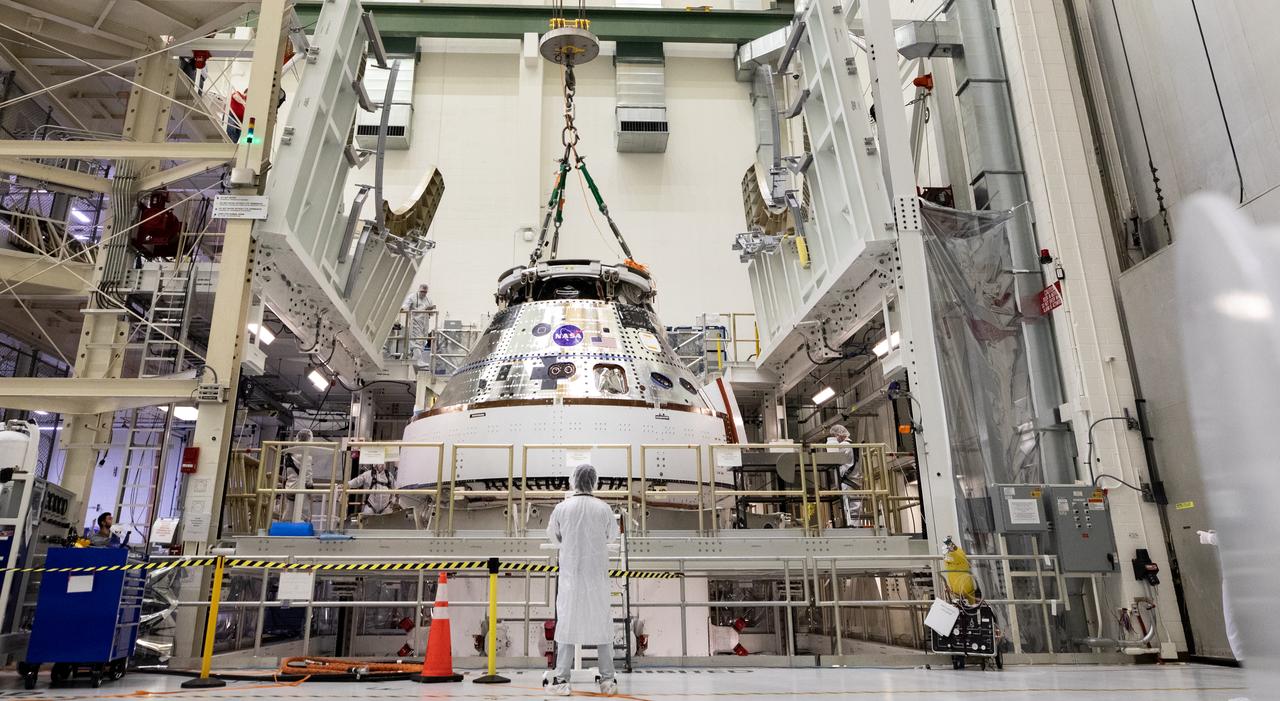
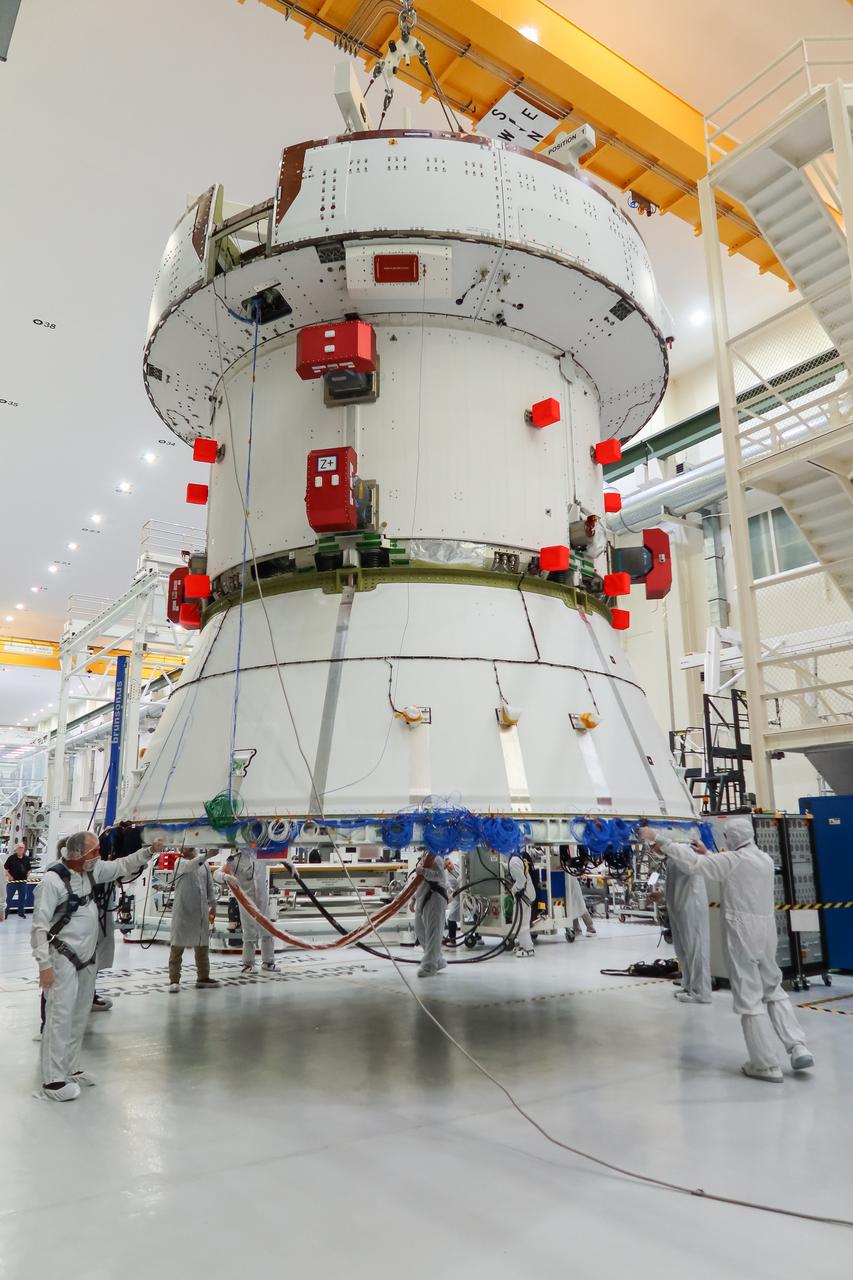
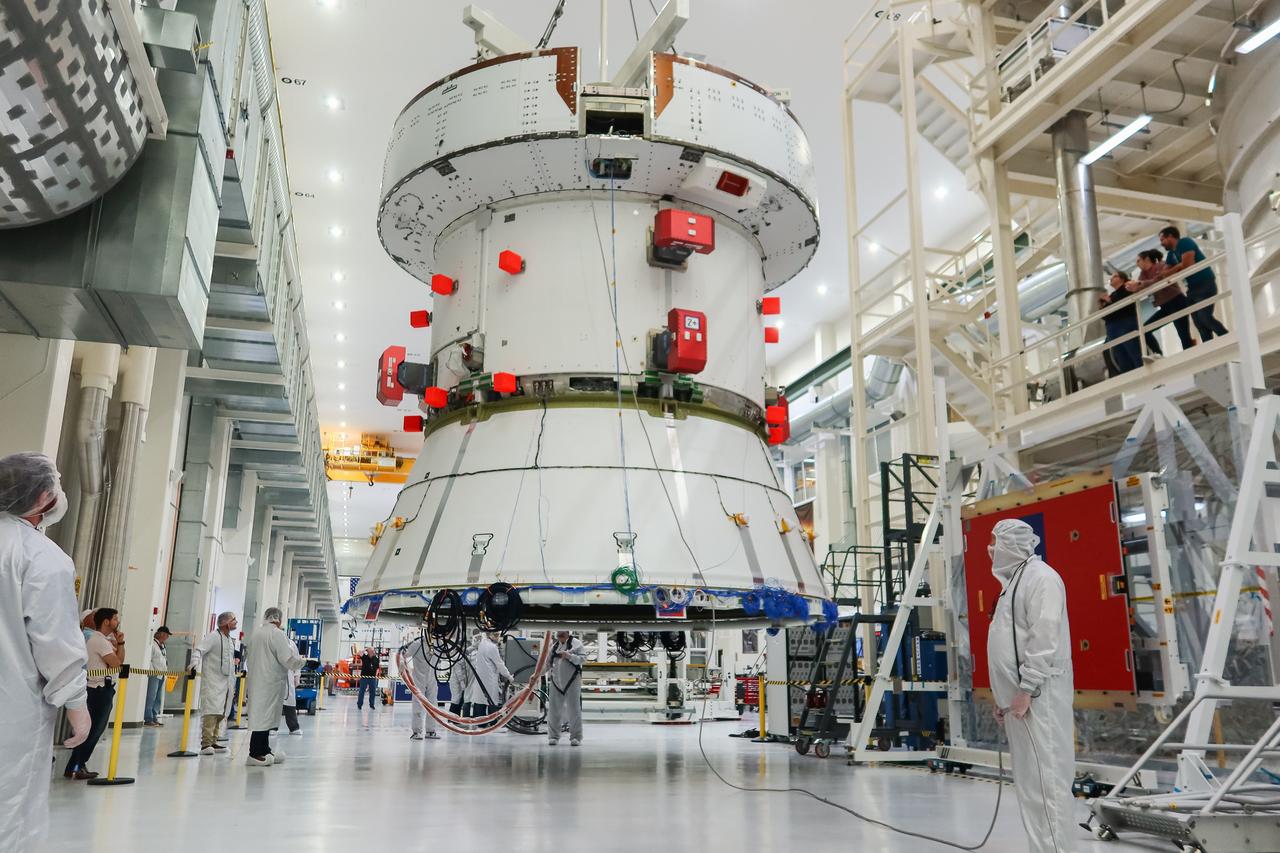
Technicians with NASA and Lockheed Martin operate a 30-ton crane to move NASA’s Artemis II Orion spacecraft out of the Final Assembly and System Testing cell inside the Neil A. Operations and Checkout Building at NASA’s Kennedy Space Center in Florida on Saturday, Feb. 22, 2025. The move prepares for the upcoming installation of four solar array wings and spacecraft adapter jettison fairings for the agency’s first crewed flight test under the Artemis campaign.
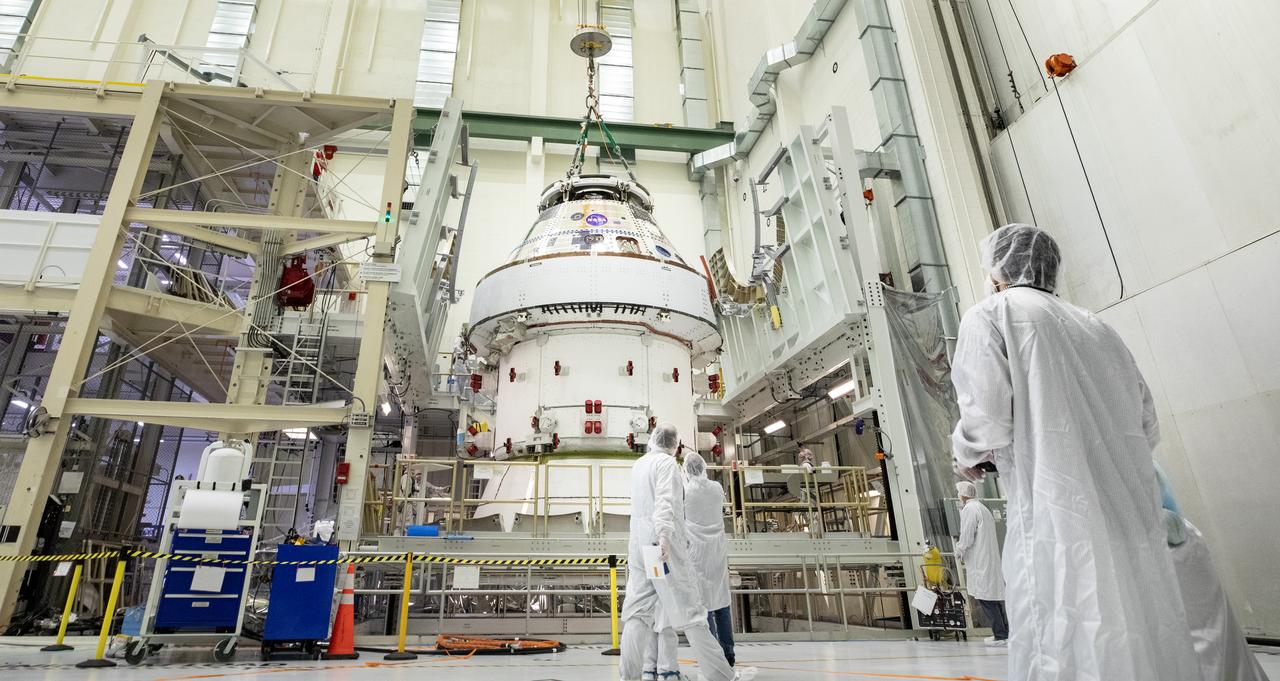
Technicians with NASA and Lockheed Martin operate a 30-ton crane to move NASA’s Artemis II Orion spacecraft out of the Final Assembly and System Testing cell inside the Neil A. Operations and Checkout Building at NASA’s Kennedy Space Center in Florida on Saturday, Feb. 22, 2025. The move prepares for the upcoming installation of four solar array wings and spacecraft adapter jettison fairings for the agency’s first crewed flight test under the Artemis campaign.

Technicians with NASA and Lockheed Martin operate a 30-ton crane to move NASA’s Artemis II Orion spacecraft out of the Final Assembly and System Testing cell inside the Neil A. Operations and Checkout Building at NASA’s Kennedy Space Center in Florida on Saturday, Feb. 22, 2025. The move prepares for the upcoming installation of four solar array wings and spacecraft adapter jettison fairings for the agency’s first crewed flight test under the Artemis campaign.
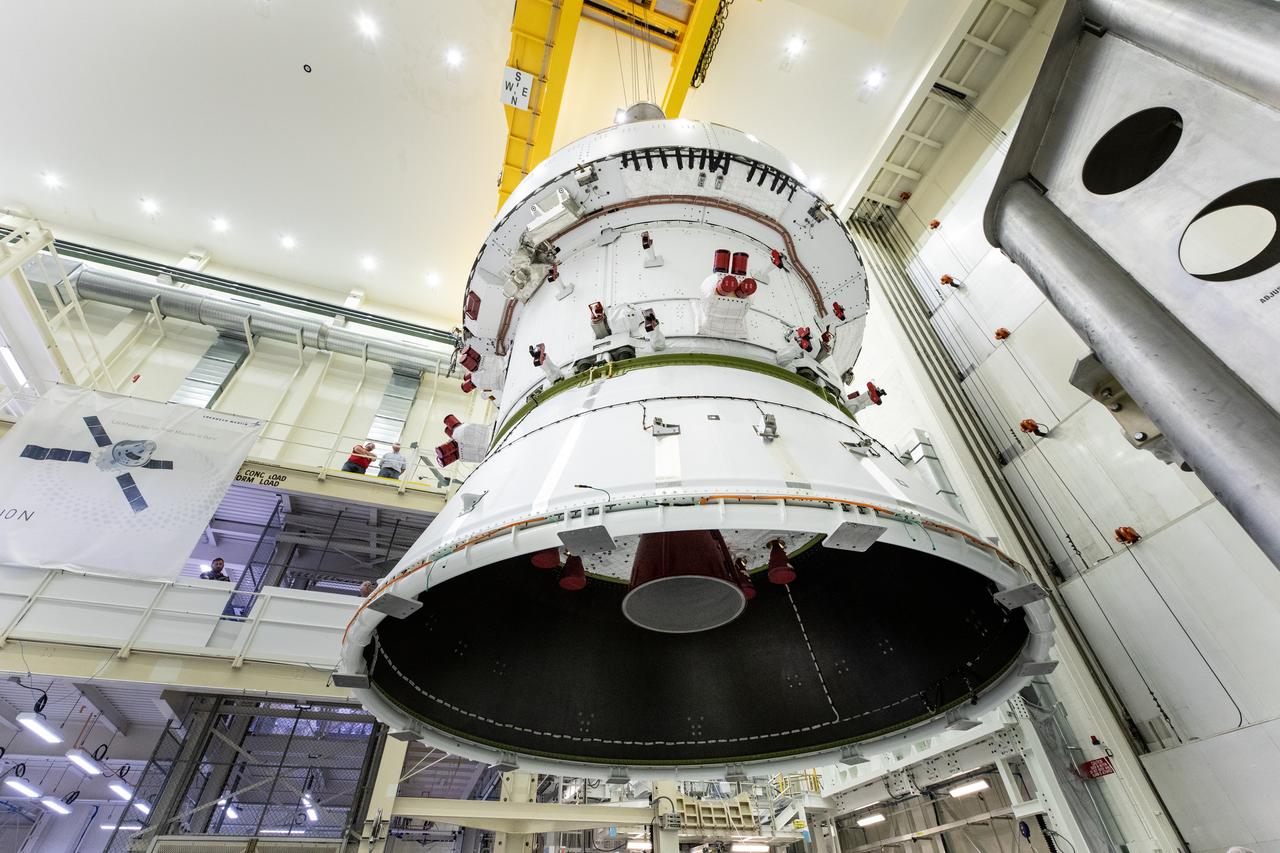
Technicians with NASA and Lockheed Martin operate a 30-ton crane to move NASA’s Artemis II Orion spacecraft out of the Final Assembly and System Testing cell inside the Neil A. Operations and Checkout Building at NASA’s Kennedy Space Center in Florida on Saturday, Feb. 22, 2025. The move prepares for the upcoming installation of four solar array wings and spacecraft adapter jettison fairings for the agency’s first crewed flight test under the Artemis campaign.
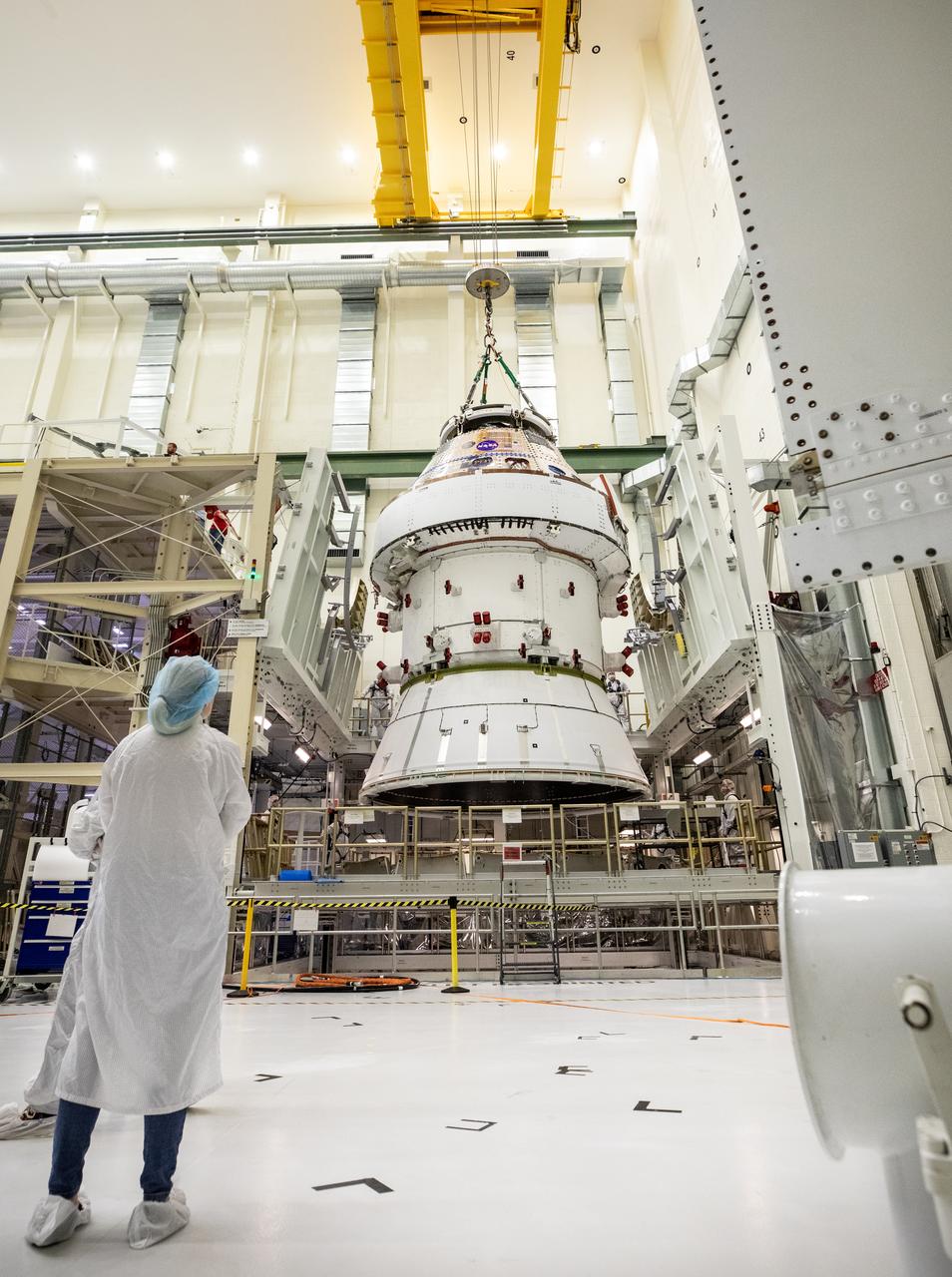
Technicians with NASA and Lockheed Martin operate a 30-ton crane to move NASA’s Artemis II Orion spacecraft out of the Final Assembly and System Testing cell inside the Neil A. Operations and Checkout Building at NASA’s Kennedy Space Center in Florida on Saturday, Feb. 22, 2025. The move prepares for the upcoming installation of four solar array wings and spacecraft adapter jettison fairings for the agency’s first crewed flight test under the Artemis campaign.
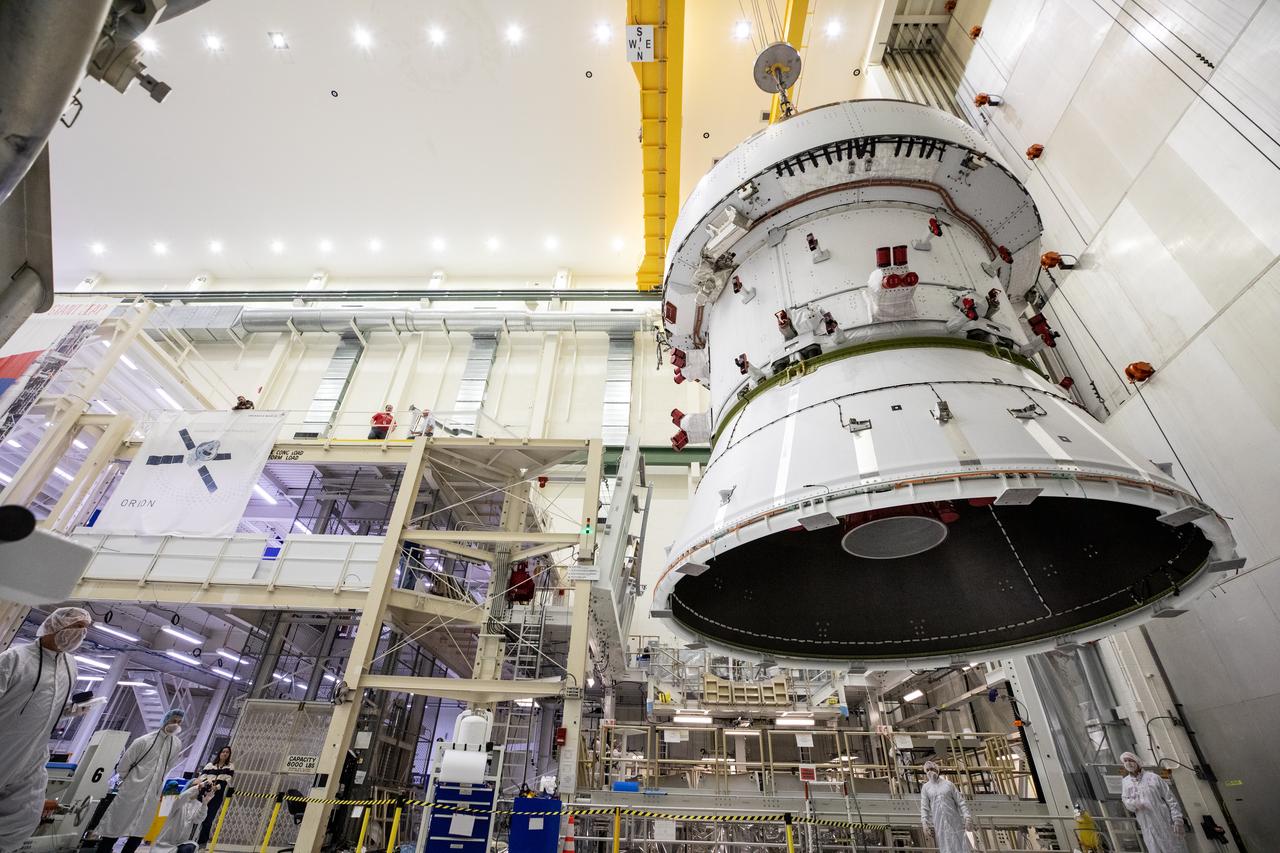
Technicians with NASA and Lockheed Martin operate a 30-ton crane to move NASA’s Artemis II Orion spacecraft out of the Final Assembly and System Testing cell inside the Neil A. Operations and Checkout Building at NASA’s Kennedy Space Center in Florida on Saturday, Feb. 22, 2025. The move prepares for the upcoming installation of four solar array wings and spacecraft adapter jettison fairings for the agency’s first crewed flight test under the Artemis campaign.
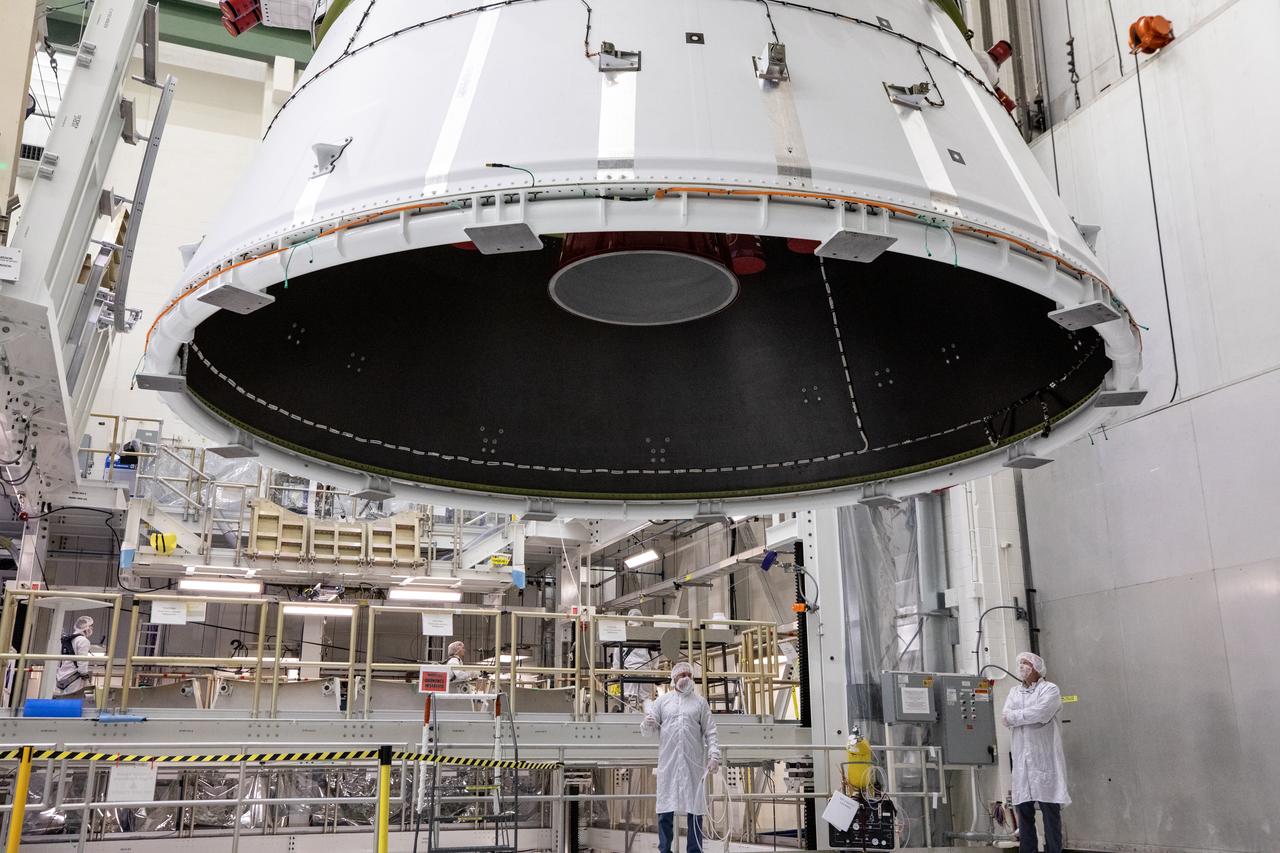
Technicians with NASA and Lockheed Martin operate a 30-ton crane to move NASA’s Artemis II Orion spacecraft out of the Final Assembly and System Testing cell inside the Neil A. Operations and Checkout Building at NASA’s Kennedy Space Center in Florida on Saturday, Feb. 22, 2025. The move prepares for the upcoming installation of four solar array wings and spacecraft adapter jettison fairings for the agency’s first crewed flight test under the Artemis campaign.
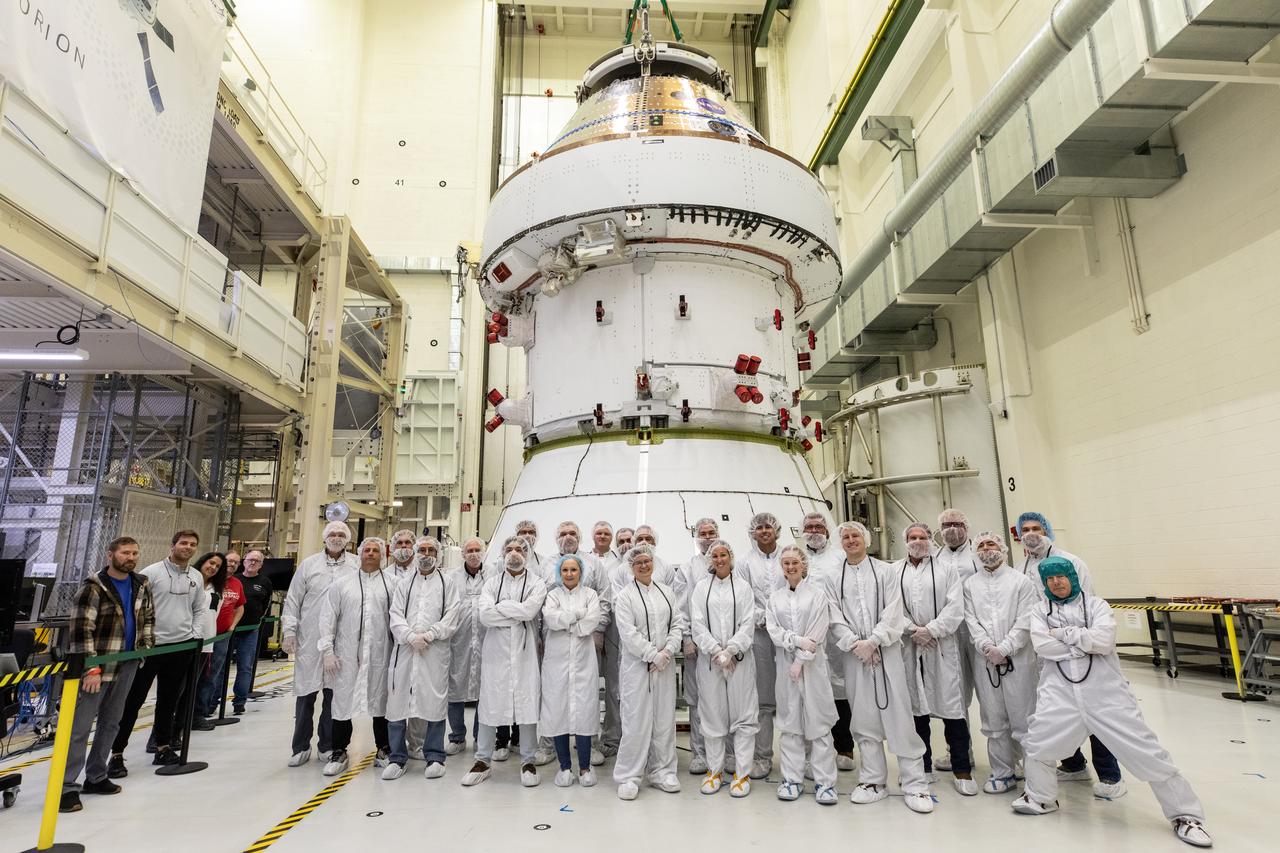
Crews with NASA and Lockheed Martin pose for a photo in front of NASA’s Artemis II Orion spacecraft inside the Neil A. Operations and Checkout Building at NASA’s Kennedy Space Center in Florida on Saturday, Feb. 22, 2025. Technicians operated a 30-ton crane to move the spacecraft from the Final Assembly and System Testing cell to prepare for upcoming installation of four solar array wings and spacecraft adapter jettison fairings for the agency’s first crewed flight test under the Artemis campaign.
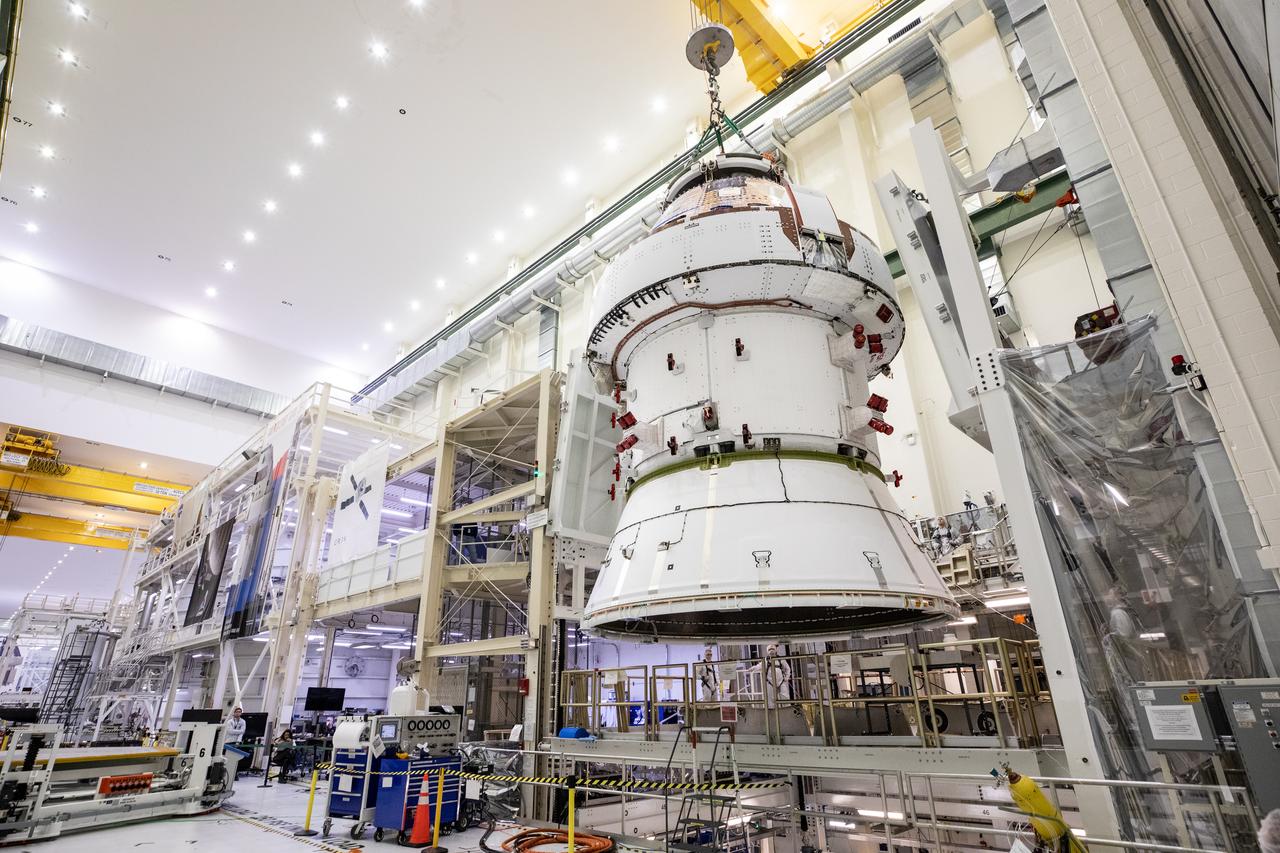
Technicians with NASA and Lockheed Martin operate a 30-ton crane to move NASA’s Artemis II Orion spacecraft out of the Final Assembly and System Testing cell inside the Neil A. Operations and Checkout Building at NASA’s Kennedy Space Center in Florida on Saturday, Feb. 22, 2025. The move prepares for the upcoming installation of four solar array wings and spacecraft adapter jettison fairings for the agency’s first crewed flight test under the Artemis campaign.
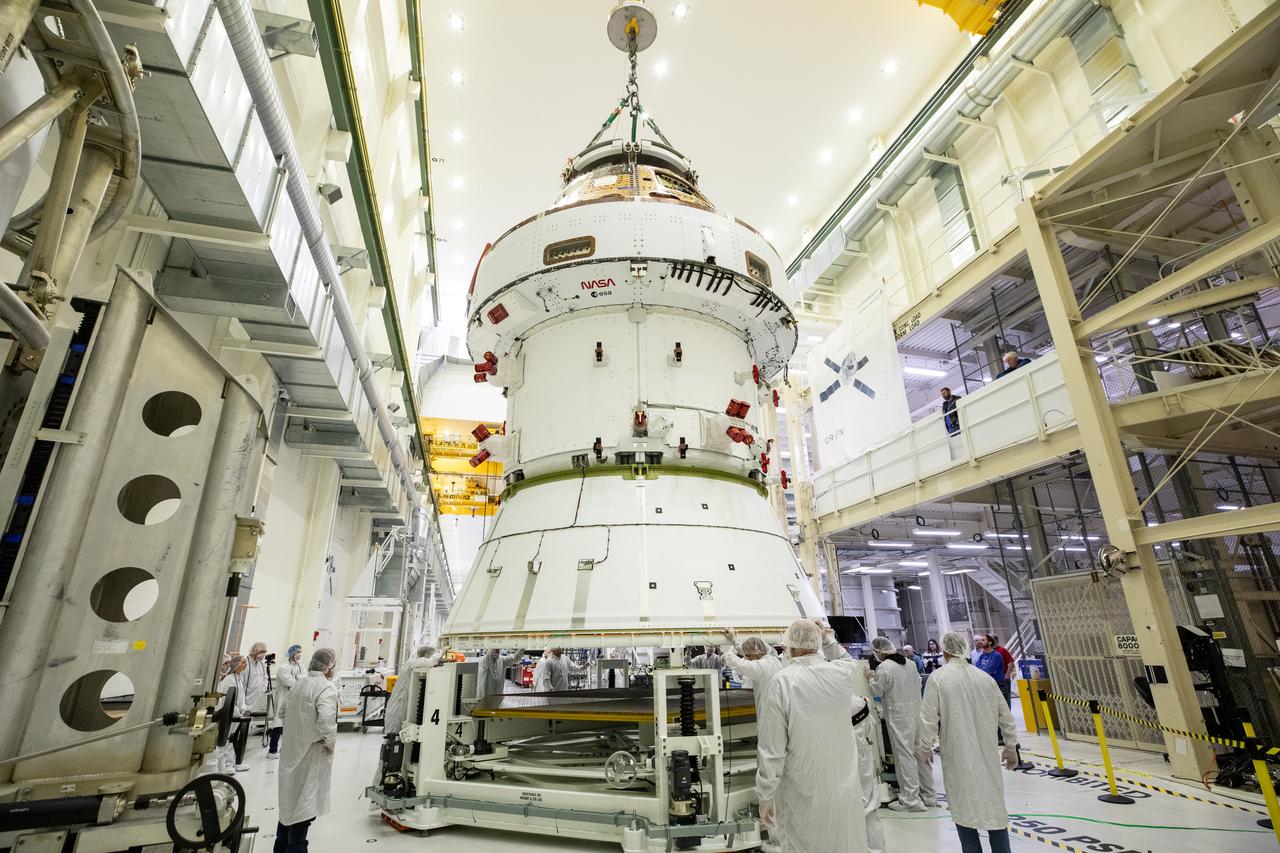
Technicians with NASA and Lockheed Martin operate a 30-ton crane to move NASA’s Artemis II Orion spacecraft out of the Final Assembly and System Testing cell inside the Neil A. Operations and Checkout Building at NASA’s Kennedy Space Center in Florida on Saturday, Feb. 22, 2025. The move prepares for the upcoming installation of four solar array wings and spacecraft adapter jettison fairings for the agency’s first crewed flight test under the Artemis campaign.
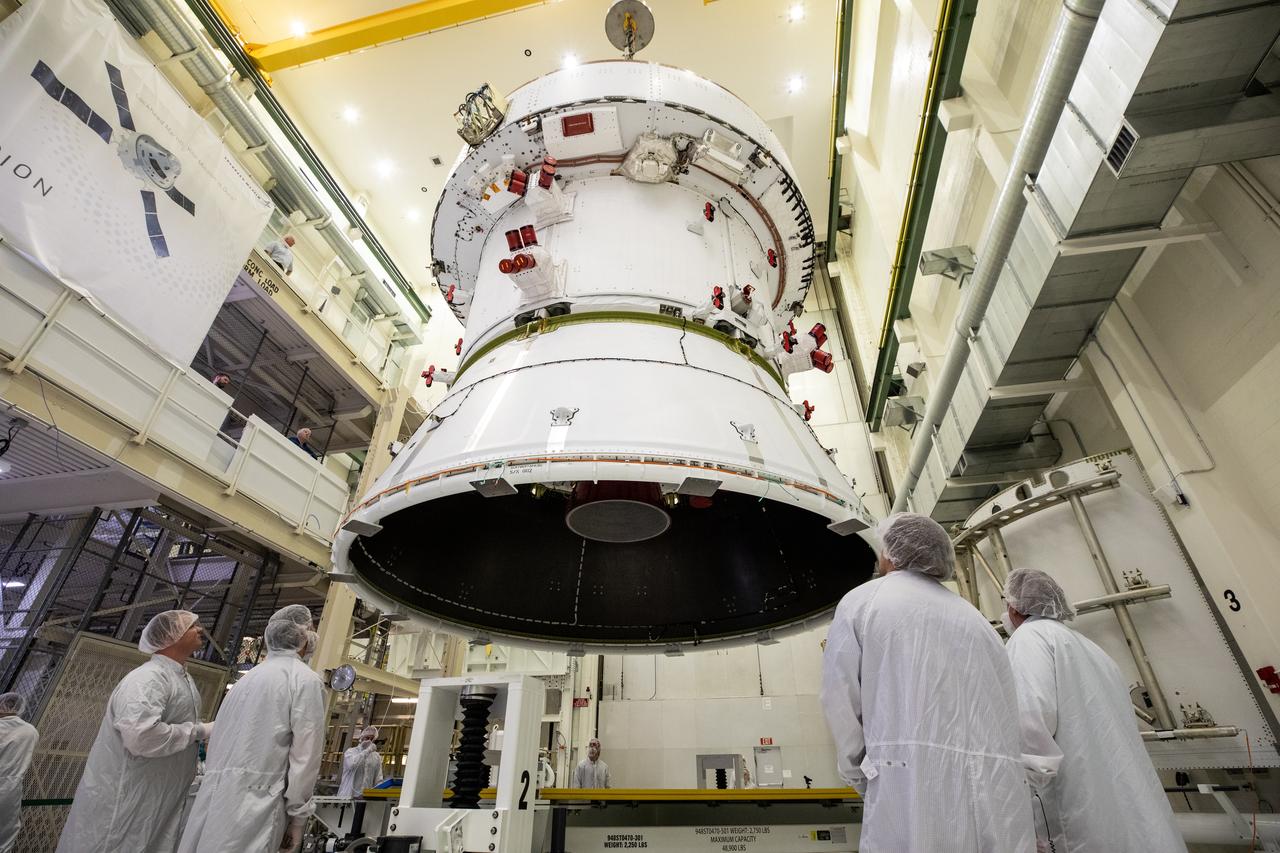
Technicians with NASA and Lockheed Martin operate a 30-ton crane to move NASA’s Artemis II Orion spacecraft out of the Final Assembly and System Testing cell inside the Neil A. Operations and Checkout Building at NASA’s Kennedy Space Center in Florida on Saturday, Feb. 22, 2025. The move prepares for the upcoming installation of four solar array wings and spacecraft adapter jettison fairings for the agency’s first crewed flight test under the Artemis campaign.
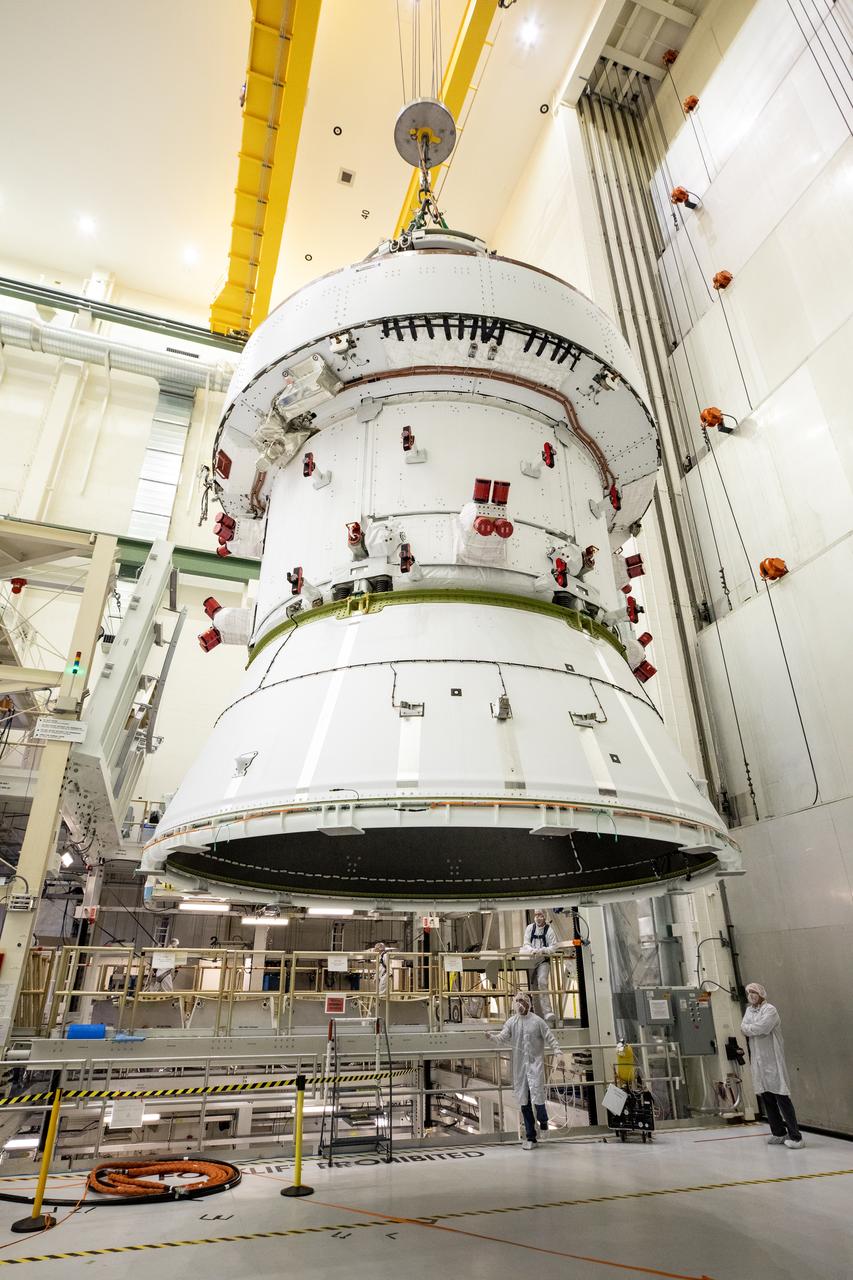
Technicians with NASA and Lockheed Martin operate a 30-ton crane to move NASA’s Artemis II Orion spacecraft out of the Final Assembly and System Testing cell inside the Neil A. Operations and Checkout Building at NASA’s Kennedy Space Center in Florida on Saturday, Feb. 22, 2025. The move prepares for the upcoming installation of four solar array wings and spacecraft adapter jettison fairings for the agency’s first crewed flight test under the Artemis campaign.
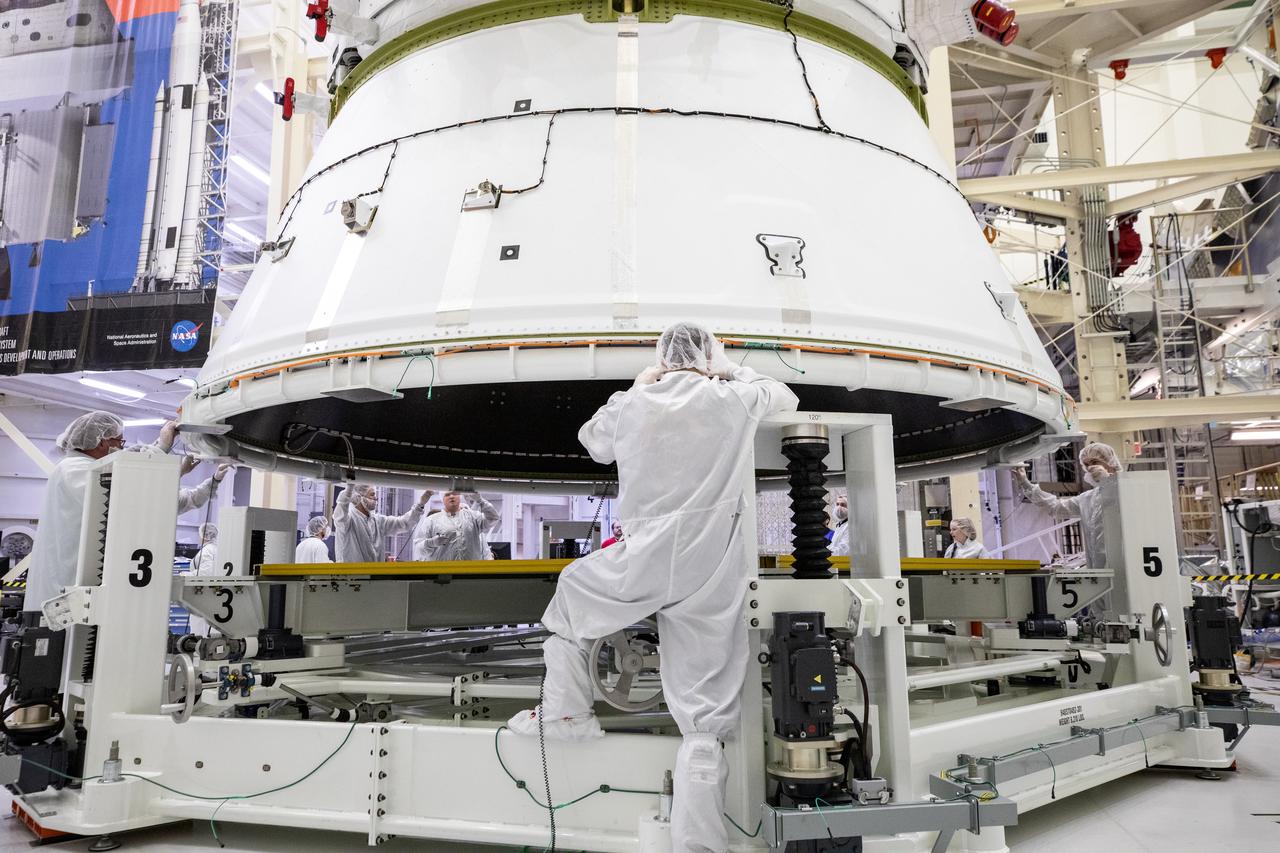
Technicians with NASA and Lockheed Martin operate a 30-ton crane to move NASA’s Artemis II Orion spacecraft out of the Final Assembly and System Testing cell inside the Neil A. Operations and Checkout Building at NASA’s Kennedy Space Center in Florida on Saturday, Feb. 22, 2025. The move prepares for the upcoming installation of four solar array wings and spacecraft adapter jettison fairings for the agency’s first crewed flight test under the Artemis campaign.
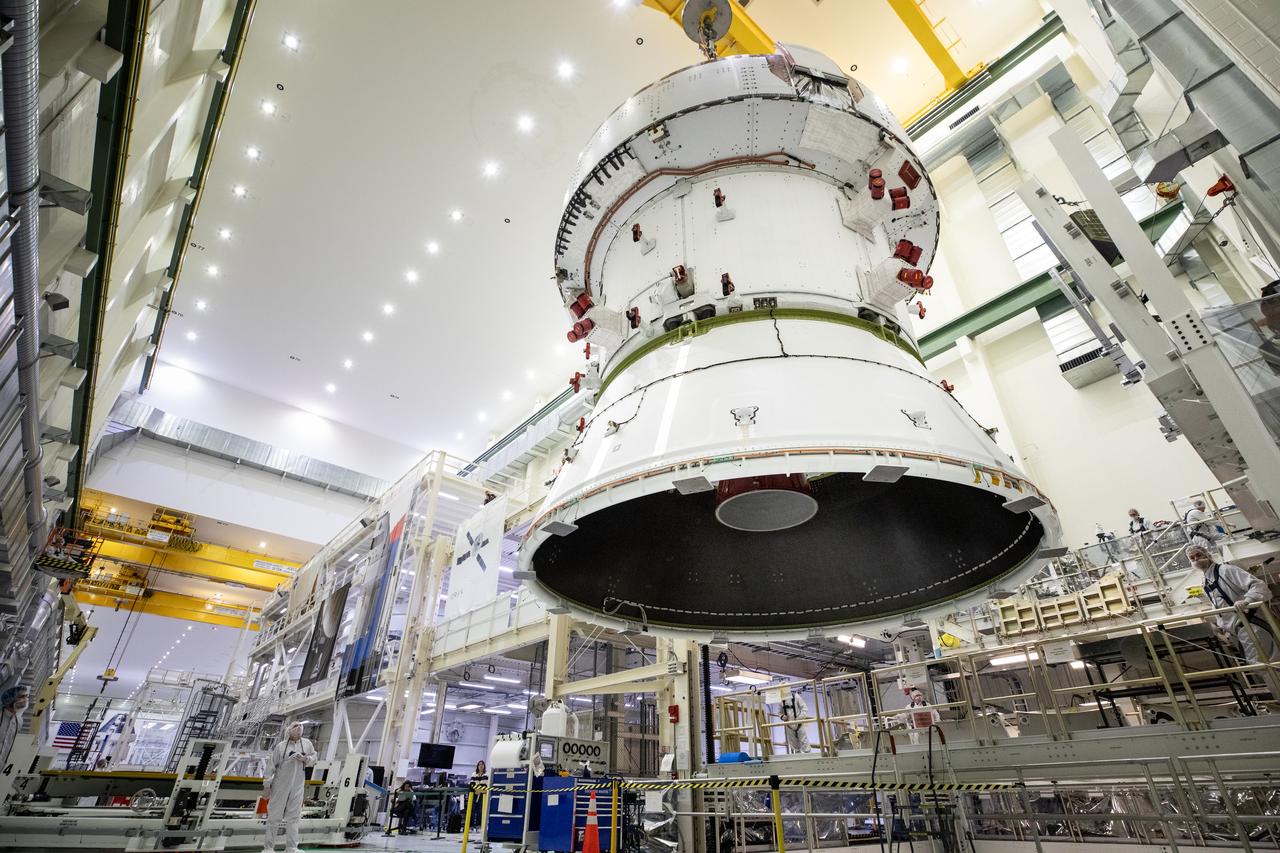
Technicians with NASA and Lockheed Martin operate a 30-ton crane to move NASA’s Artemis II Orion spacecraft out of the Final Assembly and System Testing cell inside the Neil A. Operations and Checkout Building at NASA’s Kennedy Space Center in Florida on Saturday, Feb. 22, 2025. The move prepares for the upcoming installation of four solar array wings and spacecraft adapter jettison fairings for the agency’s first crewed flight test under the Artemis campaign.
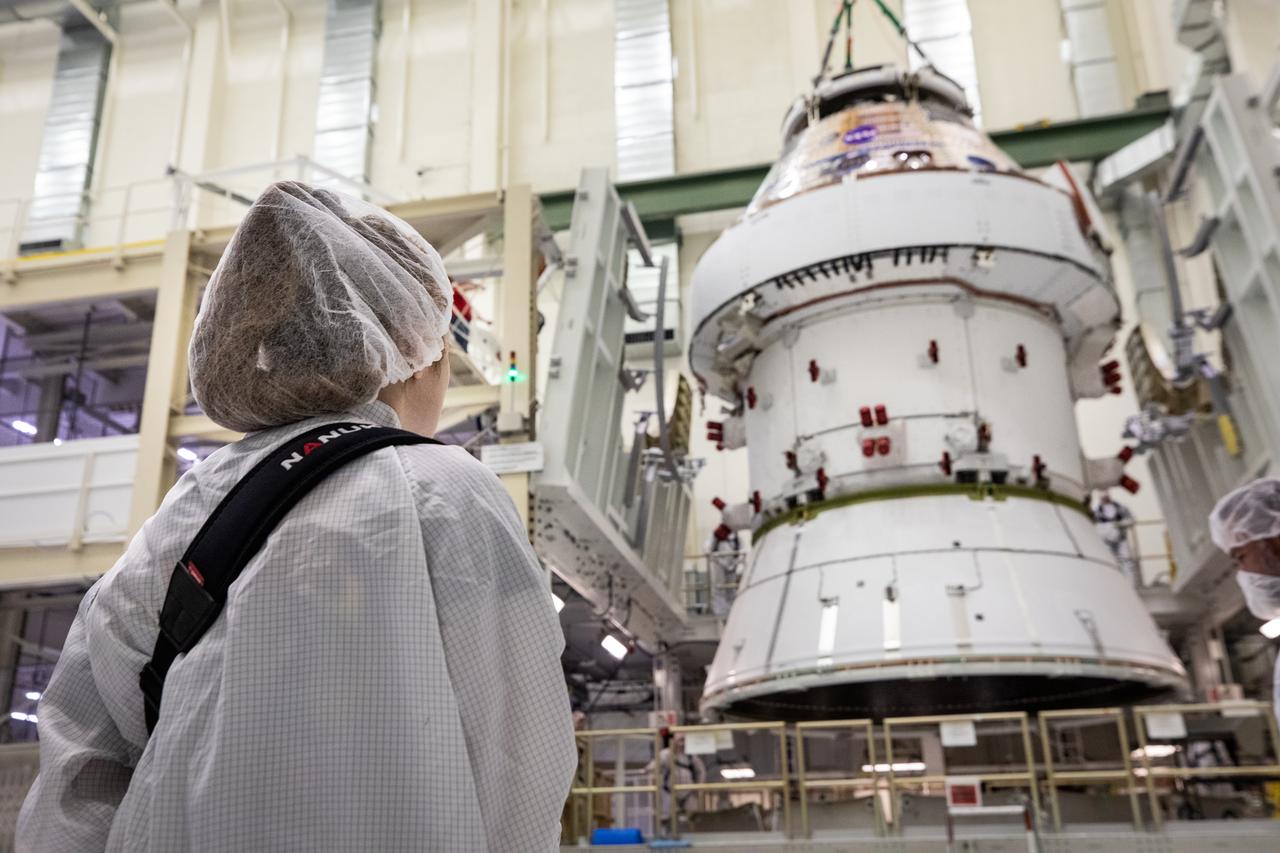
Rebekah Tolatovicz, a technician with Lockheed Martin, operates a 30-ton crane to move NASA’s Artemis II Orion spacecraft out of the Final Assembly and System Testing cell inside the Neil A. Operations and Checkout Building at NASA’s Kennedy Space Center in Florida on Saturday, Feb. 22, 2025. The move prepares for the upcoming installation of four solar array wings and spacecraft adapter jettison fairings for the agency’s first crewed flight test under the Artemis campaign.
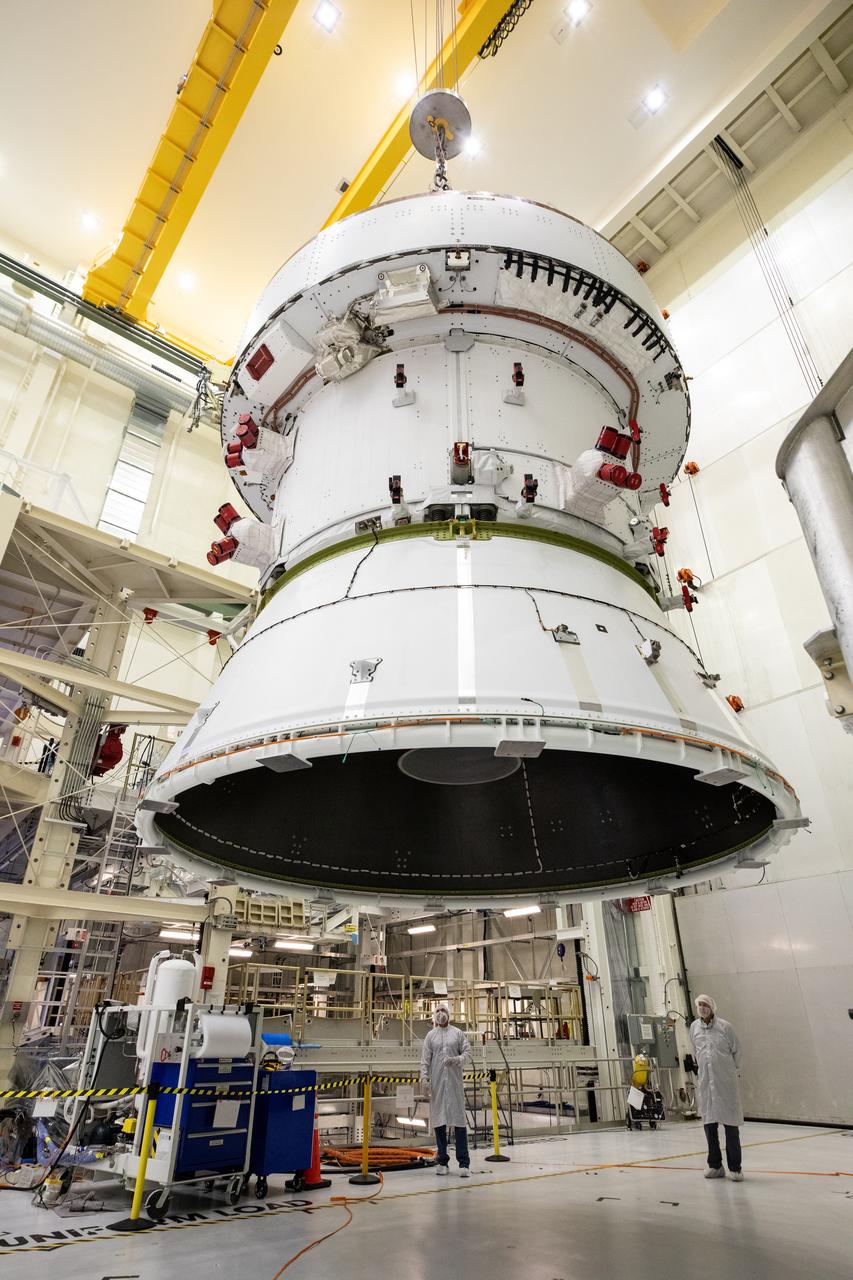
Technicians with NASA and Lockheed Martin operate a 30-ton crane to move NASA’s Artemis II Orion spacecraft out of the Final Assembly and System Testing cell inside the Neil A. Operations and Checkout Building at NASA’s Kennedy Space Center in Florida on Saturday, Feb. 22, 2025. The move prepares for the upcoming installation of four solar array wings and spacecraft adapter jettison fairings for the agency’s first crewed flight test under the Artemis campaign.

Technicians with NASA and Lockheed Martin operate a 30-ton crane to move NASA’s Artemis II Orion spacecraft out of the Final Assembly and System Testing cell inside the Neil A. Operations and Checkout Building at NASA’s Kennedy Space Center in Florida on Saturday, Feb. 22, 2025. The move prepares for the upcoming installation of four solar array wings and spacecraft adapter jettison fairings for the agency’s first crewed flight test under the Artemis campaign.
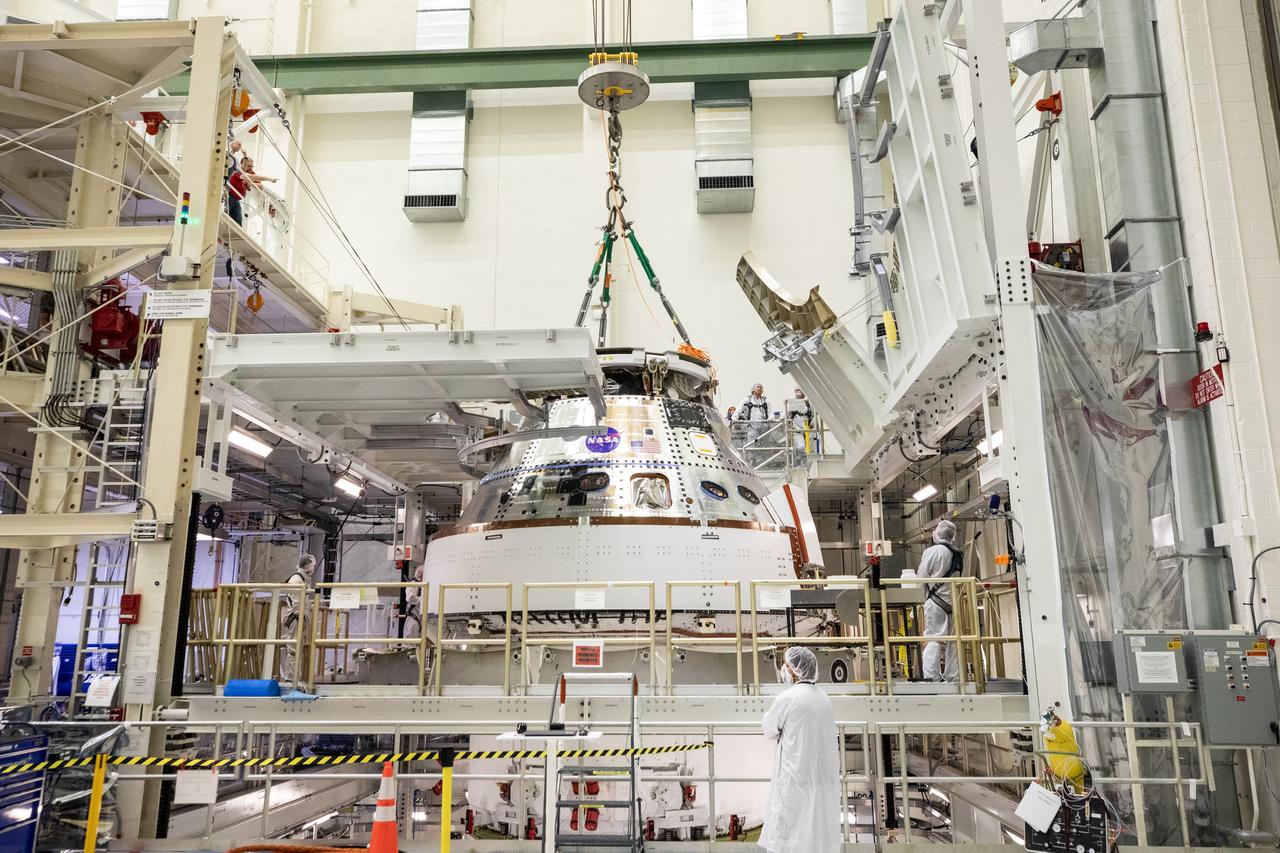
Technicians with NASA and Lockheed Martin operate a 30-ton crane to move NASA’s Artemis II Orion spacecraft out of the Final Assembly and System Testing cell inside the Neil A. Operations and Checkout Building at NASA’s Kennedy Space Center in Florida on Saturday, Feb. 22, 2025. The move prepares for the upcoming installation of four solar array wings and spacecraft adapter jettison fairings for the agency’s first crewed flight test under the Artemis campaign.
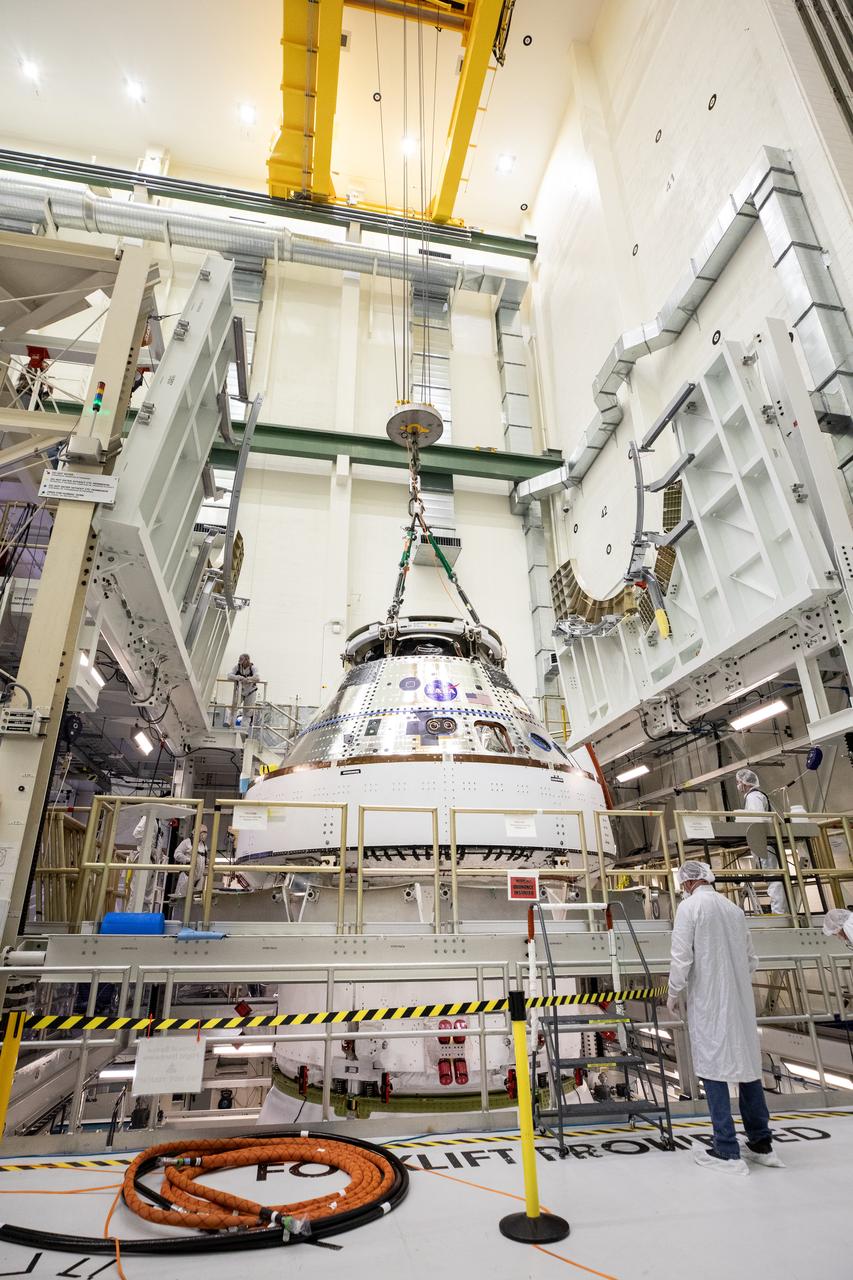
Technicians with NASA and Lockheed Martin operate a 30-ton crane to move NASA’s Artemis II Orion spacecraft out of the Final Assembly and System Testing cell inside the Neil A. Operations and Checkout Building at NASA’s Kennedy Space Center in Florida on Saturday, Feb. 22, 2025. The move prepares for the upcoming installation of four solar array wings and spacecraft adapter jettison fairings for the agency’s first crewed flight test under the Artemis campaign.
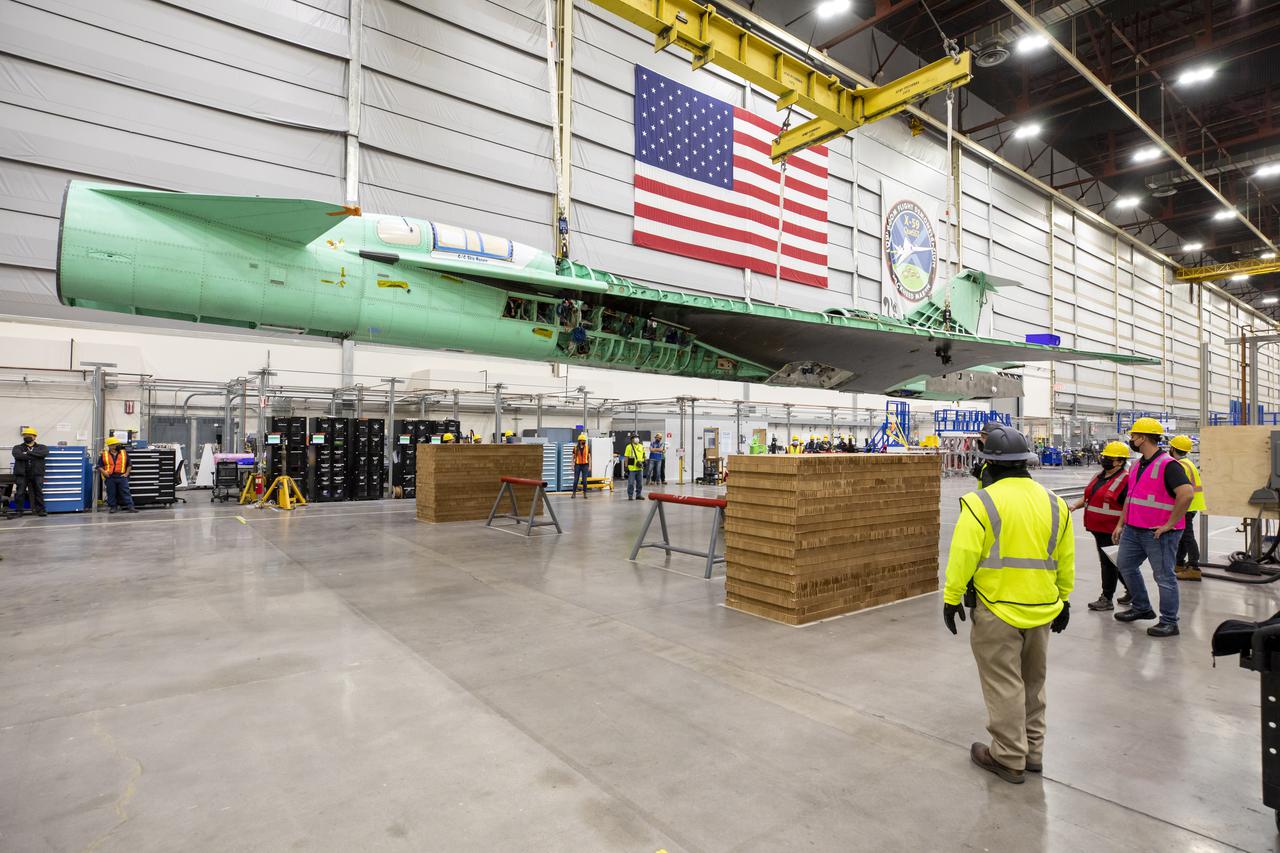
The X-59 is free from its structural support jig for the first time. In this image, cranes are holding up the aircraft prior to placement on the floor jacks. Notice that the nose has been removed temporarily — it will be reinstalled again before the upcoming structural testing. Lockheed Martin Photography By Garry Tice 1011 Lockheed Way, Palmdale, Ca. 93599 Event: Removal From Tooling Jig Date: 10/27/2021 Additional Info:
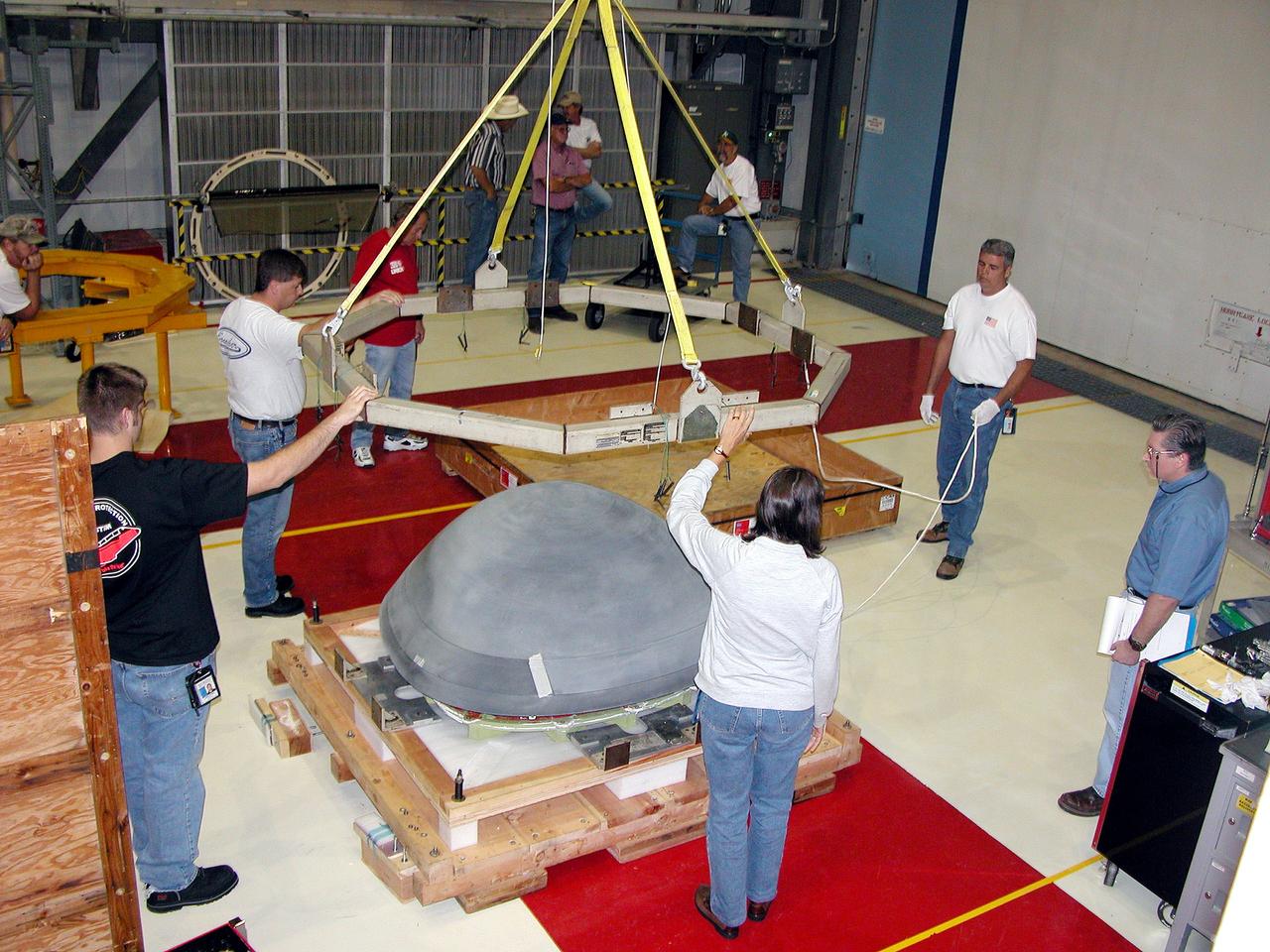
KENNEDY SPACE CENTER, FLA. - In the Orbiter Processing Facility, workers remove the overhead crane from the nose cap that was removed from Atlantis. The reinforced carbon-carbon (RCC) nose cap is being sent to the original manufacturing company, Vought in Ft. Worth, Texas, a subsidiary of Lockheed Martin, to undergo non-destructive testing such as CAT scan and thermography.
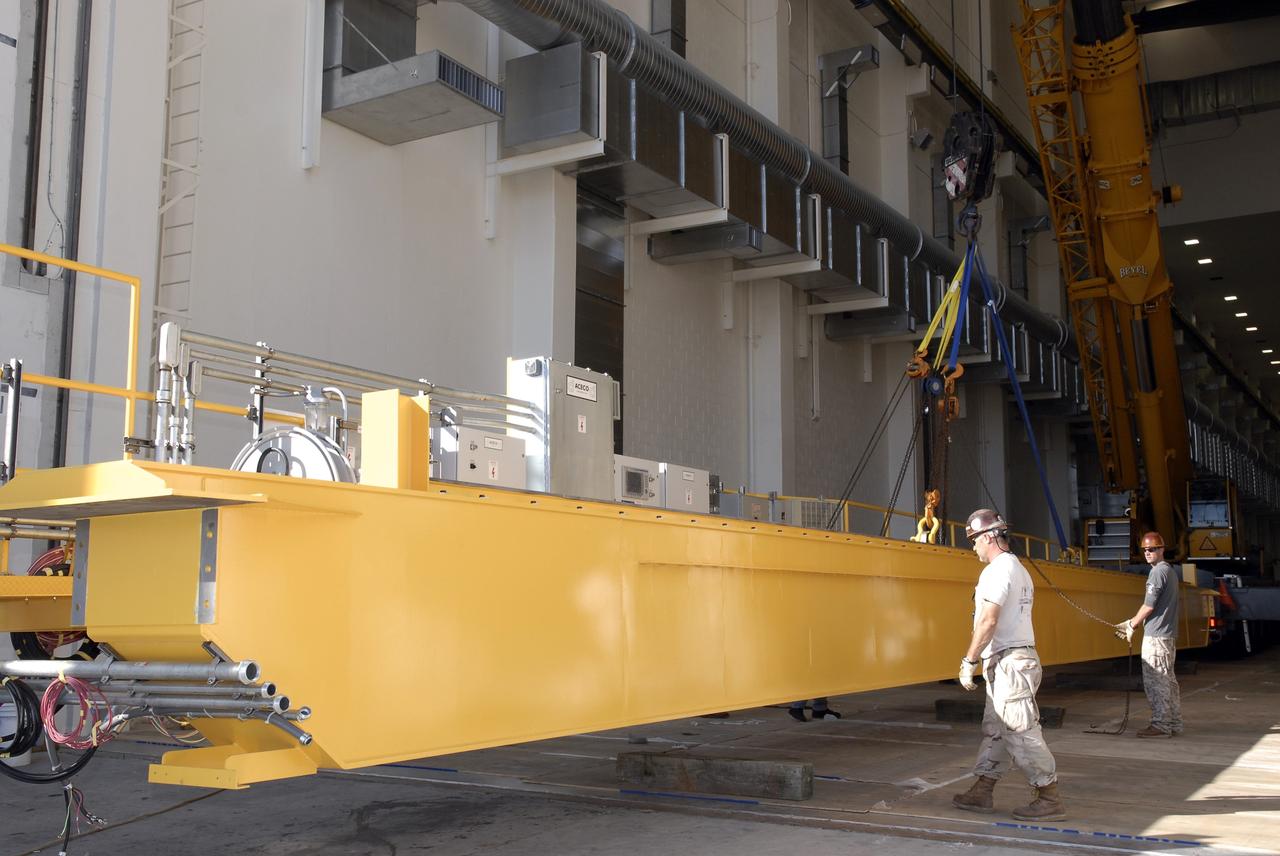
CAPE CANAVERAL, Fla. – Segments of a crane are lowered onto the floor of the Operations and Checkout Building at NASA's Kennedy Space Center in Florida. The new O&C low-bay crane is a 25-ton overhead bridge crane built for Lockheed Martin and Space Florida by American Crane and Equipment Corporation in Douglasville, Pa. The crane has a bridge span of 78’-2” and a hook height of 48’-10”. The crane will be used for lifting and moving flight hardware, fixtures and equipment in support of the Orion spacecraft manufacturing. Part of NASA's Constellation Program, the Orion spacecraft will return humans to the moon and prepare for future voyages to Mars and other destinations in our solar system. Photo credit: NASA/Kim Shiflett
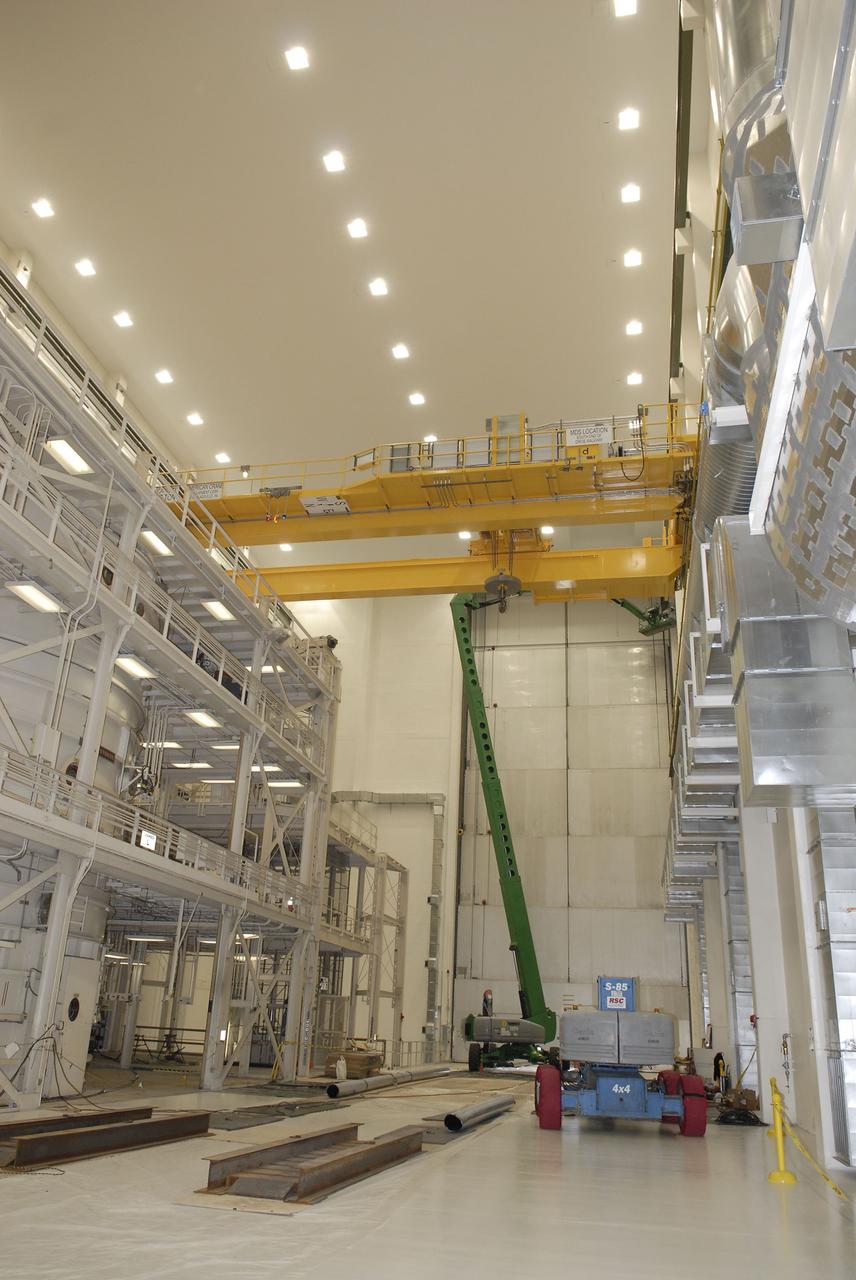
CAPE CANAVERAL, Fla. – Segments of a new crane are tested inside the Operations and Checkout Building at NASA's Kennedy Space Center in Florida. The new O&C low-bay crane is a 25-ton overhead bridge crane built for Lockheed Martin and Space Florida by American Crane and Equipment Corporation in Douglasville, Pa. The crane has a bridge span of 78’-2” and a hook height of 48’-10”. The crane will be used for lifting and moving flight hardware, fixtures and equipment in support of the Orion spacecraft manufacturing. Part of NASA's Constellation Program, the Orion spacecraft will return humans to the moon and prepare for future voyages to Mars and other destinations in our solar system. Photo credit: NASA/Kim Shiflett
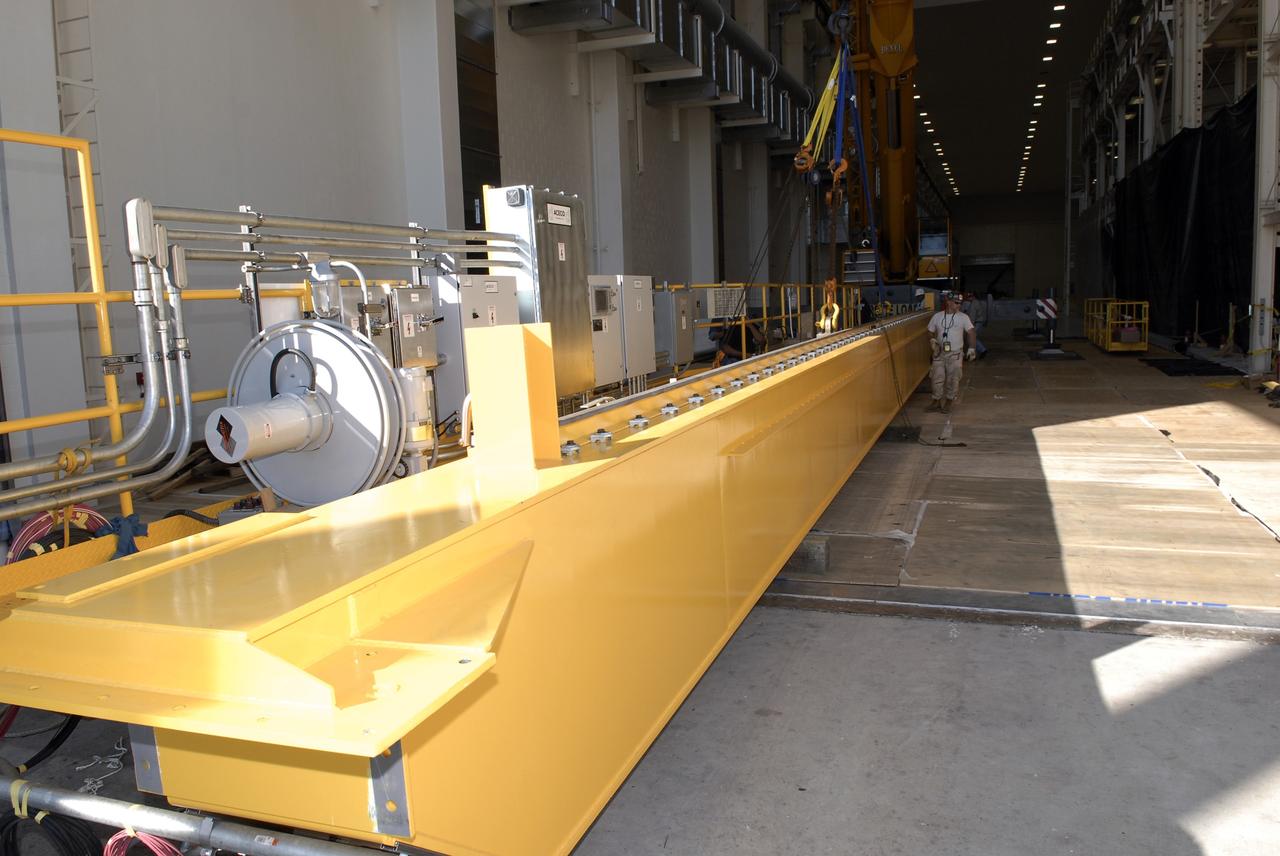
CAPE CANAVERAL, Fla. – Segments of a crane are moved into the Operations and Checkout Building at NASA's Kennedy Space Center in Florida. The new O&C low-bay crane is a 25-ton overhead bridge crane built for Lockheed Martin and Space Florida by American Crane and Equipment Corporation in Douglasville, Pa. The crane has a bridge span of 78’-2” and a hook height of 48’-10”. The crane will be used for lifting and moving flight hardware, fixtures and equipment in support of the Orion spacecraft manufacturing. Part of NASA's Constellation Program, the Orion spacecraft will return humans to the moon and prepare for future voyages to Mars and other destinations in our solar system. Photo credit: NASA/Kim Shiflett
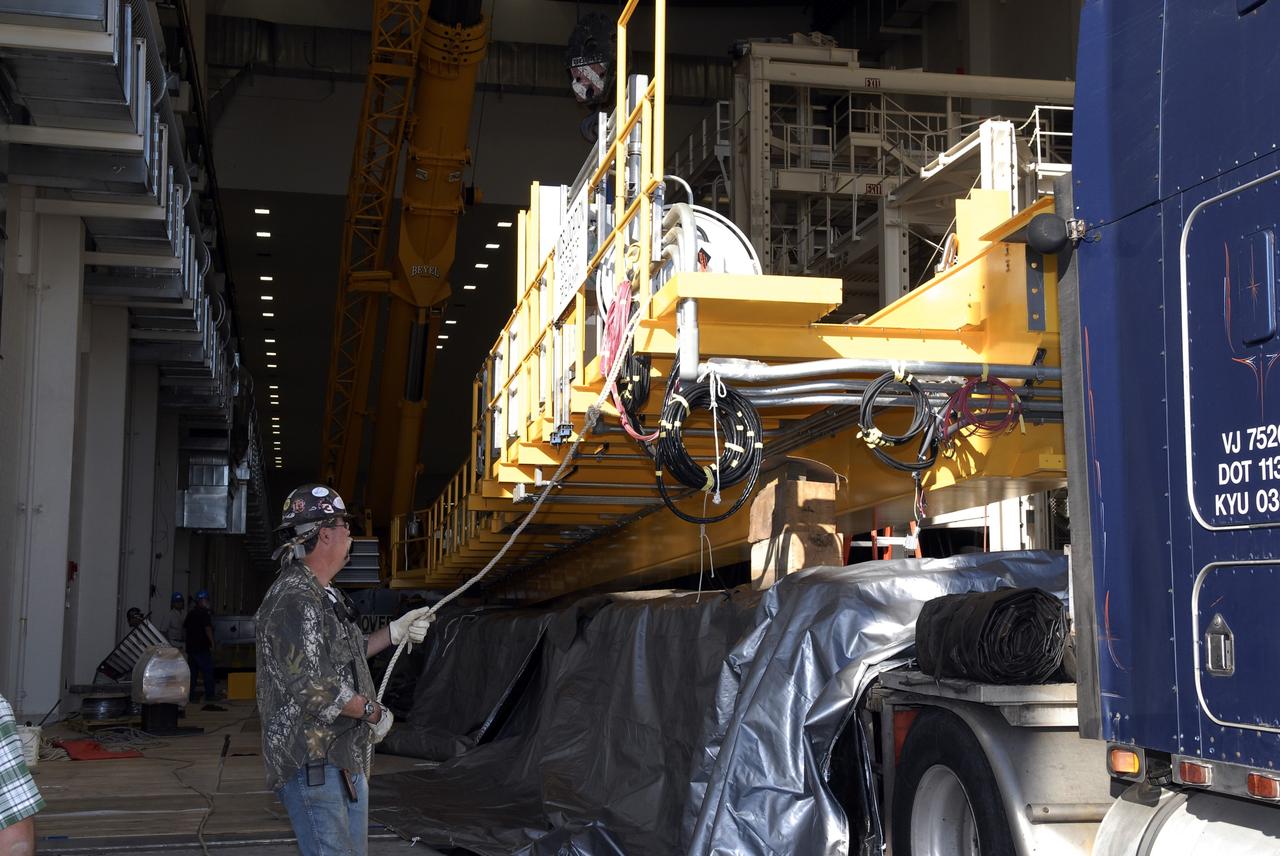
CAPE CANAVERAL, Fla. – Segments of a crane arrive at the Operations and Checkout Building at NASA's Kennedy Space Center in Florida. The new O&C low-bay crane is a 25-ton overhead bridge crane built for Lockheed Martin and Space Florida by American Crane and Equipment Corporation in Douglasville, Pa. The crane has a bridge span of 78’-2” and a hook height of 48’-10”. The crane will be used for lifting and moving flight hardware, fixtures and equipment in support of the Orion spacecraft manufacturing. Part of NASA's Constellation Program, the Orion spacecraft will return humans to the moon and prepare for future voyages to Mars and other destinations in our solar system. Photo credit: NASA/Kim Shiflett
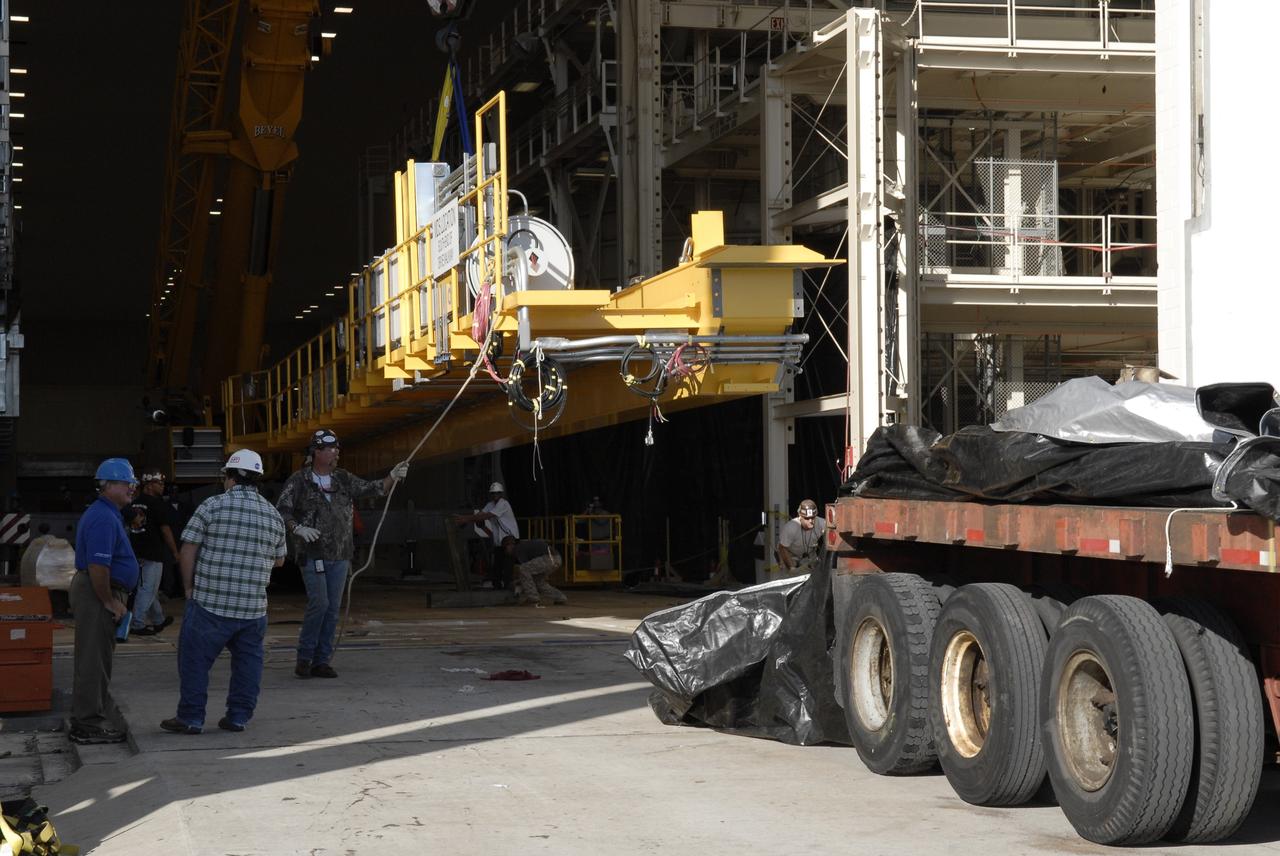
CAPE CANAVERAL, Fla. – Segments of a crane are being offloaded at the Operations and Checkout Building at NASA's Kennedy Space Center in Florida. The new O&C low-bay crane is a 25-ton overhead bridge crane built for Lockheed Martin and Space Florida by American Crane and Equipment Corporation in Douglasville, Pa. The crane has a bridge span of 78’-2” and a hook height of 48’-10”. The crane will be used for lifting and moving flight hardware, fixtures and equipment in support of the Orion spacecraft manufacturing. Part of NASA's Constellation Program, the Orion spacecraft will return humans to the moon and prepare for future voyages to Mars and other destinations in our solar system. Photo credit: NASA/Kim Shiflett
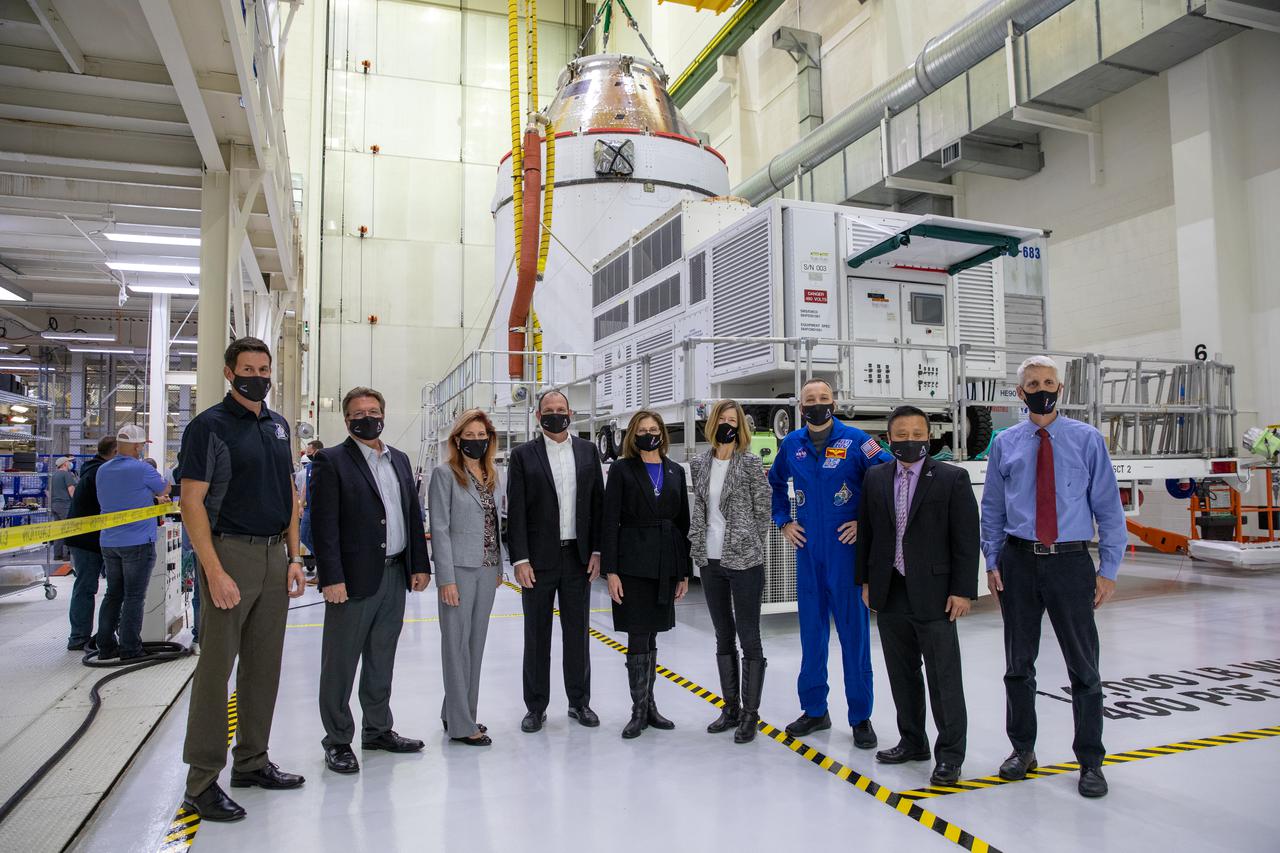
Orion is revealed for one of the final times on Jan. 14, as it is moved by crane to its transport pallet inside the Neil Armstrong Operations and Checkout Building at NASA’s Kennedy Space Center in Florida, along its path to the pad ahead of the Artemis I launch. Standing near Orion, from left, are Nathan Varn, Lockheed Martin Production Control director; Jules Schneider, Lockheed Martin Director of Orion Assembly, Test and Launch at Kennedy; Kelly DeFazio, Lockheed Martin Orion Program director for production operations; Tony Antonelli, Lockheed Martin Orion Program director and Artemis II mission director; Cathy Koerner, Orion Program manager; Kathy Lueders, associate administrator of the Human Exploration and Operations Mission Directorate; NASA astronaut Randy Bresnik; Howard Hu Orion Program deputy manager; and Scott Wilson, Orion Production Office manager. Teams across the globe have worked tirelessly to assemble the spacecraft, which will receive a protective covering prior to departing for the Multi-Payload Processing Facility to begin ground processing by the Exploration Ground Systems and Jacobs teams.
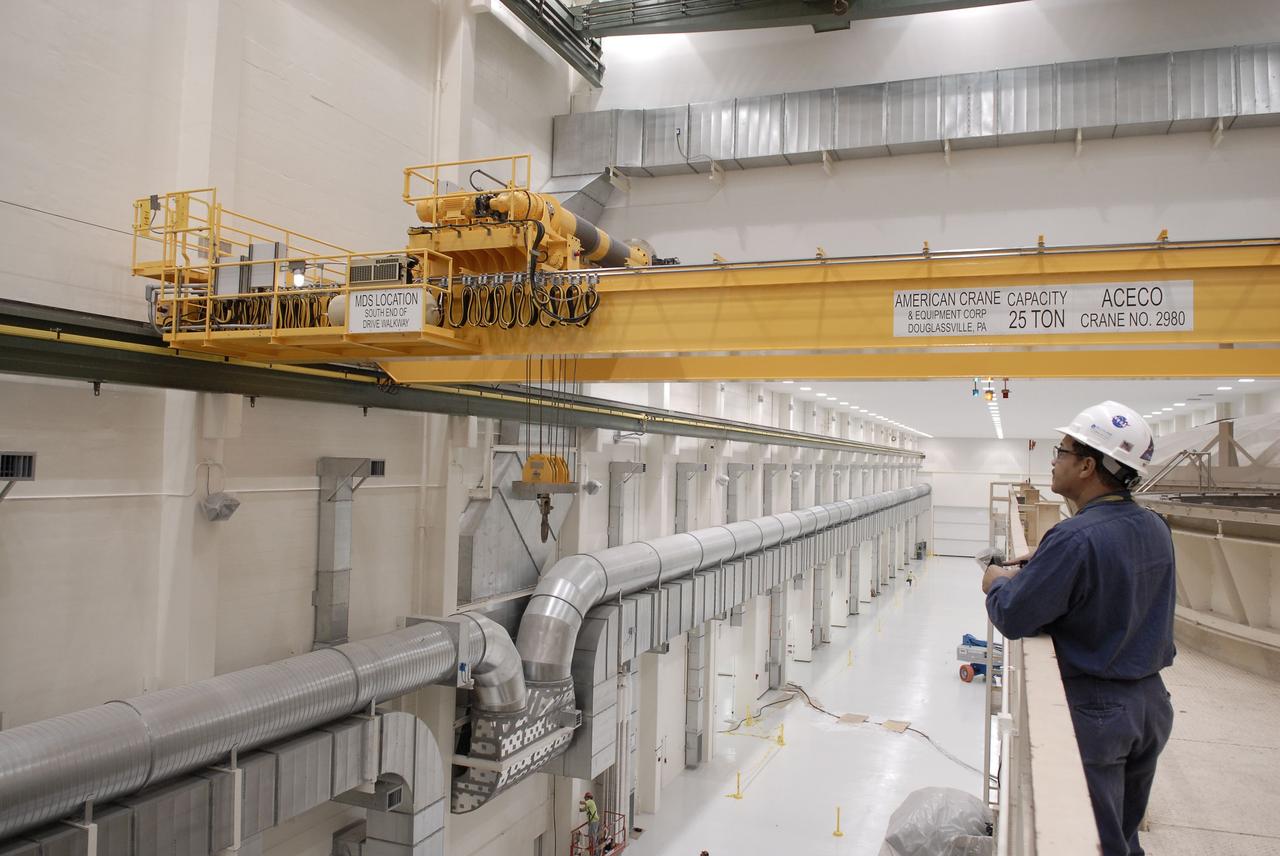
CAPE CANAVERAL, Fla. – Motion of the segments of a new crane is tested inside the Operations and Checkout Building at NASA's Kennedy Space Center in Florida. The new O&C low-bay crane is a 25-ton overhead bridge crane built for Lockheed Martin and Space Florida by American Crane and Equipment Corporation in Douglasville, Pa. The crane has a bridge span of 78’-2” and a hook height of 48’-10”. The crane will be used for lifting and moving flight hardware, fixtures and equipment in support of the Orion spacecraft manufacturing. Part of NASA's Constellation Program, the Orion spacecraft will return humans to the moon and prepare for future voyages to Mars and other destinations in our solar system. Photo credit: NASA/Kim Shiflett
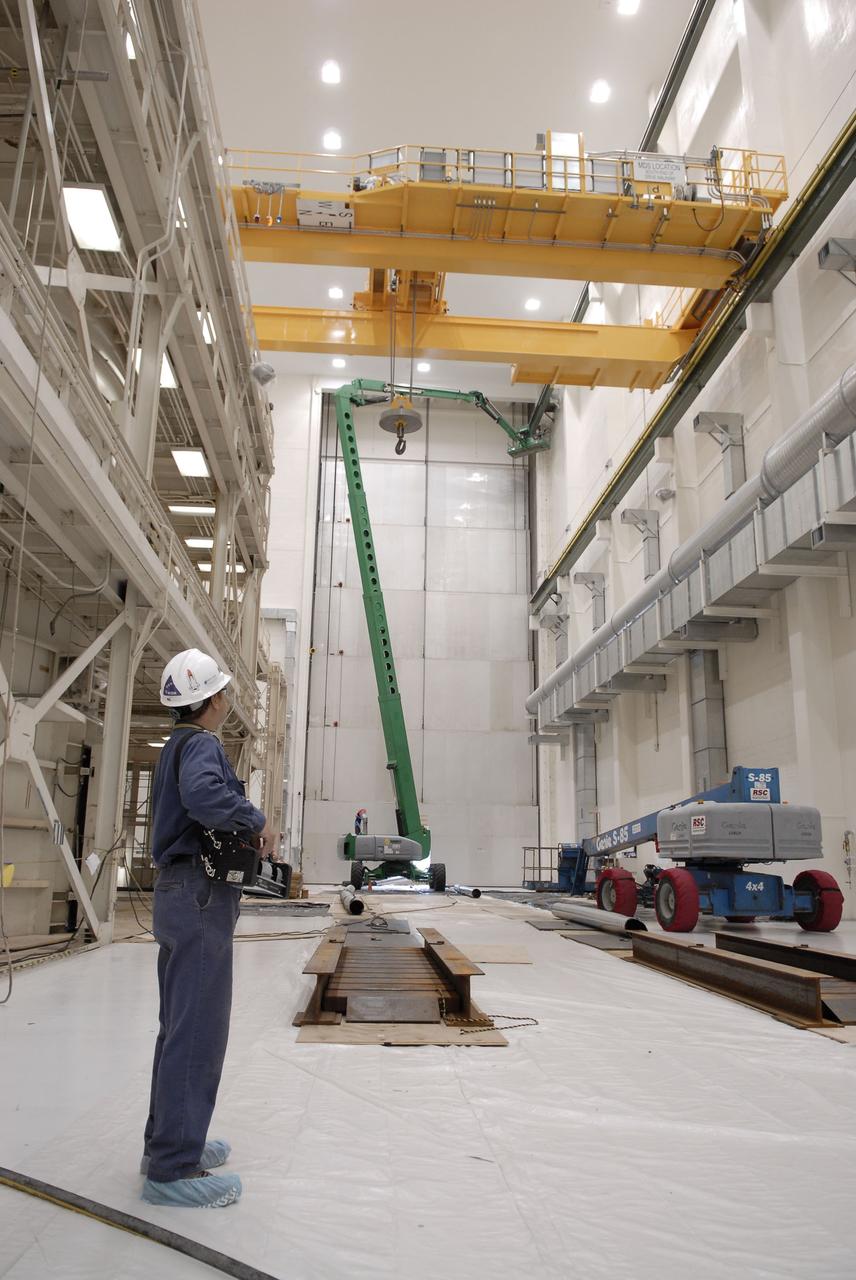
CAPE CANAVERAL, Fla. – Movement of the hook from a new crane are is tested inside the Operations and Checkout Building at NASA's Kennedy Space Center in Florida. The new O&C low-bay crane is a 25-ton overhead bridge crane built for Lockheed Martin and Space Florida by American Crane and Equipment Corporation in Douglasville, Pa. The crane has a bridge span of 78’-2” and a hook height of 48’-10”. The crane will be used for lifting and moving flight hardware, fixtures and equipment in support of the Orion spacecraft manufacturing. Part of NASA's Constellation Program, the Orion spacecraft will return humans to the moon and prepare for future voyages to Mars and other destinations in our solar system. Photo credit: NASA/Kim Shiflett
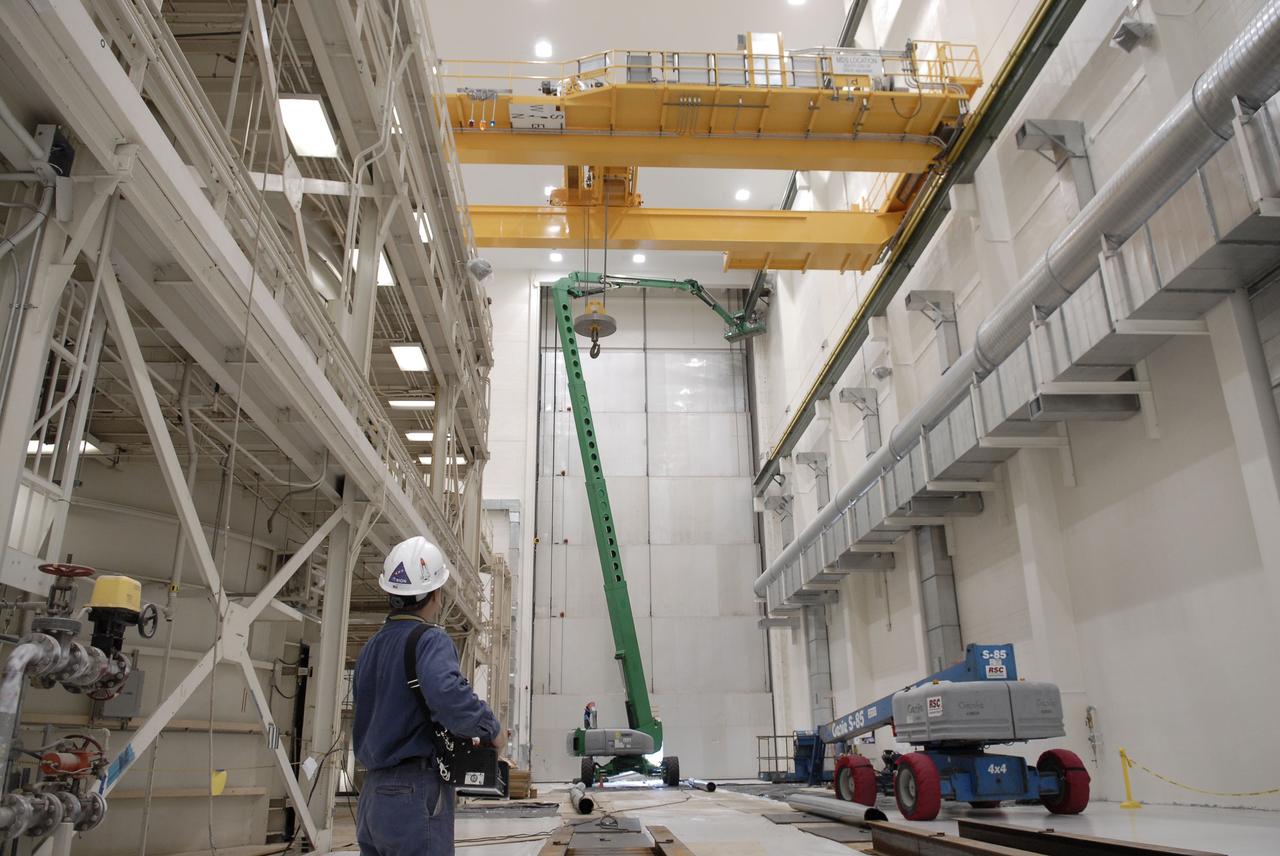
CAPE CANAVERAL, Fla. – Motion of the segments of a new crane is tested inside the Operations and Checkout Building at NASA's Kennedy Space Center in Florida. The new O&C low-bay crane is a 25-ton overhead bridge crane built for Lockheed Martin and Space Florida by American Crane and Equipment Corporation in Douglasville, Pa. The crane has a bridge span of 78’-2” and a hook height of 48’-10”. The crane will be used for lifting and moving flight hardware, fixtures and equipment in support of the Orion spacecraft manufacturing. Part of NASA's Constellation Program, the Orion spacecraft will return humans to the moon and prepare for future voyages to Mars and other destinations in our solar system. Photo credit: NASA/Kim Shiflett

At Astrotech, Titusville, Fla., an umbrella-topped crane is secured to an ORU Transfer Device (OTD), a U.S.-built crane that will be stowed on the International Space Station's Unity module for use during future ISS assembly missions. Gathered around the OTD and crane are (left to right) Ben Greene (kneeling), with Lockheed Martin; Michael Slataper, with Ratheon; Charles Franca, with Johnson Space Center; Robert Wilkes, with Lockheed Martin; Manfred Nordhoff (back to camera), with Daimler-Chrysler Aerospace (DASA); and Carl Figiel and Harald Schnier (far right), both with (DASA). The OTD will be attached to the nonpressurized International Cargo Carrier (ICC) in the background. The ICC fits inside the payload bay of the orbiter. The ICC will also carry the SPACEHAB Oceaneering Space System Box (SHOSS), a logistics items carrier. SHOSS can hold a maximum of 400 pounds of equipment and will carry items to be used during STS-96 and future ISS assembly flights. The ICC will fly on mission STS-96, targeted for launch on May 20
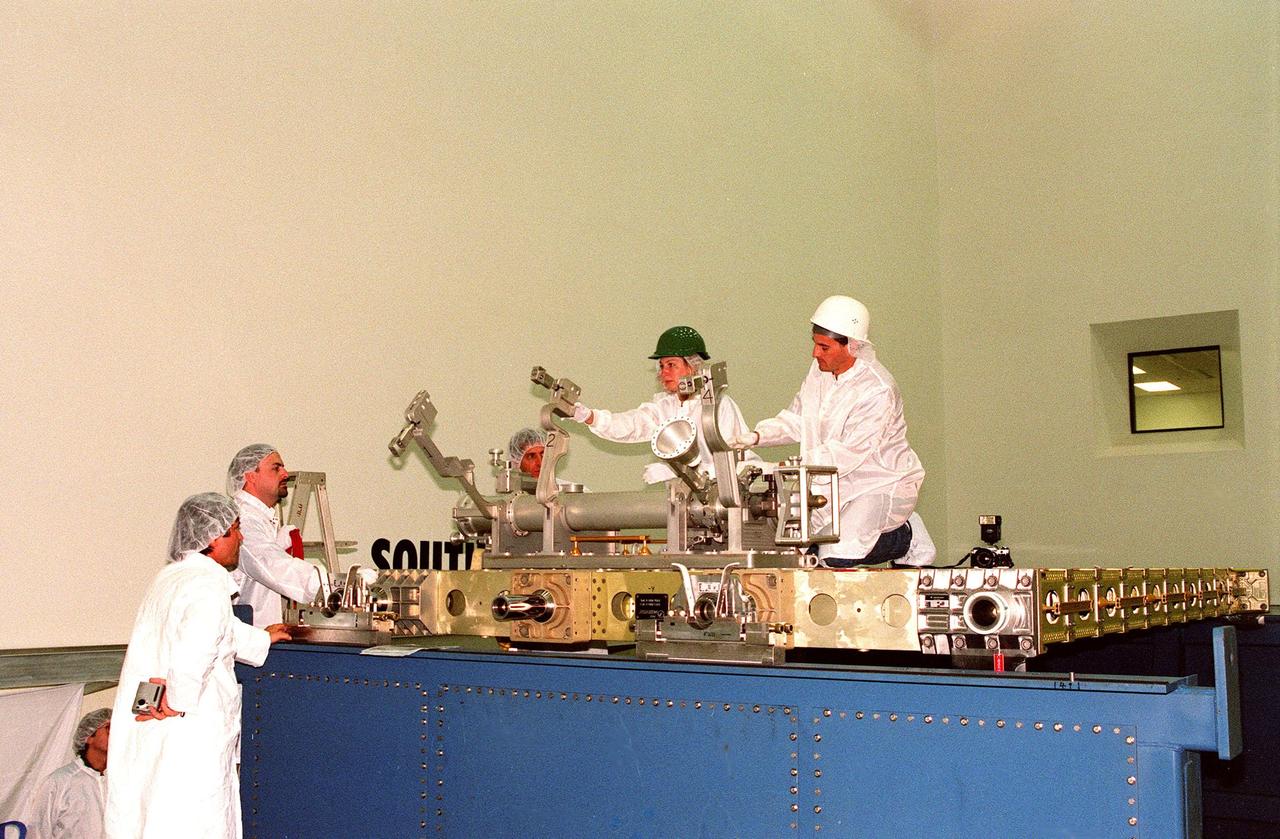
An ORU Transfer Device (OTD) on top of the International Cargo Carrier (ICC) is checked by Manfred Nordhoff, with Daimler-Chrysler Aerospace (DASA); Ben Greene, with Lockheed Martin; Robert Wilkes (behind arm number two), with Lockheed Martin; Lora Laurence and Charles Franca, with Johnson Space Center. The OTD is a U.S.-built crane that will be stowed on the International Space Station's Unity module for use during future ISS assembly missions. The nonpressurized ICC fits inside the payload bay of the orbiter. The ICC will also carry the SPACEHAB Oceaneering Space System Box (SHOSS), a logistics items carrier. SHOSS can hold a maximum of 400 pounds of equipment and will carry items to be used during STS-96 and future ISS assembly flights. The ICC will fly on mission STS-96, targeted for launch on May 20
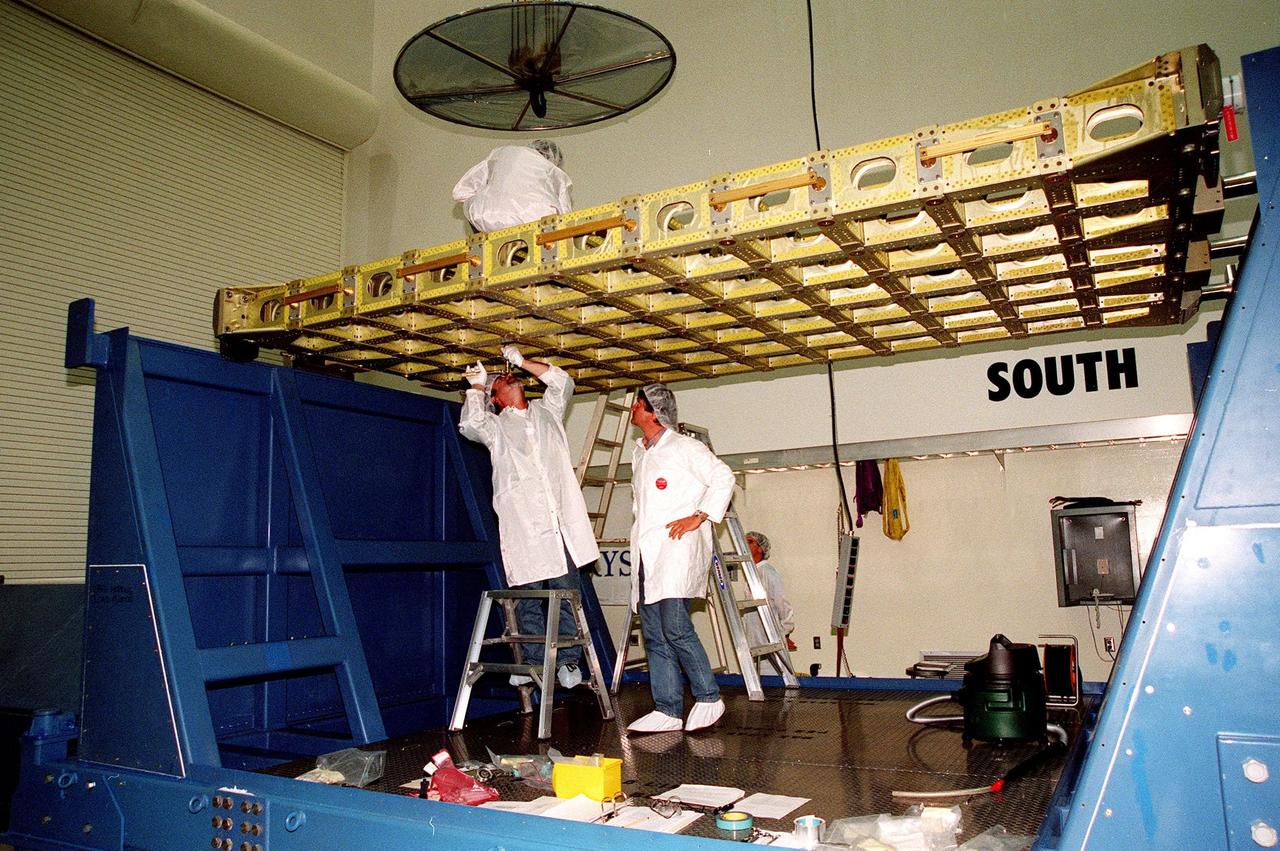
At Astrotech, Titusville, Fla., Harald Schnier and Manfred Nordhoff, with Daimler-Chrysler Aerospace (DASA), look over the International Cargo Carrier that will be used during future International Space Station (ISS) assembly missions. On top is Robert Wilkes, with Lockheed Martin. Behind the ladder in the background is Ben Greene, with Lockheed Martin. The nonpressurized ICC fits inside the payload bay of the orbiter. The ICC will carry the SPACEHAB Oceaneering Space System Box (SHOSS), a logistics items carrier. SHOSS can hold a maximum of 400 pounds of equipment and will carry items to be used during STS-96 and future ISS assembly flights. Also aboard the ICC will be the ORU Transfer Device (OTD), a U.S.-built crane that will be stowed on Unity for use during future ISS assembly missions. The ICC will fly on mission STS-96, targeted for launch on May 20
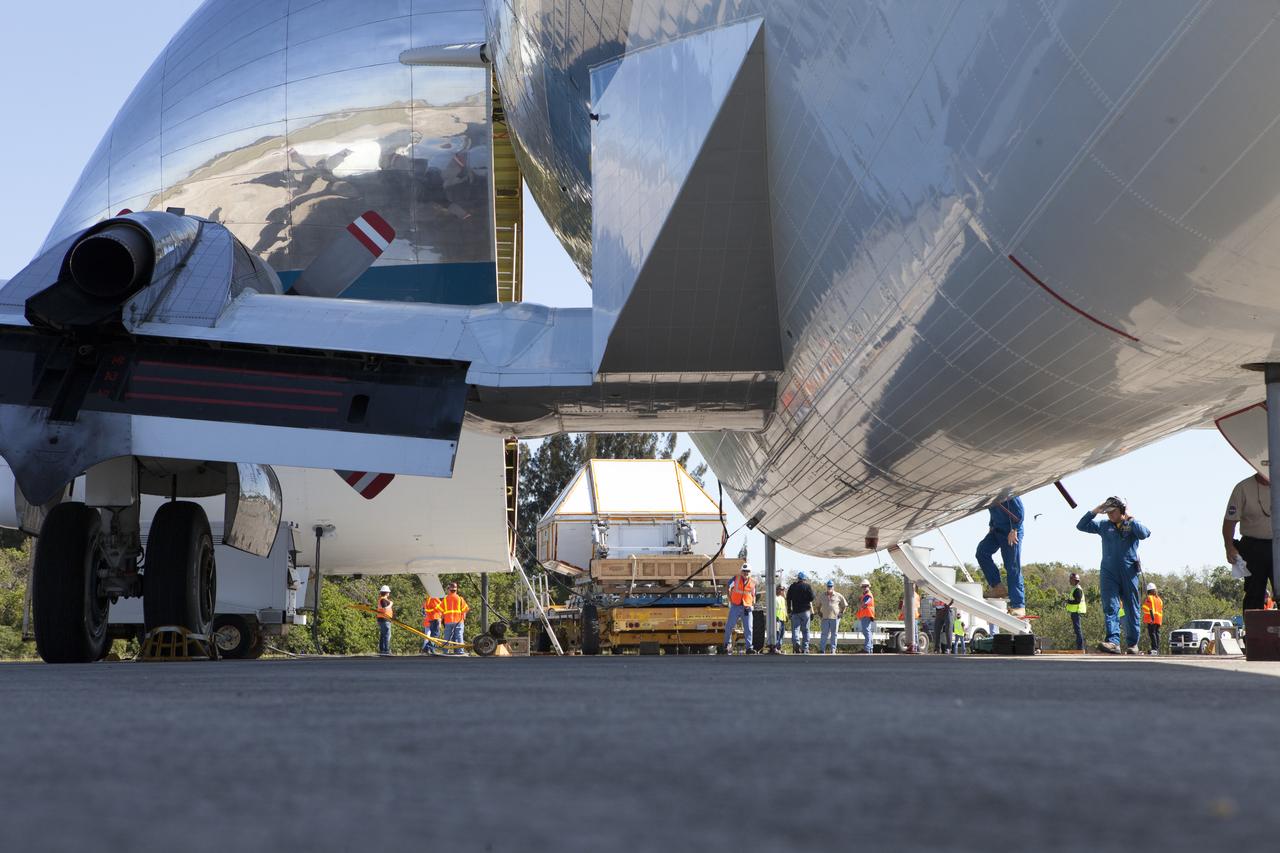
A view from beneath NASA's Super Guppy aircraft at the Shuttle Landing Facility at NASA's Kennedy Space Center in Florida. The Orion Exploration Mission-1 (EM-1) structural test article, secured inside its transport container, is lifted by crane from its transport vehicle and will be loaded into the Super Guppy for transport to Lockheed Martin's Denver facility where it will undergo testing. The Orion spacecraft will launch atop NASA’s Space Launch System rocket on EM-1, its first deep space mission.
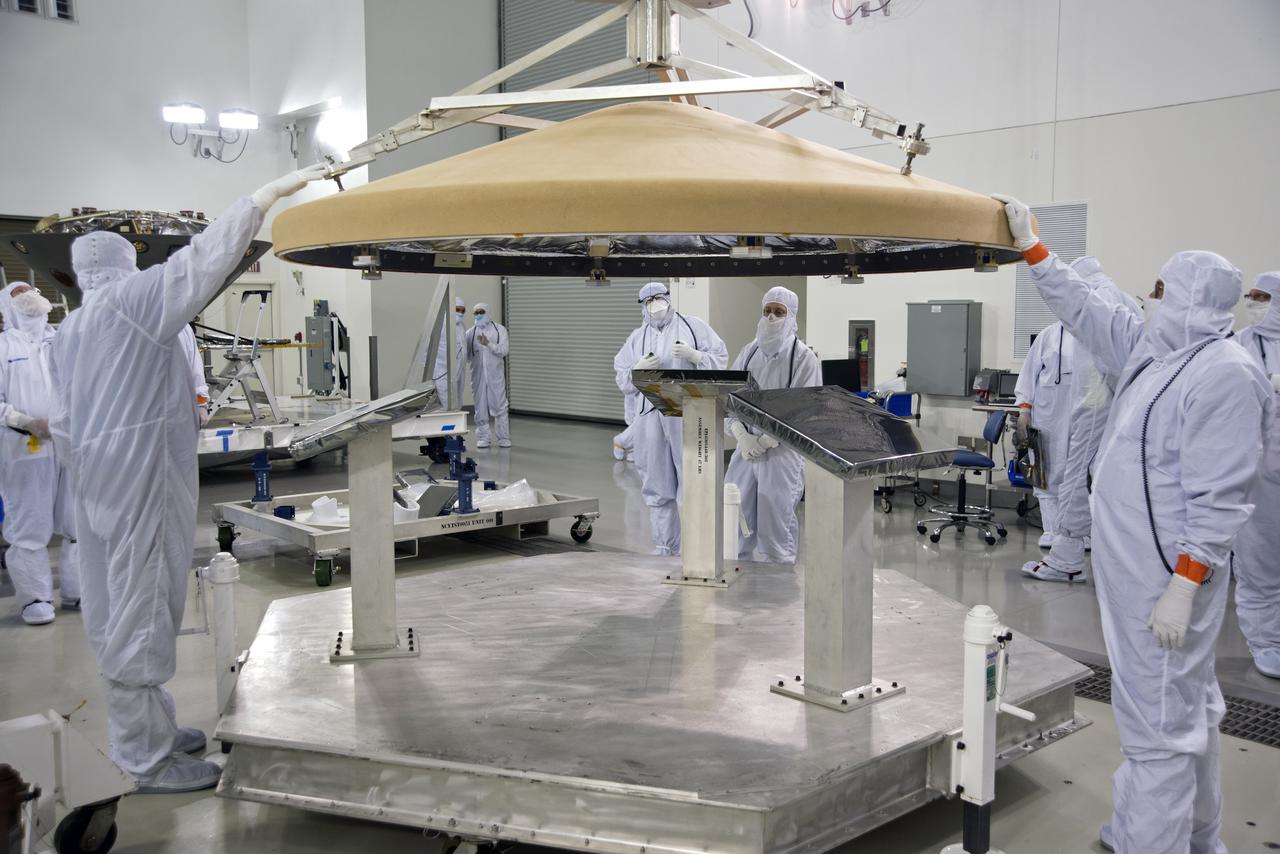
Inside the Astrotech processing facility at Vandenberg Air Force Base in California, technicians and engineers use a crane to move the heatshield for NASA's Interior Exploration using Seismic Investigations, Geodesy and Heat Transport, or InSight, spacecraft for further testing. InSight was developed and built by Lockheed-Martin Space Systems in Denver, Colorado, and is scheduled for liftoff is May 5, 2018. InSight is the first mission to land on Mars and explore the Red Planet's deep interior. It will investigate processes that shaped the rocky planets of the inner solar system including Earth.
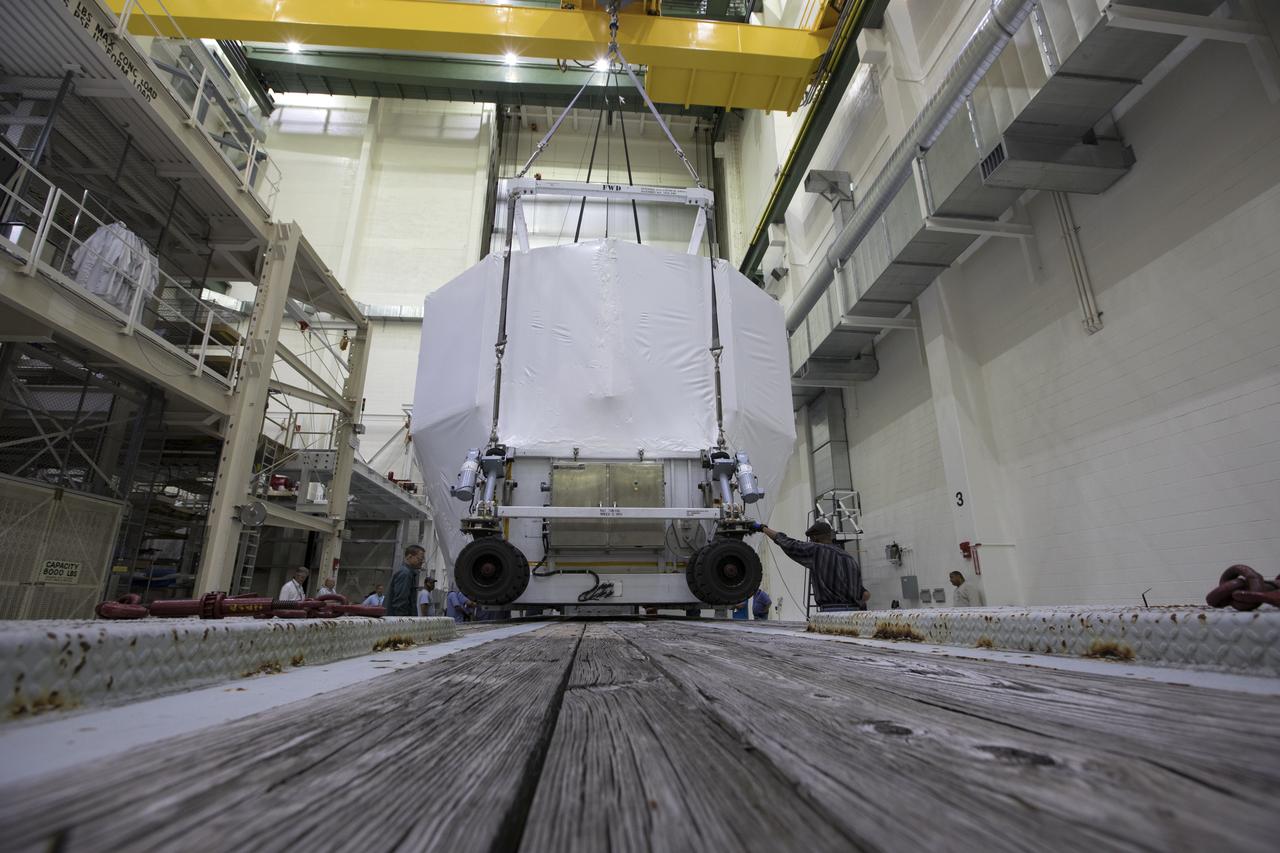
The Orion service module structural test article for Exploration Mission-1 (EM-1), built by the European Space Agency, is prepared for shipment to Lockheed Martin's Denver facility to undergo testing. Inside the Neil Armstrong Operations and Checkout Building high bay at NASA's Kennedy Space Center in Florida, a crane lifts the module, secured on a stand, for the move to the transport truck. The Orion spacecraft will launch atop the agency's Space Launch System rocket on EM-1 in 2019.
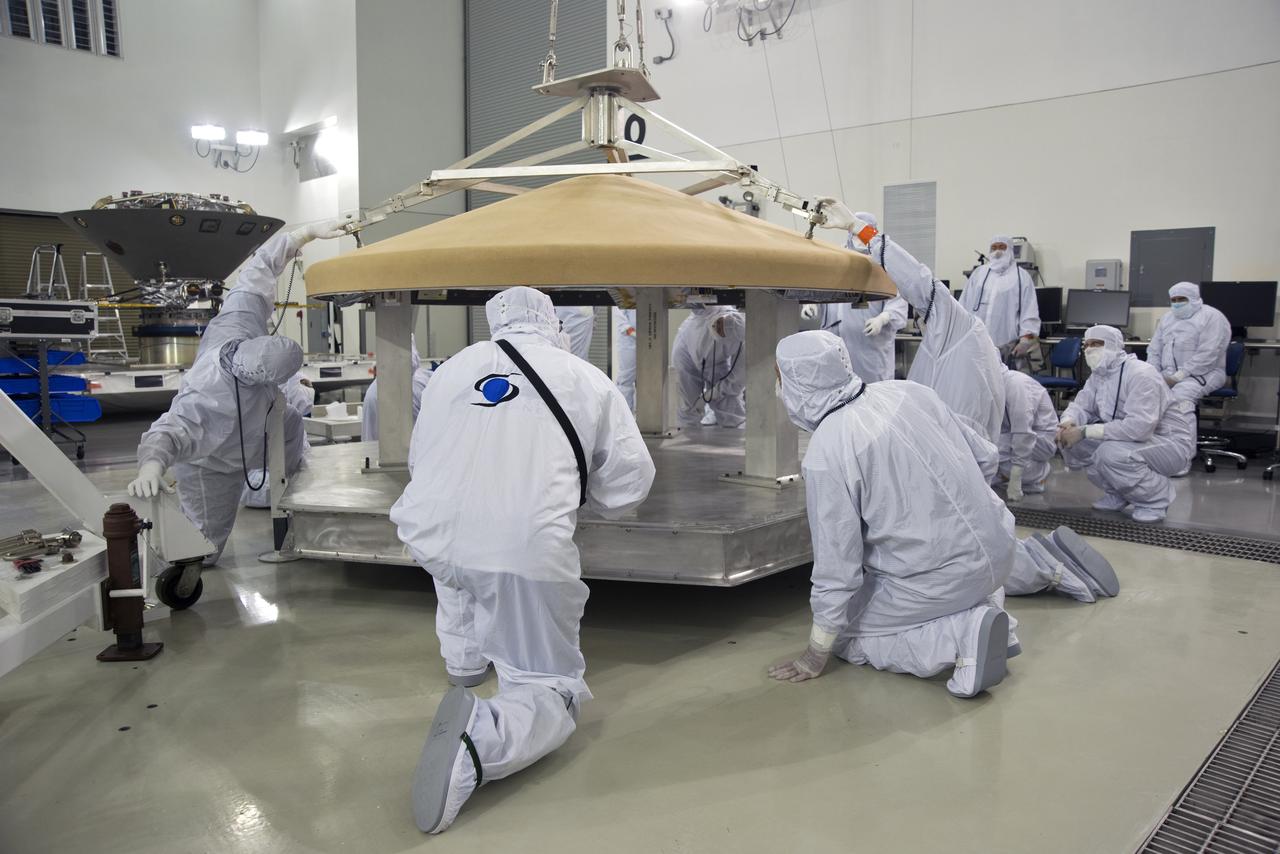
Inside the Astrotech processing facility at Vandenberg Air Force Base in California, technicians and engineers use a crane to move the heatshield for NASA's Interior Exploration using Seismic Investigations, Geodesy and Heat Transport, or InSight, spacecraft for further testing. InSight was developed and built by Lockheed-Martin Space Systems in Denver, Colorado, and is scheduled for liftoff is May 5, 2018. InSight is the first mission to land on Mars and explore the Red Planet's deep interior. It will investigate processes that shaped the rocky planets of the inner solar system including Earth.
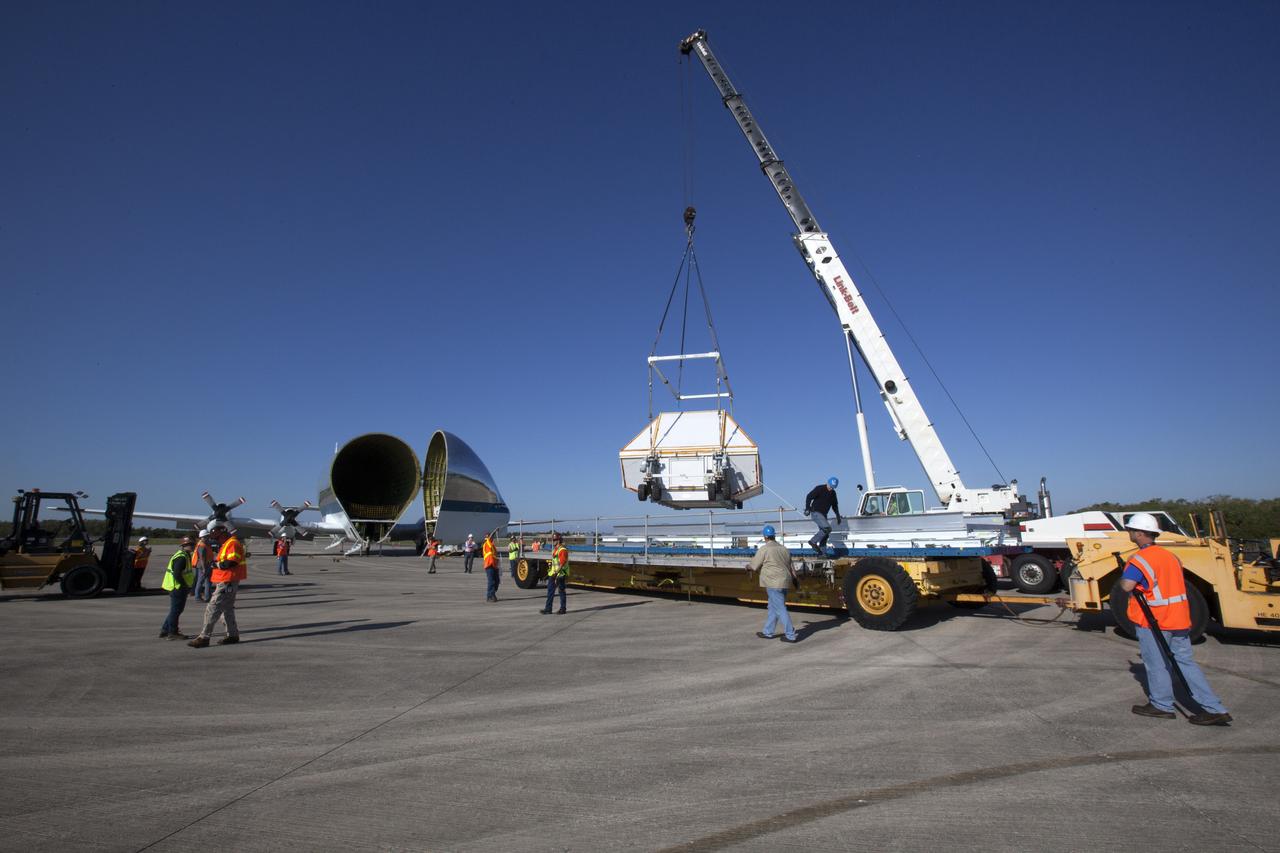
The Orion Exploration Mission-1 (EM-1) structural test article, secured inside its transport container, is lifted up by crane from its transport vehicle at the Shuttle Landing Facility at NASA's Kennedy Space Center in Florida. The test article will be loaded into NASA's Super Guppy aircraft, in view at left, and transported to Lockheed Martin's Denver facility for testing. The Orion spacecraft will launch atop NASA’s Space Launch System rocket on EM-1, its first deep space mission.
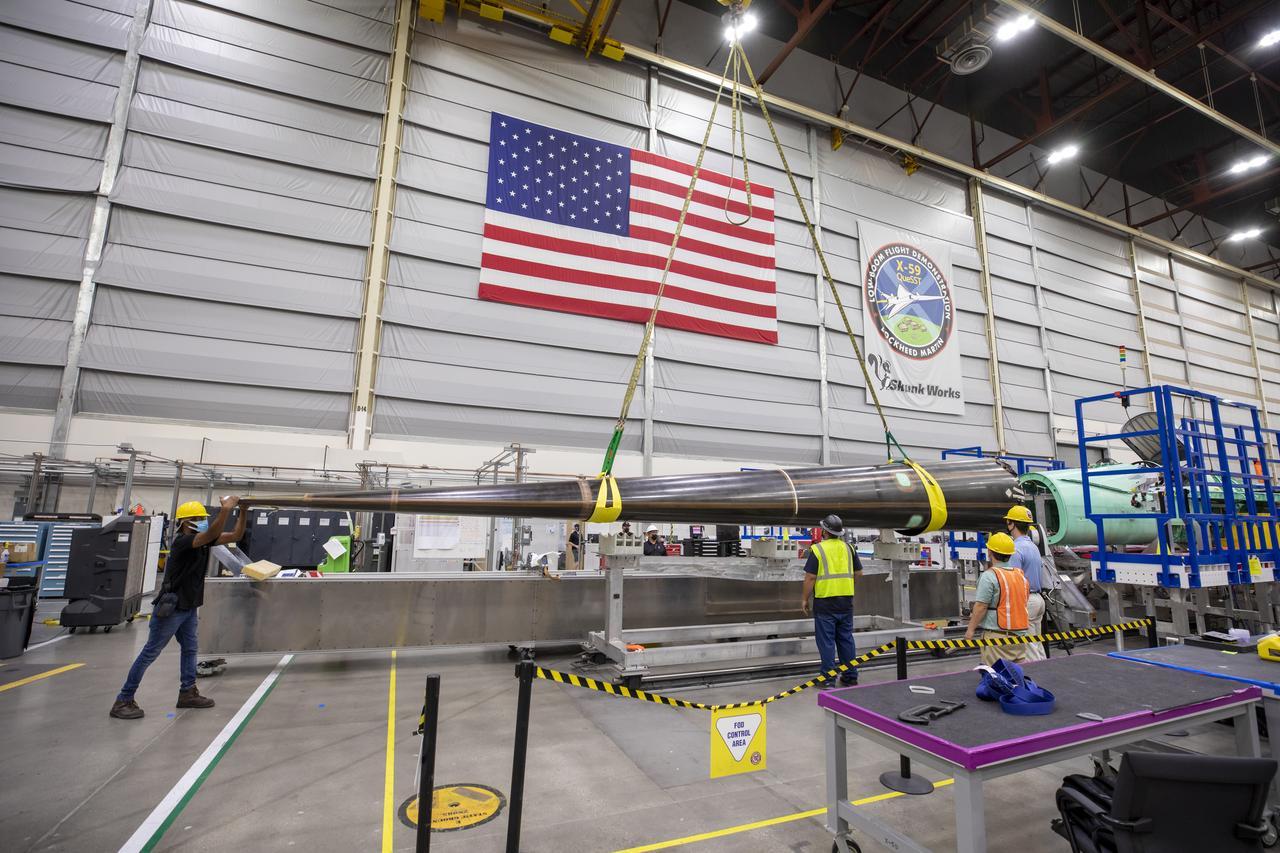
Event: SEG 230 Nose - Craned Onto Tooling A close up of the X-59’s duckbill nose, which is a crucial part of its supersonic design shaping. The team prepares the nose for a fit check. The X-59’s nose is 38-feet long – approximately one third of the length of the entire aircraft. The aircraft, under construction at Lockheed Martin Skunk Works in Palmdale, California, will demonstrate the ability to fly supersonic while reducing the loud sonic boom to a quiet sonic thump.
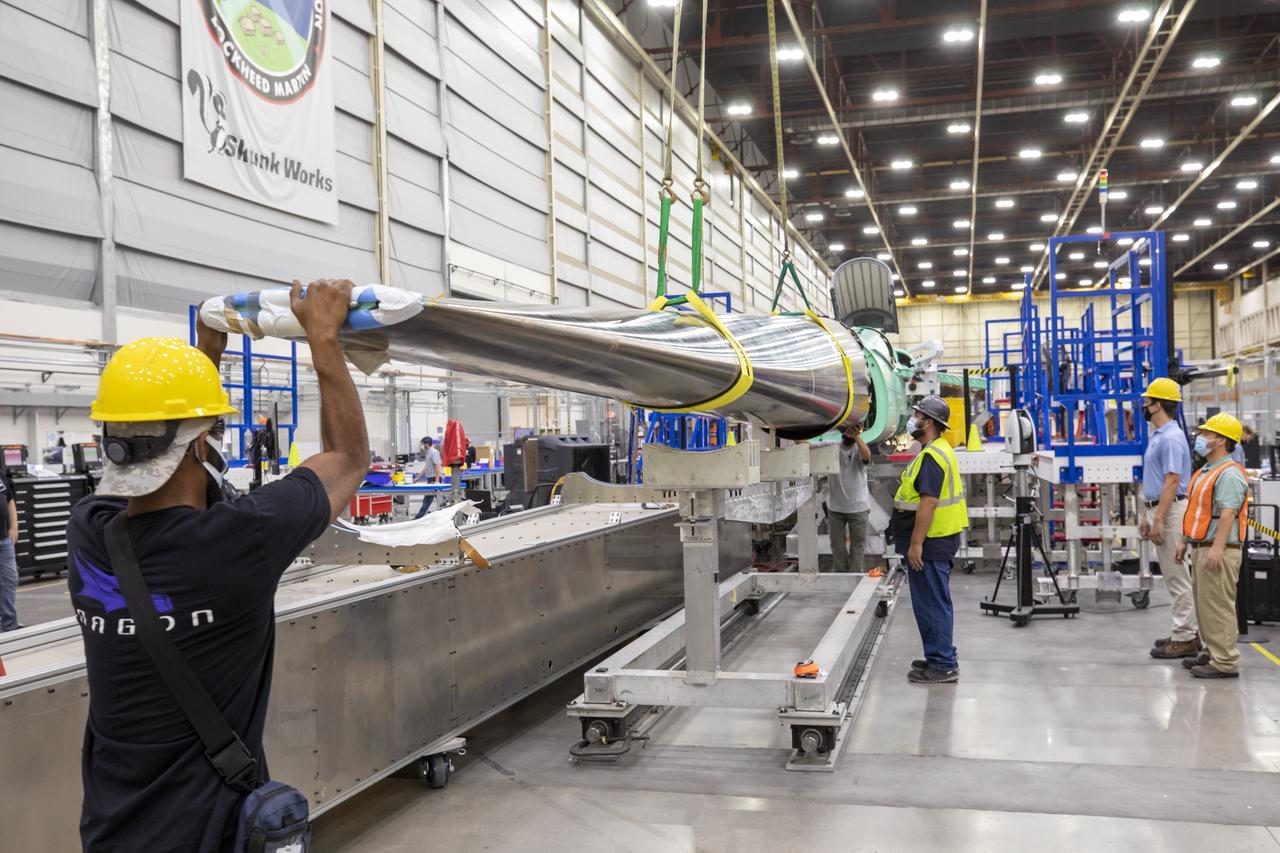
Event: SEG 230 Nose - Craned Onto Tooling A close-up of the X-59’s duckbill nose, which is a crucial part of its supersonic design shaping. The team prepares the nose for a fit check. The X-59’s nose is 38-feet long – approximately one third of the length of the entire aircraft. The aircraft, under construction at Lockheed Martin Skunk Works in Palmdale, California, will demonstrate the ability to fly supersonic while reducing the loud sonic boom to a quiet sonic thump.
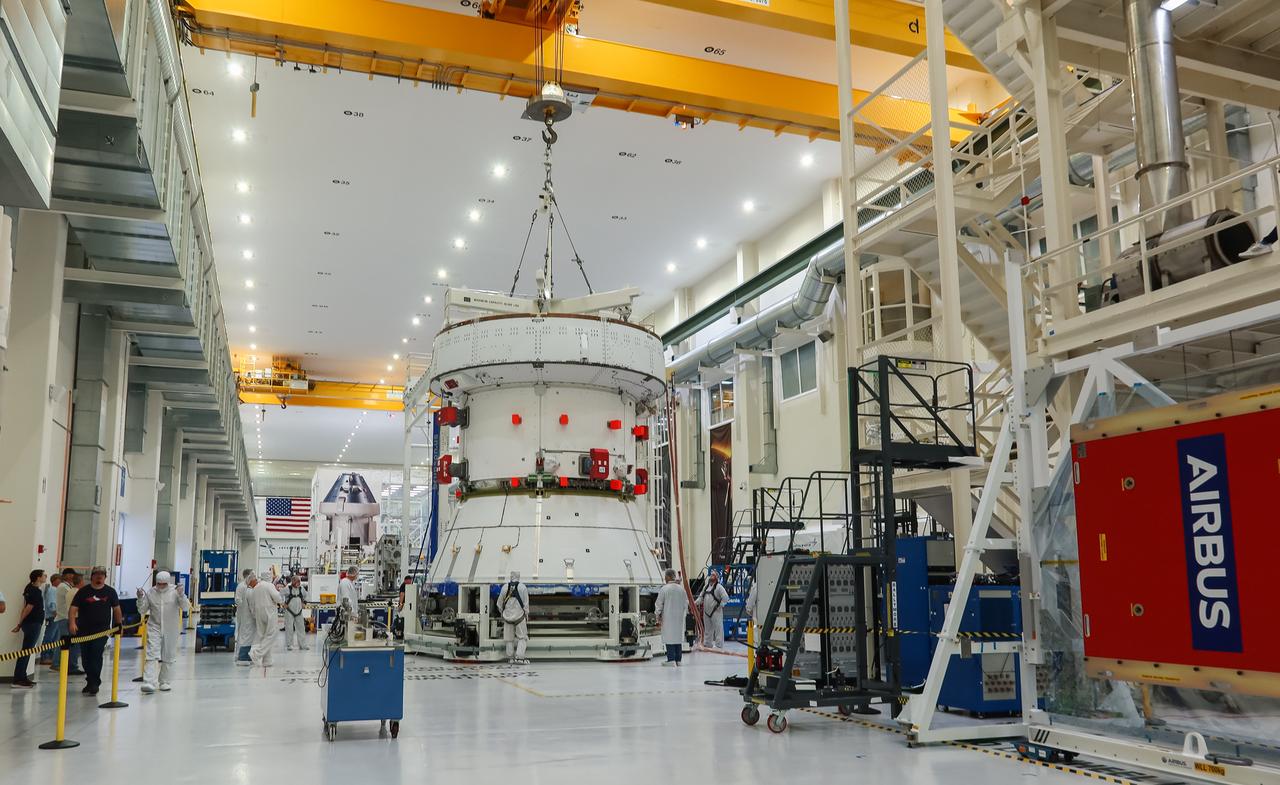
The European Service Module (ESM) for NASA’s Artemis II mission is lifted by crane inside the high bay of the Neil A. Armstrong Operations and Checkout Building at NASA’s Kennedy Space Center in Florida on May 22, 2023. Teams from NASA and Lockheed Martin are preparing the service module for transfer to the FAST (final assembly and system testing) cell for final checkouts before it is stacked with the Orion crew module. The powerhouse that will fuel and propel Orion in space, the ESM will be used for Artemis II, the first Artemis mission flying crew aboard Orion.
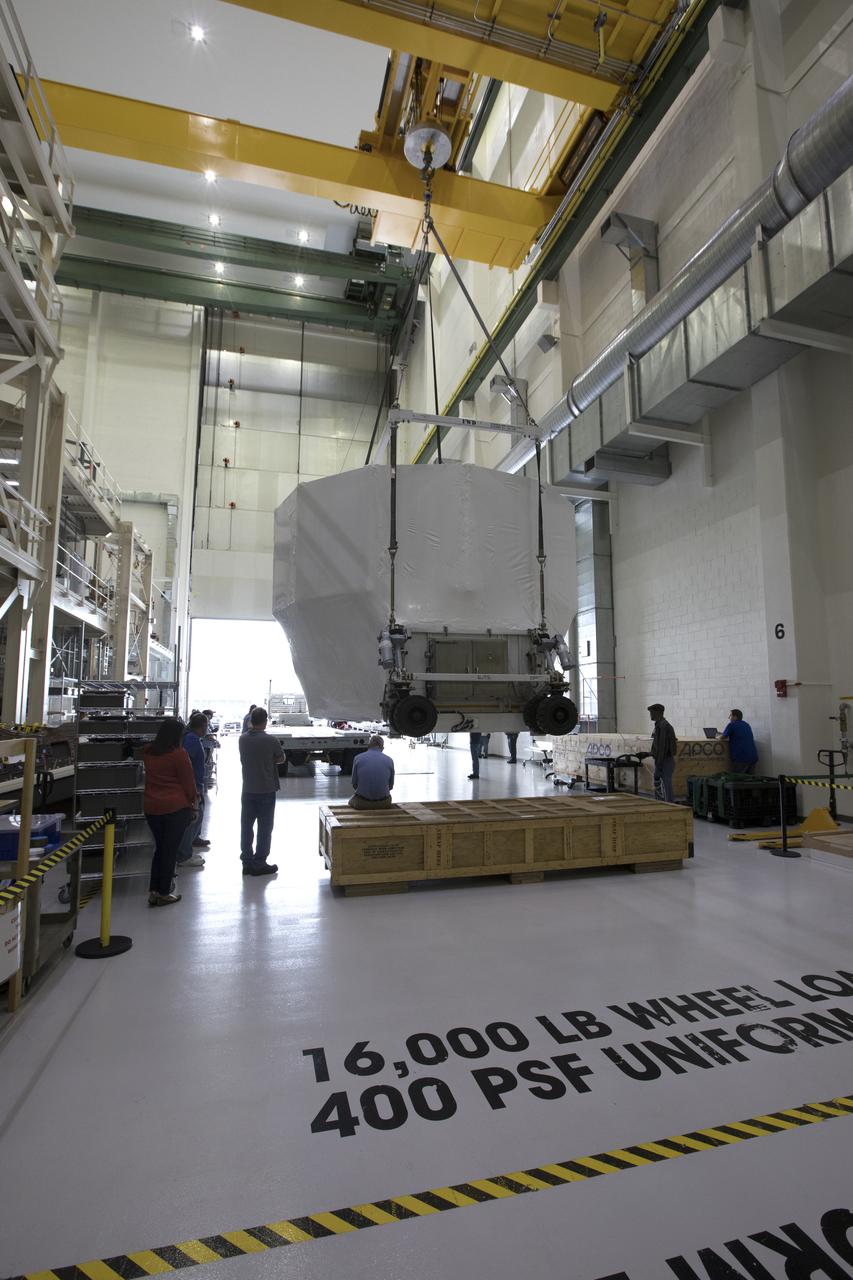
The Orion service module structural test article for Exploration Mission-1 (EM-1), built by the European Space Agency, is prepared for shipment to Lockheed Martin's Denver facility to undergo testing. Inside the Neil Armstrong Operations and Checkout Building high bay at NASA's Kennedy Space Center in Florida, a crane lifts the module, secured on a stand, for the move to the transport truck. The Orion spacecraft will launch atop the agency's Space Launch System rocket on EM-1 in 2019.
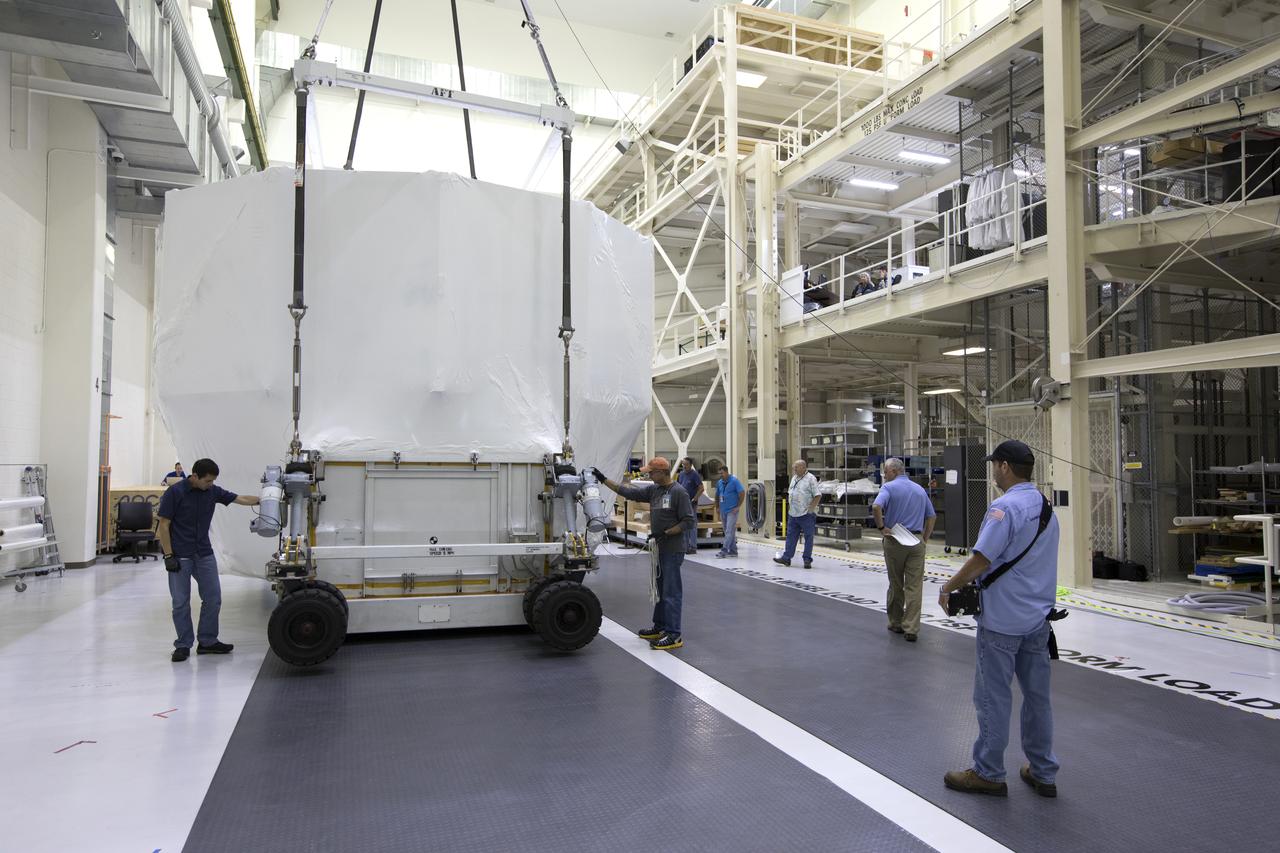
The Orion service module structural test article for Exploration Mission-1 (EM-1), built by the European Space Agency, is prepared for shipment to Lockheed Martin's Denver facility to undergo testing. Inside the Neil Armstrong Operations and Checkout Building high bay at NASA's Kennedy Space Center in Florida, workers secure the protective covering around the module and a crane lifts the module, secured on stand, for the move to the transport truck. The Orion spacecraft will launch atop the agency's Space Launch System rocket on EM-1 in 2019.
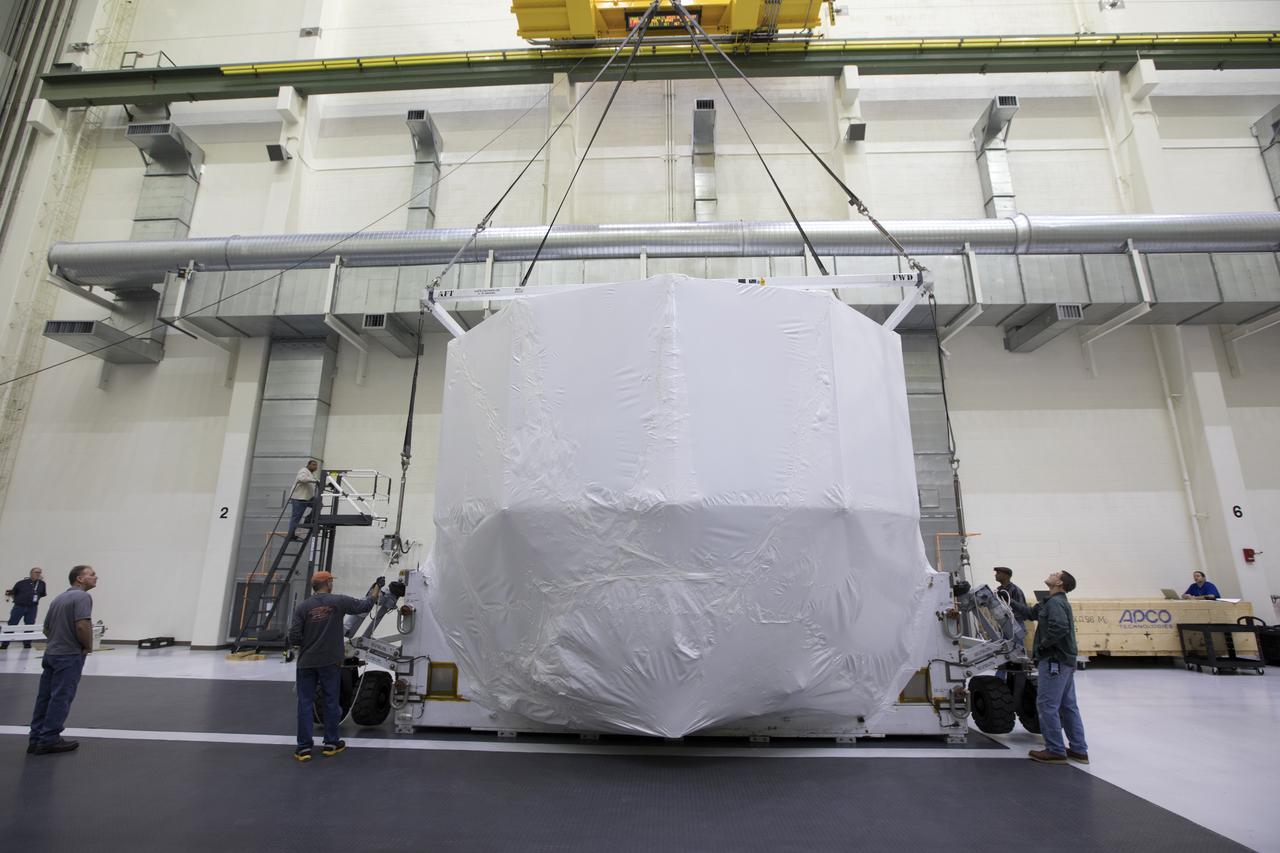
The Orion service module structural test article for Exploration Mission-1 (EM-1), built by the European Space Agency, is prepared for shipment to Lockheed Martin's Denver facility to undergo testing. Inside the Neil Armstrong Operations and Checkout Building high bay at NASA's Kennedy Space Center in Florida, workers secure the protective covering around the module and a crane is used to lower it onto a stand. The Orion spacecraft will launch atop the agency's Space Launch System rocket on EM-1 in 2019.
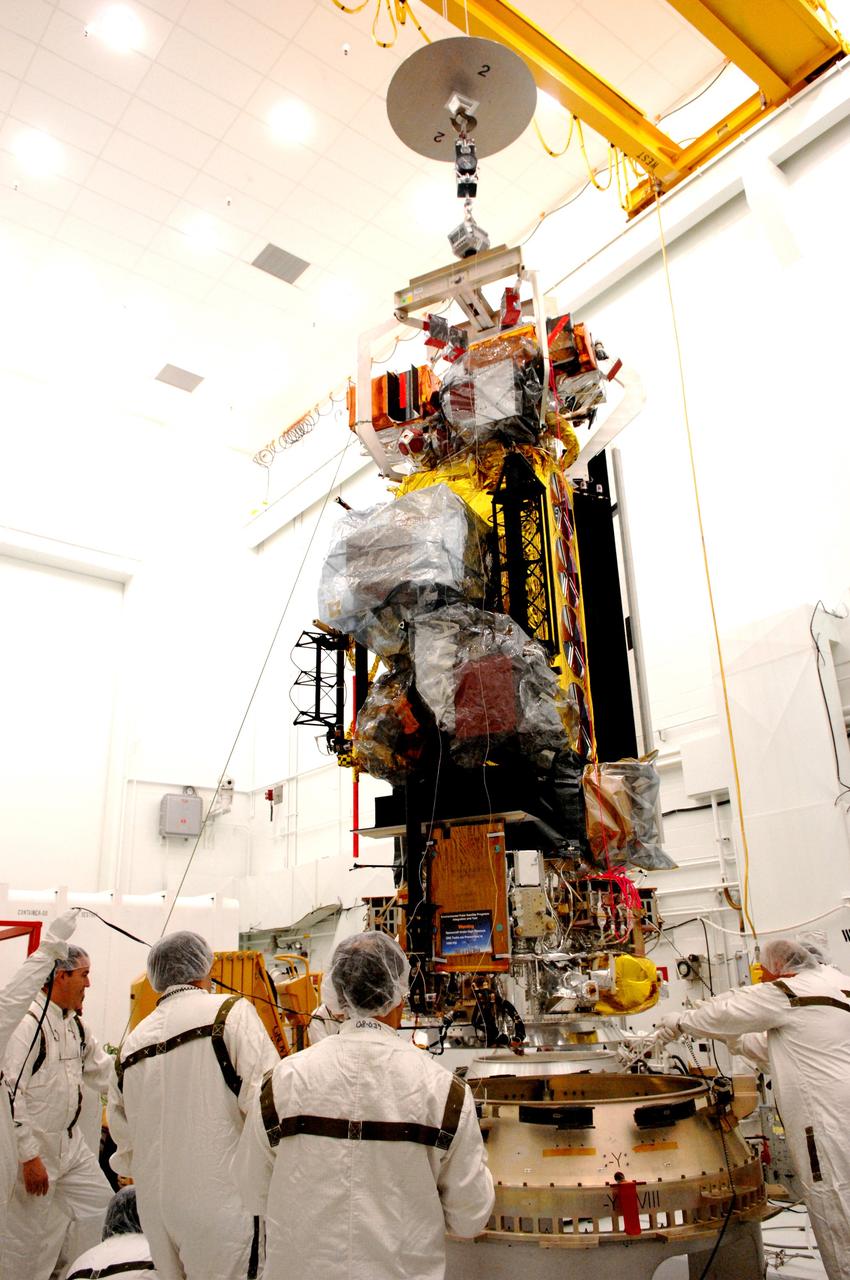
VANDENBERG AIR FORCE BASE, Calif. – Inside the payload processing facility at Vandenberg Air Force Base in California, an overhead crane moves the NOAA-N Prime satellite to a stand. NOAA-N Prime is built by Lockheed Martin and similar to NOAA-N launched on May 20, 2005. Launch of NOAA-N Prime is scheduled for Feb. 4. Photo credit: NASA

Inside the Astrotech processing facility at Vandenberg Air Force Base in California, technicians and engineers use a crane to move the heatshield for NASA's Interior Exploration using Seismic Investigations, Geodesy and Heat Transport, or InSight, spacecraft for further testing. InSight was developed and built by Lockheed-Martin Space Systems in Denver, Colorado, and is scheduled for liftoff is May 5, 2018. InSight is the first mission to land on Mars and explore the Red Planet's deep interior. It will investigate processes that shaped the rocky planets of the inner solar system including Earth.
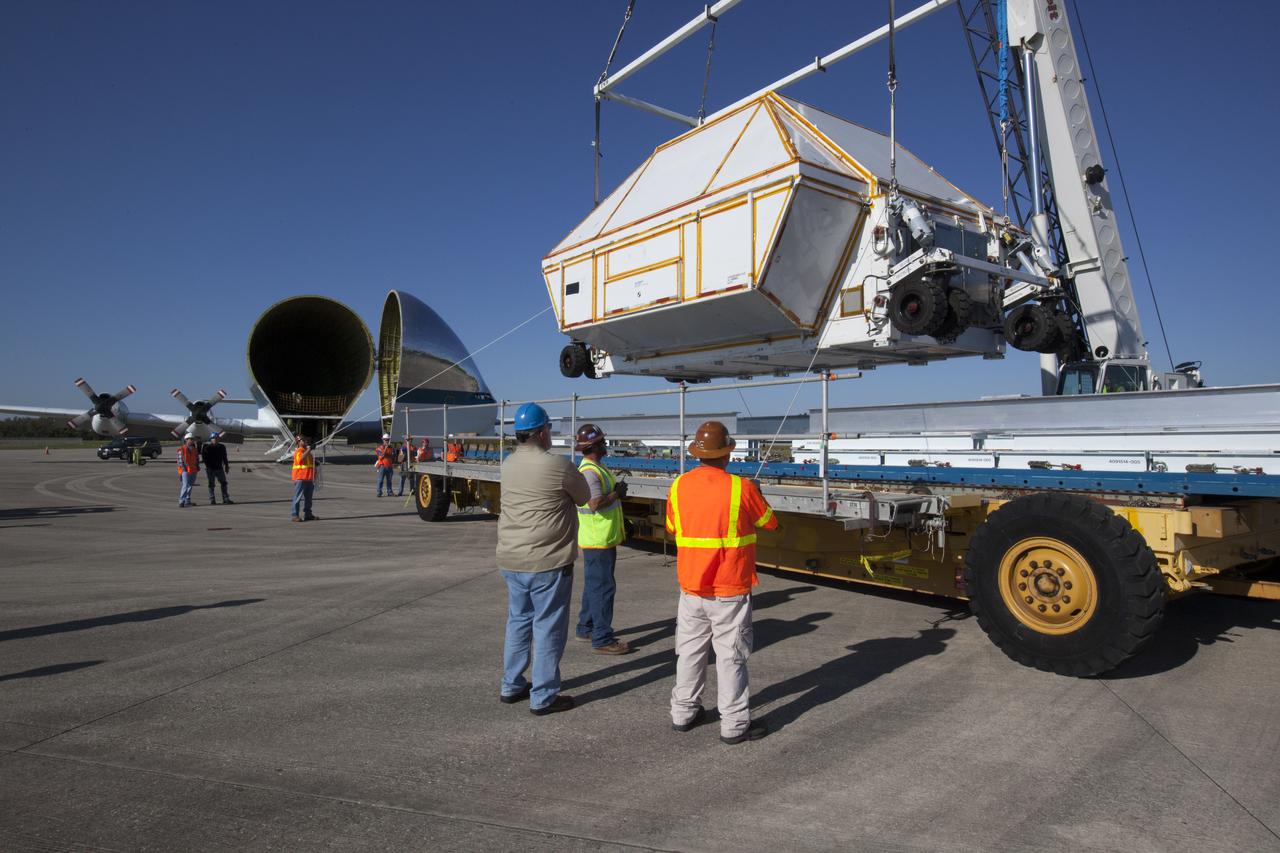
The Orion Exploration Mission-1 (EM-1) structural test article, secured inside its transport container, is lifted up by crane from its transport vehicle at the Shuttle Landing Facility at NASA's Kennedy Space Center in Florida. The test article will be loaded into NASA's Super Guppy aircraft, in view at left, and transported to Lockheed Martin's Denver facility for testing. The Orion spacecraft will launch atop NASA’s Space Launch System rocket on EM-1, its first deep space mission.
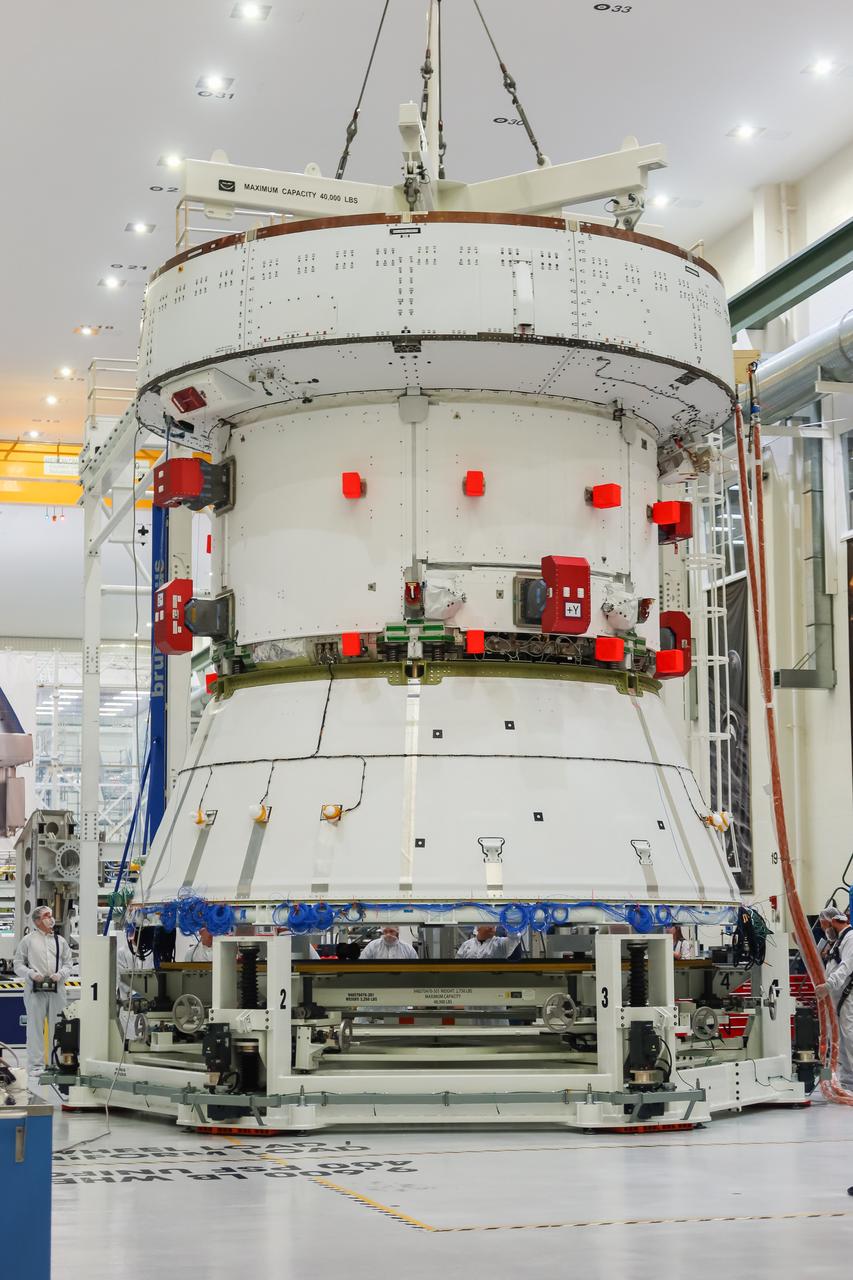
The European Service Module (ESM) for NASA’s Artemis II mission is lifted by crane inside the high bay of the Neil A. Armstrong Operations and Checkout Building at NASA’s Kennedy Space Center in Florida on May 22, 2023. Teams from NASA and Lockheed Martin are preparing the service module for transfer to the FAST (final assembly and system testing) cell for final checkouts before it is stacked with the Orion crew module. The powerhouse that will fuel and propel Orion in space, the ESM will be used for Artemis II, the first Artemis mission flying crew aboard Orion.
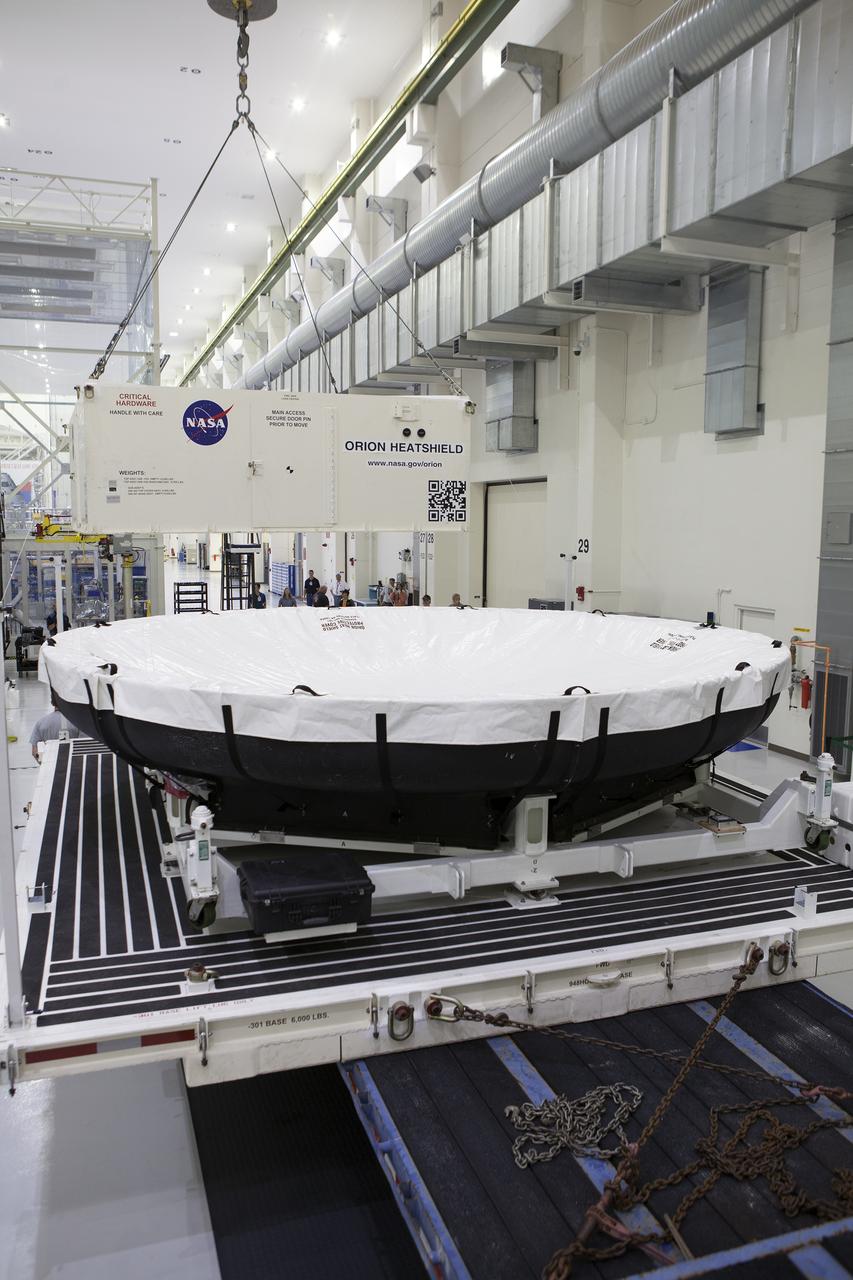
Inside the Neil Armstrong Operations and Checkout Building high bay at NASA’s Kennedy Space Center in Florida, a crane removes the top of the shipping container carrying the Orion heat shield for Exploration Mission 1 (EM-1) The heat shield arrived aboard the agency’s Super Guppy aircraft at the Shuttle Landing Facility, managed and operated by Space Florida, from Lockheed Martin’s manufacturing facility near Denver. The heat shield will be offloaded and moved into the high bay for processing. The Orion spacecraft will launch atop NASA’s Space Launch System rocket on EM-1, an uncrewed test flight, in 2018.
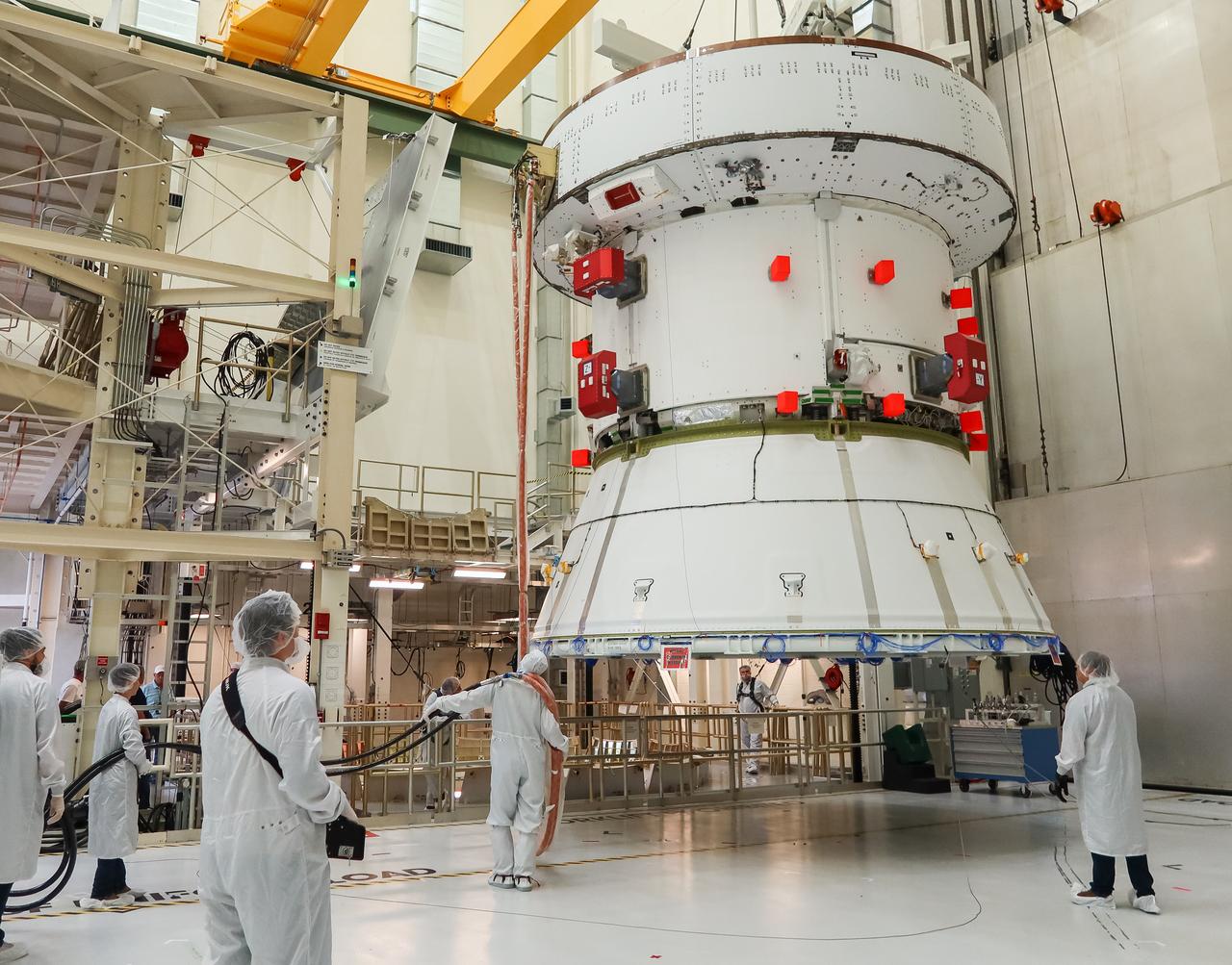
A crane moves the European Service Module (ESM) for NASA’s Artemis II mission along the center aisle of the high bay inside the Neil A. Armstrong Operations and Checkout Building at NASA’s Kennedy Space Center in Florida on May 22, 2023. Teams from NASA and Lockheed Martin are transferring the service module to the FAST (final assembly and system testing) cell for final checkouts before it is stacked with the Orion crew module.. The powerhouse that will fuel and propel Orion in space, the ESM will be used for Artemis II, the first Artemis mission flying crew aboard Orion.
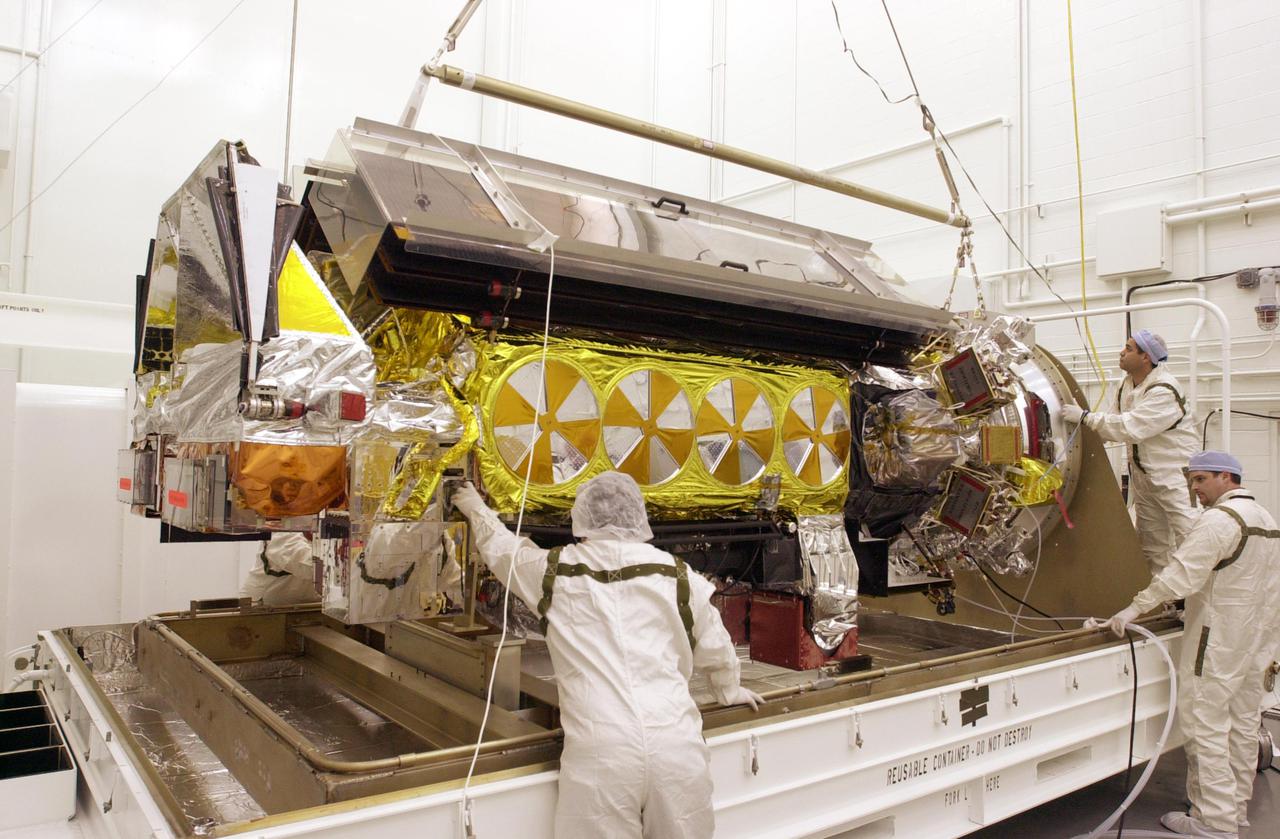
VANDENBERG AIR FORCE BASE, CALIF. - Inside the NASA spacecraft processing hangar 1610 located on North Vandenberg Air Force Base in California, Lockheed Martin workers attach a crane to lift the National Oceanic and Atmospheric Administration (NOAA-N) spacecraft from its shipping container and move it to an assembly and test stand. It will be mated to the Delta II payload attach fitting. Launch of NOAA-N aboard the Boeing Delta II rocket is currently scheduled for May 11, 2005. NOAA-N is the fourth in the series of support dedicated microwave instruments for the generation of temperature, moisture, surface, and hydrological products in cloudy regions where visible and infrared (IR) instruments have decreased capability.

Engineers and technicians monitor the progress as the European Service Module (ESM) for NASA’s Artemis II mission is lifted by crane inside the high bay of the Neil A. Armstrong Operations and Checkout Building at NASA’s Kennedy Space Center in Florida on May 22, 2023. Teams from NASA and Lockheed Martin are preparing the service module for transfer to the FAST (final assembly and system testing) cell for final checkouts before it is stacked with the Orion crew module.. The powerhouse that will fuel and propel Orion in space, the ESM will be used for Artemis II, the first Artemis mission flying crew aboard Orion.
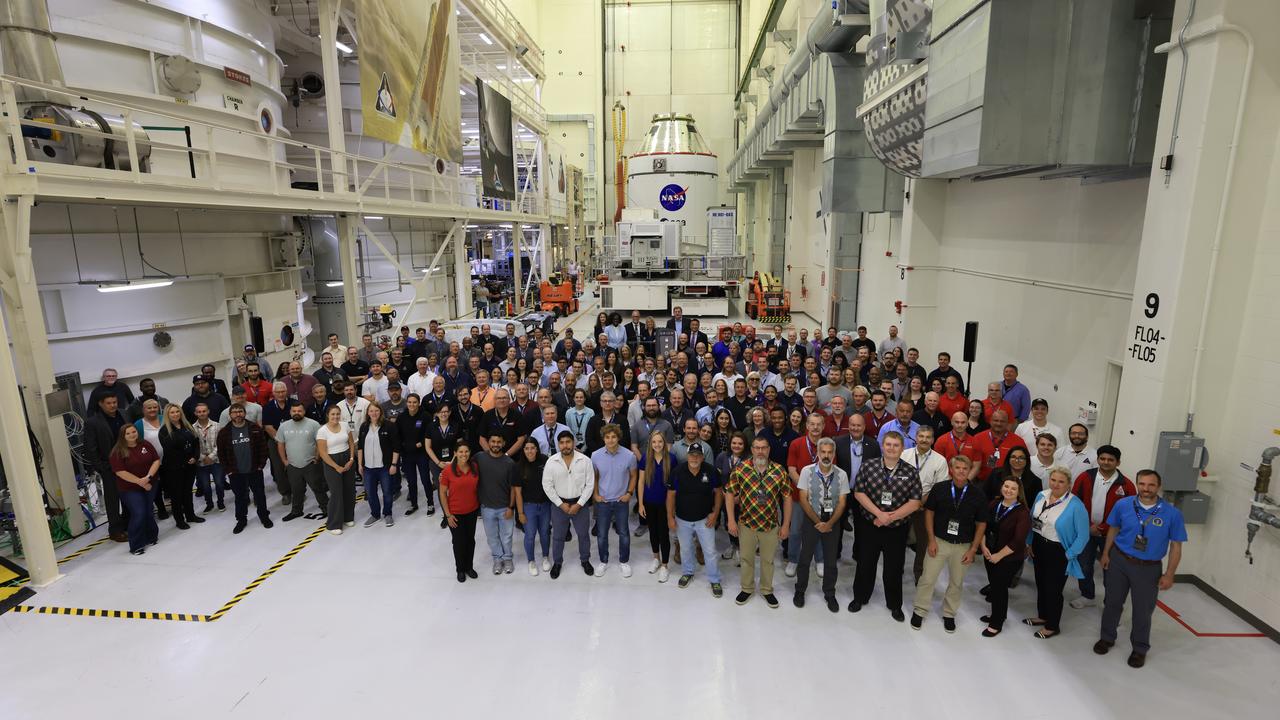
Teams from NASA and Lockheed Martin pose for a photo in front of NASA’s Artemis II Orion spacecraft, connected to a massive crane ahead atop the agency’s KAMAG transporter inside the Neil A. Operations and Checkout Building at NASA’s Kennedy Space Center in Florida on Friday, May 2, 2025. The spacecraft will be transported to the spaceport’s Multi-Payload Processing Facility to undergo fueling and processing for prelaunch operations. The Artemis II test flight is the first crewed flight under NASA’s Artemis campaign and is another step toward missions on the lunar surface and helping the agency prepare for future human missions to Mars.
The European Service Module (ESM) for NASA’s Artemis II mission is lifted by crane and moved along the center aisle of the high bay inside the Neil A. Armstrong Operations and Checkout Building at NASA’s Kennedy Space Center in Florida on May 22, 2023. Teams from NASA and Lockheed Martin are preparing the service module for transfer to the FAST (final assembly and system testing) cell for final checkouts before it is stacked with the Orion crew module.. The powerhouse that will fuel and propel Orion in space, the ESM will be used for Artemis II, the first Artemis mission flying crew aboard Orion.
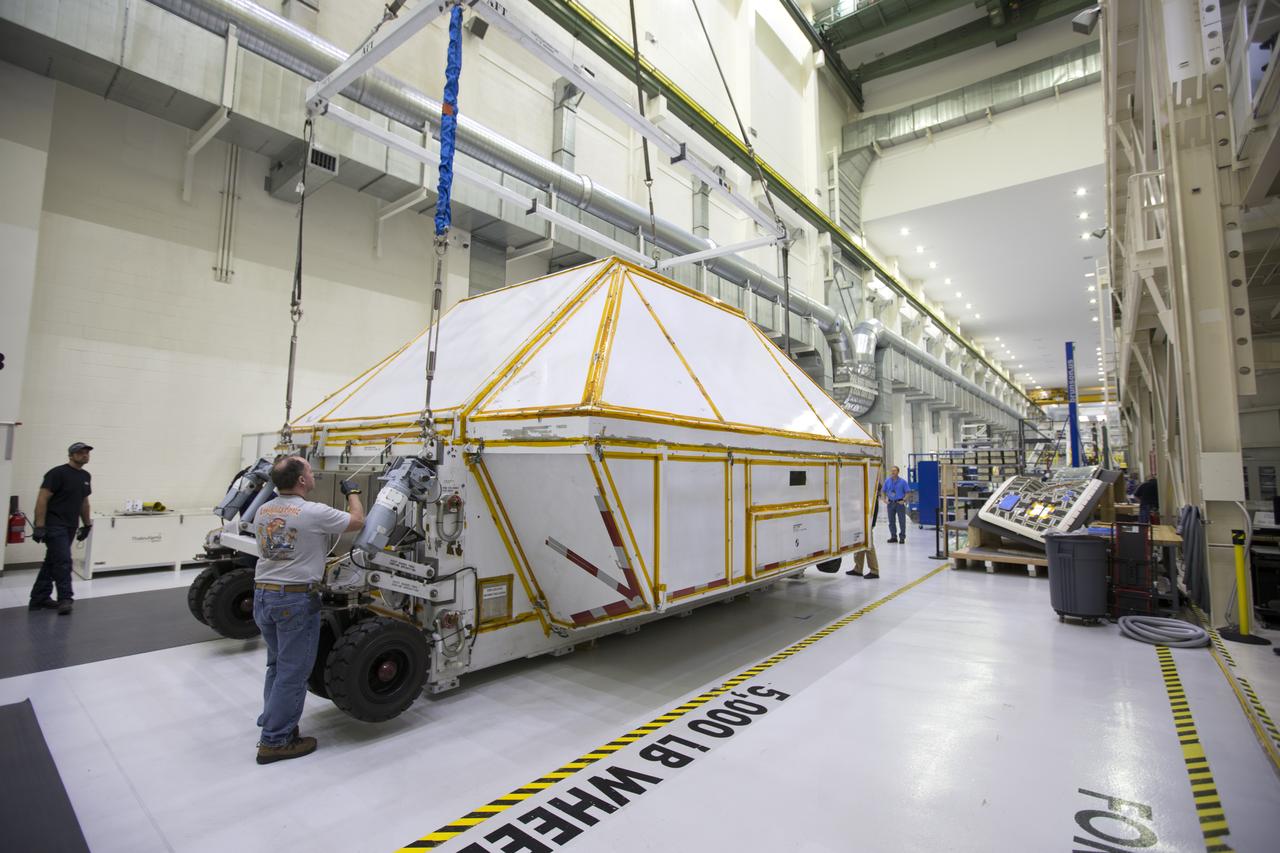
Inside the Neil Armstrong Operations and Checkout Building high bay at NASA's Kennedy Space Center in Florida, the Orion Exploration Mission-1 (EM-1) structural test article is secured inside its transport container. A crane is used to move the container toward a transport vehicle for the move to the Shuttle Landing Facility. The test article will be loaded in NASA's Super Guppy airplane and transported to Lockheed Martin's Denver facility for testing. The Orion spacecraft will launch atop NASA’s Space Launch System rocket on EM-1, its first deep space mission.
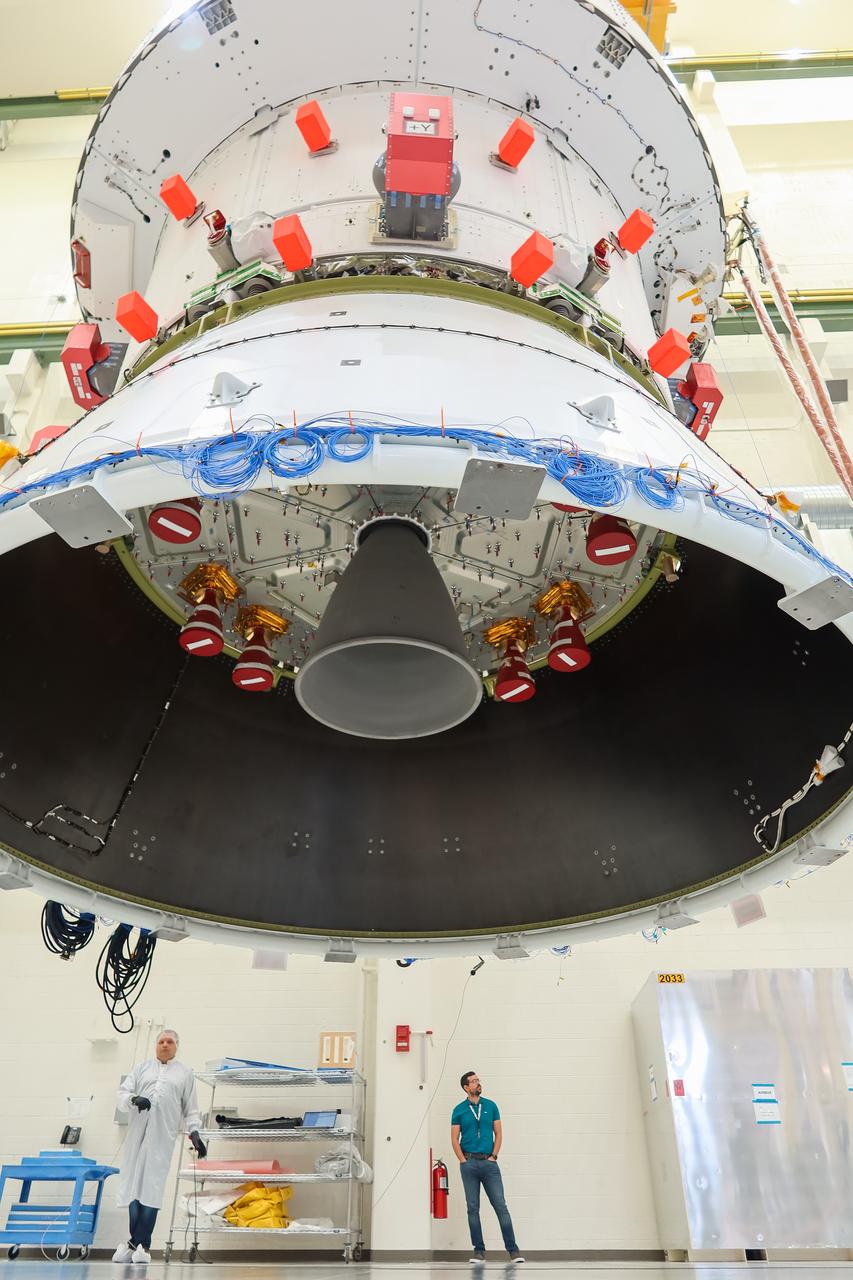
A view looking up from beneath the European Service Module (ESM) for NASA’s Artemis II mission as it is moved by crane along the center aisle of the high bay inside the Neil A. Armstrong Operations and Checkout Building at NASA’s Kennedy Space Center in Florida on May 22, 2023. Teams from NASA and Lockheed Martin are transferring the service module to the FAST (final assembly and system testing) cell for final checkouts before it is stacked with the Orion crew module.. The powerhouse that will fuel and propel Orion in space, the ESM will be used for Artemis II, the first Artemis mission flying crew aboard Orion.
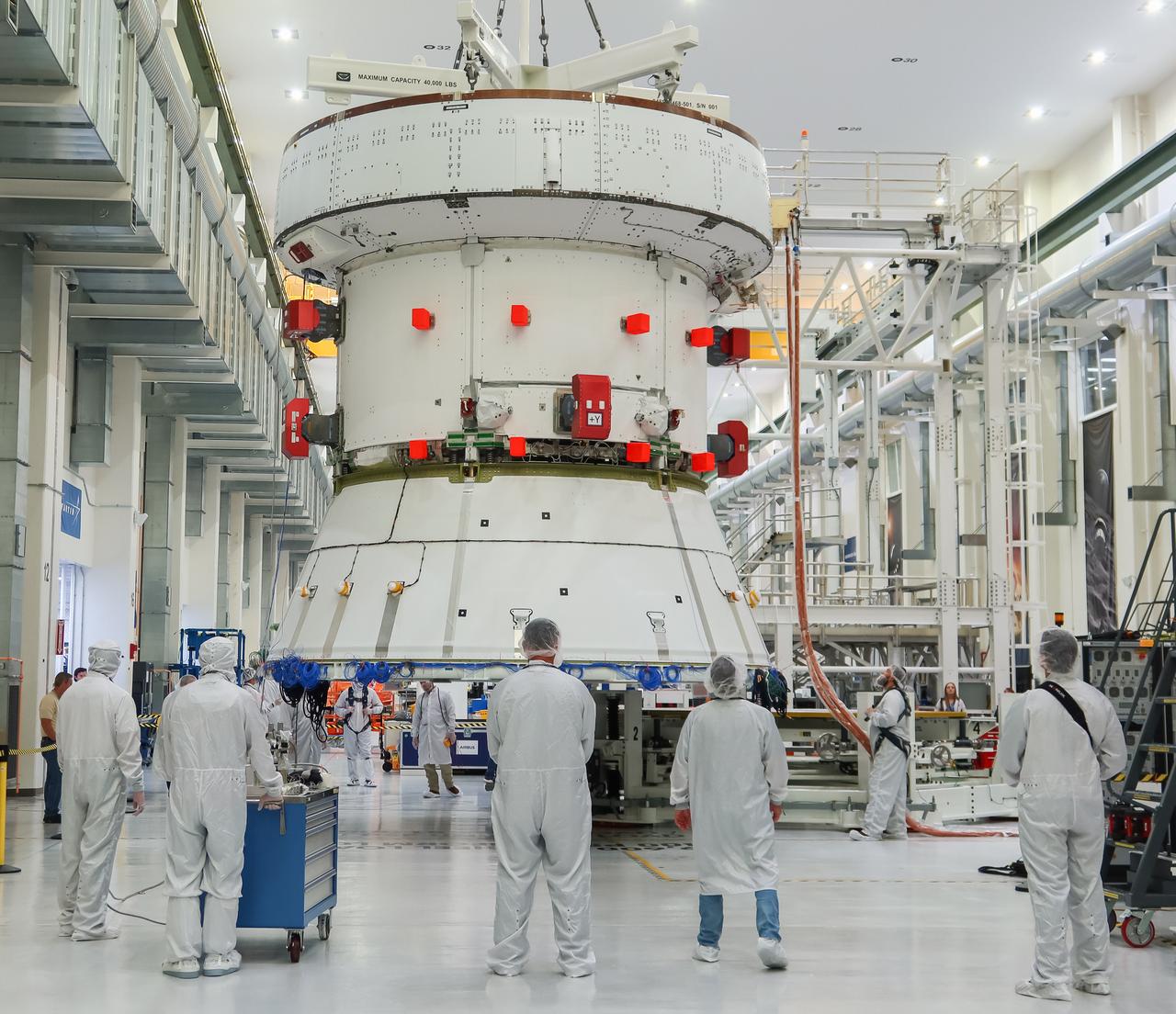
Engineers and technicians monitor the progress as the European Service Module (ESM) for NASA’s Artemis II mission is lifted by crane inside the high bay of the Neil A. Armstrong Operations and Checkout Building at NASA’s Kennedy Space Center in Florida on May 22, 2023. Teams from NASA and Lockheed Martin are preparing the service module for transfer to the FAST (final assembly and system testing) cell for final checkouts before it is stacked with the Orion crew module.. The powerhouse that will fuel and propel Orion in space, the ESM will be used for Artemis II, the first Artemis mission flying crew aboard Orion.
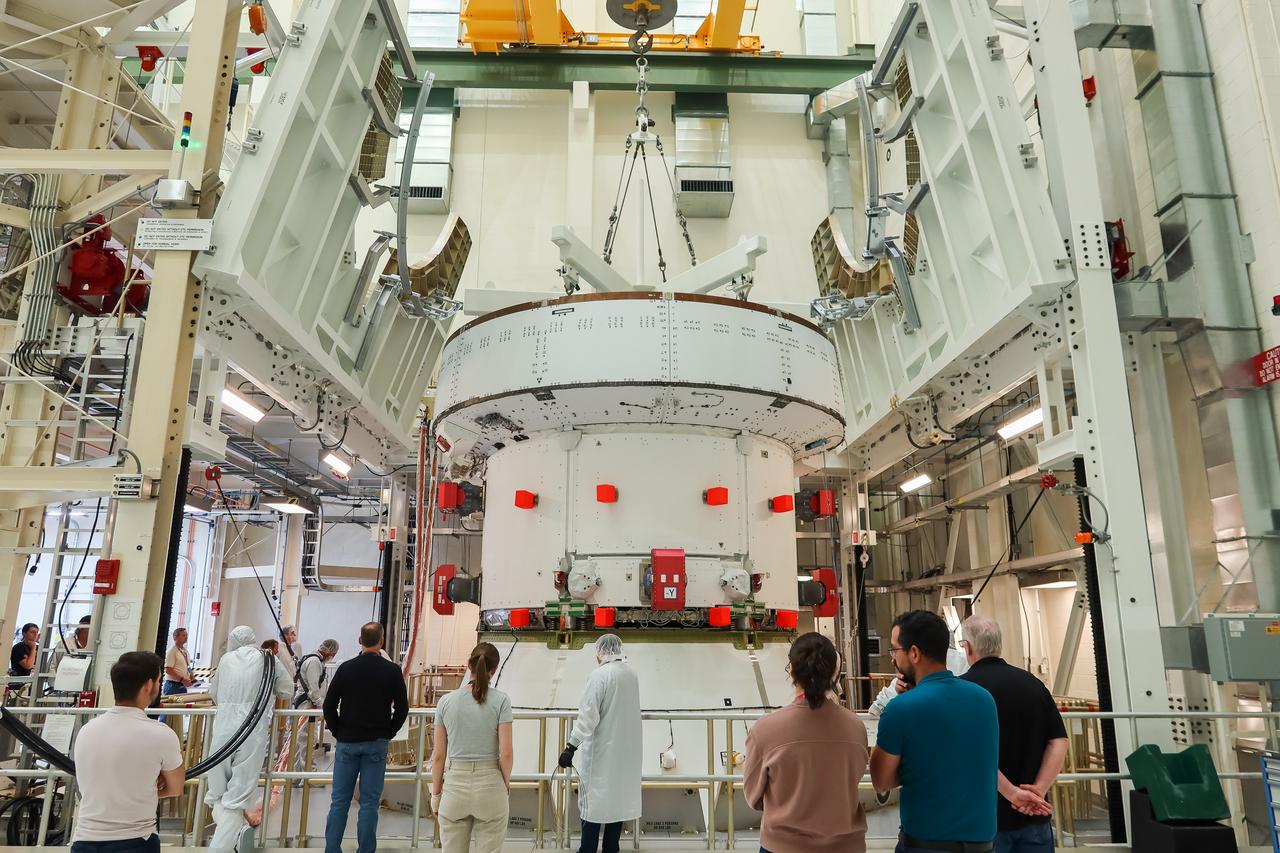
The European Service Module (ESM) for NASA’s Artemis II mission is lifted by crane and moved along the center aisle of the high bay inside the Neil A. Armstrong Operations and Checkout Building at NASA’s Kennedy Space Center in Florida on May 22, 2023. Teams from NASA and Lockheed Martin are preparing the service module for transfer to the FAST (final assembly and system testing) cell for final checkouts before it is stacked with the Orion crew module.. The powerhouse that will fuel and propel Orion in space, the ESM will be used for Artemis II, the first Artemis mission flying crew aboard Orion.
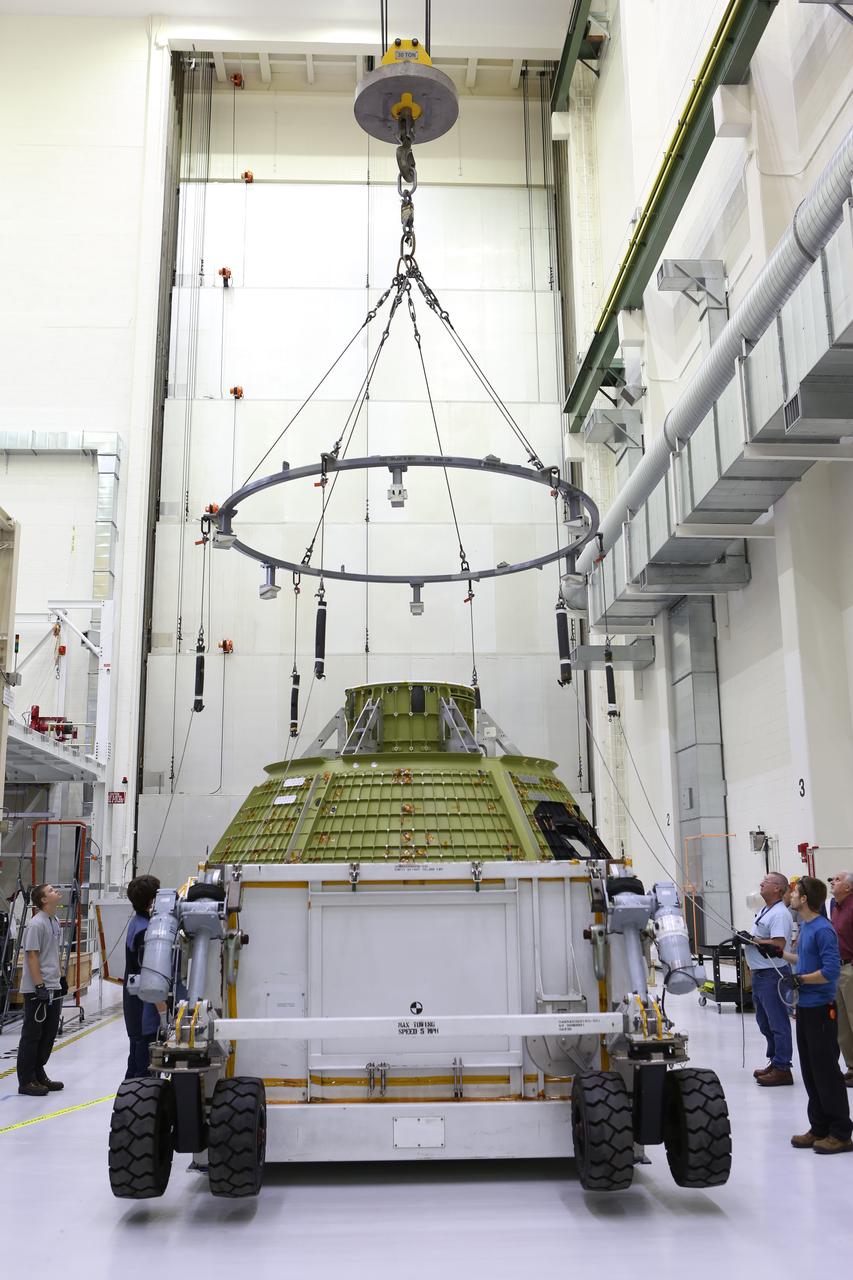
Inside the Neil Armstrong Operations and Checkout Building at NASA’s Kennedy Space Center in Florida, Lockheed Martin technicians prepare to attach lines from a crane to the Orion crew module structural test article (STA). The STA arrived aboard NASA's Super Guppy aircraft at the Shuttle Landing Facility operated by Space Florida. The test article will be lifted out of its container and moved to a test tool called the birdcage for further testing. The Orion spacecraft will launch atop NASA’s Space Launch System rocket on EM-1, its first deep space mission, in late 2018.
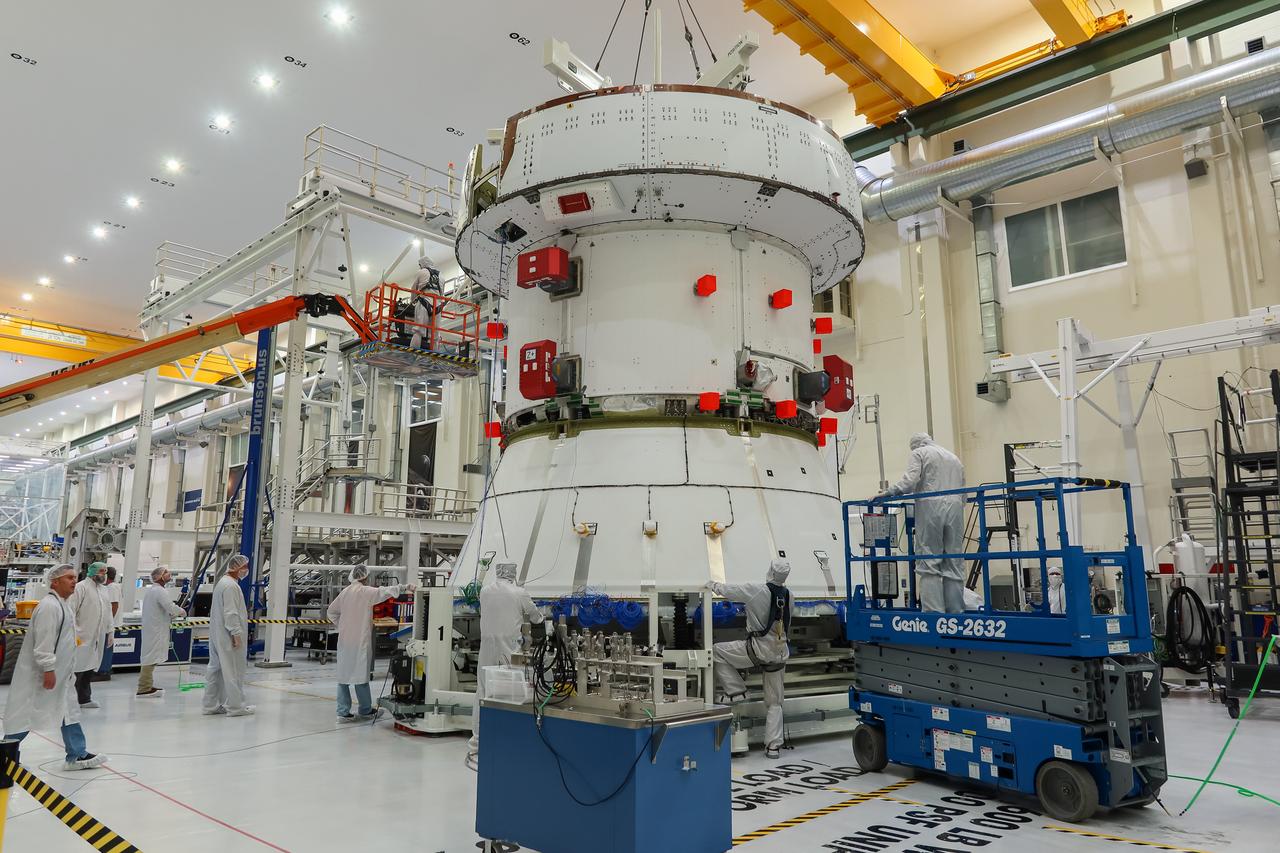
Preparations are underway to lift the European Service Module (ESM) for NASA’s Artemis II mission by crane inside the high bay of the Neil A. Armstrong Operations and Checkout Building at NASA’s Kennedy Space Center in Florida on May 22, 2023. Teams from NASA and Lockheed Martin are preparing the service module for transfer to the FAST (final assembly and system testing) cell for final checkouts before it is stacked with Orion crew module. The powerhouse that will fuel and propel Orion in space, the ESM will be used for Artemis II, the first Artemis mission flying crew aboard Orion.
A crane lowers the European Service Module (ESM) for NASA’s Artemis II mission into the FAST (final assembly and system testing) cell inside the high bay of the Neil A. Armstrong Operations and Checkout Building at NASA’s Kennedy Space Center in Florida on May 22, 2023. Teams from NASA and Lockheed Martin are transferring the service module to the FAST cell for final checkouts before it is stacked with the Orion crew module. The powerhouse that will fuel and propel Orion in space, the ESM will be used for Artemis II, the first Artemis mission flying crew aboard Orion.

Inside the Neil Armstrong Operations and Checkout Building at NASA’s Kennedy Space Center in Florida, Lockheed Martin technicians monitor the progress as a crane lowers the Orion crew module structural test article (STA) onto a test tool called the birdcage. The STA arrived aboard NASA's Super Guppy aircraft at the Shuttle Landing Facility operated by Space Florida. The test article will be secured on the birdcage for further testing. The Orion spacecraft will launch atop NASA’s Space Launch System rocket on EM-1, its first deep space mission, in late 2018.
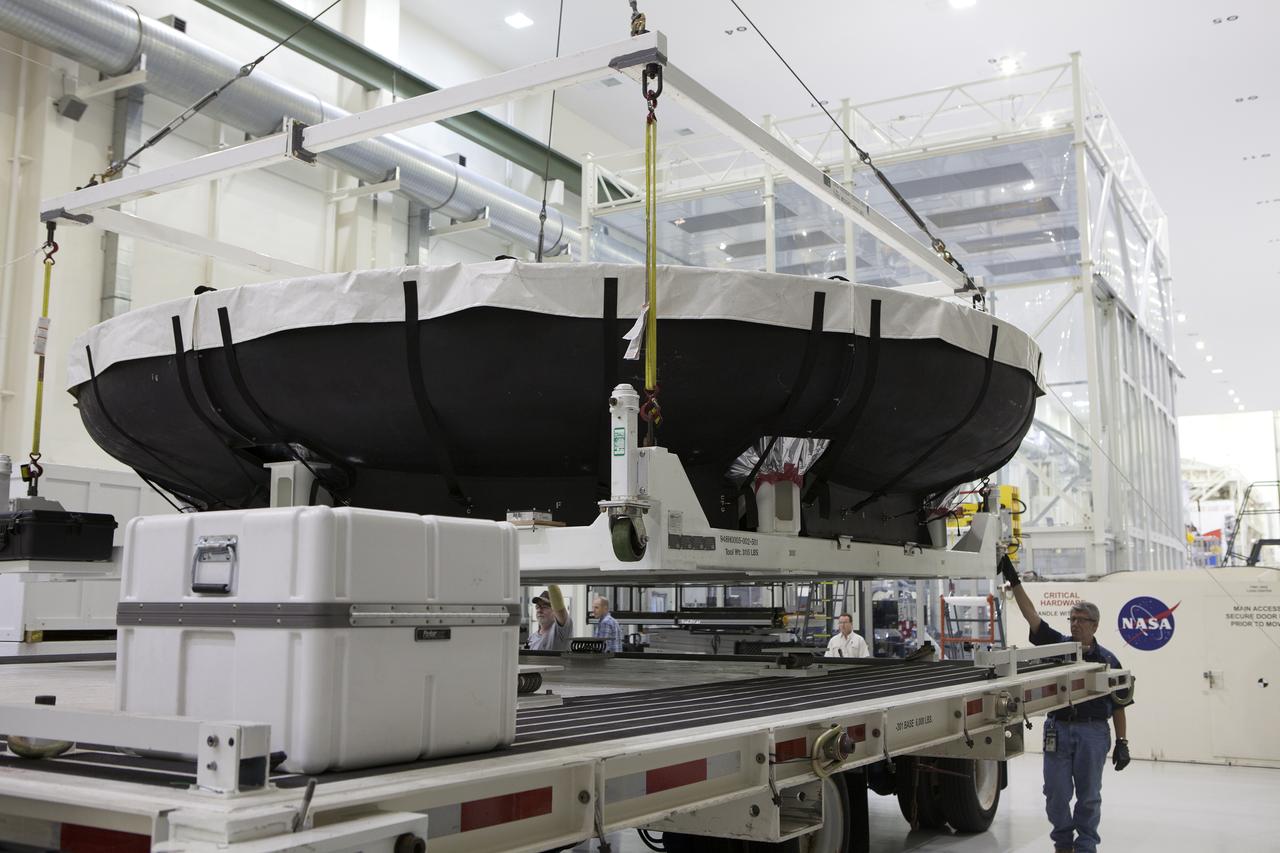
Inside the Neil Armstrong Operations and Checkout Building high bay at NASA’s Kennedy Space Center in Florida, a crane lifts the Orion heat shield for Exploration Mission 1 away from the base of its shipping container. The heat shield arrived aboard the agency’s Super Guppy aircraft at the Shuttle Landing Facility, managed and operated by Space Florida, from Lockheed Martin’s manufacturing facility near Denver. The heat shield will be moved onto a test stand to begin processing. The Orion spacecraft will launch atop NASA’s Space Launch System rocket on EM-1, an uncrewed test flight, in 2018.
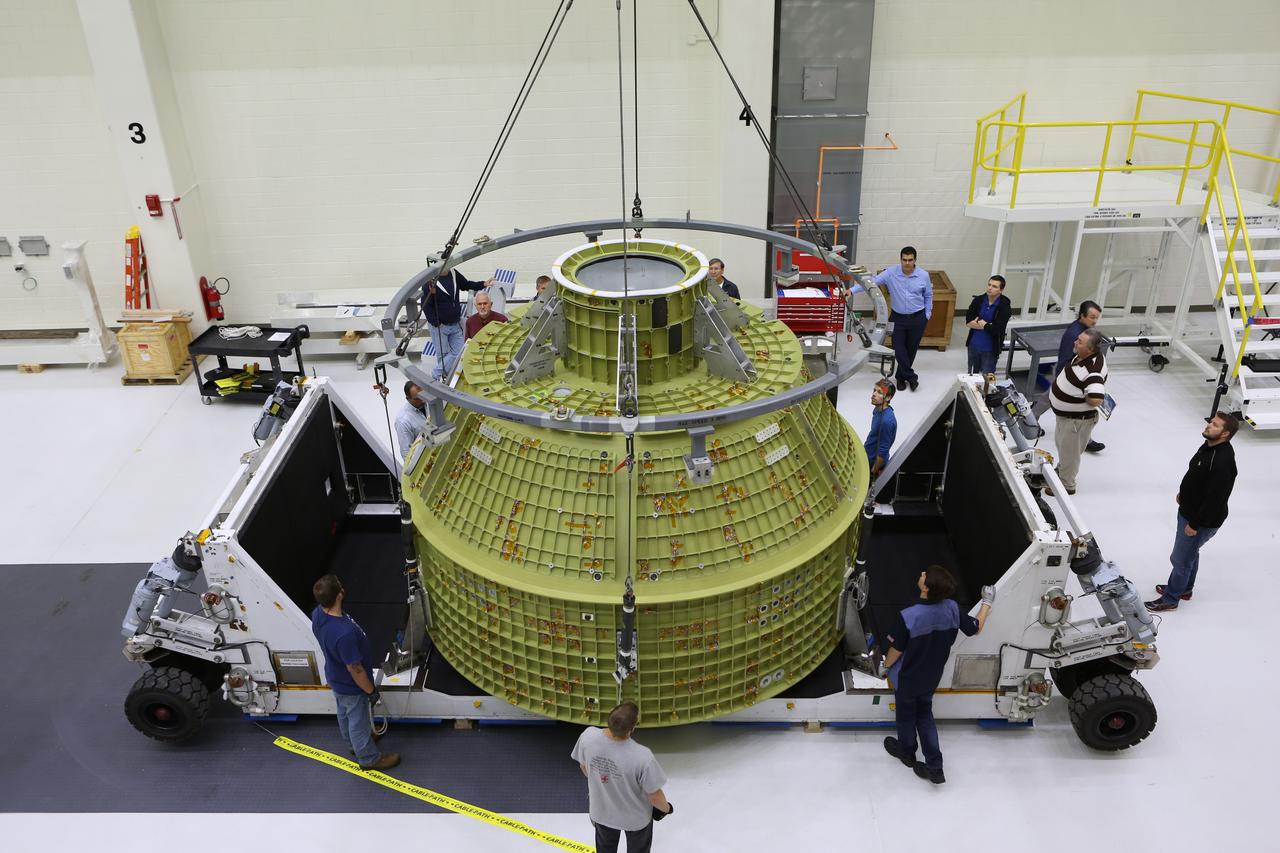
Inside the Neil Armstrong Operations and Checkout Building at NASA’s Kennedy Space Center in Florida, Lockheed Martin technicians monitor the progress as a crane begins to lift the Orion crew module structural test article (STA) up from the base of its transport container. The STA arrived aboard NASA's Super Guppy aircraft at the Shuttle Landing Facility operated by Space Florida. The test article will be moved to a test tool called the birdcage for further testing. The Orion spacecraft will launch atop NASA’s Space Launch System rocket on EM-1, its first deep space mission, in late 2018.
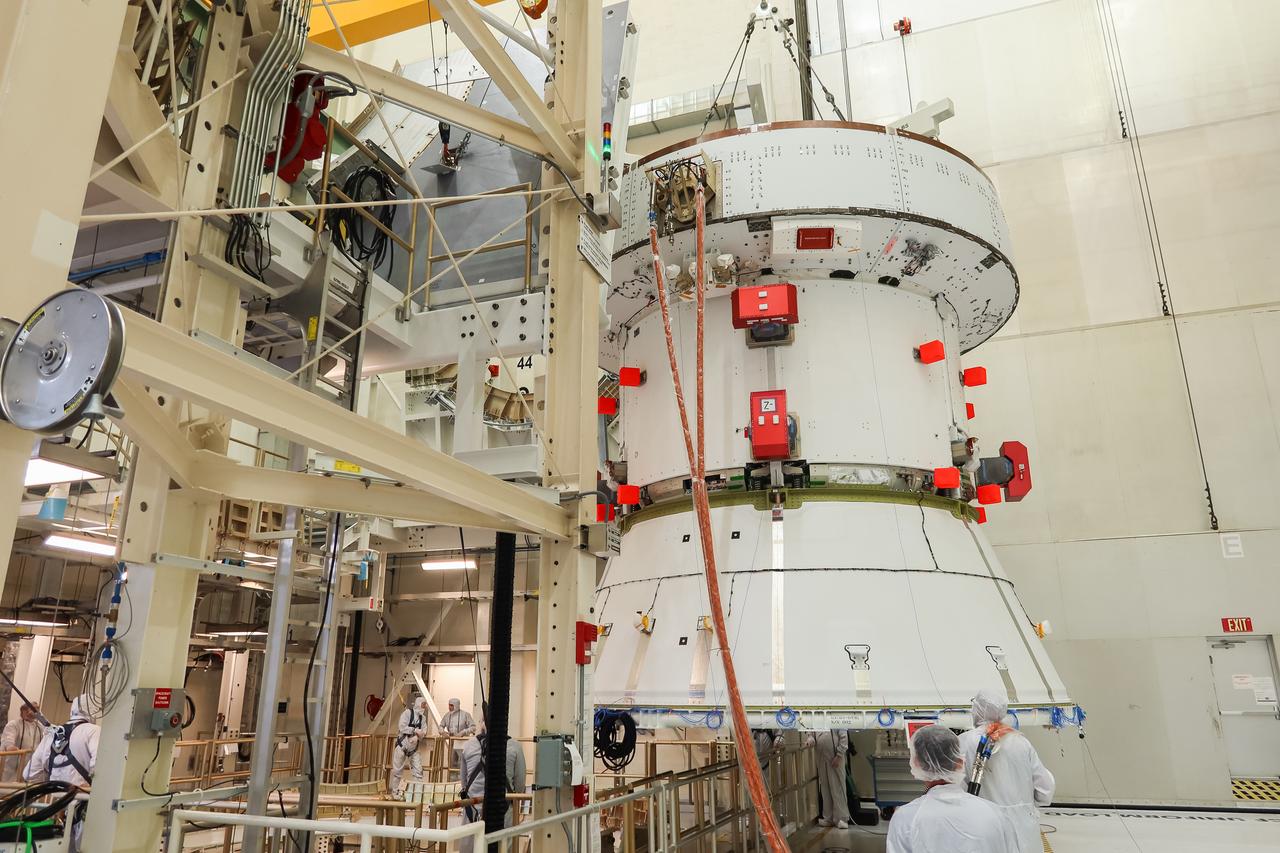
A crane slowly moves the European Service Module (ESM) for NASA’s Artemis II mission into the FAST (final assembly and system testing) cell inside the high bay of the Neil A. Armstrong Operations and Checkout Building at NASA’s Kennedy Space Center in Florida on May 22, 2023. Teams from NASA and Lockheed Martin are transferring the service module to the FAST cell for final checkouts before it is stacked with the Orion crew module.. The powerhouse that will fuel and propel Orion in space, the ESM will be used for Artemis II, the first Artemis mission flying crew aboard Orion.
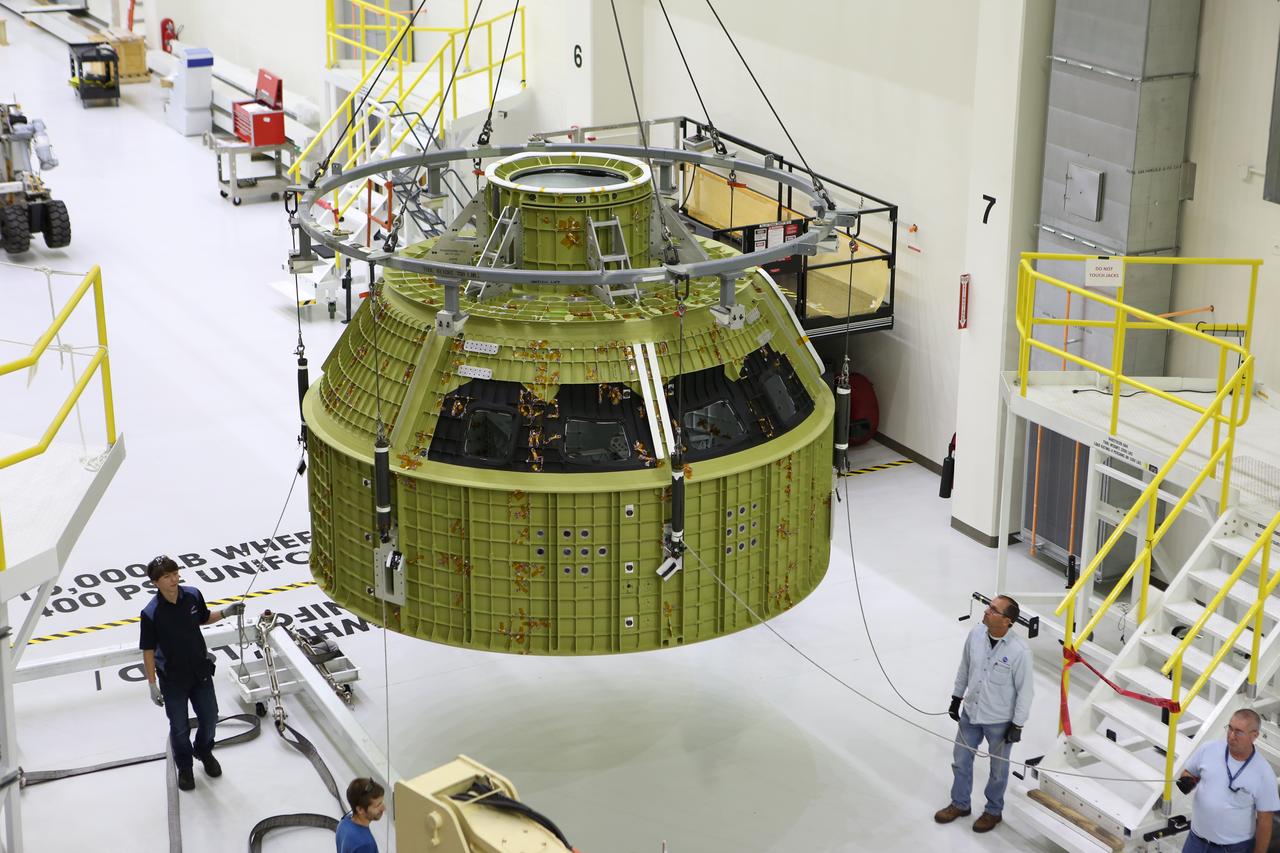
Inside the Neil Armstrong Operations and Checkout Building at NASA’s Kennedy Space Center in Florida, Lockheed Martin technicians monitor the progress as a crane moves the Orion crew module structural test article (STA) along the center aisle of the high bay. The STA arrived aboard NASA's Super Guppy aircraft at the Shuttle Landing Facility operated by Space Florida. The test article will be moved to a test tool called the birdcage for further testing. The Orion spacecraft will launch atop NASA’s Space Launch System rocket on EM-1, its first deep space mission, in late 2018.
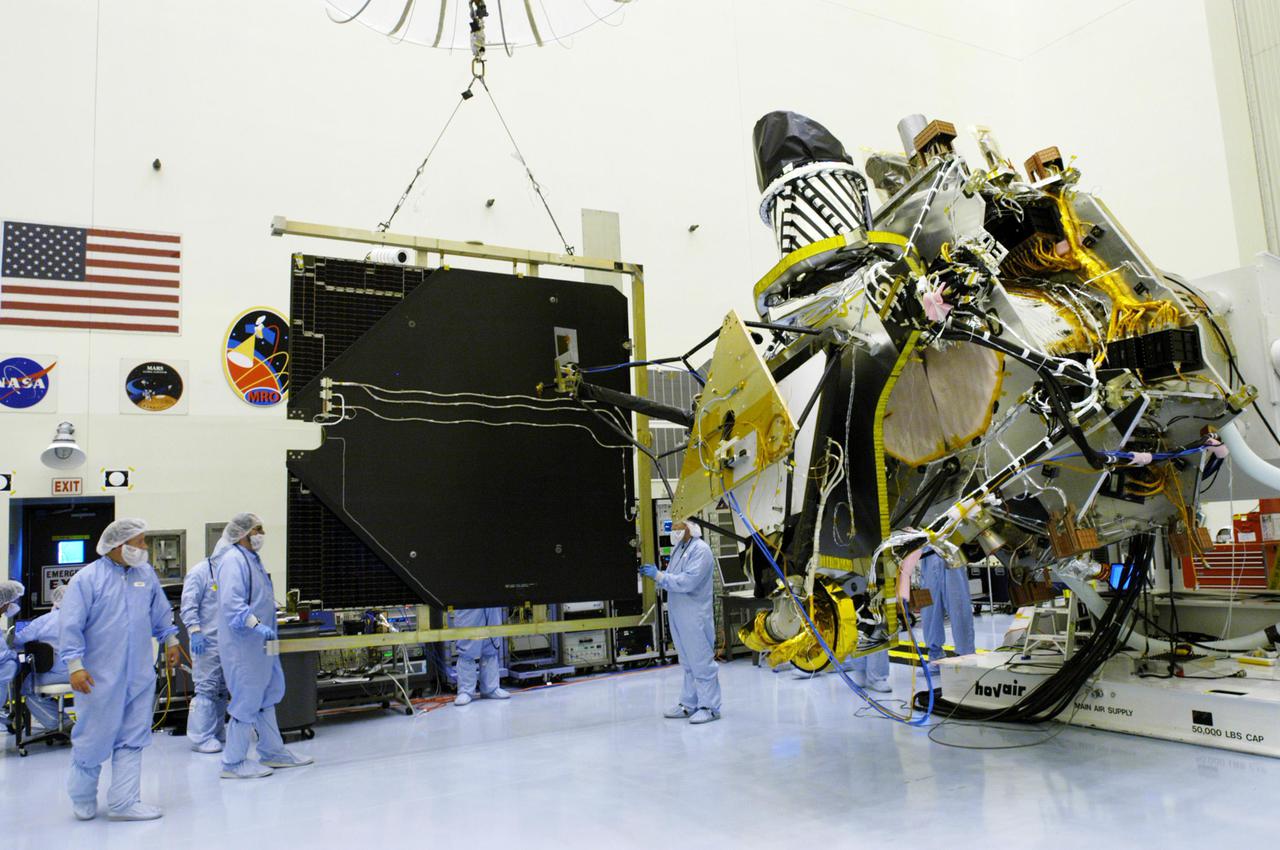
KENNEDY SPACE CENTER, FLA. - In the Payload Hazardous Servicing Facility, workers stabilize the crane holding the solar panel removed from the Mars Reconnaissance Orbiter spacecraft. A major deployment test will check out the spacecraft’s large solar arrays. The spacecraft will also undergo multiple mechanical assembly operations and electrical tests to verify its readiness for launch. The MRO was built by Lockheed Martin for NASA’s Jet Propulsion Laboratory in California. It is the next major step in Mars exploration and scheduled for launch from Cape Canaveral Air Force Station in a window opening Aug. 10. The MRO is an important next step in fulfilling NASA’s vision of space exploration and ultimately sending human explorers to Mars and beyond.
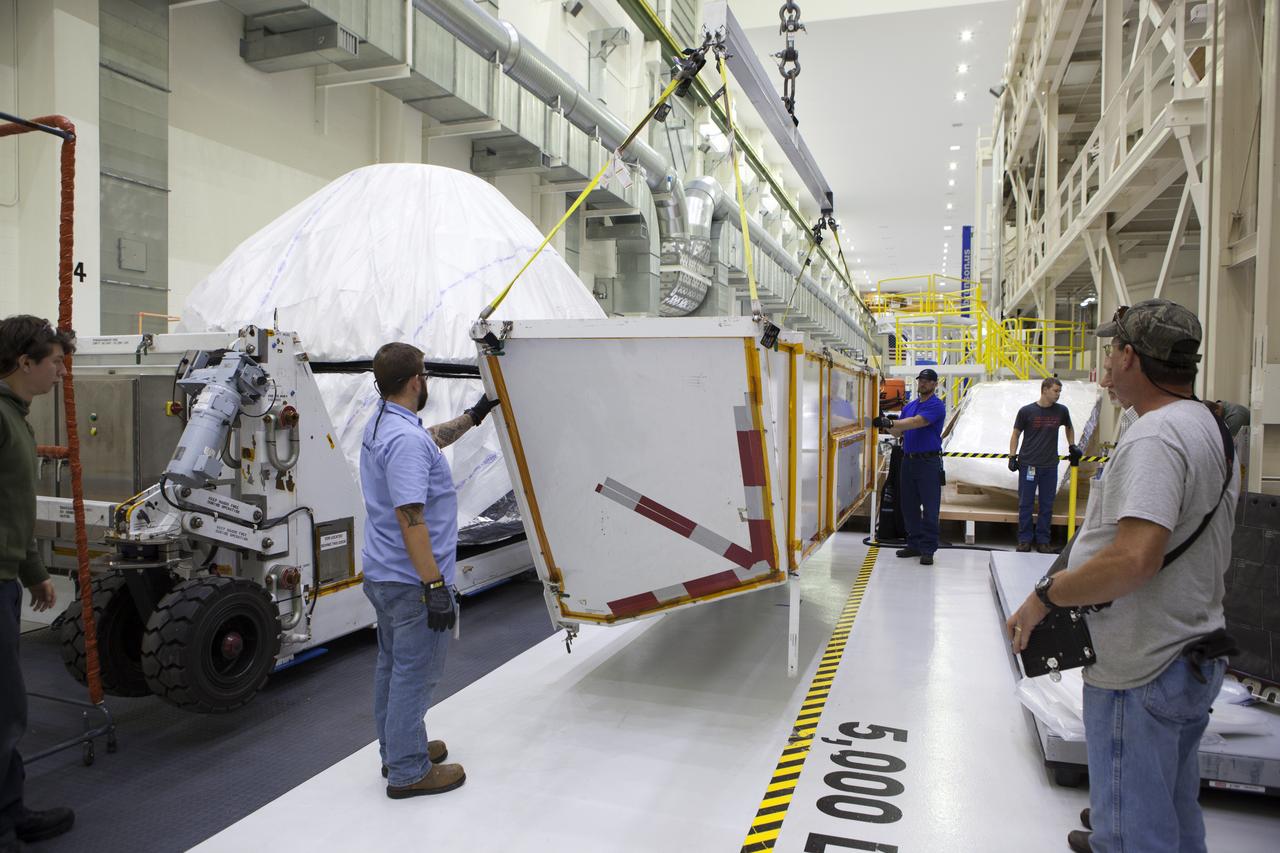
Inside the Neil Armstrong Operations and Checkout Building high bay at NASA's Kennedy Space Center in Florida, technicians with Lockheed Martin assist as a crane lifts the cover away from the container holding the Orion crew module structural test article (STA). The STA arrived aboard NASA's Super Guppy aircraft at the Shuttle Landing Facility operated by Space Florida. The test article was moved inside the facility's high bay for further testing. The Orion spacecraft will launch atop NASA’s Space Launch System rocket on EM-1, its first deep space mission, in late 2018.
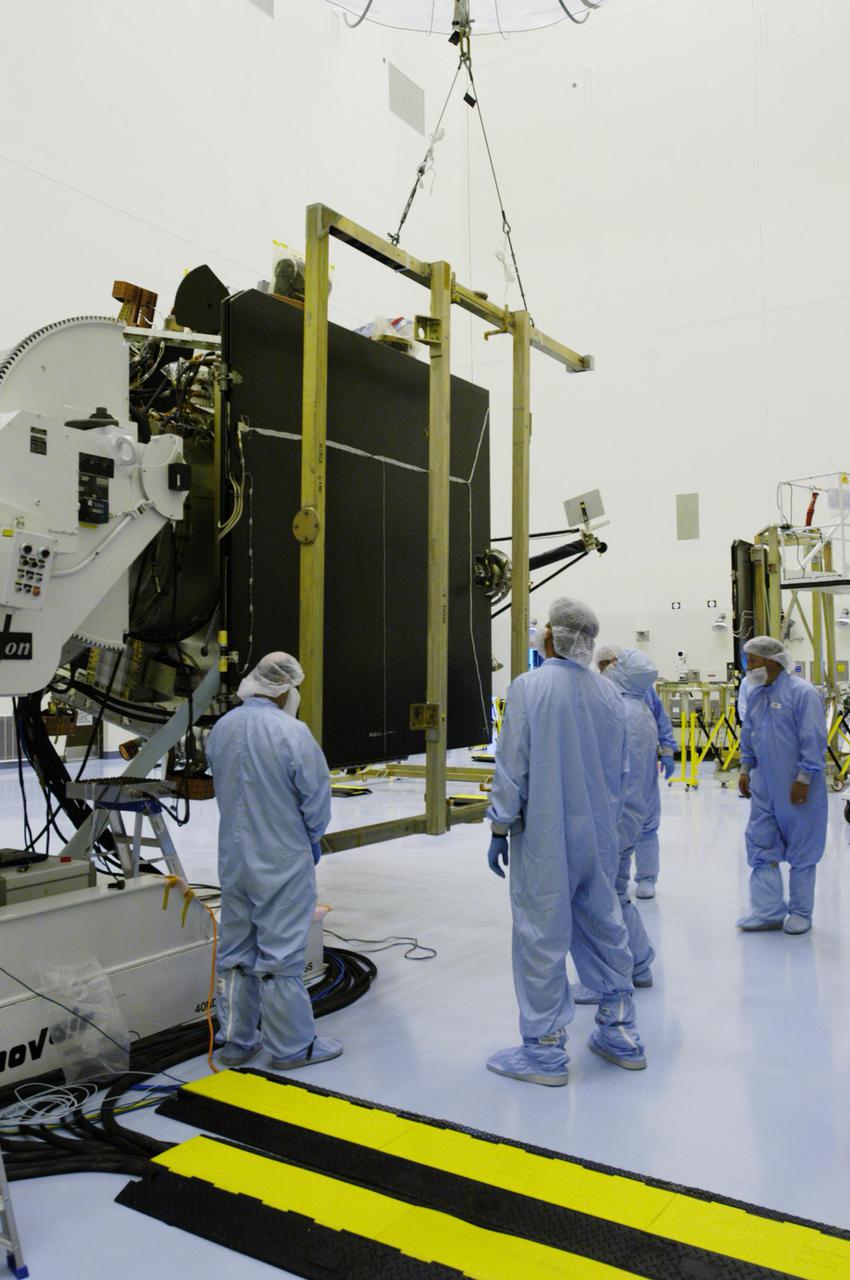
KENNEDY SPACE CENTER, FLA. - In the Payload Hazardous Servicing Facility, workers move a crane into place to remove the solar panel from the Mars Reconnaissance Orbiter spacecraft. A major deployment test will check out the spacecraft’s large solar arrays. The spacecraft will also undergo multiple mechanical assembly operations and electrical tests to verify its readiness for launch. The MRO was built by Lockheed Martin for NASA’s Jet Propulsion Laboratory in California. It is the next major step in Mars exploration and scheduled for launch from Cape Canaveral Air Force Station in a window opening Aug. 10. The MRO is an important next step in fulfilling NASA’s vision of space exploration and ultimately sending human explorers to Mars and beyond.
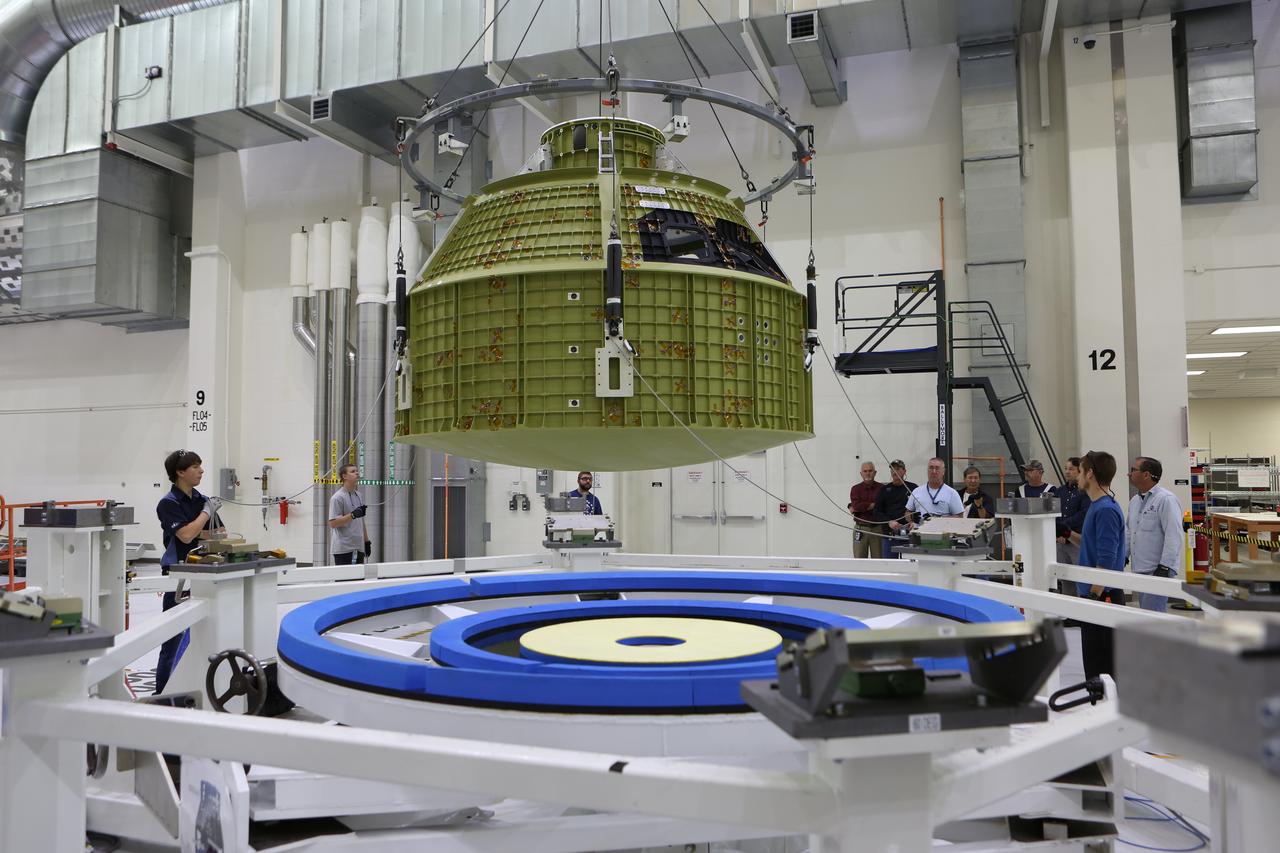
Inside the Neil Armstrong Operations and Checkout Building at NASA’s Kennedy Space Center in Florida, Lockheed Martin technicians monitor the progress as a crane lowers the Orion crew module structural test article (STA) toward a test tool called the birdcage. The STA arrived aboard NASA's Super Guppy aircraft at the Shuttle Landing Facility operated by Space Florida. The test article will be secured on the birdcage for further testing. The Orion spacecraft will launch atop NASA’s Space Launch System rocket on EM-1, its first deep space mission, in late 2018.
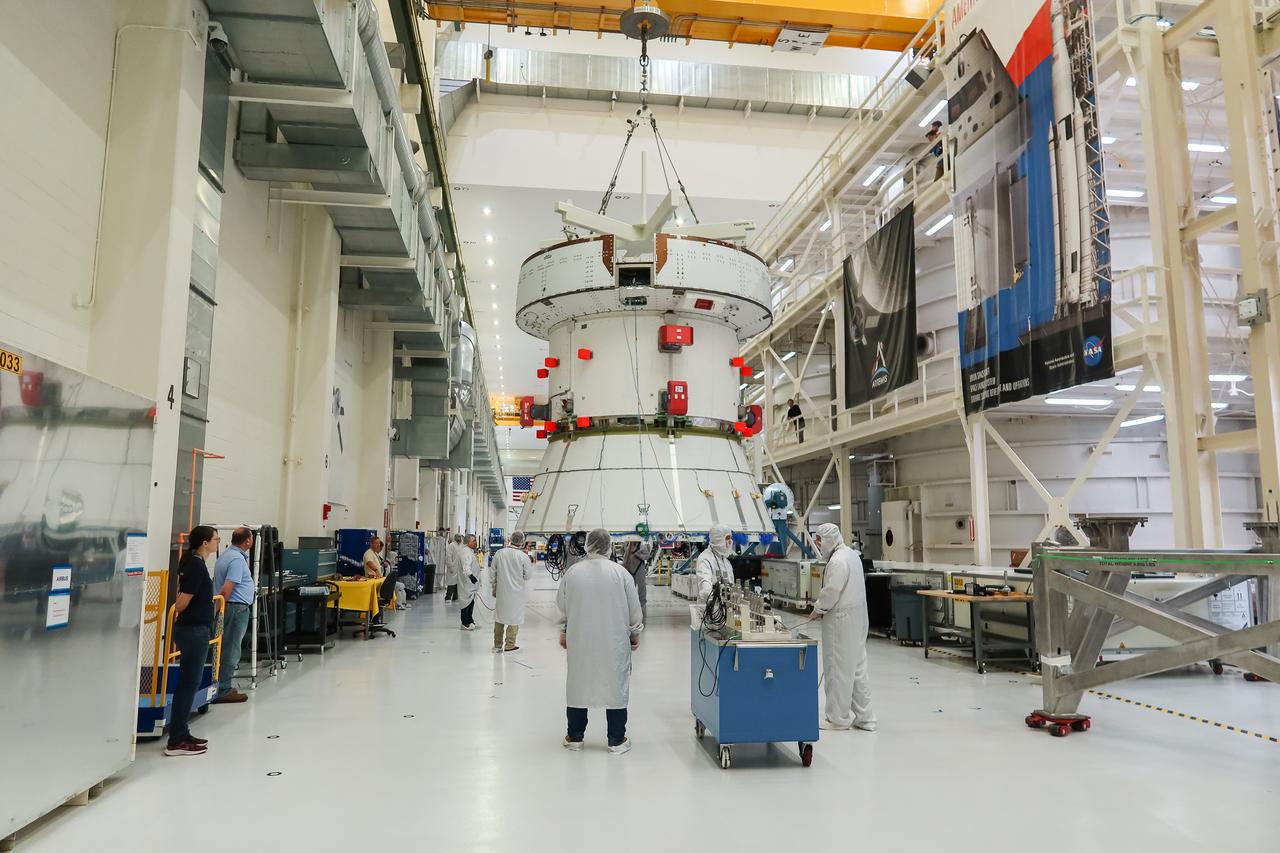
A crane moves the European Service Module (ESM) for NASA’s Artemis II mission along the center aisle of the high bay inside the Neil A. Armstrong Operations and Checkout Building at NASA’s Kennedy Space Center in Florida on May 22, 2023. Teams from NASA and Lockheed Martin are preparing the service module for transfer to the FAST (final assembly and system testing) cell for final checkouts before it is stacked with the Orion crew module.. The powerhouse that will fuel and propel Orion in space, the ESM will be used for Artemis II, the first Artemis mission flying crew aboard Orion.
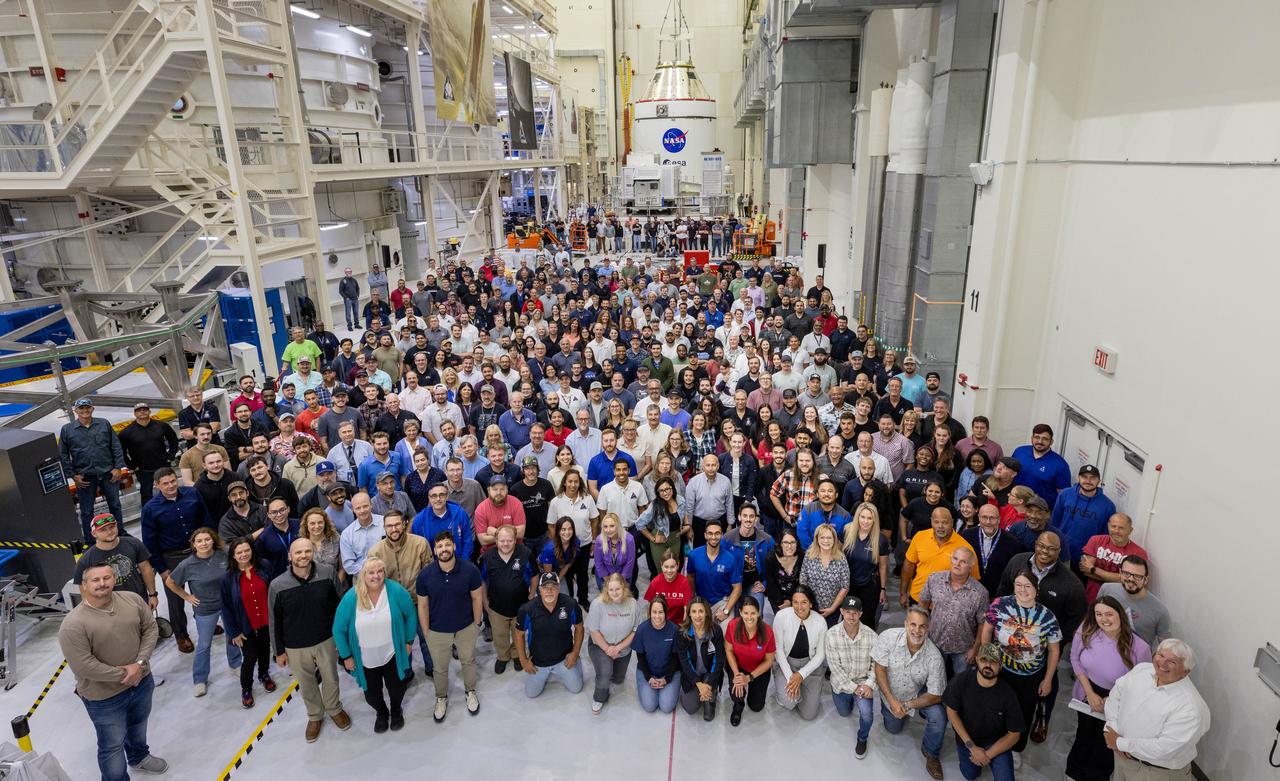
Teams from NASA and Lockheed Martin pose for a photo in front of NASA’s Artemis II Orion spacecraft, connected to a massive crane ahead atop the agency’s KAMAG transporter inside the Neil A. Operations and Checkout Building at NASA’s Kennedy Space Center in Florida on Friday, May 2, 2025. The spacecraft will be transported to the spaceport’s Multi-Payload Processing Facility to undergo fueling and processing for prelaunch operations. The Artemis II test flight is the first crewed flight under NASA’s Artemis campaign and is another step toward missions on the lunar surface and helping the agency prepare for future human missions to Mars.
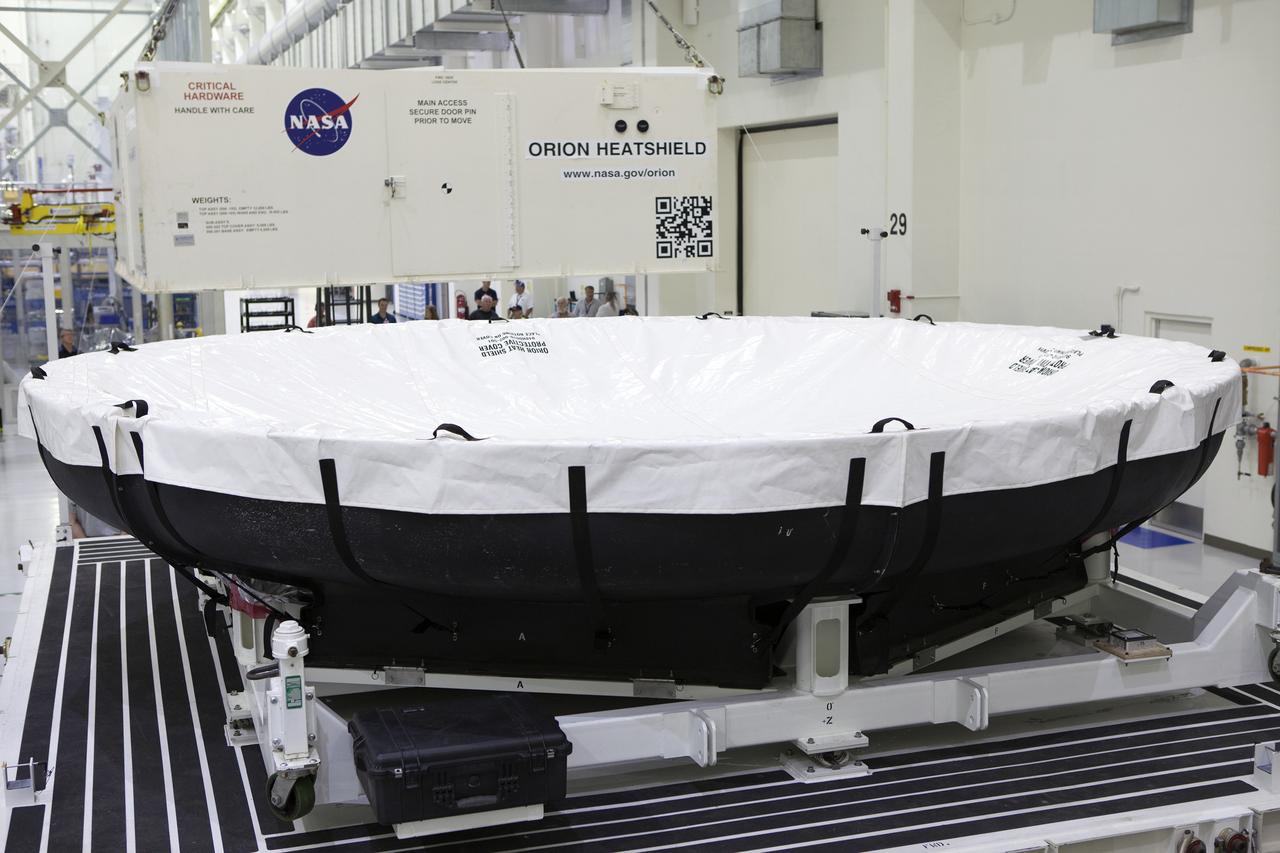
Inside the Neil Armstrong Operations and Checkout Building high bay at NASA’s Kennedy Space Center in Florida, a crane removes the top of the shipping container carrying the Orion heat shield for Exploration Mission 1 (EM-1). The heat shield arrived aboard the agency’s Super Guppy aircraft at the Shuttle Landing Facility, managed and operated by Space Florida, from Lockheed Martin’s manufacturing facility near Denver. The heat shield will be offloaded and moved into the high bay for processing. The Orion spacecraft will launch atop NASA’s Space Launch System rocket on EM-1, an uncrewed test flight, in 2018.
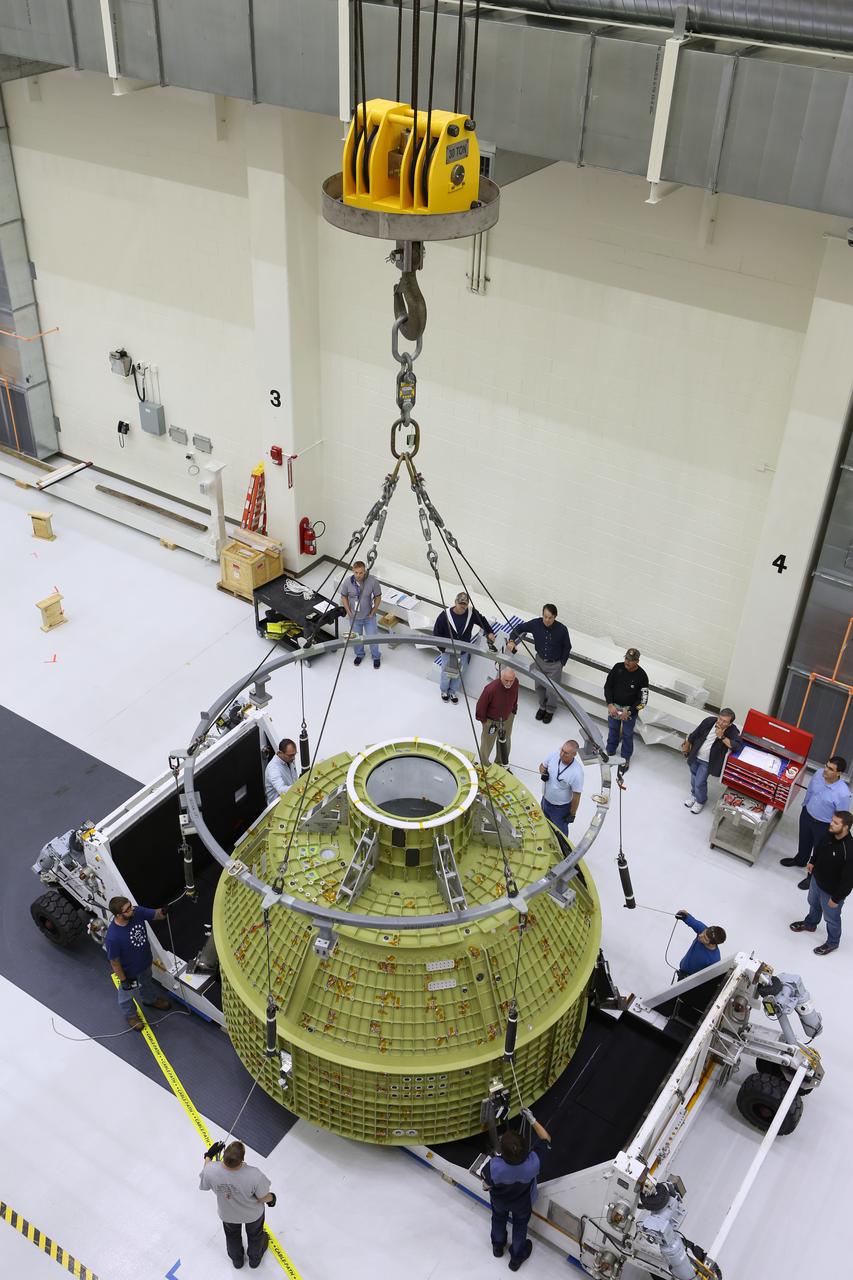
Inside the Neil Armstrong Operations and Checkout Building at NASA’s Kennedy Space Center in Florida, Lockheed Martin technicians attach lines from a crane to the Orion crew module structural test article (STA). The STA arrived aboard NASA's Super Guppy aircraft at the Shuttle Landing Facility operated by Space Florida. The test article will be lifted out of its container and moved to a test tool called the birdcage for further testing. The Orion spacecraft will launch atop NASA’s Space Launch System rocket on EM-1, its first deep space mission, in late 2018.
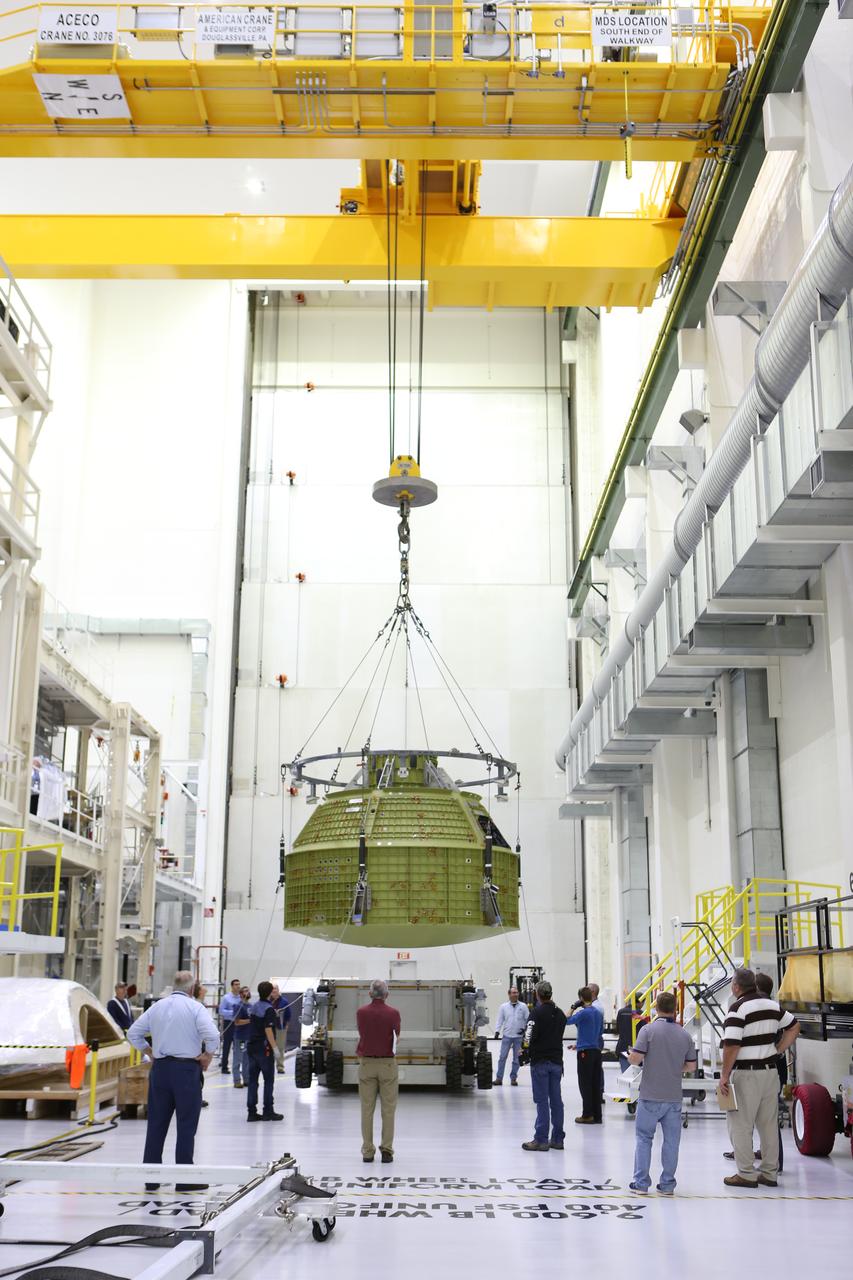
Inside the Neil Armstrong Operations and Checkout Building at NASA’s Kennedy Space Center in Florida, Lockheed Martin technicians monitor the progress as a crane lifts the Orion crew module structural test article (STA) away from the base of its transport container. The STA arrived aboard NASA's Super Guppy aircraft at the Shuttle Landing Facility operated by Space Florida. The test article will be moved to a test tool called the birdcage for further testing. The Orion spacecraft will launch atop NASA’s Space Launch System rocket on EM-1, its first deep space mission, in late 2018.
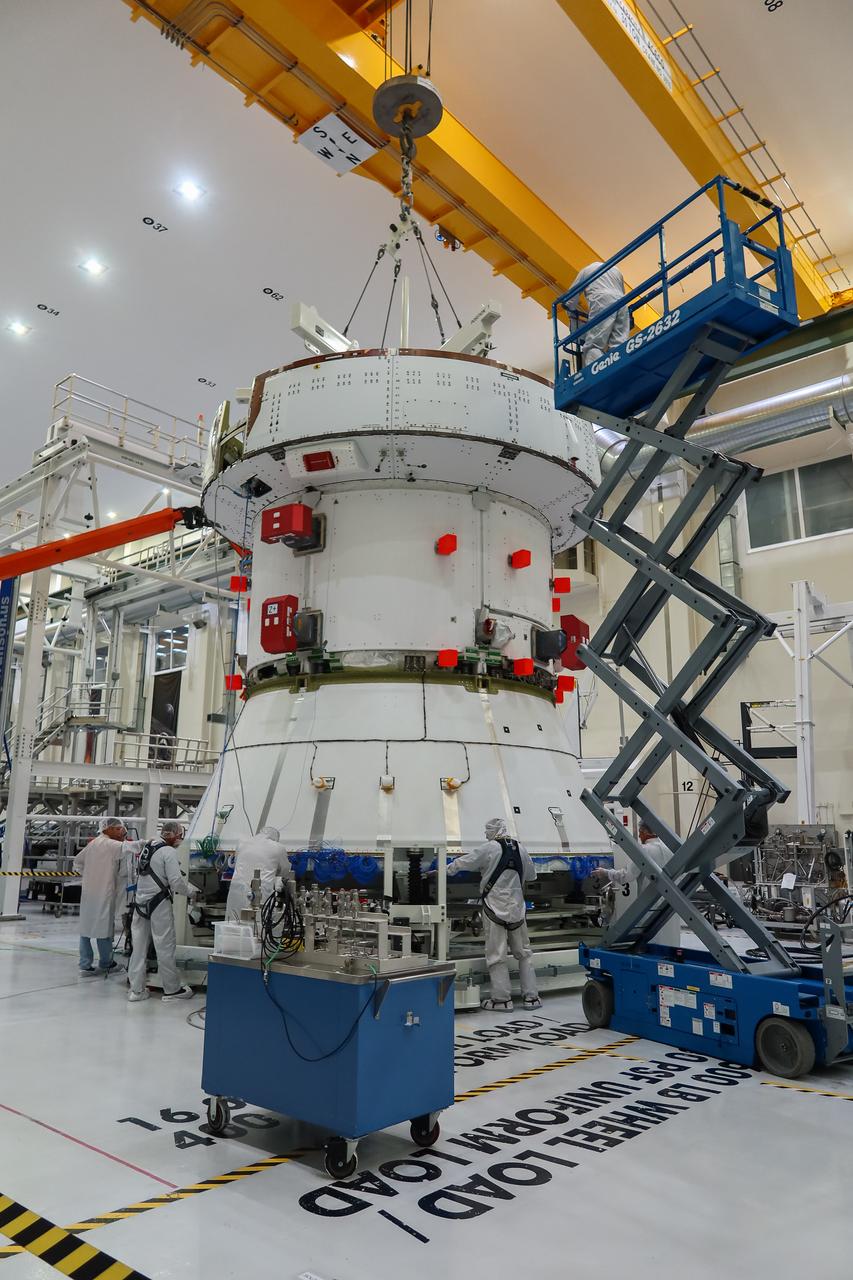
Preparations are underway to lift the European Service Module (ESM) for NASA’s Artemis II mission by crane inside the high bay of the Neil A. Armstrong Operations and Checkout Building at NASA’s Kennedy Space Center in Florida on May 22, 2023. Teams from NASA and Lockheed Martin are preparing the service module for transfer to the FAST (final assembly and system testing) cell for final checkouts before it is stacked with the Orion crew module. The powerhouse that will fuel and propel Orion in space, the ESM will be used for Artemis II, the first Artemis mission flying crew aboard Orion.
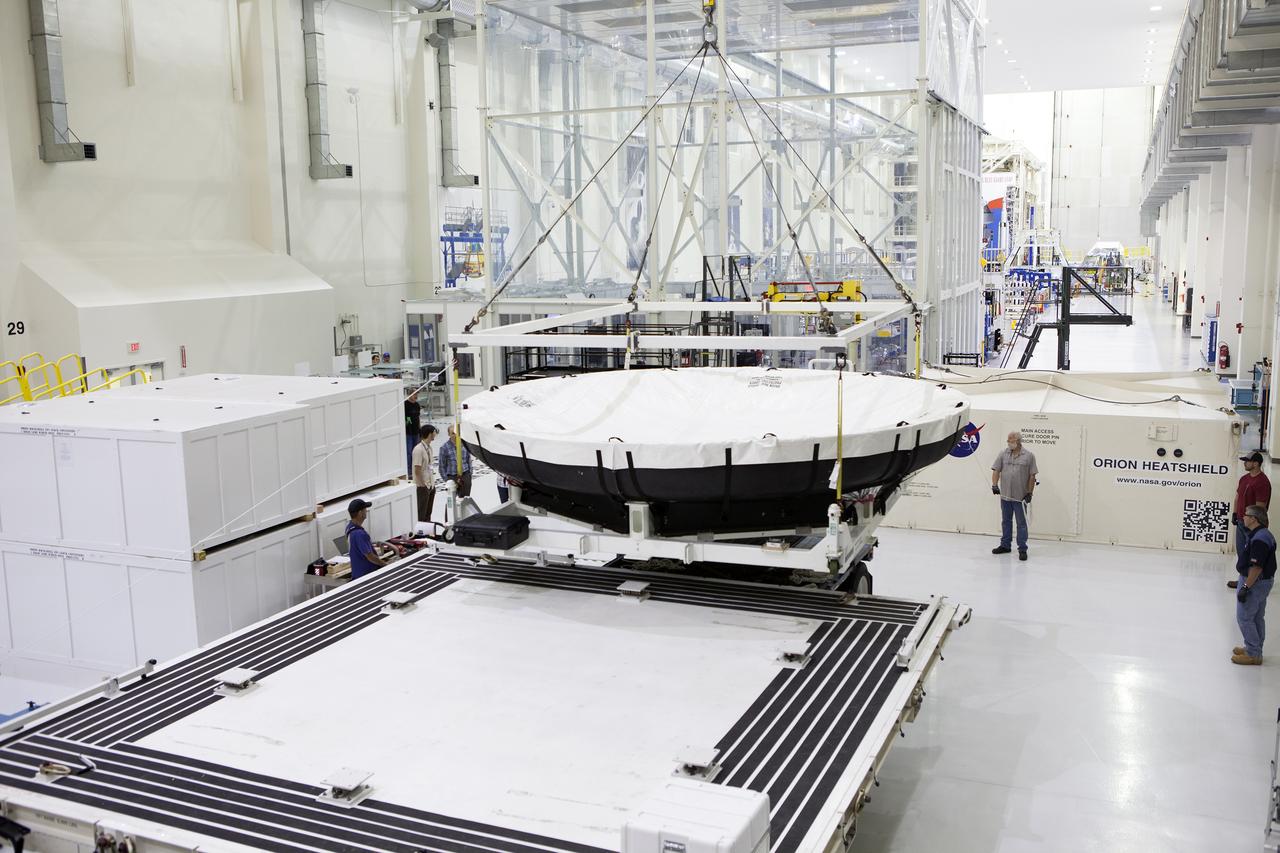
Inside the Neil Armstrong Operations and Checkout Building high bay at NASA’s Kennedy Space Center in Florida, a crane lifts the Orion heat shield for Exploration Mission 1 away from the base of its shipping container. The heat shield arrived aboard the agency’s Super Guppy aircraft at the Shuttle Landing Facility, managed and operated by Space Florida, from Lockheed Martin’s manufacturing facility near Denver. The heat shield will be moved onto a test stand to begin processing. The Orion spacecraft will launch atop NASA’s Space Launch System rocket on EM-1, an uncrewed test flight, in 2018.
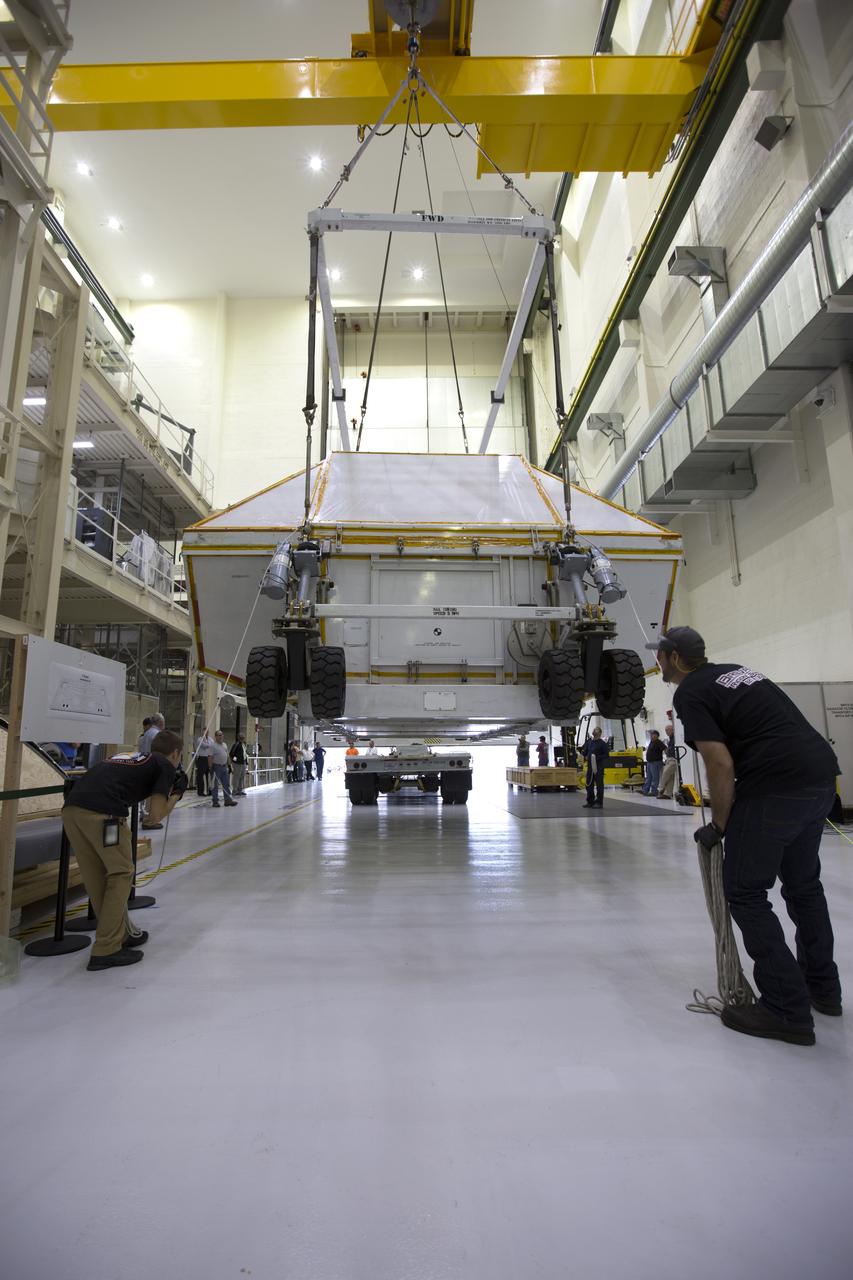
Inside the Neil Armstrong Operations and Checkout Building high bay at NASA's Kennedy Space Center in Florida, the Orion Exploration Mission-1 (EM-1) structural test article is secured inside its transport container. Technicians monitor the progress as a crane is used to move the container toward a transport vehicle for the move to the Shuttle Landing Facility. The test article will be loaded in NASA's Super Guppy airplane and transported to Lockheed Martin's Denver facility for testing. The Orion spacecraft will launch atop NASA’s Space Launch System rocket on EM-1, its first deep space mission.
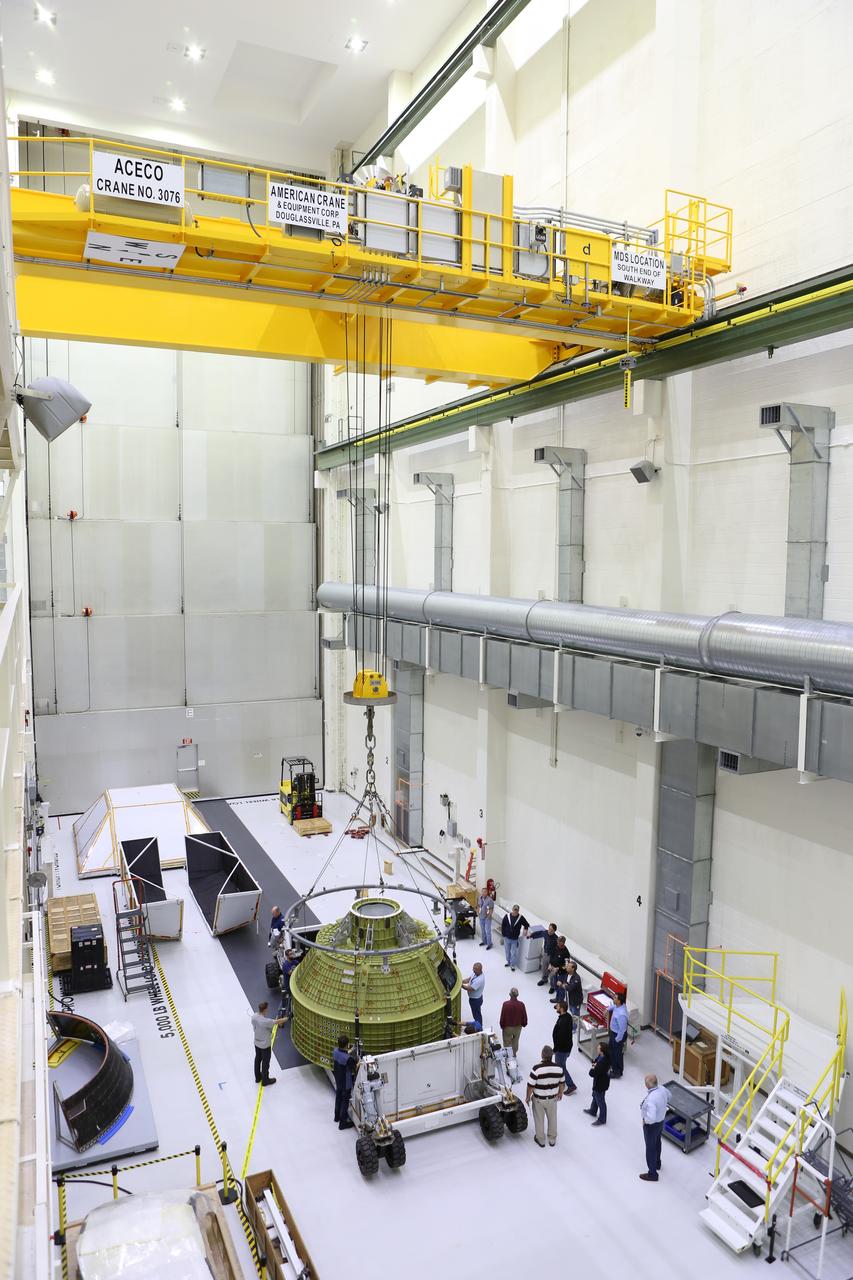
Inside the Neil Armstrong Operations and Checkout Building at NASA’s Kennedy Space Center in Florida, Lockheed Martin technicians attach lines from a crane to the Orion crew module structural test article (STA). The STA arrived aboard NASA's Super Guppy aircraft at the Shuttle Landing Facility operated by Space Florida. The test article will be lifted out of its container and moved to a test tool called the birdcage for further testing. The Orion spacecraft will launch atop NASA’s Space Launch System rocket on EM-1, its first deep space mission, in late 2018.
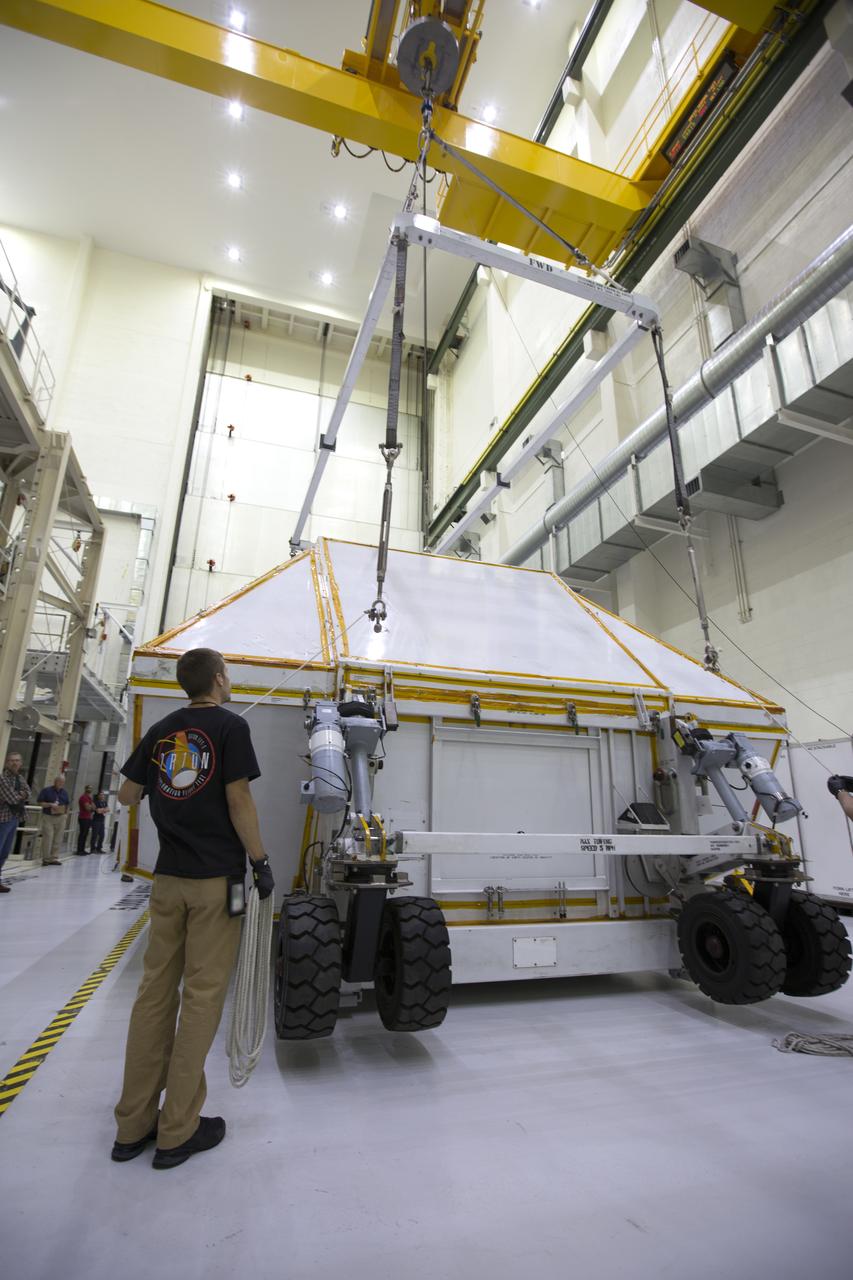
Inside the Neil Armstrong Operations and Checkout Building high bay at NASA's Kennedy Space Center in Florida, the Orion Exploration Mission-1 (EM-1) structural test article is secured inside its transport container. A crane is used to move the container toward a transport vehicle for the move to the Shuttle Landing Facility. The test article will be loaded in NASA's Super Guppy airplane and transported to Lockheed Martin's Denver facility for testing. The Orion spacecraft will launch atop NASA’s Space Launch System rocket on EM-1, its first deep space mission.
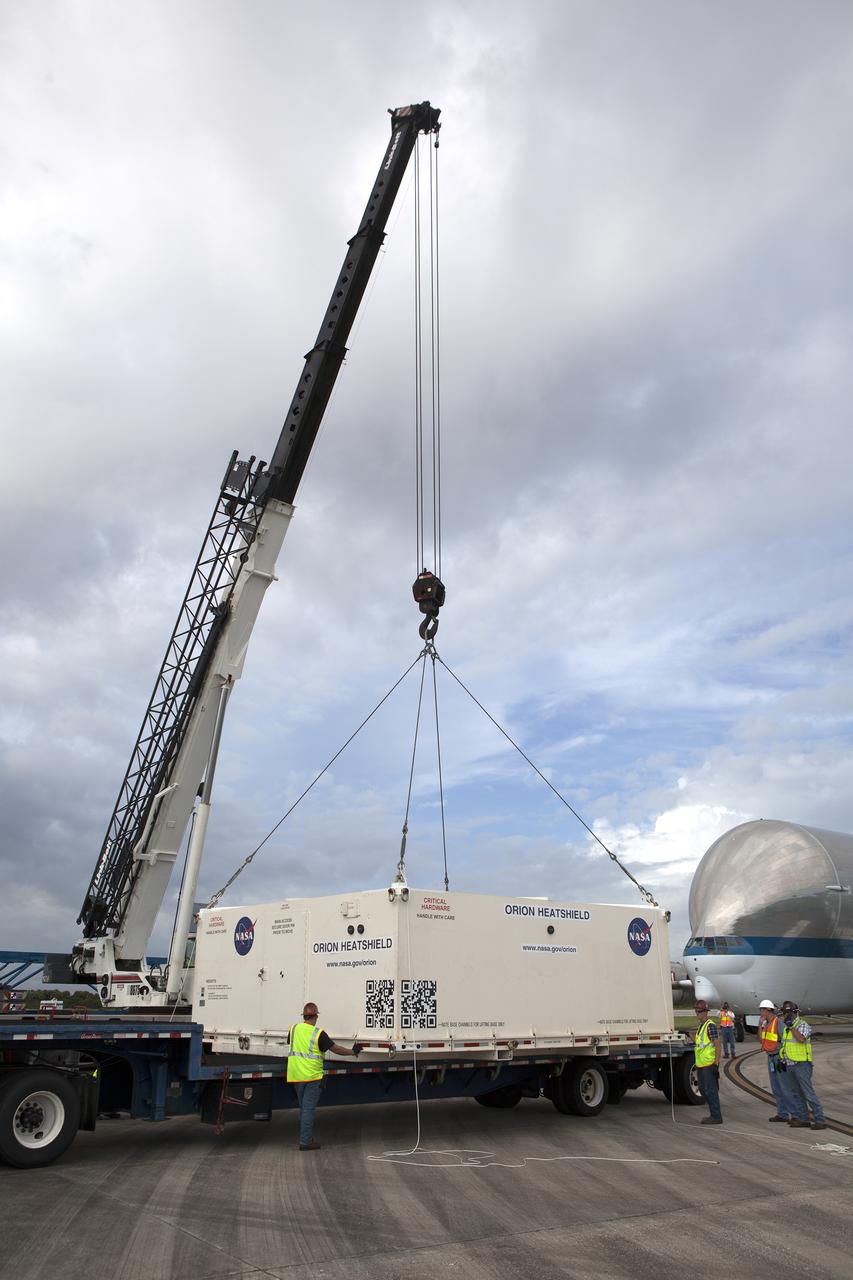
The shipping container carrying the Orion heat shield for Exploration Mission 1 (EM-1) is lowered by crane onto the flatbed of a transporter at the Shuttle Landing Facility, managed and operated by Space Florida, at NASA’s Kennedy Space Center in Florida. The heat shield arrived aboard the agency’s Super Guppy aircraft from Lockheed Martin’s manufacturing facility near Denver. The heat shield will be transported to the Neil Armstrong Operations and Checkout Building high bay for processing. The Orion spacecraft will launch atop NASA’s Space Launch System rocket on EM-1, an uncrewed test flight, in 2018.
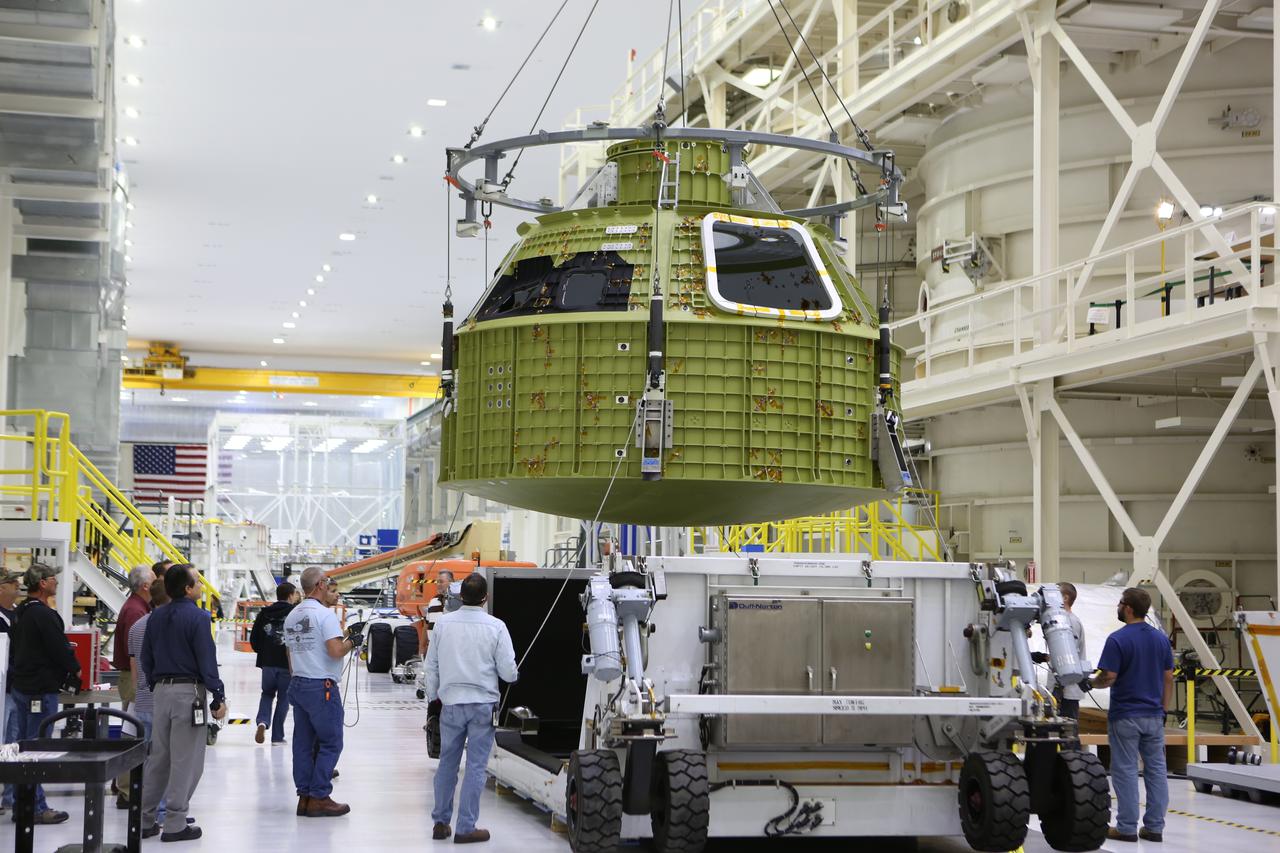
Inside the Neil Armstrong Operations and Checkout Building at NASA’s Kennedy Space Center in Florida, Lockheed Martin technicians monitor the progress as a crane lifts the Orion crew module structural test article (STA) up from the base of its transport container. The STA arrived aboard NASA's Super Guppy aircraft at the Shuttle Landing Facility operated by Space Florida. The test article will be moved to a test tool called the birdcage for further testing. The Orion spacecraft will launch atop NASA’s Space Launch System rocket on EM-1, its first deep space mission, in late 2018.
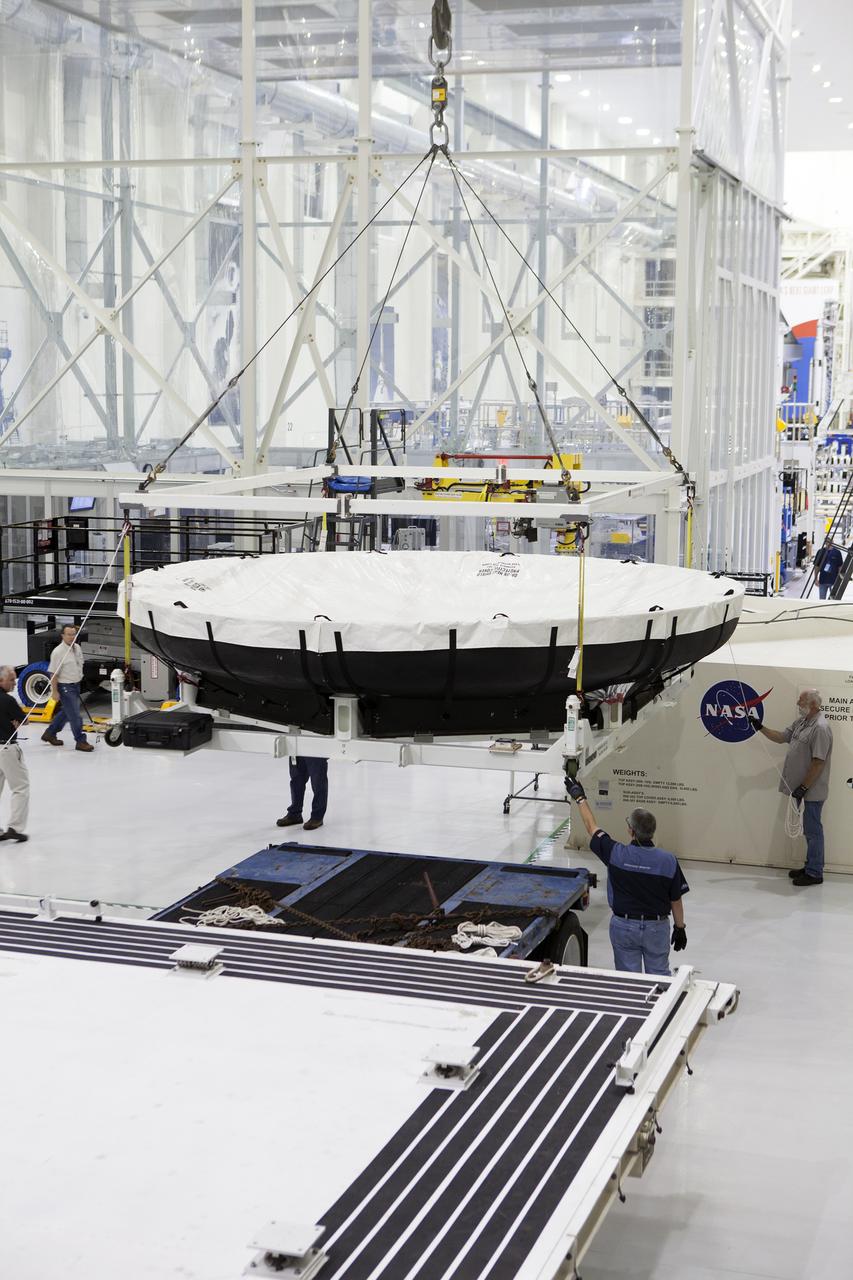
Inside the Neil Armstrong Operations and Checkout Building high bay at NASA’s Kennedy Space Center in Florida, a crane lifts the Orion heat shield for Exploration Mission 1 away from the base of its shipping container. The heat shield arrived aboard the agency’s Super Guppy aircraft at the Shuttle Landing Facility, managed and operated by Space Florida, from Lockheed Martin’s manufacturing facility near Denver. The heat shield will be moved onto a test stand to begin processing. The Orion spacecraft will launch atop NASA’s Space Launch System rocket on EM-1, an uncrewed test flight, in 2018.

Inside the Neil Armstrong Operations and Checkout Building at NASA’s Kennedy Space Center in Florida, Lockheed Martin technicians check the lines attached from a crane to the Orion crew module structural test article (STA). The STA arrived aboard NASA's Super Guppy aircraft at the Shuttle Landing Facility operated by Space Florida. The test article will be lifted out of its container and moved to a test tool called the birdcage for further testing. The Orion spacecraft will launch atop NASA’s Space Launch System rocket on EM-1, its first deep space mission, in late 2018.

The shipping container carrying the Orion heat shield for Exploration Mission 1 (EM-1) is lowered by crane onto the flatbed of a transporter at the Shuttle Landing Facility, managed and operated by Space Florida, at NASA’s Kennedy Space Center in Florida. The heat shield arrived aboard the agency’s Super Guppy aircraft from Lockheed Martin’s manufacturing facility near Denver. The heat shield will be transported to the Neil Armstrong Operations and Checkout Building high bay for processing. The Orion spacecraft will launch atop NASA’s Space Launch System rocket on EM-1, an uncrewed test flight, in 2018.
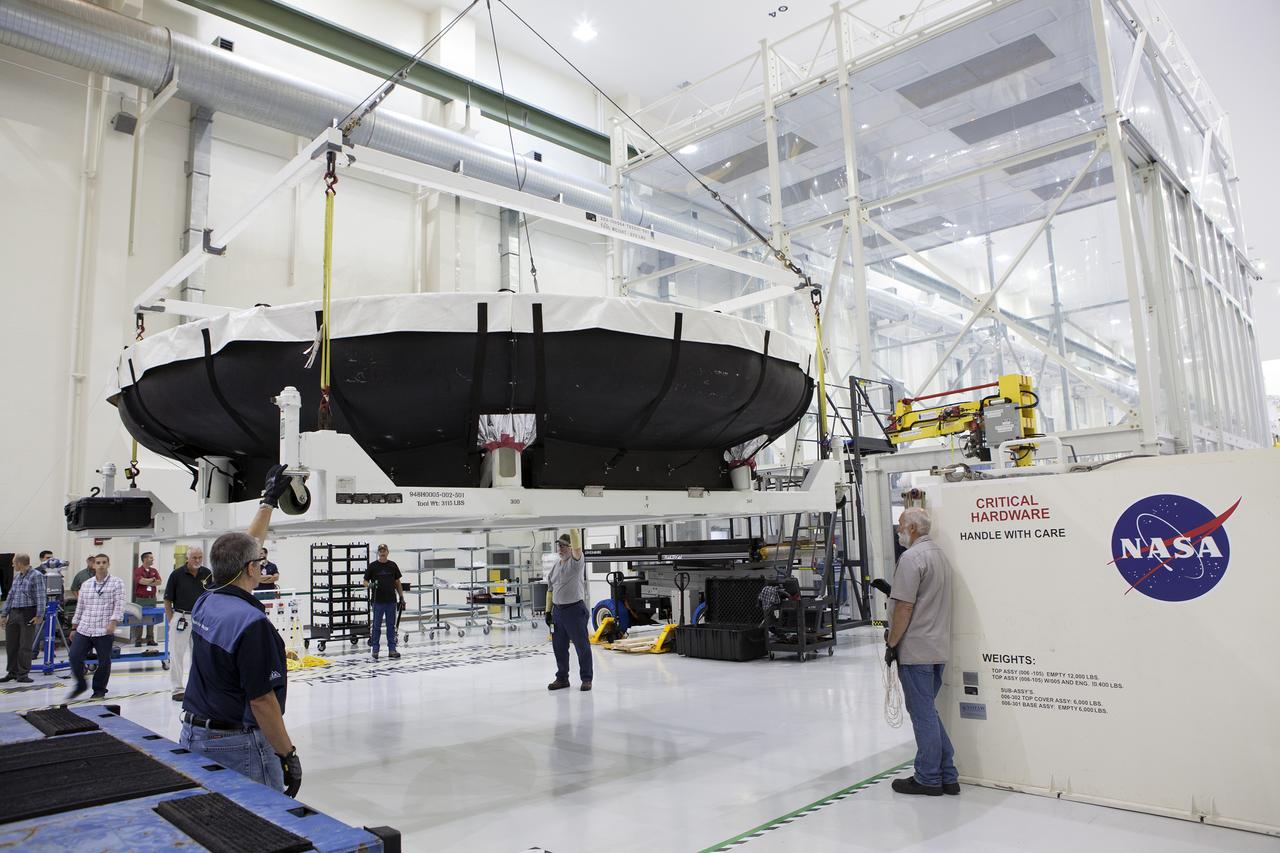
Inside the Neil Armstrong Operations and Checkout Building high bay at NASA’s Kennedy Space Center in Florida, technicians assist as a crane lifts the Orion heat shield for Exploration Mission 1 away from the base of its shipping container. The heat shield arrived aboard the agency’s Super Guppy aircraft at the Shuttle Landing Facility, managed and operated by Space Florida, from Lockheed Martin’s manufacturing facility near Denver. The heat shield will be moved onto a test stand to begin processing. The Orion spacecraft will launch atop NASA’s Space Launch System rocket on EM-1, an uncrewed test flight, in 2018.
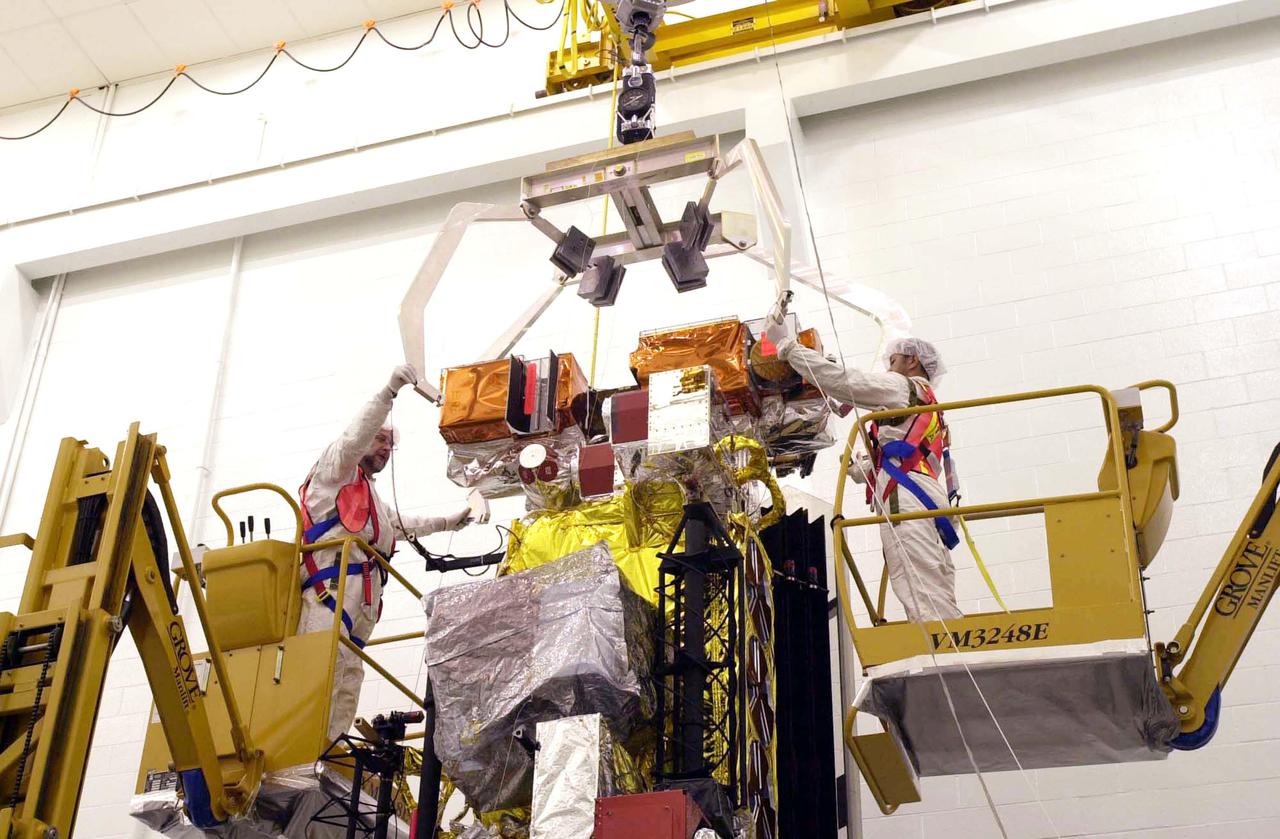
VANDENBERG AIR FORCE BASE, CALIF. - Inside the NASA spacecraft processing hangar 1610 located on North Vandenberg Air Force Base in California, Lockheed Martin workers attach a crane to move the National Oceanic and Atmospheric Administration (NOAA-N) spacecraft. NOAA-N will be lifted and mated to the Boeing Delta II payload attach fitting. Launch of NOAA-N aboard the Boeing Delta II rocket is currently scheduled for May 11, 2005. NOAA-N is the fourth in the series of support dedicated microwave instruments for the generation of temperature, moisture, surface, and hydrological products in cloudy regions where visible and infrared (IR) instruments have decreased capability.
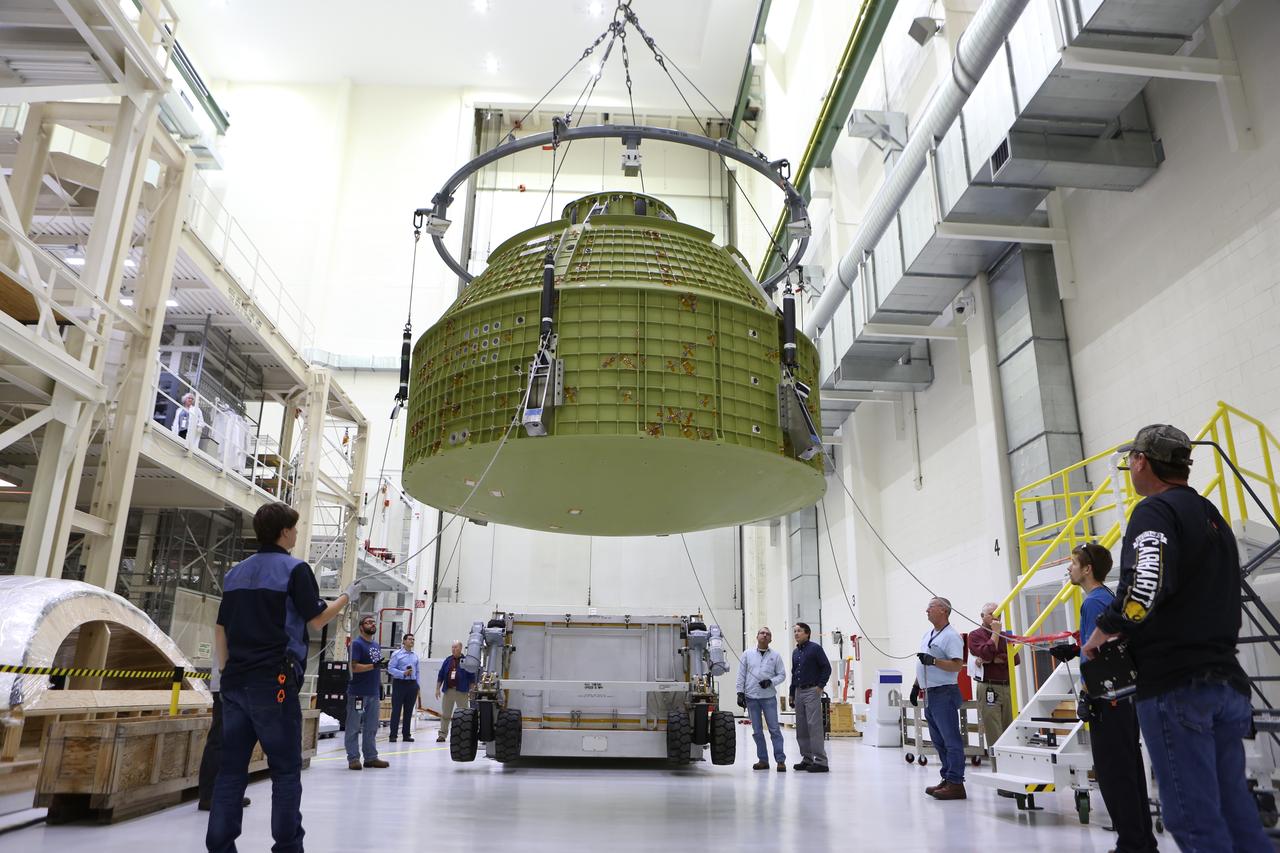
Inside the Neil Armstrong Operations and Checkout Building at NASA’s Kennedy Space Center in Florida, Lockheed Martin technicians monitor the progress as a crane moves the Orion crew module structural test article (STA) along the center aisle of the high bay. The STA arrived aboard NASA's Super Guppy aircraft at the Shuttle Landing Facility operated by Space Florida. The test article will be moved to a test tool called the birdcage for further testing. The Orion spacecraft will launch atop NASA’s Space Launch System rocket on EM-1, its first deep space mission, in late 2018.
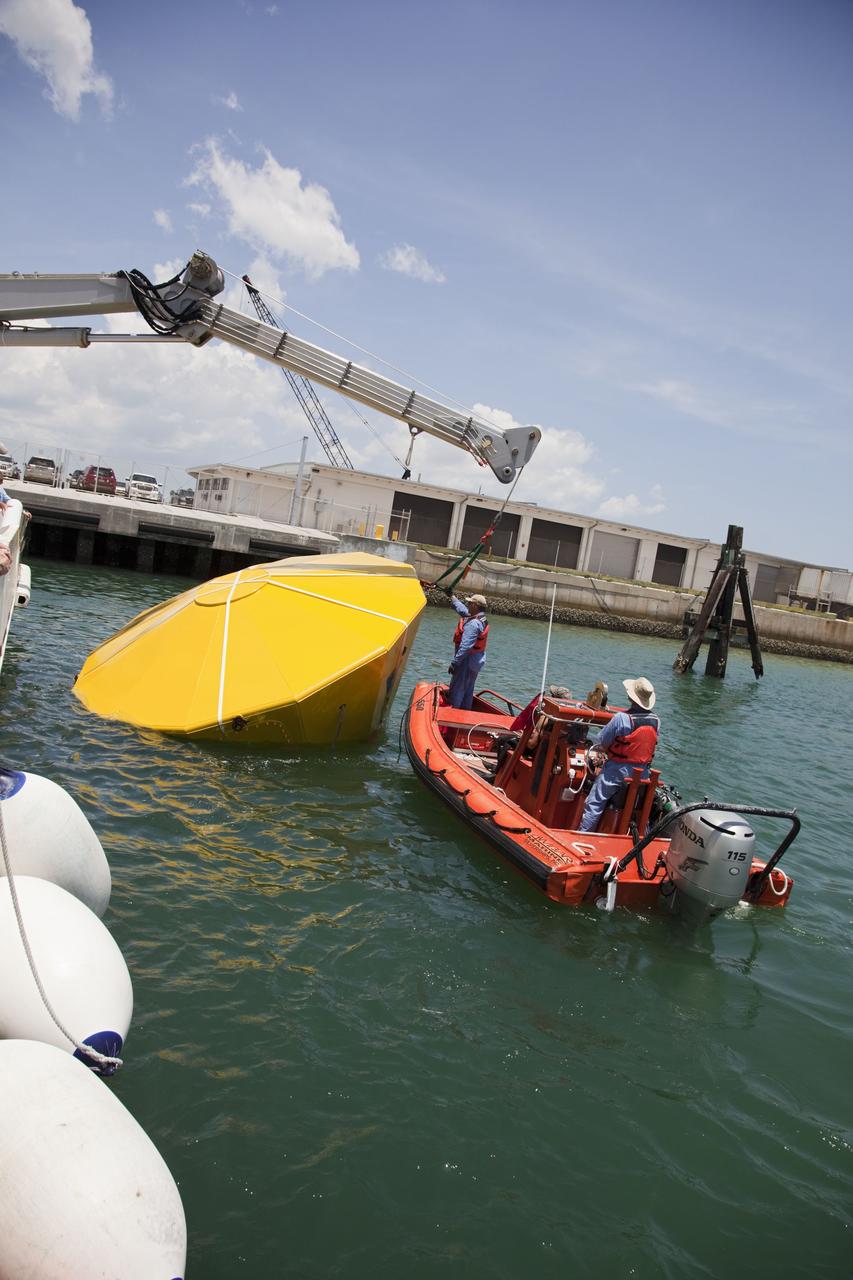
CAPE CANAVERAL, Fla. -- In the Delta turn basin at Cape Canaveral Air Force Station in Florida, United Space Alliance (USA) workers help orient an Orion test article to enable a ship's crane to rotate it. The uprighting tests are part of USA's research and development program to help develop ground operations support equipment that could be used to reorient and recover an uncrewed Orion flight test capsule after splashdown. USA is a major subcontractor to Lockheed Martin for the Orion spacecraft. The Orion Multi-Purpose Crew Vehicle is NASA's next-generation spacecraft designed for deep space missions to asteroids, moons and other interplanetary destinations throughout the solar system. Orion's first uncrewed orbital flight test is slated for 2013. For more information, visit http://www.nasa.gov/exploration/systems/mpcv/. Photo credit: NASA/Frankie Martin
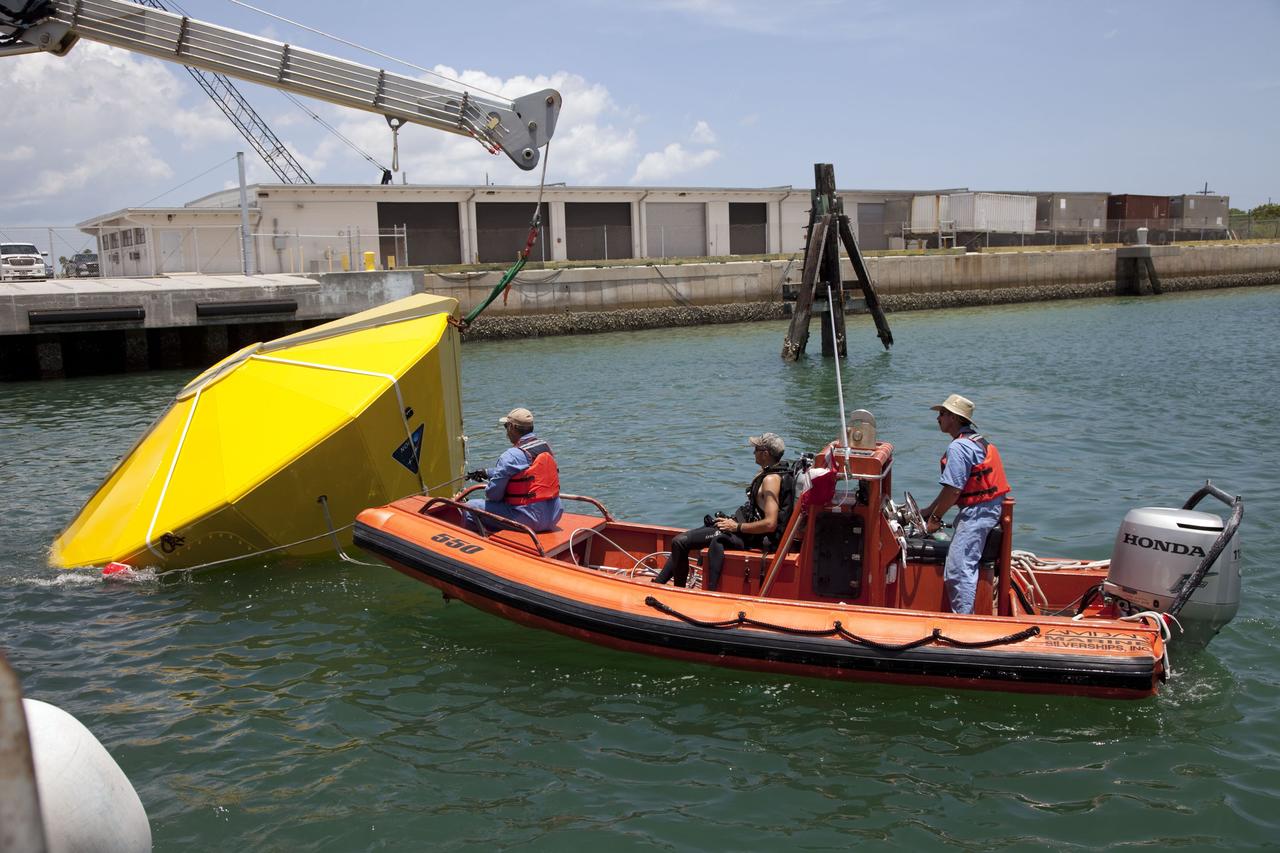
CAPE CANAVERAL, Fla. -- In the Delta turn basin at Cape Canaveral Air Force Station in Florida, United Space Alliance (USA) workers help orient an Orion test article to enable a ship's crane to rotate it. The uprighting tests are part of USA's research and development program to help develop ground operations support equipment that could be used to reorient and recover an uncrewed Orion flight test capsule after splashdown. USA is a major subcontractor to Lockheed Martin for the Orion spacecraft. The Orion Multi-Purpose Crew Vehicle is NASA's next-generation spacecraft designed for deep space missions to asteroids, moons and other interplanetary destinations throughout the solar system. Orion's first uncrewed orbital flight test is slated for 2013. For more information, visit http://www.nasa.gov/exploration/systems/mpcv/. Photo credit: NASA/Frankie Martin
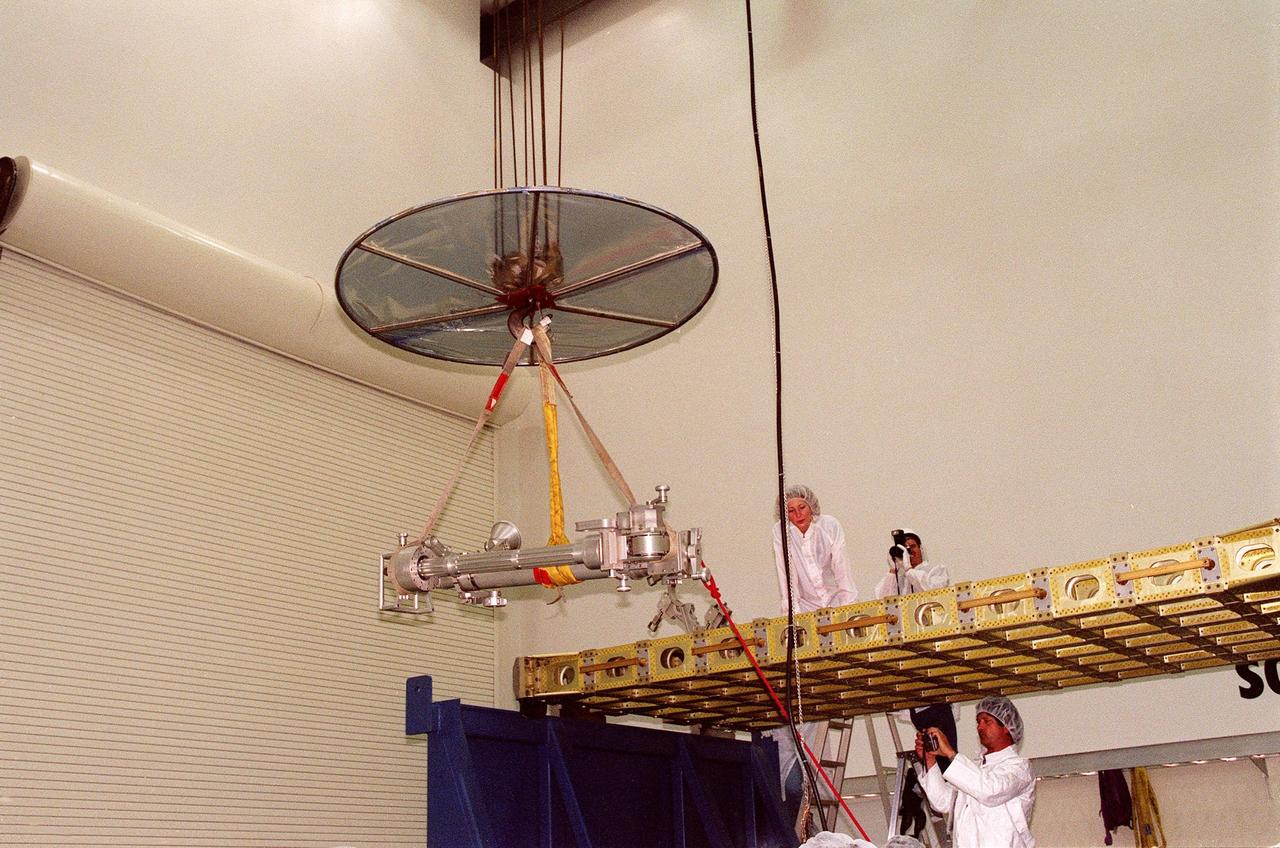
At Astrotech, Titusville, Fla., three workers watch as the overhead crane lifts and moves the ORU Transfer Device (OTD) to the top of the International Cargo Carrier (ICC). From left are Lora Laurence, with Johnson Space Center; Robert Wilkes, with Lockheed Martin; and Manfred Nordhoff, with Daimler-Chrysler Aerospace (DASA). The OTD is a U.S.-built crane that will be stowed on the International Space Station's Unity module for use during future ISS assembly missions. The nonpressurized ICC fits inside the payload bay of the orbiter. The ICC will also carry the SPACEHAB Oceaneering Space System Box (SHOSS), a logistics items carrier. SHOSS can hold a maximum of 400 pounds of equipment and will carry items to be used during STS-96 and future ISS assembly flights. The ICC will fly on mission STS-96, targeted for launch on May 20
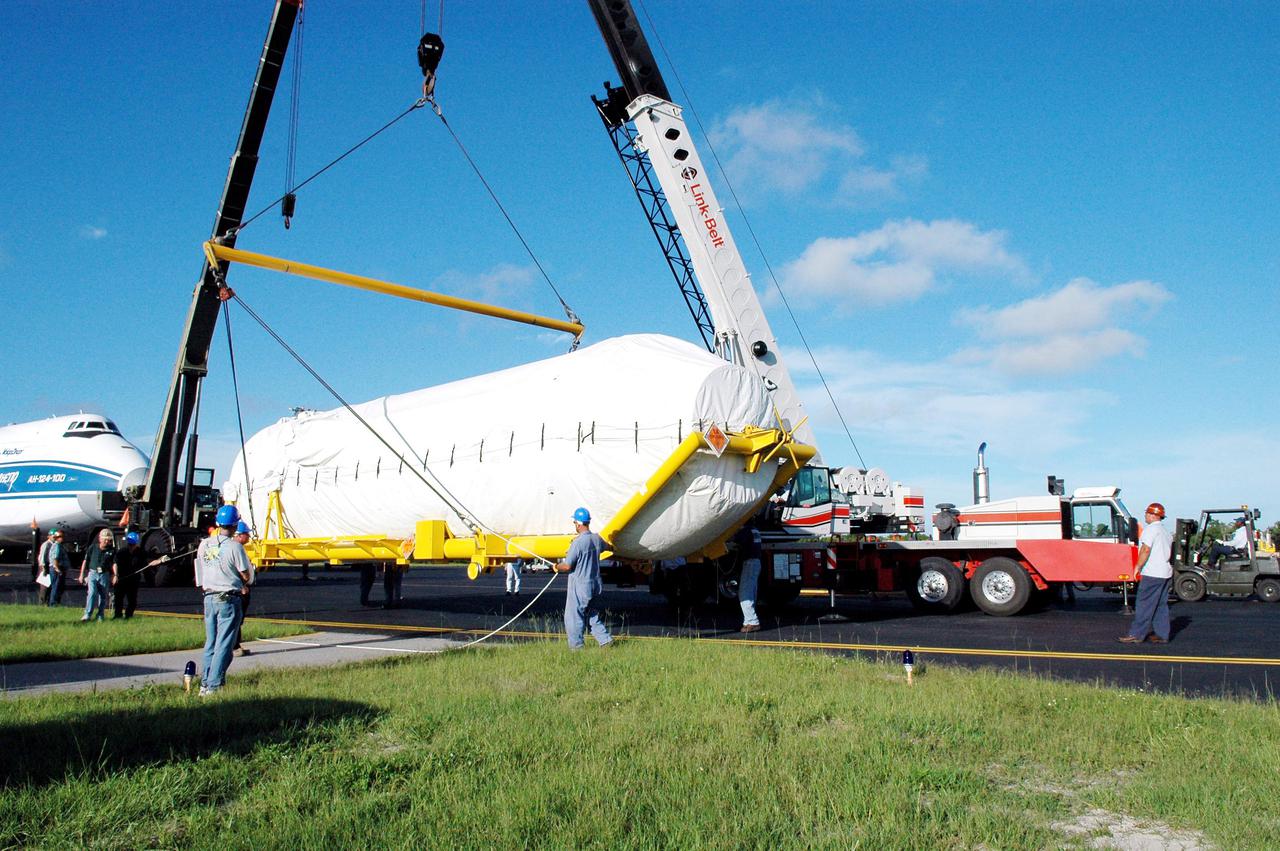
KENNEDY SPACE CENTER, FLA. - At the Cape Canaveral Air Force Station Skid Strip, a large crane is attached to the offloaded second stage Centaur (Block I) to lift and place it on a flat bed truck. The Centaur arrived on a Russian Antonov AH-124-100 cargo airplane. The Centaur upper stage will be mated with the Lockheed Martin Atlas V, designated AV-007, that is the launch vehicle for the Mars Reconnaissance Orbiter (MRO). The MRO is designed for a series of global mapping, regional survey and targeted observations from a near-polar, low-altitude Mars orbit. These observations will be unprecedented in terms of the spatial resolution and coverage achieved by the orbiter’s instruments as they observe the atmosphere and surface of Mars while probing its shallow subsurface as part of a “follow the water” strategy. The orbiter is undergoing environmental tests in facilities at Lockheed Martin Space Systems in Denver, Colo., and is on schedule for a launch window that begins Aug. 10. Launch will be from Launch Complex 41 at Cape Canaveral Air Force Station in Florida.
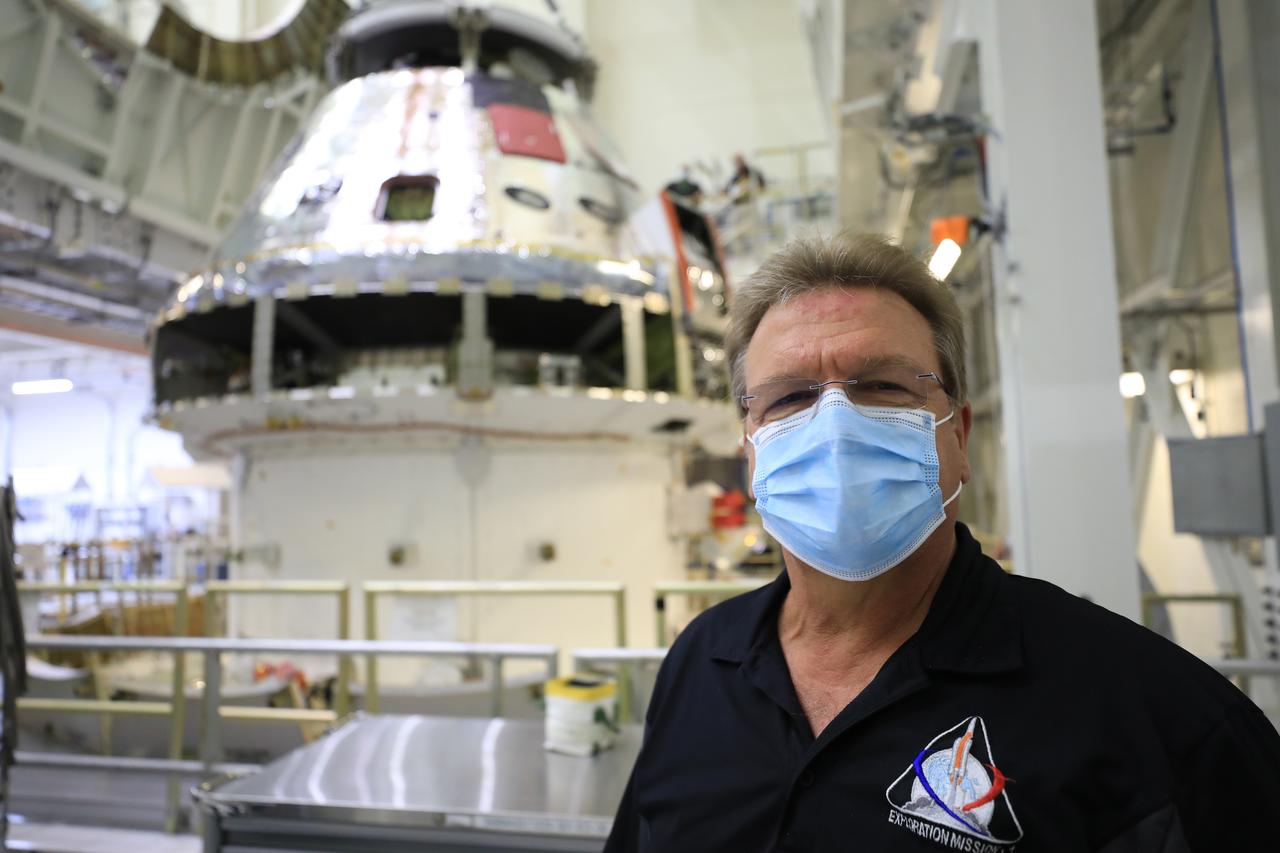
Jules Schneider, Lockheed Martin Assembly, Test and Launch Operations director, is shown inside the Neil Armstrong Operations and Checkout Building high bay in front of the FAST cell as the Artemis I Orion spacecraft is lowered by crane after installation of the spacecraft adapter (SA) cone was completed on Aug. 20, 2020. This is one of the final major hardware operations the spacecraft will undergo during closeout processing prior to being integrated with the Space Launch System (SLS) rocket in preparation for the first Artemis mission. The spacecraft adapter cone connects the bottom portion of Orion’s service module to the top part of the rocket known as the interim cryogenic propulsion stage (ICPS). Orion will fly on the agency’s Artemis I mission – the first in a series of increasingly complex missions to the Moon that will ultimately lead to the exploration of Mars.
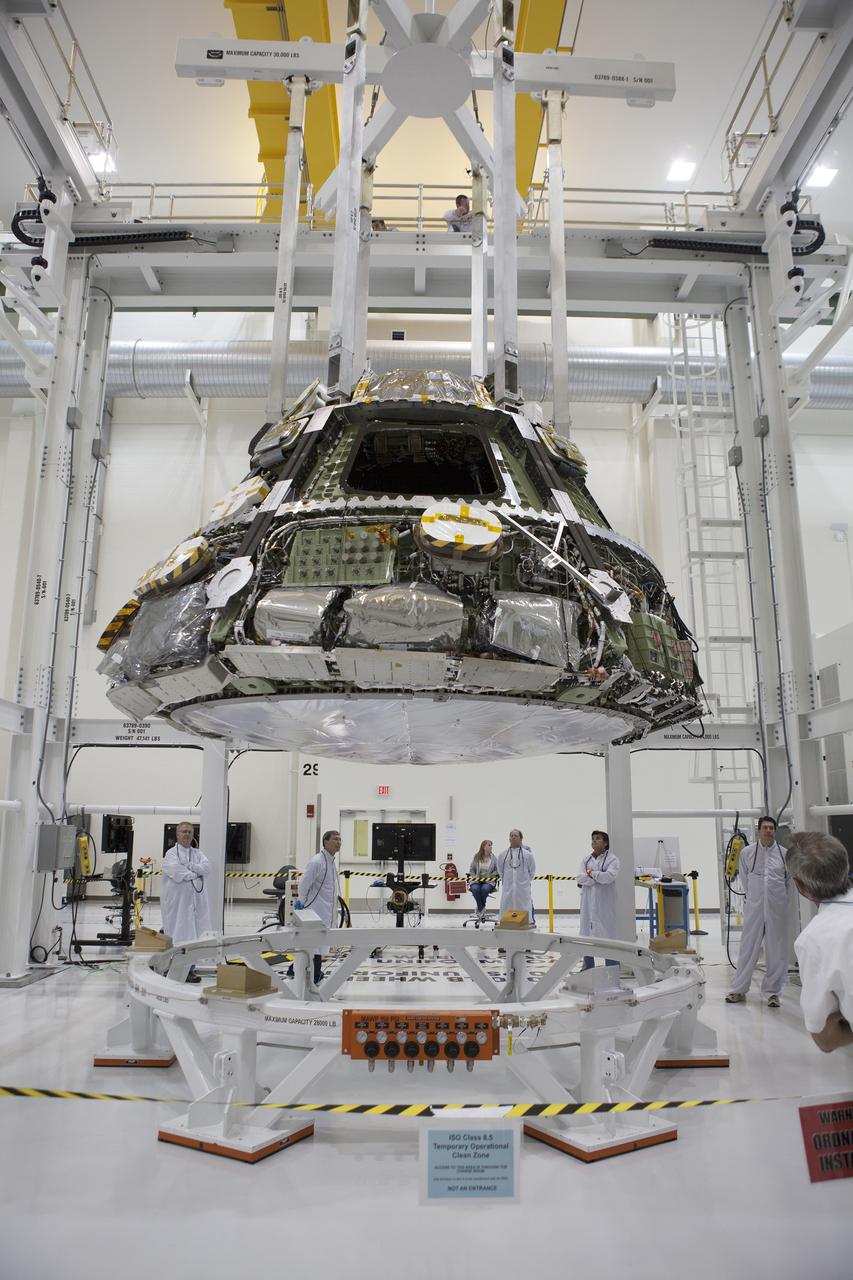
CAPE CANAVERAL, Fla. – Inside the Operations and Checkout Building high bay at NASA's Kennedy Space Center in Florida, Lockheed Martin technicians monitor the progress as the Orion crew module is lifted by crane from a test stand. Activities are underway to prepare Orion for future installation of the heat shield. Orion is the exploration spacecraft designed to carry astronauts to destinations not yet explored by humans, including an asteroid and Mars. It will have emergency abort capability, sustain the crew during space travel and provide safe re-entry from deep space return velocities. The first unpiloted test flight of the Orion is scheduled to launch in 2014 atop a Delta IV rocket and in 2017 on NASA’s Space Launch System rocket. For more information, visit http://www.nasa.gov/orion. Photo credit: NASA/Dimitri Gerondidakis
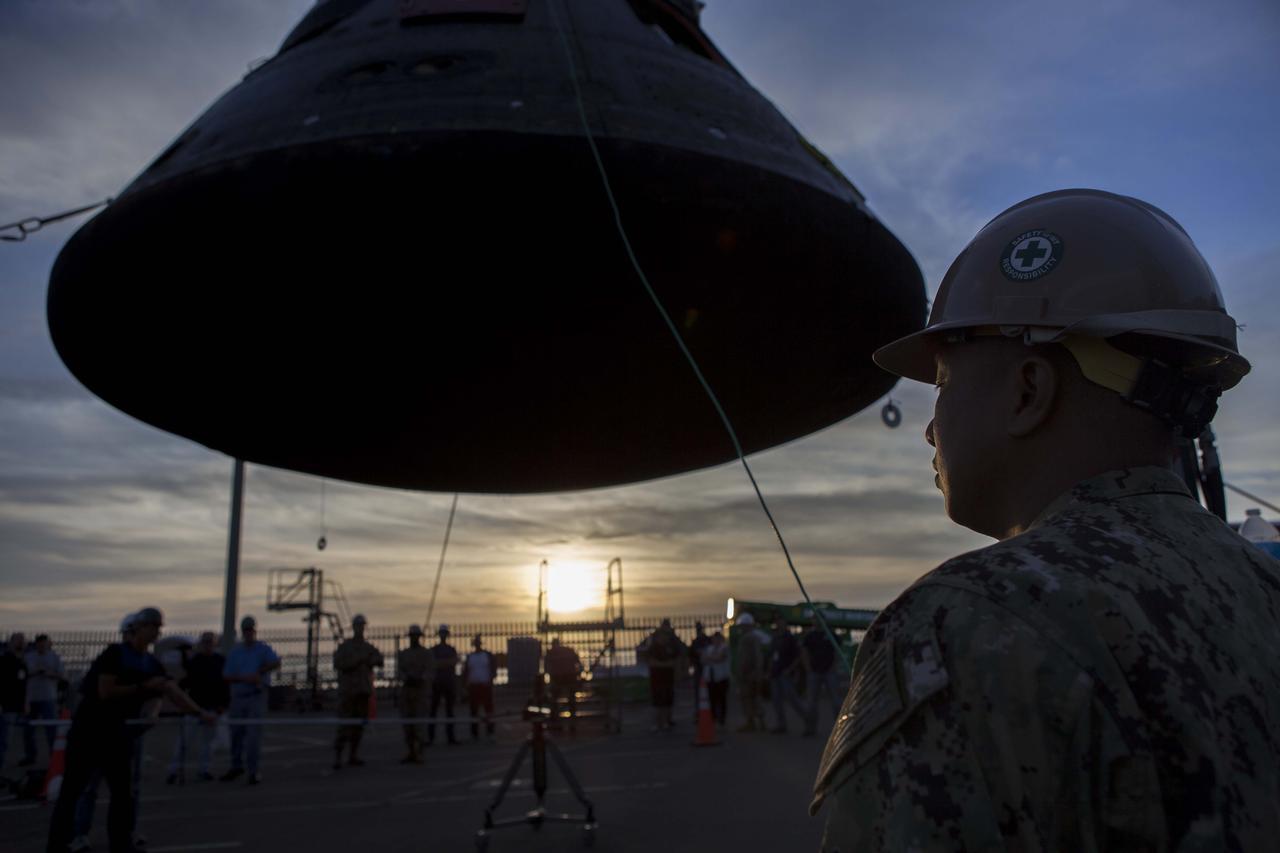
Just before sunset, the Orion crew module is being moved by crane from its crew module recovery cradle and will be placed in the crew module transportation fixture at the Mole Pier at Naval Base San Diego in California. The fixture has been secured on the back of a flatbed truck. Orion is being prepared for the overland trip back to NASA's Kennedy Space Center in Florida. Orion was recovered from the Pacific Ocean after completing a two-orbit, four-and-a-half hour mission Dec. 5 to test systems critical to crew safety, including the launch abort system, the heat shield and the parachute system. NASA, the U.S. Navy and Lockheed Martin coordinated efforts to recover Orion. The Ground Systems Development and Operations Program led the recovery, offload and pre-transportation efforts.
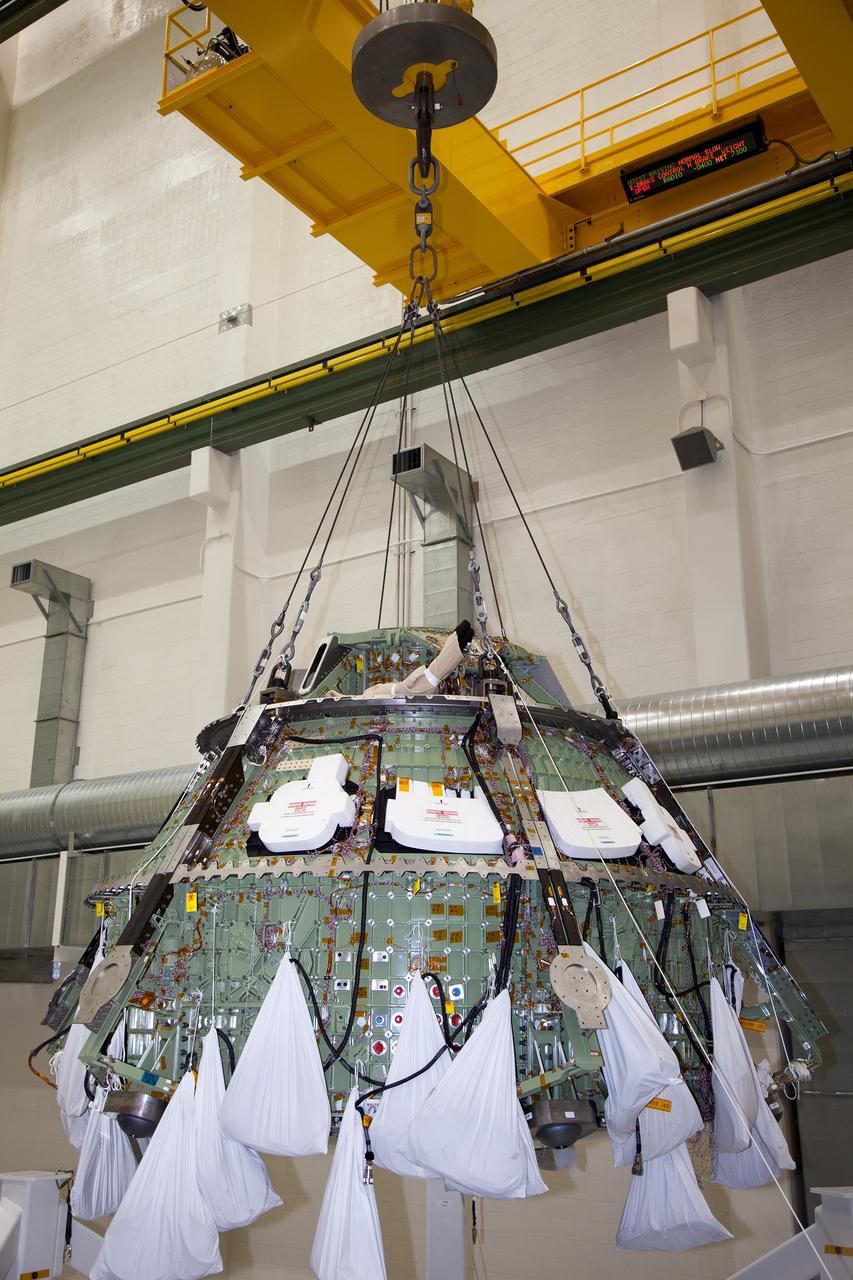
CAPE CANAVERAL, Fla. – Inside the Operations and Checkout Building high bay at NASA’s Kennedy Space Center in Florida, a crane lifts the Orion crew module out of a special test stand. Lockheed Martin Space Systems and NASA engineers performed a series of static load tests on Orion that simulated the massive loads the spacecraft would experience during its mission. Orion is the exploration spacecraft designed to carry crews to space beyond low Earth orbit. It will provide emergency abort capability, sustain the crew during the space travel and provide safe re-entry from deep space return velocities. Orion’s first unpiloted test flight, Exploration Flight Test 1, is scheduled to launch in 2014 atop a Delta IV rocket. A second uncrewed flight test is scheduled for 2017 on NASA’s Space Launch System rocket. For more information, visit http://www.nasa.gov/orion. Photo credit: NASA/Daniel Casper
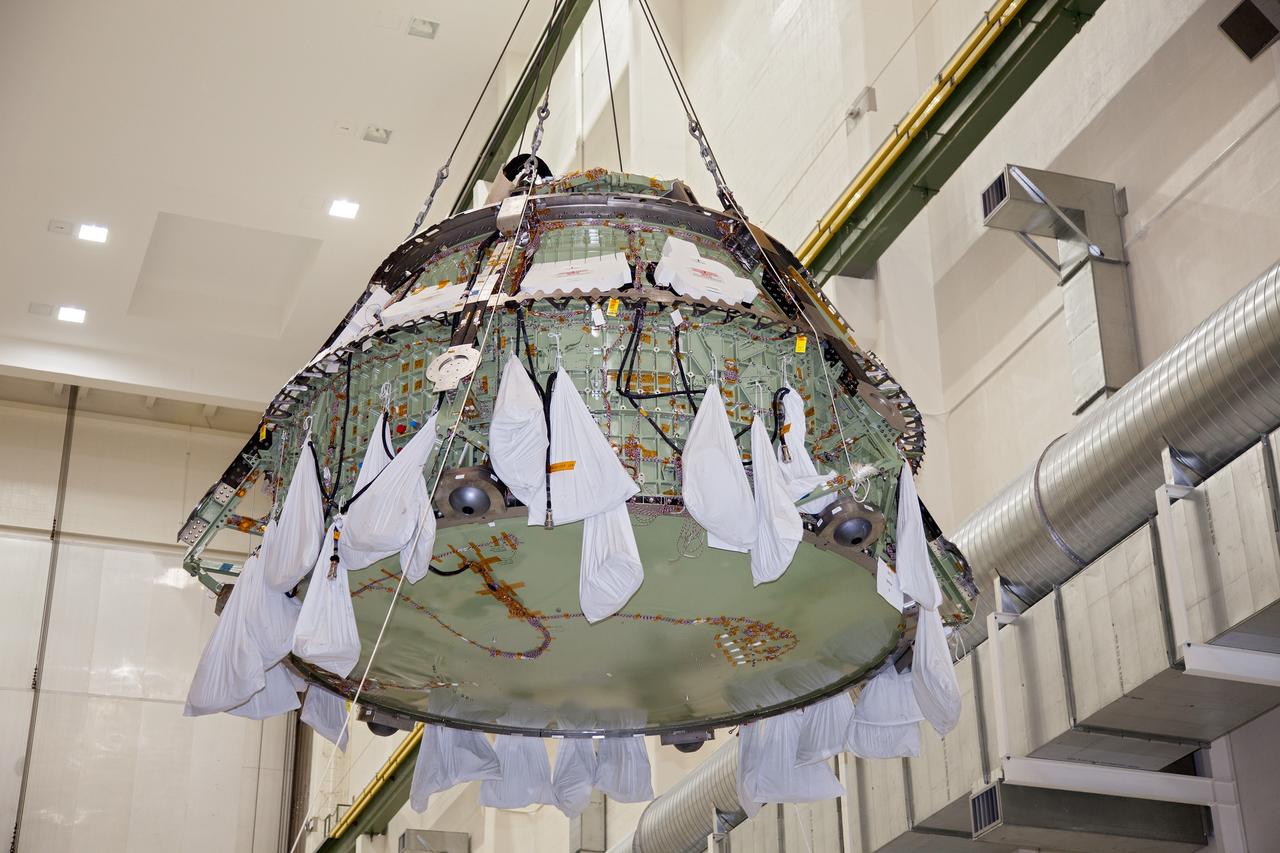
CAPE CANAVERAL, Fla. – Inside the Operations and Checkout Building high bay at NASA’s Kennedy Space Center in Florida, a crane has lifted the Orion crew module out of a special test stand. Lockheed Martin Space Systems and NASA engineers performed a series of static load tests on Orion that simulated the massive loads the spacecraft would experience during its mission. Orion is the exploration spacecraft designed to carry crews to space beyond low Earth orbit. It will provide emergency abort capability, sustain the crew during the space travel and provide safe re-entry from deep space return velocities. Orion’s first unpiloted test flight, Exploration Flight Test 1, is scheduled to launch in 2014 atop a Delta IV rocket. A second uncrewed flight test is scheduled for 2017 on NASA’s Space Launch System rocket. For more information, visit http://www.nasa.gov/orion. Photo credit: NASA/Daniel Casper
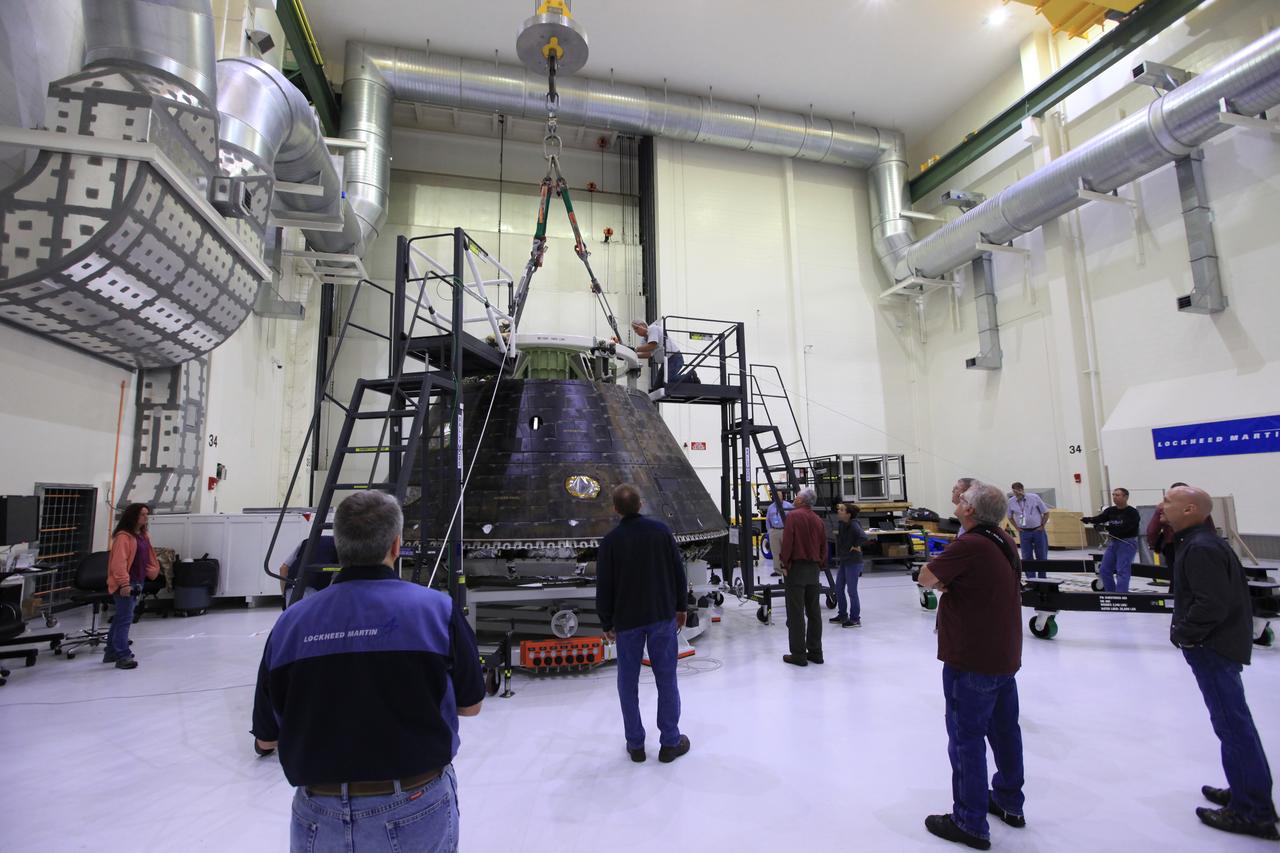
Inside the Neil Armstrong Operations and Checkout Building high bay at NASA's Kennedy Space Center in Florida, Lockheed Martin and ASRC workers monitor the progress as a crane is attached to the top of the Orion crew module from Exploration Flight Test 1. The crew module will be moved to the nearby Kennedy Space Center Visitor Complex and delivered to the IMAX Theater where it will be prepared for display in the NASA Now exhibit. The Orion spacecraft launched atop a United Launch Alliance Delta IV rocket Dec. 5, 2014, from Space Launch Complex 37 at Cape Canaveral Air Force Station. The spacecraft built for humans traveled 3,604 miles above Earth and splashed down about 4.5 hours later in the Pacific Ocean.
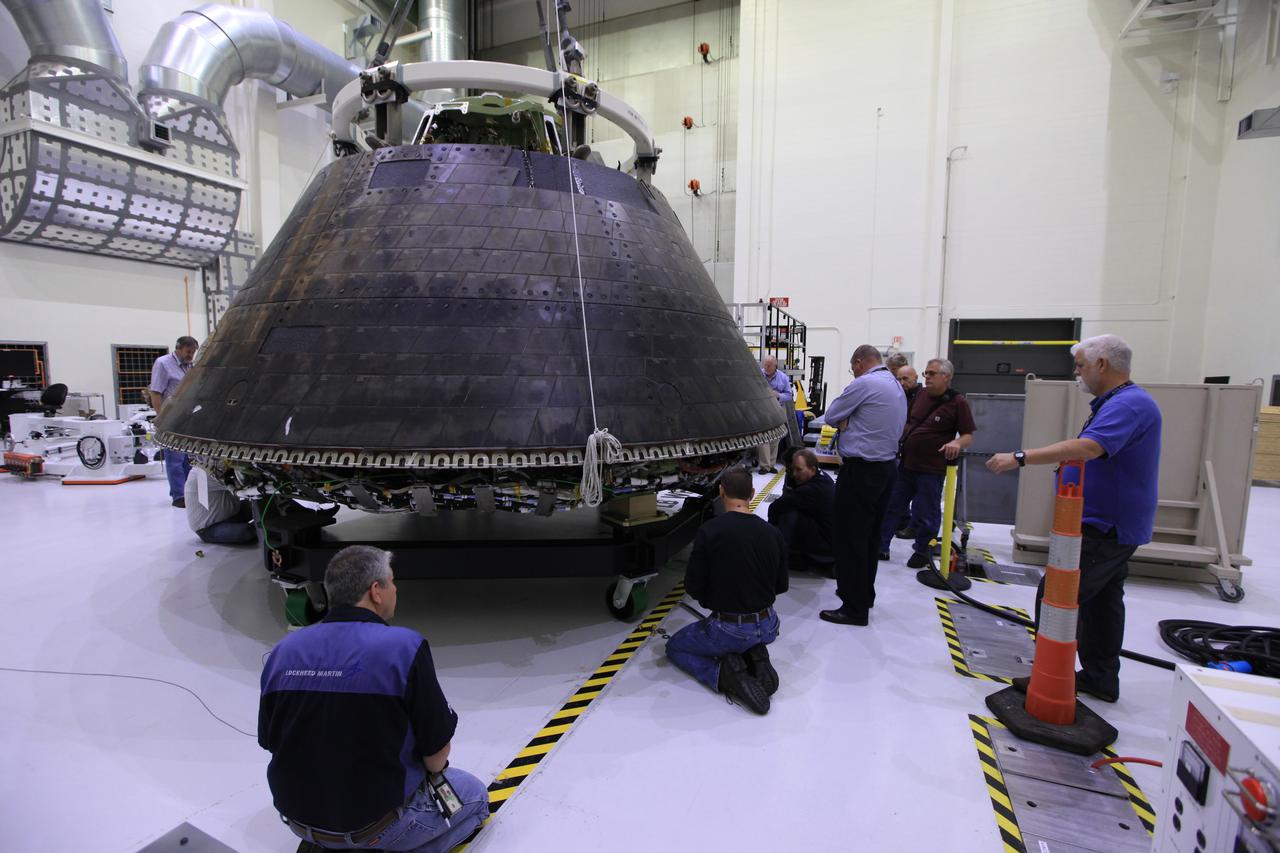
Inside the Neil Armstrong Operations and Checkout Building high bay at NASA's Kennedy Space Center in Florida, Lockheed Martin and ASRC workers assist as a crane lowers the Orion crew module from Exploration Flight Test 1 onto a custom-built transport stand. The crew module is being prepared for its move to the nearby Kennedy Space Center Visitor Complex and delivery to the IMAX Theater where it will be on display in the NASA Now exhibit. The Orion spacecraft launched atop a United Launch Alliance Delta IV rocket Dec. 5, 2014, from Space Launch Complex 37 at Cape Canaveral Air Force Station. The spacecraft built for humans traveled 3,604 miles above Earth and splashed down about 4.5 hours later in the Pacific Ocean.
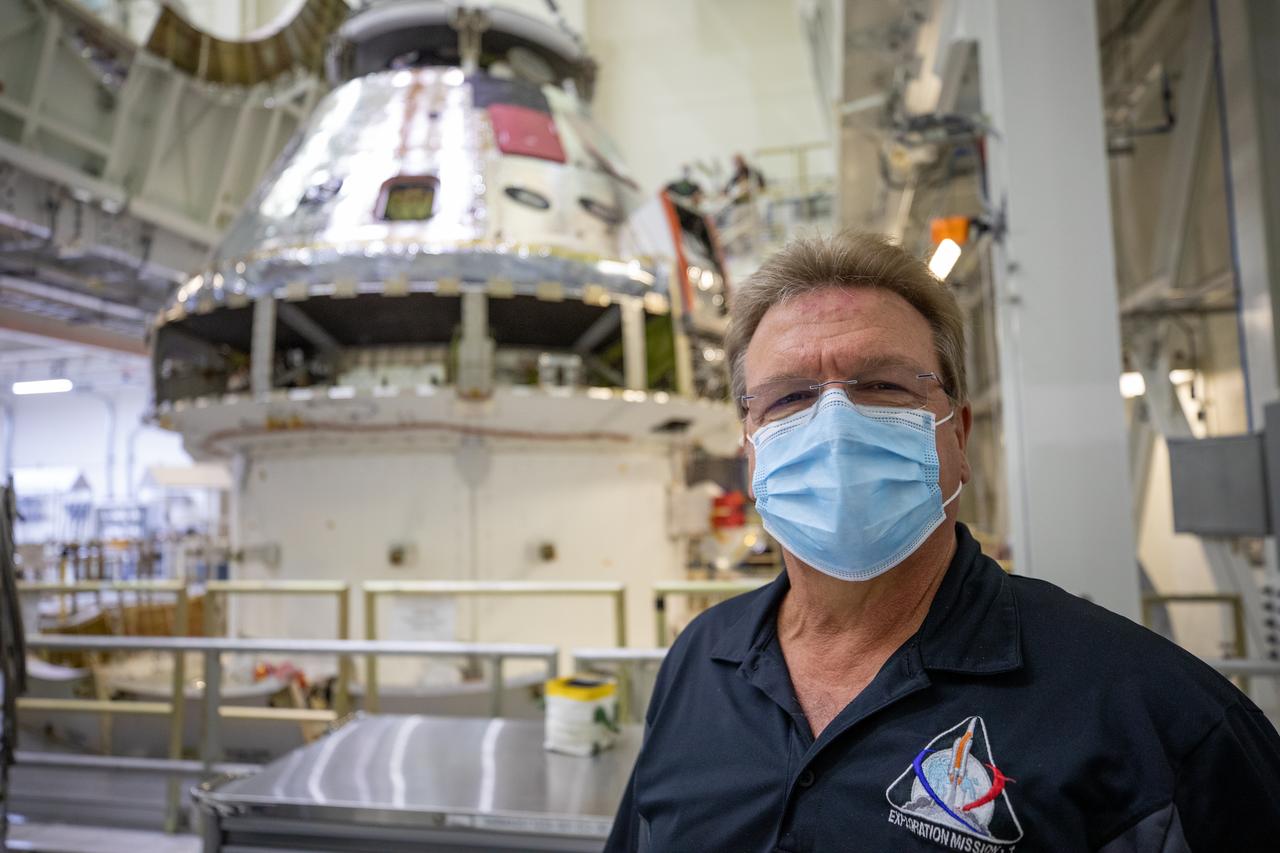
Jules Schneider, Lockheed Martin Assembly, Test and Launch Operations director, is shown inside the Neil Armstrong Operations and Checkout Building high bay in front of the FAST cell as the Artemis I Orion spacecraft is lowered by crane after installation of the spacecraft adapter (SA) cone was completed on Aug. 20, 2020. This is one of the final major hardware operations the spacecraft will undergo during closeout processing prior to being integrated with the Space Launch System (SLS) rocket in preparation for the first Artemis mission. The spacecraft adapter cone connects the bottom portion of Orion’s service module to the top part of the rocket known as the interim cryogenic propulsion stage (ICPS). Orion will fly on the agency’s Artemis I mission – the first in a series of increasingly complex missions to the Moon that will ultimately lead to the exploration of Mars.