
Giant, bright coronal loops trace out the magnetic field lines above an active region from June 4-6, 2018. The wavelength of extreme ultraviolet light shown here is emitted by ionized iron travelling along the field lines, super-heated to approximately 1 million degrees K. Coronal loops were not seen in this level of detail until the Solar Dynamics Observatory was launched in 2010 and came online, giving solar scientists new data with which to study the Sun and its processes. Videos are available at https://photojournal.jpl.nasa.gov/catalog/PIA22508
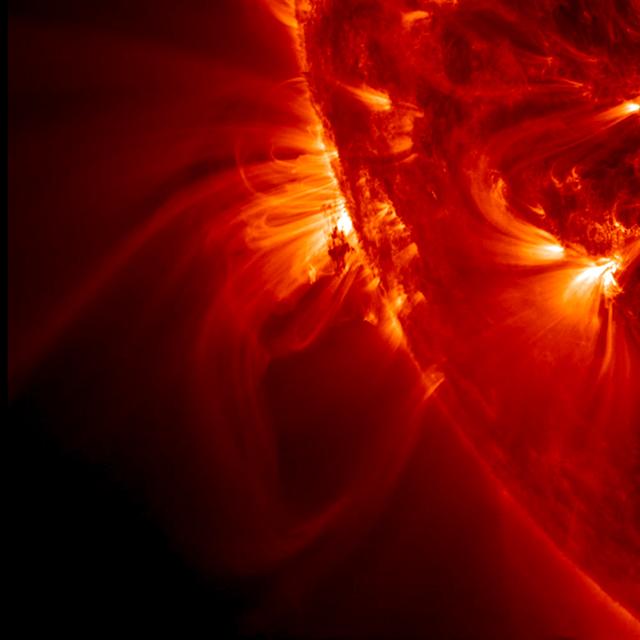
NASA's Solar Dynamics Observatory (SDO) zoomed in almost to its maximum level to watch tight, bright loops and much longer, softer loops shift and sway above an active region on the sun, while a darker blob of plasma in their midst was pulled about every which way (May 13-14, 2014). Credit: NASA/Solar Dynamics Observatory <b><a href="http://www.nasa.gov/audience/formedia/features/MP_Photo_Guidelines.html" rel="nofollow">NASA image use policy.</a></b> <b><a href="http://www.nasa.gov/centers/goddard/home/index.html" rel="nofollow">NASA Goddard Space Flight Center</a></b> enables NASA’s mission through four scientific endeavors: Earth Science, Heliophysics, Solar System Exploration, and Astrophysics. Goddard plays a leading role in NASA’s accomplishments by contributing compelling scientific knowledge to advance the Agency’s mission. <b>Follow us on <a href="http://twitter.com/NASAGoddardPix" rel="nofollow">Twitter</a></b> <b>Like us on <a href="http://www.facebook.com/pages/Greenbelt-MD/NASA-Goddard/395013845897?ref=tsd" rel="nofollow">Facebook</a></b> <b>Find us on <a href="http://instagram.com/nasagoddard?vm=grid" rel="nofollow">Instagram</a></b>
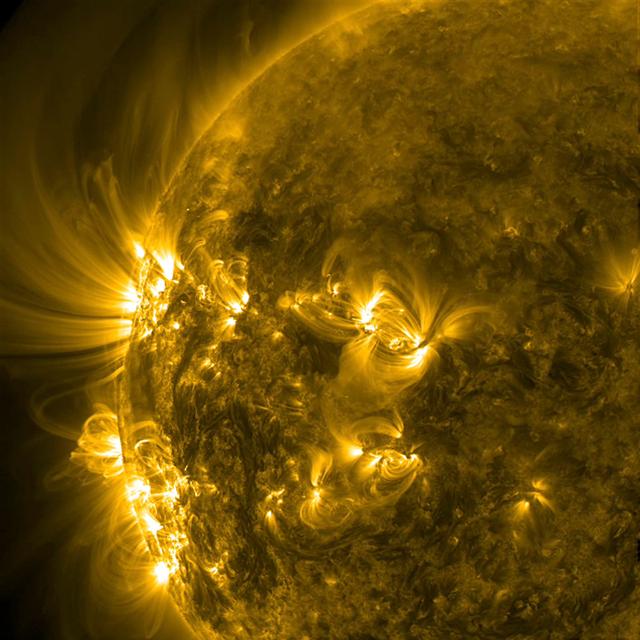
Two active regions with their intense magnetic fields produced towering arches and spiraling coils of solar loops above them (June 29 - July 1, 2014) as they rotated into view. When viewed in extreme ultraviolet light, magnetic field lines are revealed by charged particles that travel along them. These active regions appear as dark sunspots when viewed in filtered light. This image was taken on June 30 at 10:33 UT. Credit: NASA/Solar Dynamics Observatory Two active regions with their intense magnetic fields produced towering arches and spiraling coils of solar loops above them (June 29 - July 1, 2014) as they rotated into view. When viewed in extreme ultraviolet light, magnetic field lines are revealed by charged particles that travel along them. These active regions appear as dark sunspots when viewed in filtered light. Note the small blast in the upper of the two major active regions, followed by more coils of loops as the region reorganizes itself. The still was taken on June 30 at 10:33 UT. Credit: Solar Dynamics Observatory/NASA.
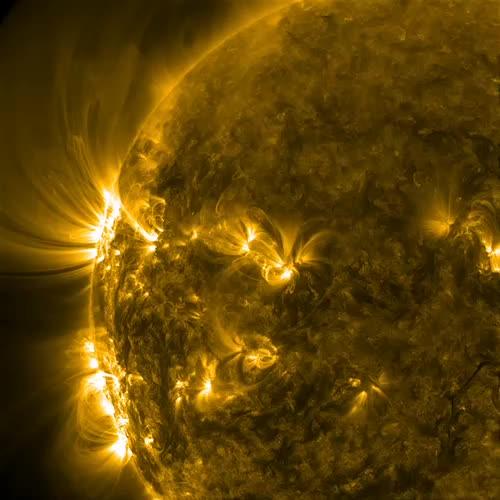
Two active regions with their intense magnetic fields produced towering arches and spiraling coils of solar loops above them (June 29 - July 1, 2014) as they rotated into view. When viewed in extreme ultraviolet light, magnetic field lines are revealed by charged particles that travel along them. These active regions appear as dark sunspots when viewed in filtered light. Note the small blast in the upper of the two major active regions, followed by more coils of loops as the region reorganizes itself. The still was taken on June 30 at 10:33 UT. Credit: NASA/Solar Dynamics Observatory Two active regions with their intense magnetic fields produced towering arches and spiraling coils of solar loops above them (June 29 - July 1, 2014) as they rotated into view. When viewed in extreme ultraviolet light, magnetic field lines are revealed by charged particles that travel along them. These active regions appear as dark sunspots when viewed in filtered light. Note the small blast in the upper of the two major active regions, followed by more coils of loops as the region reorganizes itself. The still was taken on June 30 at 10:33 UT. Credit: Solar Dynamics Observatory/NASA.
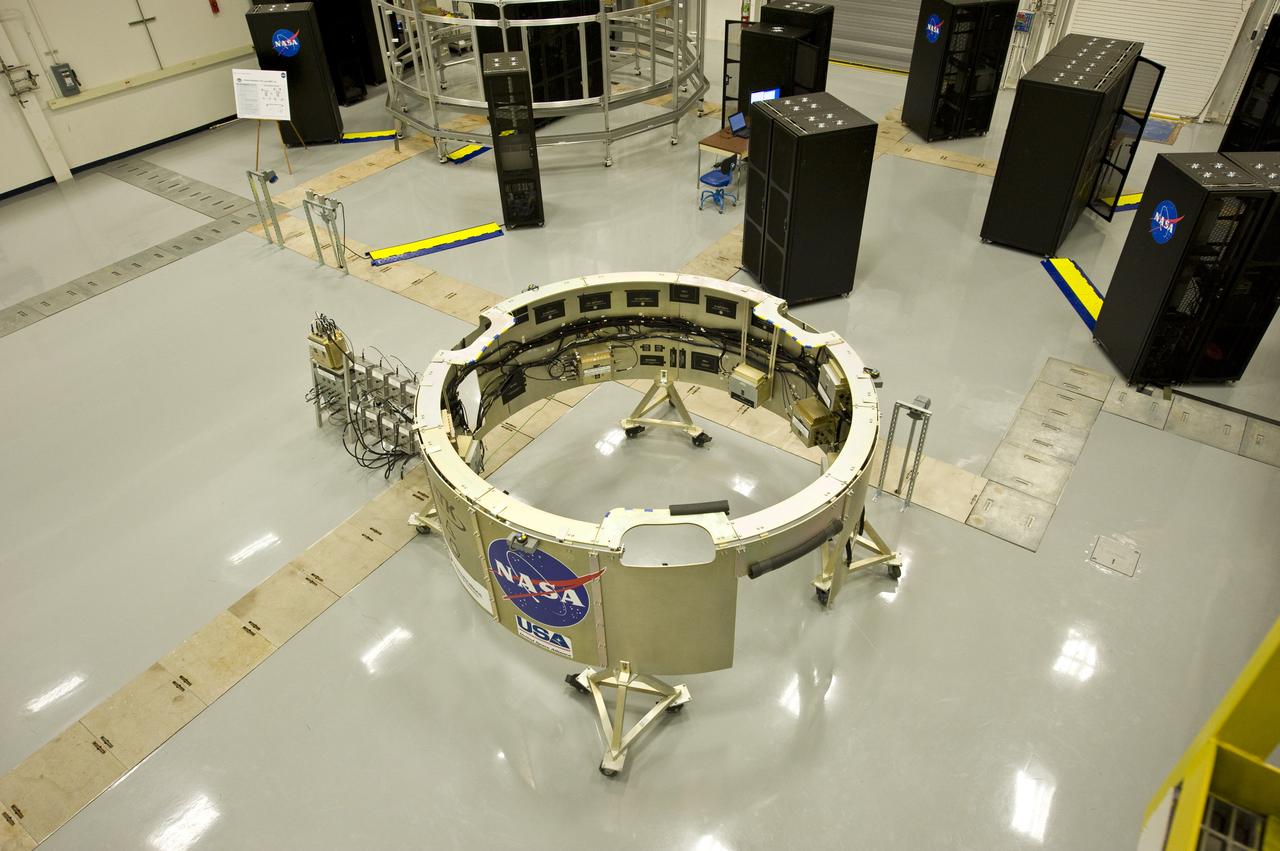
HARDWARE IN THE LOOP FACILITY
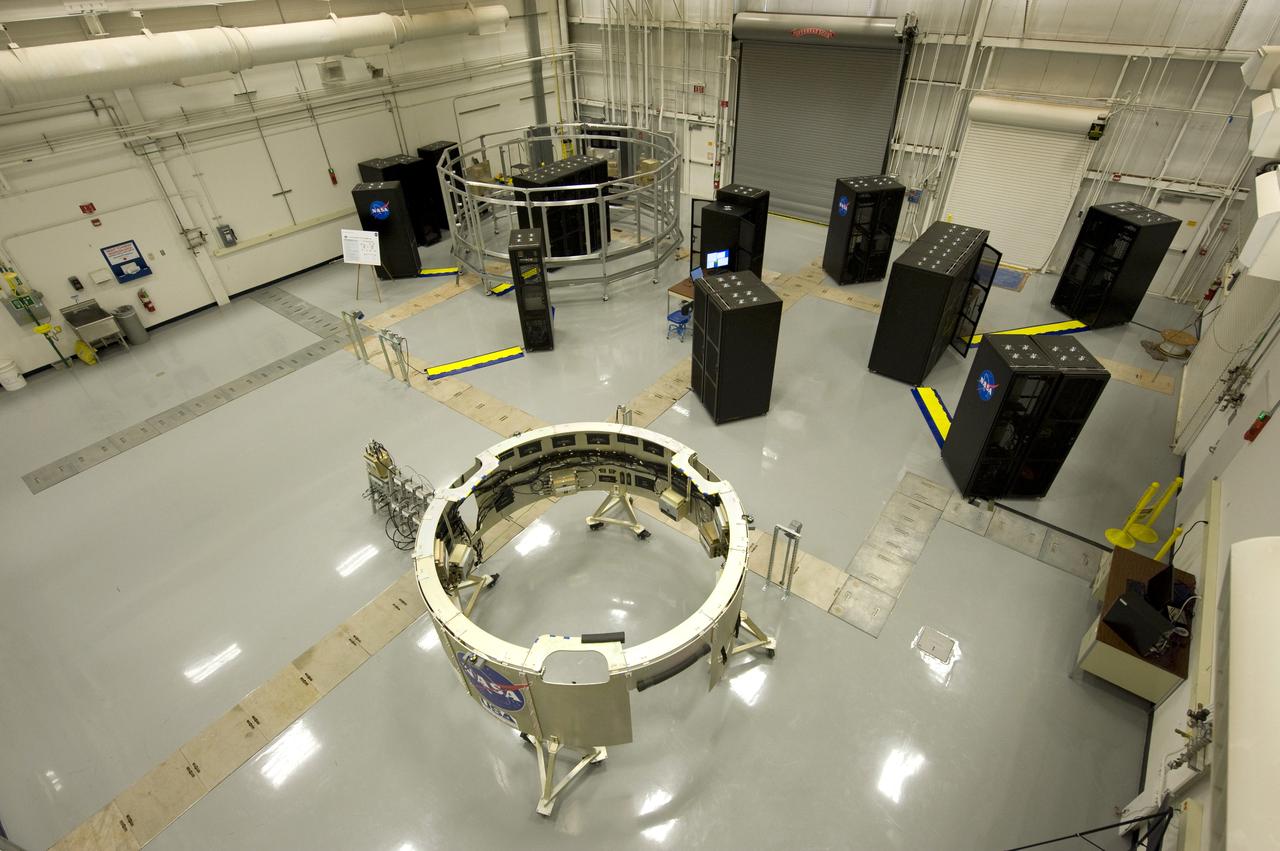
HARDWARE IN THE LOOP FACILITY
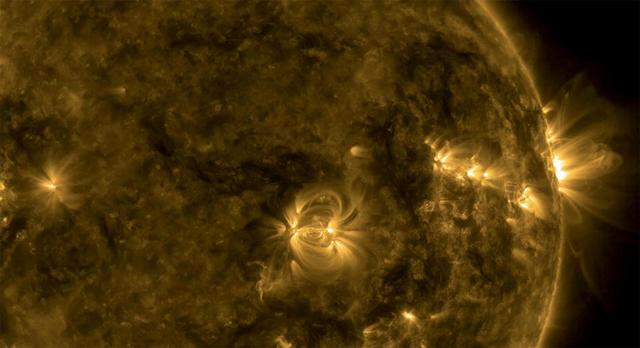
A series of active regions stretched along the right side of the sun exhibited a wide variety of loops cascading above them (Sept. 12-14, 2016). The active region near the center has tightly coiled loops, while the region rotating over the right edge has some elongated and some very stretched loops above it. The loops are actually charged particles spiraling along magnetic field lines, observed here in a wavelength of extreme ultraviolet light. Near the middle of the video the Earth quickly passes in front of a portion of the sun as viewed by SDO. http://photojournal.jpl.nasa.gov/catalog/PIA16997
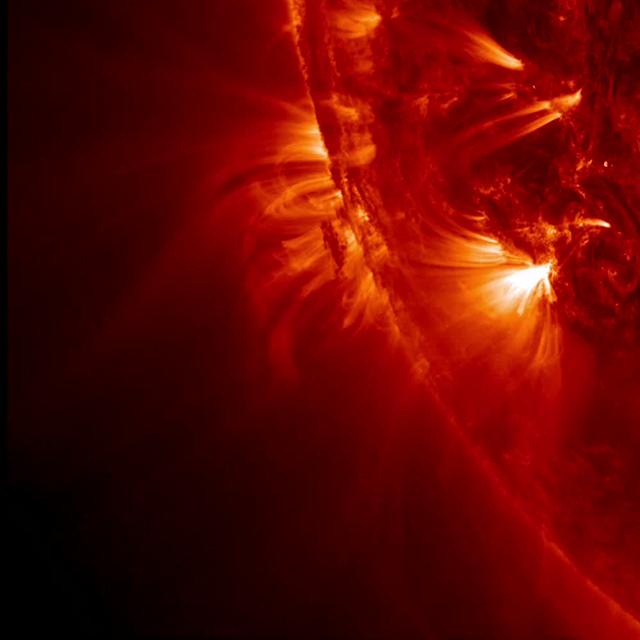
NASA's Solar Dynamics Observatory (SDO) zoomed in almost to its maximum level to watch tight, bright loops and much longer, softer loops shift and sway above an active region on the sun, while a darker blob of plasma in their midst was pulled about every which way (May 13-14, 2014). The video clip covers just over a day beginning at 14:19 UT on May 13. The frames were taken in the 171-angstroms wavelength of extreme ultraviolet light, but colorized red, instead of its usual bronze tone. This type of dynamic activity continues almost non-stop on the sun as opposing magnetic forces tangle with each other. Credit: NASA/Solar Dynamics Observatory <b><a href="http://www.nasa.gov/audience/formedia/features/MP_Photo_Guidelines.html" rel="nofollow">NASA image use policy.</a></b> <b><a href="http://www.nasa.gov/centers/goddard/home/index.html" rel="nofollow">NASA Goddard Space Flight Center</a></b> enables NASA’s mission through four scientific endeavors: Earth Science, Heliophysics, Solar System Exploration, and Astrophysics. Goddard plays a leading role in NASA’s accomplishments by contributing compelling scientific knowledge to advance the Agency’s mission. <b>Follow us on <a href="http://twitter.com/NASAGoddardPix" rel="nofollow">Twitter</a></b> <b>Like us on <a href="http://www.facebook.com/pages/Greenbelt-MD/NASA-Goddard/395013845897?ref=tsd" rel="nofollow">Facebook</a></b> <b>Find us on <a href="http://instagram.com/nasagoddard?vm=grid" rel="nofollow">Instagram</a></b>
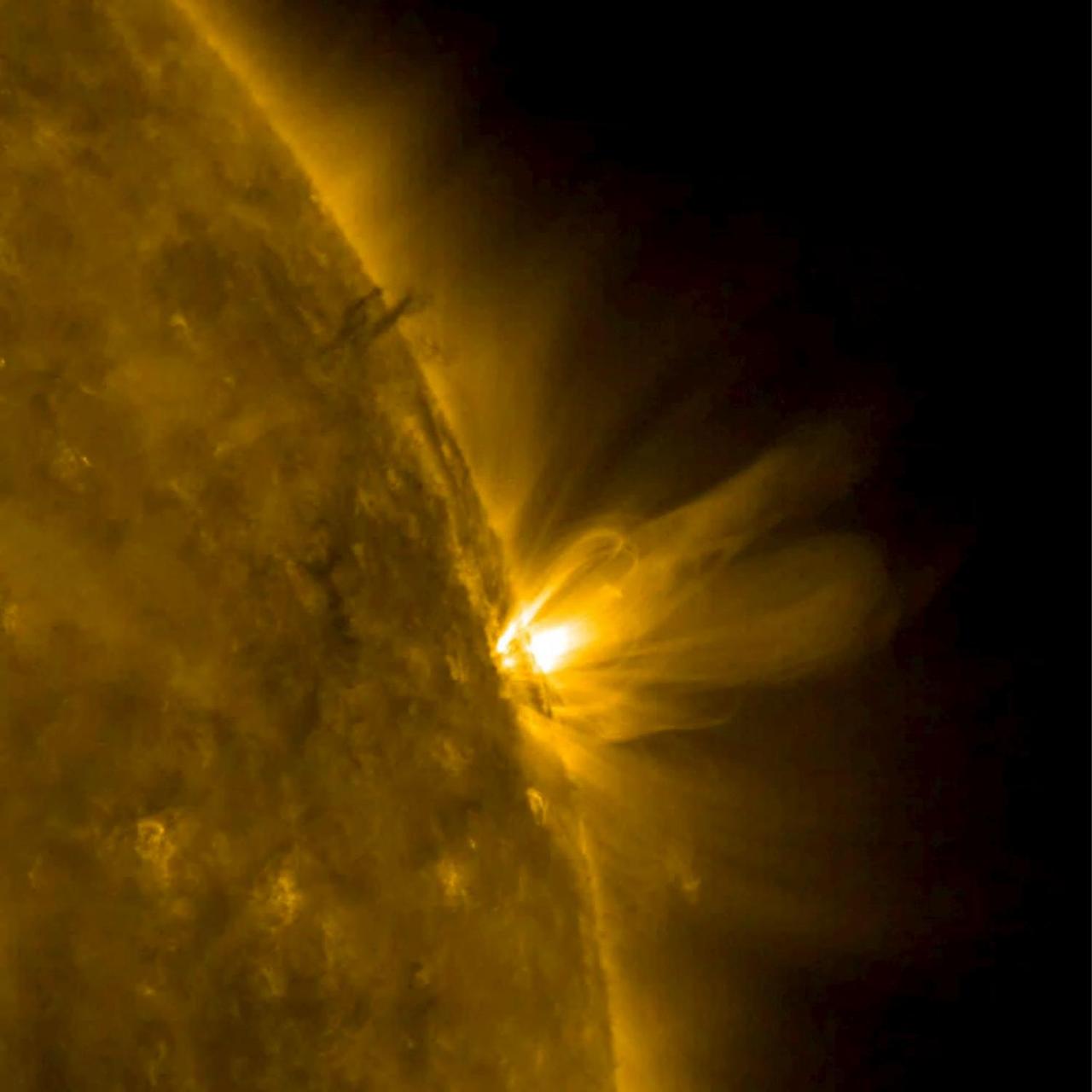
When an active region rotated over to the edge of the sun, it presented us with a nice profile view of its elongated loops stretching and swaying above it (Mar. 8-9, 2017). These loops are actually charged particles (made visible in extreme ultraviolet light) swirling along the magnetic field lines of the active region. The video covers about 30 hours of activity. Also of note is a darker twisting mass of plasma to the left of the active region being pulled and spun about by magnetic forces. Video is available at http://photojournal.jpl.nasa.gov/catalog/PIA21562
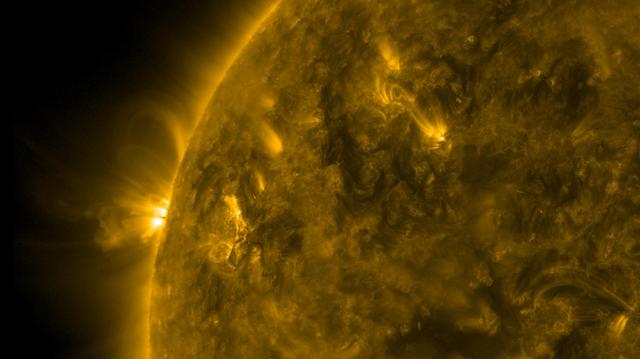
As an active region rotated into view, NASA Solar Dynamics Observatory was able to observe well-defined magnetic loops gyrating above the sun between Mar, 23-24, 2017. These loops appear because charged particles spinning along the magnetic field lines above this active region are made visible in this wavelength of extreme ultraviolet light. The video clip covers about a day and a half of activity. Movies are available at https://photojournal.jpl.nasa.gov/catalog/PIA21583
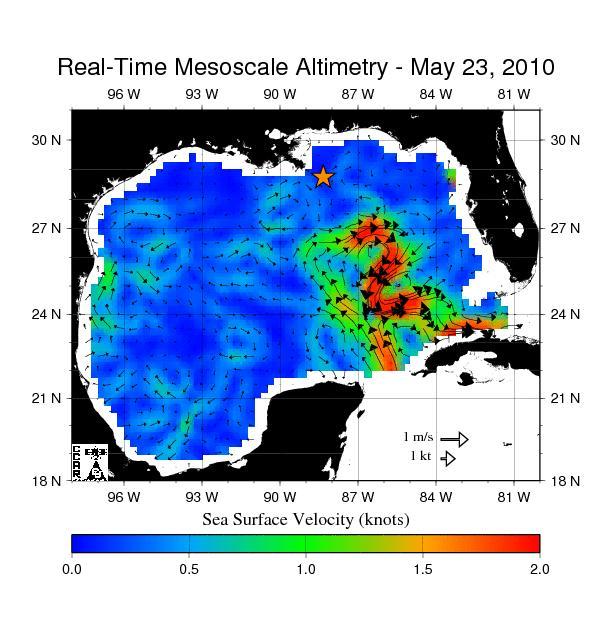
The northern portion of the Gulf of Mexico Loop Current, shown in red, appears about to detach a large ring of current, creating a separate eddy. An eddy is a large, warm, clockwise-spinning vortex of water -- the ocean version of a cyclone.

Wispy tendrils of hot dust and gas glow brightly in this ultraviolet image of the Cygnus Loop nebula, taken by NASA Galaxy Evolution Explorer. The nebula lies about 1,500 light-years away.
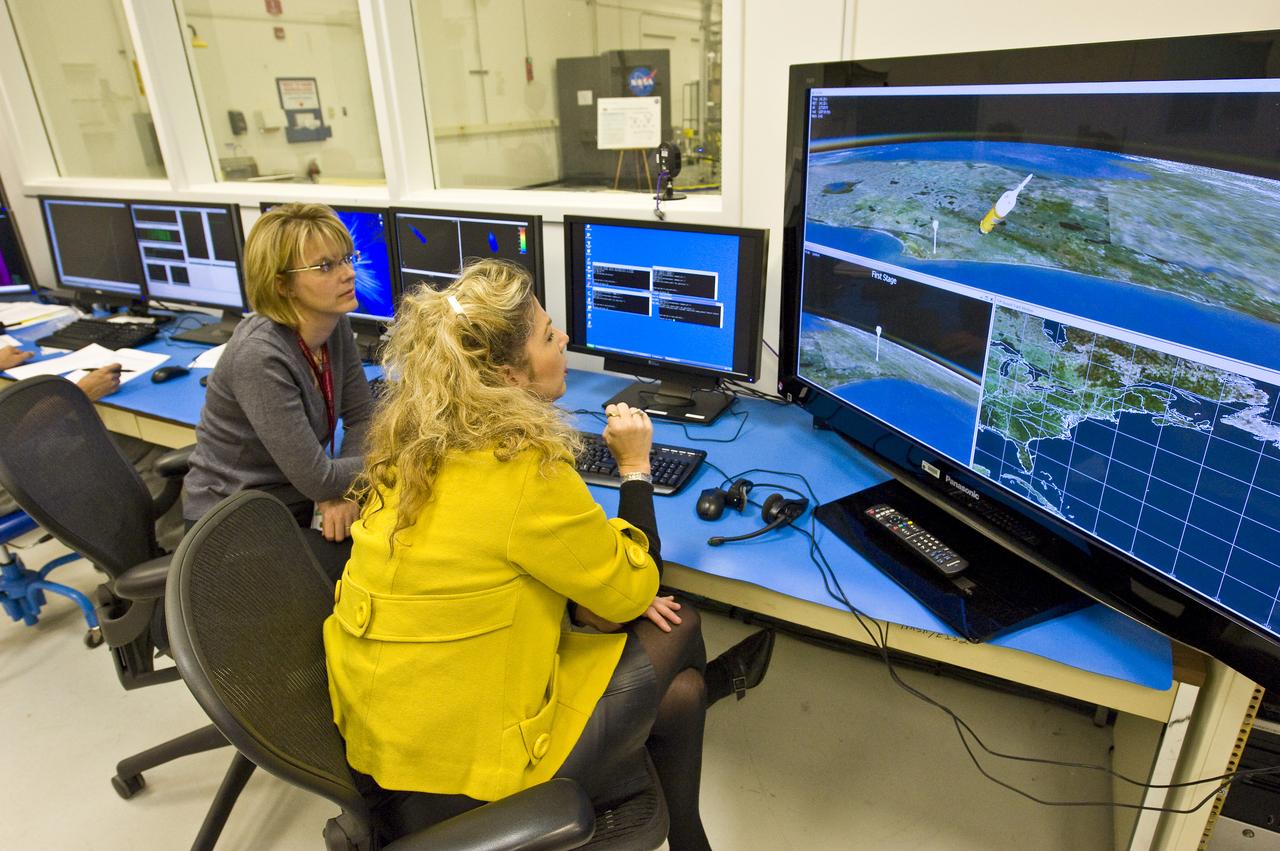
TVC TEST LAB/HARDWARE IN THE LOOP FACILITY FLIGHT SIMULATION CONTROL ROOM
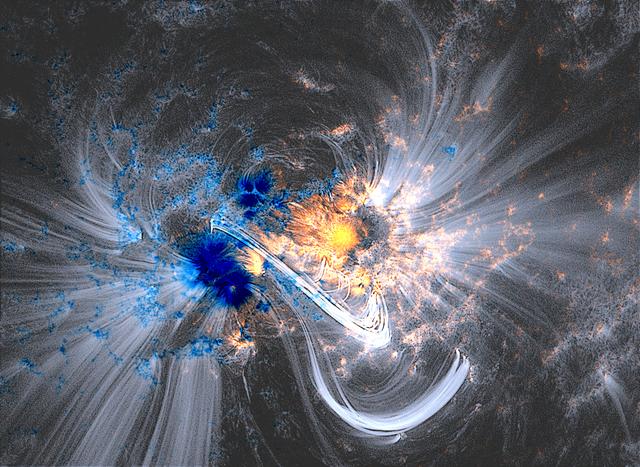
Magnetic Dance: Solar material traces out giant magnetic fields soaring through the sun to create what's called coronal loops. Here they can be seen as white lines in a sharpened AIA image from Oct. 24, 2014, laid over data from SDO's Helioseismic Magnetic Imager, which shows magnetic fields on the sun's surface in false color. Credit: NASA/SDO/HMI/AIA/LMSAL Read more: <a href="http://www.nasa.gov/content/goddard/sdo-telescope-collects-its-100-millionth-image/" rel="nofollow">www.nasa.gov/content/goddard/sdo-telescope-collects-its-1...</a> <b><a href="http://www.nasa.gov/audience/formedia/features/MP_Photo_Guidelines.html" rel="nofollow">NASA image use policy.</a></b> <b><a href="http://www.nasa.gov/centers/goddard/home/index.html" rel="nofollow">NASA Goddard Space Flight Center</a></b> enables NASA’s mission through four scientific endeavors: Earth Science, Heliophysics, Solar System Exploration, and Astrophysics. Goddard plays a leading role in NASA’s accomplishments by contributing compelling scientific knowledge to advance the Agency’s mission. <b>Follow us on <a href="http://twitter.com/NASAGoddardPix" rel="nofollow">Twitter</a></b> <b>Like us on <a href="http://www.facebook.com/pages/Greenbelt-MD/NASA-Goddard/395013845897?ref=tsd" rel="nofollow">Facebook</a></b> <b>Find us on <a href="http://instagram.com/nasagoddard?vm=grid" rel="nofollow">Instagram</a></b>
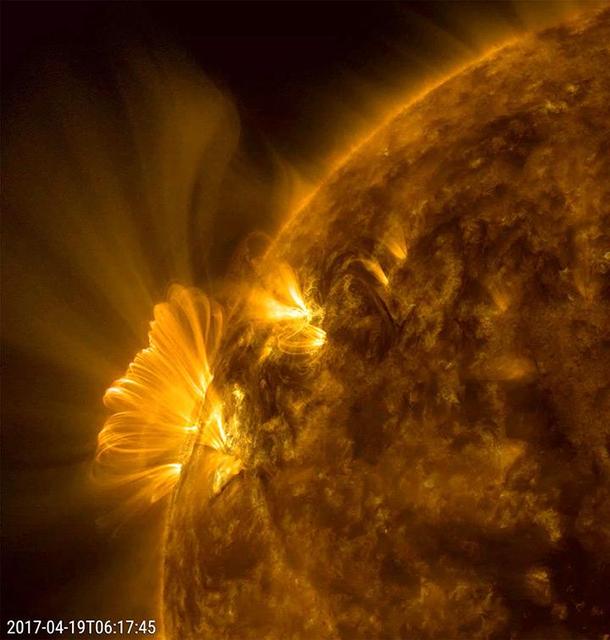
An active region that had just rotated into view blasted out a coronal mass ejection, which was immediately followed by a bright series of post-coronal loops seeking to reorganize that region's magnetic field (April 19, 2017). We have observed this phenomenon numerous times, but this one was one of the longest and clearest sequences we have seen in years. The bright loops are actually charged particles spinning along the magnetic field lines. The action was captured in a combination of two wavelengths of extreme ultraviolet light over a period of about 20 hours. Movies are available at https://photojournal.jpl.nasa.gov/catalog/PIA21598
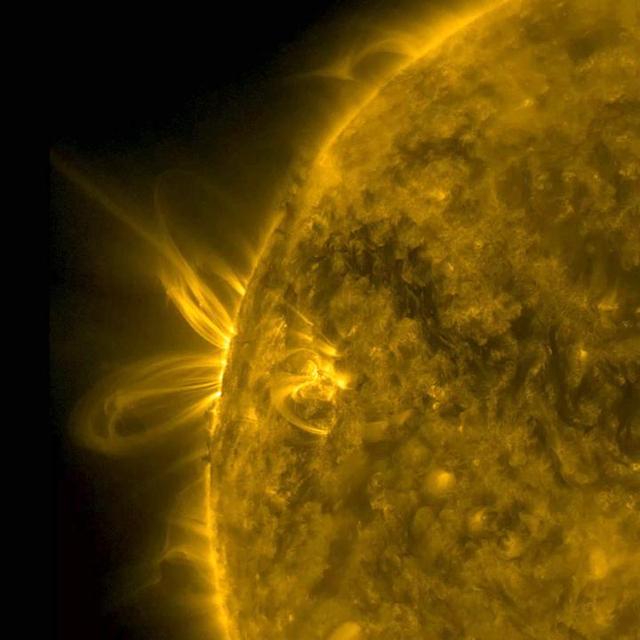
Several arcing loops rotated into view and swirled above an active region, which gave us a nice profile view of the action (June 26-27, 2016). The arcing plasma is tracing magnetic field lines extending out from the active region. Some darker matter also jiggled back and forth near the active region as well, pulled about by magnetic forces. At one point a lick of plasma pushed its way out from the region but quickly fell back into the sun. The images were taken in a wavelength of extreme ultraviolet light. Movies are also available at the Photojournal. http://photojournal.jpl.nasa.gov/catalog/PIA20882
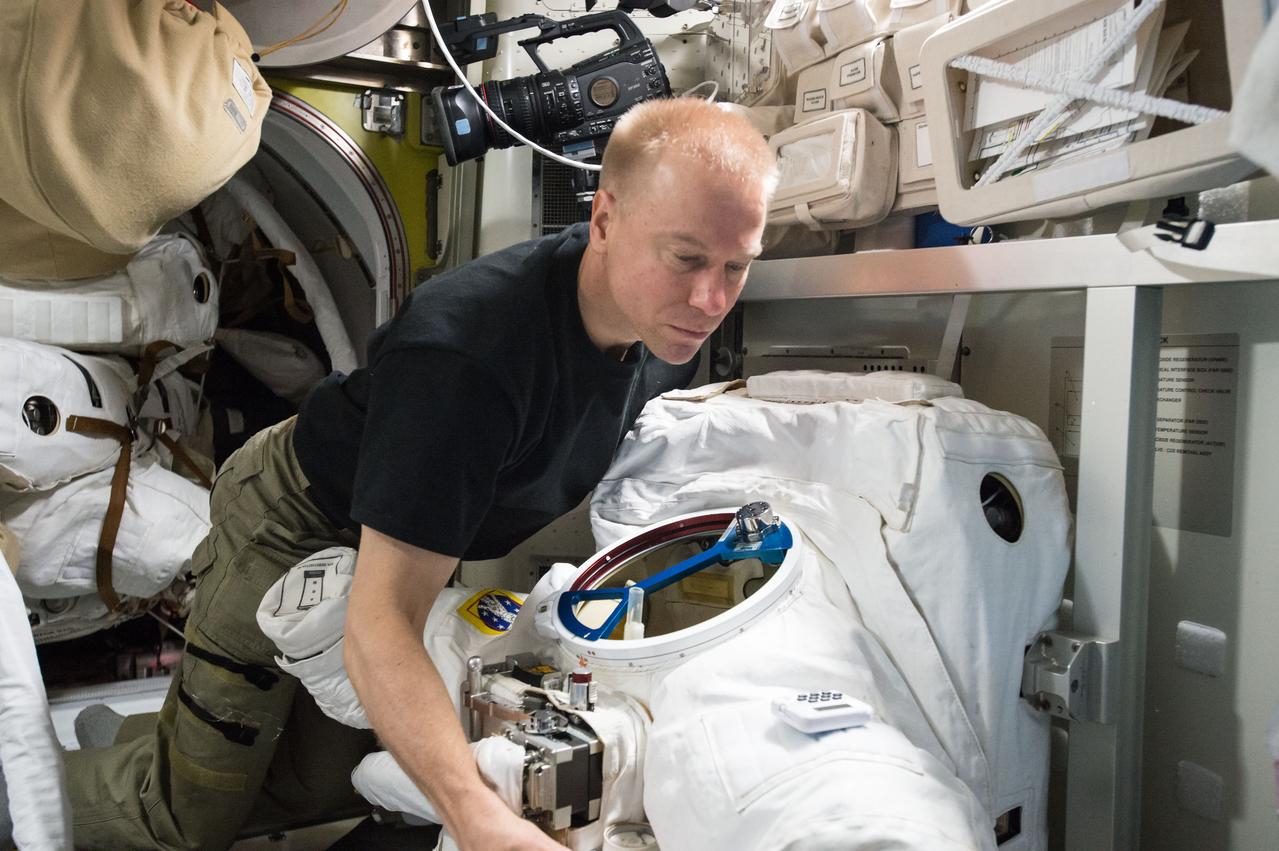
ISS047e032108 (04/01/2016) --- NASA astronaut and Expedition 47 commander Tim Kopra conducts a loop scrub on two U.S. spacesuits inside the Quest airlock. Periodic cleaning and sampling of the spacesuit cooling loops is conducted to ensure the suits are in working order and ready to support future spacewalks.
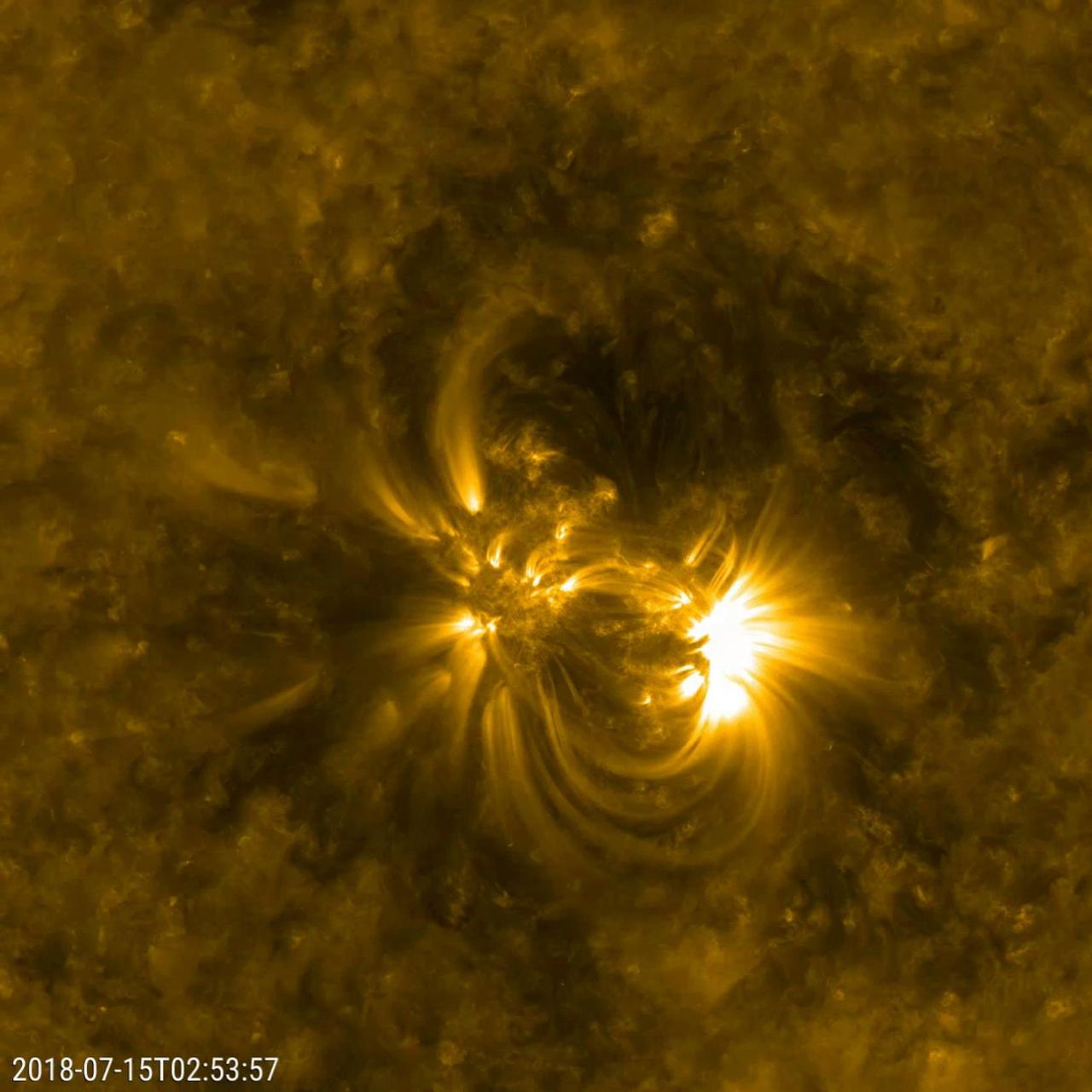
NASA's Solar Dynamics Observatory (SDO) zoomed in to watch close-up the dynamics of this single active region on the sun over a two-day period (July 14-16, 2018). The loops SDO observed in extreme ultraviolet light are illuminated by charged particles spinning along the magnetic field lines above an active region. Active regions are magnetically intense areas that are pushed up to the surface of the sun from below. These regions are often the sources of large eruptions that cause solar storms, though no large eruptions seem to have occurred during this period. To give a sense of scale, these loops are rising up many times the diameter of Earth. Movies are available at https://photojournal.jpl.nasa.gov/catalog/PIA22645
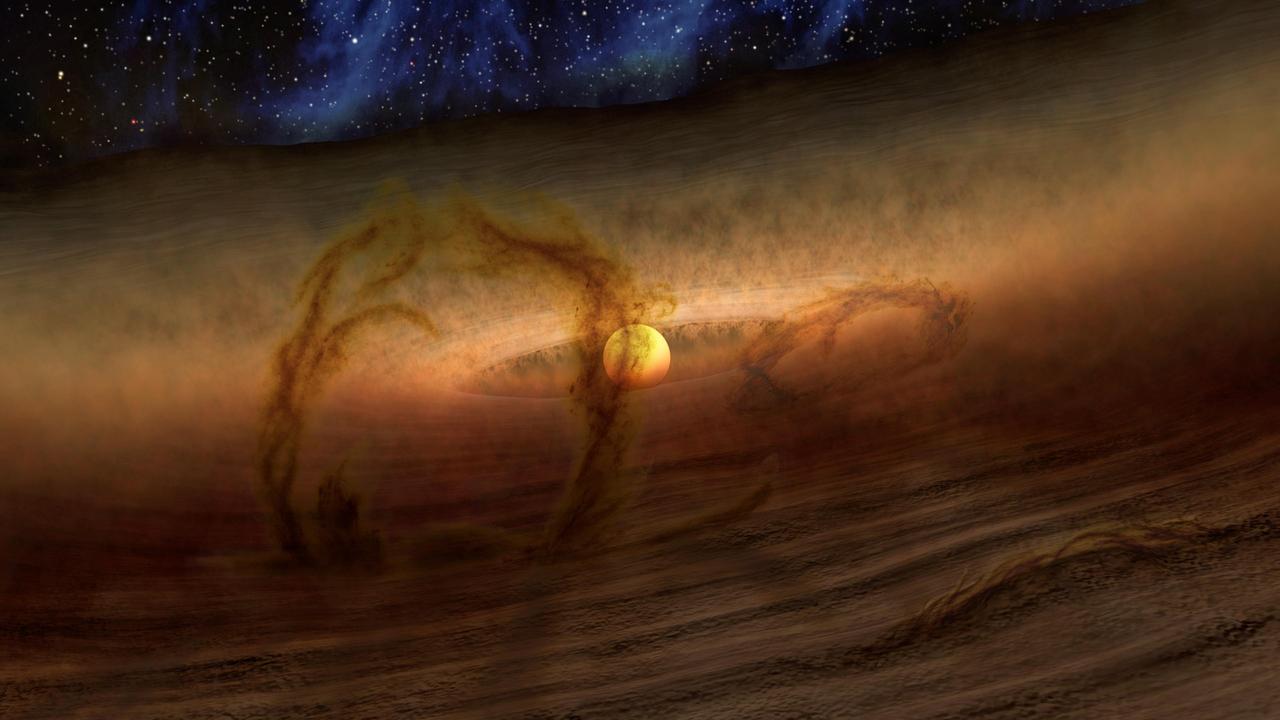
Magnetic loops carrying gas and dust above disks of planet-forming material circling stars are shown in this artist conception, which NASA Spitzer Space Telescope detects as infrared light.
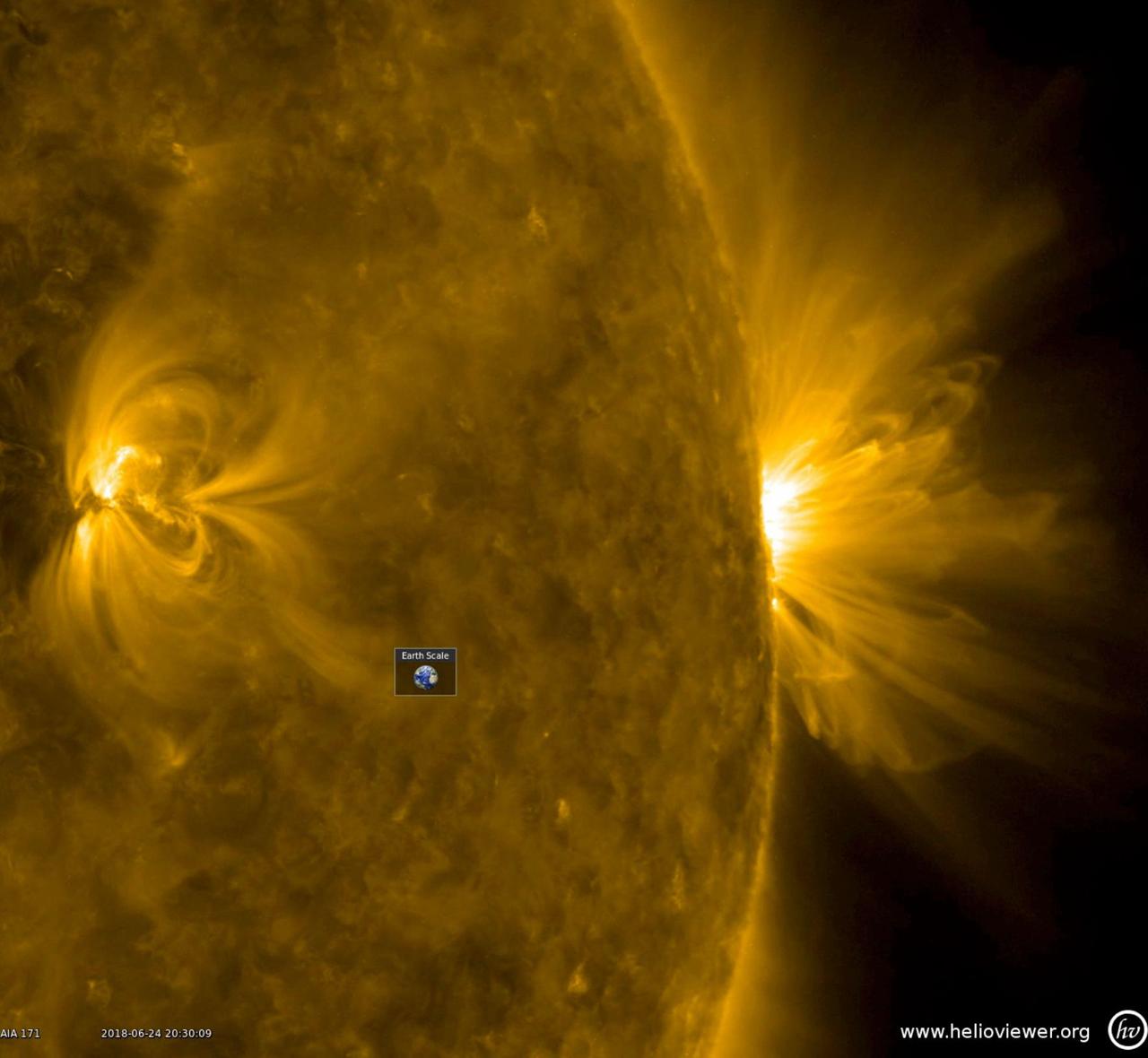
This profile perspective of an active region revealed above it (June 24-25, 2018). Charged particles spinning along these field lines are illuminated in this wavelength of extreme ultraviolet light. The little Earth superimposed on the image and videos gives one a sense of just how humongous these loops really are. Our eyes cannot see extreme ultraviolet light, but our instruments can. The images are colorized to distinguish between these from images taken in other wavelengths by SDO. Note there is another, smaller active region on the left side of the image. Movies are available at https://photojournal.jpl.nasa.gov/catalog/PIA22589
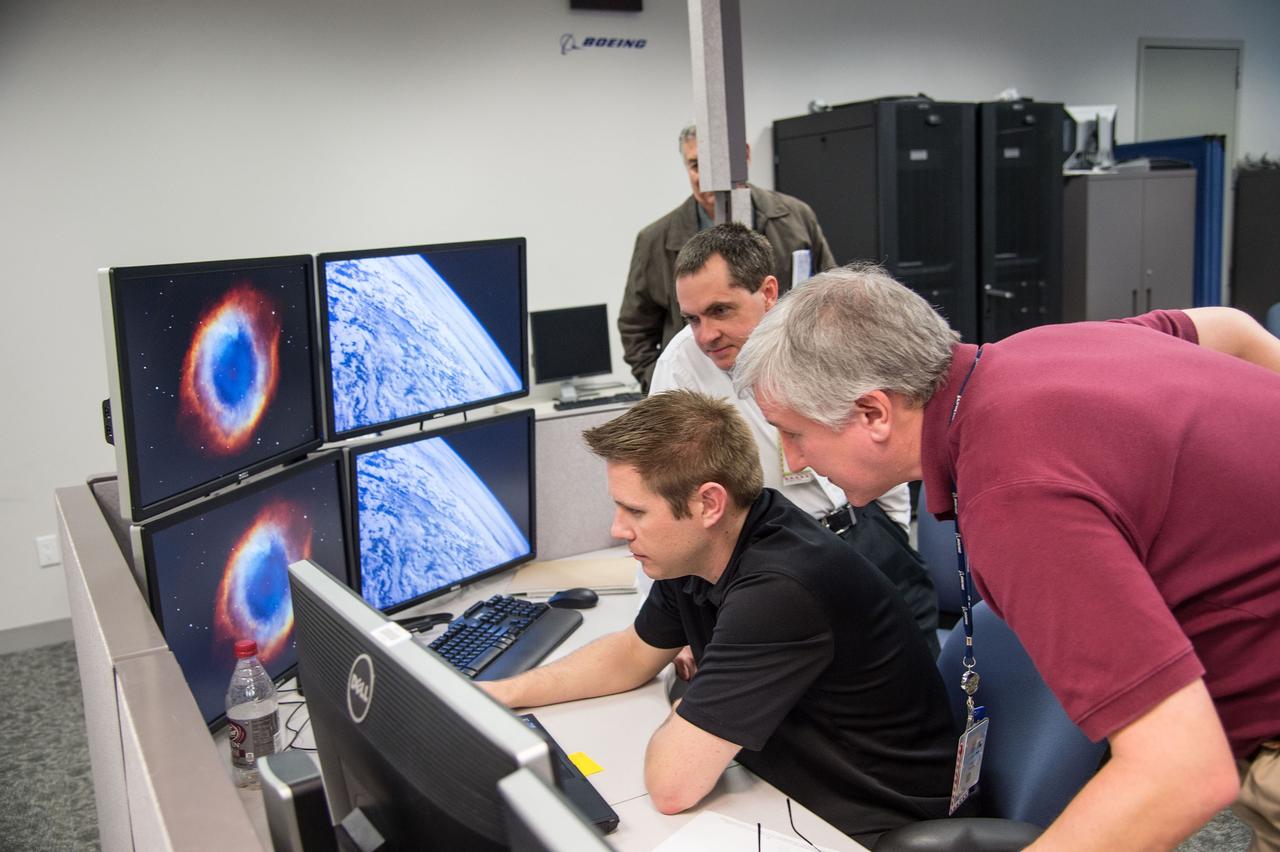
HOUSTON – Engineers for Boeing Space Exploration demonstrate that the CST-100 software allows a human pilot to take over control of the spacecraft from the computer during all phases of a mission following separation from the launch vehicle. The pilot-in-the-loop demonstration at the Houston Product Support Center is a milestone under Boeing's Commercial Crew Integrated Capability agreement with the agency and its Commercial Crew Program. Photo credit: NASA/Bill Stafford
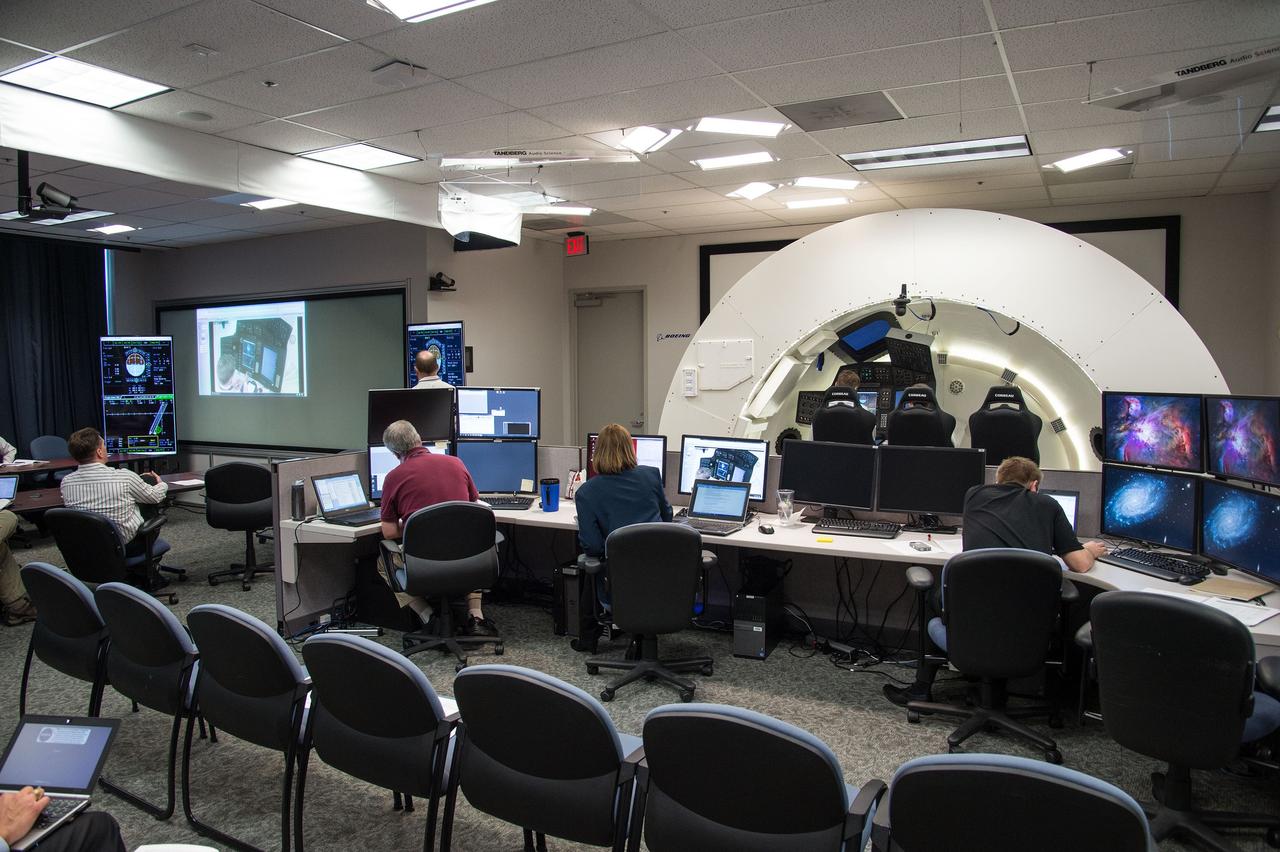
HOUSTON – Engineers for Boeing Space Exploration demonstrate that the CST-100 software allows a human pilot to take over control of the spacecraft from the computer during all phases of a mission following separation from the launch vehicle. The pilot-in-the-loop demonstration at the Houston Product Support Center is a milestone under Boeing's Commercial Crew Integrated Capability agreement with the agency and its Commercial Crew Program. Photo credit: NASA/Bill Stafford
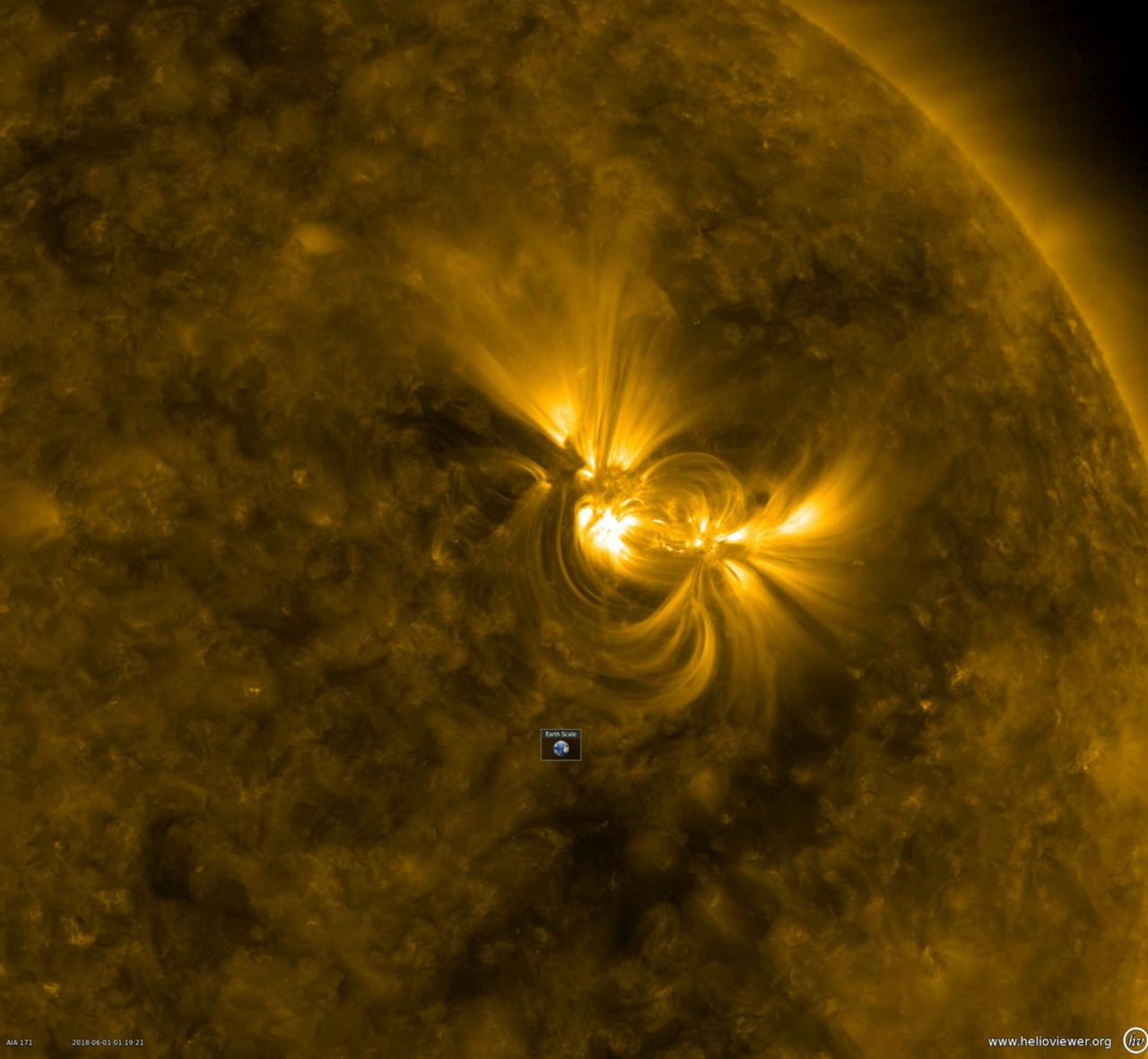
This close-up from a video clip taken May 30-June 1, 2018 shows a large active region in extreme ultraviolet light as the bright magnetic field lines above it shift and twist. Note the Earth scale below the active region: the longest loops extend about 10 times the diameter of Earth. When the magnetic field lines get themselves tangled up enough, they can erupt with a solar storm. Videos are available at https://photojournal.jpl.nasa.gov/catalog/PIA22475
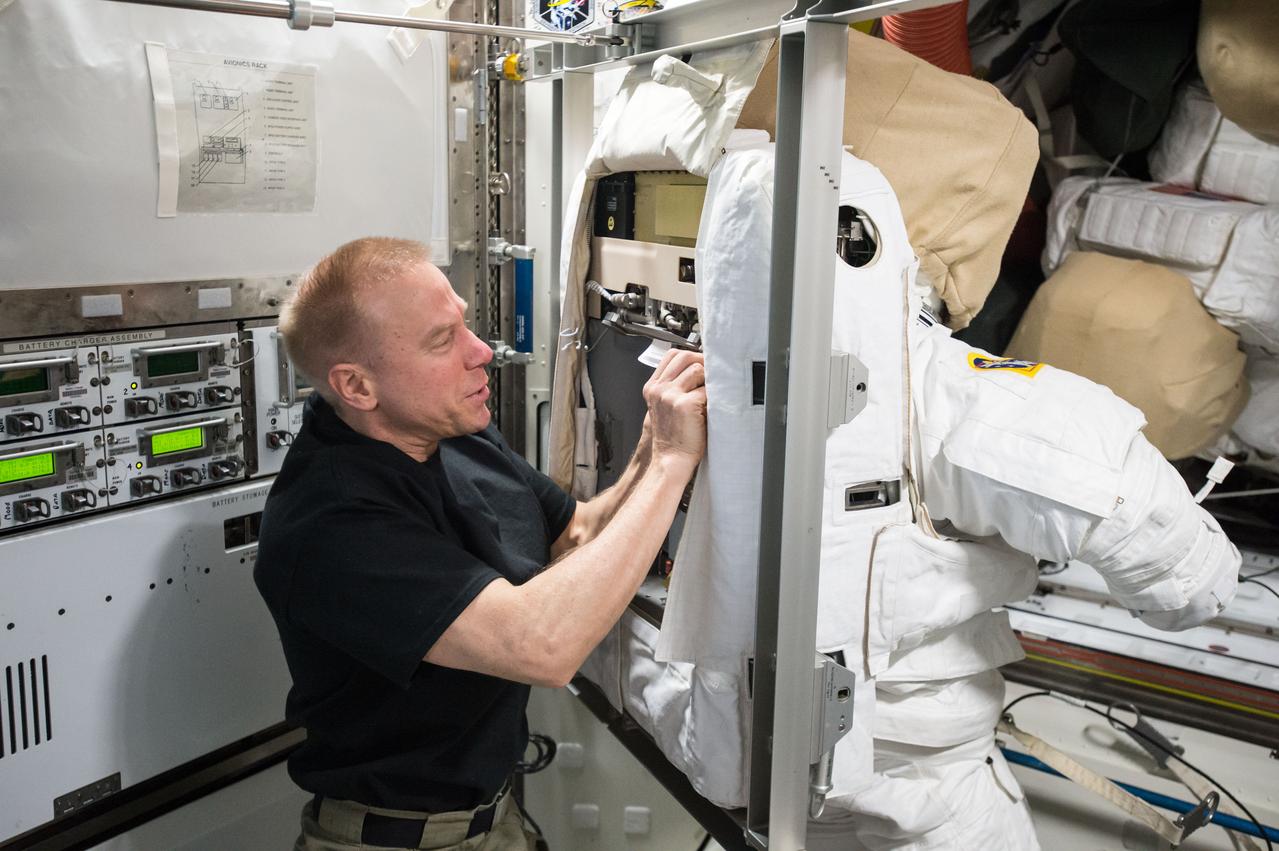
ISS047e048133 (04/01/2016) --- NASA astronaut Tim Kopra prepares a U.S. Extravehicular Mobility Unit (EMU) spacesuit for cooling loop maintenance. Spacesuits on-board the International Space Station get routine maintenance between spacewalks.
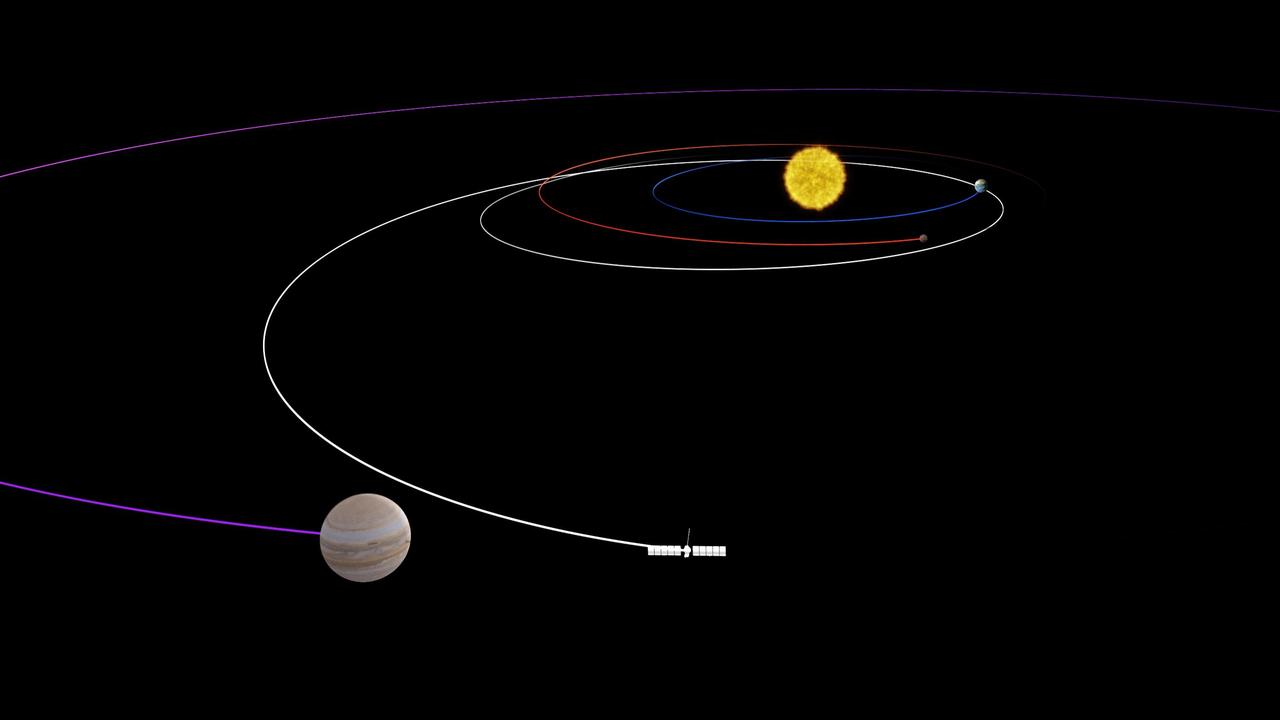
This artist's concept depicts the long, looping path NASA's Europa Clipper spacecraft will take to reach the Jupiter system. Covering a distance of about 1.8 billion miles (2.9 billion kilometers), the path swings past Mars, then Earth, using the two planets' gravity as a slingshot to add speed to the spacecraft's journey to Jupiter. Once in orbit at Jupiter, the spacecraft will conduct dozens of close flybys of the gas giant's icy moon Europa. Europa Clipper's three main science objectives are to determine the thickness of the moon's icy shell and its interactions with the ocean below, to investigate its composition, and to characterize its geology. The mission's detailed exploration of Europa will help scientists better understand the astrobiological potential for habitable worlds beyond our planet. https://photojournal.jpl.nasa.gov/catalog/PIA26432
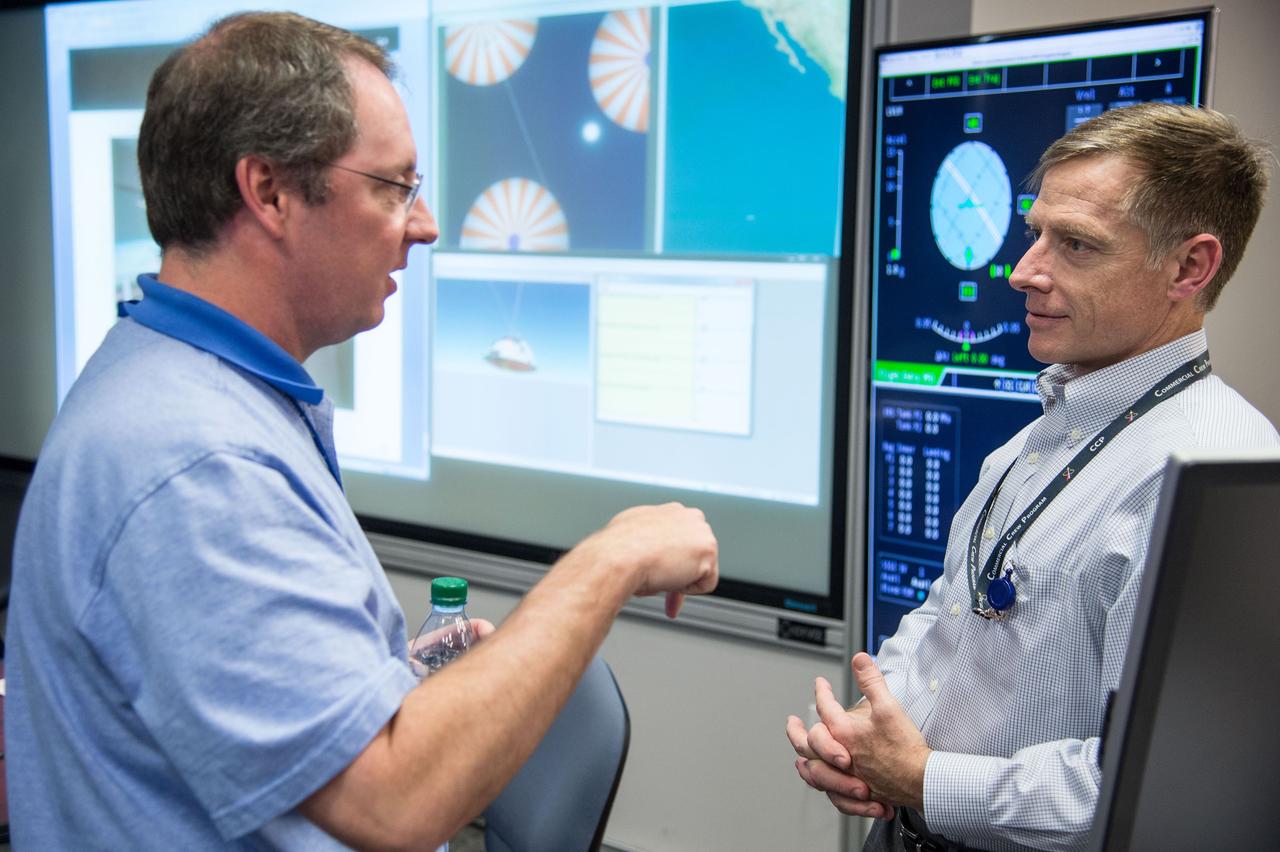
HOUSTON – Chris Ferguson, a former space shuttle commander who is now director of Crew and Mission Operations for Boeing Space Exploration, talks with an engineer following simulations that showed that the CST-100 software. Boeing demonstrated that the CST-100 software allows a human pilot to take over control of the spacecraft from the computer during all phases of a mission following separation from the launch vehicle. The pilot-in-the-loop demonstration at the Houston Product Support Center is a milestone under Boeing's Commercial Crew Integrated Capability agreement with the agency and its Commercial Crew Program. Photo credit: NASA/Bill Stafford
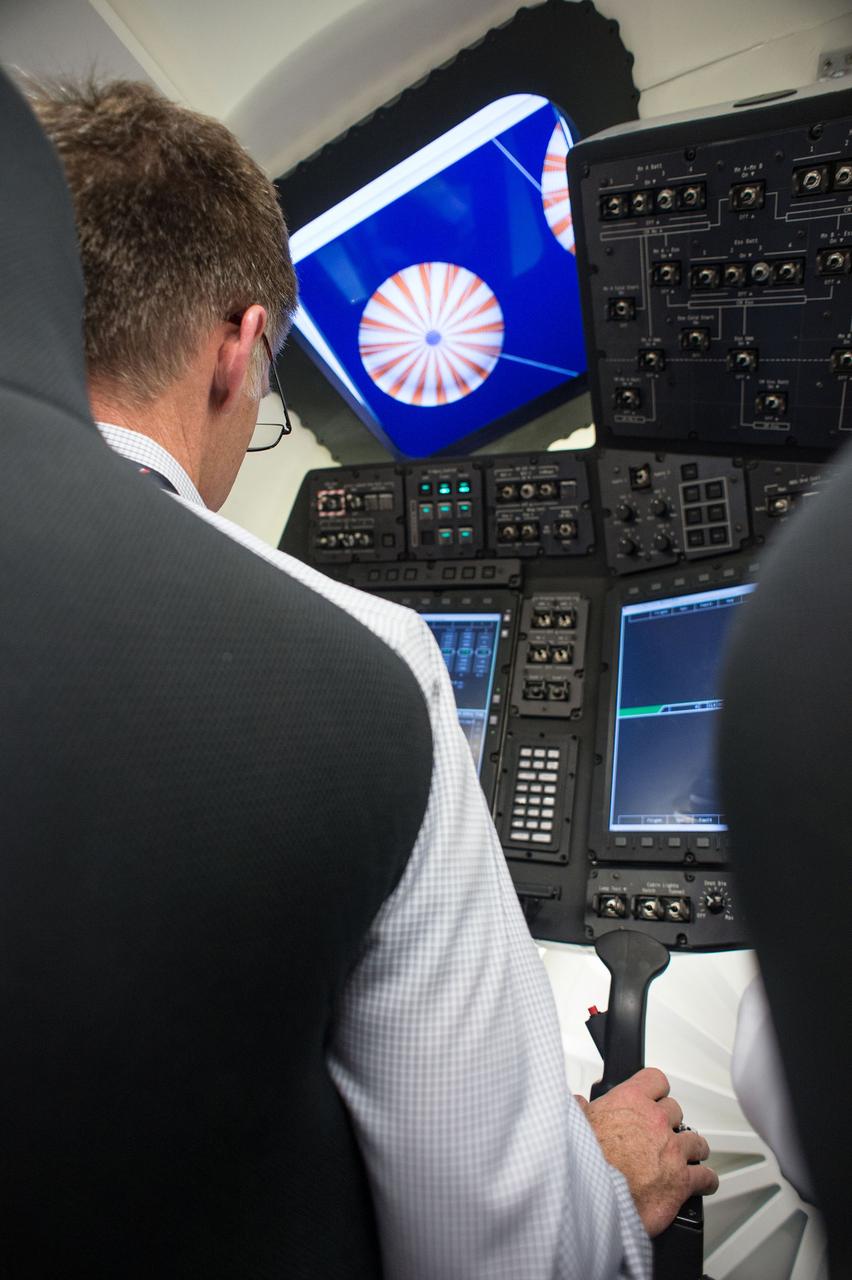
HOUSTON – Chris Ferguson, a former space shuttle commander who is now director of Crew and Mission Operations for Boeing Space Exploration, sits at the controls in the inside the company's CST-100 spacecraft simulator. Boeing demonstrated that the CST-100 software allows a human pilot to take over control of the spacecraft from the computer during all phases of a mission following separation from the launch vehicle. The pilot-in-the-loop demonstration at the Houston Product Support Center is a milestone under Boeing's Commercial Crew Integrated Capability agreement with the agency and its Commercial Crew Program. Photo credit: NASA/Bill Stafford
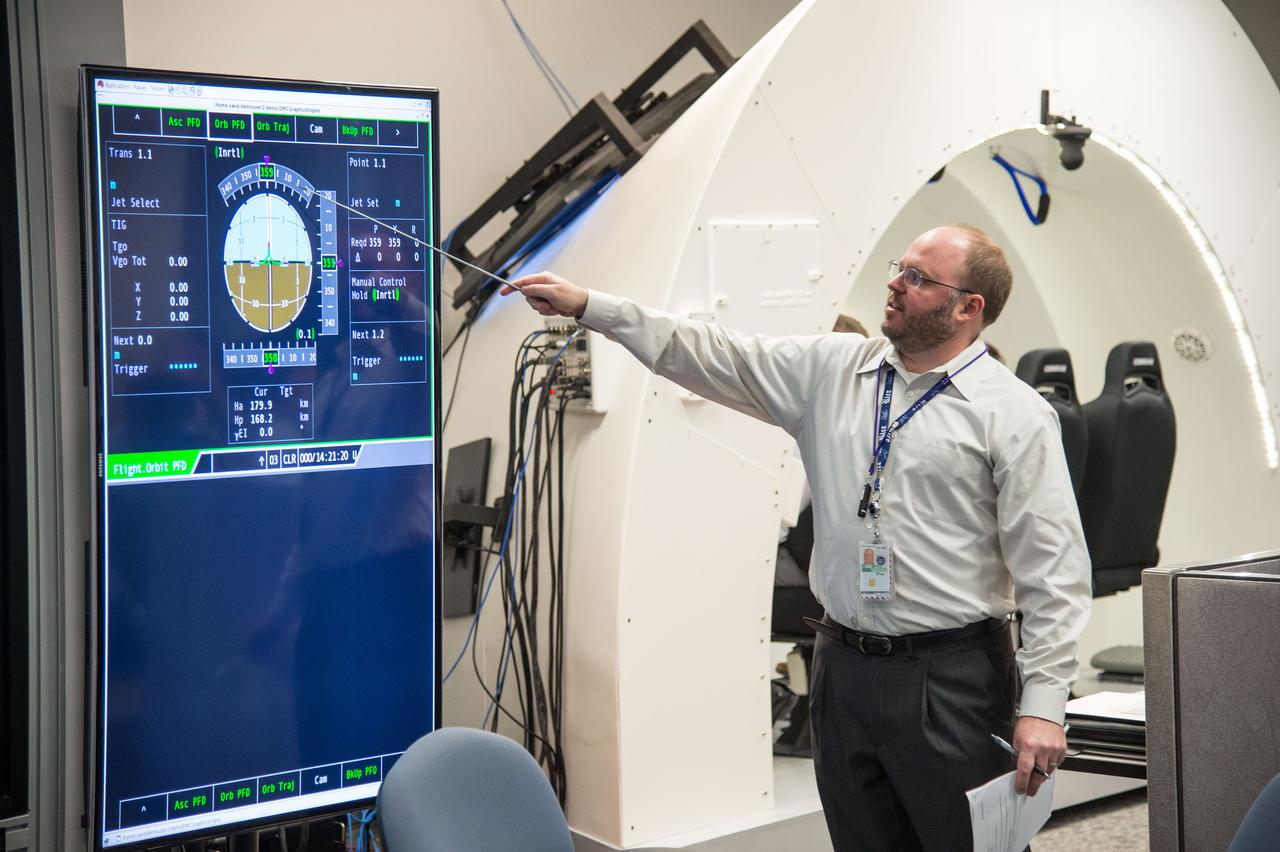
HOUSTON – An engineer with Boeing Space Exploration explains how to read the cockpit displays inside the company's CST-100 spacecraft simulator to NASA Commercial Crew Program engineers. Boeing demonstrated that the CST-100 software allows a human pilot to take over control of the spacecraft from the computer during all phases of a mission following separation from the launch vehicle. The pilot-in-the-loop demonstration at the Houston Product Support Center is a milestone under Boeing's Commercial Crew Integrated Capability agreement with the agency and its Commercial Crew Program. Photo credit: NASA_Bill Stafford
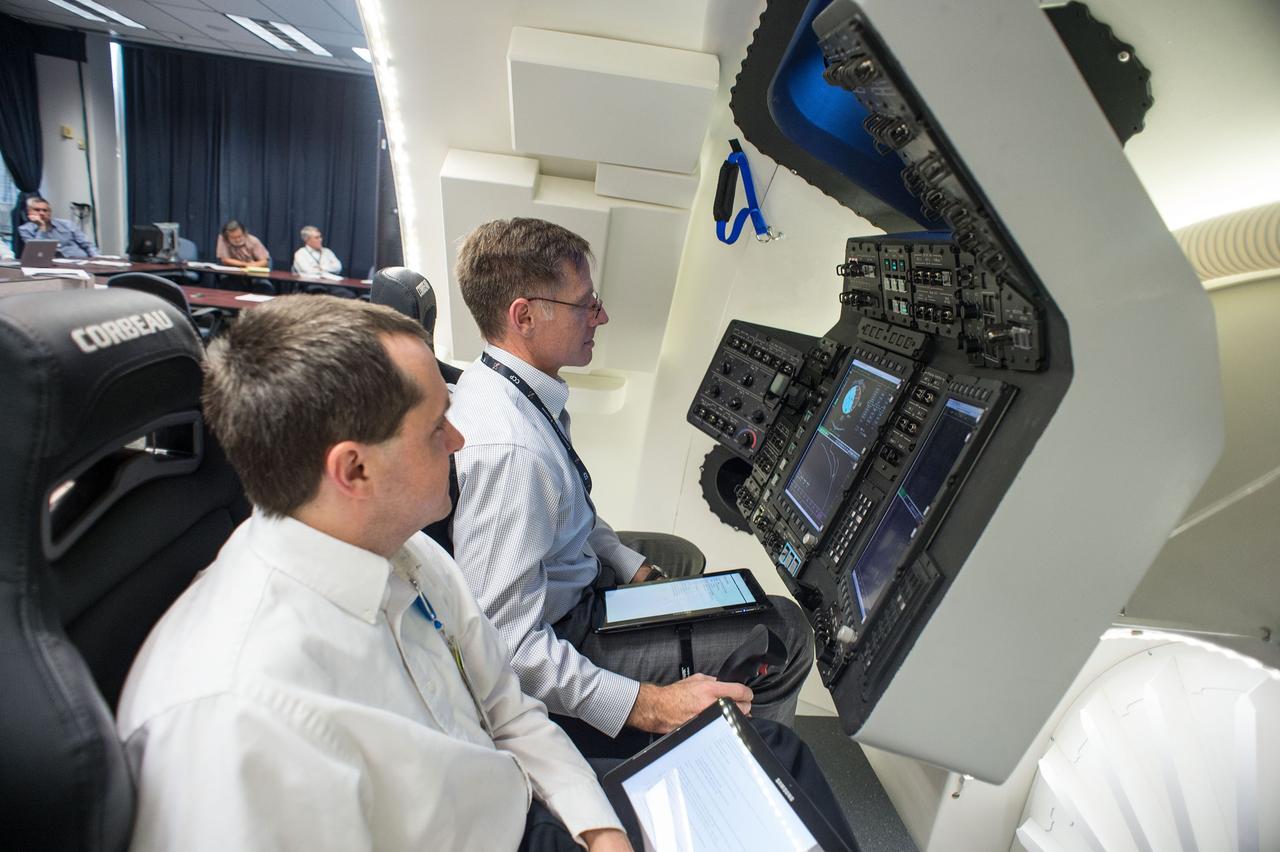
HOUSTON – Chris Ferguson, a former space shuttle commander who is now director of Crew and Mission Operations for Boeing Space Exploration, takes the controls inside the company's CST-100 spacecraft simulator. To Ferguson's right, an engineer observes the exercise. Boeing demonstrated that the CST-100's software allows a human pilot to take over control of the spacecraft from the computer during all phases of a mission following separation from the launch vehicle. The pilot-in-the-loop demonstration at the Houston Product Support Center is a milestone under Boeing's Commercial Crew Integrated Capability agreement with the agency and its Commercial Crew Program. Photo credit: NASA/Bill Stafford
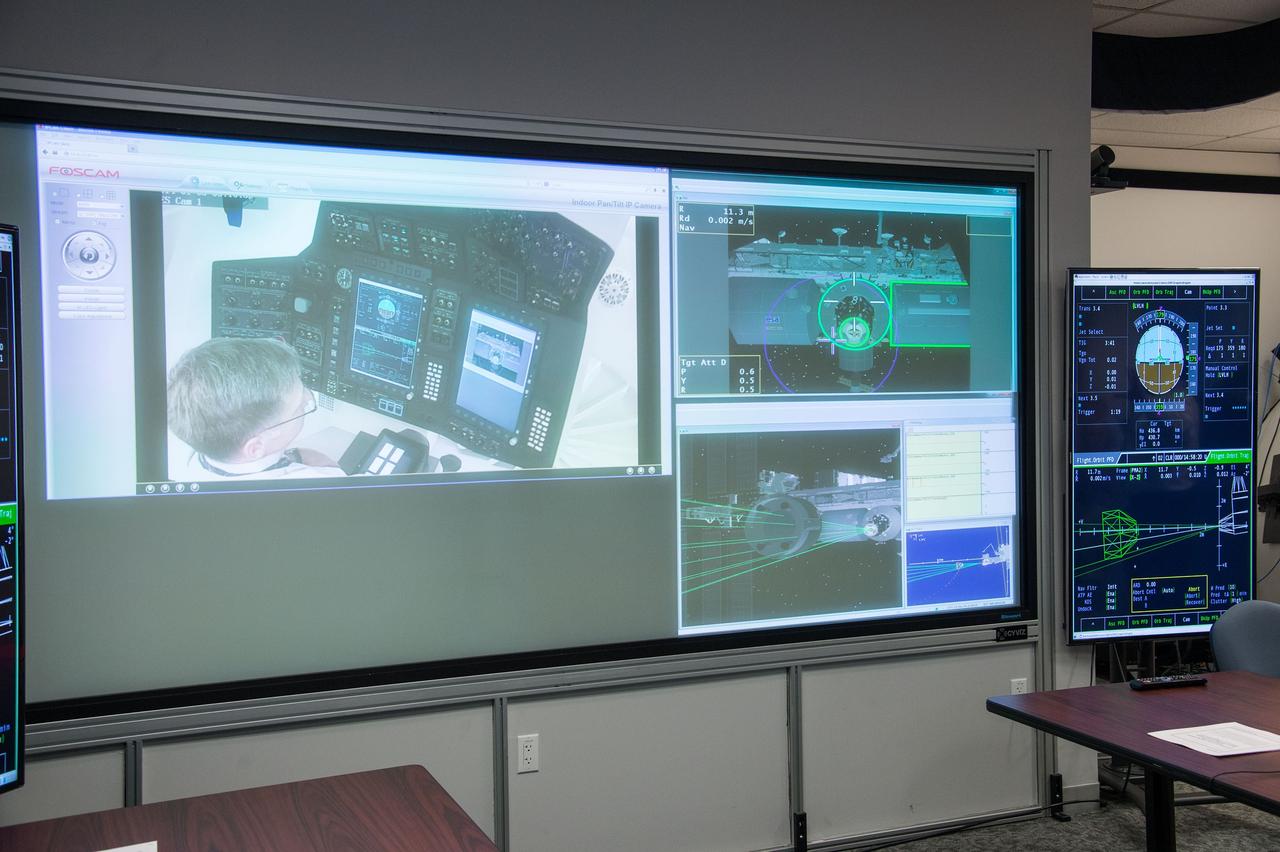
HOUSTON – Monitors show Chris Ferguson, a former space shuttle commander who is now director of Crew and Mission Operations for Boeing Space Exploration, at the controls in the inside the company's CST-100 spacecraft simulator. Boeing demonstrated that the CST-100 software allows a human pilot to take over control of the spacecraft from the computer during all phases of a mission following separation from the launch vehicle. The pilot-in-the-loop demonstration at the Houston Product Support Center is a milestone under Boeing's Commercial Crew Integrated Capability agreement with the agency and its Commercial Crew Program. Photo credit: NASA/Bill Stafford
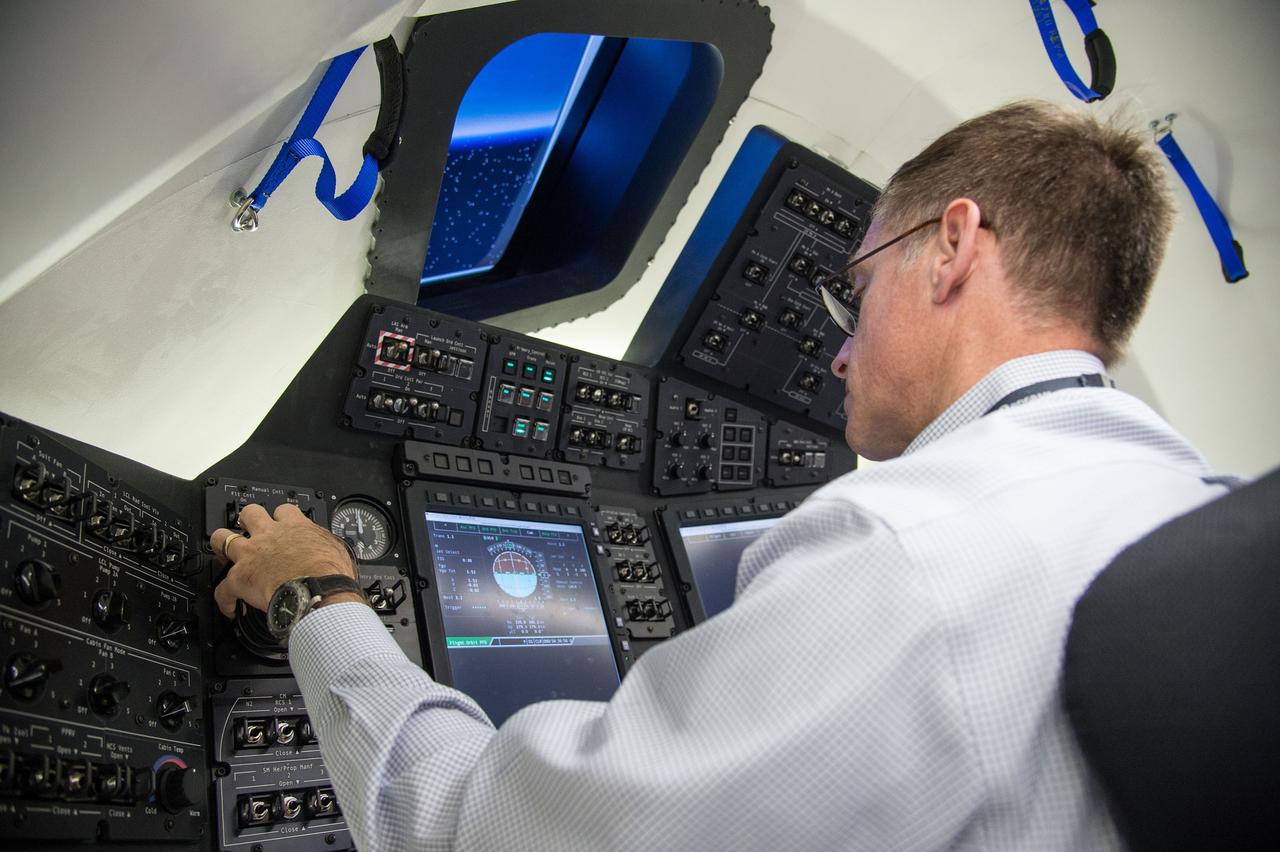
HOUSTON - Chris Ferguson, a former space shuttle commander who is now director of Crew and Mission Operations for Boeing Space Exploration, sits at the controls in the inside the company's CST-100 spacecraft simulator. Boeing demonstrated that the CST-100 software allows a human pilot to take over control of the spacecraft from the computer during all phases of a mission following separation from the launch vehicle. The pilot-in-the-loop demonstration at the Houston Product Support Center is a milestone under Boeing's Commercial Crew Integrated Capability agreement with the agency and its Commercial Crew Program. Photo credit: NASA/Bill Stafford
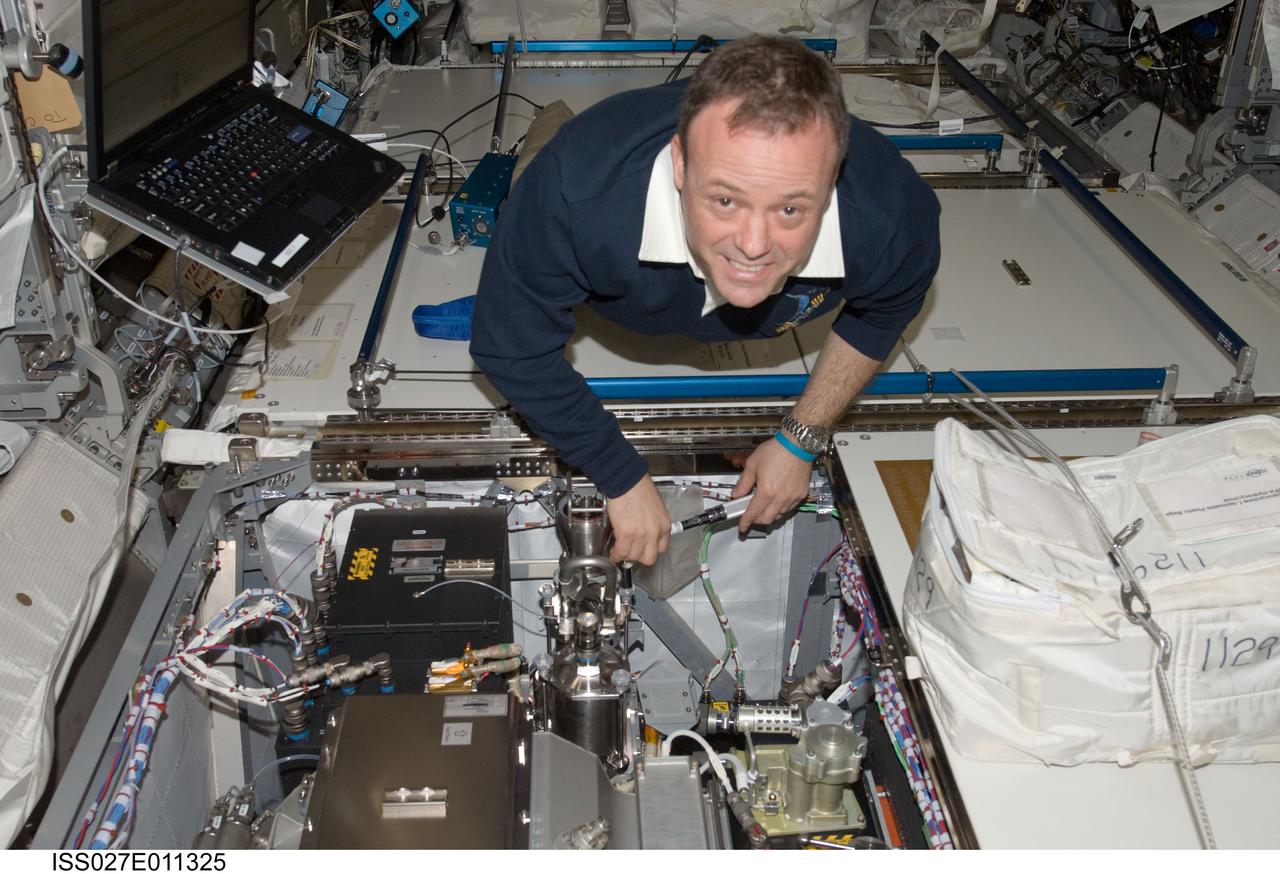
ISS027-E-011325 (8 April 2011) --- NASA astronaut Ron Garan, Expedition 27 flight engineer, works on degassing the water loop of the running Water Pump Assembly 2 / Thermal Control System (WPA2/TCS) in the Columbus laboratory of the International Space Station.

ISS027-E-011324 (8 April 2011) --- NASA astronaut Ron Garan, Expedition 27 flight engineer, works on degassing the water loop of the running Water Pump Assembly 2 / Thermal Control System (WPA2/TCS) in the Columbus laboratory of the International Space Station.
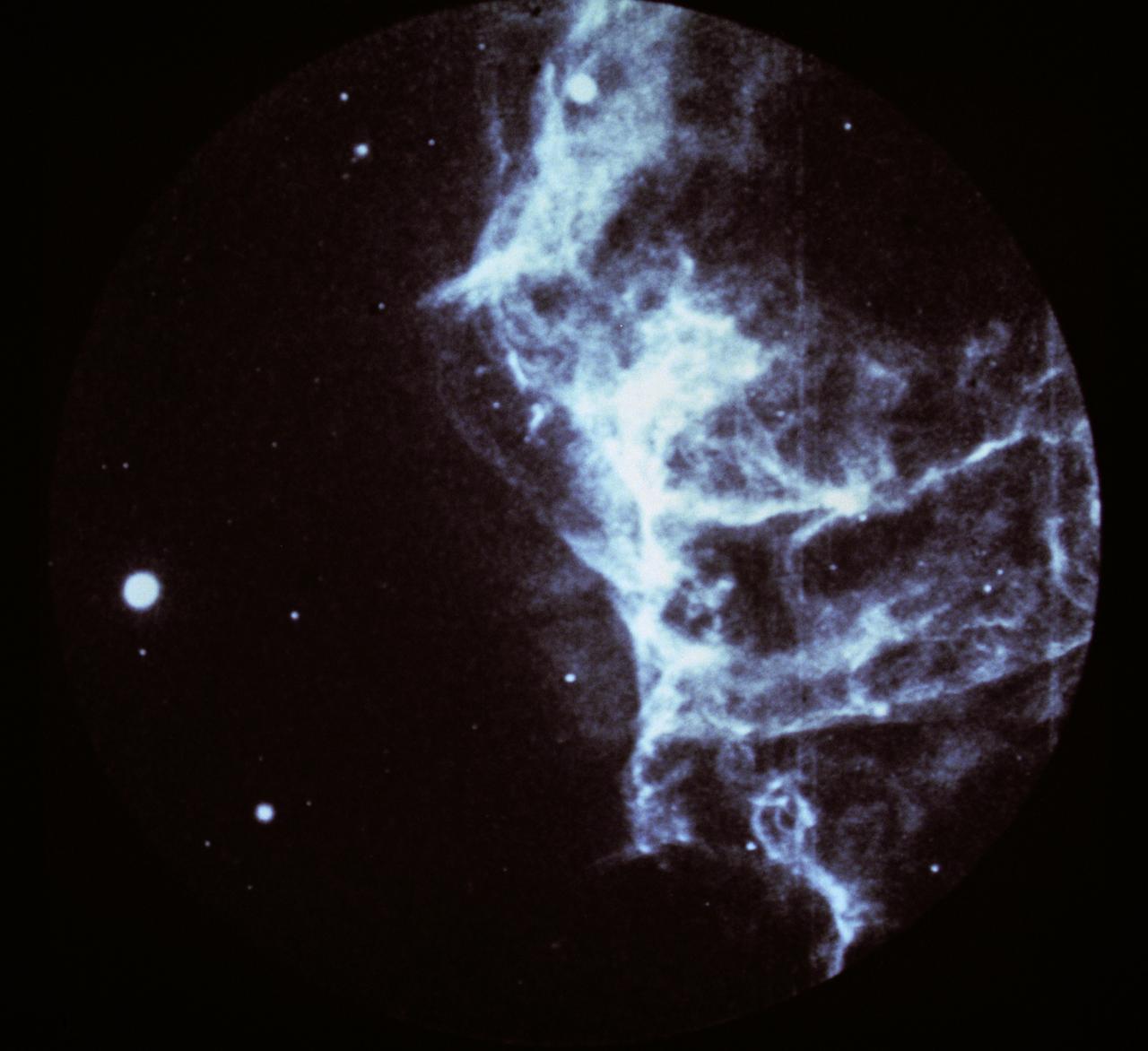
This image shows a part of the Cygnus loop supernova remnant, taken by the Ultraviolet Imaging Telescope (UIT) on the Astro Observatory during the Astro-1 mission (STS-35) on December 5, 1990. Pictured is a portion of the huge Cygnus loop, an array of interstellar gas clouds that have been blasted by a 900,000 mile per hour shock wave from a prehistoric stellar explosion, which occurred about 20,000 years ago, known as supernova. With ultraviolet and x-rays, astronomers can see emissions from extremely hot gases, intense magnetic fields, and other high-energy phenomena that more faintly appear in visible and infrared light or in radio waves that are crucial to deepening the understanding of the universe. The Astro Observatory was designed to explore the universe by observing and measuring the ultraviolet radiation from celestial objects. Three instruments make up the Astro Observatory: The Hopkins Ultraviolet Telescope (HUT), the Ultraviolet Imaging Telescope (UIT), and the Wisconsin Ultraviolet Photo-Polarimetry Experiment (WUPPE). The Marshall Space Flight Center had managment responsibilities for the Astro-1 mission. The Astro-1 Observatory was launched aboard the Space Shuttle Orbiter Columbia (STS-35) on December 2, 1990.
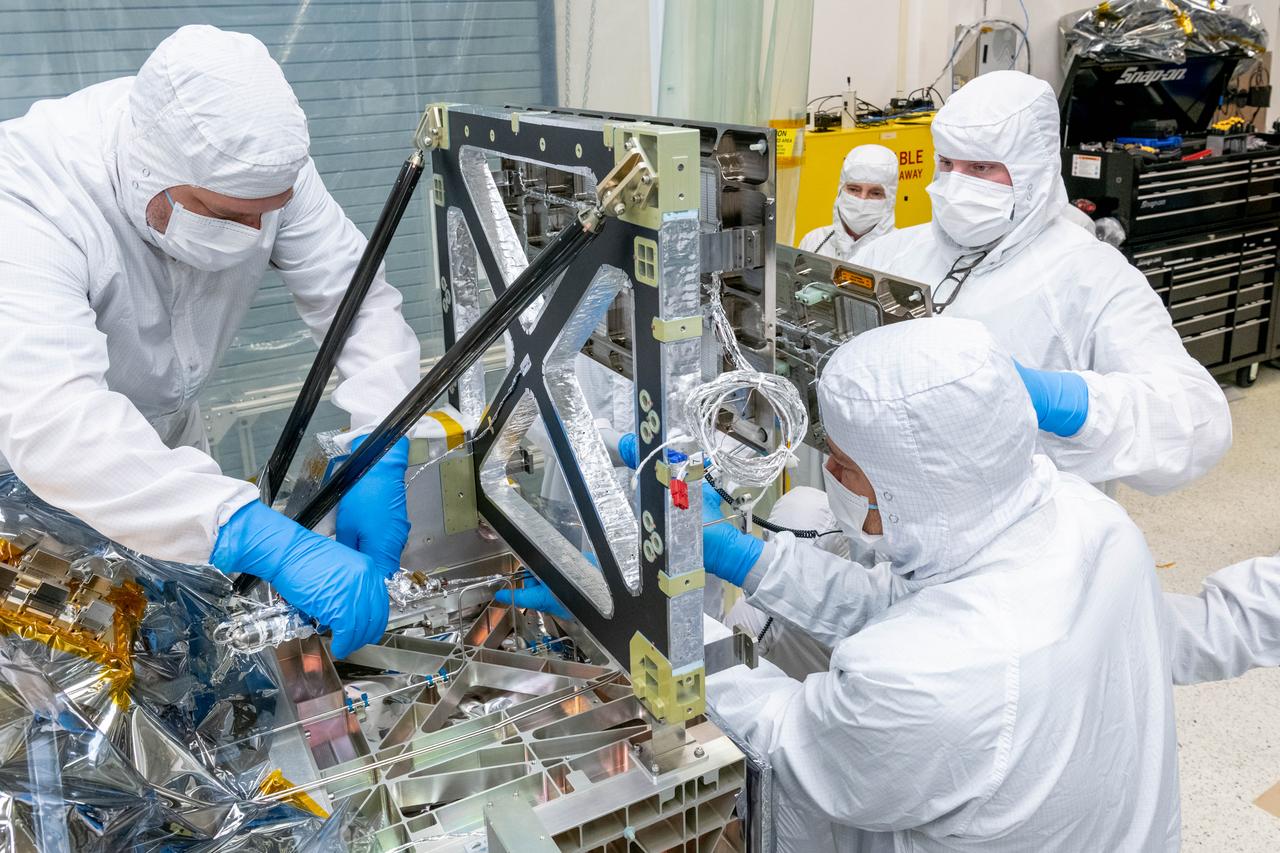
Mechanical technicians and thermal engineers work together to carefully feed the lines of a Loop Heat Pipe onto the Ocean Color Instrument (OCI). This integration operation will allow proper heat transfer throughout the instrument. OCI is a highly advanced optical spectrometer that will be used to measure properties of light over portions of the electromagnetic spectrum. It will enable continuous measurement of light at finer wavelength resolution than previous NASA satellite sensors, extending key system ocean color data records for climate studies. OCI is PACE's (Plankton, Aerosol, Cloud, ocean Ecosystem) primary sensor built at Goddard Space Flight Center in Greenbelt, MD.
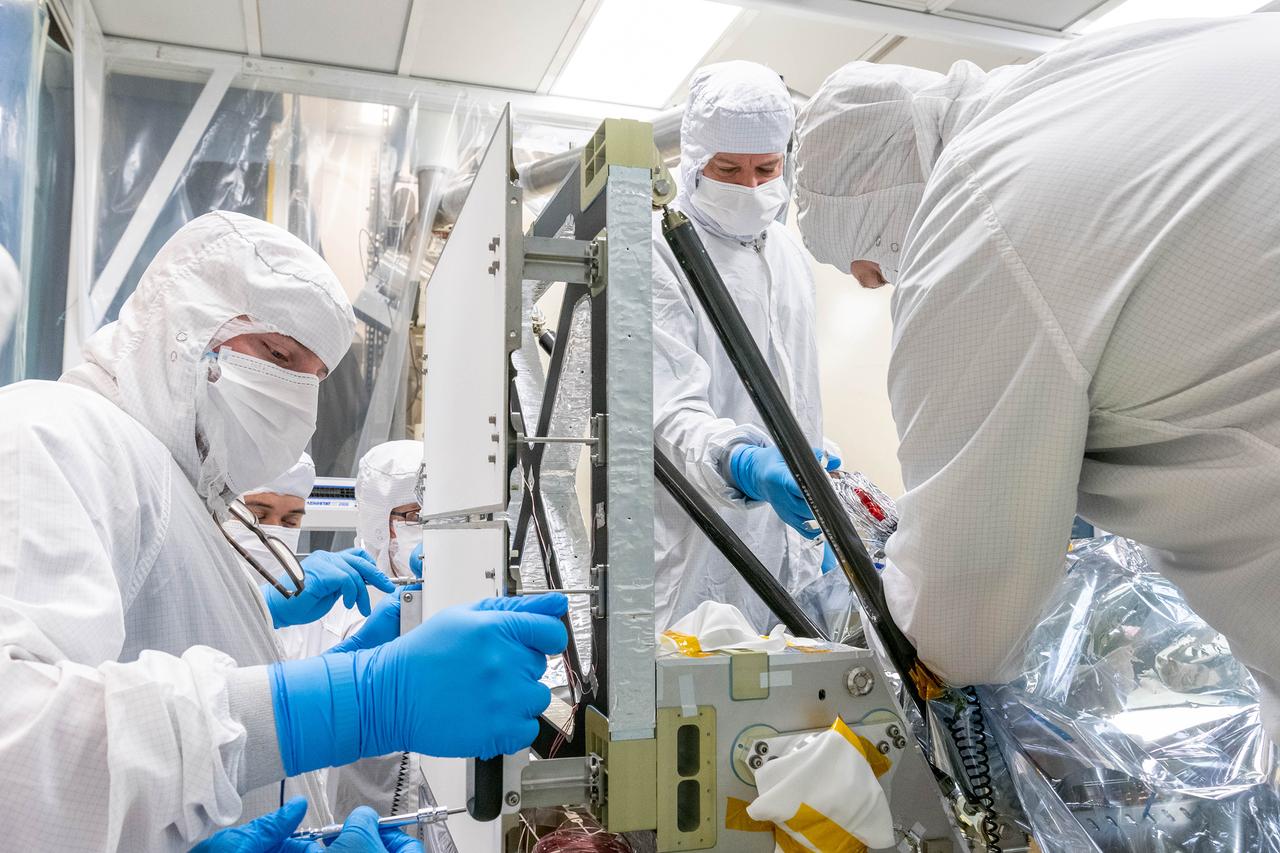
Mechanical technicians and thermal engineers work together to carefully feed the lines of a Loop Heat Pipe onto the Ocean Color Instrument (OCI). This integration operation will allow proper heat transfer throughout the instrument. OCI is a highly advanced optical spectrometer that will be used to measure properties of light over portions of the electromagnetic spectrum. It will enable continuous measurement of light at finer wavelength resolution than previous NASA satellite sensors, extending key system ocean color data records for climate studies. OCI is PACE's (Plankton, Aerosol, Cloud, ocean Ecosystem) primary sensor built at Goddard Space Flight Center in Greenbelt, MD.
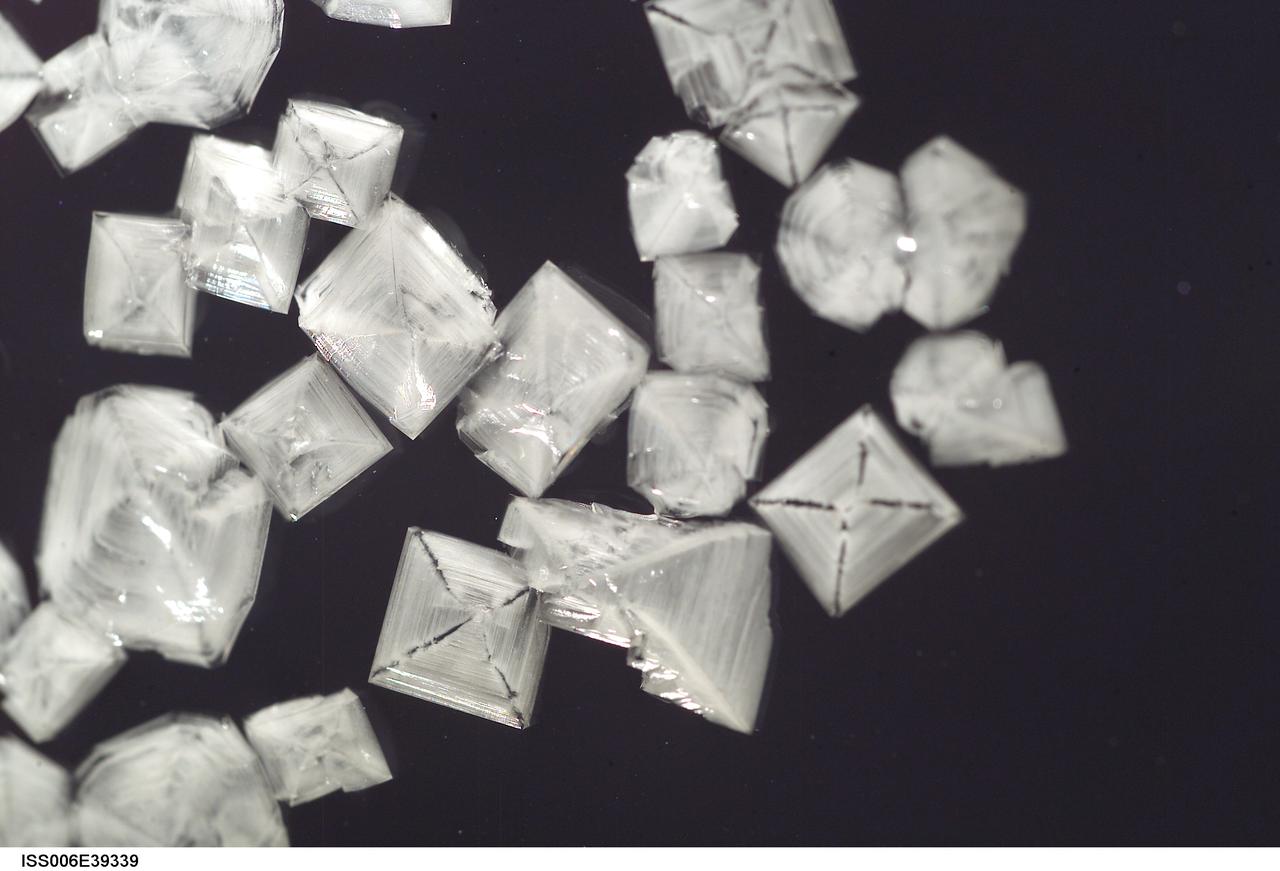
ISS006-E-39339 (15 March 2003) --- A close up view of sodium chloride crystals in a water bubble within a 50-millimeter metal loop was photographed by an Expedition Six crewmember. The experiment took place in the Destiny laboratory on the International Space Station (ISS).

ISS041-E-045298 (29 Sept. 2014) --- NASA astronaut Barry Wilmore, Expedition 41 flight engineer, conducts a scrub and cleansing of the water loops in his U.S. Extravehicular Mobility Unit (EMU) spacesuit in the Quest airlock of the International Space Station.
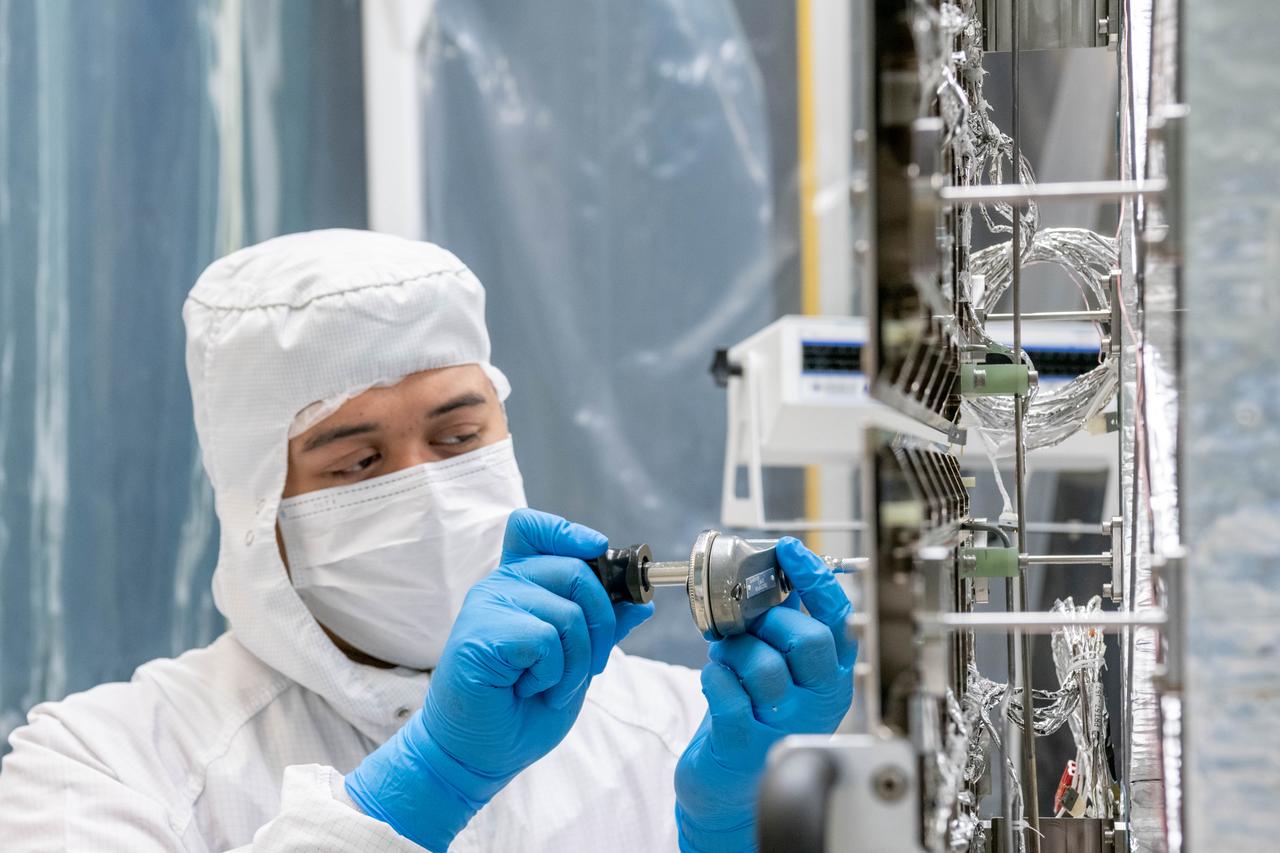
Mechanical technician, Dan Dizon, tightens bolts on the loop heat pipe radiator on the Ocean Color Instrument (OCI) in a clean tent where the final hardware of the OCI are installed and tested. OCI is a highly advanced optical spectrometer that will be used to measure properties of light over portions of the electromagnetic spectrum. It will enable continuous measurement of light at finer wavelength resolution than previous NASA satellite sensors, extending key system ocean color data records for climate studies. OCI is PACE's (Plankton, Aerosol, Cloud, ocean Ecosystem) primary sensor built at Goddard Space Flight Center in Greenbelt, MD.
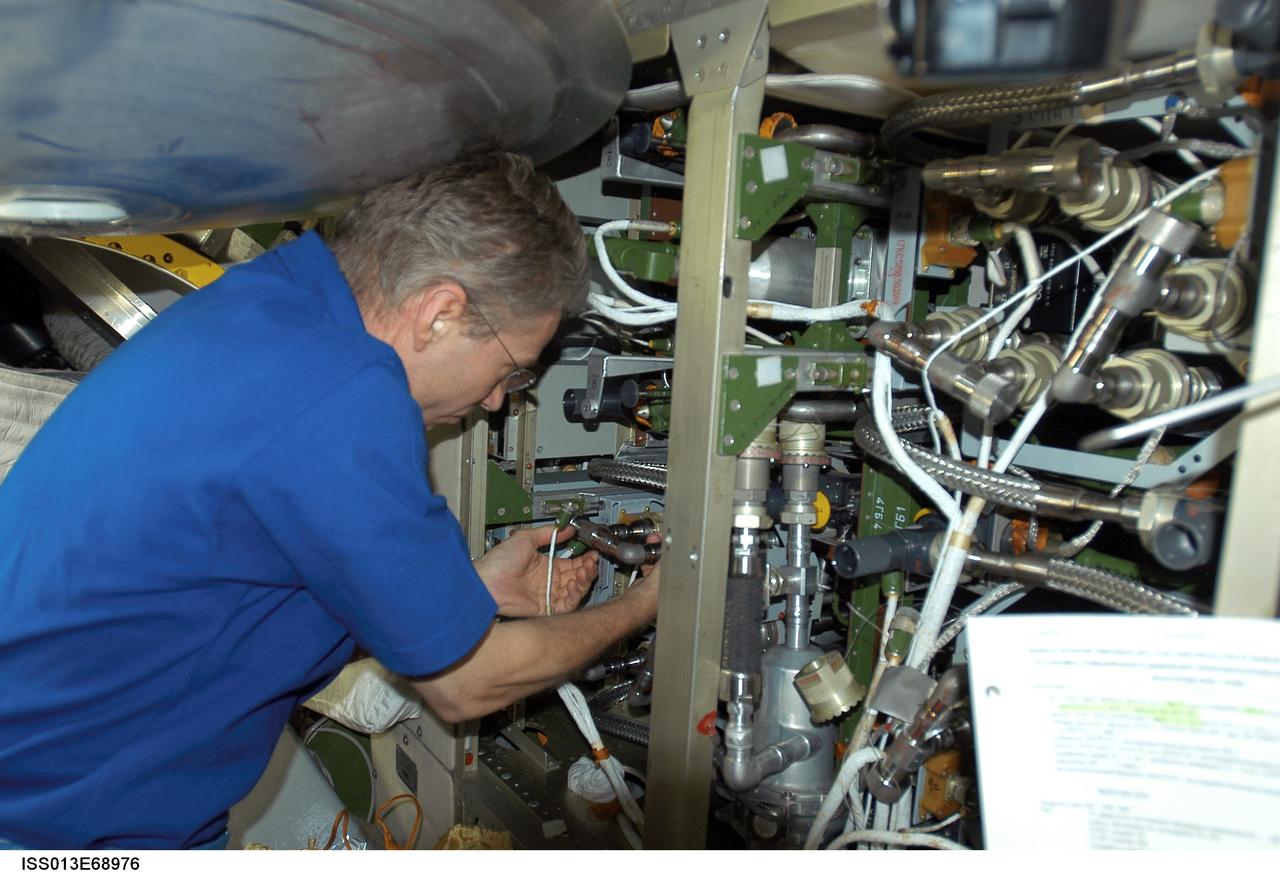
ISS013-E-68976 (August 2006) --- European Space Agency (ESA) astronaut Thomas Reiter, Expedition 13 flight engineer, works on the internal thermal cooling loop pump in the Zvezda Service Module of the International Space Station.
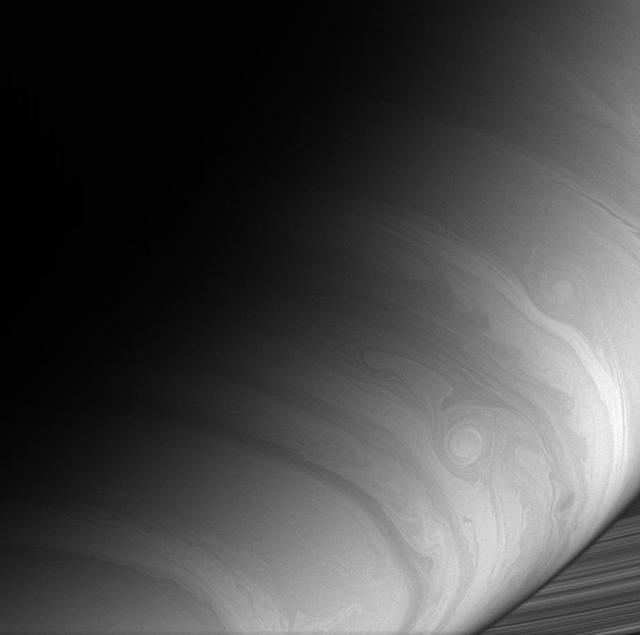
The Cassini spacecraft captures the ripples, loops and storms that swirl in Saturn east-west flowing cloud bands
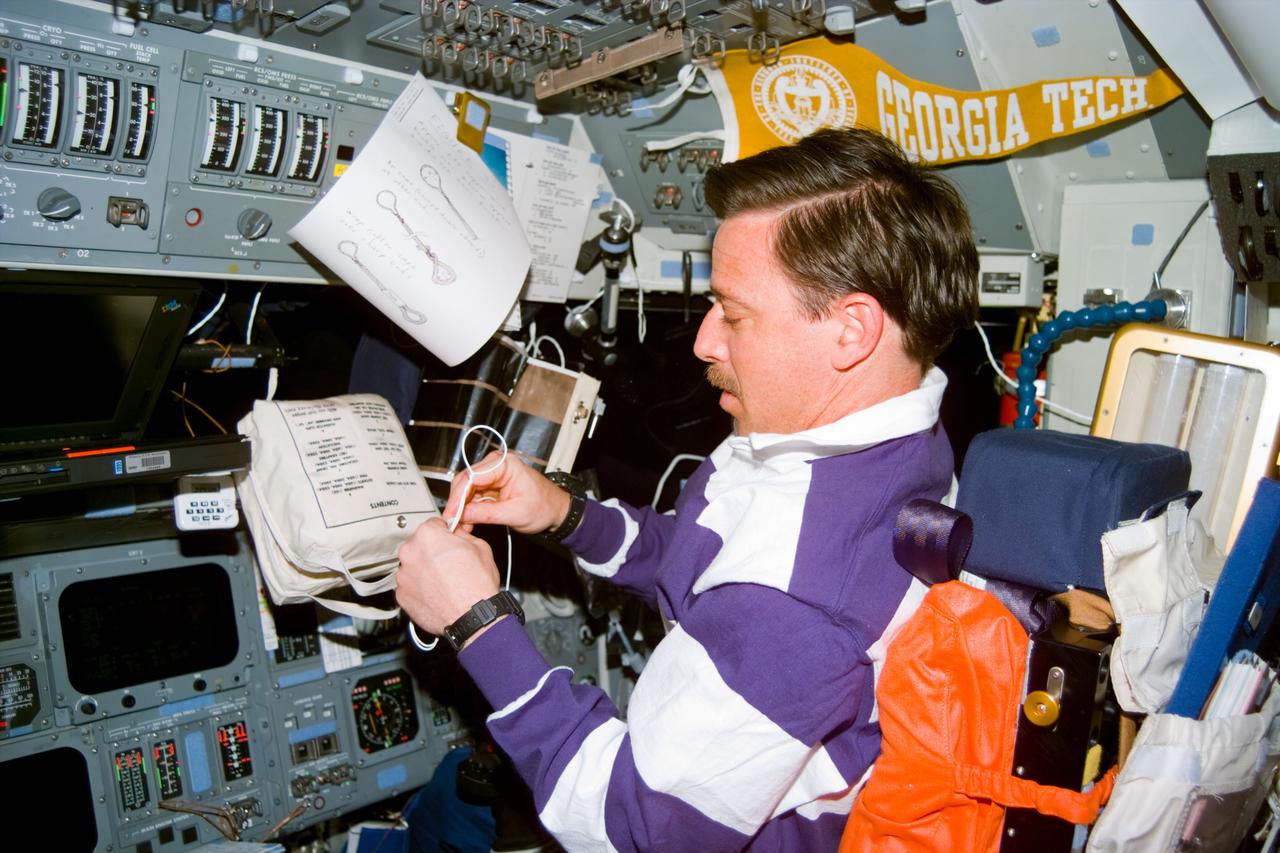
S82-E-5597 (17 Feb. 1997) --- Astronaut Scott J. Horowitz at pilot's station works with a hand-fashioned loop fastener device to be used in support of the additional STS-82 Extravehicular Activity (EVA) to service Hubble Space Telescope (HST). Note sketches overhead which were sent by ground controllers to guide the pilot's engineering of the task. This view was taken with an Electronic Still Camera (ESC).
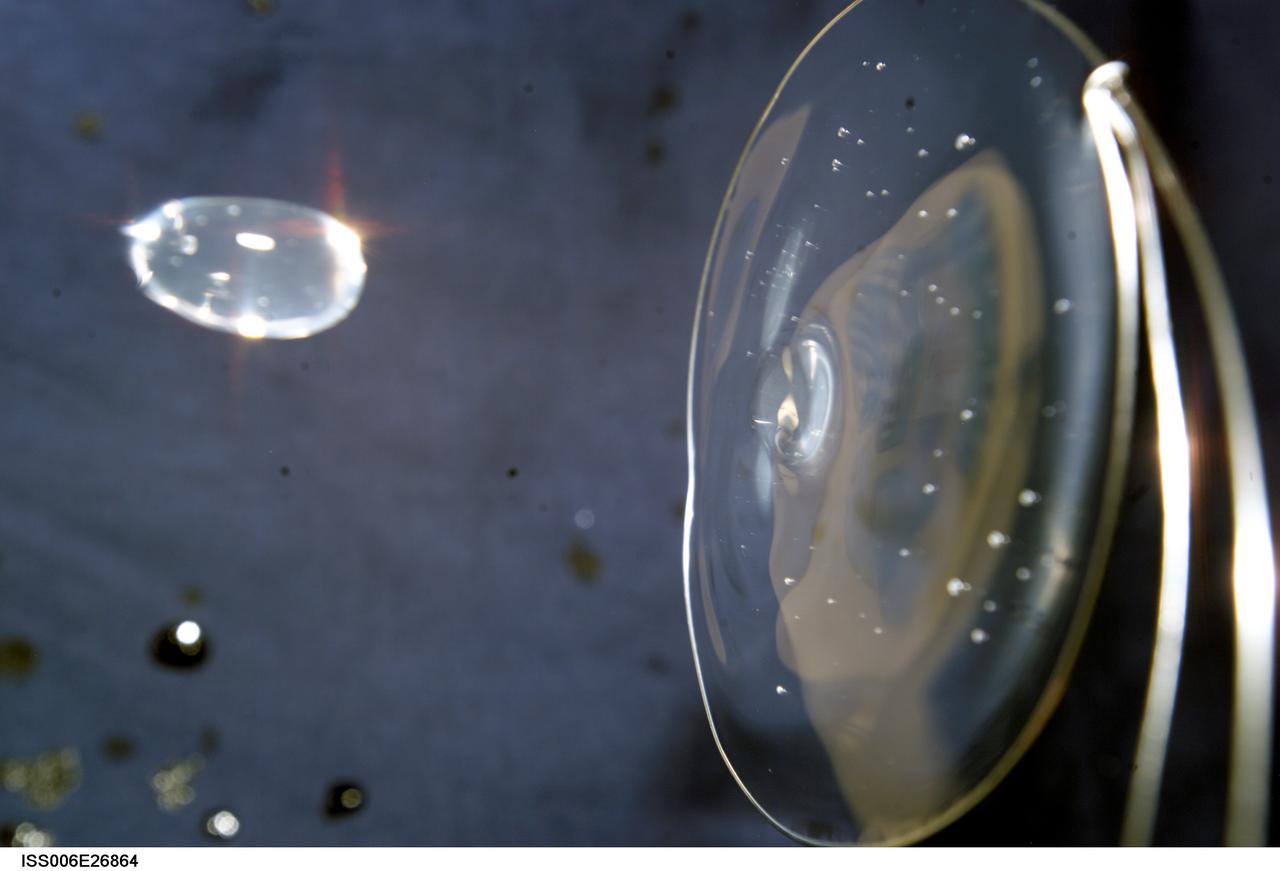
ISS006-E-26864 (16 February 2003) --- View of surface tension demonstration using water that is being held in place by a metal loop. Astronaut Donald R. Pettit, Expedition Six NASA ISS science officer, photographed these demonstrations for educational purposes. The experiment took place in the Destiny laboratory on the International Space Station (ISS).
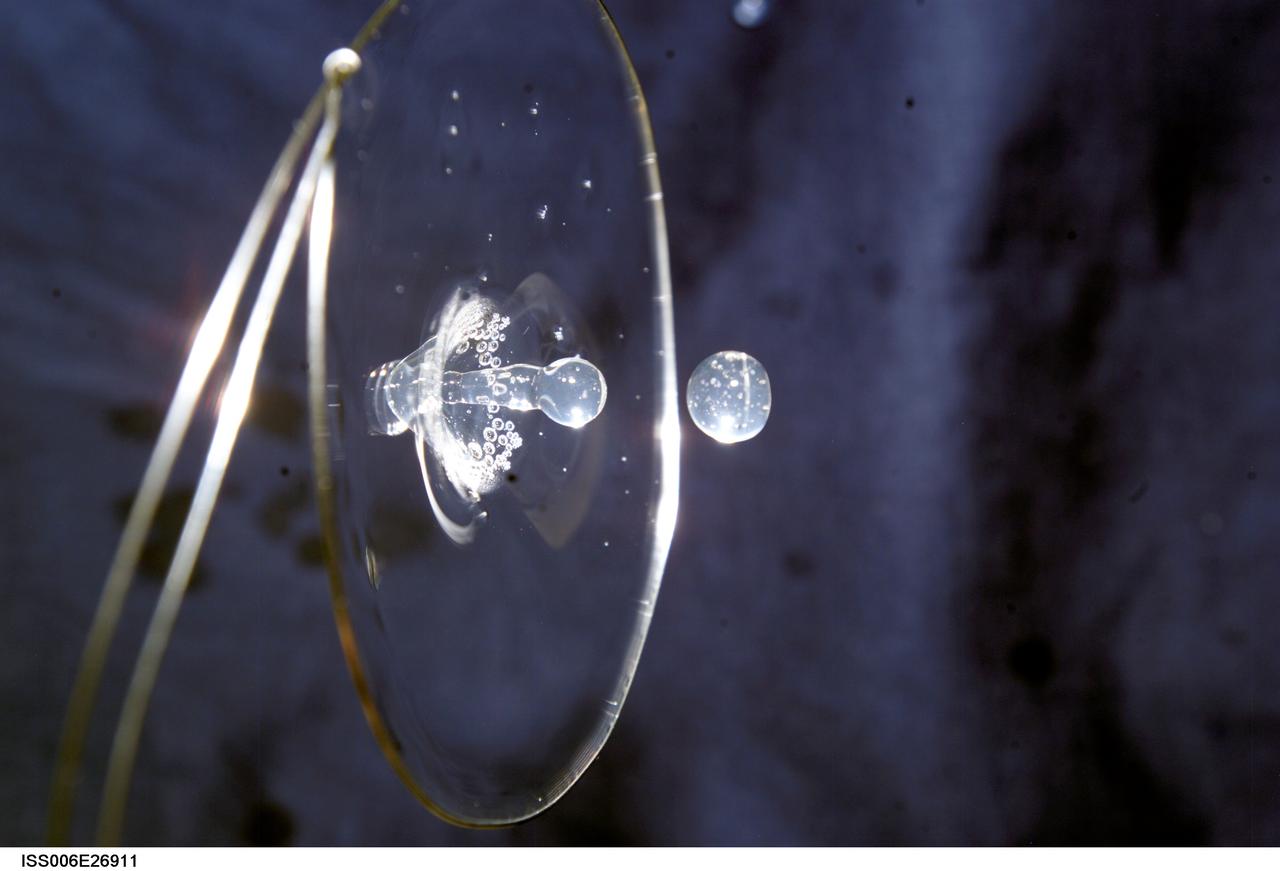
ISS006-E-26911 (16 February 2003) --- View of surface tension demonstration using water that is being held in place by a metal loop. Astronaut Donald R. Pettit, Expedition Six NASA ISS science officer, photographed these demonstrations for educational purposes. The experiment took place in the Destiny laboratory on the International Space Station (ISS).
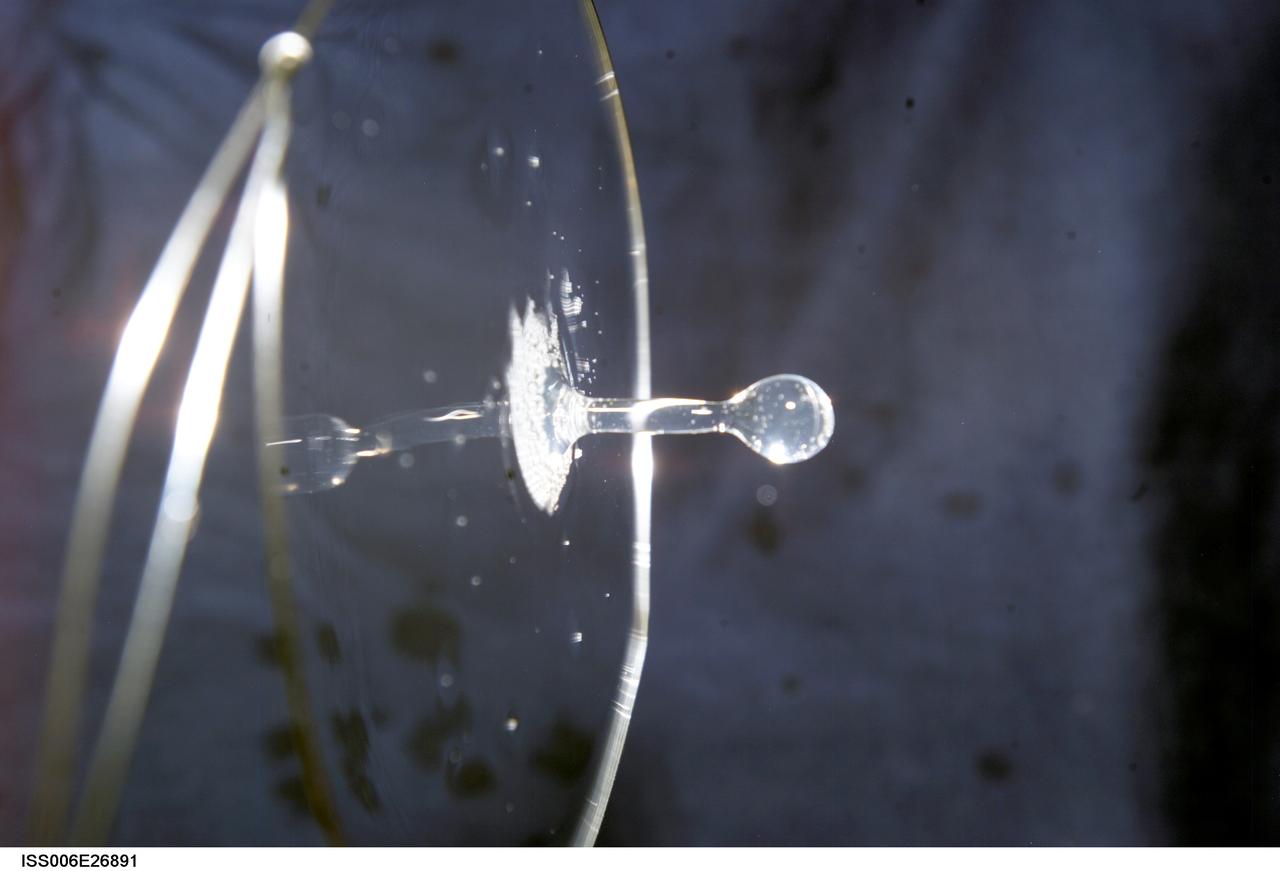
ISS006-E-26891 (16 February 2003) --- View of surface tension demonstration using water that is being held in place by a metal loop. Astronaut Donald R. Pettit, Expedition Six NASA ISS science officer, photographed these demonstrations for educational purposes. The experiment took place in the Destiny laboratory on the International Space Station (ISS).
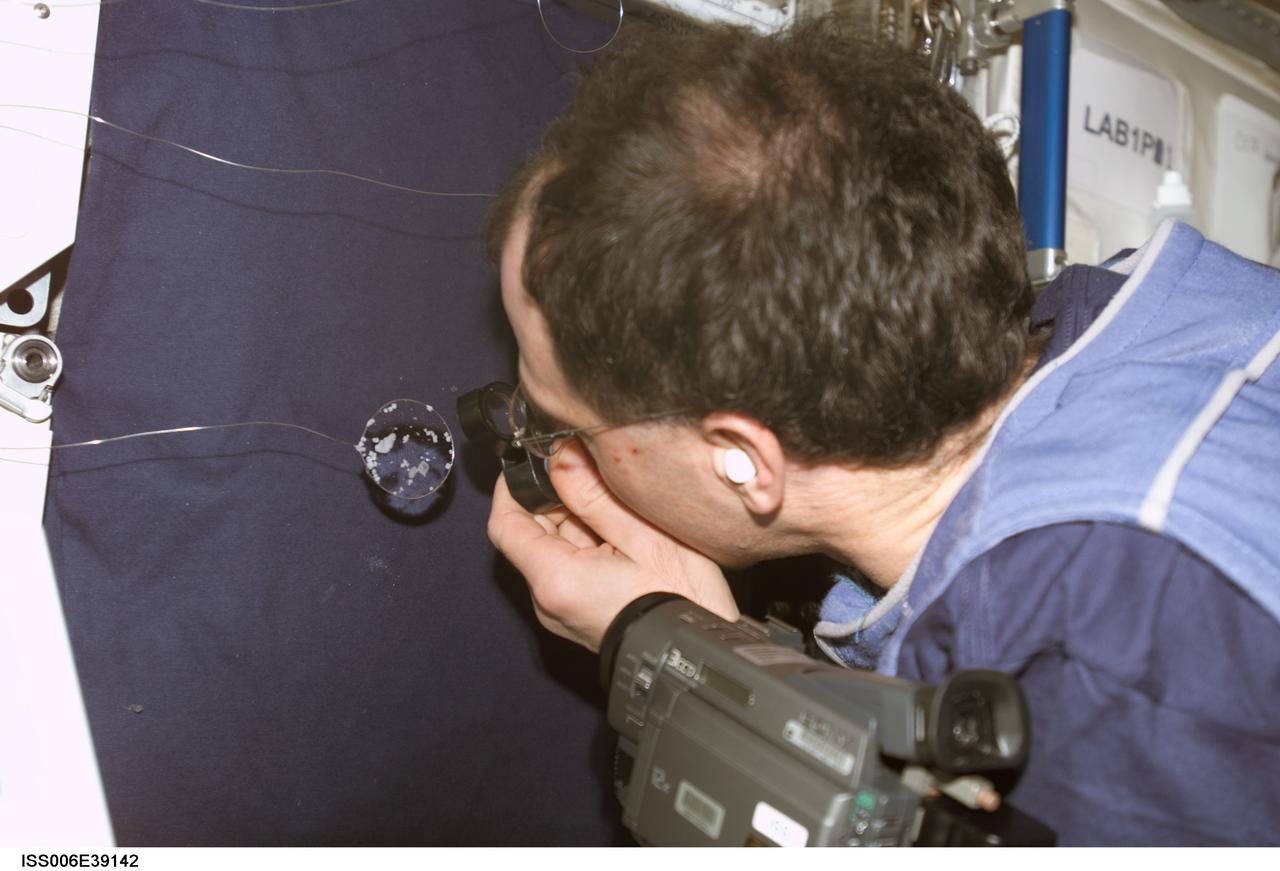
ISS006-E-39142 (12 March 2003) --- Astronaut Donald R. Pettit, Expedition Six NASA ISS science officer, looks closely at a water bubble within a 50-millimeter metal loop. The experiment took place in the Destiny laboratory on the International Space Station (ISS).
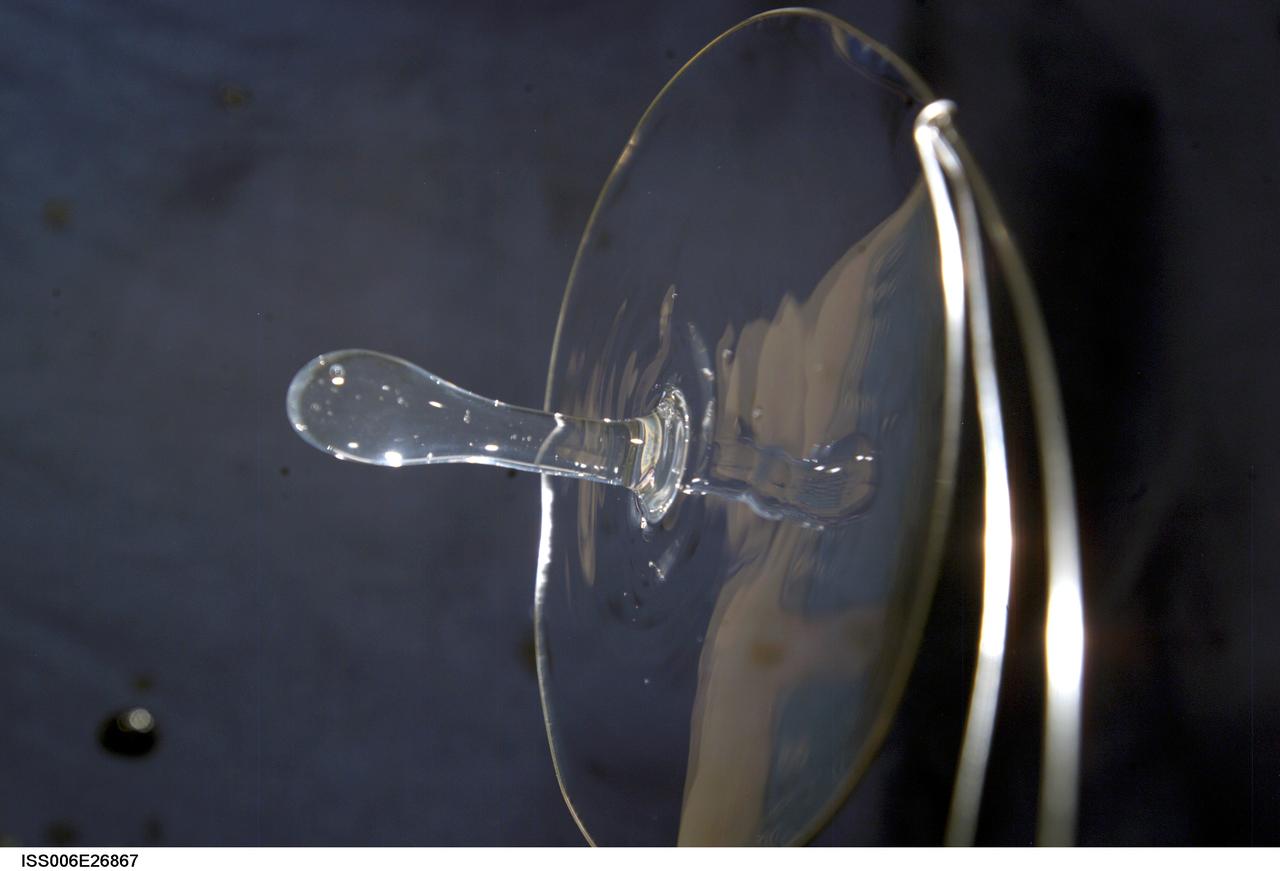
ISS006-E-26867 (16 February 2003) --- View of surface tension demonstration using water that is being held in place by a metal loop. Astronaut Donald R. Pettit, Expedition Six NASA ISS science officer, photographed these demonstrations for educational purposes. The experiment took place in the Destiny laboratory on the International Space Station (ISS).
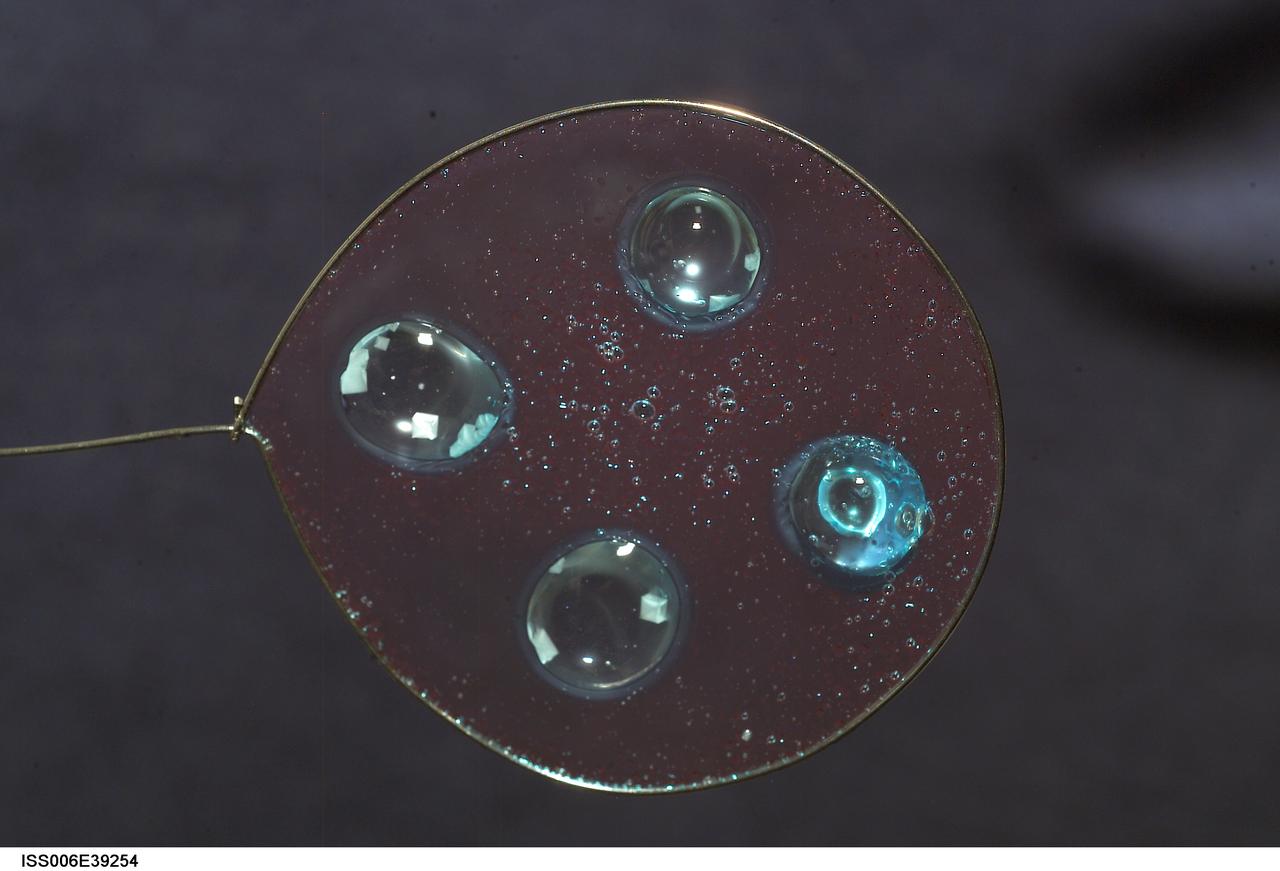
ISS006-E-39254 (14 March 2003) --- A view of sodium chloride inserted onto blueberry jelly within a 50-millimeter (mm) metal loop was photographed by an Expedition Six crewmember. The experiment took place in the Destiny laboratory on the International Space Station (ISS).
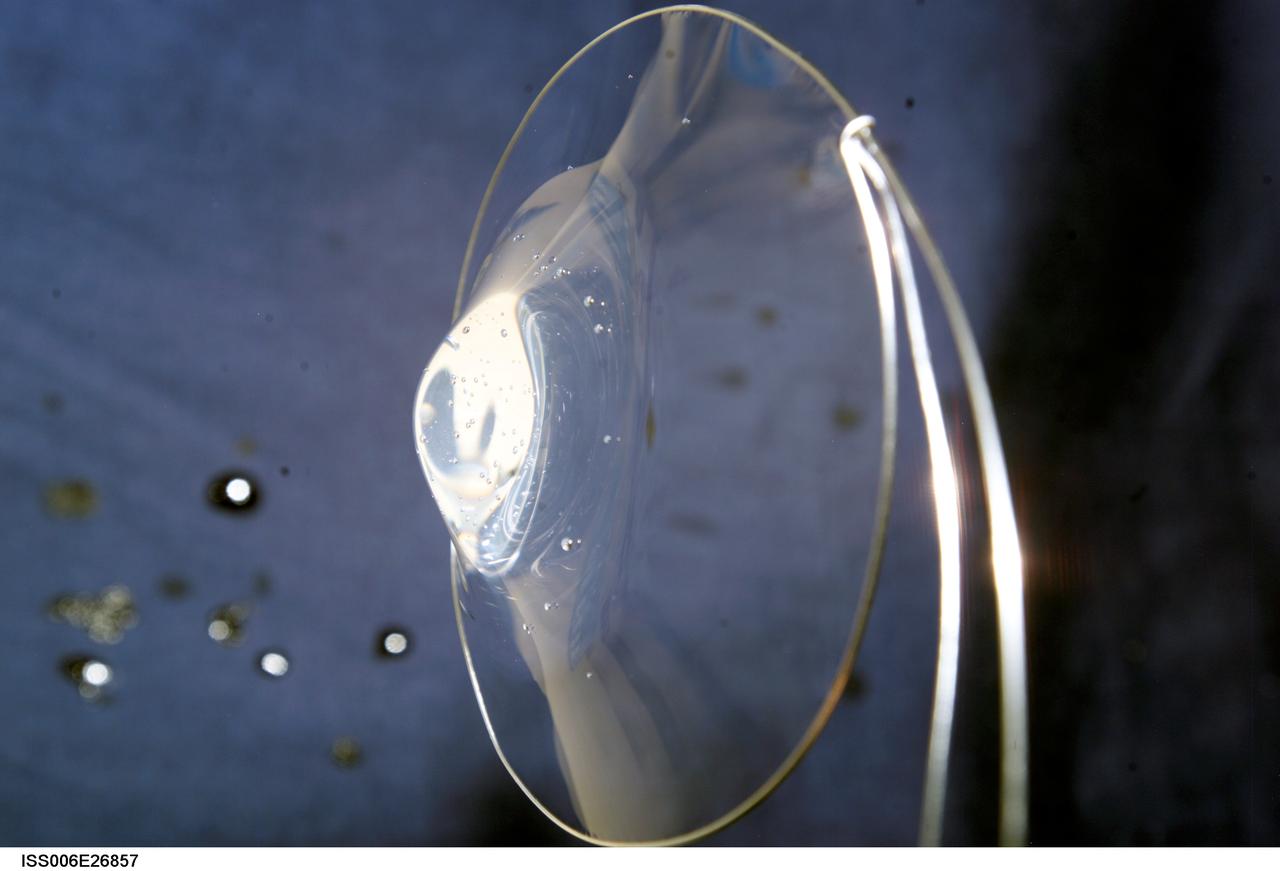
ISS006-E-26857 (16 February 2003) --- View of surface tension demonstration using water that is being held in place by a metal loop. Astronaut Donald R. Pettit, Expedition Six NASA ISS science officer, photographed these demonstrations for educational purposes. The experiment took place in the Destiny laboratory on the International Space Station (ISS).
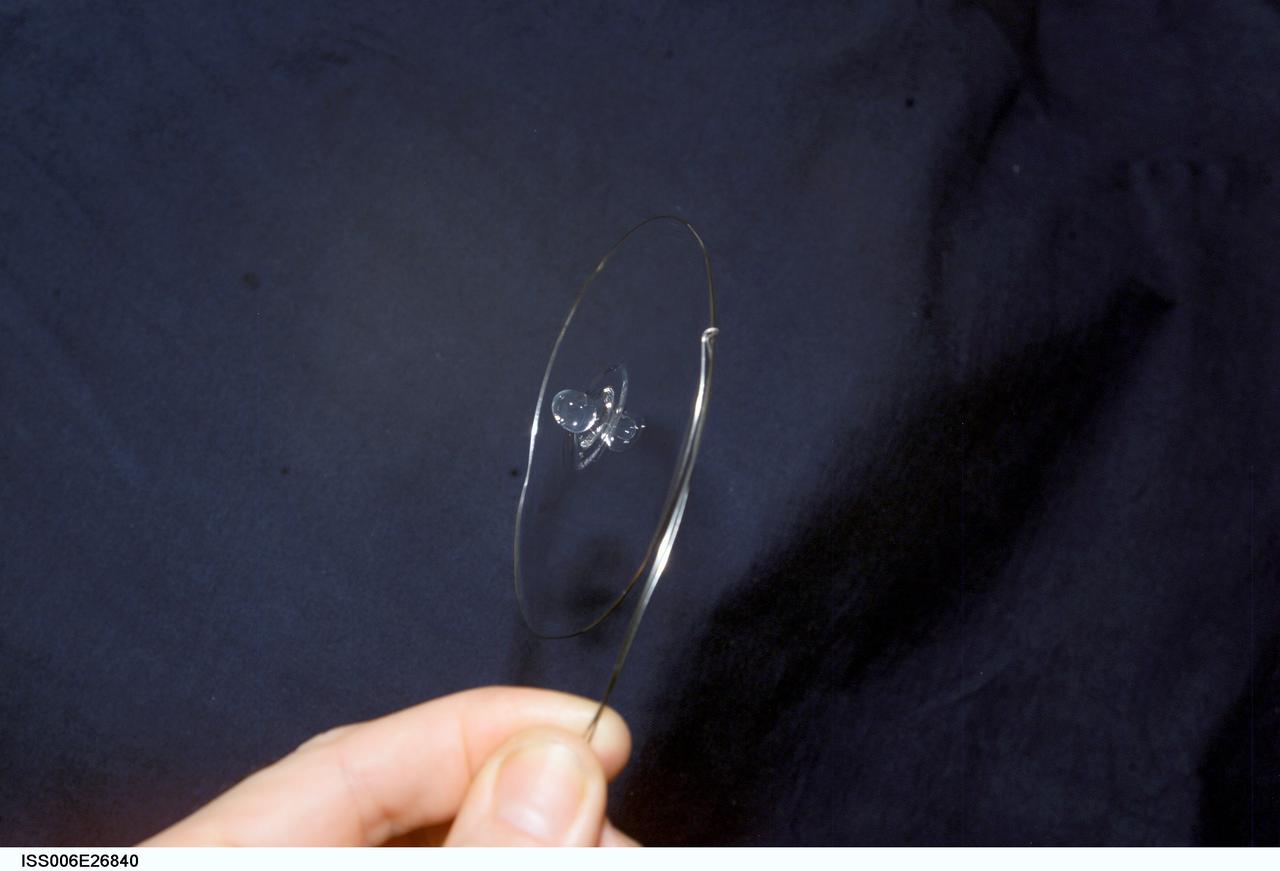
ISS006-E-26840 (16 February 2003) --- View of surface tension demonstration using water that is being held in place by a metal loop. Astronaut Donald R. Pettit, Expedition Six NASA ISS science officer, photographed these demonstrations for educational purposes. The experiment took place in the Destiny laboratory on the International Space Station (ISS).
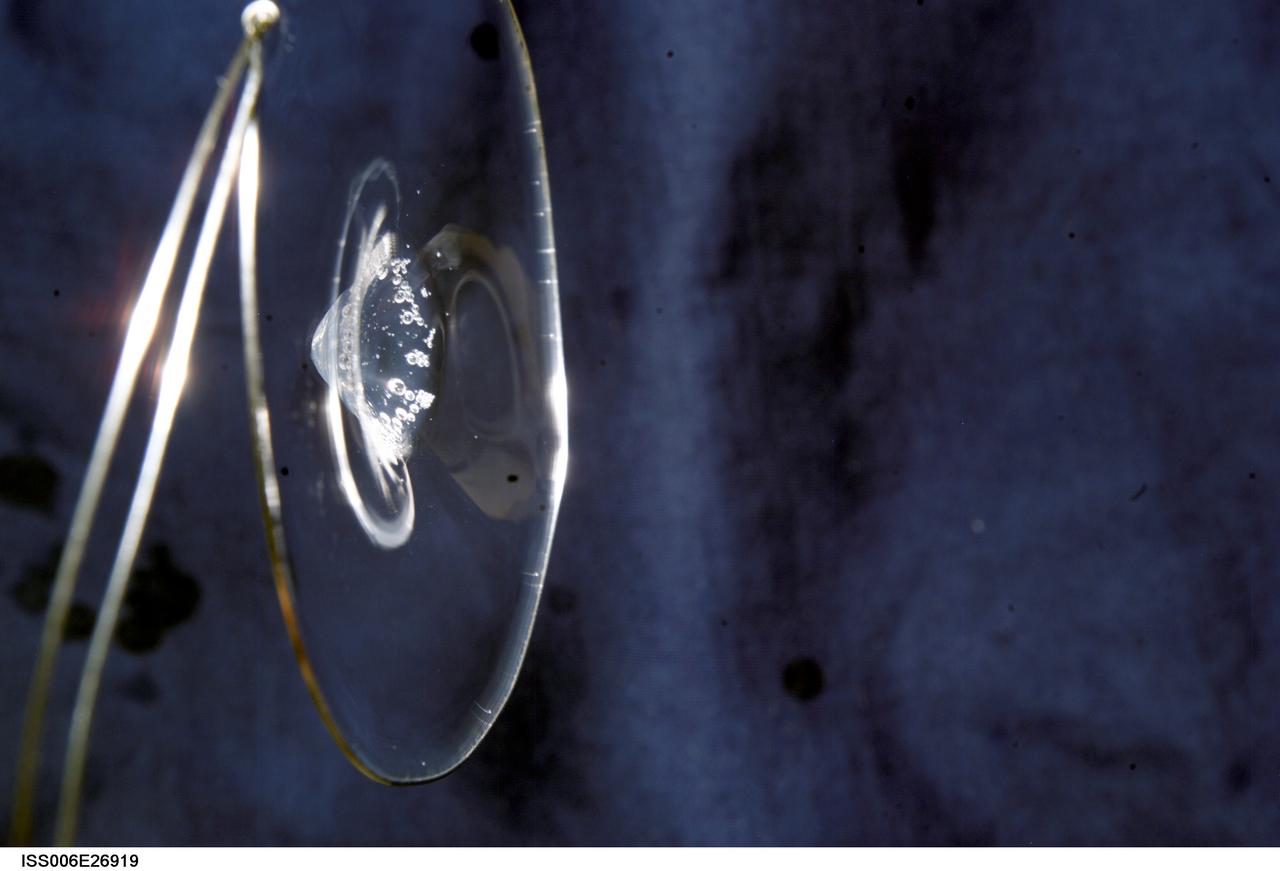
ISS006-E-26919 (16 February 2003) --- View of surface tension demonstration using water that is being held in place by a metal loop. Astronaut Donald R. Pettit, Expedition Six NASA ISS science officer, photographed these demonstrations for educational purposes. The experiment took place in the Destiny laboratory on the International Space Station (ISS).
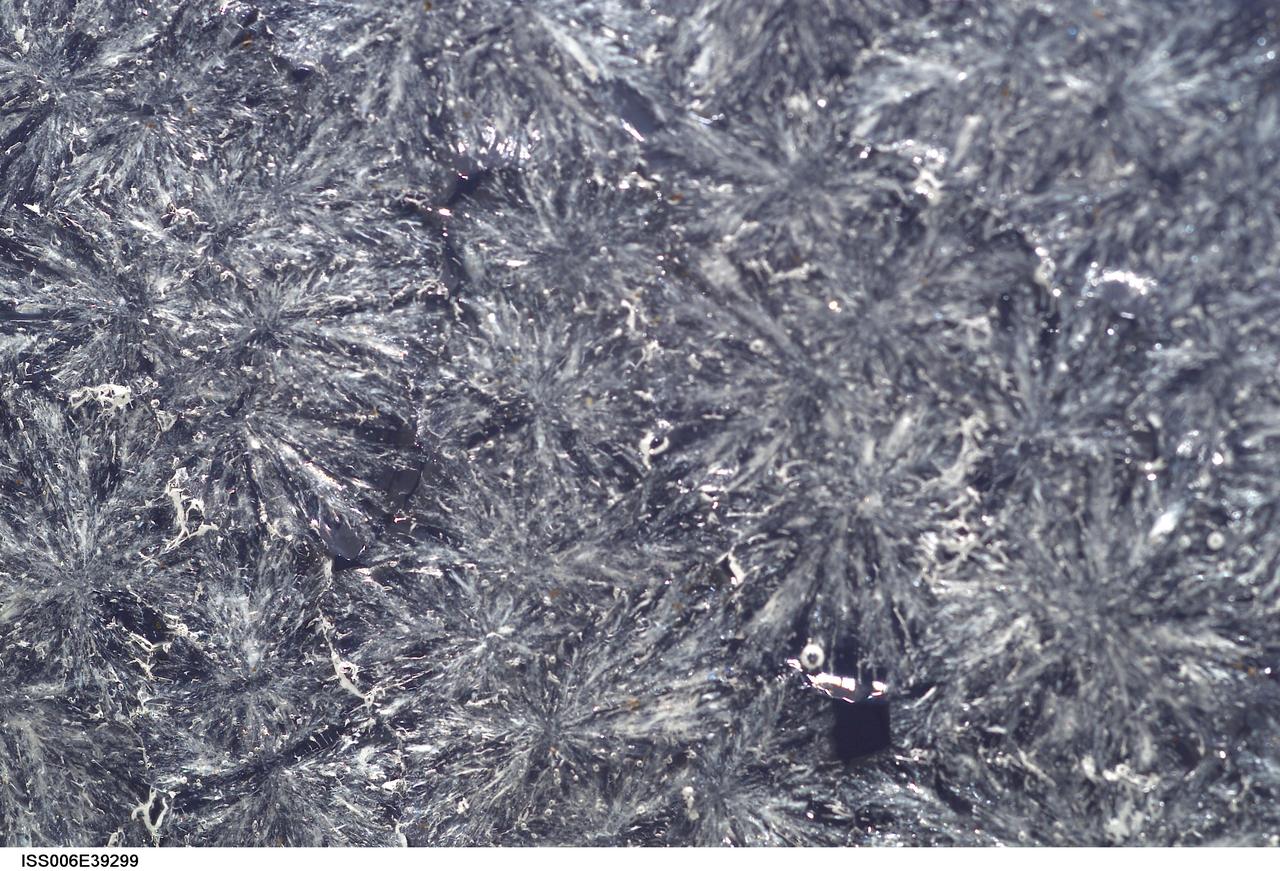
ISS006-E-39299 (15 March 2003) --- A close up view of sugar crystals in a water bubble within a 50-millimeter (mm) metal loop was photographed by an Expedition Six crewmember. The experiment took place in the Destiny laboratory on the International Space Station (ISS).
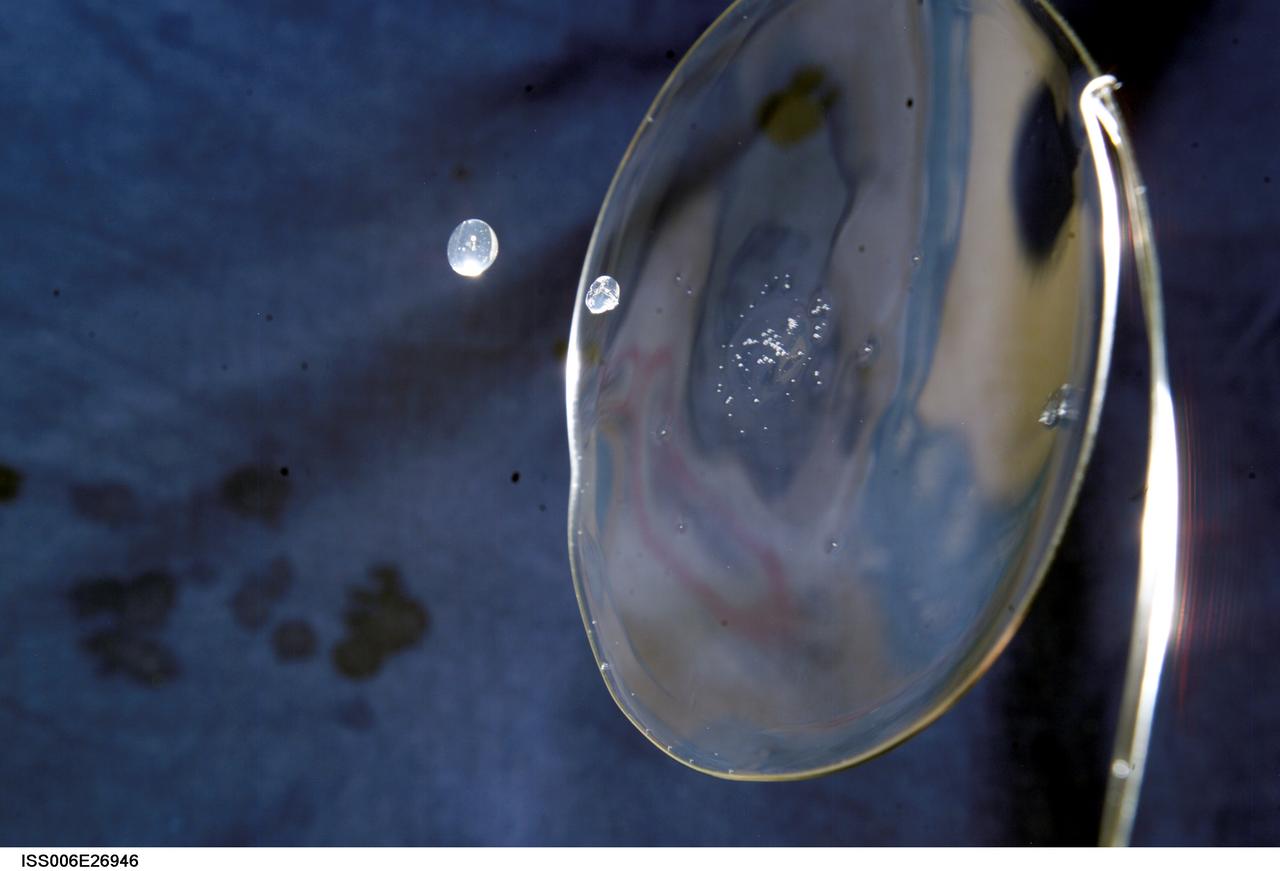
ISS006-E-26946 (16 February 2003) --- View of surface tension demonstration using water that is being held in place by a metal loop. Astronaut Donald R. Pettit, Expedition Six NASA ISS science officer, photographed these demonstrations for educational purposes. The experiment took place in the Destiny laboratory on the International Space Station (ISS).
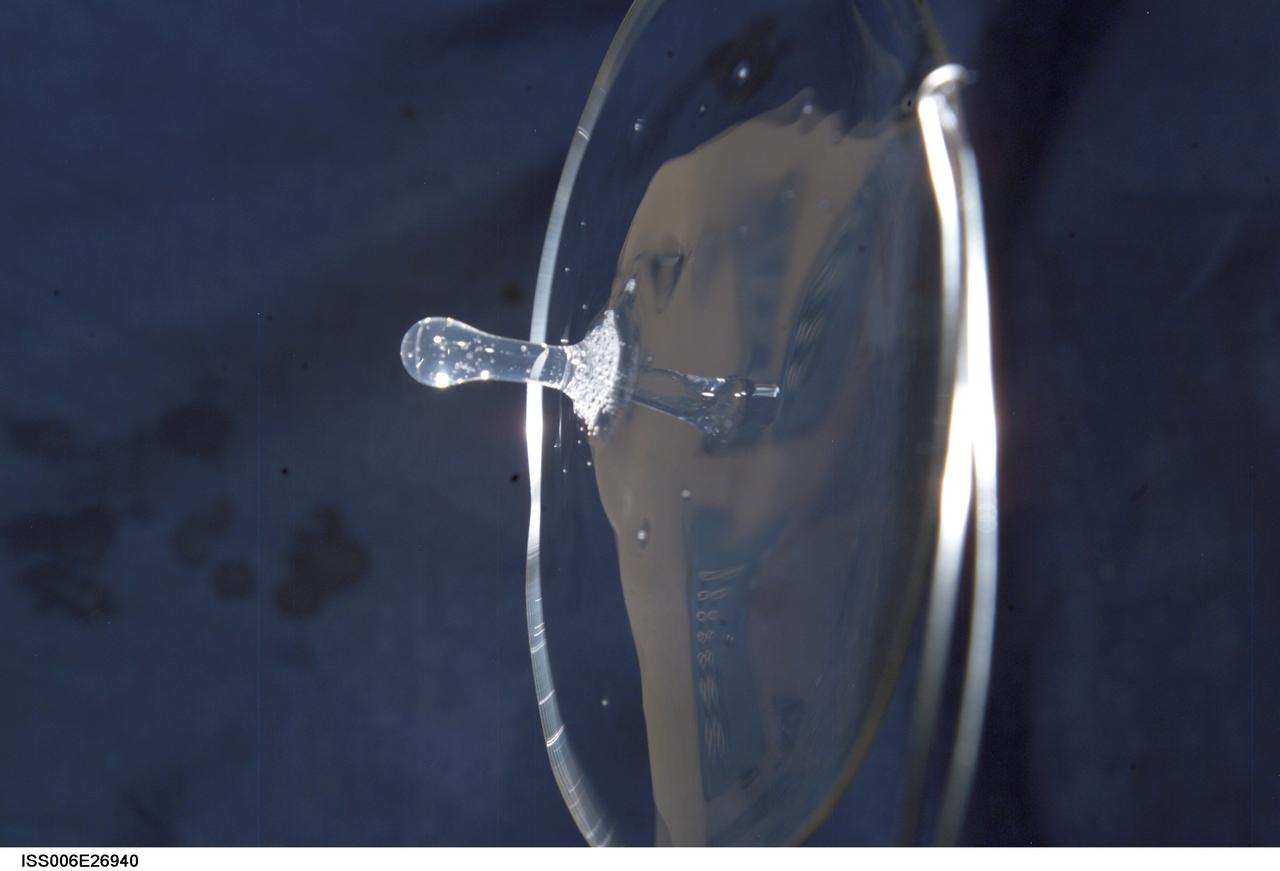
ISS006-E-26940 (16 February 2003) --- View of surface tension demonstration using water that is being held in place by a metal loop. Astronaut Donald R. Pettit, Expedition Six NASA ISS science officer, photographed these demonstrations for educational purposes. The experiment took place in the Destiny laboratory on the International Space Station (ISS).
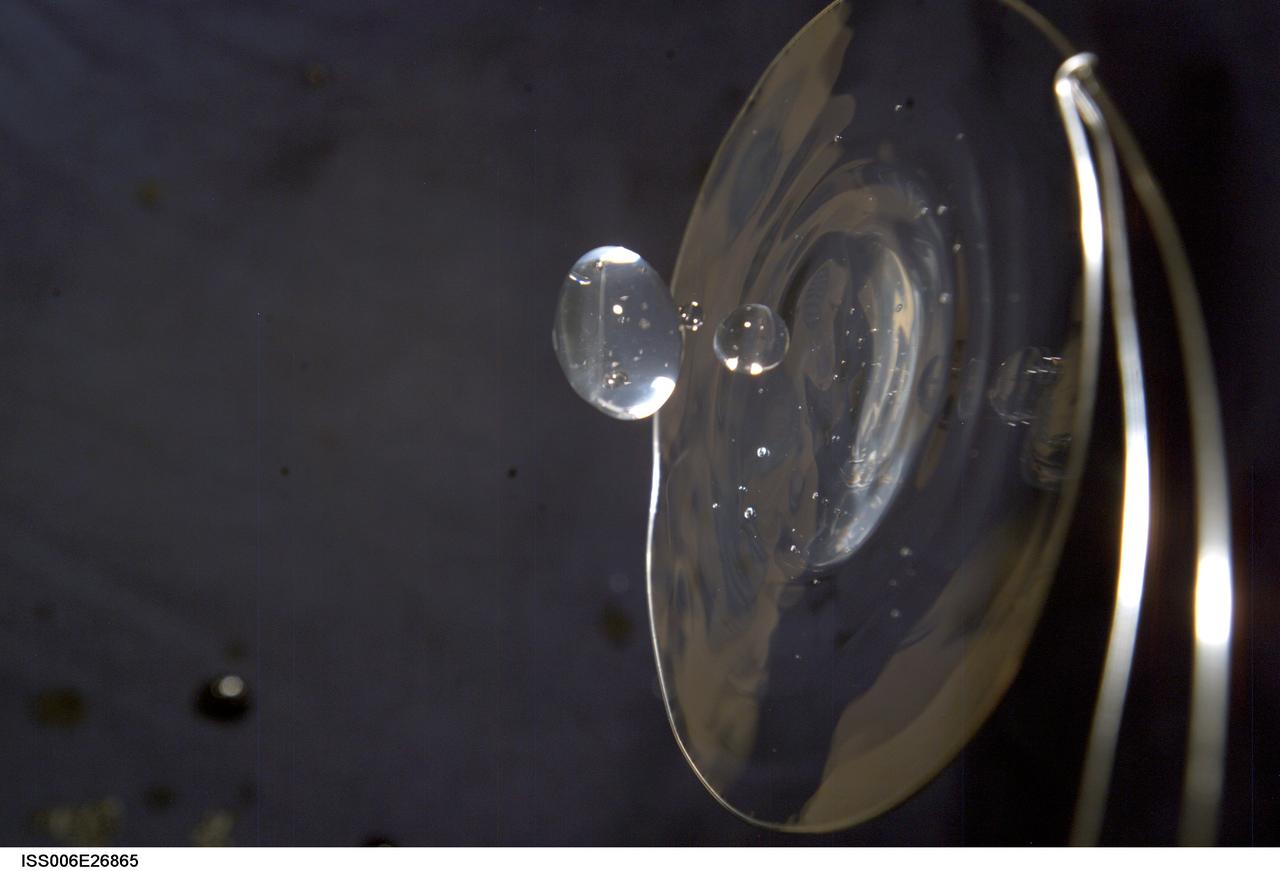
ISS006-E-26865 (16 February 2003) --- View of surface tension demonstration using water that is being held in place by a metal loop. Astronaut Donald R. Pettit, Expedition Six NASA ISS science officer, photographed these demonstrations for educational purposes. The experiment took place in the Destiny laboratory on the International Space Station (ISS).
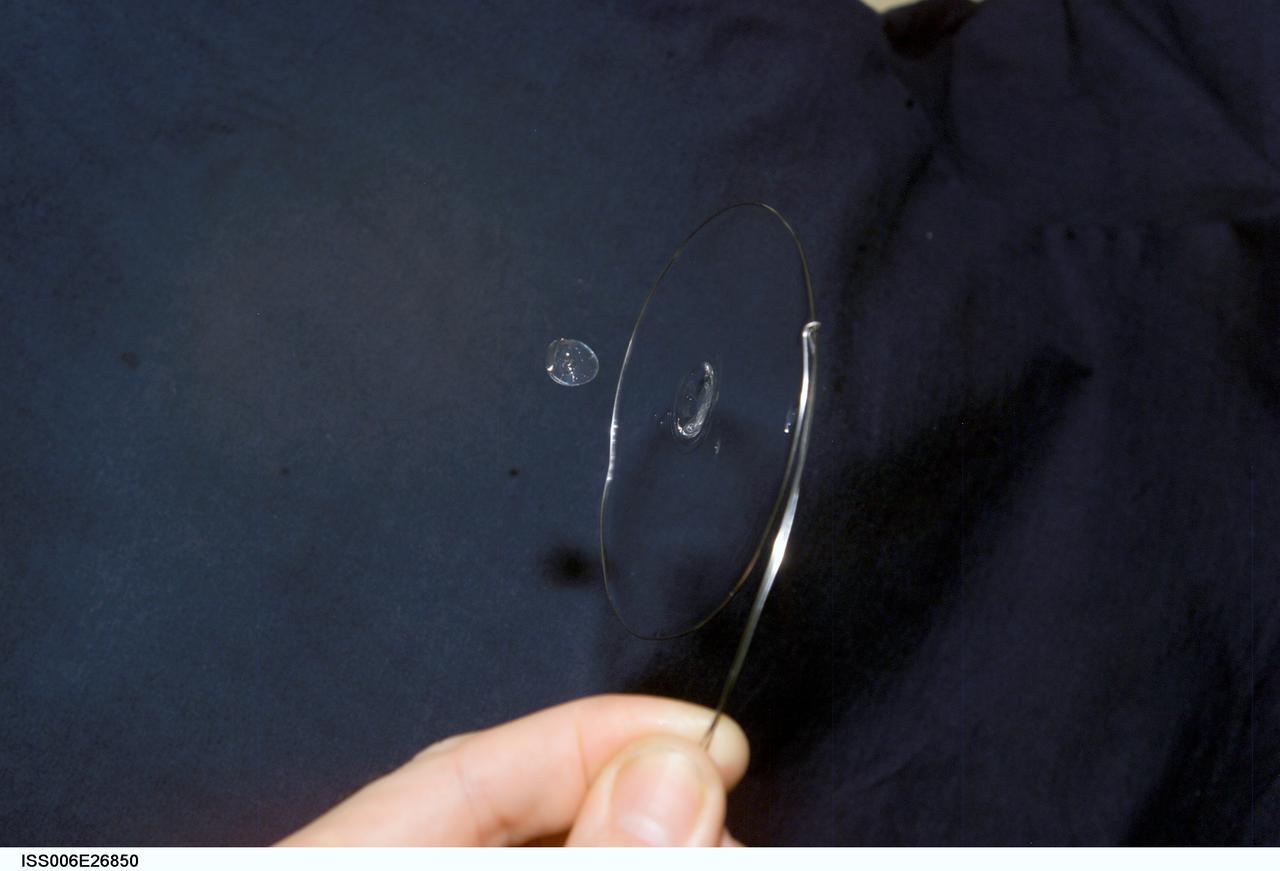
ISS006-E-26850 (16 February 2003) --- View of surface tension demonstration using water that is being held in place by a metal loop. Astronaut Donald R. Pettit, Expedition Six NASA ISS science officer, photographed these demonstrations for educational purposes. The experiment took place in the Destiny laboratory on the International Space Station (ISS).
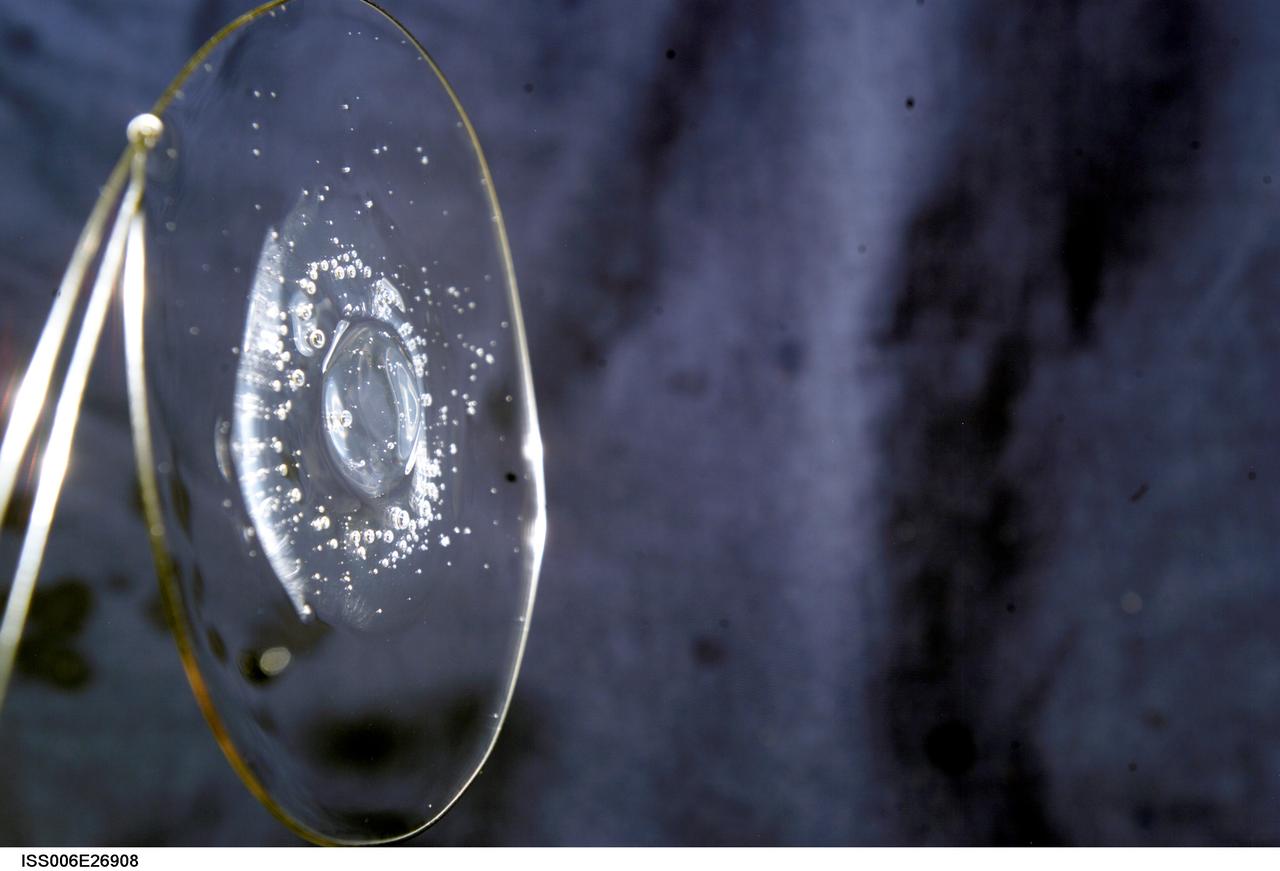
ISS006-E-26908 (16 February 2003) --- View of surface tension demonstration using water that is being held in place by a metal loop. Astronaut Donald R. Pettit, Expedition Six NASA ISS science officer, photographed these demonstrations for educational purposes. The experiment took place in the Destiny laboratory on the International Space Station (ISS).
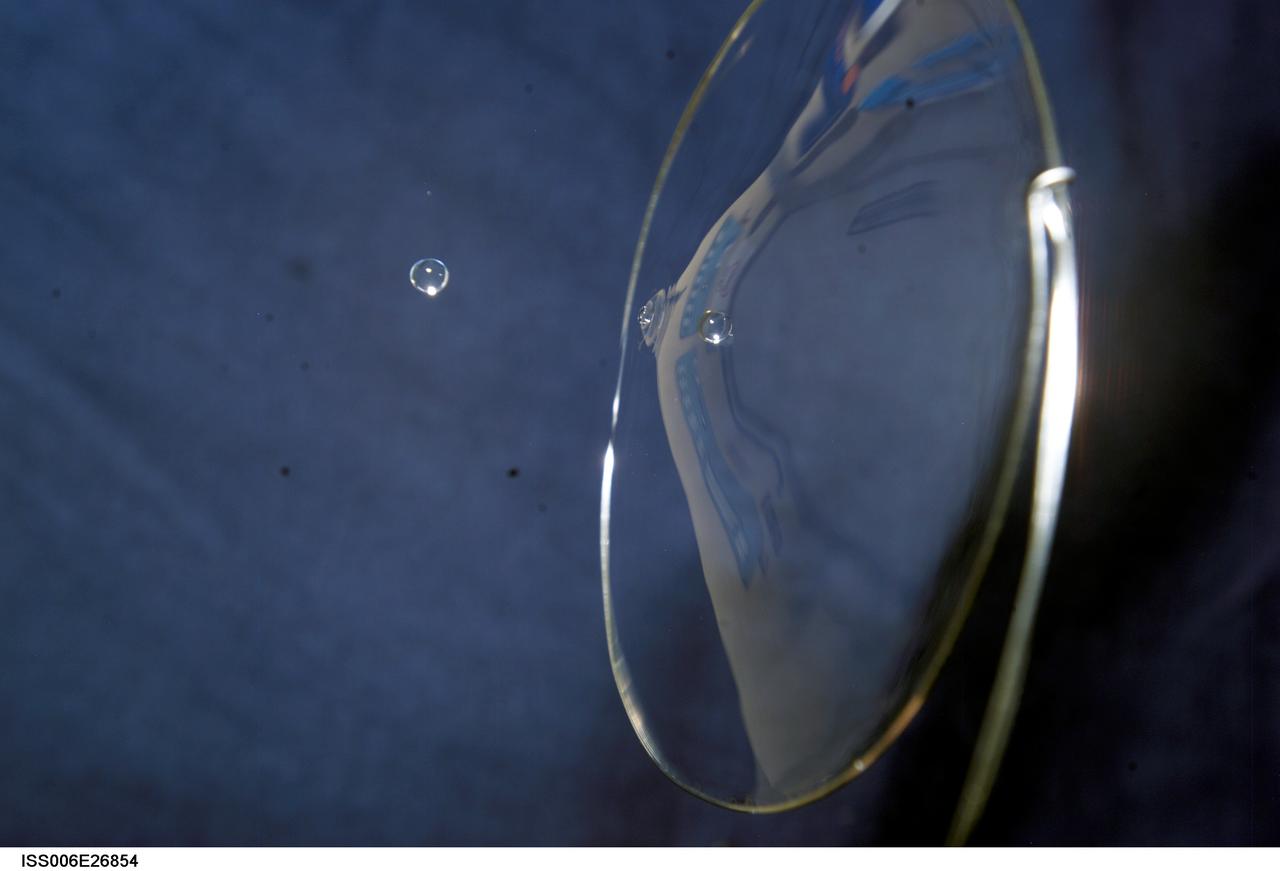
ISS006-E-26854 (16 February 2003) --- View of surface tension demonstration using water that is being held in place by a metal loop. Astronaut Donald R. Pettit, Expedition Six NASA ISS science officer, photographed these demonstrations for educational purposes. The experiment took place in the Destiny laboratory on the International Space Station (ISS).
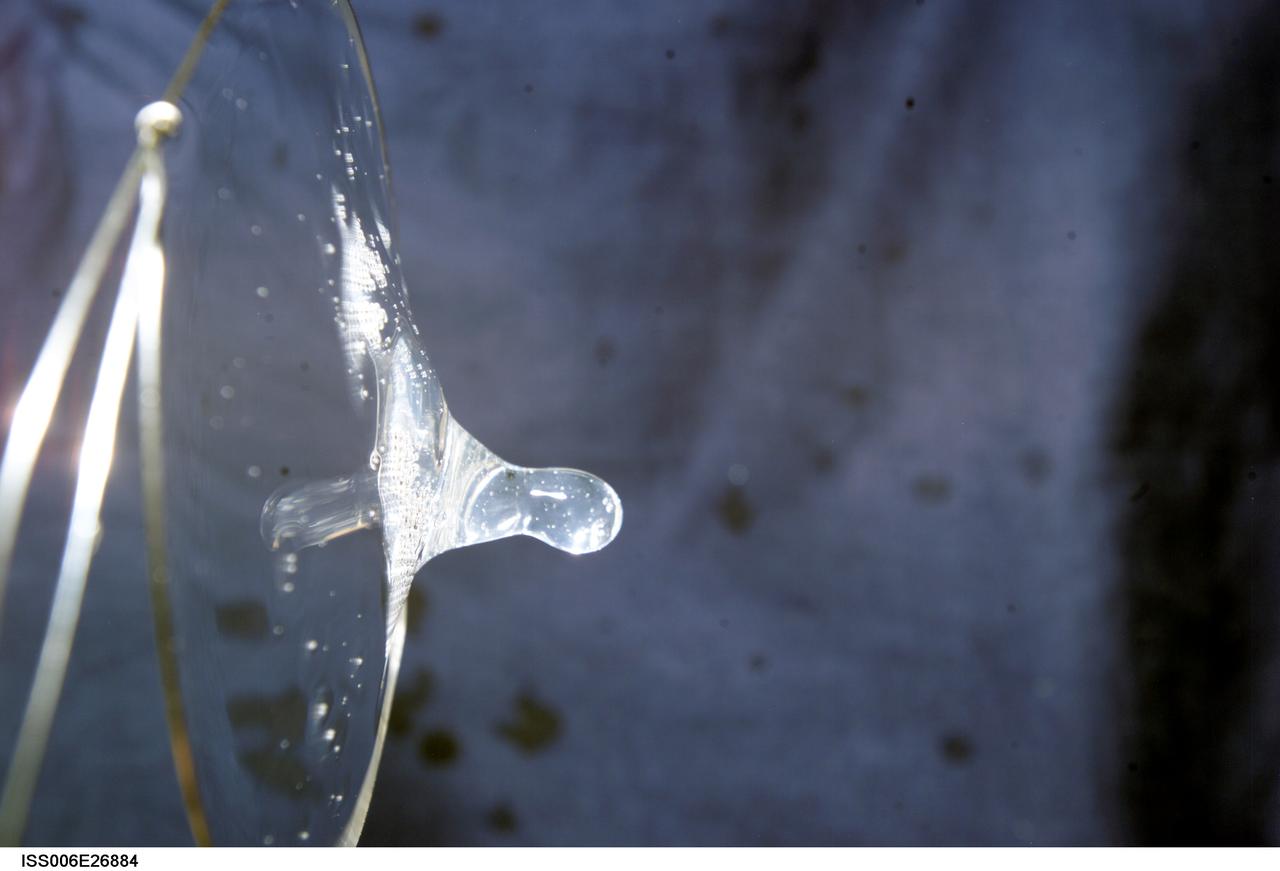
ISS006-E-26884 (16 February 2003) --- View of surface tension demonstration using water that is being held in place by a metal loop. Astronaut Donald R. Pettit, Expedition Six NASA ISS science officer, photographed these demonstrations for educational purposes. The experiment took place in the Destiny laboratory on the International Space Station (ISS).
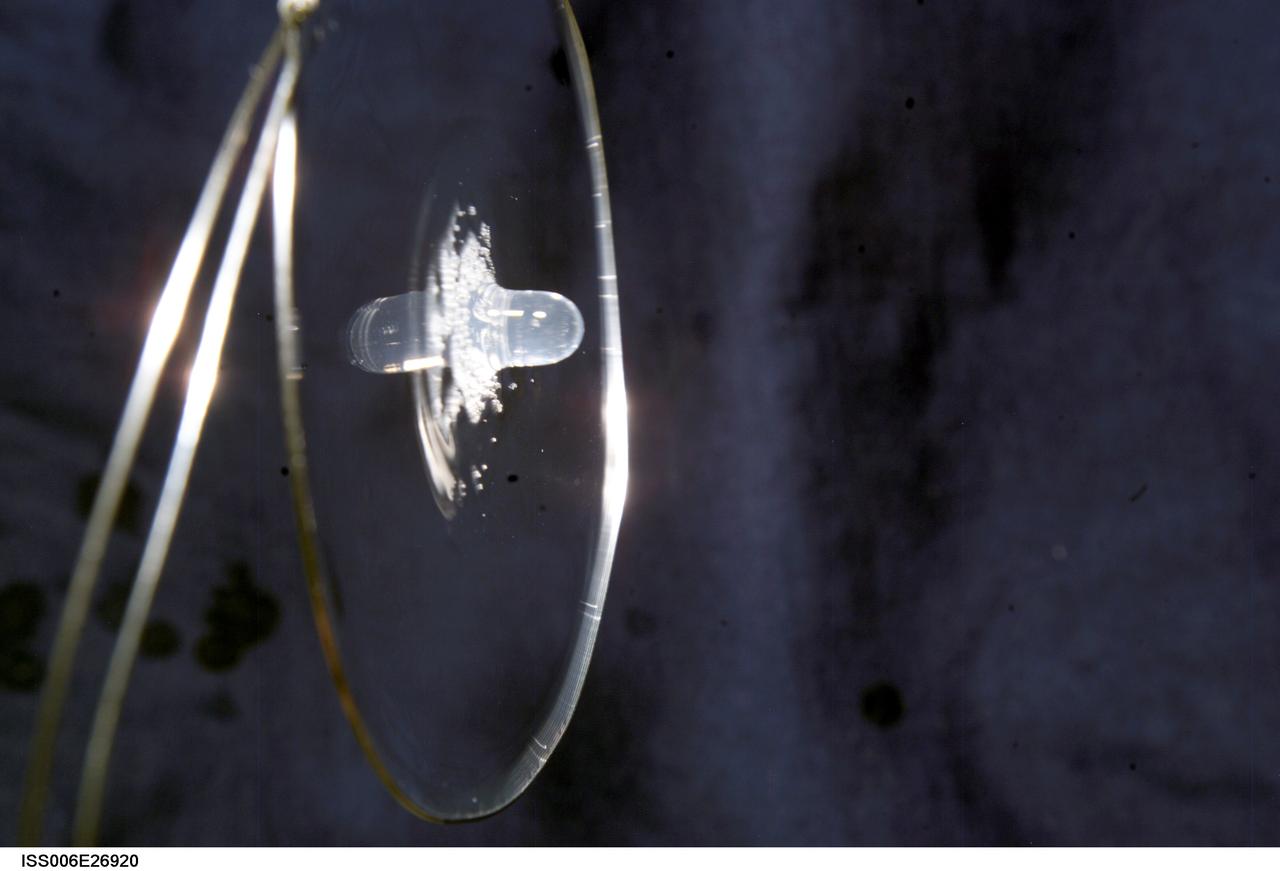
ISS006-E-26920 (16 February 2003) --- View of surface tension demonstration using water that is being held in place by a metal loop. Astronaut Donald R. Pettit, Expedition Six NASA ISS science officer, photographed these demonstrations for educational purposes. The experiment took place in the Destiny laboratory on the International Space Station (ISS).
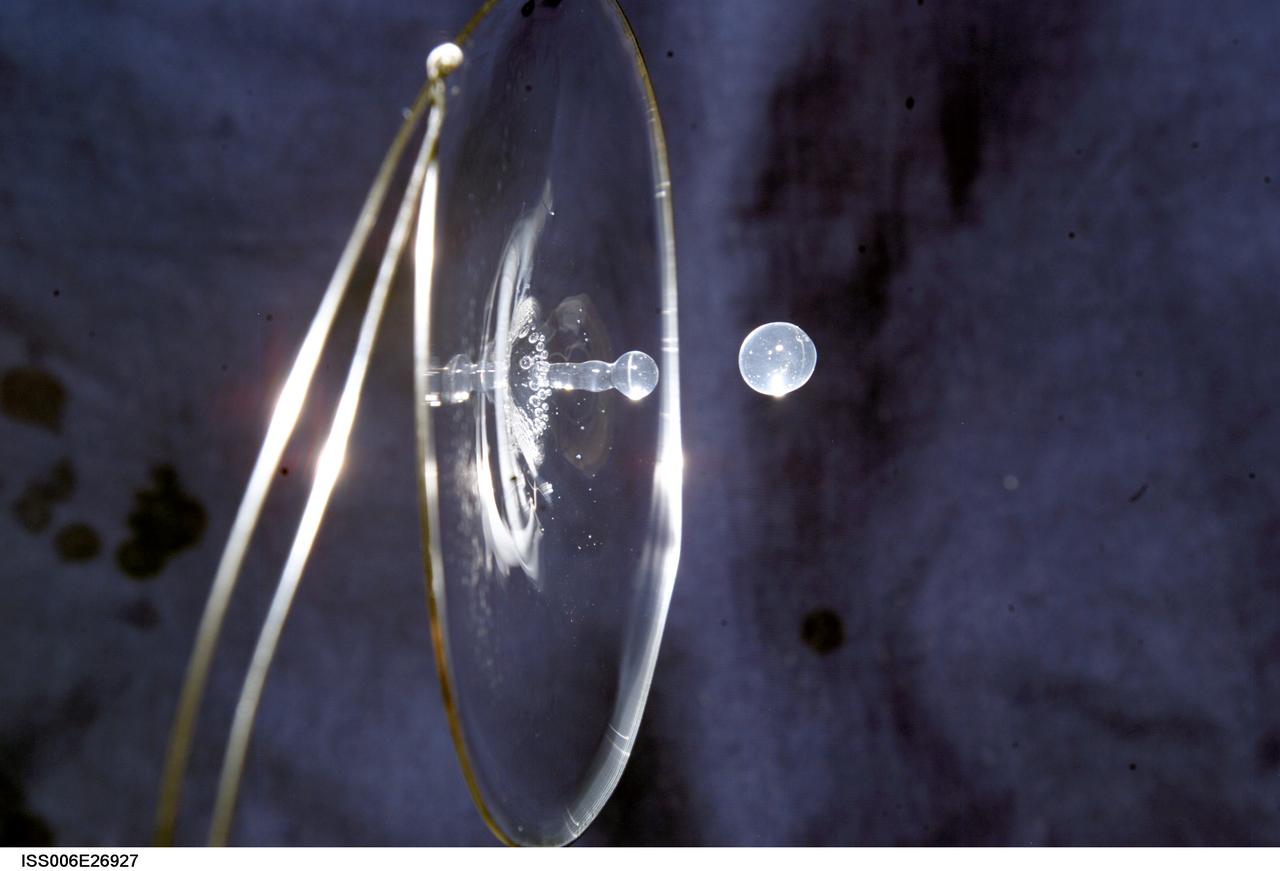
ISS006-E-26927 (16 February 2003) --- View of surface tension demonstration using water that is being held in place by a metal loop. Astronaut Donald R. Pettit, Expedition Six NASA ISS science officer, photographed these demonstrations for educational purposes. The experiment took place in the Destiny laboratory on the International Space Station (ISS).
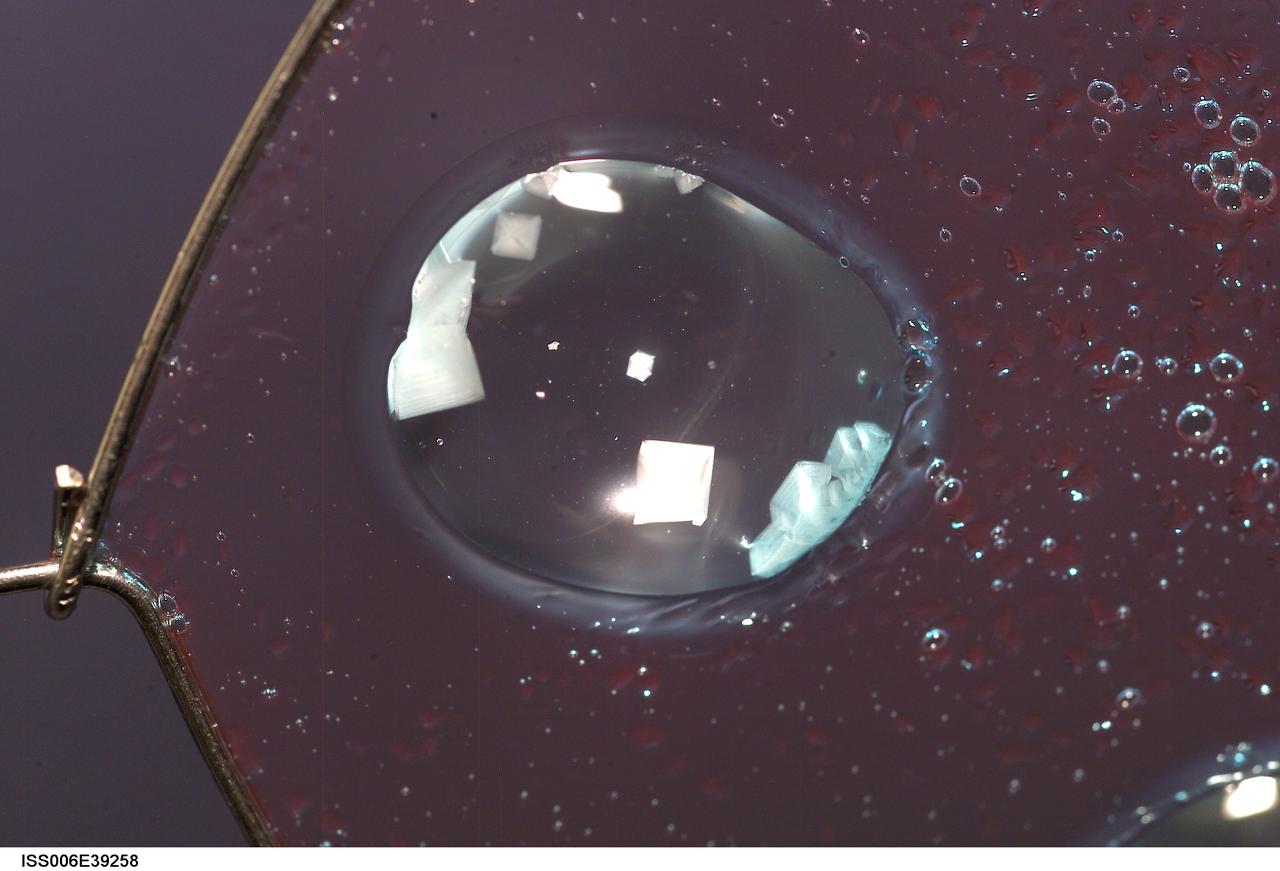
ISS006-E-39258 (14 March 2003) --- A close up view of sodium chloride inserted onto blueberry jelly within a 50-millimeter (mm) metal loop was photographed by an Expedition Six crewmember. The experiment took place in the Destiny laboratory on the International Space Station (ISS).
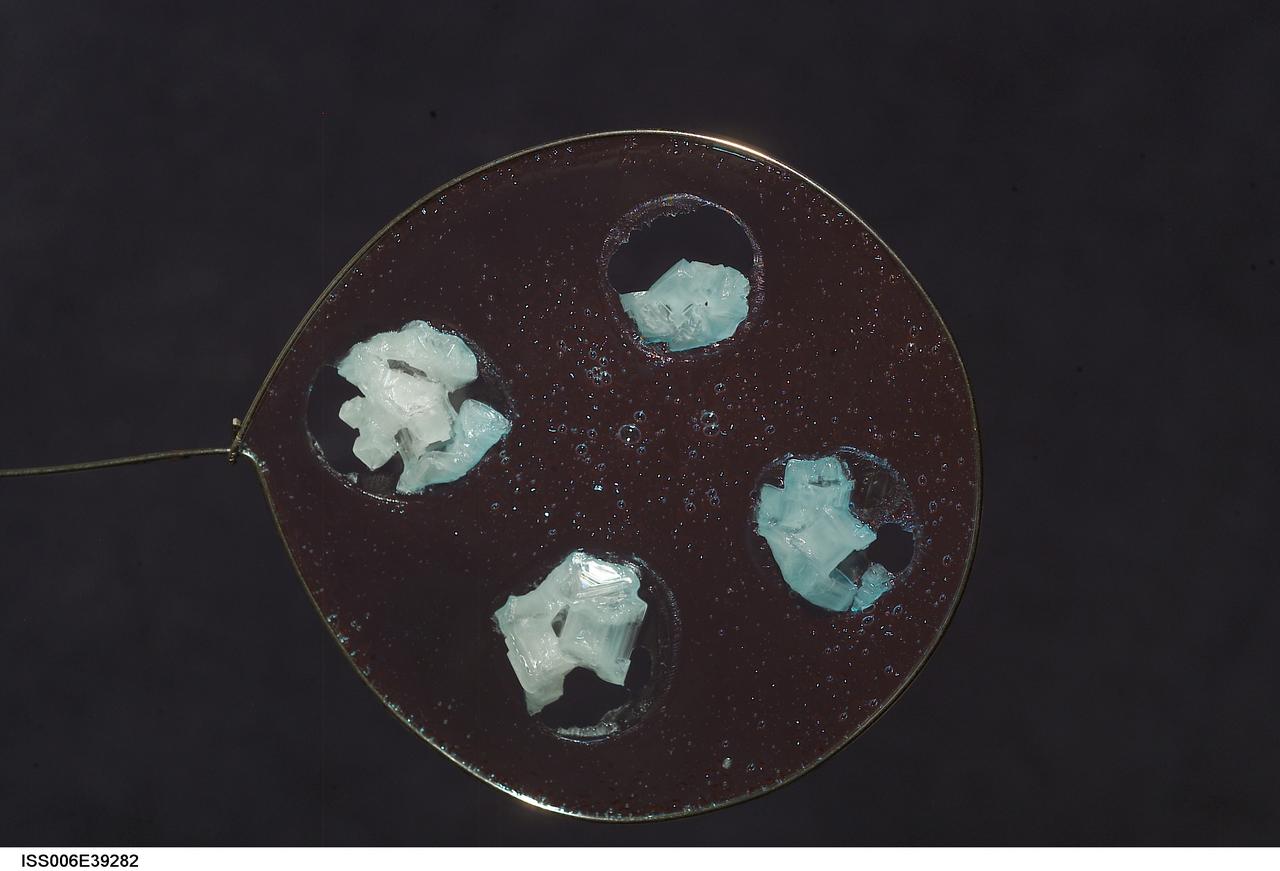
ISS006-E-39282 (15 March 2003) --- A view of sodium chloride inserted onto blueberry jelly within a 50-millimeter (mm) metal loop was photographed by an Expedition Six crewmember. The water in the sodium chloride solution evaporates as it leaves larger three-dimensional crystals while the blueberry jelly hardens. The experiment took place in the Destiny laboratory on the International Space Station (ISS).
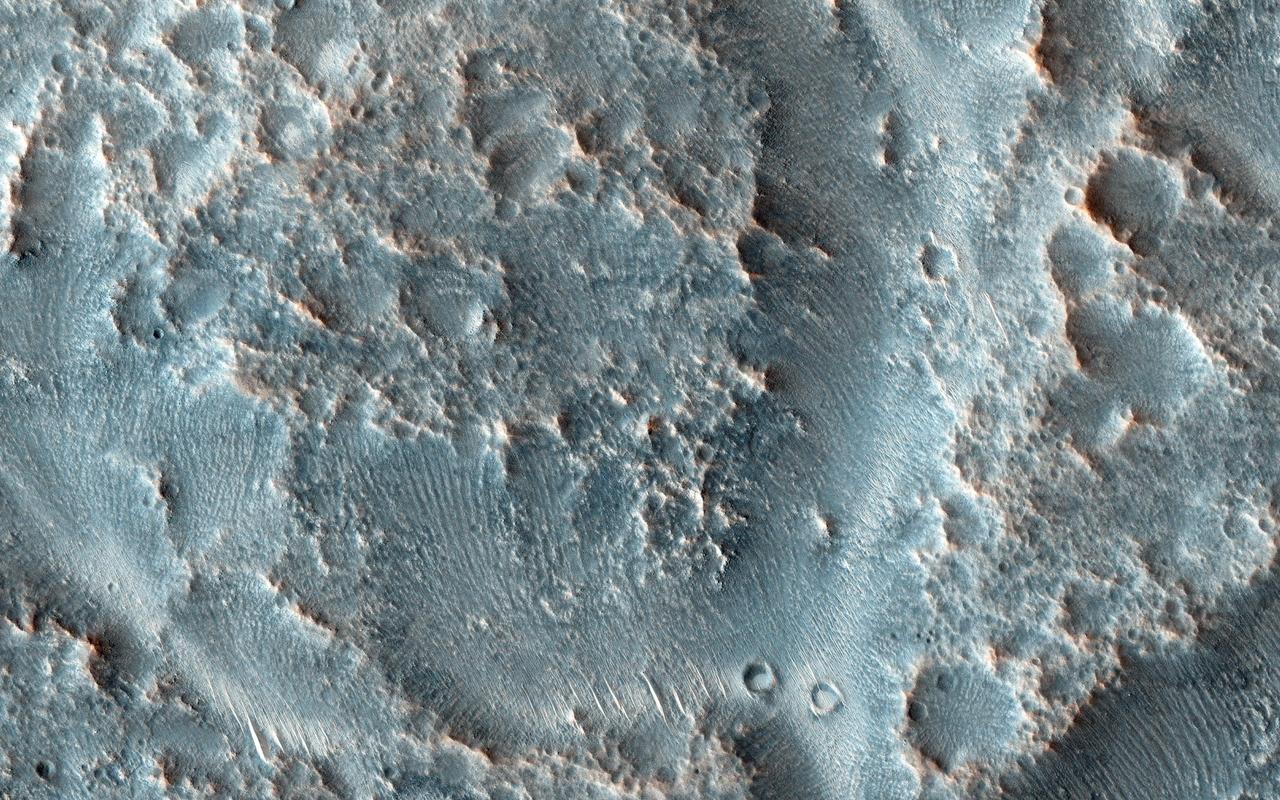
As rivers age they can meander and occasionally these meanders get so pronounced that the river cuts off these curving loops at their narrow end leaving them as isolated as oxbow lakes. Image from NASA Mars Reconnaissance Orbiter.

This image shows what happened underneath NASA Phoenix Mars Lander Robotic Arm wrist on Sol 3. The pin that goes through the loop is what holds the wrist in place. The rotation of the wrist pops the pin free.
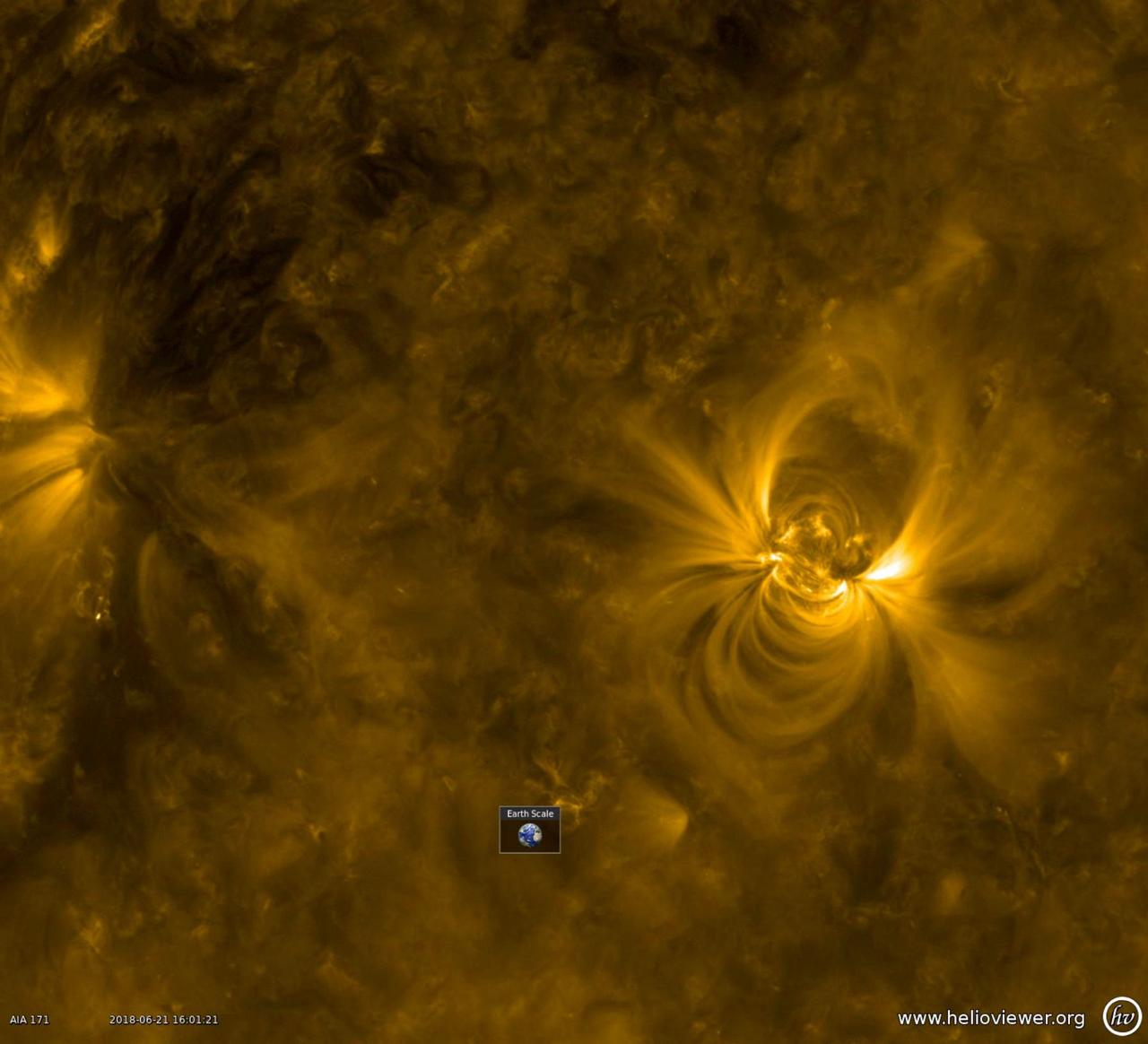
A new active region appeared on June 19th, quickly growing in size over two days (June 20-22, 2018). Active regions are areas of enhanced magnetic activity on the Sun's surface, generating the huge loops and dynamic surges observed here. Charged particles spinning along the field lines above the active region are illuminated in this wavelength of extreme ultraviolet light. The superimposed Earth icon gives a sense of just how large these loops are. Movies are available at https://photojournal.jpl.nasa.gov/catalog/PIA22582

These banana-shaped loops are part of a computer-generated snapshot of our sun's magnetic field. The solar magnetic-field lines loop through the sun's corona, break through the sun's surface, and cornect regions of magnetic activity, such as sunspots. This image --part of a magnetic-field study of the sun by NASA's Allen Gary -- shows the outer portion (skins) of interconnecting systems of hot (2 million degrees Kelvin) coronal loops within and between two active magnetic regions on opposite sides of the sun's equator. The diameter of these coronal loops at their foot points is approximately the same size as the Earth's radius (about 6,000 kilometers).
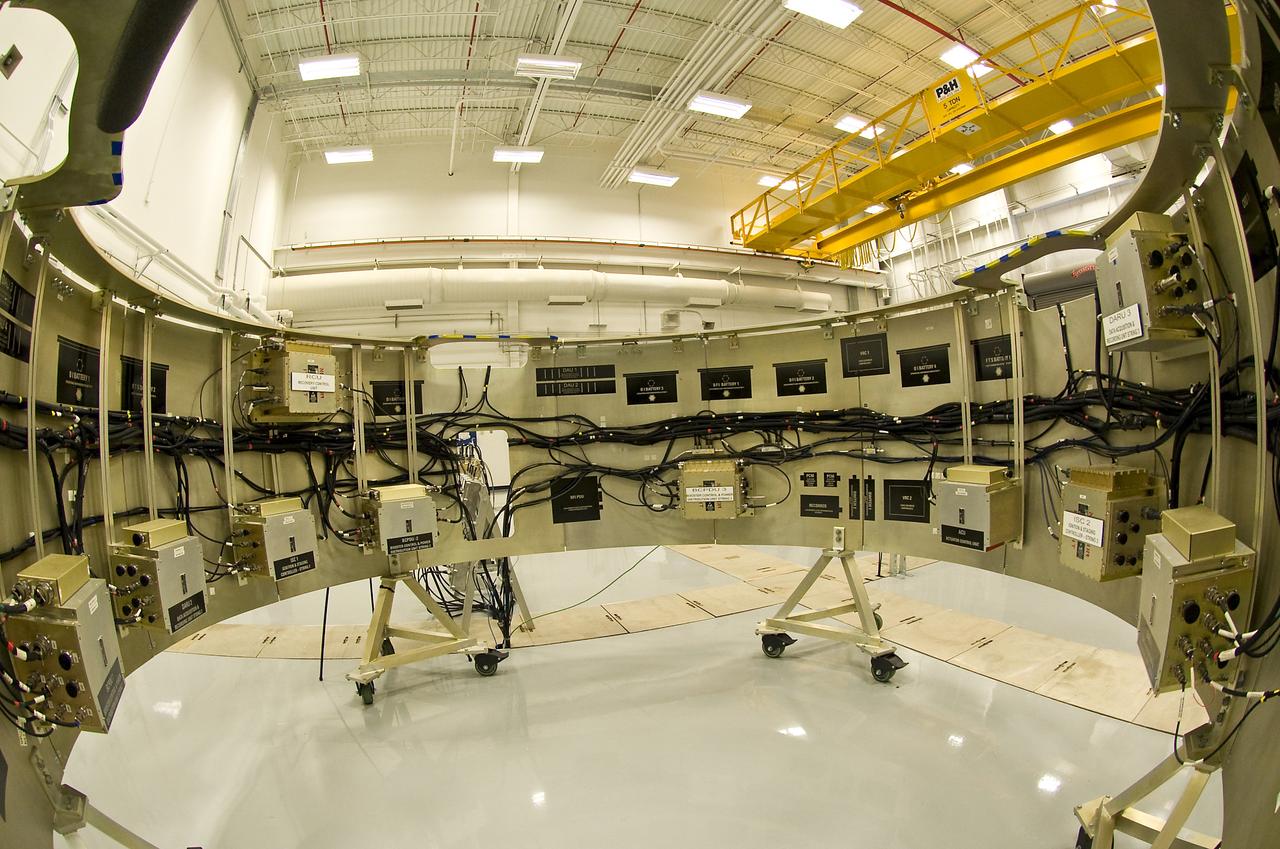
FIRST STAGE AVIONICS HARDWARE IN THE LOOP FACILITY
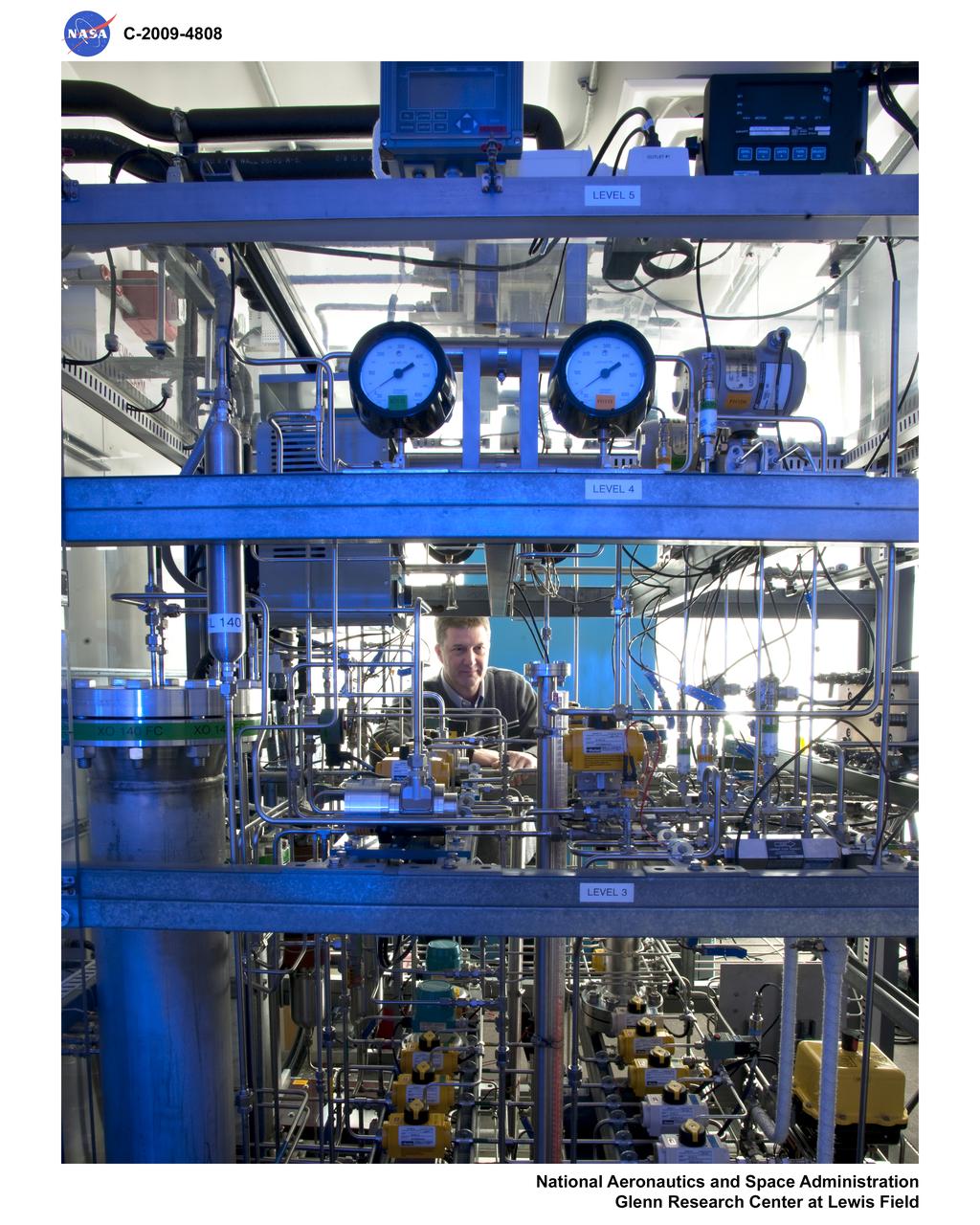
Closed-Loop Regenerative Fuel Cell Rig
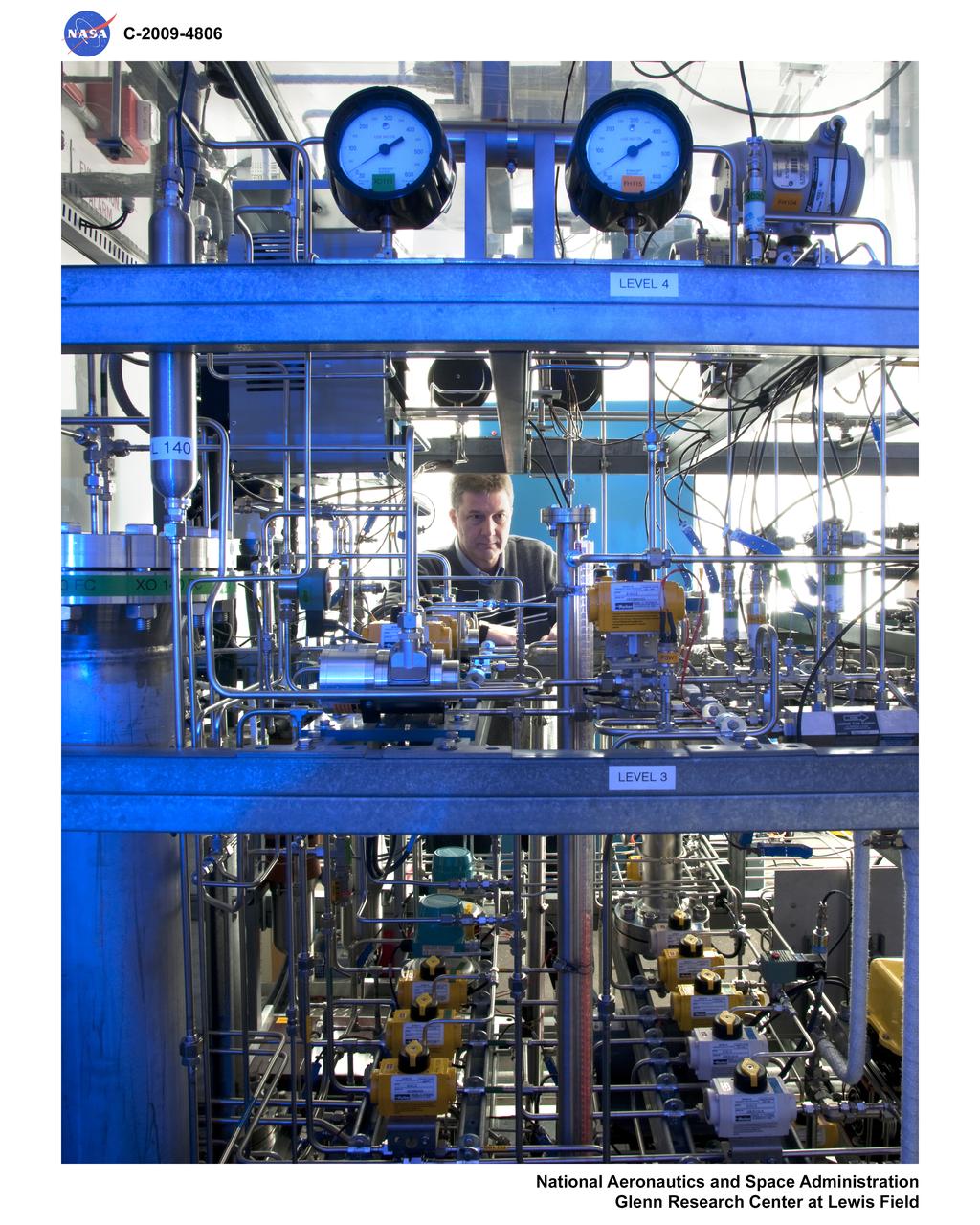
Closed-Loop Regenerative Fuel Cell Rig
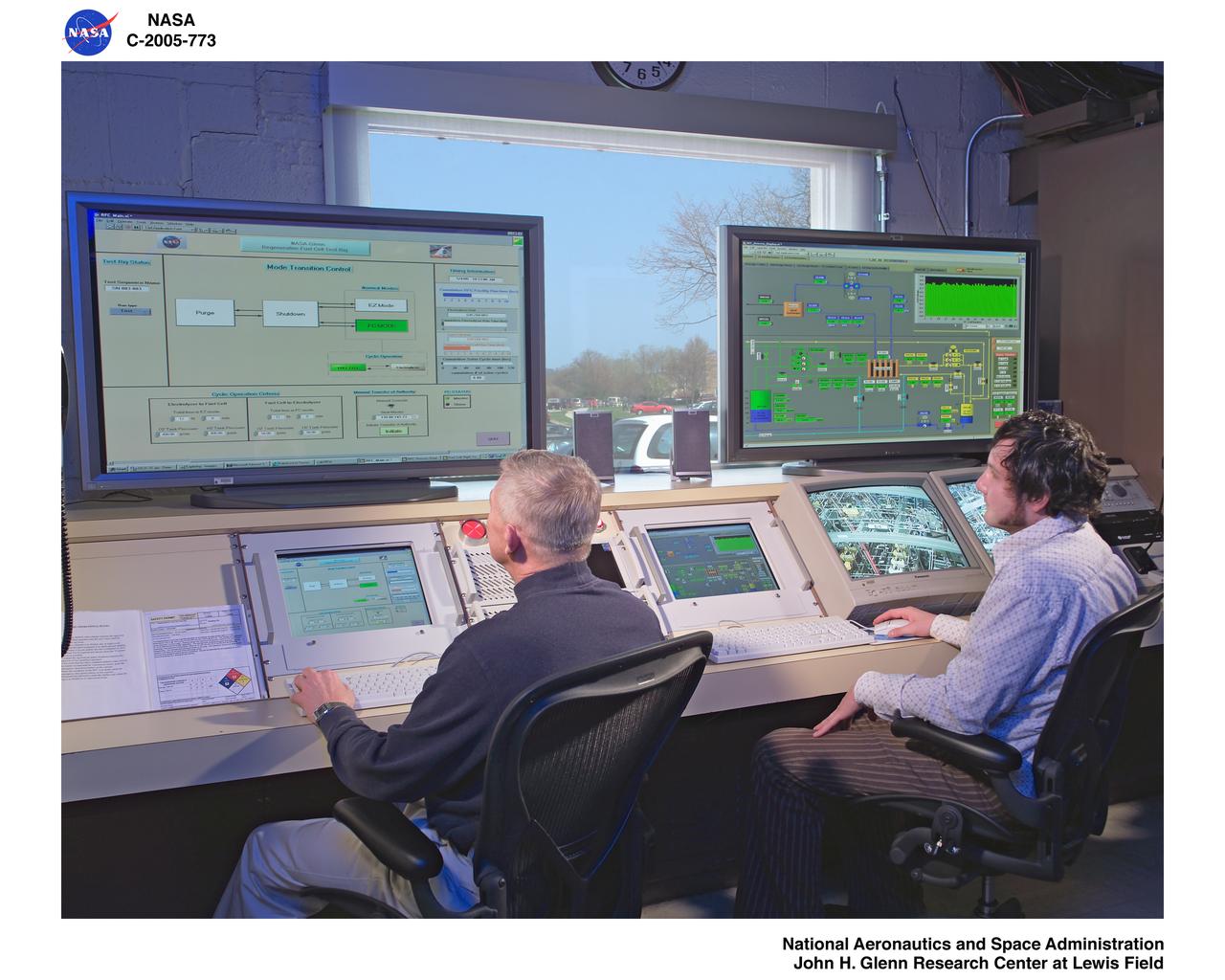
The closed loop regenerative fuel cell test. View inside the control room.
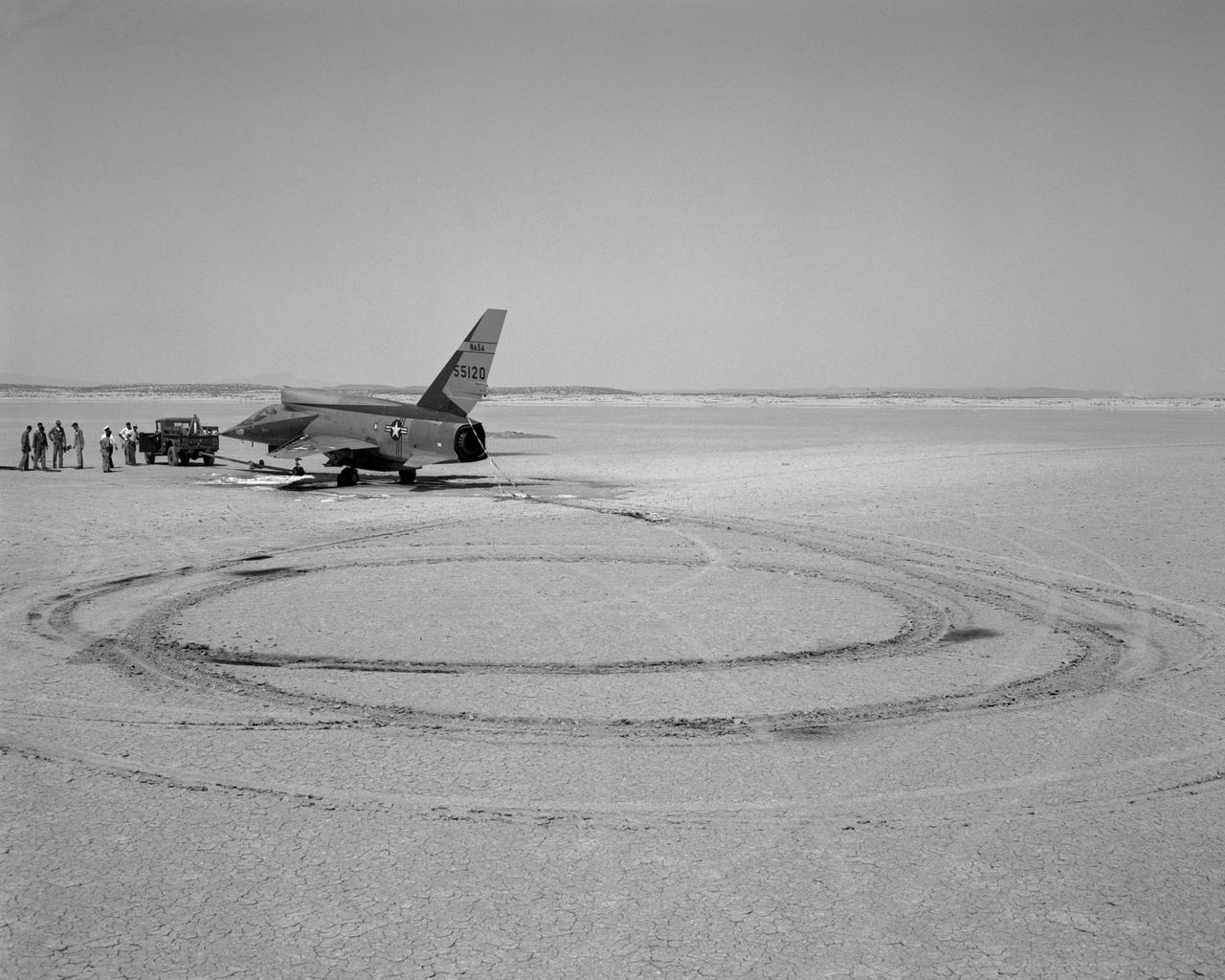
F-107A ground loop landing mishap. Sept. 1, 1959
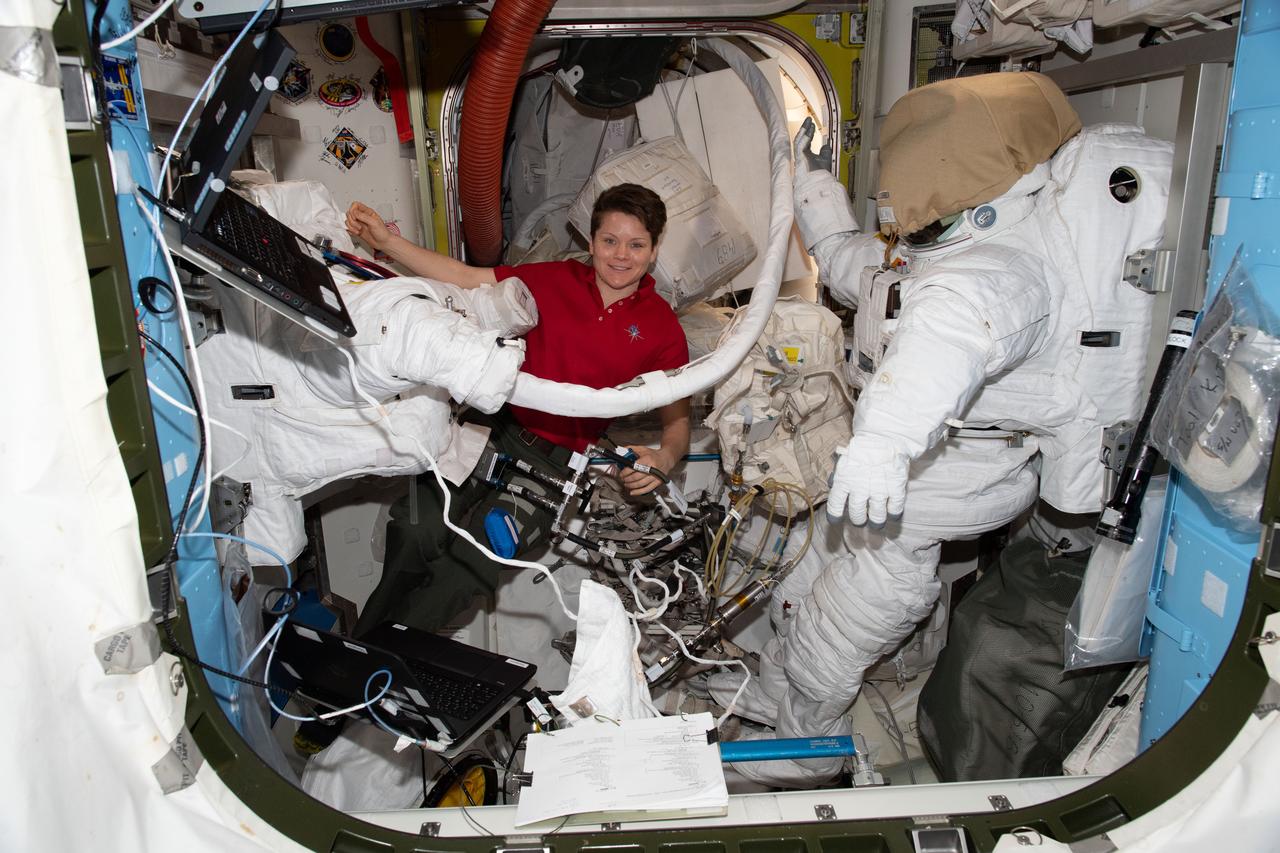
iss058e011974 (Feb. 7, 2019) --- NASA astronaut Anne McClain works inside the International Space Station's Quest joint airlock. The Expedition 58 Flight Engineer was working on U.S. spacesuit maintenance emptying and refilling water in the suits' cooling loops.
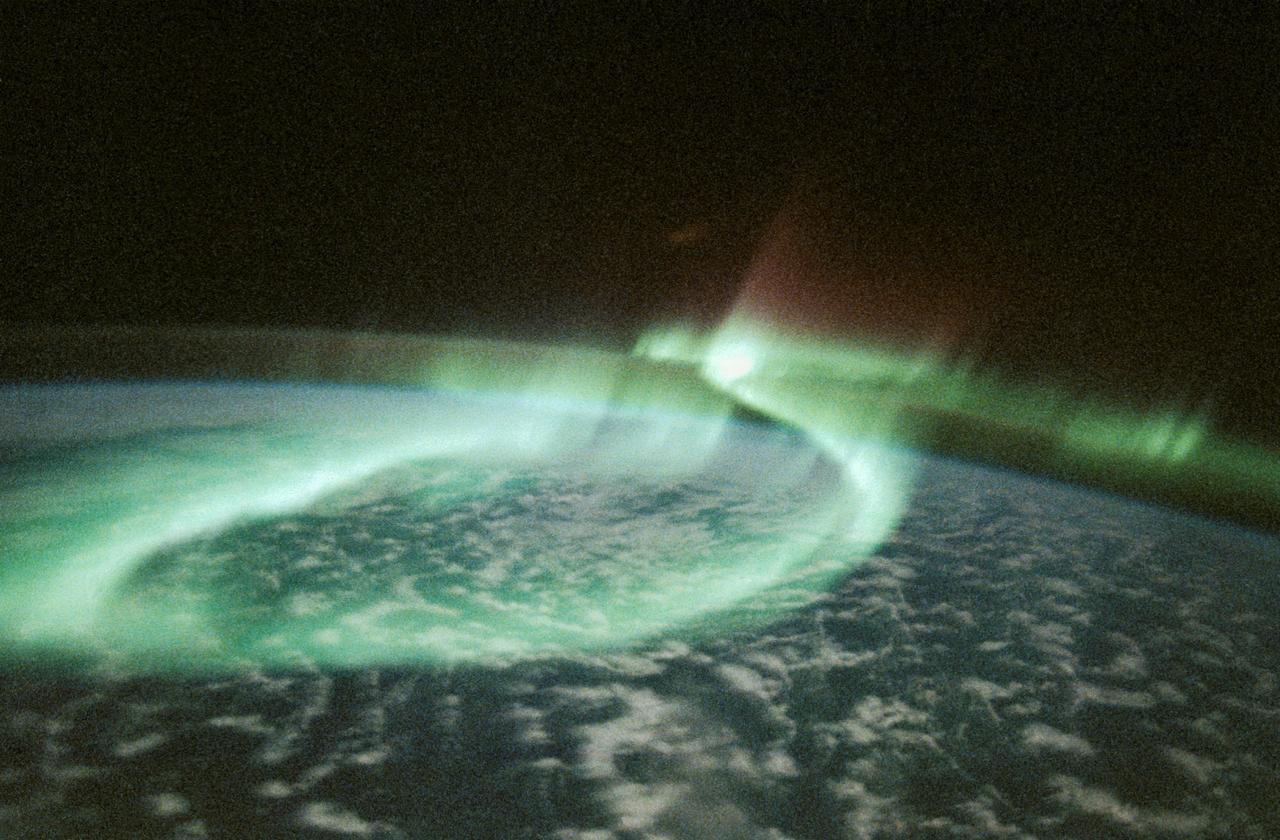
STS039-23-020 (28 April-6 May 1991) --- A 35mm frame of the Aurora Australis, also known as the Southern Lights, photographed from Space Shuttle Discovery's flight deck by one of its seven crew members. One of the mission objectives was to measure the spectral and spatial characteristics of auroral emissions. While passing over the sunlighted portion of Earth, the crew was able to take a number of photos of the various geographic points on the planet; much of the time on nightside passes was devoted to a thorough study and documentation of auroral displays.
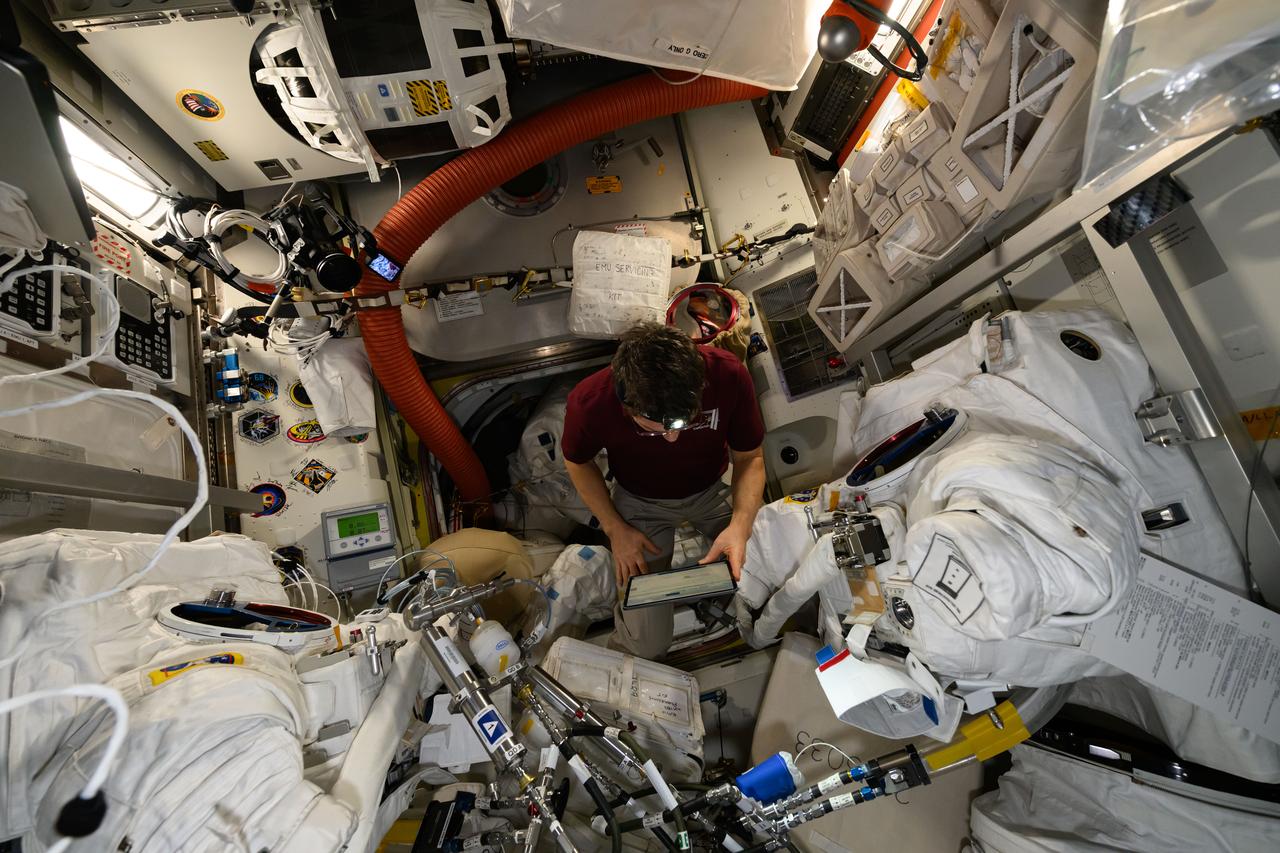
iss071e007603 (April 15, 2024) --- Expedition 71 Flight Engineer and NASA astronaut Mike Barratt reviews procedures on a computer tablet during maintenance on a pair of spacesuits inside the International Space Station's Quiest airlock.
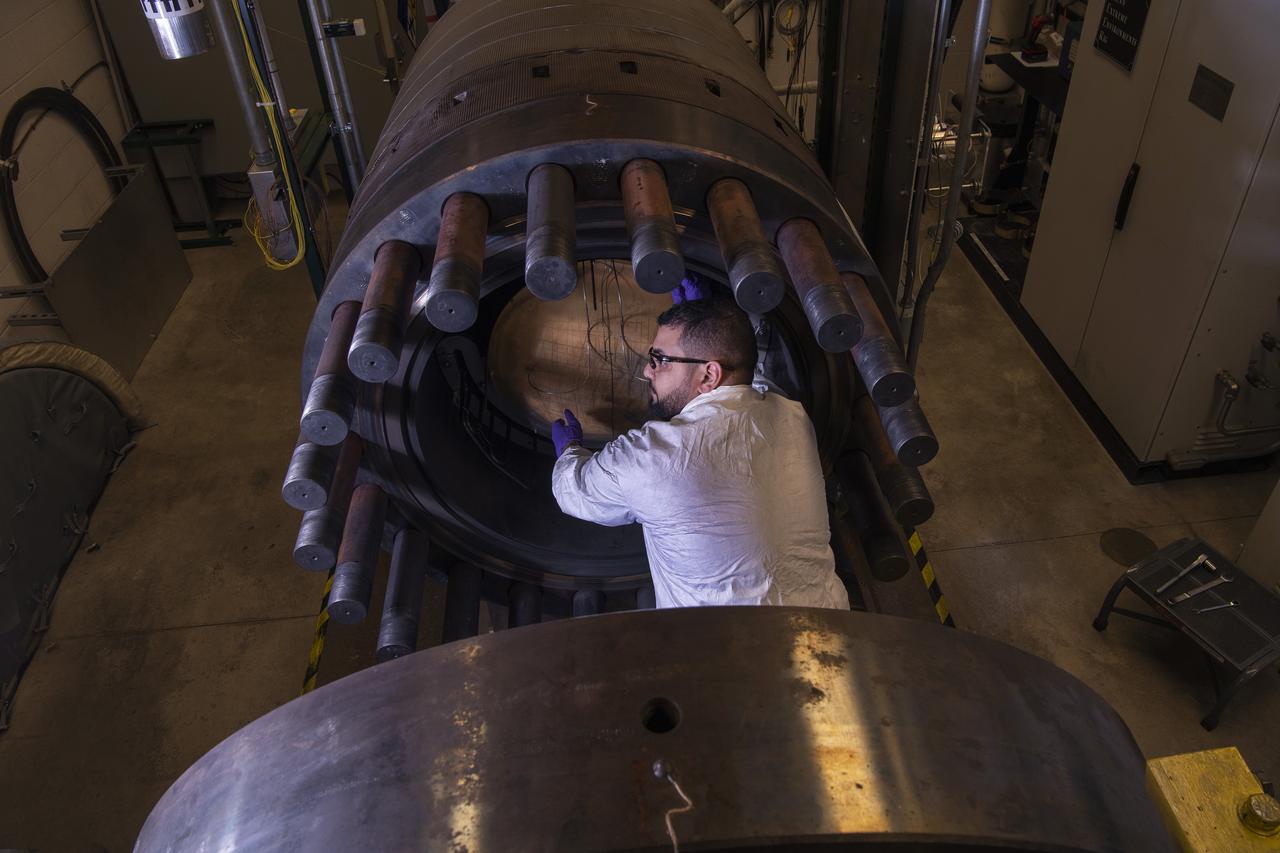
Juno is a solar-powered NASA spacecraft that spans the width of a basketball court and makes long, looping orbits around giant planet Jupiter
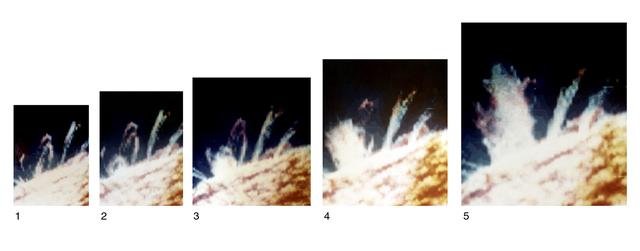
Breaking the grip of the closed magnetic loops that constrain other gases around it, a spray of chromospheric material surges upward, free of the Sun. Views 1 through 5 were recorded about 5 minutes apart by Skylab and comprise a composite of separate images made in chromospheric (red), transition region (green), and coronal (blue) temperatures of an ultraviolet sequence that depicts a solar eruption. Eruption begins (view 2) as material in or near a small, compact loop develops enough energy to overcome the Sun's magnetic bonds.
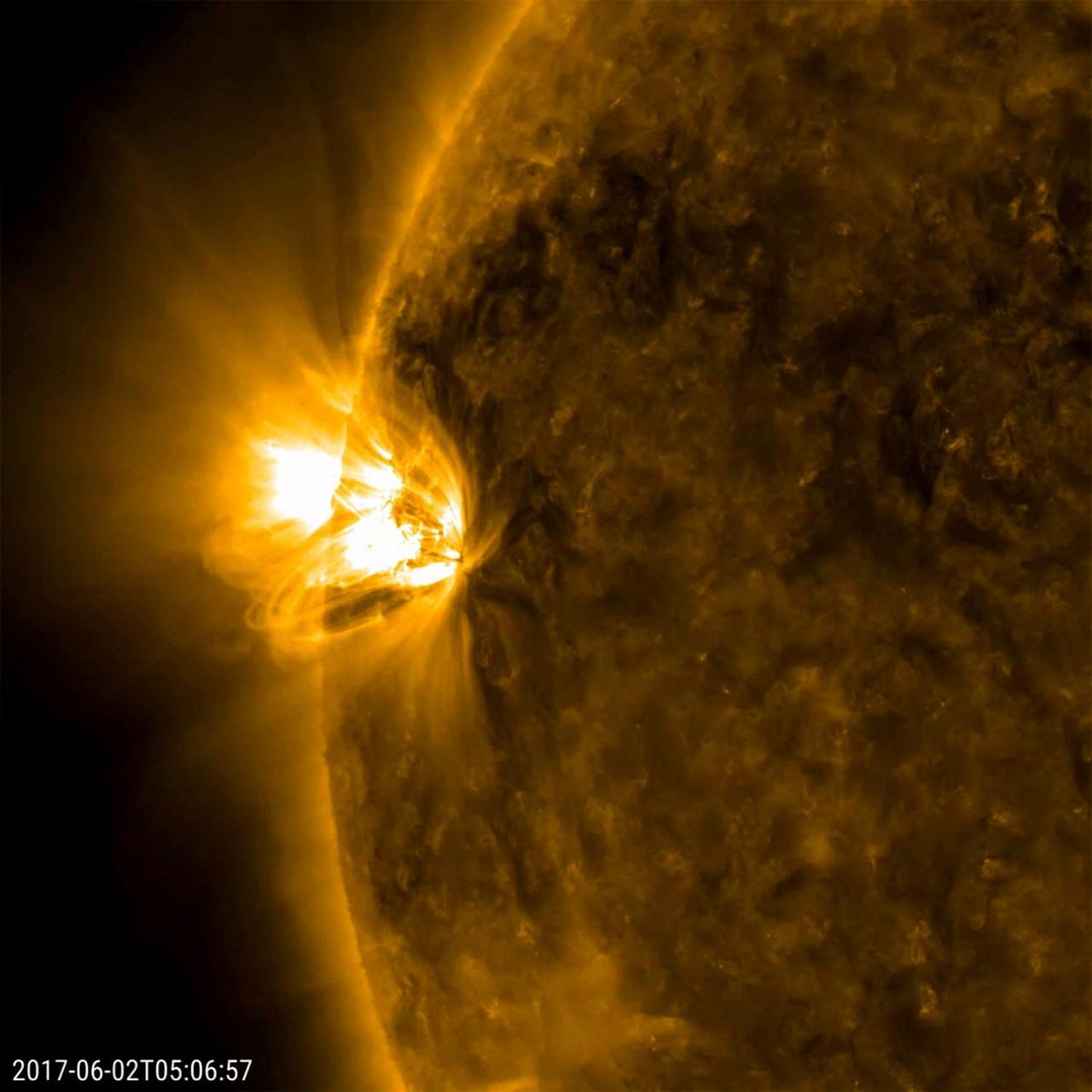
A pair of relatively small (but frenetic) active regions rotated into view, spouting off numerous small flares and sweeping loops of plasma (May 31-June 2, 2017). At first, only the one active region was observed, but mid-way though the video clip a second one behind the first can be picked out. The dynamic regions were easily the most remarkable areas on the sun during this 42-hour period. The images were taken in a wavelength of extreme ultraviolet light. Movies are available at https://photojournal.jpl.nasa.gov/catalog/PIA21756
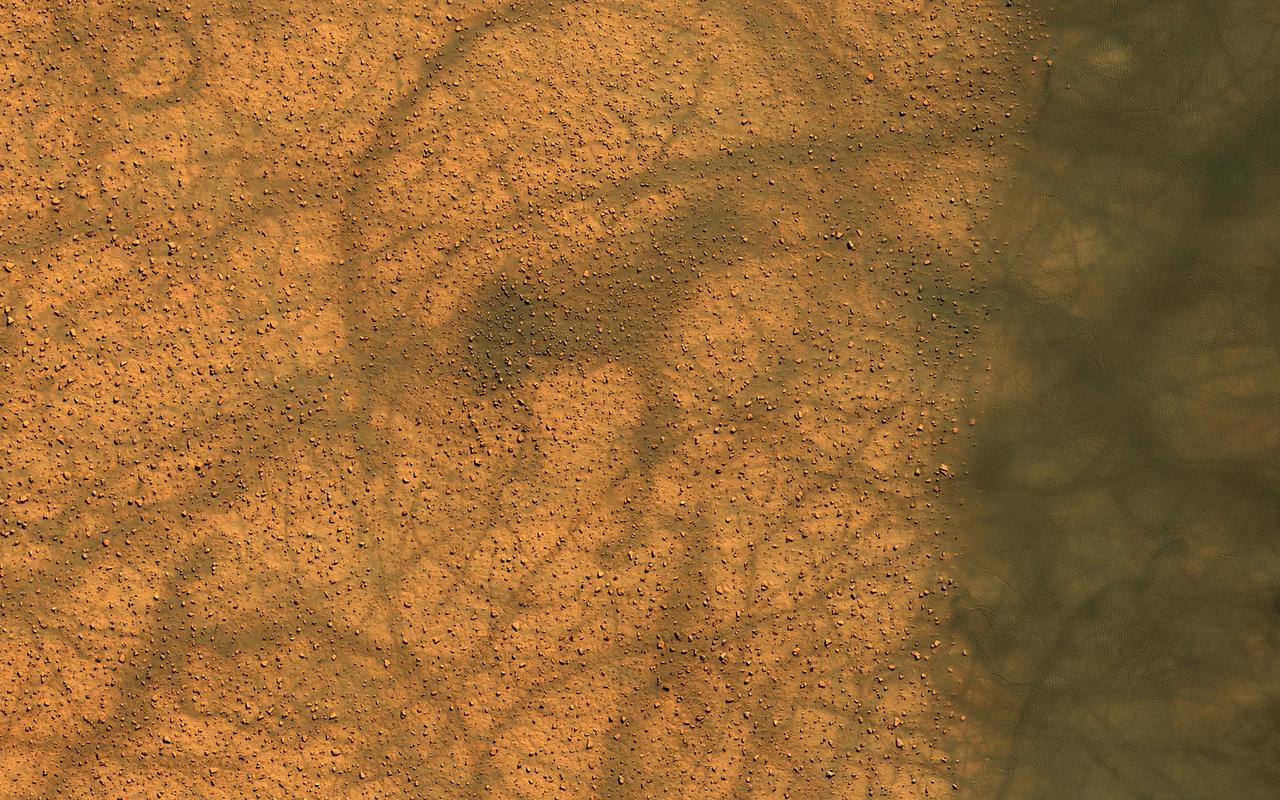
Dune fields in the high southern latitudes of Mars tell a mostly similar story during local summer. The dark dunes grow warmer than the surrounding bright plains because they absorb more sunlight. Dust devils form over the warm dunes but then dance out over the plains, spinning and performing pirouettes and leaving conspicuous dark tracks as bright dust is lifted from the surface. Loops in the tracks can often be used to discern the direction traveled by the dust devils, where in some cases, one track clearly overprints the other. https://photojournal.jpl.nasa.gov/catalog/PIA24148
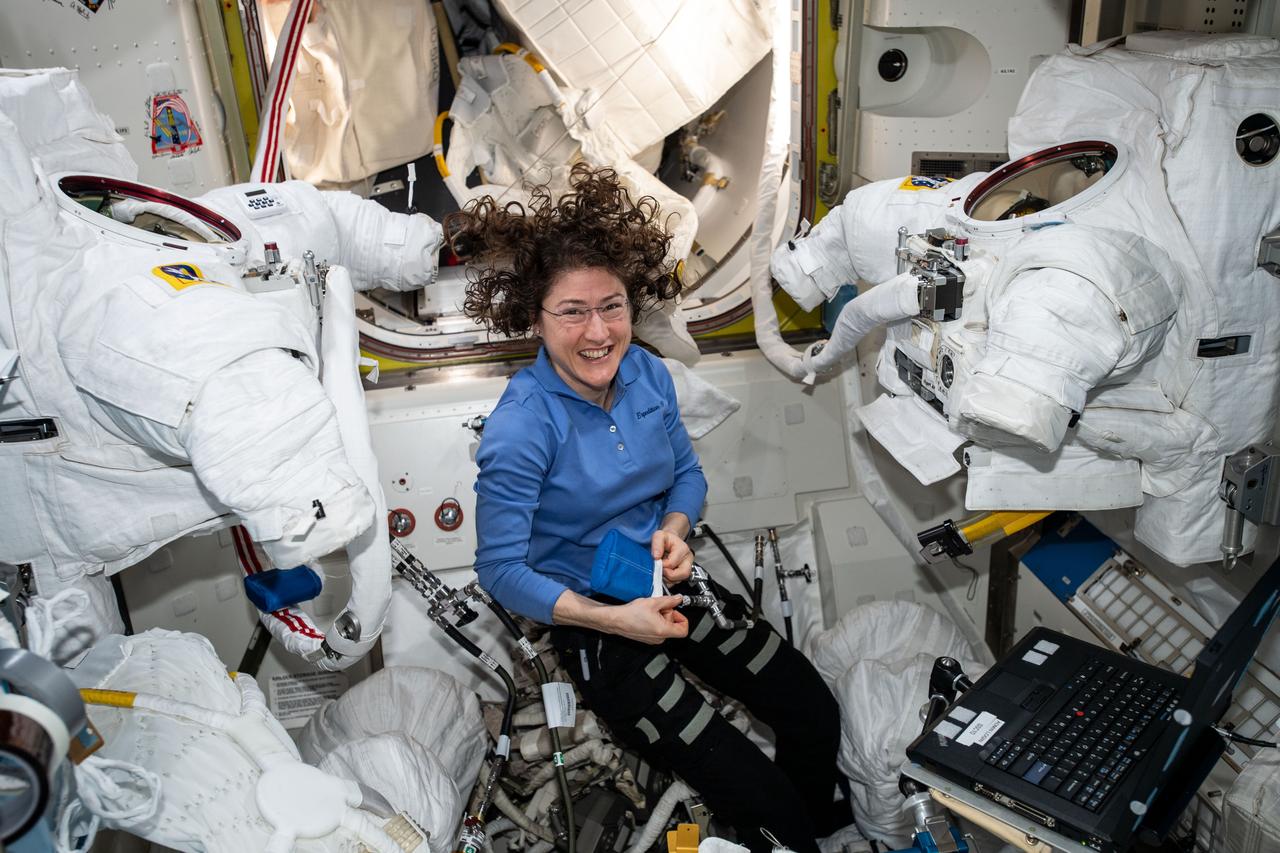
iss060e006063 (July 8, 2019) --- Expedition 60 Flight Engineer Christina Koch of NASA works inside the Quest joint airlock cleaning U.S. spacesuit cooling loops and replacing spacesuit components.
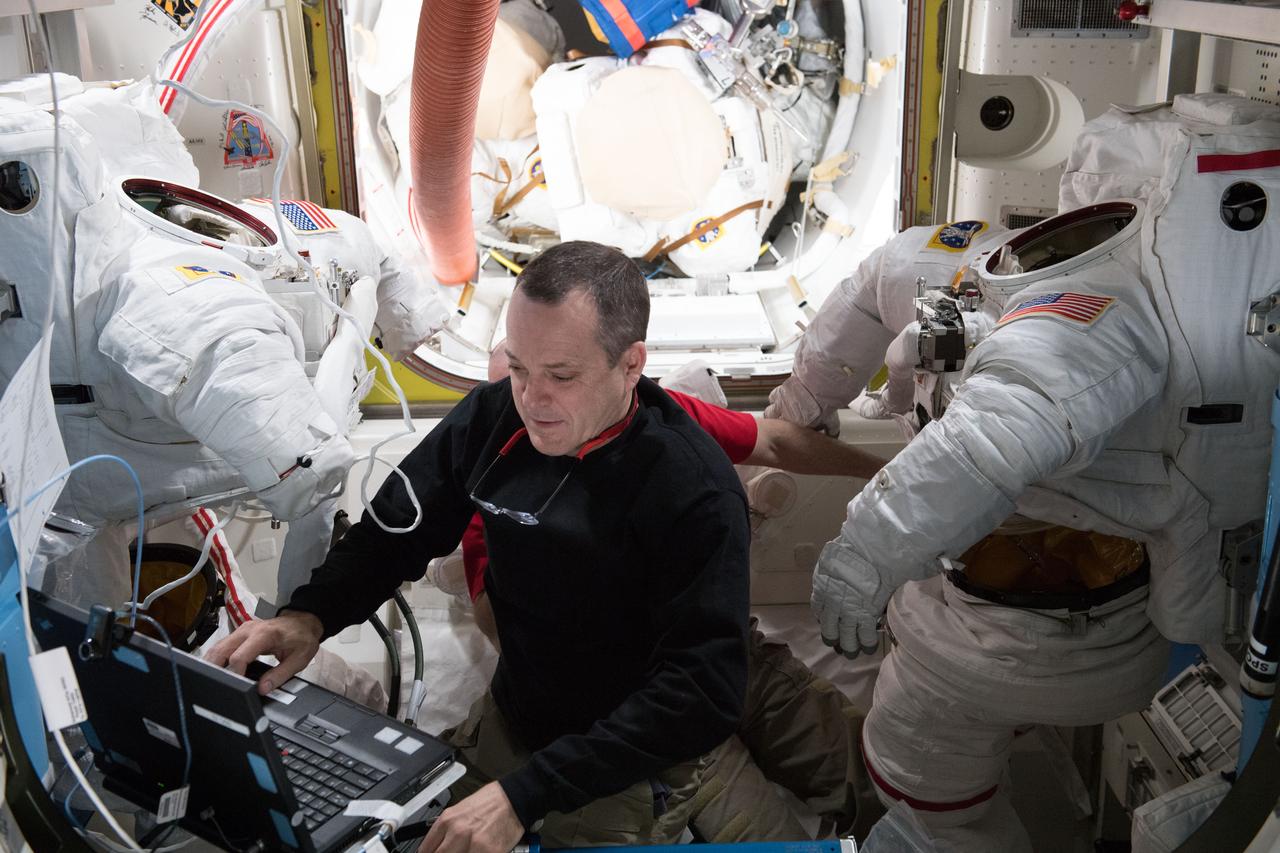
iss055e008293 (April 2, 2018) --- Astronaut Ricky Arnold completes the scrubbing of water cooling loops inside a pair of U.S. spacesuits after the completion of spacewalk on March 29, 2018.

iss064e044264 (March 19, 2021) --- Astronaut and Expedition 64 Flight Engineer Michael Hopkins of NASA cleans cooling loops and collects water samples from U.S. spacesuits located inside the International Space Station's Quest airlock.
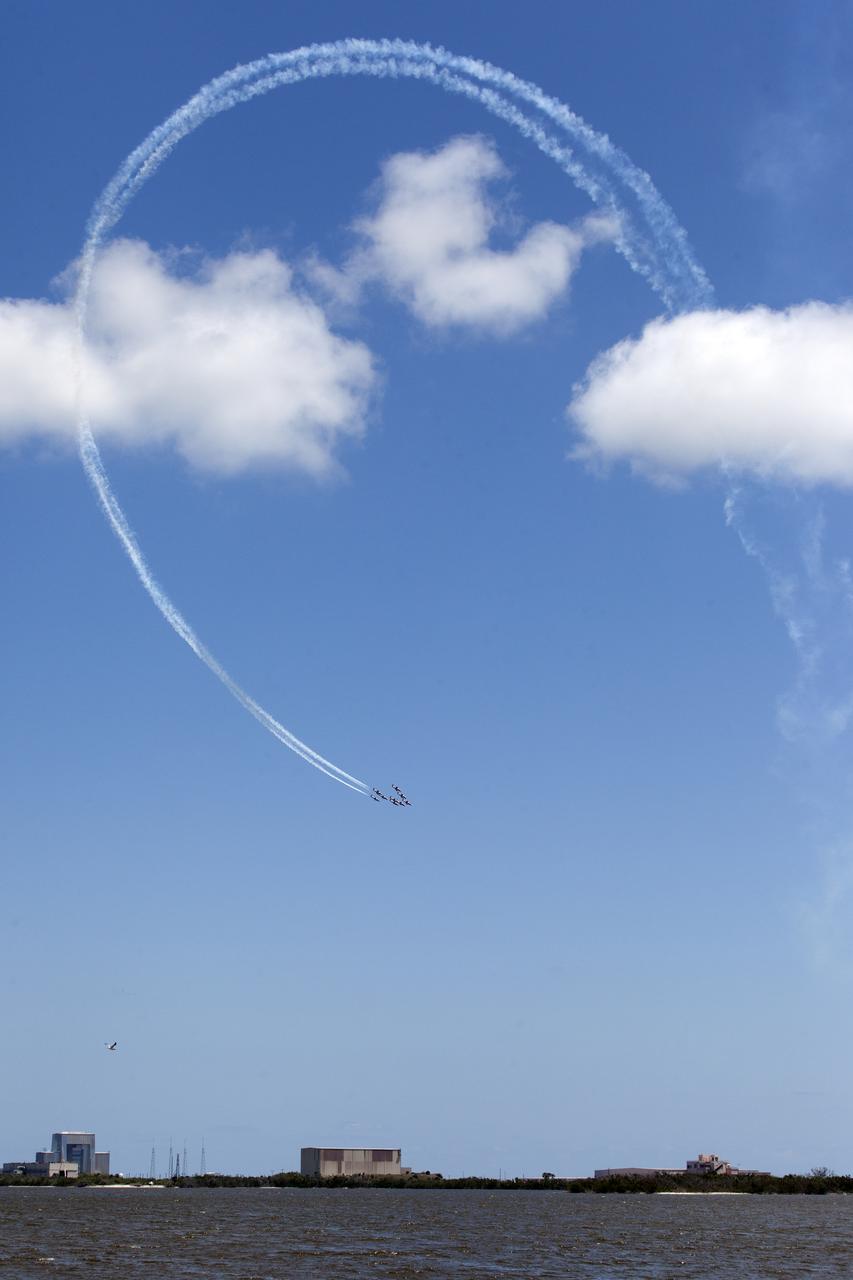
Canadian Forces Snowbirds perform a loop maneuver over Cape Canaveral Air Force Station in Florida during a practice flight between their scheduled U.S. air shows on May 9, 2018.
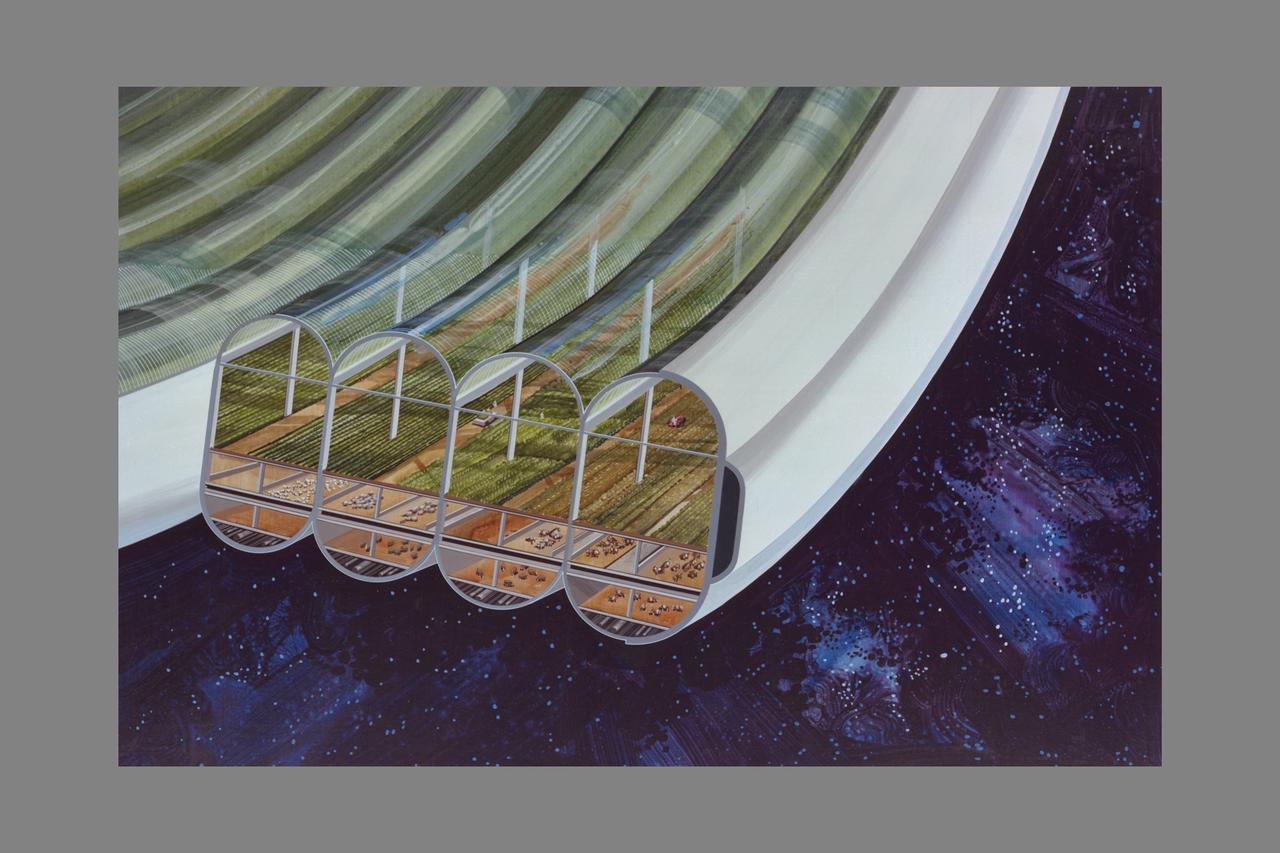
Artist: Rick Guidice Space Colonization regenerative life support systems. This concept from a summer study done in 1977 depicts a closed loop life support system for long duration space settlements or space industrialization.
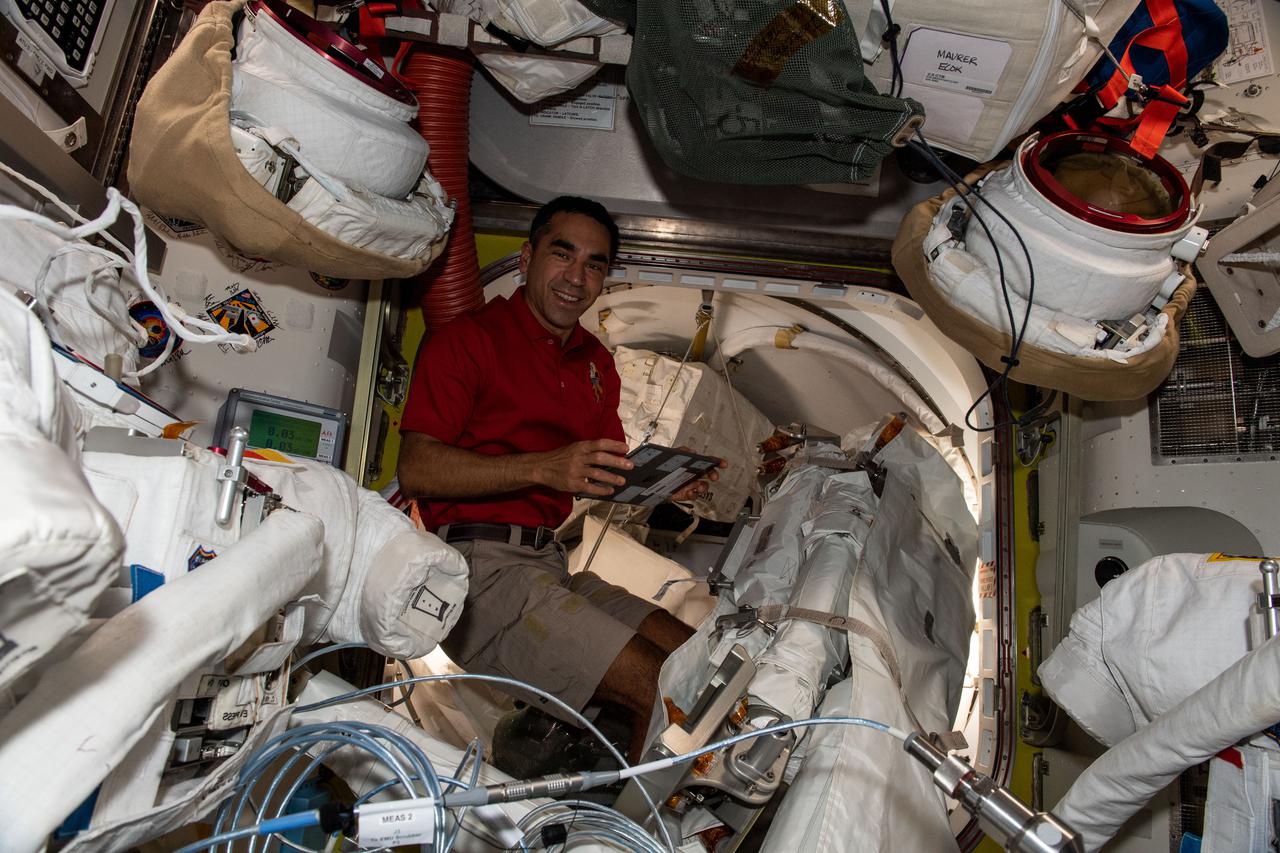
iss066e155773 (March 1, 2022) --- NASA astronaut and Expedition 66 Flight Engineer Raja Chari scrubs U.S. spacesuit cooling loops inside the Interational Space Station's Quest airlock.
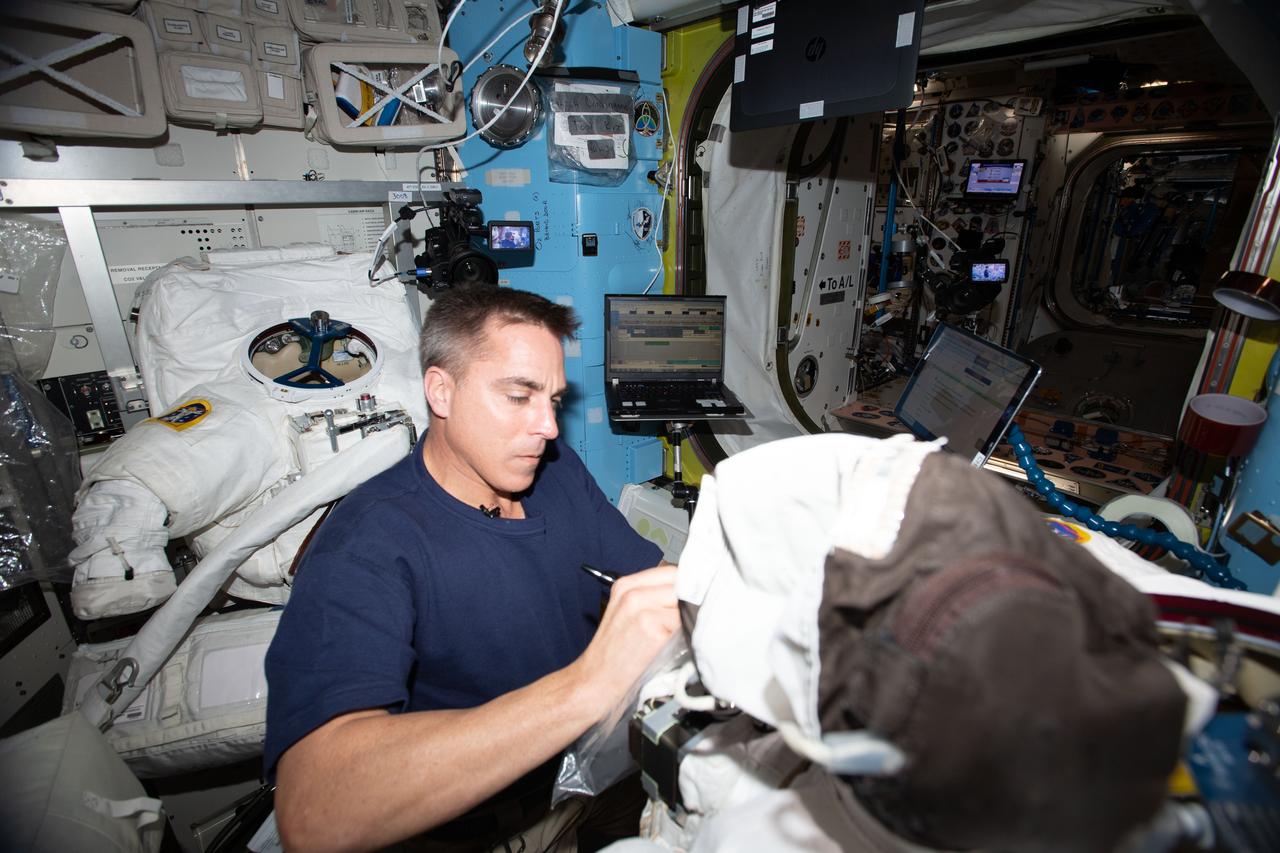
iss063e003861 (April 29, 2020) --- NASA astronaut and Expedition 63 Commander Chris Cassidy cleans cooling loops, replaces components and conducts leak checks inside U.S. spacesuits aboard the International Space Station's Quest airlock.
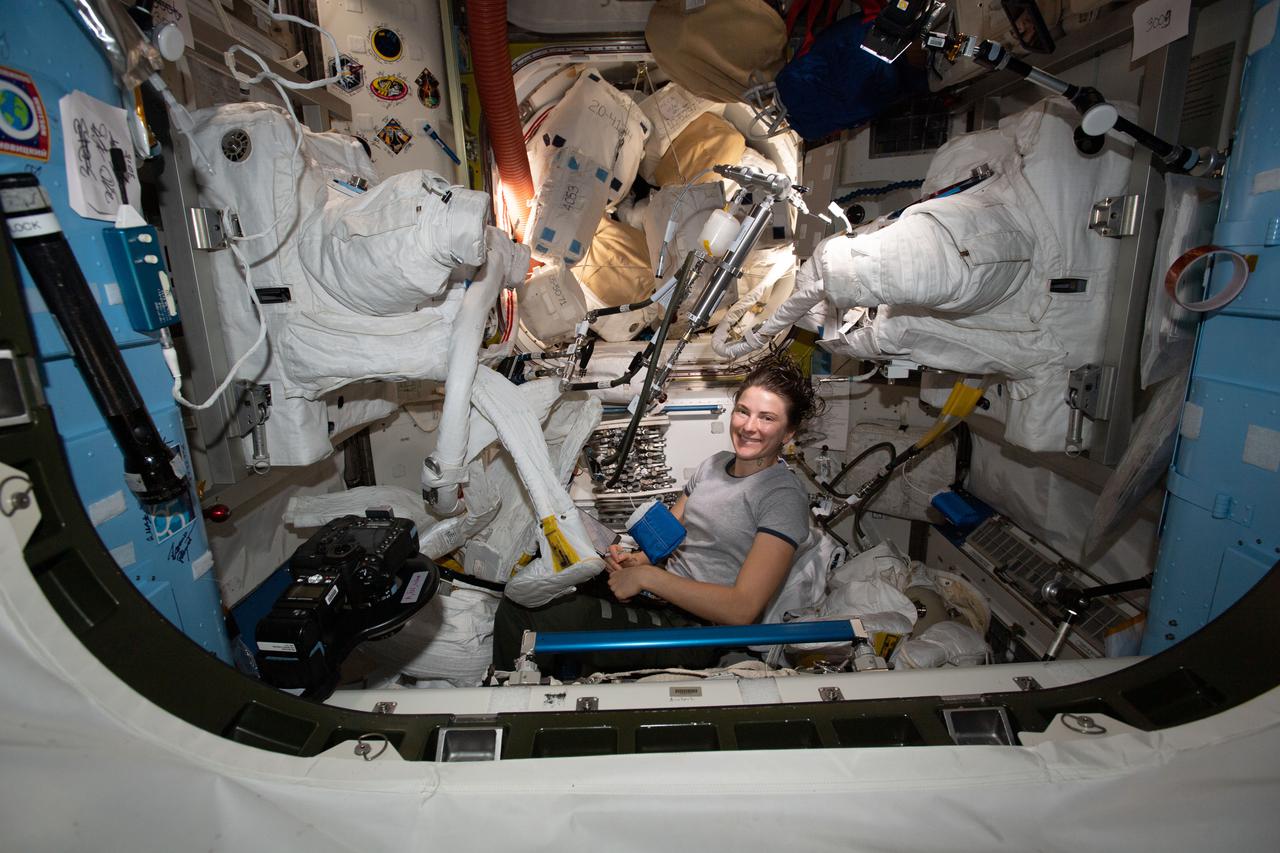
iss066e130323 (Jan. 28, 2022) --- NASA astronaut and Expedition 66 Flight Engineer Kayla Barron cleans cooling loops and water lines inside a pair of U.S. spacesuits aboard the International Space Station's Quest airlock.
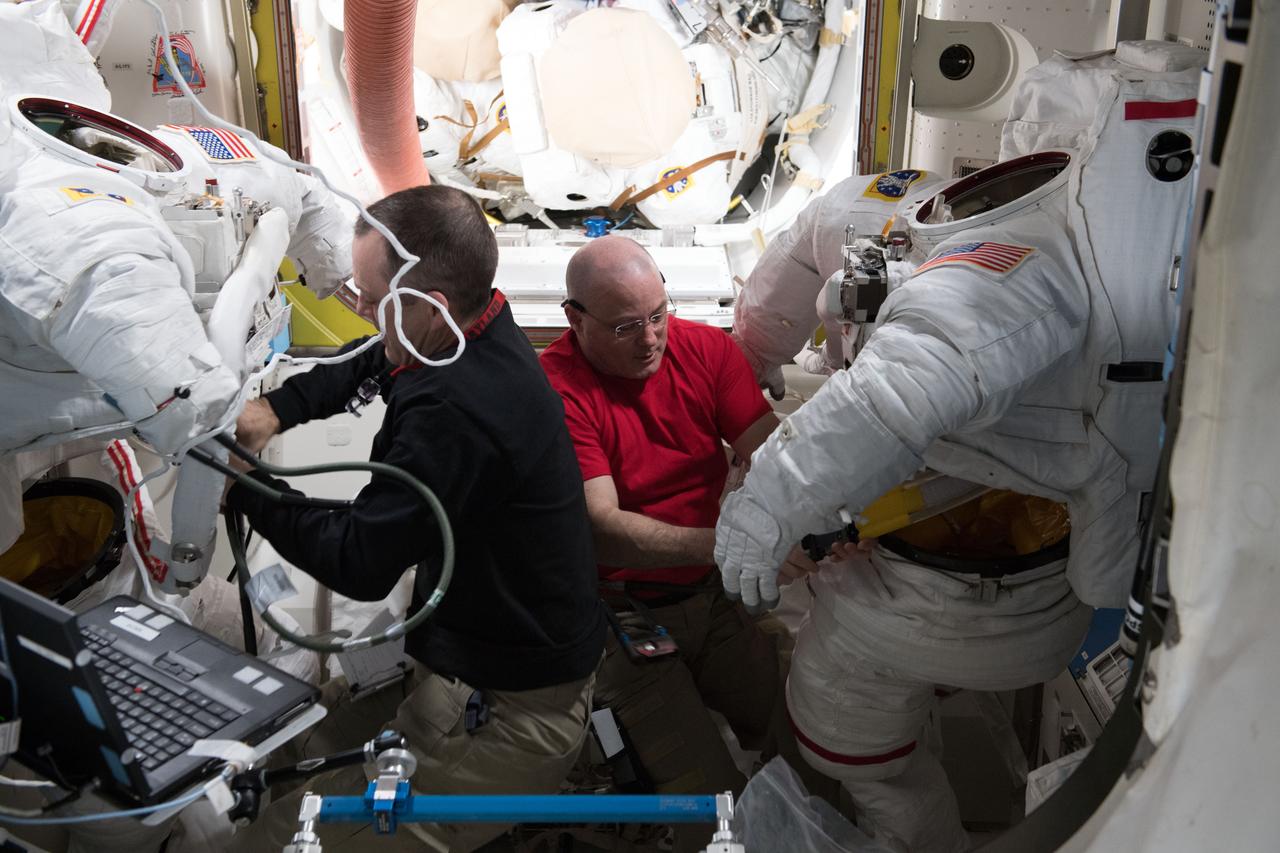
iss055e008292 (April 2, 2018) --- Astronauts Ricky Arnold and Scott Tingle scrub water cooling loops inside a pair of U.S. spacesuits after the completion of spacewalk on March 29, 2018.
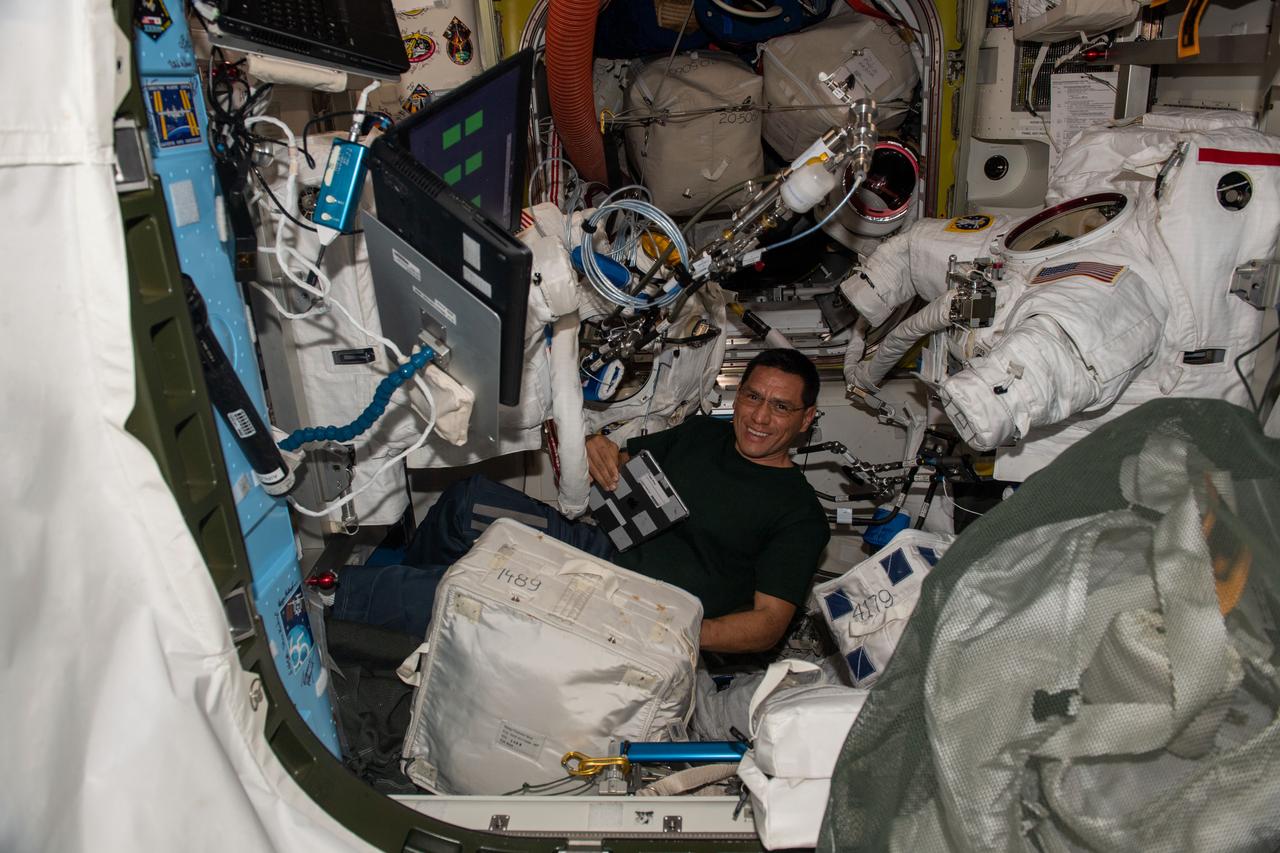
iss068e020555 (Nov. 2, 2022) --- NASA astronaut and Expedition 68 Flight Engineer Frank Rubio scrubs cooling loops inside Extravehicular Mobility Units (EMUs), or spacesuits, inside the International Space Station's Quest airlock.
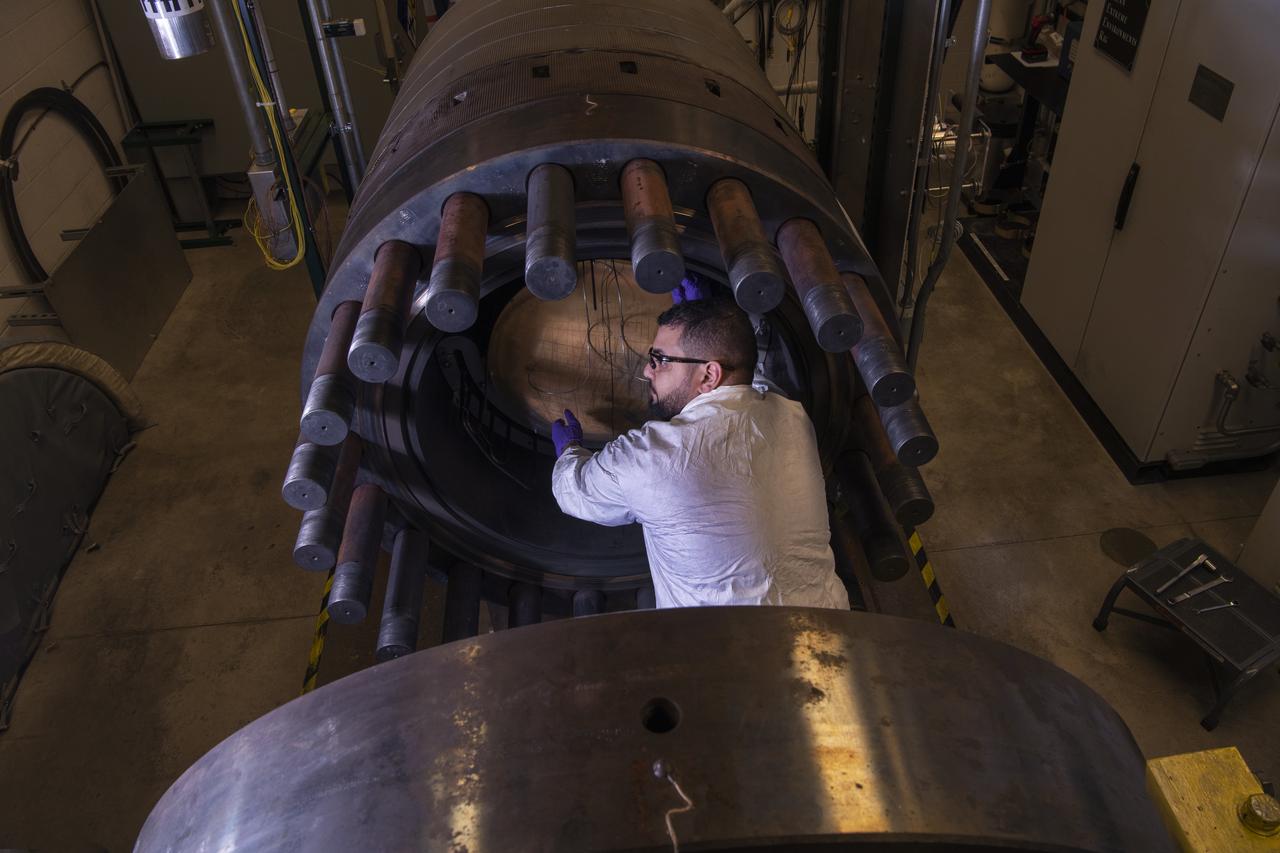
Juno testing in Glenn Extreme Environments Rig, GEER Laboratory. Juno is a solar-powered NASA spacecraft that spans the width of a basketball court and makes long, looping orbits around giant planet Jupiter
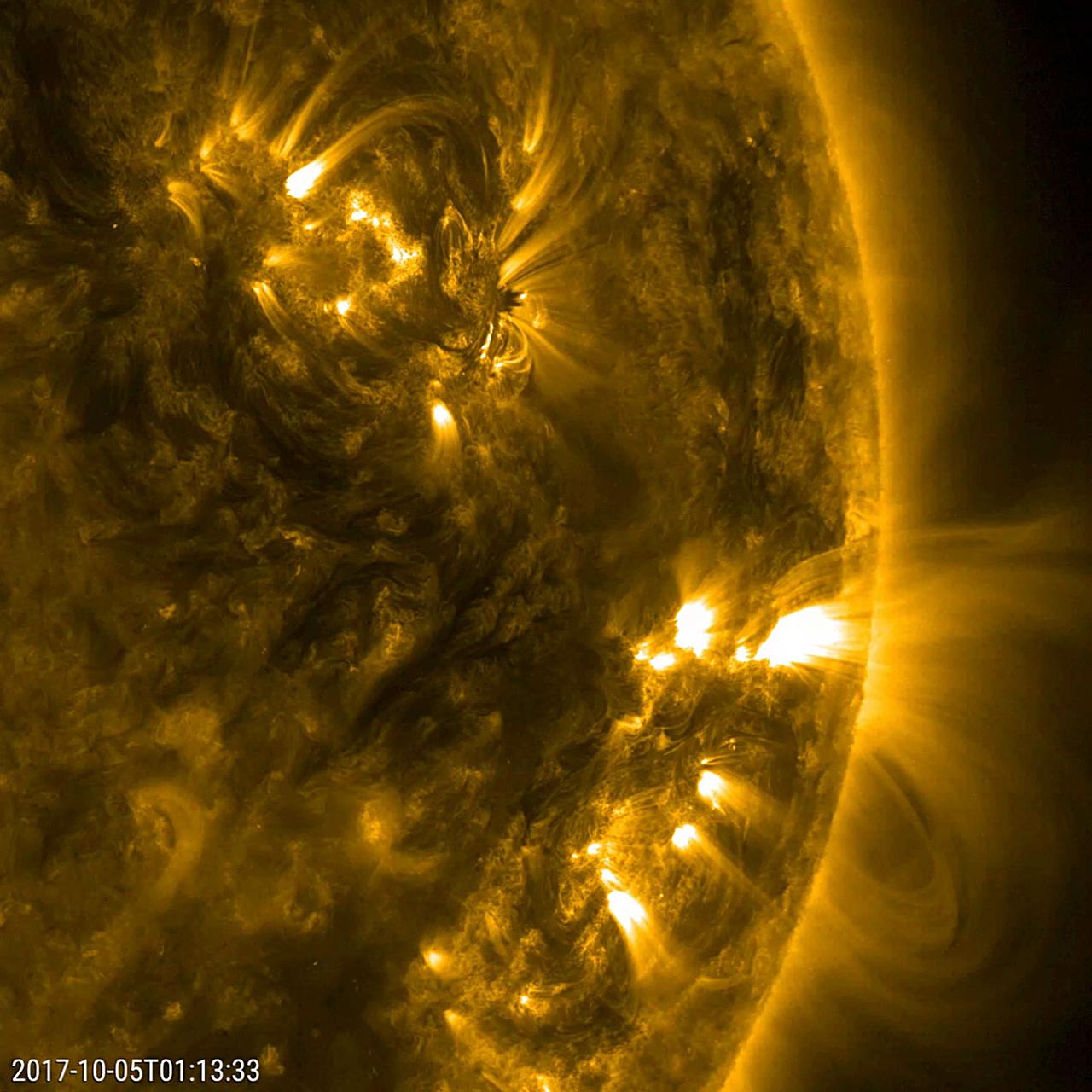
This close-up video clip shows a pair of active regions (the brighter areas) move and change as they rotate with the sun over just a 17-hour period (Oct. 4-5, 2017). They were observed in a wavelength of extreme ultraviolet light that reveals plasma heated to over a million degrees. The arches above the regions consist of charge particles spinning along and revealing magnetic field lines. Each one shows a few minor bursts of material none of them were serious. Animations are available at https://photojournal.jpl.nasa.gov/catalog/PIA22039
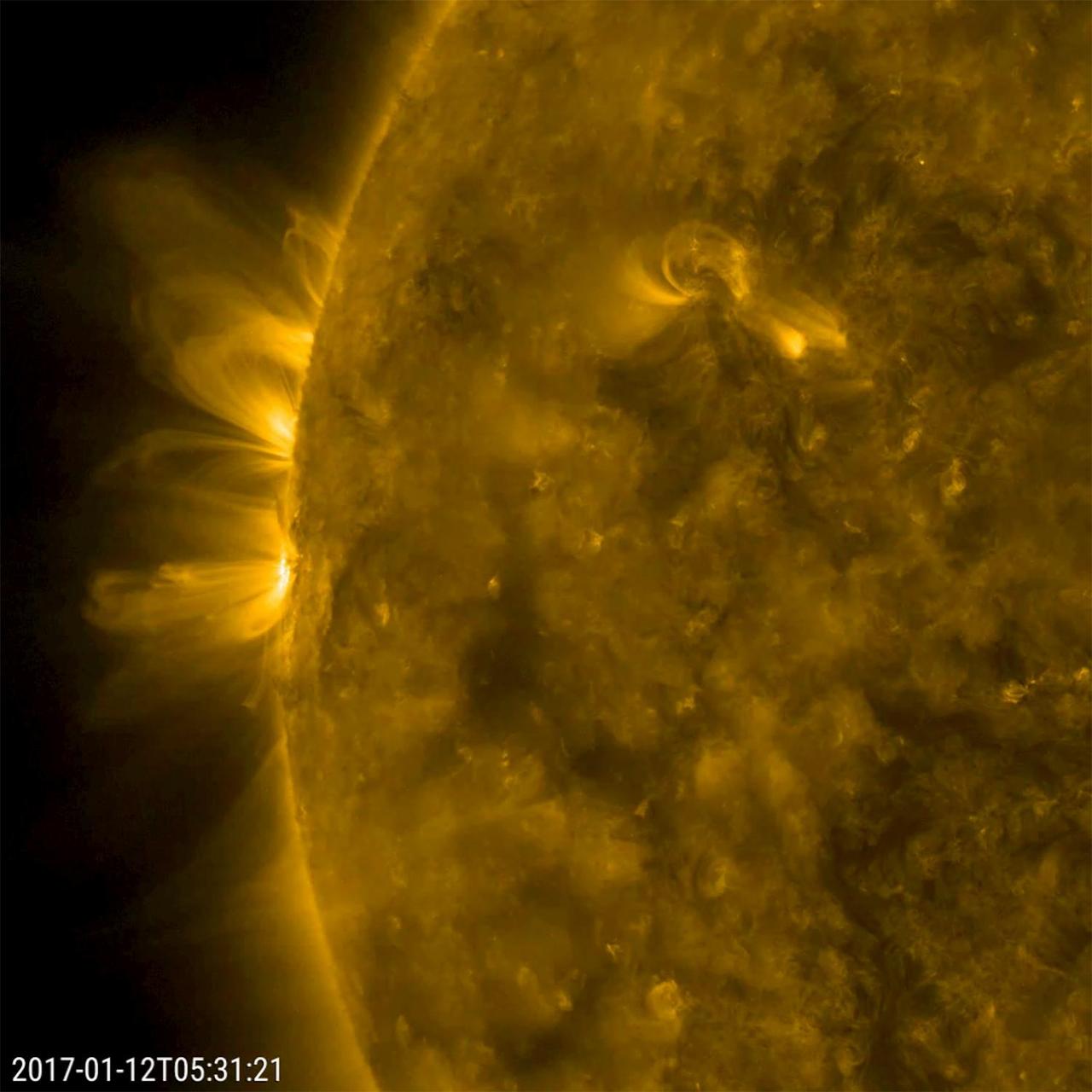
Magnetic arcs of plasma that spiraled above two active regions held their shape fairly well over 18 hours (Jan. 11-12, 2017). The charged plasma is being controlled the magnetic field lines of the active regions. The field lines become clearly visible when viewed in this wavelength of extreme ultraviolet light. Often the arches bend and twist more dynamically than the relatively stable ones seen here. Movies are available at http://photojournal.jpl.nasa.gov/catalog/PIA12327
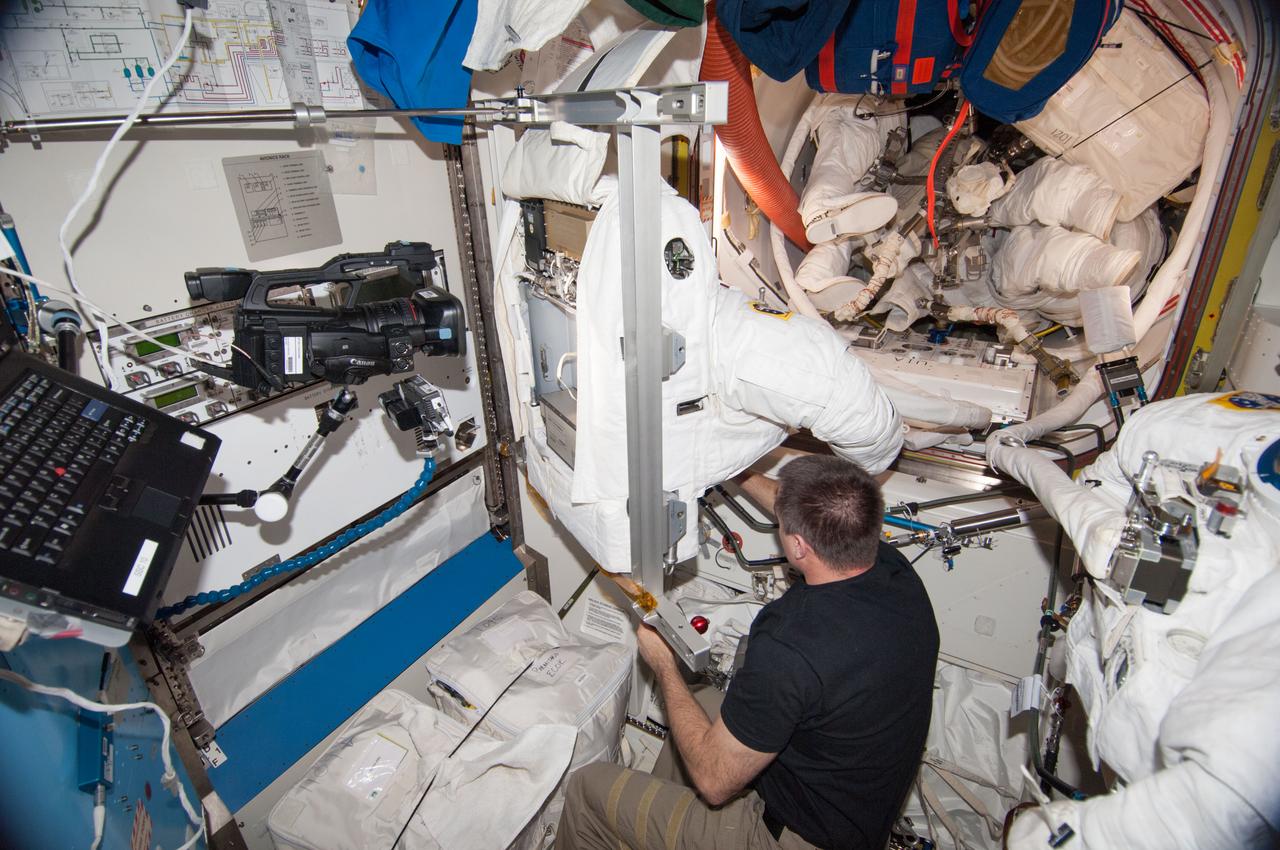
ISS036-E-027932 (2 Aug. 2013) --- NASA astronaut Chris Cassidy, Expedition 36 flight engineer, works with an Extravehicular Mobility Unit (EMU) spacesuit in the Quest airlock of the International Space Station.
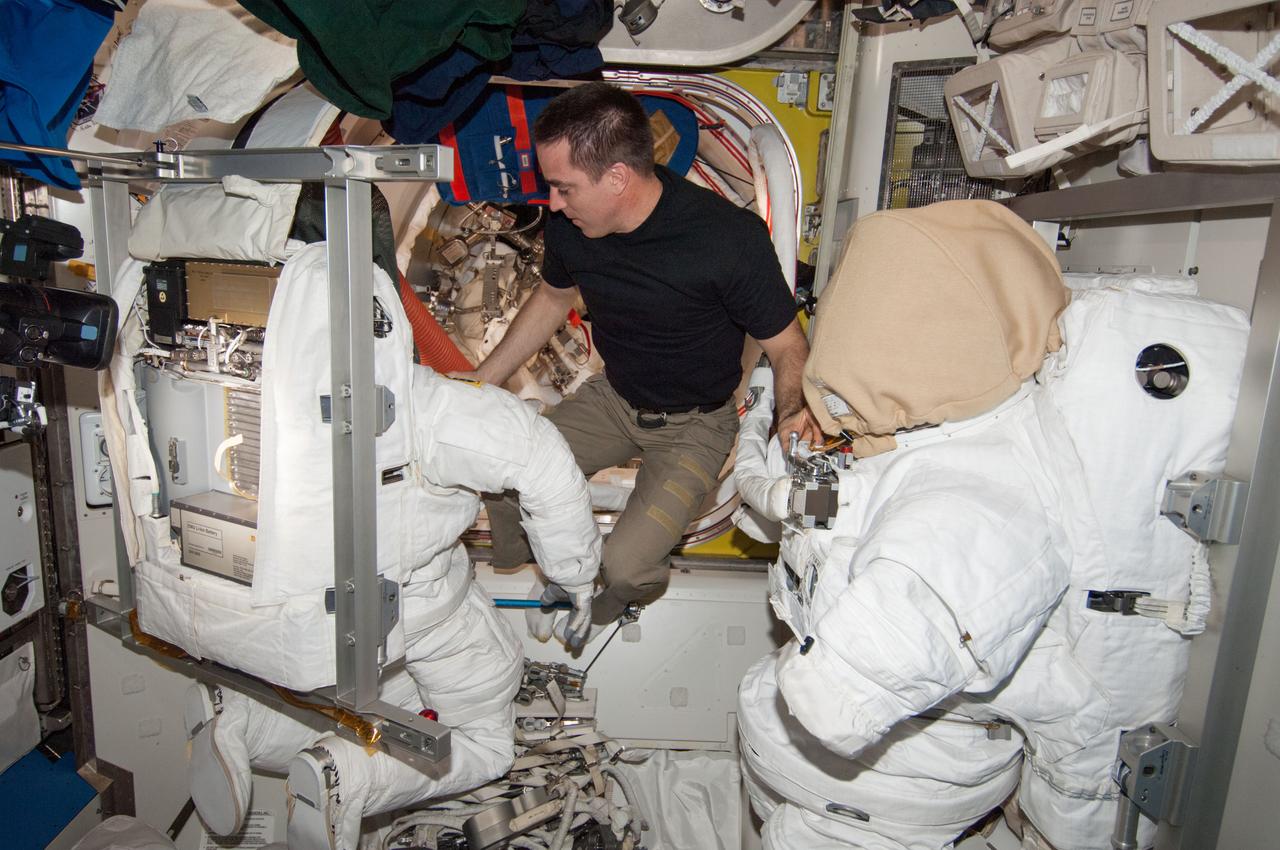
ISS036-E-027923 (2 Aug. 2013) --- NASA astronaut Chris Cassidy, Expedition 36 flight engineer, works with an Extravehicular Mobility Unit (EMU) spacesuit in the Quest airlock of the International Space Station.
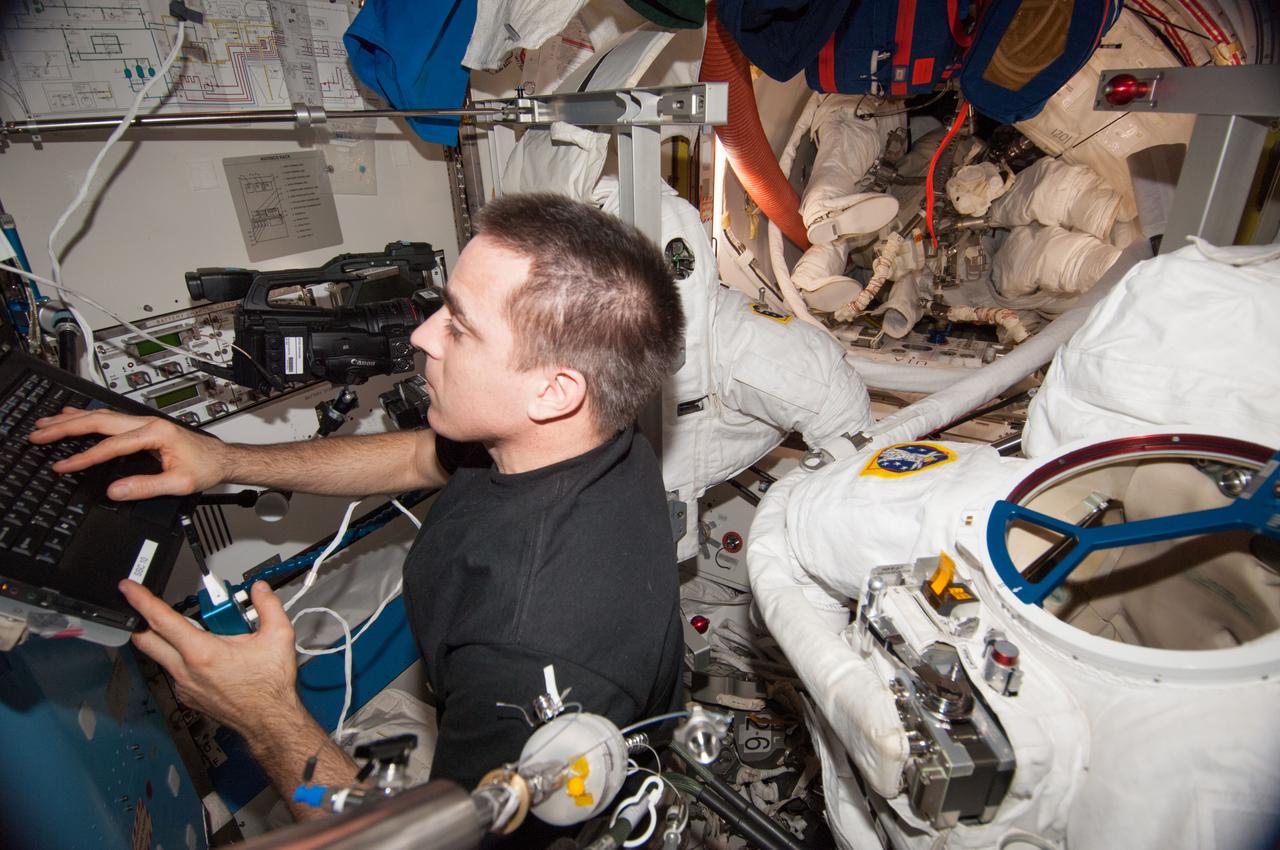
ISS036-E-027931 (2 Aug. 2013) --- NASA astronaut Chris Cassidy, Expedition 36 flight engineer, uses a computer while working with Extravehicular Mobility Unit (EMU) spacesuits in the Quest airlock of the International Space Station.
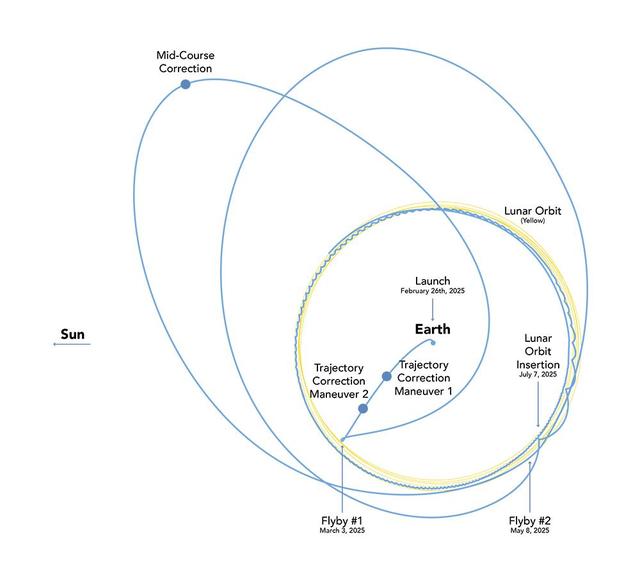
Lunar Trailblazer's voyage to the Moon will take between four and seven months, depending on the day it launches. This orbital diagram shows the low-energy transfer trajectory of the NASA mission should it launch on Feb. 26, the earliest date in a four-day launch period. If it launches that date, the spacecraft is expected to arrive in lunar orbit about four months later. Shown in this diagram are key dates of trajectory correction maneuvers, when the spacecraft will use its thrusters to shape its orbit, and lunar flybys. Lunar Trailblazer was a selection of NASA's SIMPLEx (Small Innovative Missions for Planetary Exploration), which provides opportunities for low-cost science spacecraft to ride-share with selected primary missions. To maintain the lower overall cost, SIMPLEx missions have a higher risk posture and lighter requirements for oversight and management. This higher risk acceptance allows NASA to test pioneering technologies, and the definition of success for these missions includes the lessons learned from more experimental endeavors. https://photojournal.jpl.nasa.gov/catalog/PIA26459
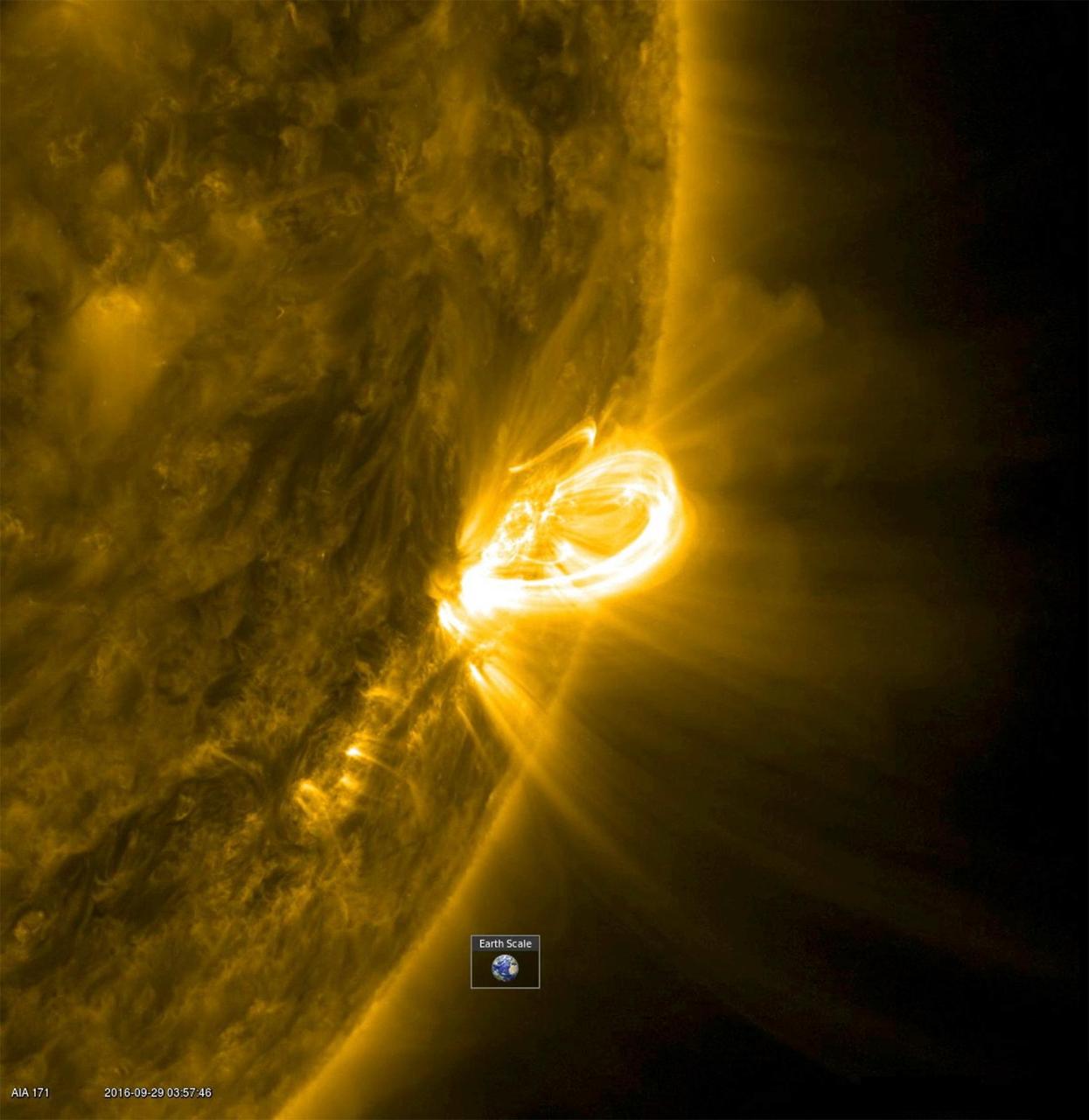
When an active region rotated into a profile view, SDO was able to capture the magnificent loops arching above an active region (Sept. 28-29, 2016). Active region are areas of strong magnetic fields. The magnetic field lines above these regions are illuminated by charged particles spiraling along them. The images were taken in a wavelength of extreme ultraviolet light. The video covers 12 hours of activity. The Earth was inset to give a sense of the scale of these towering arches. Movies are available at http://photojournal.jpl.nasa.gov/catalog/PIA21101
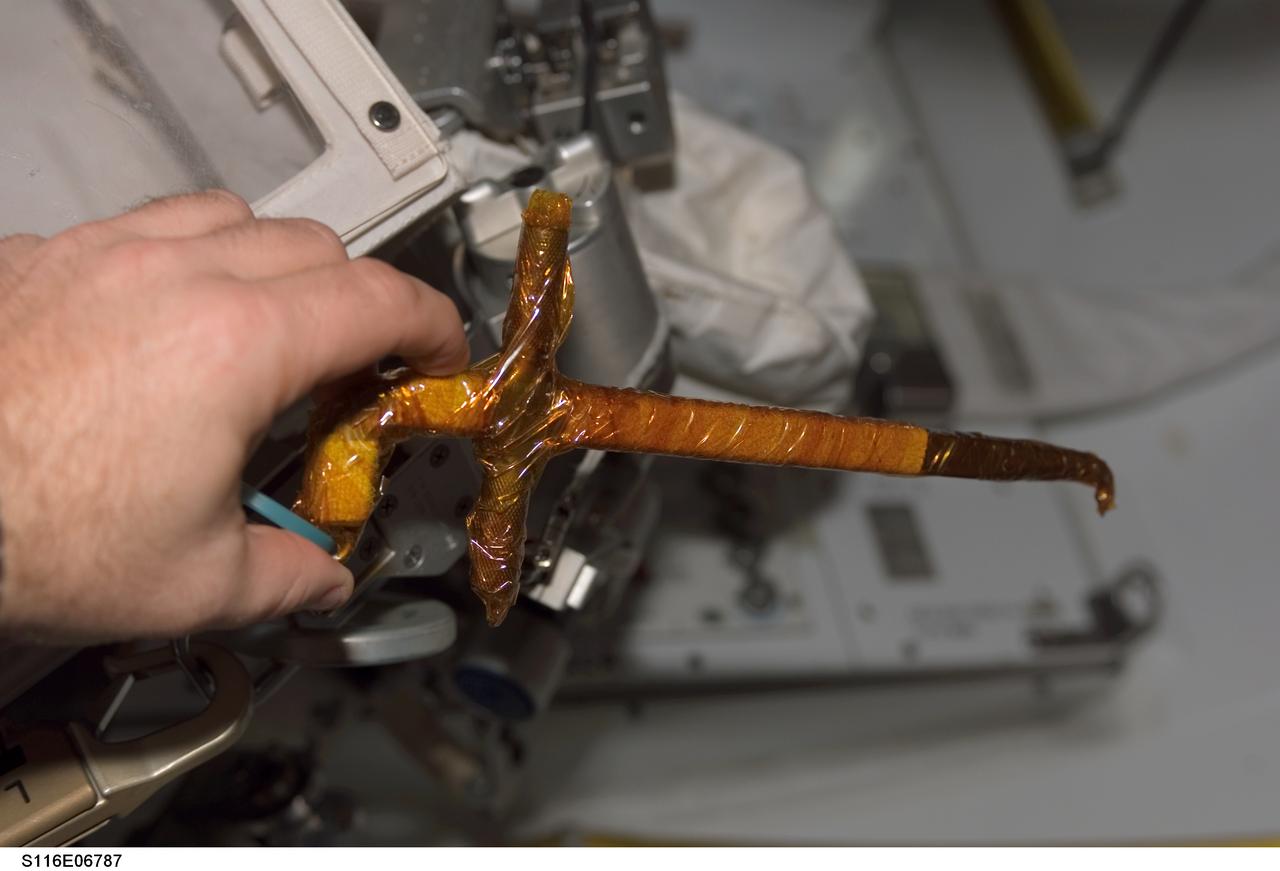
S116-E-06787 (18 Dec. 2006) --- A view of a loop-pin-puller wrapped in insulating tape onboard Space Shuttle Discovery, scheduled for use during STS-116 extravehicular activity (EVA) as construction resumes on the International Space Station.
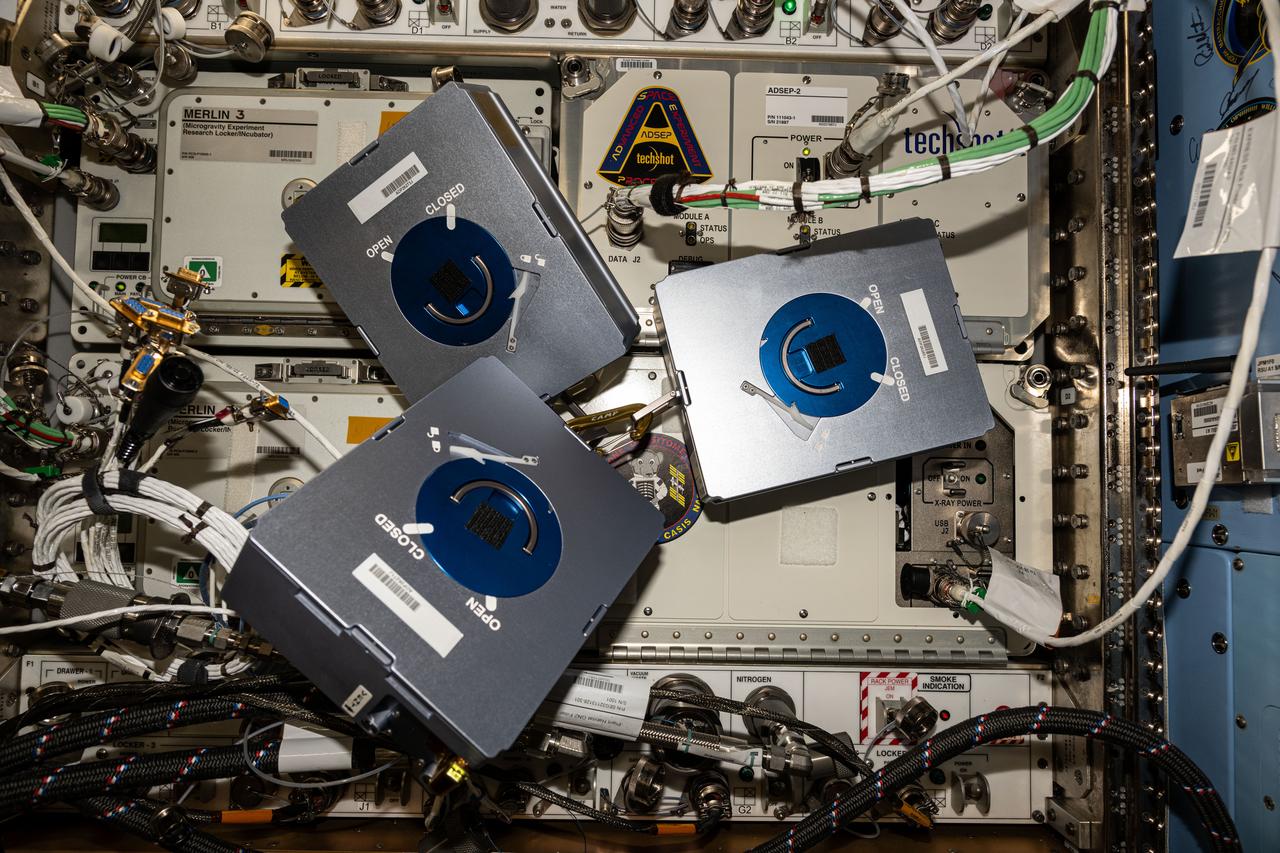
Documentation of three cassettes for the In-Space Production Application – Pharmaceutical In-space Laboratory – 02 (InSPA-PIL-02 or ADSEP-PIL-02) experiment removed from the ADSEP-2 (ADvanced Space Experiment Processor) for Fluid Loop replacement. Photo was taken in the Harmony Node 2.
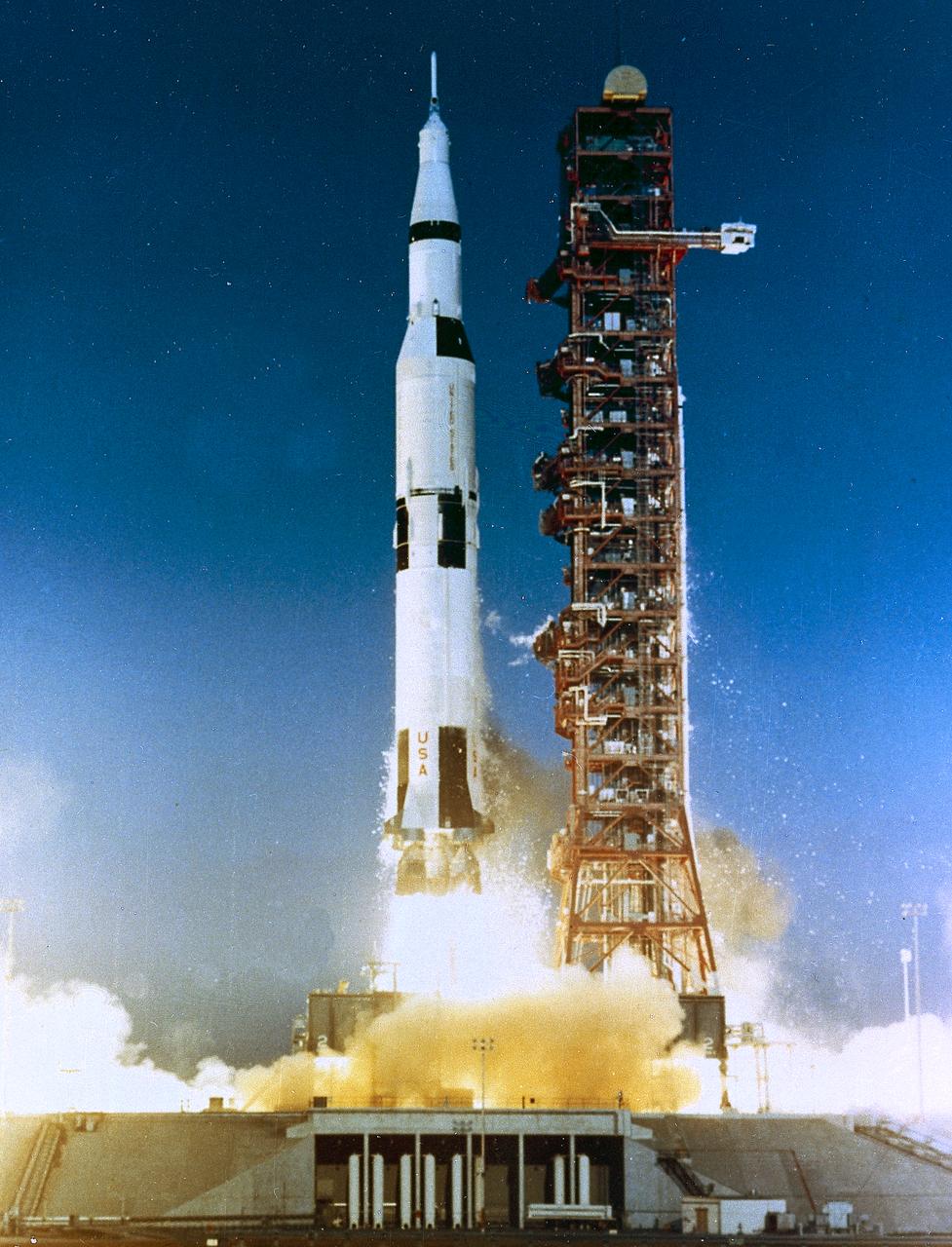
The second Saturn V launch vehicle (SA-502) for the Apollo 6 mission lifted off from the Kennedy Space Center launch complex on April 4, 1968. This unmanned Saturn V launch vehicle tested the emergency detection system in closed loop configuration.