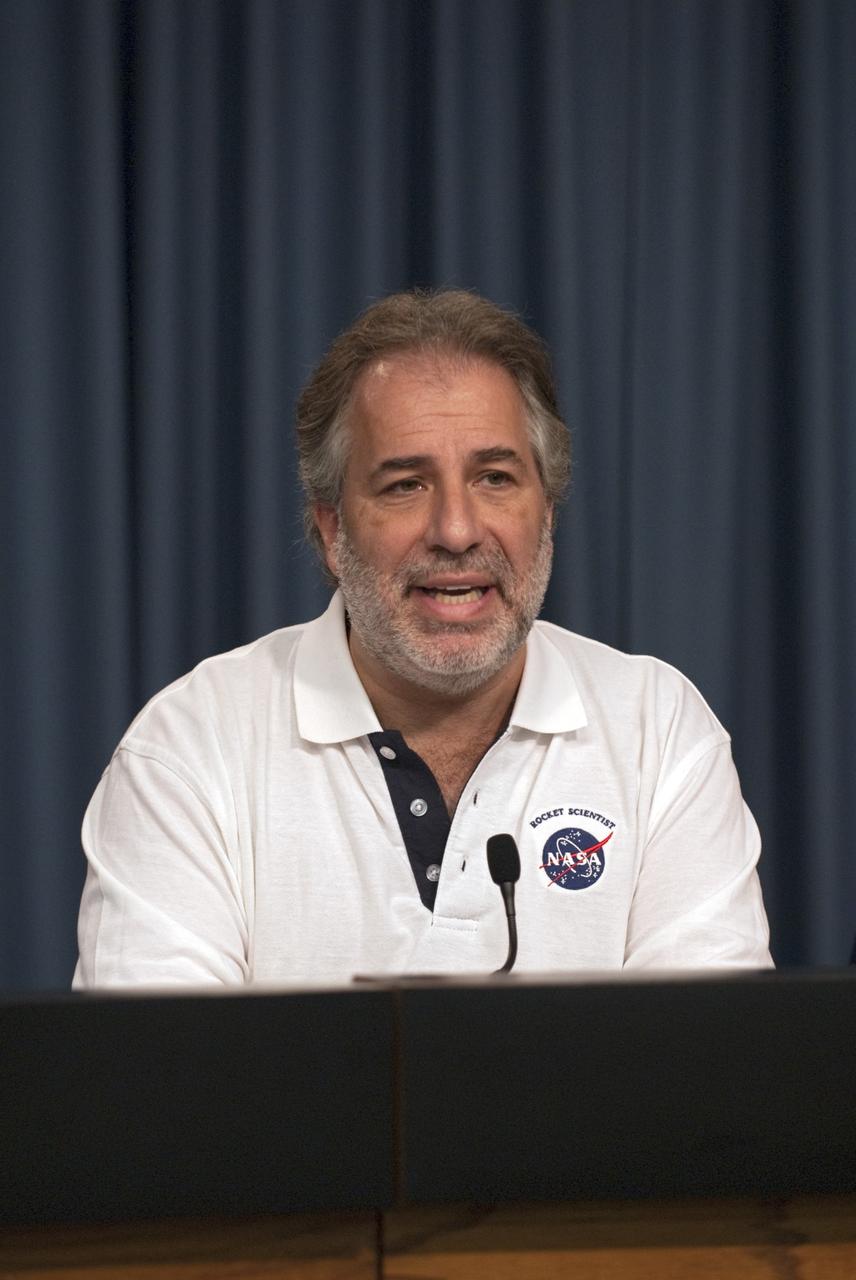
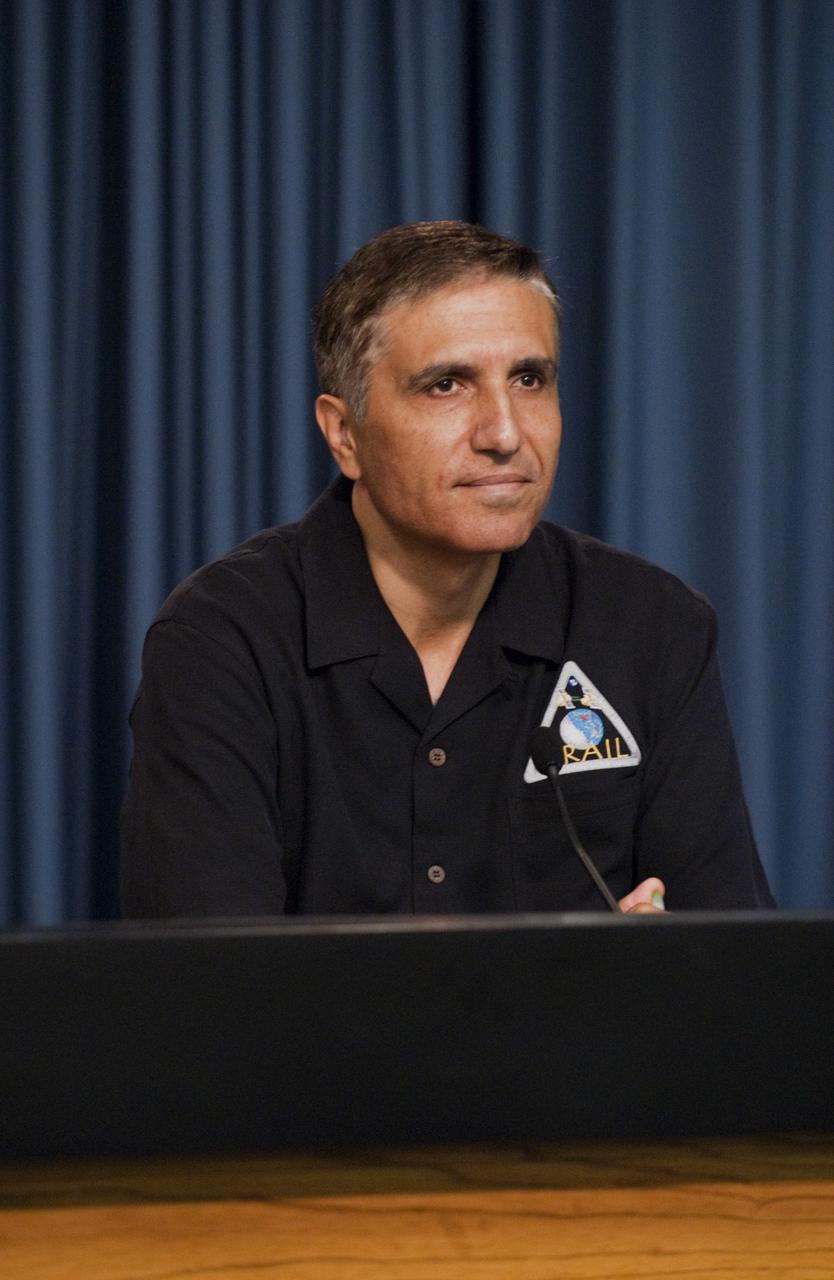
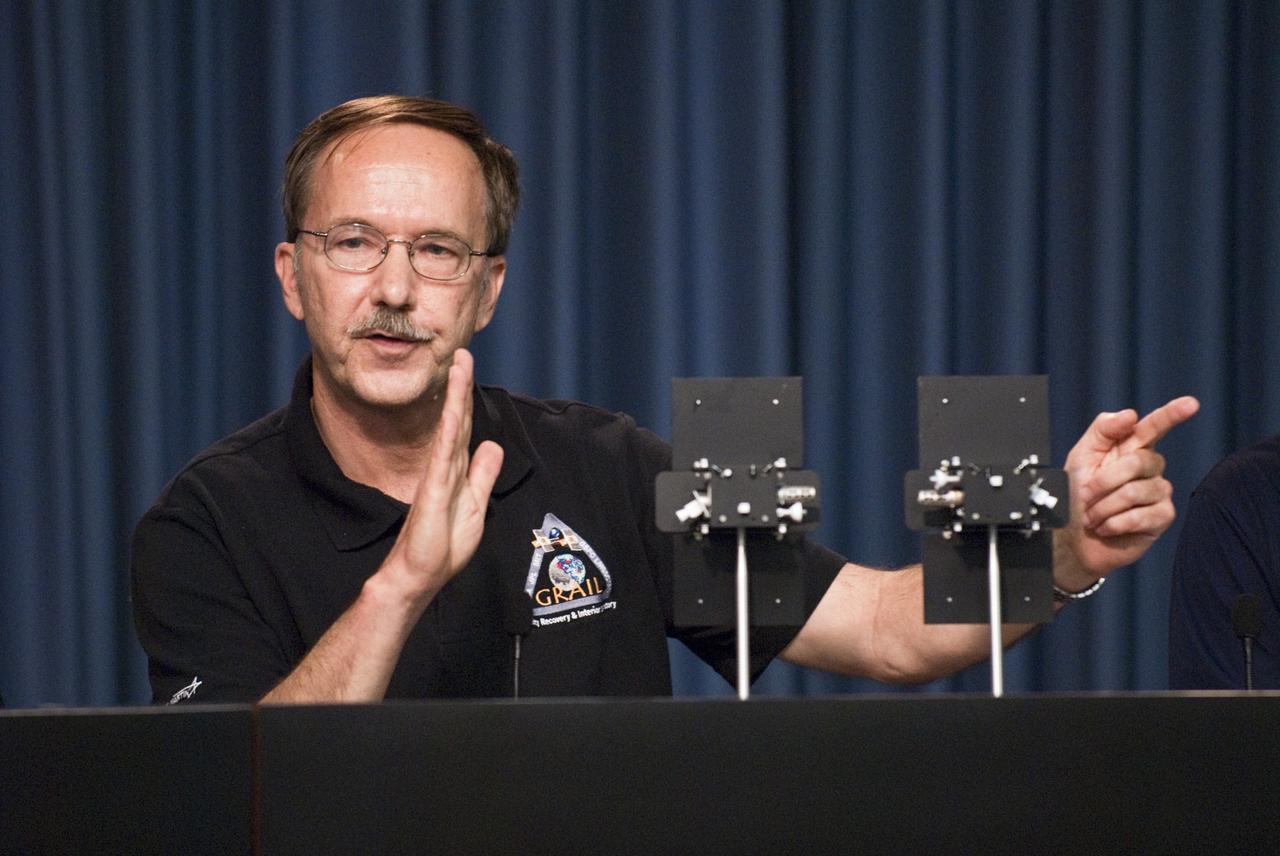
CAPE CANAVERAL, Fla. – Robert Fogel, NASA’s GRAIL program scientist, participates in the Gravity Recovery and Interior Laboratory (GRAIL) mission science briefing in the NASA Press Site auditorium at NASA's Kennedy Space Center in Florida. GRAIL is scheduled to launch Sept. 8 aboard a United Launch Alliance Delta II Heavy rocket from Cape Canaveral Air Force Station in Florida. GRAIL will fly twin spacecraft in tandem around the moon to precisely measure and map variations in the moon's gravitational field. The mission will provide the most accurate global gravity field to date for any planet, including Earth. This detailed information will reveal differences in the density of the moon's crust and mantle and will help answer fundamental questions about the moon's internal structure, thermal evolution, and history of collisions with asteroids. The aim is to map the moon's gravity field so completely that future moon vehicles can safely navigate anywhere on the moon’s surface. For more information, visit http://www.nasa.gov/grail. Photo credit: NASA/Kim Shiflett
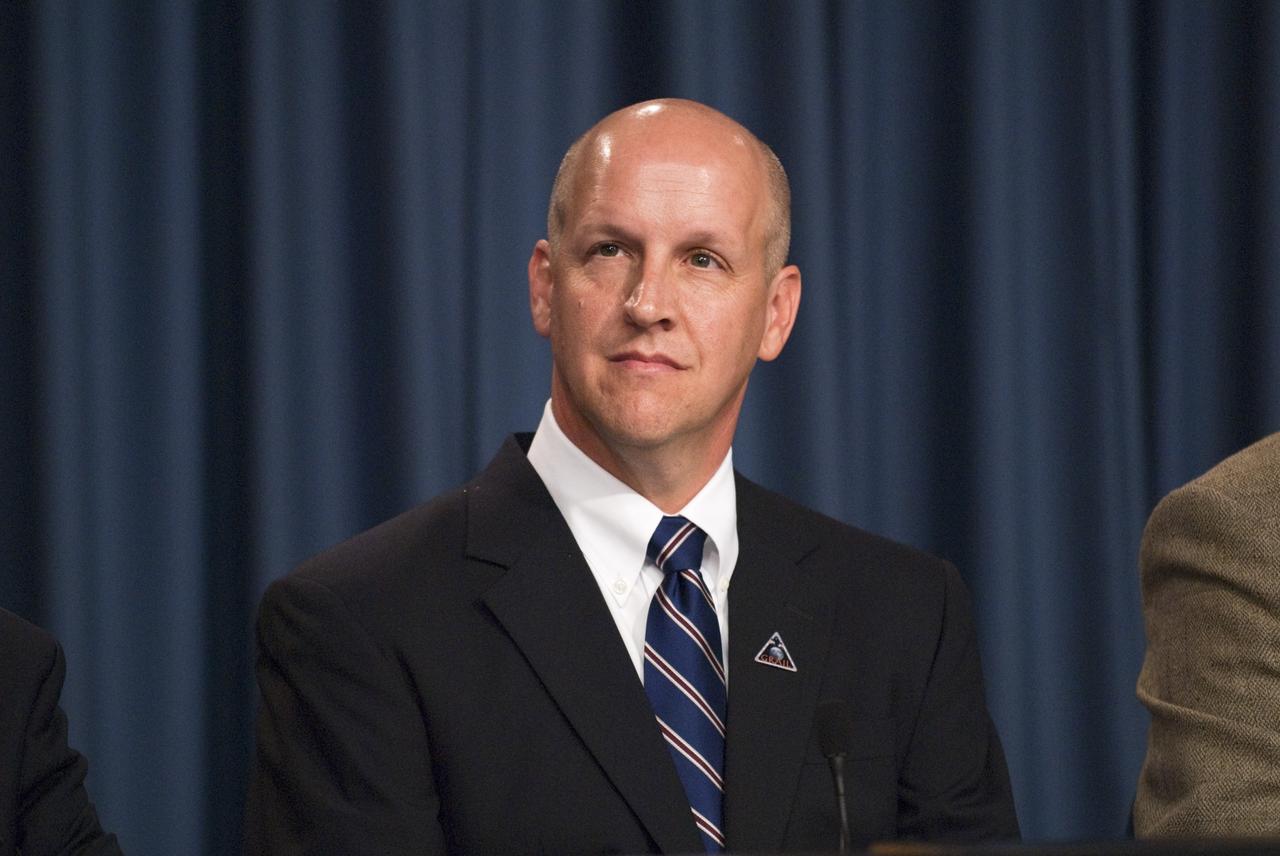
CAPE CANAVERAL, Fla. – Tim Dunn, NASA launch director for the agency’s Launch Services Program, participates in the Gravity Recovery and Interior Laboratory (GRAIL) prelaunch news conference in the NASA Press Site auditorium at NASA's Kennedy Space Center in Florida. GRAIL is scheduled to launch Sept. 8 aboard a United Launch Alliance Delta II Heavy rocket from Cape Canaveral Air Force Station in Florida. GRAIL will fly twin spacecraft in tandem around the moon to precisely measure and map variations in the moon's gravitational field. The mission will provide the most accurate global gravity field to date for any planet, including Earth. This detailed information will reveal differences in the density of the moon's crust and mantle and will help answer fundamental questions about the moon's internal structure, thermal evolution, and history of collisions with asteroids. The aim is to map the moon's gravity field so completely that future moon vehicles can safely navigate anywhere on the moon’s surface. For more information, visit http://www.nasa.gov/grail. Photo credit: NASA/Kim Shiflett

CAPE CANAVERAL, Fla. – – Leesa Hubbard, teacher in residence, Sally Ride Science, San Diego, participates in the Gravity Recovery and Interior Laboratory (GRAIL) mission science briefing in the NASA Press Site auditorium at NASA's Kennedy Space Center in Florida. GRAIL is scheduled to launch Sept. 8 aboard a United Launch Alliance Delta II Heavy rocket from Cape Canaveral Air Force Station in Florida. GRAIL will fly twin spacecraft in tandem around the moon to precisely measure and map variations in the moon's gravitational field. The mission will provide the most accurate global gravity field to date for any planet, including Earth. This detailed information will reveal differences in the density of the moon's crust and mantle and will help answer fundamental questions about the moon's internal structure, thermal evolution, and history of collisions with asteroids. The aim is to map the moon's gravity field so completely that future moon vehicles can safely navigate anywhere on the moon’s surface. For more information, visit http://www.nasa.gov/grail. Photo credit: NASA/Kim Shiflett

CAPE CANAVERAL, Fla. – CAPE CANAVERAL, Fla. – Actress Nichelle Nichols (Lt. Uhura on Star Trek) signs autographs for a guest at the Kennedy Space Center Visitor Complex in Florida during activities for the agency’s Gravity Recovery and Interior Laboratory mission (GRAIL). Nichols was on hand to celebrate the 45th anniversary of the first airing of the Star Trek television series. The Kennedy Space Center Visitor Complex is hosting “Star Trek: The Exhibition” to show visitors where “science fiction meets science fact.” GRAIL will fly twin spacecraft in tandem around the moon to precisely measure and map variations in the moon's gravitational field. The mission will provide the most accurate global gravity field to date for any planet, including Earth. This detailed information will reveal differences in the density of the moon's crust and mantle and will help answer fundamental questions about the moon's internal structure, thermal evolution, and history of collisions with asteroids. The aim is to map the moon's gravity field so completely that future moon vehicles can safely navigate anywhere on the moon’s surface. For more information, visit http://www.nasa.gov/grail. Photo credit: NASA/Frankie Martin
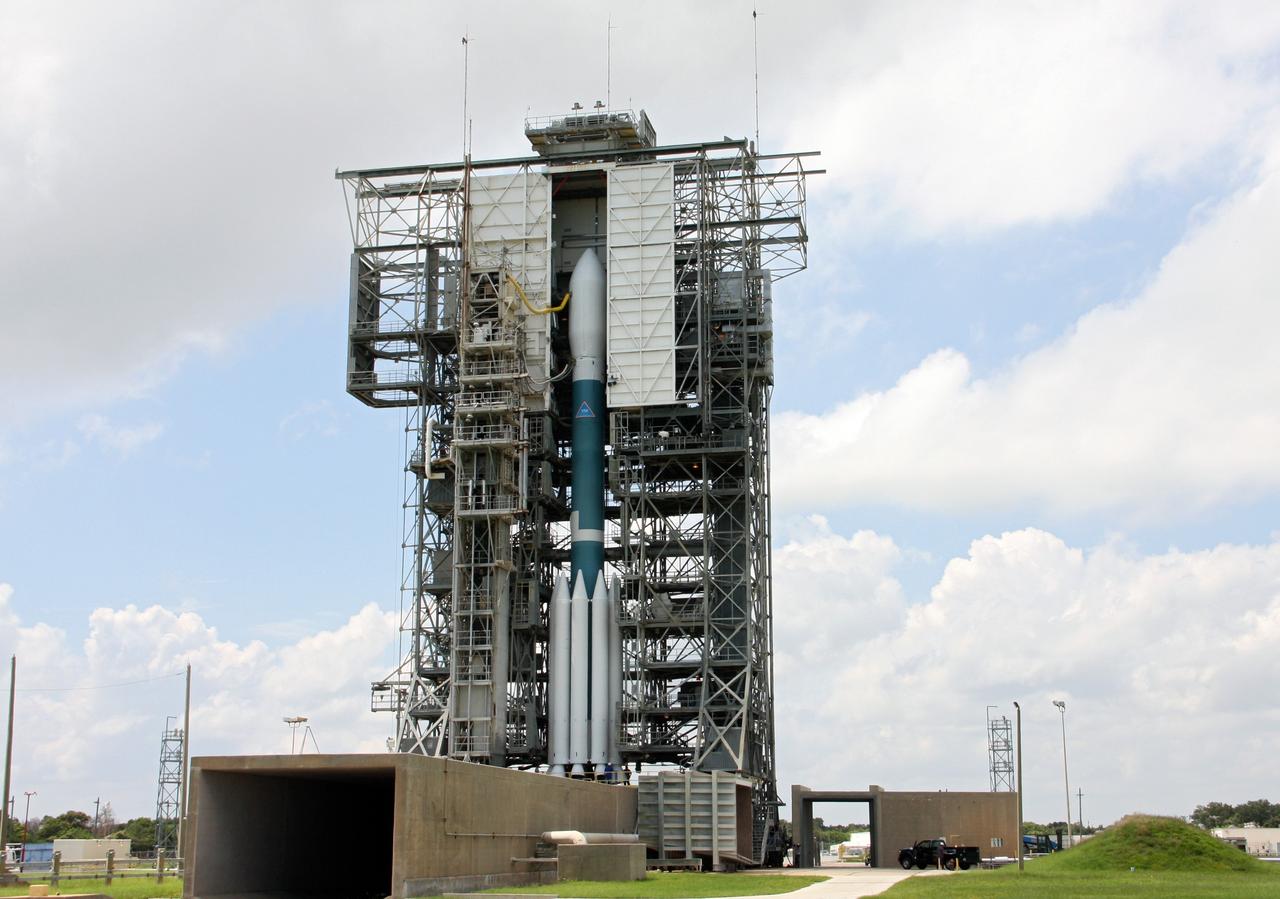
CAPE CANAVERAL, Fla. – At Space Launch Complex 17B on Cape Canaveral Air Force Station, the United Launch Alliance Delta II heavy rocket that will launch NASA's Gravity Recovery and Interior Laboratory spacecraft is rolled back around to the mobile service tower after the first launch attempt was scrubbed due to upper-level winds. GRAIL is scheduled for another launch attempt Sept.10 at 8:29:45 a.m. EDT. GRAIL will fly twin spacecraft in tandem around the moon to precisely measure and map variations in the moon's gravitational field. The mission will provide the most accurate global gravity field to date for any planet, including Earth. This detailed information will reveal differences in the density of the moon's crust and mantle and will help answer fundamental questions about the moon's internal structure, thermal evolution, and history of collisions with asteroids. The aim is to map the moon's gravity field so completely that future moon vehicles can safely navigate anywhere on the moon’s surface. For more information, visit http://www.nasa.gov/grail. Photo credit: NASA/Ken Thornsley
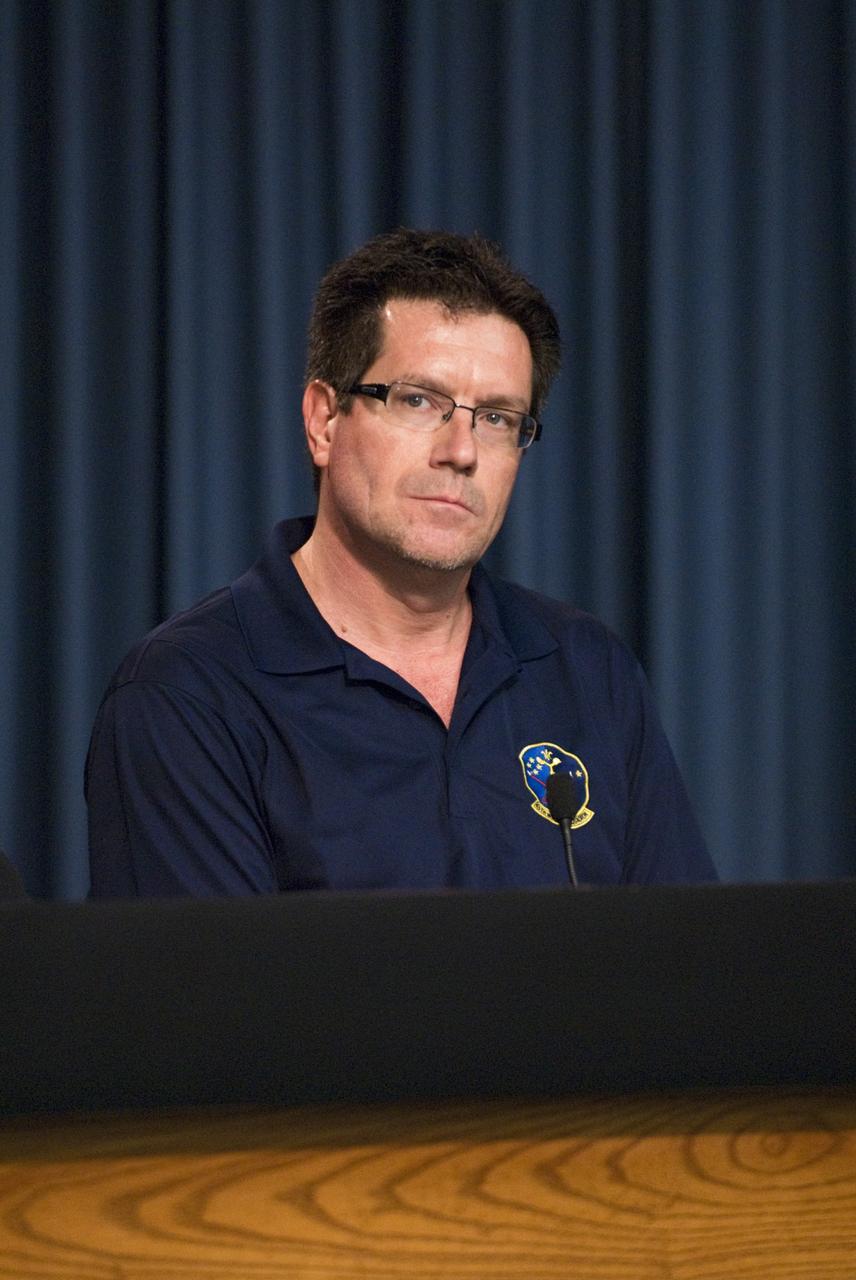
CAPE CANAVERAL, Fla. – Joel Tumbiolo, launch weather officer, 45th Weather Squadron, Cape Canaveral Air Force Station, Fla., participates in the Gravity Recovery and Interior Laboratory (GRAIL) prelaunch news conference in the NASA Press Site auditorium at NASA's Kennedy Space Center in Florida. GRAIL is scheduled to launch Sept. 8 aboard a United Launch Alliance Delta II Heavy rocket from Cape Canaveral Air Force Station in Florida. GRAIL will fly twin spacecraft in tandem around the moon to precisely measure and map variations in the moon's gravitational field. The mission will provide the most accurate global gravity field to date for any planet, including Earth. This detailed information will reveal differences in the density of the moon's crust and mantle and will help answer fundamental questions about the moon's internal structure, thermal evolution, and history of collisions with asteroids. The aim is to map the moon's gravity field so completely that future moon vehicles can safely navigate anywhere on the moon’s surface. For more information, visit http://www.nasa.gov/grail. Photo credit: NASA/Kim Shiflett
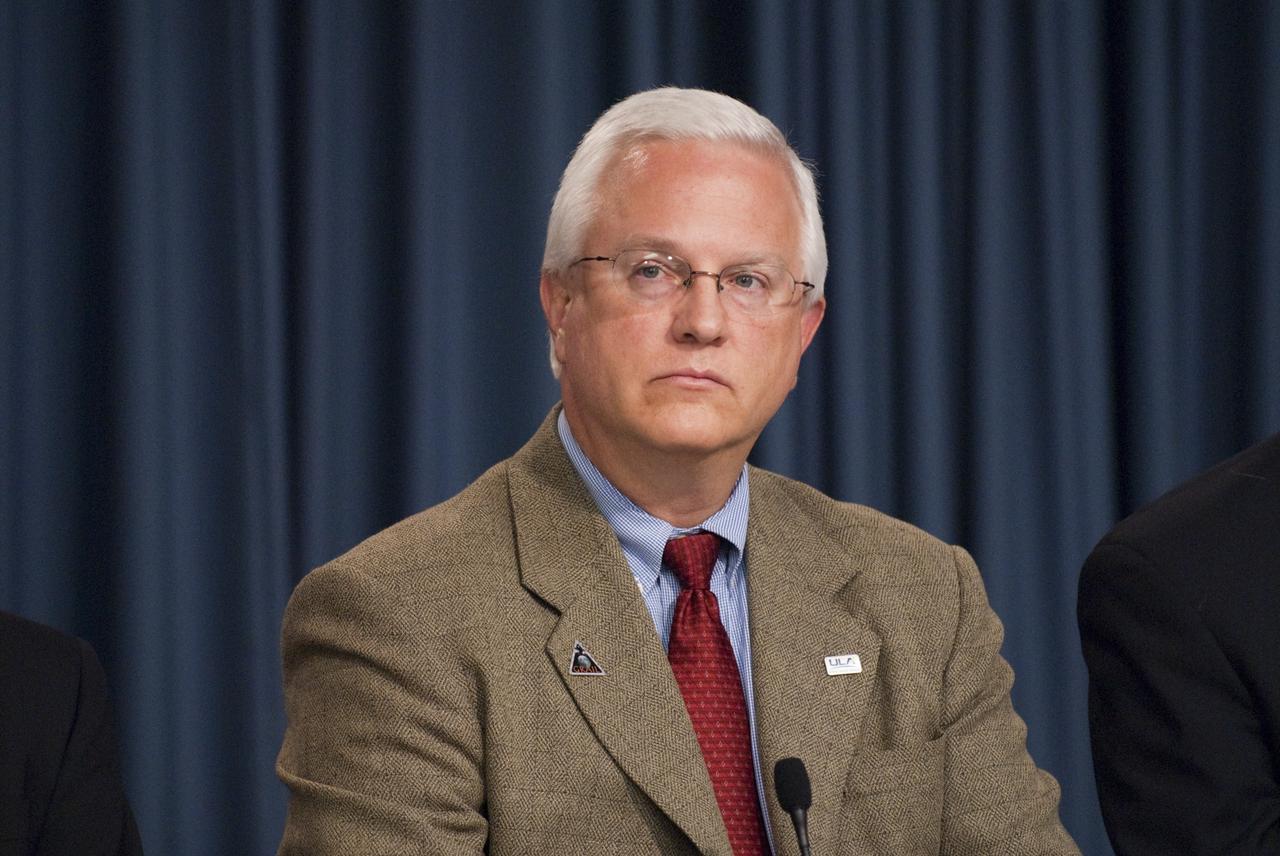
CAPE CANAVERAL, Fla. – Vernon Thorp, program manager, NASA Missions, United Launch Alliance, participates in the Gravity Recovery and Interior Laboratory (GRAIL) prelaunch news conference in the NASA Press Site auditorium at NASA's Kennedy Space Center in Florida. GRAIL is scheduled to launch Sept. 8 aboard a United Launch Alliance Delta II Heavy rocket from Cape Canaveral Air Force Station in Florida. GRAIL will fly twin spacecraft in tandem around the moon to precisely measure and map variations in the moon's gravitational field. The mission will provide the most accurate global gravity field to date for any planet, including Earth. This detailed information will reveal differences in the density of the moon's crust and mantle and will help answer fundamental questions about the moon's internal structure, thermal evolution, and history of collisions with asteroids. The aim is to map the moon's gravity field so completely that future moon vehicles can safely navigate anywhere on the moon’s surface. For more information, visit http://www.nasa.gov/grail. Photo credit: NASA/Kim Shiflett
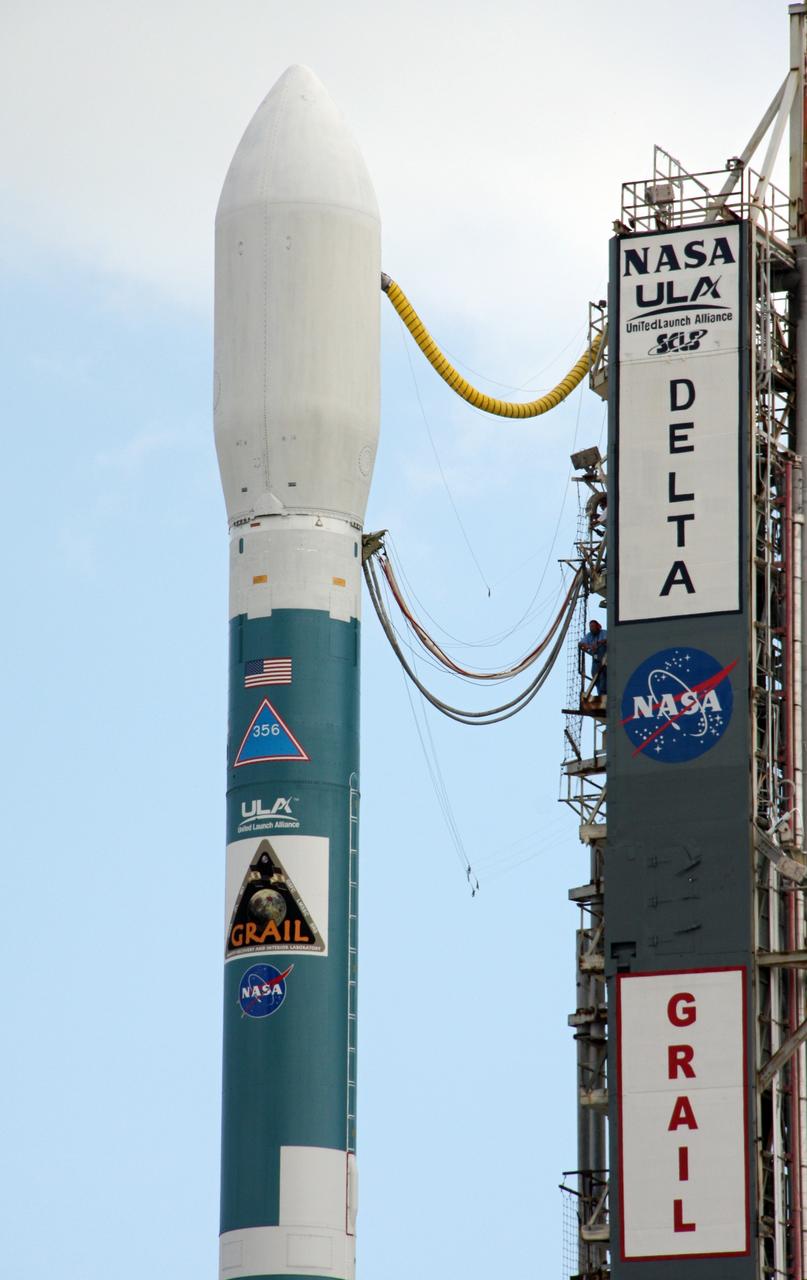
CAPE CANAVERAL, Fla. – At Space Launch Complex 17B on Cape Canaveral Air Force Station, the United Launch Alliance Delta II heavy rocket that will launch NASA's Gravity Recovery and Interior Laboratory spacecraft is rolled back around to the mobile service tower after the first launch attempt was scrubbed due to upper-level winds. GRAIL is scheduled for another launch attempt Sept.10 at 8:29:45 a.m. EDT. GRAIL will fly twin spacecraft in tandem around the moon to precisely measure and map variations in the moon's gravitational field. The mission will provide the most accurate global gravity field to date for any planet, including Earth. This detailed information will reveal differences in the density of the moon's crust and mantle and will help answer fundamental questions about the moon's internal structure, thermal evolution, and history of collisions with asteroids. The aim is to map the moon's gravity field so completely that future moon vehicles can safely navigate anywhere on the moon’s surface. For more information, visit http://www.nasa.gov/grail. Photo credit: NASA/Ken Thornsley

CAPE CANAVERAL, Fla. – Ed Weiler, NASA associate administrator, Science Mission Directorate, participates in the Gravity Recovery and Interior Laboratory (GRAIL) prelaunch news conference in the NASA Press Site auditorium at NASA's Kennedy Space Center in Florida. GRAIL is scheduled to launch Sept. 8 aboard a United Launch Alliance Delta II Heavy rocket from Cape Canaveral Air Force Station in Florida. GRAIL will fly twin spacecraft in tandem around the moon to precisely measure and map variations in the moon's gravitational field. The mission will provide the most accurate global gravity field to date for any planet, including Earth. This detailed information will reveal differences in the density of the moon's crust and mantle and will help answer fundamental questions about the moon's internal structure, thermal evolution, and history of collisions with asteroids. The aim is to map the moon's gravity field so completely that future moon vehicles can safely navigate anywhere on the moon’s surface. For more information, visit http://www.nasa.gov/grail. Photo credit: NASA/Kim Shiflett
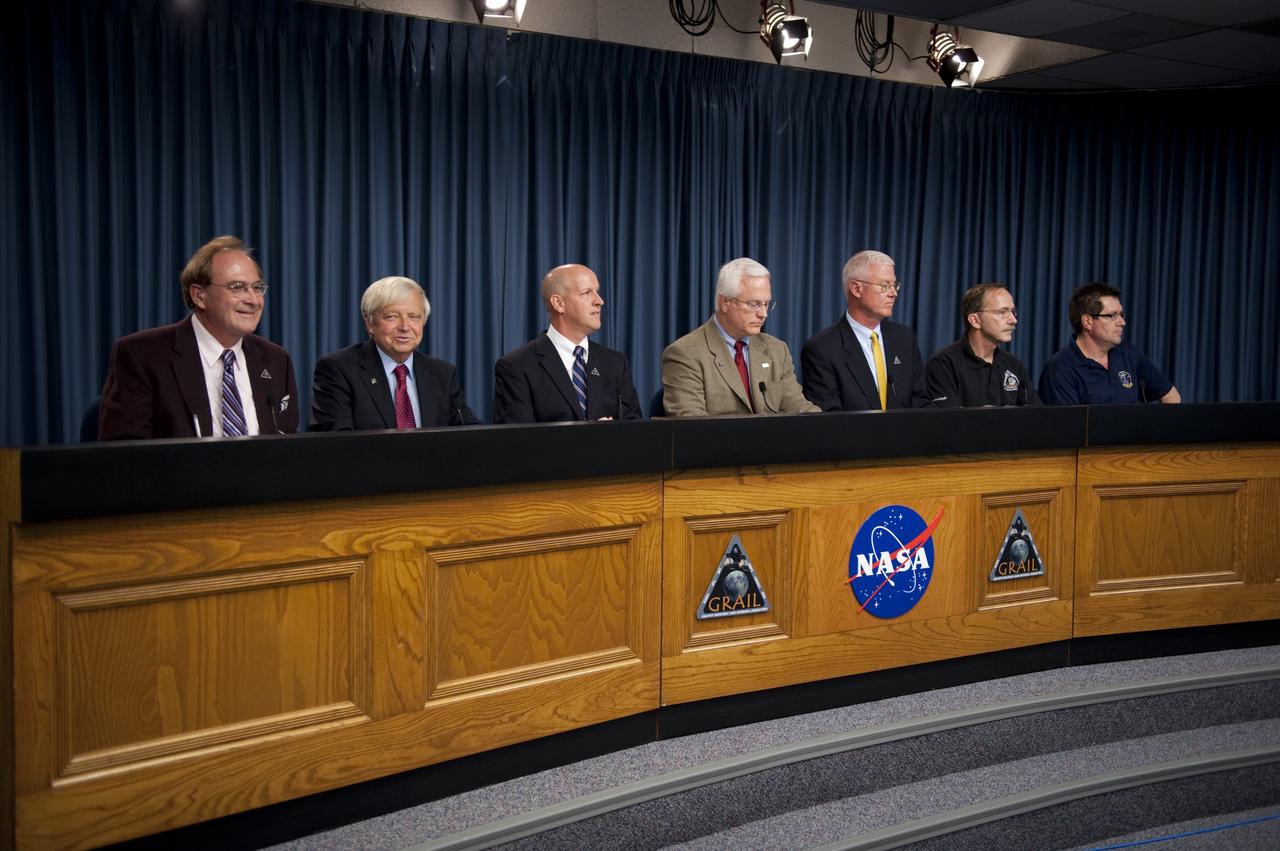
CAPE CANAVERAL, Fla. – A Gravity Recovery and Interior Laboratory (GRAIL) prelaunch news conference is held in the NASA Press Site auditorium at NASA's Kennedy Space Center in Florida. From left are George Diller, NASA Public Affairs; Ed Weiler, NASA associate administrator, Science Mission Directorate; Tim Dunn, NASA launch director for the agency’s Launch Services Program; Vernon Thorp, program manager, NASA Missions, United Launch Alliance; David Lehman, GRAIL project manager, NASA’s Jet Propulsion Laboratory; John Henk, GRAIL program manager, Lockheed Martin Space Systems, Denver, Colo.; and Joel Tumbiolo, launch weather officer, 45th Weather Squadron, Cape Canaveral Air Force Station, Fla. GRAIL is scheduled to launch Sept. 8 aboard a United Launch Alliance Delta II Heavy rocket from Cape Canaveral Air Force Station in Florida. GRAIL will fly twin spacecraft in tandem around the moon to precisely measure and map variations in the moon's gravitational field. The mission will provide the most accurate global gravity field to date for any planet, including Earth. This detailed information will reveal differences in the density of the moon's crust and mantle and will help answer fundamental questions about the moon's internal structure, thermal evolution, and history of collisions with asteroids. The aim is to map the moon's gravity field so completely that future moon vehicles can safely navigate anywhere on the moon’s surface. For more information, visit http://www.nasa.gov/grail. Photo credit: NASA/Kim Shiflett
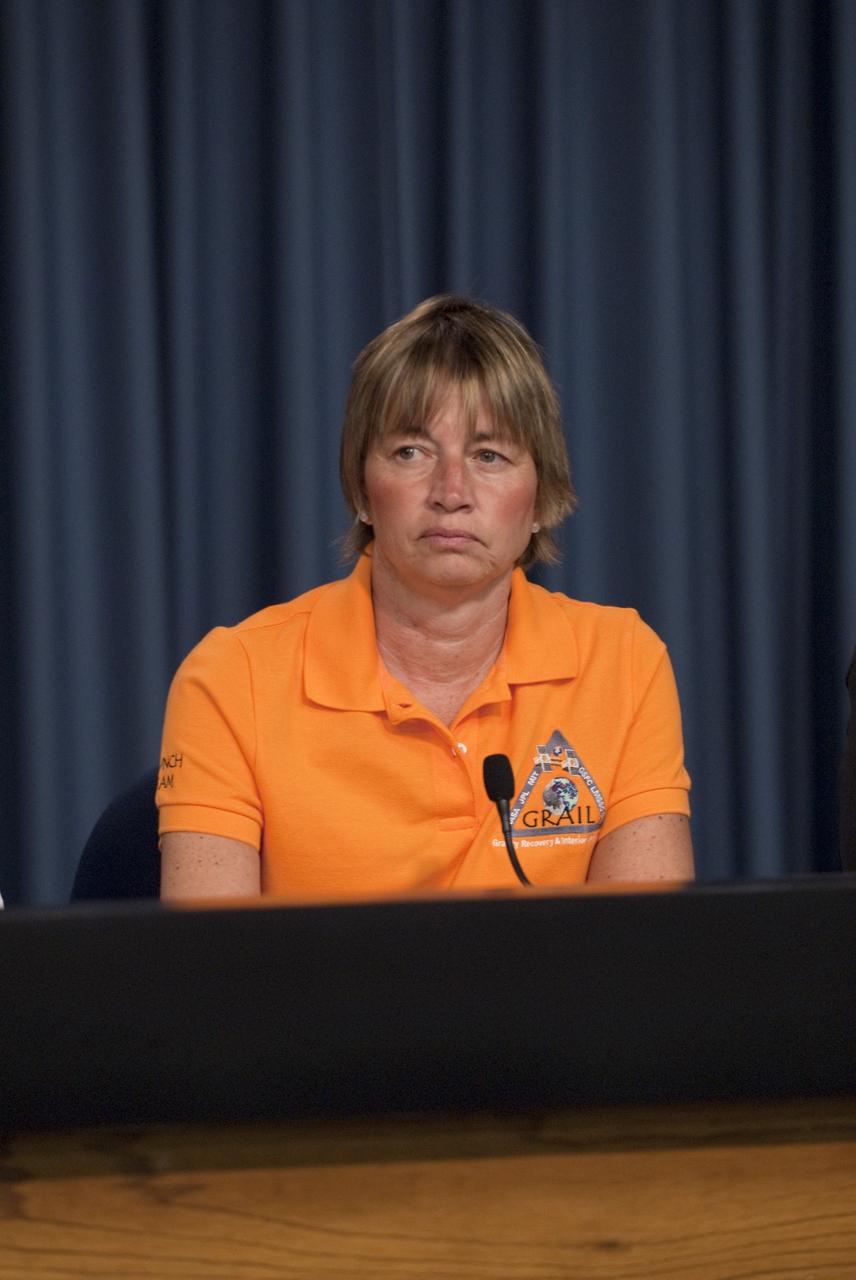
CAPE CANAVERAL, Fla. – – Maria Zuber, GRAIL principal investigator with the Massachusetts Institute of Technology, participates in the Gravity Recovery and Interior Laboratory (GRAIL) mission science briefing in the NASA Press Site auditorium at NASA's Kennedy Space Center in Florida. GRAIL is scheduled to launch Sept. 8 aboard a United Launch Alliance Delta II Heavy rocket from Cape Canaveral Air Force Station in Florida. GRAIL will fly twin spacecraft in tandem around the moon to precisely measure and map variations in the moon's gravitational field. The mission will provide the most accurate global gravity field to date for any planet, including Earth. This detailed information will reveal differences in the density of the moon's crust and mantle and will help answer fundamental questions about the moon's internal structure, thermal evolution, and history of collisions with asteroids. The aim is to map the moon's gravity field so completely that future moon vehicles can safely navigate anywhere on the moon’s surface. For more information, visit http://www.nasa.gov/grail. Photo credit: NASA/Kim Shiflett
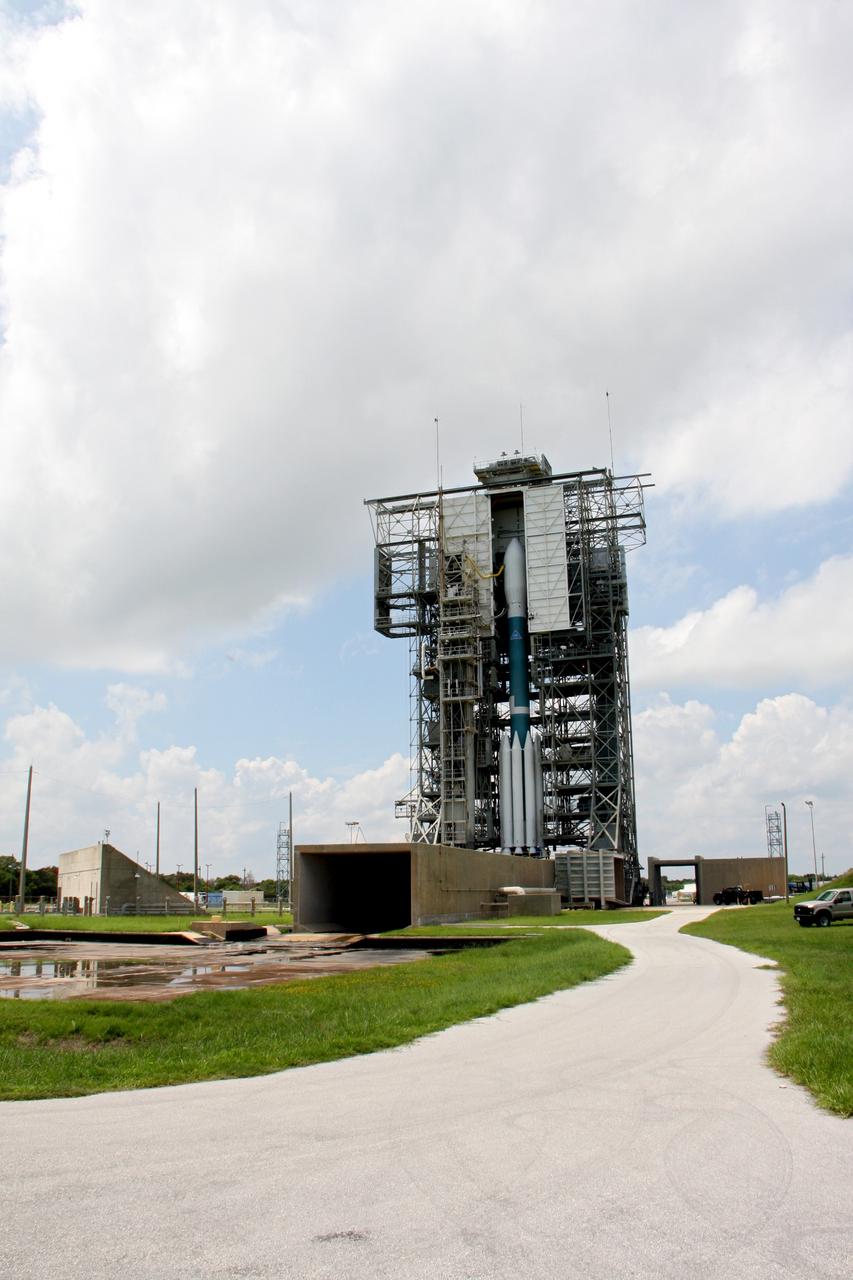
CAPE CANAVERAL, Fla. – At Space Launch Complex 17B on Cape Canaveral Air Force Station, the United Launch Alliance Delta II heavy rocket that will launch NASA's Gravity Recovery and Interior Laboratory spacecraft is rolled back around to the mobile service tower after the first launch attempt was scrubbed due to upper-level winds. GRAIL is scheduled for another launch attempt Sept.10 at 8:29:45 a.m. EDT. GRAIL will fly twin spacecraft in tandem around the moon to precisely measure and map variations in the moon's gravitational field. The mission will provide the most accurate global gravity field to date for any planet, including Earth. This detailed information will reveal differences in the density of the moon's crust and mantle and will help answer fundamental questions about the moon's internal structure, thermal evolution, and history of collisions with asteroids. The aim is to map the moon's gravity field so completely that future moon vehicles can safely navigate anywhere on the moon’s surface. For more information, visit http://www.nasa.gov/grail. Photo credit: NASA/Ken Thornsley
CAPE CANAVERAL, Fla. – – Sami Asmar, GRAIL deputy project scientist, NASA’s Jet Propulsion Laboratory, participates in the Gravity Recovery and Interior Laboratory (GRAIL) mission science briefing in the NASA Press Site auditorium at NASA's Kennedy Space Center in Florida. GRAIL is scheduled to launch Sept. 8 aboard a United Launch Alliance Delta II Heavy rocket from Cape Canaveral Air Force Station in Florida. GRAIL will fly twin spacecraft in tandem around the moon to precisely measure and map variations in the moon's gravitational field. The mission will provide the most accurate global gravity field to date for any planet, including Earth. This detailed information will reveal differences in the density of the moon's crust and mantle and will help answer fundamental questions about the moon's internal structure, thermal evolution, and history of collisions with asteroids. The aim is to map the moon's gravity field so completely that future moon vehicles can safely navigate anywhere on the moon’s surface. For more information, visit http://www.nasa.gov/grail. Photo credit: NASA/Kim Shiflett
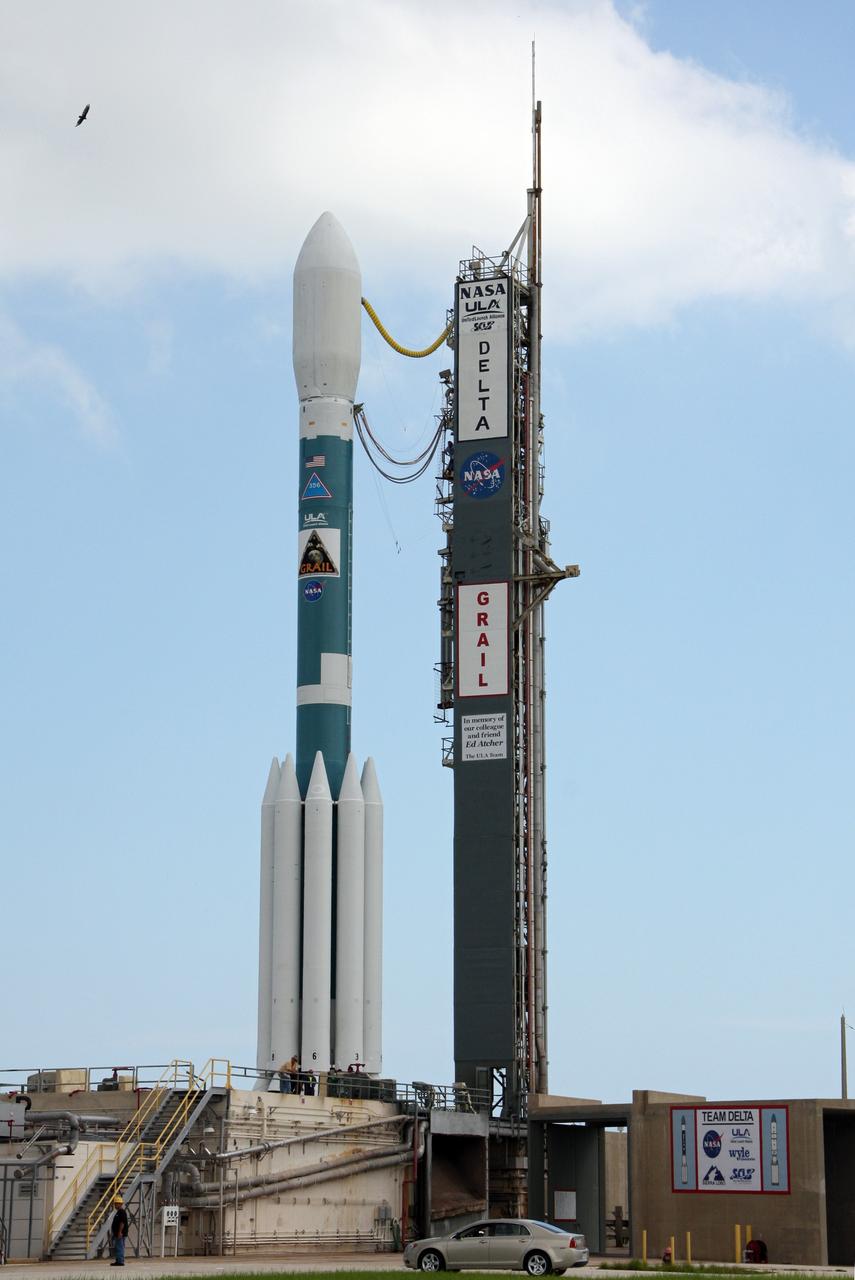
CAPE CANAVERAL, Fla. – At Space Launch Complex 17B on Cape Canaveral Air Force Station, the United Launch Alliance Delta II heavy rocket that will launch NASA's Gravity Recovery and Interior Laboratory spacecraft is rolled back around to the mobile service tower after the first launch attempt was scrubbed due to upper-level winds. GRAIL is scheduled for another launch attempt Sept.10 at 8:29:45 a.m. EDT. GRAIL will fly twin spacecraft in tandem around the moon to precisely measure and map variations in the moon's gravitational field. The mission will provide the most accurate global gravity field to date for any planet, including Earth. This detailed information will reveal differences in the density of the moon's crust and mantle and will help answer fundamental questions about the moon's internal structure, thermal evolution, and history of collisions with asteroids. The aim is to map the moon's gravity field so completely that future moon vehicles can safely navigate anywhere on the moon’s surface. For more information, visit http://www.nasa.gov/grail. Photo credit: NASA/Ken Thornsley
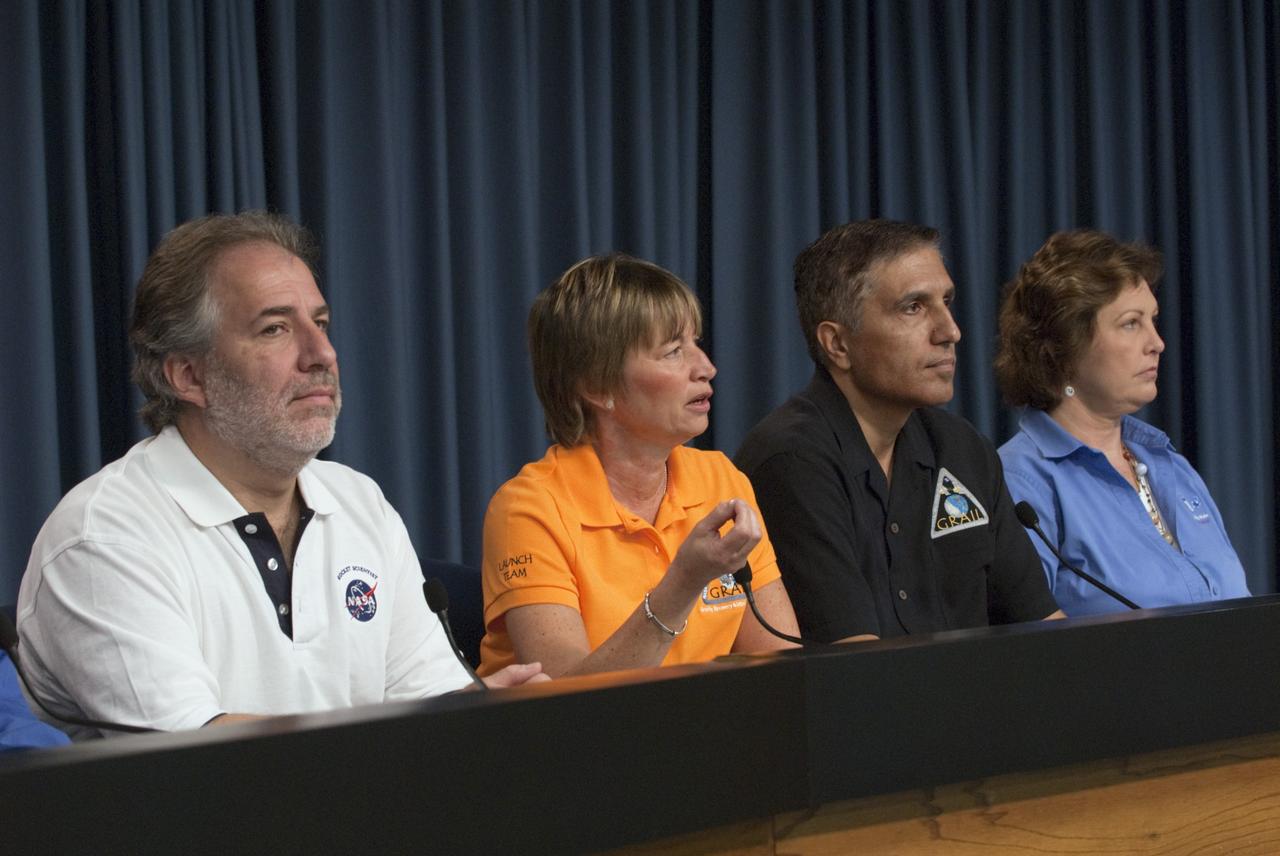
CAPE CANAVERAL, Fla. – – A Gravity Recovery and Interior Laboratory (GRAIL) mission science briefing is held in the NASA Press Site auditorium at NASA's Kennedy Space Center in Florida. From left are Robert Fogel, NASA’s GRAIL program scientist; Maria Zuber, GRAIL principal investigator with the Massachusetts Institute of Technology; Sami Asmar, GRAIL deputy project scientist, NASA’s Jet Propulsion Laboratory; and Leesa Hubbard, teacher in residence, Sally Ride Science, San Diego. GRAIL is scheduled to launch Sept. 8 aboard a United Launch Alliance Delta II Heavy rocket from Cape Canaveral Air Force Station in Florida. GRAIL will fly twin spacecraft in tandem around the moon to precisely measure and map variations in the moon's gravitational field. The mission will provide the most accurate global gravity field to date for any planet, including Earth. This detailed information will reveal differences in the density of the moon's crust and mantle and will help answer fundamental questions about the moon's internal structure, thermal evolution, and history of collisions with asteroids. The aim is to map the moon's gravity field so completely that future moon vehicles can safely navigate anywhere on the moon’s surface. For more information, visit http://www.nasa.gov/grail. Photo credit: NASA/Kim Shiflett
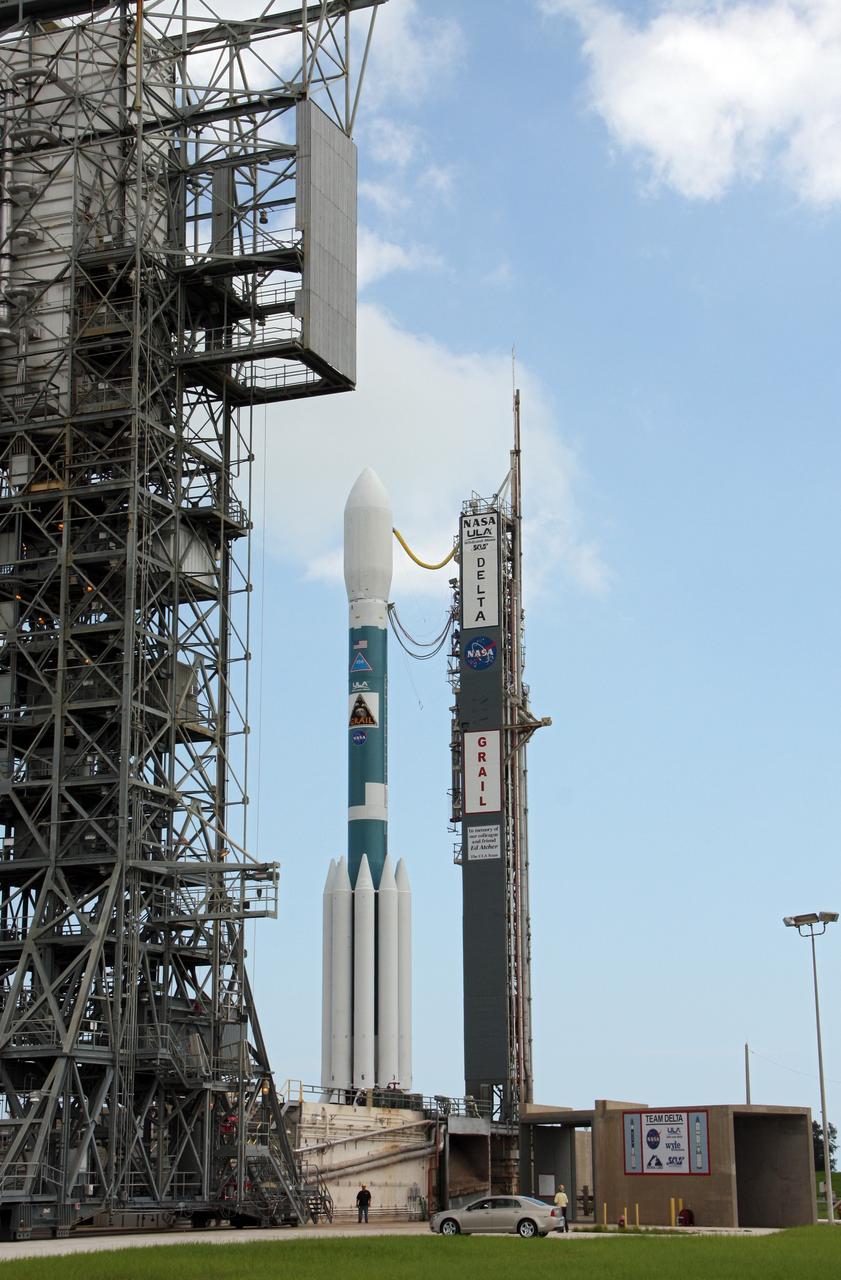
CAPE CANAVERAL, Fla. – A worker stands nearby as the United Launch Alliance Delta II heavy rocket at Space Launch Complex 17B, carrying NASA's Gravity Recovery and Interior Laboratory spacecraft, is rolled back around to the mobile service tower after the first launch attempt was scrubbed due to upper-level winds. GRAIL is scheduled for another launch attempt Sept.10 at 8:29:45 a.m. EDT at Cape Canaveral Air Force Station, Florida. GRAIL will fly twin spacecraft in tandem around the moon to precisely measure and map variations in the moon's gravitational field. The mission will provide the most accurate global gravity field to date for any planet, including Earth. This detailed information will reveal differences in the density of the moon's crust and mantle and will help answer fundamental questions about the moon's internal structure, thermal evolution, and history of collisions with asteroids. The aim is to map the moon's gravity field so completely that future moon vehicles can safely navigate anywhere on the moon’s surface. For more information, visit http://www.nasa.gov/grail. Photo credit: NASA/Ken Thornsley

CAPE CANAVERAL, Fla. – News media participate in the Gravity Recovery and Interior Laboratory (GRAIL) prelaunch news conference held in the NASA Press Site auditorium at NASA's Kennedy Space Center in Florida. On the dais, panelist from left are Ed Weiler, NASA associate administrator, Science Mission Directorate; Tim Dunn, NASA launch director for the agency’s Launch Services Program; Vernon Thorp, program manager, NASA Missions, United Launch Alliance; David Lehman, GRAIL project manager, NASA’s Jet Propulsion Laboratory; John Henk, GRAIL program manager, Lockheed Martin Space Systems, Denver, Colo.; and Joel Tumbiolo, launch weather officer, 45th Weather Squadron, Cape Canaveral Air Force Station, Fla. GRAIL is scheduled to launch Sept. 8 aboard a United Launch Alliance Delta II Heavy rocket from Cape Canaveral Air Force Station in Florida. GRAIL will fly twin spacecraft in tandem around the moon to precisely measure and map variations in the moon's gravitational field. The mission will provide the most accurate global gravity field to date for any planet, including Earth. This detailed information will reveal differences in the density of the moon's crust and mantle and will help answer fundamental questions about the moon's internal structure, thermal evolution, and history of collisions with asteroids. The aim is to map the moon's gravity field so completely that future moon vehicles can safely navigate anywhere on the moon’s surface. For more information, visit http://www.nasa.gov/grail. Photo credit: NASA/Kim Shiflett
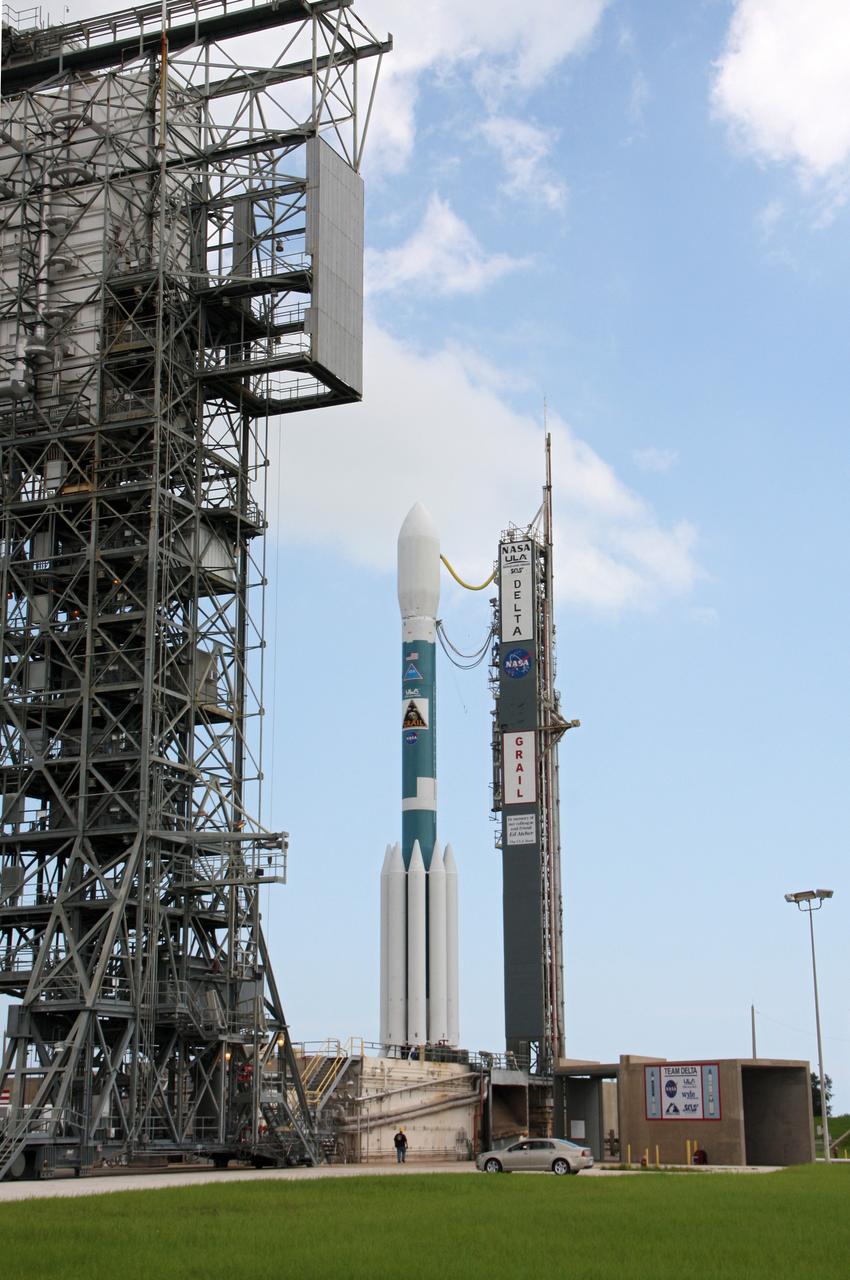
CAPE CANAVERAL, Fla. – A worker stands nearby as the United Launch Alliance Delta II heavy rocket at Space Launch Complex 17B, carrying NASA's Gravity Recovery and Interior Laboratory spacecraft, is rolled back around to the mobile service tower after the first launch attempt was scrubbed due to upper-level winds. GRAIL is scheduled for another launch attempt Sept.10 at 8:29:45 a.m. EDT at Cape Canaveral Air Force Station, Florida. GRAIL will fly twin spacecraft in tandem around the moon to precisely measure and map variations in the moon's gravitational field. The mission will provide the most accurate global gravity field to date for any planet, including Earth. This detailed information will reveal differences in the density of the moon's crust and mantle and will help answer fundamental questions about the moon's internal structure, thermal evolution, and history of collisions with asteroids. The aim is to map the moon's gravity field so completely that future moon vehicles can safely navigate anywhere on the moon’s surface. For more information, visit http://www.nasa.gov/grail. Photo credit: NASA/Ken Thornsley
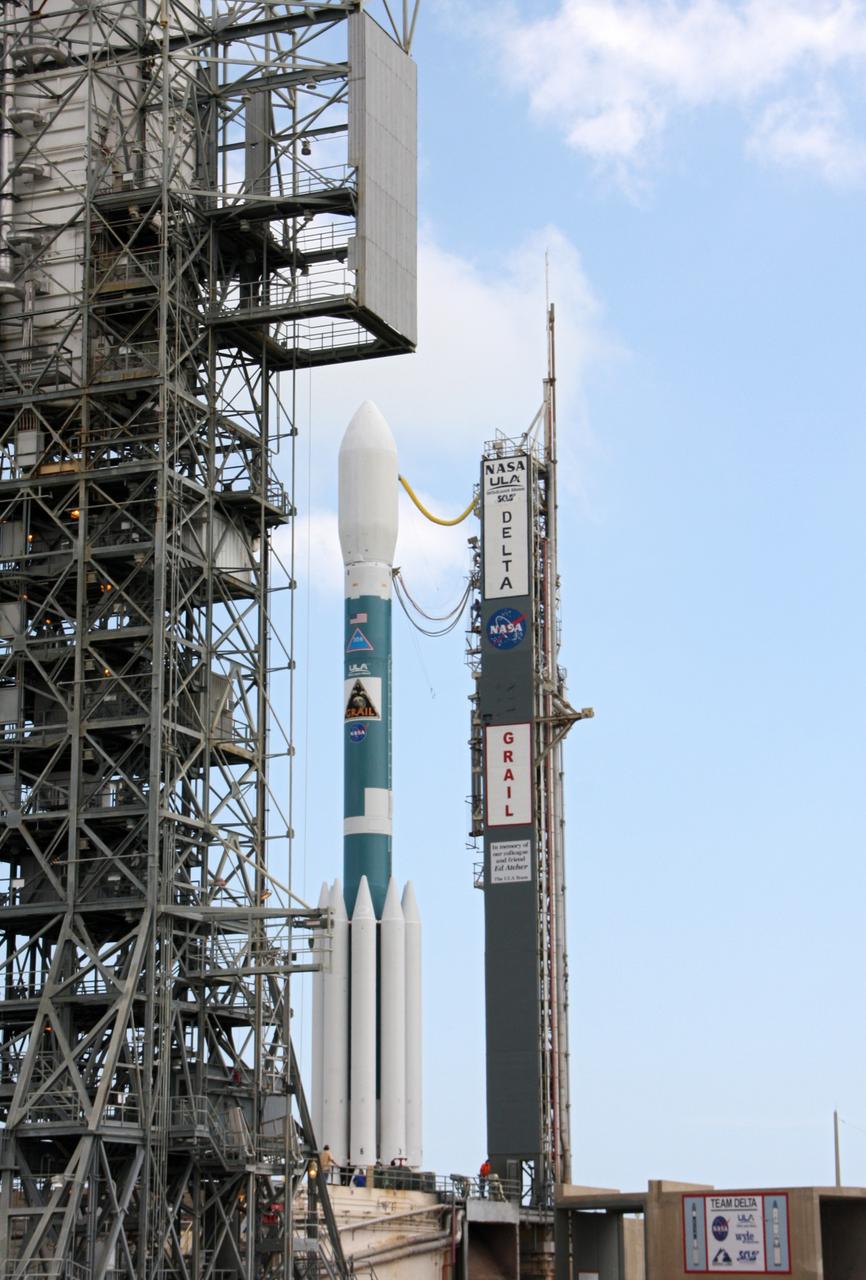
CAPE CANAVERAL, Fla. – At Space Launch Complex 17B on Cape Canaveral Air Force Station, the United Launch Alliance Delta II heavy rocket that will launch NASA's Gravity Recovery and Interior Laboratory spacecraft is rolled back around to the mobile service tower after the first launch attempt was scrubbed due to upper-level winds. GRAIL is scheduled for another launch attempt Sept.10 at 8:29:45 a.m. EDT. GRAIL will fly twin spacecraft in tandem around the moon to precisely measure and map variations in the moon's gravitational field. The mission will provide the most accurate global gravity field to date for any planet, including Earth. This detailed information will reveal differences in the density of the moon's crust and mantle and will help answer fundamental questions about the moon's internal structure, thermal evolution, and history of collisions with asteroids. The aim is to map the moon's gravity field so completely that future moon vehicles can safely navigate anywhere on the moon’s surface. For more information, visit http://www.nasa.gov/grail. Photo credit: NASA/Ken Thornsley

CAPE CANAVERAL, Fla. – David Lehman, GRAIL project manager, NASA’s Jet Propulsion Laboratory, participates in the Gravity Recovery and Interior Laboratory (GRAIL) prelaunch news conference in the NASA Press Site auditorium at NASA's Kennedy Space Center in Florida. GRAIL is scheduled to launch Sept. 8 aboard a United Launch Alliance Delta II Heavy rocket from Cape Canaveral Air Force Station in Florida. GRAIL will fly twin spacecraft in tandem around the moon to precisely measure and map variations in the moon's gravitational field. The mission will provide the most accurate global gravity field to date for any planet, including Earth. This detailed information will reveal differences in the density of the moon's crust and mantle and will help answer fundamental questions about the moon's internal structure, thermal evolution, and history of collisions with asteroids. The aim is to map the moon's gravity field so completely that future moon vehicles can safely navigate anywhere on the moon’s surface. For more information, visit http://www.nasa.gov/grail. Photo credit: NASA/Kim Shiflett
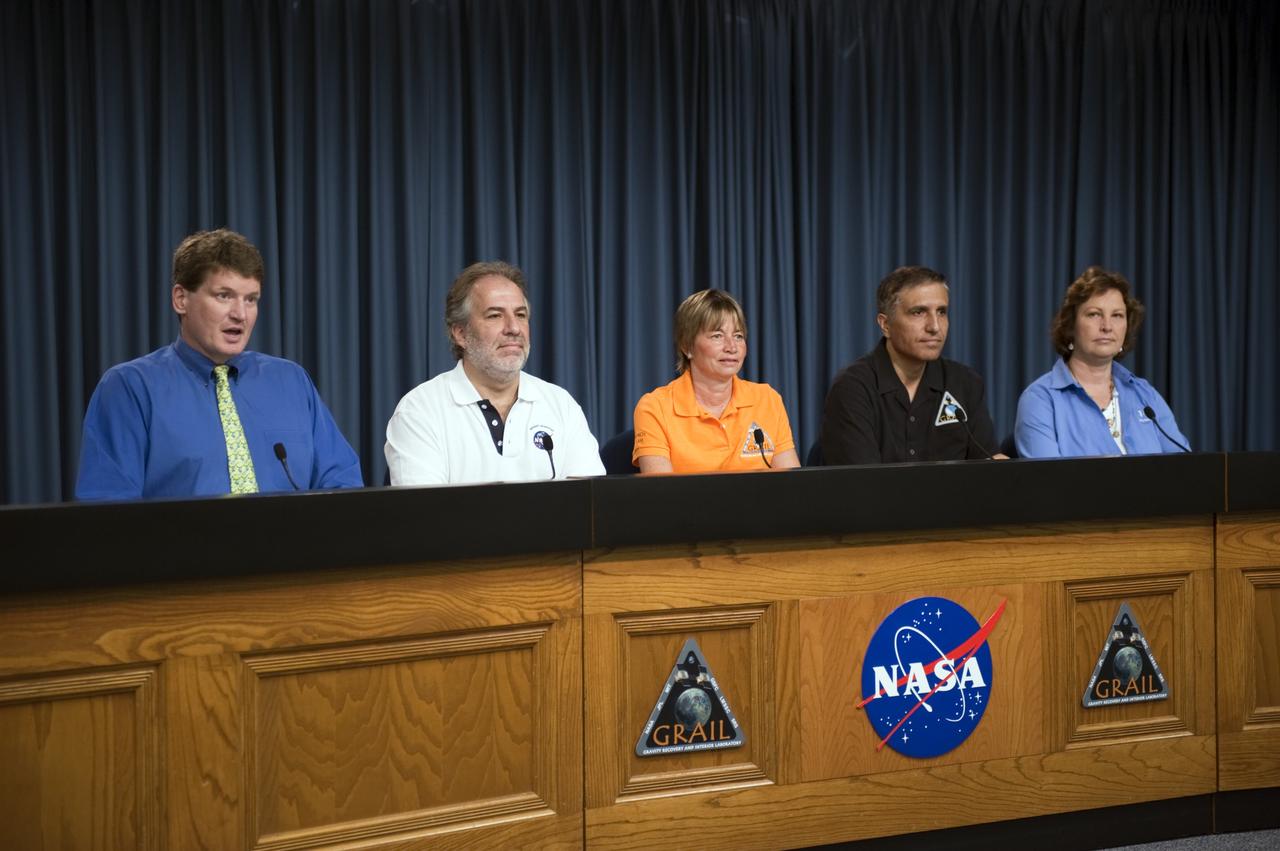
CAPE CANAVERAL, Fla. – – A Gravity Recovery and Interior Laboratory (GRAIL) mission science briefing is held in the NASA Press Site auditorium at NASA's Kennedy Space Center in Florida. From left are DC Agle, NASA Public Affairs; Robert Fogel, NASA’s GRAIL program scientist; Maria Zuber, GRAIL principal investigator with the Massachusetts Institute of Technology; Sami Asmar, GRAIL deputy project scientist, NASA’s Jet Propulsion Laboratory; and Leesa Hubbard, teacher in residence, Sally Ride Science, San Diego. GRAIL is scheduled to launch Sept. 8 aboard a United Launch Alliance Delta II Heavy rocket from Cape Canaveral Air Force Station in Florida. GRAIL will fly twin spacecraft in tandem around the moon to precisely measure and map variations in the moon's gravitational field. The mission will provide the most accurate global gravity field to date for any planet, including Earth. This detailed information will reveal differences in the density of the moon's crust and mantle and will help answer fundamental questions about the moon's internal structure, thermal evolution, and history of collisions with asteroids. The aim is to map the moon's gravity field so completely that future moon vehicles can safely navigate anywhere on the moon’s surface. For more information, visit http://www.nasa.gov/grail. Photo credit: NASA/Kim Shiflett
CAPE CANAVERAL, Fla. – John Henk, GRAIL program manager, Lockheed Martin Space Systems, Denver, Colo., participates in the Gravity Recovery and Interior Laboratory (GRAIL) prelaunch news conference in the NASA Press Site auditorium at NASA's Kennedy Space Center in Florida. GRAIL is scheduled to launch Sept. 8 aboard a United Launch Alliance Delta II Heavy rocket from Cape Canaveral Air Force Station in Florida. GRAIL will fly twin spacecraft in tandem around the moon to precisely measure and map variations in the moon's gravitational field. The mission will provide the most accurate global gravity field to date for any planet, including Earth. This detailed information will reveal differences in the density of the moon's crust and mantle and will help answer fundamental questions about the moon's internal structure, thermal evolution, and history of collisions with asteroids. The aim is to map the moon's gravity field so completely that future moon vehicles can safely navigate anywhere on the moon’s surface. For more information, visit http://www.nasa.gov/grail. Photo credit: NASA/Kim Shiflett

CAPE CANAVERAL, Fla. – Actress Nichelle Nichols (Lt. Uhura on Star Trek) signs autographs for a guest at the Kennedy Space Center Visitor Complex in Florida during activities for the agency’s Gravity Recovery and Interior Laboratory mission (GRAIL). Nichols was on hand to celebrate the 45th anniversary of the first airing of the Star Trek television series. The Kennedy Space Center Visitor Complex is hosting “Star Trek: The Exhibition” to show visitors where “science fiction meets science fact.” GRAIL will fly twin spacecraft in tandem around the moon to precisely measure and map variations in the moon's gravitational field. The mission will provide the most accurate global gravity field to date for any planet, including Earth. This detailed information will reveal differences in the density of the moon's crust and mantle and will help answer fundamental questions about the moon's internal structure, thermal evolution, and history of collisions with asteroids. The aim is to map the moon's gravity field so completely that future moon vehicles can safely navigate anywhere on the moon’s surface. For more information, visit http://www.nasa.gov/grail. Photo credit: NASA/Frankie Martin
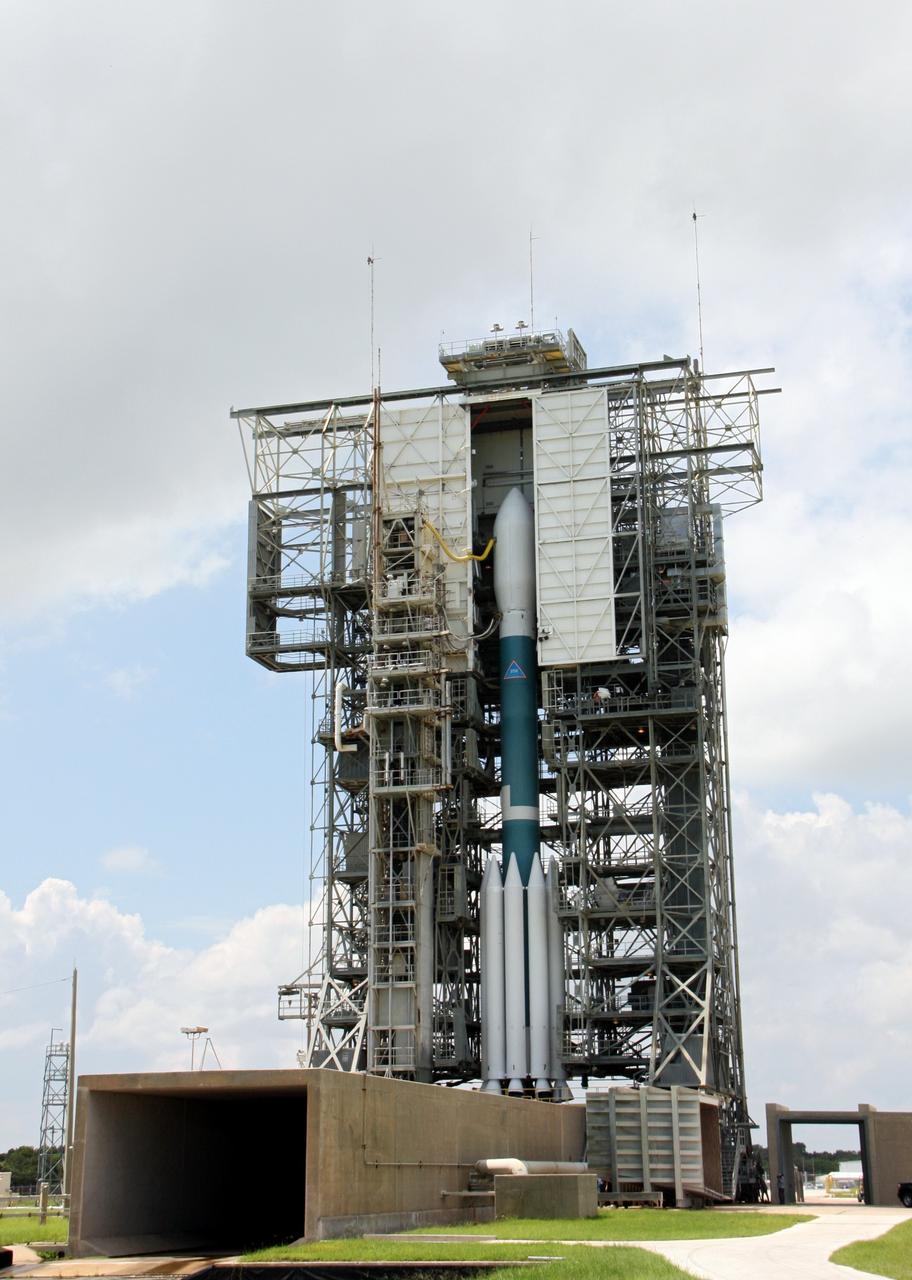
CAPE CANAVERAL, Fla. – At Space Launch Complex 17B on Cape Canaveral Air Force Station, the United Launch Alliance Delta II heavy rocket that will launch NASA's Gravity Recovery and Interior Laboratory spacecraft is rolled back around to the mobile service tower after the first launch attempt was scrubbed due to upper-level winds. GRAIL is scheduled for another launch attempt Sept.10 at 8:29:45 a.m. EDT. GRAIL will fly twin spacecraft in tandem around the moon to precisely measure and map variations in the moon's gravitational field. The mission will provide the most accurate global gravity field to date for any planet, including Earth. This detailed information will reveal differences in the density of the moon's crust and mantle and will help answer fundamental questions about the moon's internal structure, thermal evolution, and history of collisions with asteroids. The aim is to map the moon's gravity field so completely that future moon vehicles can safely navigate anywhere on the moon’s surface. For more information, visit http://www.nasa.gov/grail. Photo credit: NASA/Ken Thornsley

IM-1, the first NASA Commercial Launch Program Services launch for Intuitive Machines’ Nova-C lunar lander, will carry multiple payloads to the Moon, including Lunar Node-1, demonstrating autonomous navigation via radio beacon to support precise geolocation and navigation among lunar orbiters, landers, and surface personnel. NASA’s CLPS initiative oversees industry development of small robotic landers and rovers to support NASA’s Artemis campaign.
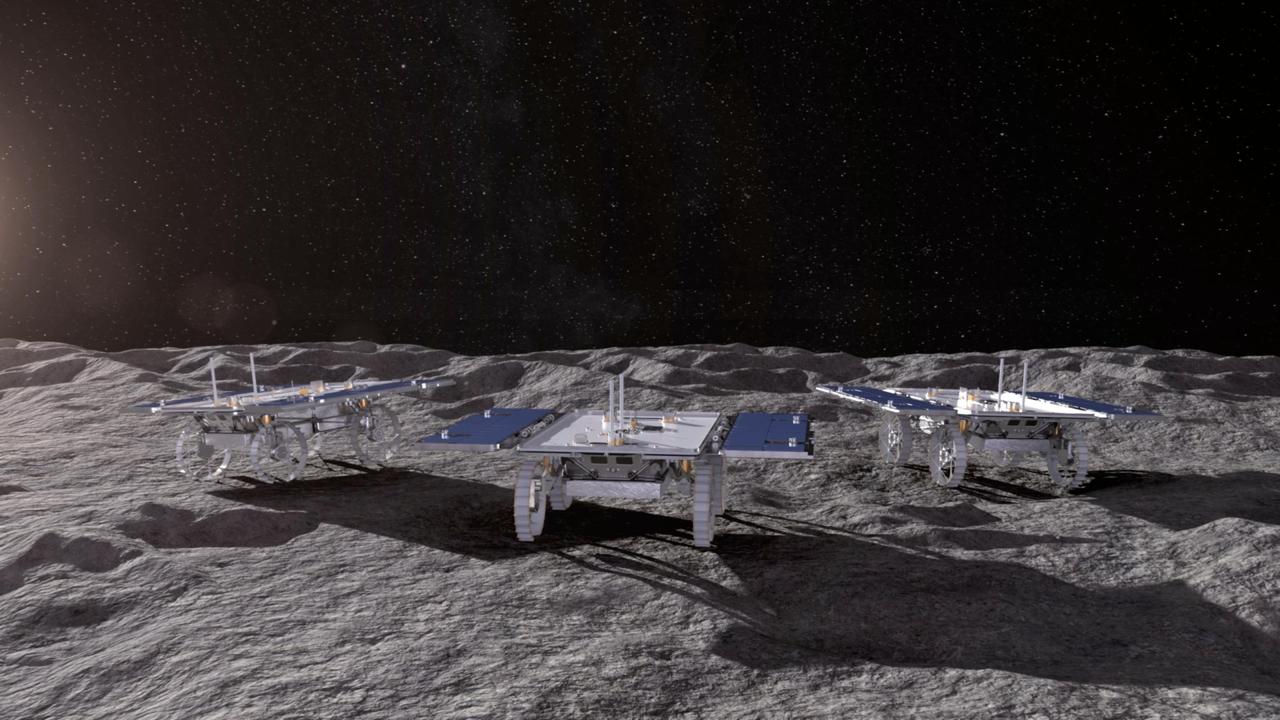
This animated artist's concept depicts three small rovers – part of NASA's CADRE (Cooperative Autonomous Distributed Robotic Exploration) technology demonstration headed for the Moon – driving together on the lunar surface. Motiv Space Systems in Pasadena, California, created the rendering and collaborated with NASA's Jet Propulsion Laboratory on critical rover and mobility functions. Slated to arrive aboard a lunar lander at the Reiner Gamma region of the Moon under NASA's CLPS (Commercial Lunar Payload Services) initiative, CADRE is designed to demonstrate that multiple robots can cooperate and explore together autonomously – without direct input from human mission controllers. A trio of the miniature solar-powered rovers, each about the size of a carry-on suitcase, will explore the Moon as a team, communicating via radio with each other and a base station aboard the lander. By taking simultaneous measurements from multiple locations, CADRE will also demonstrate how multirobot missions can record data impossible for a single robot to achieve – a tantalizing prospect for future missions. Motiv contributed subsystems and hardware elements for three of four CADRE systems, including designing and building the mobility system and rover chassis, the base station, the rover deployers, and the motor controller boards. The company also procured and tested the actuators with the flight motor controller boards. Animation available at https://photojournal.jpl.nasa.gov/catalog/PIA26296
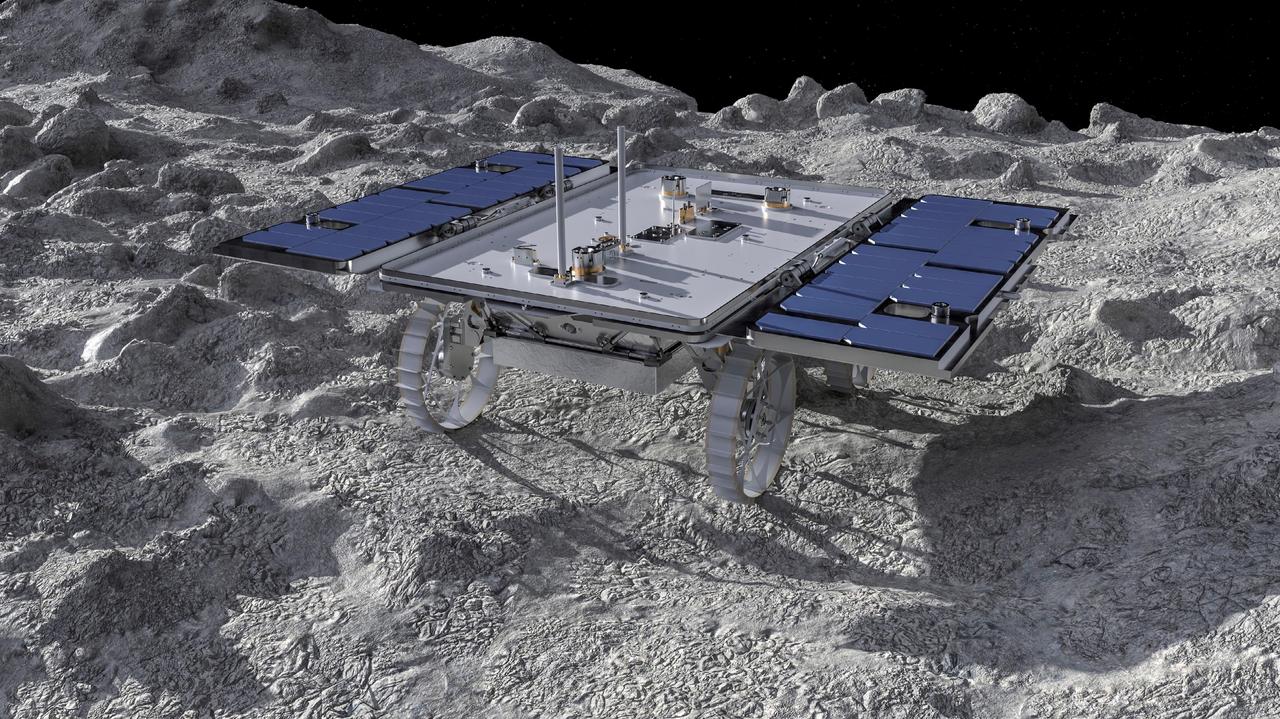
This artist's concept depicts a small rover – part of NASA's CADRE (Cooperative Autonomous Distributed Robotic Exploration) technology demonstration headed for the Moon – on the lunar surface. Motiv Space Systems in Pasadena, California, created the rendering and is collaborating with NASA's Jet Propulsion Laboratory on critical rover and mobility functions. Slated to arrive aboard a lunar lander in 2024 under NASA's CLPS (Commercial Lunar Payload Services) initiative, CADRE is designed to demonstrate that multiple robots can cooperate and explore together autonomously – without direct input from human mission controllers. A trio of the miniature solar-powered rovers, each about the size of a carry-on suitcase, will explore the Moon as a team, communicating via radio with each other and a base station aboard a lunar lander. By taking simultaneous measurements from multiple locations, CADRE will also demonstrate how multirobot missions can record data impossible for a single robot to achieve – a tantalizing prospect for future missions. Motiv contributed subsystems and hardware elements for three of four CADRE systems, including designing and building the mobility system and rover chassis, the base station, the rover deployers, and the motor controller boards. The company also procured and tested the actuators with the flight motor controller boards. https://photojournal.jpl.nasa.gov/catalog/PIA26161
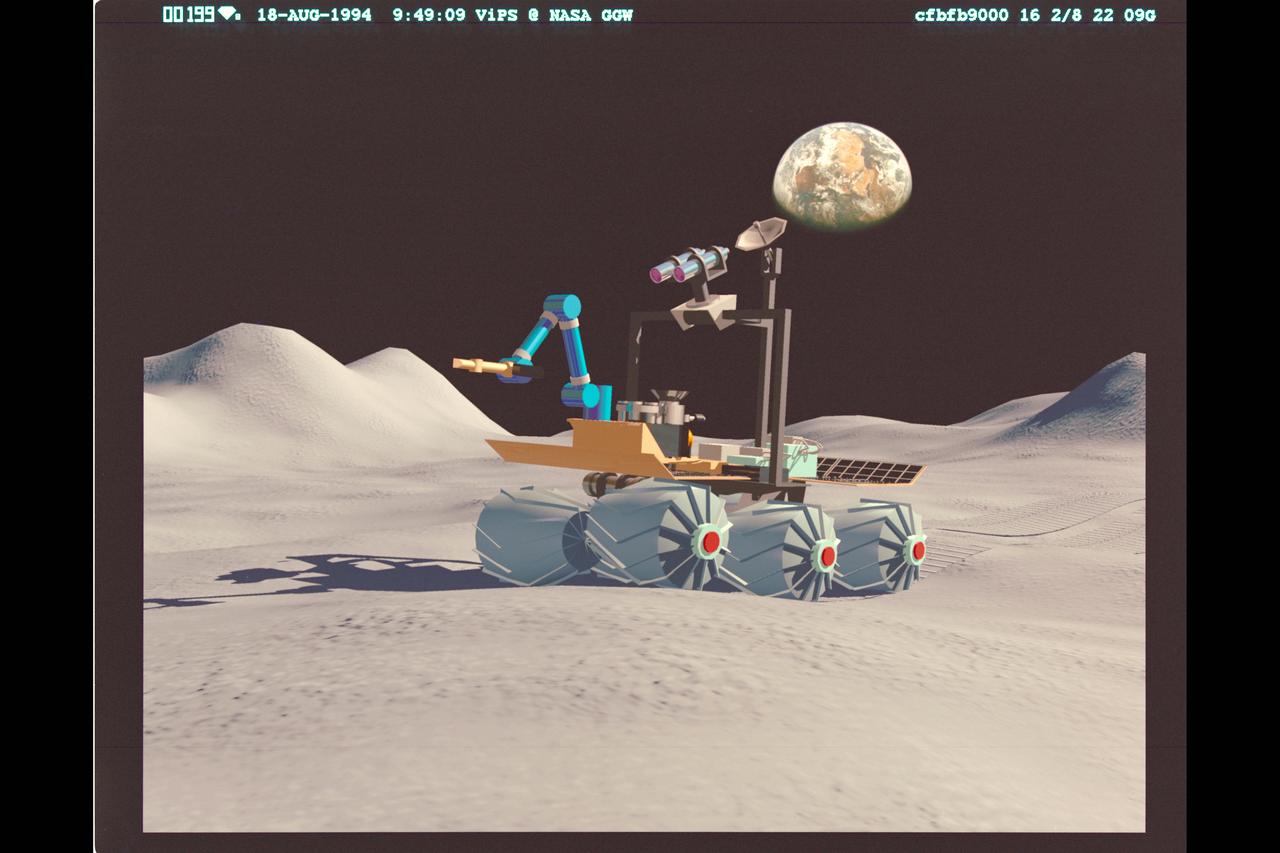
Digital Art by Boris Rabin Telepresence: Russian Rover Marsakhod on Lunar surface
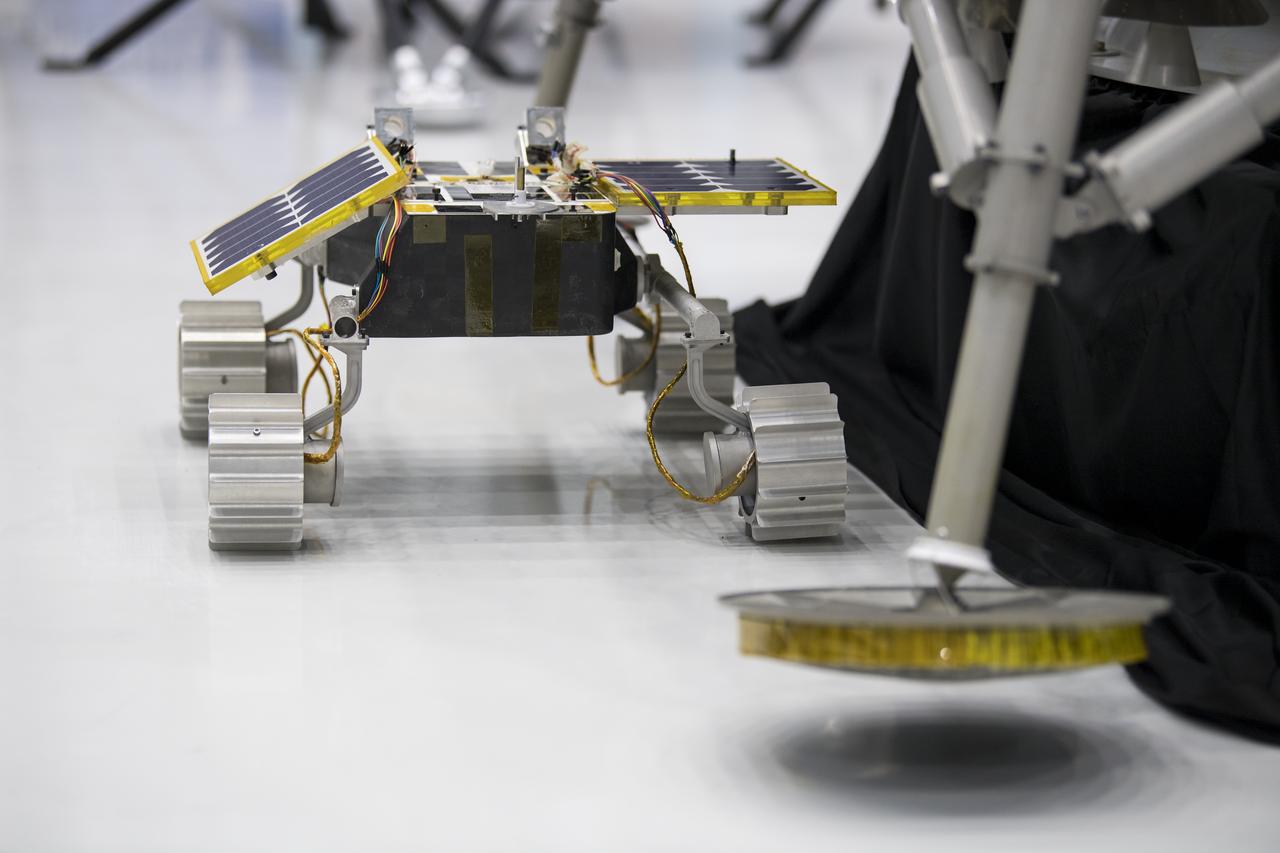
The OrbitBeyond lunar rover is seen, Friday, May 31, 2019, at Goddard Space Flight Center in Md. Astrobotic, Intuitive Machines, and OrbitBeyond have been selected to provide the first lunar landers for the Artemis program's lunar surface exploration. Photo credit: (NASA/Aubrey Gemignani)
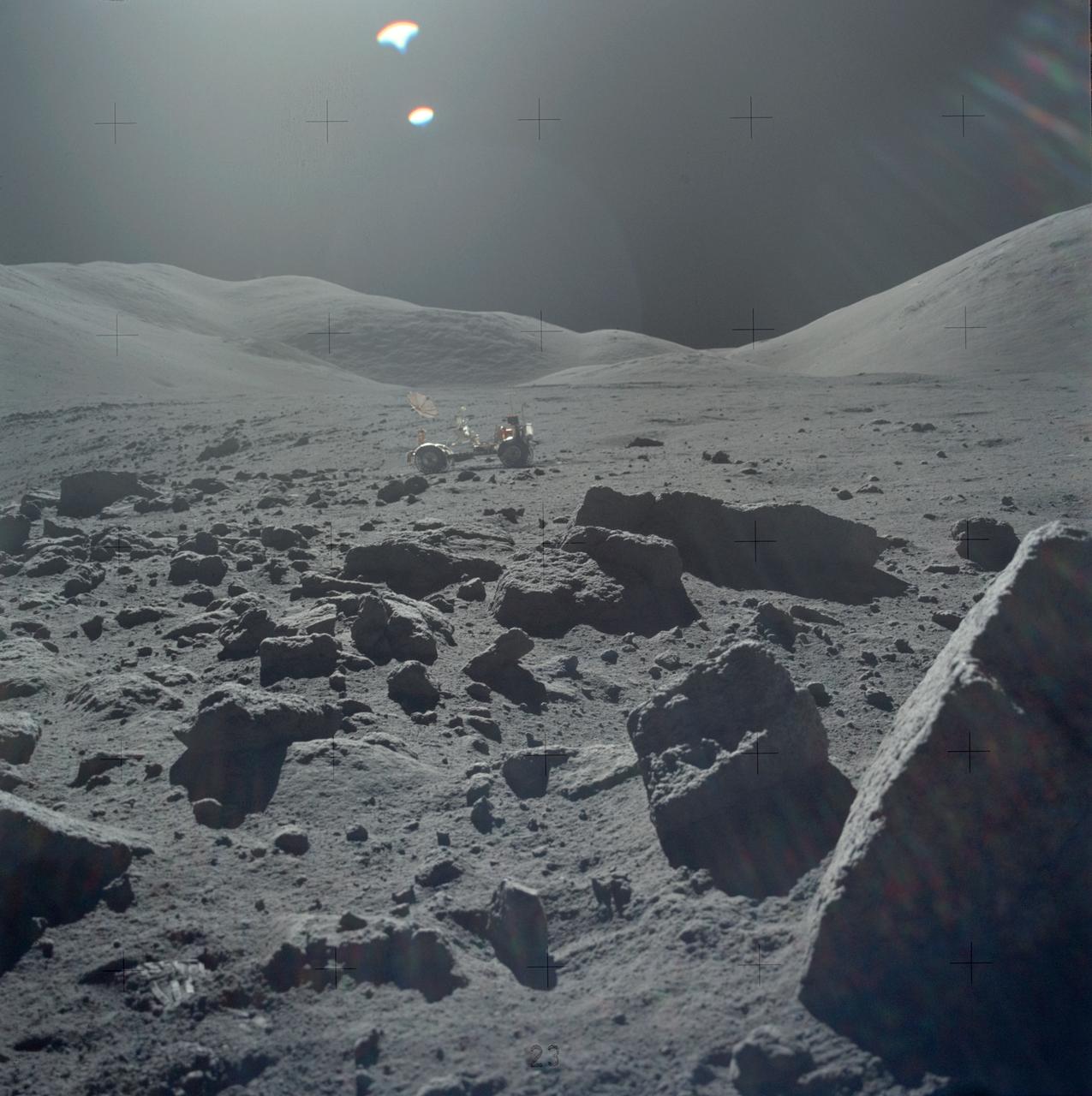
AS17-145-22162 (7-19 Dec. 1972) --- One of the Apollo 17 crew photographed this view during lunar surface extravehicular activities (EVA) at the Taurus-Littrow landing site. The Lunar Rover Vehicle (LRV), which was used extensively by astronauts Eugene A. Cernan and Harrison H. Schmitt, is visible in the background.
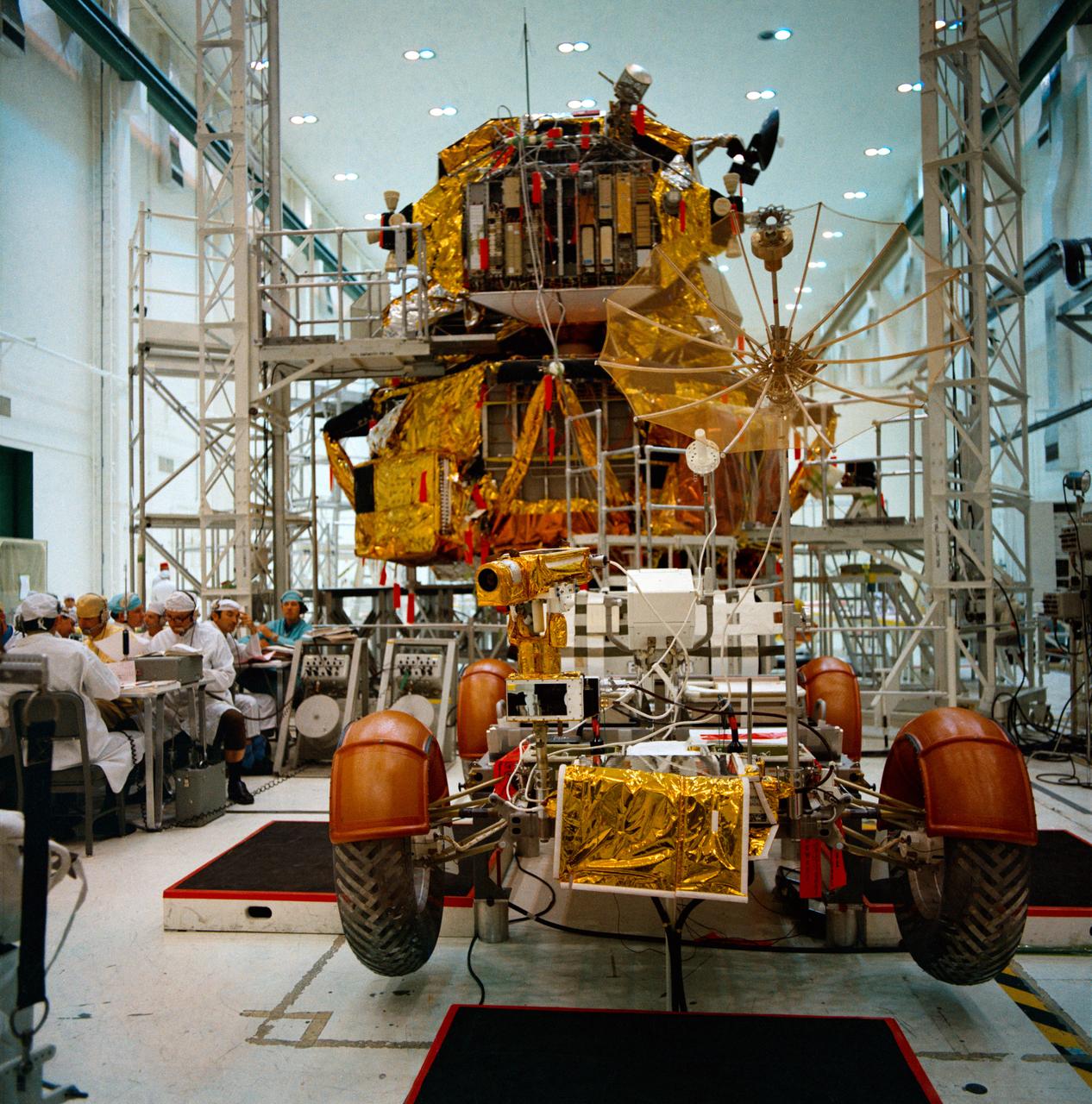
S71-30542 (21 April 1971) --- An overall view of the Apollo 15 Lunar Roving Vehicle (LRV) and the Lunar Module (LM) during simulations at the Kennedy Space Center (KSC). Astronauts David R. Scott, commander, and James B. Irwin, lunar module pilot, will man the LRV on the lunar surface during their August 1971 traverses. Rover 1 will permit the astronauts to cover a larger area of the moon for exploration and sample collecting than on previous missions.
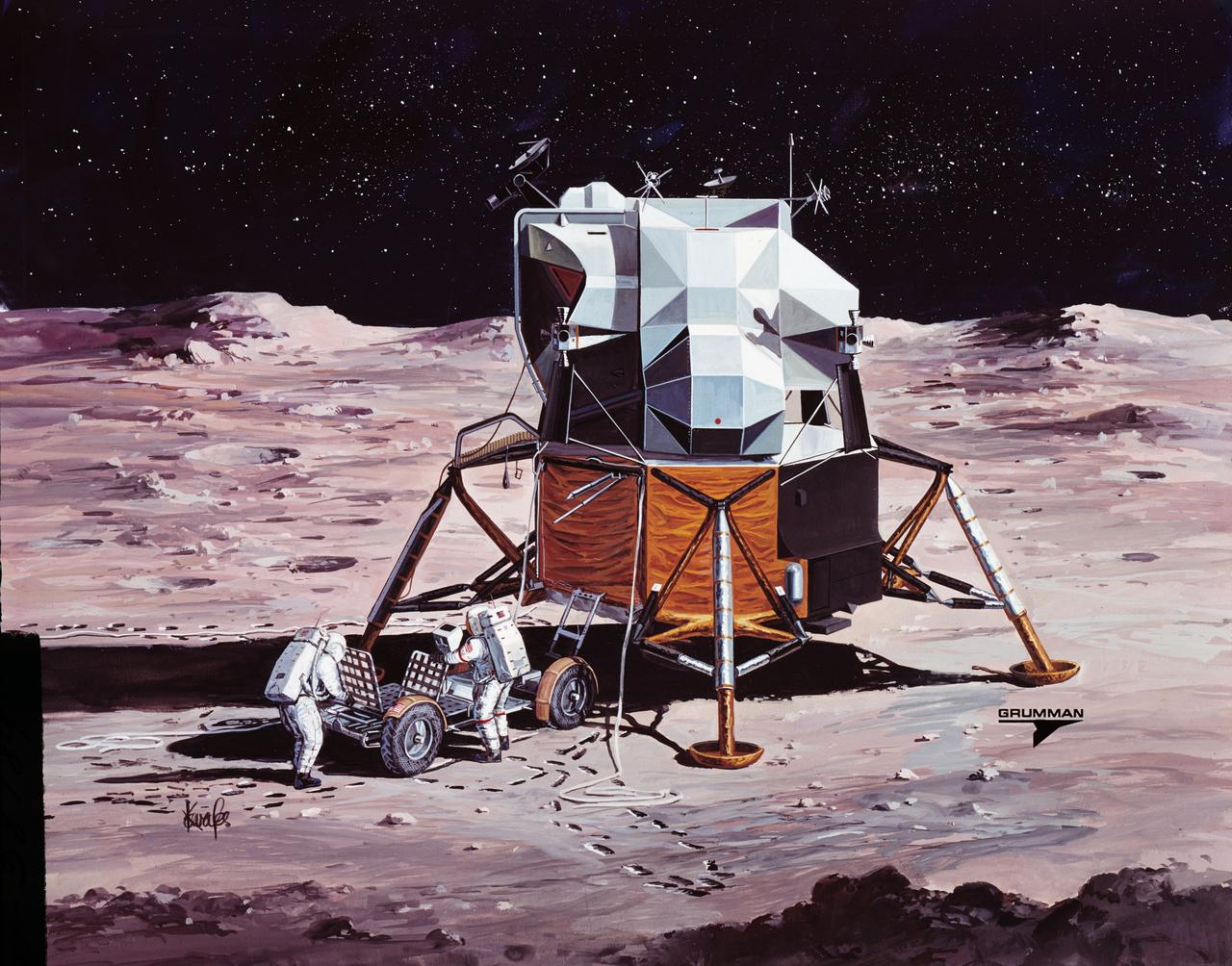
S71-38189 (26 June 1971) --- An artist's concept showing the final steps of readying the Apollo 15 Lunar Roving Vehicle (LRV) or Rover 1 for mobility on the lunar surface. Performing the last few LRV deployment tasks here are, left to right, astronauts James B. Irwin, lunar module pilot, and David R. Scott, commander. More specifically the tasks depicted here include the setting up of the seats and the total releasing of the LRV from the LM. (This is the fourth in a series of four Grumman Aerospace Corporation artist's concepts telling the lunar surface LRV deployment story for Apollo 15).
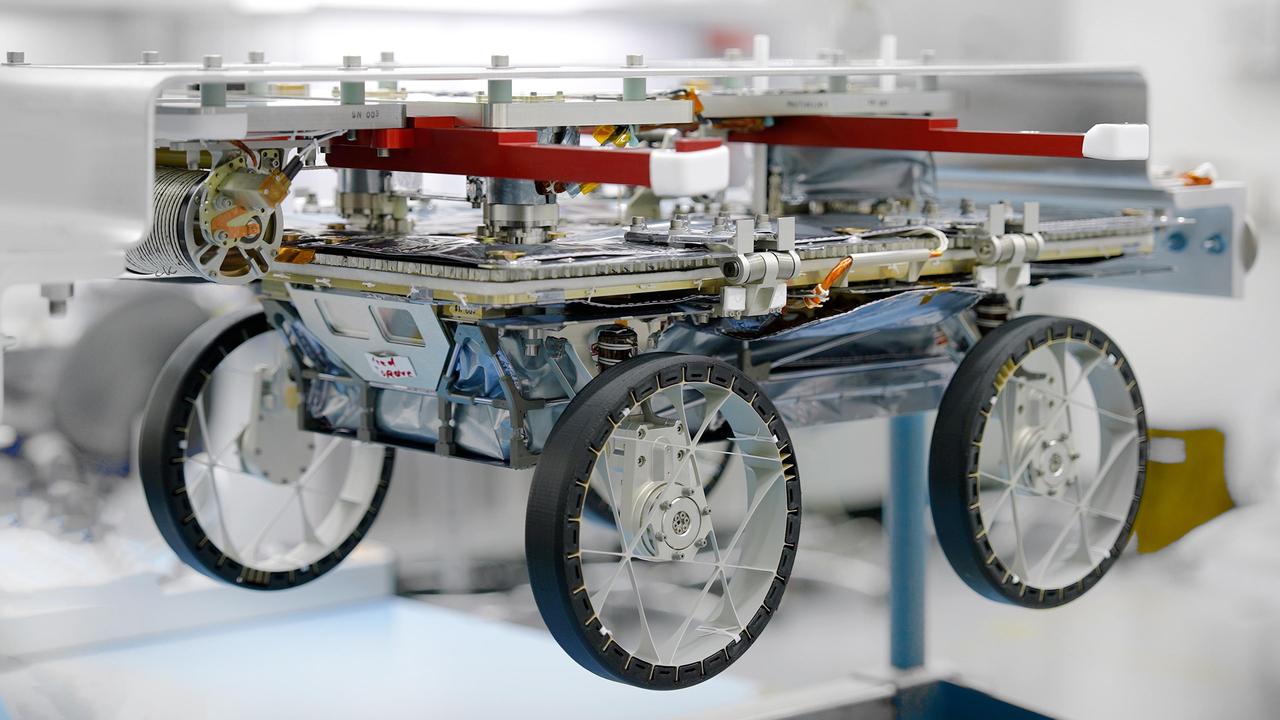
One of three small lunar rovers that are part of a NASA technology demonstration called CADRE (Cooperative Autonomous Distributed Robotic Exploration) is attached to a fixture in a clean room at the agency's Jet Propulsion Laboratory in Southern California on Jan. 29, 2025. Less than two weeks later, the rover had been packed up and shipped off in preparation for launch. CADRE aims to prove that a group of robots can collaborate to gather data without receiving direct commands from mission controllers on Earth. Its trio of rovers will use their cameras and ground-penetrating radars to send back imagery of the lunar surface and subsurface while testing out the novel software systems that enable them to work together as a team autonomously. Before embarking on the first leg of a multistage journey to the Moon, each rover was mated to its deployer system, which will lower it via tether from an Intuitive Machines lander onto the dusty lunar surface. Engineers flipped each rover-deployer pair over and attached it to an aluminum plate for safe transit. The rovers were then sealed into protective metal-frame enclosures that were fitted snuggly into metal shipping containers and loaded onto a truck for the drive to Intuitive Machines' Houston facility. A division of Caltech in Pasadena, California, JPL manages CADRE for the Game Changing Development program within NASA's Space Technology Mission Directorate in Washington. The technology demonstration was selected under the agency's Lunar Surface Innovation Initiative, which was established to expedite the development of technologies for sustained presence on the lunar surface. CADRE will launch as a payload on the third lunar lander mission by Intuitive Machines, called IM-3, under NASA's CLPS (Commercial Lunar Payload Services) initiative, which is managed by the agency's Science Mission Directorate, also in Washington. The agency's Glenn Research Center in Cleveland and its Ames Research Center in Silicon Valley, California, both supported the project. Motiv Space Systems designed and built key hardware elements at the company's Pasadena facility. Clemson University in South Carolina contributed research in support of the project. For more about CADRE, go to: https://go.nasa.gov/cadre https://photojournal.jpl.nasa.gov/catalog/PIA26428
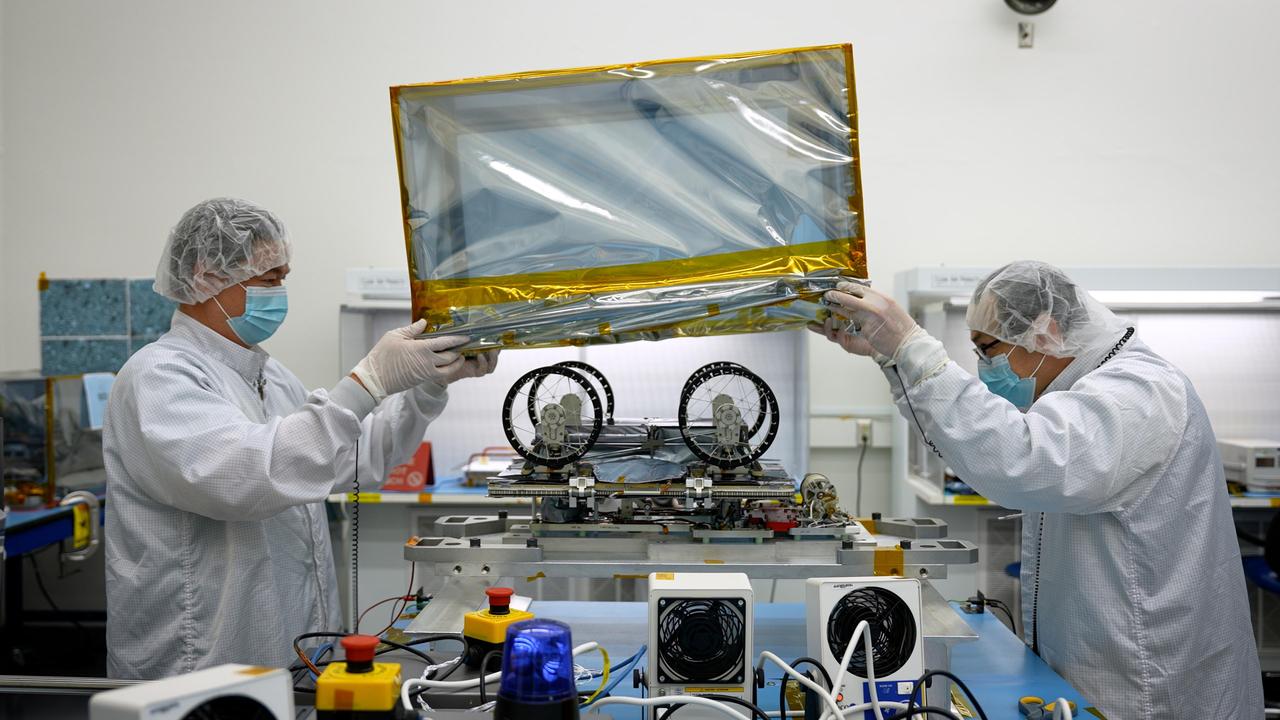
Engineers and technicians prepare one of three small lunar rovers that are part of a NASA technology demonstration called CADRE (Cooperative Autonomous Distributed Robotic Exploration). Mechanical engineer Kristopher Sherrill, left, and technician Leroy Montalvo lower an enclosure over the upside-down rover in a clean room at the agency's Jet Propulsion Laboratory in Southern California on Jan. 29, 2025. CADRE aims to prove that a group of robots can collaborate to gather data without receiving direct commands from mission controllers on Earth. Its trio of rovers will use their cameras and ground-penetrating radars to send back imagery of the lunar surface and subsurface while testing out the novel software systems that enable them to work together as a team autonomously. Before embarking on the first leg of a multistage journey to the Moon, each rover was mated to its deployer system, which will lower it via tether from an Intuitive Machines lander onto the dusty lunar surface. Engineers flipped each rover-deployer pair over and attached it to an aluminum plate for safe transit. The rovers were then sealed into protective metal-frame enclosures that were fitted snuggly into metal shipping containers and loaded onto a truck for the drive to Intuitive Machines' Houston facility. A division of Caltech in Pasadena, California, JPL manages CADRE for the Game Changing Development program within NASA's Space Technology Mission Directorate in Washington. The technology demonstration was selected under the agency's Lunar Surface Innovation Initiative, which was established to expedite the development of technologies for sustained presence on the lunar surface. CADRE will launch as a payload on the third lunar lander mission by Intuitive Machines, called IM-3, under NASA's CLPS (Commercial Lunar Payload Services) initiative, which is managed by the agency's Science Mission Directorate, also in Washington. The agency's Glenn Research Center in Cleveland and its Ames Research Center in Silicon Valley, California, both supported the project. Motiv Space Systems designed and built key hardware elements at the company's Pasadena facility. Clemson University in South Carolina contributed research in support of the project. For more about CADRE, go to: https://go.nasa.gov/cadre https://photojournal.jpl.nasa.gov/catalog/PIA26426
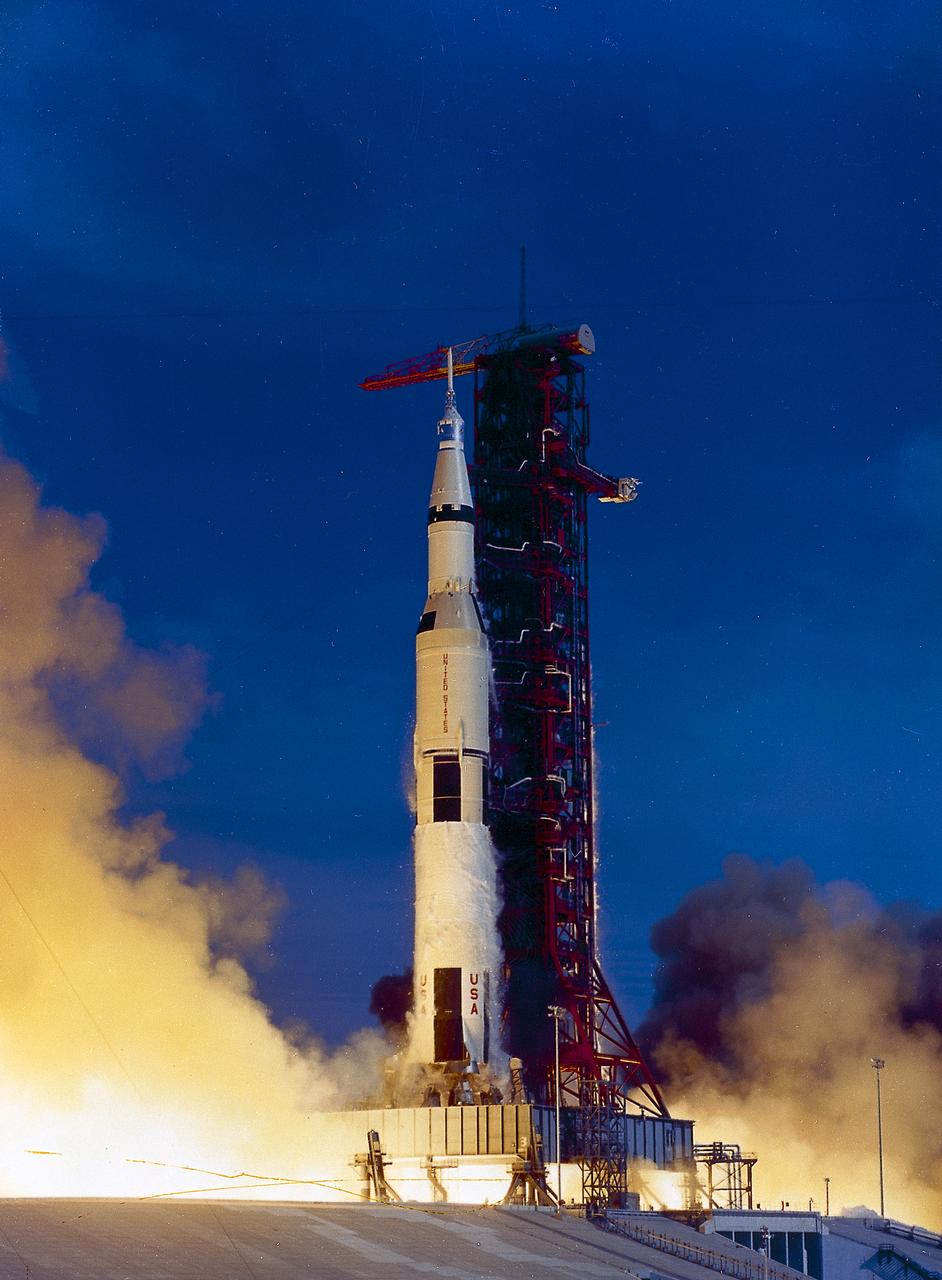
The fifth marned lunar landing mission, Apollo 15 (SA-510), carrying a crew of three astronauts: Mission commander David R. Scott, Lunar Module pilot James B. Irwin, and Command Module pilot Alfred M. Worden Jr., lifted off on July 26, 1971. Astronauts Scott and Irwin were the first to use a wheeled surface vehicle, the Lunar Roving Vehicle, or the Rover, which was designed and developed by the Marshall Space Flight Center, and built by the Boeing Company. Astronauts spent 13 days, nearly 67 hours, on the Moon's surface to inspect a wide variety of its geological features.

A model of the Pressurized lunar rover is seen during a briefing discussing the historic agreement signed April 9th at NASA Headquarters, between the United States and Japan to advance sustainable human exploration of the Moon, Wednesday, April 10, 2024, at the Japan Aerospace Exploration Agency (JAXA) offices in Washington. Under the agreement, Japan will design, develop, and operate a pressurized rover for crewed and uncrewed exploration on the Moon. NASA will provide the launch and delivery of the rover to the Moon as well as two Japanese astronaut missions to the lunar surface. Photo Credit: Photo Credit: (NASA/Bill Ingalls)
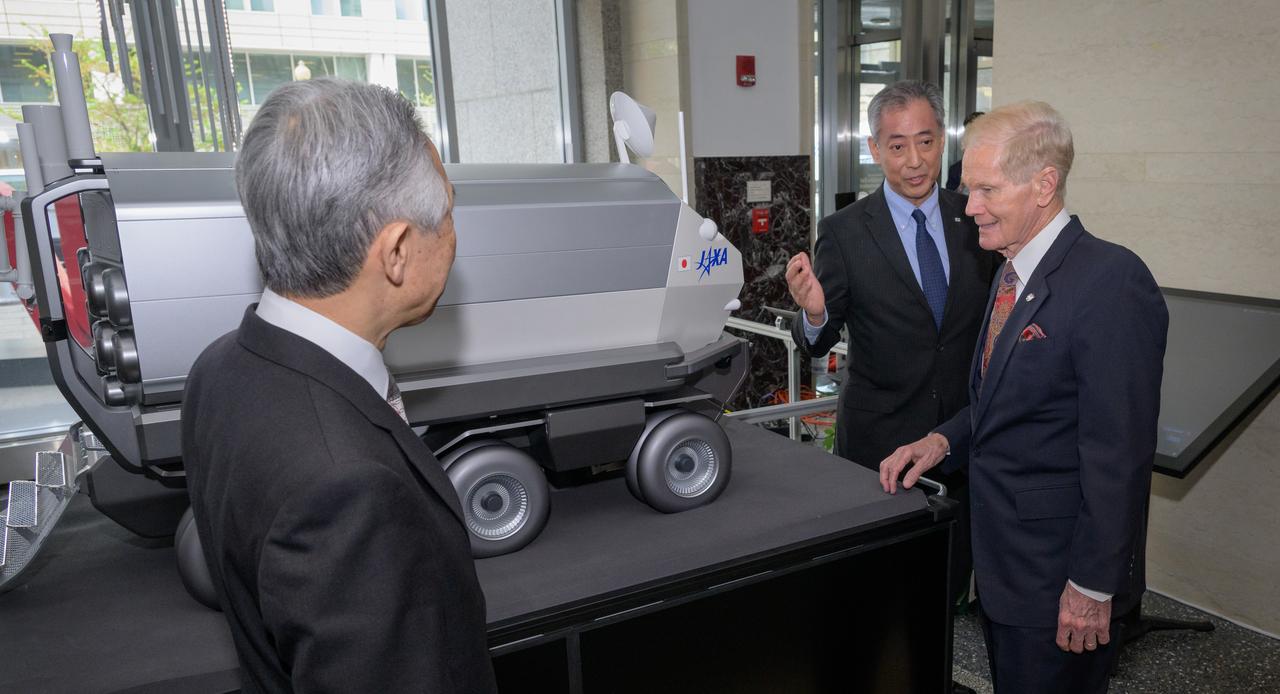
Japan’s Minister of Education, Culture, Sports, Science and Technology Masahito Moriyama, left, Japan Aerospace Exploration Agency (JAXA) President Hiroshi Yamakawa, and NASA Administrator Bill Nelson, right, look at a model of the Pressurized lunar rover, prior to the signing an historic agreement between the United States and Japan to advance sustainable human exploration of the Moon, Tuesday, April 9, 2024, at the NASA Headquarters Mary W. Jackson Building in Washington. Under the agreement, Japan will design, develop, and operate a pressurized rover for crewed and uncrewed exploration on the Moon. NASA will provide the launch and delivery of the rover to the Moon as well as two Japanese astronaut missions to the lunar surface. Photo Credit: (NASA/Bill Ingalls)

A model of the Pressurized lunar rover is seen during a briefing discussing the historic agreement signed April 9th at NASA Headquarters, between the United States and Japan to advance sustainable human exploration of the Moon, Wednesday, April 10, 2024, at the Japan Aerospace Exploration Agency (JAXA) offices in Washington. Under the agreement, Japan will design, develop, and operate a pressurized rover for crewed and uncrewed exploration on the Moon. NASA will provide the launch and delivery of the rover to the Moon as well as two Japanese astronaut missions to the lunar surface. Photo Credit: Photo Credit: (NASA/Bill Ingalls)
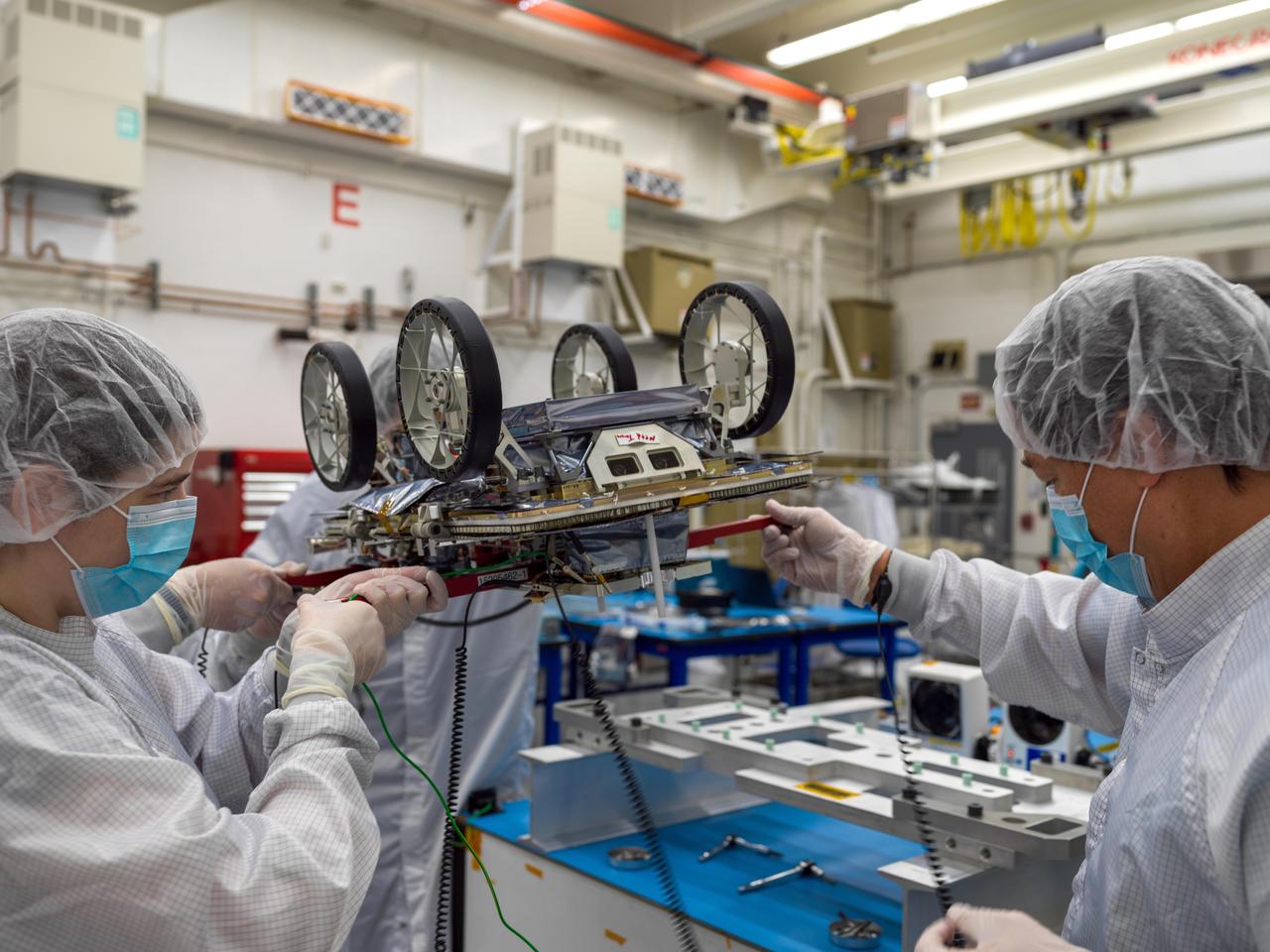
One of three small lunar rovers that are part of a NASA technology demonstration called CADRE (Cooperative Autonomous Distributed Robotic Exploration) is prepared for shipping in a clean room at the agency's Jet Propulsion Laboratory in Southern California on Jan. 29, 2025. CADRE aims to prove that a group of robots can collaborate to gather data without receiving direct commands from mission controllers on Earth. Its trio of rovers will use their cameras and ground-penetrating radars to send back imagery of the lunar surface and subsurface while testing out the novel software systems that enable them to work together as a team autonomously. Before embarking on the first leg of a multistage journey to the Moon, each rover was mated to its deployer system, which will lower it via tether from an Intuitive Machines lander onto the dusty lunar surface. Engineers flipped each rover-deployer pair over and attached it to an aluminum plate for safe transit. The rovers were then sealed into protective metal-frame enclosures that were fitted snuggly into metal shipping containers and loaded onto a truck for the drive to Intuitive Machines' Houston facility. Here, members of the project's assembly, test, and launch operations team hold the upside-down rover by temporary red handles in order to move it to a table where they'll attach it to the aluminum plate. A division of Caltech in Pasadena, California, JPL manages CADRE for the Game Changing Development program within NASA's Space Technology Mission Directorate in Washington. The technology demonstration was selected under the agency's Lunar Surface Innovation Initiative, which was established to expedite the development of technologies for sustained presence on the lunar surface. CADRE will launch as a payload on the third lunar lander mission by Intuitive Machines, called IM-3, under NASA's CLPS (Commercial Lunar Payload Services) initiative, which is managed by the agency's Science Mission Directorate, also in Washington. The agency's Glenn Research Center in Cleveland and its Ames Research Center in Silicon Valley, California, both supported the project. Motiv Space Systems designed and built key hardware elements at the company's Pasadena facility. Clemson University in South Carolina contributed research in support of the project. For more about CADRE, go to: https://go.nasa.gov/cadre https://photojournal.jpl.nasa.gov/catalog/PIA26427
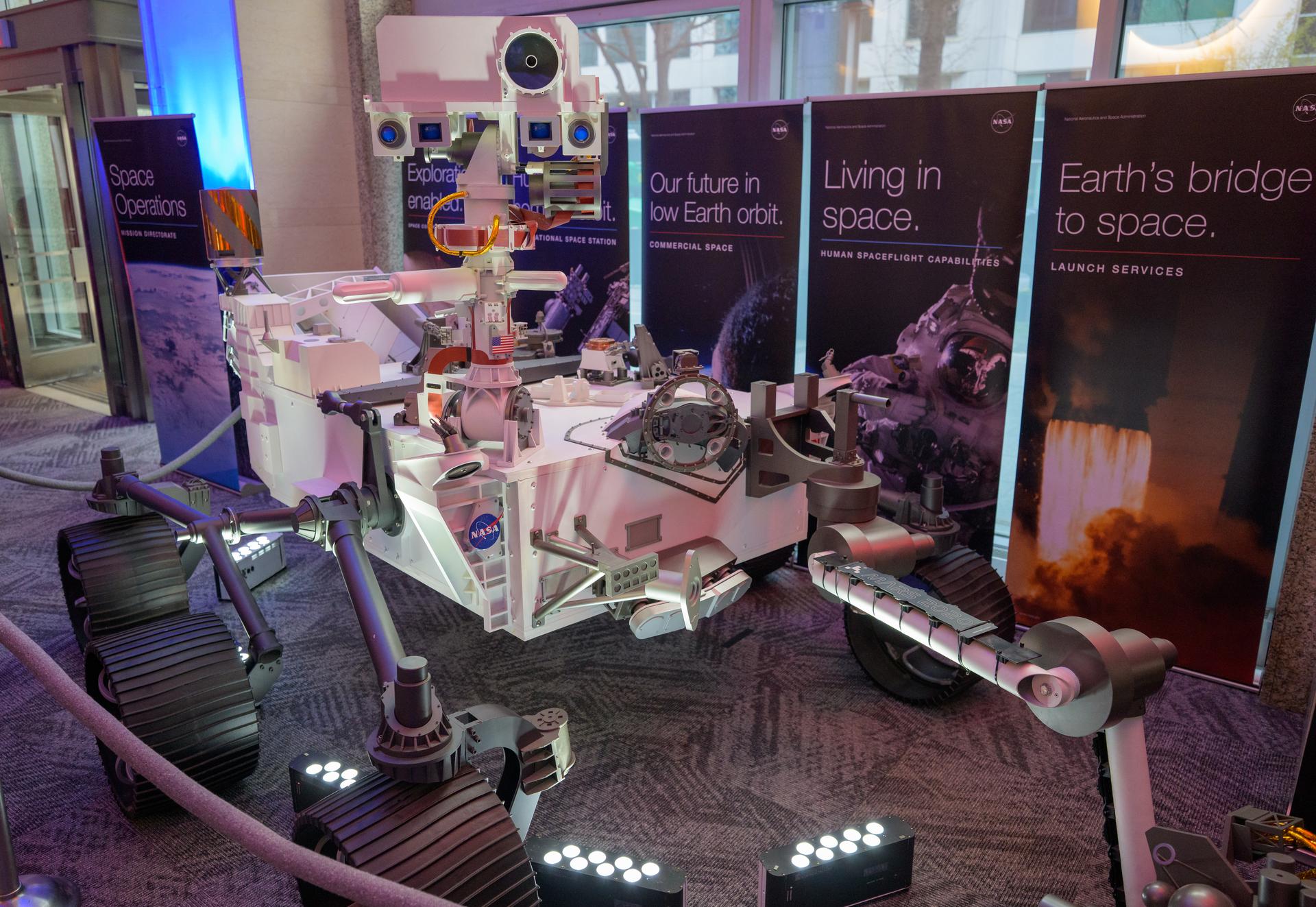
A model of the Mars 2020 Perseverance Rover is seen in the NASA Headquarters lobby during a 2-day event where NASA outlined how the agency is executing President Donald J. Trump’s National Space Policy and accelerating preparations for America’s return to the surface of the Moon by 2028, Wednesday, March 25, 2026, at the Mary W. Jackson NASA Headquarters building in Washington. During the event NASA leadership provided updates on mission priorities, including sending the first astronauts to the lunar surface in more than 50 years, establishing the initial elements of a permanent lunar base, getting America underway in space on nuclear propulsion, and other objectives. Photo Credit: (NASA/Bill Ingalls)
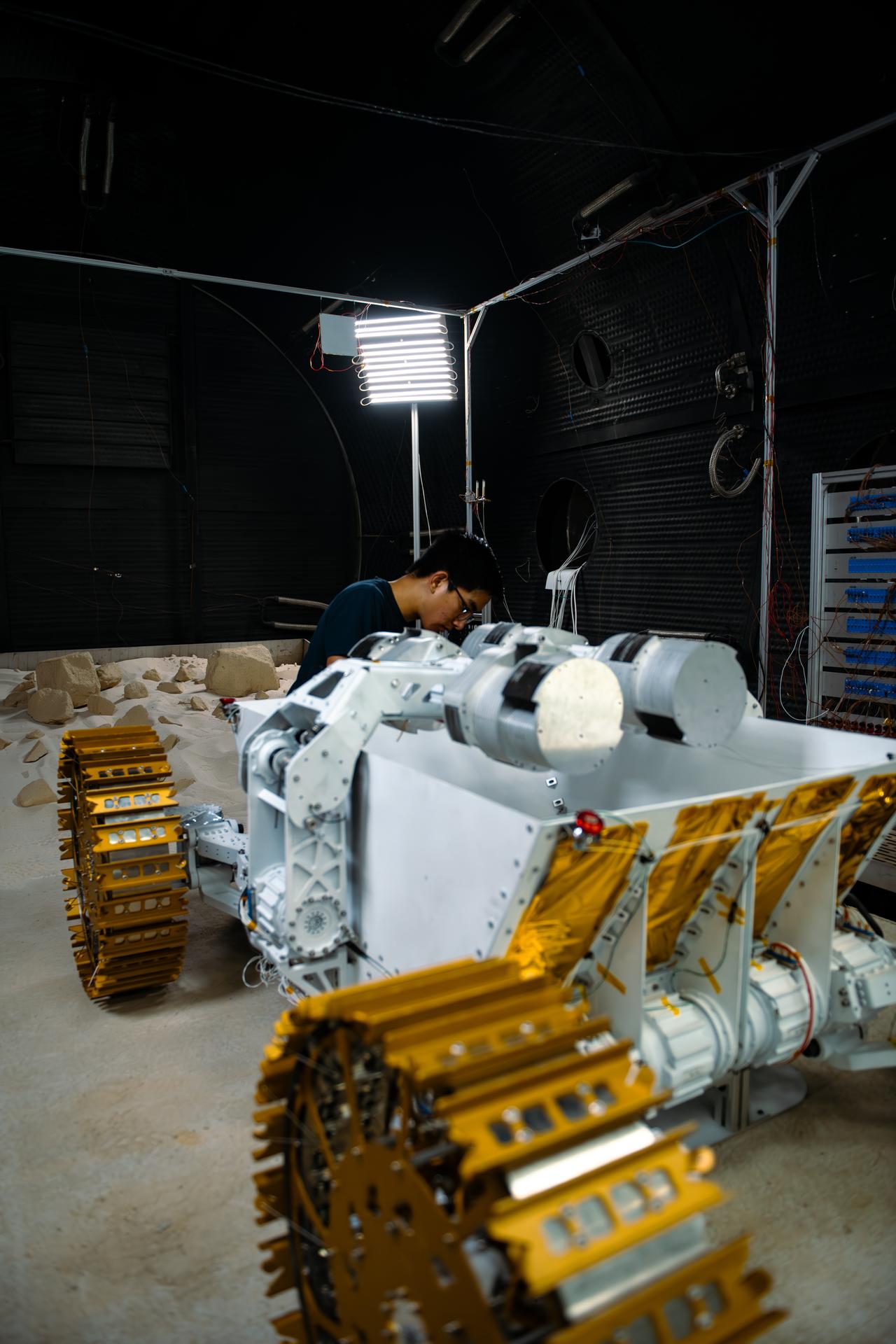
Starpath’s rover sits on a concrete slab that will be used to mimic the rugged lunar surface within a vacuum chamber at NASA’s Marshall Space Flight Center in Huntsville, Alabama, on July 30, 2025. The slab features a sandy, rocky terrain, and lamps within the chamber will turn on and off to simulate sunlight. The technology startup headquartered in Hawthorne, California, won second place overall at the agency’s Break the Ice Lunar Challenge’s live demonstration and finale in June 2024. This competition, one of NASA’s Centennial Challenges, tasked competitors to design, build, and demonstrate robotic technologies that could excavate and transport the icy, rocky dirt – otherwise known as regolith – found on the Moon. Starpath’s visit to NASA Marshall was part of their prize opportunity to test their upgraded lunar regolith excavation and transportation rover in the center’s 20-foot thermal vacuum chamber. For more information, contact NASA Marshall’s Office of Communications at 256-544-0034
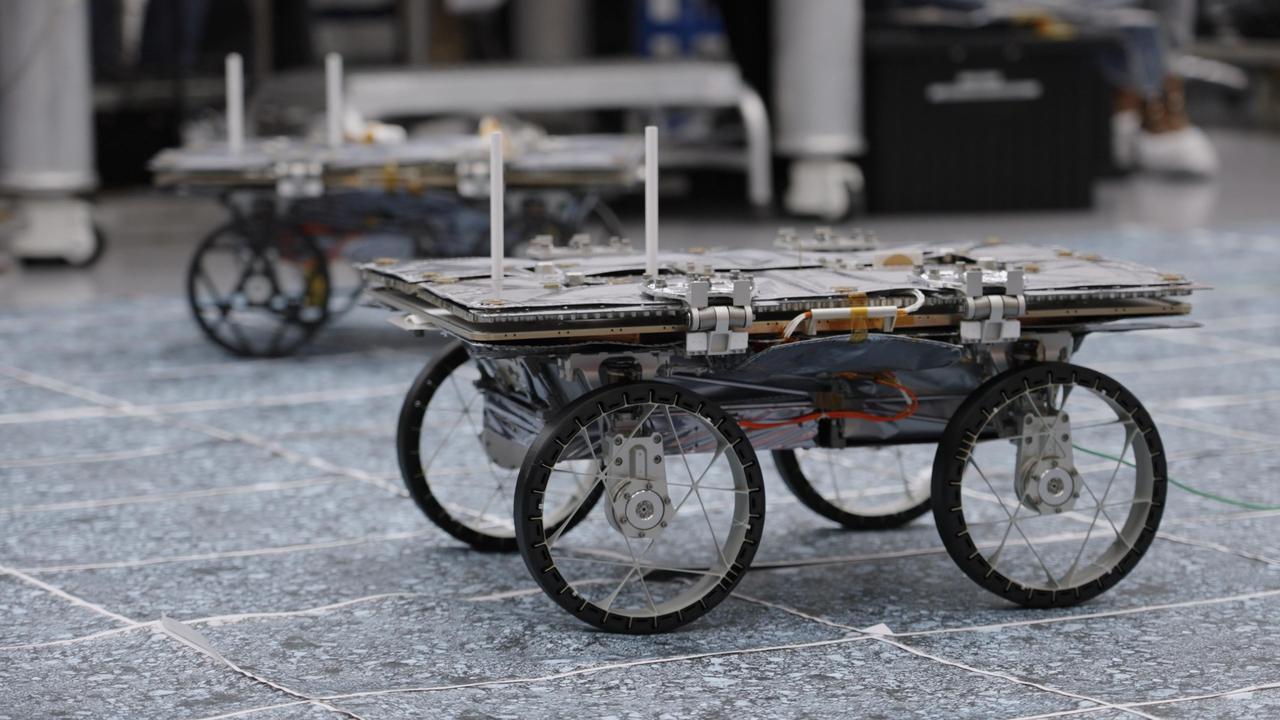
One of three small rovers bound for the Moon took an autonomous test drive in a clean room at NASA's Jet Propulsion Laboratory in Southern California in December 2023. Along with a base station that will be mounted on a lunar lander, the three rovers make up the agency's CADRE (Cooperative Autonomous Distributed Robotic Exploration) technology demonstration. This video was taken during a test of the rovers' ability to drive together as a team without direct commands from engineers. If the CADRE tech demo succeeds on the lunar surface, future missions could include teams of robots spreading out to take scientific measurements from different locations simultaneously, potentially in support of astronauts. In this test, the rover's solar panels were closed, and black plastic covers protected the ultralight aluminum wheels to prevent their grousers from catching on the clean-room floor. Video available at https://photojournal.jpl.nasa.gov/catalog/PIA26297
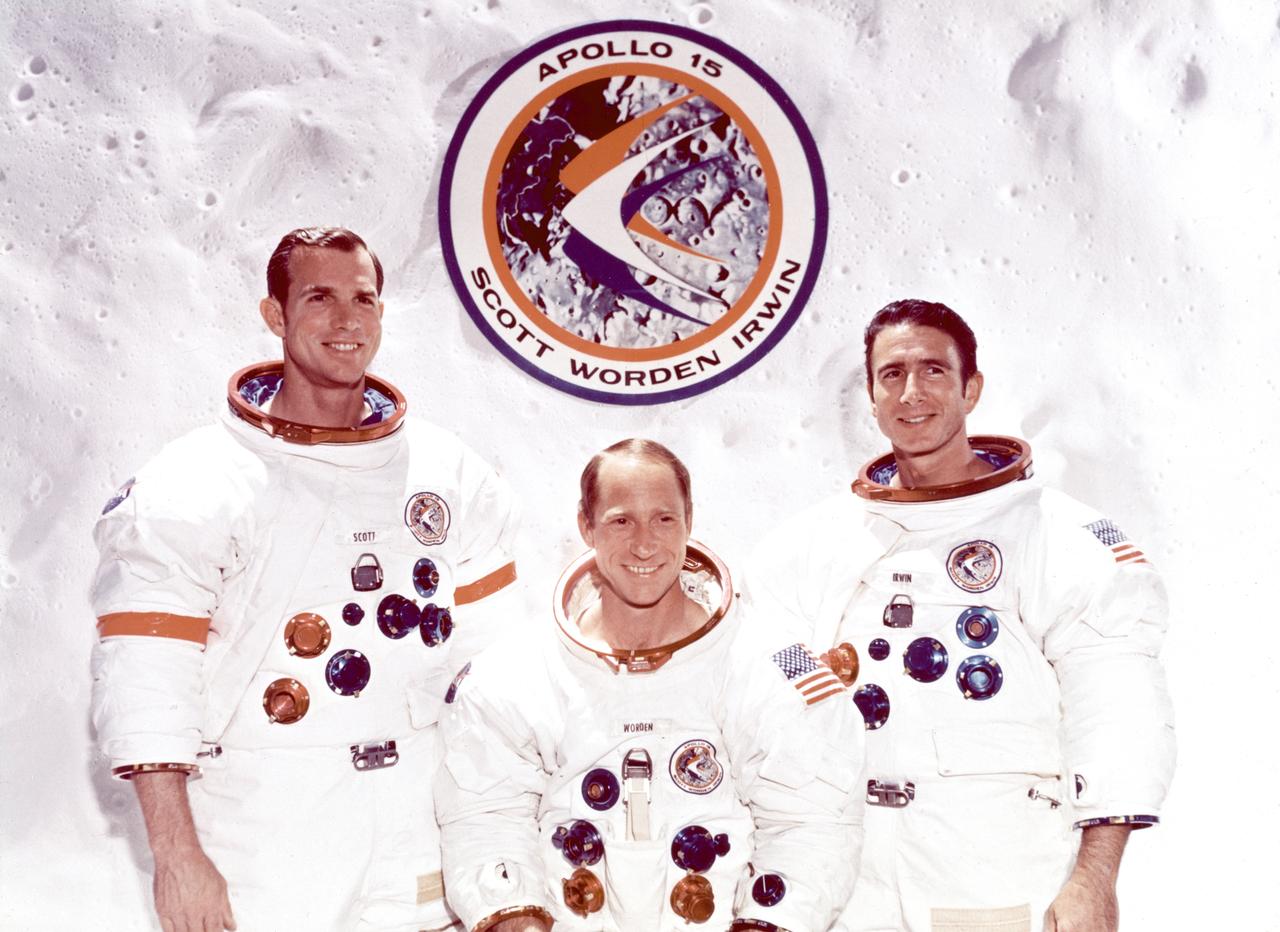
This is the official three-member crew portrait of the Apollo 15 (SA-510). Pictured from left to right are: David R. Scott, Mission Commander; Alfred M. Worden Jr., Command Module pilot; and James B. Irwin, Lunar Module pilot. The fifth marned lunar landing mission, Apollo 15 (SA-510), lifted off on July 26, 1971. Astronauts Scott and Irwin were the first to use a wheeled surface vehicle, the Lunar Roving Vehicle (LRV), or the Rover, which was designed and developed by the Marshall Space Flight Center, and built by the Boeing Company. The astronauts spent 13 days, nearly 67 hours, on the Moon's surface to inspect a wide variety of its geological features.

During the Apollo 15 launch activities in the launch control center's firing room 1 at Kennedy Space Center, Dr. Wernher von Braun, NASA's Deputy Associate Administrator for planning, takes a closer look at the launch pad through binoculars. The fifth manned lunar landing mission, Apollo 15 (SA-510), carrying a crew of three astronauts: Mission commander David R. Scott, Lunar Module pilot James B. Irwin, and Command Module pilot Alfred M. Worden Jr., lifted off on July 26, 1971. Astronauts Scott and Irwin were the first to use a wheeled surface vehicle, the Lunar Roving Vehicle, or the Rover, which was designed and developed by the Marshall Space Flight Center, and built by the Boeing Company. Astronauts spent 13 days, nearly 67 hours, on the Moon's surface to inspect a wide variety of its geological features.
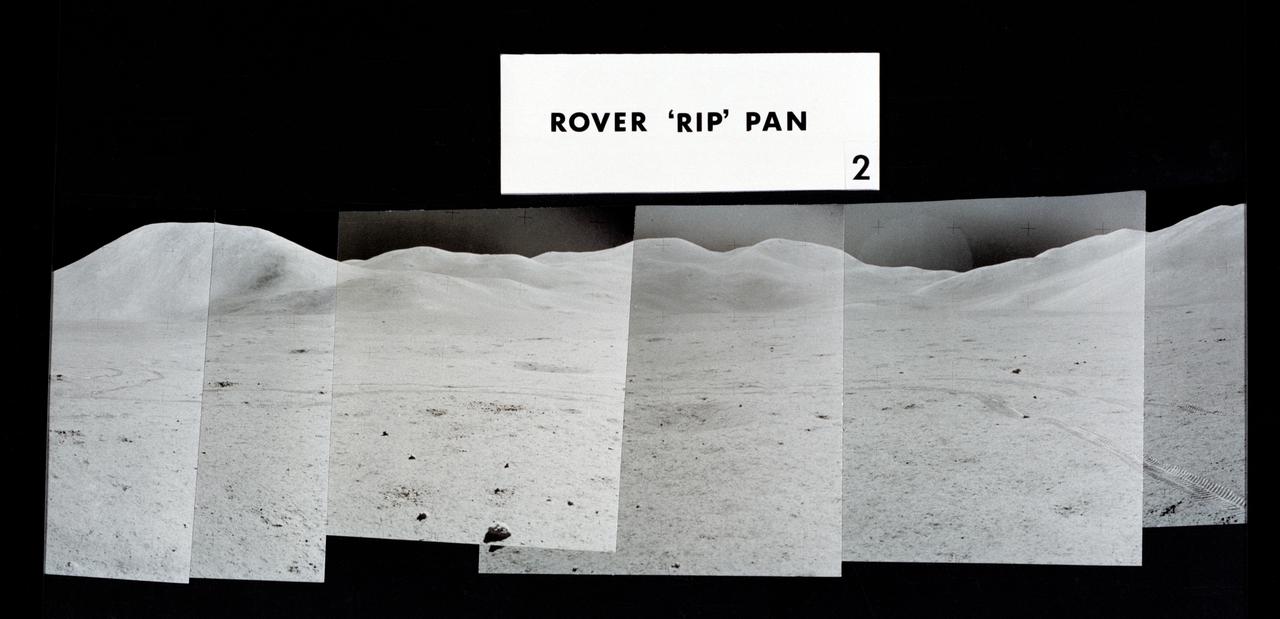
S71-43943 (2 Aug. 1971) --- Mosaic photographs which compose a 360-degree panoramic view of the Apollo 15 Hadley-Apennine landing site, taken near the close of the third lunar surface extravehicular activity (EVA) by astronauts David Scott and James Irwin. This group of photographs was designated the Rover "RIP" Pan because the Lunar Roving Vehicle was parked in its final position prior to the two crewmen returning to the Lunar Module. The astronaut taking the pan was standing 325 feet east of the Lunar Module (LM). The Rover was parked about 300 feet east of the LM. This mosaic covers a field of view from about north-northeast to about south. Visible on the horizon from left to right are: Mount Hadley; high peaks of the Apennine Mountains which are farther in the distance than either Mount Hadley or Hadley Delta Mountain; Silver Spur on the Apennine Front; and the eastern portion of Hadley Delta. Note Rover tracks in the foreground. The numbers of the other two views composing the 360-degree pan are S71-43940 and S71-43942.
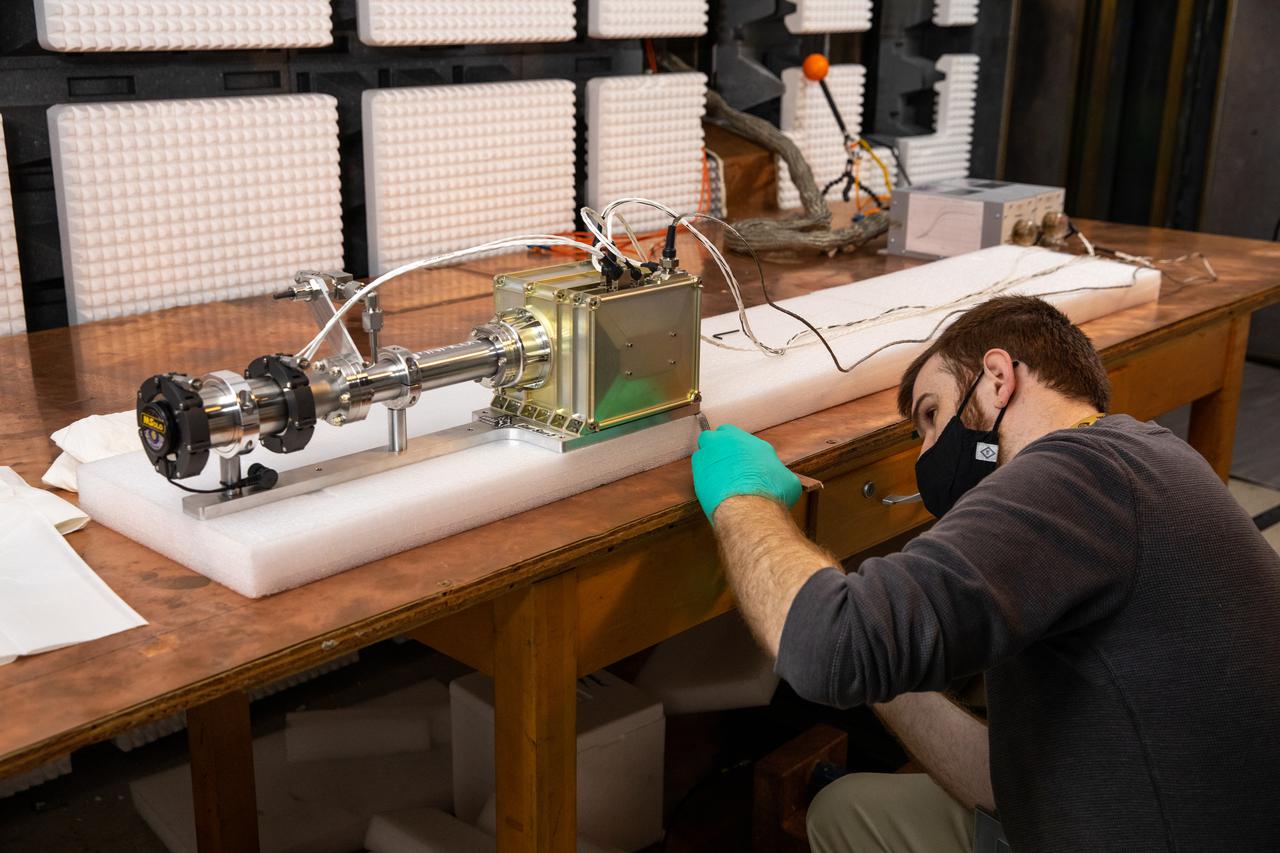
Electronics Engineer and Mass Spectrometer Observing Lunar Operations (MSolo) team member Nate Cain conducts electromagnetic interference (EMI) testing inside the EMI Laboratory at NASA’s Kennedy Space Center in Florida on Feb. 14, 2022. The tests will verify that MSolo can control the emissions it will produce during its missions and meets EMI susceptibility requirements as part of its preparation to operate in the lunar environment. The third MSolo to go through EMI testing, this is an engineering development unit representative of the flight unit manifested to fly to the Moon’s South Pole as a payload on the agency’s Volatiles Investigating Polar Exploration Rover (VIPER) in 2023. Researchers and engineers are preparing MSolo instruments to launch on four robotic missions as part of NASA’s Commercial Lunar Payload Services (CLPS) – the first of which is slated for later this year. MSolo will help analyze the chemical makeup of landing sites on the Moon, with the later missions also studying water on the lunar surface.
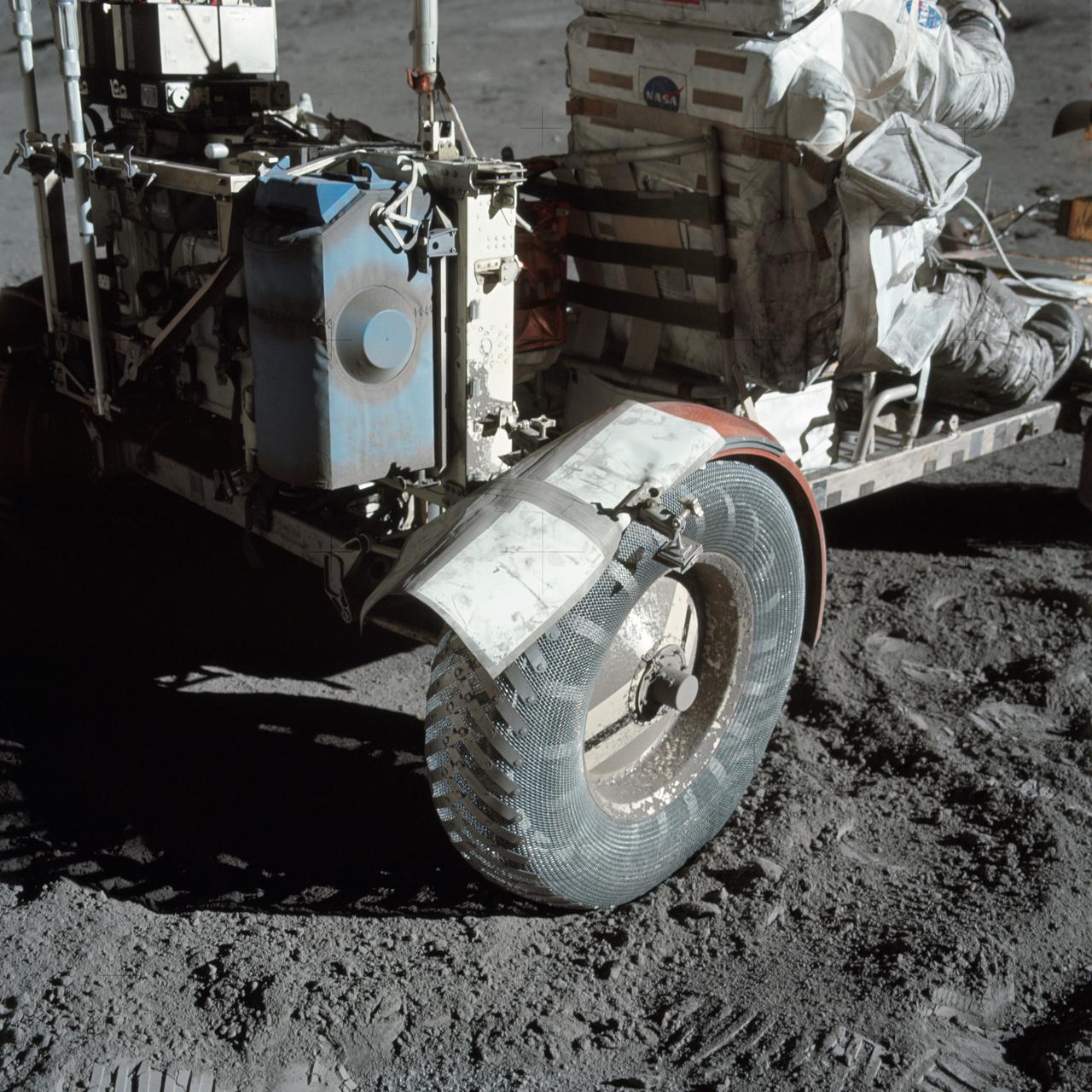
AS17-137-20979 (12 Dec. 1972) --- A close-up view of the lunar roving vehicle (LRV) at the Taurus-Littrow landing site photographed during Apollo 17 lunar surface extravehicular activity. Note the makeshift repair arrangement on the right rear fender of the LRV. During EVA-1 a hammer got underneath the fender and a part of it was knocked off. Astronauts Eugene A. Cernan and Harrison H. Schmitt were reporting a problem with lunar dust because of the damage fender. Following a suggestion from astronaut John W. Young in the Mission Control Center at Houston the crewmen repaired the fender early in EVA-2 using lunar maps and clamps from the optical alignment telescope lamp. Schmitt is seated in the rover. Cernan took this picture.

Electronics Engineer and Mass Spectrometer Observing Lunar Operations (MSolo) team member Nate Cain conducts electromagnetic interference (EMI) testing inside the EMI Laboratory at NASA’s Kennedy Space Center in Florida on Feb. 14, 2022. The tests will verify that MSolo can control the emissions it will produce during its missions and meets EMI susceptibility requirements as part of its preparation to operate in the lunar environment. The third MSolo to go through EMI testing, this is an engineering development unit representative of the flight unit manifested to fly to the Moon’s South Pole as a payload on the agency’s Volatiles Investigating Polar Exploration Rover (VIPER) in 2023. Researchers and engineers are preparing MSolo instruments to launch on four robotic missions as part of NASA’s Commercial Lunar Payload Services (CLPS) – the first of which is slated for later this year. MSolo will help analyze the chemical makeup of landing sites on the Moon, with the later missions also studying water on the lunar surface.
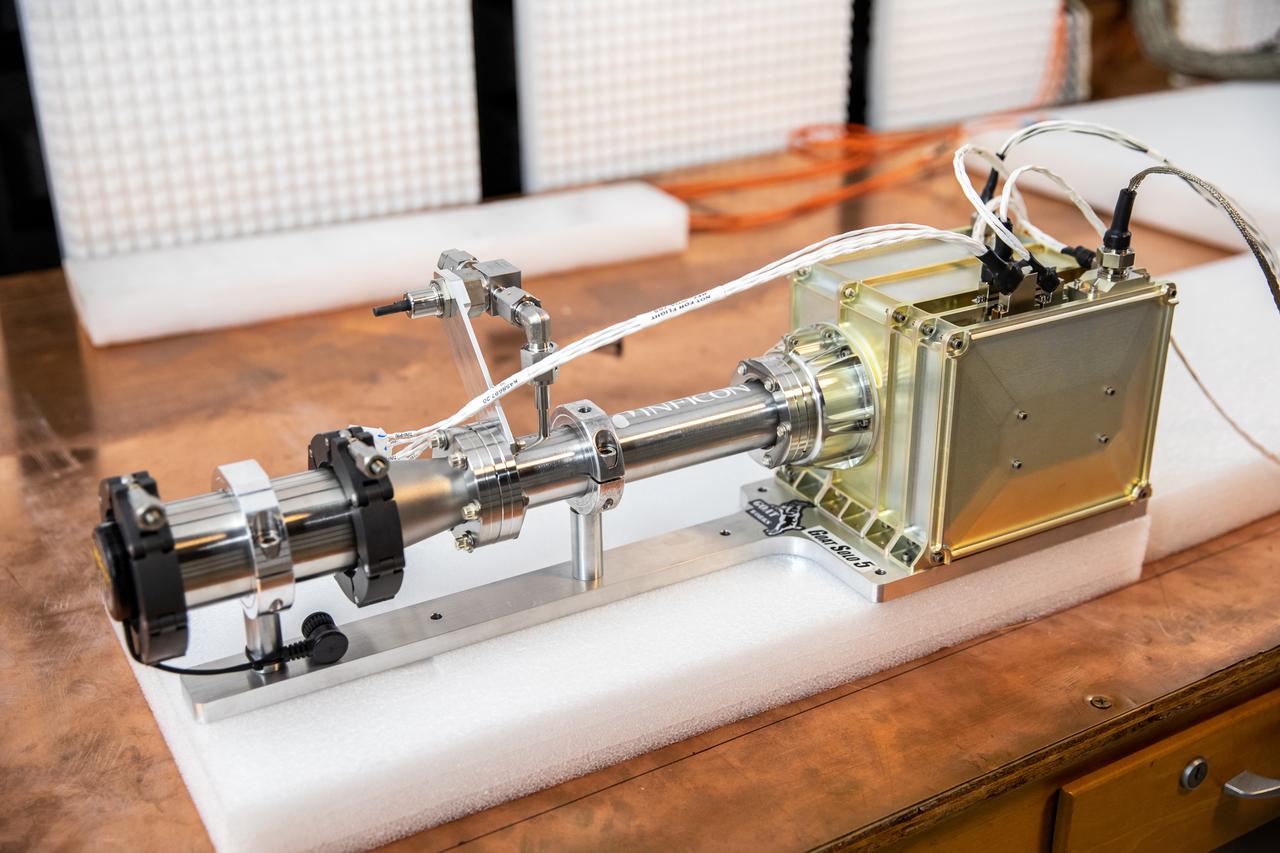
NASA’s Mass Spectrometer Observing Lunar Operations (MSolo) undergoes electromagnetic interference (EMI) testing inside the EMI Laboratory at the agency’s Kennedy Space Center in Florida on Feb. 14, 2022. These tests will verify that MSolo can control the emissions it will produce during its missions and meets EMI susceptibility requirements as part of its preparation to operate in the lunar environment. The third MSolo to go through EMI testing, this is an engineering development unit representative of the flight unit manifested to fly to the Moon’s South Pole as a payload on the agency’s Volatiles Investigating Polar Exploration Rover (VIPER) in 2023. Researchers and engineers are preparing MSolo to launch on four robotic missions as part of NASA’s Commercial Lunar Payload Services (CLPS) – the first of which is slated for later this year. MSolo will help analyze the chemical makeup of landing sites on the Moon, with the later missions also studying water on the lunar surface.
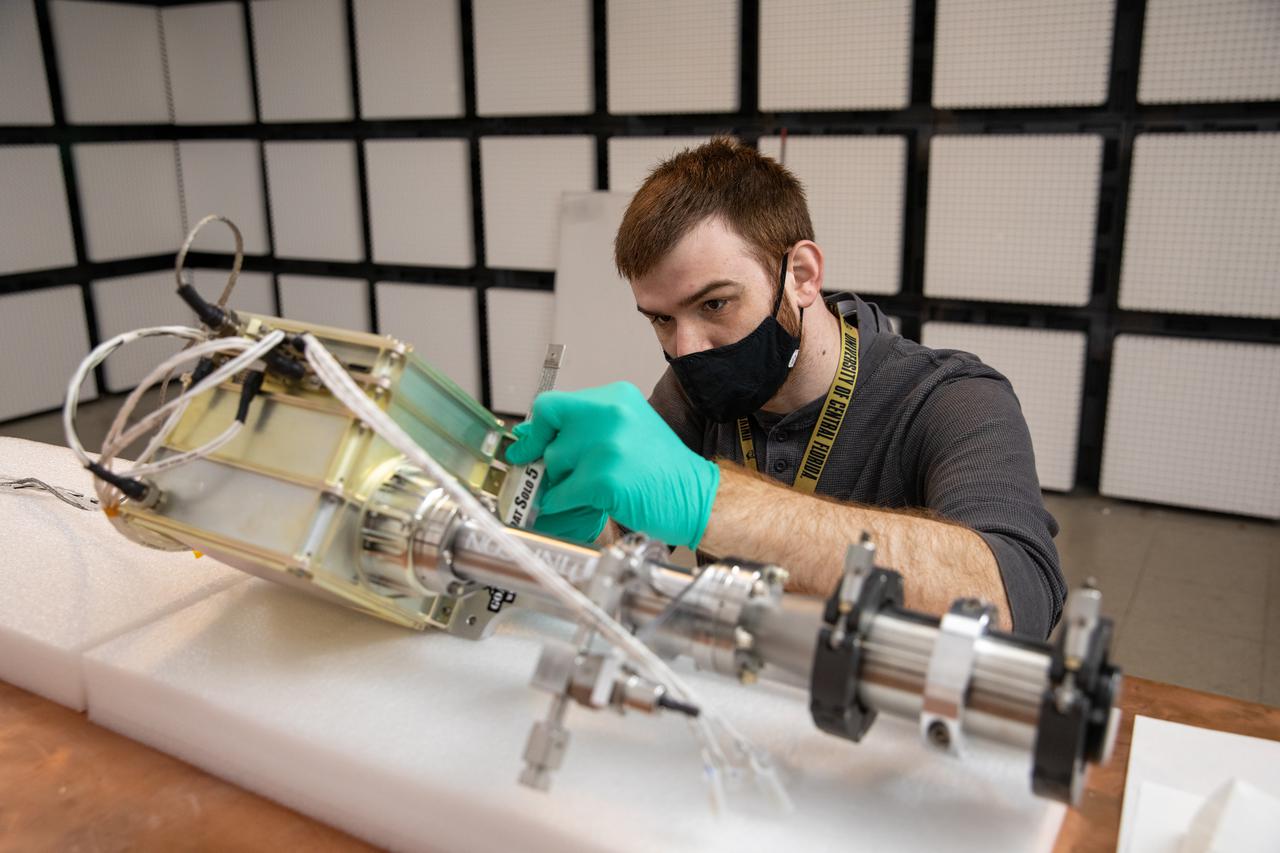
Electronics Engineer and Mass Spectrometer Observing Lunar Operations (MSolo) team member Nate Cain conducts electromagnetic interference (EMI) testing inside the EMI Laboratory at NASA’s Kennedy Space Center in Florida on Feb. 14, 2022. These tests will verify that MSolo can control the emissions it will produce during its missions and meets EMI susceptibility requirements as part of its preparation to operate in the lunar environment. The third MSolo to go through EMI testing, this is an engineering development unit representative of the flight unit manifested to fly to the Moon’s South Pole as a payload on the agency’s Volatiles Investigating Polar Exploration Rover (VIPER) in 2023. Researchers and engineers are preparing MSolo instruments to launch on four robotic missions as part of NASA’s Commercial Lunar Payload Services (CLPS) – the first of which is slated for later this year. MSolo will help analyze the chemical makeup of landing sites on the Moon, with the later missions also studying water on the lunar surface.

NASA Pressurized Rover Project Manager Danny Newswander, left, NASA Administrator Bill Nelson, and NASA Extravehicular Activity and Human Surface Mobility Program Lara Kearney, right, discuss the historic agreement signed April 9th at NASA Headquarters, between the United States and Japan to advance sustainable human exploration of the Moon, Wednesday, April 10, 2024, at the Japan Aerospace Exploration Agency (JAXA) offices in Washington. Under the agreement, Japan will design, develop, and operate a pressurized rover for crewed and uncrewed exploration on the Moon. NASA will provide the launch and delivery of the rover to the Moon as well as two Japanese astronaut missions to the lunar surface. Photo Credit: Photo Credit: (NASA/Bill Ingalls)

NASA Pressurized Rover Project Manager Danny Newswander, left, NASA Administrator Bill Nelson, and NASA Extravehicular Activity and Human Surface Mobility Program Lara Kearney, right, discuss the historic agreement signed April 9th at NASA Headquarters, between the United States and Japan to advance sustainable human exploration of the Moon, Wednesday, April 10, 2024, at the Japan Aerospace Exploration Agency (JAXA) offices in Washington. Under the agreement, Japan will design, develop, and operate a pressurized rover for crewed and uncrewed exploration on the Moon. NASA will provide the launch and delivery of the rover to the Moon as well as two Japanese astronaut missions to the lunar surface. Photo Credit: Photo Credit: (NASA/Bill Ingalls)

NASA Pressurized Rover Project Manager Danny Newswander, left, NASA Administrator Bill Nelson, and NASA Extravehicular Activity and Human Surface Mobility Program Lara Kearney, right, discuss the historic agreement signed April 9th at NASA Headquarters, between the United States and Japan to advance sustainable human exploration of the Moon, Wednesday, April 10, 2024, at the Japan Aerospace Exploration Agency (JAXA) offices in Washington. Under the agreement, Japan will design, develop, and operate a pressurized rover for crewed and uncrewed exploration on the Moon. NASA will provide the launch and delivery of the rover to the Moon as well as two Japanese astronaut missions to the lunar surface. Photo Credit: Photo Credit: (NASA/Bill Ingalls)
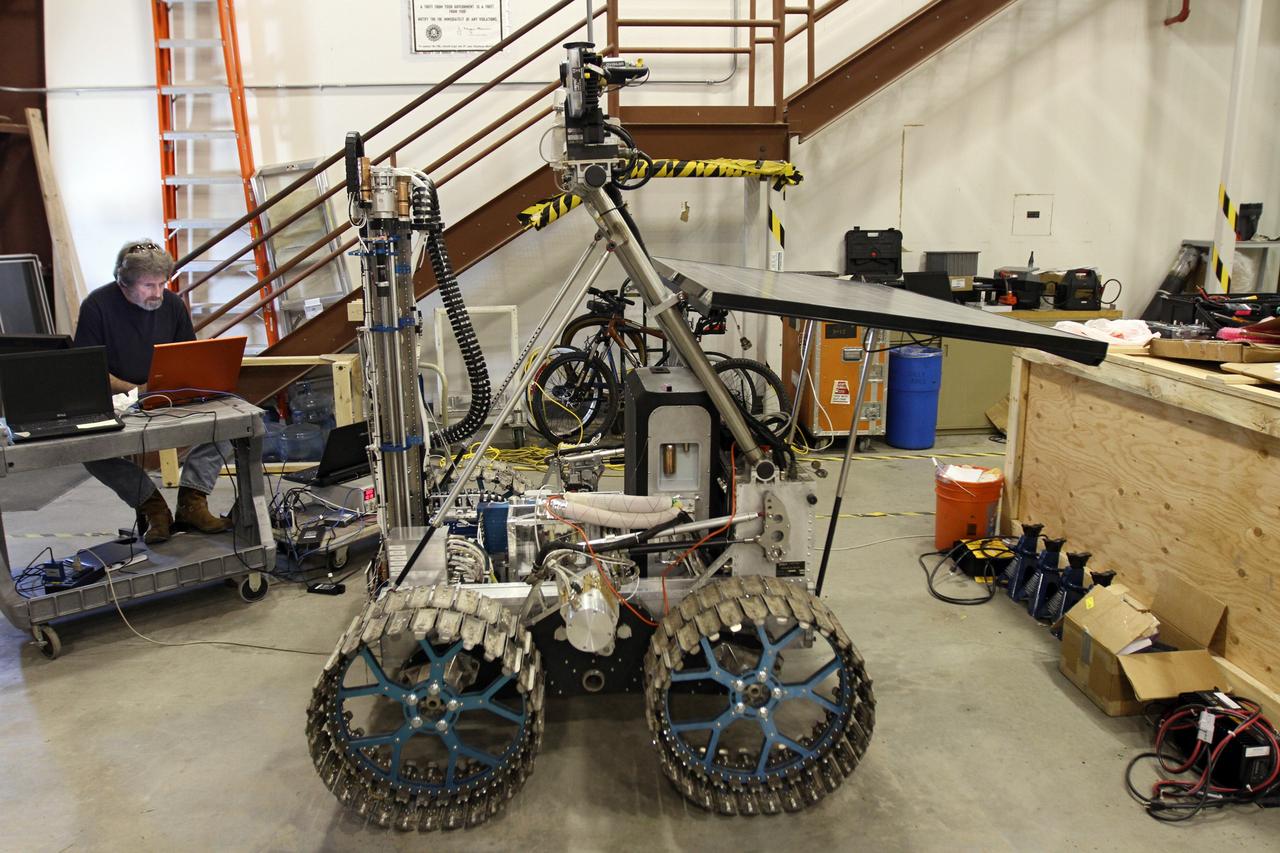
CAPE CANAVERAL, Fla. – The NASA payload is installed on the prototype rover Artemis Jr. for NASA’s Regolith and Environment Science and Oxygen and Lunar Volatile Extraction, or RESOLVE, project in a test facility behind the Operations and Checkout Building at NASA’s Kennedy Space Center in Florida. The cylindrical structure at left is the drill the tabletop surface at right is the rover’s solar array. The drill and rover were provided to NASA by the Canadian Space Agency. The NASA payload is designed to prospect for water, ice and other lunar resources. RESOLVE also will demonstrate how future explorers can take advantage of resources at potential landing sites by manufacturing oxygen from soil. NASA will conduct field tests in July outside of Hilo, Hawaii, with equipment and concept vehicles that demonstrate how explorers might prospect for resources and make their own oxygen for survival while on other planetary bodies. For more information, visit http://www.nasa.gov/exploration/analogs/index.html. Photo credit: NASA/Cory Huston

Japan Aerospace Exploration Agency (JAXA) President Hiroshi Yamakawa, left, JAXA astronaut Akihiko Hoshide, Japan’s Minister of Education, Culture, Sports, Science and Technology Masahito Moriyama, NASA Administrator Bill Nelson, and NASA astronaut Kayla Barron, right, talk by a model of the Pressurized lunar rover, after the signing of an historic agreement between the United States and Japan to advance sustainable human exploration of the Moon, Tuesday, April 9, 2024, at the NASA Headquarters Mary W. Jackson Building in Washington. Under the agreement, Japan will design, develop, and operate a pressurized rover for crewed and uncrewed exploration on the Moon. NASA will provide the launch and delivery of the rover to the Moon as well as two Japanese astronaut missions to the lunar surface. Photo Credit: (NASA/Bill Ingalls)
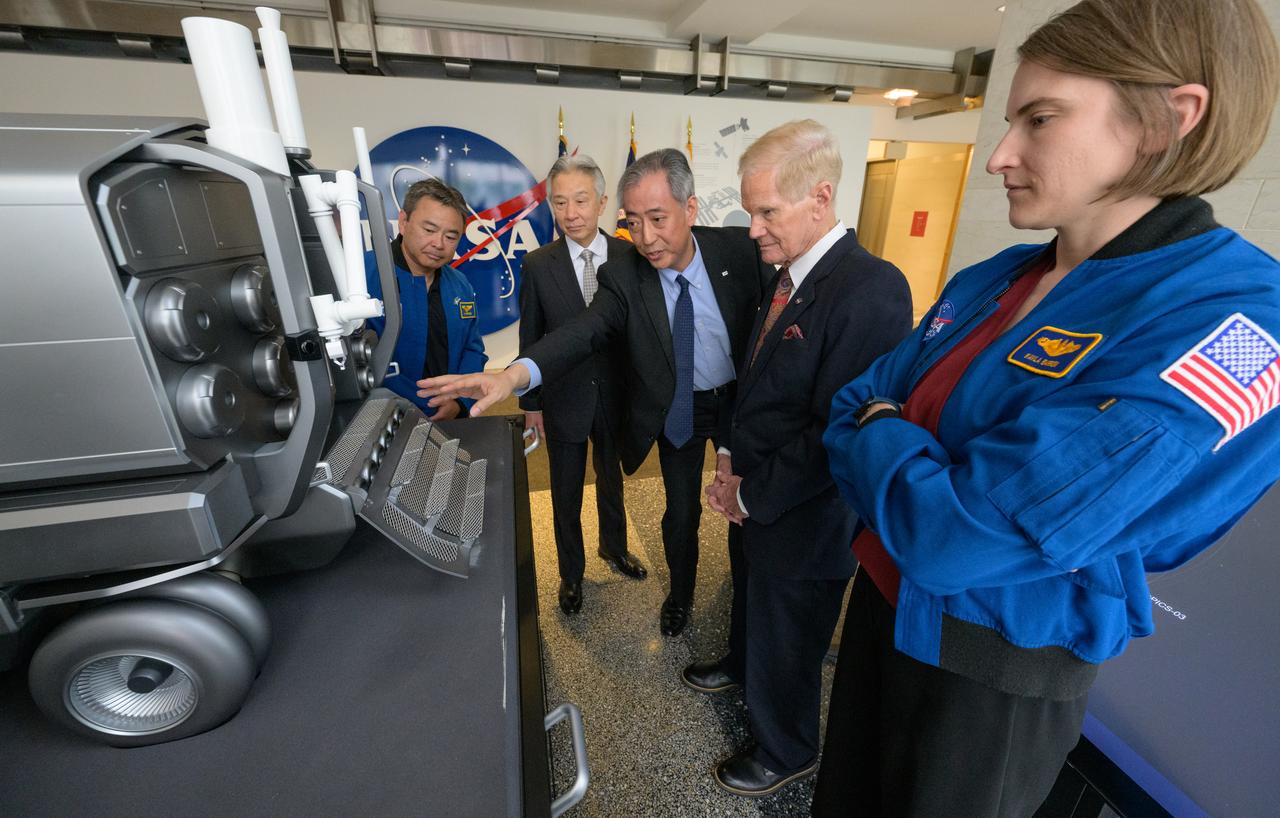
Japan Aerospace Exploration Agency (JAXA) astronaut Akihiko Hoshide, left, Japan’s Minister of Education, Culture, Sports, Science and Technology Masahito Moriyama, JAXA President Hiroshi Yamakawa, NASA Administrator Bill Nelson, and NASA astronaut Kayla Barron, right, talk by a model of the Pressurized lunar rover, after the signing of an historic agreement between the United States and Japan to advance sustainable human exploration of the Moon, Tuesday, April 9, 2024, at the NASA Headquarters Mary W. Jackson Building in Washington. Under the agreement, Japan will design, develop, and operate a pressurized rover for crewed and uncrewed exploration on the Moon. NASA will provide the launch and delivery of the rover to the Moon as well as two Japanese astronaut missions to the lunar surface. Photo Credit: (NASA/Bill Ingalls)
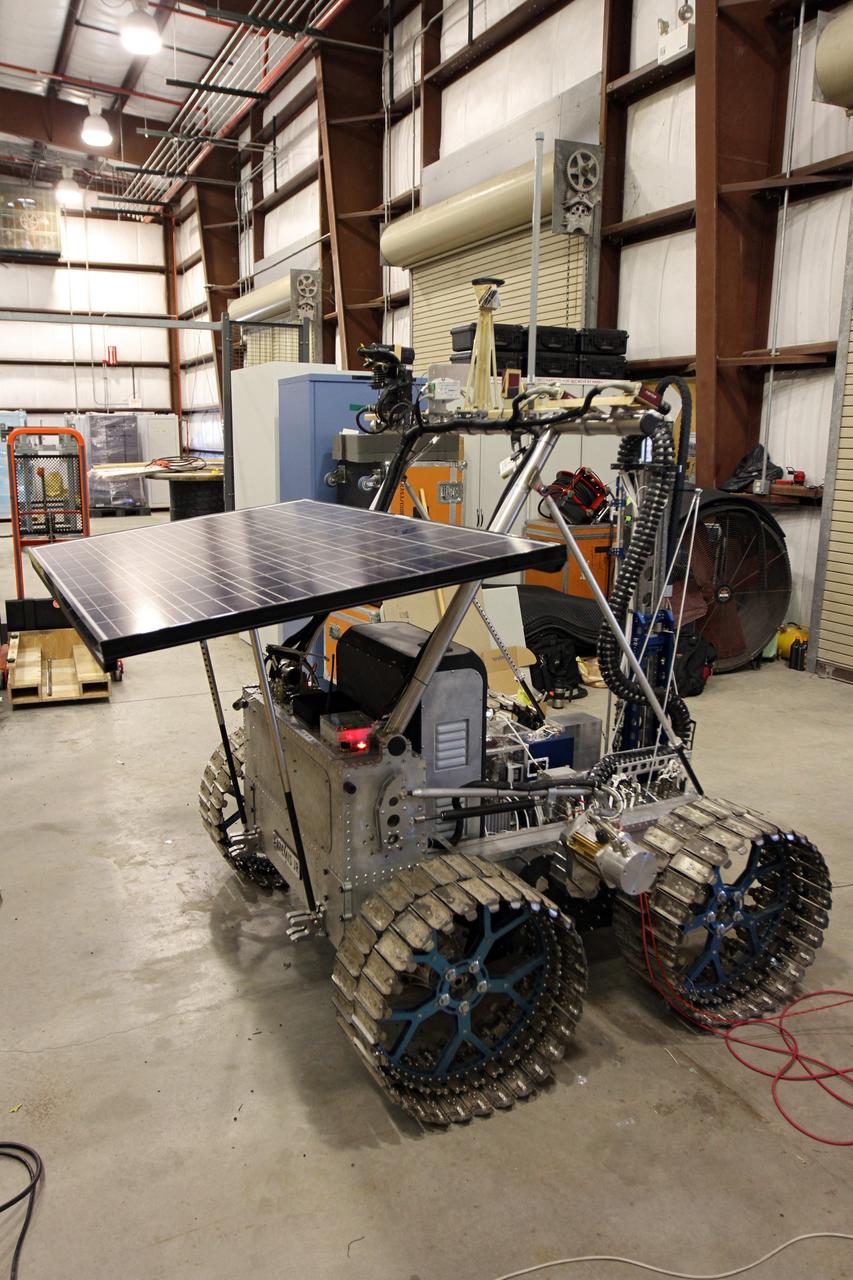
CAPE CANAVERAL, Fla. – The NASA payload is installed on the prototype rover Artemis Jr. for NASA’s Regolith and Environment Science and Oxygen and Lunar Volatile Extraction, or RESOLVE, project in a test facility behind the Operations and Checkout Building at NASA’s Kennedy Space Center in Florida. The cylindrical structure at right is the drill the tabletop surface at left is the rover’s solar array. The drill and rover were provided to NASA by the Canadian Space Agency. The NASA payload is designed to prospect for water, ice and other lunar resources. RESOLVE also will demonstrate how future explorers can take advantage of resources at potential landing sites by manufacturing oxygen from soil. NASA will conduct field tests in July outside of Hilo, Hawaii, with equipment and concept vehicles that demonstrate how explorers might prospect for resources and make their own oxygen for survival while on other planetary bodies. For more information, visit http://www.nasa.gov/exploration/analogs/index.html. Photo credit: NASA/Cory Huston

NASA Administrator Bill Nelson signs an historic agreement between the United States and Japan to advance sustainable human exploration of the Moon, Tuesday, April 9, 2024, at the NASA Headquarters Mary W. Jackson Building in Washington. Under the agreement, Japan will design, develop, and operate a pressurized rover for crewed and uncrewed exploration on the Moon. NASA will provide the launch and delivery of the rover to the Moon as well as two Japanese astronaut missions to the lunar surface. Photo Credit: (NASA/Bill Ingalls)

NASA Press Secretary Faith McKie moderates an event where an historic agreement is to be signed between the United States and Japan to advance sustainable human exploration of the Moon, Tuesday, April 9, 2024, at the NASA Headquarters Mary W. Jackson Building in Washington. Under the agreement, Japan will design, develop, and operate a pressurized rover for crewed and uncrewed exploration on the Moon. NASA will provide the launch and delivery of the rover to the Moon as well as two Japanese astronaut missions to the lunar surface. Photo Credit: (NASA/Bill Ingalls)

NASA Administrator Bill Nelson discusses the historic agreement signed April 9th at NASA Headquarters, between the United States and Japan to advance sustainable human exploration of the Moon, Wednesday, April 10, 2024, at the Japan Aerospace Exploration Agency (JAXA) offices in Washington. Under the agreement, Japan will design, develop, and operate a pressurized rover for crewed and uncrewed exploration on the Moon. NASA will provide the launch and delivery of the rover to the Moon as well as two Japanese astronaut missions to the lunar surface. Photo Credit: Photo Credit: (NASA/Bill Ingalls)

Japan’s Minister of Education, Culture, Sports, Science and Technology Masahito Moriyama, signs an historic agreement between the United States and Japan to advance sustainable human exploration of the Moon, Tuesday, April 9, 2024, at the NASA Headquarters Mary W. Jackson Building in Washington. Under the agreement, Japan will design, develop, and operate a pressurized rover for crewed and uncrewed exploration on the Moon. NASA will provide the launch and delivery of the rover to the Moon as well as two Japanese astronaut missions to the lunar surface. Photo Credit: (NASA/Bill Ingalls)
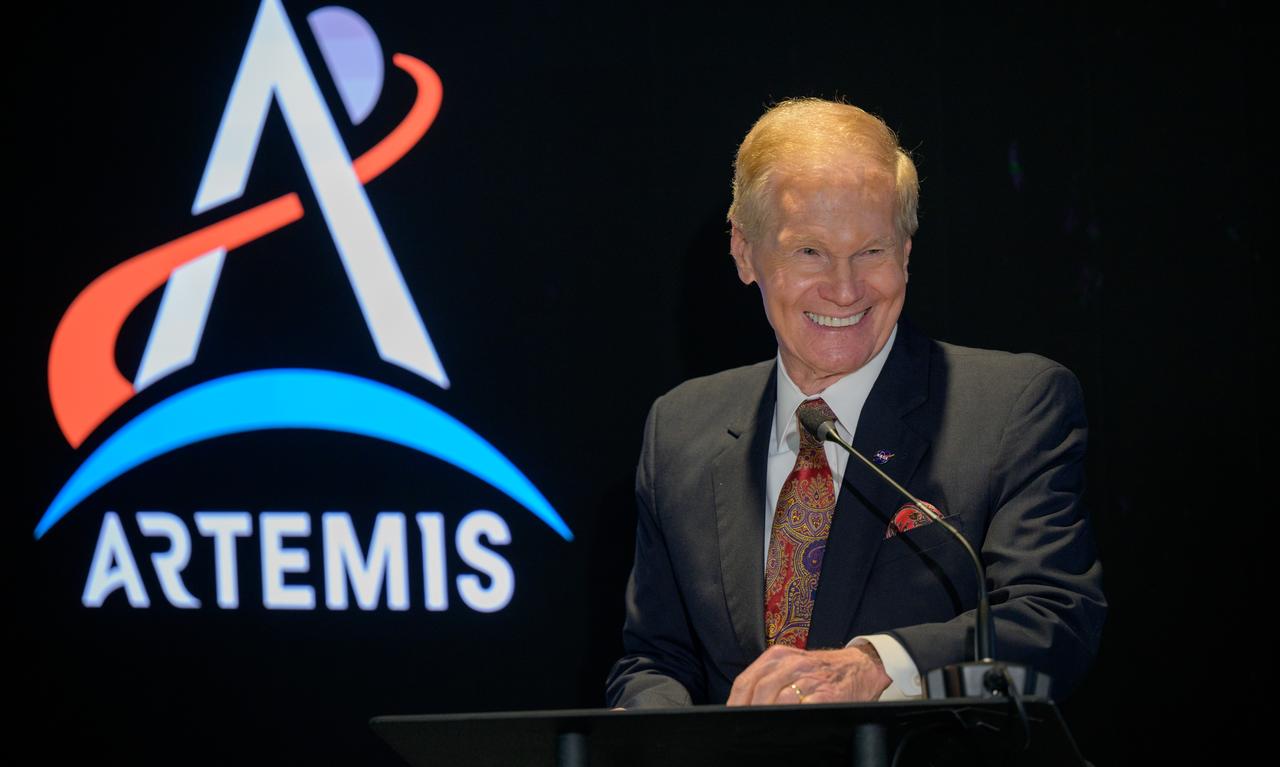
NASA Administrator Bill Nelson speaks prior to signing an historic agreement between the United States and Japan to advance sustainable human exploration of the Moon, Tuesday, April 9, 2024, at the NASA Headquarters Mary W. Jackson Building in Washington. Under the agreement, Japan will design, develop, and operate a pressurized rover for crewed and uncrewed exploration on the Moon. NASA will provide the launch and delivery of the rover to the Moon as well as two Japanese astronaut missions to the lunar surface. Photo Credit: (NASA/Bill Ingalls)

NASA Administrator Bill Nelson discusses the historic agreement signed April 9th at NASA Headquarters, between the United States and Japan to advance sustainable human exploration of the Moon, Wednesday, April 10, 2024, at the Japan Aerospace Exploration Agency (JAXA) offices in Washington. Under the agreement, Japan will design, develop, and operate a pressurized rover for crewed and uncrewed exploration on the Moon. NASA will provide the launch and delivery of the rover to the Moon as well as two Japanese astronaut missions to the lunar surface. Photo Credit: Photo Credit: (NASA/Bill Ingalls)

Japan’s Minister of Education, Culture, Sports, Science and Technology Masahito Moriyama speaks after signing an historic agreement between the United States and Japan to advance sustainable human exploration of the Moon, Tuesday, April 9, 2024, at the NASA Headquarters Mary W. Jackson Building in Washington. Under the agreement, Japan will design, develop, and operate a pressurized rover for crewed and uncrewed exploration on the Moon. NASA will provide the launch and delivery of the rover to the Moon as well as two Japanese astronaut missions to the lunar surface. Photo Credit: (NASA/Bill Ingalls)
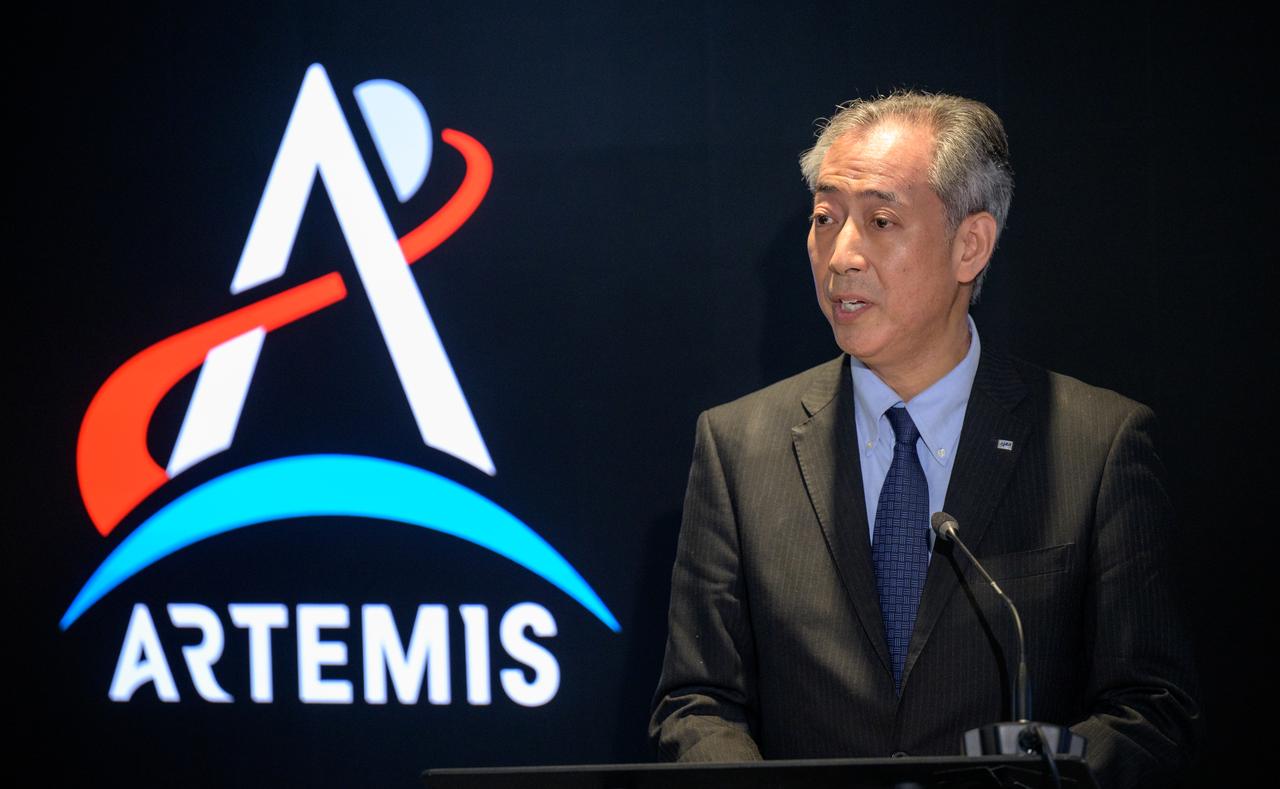
Japan Aerospace Exploration Agency (JAXA) President Hiroshi Yamakawa speaks after the signing of an historic agreement between the United States and Japan to advance sustainable human exploration of the Moon, Tuesday, April 9, 2024, at the NASA Headquarters Mary W. Jackson Building in Washington. Under the agreement, Japan will design, develop, and operate a pressurized rover for crewed and uncrewed exploration on the Moon. NASA will provide the launch and delivery of the rover to the Moon as well as two Japanese astronaut missions to the lunar surface. Photo Credit: (NASA/Bill Ingalls)

NASA Administrator Bill Nelson discusses the historic agreement signed April 9th at NASA Headquarters, between the United States and Japan to advance sustainable human exploration of the Moon, Wednesday, April 10, 2024, at the Japan Aerospace Exploration Agency (JAXA) offices in Washington. Under the agreement, Japan will design, develop, and operate a pressurized rover for crewed and uncrewed exploration on the Moon. NASA will provide the launch and delivery of the rover to the Moon as well as two Japanese astronaut missions to the lunar surface. Photo Credit: Photo Credit: (NASA/Bill Ingalls)

NASA Administrator Bill Nelson speaks prior to signing an historic agreement between the United States and Japan to advance sustainable human exploration of the Moon, Tuesday, April 9, 2024, at the NASA Headquarters Mary W. Jackson Building in Washington. Under the agreement, Japan will design, develop, and operate a pressurized rover for crewed and uncrewed exploration on the Moon. NASA will provide the launch and delivery of the rover to the Moon as well as two Japanese astronaut missions to the lunar surface. Photo Credit: (NASA/Bill Ingalls)

NASA Administrator Bill Nelson discusses the historic agreement signed April 9th at NASA Headquarters, between the United States and Japan to advance sustainable human exploration of the Moon, Wednesday, April 10, 2024, at the Japan Aerospace Exploration Agency (JAXA) offices in Washington. Under the agreement, Japan will design, develop, and operate a pressurized rover for crewed and uncrewed exploration on the Moon. NASA will provide the launch and delivery of the rover to the Moon as well as two Japanese astronaut missions to the lunar surface. Photo Credit: Photo Credit: (NASA/Bill Ingalls)

Japan’s Minister of Education, Culture, Sports, Science and Technology Masahito Moriyama speaks after signing an historic agreement between the United States and Japan to advance sustainable human exploration of the Moon, Tuesday, April 9, 2024, at the NASA Headquarters Mary W. Jackson Building in Washington. Under the agreement, Japan will design, develop, and operate a pressurized rover for crewed and uncrewed exploration on the Moon. NASA will provide the launch and delivery of the rover to the Moon as well as two Japanese astronaut missions to the lunar surface. Photo Credit: (NASA/Bill Ingalls)
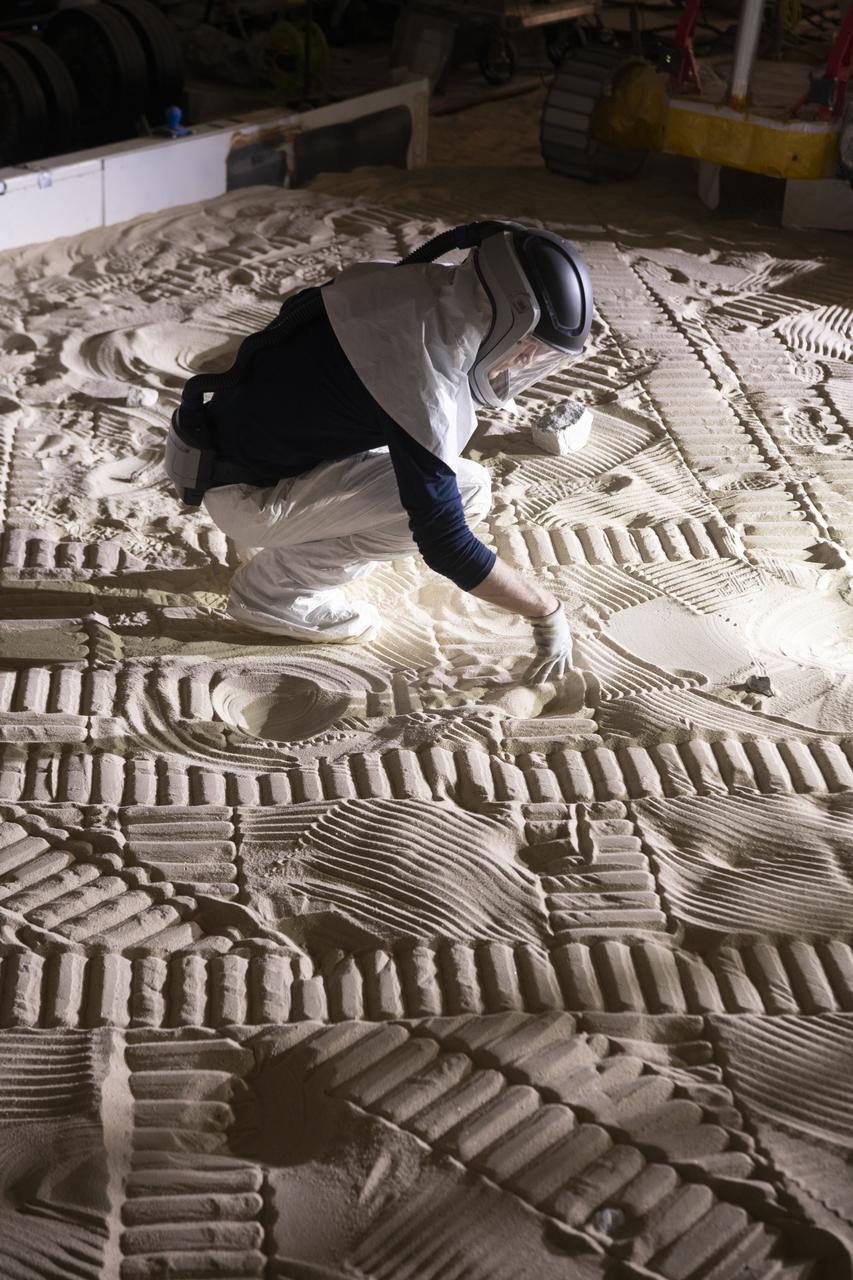
An Engineer maps out the position of rocks during VIPER testing at The NASA Glenn Research Center. A test version of the VIPER rover continues to show how well it moves through a simulated lunar surface in our SLOPE lab. This is a critical step toward ensuring the rover is ready for its 2023 mission to find water ice at the Moon’s South pole.
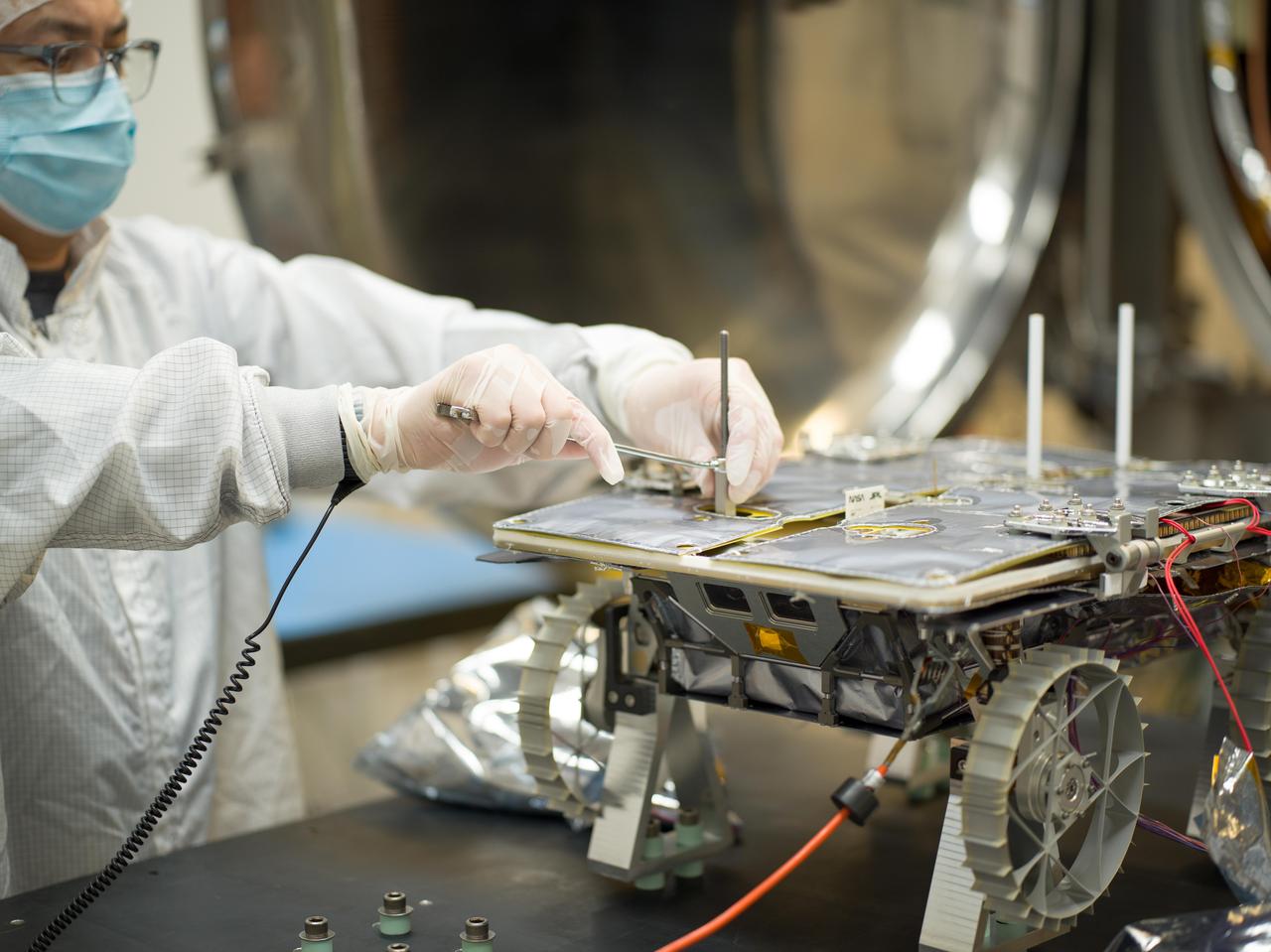
An engineer prepares a small rover – part of NASA's CADRE (Cooperative Autonomous Distributed Robotic Exploration) technology demonstration that's headed to the Moon – for testing in a thermal vacuum chamber at the agency's Jet Propulsion Laboratory in Southern California in October 2023. Slated to arrive at the Moon in 2024 as part of NASA's CLPS (Commercial Lunar Payload Services) initiative, CADRE is designed to demonstrate that multiple robots can cooperate and explore together autonomously – without direct input from human mission controllers. A trio of the miniature solar-powered rovers, each about the size of a carry-on suitcase, will explore the Moon as a team, communicating via radio with each other and a base station aboard a lunar lander. By taking simultaneous measurements from multiple locations, CADRE will also demonstrate how multirobot missions can record data impossible for a single robot to achieve – a tantalizing prospect for future missions. The rover being tested is the first flight model to be completed. Thermal vacuum testing simulates the harsh environment the rovers will face on the journey to the Moon and on the lunar surface: All the air is pumped out of the chamber and the temperature is cycled to high and low extremes. https://photojournal.jpl.nasa.gov/catalog/PIA25669
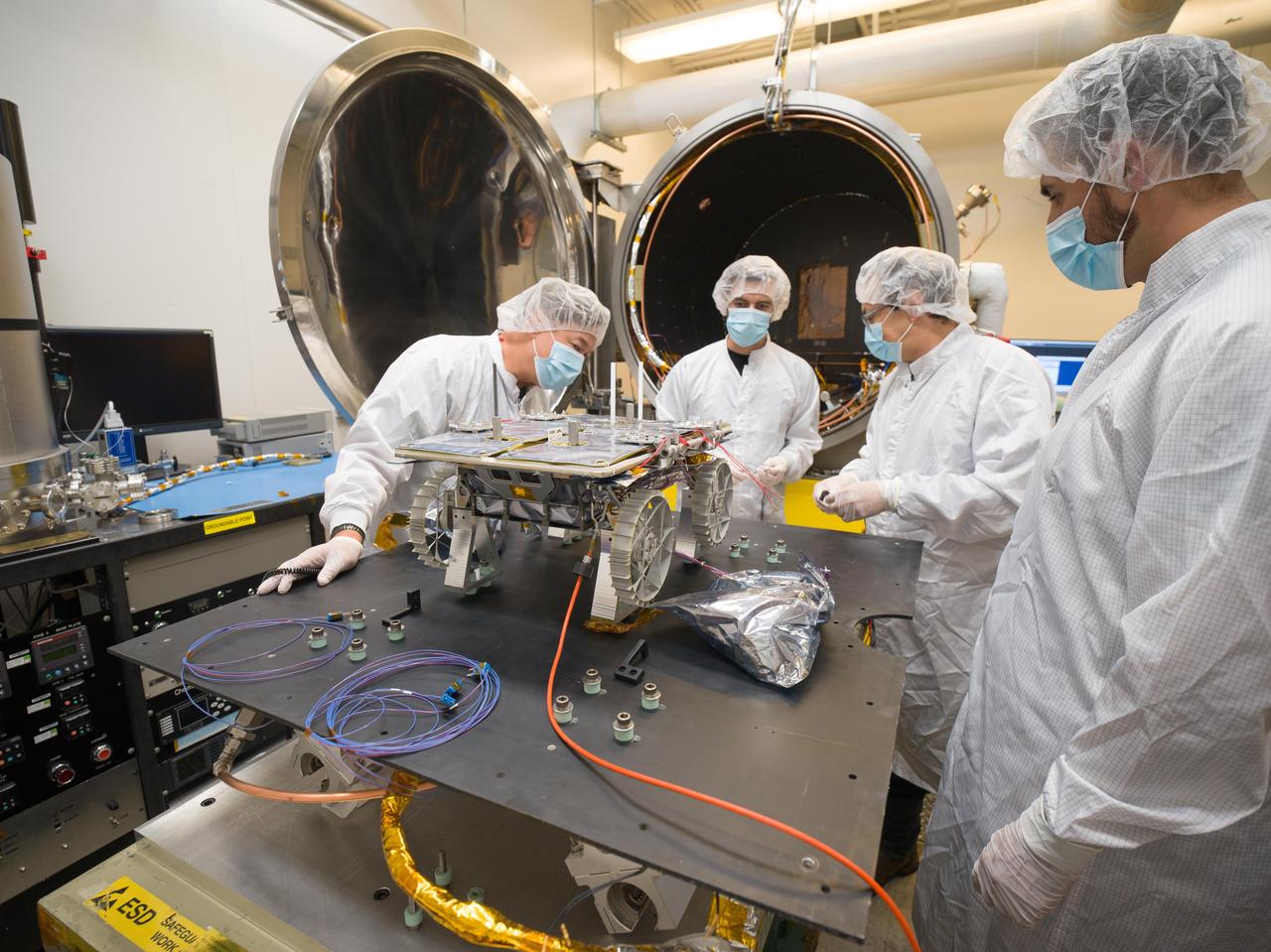
Engineers prepare a small rover – part of NASA's CADRE (Cooperative Autonomous Distributed Robotic Exploration) technology demonstration that's headed to the Moon – for testing in the thermal vacuum chamber behind them at the agency's Jet Propulsion Laboratory in Southern California in October 2023. Slated to arrive at the Moon in 2024 as part of NASA's CLPS (Commercial Lunar Payload Services) initiative, CADRE is designed to demonstrate that multiple robots can cooperate and explore together autonomously – without direct input from human mission controllers. A trio of the miniature solar-powered rovers, each about the size of a carry-on suitcase, will explore the Moon as a team, communicating via radio with each other and a base station aboard a lunar lander. By taking simultaneous measurements from multiple locations, CADRE will also demonstrate how multirobot missions can record data impossible for a single robot to achieve – a tantalizing prospect for future missions. The rover being tested is the first flight model to be completed. Thermal vacuum testing simulates the harsh environment the rovers will face on the journey to the Moon and on the lunar surface: All the air is pumped out of the chamber and the temperature is cycled to high and low extremes. https://photojournal.jpl.nasa.gov/catalog/PIA25670

jsc2024e016244 (11/27/2023) --- The final Multi-Resolution Scanning payload docked with an Astrobee robot at NASA’s Ames Research Center. The Multi-Resolution Scanning payload uses multiple different sensor types to generate high-resolution 3D data and more accurate trajectory data to understand how the robot moves around in 3D space. Such systems could support future Gateway and Lunar surface missions by providing automated defect detection, automated and remote maintenance, autonomous vehicle operations, and surface scanning using rovers.

NASA Extravehicular Activity and Human Surface Mobility Program Lara Kearney discusses the historic agreement signed April 9th at NASA Headquarters, between the United States and Japan to advance sustainable human exploration of the Moon, Wednesday, April 10, 2024, at the Japan Aerospace Exploration Agency (JAXA) offices in Washington. Under the agreement, Japan will design, develop, and operate a pressurized rover for crewed and uncrewed exploration on the Moon. NASA will provide the launch and delivery of the rover to the Moon as well as two Japanese astronaut missions to the lunar surface. Photo Credit: Photo Credit: (NASA/Bill Ingalls)
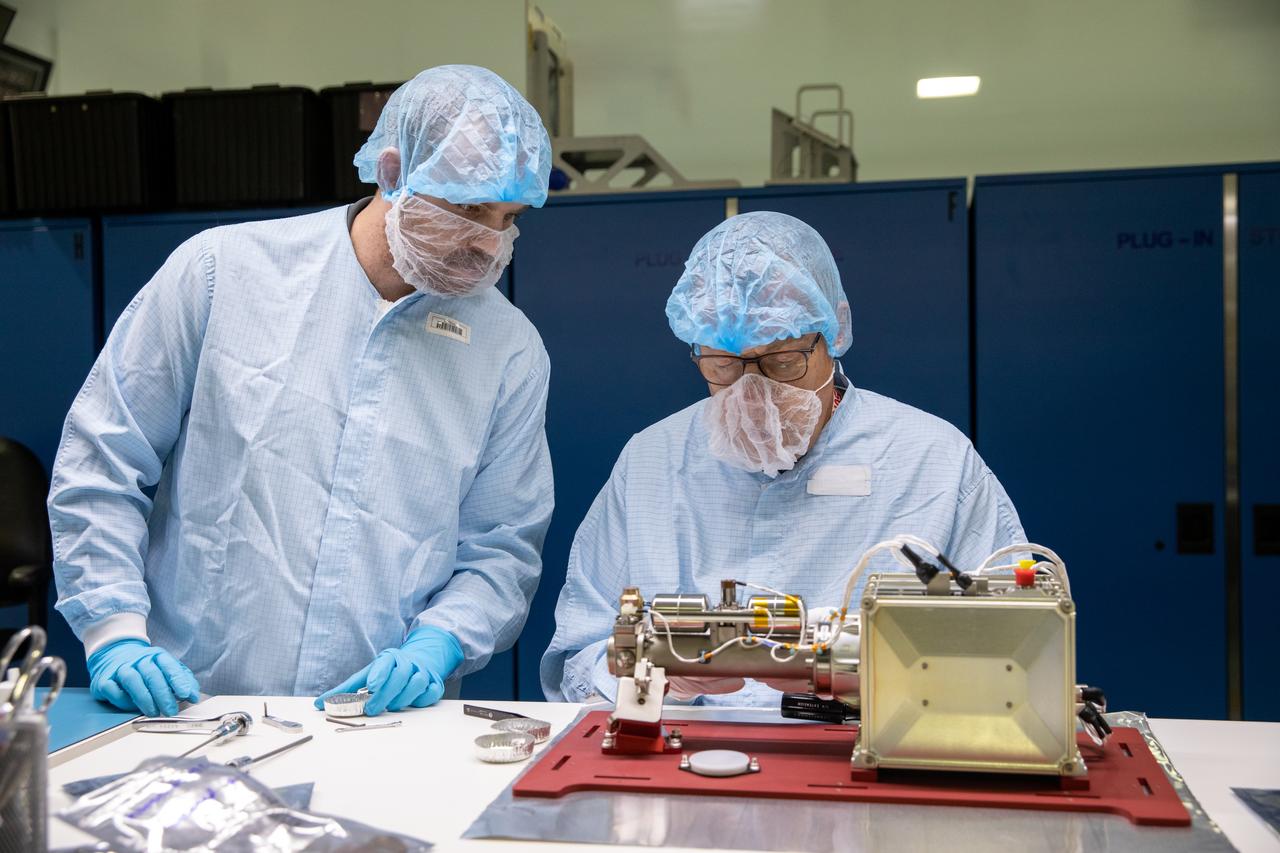
Technicians prepare the Mass Spectrometer Observing Lunar Operations (MSolo) for NASA’s Volatile Investigating Polar Exploration Rover (VIPER) mission for packing inside a laboratory in the Space Station Processing Facility at NASA’s Kennedy Space Center in Florida on Feb. 21, 2023. MSolo will be shipped to Johnson Space Center in Houston for integration into VIPER. MSolo is a commercial off-the-shelf mass spectrometer modified to work in space and it will help analyze the chemical makeup of landing sites on the Moon, as well as study water on the lunar surface. MSolo will be part of NASA’s first Commercial Lunar Payload Delivery Service (CLPS) mission where under the Artemis program, commercial deliveries will be used to perform science experiments, test technologies, and demonstrate capabilities to help NASA explore the Moon and prepare for human missions. VIPER is scheduled to be delivered to the Moon’s South Pole in late 2024 by Astrobotic’s Griffin lander as part of the CLPS initiative.
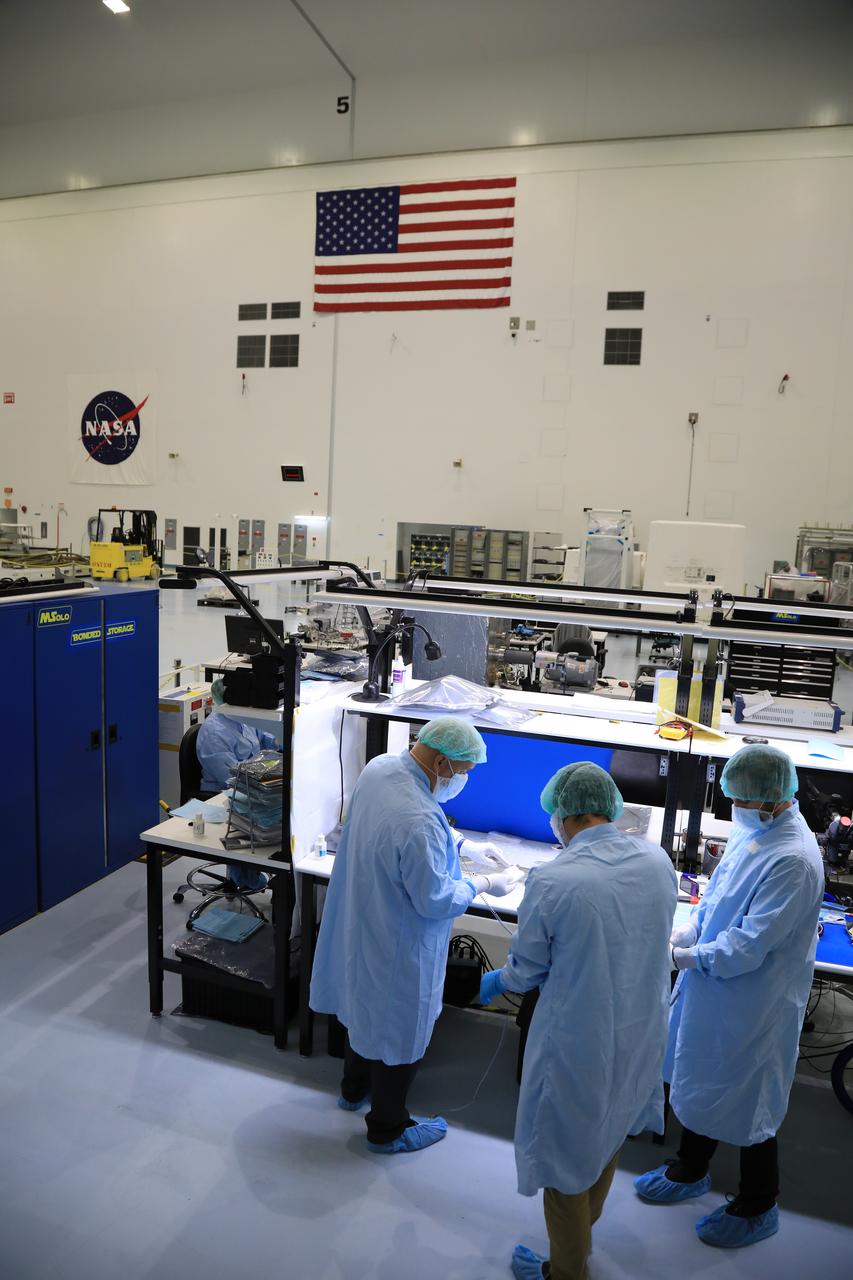
Engineers and technicians at NASA’s Kennedy Space Center in Florida prepare to install the radiator for the Mass Spectrometer Observing Lunar Operations (MSolo) instrument inside the Space Station Processing Facility on Sept. 25, 2020. MSolo will help analyze the chemical makeup of landing sites on the Moon, as well as study water on the lunar surface. The radiator will help keep the instrument’s temperature stable in the extreme heat and cold it will encounter. MSolo instruments are scheduled to launch on multiple robotic missions as part of NASA’s Commercial Lunar Payload Services (CLPS), with the first of these missions exploring Lacus Mortis, a large crater on the near side of the Moon, beginning in 2021. MSolo also will be one of three instruments on the agency’s water-hunting Volatiles Investigating Polar Exploration Rover, VIPER, scheduled to launch to the Moon’s South Pole in late 2023.
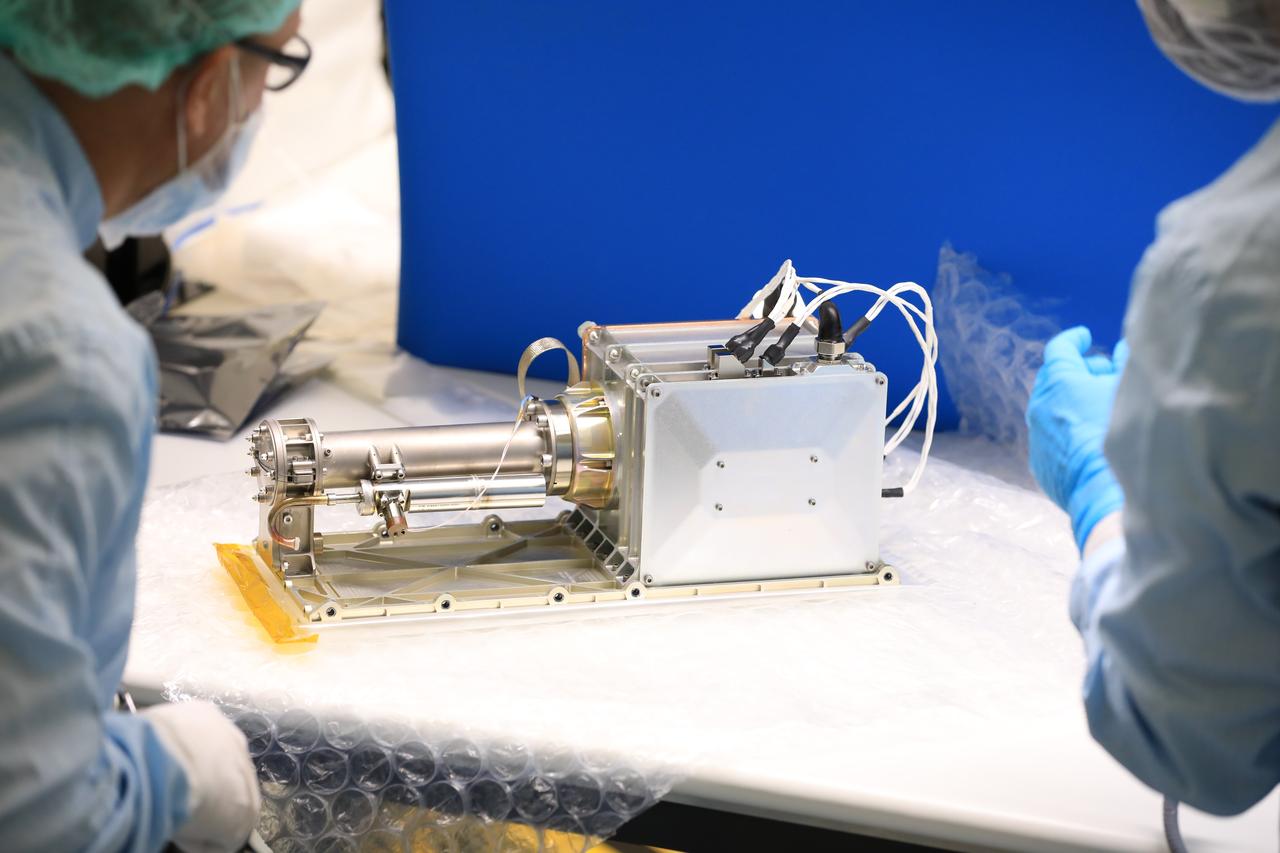
Engineers and technicians at NASA’s Kennedy Space Center in Florida install the radiator for the Mass Spectrometer Observing Lunar Operations (MSolo) instrument inside the Space Station Processing Facility on Sept. 25, 2020. MSolo will help analyze the chemical makeup of landing sites on the Moon, as well as study water on the lunar surface. The radiator will help keep the instrument’s temperature stable in the extreme heat and cold it will encounter. MSolo instruments are scheduled to launch on multiple robotic missions as part of NASA’s Commercial Lunar Payload Services (CLPS), with the first of these missions exploring Lacus Mortis, a large crater on the near side of the Moon, beginning in 2021. MSolo also will be one of three instruments on the agency’s water-hunting Volatiles Investigating Polar Exploration Rover, VIPER, scheduled to launch to the Moon’s South Pole in late 2023.
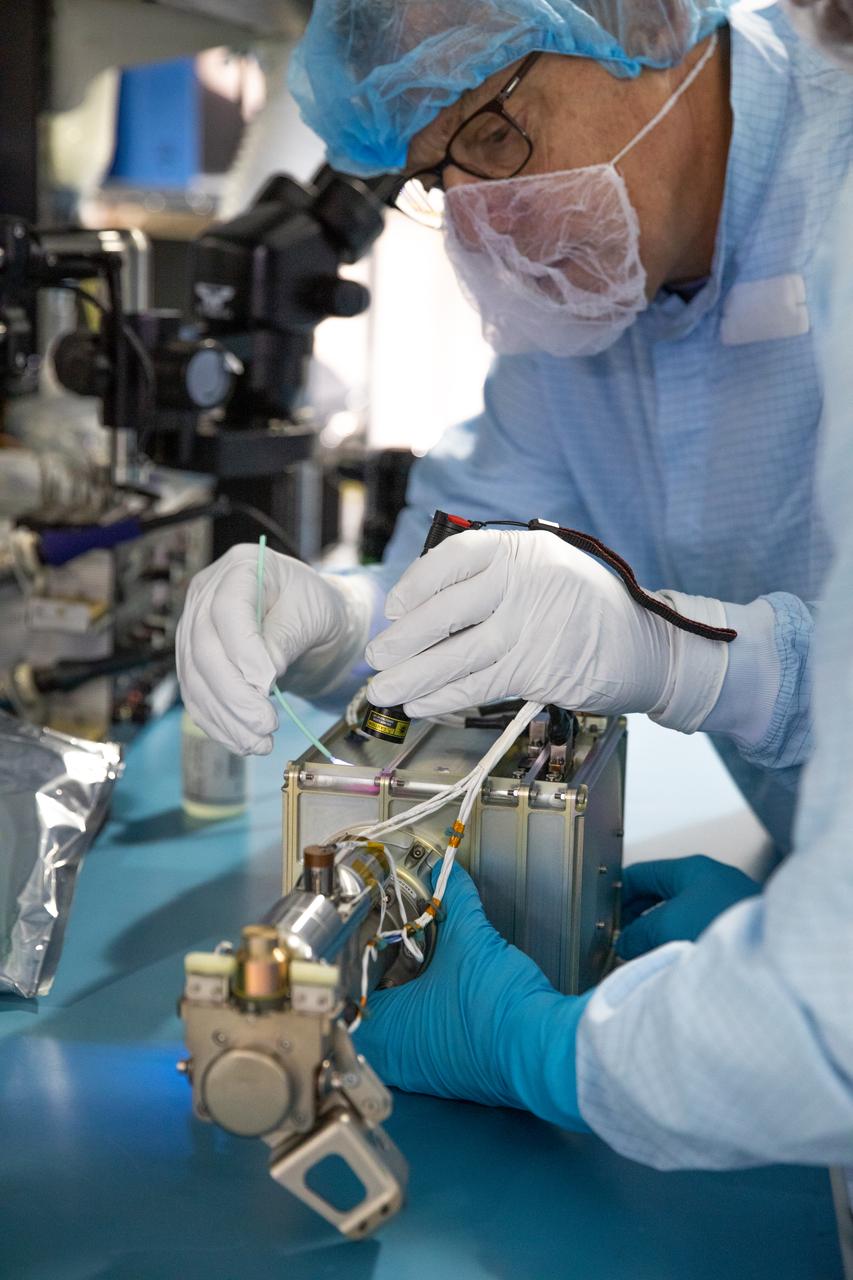
Technicians prepare the Mass Spectrometer Observing Lunar Operations (MSolo) for NASA’s Volatile Investigating Polar Exploration Rover (VIPER) mission for packing inside a laboratory in the Space Station Processing Facility at NASA’s Kennedy Space Center in Florida on Feb. 21, 2023. MSolo will be shipped to Johnson Space Center in Houston for integration into VIPER. MSolo is a commercial off-the-shelf mass spectrometer modified to work in space and it will help analyze the chemical makeup of landing sites on the Moon, as well as study water on the lunar surface. MSolo will be part of NASA’s first Commercial Lunar Payload Delivery Service (CLPS) mission where under the Artemis program, commercial deliveries will be used to perform science experiments, test technologies, and demonstrate capabilities to help NASA explore the Moon and prepare for human missions. VIPER is scheduled to be delivered to the Moon’s South Pole in late 2024 by Astrobotic’s Griffin lander as part of the CLPS initiative.
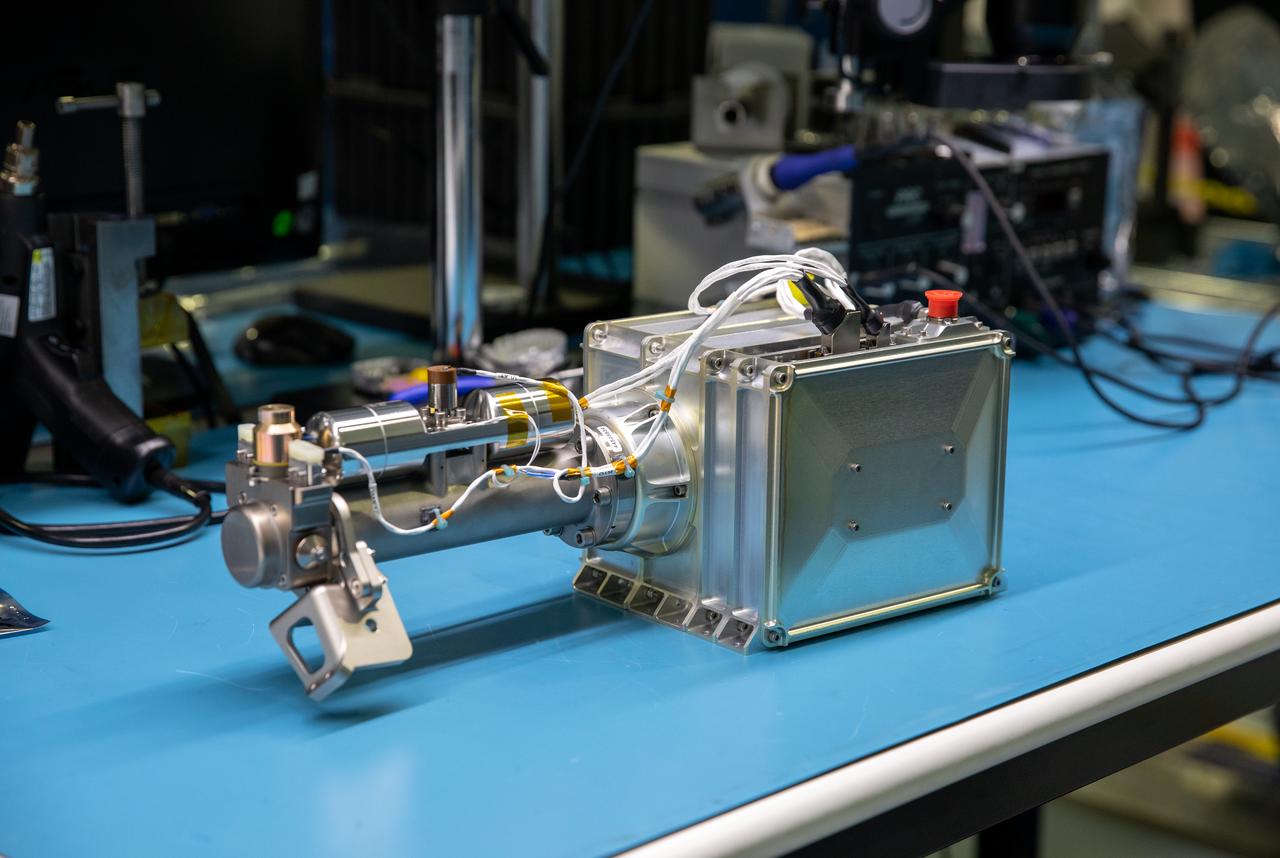
The Mass Spectrometer Observing Lunar Operations (MSolo) for NASA’s Volatile Investigating Polar Exploration Rover (VIPER) mission is prepared for packing inside a laboratory in the Space Station Processing Facility at NASA’s Kennedy Space Center in Florida on Feb. 21, 2023. MSolo will be shipped to Johnson Space Center in Houston for integration into VIPER. MSolo is a commercial off-the-shelf mass spectrometer modified to work in space and it will help analyze the chemical makeup of landing sites on the Moon, as well as study water on the lunar surface. MSolo will be part of NASA’s first Commercial Lunar Payload Delivery Service (CLPS) mission where under the Artemis program, commercial deliveries will be used to perform science experiments, test technologies, and demonstrate capabilities to help NASA explore the Moon and prepare for human missions. VIPER is scheduled to be delivered to the Moon’s South Pole in late 2024 by Astrobotic’s Griffin lander as part of the CLPS initiative.

Engineers and technicians at NASA’s Kennedy Space Center in Florida install the radiator for the Mass Spectrometer Observing Lunar Operations (MSolo) instrument inside the Space Station Processing Facility on Sept. 25, 2020. MSolo will help analyze the chemical makeup of landing sites on the Moon, as well as study water on the lunar surface. The radiator will help keep the instrument’s temperature stable in the extreme heat and cold it will encounter. MSolo instruments are scheduled to launch on multiple robotic missions as part of NASA’s Commercial Lunar Payload Services (CLPS), with the first of these missions exploring Lacus Mortis, a large crater on the near side of the Moon, beginning in 2021. MSolo also will be one of three instruments on the agency’s water-hunting Volatiles Investigating Polar Exploration Rover, VIPER, scheduled to launch to the Moon’s South Pole in late 2023.
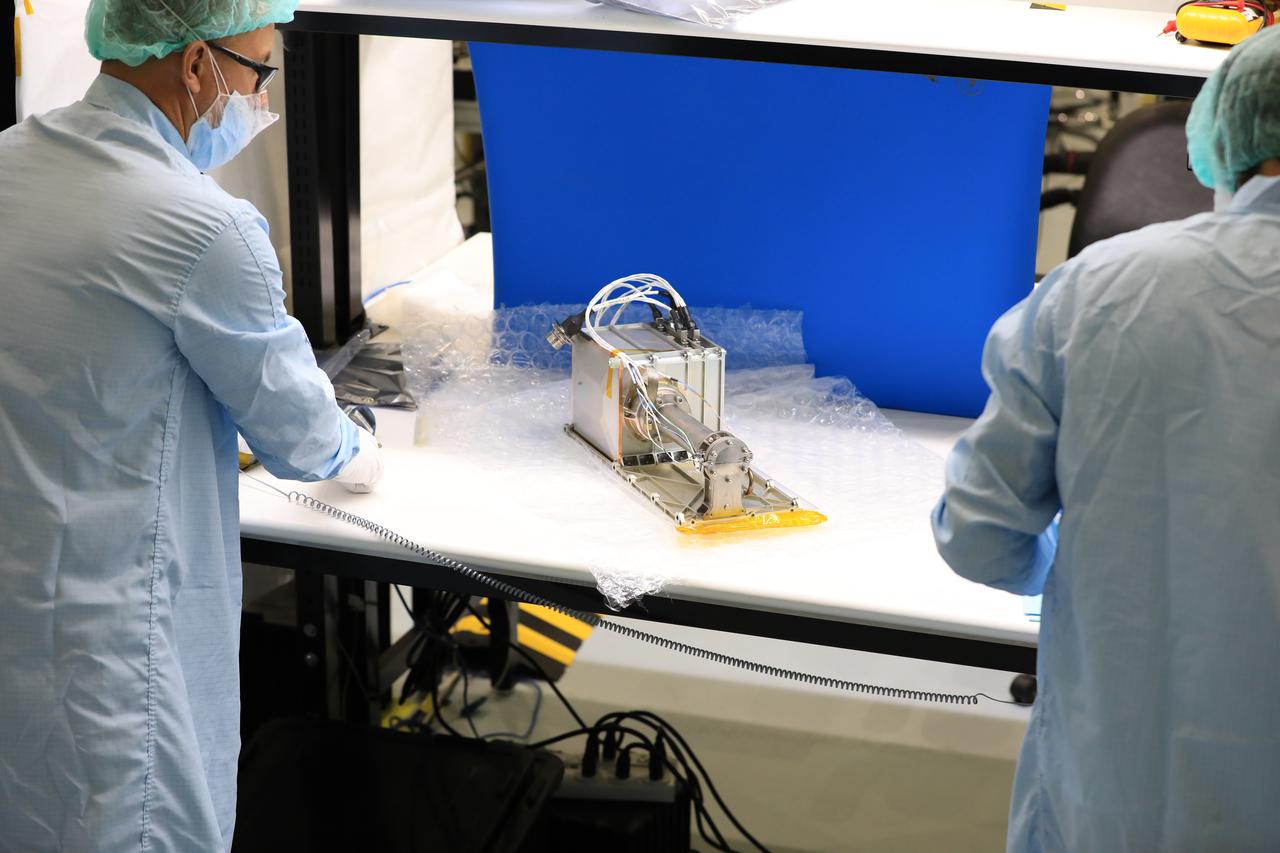
Engineers and technicians at NASA’s Kennedy Space Center in Florida install the radiator for the Mass Spectrometer Observing Lunar Operations (MSolo) instrument inside the Space Station Processing Facility on Sept. 25, 2020. MSolo will help analyze the chemical makeup of landing sites on the Moon, as well as study water on the lunar surface. The radiator will help keep the instrument’s temperature stable in the extreme heat and cold it will encounter. MSolo instruments are scheduled to launch on multiple robotic missions as part of NASA’s Commercial Lunar Payload Services (CLPS), with the first of these missions exploring Lacus Mortis, a large crater on the near side of the Moon, beginning in 2021. MSolo also will be one of three instruments on the agency’s water-hunting Volatiles Investigating Polar Exploration Rover, VIPER, scheduled to launch to the Moon’s South Pole in late 2023.
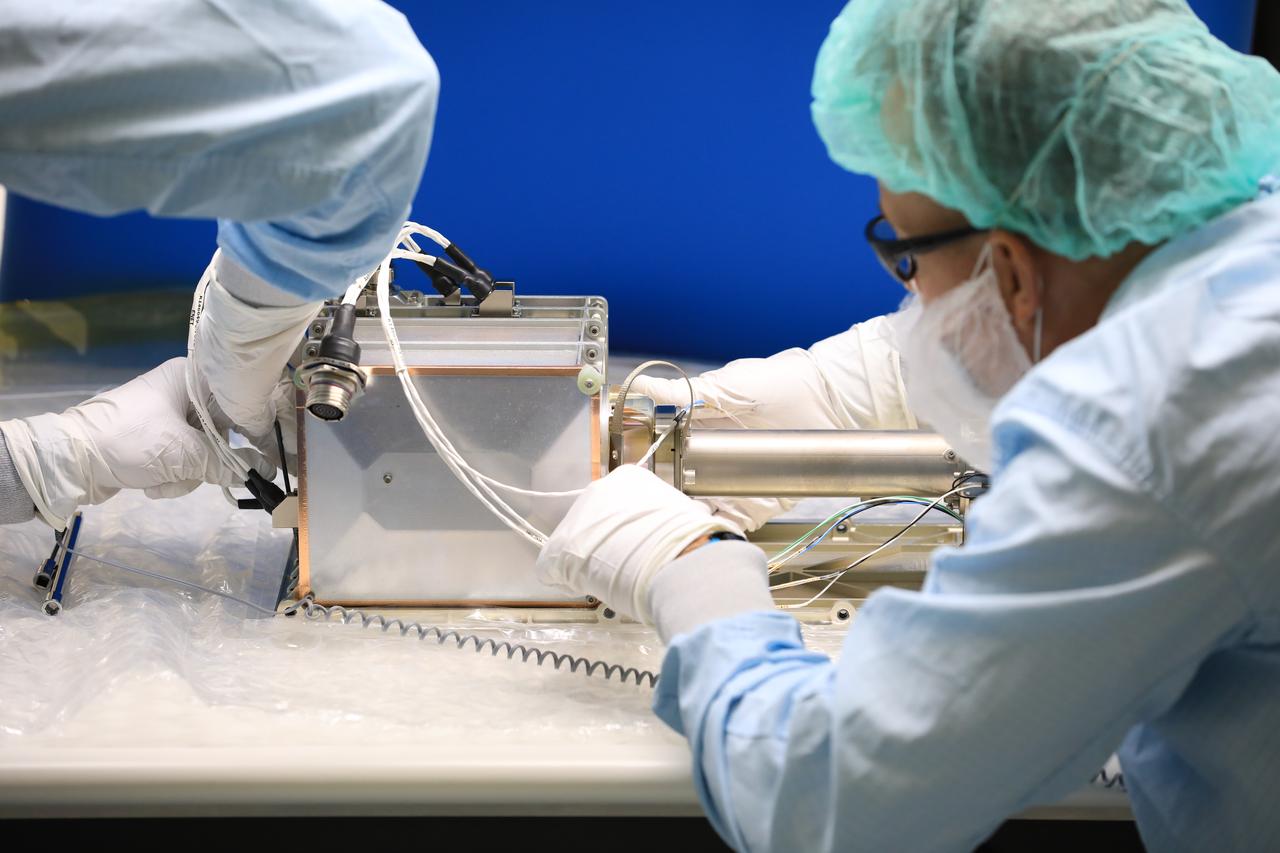
Engineers and technicians at NASA’s Kennedy Space Center in Florida install the radiator for the Mass Spectrometer Observing Lunar Operations (MSolo) instrument inside the Space Station Processing Facility on Sept. 25, 2020. MSolo will help analyze the chemical makeup of landing sites on the Moon, as well as study water on the lunar surface. The radiator will help keep the instrument’s temperature stable in the extreme heat and cold it will encounter. MSolo instruments are scheduled to launch on multiple robotic missions as part of NASA’s Commercial Lunar Payload Services (CLPS), with the first of these missions exploring Lacus Mortis, a large crater on the near side of the Moon, beginning in 2021. MSolo also will be one of three instruments on the agency’s water-hunting Volatiles Investigating Polar Exploration Rover, VIPER, scheduled to launch to the Moon’s South Pole in late 2023.
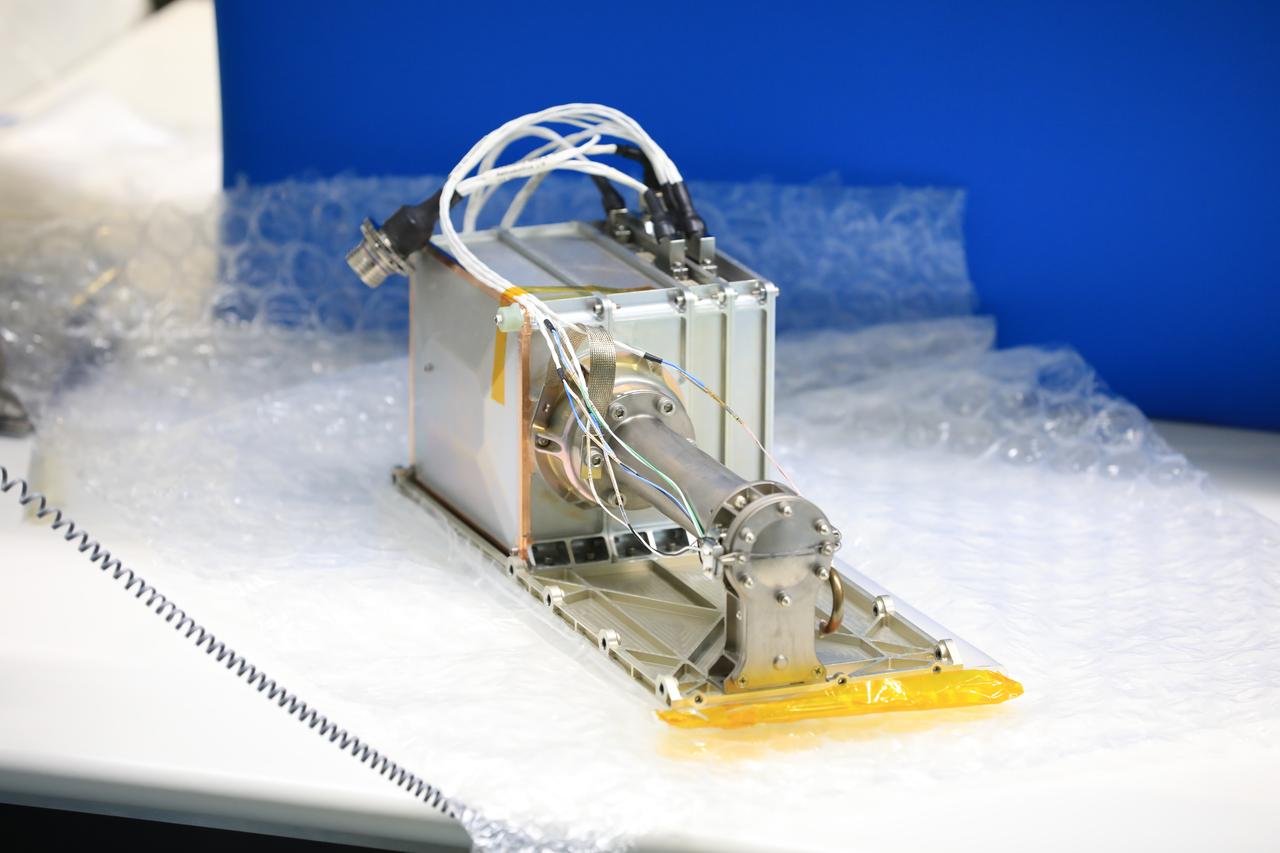
The Mass Spectrometer Observing Lunar Operations (MSolo) instrument is photographed inside the Space Station Processing Facility at NASA’s Kennedy Space Center in Florida following installation of its radiator on Sept. 25, 2020. MSolo will help analyze the chemical makeup of landing sites on the Moon, as well as study water on the lunar surface. The radiator will help keep the instrument’s temperature stable in the extreme heat and cold it will encounter. MSolo instruments are scheduled to launch on multiple robotic missions as part of NASA’s Commercial Lunar Payload Services (CLPS), with the first of these missions exploring Lacus Mortis, a large crater on the near side of the Moon, beginning in 2021. MSolo also will be one of three instruments on the agency’s water-hunting Volatiles Investigating Polar Exploration Rover, VIPER, scheduled to launch to the Moon’s South Pole in late 2023.
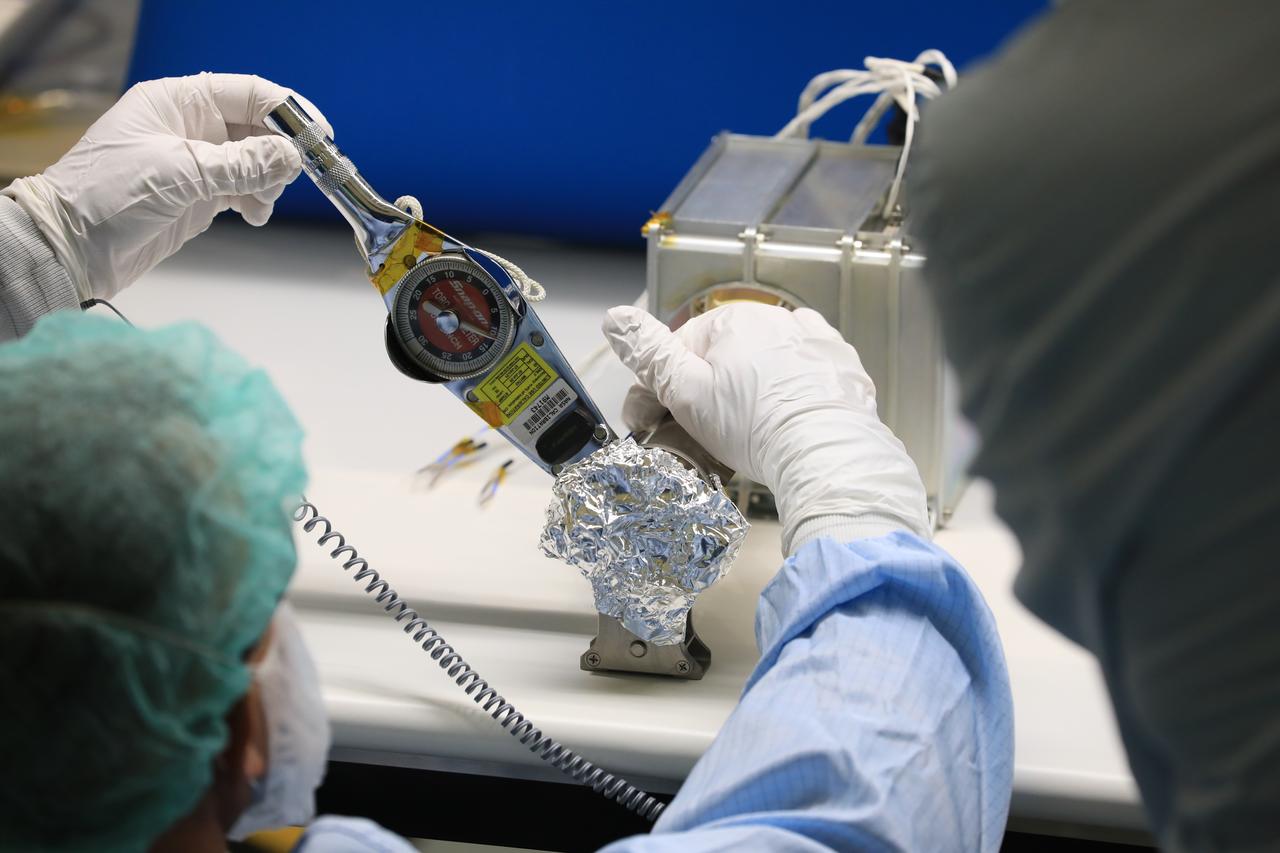
Engineers and technicians at NASA’s Kennedy Space Center in Florida work with instruments for Mass Spectrometer observing lunar operations (MSolo) inside the Space Station Processing on Sept. 25, 2020. MSolo is a commercial off-the-shelf mass spectrometer modified to work in space and it will help analyze the chemical makeup of landing sites on the Moon, as well as study water on the lunar surface. This work is preparing MSolo hardware for a robotic mission as part of the Commercial Lunar Payload Services (CLPS) launching to exploring Lacus Mortis, a large crater on the near side of the Moon in 2021. A future mission will send a mobile robot named the Volatiles Investigating Polar Exploration Rover (VIPER) to the Moon to prospect for water. VIPER will have several instruments that will allow it to detect and sample water including MSolo, the Neutron Spectrometer System, the Near Infrared Volatiles Spectrometer System and The Regolith and Ice Drill for Exploring New Terrain (TRIDENT).
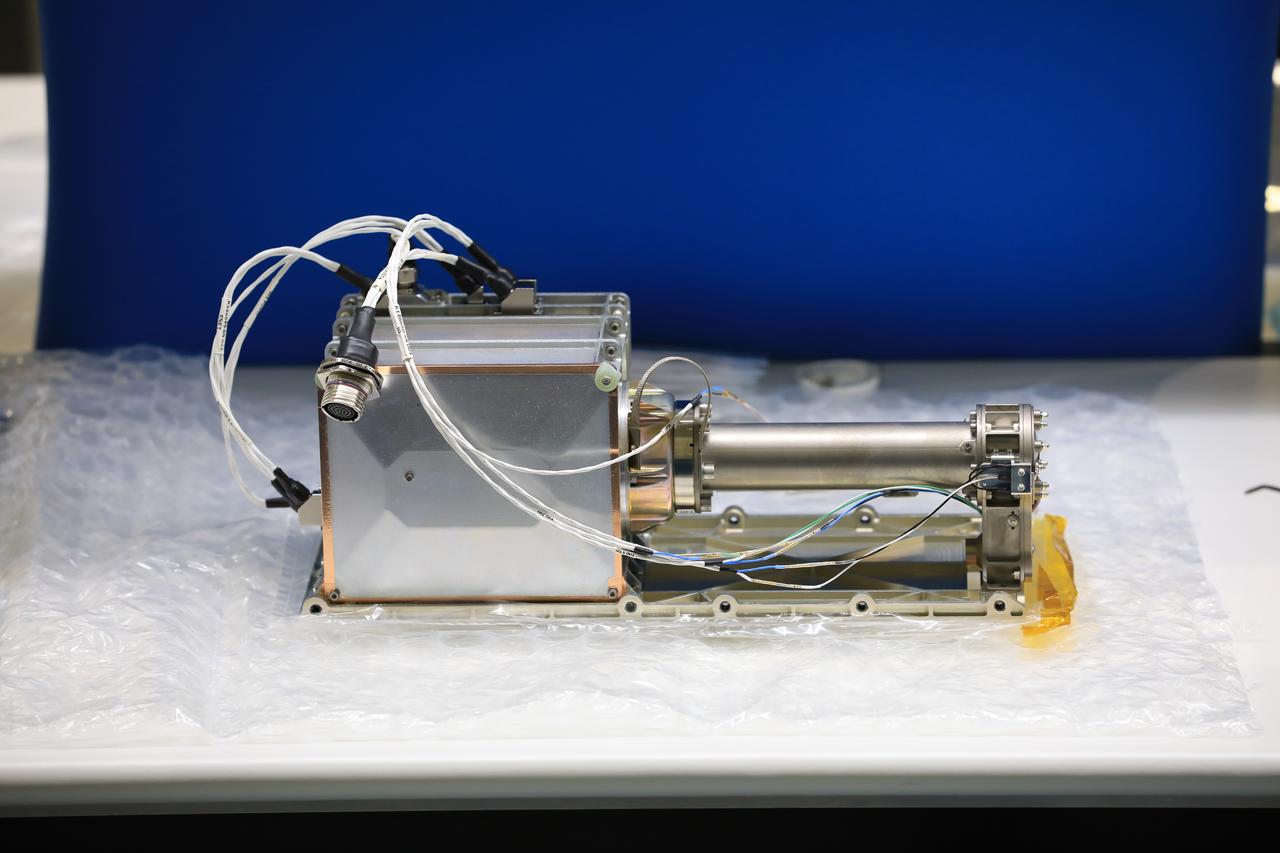
The Mass Spectrometer Observing Lunar Operations (MSolo) instrument is photographed inside the Space Station Processing Facility at NASA’s Kennedy Space Center in Florida following installation of its radiator on Sept. 25, 2020. MSolo will help analyze the chemical makeup of landing sites on the Moon, as well as study water on the lunar surface. The radiator will help keep the instrument’s temperature stable in the extreme heat and cold it will encounter. MSolo instruments are scheduled to launch on multiple robotic missions as part of NASA’s Commercial Lunar Payload Services (CLPS), with the first of these missions exploring Lacus Mortis, a large crater on the near side of the Moon, beginning in 2021. MSolo also will be one of three instruments on the agency’s water-hunting Volatiles Investigating Polar Exploration Rover, VIPER, scheduled to launch to the Moon’s South Pole in late 2023.
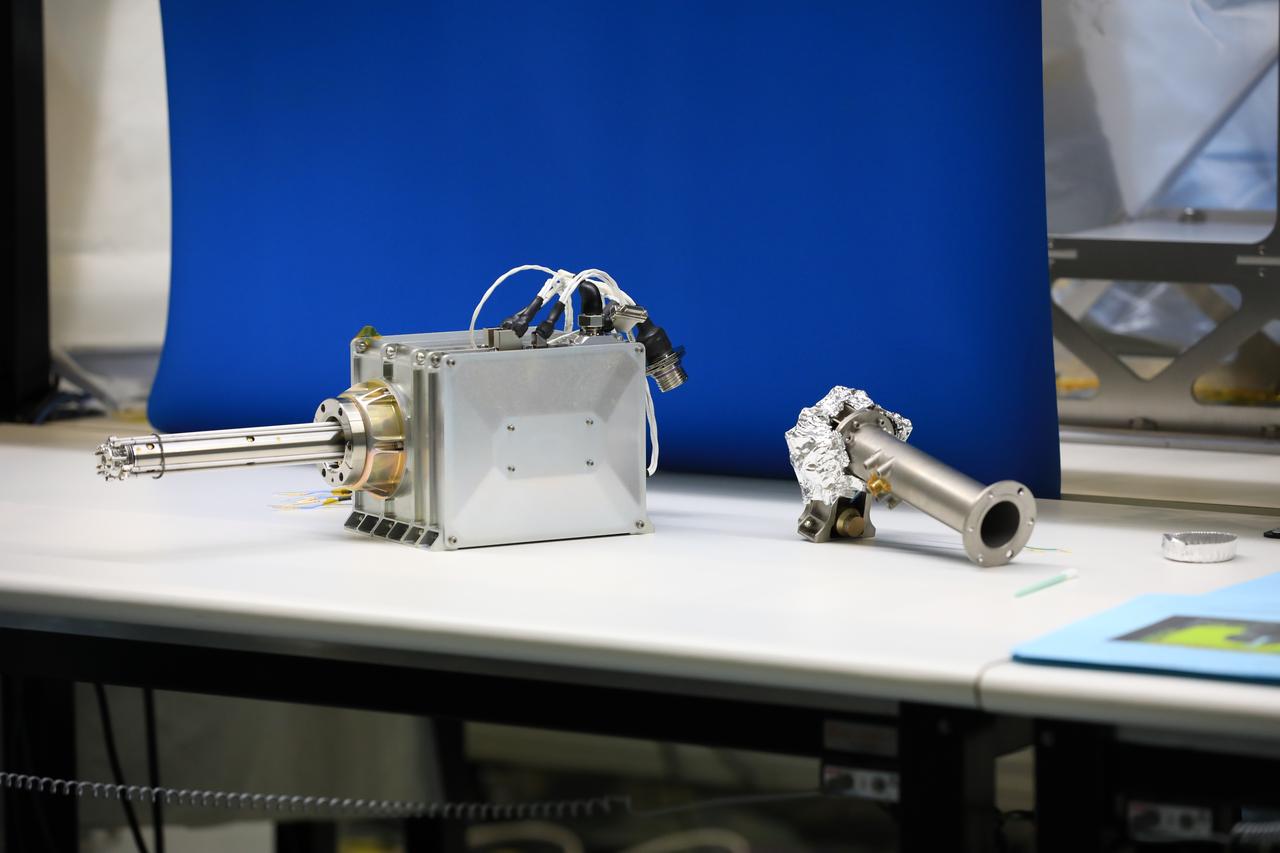
Instruments for the Mass Spectrometer observing lunar operations (MSolo) are in view inside the Space Station Processing Facility at NASA’s Kennedy Space Center in Florida on Sept. 25, 2020. MSolo is a commercial off-the-shelf mass spectrometer modified to work in space and it will help analyze the chemical makeup of landing sites on the Moon, as well as study water on the lunar surface. This work is preparing MSolo hardware for a robotic mission as part of the Commercial Lunar Payload Services (CLPS) launching to exploring Lacus Mortis, a large crater on the near side of the Moon in 2021. A future mission will send a mobile robot named the Volatiles Investigating Polar Exploration Rover (VIPER) to the Moon to prospect for water. VIPER will have several instruments that will allow it to detect and sample water including MSolo, the Neutron Spectrometer System, the Near Infrared Volatiles Spectrometer System and The Regolith and Ice Drill for Exploring New Terrain (TRIDENT).
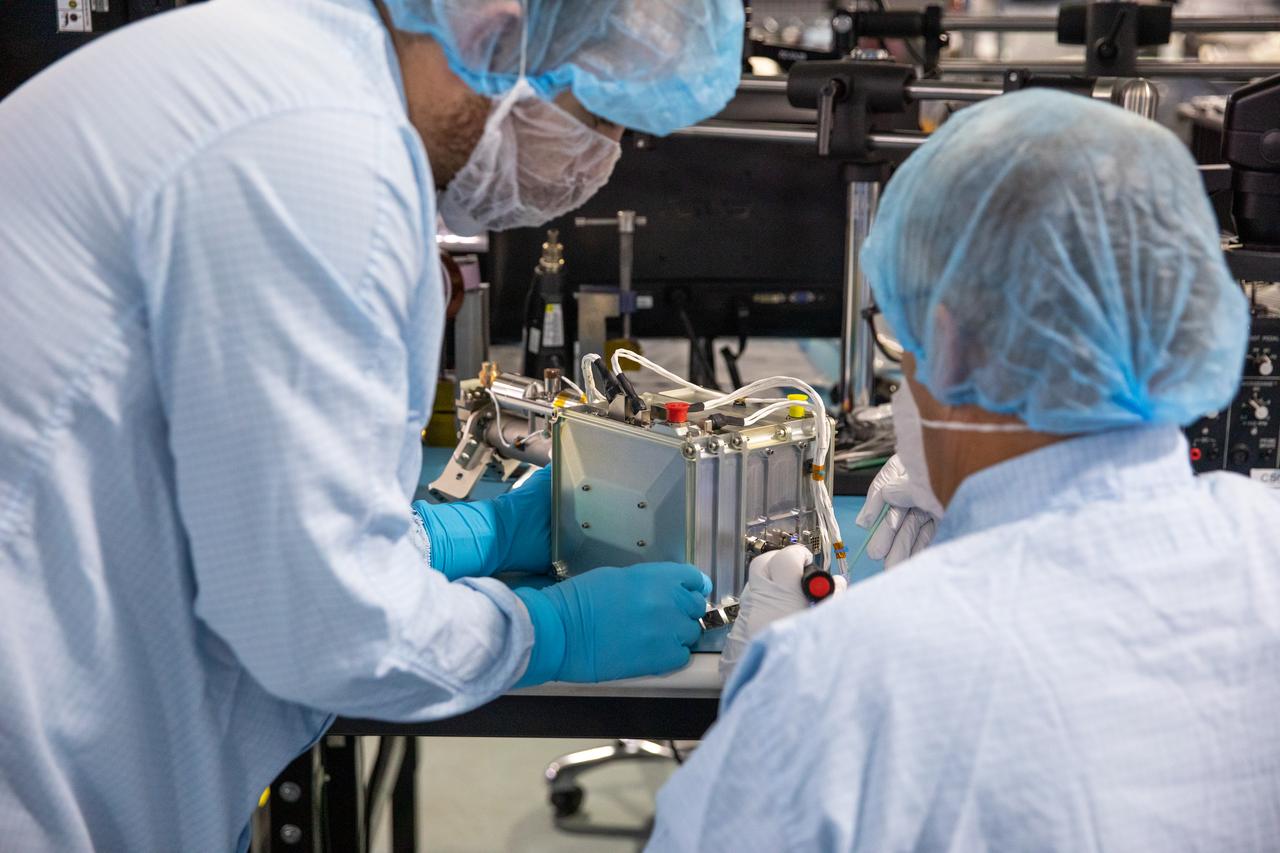
Technicians prepare the Mass Spectrometer Observing Lunar Operations (MSolo) for NASA’s Volatile Investigating Polar Exploration Rover (VIPER) mission for packing inside a laboratory in the Space Station Processing Facility at NASA’s Kennedy Space Center in Florida on Feb. 21, 2023. MSolo will be shipped to Johnson Space Center in Houston for integration into VIPER. MSolo is a commercial off-the-shelf mass spectrometer modified to work in space and it will help analyze the chemical makeup of landing sites on the Moon, as well as study water on the lunar surface. MSolo will be part of NASA’s first Commercial Lunar Payload Delivery Service (CLPS) mission where under the Artemis program, commercial deliveries will be used to perform science experiments, test technologies, and demonstrate capabilities to help NASA explore the Moon and prepare for human missions. VIPER is scheduled to be delivered to the Moon’s South Pole in late 2024 by Astrobotic’s Griffin lander as part of the CLPS initiative.
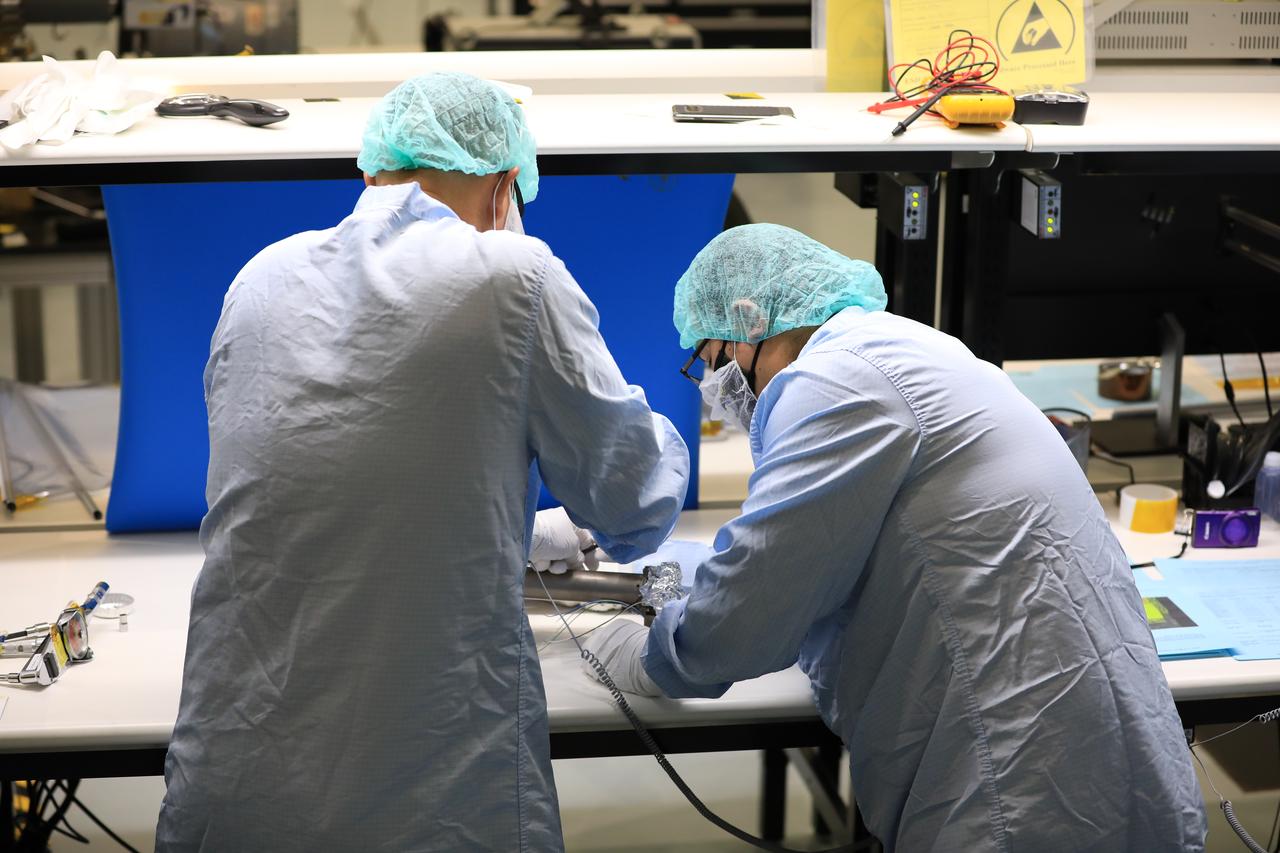
Engineers and technicians at NASA’s Kennedy Space Center in Florida work with instruments for Mass Spectrometer observing lunar operations (MSolo) inside the Space Station Processing on Sept. 25, 2020. MSolo is a commercial off-the-shelf mass spectrometer modified to work in space and it will help analyze the chemical makeup of landing sites on the Moon, as well as study water on the lunar surface. This work is preparing MSolo hardware for a robotic mission as part of the Commercial Lunar Payload Services (CLPS) launching to exploring Lacus Mortis, a large crater on the near side of the Moon in 2021. A future mission will send a mobile robot named the Volatiles Investigating Polar Exploration Rover (VIPER) to the Moon to prospect for water. VIPER will have several instruments that will allow it to detect and sample water including MSolo, the Neutron Spectrometer System, the Near Infrared Volatiles Spectrometer System and The Regolith and Ice Drill for Exploring New Terrain (TRIDENT).
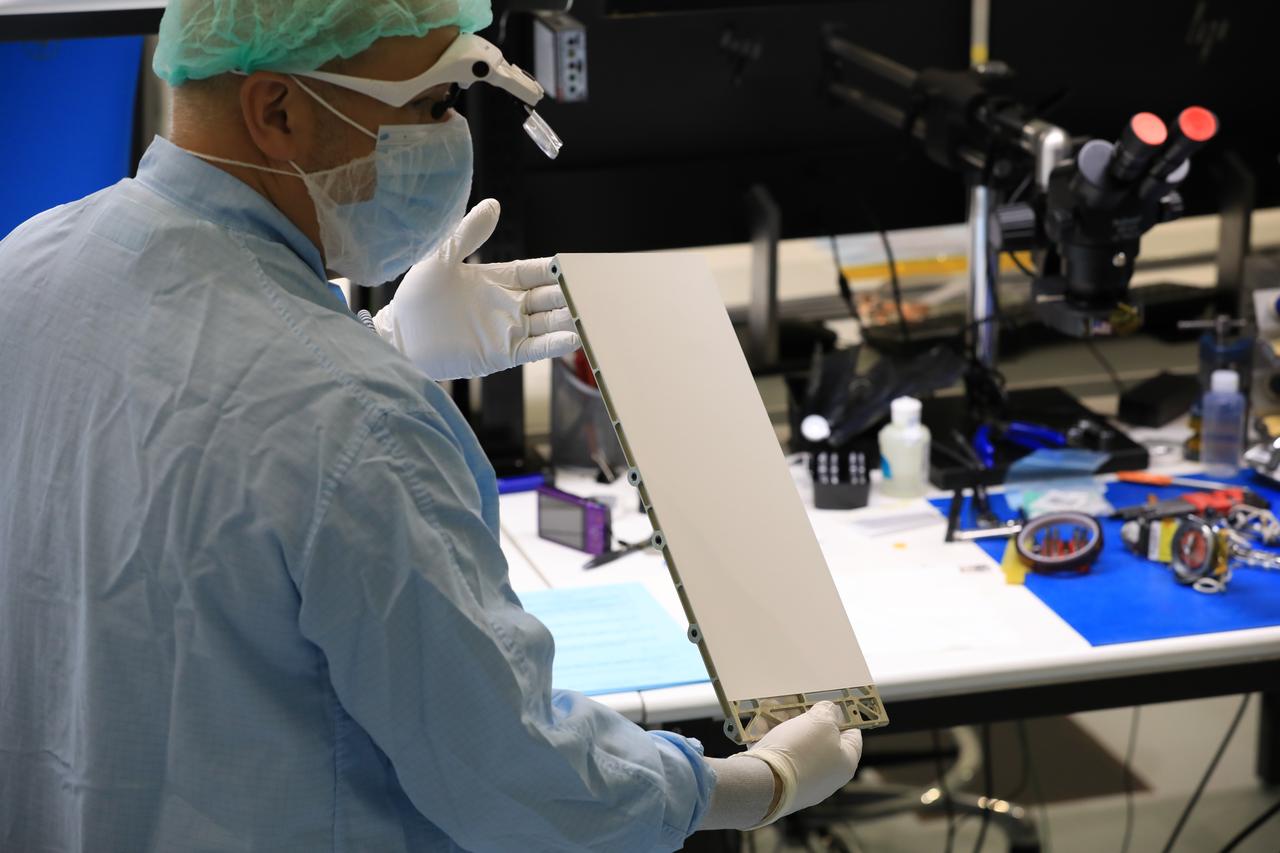
Engineers and technicians at NASA’s Kennedy Space Center in Florida prepare to install the radiator for the Mass Spectrometer Observing Lunar Operations (MSolo) instrument inside the Space Station Processing Facility on Sept. 25, 2020. MSolo will help analyze the chemical makeup of landing sites on the Moon, as well as study water on the lunar surface. The radiator will help keep the instrument’s temperature stable in the extreme heat and cold it will encounter. MSolo instruments are scheduled to launch on multiple robotic missions as part of NASA’s Commercial Lunar Payload Services (CLPS), with the first of these missions exploring Lacus Mortis, a large crater on the near side of the Moon, beginning in 2021. MSolo also will be one of three instruments on the agency’s water-hunting Volatiles Investigating Polar Exploration Rover, VIPER, scheduled to launch to the Moon’s South Pole in late 2023.
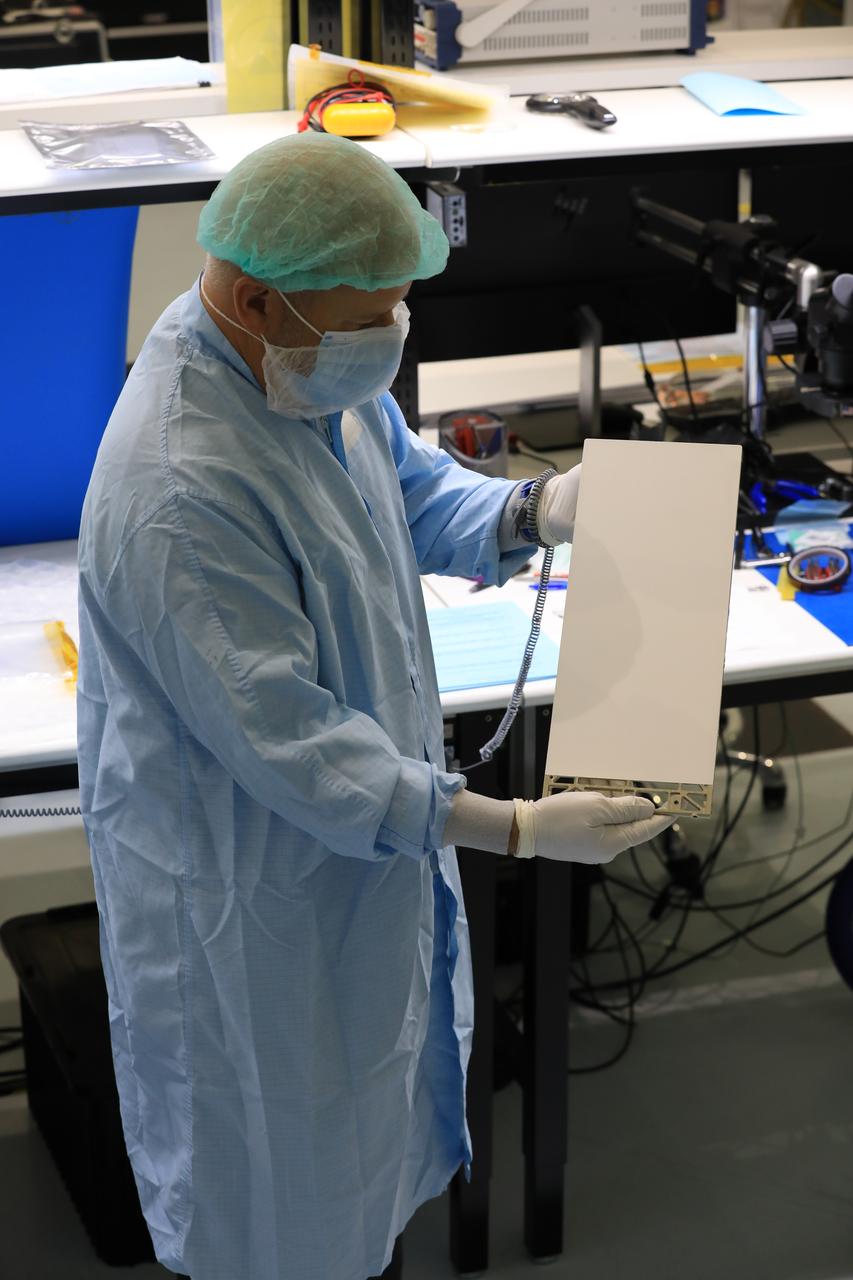
Engineers and technicians at NASA’s Kennedy Space Center in Florida prepare to install the radiator for the Mass Spectrometer Observing Lunar Operations (MSolo) instrument inside the Space Station Processing Facility on Sept. 25, 2020. MSolo will help analyze the chemical makeup of landing sites on the Moon, as well as study water on the lunar surface. The radiator will help keep the instrument’s temperature stable in the extreme heat and cold it will encounter. MSolo instruments are scheduled to launch on multiple robotic missions as part of NASA’s Commercial Lunar Payload Services (CLPS), with the first of these missions exploring Lacus Mortis, a large crater on the near side of the Moon, beginning in 2021. MSolo also will be one of three instruments on the agency’s water-hunting Volatiles Investigating Polar Exploration Rover, VIPER, scheduled to launch to the Moon’s South Pole in late 2023.
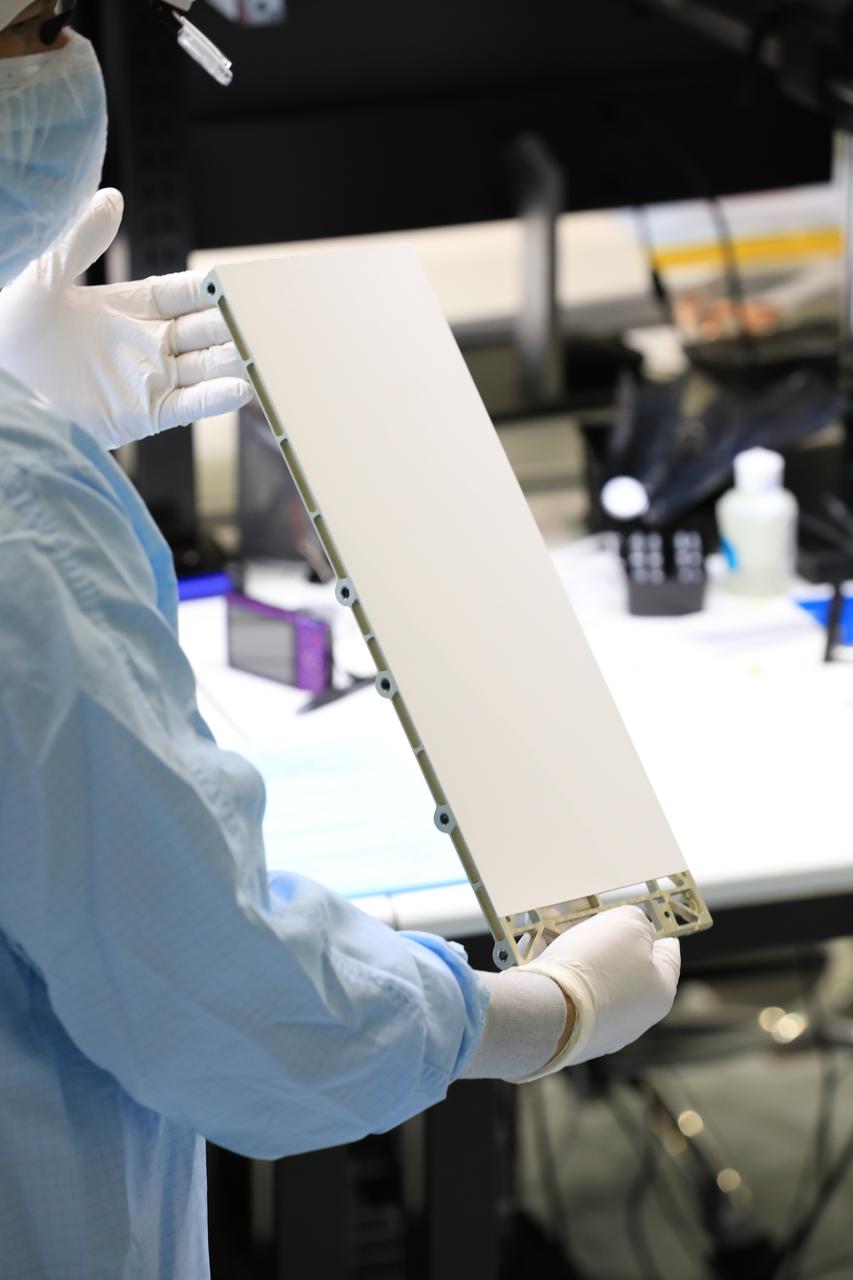
Engineers and technicians at NASA’s Kennedy Space Center in Florida prepare to install the radiator for the Mass Spectrometer Observing Lunar Operations (MSolo) instrument inside the Space Station Processing Facility on Sept. 25, 2020. MSolo will help analyze the chemical makeup of landing sites on the Moon, as well as study water on the lunar surface. The radiator will help keep the instrument’s temperature stable in the extreme heat and cold it will encounter. MSolo instruments are scheduled to launch on multiple robotic missions as part of NASA’s Commercial Lunar Payload Services (CLPS), with the first of these missions exploring Lacus Mortis, a large crater on the near side of the Moon, beginning in 2021. MSolo also will be one of three instruments on the agency’s water-hunting Volatiles Investigating Polar Exploration Rover, VIPER, scheduled to launch to the Moon’s South Pole in late 2023.
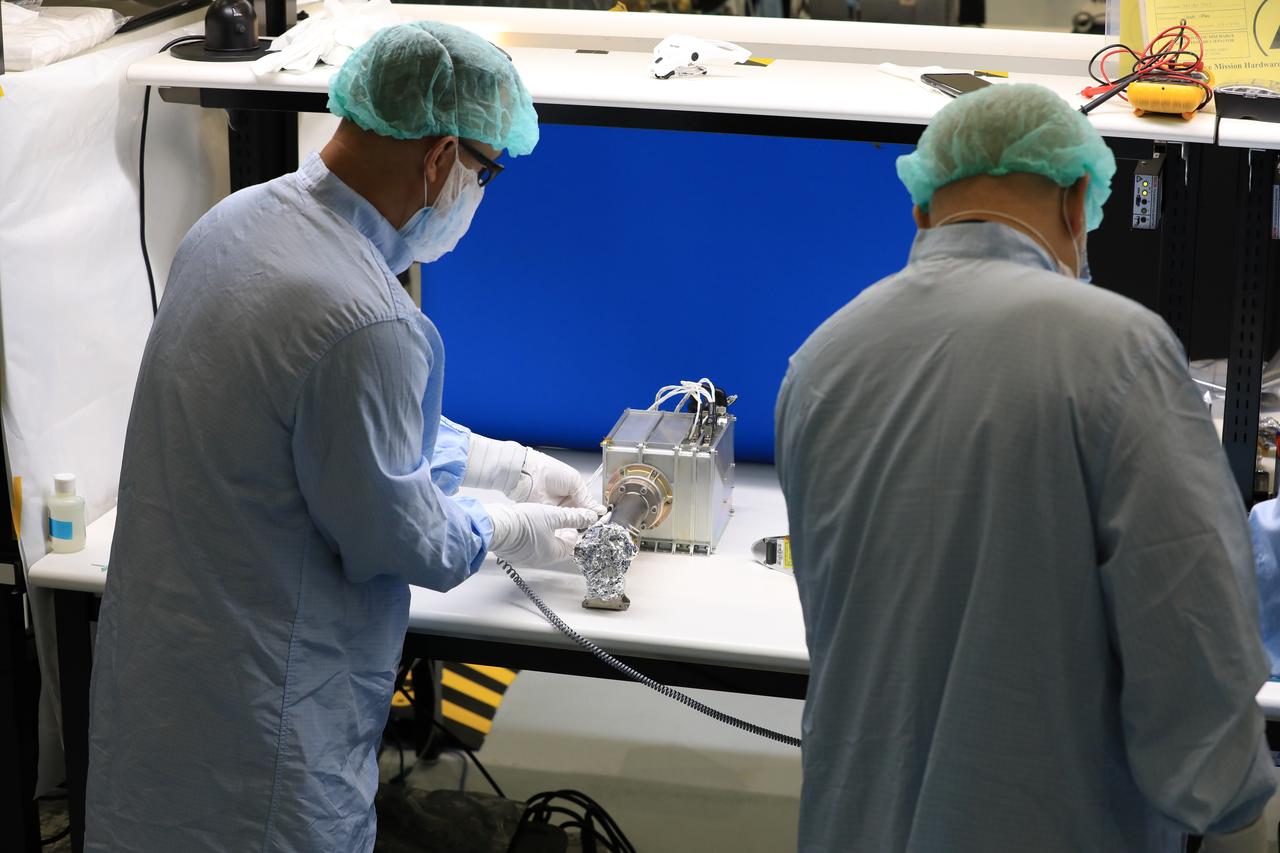
Engineers and technicians at NASA’s Kennedy Space Center in Florida work with instruments for Mass Spectrometer observing lunar operations (MSolo) inside the Space Station Processing on Sept. 25, 2020. MSolo is a commercial off-the-shelf mass spectrometer modified to work in space and it will help analyze the chemical makeup of landing sites on the Moon, as well as study water on the lunar surface. This work is preparing MSolo hardware for a robotic mission as part of the Commercial Lunar Payload Services (CLPS) launching to exploring Lacus Mortis, a large crater on the near side of the Moon in 2021. A future mission will send a mobile robot named the Volatiles Investigating Polar Exploration Rover (VIPER) to the Moon to prospect for water. VIPER will have several instruments that will allow it to detect and sample water including MSolo, the Neutron Spectrometer System, the Near Infrared Volatiles Spectrometer System and The Regolith and Ice Drill for Exploring New Terrain (TRIDENT).
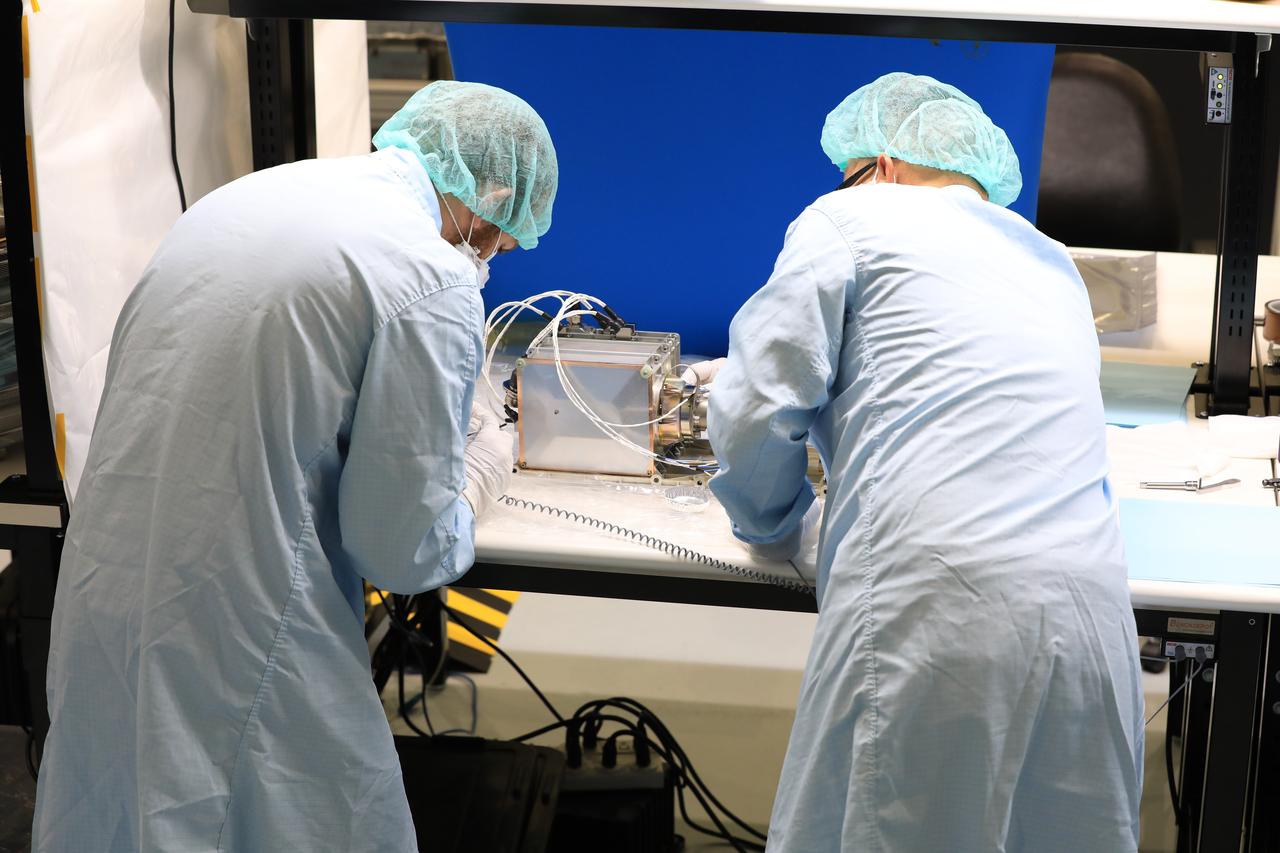
Engineers and technicians at NASA’s Kennedy Space Center in Florida install the radiator for the Mass Spectrometer Observing Lunar Operations (MSolo) instrument inside the Space Station Processing Facility on Sept. 25, 2020. MSolo will help analyze the chemical makeup of landing sites on the Moon, as well as study water on the lunar surface. The radiator will help keep the instrument’s temperature stable in the extreme heat and cold it will encounter. MSolo instruments are scheduled to launch on multiple robotic missions as part of NASA’s Commercial Lunar Payload Services (CLPS), with the first of these missions exploring Lacus Mortis, a large crater on the near side of the Moon, beginning in 2021. MSolo also will be one of three instruments on the agency’s water-hunting Volatiles Investigating Polar Exploration Rover, VIPER, scheduled to launch to the Moon’s South Pole in late 2023.
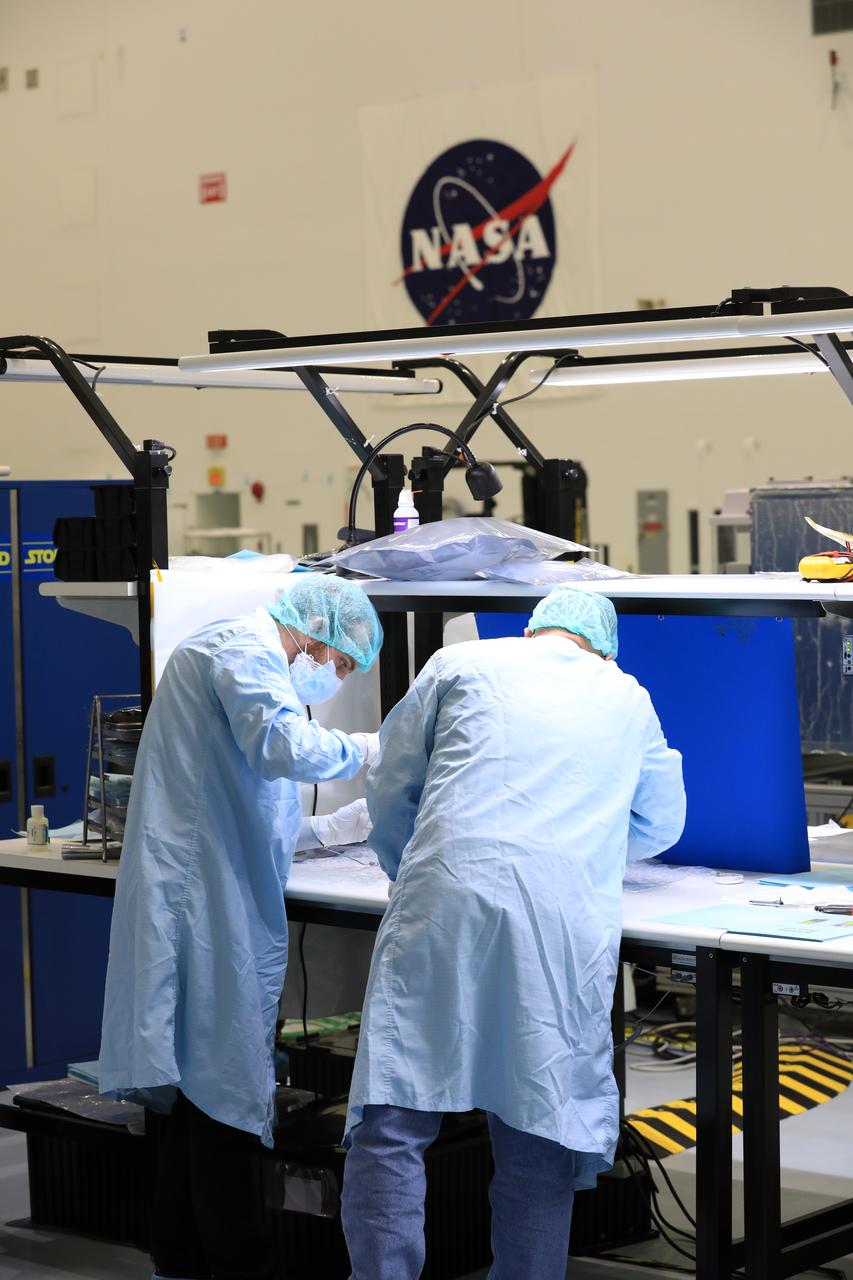
Engineers and technicians at NASA’s Kennedy Space Center in Florida install the radiator for the Mass Spectrometer Observing Lunar Operations (MSolo) instrument inside the Space Station Processing Facility on Sept. 25, 2020. MSolo will help analyze the chemical makeup of landing sites on the Moon, as well as study water on the lunar surface. The radiator will help keep the instrument’s temperature stable in the extreme heat and cold it will encounter. MSolo instruments are scheduled to launch on multiple robotic missions as part of NASA’s Commercial Lunar Payload Services (CLPS), with the first of these missions exploring Lacus Mortis, a large crater on the near side of the Moon, beginning in 2021. MSolo also will be one of three instruments on the agency’s water-hunting Volatiles Investigating Polar Exploration Rover, VIPER, scheduled to launch to the Moon’s South Pole in late 2023.
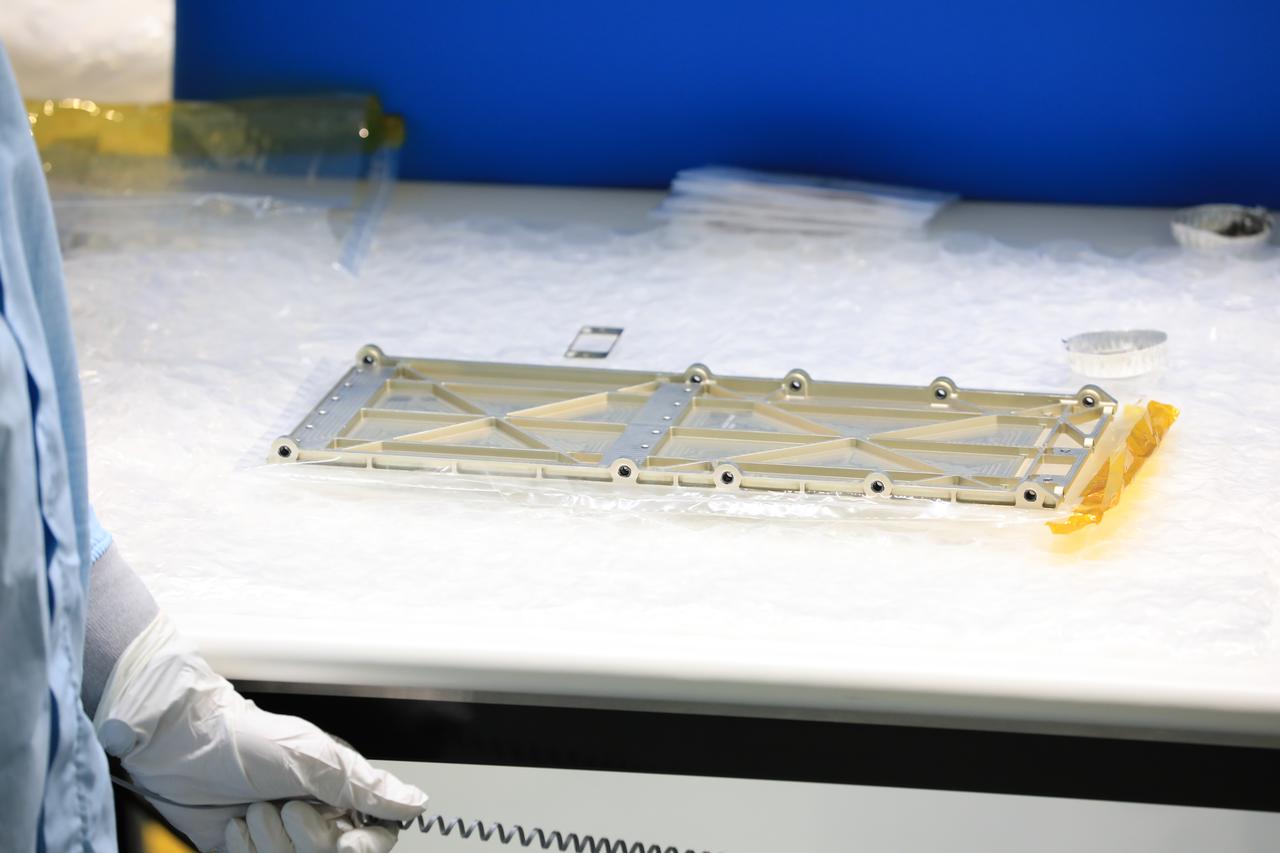
Engineers and technicians at NASA’s Kennedy Space Center in Florida have prepped the Mass Spectrometer Observing Lunar Operations (MSolo) instrument’s radiator for installation inside the Space Station Processing Facility on Sept. 25, 2020. MSolo will help analyze the chemical makeup of landing sites on the Moon, as well as study water on the lunar surface. The radiator will help keep the instrument’s temperature stable in the extreme heat and cold it will encounter. MSolo instruments are scheduled to launch on multiple robotic missions as part of NASA’s Commercial Lunar Payload Services (CLPS), with the first of these missions exploring Lacus Mortis, a large crater on the near side of the Moon, beginning in 2021. MSolo also will be one of three instruments on the agency’s water-hunting Volatiles Investigating Polar Exploration Rover, VIPER, scheduled to launch to the Moon’s South Pole in late 2023.
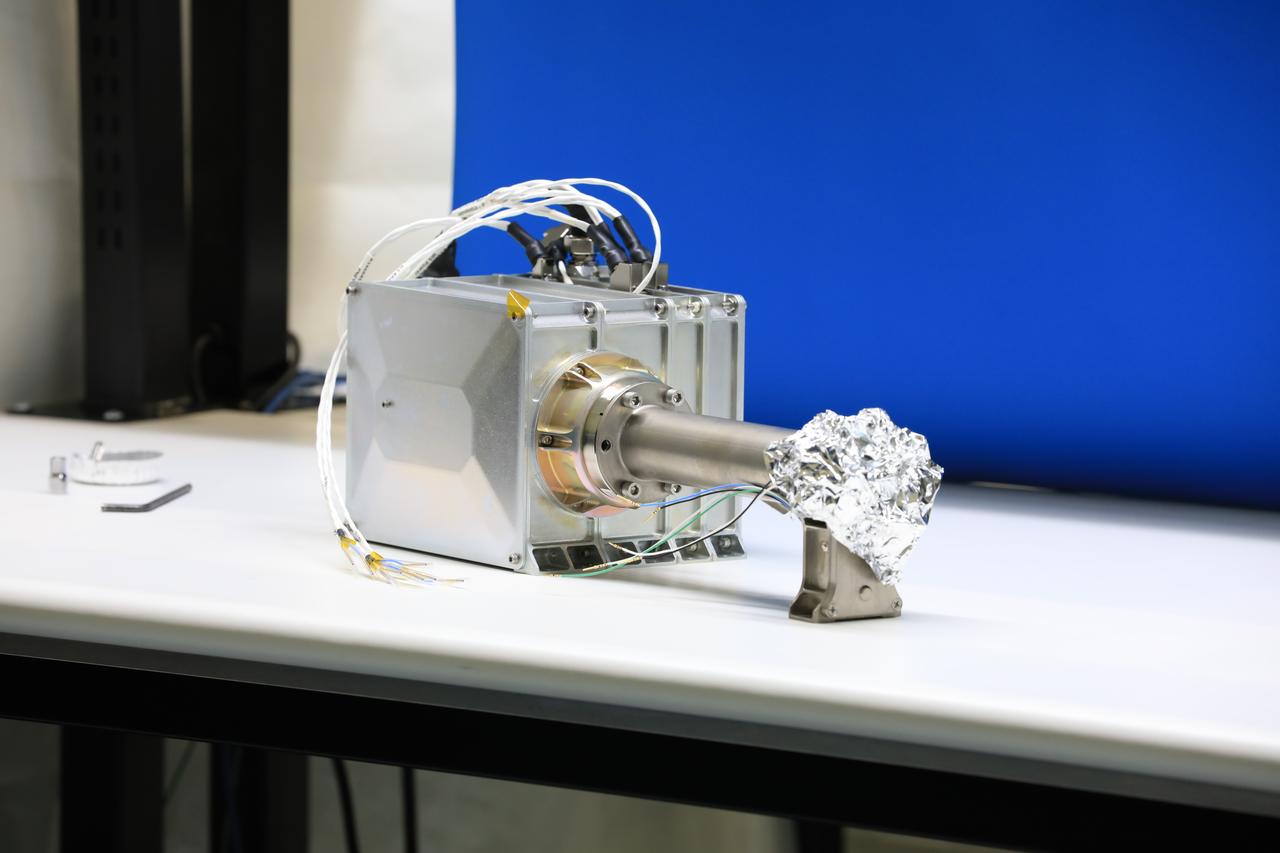
Engineers and technicians at NASA’s Kennedy Space Center in Florida are preparing the Mass Spectrometer observing lunar operations (MSolo) for launch inside the Space Station Processing Facility at NASA’s Kennedy Space Center in Florida on Sept. 25, 2020. MSolo is a commercial off-the-shelf mass spectrometer modified to work in space and it will help analyze the chemical makeup of landing sites on the Moon, as well as study water on the lunar surface. MSolo hardware is a payload for a robotic mission to the Moon as part of the Commercial Lunar Payload Services (CLPS) launching to exploring Lacus Mortis, a large crater on the near side of the Moon in 2021. A future mission will send a mobile robot named the Volatiles Investigating Polar Exploration Rover (VIPER) to the Moon to prospect for water. VIPER will have several instruments that will allow it to detect and sample water including MSolo, the Neutron Spectrometer System, the Near Infrared Volatiles Spectrometer System and The Regolith and Ice Drill for Exploring New Terrain (TRIDENT).
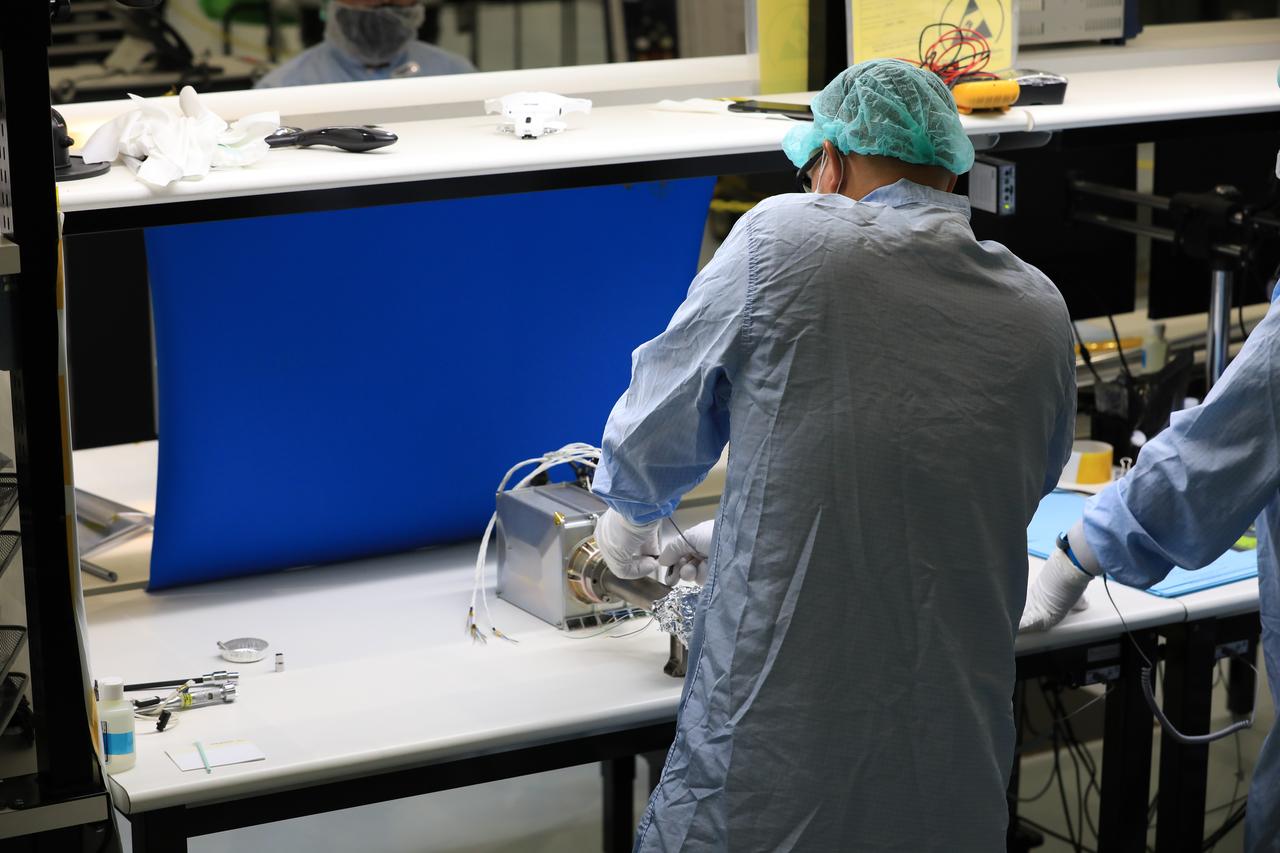
Engineers and technicians at NASA’s Kennedy Space Center in Florida work with instruments for Mass Spectrometer observing lunar operations (MSolo) inside the Space Station Processing on Sept. 25, 2020. MSolo is a commercial off-the-shelf mass spectrometer modified to work in space and it will help analyze the chemical makeup of landing sites on the Moon, as well as study water on the lunar surface. This work is preparing MSolo hardware for a robotic mission as part of the Commercial Lunar Payload Services (CLPS) launching to exploring Lacus Mortis, a large crater on the near side of the Moon in 2021. A future mission will send a mobile robot named the Volatiles Investigating Polar Exploration Rover (VIPER) to the Moon to prospect for water. VIPER will have several instruments that will allow it to detect and sample water including MSolo, the Neutron Spectrometer System, the Near Infrared Volatiles Spectrometer System and The Regolith and Ice Drill for Exploring New Terrain (TRIDENT).
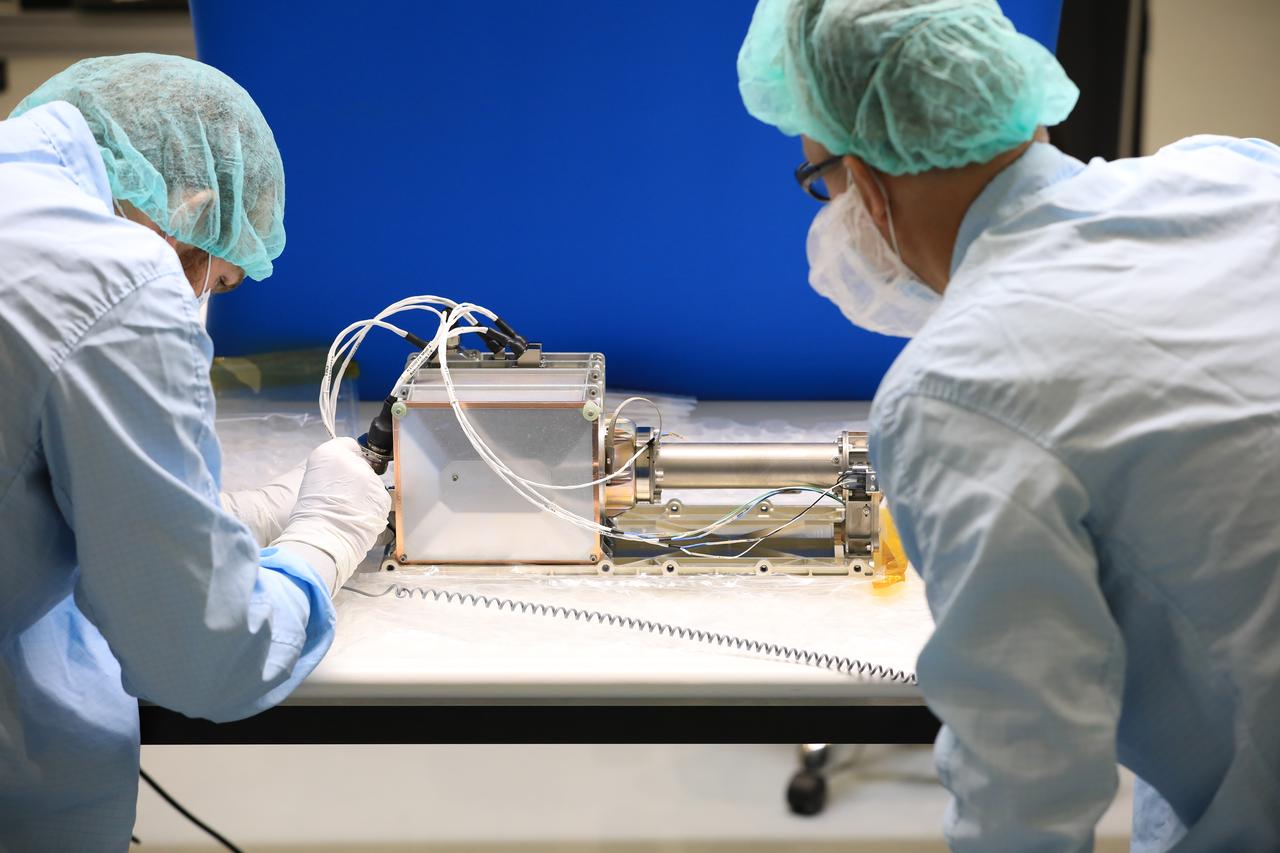
Engineers and technicians at NASA’s Kennedy Space Center in Florida install the radiator for the Mass Spectrometer Observing Lunar Operations (MSolo) instrument inside the Space Station Processing Facility on Sept. 25, 2020. MSolo will help analyze the chemical makeup of landing sites on the Moon, as well as study water on the lunar surface. The radiator will help keep the instrument’s temperature stable in the extreme heat and cold it will encounter. MSolo instruments are scheduled to launch on multiple robotic missions as part of NASA’s Commercial Lunar Payload Services (CLPS), with the first of these missions exploring Lacus Mortis, a large crater on the near side of the Moon, beginning in 2021. MSolo also will be one of three instruments on the agency’s water-hunting Volatiles Investigating Polar Exploration Rover, VIPER, scheduled to launch to the Moon’s South Pole in late 2023.
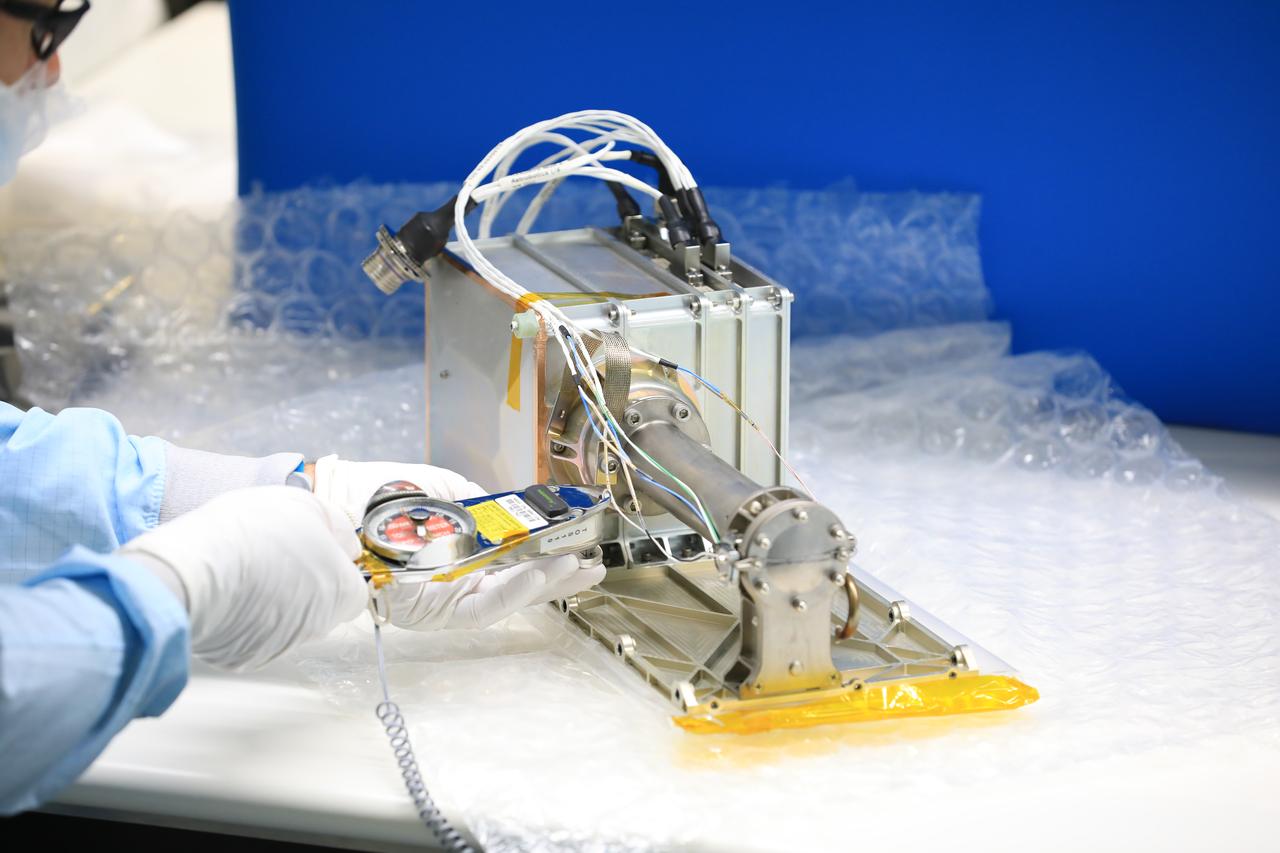
Engineers and technicians at NASA’s Kennedy Space Center in Florida install the radiator for the Mass Spectrometer Observing Lunar Operations (MSolo) instrument inside the Space Station Processing Facility on Sept. 25, 2020. MSolo will help analyze the chemical makeup of landing sites on the Moon, as well as study water on the lunar surface. The radiator will help keep the instrument’s temperature stable in the extreme heat and cold it will encounter. MSolo instruments are scheduled to launch on multiple robotic missions as part of NASA’s Commercial Lunar Payload Services (CLPS), with the first of these missions exploring Lacus Mortis, a large crater on the near side of the Moon, beginning in 2021. MSolo also will be one of three instruments on the agency’s water-hunting Volatiles Investigating Polar Exploration Rover, VIPER, scheduled to launch to the Moon’s South Pole in late 2023.
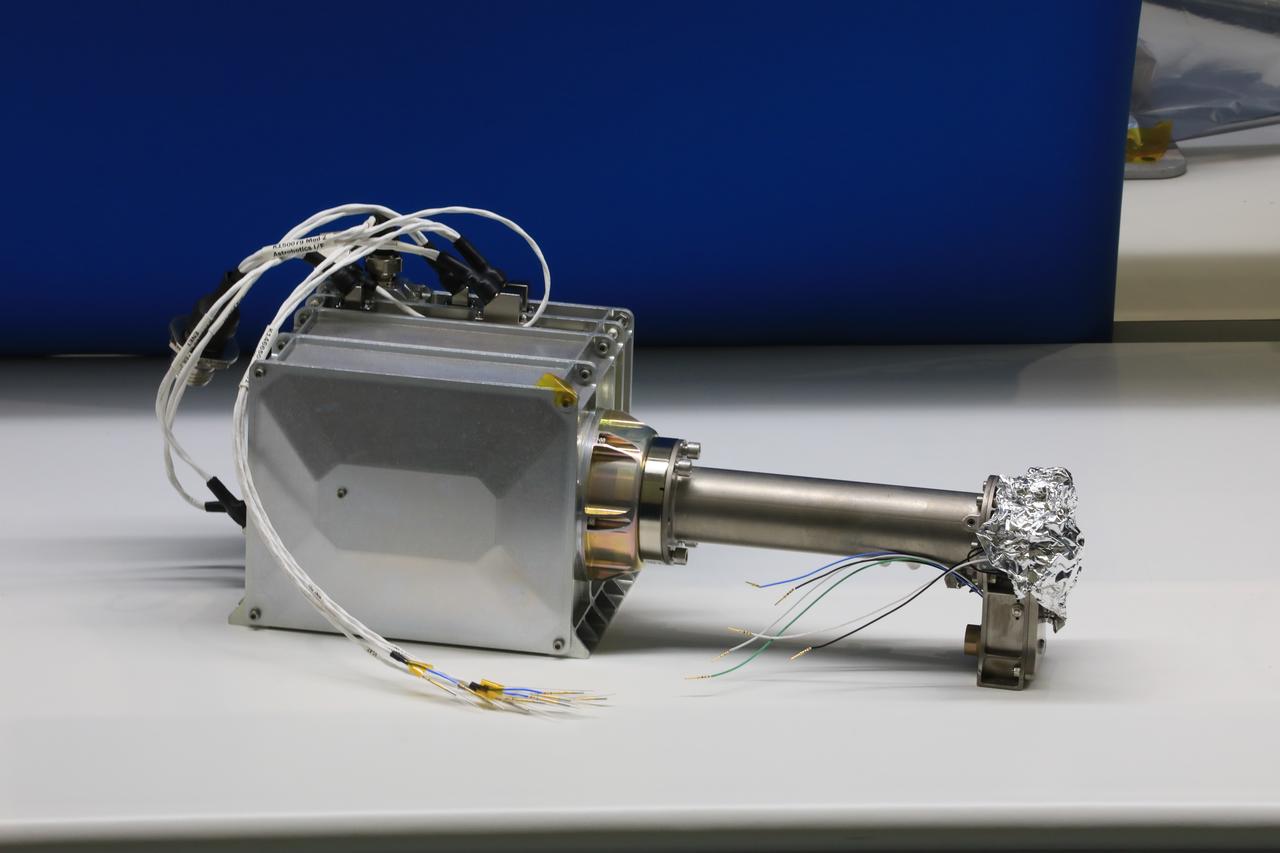
Engineers and technicians at NASA’s Kennedy Space Center in Florida are preparing the Mass Spectrometer observing lunar operations (MSolo) for launch inside the Space Station Processing Facility at NASA’s Kennedy Space Center in Florida on Sept. 25, 2020. MSolo is a commercial off-the-shelf mass spectrometer modified to work in space and it will help analyze the chemical makeup of landing sites on the Moon, as well as study water on the lunar surface. MSolo hardware is a payload for a robotic mission to the Moon as part of the Commercial Lunar Payload Services (CLPS) launching to exploring Lacus Mortis, a large crater on the near side of the Moon in 2021. A future mission will send a mobile robot named the Volatiles Investigating Polar Exploration Rover (VIPER) to the Moon to prospect for water. VIPER will have several instruments that will allow it to detect and sample water including MSolo, the Neutron Spectrometer System, the Near Infrared Volatiles Spectrometer System and The Regolith and Ice Drill for Exploring New Terrain (TRIDENT).