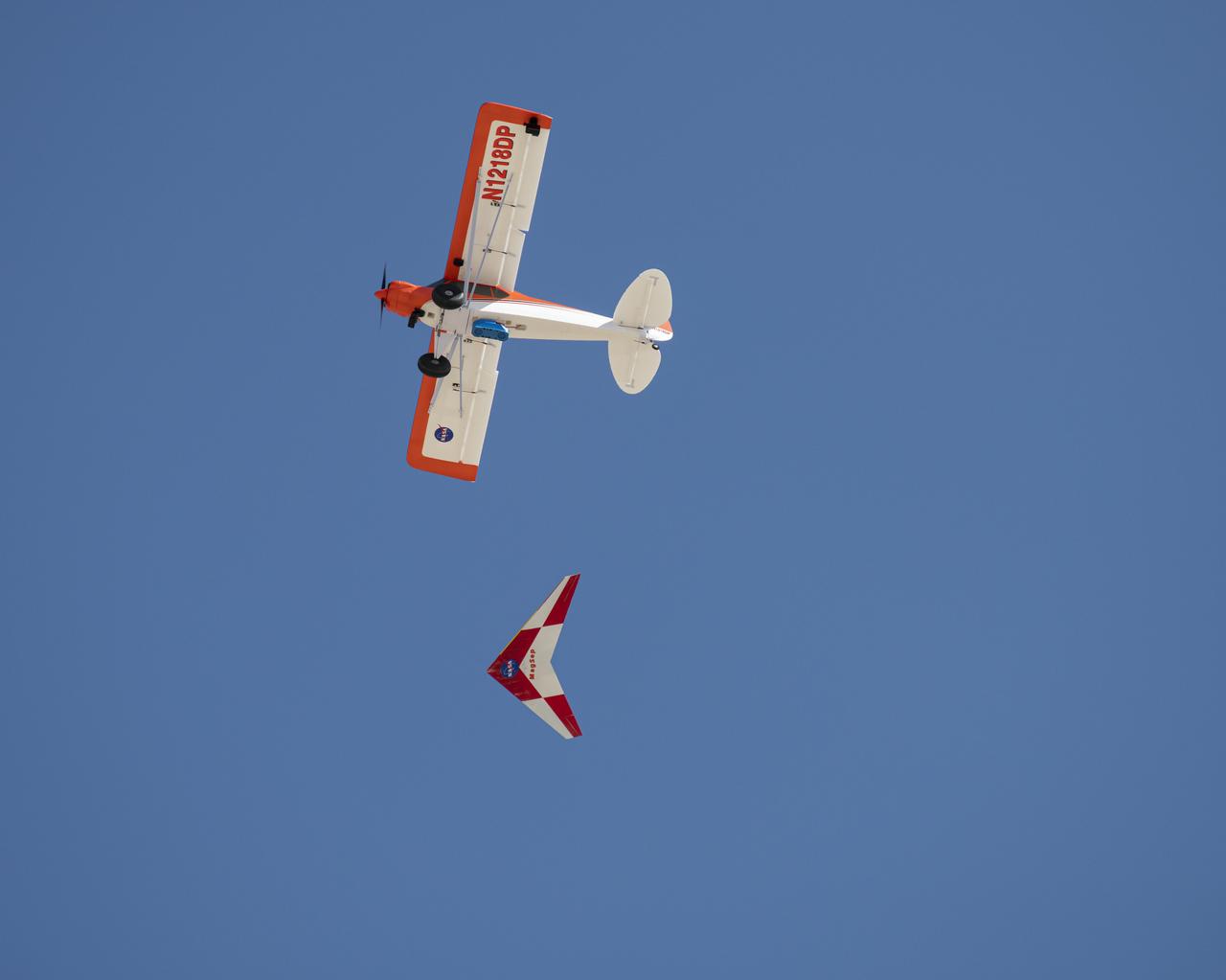
The Preliminary Research Aerodynamic Design to Land on Mars, or Prandtl-M, glider flies after a magnetic release mechanism on the Carbon-Z Cub was activated to air launch the aircraft. A team from NASA's Armstrong Flight Research Center in Edwards, California, conducted the successful research flight.
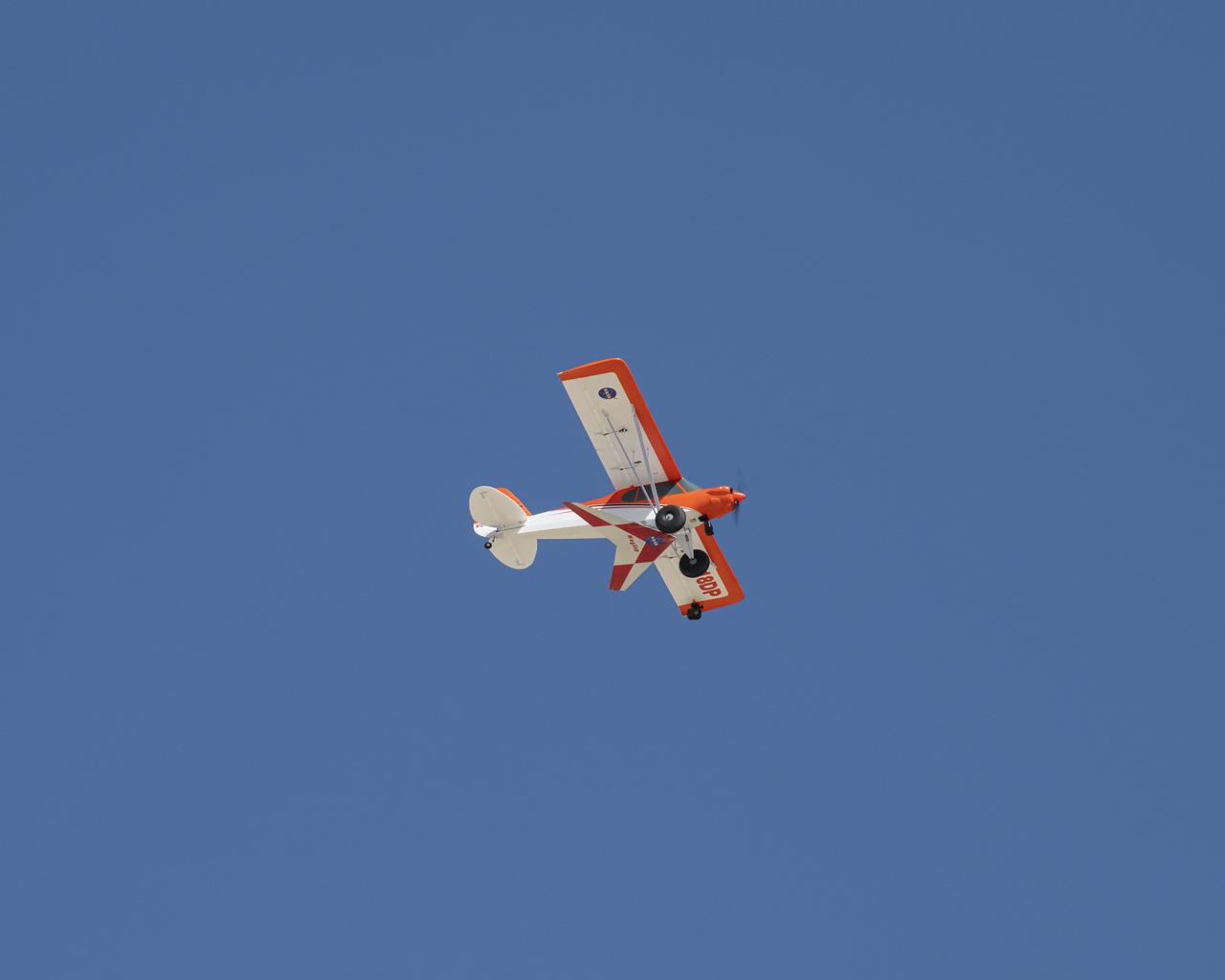
A team from NASA's Armstrong Flight Research Center in Edwards, California, prepares a Carbon-Z Cub to air launch the Preliminary Research Aerodynamic Design to Land on Mars, or Prandtl-M, glider from a magnetic release mechanism on the cub.
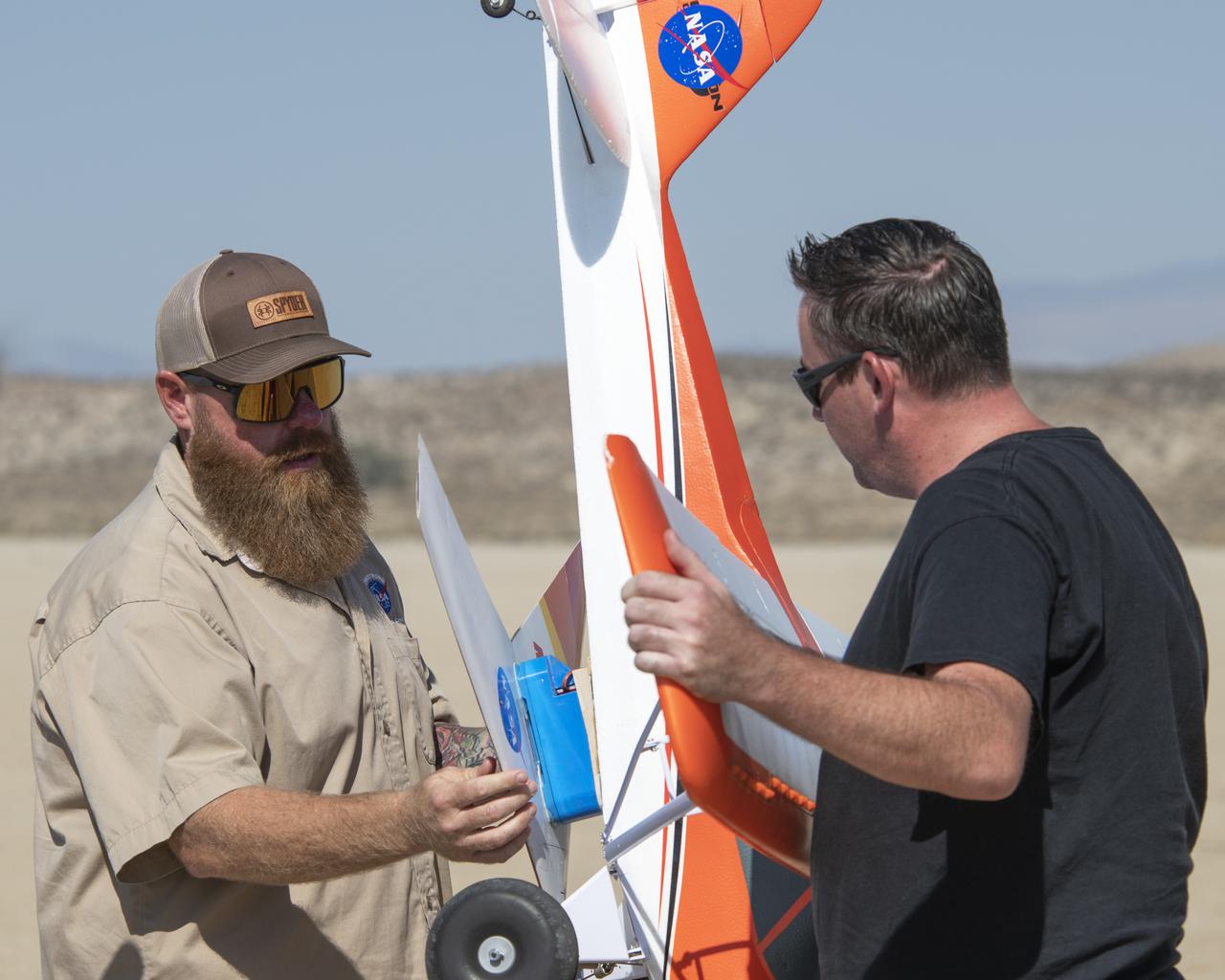
Justin Hall, left, attaches the Preliminary Research Aerodynamic Design to Land on Mars, or Prandtl-M, glider onto the Carbon-Z Cub, which Justin Link steadies. Hall and Link are part of a team from NASA's Armstrong Flight Research Center in Edwards, California, that uses an experimental magnetic release mechanism to air launch the glider.
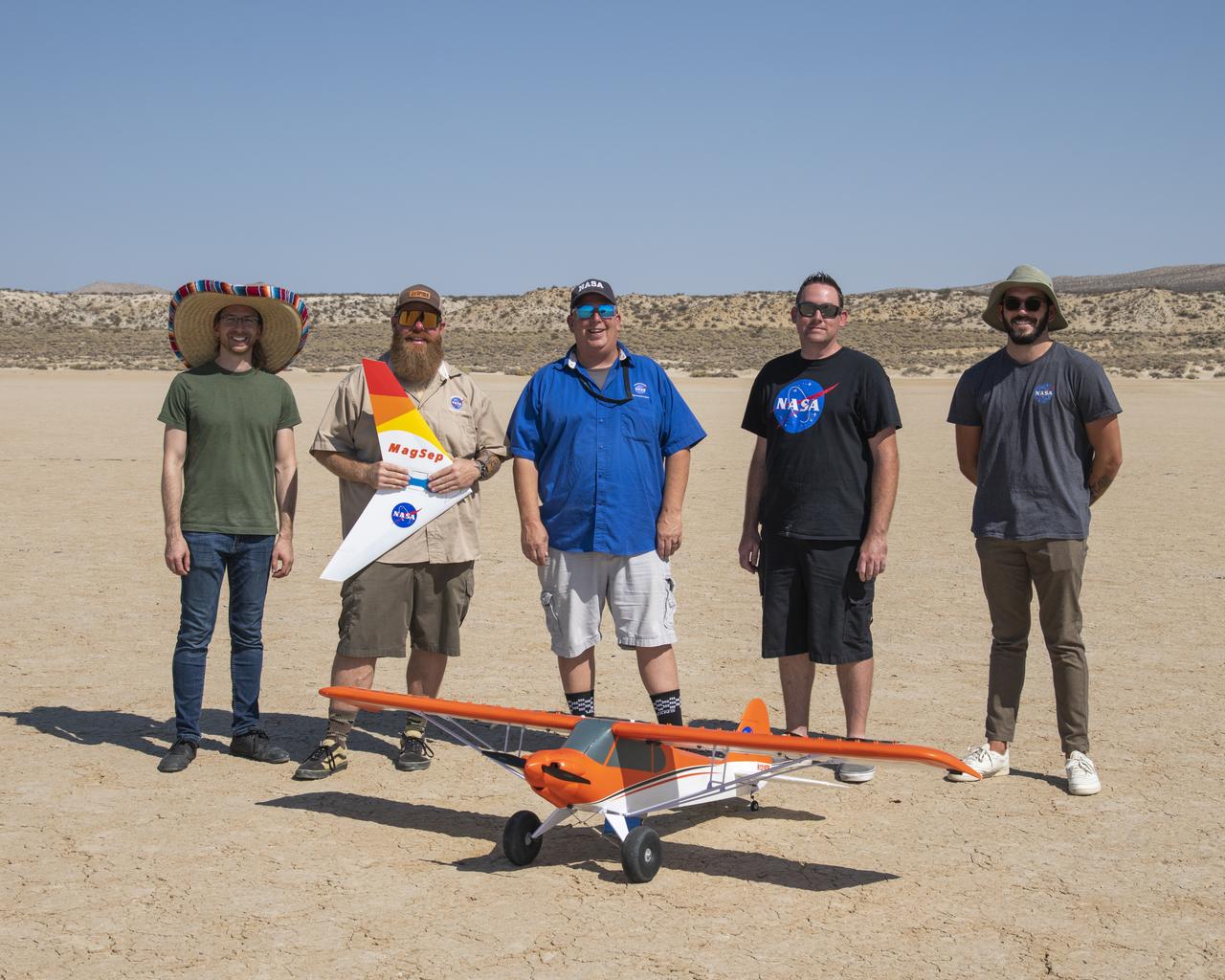
A Preliminary Research Aerodynamic Design to Land on Mars, or Prandtl-M, glider was air launched Sept. 7 using a magnetic release mechanism mounted on a Carbon-Z Cub. The team, based at NASA's Armstrong Flight Research Center in Edwards, California, includes, from left, Paul Bean, Justin Hall, Red Jensen, Justin Link, and Nathan Allaire.

Workers at Launch Complex 17 Pad A, Kennedy Space Center (KSC) encapsulate the Geomagnetic Tail (GEOTAIL) spacecraft (upper) and attached payload Assist Module-D upper stage (lower) in the protective payload fairing. GEOTAIL project was designed to study the effects of Earth's magnetic field. The solar wind draws the Earth's magnetic field into a long tail on the night side of the Earth and stores energy in the stretched field lines of the magnetotail. During active periods, the tail couples with the near-Earth magnetosphere, sometimes releasing energy stored in the tail and activating auroras in the polar ionosphere. GEOTAIL measures the flow of energy and its transformation in the magnetotail and will help clarify the mechanisms that control the imput, transport, storage, release, and conversion of mass, momentum, and energy in the magnetotail.

CAPE CANAVERAL, Fla. – At the Astrotech Space Operations facility in Titusville, Fla., spacecraft technicians manually extend a solar array on the Solar Dynamics Observatory, or SDO, during preparations to test the release mechanism sequence for the arrays using signal commands. SDO is the first space weather research network mission in NASA's Living With a Star Program. The spacecraft's long-term measurements will give solar scientists in-depth information about changes in the sun's magnetic field and insight into how they affect Earth. Liftoff on an Atlas V rocket is scheduled for Feb. 3, 2010. Photo credit: NASA/Jack Pfaller

CAPE CANAVERAL, Fla. – At the Astrotech Space Operations facility in Titusville, Fla., the Solar Dynamics Observatory, or SDO, with its solar arrays deployed, is ready to receive signal commands to test the release mechanism sequence for the arrays. SDO is the first space weather research network mission in NASA's Living With a Star Program. The spacecraft's long-term measurements will give solar scientists in-depth information about changes in the sun's magnetic field and insight into how they affect Earth. Liftoff on an Atlas V rocket is scheduled for Feb. 3, 2010. Photo credit: NASA/Jack Pfaller

CAPE CANAVERAL, Fla. – At the Astrotech Space Operations facility in Titusville, Fla., a solar array on the Solar Dynamics Observatory, or SDO, is manually extended by spacecraft technicians during preparations to test the release mechanism sequence for the arrays using signal commands. SDO is the first space weather research network mission in NASA's Living With a Star Program. The spacecraft's long-term measurements will give solar scientists in-depth information about changes in the sun's magnetic field and insight into how they affect Earth. Liftoff on an Atlas V rocket is scheduled for Feb. 3, 2010. Photo credit: NASA/Jack Pfaller
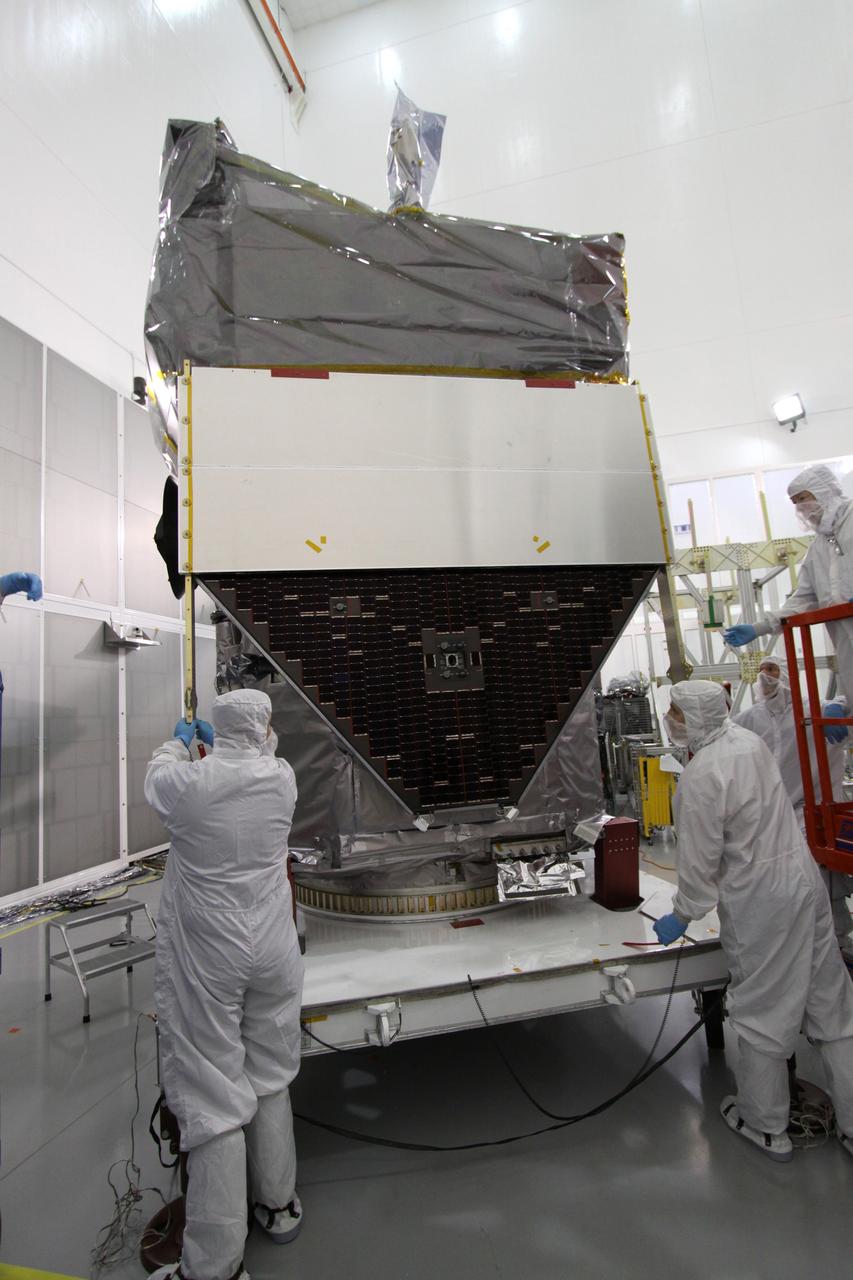
CAPE CANAVERAL, Fla. – At the Astrotech Space Operations facility in Titusville, Fla., spacecraft technicians manually deploy one of the solar arrays on the Solar Dynamics Observatory, or SDO, during preparations to test the release mechanism sequence for the arrays using signal commands. SDO is the first space weather research network mission in NASA's Living With a Star Program. The spacecraft's long-term measurements will give solar scientists in-depth information about changes in the sun's magnetic field and insight into how they affect Earth. Liftoff on an Atlas V rocket is scheduled for Feb. 3, 2010. Photo credit: NASA/Jack Pfaller
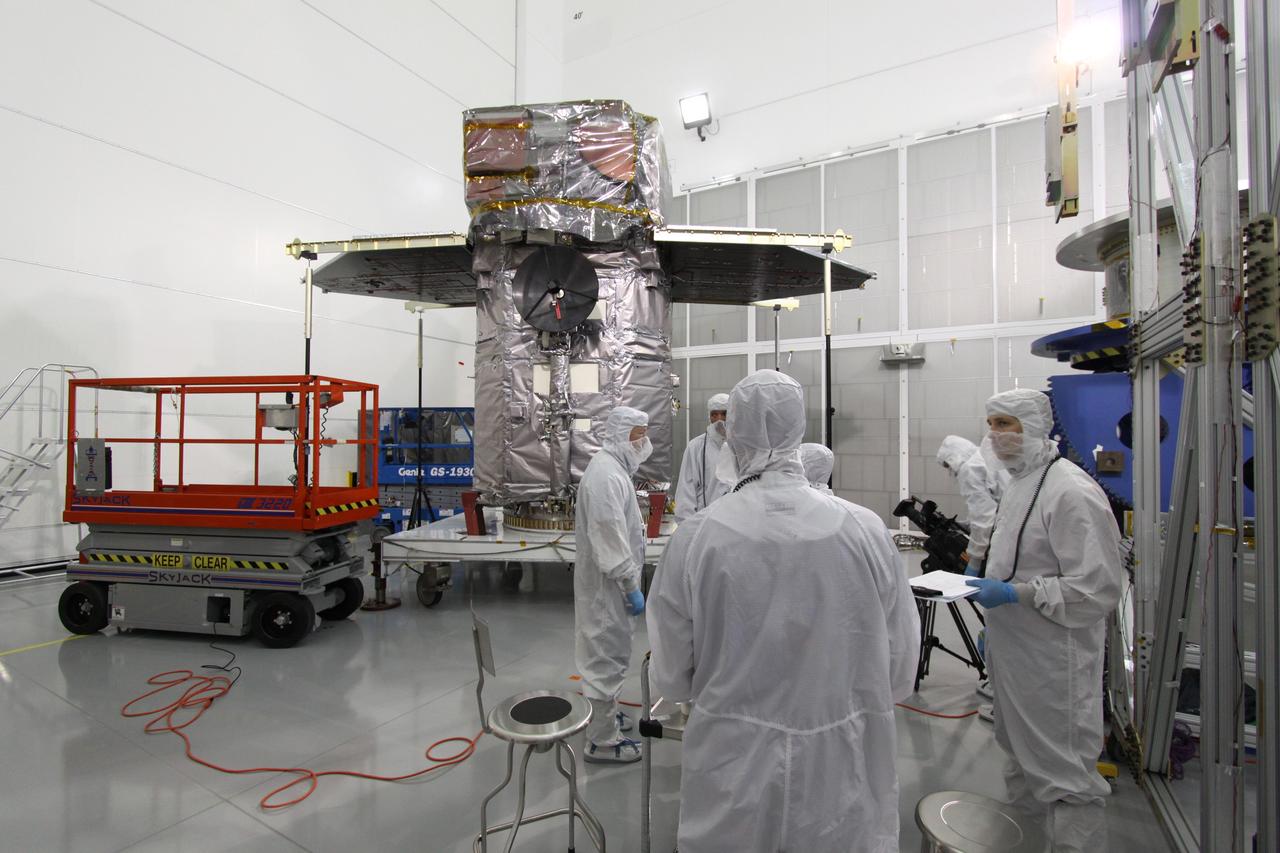
CAPE CANAVERAL, Fla. – At the Astrotech Space Operations facility in Titusville, Fla., spacecraft technicians make final preparations to test the release mechanism sequence for the solar arrays on the Solar Dynamics Observatory, or SDO, using signal commands. SDO is the first space weather research network mission in NASA's Living With a Star Program. The spacecraft's long-term measurements will give solar scientists in-depth information about changes in the sun's magnetic field and insight into how they affect Earth. Liftoff on an Atlas V rocket is scheduled for Feb. 3, 2010. Photo credit: NASA/Jack Pfaller
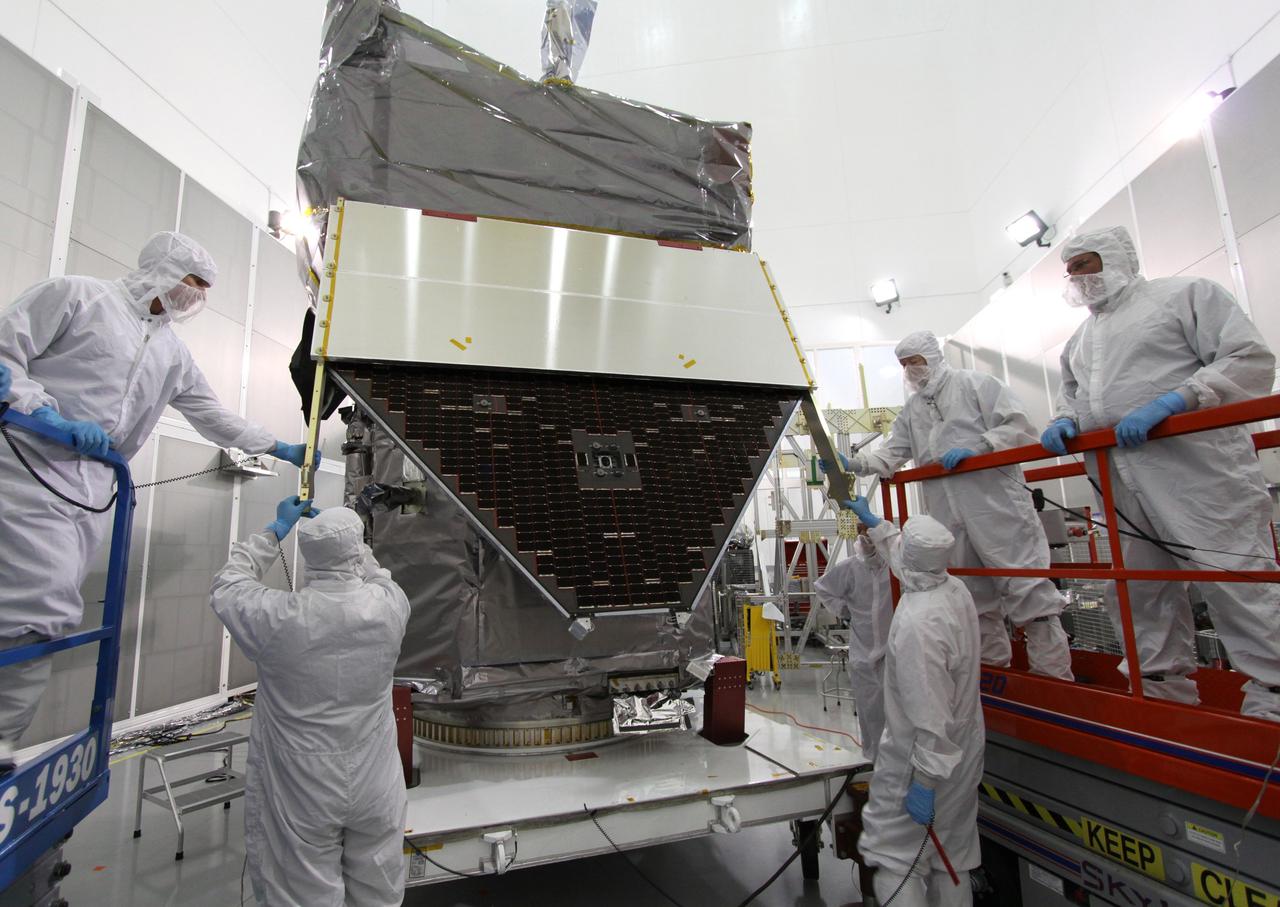
CAPE CANAVERAL, Fla. – At the Astrotech Space Operations facility in Titusville, Fla., spacecraft technicians manually deploy a solar array on the Solar Dynamics Observatory, or SDO, during preparations to test the release mechanism sequence for the arrays using signal commands. SDO is the first space weather research network mission in NASA's Living With a Star Program. The spacecraft's long-term measurements will give solar scientists in-depth information about changes in the sun's magnetic field and insight into how they affect Earth. Liftoff on an Atlas V rocket is scheduled for Feb. 3, 2010. Photo credit: NASA/Jack Pfaller
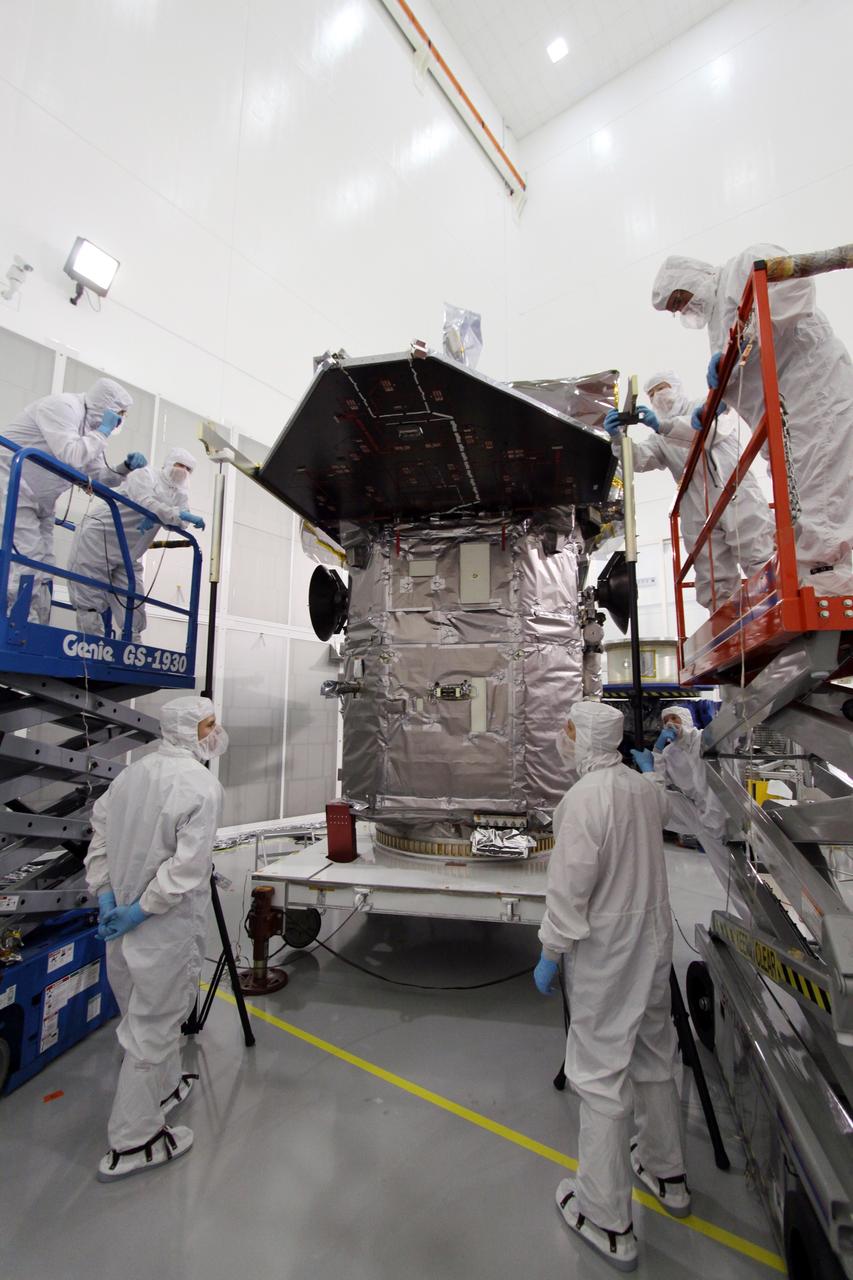
CAPE CANAVERAL, Fla. – At the Astrotech Space Operations facility in Titusville, Fla., spacecraft technicians have manually deployed the solar arrays on the Solar Dynamics Observatory, or SDO, during preparations to test the release mechanism sequence for the arrays using signal commands. SDO is the first space weather research network mission in NASA's Living With a Star Program. The spacecraft's long-term measurements will give solar scientists in-depth information about changes in the sun's magnetic field and insight into how they affect Earth. Liftoff on an Atlas V rocket is scheduled for Feb. 3, 2010. Photo credit: NASA/Jack Pfaller
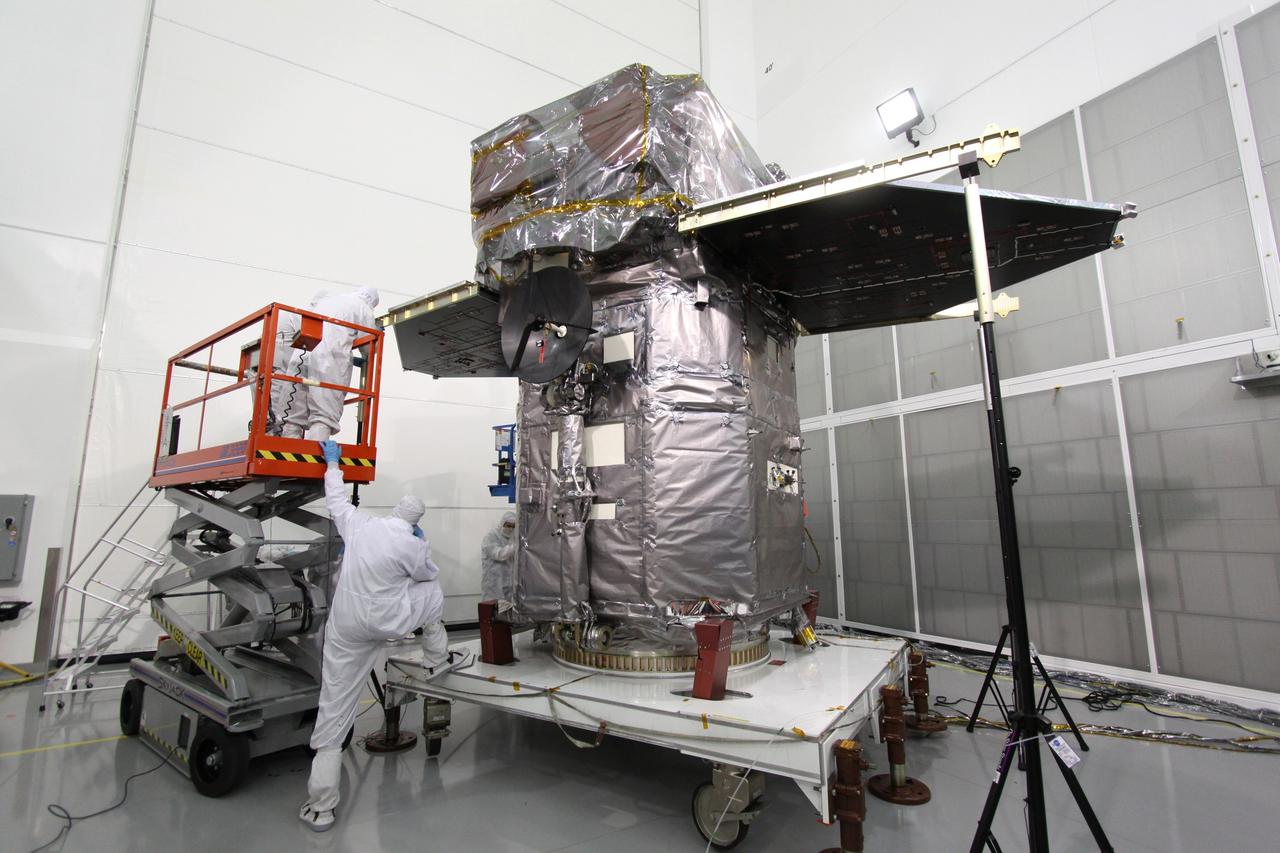
CAPE CANAVERAL, Fla. – At the Astrotech Space Operations facility in Titusville, Fla., both solar arrays on the Solar Dynamics Observatory, or SDO, have been manually extended during preparations to test the release mechanism sequence for the arrays using signal commands. SDO is the first space weather research network mission in NASA's Living With a Star Program. The spacecraft's long-term measurements will give solar scientists in-depth information about changes in the sun's magnetic field and insight into how they affect Earth. Liftoff on an Atlas V rocket is scheduled for Feb. 3, 2010. Photo credit: NASA/Jack Pfaller
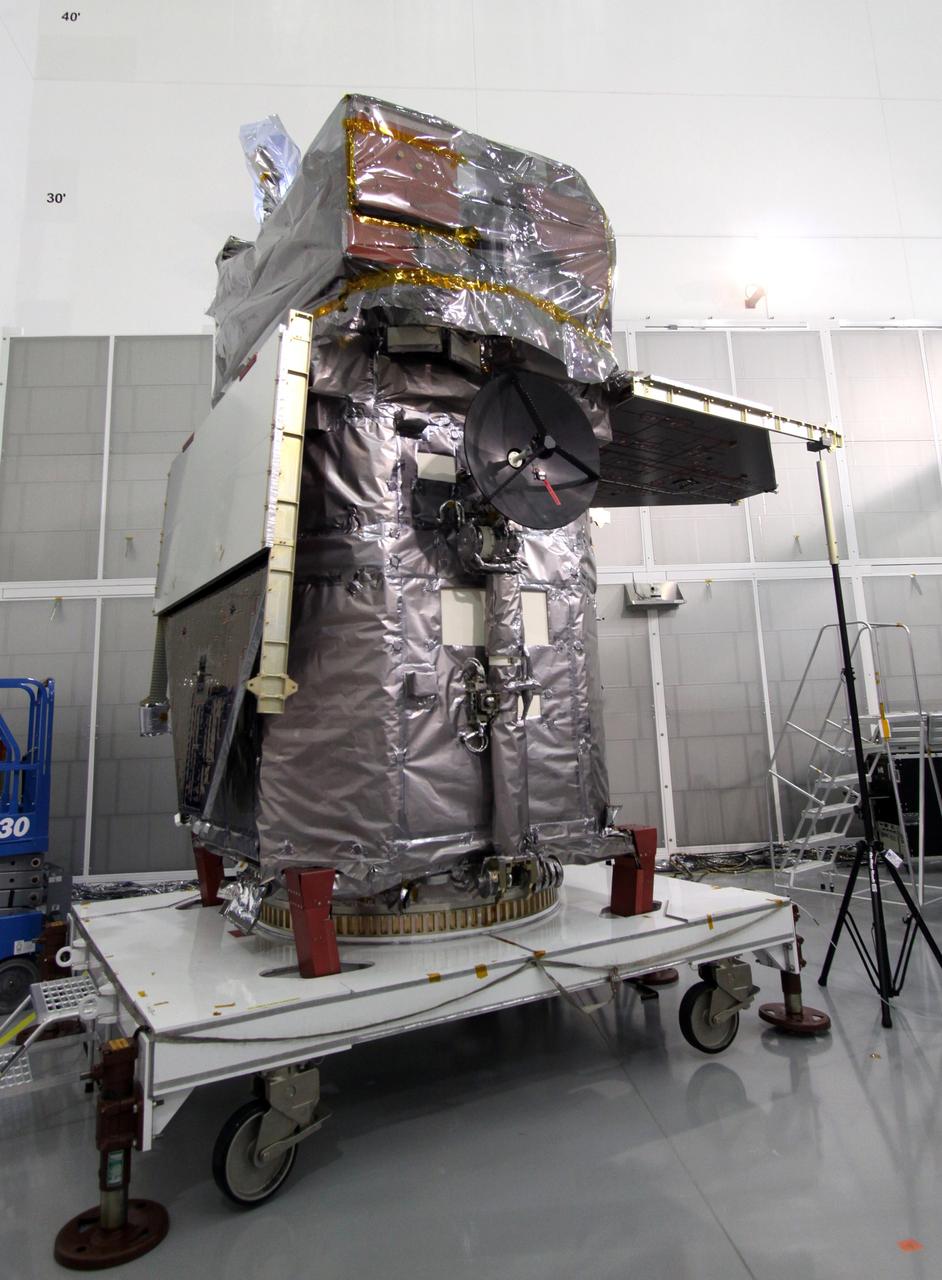
CAPE CANAVERAL, Fla. – At the Astrotech Space Operations facility in Titusville, Fla., one of the solar arrays on the Solar Dynamics Observatory, or SDO, has been deployed manually during preparations to test the release mechanism sequence for the arrays using signal commands. SDO is the first space weather research network mission in NASA's Living With a Star Program. The spacecraft's long-term measurements will give solar scientists in-depth information about changes in the sun's magnetic field and insight into how they affect Earth. Liftoff on an Atlas V rocket is scheduled for Feb. 3, 2010. Photo credit: NASA/Jack Pfaller
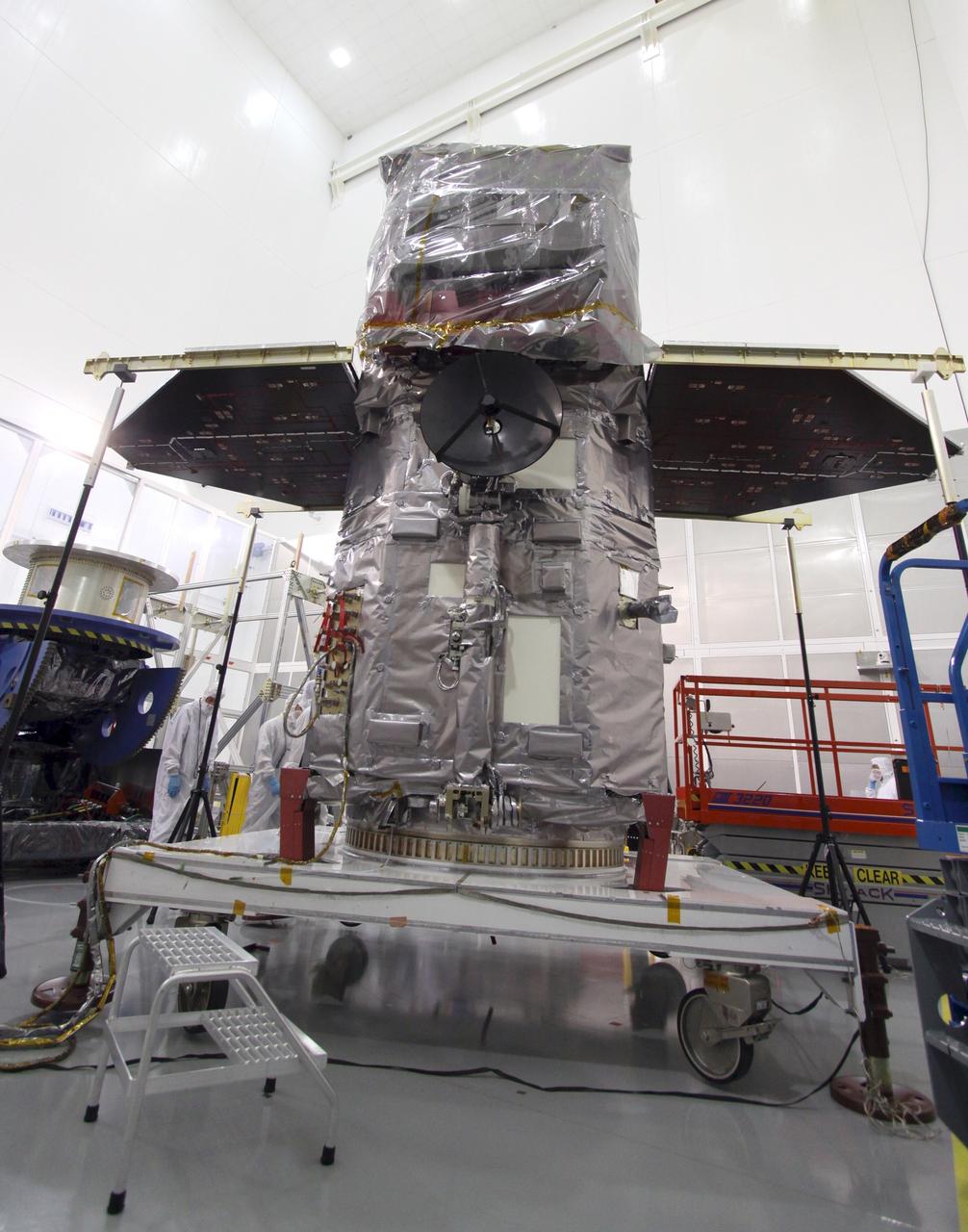
CAPE CANAVERAL, Fla. – At the Astrotech Space Operations facility in Titusville, Fla., the Solar Dynamics Observatory, or SDO, awaits testing of the release mechanism sequence for its solar arrays, now extended, using signal commands. SDO is the first space weather research network mission in NASA's Living With a Star Program. The spacecraft's long-term measurements will give solar scientists in-depth information about changes in the sun's magnetic field and insight into how they affect Earth. Liftoff on an Atlas V rocket is scheduled for Feb. 3, 2010. Photo credit: NASA/Jack Pfaller

CAPE CANAVERAL, Fla. – At the Astrotech Space Operations facility in Titusville, Fla., spacecraft technicians manipulate a solar array on the Solar Dynamics Observatory, or SDO, during preparations to test the release mechanism sequence for the arrays using signal commands. SDO is the first space weather research network mission in NASA's Living With a Star Program. The spacecraft's long-term measurements will give solar scientists in-depth information about changes in the sun's magnetic field and insight into how they affect Earth. Liftoff on an Atlas V rocket is scheduled for Feb. 3, 2010. Photo credit: NASA/Jack Pfaller
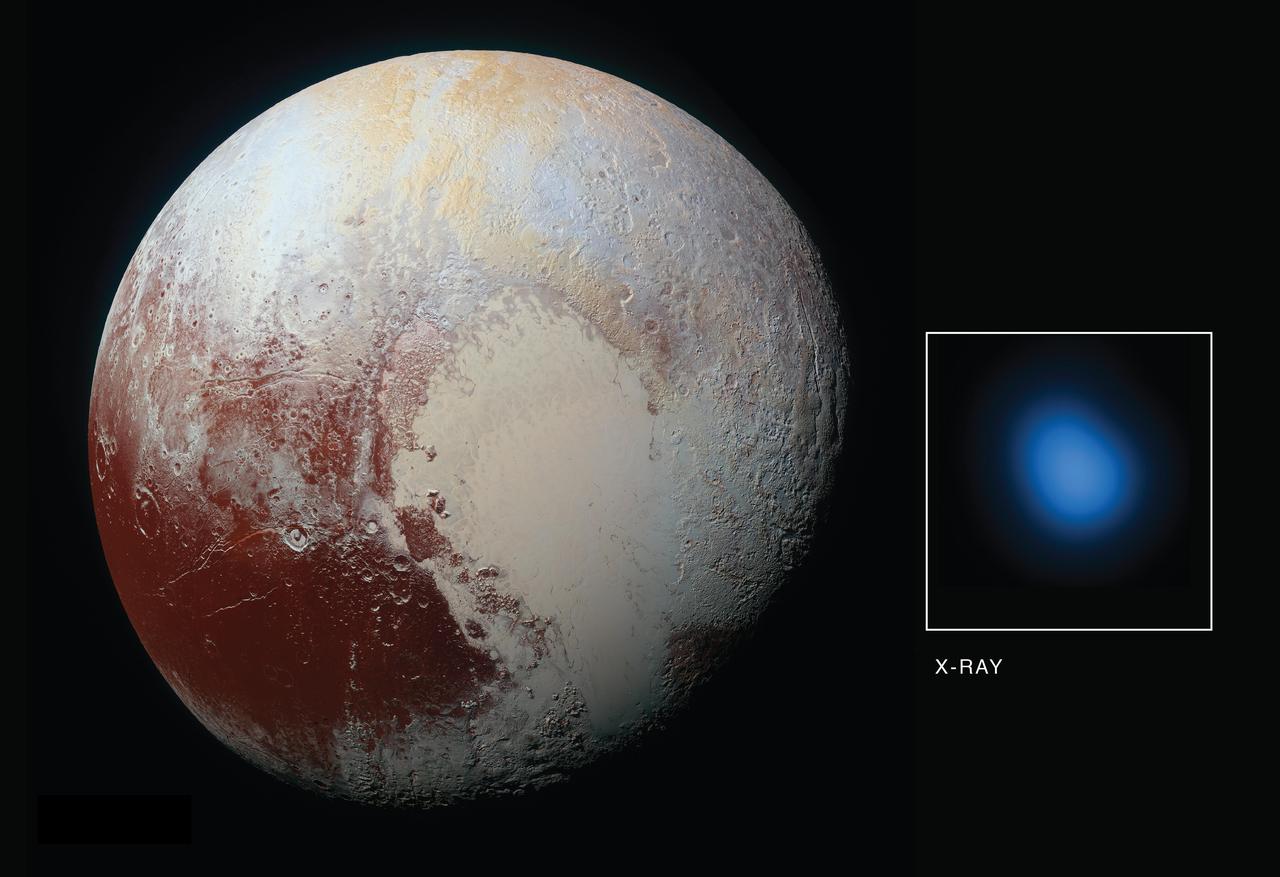
The first detection of Pluto in X-rays has been made using NASA's Chandra X-ray Observatory in conjunction with observations from NASA's New Horizons spacecraft. As New Horizons approached Pluto in late 2014 and then flew by the planet during the summer of 2015, Chandra obtained data during four separate observations. During each observation, Chandra detected low-energy X-rays from the small planet. The main panel in this graphic is an optical image taken from New Horizons on its approach to Pluto, while the inset shows an image of Pluto in X-rays from Chandra. There is a significant difference in scale between the optical and X-ray images. New Horizons made a close flyby of Pluto but Chandra is located near the Earth, so the level of detail visible in the two images is very different. The Chandra image is 180,000 miles across at the distance of Pluto, but the planet is only 1,500 miles across. Pluto is detected in the X-ray image as a point source, showing the sharpest level of detail available for Chandra or any other X-ray observatory. This means that details over scales that are smaller than the X-ray source cannot be seen here. Detecting X-rays from Pluto is a somewhat surprising result given that Pluto - a cold, rocky world without a magnetic field - has no natural mechanism for emitting X-rays. However, scientists knew from previous observations of comets that the interaction between the gases surrounding such planetary bodies and the solar wind - the constant streams of charged particles from the sun that speed throughout the solar system -- can create X-rays. The researchers were particularly interested in learning more about the interaction between the gases in Pluto's atmosphere and the solar wind. The New Horizon spacecraft carries an instrument designed to measure that activity up-close -- Solar Wind Around Pluto (SWAP) -- and scientists examined that data and proposed that Pluto contains a very mild, close-in bowshock, where the solar wind first "meets" Pluto (similar to a shock wave that forms ahead of a supersonic aircraft) and a small wake or tail behind the planet. The immediate mystery is that Chandra's readings on the brightness of the X-rays are much higher than expected from the solar wind interacting with Pluto's atmosphere. The Chandra detection is also surprising since New Horizons discovered Pluto's atmosphere was much more stable than the rapidly escaping, "comet-like" atmosphere that many scientists expected before the spacecraft flew past in July 2015. In fact, New Horizons found that Pluto's interaction with the solar wind is much more like the interaction of the solar wind with Mars, than with a comet. While Pluto is releasing enough gas from its atmosphere to make the observed X-rays, there isn't enough solar wind flowing directly at Pluto at its great distance from the Sun to make them according to certain theoretical models. There are several suggested possibilities for the enhanced X-ray emission from Pluto. These include a much wider and longer tail of gases trailing Pluto than New Horizons detected using its SWAP instrument. Because Pluto is so small compared to the size of a Chandra point source, scientists may be unable to detect such a tail in X-rays. Other possibilities are that interplanetary magnetic fields are focusing more particles than expected from the solar wind into the region around Pluto, or the low density of the solar wind in the outer solar system at the distance of Pluto could allow for the formation of a doughnut, or torus, of neutral gas centered around Pluto's orbit. It will take deeper and higher resolution images of X-rays from Pluto's environment than we currently have from Chandra to distinguish between these possibilities. http://photojournal.jpl.nasa.gov/catalog/PIA21061