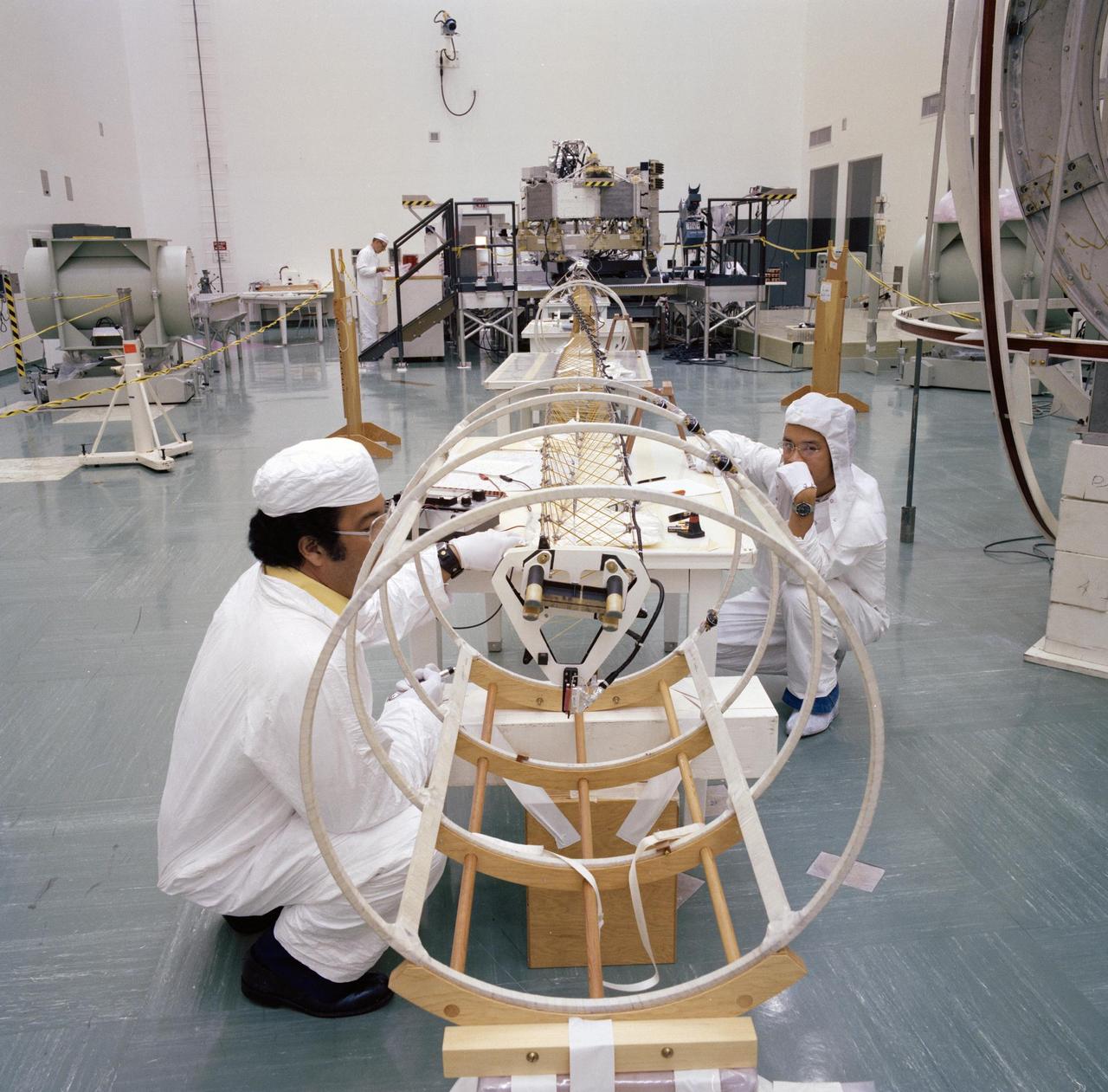
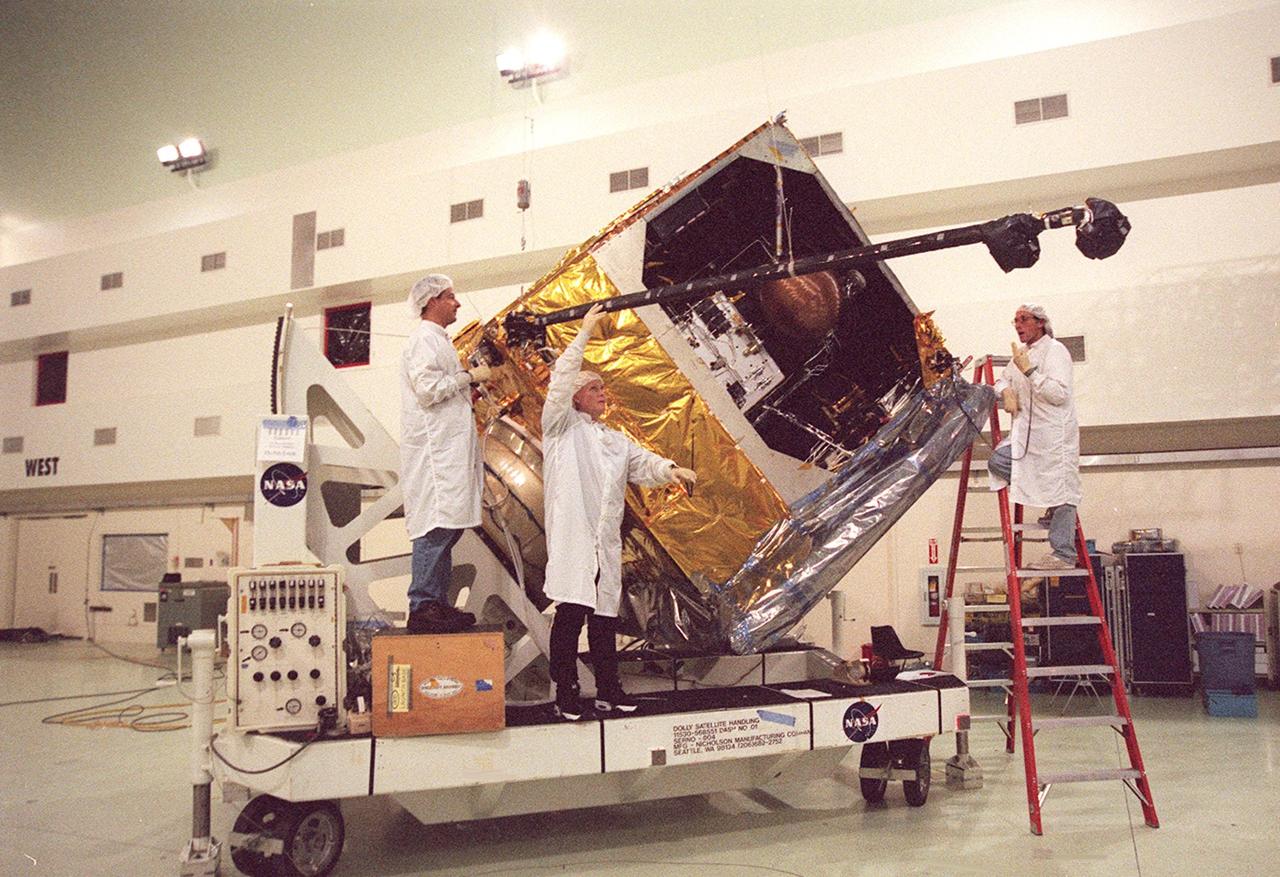
This archival photo shows engineers working with the deployed magnetometer boom of one of NASA's Voyager spacecraft in Florida on June 17, 1977. https://photojournal.jpl.nasa.gov/catalog/PIA21738
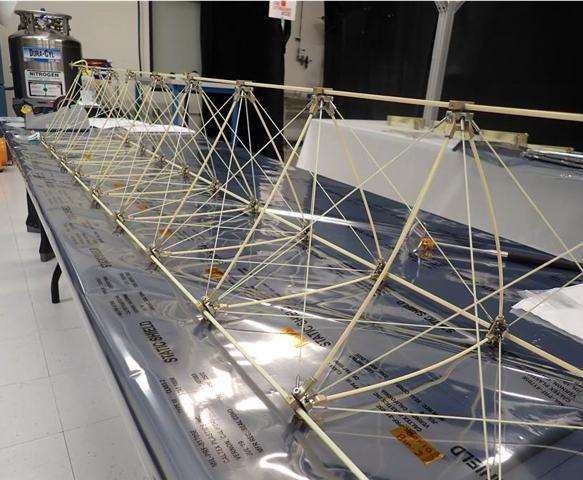
A test model of the boom that will be used for the magnetometer aboard NASA's Europa Clipper spacecraft is readied in NASA's Jet Propulsion Laboratory in Southern California. Called a dynamic test model, it is an exact duplicate of the Europa Clipper Magnetometer (ECM) boom that will fly on Europa Clipper. To fit aboard the rocket, the boom will be stowed in a canister and will deploy to its full length of 25 feet (8.5 meters) in the days after launch. The ECM will allow scientists to measure Europa's magnetic field and to measure the salinity and depth of Europa's internal global ocean. NASA scientists believe Jupiter's moon Europa may have the potential to harbor existing life, because of the internal ocean. Europa Clipper will swoop around Jupiter on an elliptical path, dipping close to the moon on each flyby. Understanding Europa's habitability will help scientists better understand how life developed on Earth and the potential for finding life beyond our planet. Europa Clipper is set to launch in 2024. https://photojournal.jpl.nasa.gov/catalog/PIA24786
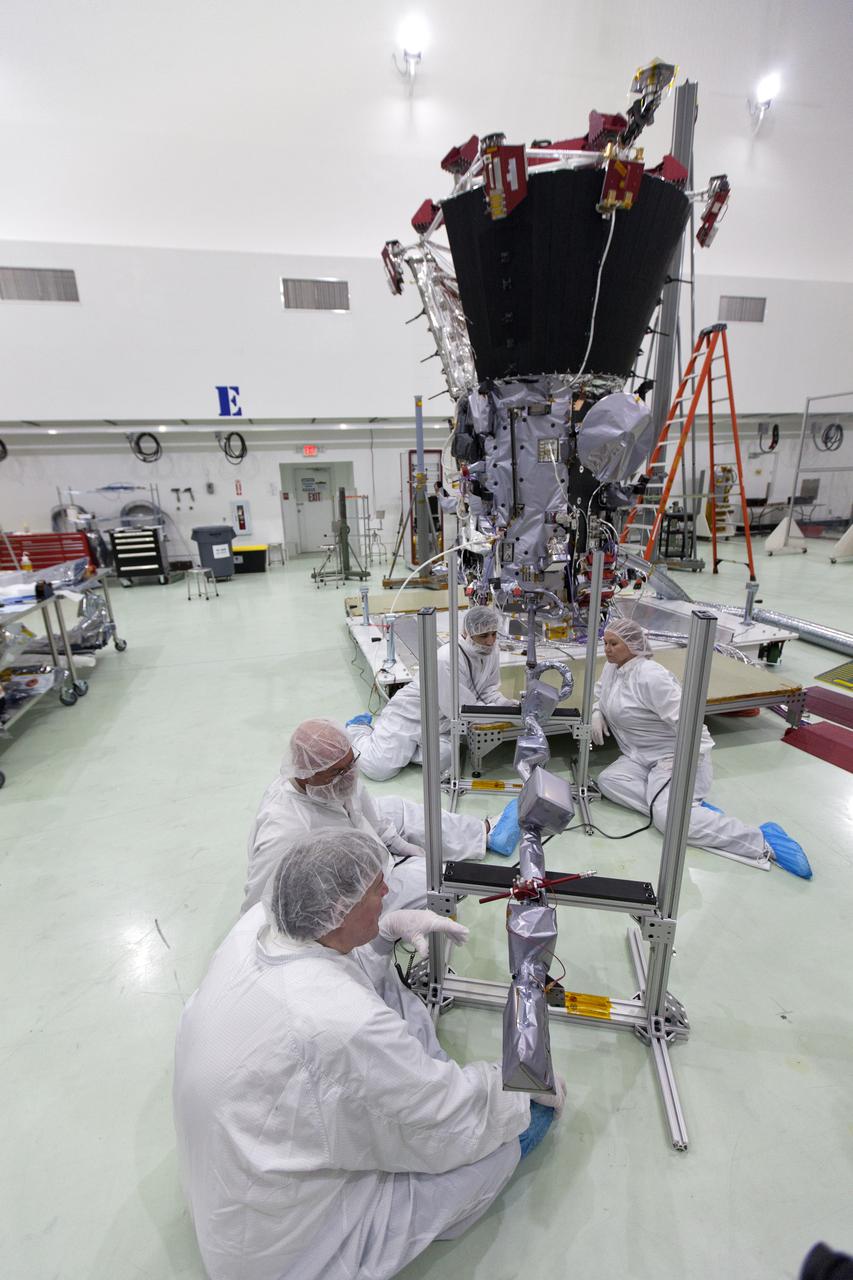
In the Astrotech processing facility in Titusville, Florida, near NASA's Kennedy Space Center, on Wednesday, May 23, 2018, technicians and engineers deploy the magnetometer boom on NASA's Parker Solar Probe. The Parker Solar Probe will launch on a United Launch Alliance Delta IV Heavy rocket from Space Launch Complex 37 at Cape Canaveral Air Force Station in Florida no earlier than Aug. 4, 2018. The mission will perform the closest-ever observations of a star when it travels through the Sun's atmosphere, called the corona. The probe will rely on measurements and imaging to revolutionize our understanding of the corona and the Sun-Earth connection.
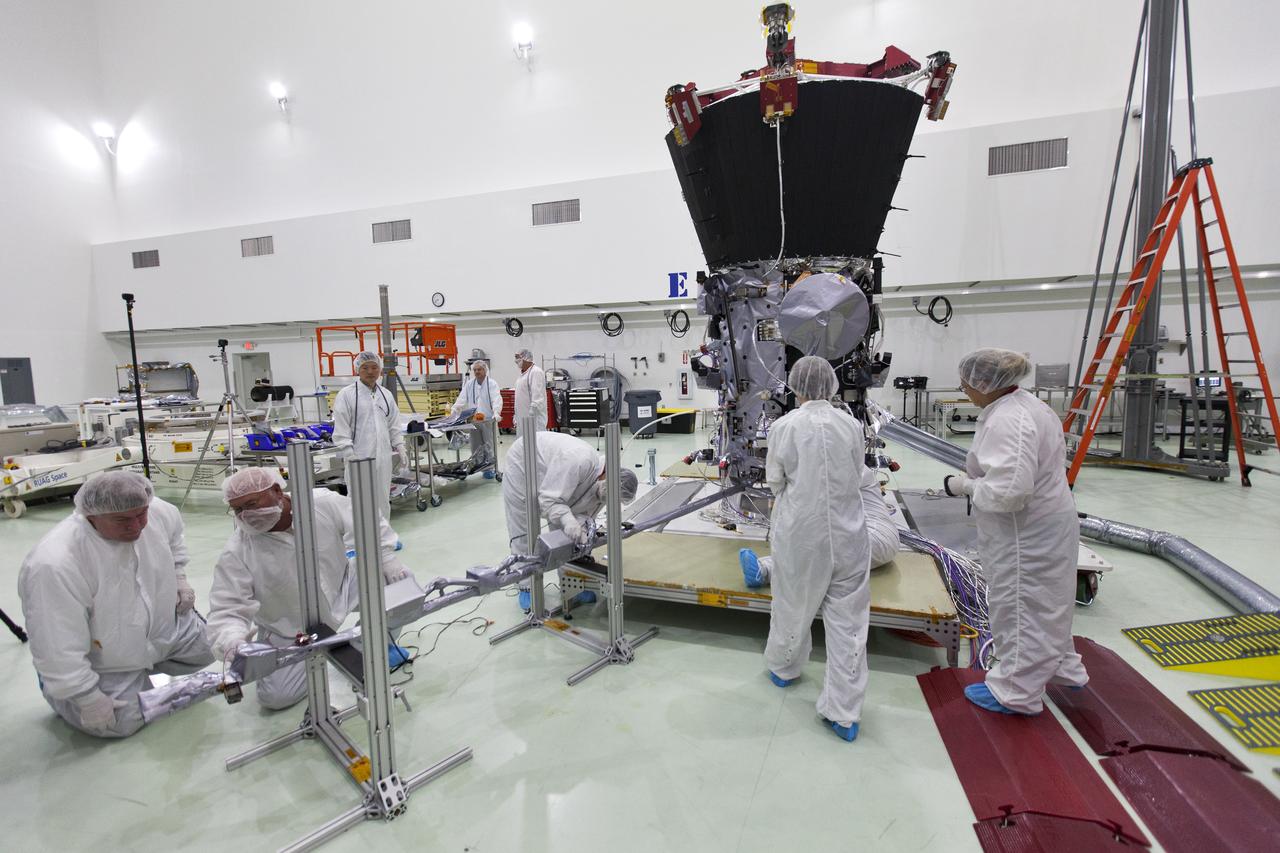
In the Astrotech processing facility in Titusville, Florida, near NASA's Kennedy Space Center, on Wednesday, May 23, 2018, technicians and engineers deploy the magnetometer boom on NASA's Parker Solar Probe. The Parker Solar Probe will launch on a United Launch Alliance Delta IV Heavy rocket from Space Launch Complex 37 at Cape Canaveral Air Force Station in Florida no earlier than Aug. 4, 2018. The mission will perform the closest-ever observations of a star when it travels through the Sun's atmosphere, called the corona. The probe will rely on measurements and imaging to revolutionize our understanding of the corona and the Sun-Earth connection.
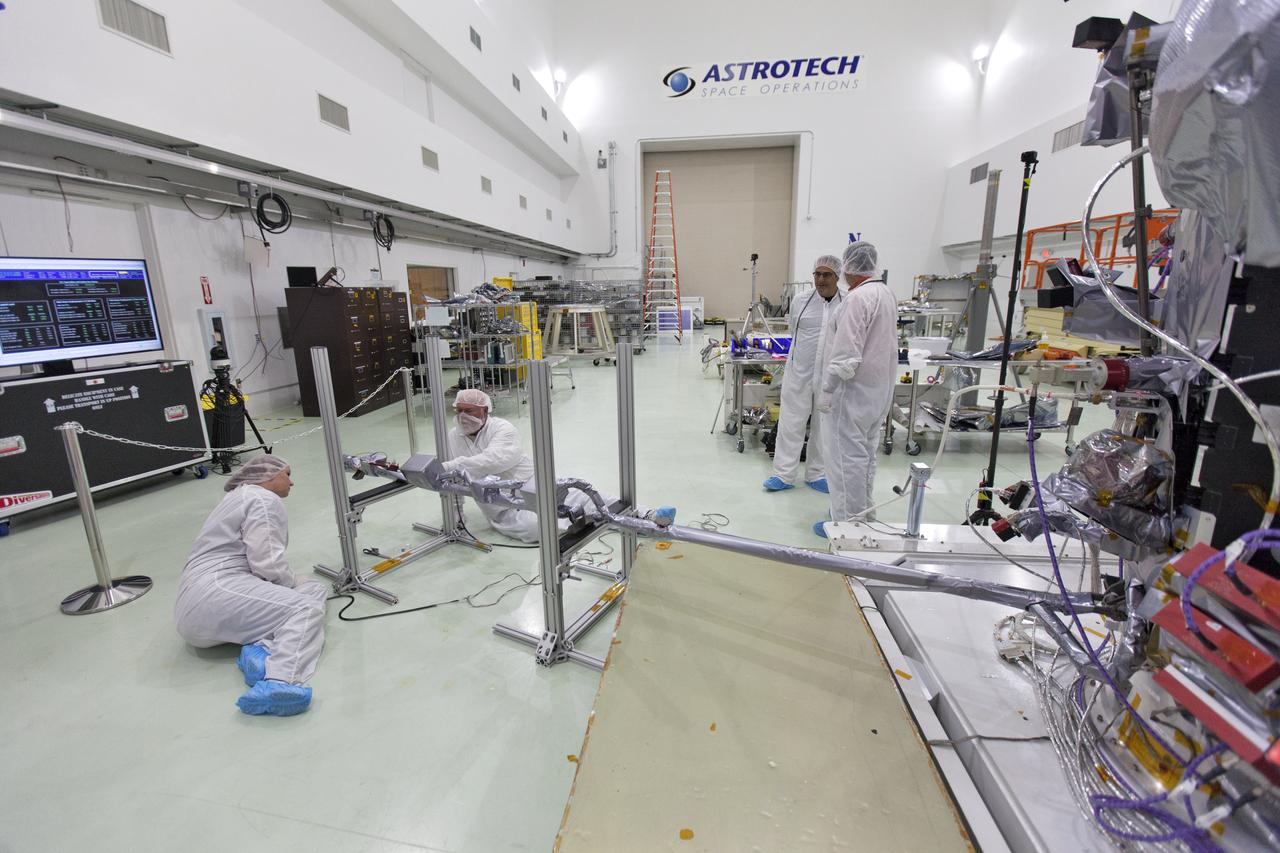
In the Astrotech processing facility in Titusville, Florida, near NASA's Kennedy Space Center, on Wednesday, May 23, 2018, technicians and engineers deploy the magnetometer boom on NASA's Parker Solar Probe. The Parker Solar Probe will launch on a United Launch Alliance Delta IV Heavy rocket from Space Launch Complex 37 at Cape Canaveral Air Force Station in Florida no earlier than Aug. 4, 2018. The mission will perform the closest-ever observations of a star when it travels through the Sun's atmosphere, called the corona. The probe will rely on measurements and imaging to revolutionize our understanding of the corona and the Sun-Earth connection.
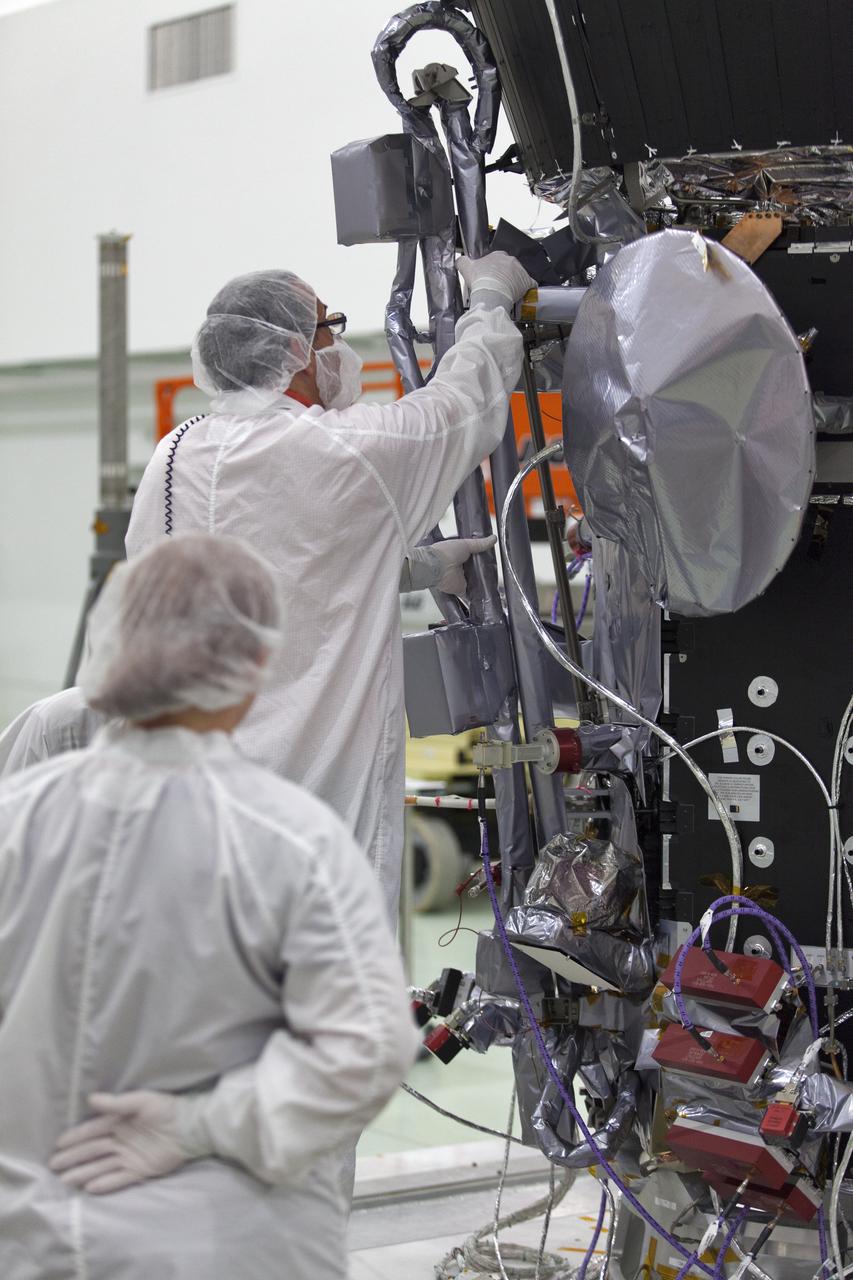
In the Astrotech processing facility in Titusville, Florida, near NASA's Kennedy Space Center, on Wednesday, May 23, 2018, technicians and engineers deploy the magnetometer boom on NASA's Parker Solar Probe. The Parker Solar Probe will launch on a United Launch Alliance Delta IV Heavy rocket from Space Launch Complex 37 at Cape Canaveral Air Force Station in Florida no earlier than Aug. 4, 2018. The mission will perform the closest-ever observations of a star when it travels through the Sun's atmosphere, called the corona. The probe will rely on measurements and imaging to revolutionize our understanding of the corona and the Sun-Earth connection.
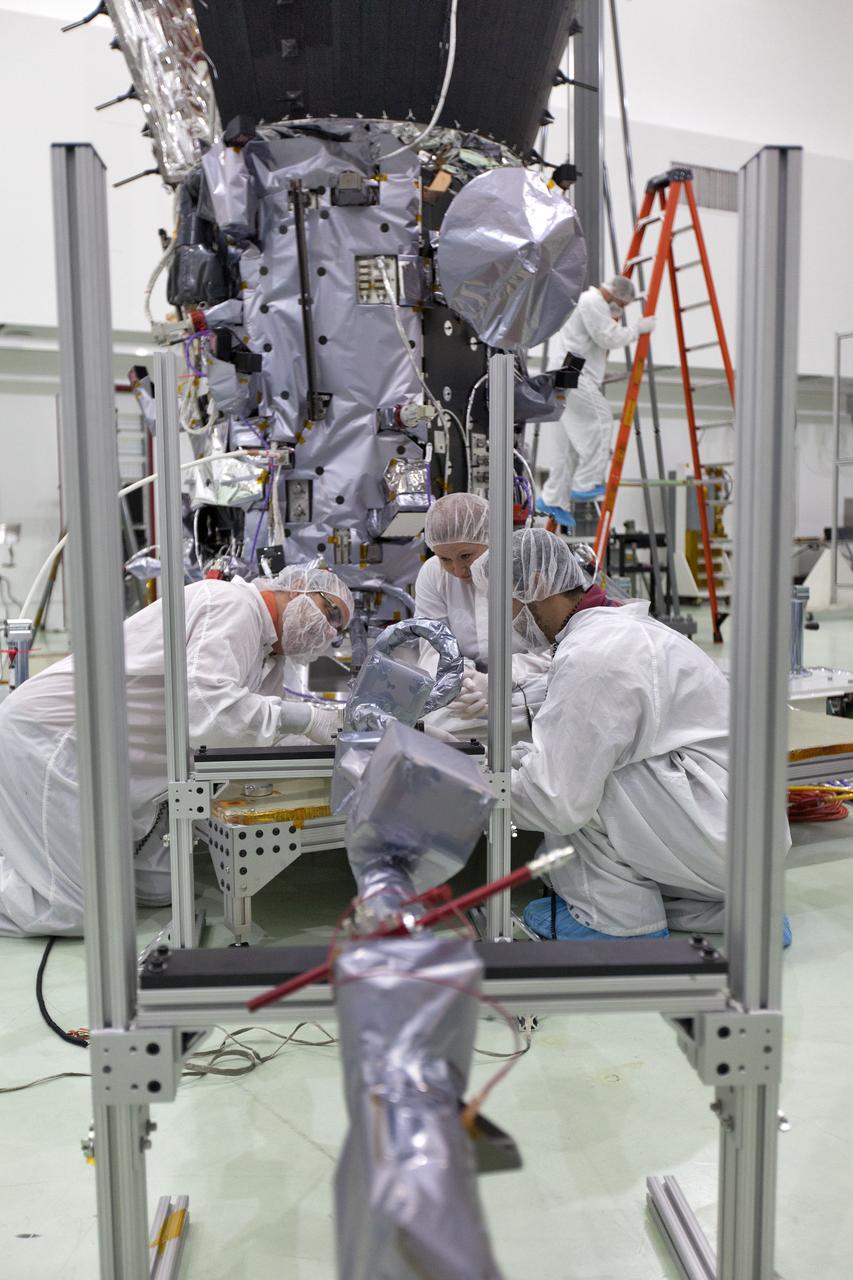
In the Astrotech processing facility in Titusville, Florida, near NASA's Kennedy Space Center, on Wednesday, May 23, 2018, technicians and engineers deploy the magnetometer boom on NASA's Parker Solar Probe. The Parker Solar Probe will launch on a United Launch Alliance Delta IV Heavy rocket from Space Launch Complex 37 at Cape Canaveral Air Force Station in Florida no earlier than Aug. 4, 2018. The mission will perform the closest-ever observations of a star when it travels through the Sun's atmosphere, called the corona. The probe will rely on measurements and imaging to revolutionize our understanding of the corona and the Sun-Earth connection.
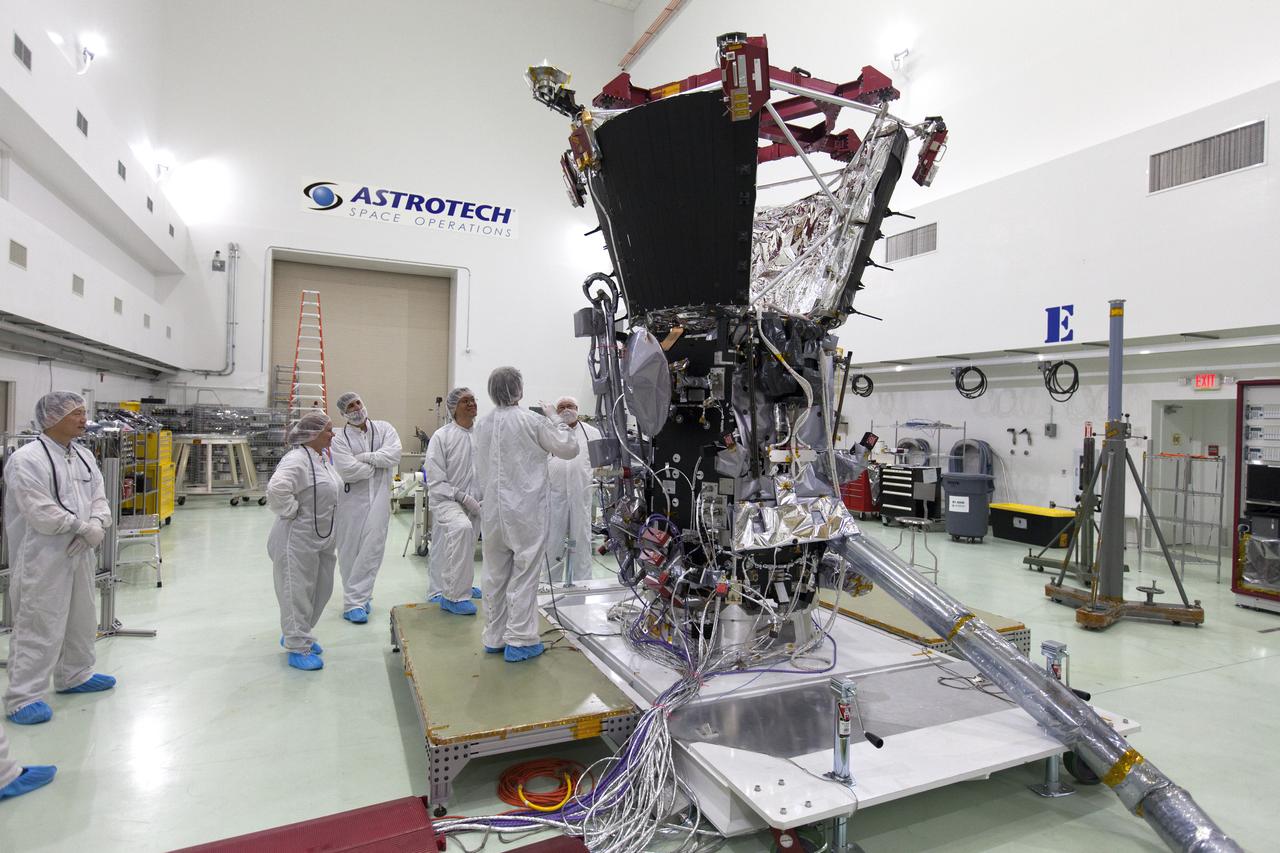
In the Astrotech processing facility in Titusville, Florida, near NASA's Kennedy Space Center, on Wednesday, May 23, 2018, technicians and engineers deploy the magnetometer boom on NASA's Parker Solar Probe. The Parker Solar Probe will launch on a United Launch Alliance Delta IV Heavy rocket from Space Launch Complex 37 at Cape Canaveral Air Force Station in Florida no earlier than Aug. 4, 2018. The mission will perform the closest-ever observations of a star when it travels through the Sun's atmosphere, called the corona. The probe will rely on measurements and imaging to revolutionize our understanding of the corona and the Sun-Earth connection.
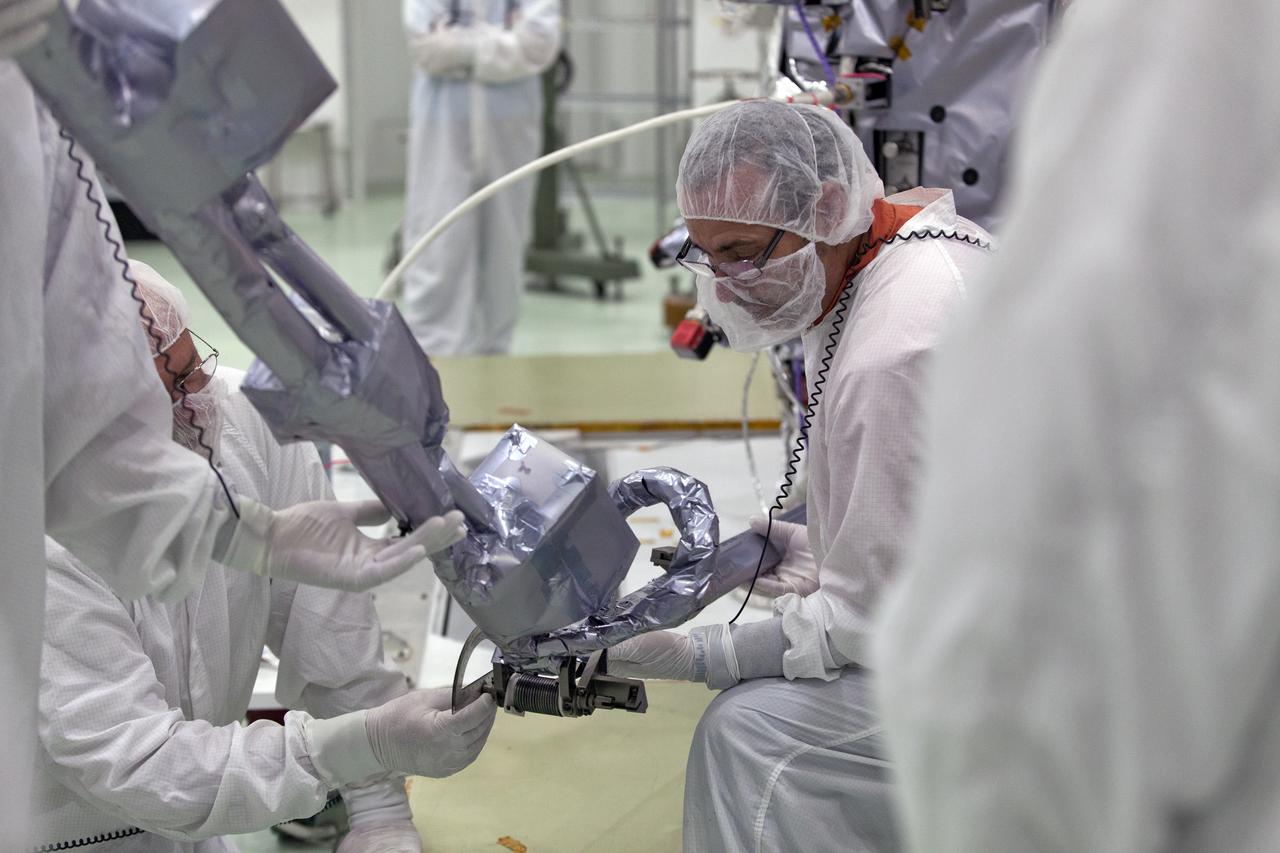
In the Astrotech processing facility in Titusville, Florida, near NASA's Kennedy Space Center, on Wednesday, May 23, 2018, technicians and engineers deploy the magnetometer boom on NASA's Parker Solar Probe. The Parker Solar Probe will launch on a United Launch Alliance Delta IV Heavy rocket from Space Launch Complex 37 at Cape Canaveral Air Force Station in Florida no earlier than Aug. 4, 2018. The mission will perform the closest-ever observations of a star when it travels through the Sun's atmosphere, called the corona. The probe will rely on measurements and imaging to revolutionize our understanding of the corona and the Sun-Earth connection.
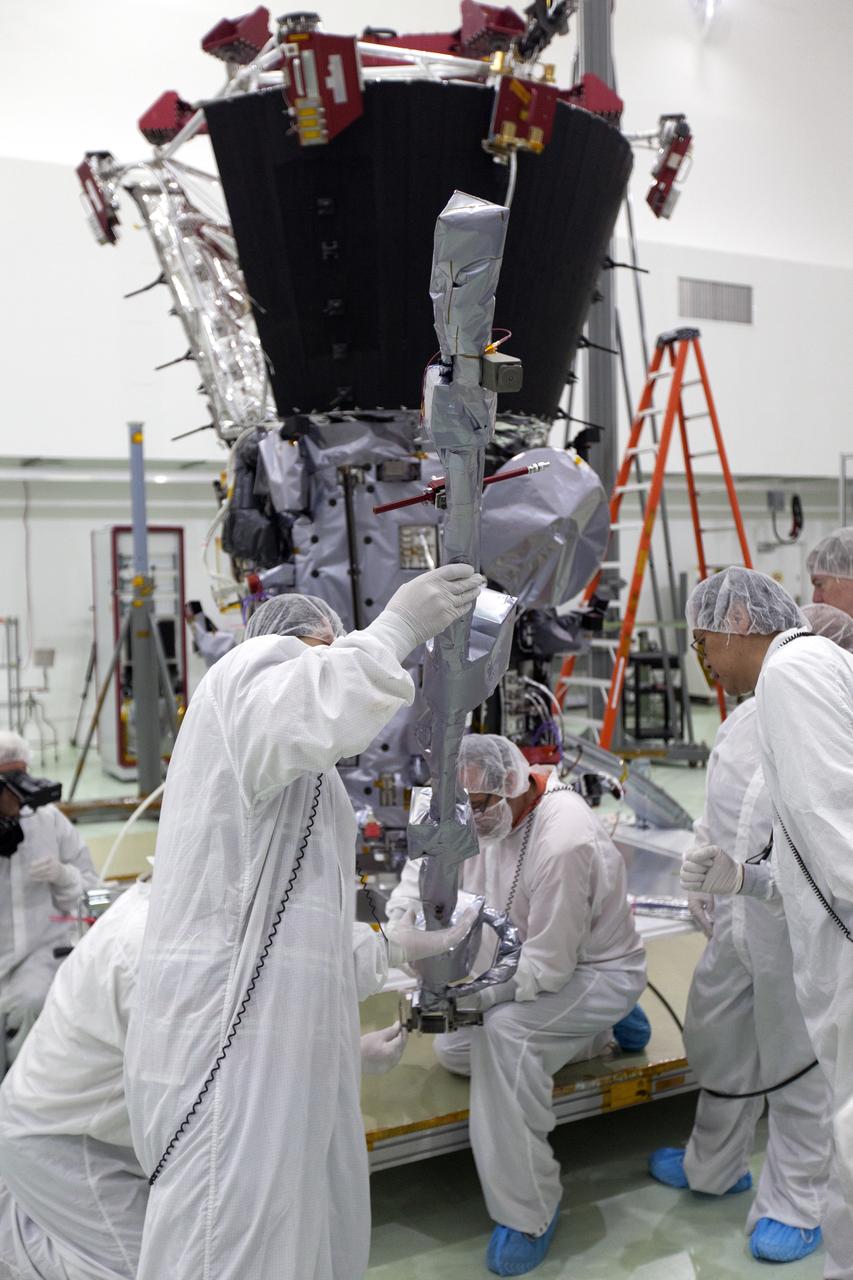
In the Astrotech processing facility in Titusville, Florida, near NASA's Kennedy Space Center, on Wednesday, May 23, 2018, technicians and engineers deploy the magnetometer boom on NASA's Parker Solar Probe. The Parker Solar Probe will launch on a United Launch Alliance Delta IV Heavy rocket from Space Launch Complex 37 at Cape Canaveral Air Force Station in Florida no earlier than Aug. 4, 2018. The mission will perform the closest-ever observations of a star when it travels through the Sun's atmosphere, called the corona. The probe will rely on measurements and imaging to revolutionize our understanding of the corona and the Sun-Earth connection.
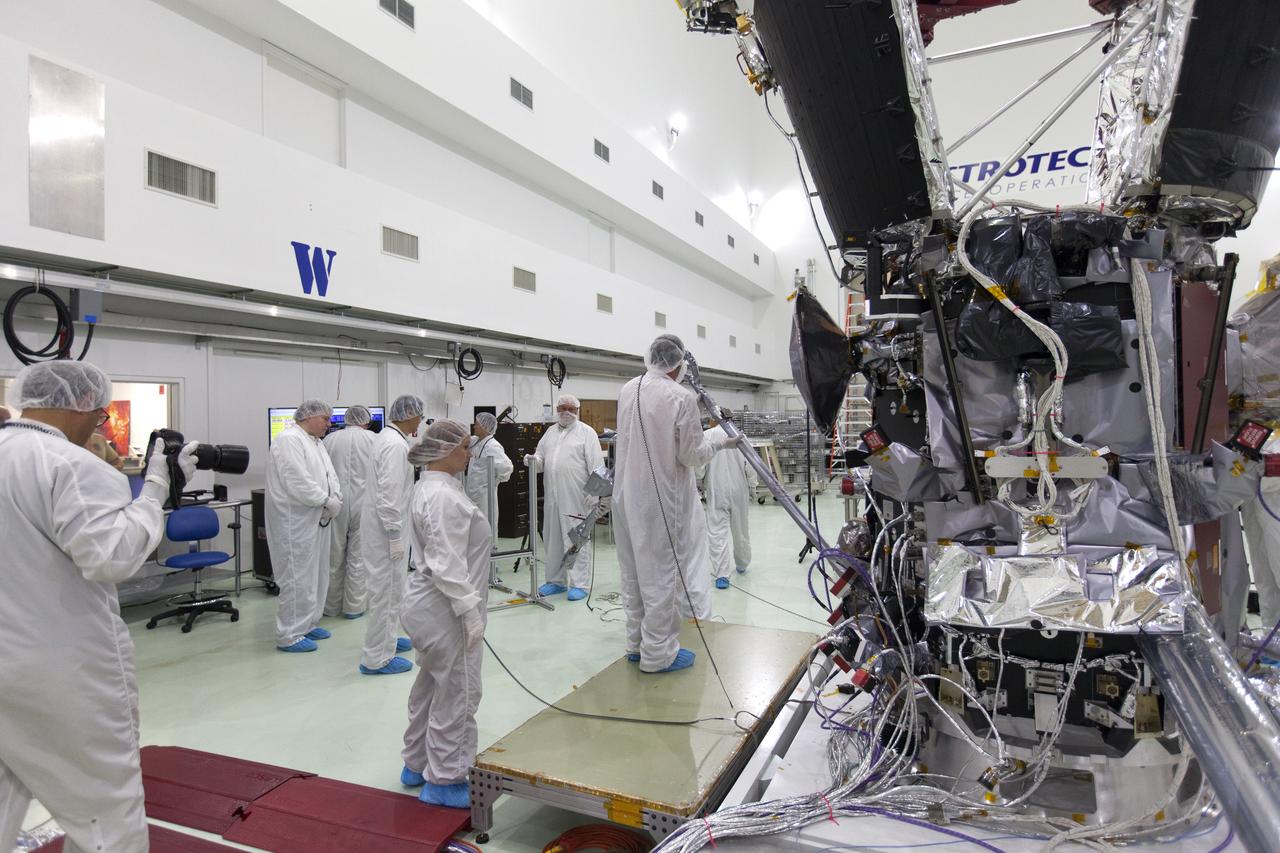
In the Astrotech processing facility in Titusville, Florida, near NASA's Kennedy Space Center, on Wednesday, May 23, 2018, technicians and engineers deploy the magnetometer boom on NASA's Parker Solar Probe. The Parker Solar Probe will launch on a United Launch Alliance Delta IV Heavy rocket from Space Launch Complex 37 at Cape Canaveral Air Force Station in Florida no earlier than Aug. 4, 2018. The mission will perform the closest-ever observations of a star when it travels through the Sun's atmosphere, called the corona. The probe will rely on measurements and imaging to revolutionize our understanding of the corona and the Sun-Earth connection.
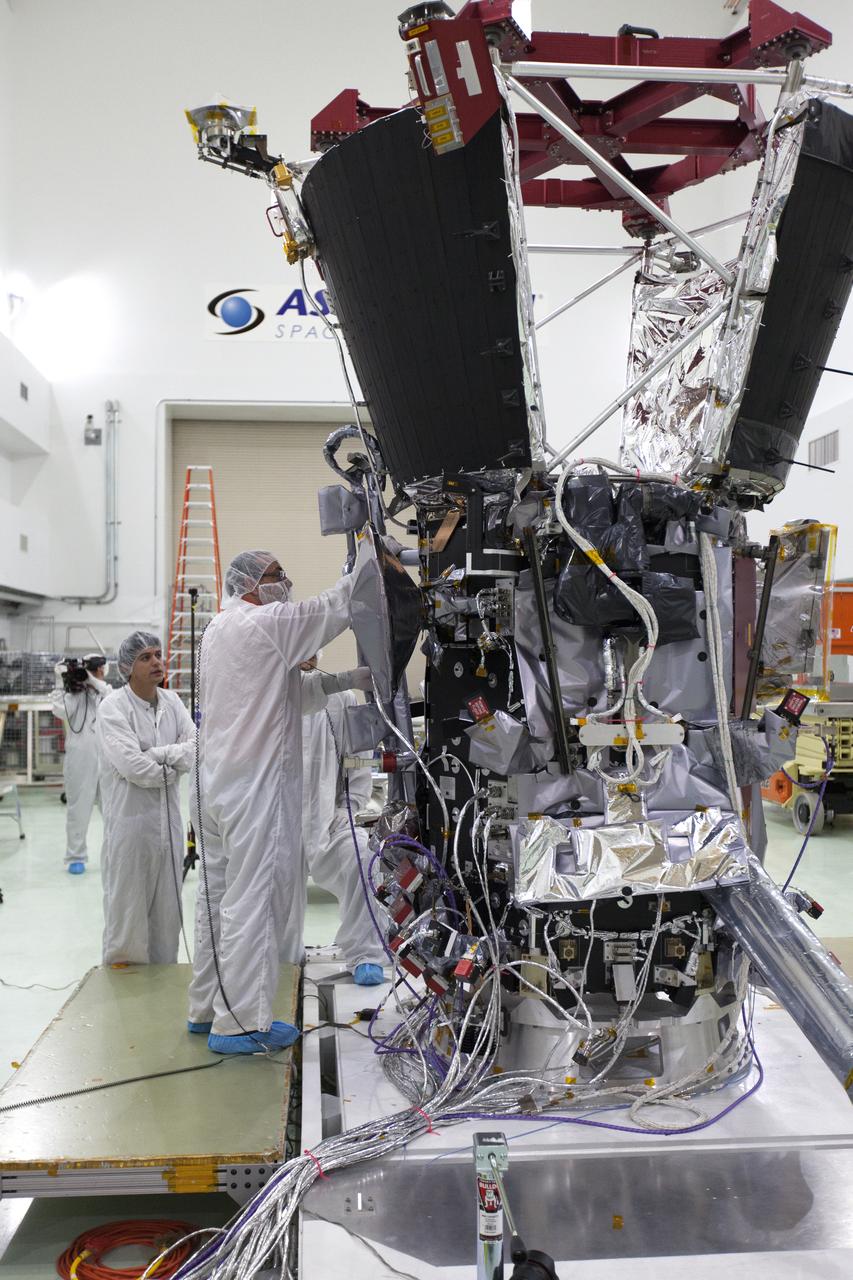
In the Astrotech processing facility in Titusville, Florida, near NASA's Kennedy Space Center, on Wednesday, May 23, 2018, technicians and engineers deploy the magnetometer boom on NASA's Parker Solar Probe. The Parker Solar Probe will launch on a United Launch Alliance Delta IV Heavy rocket from Space Launch Complex 37 at Cape Canaveral Air Force Station in Florida no earlier than Aug. 4, 2018. The mission will perform the closest-ever observations of a star when it travels through the Sun's atmosphere, called the corona. The probe will rely on measurements and imaging to revolutionize our understanding of the corona and the Sun-Earth connection.
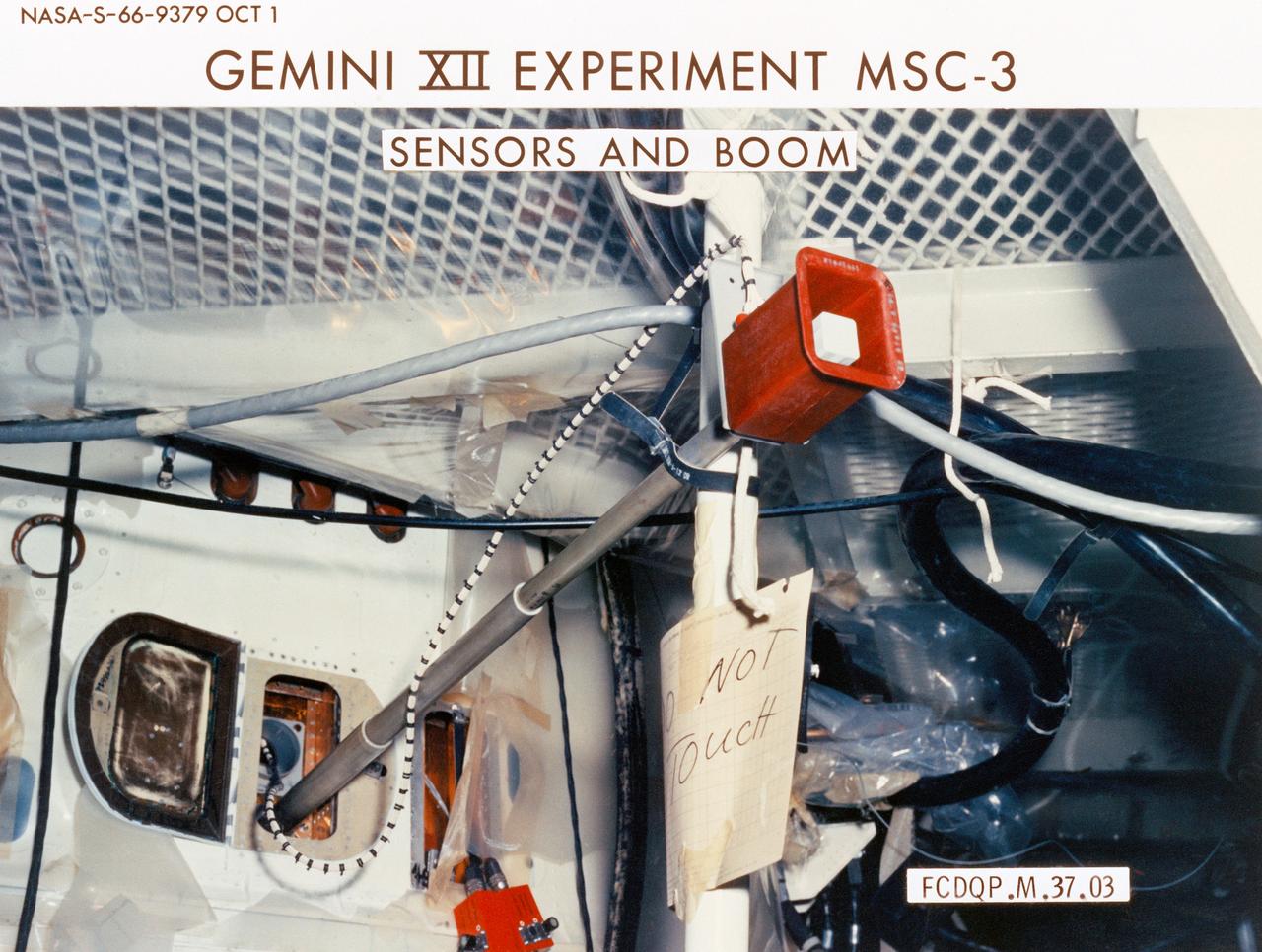
S66-09379 (1 Oct. 1966) --- Tri-Axis Magnetometer-Sensor Unit mounted on telescoping boom. Cable connects Sensor Unit with Electronics Unit mounted on retrograde beam in retrograde adapter section. Objective of experiment is to monitor the direction and amplitude of Earth's magnetic field (Gemini-12). Photo credit: NASA

CAPE CANAVERAL, Fla. -- Technicians at Astrotech's payload processing facility in Titusville, Fla. are stowing solar array #2 for NASA's Juno spacecraft. Later in processing, the magnetometer will be installed; a solar array illumination and magnetometer boom deployment test also are planned. Juno is scheduled to launch aboard an Atlas V rocket from Cape Canaveral, Fla. Aug. 5.The solar-powered spacecraft will orbit Jupiter's poles 33 times to find out more about the gas giant's origins, structure, atmosphere and magnetosphere and investigate the existence of a solid planetary core. For more information visit, www.nasa.gov/juno. Photo credit: NASA/Jack Pfaller
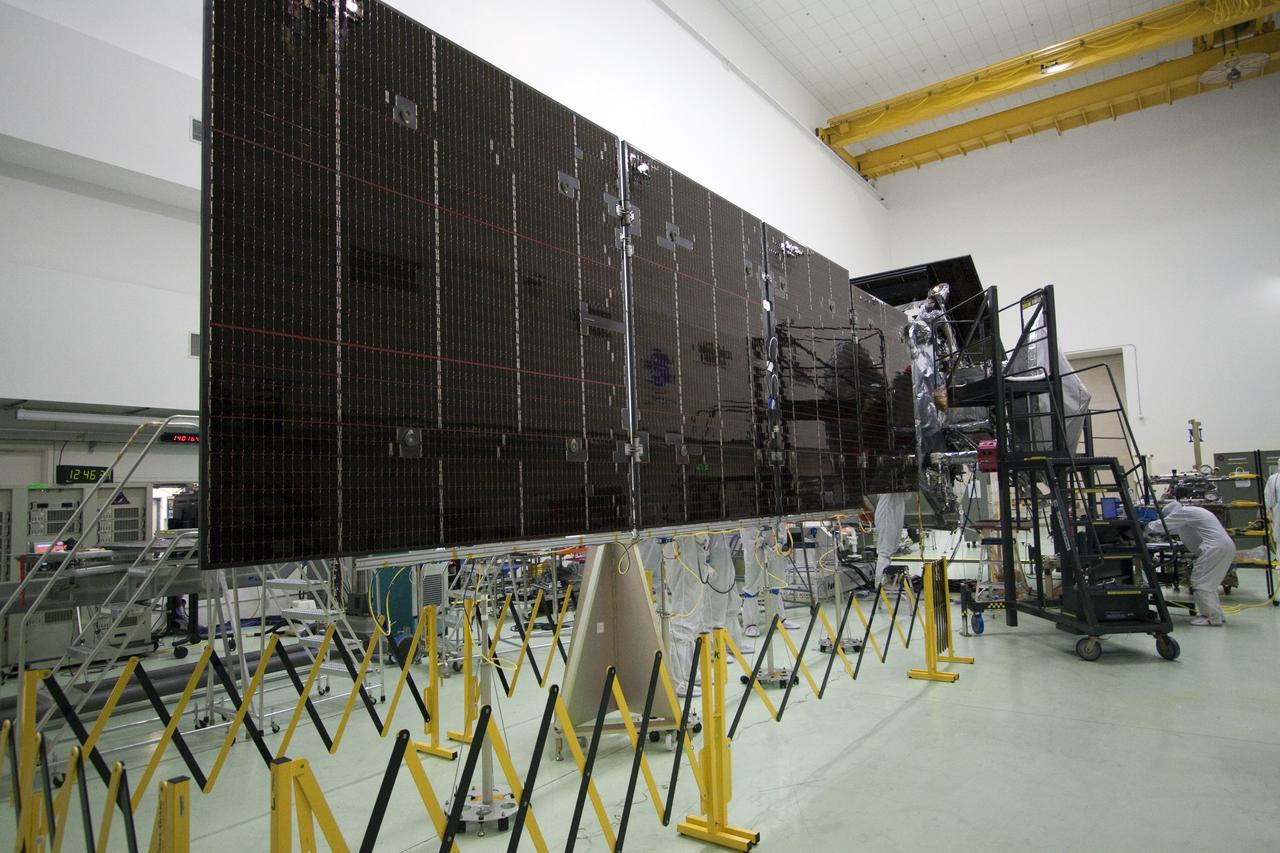
CAPE CANAVERAL, Fla. -- Technicians at Astrotech's payload processing facility in Titusville, Fla. are preparing to stow unfurled solar array #2 for NASA's Juno spacecraft. Later in processing, the magnetometer will be installed; a solar array illumination and magnetometer boom deployment test also are planned. Juno is scheduled to launch aboard an Atlas V rocket from Cape Canaveral, Fla. Aug. 5.The solar-powered spacecraft will orbit Jupiter's poles 33 times to find out more about the gas giant's origins, structure, atmosphere and magnetosphere and investigate the existence of a solid planetary core. For more information visit, www.nasa.gov/juno. Photo credit: NASA/Jack Pfaller
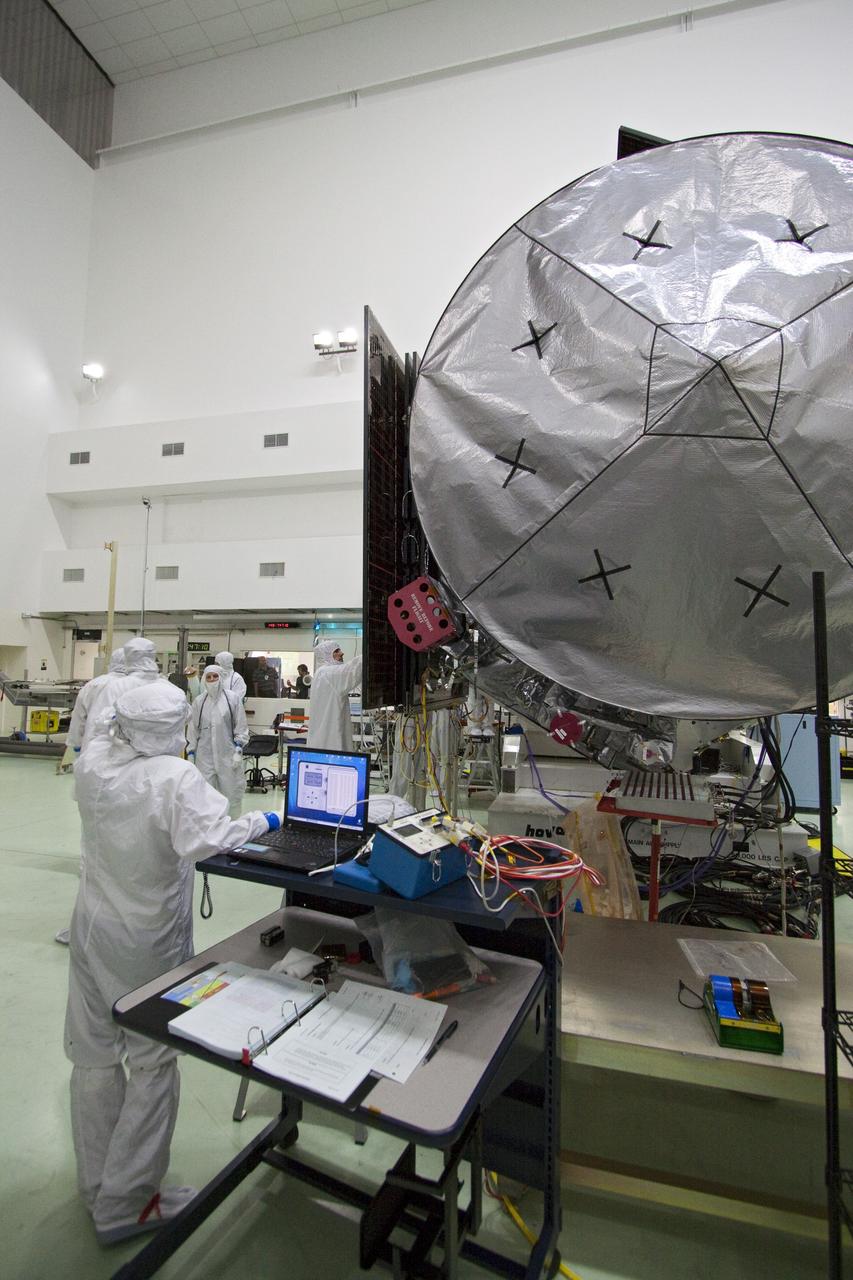
CAPE CANAVERAL, Fla. -- Technicians at Astrotech's payload processing facility in Titusville, Fla. have secured solar array #2 to NASA's Juno spacecraft. Later in processing, the magnetometer will be installed; a solar array illumination and magnetometer boom deployment test also are planned. Juno is scheduled to launch aboard an Atlas V rocket from Cape Canaveral, Fla. Aug. 5.The solar-powered spacecraft will orbit Jupiter's poles 33 times to find out more about the gas giant's origins, structure, atmosphere and magnetosphere and investigate the existence of a solid planetary core. For more information visit, www.nasa.gov/juno. Photo credit: NASA/Jack Pfaller

CAPE CANAVERAL, Fla. -- Technicians at Astrotech's payload processing facility in Titusville, Fla. guide the solar arrays toward NASA's Juno spacecraft for installation. Later in processing, the magnetometer will be installed; a solar array illumination and magnetometer boom deployment test also are planned. Juno is scheduled to launch aboard an Atlas V rocket from Cape Canaveral, Fla. Aug. 5.The solar-powered spacecraft will orbit Jupiter's poles 33 times to find out more about the gas giant's origins, structure, atmosphere and magnetosphere and investigate the existence of a solid planetary core. For more information visit www.nasa.gov/juno. Photo credit: NASA/Jack Pfaller
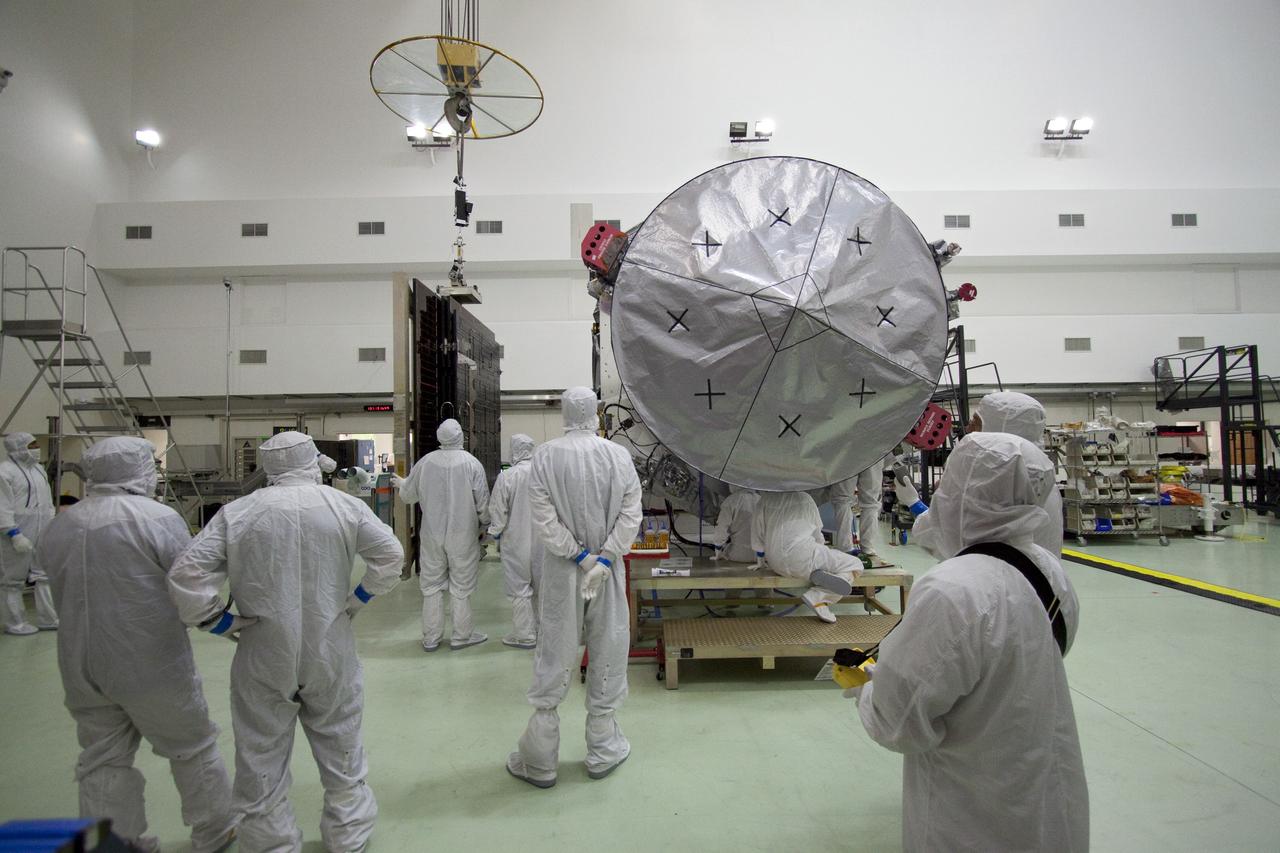
CAPE CANAVERAL, Fla. -- Technicians at Astrotech's payload processing facility in Titusville, Fla. guide the solar arrays toward NASA's Juno spacecraft for installation. Later in processing, the magnetometer will be installed; a solar array illumination and magnetometer boom deployment test also are planned. Juno is scheduled to launch aboard an Atlas V rocket from Cape Canaveral, Fla. Aug. 5.The solar-powered spacecraft will orbit Jupiter's poles 33 times to find out more about the gas giant's origins, structure, atmosphere and magnetosphere and investigate the existence of a solid planetary core. For more information visit www.nasa.gov/juno. Photo credit: NASA/Jack Pfaller
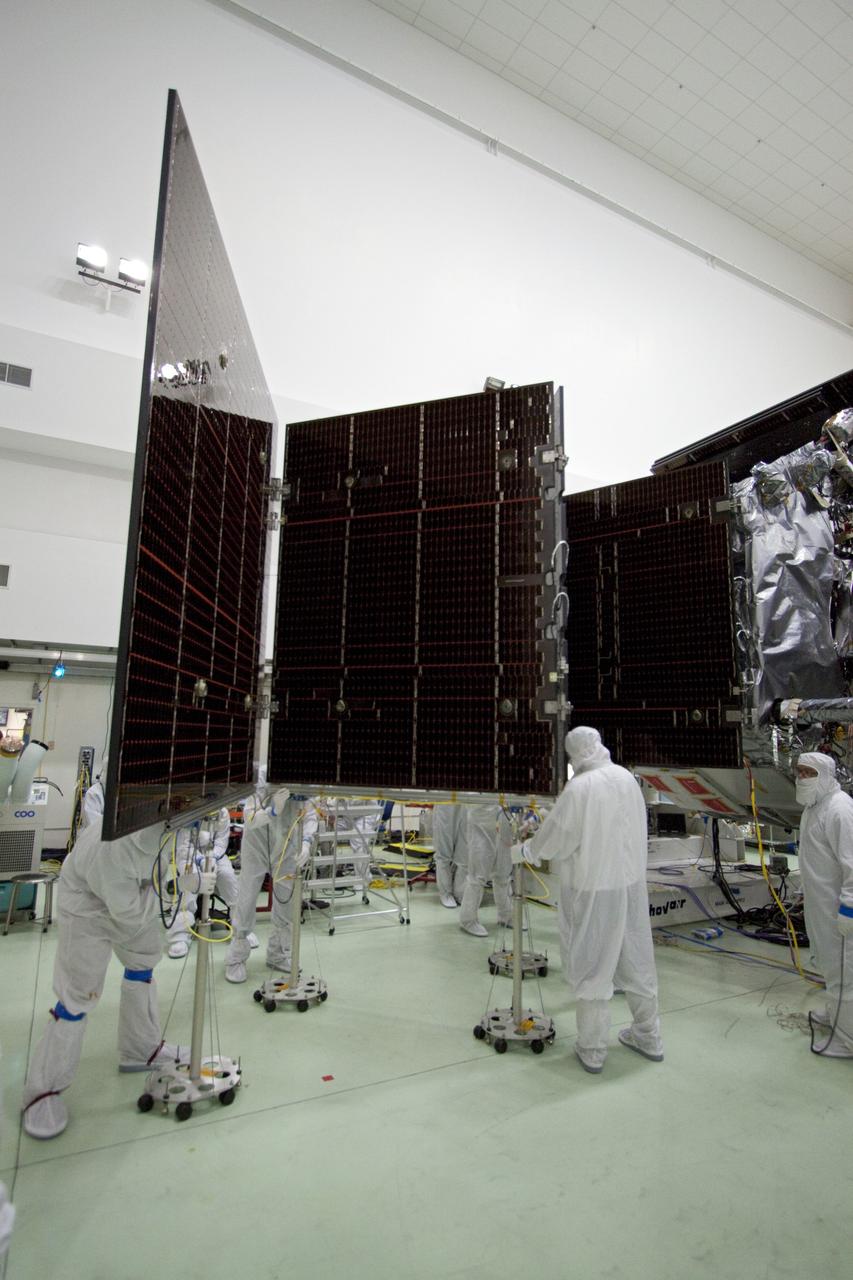
CAPE CANAVERAL, Fla. -- Technicians at Astrotech's payload processing facility in Titusville, Fla. are stowing solar array #2 for NASA's Juno spacecraft. Later in processing, the magnetometer will be installed; a solar array illumination and magnetometer boom deployment test also are planned. Juno is scheduled to launch aboard an Atlas V rocket from Cape Canaveral, Fla. Aug. 5.The solar-powered spacecraft will orbit Jupiter's poles 33 times to find out more about the gas giant's origins, structure, atmosphere and magnetosphere and investigate the existence of a solid planetary core. For more information visit, www.nasa.gov/juno. Photo credit: NASA/Jack Pfaller
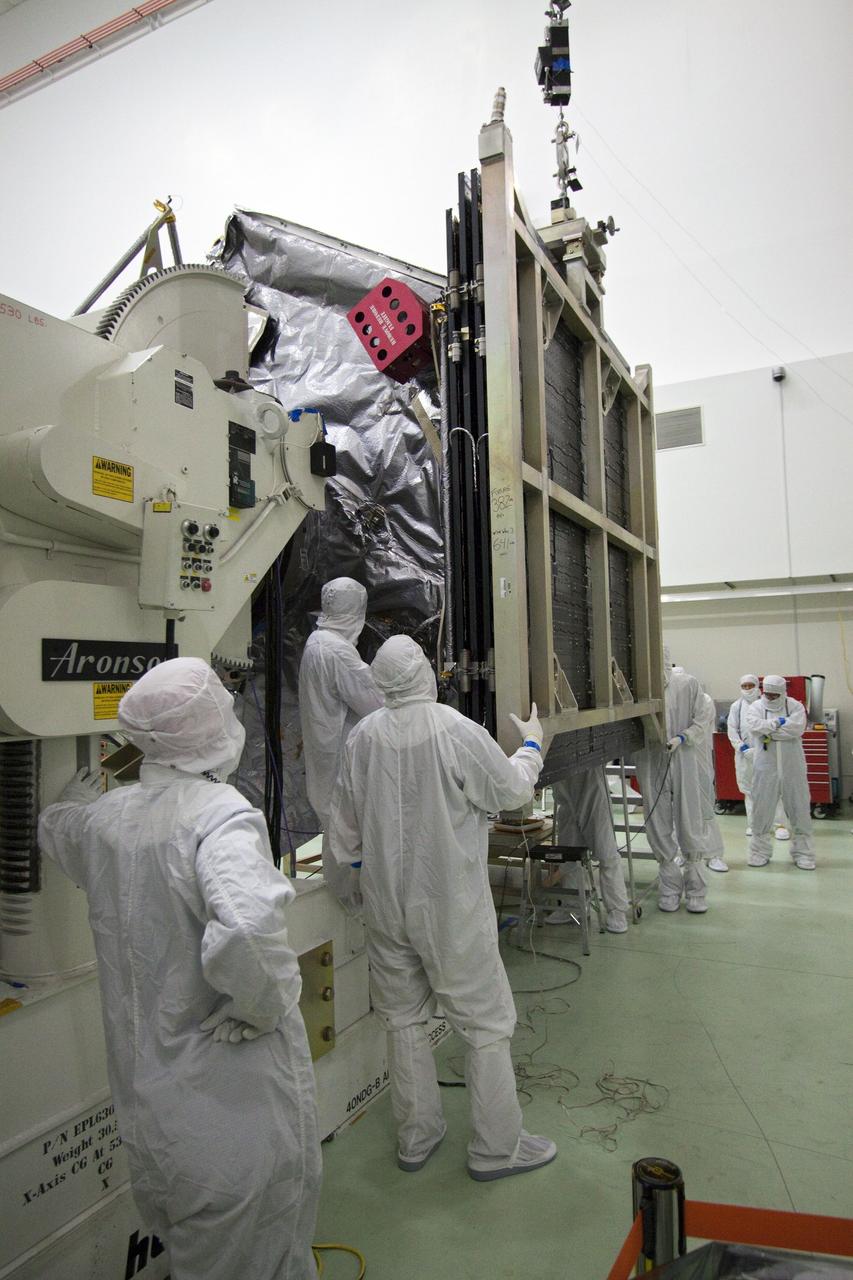
CAPE CANAVERAL, Fla. -- Technicians at Astrotech's payload processing facility in Titusville, Fla. guide the solar arrays into position on NASA's Juno spacecraft for installation. Later in processing, the magnetometer will be installed; a solar array illumination and magnetometer boom deployment test also are planned. Juno is scheduled to launch aboard an Atlas V rocket from Cape Canaveral, Fla. Aug. 5.The solar-powered spacecraft will orbit Jupiter's poles 33 times to find out more about the gas giant's origins, structure, atmosphere and magnetosphere and investigate the existence of a solid planetary core. For more information visit www.nasa.gov/juno. Photo credit: NASA/Jack Pfaller
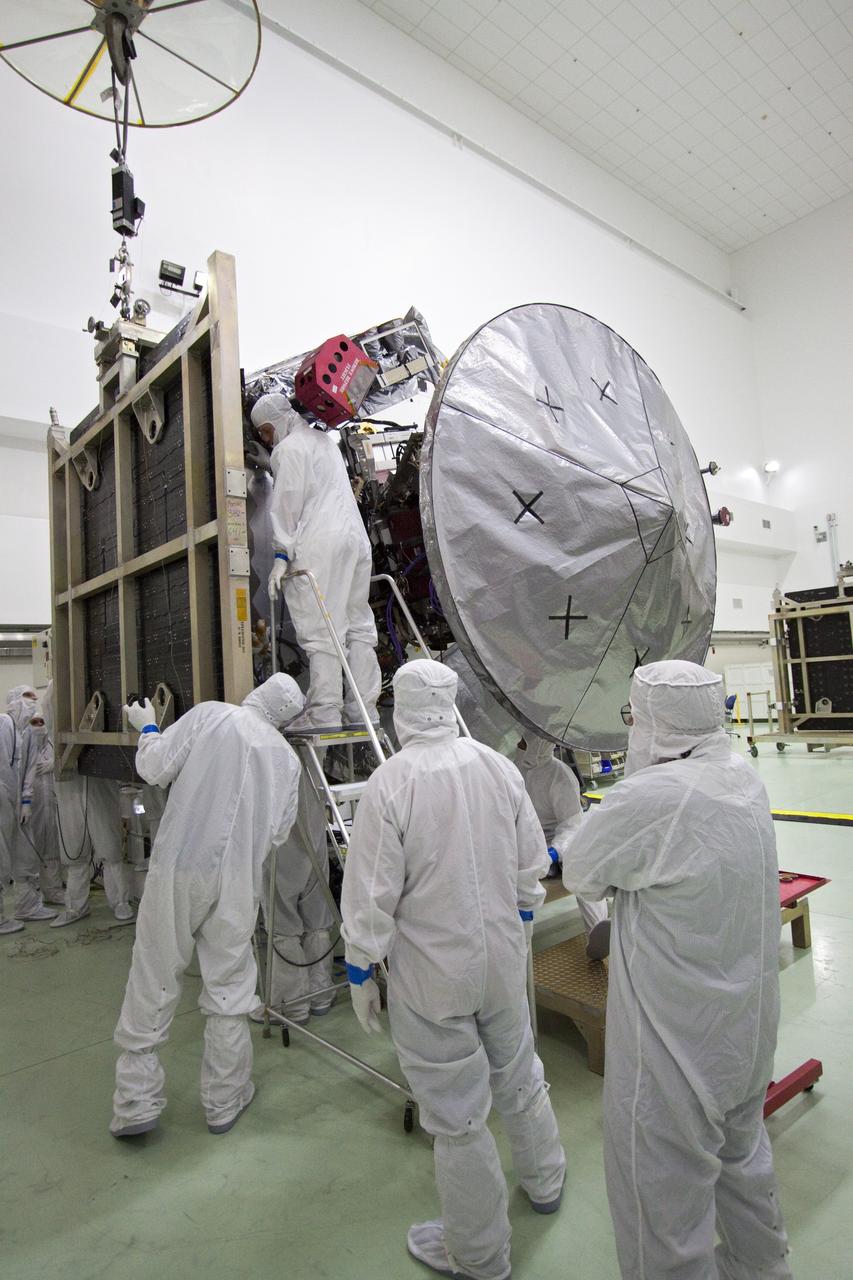
CAPE CANAVERAL, Fla. -- Technicians at Astrotech's payload processing facility in Titusville, Fla. have positioned the solar arrays onto NASA's Juno spacecraft for installation. Later in processing, the magnetometer will be installed; a solar array illumination and magnetometer boom deployment test also are planned. Juno is scheduled to launch aboard an Atlas V rocket from Cape Canaveral, Fla. Aug. 5.The solar-powered spacecraft will orbit Jupiter's poles 33 times to find out more about the gas giant's origins, structure, atmosphere and magnetosphere and investigate the existence of a solid planetary core. For more information visit www.nasa.gov/juno. Photo credit: NASA/Jack Pfaller
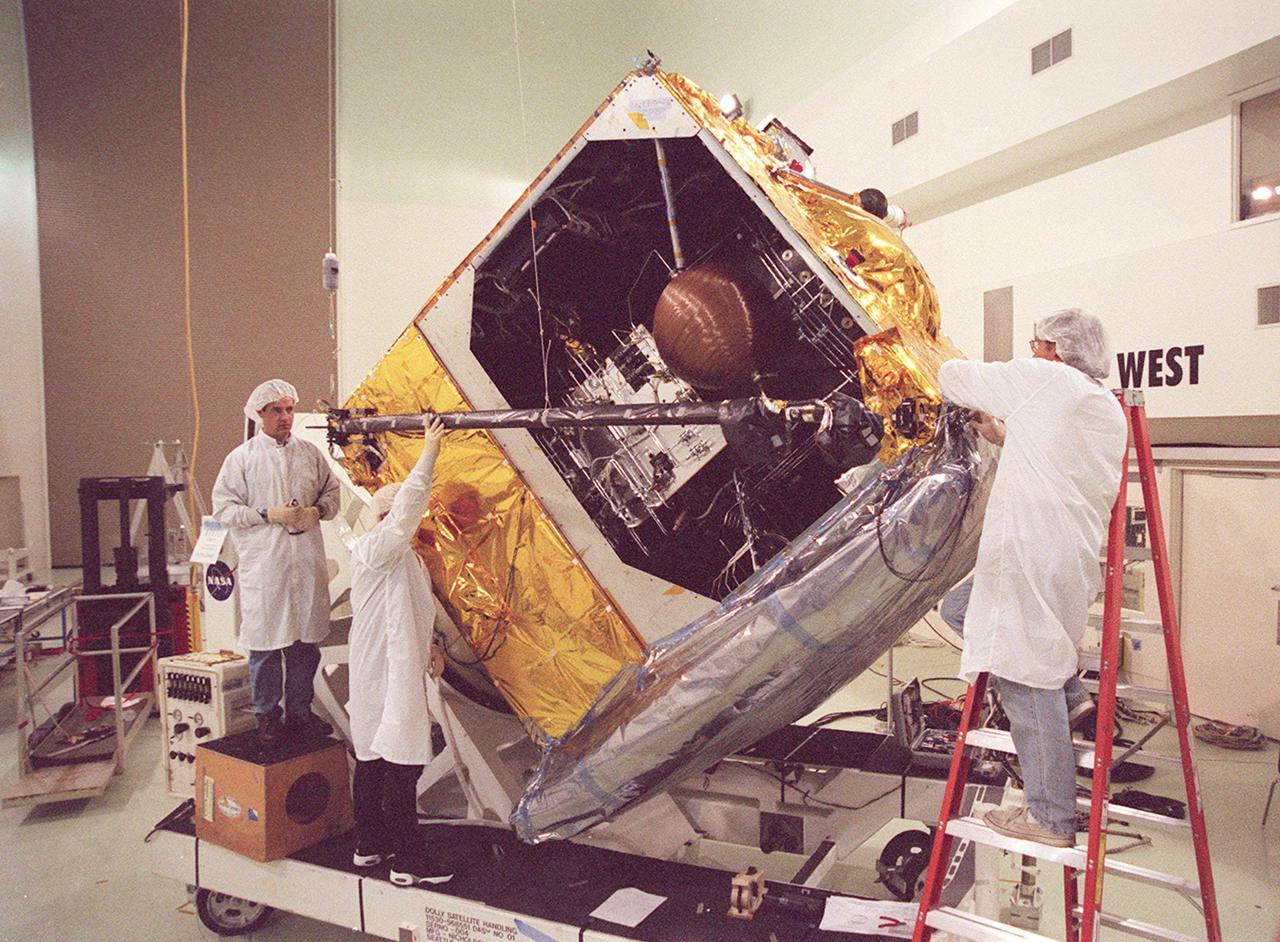
Workers at Astrotech, Titusville, Fla., begin deploying the magnetometer boom on the GOES-M satellite. The satellite is undergoing testing at Astrotech. The GOES-M provides weather imagery and quantitative sounding data used to support weather forecasting, severe storm tracking and meteorological research. The satellite is scheduled to launch July 12 on an Atlas-IIA booster, Centaur upper stage from Cape Canaveral Air Force Station
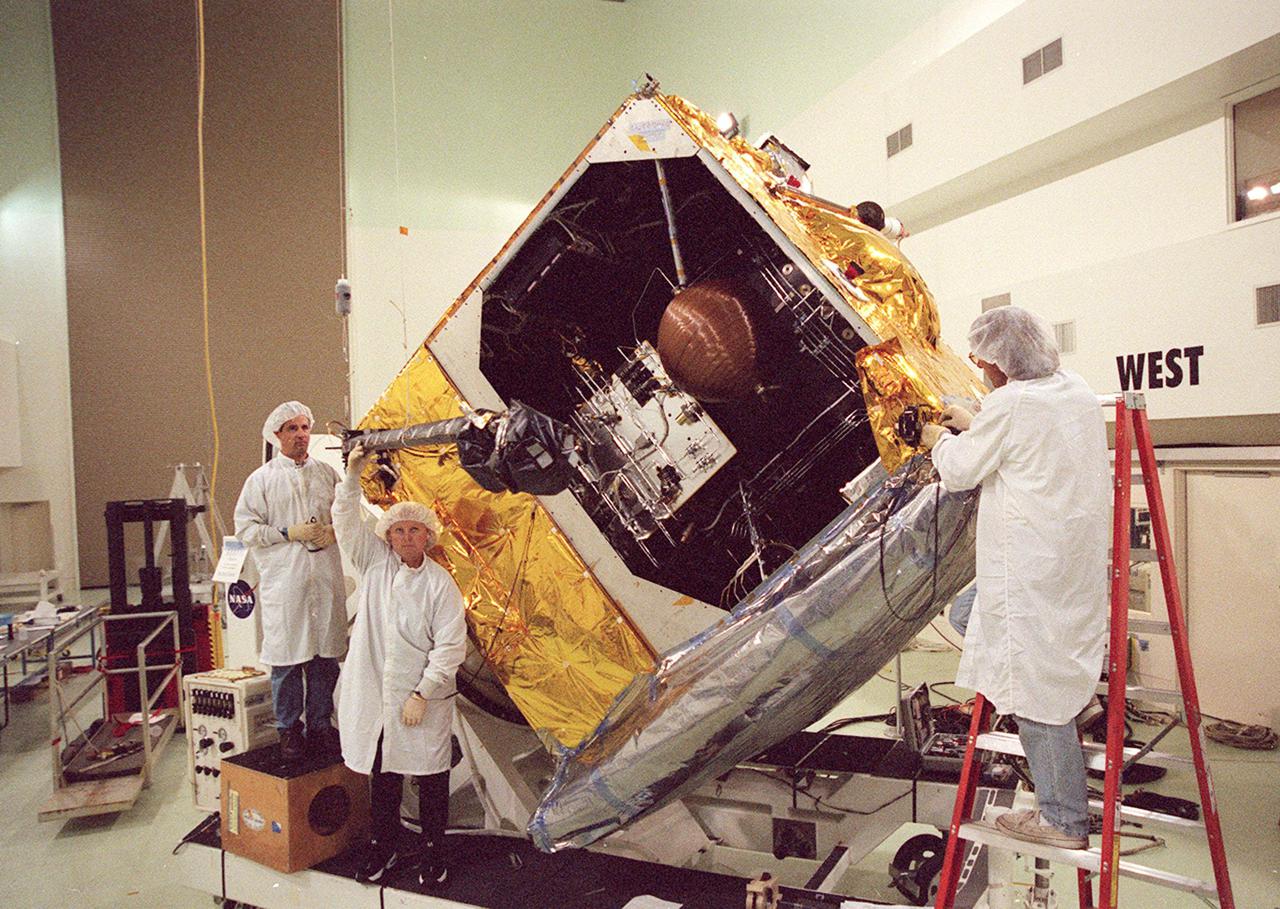
Workers at Astrotech, Titusville, Fla., begin deploying the magnetometer boom on the GOES-M satellite. The satellite is undergoing testing at Astrotech. The GOES-M provides weather imagery and quantitative sounding data used to support weather forecasting, severe storm tracking and meteorological research. The satellite is scheduled to launch July 12 on an Atlas-IIA booster, Centaur upper stage from Cape Canaveral Air Force Station
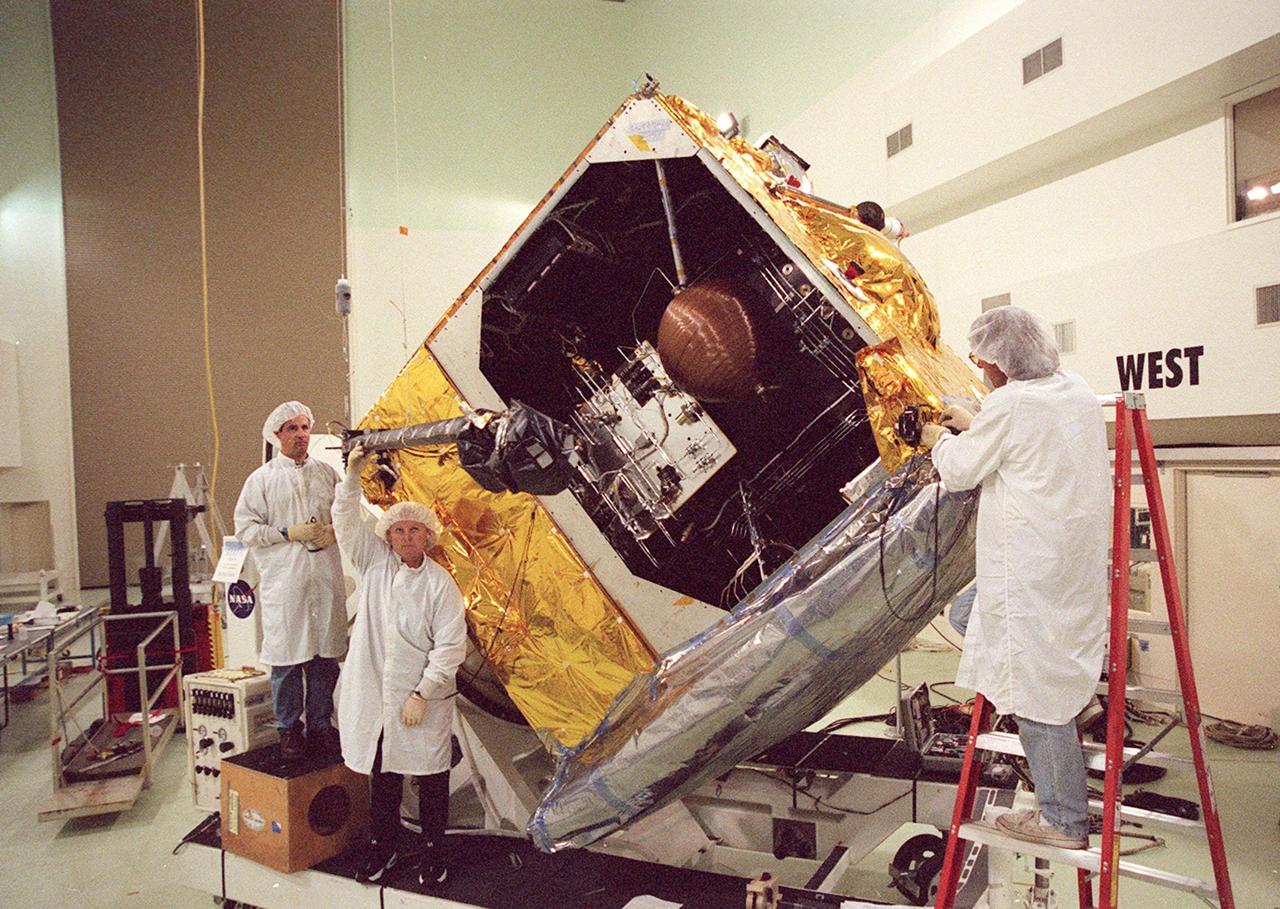
Workers at Astrotech, Titusville, Fla., begin deploying the magnetometer boom on the GOES-M satellite. The satellite is undergoing testing at Astrotech. The GOES-M provides weather imagery and quantitative sounding data used to support weather forecasting, severe storm tracking and meteorological research. The satellite is scheduled to launch July 12 on an Atlas-IIA booster, Centaur upper stage from Cape Canaveral Air Force Station
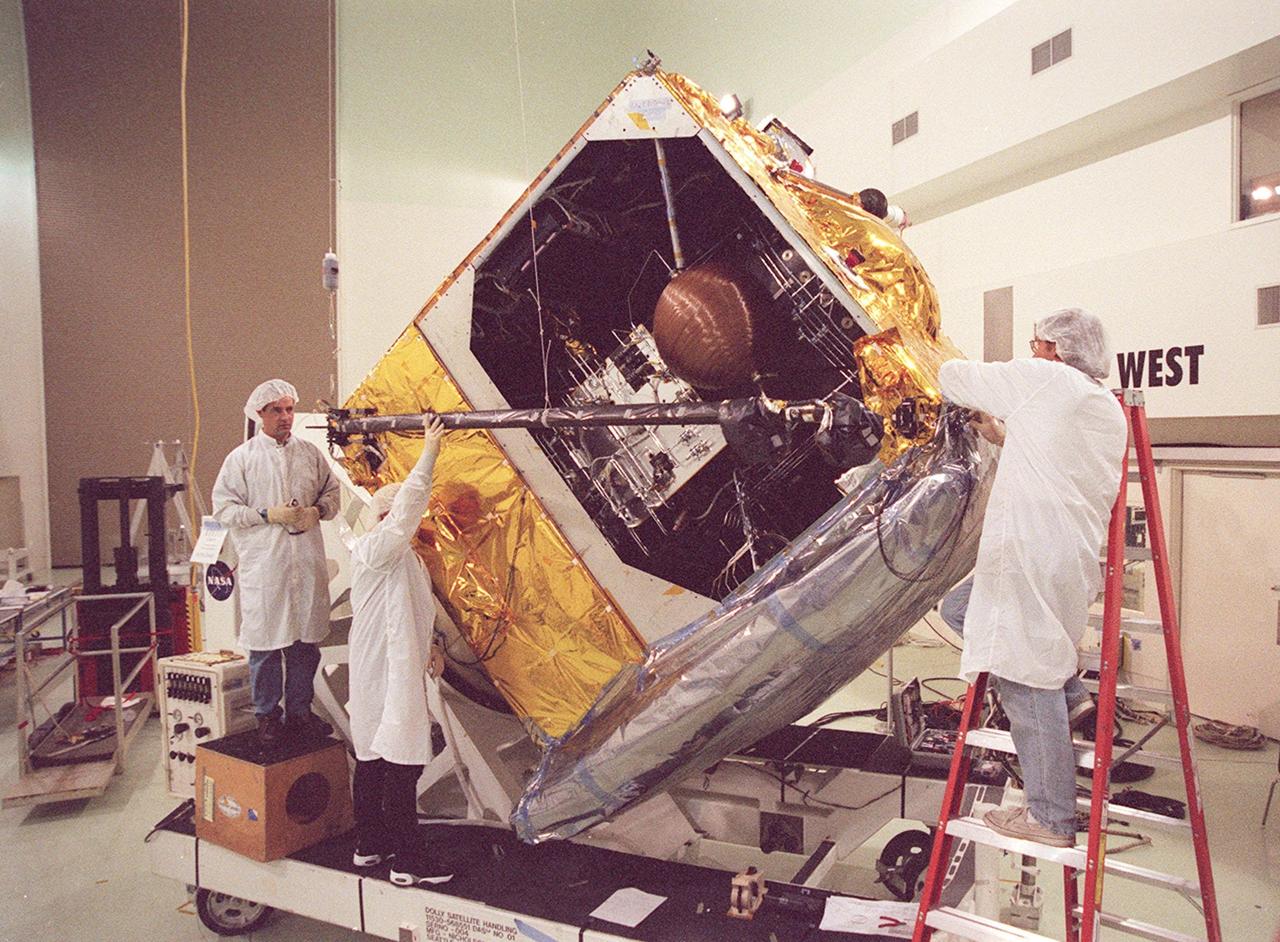
Workers at Astrotech, Titusville, Fla., begin deploying the magnetometer boom on the GOES-M satellite. The satellite is undergoing testing at Astrotech. The GOES-M provides weather imagery and quantitative sounding data used to support weather forecasting, severe storm tracking and meteorological research. The satellite is scheduled to launch July 12 on an Atlas-IIA booster, Centaur upper stage from Cape Canaveral Air Force Station
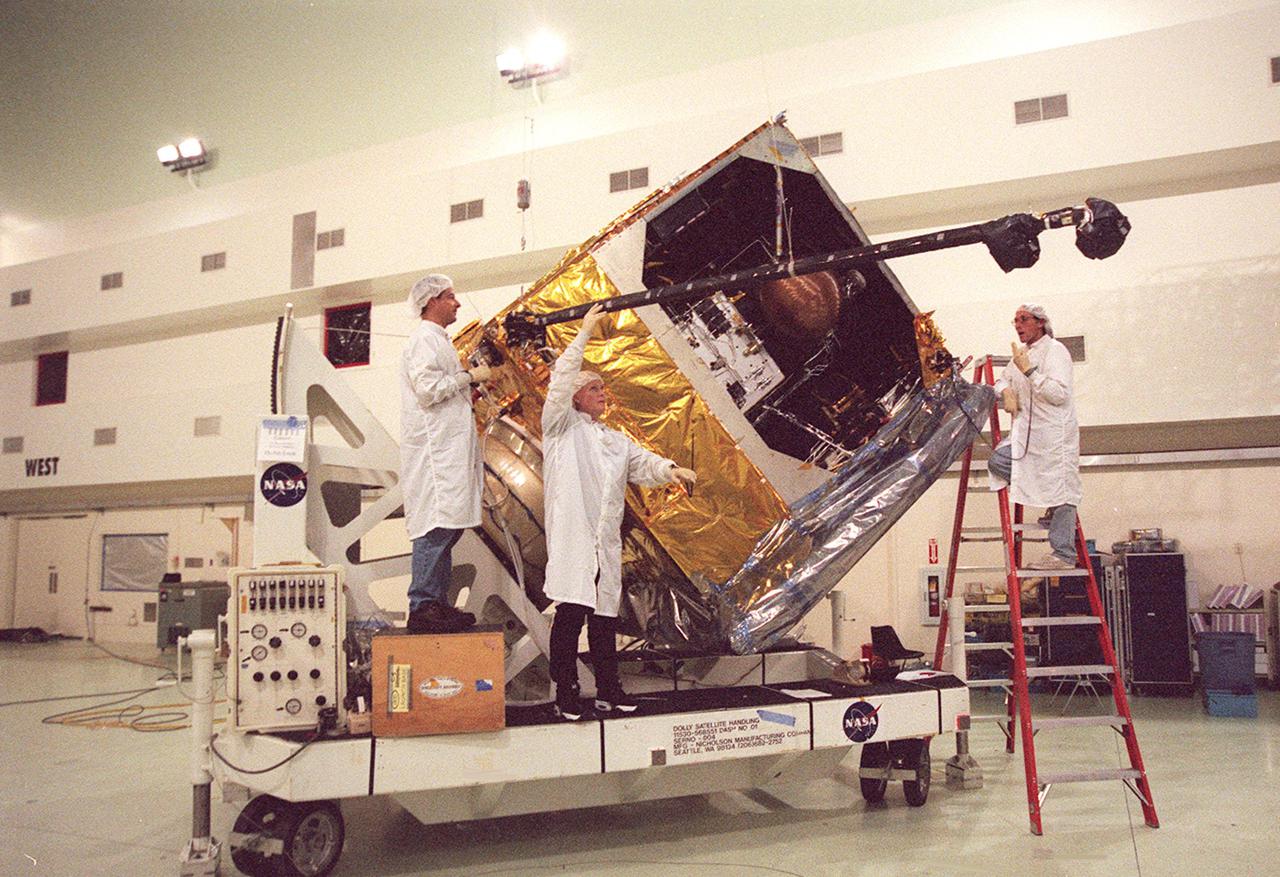
Workers at Astrotech, Titusville, Fla., deploy the magnetometer boom on the GOES-M satellite. The satellite is undergoing testing at Astrotech. The GOES-M provides weather imagery and quantitative sounding data used to support weather forecasting, severe storm tracking and meteorological research. The satellite is scheduled to launch July 12 on an Atlas-IIA booster, Centaur upper stage from Cape Canaveral Air Force Station
Workers at Astrotech, Titusville, Fla., deploy the magnetometer boom on the GOES-M satellite. The satellite is undergoing testing at Astrotech. The GOES-M provides weather imagery and quantitative sounding data used to support weather forecasting, severe storm tracking and meteorological research. The satellite is scheduled to launch July 12 on an Atlas-IIA booster, Centaur upper stage from Cape Canaveral Air Force Station
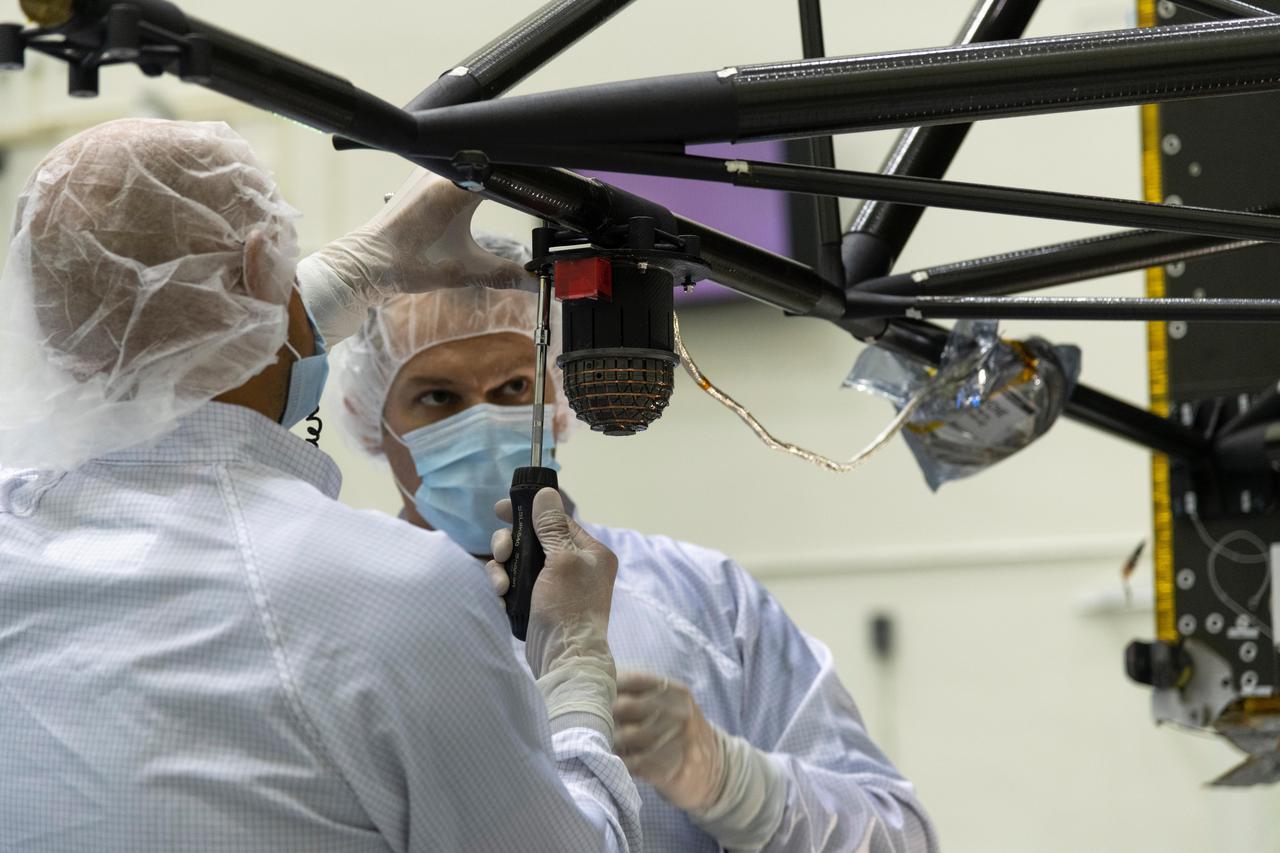
Engineers at NASA's Jet Propulsion Laboratory in Southern California integrate the magnetometer instrument into the agency's Psyche spacecraft on June 28, 2021. Psyche, set to launch in August 2022, will investigate a metal-rich asteroid of the same name, which lies in the main asteroid belt between Mars and Jupiter. Scientists believe the asteroid could be part or all of the iron-rich interior of an early planetary building block that was stripped of its outer rocky shell as it repeatedly collided with other large bodies during the early formation of the solar system. Scientists know that the asteroid doesn't generate a magnetic field the way Earth does; but if Psyche had a magnetic field in the past, that magnetic field could still be recorded in Psyche's material today. With sensors mounted onto a 6-foot (2-meter) boom, the magnetometer can determine if Psyche is still magnetized. If so, that would confirm that the asteroid is part of the core of a planetesimal, the building block of an early planet. This photo shows one of the magnetometer's sensors. https://photojournal.jpl.nasa.gov/catalog/PIA24893
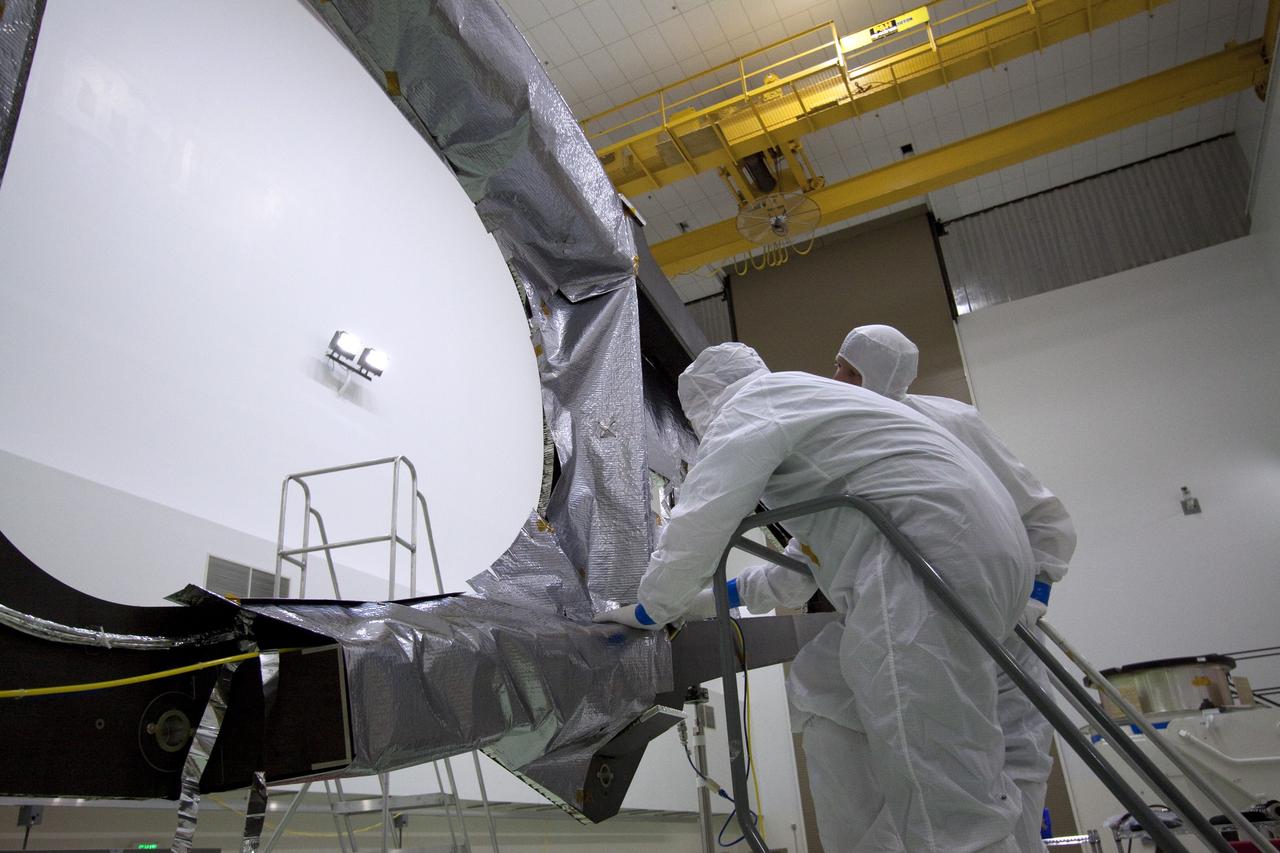
CAPE CANAVERAL, Fla. -- Technicians in the Astrotech payload processing facility in Titusville, Fla., install insulating blankets around a magnetometer boom. The boom structure is attached to Juno's solar array #1 that will help power the NASA spacecraft on its mission to Jupiter. Juno is scheduled to launch aboard an Atlas V rocket from Cape Canaveral, Fla., on Aug. 5, 2011, reaching Jupiter in July 2016. The spacecraft will orbit the giant planet more than 30 times, skimming to within 3,000 miles above its cloud tops, for about one year. With its suite of science instruments, the spacecraft will investigate the existence of a solid planetary core, map Jupiter's intense magnetic field, measure the amount of water and ammonia in the deep atmosphere, and observe the planet's auroras. For more information visit, www.nasa.gov/juno. Photo credit: NASA/Jack Pfaller
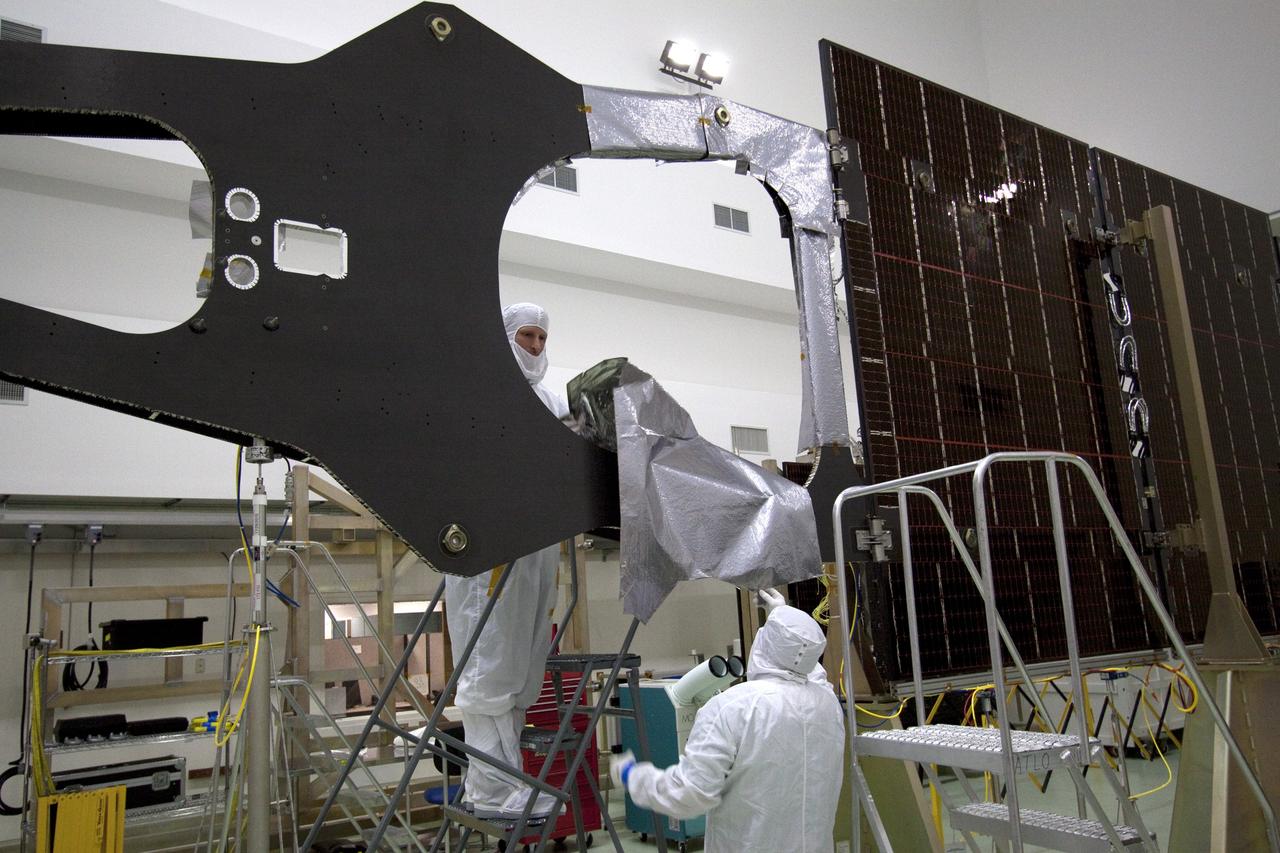
CAPE CANAVERAL, Fla. -- Technicians in the Astrotech payload processing facility in Titusville, Fla., begin installing insulating blankets around the magnetometer boom. The boom structure is attached to Juno's solar array #1 that will help power the NASA spacecraft on its mission to Jupiter. Juno is scheduled to launch aboard an Atlas V rocket from Cape Canaveral, Fla., on Aug. 5, 2011, reaching Jupiter in July 2016. The spacecraft will orbit the giant planet more than 30 times, skimming to within 3,000 miles above its cloud tops, for about one year. With its suite of science instruments, the spacecraft will investigate the existence of a solid planetary core, map Jupiter's intense magnetic field, measure the amount of water and ammonia in the deep atmosphere, and observe the planet's auroras. For more information visit, www.nasa.gov/juno. Photo credit: NASA/Jack Pfaller
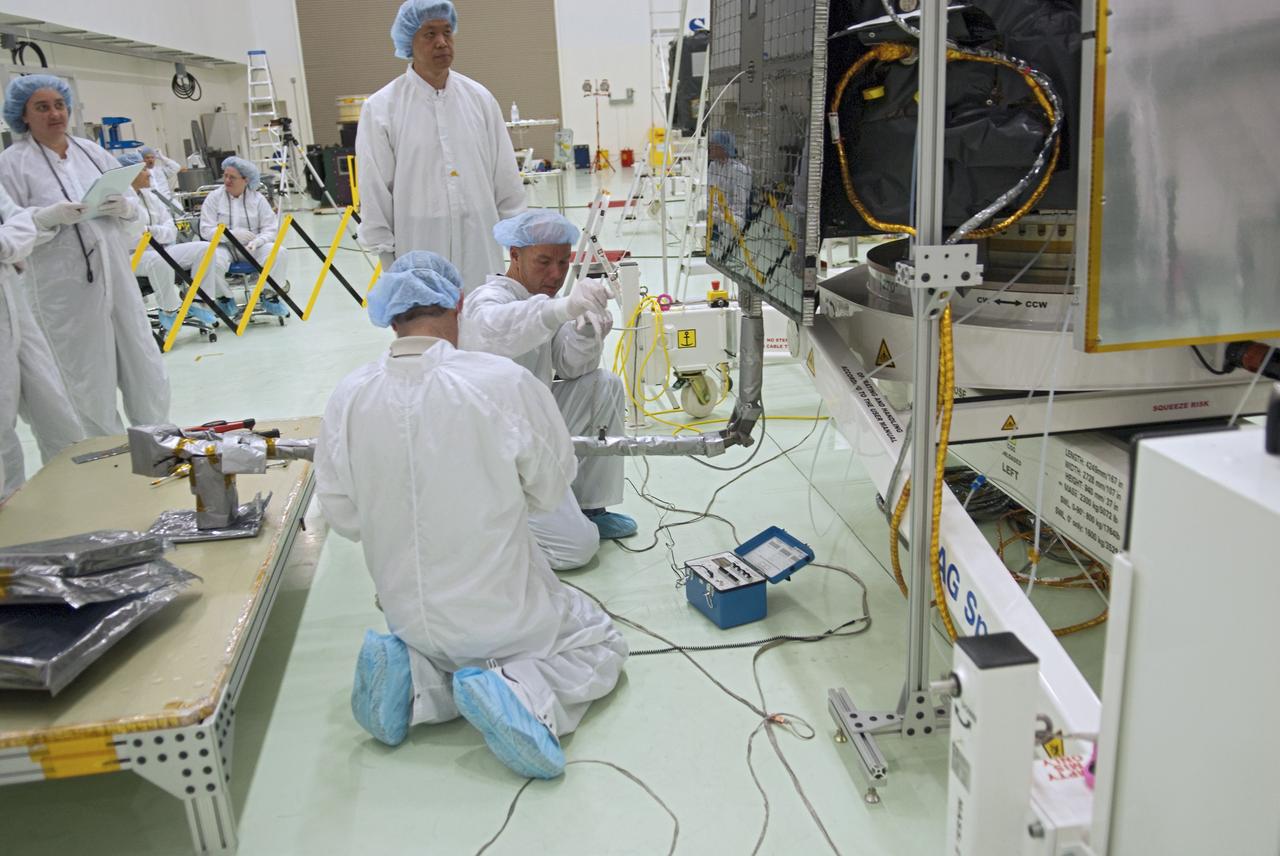
CAPE CANAVERAL, Fla. - Inside the Astrotech payload processing facility near NASA’s Kennedy Space Center in Florida, technicians deploy the magnetometer boom of the Radiation Belt Storm Probes, or RBSP, spacecraft A. Deploying this instrument is standard procedure to ensure it will work properly on Earth before it heads into space. NASA’s RBSP mission will help us understand the sun’s influence on Earth and near-Earth space by studying the Earth’s radiation belts on various scales of space and time. The boom will provide data of the electric fields that energize radiation particles and modify the structure of the inner magnetosphere. RBSP will begin its mission of exploration of Earth’s Van Allen radiation belts and the extremes of space weather after its launch aboard a United Launch Alliance Atlas V rocket. Launch is targeted for Aug. 23. For more information, visit http://www.nasa.gov/rbsp. Photo credit: NASA/Charisse Nahser
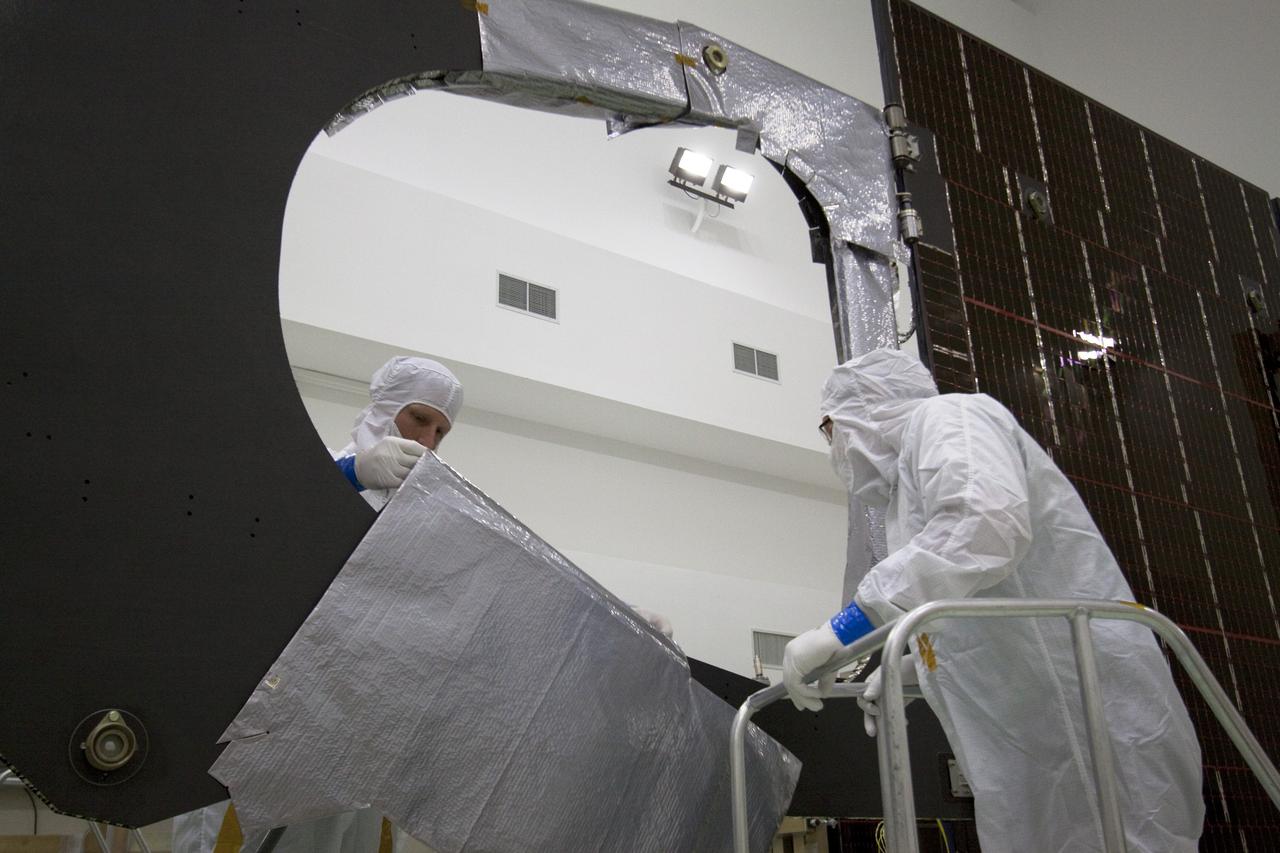
CAPE CANAVERAL, Fla. -- Technicians in the Astrotech payload processing facility in Titusville, Fla., begin installing insulating blankets around the magnetometer boom. The boom structure is attached to Juno's solar array #1 that will help power the NASA spacecraft on its mission to Jupiter. Juno is scheduled to launch aboard an Atlas V rocket from Cape Canaveral, Fla., on Aug. 5, 2011, reaching Jupiter in July 2016. The spacecraft will orbit the giant planet more than 30 times, skimming to within 3,000 miles above its cloud tops, for about one year. With its suite of science instruments, the spacecraft will investigate the existence of a solid planetary core, map Jupiter's intense magnetic field, measure the amount of water and ammonia in the deep atmosphere, and observe the planet's auroras. For more information visit, www.nasa.gov/juno. Photo credit: NASA/Jack Pfaller
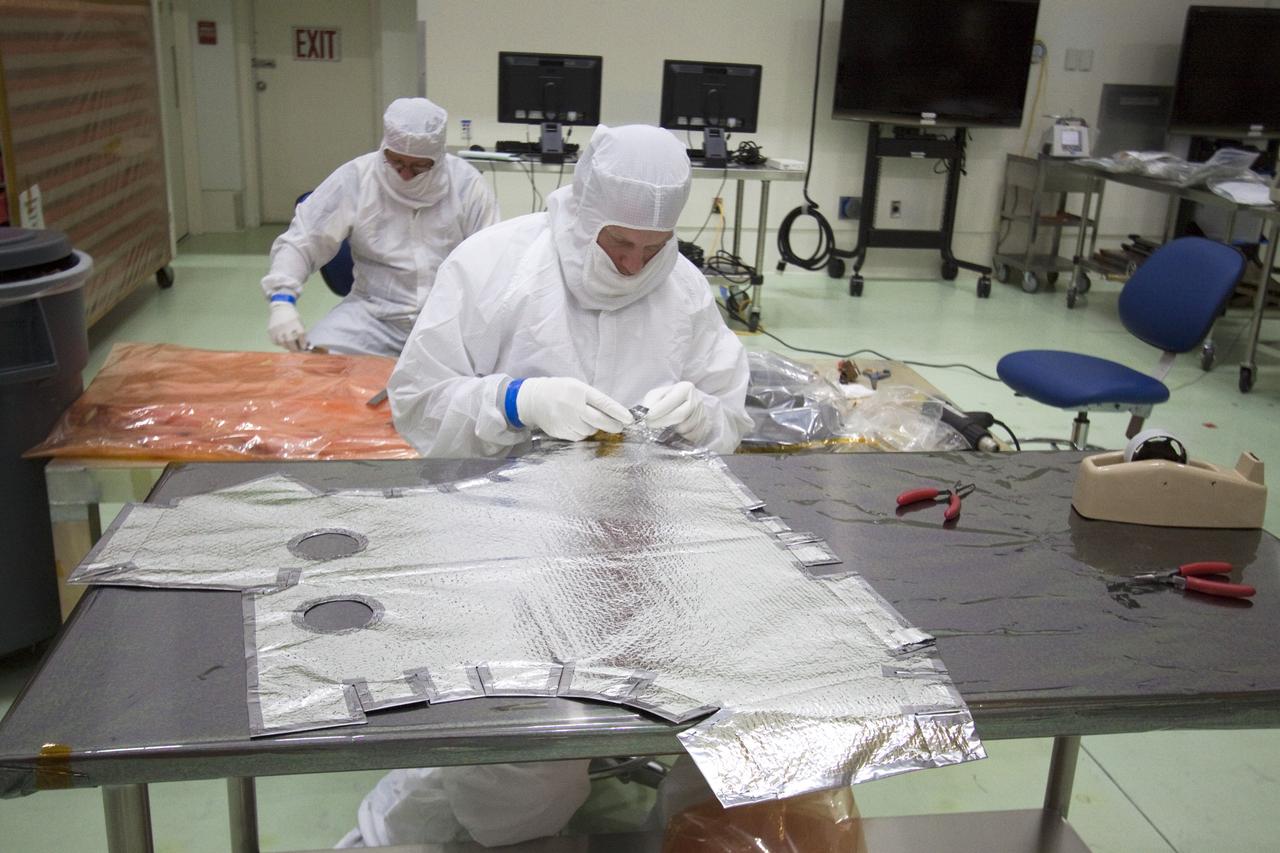
CAPE CANAVERAL, Fla. -- A technician in the Astrotech payload processing facility in Titusville, Fla., inspects one of the insulating blanket sections that will be installed on the magnetometer boom. The boom structure is attached to Juno's solar array #1 that will help power the NASA spacecraft on its mission to Jupiter. Juno is scheduled to launch aboard an Atlas V rocket from Cape Canaveral, Fla., on Aug. 5, 2011, reaching Jupiter in July 2016. The spacecraft will orbit the giant planet more than 30 times, skimming to within 3,000 miles above its cloud tops, for about one year. With its suite of science instruments, the spacecraft will investigate the existence of a solid planetary core, map Jupiter's intense magnetic field, measure the amount of water and ammonia in the deep atmosphere, and observe the planet's auroras. For more information visit, www.nasa.gov/juno. Photo credit: NASA/Jack Pfaller
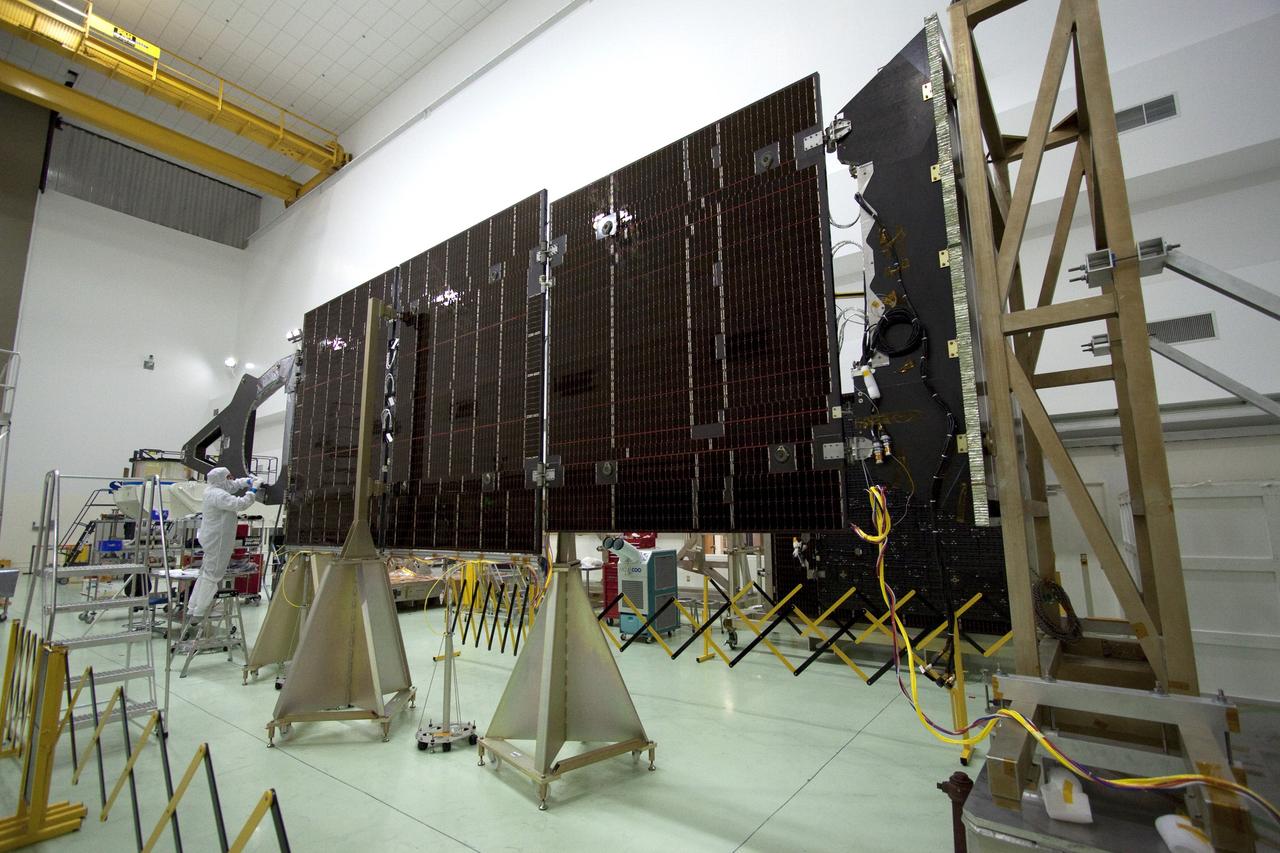
CAPE CANAVERAL, Fla. -- Technicians in the Astrotech payload processing facility in Titusville, Fla., install insulating blankets around the magnetometer boom. The boom structure is attached to Juno's solar array #1 that will help power the NASA spacecraft on its mission to Jupiter. Juno is scheduled to launch aboard an Atlas V rocket from Cape Canaveral, Fla., on Aug. 5, 2011, reaching Jupiter in July 2016. The spacecraft will orbit the giant planet more than 30 times, skimming to within 3,000 miles above its cloud tops, for about one year. With its suite of science instruments, the spacecraft will investigate the existence of a solid planetary core, map Jupiter's intense magnetic field, measure the amount of water and ammonia in the deep atmosphere, and observe the planet's auroras. For more information visit, www.nasa.gov/juno. Photo credit: NASA/Jack Pfaller
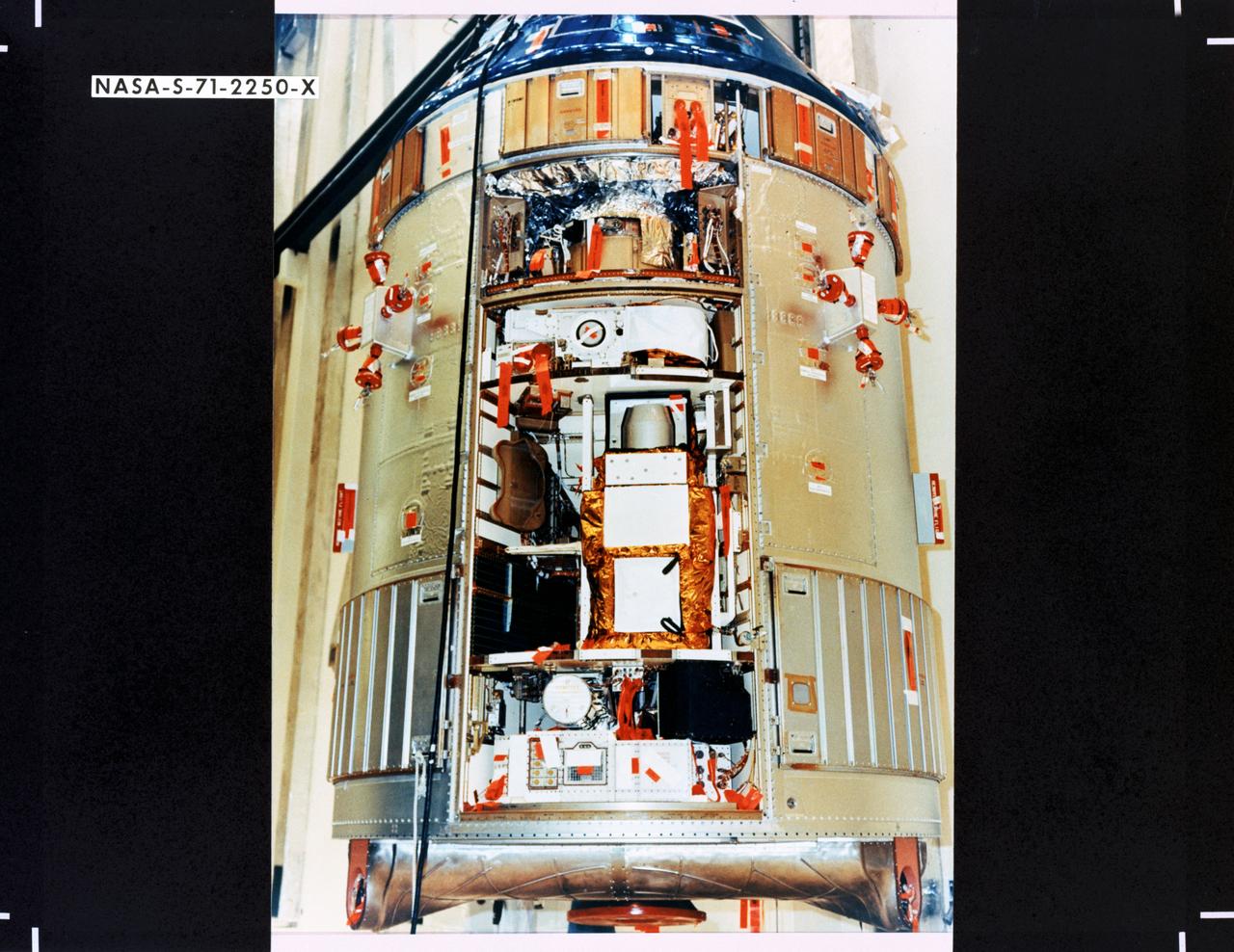
S71-2250X (June 1971) --- A close-up view of the Scientific Instrument Module (SIM) to be flown for the first time on the Apollo 15 lunar landing mission. Mounted in a previously vacant sector of the Apollo Service Module (SM), the SIM carries specialized cameras and instrumentation for gathering lunar orbit scientific data. SIM equipment includes a laser altimeter for accurate measurement of height above the lunar surface; a large-format panoramic camera for mapping, correlated with a metric camera and the laser altimeter for surface mapping; a gamma ray spectrometer on a 25-feet extendible boom; a mass spectrometer on a 21-feet extendible boom; X-ray and alpha particle spectrometers; and a subsatellite which will be injected into lunar orbit carrying a particle and magnetometer, and the S-Band transponder.
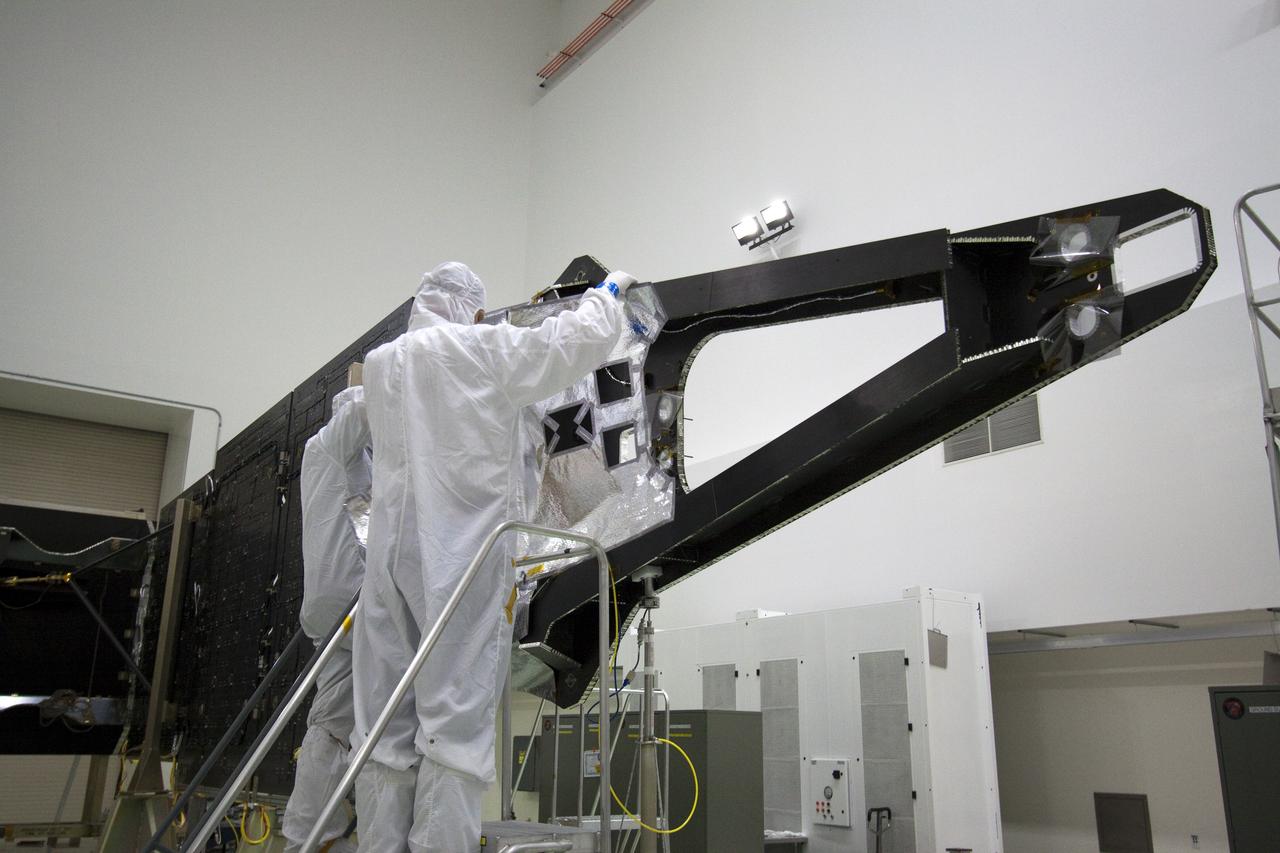
CAPE CANAVERAL, Fla. -- Technicians in the Astrotech payload processing facility in Titusville, Fla., install insulating blankets around a magnetometer boom. The boom structure is attached to Juno's solar array #1 that will help power the NASA spacecraft on its mission to Jupiter. Juno is scheduled to launch aboard an Atlas V rocket from Cape Canaveral, Fla., on Aug. 5, 2011, reaching Jupiter in July 2016. The spacecraft will orbit the giant planet more than 30 times, skimming to within 3,000 miles above its cloud tops, for about one year. With its suite of science instruments, the spacecraft will investigate the existence of a solid planetary core, map Jupiter's intense magnetic field, measure the amount of water and ammonia in the deep atmosphere, and observe the planet's auroras. For more information visit, www.nasa.gov/juno. Photo credit: NASA/Jack Pfaller

CAPE CANAVERAL, Fla. -- Technicians in the Astrotech payload processing facility in Titusville, Fla., prepare an insulating a blanket for installation onto the magnetometer boom. The boom structure is attached to Juno's solar array #1 that will help power the NASA spacecraft on its mission to Jupiter. Juno is scheduled to launch aboard an Atlas V rocket from Cape Canaveral, Fla., on Aug. 5, 2011, reaching Jupiter in July 2016. The spacecraft will orbit the giant planet more than 30 times, skimming to within 3,000 miles above its cloud tops, for about one year. With its suite of science instruments, the spacecraft will investigate the existence of a solid planetary core, map Jupiter's intense magnetic field, measure the amount of water and ammonia in the deep atmosphere, and observe the planet's auroras. For more information visit, www.nasa.gov/juno. Photo credit: NASA/Jack Pfaller
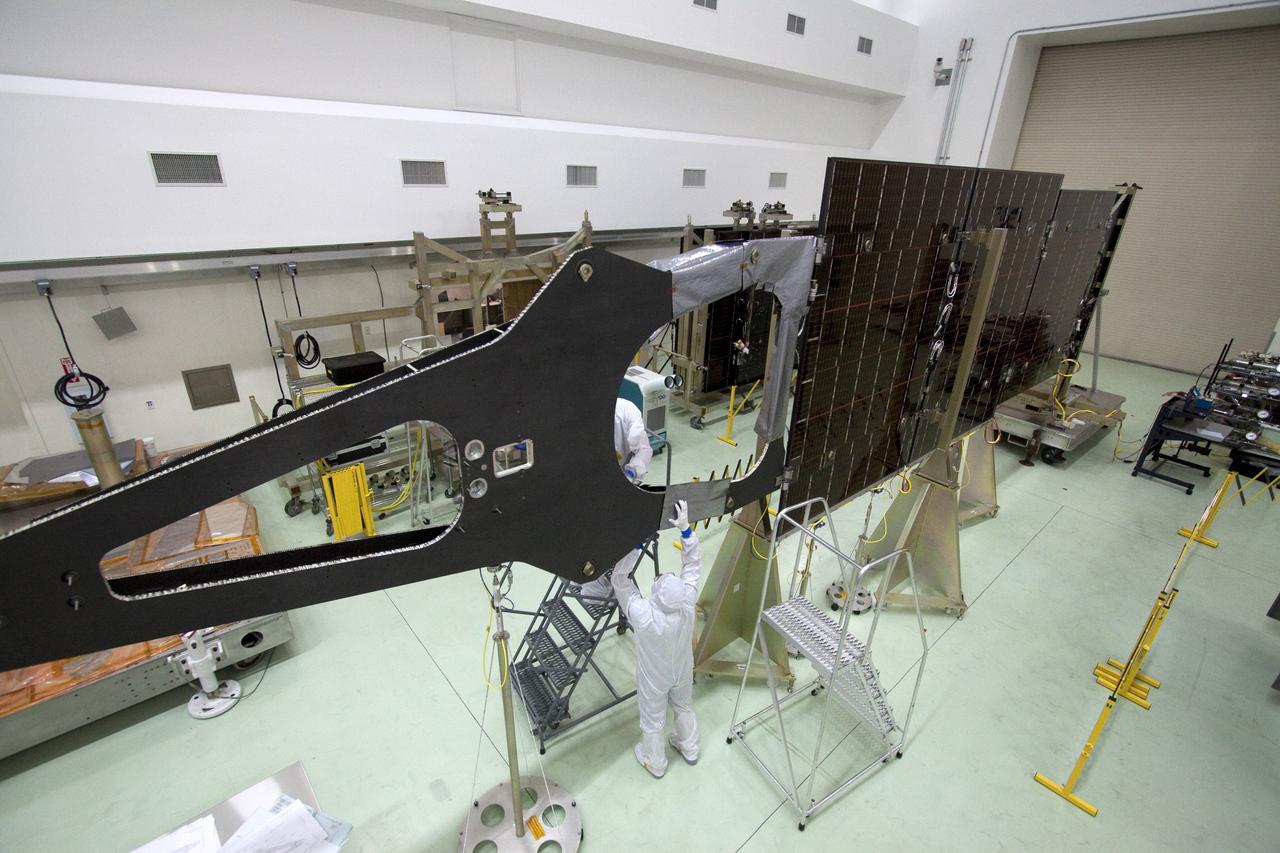
CAPE CANAVERAL, Fla. -- Technicians in the Astrotech payload processing facility in Titusville, Fla., install insulating blankets around the magnetometer boom. The boom structure is attached to Juno's solar array #1 that will help power the NASA spacecraft on its mission to Jupiter. Juno is scheduled to launch aboard an Atlas V rocket from Cape Canaveral, Fla., on Aug. 5, 2011, reaching Jupiter in July 2016. The spacecraft will orbit the giant planet more than 30 times, skimming to within 3,000 miles above its cloud tops, for about one year. With its suite of science instruments, the spacecraft will investigate the existence of a solid planetary core, map Jupiter's intense magnetic field, measure the amount of water and ammonia in the deep atmosphere, and observe the planet's auroras. For more information visit, www.nasa.gov/juno. Photo credit: NASA/Jack Pfaller
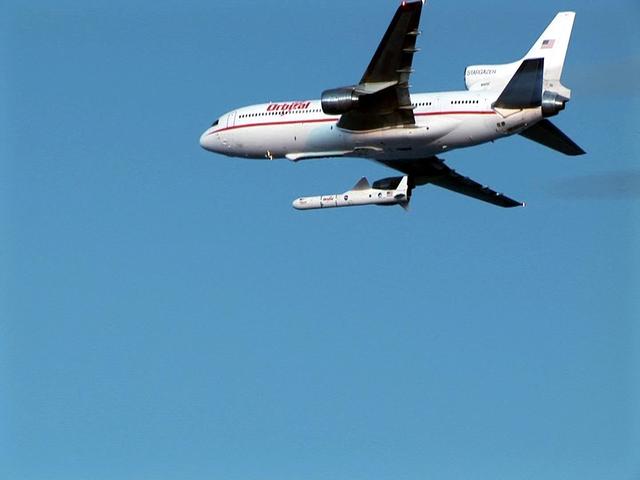
VANDENBERG AIR FORCE BASE, CALIF. - Orbital Sciences' L-1011 jet aircraft releases the Pegasus rocket carrying the Space Technology 5 spacecraft with its trio of micro-satellites. The Pegasus will launch the trio of satellites in a "string of pearls" sequence on a near-Earth polar elliptical orbit that will take them from approximately 190 miles (300 kilometers) to 2,800 miles (4,500 kilometers) from the planet. The three spacecraft will conduct science validation using measurements of the Earth's magnetic field collected by the miniature boom-mounted magnetometers on each.
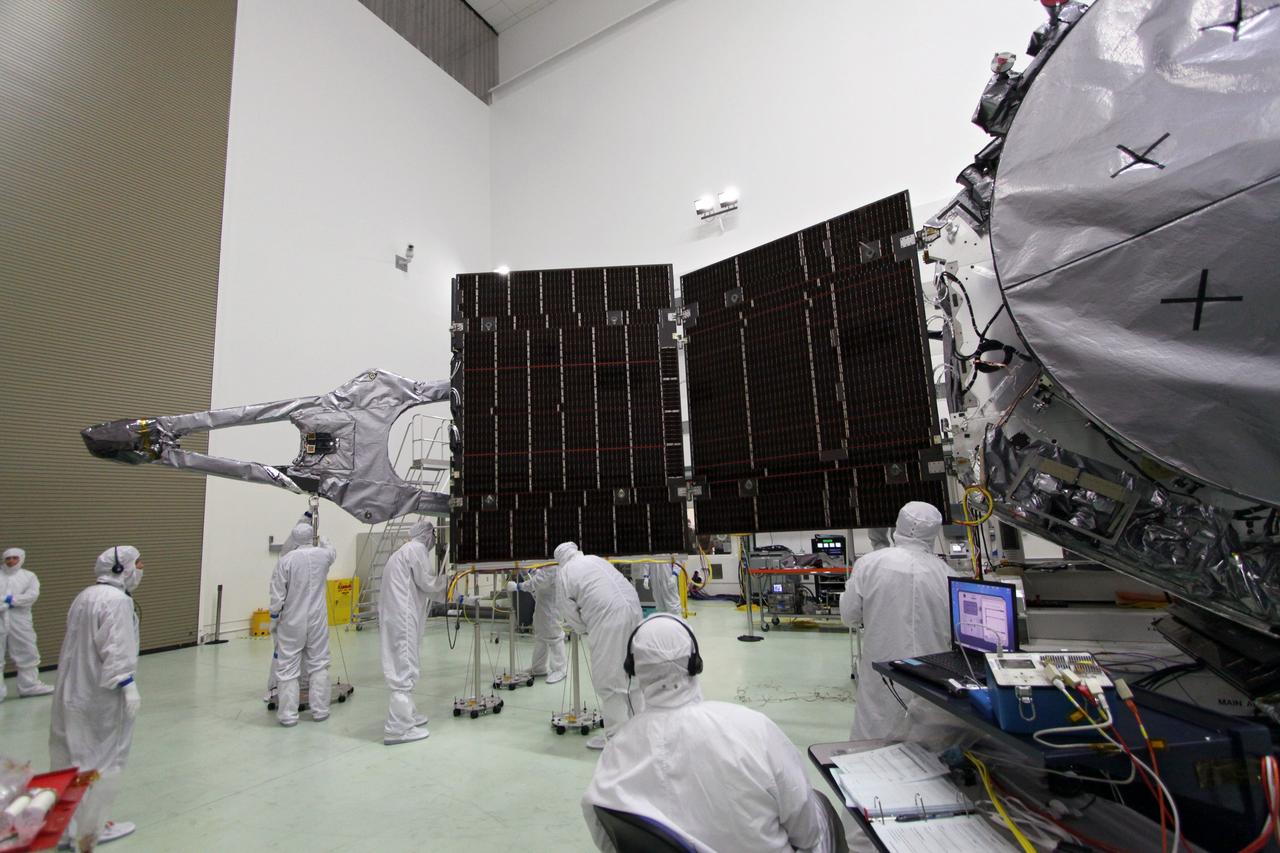
CAPE CANAVERAL, Fla. -- At Astrotech Space Operations in Titusville, Fla., technicians conduct deployment tests on solar array panel #1 with its magnetometer boom for NASA's Juno spacecraft prior to illumination testing. Juno is scheduled to launch aboard a United Launch Alliance Atlas V from Cape Canaveral, Fla. Aug. 5.The solar-powered spacecraft will orbit Jupiter's poles 33 times to find out more about the gas giant's origins, structure, atmosphere and magnetosphere and investigate the existence of a solid planetary core. For more information visit: www.nasa.gov/juno. Photo credit: NASA/Jack Pfaller
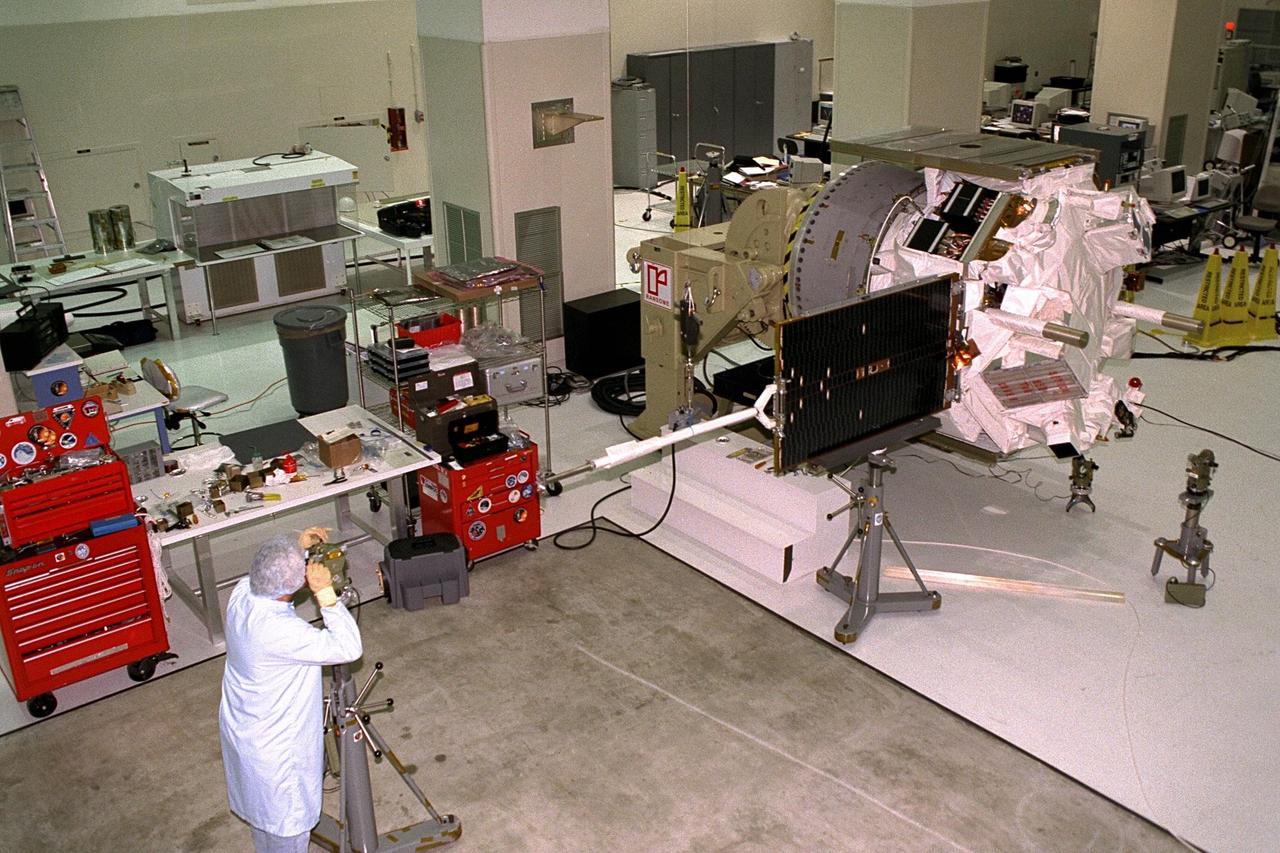
An Applied Physics Laboratory engineer from Johns Hopkins University tests for true perpendicular solar array deployment of the Advanced Composition Explorer (ACE) in KSC’s Spacecraft Assembly and Encapsulation Facility-II (SAEF-II). The white magnetometer boom seen across the solar array panel will deploy the panel once in space. Scheduled for launch on a Delta II rocket from Cape Canaveral Air Station on Aug. 25, ACE will study low-energy particles of solar origin and high-energy galactic particles. The ACE observatory will be placed into an orbit almost a million miles (1.5 million kilometers) away from the Earth, about 1/100 the distance from the Earth to the Sun
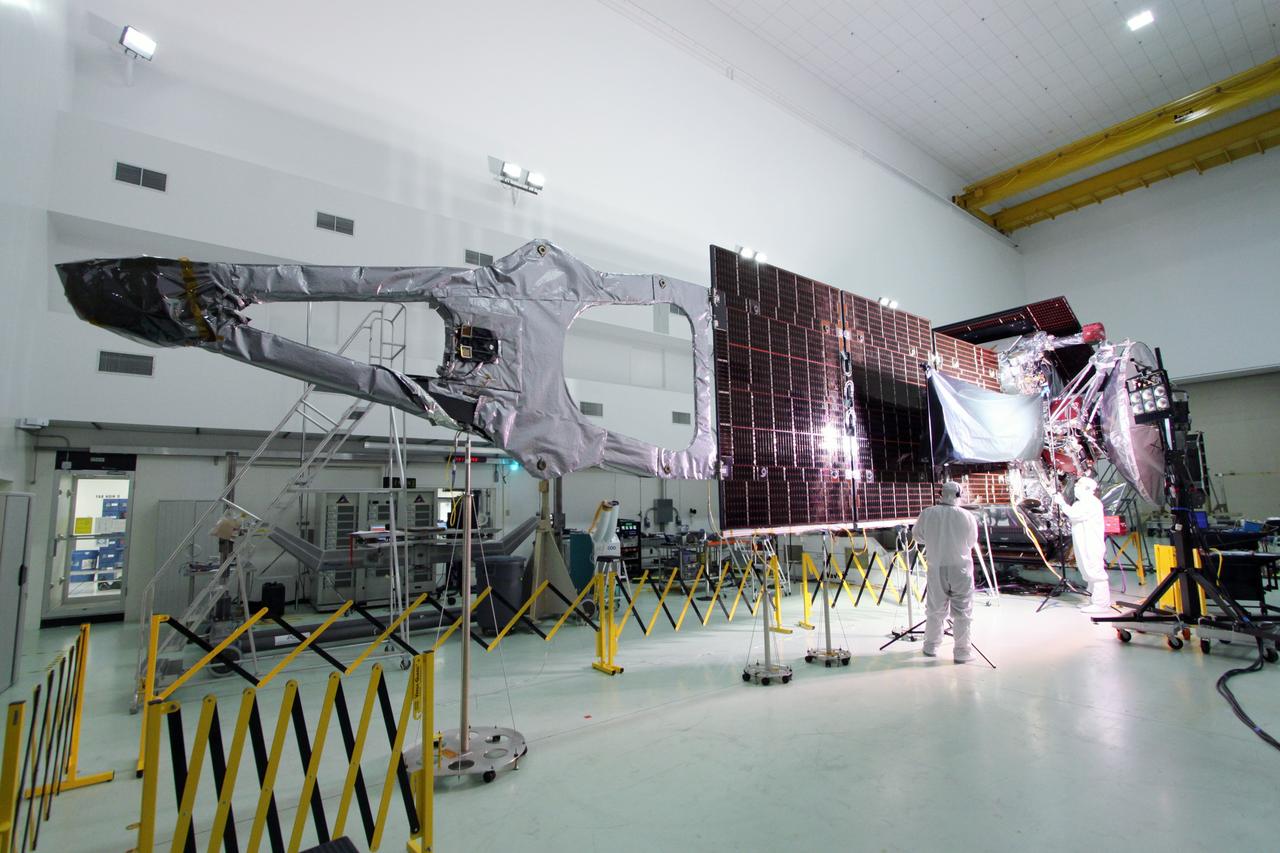
CAPE CANAVERAL, Fla. -- At Astrotech Space Operations in Titusville, Fla., technicians conduct illumination tests on solar array panel #1 with its magnetometer boom for NASA's Juno spacecraft. Juno is scheduled to launch aboard a United Launch Alliance Atlas V from Cape Canaveral, Fla. Aug. 5.The solar-powered spacecraft will orbit Jupiter's poles 33 times to find out more about the gas giant's origins, structure, atmosphere and magnetosphere and investigate the existence of a solid planetary core. For more information visit: www.nasa.gov/juno. Photo credit: NASA/Jack Pfaller
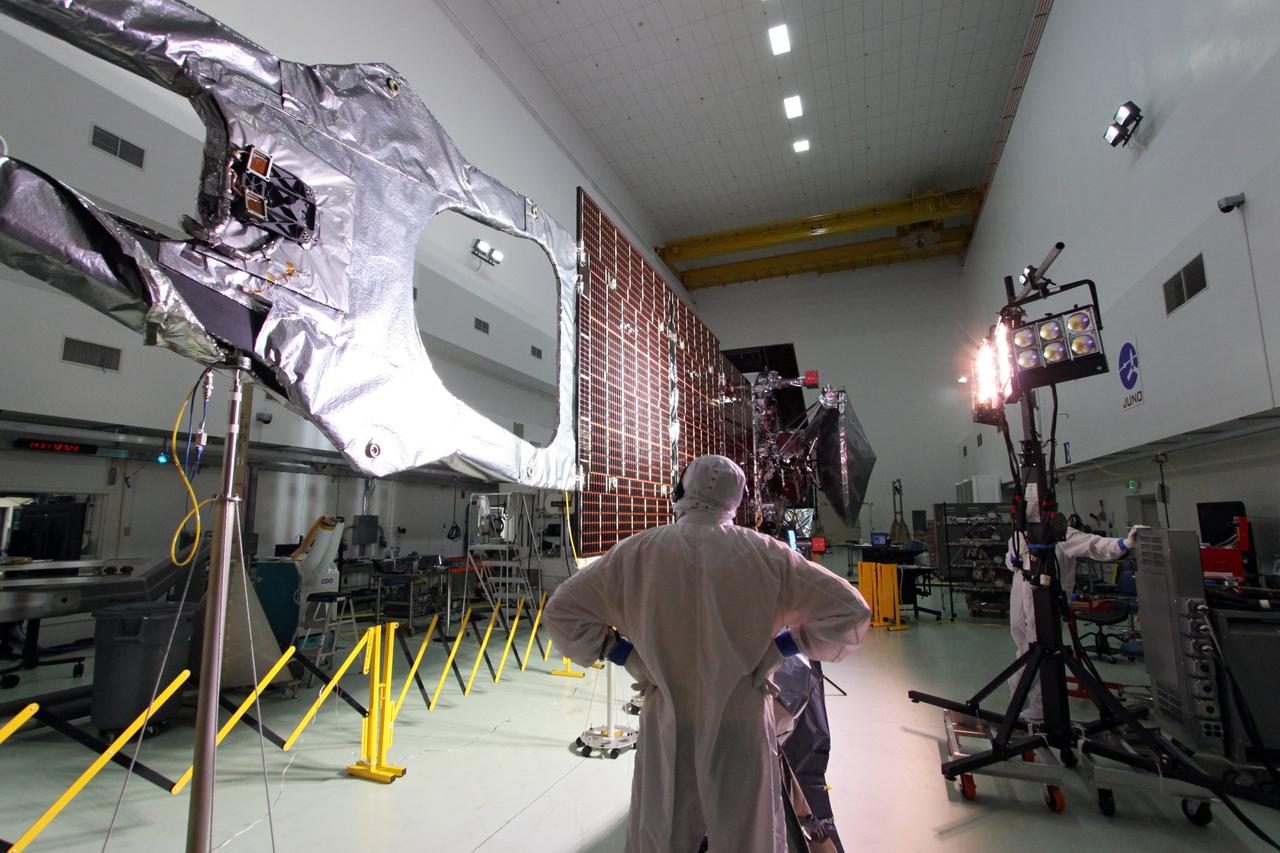
CAPE CANAVERAL, Fla. -- At Astrotech Space Operations in Titusville, Fla., technicians conduct illumination tests on solar array panel #1 with its magnetometer boom for NASA's Juno spacecraft. Juno is scheduled to launch aboard a United Launch Alliance Atlas V from Cape Canaveral, Fla. Aug. 5.The solar-powered spacecraft will orbit Jupiter's poles 33 times to find out more about the gas giant's origins, structure, atmosphere and magnetosphere and investigate the existence of a solid planetary core. For more information visit: www.nasa.gov/juno. Photo credit: NASA/Jack Pfaller
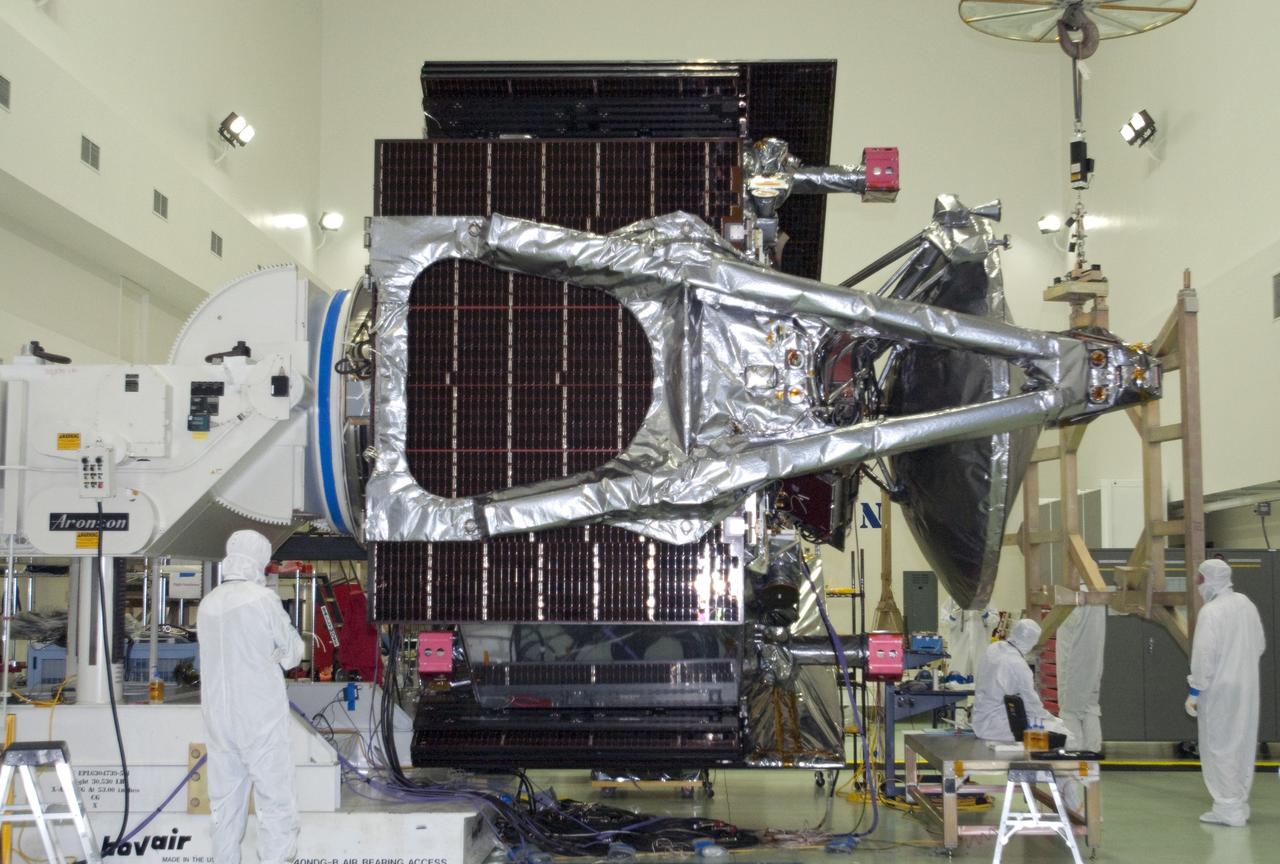
CAPE CANAVERAL, Fla. -- At Astrotech Space Operations in Titusville, Fla., technicians have installed solar array #1 with its magnetometer boom to NASA's Juno spacecraft. Juno is scheduled to launch aboard a United Launch Alliance Atlas V rocket from Cape Canaveral, Fla. Aug. 5.The solar-powered spacecraft will orbit Jupiter's poles 33 times to find out more about the gas giant's origins, structure, atmosphere and magnetosphere and investigate the existence of a solid planetary core. For more information visit: www.nasa.gov/juno. Photo credit: NASA/Charisse Nahser
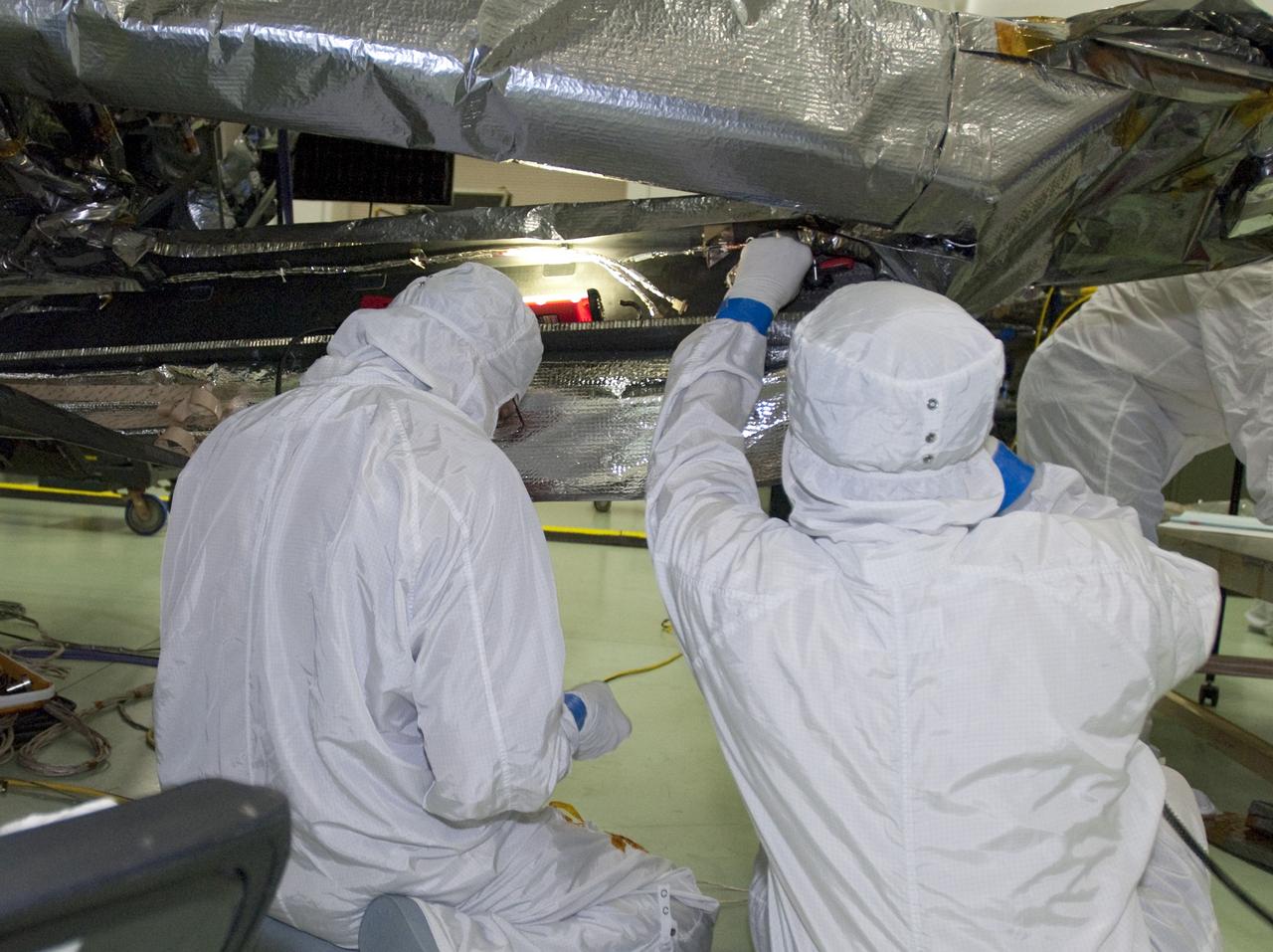
CAPE CANAVERAL, Fla. -- At Astrotech Space Operations in Titusville, Fla., technicians test the connections of solar array #1 with its magnetometer boom to NASA's Juno spacecraft after installation. Juno is scheduled to launch aboard a United Launch Alliance Atlas V rocket from Cape Canaveral, Fla. Aug. 5.The solar-powered spacecraft will orbit Jupiter's poles 33 times to find out more about the gas giant's origins, structure, atmosphere and magnetosphere and investigate the existence of a solid planetary core. For more information visit: www.nasa.gov/juno. Photo credit: NASA/Charisse Nahser
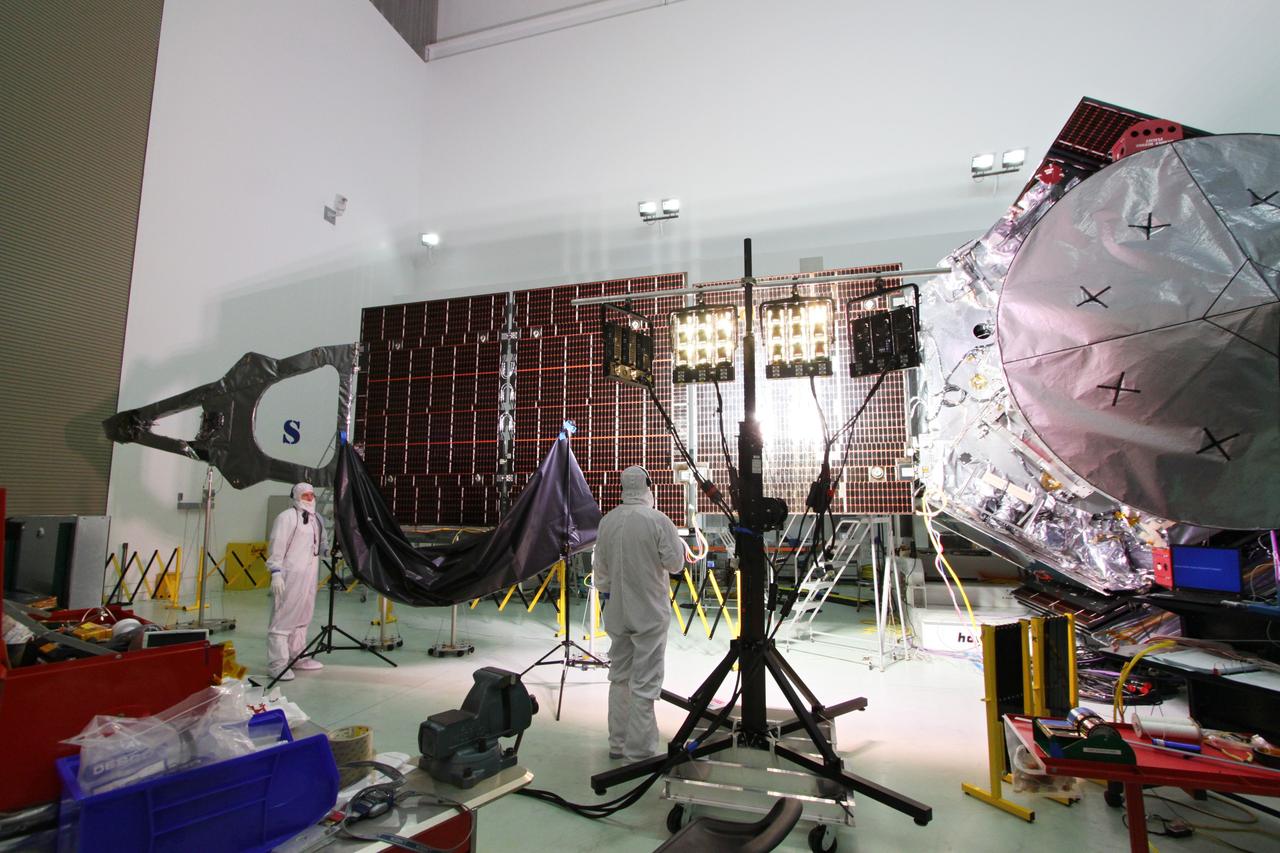
CAPE CANAVERAL, Fla. -- At Astrotech Space Operations in Titusville, Fla., technicians conduct illumination tests on solar array panel #1 with its magnetometer boom for NASA's Juno spacecraft. Juno is scheduled to launch aboard a United Launch Alliance Atlas V from Cape Canaveral, Fla. Aug. 5.The solar-powered spacecraft will orbit Jupiter's poles 33 times to find out more about the gas giant's origins, structure, atmosphere and magnetosphere and investigate the existence of a solid planetary core. For more information visit: www.nasa.gov/juno. Photo credit: NASA/Jack Pfaller
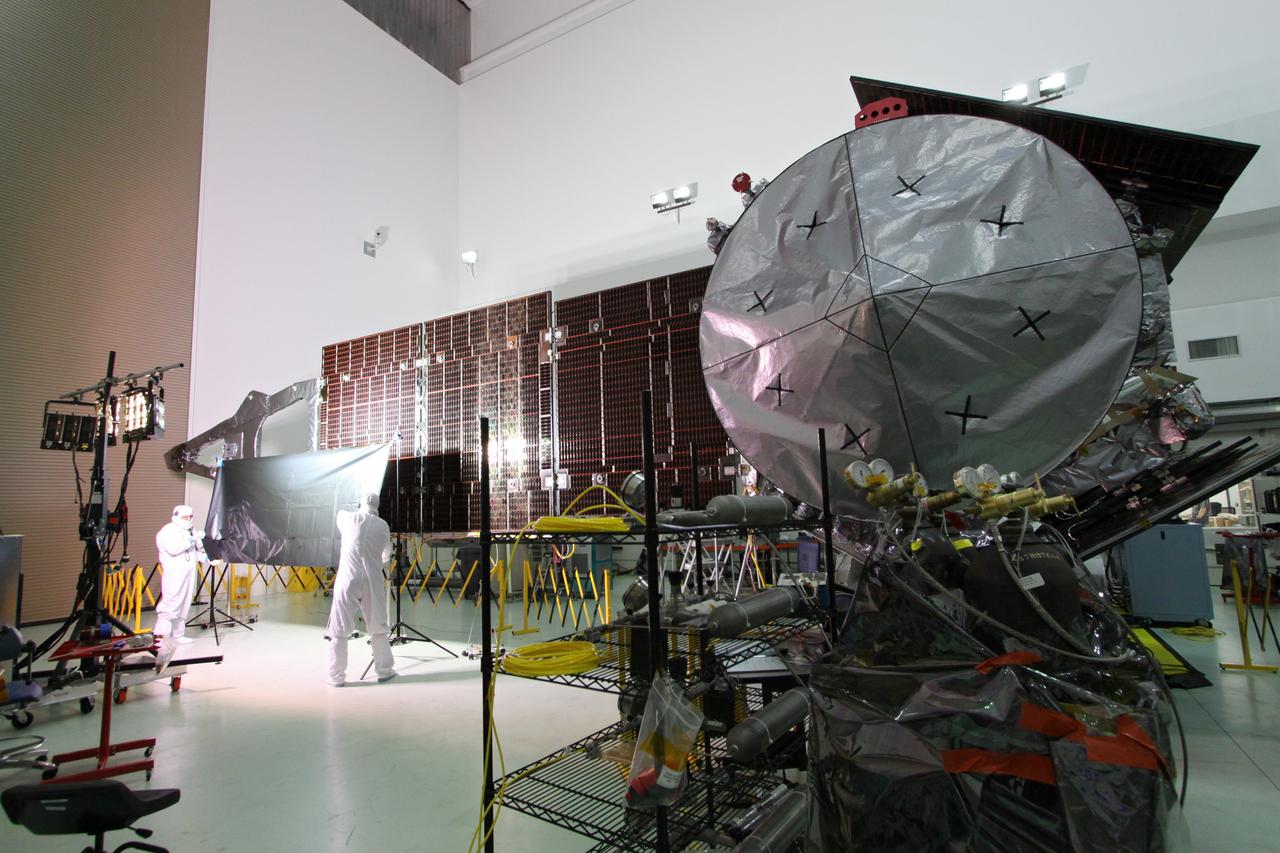
CAPE CANAVERAL, Fla. -- At Astrotech Space Operations in Titusville, Fla., technicians conduct illumination tests on solar array panel #1 with its magnetometer boom for NASA's Juno spacecraft. Juno is scheduled to launch aboard a United Launch Alliance Atlas V from Cape Canaveral, Fla. Aug. 5.The solar-powered spacecraft will orbit Jupiter's poles 33 times to find out more about the gas giant's origins, structure, atmosphere and magnetosphere and investigate the existence of a solid planetary core. For more information visit: www.nasa.gov/juno. Photo credit: NASA/Jack Pfaller
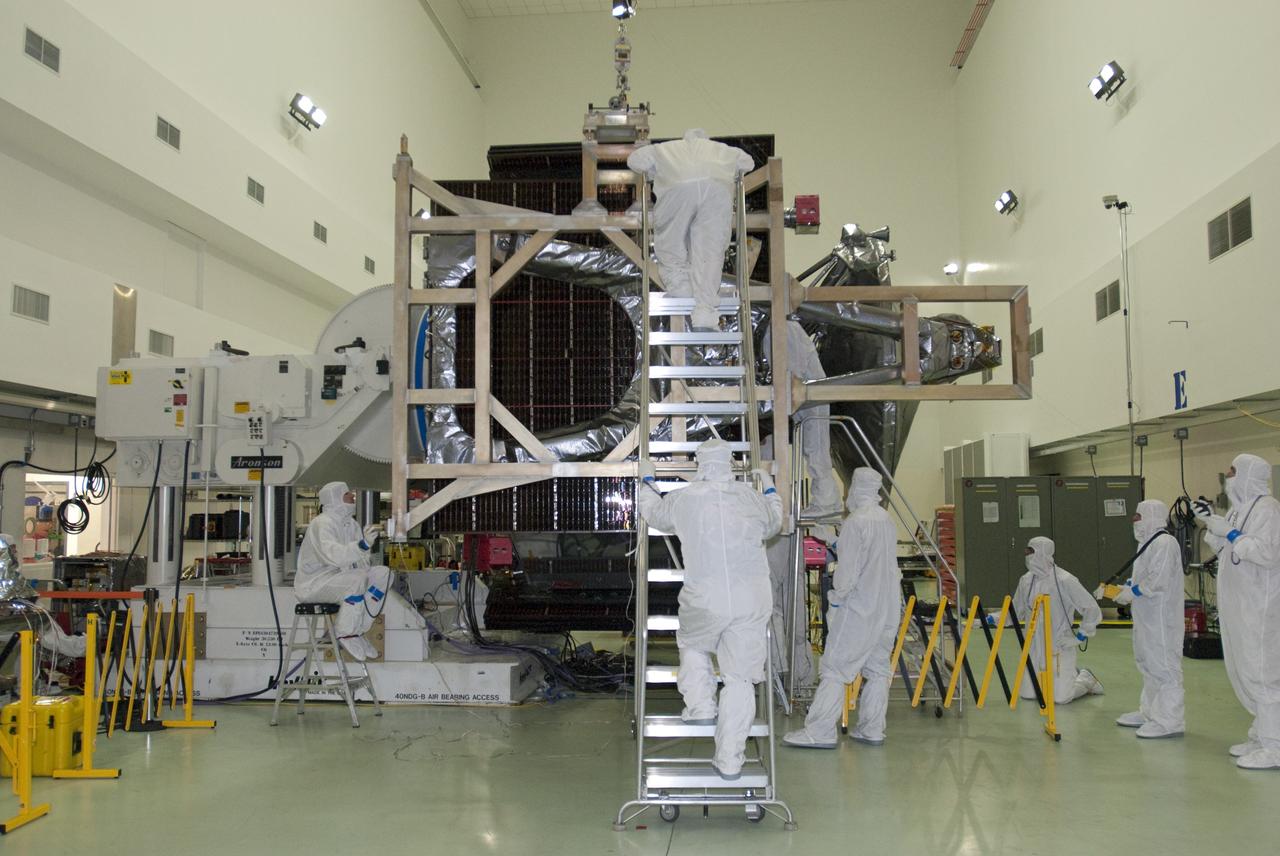
CAPE CANAVERAL, Fla. -- At Astrotech Space Operations in Titusville, Fla., technicians install solar array #1 with its magnetometer boom to NASA's Juno spacecraft. Juno is scheduled to launch aboard a United Launch Alliance Atlas V rocket from Cape Canaveral, Fla. Aug. 5.The solar-powered spacecraft will orbit Jupiter's poles 33 times to find out more about the gas giant's origins, structure, atmosphere and magnetosphere and investigate the existence of a solid planetary core. For more information visit: www.nasa.gov/juno. Photo credit: NASA/Charisse Nahser
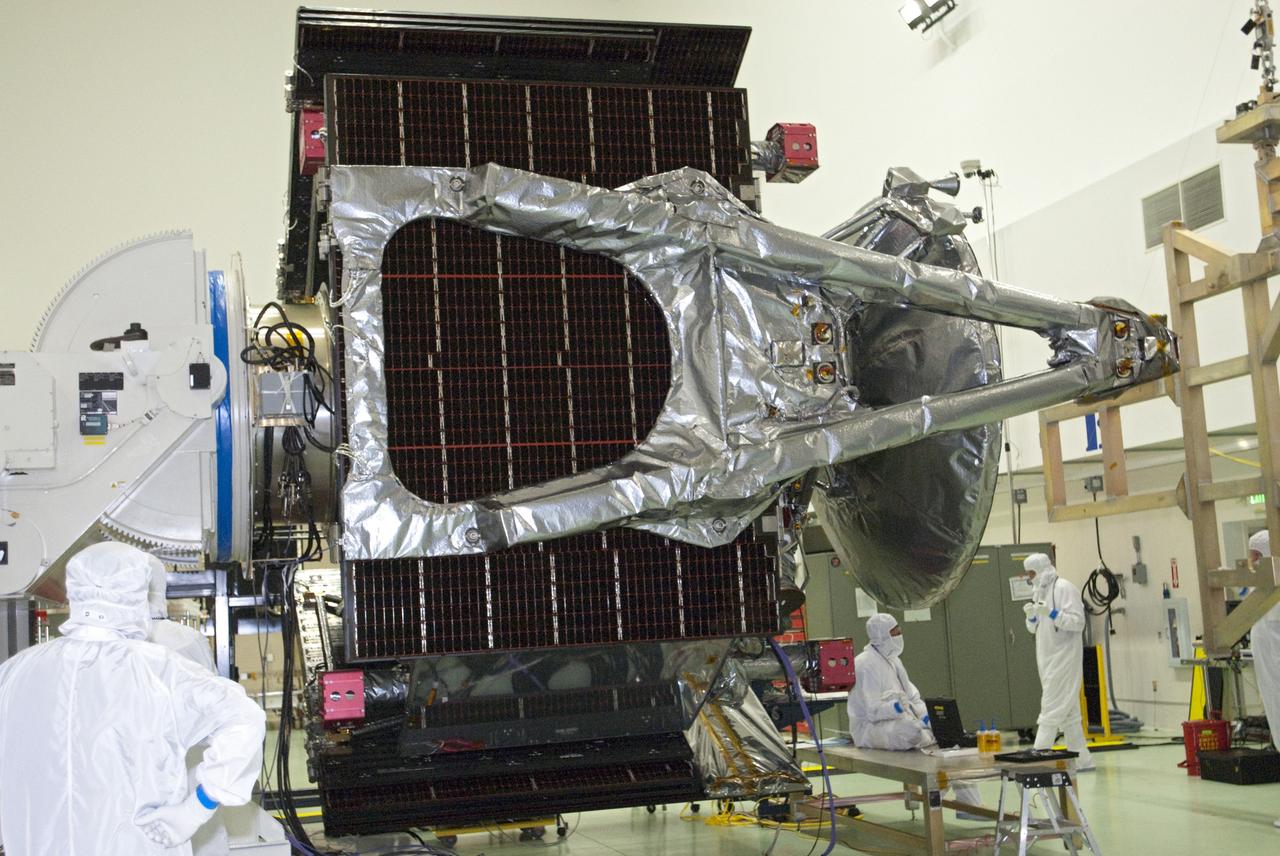
CAPE CANAVERAL, Fla. -- At Astrotech Space Operations in Titusville, Fla., technicians have installed solar array #1 with its magnetometer boom to NASA's Juno spacecraft. Juno is scheduled to launch aboard a United Launch Alliance Atlas V rocket from Cape Canaveral, Fla. Aug. 5.The solar-powered spacecraft will orbit Jupiter's poles 33 times to find out more about the gas giant's origins, structure, atmosphere and magnetosphere and investigate the existence of a solid planetary core. For more information visit: www.nasa.gov/juno. Photo credit: NASA/Charisse Nahser
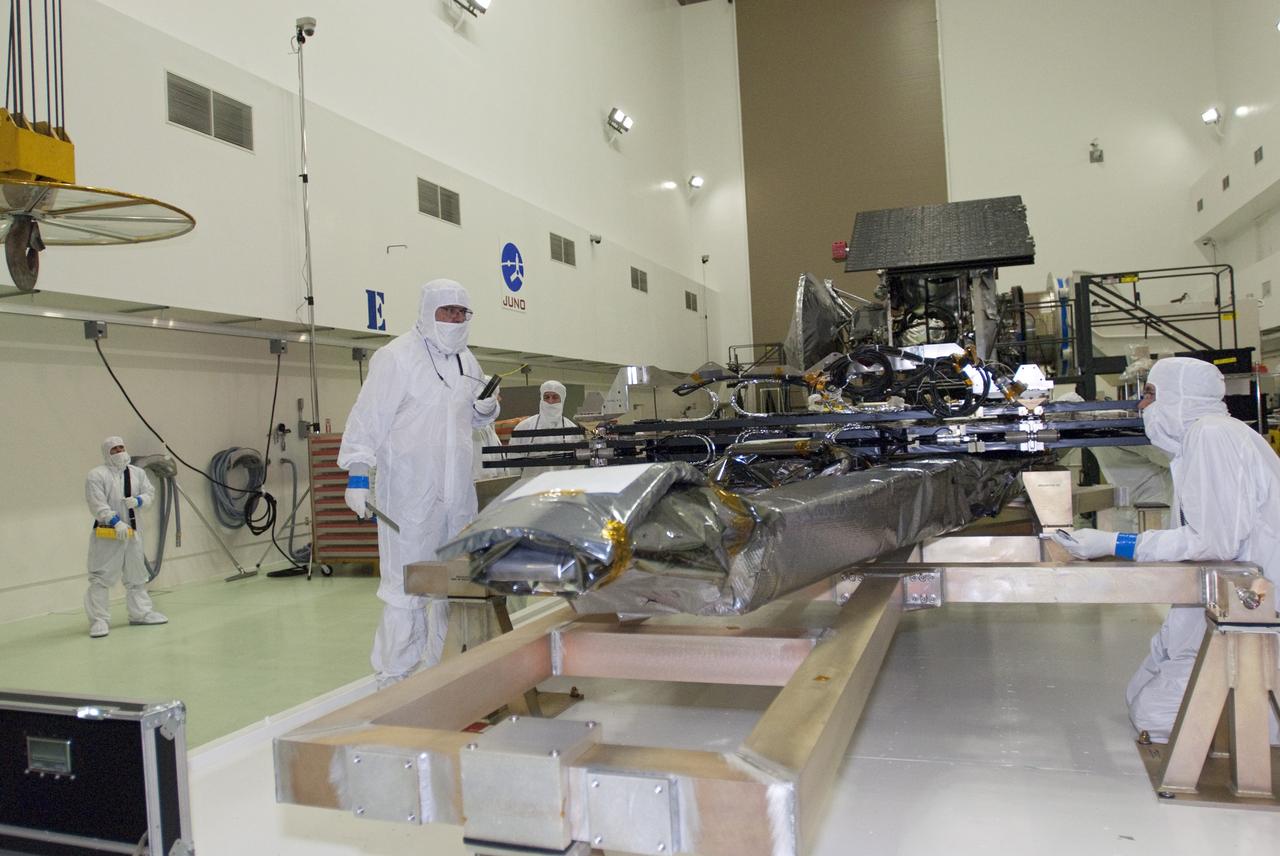
CAPE CANAVERAL, Fla. -- At Astrotech Space Operations in Titusville, Fla., technicians prepare solar array #1 with its magnetometer boom for installation to NASA's Juno spacecraft. Juno is scheduled to launch aboard a United Launch Alliance Atlas V rocket from Cape Canaveral, Fla. Aug. 5.The solar-powered spacecraft will orbit Jupiter's poles 33 times to find out more about the gas giant's origins, structure, atmosphere and magnetosphere and investigate the existence of a solid planetary core. For more information visit: www.nasa.gov/juno. Photo credit: NASA/Charisse Nahser
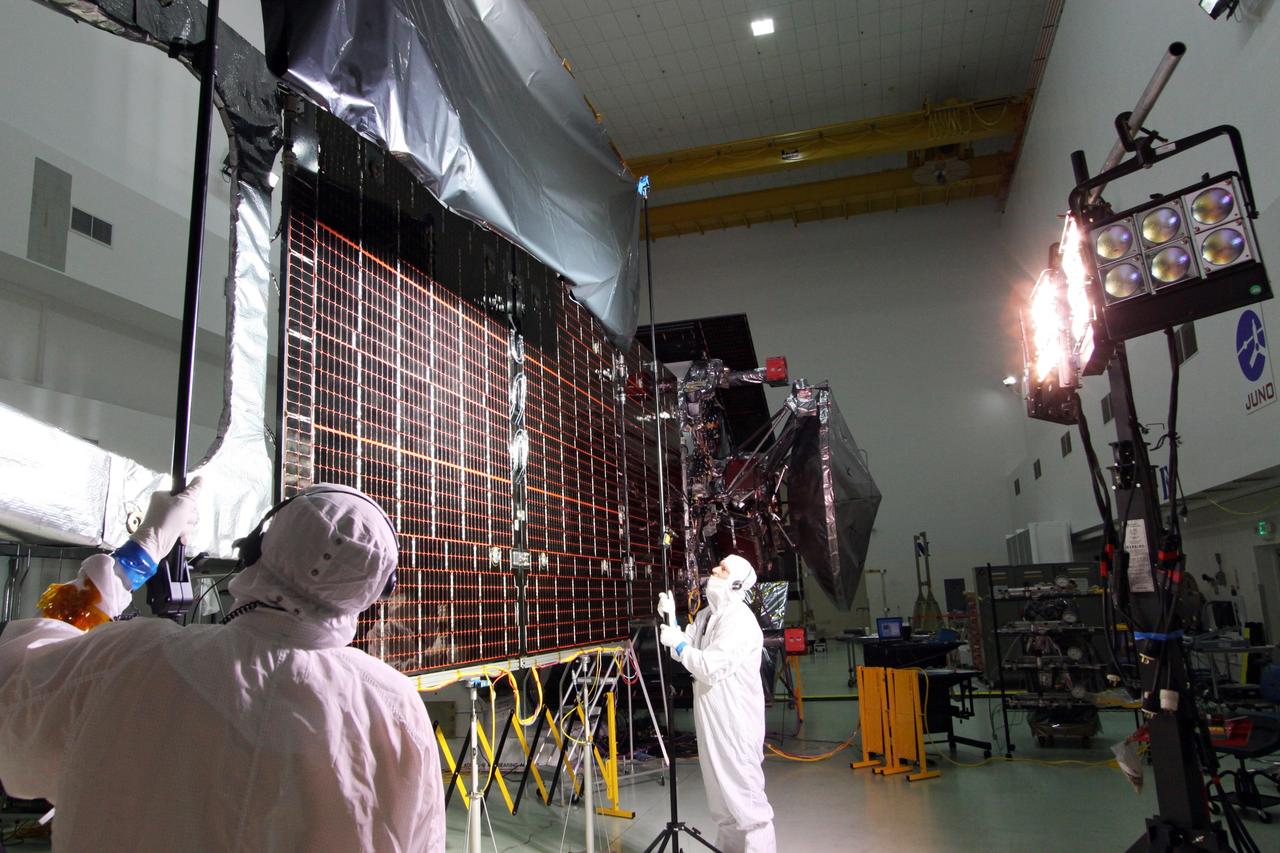
CAPE CANAVERAL, Fla. -- At Astrotech Space Operations in Titusville, Fla., technicians conduct illumination tests on solar array panel #1 with its magnetometer boom for NASA's Juno spacecraft. Juno is scheduled to launch aboard a United Launch Alliance Atlas V from Cape Canaveral, Fla. Aug. 5.The solar-powered spacecraft will orbit Jupiter's poles 33 times to find out more about the gas giant's origins, structure, atmosphere and magnetosphere and investigate the existence of a solid planetary core. For more information visit: www.nasa.gov/juno. Photo credit: NASA/Jack Pfaller

CAPE CANAVERAL, Fla. -- At Astrotech Space Operations in Titusville, Fla., technicians conduct illumination tests on solar array panel #1 with its magnetometer boom for NASA's Juno spacecraft. Juno is scheduled to launch aboard a United Launch Alliance Atlas V from Cape Canaveral, Fla. Aug. 5.The solar-powered spacecraft will orbit Jupiter's poles 33 times to find out more about the gas giant's origins, structure, atmosphere and magnetosphere and investigate the existence of a solid planetary core. For more information visit: www.nasa.gov/juno. Photo credit: NASA/Jack Pfaller
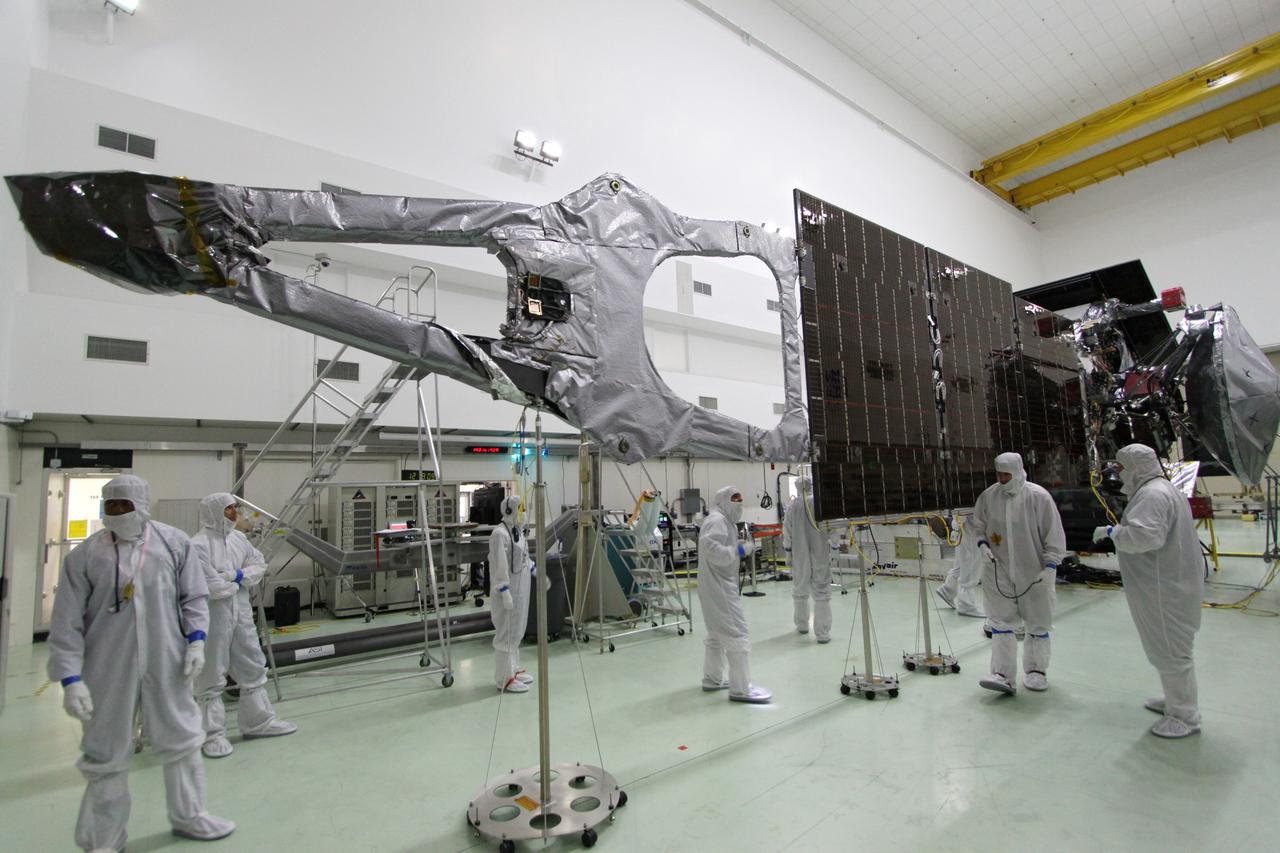
CAPE CANAVERAL, Fla. -- At Astrotech Space Operations in Titusville, Fla., technicians conduct deployment tests on solar array panel #1 with its magnetometer boom for NASA's Juno spacecraft prior to illumination testing. Juno is scheduled to launch aboard a United Launch Alliance Atlas V from Cape Canaveral, Fla. Aug. 5.The solar-powered spacecraft will orbit Jupiter's poles 33 times to find out more about the gas giant's origins, structure, atmosphere and magnetosphere and investigate the existence of a solid planetary core. For more information visit: www.nasa.gov/juno. Photo credit: NASA/Jack Pfaller
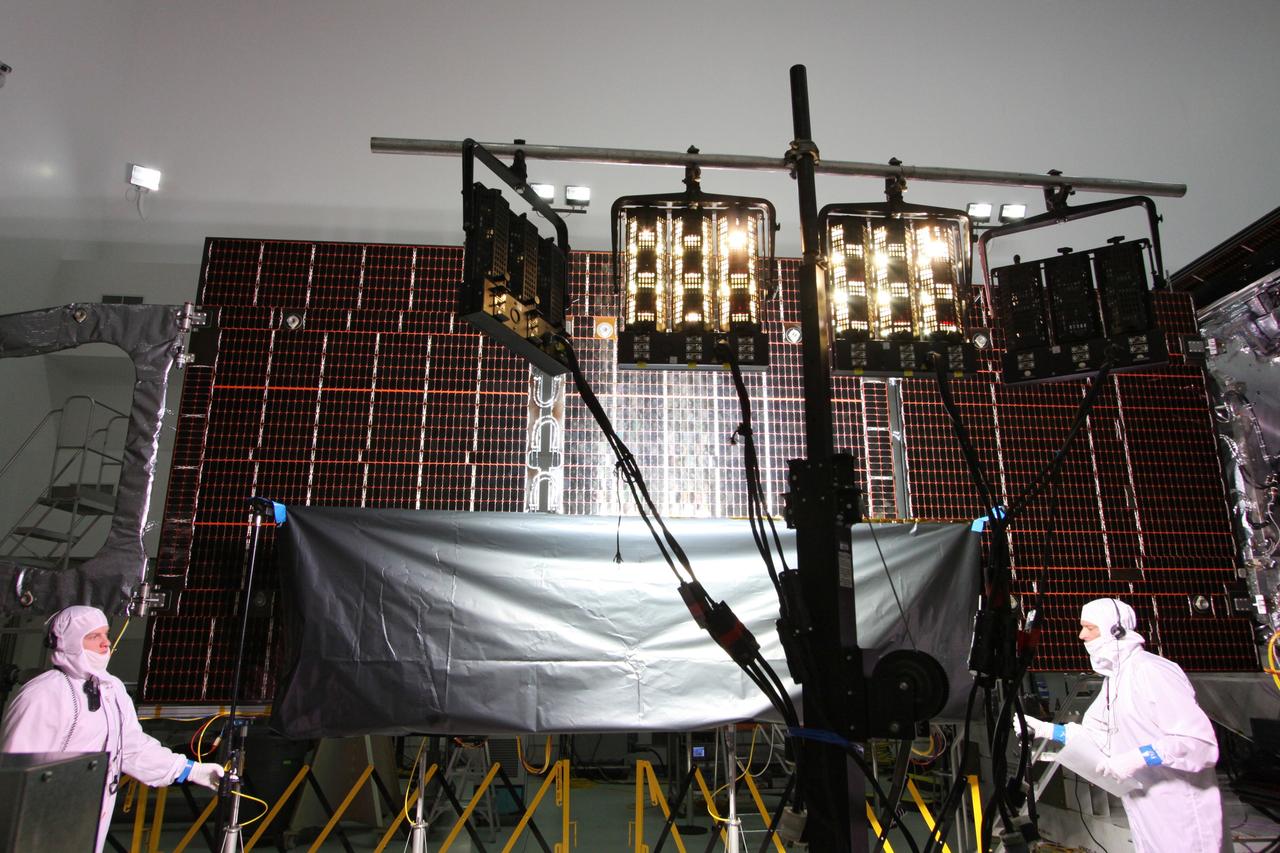
CAPE CANAVERAL, Fla. -- At Astrotech Space Operations in Titusville, Fla., technicians conduct illumination tests on solar array panel #1 with its magnetometer boom for NASA's Juno spacecraft. Juno is scheduled to launch aboard a United Launch Alliance Atlas V from Cape Canaveral, Fla. Aug. 5.The solar-powered spacecraft will orbit Jupiter's poles 33 times to find out more about the gas giant's origins, structure, atmosphere and magnetosphere and investigate the existence of a solid planetary core. For more information visit: www.nasa.gov/juno. Photo credit: NASA/Jack Pfaller
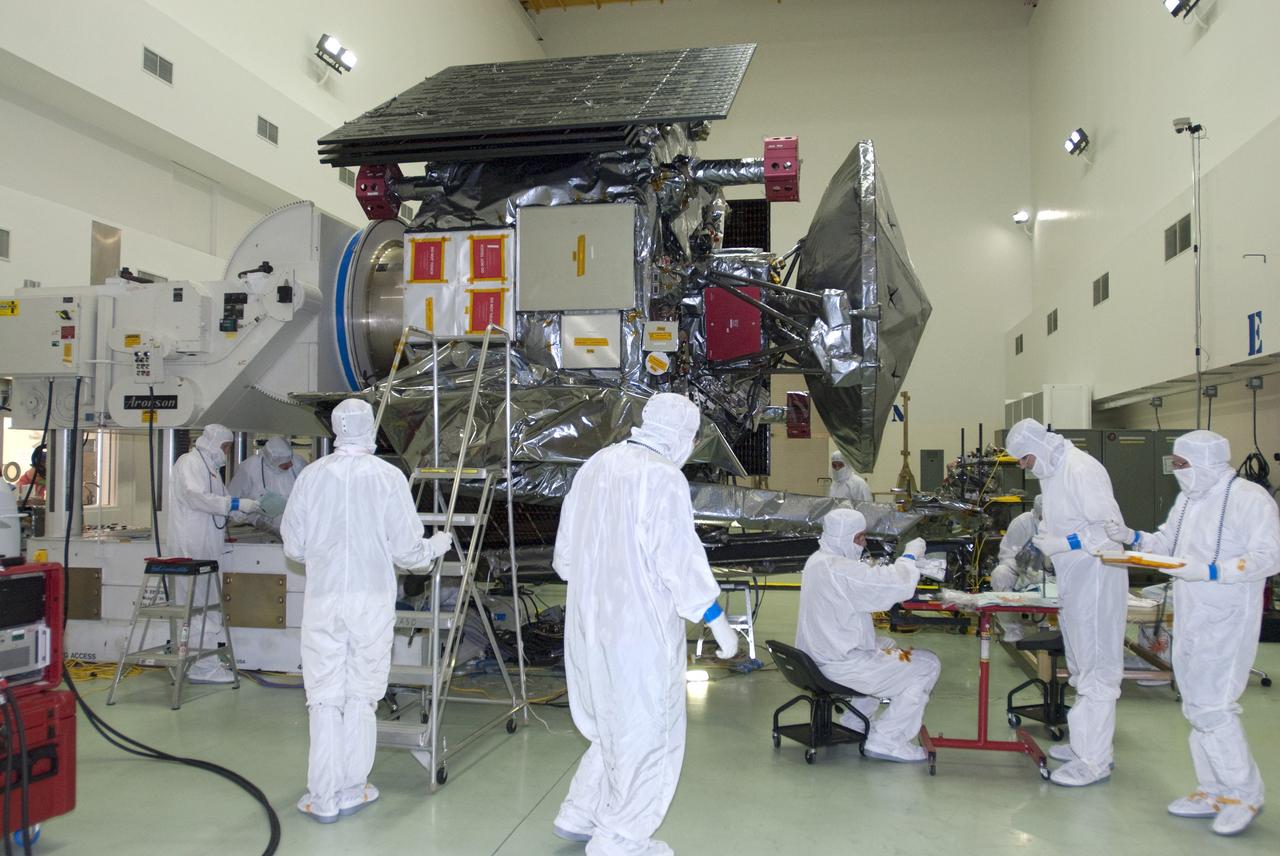
CAPE CANAVERAL, Fla. -- At Astrotech Space Operations in Titusville, Fla., technicians test the connections of solar array #1 with its magnetometer boom to NASA's Juno spacecraft after installation. Juno is scheduled to launch aboard a United Launch Alliance Atlas V rocket from Cape Canaveral, Fla. Aug. 5.The solar-powered spacecraft will orbit Jupiter's poles 33 times to find out more about the gas giant's origins, structure, atmosphere and magnetosphere and investigate the existence of a solid planetary core. For more information visit: www.nasa.gov/juno. Photo credit: NASA/Charisse Nahser
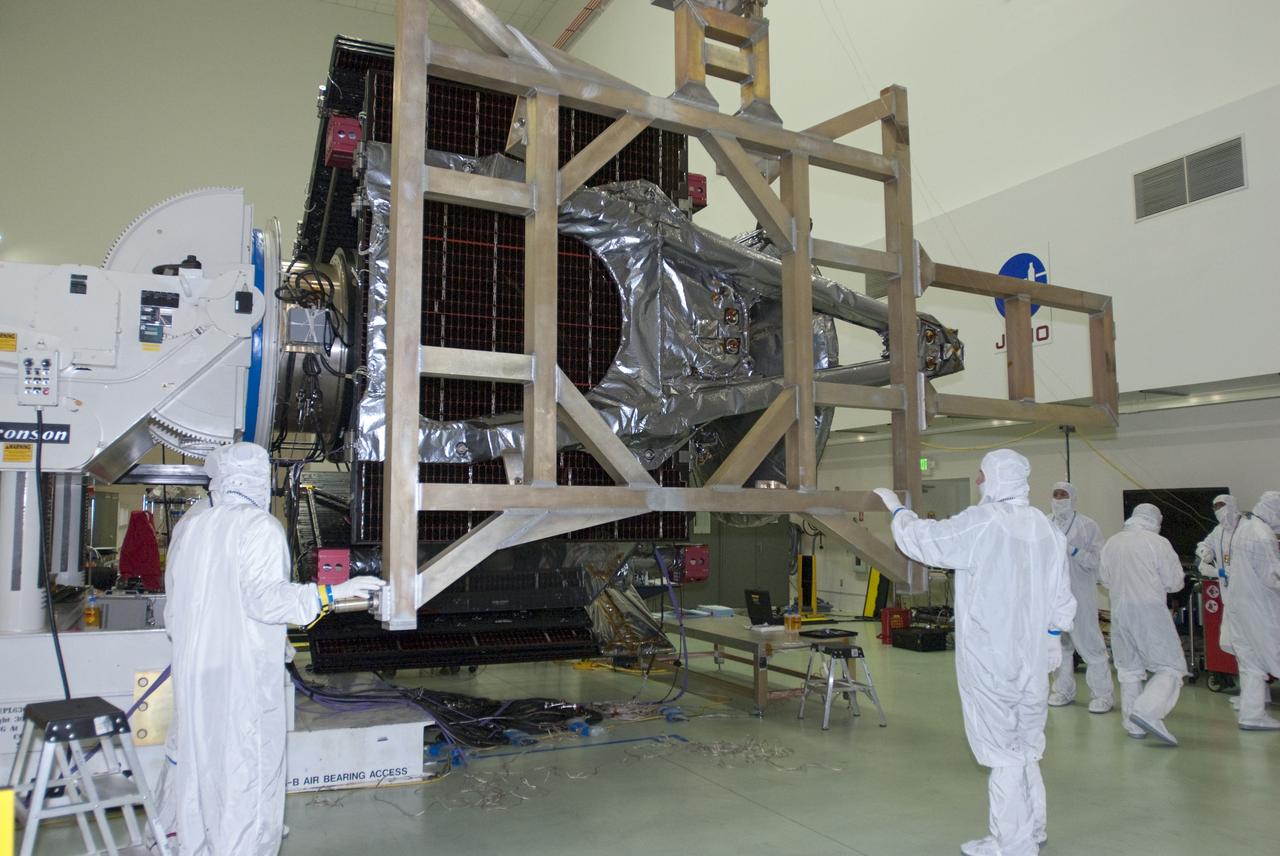
CAPE CANAVERAL, Fla. -- At Astrotech Space Operations in Titusville, Fla., technicians have installed a solar array #1 with its magnetometer boom to NASA's Juno spacecraft. Juno is scheduled to launch aboard a United Launch Alliance Atlas V rocket from Cape Canaveral, Fla. Aug. 5.The solar-powered spacecraft will orbit Jupiter's poles 33 times to find out more about the gas giant's origins, structure, atmosphere and magnetosphere and investigate the existence of a solid planetary core. For more information visit: www.nasa.gov/juno. Photo credit: NASA/Charisse Nahser
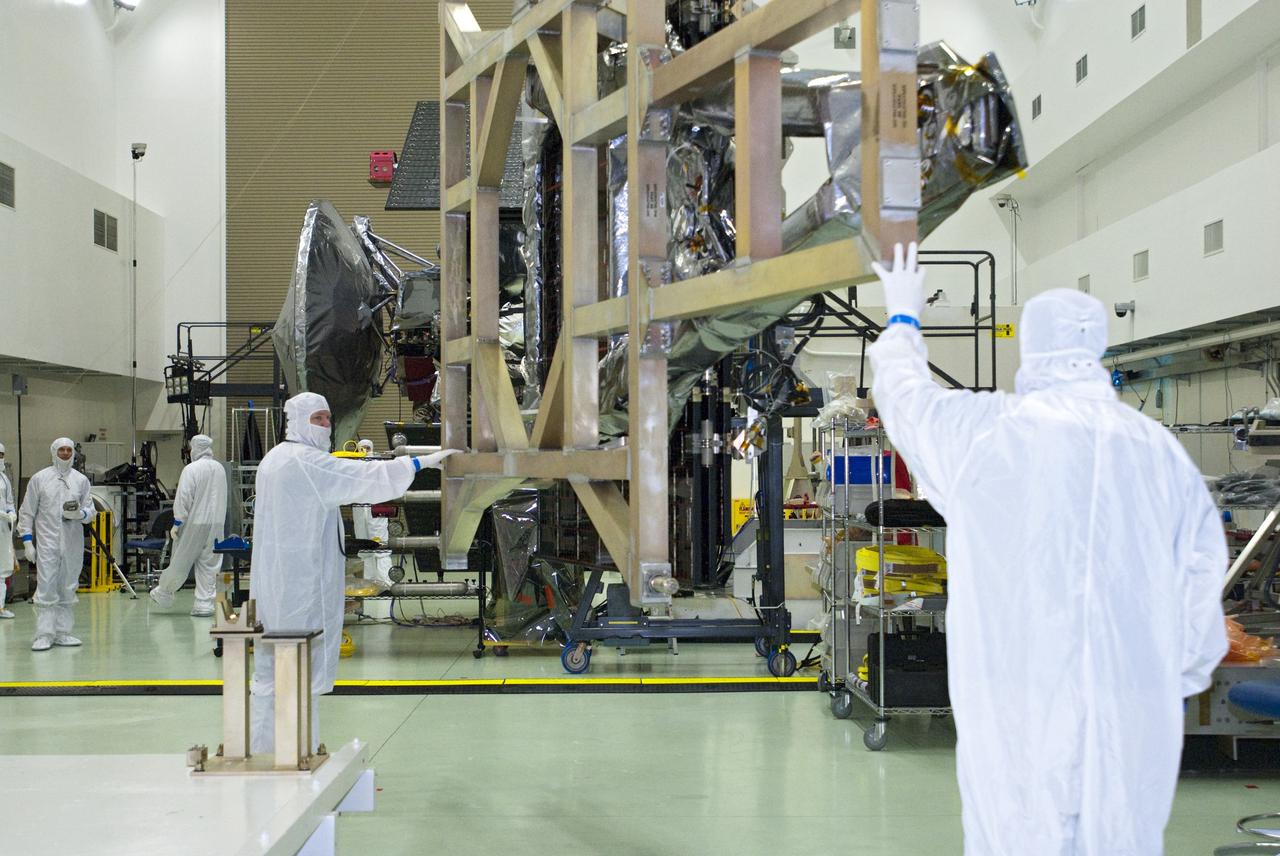
CAPE CANAVERAL, Fla. -- At Astrotech Space Operations in Titusville, Fla., technicians prepare solar array #1 with its magnetometer boom for installation to NASA's Juno spacecraft. Juno is scheduled to launch aboard a United Launch Alliance Atlas V rocket from Cape Canaveral, Fla. Aug. 5.The solar-powered spacecraft will orbit Jupiter's poles 33 times to find out more about the gas giant's origins, structure, atmosphere and magnetosphere and investigate the existence of a solid planetary core. For more information visit: www.nasa.gov/juno. Photo credit: NASA/Charisse Nahser
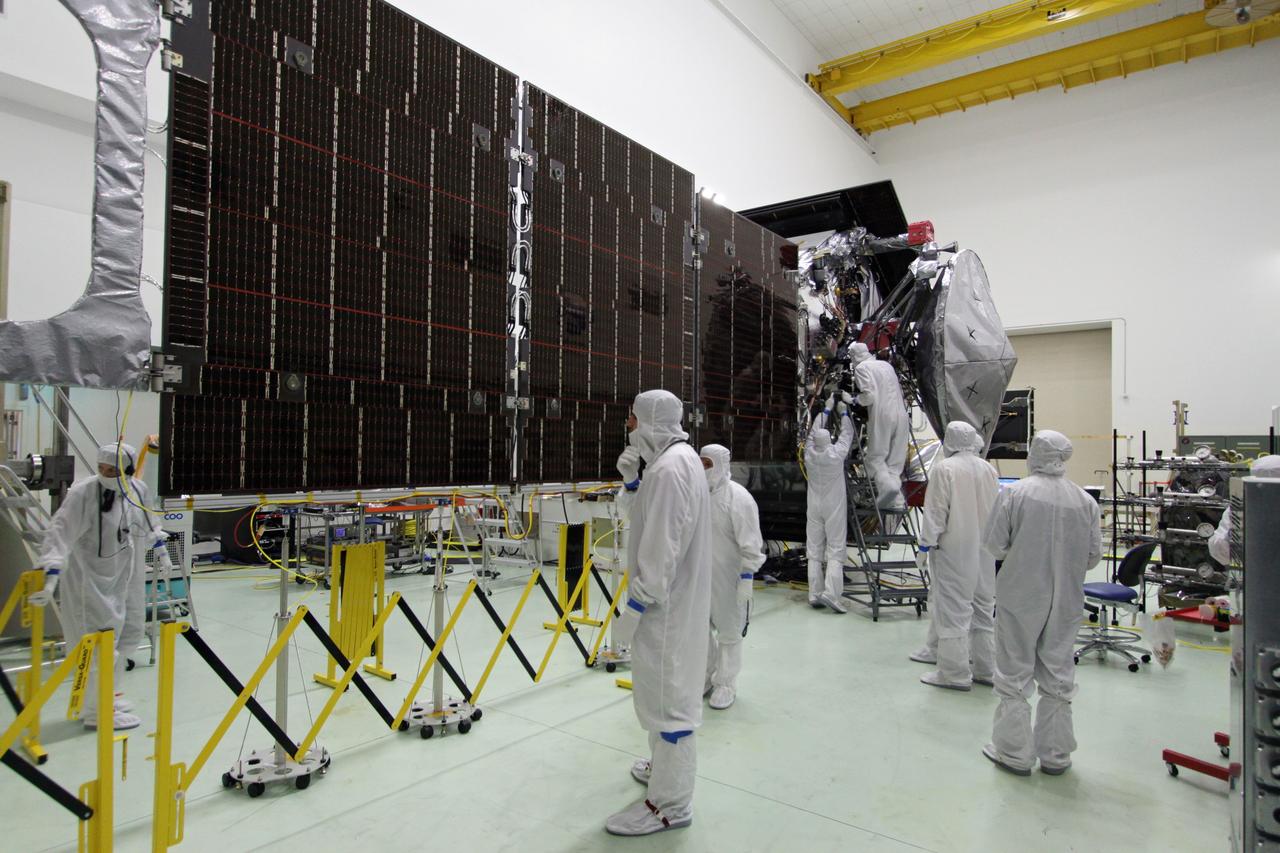
CAPE CANAVERAL, Fla. -- At Astrotech Space Operations in Titusville, Fla., technicians conduct deployment tests on solar array panel #1 with its magnetometer boom for NASA's Juno spacecraft prior to illumination testing. Juno is scheduled to launch aboard a United Launch Alliance Atlas V from Cape Canaveral, Fla. Aug. 5.The solar-powered spacecraft will orbit Jupiter's poles 33 times to find out more about the gas giant's origins, structure, atmosphere and magnetosphere and investigate the existence of a solid planetary core. For more information visit: www.nasa.gov/juno. Photo credit: NASA/Jack Pfaller
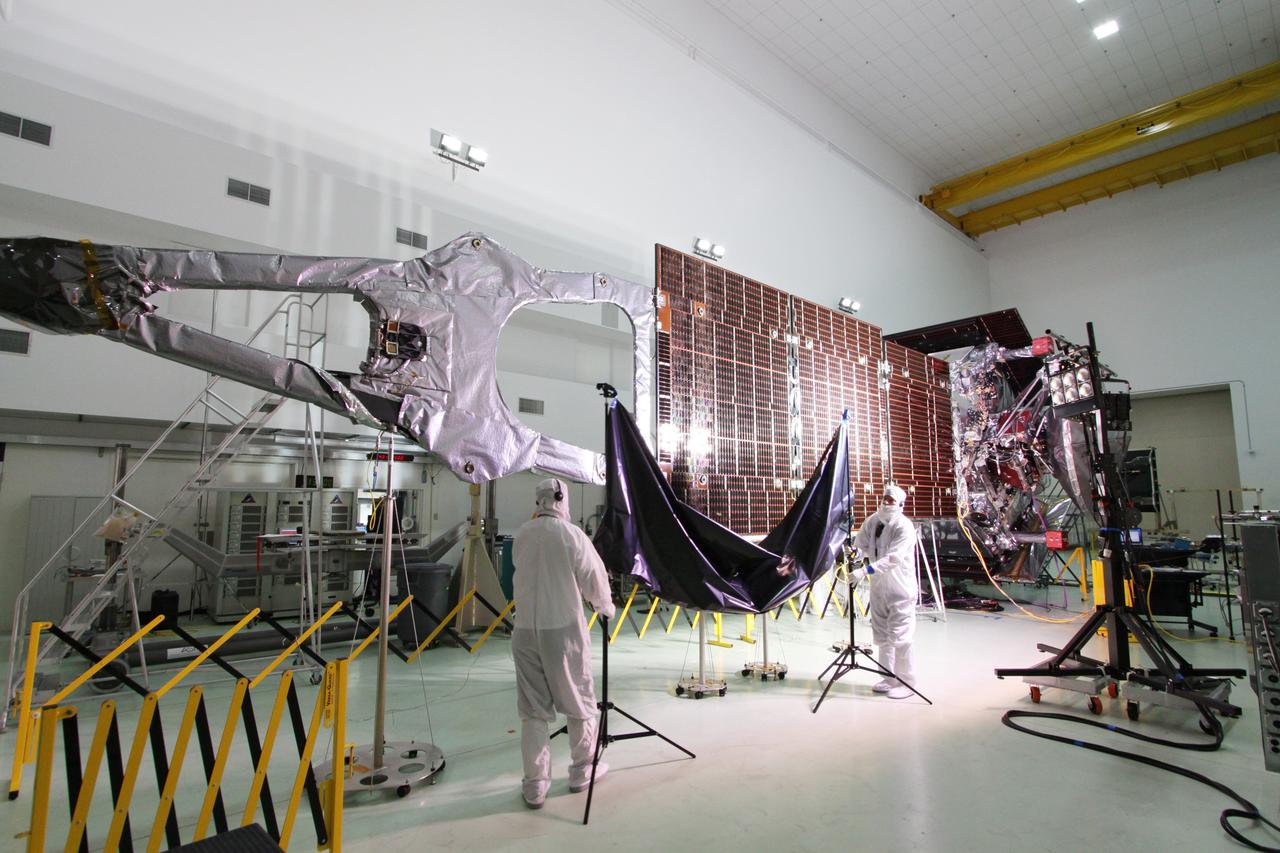
CAPE CANAVERAL, Fla. -- At Astrotech Space Operations in Titusville, Fla., technicians conduct illumination tests on solar array panel #1 with its magnetometer boom for NASA's Juno spacecraft. Juno is scheduled to launch aboard a United Launch Alliance Atlas V from Cape Canaveral, Fla. Aug. 5.The solar-powered spacecraft will orbit Jupiter's poles 33 times to find out more about the gas giant's origins, structure, atmosphere and magnetosphere and investigate the existence of a solid planetary core. For more information visit: www.nasa.gov/juno. Photo credit: NASA/Jack Pfaller
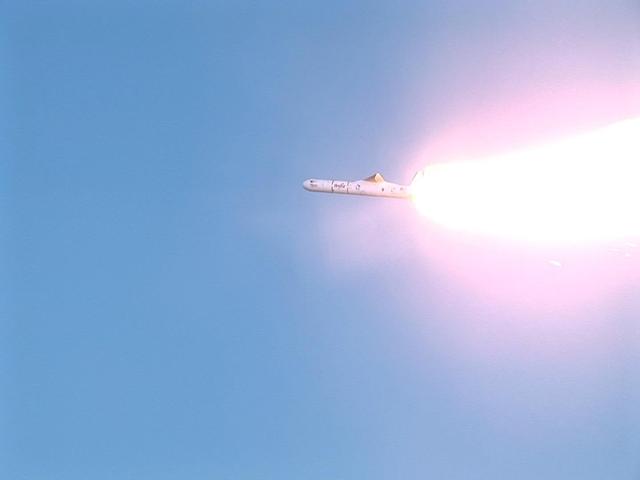
VANDENBERG AIR FORCE BASE, CALIF. - Orbital Sciences' Pegasus launch vehicle rockets away from the L-1011 jet aircraft after being released. Pegasus carries the Space Technology 5 spacecraft with its trio of micro-satellites that will be launched in a "string of pearls" sequence on a near-Earth polar elliptical orbit that will take them from approximately 190 miles (300 kilometers) to 2,800 miles (4,500 kilometers) from the planet. The three spacecraft will conduct science validation using measurements of the Earth's magnetic field collected by the miniature boom-mounted magnetometers on each.
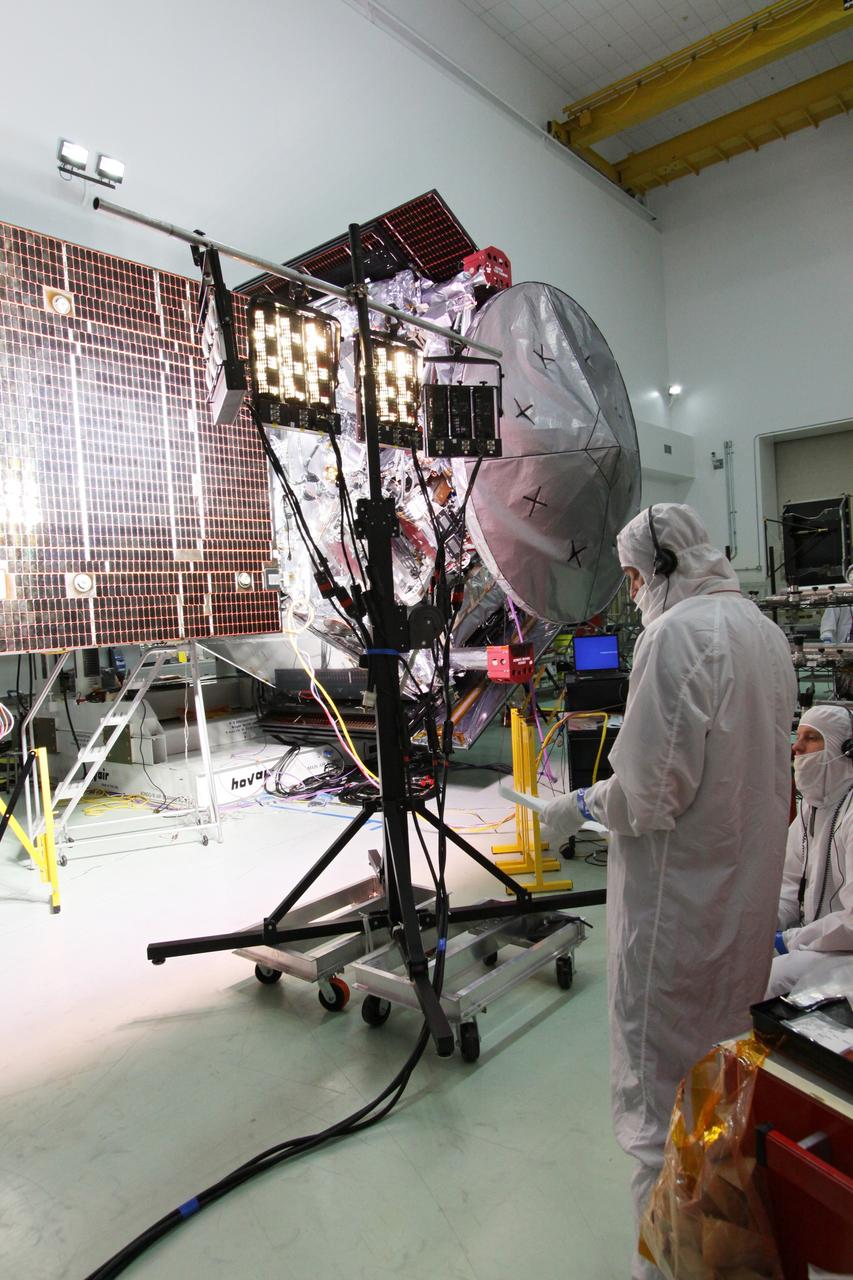
CAPE CANAVERAL, Fla. -- At Astrotech Space Operations in Titusville, Fla., technicians conduct illumination tests on solar array panel #1 with its magnetometer boom for NASA's Juno spacecraft. Juno is scheduled to launch aboard a United Launch Alliance Atlas V from Cape Canaveral, Fla. Aug. 5.The solar-powered spacecraft will orbit Jupiter's poles 33 times to find out more about the gas giant's origins, structure, atmosphere and magnetosphere and investigate the existence of a solid planetary core. For more information visit: www.nasa.gov/juno. Photo credit: NASA/Jack Pfaller
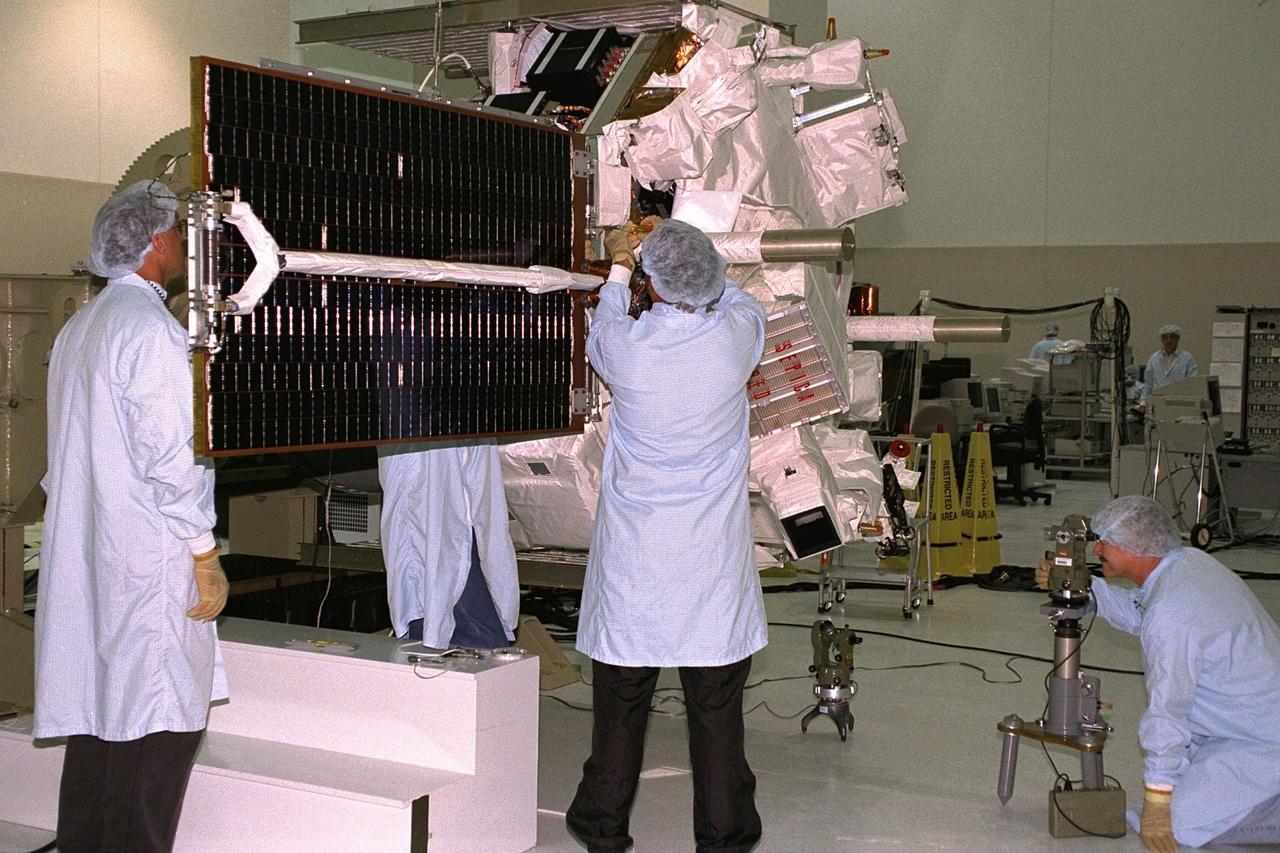
Applied Physics Laboratory engineers and technicians from Johns Hopkins University test for true perpendicular solar array deployment of the Advanced Composition Explorer (ACE) in KSC’s Spacecraft Assembly and Encapsulation Facility-II (SAEF-II). The white magnetometer boom seen across the solar array panel will deploy the panel once in space. Scheduled for launch on a Delta II rocket from Cape Canaveral Air Station on Aug. 25, ACE will study low-energy particles of solar origin and high-energy galactic particles. The ACE observatory will be placed into an orbit almost a million miles (1.5 million kilometers) away from the Earth, about 1/100 the distance from the Earth to the Sun
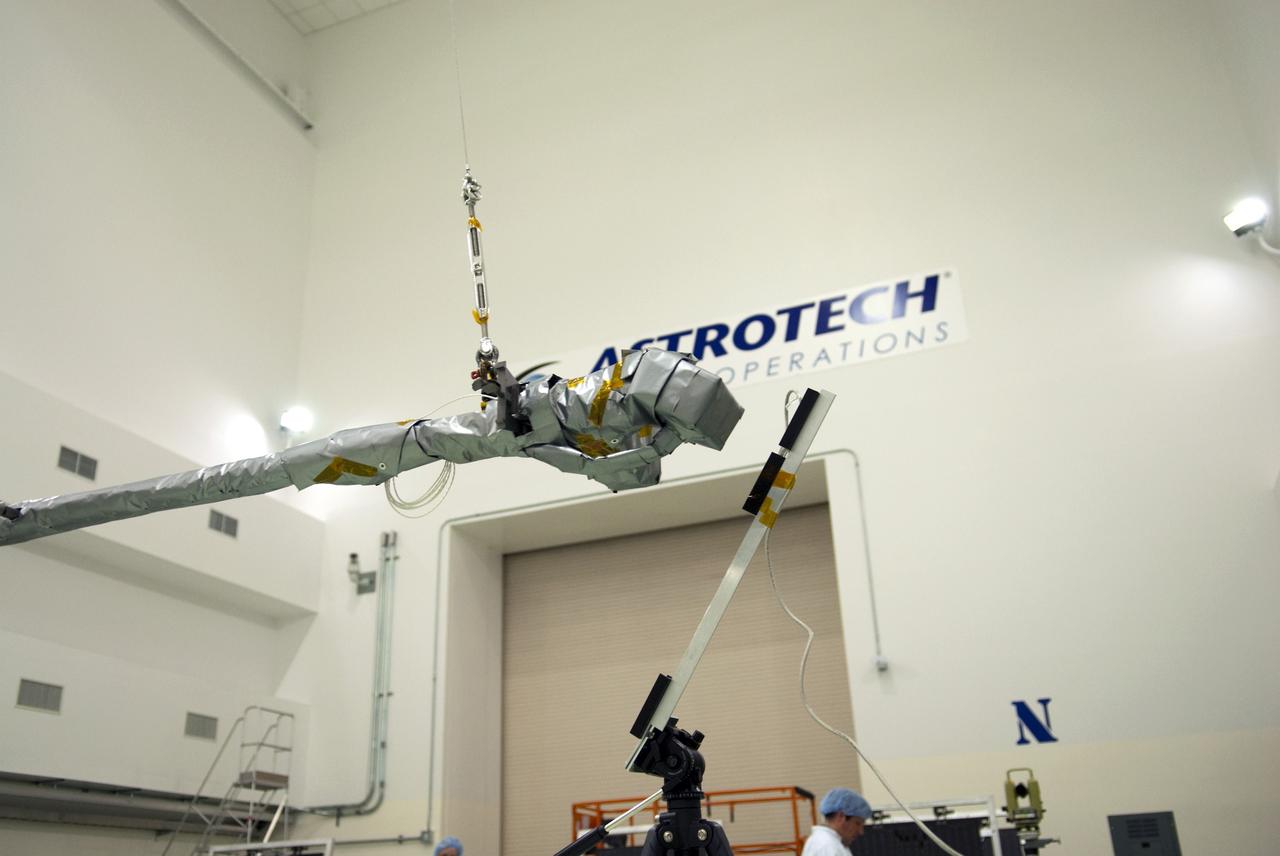
CAPE CANAVERAL, Fla. - Inside the Astrotech payload processing facility near NASA’s Kennedy Space Center in Florida, the magnetometer boom has been deployed on the Radiation Belt Storm Probes, or RBSP, spacecraft A. Deploying the solar arrays and boom are a standard procedure to ensure they work properly on Earth before they head into space. NASA’s RBSP mission will help us understand the sun’s influence on Earth and near-Earth space by studying the Earth’s radiation belts on various scales of space and time. As the spacecraft orbits Earth, the four solar panels will continuously face the sun to provide constant power to its instruments. The boom will provide data of the electric fields that energize radiation particles and modify the structure of the inner magnetosphere. RBSP will begin its mission of exploration of Earth’s Van Allen radiation belts and the extremes of space weather after its launch aboard a United Launch Alliance Atlas V rocket. Launch is targeted for Aug. 23. For more information, visit http://www.nasa.gov/rbsp. Photo credit: NASA/Charisse Nahser
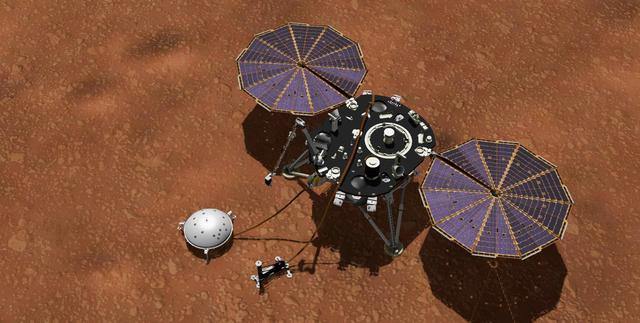
This artist's concept shows NASA's InSight lander with its instruments deployed on the Martian surface. InSight's package of weather sensors, called the Auxiliary Payload Subsystem (APSS), includes an air pressure sensor inside the lander -- its inlet is visible on InSight's deck -- and two air temperature and wind sensors on the deck. Under the deck's edge is a magnetometer, provided by UCLA, to measure changes in the local magnetic field that could also influence SEIS. InSight's air temperature and wind sensors are actually refurbished spares built for Curiosity's Rover Environmental Monitoring Station (REMS). Called Temperature and Wind for InSight, or TWINS, these two east- and west-facing booms sit on the lander's deck and were provided by Spain's Centro de Astrobiología (CAB). https://photojournal.jpl.nasa.gov/catalog/PIA22957
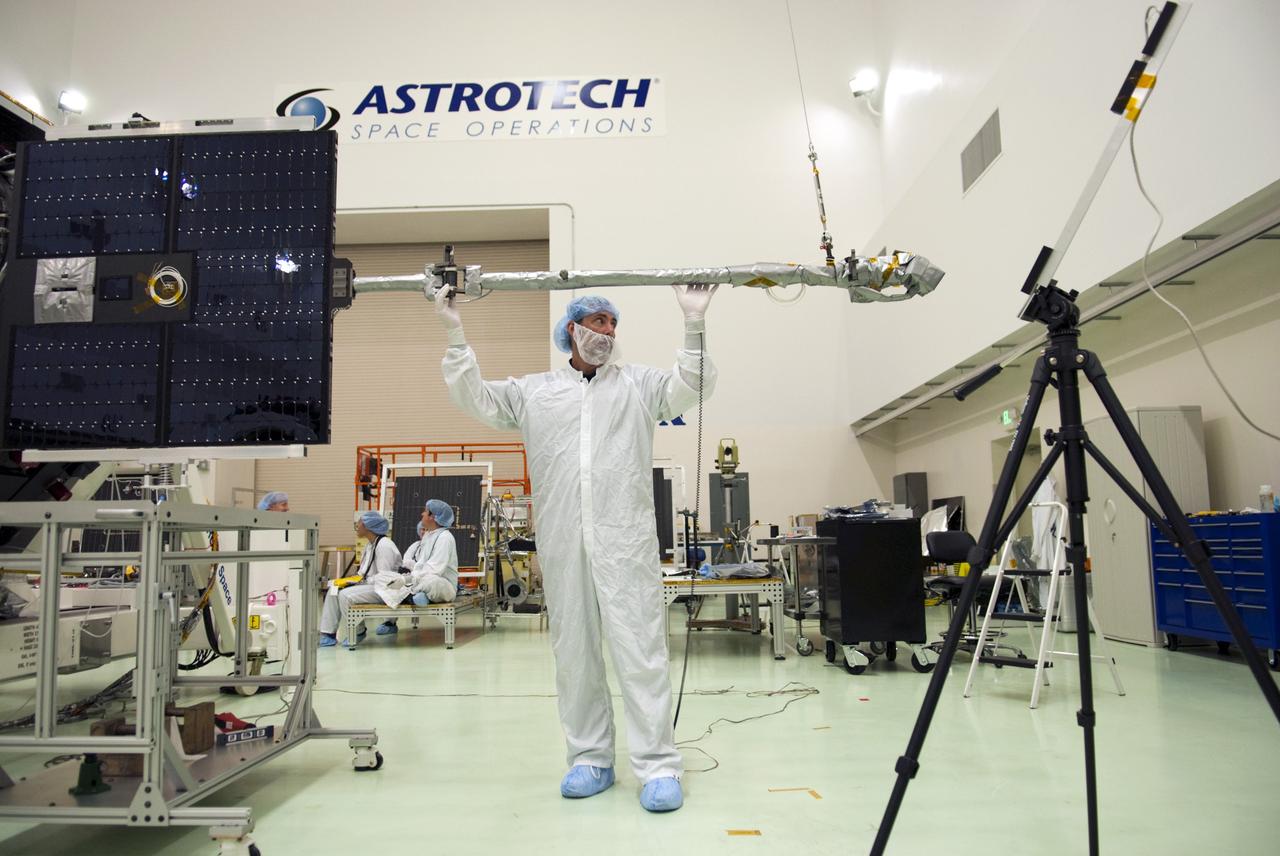
CAPE CANAVERAL, Fla. - Inside the Astrotech payload processing facility near NASA’s Kennedy Space Center in Florida, a technician inspects the Radiation Belt Storm Probes, or RBSP, spacecraft A solar arrays and magnetometer boom after they were deployed. Deploying these components is a standard procedure to ensure they work properly on Earth before they head into space. NASA’s RBSP mission will help us understand the sun’s influence on Earth and near-Earth space by studying the Earth’s radiation belts on various scales of space and time. As the spacecraft orbits Earth, the four solar panels will continuously face the sun to provide constant power to its instruments. The boom will provide data of the electric fields that energize radiation particles and modify the structure of the inner magnetosphere. RBSP will begin its mission of exploration of Earth’s Van Allen radiation belts and the extremes of space weather after its launch aboard a United Launch Alliance Atlas V rocket. Launch is targeted for Aug. 23. For more information, visit http://www.nasa.gov/rbsp. Photo credit: NASA/Charisse Nahser
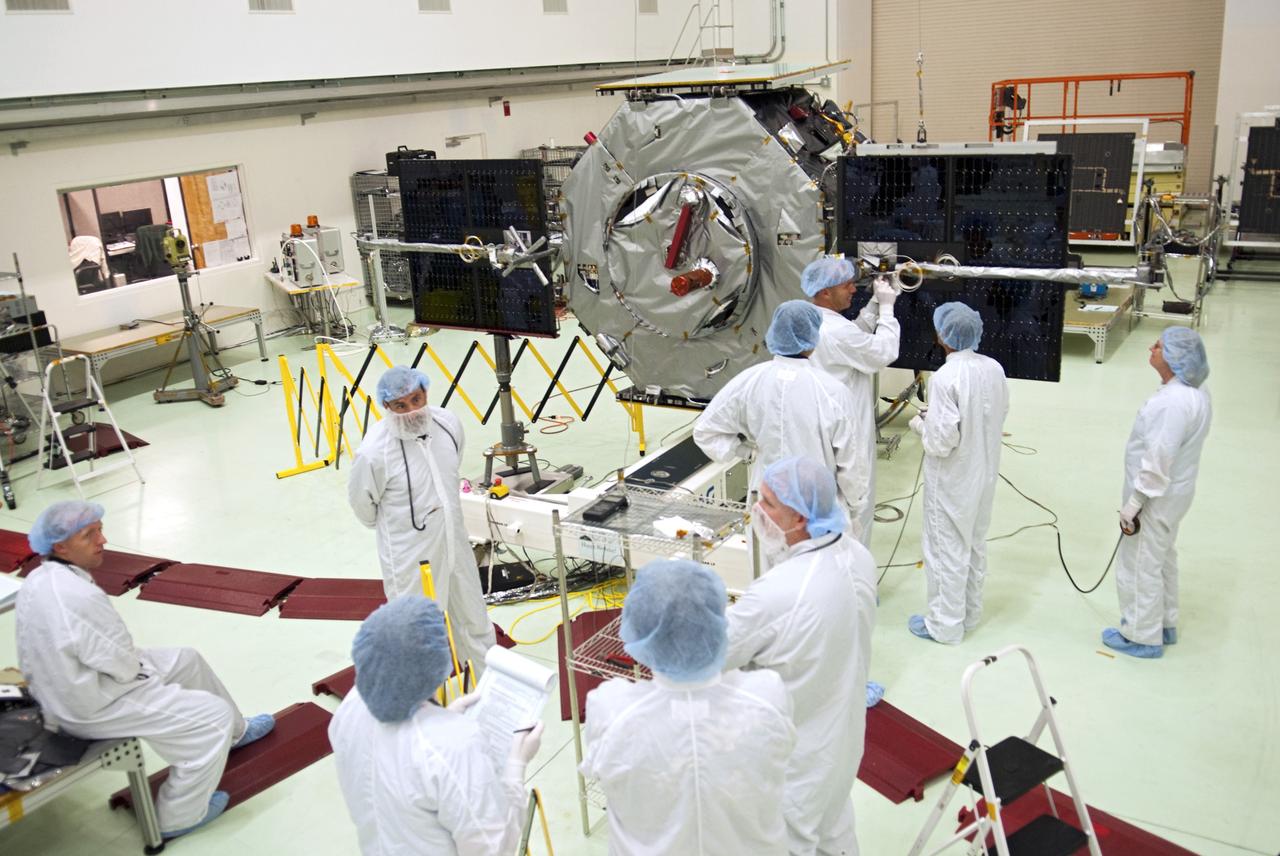
CAPE CANAVERAL, Fla. - Inside the Astrotech payload processing facility near NASA’s Kennedy Space Center in Florida, technicians deploy the solar arrays and magnetometer boom of the Radiation Belt Storm Probes, or RBSP, spacecraft A. Deploying these components is standard procedure to ensure they work properly on Earth before they head into space. NASA’s RBSP mission will help us understand the sun’s influence on Earth and near-Earth space by studying the Earth’s radiation belts on various scales of space and time. As the spacecraft orbits Earth, the four solar panels will continuously face the sun to provide constant power to its instruments. The boom will provide data of the electric fields that energize radiation particles and modify the structure of the inner magnetosphere. RBSP will begin its mission of exploration of Earth’s Van Allen radiation belts and the extremes of space weather after its launch aboard a United Launch Alliance Atlas V rocket. Launch is targeted for Aug. 23. For more information, visit http://www.nasa.gov/rbsp. Photo credit: NASA/Charisse Nahser

CAPE CANAVERAL, Fla. - Inside the Astrotech payload processing facility near NASA’s Kennedy Space Center in Florida, technicians prepare to deploy the solar arrays and magnetometer boom of the Radiation Belt Storm Probes, or RBSP, spacecraft A. Deploying these components are standard procedure to ensure they work properly on Earth before they head into space. NASA’s RBSP mission will help us understand the sun’s influence on Earth and near-Earth space by studying the Earth’s radiation belts on various scales of space and time. As the spacecraft orbits Earth, the four solar panels will continuously face the sun to provide constant power to its instruments. The boom will provide data of the electric fields that energize radiation particles and modify the structure of the inner magnetosphere. RBSP will begin its mission of exploration of Earth’s Van Allen radiation belts and the extremes of space weather after its launch aboard a United Launch Alliance Atlas V rocket. Launch is targeted for Aug. 23. For more information, visit http://www.nasa.gov/rbsp. Photo credit: NASA/Charisse Nahser
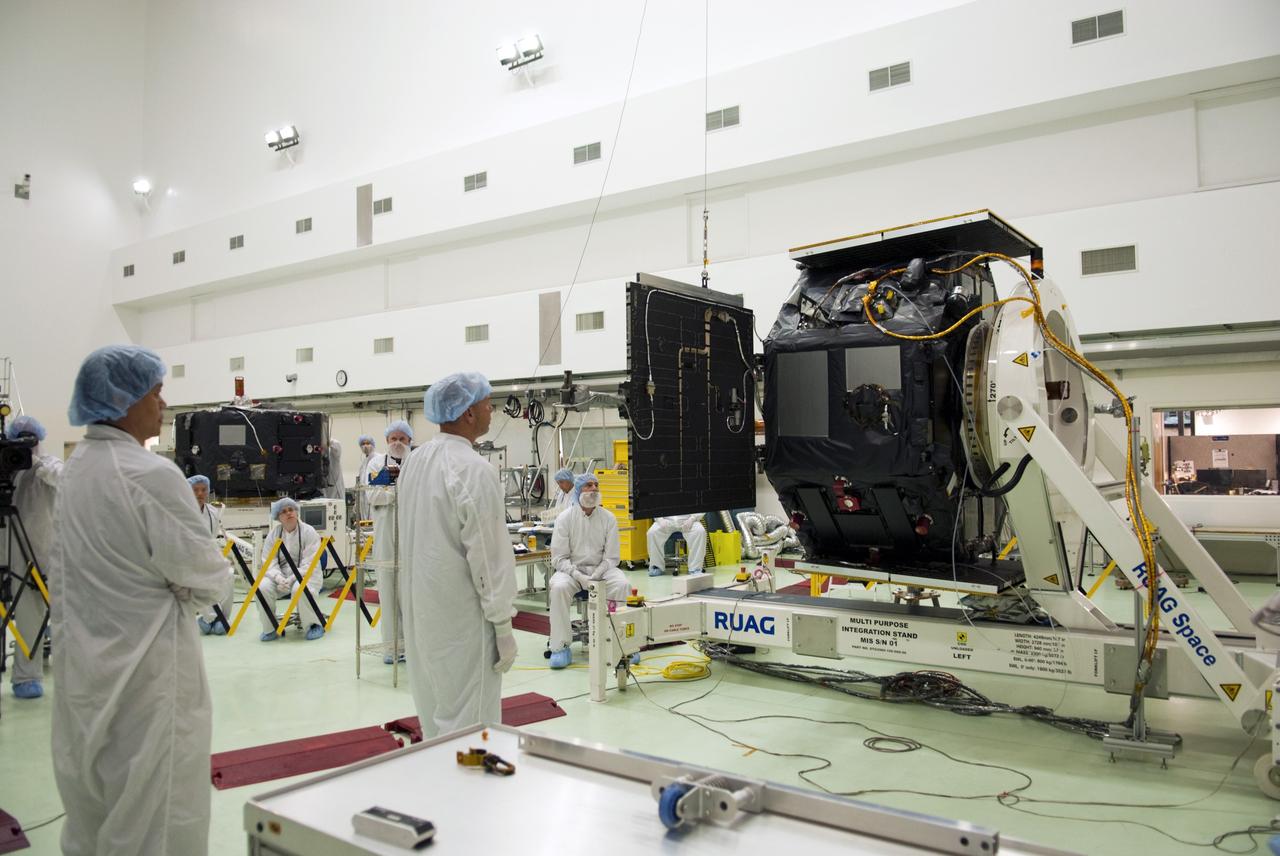
CAPE CANAVERAL, Fla. - Inside the Astrotech payload processing facility near NASA’s Kennedy Space Center in Florida, technicians begin to deploy the solar arrays and magnetometer boom of the Radiation Belt Storm Probes, or RBSP, spacecraft A. Deploying these components are standard procedure to ensure they work properly on Earth before they head into space. NASA’s RBSP mission will help us understand the sun’s influence on Earth and near-Earth space by studying the Earth’s radiation belts on various scales of space and time. As the spacecraft orbits Earth, the four solar panels will continuously face the sun to provide constant power to its instruments. The boom will provide data of the electric fields that energize radiation particles and modify the structure of the inner magnetosphere. RBSP will begin its mission of exploration of Earth’s Van Allen radiation belts and the extremes of space weather after its launch aboard a United Launch Alliance Atlas V rocket. Launch is targeted for Aug. 23. For more information, visit http://www.nasa.gov/rbsp. Photo credit: NASA/Charisse Nahser
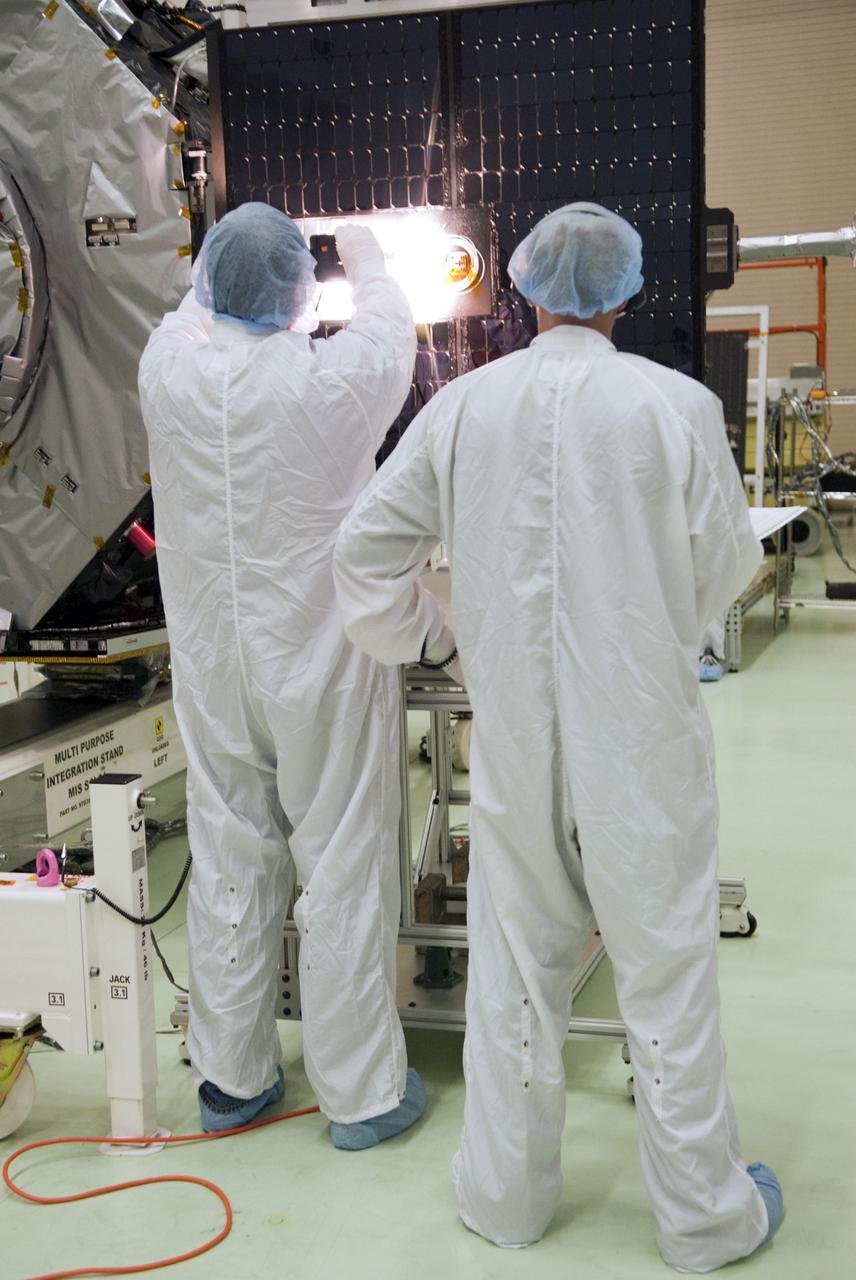
CAPE CANAVERAL, Fla. - Inside the Astrotech payload processing facility near NASA’s Kennedy Space Center in Florida, technicians perform a solar array illumination test after the solar arrays and magnetometer boom were deployed on the Radiation Belt Storm Probes, or RBSP, spacecraft A. Deploying these components are a standard procedure to ensure they work properly on Earth before they head into space. NASA’s RBSP mission will help us understand the sun’s influence on Earth and near-Earth space by studying the Earth’s radiation belts on various scales of space and time. As the spacecraft orbits Earth, the four solar panels will continuously face the sun to provide constant power to its instruments. The boom will provide data of the electric fields that energize radiation particles and modify the structure of the inner magnetosphere. RBSP will begin its mission of exploration of Earth’s Van Allen radiation belts and the extremes of space weather after its launch aboard a United Launch Alliance Atlas V rocket. Launch is targeted for Aug. 23. For more information, visit http://www.nasa.gov/rbsp. Photo credit: NASA/Charisse Nahser

CAPE CANAVERAL, Fla. - Inside the Astrotech payload processing facility near NASA’s Kennedy Space Center in Florida, technicians prepare to deploy the solar arrays and magnetometer boom of the Radiation Belt Storm Probes, or RBSP, spacecraft A. Deploying these components are standard procedure to ensure they work properly on Earth before they head into space. NASA’s RBSP mission will help us understand the sun’s influence on Earth and near-Earth space by studying the Earth’s radiation belts on various scales of space and time. As the spacecraft orbits Earth, the four solar panels will continuously face the sun to provide constant power to its instruments. The boom will provide data of the electric fields that energize radiation particles and modify the structure of the inner magnetosphere. RBSP will begin its mission of exploration of Earth’s Van Allen radiation belts and the extremes of space weather after its launch aboard a United Launch Alliance Atlas V rocket. Launch is targeted for Aug. 23. For more information, visit http://www.nasa.gov/rbsp. Photo credit: NASA/Charisse Nahser
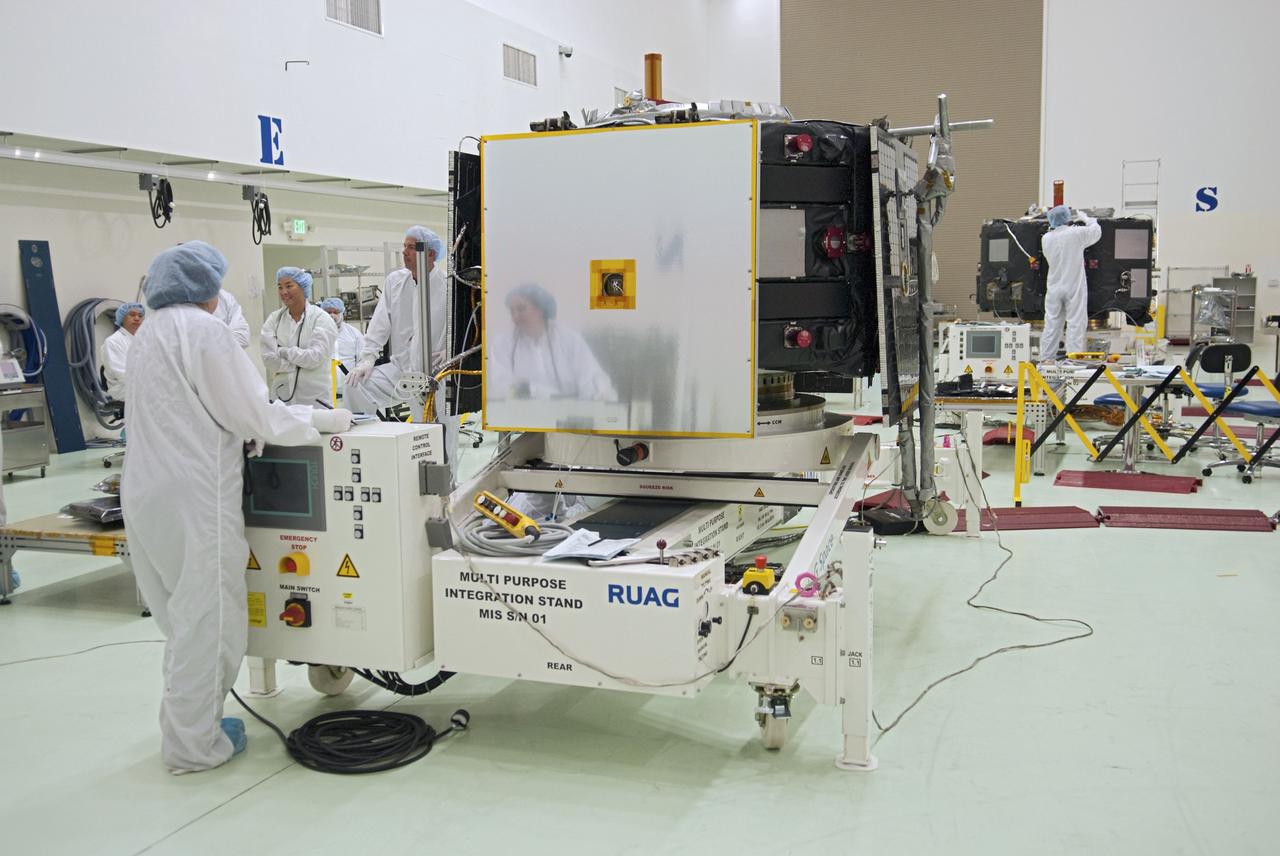
CAPE CANAVERAL, Fla. - Inside the Astrotech payload processing facility near NASA’s Kennedy Space Center in Florida, technicians prepare to deploy the magnetometer boom of the Radiation Belt Storm Probes, or RBSP, spacecraft A. Deploying this instrument is standard procedure to ensure it will work properly on Earth before it heads into space. In the back right of the facility, is spacecraft B, which is identical to spacecraft A. Together, NASA’s two RBSP spacecraft will help us understand the sun’s influence on Earth and near-Earth space by studying the Earth’s radiation belts on various scales of space and time. The boom will provide data of the electric fields that energize radiation particles and modify the structure of the inner magnetosphere. RBSP will begin its mission of exploration of Earth’s Van Allen radiation belts and the extremes of space weather after its launch aboard a United Launch Alliance Atlas V rocket. Launch is targeted for Aug. 23. For more information, visit http://www.nasa.gov/rbsp. Photo credit: NASA/Charisse Nahser
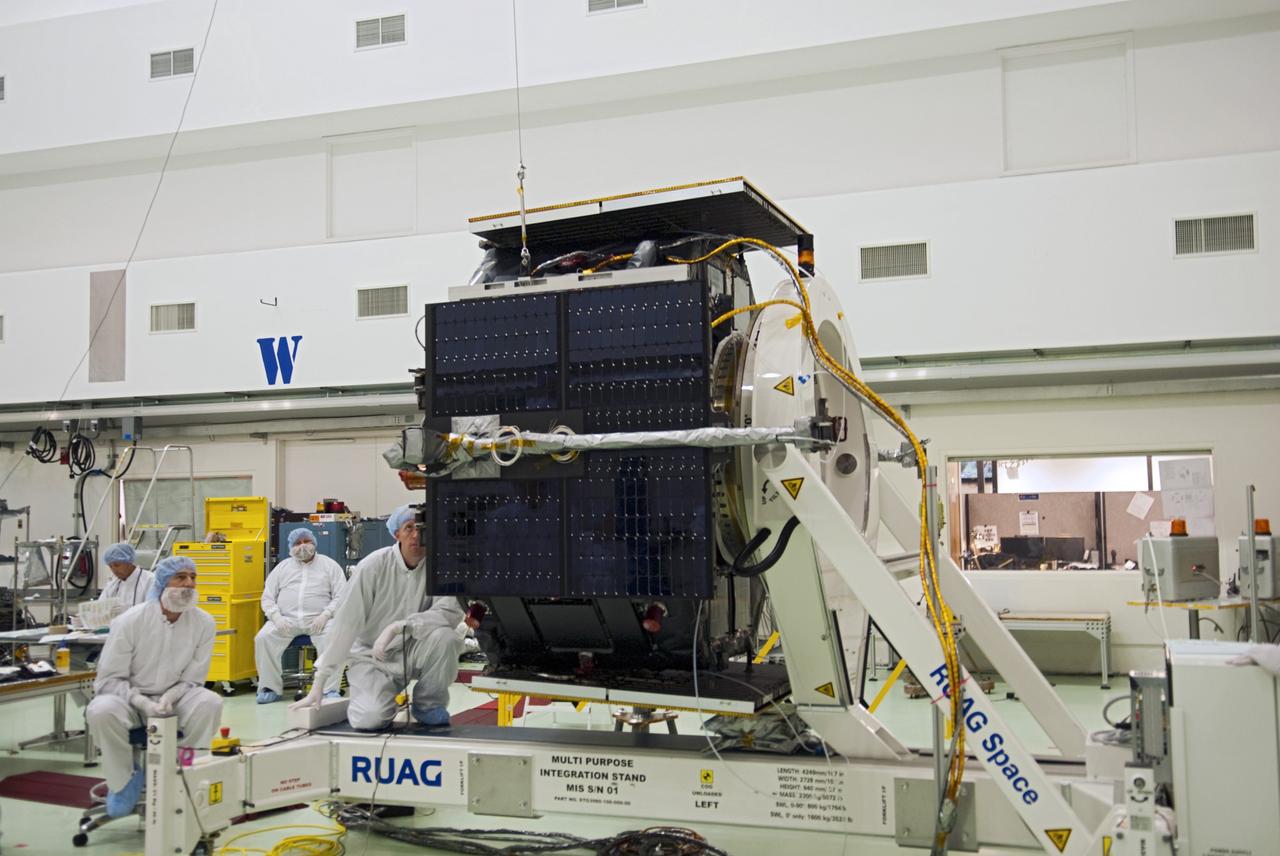
CAPE CANAVERAL, Fla. - Inside the Astrotech payload processing facility near NASA’s Kennedy Space Center in Florida, technicians prepare to deploy the solar arrays and magnetometer boom of the Radiation Belt Storm Probes, or RBSP, spacecraft A. Deploying these components are standard procedure to ensure they work properly on Earth before they head into space. NASA’s RBSP mission will help us understand the sun’s influence on Earth and near-Earth space by studying the Earth’s radiation belts on various scales of space and time. As the spacecraft orbits Earth, the four solar panels will continuously face the sun to provide constant power to its instruments. The boom will provide data of the electric fields that energize radiation particles and modify the structure of the inner magnetosphere. RBSP will begin its mission of exploration of Earth’s Van Allen radiation belts and the extremes of space weather after its launch aboard a United Launch Alliance Atlas V rocket. Launch is targeted for Aug. 23. For more information, visit http://www.nasa.gov/rbsp. Photo credit: NASA/Charisse Nahser
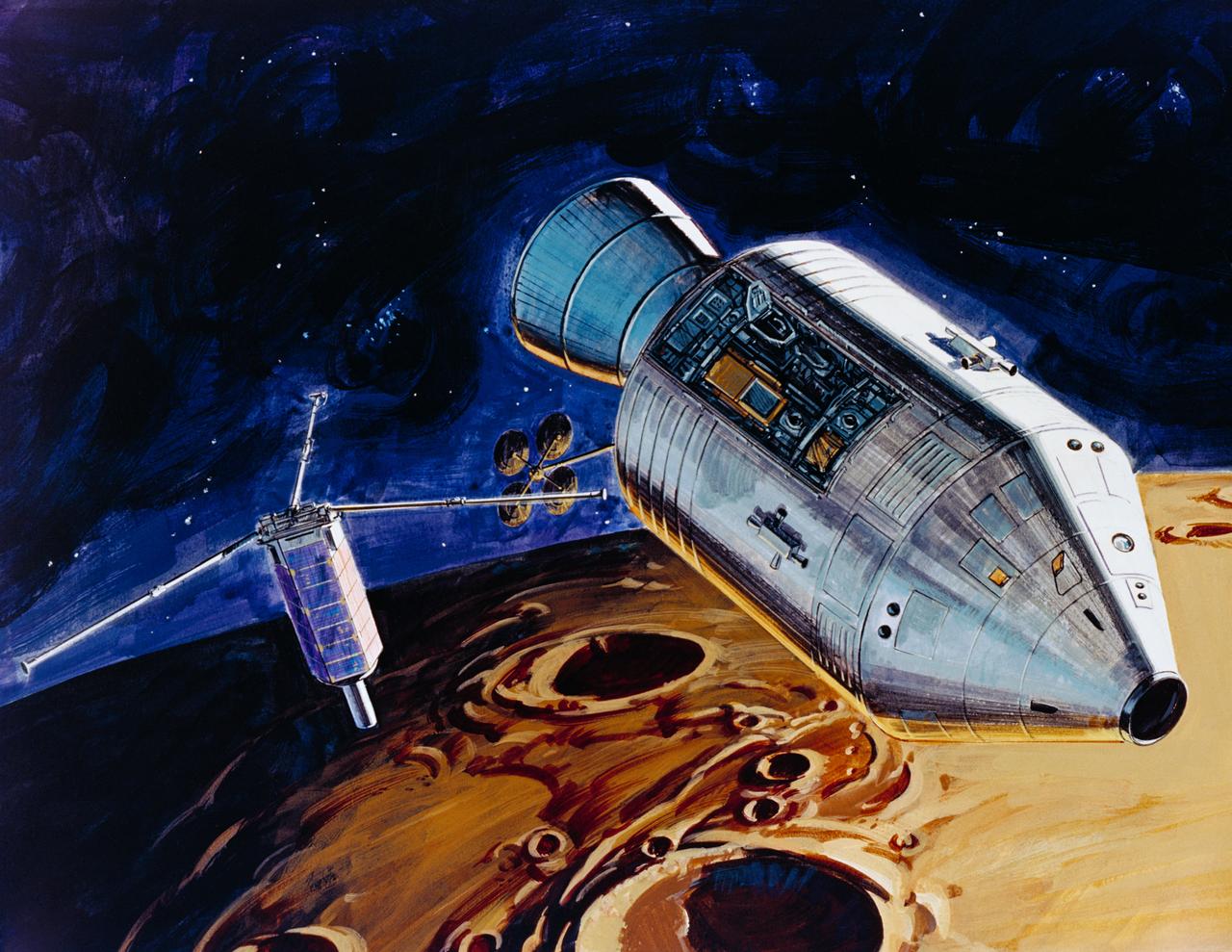
S71-39481 (July 1971) --- An artist's concept showing TRW's small lunar subsatellite being ejected into lunar orbit from the SIM bay of the Apollo 15 Service Module. The 80-pound satellite will remain in orbit a year or more, carrying scientific experiments to study space in the vicinity of the moon. The satellite carries three experiments: S-Band Transponder; Particle Shadows/Boundary Layer Experiment; and Subsatellite Magnetometer Experiment. The subsatellite is housed in a container resembling a rural mailbox, and when deployed is spring-ejected out-of-plane at 4 fps with a spin rate of 140 rpm. After the satellite booms are deployed, the spin rate is stabilized at about 12 rpm. The subsatellite is 31 inches long and has a 14 inch hexagonal diameter. The exact weight is 78.5 pounds. The folded booms deploy to a length of five feet. Subsatellite electrical power is supplied by a solar cell array outputting 25 watts for dayside operation and a rechargeable silver-cadmium battery for nightside passes.
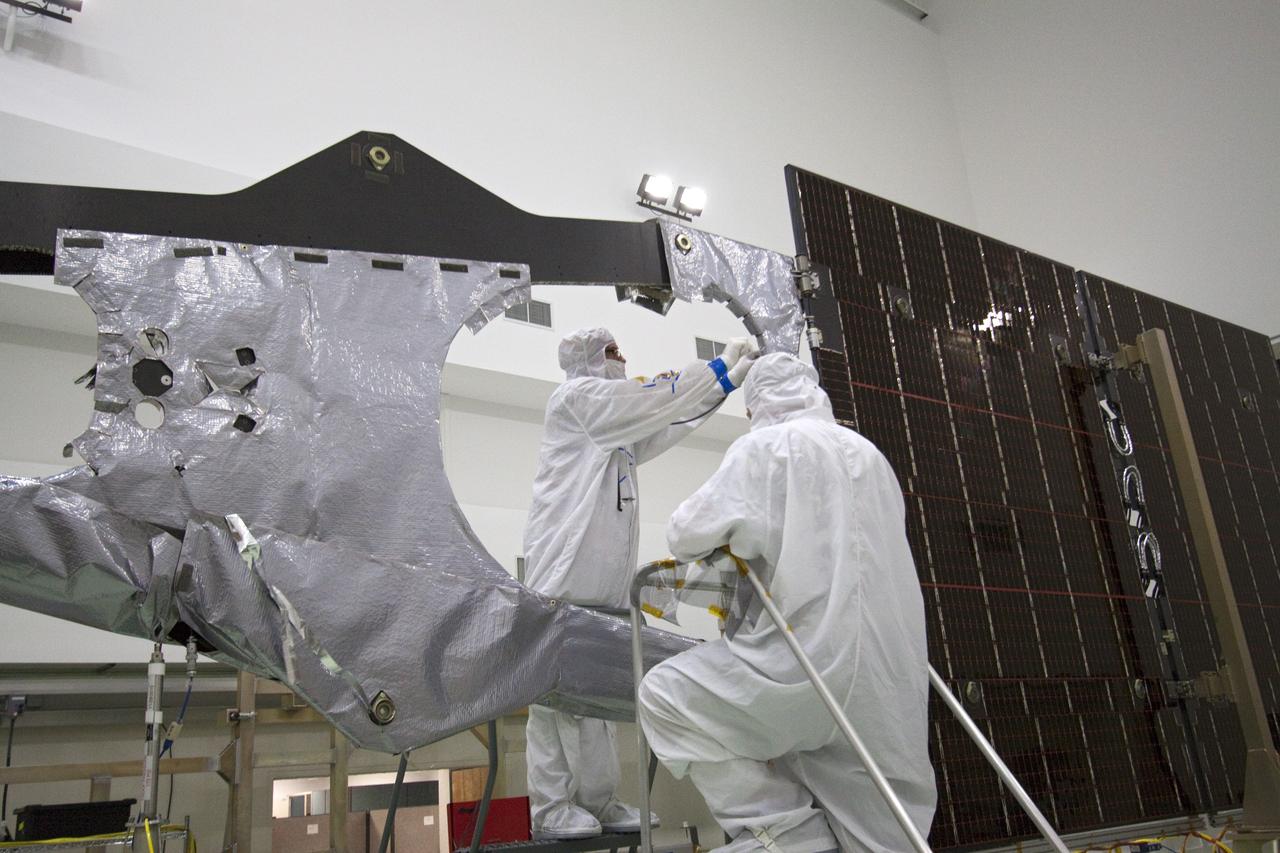
CAPE CANAVERAL, Fla. -- Technicians in the Astrotech payload processing facility in Titusville, Fla. install thermal insulation on NASA's Juno magnetometer boom. The boom structure is attached to Juno's solar array #1 that will help power the NASA spacecraft on its mission to Jupiter. The solar-powered spacecraft will orbit Jupiter's poles 33 times to find out more about the gas giant's origins, structure, atmosphere and magnetosphere and investigate the existence of a solid planetary core. Juno is scheduled to launch aboard an Atlas V rocket from Cape Canaveral, Fla. Aug. 5. For more information visit, www.nasa.gov/juno. Photo credit: NASA/Jack Pfaller It will splash down into the Atlantic Ocean where the ship and its crew will recover it and tow it back through Port Canaveral for refurbishing for another launch. The STS-124 mission is the second of three flights launching components to complete the Japan Aerospace Exploration Agency's Kibo laboratory. The shuttle crew will install Kibo's large Japanese Pressurized Module and its remote manipulator system, or RMS. Photo credit: USA/Jeff Suter
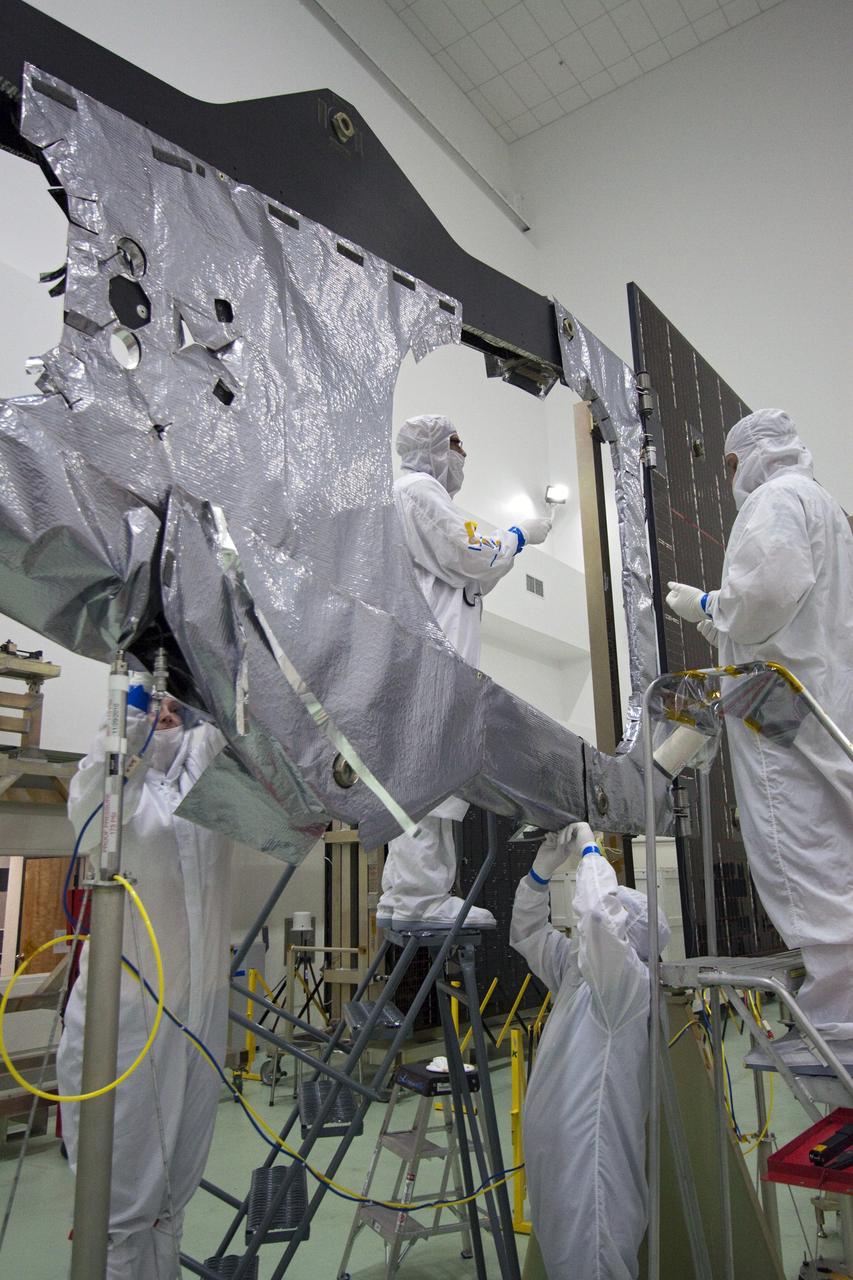
CAPE CANAVERAL, Fla. -- Technicians in the Astrotech payload processing facility in Titusville, Fla. install thermal insulation on NASA's Juno magnetometer boom. The boom structure is attached to Juno's solar array #1 that will help power the NASA spacecraft on its mission to Jupiter. The solar-powered spacecraft will orbit Jupiter's poles 33 times to find out more about the gas giant's origins, structure, atmosphere and magnetosphere and investigate the existence of a solid planetary core. Juno is scheduled to launch aboard an Atlas V rocket from Cape Canaveral, Fla. Aug. 5. For more information visit, www.nasa.gov/juno. Photo credit: NASA/Jack Pfaller It will splash down into the Atlantic Ocean where the ship and its crew will recover it and tow it back through Port Canaveral for refurbishing for another launch. The STS-124 mission is the second of three flights launching components to complete the Japan Aerospace Exploration Agency's Kibo laboratory. The shuttle crew will install Kibo's large Japanese Pressurized Module and its remote manipulator system, or RMS. Photo credit: USA/Jeff Suter
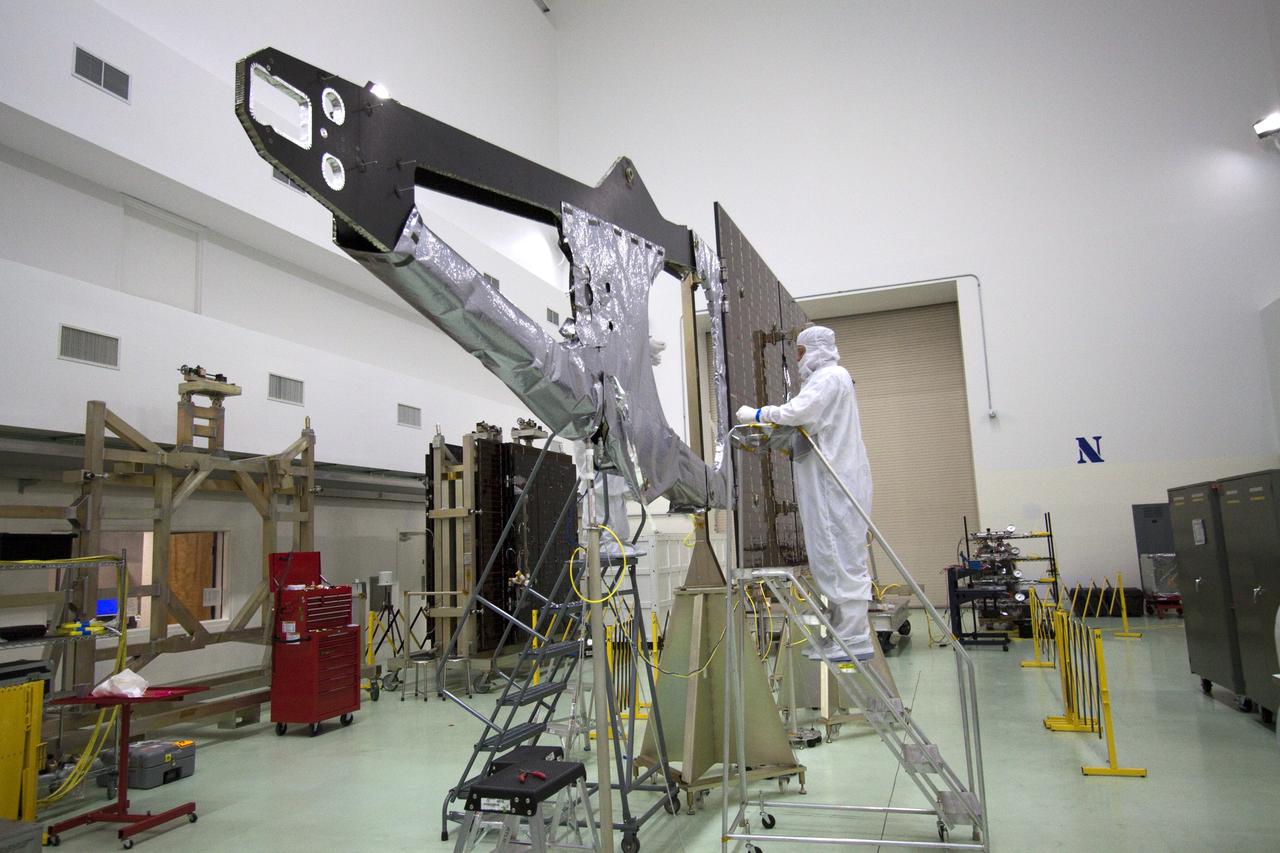
CAPE CANAVERAL, Fla. -- Technicians in the Astrotech payload processing facility in Titusville, Fla. install thermal insulation on NASA's Juno magnetometer boom. The boom structure is attached to Juno's solar array #1 that will help power the NASA spacecraft on its mission to Jupiter. The solar-powered spacecraft will orbit Jupiter's poles 33 times to find out more about the gas giant's origins, structure, atmosphere and magnetosphere and investigate the existence of a solid planetary core. Juno is scheduled to launch aboard an Atlas V rocket from Cape Canaveral, Fla. Aug. 5. For more information visit, www.nasa.gov/juno. Photo credit: NASA/Jack Pfaller It will splash down into the Atlantic Ocean where the ship and its crew will recover it and tow it back through Port Canaveral for refurbishing for another launch. The STS-124 mission is the second of three flights launching components to complete the Japan Aerospace Exploration Agency's Kibo laboratory. The shuttle crew will install Kibo's large Japanese Pressurized Module and its remote manipulator system, or RMS. Photo credit: USA/Jeff Suter
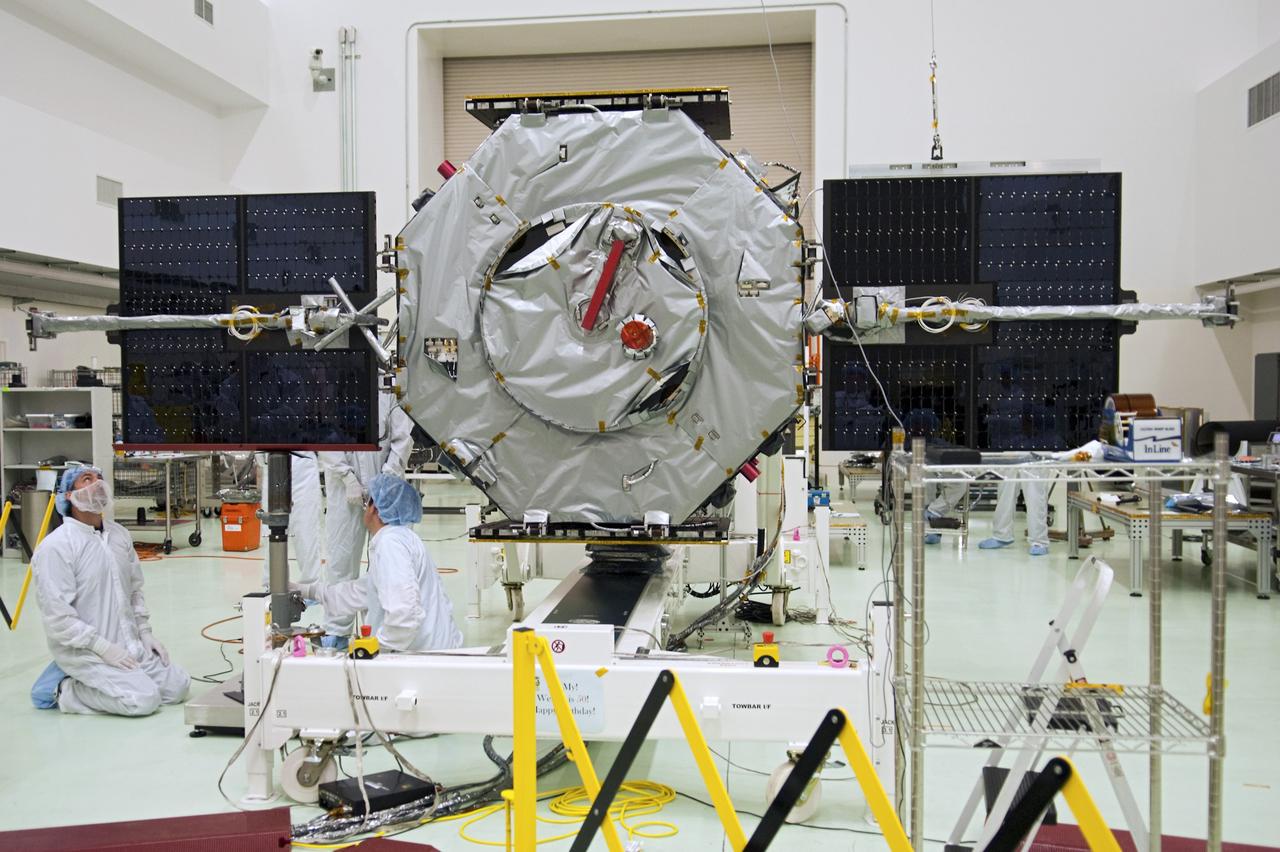
CAPE CANAVERAL, Fla. - Inside the Astrotech payload processing facility near NASA’s Kennedy Space Center in Florida, technicians deploy the solar arrays and magnetometer boom of the Radiation Belt Storm Probes, or RBSP, spacecraft A. Deploying these components are standard procedure to ensure they work properly on Earth before they head into space. NASA’s RBSP mission will help us understand the sun’s influence on Earth and near-Earth space by studying the Earth’s radiation belts on various scales of space and time. As the spacecraft orbits Earth, the four solar panels will continuously face the sun to provide constant power to its instruments. The boom will provide data of the electric fields that energize radiation particles and modify the structure of the inner magnetosphere. RBSP will begin its mission of exploration of Earth’s Van Allen radiation belts and the extremes of space weather after its launch aboard a United Launch Alliance Atlas V rocket. Launch is targeted for Aug. 23. For more information, visit http://www.nasa.gov/rbsp. Photo credit: NASA/Charisse Nahser

CAPE CANAVERAL, Fla. - Inside the Astrotech payload processing facility near NASA’s Kennedy Space Center in Florida, technicians perform a solar array illumination test after the solar arrays and magnetometer boom were deployed on the Radiation Belt Storm Probes, or RBSP, spacecraft A. Deploying these components are a standard procedure to ensure they work properly on Earth before they head into space. NASA’s RBSP mission will help us understand the sun’s influence on Earth and near-Earth space by studying the Earth’s radiation belts on various scales of space and time. As the spacecraft orbits Earth, the four solar panels will continuously face the sun to provide constant power to its instruments. The boom will provide data of the electric fields that energize radiation particles and modify the structure of the inner magnetosphere. RBSP will begin its mission of exploration of Earth’s Van Allen radiation belts and the extremes of space weather after its launch aboard a United Launch Alliance Atlas V rocket. Launch is targeted for Aug. 23. For more information, visit http://www.nasa.gov/rbsp. Photo credit: NASA/Charisse Nahser
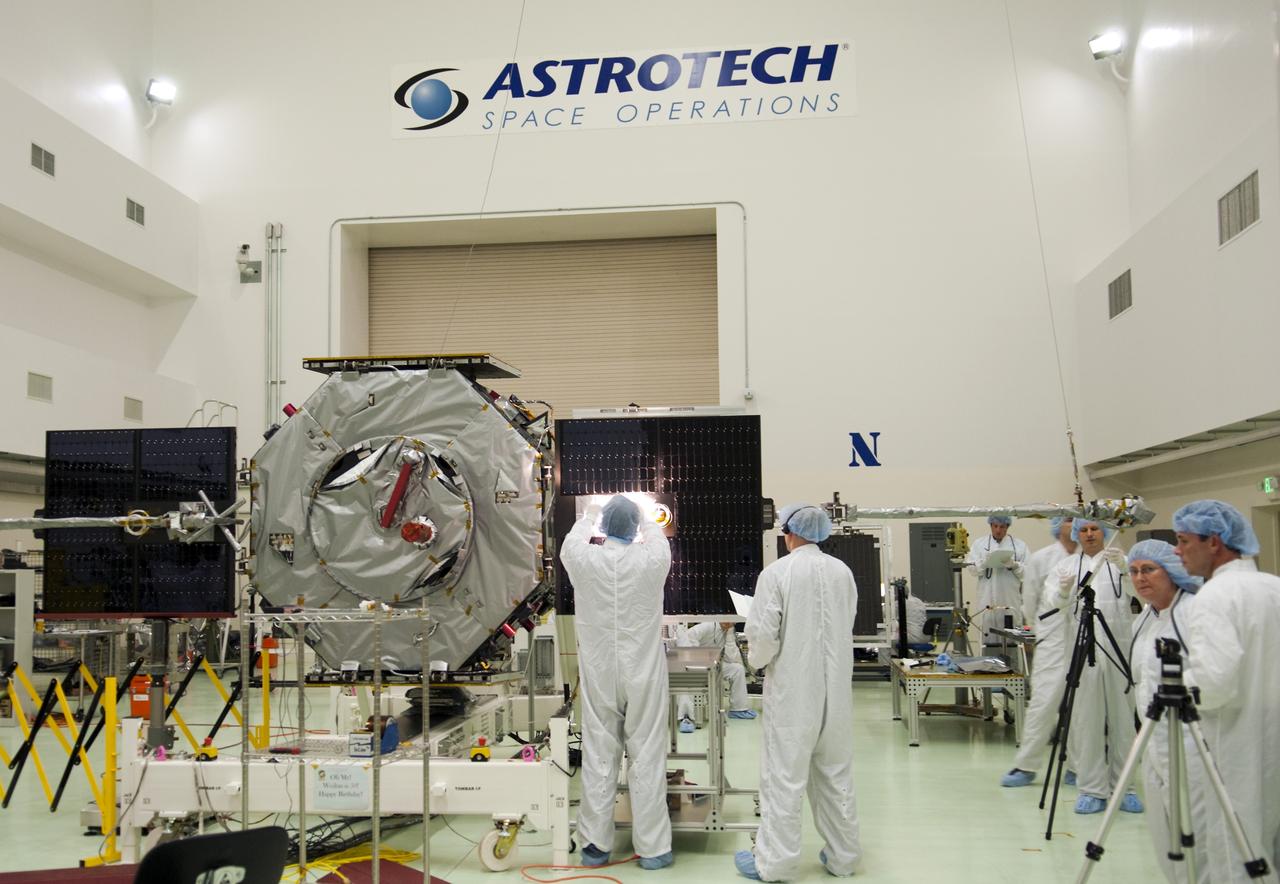
CAPE CANAVERAL, Fla. - Inside the Astrotech payload processing facility near NASA’s Kennedy Space Center in Florida, technicians perform a solar array illumination test after the Radiation Belt Storm Probes, or RBSP, spacecraft A solar arrays and magnetometer boom were deployed. Deploying these components is a standard procedure to ensure they work properly on Earth before they head into space. NASA’s RBSP mission will help us understand the sun’s influence on Earth and near-Earth space by studying the Earth’s radiation belts on various scales of space and time. As the spacecraft orbits Earth, the four solar panels will continuously face the sun to provide constant power to its instruments. The boom will provide data of the electric fields that energize radiation particles and modify the structure of the inner magnetosphere. RBSP will begin its mission of exploration of Earth’s Van Allen radiation belts and the extremes of space weather after its launch aboard a United Launch Alliance Atlas V rocket. Launch is targeted for Aug. 23. For more information, visit http://www.nasa.gov/rbsp. Photo credit: NASA/Charisse Nahser
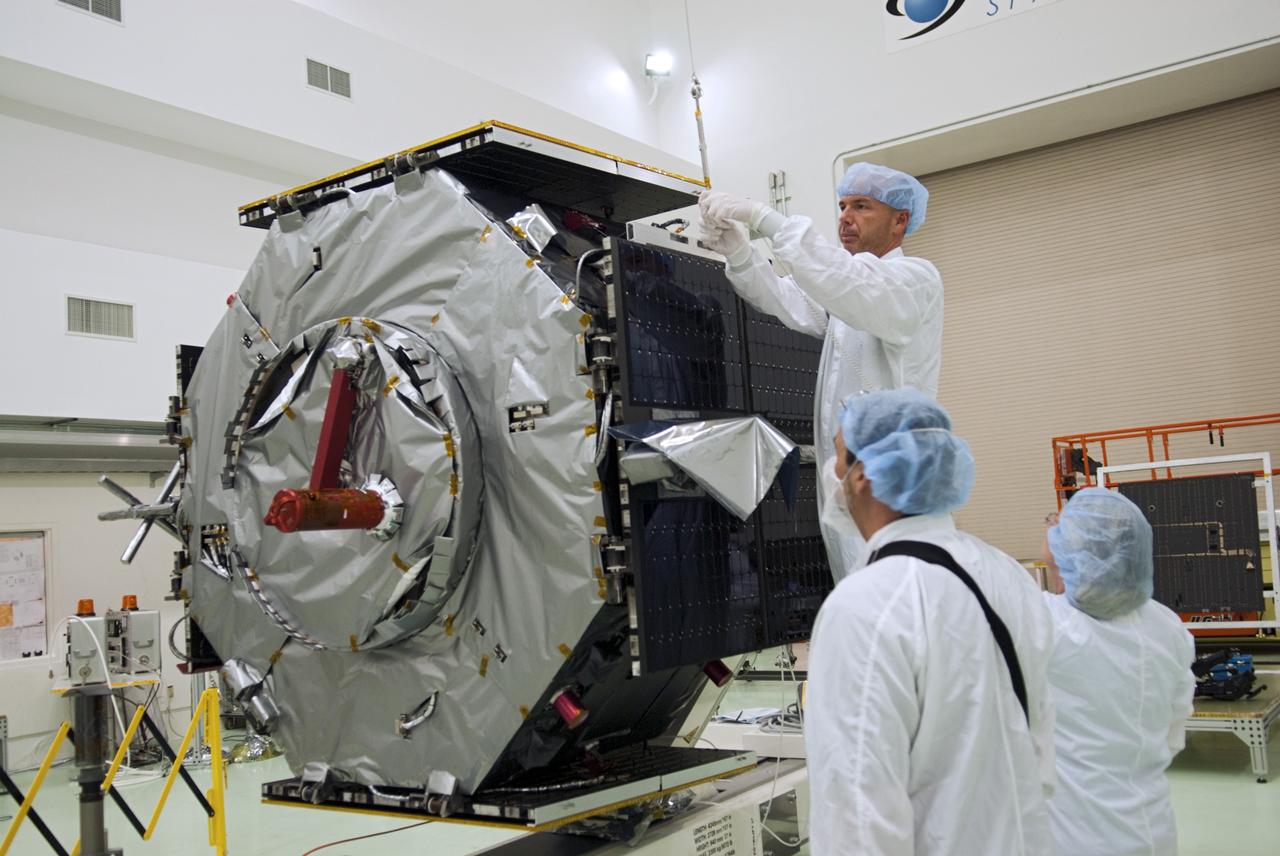
CAPE CANAVERAL, Fla. - Inside the Astrotech payload processing facility near NASA’s Kennedy Space Center in Florida, technicians prepare to deploy the solar arrays and magnetometer boom of the Radiation Belt Storm Probes, or RBSP, spacecraft A. Deploying these components are standard procedure to ensure they work properly on Earth before they head into space. NASA’s RBSP mission will help us understand the sun’s influence on Earth and near-Earth space by studying the Earth’s radiation belts on various scales of space and time. As the spacecraft orbits Earth, the four solar panels will continuously face the sun to provide constant power to its instruments. The boom will provide data of the electric fields that energize radiation particles and modify the structure of the inner magnetosphere. RBSP will begin its mission of exploration of Earth’s Van Allen radiation belts and the extremes of space weather after its launch aboard a United Launch Alliance Atlas V rocket. Launch is targeted for Aug. 23. For more information, visit http://www.nasa.gov/rbsp. Photo credit: NASA/Charisse Nahser
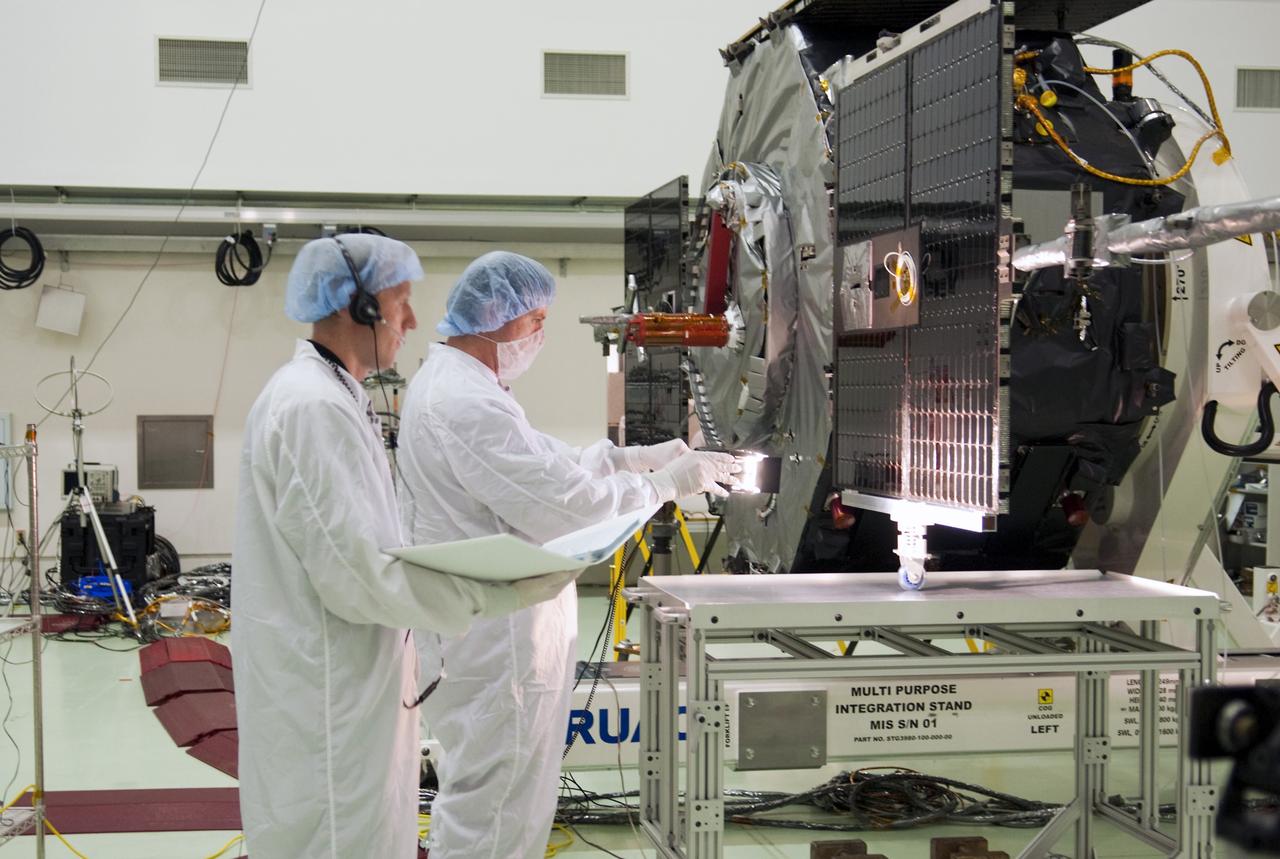
CAPE CANAVERAL, Fla. - Inside the Astrotech payload processing facility near NASA’s Kennedy Space Center in Florida, technicians perform a solar array illumination test after the solar arrays and magnetometer boom were deployed on the Radiation Belt Storm Probes, or RBSP, spacecraft A. Deploying these components are a standard procedure to ensure they work properly on Earth before they head into space. NASA’s RBSP mission will help us understand the sun’s influence on Earth and near-Earth space by studying the Earth’s radiation belts on various scales of space and time. As the spacecraft orbits Earth, the four solar panels will continuously face the sun to provide constant power to its instruments. The boom will provide data of the electric fields that energize radiation particles and modify the structure of the inner magnetosphere. RBSP will begin its mission of exploration of Earth’s Van Allen radiation belts and the extremes of space weather after its launch aboard a United Launch Alliance Atlas V rocket. Launch is targeted for Aug. 23. For more information, visit http://www.nasa.gov/rbsp. Photo credit: NASA/Charisse Nahser
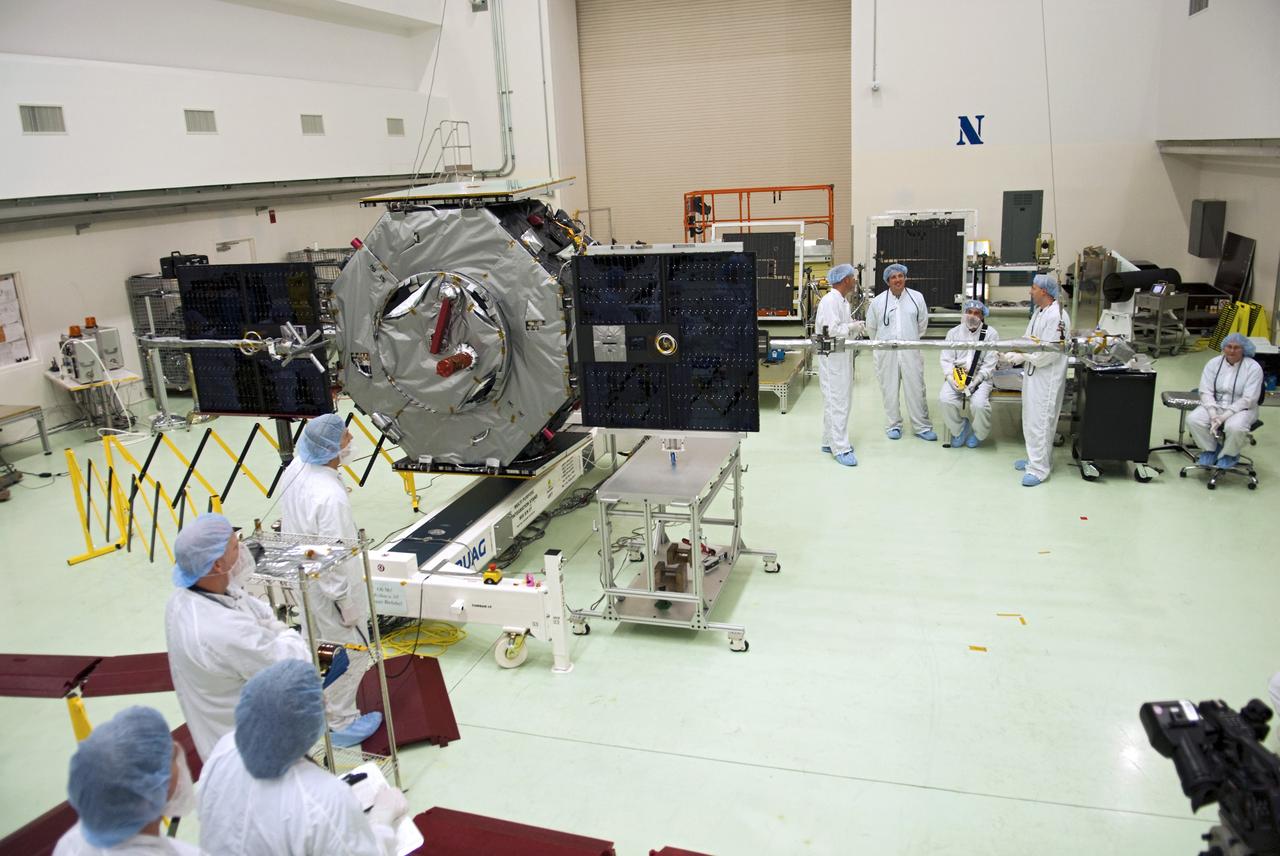
CAPE CANAVERAL, Fla. - Inside the Astrotech payload processing facility near NASA’s Kennedy Space Center in Florida, technicians deploy the solar arrays and magnetometer boom of the Radiation Belt Storm Probes, or RBSP, spacecraft A. Deploying these components is standard procedure to ensure they work properly on Earth before they head into space. NASA’s RBSP mission will help us understand the sun’s influence on Earth and near-Earth space by studying the Earth’s radiation belts on various scales of space and time. As the spacecraft orbits Earth, the four solar panels will continuously face the sun to provide constant power to its instruments. The boom will provide data of the electric fields that energize radiation particles and modify the structure of the inner magnetosphere. RBSP will begin its mission of exploration of Earth’s Van Allen radiation belts and the extremes of space weather after its launch aboard a United Launch Alliance Atlas V rocket. Launch is targeted for Aug. 23. For more information, visit http://www.nasa.gov/rbsp. Photo credit: NASA/Charisse Nahser
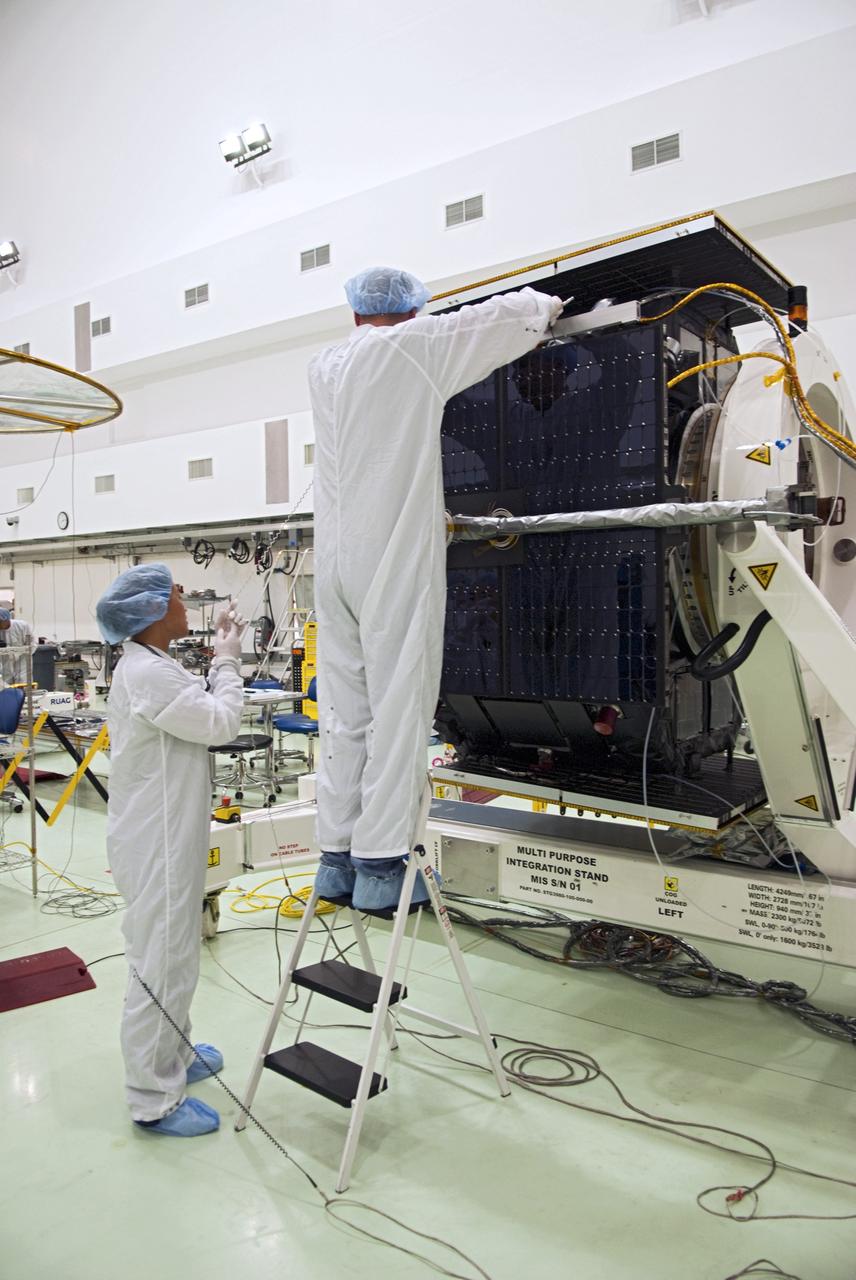
CAPE CANAVERAL, Fla. - Inside the Astrotech payload processing facility near NASA’s Kennedy Space Center in Florida, technicians prepare to deploy the solar arrays and magnetometer boom of the Radiation Belt Storm Probes, or RBSP, spacecraft A. Deploying these components are standard procedure to ensure they work properly on Earth before they head into space. NASA’s RBSP mission will help us understand the sun’s influence on Earth and near-Earth space by studying the Earth’s radiation belts on various scales of space and time. As the spacecraft orbits Earth, the four solar panels will continuously face the sun to provide constant power to its instruments. The boom will provide data of the electric fields that energize radiation particles and modify the structure of the inner magnetosphere. RBSP will begin its mission of exploration of Earth’s Van Allen radiation belts and the extremes of space weather after its launch aboard a United Launch Alliance Atlas V rocket. Launch is targeted for Aug. 23. For more information, visit http://www.nasa.gov/rbsp. Photo credit: NASA/Charisse Nahser
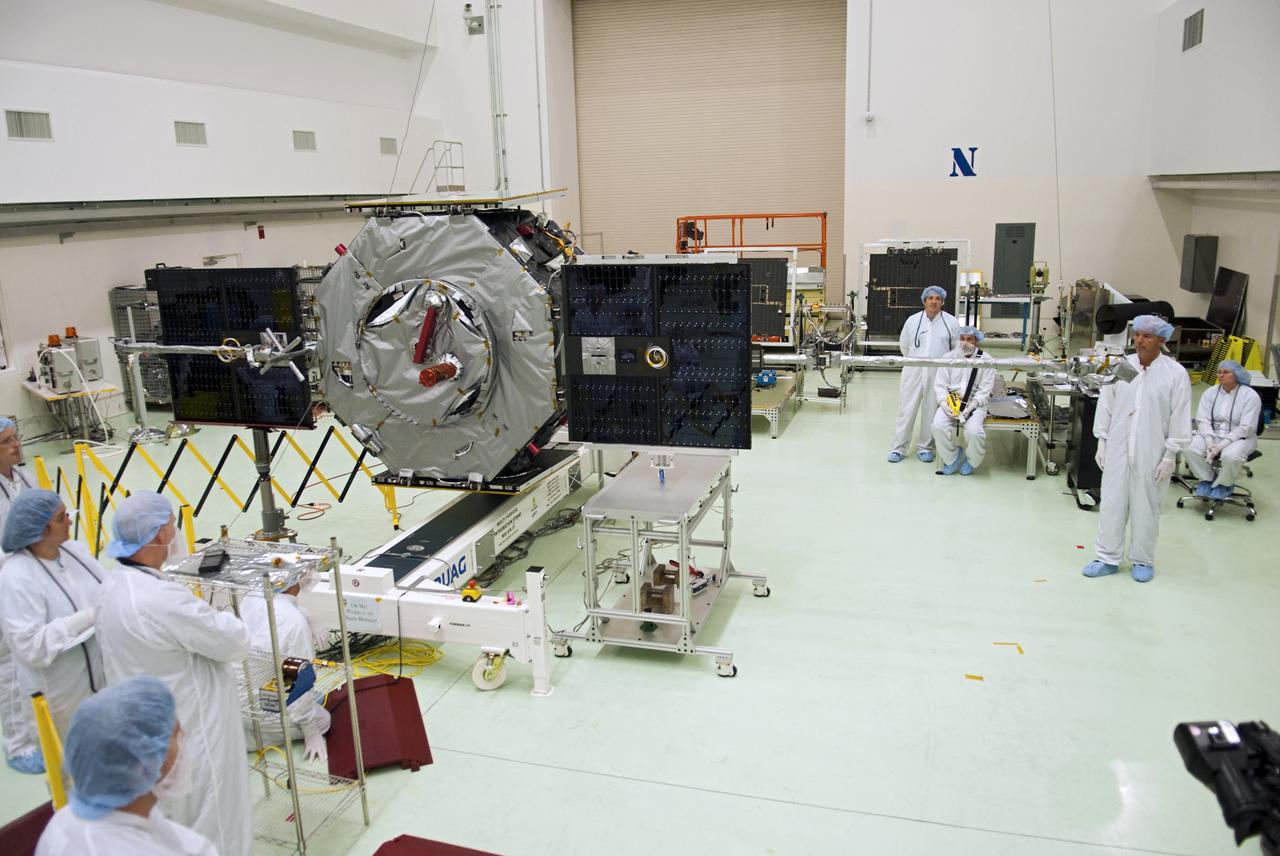
CAPE CANAVERAL, Fla. - Inside the Astrotech payload processing facility near NASA’s Kennedy Space Center in Florida, technicians deploy the solar arrays and magnetometer boom of the Radiation Belt Storm Probes, or RBSP, spacecraft A. Deploying these components is standard procedure to ensure they work properly on Earth before they head into space. NASA’s RBSP mission will help us understand the sun’s influence on Earth and near-Earth space by studying the Earth’s radiation belts on various scales of space and time. As the spacecraft orbits Earth, the four solar panels will continuously face the sun to provide constant power to its instruments. The boom will provide data of the electric fields that energize radiation particles and modify the structure of the inner magnetosphere. RBSP will begin its mission of exploration of Earth’s Van Allen radiation belts and the extremes of space weather after its launch aboard a United Launch Alliance Atlas V rocket. Launch is targeted for Aug. 23. For more information, visit http://www.nasa.gov/rbsp. Photo credit: NASA/Charisse Nahser

CAPE CANAVERAL, Fla. - Inside the Astrotech payload processing facility near NASA’s Kennedy Space Center in Florida, technicians deploy the solar arrays and magnetometer boom of the Radiation Belt Storm Probes, or RBSP, spacecraft A. Deploying these components is standard procedure to ensure they work properly on Earth before they head into space. NASA’s RBSP mission will help us understand the sun’s influence on Earth and near-Earth space by studying the Earth’s radiation belts on various scales of space and time. As the spacecraft orbits Earth, the four solar panels will continuously face the sun to provide constant power to its instruments. The boom will provide data of the electric fields that energize radiation particles and modify the structure of the inner magnetosphere. RBSP will begin its mission of exploration of Earth’s Van Allen radiation belts and the extremes of space weather after its launch aboard a United Launch Alliance Atlas V rocket. Launch is targeted for Aug. 23. For more information, visit http://www.nasa.gov/rbsp. Photo credit: NASA/Charisse Nahser
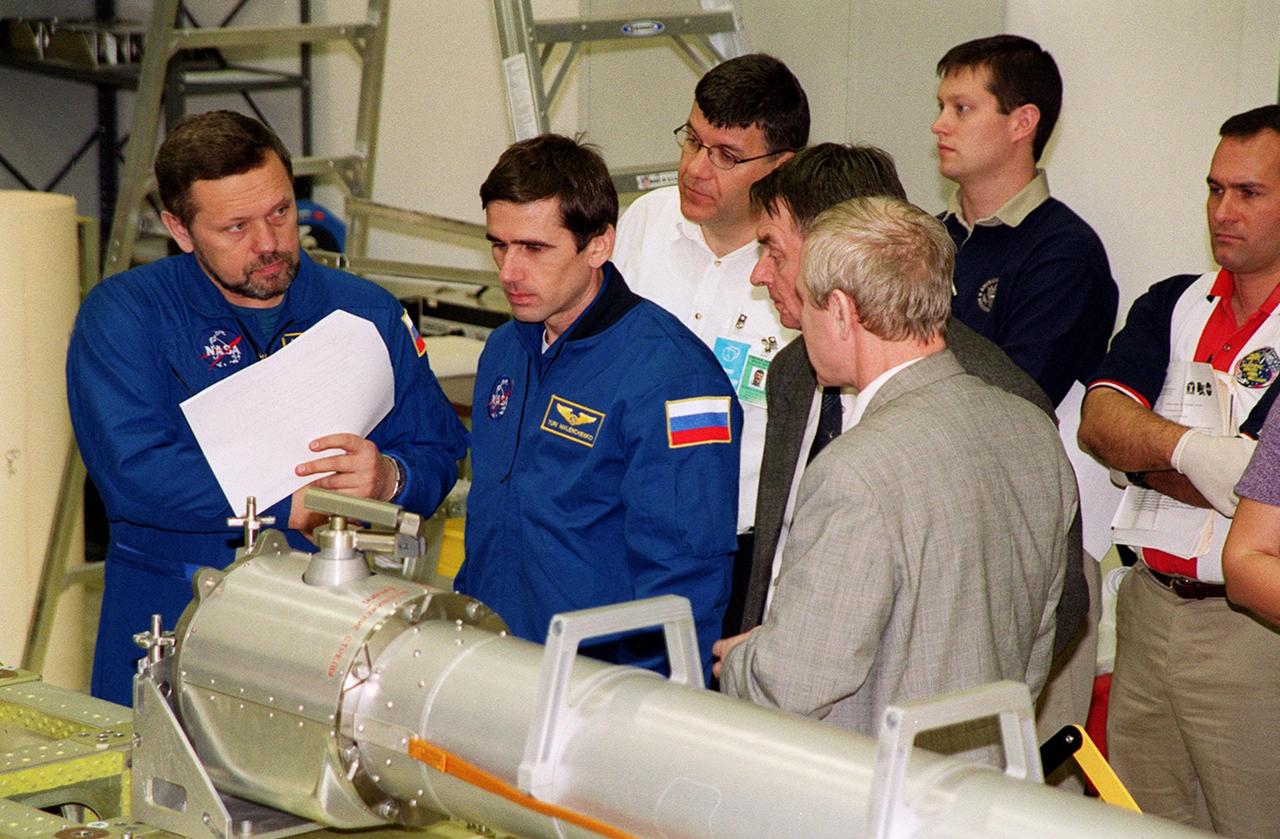
During a Crew Equipment Interface Test (CEIT), members of the STS-101 crew learn about some of the cargo that will be on their mission from workers at SPACEHAB, in Cape Canaveral, Fla. At left are Mission Specialists Boris W. Morukov and Yuri Malenchenko, who are with the Russian Space Agency. Other crew members are Commander James Donald Halsell Jr., Pilot Scott Horowitz, and Mission Specialists Mary Ellen Weber (Ph.D.), Edward Lu, and Jeffrey N. Williams, The primary objective of the STS-101 mission is to complete the initial outfitting of the International Space Station, making it fully ready for the first long-term crew. The seven-member crew will transfer almost two tons of equipment and supplies from SPACEHAB's Logistics Double Module. Additionally, they will unpack a shipment of supplies delivered earlier by a Russian Progress space tug and begin outfitting the newly arrived Zvezda Service Module. Three astronauts will perform two space walks to transfer and install parts of the Russian Strela cargo boom that are attached to SPACEHAB's Integrated Cargo Container, connect utility cables between Zarya and Zvezda, and install a magnetometer/pole assembly on the Service Module. Additional activities for the STS-101 astronauts include working with the Space Experiment Module (SEM-06) and the Mission to America's Remarkable Schools (MARS), two educational initiatives. STS-101 is scheduled for launch no earlier than March 16, 2000
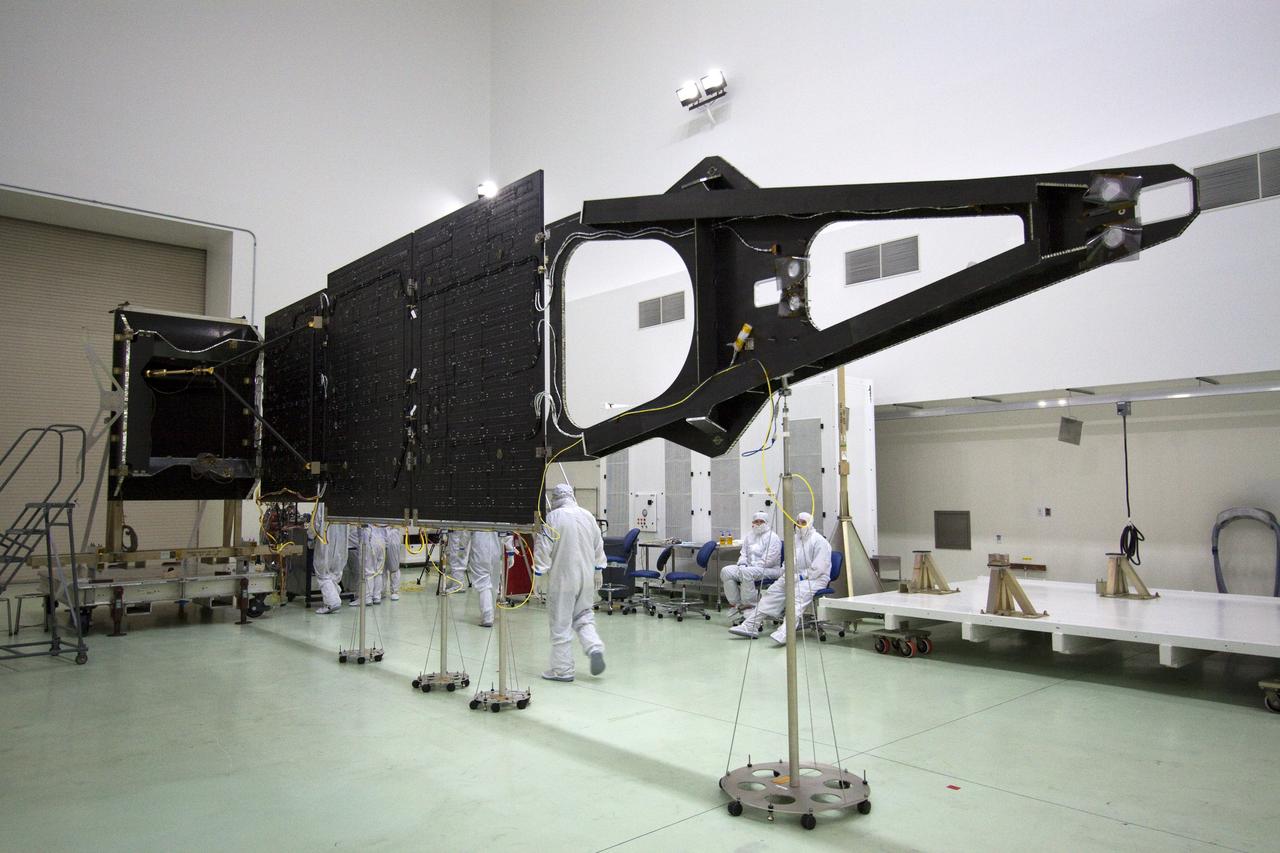
CAPE CANAVERAL, Fla. -- Technicians in the Astrotech payload processing facility in Titusville, Fla., unfurl solar array No. 1 with a magnetometer boom that will help power NASA's Juno spacecraft on a mission to Jupiter. Power-generating panels on three sets of solar arrays will extend outward from Juno’s hexagonal body, giving the overall spacecraft a span of more than 66 feet in order to operate at such a great distance from the sun. Juno is scheduled to launch aboard an Atlas V rocket from Cape Canaveral, Fla., on Aug. 5, 2011, reaching Jupiter in July 2016. The spacecraft will orbit the giant planet more than 30 times, skimming to within 3,000 miles above its cloud tops, for about one year. With its suite of science instruments, the spacecraft will investigate the existence of a solid planetary core, map Jupiter's intense magnetic field, measure the amount of water and ammonia in the deep atmosphere, and observe the planet's auroras. For more information visit, www.nasa.gov/juno. Photo credit: NASA/Jack Pfaller
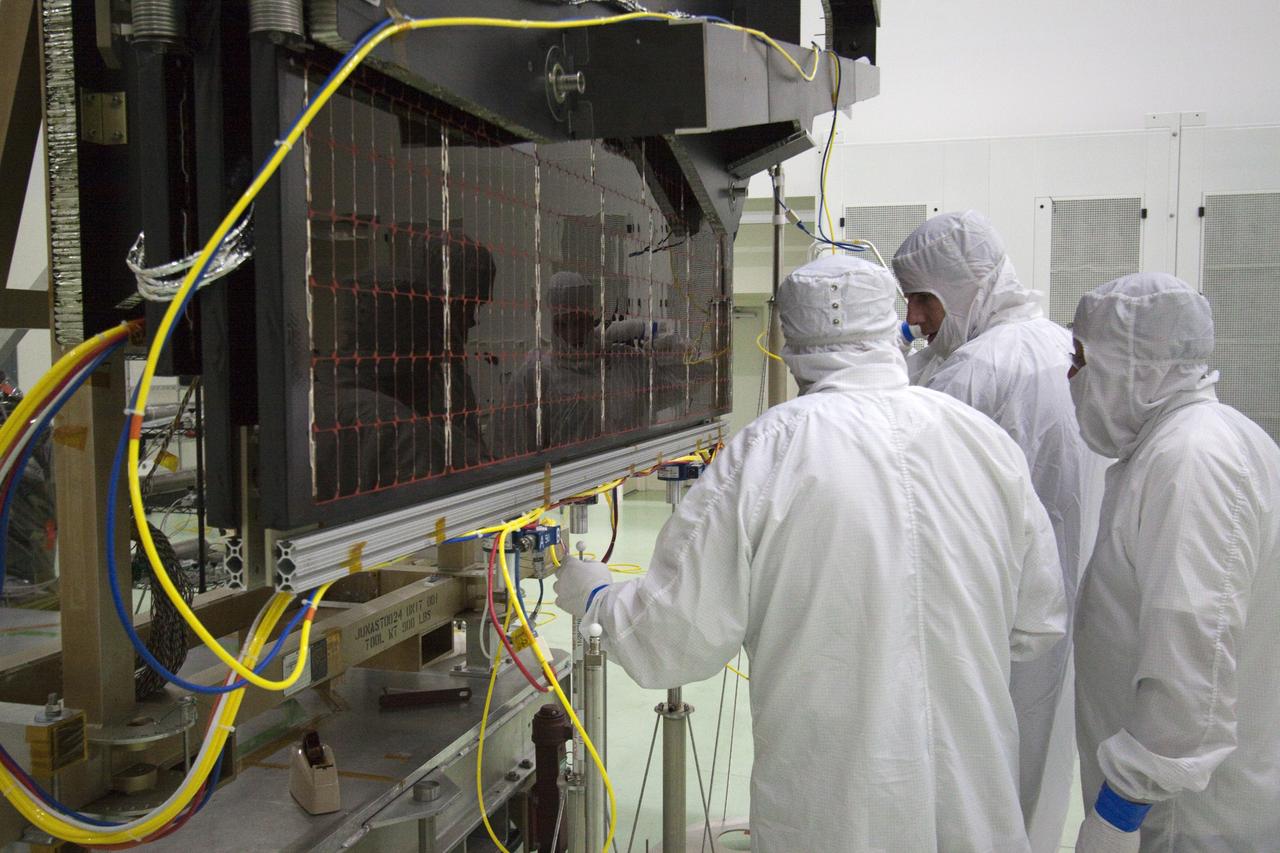
CAPE CANAVERAL, Fla. -- Technicians in the Astrotech payload processing facility in Titusville, Fla., begin to unfurl solar array No. 1 with a magnetometer boom that will help power NASA's Juno spacecraft on a mission to Jupiter. Power-generating panels on three sets of solar arrays will extend outward from Juno’s hexagonal body, giving the overall spacecraft a span of more than 66 feet in order to operate at such a great distance from the sun. Juno is scheduled to launch aboard an Atlas V rocket from Cape Canaveral, Fla., on Aug. 5, 2011, reaching Jupiter in July 2016. The spacecraft will orbit the giant planet more than 30 times, skimming to within 3,000 miles above its cloud tops, for about one year. With its suite of science instruments, the spacecraft will investigate the existence of a solid planetary core, map Jupiter's intense magnetic field, measure the amount of water and ammonia in the deep atmosphere, and observe the planet's auroras. For more information visit, www.nasa.gov/juno. Photo credit: NASA/Jack Pfaller
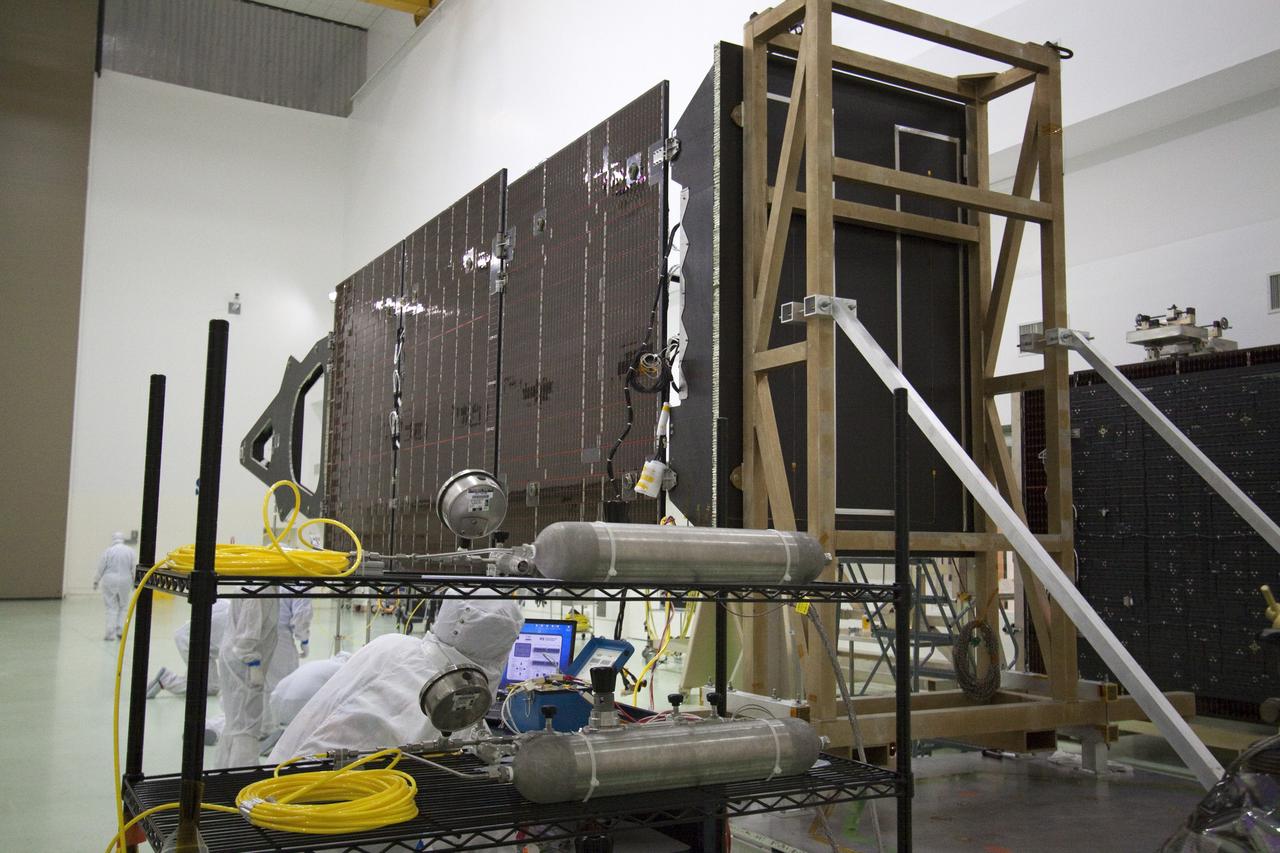
CAPE CANAVERAL, Fla. -- Technicians in the Astrotech payload processing facility in Titusville, Fla., check out solar array No. 1 with a magnetometer boom that will help power NASA's Juno spacecraft on a mission to Jupiter. Power-generating panels on three sets of solar arrays will extend outward from Juno’s hexagonal body, giving the overall spacecraft a span of more than 66 feet in order to operate at such a great distance from the sun. Juno is scheduled to launch aboard an Atlas V rocket from Cape Canaveral, Fla., on Aug. 5, 2011, reaching Jupiter in July 2016. The spacecraft will orbit the giant planet more than 30 times, skimming to within 3,000 miles above its cloud tops, for about one year. With its suite of science instruments, the spacecraft will investigate the existence of a solid planetary core, map Jupiter's intense magnetic field, measure the amount of water and ammonia in the deep atmosphere, and observe the planet's auroras. For more information visit, www.nasa.gov/juno. Photo credit: NASA/Jack Pfaller
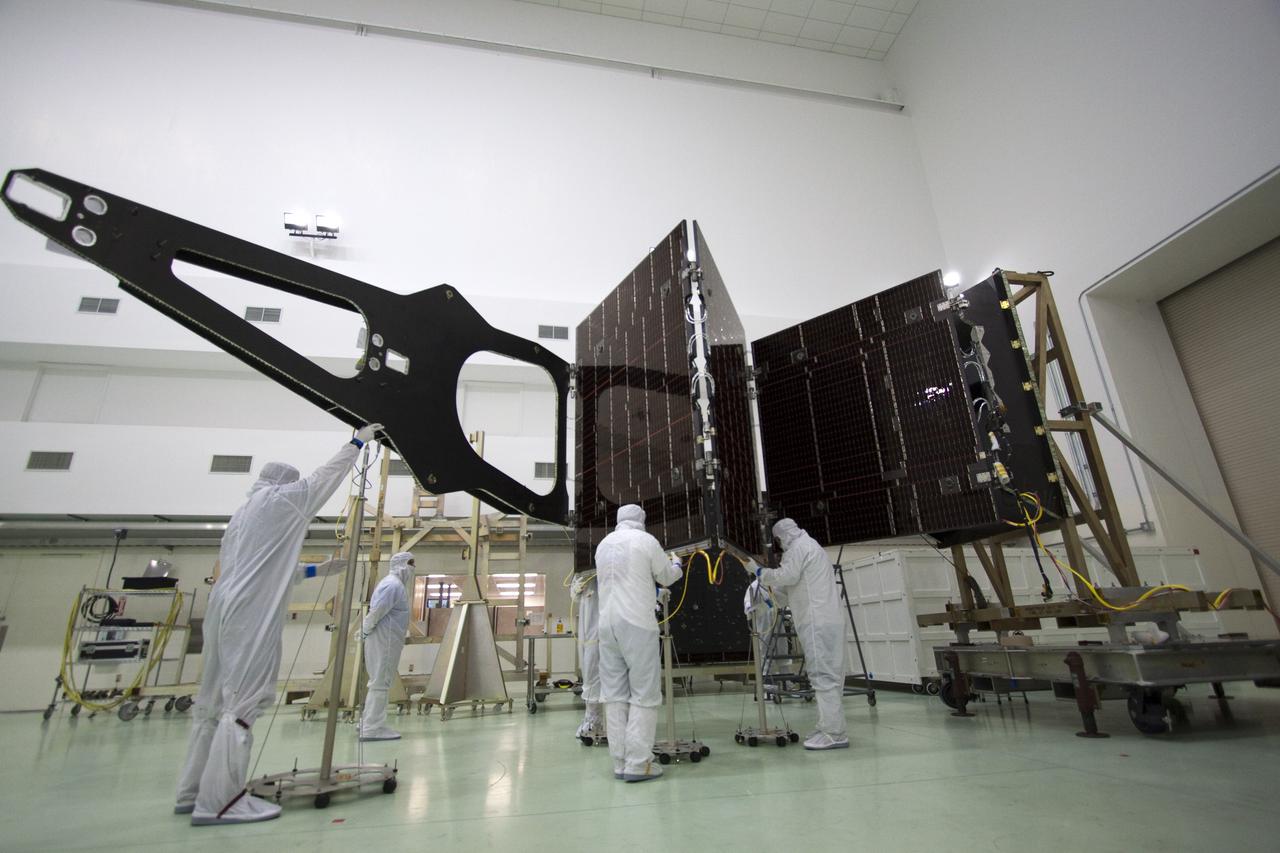
CAPE CANAVERAL, Fla. -- Technicians in the Astrotech payload processing facility in Titusville, Fla., unfurl solar array No. 1 with a magnetometer boom that will help power NASA's Juno spacecraft on a mission to Jupiter. Power-generating panels on three sets of solar arrays will extend outward from Juno’s hexagonal body, giving the overall spacecraft a span of more than 66 feet in order to operate at such a great distance from the sun. Juno is scheduled to launch aboard an Atlas V rocket from Cape Canaveral, Fla., on Aug. 5, 2011, reaching Jupiter in July 2016. The spacecraft will orbit the giant planet more than 30 times, skimming to within 3,000 miles above its cloud tops, for about one year. With its suite of science instruments, the spacecraft will investigate the existence of a solid planetary core, map Jupiter's intense magnetic field, measure the amount of water and ammonia in the deep atmosphere, and observe the planet's auroras. For more information visit, www.nasa.gov/juno. Photo credit: NASA/Jack Pfaller
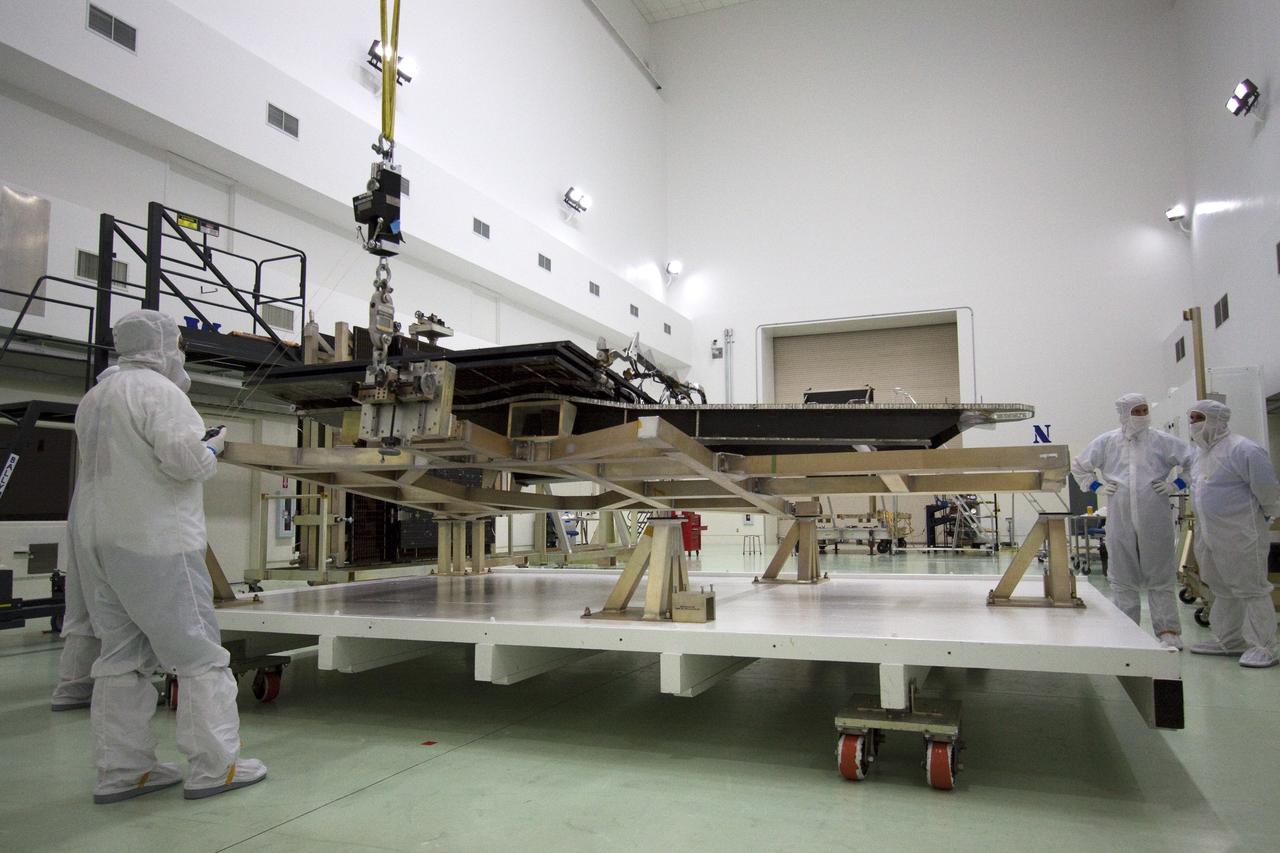
CAPE CANAVERAL, Fla. -- Technicians in the Astrotech payload processing facility in Titusville, Fla., prepare to unfurl solar array No. 1 with a magnetometer boom that will help power NASA's Juno spacecraft on a mission to Jupiter. Power-generating panels on three sets of solar arrays will extend outward from Juno’s hexagonal body, giving the overall spacecraft a span of more than 66 feet in order to operate at such a great distance from the sun. Juno is scheduled to launch aboard an Atlas V rocket from Cape Canaveral, Fla., on Aug. 5, 2011, reaching Jupiter in July 2016. The spacecraft will orbit the giant planet more than 30 times, skimming to within 3,000 miles above its cloud tops, for about one year. With its suite of science instruments, the spacecraft will investigate the existence of a solid planetary core, map Jupiter's intense magnetic field, measure the amount of water and ammonia in the deep atmosphere, and observe the planet's auroras. For more information visit, www.nasa.gov/juno. Photo credit: NASA/Jack Pfaller

CAPE CANAVERAL, Fla. -- Technicians in the Astrotech payload processing facility in Titusville, Fla., prepare to unfurl solar array No. 1 with a magnetometer boom that will help power NASA's Juno spacecraft on a mission to Jupiter. Power-generating panels on three sets of solar arrays will extend outward from Juno’s hexagonal body, giving the overall spacecraft a span of more than 66 feet in order to operate at such a great distance from the sun. Juno is scheduled to launch aboard an Atlas V rocket from Cape Canaveral, Fla., on Aug. 5, 2011, reaching Jupiter in July 2016. The spacecraft will orbit the giant planet more than 30 times, skimming to within 3,000 miles above its cloud tops, for about one year. With its suite of science instruments, the spacecraft will investigate the existence of a solid planetary core, map Jupiter's intense magnetic field, measure the amount of water and ammonia in the deep atmosphere, and observe the planet's auroras. For more information visit, www.nasa.gov/juno. Photo credit: NASA/Jack Pfaller
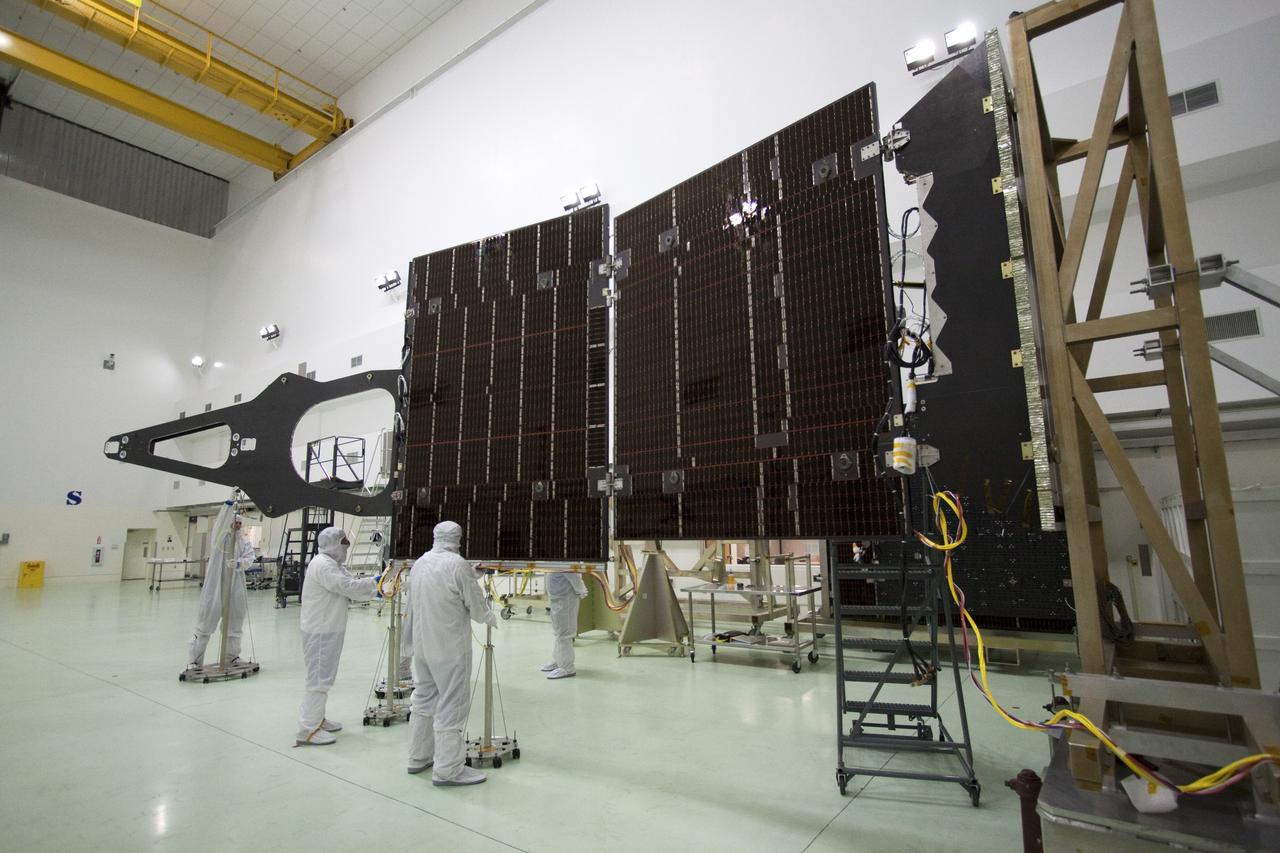
CAPE CANAVERAL, Fla. -- Technicians in the Astrotech payload processing facility in Titusville, Fla., unfurl solar array No. 1 with a magnetometer boom that will help power NASA's Juno spacecraft on a mission to Jupiter. Power-generating panels on three sets of solar arrays will extend outward from Juno’s hexagonal body, giving the overall spacecraft a span of more than 66 feet in order to operate at such a great distance from the sun. Juno is scheduled to launch aboard an Atlas V rocket from Cape Canaveral, Fla., on Aug. 5, 2011, reaching Jupiter in July 2016. The spacecraft will orbit the giant planet more than 30 times, skimming to within 3,000 miles above its cloud tops, for about one year. With its suite of science instruments, the spacecraft will investigate the existence of a solid planetary core, map Jupiter's intense magnetic field, measure the amount of water and ammonia in the deep atmosphere, and observe the planet's auroras. For more information visit, www.nasa.gov/juno. Photo credit: NASA/Jack Pfaller

CAPE CANAVERAL, Fla. -- Technicians in the Astrotech payload processing facility in Titusville, Fla., unfurl solar array No. 1 with a magnetometer boom that will help power NASA's Juno spacecraft on a mission to Jupiter. Power-generating panels on three sets of solar arrays will extend outward from Juno’s hexagonal body, giving the overall spacecraft a span of more than 66 feet in order to operate at such a great distance from the sun. Juno is scheduled to launch aboard an Atlas V rocket from Cape Canaveral, Fla., on Aug. 5, 2011, reaching Jupiter in July 2016. The spacecraft will orbit the giant planet more than 30 times, skimming to within 3,000 miles above its cloud tops, for about one year. With its suite of science instruments, the spacecraft will investigate the existence of a solid planetary core, map Jupiter's intense magnetic field, measure the amount of water and ammonia in the deep atmosphere, and observe the planet's auroras. For more information visit, www.nasa.gov/juno. Photo credit: NASA/Jack Pfaller
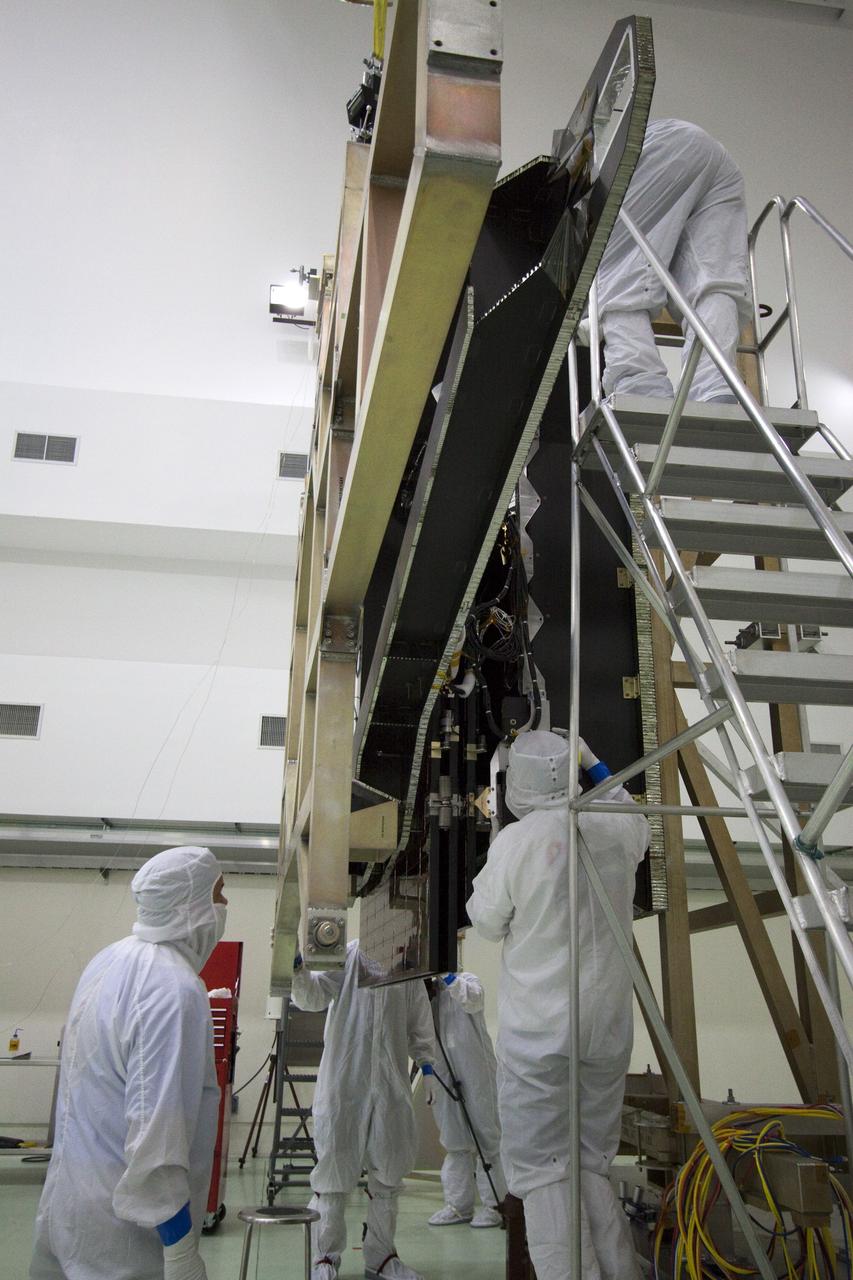
CAPE CANAVERAL, Fla. -- Technicians in the Astrotech payload processing facility in Titusville, Fla., prepare to unfurl solar array No. 1 with a magnetometer boom that will help power NASA's Juno spacecraft on a mission to Jupiter. Power-generating panels on three sets of solar arrays will extend outward from Juno’s hexagonal body, giving the overall spacecraft a span of more than 66 feet in order to operate at such a great distance from the sun. Juno is scheduled to launch aboard an Atlas V rocket from Cape Canaveral, Fla., on Aug. 5, 2011, reaching Jupiter in July 2016. The spacecraft will orbit the giant planet more than 30 times, skimming to within 3,000 miles above its cloud tops, for about one year. With its suite of science instruments, the spacecraft will investigate the existence of a solid planetary core, map Jupiter's intense magnetic field, measure the amount of water and ammonia in the deep atmosphere, and observe the planet's auroras. For more information visit, www.nasa.gov/juno. Photo credit: NASA/Jack Pfaller
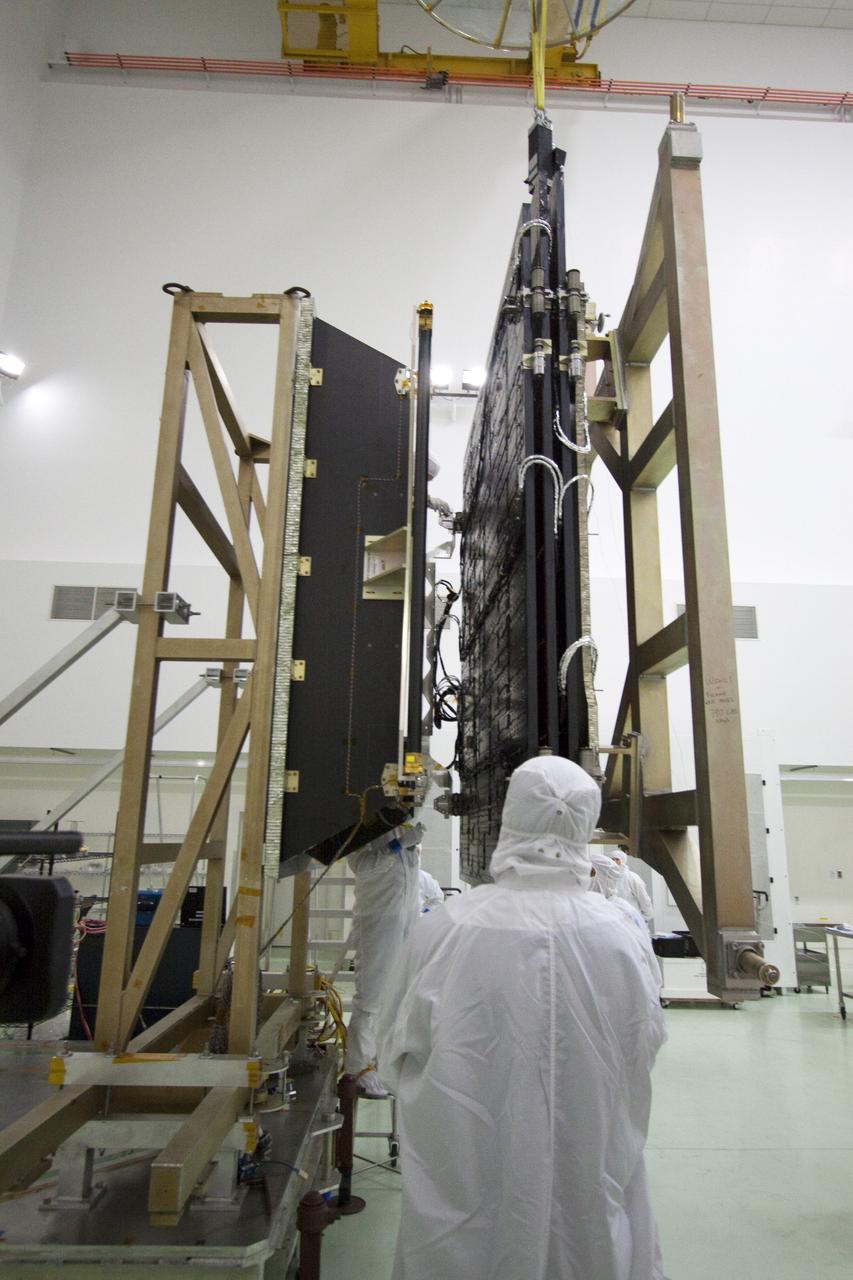
CAPE CANAVERAL, Fla. -- Technicians in the Astrotech payload processing facility in Titusville, Fla., prepare to unfurl solar array No. 1 with a magnetometer boom that will help power NASA's Juno spacecraft on a mission to Jupiter. Power-generating panels on three sets of solar arrays will extend outward from Juno’s hexagonal body, giving the overall spacecraft a span of more than 66 feet in order to operate at such a great distance from the sun. Juno is scheduled to launch aboard an Atlas V rocket from Cape Canaveral, Fla., on Aug. 5, 2011, reaching Jupiter in July 2016. The spacecraft will orbit the giant planet more than 30 times, skimming to within 3,000 miles above its cloud tops, for about one year. With its suite of science instruments, the spacecraft will investigate the existence of a solid planetary core, map Jupiter's intense magnetic field, measure the amount of water and ammonia in the deep atmosphere, and observe the planet's auroras. For more information visit, www.nasa.gov/juno. Photo credit: NASA/Jack Pfaller
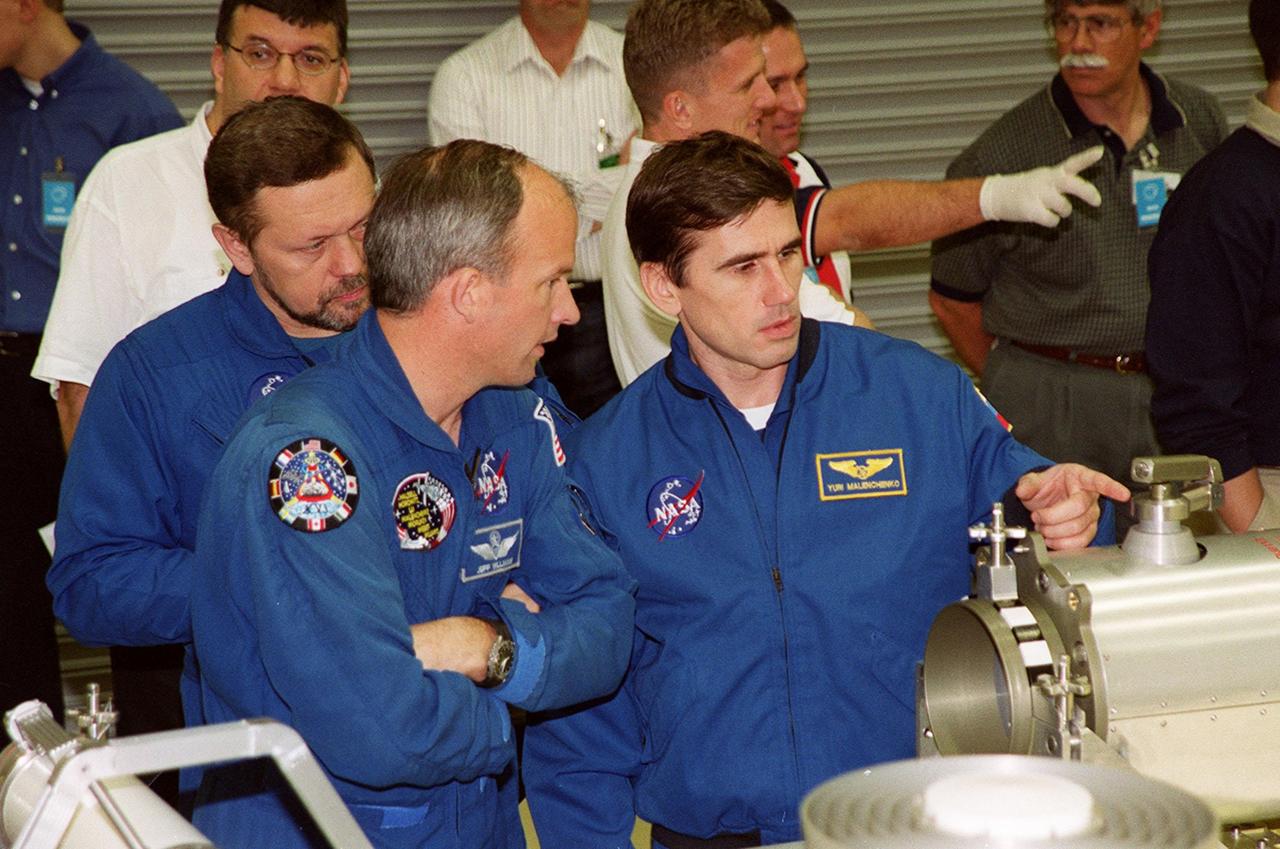
KENNEDY SPACE CENTER, FLA. -- During a Crew Equipment Interface Test (CEIT) at SPACEHAB, in Cape Canaveral, Fla., STS-101 crew members check out some of the cargo that will be carried on their mission. From left are Mission Specialists Boris W. Morukov, who is with the Russian Space Agency (RSA), Jeffrey N. Williams, and Yuri Malenchenko, also with RSA. Other crew members are Commander James Donald Halsell Jr., Pilot Scott J. "Doc" Horowitz (Ph.D.) and Mission Specialists Mary Ellen Weber, (Ph.D.) and Edward Tsang Lu (Ph.D.). The primary objective of the STS-101 mission is to complete the initial outfitting of the International Space Station, making it fully ready for the first long-term crew. The seven-member crew will transfer almost two tons of equipment and supplies from SPACEHAB's Logistics Double Module. Additionally, they will unpack a shipment of supplies delivered earlier by a Russian Progress space tug and begin outfitting the newly arrived Zvezda Service Module. Three astronauts will perform two space walks to transfer and install parts of the Russian Strela cargo boom that are attached to SPACEHAB's Integrated Cargo Container, connect utility cables between Zarya and Zvezda, and install a magnetometer/pole assembly on the Service Module. Additional activities for the STS-101 astronauts include working with the Space Experiment Module (SEM-06) and the Mission to America's Remarkable Schools (MARS), two educational initiatives. STS-101 is scheduled for launch no earlier than March 16, 2000
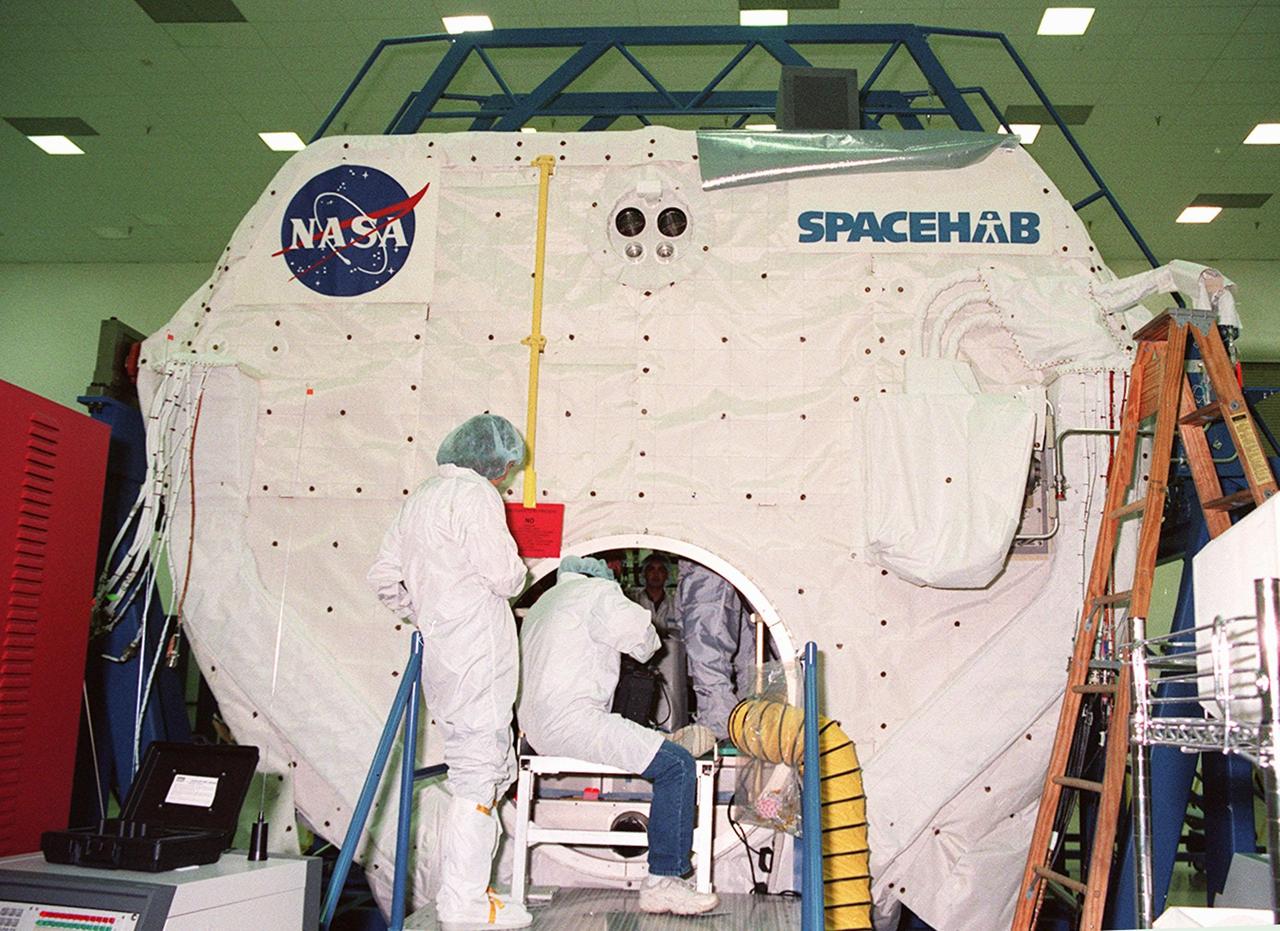
KENNEDY SPACE CENTER, FLA. -- At SPACEHAB, in Titusville, Fla., STS-101 crew members take part in a Crew Equipment Interface Test (CEIT). Here they are checking out the SPACEHAB Logistics Double Module. The crew is composed of Commander James Donald Halsell Jr., Pilot Scott J. "Doc" Horowitz (Ph.D.), and Mission Specialists Mary Ellen Weber (Ph.D.), Edward Tsang Lu (Ph.D.), Jeffrey N. Williams, and Yuri Malenchenko and Boris W. Morukov, who are with the Russian Space Agency. The primary objective of the STS-101 mission is to complete the initial outfitting of the International Space Station, making it fully ready for the first long-term crew. The seven-member crew will transfer almost two tons of equipment and supplies from SPACEHAB. Additionally, they will unpack a shipment of supplies delivered earlier by a Russian Progress space tug and begin outfitting the newly arrived Zvezda Service Module. Three astronauts will perform two space walks to transfer and install parts of the Russian Strela cargo boom that are attached to SPACEHAB's Integrated Cargo Container, connect utility cables between Zarya and Zvezda, and install a magnetometer/pole assembly on the Service Module. Additional activities for the STS-101 astronauts include working with the Space Experiment Module (SEM-06) and the Mission to America's Remarkable Schools (MARS), two educational initiatives. STS-101 is scheduled for launch no earlier than March 16, 2000
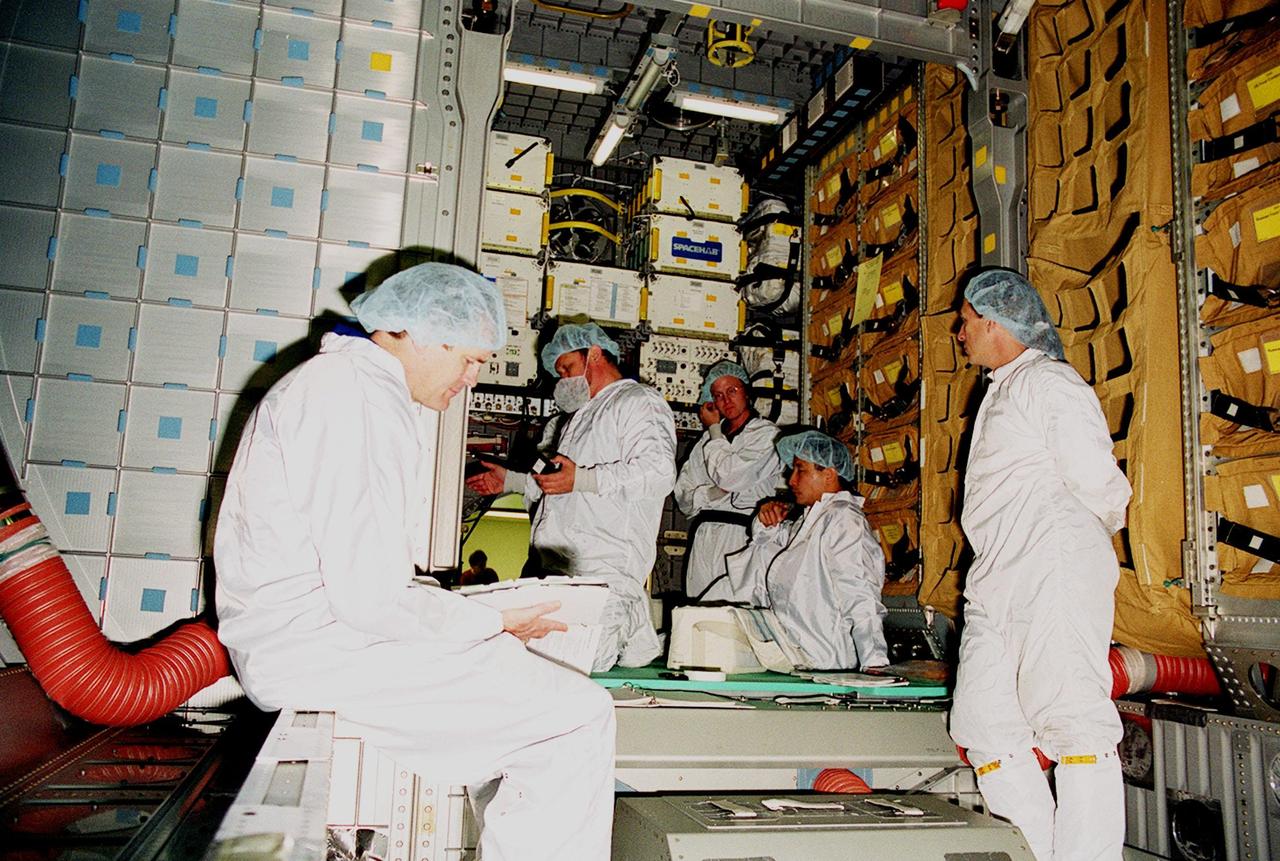
KENNEDY SPACE CENTER, FLA. -- During a Crew Equipment Interface Test (CEIT) at SPACEHAB, in Titusville, Fla., STS-101 crew members check out the SPACEHAB Logistics Double Module that will be part of the payload for their mission. At left are Commander James Donald Halsell Jr. and Pilot Scott J. "Doc" Horowitz (Ph.D.); seated on the floor is Mission Specialist Edward Tsang Lu (Ph.D.). Other crew members who are taking part in the CEIT are Mission Specialists Mary Ellen Weber, (Ph.D.), Jeffrey N. Williams, and Boris W. Morukov and Yuri Malenchenko, who are with the Russian Space Agency. The primary objective of the STS-101 mission is to complete the initial outfitting of the International Space Station, making it fully ready for the first long-term crew. The seven-member crew will transfer almost two tons of equipment and supplies from SPACEHAB. Additionally, they will unpack a shipment of supplies delivered earlier by a Russian Progress space tug and begin outfitting the newly arrived Zvezda Service Module. Three astronauts will perform two space walks to transfer and install parts of the Russian Strela cargo boom that are attached to SPACEHAB's Integrated Cargo Container, connect utility cables between Zarya and Zvezda, and install a magnetometer/pole assembly on the Service Module. Additional activities for the STS-101 astronauts include working with the Space Experiment Module (SEM-06) and the Mission to America's Remarkable Schools (MARS), two educational initiatives. STS-101 is scheduled for launch no earlier than March 16, 2000
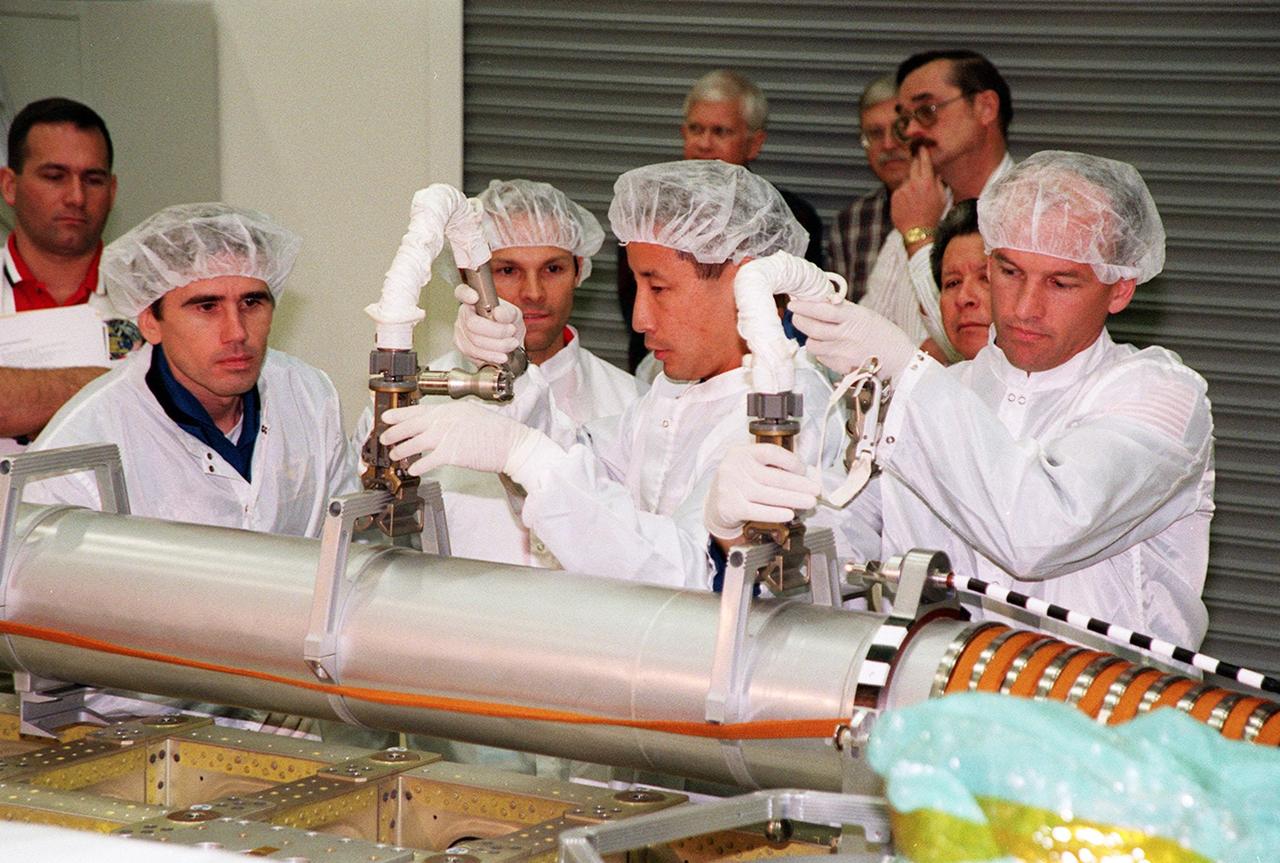
KENNEDY SPACE CENTER, FLA. -- During a Crew Equipment Interface Test (CEIT) at SPACEHAB, in Cape Canaveral, Fla., members of the STS-101 crew learn how to manipulate the Russian crane Strela. At left is Yuri Malenchenko, who is with the Russian Space Agency (RSA); in the center is Edward Tsang Lu (Ph.D.); at right is Mission Specialist Jeffrey N. Williams. Other crew members are Commander James Donald Halsell Jr., Pilot Scott Horowitz, and Mission Specialists Mary Ellen Weber, (Ph.D.) and Boris W. Morukov (RSA). The primary objective of the STS-101 mission is to complete the initial outfitting of the International Space Station, making it fully ready for the first long-term crew. The seven-member crew will transfer almost two tons of equipment and supplies from SPACEHAB's Logistics Double Module. Additionally, they will unpack a shipment of supplies delivered earlier by a Russian Progress space tug and begin outfitting the newly arrived Zvezda Service Module. Three astronauts will perform two space walks to transfer and install parts of the Russian Strela cargo boom that are attached to SPACEHAB's Integrated Cargo Container, connect utility cables between Zarya and Zvezda, and install a magnetometer/pole assembly on the Service Module. Additional activities for the STS-101 astronauts include working with the Space Experiment Module (SEM-06) and the Mission to America's Remarkable Schools (MARS), two educational initiatives. STS-101 is scheduled for launch no earlier than March 16, 2000