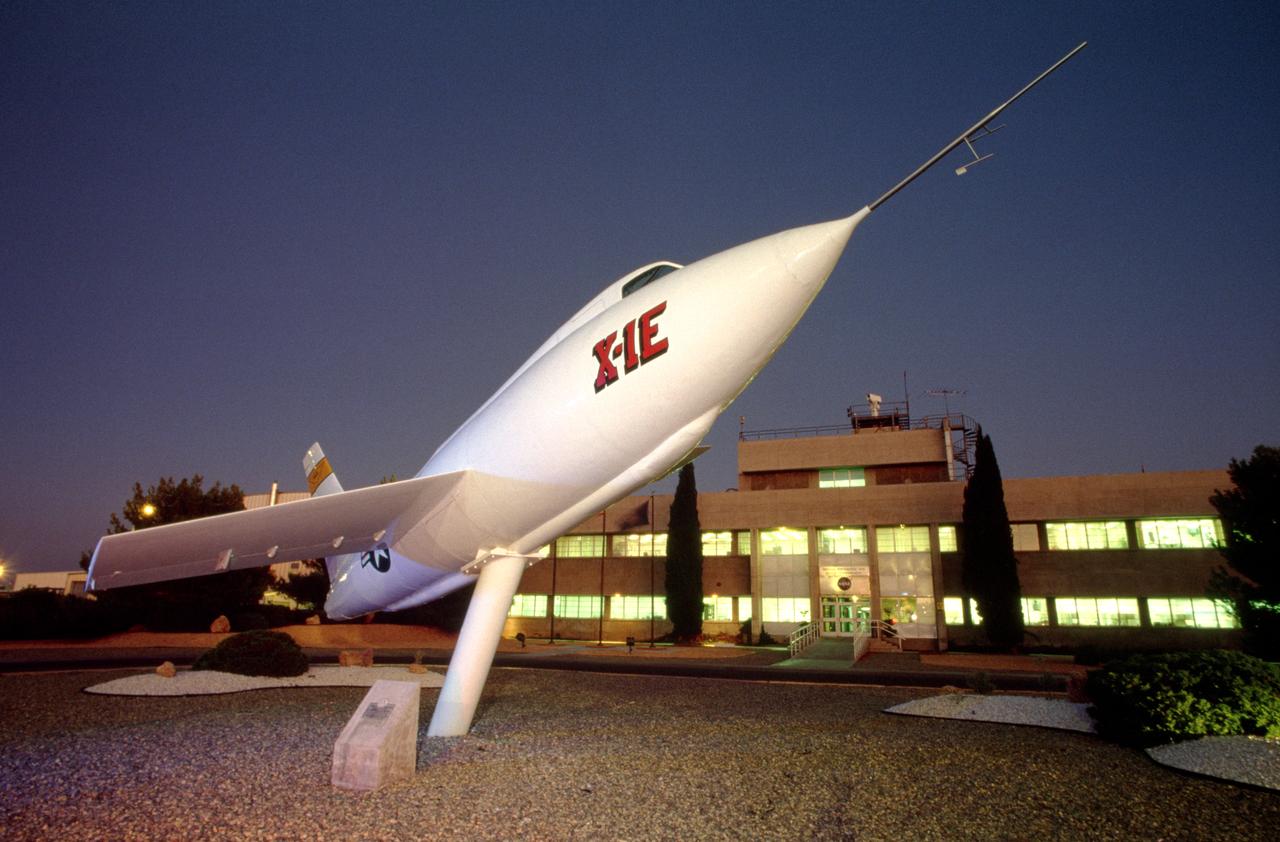
The X-1E guards NASA Dryden Flight Research Center's main building.

The X-1E research aircraft provides a striking view at the entrance of NASA's Dryden Flight Research Center, Edwards, California. The X-1E, one of the three original X-1 aircraft modified with a raised cockpit canopy and an ejection seat, was flown at the facility between 1953 and 1958 to investigate speeds at twice that of sound, and also to evaluate a thin wing designed for high-speed flight. The Dryden complex was originally established in 1946 as a small high-speed flight station to support the X-1 program. The X-1 was the first aircraft to fly at supersonic speeds. The main administrative building is to the rear of the X-1E and is the center of a research installation that has grown to more than 450 government employees and nearly 400 civilian contractors. Located on the northwest "shore" of Rogers Dry Lake, the Dryden Center was built around the original administrative-hangar building constructed in 1954 at a cost of $3.8 million. Since then many additional support and operational facilities have been built including a number of unique test facilities such as the Thermalstructures Research Facility, Flow Visualization Facility, and the newest addition, the Integrated Test Facility.
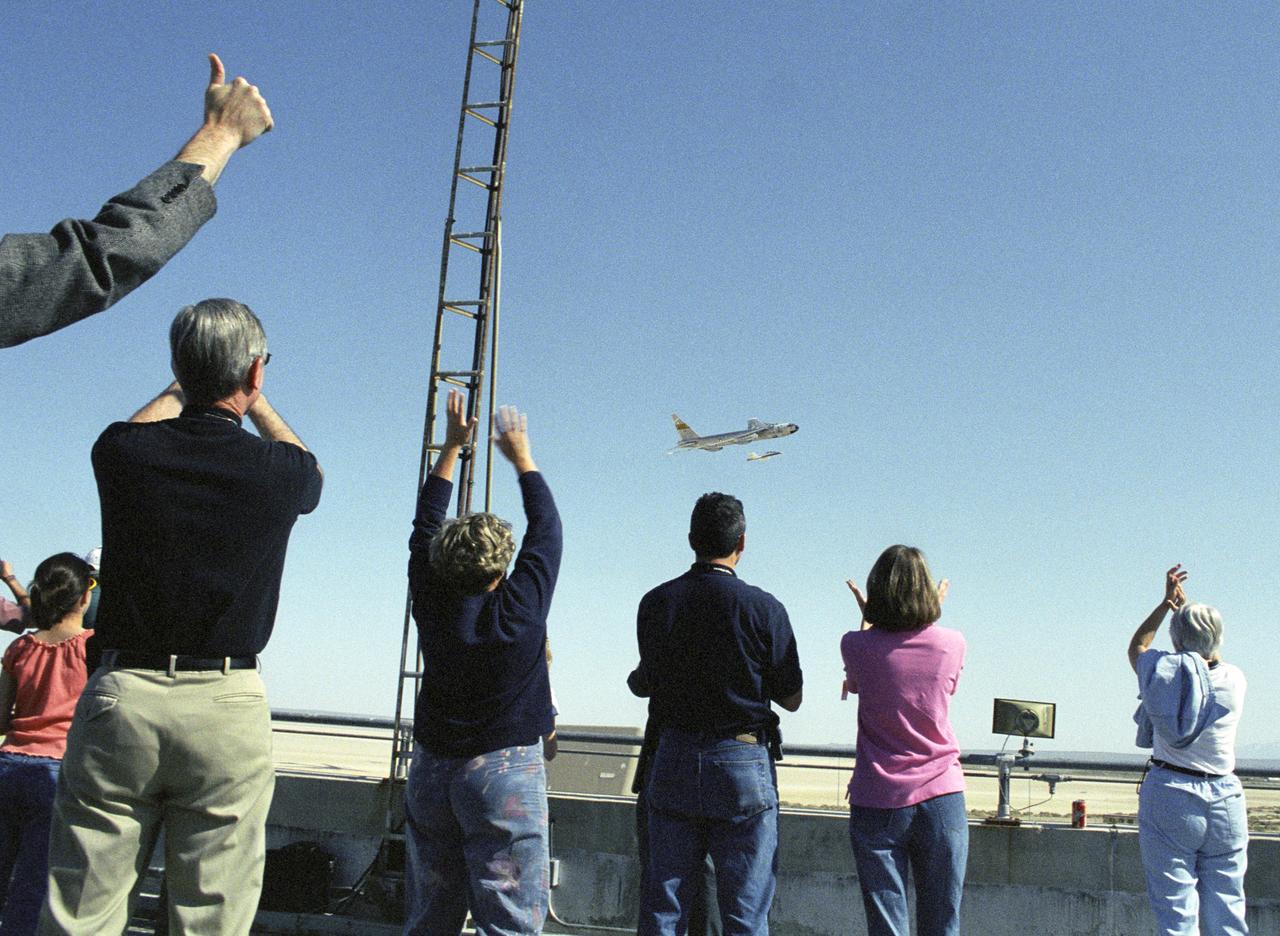
Employees atop NASA Dryden's main building celebrate the return flyby of the B-52B aircraft after it launched the second X-43A aircraft on its successful flight.

This archival image was released as part of a gallery comparing JPL's past and present, commemorating the 80th anniversary of NASA's Jet Propulsion Laboratory on Oct. 31, 2016. This photograph from 1949 shows the main entrance gate to the Jet Propulsion Laboratory in Pasadena, California, after a snowstorm. To the left is JPL's administration building at the time (Building 67). Building 67 is the Materials Research Building today. The Space Flight Operations Facility (Building 230), which houses JPL's Mission Control, now stands over the parking area on the right. As the lab expanded, the main entrance gate moved farther south. http://photojournal.jpl.nasa.gov/catalog/PIA21118
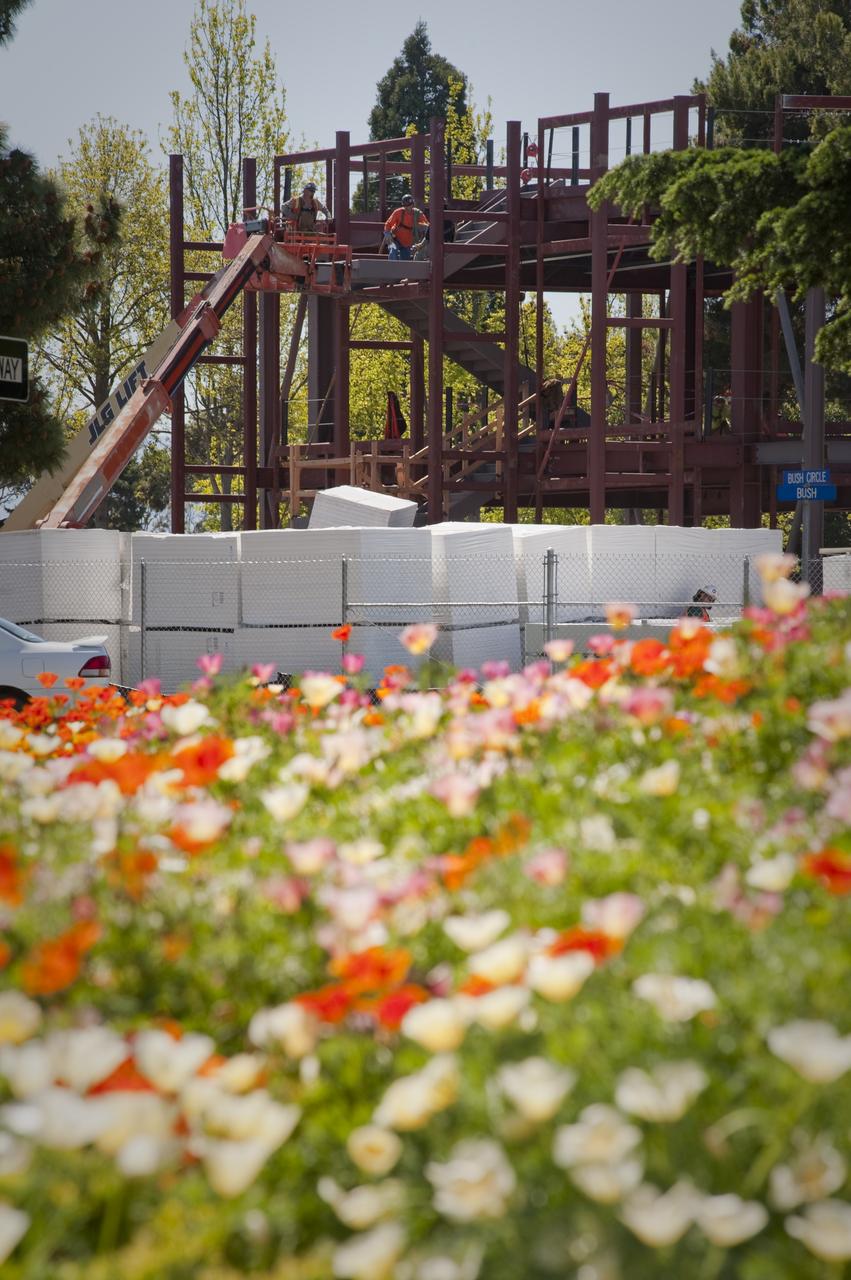
Environmental sustainability is put into practice here in the native plant gardens that surround the main auditorium building at NASA Ames Research Center, Moffett Field, Calif. Contruction of the new Green building N-232 can be seen in the background.
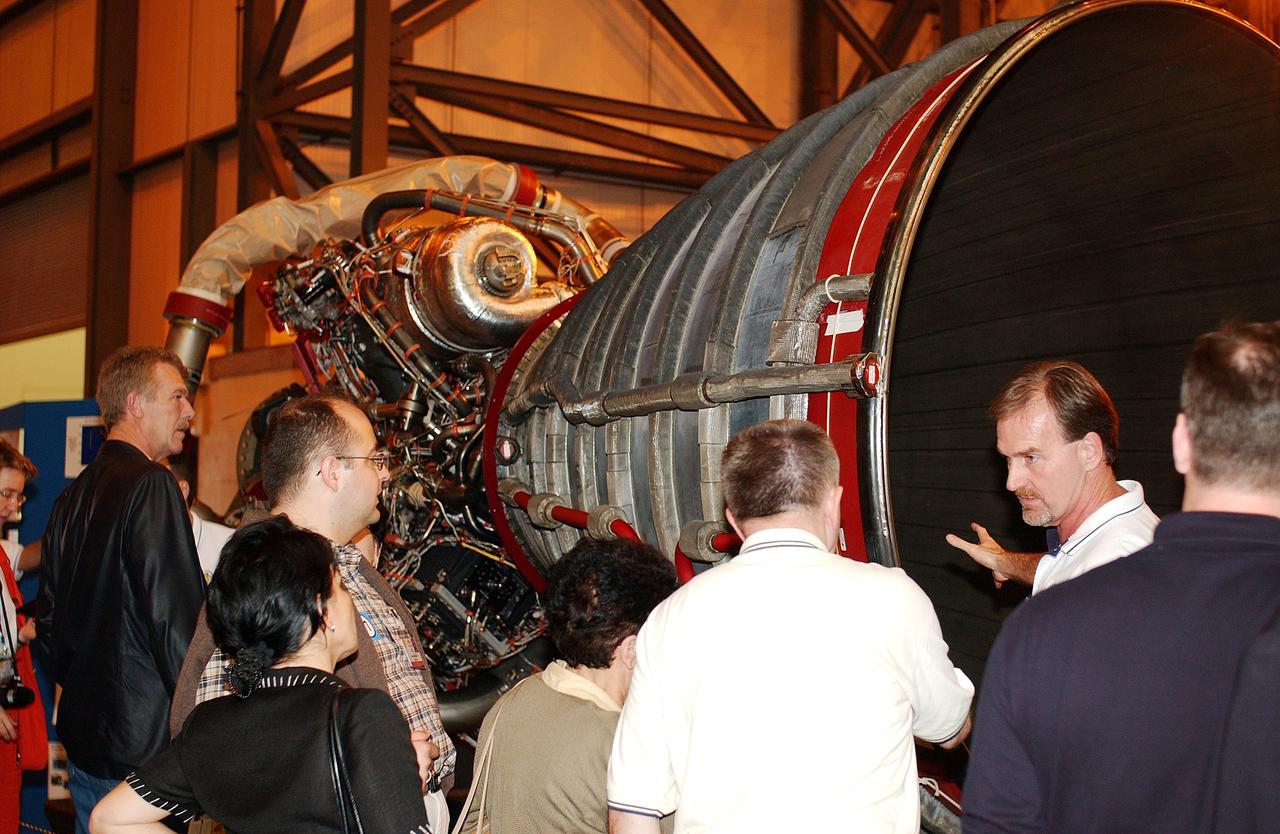
KENNEDY SPACE CENTER, FLA. - Members of the North American Treaty Organization (NATO) Parliamentary Assembly get a close look at a Space Shuttle main engine in the Vehicle Assembly Building during their tour of KSC. The Parliamentarians are meeting in Orlando this year for their 49th annual gathering. They chose to visit KSC with their families during their one-day excursion break from meetings.
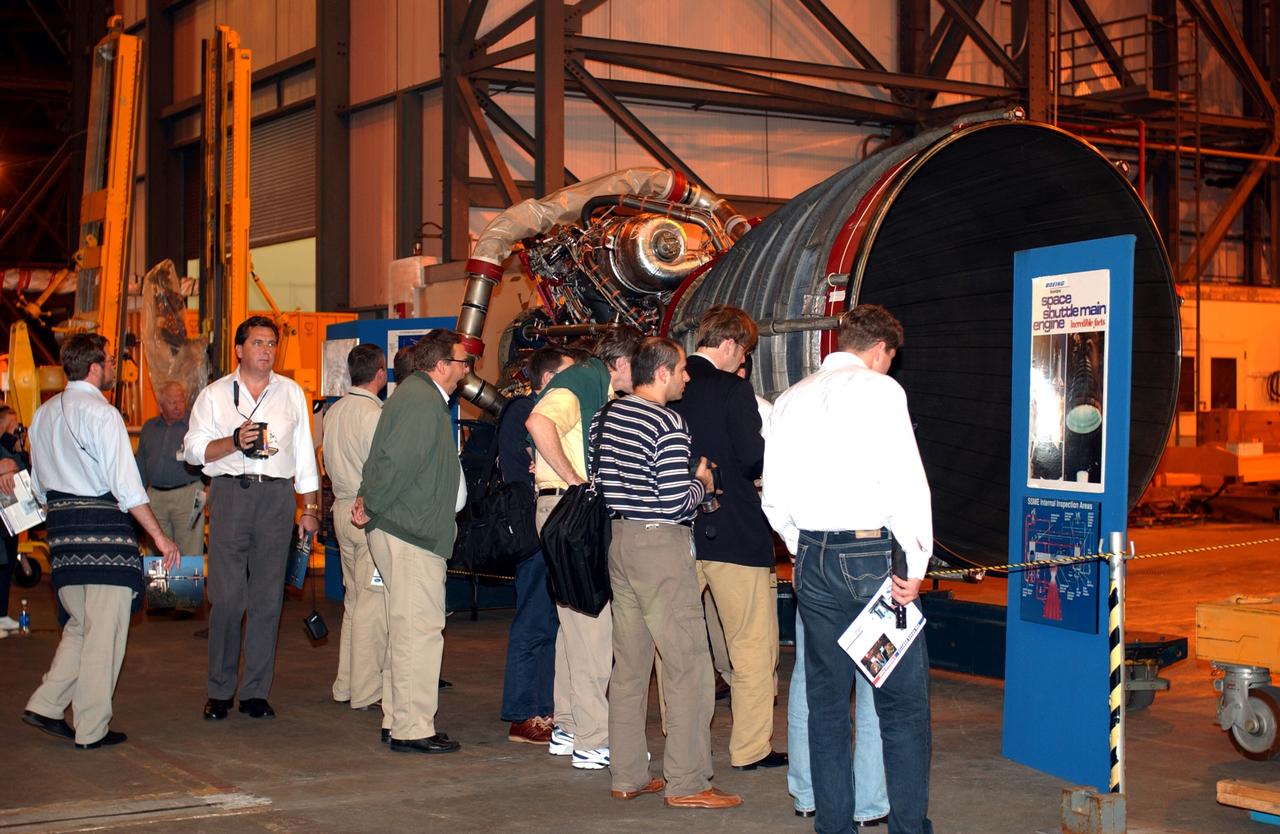
KENNEDY SPACE CENTER, FLA. - Members of the North American Treaty Organization (NATO) Parliamentary Assembly get a close look at a Space Shuttle main engine in the Vehicle Assembly Building during their tour of KSC. The Parliamentarians are meeting in Orlando this year for their 49th annual gathering. They chose to visit KSC with their families during their one-day excursion break from meetings.
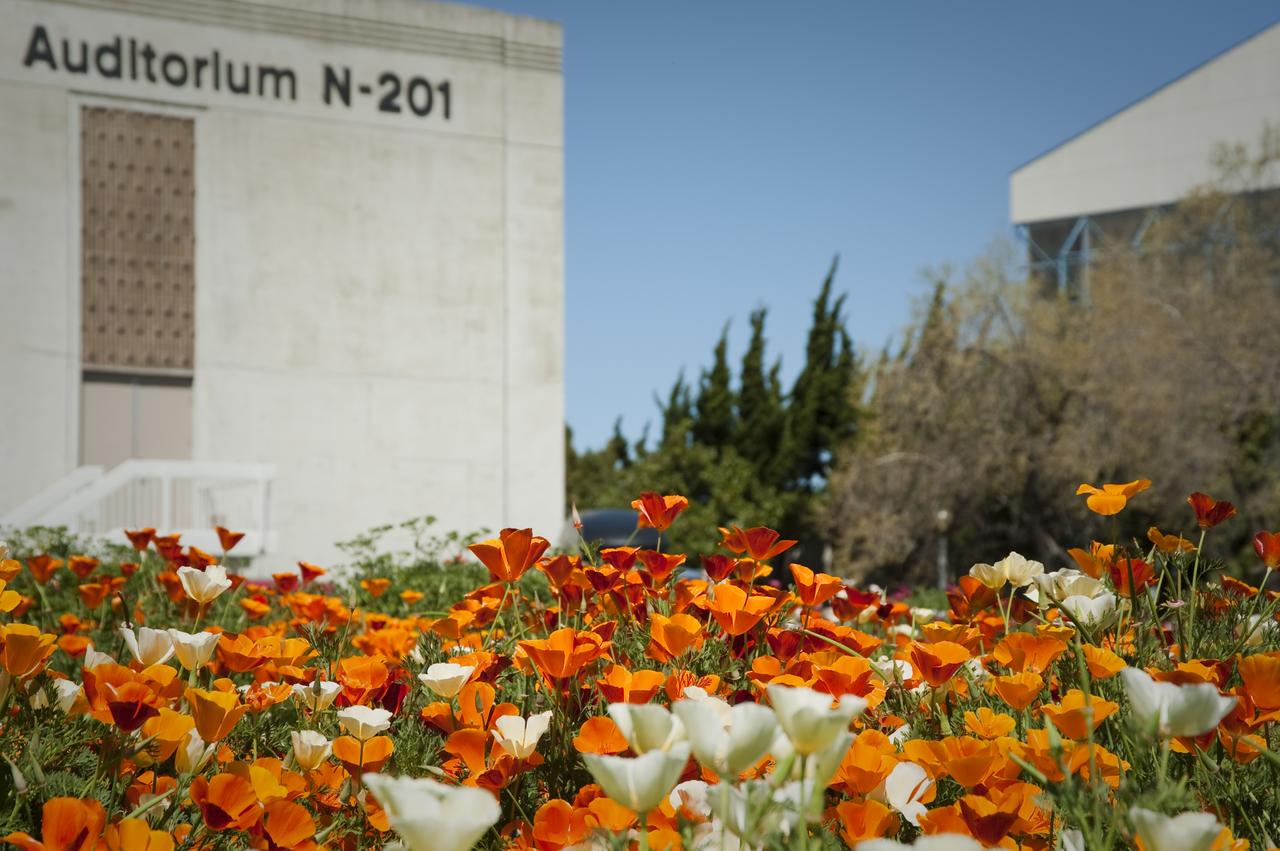
Environmental sustainability is put into practice here in the native plant gardens that surround the main auditorium building at NASA Ames Research Center, Moffett Field, Calif.

NASA Administrator Bill Nelson and NASA Deputy Administrator Pam Melroy listen to NASA Armstrong Flight Research Center Director David McBride, at left, tell them about Building 703 in Palmdale, California. The building houses many of NASA's science aircraft. NASA Armstrong's main campus is in nearby Edwards, California.
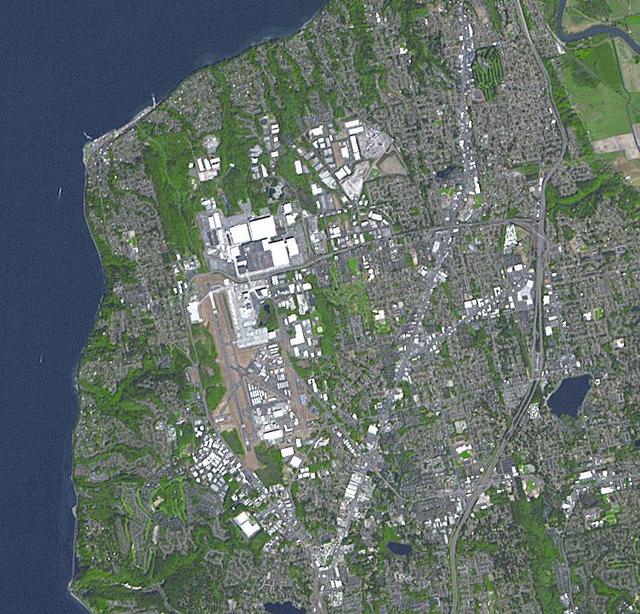
When Boeing decided to build the 747, they had to build a factory large enough to construct several at the same time. They started building the factory in 1967, in Everett, Washington, 35 km north of Seattle. The main building covers 39 hectares (98 acres), and encloses 13.3 million cubic meters (472 million cubic feet). This is the largest building in the world. The image was acquired September 15, 2017, covers an area of 10.8 by 11.3 kilometers, and is located at 47.9 degrees north, 122.3 degrees west. https://photojournal.jpl.nasa.gov/catalog/PIA23000
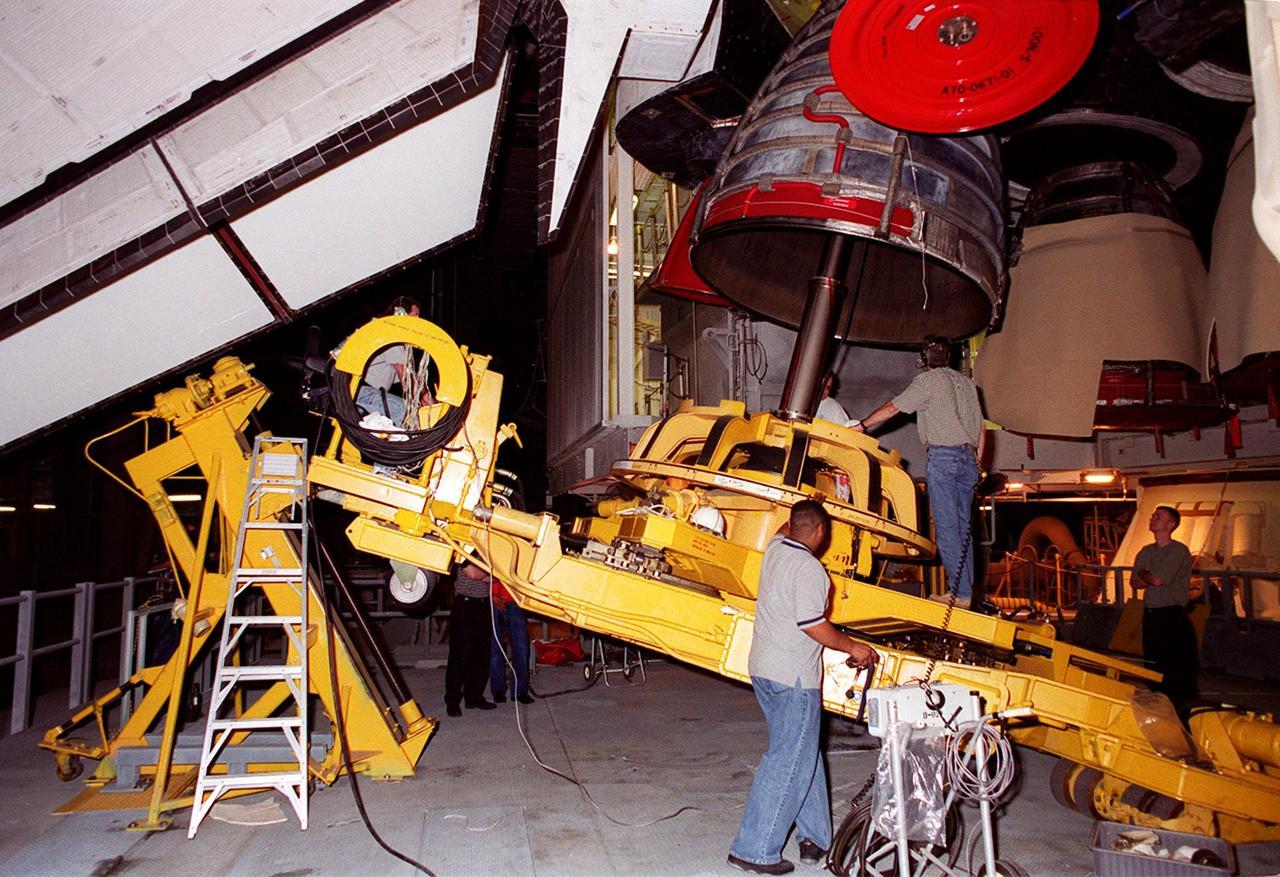
KENNEDY SPACE CENTER, FLA. -- Workers in the Vehicle Assembly Building maneuver equipment in place to remove Main Engine No. 1 from Space Shuttle Atlantis in the Vehicle Assembly Building. An inventory review concerning defective main engine fuel pump tip seals indicated that defective seals may be present on the fuel pump for the engine. The decision was made to replace the suspect engine with one originally slated for Discovery. The main engine nozzles, visible in the photo, are 7.8 feet across and 9.4 feet high. Space Shuttle Atlantis is scheduled to launch no earlier than April 17, 2000, on mission STS-101 to resupply the International Space Station for the arrival of the next pressurized module, the Russian-built Zvezda
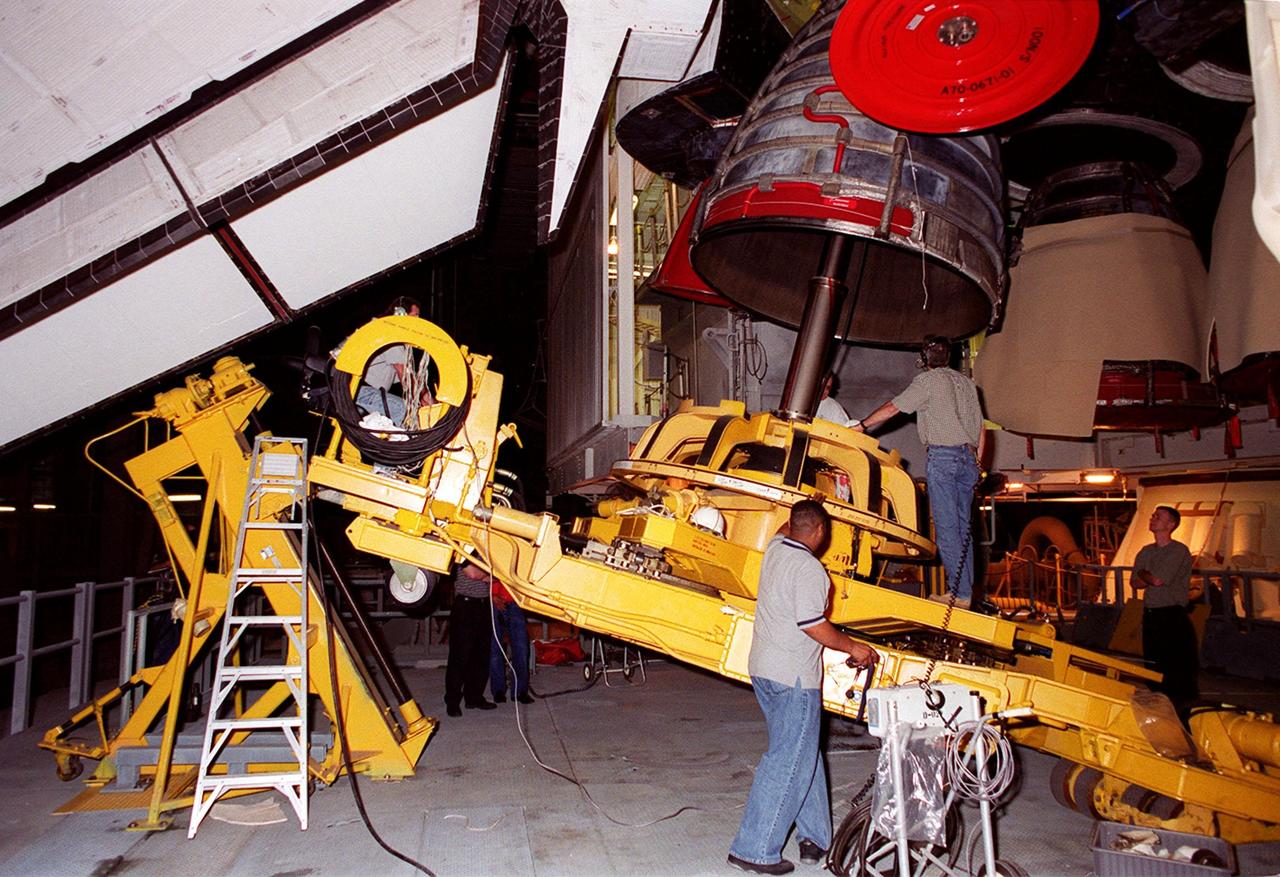
KENNEDY SPACE CENTER, FLA. -- Workers in the Vehicle Assembly Building maneuver equipment in place to remove Main Engine No. 1 from Space Shuttle Atlantis in the Vehicle Assembly Building. An inventory review concerning defective main engine fuel pump tip seals indicated that defective seals may be present on the fuel pump for the engine. The decision was made to replace the suspect engine with one originally slated for Discovery. The main engine nozzles, visible in the photo, are 7.8 feet across and 9.4 feet high. Space Shuttle Atlantis is scheduled to launch no earlier than April 17, 2000, on mission STS-101 to resupply the International Space Station for the arrival of the next pressurized module, the Russian-built Zvezda
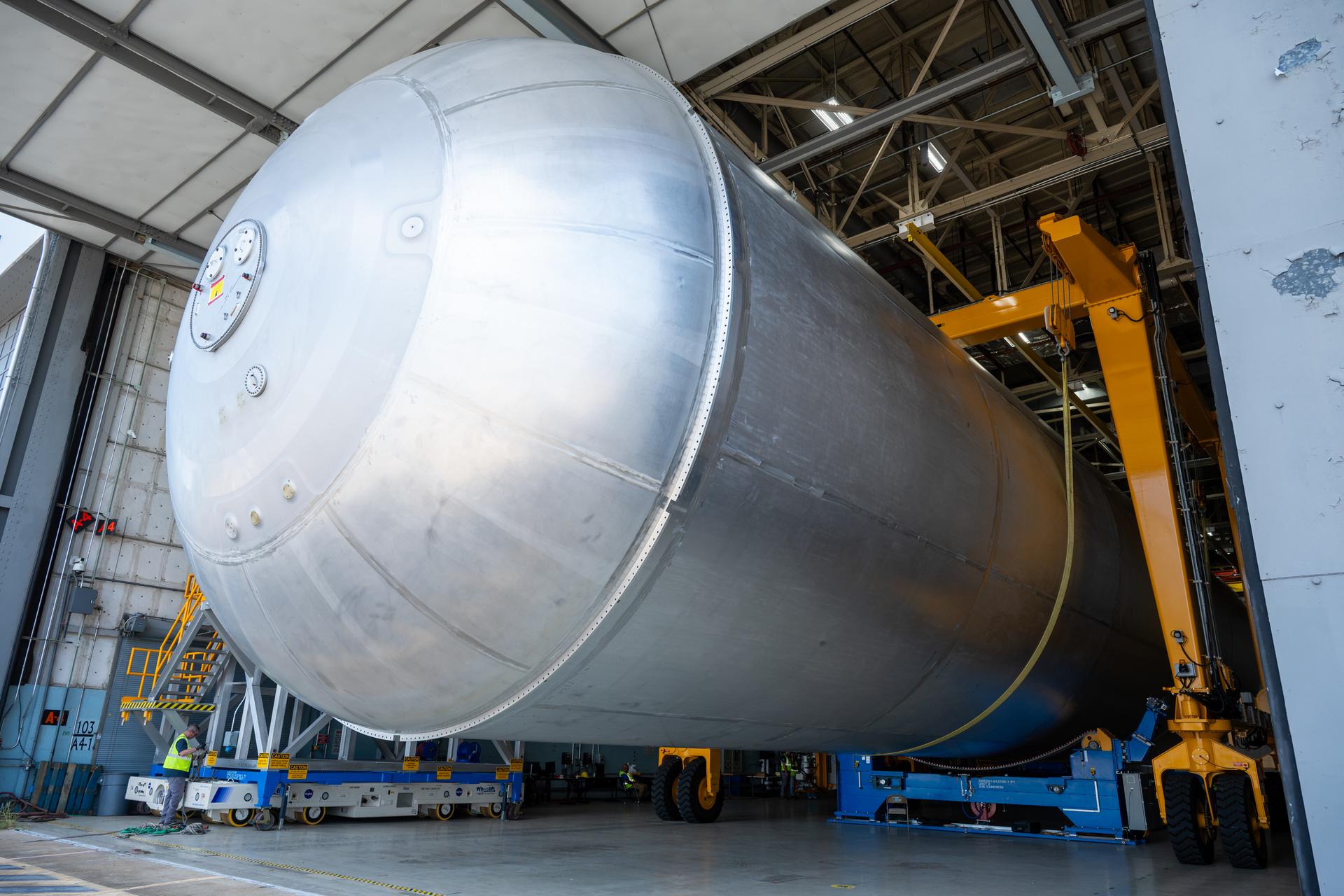
Crews at NASA’s Michoud Assembly Facility in New Orleans transport the 130-foot-tall liquid hydrogen tank from the proof testing building to the main factory on July 15. The liquid hydrogen tank will form part of the core stage for the SLS (Space Launch System) rocket for the agency’s Artemis IV mission, providing thousands of gallons of super-cold propellant to the rocket engines during launch. Soon, teams with SLS prime contractor, Boeing, will move the tank into the facility’s vertical assembly building for cleaning operations. The liquid hydrogen propellant tank is one of five major elements that make up the 212-foot-tall SLS rocket stage. The core stage, along with its four RS-25 engines at its base, produce more than two million pounds of thrust to help launch NASA’s Orion spacecraft, astronauts, and supplies beyond Earth’s orbit and to the lunar surface for Artemis.
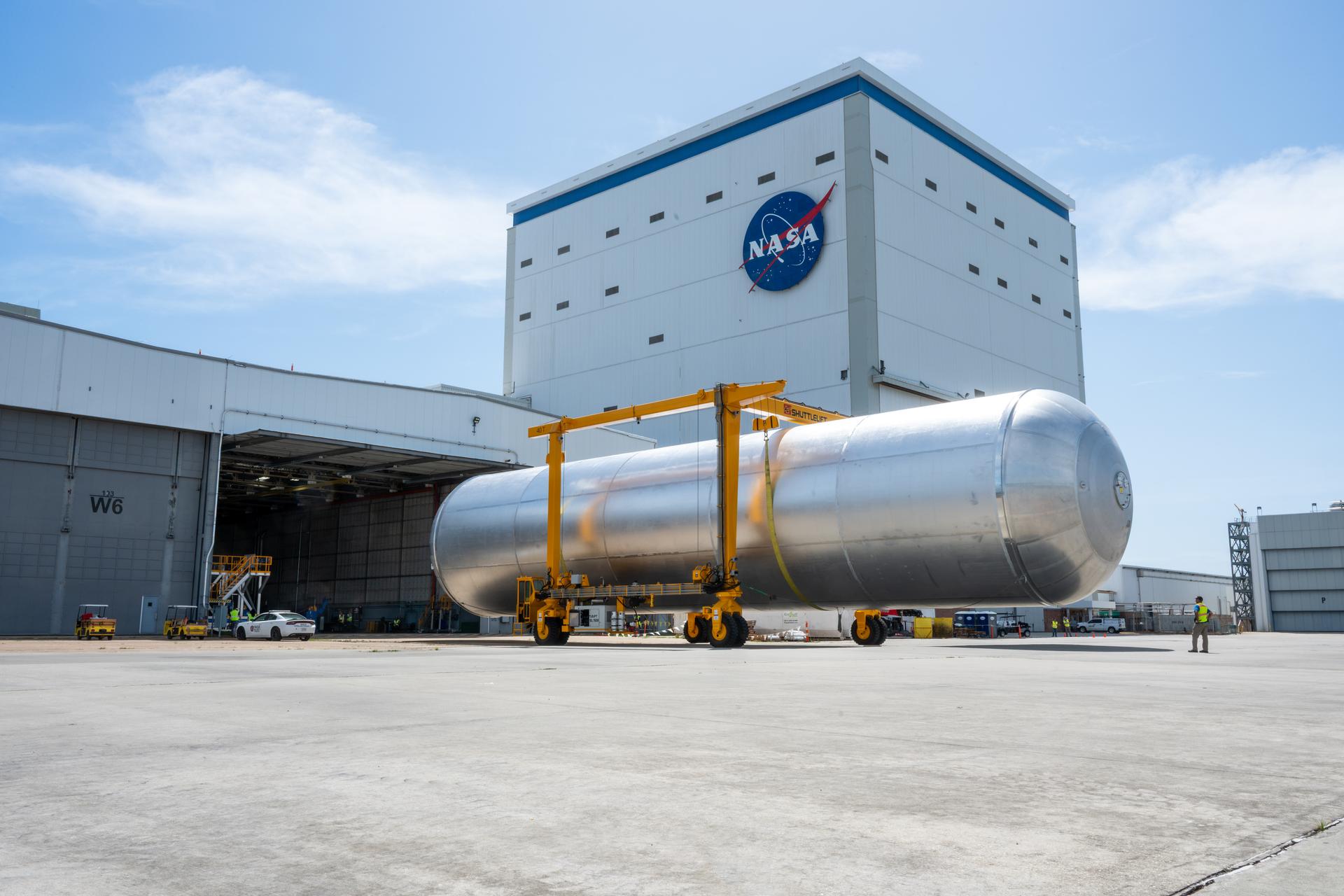
Crews at NASA’s Michoud Assembly Facility in New Orleans transport the 130-foot-tall liquid hydrogen tank from the proof testing building to the main factory on July 10. The liquid hydrogen tank will form part of the core stage for the SLS (Space Launch System) rocket for the agency’s Artemis IV mission, providing thousands of gallons of super-cold propellant to the rocket engines during launch. Soon, teams with SLS prime contractor, Boeing, will move the tank into the facility’s vertical assembly building for cleaning operations. The liquid hydrogen propellant tank is one of five major elements that make up the 212-foot-tall SLS rocket stage. The core stage, along with its four RS-25 engines at its base, produce more than two million pounds of thrust to help launch NASA’s Orion spacecraft, astronauts, and supplies beyond Earth’s orbit and to the lunar surface for Artemis.
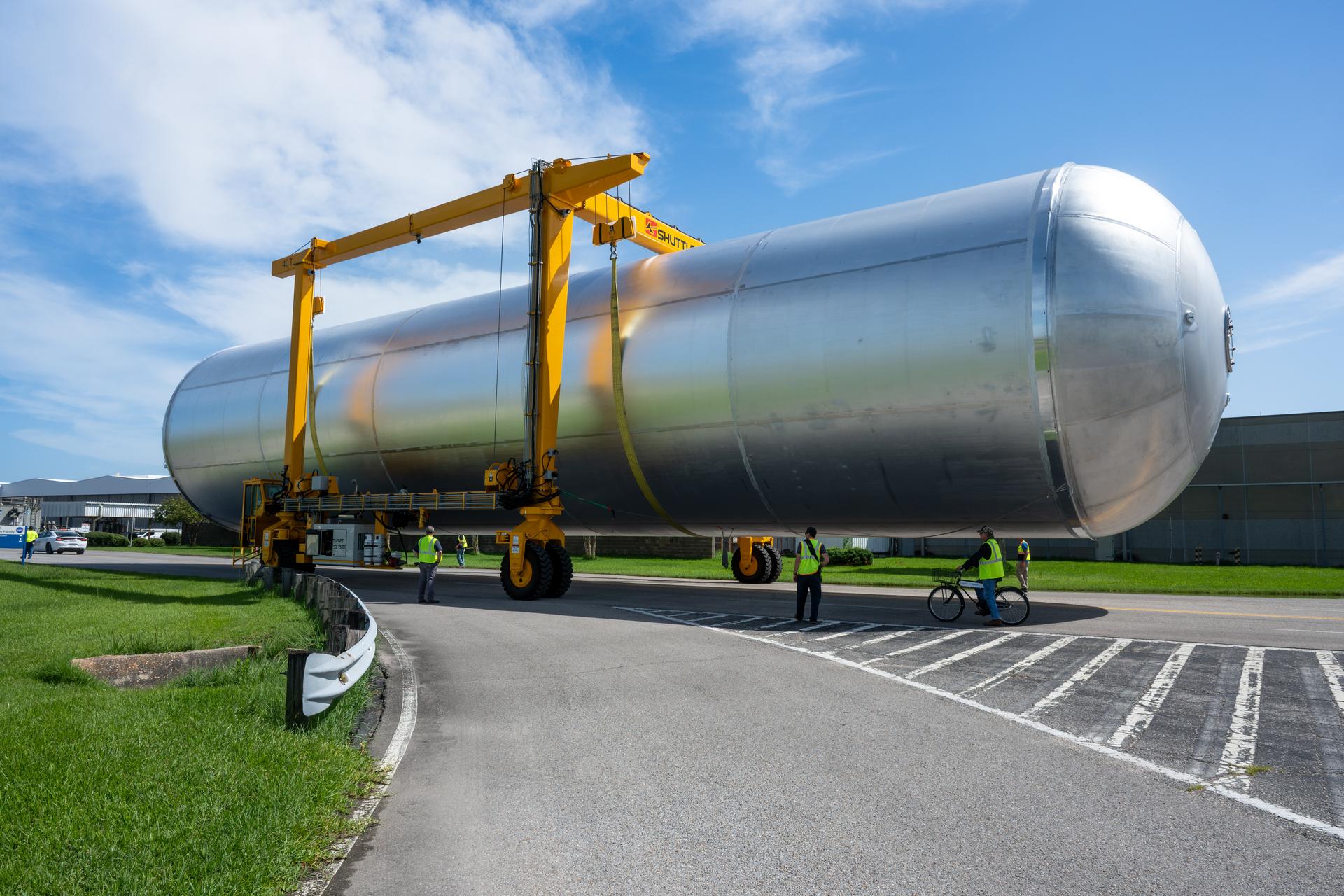
Crews at NASA’s Michoud Assembly Facility in New Orleans transport the 130-foot-tall liquid hydrogen tank from the proof testing building to the main factory on July 15. The liquid hydrogen tank will form part of the core stage for the SLS (Space Launch System) rocket for the agency’s Artemis IV mission, providing thousands of gallons of super-cold propellant to the rocket engines during launch. Soon, teams with SLS prime contractor, Boeing, will move the tank into the facility’s vertical assembly building for cleaning operations. The liquid hydrogen propellant tank is one of five major elements that make up the 212-foot-tall SLS rocket stage. The core stage, along with its four RS-25 engines at its base, produce more than two million pounds of thrust to help launch NASA’s Orion spacecraft, astronauts, and supplies beyond Earth’s orbit and to the lunar surface for Artemis.
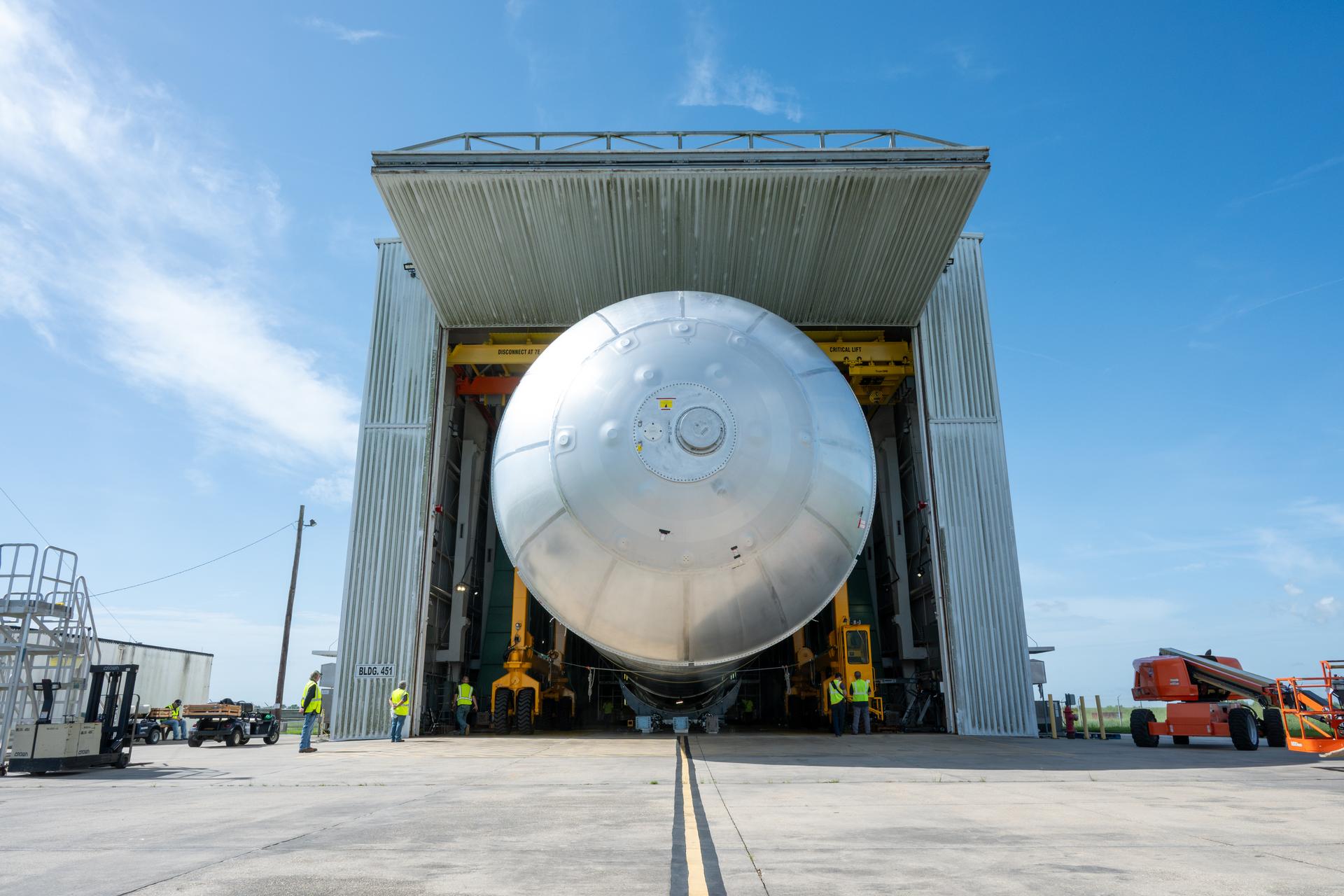
Crews at NASA’s Michoud Assembly Facility in New Orleans transport the 130-foot-tall liquid hydrogen tank from the proof testing building to the main factory on July 15. The liquid hydrogen tank will form part of the core stage for the SLS (Space Launch System) rocket for the agency’s Artemis IV mission, providing thousands of gallons of super-cold propellant to the rocket engines during launch. Soon, teams with SLS prime contractor, Boeing, will move the tank into the facility’s vertical assembly building for cleaning operations. The liquid hydrogen propellant tank is one of five major elements that make up the 212-foot-tall SLS rocket stage. The core stage, along with its four RS-25 engines at its base, produce more than two million pounds of thrust to help launch NASA’s Orion spacecraft, astronauts, and supplies beyond Earth’s orbit and to the lunar surface for Artemis.
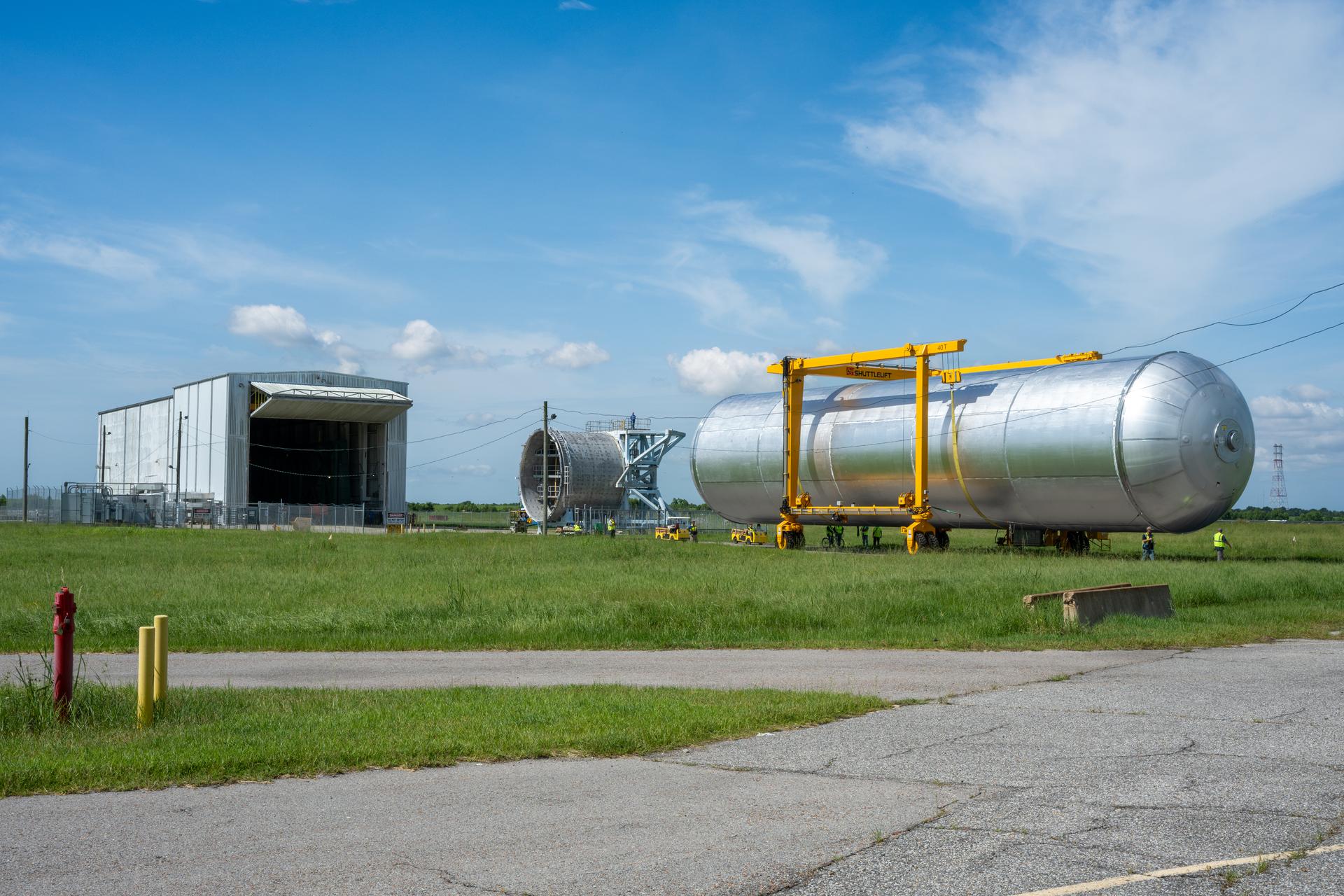
Crews at NASA’s Michoud Assembly Facility in New Orleans transport the 130-foot-tall liquid hydrogen tank from the proof testing building to the main factory on July 15. The liquid hydrogen tank will form part of the core stage for the SLS (Space Launch System) rocket for the agency’s Artemis IV mission, providing thousands of gallons of super-cold propellant to the rocket engines during launch. Soon, teams with SLS prime contractor, Boeing, will move the tank into the facility’s vertical assembly building for cleaning operations. The liquid hydrogen propellant tank is one of five major elements that make up the 212-foot-tall SLS rocket stage. The core stage, along with its four RS-25 engines at its base, produce more than two million pounds of thrust to help launch NASA’s Orion spacecraft, astronauts, and supplies beyond Earth’s orbit and to the lunar surface for Artemis.
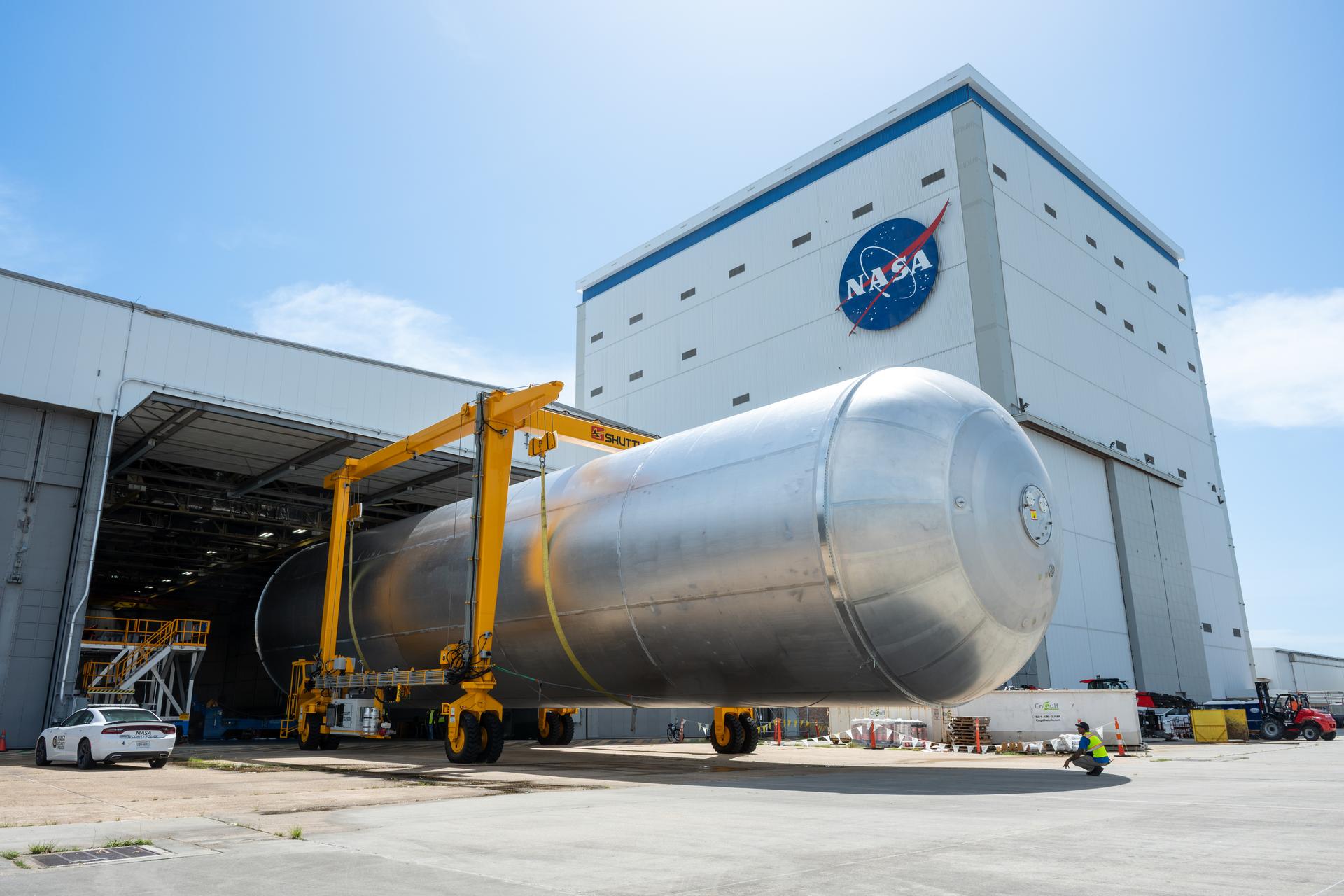
Crews at NASA’s Michoud Assembly Facility in New Orleans transport the 130-foot-tall liquid hydrogen tank from the proof testing building to the main factory on July 15. The liquid hydrogen tank will form part of the core stage for the SLS (Space Launch System) rocket for the agency’s Artemis IV mission, providing thousands of gallons of super-cold propellant to the rocket engines during launch. Soon, teams with SLS prime contractor, Boeing, will move the tank into the facility’s vertical assembly building for cleaning operations. The liquid hydrogen propellant tank is one of five major elements that make up the 212-foot-tall SLS rocket stage. The core stage, along with its four RS-25 engines at its base, produce more than two million pounds of thrust to help launch NASA’s Orion spacecraft, astronauts, and supplies beyond Earth’s orbit and to the lunar surface for Artemis.
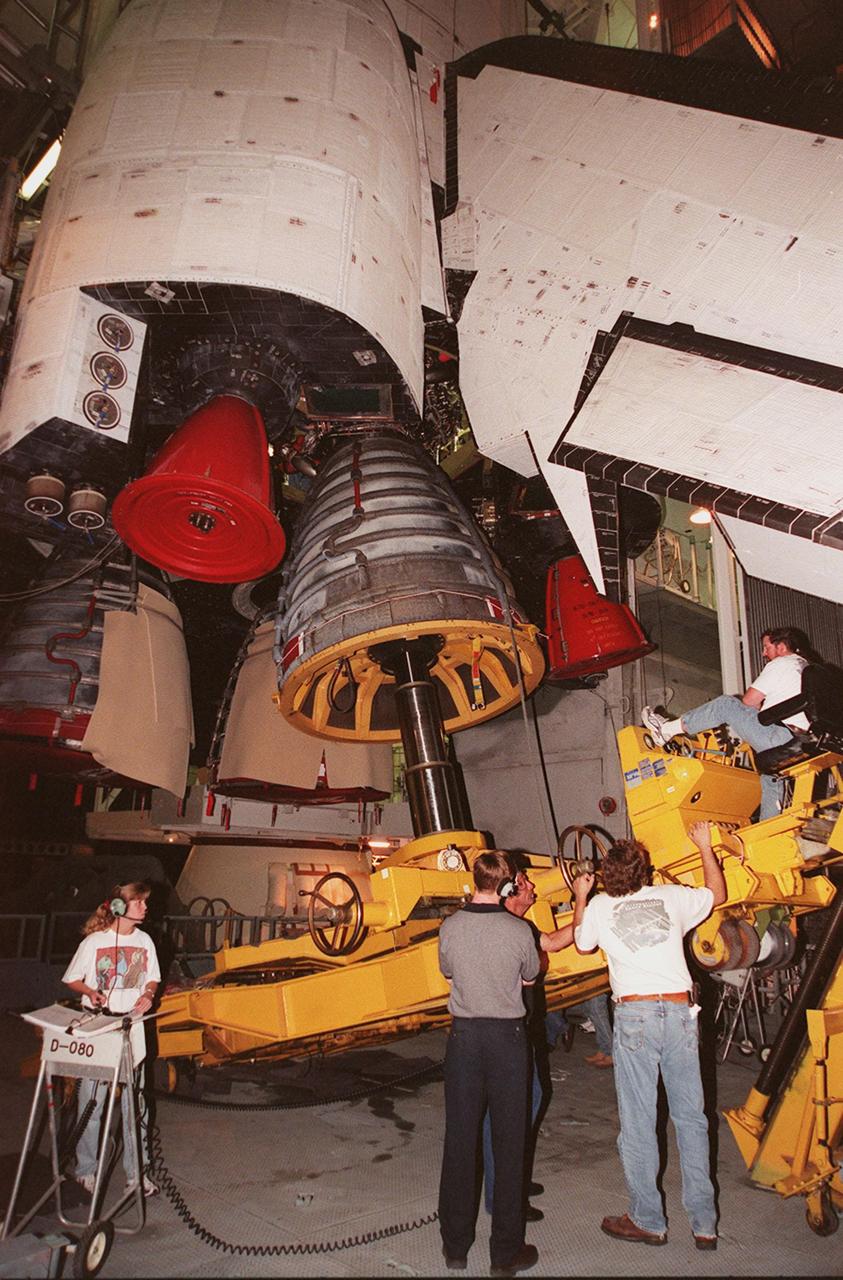
KENNEDY SPACE CENTER, FLA. -- Workers in the Vehicle Assembly Building oversee the replacement of Main Engine No. 1 in Space Shuttle Atlantis (overhead). An inventory review concerning defective main engine fuel pump tip seals indicated that defective seals might be present on the previous fuel pump for the engine. The decision was made to replace the suspect engine with one originally slated for Discovery. The main engine nozzle, visible in the photo, is 7.8 feet across and 9.4 feet high. Space Shuttle Atlantis is scheduled to launch no earlier than April 17, 2000, on mission STS-101 to resupply the International Space Station for the arrival of the next pressurized module, the Russian-built Zvezda
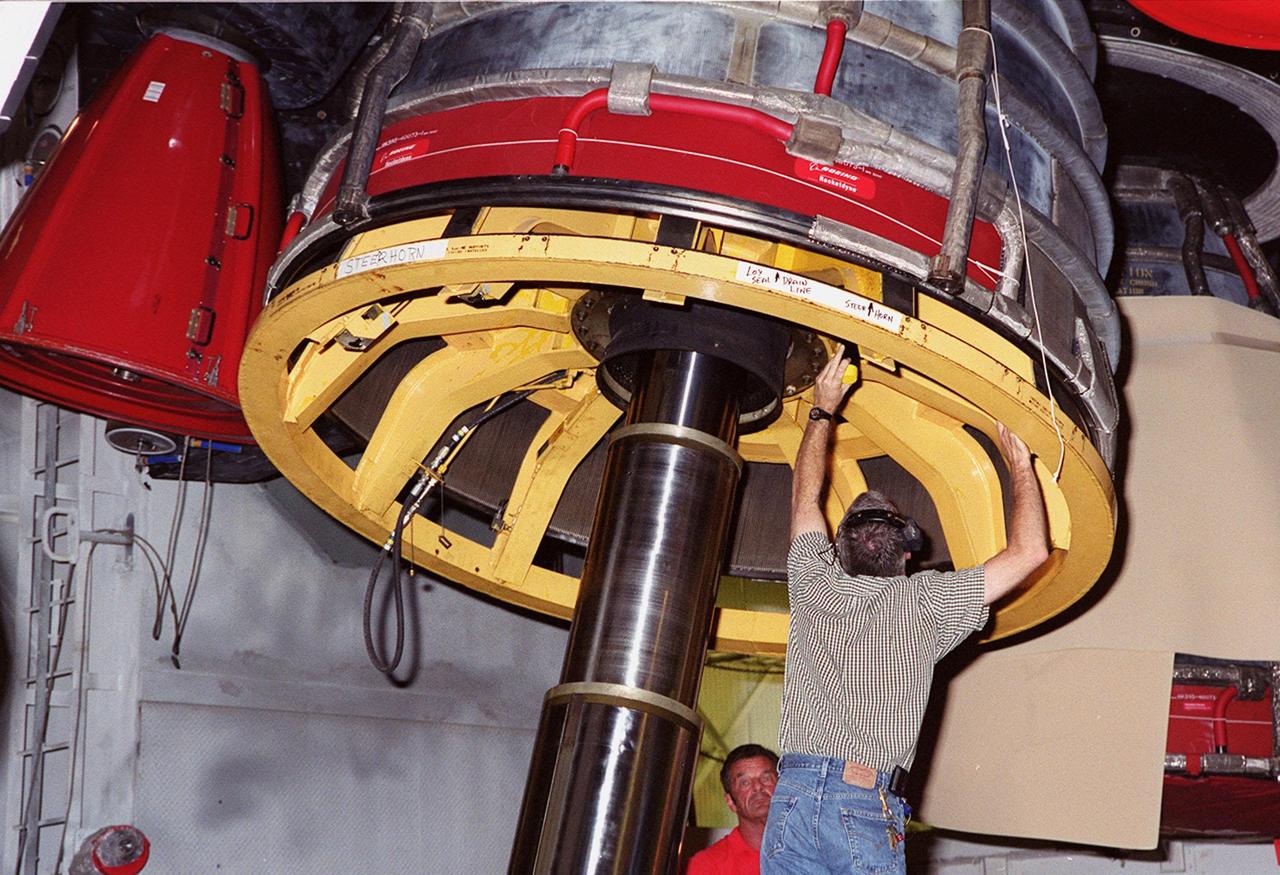
KENNEDY SPACE CENTER, FLA. -- A worker in the Vehicle Assembly Building adjusts the equipment being used for the removal of Main Engine No. 1 on Space Shuttle Atlantis. An inventory review concerning defective main engine fuel pump tip seals indicated that defective seals may be present on the fuel pump for the engine. The decision was made to replace the suspect engine with one originally slated for Discovery. The main engine nozzle, visible in the photo, is 7.8 feet across and 9.4 feet high. Space Shuttle Atlantis is scheduled to launch no earlier than April 17, 2000, on mission STS-101 to resupply the International Space Station for the arrival of the next pressurized module, the Russian-built Zvezda

KENNEDY SPACE CENTER, FLA. -- Workers in the Vehicle Assembly Building oversee the replacement of Main Engine No. 1 in Space Shuttle Atlantis (overhead). An inventory review concerning defective main engine fuel pump tip seals indicated that defective seals might be present on the previous fuel pump for the engine. The decision was made to replace the suspect engine with one originally slated for Discovery. The main engine nozzle, visible in the photo, is 7.8 feet across and 9.4 feet high. Space Shuttle Atlantis is scheduled to launch no earlier than April 17, 2000, on mission STS-101 to resupply the International Space Station for the arrival of the next pressurized module, the Russian-built Zvezda
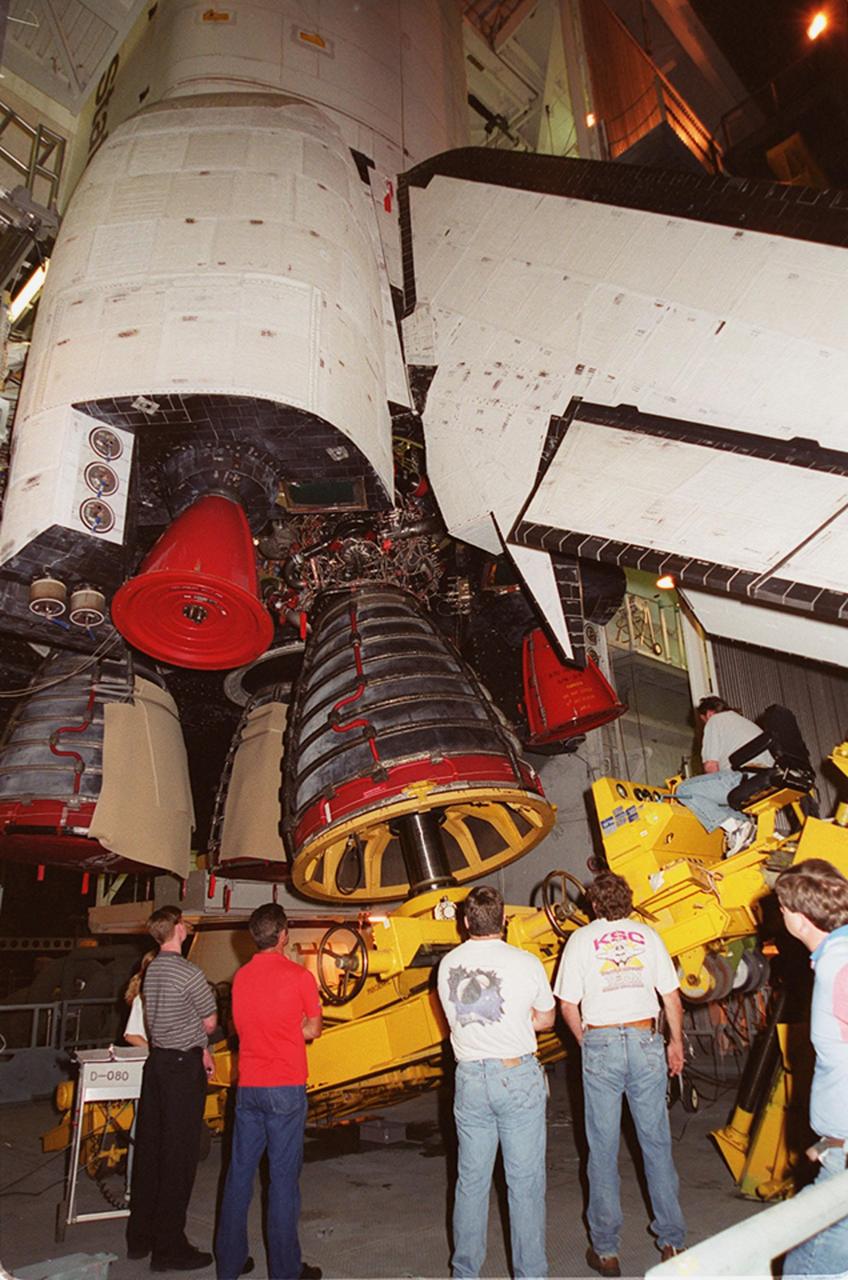
KENNEDY SPACE CENTER, FLA. -- Workers in the Vehicle Assembly Building watch as Space Shuttle Atlantis' Main Engine No. 1 is being removed. An inventory review concerning defective main engine fuel pump tip seals indicated that defective seals may be present on the fuel pump for the engine. The decision was made to replace the suspect engine with one originally slated for Discovery. The main engine nozzle, visible in the photo, is 7.8 feet across and 9.4 feet high. Space Shuttle Atlantis is scheduled to launch no earlier than April 17, 2000, on mission STS-101 to resupply the International Space Station for the arrival of the next pressurized module, the Russian-built Zvezda
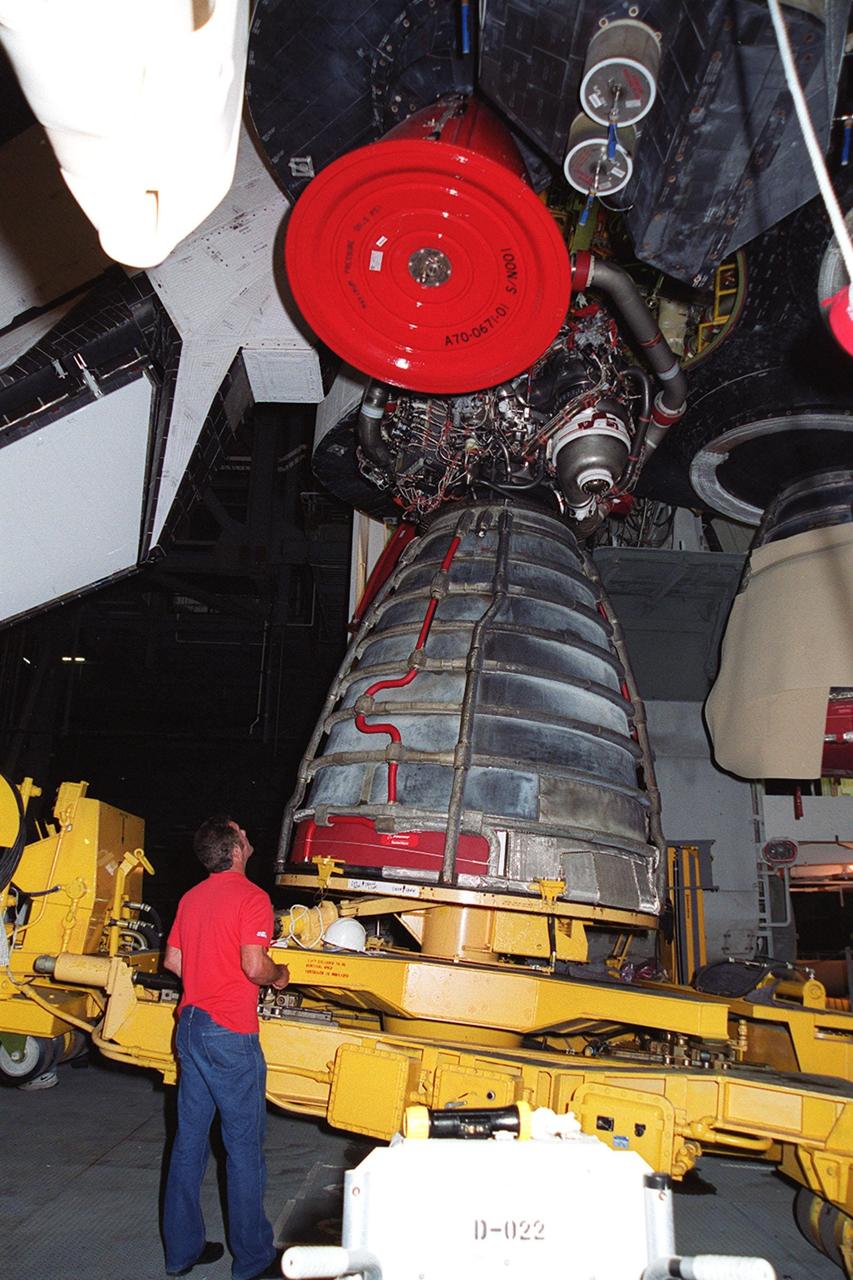
KENNEDY SPACE CENTER, FLA. -- In the Vehicle Assembly Building, Space Shuttle Atlantis' Main Engine No. 1 is lowered onto a transporter. The engine was removed because an inventory review concerning defective main engine fuel pump tip seals indicated that defective seals may be present on the fuel pump for the engine. The decision was made to replace the suspect engine with one originally slated for Discovery. The main engine nozzle, visible in the photo, is 7.8 feet across and 9.4 feet high. Space Shuttle Atlantis is scheduled to launch no earlier than April 17, 2000, on mission STS-101 to resupply the International Space Station for the arrival of the next pressurized module, the Russian-built Zvezda
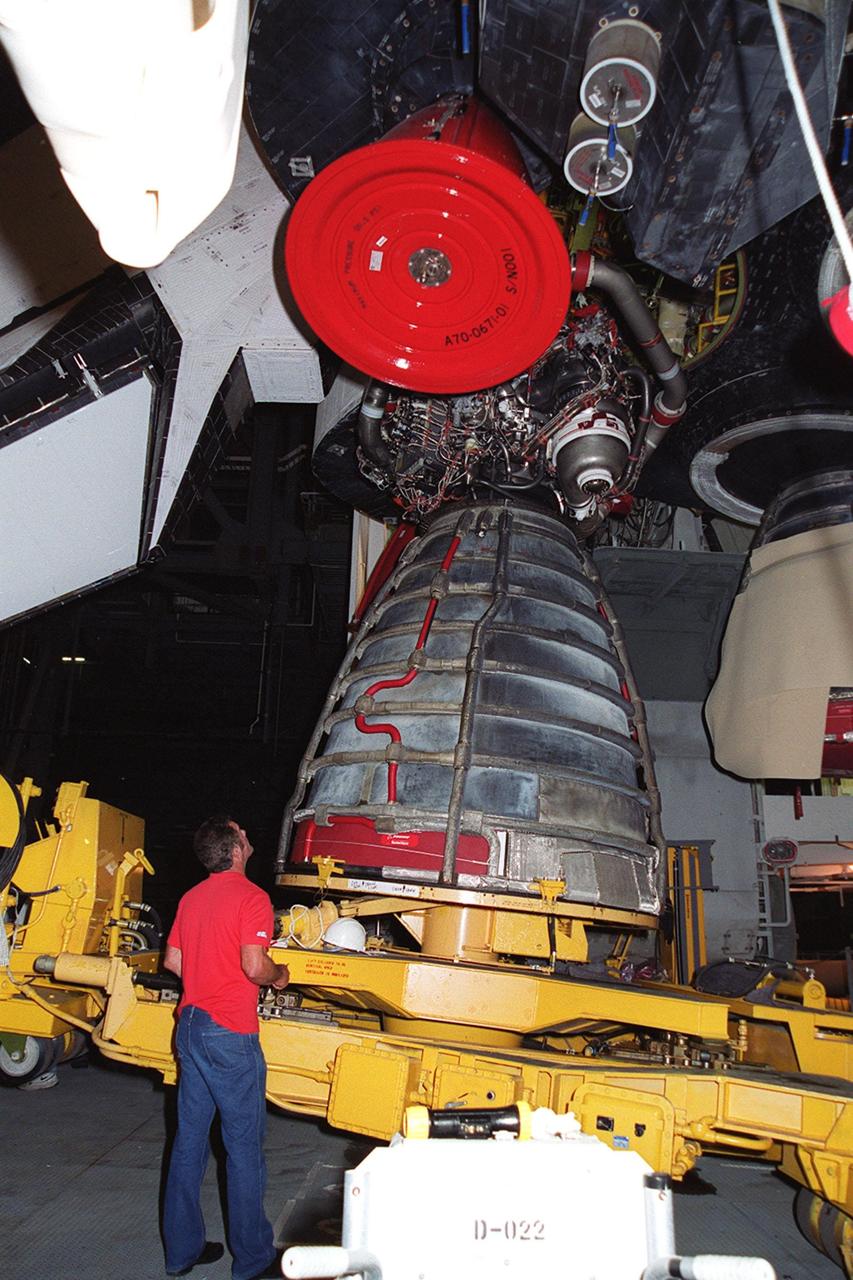
KENNEDY SPACE CENTER, FLA. -- In the Vehicle Assembly Building, Space Shuttle Atlantis' Main Engine No. 1 is lowered onto a transporter. The engine was removed because an inventory review concerning defective main engine fuel pump tip seals indicated that defective seals may be present on the fuel pump for the engine. The decision was made to replace the suspect engine with one originally slated for Discovery. The main engine nozzle, visible in the photo, is 7.8 feet across and 9.4 feet high. Space Shuttle Atlantis is scheduled to launch no earlier than April 17, 2000, on mission STS-101 to resupply the International Space Station for the arrival of the next pressurized module, the Russian-built Zvezda

KENNEDY SPACE CENTER, FLA. -- In the Vehicle Assembly Building, Space Shuttle Atlantis' Main Engine No. 1 is lowered after its removal. An inventory review concerning defective main engine fuel pump tip seals indicated that defective seals may be present on the fuel pump for the engine. The decision was made to replace the suspect engine with one originally slated for Discovery. The main engine nozzle, visible in the photo, is 7.8 feet across and 9.4 feet high. Space Shuttle Atlantis is scheduled to launch no earlier than April 17, 2000, on mission STS-101 to resupply the International Space Station for the arrival of the next pressurized module, the Russian-built Zvezda
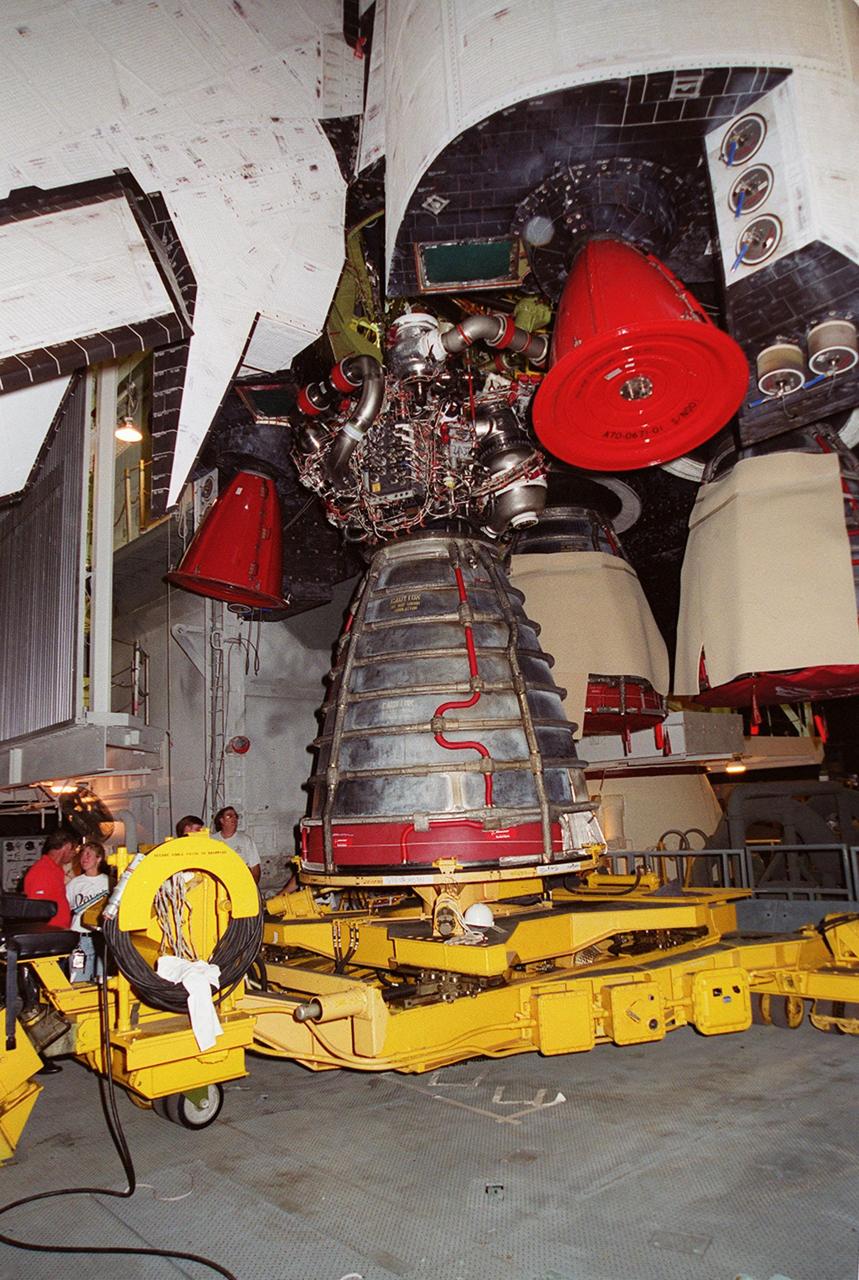
KENNEDY SPACE CENTER, FLA. -- In the Vehicle Assembly Building, Space Shuttle Atlantis' Main Engine No. 1 sits on a transporter after being removed. An inventory review concerning defective main engine fuel pump tip seals indicated that defective seals may be present on the fuel pump for the engine. The decision was made to replace the suspect engine with one originally slated for Discovery. The main engine nozzle, visible in the photo, is 7.8 feet across and 9.4 feet high. Space Shuttle Atlantis is scheduled to launch no earlier than April 17, 2000, on mission STS-101 to resupply the International Space Station for the arrival of the next pressurized module, the Russian-built Zvezda
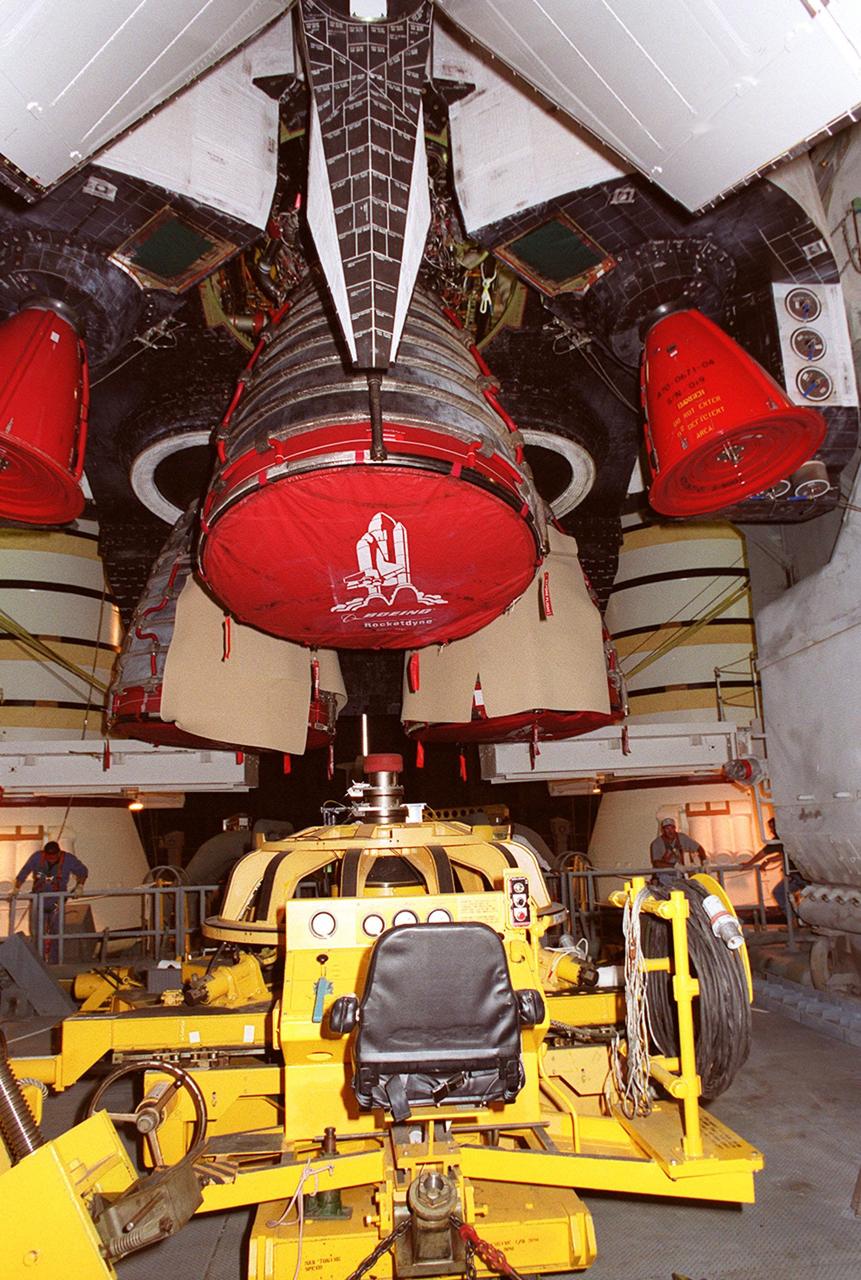
KENNEDY SPACE CENTER, FLA. -- The equipment is in place to remove Main Engine No. 1 from Space Shuttle Atlantis in the Vehicle Assembly Building. An inventory review concerning defective main engine fuel pump tip seals indicated that defective seals may be present on the fuel pump for the engine. The decision was made to replace the suspect engine with one originally slated for Discovery. The main engine nozzles, visible in the photo, are 7.8 feet across and 9.4 feet high. Space Shuttle Atlantis is scheduled to launch no earlier than April 17, 2000, on mission STS-101 to resupply the International Space Station for the arrival of the next pressurized module, the Russian-built Zvezda
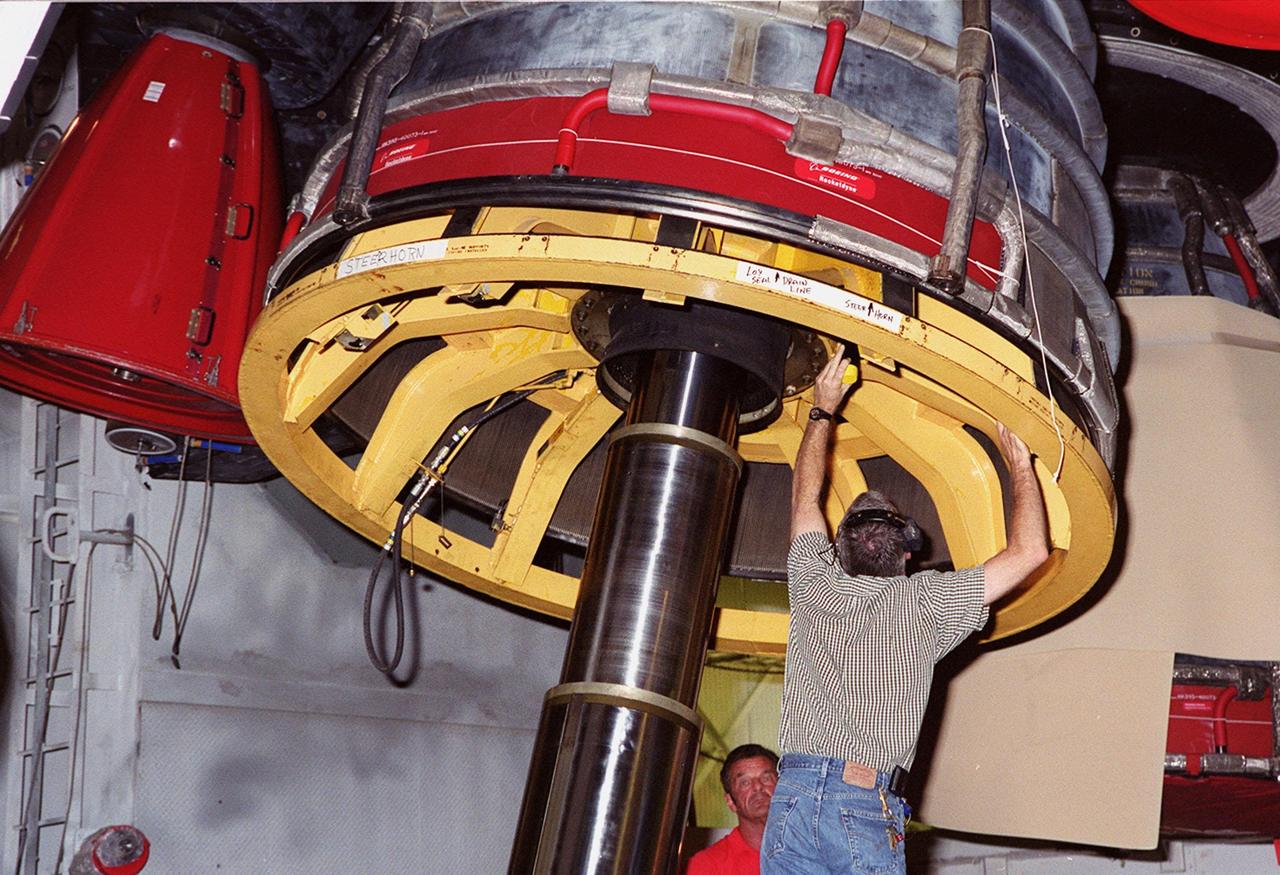
KENNEDY SPACE CENTER, FLA. -- A worker in the Vehicle Assembly Building adjusts the equipment being used for the removal of Main Engine No. 1 on Space Shuttle Atlantis. An inventory review concerning defective main engine fuel pump tip seals indicated that defective seals may be present on the fuel pump for the engine. The decision was made to replace the suspect engine with one originally slated for Discovery. The main engine nozzle, visible in the photo, is 7.8 feet across and 9.4 feet high. Space Shuttle Atlantis is scheduled to launch no earlier than April 17, 2000, on mission STS-101 to resupply the International Space Station for the arrival of the next pressurized module, the Russian-built Zvezda
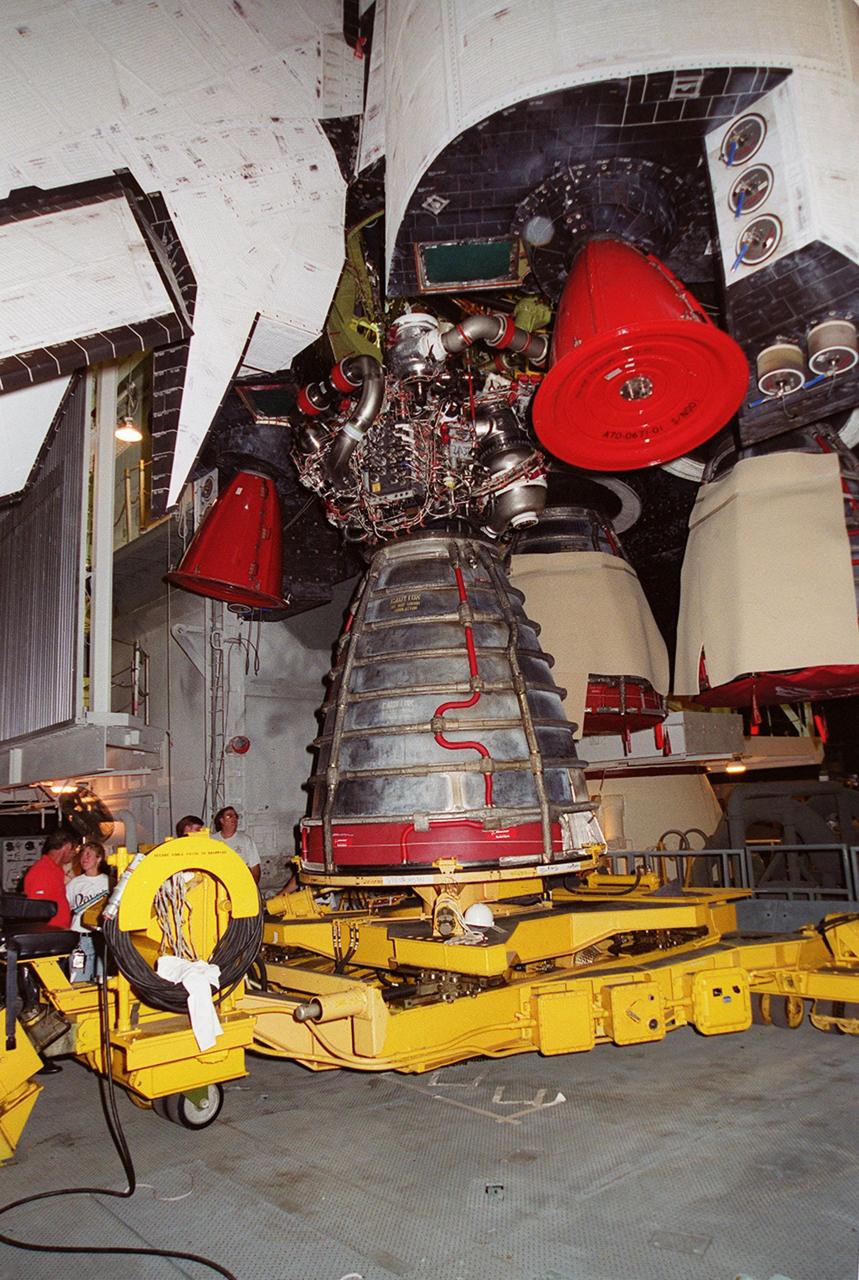
KENNEDY SPACE CENTER, FLA. -- In the Vehicle Assembly Building, Space Shuttle Atlantis' Main Engine No. 1 sits on a transporter after being removed. An inventory review concerning defective main engine fuel pump tip seals indicated that defective seals may be present on the fuel pump for the engine. The decision was made to replace the suspect engine with one originally slated for Discovery. The main engine nozzle, visible in the photo, is 7.8 feet across and 9.4 feet high. Space Shuttle Atlantis is scheduled to launch no earlier than April 17, 2000, on mission STS-101 to resupply the International Space Station for the arrival of the next pressurized module, the Russian-built Zvezda
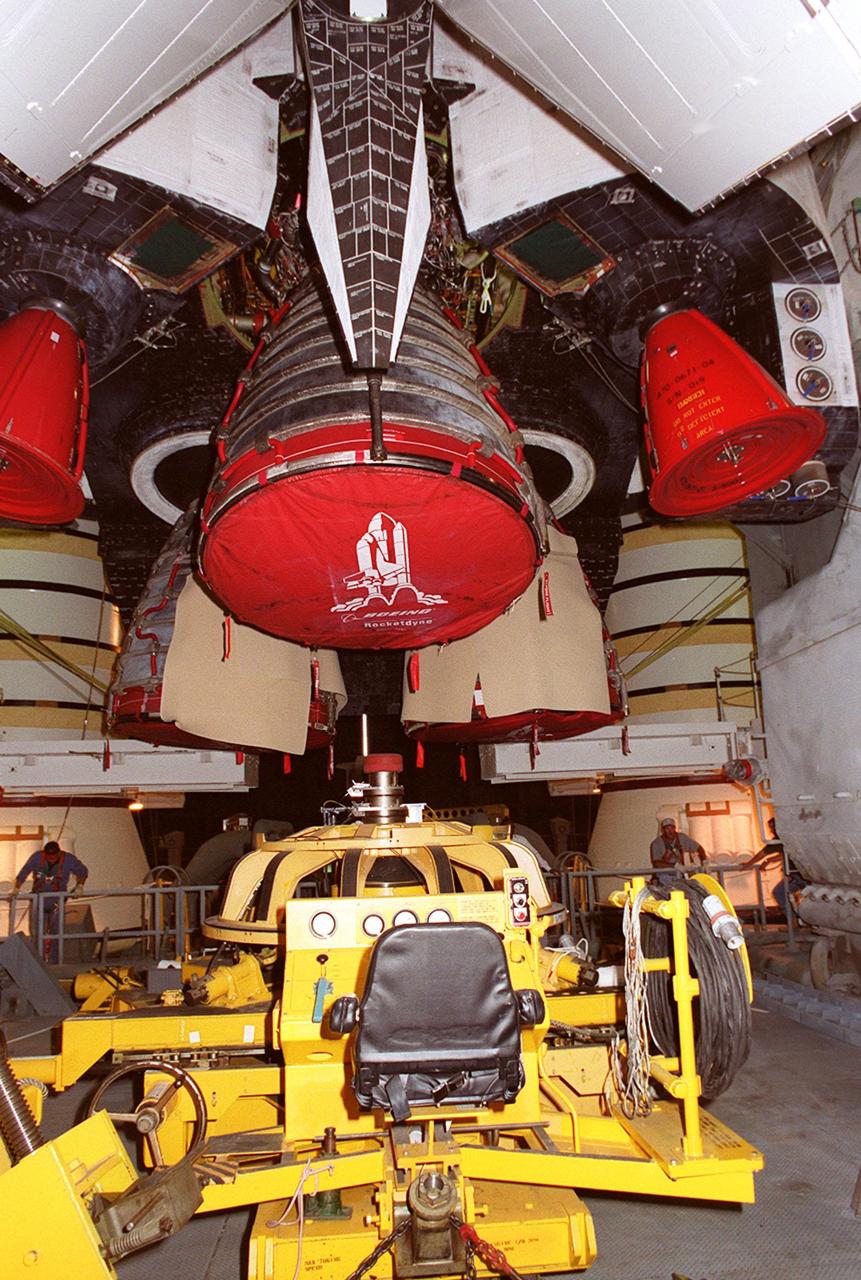
KENNEDY SPACE CENTER, FLA. -- The equipment is in place to remove Main Engine No. 1 from Space Shuttle Atlantis in the Vehicle Assembly Building. An inventory review concerning defective main engine fuel pump tip seals indicated that defective seals may be present on the fuel pump for the engine. The decision was made to replace the suspect engine with one originally slated for Discovery. The main engine nozzles, visible in the photo, are 7.8 feet across and 9.4 feet high. Space Shuttle Atlantis is scheduled to launch no earlier than April 17, 2000, on mission STS-101 to resupply the International Space Station for the arrival of the next pressurized module, the Russian-built Zvezda
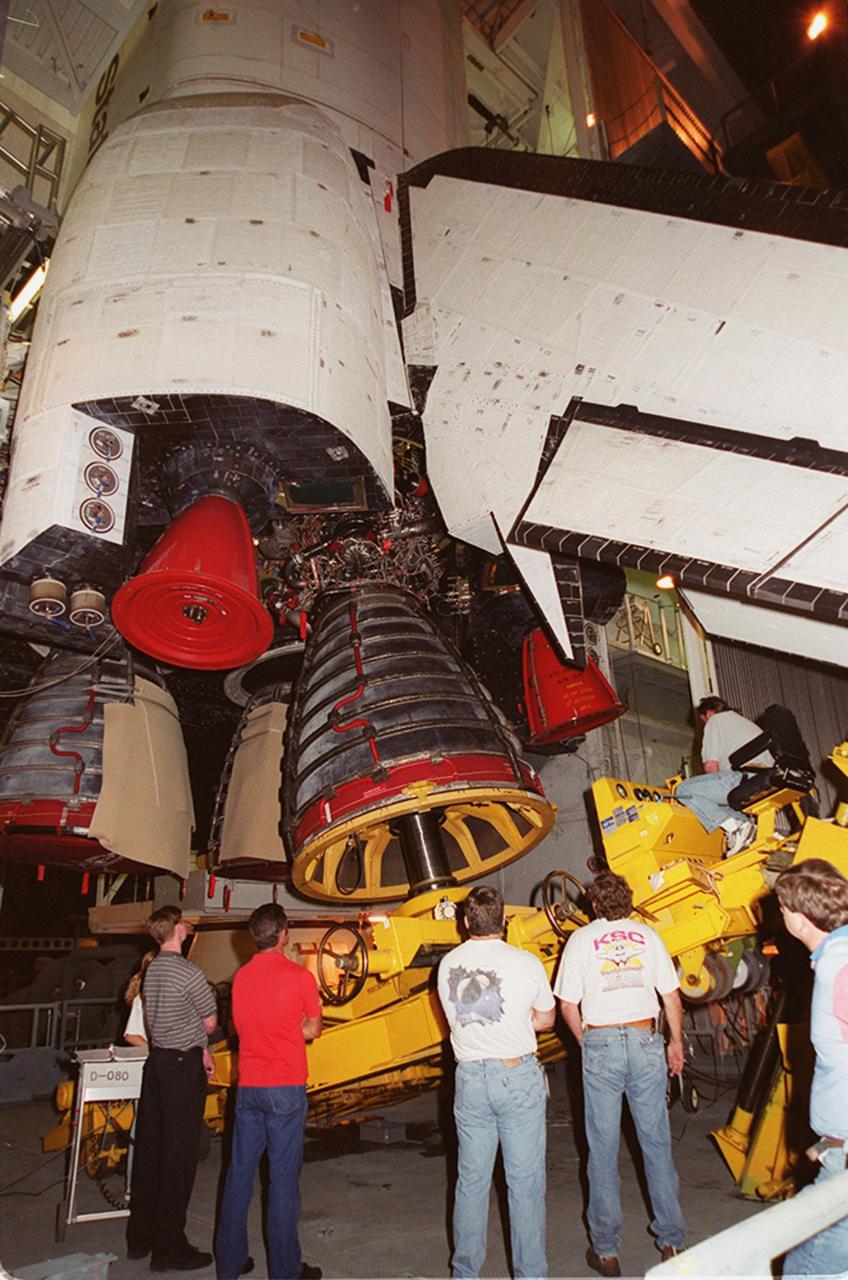
KENNEDY SPACE CENTER, FLA. -- Workers in the Vehicle Assembly Building watch as Space Shuttle Atlantis' Main Engine No. 1 is being removed. An inventory review concerning defective main engine fuel pump tip seals indicated that defective seals may be present on the fuel pump for the engine. The decision was made to replace the suspect engine with one originally slated for Discovery. The main engine nozzle, visible in the photo, is 7.8 feet across and 9.4 feet high. Space Shuttle Atlantis is scheduled to launch no earlier than April 17, 2000, on mission STS-101 to resupply the International Space Station for the arrival of the next pressurized module, the Russian-built Zvezda

KENNEDY SPACE CENTER, FLA. -- In the Vehicle Assembly Building, Space Shuttle Atlantis' Main Engine No. 1 is lowered after its removal. An inventory review concerning defective main engine fuel pump tip seals indicated that defective seals may be present on the fuel pump for the engine. The decision was made to replace the suspect engine with one originally slated for Discovery. The main engine nozzle, visible in the photo, is 7.8 feet across and 9.4 feet high. Space Shuttle Atlantis is scheduled to launch no earlier than April 17, 2000, on mission STS-101 to resupply the International Space Station for the arrival of the next pressurized module, the Russian-built Zvezda
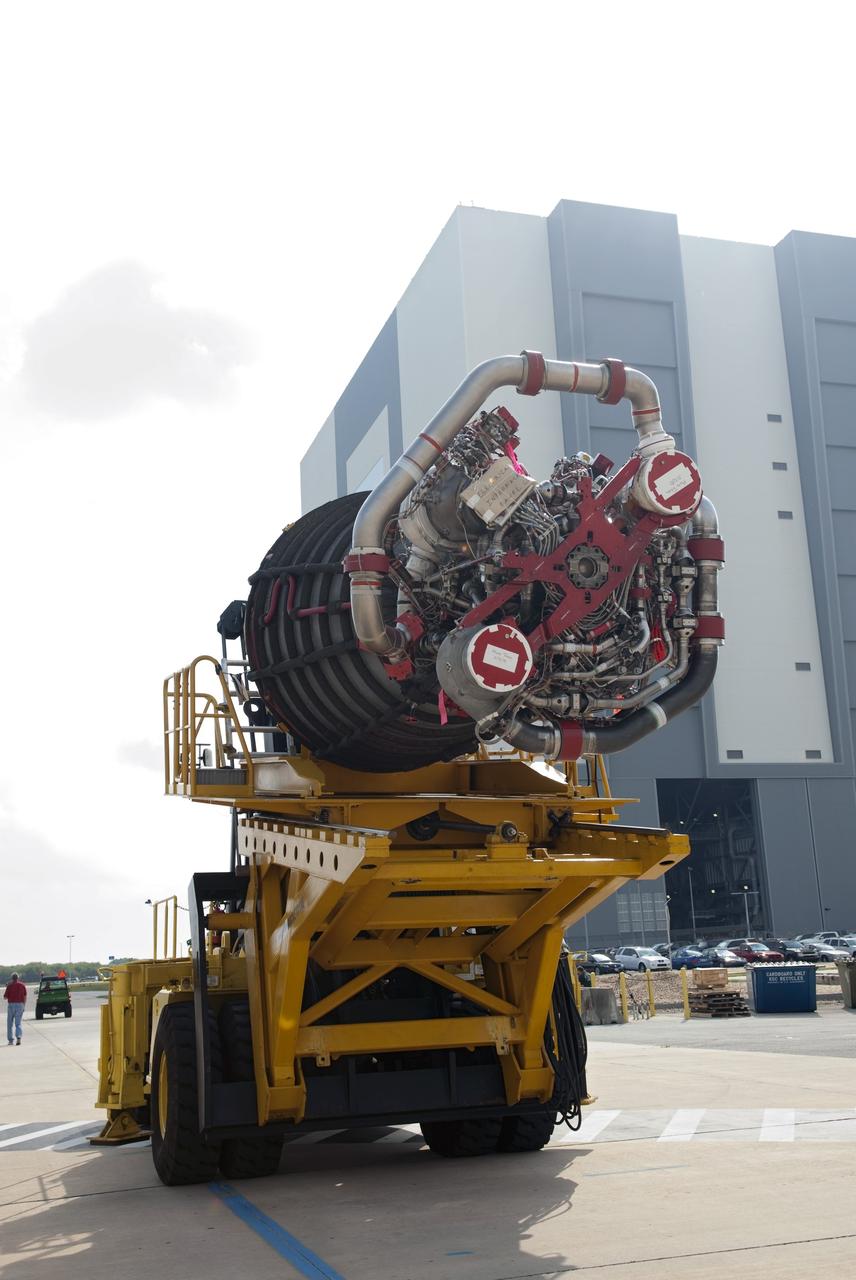
CAPE CANAVERAL, Fla. -- A heavy forklift with its specialized engine installer hold one of the main engines taken from space shuttle Discovery. The forklift is driving the engine from Orbiter Processing Facility-2 at NASA's Kennedy Space Center in Florida to the center's Space Shuttle Main Engine Processing Facility. The transition and retirement processing is expected to help rocket designers build next-generation spacecraft and prepare the shuttle for display. Photo credit: NASA/Jim Grossmann
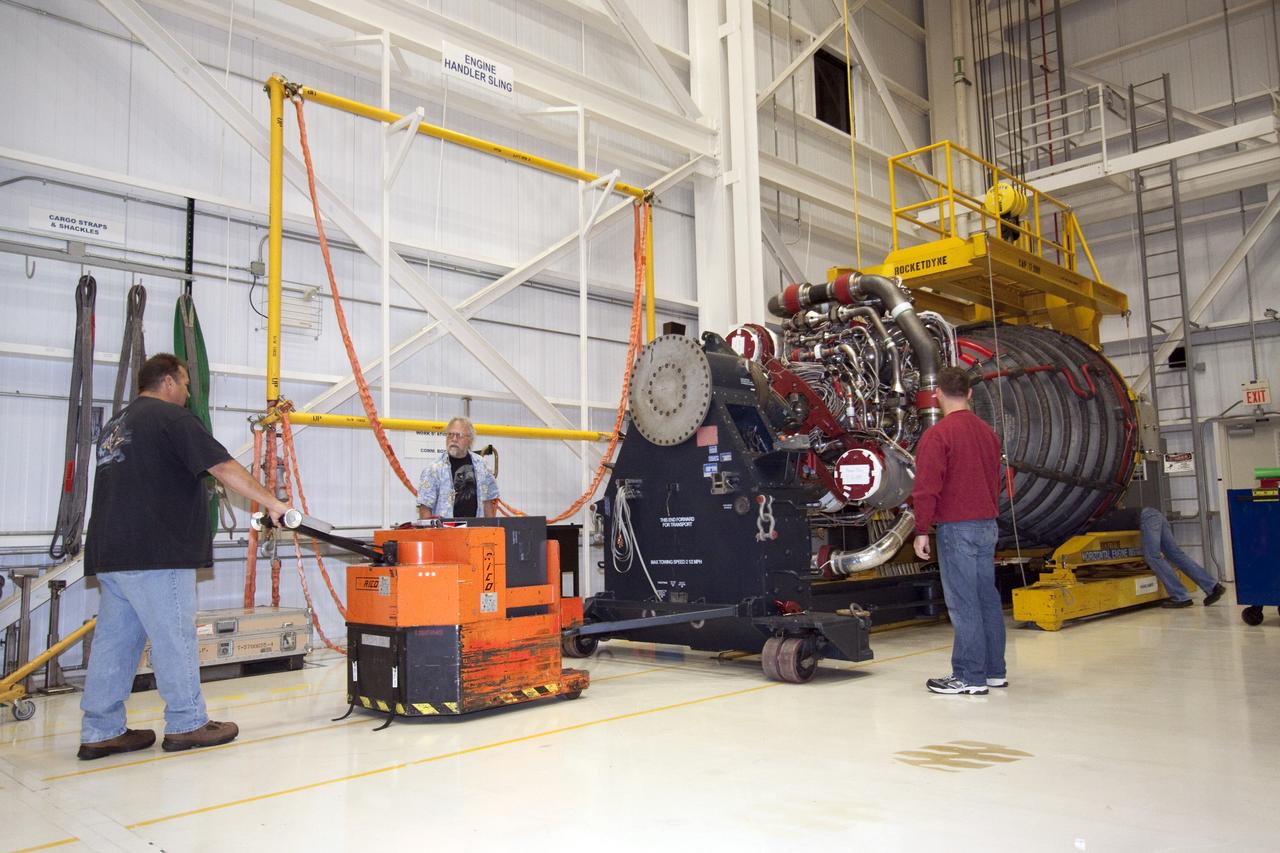
CAPE CANAVERAL, Fla. - Space shuttle main engine No. 2, which was removed from shuttle Discovery, will undergo routine inspections on a work stand in the Space Shuttle Main Engine Processing Facility at NASA's Kennedy Space Center in Florida. The removal was part of Discovery's transition and retirement processing. Work performed on Discovery is expected to help rocket designers build next-generation spacecraft and prepare the shuttle for future public display. Photo credit: NASA/Jack Pfaller
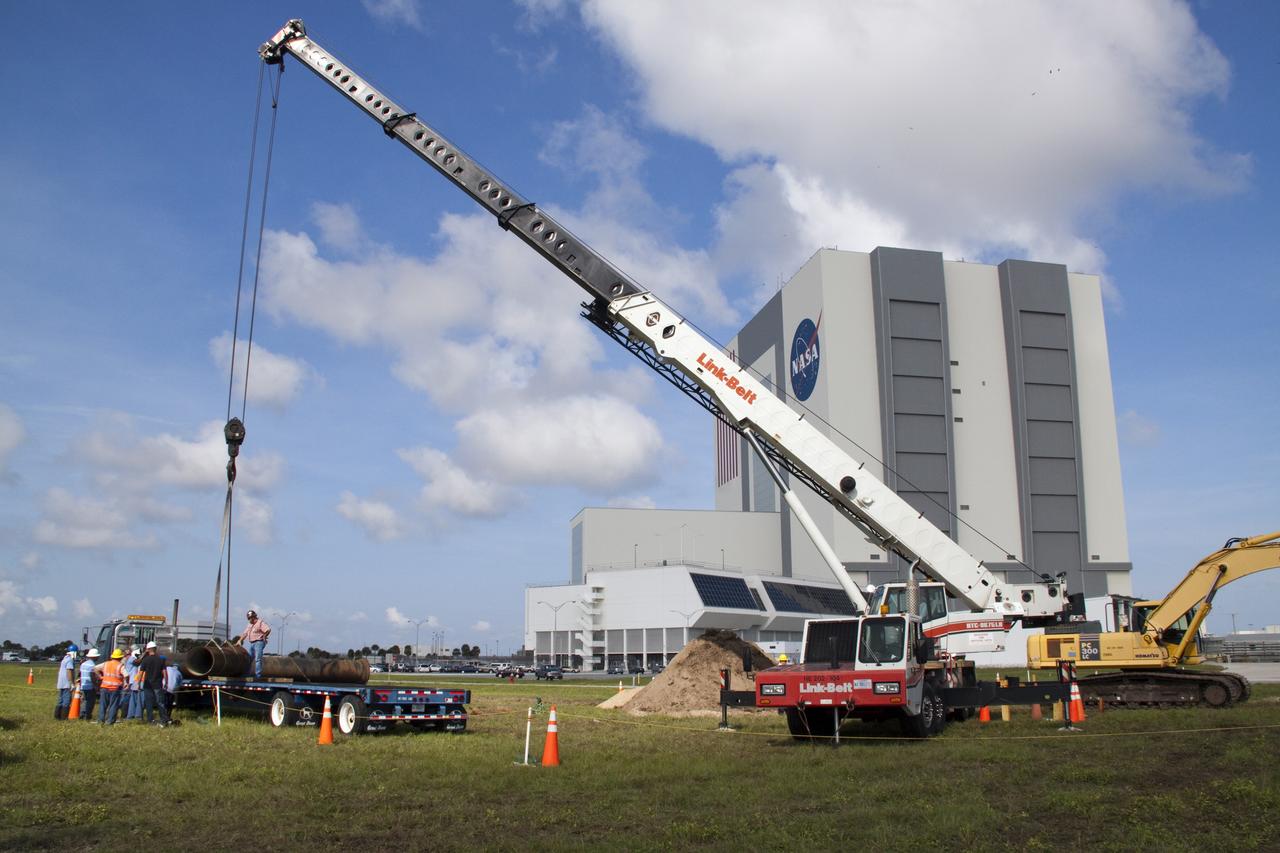
CAPE CANAVERAL, Fla. --In the Launch Complex-39 Turn Basin area, across from the Vehicle Assembly Building at NASA's Kennedy Space Center in Florida, workers, assisted by an overhead crane maneuver the replacement section of a 24-inch cast iron water main pipe off of a transport truck. Kennedy was closed to non-essential personnel the morning of Sept. 8 while crews assessed the water main break and restored water to the center. Photo credit: NASA/Jack Pfaller
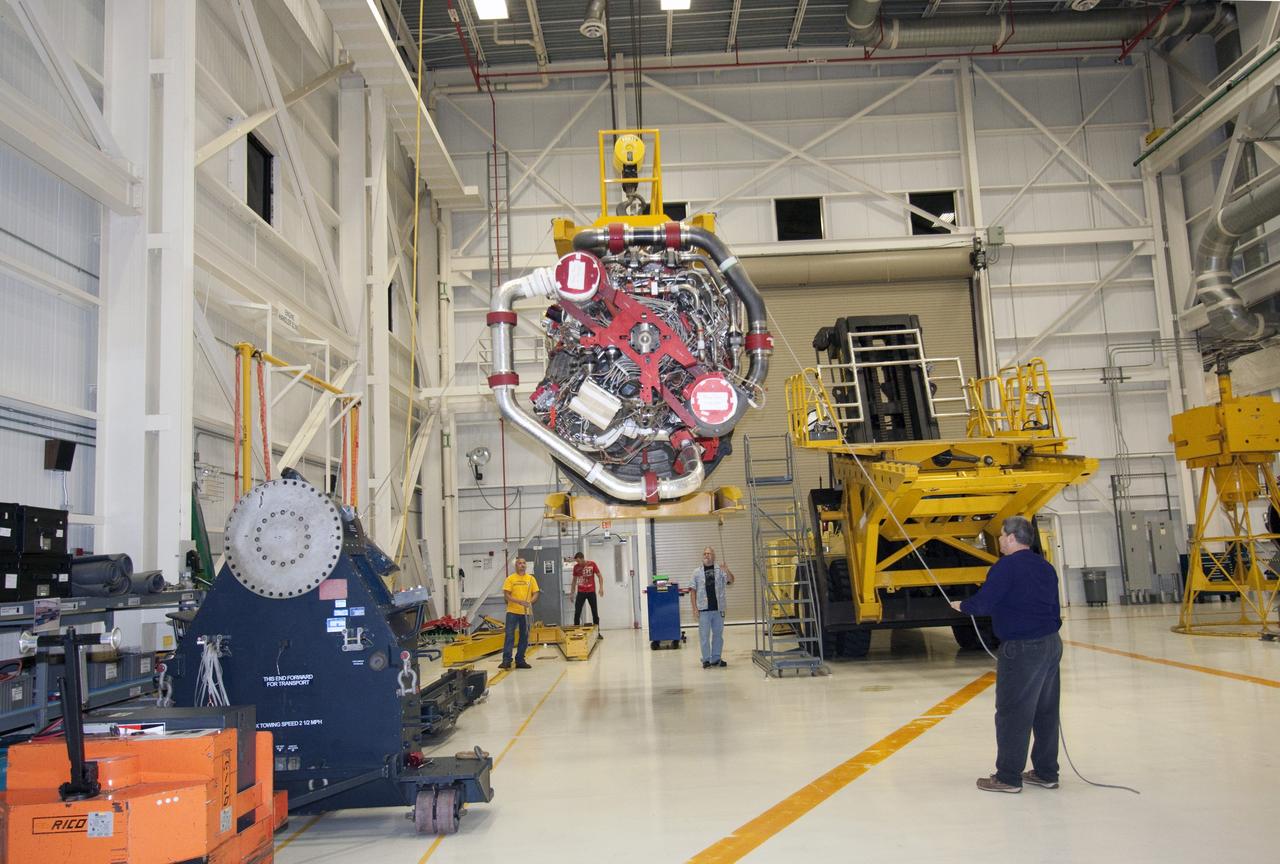
CAPE CANAVERAL, Fla. - Space shuttle main engine No. 2, which was removed from shuttle Discovery, is moved to a work stand for routine inspections in the Space Shuttle Main Engine Processing Facility at NASA's Kennedy Space Center in Florida. The removal was part of Discovery's transition and retirement processing. Work performed on Discovery is expected to help rocket designers build next-generation spacecraft and prepare the shuttle for future public display. Photo credit: NASA/Jack Pfaller
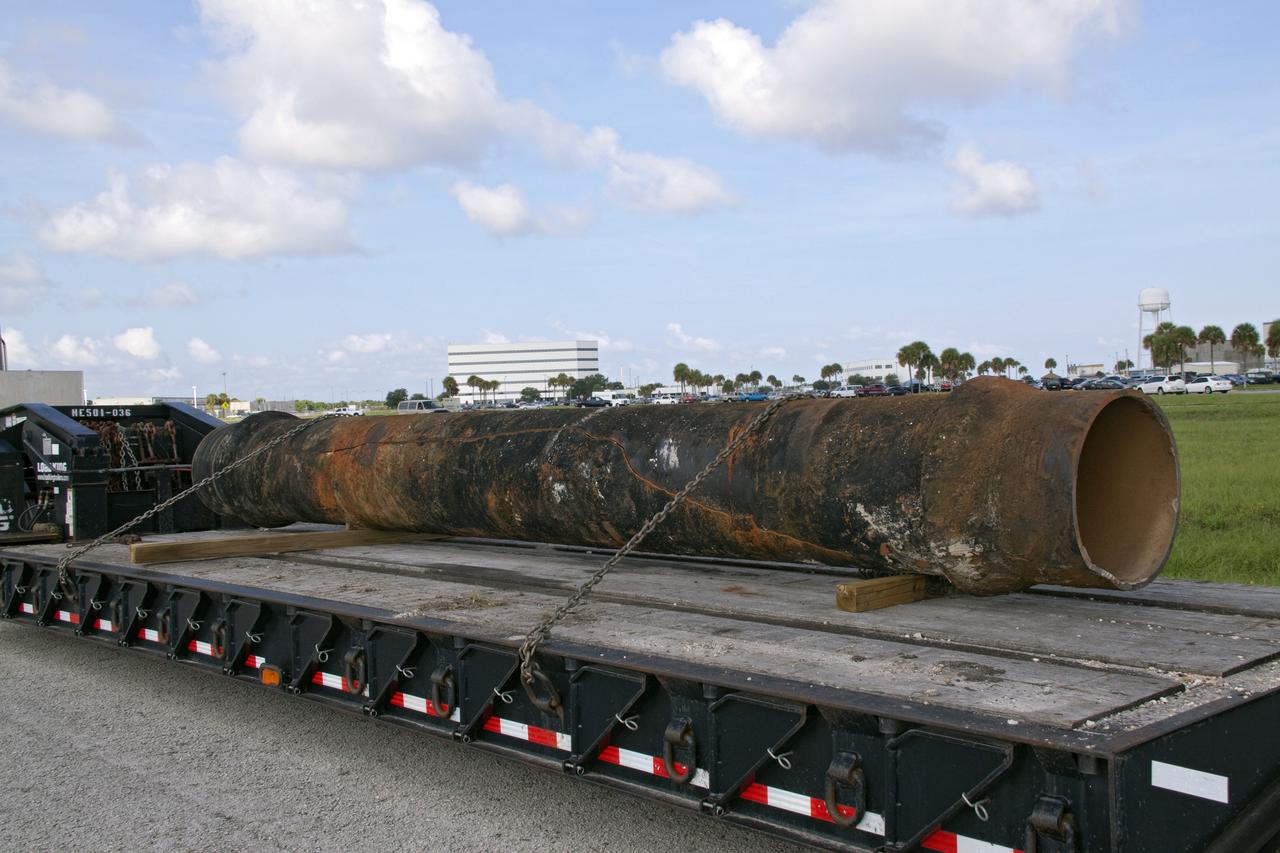
CAPE CANAVERAL, Fla. -- In the Launch Complex-39 Turn Basin area, across from the Vehicle Assembly Building at NASA's Kennedy Space Center in Florida, the section of a 24-inch cast iron water main pipe that failed is hauled away by a transport truck. Kennedy was closed to non-essential personnel the morning of Sept. 8 while crews assessed the water main break and restored water to the center. Photo credit: NASA/Jack Pfaller
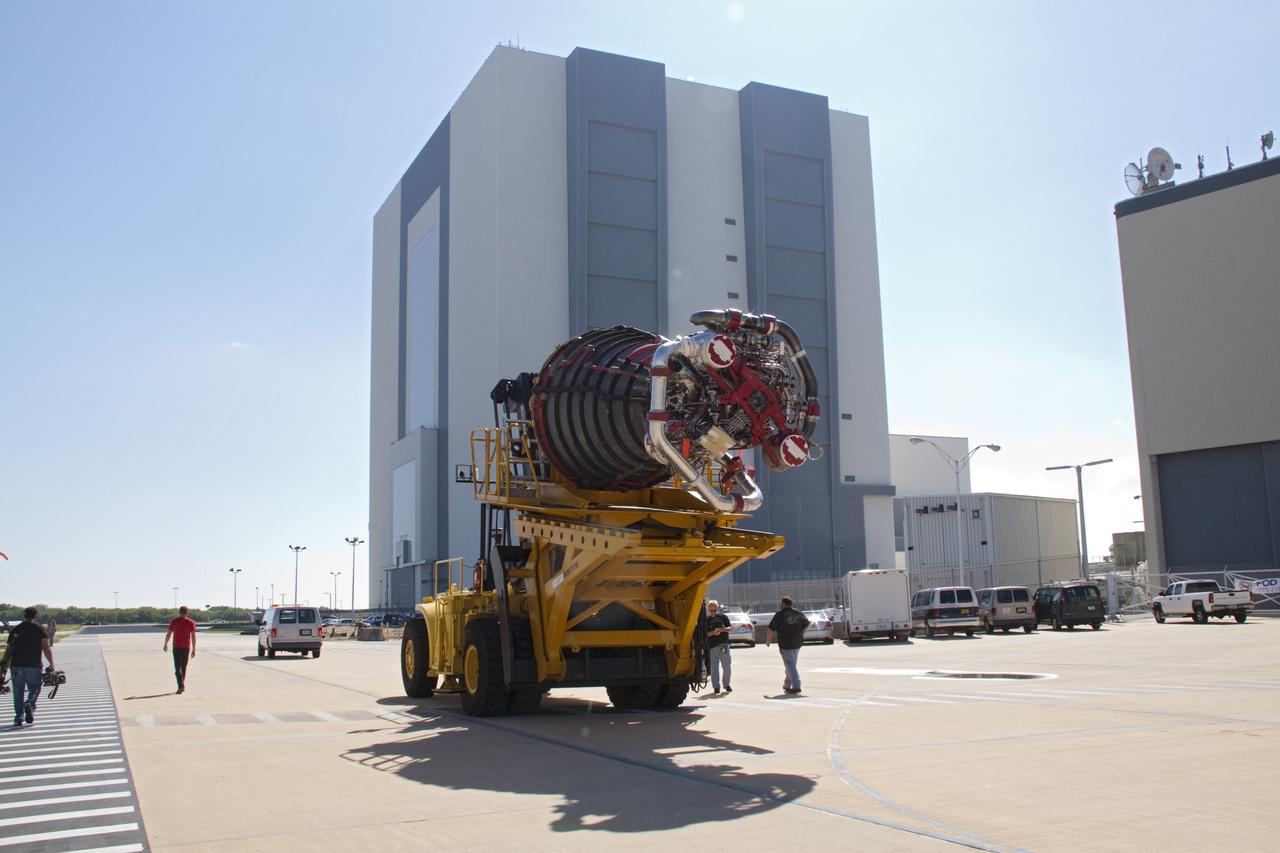
CAPE CANAVERAL, Fla. - Main engine No. 1, which was removed from space shuttle Discovery, is transported from Orbiter Processing Facility-2 to the Space Shuttle Main Engine Processing Facility at NASA's Kennedy Space Center in Florida. The removal was part of Discovery's transition and retirement processing. Work performed on Discovery is expected to help rocket designers build next-generation spacecraft and prepare the shuttle for future public display. Photo credit: NASA/Jack Pfaller
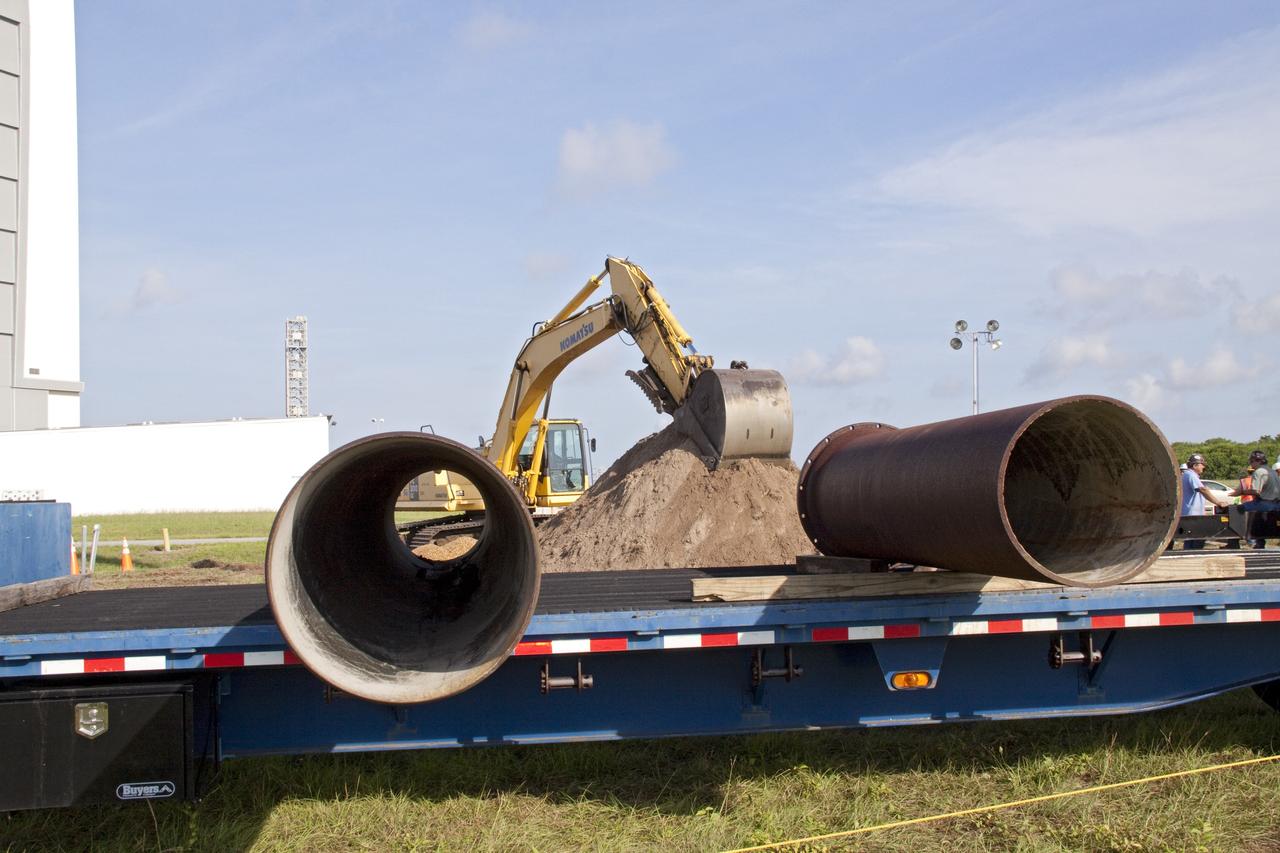
CAPE CANAVERAL, Fla. -- In the Launch Complex-39 Turn Basin area, across from the Vehicle Assembly Building at NASA's Kennedy Space Center in Florida, replacement sections of a 24-inch cast iron water main pipe awaits installation. Kennedy was closed to non-essential personnel the morning of Sept. 8 while crews assessed the water main break and restored water to the center. Photo credit: NASA/Jack Pfaller
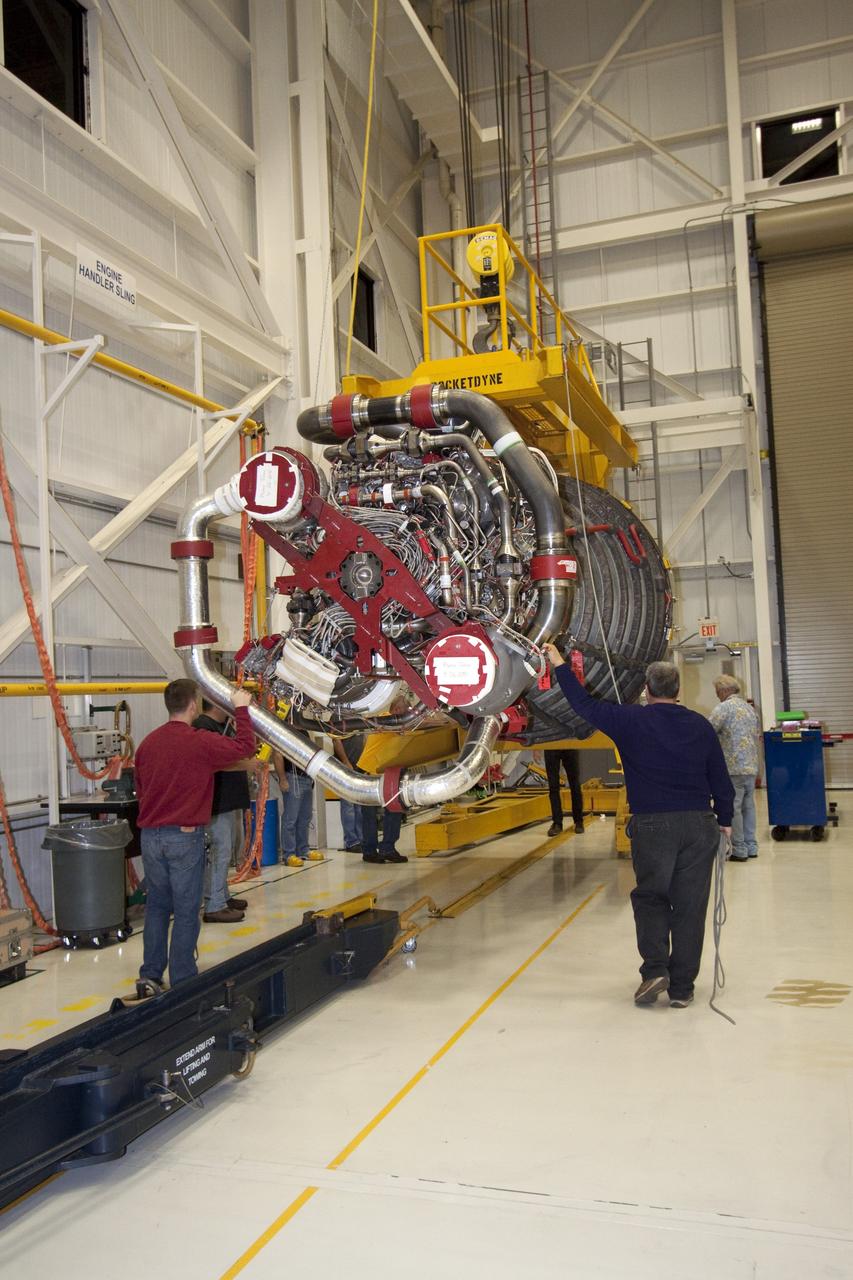
CAPE CANAVERAL, Fla. - Space shuttle main engine No. 2, which was removed from shuttle Discovery, is moved to a work stand for routine inspections in the Space Shuttle Main Engine Processing Facility at NASA's Kennedy Space Center in Florida. The removal was part of Discovery's transition and retirement processing. Work performed on Discovery is expected to help rocket designers build next-generation spacecraft and prepare the shuttle for future public display. Photo credit: NASA/Jack Pfaller
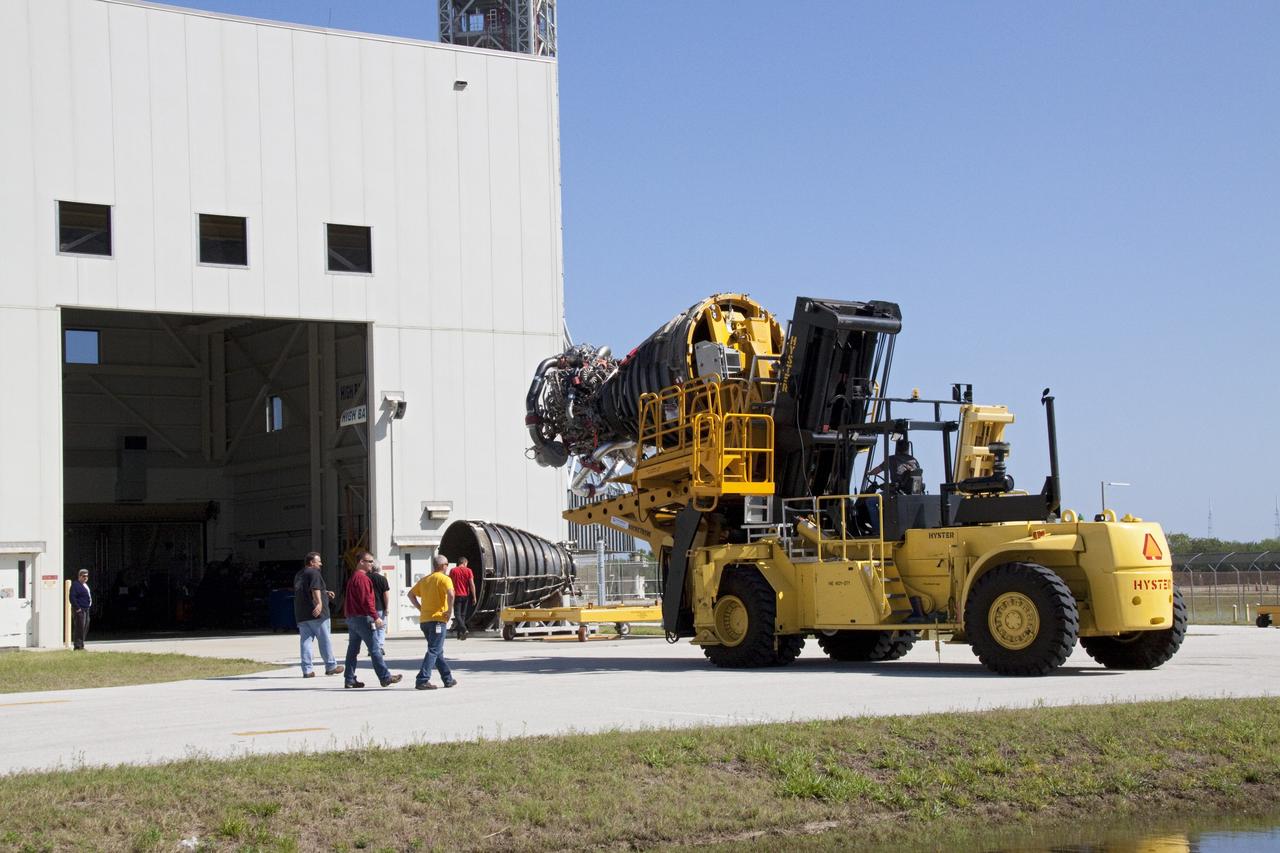
CAPE CANAVERAL, Fla. - Main engine No. 1, which was removed from space shuttle Discovery, is transported from Orbiter Processing Facility-2 to the Space Shuttle Main Engine Processing Facility at NASA's Kennedy Space Center in Florida. The removal was part of Discovery's transition and retirement processing. Work performed on Discovery is expected to help rocket designers build next-generation spacecraft and prepare the shuttle for future public display. Photo credit: NASA/Jack Pfaller
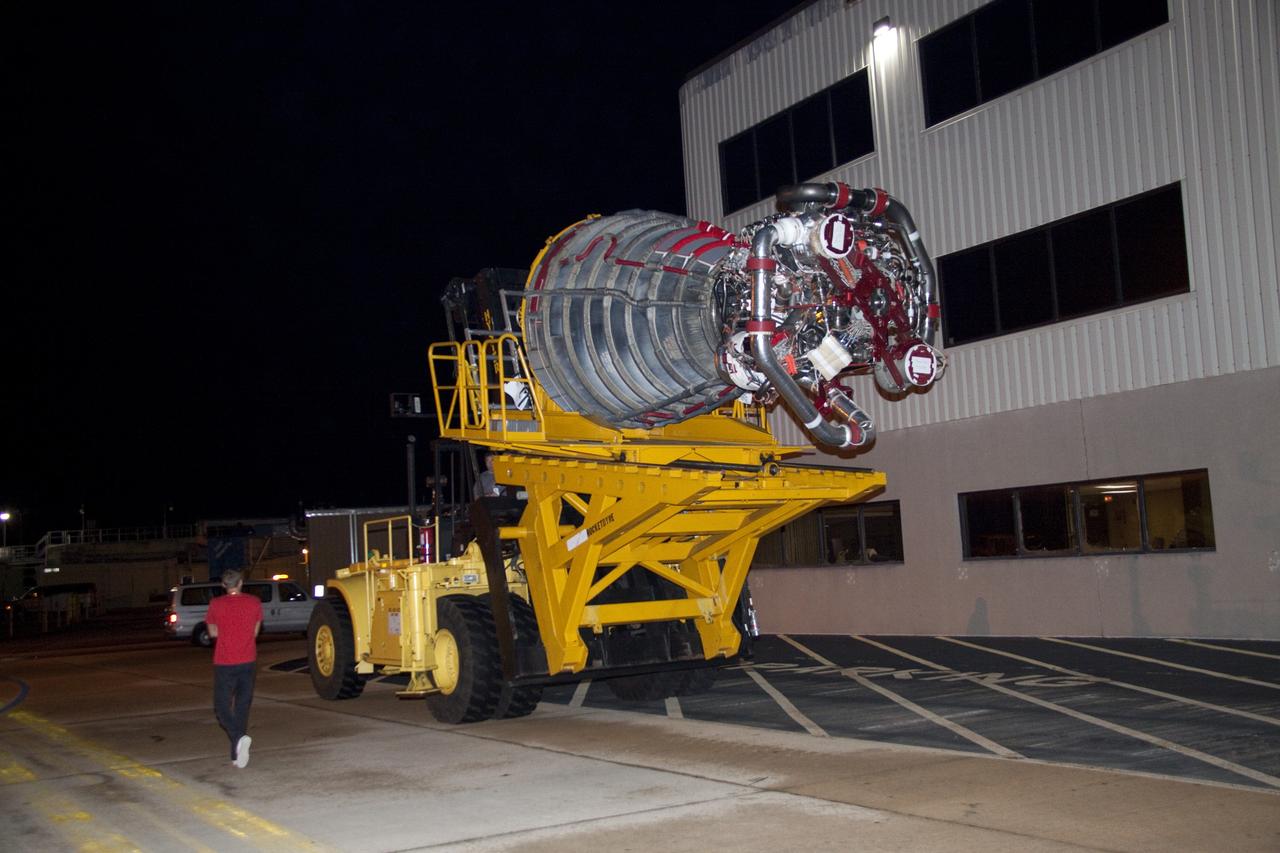
CAPE CANAVERAL, Fla. - Space shuttle main engine No. 2, which was removed from shuttle Discovery, is transported from Orbiter Processing Facility-2 to the Space Shuttle Main Engine Processing Facility at NASA's Kennedy Space Center in Florida. The removal was part of Discovery's transition and retirement processing. Work performed on Discovery is expected to help rocket designers build next-generation spacecraft and prepare the shuttle for future public display. Photo credit: NASA/Jack Pfaller
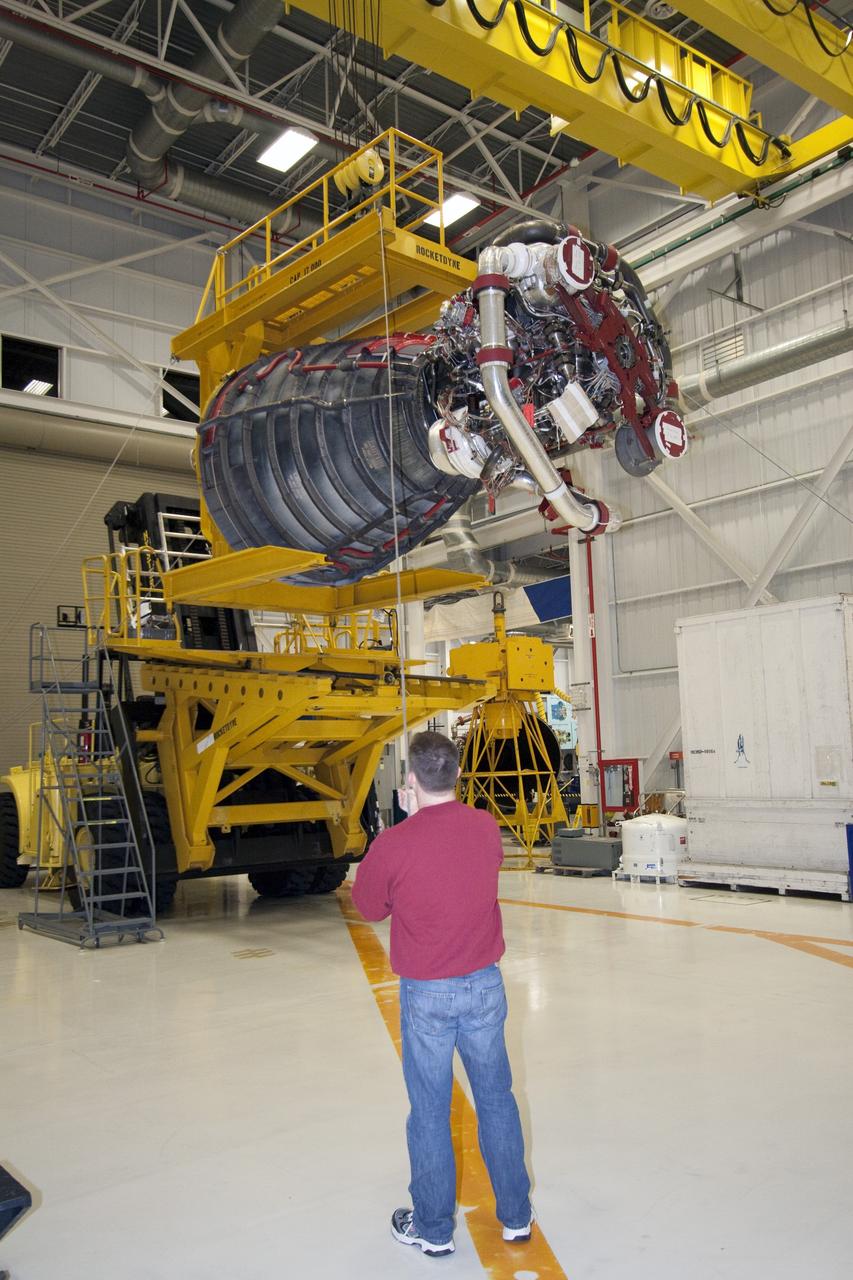
CAPE CANAVERAL, Fla. - Space shuttle main engine No. 2, which was removed from shuttle Discovery, is moved to a work stand for routine inspections in the Space Shuttle Main Engine Processing Facility at NASA's Kennedy Space Center in Florida. The removal was part of Discovery's transition and retirement processing. Work performed on Discovery is expected to help rocket designers build next-generation spacecraft and prepare the shuttle for future public display. Photo credit: NASA/Jack Pfaller
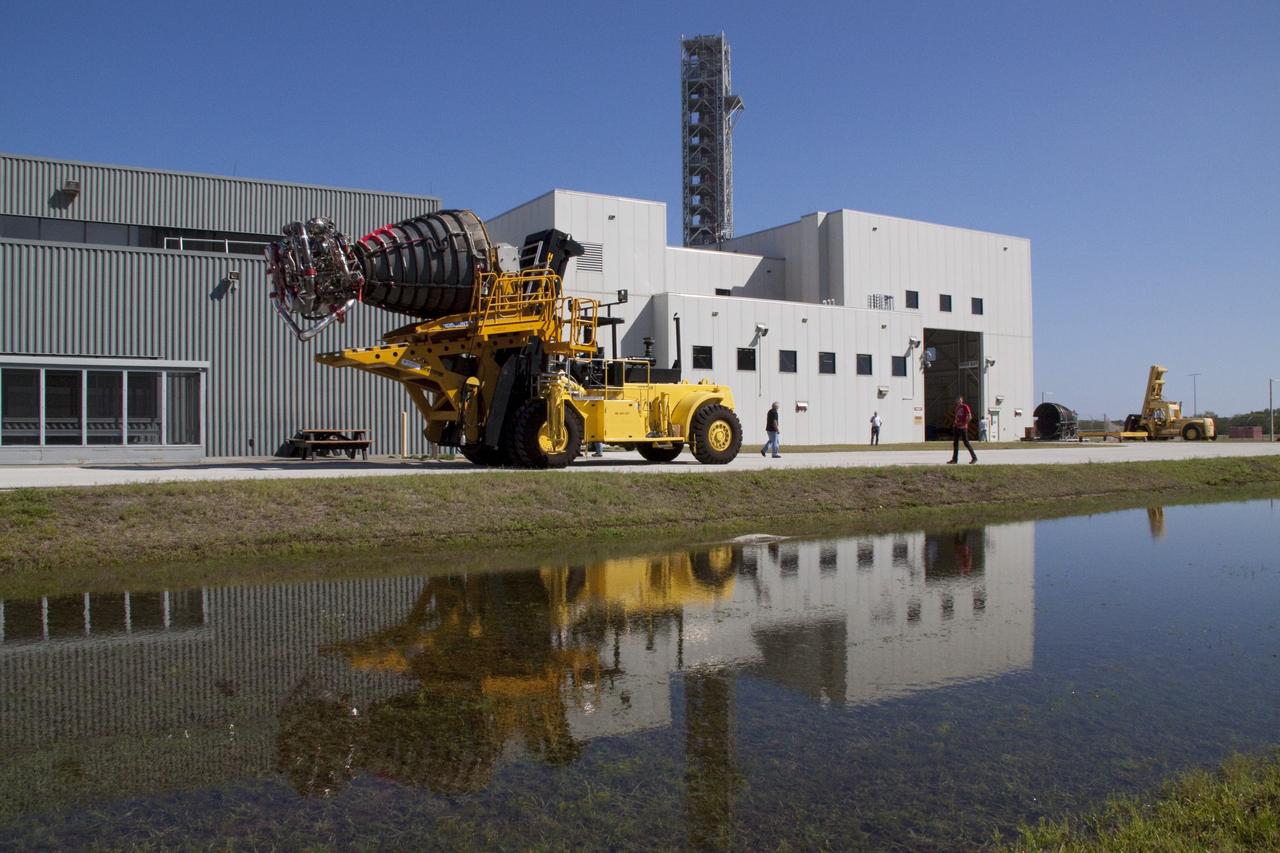
CAPE CANAVERAL, Fla. - Main engine No. 1, which was removed from space shuttle Discovery, is transported from Orbiter Processing Facility-2 to the Space Shuttle Main Engine Processing Facility at NASA's Kennedy Space Center in Florida. The removal was part of Discovery's transition and retirement processing. Work performed on Discovery is expected to help rocket designers build next-generation spacecraft and prepare the shuttle for future public display. Photo credit: NASA/Jack Pfaller
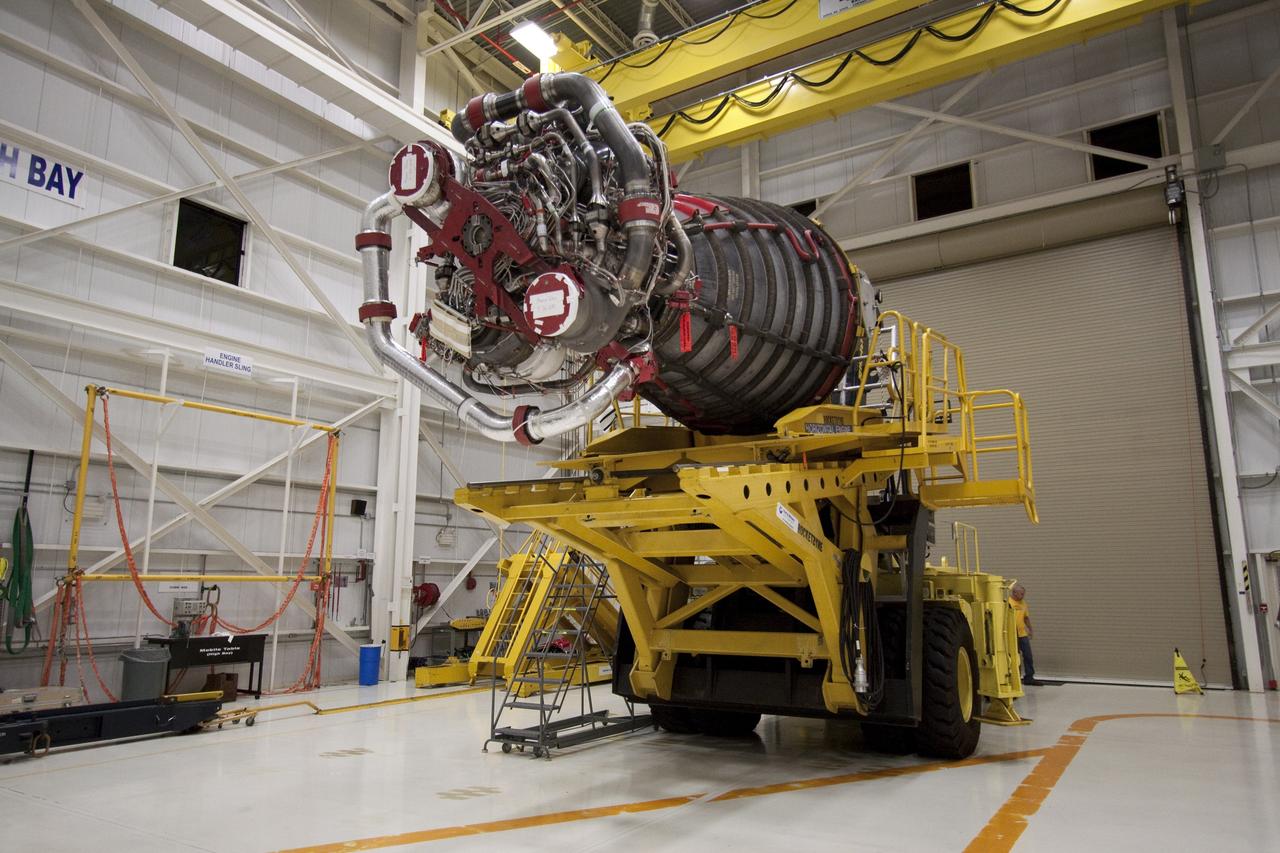
CAPE CANAVERAL, Fla. - Space shuttle main engine No. 2, which was removed from shuttle Discovery, will undergo standard inspections in the Space Shuttle Main Engine Processing Facility at NASA's Kennedy Space Center in Florida. The removal was part of Discovery's transition and retirement processing. Work performed on Discovery is expected to help rocket designers build next-generation spacecraft and prepare the shuttle for future public display. Photo credit: NASA/Jack Pfaller
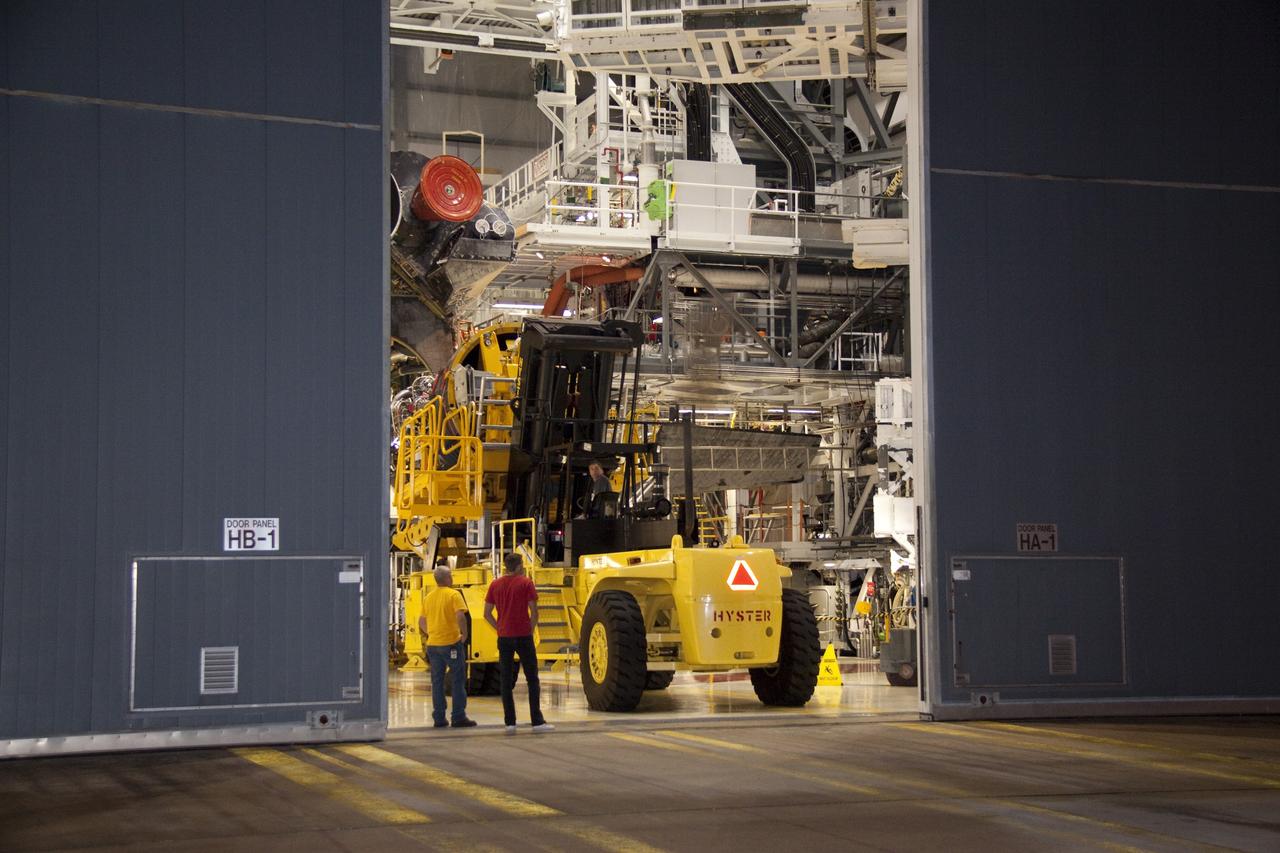
CAPE CANAVERAL, Fla. - Space shuttle main engine No. 2, which was removed from shuttle Discovery, will be transported from Orbiter Processing Facility-2 to the Space Shuttle Main Engine Processing Facility at NASA's Kennedy Space Center in Florida. The removal was part of Discovery's transition and retirement processing. Work performed on Discovery is expected to help rocket designers build next-generation spacecraft and prepare the shuttle for future public display. Photo credit: NASA/Jack Pfaller
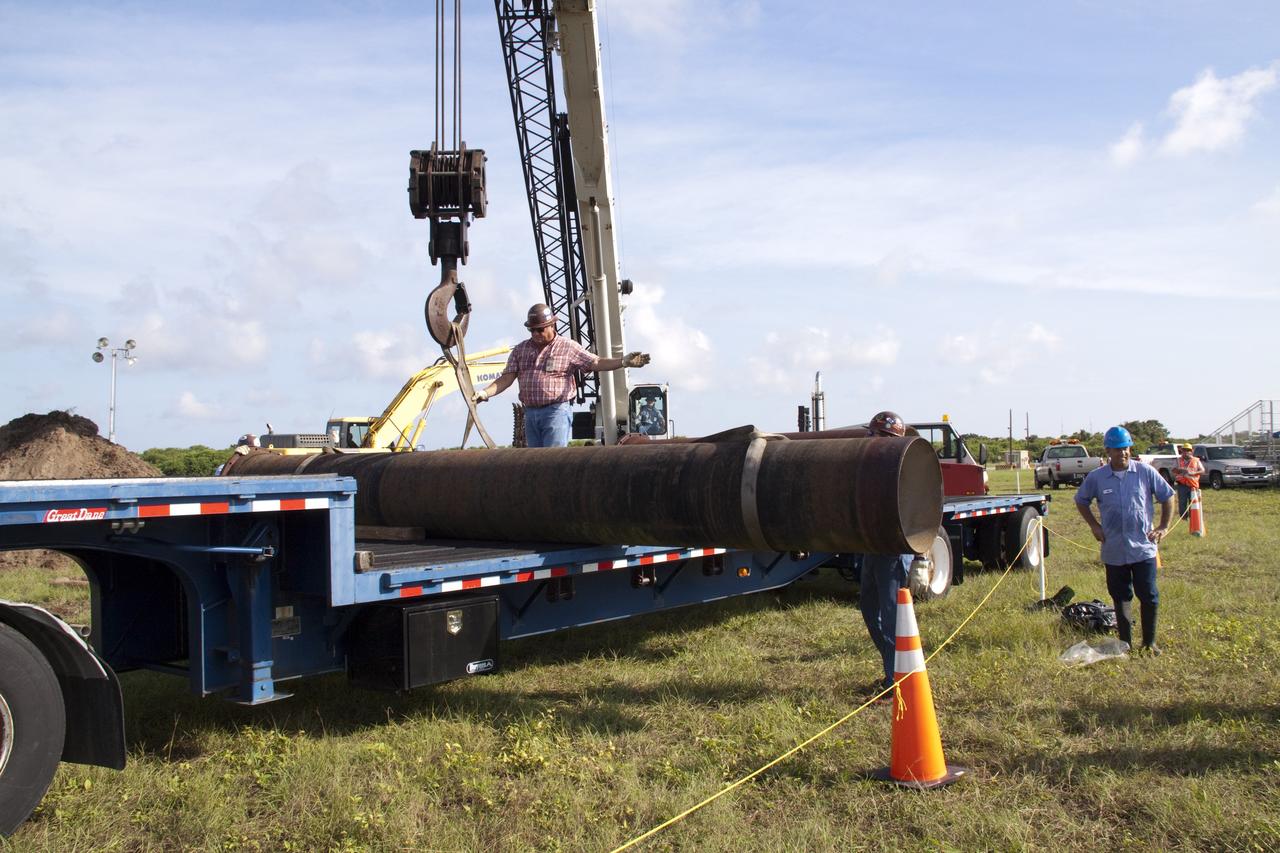
CAPE CANAVERAL, Fla. -- In the Launch Complex-39 Turn Basin area, across from the Vehicle Assembly Building at NASA's Kennedy Space Center in Florida, workers maneuver the replacement sections of a 24-inch cast iron water main pipe off of a transport truck. Kennedy was closed to non-essential personnel the morning of Sept. 8 while crews assessed the water main break and restored water to the center. Photo credit: NASA/Jack Pfaller
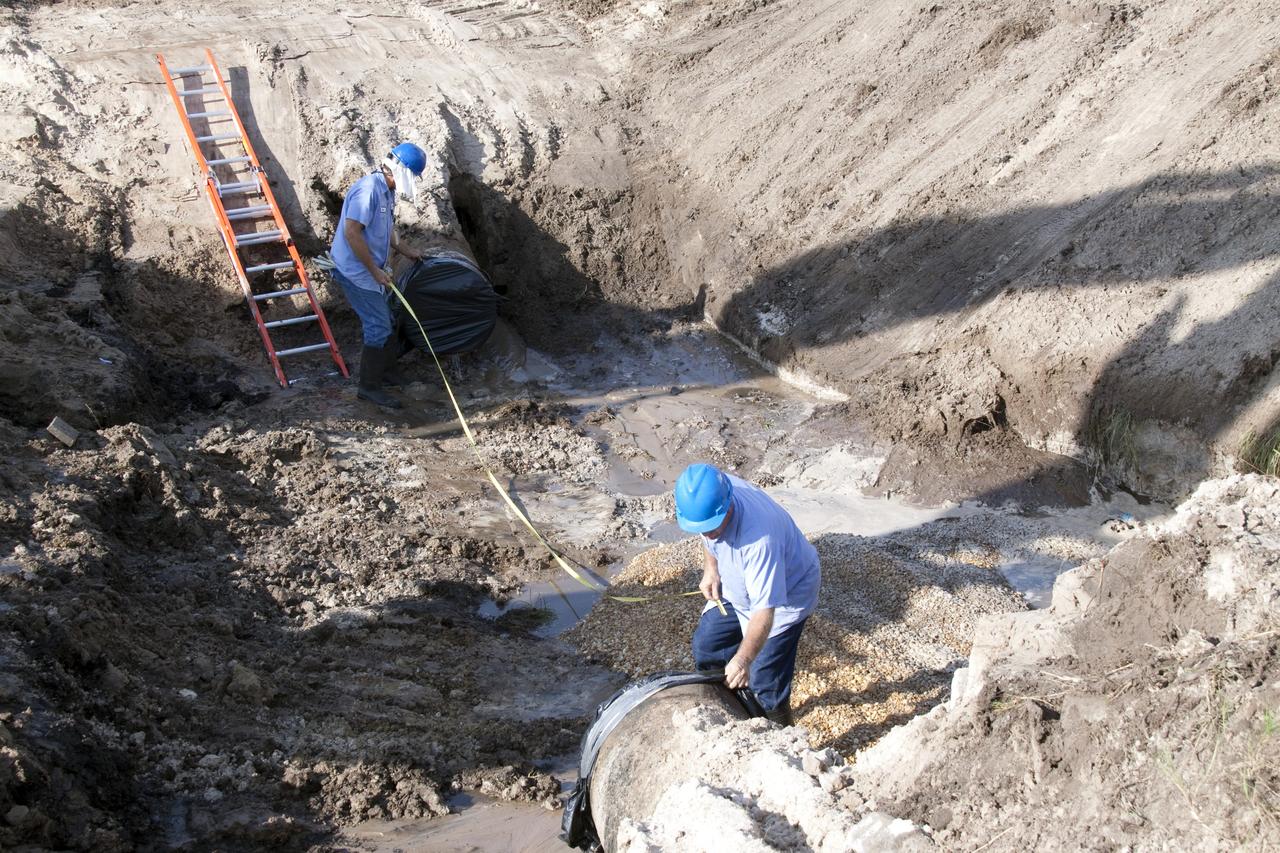
CAPE CANAVERAL, Fla. -- In the Launch Complex-39 Turn Basin area, across from the Vehicle Assembly Building at NASA's Kennedy Space Center in Florida, workers take measurements for replacement sections of a 24-inch cast iron water main pipe. Kennedy was closed to non-essential personnel the morning of Sept. 8 while crews assessed the water main break and restored water to the center. Photo credit: NASA/Jack Pfaller
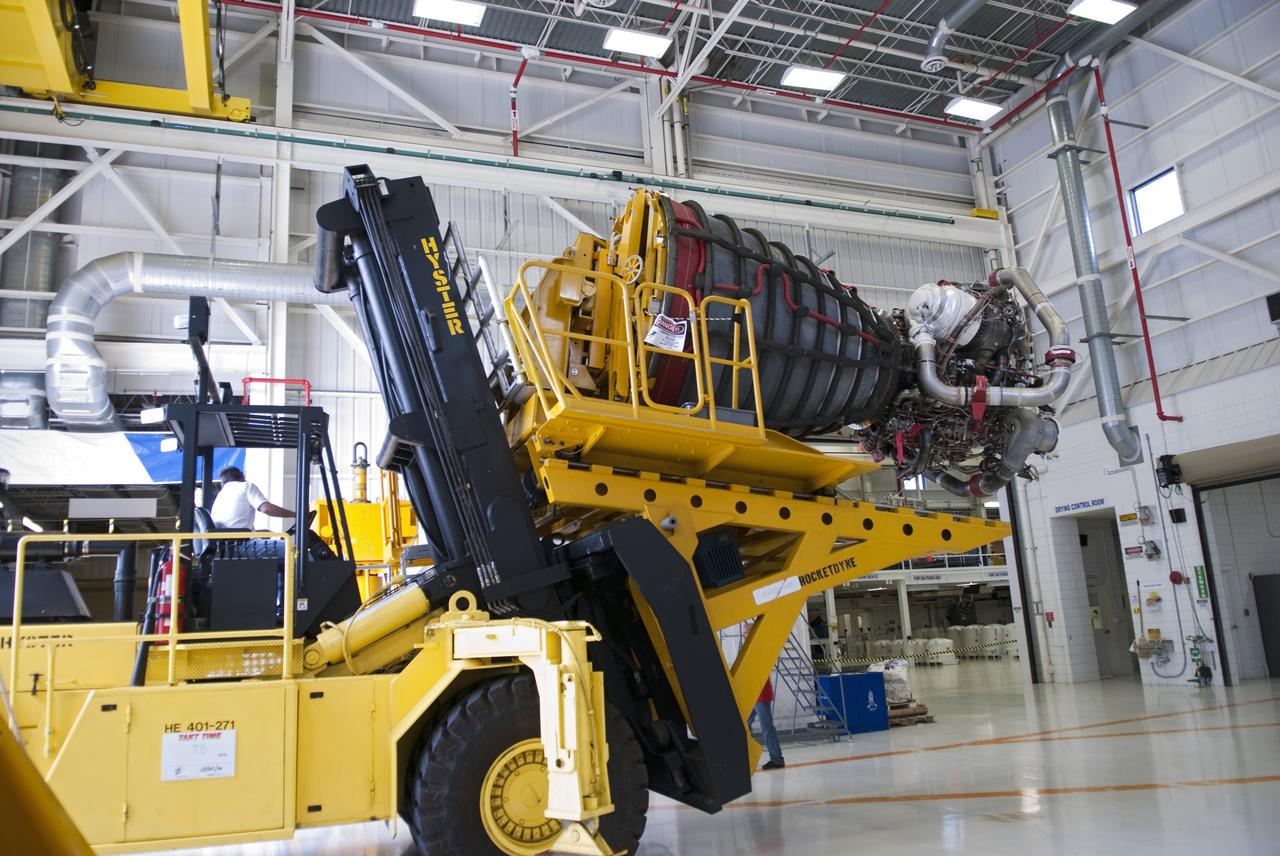
CAPE CANAVERAL, Fla. -- A heavy forklift with its specialized engine installer carries one of the main engines taken from space shuttle Discovery into the Space Shuttle Main Engine Processing Facility at NASA's Kennedy Space Center in Florida. The transition and retirement processing is expected to help rocket designers build next-generation spacecraft and prepare the shuttle for display. Photo credit: NASA/Jim Grossmann
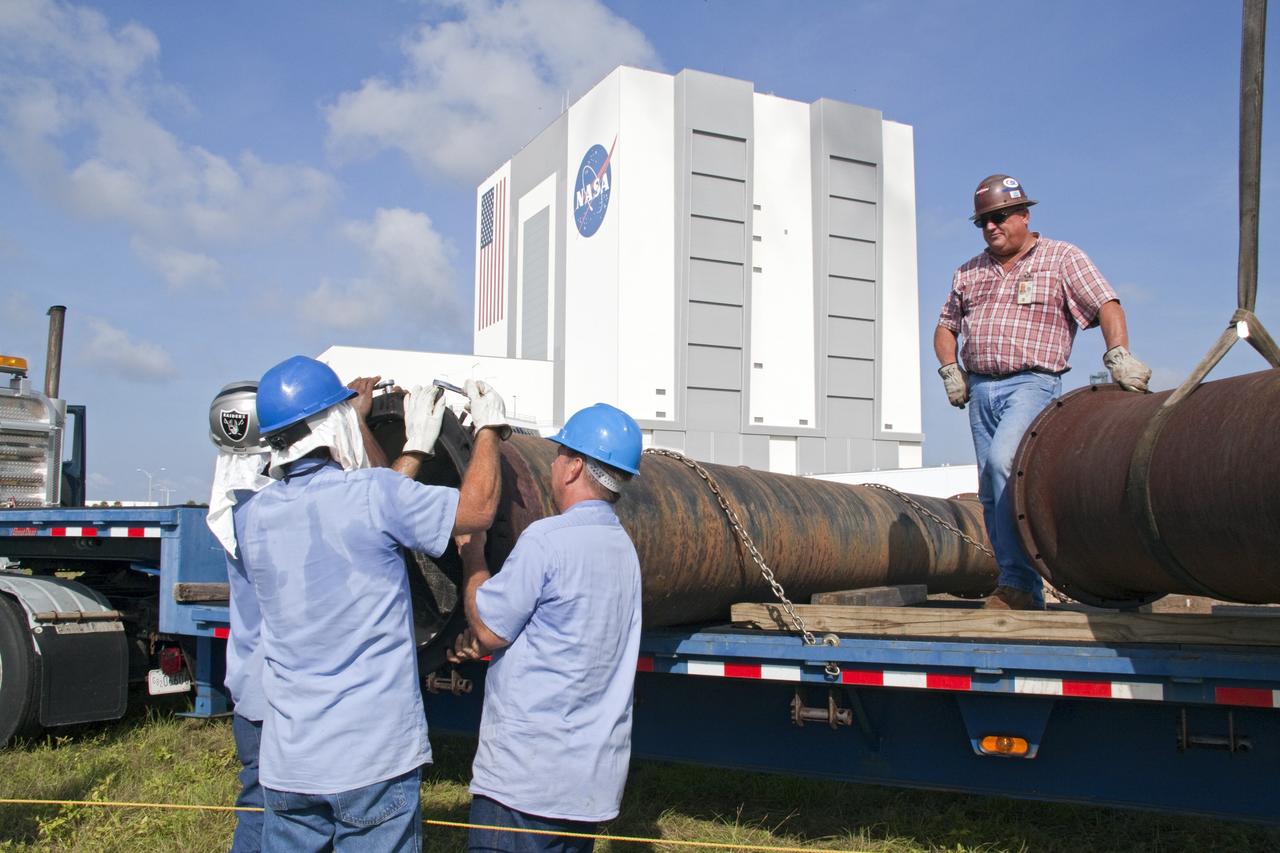
CAPE CANAVERAL, Fla. -- In the Launch Complex-39 Turn Basin area, across from the Vehicle Assembly Building at NASA's Kennedy Space Center in Florida, workers maneuver the replacement section of a 24-inch cast iron water main pipe off of a transport truck. Kennedy was closed to non-essential personnel the morning of Sept. 8 while crews assessed the water main break and restored water to the center. Photo credit: NASA/Jack Pfaller
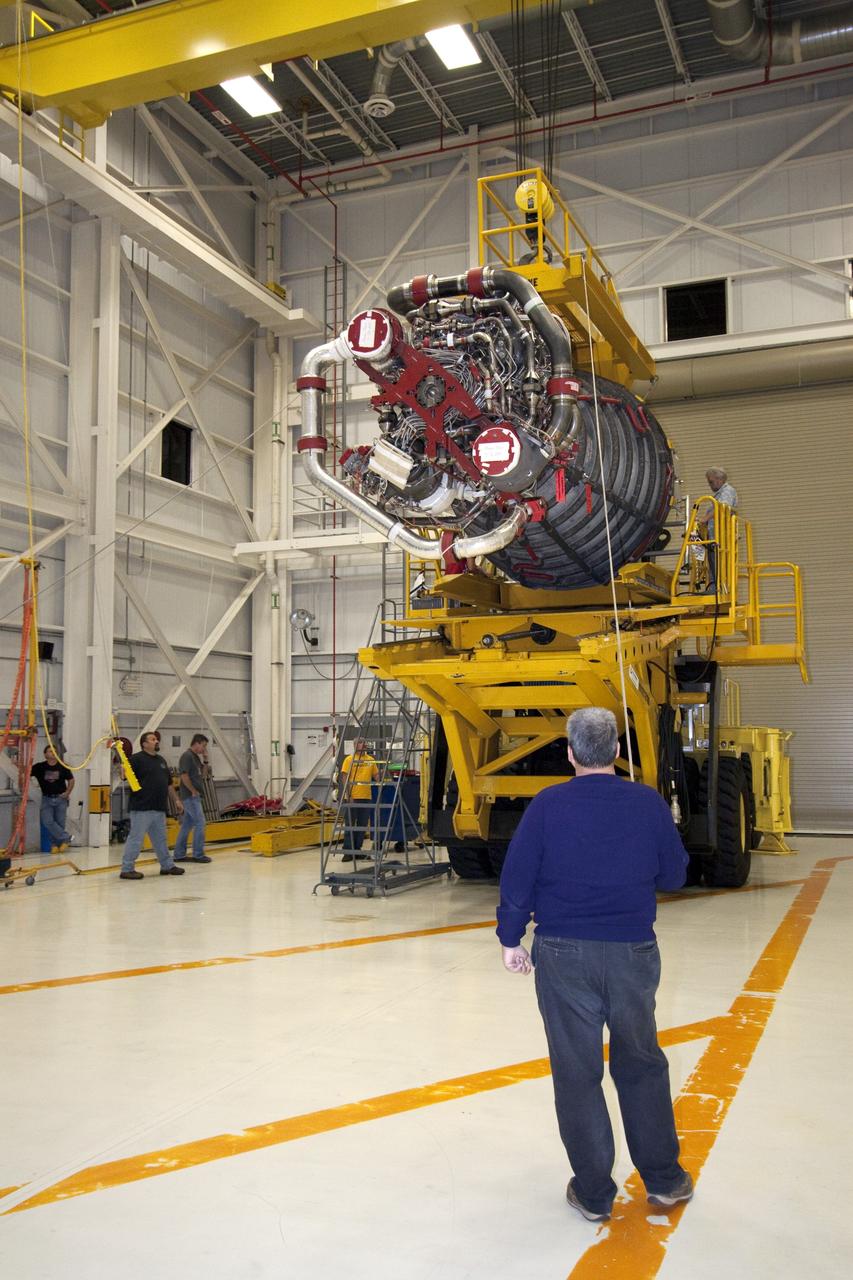
CAPE CANAVERAL, Fla. - Space shuttle main engine No. 2, which was removed from shuttle Discovery, will undergo standard inspections in the Space Shuttle Main Engine Processing Facility at NASA's Kennedy Space Center in Florida. The removal was part of Discovery's transition and retirement processing. Work performed on Discovery is expected to help rocket designers build next-generation spacecraft and prepare the shuttle for future public display. Photo credit: NASA/Jack Pfaller

The refurbished sign from the original Headquarters building at NASA’s Kennedy Space Center in Florida is installed by the main entrance of the new Central Campus Headquarters, Feb. 18, 2021. The sign, which reads “National Aeronautics and Space Administration – Kennedy Space Center Headquarters,” was placed on the center’s first Headquarters building when the facility was completed in 1965. Kennedy’s modern Central Campus Headquarters, a seven-story building with several sustainable features, opened in May 2019 and provides space for 500 NASA and contractor employees.
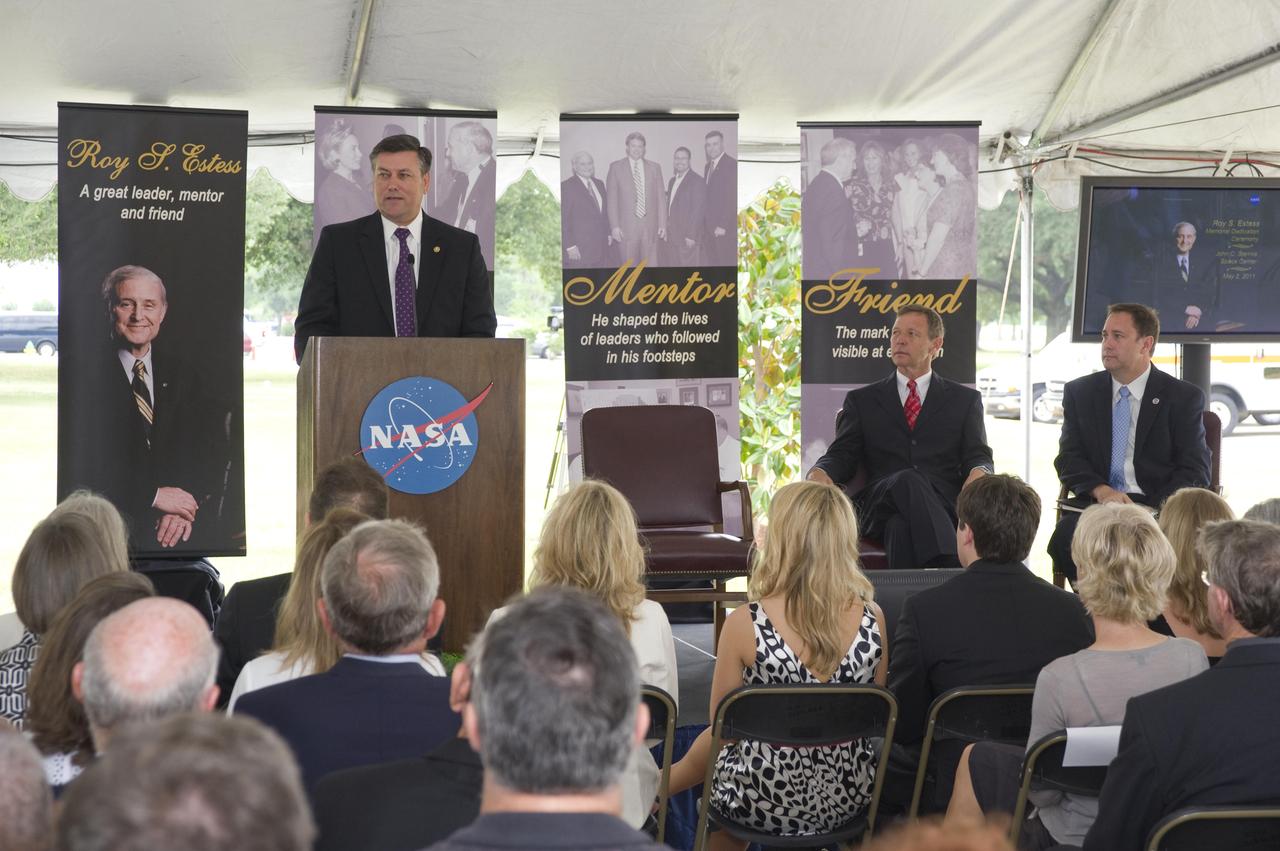
Stennis Space Center Director Patrick Scheuermann welcomes Roy S. Estess family members and guests May 2 to the ceremony dedicating and naming the main NASA administration building for the late Stennis director. Estess served as director of the rocket engine test facility from 1989 to 2002.

Stennis Space Center Director Patrick Scheuermann (right) and members of the Roy S. Estess family unveil a commissioned portrait of the late Stennis director during a May 2 ceremony. The portrait now hangs in the lobby of the main NASA administration at Stennis, now named the Roy S. Estess Building.

Stennis Space Center Director Patrick Scheuermann (right) and members of the Roy S. Estess family unveil a commissioned portrait of the late Stennis director during a May 2 ceremony. The portrait now hangs in the lobby of the main NASA administration at Stennis, now named the Roy S. Estess Building.

The five crew members of the Space Shuttle Atlantis on the STS-98 mission depart NASA Dryden to return to the Johnson Space Center at Houston. They briefly extended greetings to Dryden staff members on the ramp area behind Dryden's Main Building at a crew ceremony on February 21, 2001.

Environmental sustainability is put into practice here in the native plant gardens that surround the main auditorium building at NASA Ames Research Center, Moffett Field, Calif. An assortment of the colors of the California poppy are shown in this image. The garden contains many other native plants as well.
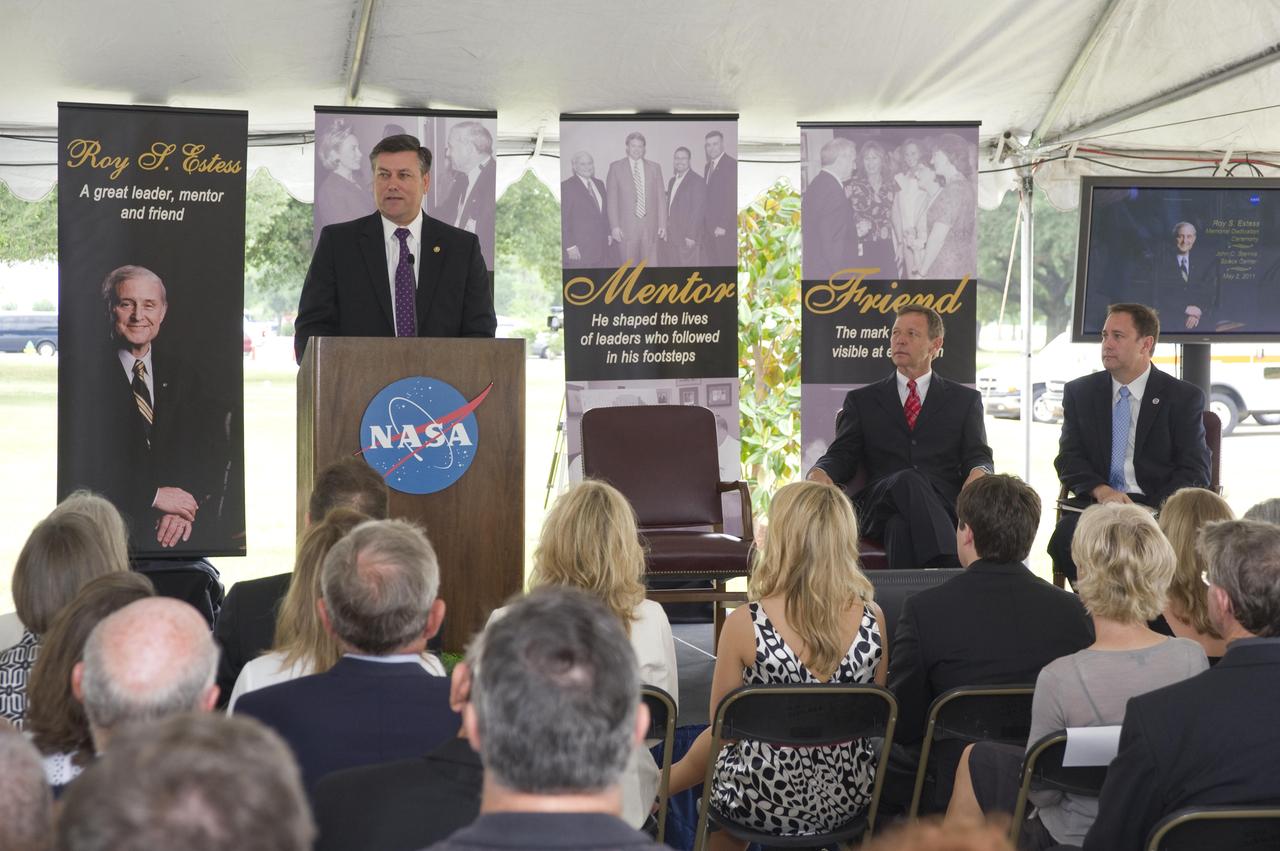
Stennis Space Center Director Patrick Scheuermann welcomes Roy S. Estess family members and guests May 2 to the ceremony dedicating and naming the main NASA administration building for the late Stennis director. Estess served as director of the rocket engine test facility from 1989 to 2002.
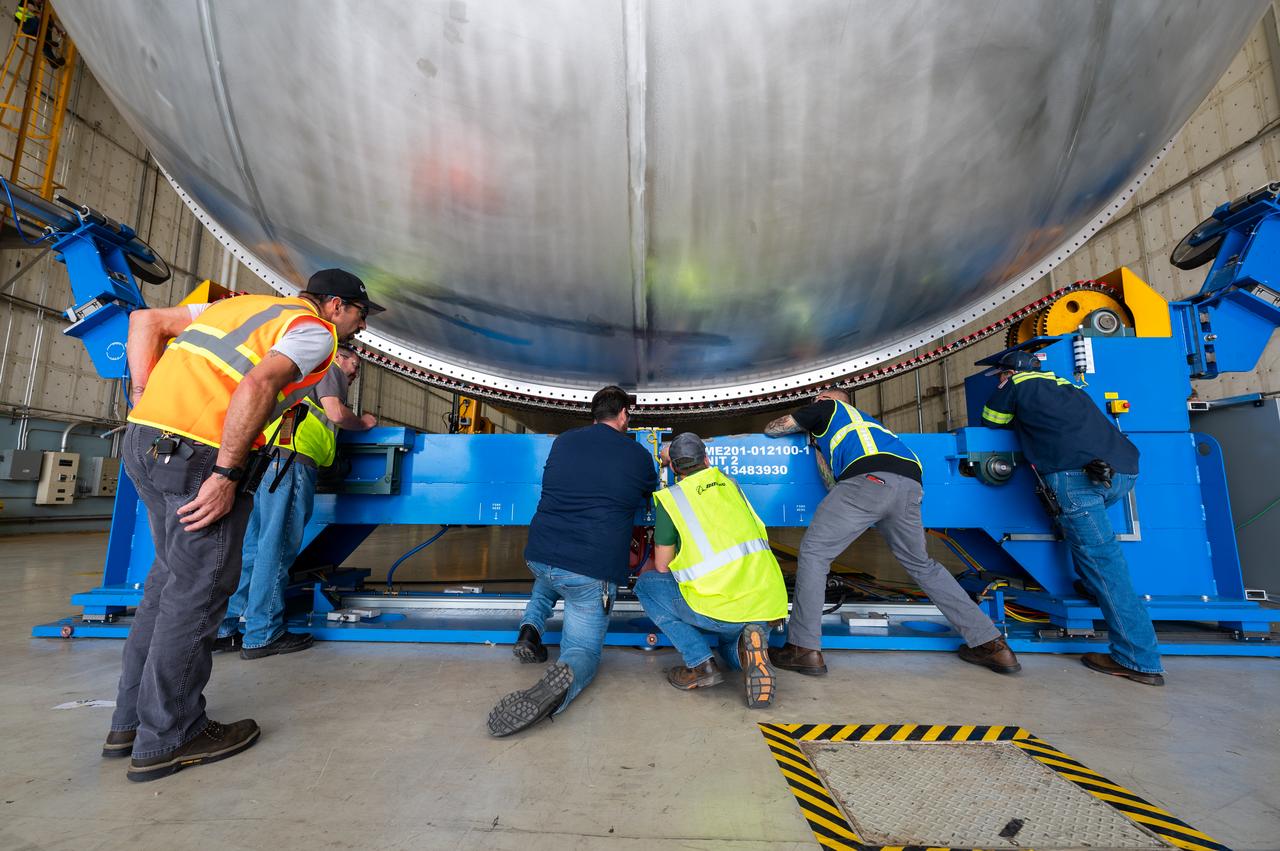
The core stage liquid hydrogen tank for the Artemis III mission completed proof testing, and technicians returned it to the main factory building at NASA’s Michoud Assembly Facility in New Orleans where it will undergo more outfitting. As part of proof testing, technicians apply a simple soap solution and check for leaks by observing any bubble formation on the welds. The technician removed the bubble solution with distilled water and then dried the area of application to prevent corrosion. To build the Space Launch System (SLS) rocket’s 130-foot core stage liquid hydrogen tank, engineers use robotic tools to weld five-barrel segments. This process results in a tank with around 1,900 feet, or more than six football fields, of welds that must be tested by hand. After the leak tests, the core stage lead, Boeing, pressurized the SLS tank to further ensure there were no leaks. After it passed proof testing, technicians moved the Artemis III liquid hydrogen tank to Michoud’s main factory. Soon, the technicians will prime and apply a foam-based thermal protection system that protects the tank during launch. Later, the tank will be joined with other parts of the core stage to form the entire 212-foot rocket stage with its four RS-25 engines that produce 2 million pounds of thrust to help launch the rocket. Artemis III will land the first astronauts on the lunar surface.
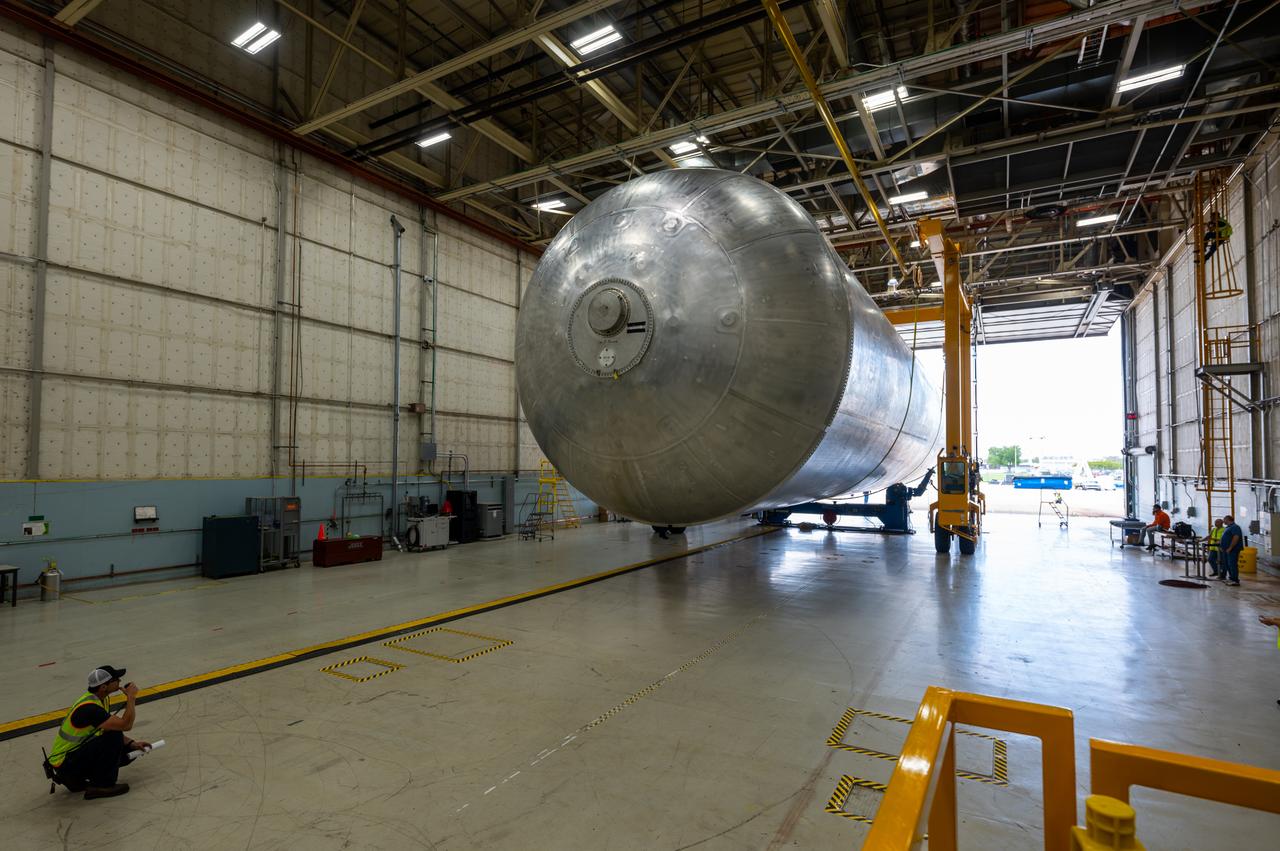
The core stage liquid hydrogen tank for the Artemis III mission completed proof testing, and technicians returned it to the main factory building at NASA’s Michoud Assembly Facility in New Orleans where it will undergo more outfitting. As part of proof testing, technicians apply a simple soap solution and check for leaks by observing any bubble formation on the welds. The technician removed the bubble solution with distilled water and then dried the area of application to prevent corrosion. To build the Space Launch System (SLS) rocket’s 130-foot core stage liquid hydrogen tank, engineers use robotic tools to weld five-barrel segments. This process results in a tank with around 1,900 feet, or more than six football fields, of welds that must be tested by hand. After the leak tests, the core stage lead, Boeing, pressurized the SLS tank to further ensure there were no leaks. After it passed proof testing, technicians moved the Artemis III liquid hydrogen tank to Michoud’s main factory. Soon, the technicians will prime and apply a foam-based thermal protection system that protects the tank during launch. Later, the tank will be joined with other parts of the core stage to form the entire 212-foot rocket stage with its four RS-25 engines that produce 2 million pounds of thrust to help launch the rocket. Artemis III will land the first astronauts on the lunar surface.
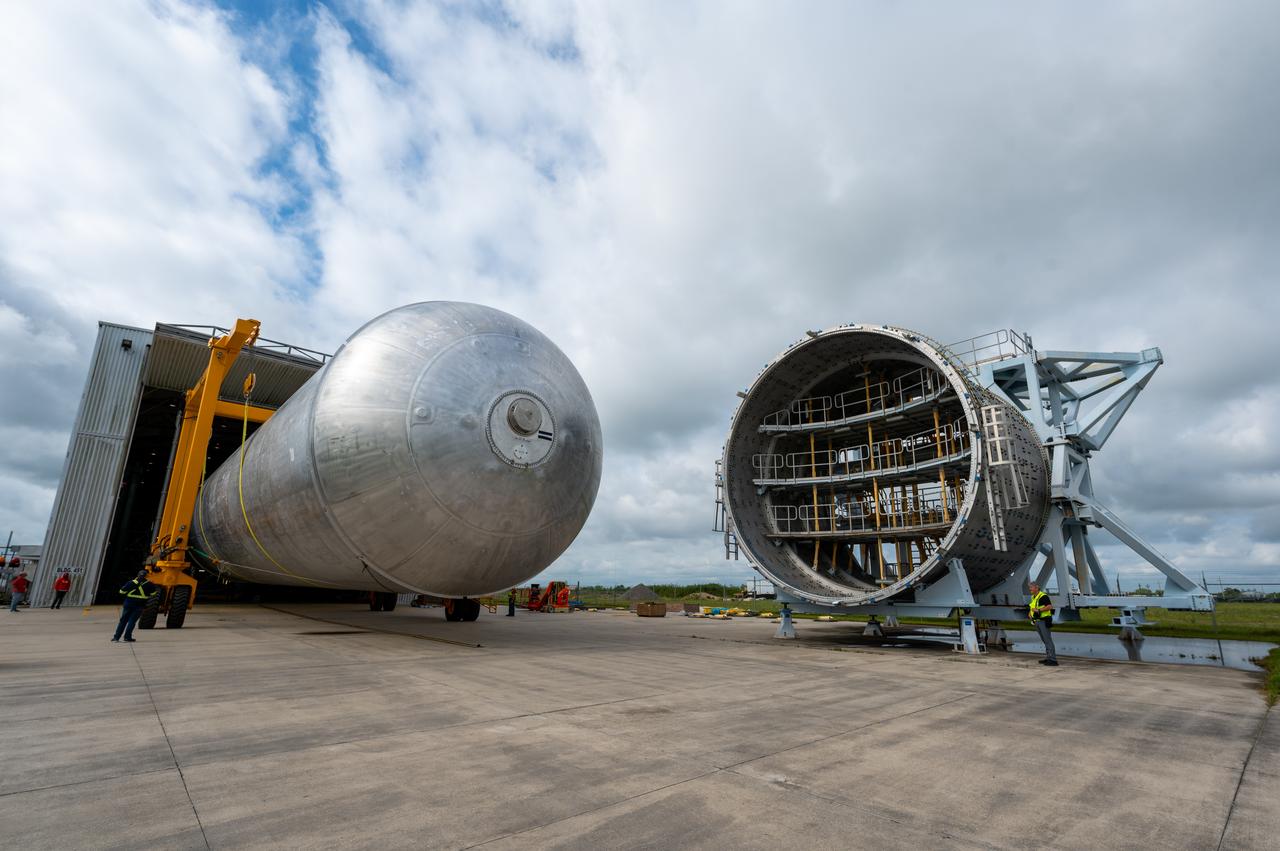
The core stage liquid hydrogen tank for the Artemis III mission completed proof testing, and technicians returned it to the main factory building at NASA’s Michoud Assembly Facility in New Orleans where it will undergo more outfitting. As part of proof testing, technicians apply a simple soap solution and check for leaks by observing any bubble formation on the welds. The technician removed the bubble solution with distilled water and then dried the area of application to prevent corrosion. To build the Space Launch System (SLS) rocket’s 130-foot core stage liquid hydrogen tank, engineers use robotic tools to weld five-barrel segments. This process results in a tank with around 1,900 feet, or more than six football fields, of welds that must be tested by hand. After the leak tests, the core stage lead, Boeing, pressurized the SLS tank to further ensure there were no leaks. After it passed proof testing, technicians moved the Artemis III liquid hydrogen tank to Michoud’s main factory. Soon, the technicians will prime and apply a foam-based thermal protection system that protects the tank during launch. Later, the tank will be joined with other parts of the core stage to form the entire 212-foot rocket stage with its four RS-25 engines that produce 2 million pounds of thrust to help launch the rocket. Artemis III will land the first astronauts on the lunar surface.
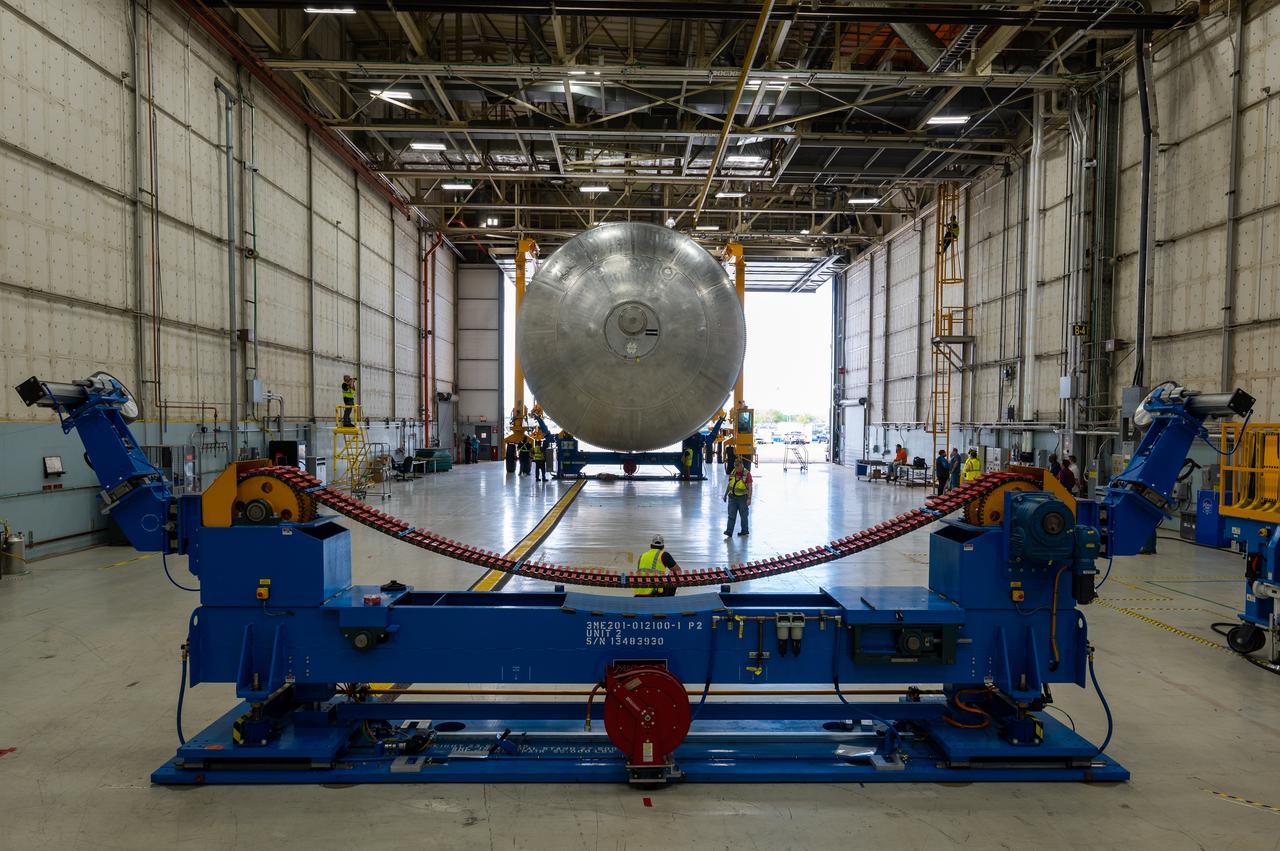
The core stage liquid hydrogen tank for the Artemis III mission completed proof testing, and technicians returned it to the main factory building at NASA’s Michoud Assembly Facility in New Orleans where it will undergo more outfitting. As part of proof testing, technicians apply a simple soap solution and check for leaks by observing any bubble formation on the welds. The technician removed the bubble solution with distilled water and then dried the area of application to prevent corrosion. To build the Space Launch System (SLS) rocket’s 130-foot core stage liquid hydrogen tank, engineers use robotic tools to weld five-barrel segments. This process results in a tank with around 1,900 feet, or more than six football fields, of welds that must be tested by hand. After the leak tests, the core stage lead, Boeing, pressurized the SLS tank to further ensure there were no leaks. After it passed proof testing, technicians moved the Artemis III liquid hydrogen tank to Michoud’s main factory. Soon, the technicians will prime and apply a foam-based thermal protection system that protects the tank during launch. Later, the tank will be joined with other parts of the core stage to form the entire 212-foot rocket stage with its four RS-25 engines that produce 2 million pounds of thrust to help launch the rocket. Artemis III will land the first astronauts on the lunar surface.
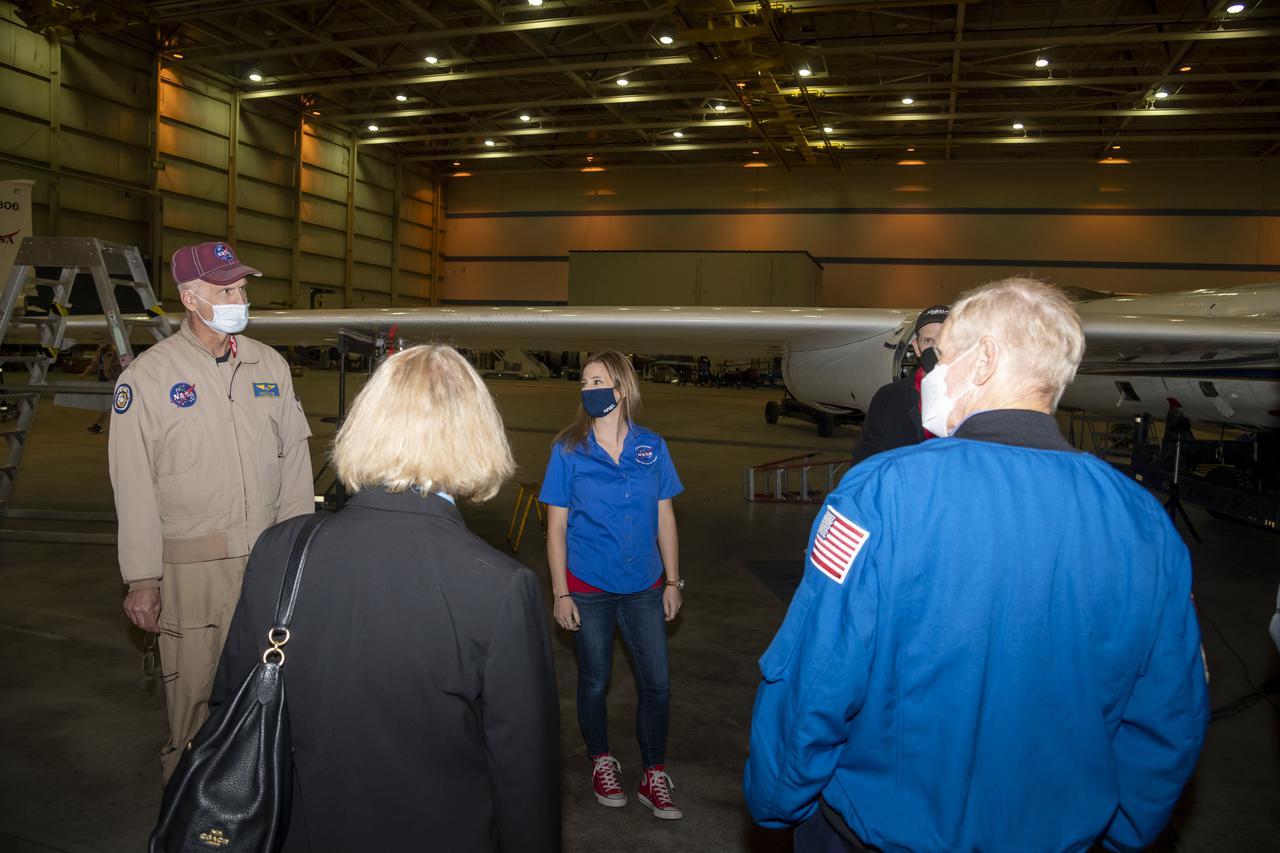
NASA Administrator Bill Nelson and NASA Deputy Administrator Pam Melroy receive a briefing on the high-altitude ER-2 aircraft and its missions from ER-2 pilot Greg "Coach" Nelson and ER-2 deputy project manager Fran Becker, and ER-2 pilot Tim Williams at Building 703 in Palmdale, California. The building is part of NASA's Armstrong Flight Research Center, which has its main campus in Edwards, California.
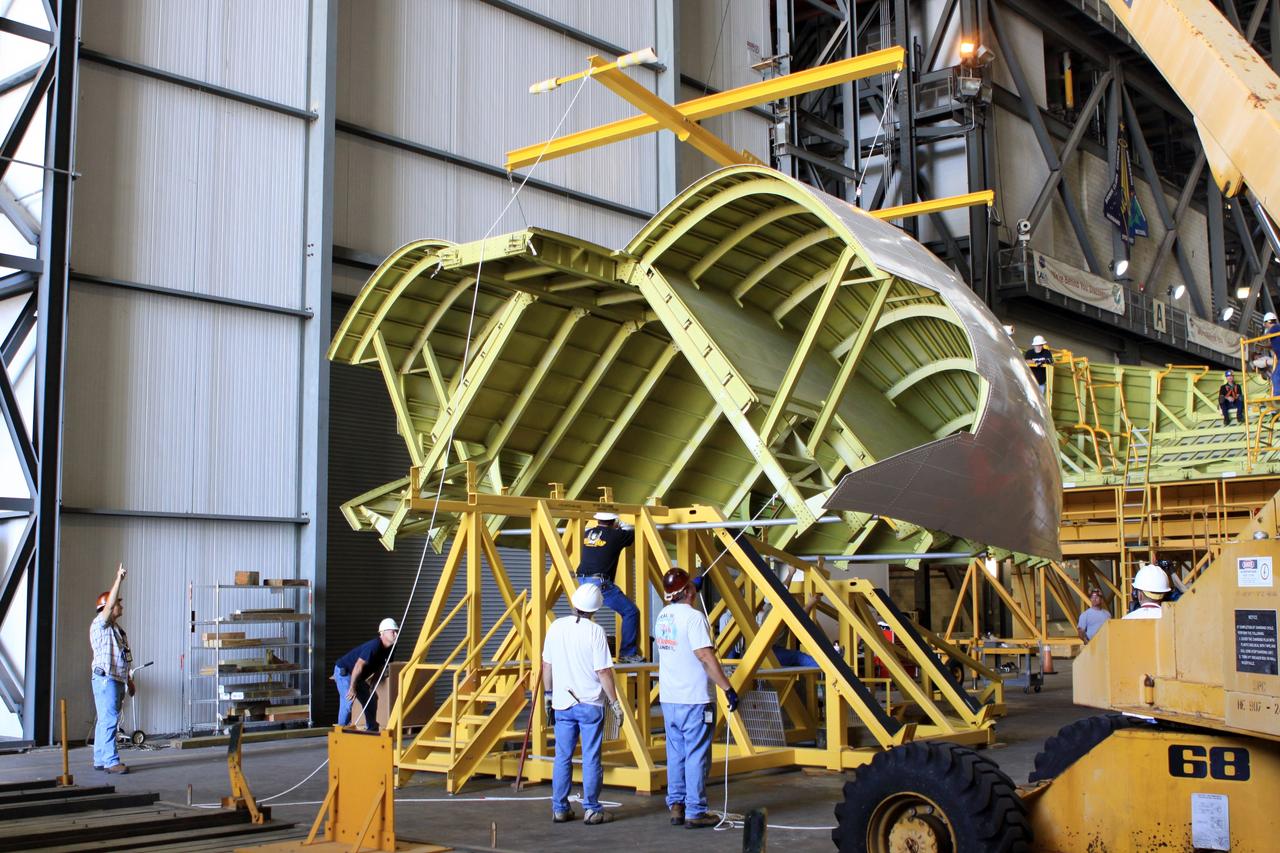
CAPE CANAVERAL, Fla. – In the transfer isle of the Vehicle Assembly Building at NASA’s Kennedy Space Center in Florida, technicians finish building the tail cone that will be installed around space shuttle Endeavour’s three replica shuttle main engines for protection. The tail cone protects the main engines during ferry flights on top of the Shuttle Carrier Aircraft, or SCA. The work is part of the Space Shuttle Program’s transition and retirement processing of shuttle Endeavour. Endeavour is being prepared for public display at the California Science Center in Los Angeles. Its ferry flight to California is targeted for mid-September. Endeavour was the last space shuttle added to NASA’s orbiter fleet. Over the course of its 19-year career, Endeavour spent 299 days in space during 25 missions. For more information, visit http://www.nasa.gov/shuttle. Photo credit: NASA/Jim Grossmann
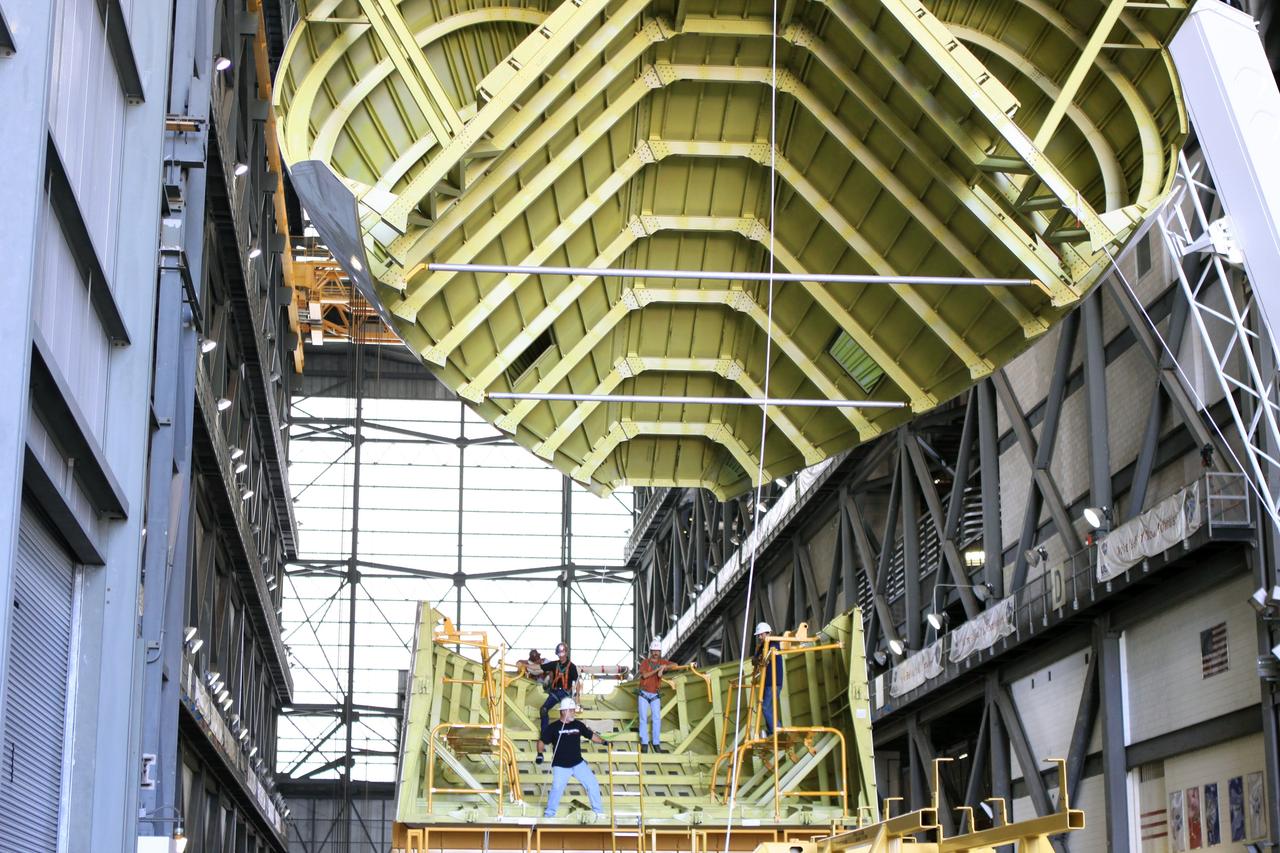
CAPE CANAVERAL, Fla. – In the transfer isle of the Vehicle Assembly Building at NASA’s Kennedy Space Center in Florida, technicians finish building the tail cone that will be installed around space shuttle Endeavour’s three replica shuttle main engines for protection. The tail cone protects the main engines during ferry flights on top of the Shuttle Carrier Aircraft, or SCA. The work is part of the Space Shuttle Program’s transition and retirement processing of shuttle Endeavour. Endeavour is being prepared for public display at the California Science Center in Los Angeles. Its ferry flight to California is targeted for mid-September. Endeavour was the last space shuttle added to NASA’s orbiter fleet. Over the course of its 19-year career, Endeavour spent 299 days in space during 25 missions. For more information, visit http://www.nasa.gov/shuttle. Photo credit: NASA/Jim Grossmann
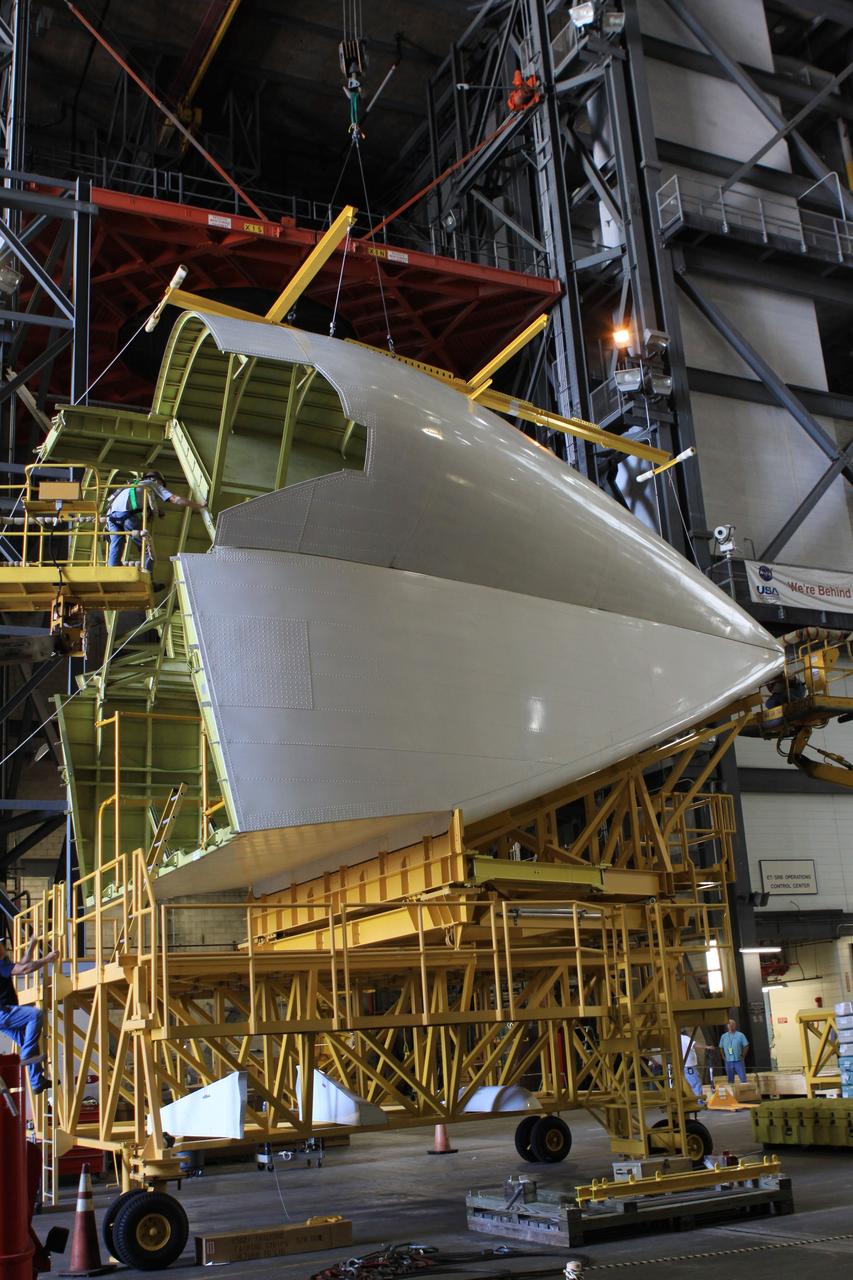
CAPE CANAVERAL, Fla. – In the transfer isle of the Vehicle Assembly Building at NASA’s Kennedy Space Center in Florida, technicians finish building the tail cone that will be installed around space shuttle Endeavour’s three replica shuttle main engines for protection. The tail cone protects the main engines during ferry flights on top of the Shuttle Carrier Aircraft, or SCA. The work is part of the Space Shuttle Program’s transition and retirement processing of shuttle Endeavour. Endeavour is being prepared for public display at the California Science Center in Los Angeles. Its ferry flight to California is targeted for mid-September. Endeavour was the last space shuttle added to NASA’s orbiter fleet. Over the course of its 19-year career, Endeavour spent 299 days in space during 25 missions. For more information, visit http://www.nasa.gov/shuttle. Photo credit: NASA/Jim Grossmann
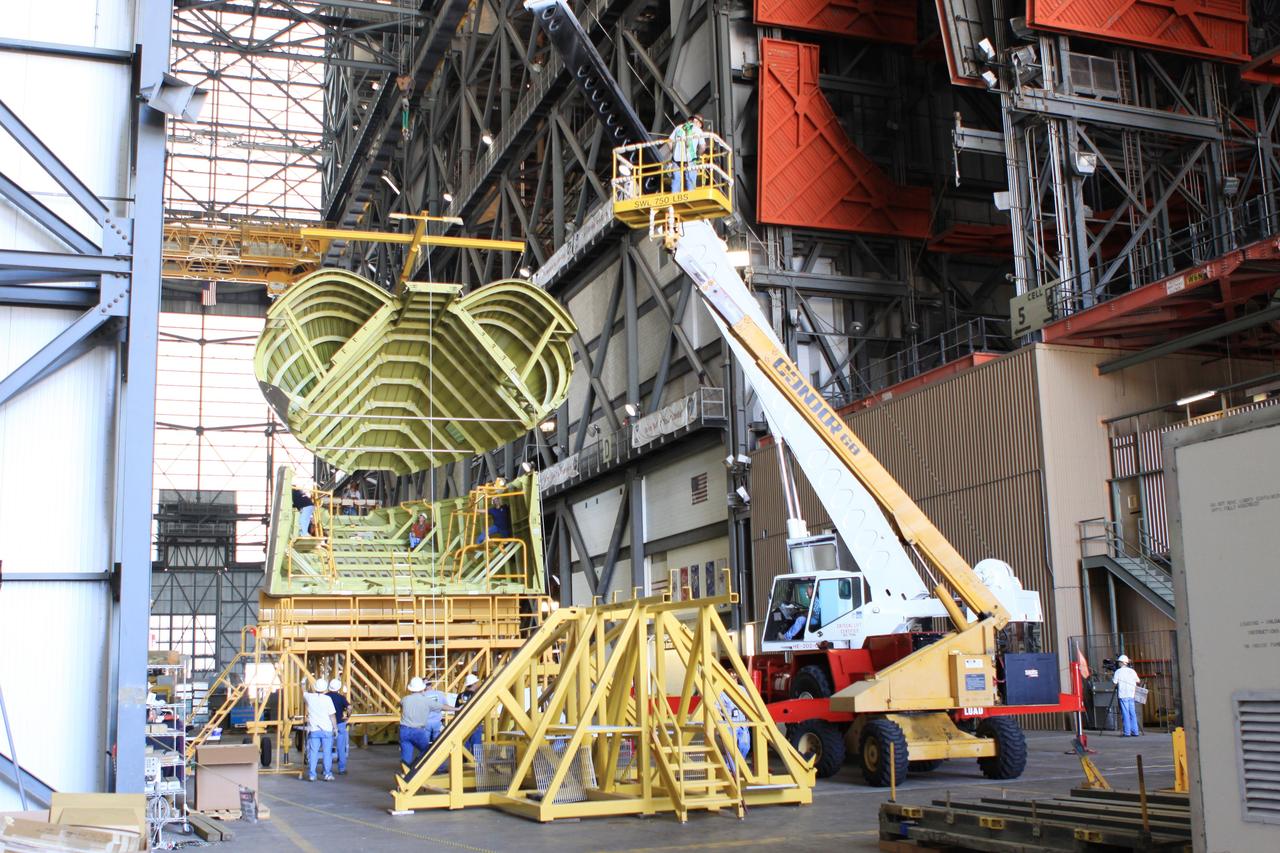
CAPE CANAVERAL, Fla. – In the transfer isle of the Vehicle Assembly Building at NASA’s Kennedy Space Center in Florida, technicians finish building the tail cone that will be installed around space shuttle Endeavour’s three replica shuttle main engines for protection. The tail cone protects the main engines during ferry flights on top of the Shuttle Carrier Aircraft, or SCA. The work is part of the Space Shuttle Program’s transition and retirement processing of shuttle Endeavour. Endeavour is being prepared for public display at the California Science Center in Los Angeles. Its ferry flight to California is targeted for mid-September. Endeavour was the last space shuttle added to NASA’s orbiter fleet. Over the course of its 19-year career, Endeavour spent 299 days in space during 25 missions. For more information, visit http://www.nasa.gov/shuttle. Photo credit: NASA/Jim Grossmann

CAPE CANAVERAL, Fla. – In the transfer isle of the Vehicle Assembly Building at NASA’s Kennedy Space Center in Florida, technicians finish building the tail cone that will be installed around space shuttle Endeavour’s three replica shuttle main engines for protection. The tail cone protects the main engines during ferry flights on top of the Shuttle Carrier Aircraft, or SCA. The work is part of the Space Shuttle Program’s transition and retirement processing of shuttle Endeavour. Endeavour is being prepared for public display at the California Science Center in Los Angeles. Its ferry flight to California is targeted for mid-September. Endeavour was the last space shuttle added to NASA’s orbiter fleet. Over the course of its 19-year career, Endeavour spent 299 days in space during 25 missions. For more information, visit http://www.nasa.gov/shuttle. Photo credit: NASA/Jim Grossmann
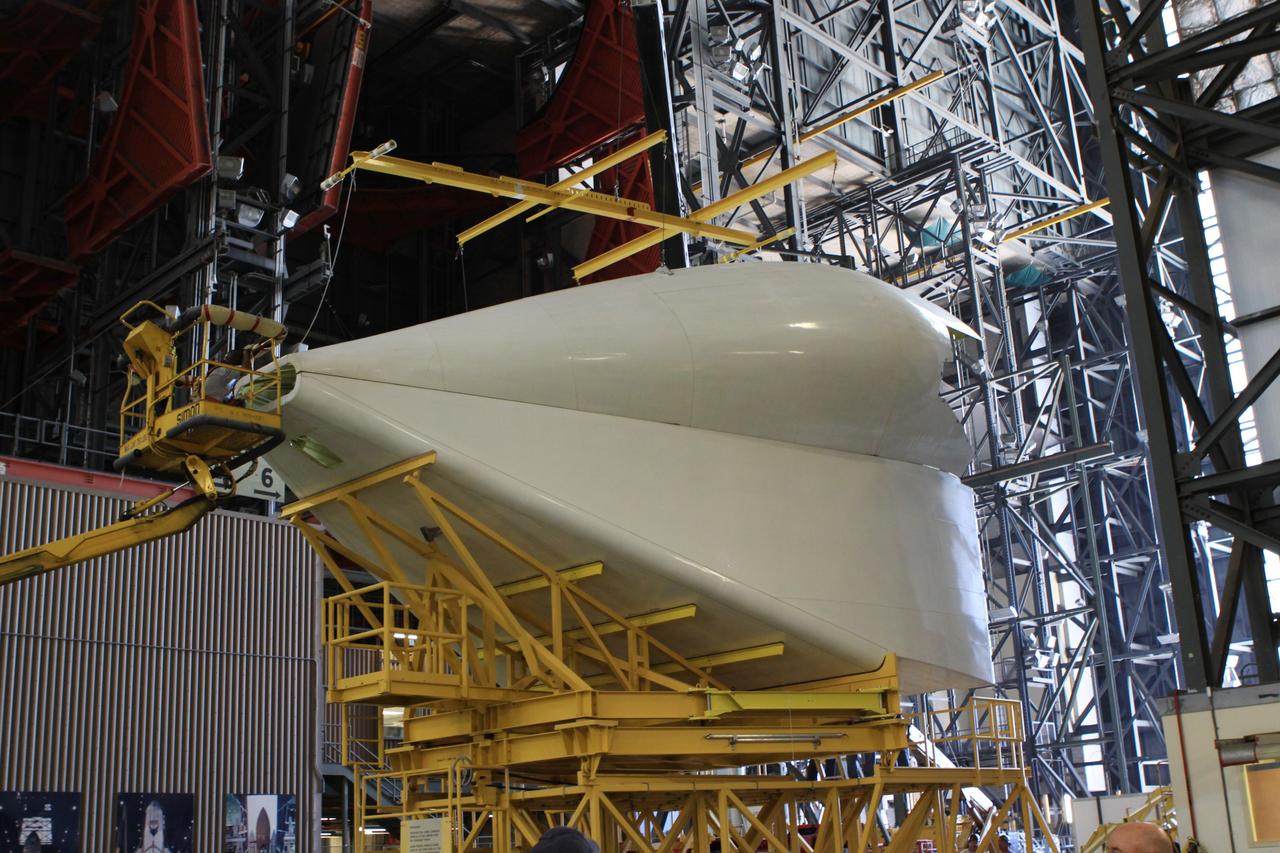
CAPE CANAVERAL, Fla. – In the transfer isle of the Vehicle Assembly Building at NASA’s Kennedy Space Center in Florida, technicians finish building the tail cone that will be installed around space shuttle Endeavour’s three replica shuttle main engines for protection. The tail cone protects the main engines during ferry flights on top of the Shuttle Carrier Aircraft, or SCA. The work is part of the Space Shuttle Program’s transition and retirement processing of shuttle Endeavour. Endeavour is being prepared for public display at the California Science Center in Los Angeles. Its ferry flight to California is targeted for mid-September. Endeavour was the last space shuttle added to NASA’s orbiter fleet. Over the course of its 19-year career, Endeavour spent 299 days in space during 25 missions. For more information, visit http://www.nasa.gov/shuttle. Photo credit: NASA/Jim Grossmann
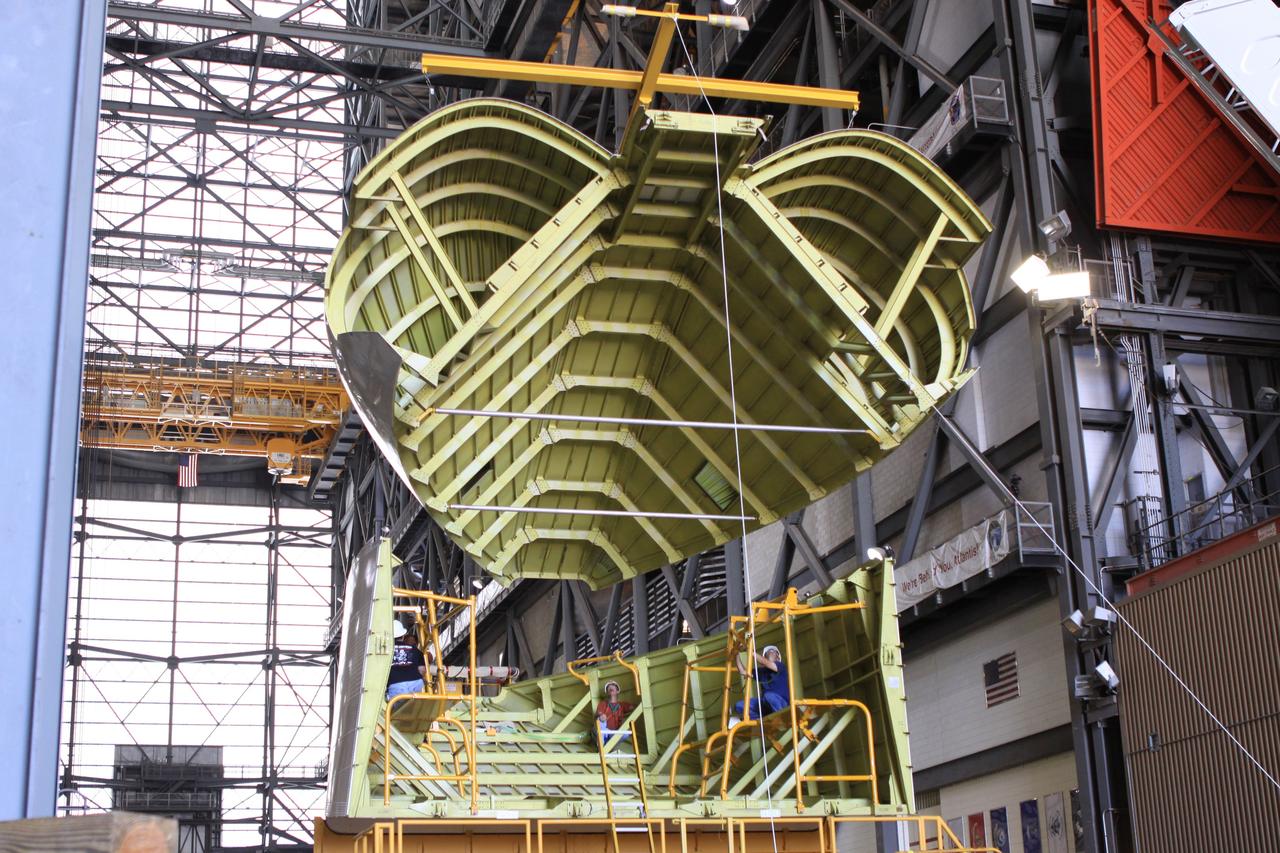
CAPE CANAVERAL, Fla. – In the transfer isle of the Vehicle Assembly Building at NASA’s Kennedy Space Center in Florida, technicians finish building the tail cone that will be installed around space shuttle Endeavour’s three replica shuttle main engines for protection. The tail cone protects the main engines during ferry flights on top of the Shuttle Carrier Aircraft, or SCA. The work is part of the Space Shuttle Program’s transition and retirement processing of shuttle Endeavour. Endeavour is being prepared for public display at the California Science Center in Los Angeles. Its ferry flight to California is targeted for mid-September. Endeavour was the last space shuttle added to NASA’s orbiter fleet. Over the course of its 19-year career, Endeavour spent 299 days in space during 25 missions. For more information, visit http://www.nasa.gov/shuttle. Photo credit: NASA/Jim Grossmann
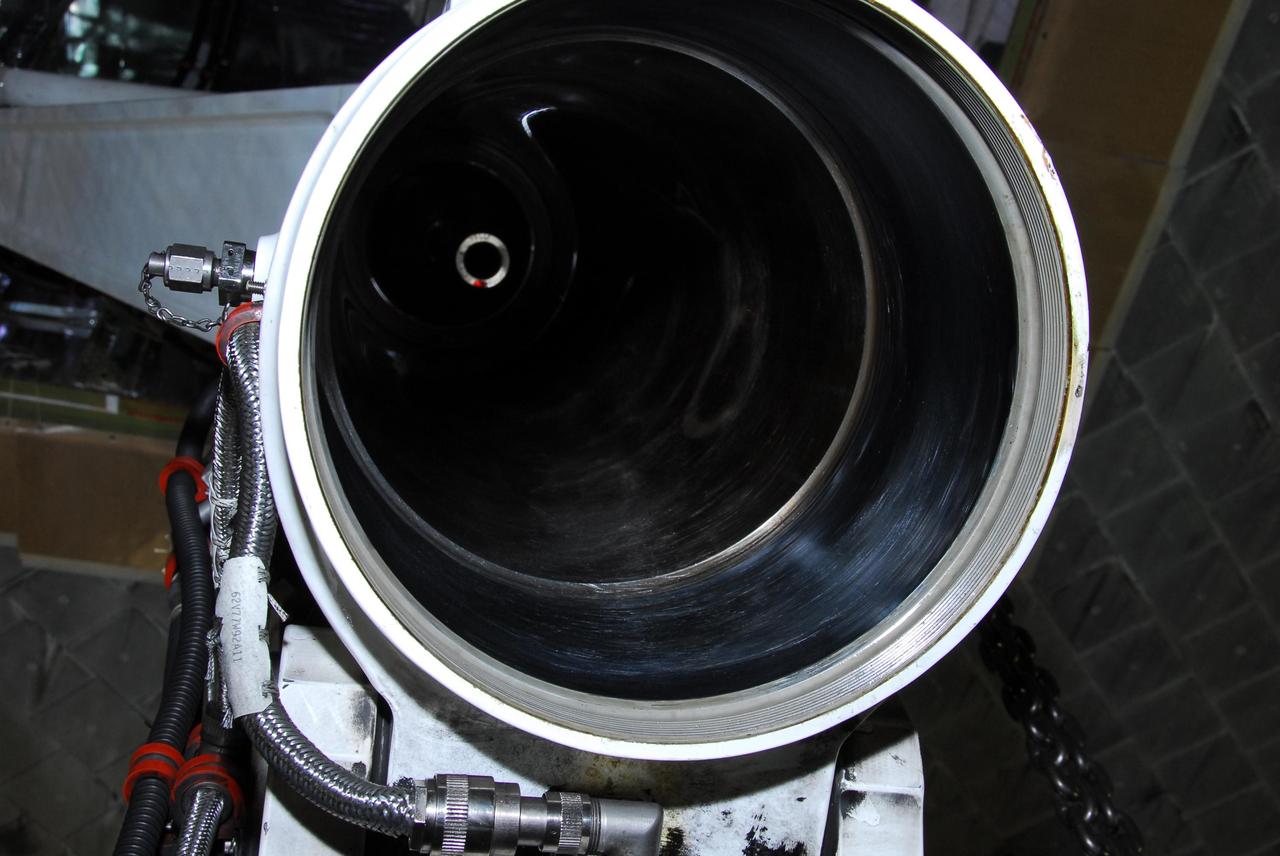
KENNEDY SPACE CENTER, FLA. -- This photo looks inside space shuttle Discovery's right main-gear strut where a leaking seal has been found. United Space Alliance and B.F. Goodrich technicians will replace a leaking dynamic seal in Discovery's right main-gear strut. The struts act as shock absorbers during the shuttle's landing. Engineers determined the observed leak of hydraulic fluid in the main landing gear strut exceeded specification and could not be reduced to an acceptable rate. Removing the strut and replacing seals require disconnecting and replacing the brakes and tires, disconnecting and reconnecting instruments and other requirements to allow access to the strut. Discovery had been scheduled to roll over Sept. 19 from its processing hangar to the Vehicle Assembly Building. A new rollover date will be set after technicians determine how long replacing the seal will take. Photo credit: NASA/George Shelton
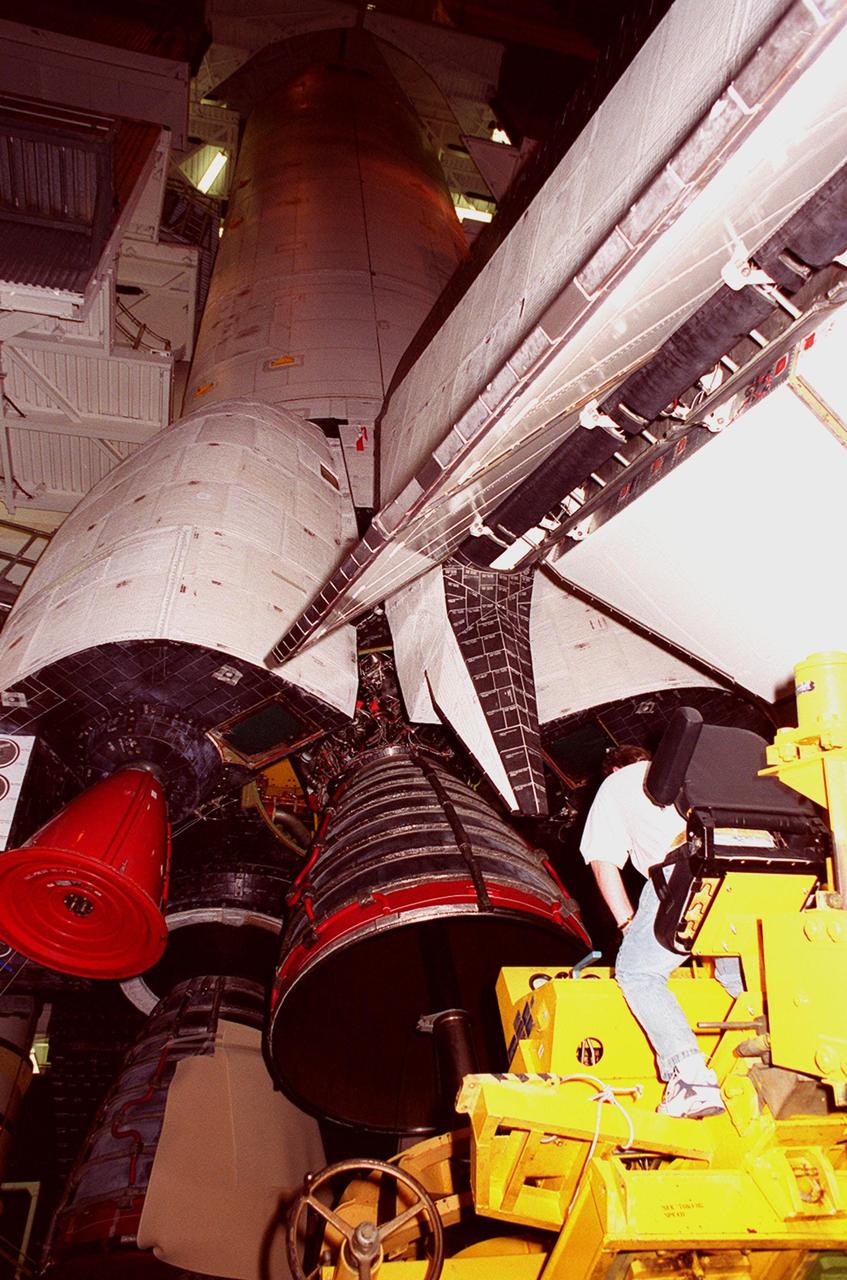
KENNEDY SPACE CENTER, FLA. -- Underneath the 26.3-foot vertical tail structure of Space Shuttle Atlantis, a worker in the Vehicle Assembly Building maneuvers equipment under Main Engine No. 1 in order to remove it. An inventory review concerning defective main engine fuel pump tip seals indicated that defective seals may be present on the fuel pump for the engine. The decision was made to replace the suspect engine with one originally slated for Discovery. The main engine nozzles, visible in the photo, are 7.8 feet across and 9.4 feet high. Space Shuttle Atlantis is scheduled to launch no earlier than April 17, 2000, on mission STS-101 to resupply the International Space Station for the arrival of the next pressurized module, the Russian-built Zvezda
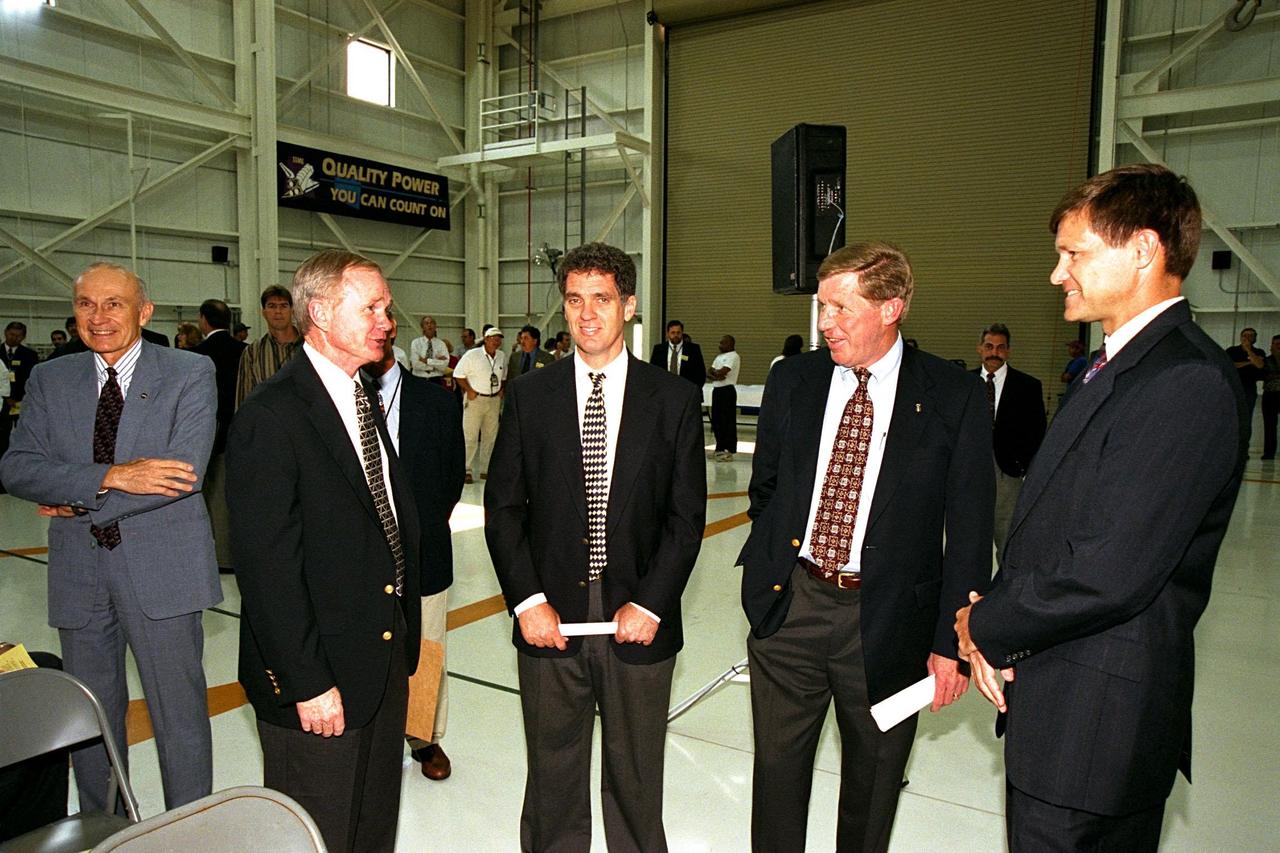
Participants in the ribbon cutting for KSC's new 34,600-square-foot Space Shuttle Main Engine Processing Facility (SSMEPF) gather to talk inside the facility following the ceremony. From left, they are Robert B. Sieck, director of Shuttle Processing; KSC Center Director Roy D. Bridges Jr.; U.S. Congressman Dave Weldon; John Plowden, vice president of Rocketdyne; and Donald R. McMonagle, manager of Launch Integration. A major addition to the existing Orbiter Processing Facility Bay 3, the SSMEPF replaces the Shuttle Main Engine Shop located in the Vehicle Assembly Building (VAB). The decision to move the shop out of the VAB was prompted by safety considerations and recent engine processing improvements. The first three main engines to be processed in the new facility will fly on Shuttle Endeavour's STS-88 mission in December 1998
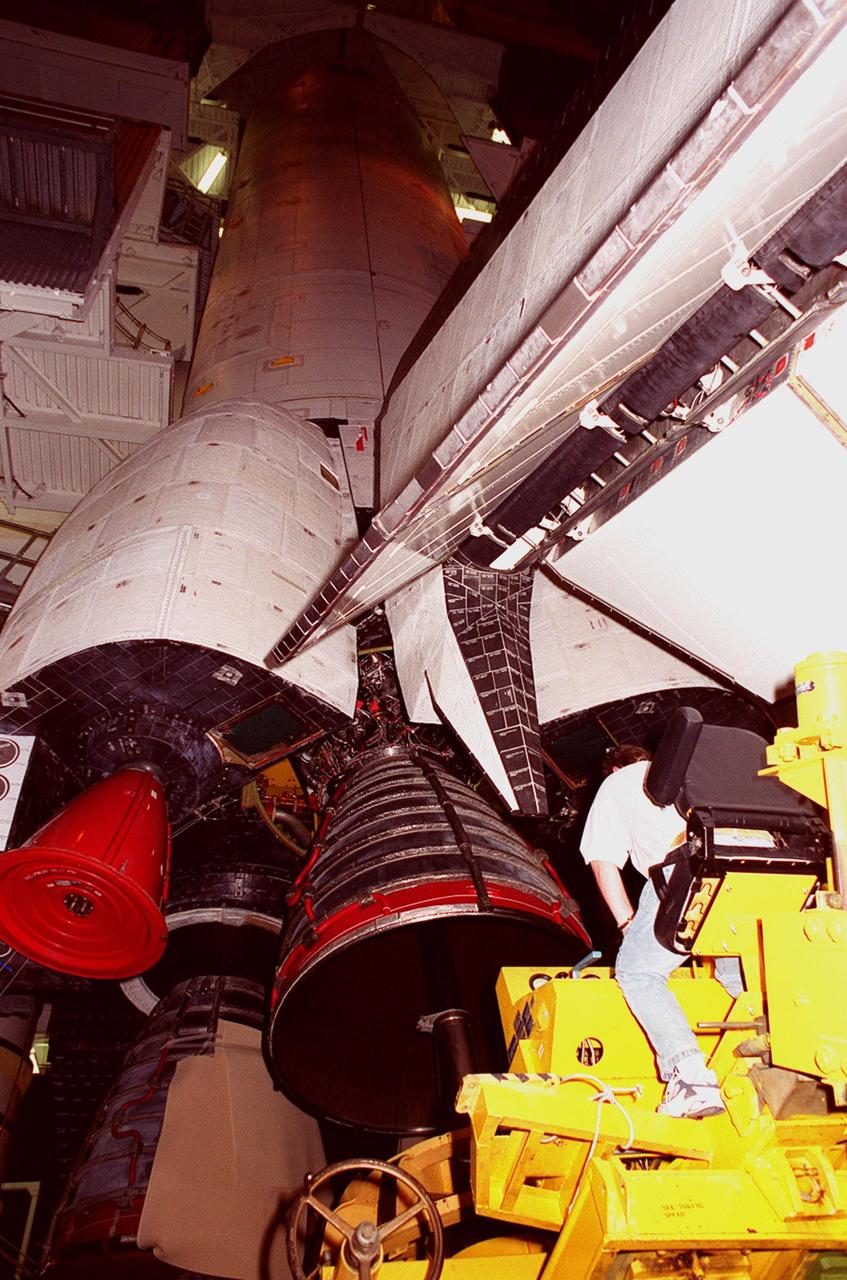
KENNEDY SPACE CENTER, FLA. -- Underneath the 26.3-foot vertical tail structure of Space Shuttle Atlantis, a worker in the Vehicle Assembly Building maneuvers equipment under Main Engine No. 1 in order to remove it. An inventory review concerning defective main engine fuel pump tip seals indicated that defective seals may be present on the fuel pump for the engine. The decision was made to replace the suspect engine with one originally slated for Discovery. The main engine nozzles, visible in the photo, are 7.8 feet across and 9.4 feet high. Space Shuttle Atlantis is scheduled to launch no earlier than April 17, 2000, on mission STS-101 to resupply the International Space Station for the arrival of the next pressurized module, the Russian-built Zvezda
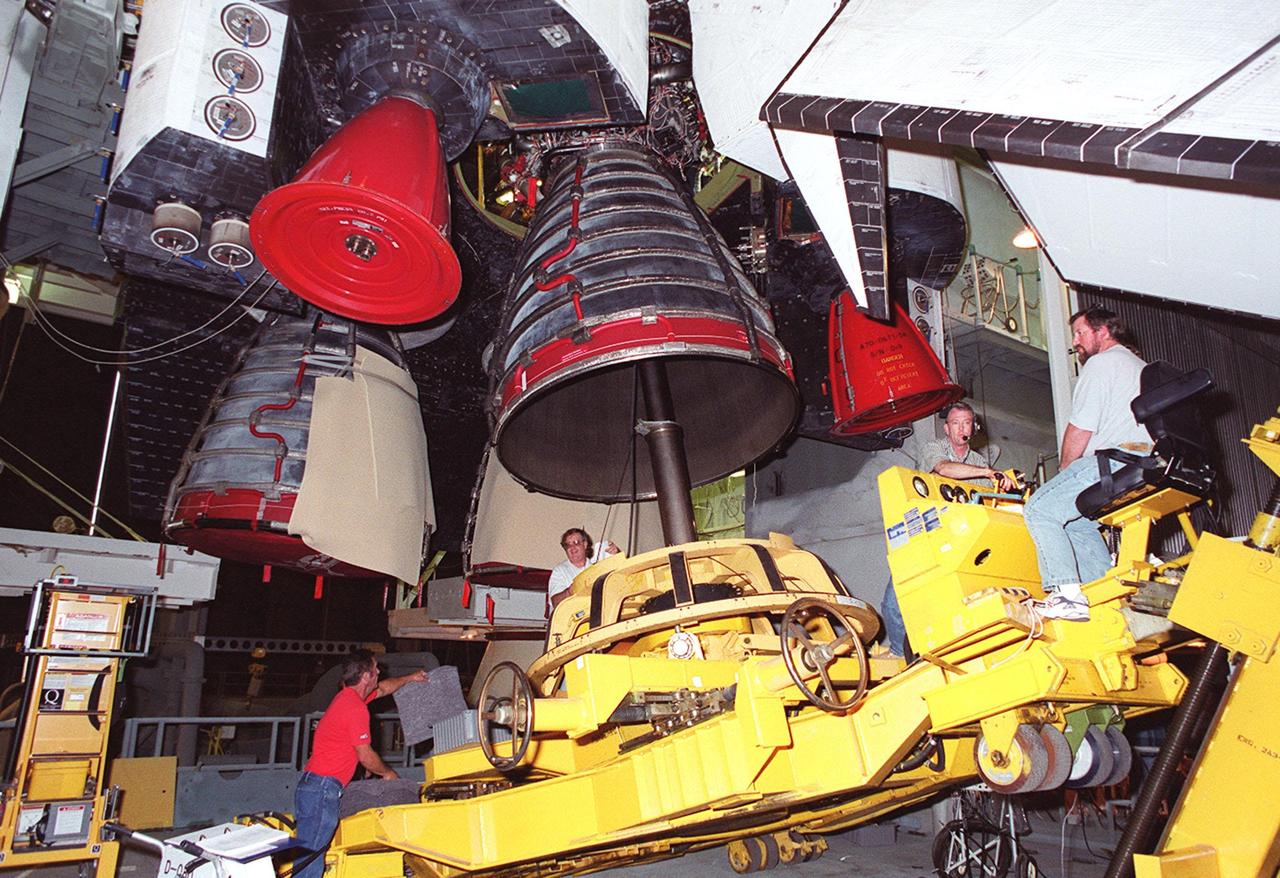
KENNEDY SPACE CENTER, FLA. -- Underneath the 26.3-foot vertical tail structure of Space Shuttle Atlantis (above right) in the Vehicle Assembly Building, workers place equipment to be used for the removal of Main Engine No. 1. An inventory review concerning defective main engine fuel pump tip seals indicated that defective seals may be present on the fuel pump for the engine. The decision was made to replace the suspect engine with one originally slated for Discovery. The main engine nozzles, visible in the photo, are 7.8 feet across and 9.4 feet high. Space Shuttle Atlantis is scheduled to launch no earlier than April 17, 2000, on mission STS-101 to resupply the International Space Station for the arrival of the next pressurized module, the Russian-built Zvezda
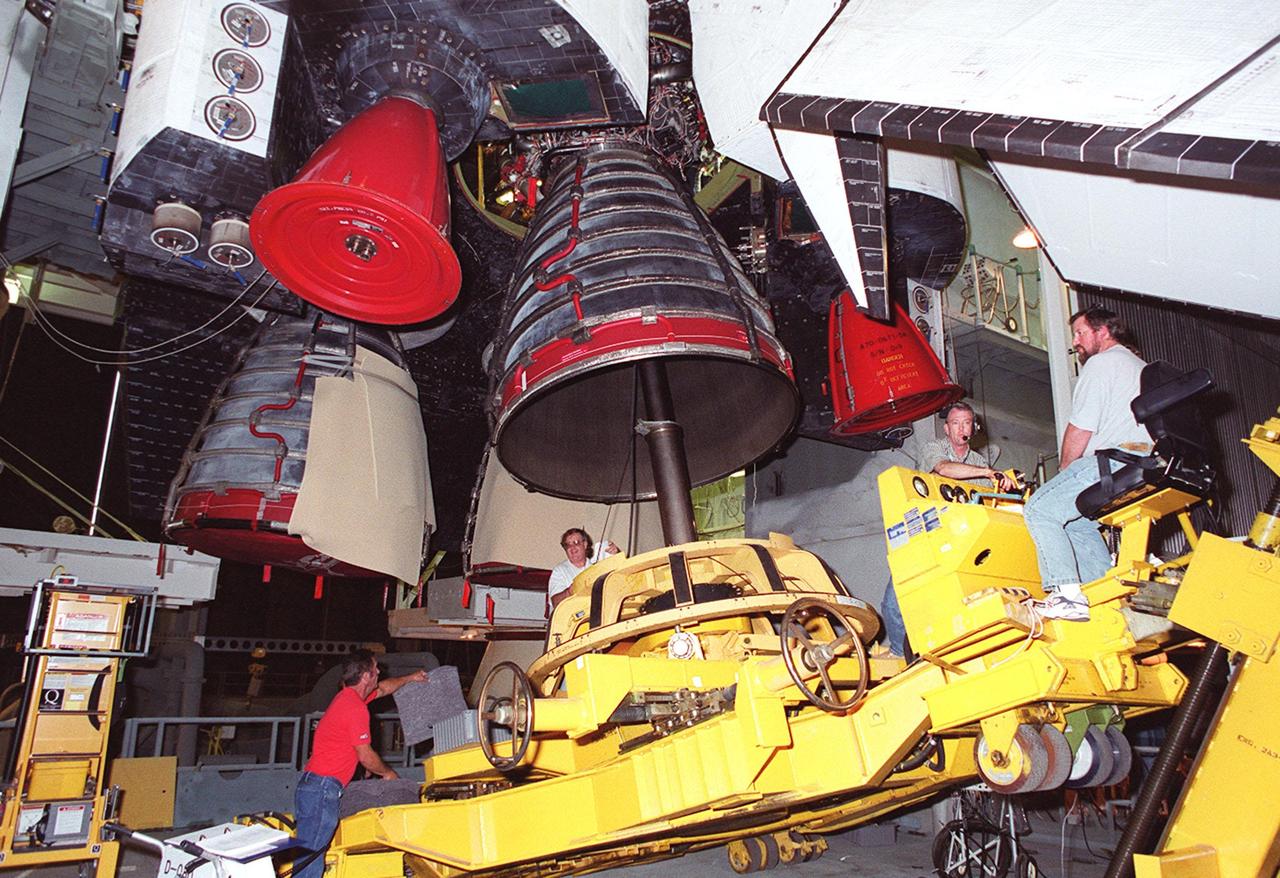
KENNEDY SPACE CENTER, FLA. -- Underneath the 26.3-foot vertical tail structure of Space Shuttle Atlantis (above right) in the Vehicle Assembly Building, workers place equipment to be used for the removal of Main Engine No. 1. An inventory review concerning defective main engine fuel pump tip seals indicated that defective seals may be present on the fuel pump for the engine. The decision was made to replace the suspect engine with one originally slated for Discovery. The main engine nozzles, visible in the photo, are 7.8 feet across and 9.4 feet high. Space Shuttle Atlantis is scheduled to launch no earlier than April 17, 2000, on mission STS-101 to resupply the International Space Station for the arrival of the next pressurized module, the Russian-built Zvezda

KENNEDY SPACE CENTER, FLA. -- In bay 3 of the Orbiter Processing Facility, a technician replaces a hydraulic seal in space shuttle Discovery's right main-gear strut. Engineers determined an observed leak of hydraulic fluid in the main landing gear strut exceeded specification and could not be reduced to an acceptable rate. Thus, the leaky seal and three other seals were replaced. Prior to discovery of the leak, the vehicle had been scheduled to roll over Sept. 19 from the OPF to the Vehicle Assembly Building. A new rollover date will be set for Discovery, which is targeted for launch on Oct. 23. Photo credit: NASA/George Shelton
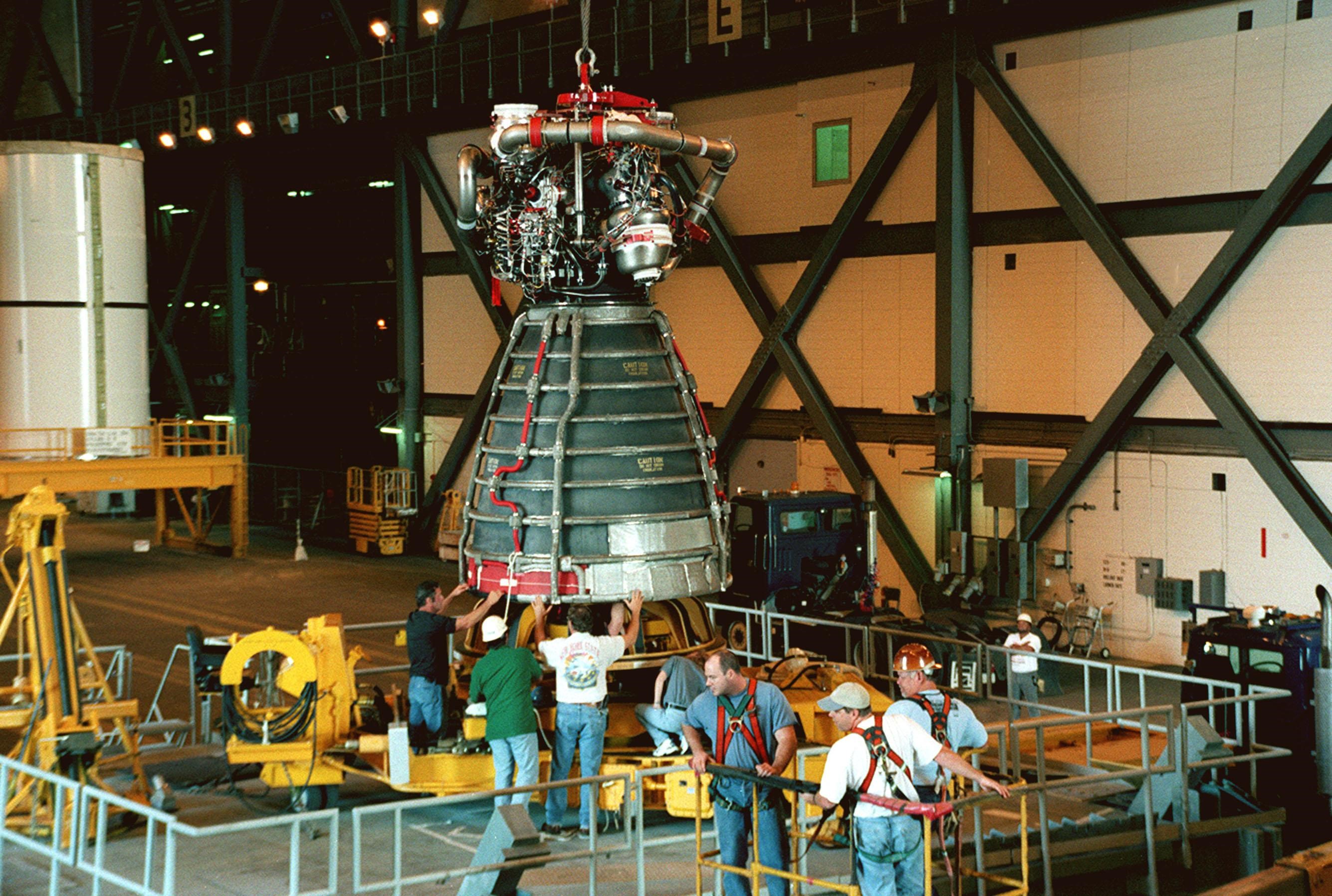
KENNEDY SPACE CENTER, FLA. -- Workers in the Vehicle Assembly Building move orbiter Endeavour's replacement main engine No. 3 onto a work stand to prepare it for installation in the orbiter. Following routine testing procedures on a separate test engine, analysis revealed delamination on the wall of the engine's main combustion chamber. When data revealed that one of Endeavour's engines had undergone similar testing procedures, managers opted to replace the suspect engine as a precaution. Space Shuttle Endeavour is targeted for launch on mission STS-99 on Jan. 13, 2000, at 1:11 p.m. EST. STS-99 is the Shuttle Radar Topography Mission
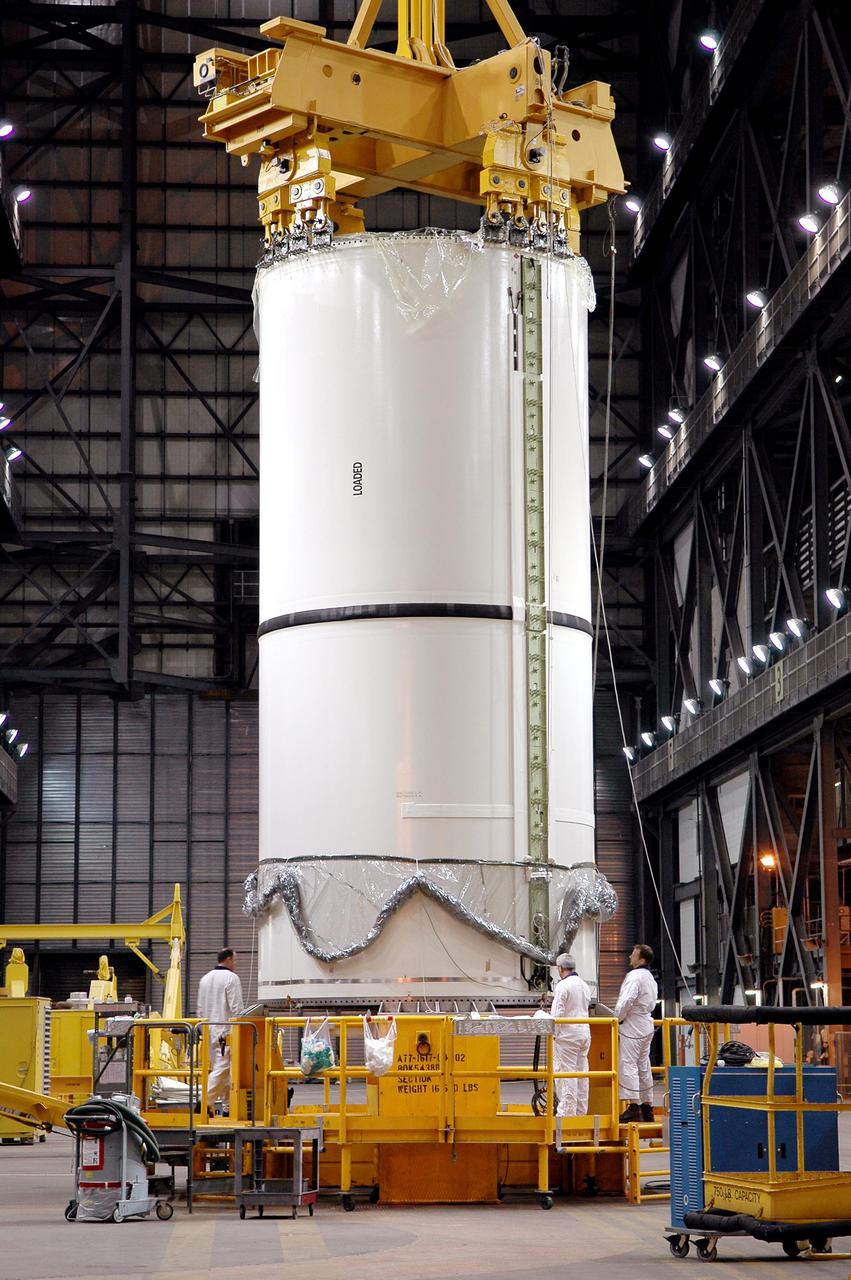
KENNEDY SPACE CENTER, FLA. - Inside the Vehicle Assembly Building (VAB), a segment of a Solid Rocket Booster (SRB) is prepared for lifting. This right aft center segment will be stacked with the aft booster that arrived in the VAB Nov. 22 for the Return to Flight mission STS-114. Two SRBs are stacked on the Mobile Launch Platform and later joined by the External Tank.. The twin 149-foot tall, 12-foot diameter SRBs provide the main propulsion system during launch. They operate parallel with the Space Shuttle main engines for the first two minutes of flight and jettison away from the orbiter with help from the Booster Separation Motors, about 26.3 nautical miles above the Earth’s surface.
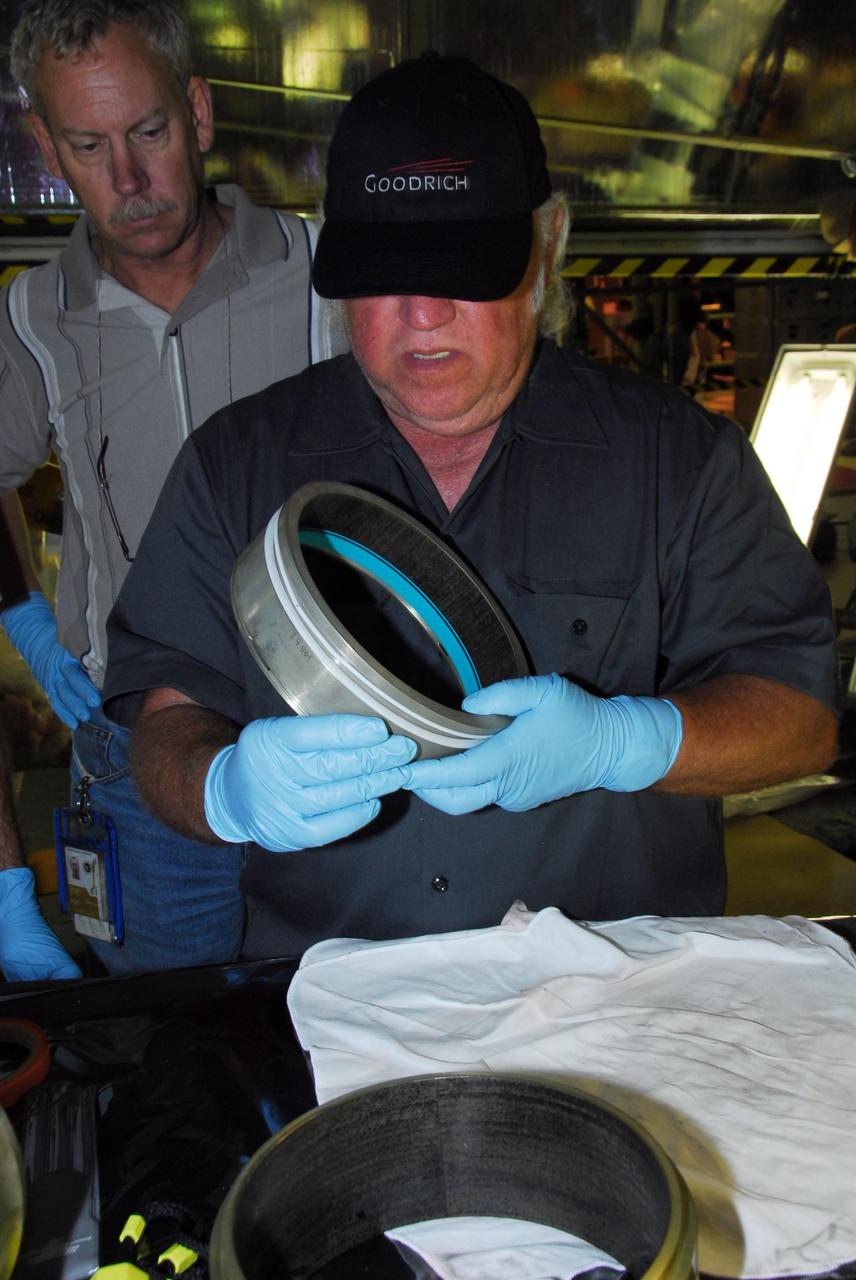
KENNEDY SPACE CENTER, FLA. -- In bay 3 of the Orbiter Processing Facility, B.F. Goodrich technician David Cobb checks the hydraulic seal he replaced in space shuttle Discovery's right main-gear strut. Engineers determined an observed leak of hydraulic fluid in the main landing gear strut exceeded specification and could not be reduced to an acceptable rate. Thus, the leaky seal and three other seals were replaced. Prior to discovery of the leak, the vehicle had been scheduled to roll over Sept. 19 from the OPF to the Vehicle Assembly Building. A new rollover date will be set for Discovery, which is targeted for launch on Oct. 23. Photo credit: NASA/George Shelton
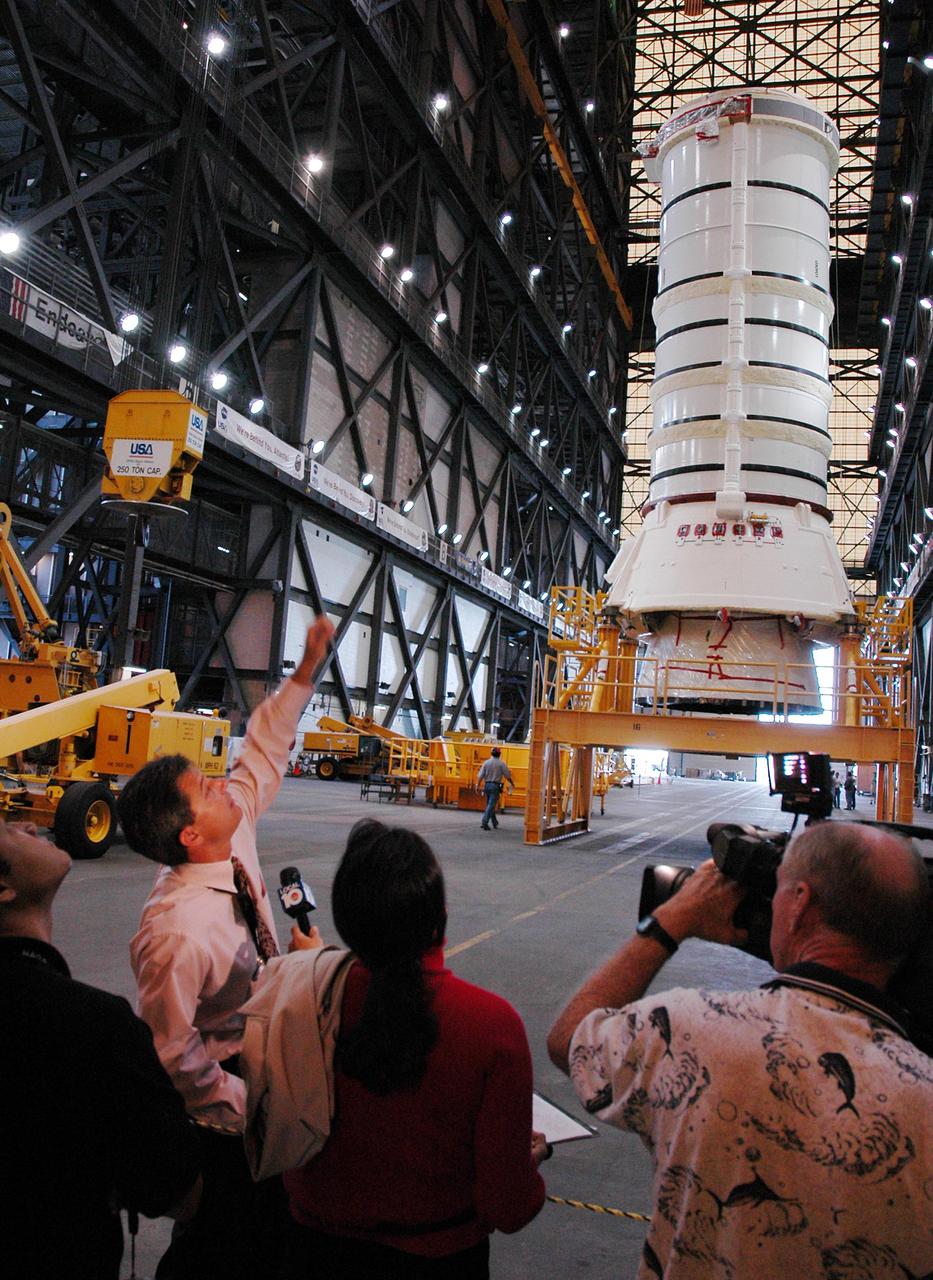
KENNEDY SPACE CENTER, FLA. - Inside the Vehicle Assembly Building, media are shown where the aft skirt and lower segment of the Solid Rocket Booster for the Return to Flight mission STS-114 will be stacked with other segments to follow. Two SRBs support the liftoff of the Space Shuttle on a launch. The twin 149-foot tall, 12-foot diameter SRBs provide the main propulsion system during launch to place the 180,000-pound orbiters in the proper orbit around the Earth. They operate parallel with the Space Shuttle main engines for the first two minutes of flight and jettison away from the orbiter with help from the Booster Separation Motors, about 26.3 nautical miles above the Earth’s surface.
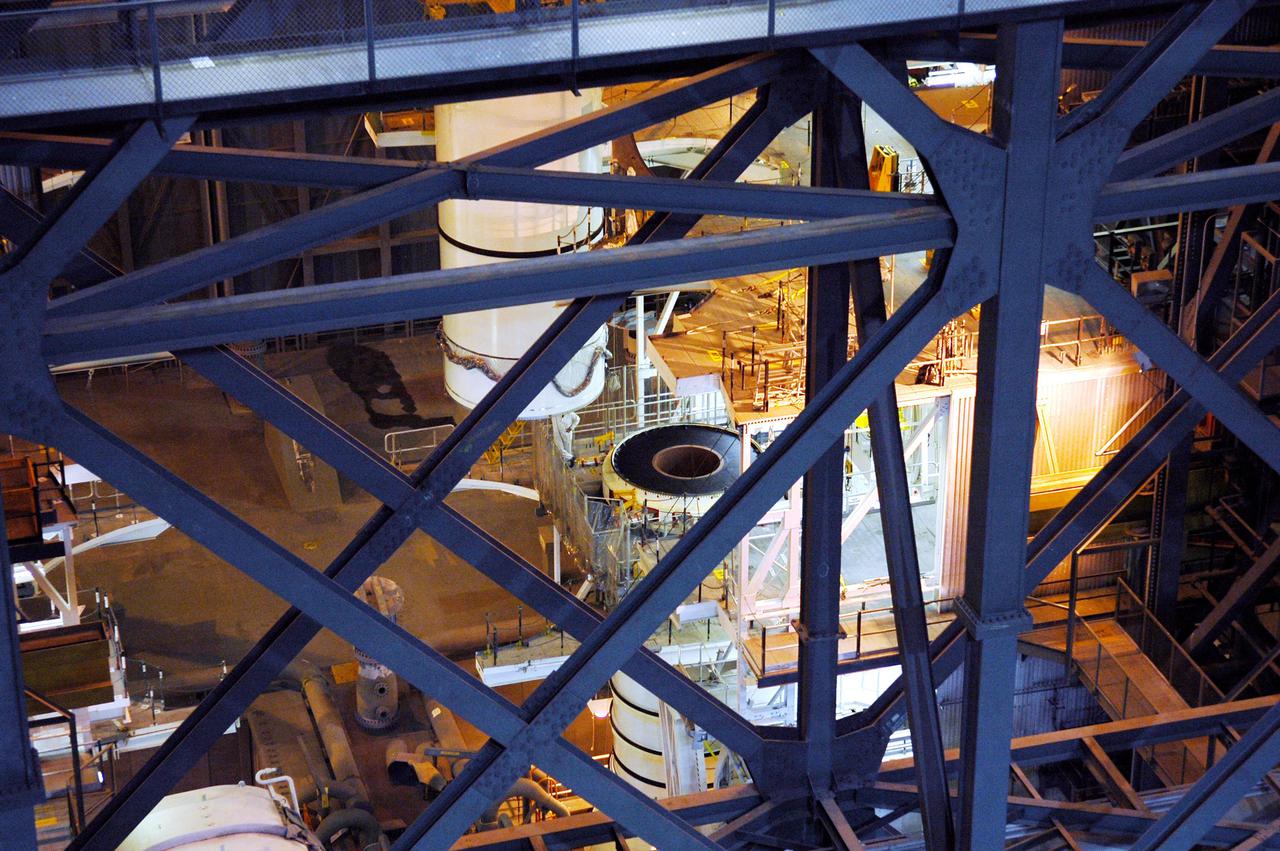
KENNEDY SPACE CENTER, FLA. - In the Vehicle Assembly Building (VAB), the right aft center segment of a Solid Rocket Booster (SRB) is lowered toward the aft booster for mating. The aft booster arrived in the VAB Nov. 22 for the Return to Flight mission STS-114. Two SRBs are stacked on the Mobile Launch Platform and later joined by the External Tank.. The twin 149-foot tall, 12-foot diameter SRBs provide the main propulsion system during launch. They operate parallel with the Space Shuttle main engines for the first two minutes of flight and jettison away from the orbiter with help from the Booster Separation Motors, about 26.3 nautical miles above the Earth’s surface.
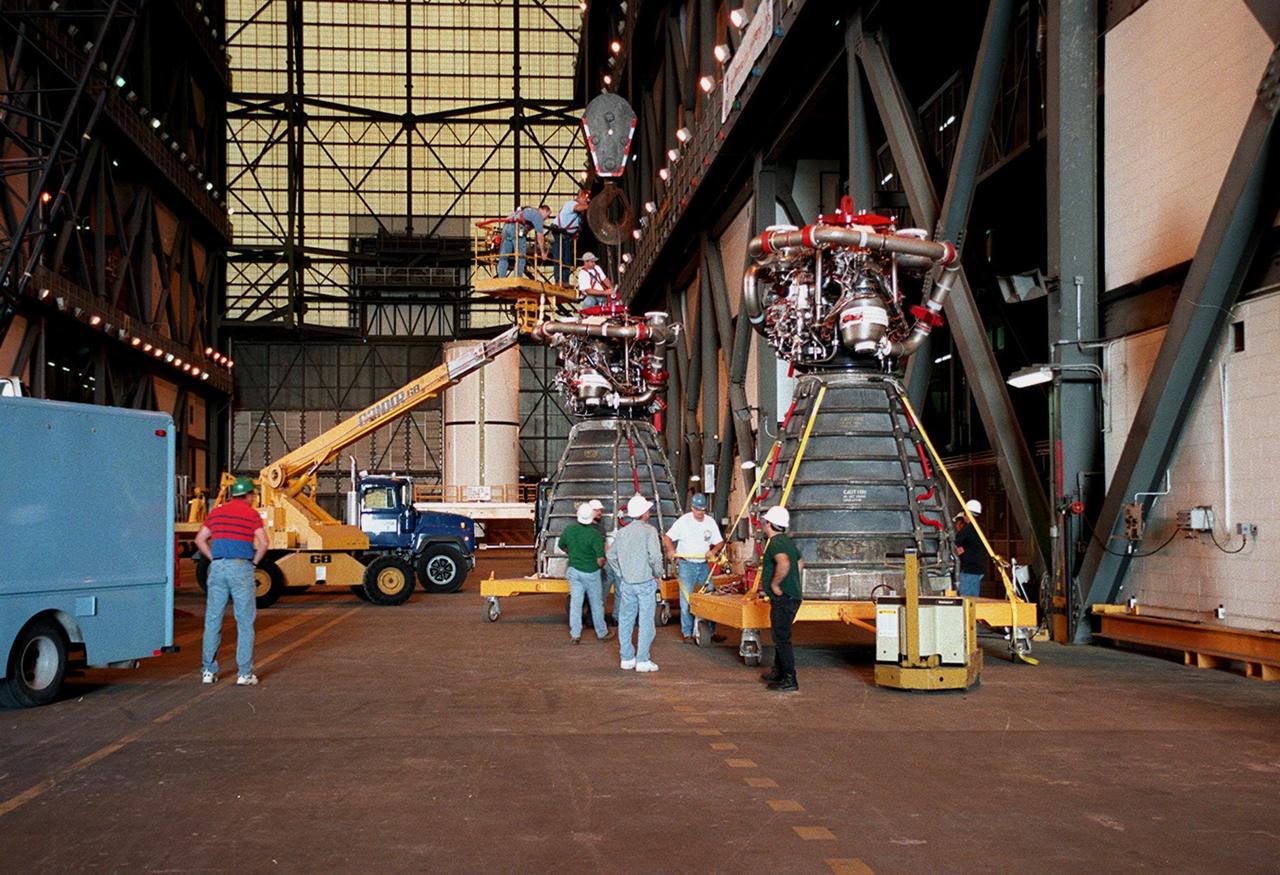
KENNEDY SPACE CENTER, FLA. -- Workers in the Vehicle Assembly Building move orbiter Endeavour's main engine No. 3 (in front) out of the way before moving the replacement engine into place. Following routine testing procedures on a separate test engine, analysis revealed delamination on the wall of the engine's main combustion chamber. When data revealed that one of Endeavour's engines had undergone similar testing procedures, managers opted to replace the suspect engine as a precaution. Space Shuttle Endeavour is targeted for launch on mission STS-99 on Jan. 13, 2000, at 1:11 p.m. EST. STS-99 is the Shuttle Radar Topography Mission
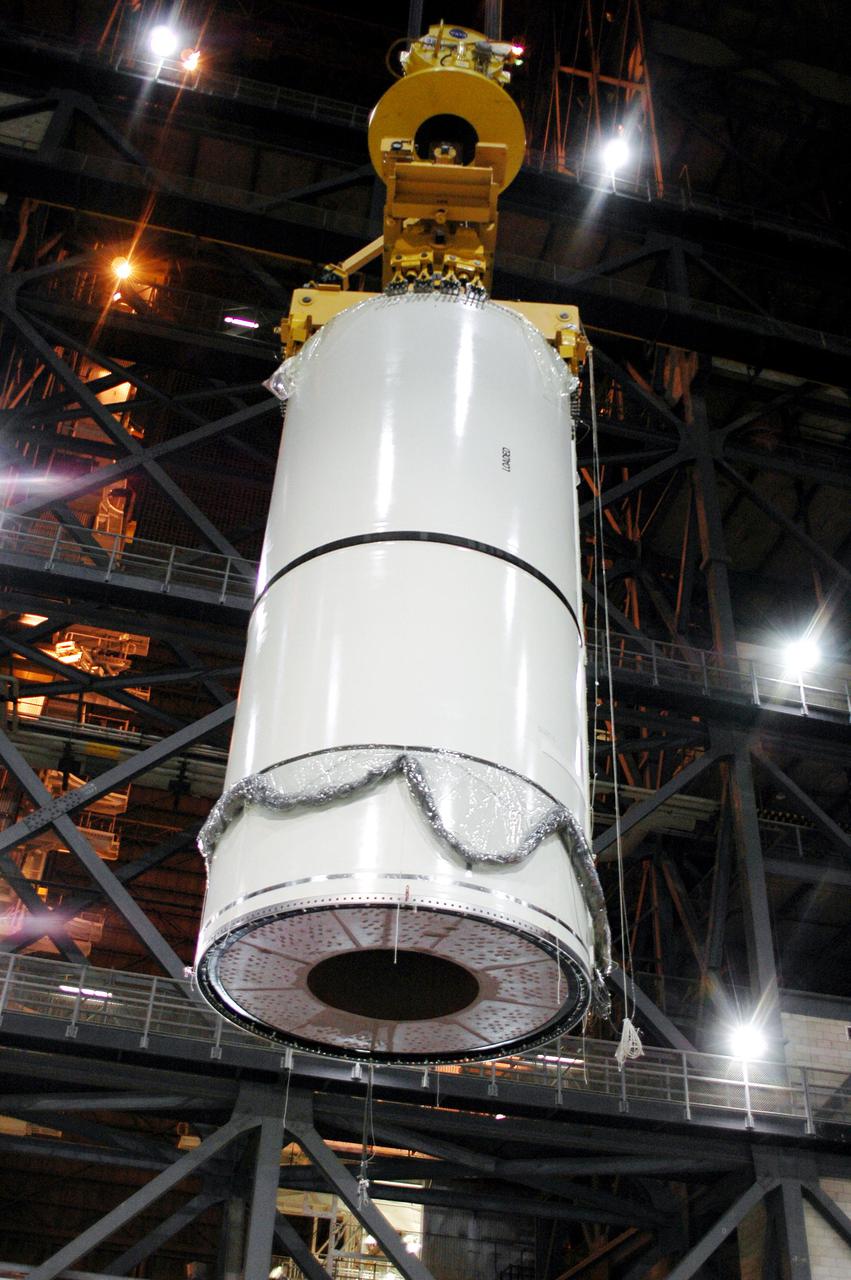
KENNEDY SPACE CENTER, FLA. - In the Vehicle Assembly Building (VAB), a segment of a Solid Rocket Booster (SRB) is lifted to the 16th level. This right aft center segment will be stacked with the aft booster that arrived in the VAB Nov. 22 for the Return to Flight mission STS-114. Two SRBs are stacked on the Mobile Launch Platform and later joined by the External Tank. The twin 149-foot tall, 12-foot diameter SRBs provide the main propulsion system during launch. They operate parallel with the Space Shuttle main engines for the first two minutes of flight and jettison away from the orbiter with help from the Booster Separation Motors, about 26.3 nautical miles above the Earth’s surface.
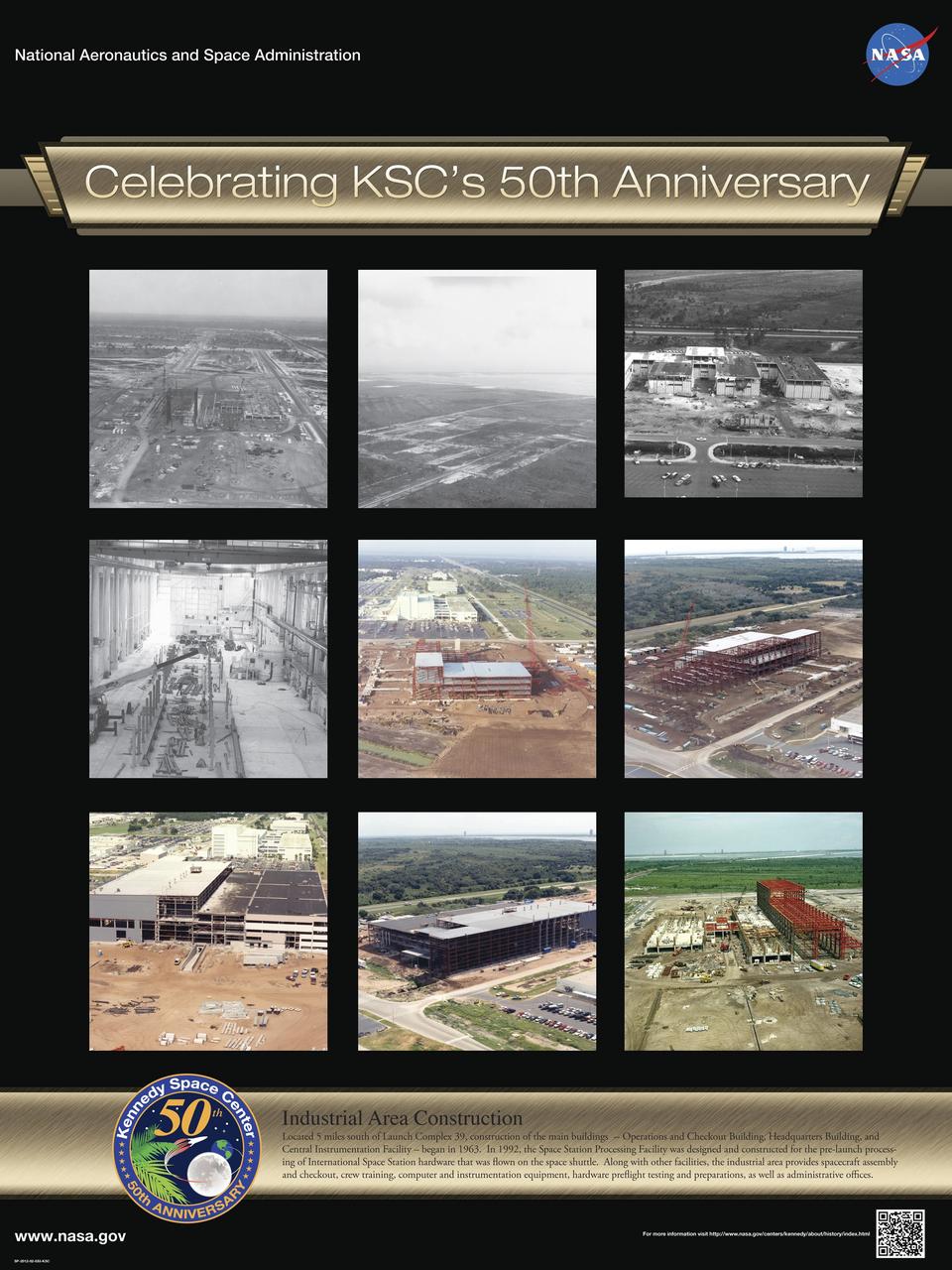
Industrial Area Construction: Located 5 miles south of Launch Complex 39, construction of the main buildings -- Operations and Checkout Building, Headquarters Building, and Central Instrumentation Facility – began in 1963. In 1992, the Space Station Processing Facility was designed and constructed for the pre-launch processing of International Space Station hardware that was flown on the space shuttle. Along with other facilities, the industrial area provides spacecraft assembly and checkout, crew training, computer and instrumentation equipment, hardware preflight testing and preparations, as well as administrative offices. Poster designed by Kennedy Space Center Graphics Department/Greg Lee. Credit: NASA
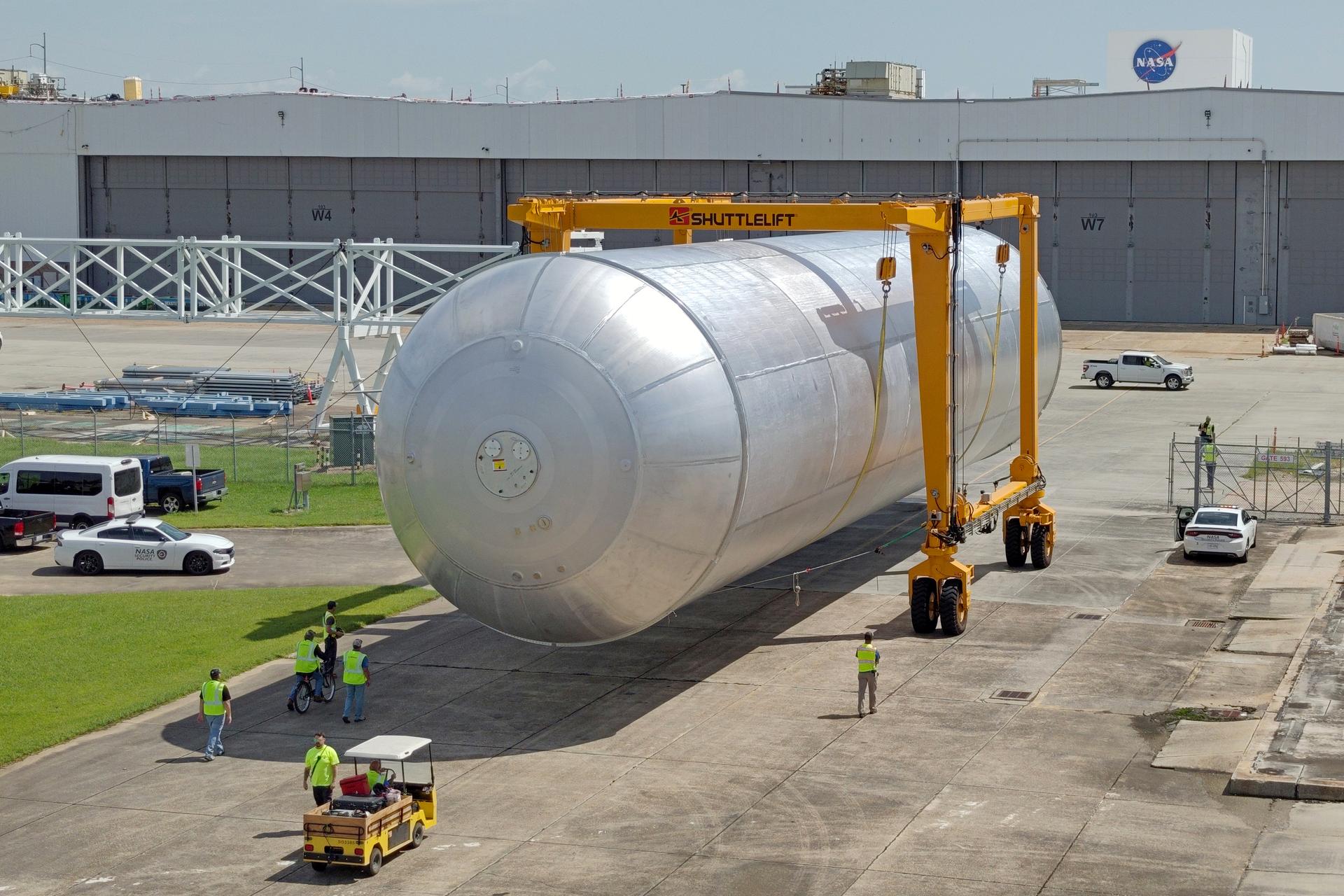
Crews at NASA’s Michoud Assembly Facility in New Orleans transport the 130-foot-tall liquid hydrogen tank from the proof testing building to the main factory on July 10. The liquid hydrogen tank will form part of the core stage for the SLS (Space Launch System) rocket for the agency’s Artemis IV mission, providing thousands of gallons of super-cold propellant to the rocket engines during launch. Soon, teams with SLS prime contractor, Boeing, will move the tank into the facility’s vertical assembly building for cleaning operations. The liquid hydrogen propellant tank is one of five major elements that make up the 212-foot-tall SLS rocket stage. The core stage, along with its four RS-25 engines at its base, produce more than two million pounds of thrust to help launch NASA’s Orion spacecraft, astronauts, and supplies beyond Earth’s orbit and to the lunar surface for Artemis. Image credit: NASA/Eric Bordelon & Michael DeMocker
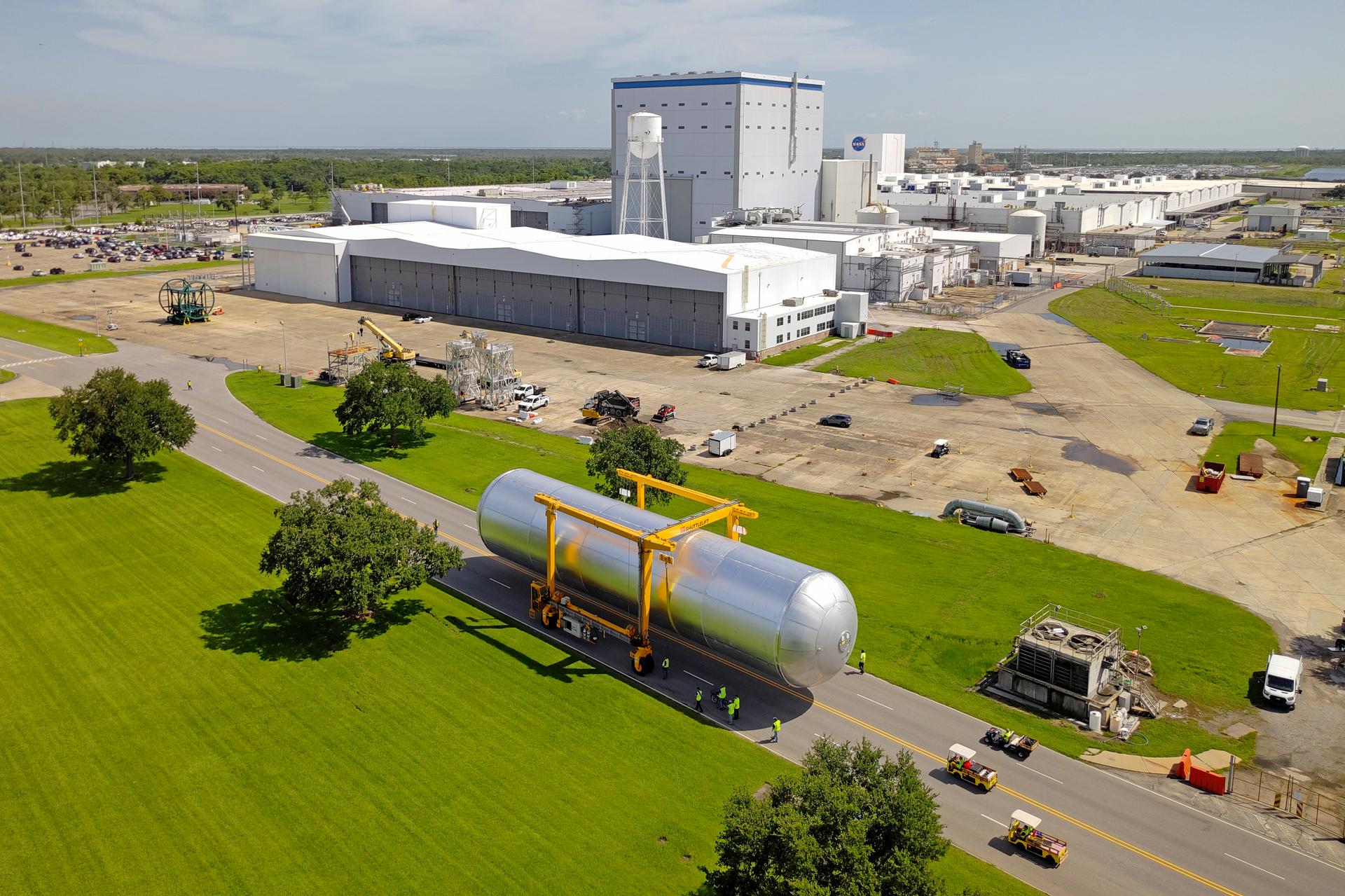
Crews at NASA’s Michoud Assembly Facility in New Orleans transport the 130-foot-tall liquid hydrogen tank from the proof testing building to the main factory on July 10. The liquid hydrogen tank will form part of the core stage for the SLS (Space Launch System) rocket for the agency’s Artemis IV mission, providing thousands of gallons of super-cold propellant to the rocket engines during launch. Soon, teams with SLS prime contractor, Boeing, will move the tank into the facility’s vertical assembly building for cleaning operations. The liquid hydrogen propellant tank is one of five major elements that make up the 212-foot-tall SLS rocket stage. The core stage, along with its four RS-25 engines at its base, produce more than two million pounds of thrust to help launch NASA’s Orion spacecraft, astronauts, and supplies beyond Earth’s orbit and to the lunar surface for Artemis. Image credit: NASA/Eric Bordelon & Michael DeMocker
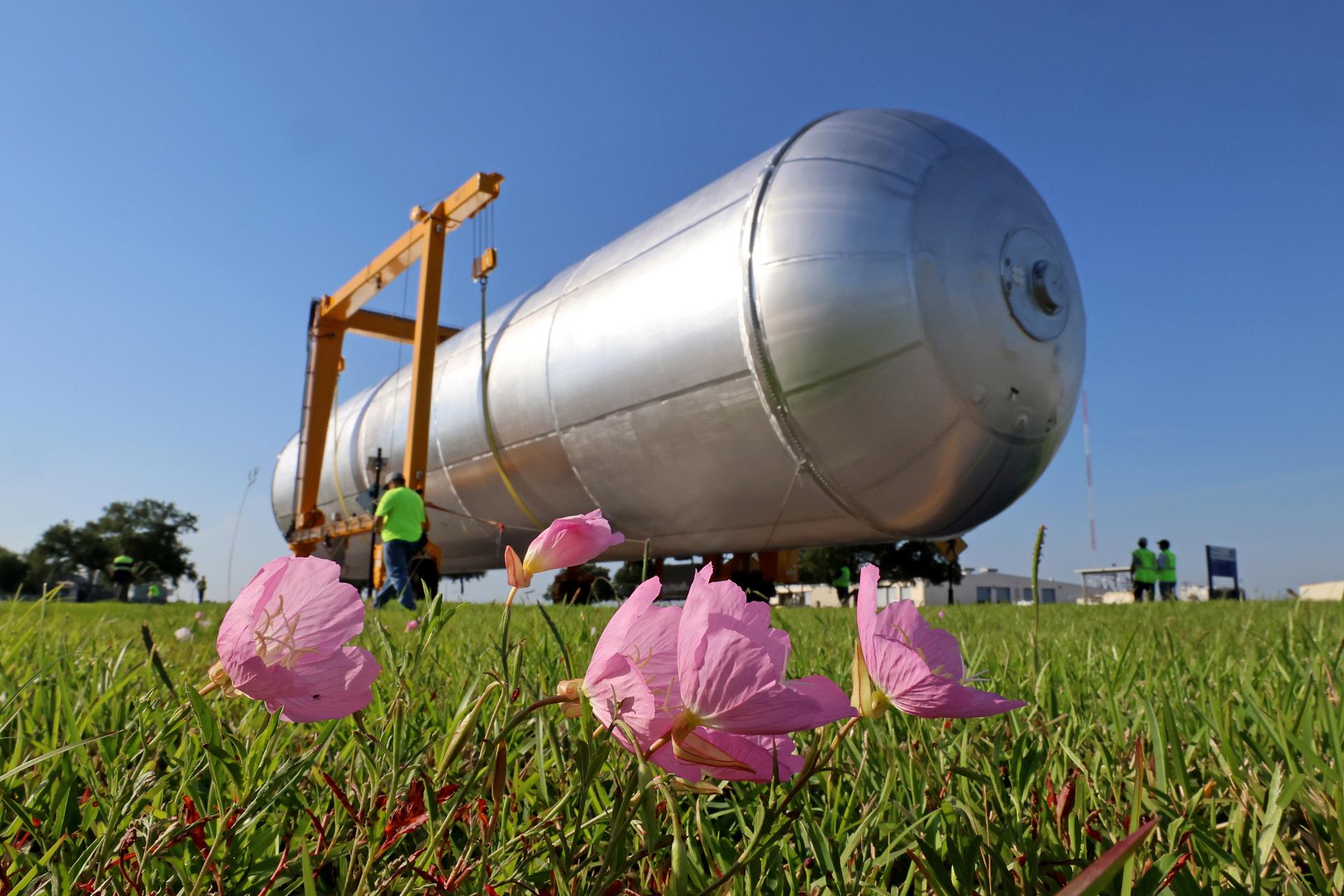
Crews at NASA’s Michoud Assembly Facility in New Orleans transport the 130-foot-tall liquid hydrogen tank out of a production cell inside the main factory building into a detached test building on a separate portion of the 829-acre site. The liquid hydrogen tank will form part of the core stage for the SLS (Space Launch System) rocket, providing thousands of gallons of super-cold propellant to one of four RS-25 engines. Inside the test cell, teams will perform non-destructive evaluation proof testing on the tank. Proof testing ensures the structural integrity of the flight hardware before crews begin the next phase of production. The liquid hydrogen propellant tank is one of five major elements that make up the 212-foot-tall SLS rocket stage. The core stage, along with its four RS-25 engines at its base, produce more than two million pounds of thrust to help launch NASA’s Orion spacecraft, astronauts, and supplies beyond Earth’s orbit and to the lunar surface for Artemis. Image credit: NASA/Michael DeMocker
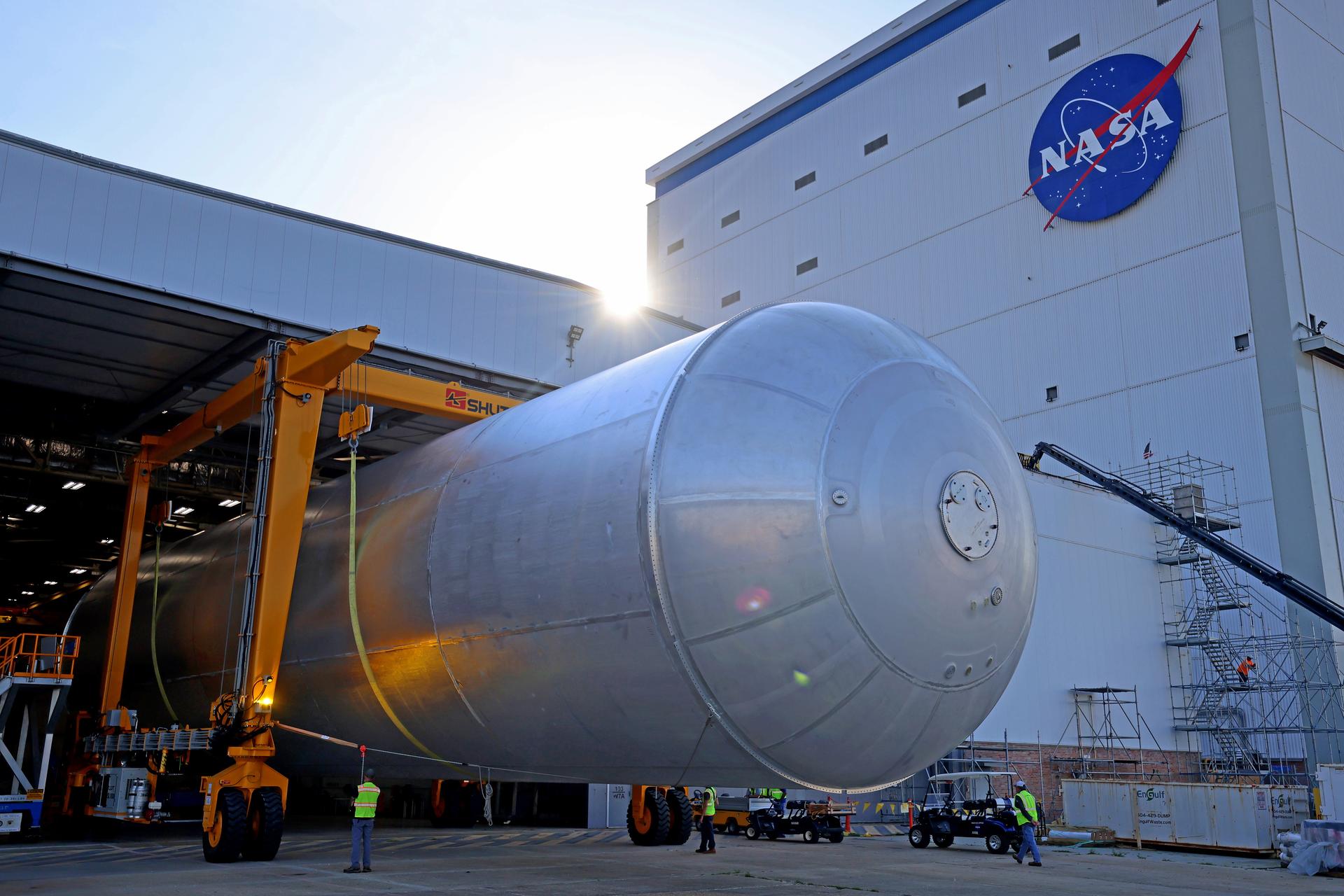
Crews at NASA’s Michoud Assembly Facility in New Orleans transport the 130-foot-tall liquid hydrogen tank out of a production cell inside the main factory building into a detached test building on a separate portion of the 829-acre site. The liquid hydrogen tank will form part of the core stage for the SLS (Space Launch System) rocket, providing thousands of gallons of super-cold propellant to one of four RS-25 engines. Inside the test cell, teams will perform non-destructive evaluation proof testing on the tank. Proof testing ensures the structural integrity of the flight hardware before crews begin the next phase of production. The liquid hydrogen propellant tank is one of five major elements that make up the 212-foot-tall SLS rocket stage. The core stage, along with its four RS-25 engines at its base, produce more than two million pounds of thrust to help launch NASA’s Orion spacecraft, astronauts, and supplies beyond Earth’s orbit and to the lunar surface for Artemis. Image credit: NASA/Michael DeMocker
Teams at NASA’s Michoud Assembly Facility in New Orleans transport a 51-foot-tall liquid oxygen tank out of the vertical assembly building on July 23, 2026. The liquid oxygen tank, which will form part of the SLS (Space Launch System) rocket for NASA’s Artemis IV mission to the Moon, is suspended in a strap carrier transport apparatus and brought into the main factory building. Here, teams with SLS core stage prime contractor, Boeing, will perform post-proof non-destructive evaluations on the flight hardware before moving forward with tank cleaning. The propellant tank will hold more than 196,000 gallons of super-cooled liquid oxygen at launch and is one of five major elements that make up the 212-foot-tall SLS rocket stage. The core stage, along with its four RS-25 engines at its base, produces more than two million pounds of thrust to help launch NASA’s Orion spacecraft, astronauts, and supplies beyond Earth’s orbit and to the lunar surface for Artemis. Image credit: NASA/Michael DeMocker
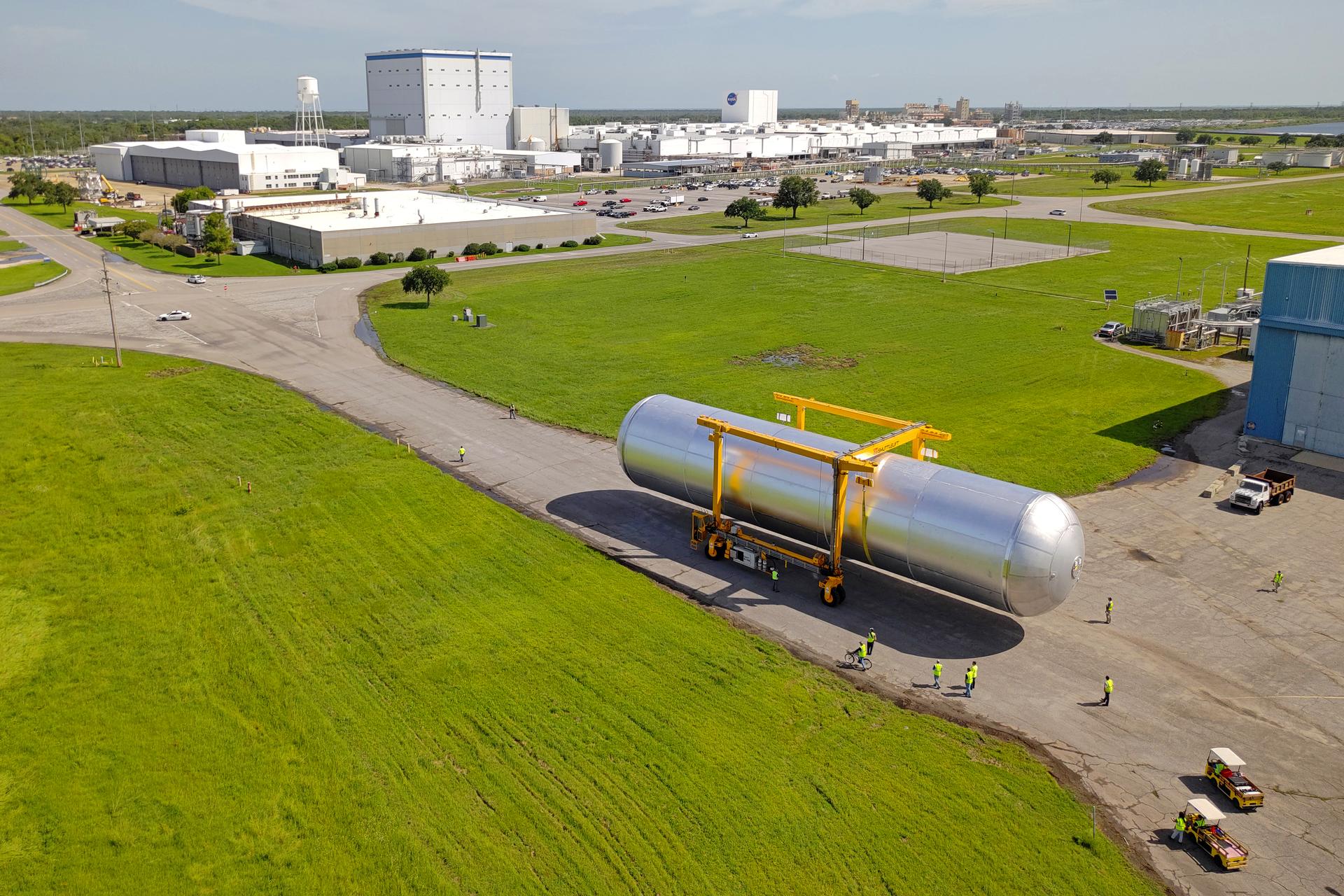
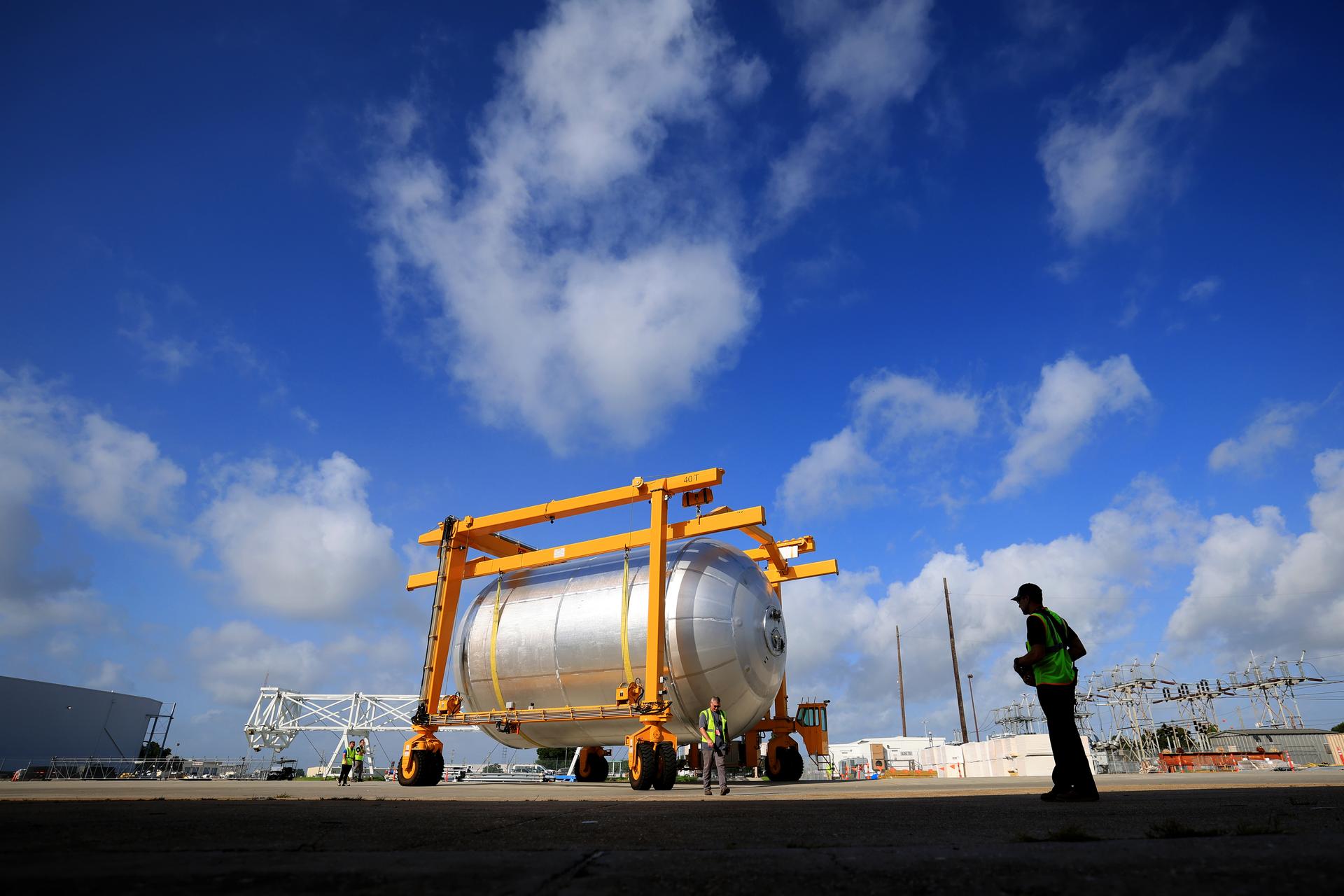
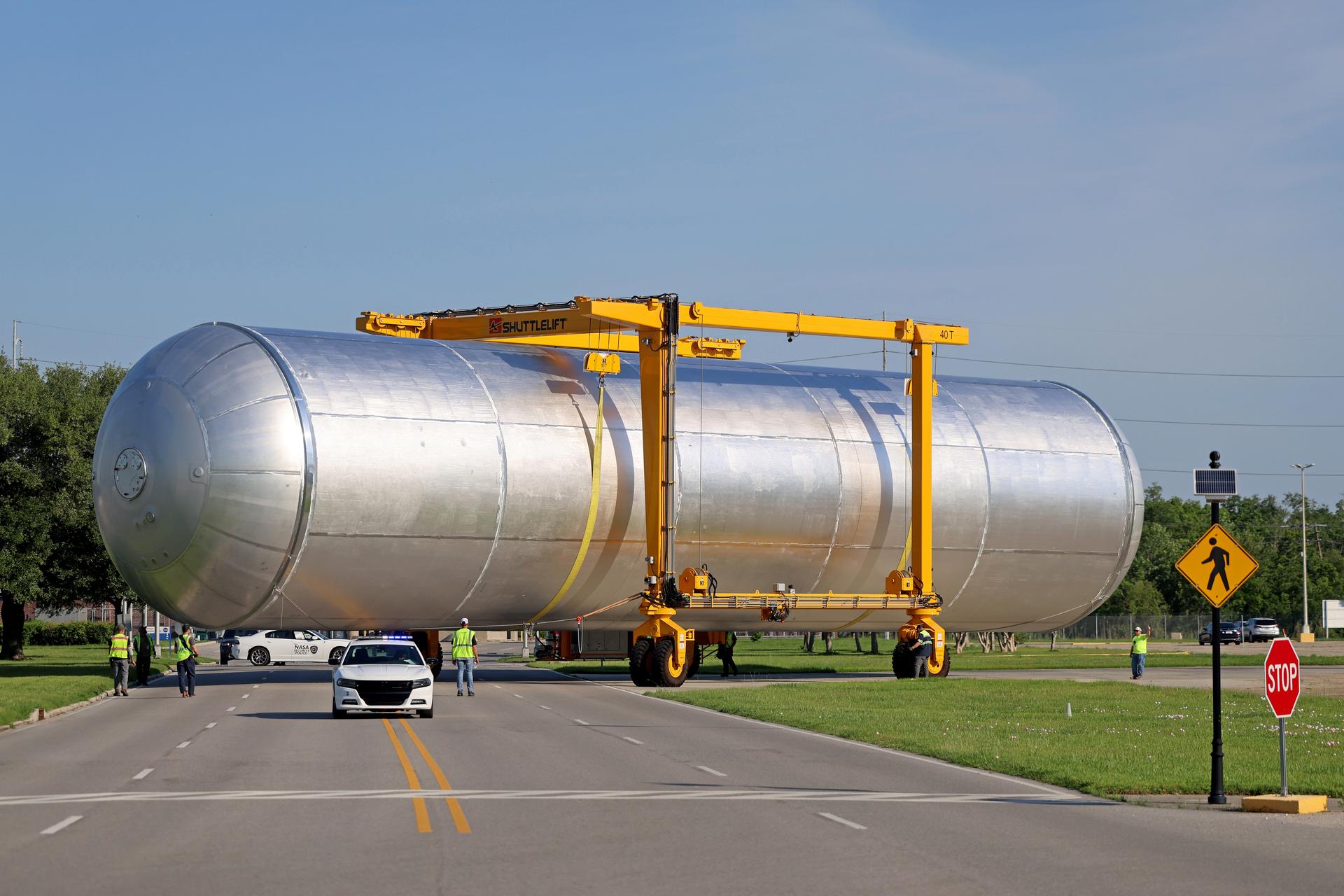
Crews at NASA’s Michoud Assembly Facility in New Orleans transport the 130-foot-tall liquid hydrogen tank from the proof testing building to the main factory on July 10. The liquid hydrogen tank will form part of the core stage for the SLS (Space Launch System) rocket for the agency’s Artemis IV mission, providing thousands of gallons of super-cold propellant to the rocket engines during launch. Soon, teams with SLS prime contractor, Boeing, will move the tank into the facility’s vertical assembly building for cleaning operations. The liquid hydrogen propellant tank is one of five major elements that make up the 212-foot-tall SLS rocket stage. The core stage, along with its four RS-25 engines at its base, produce more than two million pounds of thrust to help launch NASA’s Orion spacecraft, astronauts, and supplies beyond Earth’s orbit and to the lunar surface for Artemis. Image credit: NASA/Eric Bordelon & Michael DeMocker
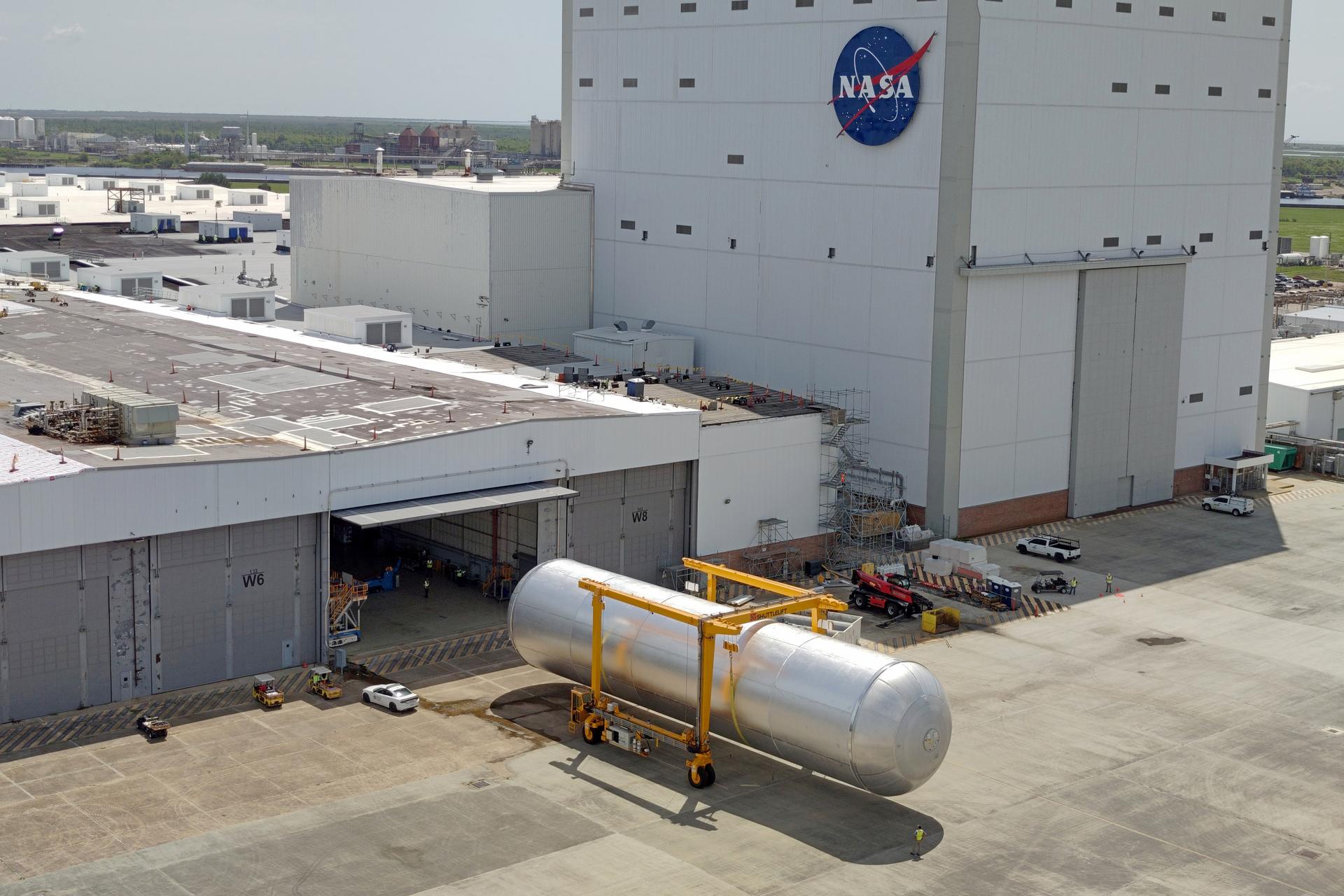
Crews at NASA’s Michoud Assembly Facility in New Orleans transport the 130-foot-tall liquid hydrogen tank from the proof testing building to the main factory on July 10. The liquid hydrogen tank will form part of the core stage for the SLS (Space Launch System) rocket for the agency’s Artemis IV mission, providing thousands of gallons of super-cold propellant to the rocket engines during launch. Soon, teams with SLS prime contractor, Boeing, will move the tank into the facility’s vertical assembly building for cleaning operations. The liquid hydrogen propellant tank is one of five major elements that make up the 212-foot-tall SLS rocket stage. The core stage, along with its four RS-25 engines at its base, produce more than two million pounds of thrust to help launch NASA’s Orion spacecraft, astronauts, and supplies beyond Earth’s orbit and to the lunar surface for Artemis. Image credit: NASA/Eric Bordelon & Michael DeMocker
Crews at NASA’s Michoud Assembly Facility in New Orleans transport the 130-foot-tall liquid hydrogen tank out of a production cell inside the main factory building into a detached test building on a separate portion of the 829-acre site. The liquid hydrogen tank will form part of the core stage for the SLS (Space Launch System) rocket, providing thousands of gallons of super-cold propellant to one of four RS-25 engines. Inside the test cell, teams will perform non-destructive evaluation proof testing on the tank. Proof testing ensures the structural integrity of the flight hardware before crews begin the next phase of production. The liquid hydrogen propellant tank is one of five major elements that make up the 212-foot-tall SLS rocket stage. The core stage, along with its four RS-25 engines at its base, produce more than two million pounds of thrust to help launch NASA’s Orion spacecraft, astronauts, and supplies beyond Earth’s orbit and to the lunar surface for Artemis. Image credit: NASA/Michael DeMocker
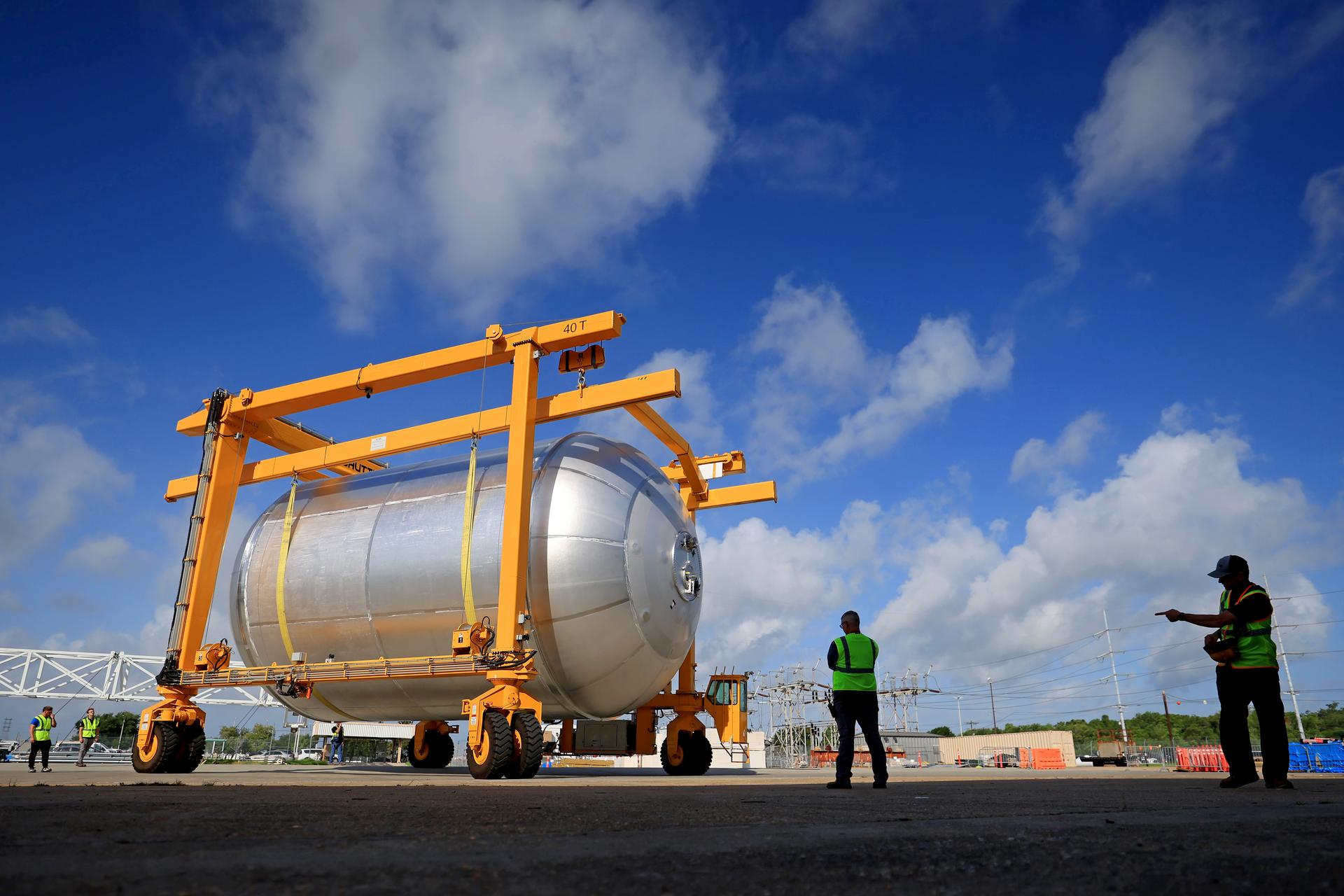
Teams at NASA’s Michoud Assembly Facility in New Orleans transport a 51-foot-tall liquid oxygen tank out of the vertical assembly building on July 23, 2026. The liquid oxygen tank, which will form part of the SLS (Space Launch System) rocket for NASA’s Artemis IV mission to the Moon, is suspended in a strap carrier transport apparatus and brought into the main factory building. Here, teams with SLS core stage prime contractor, Boeing, will perform post-proof non-destructive evaluations on the flight hardware before moving forward with tank cleaning. The propellant tank will hold more than 196,000 gallons of super-cooled liquid oxygen at launch and is one of five major elements that make up the 212-foot-tall SLS rocket stage. The core stage, along with its four RS-25 engines at its base, produces more than two million pounds of thrust to help launch NASA’s Orion spacecraft, astronauts, and supplies beyond Earth’s orbit and to the lunar surface for Artemis. Image credit: NASA/Michael DeMocker
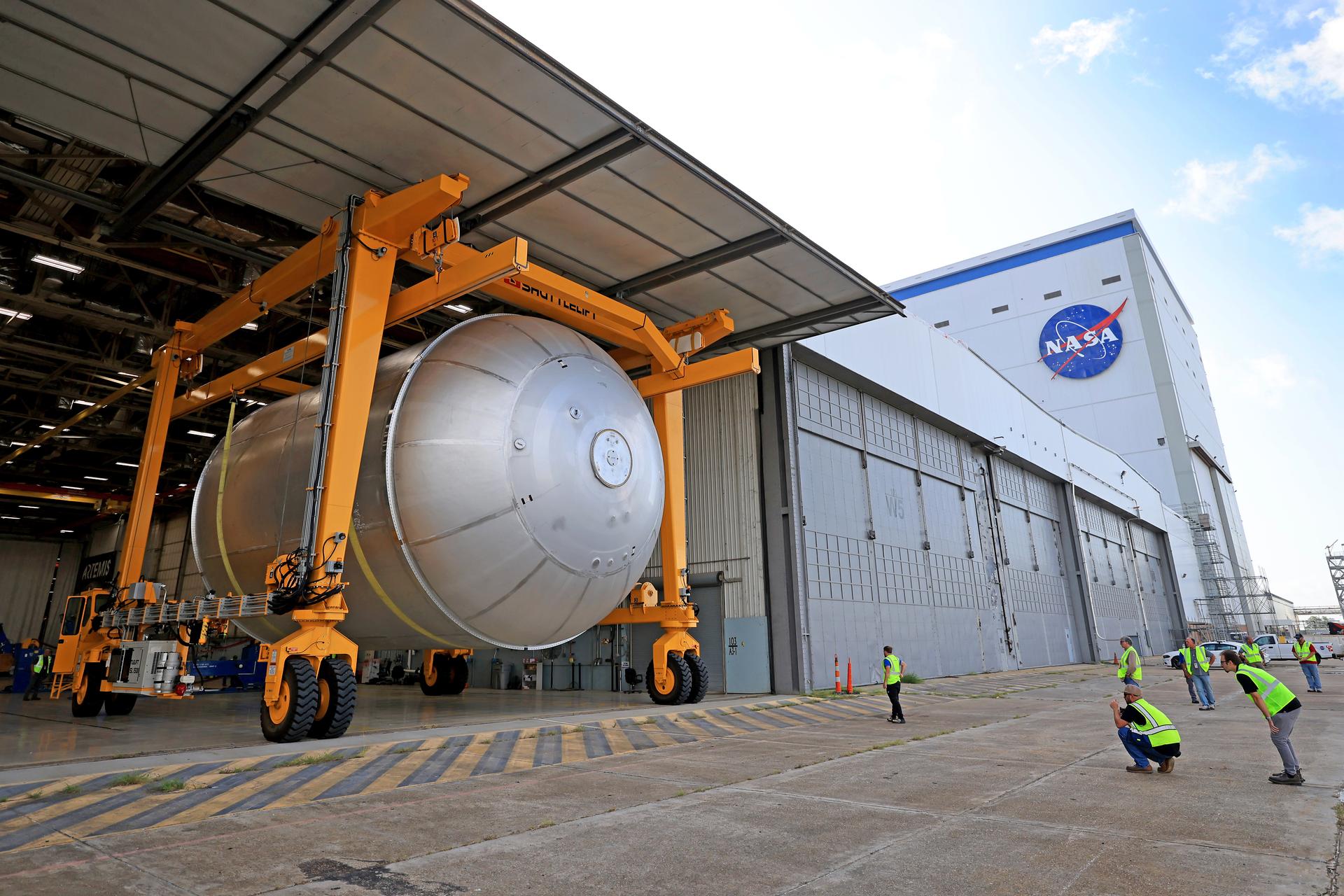
Teams at NASA’s Michoud Assembly Facility in New Orleans transport a 51-foot-tall liquid oxygen tank out of the vertical assembly building on July 23, 2026. The liquid oxygen tank, which will form part of the SLS (Space Launch System) rocket for NASA’s Artemis IV mission to the Moon, is suspended in a strap carrier transport apparatus and brought into the main factory building. Here, teams with SLS core stage prime contractor, Boeing, will perform post-proof non-destructive evaluations on the flight hardware before moving forward with tank cleaning. The propellant tank will hold more than 196,000 gallons of super-cooled liquid oxygen at launch and is one of five major elements that make up the 212-foot-tall SLS rocket stage. The core stage, along with its four RS-25 engines at its base, produces more than two million pounds of thrust to help launch NASA’s Orion spacecraft, astronauts, and supplies beyond Earth’s orbit and to the lunar surface for Artemis. Image credit: NASA/Michael DeMocker
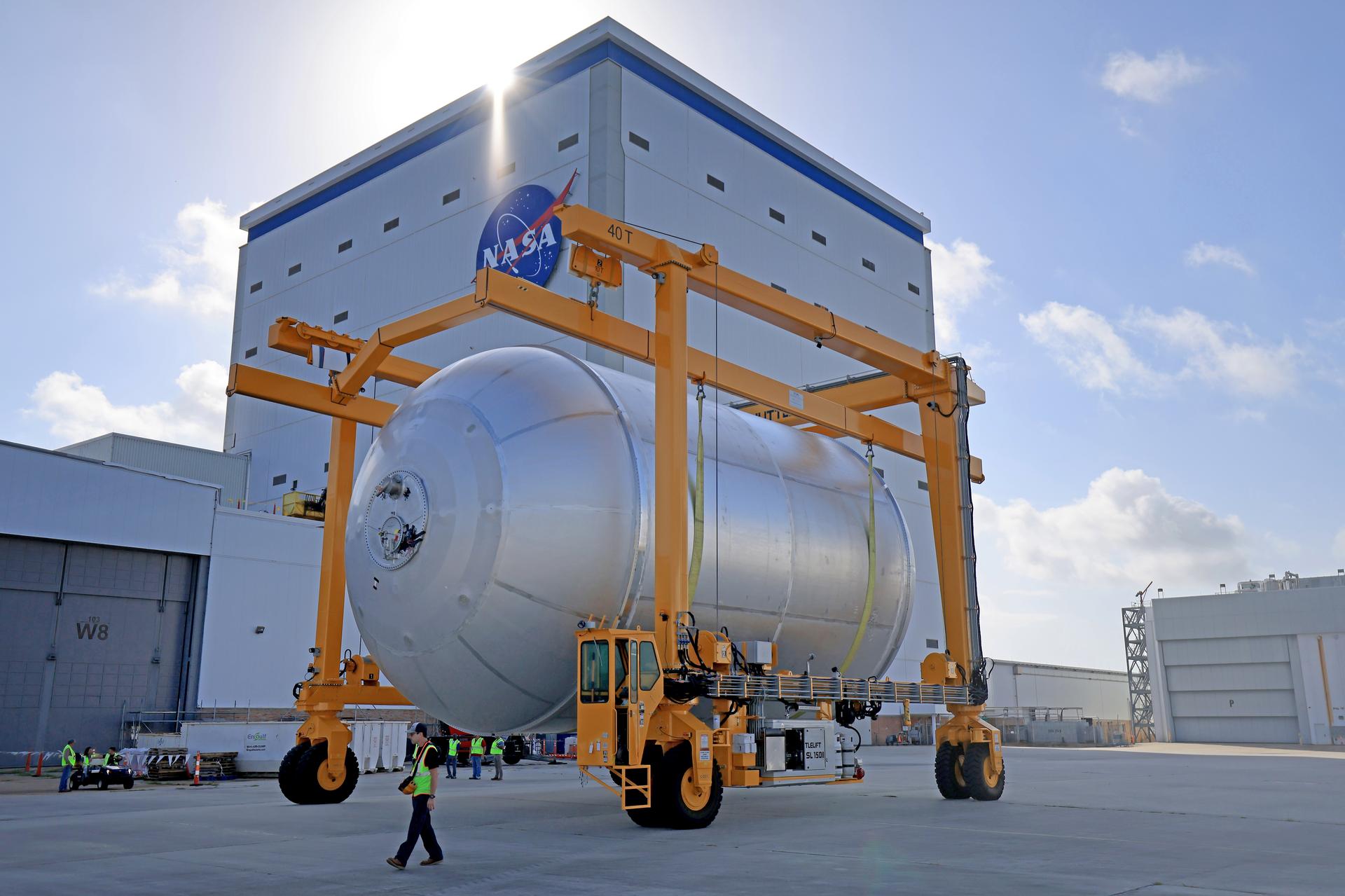
Teams at NASA’s Michoud Assembly Facility in New Orleans transport a 51-foot-tall liquid oxygen tank out of the vertical assembly building on July 23, 2026. The liquid oxygen tank, which will form part of the SLS (Space Launch System) rocket for NASA’s Artemis IV mission to the Moon, is suspended in a strap carrier transport apparatus and brought into the main factory building. Here, teams with SLS core stage prime contractor, Boeing, will perform post-proof non-destructive evaluations on the flight hardware before moving forward with tank cleaning. The propellant tank will hold more than 196,000 gallons of super-cooled liquid oxygen at launch and is one of five major elements that make up the 212-foot-tall SLS rocket stage. The core stage, along with its four RS-25 engines at its base, produces more than two million pounds of thrust to help launch NASA’s Orion spacecraft, astronauts, and supplies beyond Earth’s orbit and to the lunar surface for Artemis. Image credit: NASA/Michael DeMocker
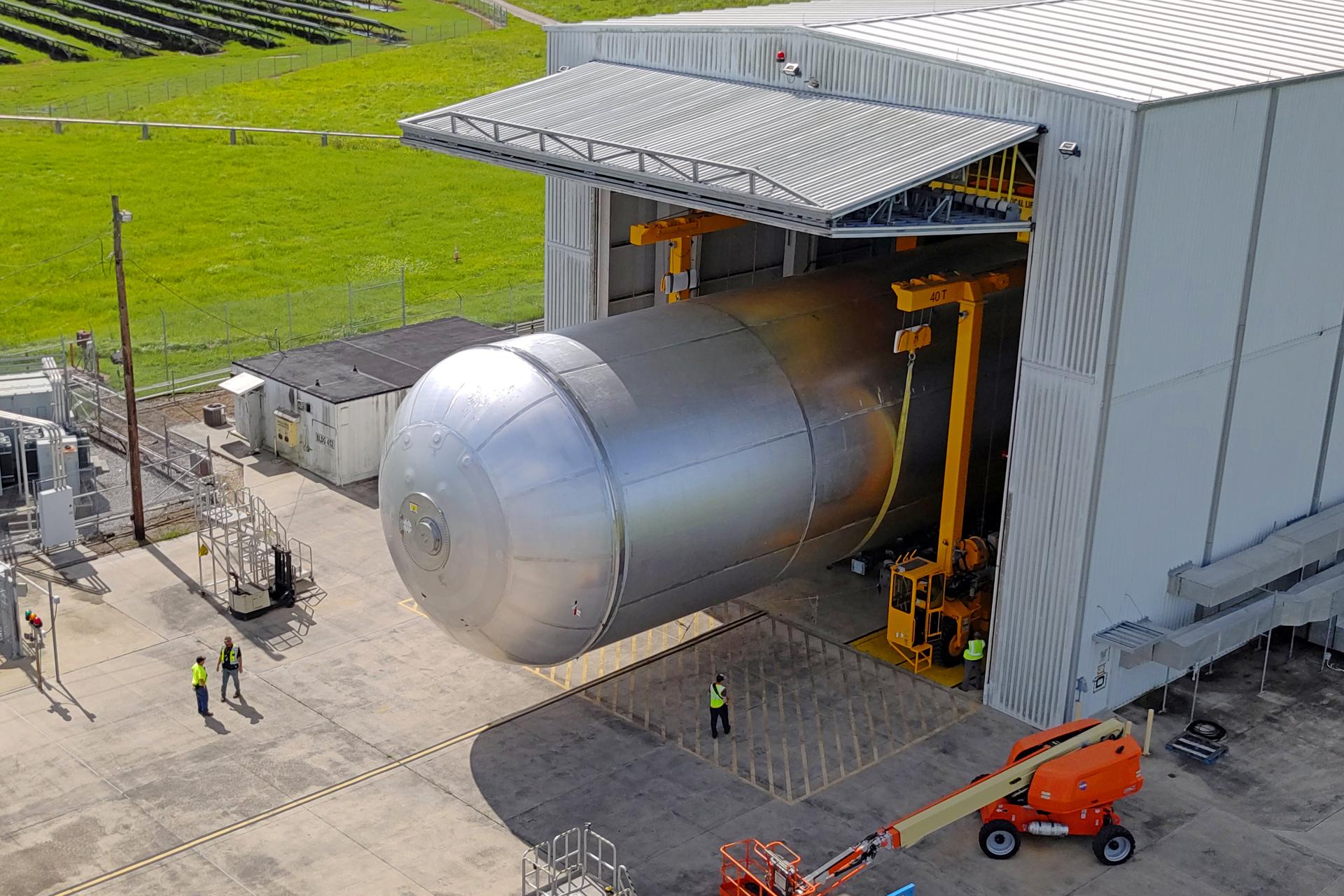
Crews at NASA’s Michoud Assembly Facility in New Orleans transport the 130-foot-tall liquid hydrogen tank from the proof testing building to the main factory on July 10. The liquid hydrogen tank will form part of the core stage for the SLS (Space Launch System) rocket for the agency’s Artemis IV mission, providing thousands of gallons of super-cold propellant to the rocket engines during launch. Soon, teams with SLS prime contractor, Boeing, will move the tank into the facility’s vertical assembly building for cleaning operations. The liquid hydrogen propellant tank is one of five major elements that make up the 212-foot-tall SLS rocket stage. The core stage, along with its four RS-25 engines at its base, produce more than two million pounds of thrust to help launch NASA’s Orion spacecraft, astronauts, and supplies beyond Earth’s orbit and to the lunar surface for Artemis. Image credit: NASA/Eric Bordelon & Michael DeMocker
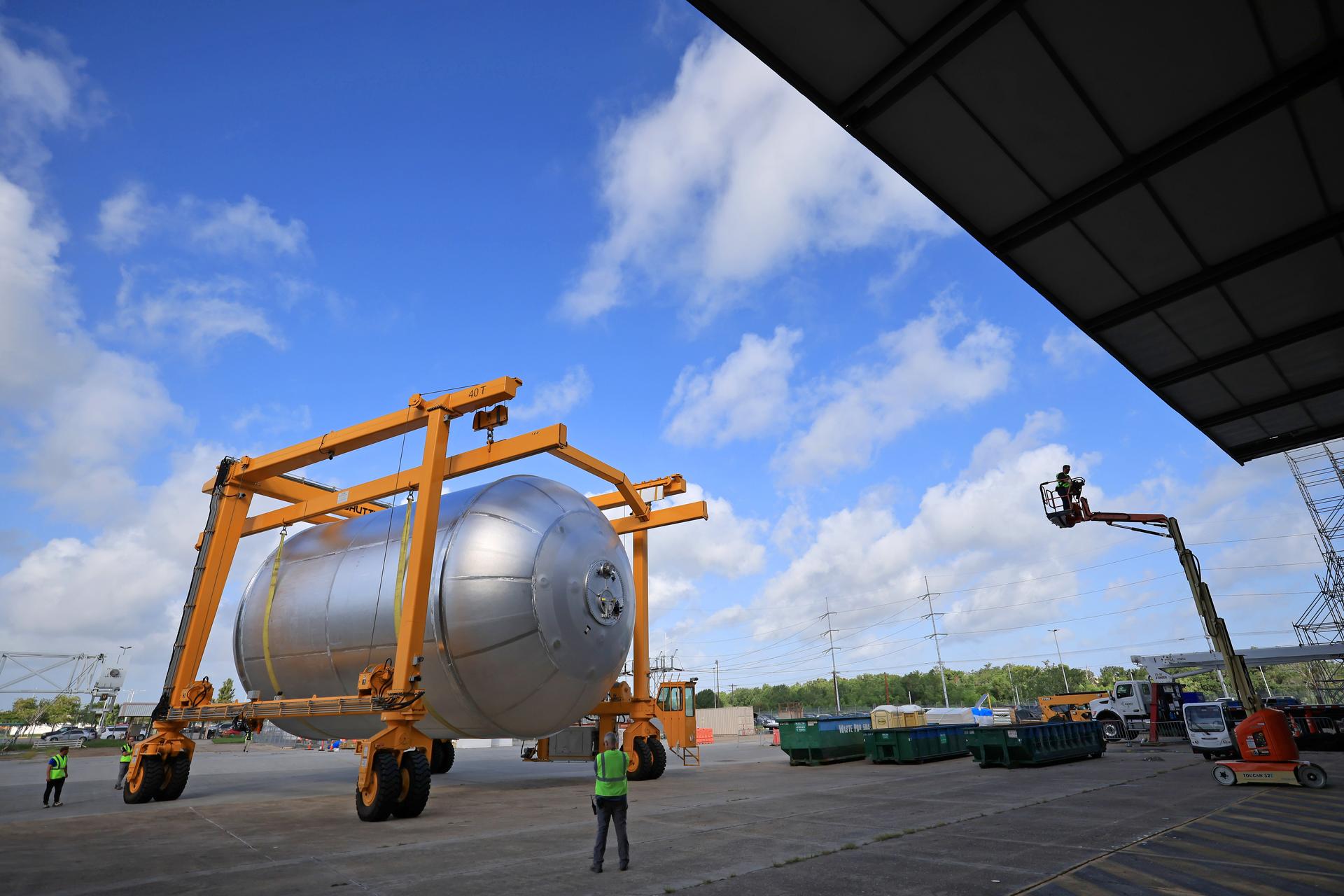
Teams at NASA’s Michoud Assembly Facility in New Orleans transport a 51-foot-tall liquid oxygen tank out of the vertical assembly building on July 23, 2026. The liquid oxygen tank, which will form part of the SLS (Space Launch System) rocket for NASA’s Artemis IV mission to the Moon, is suspended in a strap carrier transport apparatus and brought into the main factory building. Here, teams with SLS core stage prime contractor, Boeing, will perform post-proof non-destructive evaluations on the flight hardware before moving forward with tank cleaning. The propellant tank will hold more than 196,000 gallons of super-cooled liquid oxygen at launch and is one of five major elements that make up the 212-foot-tall SLS rocket stage. The core stage, along with its four RS-25 engines at its base, produces more than two million pounds of thrust to help launch NASA’s Orion spacecraft, astronauts, and supplies beyond Earth’s orbit and to the lunar surface for Artemis. Image credit: NASA/Michael DeMocker
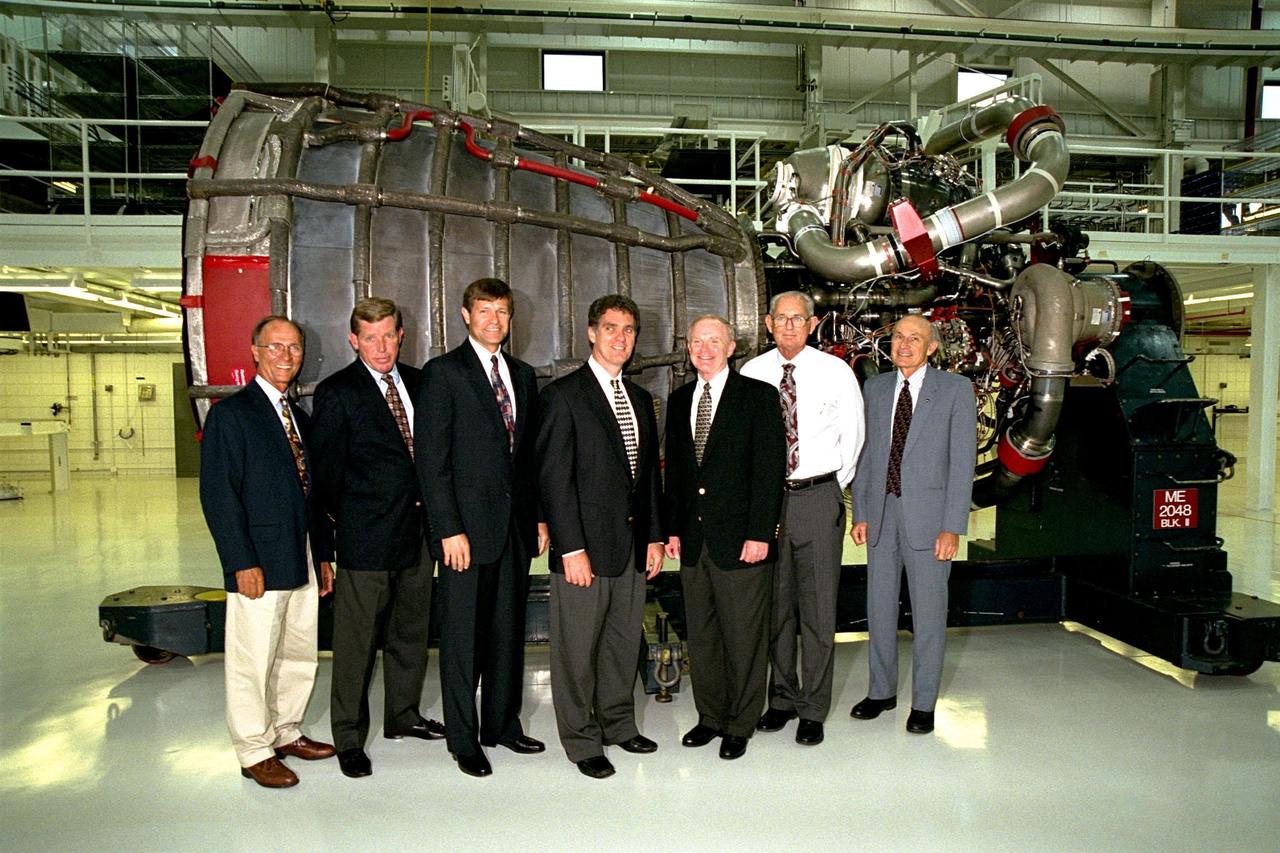
Participants in the ribbon cutting for KSC's new 34,600-square-foot Space Shuttle Main Engine Processing Facility (SSMEPF) pose in front of a Space Shuttle Main Engine on display for the ceremony. From left, they are Ed Adamek, vice president and associate program manager for Ground Operations of United Space Alliance; John Plowden, vice president of Rocketdyne; Donald R. McMonagle, manager of Launch Integration; U.S. Congressman Dave Weldon; KSC Center Director Roy D. Bridges Jr.; Wade Ivey of Ivey Construction, Inc.; and Robert B. Sieck, director of Shuttle Processing. A major addition to the existing Orbiter Processing Facility Bay 3, the SSMEPF replaces the Shuttle Main Engine Shop located in the Vehicle Assembly Building (VAB). The decision to move the shop out of the VAB was prompted by safety considerations and recent engine processing improvements. The first three main engines to be processed in the new facility will fly on Shuttle Endeavour's STS-88 mission in December 1998
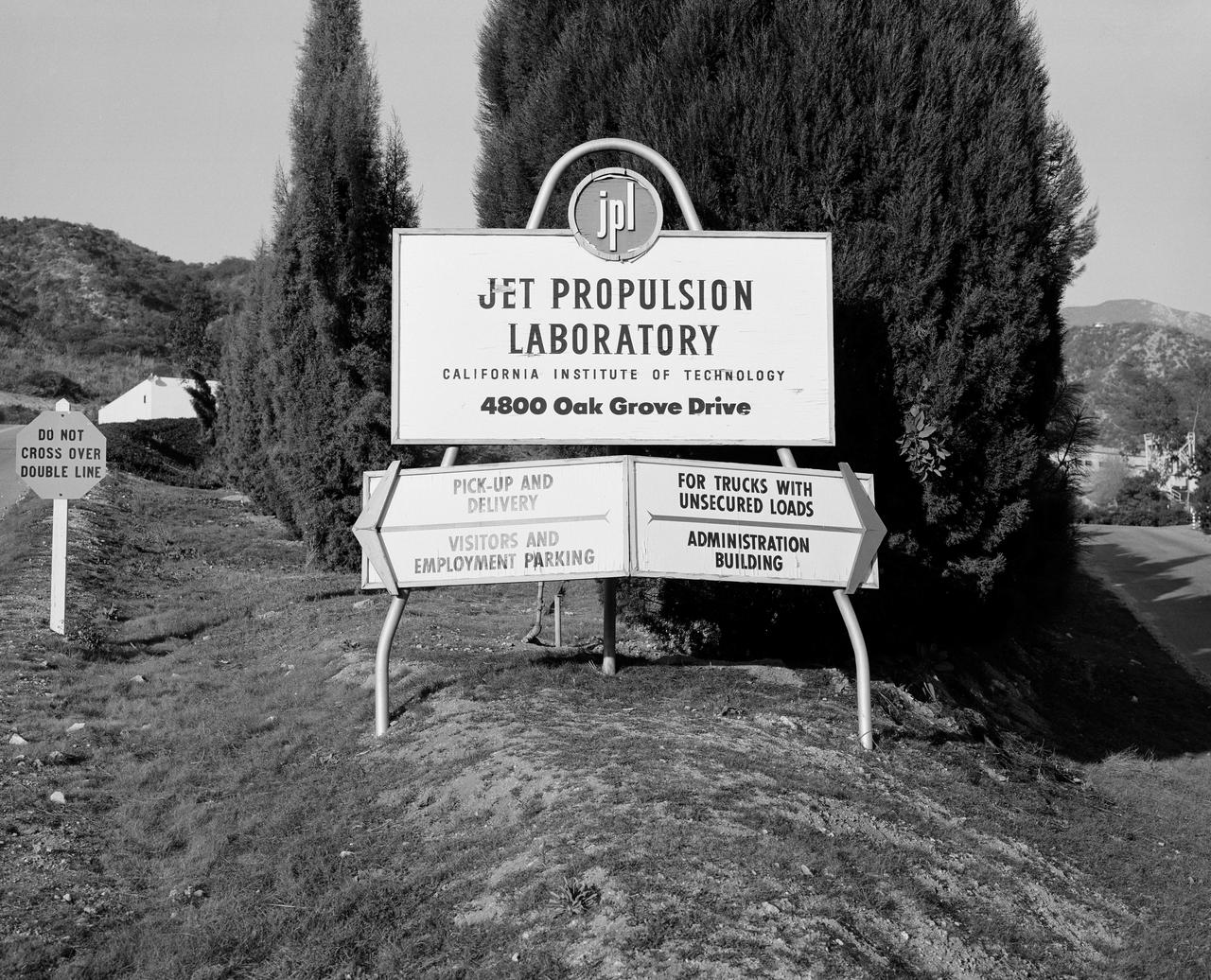
This archival image was released as part of a gallery comparing JPL’s past and present, commemorating the 80th anniversary of NASA’s Jet Propulsion Laboratory on Oct. 31, 2016. This is what greeted visitors to the Jet Propulsion Laboratory in December 1957, before NASA was created and the lab became one of its centers. There is no sign at this location today -- there is just a stairway that runs up the side of the main Administration Building (Building 180). The official lab sign has moved farther south, just as the lab itself has expanded farther south out from the base of the San Gabriel Mountains. http://photojournal.jpl.nasa.gov/catalog/PIA21115