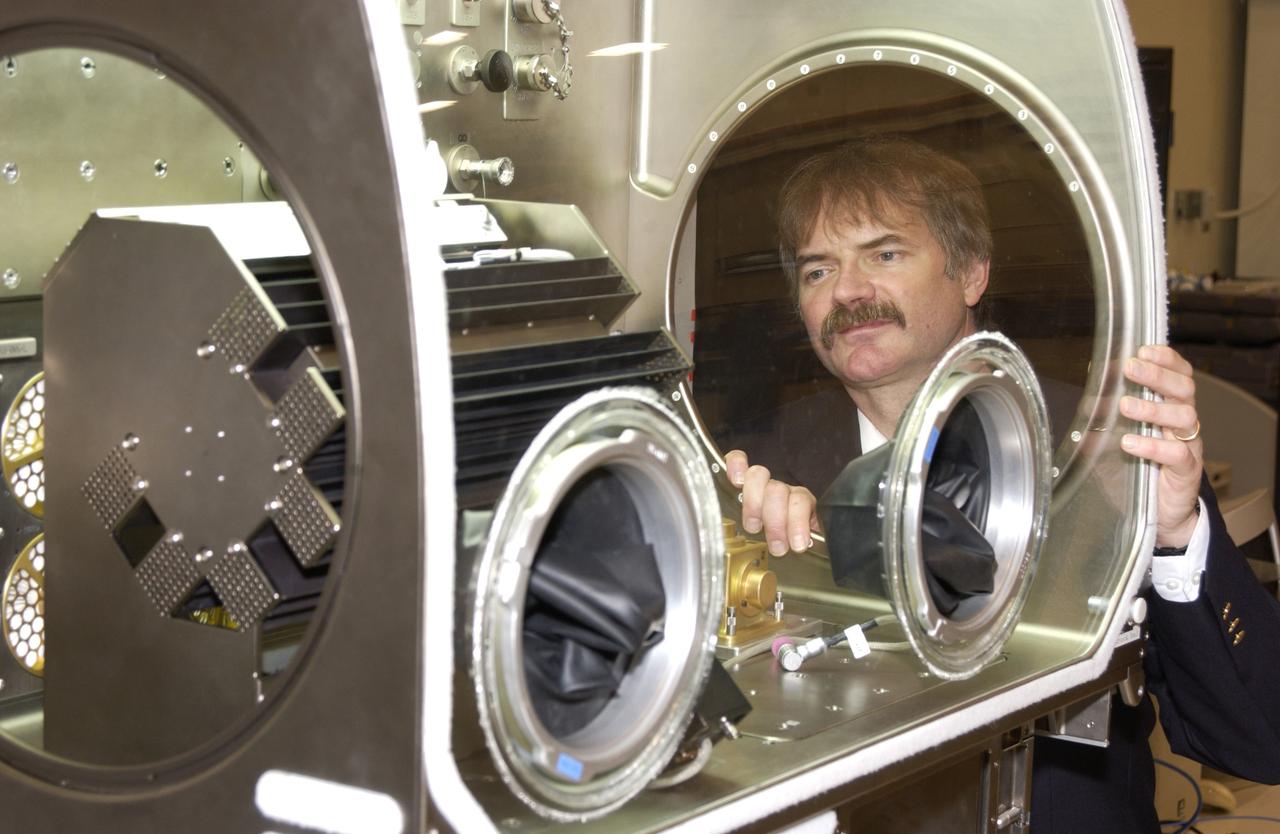
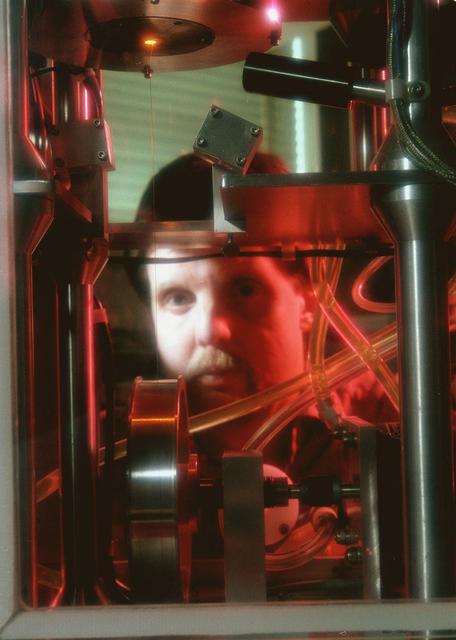
Dr. Richard Grugel, a materials scientist at NASA's Marshall Space Flight in Huntsville, Ala., examines the furnace used to conduct his Pore Formation and Mobility Investigation -- one of the first two materials science experiments to be conducted on the International Space Station. This experiment studies materials processes similar to those used to make components used in jet engines. Grugel's furnace was installed in the Microgravity Science Glovebox through the circular port on the side. In space, crewmembers are able to change out samples using the gloves on the front of the facility's work area.
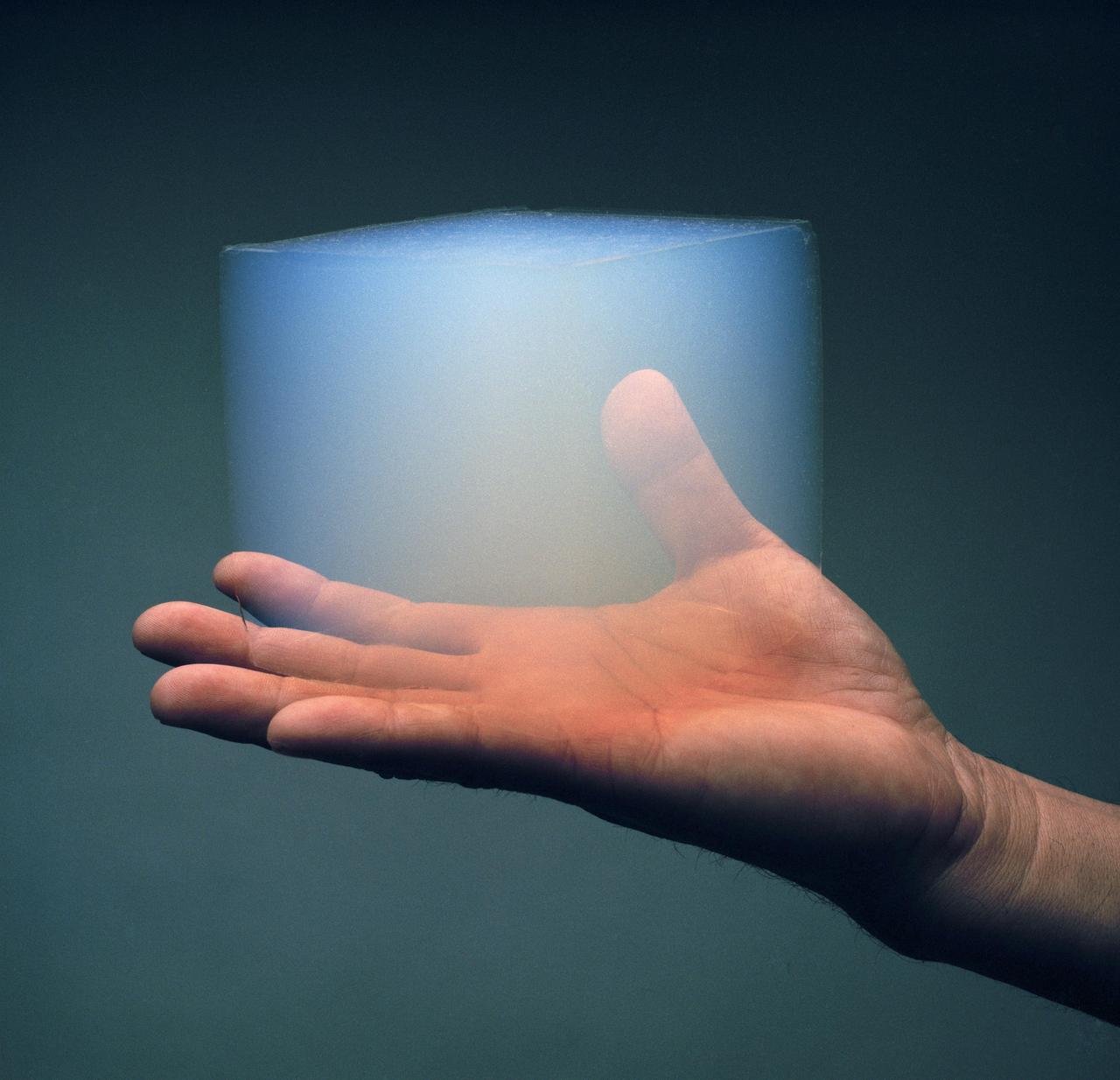
Scientists are exploring how aerogel, a translucent, Styrofoam-like material, could be used as a building material on Mars. Aerogel retains heat; structures built with it could raise temperatures enough to melt water ice on the Martian surface. https://photojournal.jpl.nasa.gov/catalog/PIA23343
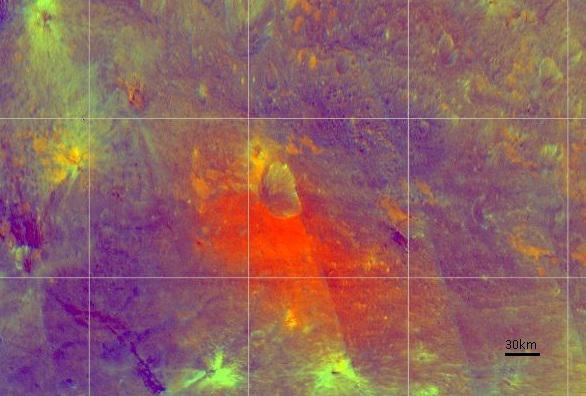
This false-color image from NASA Dawn spacecraft is of the of the giant asteroid Vesta. Scientists are studying image like these to better understand the different materials on the surface.
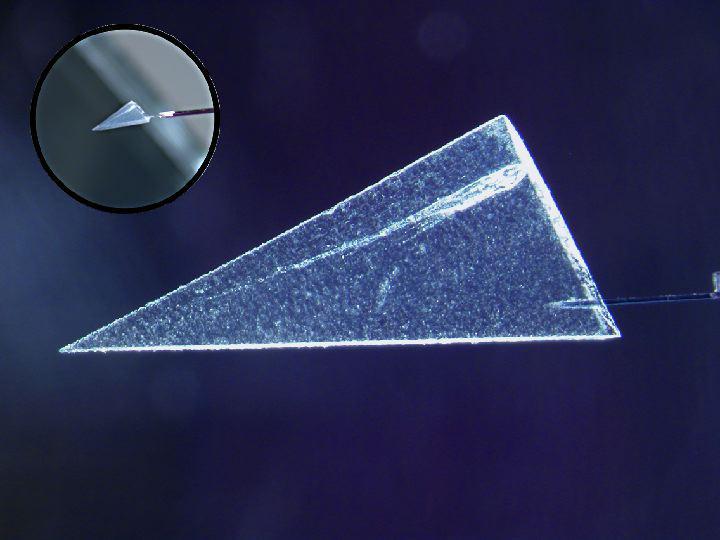
This image illustrates one of several ways scientists have begun extracting comet particles from NASAa Stardust spacecraft collector. First, a particle and its track are cut out of the collector material, called aerogel.
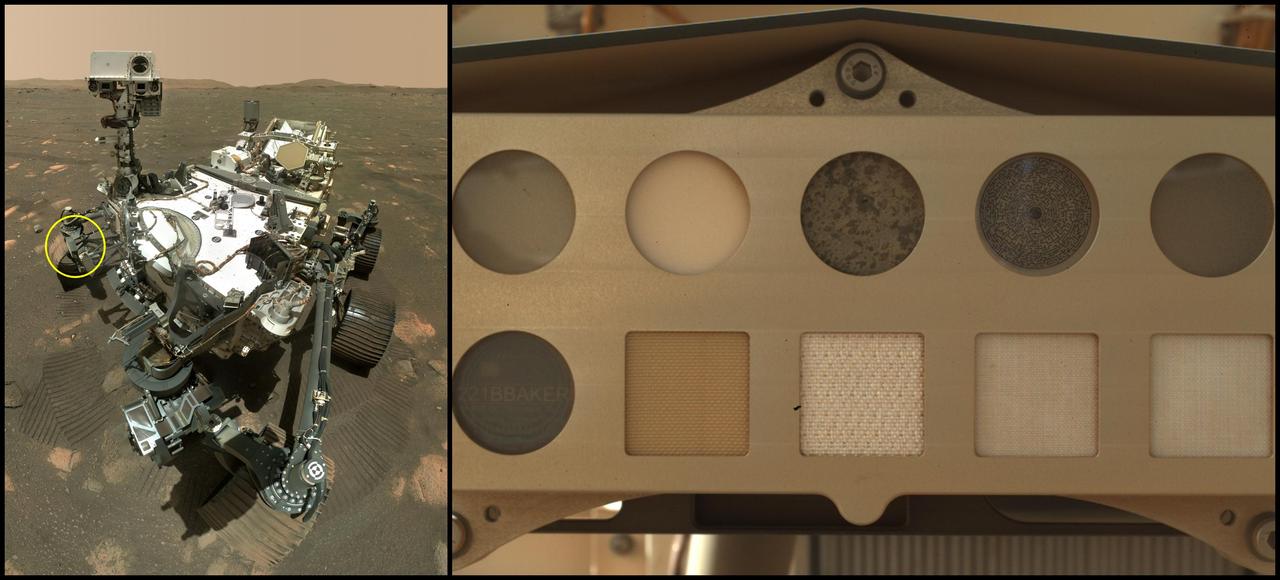
At left is NASA's Perseverance Mars rover. The annotation shows where spacesuit materials can be found attached to a calibration target for SHERLOC (Scanning Habitable Environments with Raman & Luminescence for Organics and Chemicals), one of the rover's instruments. At right is a close-up of the calibration target. Scientists rely on calibration targets to fine-tune instrument settings using materials with known properties. In the case of SHERLOC's calibration target, they are also studying how the five swatches of spacesuit materials arranged along the bottom row degrade in the Martian environment. Those materials, from left to right: a piece of polycarbonate visor used in spacesuit helmets; Vectran, a cut-resistant material used for the palms of astronaut gloves; a commonly used spacesuit material called Ortho-Fabric; and two kinds of Teflon, which has dust-repelling nonstick properties. Top row, left to right: two gallium nitride targets that glow different colors when illuminated with SHERLOC's laser; a slice of Martian meteorite named Sayh al Uhaymir 008 (SaH 008); a maze designed to focus SHERLOC's camera; and a diffuse transmission target that measures how SHERLOC's laser scatters light. This image was taken by the WATSON (Wide Angle Topographic Sensor for Operations and eNgineering) camera, which is part of SHERLOC on the end of Perseverance's robotic arm. A key objective for Perseverance's mission on Mars is astrobiology, including the search for signs of ancient microbial life. The rover will characterize the planet's geology and past climate, pave the way for human exploration of the Red Planet, and be the first mission to collect and cache Martian rock and regolith. NASA's Mars Sample Return Program, in cooperation with ESA (European Space Agency), is designed to send spacecraft to Mars to collect these sealed samples from the surface and return them to Earth for in-depth analysis. The Mars 2020 Perseverance mission is part of NASA's Mars Exploration Program (MEP) portfolio and the agency's Moon to Mars exploration approach, which includes Artemis missions to the Moon that will help prepare for human exploration of the Red Planet. https://photojournal.jpl.nasa.gov/catalog/PIA26520
Scientists at Marshall's Materials and Processes Lab are pulling glass fibers from simulated lunar soil. This technology could lead to the building of thermally protected lunar buildings made of materials already there.
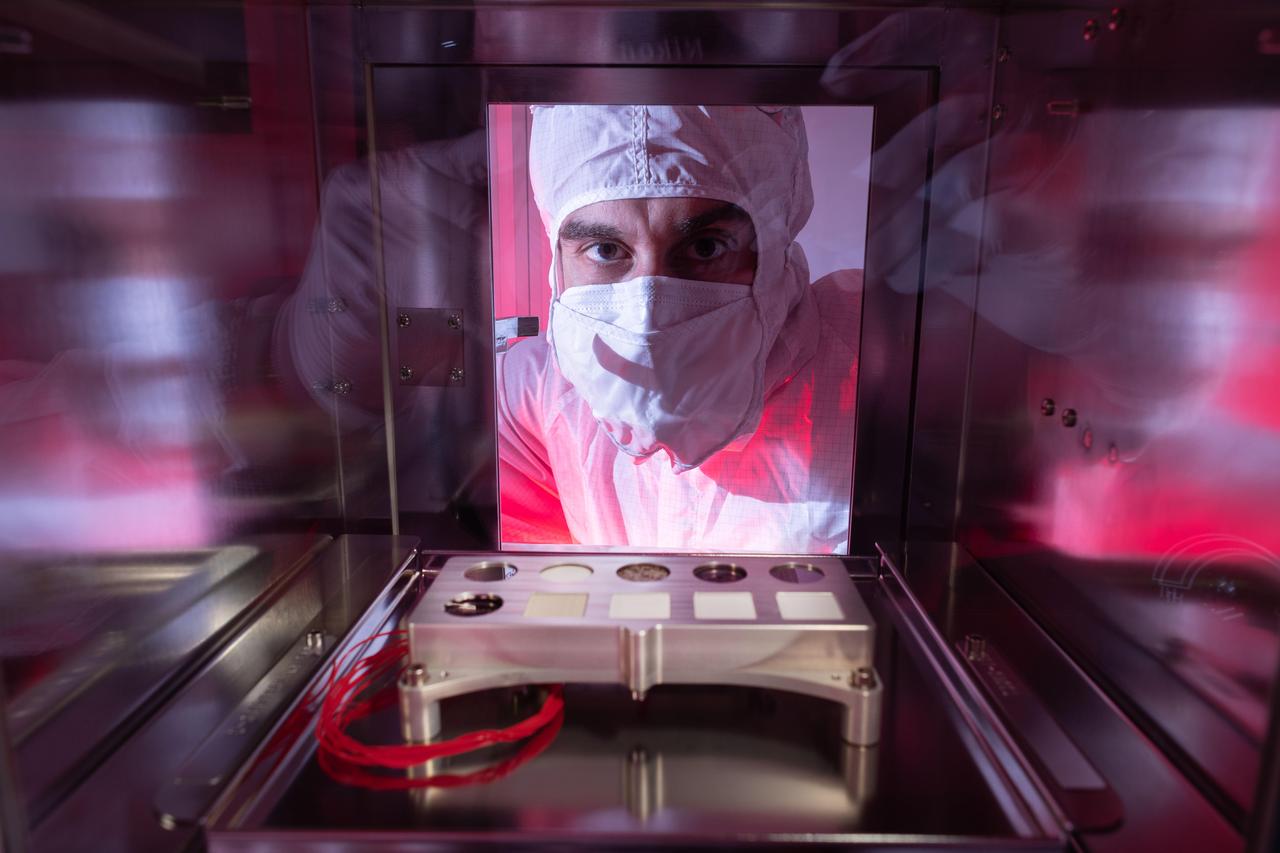
NASA scientist Trevor Graff peers at a calibration target, which will help fine-tune settings on the Scanning Habitable Environments with Raman & Luminescence for Organics and Chemicals (SHERLOC) instrument carried aboard NASA's Perseverance Mars rover. The calibration target is housed inside a special environmental chamber that was used to ship it from NASA's Johnson Space Center, Houston, to the agency's Jet Propulsion Laboratory in Southern California, where the target was added to the rover. There are 10 kinds of materials on SHERLOC's calibration target, including a fragment of a Martian meteorite and five of the first spacesuit materials sent to Mars. They'll be observed to see how they hold up in the intense radiation on the Martian surface. https://photojournal.jpl.nasa.gov/catalog/PIA23979
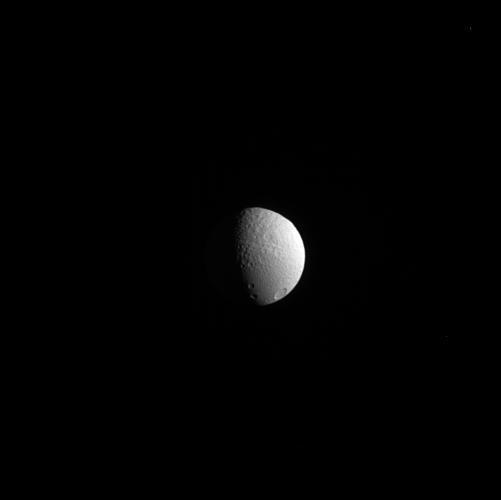
Tethys trailing side shows two terrains that tell a story of a rough past. To the north up, in image is older, rougher terrain, while to the south is new material dubbed mooth plains by scientists. This image was taken by NASA Cassini spacecraft.
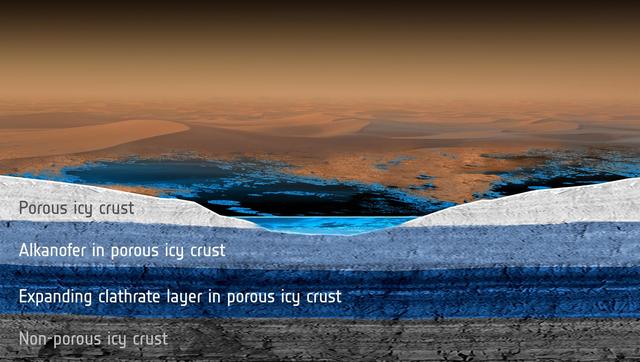
Scientists modeled how methane rainfall runoff would interact with the porous, icy crust of Saturn moon Titan and found that a subsurface methane aquifer might have its composition changed over time due to the formation of materials called clathrates.
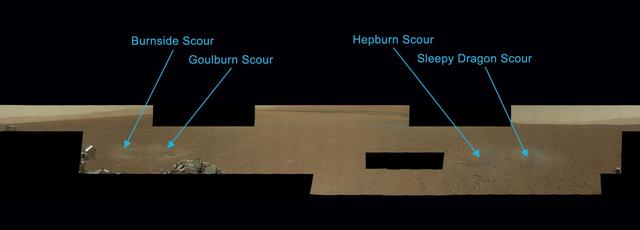
Scientists have now named the four marks near NASA Curiosity rover where blasts from the descent stage rocket engines blew away some of the Martian surface material. Clockwise from the most north: Burnside, Goulburn, Hepburn and Sleepy Dragon.
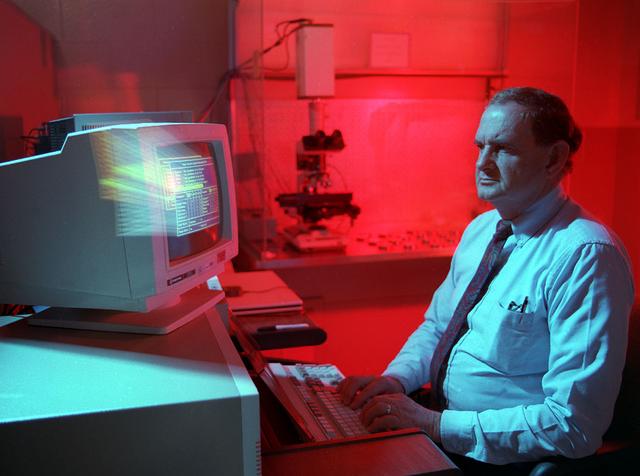
A NASA scientist operates the image analyzer to determine if telescope mirrors have become contaminated in the Materials and Processes lab at Marshall.

L TO R: DR. FRANCIS CHIARAMONTE, PROGRAM EXECUTIVE FOR PHYSICAL SCIENCES, ISS RESEARCH PROJECT, NASA HEADQUARTERS; DR. RAYMOND CLINTON, ACTING MANAGER FOR SCIENCE AND MISSION SYSTEMS OFFICE, NASA MARSHALL; DR. FRANK SZOFRAN, MICROGRAVITY MATERIALS SCIENCE PROJECT MANAGER AND DISCIPLINE SCIENTIST MATERIALS AND PROCESSES LABORATORY AT MSFC.
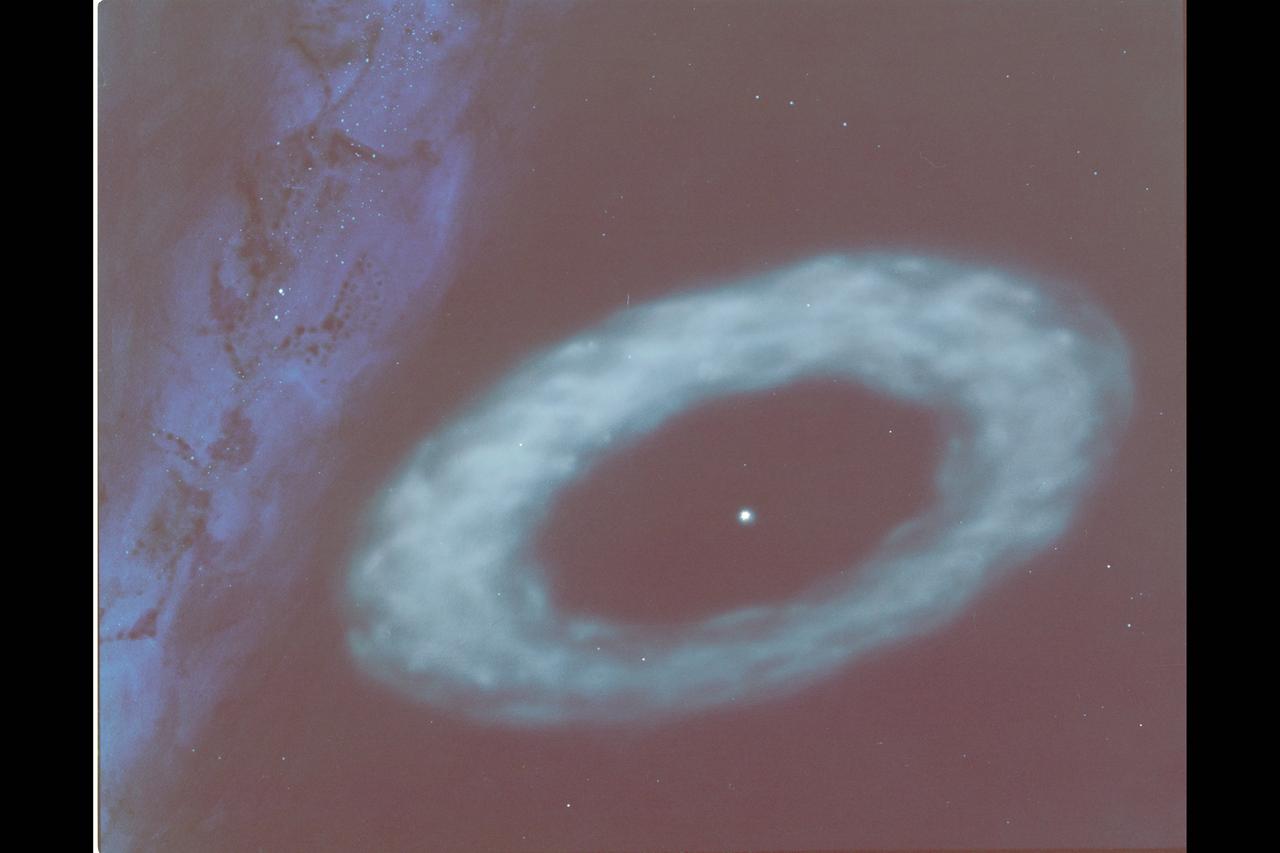
This artist's concept illustrates the ring of material discovered by the Infrared Astronomical Satellite around the star Vega. IRAS scientists believe the material probably consists of dust and small objects resembling meteors. As depicted here, the ring of particles is thin enough toallow light from distant stars to shine through. The plane of the Milky Way is to the right.
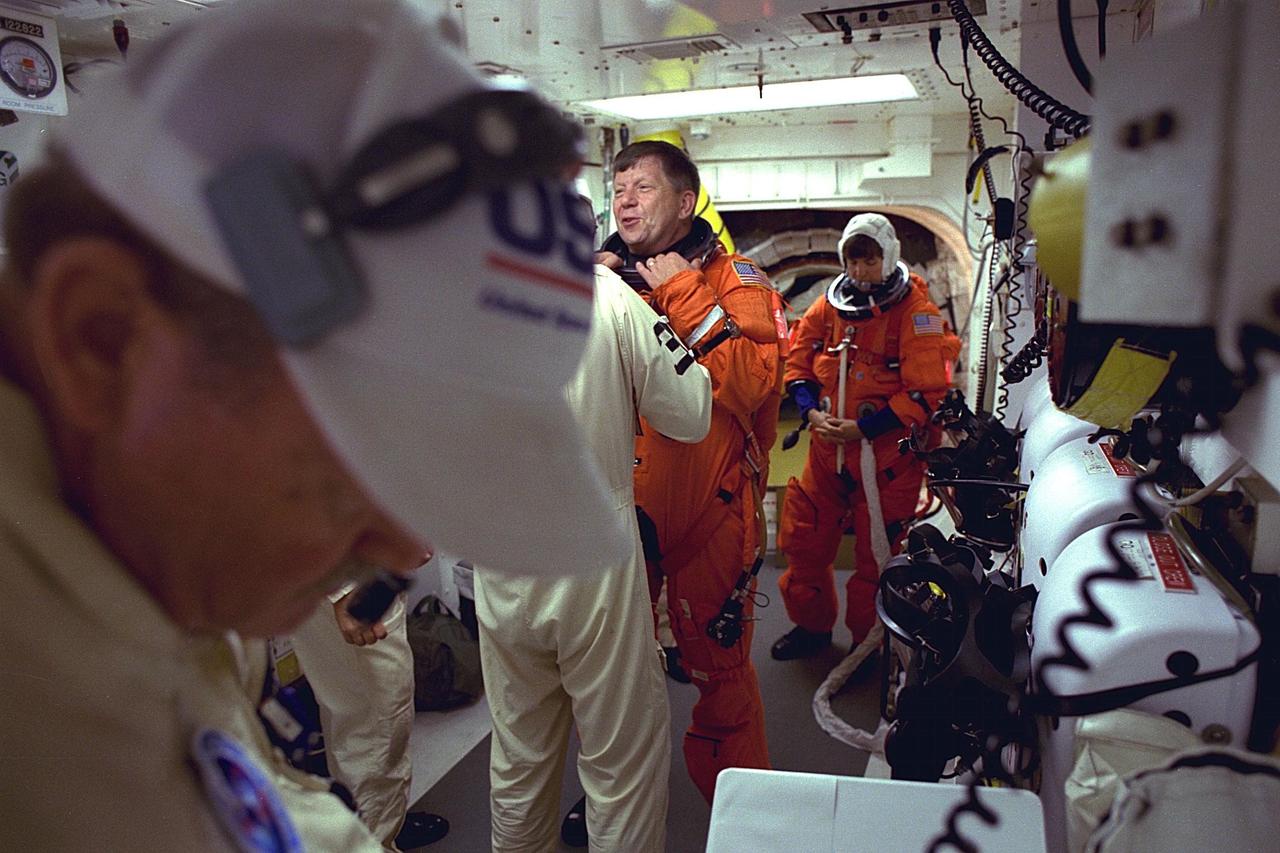
STS-94 Payload Specialist Roger K. Crouch prepares to enter the Space Shuttle Columbia at Launch Pad 39A in preparation for launch. He is the Chief Scientist of the NASA Microgravity Space and Applications Division. He also has served as a Program Scientist for previous Spacelab microgravity missions and is an expert in semiconductor crystal growth. Since Crouch has more than 25 years of experience as a materials scientist, he will be concentrating on the five physics of materials processing experiments in the Middeck Glovebox Facility on the Blue shift. He will also share the workload with Thomas by monitoring the materials furnace experiments during this time. Crouch and six fellow crew members will lift off during a launch window that opens at 1:50 p.m. EDT, July 1. The launch window will open 47 minutes early to improve the opportunity to lift off before Florida summer rain showers reach the space center
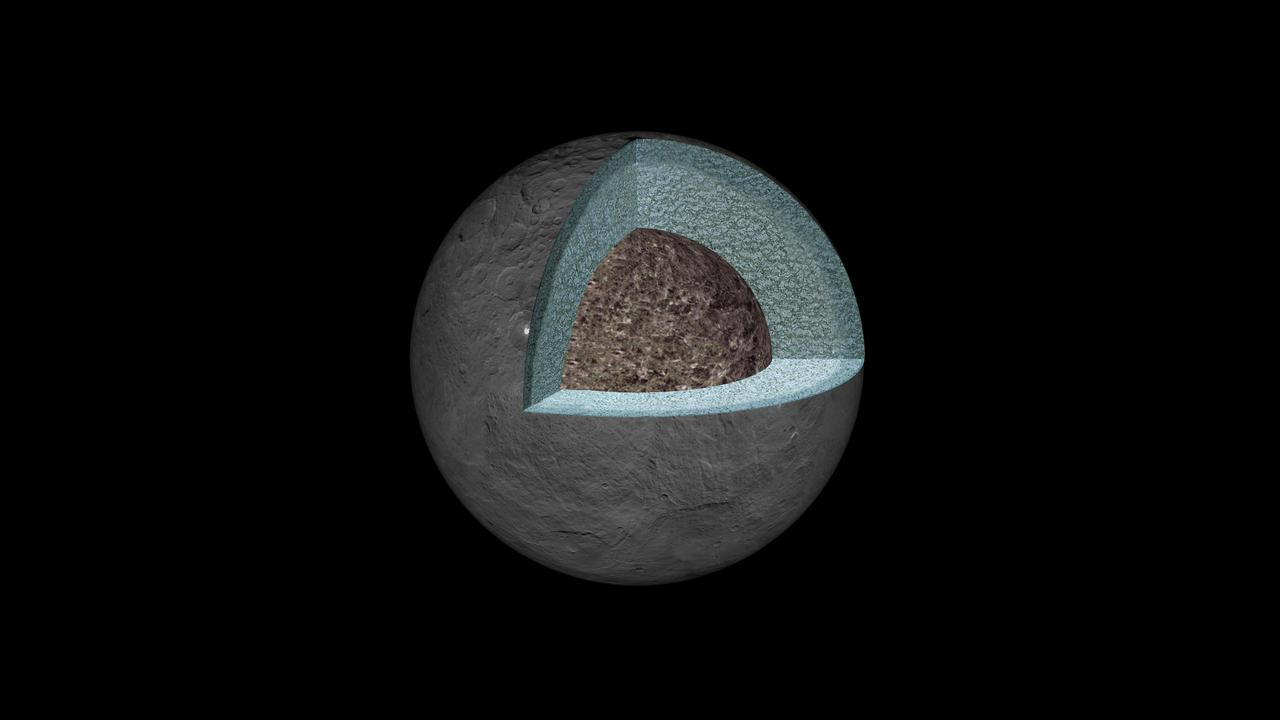
This artist's concept shows a diagram of how the inside of Ceres could be structured, based on data about the dwarf planet's gravity field from NASA's Dawn mission. Using information about Ceres' gravity and topography, scientists found that Ceres is "differentiated," which means that it has compositionally distinct layers at different depths. The densest layer is at the core, which scientists suspect is made of hydrated silicates. Above that is a volatile-rich shell, topped with a crust of mixed materials. This research teaches scientists about what internal processes could have occurred during the early history of Ceres. It appears that, during a heating phase early in the history of Ceres, water and other light materials partially separated from rock. These light materials and water then rose to the outer layer of Ceres. http://photojournal.jpl.nasa.gov/catalog/PIA20867
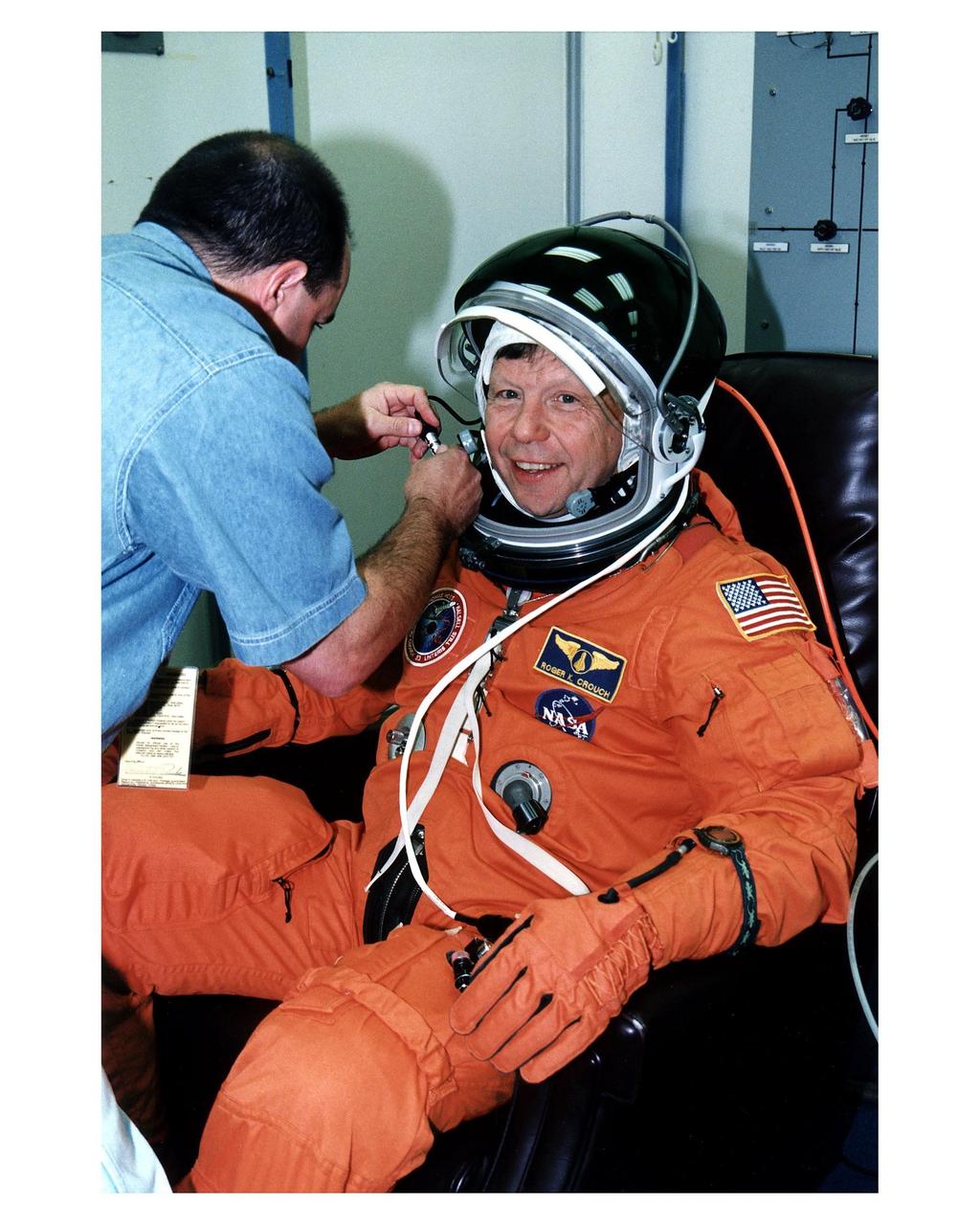
STS-83 Payload Specialist Roger K. Crouch is assisted into his launch/entry suit in the Operations and Checkout (O&C) Building. He is the Chief Scientist of the NASA Microgravity Space and Applications Division. He also has served as a Program Scientist for previous Spacelab microgravity missions and is an expert in semiconductor crystal growth. Since Crouch has more than 25 years of experience as a materials scientist, he will be concentrating on the five physics of materials processing experiments in the Middeck Glovebox Facility on the Blue shift. He will also share the workload with Thomas by monitoring the materials furnace experiments during this time. Crouch and six fellow crew members will shortly depart the O&C and head for Launch Pad 39A, where the Space Shuttle Columbia will lift off during a launch window that opens at 2:00 p.m. EST, April 4
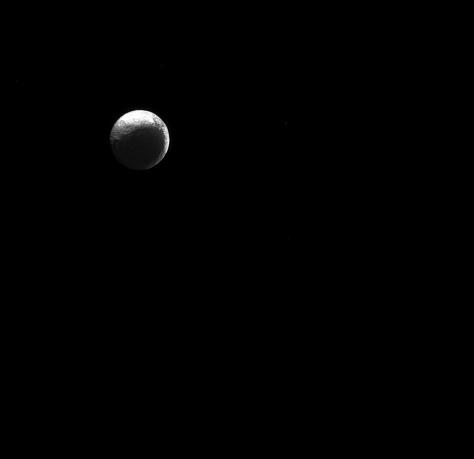
The moon Iapetus, like the "force" in Star Wars, has both a light side and a dark side. Scientists think that Iapetus' (914 miles or 1471 kilometers across) dark/light asymmetry was actually created by material migrating away from the dark side. For a simulation of how scientists think the asymmetry formed, see Thermal Runaway Model . Lit terrain seen here is on the Saturn-facing hemisphere of Iapetus. North on Iapetus is up and rotated 43 degrees to the right. The image was taken in green light with the Cassini spacecraft narrow-angle camera on Jan. 4, 2015. The view was acquired at a distance of approximately 2.5 million miles (4 million kilometers) from Iapetus. Image scale is 15 miles (24 kilometers) per pixel. http://photojournal.jpl.nasa.gov/catalog/pia18307
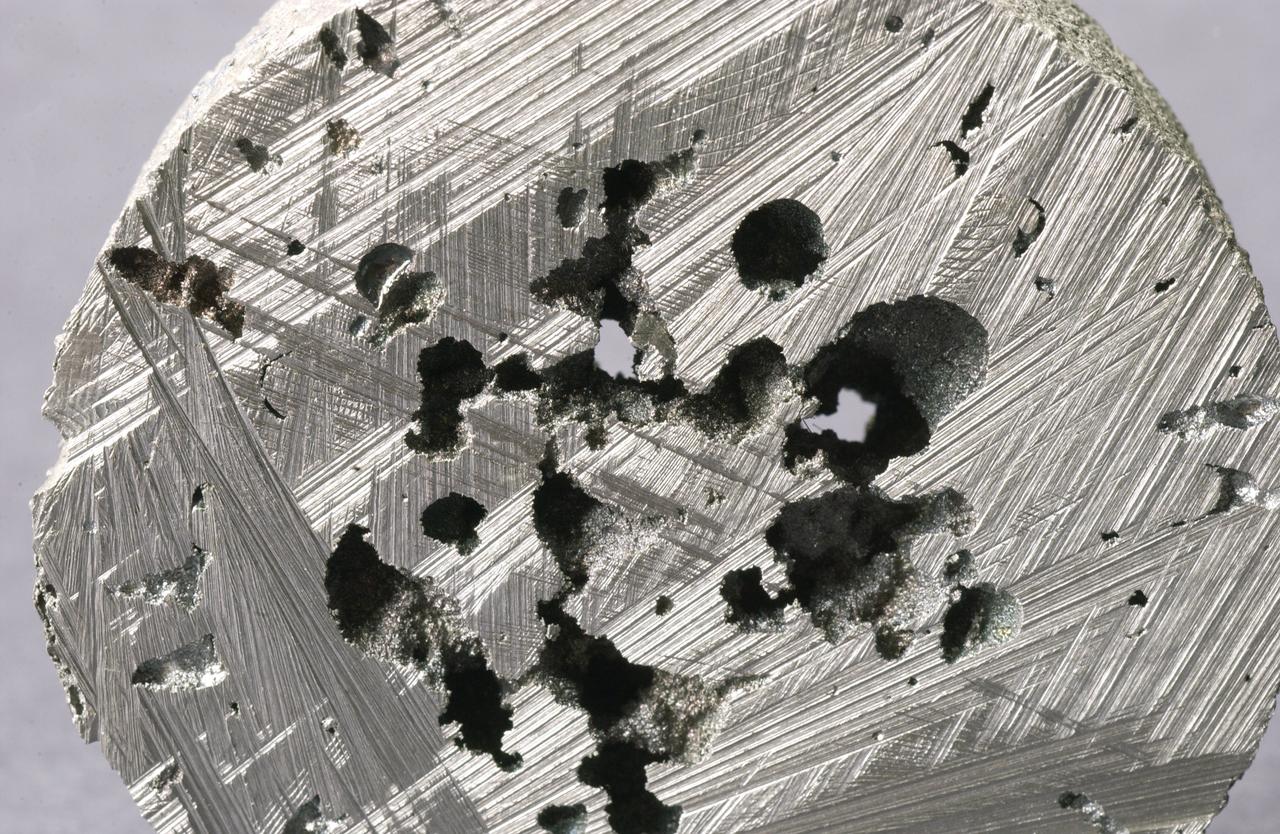
Pores and voids often form in metal castings on Earth (above) making them useless. A transparent material that behaves at a large scale in microgravity the way that metals behave at the microscopic scale on Earth, will help show how voids form and learn how to prevent them. Scientists are using the microgravity environment on the International Space Station to study how these bubbles form, move and interact. The Pore Formation and Mobility Investigation (PFMI) in the Microgravity Science Glovebox aboard the International Space Station uses a transparent material called succinonitrile that behaves like a metal to study this problem. Video images sent to the ground allow scientists to watch the behavior of the bubbles as they control the melting and freezing of the material. The bubbles do not float to the top of the material in microgravity, so they can study their interactions.
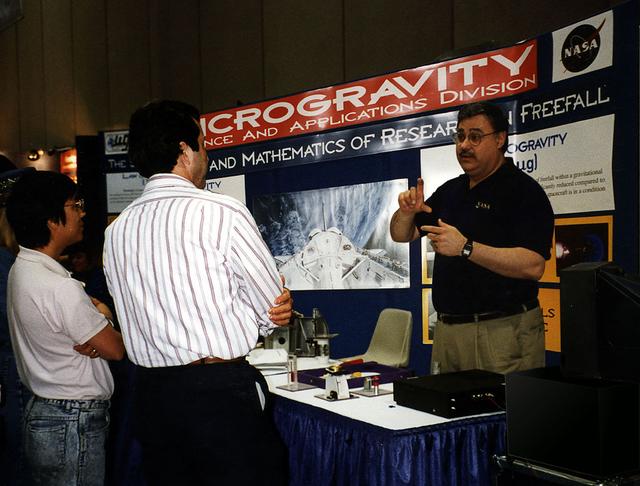
Dr. Michael Wargo, program scientist for materials science at NASA headquarters, explains the math and physics principles associated with freefall research to attendees at the arnual conference of the National Council of Teachers of Mathematics.
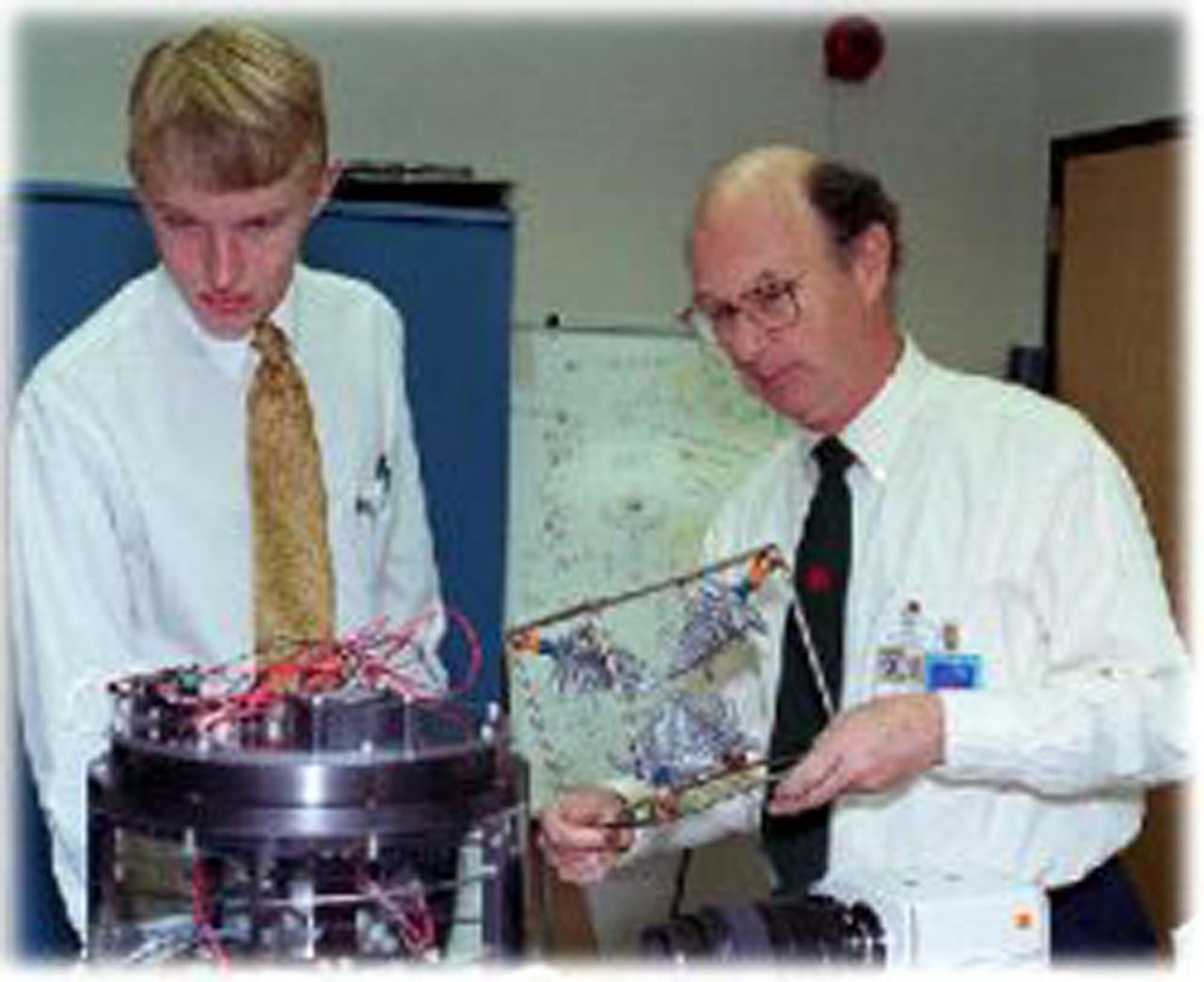
Dr. Donald Gilles, the Discipline Scientist for Materials Science in NASA's Microgravity Materials Science and Applications Department, demonstrates to Carl Dohrman a model of dendrites, the branch-like structures found in many metals and alloys. Dohrman was recently selected by the American Society for Metals International as their 1999 ASM International Foundation National Merit Scholar. The University of Illinois at Urbana-Champaign freshman recently toured NASA's materials science facilities at the Marshall Space Flight Center.
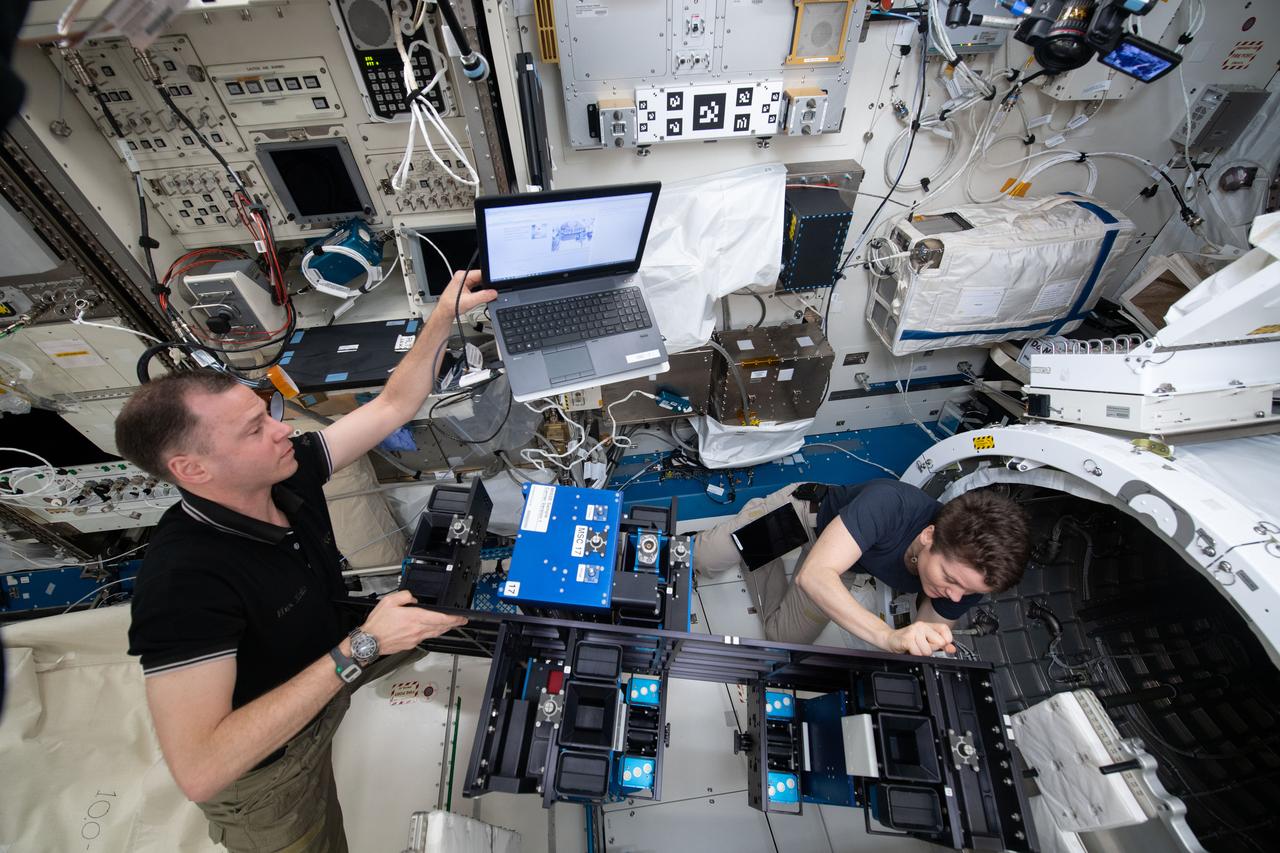
iss059e034507 (April 23, 2019) --- NASA astronauts Nick Hague and Anne McClain install the Materials ISS Experiment-Flight Facility (MISSE-FF) gear inside the Japanese Kibo laboratory module’s airlock before depressurizing the unit. MISSE-FF contains new materials exposure experiments ready for deployment outside Kibo. The study will help scientists understand how radiation, the vacuum of space and micrometeoroids affect a variety of materials.
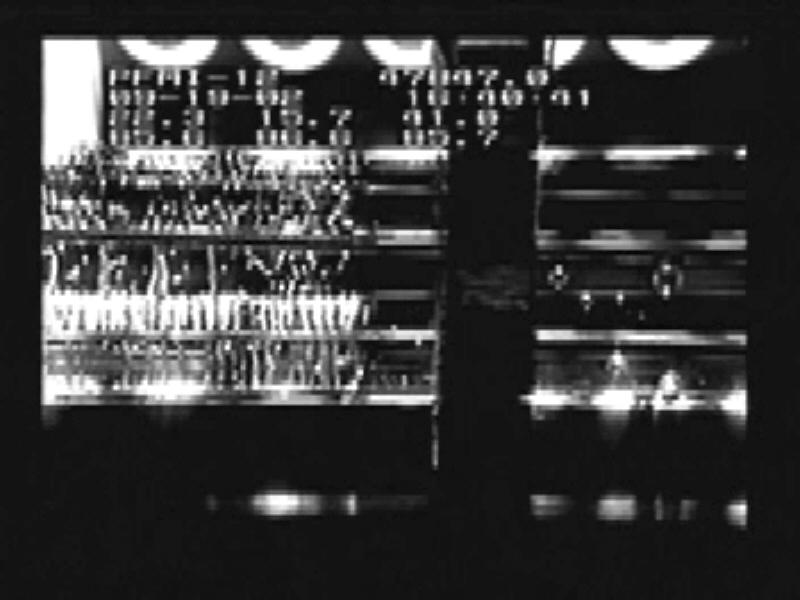
Video images sent to the ground allow scientists to watch the behavior of the bubbles as they control the melting and freezing of the material during the Pore Formation and Mobility Investigation (PFMI) in the Microgravity Science Glovebox aboard the International Space Station. While the investigation studies the way that metals behave at the microscopic scale on Earth -- and how voids form -- the experiment uses a transparent material called succinonitrile that behaves like a metal to study this problem. The bubbles do not float to the top of the material in microgravity, so they can study their interactions.
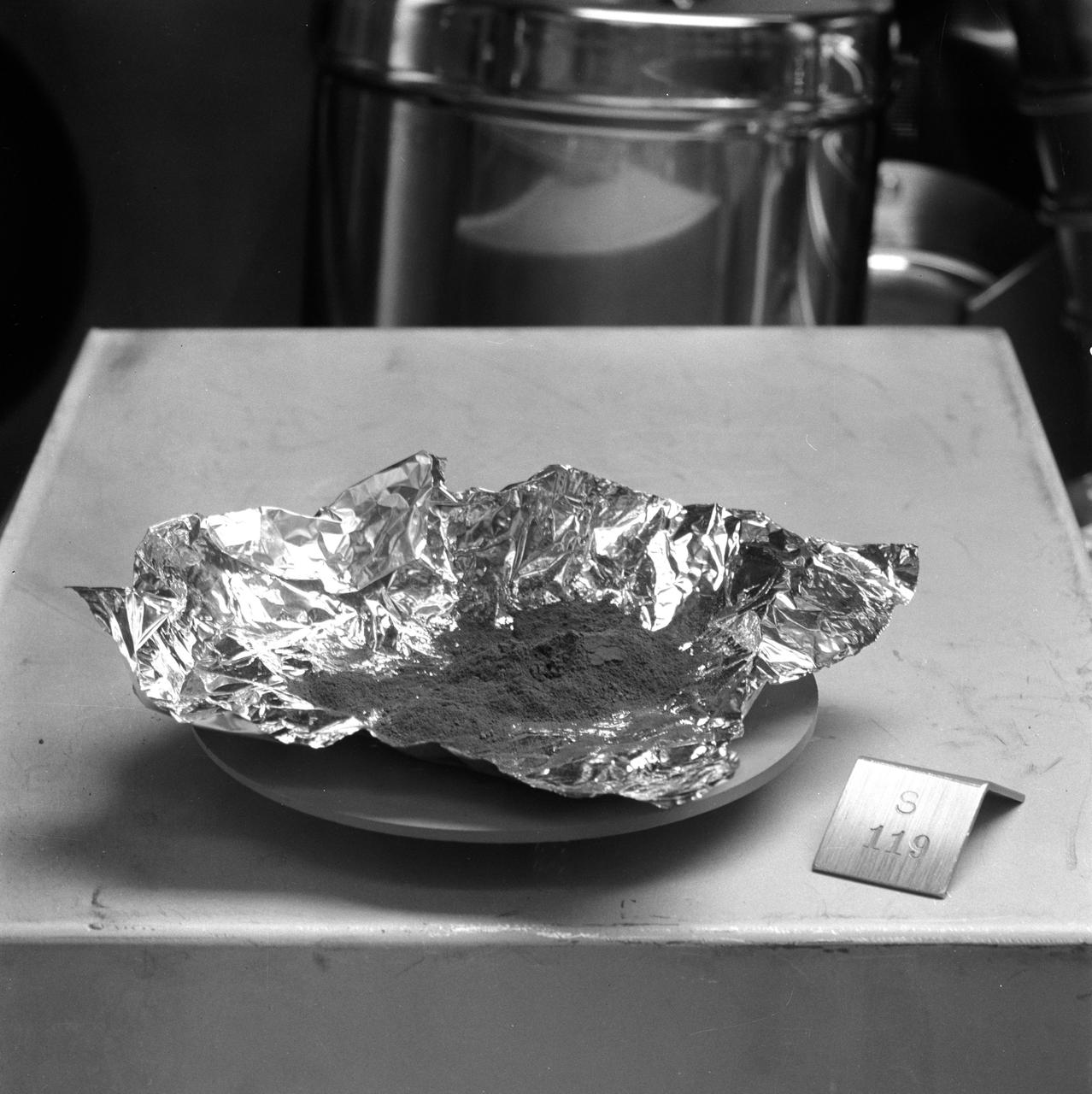
S71-19269 (12 Feb. 1971) --- A close-up view of Apollo 14 sample number 14414 & 14412, a fine lunar powder-like material under examination in the Sterile Nitrogen Atmospheric Processing (SNAP) line in the Lunar Receiving Laboratory (LRL) at the Manned Spacecraft Center (MSC). Scientists are currently making preliminary analyses of material brought back from the moon by the crew of Apollo 14 lunar landing mission.
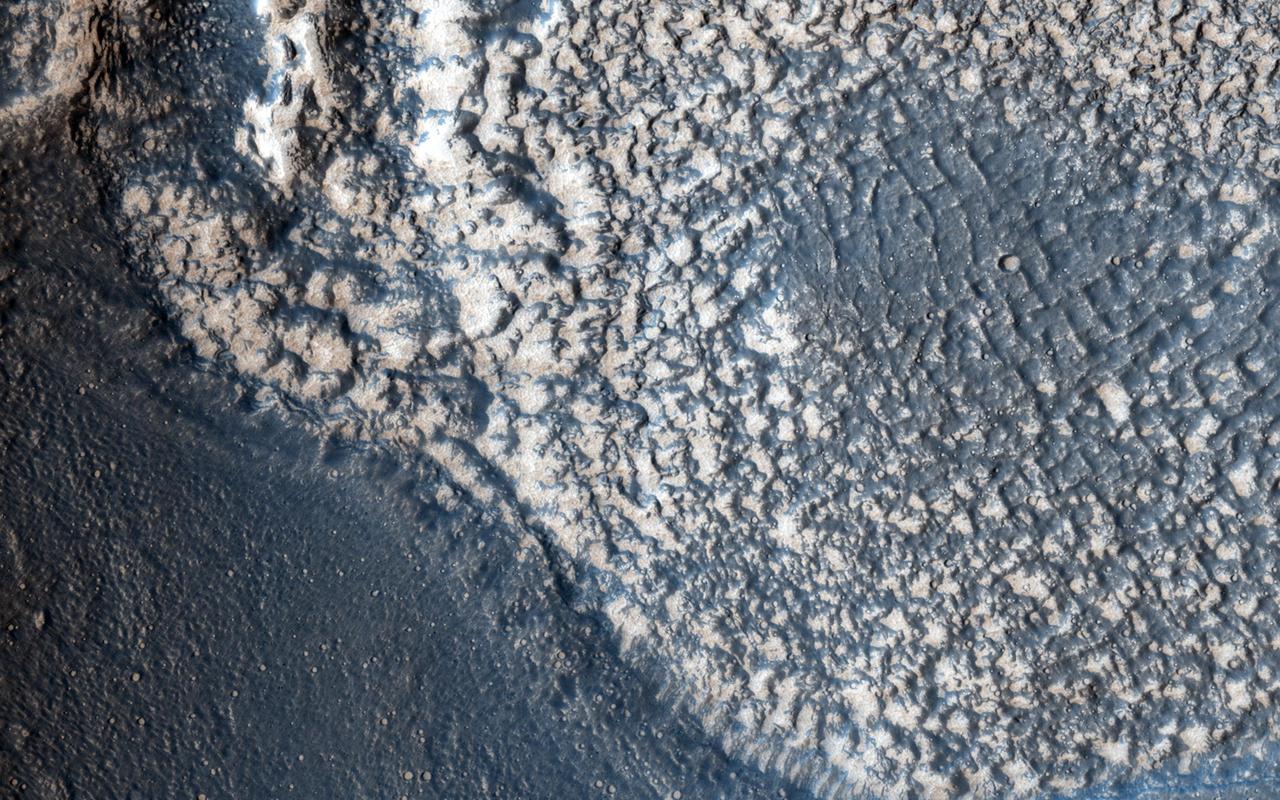
This highly tectonized terrain meaning it possesses many faults, as seen by NASA Mars Reconnaissance Orbiter, has its low-lying areas filled with some form of younger material. This particular fill is what geologists call "embayment." This observation helps scientists unravel the relative timing of the emplacement of the younger material and the numerous tectonic faults that run through this area. http://photojournal.jpl.nasa.gov/catalog/PIA19365
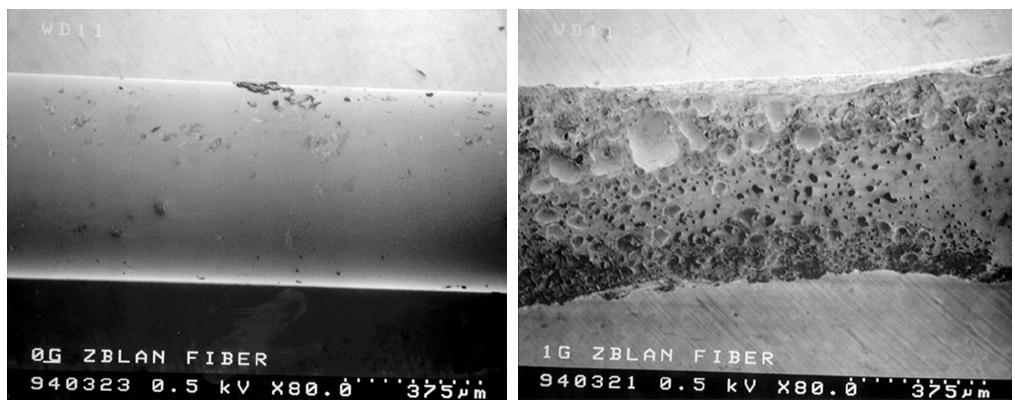
Marshall Space Flight Center's researchers have conducted suborbital experiments with ZBLAN, an optical material capable of transmitting 100 times more signal and information than silica fibers. The next step is to process ZBLAN in a microgravity environment to stop the formation of crystallites, small crystals caused by a chemical imbalances. Scientists want to find a way to make ZBLAN an amorphous (without an internal shape) material. Producing a material such as this will have far-reaching implications on advanced communications, medical and manufacturing technologies using lasers, and a host of other products well into the 21st century.
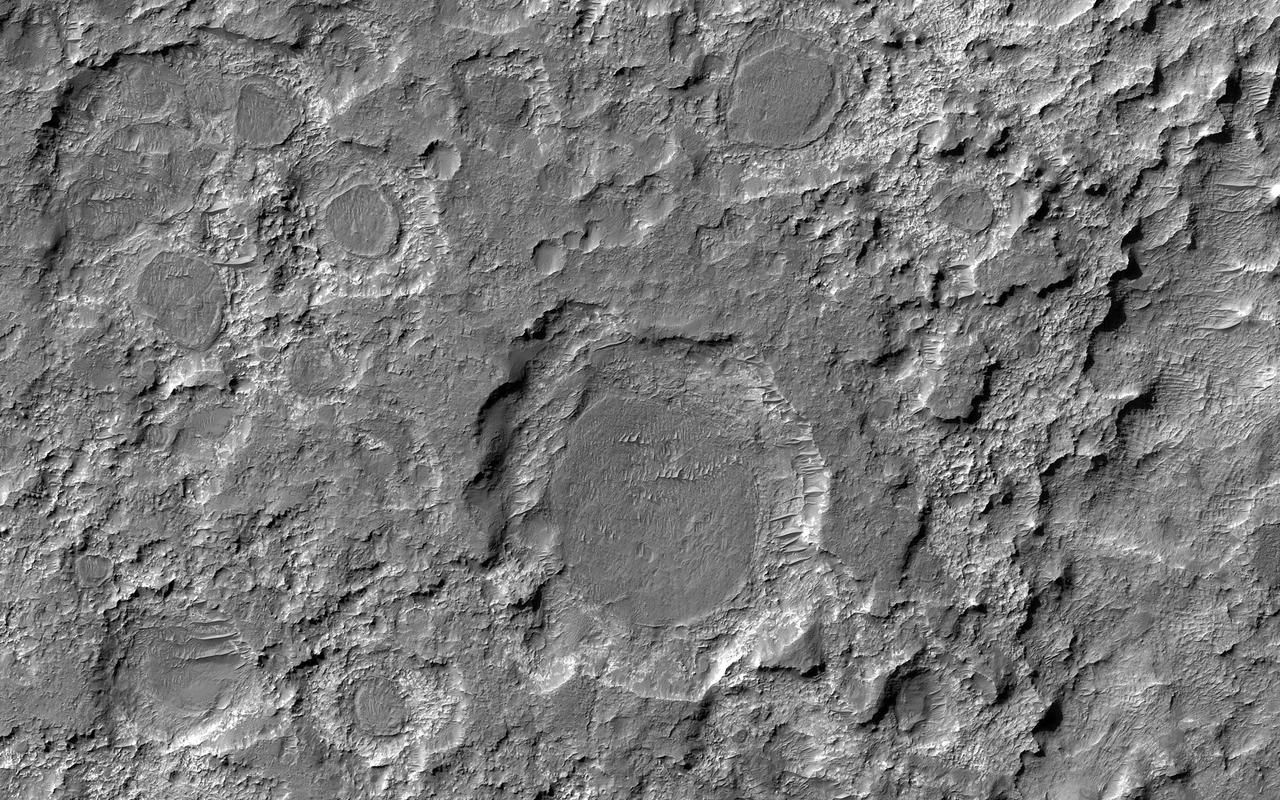
n the ancient past, this area of Mars was bombarded by impactors, forming craters of various sizes in the light-toned material. Some time after that, a darker material blanketed and covered the field, filling in the craters. Eventually, that blanketed material itself became rock. Long after that, erosive forces (likely wind) acted in this area removing both dark and light-toned material, like an archeologist using a brush to reveal buried structures. What we see today are a variety of dark circular features that are the remains of the layer that has been eroded back from the walls of the craters that formed them. In some cases, the crater rim is eroded and just a circular dark patch stands on a brighter exposure of rock. Studying the thickness and characteristics of the dark layer might help scientists learn more about the processes that deposited the material, as well as those that eroded it. https://photojournal.jpl.nasa.gov/catalog/PIA25187

Dr. Jan Rogers, project scientist for the Electrostatic Levitator (ESL) at NASA's Marshall Space Flight Center(MSFC). The ESL uses static electricity to suspend an obejct (about 2-3 mm in diameter) inside a vacuum chamber while a laser heats the sample until it melts. This lets scientists record a wide range of physical properties without the sample contacting the container or any instruments, conditions that would alter the readings. The Electrostatic Levitator is one of several tools used in NASA's microgravity materials sciences program.
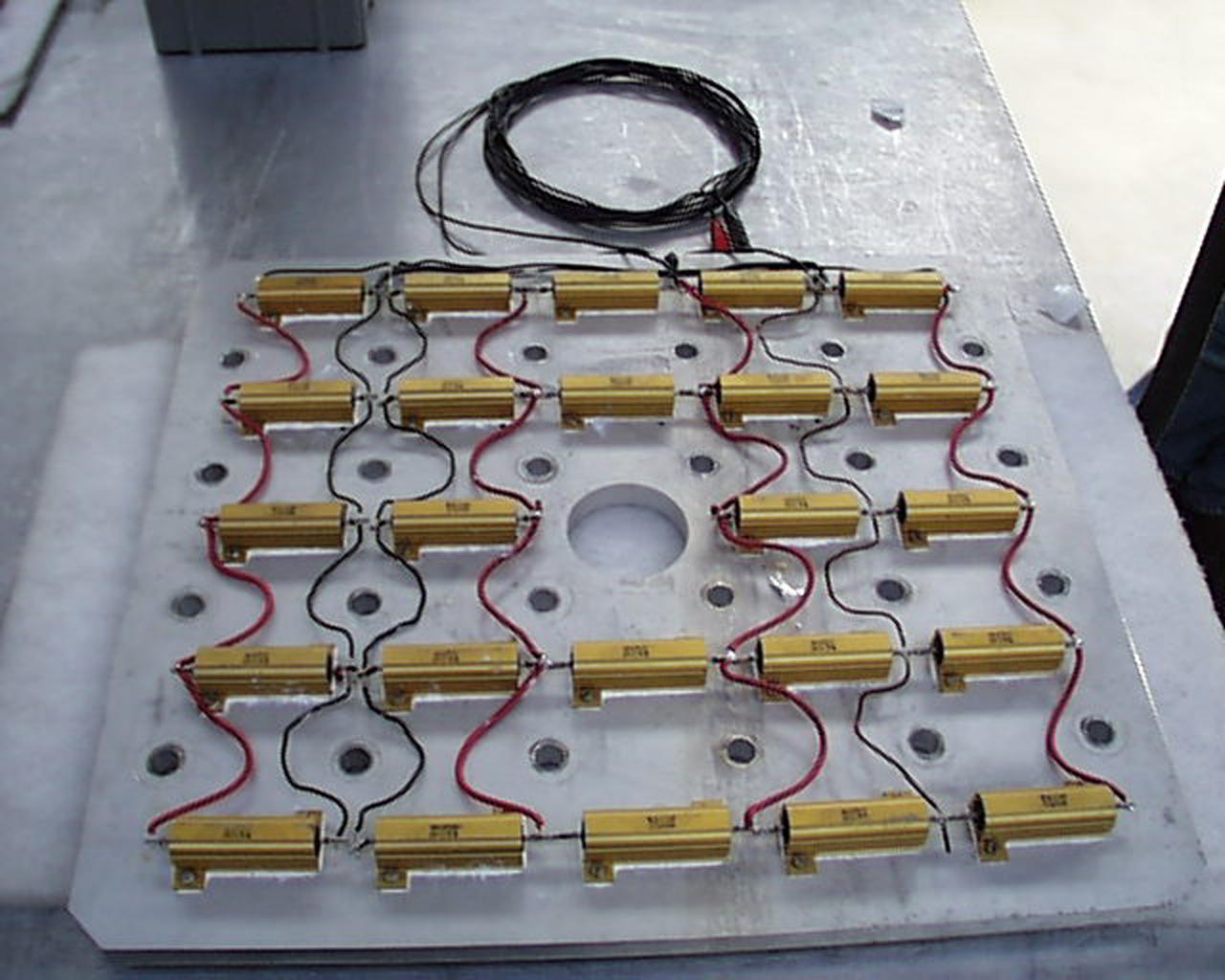
An array of miniature lamps will provide illumination to help scientists as they conduct experiments inside the Microgravity Science Glovebox (MSG). The European Space Agency (ESA) and NASA are developing the MSG for use aboard the International Space Station (ISS). Scientists will use the MSG to carry out multidisciplinary studies in combustion science, fluid physics and materials science. The MSG is managed by NASA's Marshall Space Flight Center (MSFC). Photo Credit: NASA/MSFC
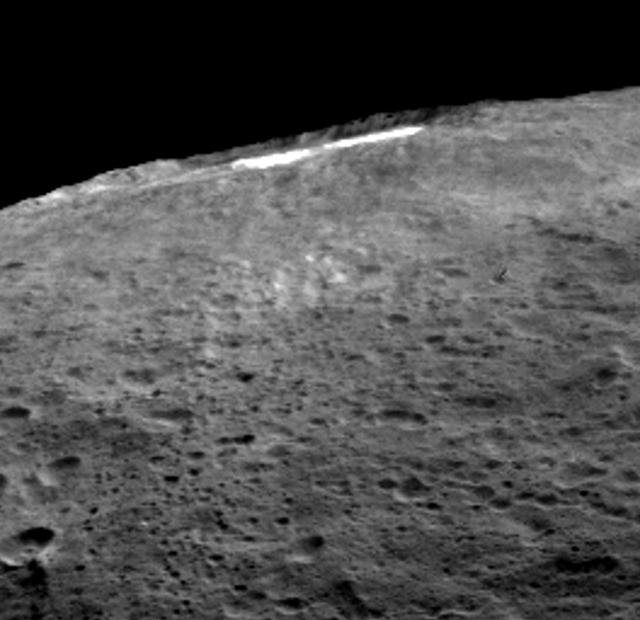
A group of scientists from NASA's Dawn mission suggests that when sunlight reaches Ceres' Occator Crater, a kind of thin haze of dust and evaporating water forms there. This haze only becomes dense enough to be seen by looking at it laterally, as in this image, the scientists wrote in the journal Nature in December 2015. Occator measures about 60 miles (90 kilometers) wide, and contains the brightest material seen on Ceres. http://photojournal.jpl.nasa.gov/catalog/PIA20181
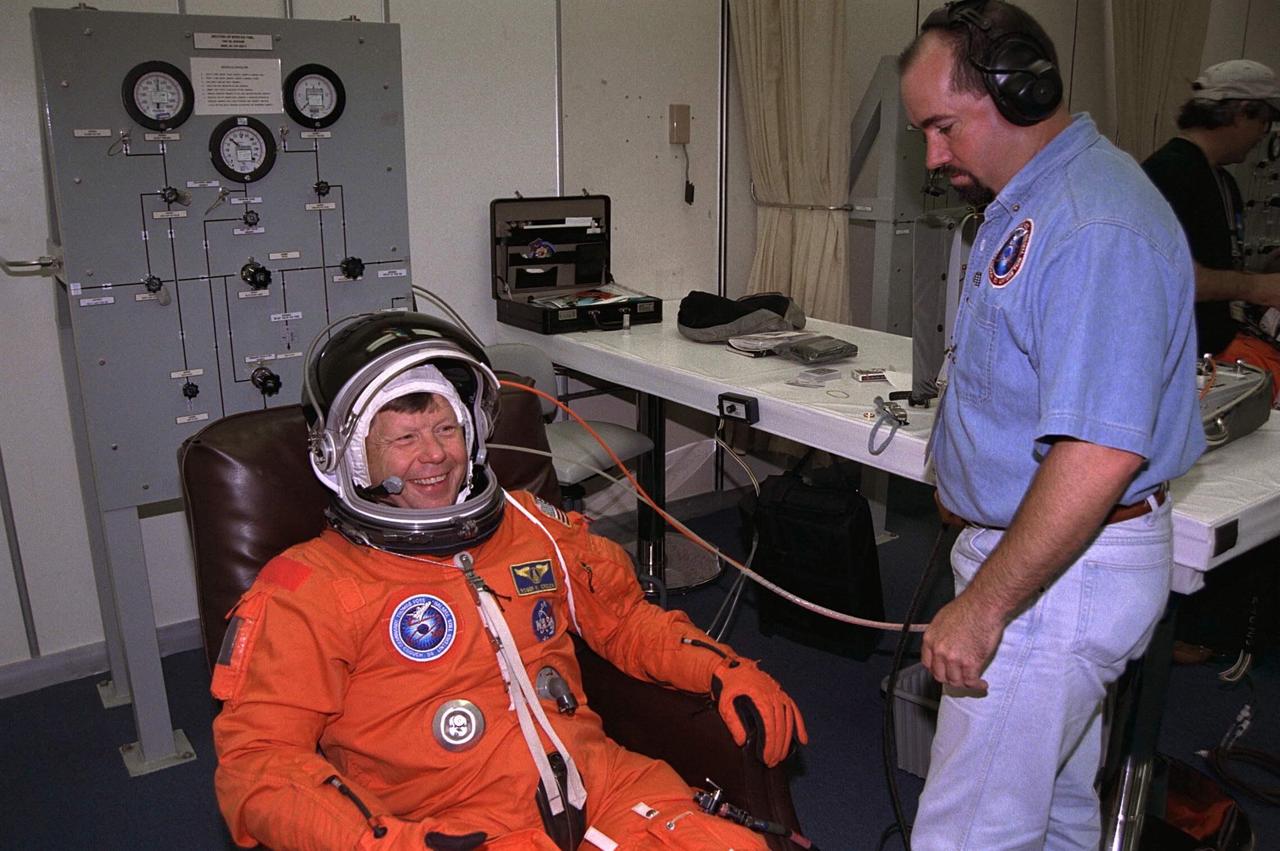
STS-94 Payload Specialist Roger K. Crouch is helped into his launch/entry suit by a suit technician in the Operations and Checkout (O&C) Building after the suit has been given a pressure test. He is the Chief Scientist of the NASA Microgravity Space and Applications Division. He also has served as a Program Scientist for previous Spacelab microgravity missions and is an expert in semiconductor crystal growth. Since Crouch has more than 25 years of experience as a materials scientist, he will be concentrating on the five physics of materials processing experiments in the Middeck Glovebox Facility on the Blue shift. He will also share the workload with Thomas by monitoring the materials furnace experiments during this time. Crouch and six fellow crew members will shortly depart the O&C and head for Launch Pad 39A, where the Space Shuttle Columbia will lift off during a launch window that opens at 1:50 p.m. EDT, July 1. The launch window was opened 47 minutes early to improve the opportunity to lift off before Florida summer rain showers reached the space center
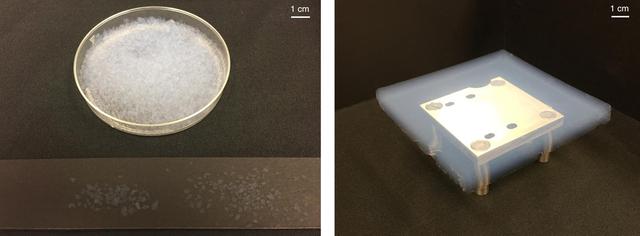
Scientists tested these samples of aerogel to see how they could be used as building materials on Mars. In an experiment, both the crushed and solid samples of aerogel were able to raise temperatures to melt water ice — ideal for a Martian greenhouse in which crops could grow. https://photojournal.jpl.nasa.gov/catalog/PIA23342
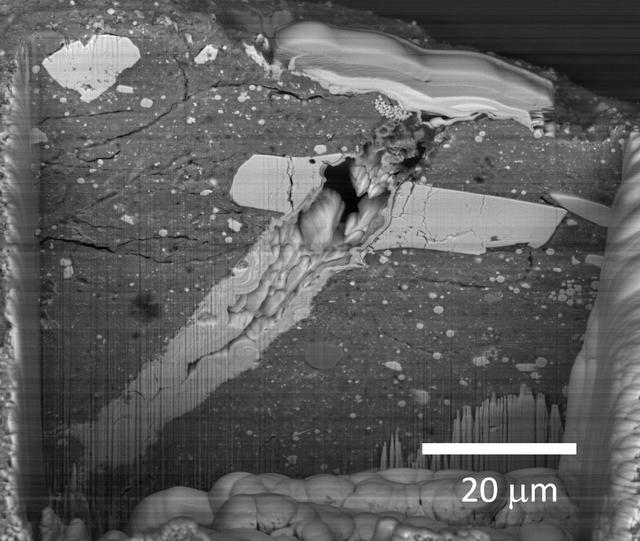
A scanning electron microscope image of a micrometeorite impact crater in a particle of asteroid Bennu material. Scientists found microscopic craters and tiny splashes of once-molten rock – known as impact melts – on the surfaces of samples, signs that the asteroid was bombarded by micrometeorites.
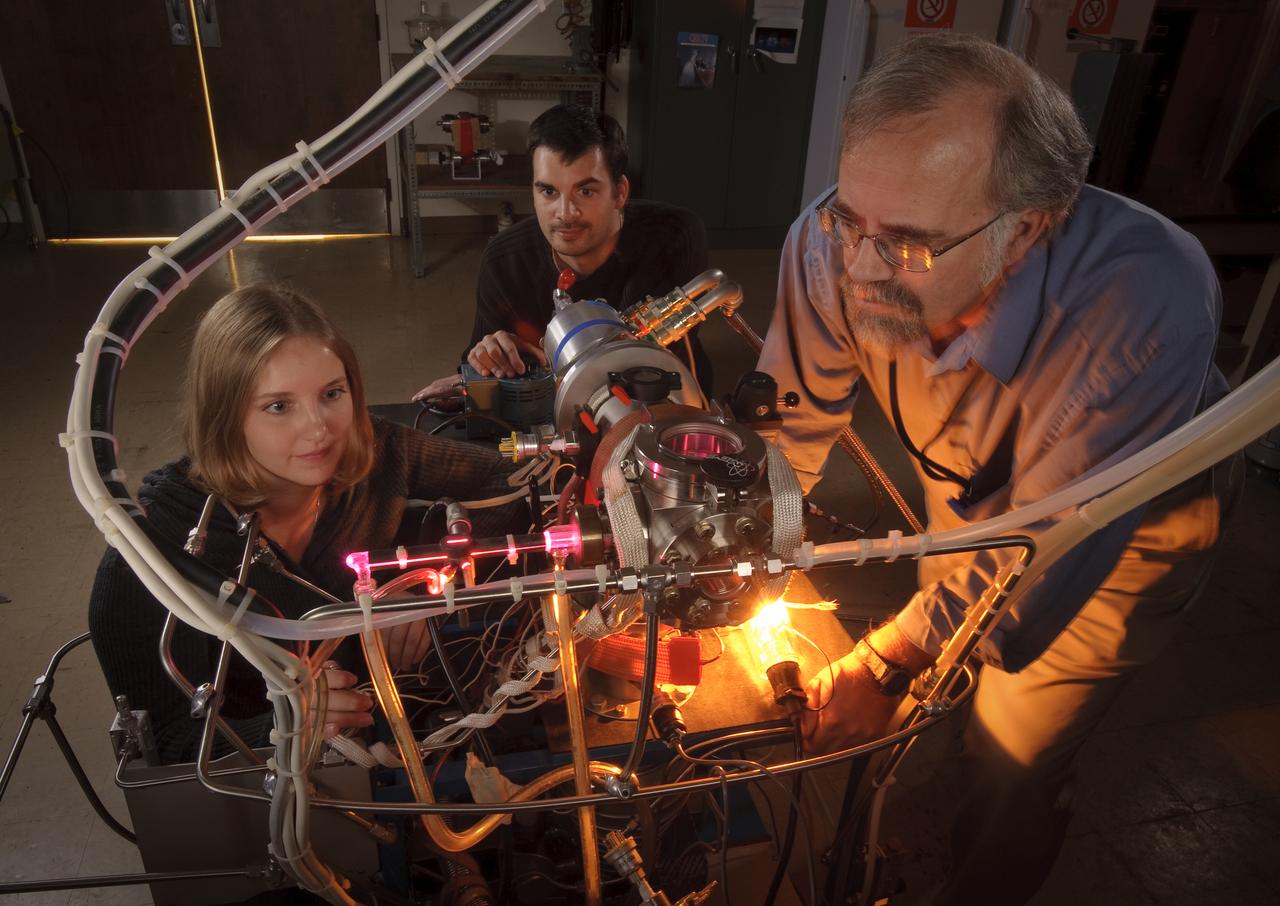
Stefanie Milam, Michel Nueva and Scott Sandford, in the Ames Astrochemistry Lab, N-245 for feature article on their uracil research. NASA Scientists studying the origin of life have reproduced uracil, a key component of our hereditary material in the laboratory.
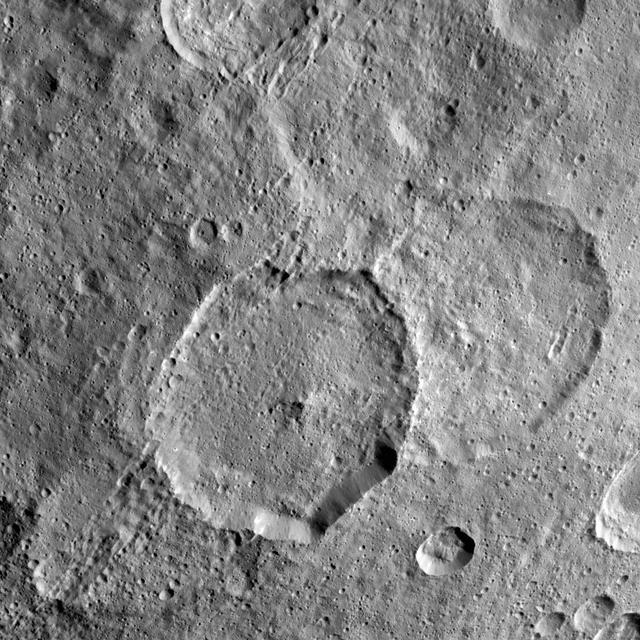
Inamahari Crater on Ceres, the large well-defined crater at the center of this image, is one of the sites where scientists have discovered evidence for organic material. The crater, 42 miles (68 kilometers) in diameter, presents other interesting attributes. It has a polygonal shape and an association with another crater of similar size and geometry called Homshuk (center right), although the latter appears eroded and is likely older. Future studies of Inamahari crater and surroundings may help uncover the mechanisms involved in the exposure of organic material onto Ceres' surface. Inamahari was named for a pair of male and female deities from the ancient Siouan tribe of South Carolina, invoked for a successful sowing season. Homshuk refers to the spirit of corn (maize) from the Popoluca peoples of southern Mexico. Inamahari is located at 14 degrees north latitude, 89 degrees east longitude. This picture was taken by NASA's Dawn on September 25, 2015 from an altitude of about 915 miles (1,470 kilometers). It has a resolution of 450 feet (140 meters) per pixel. https://photojournal.jpl.nasa.gov/catalog/PIA21402
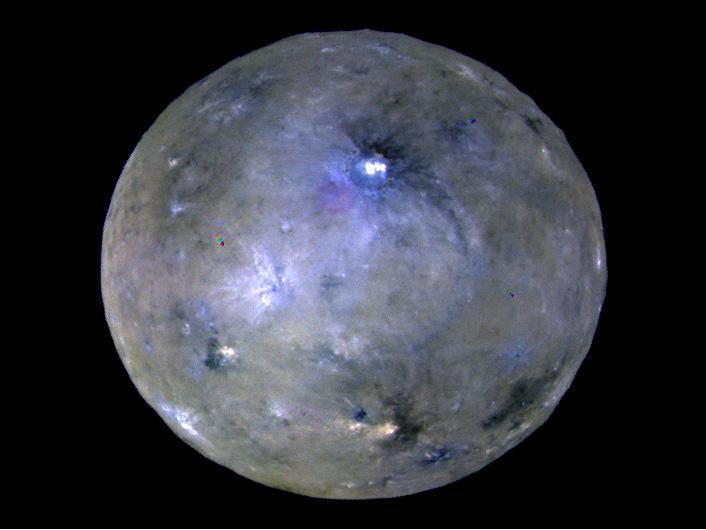
This enhanced color image of Ceres' surface was made from data obtained on April 29, 2017, when NASA's Dawn spacecraft was exactly between the sun and Ceres. Dawn's framing cameras took images of Ceres with a clear filter as well as five different color filters. Images combining these different color filter perspectives reveal fine details of Ceres' surface. For example, they emphasize the distinct compositions and textures of the material ejected from craters. The brightest region on Ceres, called Cerealia Facula, is highlighted in Occator Crater in the center of this image. Vinalia Faculae, the set of secondary bright spots in the same crater, are located to the right of Cerealia Facula. One of the darkest regions on Ceres is next to Occator, and represents ejected material from the impact that formed the crater. The ejected material forms a large arc that extends over several hundred kilometers, below the center of Ceres in this image. That material's distribution is partly determined by Ceres' rotation. Other craters also show a mixture of bright and dark regions. While the bright areas are generally identified as salt-rich material excavated from Ceres' crust, the origin of the dark material remains to be explained. It may have been excavated from a different layer within Ceres' subsurface than the rest of the ejecta blanket. Scientists will continue analyzing the color data to look for clues about the nature of the different materials on Ceres. The blueish color is generally found in association with young craters. Scientists believe the color relates to processes that occur when an impact ejects and redistributes material on the surface. The continuous bombardment of Ceres' surface by micrometeorites alters the texture of the exposed material, leading to its reddening. This image was taken altitude of about 12,000 miles (20,000 kilometers). https://photojournal.jpl.nasa.gov/catalog/PIA21406
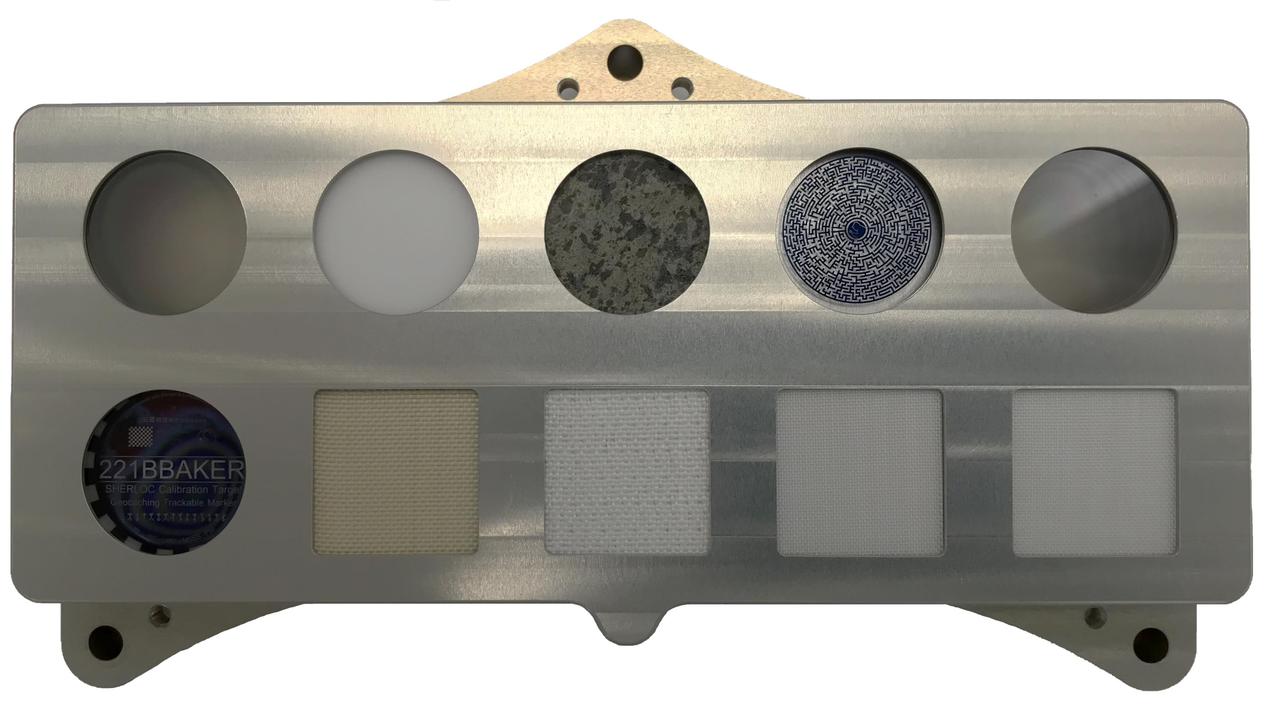
The calibration target for SHERLOC (Scanning Habitable Environments with Raman & Luminescence for Organics & Chemicals) an instrument on the end of the Perseverance Mars rover's 7-foot-long (3-meter-long) robotic arm, includes a geocaching target, spacesuit materials, and a slice of a Martian meteorite. Scientists rely on calibration targets to fine-tune instrument settings using materials with known properties. The bottom row of this target features spacesuit materials that scientists will observe to see how they react over time to the irradiated Martian atmosphere. The first sample at left is polycarbonate for use in a helmet visor; inscribed with the address of the fictional detective Sherlock Holmes, it doubles as a geochache for the public. Other materials in the bottom row, from left: Vectran; Ortho-Fabric; Teflon; coated Teflon. Top row, from left: aluminum gallium nitride on sapphire; a quartz diffuser; a slice of Martian meteorite; a maze for testing laser intensity; a separate aluminum gallium nitride on sapphire with different properties. https://photojournal.jpl.nasa.gov/catalog/PIA24261
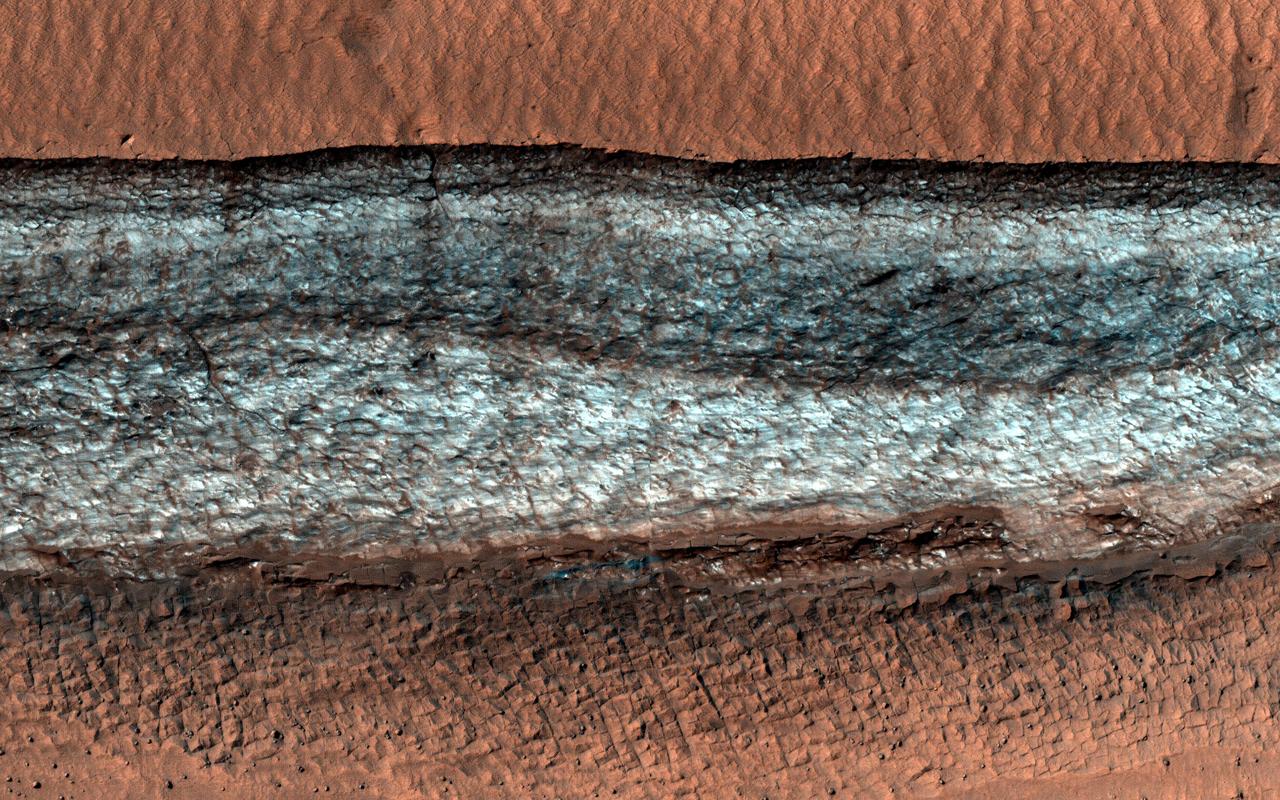
The mid-latitudes of Mars are mostly covered with smooth material that scientists have suspected to be ice for some time. The ground is uniform and dusty and does not reveal many clues about what lies beneath the surface. However, sometimes a feature like a cliff cuts through the terrain and gives us a glimpse of this buried icy material. The cliff in this image is one example out of a few dozen that are known. The bright material on the cliff face is icy and is preserved only because the cliff points away from the equator, so it is shaded most of the time. Faint bands on the cliff might indicate layers in the ice that record different climate conditions. We do not know how much time this ice took to accumulate here, but studies elsewhere on Mars indicate that material like this is sometimes at least tens of millions of years old. https://photojournal.jpl.nasa.gov/catalog/PIA25505
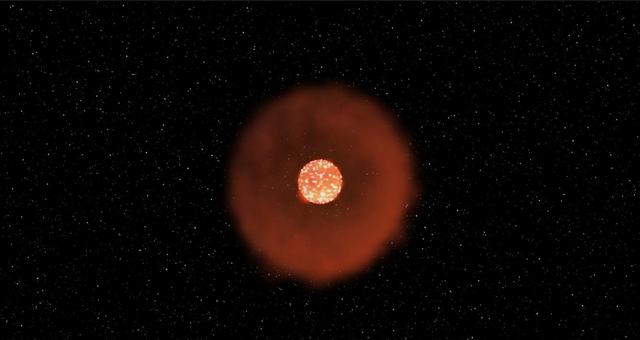
This frame from an animation shows a kind of stellar explosion called a Fast-Evolving Luminous Transient. In this case, a giant star "burps" out a shell of gas and dust about a year before exploding. Most of the energy from the supernova turns into light when it hits this previously ejected material, resulting in a short, but brilliant burst of radiation. Stellar explosions forge and distribute materials that make up the world in which we live, and also hold clues to how fast the universe is expanding. By understanding supernovae, scientists can unlock mysteries that are key to what we are made of and the fate of our universe. But to get the full picture, scientists must observe supernovae from a variety of perspectives, especially in the first moments of the explosion. That's really difficult -- there's no telling when or where a supernova might happen next. An animation is available at https://photojournal.jpl.nasa.gov/catalog/PIA22351
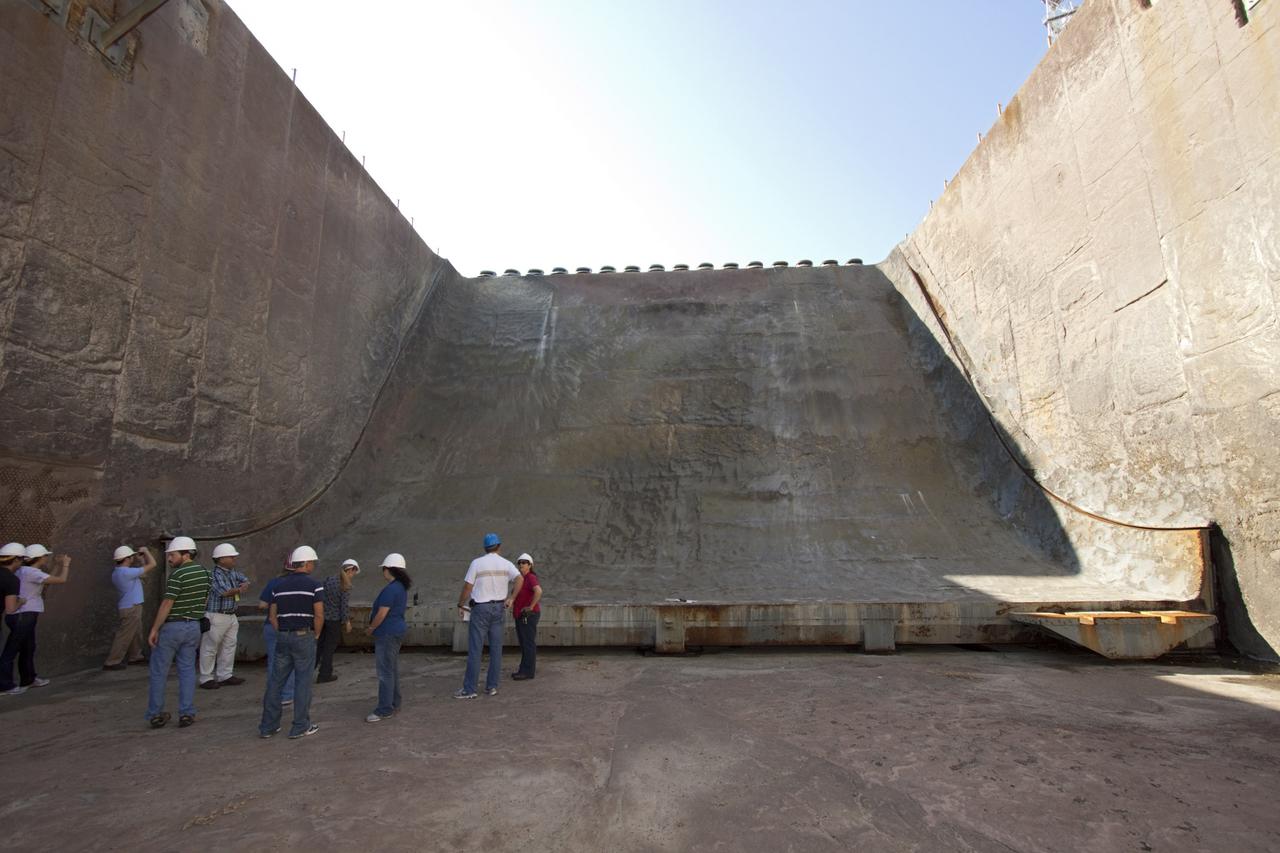
CAPE CANAVERAL, Fla. – Mechanical engineering students from Louisiana State University joined engineers and scientists at Launch Pad 39B at NASA's Kennedy Space Center in Florida as the students toured the facility to have a look at the flame trench. The students, standing on the flame deflector that divides the trench, signed up to help designers looking for new, flame and vibration-resistant materials to line the trench. The students are to build a scaled-down version of the flame trench that Kennedy's scientists can use to try out sample materials for the trench. If the samples work in the lab, they can be tried out in the real flame trenches at Launch Pad 39A and 39B. The launch pad has been refurbished extensively and work is continuing to modify the pad to support a variety of launch vehicles in the future. Photo credit: NASA/Jim Grossmann
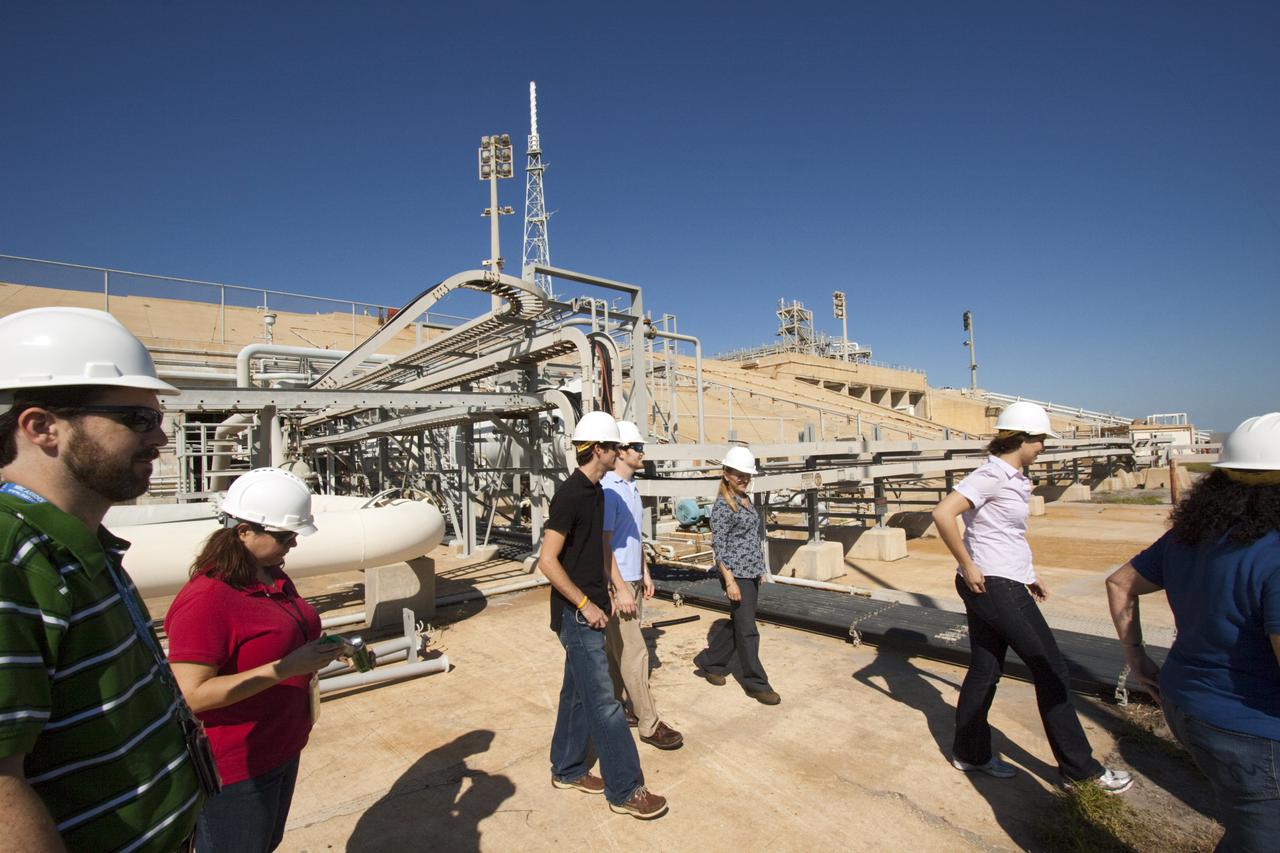
CAPE CANAVERAL, Fla. – Mechanical engineering students from Louisiana State University Christine Woodfield, right, in white shirt, Kevin Schenker, in light blue shirt, and Jacob Koch, in black shirt, joined engineers and scientists at Launch Pad 39B at NASA's Kennedy Space Center in Florida as the students toured the facility to have a look at the flame trench. They went inside the pad structure as part of their insight. The students signed up to help designers looking for new, flame and vibration-resistant materials to line the trench. The students are to build a scaled-down version of the flame trench that Kennedy's scientists can use to try out sample materials for the trench. If the samples work in the lab, they can be tried out in the real flame trenches at Launch Pad 39A and 39B. The launch pad has been refurbished extensively and work is continuing to modify the pad to support a variety of launch vehicles in the future. Photo credit: NASA_Jim Grossmann
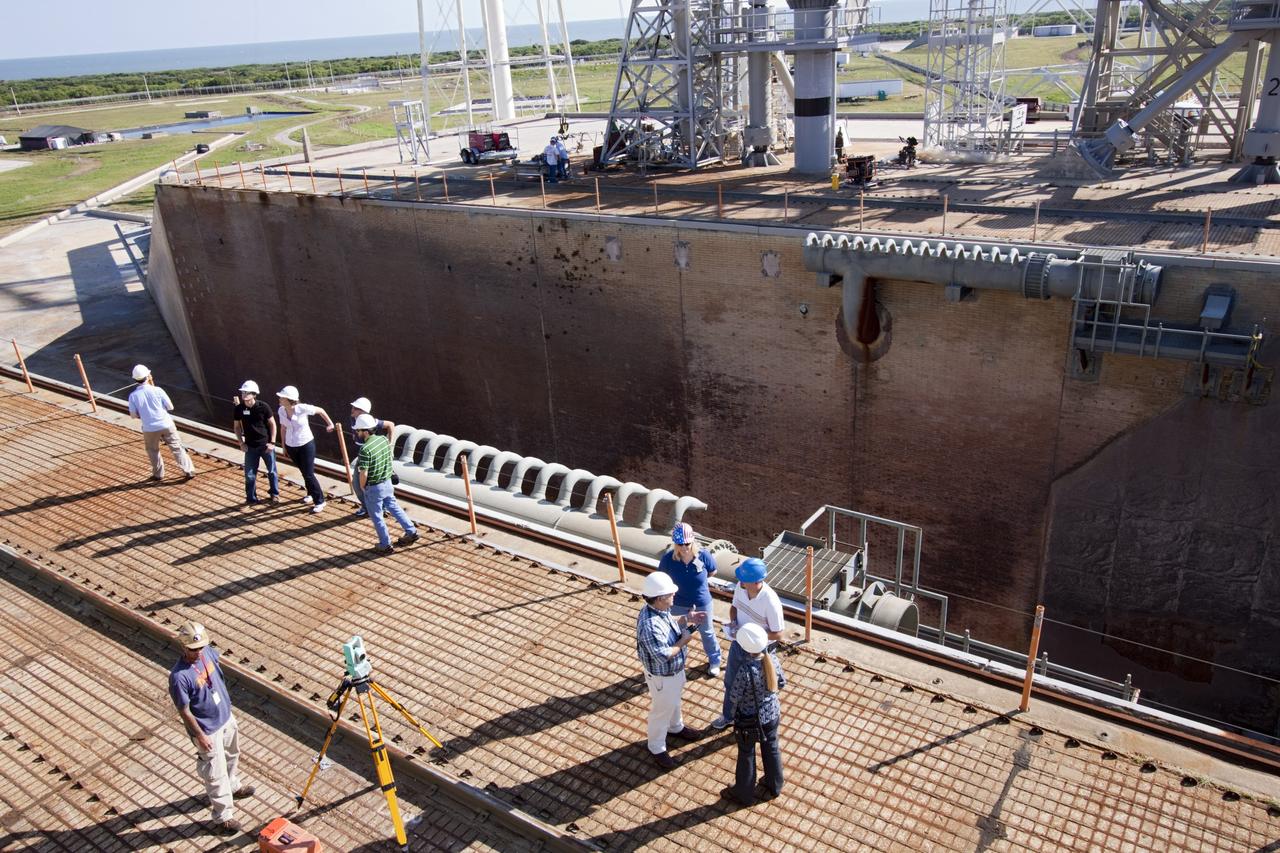
CAPE CANAVERAL, Fla. – Mechanical engineering students from Louisiana State University, the group on the left, joined engineers and scientists at Launch Pad 39B at NASA's Kennedy Space Center in Florida as the students toured the facility to have a look at the flame trench. Designers are looking for new, flame and vibration-resistant materials to line the trench. To help in the search, a team of mechanical engineering students at Louisiana State University are to build a scaled-down version of the flame trench that Kennedy's scientists can use to try out sample materials for the trench. If the samples work in the lab, they can be tried out in the real flame trenches at Launch Pad 39A and 39B. The launch pad has been refurbished extensively and work is continuing to modify the pad to support a variety of launch vehicles in the future. Photo credit: NASA/Jim Grossmann
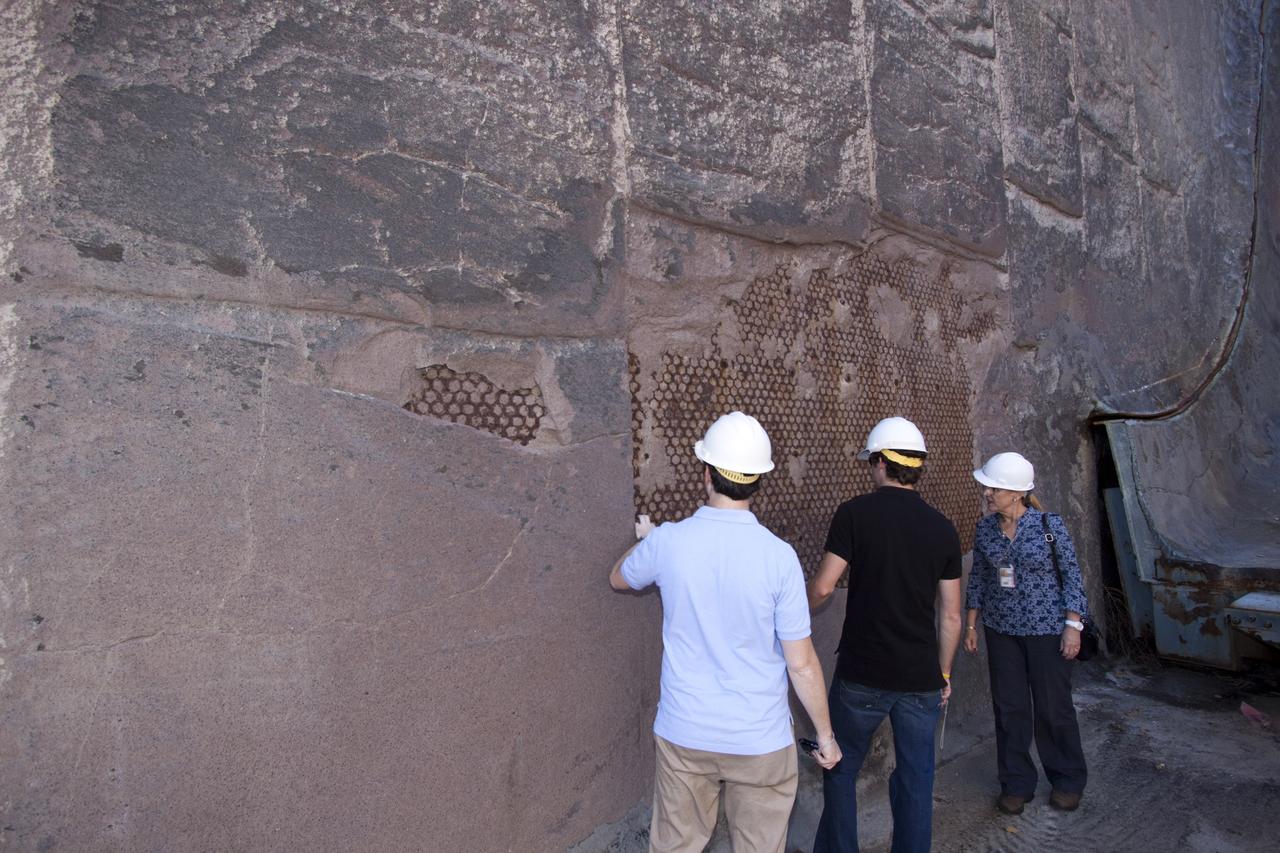
CAPE CANAVERAL, Fla. – Louisiana State University mechanical engineering students Kevin Schenker, from left, and Jacob Koch join Luz Marina Calle, a scientist at NASA's Kennedy Space in Florida, as they examine a portion of the wall of the flame trench at Launch Pad 39B. Designers are looking for new, flame and vibration-resistant materials to line the trench. To help in the search, a team of mechanical engineering students at Louisiana State University are to build a scaled-down version of the flame trench that Kennedy's scientists can use to try out sample materials for the trench. If the samples work in the lab, they can be tried out in the real flame trenches at Launch Pad 39A and 39B. The launch pad has been refurbished extensively and work is continuing to modify the pad to support a variety of launch vehicles in the future. Photo credit: NASA/Jim Grossmann
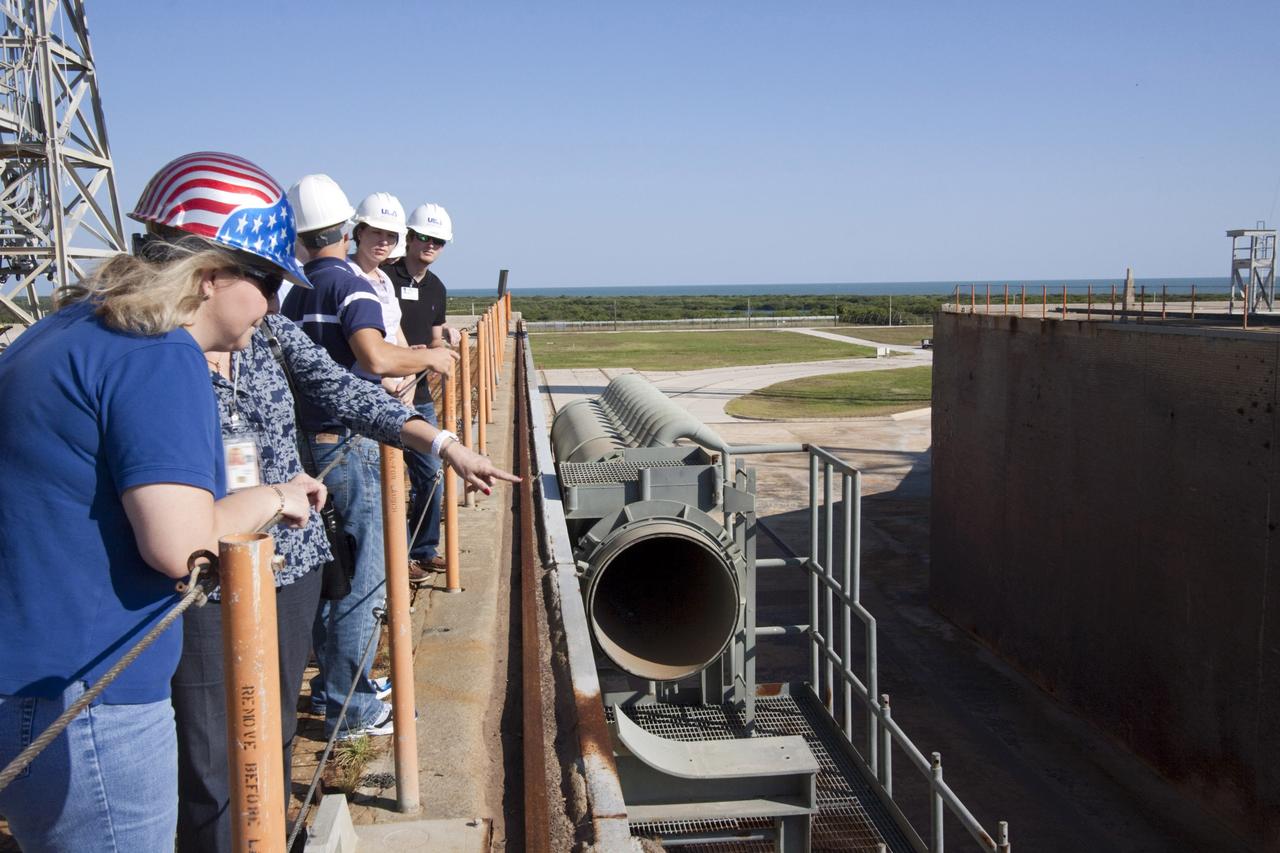
CAPE CANAVERAL, Fla. – Mechanical engineering students from Louisiana State University joined engineers and scientists at Launch Pad 39B at NASA's Kennedy Space Center in Florida as the students toured the facility to have a look at the flame trench. Designers are looking for new, flame and vibration-resistant materials to line the trench. To help in the search, a team of mechanical engineering students at Louisiana State University are to build a scaled-down version of the flame trench that Kennedy's scientists can use to try out sample materials for the trench. If the samples work in the lab, they can be tried out in the real flame trenches at Launch Pad 39A and 39B. The launch pad has been refurbished extensively and work is continuing to modify the pad to support a variety of launch vehicles in the future. Photo credit: NASA/Jim Grossmann
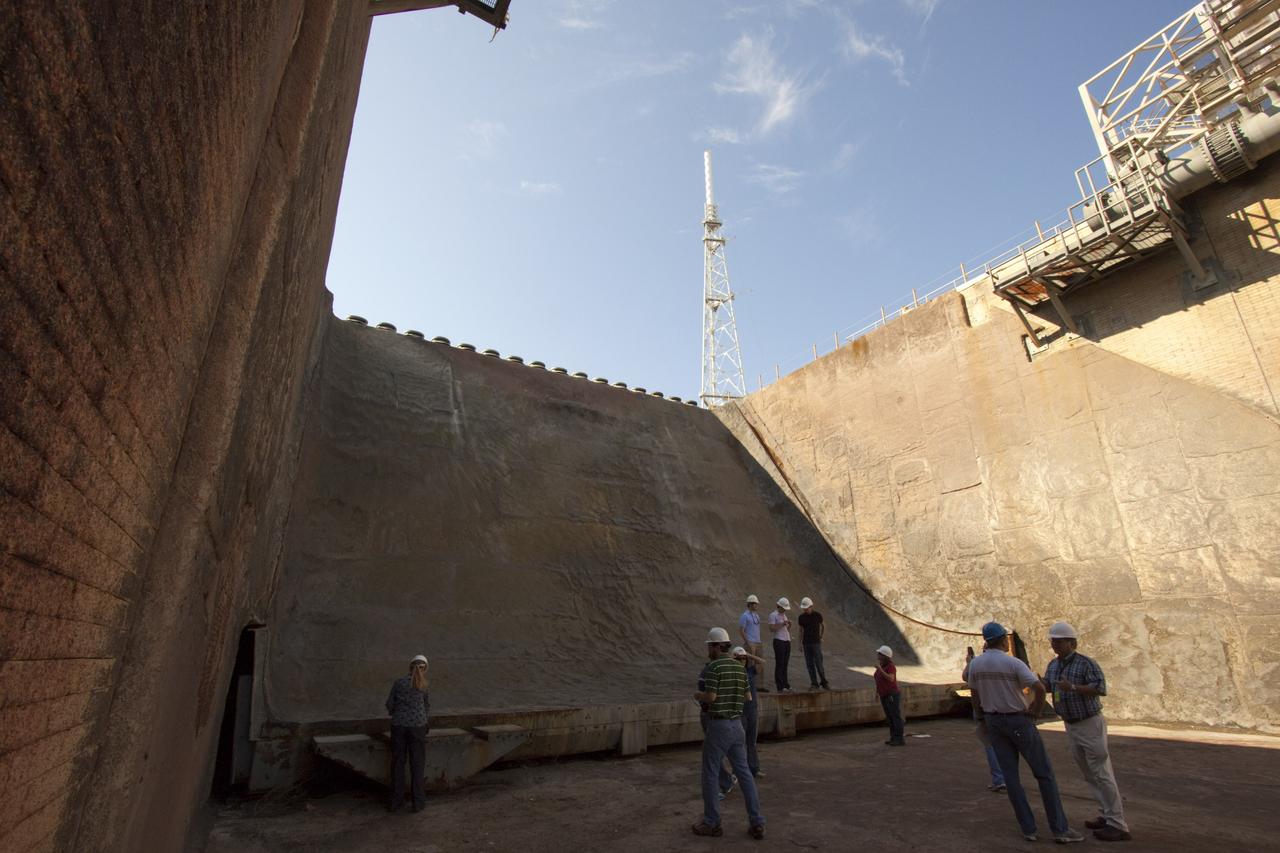
CAPE CANAVERAL, Fla. – Mechanical engineering students from Louisiana State University joined engineers and scientists at Launch Pad 39B at NASA's Kennedy Space Center in Florida as the students toured the facility to have a look at the flame trench. The students, taking pictures of the flame deflector that divides the trench, signed up to help designers looking for new, flame and vibration-resistant materials to line the trench. The students are to build a scaled-down version of the flame trench that Kennedy's scientists can use to try out sample materials for the trench. If the samples work in the lab, they can be tried out in the real flame trenches at Launch Pad 39A and 39B. The launch pad has been refurbished extensively and work is continuing to modify the pad to support a variety of launch vehicles in the future. Photo credit: NASA/Jim Grossmann
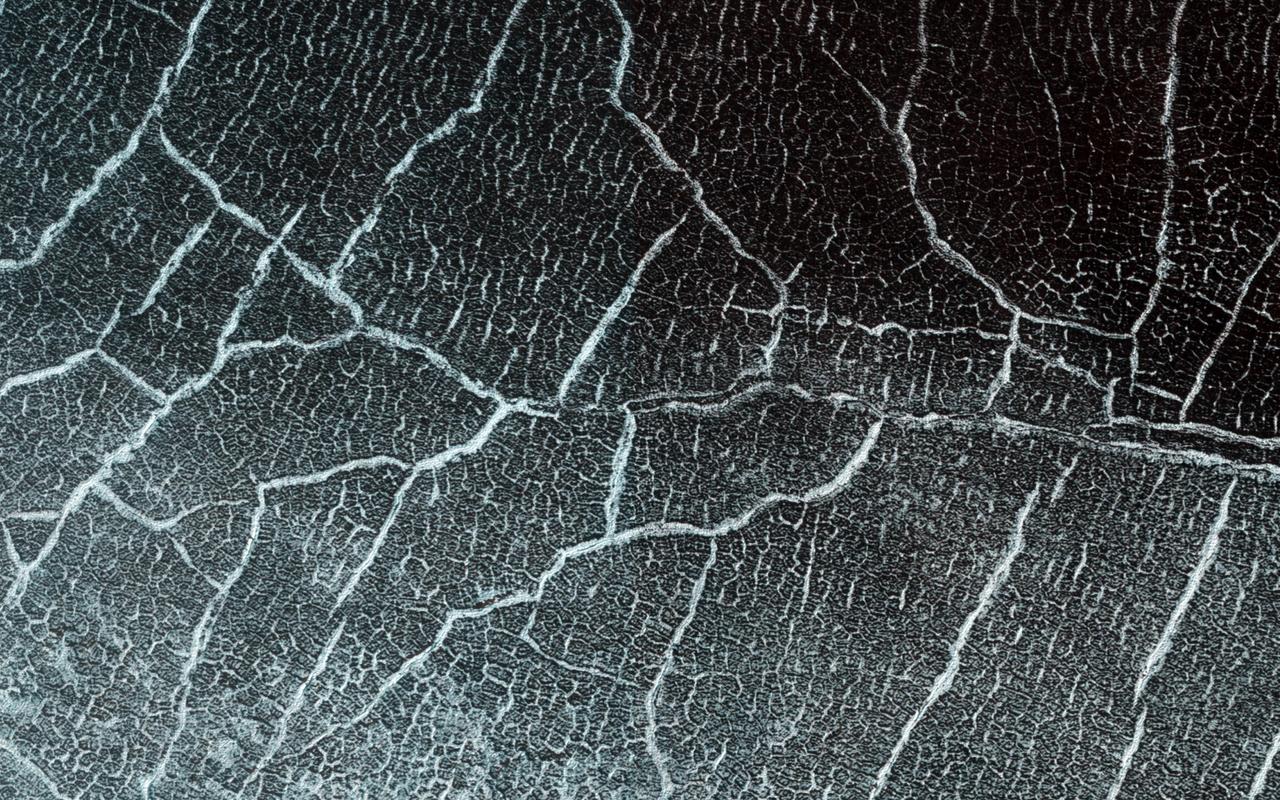
Many impact craters on Mars were filled with ice in past climates. Sometimes this ice flows or slumps down the crater walls into the center and acquires concentric wrinkles as a result. This image shows an example of this. There are other ways that scientists know the material in the crater is icy. Surface cracks that form polygonal shapes cover the material in the crater. They are easy to see in this spring-time image because seasonal frost hides inside the cracks, outlining them in bright white. These cracks form because ice within the ground expands and contracts a lot as it warms and cools. Scientists can see similar cracks in icy areas of the Earth and other icy locations on Mars. If you look closely, you'll see small polygons inside larger ones. The small polygons are younger and the cracks shallower while the large ones are outlined with cracks that penetrate more deeply. http://photojournal.jpl.nasa.gov/catalog/PIA21215
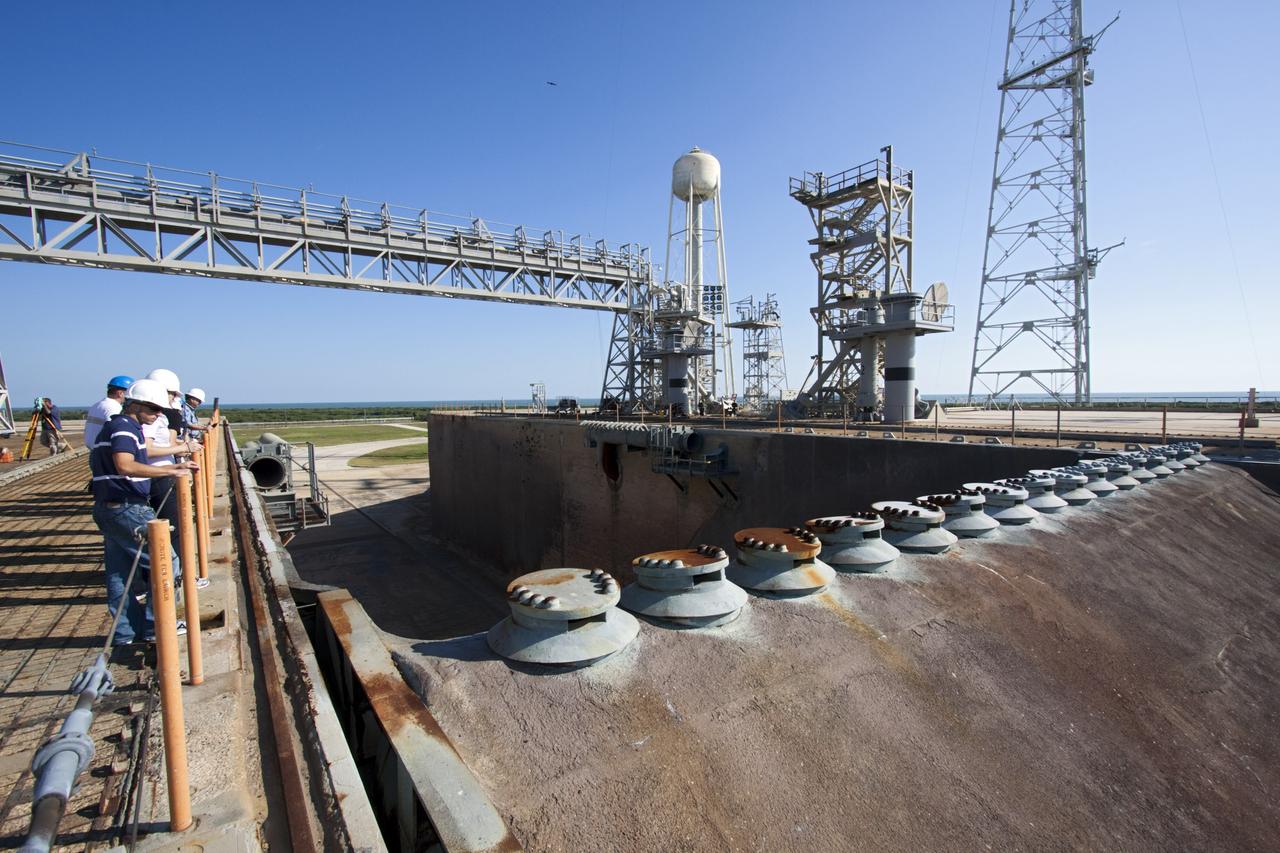
CAPE CANAVERAL, Fla. – Mechanical engineering students from Louisiana State University joined engineers and scientists at Launch Pad 39B at NASA's Kennedy Space Center in Florida as the students toured the facility to have a look at the flame trench. Designers are looking for new, flame and vibration-resistant materials to line the trench. To help in the search, a team of mechanical engineering students at Louisiana State University are to build a scaled-down version of the flame trench that Kennedy's scientists can use to try out sample materials for the trench. If the samples work in the lab, they can be tried out in the real flame trenches at Launch Pad 39A and 39B. The launch pad has been refurbished extensively and work is continuing to modify the pad to support a variety of launch vehicles in the future. Photo credit: NASA/Jim Grossmann
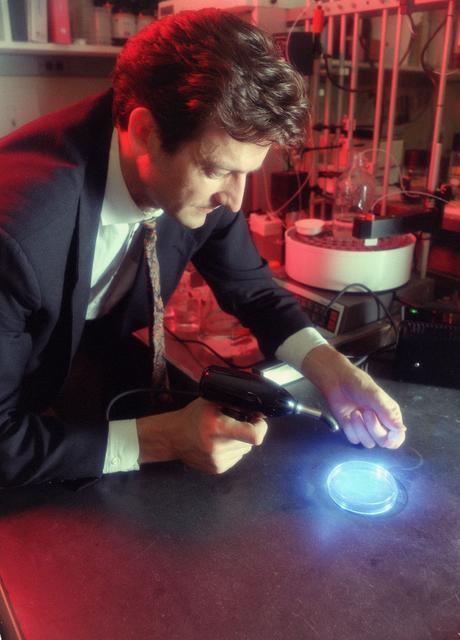
Scientists at MSFC have been studying the properties of Aerogel for several years. Aerogel, the lightest solid known to man, has displayed a high quality for insulation. Because of its smoky countenance it has yet to be used as an insulation on windows, but has been used to insulate the walls of houses and engine compartments in cars. It was also used in the space program as insulating material on the rover Sojourner, aboard the Mars Pathfinder. MSFC is one of the many research facilities conducting experiments to unlock the smoky properties of aerogel and make it a clear substance. MSFC researchers believe that by taking this research to space, they can resolve the problem of making aerogel transparent enough to see through. So far, recent space experiments have been encouraging. The samples produced in microgravity indicate a change in the microstructure of the material as compared to ground samples. MSFC scientists continue to study the effects of microgravity on Aerogel as their research is space continues.
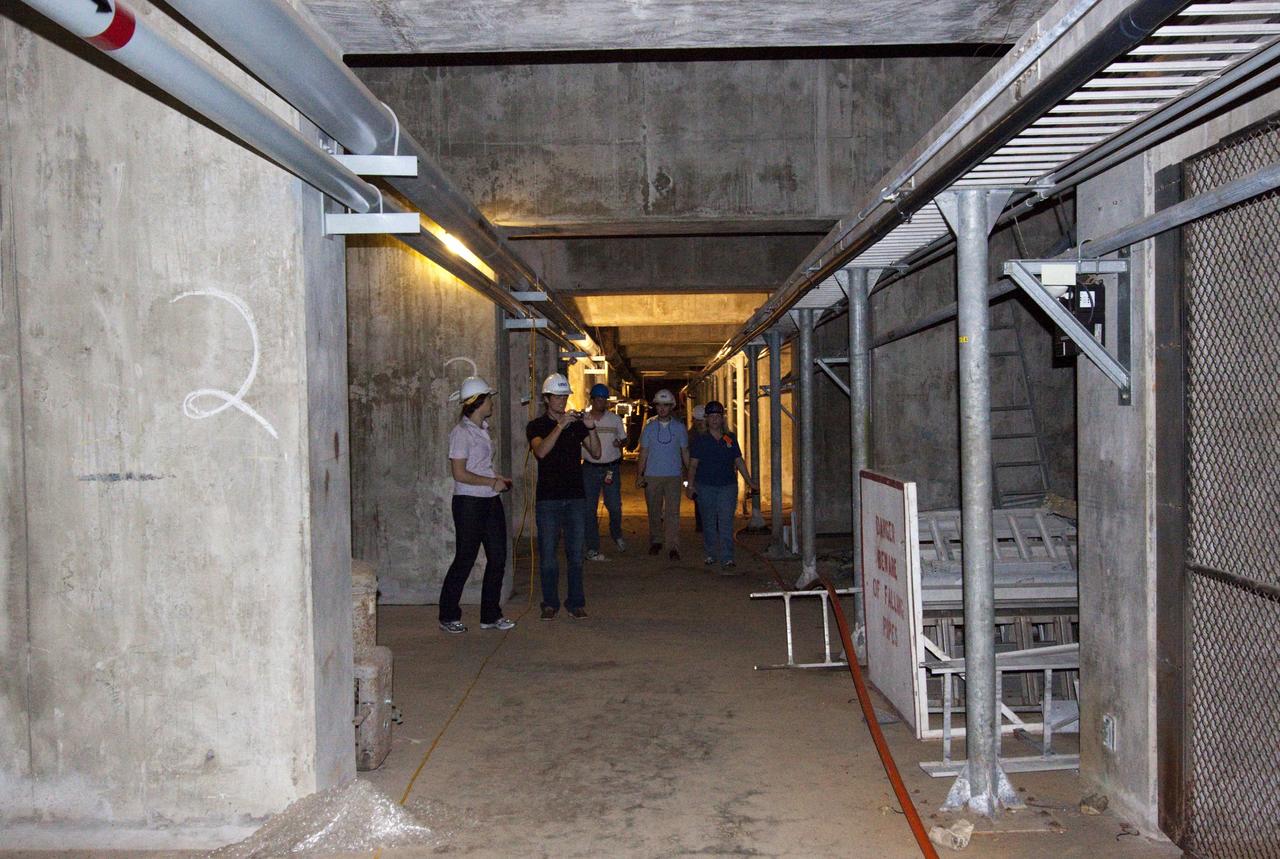
CAPE CANAVERAL, Fla. – Mechanical engineering students from Louisiana State University joined engineers and scientists at Launch Pad 39B at NASA's Kennedy Space Center in Florida as the students toured the facility to have a look at the flame trench. They went inside the pad structure as part of their insight. The students signed up to help designers looking for new, flame and vibration-resistant materials to line the trench. The students are to build a scaled-down version of the flame trench that Kennedy's scientists can use to try out sample materials for the trench. If the samples work in the lab, they can be tried out in the real flame trenches at Launch Pad 39A and 39B. The launch pad has been refurbished extensively and work is continuing to modify the pad to support a variety of launch vehicles in the future. Photo credit: NASA/Jim Grossmann
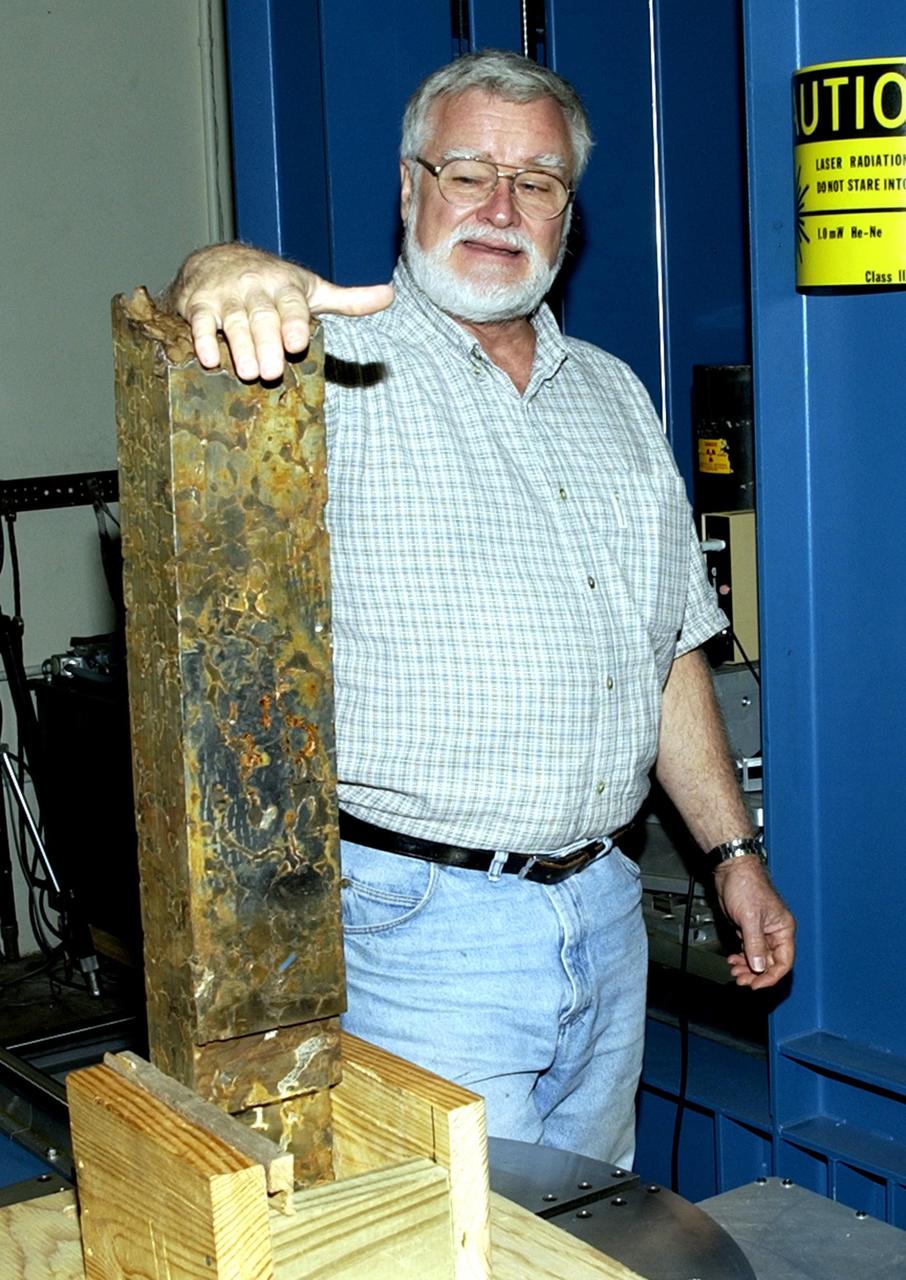
KENNEDY SPACE CENTER, FLA. -- Pete Engel, an engineering specialist in Wyle Laboratory's Nondestructive Testing Laboratory at KSC, explains the testing being performed on a 100-pound Mundrabilla meteorite sample. The one-of-a-kind meteorite was found 36 years ago in Australia and is on loan to Marshall Space Flight Center (MSFC) from the Smithsonian Institution's National Museum of Natural History. Dr. Donald Gillies, discipline scientist for materials science at MSFC's Microgravity Science and Applications Department, is the Principal Investigator. The studies may help provide the science community and industry with fundamental knowledge for use in the design of advanced materials.
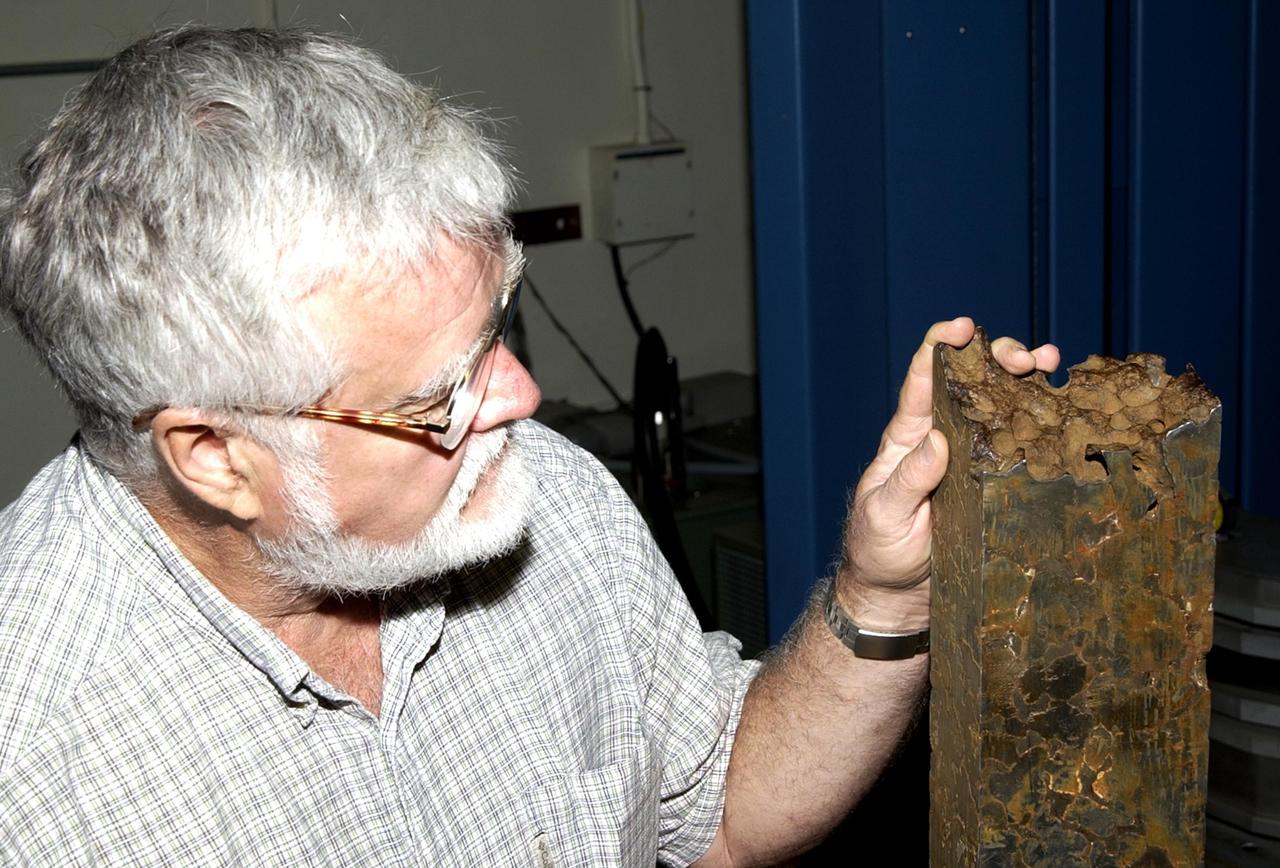
KENNEDY SPACE CENTER, FLA. -- Pete Engel, an engineering specialist in Wyle Laboratory's Nondestructive Testing Laboratory at KSC, explains the testing being performed on a 100-pound Mundrabilla meteorite sample. The one-of-a-kind meteorite was found 36 years ago in Australia and is on loan to Marshall Space Flight Center (MSFC) from the Smithsonian Institution's National Museum of Natural History. Dr. Donald Gillies, discipline scientist for materials science at MSFC's Microgravity Science and Applications Department, is the Principal Investigator. The studies may help provide the science community and industry with fundamental knowledge for use in the design of advanced materials.
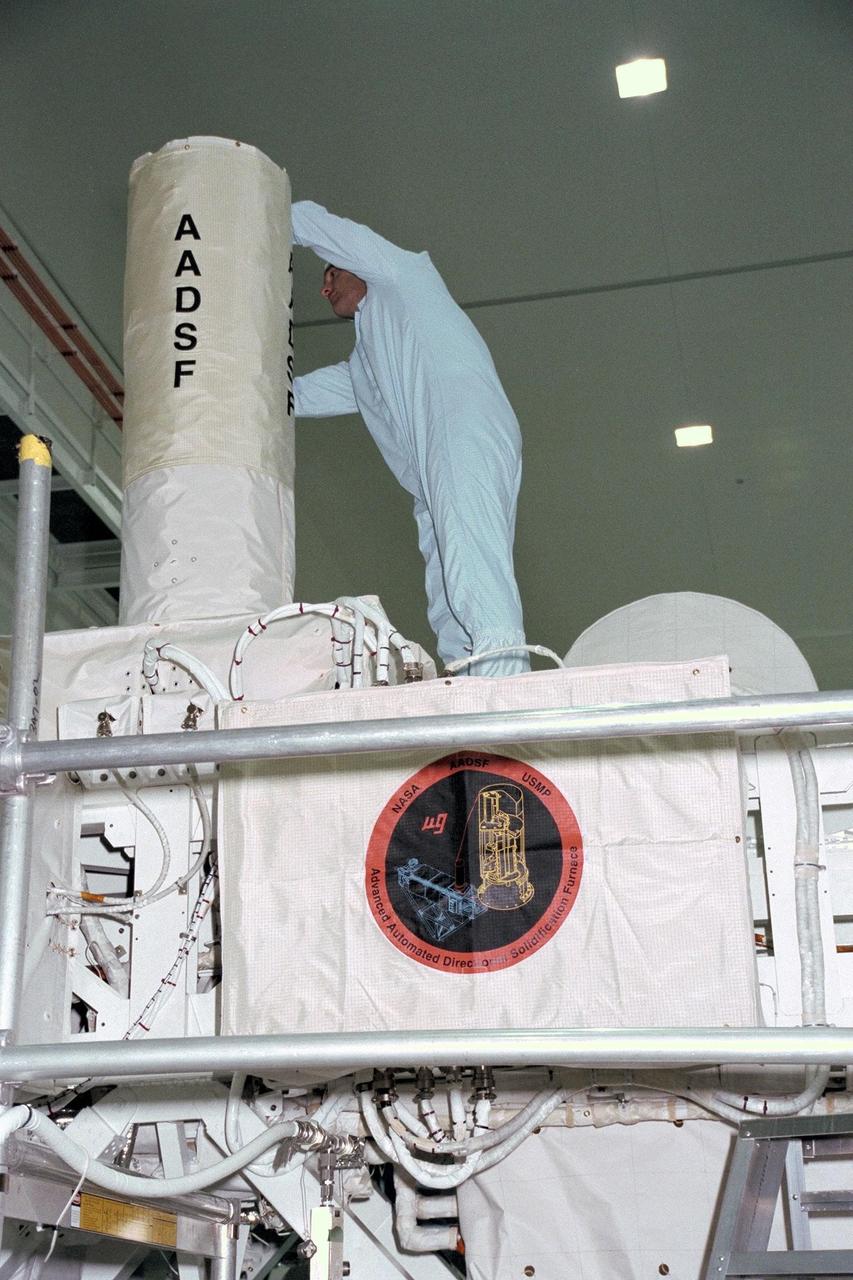
United States Microgravity Payload-4 (USMP-4) experiments are prepared to be flown on Space Shuttle mission STS-87 in the Space Station Processing Facility at Kennedy Space Center (KSC). A technician is working on the Advanced Automated Directional Solidification Furnace (AADSF), which will be used by researchers to study the solidification of semiconductor materials in microgravity. Scientists will be able to better understand how microgravity influences the solidification process of these materials and develop better methods for controlling that process during future Space flights and Earth-based production. All STS-87 experiments are scheduled for launch on Nov. 19 from KSC
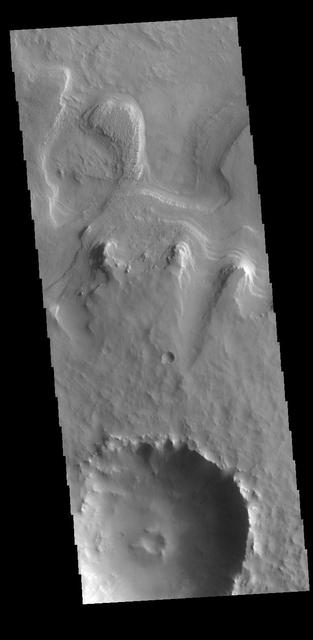
Today's VIS image shows one of several craters located on the floor of the much larger Tikhonravov Crater in Terra Sabaea. Named for Russian rocket scientist, Mikhail Tikhonravov, the crater is thought to have been the location of a large lake, which may have laid down layers of material now exposed on the margins of this pedestal crater. A pedestal crater is formed by removal of surface materials around a resistant layer of ejecta, eventually leaving the crater and ejecta as a mesa or plateau on the lower elevation base surface. Orbit Number: 78401 Latitude: 12.9296 Longitude: 34.4892 Instrument: VIS Captured: 2019-08-17 20:32 https://photojournal.jpl.nasa.gov/catalog/PIA23481

Impact craters are common on all solar system bodies. They offer many clues to scientists regarding the geologic history of a planetary surface, particularly regarding its age, evolution with time, and composition. For instance, this image covers an impact crater on the southeastern flank of Ascraeus Mons, a notable volcano in the Tharsis Plateau. Based on the original science rationale for acquiring this image, by gaining more information about its depth and consequently the stability of the crater wall, we can learn more about the nature of the volcano's flank materials. Also, by carefully studying the materials exposed in the crater walls, we can gain more information about the subsurface. https://photojournal.jpl.nasa.gov/catalog/PIA24919
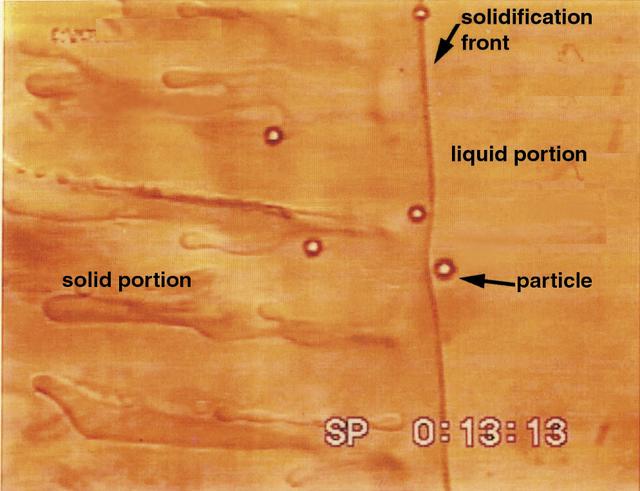
As a liquefied metal solidifies, particles dispersed in the liquid are either pushed ahead of or engulfed by the moving solidification front. Similar effects can be seen when the ground freezes and pushes large particles out of the soil. The Particle Engulfment and Pushing (PEP) experiment, conducted aboard the fourth U.S. Microgravity Payload (USMP-4) mission in 1997, used a glass and plastic beads suspended in a transparent liquid. The liquid was then frozen, trapping or pushing the particles as the solidifying front moved. This simulated the formation of advanced alloys and composite materials. Such studies help scientists to understand how to improve the processes for making advanced materials on Earth. The principal investigator is Dr. Doru Stefanescu of the University of Alabama. This image is from a video downlink.
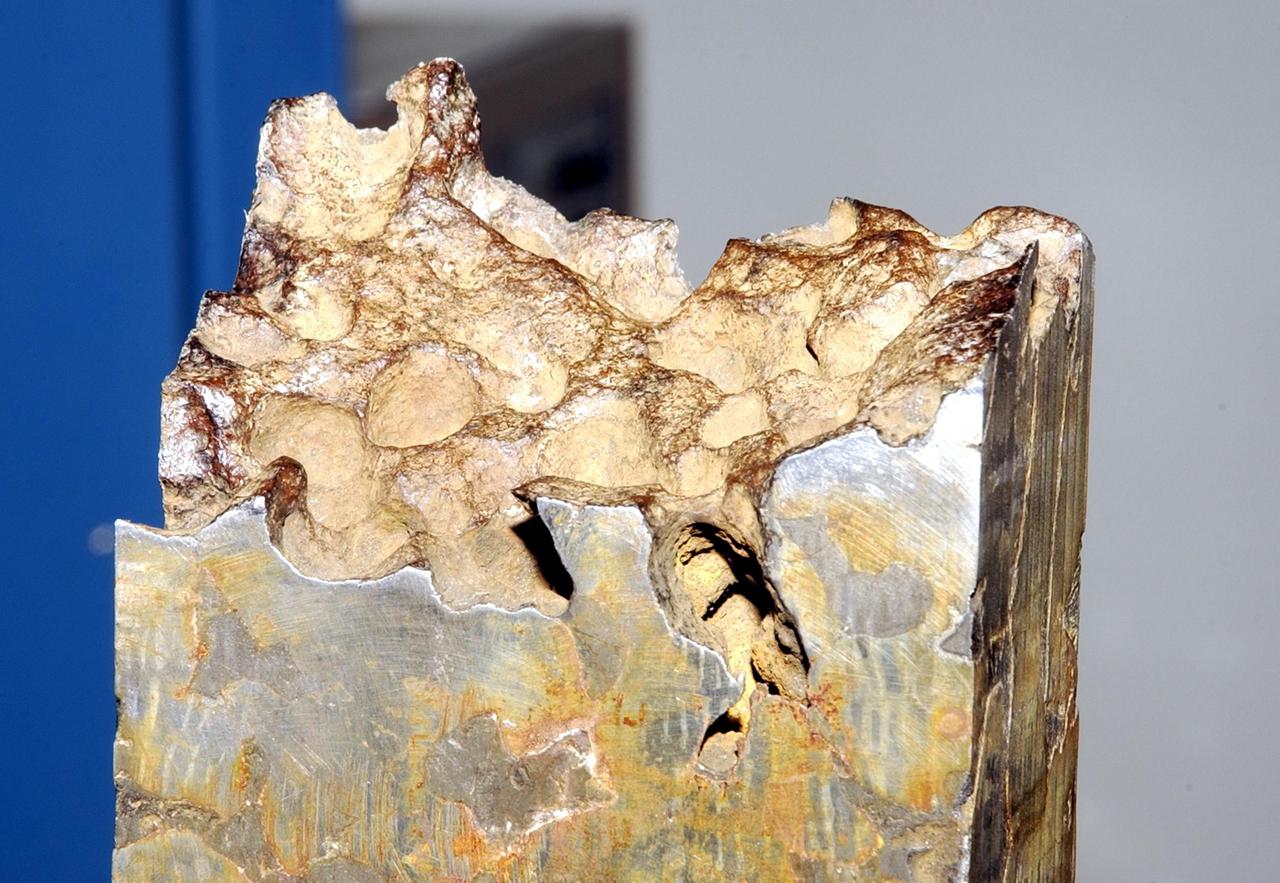
KENNEDY SPACE CENTER, FLA. -- This 100-pound Mundrabilla meteorite sample is being studied in Wyle Laboratory's Nondestructive Testing Laboratory at KSC. The one-of-a-kind meteorite was found 36 years ago in Australia and is on loan to Marshall Space Flight Center (MSFC) from the Smithsonian Institution's National Museum of Natural History. Dr. Donald Gillies, discipline scientist for materials science at MSFC's Microgravity Science and Applications Department, is the Principal Investigator. The studies may help provide the science community and industry with fundamental knowledge for use in the design of advanced materials.
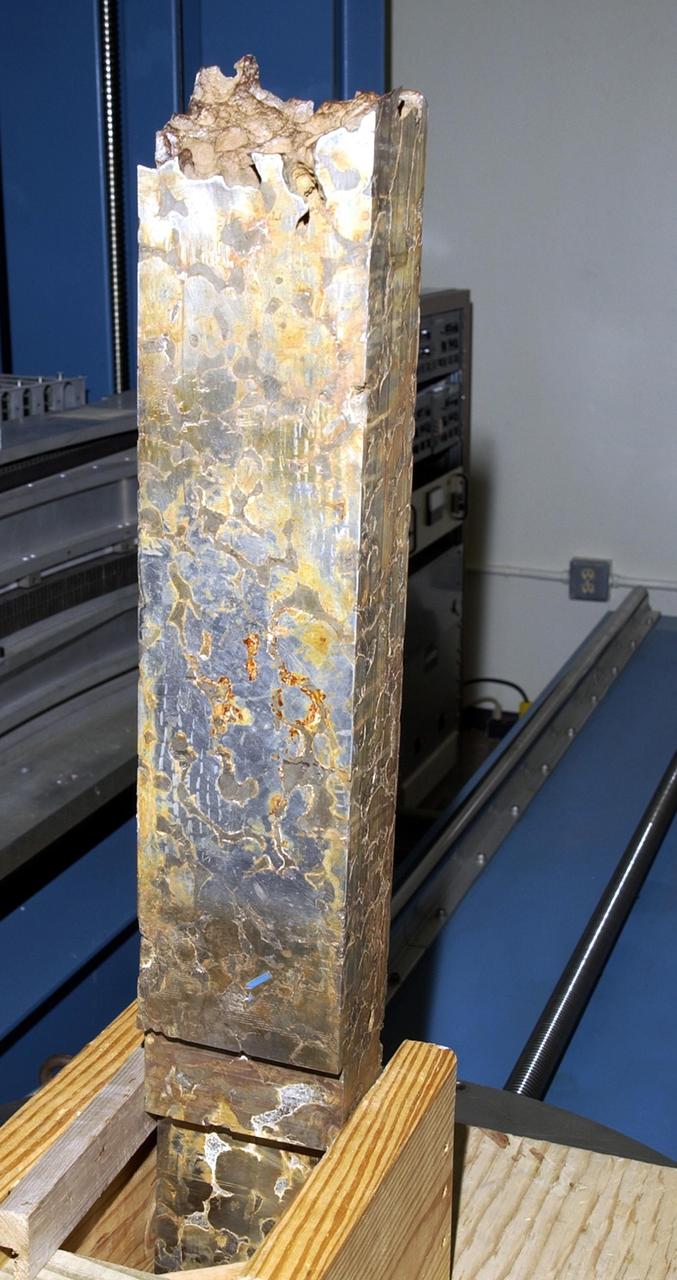
KENNEDY SPACE CENTER, FLA. -- This 100-pound Mundrabilla meteorite sample is being studied in Wyle Laboratory's Nondestructive Testing Laboratory at KSC. The one-of-a-kind meteorite was found 36 years ago in Australia and is on loan to Marshall Space Flight Center (MSFC) from the Smithsonian Institution's National Museum of Natural History. Dr. Donald Gillies, discipline scientist for materials science at MSFC's Microgravity Science and Applications Department, is the Principal Investigator. The studies may help provide the science community and industry with fundamental knowledge for use in the design of advanced materials.
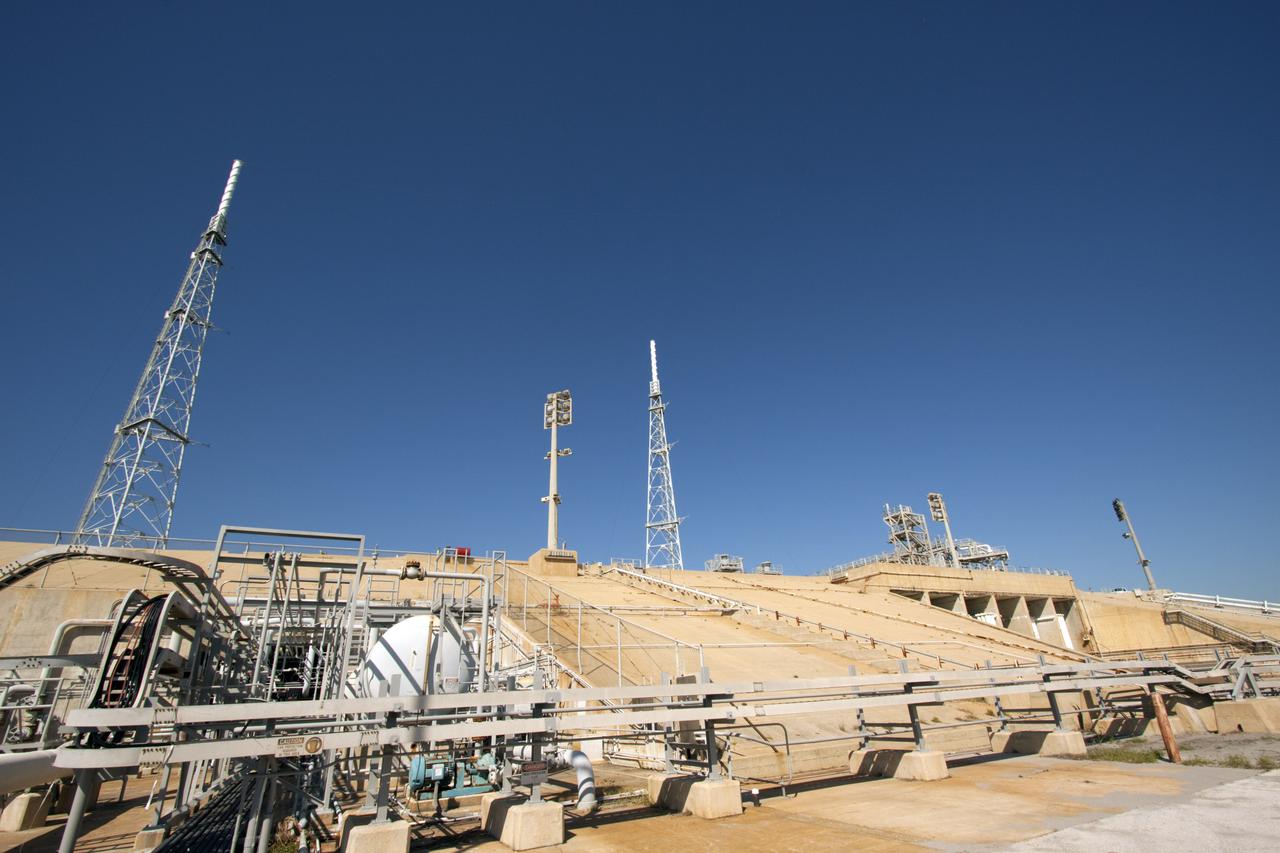
CAPE CANAVERAL, Fla. – Launch Pad 39B at NASA's Kennedy Space Center in Florida has been refurbished extensively and work is continuing to modify the pad to support a variety of launch vehicles in the future. Designers are looking for new, flame and vibration-resistant materials to line the trench. To help in the search, a team of mechanical engineering students at Louisiana State University are to build a scaled-down version of the flame trench that Kennedy's scientists can use to try out sample materials for the trench. If the samples work in the lab, they can be tried out in the real flame trenches at Launch Pad 39A and 39B. Photo credit: NASA_Jim Grossmann
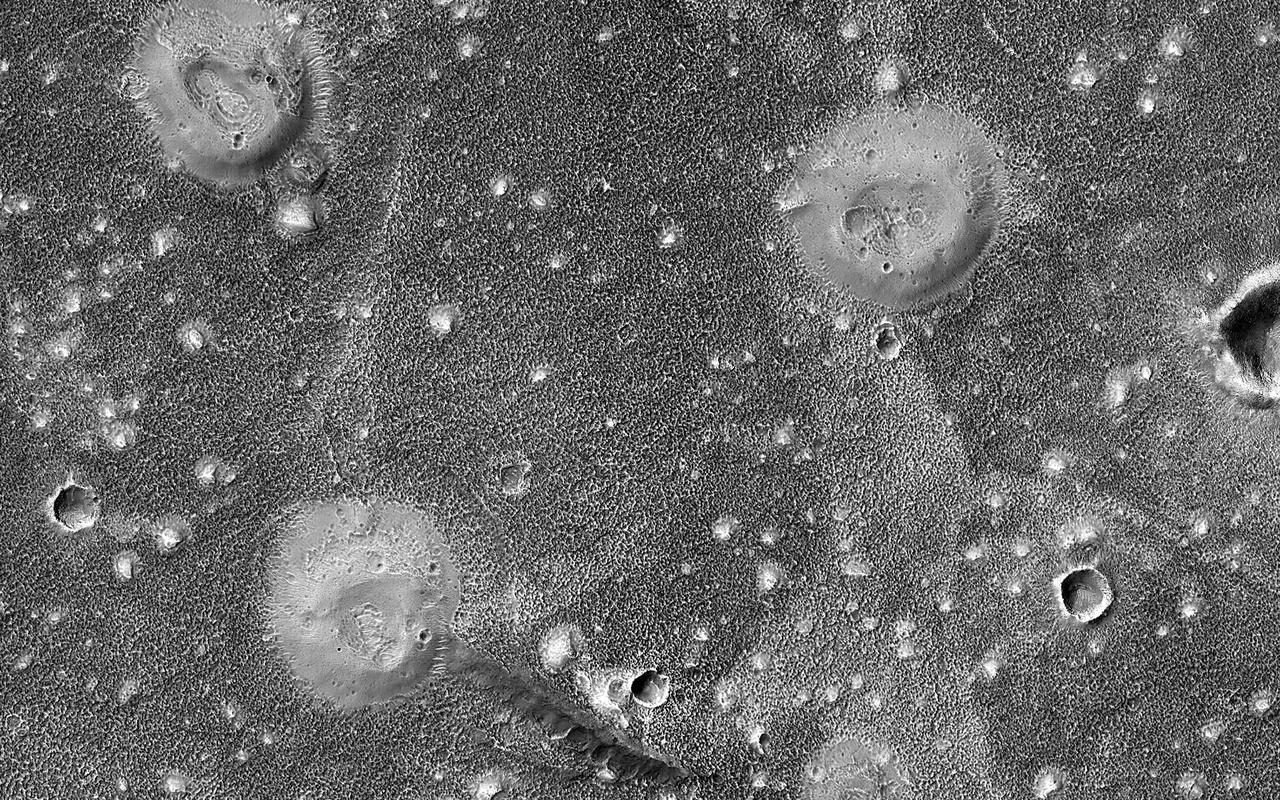
The northern lowlands of Mars in this location are stippled with mounds, such as those visible throughout this image. These lighter-toned circular mounds with bowl-shaped depressions are easy to spot against the darker-toned floor. Scientists think these landforms are similar to mud volcanoes that are also found here on Earth. Mud volcanoes form as gas and liquid-rich sediment interacts underground. Over time, this slurry of mud is brought to the surface and forms a rounded mound. Scientists are interested in studying mud volcanoes on Mars because the material forming the mound has the potential to be organic in nature and would give insight into possible microbial life below the surface. https://photojournal.jpl.nasa.gov/catalog/PIA25987
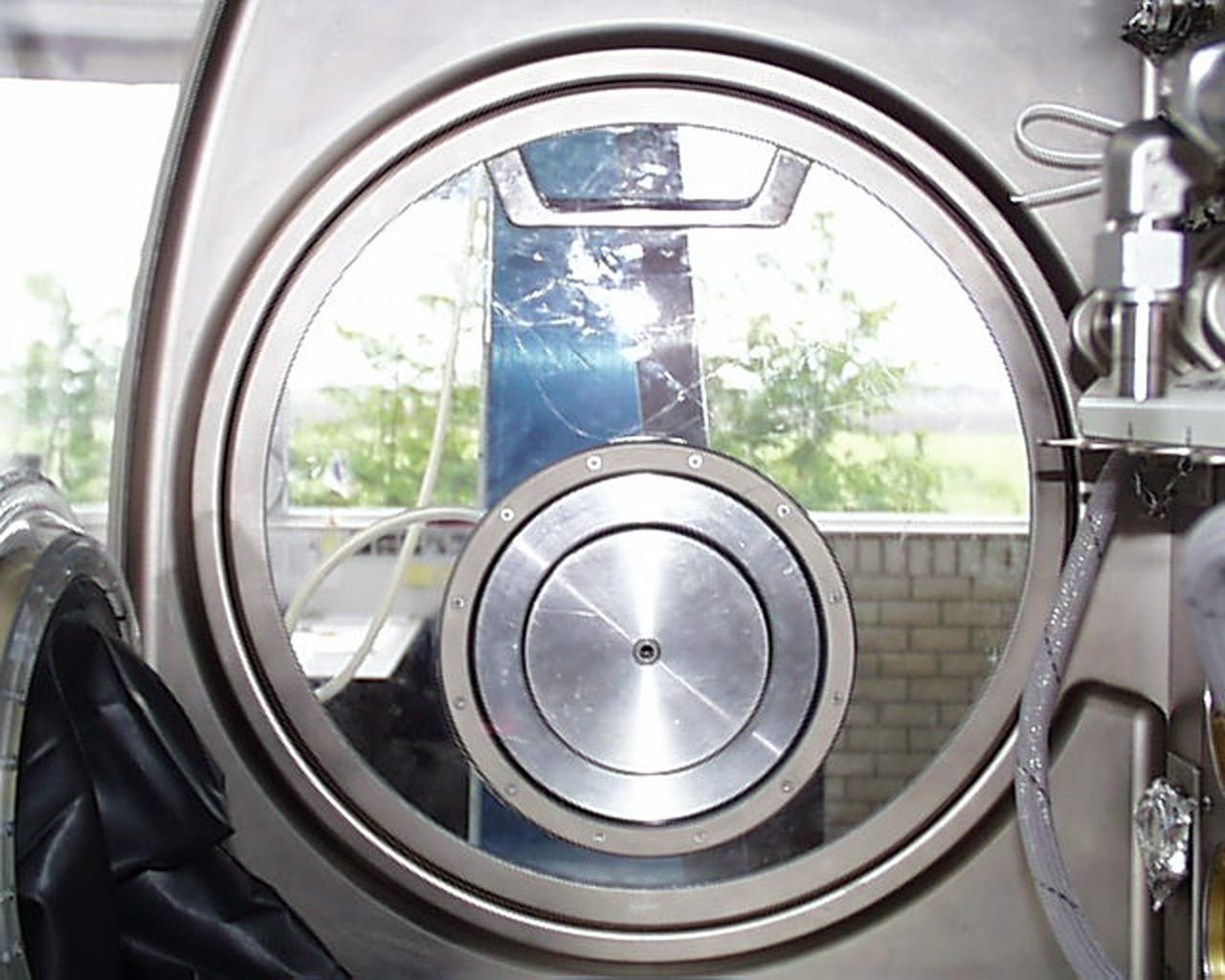
Access ports, one on each side of the Microgravity Science Glovebox (MSG), will allow scientists to place large experiment items inside the MSG. The ports also provide additional glove ports (silver disk) for greater access to the interior. The European Space Agency (ESA) and NASA are developing the MSG for use aboard the International Space Station (ISS). Scientists will use the MSG to carry out multidisciplinary studies in combustion science, fluid physics and materials science. The MSG is managed by NASA's Marshall Space Flight Center (MSFC). Photo Credit: NASA/MSFC
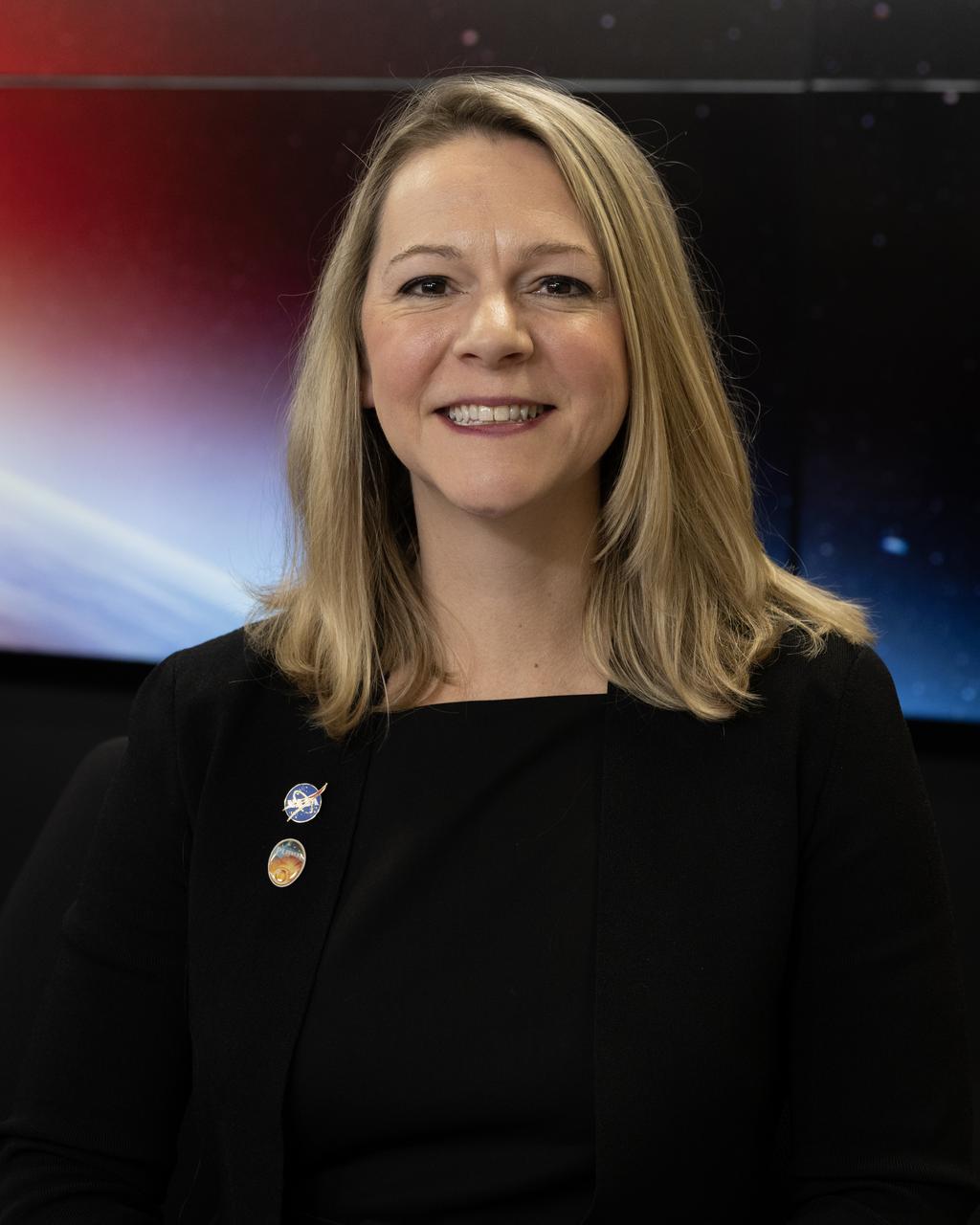
Nicholeen Viall, PUNCH Mission Scientist, NASA’s Goddard Flight Center, participates in a science briefing on Tuesday, Feb. 25, 2025, to discuss the upcoming launch of NASA’s SPHEREx (Spectro-Photometer for the History of the Universe, Epoch of Reionization and Ices Explorer) observatory and PUNCH (Polarimeter to Unify the Corona and Heliosphere) satellites at Vandenberg Space Force Base in California. SPHEREx will use its telescope to provide an all-sky spectral survey, creating a 3D map of the entire sky to help scientists investigate the origins of our universe. PUNCH will study origins of the Sun’s outflow of material, or the solar wind, capturing continuous 3D images of the Sun’s corona and the solar wind’s journey into the solar system.
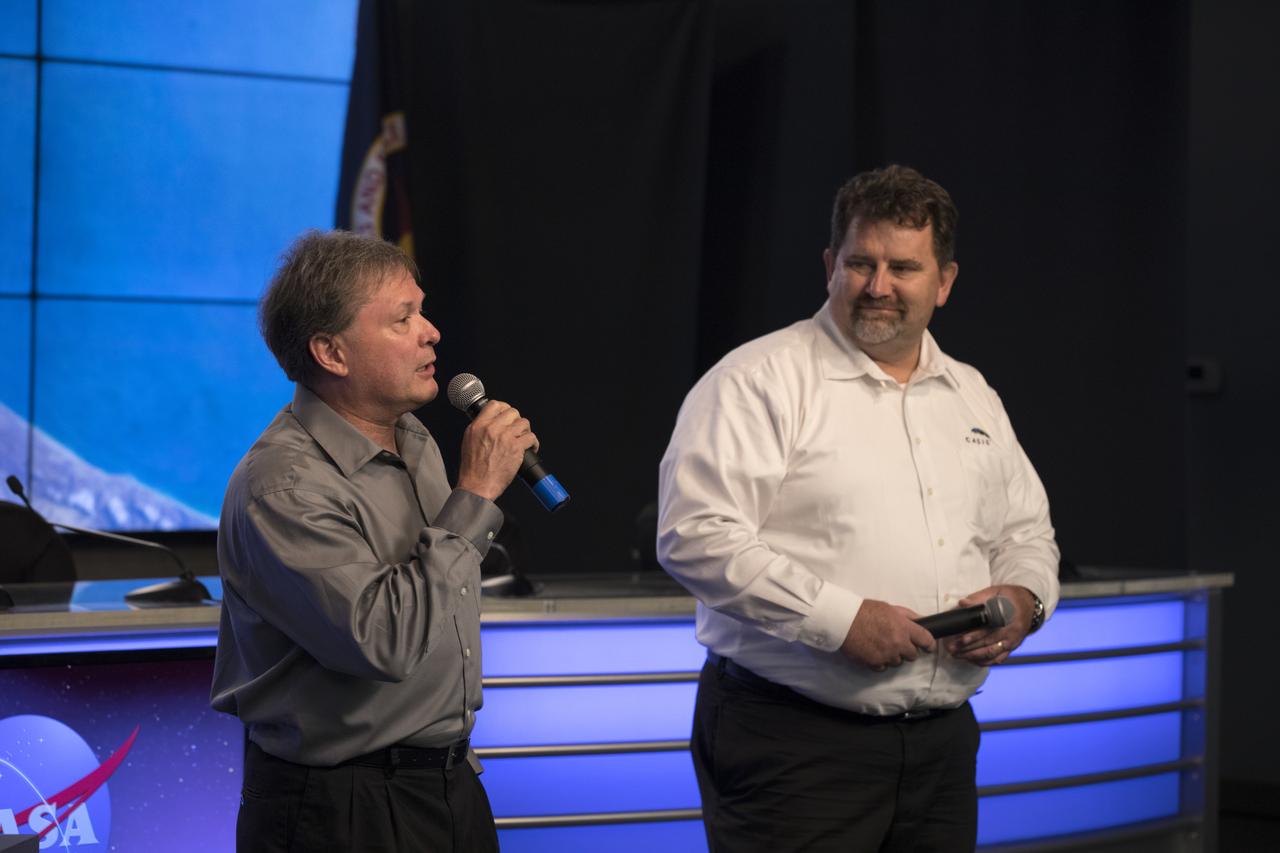
David Brady, assistant program scientist for the International Space Station Program at NASA’s Johnson Space Center left, speaks to members of the media during a briefing in the Kennedy Space Center’s Press Site auditorium. At right is Mike Roberts, deputy chief scientist, Center for the Advancement of Science in Space (CASIS). The briefing focused on research planned for launch to the International Space Station. The scientific materials and supplies will be aboard a SpaceX Dragon spacecraft scheduled for liftoff from Cape Canaveral Air Force Station's Space Launch Complex 40. The SpaceX Falcon 9 rocket will launch the company's 15th Commercial Resupply Services mission to the space station.

Phil Korngut, SPHEREx instrument scientist, Caltech, participates in a science briefing on Tuesday, Feb. 25, 2025, to discuss the upcoming launch of NASA’s SPHEREx (Spectro-Photometer for the History of the Universe, Epoch of Reionization and Ices Explorer) observatory and PUNCH (Polarimeter to Unify the Corona and Heliosphere) satellites at Vandenberg Space Force Base in California. SPHEREx will use its telescope to provide an all-sky spectral survey, creating a 3D map of the entire sky to help scientists investigate the origins of our universe. PUNCH will study origins of the Sun’s outflow of material, or the solar wind, capturing continuous 3D images of the Sun’s corona and the solar wind’s journey into the solar system.
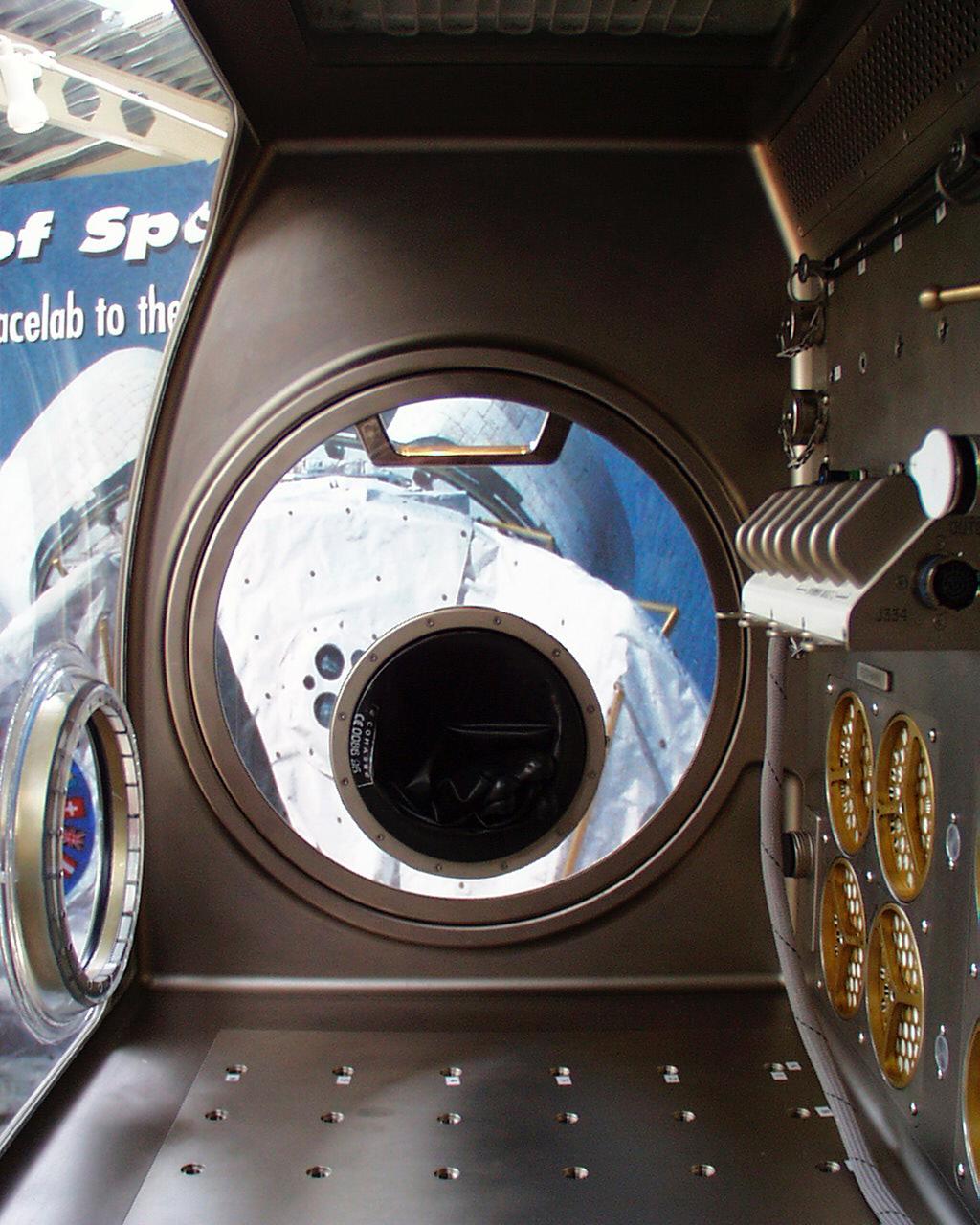
Access ports, one on each side of the Microgravity Science Glovebox (MSG), will allow scientists to place large experiment items inside the MSG. The ports also provide additional glove ports (dark circle) for greater access to the interior. The European Space Agency (ESA) and NASA are developing the MSG for use aboard the International Space Station (ISS). Scientists will use the MSG to carry out multidisciplinary studies in combustion science, fluid physics and materials science. The MSG is managed by NASA's Marshall Space Flight Center (MSFC). Photo Credit: NASA/MSFC
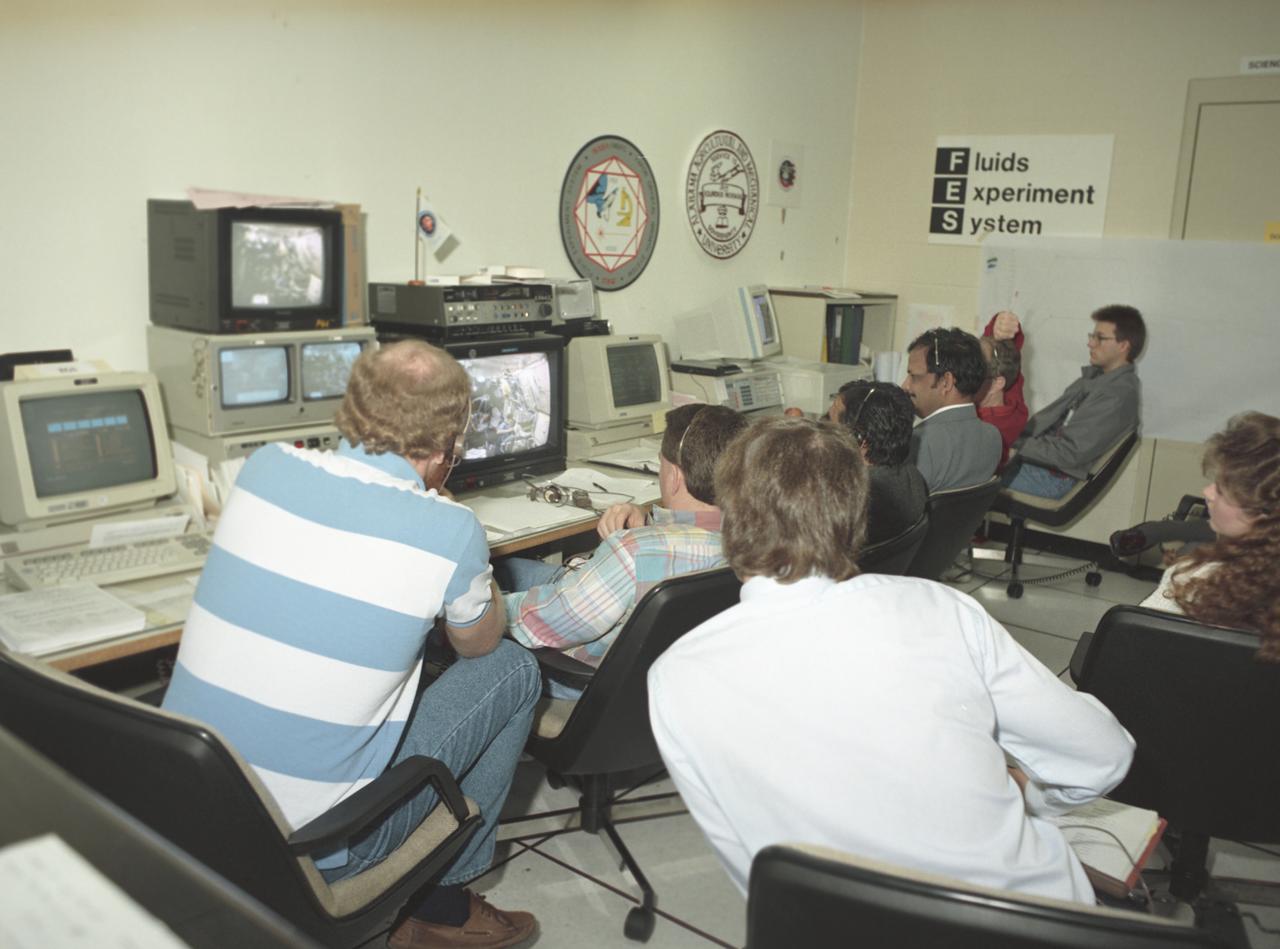
This photograph shows activities during the International Microgravity Laboratory-1 (IML-1) mission (STS-42) in the Payload Operations Control Center (POCC) at the Marshall Space Flight Center. Members of the Fluid Experiment System (FES) group monitor the progress of their experiment through video at the POCC. The IML-1 mission was the first in a series of Shuttle flights dedicated to fundamental materials and life sciences research. The mission was to explore, in depth, the complex effects of weightlessness on living organisms and materials processing. The crew conducted experiments on the human nervous system's adaptation to low gravity and the effects on other life forms such as shrimp eggs, lentil seedlings, fruit fly eggs, and bacteria. Low gravity materials processing experiments included crystal growth from a variety of substances such as enzymes, mercury, iodine, and virus. The International space science research organizations that participated in this mission were: The U.S. National Aeronautics and Space Administion, the European Space Agency, the Canadian Space Agency, the French National Center for Space Studies, the German Space Agency, and the National Space Development Agency of Japan. The POCC was the air/ground communication charnel used between astronauts aboard the Spacelab and scientists, researchers, and ground control teams during the Spacelab missions. The facility made instantaneous video and audio communications possible for scientists on the ground to follow the progress and to send direct commands of their research almost as if they were in space with the crew.

This photograph shows activities during the International Microgravity Laboratory-1 (IML-1) mission (STS-42) in the Payload Operations Control Center (POCC) at the Marshall Space Flight Center. The IML-1 mission was the first in a series of Shuttle flights dedicated to fundamental materials and life sciences research. The mission was to explore, in depth, the complex effects of weightlessness on living organisms and materials processing. The crew conducted experiments on the human nervous system's adaptation to low gravity and the effects on other life forms such as shrimp eggs, lentil seedlings, fruit fly eggs, and bacteria. Low gravity materials processing experiments included crystal growth from a variety of substances such as enzymes, mercury, iodine, and virus. The International space science research organizations that participated in this mission were: The U.S. National Aeronautics and Space Administration, the European Space Agency, the Canadian Space Agency, the French National Center for Space Studies, the German Space Agency, and the National Space Development Agency of Japan. The POCC was the air/ground communication charnel used between the astronauts aboard the Spacelab and scientists, researchers, and ground control teams during the Spacelab missions. The facility made instantaneous video and audio communications possible for scientists on the ground to follow the progress and to send direct commands of their research almost as if they were in space with the crew.
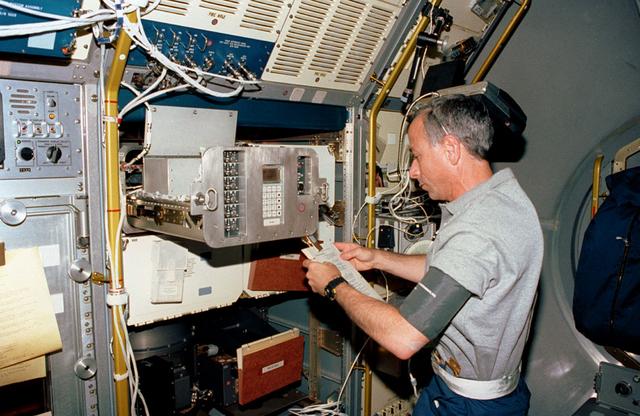
The first United States Microgravity Laboratory (USML-1) was one of NASA's science and technology programs and provided scientists an opportunity to research various scientific investigations in a weightless environment inside the Spacelab module. It also provided demonstrations of new equipment to help prepare for advanced microgravity research and processing aboard the Space Station. The USML-1 flew in orbit for extended periods, providing greater opportunities for research in materials science, fluid dynamics, biotechnology, and combustion science. In this photograph, astronaut Carl Meade is reviewing the manual to activate the Generic Bioprocessing Apparatus (GBA) inside the Spacelab module. The GBA for the USML-1 mission was a multipurpose facility that could help us answer important questions about the relationship between gravity and biology. This unique facility allowed scientists to study biological processes in samples ranging from molecules to small organisms. For example, scientists would examine how collagen, a protein substance found in cornective tissue, bones, and cartilage, forms fibers. In microgravity, it might be possible to alter collagen fiber assembly so that this material could be used more effectively as artificial skin, blood vessels, and other parts of the body. The USML-1 was managed by the Marshall Space Flight Center and waslaunched aboard the Space Shuttle Orbiter Columbia (STS-50) on June 25, 1992.
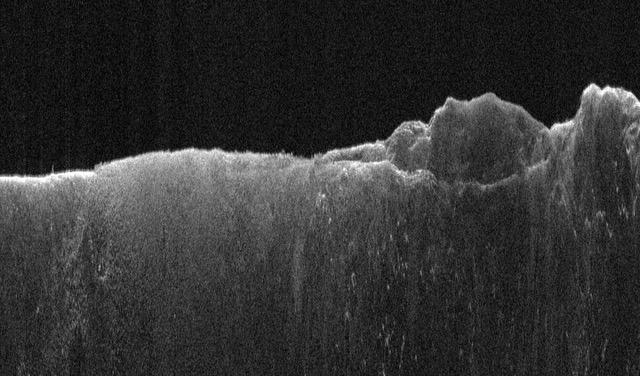
This radargram shows data collected by the Shallow Radar, or SHARAD, on NASA's Mars Reconnaissance Orbiter (MRO) on May 2, 2023, as it performed a 120-degree roll maneuver called a "very large roll" over a formation named Medusae Fossae. Scientists used SHARAD to look for ice beneath the surface of this region. Designed to peer from about a half-mile to a little over a mile (1 to 2 kilometers) below ground, SHARAD emits radio waves that are reflected off materials in the subsurface, measuring how long it takes for those waves to bounce back to the instrument. The longer it takes, the deeper the subsurface layer is. Because different materials reflect radio waves differently, SHARAD allows scientists to distinguish between rock, sand, and ice. While MRO often performs a standard 28-degree roll to give SHARAD's antenna a more direct view of Martian terrain, the 120-degree very large roll rotates the antenna even farther, providing its radio waves an unobstructed path to the surface. This boosts the radar's signals by 10 times or more, giving SHARAD a clearer, deeper view of the Martian underground than ever before. Scientists hope the very large rolls will help them look for frozen and liquid water, among other things. https://photojournal.jpl.nasa.gov/catalog/PIA26555
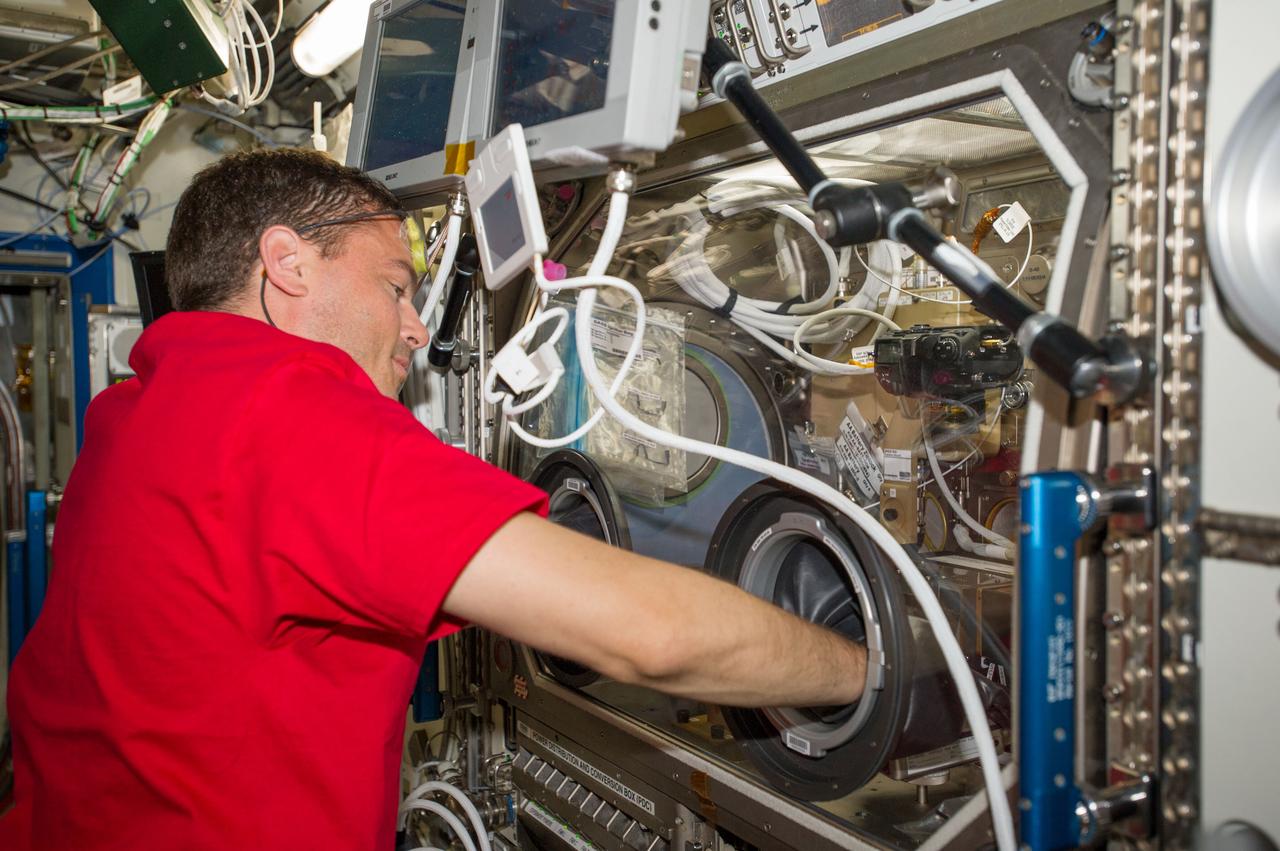
ISS040-E-021546 (26 June 2014) --- NASA astronaut Reid Wiseman, Expedition 40 flight engineer, conducts a combustion experiment known as the Burning and Suppression of Solids (BASS) inside the Microgravity Science Glovebox (MSG) located in the International Space Station?s Destiny laboratory. Without gravity, materials burn quite differently, with a spherical flame instead of the conical shape seen on Earth. BASS is studying the hypothesis that some materials may actually become more flammable in space. Results from BASS will help guide spacecraft materials selection and improve strategies for putting out accidental fires aboard spacecraft. The research also provides scientists with improved computational models that will aid in the design of fire detection and suppression systems here on Earth.
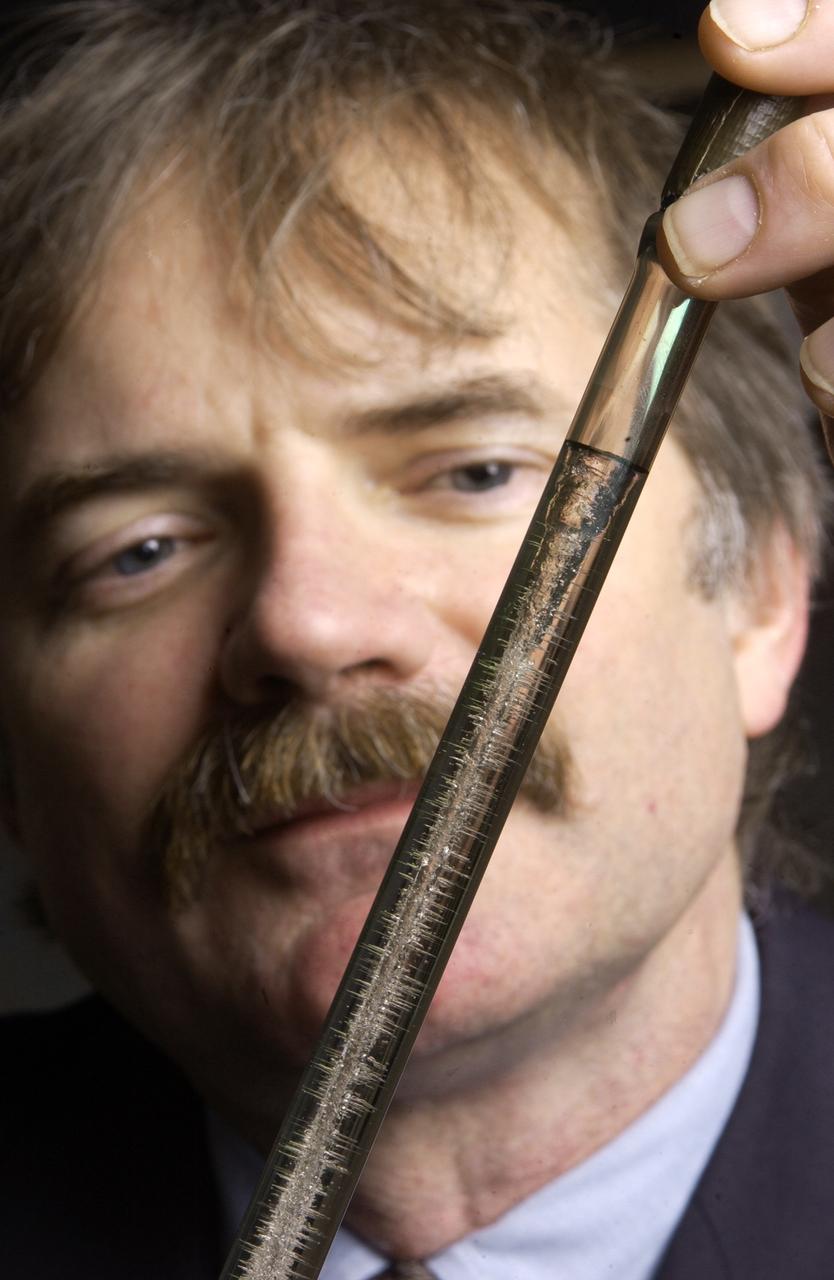
On Earth when scientists melt metals, bubbles that form in the molten material can rise to the surface, pop and disappear. In microgravity -- the near-weightless environment created as the International Space Station orbits Earth -- the lighter bubbles do not rise and disappear. Prior space experiments have shown that bubbles often become trapped in the final metal or crystal sample -similar to the bubbles trapped in this sample. In the solid, these bubbles, or porosity, are defects that diminish both the material's strength and usefulness. The Pore Formation and Mobility Investigation will melt samples of a transparent modeling material, succinonitrile and succinonitrile water mixtures, shown here in an ampoule being examined by Dr. Richard Grugel, the principal investigator for the experiment at NASA's Marshall Space Flight Center in Huntsville, Ala. As the samples are processed in space, Grugel will be able to observe how bubbles form in the samples and study their movements and interactions.
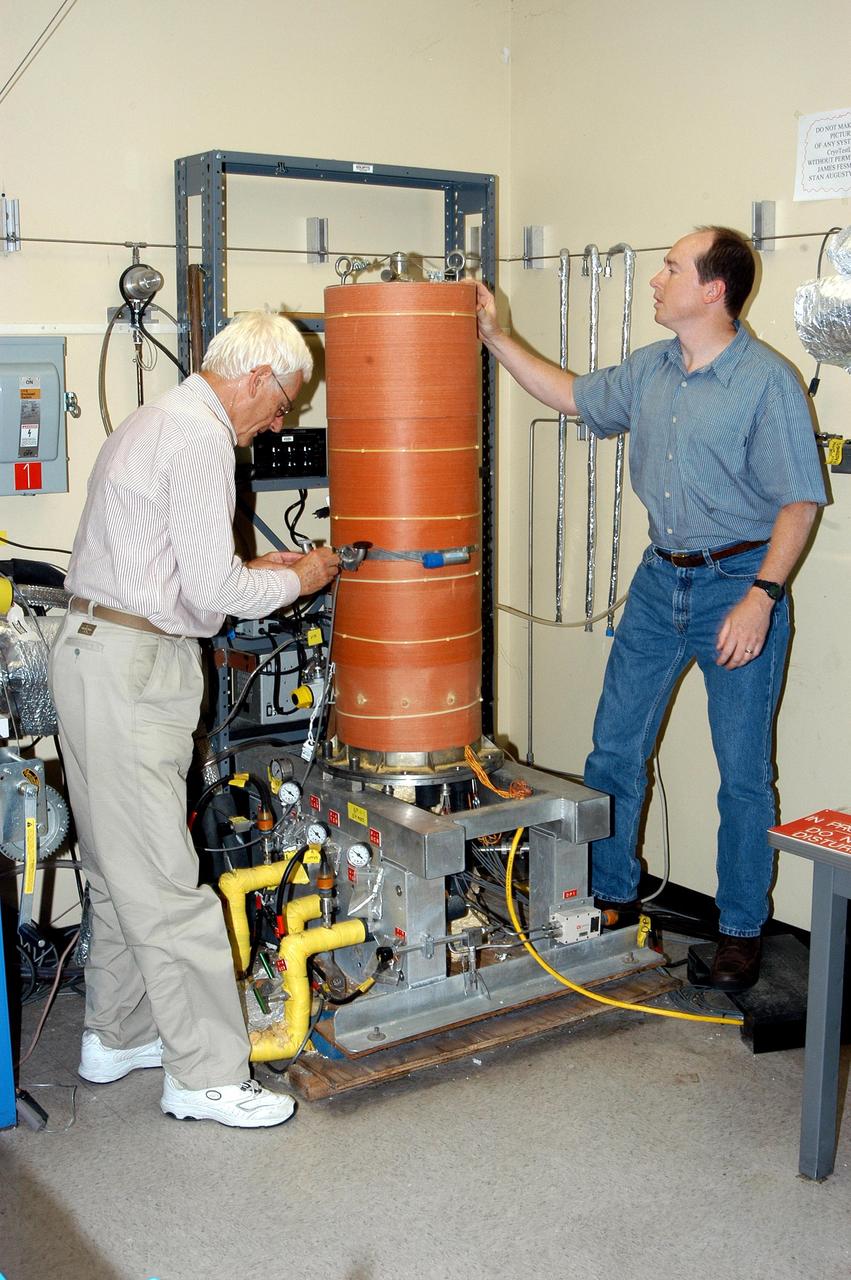
KENNEDY SPACE CENTER, FLA. - James E. Fesmire (right), NASA lead engineer for the KSC Cryogenics Testbed, works on Cryostat-1, the Methods of Testing Thermal Insulation and Association Test Apparatus, which he developed. At left is co-inventor Dr. Stan Augustynowicz, chief scientist with Sierra Lobo Inc. in Milan, Ohio. Cryostat-1 provides absolute thermal performance values of cryogenic insulation systems under real-world conditions. Cryogenic liquid is supplied to a test chamber and two guard chambers, and temperatures are sensed within the vacuum chamber to test aerogels, foams or other materials. The Cryostat-1 machine can detect the absolute heat leakage rates through materials under the full range of vacuum conditions. Fesmire recently acquired three patents for testing thermal insulation materials for cryogenic systems. The research team of the Cryogenics Testbed offers testing and support for a number of programs and initiatives for NASA and commercial customers.
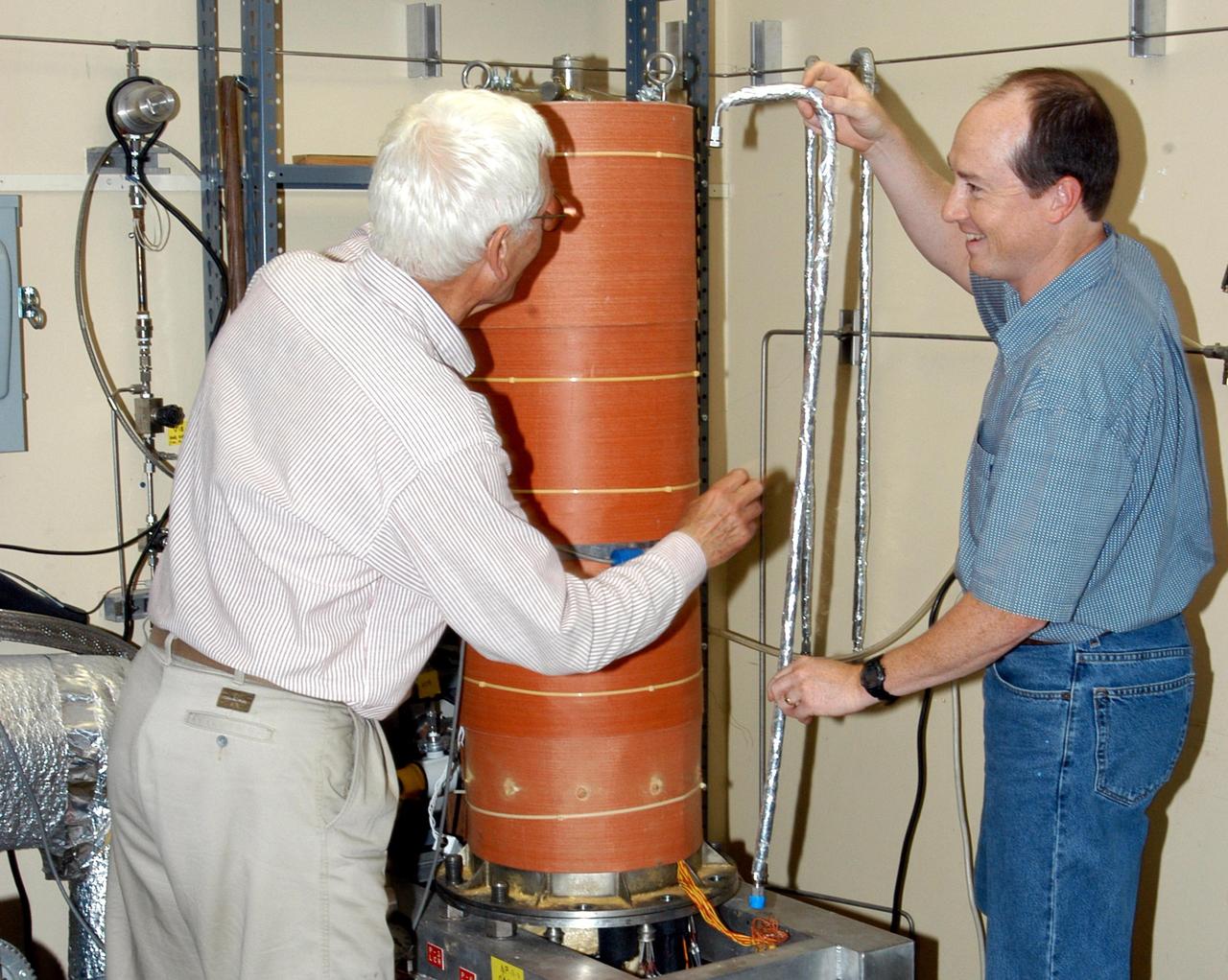
KENNEDY SPACE CENTER, FLA. - James E. Fesmire (right), NASA lead engineer for the KSC Cryogenics Testbed, works on Cryostat-1, the Methods of Testing Thermal Insulation and Association Test Apparatus, which he developed. At left is co-inventor Dr. Stan Augustynowicz, chief scientist with Sierra Lobo Inc. in Milan, Ohio. Cryostat-1 provides absolute thermal performance values of cryogenic insulation systems under real-world conditions. Cryogenic liquid is supplied to a test chamber and two guard chambers, and temperatures are sensed within the vacuum chamber to test aerogels, foams or other materials. The Cryostat-1 machine can detect the absolute heat leakage rates through materials under the full range of vacuum conditions. Fesmire recently acquired three patents for testing thermal insulation materials for cryogenic systems. The research team of the Cryogenics Testbed offers testing and support for a number of programs and initiatives for NASA and commercial customers.

A disk of hot gas swirls around a black hole in this illustration. Some of the gas came from a star that was pulled apart by the black hole, forming the long stream of hot gas on the right, feeding into the disk. These events are formally known as tidal disruption events, or TDEs. It can take just a matter or weeks or months from the destruction of the star to the formation of the disk. The gas gets hotter the closer it gets to the black hole, but the hottest material can be found above the black hole. This hottest material is cloud of plasma (gas atoms with their electrons stripped away) known as a corona. Most TDEs that result in the formation of a corona also produce jets of material that spew into space away from the black hole at its poles. A TDE called AT2021ehb is the first confirmed example of a corona forming without jets in a tidal disruption event. The observation of AT2021ehb makes it possible for scientists to study the formation of jets and coronae separately. https://photojournal.jpl.nasa.gov/catalog/PIA25440
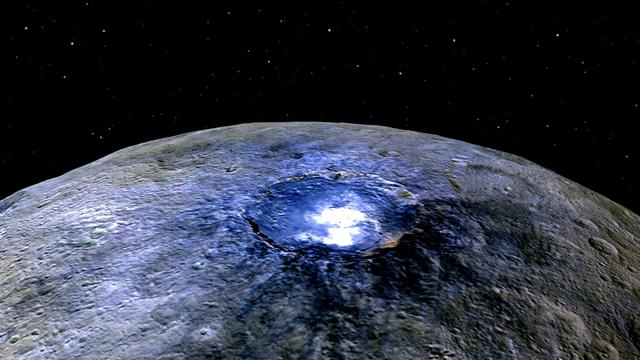
This representation of Ceres' Occator Crater in false colors shows differences in the surface composition. Red corresponds to a wavelength range around 0.97 micrometers (near infrared), green to a wavelength range around 0.75 micrometers (red, visible light) and blue to a wavelength range of around 0.44 micrometers (blue, visible light). Occator measures about 60 miles (90 kilometers) wide. Scientists use false color to examine differences in surface materials. The color blue on Ceres is generally associated with bright material, found in more than 130 locations, and seems to be consistent with salts, such as sulfates. It is likely that silicate materials are also present. The images were obtained by the framing camera on NASA's Dawn spacecraft from a distance of about 2,700 miles (4,400 kilometers). http://photojournal.jpl.nasa.gov/catalog/PIA20180
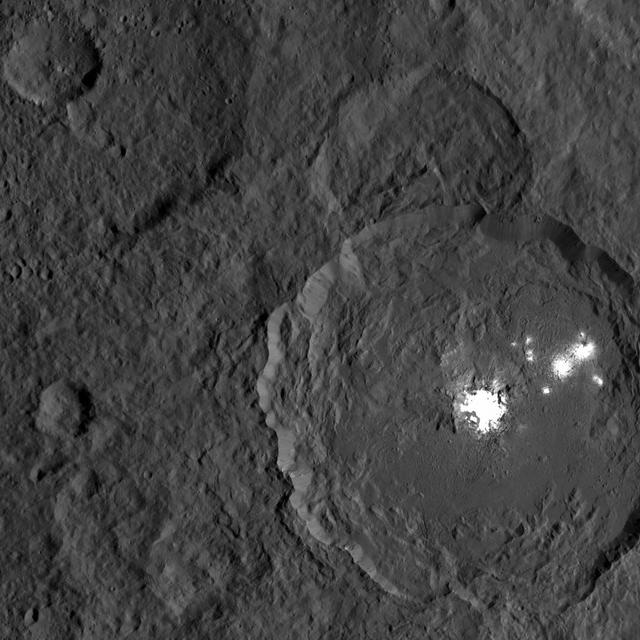
This image from NASA's Dawn spacecraft shows Occator Crater on Ceres, with its signature bright areas. Dawn scientists have found that the central bright spot, which harbors the brightest material on Ceres, contains a variety of salts. The brightest parts of these features are overexposed in this image, which had an exposure time intended to capture details in the surrounding terrain. Shorter exposures allow details within the brightest areas to be seen, as in PIA20653. Dawn took this image on Oct. 18, 2016, from its second extended-mission science orbit (XMO2), at a distance of about 920 miles (1,480 kilometers) above the surface. The image resolution is about 460 feet (140 meters) per pixel. http://photojournal.jpl.nasa.gov/catalog/PIA21227
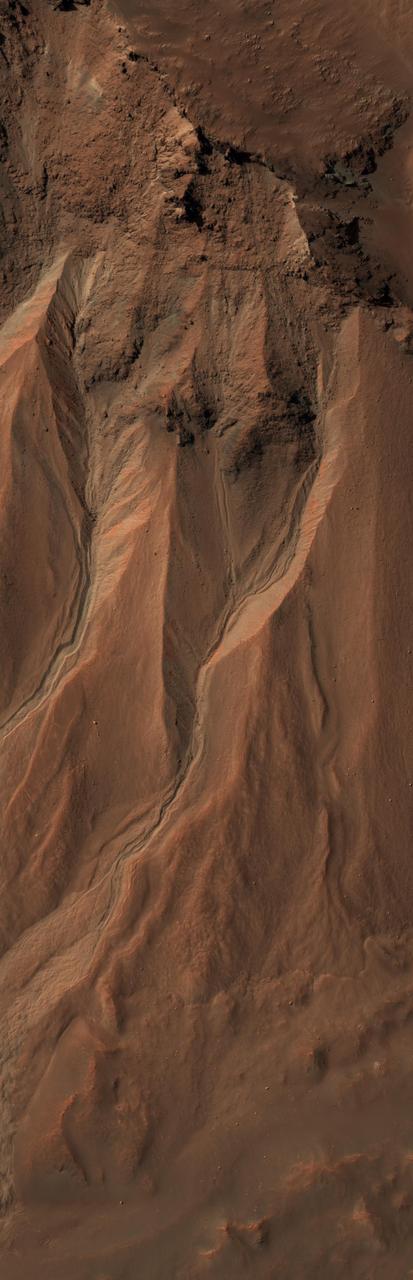
This image from the High Resolution Imaging Science Experiment (HiRISE) camera on NASA's Mars Reconnaissance Orbiter shows gullies near the edge of Hale crater on southern Mars. The view covers an area about 1 kilometer (0.6 mile) across and was taken on Aug. 3, 2009. Martian gullies carved into hill slopes and the walls of impact craters were discovered several years ago. Scientists are excited to study these features because, on Earth, they usually form through the action of liquid water -- long thought to be absent on the Martian surface. Whether liquid water carves gullies under today's cold and dry conditions on Mars is a major question that planetary scientists are trying to answer. The gullies pictured here are examples of what a typical Martian gully looks like. You can see wide V-shaped channels running downhill (from top to bottom) where the material that carved the gully flowed. At the bottom of the channel this material empties out onto a fan-shaped mound. The fans from each gully overlap one other in complicated ways. At the tops of the channels, large amphitheater-shaped alcoves are carved in the rock. The material removed from these alcoves likely flowed downhill to the aprons through the gullies. The terrain in this image is at 36.5 degrees south latitude, 322.7 degrees east longitude. Gullies at this site are especially interesting because scientists recently discovered actively changing examples at similar locations. Images separated by several years showed changes in the appearance of some of these gullies. Today, planetary scientists are using the HiRISE camera to examine gullies such as the one in this image for change that might provide a clue about whether liquid water occurs on the surface of Mars. http://photojournal.jpl.nasa.gov/catalog/PIA12194
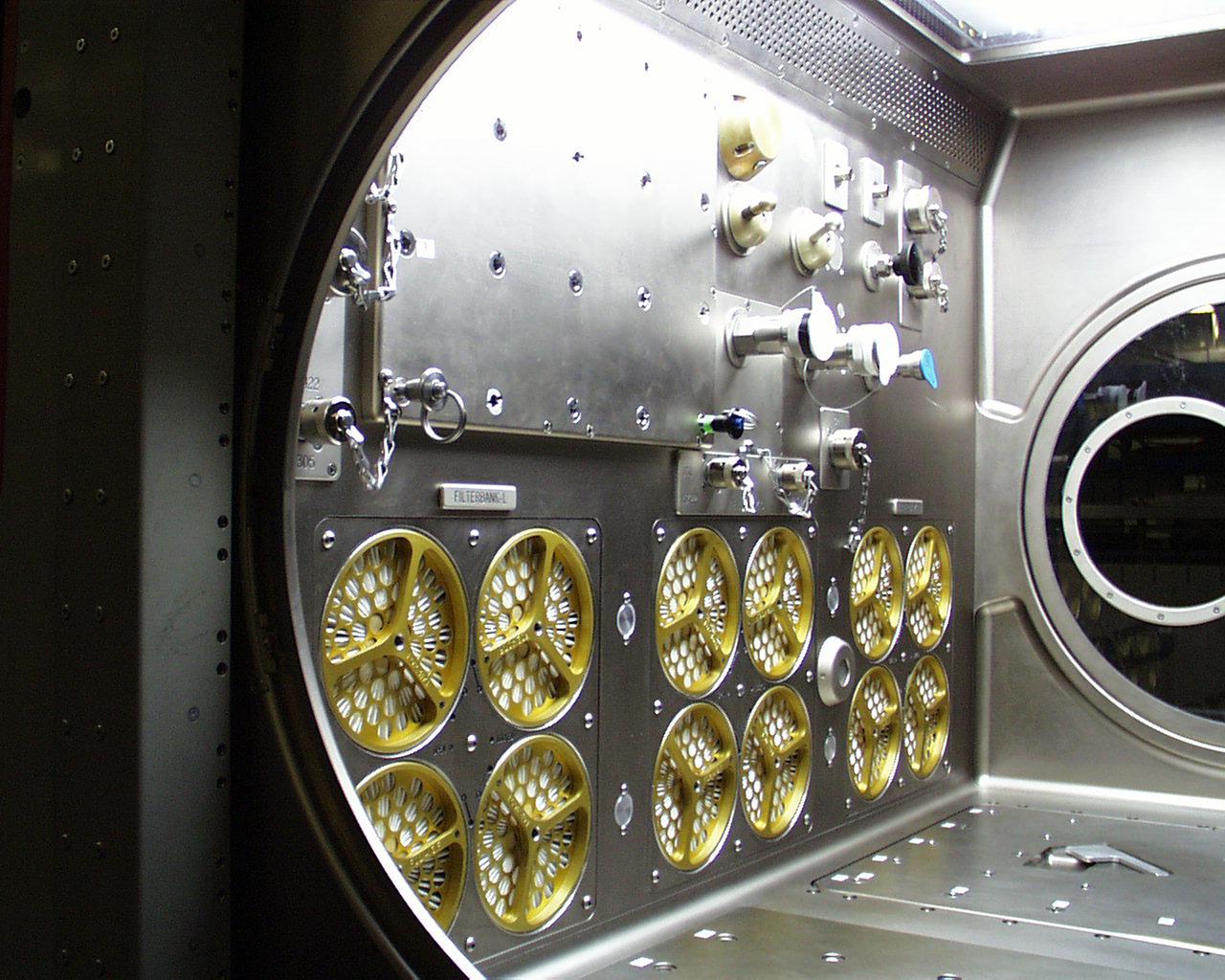
Interior lights give the Microgravity Science Glovebox (MSG) the appearance of a high-tech juke box. The European Space Agency (ESA) and NASA are developing the MSG for use aboard the International Space Station (ISS). Scientists will use the MSG to carry out multidisciplinary studies in combustion science, fluid physics and materials science. The MSG is managed by NASA's Marshall Space Flight Center (MSFC). Photo Credit: NASA/MSFC
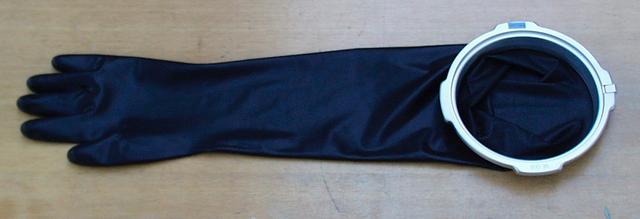
This photo shows a rubber glove and its attachment ring for the Microgravity Science Glovebox (MSG) being developed by the European Space Agency (ESA) and NASA for use aboard the International Space Station (ISS). Scientists will use the MSG to carry out multidisciplinary studies in combustion science, fluid physics and materials science. The MSG is managed by NASA's Marshall Space Flight Center (MSFC). Photo Credit: NASA/MSFC
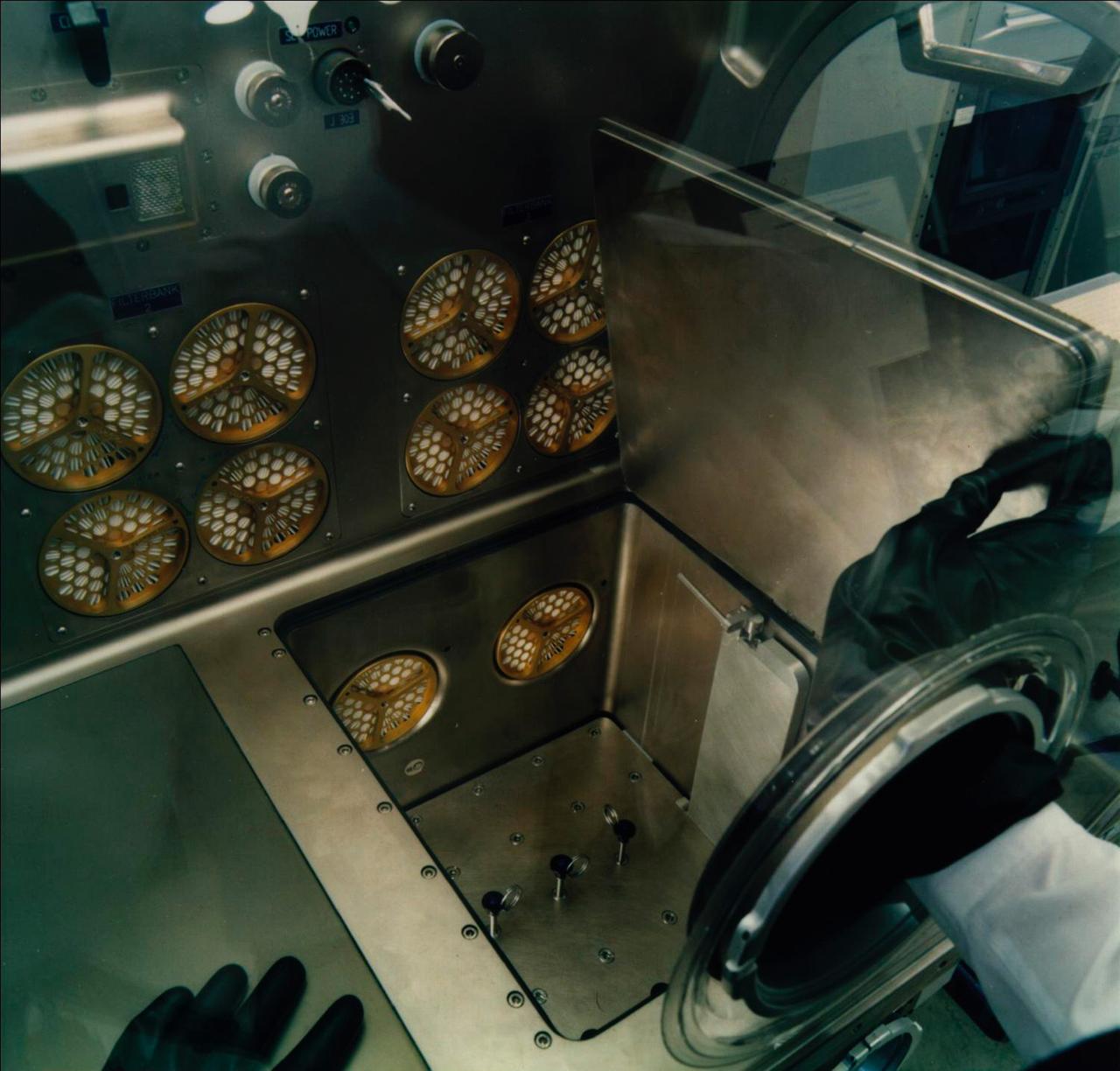
This photo shows the access through the internal airlock (bottom right) on the Microgravity Science Glovebox (MSG) being developed by the European Space Agency (ESA) and NASA for use aboard the International Space Station (ISS). Scientists will use the MSG to carry out multidisciplinary studies in combustion science, fluid physics and materials science. The MSG is managed by NASA's Marshall Space Flight Center (MSFC). Photo Credit: NASA/MSFC
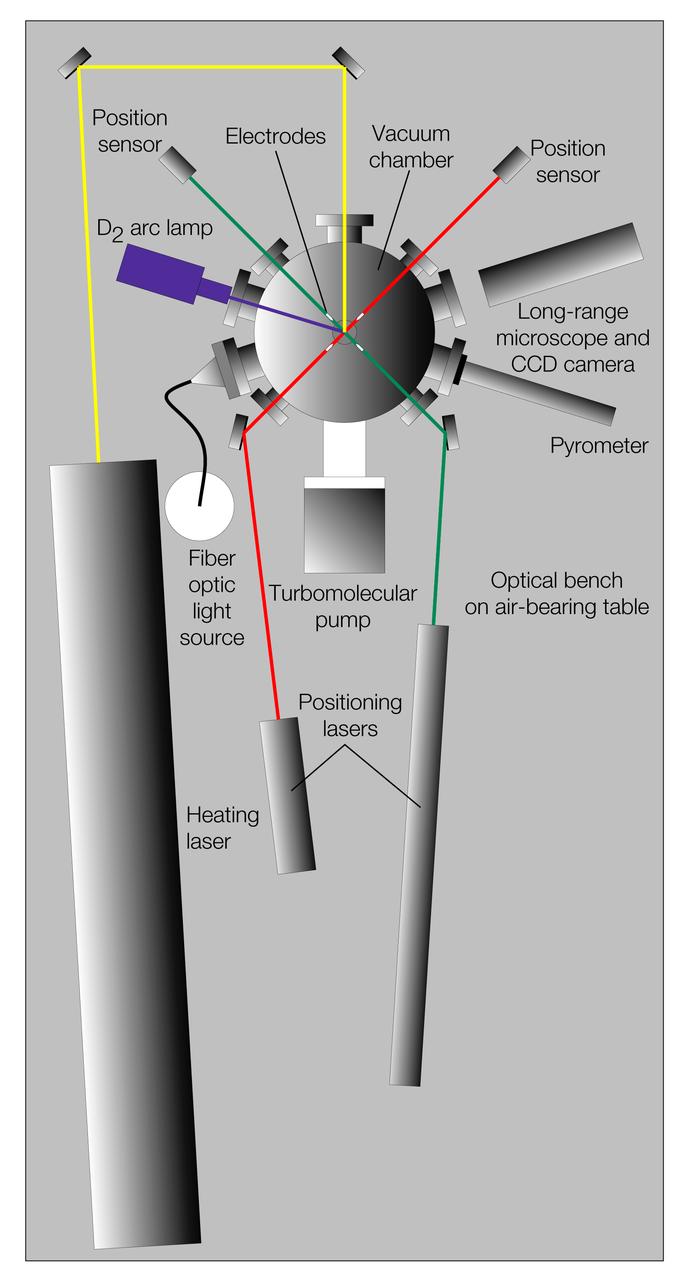
General oayout of Electrostatic Levitator (ESL). The ESL uses static electricity to suspend an object (about 2-3 mm in diameter) inside a vacuum chamber while a laser heats the sample until it melts. This lets scientists record a wide range of physical properties without the sample contacting the container or any instruments, conditions that would alter the readings. The Electrostatic Levitator is one of several tools used in NASA's microgravity materials science program.
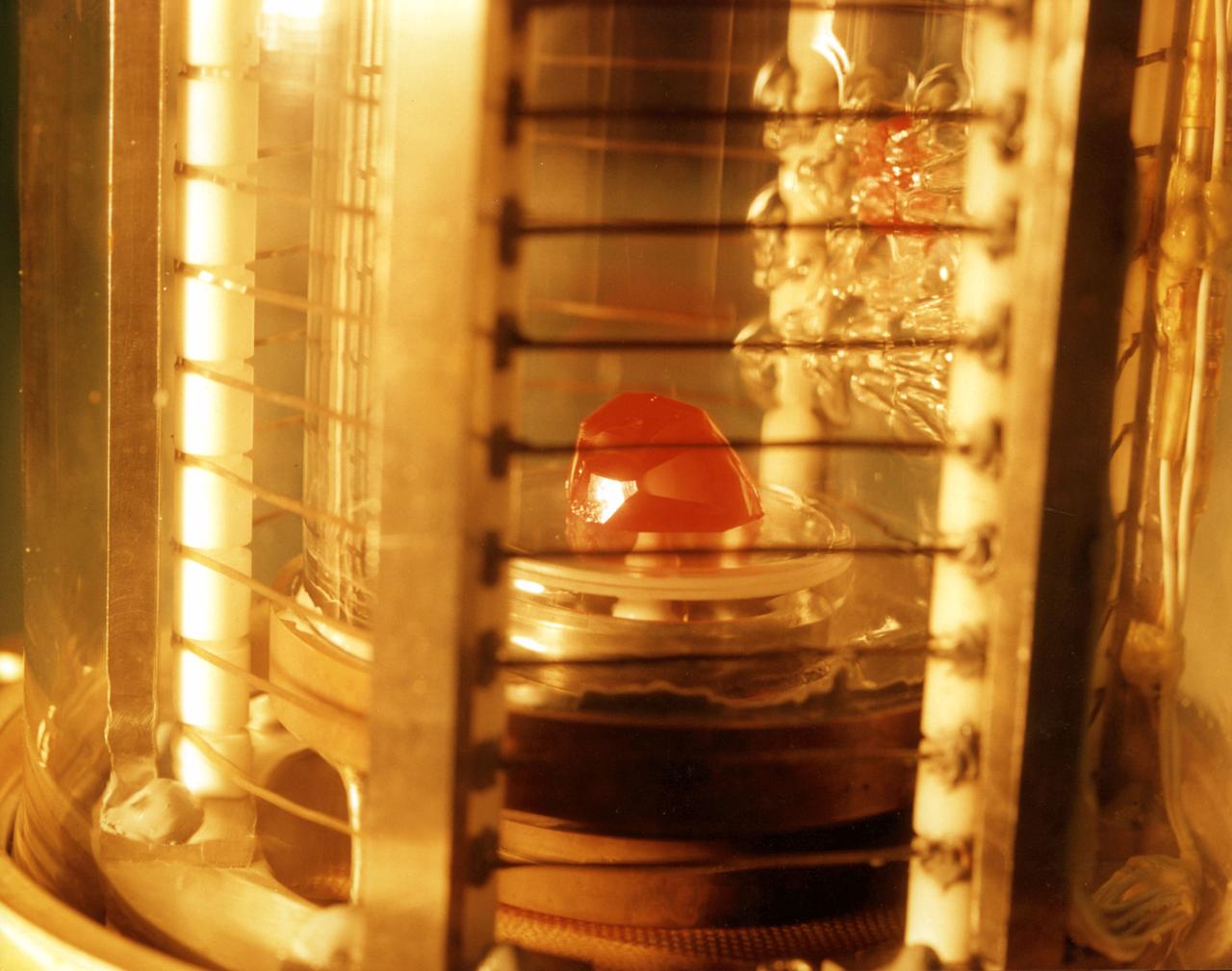
The image shows a test cell of Crystal Growth experiment inside the Vapor Crystal Growth System (VCGS) furnace aboard the STS-42, International Microgravity Laboratory-1 (IML-1), mission. The goal of IML-1, a pressurized marned Spacelab module, was to explore in depth the complex effects of weightlessness of living organisms and materials processing. More than 200 scientists from 16 countires participated in the investigations.
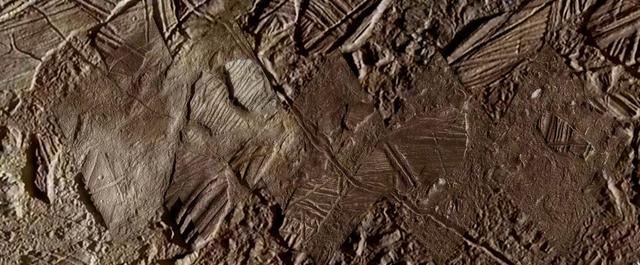
This image shows a close-up view of terrain within the region of Europa's surface named Conamara. This region sports ice rafts that look like those at Earth's poles, where large chunks of ice break away and float freely on the ocean. Much of the region bears the reddish/brownish discoloration seen here – the same as seen along many of Europa's fractures. Scientists believe this material may contain clues about the composition of an ocean beneath the icy surface, if it is proven to exist. https://photojournal.jpl.nasa.gov/catalog/PIA26446
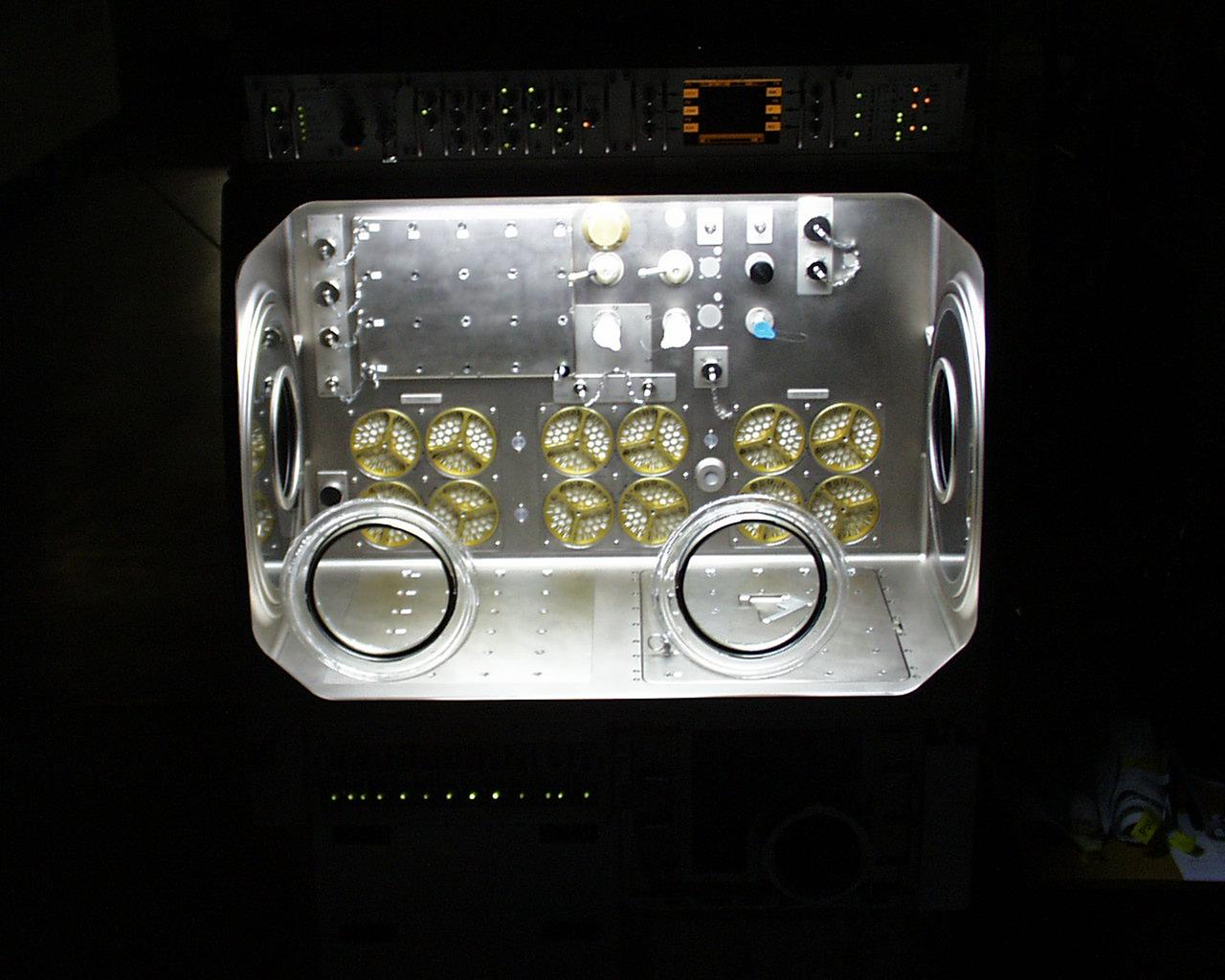
Interior lights give the Microgravity Science Glovebox (MSG) the appearance of a high-tech juke box. The European Space Agency (ESA) and NASA are developing the MSG for use aboard the International Space Station (ISS). Scientists will use the MSG to carry out multidisciplinary studies in combustion science, fluid physics and materials science. The MSG is managed by NASA's Marshall Space Flight Center (MSFC). Photo Credit: NASA/MSFC
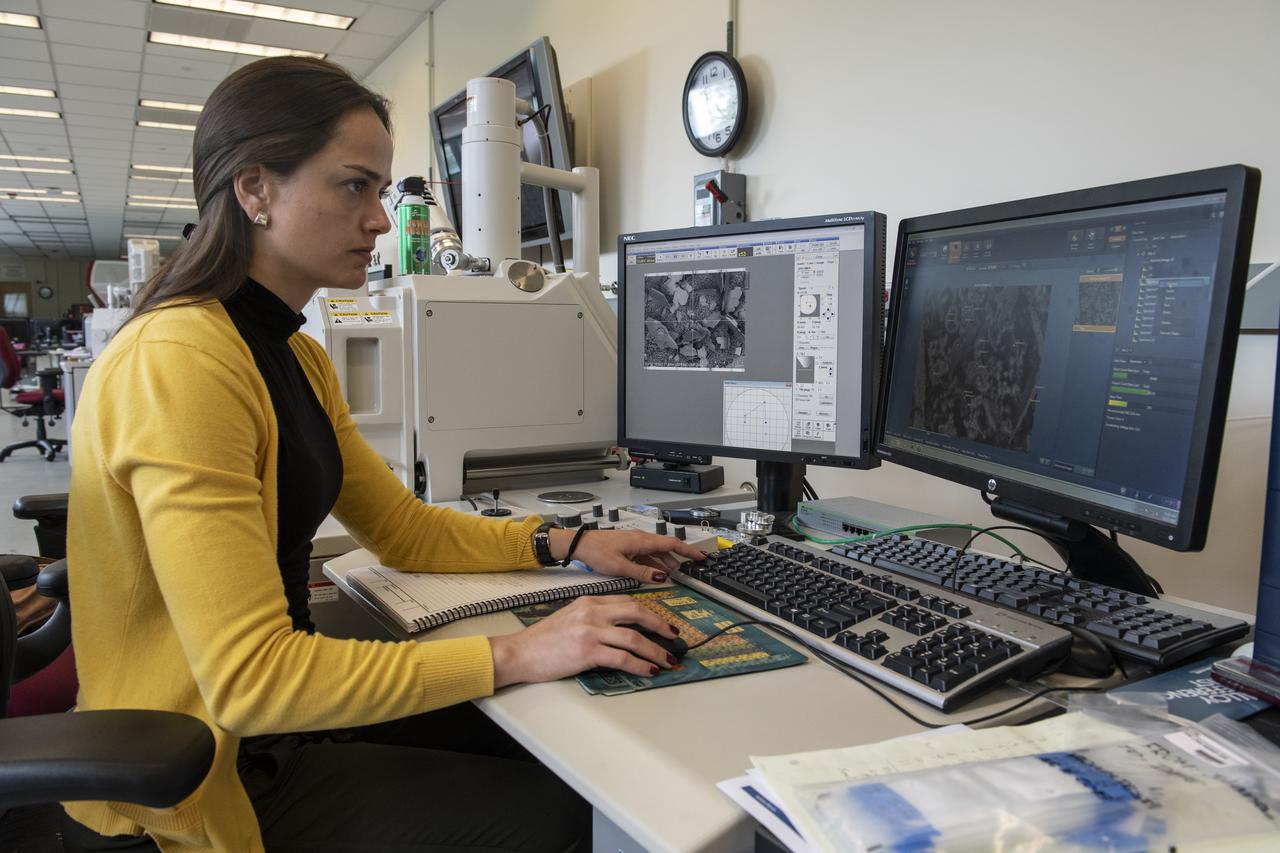
Marshall graduate student researcher Juliana Neves, who is pursuing her doctorate in civil engineering at Pennsylvania State University, monitors cement paste samples returned from space as part of the Microgravity Investigation of Cement Solidification. Neves, investigators at Penn State and Marshall researchers led by NASA materials scientist Richard Grugel mirrored each sample experiment conducted on the International Space Station -- 120 tests on the ground, 120 in orbit -- and will continue to assess their findings in months to come.
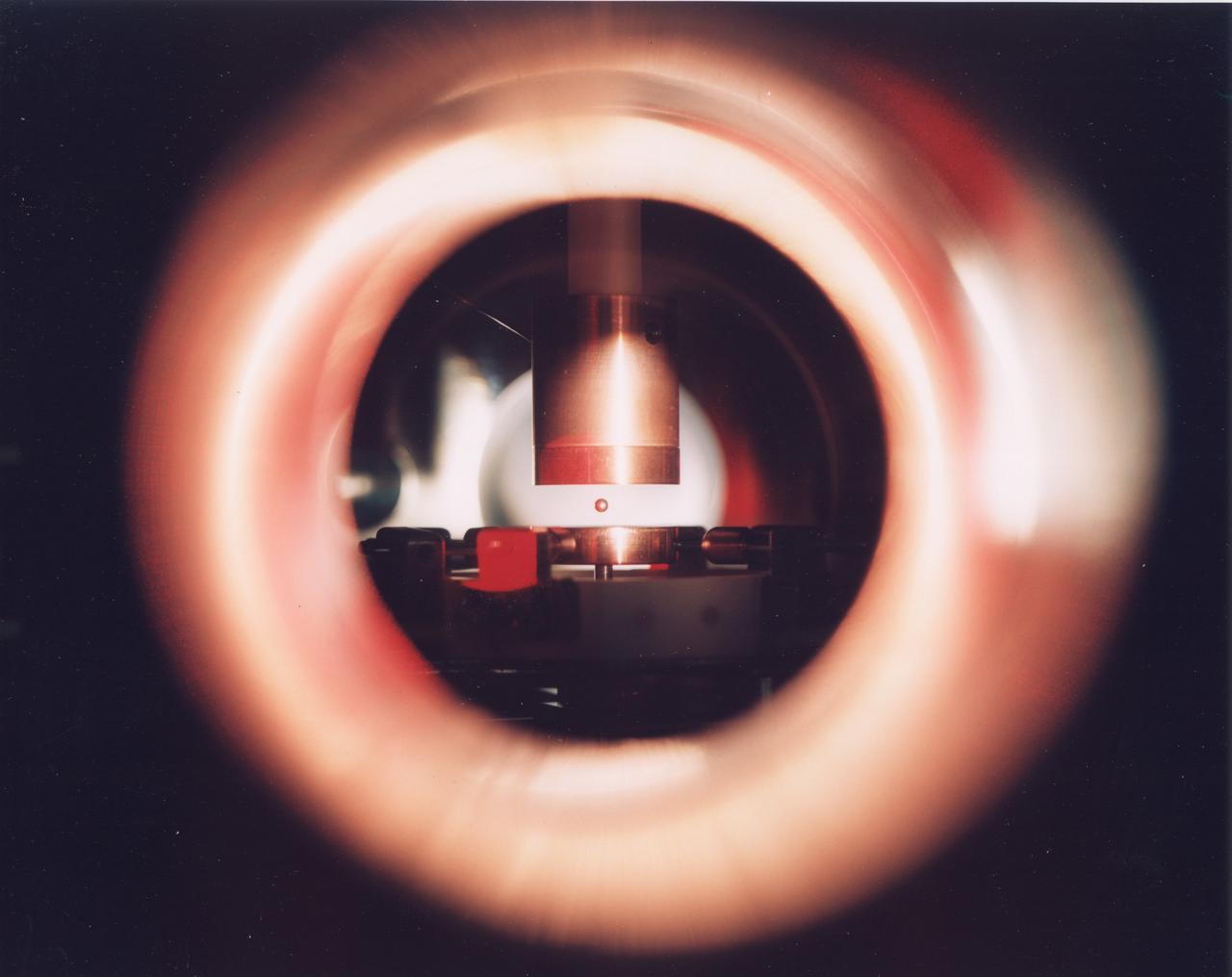
Metal droplet levitated inside the Electrostatic Levitator (ESL). The ESL uses static electricity to suspend an object (about 2-3 mm in diameter) inside a vacuum chamber while a laser heats the sample until it melts. This lets scientists record a wide range of physical properties without the sample contacting the container or any instruments, conditions that would alter the readings. The Electrostatic Levitator is one of several tools used in NASA's microgravity materials science program.

jsc2024e043917 (7/10/2024) --- Packed Bed Reactor Experiment-Water Recovery (PBRE-WR) examines flow rates of gas and liquid through a filtering substrate in the space station water processor, replacing oxygen with nitrogen. This preflight image shows the PBRE-WR test section with alumina packed bed material loaded. Scientists aim to learn more about how reduced gravity affects the performance and reliability of various filtration systems
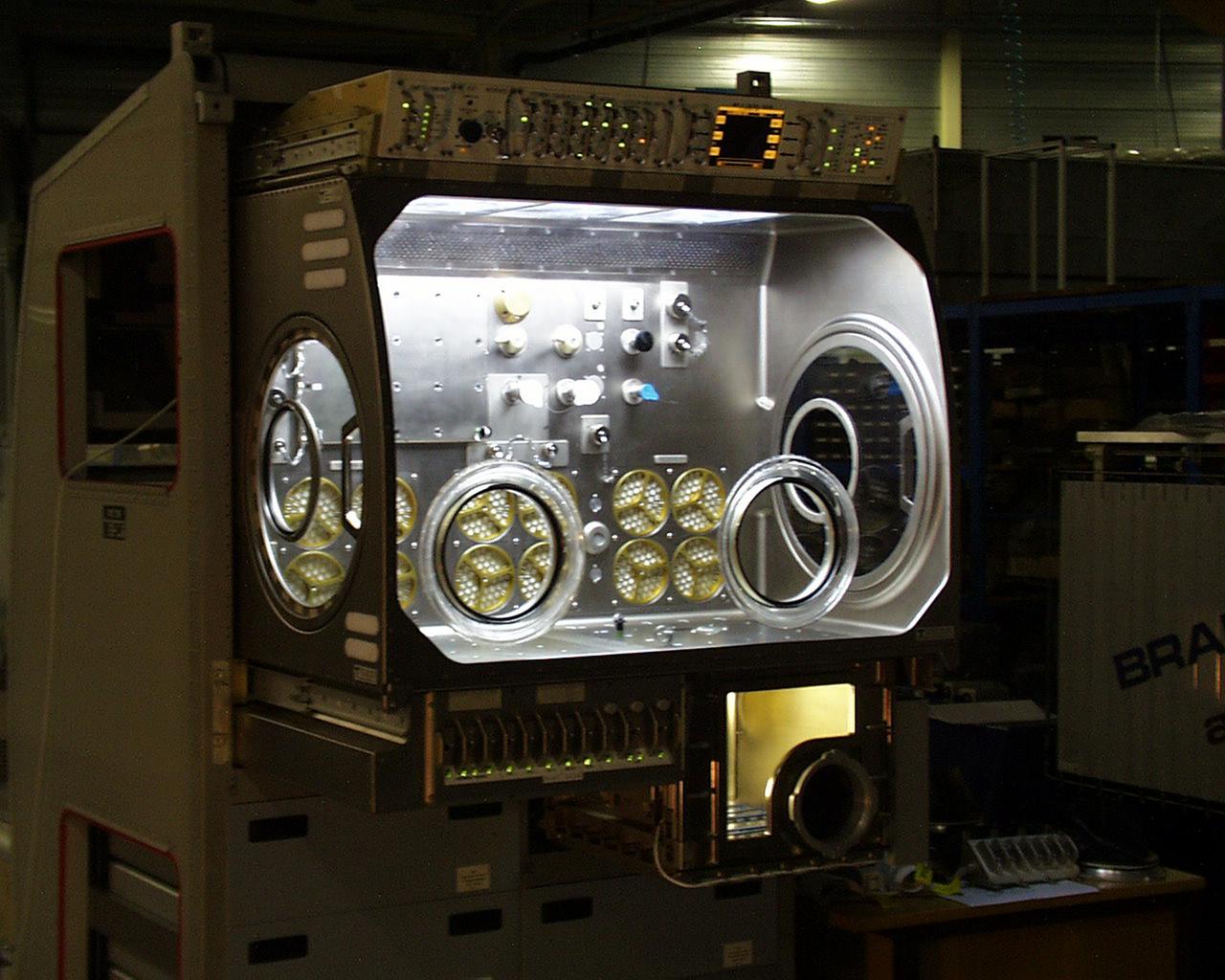
Interior lights give the Microgravity Science Glovebox (MSG) the appearance of a high-tech juke box. The European Space Agency (ESA) and NASA are developing the MSG for use aboard the International Space Station (ISS). Scientists will use the MSG to carry out multidisciplinary studies in combustion science, fluid physics and materials science. The MSG is managed by NASA's Marshall Space Flight Center (MSFC). Photo Credit: NASA/MSFC
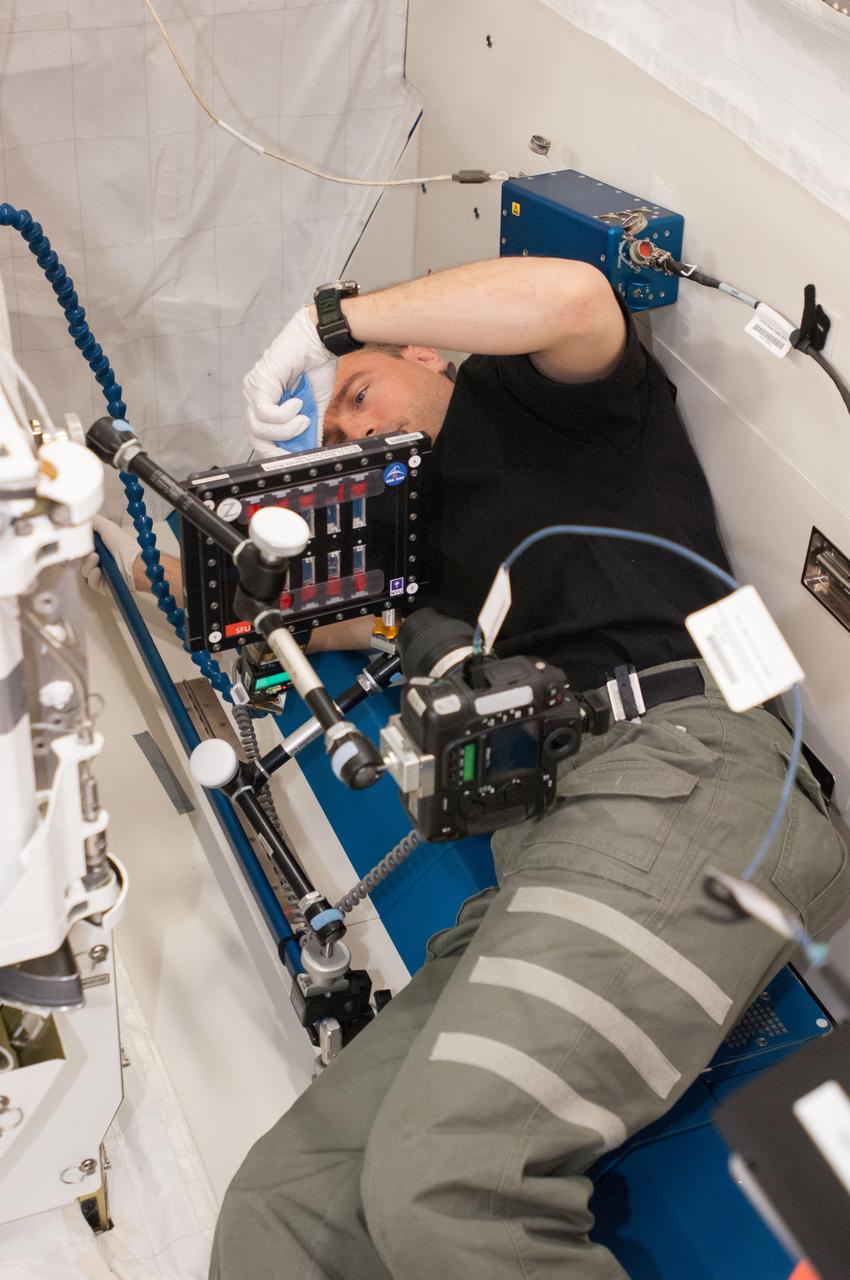
ISS040-E-076505 (25 July 2014) --- NASA astronaut Reid Wiseman, Expedition 40 flight engineer, conducts a session with the Binary Colloidal Alloy Test-C1, or BCAT-C1, experiment in the Kibo laboratory of the International Space Station. Results from this ongoing investigation of colloids ? mixtures of small particles distributed throughout a liquid ? will help materials scientists to develop new consumer products with unique properties and longer shelf lives.
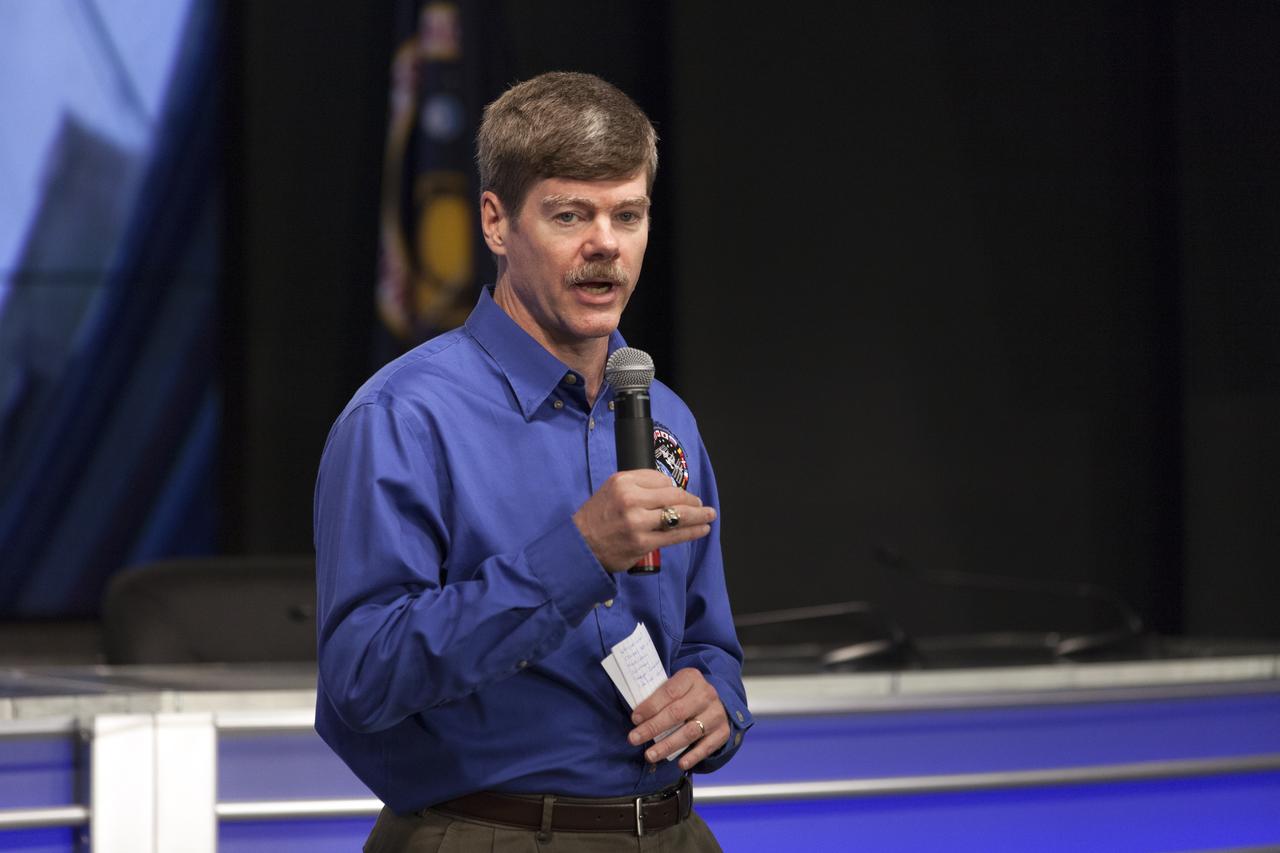
Pete Hasbrook, associate program scientist for the International Space Station Program, speaks to members of social media in the Kennedy Space Center’s Press Site auditorium. The briefing focused on research planned for launch to the International Space Station. The scientific materials and supplies will be aboard a Dragon spacecraft scheduled for launch from Kennedy’s Launch Complex 39A on Aug. 14 atop a SpaceX Falcon 9 rocket on the company's 12th Commercial Resupply Services mission to the space station.
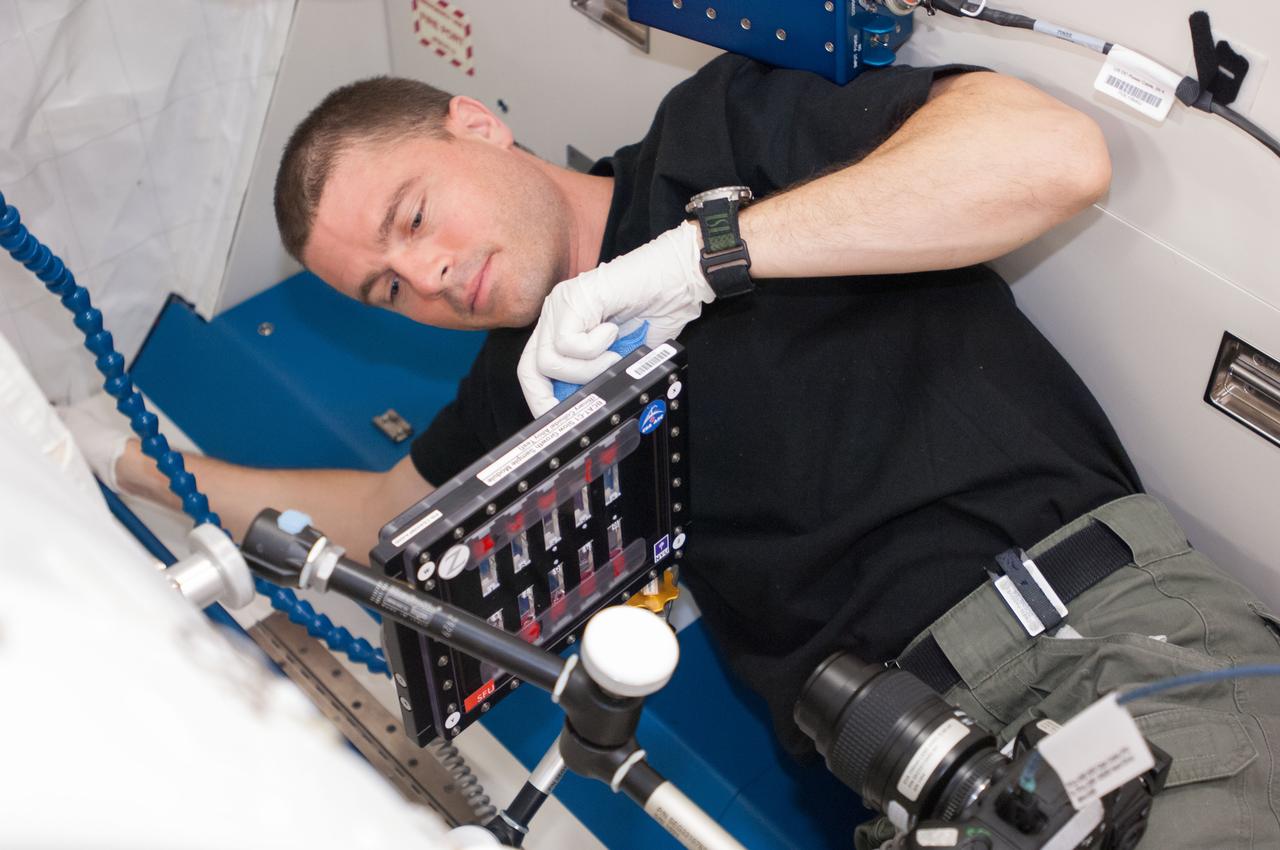
ISS040-E-076510 (25 July 2014) --- NASA astronaut Reid Wiseman, Expedition 40 flight engineer, conducts a session with the Binary Colloidal Alloy Test-C1, or BCAT-C1, experiment in the Kibo laboratory of the International Space Station. Results from this ongoing investigation of colloids ? mixtures of small particles distributed throughout a liquid ? will help materials scientists to develop new consumer products with unique properties and longer shelf lives.

Peter Pilewskie, lead scientist at the University of Colorado-Boulder, speaks to members of social media in the Kennedy Space Center’s Press Site auditorium. The briefing focused on research planned for launch to the International Space Station. The scientific materials and supplies will be aboard a Dragon spacecraft scheduled for liftoff from Cape Canaveral Air Force Station's Space Launch Complex 40 at 11:46 a.m. EST, on Dec. 12, 2017. The SpaceX Falcon 9 rocket will launch the company's 13th Commercial Resupply Services mission to the space station.
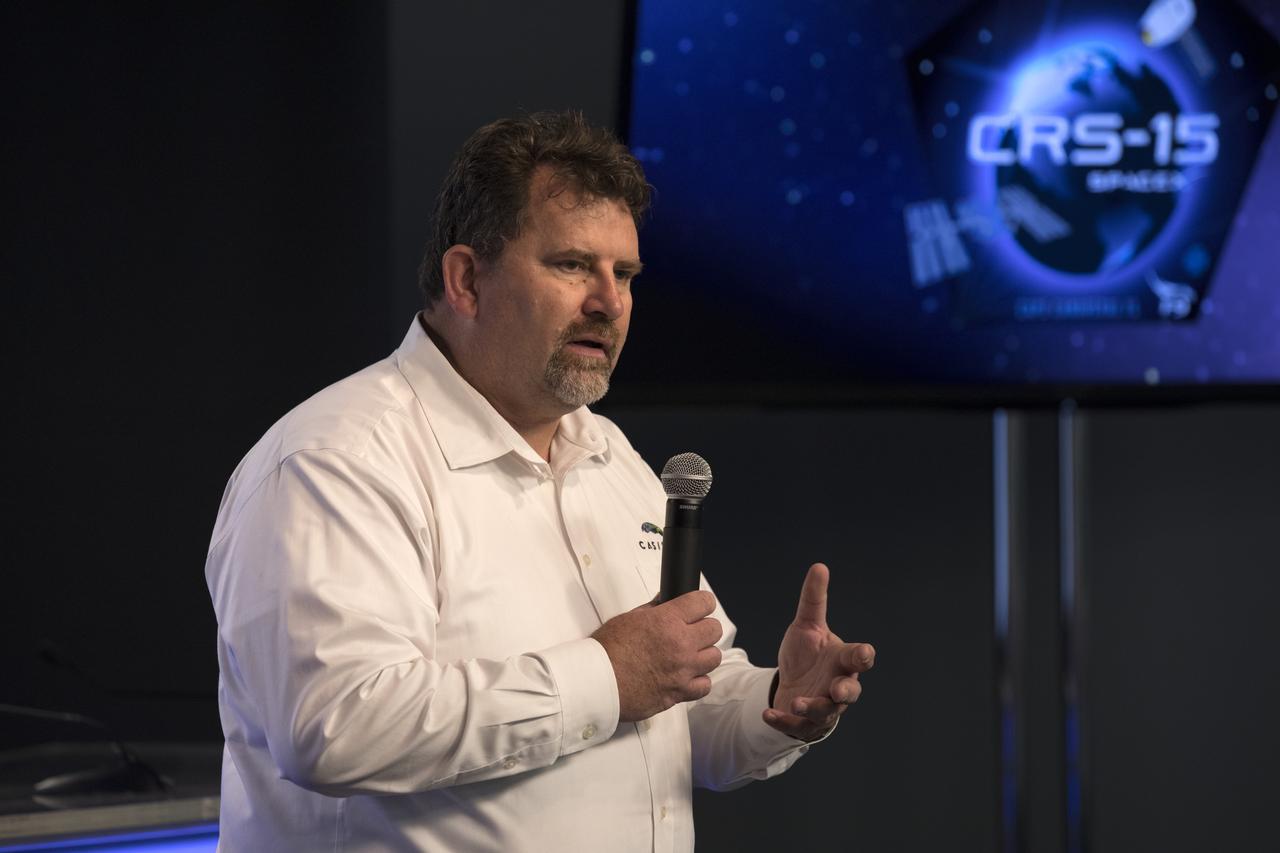
Mike Roberts, deputy chief scientist, Center for the Advancement of Science in Space (CASIS), speaks to members of the media during a briefing in the Kennedy Space Center’s Press Site auditorium. The briefing focused on research planned for launch to the International Space Station. The scientific materials and supplies will be aboard a SpaceX Dragon spacecraft scheduled for liftoff from Cape Canaveral Air Force Station's Space Launch Complex 40. The SpaceX Falcon 9 rocket will launch the company's 15th Commercial Resupply Services mission to the space station.

Dr. Camille Alleyne, associate program scientist for the International Space Station (ISS) at NASA’s Johnson Space Center, speaks to members of social media in the Kennedy Space Center’s Press Site auditorium. The briefing focused on research planned for launch to the International Space Station. The scientific materials and supplies will be aboard a Dragon spacecraft scheduled for launch from Kennedy’s Launch Complex 39A on June 1 atop a SpaceX Falcon 9 rocket on the company's 11th Commercial Resupply Services mission to the space station.
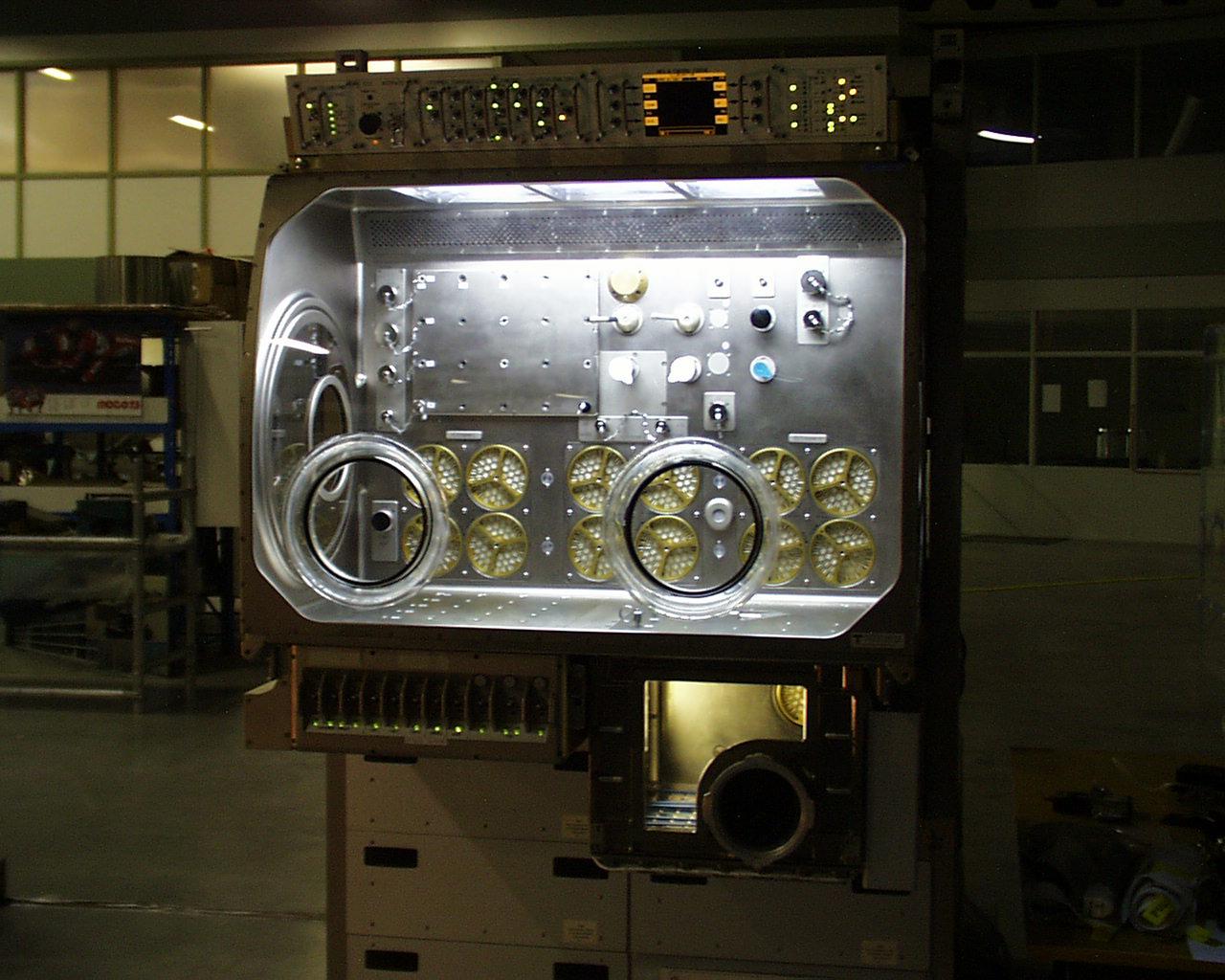
Interior lights give the Microgravity Science Glovebox (MSG) the appearance of a high-tech juke box. The European Space Agency (ESA) and NASA are developing the MSG for use aboard the International Space Station (ISS). Scientists will use the MSG to carry out multidisciplinary studies in combustion science, fluid physics and materials science. The MSG is managed by NASA's Marshall Space Flight Center (MSFC). Photo Credit: NASA/MSFC
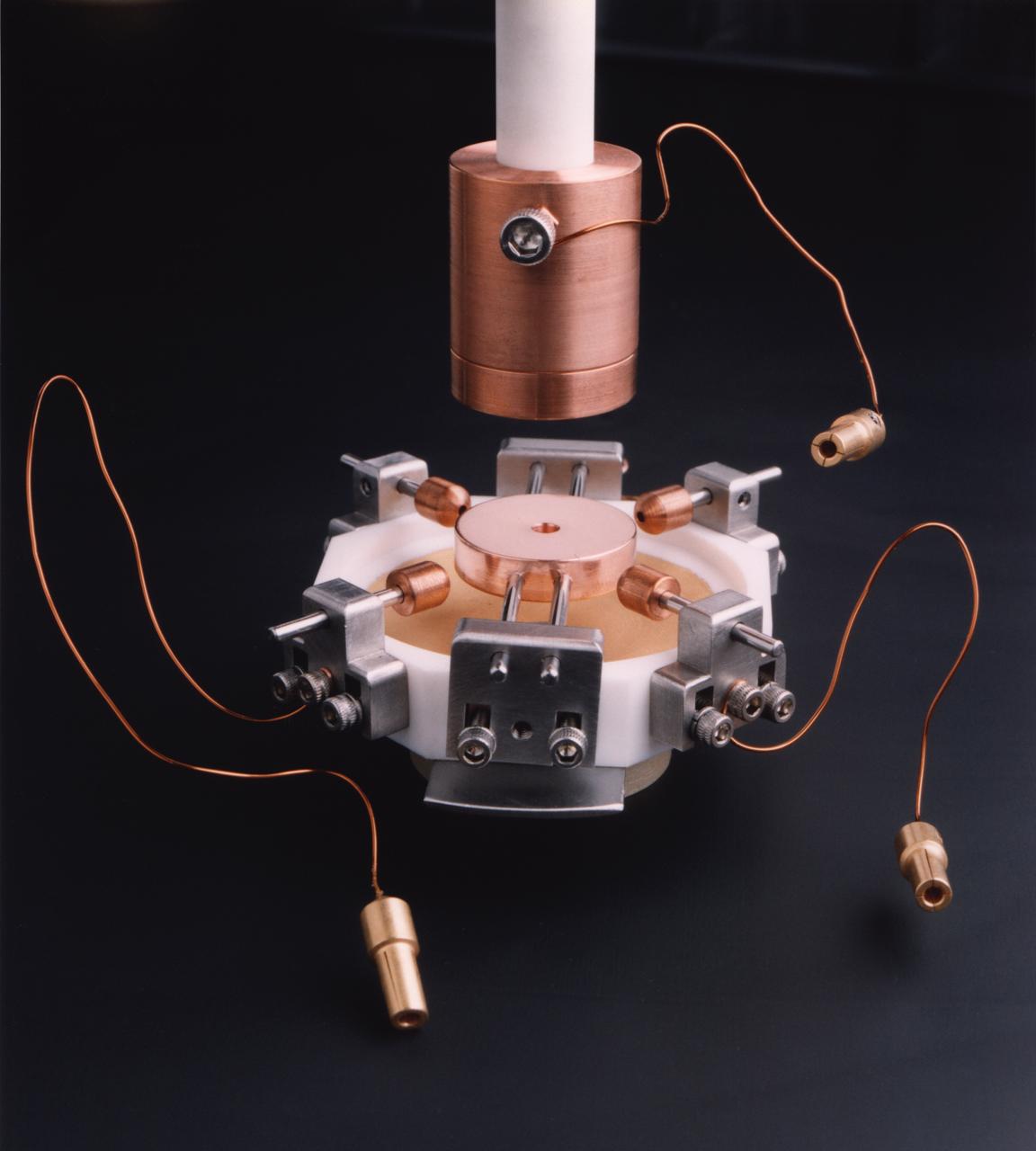
Electrostatic levitation system inside Electrostatic Levitator (ESL) vacuum chamber. The ESL uses static electricity to suspend an object (about 2-3 mm in diameter) inside a vacuum chamber while a laser heats the sample until it melts. This lets scientists record a wide range of physical properties without the sample contacting the container or any instruments, conditions that would alter the readings. The Electrostatic Levitator is one of several tools used in NASA's microgravity materials science program.
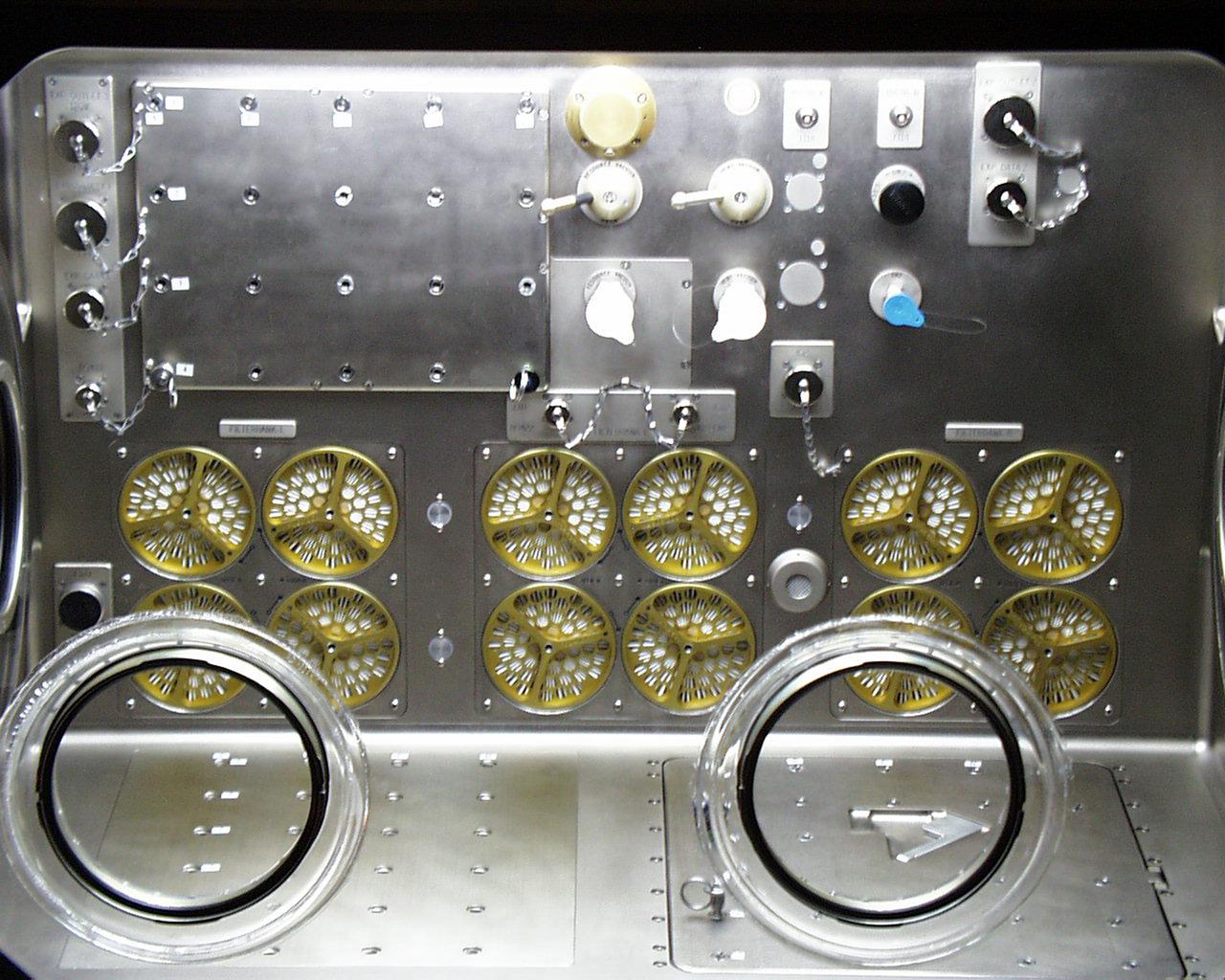
Interior lights give the Microgravity Science Glovebox (MSG) the appearance of a high-tech juke box. The European Space Agency (ESA) and NASA are developing the MSG for use aboard the International Space Station (ISS). Scientists will use the MSG to carry out multidisciplinary studies in combustion science, fluid physics and materials science. The MSG is managed by NASA's Marshall Space Flight Center (MSFC). Photo Credit: NASA/MSFC
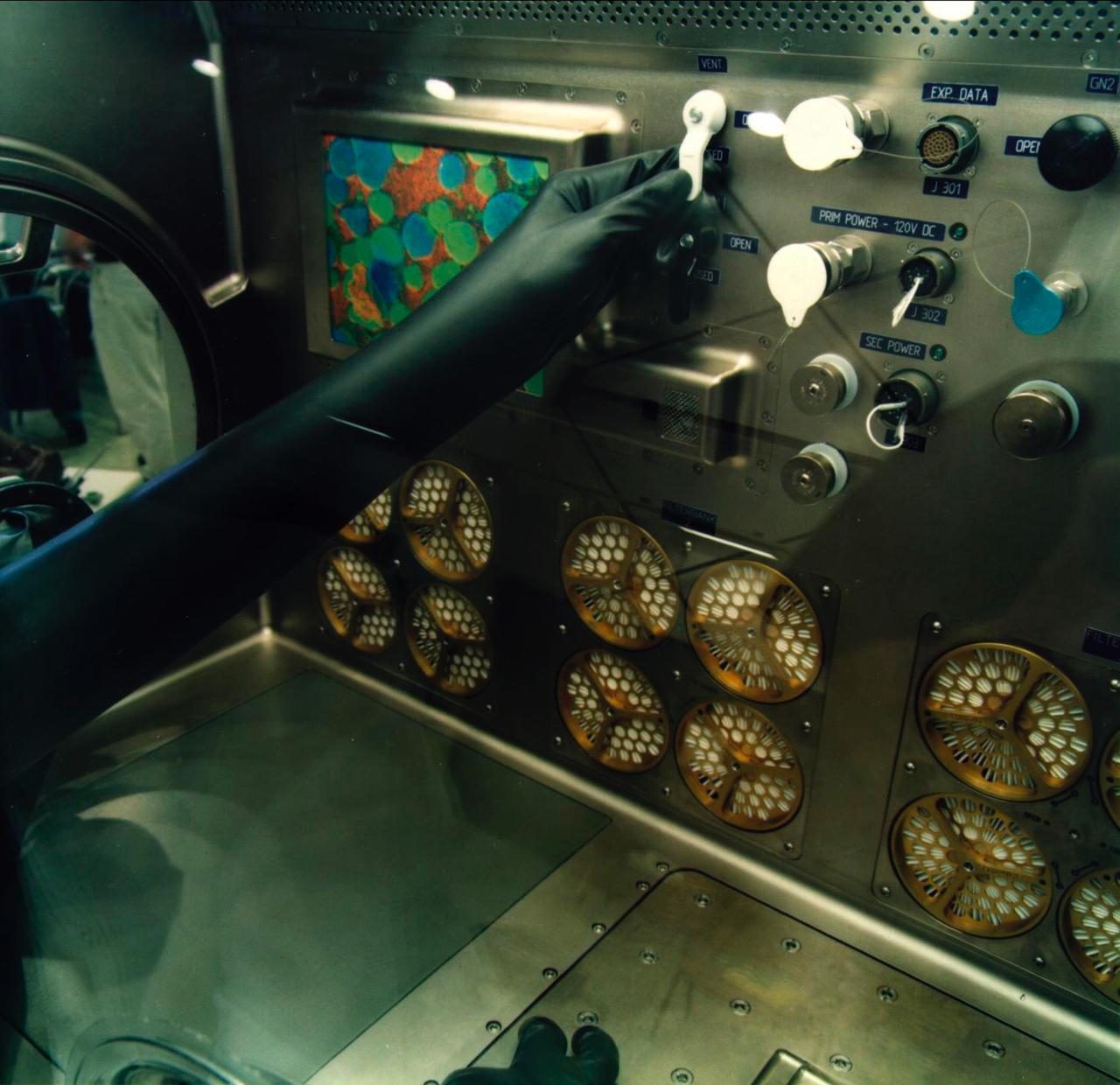
This photo shows the interior reach in the Microgravity Science Glovebox (MSG) being developed by the European Space Agency (ESA) and NASA for use aboard the International Space Station (ISS). Scientists will use the MSG to carry out multidisciplinary studies in combustion science, fluid physics and materials science. The MSG is managed by NASA's Marshall Space Flight Center (MSFC). Photo Credit: NASA/MSFC

The Microgravity Science Glovebox (MSG) is being developed by the European Space Agency (ESA) and NASA for use aboard the International Space Station (ISS). Scientists will use the MSG to carry out multidisciplinary studies in combustion science, fluid physics and materials science. The MSG is managed by NASA's Marshall Space Flight Center (MSFC). Photo Credit: NASA/MSFC
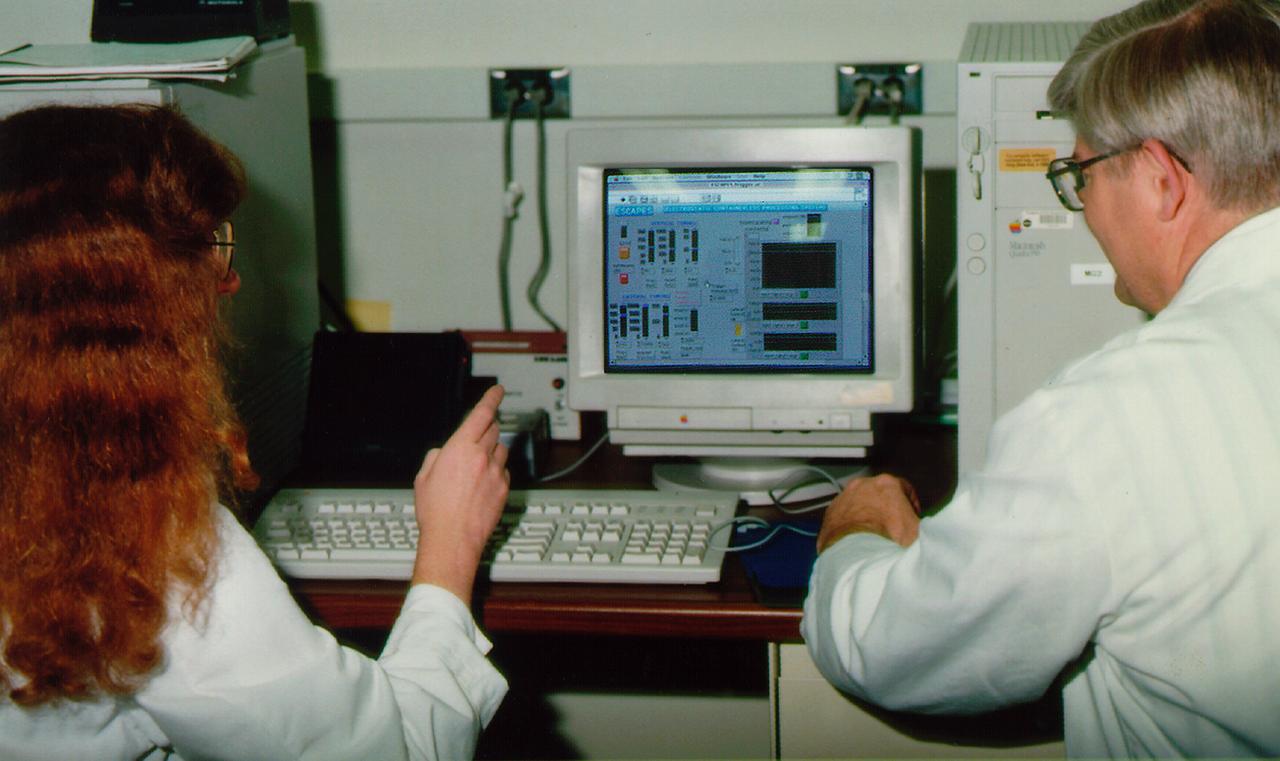
Dr. Jan Rogers and Dr. Michael Robinson operate the Electrostatic Levitator (ESL) at NASA's Marshall Space Flight Center (MSFC). The ESL uses static electricity to suspend an object (about 2-3 mm in diameter) inside a vacuum chamber while a laser heats the sample until it melts. This lets scientists record a wide range of physical properties without the sample contacting the container or any instruments, conditions that would alter the readings. The Electrostatic Levitator is one of several tools used in NASA's microgravity materials science program.
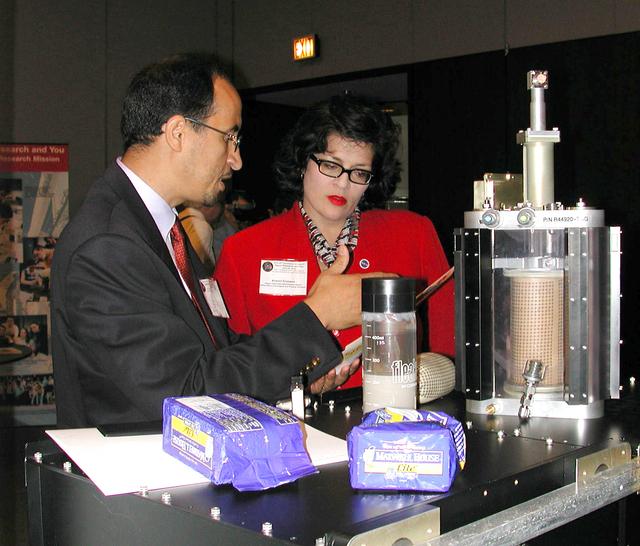
Khalid Alshibli of Louisiana State University, project scientist for the Mechanics of Granular Materials (MGM-III) experiment, explains the MGM experiment to Kristen Erickson, acting deputy associate administrator in NASA's Office of Biological and Physical Research. A training model of the test cell is at right. The activity was part of the Space Research and You education event held by NASA's Office of Biological and Physical Research on June 25, 2002, in Arlington, VA, to highlight the research that will be conducted on STS-107.
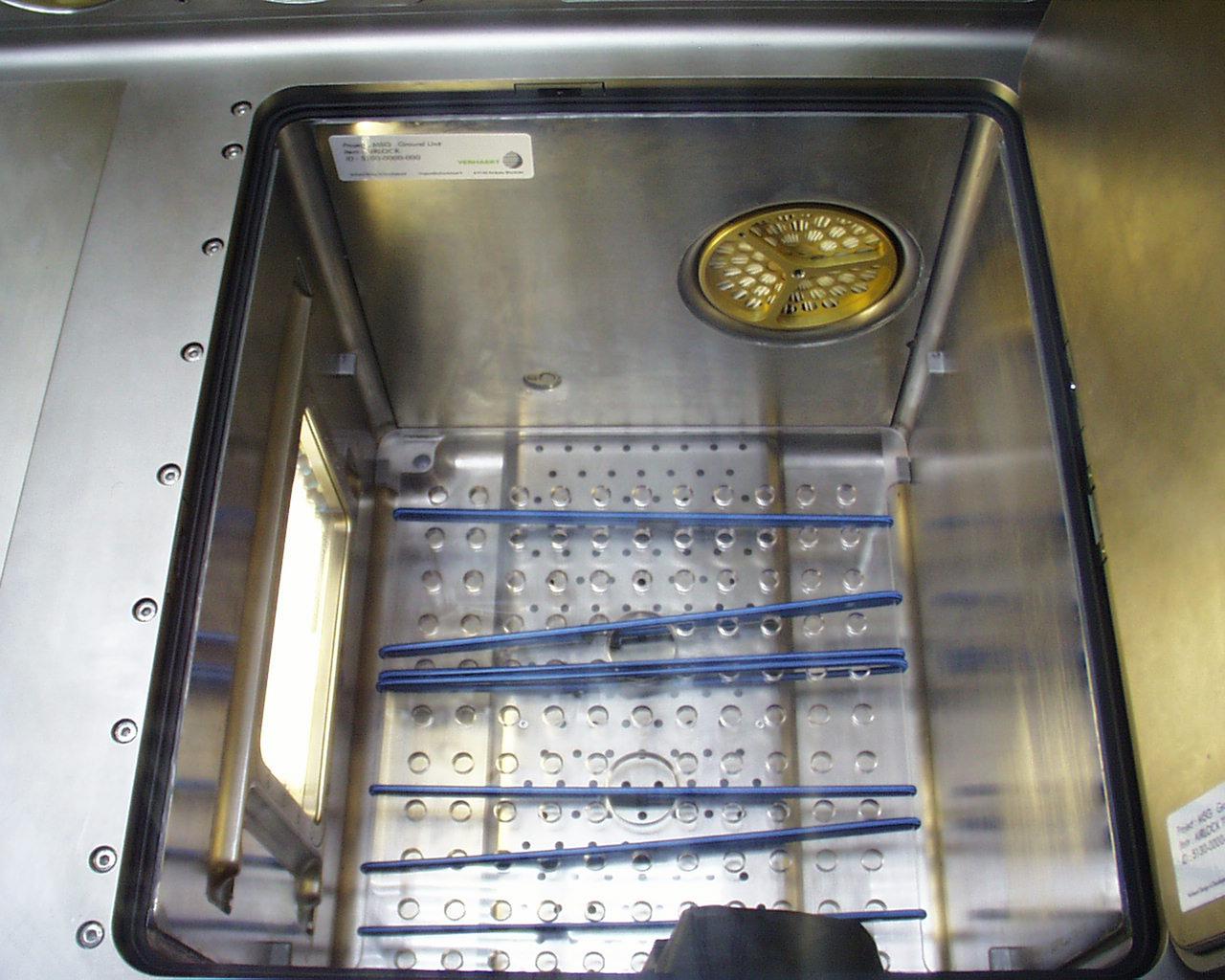
This photo shows the access through the internal airlock on the Microgravity Science Glovebox (MSG) being developed by the European Space Agency (ESA) and NASA for use aboard the International Space Station (ISS). The airlock will allow the insertion or removal of equipment and samples without opening the working volume of the glovebox. Scientists will use the MSG to carry out multidisciplinary studies in combustion science, fluid physics and materials science. The MSG is managed by NASA's Marshall Space Flight Center (MSFC). Photo Credit: NASA/MSFC