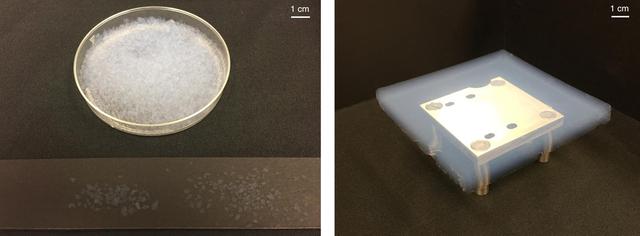
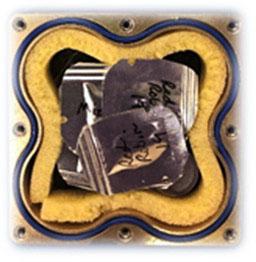
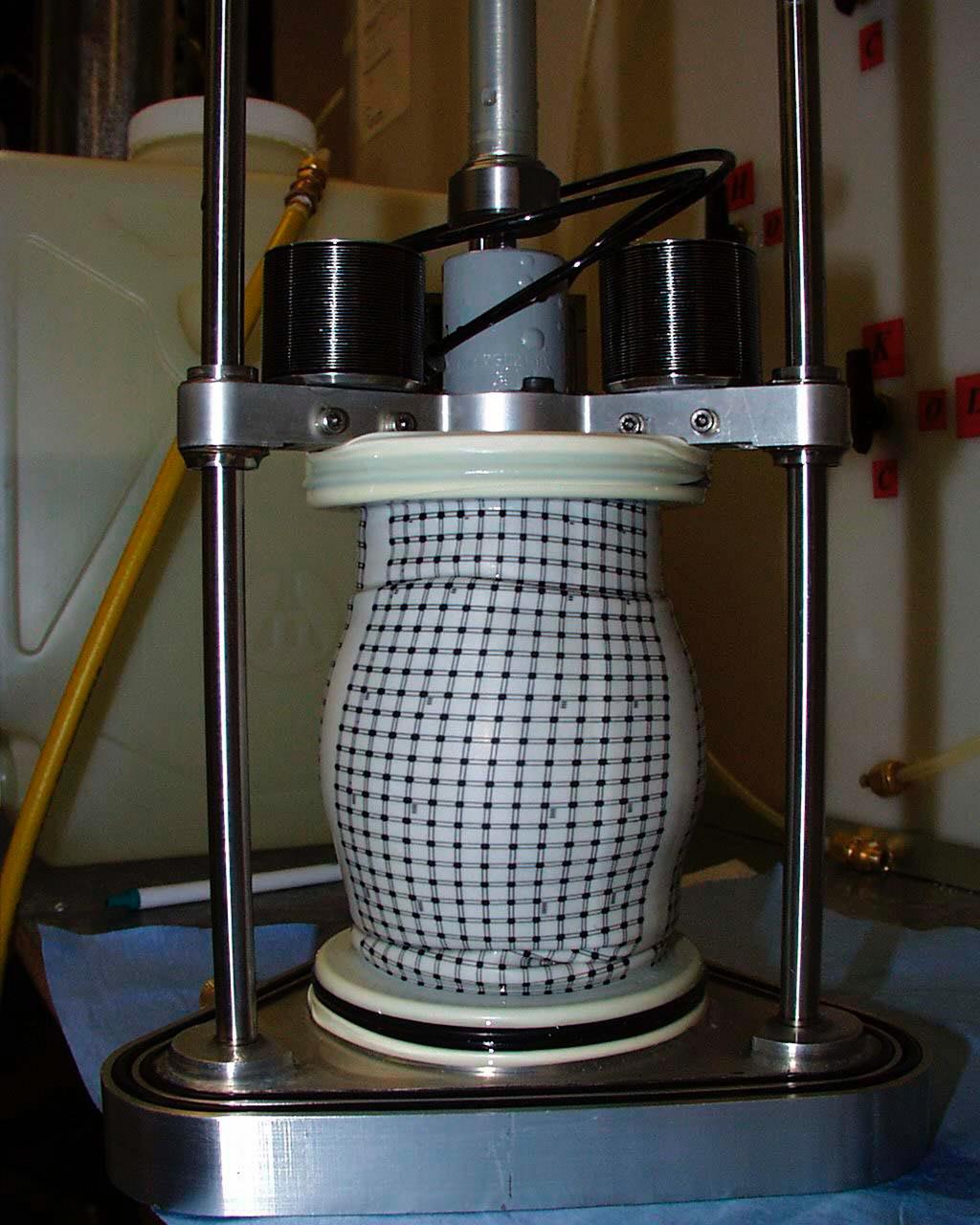
A test cell for Mechanics of Granular Materials (MGM) experiment is tested for long-term storage with water in the system as plarned for STS-107. This view shows the compressed sand column with the protective water jacket removed. Sand and soil grains have faces that can cause friction as they roll and slide against each other, or even cause sticking and form small voids between grains. This complex behavior can cause soil to behave like a liquid under certain conditions such as earthquakes or when powders are handled in industrial processes. Mechanics of Granular Materials (MGM) experiments aboard the Space Shuttle use the microgravity of space to simulate this behavior under conditons that cannot be achieved in laboratory tests on Earth. MGM is shedding light on the behavior of fine-grain materials under low effective stresses. Applications include earthquake engineering, granular flow technologies (such as powder feed systems for pharmaceuticals and fertilizers), and terrestrial and planetary geology. Nine MGM specimens have flown on two Space Shuttle flights. Another three are scheduled to fly on STS-107. The principal investigator is Stein Sture of the University of Colorado at Boulder. Credit: University of Colorado at Boulder
Microgravity
A test cell for Mechanics of Granular Materials (MGM) experiment is tested for long-term storage with water in the system as plarned for STS-107. This view shows the compressed sand column with the protective water jacket removed. Sand and soil grains have faces that can cause friction as they roll and slide against each other, or even cause sticking and form small voids between grains. This complex behavior can cause soil to behave like a liquid under certain conditions such as earthquakes or when powders are handled in industrial processes. Mechanics of Granular Materials (MGM) experiments aboard the Space Shuttle use the microgravity of space to simulate this behavior under conditons that cannot be achieved in laboratory tests on Earth. MGM is shedding light on the behavior of fine-grain materials under low effective stresses. Applications include earthquake engineering, granular flow technologies (such as powder feed systems for pharmaceuticals and fertilizers), and terrestrial and planetary geology. Nine MGM specimens have flown on two Space Shuttle flights. Another three are scheduled to fly on STS-107. The principal investigator is Stein Sture of the University of Colorado at Boulder. Credit: University of Colorado at Boulder
Microgravity
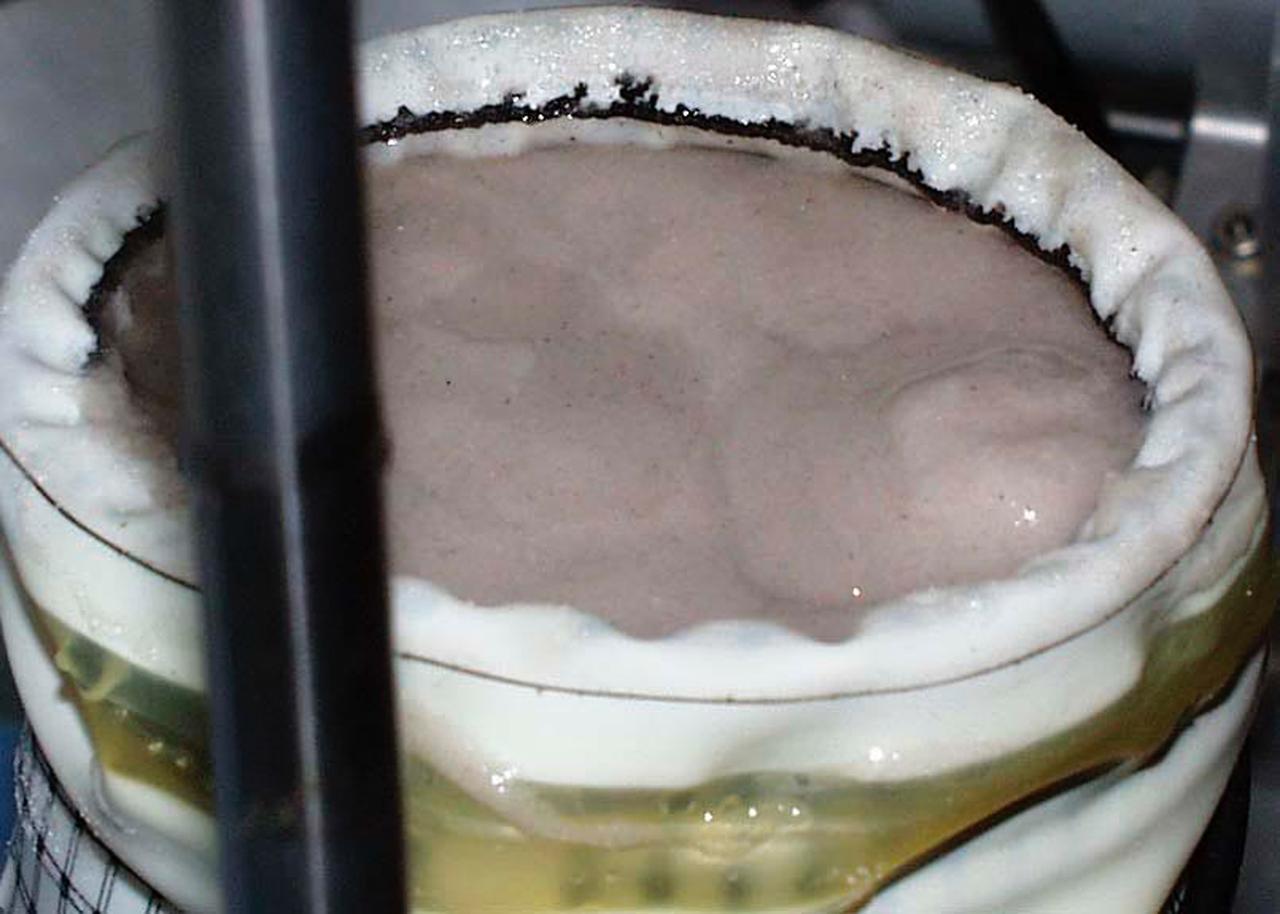
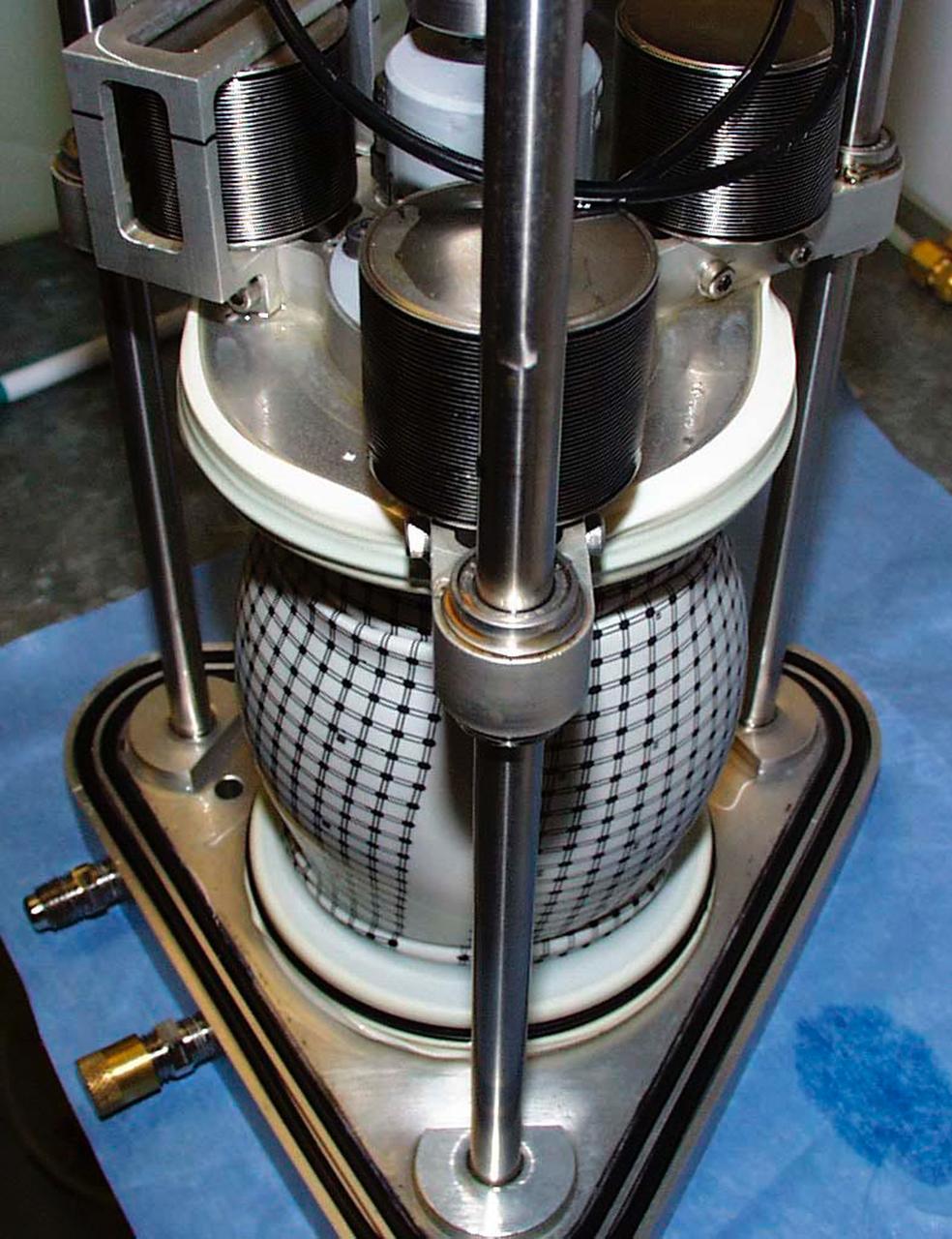
A test cell for Mechanics of Granular Materials (MGM) experiment is tested for long-term storage with water in the system as plarned for STS-107. This view shows the top of the sand column with the metal platten removed. Sand and soil grains have faces that can cause friction as they roll and slide against each other, or even cause sticking and form small voids between grains. This complex behavior can cause soil to behave like a liquid under certain conditions such as earthquakes or when powders are handled in industrial processes. Mechanics of Granular Materials (MGM) experiments aboard the Space Shuttle use the microgravity of space to simulate this behavior under conditons that cannot be achieved in laboratory tests on Earth. MGM is shedding light on the behavior of fine-grain materials under low effective stresses. Applications include earthquake engineering, granular flow technologies (such as powder feed systems for pharmaceuticals and fertilizers), and terrestrial and planetary geology. Nine MGM specimens have flown on two Space Shuttle flights. Another three are scheduled to fly on STS-107. The principal investigator is Stein Sture of the University of Colorado at Boulder. Credit: University of Colorado at Boulder
Microgravity
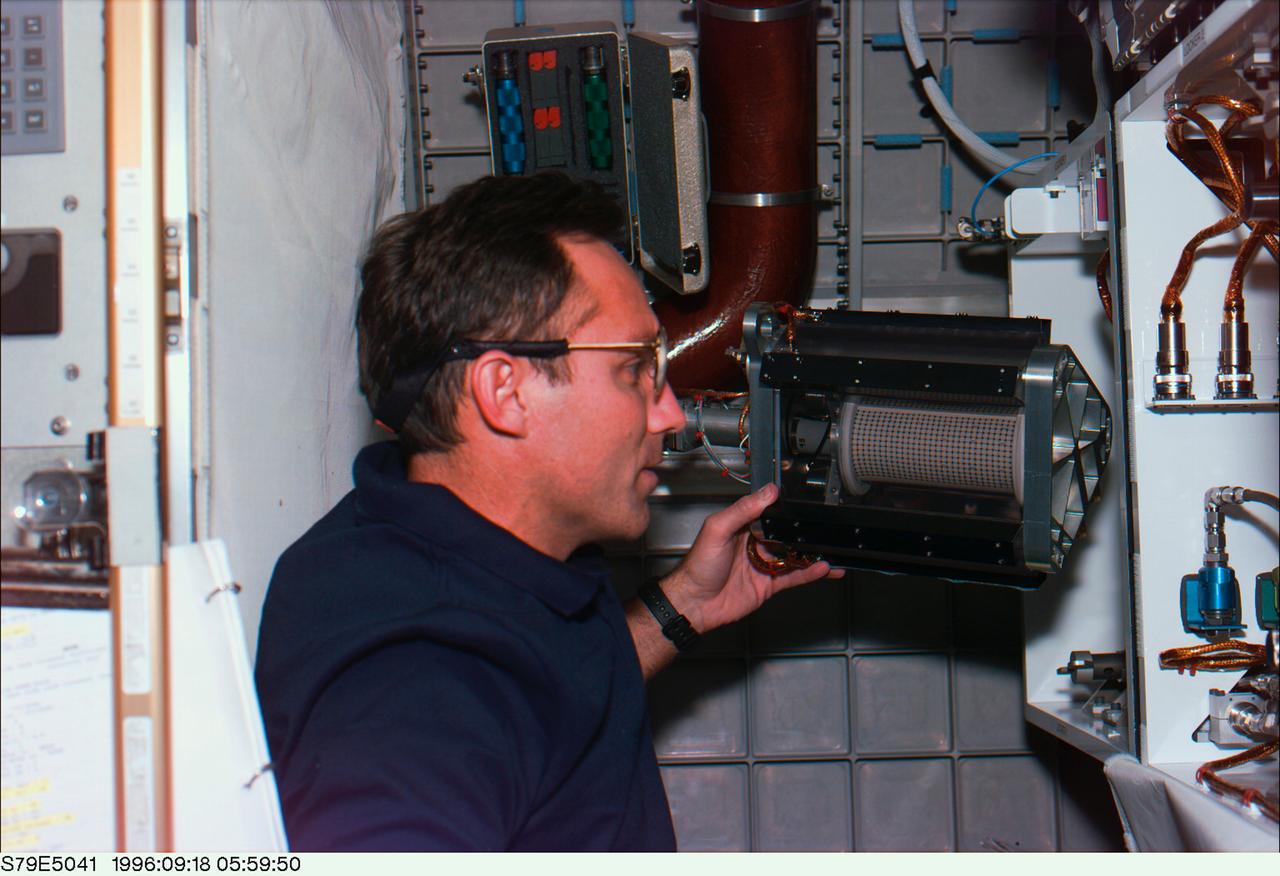
Astronaut Carl Walz installs Mechanics of Granular Materials (MGM) test cell on STS-79. Sand and soil grains have faces that can cause friction as they roll and slide against each other, or even cause sticking and form small voids between grains. This complex behavior can cause soil to behave like a liquid under certain conditions such as earthquakes or when powders are handled in industrial processes. Mechanics of Granular Materials (MGM) experiments aboard the Space Shuttle use the microgravity of space to simulate this behavior under conditons that carnot be achieved in laboratory tests on Earth. MGM is shedding light on the behavior of fine-grain materials under low effective stresses. Applications include earthquake engineering, granular flow technologies (such as powder feed systems for pharmaceuticals and fertilizers), and terrestrial and planetary geology. Nine MGM specimens have flown on two Space Shuttle flights. Another three are scheduled to fly on STS-107. The principal investigator is Stein Sture of the University of Colorado at Boulder. Credit: NASA/John Space Center
Microgravity
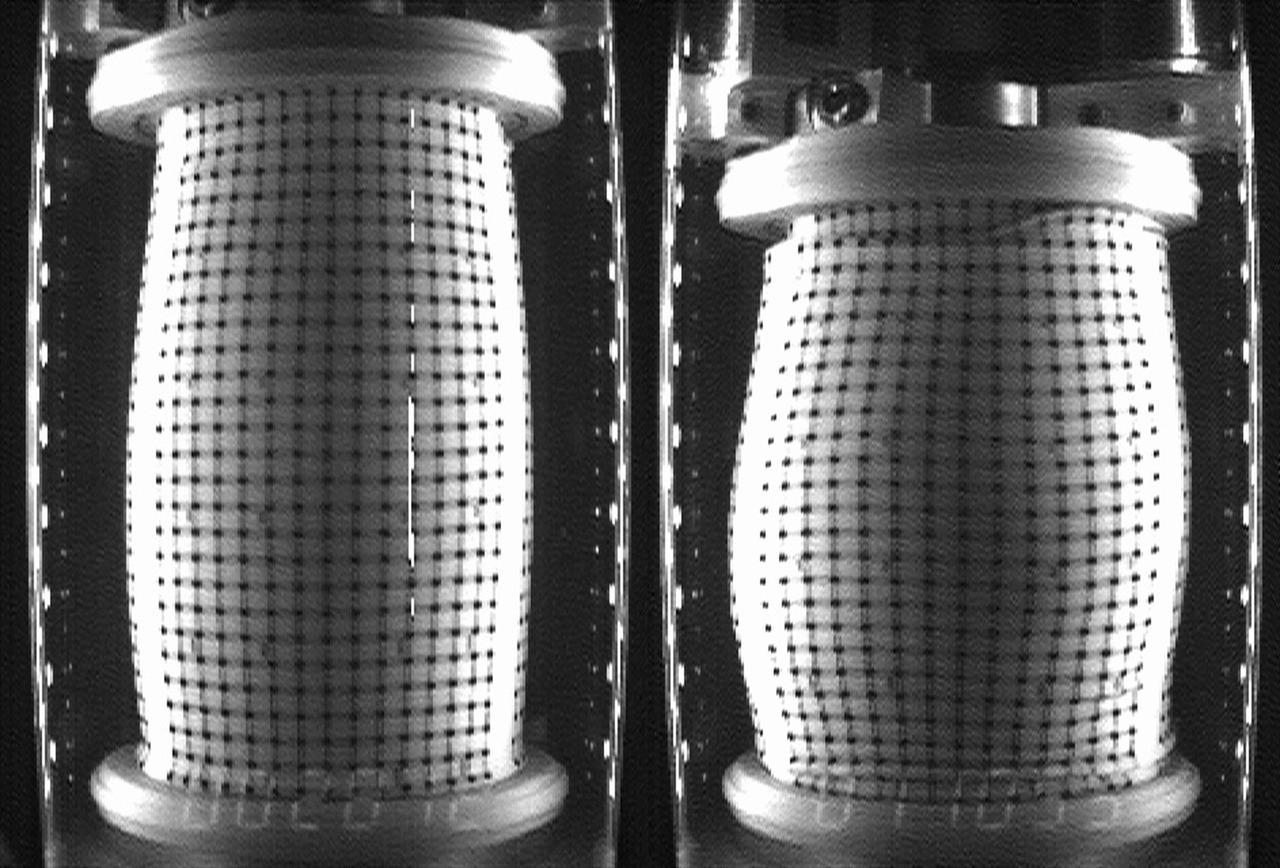
A test cell for Mechanics of Granular Materials (MGM) experiment is shown approximately 20 and 60 minutes after the start of an experiment on STS-89. Sand and soil grains have faces that can cause friction as they roll and slide against each other, or even cause sticking and form small voids between grains. This complex behavior can cause soil to behave like a liquid under certain conditions such as earthquakes or when powders are handled in industrial processes. Mechanics of Granular Materials (MGM) experiments aboard the Space Shuttle use the microgravity of space to simulate this behavior under conditons that carnot be achieved in laboratory tests on Earth. MGM is shedding light on the behavior of fine-grain materials under low effective stresses. Applications include earthquake engineering, granular flow technologies (such as powder feed systems for pharmaceuticals and fertilizers), and terrestrial and planetary geology. Nine MGM specimens have flown on two Space Shuttle flights. Another three are scheduled to fly on STS-107. The principal investigator is Stein Sture of the University of Colorado at Boulder. Credit: NASA/Marshall Space Flight Center (MSFC)
Microgravity
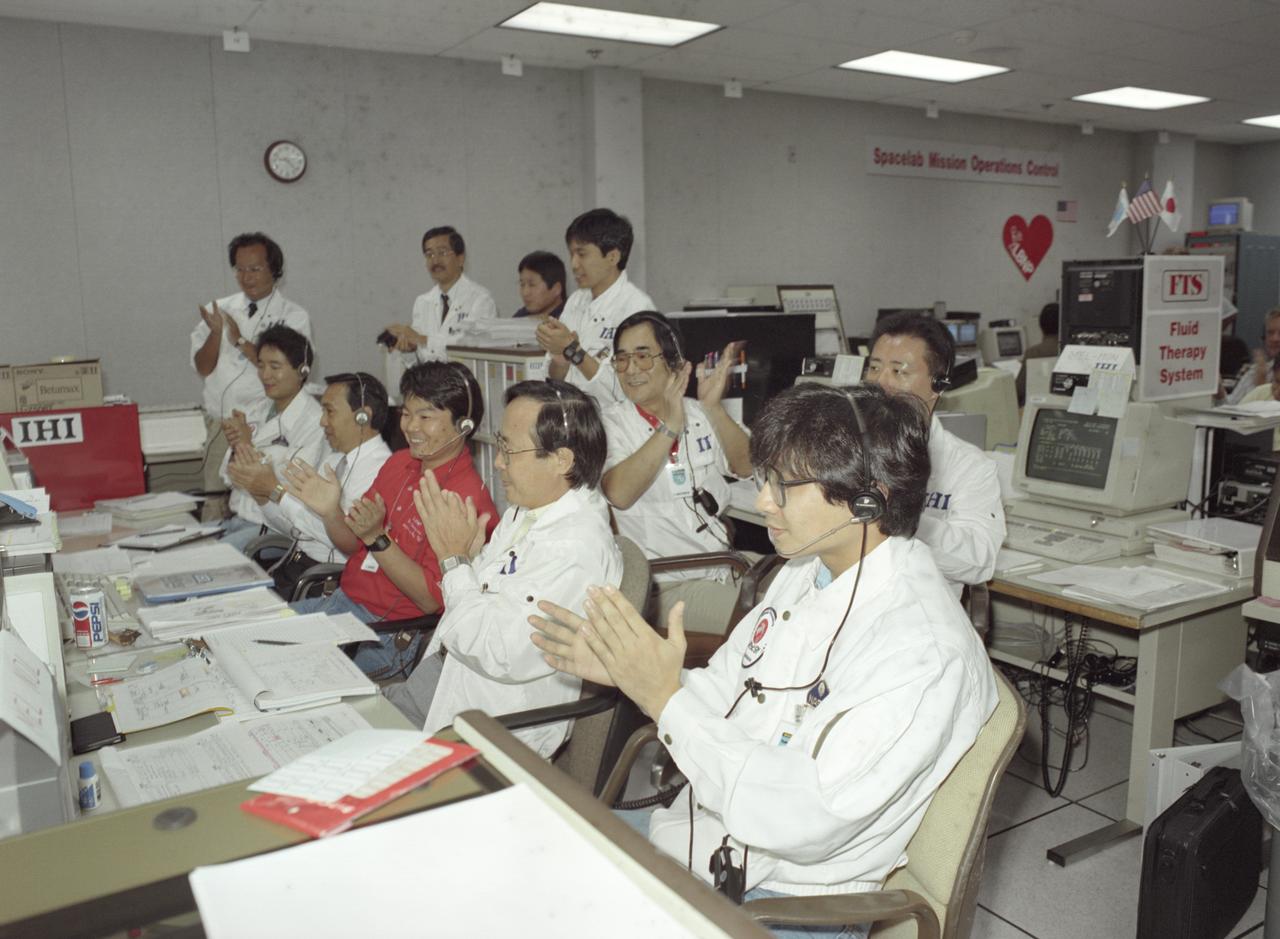
The science laboratory, Spacelab-J (SL-J), flown aboard the STS-47 flight was a joint venture between NASA and the National Space Development Agency of Japan (NASDA) utilizing a manned Spacelab module. The mission conducted 24 materials science and 20 life science experiments, of which 35 were sponsored by NASDA, 7 by NASA, and two collaborative efforts. Materials science investigations covered such fields as biotechnology, electronic materials, fluid dynamics and transport phenomena, glasses and ceramics, metals and alloys, and acceleration measurements. Life sciences included experiments on human health, cell separation and biology, developmental biology, animal and human physiology and behavior, space radiation, and biological rhythms. Test subjects included the crew, Japanese koi fish (carp), cultured animal and plant cells, chicken embryos, fruit flies, fungi and plant seeds, and frogs and frog eggs. Featured together in the Science Operation Area (SOA) are payload specialists’ first Materials Processing Test during NASA/NASDA joint ground activities at the Huntsville Operations Support Center (HOSC) Spacelab Payload Operations Control Center (SL POCC) at Marshall Space Flight Center (MSFC).
Around Marshall
Impact test results and 22 caliber gun set-up.
Impact tests
Scientists tested these samples of aerogel to see how they could be used as building materials on Mars. In an experiment, both the crushed and solid samples of aerogel were able to raise temperatures to melt water ice — ideal for a Martian greenhouse in which crops could grow.  https://photojournal.jpl.nasa.gov/catalog/PIA23342
Aerogel Samples
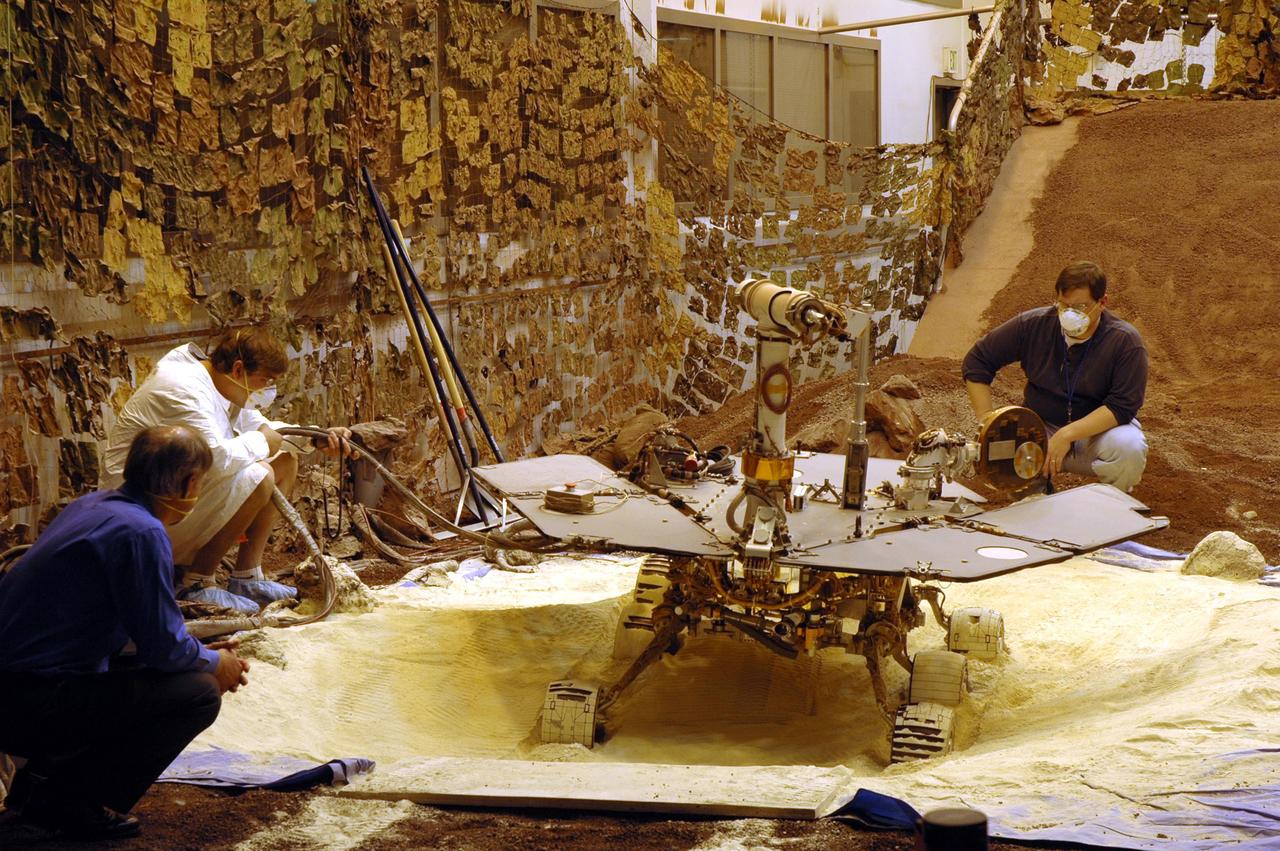
Rover engineers check how a test rover moves in material chosen to simulate some difficult Mars driving conditions. The scene is inside the In-Situ Instrument Laboratory at NASA Jet Propulsion Laboratory, Pasadena, Calif.
Tests to Help Plan Opportunity Moves
Rover engineers check how a test rover moves in material chosen to simulate some difficult Mars driving conditions. The scene is inside the In-Situ Instrument Laboratory at NASA Jet Propulsion Laboratory, Pasadena, Calif.
Tests to Help Plan Opportunity Moves
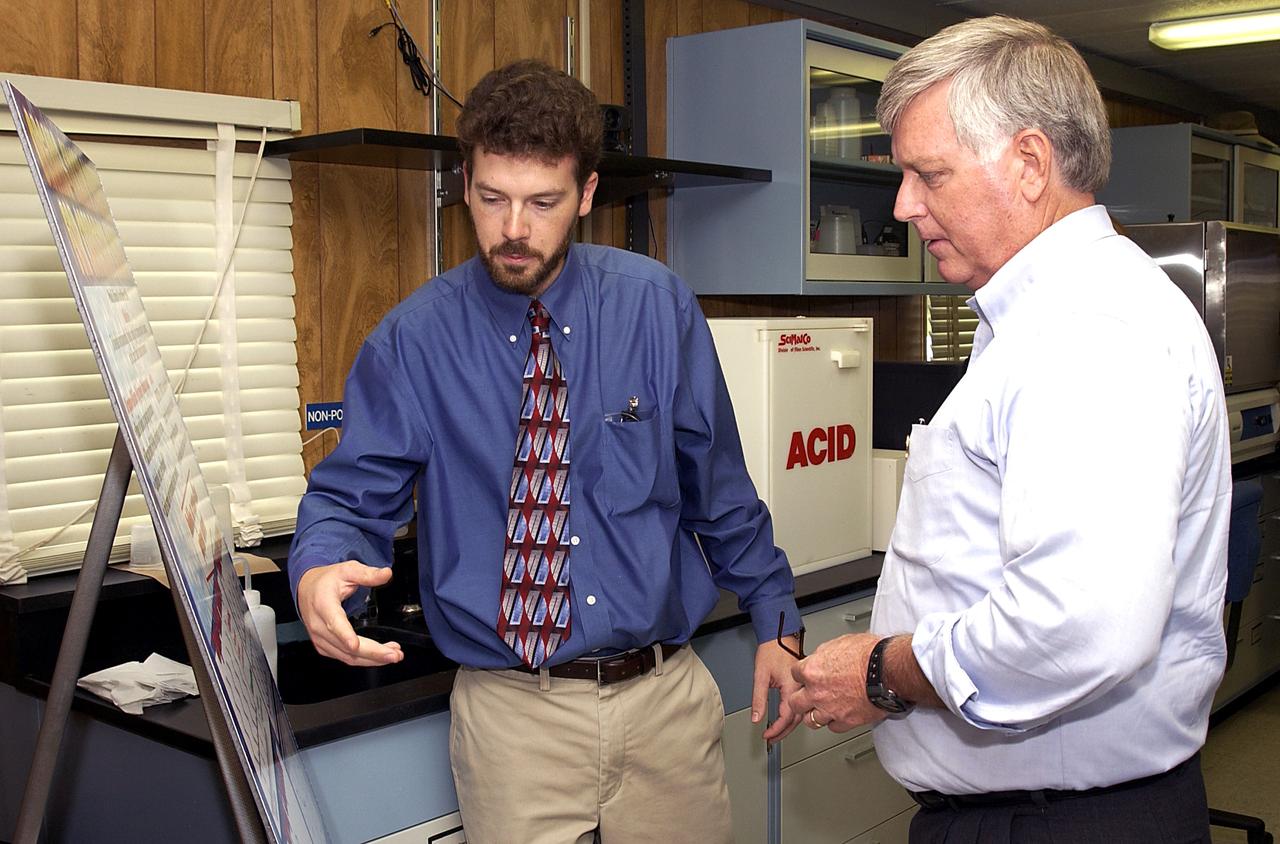
KENNEDY SPACE CENTER, FLA. -   Dr. Paul Hintze (left) explains to Center Director Jim Kennedy a project he is working at the KSC Beach Corrosion Test Site. Hitze is doing post-graduate work for the National Research Council.  The test facility site was established in the 1960s and has provided more than 30 years of historical information on the long-term performance of many materials in use at KSC and other locations around the world. Located 100 feet from the Atlantic Ocean approximately 1 mile south of the Space Shuttle launch sites, the test facility includes an atmospheric exposure site, a flowing seawater exposure site, and an on-site electrochemistry laboratory and monitoring station. The beach laboratory is used to conduct real-time corrosion experiments and provides for the remote monitoring of surrounding weather conditions. The newly added flowing seawater immersion facility provides for the immersion testing of materials and devices under controlled conditions.
KENNEDY SPACE CENTER, FLA. - Dr. Paul Hintze (left) explains to Center Director Jim Kennedy a project he is working at the KSC Beach Corrosion Test Site. Hitze is doing post-graduate work for the National Research Council. The test facility site was established in the 1960s and has provided more than 30 years of historical information on the long-term performance of many materials in use at KSC and other locations around the world. Located 100 feet from the Atlantic Ocean approximately 1 mile south of the Space Shuttle launch sites, the test facility includes an atmospheric exposure site, a flowing seawater exposure site, and an on-site electrochemistry laboratory and monitoring station. The beach laboratory is used to conduct real-time corrosion experiments and provides for the remote monitoring of surrounding weather conditions. The newly added flowing seawater immersion facility provides for the immersion testing of materials and devices under controlled conditions.
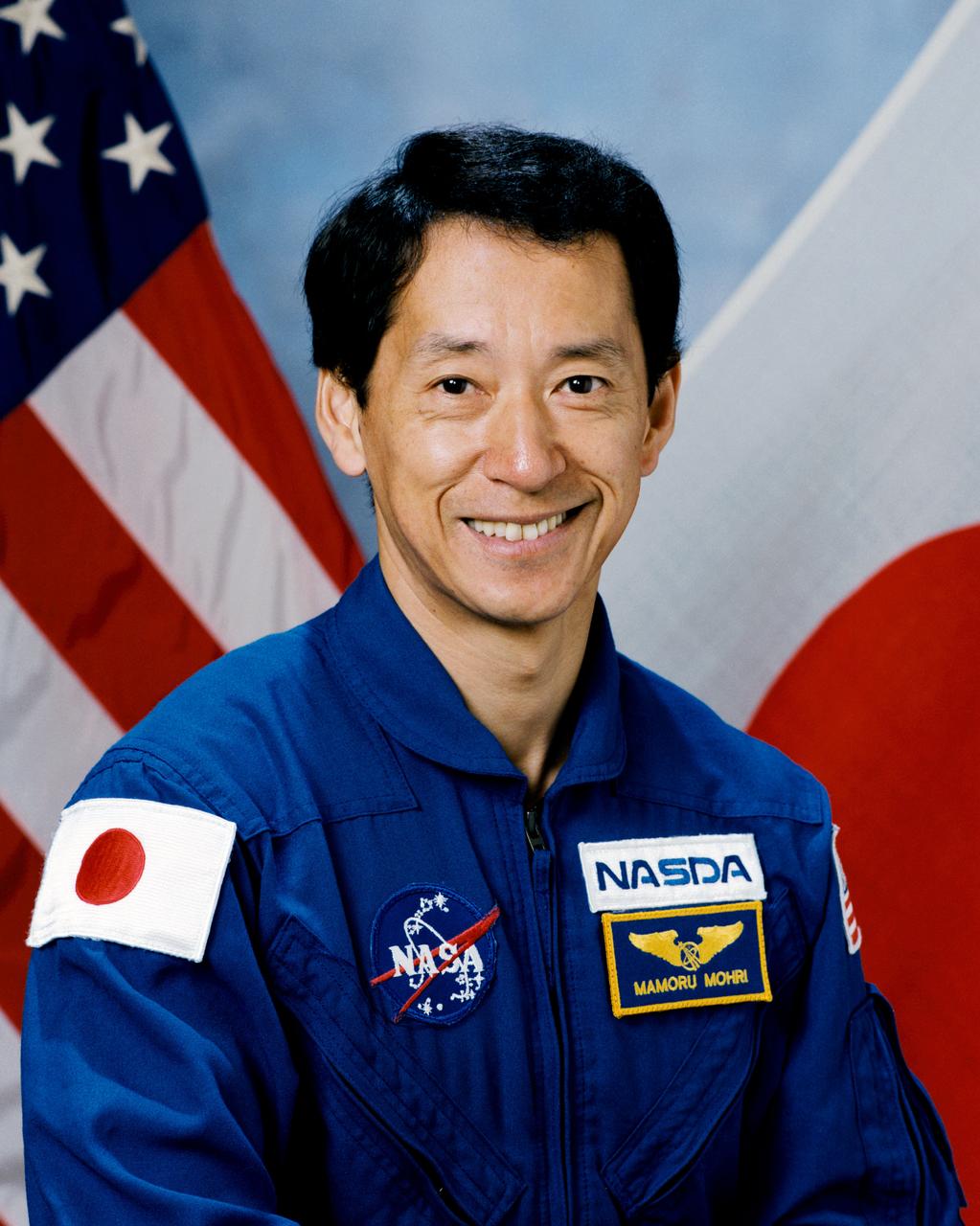
S97-05508 (13 Sept. 1996) --- Astronaut Mamoru Mohri, payload specialist, representing   National Space Development Agency (NASDA).
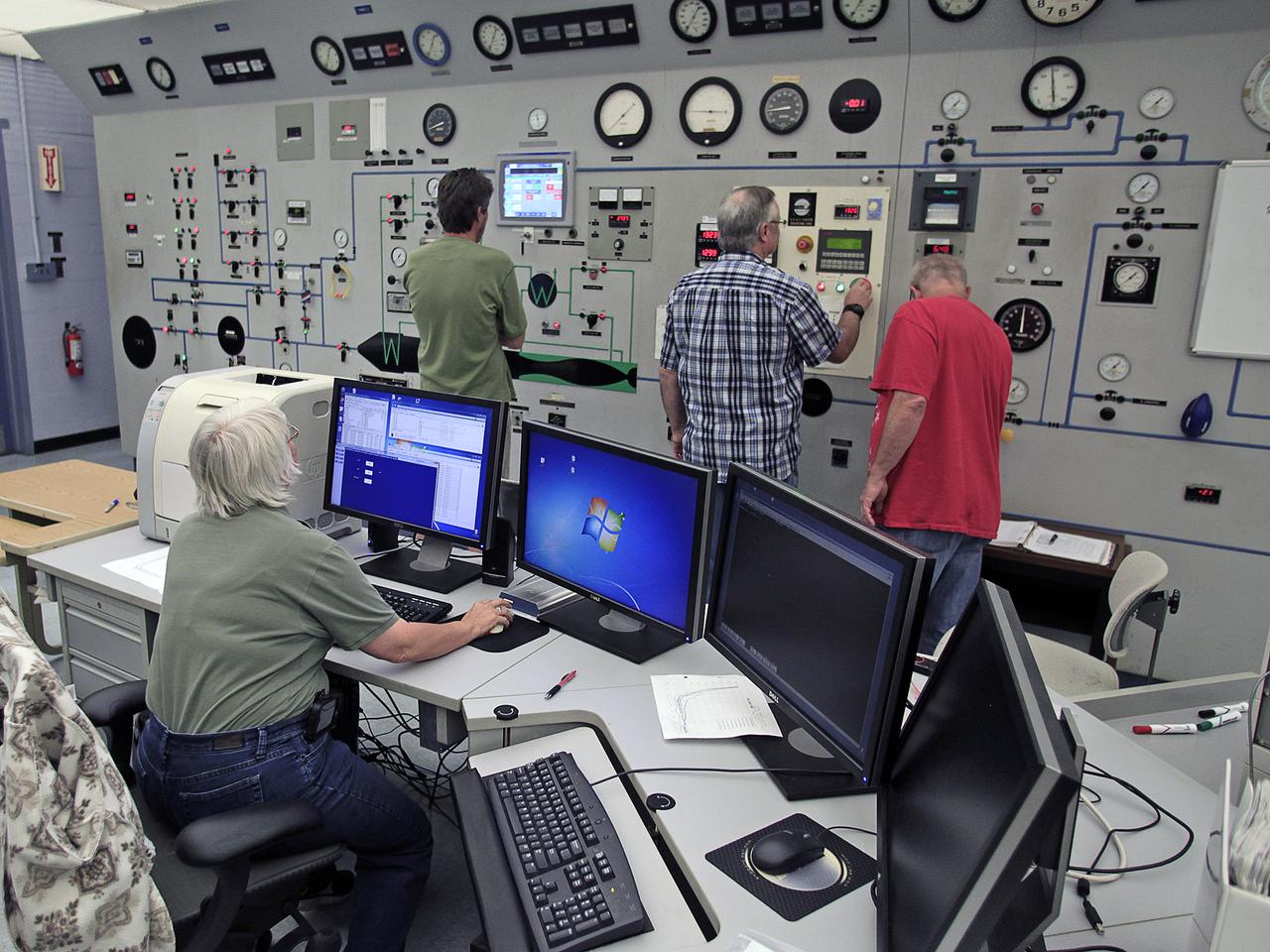
Hypervelocity Impact (HVI) testing performed on EMU materials
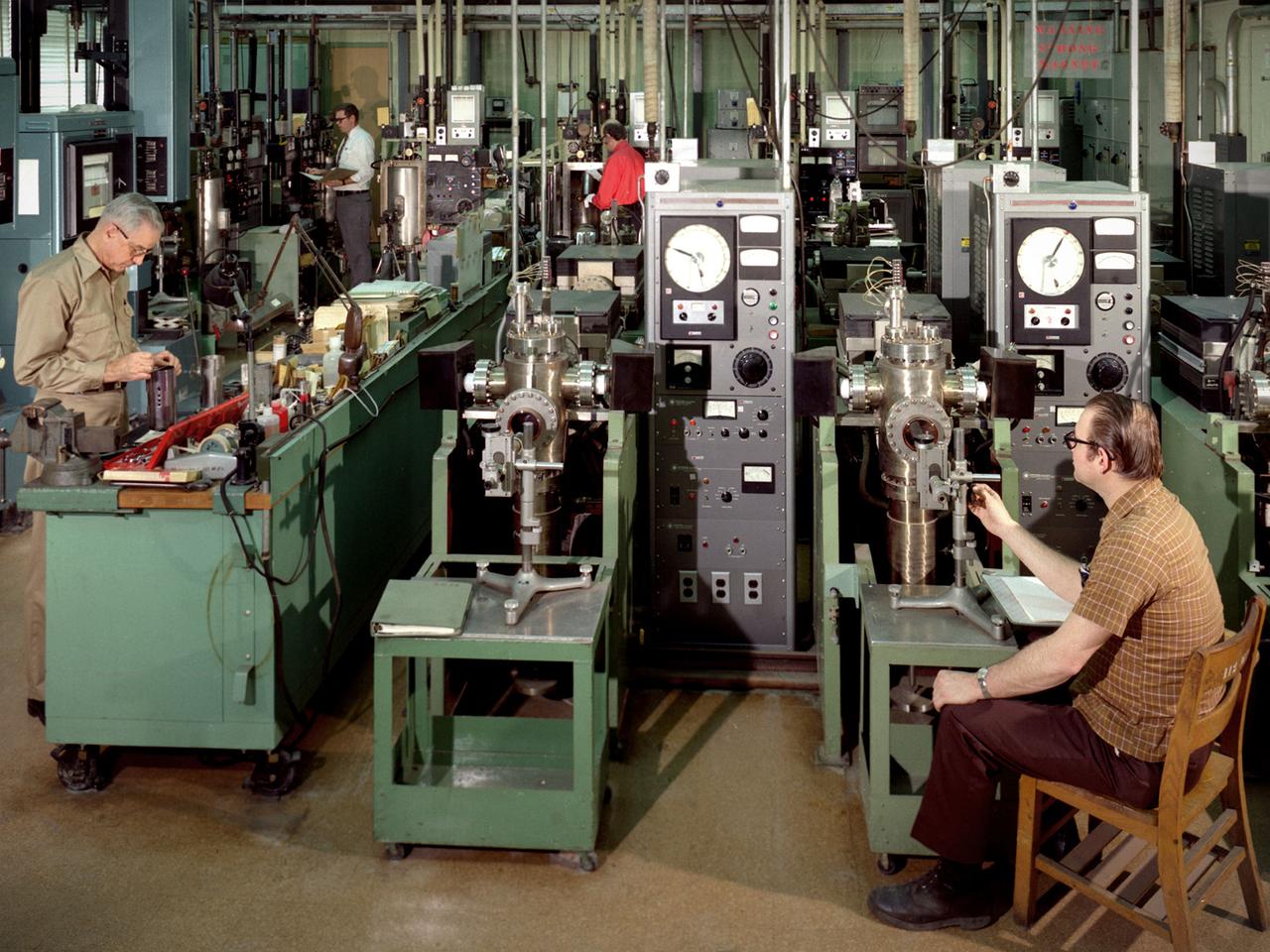
Technicians at work in the Materials Processing Laboratory’s Creep Facility at the National Aeronautics and Space Administration (NASA) Lewis Research Center. The technicians supported the engineers’ studies of refractory materials, metals, and advanced superalloys. The Materials Processing Laboratory contained laboratories and test areas equipped to prepare and develop these metals and materials. The ultra-high vacuum lab, seen in this photograph, contained creep and tensile test equipment.      Creep testing is used to study a material’s ability to withstand long durations under constant pressure and temperatures. The equipment measured the strain over a long period of time. Tensile test equipment subjects the test material to strain until the material fails. The two tests were used to determine the strength and durability of different materials.    The Materials Processing Laboratory also housed arc and electron beam melting furnaces, a hydraulic vertical extrusion press, compaction and forging equipment, and rolling mills and swagers. There were cryogenic and gas storage facilities and mechanical and oil diffusion vacuum pumps. The facility contained both instrumental and analytical chemistry laboratories for work on radioactive or toxic materials and the only shop to machine toxic materials in the Midwest.
High Vacuum Creep Facility in the Materials Processing Laboratory
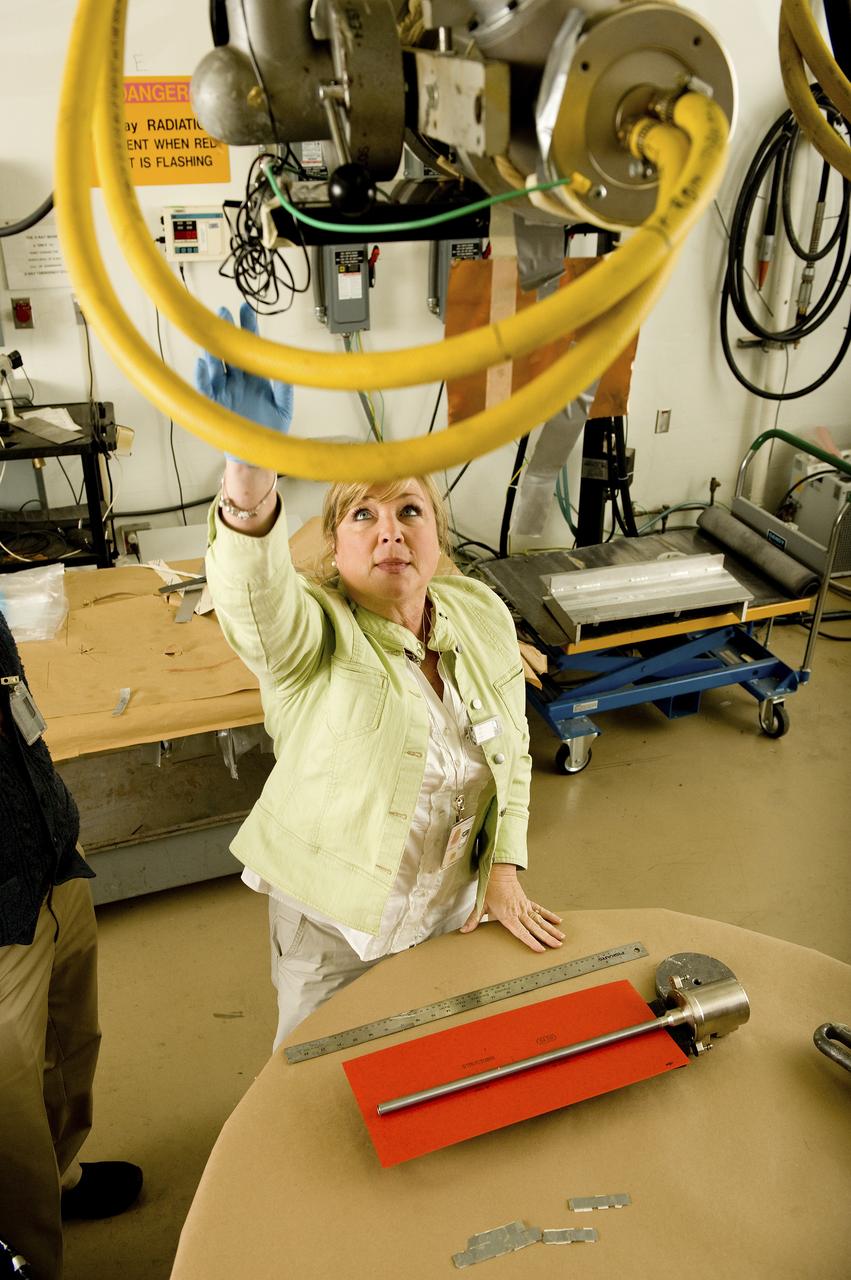
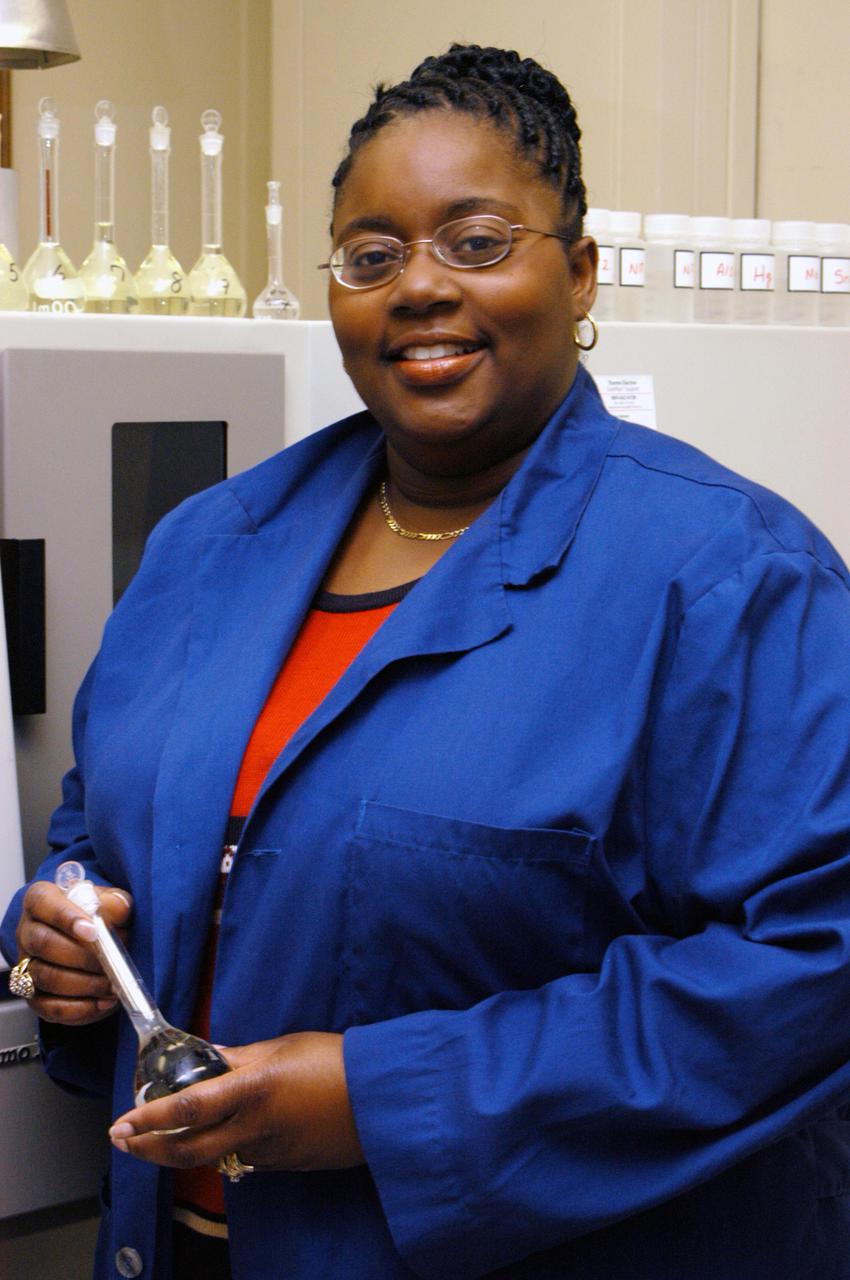
RHONDA LASH, A MATERIALS ENGINEER, PREPARES A SAMPLE CARTRIDGE FOR X-RAY. THE CARTRIDGE WAS TESTED ON THE MATERIAL SCIENCE RESEARCH RACK
1000375
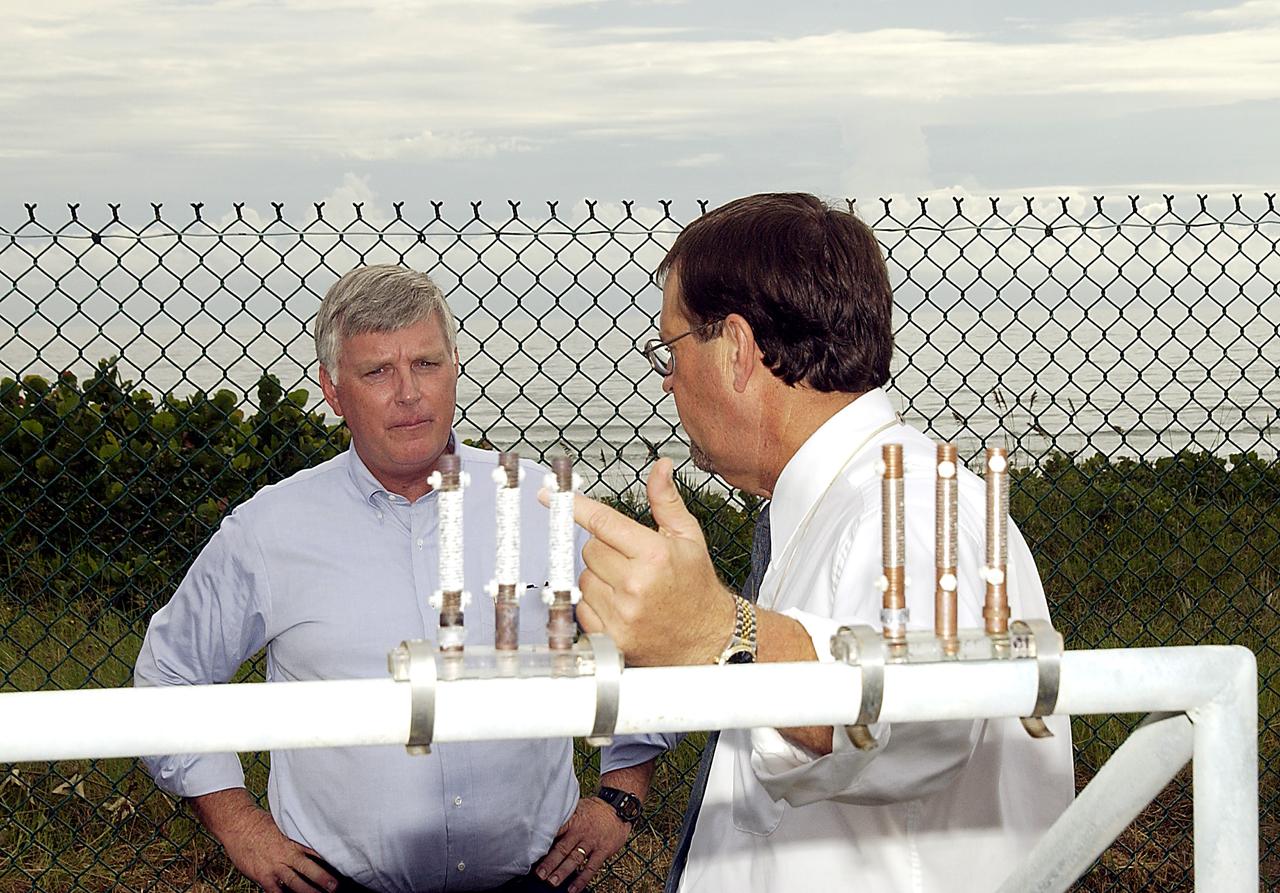
KENNEDY SPACE CENTER, FLA. -    Louis MacDowell (right), Testbed manager, explains to Center Director Jim Kennedy the use of astmospheric calibration specimens.  Placed at various locations, they can rank the corrosivity of the given environment.  The KSC Beach Corrosion Test Site was established in the 1960s and has provided more than 30 years of historical information on the long-term performance of many materials in use at KSC and other locations around the world. Located 100 feet from the Atlantic Ocean approximately 1 mile south of the Space Shuttle launch sites, the test facility includes an atmospheric exposure site, a flowing seawater exposure site, and an on-site electrochemistry laboratory and monitoring station. The beach laboratory is used to conduct real-time corrosion experiments and provides for the remote monitoring of surrounding weather conditions. The newly added flowing seawater immersion facility provides for the immersion testing of materials and devices under controlled conditions.
KENNEDY SPACE CENTER, FLA. - Louis MacDowell (right), Testbed manager, explains to Center Director Jim Kennedy the use of astmospheric calibration specimens. Placed at various locations, they can rank the corrosivity of the given environment. The KSC Beach Corrosion Test Site was established in the 1960s and has provided more than 30 years of historical information on the long-term performance of many materials in use at KSC and other locations around the world. Located 100 feet from the Atlantic Ocean approximately 1 mile south of the Space Shuttle launch sites, the test facility includes an atmospheric exposure site, a flowing seawater exposure site, and an on-site electrochemistry laboratory and monitoring station. The beach laboratory is used to conduct real-time corrosion experiments and provides for the remote monitoring of surrounding weather conditions. The newly added flowing seawater immersion facility provides for the immersion testing of materials and devices under controlled conditions.
In-flight photo of the NASA F-15B used in tests of the X-33 Thermal Protection System (TPS) materials. Flying at subsonic speeds, the F-15B tests measured the air loads on the proposed X-33 protective materials. In contrast, shock loads testing investigated the local impact of the supersonic shock wave itself on the TPS materials. Similar tests had been done in 1985 for the space shuttle tiles, using an F-104 aircraft.
F-15B in flight with X-33 Thermal Protection Systems (TPS) on Flight Test Fixture
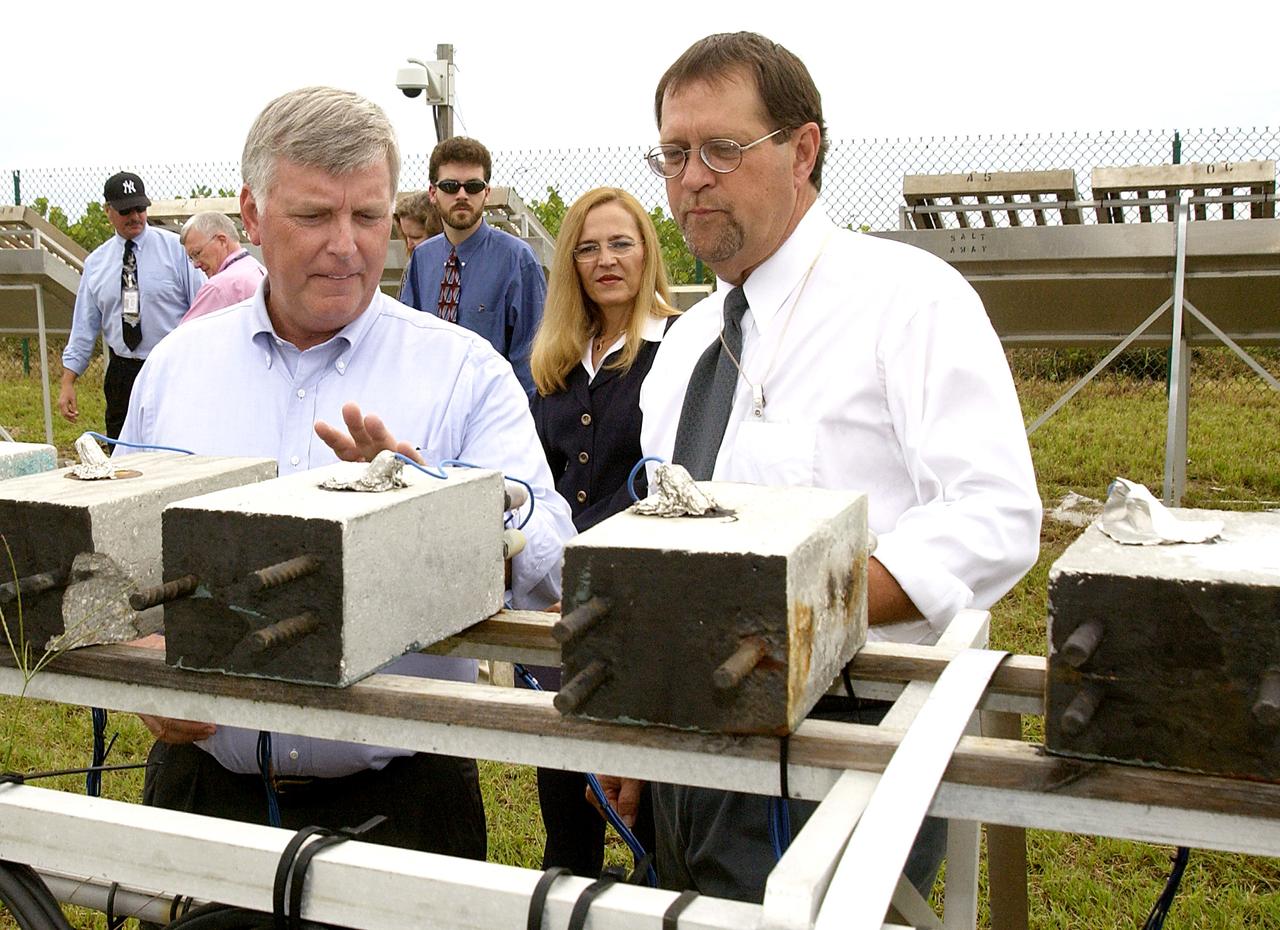
KENNEDY SPACE CENTER, FLA. -   On a tour of the KSC Beach Corrosion Test Site, Testbed Manager Louis MacDowell (right) explains to Center Director Jim Kennedy about the test blocks being used to test a newly developed coating to protect steel inside concrete.  Between MacDowell and Kennedy are Dr. Paul Hintze and Lead Scientist Dr. Luz Marina Calle.  The KSC Beach Corrosion Test Site was established in the 1960s and has provided more than 30 years of historical information on the long-term performance of many materials in use at KSC and other locations around the world. Located 100 feet from the Atlantic Ocean approximately 1 mile south of the Space Shuttle launch sites, the test facility includes an atmospheric exposure site, a flowing seawater exposure site, and an on-site electrochemistry laboratory and monitoring station. The beach laboratory is used to conduct real-time corrosion experiments and provides for the remote monitoring of surrounding weather conditions. The newly added flowing seawater immersion facility provides for the immersion testing of materials and devices under controlled conditions.
KENNEDY SPACE CENTER, FLA. - On a tour of the KSC Beach Corrosion Test Site, Testbed Manager Louis MacDowell (right) explains to Center Director Jim Kennedy about the test blocks being used to test a newly developed coating to protect steel inside concrete. Between MacDowell and Kennedy are Dr. Paul Hintze and Lead Scientist Dr. Luz Marina Calle. The KSC Beach Corrosion Test Site was established in the 1960s and has provided more than 30 years of historical information on the long-term performance of many materials in use at KSC and other locations around the world. Located 100 feet from the Atlantic Ocean approximately 1 mile south of the Space Shuttle launch sites, the test facility includes an atmospheric exposure site, a flowing seawater exposure site, and an on-site electrochemistry laboratory and monitoring station. The beach laboratory is used to conduct real-time corrosion experiments and provides for the remote monitoring of surrounding weather conditions. The newly added flowing seawater immersion facility provides for the immersion testing of materials and devices under controlled conditions.
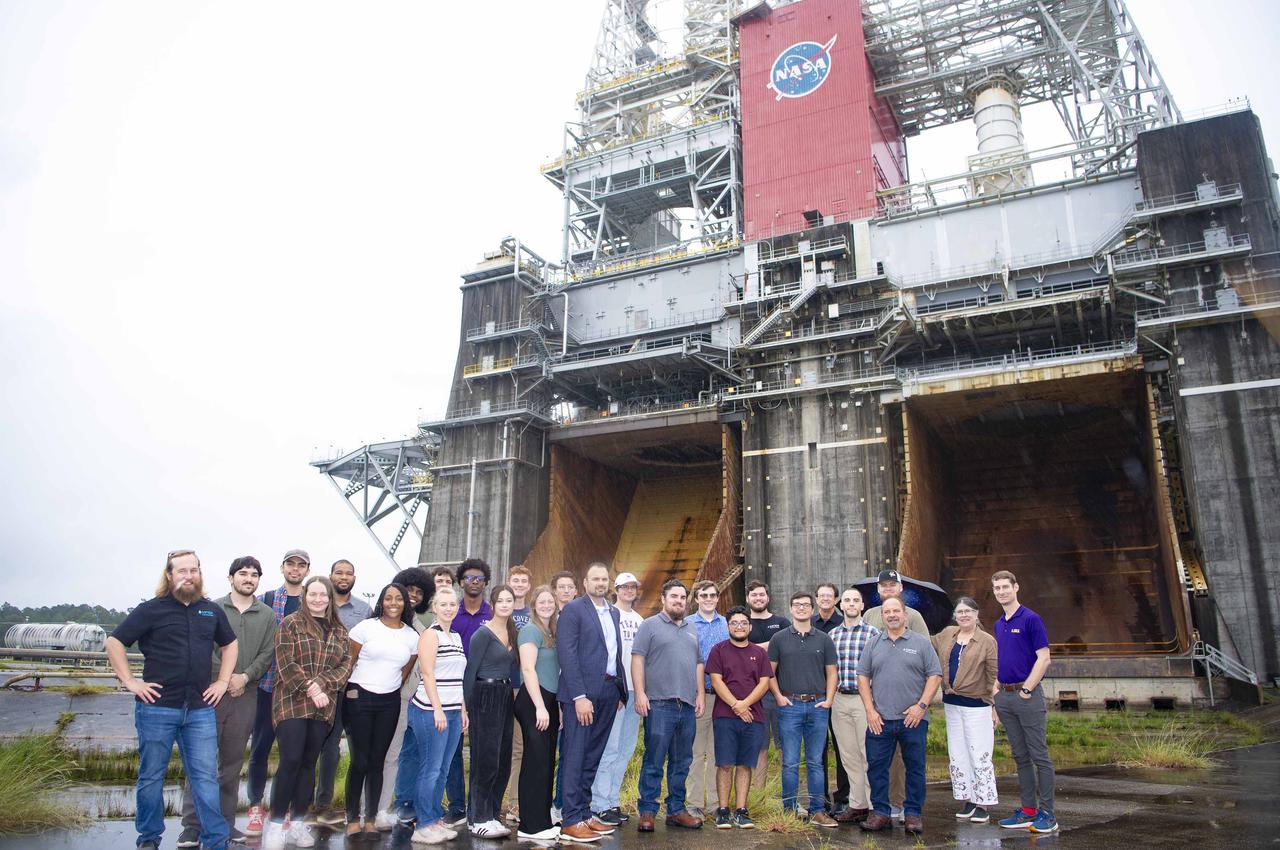
Members of the Society for the Advancement of Material and Process Engineering at Louisiana State University stand at the Thad Cochran Test Stand during a visit to NASA Stennis on Oct. 4. The Thad Cochran Test Stand (B-2) is where future Green Run testing of NASA’s exploration upper stage will take place ahead of future Artemis missions to the Moon and beyond. The mission of the Society for the Advancement of Material and Process Engineering at LSU is to provide enhanced educational opportunities by delivering information on new and advanced materials and processing technology.
LSU Engineering Students Visit NASA Stennis
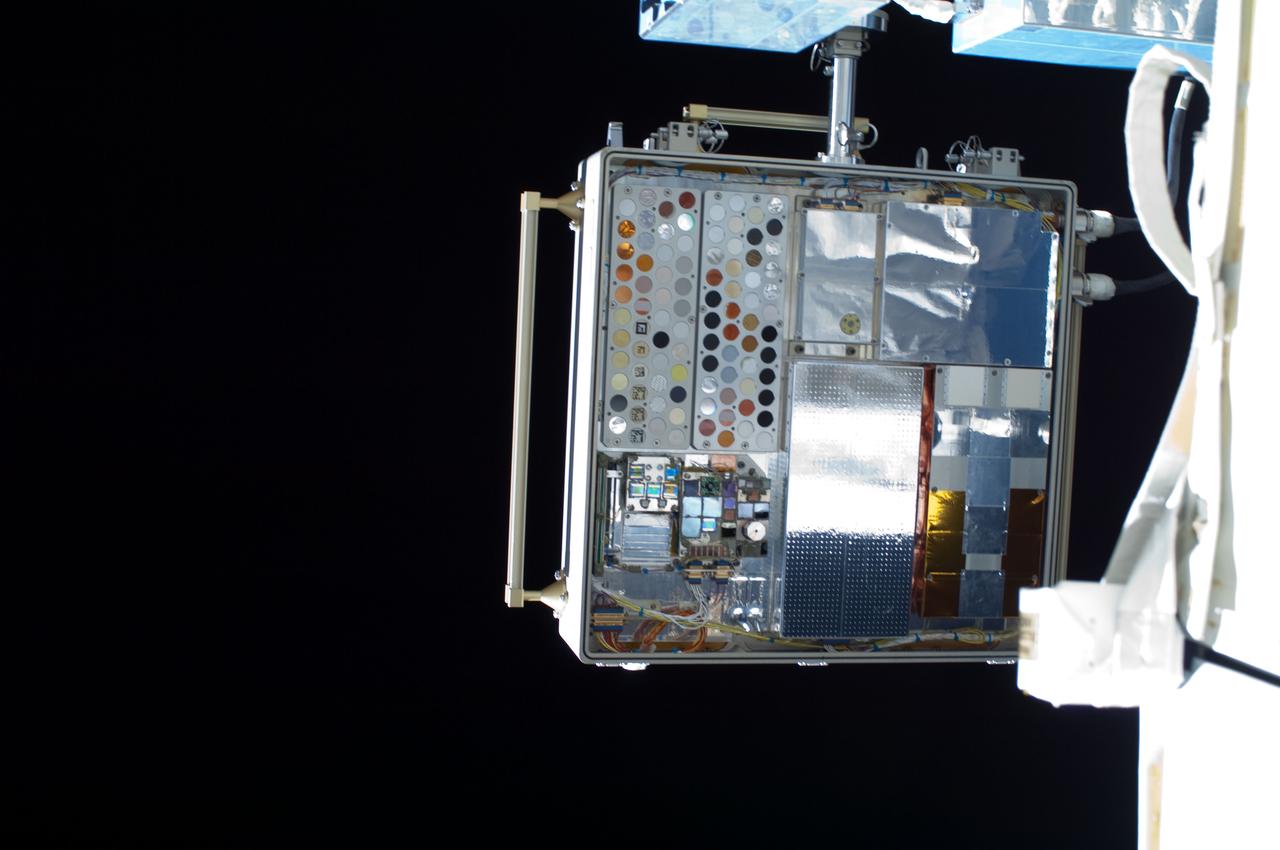
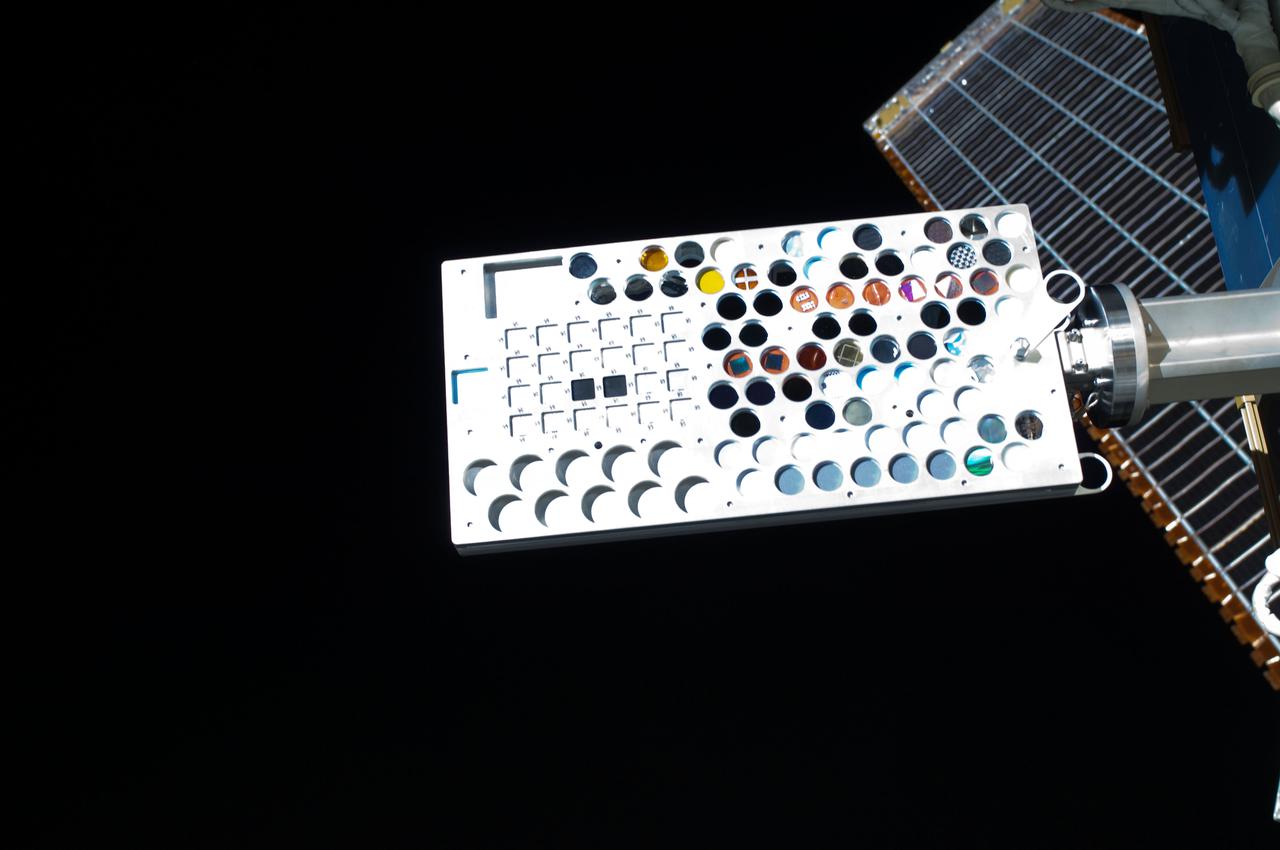
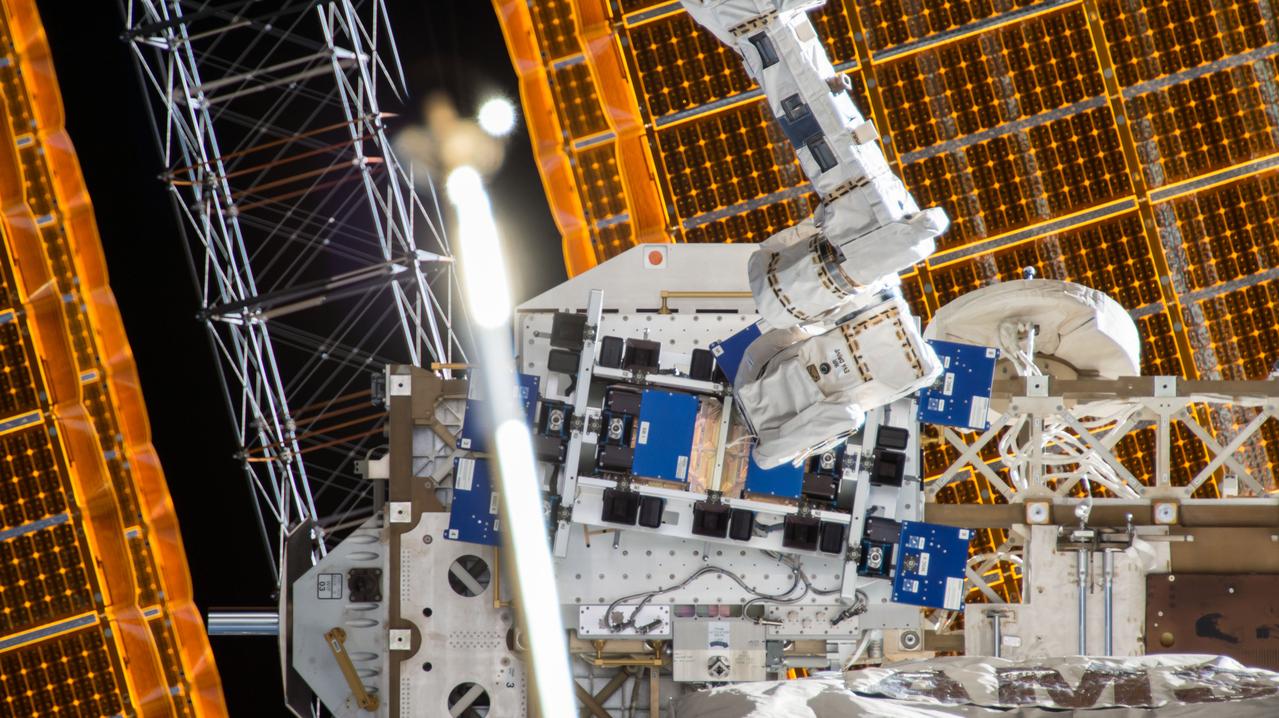
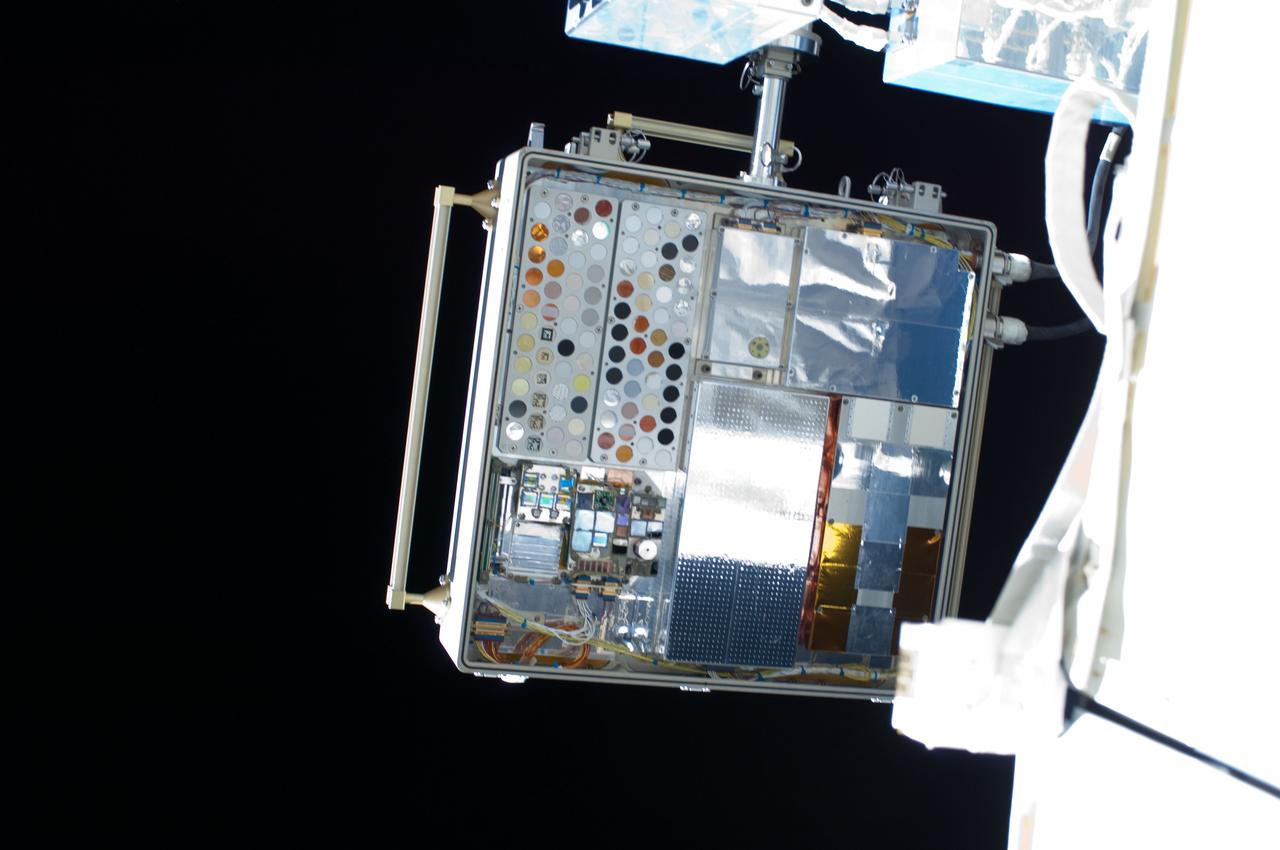
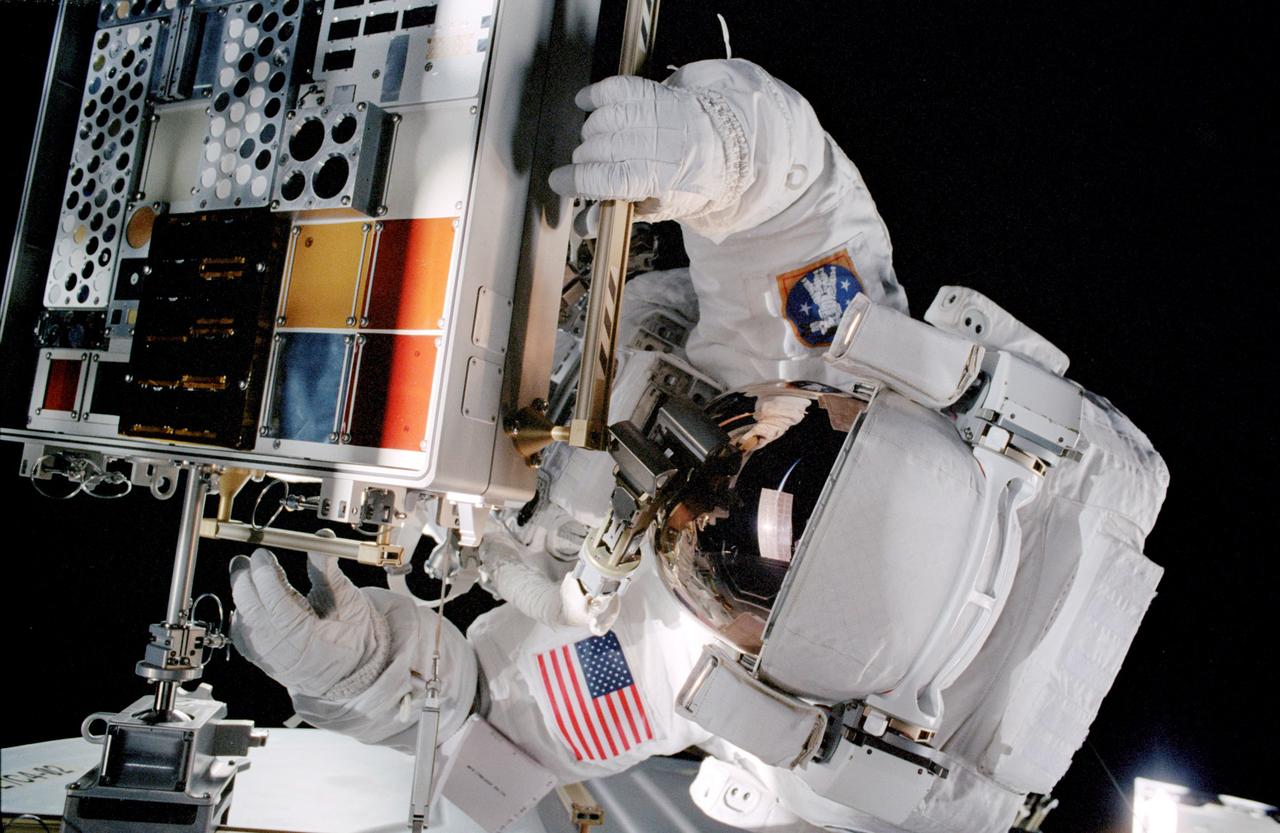
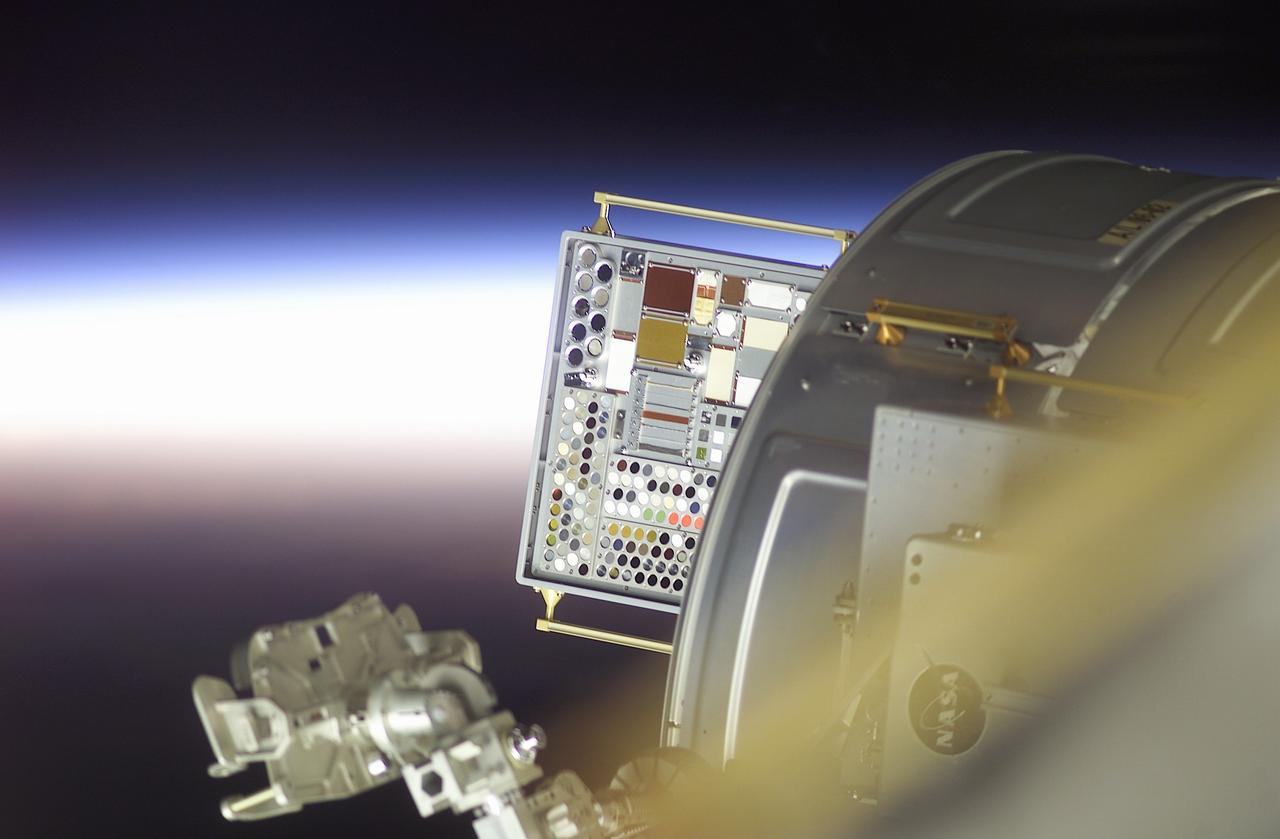
ISS028-E-016107 (12 July 2011) --- This medium close-up image, recorded during a July 12 spacewalk, shows the Materials on International Space Station Experiment - 8 (MISSE-8).  The experiment package is a test bed for materials and computing elements attached to the outside of the orbiting complex. These materials and computing elements are being evaluated for the effects of atomic oxygen, ultraviolet, direct sunlight, radiation, and extremes of heat and cold. This experiment allows the development and testing of new materials and computing elements that can better withstand the rigors of space environments. Results will provide a better understanding of the durability of various materials and computing elements when they are exposed to the space environment, with applications in the design of future spacecraft.
View of MISSE-8 taken during a session of EVA
ISS028-E-016111 (12 July 2011) --- This close-up image, recorded during a July 12 spacewalk, shows the Materials on International Space Station Experiment - 8 (MISSE-8).  The experiment package is a test bed for materials and computing elements attached to the outside of the orbiting complex. These materials and computing elements are being evaluated for the effects of atomic oxygen, ultraviolet, direct sunlight, radiation, and extremes of heat and cold. This experiment allows the development and testing of new materials and computing elements that can better withstand the rigors of space environments. Results will provide a better understanding of the durability of various materials and computing elements when they are exposed to the space environment, with applications in the design of future spacecraft.
View of MISSE-8 taken during a session of EVA
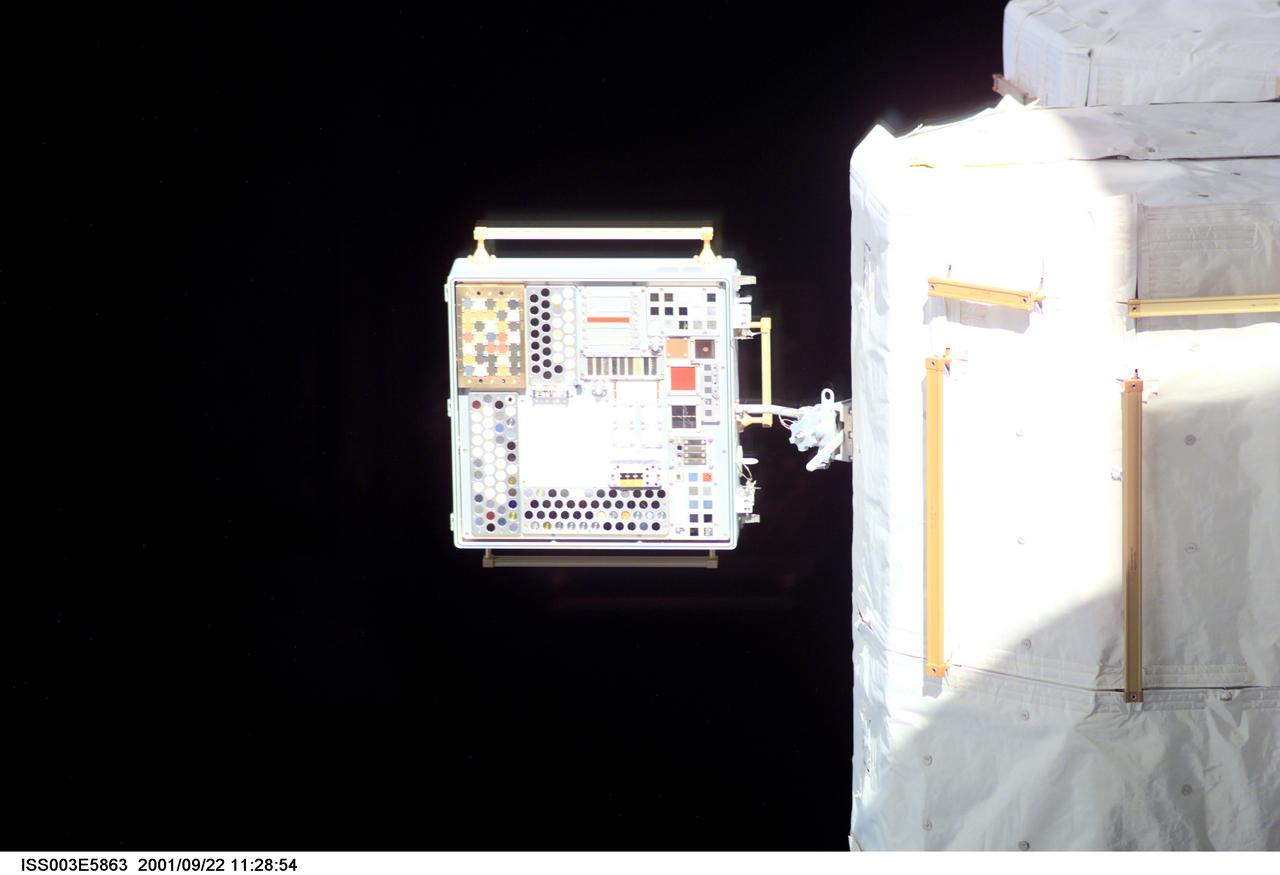
iss003e5863 (9/22/2001) --- A view of the Materials International Space Station Experiment (MISSE) on the Quest / Airlock taken during Expedition 3. MISSE-1 and 2 are a test bed for materials and coatings attached to the outside of the ISS is being evaluated for the effects of atomic oxygen, direct sunlight, and extremes of heat and cold. This experiment allows the development and testing of new materials to better withstand the rigors of space environments. Results will provide a better understanding of the durability of various materials when they are exposed to the space environment. Many of the materials may have applications in the design of future spacecraft.
View of MISSE on the Airlock taken during Expedition Three
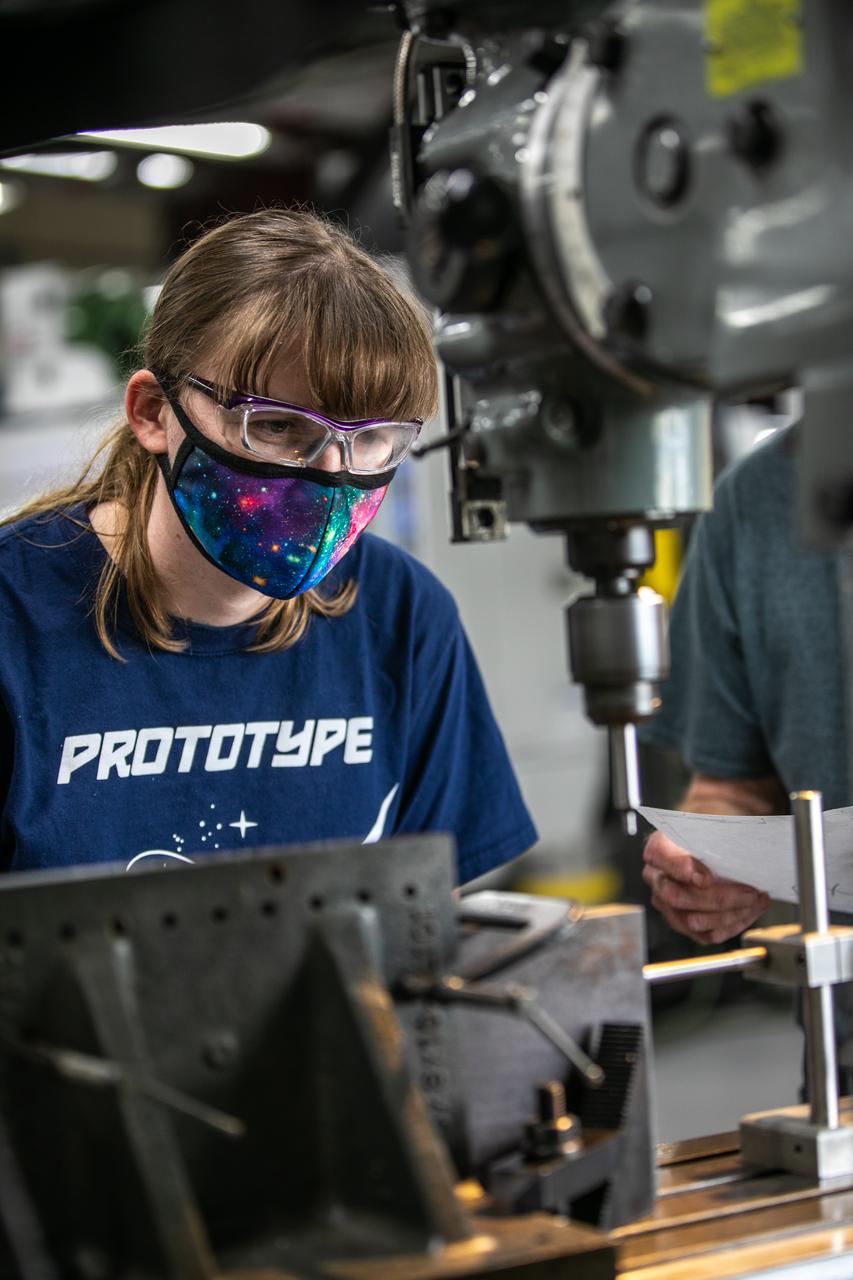
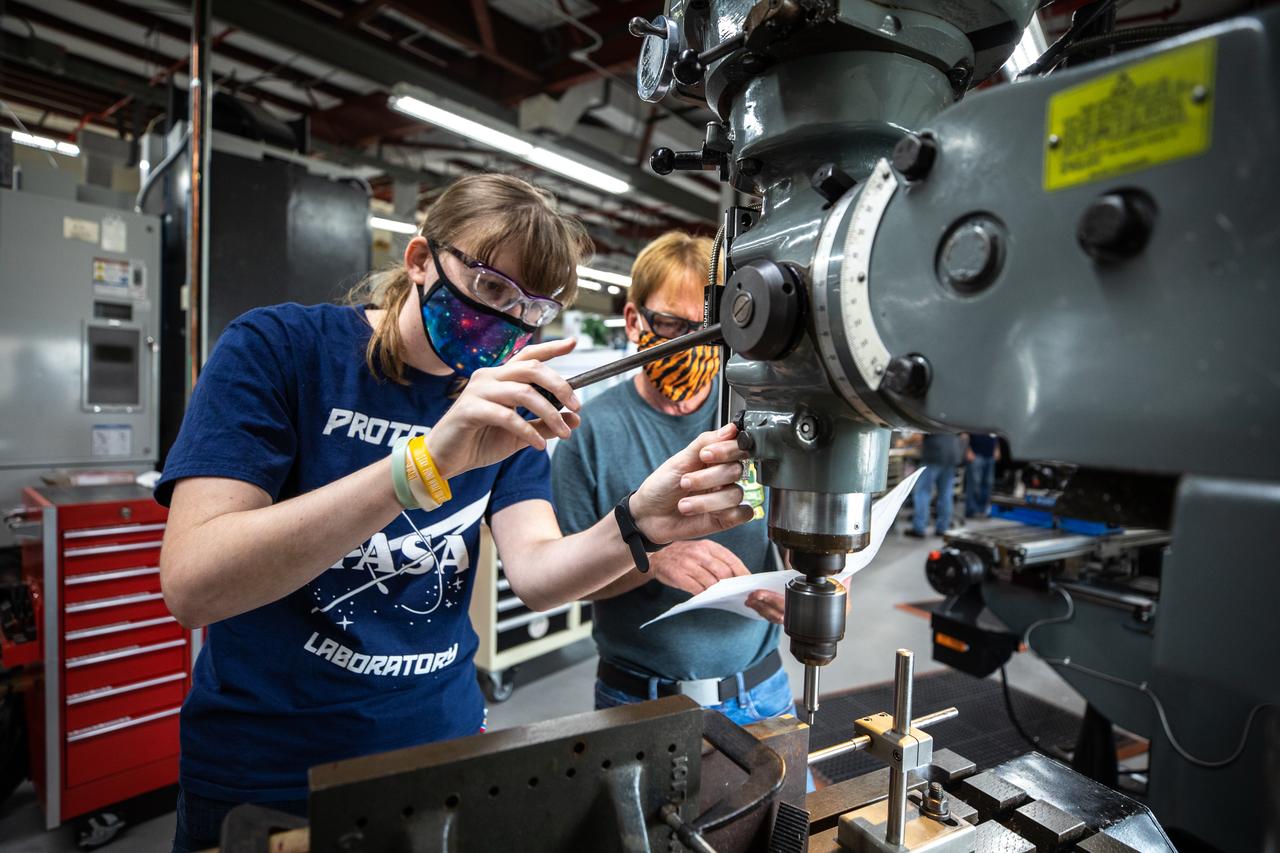
Katie Mortensen, a mechanical engineering technician, machines test article materials inside the Prototype Development Laboratory at NASA’s Kennedy Space Center in Florida on Oct. 21, 2020. The prototype laboratory designs, fabricates, and tests prototypes, test articles and test support equipment. It has a long history of providing fast solutions to complex operations problems. The lab’s teams of engineers use specialized equipment to produce exacting, one-of-a-kind items made from a range of materials depending on the design. The lab supports projects at Kennedy and at the agency level.
Engineering Labs: Prototype Development Laboratory (PDL)
Josh Litofsky leads a Gateway lunar dust adhesion testing campaign at NASA’s Johnson Space Center in Houston. His team studies how lunar dust interacts with materials chosen for Gateway's construction. Here, Litofsky scoops lunar stimulant into a sample holder.  Litofksy’s work seeks to validate the Gateway On-orbit Lunar Dust Modeling and Analysis Program (GOLDMAP), developed by Ronald Lee, also of Johnson Space Center. By considering factors such as the design and configuration of the space station, the materials used, and the unique conditions in lunar orbit, GOLDMAP helps predict how dust may move and settle on Gateway’s external surfaces.
jsc2024e063114 -- Advanced Modeling Enhances Gateway’s Lunar Dust Defense
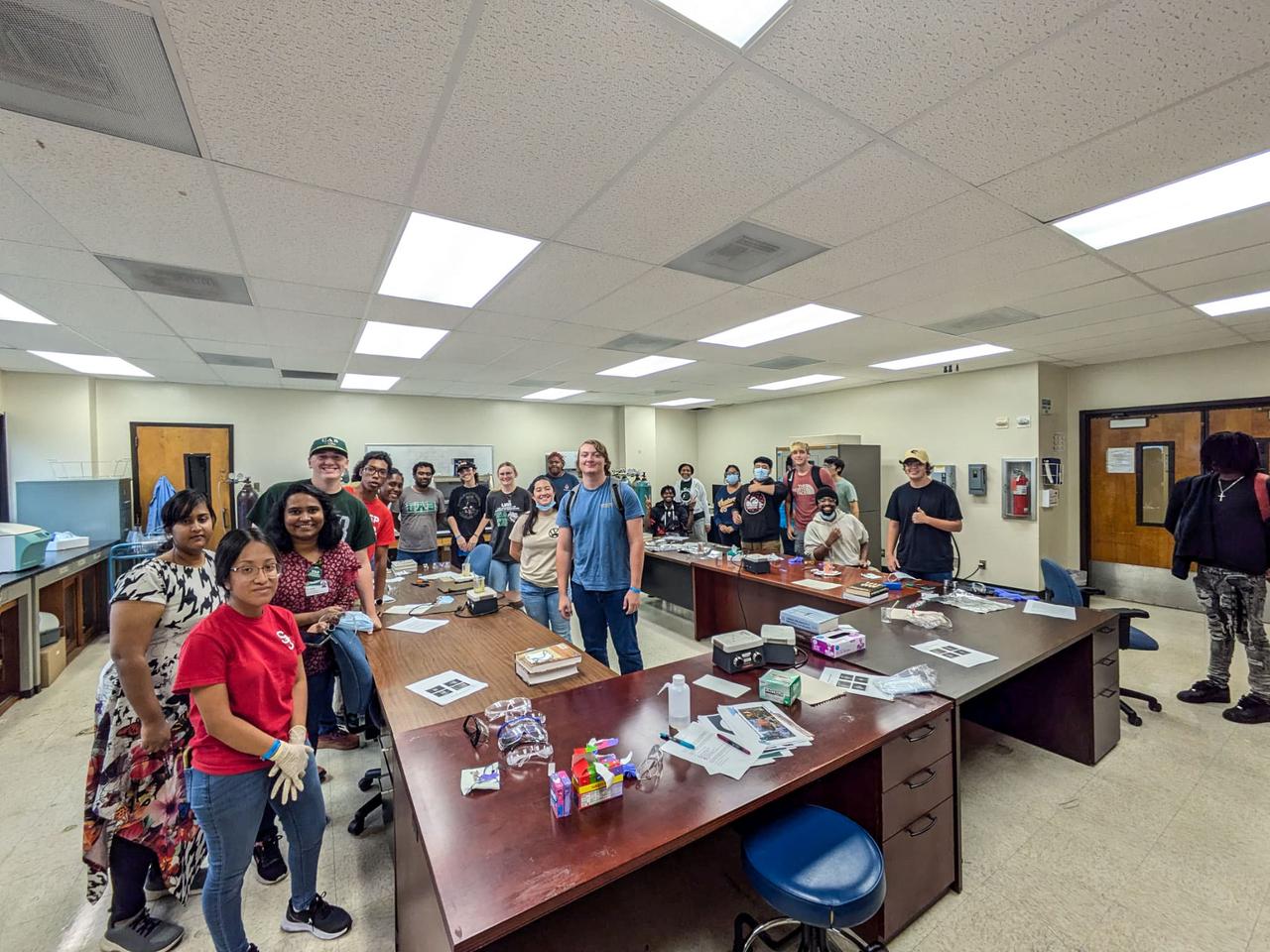
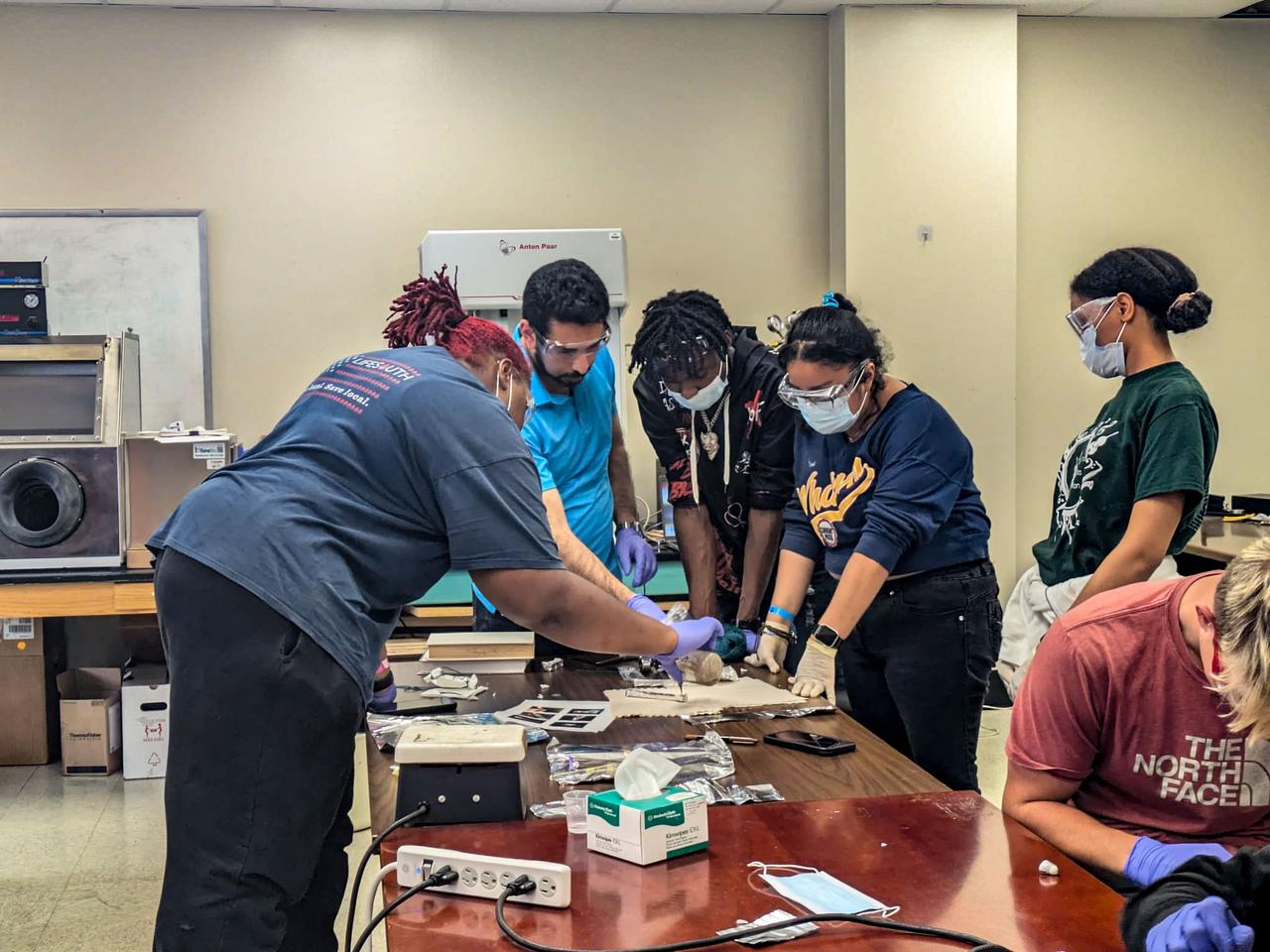
jsc2025e064334 (7/22/2025) --- This hands-on demonstration illustrated how different materials respond to different gravitational forces and their effects on flexural strength. Students engaged in experiments using models and simple testing setups to simulate the impacts of gravitational variations on material behavior. The activity allowed participants to compare how certain materials deform, crack, or maintain their structural integrity. By observing these differences, students gained a clearer understanding of how researchers design and optimize materials for use in extreme environments, such as space or high-stress industrial applications.
jsc2025e064334
jsc2025e064335 (7/22/2025) --- This hands-on demonstration illustrated how different materials respond to different gravitational forces and their effects on flexural strength. Students engaged in experiments using models and simple testing setups to simulate the impacts of gravitational variations on material behavior. The activity allowed participants to compare how certain materials deform, crack, or maintain their structural integrity. By observing these differences, students gained a clearer understanding of how researchers design and optimize materials for use in extreme environments, such as space or high-stress industrial applications.
jsc2025e064335
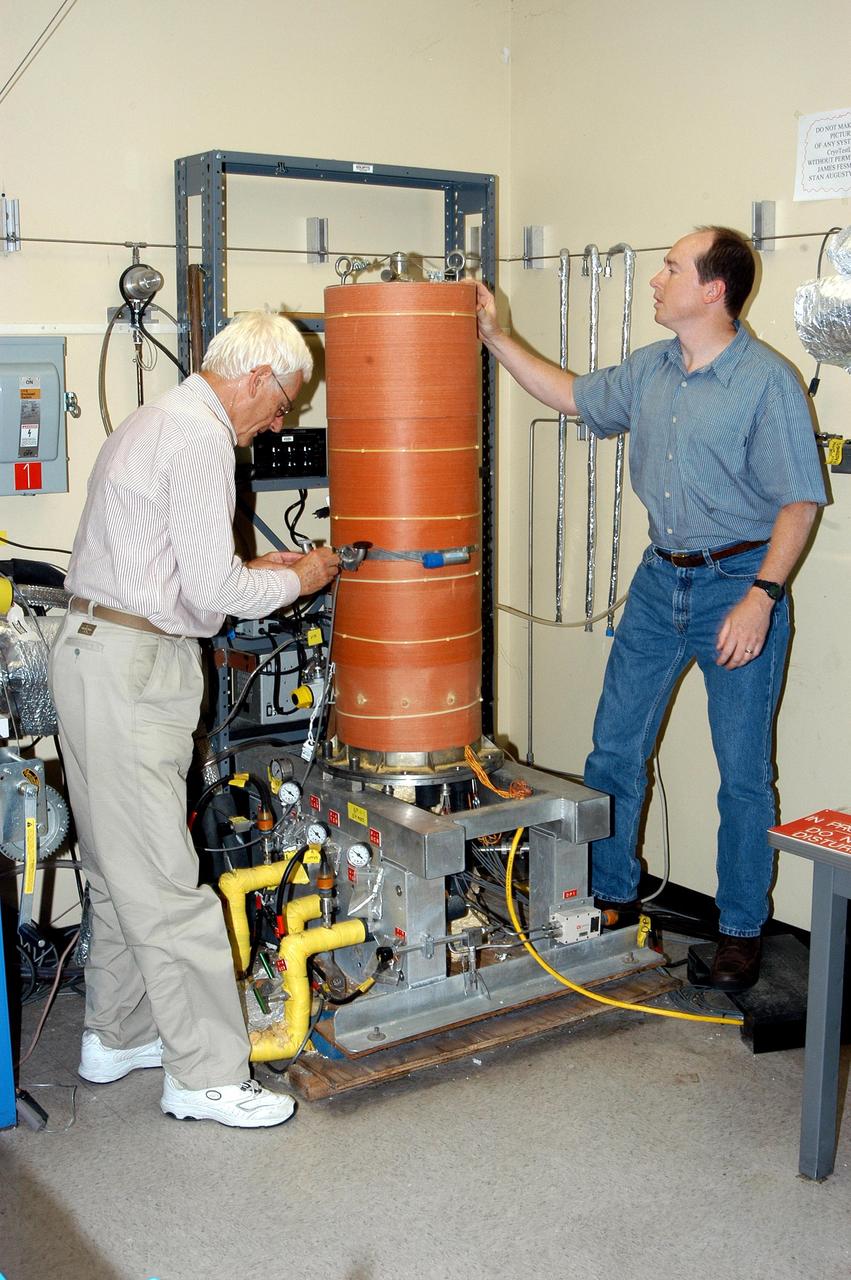
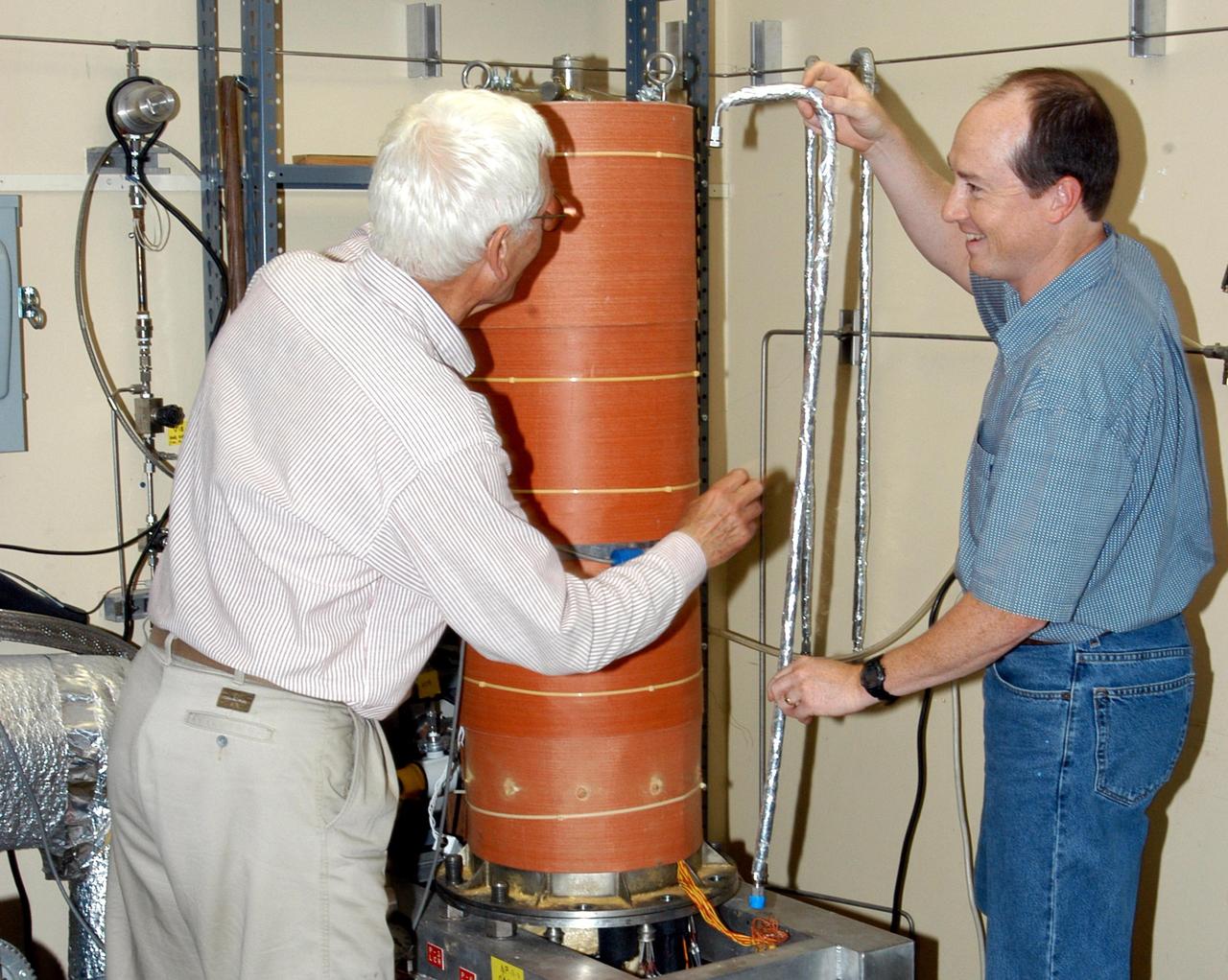
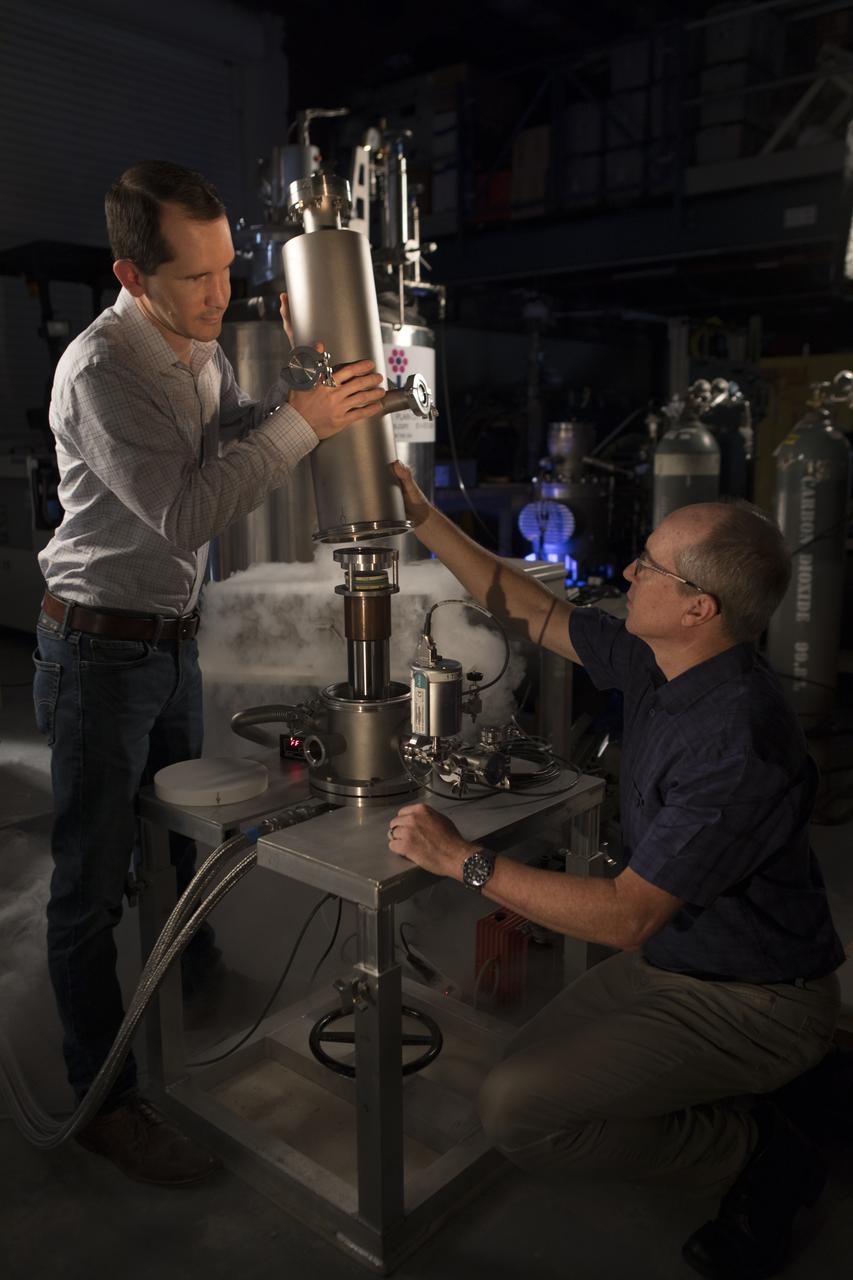
KENNEDY SPACE CENTER, FLA. -  James E. Fesmire (right), NASA lead engineer for the KSC Cryogenics Testbed, works on Cryostat-1, the Methods of Testing Thermal Insulation and Association Test Apparatus, which he developed.  At left is co-inventor Dr. Stan Augustynowicz, chief scientist with Sierra Lobo Inc. in Milan, Ohio. Cryostat-1 provides absolute thermal performance values of cryogenic insulation systems under real-world conditions. Cryogenic liquid is supplied to a test chamber and two guard chambers, and temperatures are sensed within the vacuum chamber to test aerogels, foams or other materials.   The Cryostat-1 machine can detect the absolute heat leakage rates through materials under the full range of vacuum conditions. Fesmire recently acquired three patents for testing thermal insulation materials for cryogenic systems. The research team of the Cryogenics Testbed offers testing and support for a number of programs and initiatives for NASA and commercial customers.
KSC-04pd1387
KENNEDY SPACE CENTER, FLA. -  James E. Fesmire (right), NASA lead engineer for the KSC Cryogenics Testbed, works on Cryostat-1, the Methods of Testing Thermal Insulation and Association Test Apparatus, which he developed.  At left is co-inventor Dr. Stan Augustynowicz, chief scientist with Sierra Lobo Inc. in Milan, Ohio. Cryostat-1 provides absolute thermal performance values of cryogenic insulation systems under real-world conditions. Cryogenic liquid is supplied to a test chamber and two guard chambers, and temperatures are sensed within the vacuum chamber to test aerogels, foams or other materials.   The Cryostat-1 machine can detect the absolute heat leakage rates through materials under the full range of vacuum conditions.  Fesmire recently acquired three patents for testing thermal insulation materials for cryogenic systems. The research team of the Cryogenics Testbed offers testing and support for a number of programs and initiatives for NASA and commercial customers.
KSC-04pd1386
Weightless testing of the MSFC Materials Processing in Space Experiment onboard the KC-135, NASA 930, 10/26/1983.
EXPERIMENT - SHUTTLE
Test of bearing and seal materials in order to develop improved life bearing designs for operating in liquid turbomachinery.
Around Marshall
Test of bearing and seal materials in order to develop improved life bearing designs for operating in liquid turbomachinery.
Around Marshall
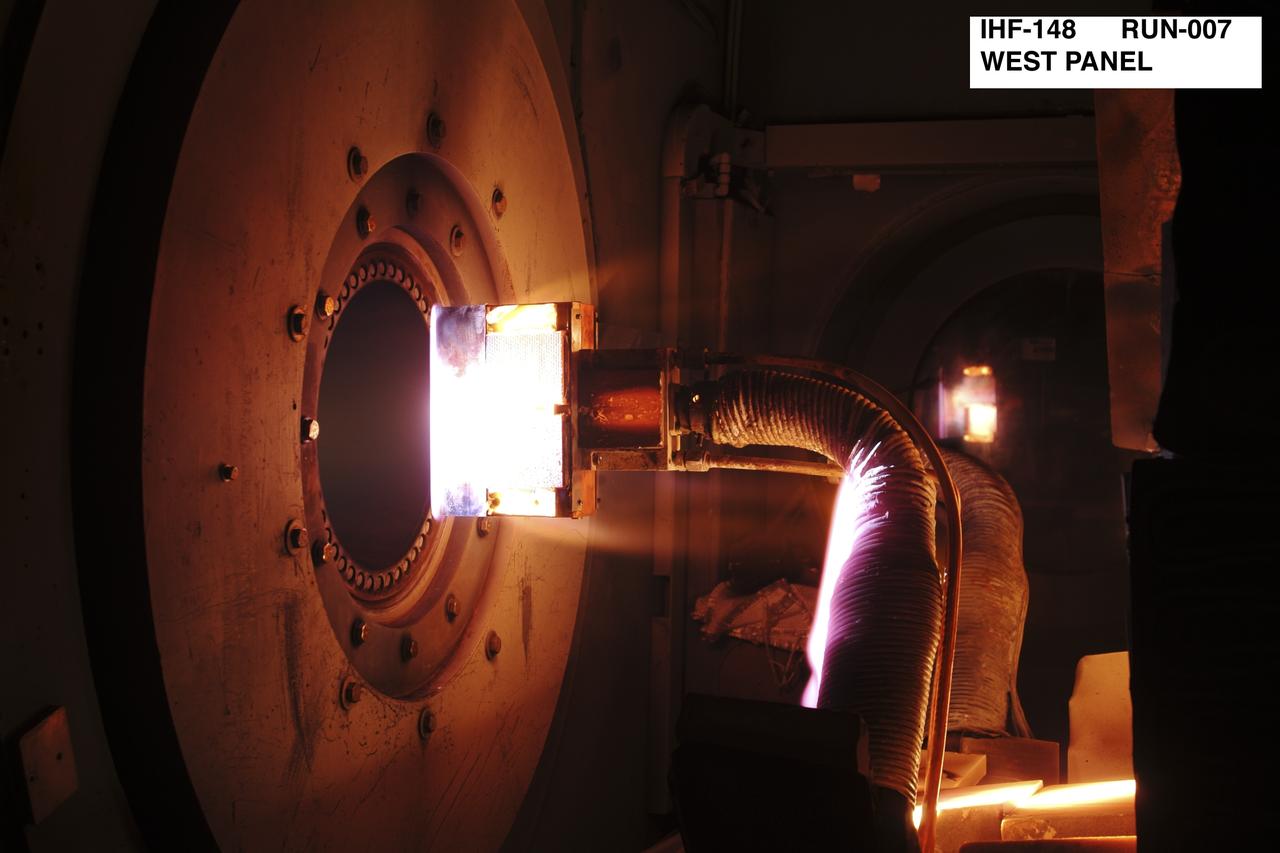
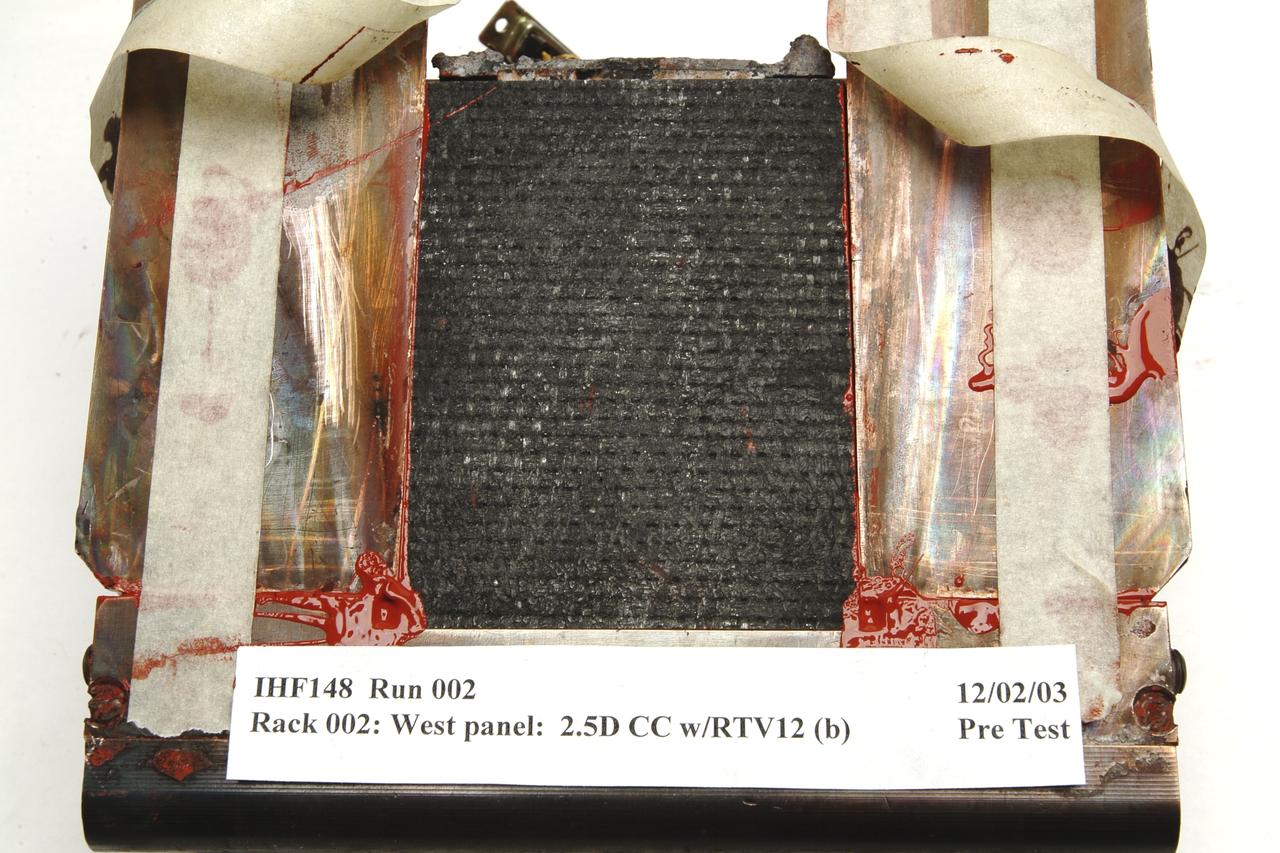
Next Generation Thermal Protection Materials testing: Interactive Heating Facility IHF-148
ARC-2003-ACD03-0238-064
TODD SCHNEIDER PREPARES A PLASMA CHAMBER IN BUILDING 4605 AT MSFC FOR AN UPCOMING TEST. SCHNEIDER IS A PHYSICIST IN THE MATERIALS AND PROCESSES DEPARTMENT AT MSFC.
PLASMA CHAMBER
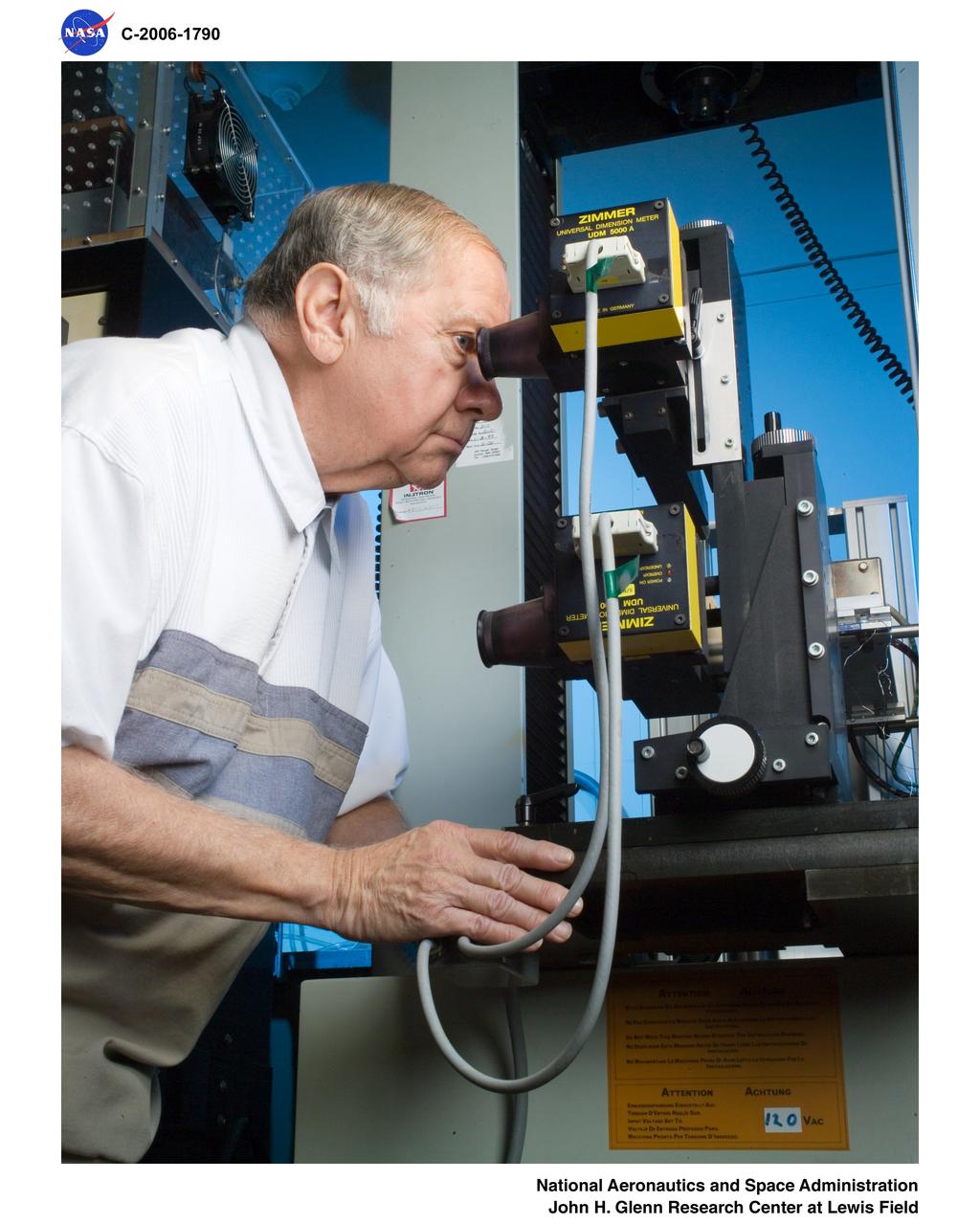
Instron Testing Machine studying the strength of Ceramic Matrix Composite (CMC) Material to develop and improve their mechanical properties
GRC-2006-C-01790
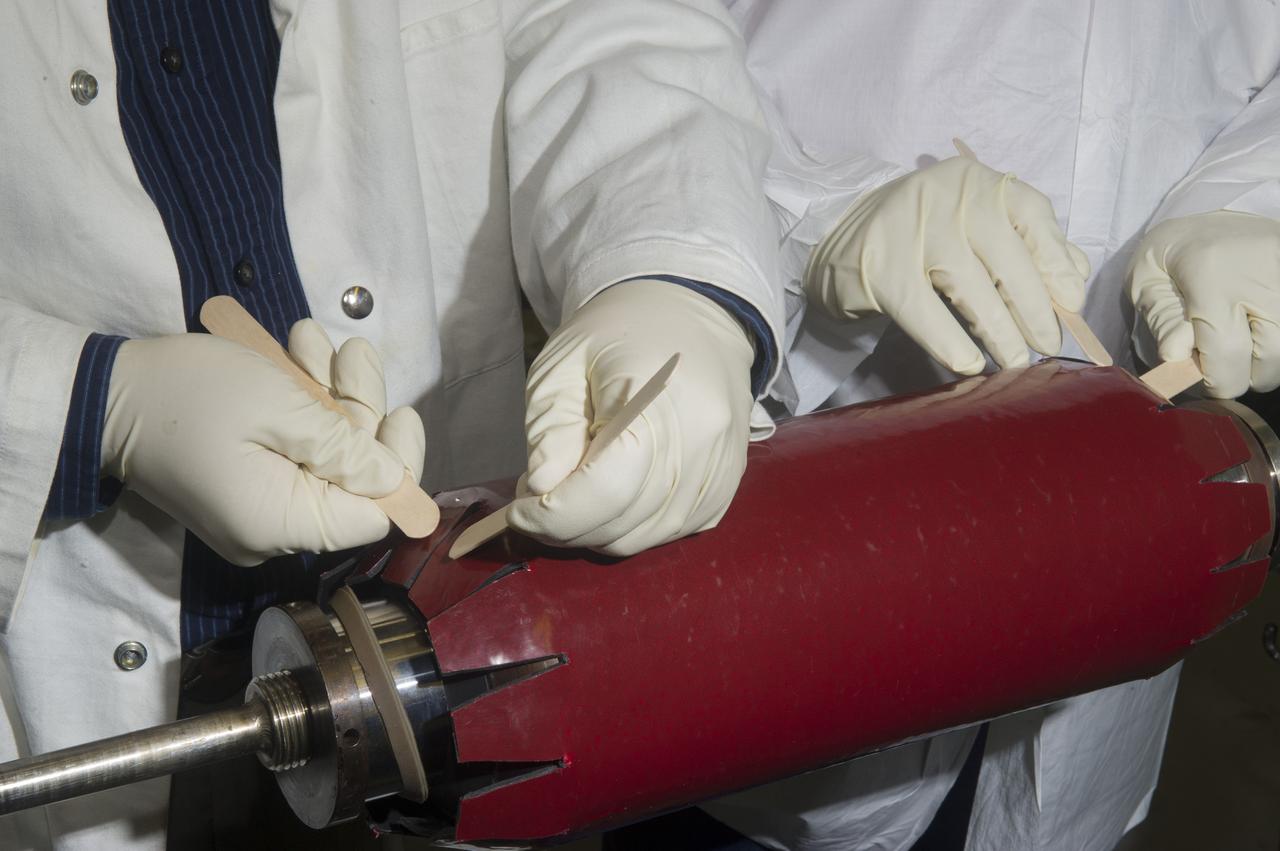
MATERIALS ENGINEER CHAD HASTINGS AND ENGINEERING TECHNICIAN PHILLIP THOMPSON LAYING UP RUBBER INSULATION ON BURST TEST ARTICLE
1300587
MATERIALS ENGINEER CHAD HASTINGS AND ENGINEERING TECHNICIAN PHILLIP THOMPSON LAYING UP RUBBER INSULATION ON BURST TEST ARTICLE
1300589
NASA AMES HAZMAT (Hazardous Materials) PLSS pack with Doug Smith at FMC test ground
ARC-1996-AC96-0195-21
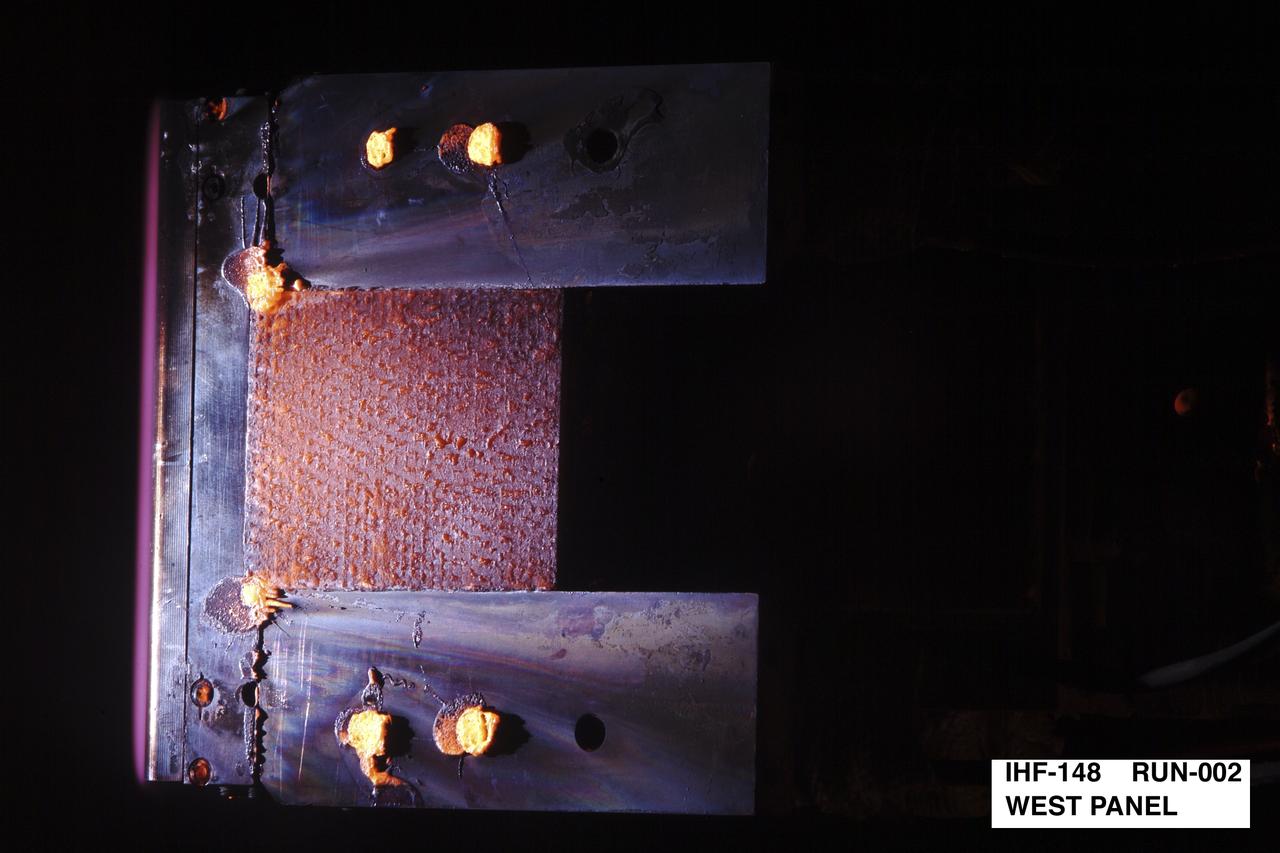
NEXT GENERATION THERMAL PROTECTION MATERIALS TESTING IN INTERACTIVE HEATING FACILITY; IHF-148 Run 002 West Panel
ARC-2003-ACD03-0238-010
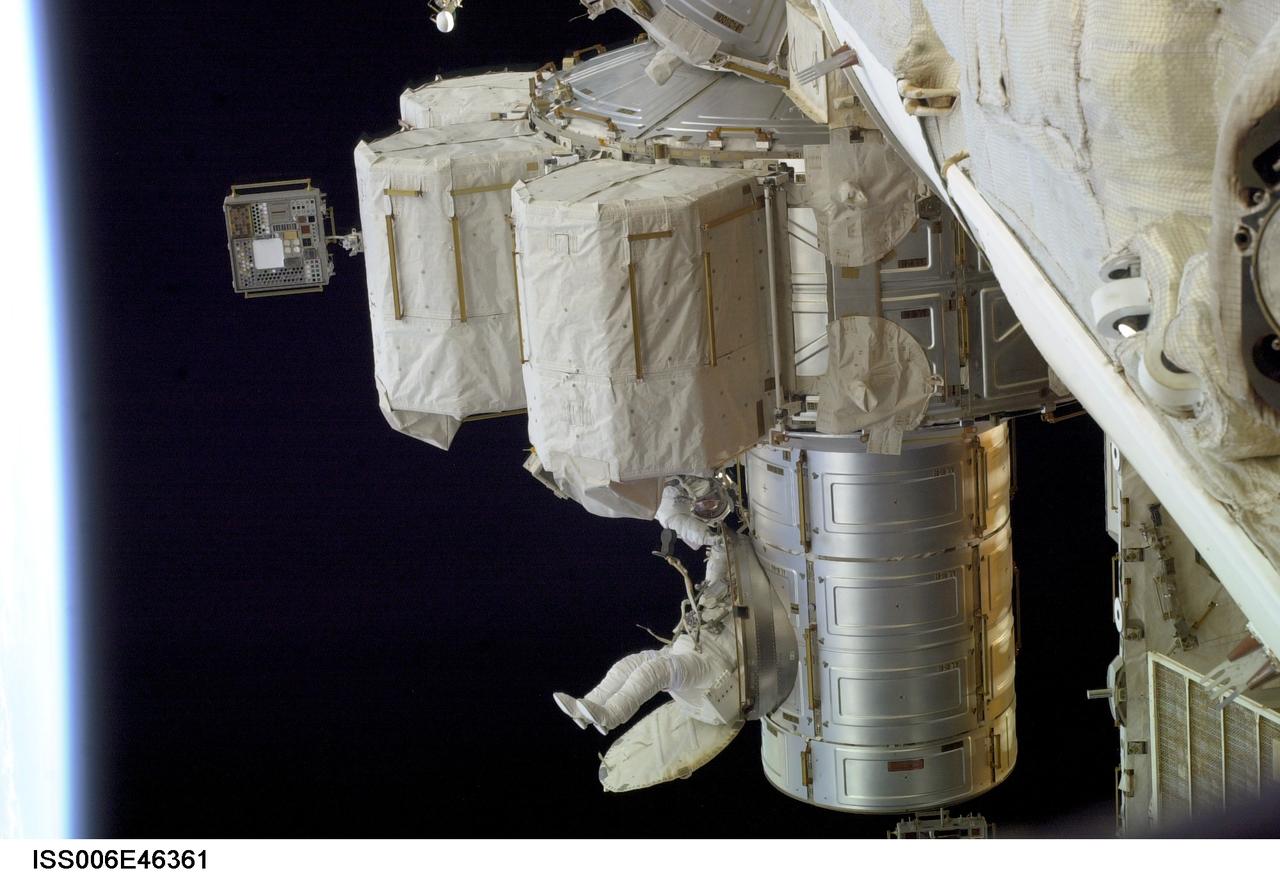
iss006e46361 (4/24/2003) --- A view of NASA astronaut Donald Pettit emerging from the Quest/Airlock (A/L) to perform a variety of maintenance tasks. Bowersox is working in the background. Also in view is Materials International Space Station Experiments (MISSE) attached to A/L. Photo was taken during Expedition Six on the International Space Station (ISS). MISSE-1 and 2 are a test bed for materials and coatings attached to the outside of the ISS is being evaluated for the effects of atomic oxygen, direct sunlight, and extremes of heat and cold. This experiment allows the development and testing of new materials to better withstand the rigors of space environments. Results will provide a better understanding of the durability of various materials when they are exposed to the space environment. Many of the materials may have applications in the design of future spacecraft.
View of Flight Engineer Donald R. Pettit emerging from the Quest/Airlock to perform tasks
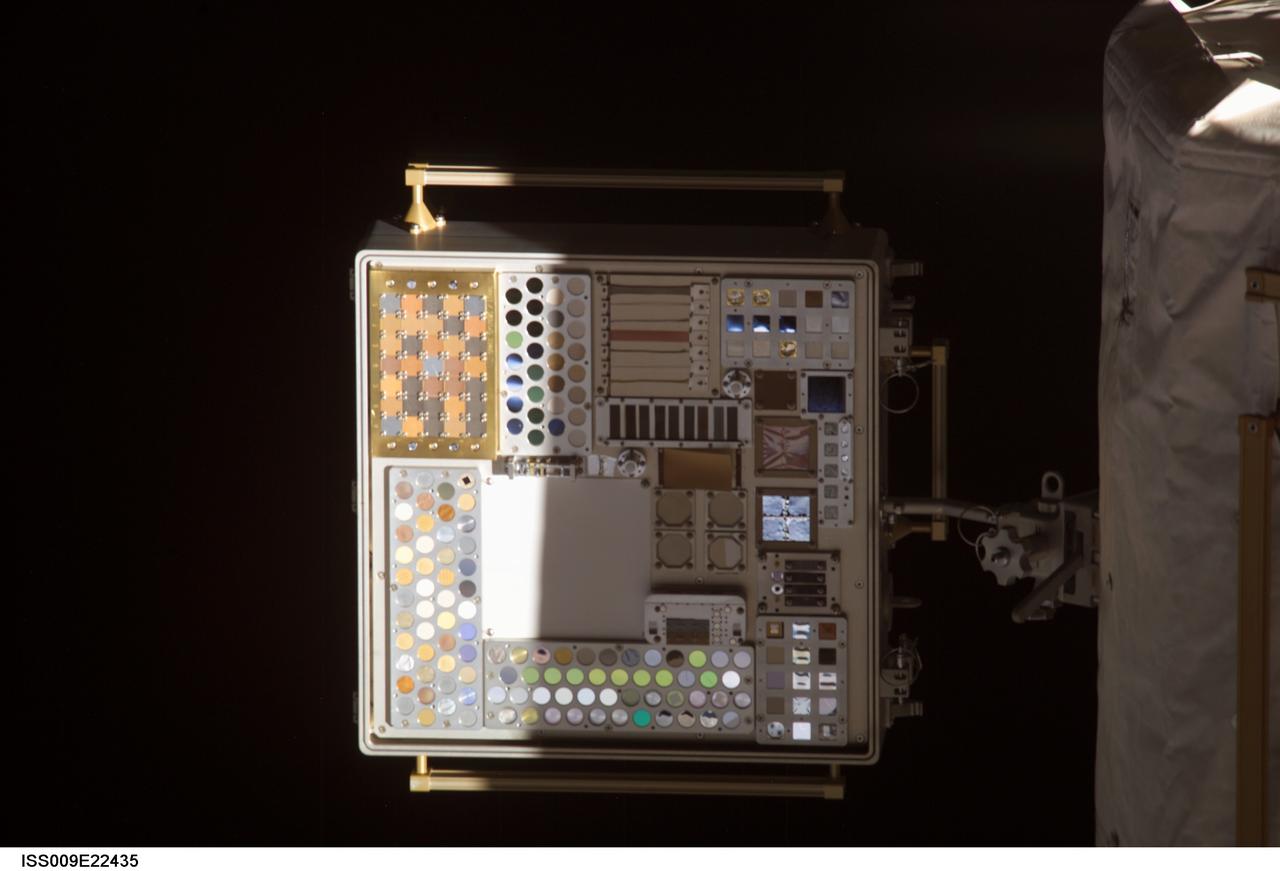
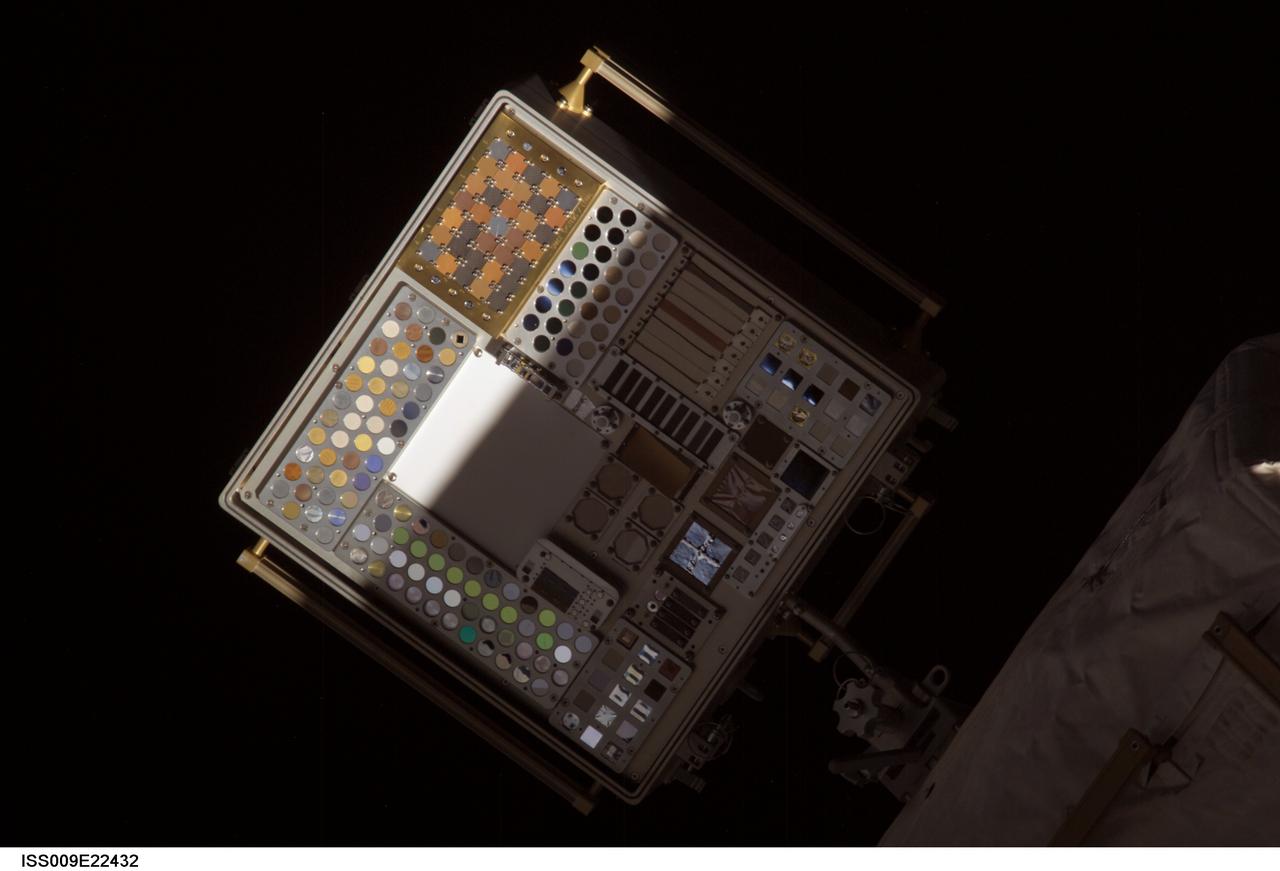
iss009e22432 (9/13/2004) --- A view of the Materials International Space Station Experiment (MISSE) #1, aft side. MISSE is attached to the outside of the Zvezda Service Module (SM). Image taken from the Pirs Docking Compartment forward port window during observation and photography of ISS External Structures on Expedition 9. MISSE-1 and 2 are a test bed for materials and coatings attached to the outside of the ISS is being evaluated for the effects of atomic oxygen, direct sunlight, and extremes of heat and cold. This experiment allows the development and testing of new materials to better withstand the rigors of space environments. Results will provide a better understanding of the durability of various materials when they are exposed to the space environment. Many of the materials may have applications in the design of future spacecraft.
MISSE #1 photographed during Expedition 9
iss009e22435 (9/13/2004) --- A view of the Materials International Space Station Experiment (MISSE) #1,aft side. MISSE is attached to the outside of the Zvezda Service Module (SM). Image taken from the Pirs Docking Compartment forward port window during observation and photography of ISS External Structures on Expedition 9. MISSE-1 and 2 are a test bed for materials and coatings attached to the outside of the ISS is being evaluated for the effects of atomic oxygen, direct sunlight, and extremes of heat and cold. This experiment allows the development and testing of new materials to better withstand the rigors of space environments. Results will provide a better understanding of the durability of various materials when they are exposed to the space environment. Many of the materials may have applications in the design of future spacecraft.
MISSE #1 photographed during Expedition 9
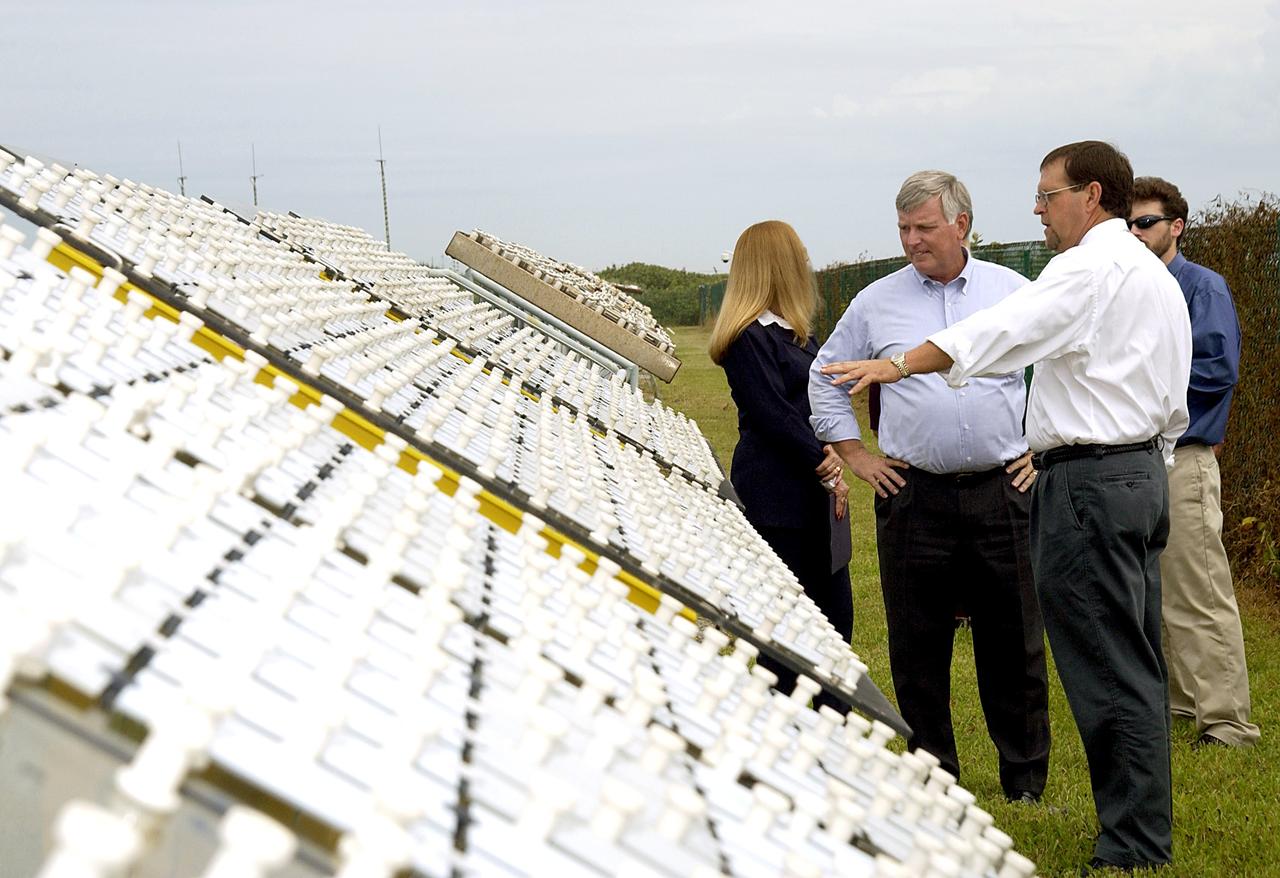
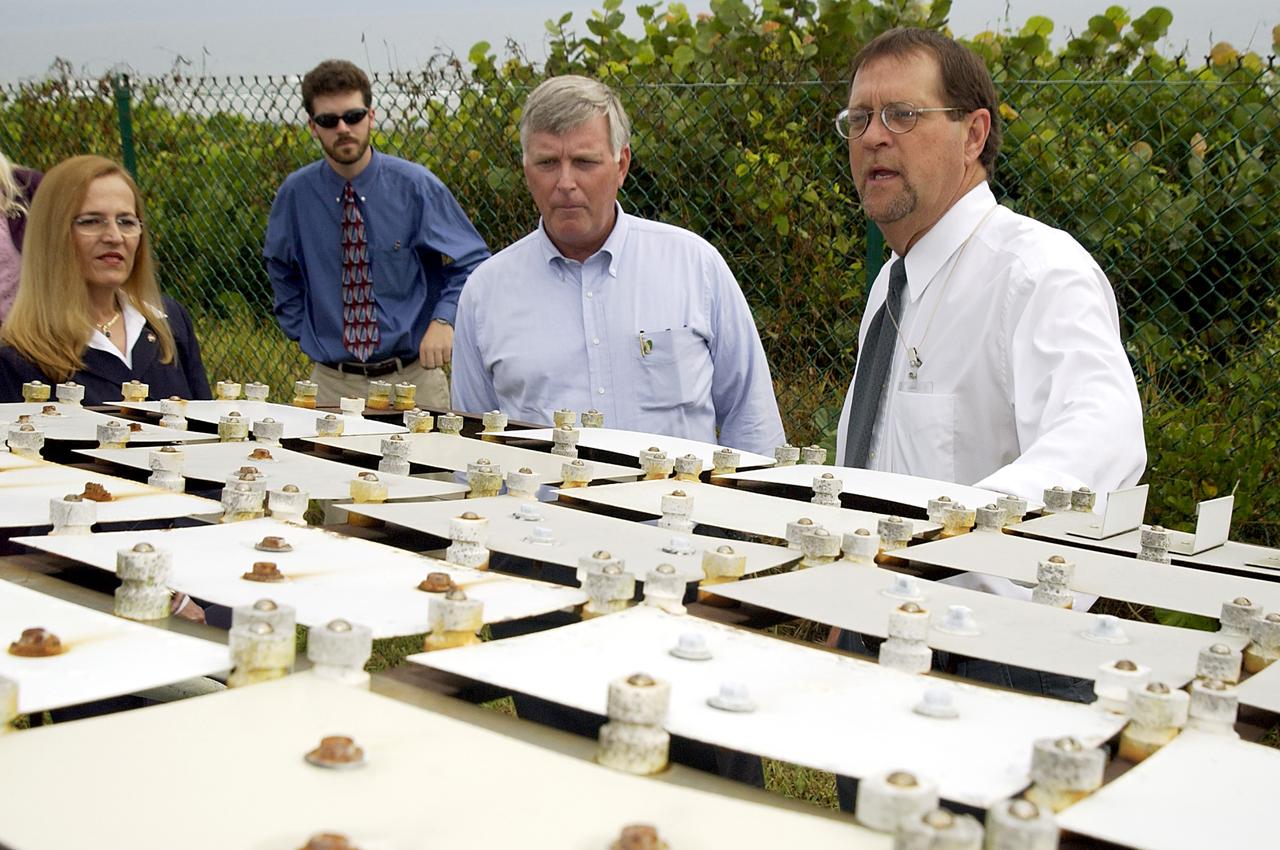
KENNEDY SPACE CENTER, FLA. -   On a tour of the KSC Beach Corrosion Test Site, Center Director Jim Kennedy (second from right) learns from Testbed Manager Louis MacDowell (right) about a project being undertaken for the U.S. Navy.  Being studied are nonchrome primers for aircraft.  At left are Lead Scientist Dr. Luz Marina Calle and  Dr. Paul Hintze, who is working on a graduate project for the National Research Council.  The KSC Beach Corrosion Test Site was established in the 1960s and has provided more than 30 years of historical information on the long-term performance of many materials in use at KSC and other locations around the world. Located 100 feet from the Atlantic Ocean approximately 1 mile south of the Space Shuttle launch sites, the test facility includes an atmospheric exposure site, a flowing seawater exposure site, and an on-site electrochemistry laboratory and monitoring station. The beach laboratory is used to conduct real-time corrosion experiments and provides for the remote monitoring of surrounding weather conditions. The newly added flowing seawater immersion facility provides for the immersion testing of materials and devices under controlled conditions.
KENNEDY SPACE CENTER, FLA. - On a tour of the KSC Beach Corrosion Test Site, Center Director Jim Kennedy (second from right) learns from Testbed Manager Louis MacDowell (right) about a project being undertaken for the U.S. Navy. Being studied are nonchrome primers for aircraft. At left are Lead Scientist Dr. Luz Marina Calle and Dr. Paul Hintze, who is working on a graduate project for the National Research Council. The KSC Beach Corrosion Test Site was established in the 1960s and has provided more than 30 years of historical information on the long-term performance of many materials in use at KSC and other locations around the world. Located 100 feet from the Atlantic Ocean approximately 1 mile south of the Space Shuttle launch sites, the test facility includes an atmospheric exposure site, a flowing seawater exposure site, and an on-site electrochemistry laboratory and monitoring station. The beach laboratory is used to conduct real-time corrosion experiments and provides for the remote monitoring of surrounding weather conditions. The newly added flowing seawater immersion facility provides for the immersion testing of materials and devices under controlled conditions.
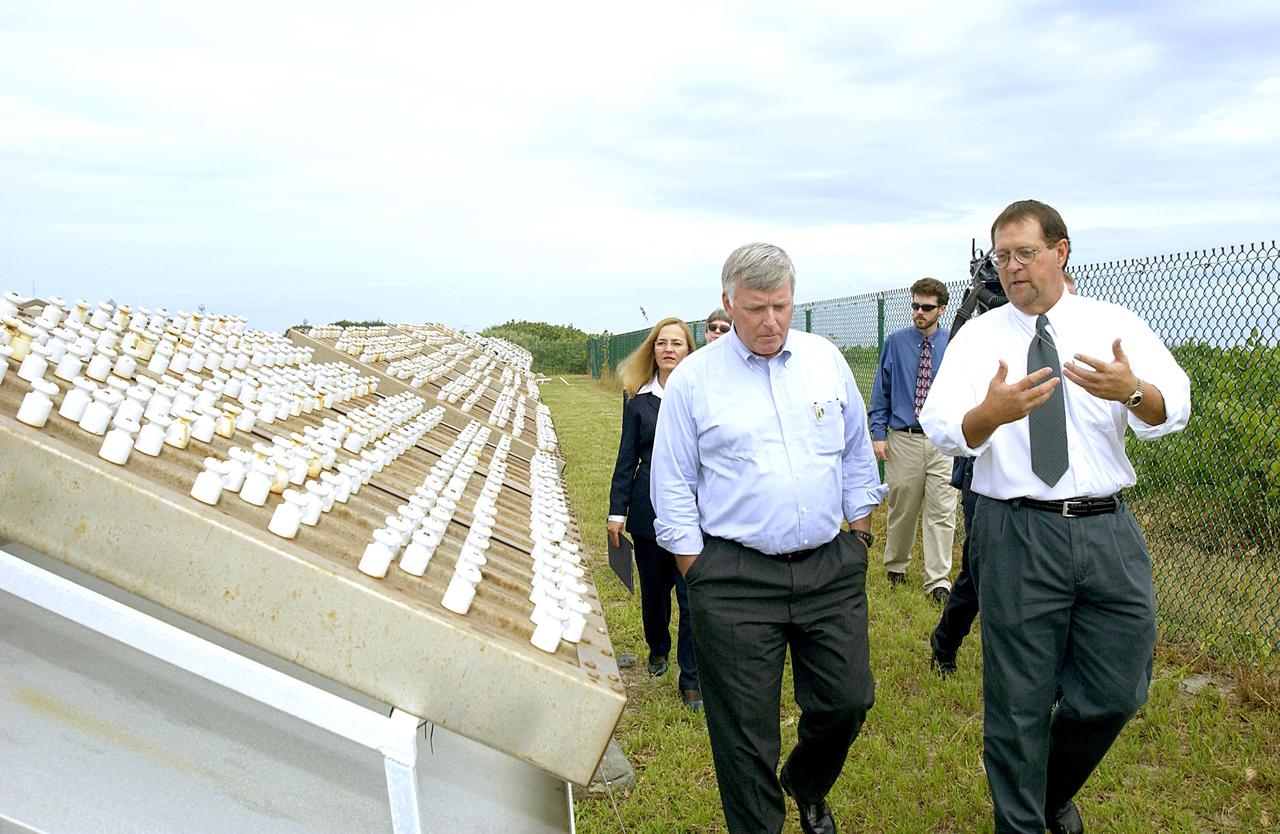
KENNEDY SPACE CENTER, FLA. -   On a tour of the KSC Beach Corrosion Test Site, Testbed Manager Louis MacDowell (foreground) explains to Center Director Jim Kennedy (third from right) about a study being undertaken for the U.S. Navy: nonchrome primers for aircraft. At left is Lead Scientist Dr. Luz Marina Calle and behind MacDowell is Dr. Paul Hintze, who is working on a graduate project for the National Research Council.  The KSC Beach Corrosion Test Site was established in the 1960s and has provided more than 30 years of historical information on the long-term performance of many materials in use at KSC and other locations around the world. Located 100 feet from the Atlantic Ocean approximately 1 mile south of the Space Shuttle launch sites, the test facility includes an atmospheric exposure site, a flowing seawater exposure site, and an on-site electrochemistry laboratory and monitoring station. The beach laboratory is used to conduct real-time corrosion experiments and provides for the remote monitoring of surrounding weather conditions. The newly added flowing seawater immersion facility provides for the immersion testing of materials and devices under controlled conditions.
KENNEDY SPACE CENTER, FLA. - On a tour of the KSC Beach Corrosion Test Site, Testbed Manager Louis MacDowell (foreground) explains to Center Director Jim Kennedy (third from right) about a study being undertaken for the U.S. Navy: nonchrome primers for aircraft. At left is Lead Scientist Dr. Luz Marina Calle and behind MacDowell is Dr. Paul Hintze, who is working on a graduate project for the National Research Council. The KSC Beach Corrosion Test Site was established in the 1960s and has provided more than 30 years of historical information on the long-term performance of many materials in use at KSC and other locations around the world. Located 100 feet from the Atlantic Ocean approximately 1 mile south of the Space Shuttle launch sites, the test facility includes an atmospheric exposure site, a flowing seawater exposure site, and an on-site electrochemistry laboratory and monitoring station. The beach laboratory is used to conduct real-time corrosion experiments and provides for the remote monitoring of surrounding weather conditions. The newly added flowing seawater immersion facility provides for the immersion testing of materials and devices under controlled conditions.
KENNEDY SPACE CENTER, FLA. -   On a tour of the KSC Beach Corrosion Test Site, Louis MacDowell (right), Testbed manager, explains to Center Director Jim Kennedy a project being undertaken for the U.S. Navy.  At left are nonchrome primers for aircraft being studied.  Behind Kennedy is Lead Scientist Dr. Luz Marina Calle.  Behind MacDowell is Dr. Paul Hintze, who is working on a graduate project for the National Research Council.  The KSC Beach Corrosion Test Site was established in the 1960s and has provided more than 30 years of historical information on the long-term performance of many materials in use at KSC and other locations around the world. Located 100 feet from the Atlantic Ocean approximately 1 mile south of the Space Shuttle launch sites, the test facility includes an atmospheric exposure site, a flowing seawater exposure site, and an on-site electrochemistry laboratory and monitoring station. The beach laboratory is used to conduct real-time corrosion experiments and provides for the remote monitoring of surrounding weather conditions. The newly added flowing seawater immersion facility provides for the immersion testing of materials and devices under controlled conditions.
KENNEDY SPACE CENTER, FLA. - On a tour of the KSC Beach Corrosion Test Site, Louis MacDowell (right), Testbed manager, explains to Center Director Jim Kennedy a project being undertaken for the U.S. Navy. At left are nonchrome primers for aircraft being studied. Behind Kennedy is Lead Scientist Dr. Luz Marina Calle. Behind MacDowell is Dr. Paul Hintze, who is working on a graduate project for the National Research Council. The KSC Beach Corrosion Test Site was established in the 1960s and has provided more than 30 years of historical information on the long-term performance of many materials in use at KSC and other locations around the world. Located 100 feet from the Atlantic Ocean approximately 1 mile south of the Space Shuttle launch sites, the test facility includes an atmospheric exposure site, a flowing seawater exposure site, and an on-site electrochemistry laboratory and monitoring station. The beach laboratory is used to conduct real-time corrosion experiments and provides for the remote monitoring of surrounding weather conditions. The newly added flowing seawater immersion facility provides for the immersion testing of materials and devices under controlled conditions.
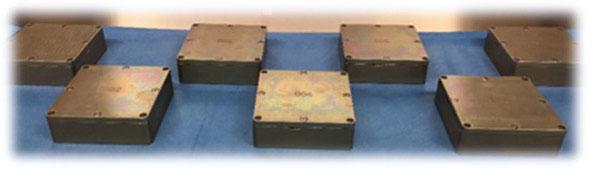
jsc2021e009430 (3/2/2021) --- Materials International Space Station Experiment-14-NASA (MISSE-14-NASA) continues a series of tests by NASA Glenn Research Center on how the harsh environment of space affects the performance and durability of various materials. MISSE-Seed sample containers ready for turnover. Image courtesy of Jeff Richards.
MISSE-14-NASA
jsc2021e009429 (3/2/2021) --- Materials International Space Station Experiment-14-NASA (MISSE-14-NASA) continues a series of tests by NASA Glenn Research Center on how the harsh environment of space affects the performance and durability of various materials. Seed packets in the Equipment (EUE) container.  Image courtesy of Jeff Richards.
MISSE-14-NASA
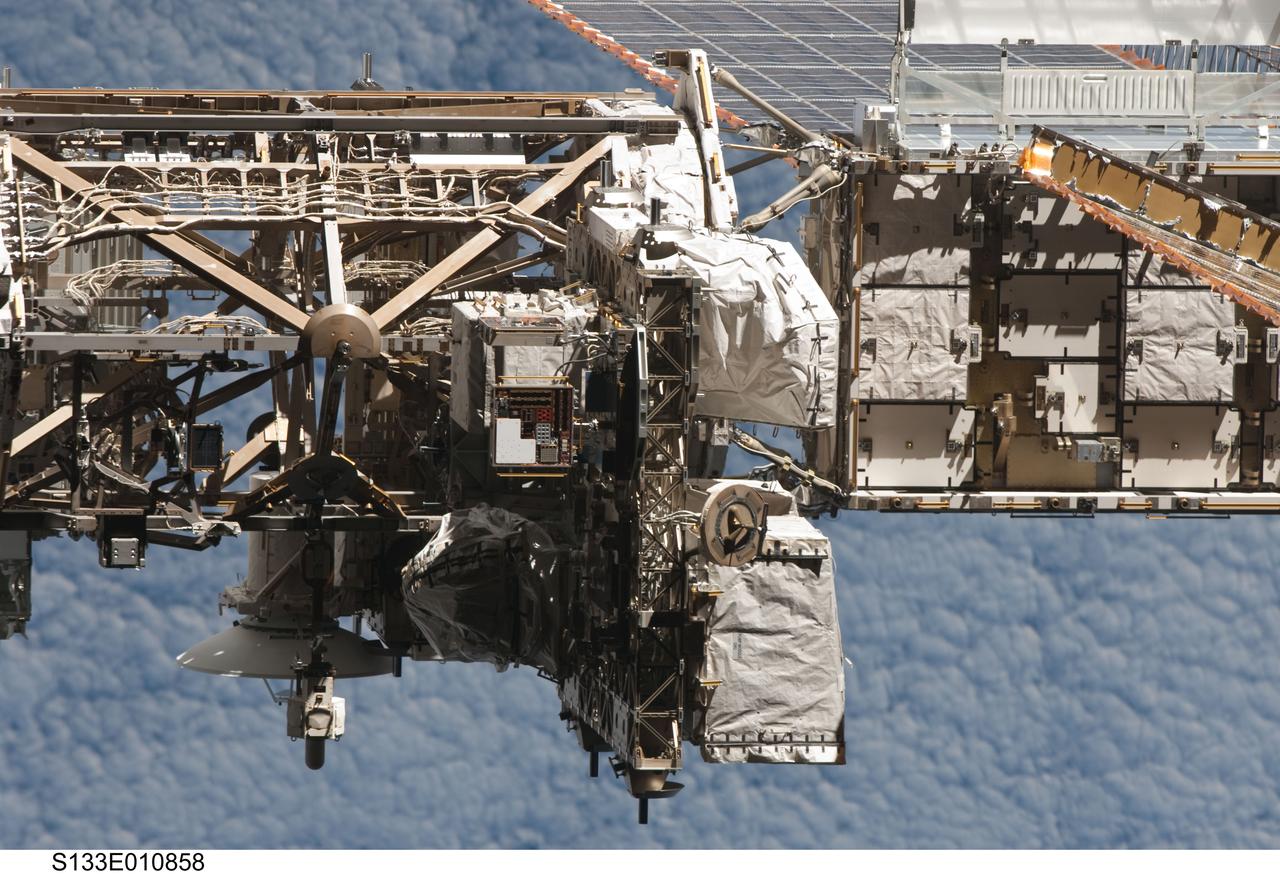
s133e010858 (3/7/2011) --- The Materials International Space Station Experiment-7 (MISSE-7) is a test bed for materials and coatings attached to the outside of the International Space Station being evaluated for the effects of atomic oxygen, ultraviolet, direct sunlight, radiation and extremes of heat and cold.
Fly around of ISS
iss055e026913 (4/19/2018) --- View of the Materials ISS Experiment Flight Facility (MISSE-FF) taken by the External High Definition Camera (EHDC1). The MISSE-FF platform provides the ability to test materials, coatings, and components or other larger experiments in the harsh environment of space, which is virtually impossible to do collectively on Earth.
MISSE-FF
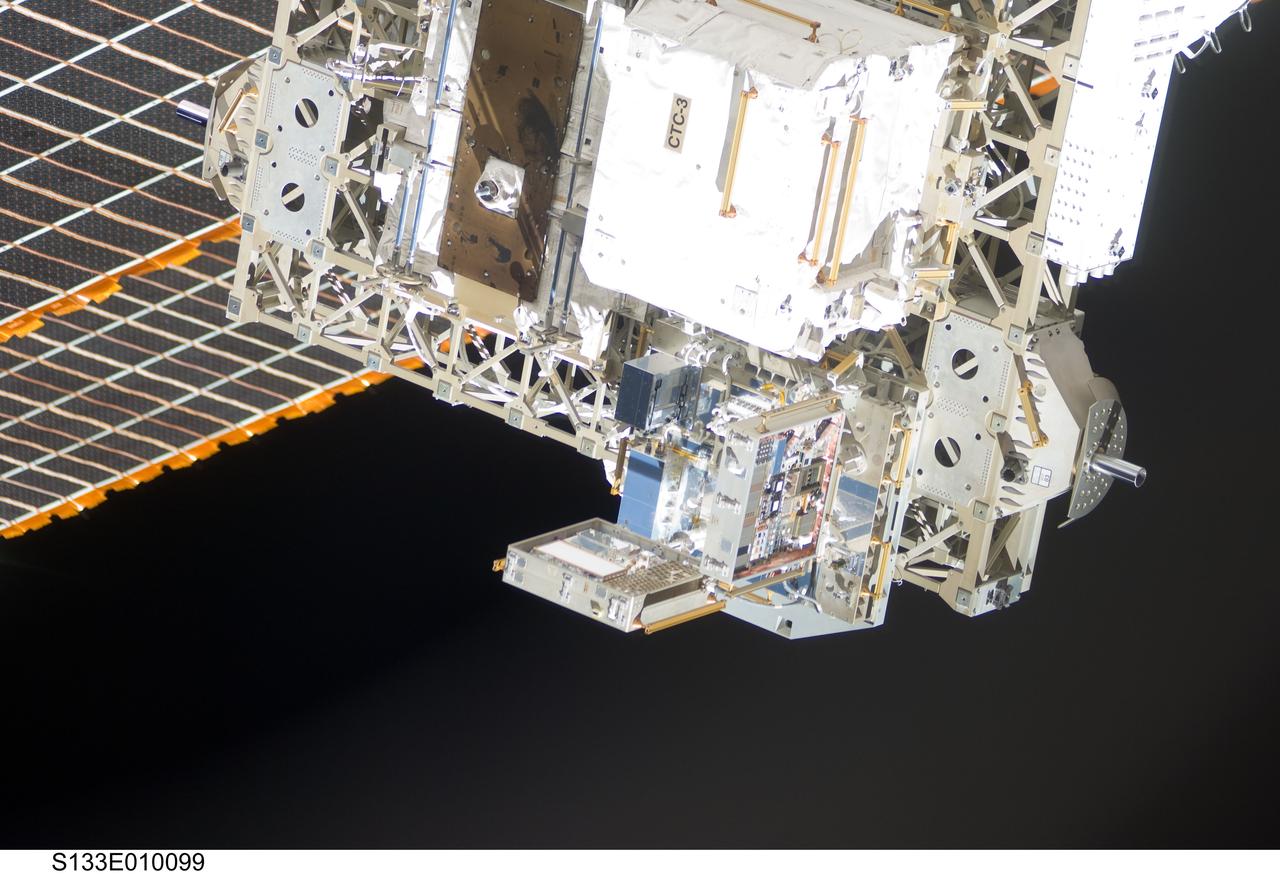
s133e010099 (3/7/2011) --- The Materials International Space Station Experiment-7 (MISSE-7) is a test bed for materials and coatings attached to the outside of the International Space Station being evaluated for the effects of atomic oxygen, ultraviolet, direct sunlight, radiation and extremes of heat and cold.
s133e010099
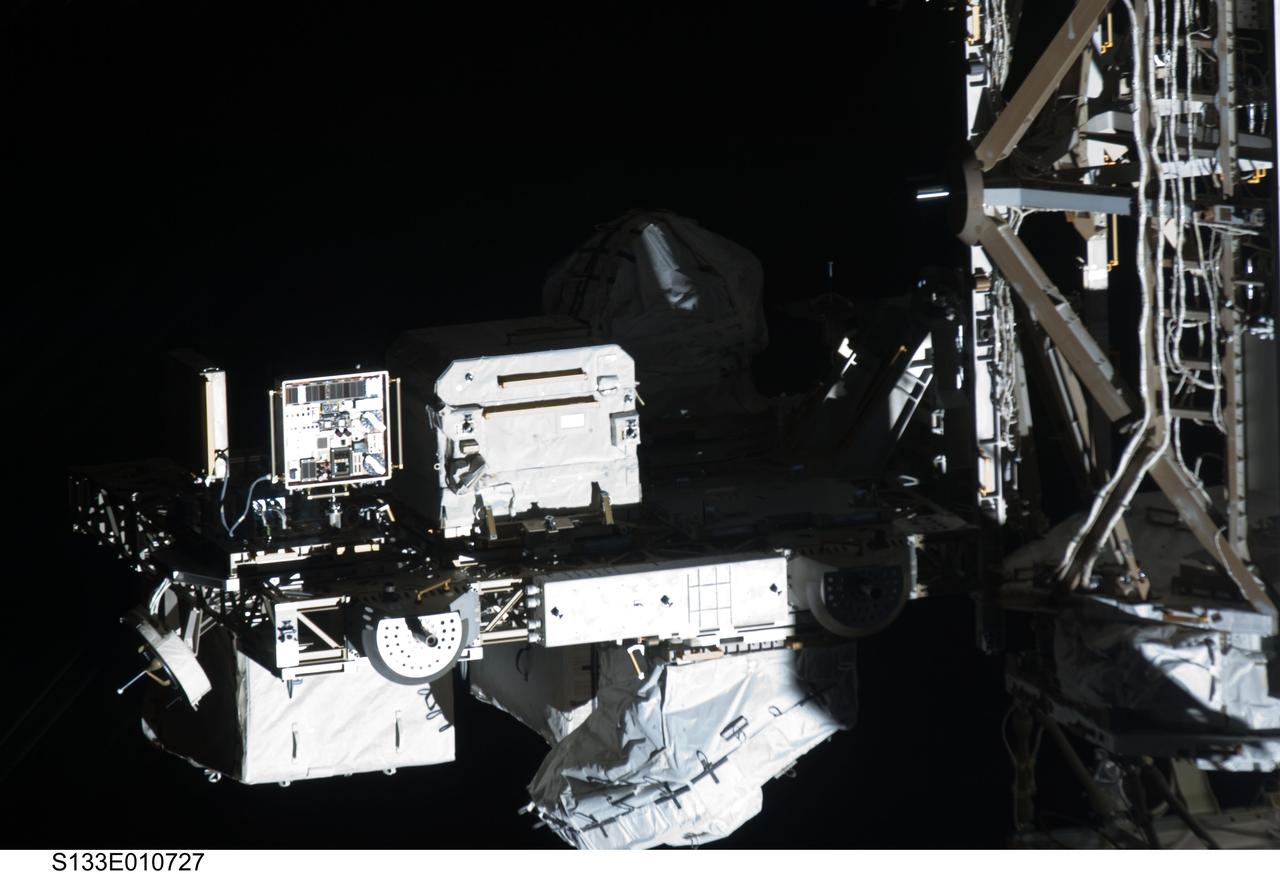
s133e010727 (3/7/2011) --- The Materials International Space Station Experiment-7 (MISSE-7) is a test bed for materials and coatings attached to the outside of the International Space Station being evaluated for the effects of atomic oxygen, ultraviolet, direct sunlight, radiation and extremes of heat and cold.
Fly around of ISS
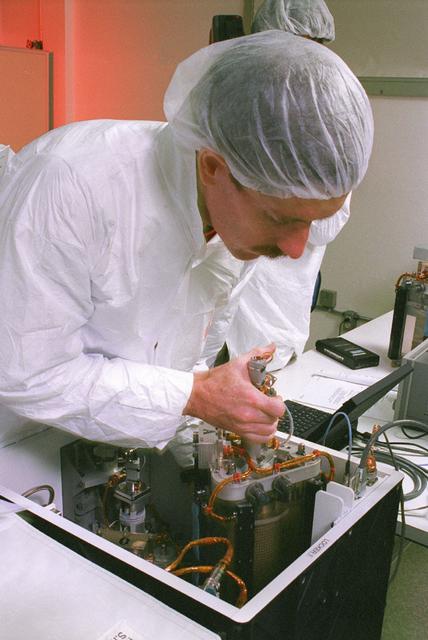
KENNEDY SPACE CENTER, FLA.  - Dionne B. Jackson is a Materials Science engineer in the Spaceport Engineering and Technology Directorate.  She is responsible for testing and identifying materials and chemicals that are used for the Shuttle Program, International Space Station Program and the Launch Services Program.  Jackson has been a permanent NASA KSC employee since 1991.
KSC-05pd-0153
Adam Swanger (left) and James Fesmire assemble a cryocooler-based low temperature materials test in the Cryogenics Test Laboratory at NASA's Kennedy Space Center on Mar. 20, 2019.
Cryogenics Laboratory
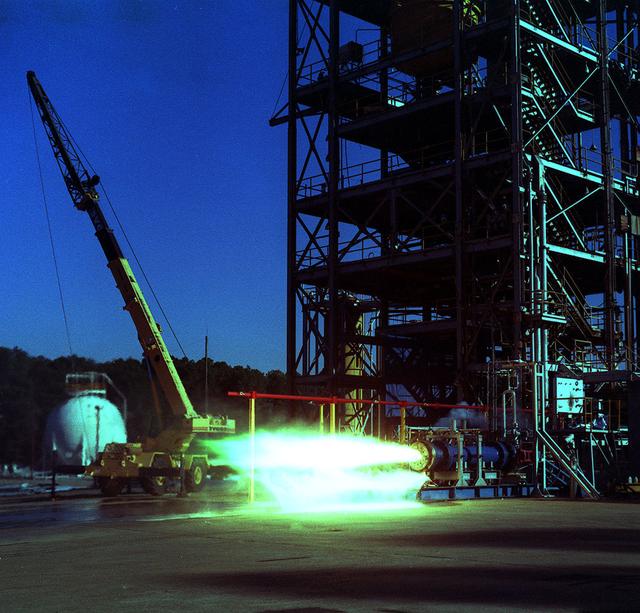
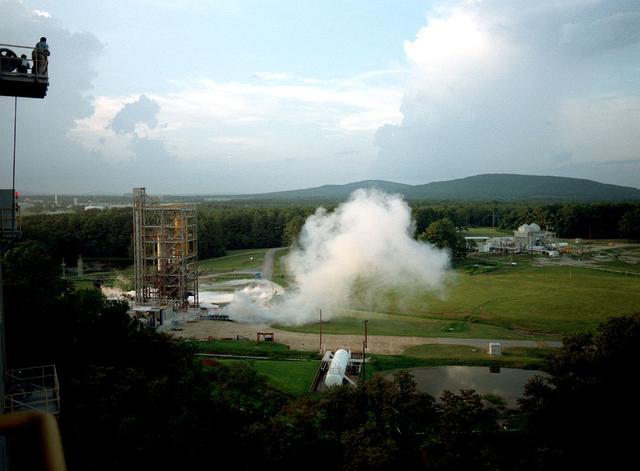
24 inch Hybrid motor test firing at Marshall's Test Stand 500. Liquid/gas are mixed with solid propellents to investigate materials, propellents, and nozzle stability characteristics.
Around Marshall
24 inch Hybrid motor test firing at Marshall's Test Stand 500. Liquid/gas are mixed with solid propellents to investigate materials, propellents, and nozzle stability characteristics.
Around Marshall
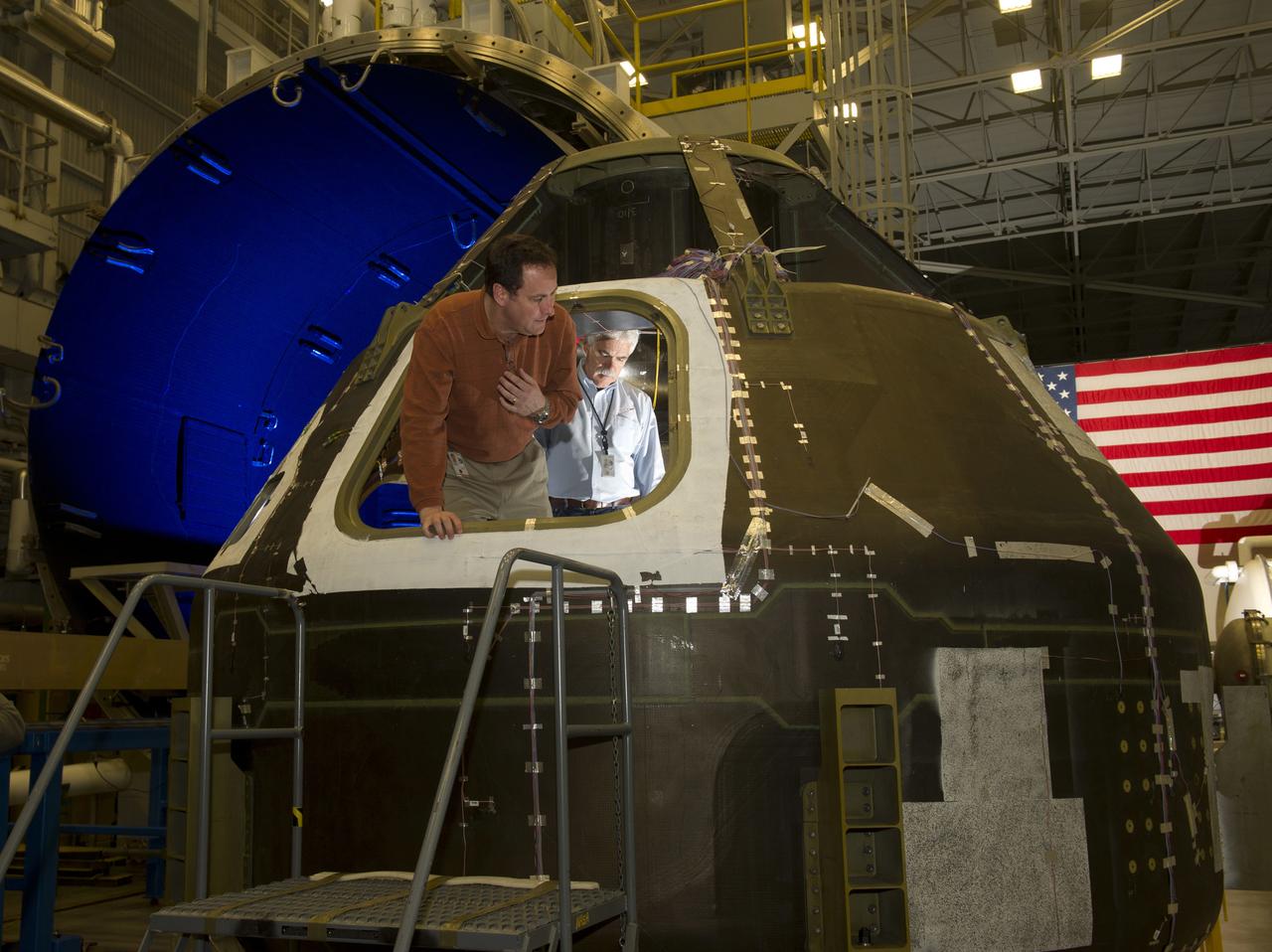
CENTER DIRECTOR ROBERT LIGHTFOOT AND  MATERIALS ENGINEER LARRY PELHAM, EXAMINE COMPOSITE CREW MODULE AT THE ENVIRONMENTAL TEST FACILITY IN BLDG. 4619 AS MODULE IS BEING PREPARED FOR SPACE ENVIRONMENTAL TESTING.
1200009
NEXT GENERATION THERMAL PROTECTION MATERIALS TESTING IN INTERACTIVE HEATING FACILITY; IHF-148 Run 002: Rack 002 West Panel: 2.5D  CC W/RTVIC (b) 12/2/03 pre- test
ARC-2003-ACD03-0238-007
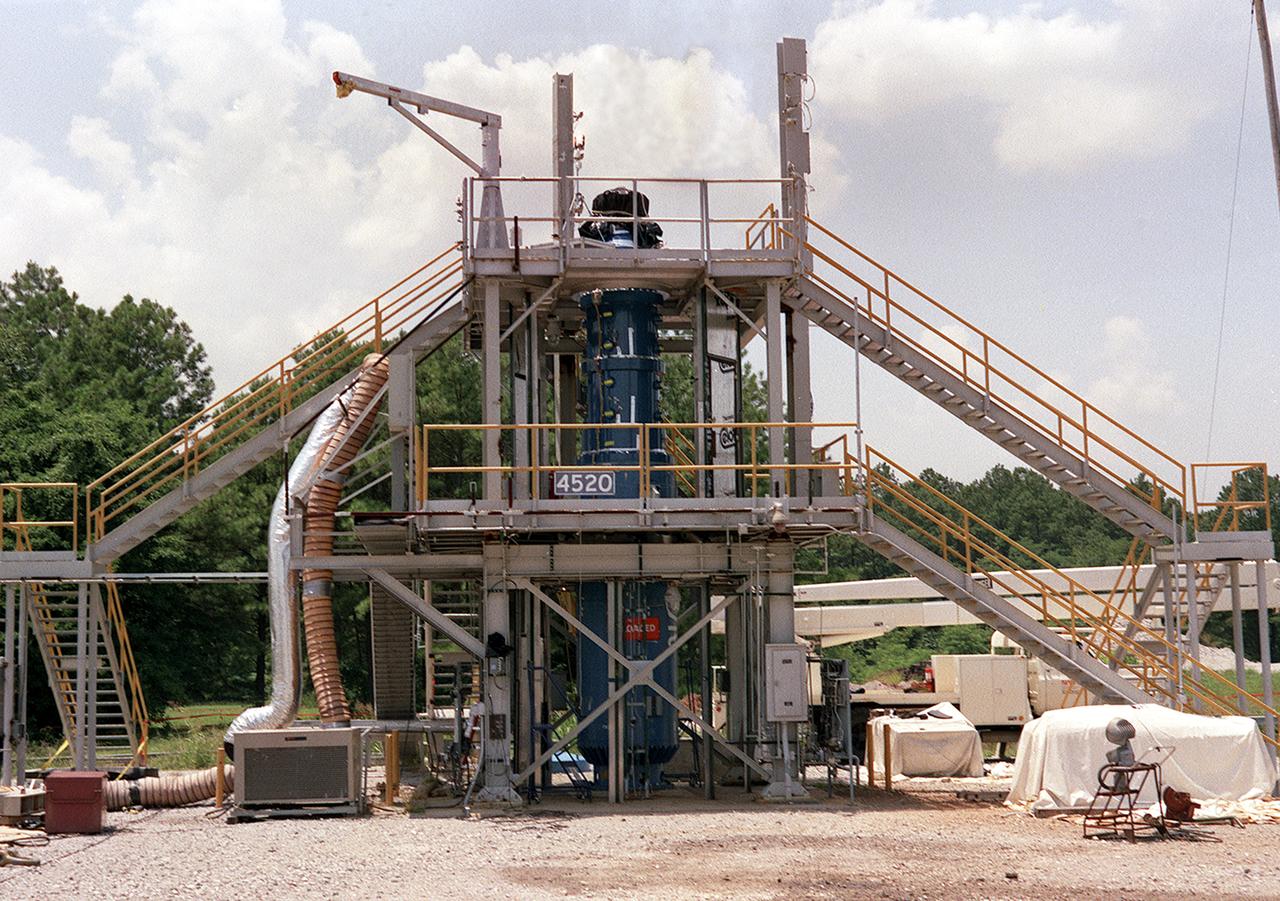
This photograph shows the Solid Propellant Test Article (SPTA) test stand with the Modified Nasa Motor (M-NASA) test article at the Marshall Space Flight Center (MSFC). The SPTA test stand, 12-feet wide by 12-feet long by 24-feet high, was built in 1989 to provide comparative performance data on nozzle and case insulation material and to verify thermostructural analysis models. A modified NASA 48-inch solid motor (M-NASA motor) with a 12-foot blast tube and 10-inch throat makes up the SPTA. The M-NASA motor is being used to evaluate solid rocket motor internal non-asbestos insulation materials, nozzle designs, materials, and new inspection techniques. New internal motor case instrumentation techniques are also being evaluated.
Space Shuttle Projects
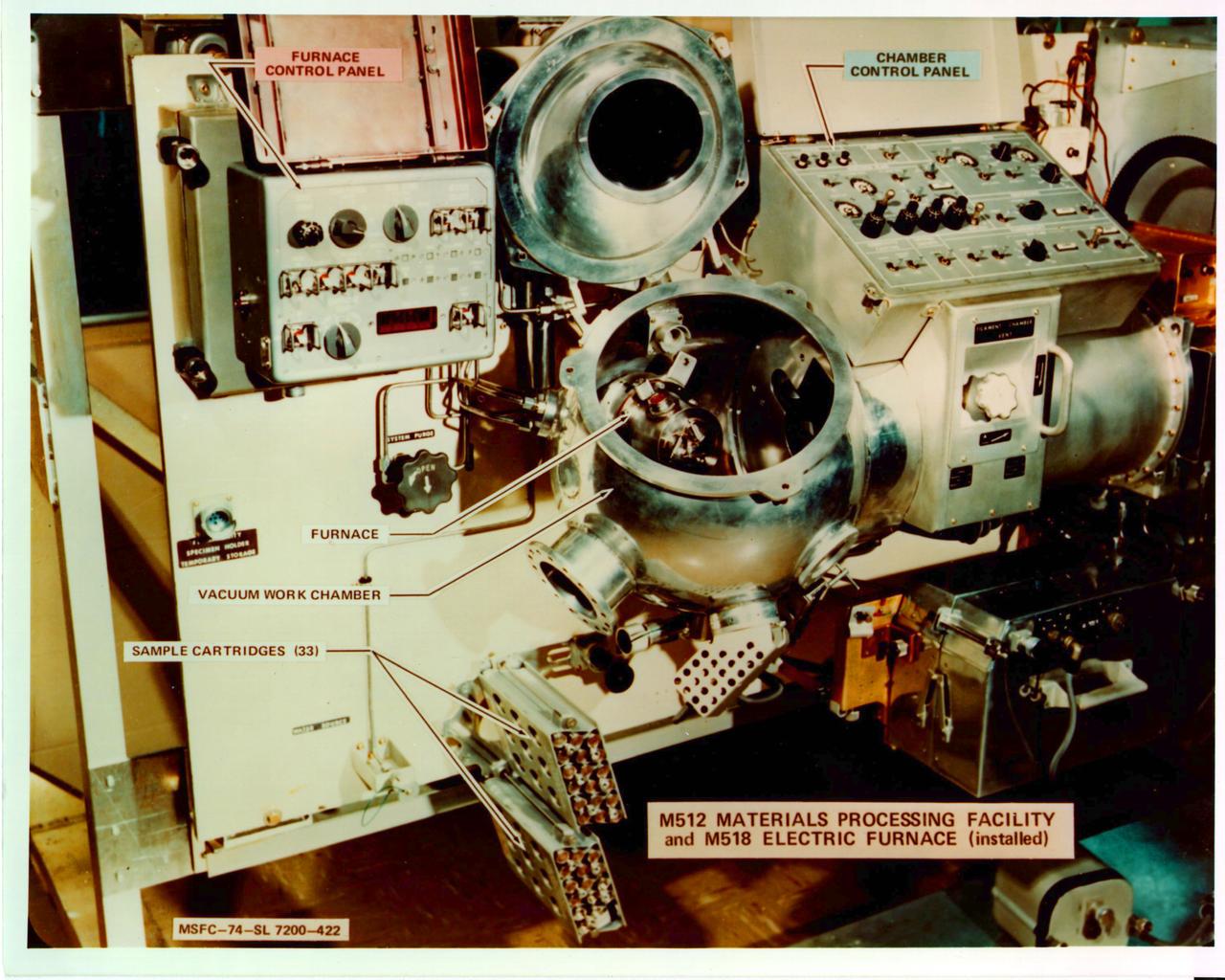
The M512 Materials Processing Facility (MPF) with the M518 Multipurpose Electric Facility (MEF) tested and demonstrated a facility approach for materials process experimentation in space. It also provided a basic apparatus and a common interface for a group of metallic and nonmetallic materials experiments. The MPF consisted of a vacuum work chamber and associated mechanical and electrical controls. The M518 Multipurpose Electric Furnace (MEF) was an electric furnace system in which solidification, crystal growth, and other experiments involving phase changes were performed.
Microgravity
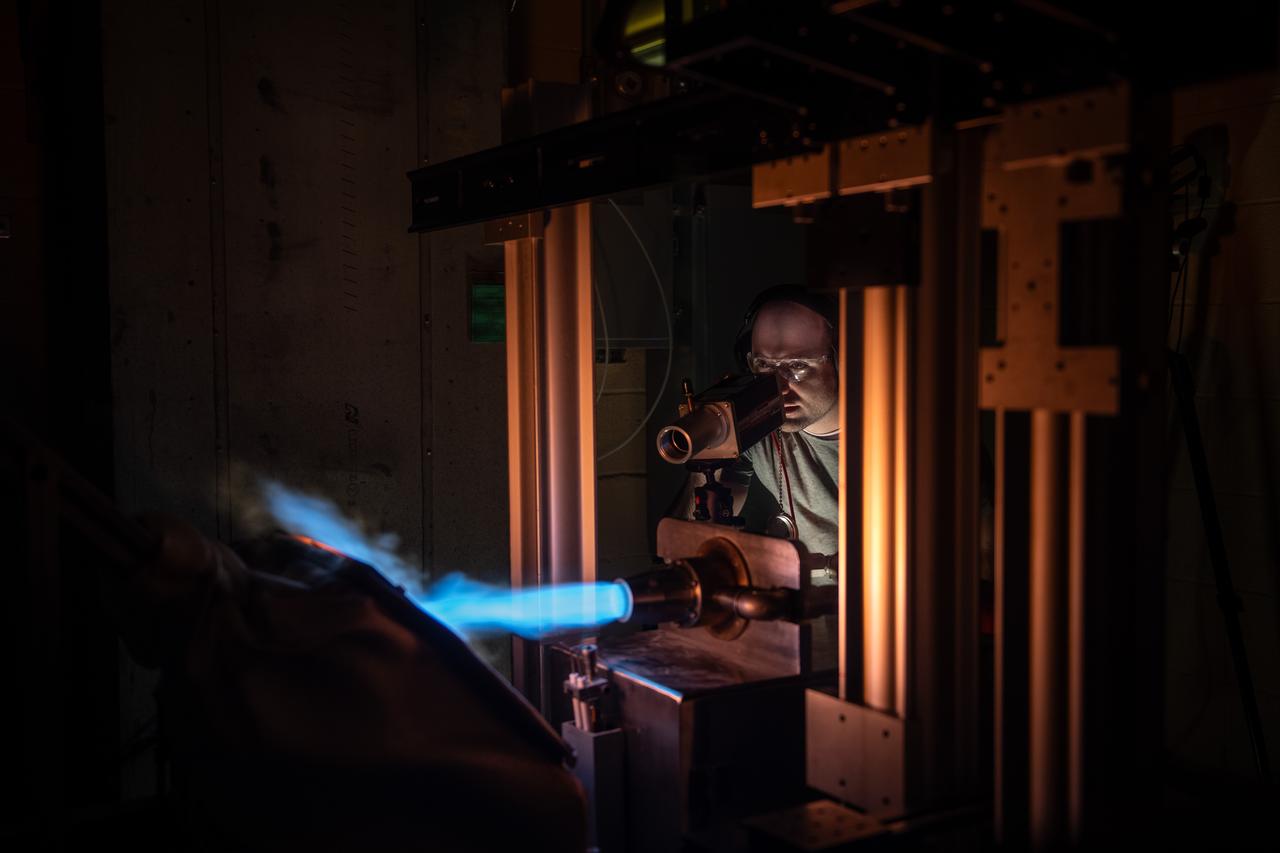
NASA Glenn’s Natural Gas/Oxygen Burner Rig is used to study the high temperature performance of various metal alloys, ceramics, and protective coatings for aero and space propulsion systems. The burner rig provides an easily accessible and economical method to simulate engine operating conditions to understand thermomechanical and thermochemical degradation of materials and structures. In the photo, Materials Research Engineer Michael Presby uses an infrared pyrometer to monitor the surface temperature of the material for a test on February 23, 2024. Photo Credit: (NASA/Sara Lowthian-Hanna)
Engineering Design Unit (EDU) from a NASA customer, Radian Aerospace, being tested in the burner rig
iss028e016106 (7/12/2011) --- View of a Materials on International Space Station Experiment - 8 (MISSE-8) installed on the starboard truss. The Materials on International Space Station Experiment - 8 (MISSE-8) tests various materials and computing elements on the exterior of the space station. The payload container is mounted so one side faces the Earth and the other faces space.
View of MISSE-8 taken during a session of EVA
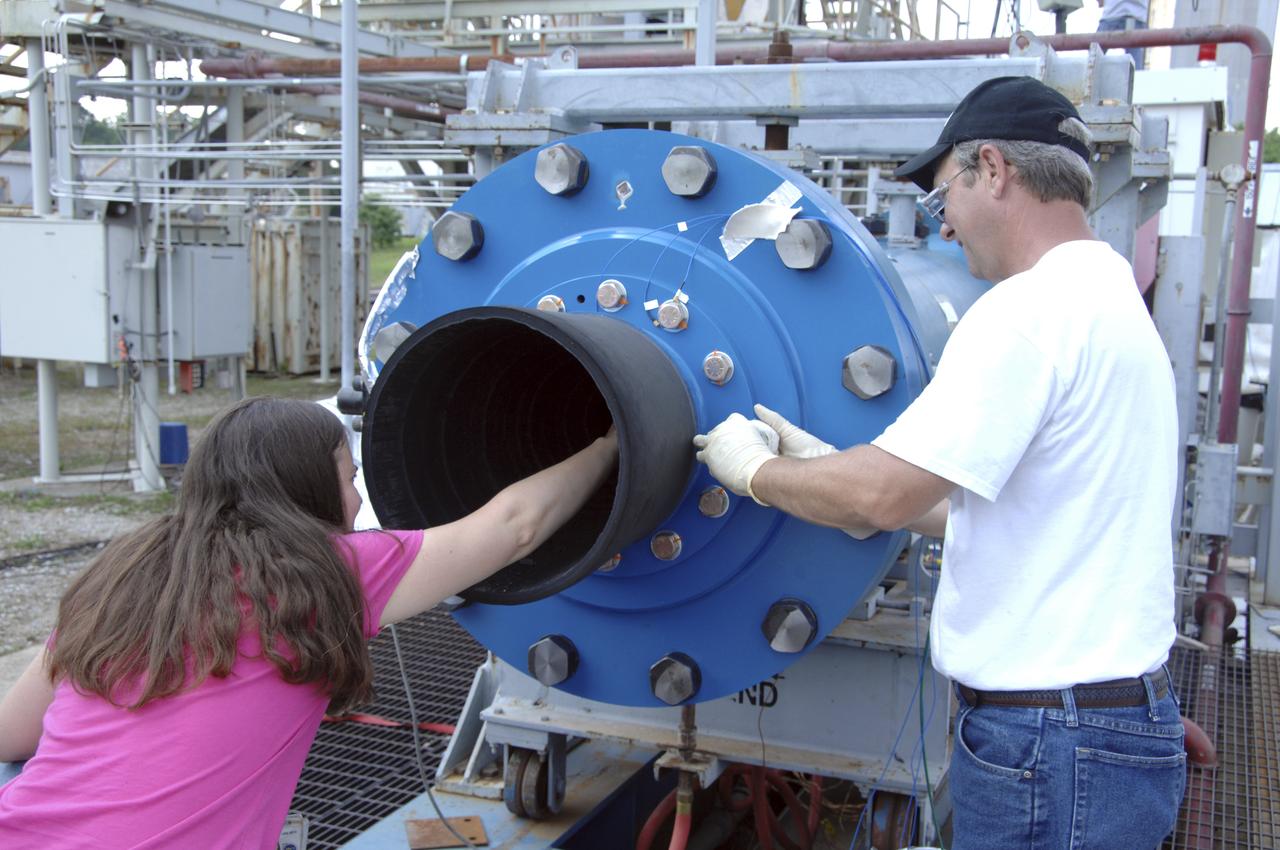
POST TEST INSPECTION ON P9038-SRTMV-N1 24" MOTOR (LEFT) SARA HOWSE, EM41 MATERIALS ENGINEER; (RIGHT) RANDY HANDLEY, ATK TECH
1000769
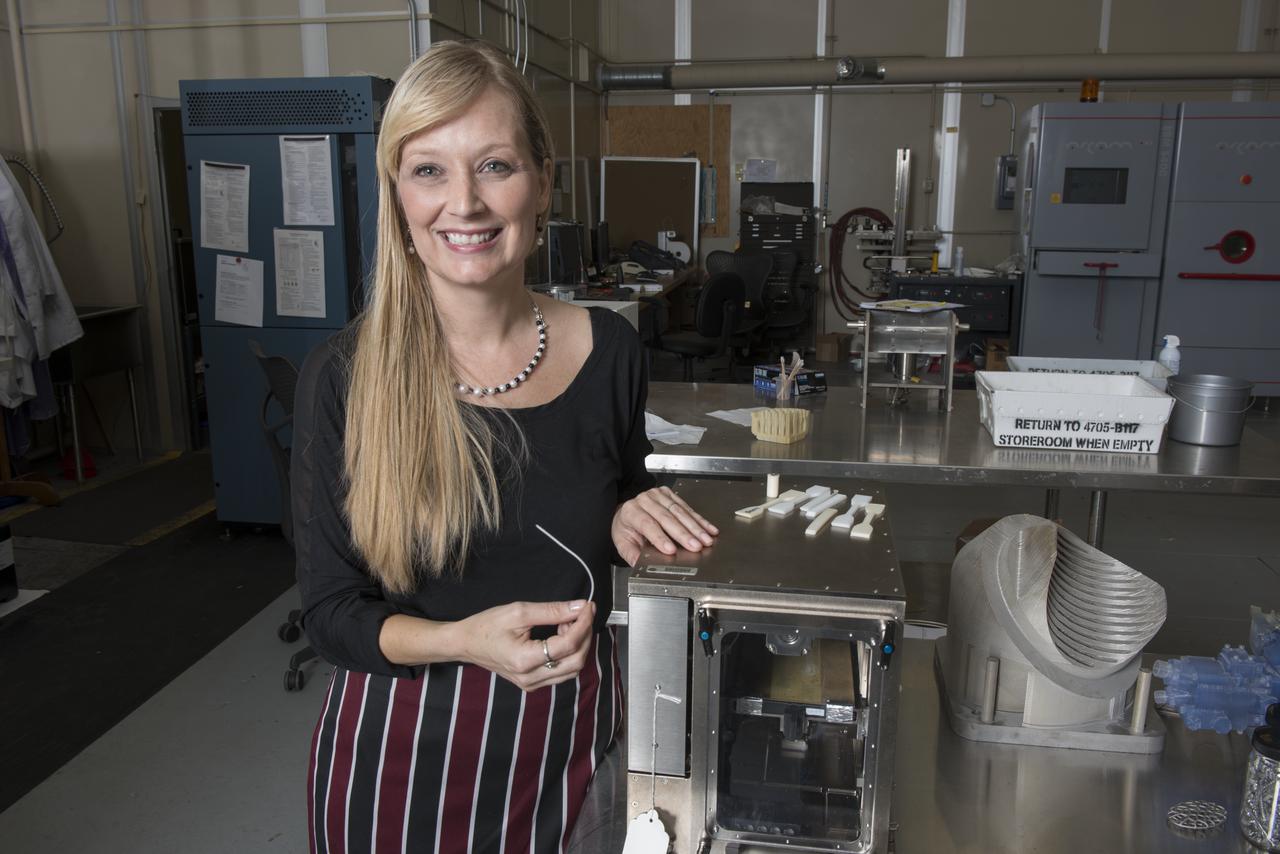
NIKKI WERKHEISER EXAMINES THE RAW MATERIAL USED IN THE FIRST 3-D PRINTER TO BE SENT TO THE ISS WHICH IS DESIGNED TO BE A TEST BED FOR MANUFACTURING SMALL AS ARTICLES AS NEEDED.
1401384
From left, mechanical engineering technicians Katie Mortensen and Jim Niehoff machine test article material inside the Prototype Development Laboratory at NASA’s Kennedy Space Center in Florida on Oct. 21, 2020. The prototype laboratory designs, fabricates, and tests prototypes, test articles and test support equipment. It has a long history of providing fast solutions to complex operations problems. The lab’s teams of engineers use specialized equipment to produce exacting, one-of-a-kind items made from a range of materials depending on the design. The lab supports projects at Kennedy and at the agency level.
Engineering Labs: Prototype Development Laboratory (PDL)
jsc2021e009428 (3/2/2021) --- Materials International Space Station Experiment-14-NASA (MISSE-14-NASA) continues a series of tests by NASA Glenn Research Center on how the harsh environment of space affects the performance and durability of various materials. Example of germination test prior to MISSE-Seed science integration.  Image courtesy of Jeff Richards.
MISSE-14-NASA
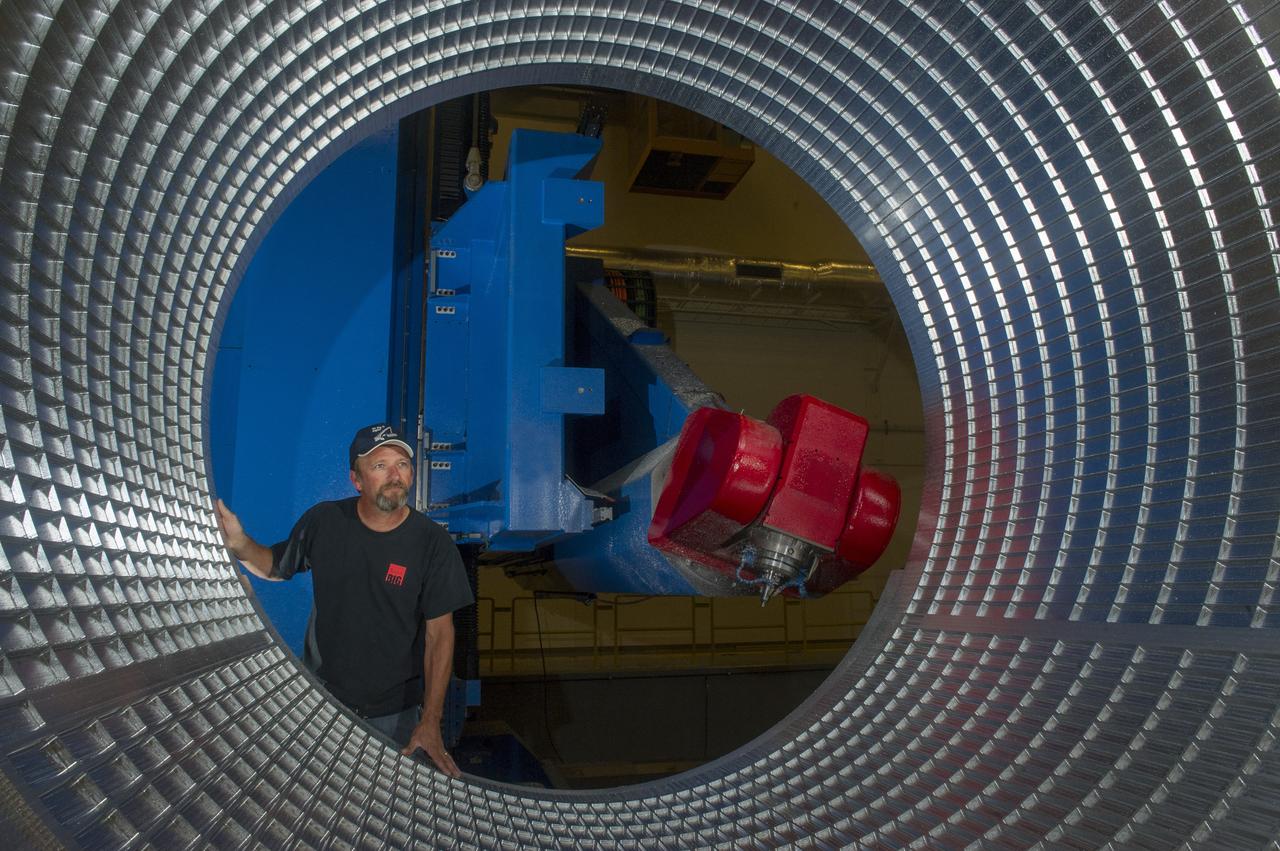
DAVID OSBORNE, A MACHINIST ON THE METTS CONTRACT, INSPECTS THE ORTHOGRID TOOL PATH ON AN 8 FOOT CF1 BARREL IN SUPPORT OF THE SHELL BUCKLING TEST FOR LANGLEY RESEARCH CENTER.  THIS IS THE FIRST BARREL THAT MSFC HAS MANUFACTURED FROM EXTRUDED MATERIAL, VERSUS THE ORIGINAL DESIGN BEING 3 SECTIONS BARREL PANELS THAT WERE FRICTION STIR WELDED.  THE TESTING WILL SHOW THE DIFFERENT STRENGTH PROPERTIES FROM A WELDED VERSION TO A FULLY EXTRUDED PIECE OF MATERIAL.
1400392
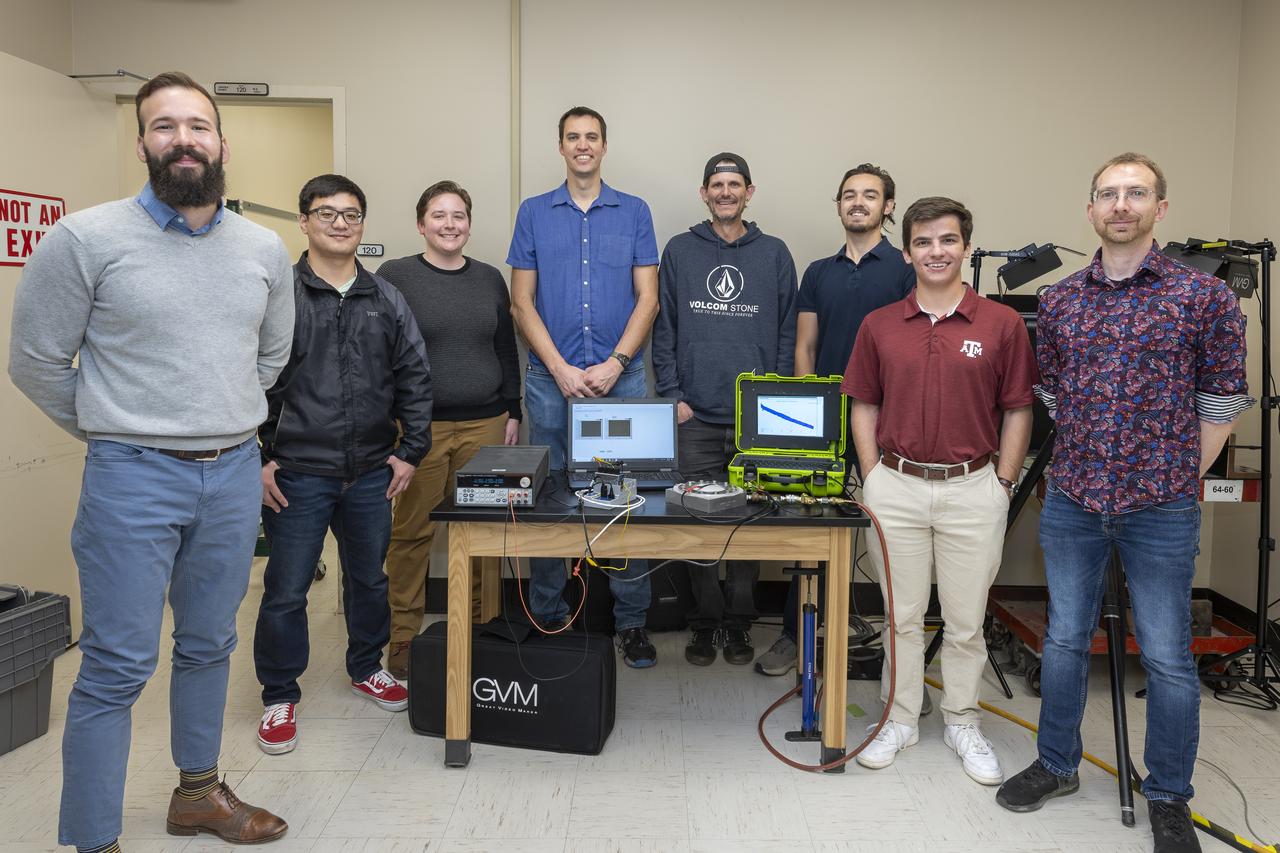
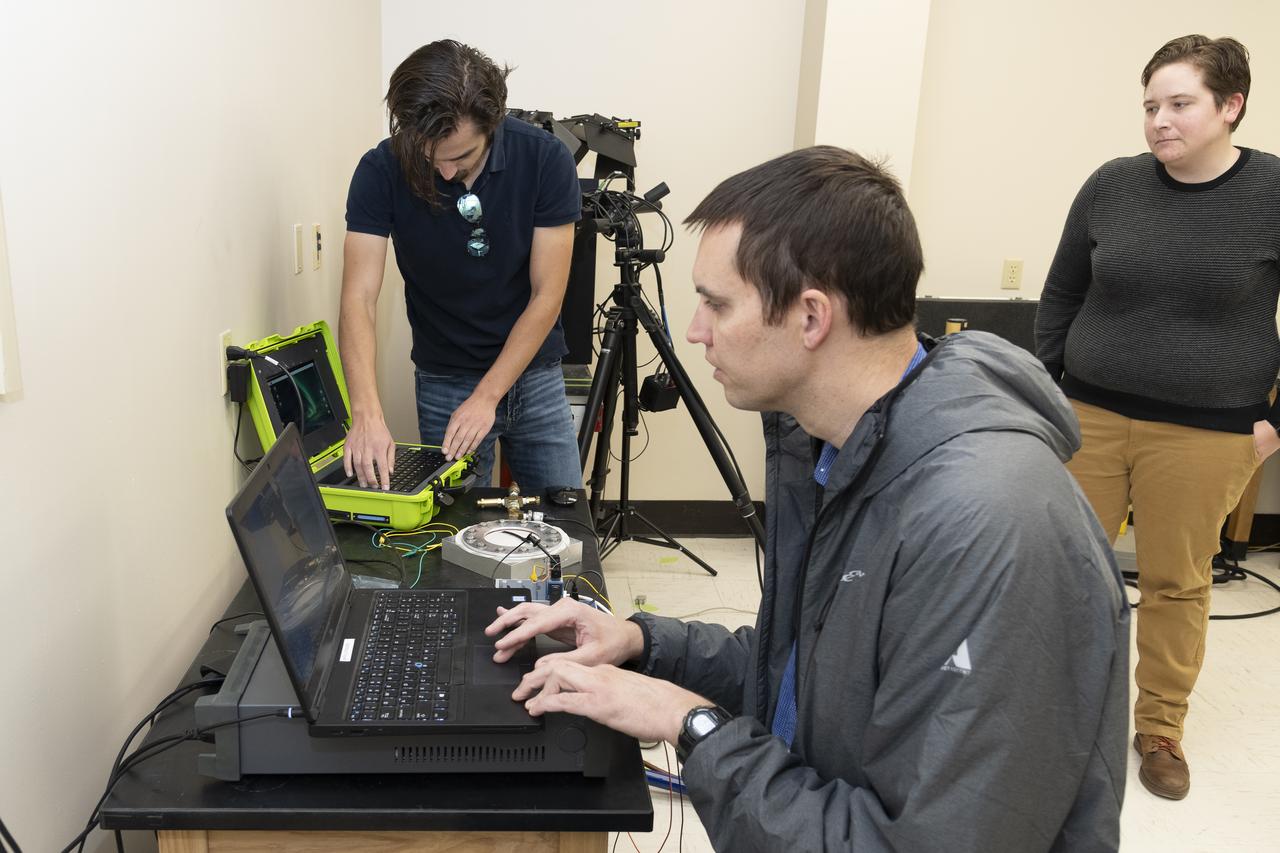
Erick Rossi De La Fuente, from left, John Rudy, L. J. Hantsche, Adam Curry, Jeff Howell, Coby Asselin, Benjamin Mayeux, and Paul Bean pose with a test fixture, material, sensor, and data acquisition systems at NASA’s Armstrong Flight Research Center in Edwards, California. The sensor tests seek to quantify the limits of the material to improve computer models and make more reliable supersonic parachutes.
NASA Parachute Sensor Testing Can Make Mars Landings Safer
Coby Asselin, from left, Adam Curry, and L. J. Hantsche set up the data acquisition systems used during testing of a senor to determine parachute canopy material strength at NASA’s Armstrong Flight Research Center in Edwards, California. The sensor tests seek to quantify the limits of the material to improve computer models and make more reliable supersonic parachutes.
NASA Parachute Sensor Testing Can Make Mars Landings Safer
Backdropped by a sunrise, the newly installed Materials International Space Station Experiment (MISSE) is visible on this image. MISSE would expose 750 material samples for about 18 months and collect information on how different materials weather the space environment. The objective of MISSE is to develop early, low-cost, non-intrusive opportunities to conduct critical space exposure tests of space materials and components plarned for use on future spacecraft. The experiment was the first externally mounted experiment conducted on the International Space Station (ISS) and was installed on the outside of the ISS Quest Airlock during extravehicular activity (EVA) of the STS-105 mission. MISSE was launched on August 10, 2001 aboard the Space Shuttle Orbiter Discovery.
International Space Station (ISS)
Astronaut Patrick G. Forrester works with the the Materials International Space Station Experiment (MISSE) during extravehicular activity (EVA). MISSE would expose 750 material samples for about 18 months and collect information on how different materials weather the space environment The objective of MISSE is to develop early, low-cost, non-intrusive opportunities to conduct critical space exposure tests of space materials and components plarned for use on future spacecraft. The experiment was the first externally mounted experiment conducted on the International Space Station (ISS) and was installed on the outside of the ISS Quest Airlock. MISSE was launched on August 10, 2001 aboard the Space Shuttle Orbiter Discovery.
International Space Station (ISS)
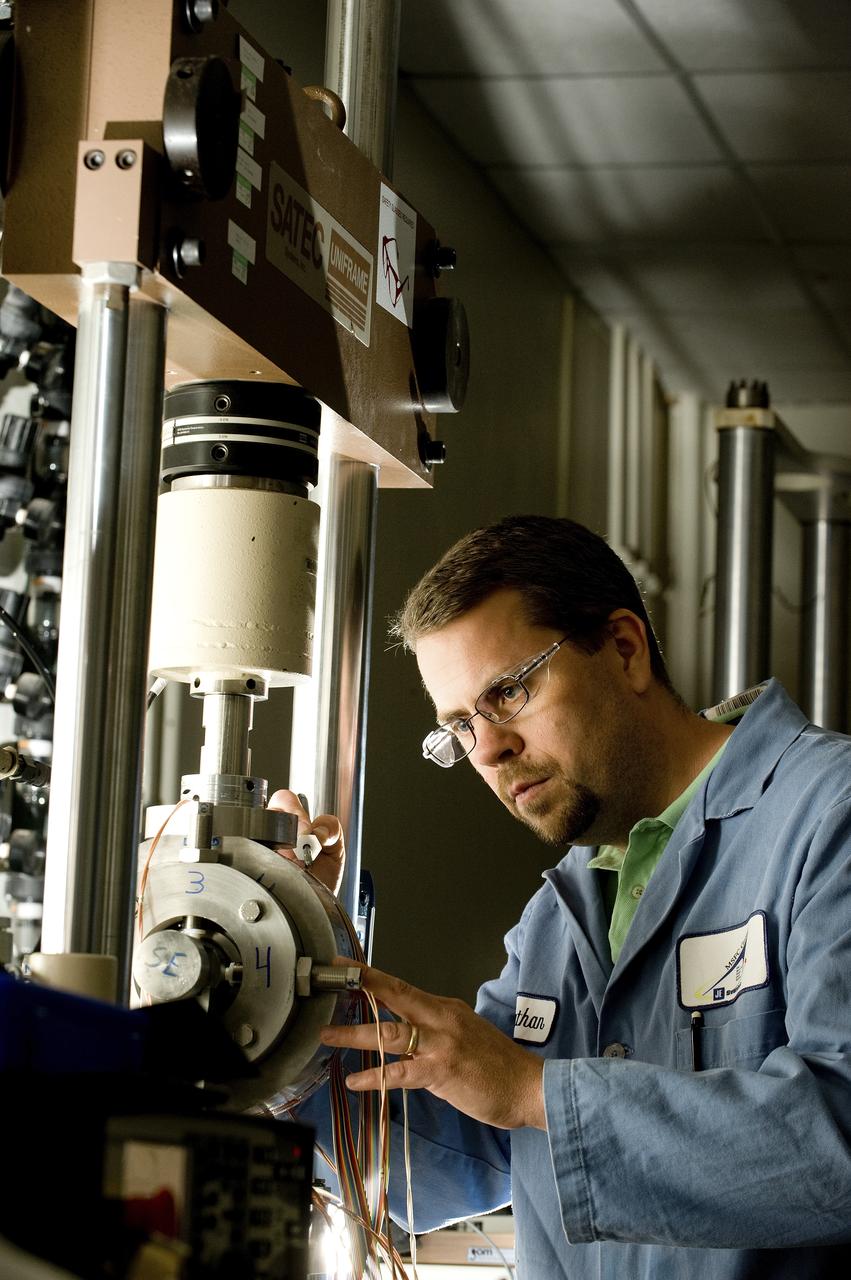
TATHAN COFFEE (EM10 MATERIALS TEST ENGINEER, JACOBS ESTS GROUP/JTI) ADJUSTS A UNIQUE MECHANICAL TEST SETUP THAT MEASURES STRAIN ON A SINGLE SAMPLE, USING TWO DIFFERENT TECHNIQUES AT THE SAME TIME. THE TEST FIXTURE HOLDS A SPECIMEN THAT REPRESENTS A LIQUID OXYGEN (LOX) BEARING FROM THE J2-X ENGINE
1000541
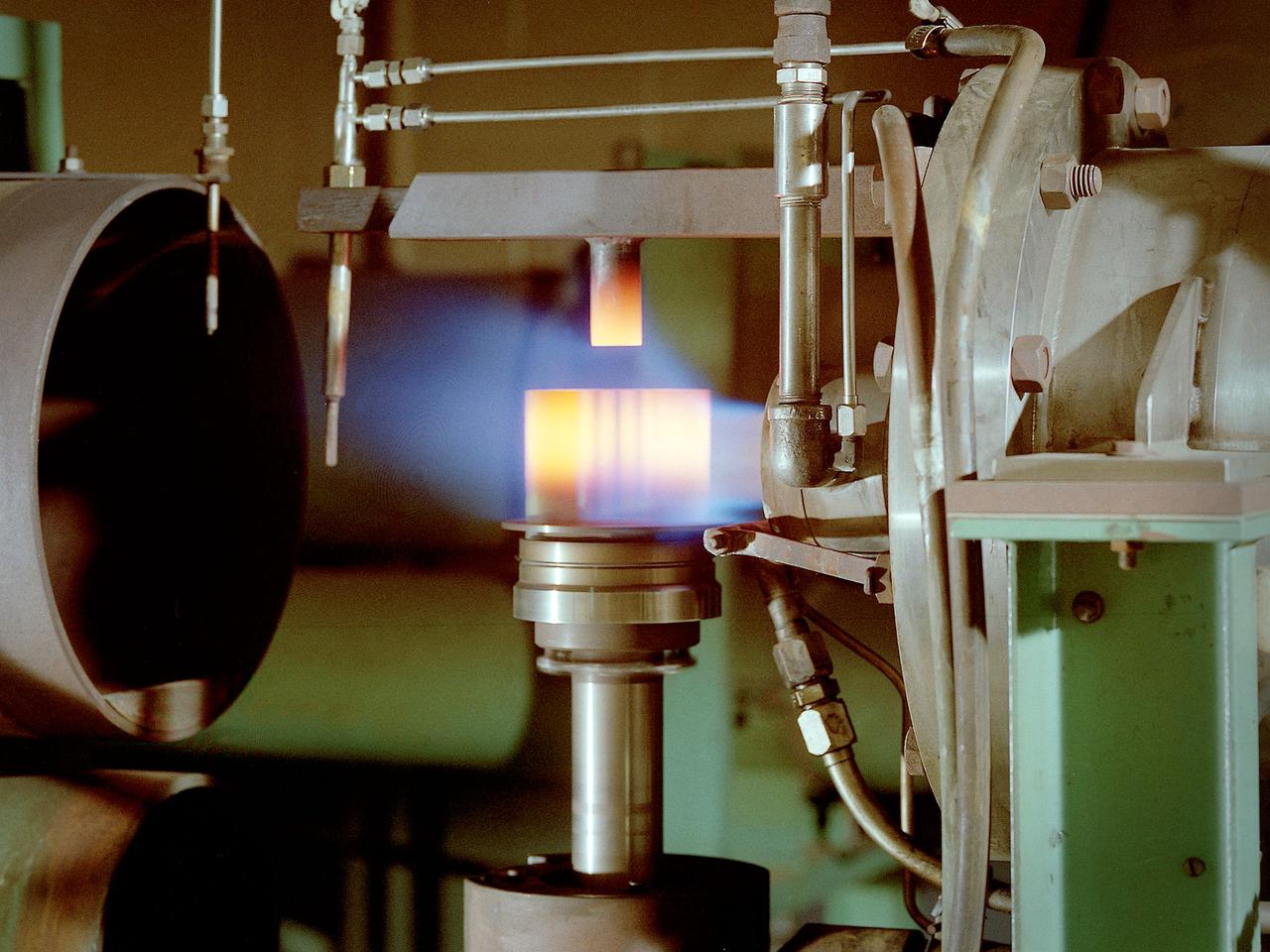
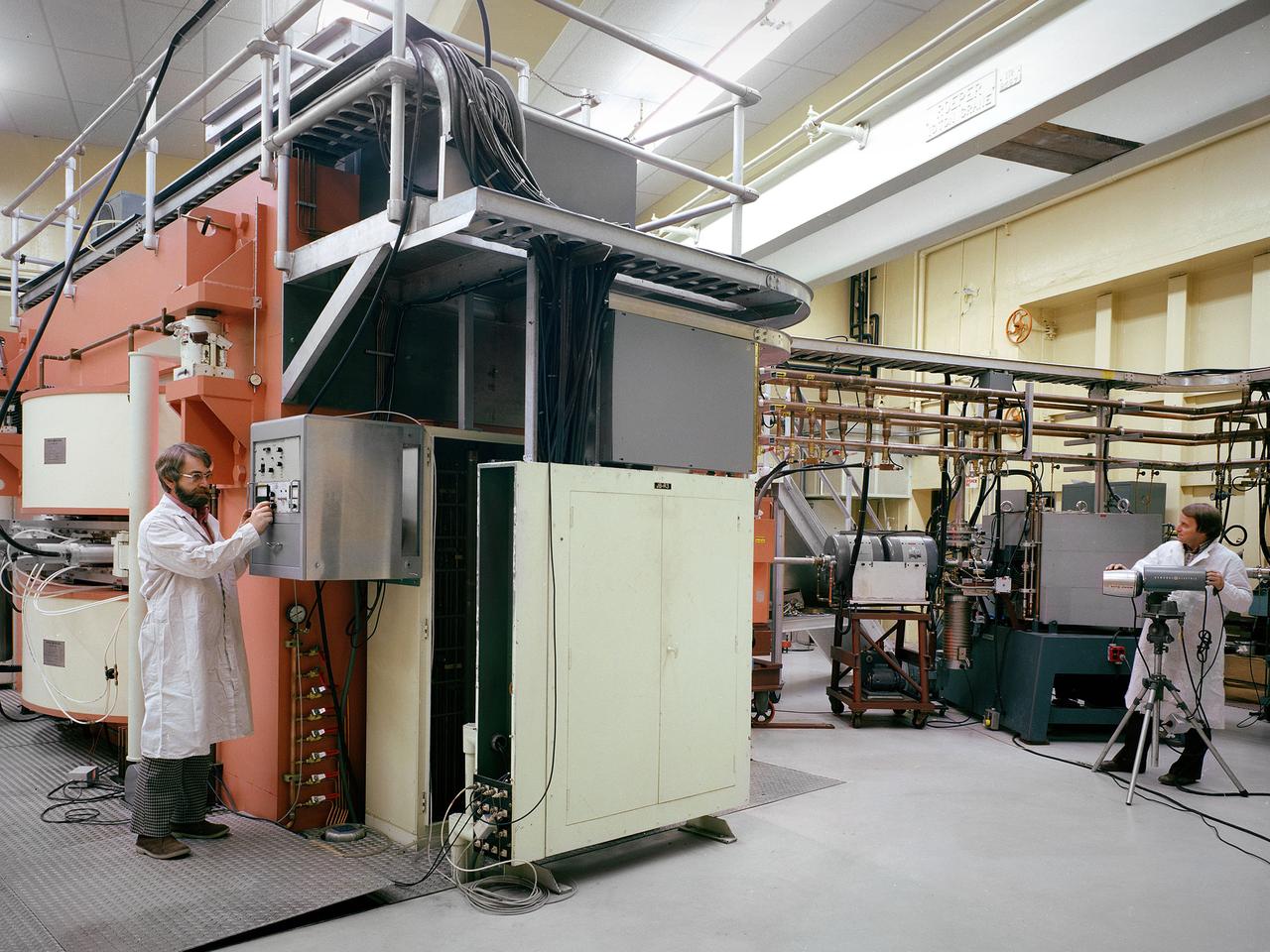
A burner rig heats up a material sample in the Materials and Stresses Building at the National Aeronautics and Space Administration (NASA) Lewis Research Center. Materials technology is an important element in the successful development of advanced airbreathing and rocket propulsion systems. Different types of engines operate in different environments so an array of dependable materials is needed. NASA Lewis began investigating the characteristics of different materials shortly after World War II. In 1949 the materials group was expanded into its own division. The Lewis researchers sought to study and test materials in environments that simulate the environment in which they would operate.     The Materials and Stresses Building, built in 1949, contained a number of laboratories to analyze the materials. They are subjected to high temperatures, high stresses, corrosion, irradiation, and hot gasses. The Physics of Solids Laboratory included a cyclotron, cloud chamber, helium cryostat, and metallurgy cave. The Metallographic Laboratory possessed six x-ray diffraction machines, two metalloscopes, and other equipment. The Furnace Room had two large induction machines, a 4500⁰ F graphite furnace, and heat treating equipment. The Powder Laboratory included 60-ton and 3000-ton presses. The Stresses Laboratory included stress rupture machines, fatigue machines, and tensile strength machines.
Burner Rig in the Material and Stresses Building
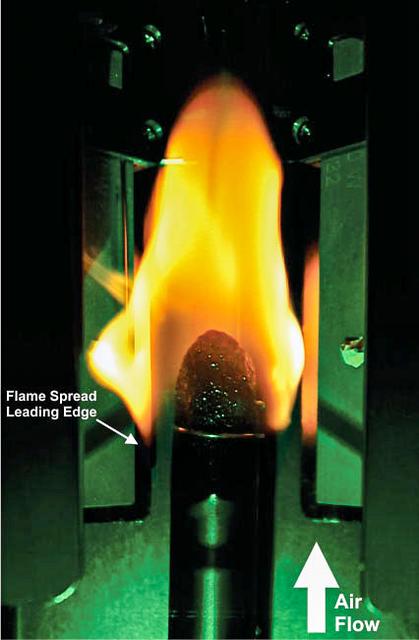
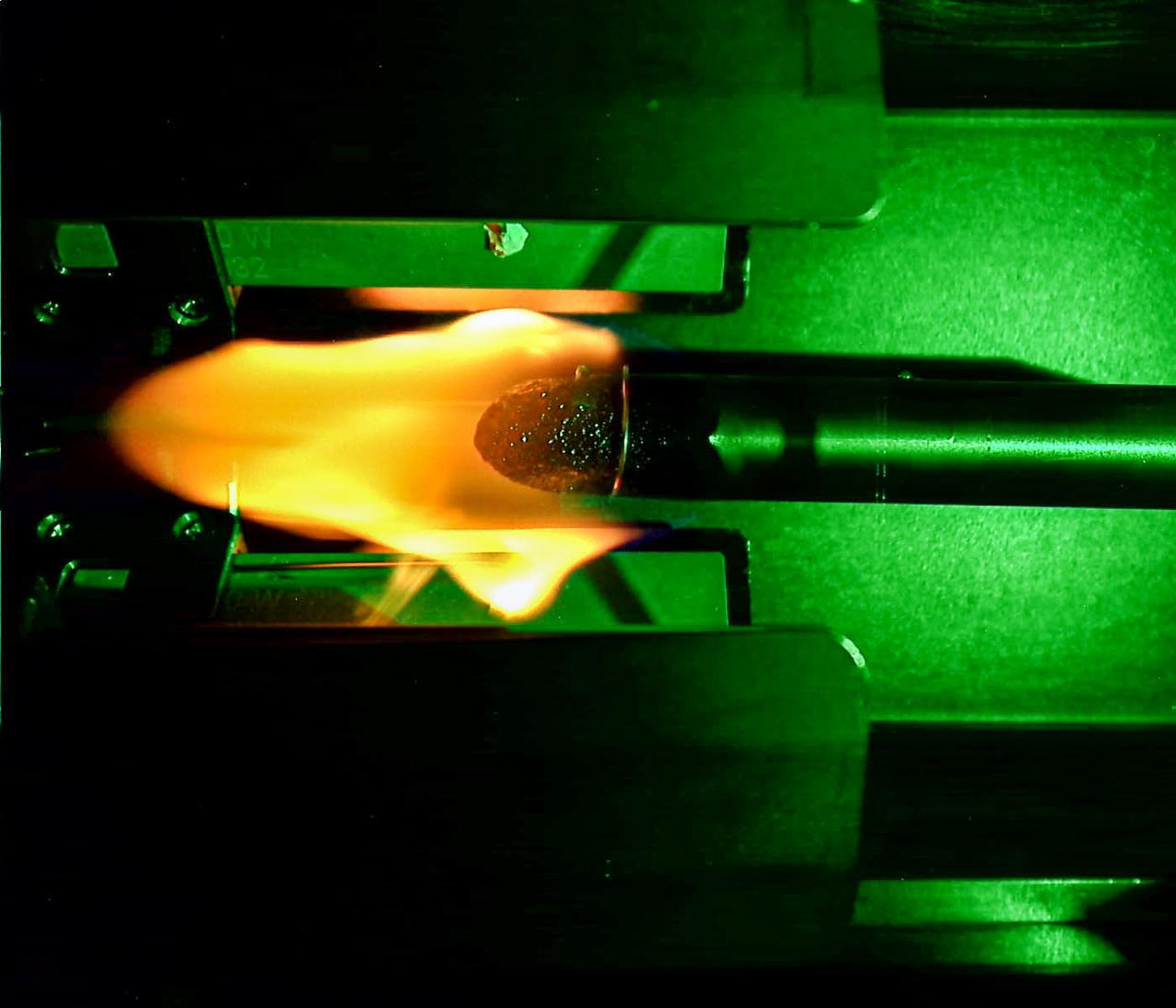
jsc2024e053517 (8/8/2024) --- A plexiglass rod burns in microgravity for the Solid Fuel Ignition and Extinction - Material Ignition and Suppression Test (SoFIE-MIST) investigation. Once each rod is ignited, the flame spreads upstream from the ignition end of the rod. As tests progress, the flame spreads along the rod, consuming oxygen. Once the oxygen concentration drops low enough, the flame extinguishes due to natural oxygen depletion. Data to measure the oxygen concentration, flow rate, and heat loss is obtained at the three test pressures. SoFIE-MIST aims to improve understanding of early fire growth behavior and validate models for material flammability, helping to inform the selection of safer materials for future space facilities and determine the best methods for extinguishing fires in space. .
SoFIE-MIST Imagery
jsc2024e053516 (8/8/2024) --- A plexiglass rod burns in microgravity for the Solid Fuel Ignition and Extinction - Material Ignition and Suppression Test (SoFIE-MIST) investigation. Once each rod is ignited, the flame spreads upstream from the ignition end of the rod. As tests progress, the flame spreads along the rod, consuming oxygen. Once the oxygen concentration drops low enough, the flame extinguishes due to natural oxygen depletion. Data to measure the oxygen concentration, flow rate, and heat loss is obtained at the three test pressures. SoFIE-MIST aims to improve understanding of early fire growth behavior and validate models for material flammability, helping to inform the selection of safer materials for future space facilities and determine the best methods for extinguishing fires in space.
SoFIE-MIST Imagery
Researchers check the cyclotron in the Materials and Stresses Building at the National Aeronautics and Space Administration (NASA) Lewis Research Center. The Materials and Stresses Building, built in 1949, contained a number of laboratories to test the strength, diffusion, and other facets of materials. The materials could be subjected to high temperatures, high stresses, corrosion, irradiation, and hot gasses. The Physics of Solids Laboratory included a cyclotron, cloud chamber, helium cryostat, and metallurgy cave.     The cyclotron was built in the early 1950s to test the effects of radiation on different materials so that the proper materials could be used to construct a nuclear aircraft engine and other components. By the late 1950s, the focus had shifted to similar studies for rockets. NASA cancelled its entire nuclear program in January 1973, and the cyclotron was mothballed.    In 1975 the Cleveland Clinic Foundation partnered with NASA Lewis to use the cyclotron to treat cancer patients with a new type of radiation therapy. The cyclotron split beryllium atoms which caused neutrons to be released. The neutrons were streamed directly at the patient’s tumor. Over the course of five years, the cyclotron was used to treat 1200 patients. The program was terminated in 1980 as the Clinic shifted its efforts to concentrate on non-radiation treatments. The Lewis cyclotron was mothballed for a number of years before being demolished.
Cyclotron in the Materials and Stresses Building
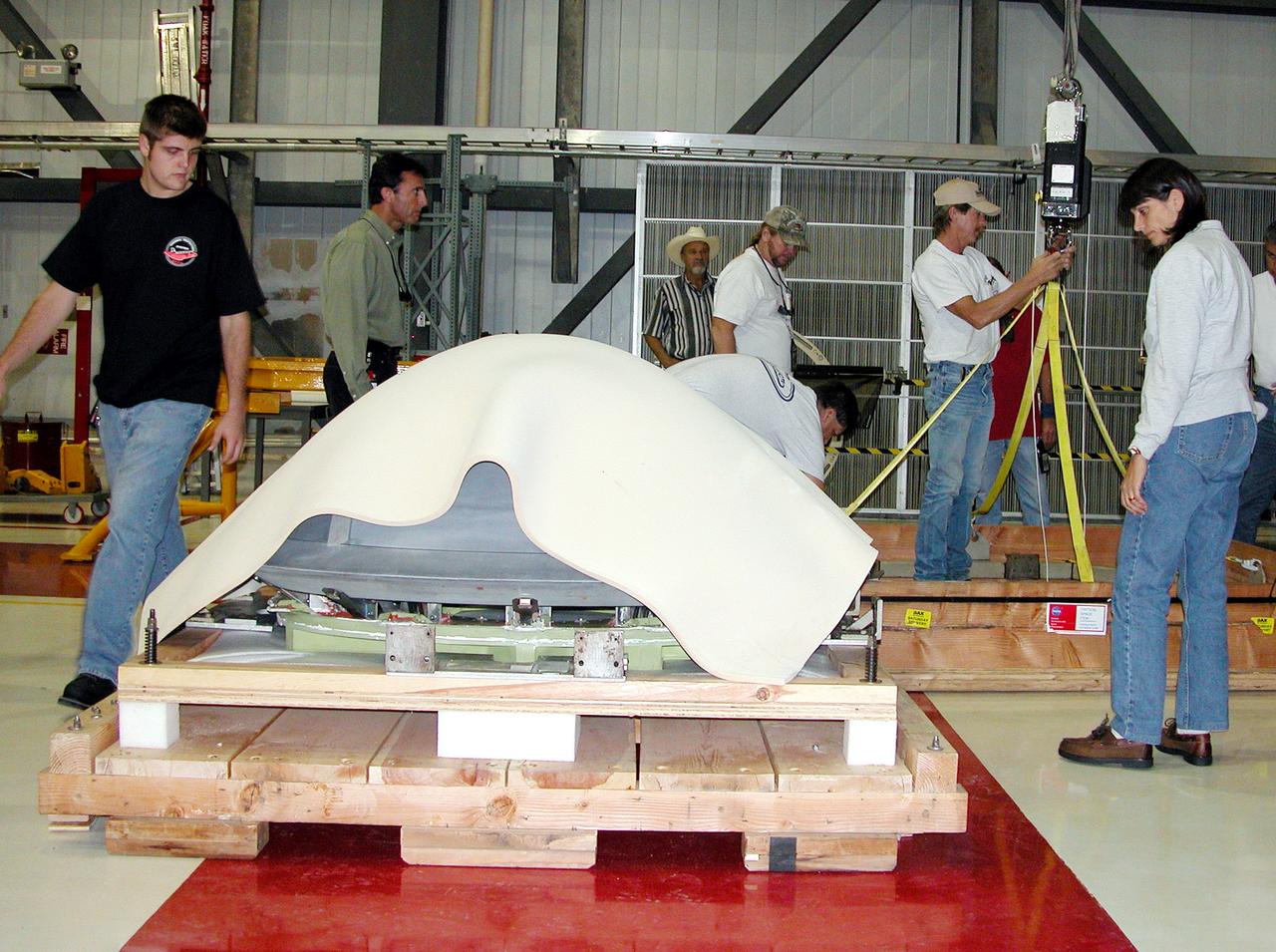
KENNEDY SPACE CENTER, FLA. -  In the Orbiter Processing Facility, packing material is placed over the nose cap that was removed from Atlantis.   The reinforced carbon-carbon (RCC) nose cap is being sent to the original manufacturing company, Vought in Ft. Worth, Texas, a subsidiary of Lockheed Martin, to undergo non-destructive testing such as CAT scan and thermography.
KENNEDY SPACE CENTER, FLA. - In the Orbiter Processing Facility, packing material is placed over the nose cap that was removed from Atlantis. The reinforced carbon-carbon (RCC) nose cap is being sent to the original manufacturing company, Vought in Ft. Worth, Texas, a subsidiary of Lockheed Martin, to undergo non-destructive testing such as CAT scan and thermography.
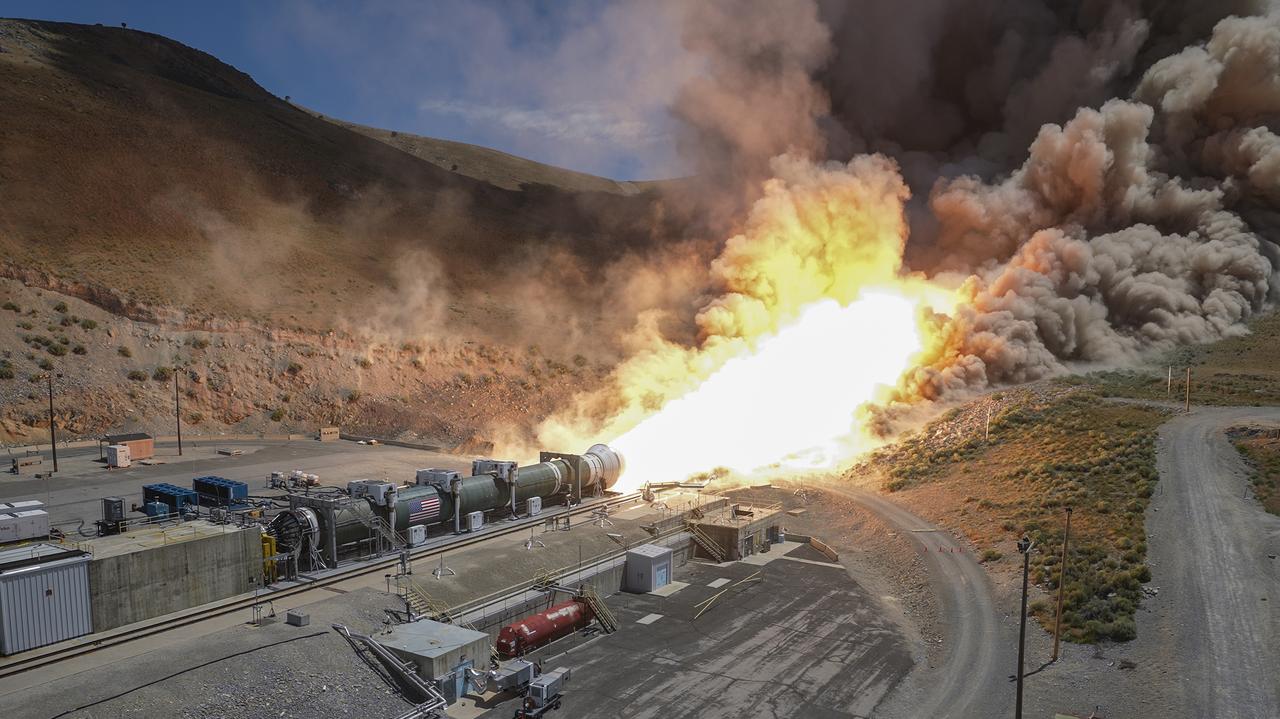
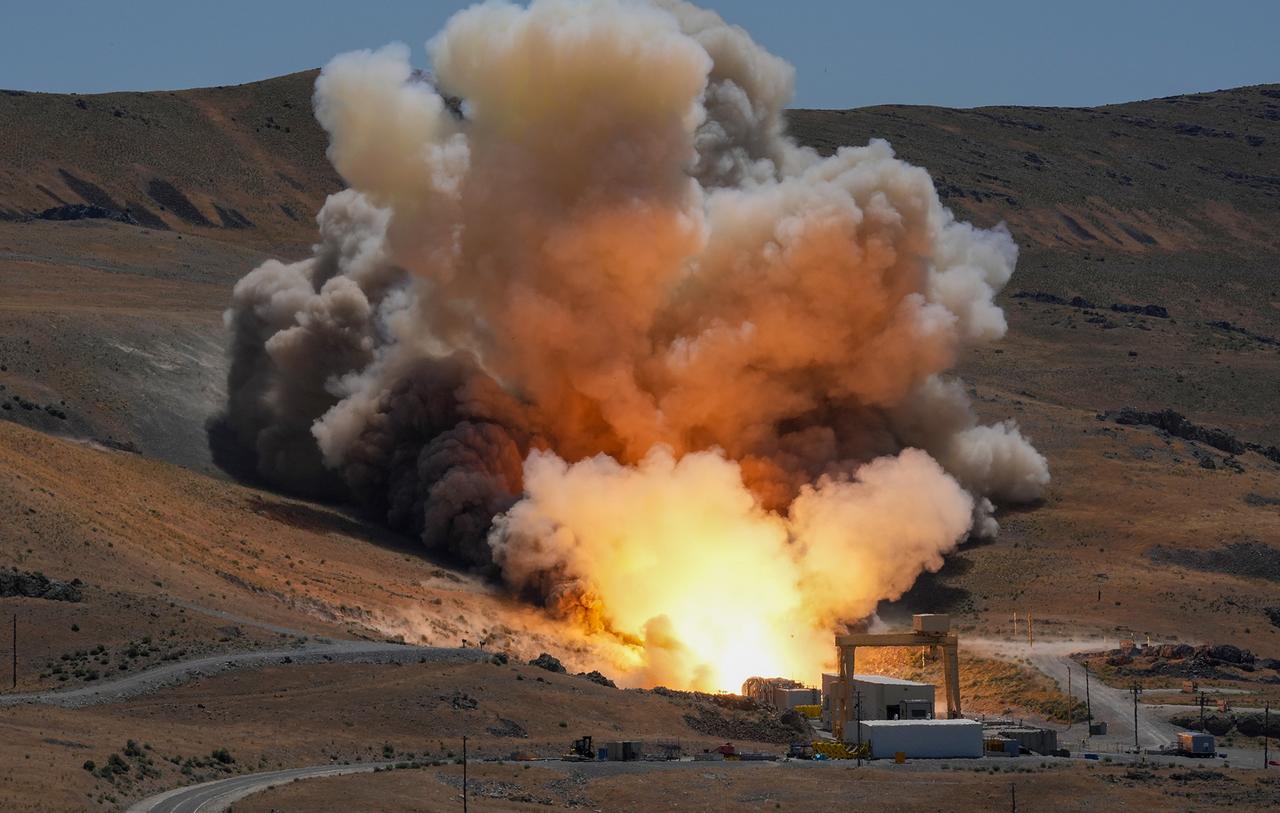
Teams from NASA and Northrop Grumman fire a ground-based version of a booster for the agency’s SLS (Space Launch System) rocket June 26. Secured horizontally in a test stand at Northrop Grumman’s test facility in Promontory, Utah, the single five-segment booster motor fired for more than two minutes and produced 3.9 million pounds of thrust. The booster for this test, known as Demonstration Motor-1 (DM-1), is the result of the Booster Obsolescence Life Extension (BOLE) project. This test was the first full-scale ground test of a new five-segment solid rocket motor. During the test, there was an abnormal event approximately 15 seconds before the end of the motor firing. Despite this event, NASA achieved several of the test’s primary objectives and received valuable data on technical risks identified ahead of the test.  Testing this evolved booster for the SLS will help evaluate improvements and new materials in the boosters.  The BOLE effort was launched to transition to a more efficient, lower cost commercial solution for the boosters for the SLS rocket. Through the Artemis campaign, NASA will send astronauts to explore the Moon for scientific discovery, economic benefits, and to build the foundation for the first crewed missions to Mars – for the benefit of all. For more information, contact NASA Marshall’s Office of Communications at 256-544-0034.
NASA, Northrop Grumman Test Fire SLS BOLE Booster
Teams from NASA and Northrop Grumman fire a ground-based version of a booster for the agency’s SLS (Space Launch System) rocket June 26. Secured horizontally in a test stand at Northrop Grumman’s test facility in Promontory, Utah, the single five-segment booster motor fired for more than two minutes and produced 3.9 million pounds of thrust. The booster for this test, known as Demonstration Motor-1 (DM-1), is the result of the Booster Obsolescence Life Extension (BOLE) project. This test was the first full-scale ground test of a new five-segment solid rocket motor. During the test, there was an abnormal event approximately 15 seconds before the end of the motor firing. Despite this event, NASA achieved several of the test’s primary objectives and received valuable data on technical risks identified ahead of the test.  Testing this evolved booster for the SLS will help evaluate improvements and new materials in the boosters.  The BOLE effort was launched to transition to a more efficient, lower cost commercial solution for the boosters for the SLS rocket. Through the Artemis campaign, NASA will send astronauts to explore the Moon for scientific discovery, economic benefits, and to build the foundation for the first crewed missions to Mars – for the benefit of all.  For more information, contact NASA Marshall’s Office of Communications at 256-544-0034.
NASA, Northrop Grumman Test Fire SLS BOLE Booster
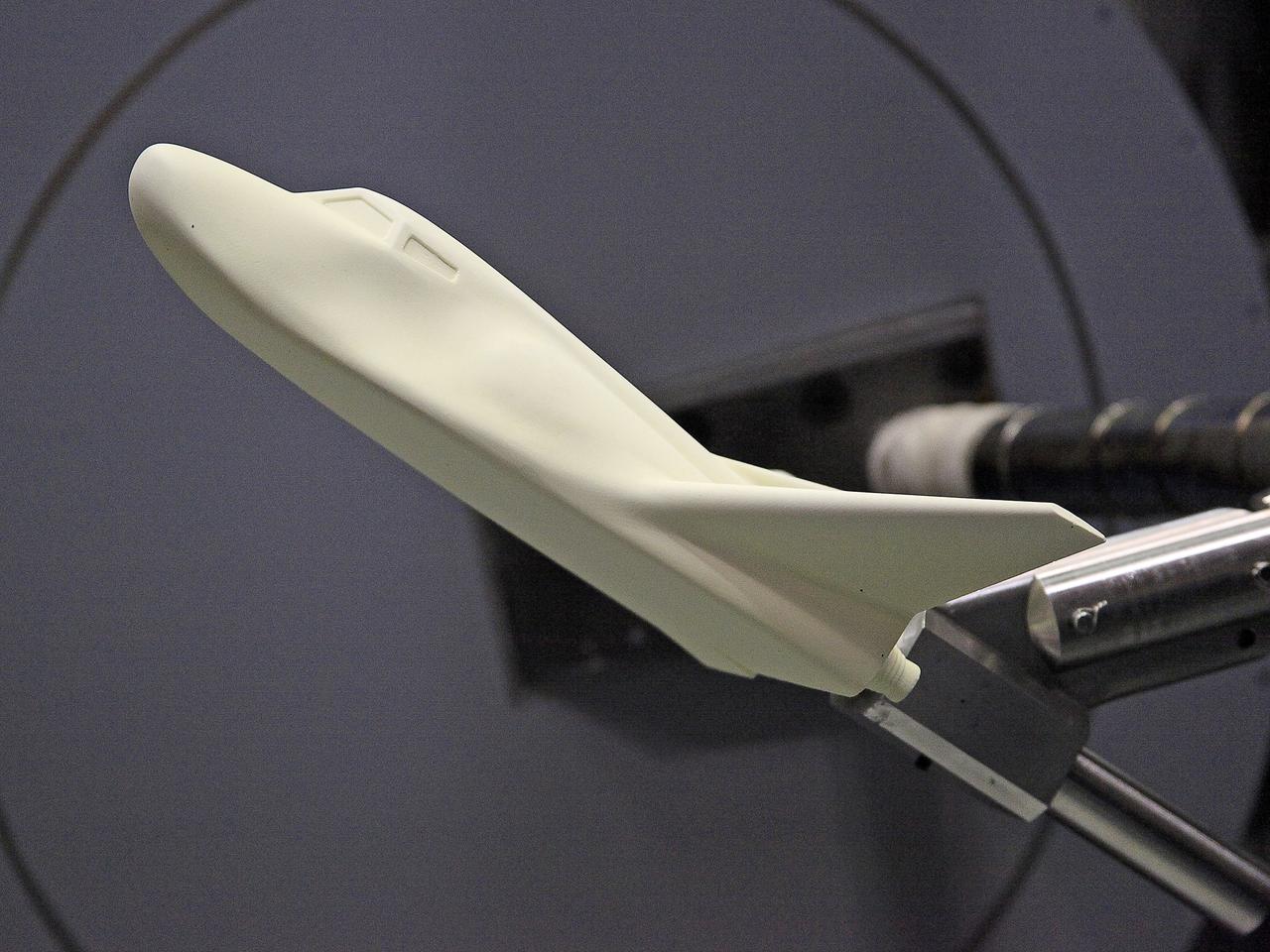
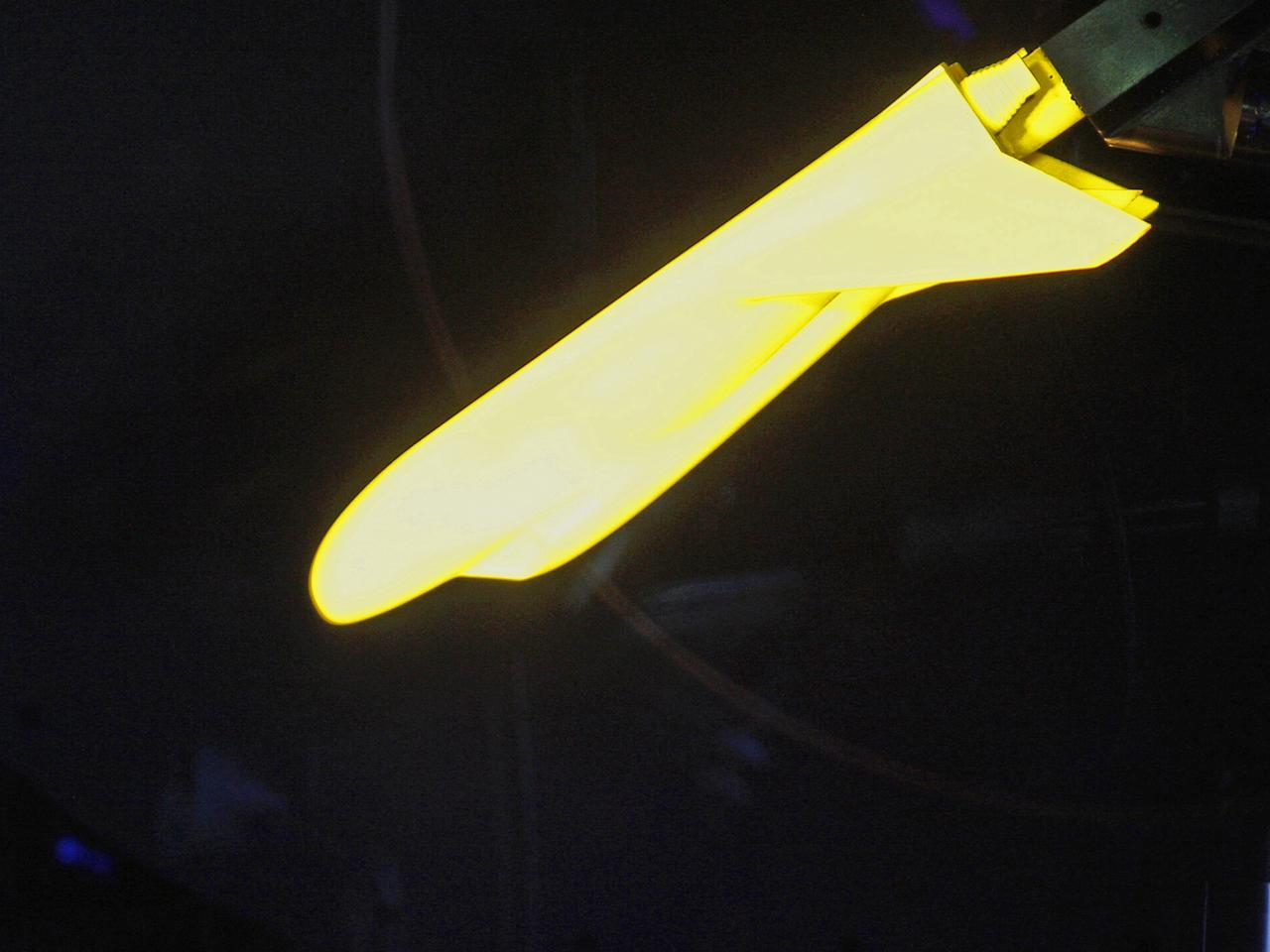
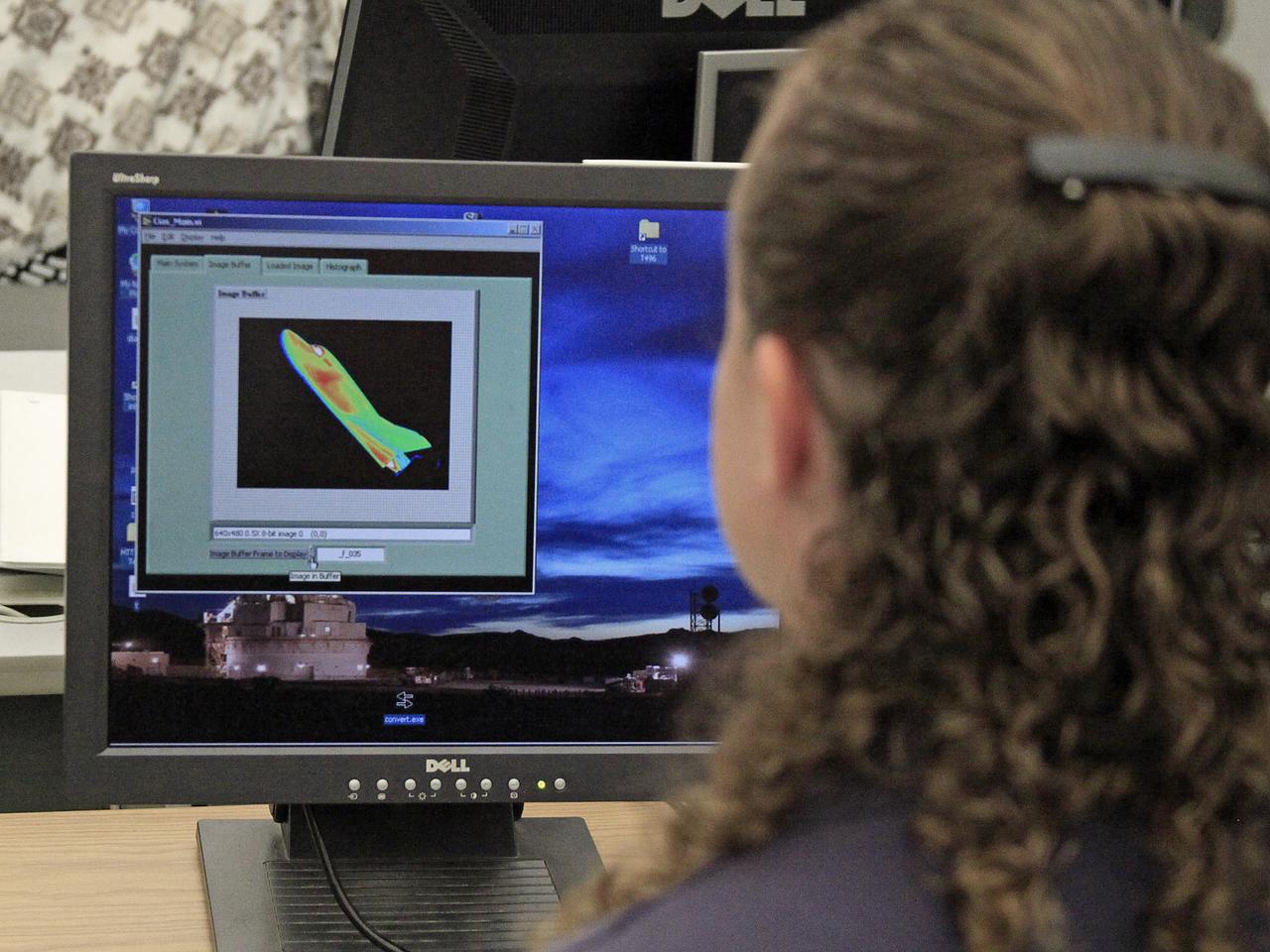
NASA's Langley Research Center in Hampton, Va., recently conducted hypersonic testing of Dream Chaser models for SNC as part of the agency's Commercial Crew Program in order to obtain necessary data for the material selection and design of the TPS
Dream Chaser Model Being Tested at Langley Research Center (LaRC
NASA's Langley Research Center in Hampton, Va., recently conducted hypersonic testing of Dream Chaser models for SNC as part of the agency's Commercial Crew Program in order to obtain necessary data for the material selection and design of the TPS
Dream Chaser Model Being Tested at Langley Research Center (LaRC
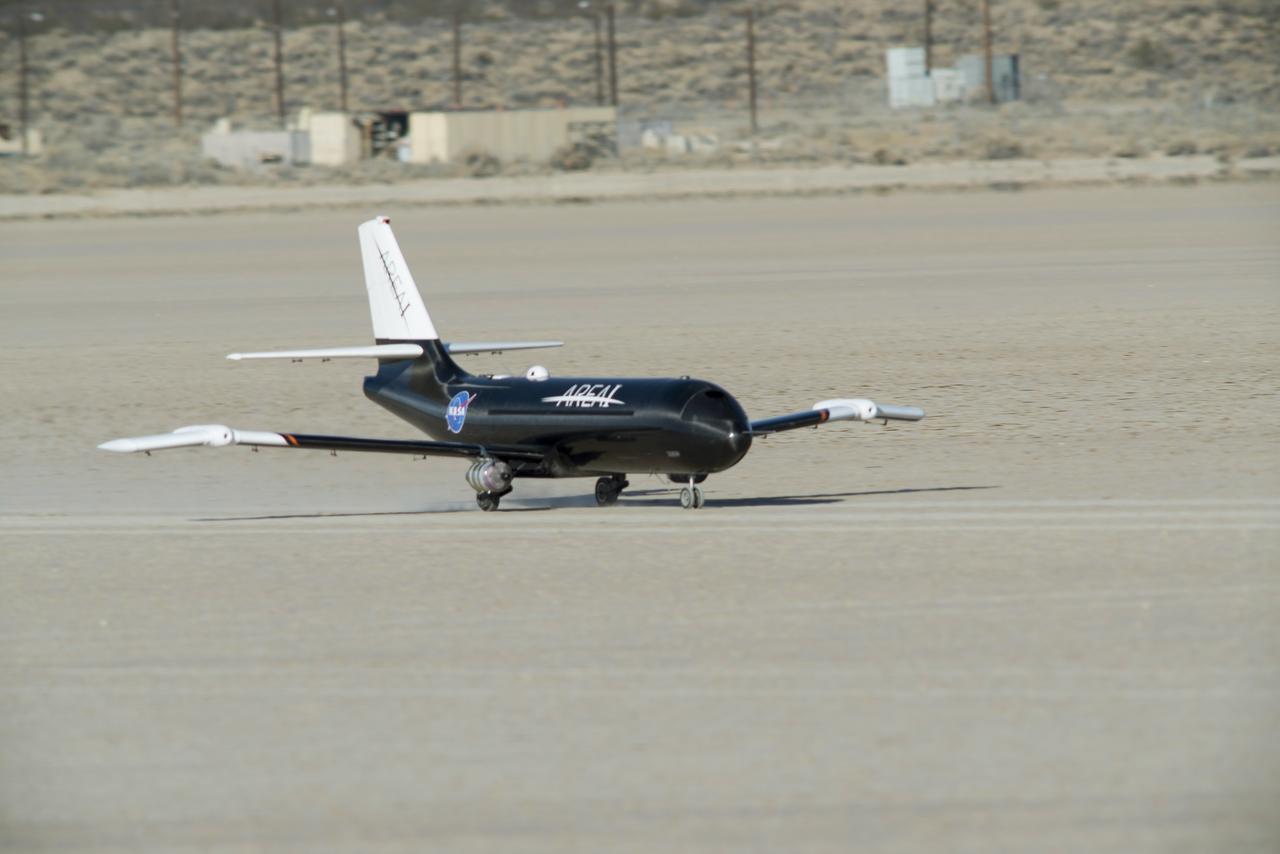
PTERA takes off from the Rogers Dry Lakebed on a flight to test the ability of an innovative, lightweight material, called shape memory alloy, to fold the outer portion of an aircraft’s wings in flight.
NASA Armstrong Flight Tests Shape Memory Alloy Onboard PTERA Testbed
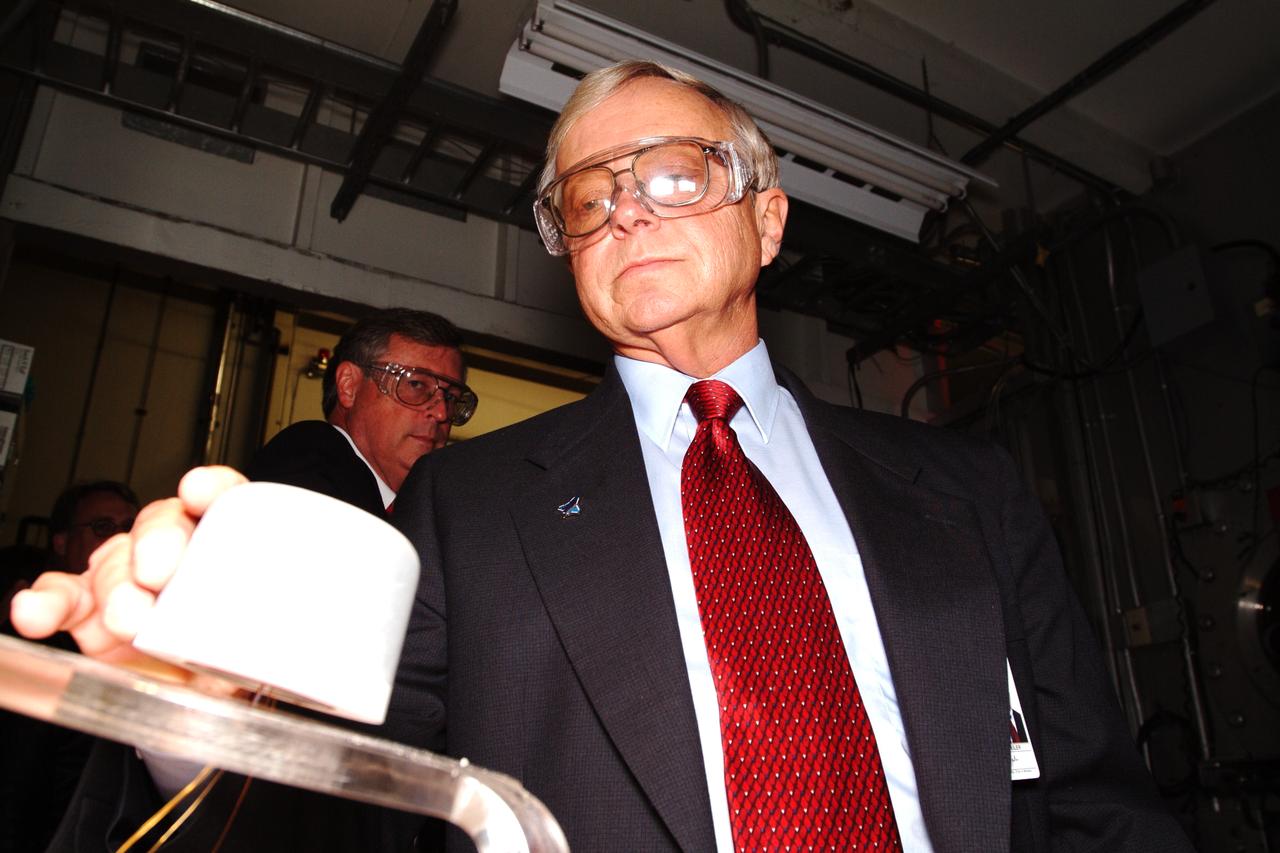
NASA Space Science Advisory Committee Chairman Ed Wiler visit to Ames Research Center: checks out test material while on tour of the Arc Jet Facility
ARC-2003-ACD03-0231-004
Jerry Buhrow, an engineer in the Materials Analysis Lab, places a sample on a thermal testing unit inside a lab at NASA Kennedy Space Center’s Neil Armstrong Operations and Checkout Building on Oct. 6, 2020.
Engineering Labs Equipment
NASA's Langley Research Center in Hampton, Va., recently conducted hypersonic testing of Dream Chaser models for SNC as part of the agency's Commercial Crew Program in order to obtain necessary data for the material selection and design of the TPS
Dream Chaser Model Being Tested at Langley Research Center (LaRC
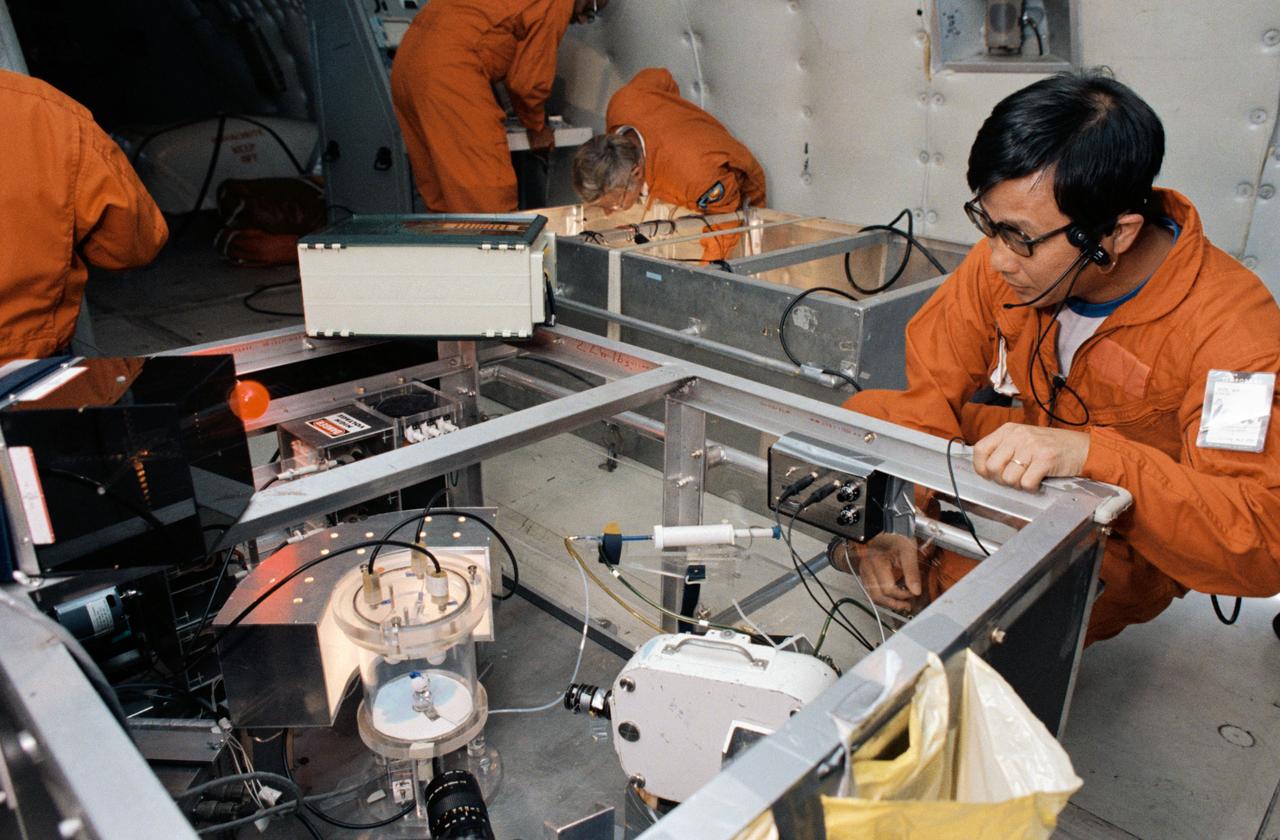
Astronauts Jim Reilly and Bornie Dunbar are going through the Mechanics of Granular Materials (MGM) experiment procedures as they are expected to run in flight; to gain experience with the experiment equipment and to test the clarity and language of the procedures as written.
Microgravity
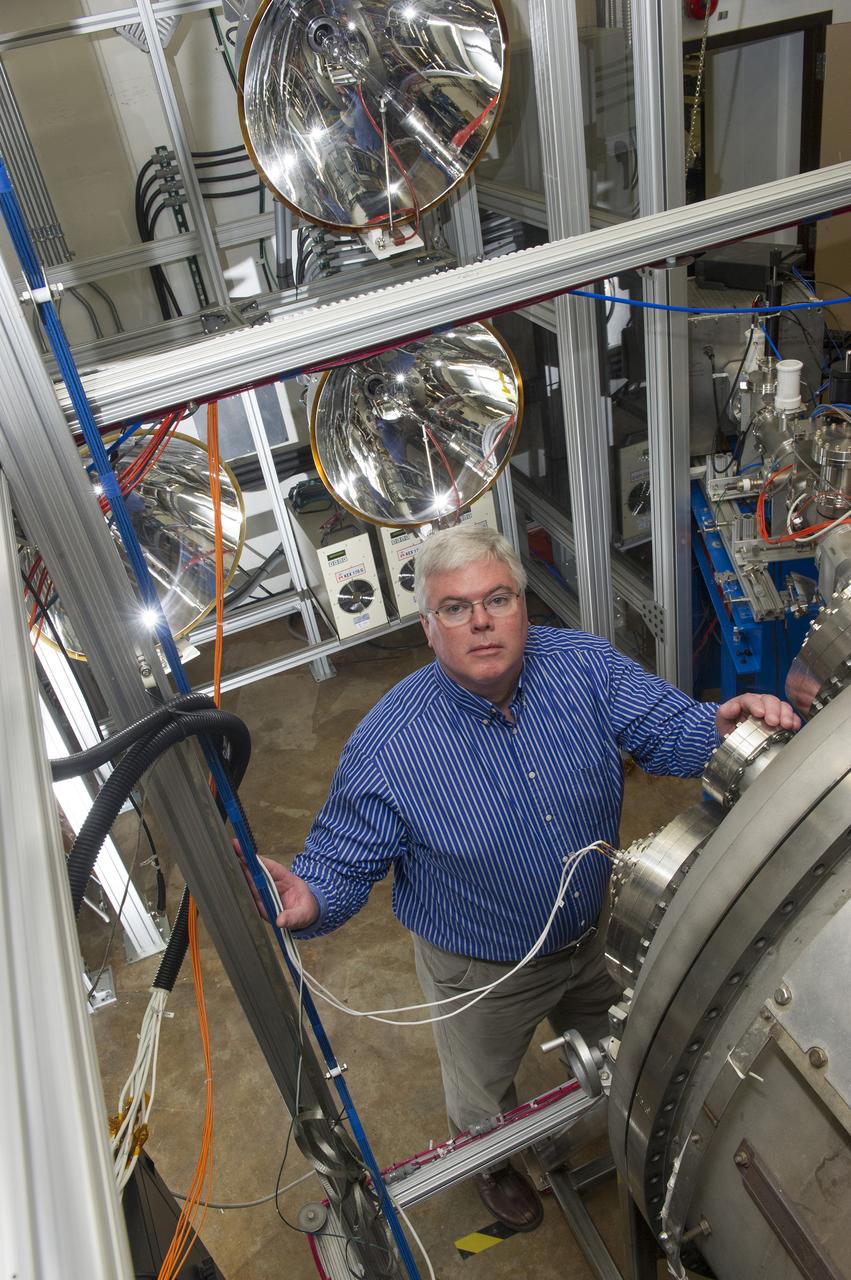
TODD SCHNEIDER LOOKS UP FROM WORK AT THE DOOR OF T HE HIGH INTENSITY SOLAR ENVIRONMENT TEST SYSTEM IN BUILDING 4605. SCHNEIDER IS A PHYSICIST IN THE MATERIALS AND PROCESSES DEPARTMENT AT MSFC AND IS PRINCIPAL INVESTIGATOR FOR HISET.
THE HIGH INTENSITY SOLAR ENVIRONMENT TEST SYSTEM
NASA's Langley Research Center in Hampton, Va., recently conducted hypersonic testing of Dream Chaser models for SNC as part of the agency's Commercial Crew Program in order to obtain necessary data for the material selection and design of the TPS
Dream Chaser Model Being Tested at Langley Research Center (LaRC
NASA's Langley Research Center in Hampton, Va., recently conducted hypersonic testing of Dream Chaser models for SNC as part of the agency's Commercial Crew Program in order to obtain necessary data for the material selection and design of the TPS
Dream Chaser Model Being Tested at Langley Research Center (LaRC
NASA's Langley Research Center in Hampton, Va., recently conducted hypersonic testing of Dream Chaser models for SNC as part of the agency's Commercial Crew Program in order to obtain necessary data for the material selection and design of the TPS
Dream Chaser Model Being Tested at Langley Research Center (LaRC
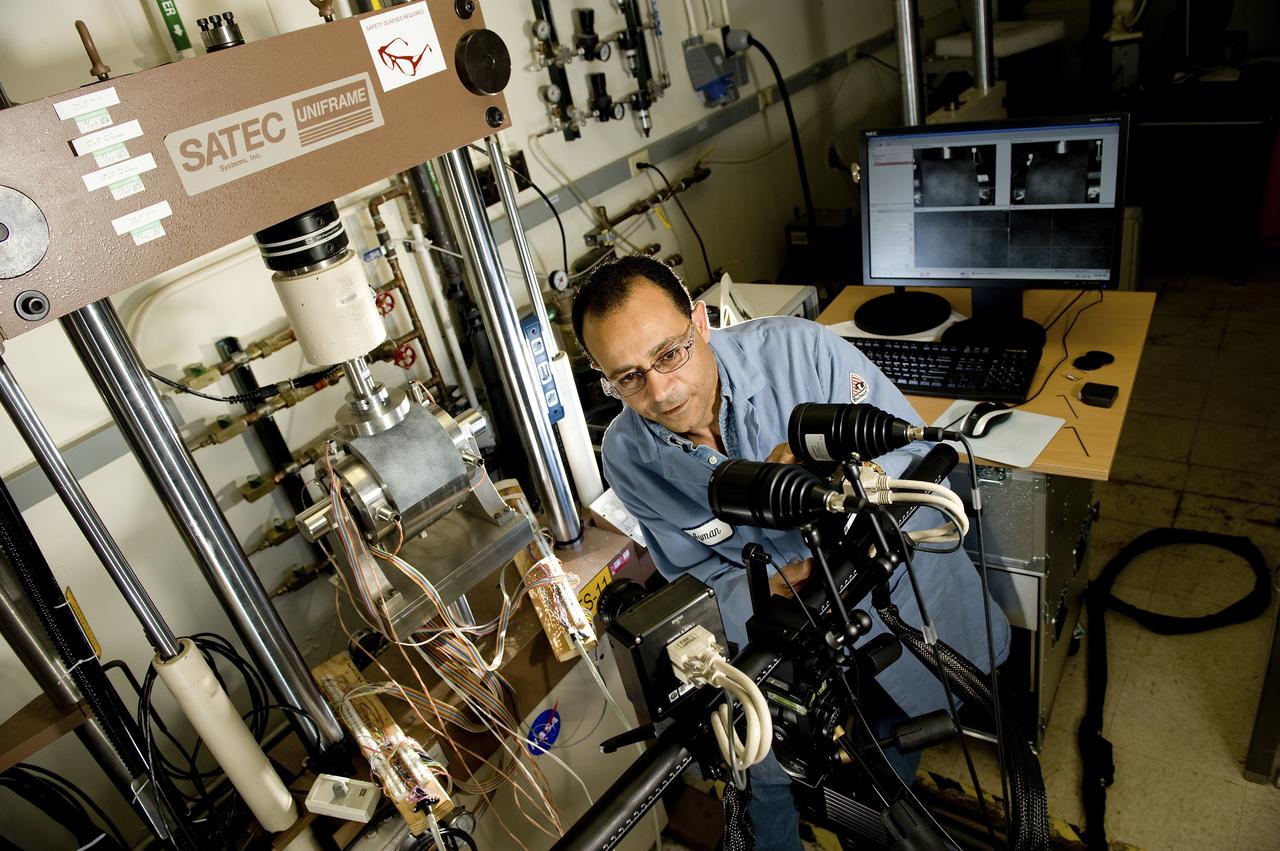
AYMAN GIRGIS (EM10 MATERIALS TEST ENGINEER, JACOBS ESTS GROUP/JTI) ADJUSTS DUAL LENSES FOR A UNIQUE MECHANICAL TST SETUP THAT MEASURES STRAIN ON A SINGLE SAMPLE, USING TWO DIFFERENT TECHNIQUES AT THE SAME TIME. THE TEST FIXTURE HOLDS A SPECIMEN THAT REPRESENTS A LIQUID OXYGEN (LOX) BEARING FROM THE J2-X ENGINE
1000538
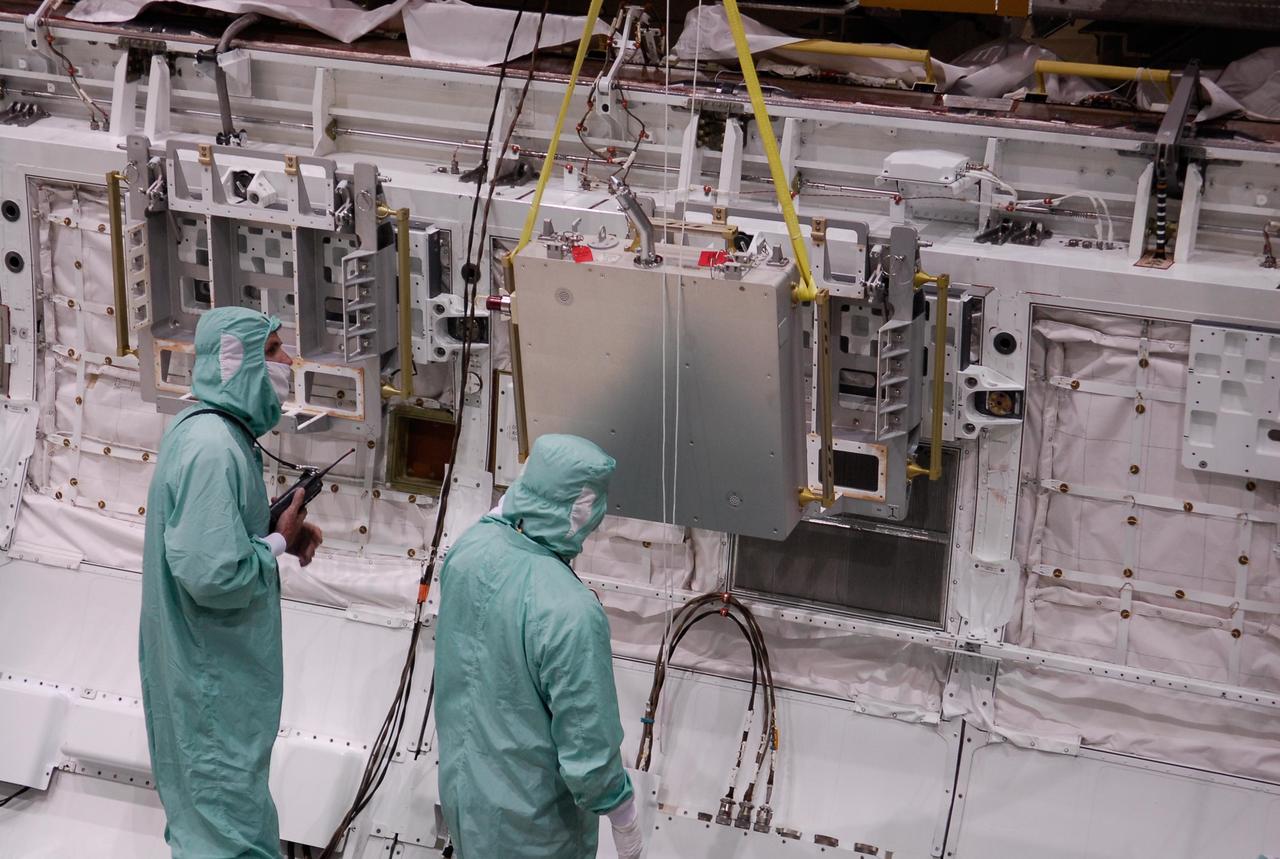
KENNEDY SPACE CENTER, FLA. -- In the Orbiter Processing Facility, one of two Materials International Space Station Experiments, or MISSE, is moved across facility toward space shuttle Endeavour.  The MISSE is part of the payload onboard Endeavour for mission STS-123 and will be installed in the payload bay. The MISSE project is a NASA/Langley Research Center-managed cooperative endeavor to fly materials and other types of space exposure experiments on the International Space Station. The objective is to develop early, low-cost, non-intrusive opportunities to conduct critical space exposure tests of space materials and components planned for use on future spacecraft. Photo credit: NASA/Kim Shiflett
KSC-07pd3318
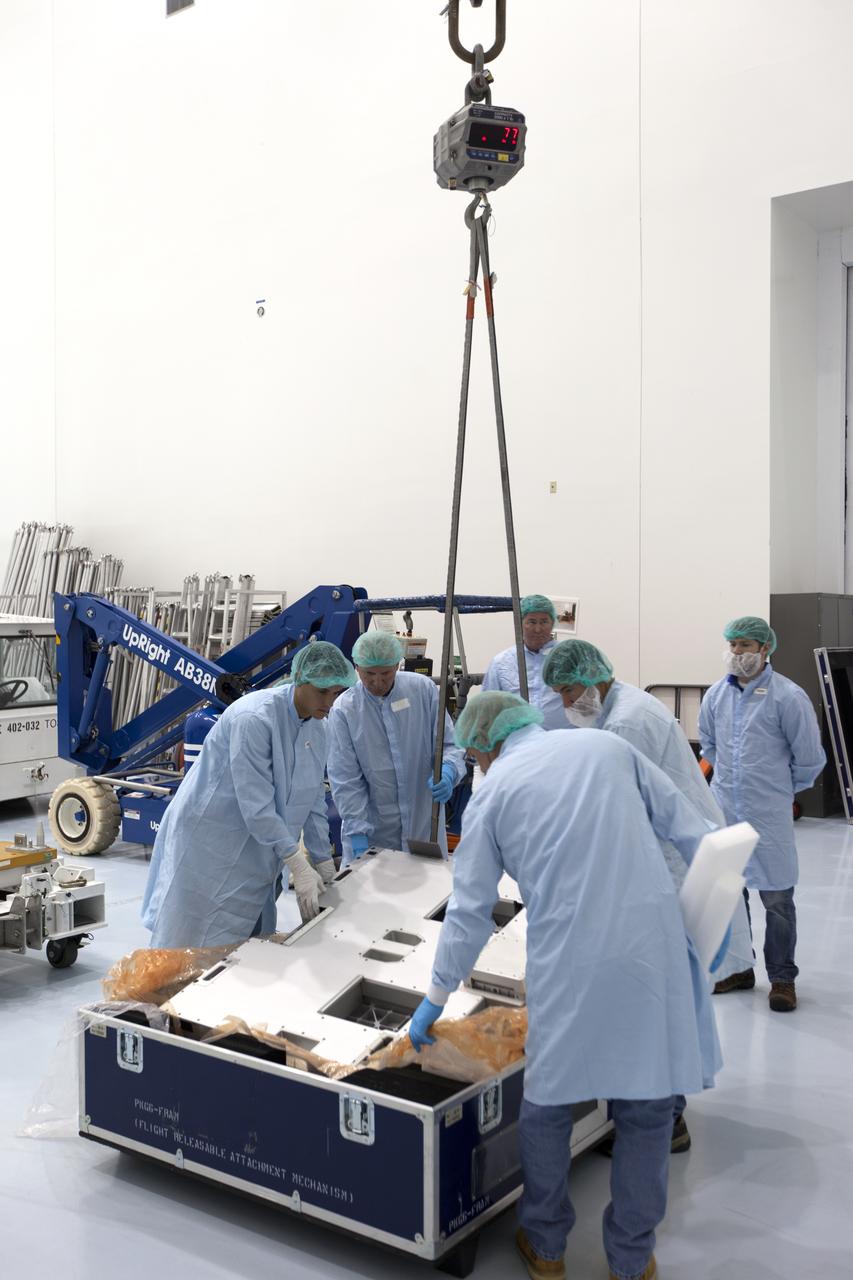
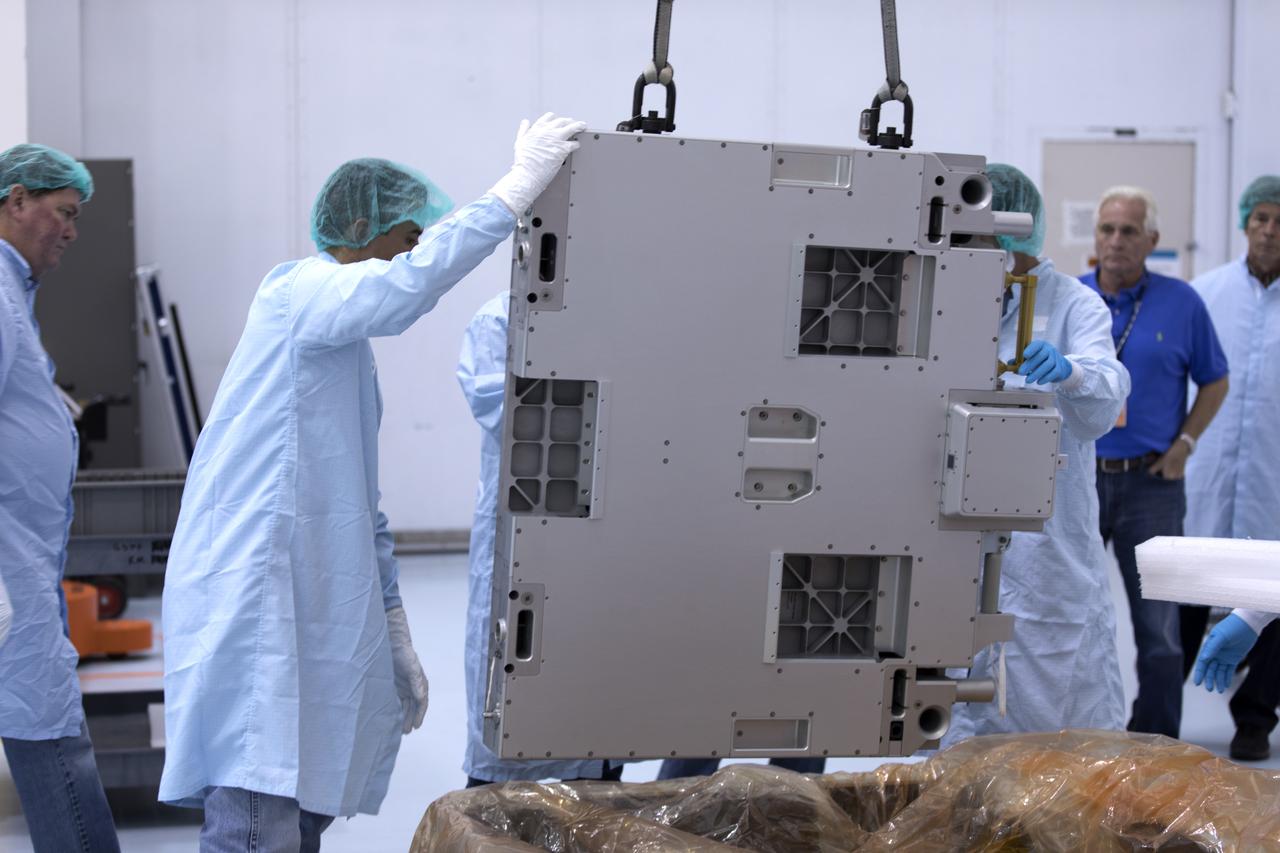
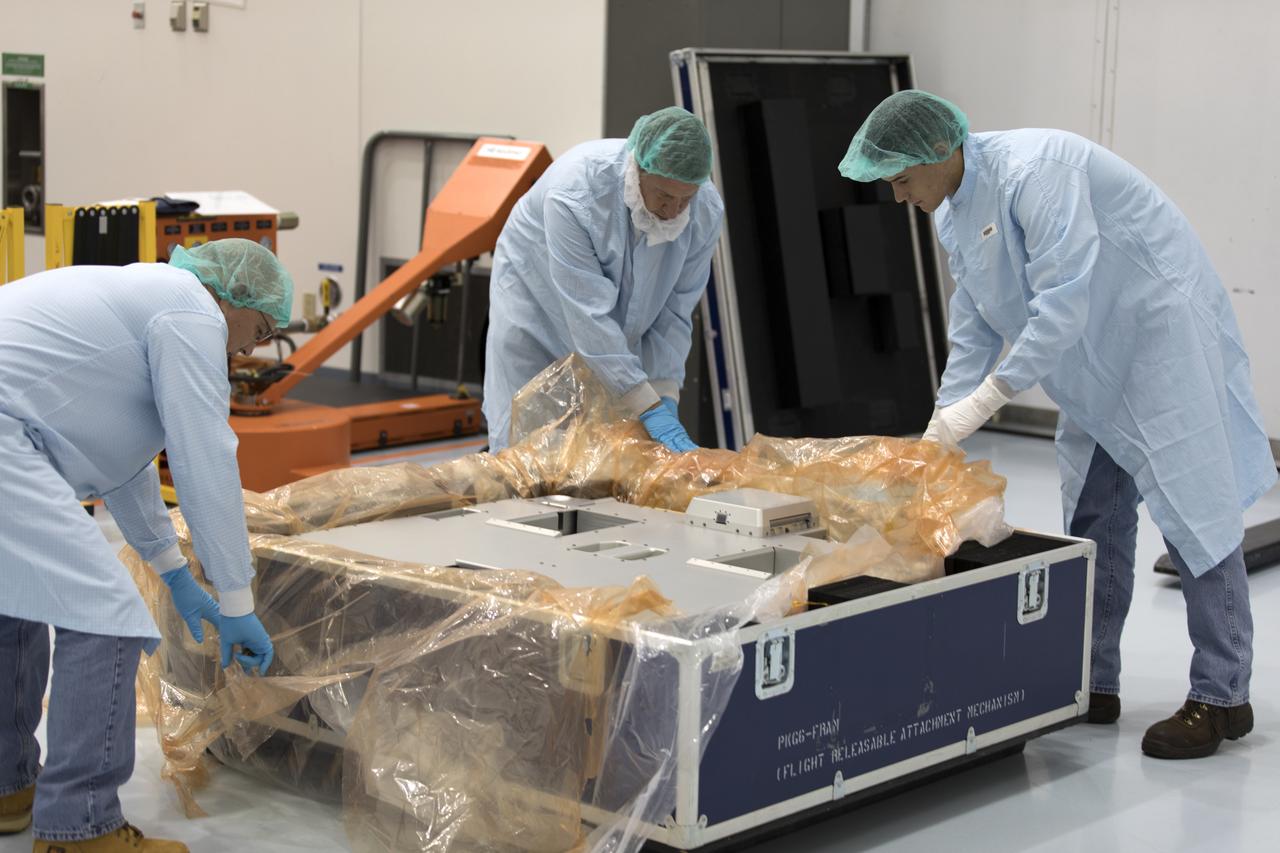
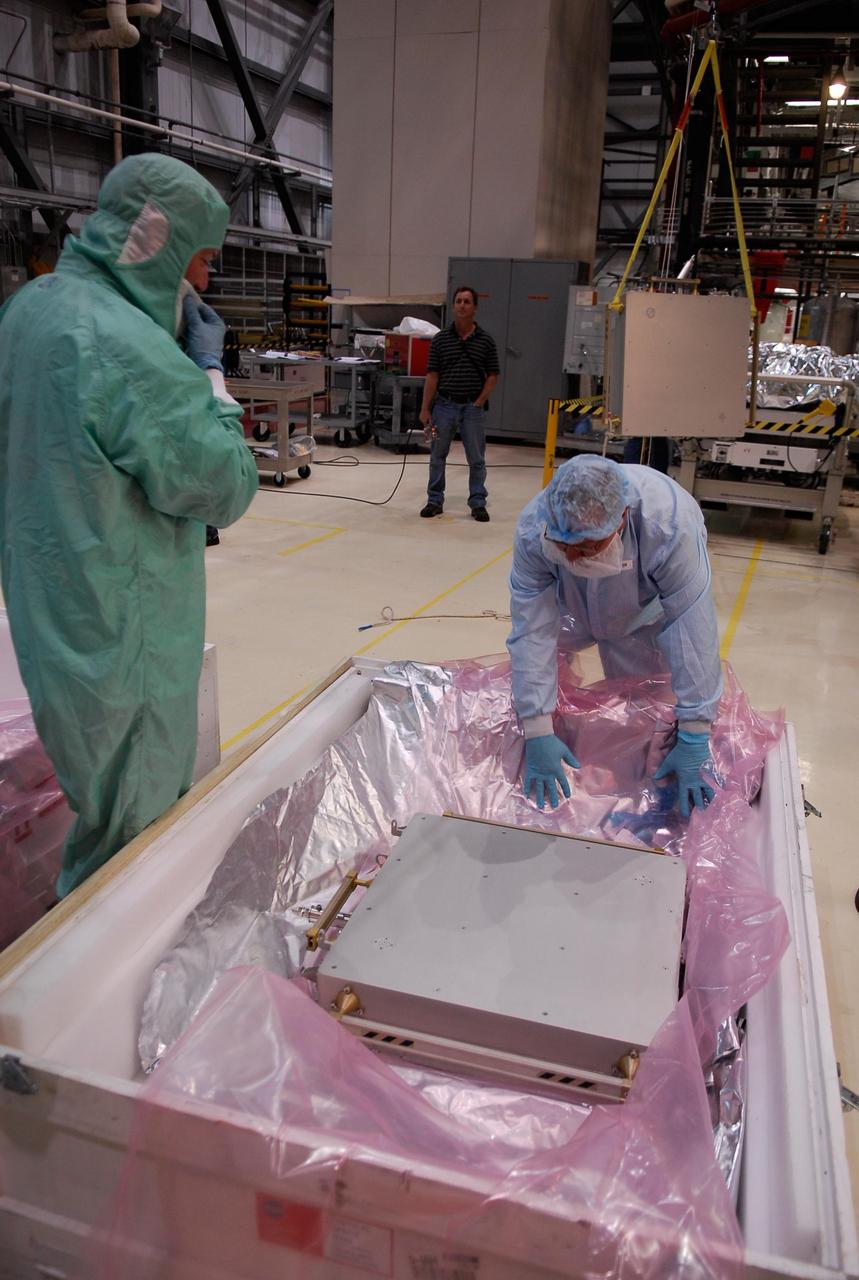
The Materials International Space Station Experiment-Flight Facility, or MISSE-FF, hardware arrived at the Space Station Processing Facility low bay at NASA's Kennedy Space Center in Florida. Technicians assist as one of the components is lowered onto another MISSE component. MISSE will be used to test various materials and computing elements on the exterior of the space station. They will be exposed to the harsh environment of low-Earth orbit, including to a vacuum, atomic oxygen, ultraviolet radiation, direct sunlight and extreme heat and cold. The experiment will provide a better understanding of material durability, from coatings to electronic sensors, which could be applied to future spacecraft designs. MISSE will be delivered to the space station on a future commercial resupply mission.
Materials International Space Station Experiment (MISSE) Arrival
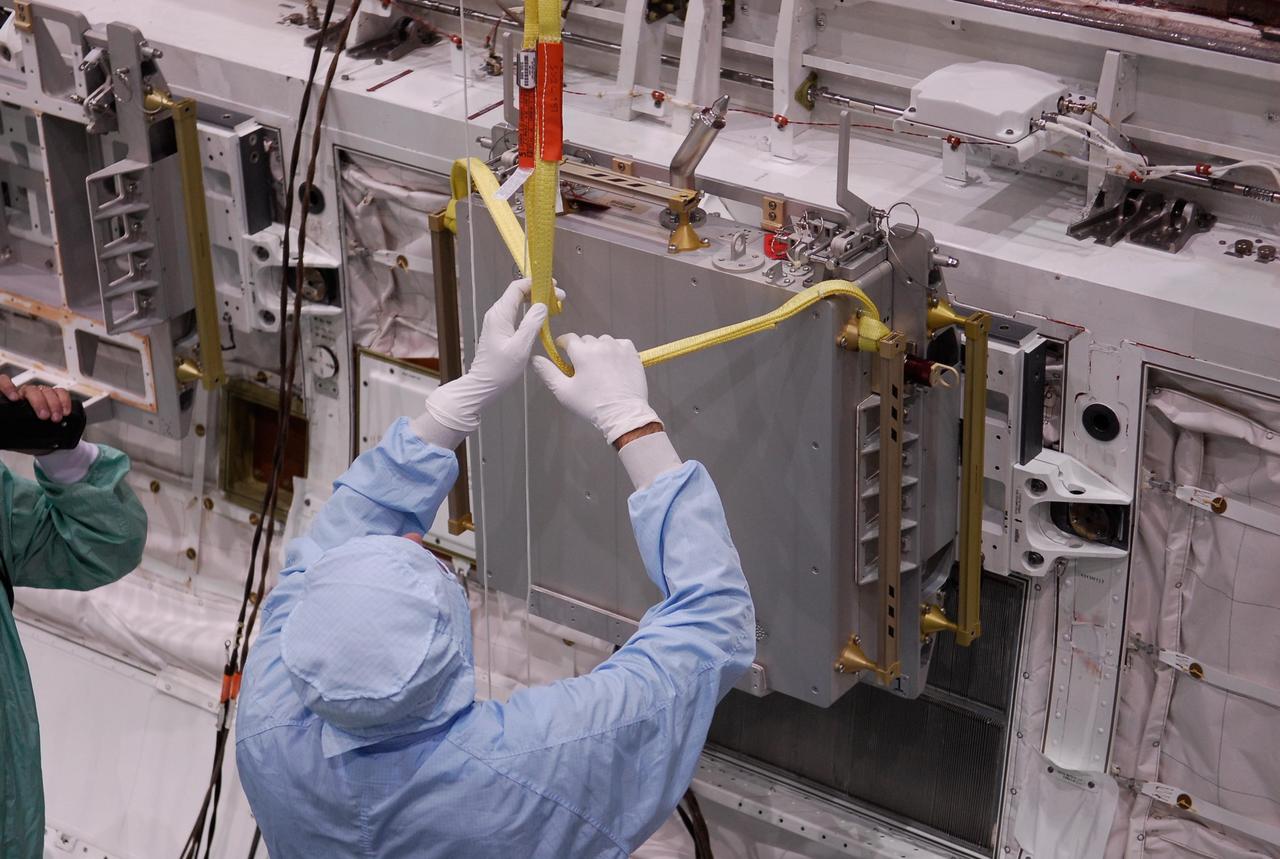
KENNEDY SPACE CENTER, FLA. -- In the Orbiter Processing Facility, one of two Materials International Space Station Experiments, or MISSE, is lowered into space shuttle Endeavour's payload bay for installation. The MISSE is part of the payload onboard Endeavour for mission STS-123. The MISSE project is a NASA/Langley Research Center-managed cooperative endeavor to fly materials and other types of space exposure experiments on the International Space Station. The objective is to develop early, low-cost, non-intrusive opportunities to conduct critical space exposure tests of space materials and components planned for use on future spacecraft. Photo credit: NASA/Kim Shiflett
KSC-07pd3320
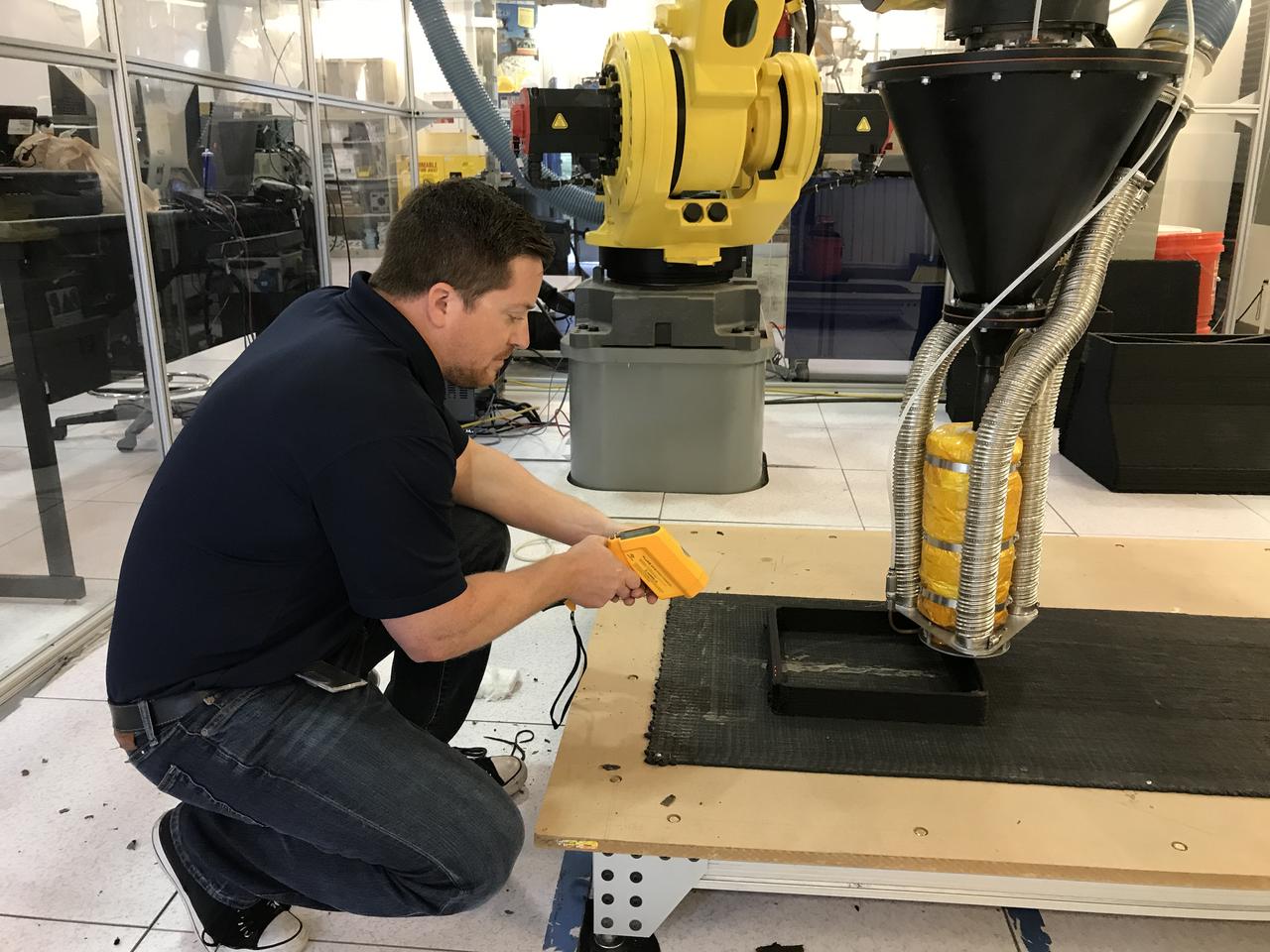
Packing light is the idea behind the Zero Launch Mass 3-D Printer. Instead of loading up on heavy building supplies, a large scale 3-D printer capable of using recycled plastic waste and dirt at the destination as construction material would save mass and money when launching robotic precursor missions to build infrastructure on the Moon or Mars in preparation for human habitation. To make this a reality, Nathan Gelino, a researcher engineer with NASA’s Swamp Works at Kennedy Space Center, measured the temperature of a test specimen from the 3-D printer Tuesday as an early step in characterizing printed material strength properties. Material temperature plays a large role in the strength of bonds between layers.
Zero Launch Mass 3D printer
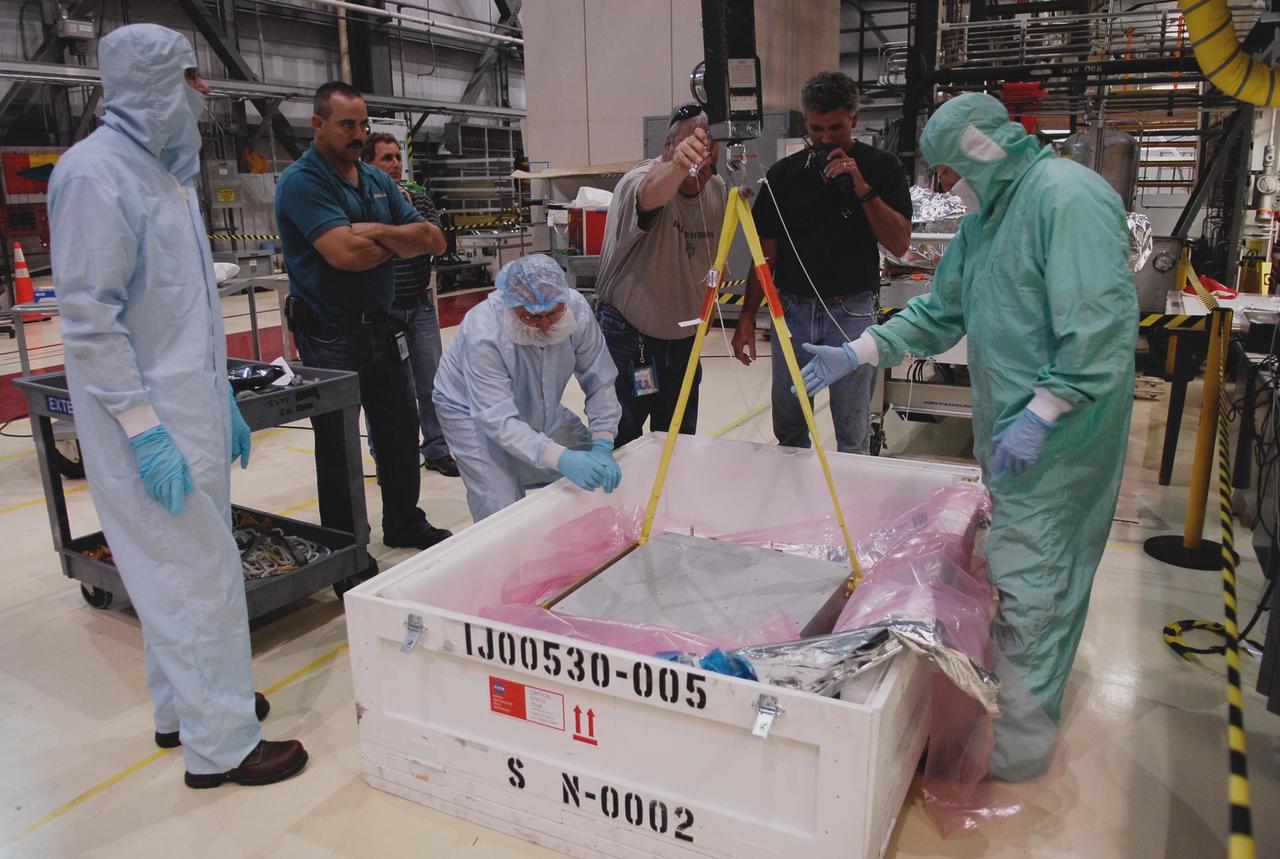
KENNEDY SPACE CENTER, FLA. -- In the Orbiter Processing Facility, technicians get ready to remove another Materials International Space Station Experiments, or MISSE, from a shipping container.  The MISSE is part of the payload onboard space shuttle Endeavour for mission STS-123. It will be installed in Endeavour's payload bay. The MISSE project is a NASA/Langley Research Center-managed cooperative endeavor to fly materials and other types of space exposure experiments on the International Space Station. The objective is to develop early, low-cost, non-intrusive opportunities to conduct critical space exposure tests of space materials and components planned for use on future spacecraft. Photo credit: NASA/Kim Shiflett
KSC-07pd3317
KENNEDY SPACE CENTER, FLA. -- In the Orbiter Processing Facility, technicians help lift the first of the Materials International Space Station Experiments, or MISSE, from a shipping container.  The MISSE is part of the payload onboard space shuttle Endeavour for mission STS-123. It will be installed in Endeavour's payload bay.  The MISSE project is a NASA/Langley Research Center-managed cooperative endeavor to fly materials and other types of space exposure experiments on the International Space Station. The objective is to develop early, low-cost, non-intrusive opportunities to conduct critical space exposure tests of space materials and components planned for use on future spacecraft. Photo credit: NASA/Kim Shiflett
KSC-07pd3316
KENNEDY SPACE CENTER, FLA. -- In the Orbiter Processing Facility, the second of two Materials International Space Station Experiments, or MISSE, is lowered into space shuttle Endeavour's payload bay for installation. The MISSE is part of the payload onboard Endeavour for mission STS-123. The MISSE project is a NASA/Langley Research Center-managed cooperative endeavor to fly materials and other types of space exposure experiments on the International Space Station. The objective is to develop early, low-cost, non-intrusive opportunities to conduct critical space exposure tests of space materials and components planned for use on future spacecraft. Photo credit: NASA/Kim Shiflett
KSC-07pd3321
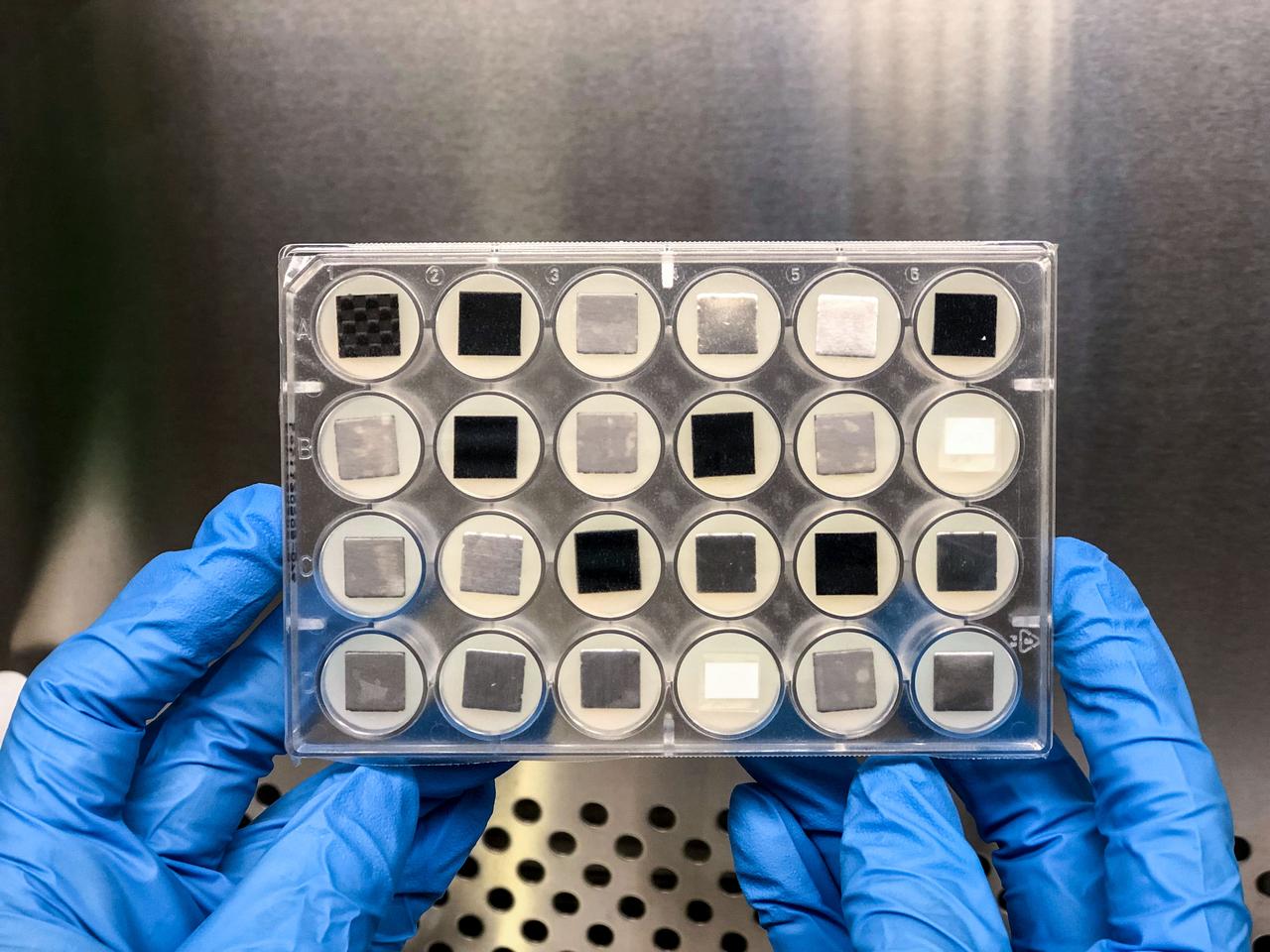
jsc2020e003406 (10/28/2019) --- A preflight view of a Commercial-off-the-shelf (COTS) 24-Well plate in fungal configuration. Each well contains a 1 cm2 coupon inoculated with fungal spores. Seven different materials were included for testing. The Characterization of Biofilm Formation, Growth, and Gene Expression on Different Materials and Environmental Conditions in Microgravity (Space Biofilms) investigation characterizes the mass, thickness, structure, and associated gene expression of biofilms that form in space by analyzing different microbial species grown on different materials. Biofilm formation can cause equipment malfunction and human illnesses, and could be a serious problem on future long-term human space missions.
Space Biofilms 1
KENNEDY SPACE CENTER, FLA. --  In the Orbiter Processing Facility, technicians install the second Materials International Space Station Experiments, or MISSE, in space shuttle Endeavour's payload bay. The MISSE is part of the payload onboard Endeavour for mission STS-123. The MISSE project is a NASA/Langley Research Center-managed cooperative endeavor to fly materials and other types of space exposure experiments on the International Space Station. The objective is to develop early, low-cost, non-intrusive opportunities to conduct critical space exposure tests of space materials and components planned for use on future spacecraft. Photo credit: NASA/Kim Shiflett
KSC-07pd3322
The Materials International Space Station Experiment-Flight Facility, or MISSE-FF, hardware arrived at the Space Station Processing Facility low bay at NASA's Kennedy Space Center in Florida. Technicians work to attach a crane to MISSE for lifting out of its shipping container. MISSE will be used to test various materials and computing elements on the exterior of the space station. They will be exposed to the harsh environment of low-Earth orbit, including to a vacuum, atomic oxygen, ultraviolet radiation, direct sunlight and extreme heat and cold. The experiment will provide a better understanding of material durability, from coatings to electronic sensors, which could be applied to future spacecraft designs. MISSE will be delivered to the space station on a future commercial resupply mission.
Materials International Space Station Experiment (MISSE) Arrival
KENNEDY SPACE CENTER, FLA. -- In the Orbiter Processing Facility, one of two Materials International Space Station Experiments, or MISSE, is lowered into space shuttle Endeavour's payload bay for installation. The MISSE is part of the payload onboard Endeavour for mission STS-123. The MISSE project is a NASA/Langley Research Center-managed cooperative endeavor to fly materials and other types of space exposure experiments on the International Space Station. The objective is to develop early, low-cost, non-intrusive opportunities to conduct critical space exposure tests of space materials and components planned for use on future spacecraft. Photo credit: NASA/Kim Shiflett
KSC-07pd3319
The Materials International Space Station Experiment-Flight Facility, or MISSE-FF, hardware arrived at the Space Station Processing Facility low bay at NASA's Kennedy Space Center in Florida. Technicians assist as one of the components is lowered onto another MISSE component. MISSE will be used to test various materials and computing elements on the exterior of the space station. They will be exposed to the harsh environment of low-Earth orbit, including to a vacuum, atomic oxygen, ultraviolet radiation, direct sunlight and extreme heat and cold. The experiment will provide a better understanding of material durability, from coatings to electronic sensors, which could be applied to future spacecraft designs. MISSE will be delivered to the space station on a future commercial resupply mission.
Materials International Space Station Experiment (MISSE) Arrival