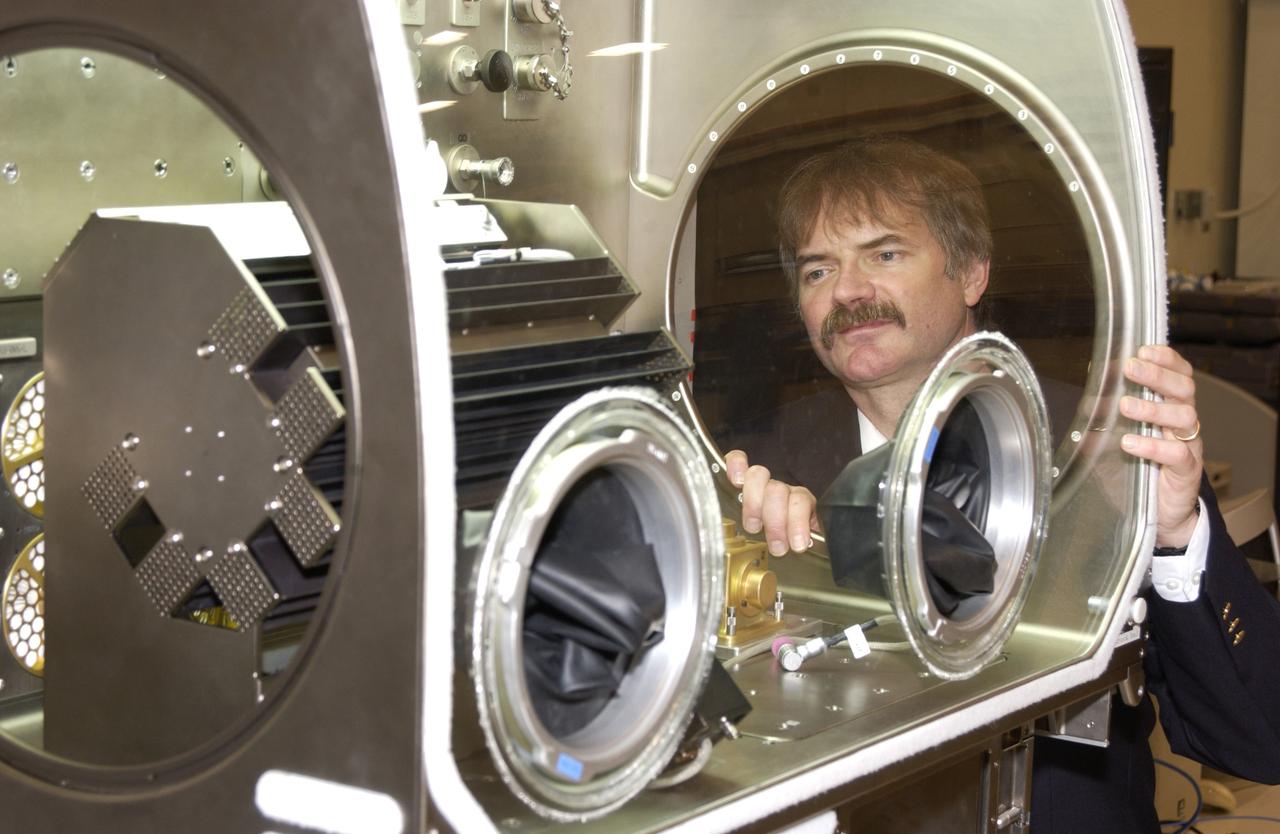
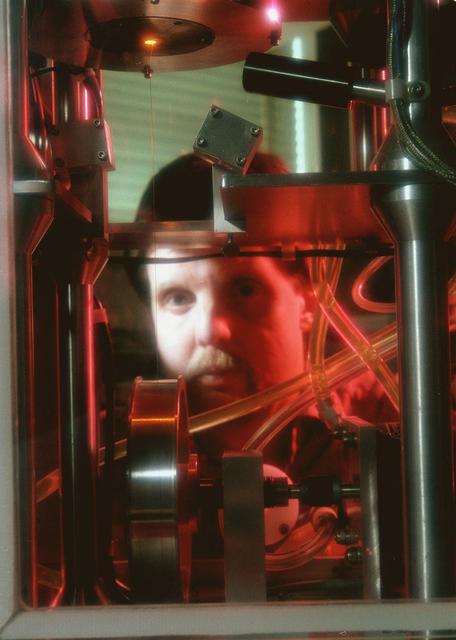
Dr. Richard Grugel, a materials scientist at NASA's Marshall Space Flight in Huntsville, Ala., examines the furnace used to conduct his Pore Formation and Mobility Investigation -- one of the first two materials science experiments to be conducted on the International Space Station. This experiment studies materials processes similar to those used to make components used in jet engines. Grugel's furnace was installed in the Microgravity Science Glovebox through the circular port on the side. In space, crewmembers are able to change out samples using the gloves on the front of the facility's work area.
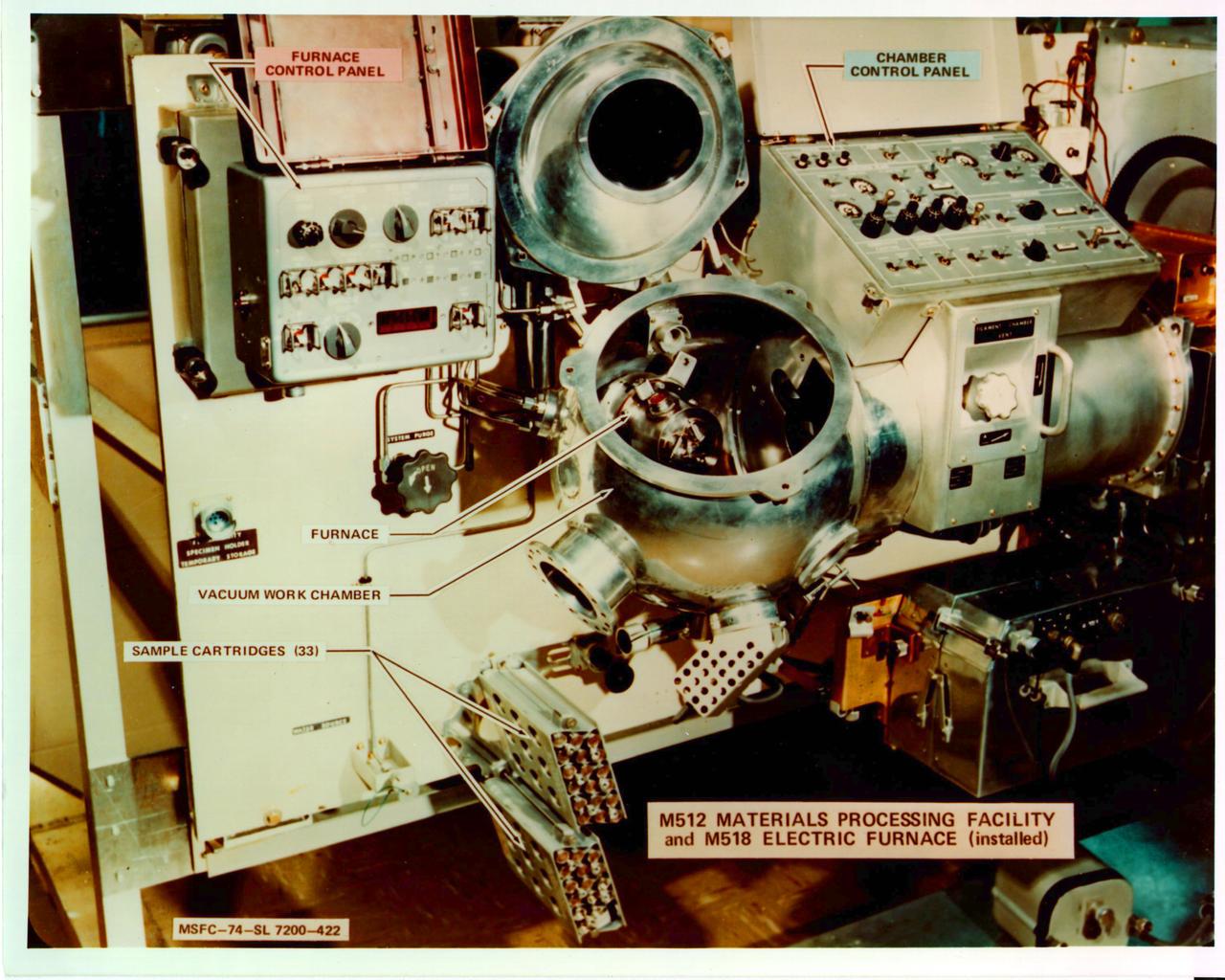
The M512 Materials Processing Facility (MPF) with the M518 Multipurpose Electric Facility (MEF) tested and demonstrated a facility approach for materials process experimentation in space. It also provided a basic apparatus and a common interface for a group of metallic and nonmetallic materials experiments. The MPF consisted of a vacuum work chamber and associated mechanical and electrical controls. The M518 Multipurpose Electric Furnace (MEF) was an electric furnace system in which solidification, crystal growth, and other experiments involving phase changes were performed.
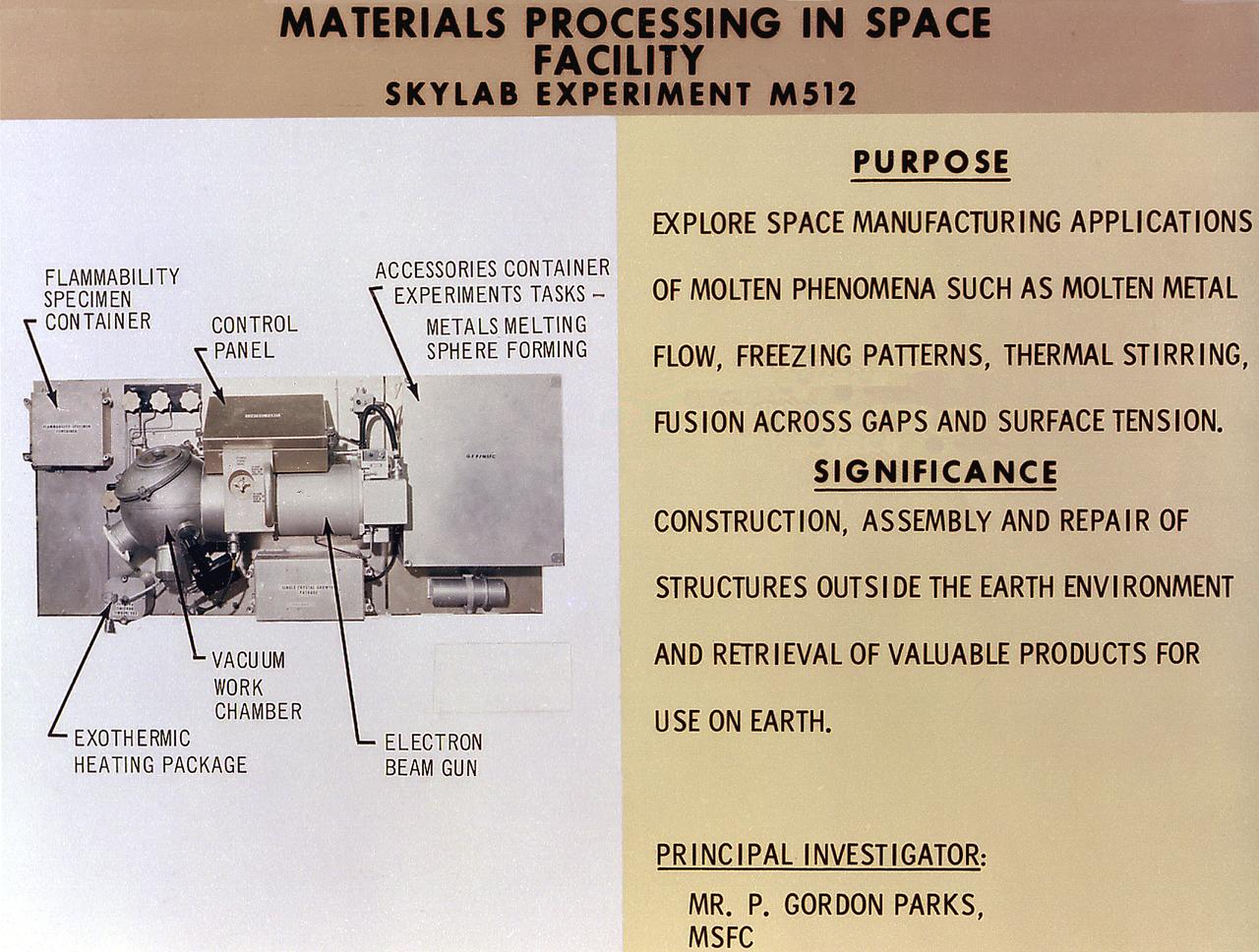
This chart details Skylab's Materials Processing Facility experiment (M512). This facility, located in the Multiple Docking Adapter, was developed for Skylab and accommodated 14 different experiments that were carried out during the three marned missions. The abilities to melt and mix without the contaminating effects of containers, to suppress thermal convection and buoyancy in fluids, and to take advantage of electrostatic and magnetic forces and otherwise masked by gravitation opened the way to new knowledge of material properties and processes. This beginning would ultimately lead to the production of valuable new materials for use on Earth.
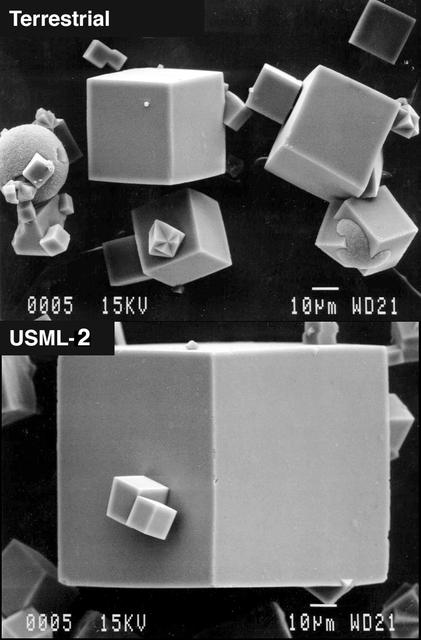
The Center for Advanced Microgravity Materials Processing (CAMMP), a NASA-sponsored Research Partnership Center, is working to improve zeolite materials for storing hydrogen fuel. CAMMP is also applying zeolites to detergents, optical cables, gas and vapor detection for environmental monitoring and control, and chemical production techniques that significantly reduce by-products that are hazardous to the environment. Shown here are zeolite crystals (top) grown in a ground control experiment and grown in microgravity on the USML-2 mission (bottom). Zeolite experiments have also been conducted aboard the International Space Station.
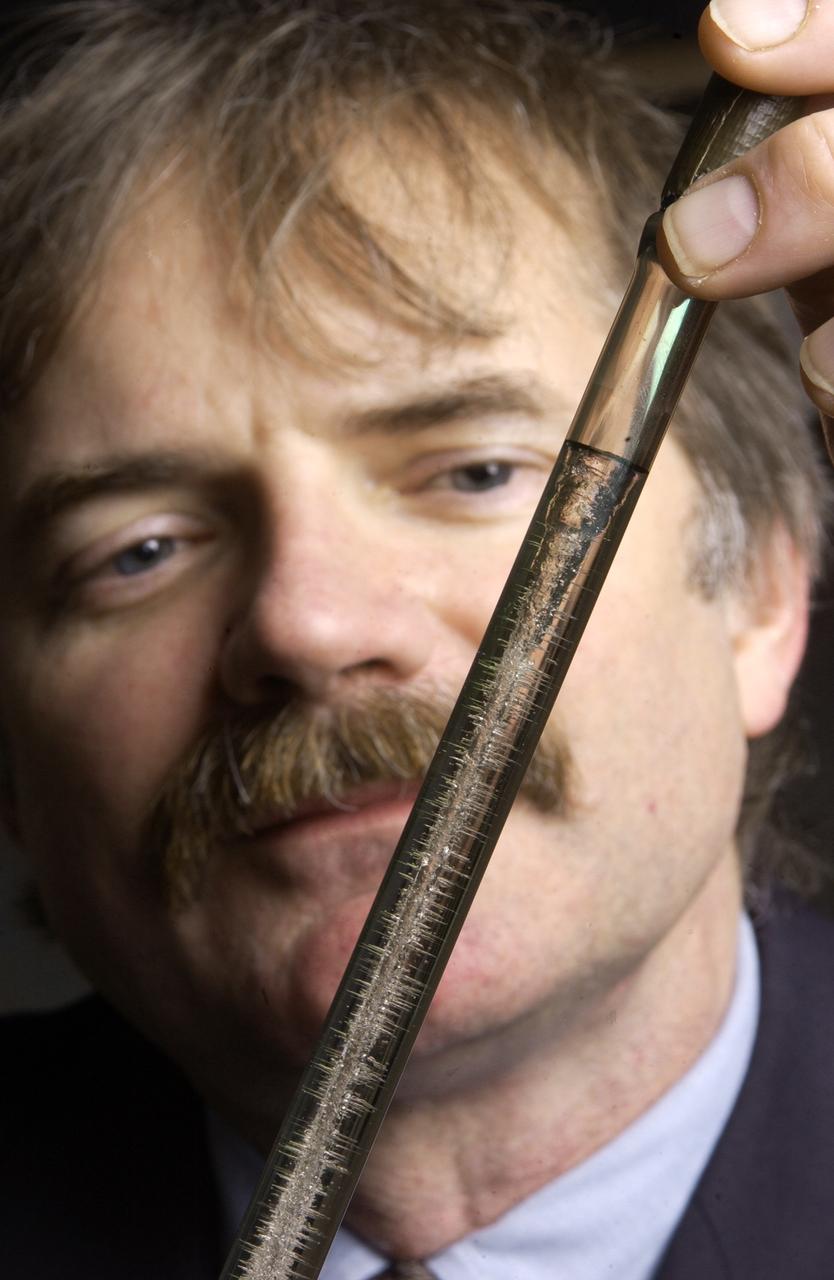
On Earth when scientists melt metals, bubbles that form in the molten material can rise to the surface, pop and disappear. In microgravity -- the near-weightless environment created as the International Space Station orbits Earth -- the lighter bubbles do not rise and disappear. Prior space experiments have shown that bubbles often become trapped in the final metal or crystal sample -similar to the bubbles trapped in this sample. In the solid, these bubbles, or porosity, are defects that diminish both the material's strength and usefulness. The Pore Formation and Mobility Investigation will melt samples of a transparent modeling material, succinonitrile and succinonitrile water mixtures, shown here in an ampoule being examined by Dr. Richard Grugel, the principal investigator for the experiment at NASA's Marshall Space Flight Center in Huntsville, Ala. As the samples are processed in space, Grugel will be able to observe how bubbles form in the samples and study their movements and interactions.
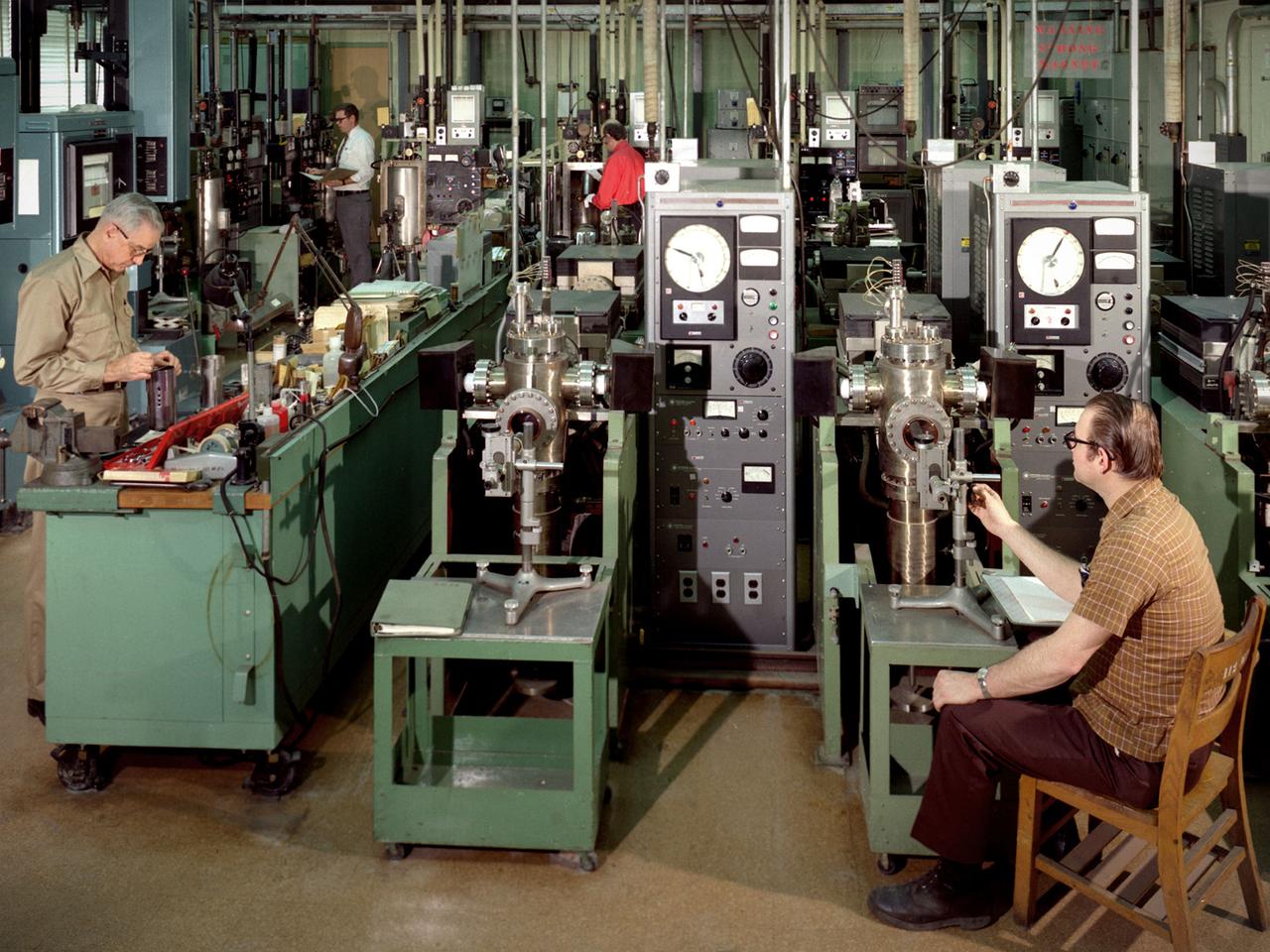
Technicians at work in the Materials Processing Laboratory’s Creep Facility at the National Aeronautics and Space Administration (NASA) Lewis Research Center. The technicians supported the engineers’ studies of refractory materials, metals, and advanced superalloys. The Materials Processing Laboratory contained laboratories and test areas equipped to prepare and develop these metals and materials. The ultra-high vacuum lab, seen in this photograph, contained creep and tensile test equipment. Creep testing is used to study a material’s ability to withstand long durations under constant pressure and temperatures. The equipment measured the strain over a long period of time. Tensile test equipment subjects the test material to strain until the material fails. The two tests were used to determine the strength and durability of different materials. The Materials Processing Laboratory also housed arc and electron beam melting furnaces, a hydraulic vertical extrusion press, compaction and forging equipment, and rolling mills and swagers. There were cryogenic and gas storage facilities and mechanical and oil diffusion vacuum pumps. The facility contained both instrumental and analytical chemistry laboratories for work on radioactive or toxic materials and the only shop to machine toxic materials in the Midwest.
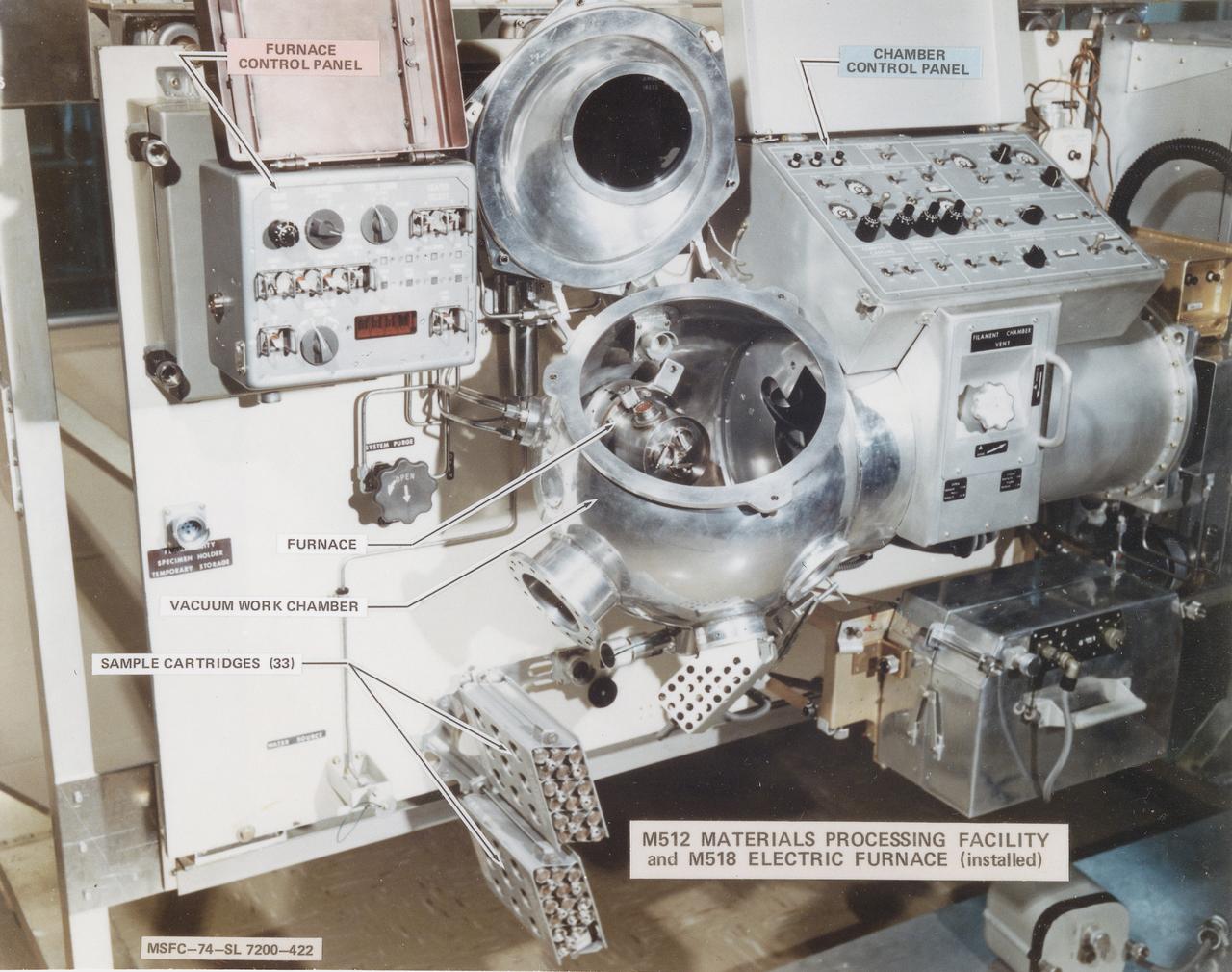
This photograph shows the Skylab Materials Processing Facility (M512) and the Multipurpose Furnace System (M518). This facility, located in the Multiple Docking Adapter, was developed for Skylab,and accommodated 14 different experiments that were carried out during the three marned missions. The abilities to melt and mix without the contaminating effects of containers, to suppress thermal convection and buoyancy in fluids, and to take advantage of electrostatic and magnetic forces and otherwise masked by gravitation opened the way to new knowledge of material properties and processes. This beginning would ultimately lead to the production of valuable new materials for use on Earth.
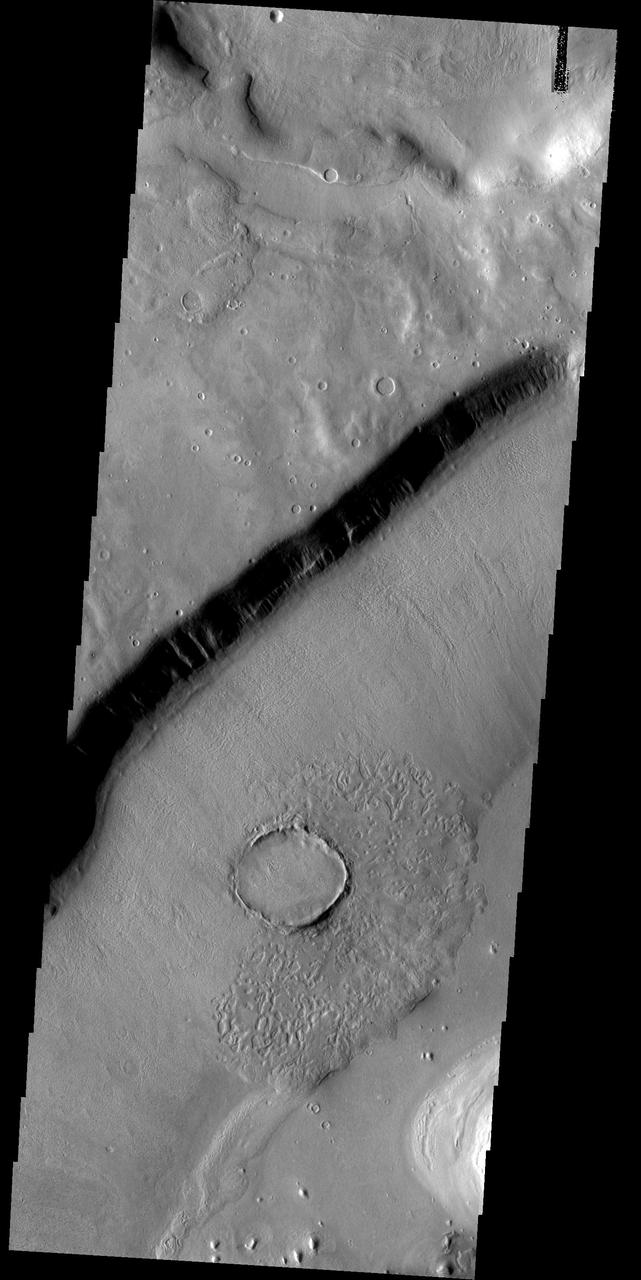
This crater appears to be in the process of being covered over by downslope movement of material. These large slopes of material are common in Deuteronilus Mensae
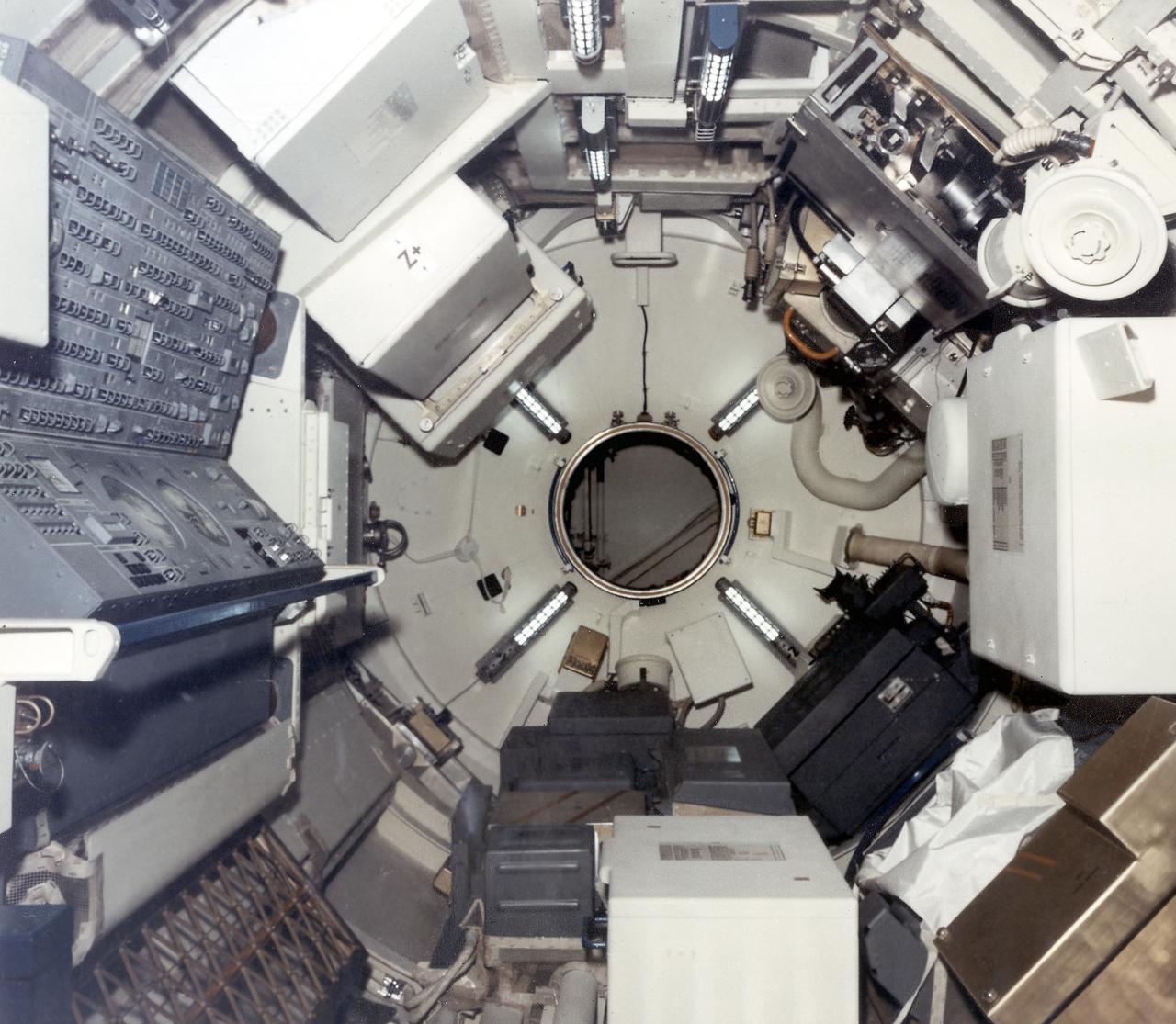
This interior photograph of Skylab's multiple docking adapter (MDA) flight article, then undergoing outfitting at the Martin Marietta Corporation's Space Center facility in Denver, Colorado, shows the forward cone area and docking turnel (center) that attached to the Apollo Command Module. Designed and manufactured by the Marshall Space Flight Center, the MDA housed the control units for the Apollo Telescope Mount (ATM), Earth Resources Experiment Package (EREP), and Zero-Gravity Materials Processing Facility and provided a docking port for the Apollo Command Module.
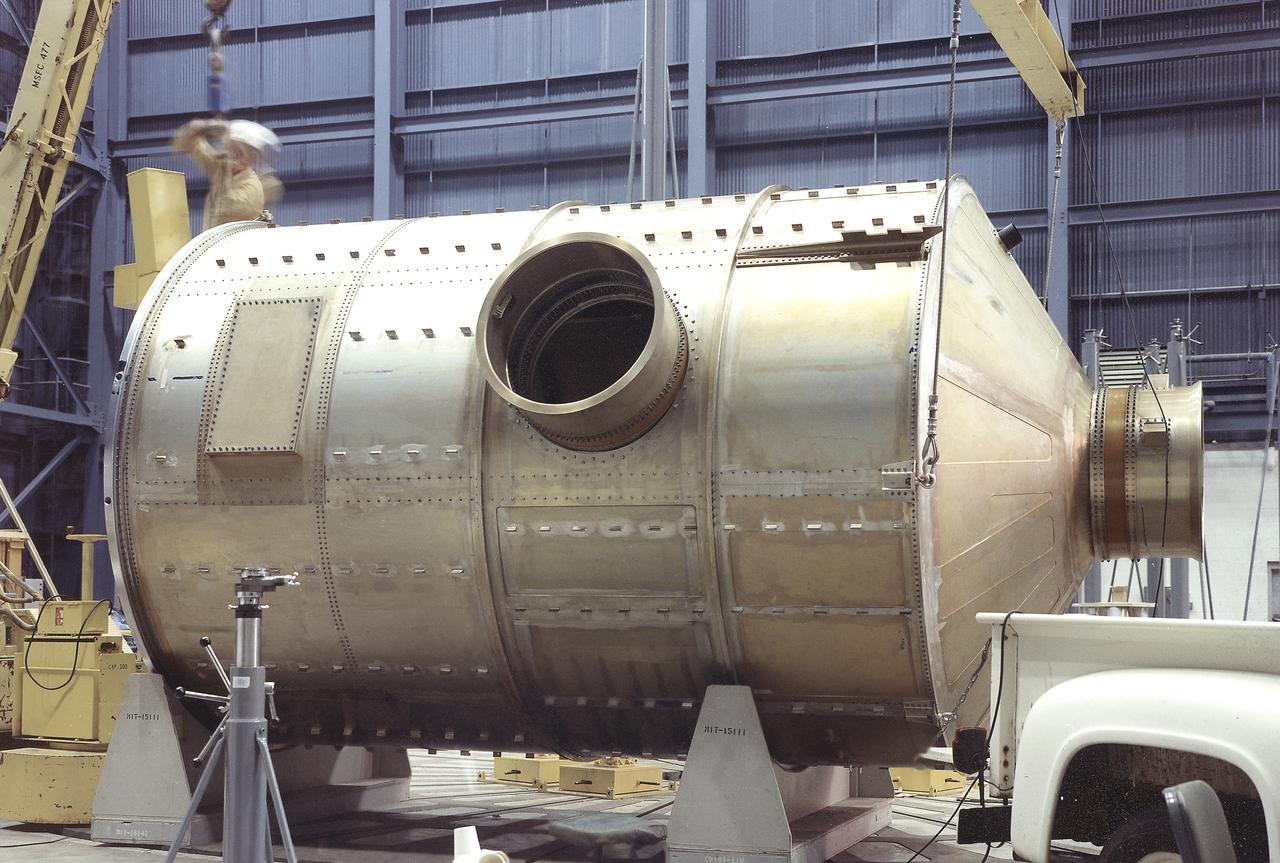
At Marshall Space Flight Center, Skylab's Multiple Docking Adapter (MDA) flight article undergoes center-of-gravity testing. Developed and fabricated by MSFC, the MDA housed the control units for the Apollo Telescope Mount (ATM), Earth Resources Experiment Package (EREP), and the Zero-Gravity Material Processing Facility and provided a docking port for the Apollo Command Module.
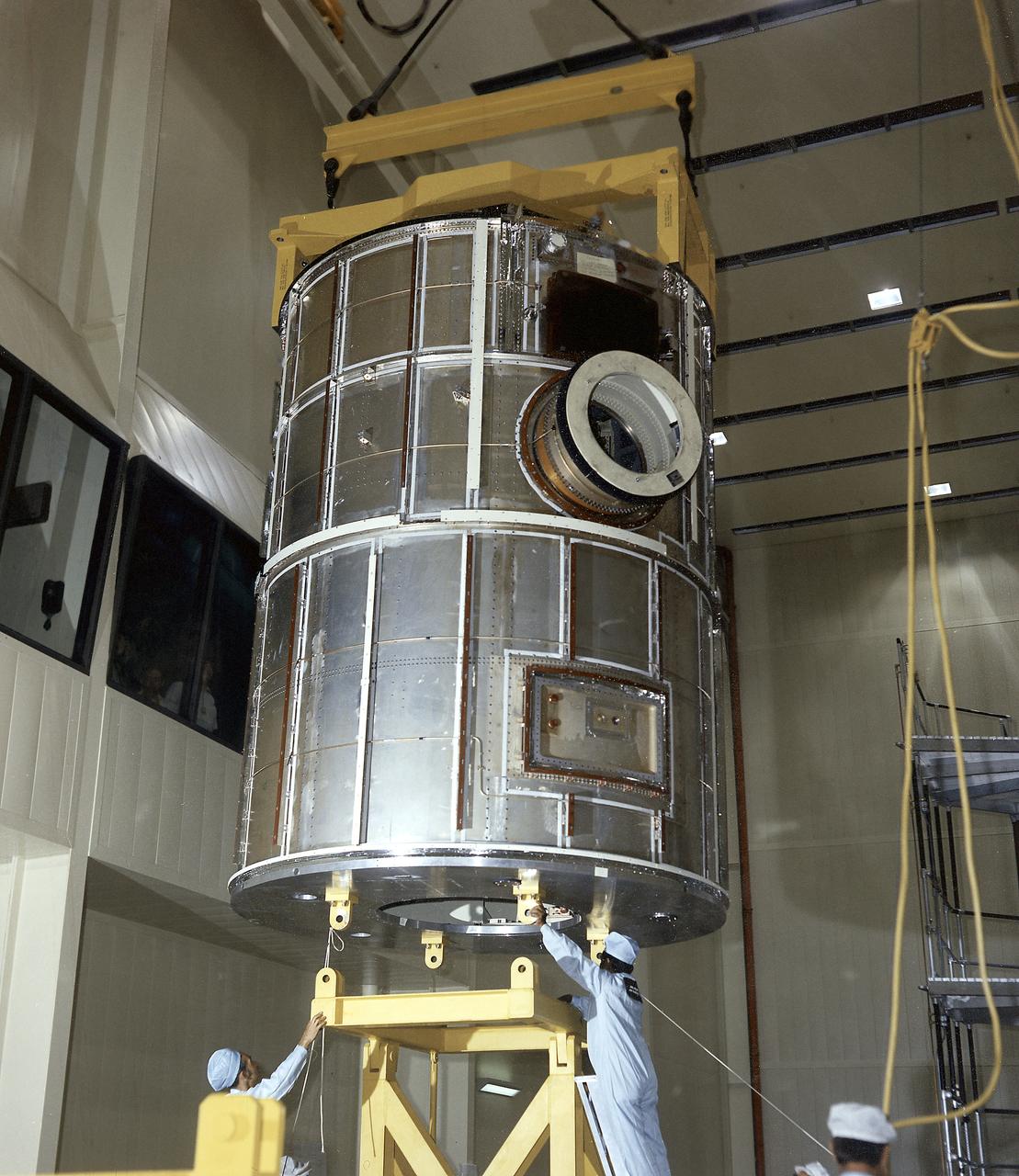
Workmen at the Martin Marietta Corporation's Space Center in Denver, Colorado, position Skylab's Multiple Docking Adapter (MDA) flight article in the horizontal transportation fixture. Designed and manufactured by the Marshall Space Flight Center and outfitted by Martin Marietta, the MDA housed the control units for the Apollo Telescope Mount (ATM), Earth Resources Experiment Package (EREP), and Zero-Gravity Materials Processing Facility and provided a docking port for the Apollo Command Module.
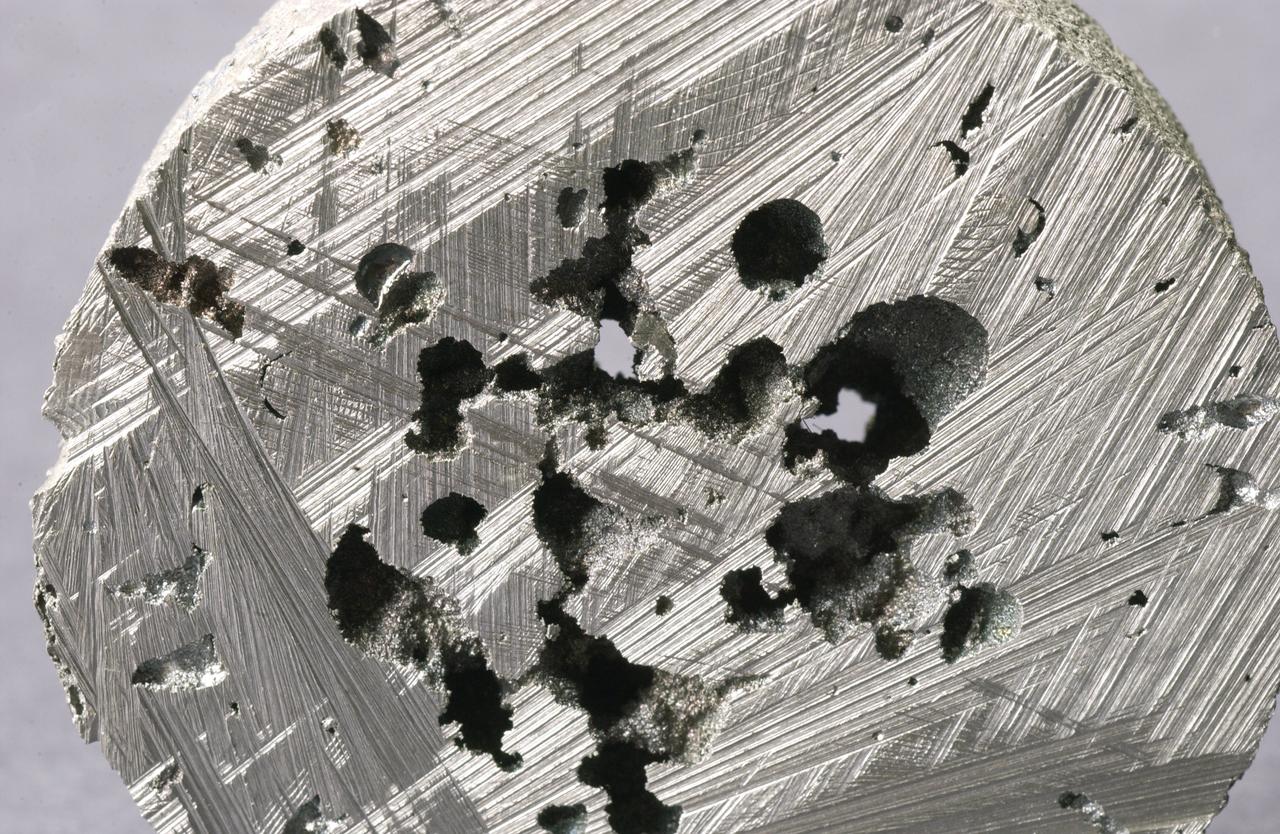
Pores and voids often form in metal castings on Earth (above) making them useless. A transparent material that behaves at a large scale in microgravity the way that metals behave at the microscopic scale on Earth, will help show how voids form and learn how to prevent them. Scientists are using the microgravity environment on the International Space Station to study how these bubbles form, move and interact. The Pore Formation and Mobility Investigation (PFMI) in the Microgravity Science Glovebox aboard the International Space Station uses a transparent material called succinonitrile that behaves like a metal to study this problem. Video images sent to the ground allow scientists to watch the behavior of the bubbles as they control the melting and freezing of the material. The bubbles do not float to the top of the material in microgravity, so they can study their interactions.
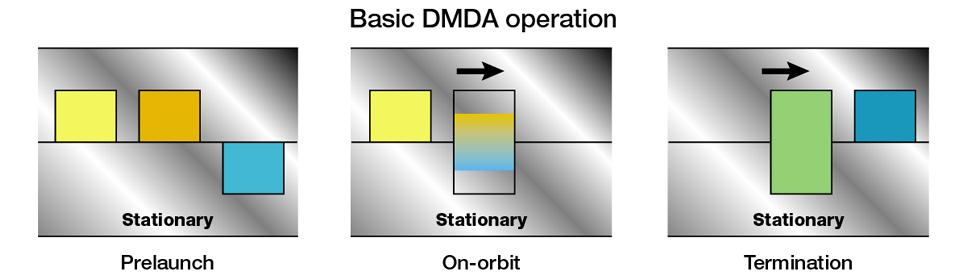
Experiments to seek solutions for a range of biomedical issues are at the heart of several investigations that will be hosted by the Commercial Instrumentation Technology Associates (ITA), Inc. Biomedical Experiments (CIBX-2) payload. CIBX-2 is unique, encompassing more than 20 separate experiments including cancer research, commercial experiments, and student hands-on experiments from 10 schools as part of ITA's ongoing University Among the Stars program. This drawing depicts a cross-section of a set of Dual-Materials Dispersion Apparatus (DMDA) specimen wells, one of which can include a reverse osmosis membrane to dewater a protein solution and thus cause crystallization. Depending on individual needs, two or three wells may be used, the membrane may be absent, or other proprietary enhancements may be present. The experiments are sponsored by NASA's Space Product Development Program (SPD).

The action of the wind is sculpting and removing material in this area. The older surface below is being re-exposed, a process called exhumation
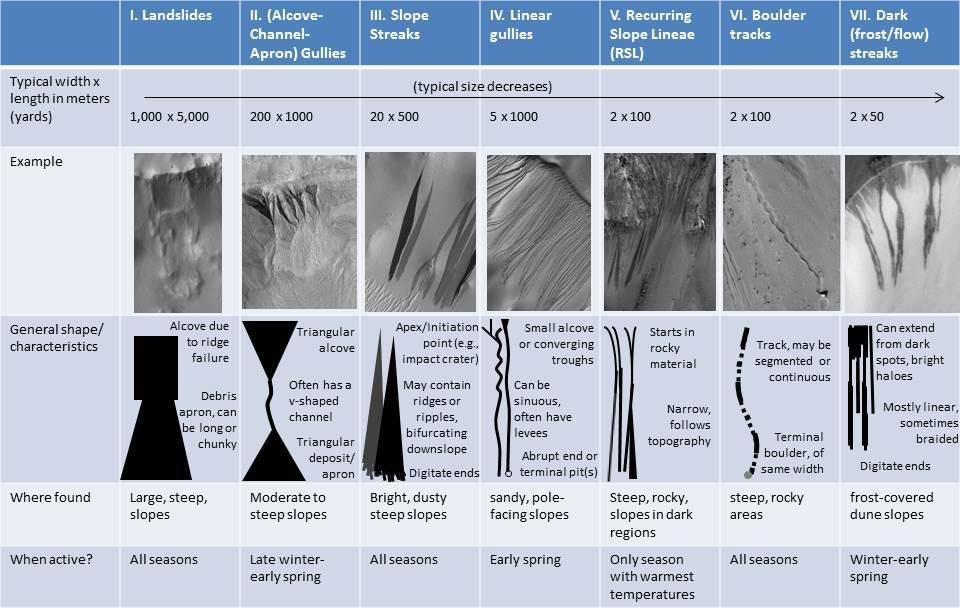
As on the Earth, many processes can move material down a Martian slope. This graphic compares seven different types of features observed on Mars that appear to result from material flowing or sliding or rolling down slopes.
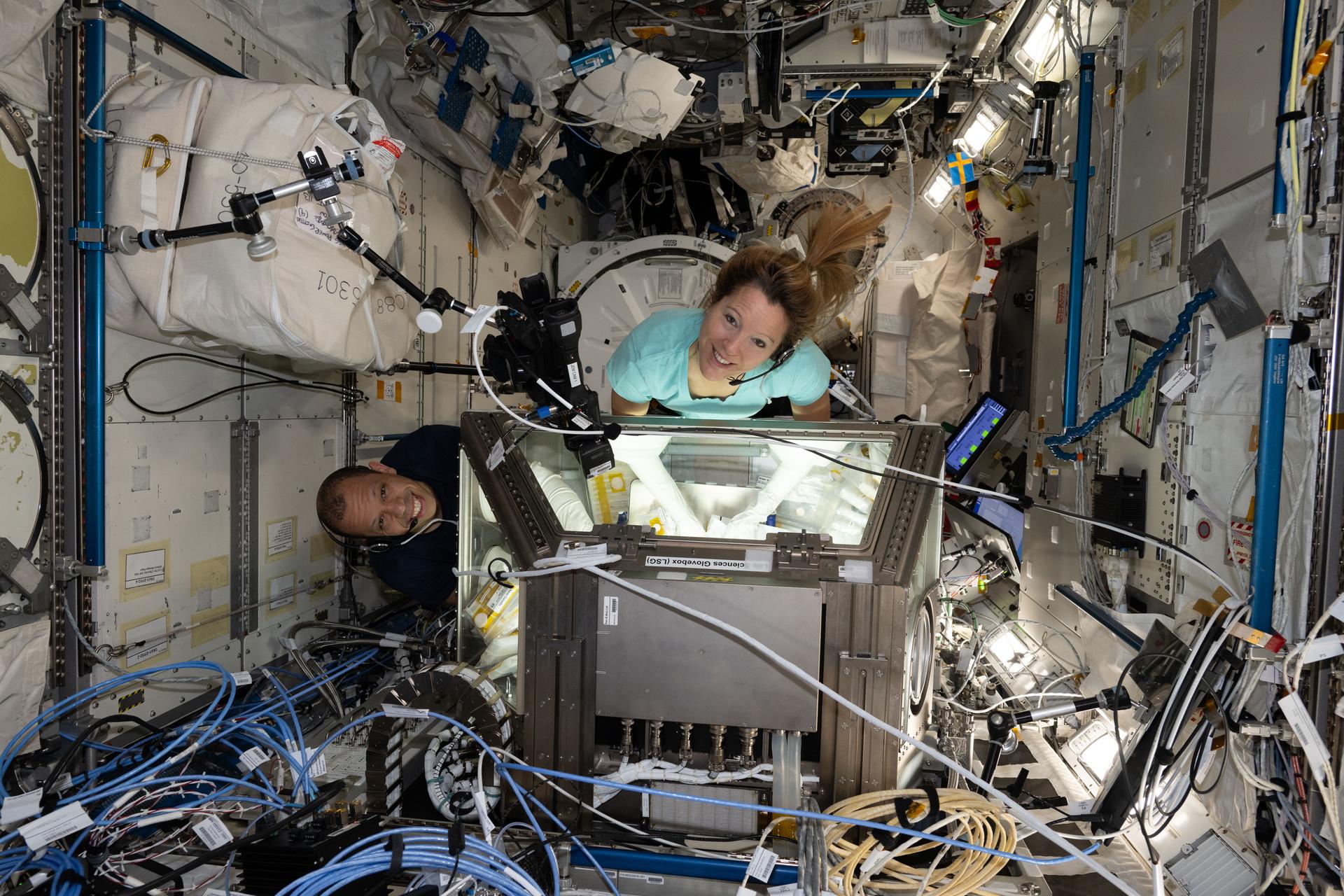
iss074e0503941 (April 22, 2026) --- Expedition 74 flight engineers Chris Williams of NASA and Sophie Adenot of the European Space Agency work together in the Kibo laboratory module’s Life Science Glovebox, processing genetic-material samples for the DNA Nano Therapeutics‑3 experiment. The investigation is exploring DNA‑inspired assembly techniques as a way to manufacture treatments—such as chemotherapy and immunotherapy—that can kill cancer cells and activate the immune system. Credit: NASA/Jessica Meir
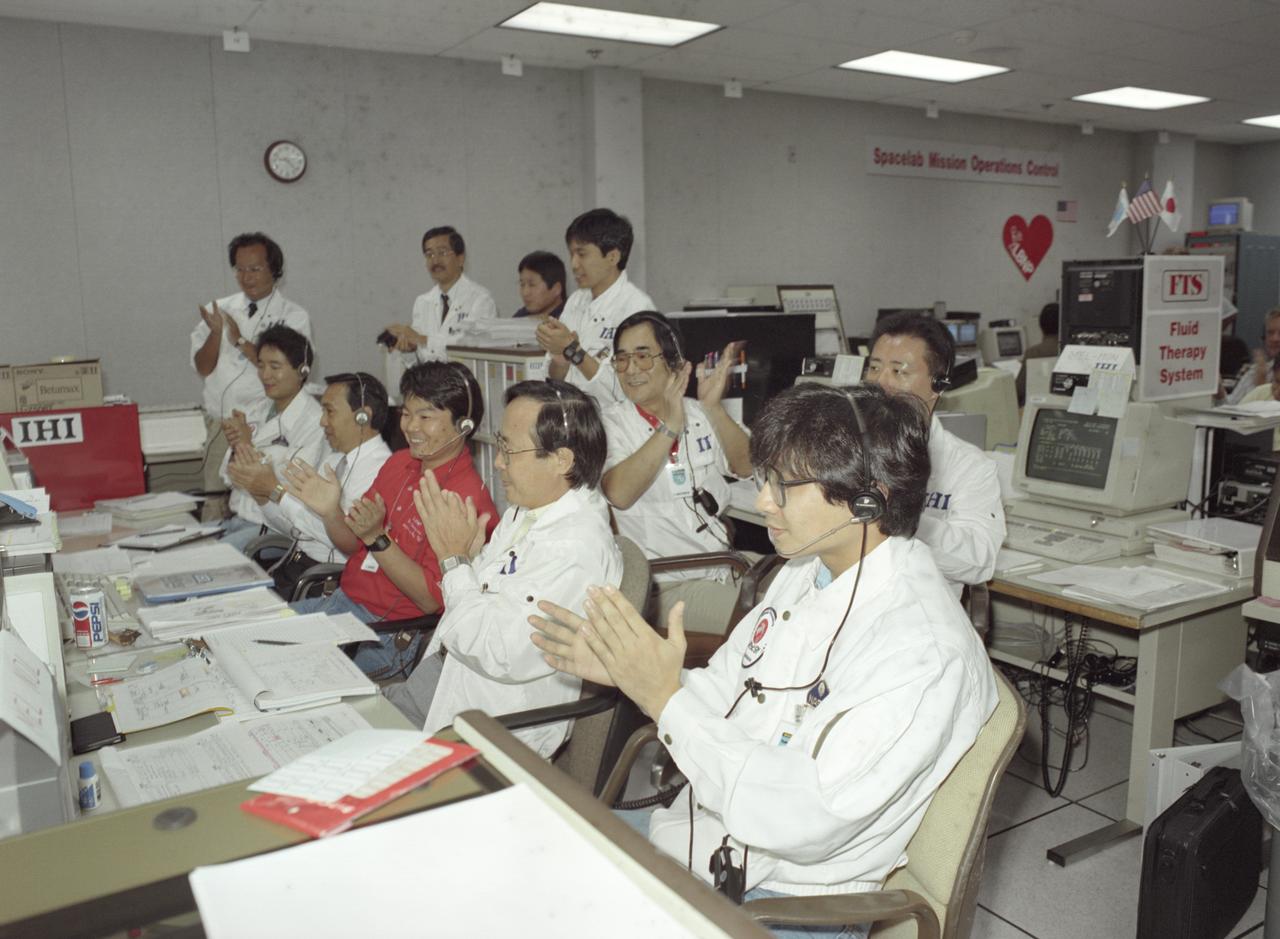
The science laboratory, Spacelab-J (SL-J), flown aboard the STS-47 flight was a joint venture between NASA and the National Space Development Agency of Japan (NASDA) utilizing a manned Spacelab module. The mission conducted 24 materials science and 20 life science experiments, of which 35 were sponsored by NASDA, 7 by NASA, and two collaborative efforts. Materials science investigations covered such fields as biotechnology, electronic materials, fluid dynamics and transport phenomena, glasses and ceramics, metals and alloys, and acceleration measurements. Life sciences included experiments on human health, cell separation and biology, developmental biology, animal and human physiology and behavior, space radiation, and biological rhythms. Test subjects included the crew, Japanese koi fish (carp), cultured animal and plant cells, chicken embryos, fruit flies, fungi and plant seeds, and frogs and frog eggs. Featured together in the Science Operation Area (SOA) are payload specialists’ first Materials Processing Test during NASA/NASDA joint ground activities at the Huntsville Operations Support Center (HOSC) Spacelab Payload Operations Control Center (SL POCC) at Marshall Space Flight Center (MSFC).
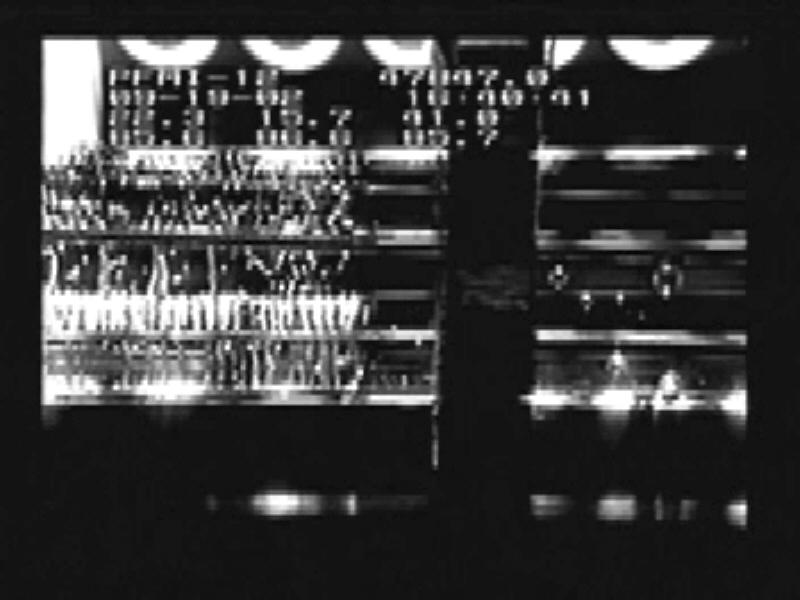
Video images sent to the ground allow scientists to watch the behavior of the bubbles as they control the melting and freezing of the material during the Pore Formation and Mobility Investigation (PFMI) in the Microgravity Science Glovebox aboard the International Space Station. While the investigation studies the way that metals behave at the microscopic scale on Earth -- and how voids form -- the experiment uses a transparent material called succinonitrile that behaves like a metal to study this problem. The bubbles do not float to the top of the material in microgravity, so they can study their interactions.
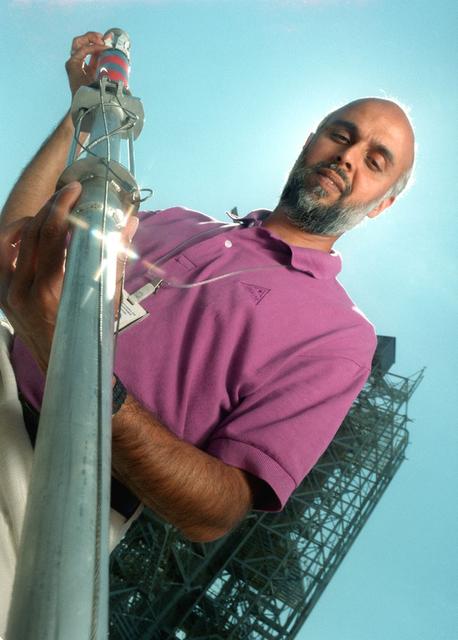
The dart and associated launching system was developed by engineers at MSFC to collect a sample of the aluminum oxide particles during the static fire testing of the Shuttle's solid rocket motor. The dart is launched through the exhaust and recovered post test. The particles are collected on sticky copper tapes affixed to a cylindrical shaft in the dart. A protective sleeve draws over the tape after the sample is collected to prevent contamination. The sample is analyzed under a scarning electron microscope under high magnification and a particle size distribution is determined. This size distribution is input into the analytical model to predict the radiative heating rates from the motor exhaust. Good prediction models are essential to optimizing the development of the thermal protection system for the Shuttle.
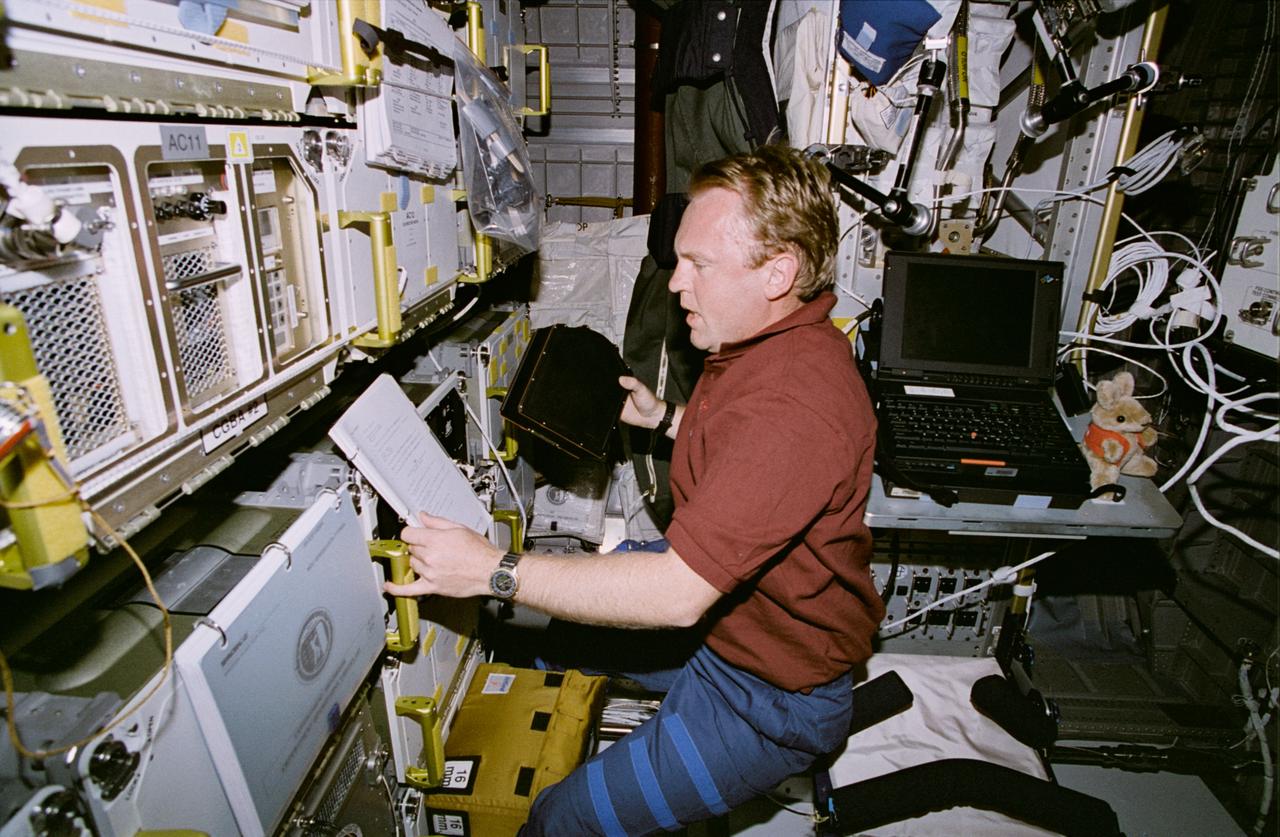
STS077-392-004 (19-29 May 1996) --- Inside the Spacehab Module onboard the Earth-orbiting Space Shuttle Endeavour, astronaut Andrew S. W. Thomas works with the Commercial Generic Bioprocessing Apparatus (CGBA) experiment. Thomas joined five other NASA astronauts for nine days of research and experimentation in Earth-orbit.
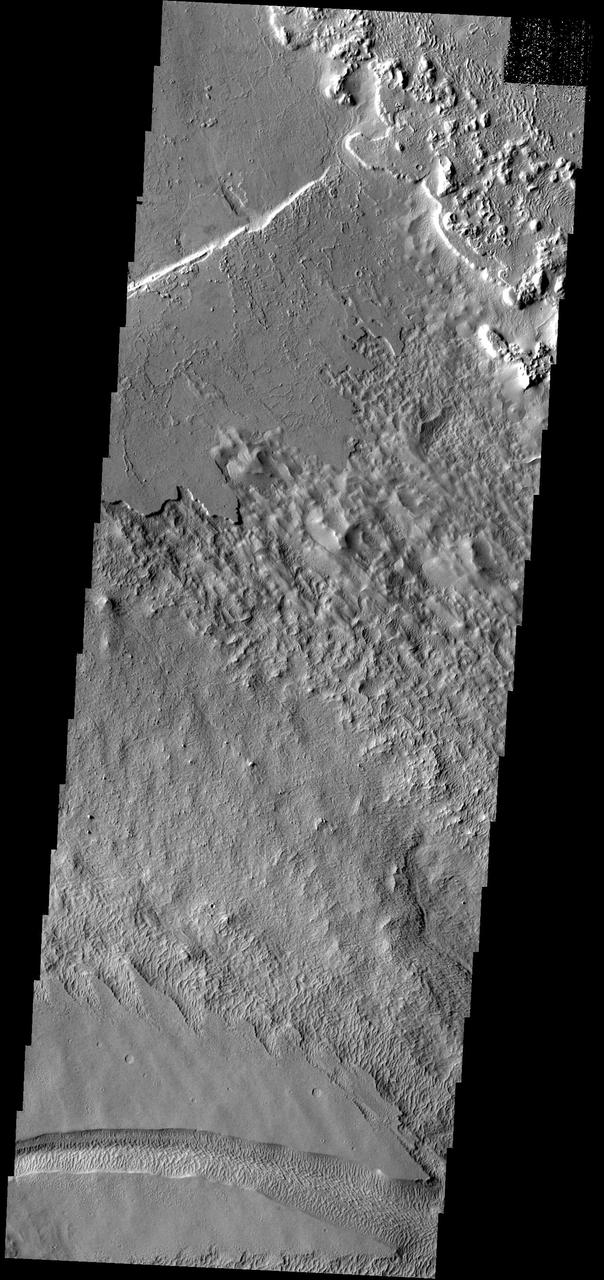
In this image wind seems to be the dominant process, but lava flows are still recognizable from the surface texture. It appears that the lava flow top left is relatively thin, and the material below is easily eroded by the wind

This image from NASA Mars Odyssey is located near the equator and the prime meridian of Mars in a region called Terra Meridiani. This is a unique area of Mars that displays layers of material that appear to be in the process of being stripped away.
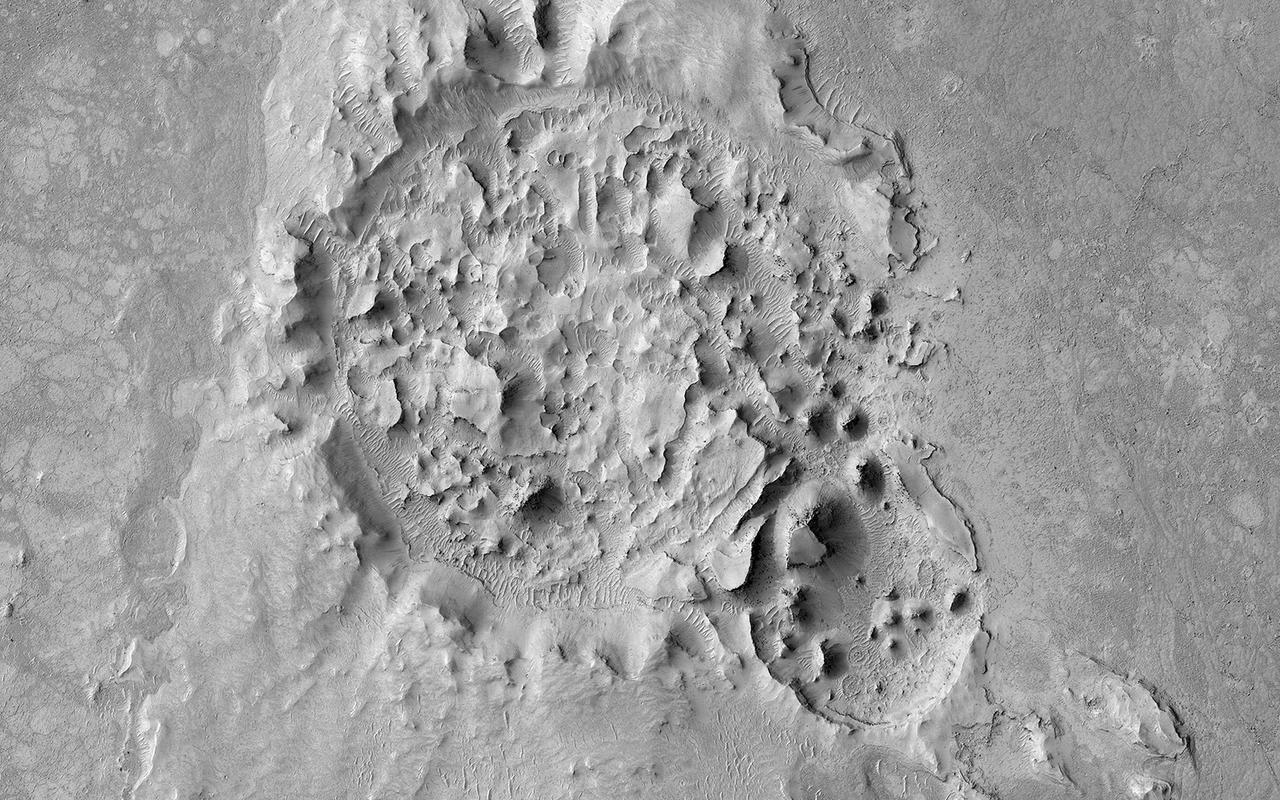
This 2.5-kilometer diameter crater observed by NASA's Mars Reconnaissance Orbiter has been significantly altered from the usual bowl-shaped appearance we associate with craters. Material has covered significant portions of the ejecta and filled in the crater. This fill material has since been subject to erosion -- like boulders weathering out of the slopes -- and the crater rim is also highly irregular. This crater is located in Elysium Planitia, an area dominated by volcanic processes. It is likely that the crater fill material is volcanic in origin, and possible that the rim was etched by lava, either flowing into the crater or spilling over after the crater filled completely. However, there are also signs of erosion by wind, like the parallel ridges in the rim breaches and between high-standing regions of the crater fill. It is likely that the current appearance of this crater is due to a combination of surface processes. https://photojournal.jpl.nasa.gov/catalog/PIA22041
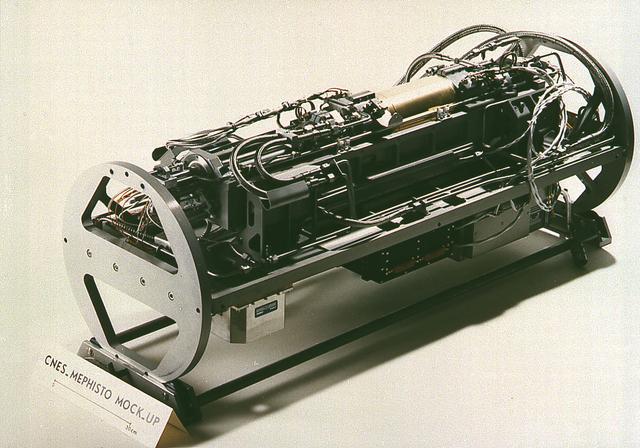
The MEPHISTO experiment is a cooperative American and French investigation of the fundamentals of crystal growth. MEPHISTO is a French-designed and built materials processing furnace. MEPHISTO experiments study solidation (also called freezing) during the growth cycle of liquid materials used for semiconductor crystals. Solidification is the process where materials change from liquid (melt) to solid. An example of the solidification process is water changing into ice.
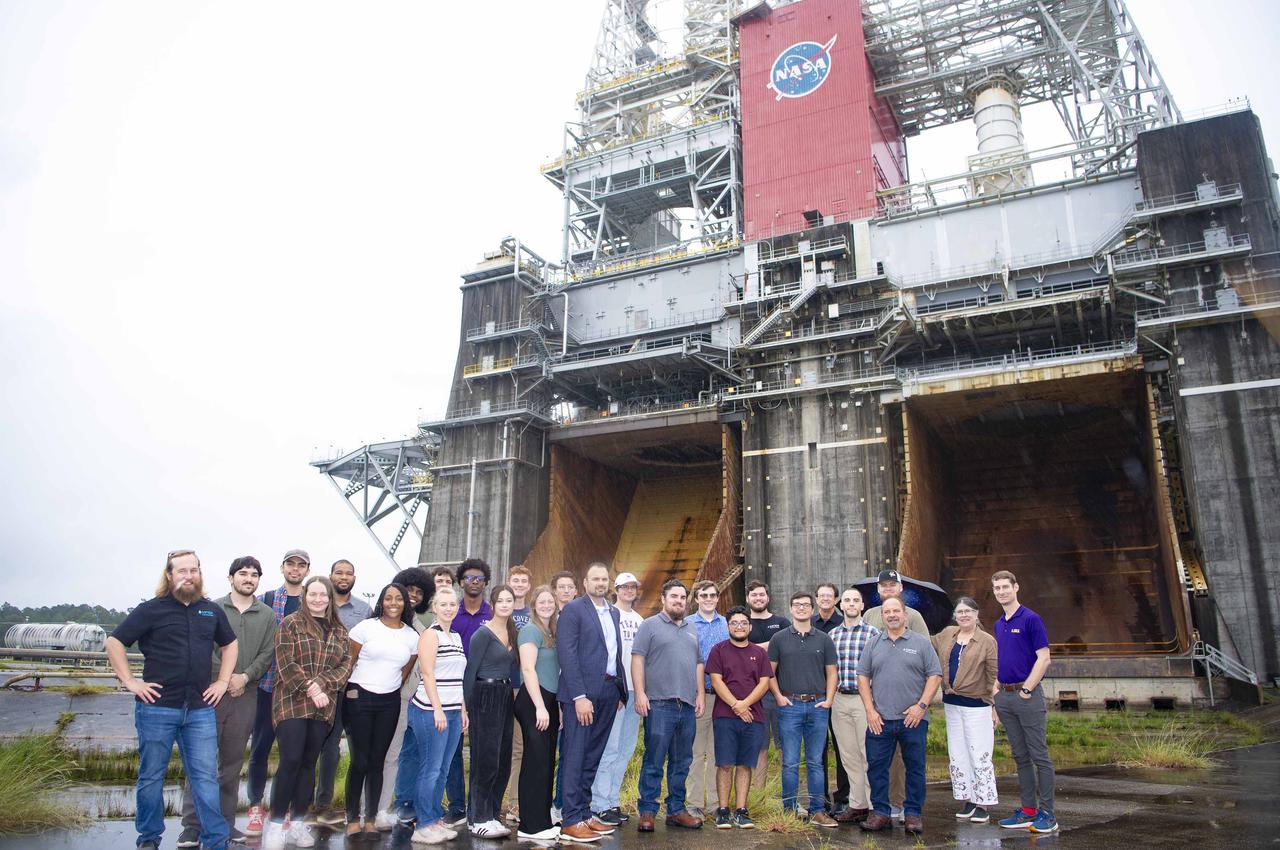
Members of the Society for the Advancement of Material and Process Engineering at Louisiana State University stand at the Thad Cochran Test Stand during a visit to NASA Stennis on Oct. 4. The Thad Cochran Test Stand (B-2) is where future Green Run testing of NASA’s exploration upper stage will take place ahead of future Artemis missions to the Moon and beyond. The mission of the Society for the Advancement of Material and Process Engineering at LSU is to provide enhanced educational opportunities by delivering information on new and advanced materials and processing technology.
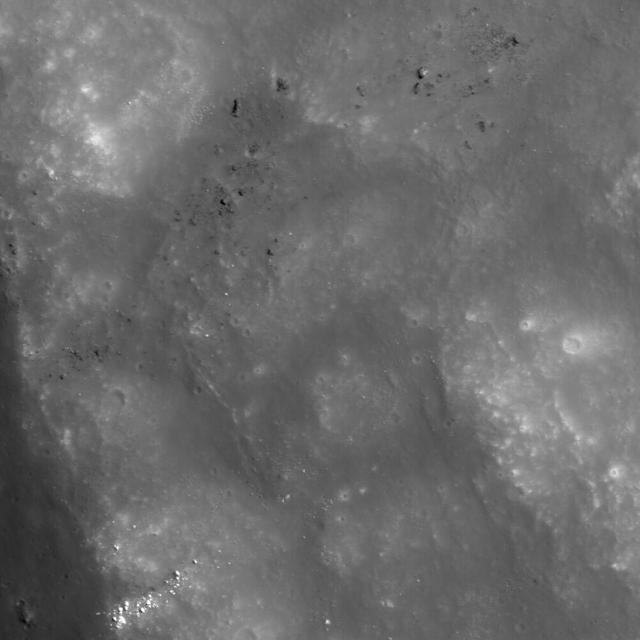
This image taken NASA Lunar Reconnaissance Orbiter shows the wall of crater Van de Graaff C, where brighter material is exposed by more active processes associated with steeper slopes, recent small craters, and even individual rolling boulders.
Scientists at Marshall's Materials and Processes Lab are pulling glass fibers from simulated lunar soil. This technology could lead to the building of thermally protected lunar buildings made of materials already there.
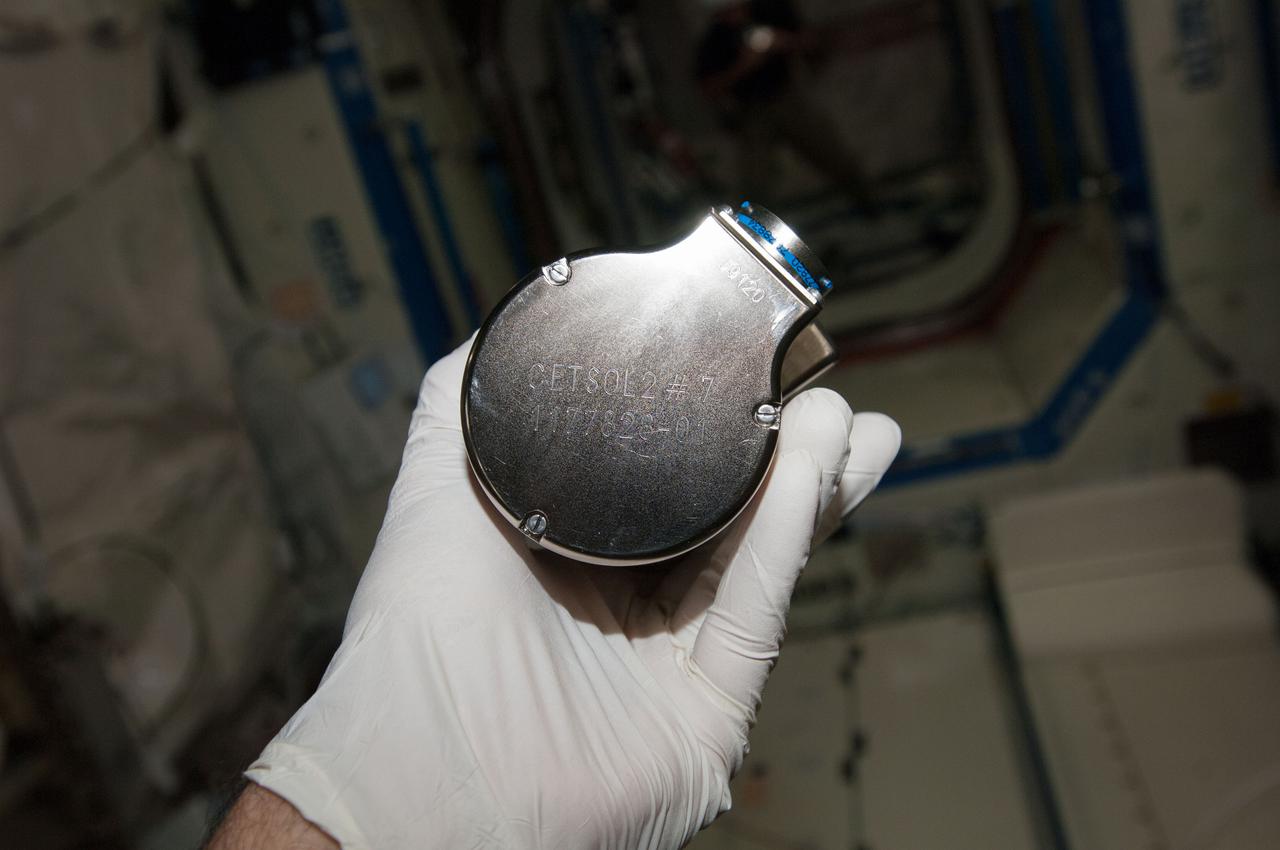
iss038e045758 (2/12/2014) --- A view of Columnar-to-Equiaxed Transition in Solidification Processing-2 (CETSOL-2) test sample 7 which is to be installed into the Material Science Laboratory (MSL) Solidification and Quench Furnace (SQF). This investigation aims to deepen the understanding of the physical principles that govern solidification processes in metal alloys. The patterns of the crystals resulting from transitions of liquids to solids is important for processes used to produce materials such as solar cells, thermoelectrics, and metal alloys.
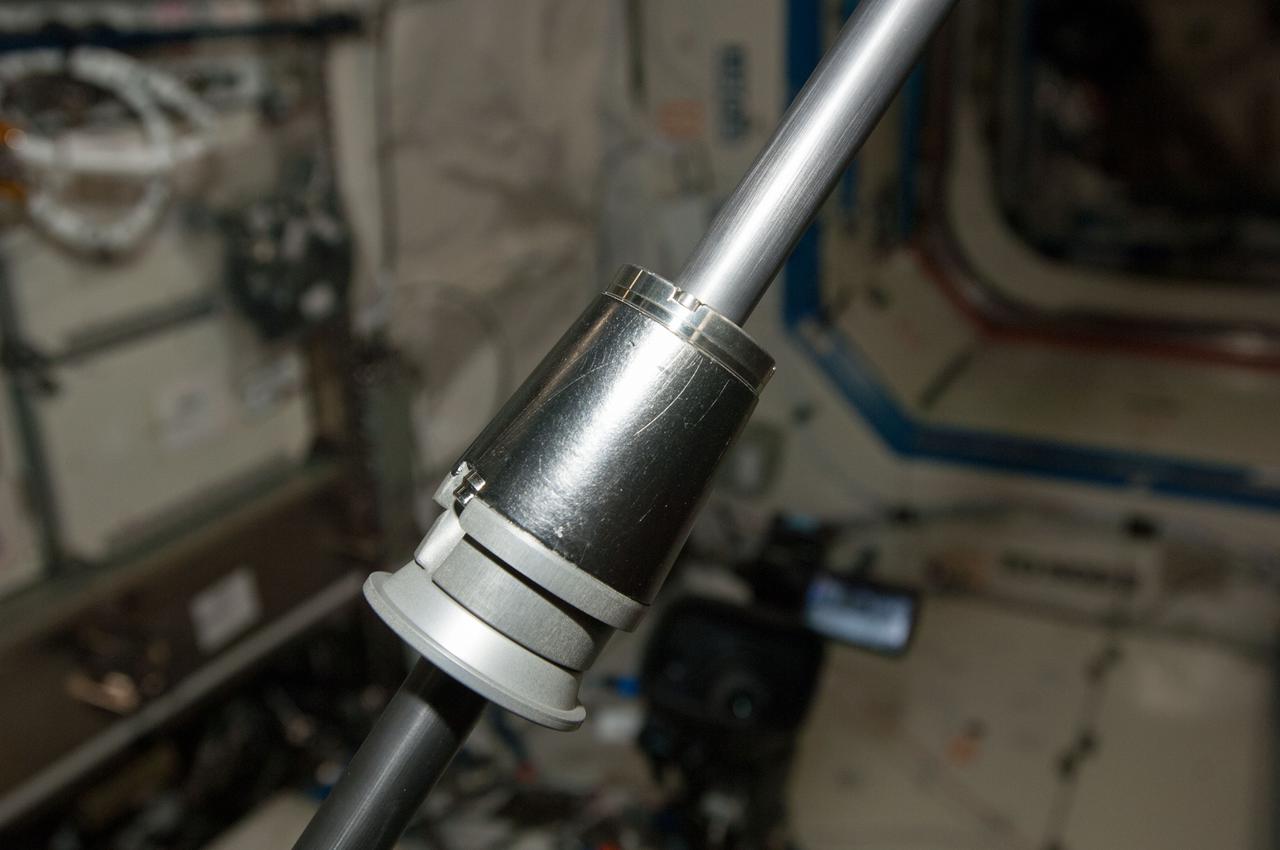
iss038e045760 92/12/2014) --- A view of Columnar-to-Equiaxed Transition in Solidification Processing-2 (CETSOL-2) test sample 7 which is to be installed into the Material Science Laboratory (MSL) Solidification and Quench Furnace (SQF). This investigation aims to deepen the understanding of the physical principles that govern solidification processes in metal alloys. The patterns of the crystals resulting from transitions of liquids to solids is important for processes used to produce materials such as solar cells, thermoelectrics, and metal alloys.
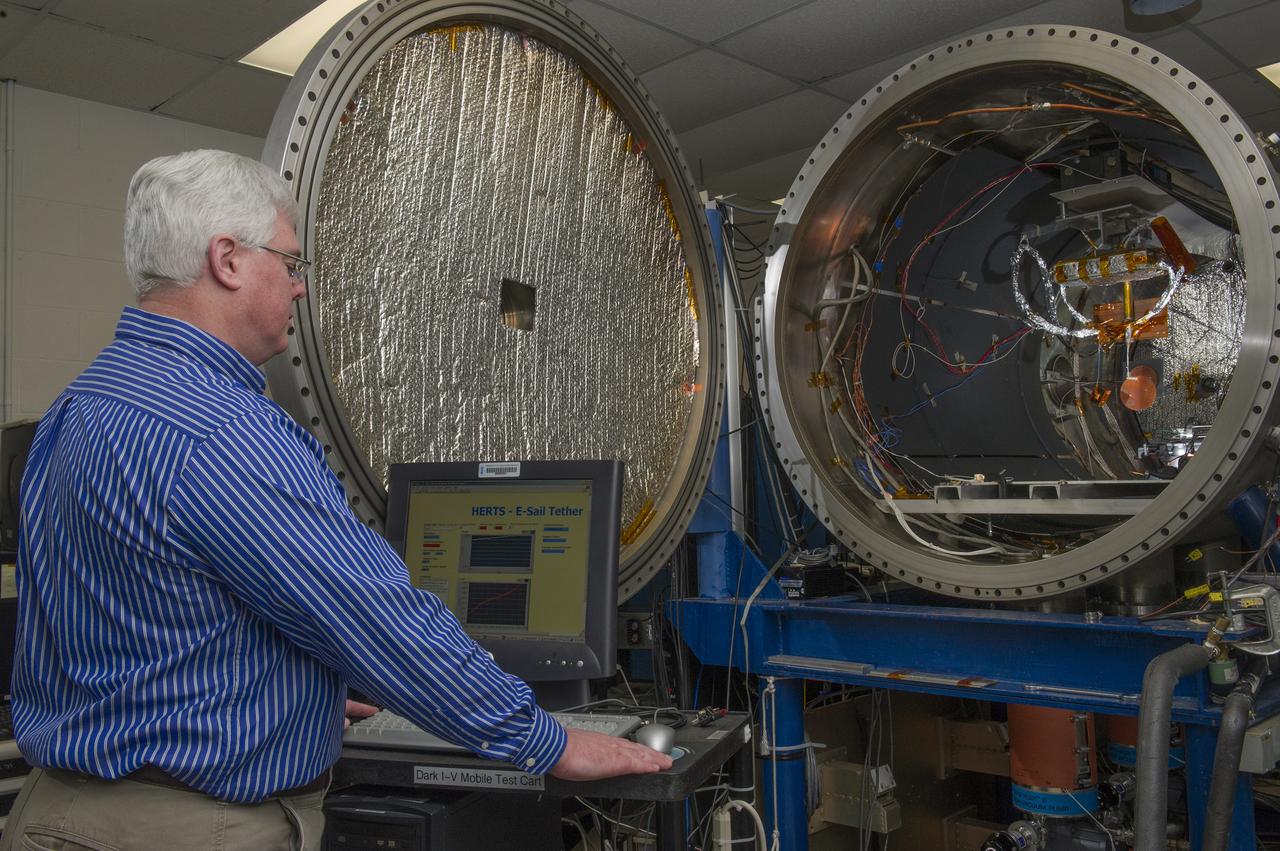
TODD SCHNEIDER PREPARES A PLASMA CHAMBER IN BUILDING 4605 AT MSFC FOR AN UPCOMING TEST. SCHNEIDER IS A PHYSICIST IN THE MATERIALS AND PROCESSES DEPARTMENT AT MSFC.
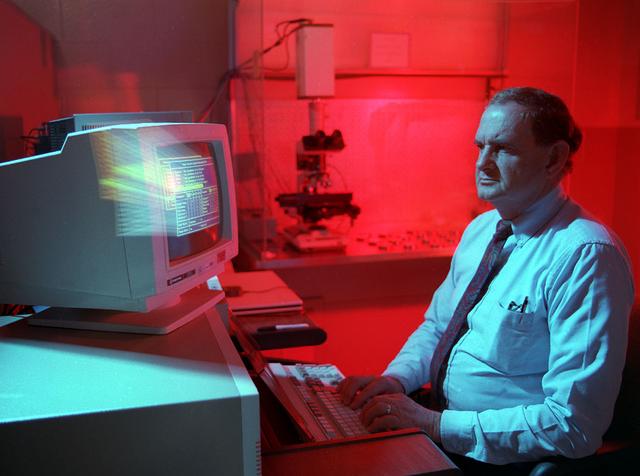
A NASA scientist operates the image analyzer to determine if telescope mirrors have become contaminated in the Materials and Processes lab at Marshall.
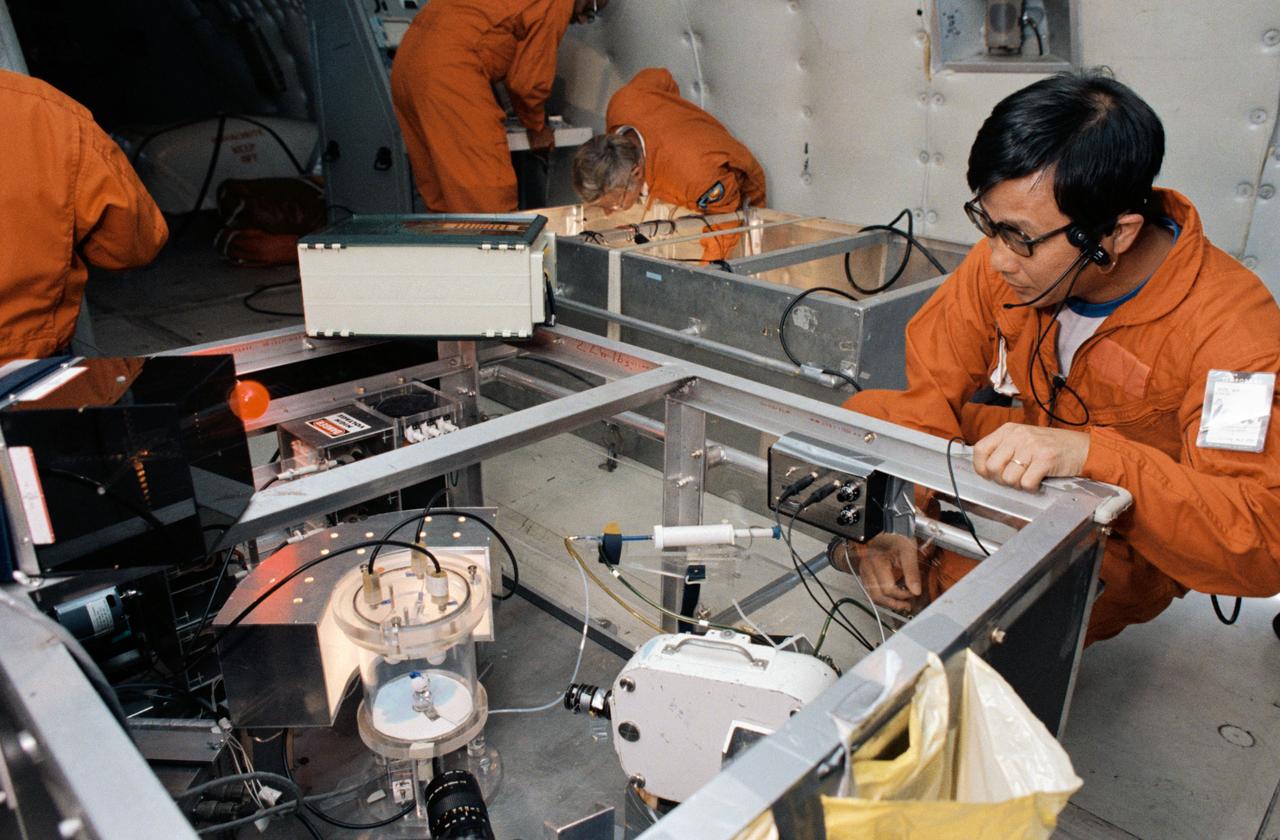
Weightless testing of the MSFC Materials Processing in Space Experiment onboard the KC-135, NASA 930, 10/26/1983.
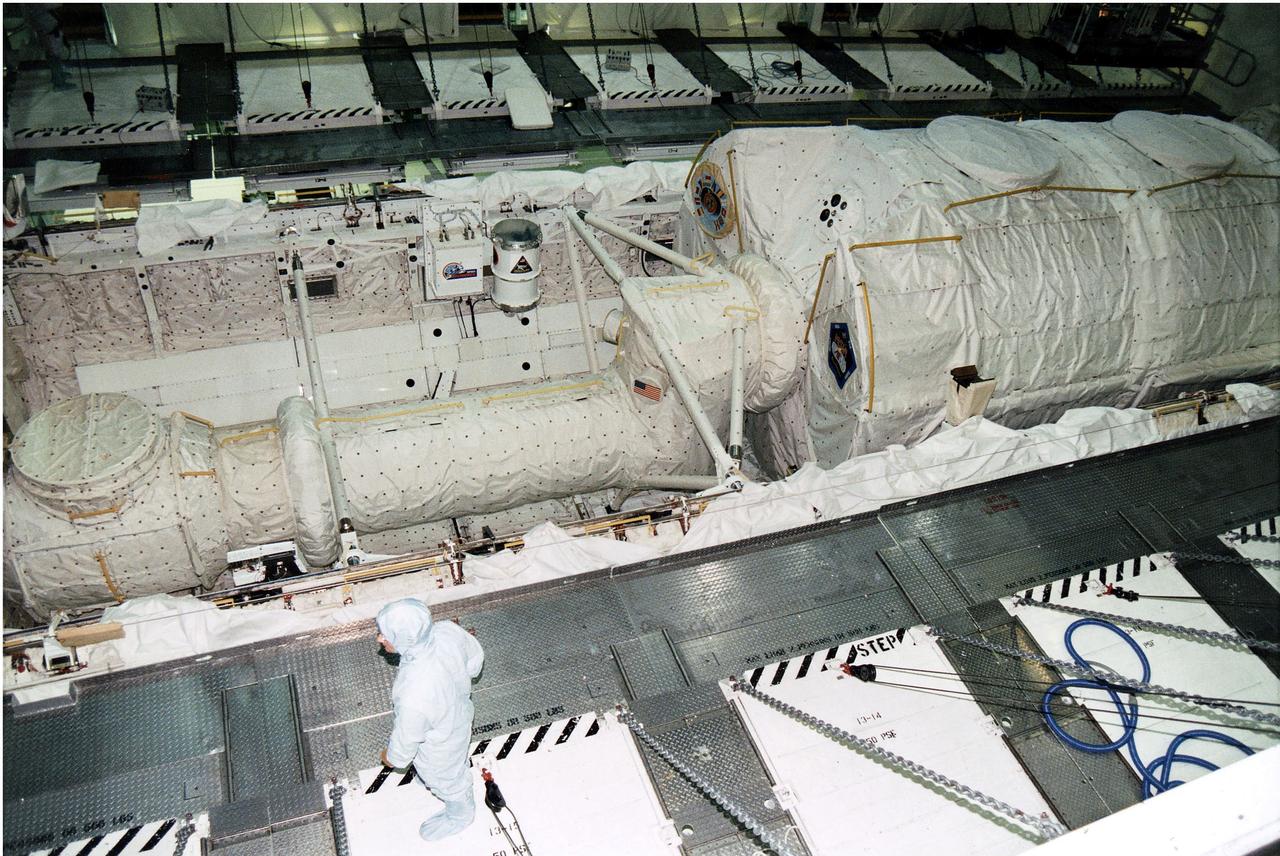
KENNEDY SPACE CENTER, FLA. - The Microgravity Science Laboratory-1 (MSL-1) Spacelab module is installed into the payload bay of the Space Shuttle Orbiter Columbia in Orbiter Processing Facility 1. The Spacelab long crew transfer tunnel that leads from the orbiter's crew airlock to the module is also aboard, as well as the Hitchhiker Cryogenic Flexible Diode (CRYOFD) experiment payload, which is attached to the right side of Columbia's payload bay. During the scheduled 16-day STS-83 mission, the MSL-1 will be used to test some of the hardware, facilities and procedures that are planned for use on the International Space Station while the flight crew conducts combustion, protein crystal growth and materials processing experiments.
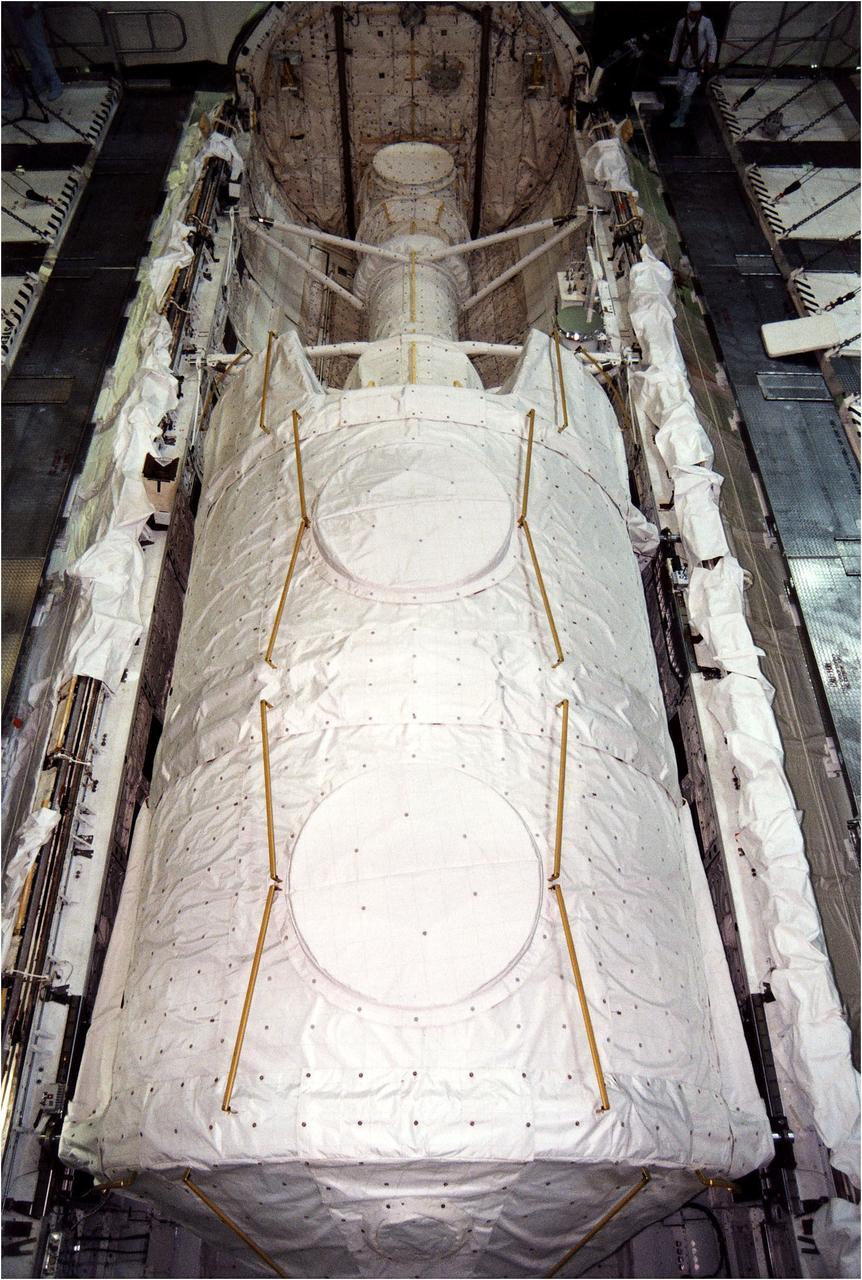
KENNEDY SPACE CENTER, FLA. - The Microgravity Science Laboratory-1 (MSL-1) Spacelab module is installed into the payload bay of the Space Shuttle Orbiter Columbia in Orbiter Processing Facility 1. The Spacelab long crew transfer tunnel that leads from the orbiter's crew airlock to the module is also aboard, as well as the Hitchhiker Cryogenic Flexible Diode (CRYOFD) experiment payload, which is attached to the right side of Columbia's payload bay. During the scheduled 16-day STS-83 mission, the MSL-1 will be used to test some of the hardware, facilities and procedures that are planned for use on the International Space Station while the flight crew conducts combustion, protein crystal growth and materials processing experiments.
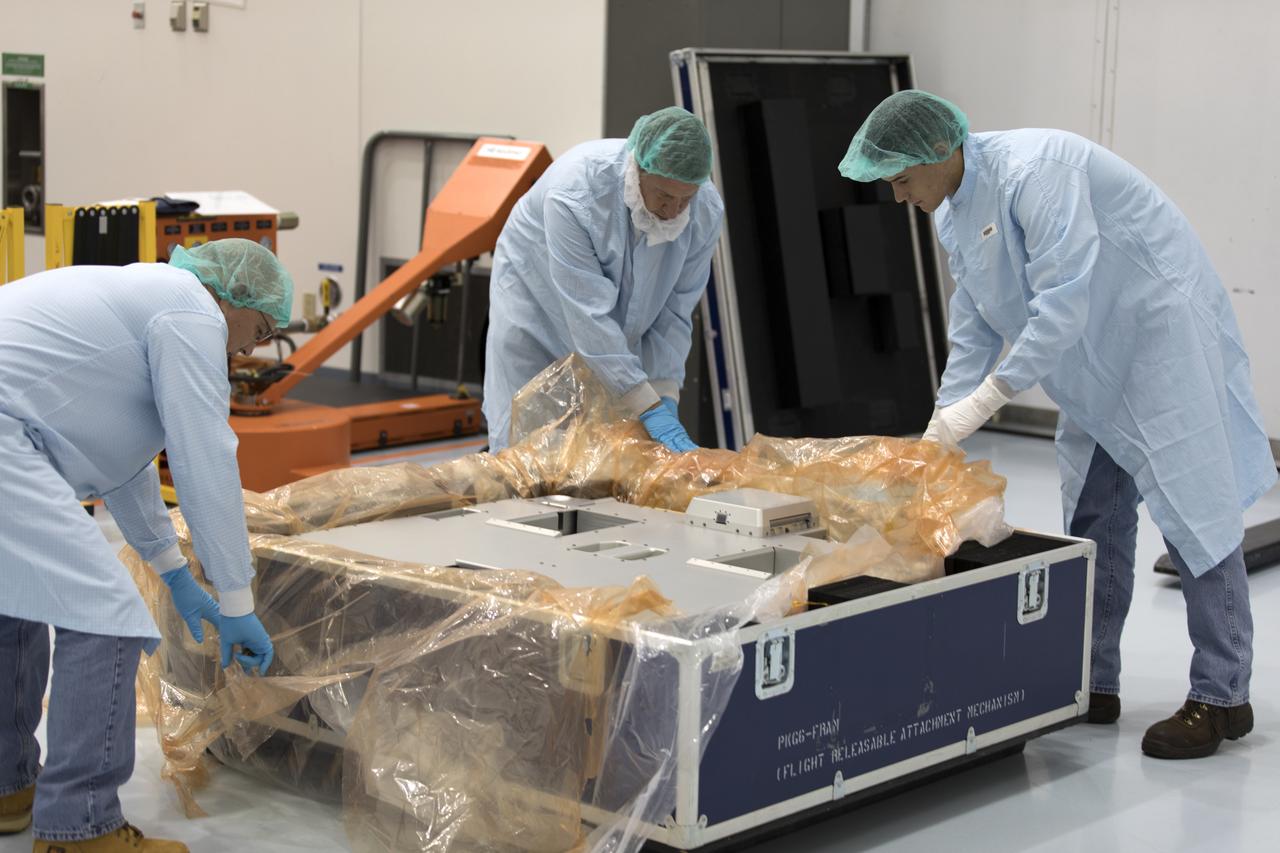
The Materials International Space Station Experiment-Flight Facility, or MISSE-FF, hardware arrived at the Space Station Processing Facility low bay at NASA's Kennedy Space Center in Florida. MISSE will be unpacked for integration and processing. MISSE will be used to test various materials and computing elements on the exterior of the space station. They will be exposed to the harsh environment of low-Earth orbit, including to a vacuum, atomic oxygen, ultraviolet radiation, direct sunlight and extreme heat and cold. The experiment will provide a better understanding of material durability, from coatings to electronic sensors, which could be applied to future spacecraft designs. MISSE will be delivered to the space station on a future commercial resupply mission.

L TO R: DR. FRANCIS CHIARAMONTE, PROGRAM EXECUTIVE FOR PHYSICAL SCIENCES, ISS RESEARCH PROJECT, NASA HEADQUARTERS; DR. RAYMOND CLINTON, ACTING MANAGER FOR SCIENCE AND MISSION SYSTEMS OFFICE, NASA MARSHALL; DR. FRANK SZOFRAN, MICROGRAVITY MATERIALS SCIENCE PROJECT MANAGER AND DISCIPLINE SCIENTIST MATERIALS AND PROCESSES LABORATORY AT MSFC.
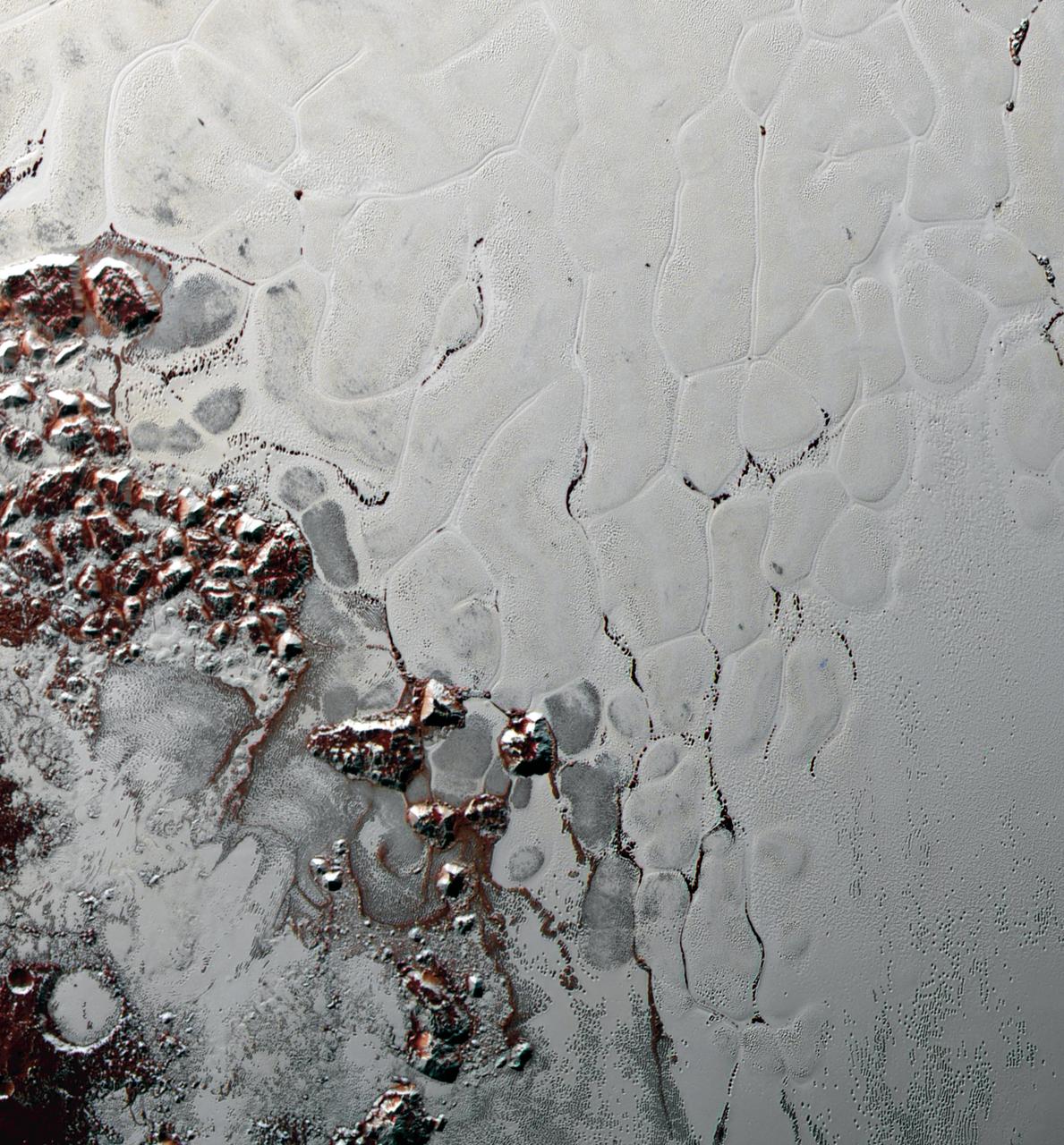
Like a cosmic lava lamp, a large section of Pluto's icy surface is being constantly renewed by a process called convection that replaces older surface ices with fresher material. Scientists from NASA's New Horizons mission used state-of-the-art computer simulations to show that the surface of Pluto's informally named Sputnik Planum is covered with churning ice "cells" that are geologically young and turning over due to a process called convection. The scene above, which is about 250 miles (400 kilometers) across, uses data from the New Horizons Ralph/Multispectral Visible Imaging Camera (MVIC), gathered July 14, 2015. Their findings are published in the June 2, 2016, issue of the journal Nature. http://photojournal.jpl.nasa.gov/catalog/PIA20726
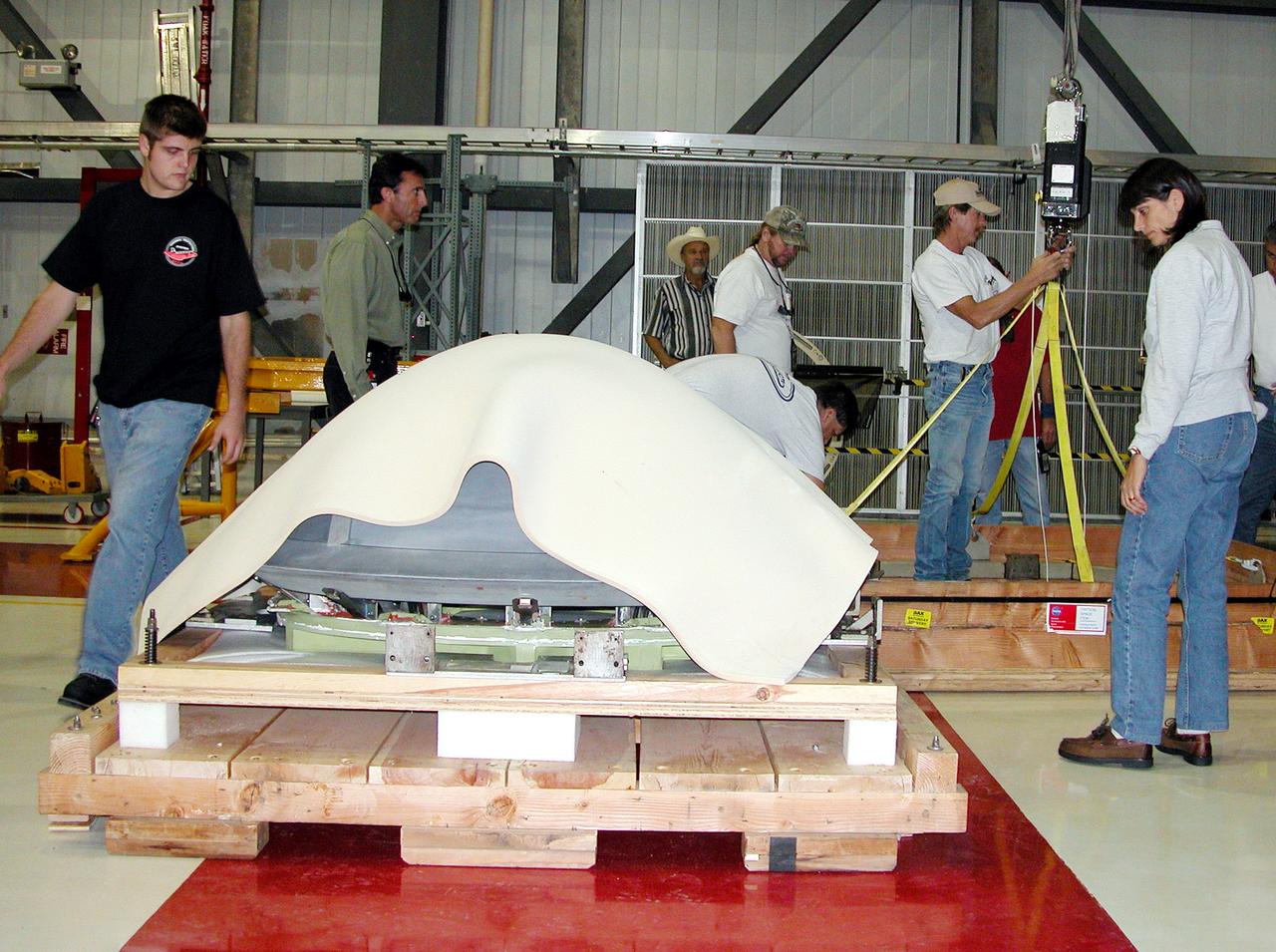
KENNEDY SPACE CENTER, FLA. - In the Orbiter Processing Facility, packing material is placed over the nose cap that was removed from Atlantis. The reinforced carbon-carbon (RCC) nose cap is being sent to the original manufacturing company, Vought in Ft. Worth, Texas, a subsidiary of Lockheed Martin, to undergo non-destructive testing such as CAT scan and thermography.
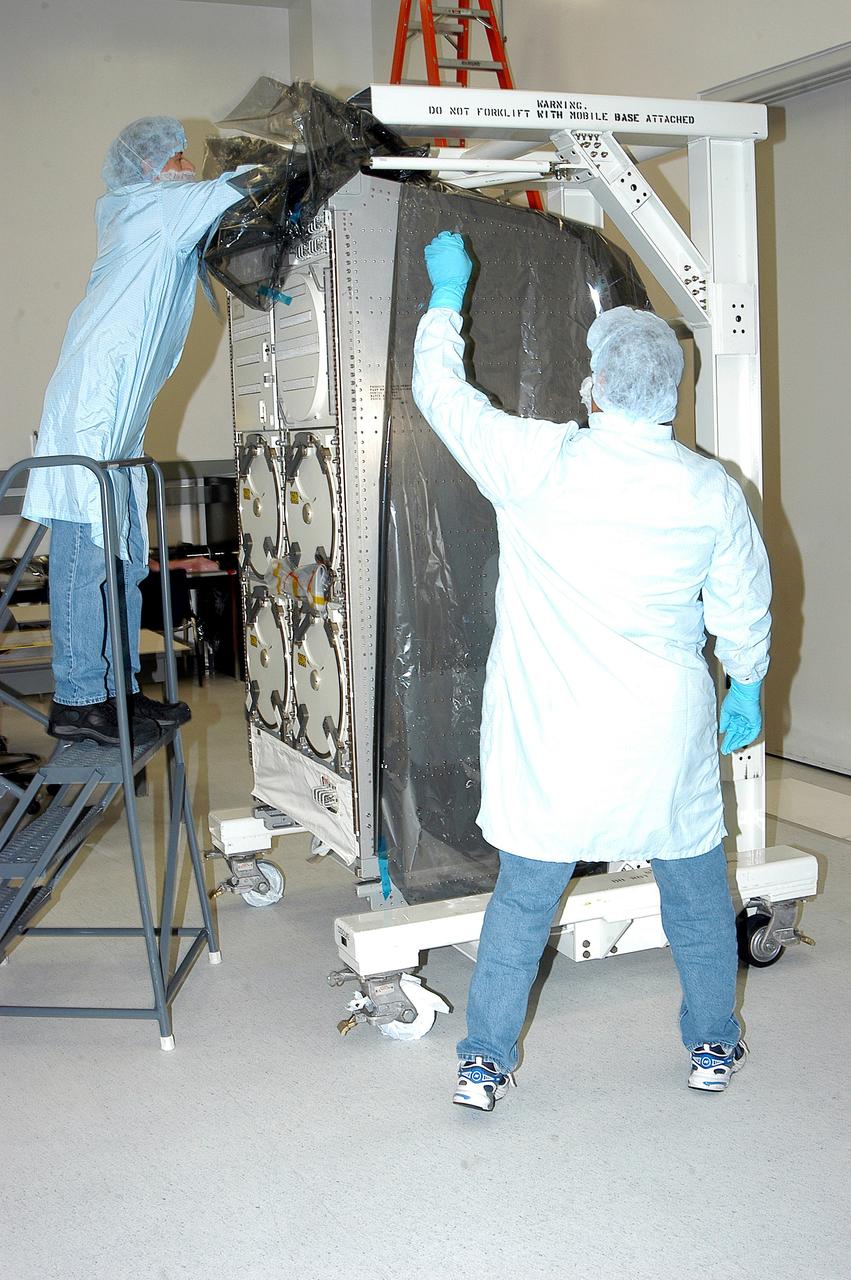
KENNEDY SPACE CENTER, FLA. - In the Space Station Processing Facility, technicians remove the cover from the Minus Eighty Lab Freezer for ISS(MELFI) provided as Laboratory Support Equipment by the European Space Agency for the International Space Station. The lab will provide cooling and storage for reagents, samples and perishable materials in four insulated containers called dewars with independently selectable temperatures of -80°C, -26°C, and +4°C. It also will be used to transport samples to and from the station. The MELFI is planned for launch on the ULF-1 mission.
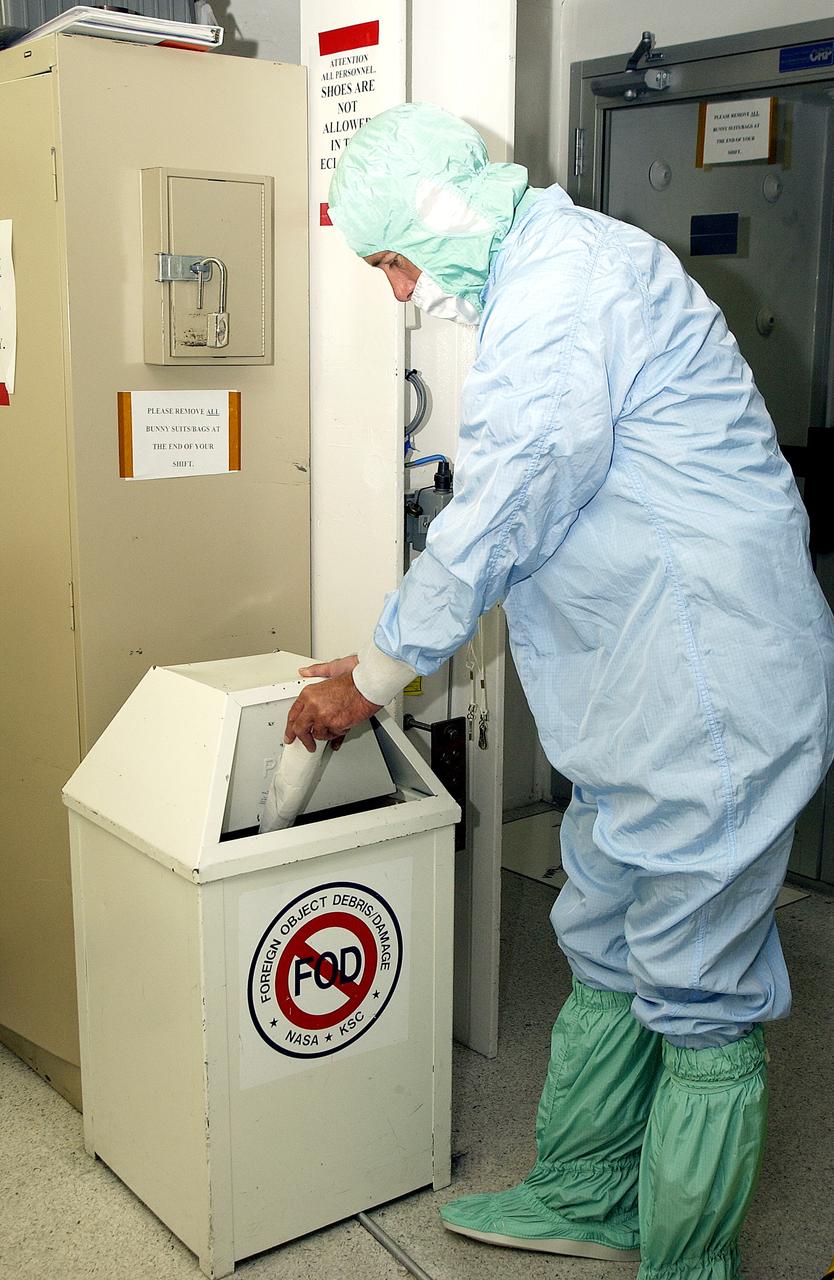
KENNEDY SPACE CENTER, FLA. - A KSC employee dressed in a "bunny suit," standard clean room apparel, disposes of some waste material into a container designated for the purpose. The apparel is designed to cover the hair, clothing and shoes of employees entering a clean room to prevent particulate matter from contaminating the space flight hardware being stored or processed in the room. The suit and container are both part of KSC's Foreign Object Debris (FOD) control program, an important safety initiative.
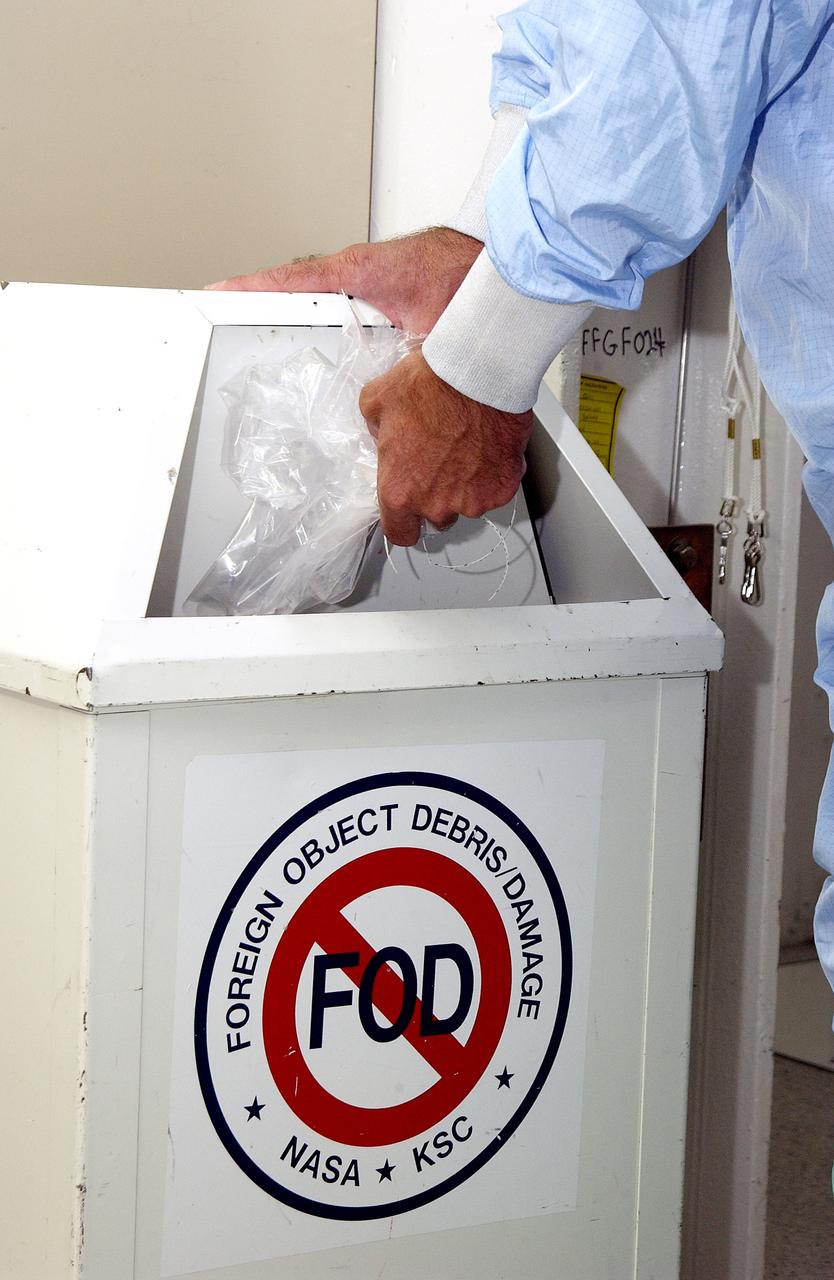
KENNEDY SPACE CENTER, FLA. - A KSC employee dressed in a "bunny suit," standard clean room apparel, disposes of some waste material into a container designated for the purpose. The apparel is designed to cover the hair, clothing and shoes of employees entering a clean room to prevent particulate matter from contaminating the space flight hardware being stored or processed in the room. The suit and container are both part of KSC's Foreign Object Debris (FOD) control program, an important safety initiative.
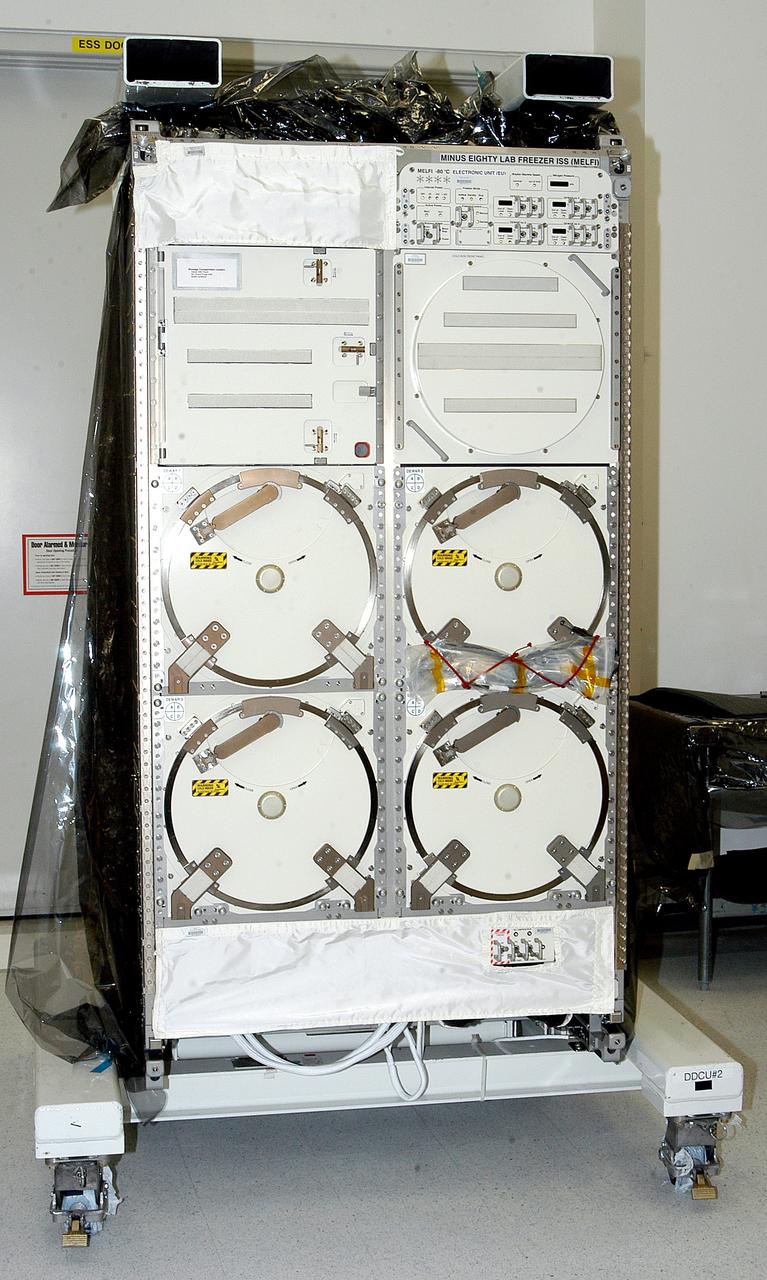
KENNEDY SPACE CENTER, FLA. - The Minus Eighty Lab Freezer for ISS (MELFI), provided as Laboratory Support Equipment by the European Space Agency for the International Space Station, is seen in the Space Station Processing Facility. The lab will provide cooling and storage for reagents, samples and perishable materials in four insulated containers called dewars with independently selectable temperatures of -80°C, -26°C, and +4°C. It also will be used to transport samples to and from the station. The MELFI is planned for launch on the ULF-1 mission.
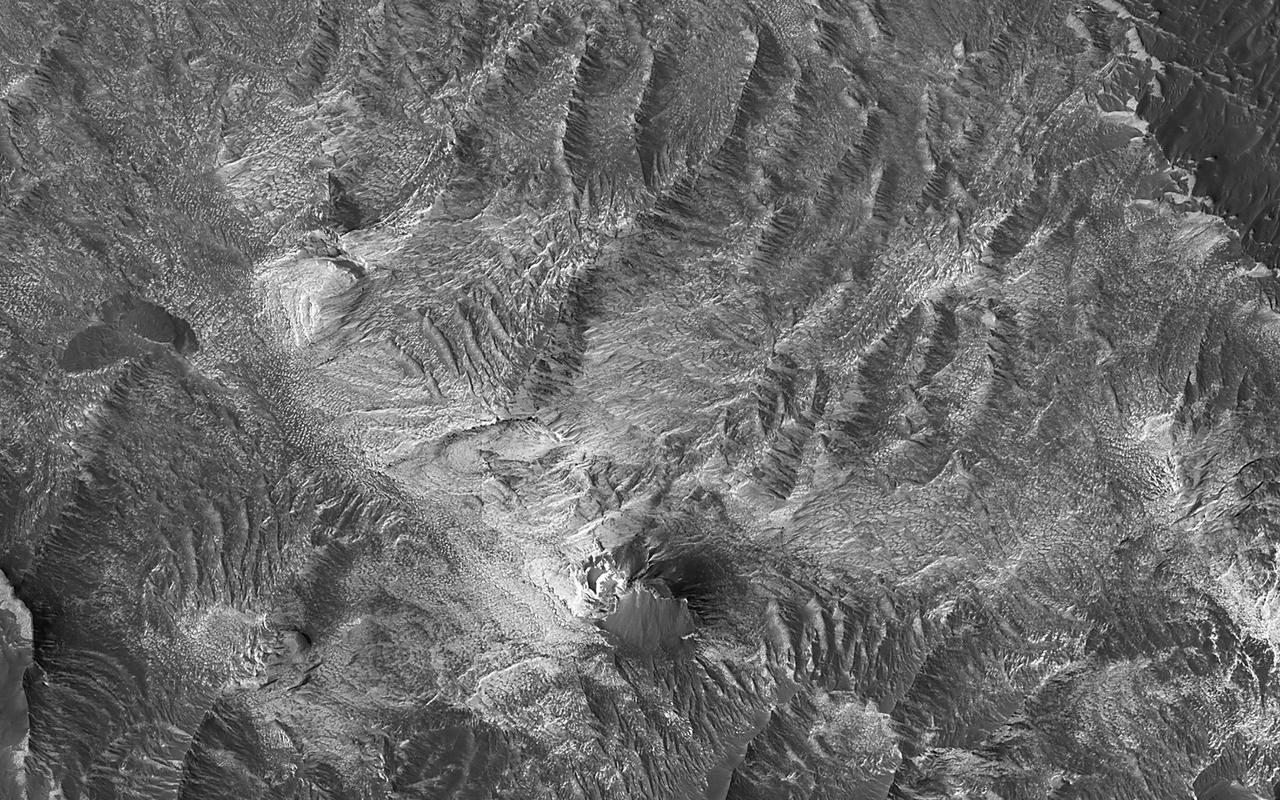
This image was acquired to get more information about a site where the CRISM instrument detected hydrated sulfates. The bright materials are likely to be sediments rich in the hydrated sulfates, and this image shows that most of the material is covered by a thin deposit of dark material, perhaps sand. We also see streamlined patterns that suggest fluvial processes were involved in depositing or eroding the sulfate-rich sediments. https://photojournal.jpl.nasa.gov/catalog/PIA26327
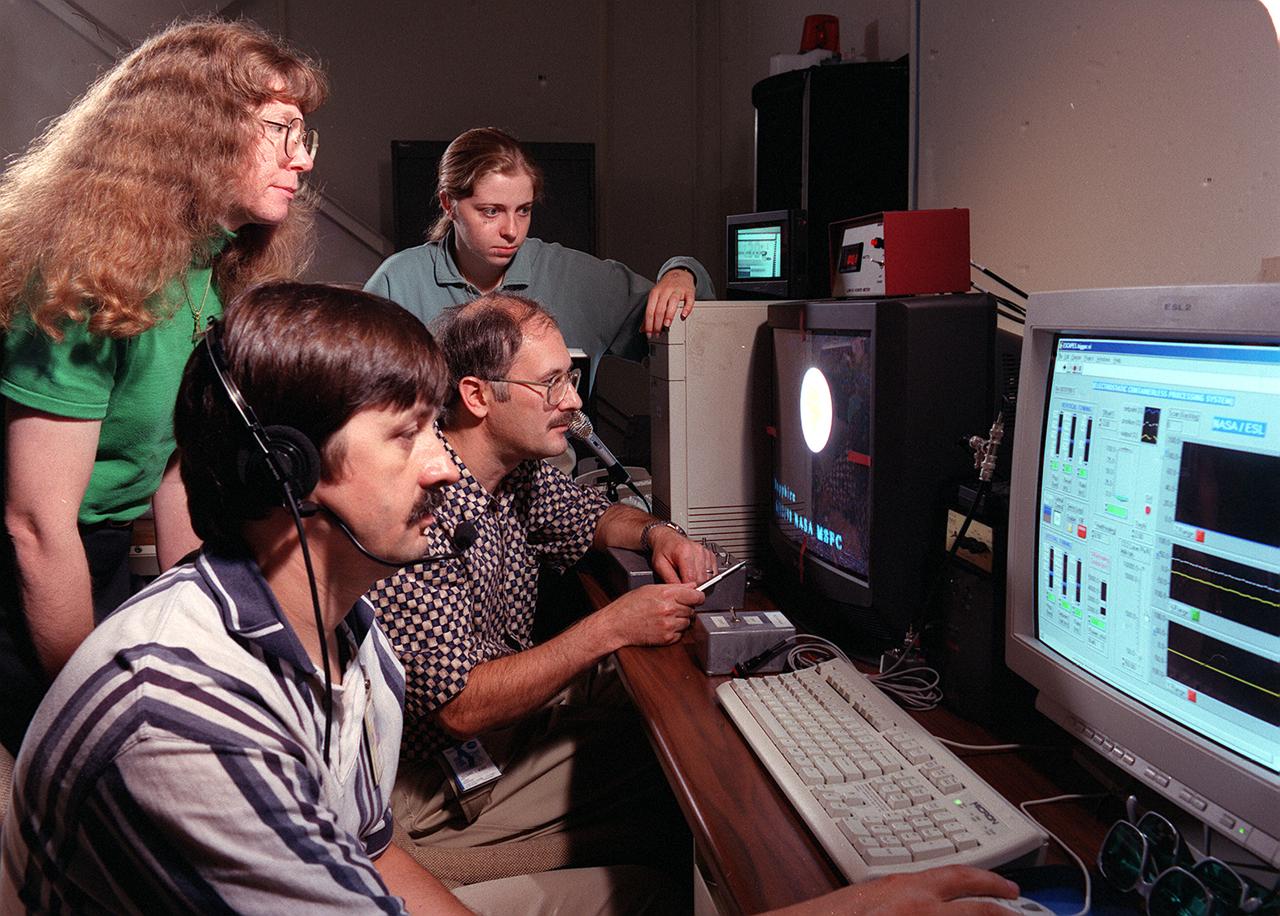
Dr. Jan Rogers (left) and Larry Savage (foreground) of the Science Directorate at NASA's Marshall Space Flight Center (MSFC) are joined by Dr. Richard Weber (center) and April Hixon of Containerless Research Inc. of Evanston, Ill., in conducting an experiment run of the Electrostatic Levitator (ESL) using insulating materials. Materials researchers use unique capabilities of the facility to levitate and study the properties of various materials important in manufacturing processes.
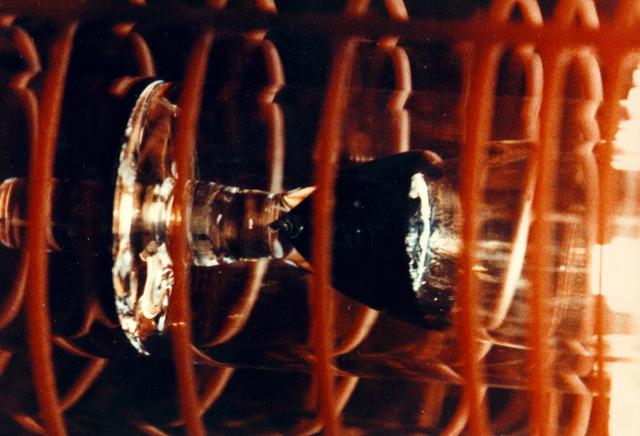
The objective of this facility is to investigate the potential of space grown semiconductor materials by the vapor transport technique and develop powdered metal and ceramic sintering techniques in microgravity. The materials processed or developed in the SEF have potential application for improving infrared detectors, nuclear particle detectors, photovoltaic cells, bearing cutting tools, electrical brushes and catalysts for chemical production. Flown on STS-60 Commercial Center: Consortium for Materials Development in Space - University of Alabama Huntsville (UAH)
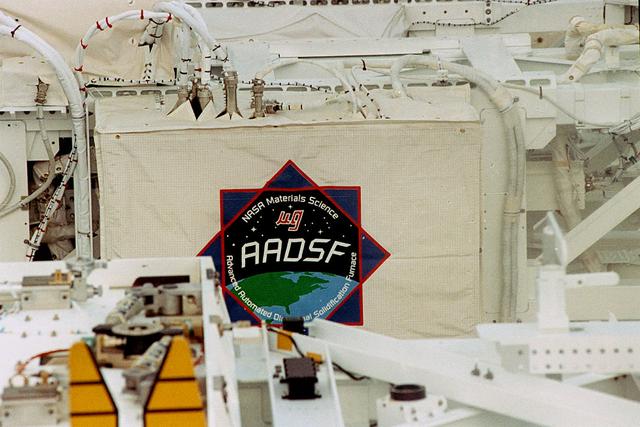
The purpose of the experiments for the Advanced Automated Directional Solidification Furnace (AADSF) is to determine how gravity-driven convection affects the composition and properties of alloys (mixtures of two or more materials, usually metal). During the USMP-4 mission, the AADSF will solidify crystals of lead tin telluride and mercury cadmium telluride, alloys of compound semiconductor materials used to make infrared detectors and lasers, as experiment samples. Although these materials are used for the same type application their properties and compositional uniformity are affected differently during the solidification process.
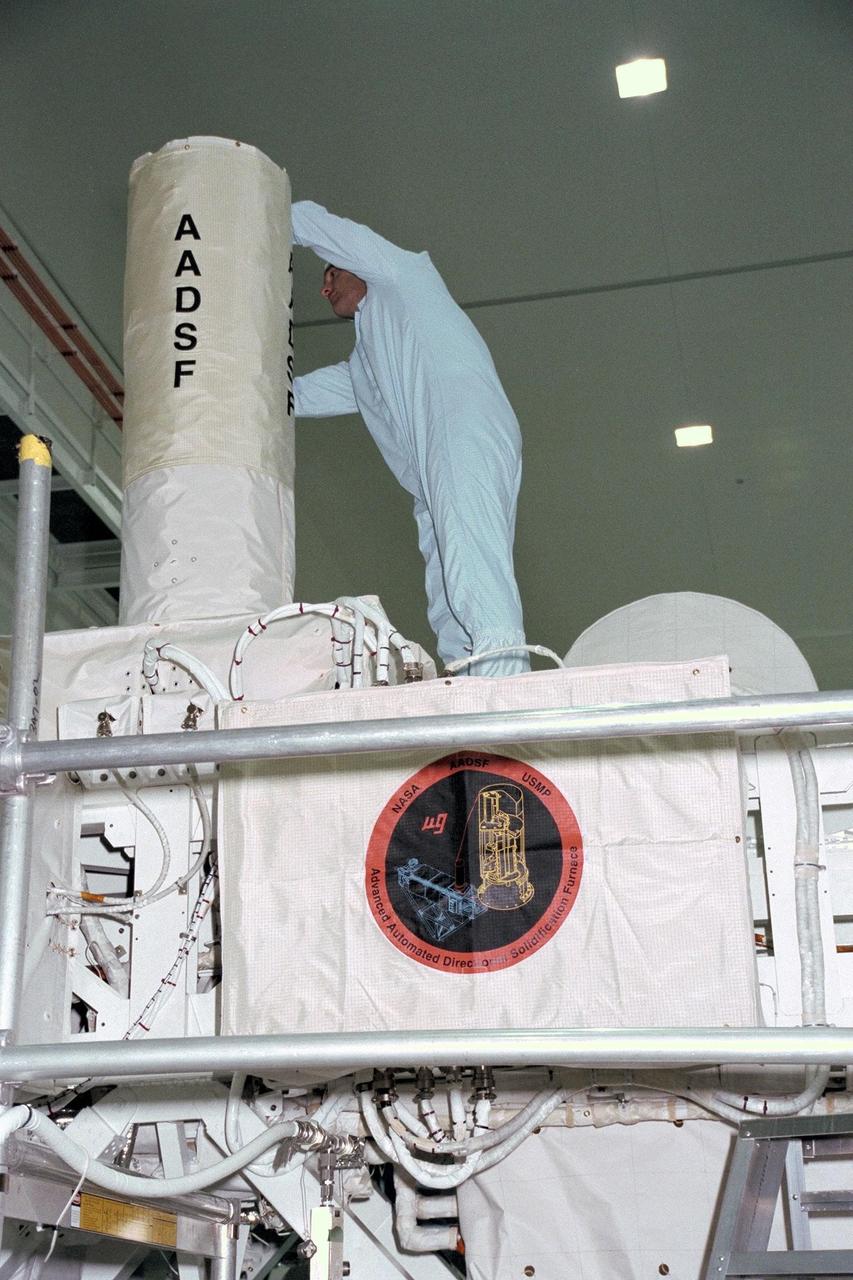
United States Microgravity Payload-4 (USMP-4) experiments are prepared to be flown on Space Shuttle mission STS-87 in the Space Station Processing Facility at Kennedy Space Center (KSC). A technician is working on the Advanced Automated Directional Solidification Furnace (AADSF), which will be used by researchers to study the solidification of semiconductor materials in microgravity. Scientists will be able to better understand how microgravity influences the solidification process of these materials and develop better methods for controlling that process during future Space flights and Earth-based production. All STS-87 experiments are scheduled for launch on Nov. 19 from KSC
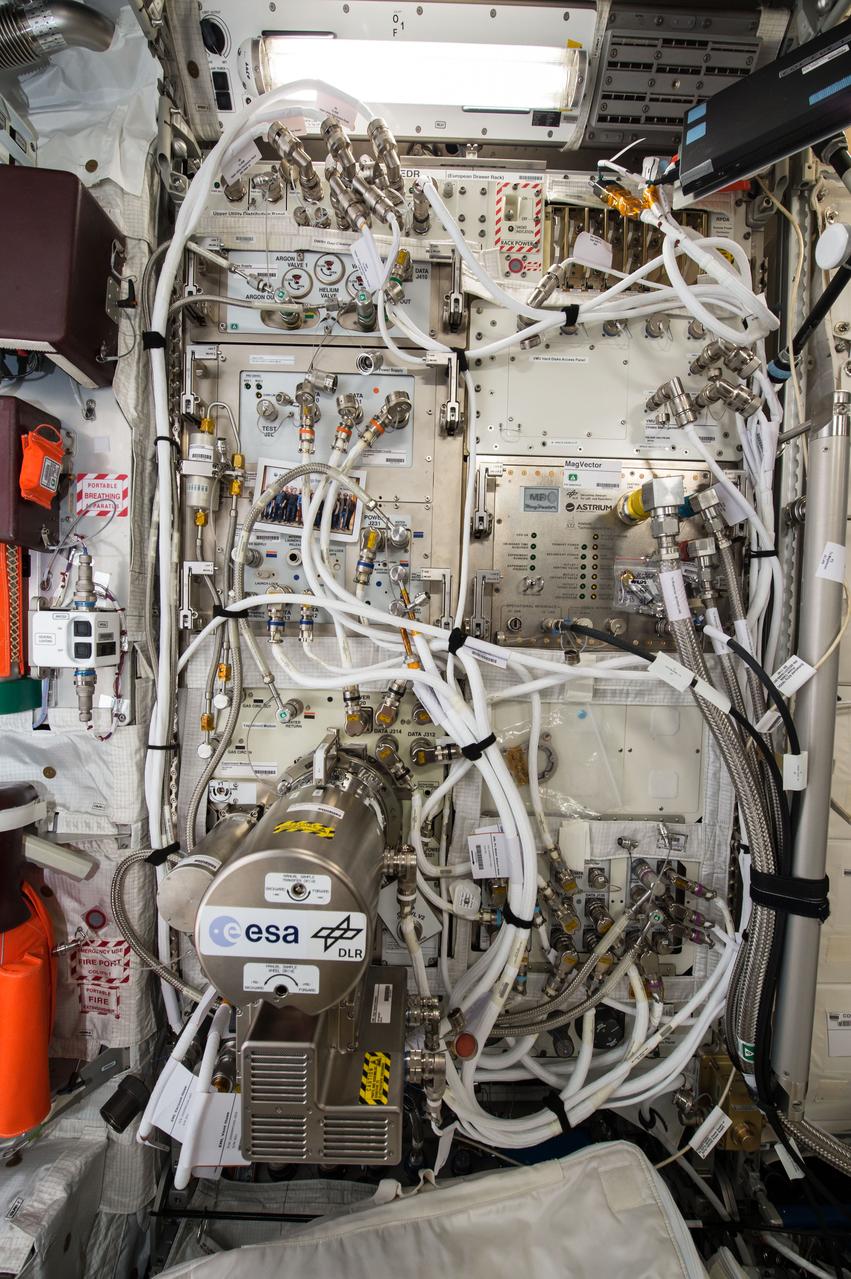
iss041e096097 (10/23/2014) — Photo documentation of the Electromagnetic Levitator (EML) in the Columbus module of the International Space Station (ISS). The EML multi-user facility is designed for containerless materials processing in space.
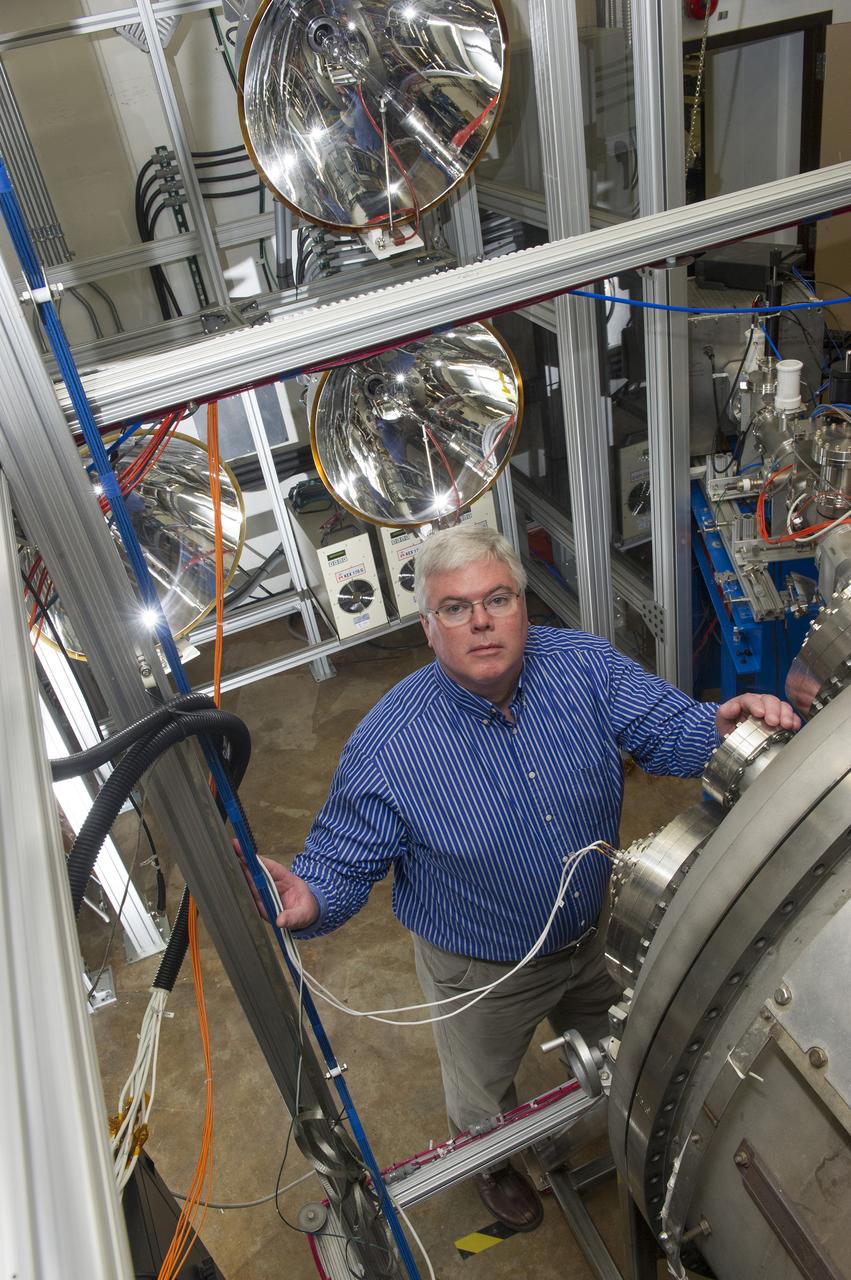
TODD SCHNEIDER LOOKS UP FROM WORK AT THE DOOR OF T HE HIGH INTENSITY SOLAR ENVIRONMENT TEST SYSTEM IN BUILDING 4605. SCHNEIDER IS A PHYSICIST IN THE MATERIALS AND PROCESSES DEPARTMENT AT MSFC AND IS PRINCIPAL INVESTIGATOR FOR HISET.
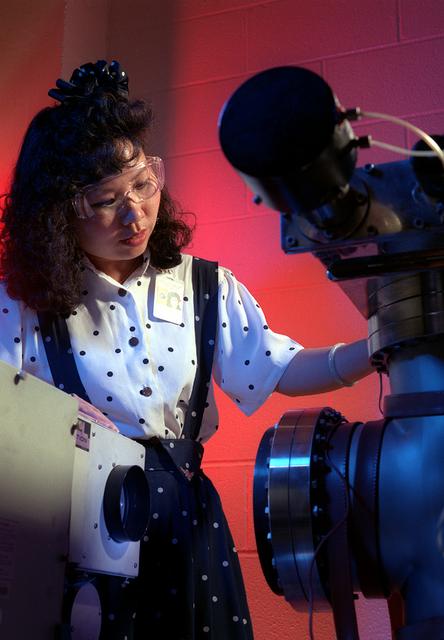
A pigment (phthalocyanine) is studied at the Marshall Materials and Processes Lab. The pigment has the ability to protect spacecraft against the harmful effects of the Sun's ultraviolet rays, and to increase the efficiency and life of solar cells.
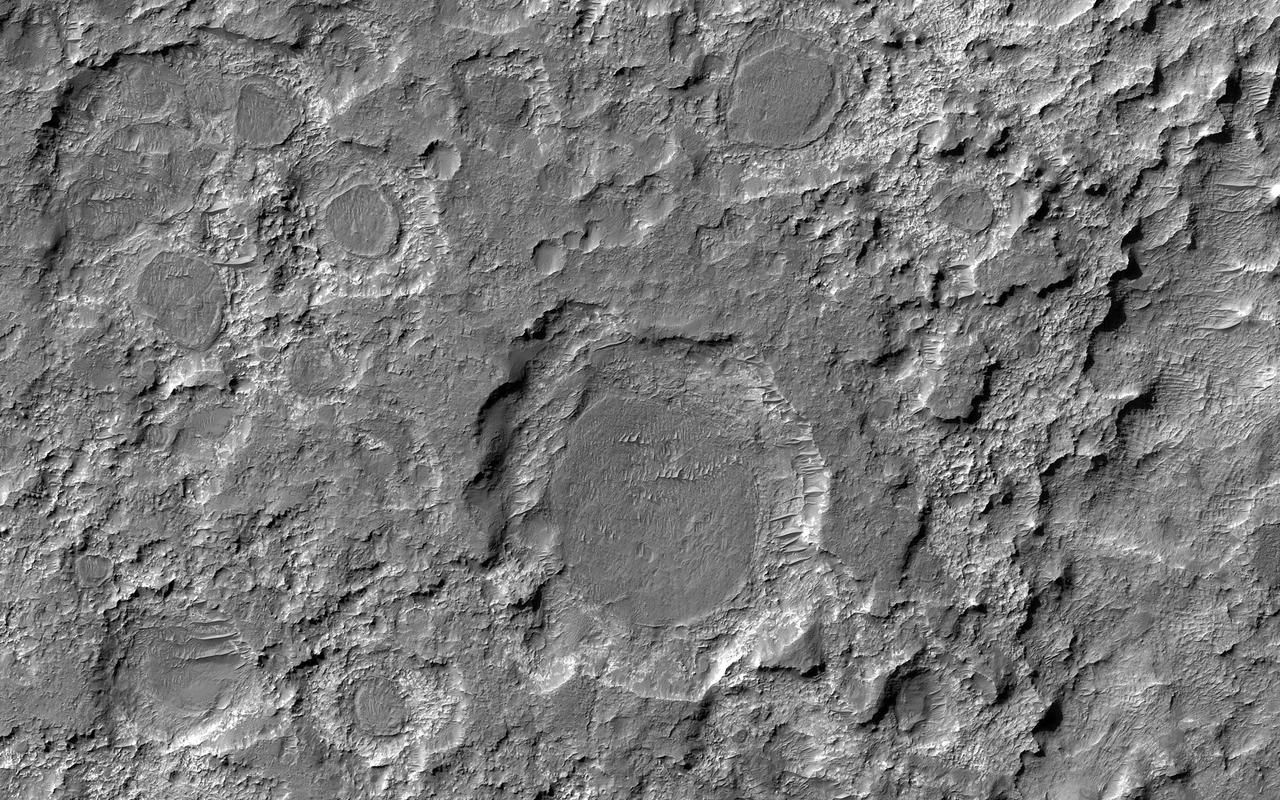
n the ancient past, this area of Mars was bombarded by impactors, forming craters of various sizes in the light-toned material. Some time after that, a darker material blanketed and covered the field, filling in the craters. Eventually, that blanketed material itself became rock. Long after that, erosive forces (likely wind) acted in this area removing both dark and light-toned material, like an archeologist using a brush to reveal buried structures. What we see today are a variety of dark circular features that are the remains of the layer that has been eroded back from the walls of the craters that formed them. In some cases, the crater rim is eroded and just a circular dark patch stands on a brighter exposure of rock. Studying the thickness and characteristics of the dark layer might help scientists learn more about the processes that deposited the material, as well as those that eroded it. https://photojournal.jpl.nasa.gov/catalog/PIA25187
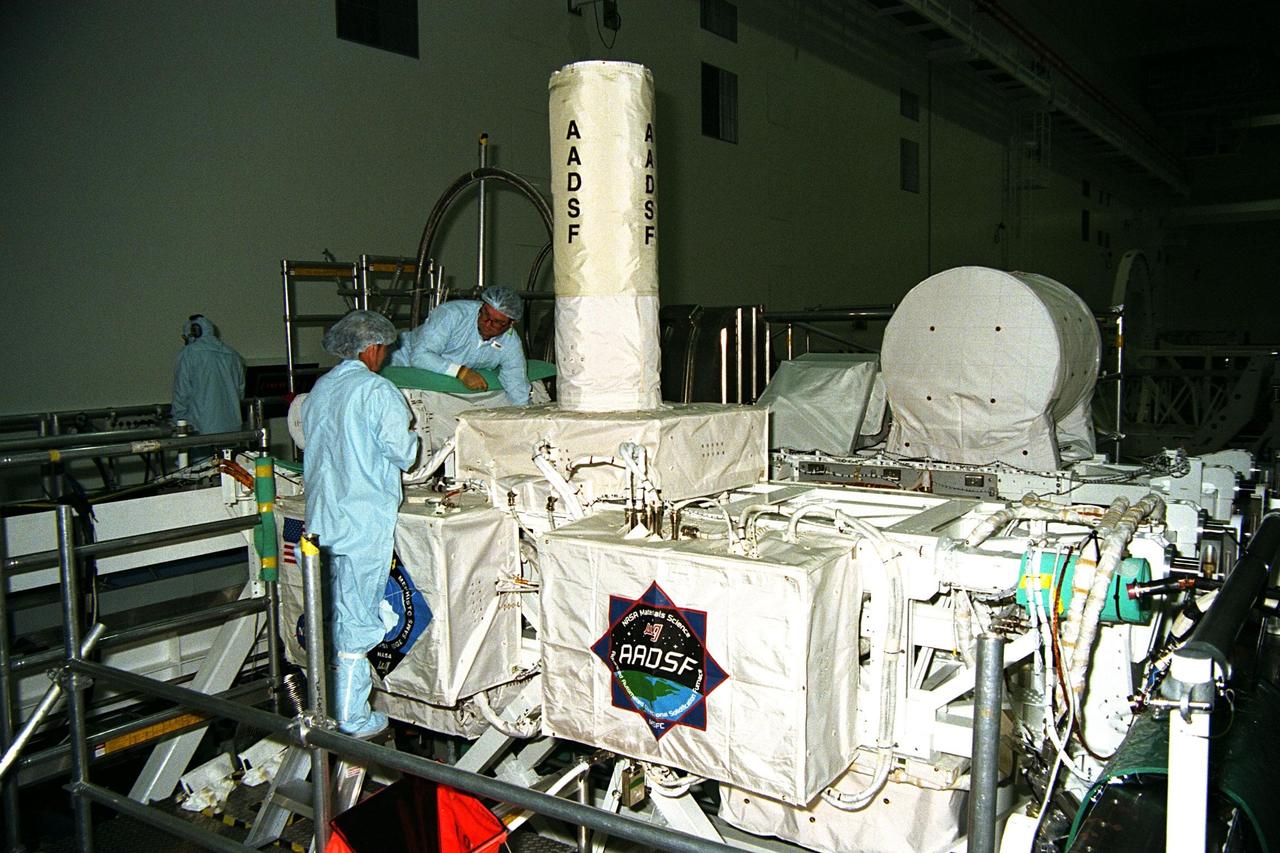
Technicians are monitoring experiments on the United States Microgravity Payload-4 (USMP-4) in preparation for its scheduled launch aboard STS-87 on Nov. 19 from Kennedy Space Center (KSC). USMP-4 experiments are prepared in the Space Station Processing Facility at KSC. The large white vertical cylinder in the center of the photo is the Advanced Automated Directional Solidification Furnace (AADSF), which is a sophisticated materials science facility used for studying a common method of processing semiconductor crystals called directional solidification. The white horizontal tube to the right is the Isothermal Dendritic Growth Experiment (IDGE), which will be used to study the dendritic solidification of molten materials in the microgravity environment
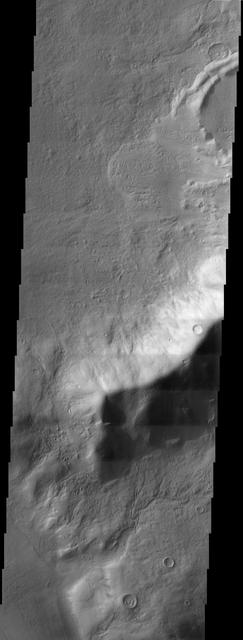
The channels and impact crater rim shown in this THEMIS image provide insight to the forces that have sculpted the surface within the extensive Reull Vallis network. Drainage features and dissected materials observed around and within the impact crater wall demonstrate the erosional and depositional effects of possible fluvial processes. A portion of a possible landslide is also observed within the crater as lobes of material emanate from the crater wall. Reull Vallis is a large and morphologically diverse outflow channel system, and this small view from within demonstrates the combination of mass movement processes that have persisted over an extended time period. http://photojournal.jpl.nasa.gov/catalog/PIA04031

KENNEDY SPACE CENTER, FLA. -- In the Orbiter Processing Facility, the second of two Materials International Space Station Experiments, or MISSE, is lowered into space shuttle Endeavour's payload bay for installation. The MISSE is part of the payload onboard Endeavour for mission STS-123. The MISSE project is a NASA/Langley Research Center-managed cooperative endeavor to fly materials and other types of space exposure experiments on the International Space Station. The objective is to develop early, low-cost, non-intrusive opportunities to conduct critical space exposure tests of space materials and components planned for use on future spacecraft. Photo credit: NASA/Kim Shiflett
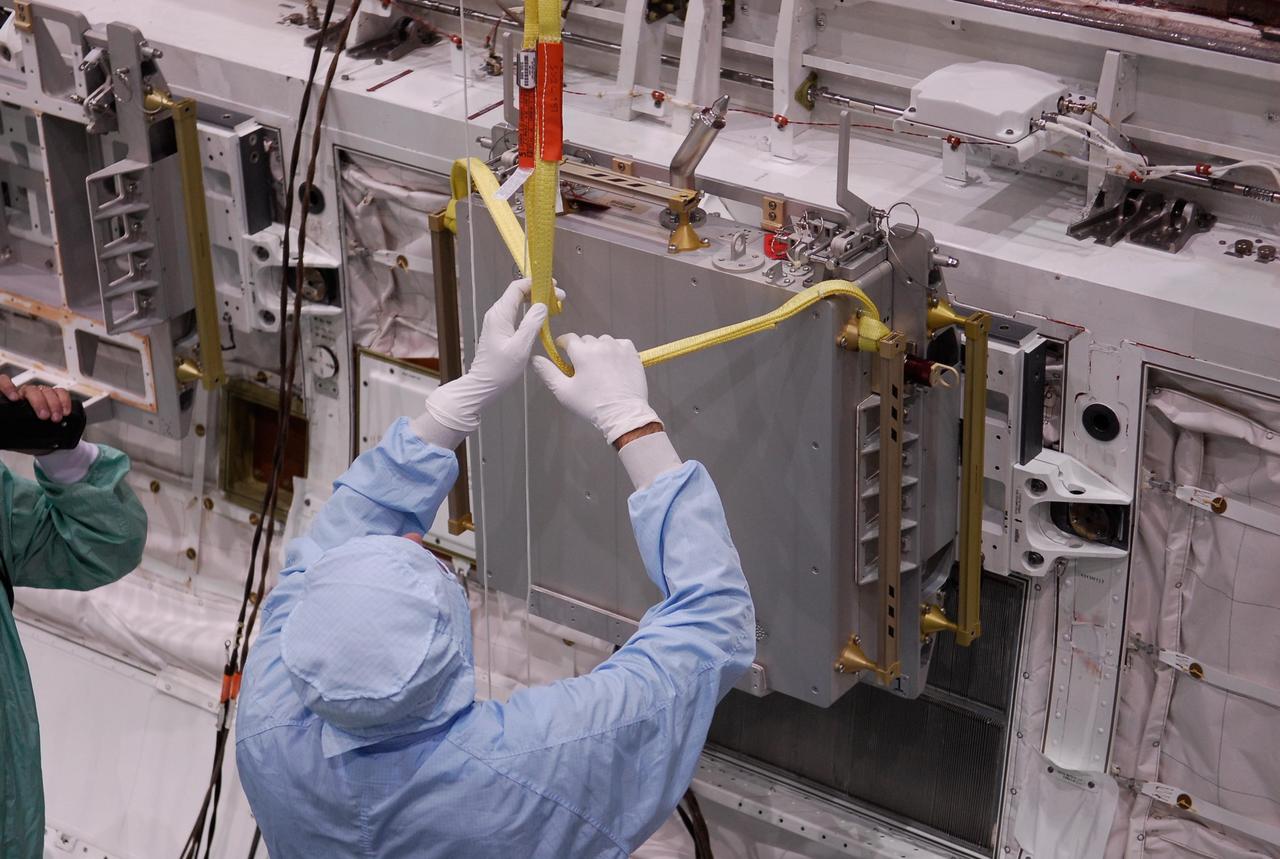
KENNEDY SPACE CENTER, FLA. -- In the Orbiter Processing Facility, one of two Materials International Space Station Experiments, or MISSE, is lowered into space shuttle Endeavour's payload bay for installation. The MISSE is part of the payload onboard Endeavour for mission STS-123. The MISSE project is a NASA/Langley Research Center-managed cooperative endeavor to fly materials and other types of space exposure experiments on the International Space Station. The objective is to develop early, low-cost, non-intrusive opportunities to conduct critical space exposure tests of space materials and components planned for use on future spacecraft. Photo credit: NASA/Kim Shiflett
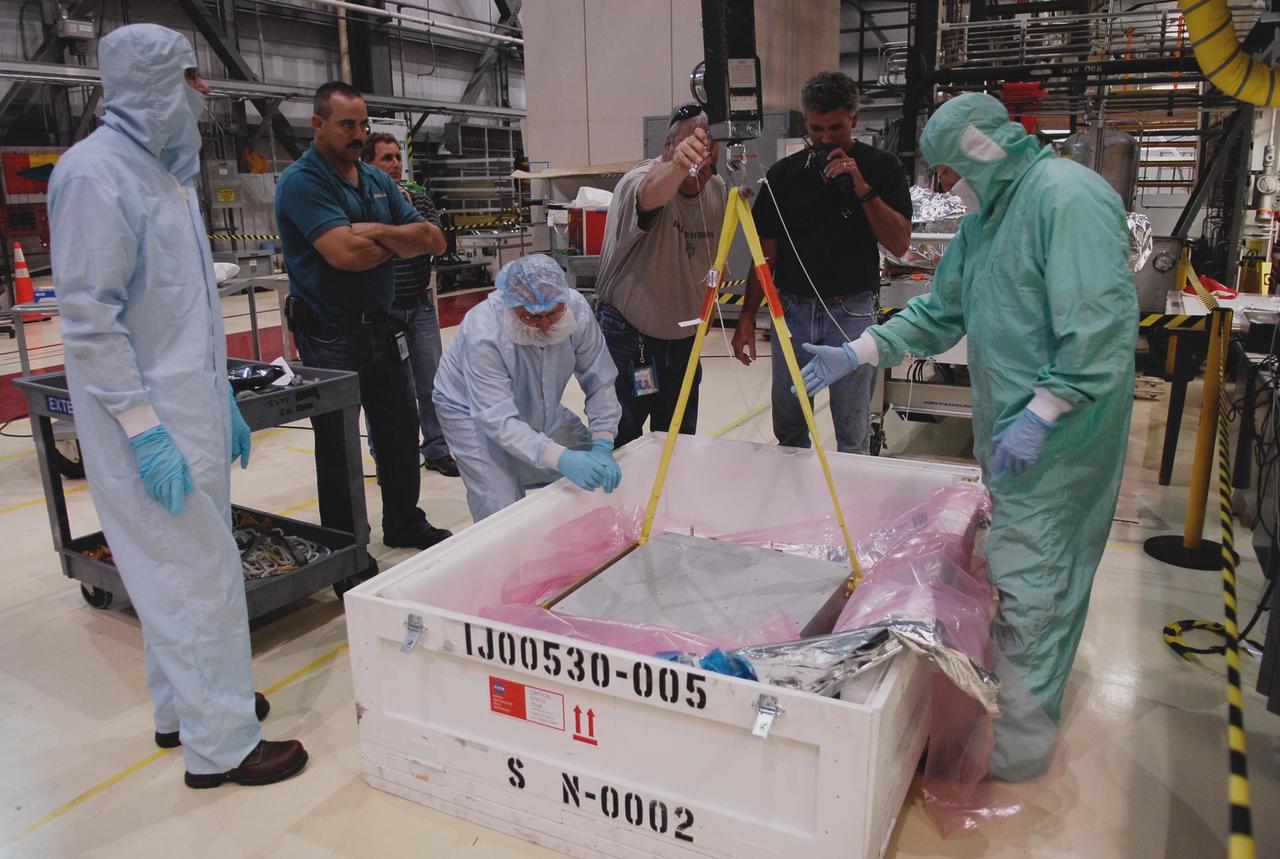
KENNEDY SPACE CENTER, FLA. -- In the Orbiter Processing Facility, technicians get ready to remove one of two Materials International Space Station Experiments, or MISSE, from a shipping container. The MISSE is part of the payload onboard space shuttle Endeavour for mission STS-123. It will be installed in Endeavour's payload bay. The MISSE project is a NASA/Langley Research Center-managed cooperative endeavor to fly materials and other types of space exposure experiments on the International Space Station. The objective is to develop early, low-cost, non-intrusive opportunities to conduct critical space exposure tests of space materials and components planned for use on future spacecraft. Photo credit: NASA/Kim Shiflett
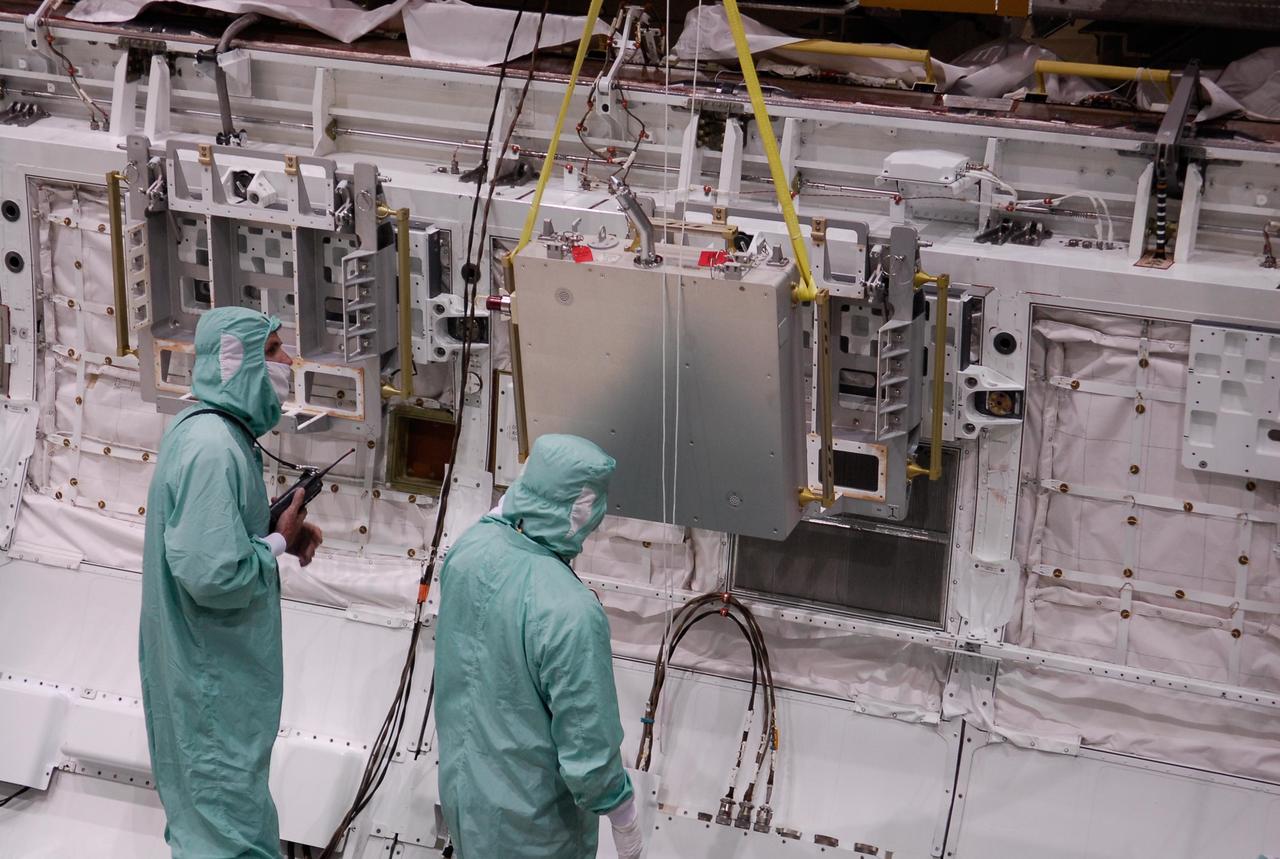
KENNEDY SPACE CENTER, FLA. -- In the Orbiter Processing Facility, one of two Materials International Space Station Experiments, or MISSE, is lowered into space shuttle Endeavour's payload bay for installation. The MISSE is part of the payload onboard Endeavour for mission STS-123. The MISSE project is a NASA/Langley Research Center-managed cooperative endeavor to fly materials and other types of space exposure experiments on the International Space Station. The objective is to develop early, low-cost, non-intrusive opportunities to conduct critical space exposure tests of space materials and components planned for use on future spacecraft. Photo credit: NASA/Kim Shiflett
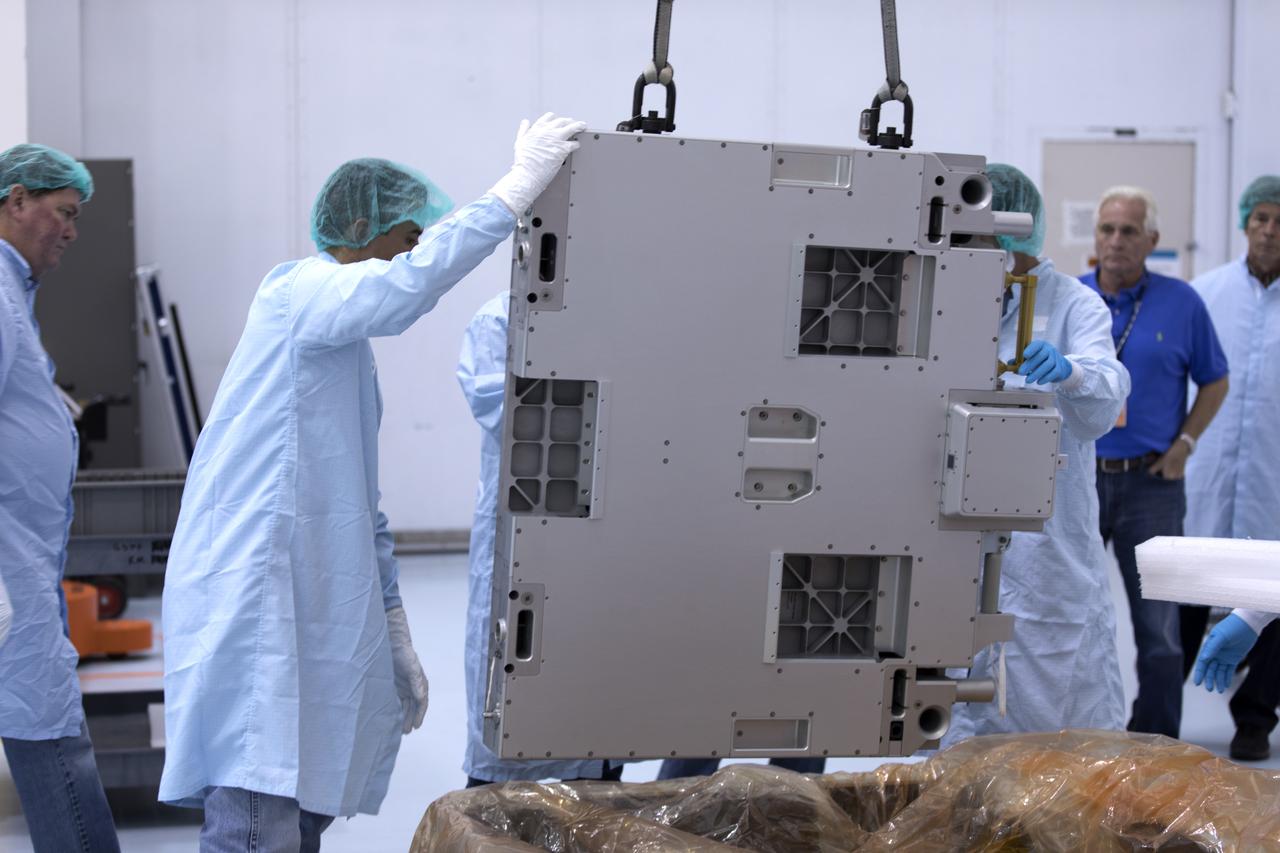
The Materials International Space Station Experiment-Flight Facility, or MISSE-FF, hardware arrived at the Space Station Processing Facility low bay at NASA's Kennedy Space Center in Florida. Technicians assist as a crane is used to lift MISSE out of its shipping container. MISSE will be used to test various materials and computing elements on the exterior of the space station. They will be exposed to the harsh environment of low-Earth orbit, including to a vacuum, atomic oxygen, ultraviolet radiation, direct sunlight and extreme heat and cold. The experiment will provide a better understanding of material durability, from coatings to electronic sensors, which could be applied to future spacecraft designs. MISSE will be delivered to the space station on a future commercial resupply mission.
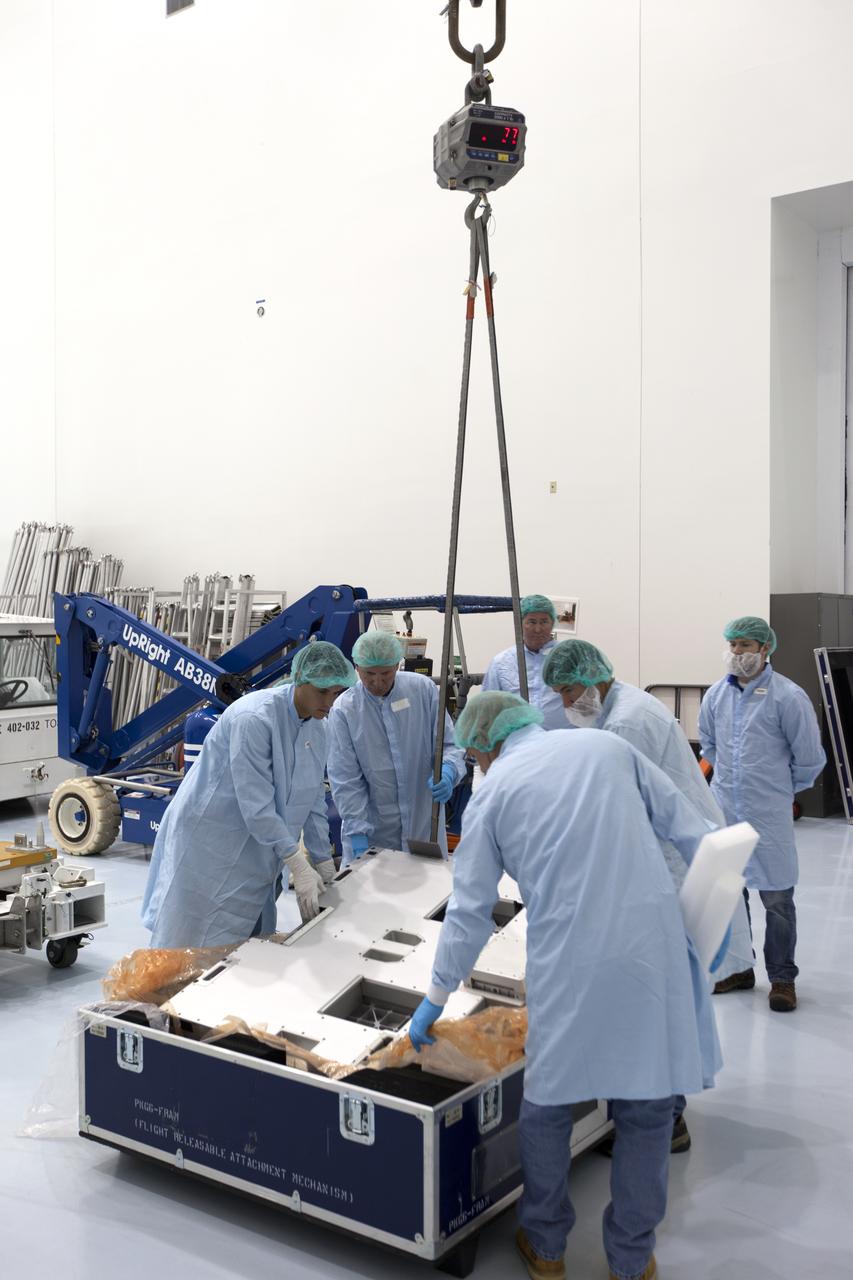
The Materials International Space Station Experiment-Flight Facility, or MISSE-FF, hardware arrived at the Space Station Processing Facility low bay at NASA's Kennedy Space Center in Florida. Technicians attach a crane to MISSE for lifting out of its shipping container. MISSE will be used to test various materials and computing elements on the exterior of the space station. They will be exposed to the harsh environment of low-Earth orbit, including to a vacuum, atomic oxygen, ultraviolet radiation, direct sunlight and extreme heat and cold. The experiment will provide a better understanding of material durability, from coatings to electronic sensors, which could be applied to future spacecraft designs. MISSE will be delivered to the space station on a future commercial resupply mission.
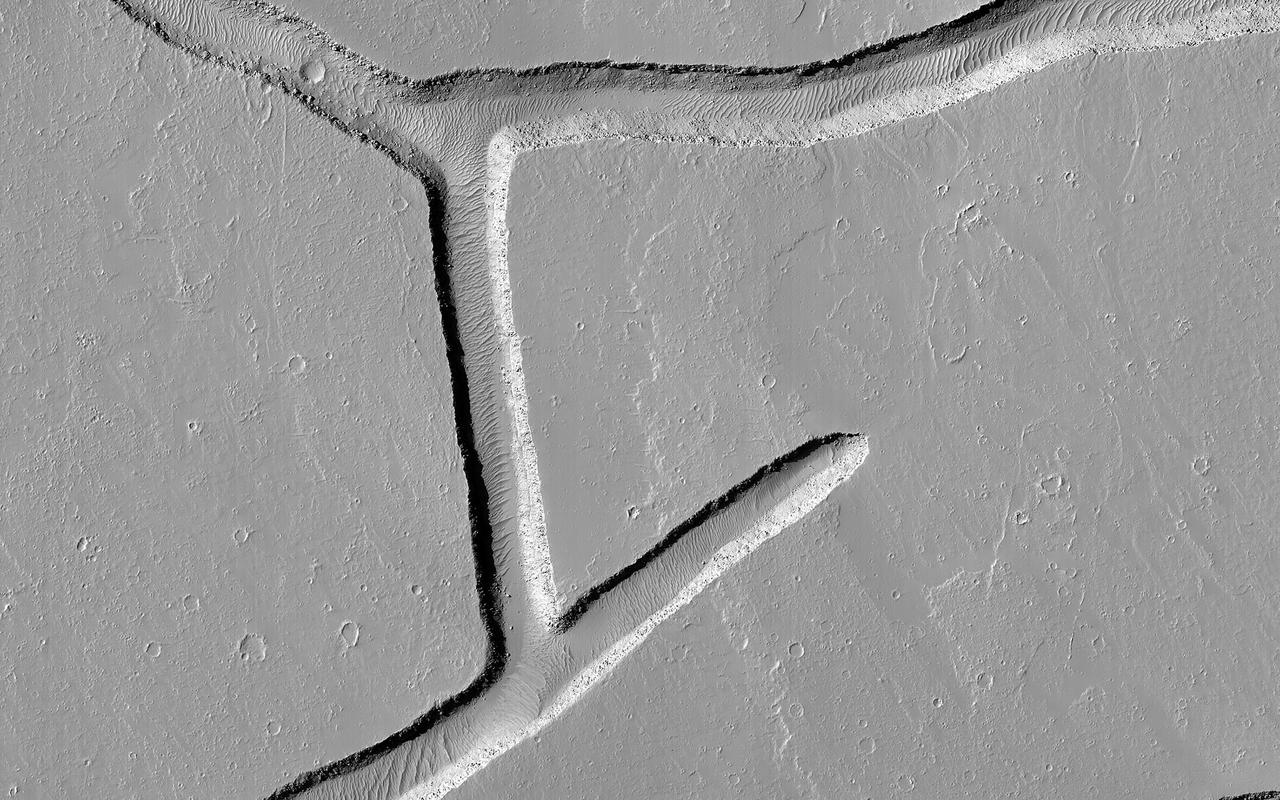
These intersecting troughs, or fractures, cut across geologically young volcanic terrain in the Tharsis volcanic province. In many locations near where this image was taken, material has erupted from similar features. However, it does not appear that material erupted from these particular fractures. Instead, they appear to crosscut material that flowed across the surface, indicating that the fractures are younger than the flows. The widths of the troughs at their rims are about 200 to 250 meters across. This image is an example of how the surface can provide information about the processes happening in Mars' interior. https://photojournal.jpl.nasa.gov/catalog/PIA24863
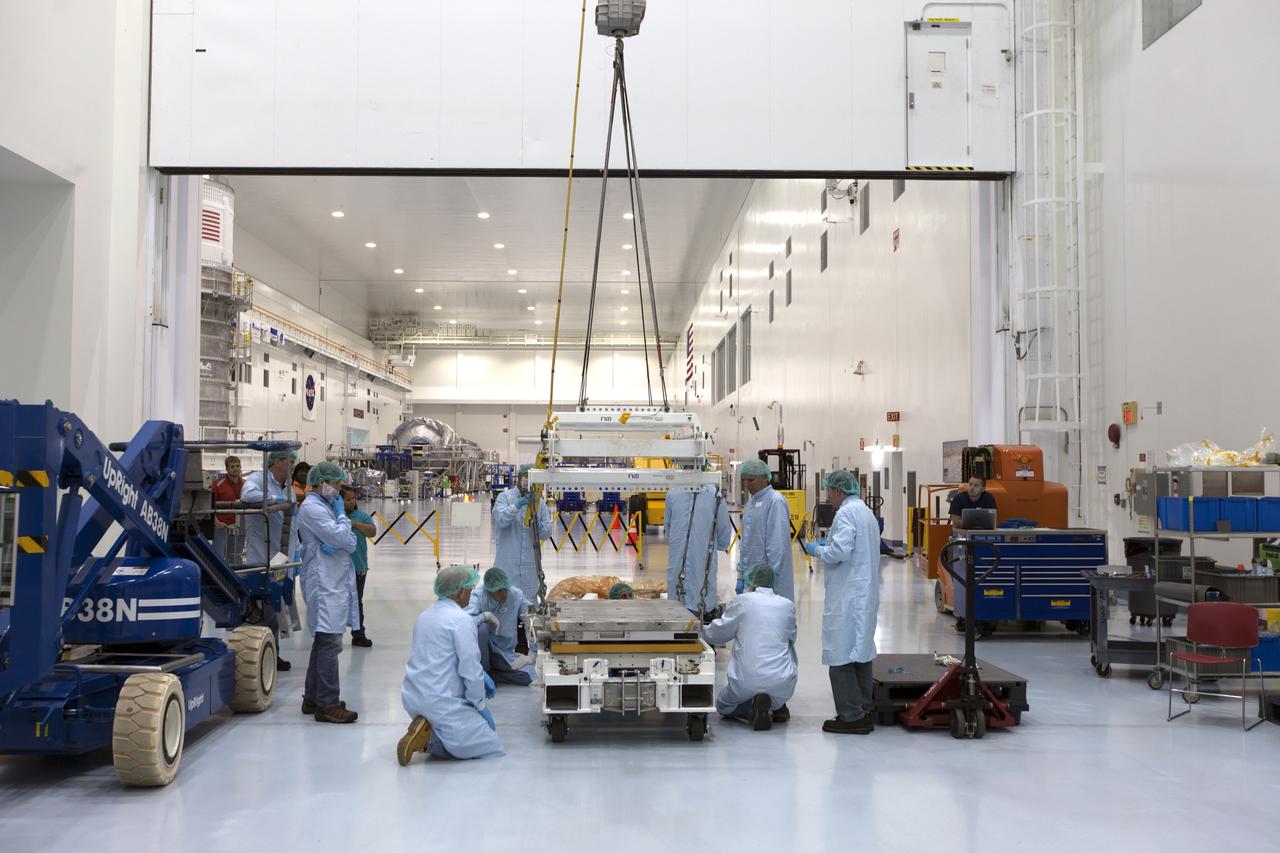
The Materials International Space Station Experiment-Flight Facility, or MISSE-FF, hardware arrived at the Space Station Processing Facility low bay at NASA's Kennedy Space Center in Florida. Technicians assist as one of the components is lowered onto another MISSE component. MISSE will be used to test various materials and computing elements on the exterior of the space station. They will be exposed to the harsh environment of low-Earth orbit, including to a vacuum, atomic oxygen, ultraviolet radiation, direct sunlight and extreme heat and cold. The experiment will provide a better understanding of material durability, from coatings to electronic sensors, which could be applied to future spacecraft designs. MISSE will be delivered to the space station on a future commercial resupply mission.
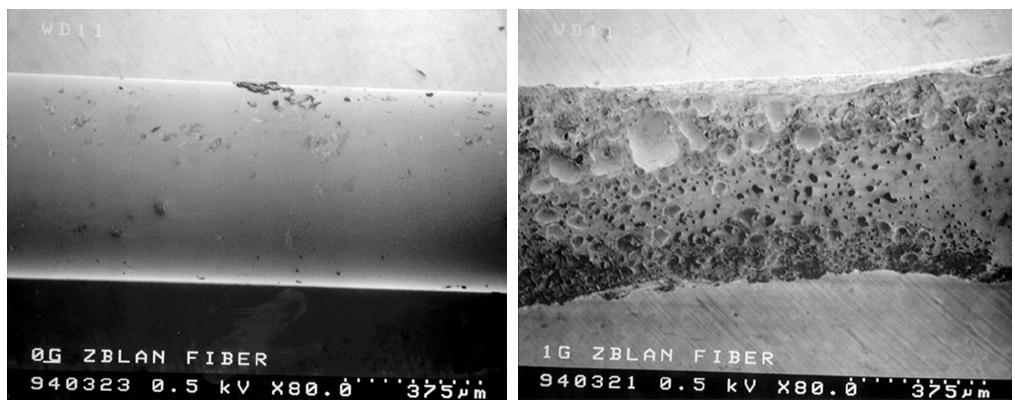
Marshall Space Flight Center's researchers have conducted suborbital experiments with ZBLAN, an optical material capable of transmitting 100 times more signal and information than silica fibers. The next step is to process ZBLAN in a microgravity environment to stop the formation of crystallites, small crystals caused by a chemical imbalances. Scientists want to find a way to make ZBLAN an amorphous (without an internal shape) material. Producing a material such as this will have far-reaching implications on advanced communications, medical and manufacturing technologies using lasers, and a host of other products well into the 21st century.
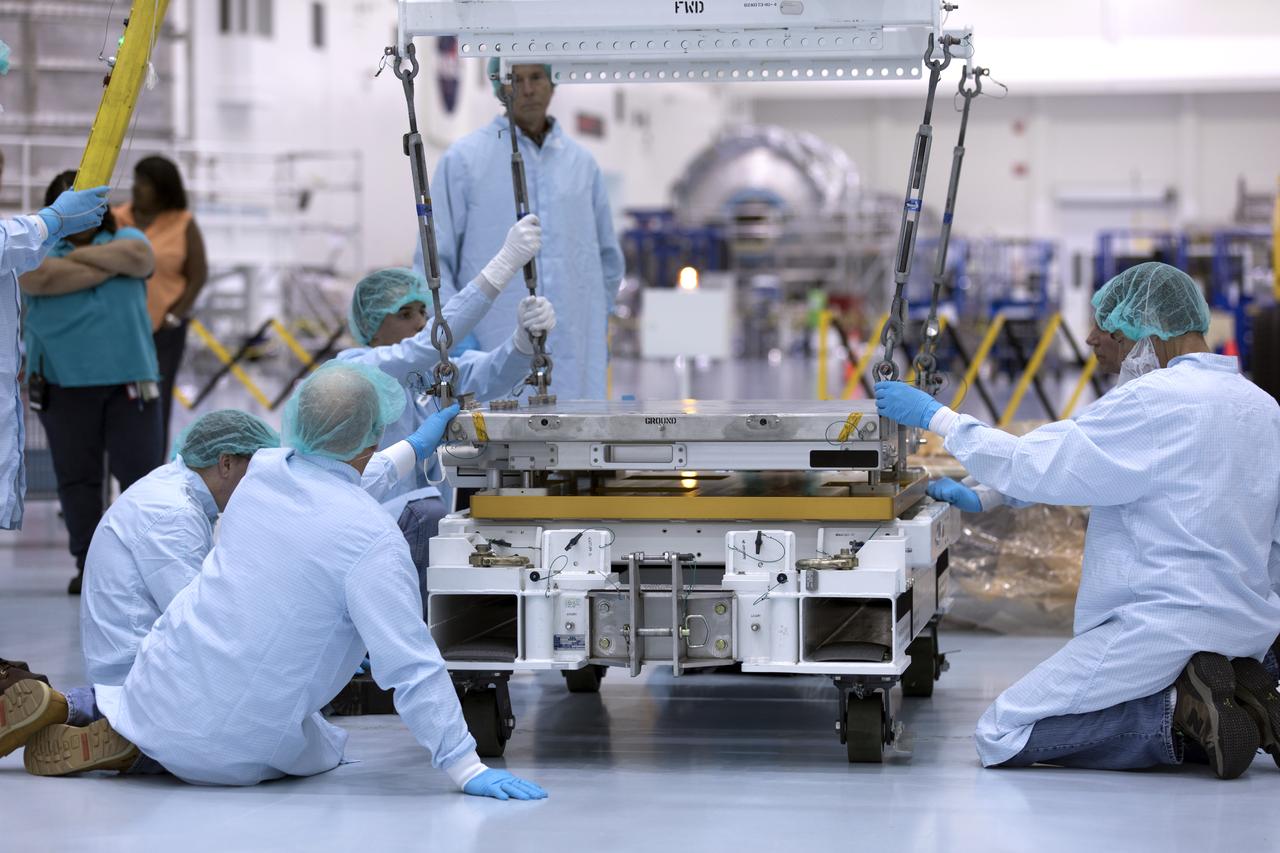
The Materials International Space Station Experiment-Flight Facility, or MISSE-FF, hardware arrived at the Space Station Processing Facility low bay at NASA's Kennedy Space Center in Florida. Technicians assist as one of the components is lowered and secured onto another MISSE component. MISSE will be used to test various materials and computing elements on the exterior of the space station. They will be exposed to the harsh environment of low-Earth orbit, including to a vacuum, atomic oxygen, ultraviolet radiation, direct sunlight and extreme heat and cold. The experiment will provide a better understanding of material durability, from coatings to electronic sensors, which could be applied to future spacecraft designs. MISSE will be delivered to the space station on a future commercial resupply mission.
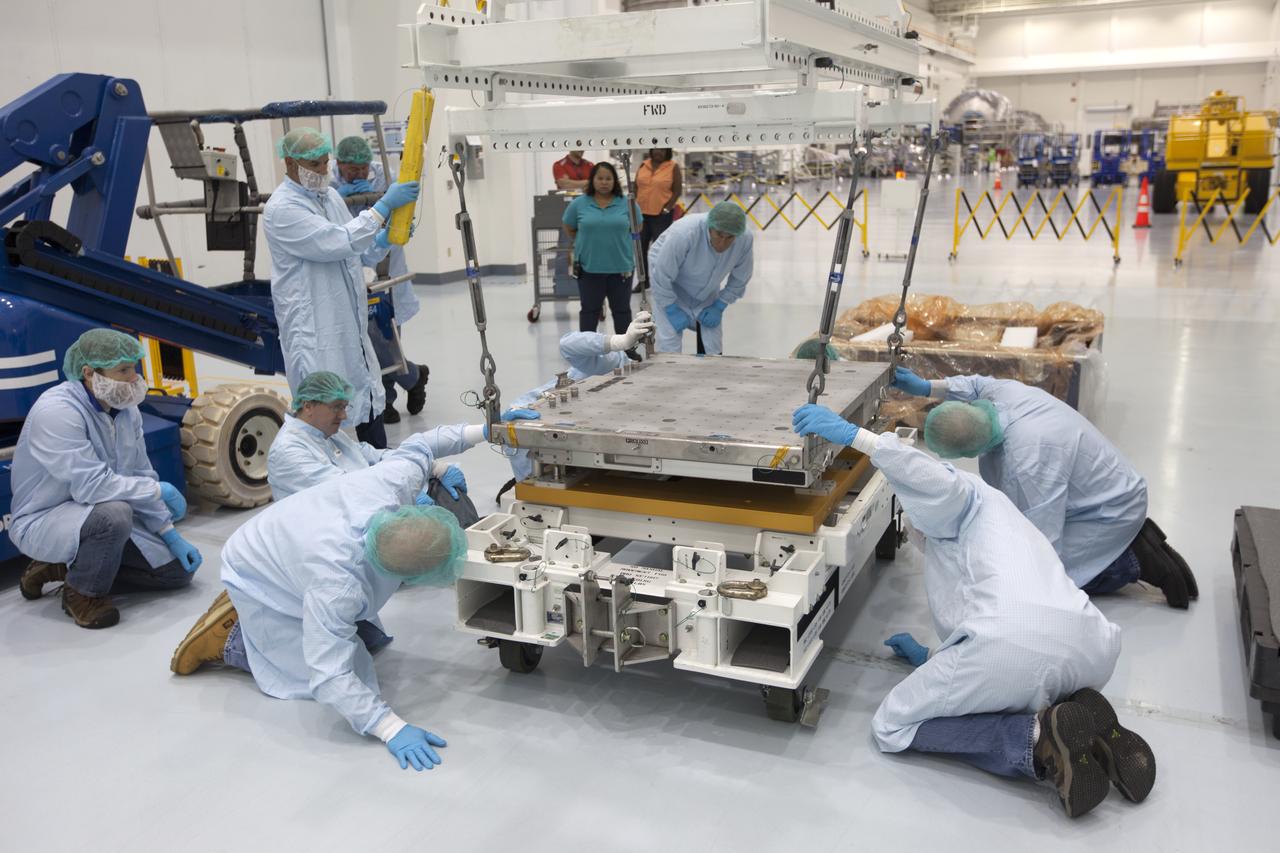
The Materials International Space Station Experiment-Flight Facility, or MISSE-FF, hardware arrived at the Space Station Processing Facility low bay at NASA's Kennedy Space Center in Florida. Technicians assist as one of the components is lowered onto another MISSE component. MISSE will be used to test various materials and computing elements on the exterior of the space station. They will be exposed to the harsh environment of low-Earth orbit, including to a vacuum, atomic oxygen, ultraviolet radiation, direct sunlight and extreme heat and cold. The experiment will provide a better understanding of material durability, from coatings to electronic sensors, which could be applied to future spacecraft designs. MISSE will be delivered to the space station on a future commercial resupply mission.

KENNEDY SPACE CENTER, FLA. -- In the Orbiter Processing Facility, technicians help lift the first of the Materials International Space Station Experiments, or MISSE, from a shipping container. The MISSE is part of the payload onboard space shuttle Endeavour for mission STS-123. It will be installed in Endeavour's payload bay. The MISSE project is a NASA/Langley Research Center-managed cooperative endeavor to fly materials and other types of space exposure experiments on the International Space Station. The objective is to develop early, low-cost, non-intrusive opportunities to conduct critical space exposure tests of space materials and components planned for use on future spacecraft. Photo credit: NASA/Kim Shiflett
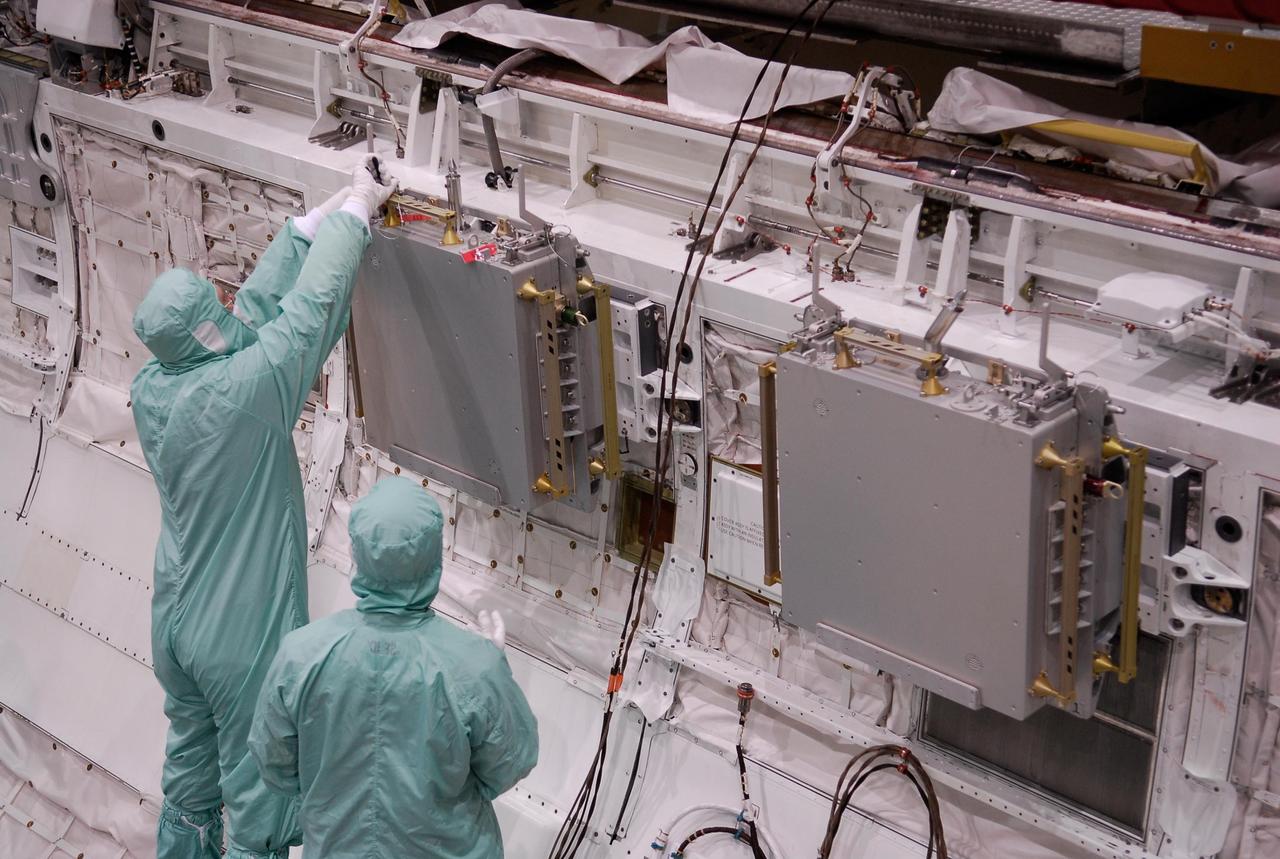
KENNEDY SPACE CENTER, FLA. -- In the Orbiter Processing Facility, technicians install the second Materials International Space Station Experiments, or MISSE, in space shuttle Endeavour's payload bay. The MISSE is part of the payload onboard Endeavour for mission STS-123. The MISSE project is a NASA/Langley Research Center-managed cooperative endeavor to fly materials and other types of space exposure experiments on the International Space Station. The objective is to develop early, low-cost, non-intrusive opportunities to conduct critical space exposure tests of space materials and components planned for use on future spacecraft. Photo credit: NASA/Kim Shiflett
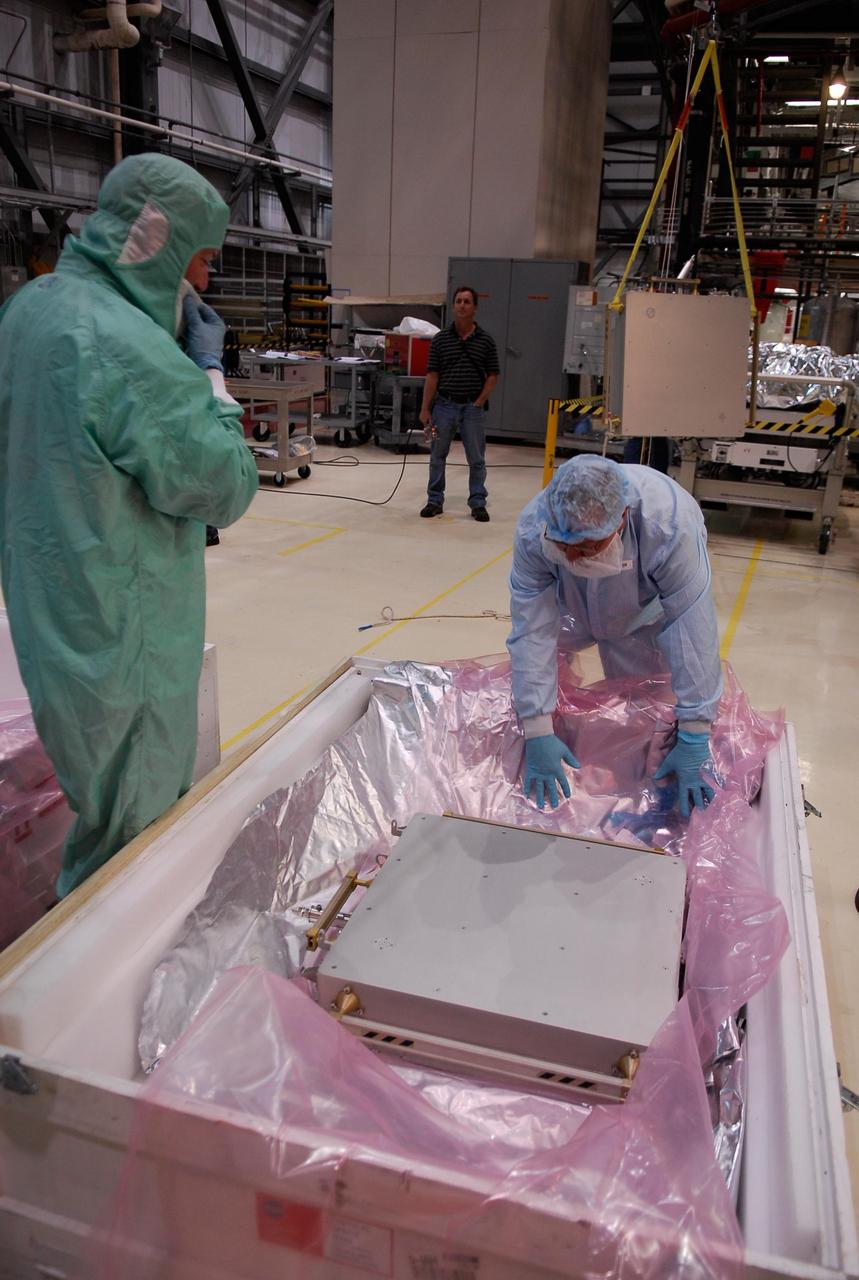
KENNEDY SPACE CENTER, FLA. -- In the Orbiter Processing Facility, technicians get ready to remove another Materials International Space Station Experiments, or MISSE, from a shipping container. The MISSE is part of the payload onboard space shuttle Endeavour for mission STS-123. It will be installed in Endeavour's payload bay. The MISSE project is a NASA/Langley Research Center-managed cooperative endeavor to fly materials and other types of space exposure experiments on the International Space Station. The objective is to develop early, low-cost, non-intrusive opportunities to conduct critical space exposure tests of space materials and components planned for use on future spacecraft. Photo credit: NASA/Kim Shiflett
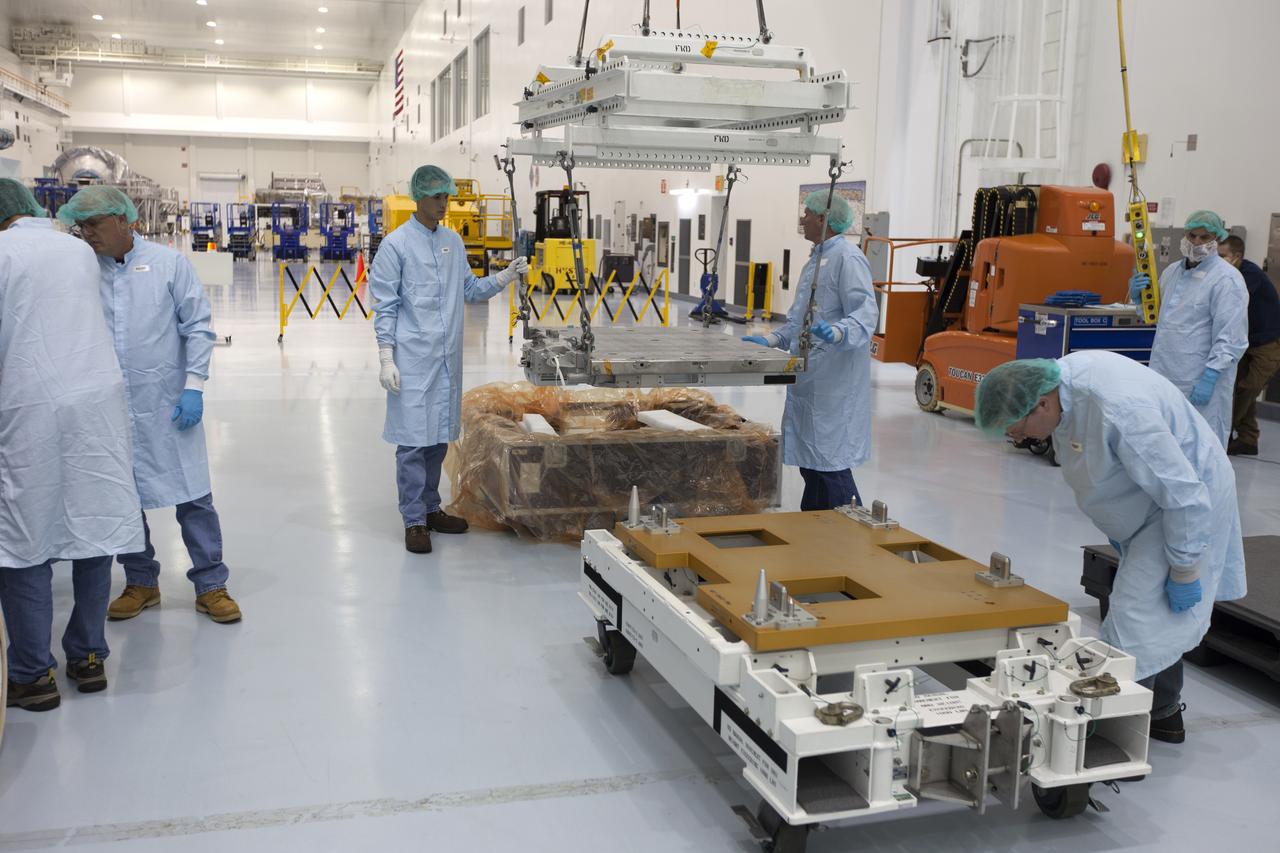
KENNEDY SPACE CENTER, FLA. -- In the Orbiter Processing Facility, one of two Materials International Space Station Experiments, or MISSE, is moved across facility toward space shuttle Endeavour. The MISSE is part of the payload onboard Endeavour for mission STS-123 and will be installed in the payload bay. The MISSE project is a NASA/Langley Research Center-managed cooperative endeavor to fly materials and other types of space exposure experiments on the International Space Station. The objective is to develop early, low-cost, non-intrusive opportunities to conduct critical space exposure tests of space materials and components planned for use on future spacecraft. Photo credit: NASA/Kim Shiflett
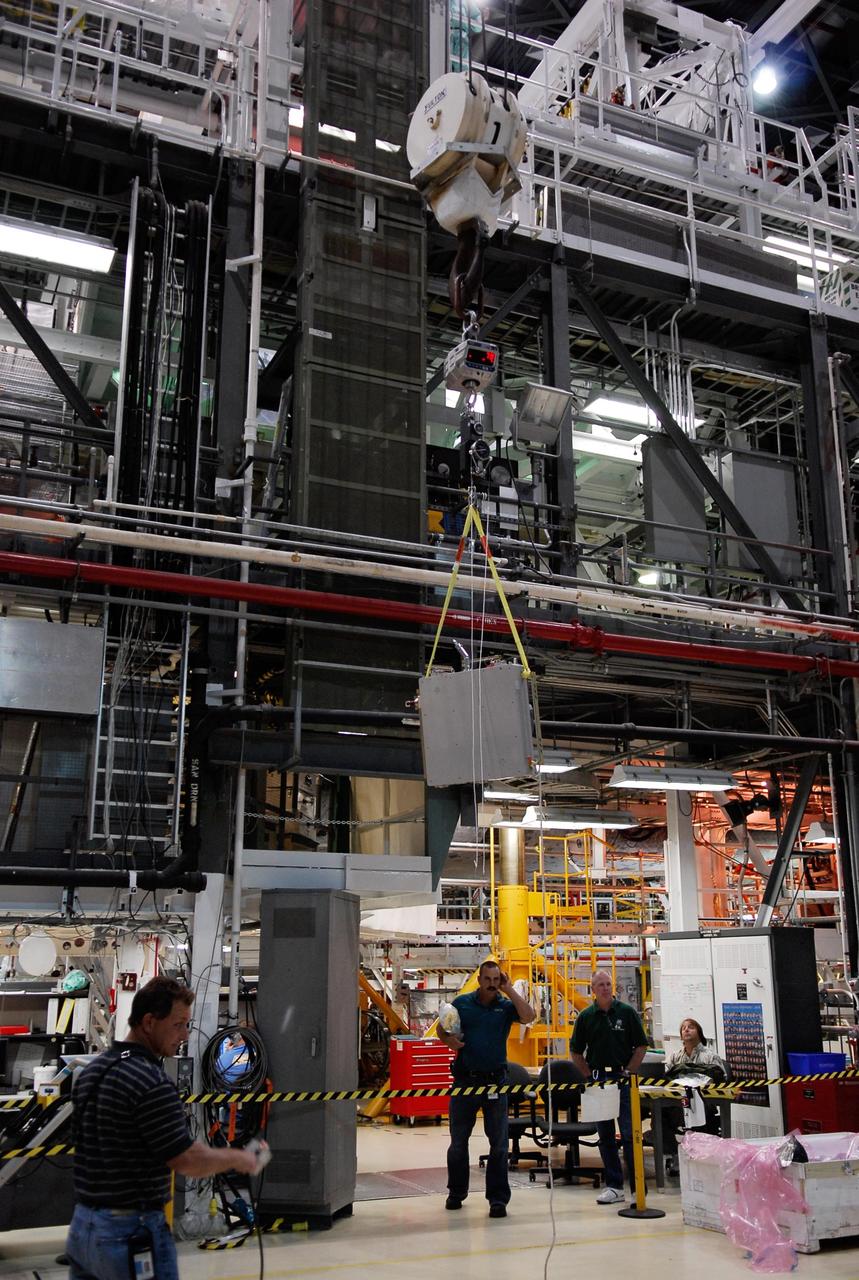
The Materials International Space Station Experiment-Flight Facility, or MISSE-FF, hardware arrived at the Space Station Processing Facility low bay at NASA's Kennedy Space Center in Florida. Technicians assist as MISSE is lifted by crane from its shipping container. MISSE will be used to test various materials and computing elements on the exterior of the space station. They will be exposed to the harsh environment of low-Earth orbit, including to a vacuum, atomic oxygen, ultraviolet radiation, direct sunlight and extreme heat and cold. The experiment will provide a better understanding of material durability, from coatings to electronic sensors, which could be applied to future spacecraft designs. MISSE will be delivered to the space station on a future commercial resupply mission.
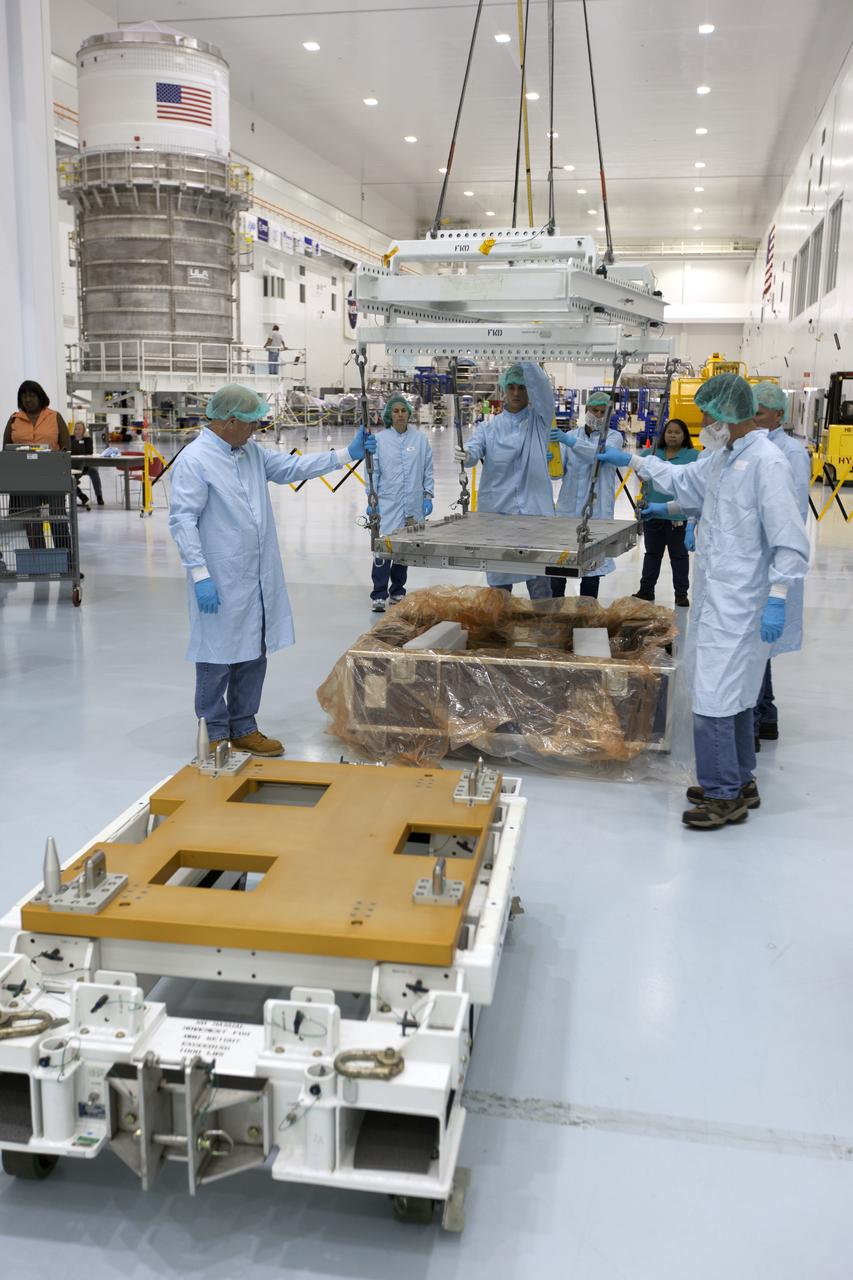
The Materials International Space Station Experiment-Flight Facility, or MISSE-FF, hardware arrived at the Space Station Processing Facility low bay at NASA's Kennedy Space Center in Florida. Technicians assist as MISSE is lifted by crane from its shipping container. MISSE will be used to test various materials and computing elements on the exterior of the space station. They will be exposed to the harsh environment of low-Earth orbit, including to a vacuum, atomic oxygen, ultraviolet radiation, direct sunlight and extreme heat and cold. The experiment will provide a better understanding of material durability, from coatings to electronic sensors, which could be applied to future spacecraft designs. MISSE will be delivered to the space station on a future commercial resupply mission.
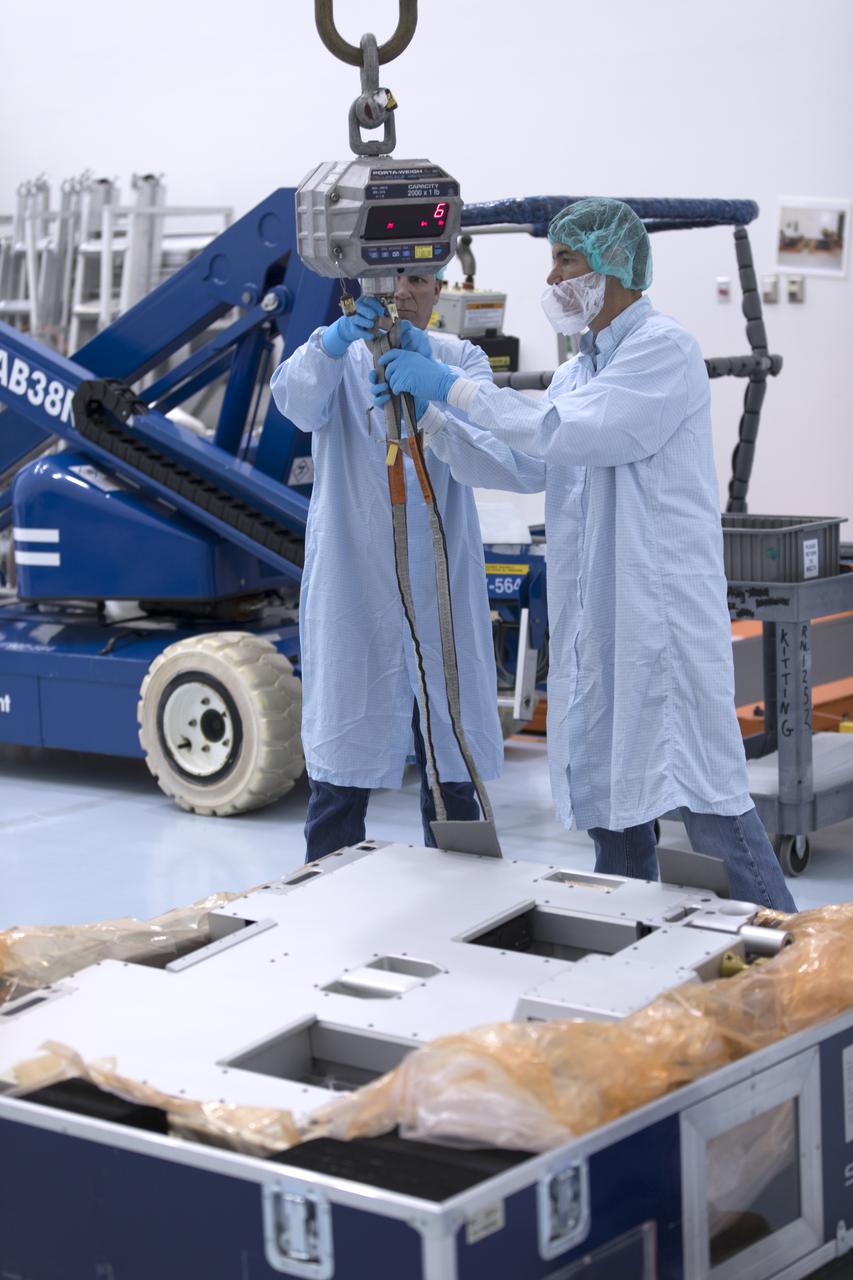
The Materials International Space Station Experiment-Flight Facility, or MISSE-FF, hardware arrived at the Space Station Processing Facility low bay at NASA's Kennedy Space Center in Florida. Technicians work to attach a crane to MISSE for lifting out of its shipping container. MISSE will be used to test various materials and computing elements on the exterior of the space station. They will be exposed to the harsh environment of low-Earth orbit, including to a vacuum, atomic oxygen, ultraviolet radiation, direct sunlight and extreme heat and cold. The experiment will provide a better understanding of material durability, from coatings to electronic sensors, which could be applied to future spacecraft designs. MISSE will be delivered to the space station on a future commercial resupply mission.
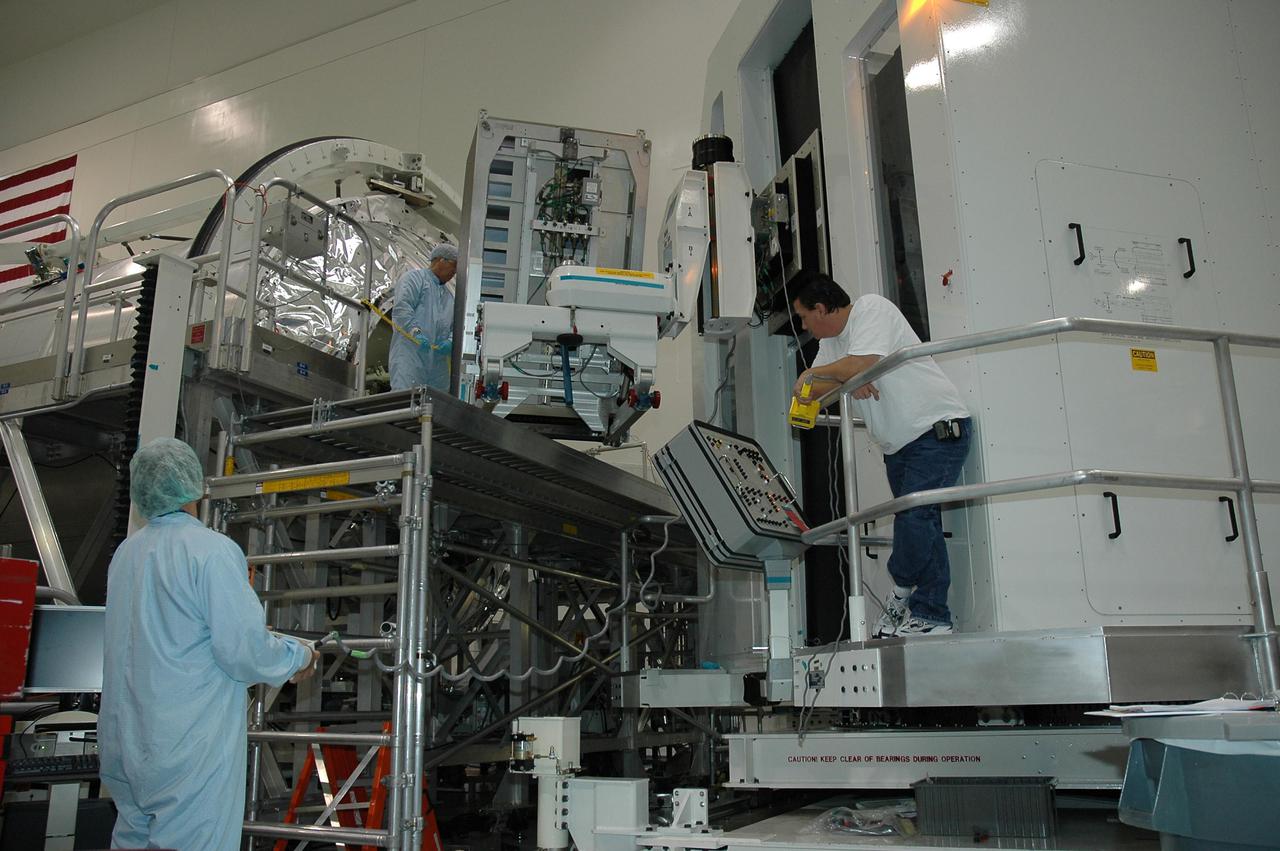
KENNEDY SPACE CENTER, FLA. - In NASA Kennedy Space Center’s Space Station Processing Facility, workers wait for a rack of storage material taken from inside the multi-purpose logistics module Raffaello to be lowered. Raffaello flew on return to flight mission STS-114. During the mission, the crews of Discovery and Expedition 11 transferred more than a ton of material from the International Space Station to be returned to Earth. The workers are unloading the storage racks.
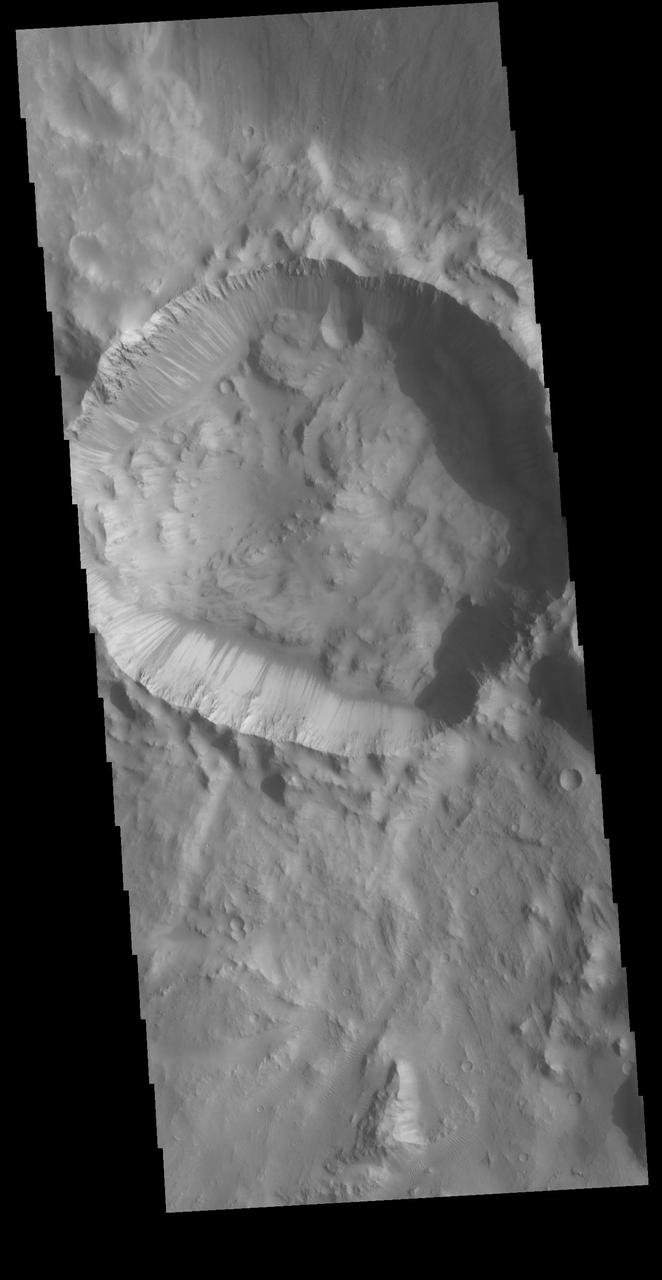
Located on the rim of Chia Crater, this smaller crater contains a multitude of dark slope streaks. These features are assumed to represent down slope movements of material, either a process that removes a dusty top later to reveal dark rocky material below, or one that darkens part of the slope due to surface or near surface flows of a briny volatile. Orbit Number: 72229 Latitude: 0.81902 Longitude: 300.014 Instrument: VIS Captured: 2018-03-27 12:29 https://photojournal.jpl.nasa.gov/catalog/PIA22504

Gullies are often found on steep slopes. In the winter, this area is covered with a layer of carbon dioxide ice (dry ice). In the spring, when the ice warms up and transitions to gas, it dislodges material on the slope, forming a gully. In general, this process works best on fine material, leaving behind large boulders. These boulders can be seen collected in the gully alcoves. Occasionally, boulders slide or roll downhill, like those sprinkled downslope in this image. This set of gullies is found at -71 degrees latitude in the Southern hemisphere. http://photojournal.jpl.nasa.gov/catalog/PIA19295
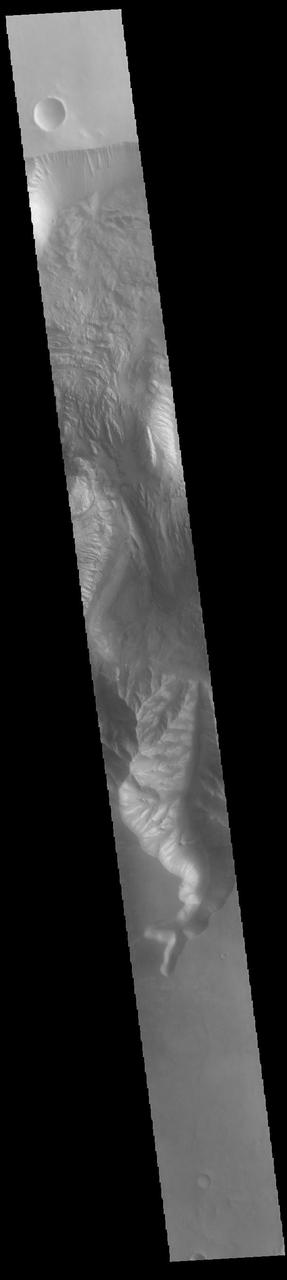
Today's VIS image shows part of the central region of Hebes Chasma. The floor of this closed basin filled with landslide deposits and other layered materials. The eastern margin of Hebes Mensa is just visible on the left center side of the image. Wind and water processes have eroded the floor materials. Orbit Number: 87427 Latitude: -1.35658 Longitude: 284.373 Instrument: VIS Captured: 2021-08-30 01:02 https://photojournal.jpl.nasa.gov/catalog/PIA25106
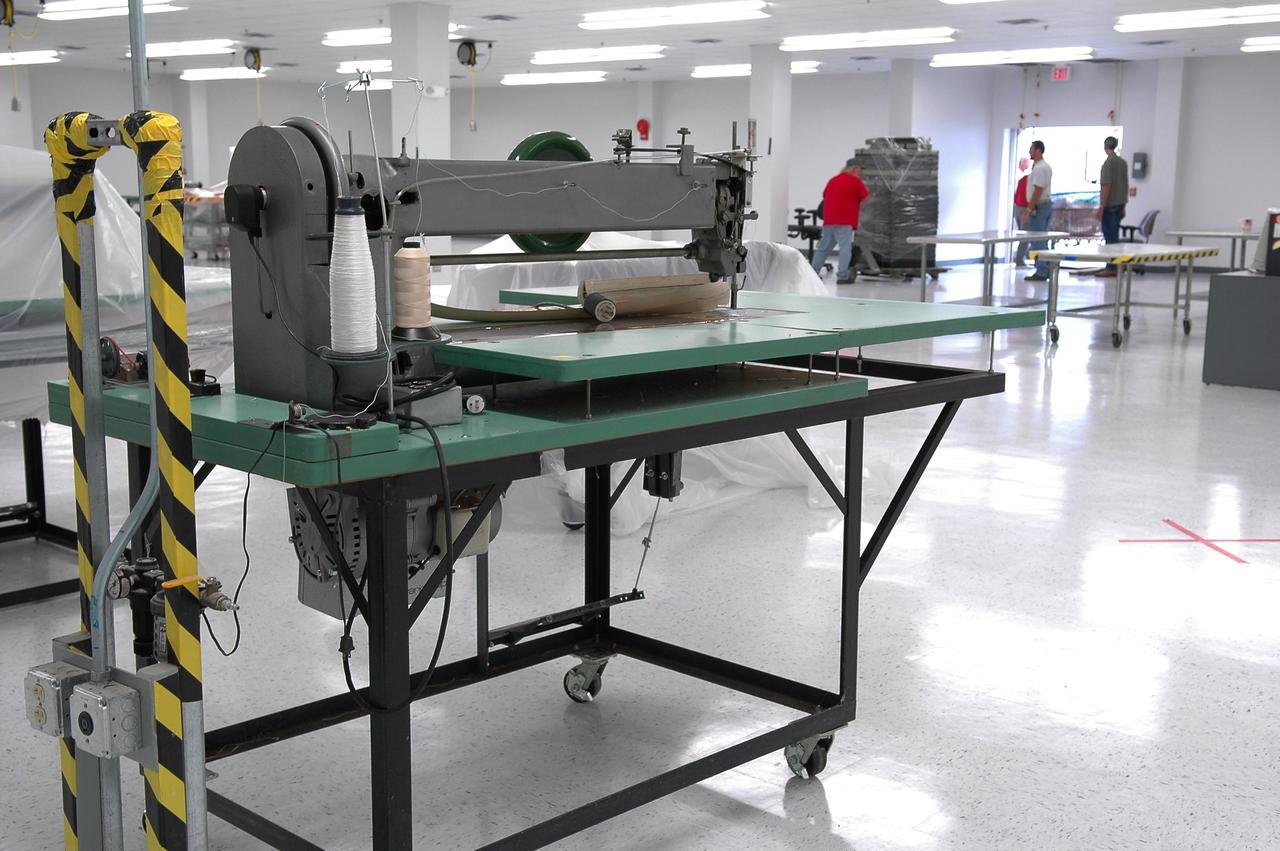
KENNEDY SPACE CENTER, FLA. - One of the blanket sewing machines used on Thermal Protection System materials has been returned to the TPS facility. It was moved to the RLV Hangar at NASA Kennedy Space Center after the 2004 hurricanes damaged the upper floor, where soft material was processed, of the TPS facility. While the TPS facility was being repaired, normal work activity was done in the hangar.
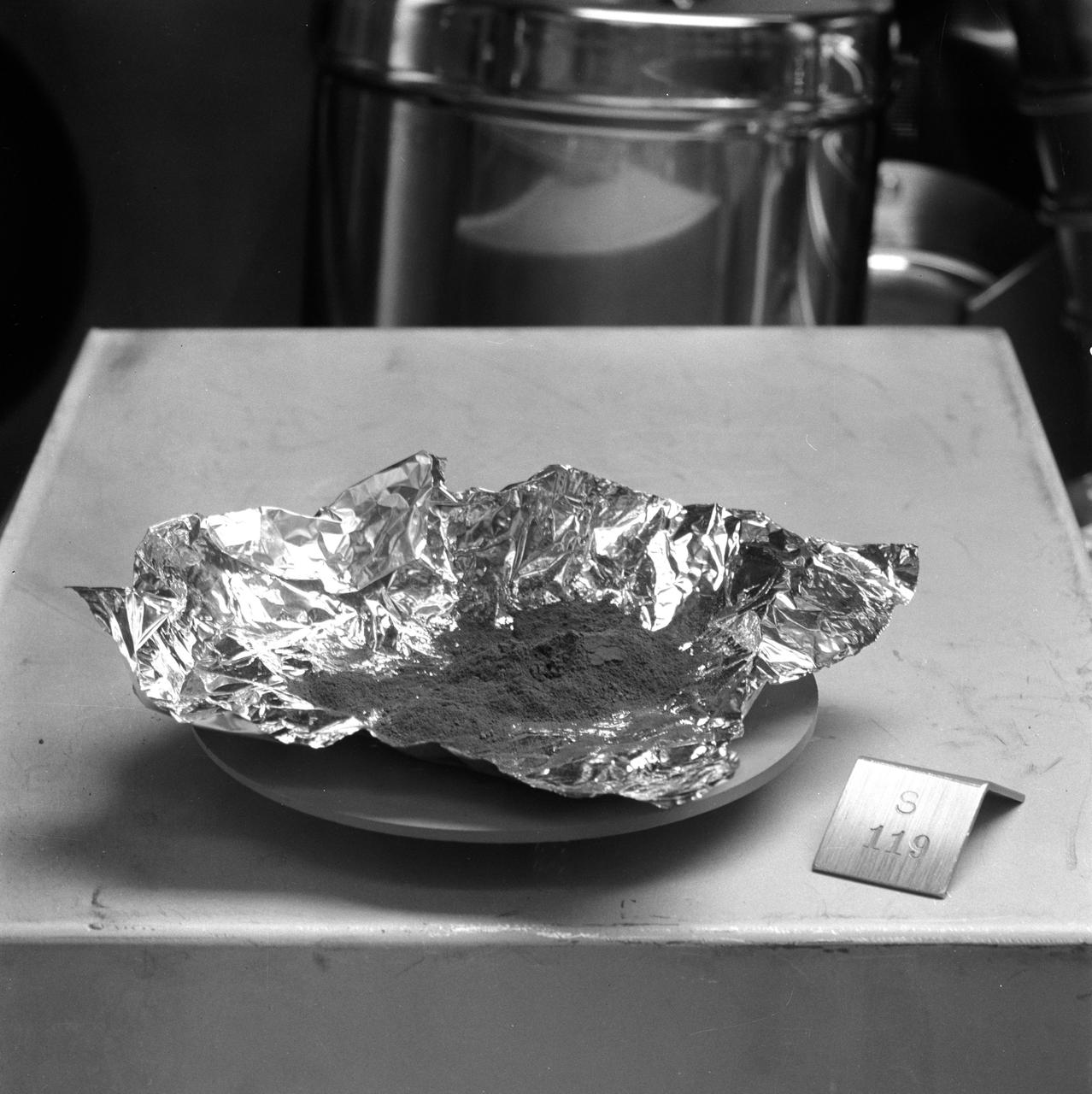
S71-19269 (12 Feb. 1971) --- A close-up view of Apollo 14 sample number 14414 & 14412, a fine lunar powder-like material under examination in the Sterile Nitrogen Atmospheric Processing (SNAP) line in the Lunar Receiving Laboratory (LRL) at the Manned Spacecraft Center (MSC). Scientists are currently making preliminary analyses of material brought back from the moon by the crew of Apollo 14 lunar landing mission.
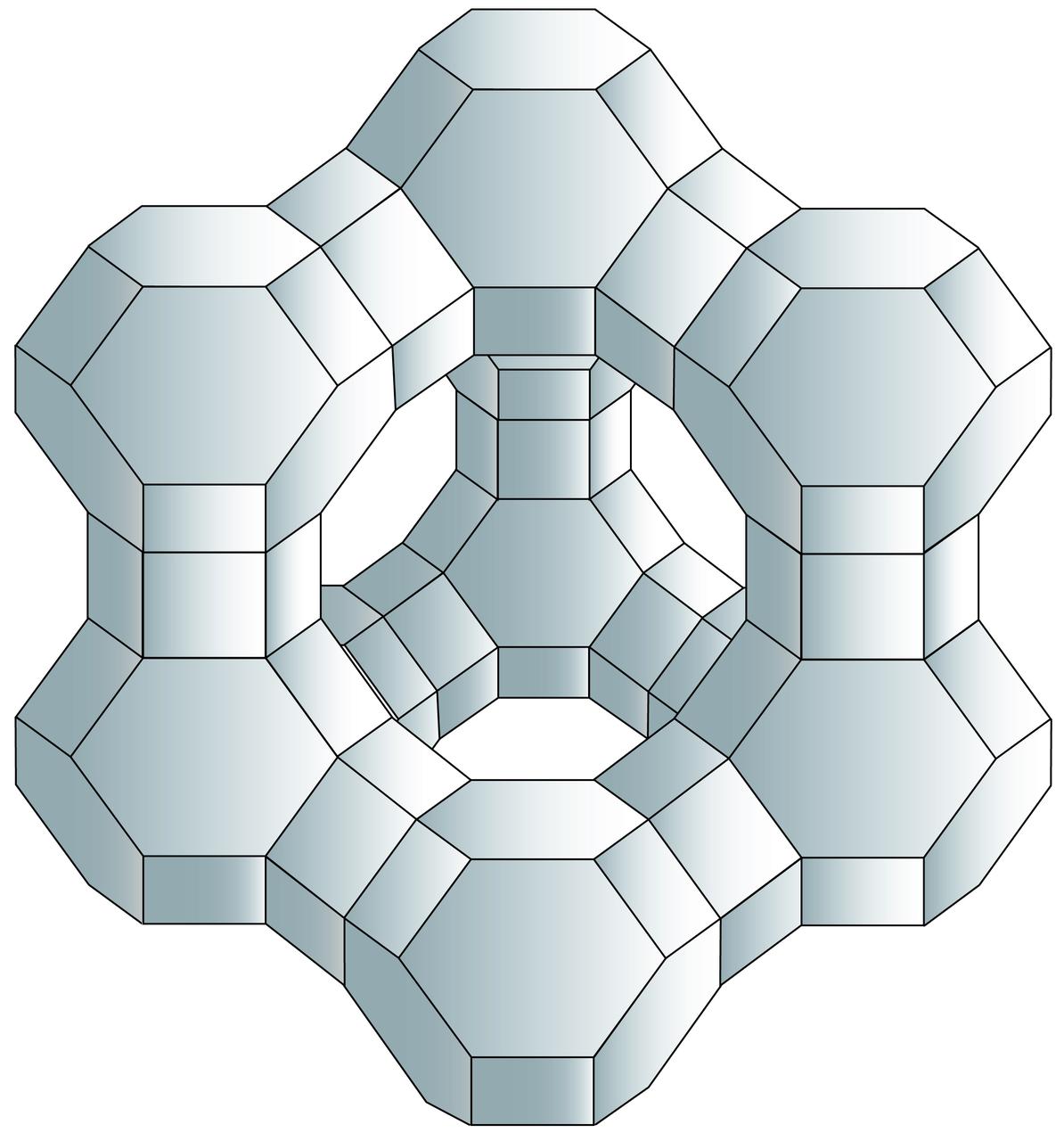
The Center for Advanced Microgravity Materials Processing (CAMMP) in Cambridge, MA, a NASA-sponsored Commercial Space Center, is working to improve zeolite materials for storing hydrogen fuel. CAMMP is also applying zeolites to detergents, optical cables, gas and vapor detection for environmental monitoring and control, and chemical production techniques that significantly reduce by-products that are hazardous to the environment. Depicted here is one of the many here complex geometric shapes which make them highly absorbent. Zeolite experiments have also been conducted aboard the International Space Station
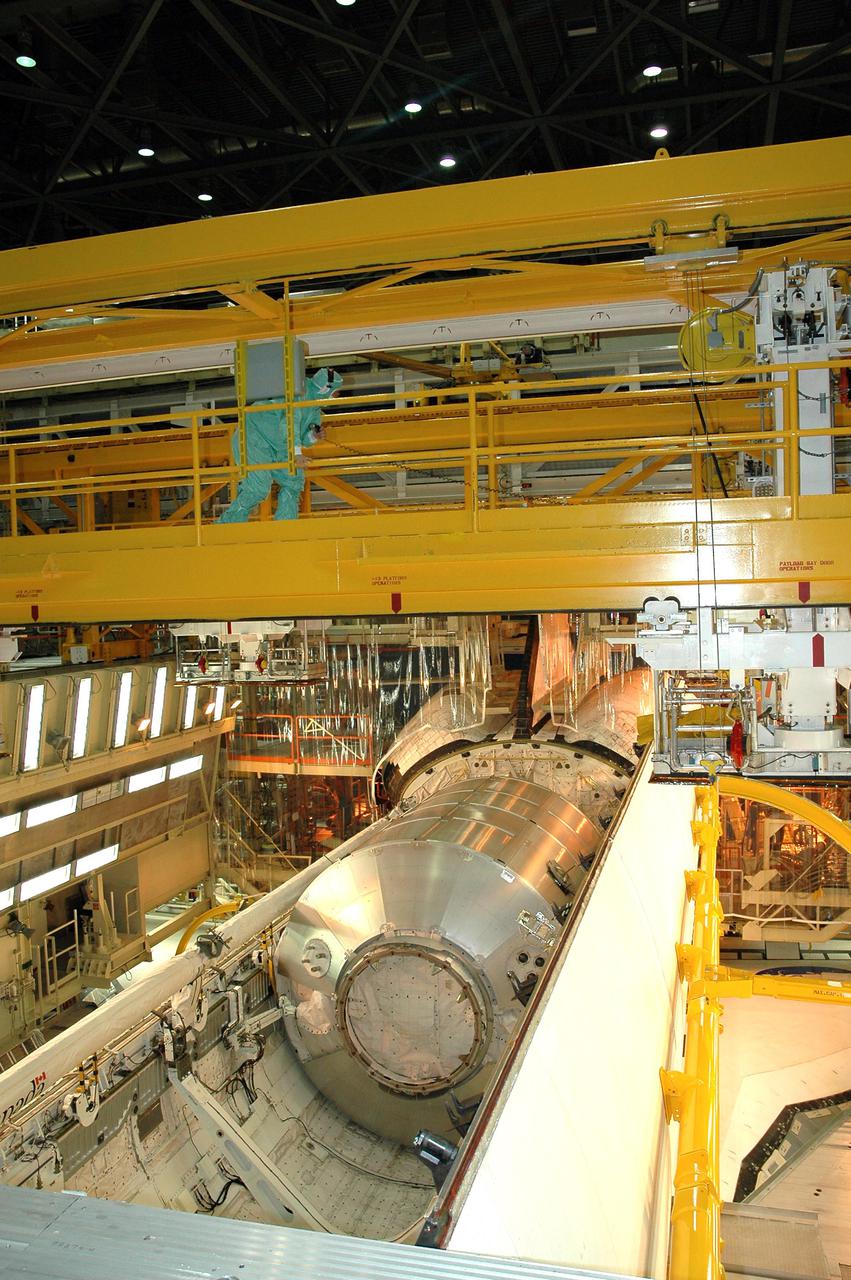
KENNEDY SPACE CENTER, FLA. - In bay 3 of NASA Kennedy Space Center’s Orbiter Processing Facility, the payload bay doors on Discovery are being opened. Seen inside is the Multi-Purpose Logistics Module Raffaello, which holds material being returned to KSC from the International Space Station as part of Return to Flight mission STS-114. The module will be lifted out of the payload bay and transferred to the Space Station Processing Facility to be emptied. Discovery will begin processing for the second Return to Flight mission, STS-121.
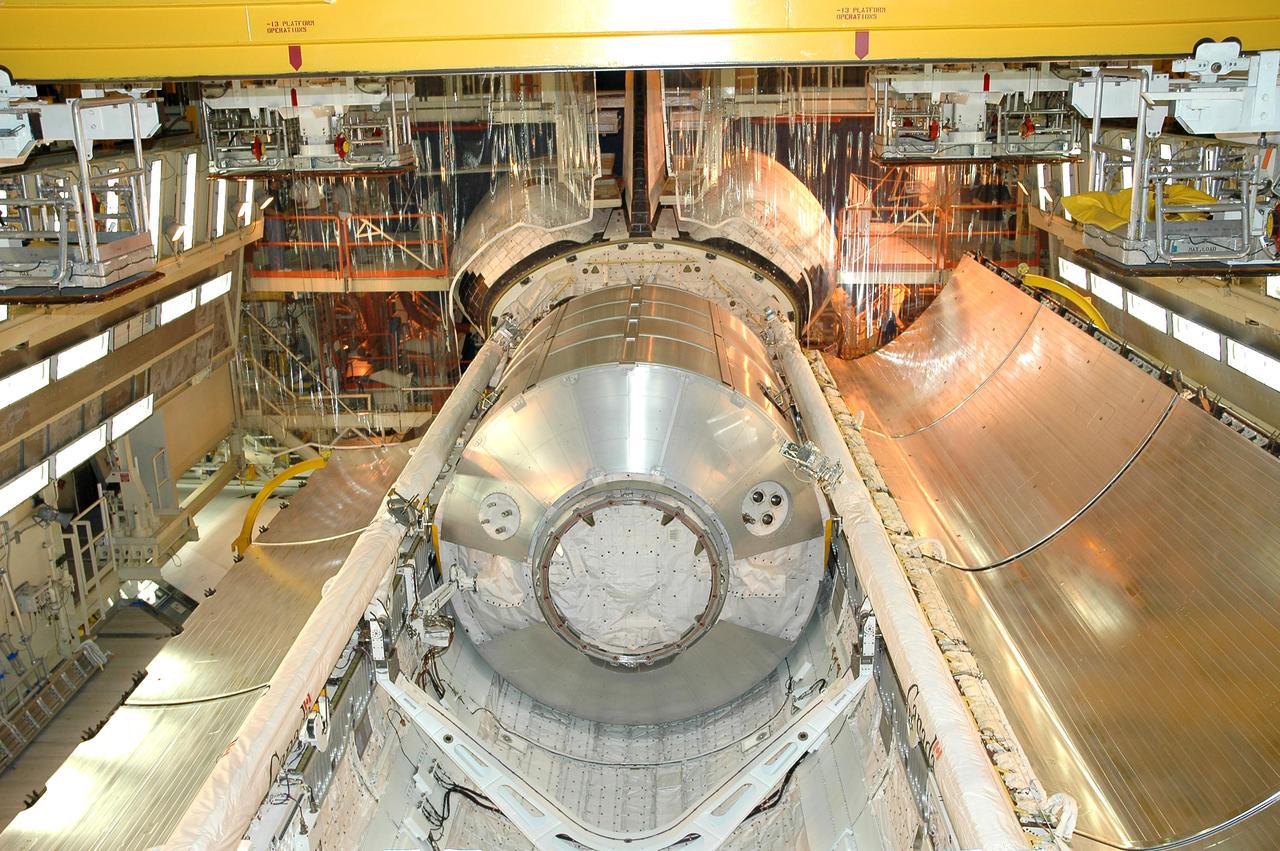
KENNEDY SPACE CENTER, FLA. - In bay 3 of NASA Kennedy Space Center’s Orbiter Processing Facility, the payload bay doors on Discovery are open. Seen inside is the Multi-Purpose Logistics Module Raffaello, which holds material being returned to KSC from the International Space Station as part of Return to Flight mission STS-114. The module will be lifted out of the payload bay and transferred to the Space Station Processing Facility to be emptied. Discovery will begin processing for the second Return to Flight mission, STS-121.
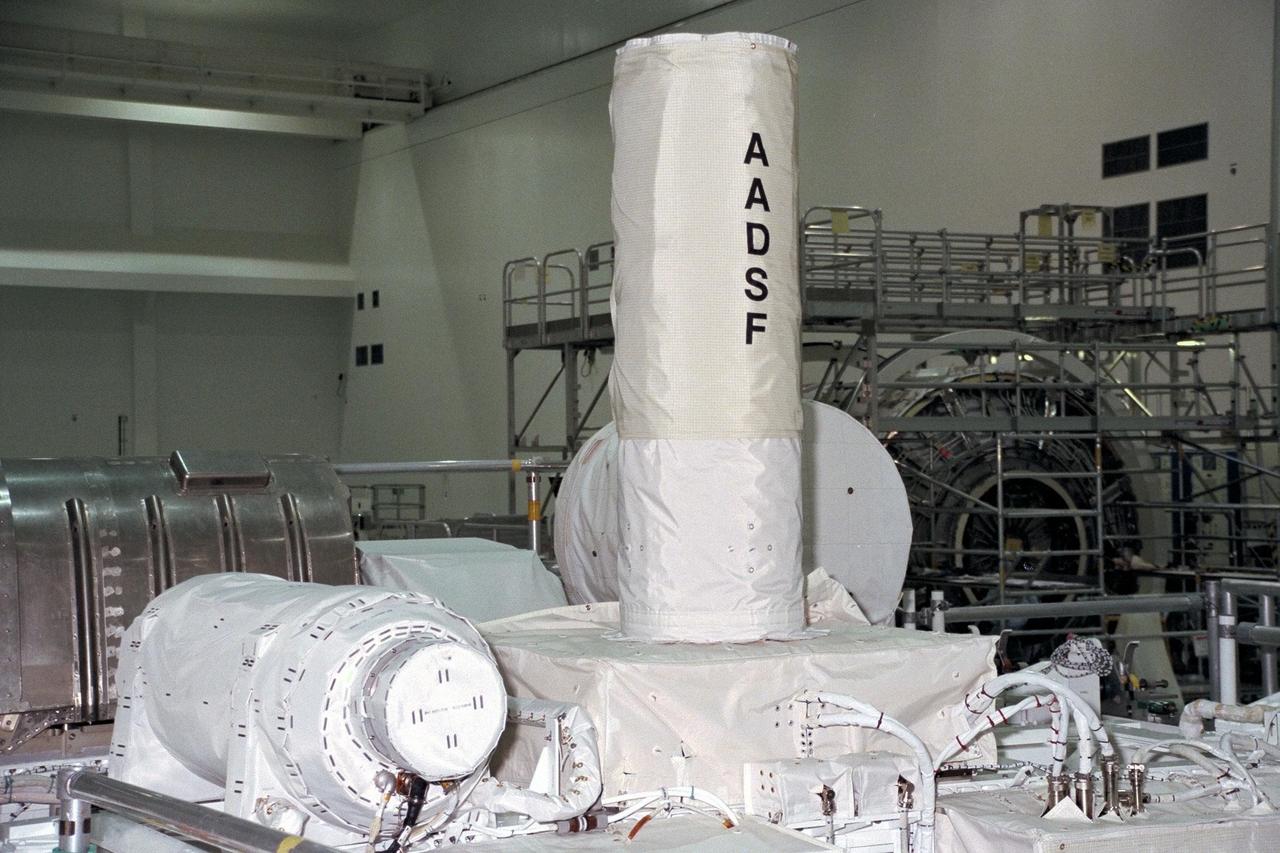
United States Microgravity Payload-4 (USMP-4) experiments are prepared to be flown on Space Shuttle mission STS-87 in the Space Station Processing Facility at Kennedy Space Center (KSC). The vertical tube in the center of the photo is the Advanced Automated Directional Solidification Furnace (AADSF), which will be used by researchers to study the solidification of semiconductor materials in microgravity. Scientists will be able to better understand how microgravity influences the solidification process of these materials and develop better methods for controlling that process during future Space flights and Earth-based production. To its left is MEPHISTO, the French acronym for a cooperative American-French investigation of the fundamentals of crystal growth. All STS-87 experiments are scheduled for launch on Nov. 19 from KSC
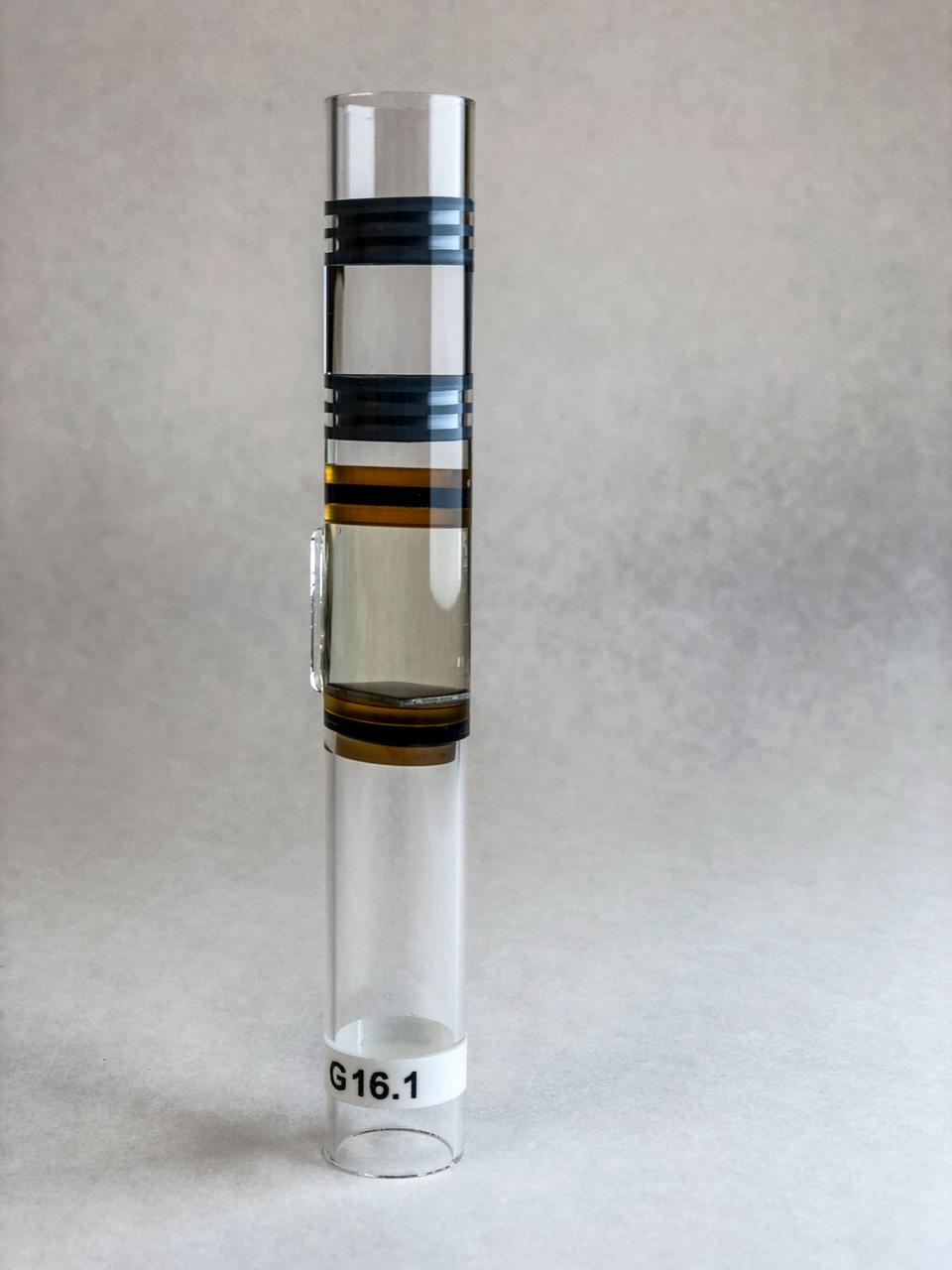
jsc2020e003405 (10/30/2019) --- A preflight view of BioServe’s Fluid Processing Apparatus (FPA) in a three-chamber configuration. From bottom to top: sterile growth medium and 1 cm2 material coupon, bacteria in stasis (inoculum), and fixative for controlled experiment termination. FPAs were used to house the bacterial component of this experiment, where six different materials were tested. The Characterization of Biofilm Formation, Growth, and Gene Expression on Different Materials and Environmental Conditions in Microgravity (Space Biofilms) investigation characterizes the mass, thickness, structure, and associated gene expression of biofilms that form in space by analyzing different microbial species grown on different materials. Biofilm formation can cause equipment malfunction and human illnesses, and could be a serious problem on future long-term human space missions.

Some geological materials (like solid rock) are incredibly tough, but others (like piles of volcanic ash) are quite soft. Some materials are soft enough that they can be eroded by the wind alone and yield landscapes that look like what we see in this HiRISE image. The long straight ridges seen here are called yardangs and they form on Mars (and Earth) when the wind strips away the inter-ridge material. This process is greatly aided when the wind is also blowing sand along. The sand grains do an effective job at stripping away loose material: these ridges are literally being sandblasted. Yardangs are useful features to recognize because the tell us the direction the wind is blowing in. They take a long time to form so this direction is the dominant wind orientation averaged over a long period of time (which might be quite different that the winds on Mars today). These yardangs also tell us that the surface here is made up of loose weak material and this information, in conjunction with other data, can tell us what the material is composed of and what the history of this particular site on Mars has been. http://photojournal.jpl.nasa.gov/catalog/PIA19457

August Witt, Massachusetts Institute of Technology, principal investigator for the research program designed to lead to the identification and control of gravitational effects which adversely impact, through their interference with the growth process, the achievement of critical application specific properties in opto-electronic materials.
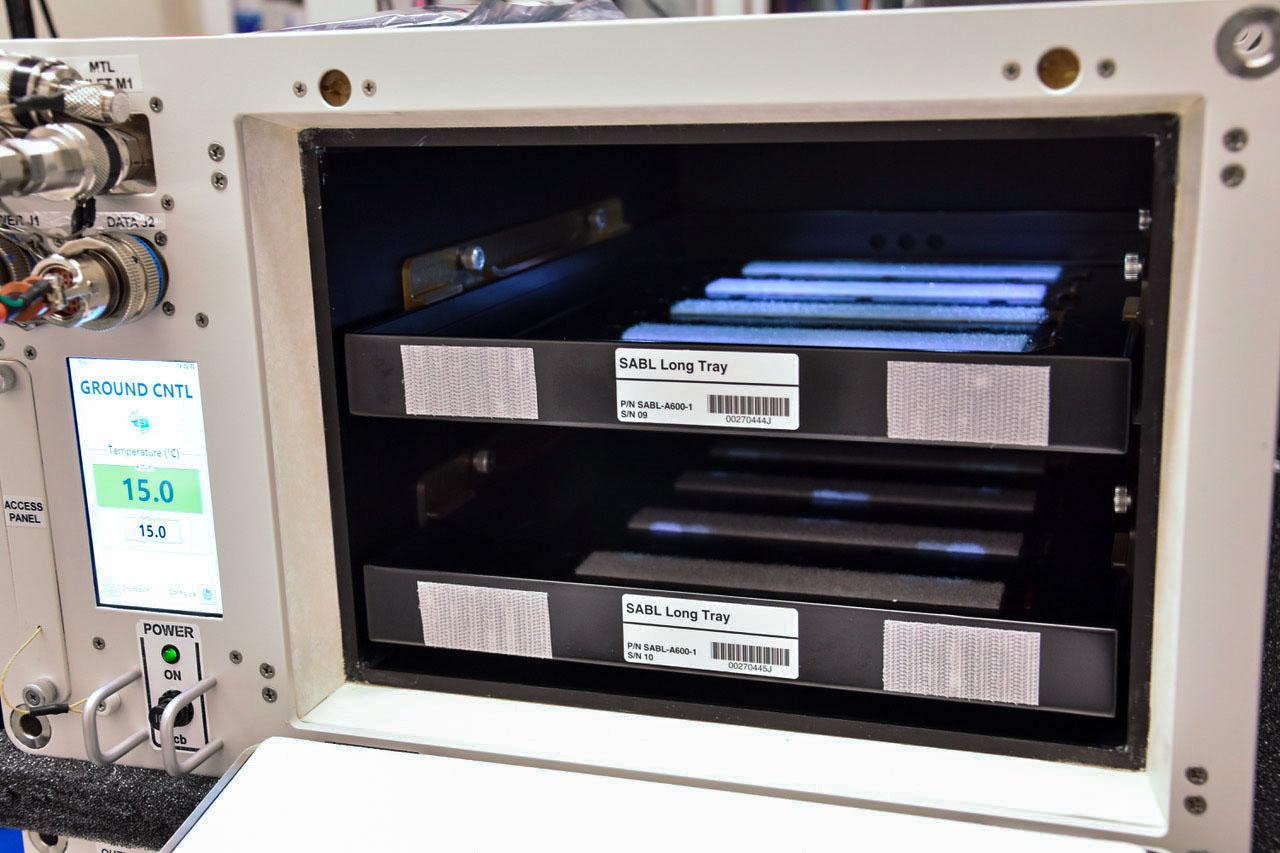
jsc2021e037286 (5/21/2021) --- A preflight view of the SALI incubator. The Space Automated Lab Incubator (SALI) supports a wide variety of investigations in the life, physical, and material sciences, focusing on research on biological systems and processes. SALI accommodates multiple sample packs or habitats and also serves as back-up cold stowage.
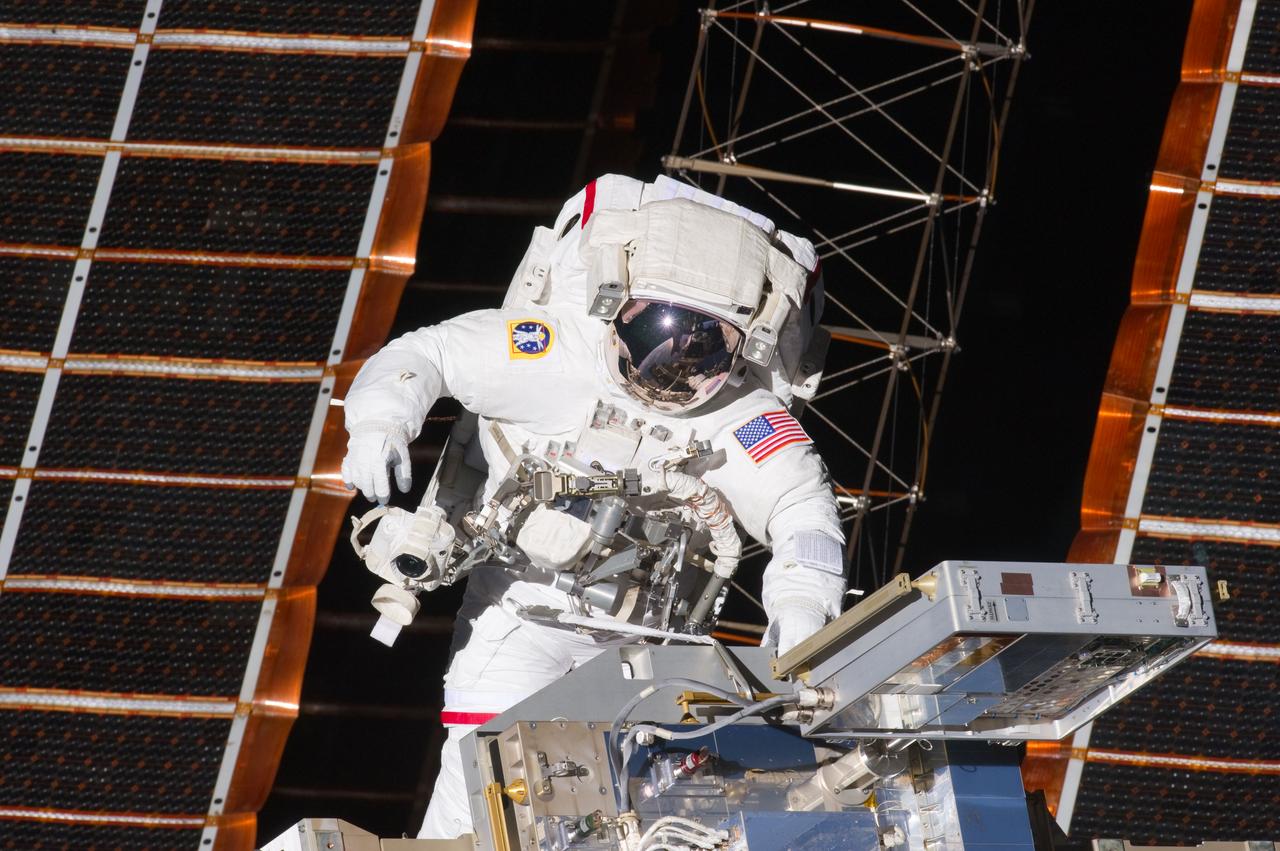
s134e007603 (5/20/2011) --- View of STS-134 Mission Specialist (MS-3) Andrew Feustel working to install a new Materials International Space Station Experiment (MISSE) on the EXPRESS (Expedite the Processing of Experiments to Space Station) Logistics Carrier 2 (ELC2) during the first session of Extravehicular Activity (EVA-1).
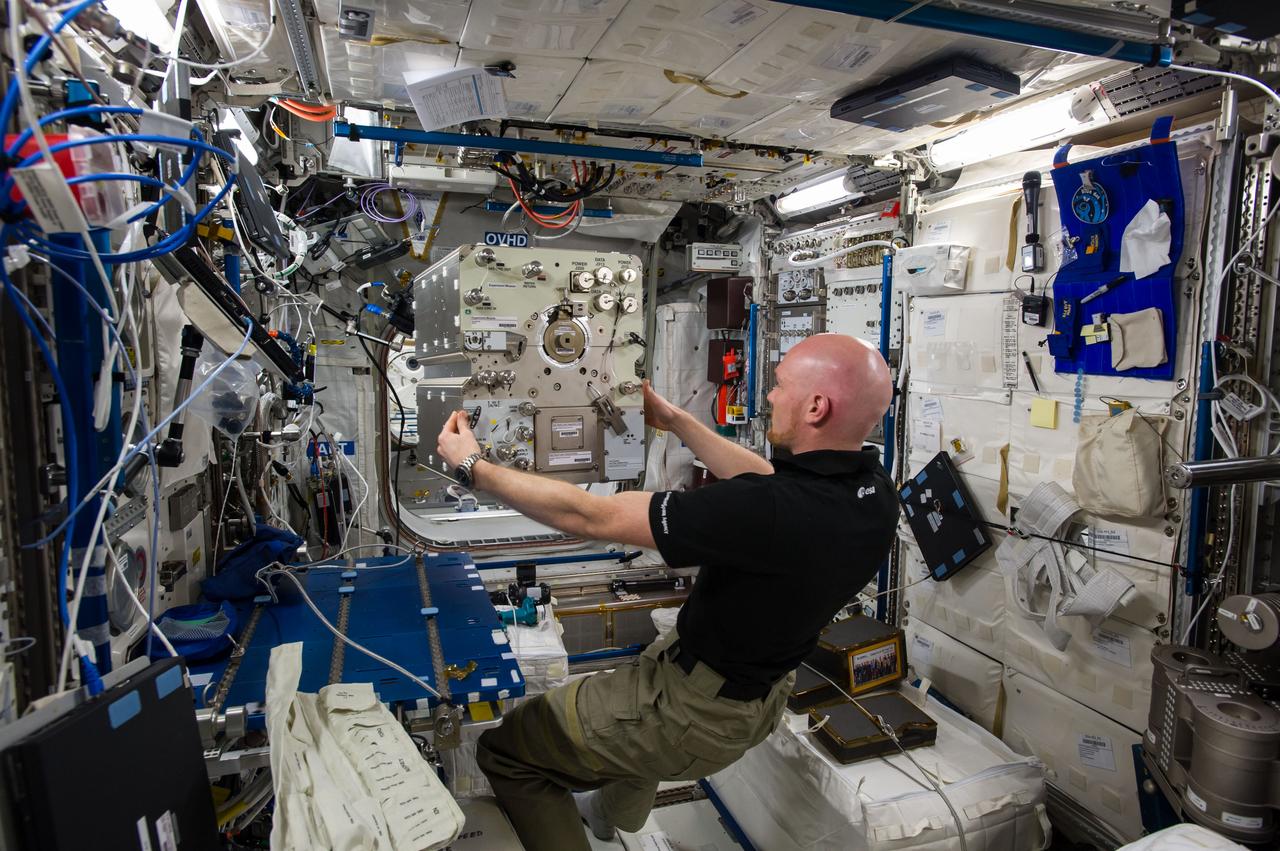
iss040e108044 (8/21/2014) — European Space Agency (ESA) astronaut Alexander Gerst, is shown in the Columbus module of the International Space Station (ISS) during the installation of the Electromagnetic Levitator (EML). The EML multi-user facility is designed for containerless materials processing in space.

Horticulturalists study the use of 3D printed materials as media to grow plants at NASA’s Kennedy Space Center on April 17, 2023. The activity is taking place inside the Plant Production Area at the Florida spaceport’s Space Station Processing Facility.
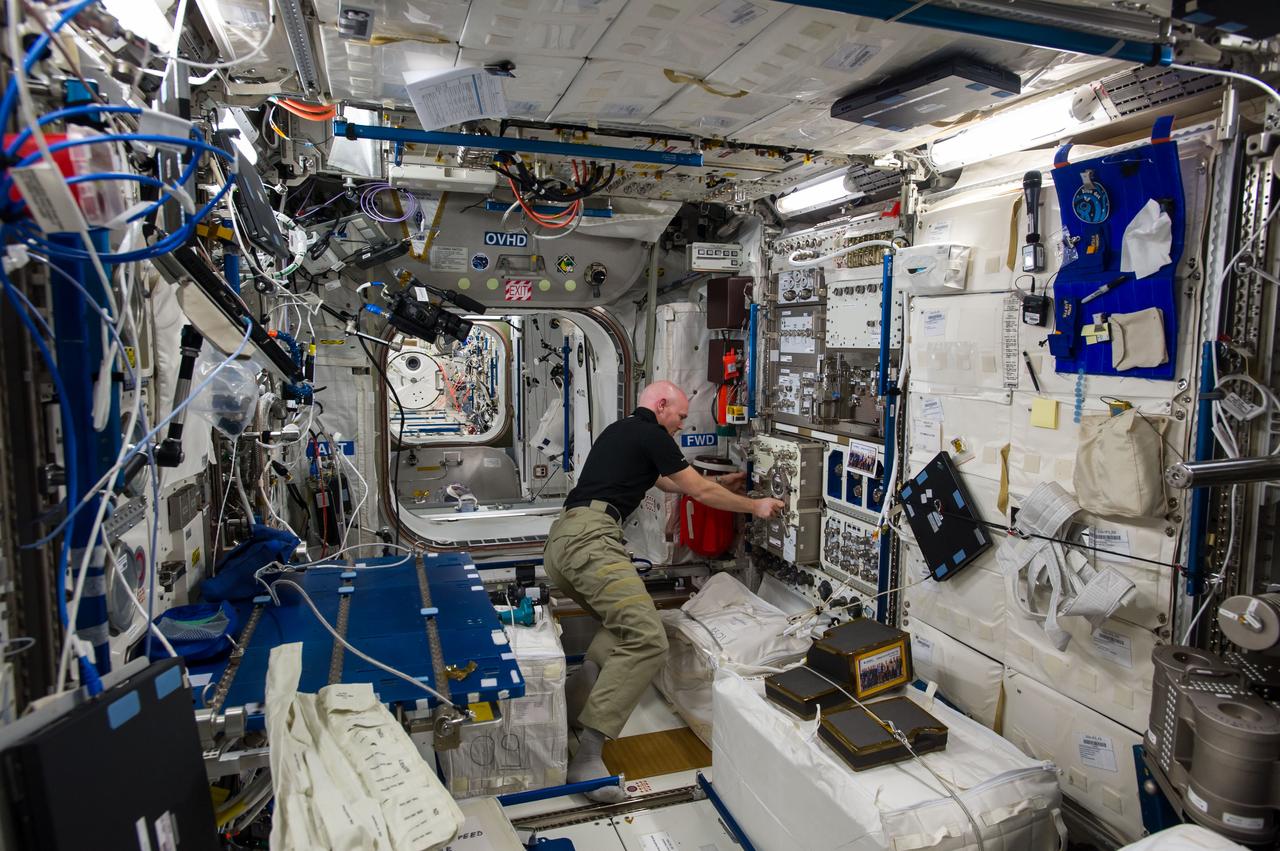
iss040e108050 (8/21/2014) — European Space Agency (ESA) astronaut Alexander Gerst, is shown in the Columbus module of the International Space Station (ISS) during the installation of the Electromagnetic Levitator (EML). The EML multi-user facility is designed for containerless materials processing in space.
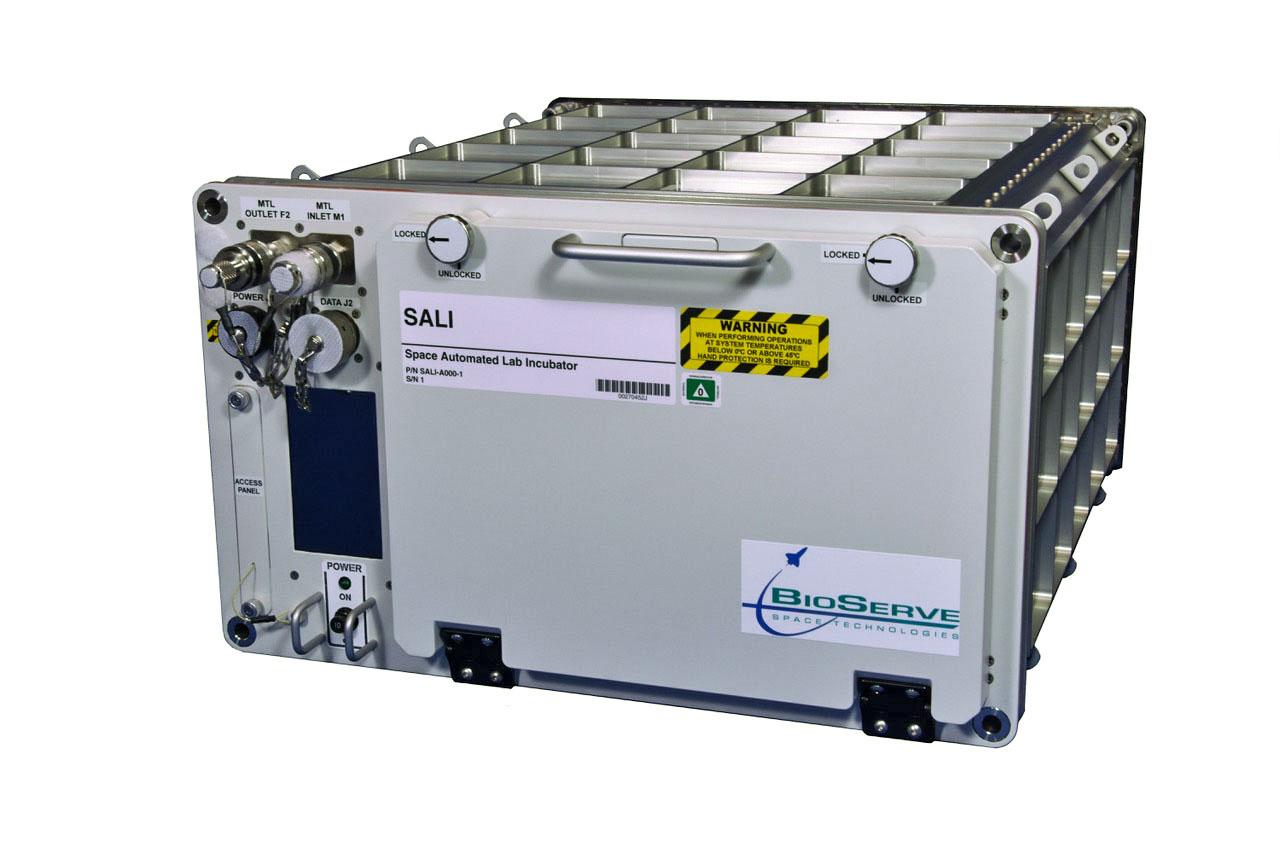
jsc2021e037287 (5/21/2021) --- A preflight view of the SALI incubator. The Space Automated Lab Incubator (SALI) supports a wide variety of investigations in the life, physical, and material sciences, focusing on research on biological systems and processes. SALI accommodates multiple sample packs or habitats and also serves as back-up cold stowage.e.
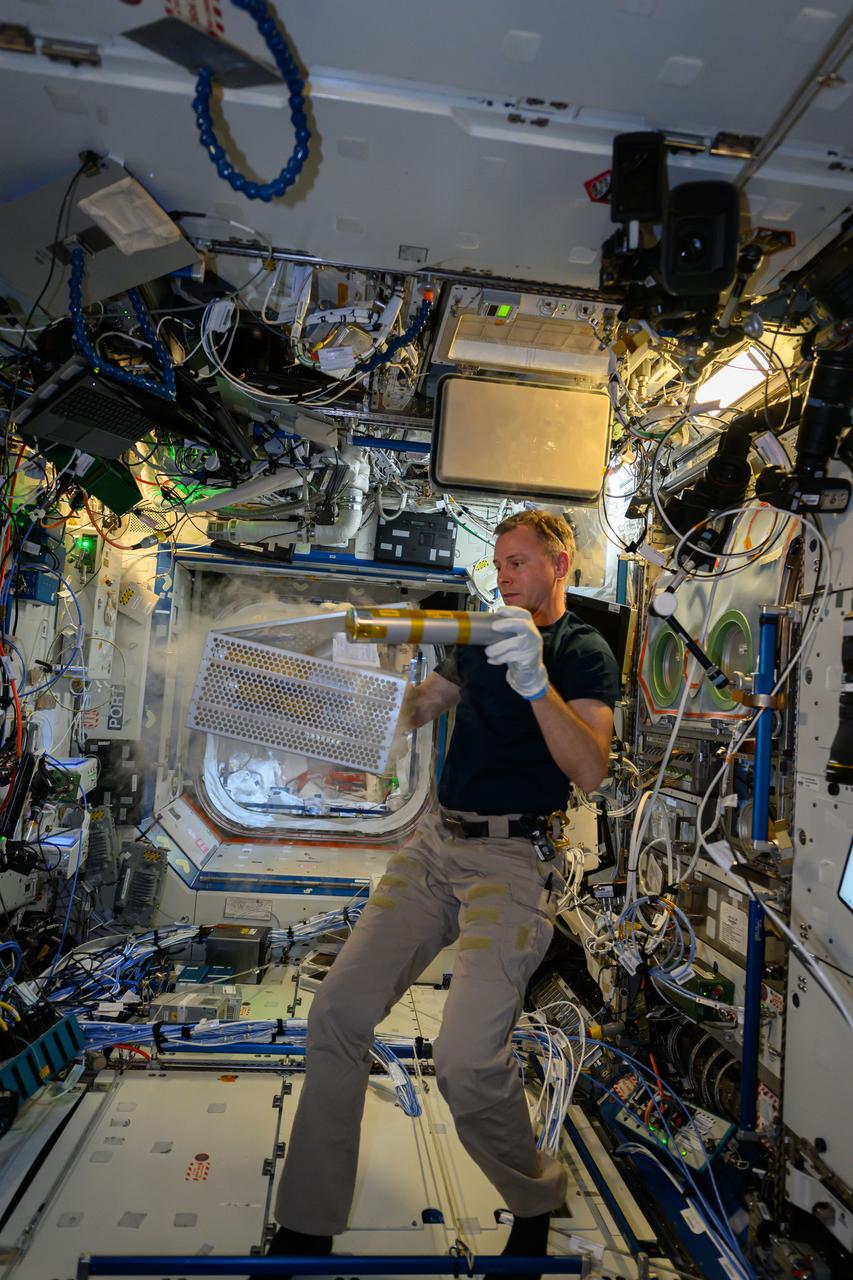
iss072e146896 (Nov. 10, 2024) --- NASA astronaut and Expedition 72 Flight Engineer Nick Hague processes samples from the Rhodium Biomanufacturing-03 biotechnology experiment that explores using microorganisms and cell cultures to produce materials and biomolecules on a commercial scale in space.

Lead horticulturist LaShelle Spencer studies the use of 3D printed materials as media to grow plants at NASA’s Kennedy Space Center on April 17, 2023. The activity is taking place inside the Plant Production Area at the Florida spaceport’s Space Station Processing Facility.
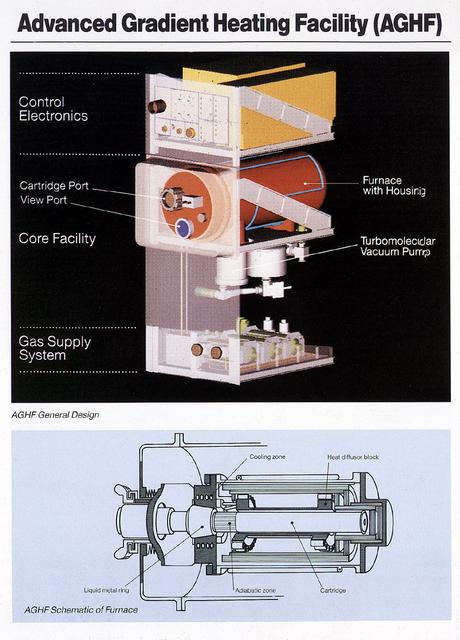
The Advanced Gradient Heating Facility (AGHF) is a European Space Agency (ESA) developed hardware. The AGHF was flown on STS-78, which featured four European PI's and two NASA PI's. The AGHFsupports the production of advanced semiconductor materials and alloys using the directional process, which depends on establishing a hot side and a cold side in the sample.
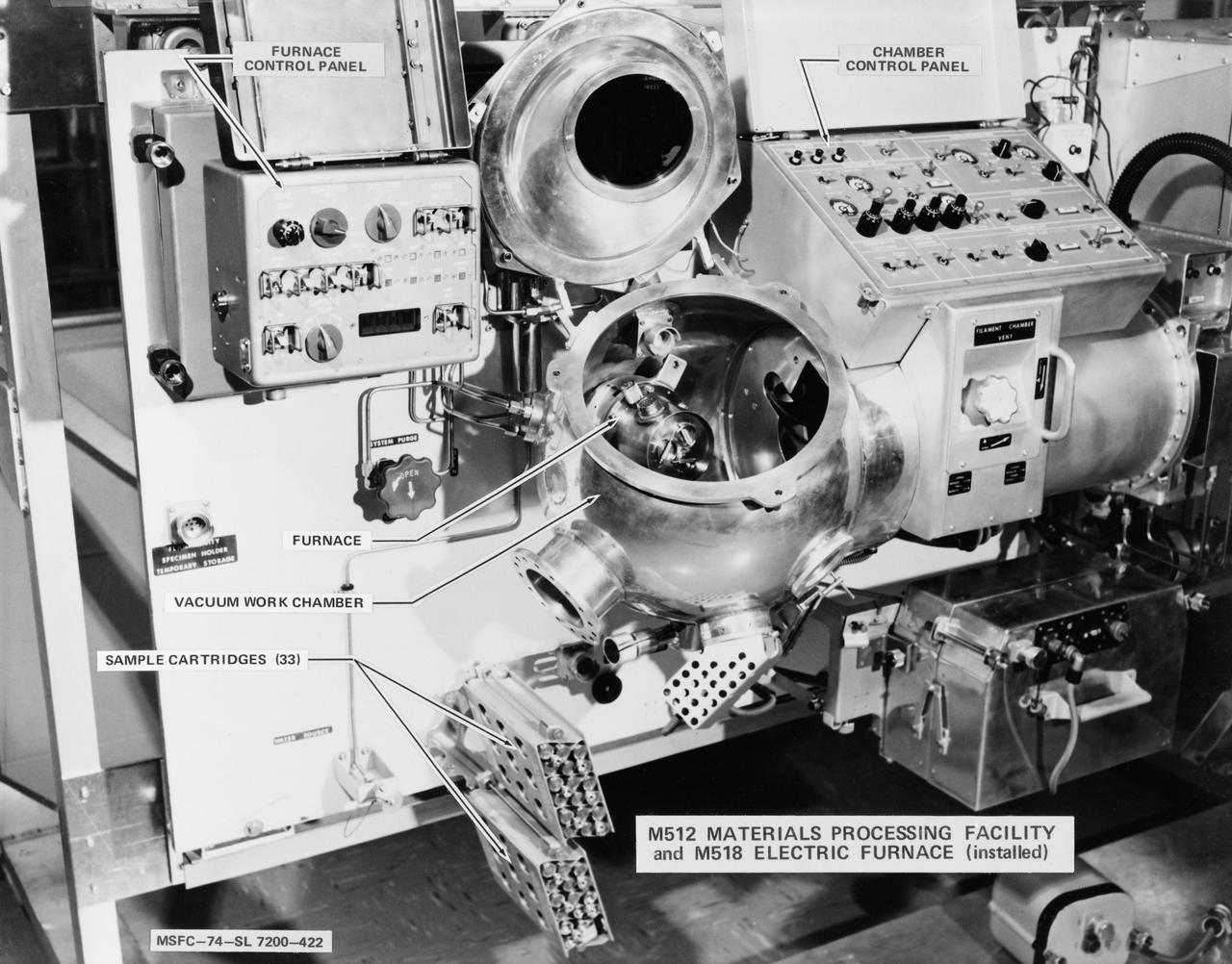
S74-19675 (1974) --- Medium close-up view of the M512 materials processing equipment storage assembly and the M518 electric furnace in the Multiple Docking Adapter (MDA), one of the primary elements of the Skylab space station. The assembly holds equipment designed to explore space manufacturing capability in a weightless state. Photo credit: NASA
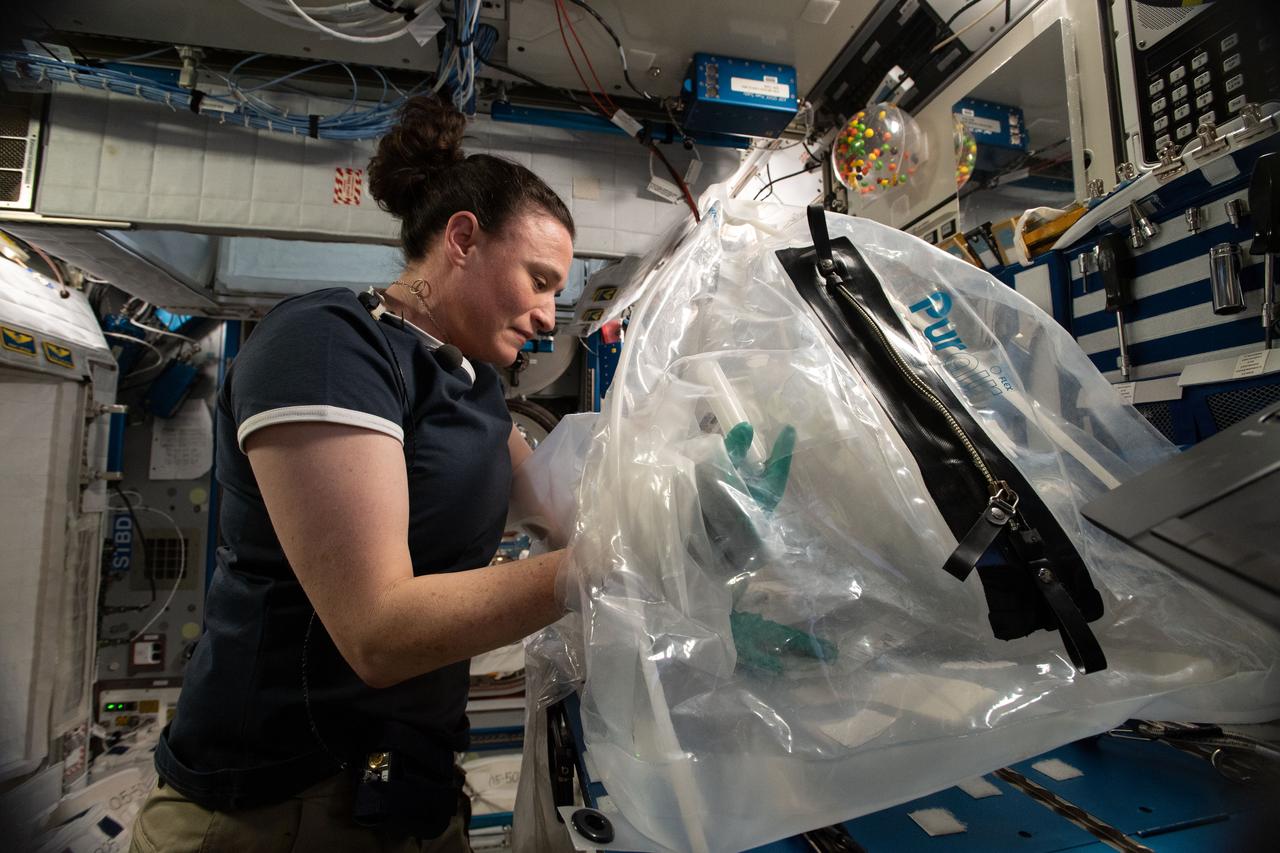
iss056e037491 (June 26, 2018) --- Astronaut Serena Auñón-Chancellor from NASA works on the Microgravity Investigation of Cement Solidification (MICS) 2 experiment aboard the International Space Station. MICS 2 is researching how cement reacts in space during the hardening process and may help engineers better understand its microstructure and material properties. Observations could improve cement processing techniques on Earth and lead to the design of safer, lightweight space habitats.
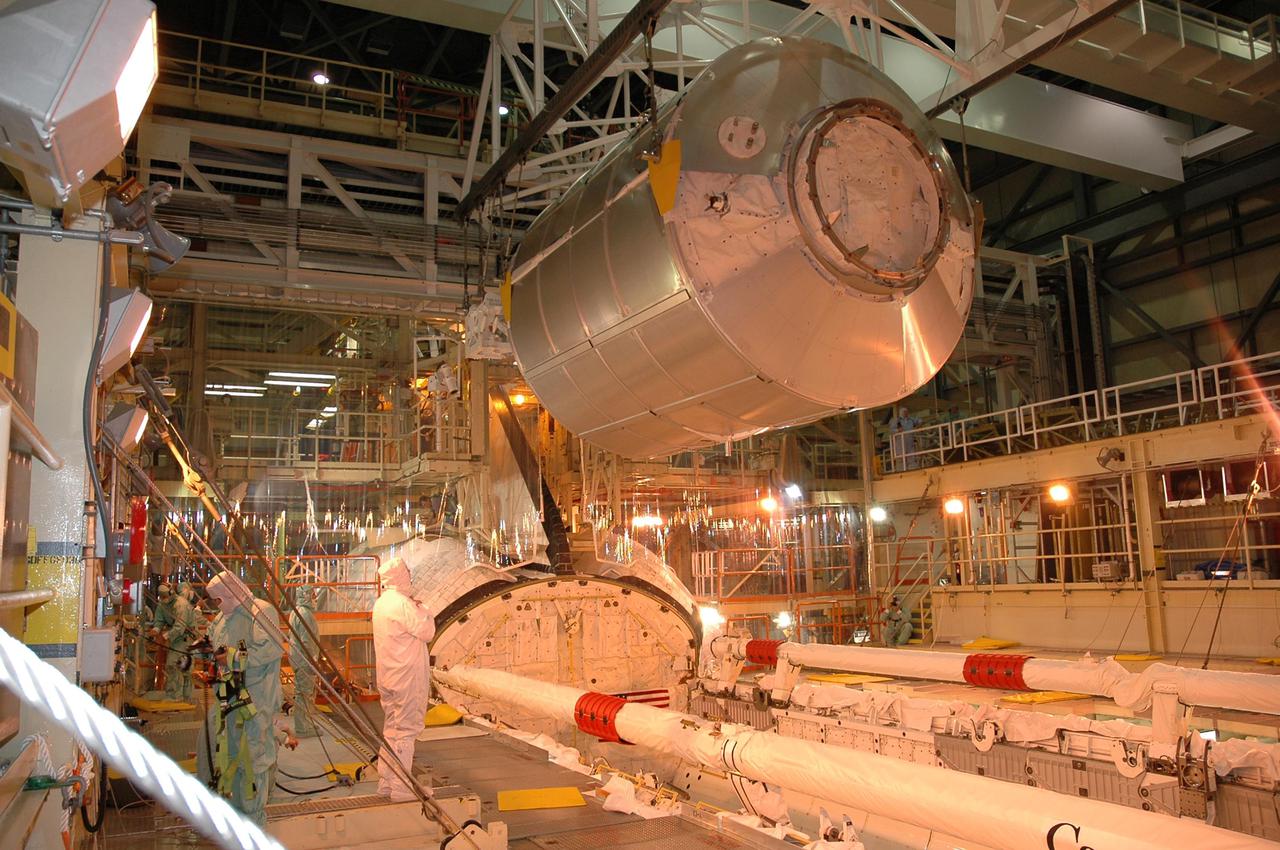
KENNEDY SPACE CENTER, FLA. -- In bay 3 of NASA Kennedy Space Center’s Orbiter Processing Facility, the Multi-Purpose Logistics Module Raffaello is removed from Space Shuttle Discovery's payload bay. The module holds material returned to KSC from the International Space Station on Return to Flight mission STS-114. The module is being lifted out of the payload bay and transferred to the Space Station Processing Facility to be emptied. Discovery will fly next on the second Return to Flight mission, STS-121.

KENNEDY SPACE CENTER, FLA. -- A transportation canister containing the Multi-Purpose Logistics Module Raffaello arrives at NASA Kennedy Space Center’s Space Station Processing Facility. Raffaello holds material returned from the International Space Station to KSC aboard Space Shuttle Discovery on Return to Flight mission STS-114. Raffaello will be transferred to an Element Rotation Stand later and emptied of its cargo. Discovery will undergo processing for the next Space Shuttle flight, STS-121, the second Return to Flight mission.
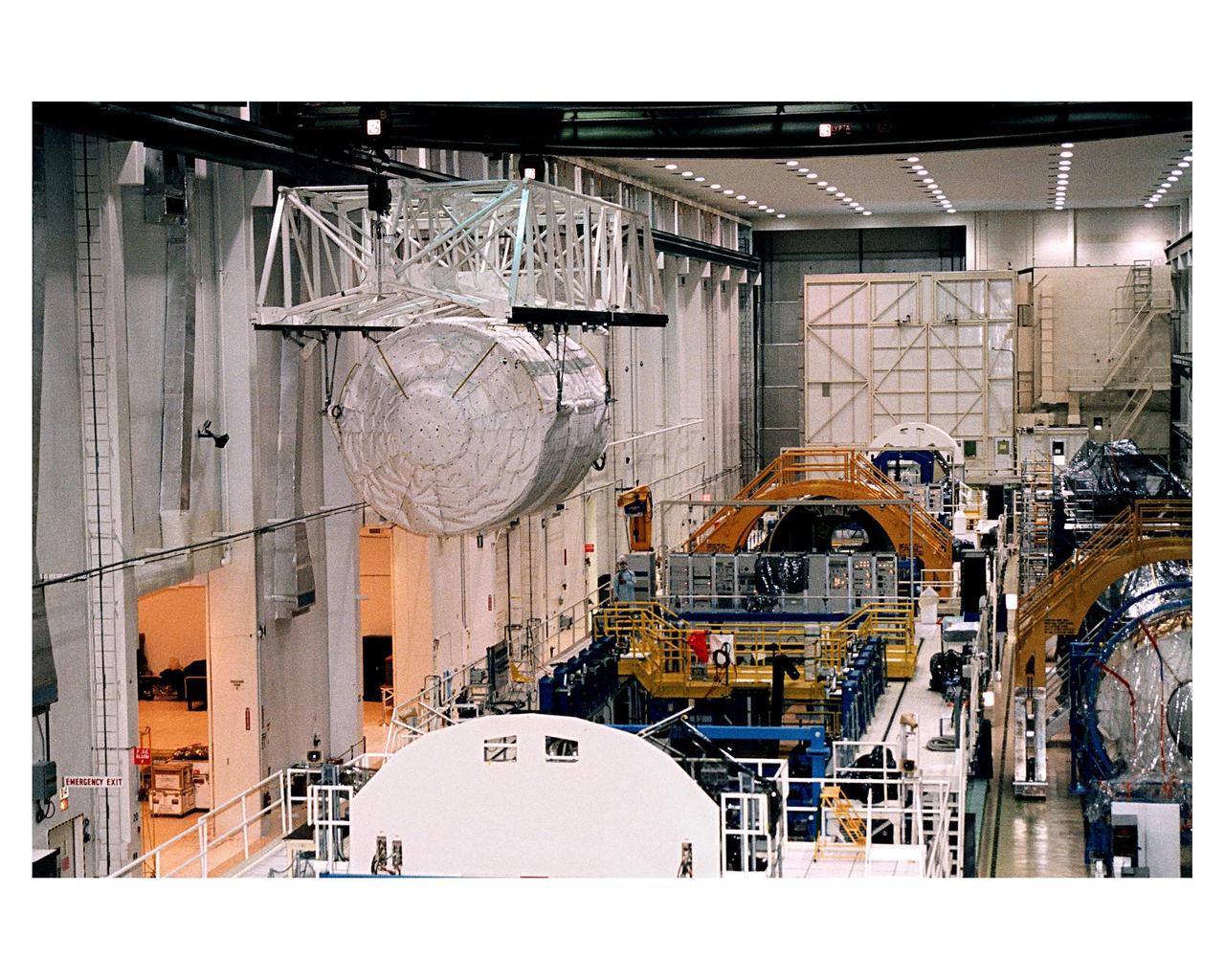
The Microgravity Science Laboratory-1 (MSL-1) Spacelab module is moved to be installed into a payload canister in the Operations and Checkout Building. Once in the canister, the MSL-1 will be transported to Orbiter Processing Bay 1 where it will be integrated into the payload bay of the Space Shuttle orbiter Columbia. During the scheduled 16-day STS-83 mission, the MSL-1 will be used to test some of the hardware, facilities and procedures that are planned for use on the International Space Station while the flight crew conducts combustion, protein crystal growth and materials processing experiments

KENNEDY SPACE CENTER, FLA. -- In bay 3 of NASA Kennedy Space Center’s Orbiter Processing Facility, technicians oversee the removal of the Multi-Purpose Logistics Module Raffaello from Space Shuttle Discovery's payload bay. The module holds material returned to KSC from the International Space Station on Return to Flight mission STS-114. The module is being lifted out of the payload bay and transferred to the Space Station Processing Facility to be emptied. Discovery will fly next on the second Return to Flight mission, STS-121.
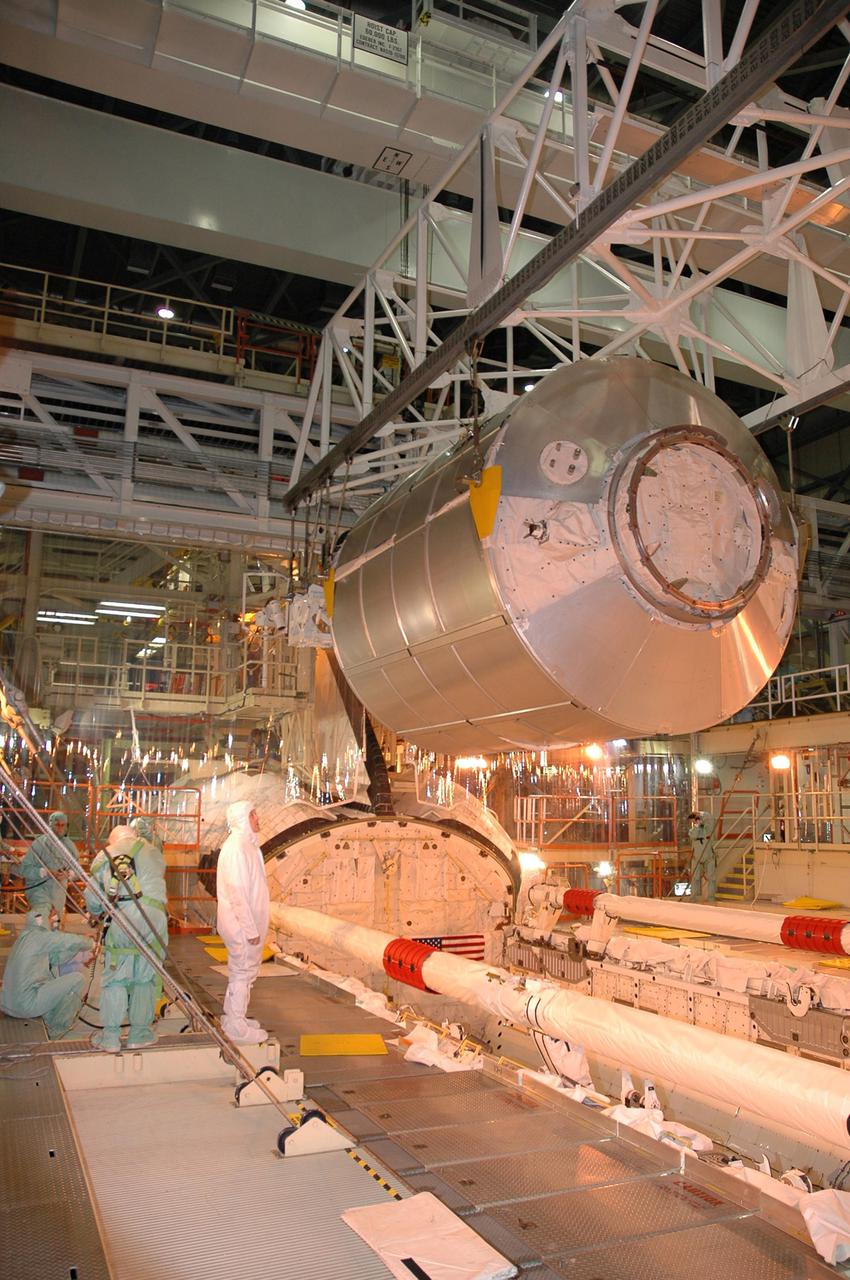
KENNEDY SPACE CENTER, FLA. -- In bay 3 of NASA Kennedy Space Center’s Orbiter Processing Facility, the Multi-Purpose Logistics Module Raffaello is removed from Space Shuttle Discovery's payload bay. The module holds material returned to KSC from the International Space Station on Return to Flight mission STS-114. The module is being lifted out of the payload bay and transferred to the Space Station Processing Facility to be emptied. Discovery will fly next on the second Return to Flight mission, STS-121.