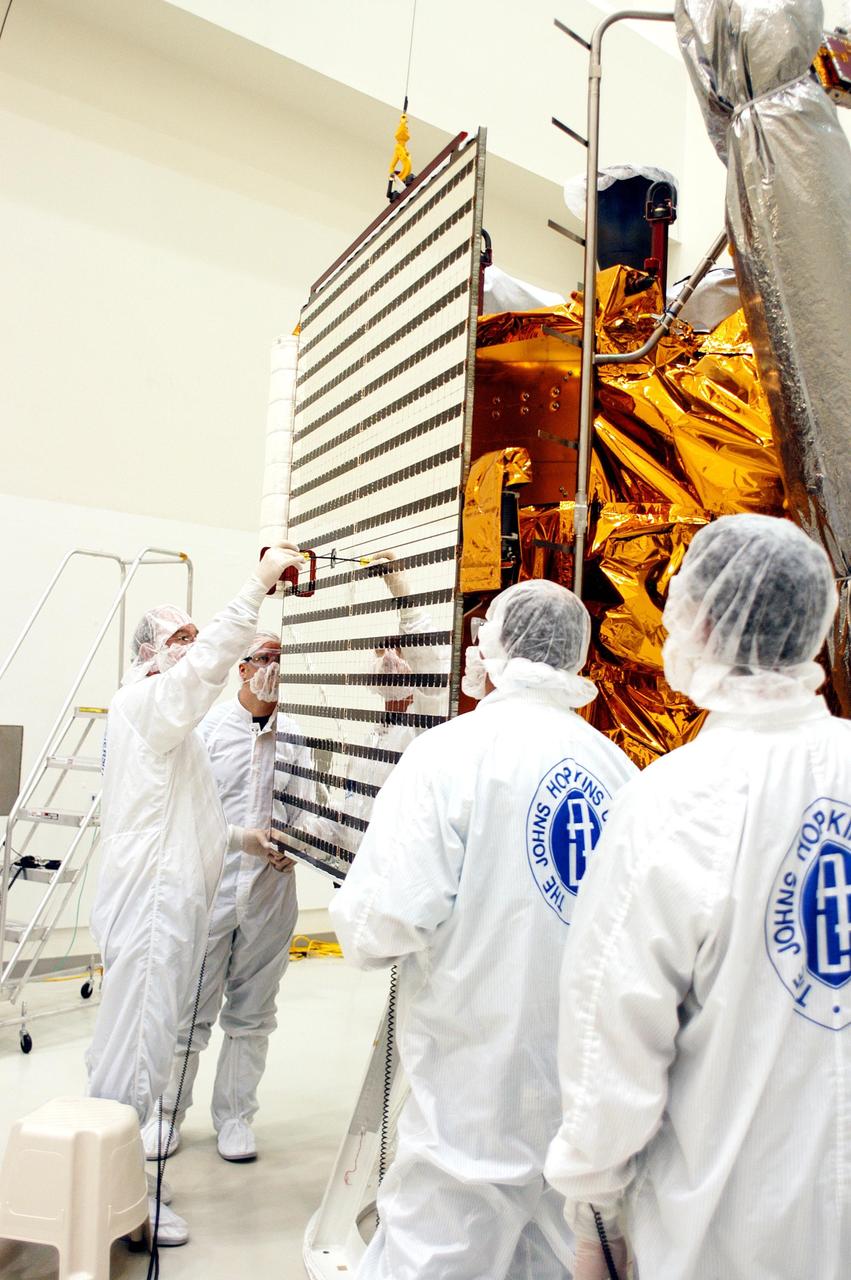
KENNEDY SPACE CENTER, FLA. - At Astrotech in Titusville, Fla., technicians with The Johns Hopkins University Applied Physics Laboratory (APL) prepare one of two solar array panels on the MESSENGER spacecraft for deployment. The panels will provide MESSENGER’s power on its journey to Mercury. MESSENGER is scheduled to launch Aug. 2 aboard a Boeing Delta II rocket from Pad 17-B, Cape Canaveral Air Force Station, Fla. It will return to Earth for a gravity boost in July 2005, then fly past Venus twice, in October 2006 and June 2007. The spacecraft uses the tug of Venus’ gravity to resize and rotate its trajectory closer to Mercury’s orbit. Three Mercury flybys, each followed about two months later by a course-correction maneuver, put MESSENGER in position to enter Mercury orbit in March 2011. During the flybys, MESSENGER will map nearly the entire planet in color, image most of the areas unseen by Mariner 10, and measure the composition of the surface, atmosphere and magnetosphere. It will be the first new data from Mercury in more than 30 years - and invaluable for planning MESSENGER’s year-long orbital mission. MESSENGER was built for NASA by APL in Laurel, Md.
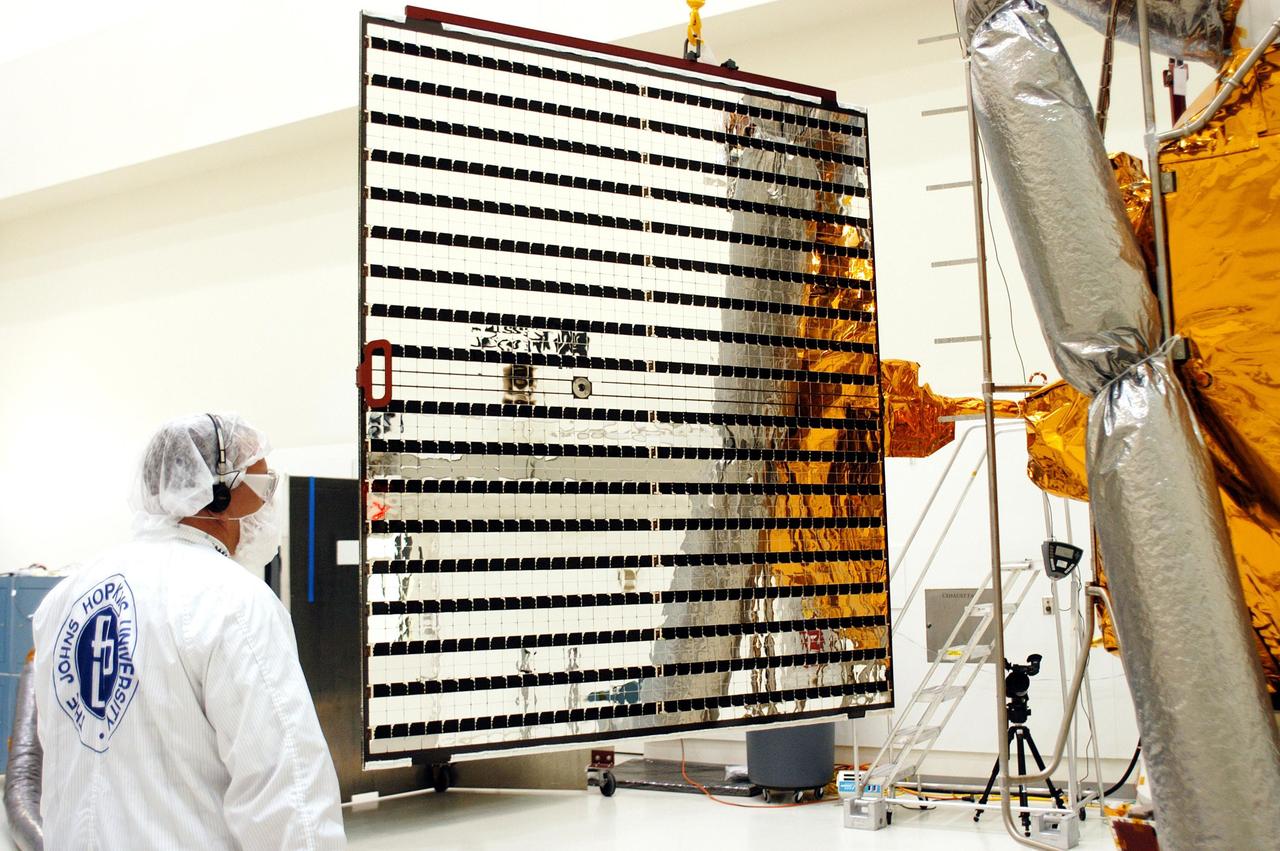
KENNEDY SPACE CENTER, FLA. - At Astrotech in Titusville, Fla., a technician with The Johns Hopkins University Applied Physics Laboratory (APL) watches as one of the solar array panels on the MESSENGER spacecraft is deployed. The two panels will provide MESSENGER’s power on its journey to Mercury. MESSENGER is scheduled to launch Aug. 2 aboard a Boeing Delta II rocket from Pad 17-B, Cape Canaveral Air Force Station, Fla. It will return to Earth for a gravity boost in July 2005, then fly past Venus twice, in October 2006 and June 2007. The spacecraft uses the tug of Venus’ gravity to resize and rotate its trajectory closer to Mercury’s orbit. Three Mercury flybys, each followed about two months later by a course-correction maneuver, put MESSENGER in position to enter Mercury orbit in March 2011. During the flybys, MESSENGER will map nearly the entire planet in color, image most of the areas unseen by Mariner 10, and measure the composition of the surface, atmosphere and magnetosphere. It will be the first new data from Mercury in more than 30 years - and invaluable for planning MESSENGER’s year-long orbital mission. MESSENGER was built for NASA by APL in Laurel, Md.
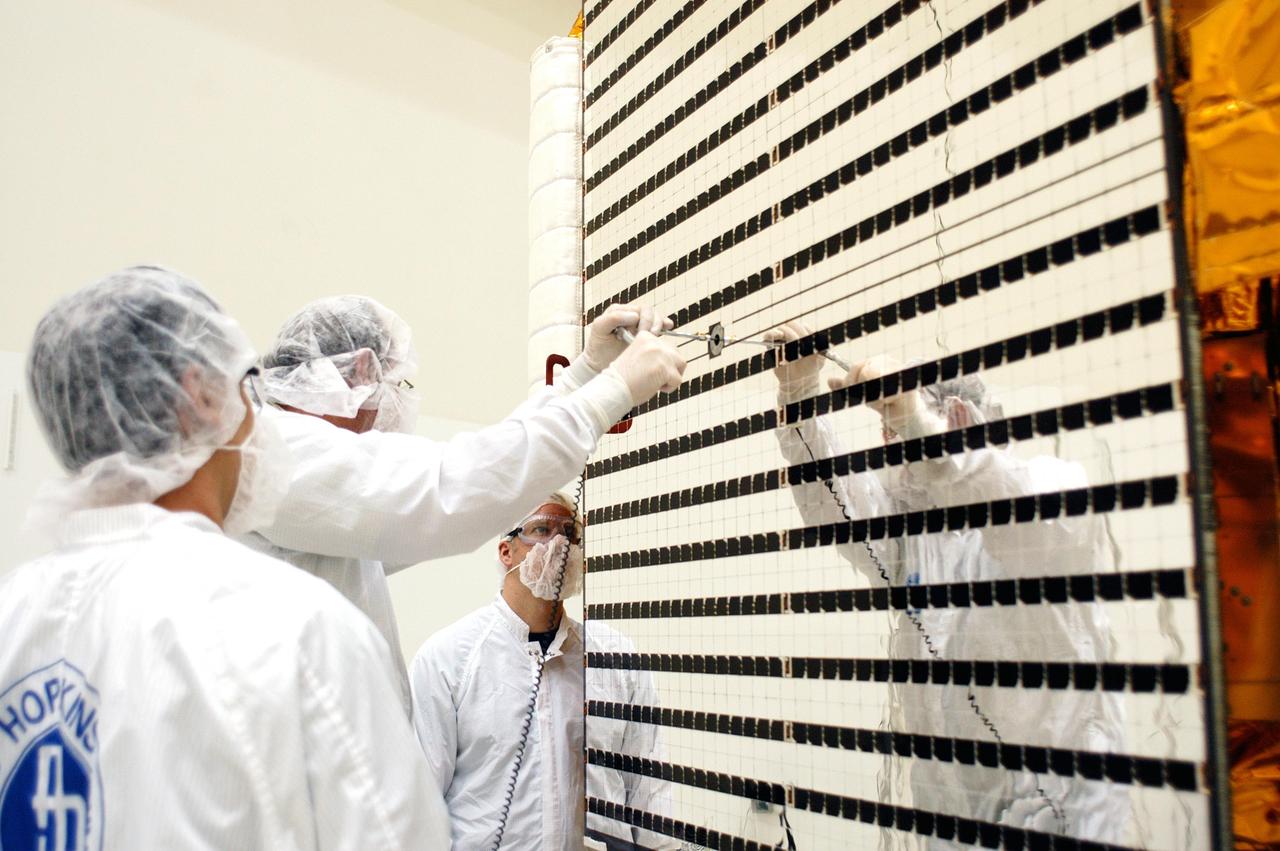
KENNEDY SPACE CENTER, FLA. - At Astrotech in Titusville, Fla., technicians with The Johns Hopkins University Applied Physics Laboratory (APL) prepare one of two solar array panels on the MESSENGER spacecraft for deployment. The panels will provide MESSENGER’s power on its journey to Mercury. MESSENGER is scheduled to launch Aug. 2 aboard a Boeing Delta II rocket from Pad 17-B, Cape Canaveral Air Force Station, Fla. It will return to Earth for a gravity boost in July 2005, then fly past Venus twice, in October 2006 and June 2007. The spacecraft uses the tug of Venus’ gravity to resize and rotate its trajectory closer to Mercury’s orbit. Three Mercury flybys, each followed about two months later by a course-correction maneuver, put MESSENGER in position to enter Mercury orbit in March 2011. During the flybys, MESSENGER will map nearly the entire planet in color, image most of the areas unseen by Mariner 10, and measure the composition of the surface, atmosphere and magnetosphere. It will be the first new data from Mercury in more than 30 years - and invaluable for planning MESSENGER’s year-long orbital mission. MESSENGER was built for NASA by APL in Laurel, Md.
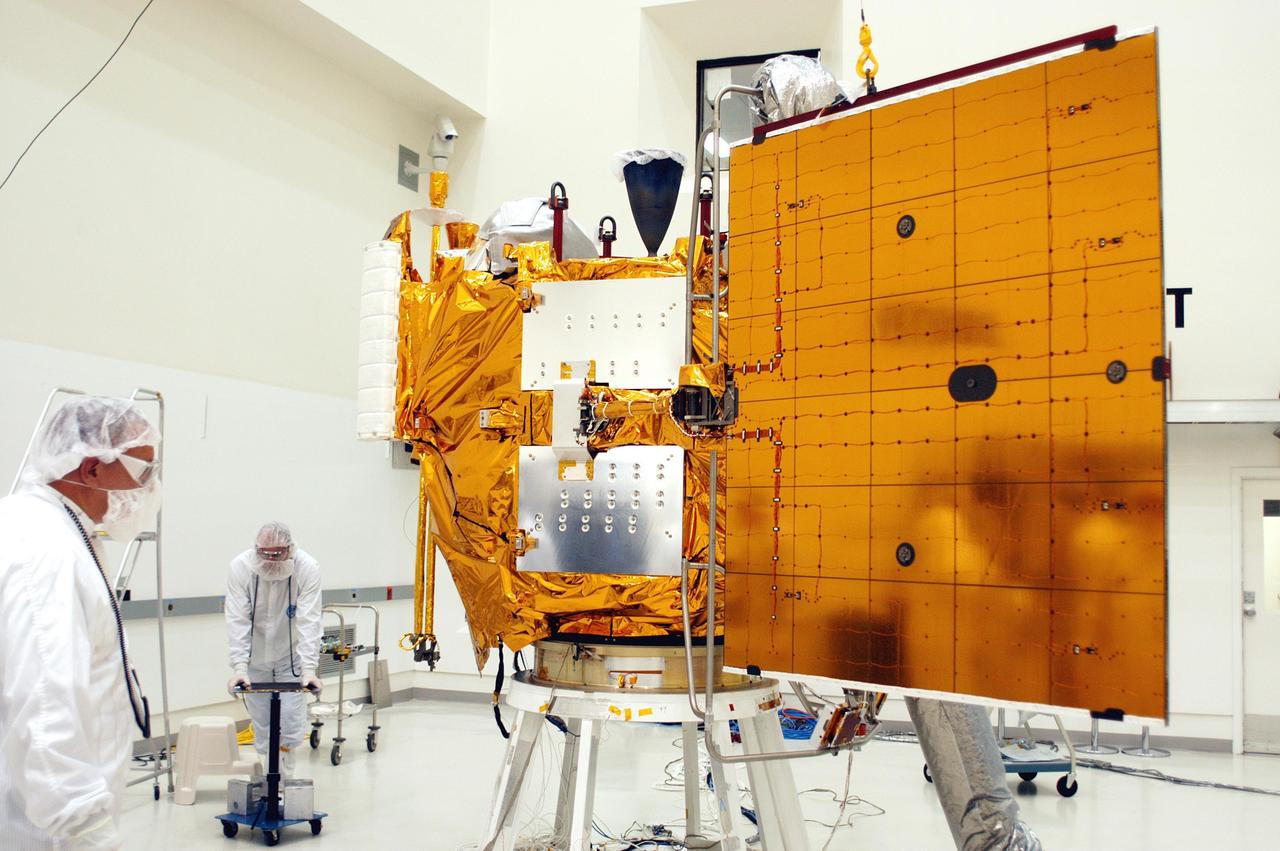
KENNEDY SPACE CENTER, FLA. - At Astrotech in Titusville, Fla., technicians with The Johns Hopkins University Applied Physics Laboratory (APL) monitor the progress of the solar array deployment on the MESSENGER spacecraft. The two panels will provide MESSENGER’s power on its journey to Mercury. MESSENGER is scheduled to launch Aug. 2 aboard a Boeing Delta II rocket from Pad 17-B, Cape Canaveral Air Force Station, Fla. It will return to Earth for a gravity boost in July 2005, then fly past Venus twice, in October 2006 and June 2007. The spacecraft uses the tug of Venus’ gravity to resize and rotate its trajectory closer to Mercury’s orbit. Three Mercury flybys, each followed about two months later by a course-correction maneuver, put MESSENGER in position to enter Mercury orbit in March 2011. During the flybys, MESSENGER will map nearly the entire planet in color, image most of the areas unseen by Mariner 10, and measure the composition of the surface, atmosphere and magnetosphere. It will be the first new data from Mercury in more than 30 years - and invaluable for planning MESSENGER’s year-long orbital mission. MESSENGER was built for NASA by APL in Laurel, Md.
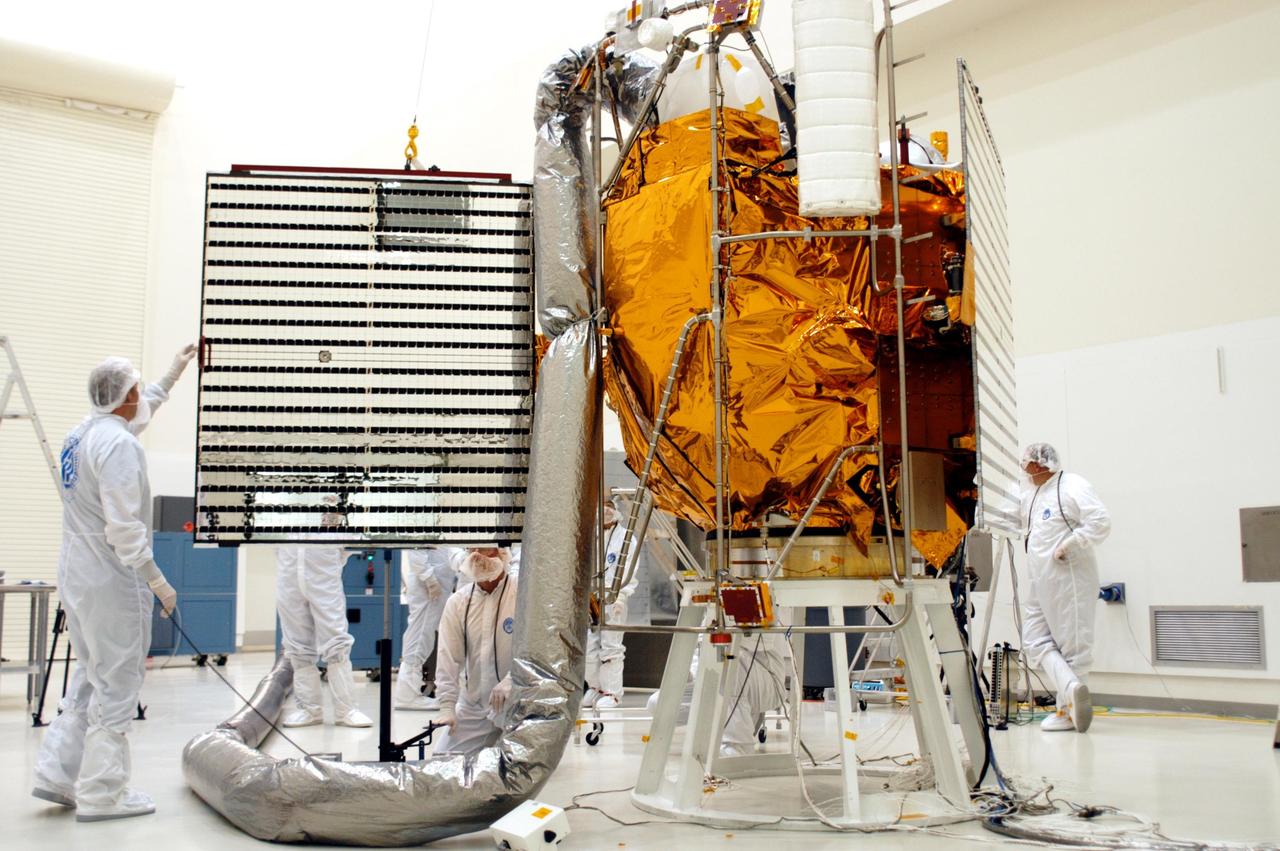
KENNEDY SPACE CENTER, FLA. - At Astrotech in Titusville, Fla., technicians with The Johns Hopkins University Applied Physics Laboratory (APL) check one of two solar panels on the MESSENGER spacecraft after a deployment test. The other panel is at right, undeployed. The solar arrays will provide MESSENGER’s power on its journey to Mercury. MESSENGER is scheduled to launch Aug. 2 aboard a Boeing Delta II rocket from Pad 17-B, Cape Canaveral Air Force Station, Fla. It will return to Earth for a gravity boost in July 2005, then fly past Venus twice, in October 2006 and June 2007. The spacecraft uses the tug of Venus’ gravity to resize and rotate its trajectory closer to Mercury’s orbit. Three Mercury flybys, each followed about two months later by a course-correction maneuver, put MESSENGER in position to enter Mercury orbit in March 2011. During the flybys, MESSENGER will map nearly the entire planet in color, image most of the areas unseen by Mariner 10, and measure the composition of the surface, atmosphere and magnetosphere. It will be the first new data from Mercury in more than 30 years - and invaluable for planning MESSENGER’s year-long orbital mission. MESSENGER was built for NASA by APL in Laurel, Md.

KENNEDY SPACE CENTER, FLA. - - After the deployment test of two solar panels at Astrotech in Titusville, Fla., technicians with The Johns Hopkins University Applied Physics Laboratory (APL) prepare the MESSESNGER spacecraft for a move to a hazardous processing facility in preparation for loading the spacecraft’s complement of hypergolic propellants. The solar arrays will provide MESSENGER’s power on its journey to Mercury. MESSENGER is scheduled to launch Aug. 2 aboard a Boeing Delta II rocket from Pad 17-B, Cape Canaveral Air Force Station, Fla. It will return to Earth for a gravity boost in July 2005, then fly past Venus twice, in October 2006 and June 2007. The spacecraft uses the tug of Venus’ gravity to resize and rotate its trajectory closer to Mercury’s orbit. Three Mercury flybys, each followed about two months later by a course-correction maneuver, put MESSENGER in position to enter Mercury orbit in March 2011. During the flybys, MESSENGER will map nearly the entire planet in color, image most of the areas unseen by Mariner 10, and measure the composition of the surface, atmosphere and magnetosphere. It will be the first new data from Mercury in more than 30 years - and invaluable for planning MESSENGER’s year-long orbital mission. MESSENGER was built for NASA by APL in Laurel, Md.
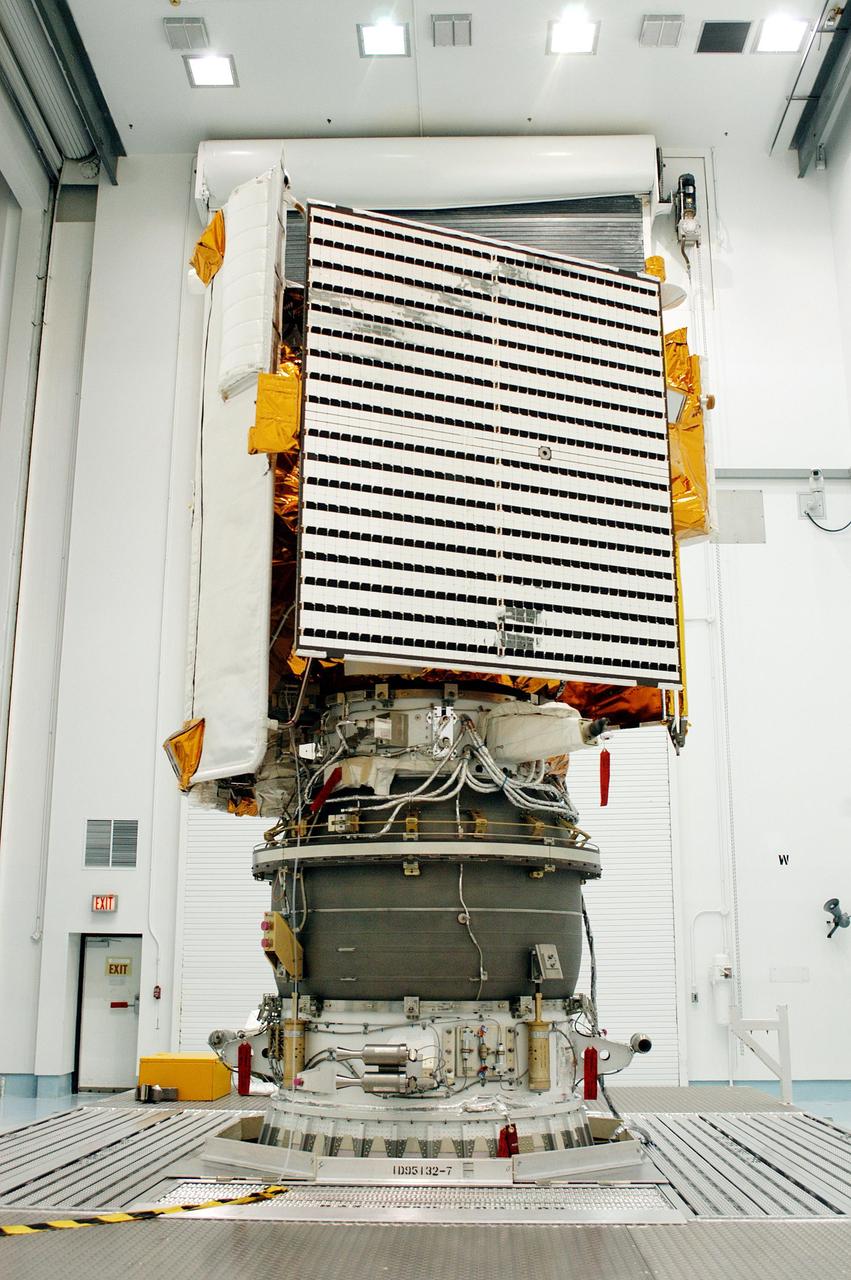
KENNEDY SPACE CENTER, FLA. - The MESSENGER (Mercury Surface, Space Environment, Geochemistry and Ranging) spacecraft, mated to the Delta II third stage Payload Assist Module, is on display at Astrotech Space Operations in Titusville, Fla., for the media. Spokespersons for the event are Dr. Robert Gold, MESSENGER payload manager with The Johns Hopkins University Applied Physics Laboratory (APL); and Ted Hartka, MESSENGER lead mechanical engineer, APL. MESSENGER is scheduled to launch Aug. 2 aboard a Boeing Delta II rocket from Pad 17-B, Cape Canaveral Air Force Station, Fla.
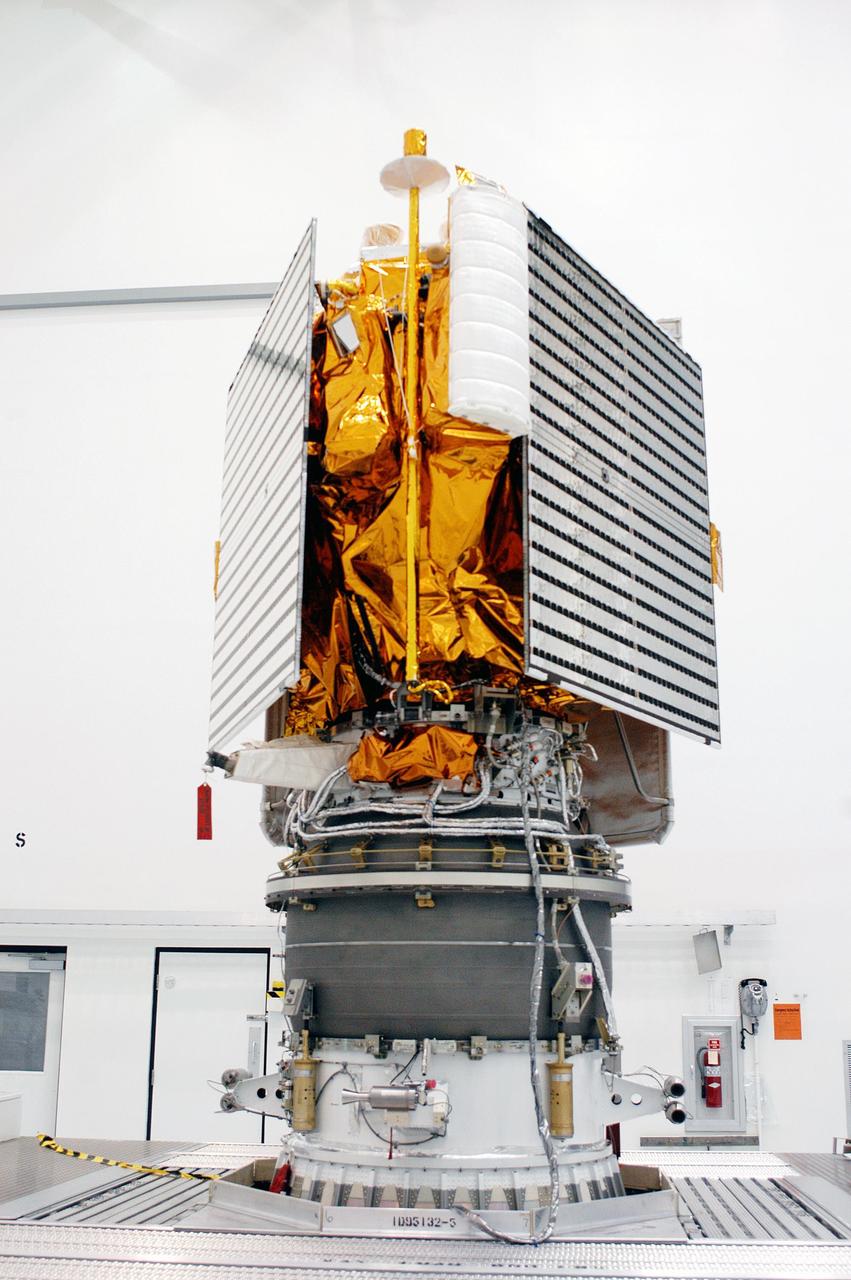
KENNEDY SPACE CENTER, FLA. - The MESSENGER (Mercury Surface, Space Environment, Geochemistry and Ranging) spacecraft, mated to the Delta II third stage Payload Assist Module, is ready for presentation to the media at Astrotech Space Operations in Titusville, Fla. Spokespersons for the event are Dr. Robert Gold, MESSENGER payload manager with The Johns Hopkins University Applied Physics Laboratory (APL); and Ted Hartka, MESSENGER lead mechanical engineer, APL. MESSENGER is scheduled to launch Aug. 2 aboard a Boeing Delta II rocket from Pad 17-B, Cape Canaveral Air Force Station, Fla.
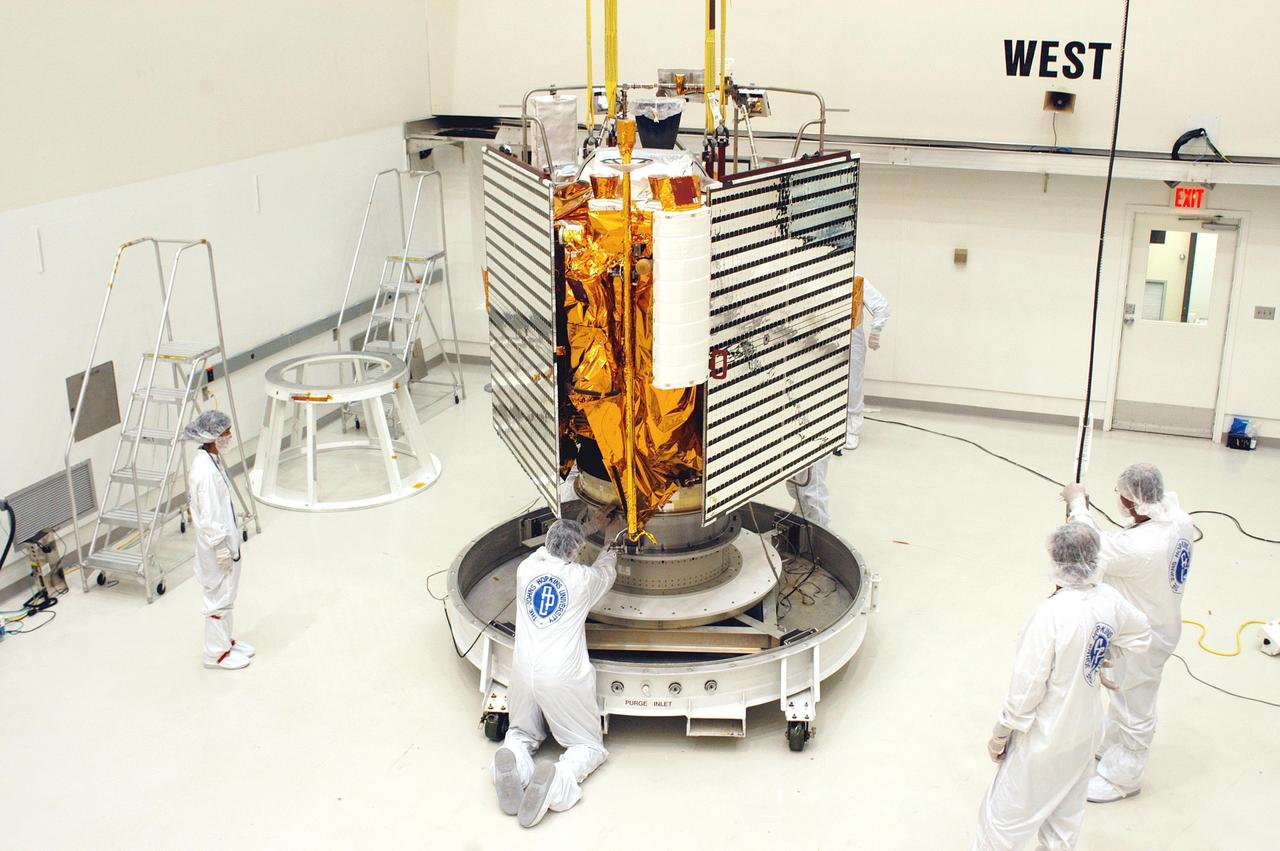
KENNEDY SPACE CENTER, FLA. - At Astrotech in Titusville, Fla., technicians with The Johns Hopkins University Applied Physics Laboratory (APL) prepare the MESSESNGER spacecraft for a move to a hazardous processing facility in preparation for loading the spacecraft’s complement of hypergolic propellants. MESSENGER is scheduled to launch Aug. 2 aboard a Boeing Delta II rocket from Pad 17-B, Cape Canaveral Air Force Station, Fla., on a journey to Mercury. It will return to Earth for a gravity boost in July 2005, then fly past Venus twice, in October 2006 and June 2007. The spacecraft uses the tug of Venus’ gravity to resize and rotate its trajectory closer to Mercury’s orbit. Three Mercury flybys, each followed about two months later by a course-correction maneuver, put MESSENGER in position to enter Mercury orbit in March 2011. During the flybys, MESSENGER will map nearly the entire planet in color, image most of the areas unseen by Mariner 10, and measure the composition of the surface, atmosphere and magnetosphere. It will be the first new data from Mercury in more than 30 years - and invaluable for planning MESSENGER’s year-long orbital mission. MESSENGER was built for NASA by APL in Laurel, Md.
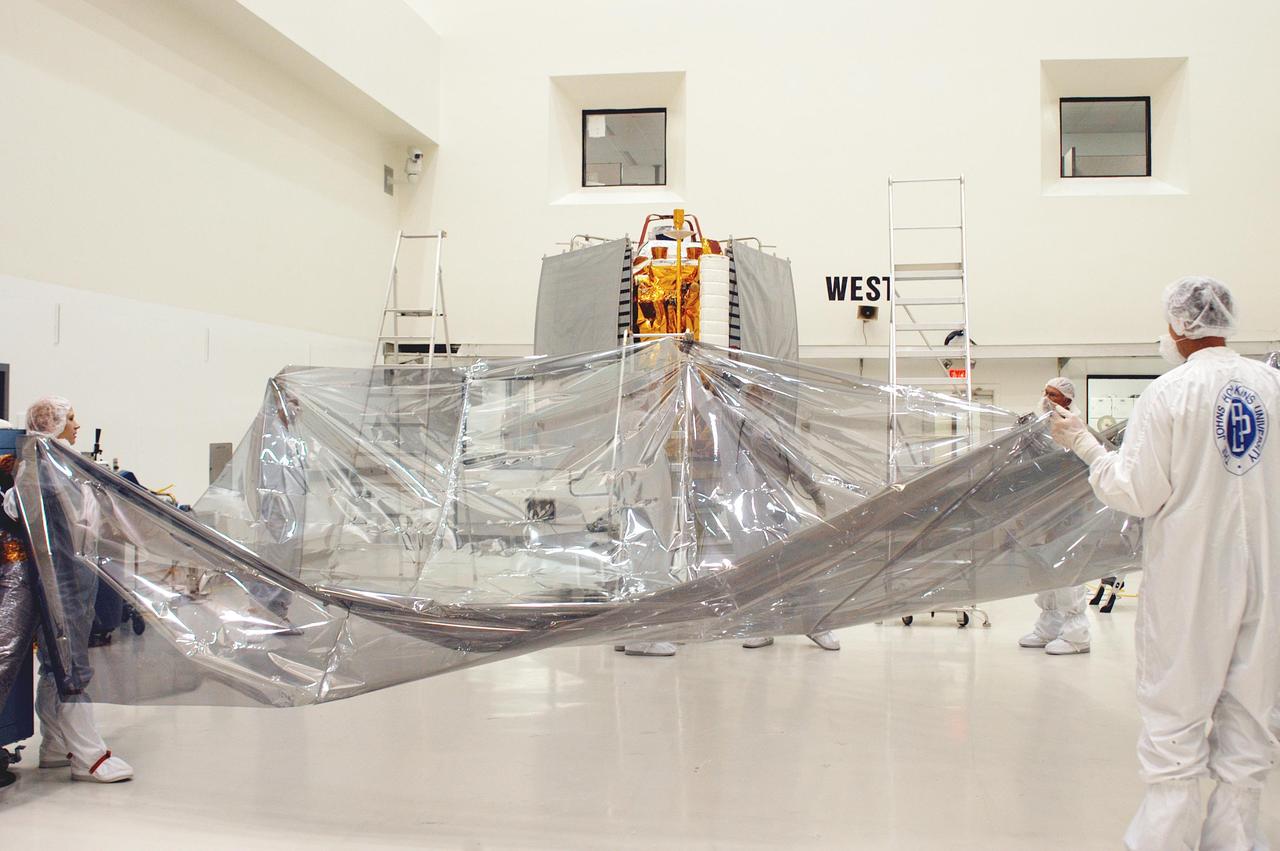
KENNEDY SPACE CENTER, FLA. - At Astrotech in Titusville, Fla., technicians with The Johns Hopkins University Applied Physics Laboratory (APL) prepare to cover the MESSESNGER spacecraft for a move to a hazardous processing facility in preparation for loading the spacecraft’s complement of hypergolic propellants. MESSENGER is scheduled to launch Aug. 2 aboard a Boeing Delta II rocket from Pad 17-B, Cape Canaveral Air Force Station, Fla., on a journey to Mercury. It will return to Earth for a gravity boost in July 2005, then fly past Venus twice, in October 2006 and June 2007. The spacecraft uses the tug of Venus’ gravity to resize and rotate its trajectory closer to Mercury’s orbit. Three Mercury flybys, each followed about two months later by a course-correction maneuver, put MESSENGER in position to enter Mercury orbit in March 2011. During the flybys, MESSENGER will map nearly the entire planet in color, image most of the areas unseen by Mariner 10, and measure the composition of the surface, atmosphere and magnetosphere. It will be the first new data from Mercury in more than 30 years - and invaluable for planning MESSENGER’s year-long orbital mission. MESSENGER was built for NASA by APL in Laurel, Md.
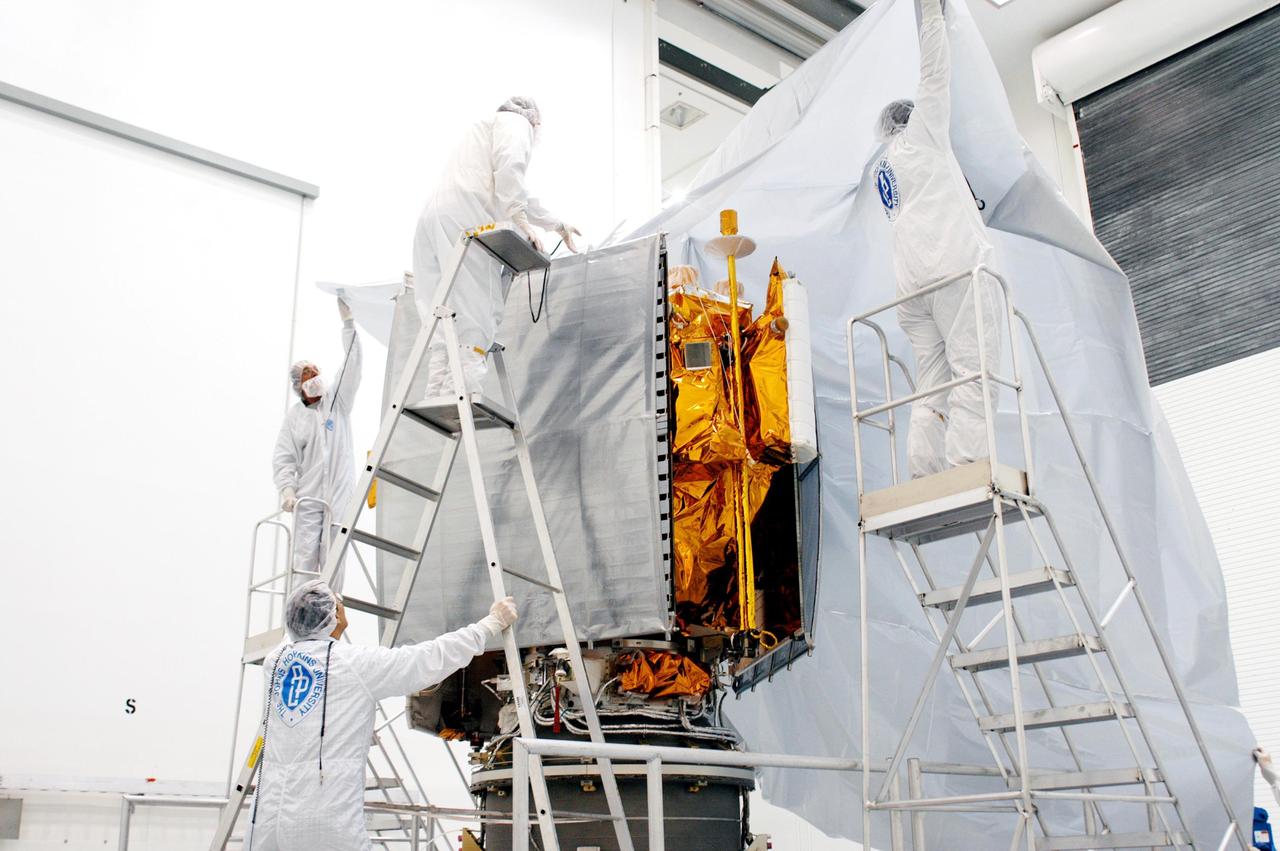
KENNEDY SPACE CENTER, FLA. - Workers from the Johns Hopkins University Applied Physics Laboratory in Laurel, Md., begin placing a protective cover around the MESSENGER (Mercury Surface, Space Environment, Geochemistry and Ranging) spacecraft at Astrotech Space Operations in Titusville, Fla. Bagging the Mercury-bound MESSENGER precedes its placement in a transportation canister for the journey to Launch Pad 17-B at Cape Canaveral Air Force Station, Fla. Liftoff of MESSENGER aboard a Boeing Delta II Heavy rocket is scheduled for Aug. 2. The spacecraft is expected to reach orbit around the planet in March 2011. MESSENGER was built for NASA by APL.
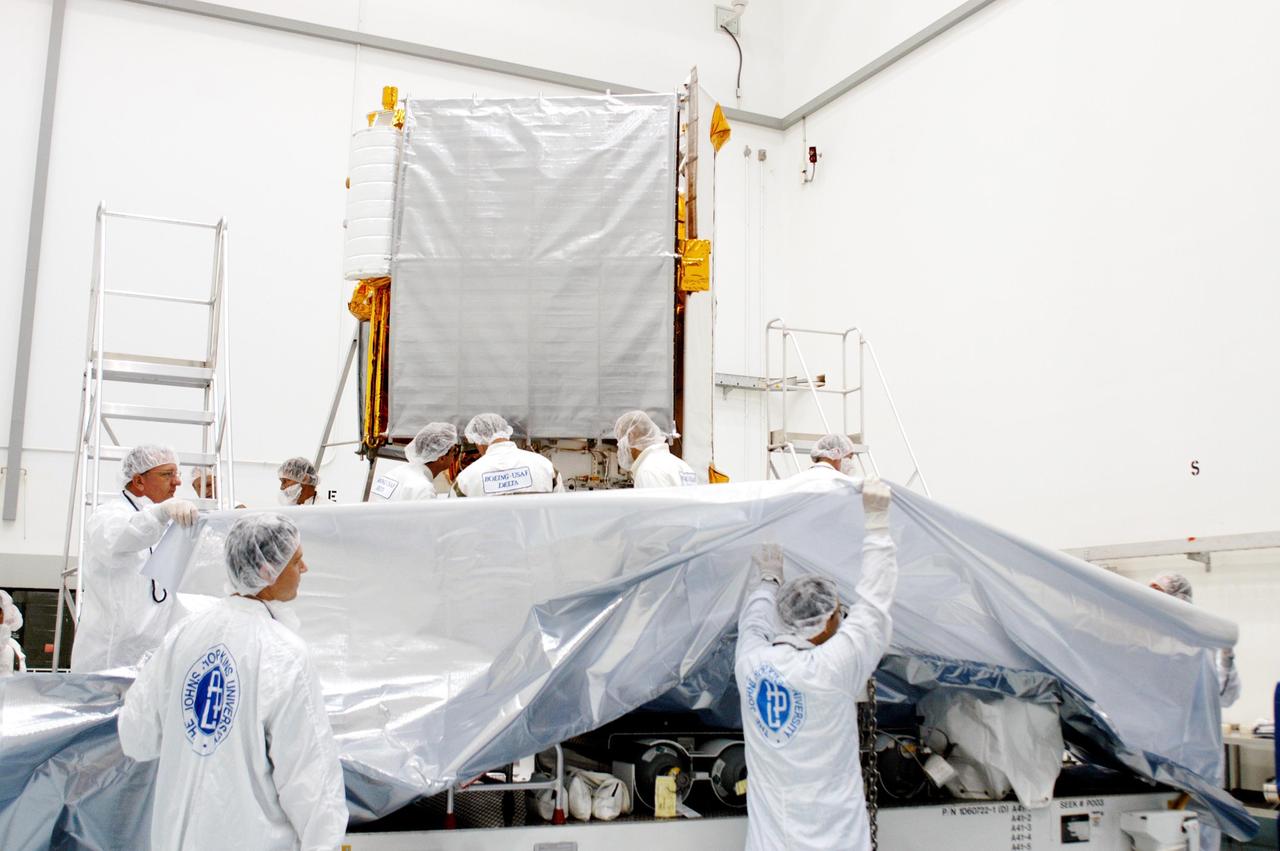
KENNEDY SPACE CENTER, FLA. - Workers from the Johns Hopkins University Applied Physics Laboratory in Laurel, Md. get ready to “bag” the MESSENGER (Mercury Surface, Space Environment, Geochemistry and Ranging) spacecraft in the background at Astrotech Space Operations in Titusville, Fla. Placing a protective cover around the Mercury-bound MESSENGER precedes its placement in a transportation canister for the journey to Launch Pad 17-B at Cape Canaveral Air Force Station, Fla. Liftoff of MESSENGER aboard a Boeing Delta II Heavy rocket is scheduled for Aug. 2. The spacecraft is expected to reach orbit around the planet in March 2011. MESSENGER was built for NASA by APL.
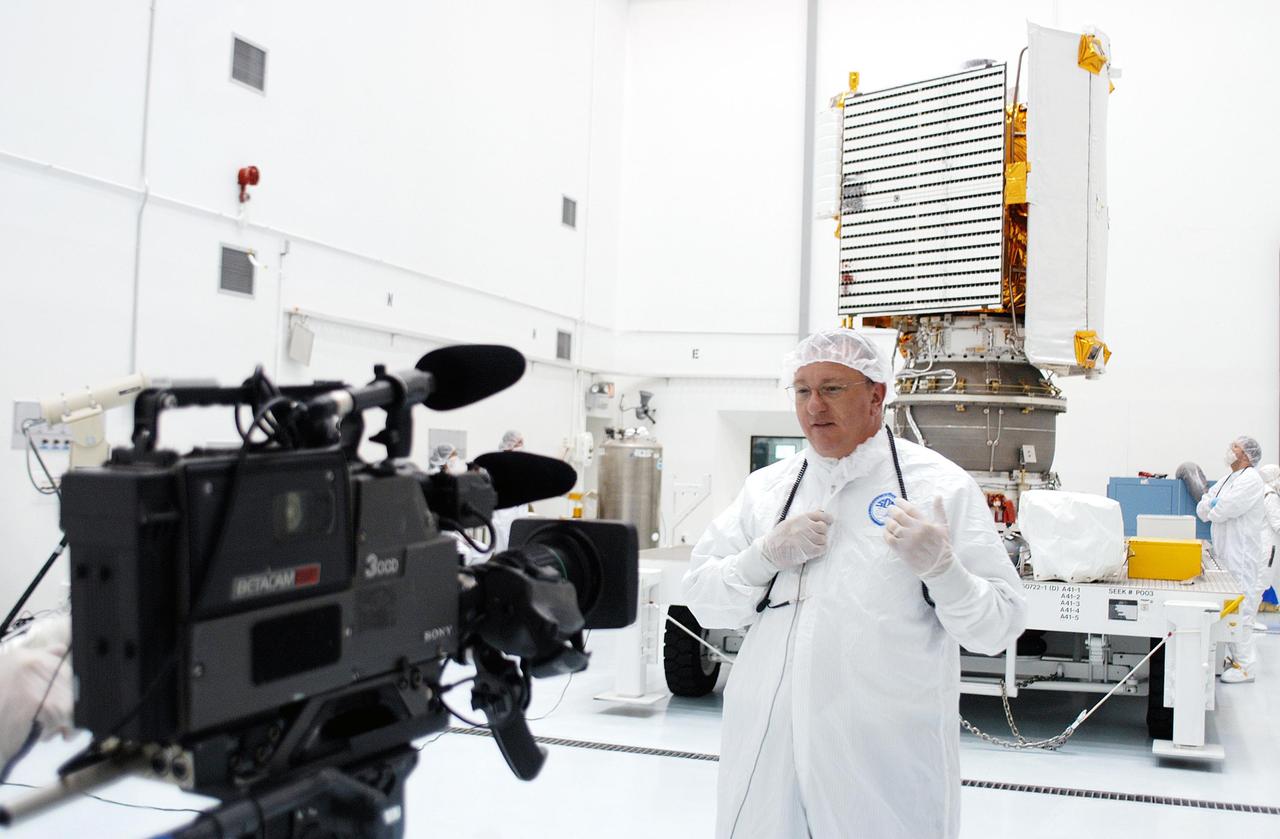
KENNEDY SPACE CENTER, FLA. - Ted Hartka, MESSENGER lead mechanical engineer, with The Johns Hopkins University Applied Physics Laboratory (APL), talks about the MESSENGER spacecraft’s mission to Mercury for the media at a special presentation at Astrotech Space Operations in Titusville, Fla. The spacecraft, mated to the Delta II third stage Payload Assist Module, is in the background. MESSENGER is scheduled to launch Aug. 2 aboard a Boeing Delta II rocket from Pad 17-B, Cape Canaveral Air Force Station, Fla.
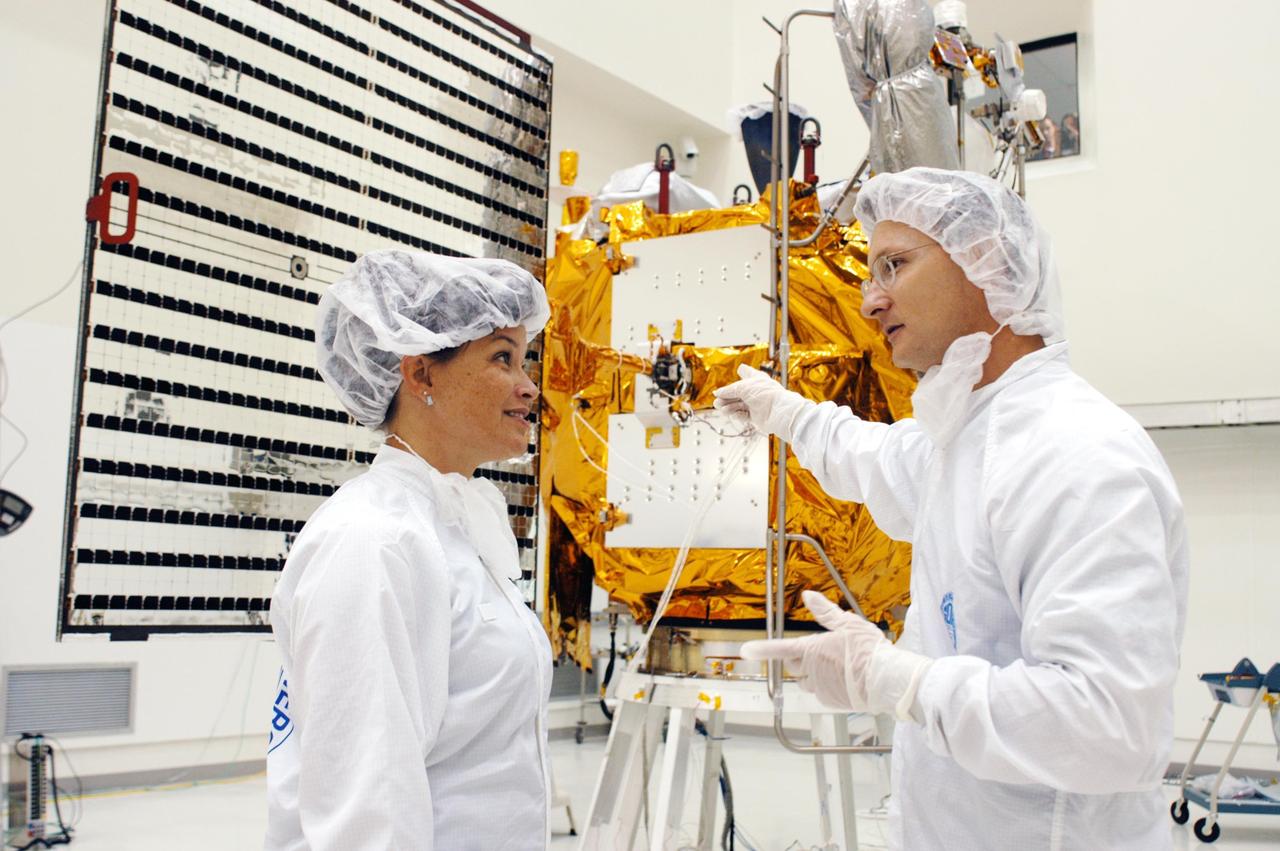
KENNEDY SPACE CENTER, FLA. - At Astrotech in Titusville, Fla., NASA Mission Integration Manager Cheryle Mako and NASA Launch Site Integration Manager John Hueckel talk before the deployment of the solar array panels on the MESSENGER spacecraft behind them. The solar arrays will provide MESSENGER’s power on its journey to Mercury. MESSENGER is scheduled to launch Aug. 2 aboard a Boeing Delta II rocket from Pad 17-B, Cape Canaveral Air Force Station, Fla. It will return to Earth for a gravity boost in July 2005, then fly past Venus twice, in October 2006 and June 2007. The spacecraft uses the tug of Venus’ gravity to resize and rotate its trajectory closer to Mercury’s orbit. Three Mercury flybys, each followed about two months later by a course-correction maneuver, put MESSENGER in position to enter Mercury orbit in March 2011. During the flybys, MESSENGER will map nearly the entire planet in color, image most of the areas unseen by Mariner 10, and measure the composition of the surface, atmosphere and magnetosphere. It will be the first new data from Mercury in more than 30 years - and invaluable for planning MESSENGER’s year-long orbital mission. MESSENGER was built for NASA by APL in Laurel, Md.
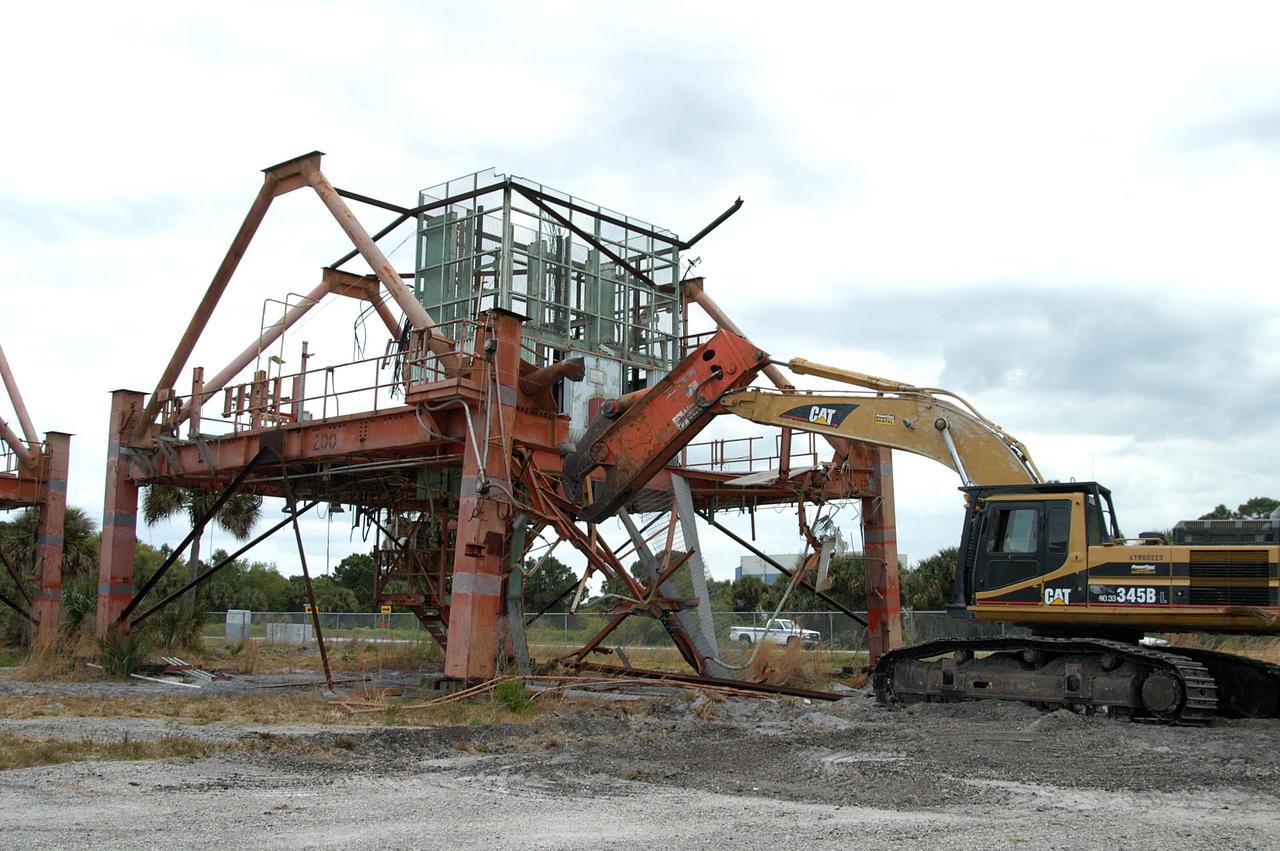
KENNEDY SPACE CENTER, FLA. -- Launch Umbilical Tower No. 1 (LUT-1), stored in the Industrial Area of KSC, is being demolished using a Caterpillar excavator and 48-inch shear attachment. Seen is the base of tower; the upright tower extended more than 398 feet above the launch pad. The LUT-1 was part of the launch system used for Apollo-Saturn V, launching Apollo 8, Apollo 11, Skylab manned missions and the Apollo-Soyuz Test Project. The shear being used for demolition is one used in the deconstruction of the Twin Towers in New York City after 9/11.
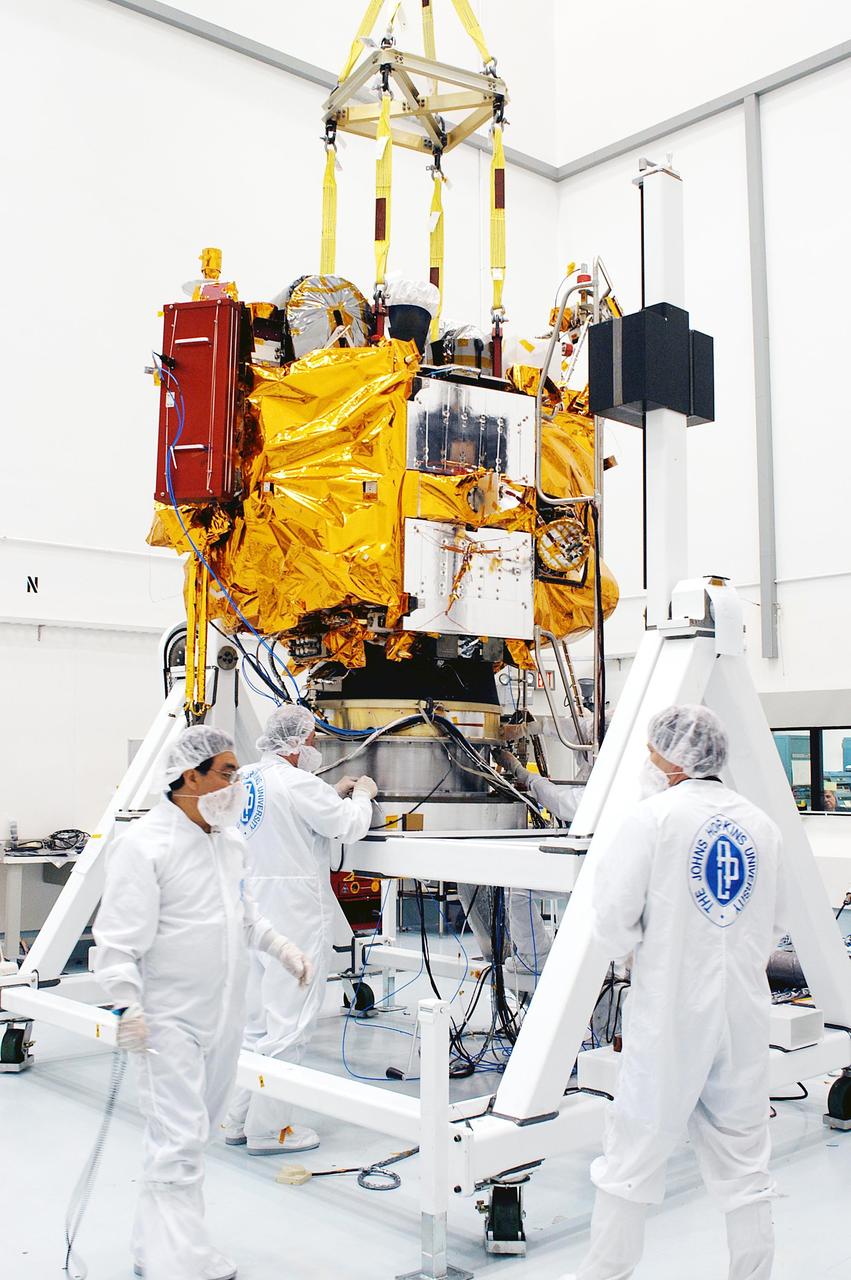
KENNEDY SPACE CENTER, FLA. -- At the Astrotech Space Operations processing facilities, workers prepare to move NASA’s MESSENGER spacecraft onto a test stand using an overhead crane. There, employees of the Johns Hopkins University Applied Physics Laboratory, builders of the spacecraft, will begin final processing for launch, including checkout of the power systems, communications systems and control systems. The thermal blankets will also be attached for flight. MESSENGER - short for MErcury Surface, Space ENvironment, GEochemistry and Ranging - will be launched aboard a Boeing Delta II rocket no earlier than July 30 on a six-year mission to study the planet Mercury.
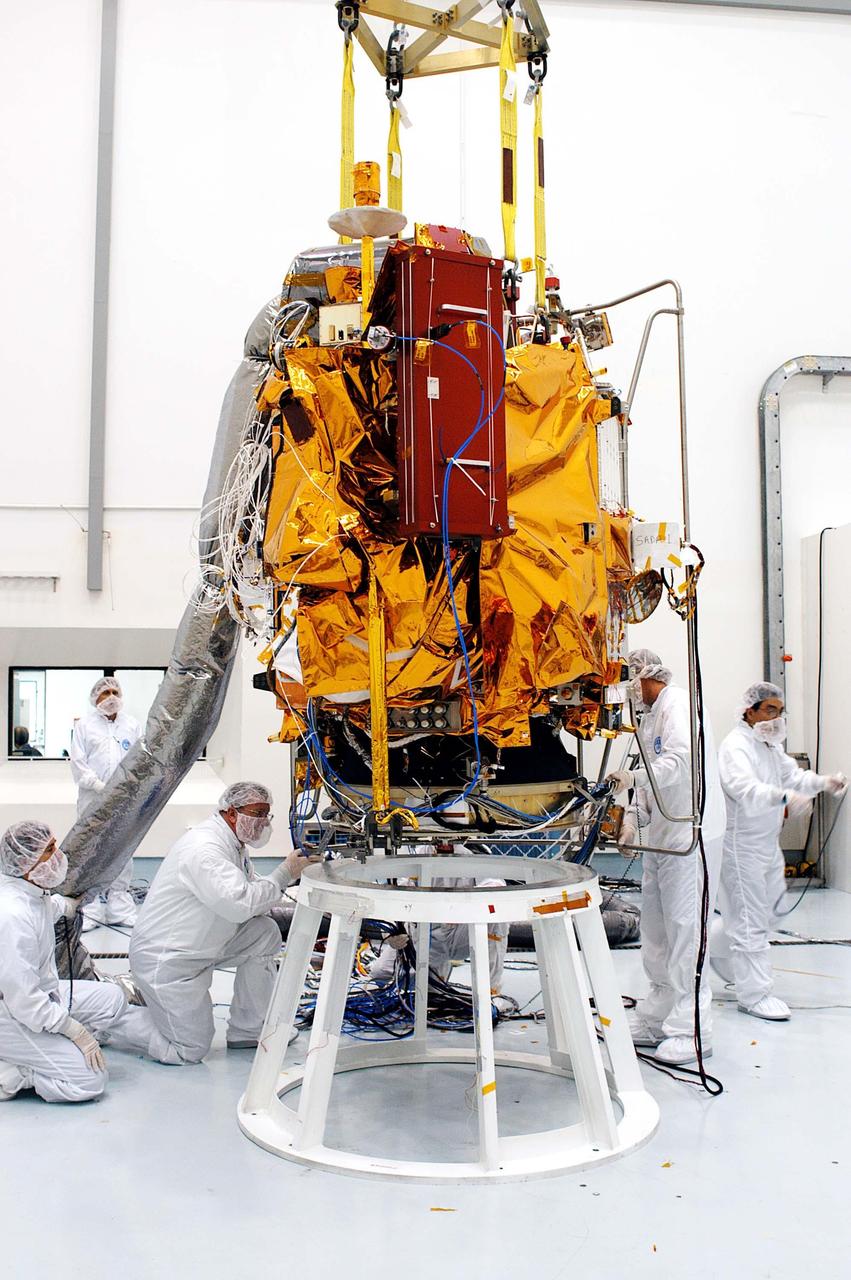
KENNEDY SPACE CENTER, FLA. -- At the Astrotech Space Operations processing facilities, workers prepare for contact of NASA’s MESSENGER spacecraft with a test stand. Once in place, employees of the Johns Hopkins University Applied Physics Laboratory, builders of the spacecraft, will begin final processing for launch, including checkout of the power systems, communications systems and control systems. The thermal blankets will also be attached for flight. MESSENGER - short for MErcury Surface, Space ENvironment, GEochemistry and Ranging - will be launched aboard a Boeing Delta II rocket no earlier than July 30 on a six-year mission to study the planet Mercury.
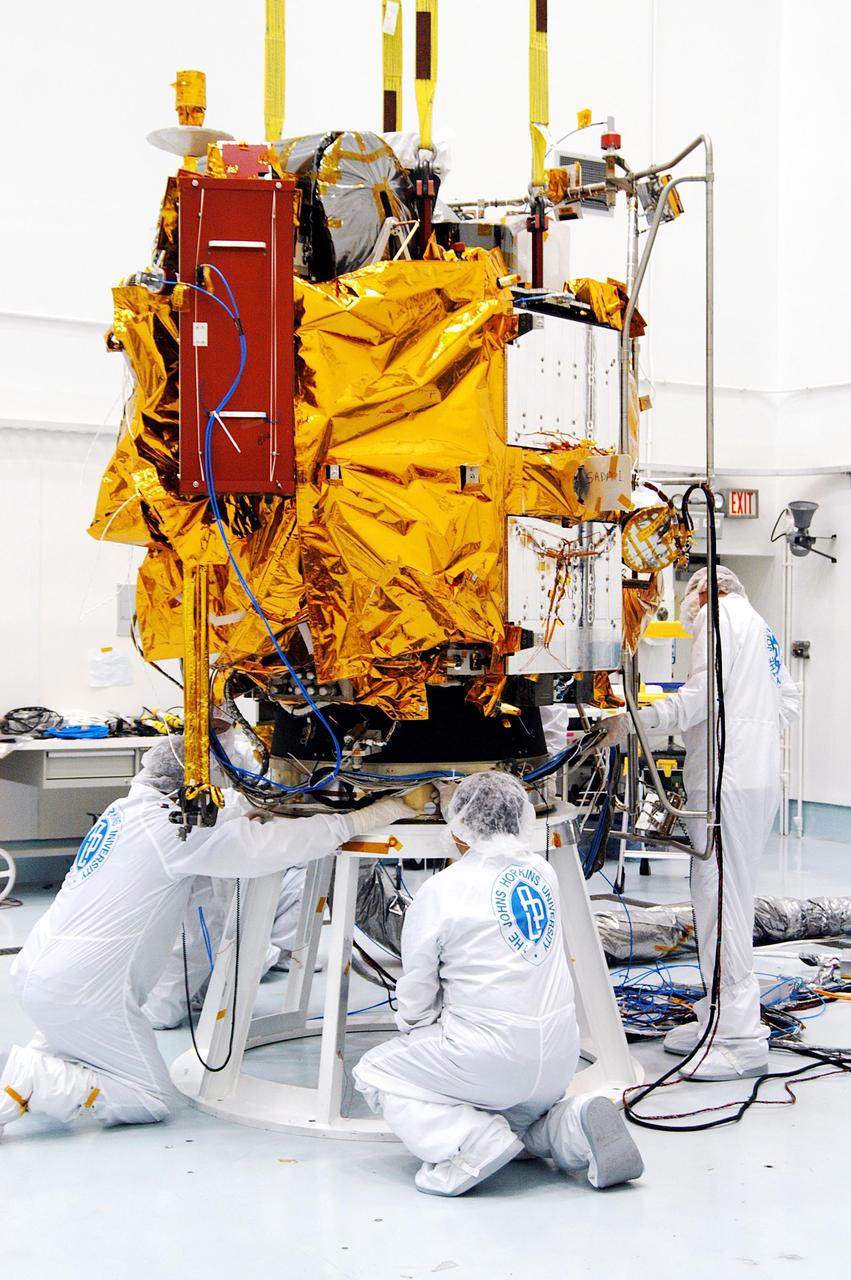
KENNEDY SPACE CENTER, FLA. -- At the Astrotech Space Operations processing facilities, workers verify the correct placement of NASA’s MESSENGER spacecraft on a test stand. Once in place, employees of the Johns Hopkins University Applied Physics Laboratory, builders of the spacecraft, will begin final processing for launch, including checkout of the power systems, communications systems and control systems. The thermal blankets will also be attached for flight. MESSENGER - short for MErcury Surface, Space ENvironment, GEochemistry and Ranging - will be launched aboard a Boeing Delta II rocket no earlier than July 30 on a six-year mission to study the planet Mercury.
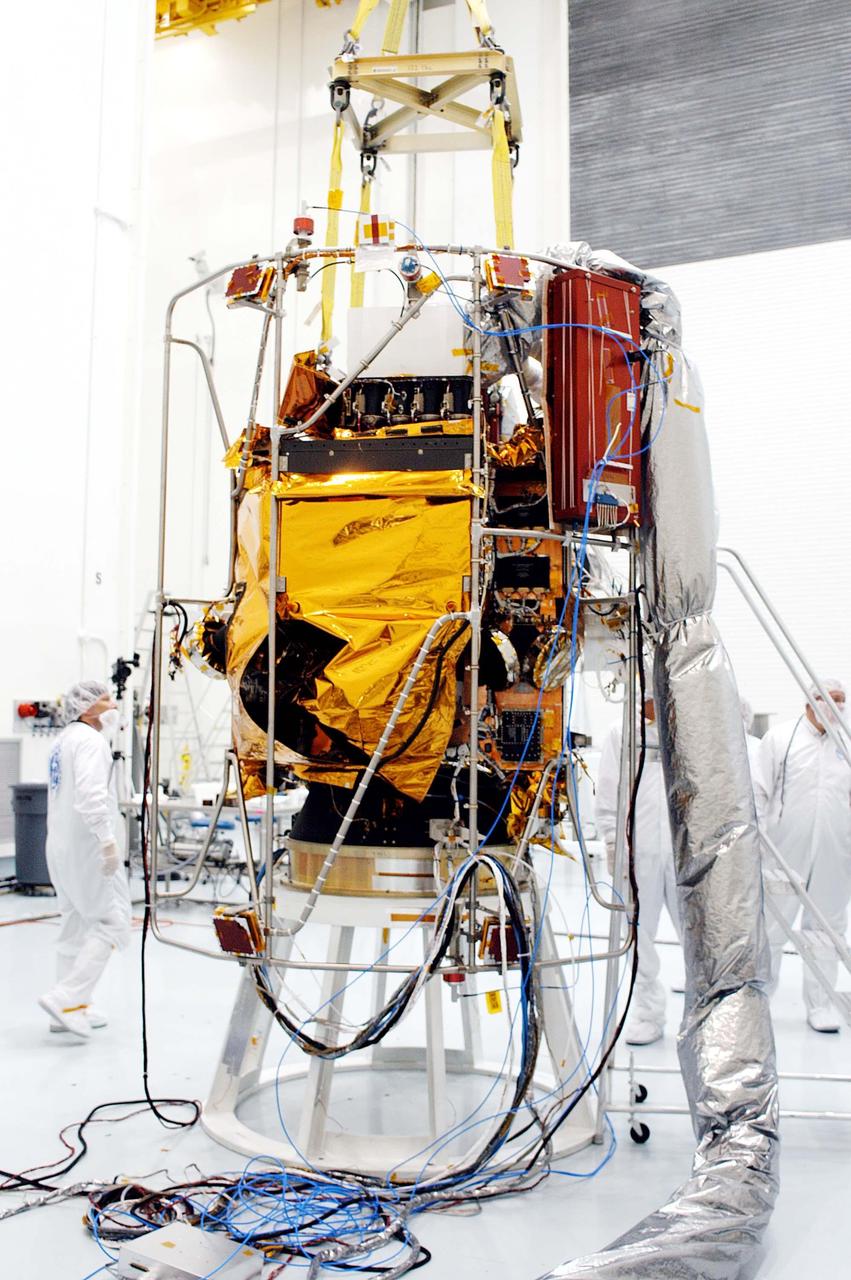
KENNEDY SPACE CENTER, FLA. -- At the Astrotech Space Operations processing facilities, the attachment of NASA’s MESSENGER spacecraft to a test stand is complete. The spacecraft is now ready for employees of the Johns Hopkins University Applied Physics Laboratory, builders of the spacecraft, to begin final processing for launch, including checkout of the power systems, communications systems and control systems. The thermal blankets will also be attached for flight. MESSENGER - short for MErcury Surface, Space ENvironment, GEochemistry and Ranging - will be launched aboard a Boeing Delta II rocket no earlier than July 30 on a six-year mission to study the planet Mercury.
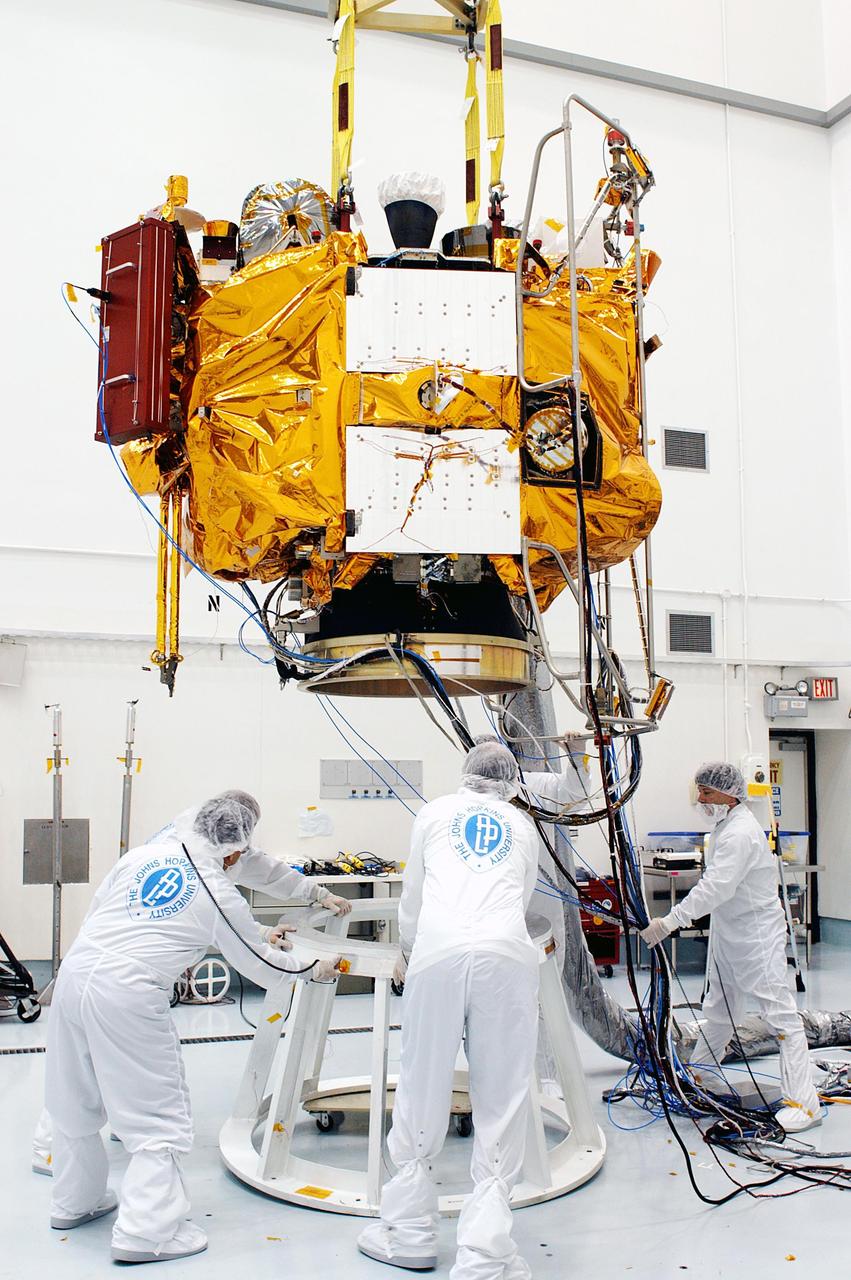
KENNEDY SPACE CENTER, FLA. -- At the Astrotech Space Operations processing facilities, workers lower NASA’s MESSENGER spacecraft onto a test stand using an overhead crane. Once in place, employees of the Johns Hopkins University Applied Physics Laboratory, builders of the spacecraft, will begin final processing for launch, including checkout of the power systems, communications systems and control systems. The thermal blankets will also be attached for flight. MESSENGER - short for MErcury Surface, Space ENvironment, GEochemistry and Ranging - will be launched aboard a Boeing Delta II rocket no earlier than July 30 on a six-year mission to study the planet Mercury.
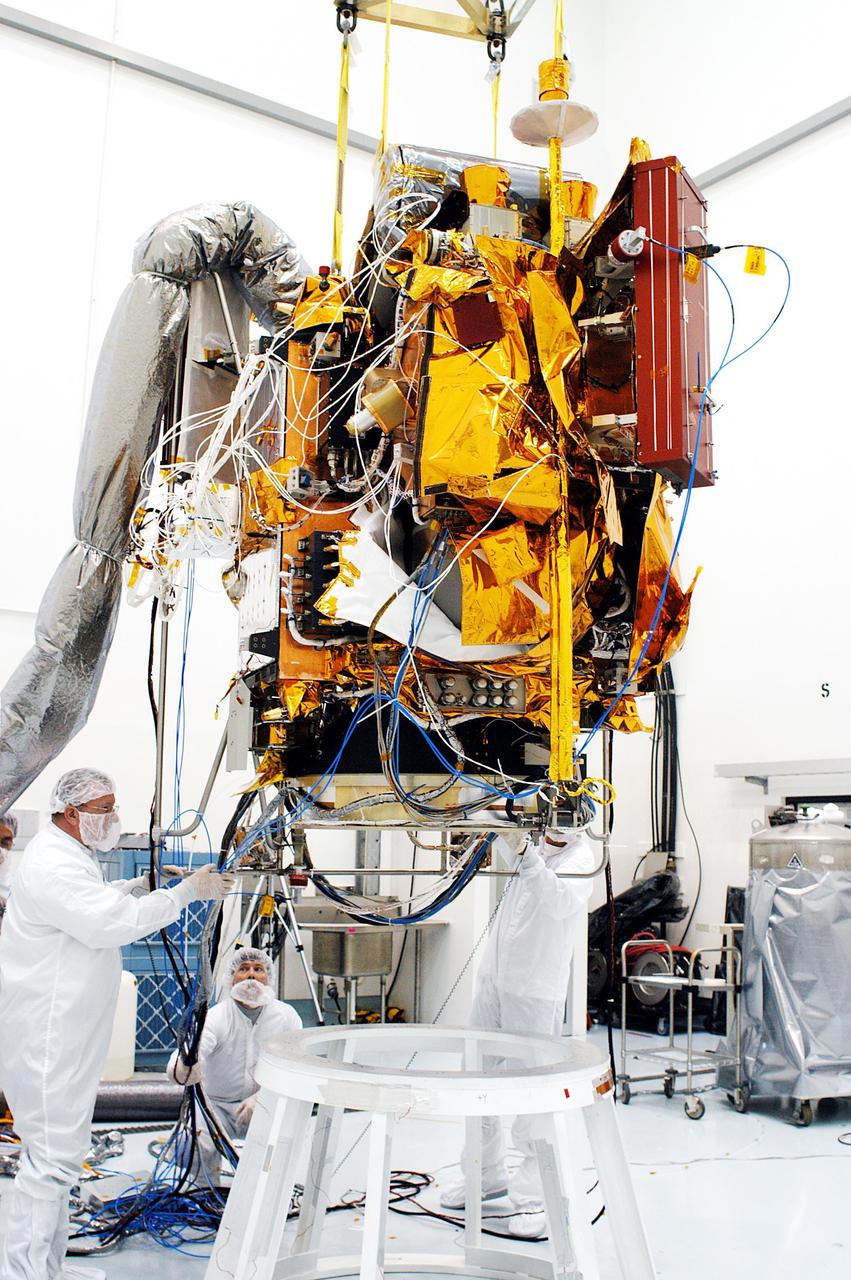
KENNEDY SPACE CENTER, FLA. -- At the Astrotech Space Operations processing facilities, workers monitor NASA’s MESSENGER spacecraft as it is lowered onto a test stand by an overhead crane. Once in place, employees of the Johns Hopkins University Applied Physics Laboratory, builders of the spacecraft, will begin final processing for launch, including checkout of the power systems, communications systems and control systems. The thermal blankets will also be attached for flight. MESSENGER - short for MErcury Surface, Space ENvironment, GEochemistry and Ranging - will be launched aboard a Boeing Delta II rocket no earlier than July 30 on a six-year mission to study the planet Mercury.
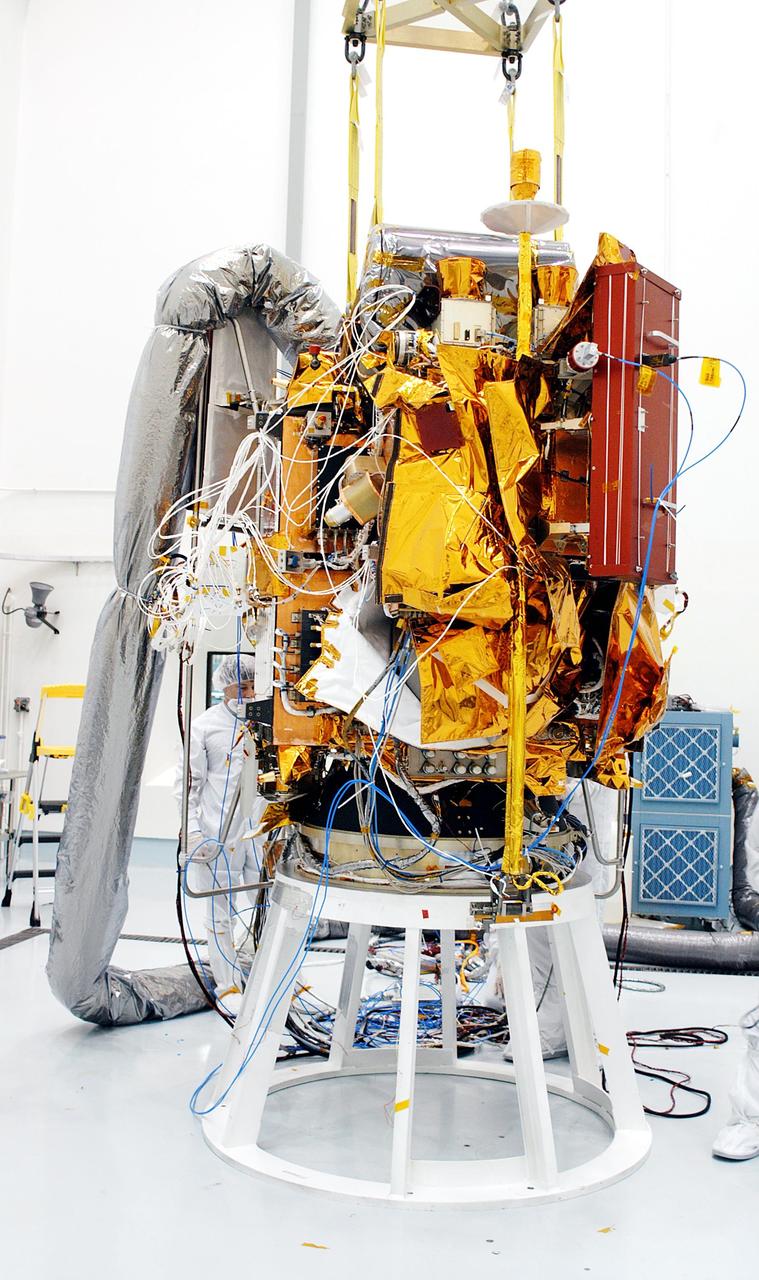
KENNEDY SPACE CENTER, FLA. -- At the Astrotech Space Operations processing facilities, workers secure NASA’s MESSENGER spacecraft on a test stand. Once in place, employees of the Johns Hopkins University Applied Physics Laboratory, builders of the spacecraft, will begin final processing for launch, including checkout of the power systems, communications systems and control systems. The thermal blankets will also be attached for flight. MESSENGER - short for MErcury Surface, Space ENvironment, GEochemistry and Ranging - will be launched aboard a Boeing Delta II rocket no earlier than July 30 on a six-year mission to study the planet Mercury.
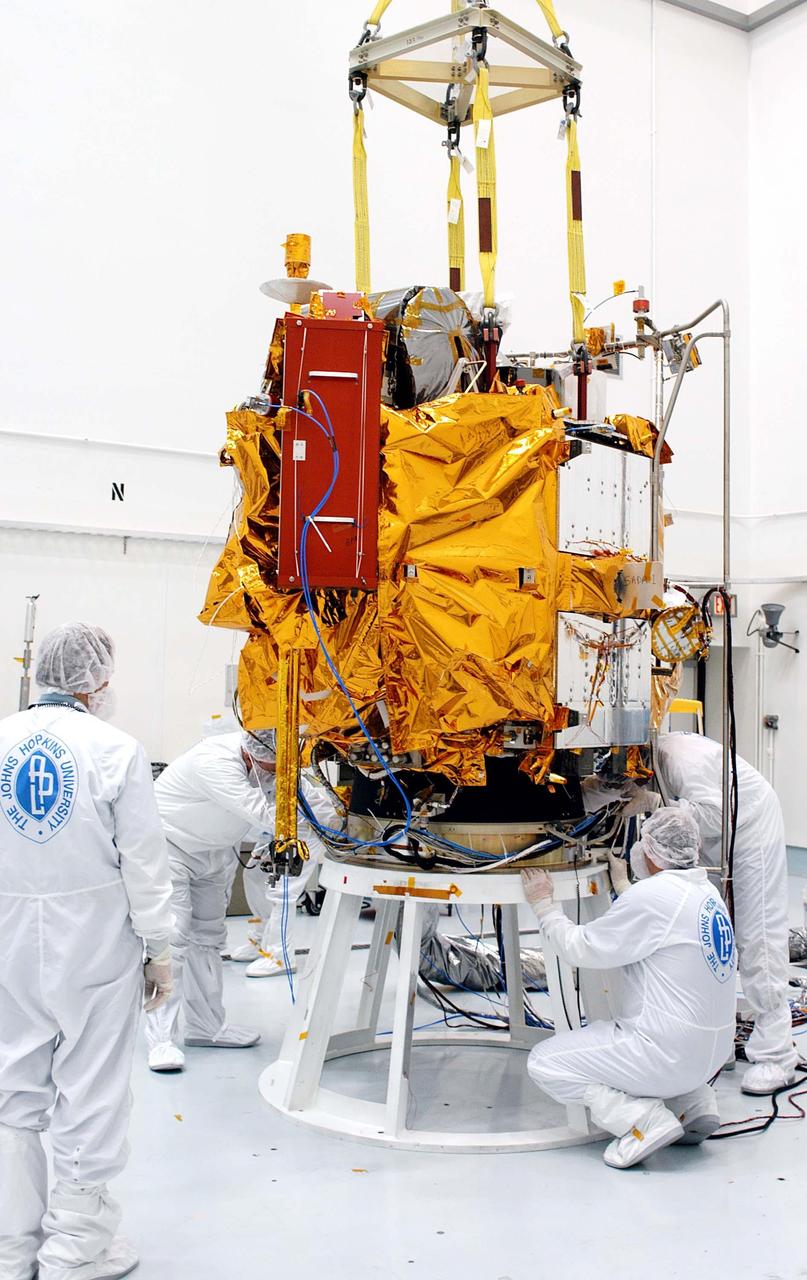
KENNEDY SPACE CENTER, FLA. -- At the Astrotech Space Operations processing facilities, workers secure NASA’s MESSENGER spacecraft on a test stand. Once in place, employees of the Johns Hopkins University Applied Physics Laboratory, builders of the spacecraft, will begin final processing for launch, including checkout of the power systems, communications systems and control systems. The thermal blankets will also be attached for flight. MESSENGER - short for MErcury Surface, Space ENvironment, GEochemistry and Ranging - will be launched aboard a Boeing Delta II rocket no earlier than July 30 on a six-year mission to study the planet Mercury.
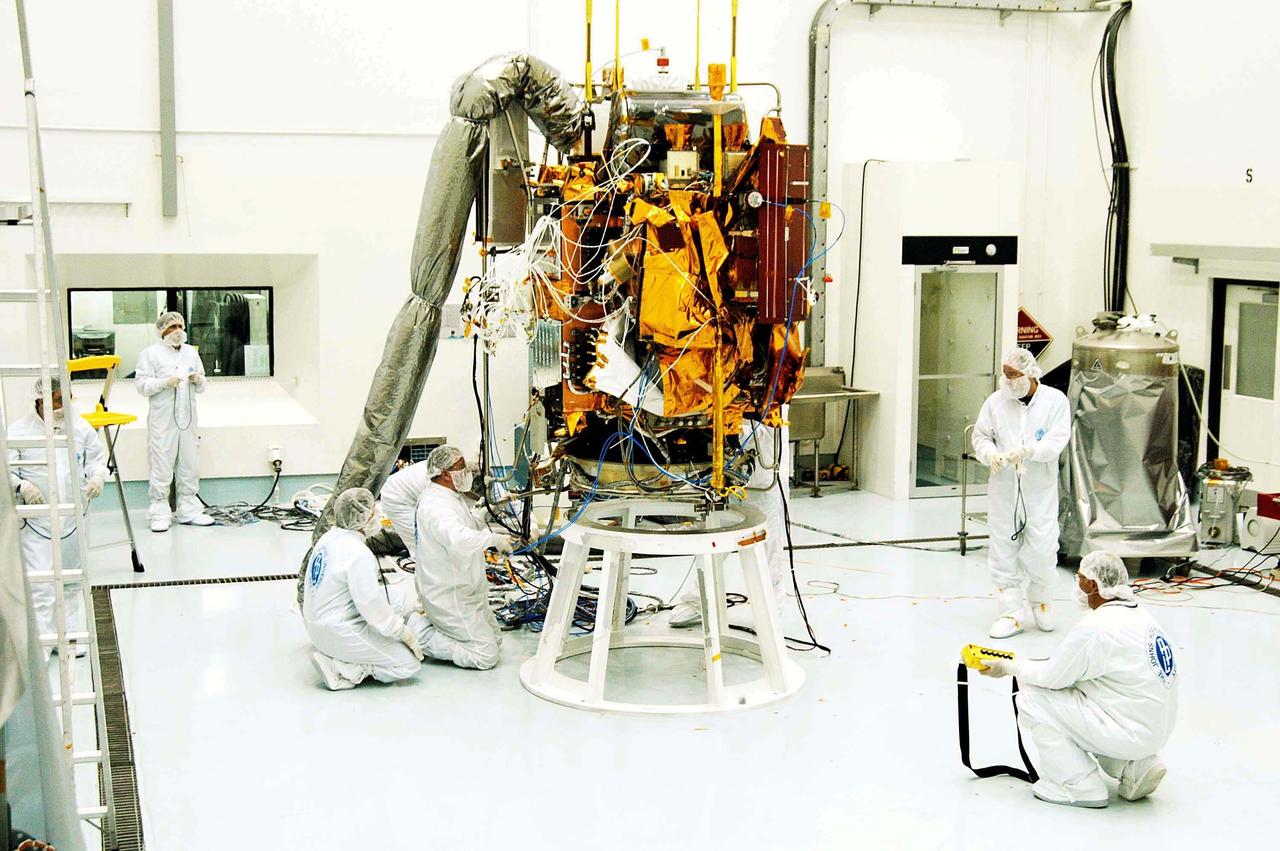
KENNEDY SPACE CENTER, FLA. -- At the Astrotech Space Operations processing facilities, workers check for the correct alignment of NASA’s MESSENGER spacecraft as it is lowered onto a test stand. Once in place, employees of the Johns Hopkins University Applied Physics Laboratory, builders of the spacecraft, will begin final processing for launch, including checkout of the power systems, communications systems and control systems. The thermal blankets will also be attached for flight. MESSENGER - short for MErcury Surface, Space ENvironment, GEochemistry and Ranging - will be launched aboard a Boeing Delta II rocket no earlier than July 30 on a six-year mission to study the planet Mercury.
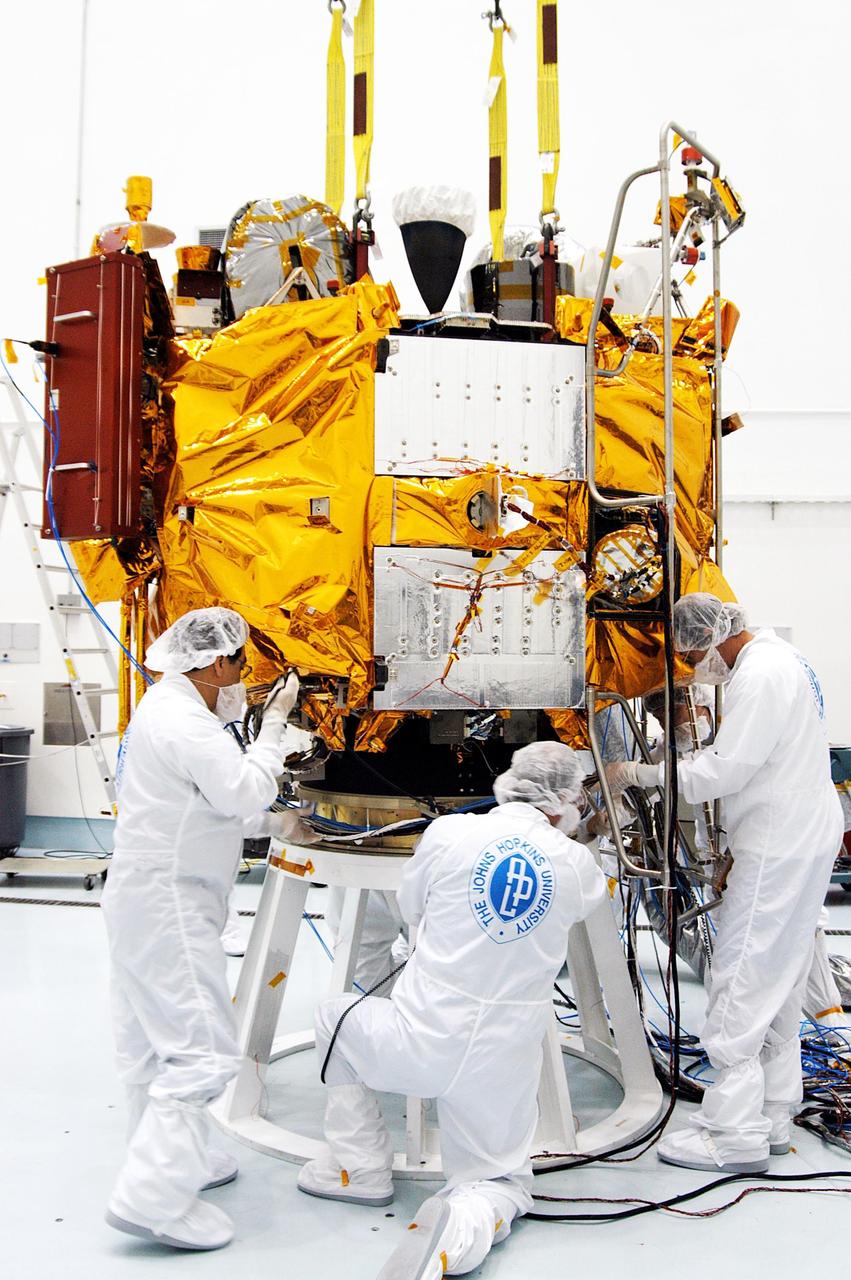
KENNEDY SPACE CENTER, FLA. -- At the Astrotech Space Operations processing facilities, workers secure NASA’s MESSENGER spacecraft on a test stand. Once in place, employees of the Johns Hopkins University Applied Physics Laboratory, builders of the spacecraft, will begin final processing for launch, including checkout of the power systems, communications systems and control systems. The thermal blankets will also be attached for flight. MESSENGER - short for MErcury Surface, Space ENvironment, GEochemistry and Ranging - will be launched aboard a Boeing Delta II rocket no earlier than July 30 on a six-year mission to study the planet Mercury.
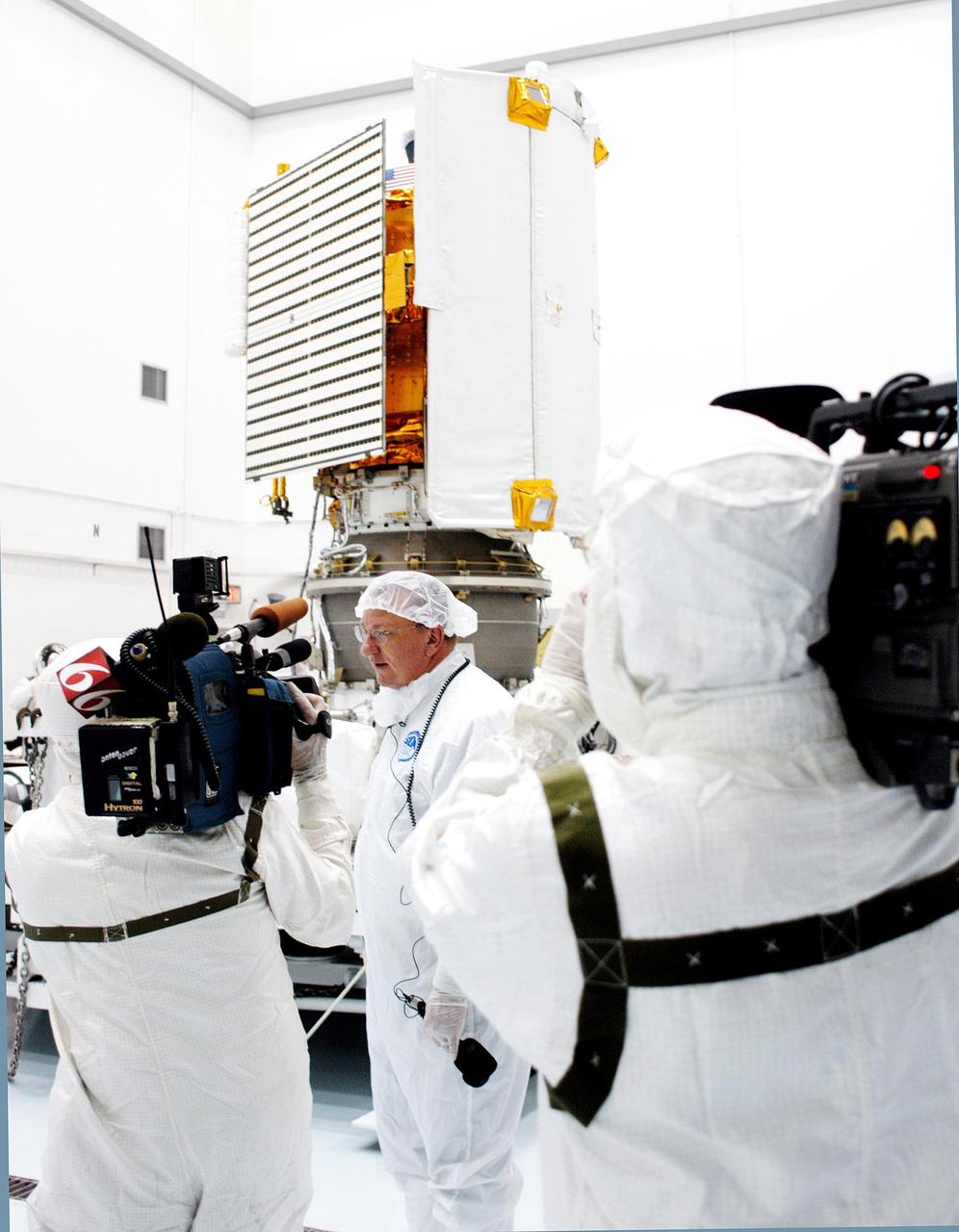
KENNEDY SPACE CENTER, FLA. - At Astrotech Space Operations in Titusville, Fla., members of the media, wearing clean room suits, gather around Ted Hartka, MESSENGER lead mechanical engineer, with The Johns Hopkins University Applied Physics Laboratory (APL). Hartka is talking about the MESSENGER spacecraft’s mission to Mercury. The spacecraft, mated to the Delta II third stage Payload Assist Module, is in the background. MESSENGER is scheduled to launch Aug. 2 aboard a Boeing Delta II rocket from Pad 17-B, Cape Canaveral Air Force Station, Fla.