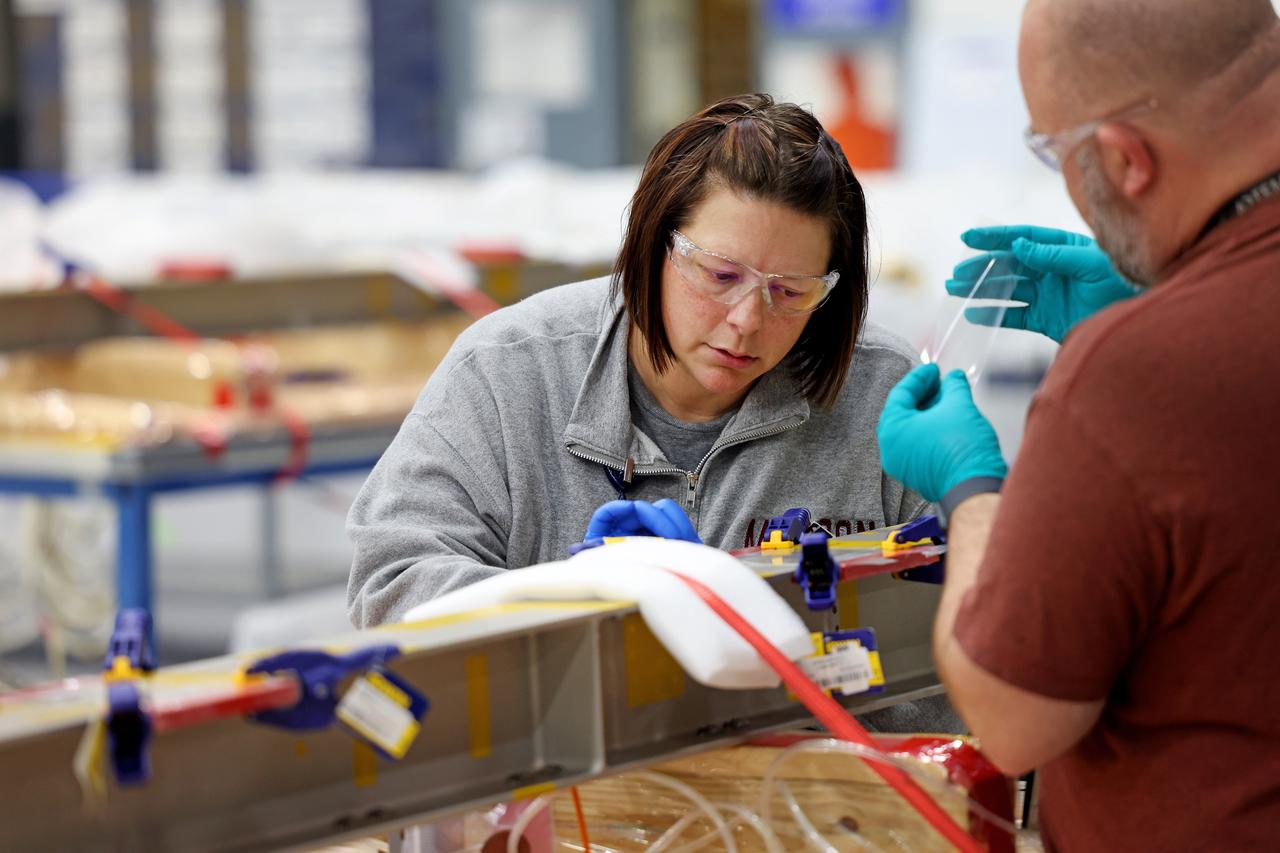
Technicians at NASA’s Michoud Assembly Facility in New Orleans on Feb. 22 prepare elements that will form part of the midbody for the future exploration upper stage for the SLS (Space Launch System) rocket. The midbody struts, or V-struts, will create the midbody’s cage-like outer structure to connect the upper stage’s larger liquid hydrogen tank to its smaller liquid oxygen tank. Manufacturing flight and test hardware for the future SLS upper stage is a collaborative effort between NASA and Boeing, the lead contractor for EUS and the SLS core stage. Beginning with Artemis IV, SLS will evolve to its more powerful Block 1B configuration with the advanced exploration upper stage that gives the rocket the capability to launch 40% more to the Moon along with Artemis astronauts inside NASA’s Orion spacecraft. The evolved in-space stage for SLS will use a combination of liquid oxygen and liquid hydrogen propellants to help power the engines to send large cargo and crew inside Orion to the Moon. Image credit: NASA/Michael DeMocker
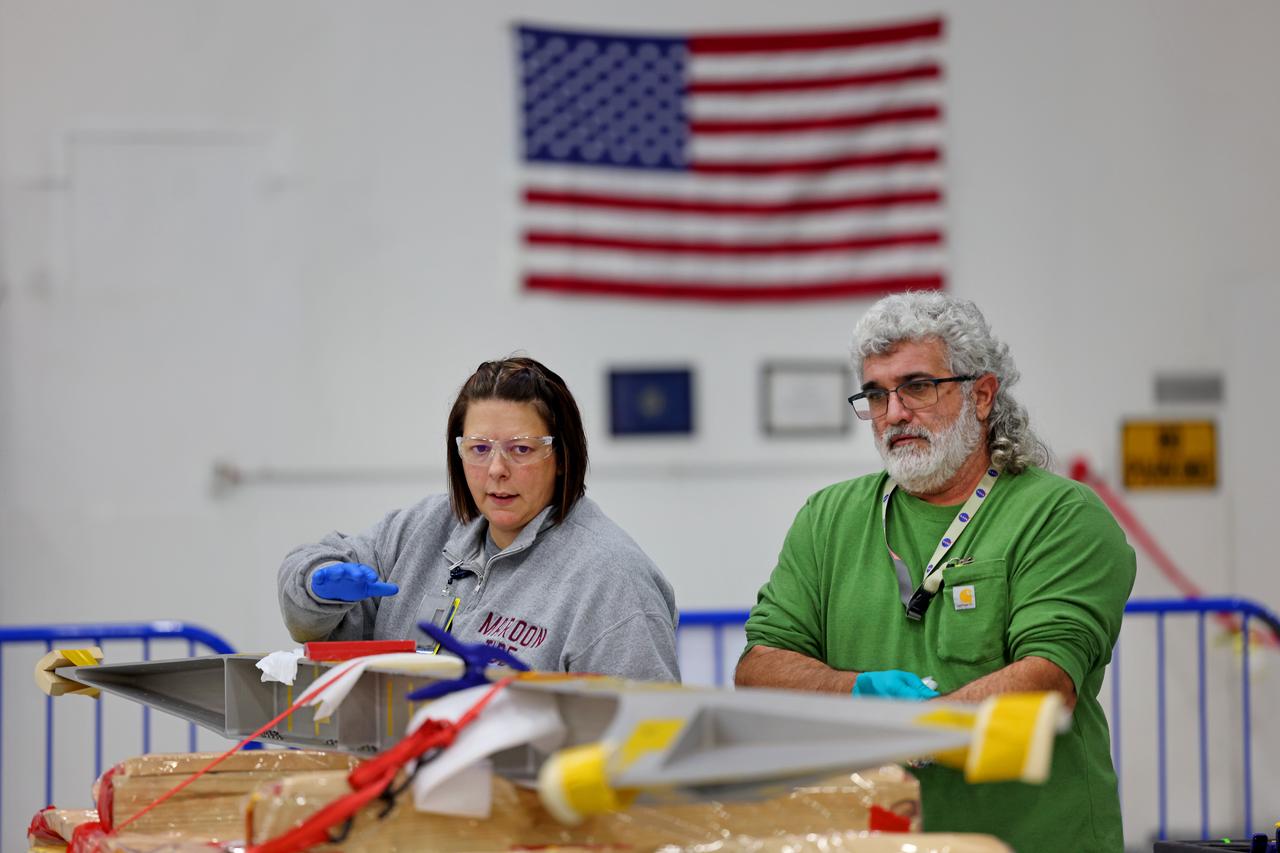
Technicians at NASA’s Michoud Assembly Facility in New Orleans on Feb. 22 prepare elements that will form part of the midbody for the future exploration upper stage for the SLS (Space Launch System) rocket. The midbody struts, or V-struts, will create the midbody’s cage-like outer structure to connect the upper stage’s larger liquid hydrogen tank to its smaller liquid oxygen tank. Manufacturing flight and test hardware for the future SLS upper stage is a collaborative effort between NASA and Boeing, the lead contractor for EUS and the SLS core stage. Beginning with Artemis IV, SLS will evolve to its more powerful Block 1B configuration with the advanced exploration upper stage that gives the rocket the capability to launch 40% more to the Moon along with Artemis astronauts inside NASA’s Orion spacecraft. The evolved in-space stage for SLS will use a combination of liquid oxygen and liquid hydrogen propellants to help power the engines to send large cargo and crew inside Orion to the Moon. Image credit: NASA/Michael DeMocker

Technicians at NASA’s Michoud Assembly Facility in New Orleans on Feb. 22 prepare elements that will form part of the midbody for the future exploration upper stage for the SLS (Space Launch System) rocket. The midbody struts, or V-struts, will create the midbody’s cage-like outer structure to connect the upper stage’s larger liquid hydrogen tank to its smaller liquid oxygen tank. Manufacturing flight and test hardware for the future SLS upper stage is a collaborative effort between NASA and Boeing, the lead contractor for EUS and the SLS core stage. Beginning with Artemis IV, SLS will evolve to its more powerful Block 1B configuration with the advanced exploration upper stage that gives the rocket the capability to launch 40% more to the Moon along with Artemis astronauts inside NASA’s Orion spacecraft. The evolved in-space stage for SLS will use a combination of liquid oxygen and liquid hydrogen propellants to help power the engines to send large cargo and crew inside Orion to the Moon. Image credit: NASA/Michael DeMocker
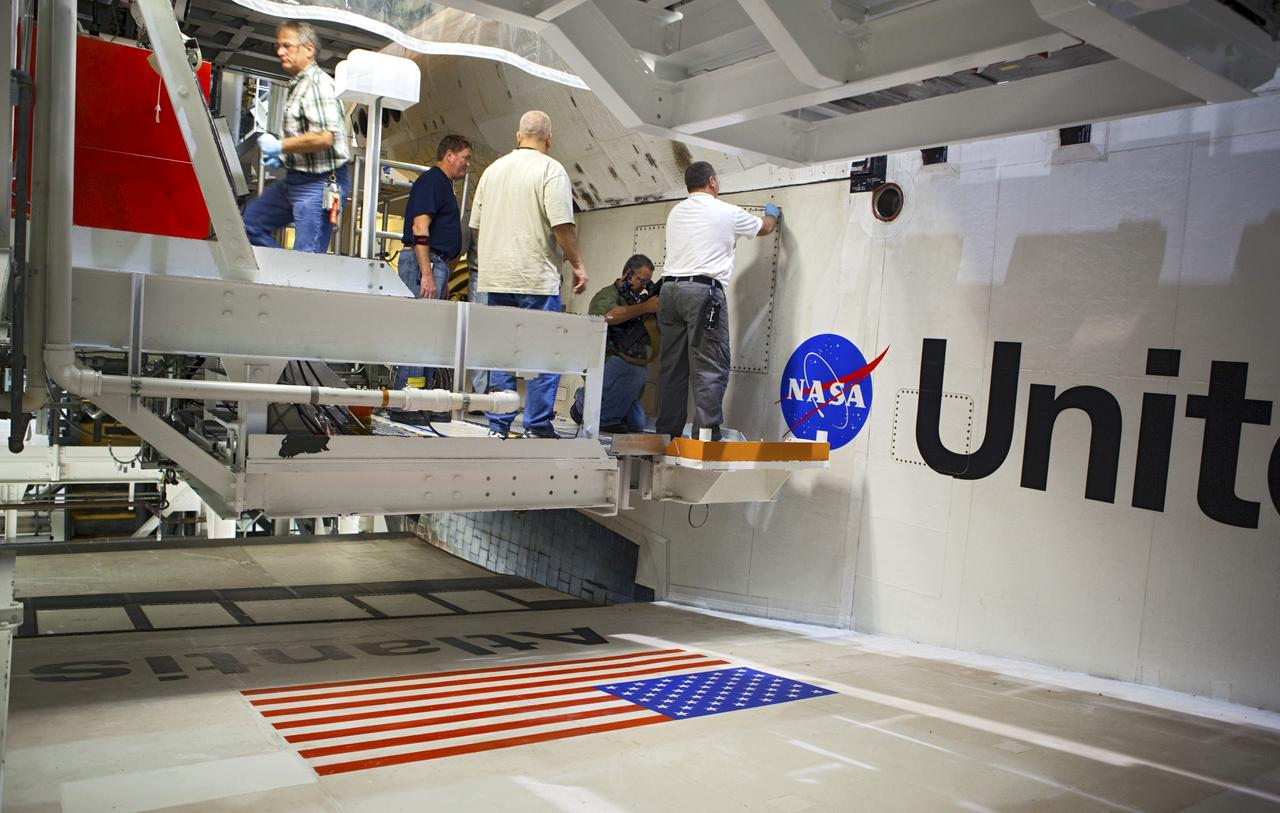
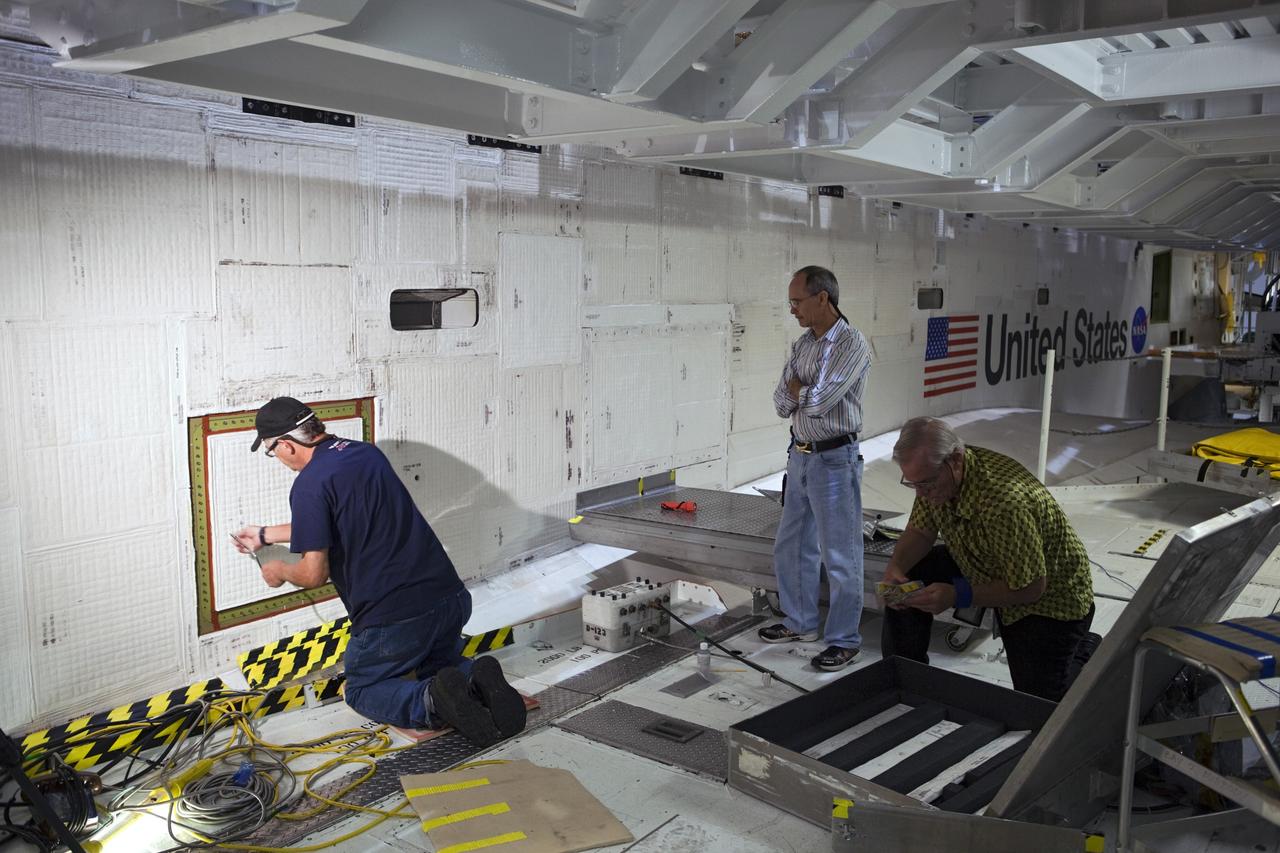
CAPE CANAVERAL, Fla. – Inside Orbiter Processing Facility-2 at NASA’s Kennedy Space Center in Florida, United Space Alliance technicians close space shuttle Atlantis’ midbody door for the final time. The orbiter is undergoing final preparations for its transfer to the Kennedy Space Center Visitor complex targeted for November. The work is part of Transition and Retirement of the remaining shuttle. Atlantis is being prepared for public display at the visitor complex. Over the course of its 26-year career, Atlantis spent 293 days in space during 33 missions. For more information, visit http://www.nasa.gov/transition. Photo credit: NASA/Dimitri Gerondidakis
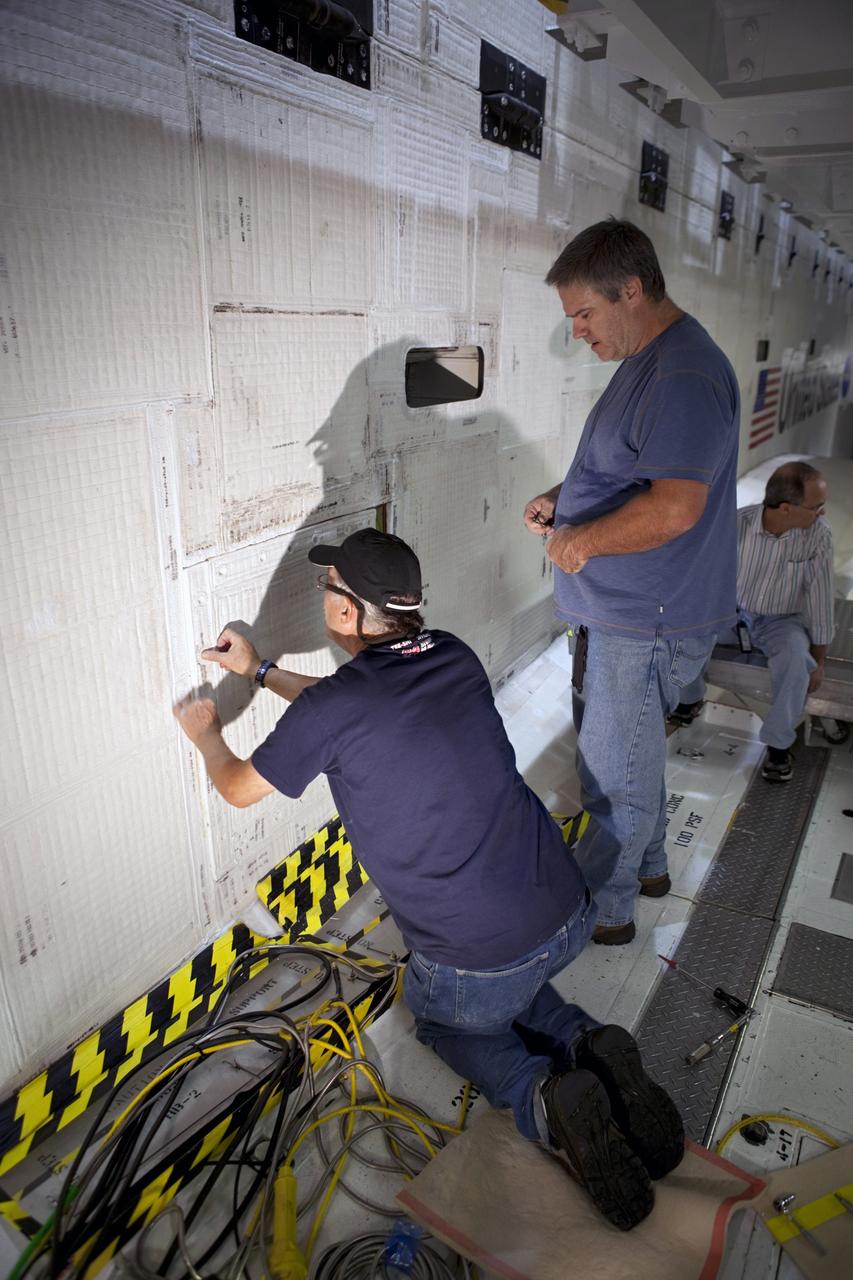
CAPE CANAVERAL, Fla. – Inside Orbiter Processing Facility-2 at NASA’s Kennedy Space Center in Florida, United Space Alliance technicians close space shuttle Atlantis’ midbody door for the final time. The orbiter is undergoing final preparations for its transfer to the Kennedy Space Center Visitor complex targeted for November. The work is part of Transition and Retirement of the remaining shuttle. Atlantis is being prepared for public display at the visitor complex. Over the course of its 26-year career, Atlantis spent 293 days in space during 33 missions. For more information, visit http://www.nasa.gov/transition. Photo credit: NASA/Dimitri Gerondidakis
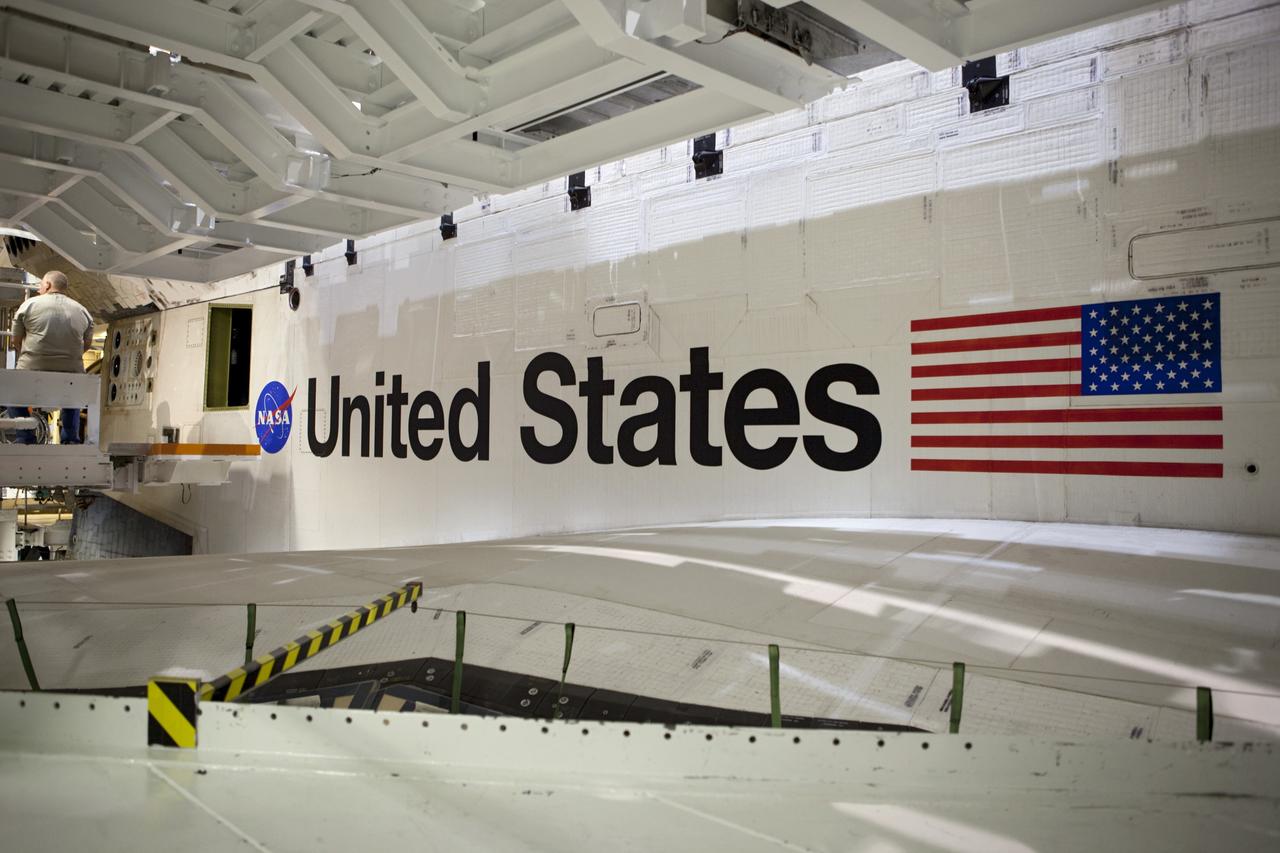
CAPE CANAVERAL, Fla. – Inside Orbiter Processing Facility-2 at NASA’s Kennedy Space Center in Florida, a United Space Alliance technician prepares to close space shuttle Atlantis’ midbody door for the final time. The orbiter is undergoing final preparations for its transfer to the Kennedy Space Center Visitor complex targeted for November. The work is part of Transition and Retirement of the remaining shuttle. Atlantis is being prepared for public display at the visitor complex. Over the course of its 26-year career, Atlantis spent 293 days in space during 33 missions. For more information, visit http://www.nasa.gov/transition. Photo credit: NASA/Dimitri Gerondidakis
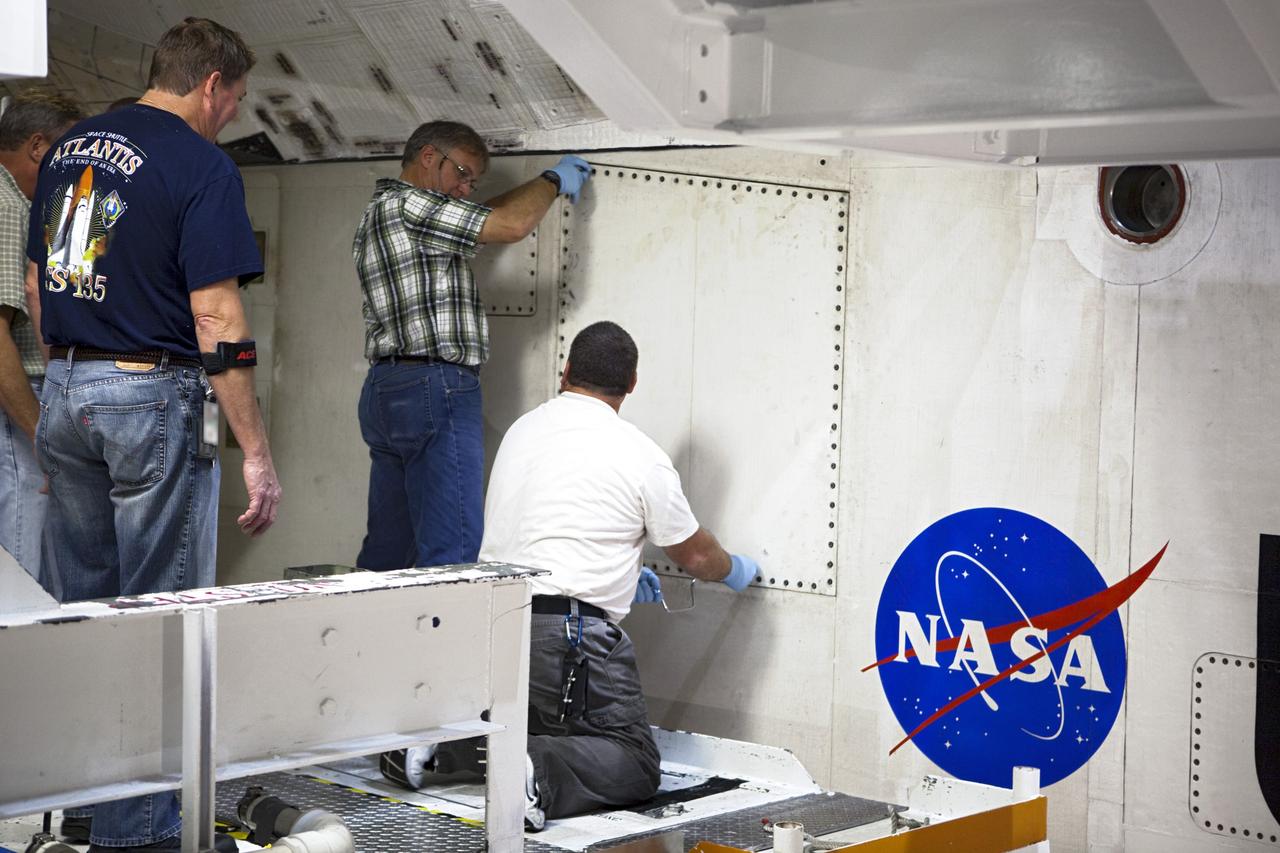
CAPE CANAVERAL, Fla. – Inside Orbiter Processing Facility-2 at NASA’s Kennedy Space Center in Florida, United Space Alliance technicians close space shuttle Atlantis’ midbody door for the final time. The orbiter is undergoing final preparations for its transfer to the Kennedy Space Center Visitor complex targeted for November. The work is part of Transition and Retirement of the remaining shuttle. Atlantis is being prepared for public display at the visitor complex. Over the course of its 26-year career, Atlantis spent 293 days in space during 33 missions. For more information, visit http://www.nasa.gov/transition. Photo credit: NASA/Dimitri Gerondidakis
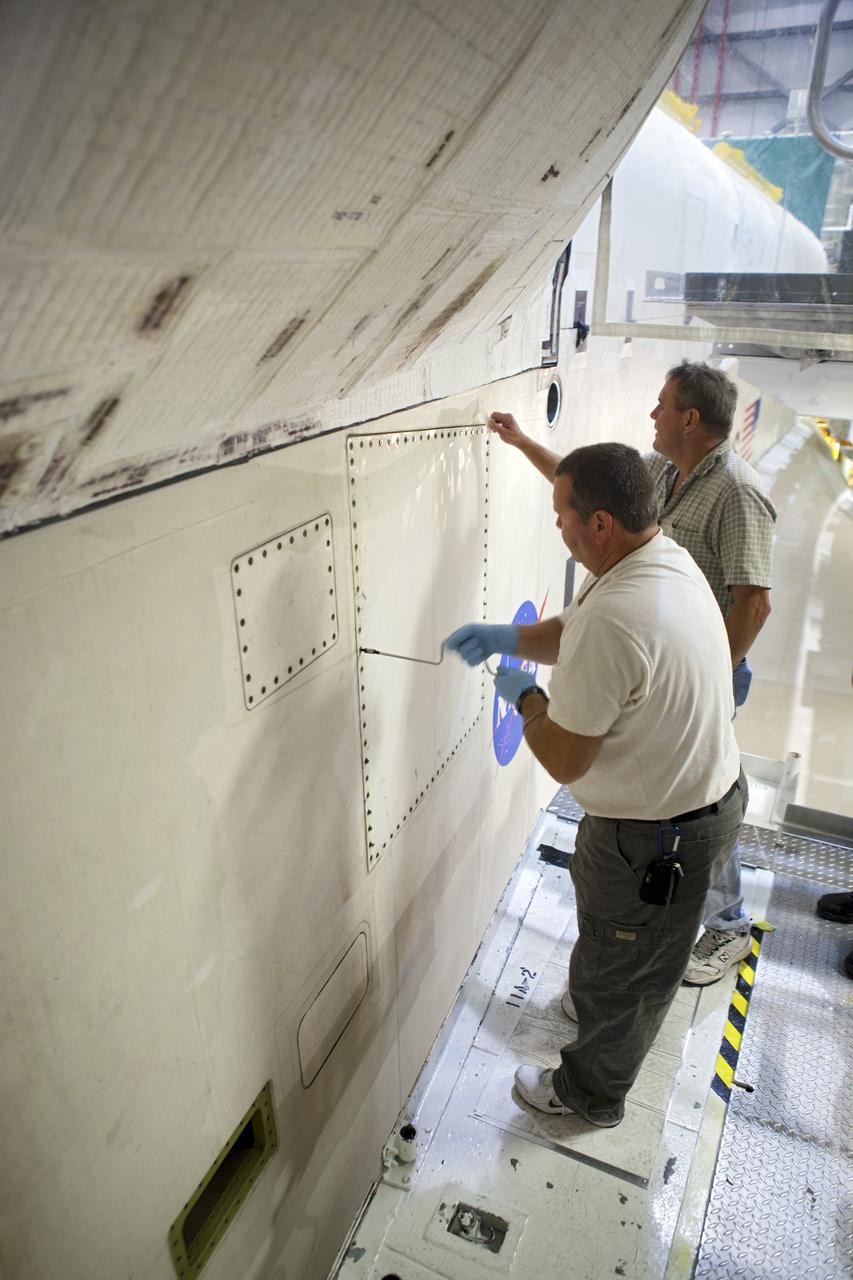
CAPE CANAVERAL, Fla. – Inside Orbiter Processing Facility-2 at NASA’s Kennedy Space Center in Florida, United Space Alliance technicians close space shuttle Atlantis’ midbody door for the final time. The orbiter is undergoing final preparations for its transfer to the Kennedy Space Center Visitor complex targeted for November. The work is part of Transition and Retirement of the remaining shuttle. Atlantis is being prepared for public display at the visitor complex. Over the course of its 26-year career, Atlantis spent 293 days in space during 33 missions. For more information, visit http://www.nasa.gov/transition. Photo credit: NASA/Dimitri Gerondidakis
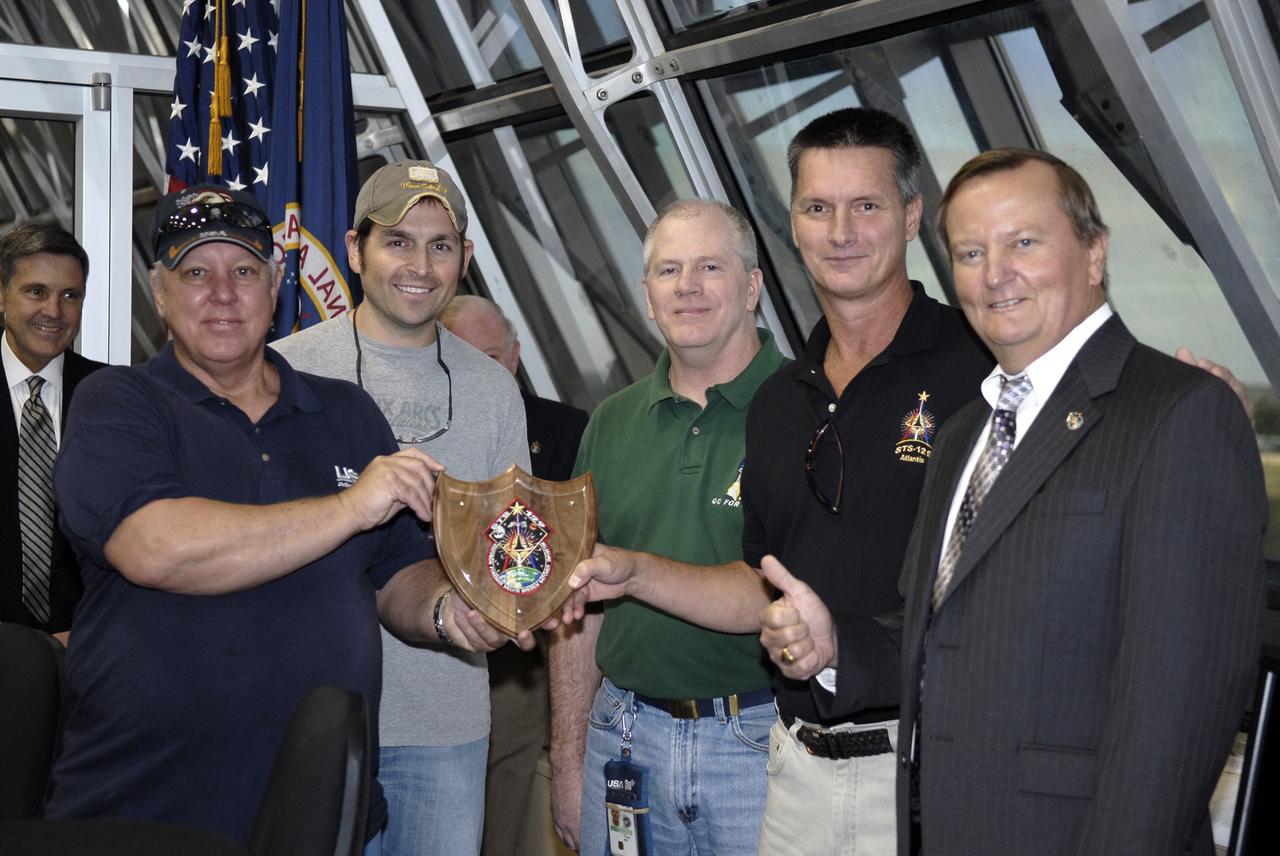
CAPE CANAVERAL, Fla. - In Firing Room 4 of NASA Kennedy Space Center's Launch Control Center, NASA's space shuttle launch director Michael Leinbach presents members of the United Space Alliance Midbody Team for space shuttle Atlantis with the Launch Director's Flow Award, a plaque emblazoned with the logo for Atlantis' STS-129 mission. The award recognizes the team's superior work in reconfiguring the shuttle's payload bay between STS-125, the last Hubble Space Telescope servicing mission, and the current STS-129 mission to the International Space Station. From left are midbody lead Jim Reed, midbody thermal control system technician Chris Oliver, midbody planner and payload operations representative for STS-129 Steve Durnin, Orbiter Processing Facility-1 midbody supervisor Bobby Pracek, and Leinbach. Liftoff of Atlantis from Launch Pad 39A on its STS-129 mission to the International Space Station came at 2:28 p.m. EST Nov. 16. For information on the STS-129 mission and crew, visit http://www.nasa.gov/mission_pages/shuttle/shuttlemissions/sts129/index.html. Photo credit: NASA/Kim Shiflett
CAPE CANAVERAL, Fla. – Inside Orbiter Processing Facility-2 at NASA’s Kennedy Space Center in Florida, United Space Alliance technicians close space shuttle Atlantis’ aft doors for the final time. The orbiter is undergoing final preparations for its transfer to the Kennedy Space Center Visitor complex targeted for November. The work is part of Transition and Retirement of the remaining shuttle. Atlantis is being prepared for public display at the visitor complex. Over the course of its 26-year career, Atlantis spent 293 days in space during 33 missions. For more information, visit http://www.nasa.gov/transition. Photo credit: NASA/Dimitri Gerondidakis
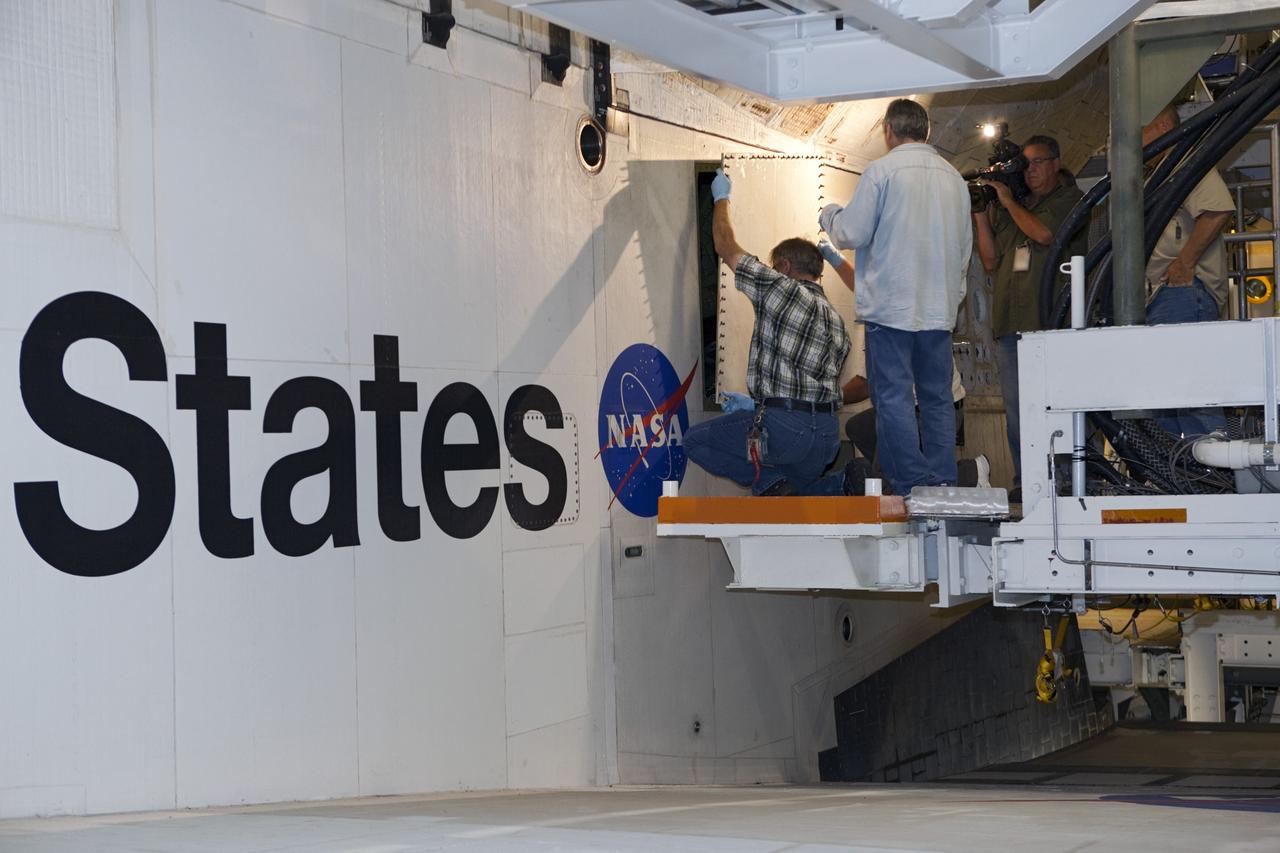
CAPE CANAVERAL, Fla. – Inside Orbiter Processing Facility-2 at NASA’s Kennedy Space Center in Florida, United Space Alliance technicians close space shuttle Atlantis’ aft doors for the final time. The orbiter is undergoing final preparations for its transfer to the Kennedy Space Center Visitor complex targeted for November. The work is part of Transition and Retirement of the remaining shuttle. Atlantis is being prepared for public display at the visitor complex. Over the course of its 26-year career, Atlantis spent 293 days in space during 33 missions. For more information, visit http://www.nasa.gov/transition. Photo credit: NASA/Dimitri Gerondidakis
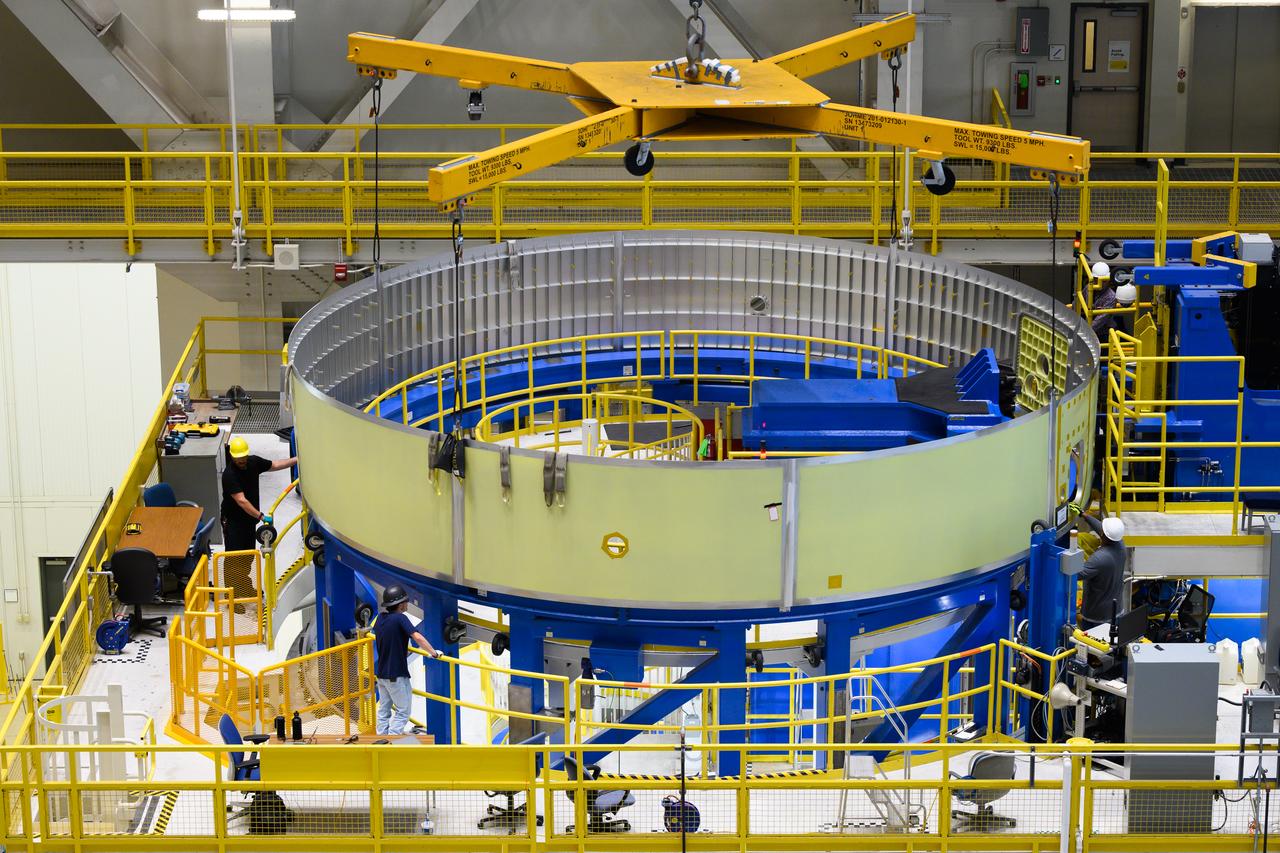
These images and videos show technicians at NASA’s Michoud Assembly Facility in New Orleans examining and lifting midbody barrels for the Exploration Upper Stage (EUS) structural test article of the SLS (Space Launch System) rocket in May 2023. The barrel sections make up the body, or main structure, of the future in-space propulsion stage for the mega rocket. The Exploration Upper Stage will be used on the second configuration of the SLS rocket, known as Block 1B, and will provide in-space propulsion to send astronauts in NASA’s Orion spacecraft and heavy cargo on a precise trajectory to the Moon. Beginning with Artemis IV, EUS will replace the interim cryogenic propulsion stage for the Block 1 configuration of SLS. It has larger propellant tanks and four RL10 engines, enabling SLS to launch 40% more cargo to the Moon along with crew. EUS flight hardware is in early production at Michoud. Crews with NASA and Boeing, the lead contractor for the SLS core stage and EUS, are also manufacturing the EUS structural test article. The test hardware is structurally identical to the flight version and will be used during a series of strenuous testing that simulates the forces the rocket will experience during launch and flight and verify its structural integrity. NASA is working to land the first woman and first person of color on the Moon under Artemis. SLS is part of NASA’s backbone for deep space exploration, along with Orion and the Gateway in orbit around the Moon. SLS is the only rocket that can send Orion, astronauts, and supplies to the Moon in a single mission.
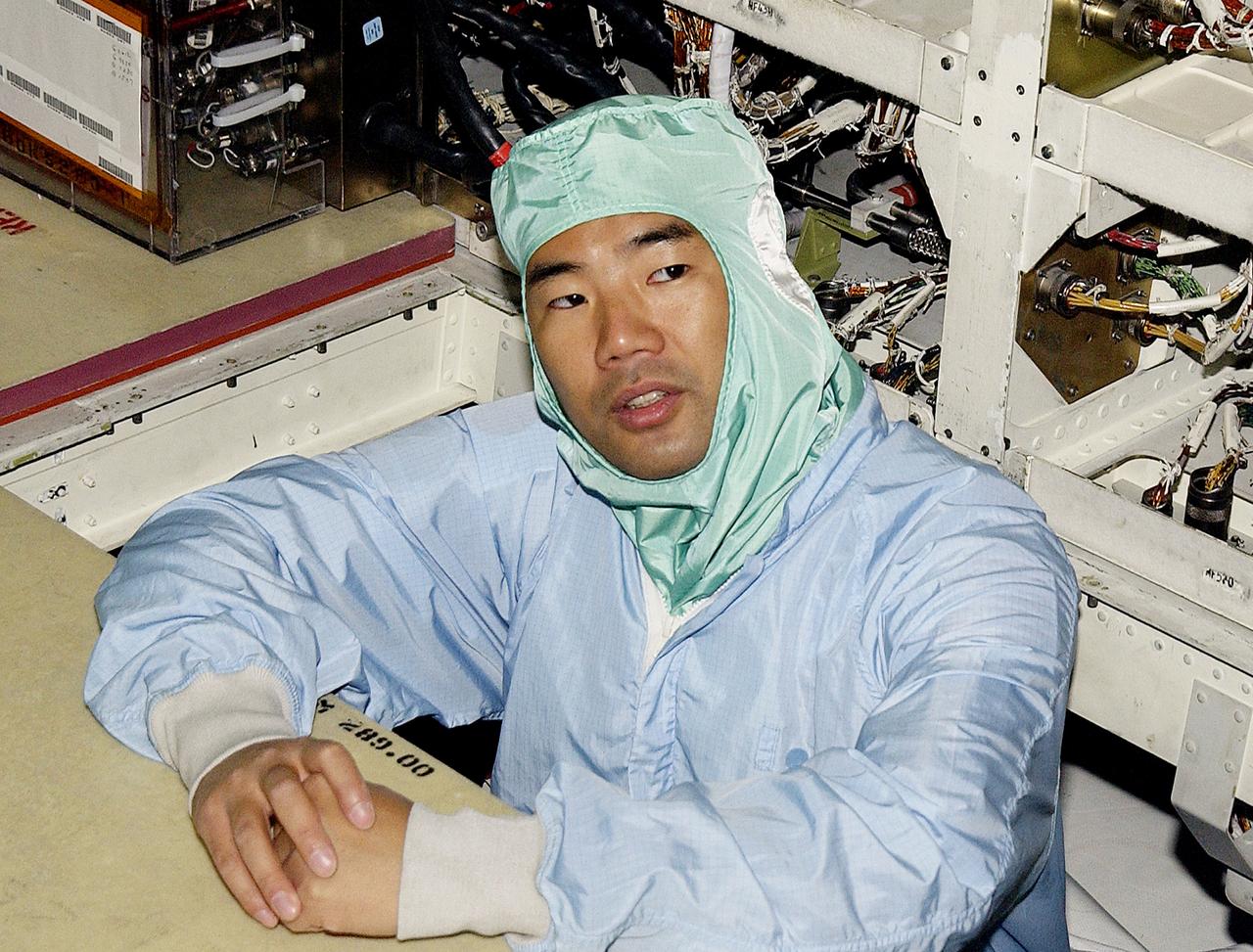
KENNEDY SPACE CENTER, FLA. - STS-114 Mission Specialist Soichi Noguchi checks the midbody of orbiter Atlantis. He and other crew members - Commander Eileen Collins, Pilot James Kelly and Mission Specialist Stephen Robinson - are at KSC for equipment familiarization. Noguchi is with the Japanese space agency NASDA. Mission STS-114 will carry the MultiPurpose Logistics Module (MPLM) Raffaello and External Stowage Platform 2 to the International Space Station. The MPLM will contain supplies and equipment. Another goal of the mission is to remove and replace a Control Moment Gyro. Launch date for mission STS-114 is under review.
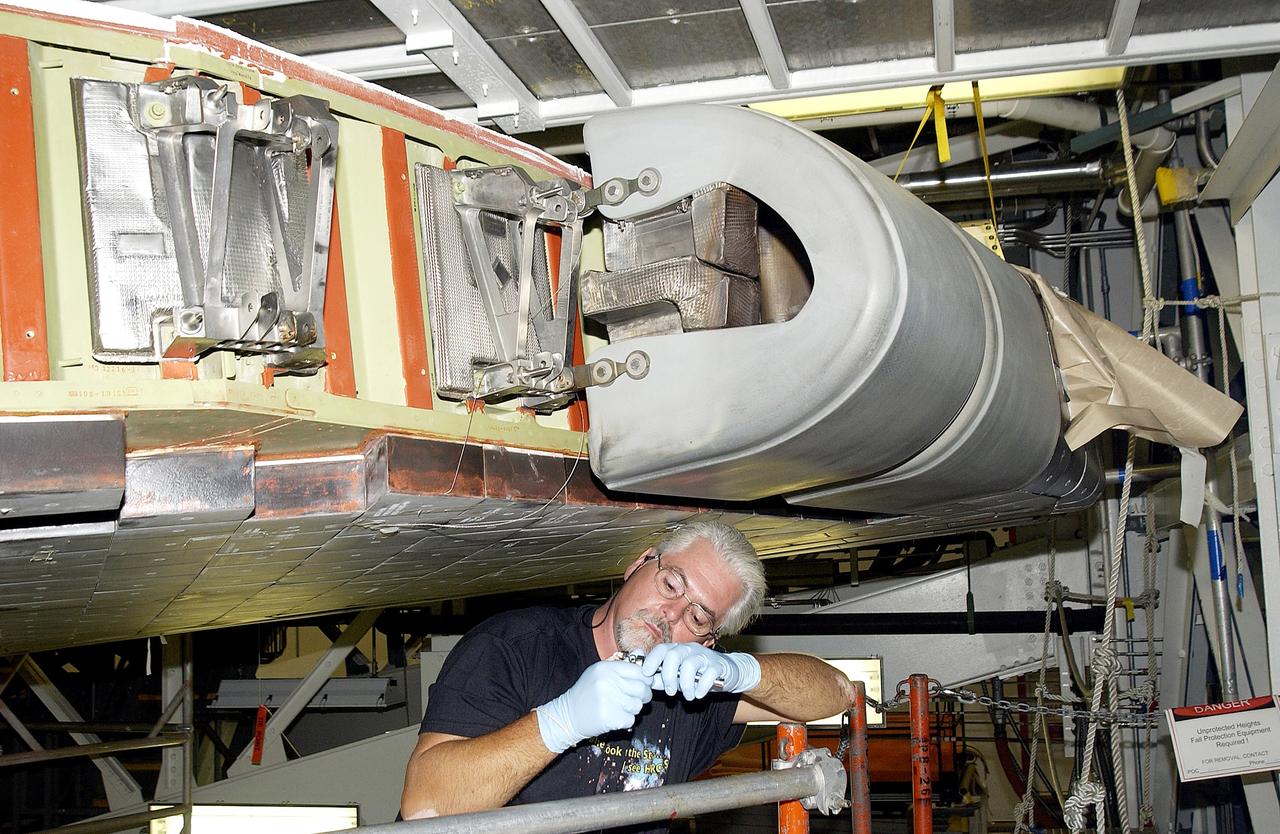
KENNEDY SPACE CENTER, FLA. - Billy Witt, a midbody shop mechanic with United Space Alliance, checks a part used for installation of a Reinforced Carbon Carbon (RCC) panel to the leading edge of the wing of an orbiter. Above him is an RCC panel just installed on Atlantis. The gray carbon composite RCC panels have sufficient strength to withstand the aerodynamic forces experienced during launch and reentry, which can reach as high as 800 pounds per square foot. The operating range of RCC is from minus 250º F to about 3,000º F, the temperature produced by friction with the atmosphere during reentry.
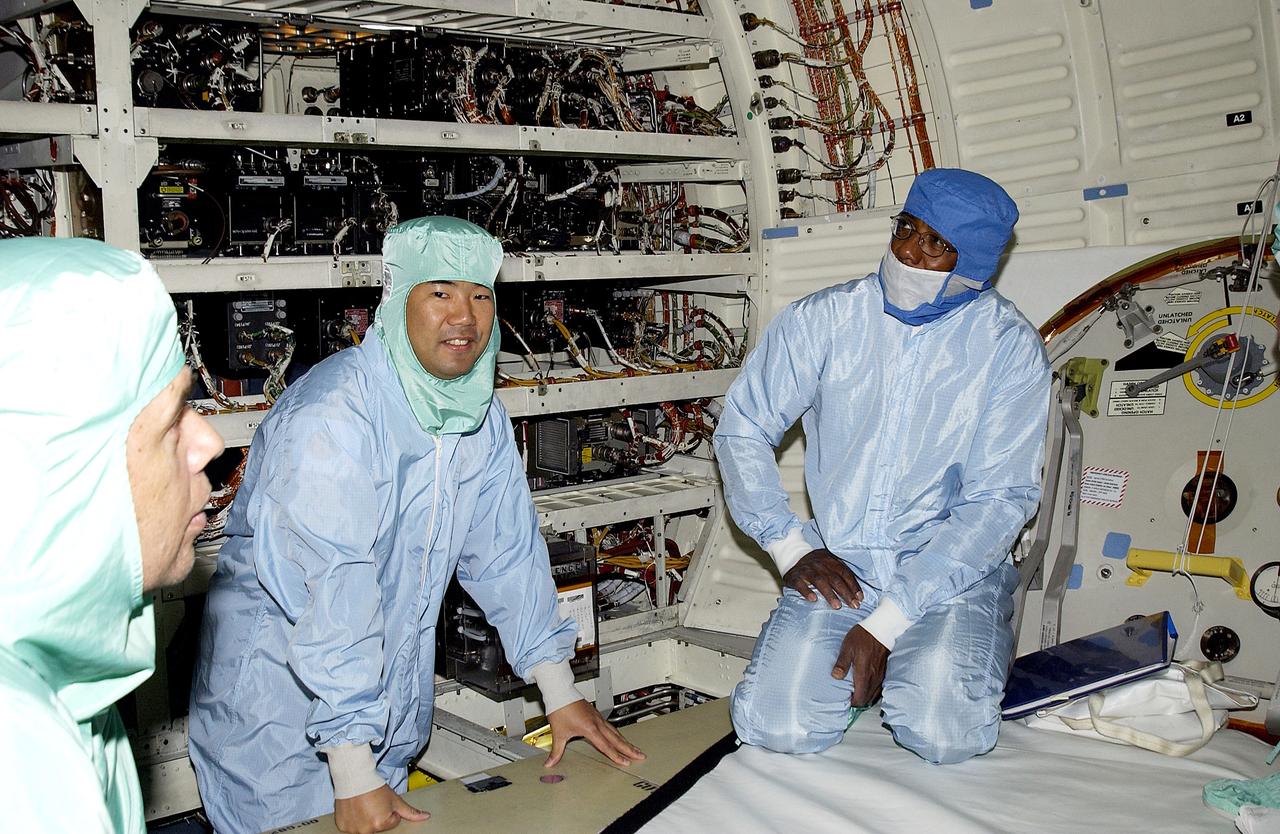
KENNEDY SPACE CENTER, FLA. - In the midbody of orbiter Atlantis, STS-114 crew members look over equipment under the eyes of a technician. At left are Pilot James Kelly and Mission Specialist Soichi Noguchi. They and Commander Eileen Collins and Mission Specialist Stephen Robinson are at KSC for equipment familiarization. Noguchi is with the Japanese space agency NASDA. Mission STS-114 will carry the MultiPurpose Logistics Module (MPLM) Raffaello and External Stowage Platform 2 to the International Space Station. The MPLM will contain supplies and equipment. Another goal of the mission is to remove and replace a Control Moment Gyro. Launch date for mission STS-114 is under review.

KENNEDY SPACE CENTER, FLA. - On a visit to Kennedy, members of the STS-114 crew pose for a photo standing under the belly of the orbiter Discovery. The crew, from left, are Pilot James Kelly, Mission Specialists Stephen Robinson and Wendy Lawrence, Commander Eileen Collins, and Mission Specialist Andrew Thomas. Between them is Alberto Deloucas, Midbody electrical technician . The designated vehicle for the mission, Discovery is in the Orbiter Processing Facility for launch processing. Discovery is scheduled for a launch planning window of May 12 to June 3, 2005.
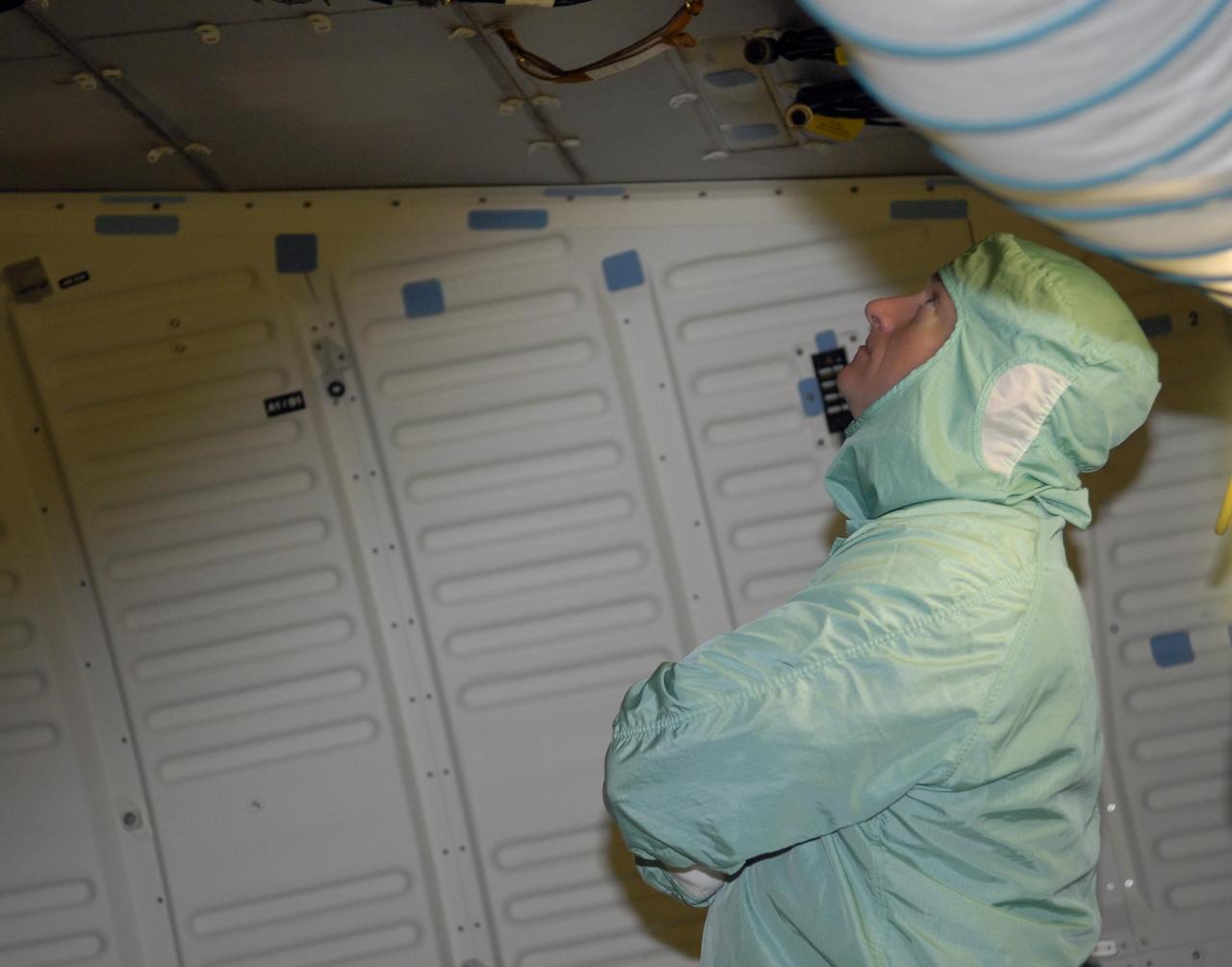
KENNEDY SPACE CENTER, FLA. -- During crew equipment interface test activities at KSC, STS-118 Commander Scott Kelly checks out the midbody of orbiter Endeavour, which is in Orbiter Processing Facility bay 3. The STS-118 mission will be delivering the third starboard truss segment, the ITS S5, to the International Space Station, as well as the SPACEHAB single cargo module filled with supplies and equipment. Launch aboard Space Shuttle Endeavour is targeted for Aug. 9. Photo credit: NASA/Kim Shiflett

KENNEDY SPACE CENTER, FLA. - In NASA Kennedy Space Center’s Orbiter Processing Facility Bay 3, Larry Tanner, a United Space Alliance orbiter technician, installs gap fillers in Discovery’s forward and midbody areas. This work is being performed after two gap fillers were found protruding from the underside of Discovery on the July 26 Return to Flight mission, STS-114. New installation procedures are being developed to ensure the gap fillers stay in place and do not pose any hazard on re-entry to the atmosphere.

KENNEDY SPACE CENTER, FLA. -- In the Payload Changeout Room, Launch Pad 39A, workers raise a platform toward the forward cargo bay area of Space Shuttle Endeavour to search for an oxygen leak. The launch of Endeavour on mission STS-113 was postponed Nov. 10, following the completion of tanking operations, due to higher than allowable oxygen levels in the orbiter's midbody. Workers will investigate the exact location and possible cause of the leak, and effect repairs. Launch has been tentatively set for no earlier than Nov. 18, between 7 and 11 p.m. EST.
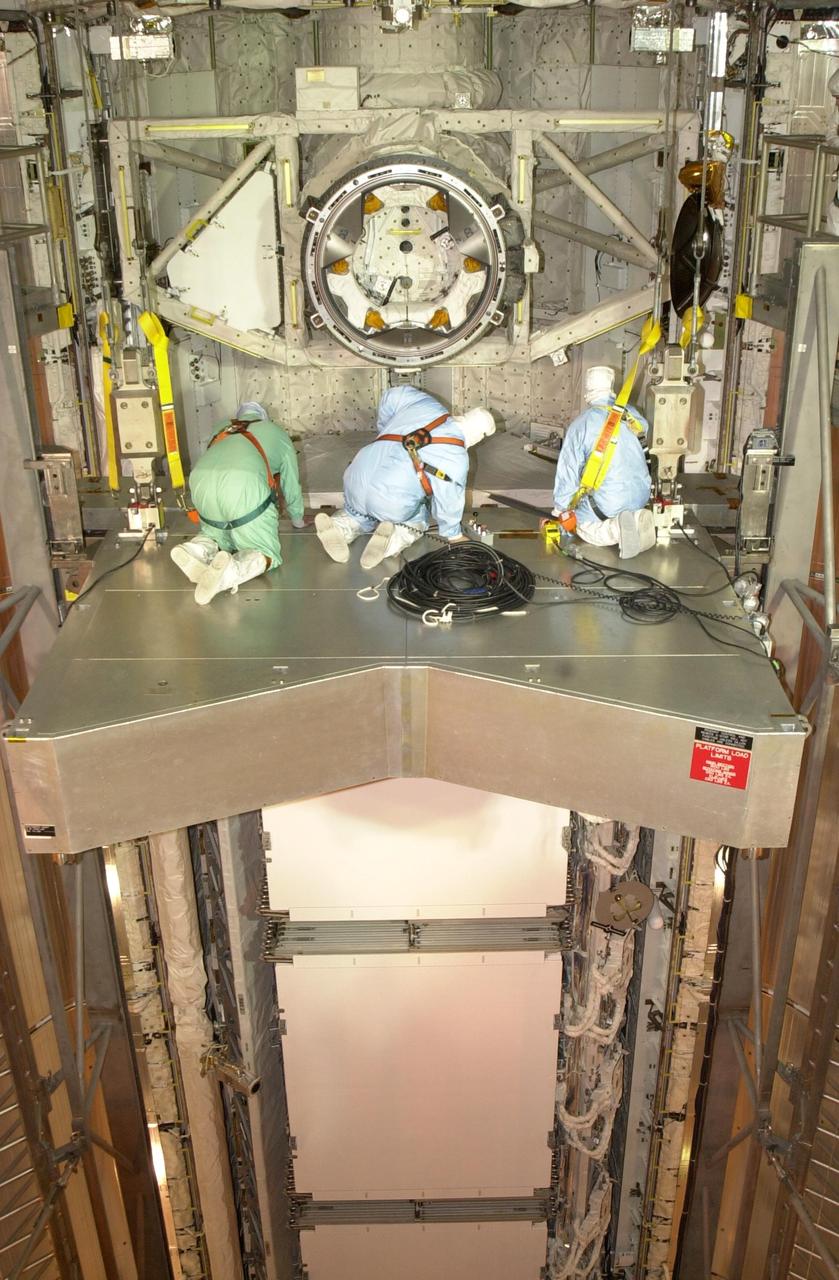
KENNEDY SPACE CENTER, FLA. -- Workers in the Payload Changeout Room, Launch Pad 39A, are on a platform in the forward cargo bay area of Space Shuttle Endeavour to search for an oxygen leak. The launch of Endeavour on mission STS-113 was postponed Nov. 10, following the completion of tanking operations, due to higher than allowable oxygen levels in the orbiter's midbody. Workers will investigate the exact location and possible cause of the leak, and effect repairs. Launch has been tentatively set for no earlier than Nov. 18, between 7 and 11 p.m. EST.
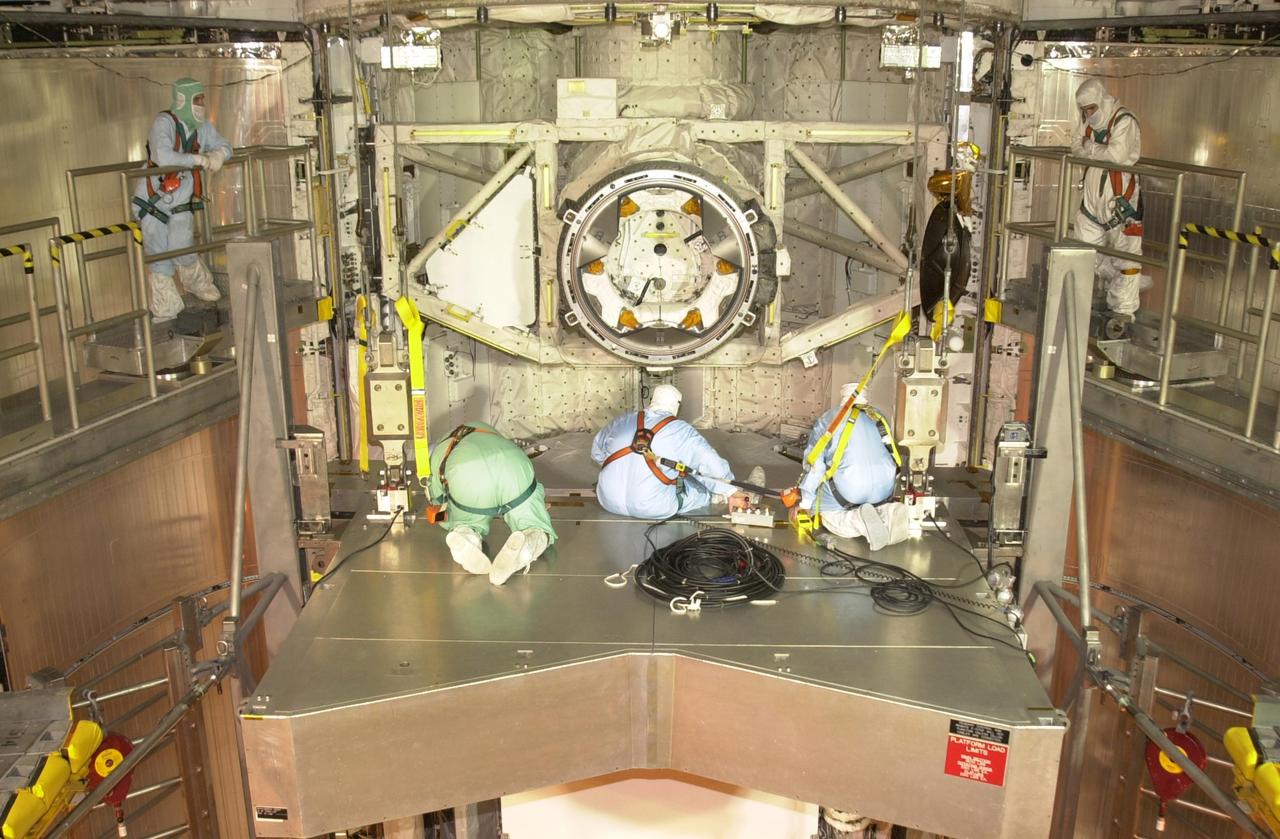
KENNEDY SPACE CENTER, FLA. -- Workers in the Payload Changeout Room, Launch Pad 39A, are on a platform in the forward cargo bay area of Space Shuttle Endeavour to search for an oxygen leak. The launch of Endeavour on mission STS-113 was postponed Nov. 10, following the completion of tanking operations, due to higher than allowable oxygen levels in the orbiter's midbody. Workers will investigate the exact location and possible cause of the leak, and effect repairs. Launch has been tentatively set for no earlier than Nov. 18, between 7 and 11 p.m. EST.
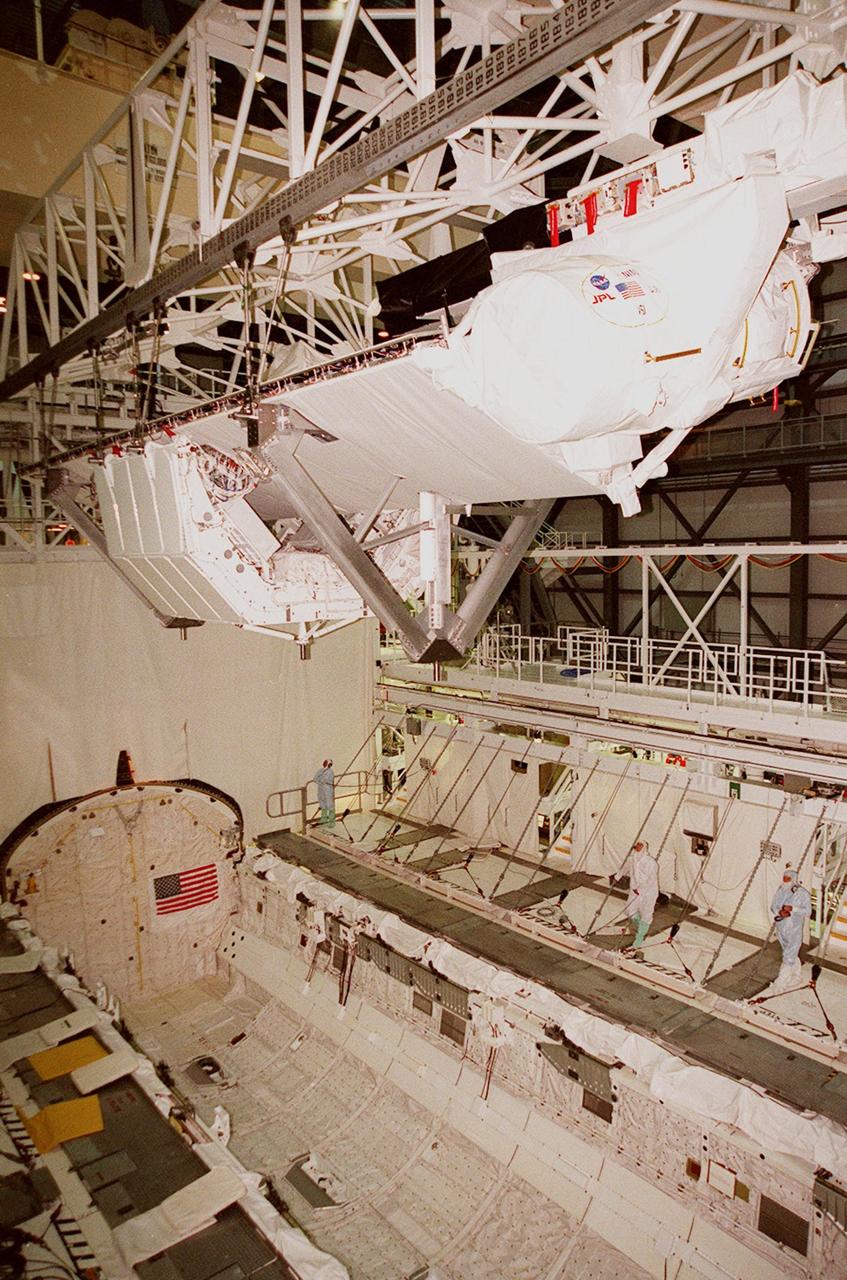
Inside orbiter Endeavour's payload bay, a crane lifts the Shuttle Radar Topography Mission (SRTM) clear of the orbiter for transfer to a payload canister. The payload on mission STS-99, SRTM is being removed to allow technicians access to the orbiter's midbody for planned wiring inspections. Endeavour is in the Orbiter Processing Facility. The entire fleet of orbiters is being inspected for wiring abrasions after the problem was first discovered in Columbia. Shuttle managers are reviewing several manifest options and could establish new target launch dates for the balance of 1999 next week. Shuttle Endeavour currently remains slated for launch in early October
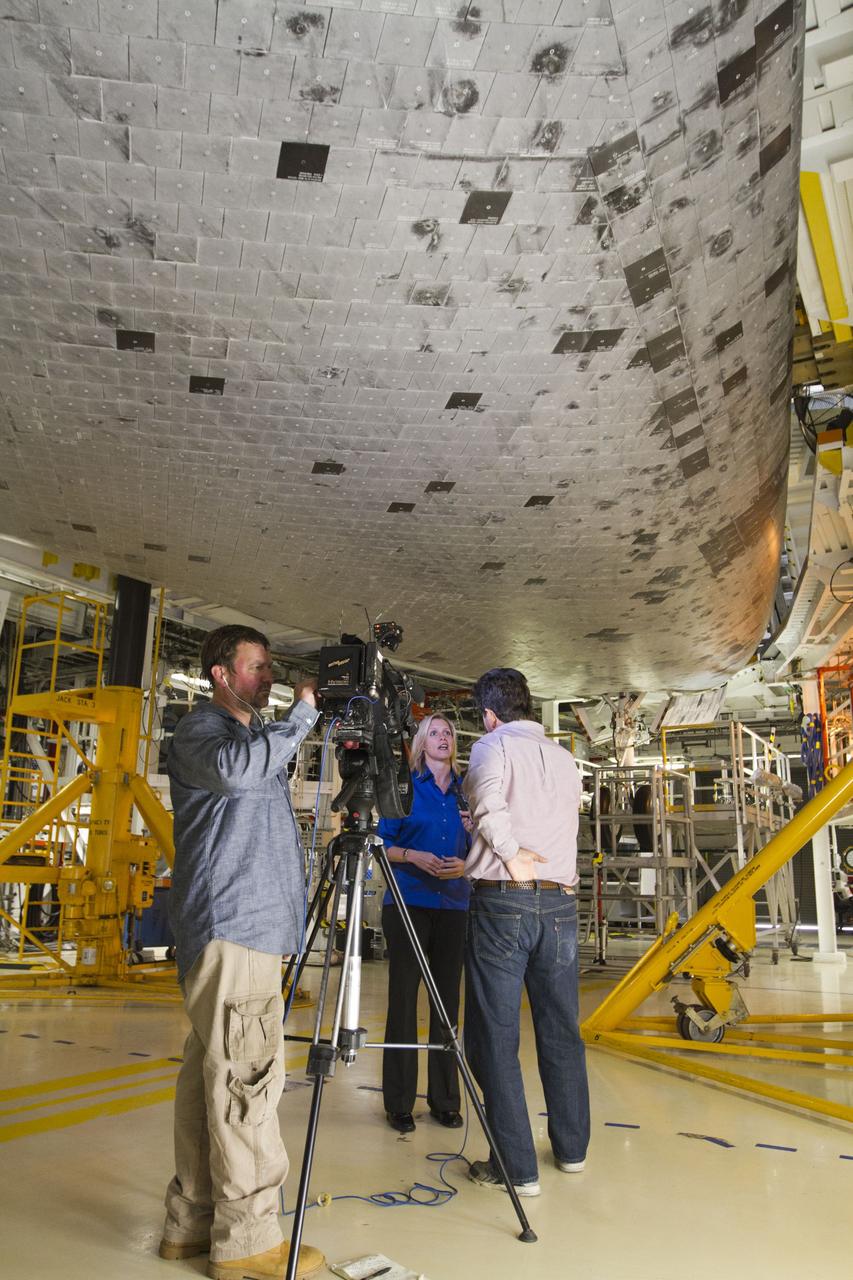
CAPE CANAVERAL, Fla. -- Standing beneath the midbody of space shuttle Endeavour, members of the news media interview Stephanie Stilson, NASA flow director for the shuttles' transition and retirement, inside Orbiter Processing Facility-2 at NASA's Kennedy Space Center in Florida. Stilson was one of several shuttle experts available for interviews around the outside of Endeavour and inside the shuttle's crew compartment. Ongoing transition and retirement activities are preparing the spacecraft for public display at the California Science Center in Los Angeles. Endeavour flew 25 missions during its 19-year career. Photo credit: NASA/Kim Shiflett

KENNEDY SPACE CENTER, FLA. -- Workers in the Payload Changeout Room, Launch Pad 39A, ride a platform toward the forward cargo bay area of Space Shuttle Endeavour to search for an oxygen leak. The launch of Endeavour on mission STS-113 was postponed Nov. 10, following the completion of tanking operations, due to higher than allowable oxygen levels in the orbiter's midbody. Workers will investigate the exact location and possible cause of the leak, and effect repairs. Launch has been tentatively set for no earlier than Nov. 18, between 7 and 11 p.m. EST.
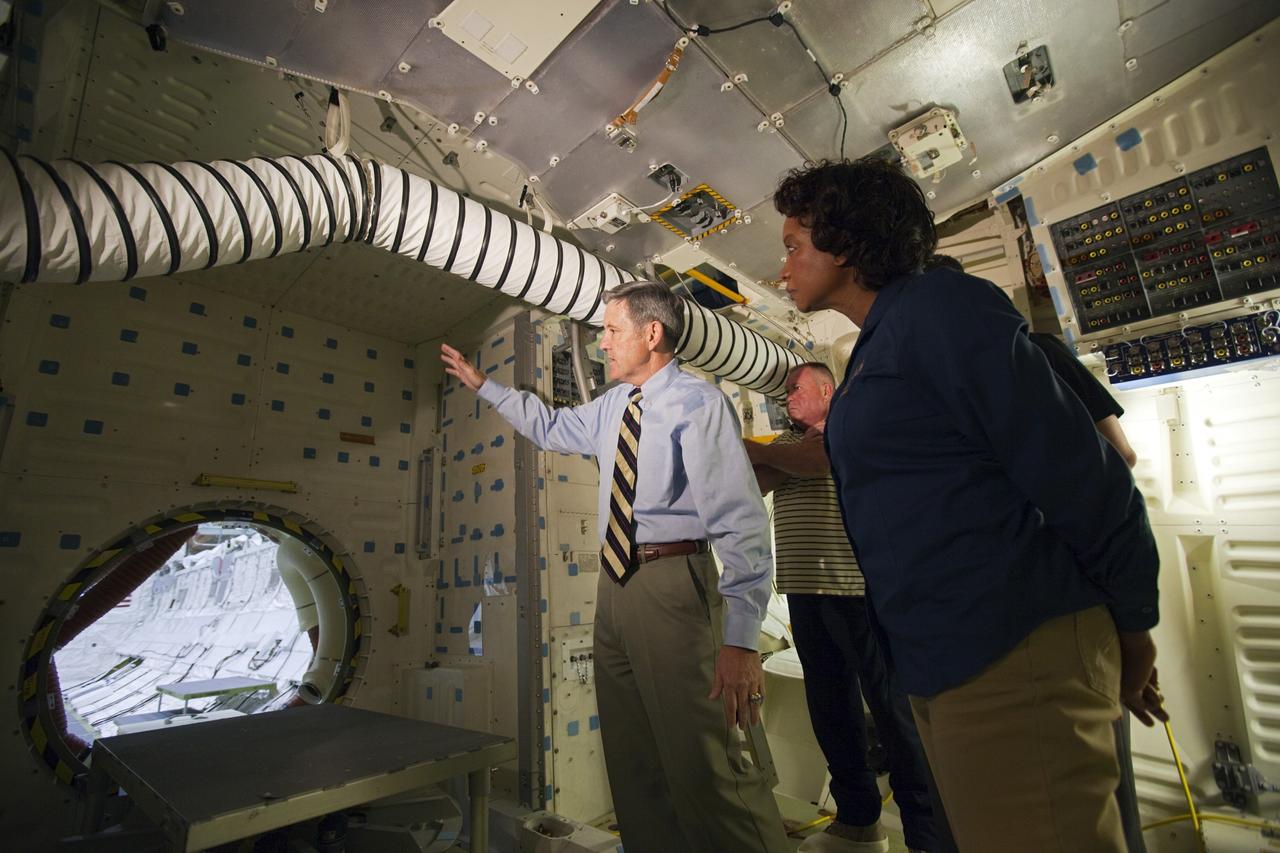
CAPE CANAVERAL, Fla. – Kennedy Space Center Director Bob Cabana, left, a former astronaut, explains how access is gained to a shuttle’s midbody, or payload bay, to Florida’s Lt. Gov. Jennifer Carroll from the middeck of space shuttle Atlantis during a tour of Kennedy’s Orbiter Processing Facility-1. The tour coincided with Carroll’s visit to Kennedy for a meeting with Cabana. Atlantis is being prepared for public display at the Kennedy Space Center Visitor Complex in 2013. The groundbreaking for Atlantis’ exhibit hall took place in January Atlantis is scheduled to be moved to the visitor complex in November. For more information, visit http://www.nasa.gov/shuttle. Photo credit: NASA/Jim Grossmann

KENNEDY SPACE CENTER, FLA. - In NASA Kennedy Space Center’s Orbiter Processing Facility Bay 3, Larry Tanner, a United Space Alliance orbiter technician, inspects and measures thermal protection system gap fillers in Discovery’s forward and midbody areas. This work is being performed after two gap fillers were found protruding from the underside of Discovery on the July 26 Return to Flight mission, STS-114. New installation procedures are being developed to ensure the gap fillers stay in place and do not pose any hazard on re-entry to the atmosphere.
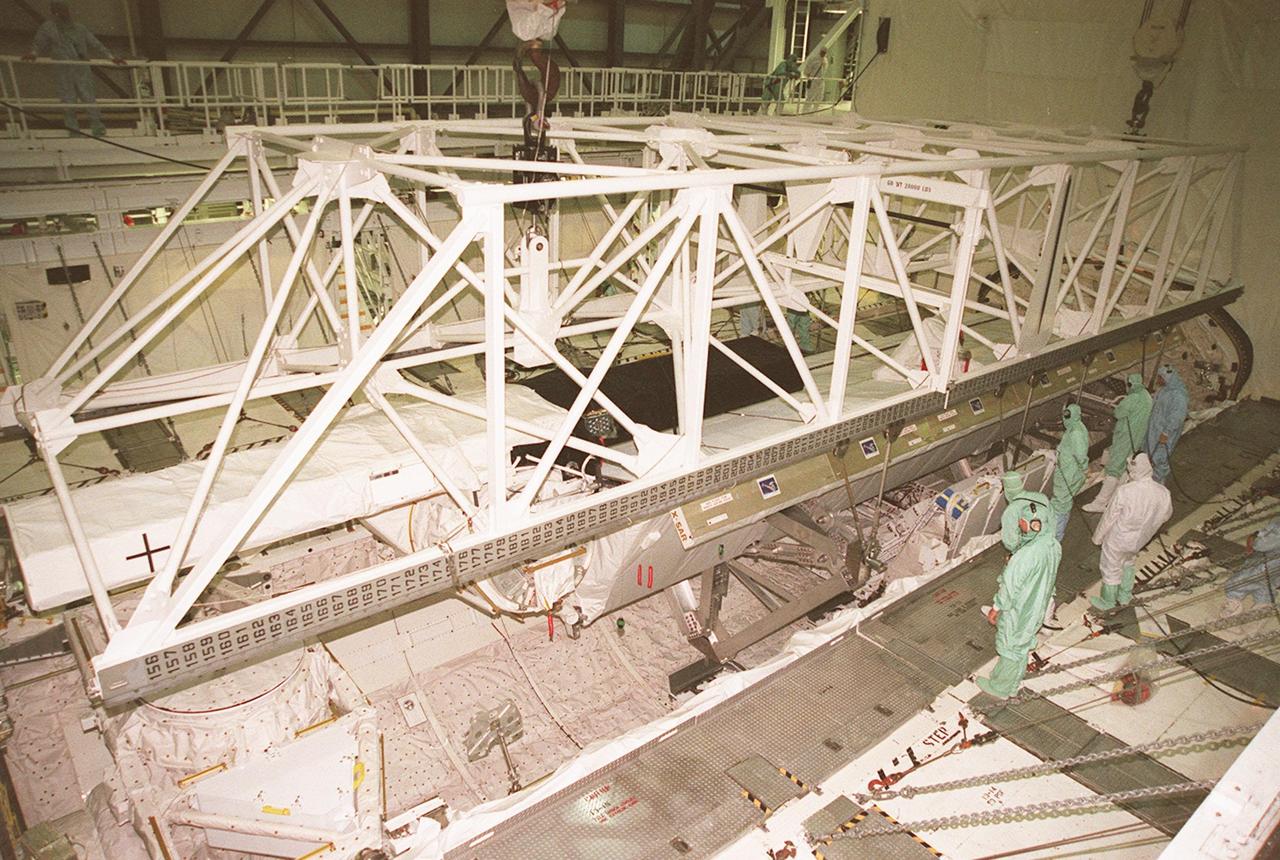
Workers inside orbiter Endeavour's payload bay observe as an overhead crane maneuvers to lift the Shuttle Radar Topography Mission (SRTM) for its transfer out of the orbiter to a payload canister. The payload on mission STS-99, SRTM is being removed to allow technicians access to the orbiter's midbody for planned wiring inspections. Endeavour is in the Orbiter Processing Facility. The entire fleet of orbiters is being inspected for wiring abrasions after the problem was first discovered in Columbia. Shuttle managers are reviewing several manifest options and could establish new target launch dates for the balance of 1999 next week. Shuttle Endeavour currently remains slated for launch in early October
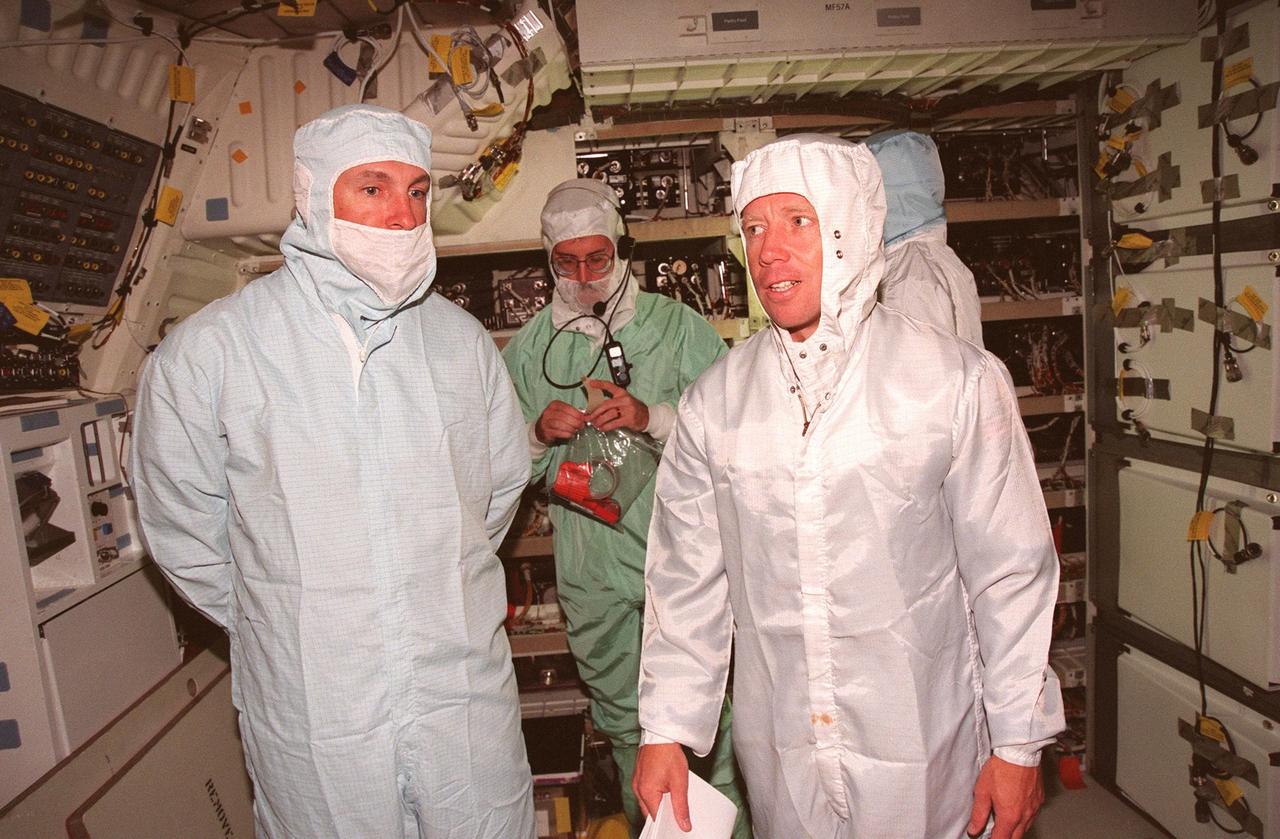
STS-95 Mission Commander Curtis L. Brown Jr. (left) and Pilot Steven Lindsey (right) are in Discovery's midbody checking electrical connections during a Crew Equipment Interface Test (CEIT) for their mission. The CEIT gives astronauts an opportunity for a hands-on look at the payloads on which they will be working on orbit. The launch of the STS-95 mission, aboard Space Shuttle Discovery, is scheduled for Oct. 29, 1998. The mission includes research payloads such as the Spartan solar-observing deployable spacecraft, the Hubble Space Telescope Orbital Systems Test Platform, the International Extreme Ultraviolet Hitchhiker, as well as the SPACEHAB single module with experiments on space flight and the aging process
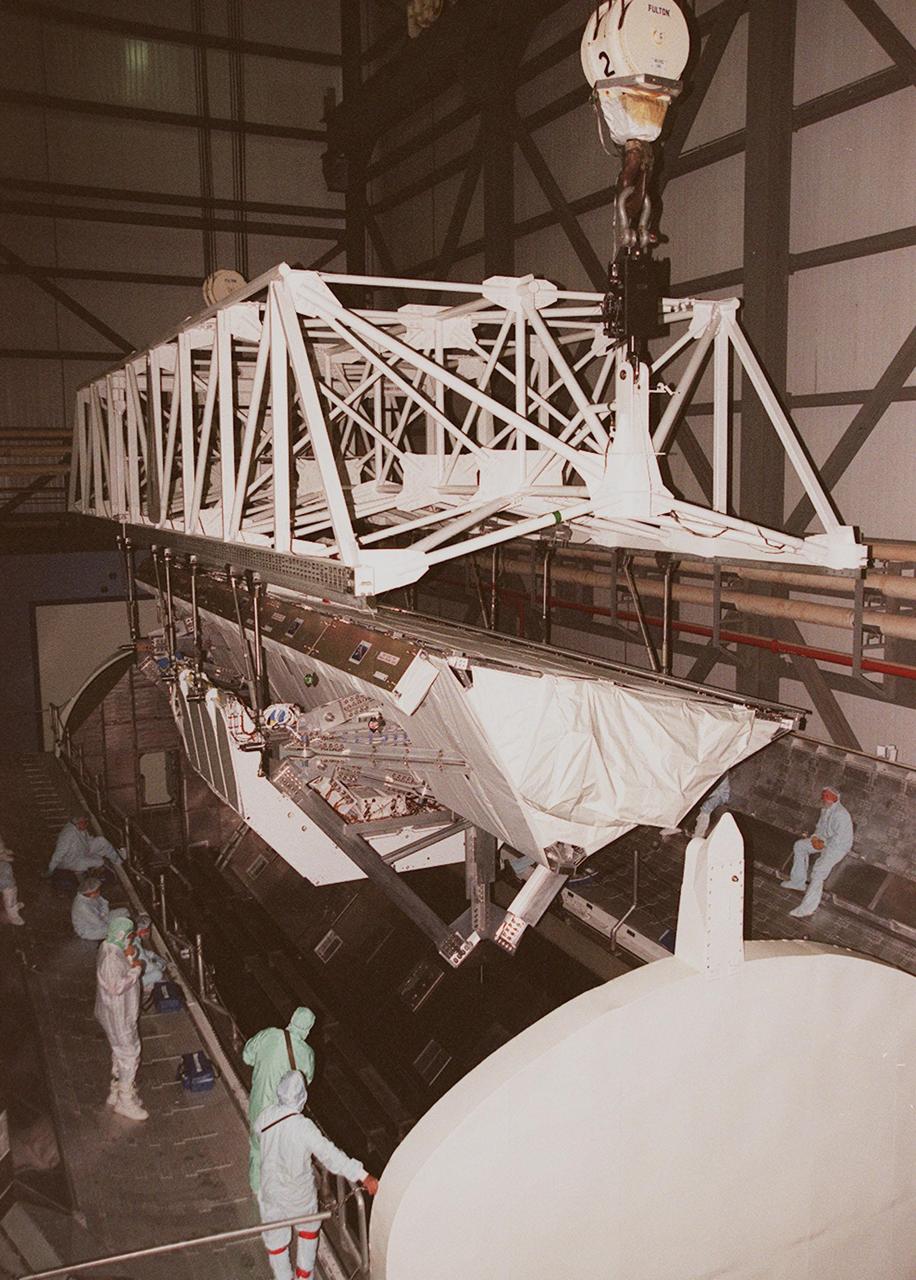
In the Orbiter Processing Facility, workers observe as an overhead crane lowers the Shuttle Radar Topography Mission (SRTM) into a payload canister. The payload on mission STS-99, SRTM was removed from orbiter Endeavour's payload bay to allow technicians access to the orbiter's midbody for planned wiring inspections. The entire fleet of orbiters is being inspected for wiring abrasions after the problem was first discovered in Columbia. Shuttle managers are reviewing several manifest options and could establish new target launch dates for the balance of 1999 next week. Shuttle Endeavour currently remains slated for launch in early October
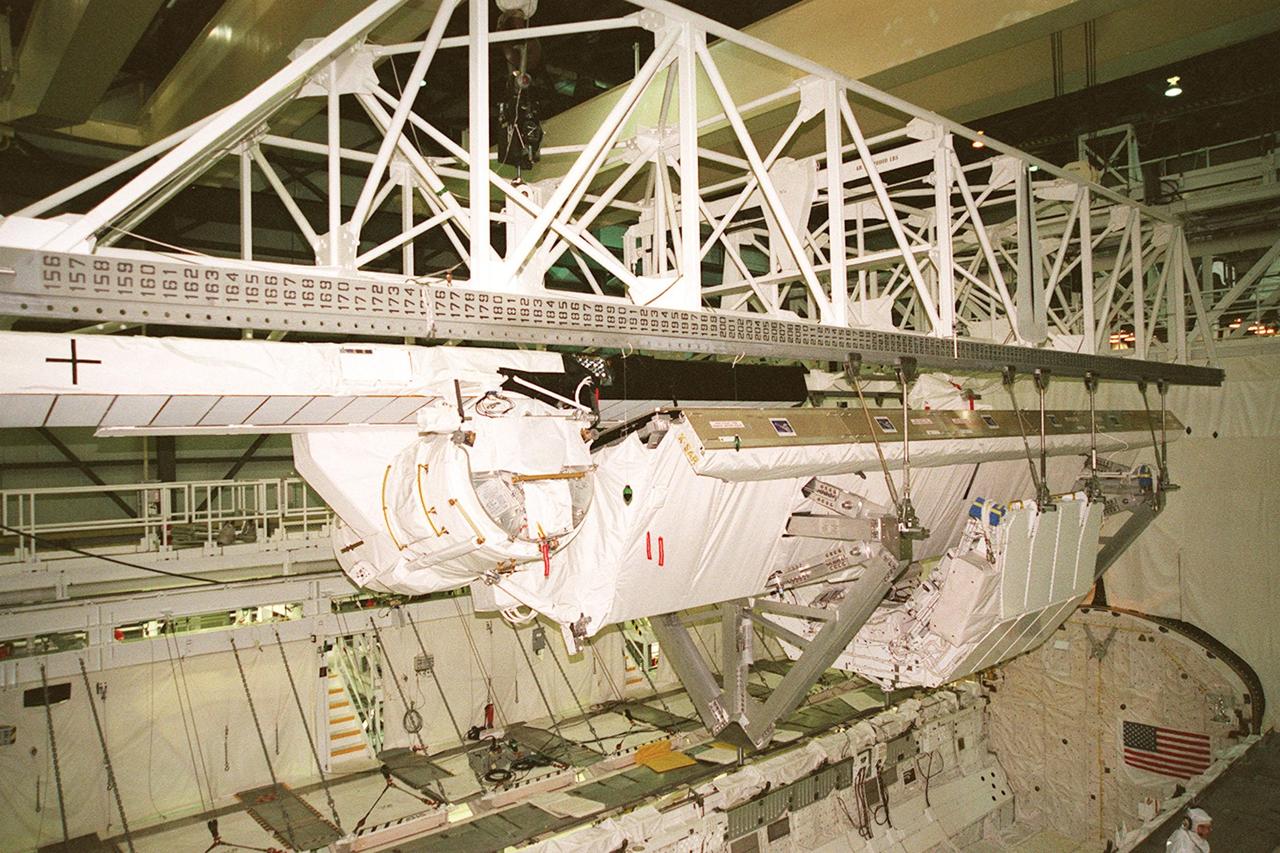
Inside orbiter Endeavour's payload bay, a crane lifts the Shuttle Radar Topography Mission (SRTM) for its transfer out of the orbiter to a payload canister. The payload on mission STS-99, SRTM is being removed to allow technicians access to the orbiter's midbody for planned wiring inspections. Endeavour is in the Orbiter Processing Facility. The entire fleet of orbiters is being inspected for wiring abrasions after the problem was first discovered in Columbia. Shuttle managers are reviewing several manifest options and could establish new target launch dates for the balance of 1999 next week. Shuttle Endeavour currently remains slated for launch in early October
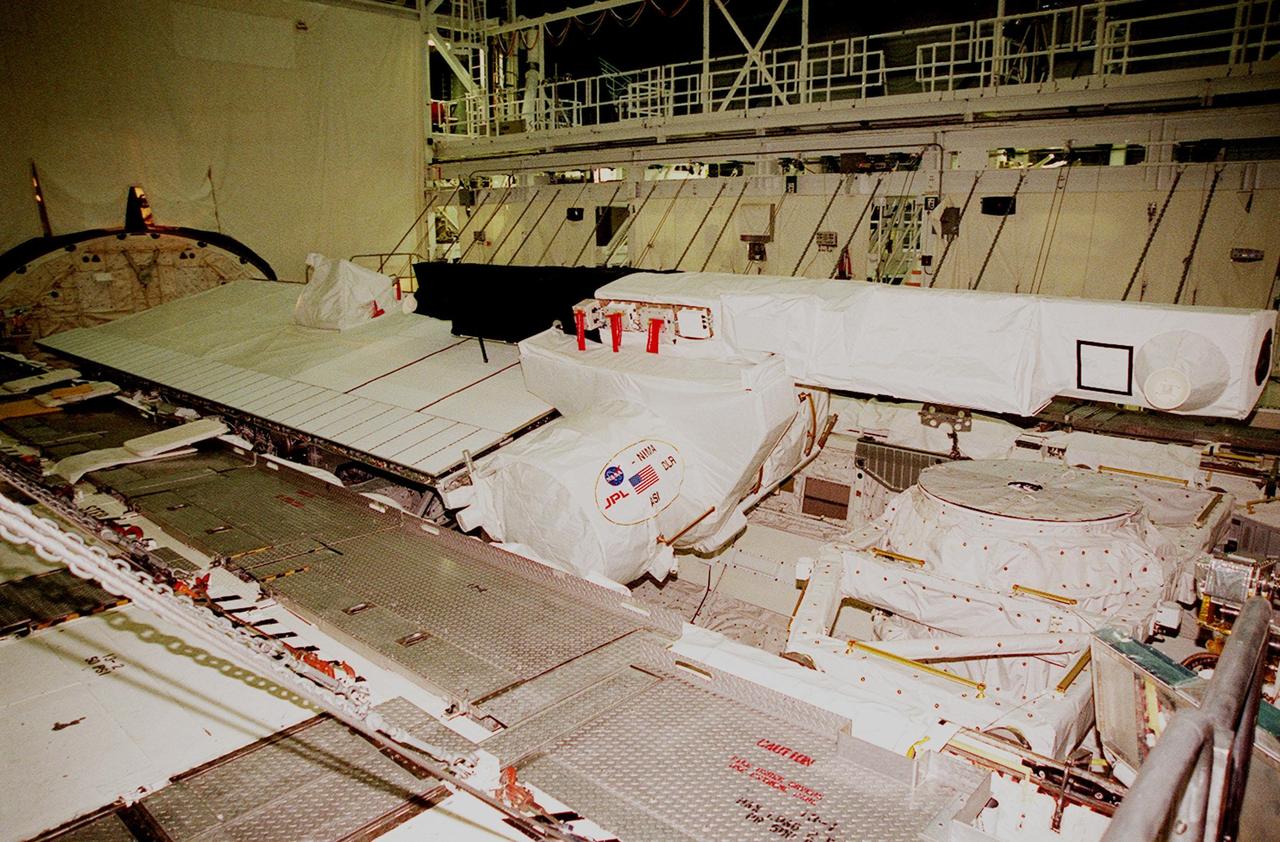
In the center of orbiter Endeavour's payload bay is the Shuttle Radar Topography Mission (SRTM), being prepared for transfer out of the orbiter to a payload canister. The payload on mission STS-99, SRTM is being removed to allow technicians access to the orbiter's midbody for planned wiring inspections. Endeavour is in the Orbiter Processing Facility. The entire fleet of orbiters is being inspected for wiring abrasions after the problem was first discovered in Columbia. Shuttle managers are reviewing several manifest options and could establish new target launch dates for the balance of 1999 next week. Shuttle Endeavour currently remains slated for launch in early October

KENNEDY SPACE CENTER, FLA. - In NASA Kennedy Space Center’s Orbiter Processing Facility Bay 3, workers inspect and measure thermal protection system gap fillers in Discovery’s forward and midbody areas. This work is being performed after two gap fillers were found protruding from the underside of Discovery on the July 26 Return to Flight mission, STS-114. New installation procedures are being developed to ensure the gap fillers stay in place and do not pose any hazard on re-entry to the atmosphere. The white strings stretching across the belly of the orbiter separate prioritized work zones. The work seen here is in zone 1.
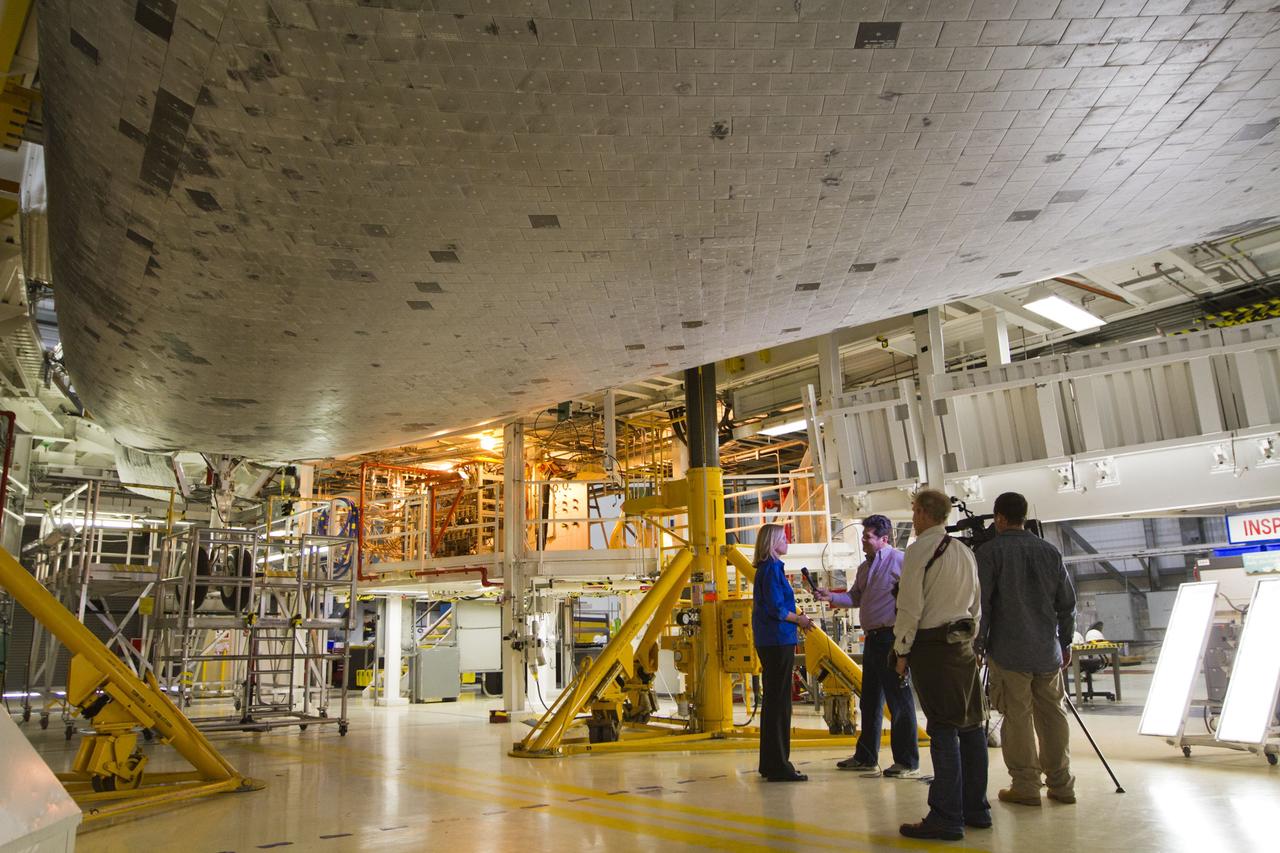
CAPE CANAVERAL, Fla. -- Standing beneath the midbody of space shuttle Endeavour, members of the news media interview Stephanie Stilson, NASA flow director for the shuttles' transition and retirement, inside Orbiter Processing Facility-2 at NASA's Kennedy Space Center in Florida. Stilson was one of several shuttle experts available for interviews around the outside of Endeavour and inside the shuttle's crew compartment. Ongoing transition and retirement activities are preparing the spacecraft for public display at the California Science Center in Los Angeles. Endeavour flew 25 missions during its 19-year career. Photo credit: NASA/Kim Shiflett

KENNEDY SPACE CENTER, FLA. - In NASA Kennedy Space Center’s Orbiter Processing Facility Bay 3, Keith Evans, a United Space Alliance orbiter technician, inspects and measures thermal protection system gap fillers in Discovery’s forward and midbody areas. This work is being performed after two gap fillers were found protruding from the underside of Discovery on the July 26 Return to Flight mission, STS-114. New installation procedures are being developed to ensure the gap fillers stay in place and do not pose any hazard on re-entry to the atmosphere.
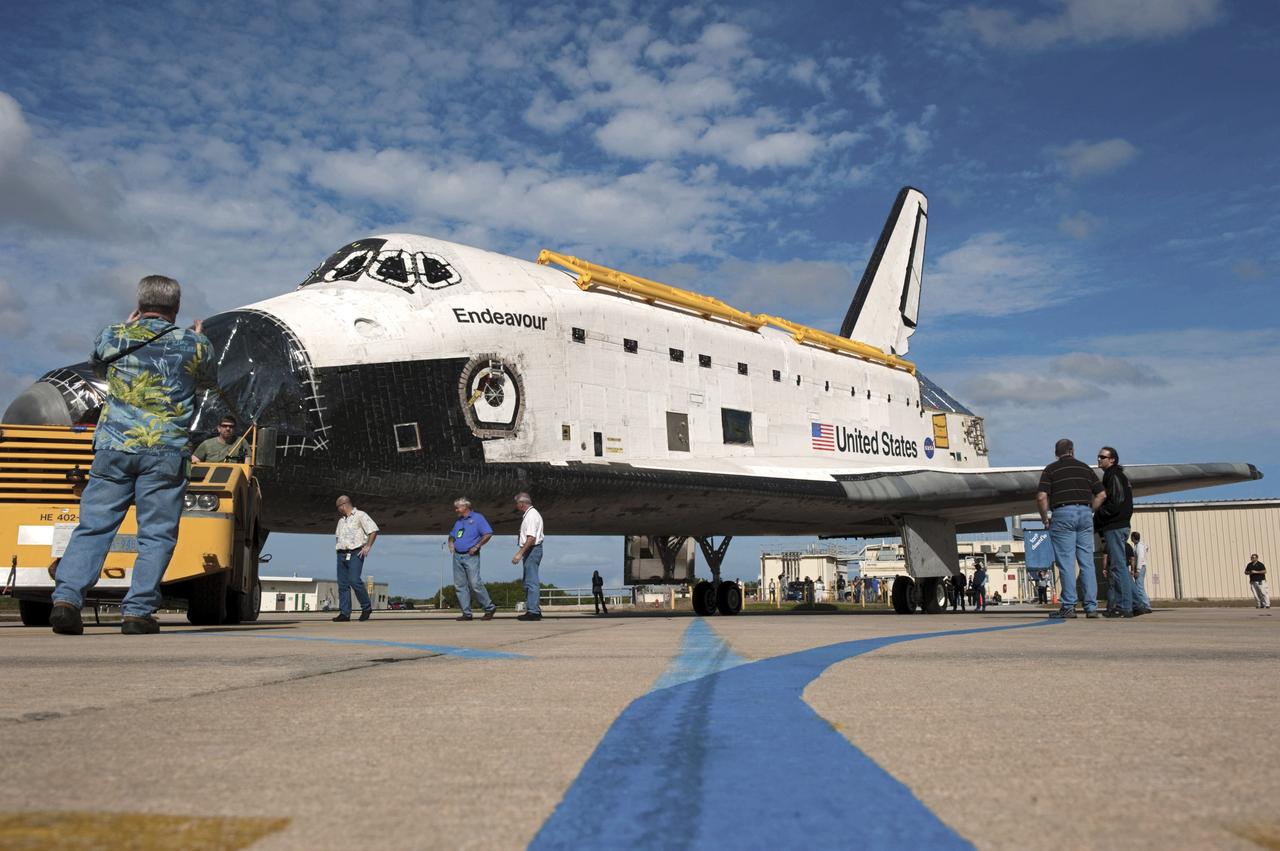
CAPE CANAVERAL, Fla. – At NASA’s Kennedy Space Center in Florida, technicians assist as space shuttle Endeavour is being towed from the Vehicle Assembly Building to Orbiter Processing Facility-2 (OPF-2). Shuttle Endeavour will remain in OPF-2 so that the orbiter maneuvering system (OMS) pods and forward reaction control system can be installed. Technicians also will offload water and Freon gas from lines located in Endeavour’s midbody. The work is part of Endeavour’s transition and retirement processing. The spacecraft is being prepared for public display at the California Science Center in Los Angeles. Endeavour flew 25 missions, spent 299 days in space, orbited Earth 4,671 times and traveled 122, 883, 151 miles over the course of its 19-year career. Endeavour’s STS-134 and final mission was completed after landing on June 1, 2011. Photo credit: Kim Shiflett
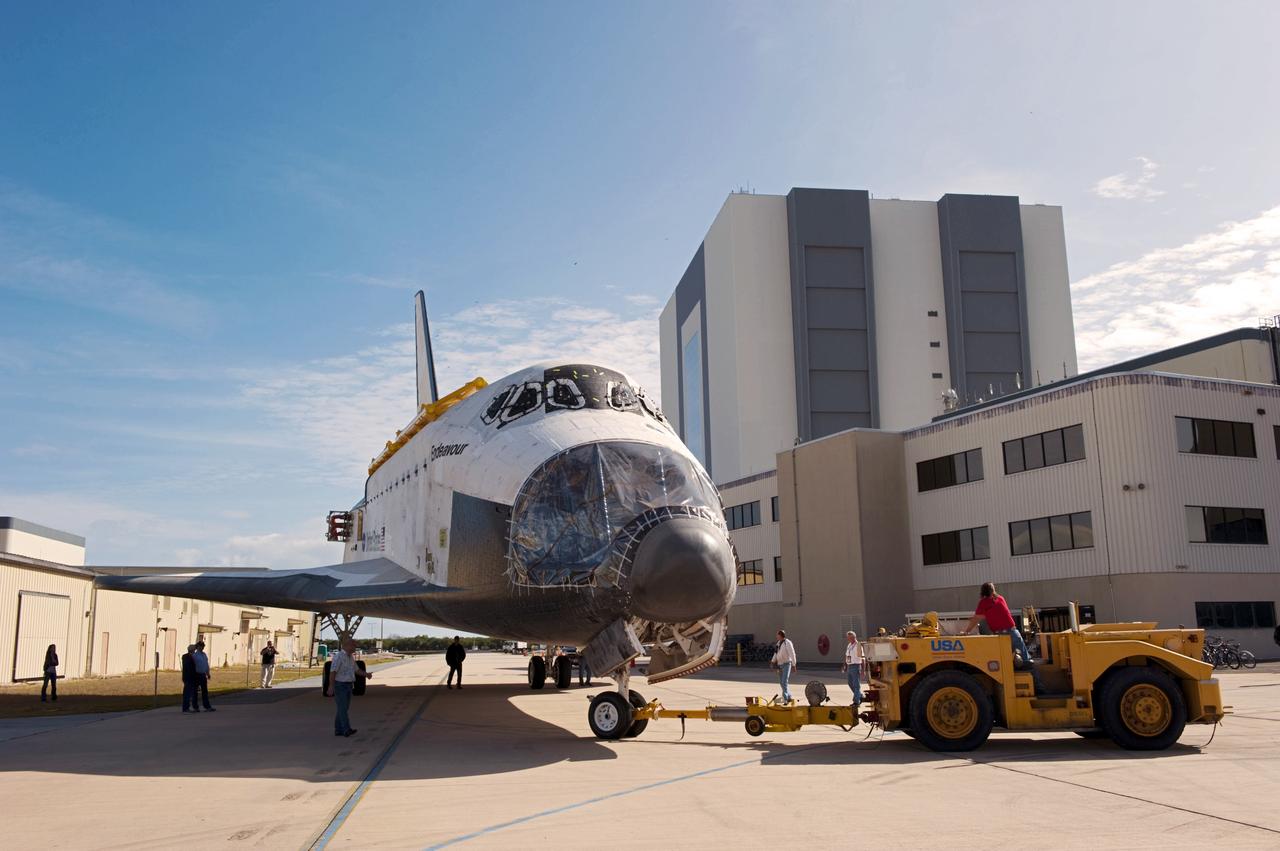
CAPE CANAVERAL, Fla. – At NASA’s Kennedy Space Center in Florida, space shuttle Endeavour is being towed from the Vehicle Assembly Building to Orbiter Processing Facility-2 (OPF-2). Shuttle Endeavour will remain in OPF-2 so that the orbiter maneuvering system (OMS) pods and forward reaction control system can be installed. Technicians also will offload water and Freon gas from lines located in Endeavour’s midbody. The work is part of Endeavour’s transition and retirement processing. The spacecraft is being prepared for public display at the California Science Center in Los Angeles. Endeavour flew 25 missions, spent 299 days in space, orbited Earth 4,671 times and traveled 122, 883, 151 miles over the course of its 19-year career. Endeavour’s STS-134 and final mission was completed after landing on June 1, 2011. Photo credit: Kim Shiflett
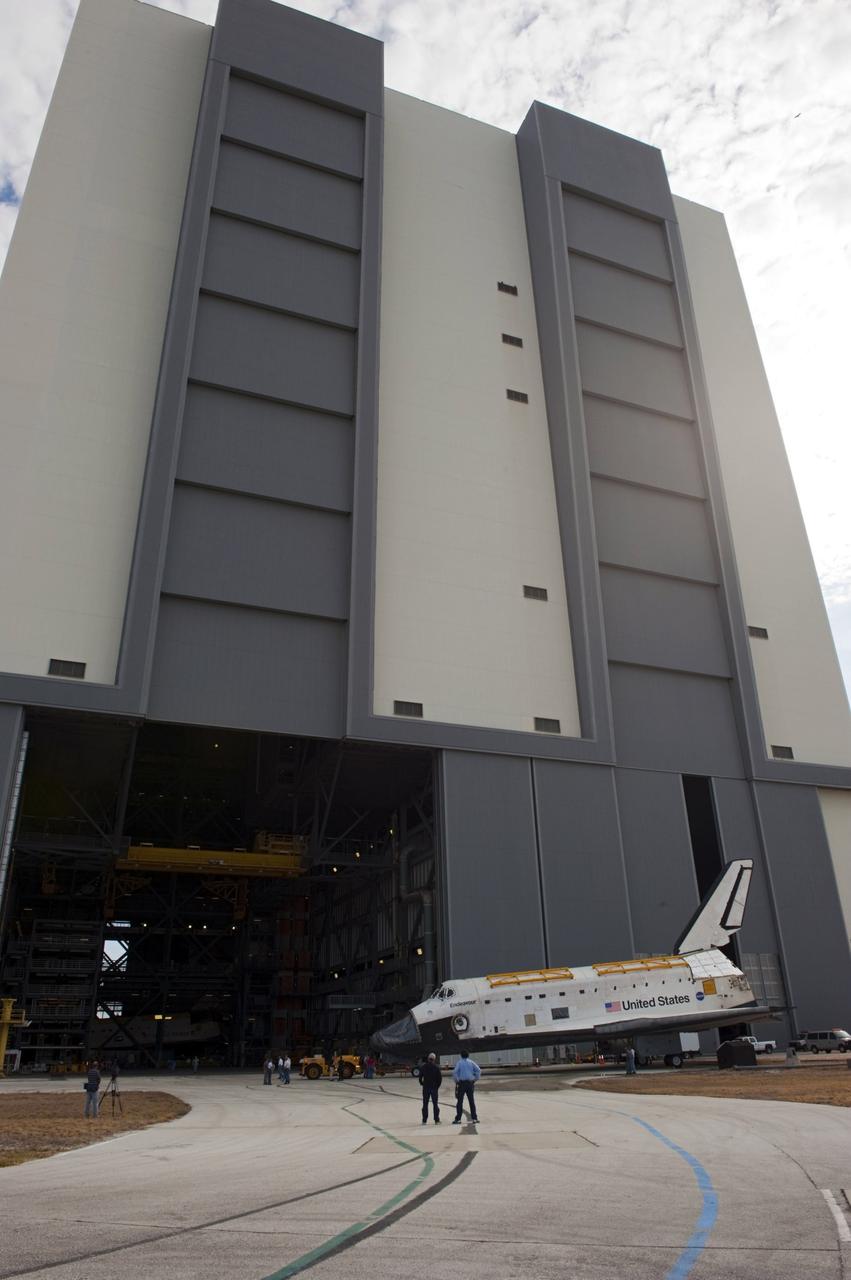
CAPE CANAVERAL, Fla. – Space shuttle Endeavour is backed away from the Vehicle Assembly Building at NASA’s Kennedy Space Center in Florida so that it can be towed to Orbiter Processing Facility-2 (OPF-2). Shuttle Endeavour will remain in OPF-2 so that the orbiter maneuvering system (OMS) pods and forward reaction control system can be installed. Technicians also will offload water and Freon gas from lines located in Endeavour’s midbody. The work is part of Endeavour’s transition and retirement processing. The spacecraft is being prepared for public display at the California Science Center in Los Angeles. Endeavour flew 25 missions, spent 299 days in space, orbited Earth 4,671 times and traveled 122, 883, 151 miles over the course of its 19-year career. Endeavour’s STS-134 and final mission was completed after landing on June 1, 2011. Photo credit: Kim Shiflett
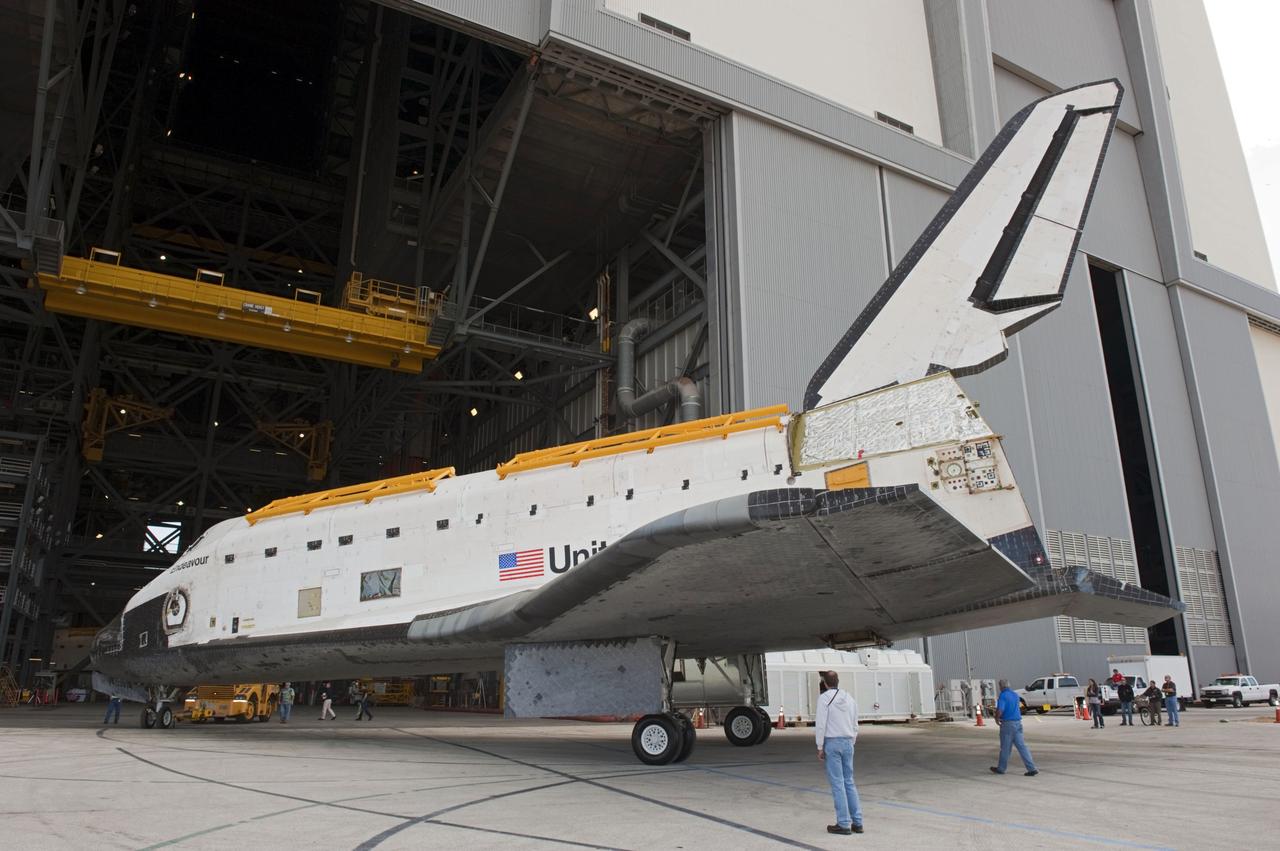
CAPE CANAVERAL, Fla. – Space shuttle Endeavour is backed away from the Vehicle Assembly Building at NASA’s Kennedy Space Center in Florida so that it can be towed to Orbiter Processing Facility-2 (OPF-2). Shuttle Endeavour will remain in OPF-2 so that the orbiter maneuvering system (OMS) pods and forward reaction control system can be installed. Technicians also will offload water and Freon gas from lines located in Endeavour’s midbody. The work is part of Endeavour’s transition and retirement processing. The spacecraft is being prepared for public display at the California Science Center in Los Angeles. Endeavour flew 25 missions, spent 299 days in space, orbited Earth 4,671 times and traveled 122, 883, 151 miles over the course of its 19-year career. Endeavour’s STS-134 and final mission was completed after landing on June 1, 2011. Photo credit: Kim Shiflett
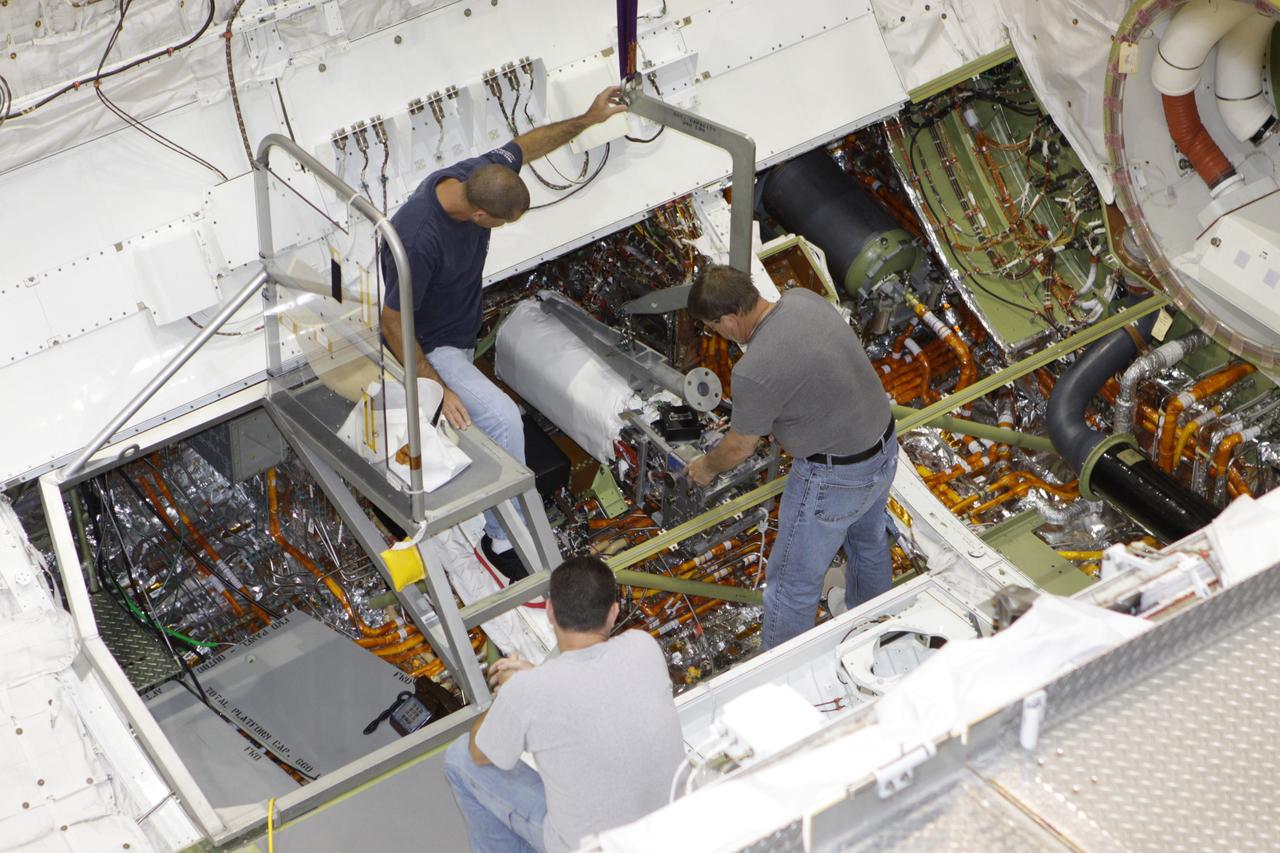
CAPE CANAVERAL, Fla. – Inside Orbiter Processing Facility-2 at NASA's Kennedy Space Center in Florida, technicians use a special crane to lift a fuel cell out of space shuttle Endeavour's payload bay. All three of Endeavour's fuel cells were removed and will be drained of fluids. The hydrogen and oxygen dewars which feed reactants to the fuel cells remain in Endeavour's midbody and will be purged with inert gases and vented down. The work is part of the Space Shuttle Program's transition and retirement processing of shuttle Endeavour, which is being prepared for public display at the California Science Center in Los Angeles. Its ferry flight to California is targeted for mid-September. Endeavour was the last space shuttle added to NASA's orbiter fleet. Over the course of its 19-year career, Endeavour spent 299 days in space during 25 missions. For more information, visit http://www.nasa.gov/shuttle. Photo credit: NASA/Glenn Benson
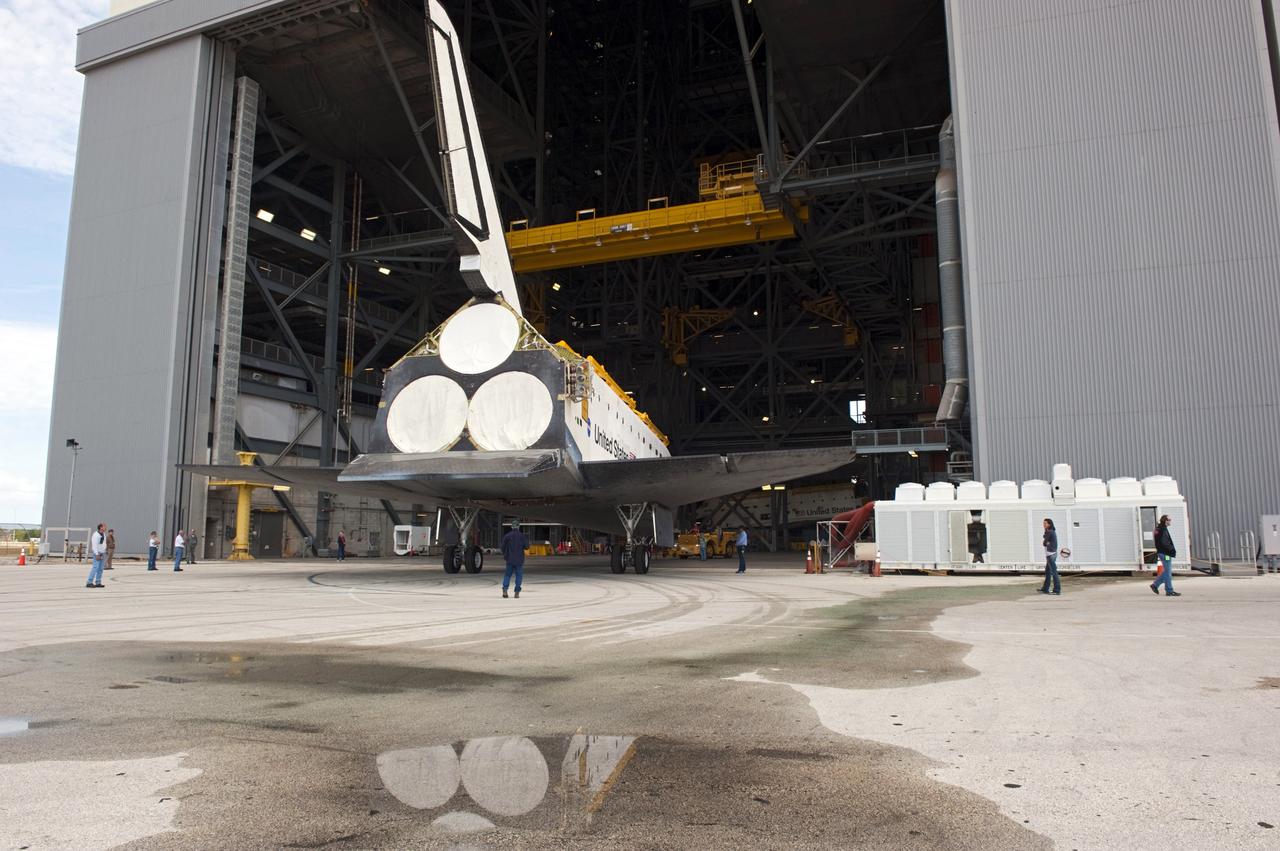
CAPE CANAVERAL, Fla. – Space shuttle Endeavour is backed away from the Vehicle Assembly Building at NASA’s Kennedy Space Center in Florida so that it can be towed to Orbiter Processing Facility-2 (OPF-2). Shuttle Endeavour will remain in OPF-2 so that the orbiter maneuvering system (OMS) pods and forward reaction control system can be installed. Technicians also will offload water and Freon gas from lines located in Endeavour’s midbody. The work is part of Endeavour’s transition and retirement processing. The spacecraft is being prepared for public display at the California Science Center in Los Angeles. Endeavour flew 25 missions, spent 299 days in space, orbited Earth 4,671 times and traveled 122, 883, 151 miles over the course of its 19-year career. Endeavour’s STS-134 and final mission was completed after landing on June 1, 2011. Photo credit: Kim Shiflett
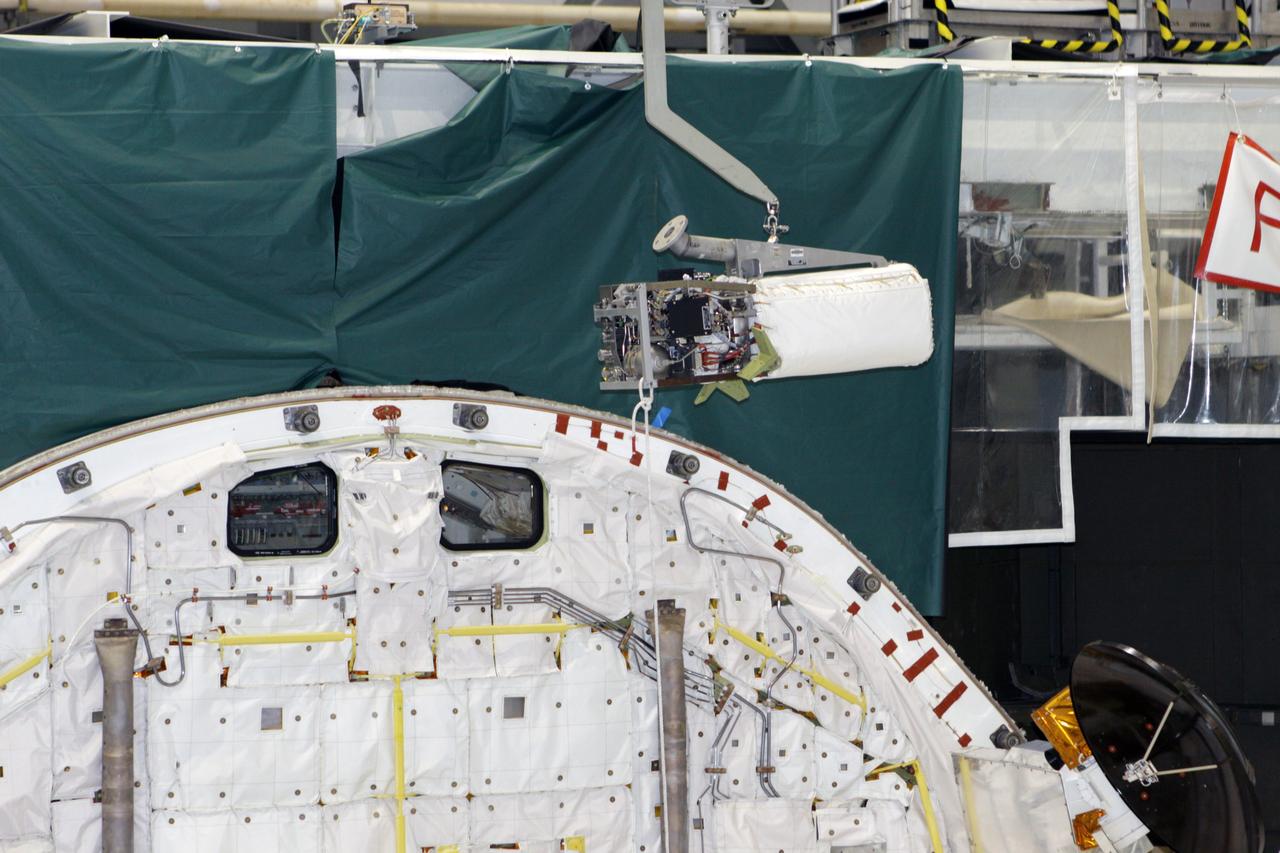
CAPE CANAVERAL, Fla. – Inside Orbiter Processing Facility-2 at NASA's Kennedy Space Center in Florida, a crane hoists one of space shuttle Endeavour's three fuel cells out of the vehicle's payload bay. All three of Endeavour's fuel cells were removed and will be drained of fluids. The hydrogen and oxygen dewars which feed reactants to the fuel cells remain in Endeavour's midbody and will be purged with inert gases and vented down. The work is part of the Space Shuttle Program's transition and retirement processing of shuttle Endeavour, which is being prepared for public display at the California Science Center in Los Angeles. Its ferry flight to California is targeted for mid-September. Endeavour was the last space shuttle added to NASA's orbiter fleet. Over the course of its 19-year career, Endeavour spent 299 days in space during 25 missions. For more information, visit http://www.nasa.gov/shuttle. Photo credit: NASA/Glenn Benson
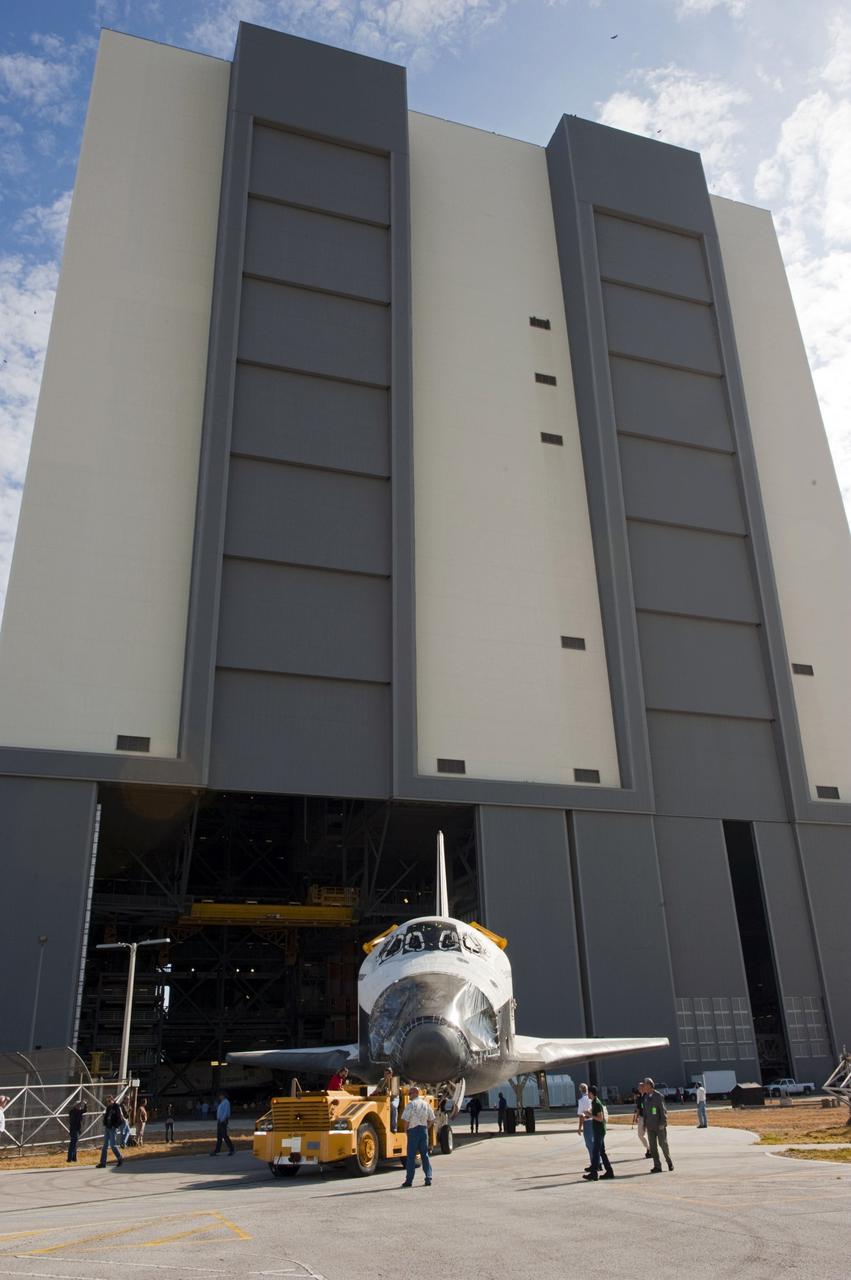
CAPE CANAVERAL, Fla. – With the massive doors of the Vehicle Assembly Building at NASA’s Kennedy Space Center in Florida in the background, space shuttle Endeavour is being towed from the VAB to Orbiter Processing Facility-2. Shuttle Endeavour will remain in OPF-2 so that the orbiter maneuvering system (OMS) pods and forward reaction control system can be installed. Technicians also will offload water and Freon gas from lines located in Endeavour’s midbody. The work is part of Endeavour’s transition and retirement processing. The spacecraft is being prepared for public display at the California Science Center in Los Angeles. Endeavour flew 25 missions, spent 299 days in space, orbited Earth 4,671 times and traveled 122, 883, 151 miles over the course of its 19-year career. Endeavour’s STS-134 and final mission was completed after landing on June 1, 2011. Photo credit: Kim Shiflett
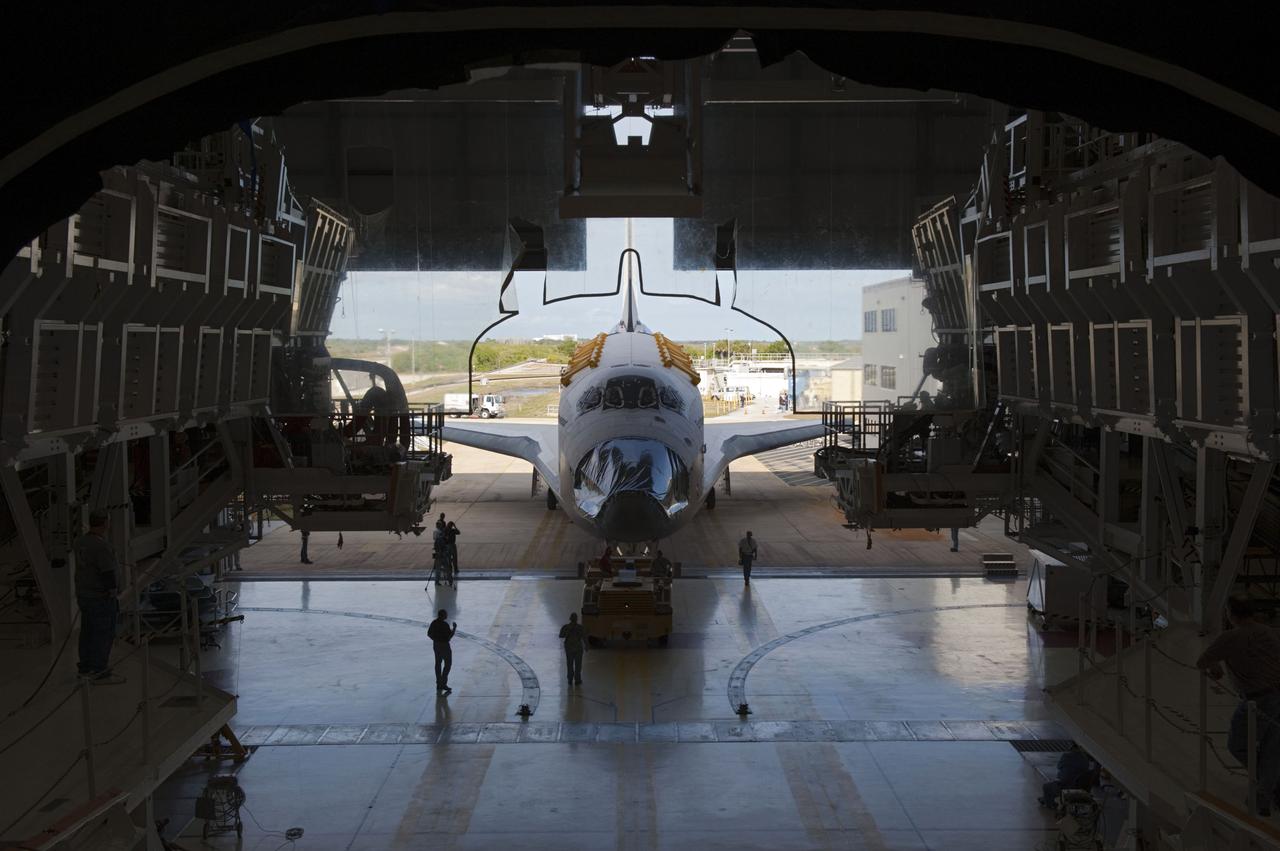
CAPE CANAVERAL, Fla. – At NASA’s Kennedy Space Center in Florida, space shuttle Endeavour is towed to Orbiter Processing Facility-2 (OPF-2). Shuttle Endeavour will remain in OPF-2 so that the orbiter maneuvering system (OMS) pods and forward reaction control system can be installed. Technicians also will offload water and Freon gas from lines located in Endeavour’s midbody. The work is part of Endeavour’s transition and retirement processing. The spacecraft is being prepared for public display at the California Science Center in Los Angeles. Endeavour flew 25 missions, spent 299 days in space, orbited Earth 4,671 times and traveled 122, 883, 151 miles over the course of its 19-year career. Endeavour’s STS-134 and final mission was completed after landing on June 1, 2011. Photo credit: Kim Shiflett
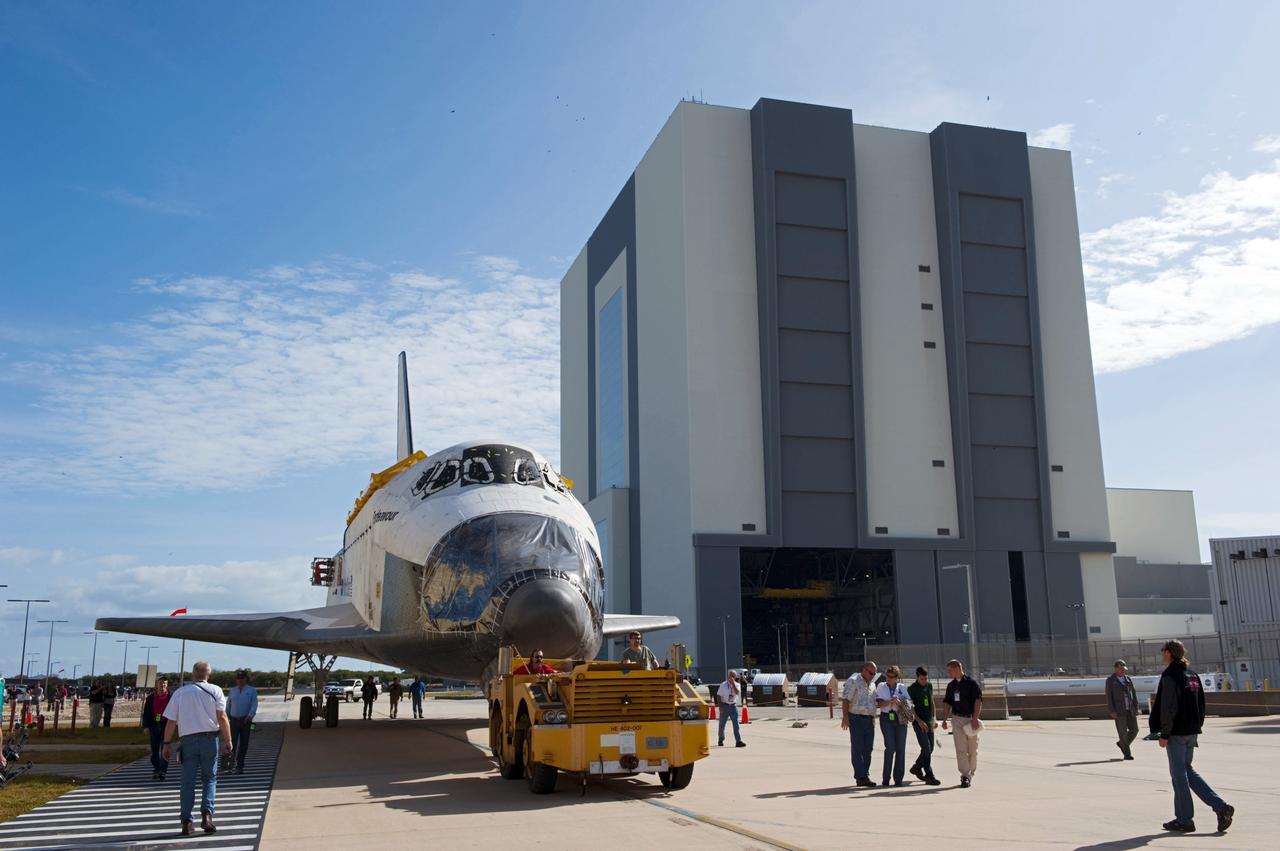
CAPE CANAVERAL, Fla. – At NASA’s Kennedy Space Center in Florida, space shuttle Endeavour is being towed from the Vehicle Assembly Building to Orbiter Processing Facility-2 (OPF-2). Shuttle Endeavour will remain in OPF-2 so that the orbiter maneuvering system (OMS) pods and forward reaction control system can be installed. Technicians also will offload water and Freon gas from lines located in Endeavour’s midbody. The work is part of Endeavour’s transition and retirement processing. The spacecraft is being prepared for public display at the California Science Center in Los Angeles. Endeavour flew 25 missions, spent 299 days in space, orbited Earth 4,671 times and traveled 122, 883, 151 miles over the course of its 19-year career. Endeavour’s STS-134 and final mission was completed after landing on June 1, 2011. Photo credit: Kim Shiflett
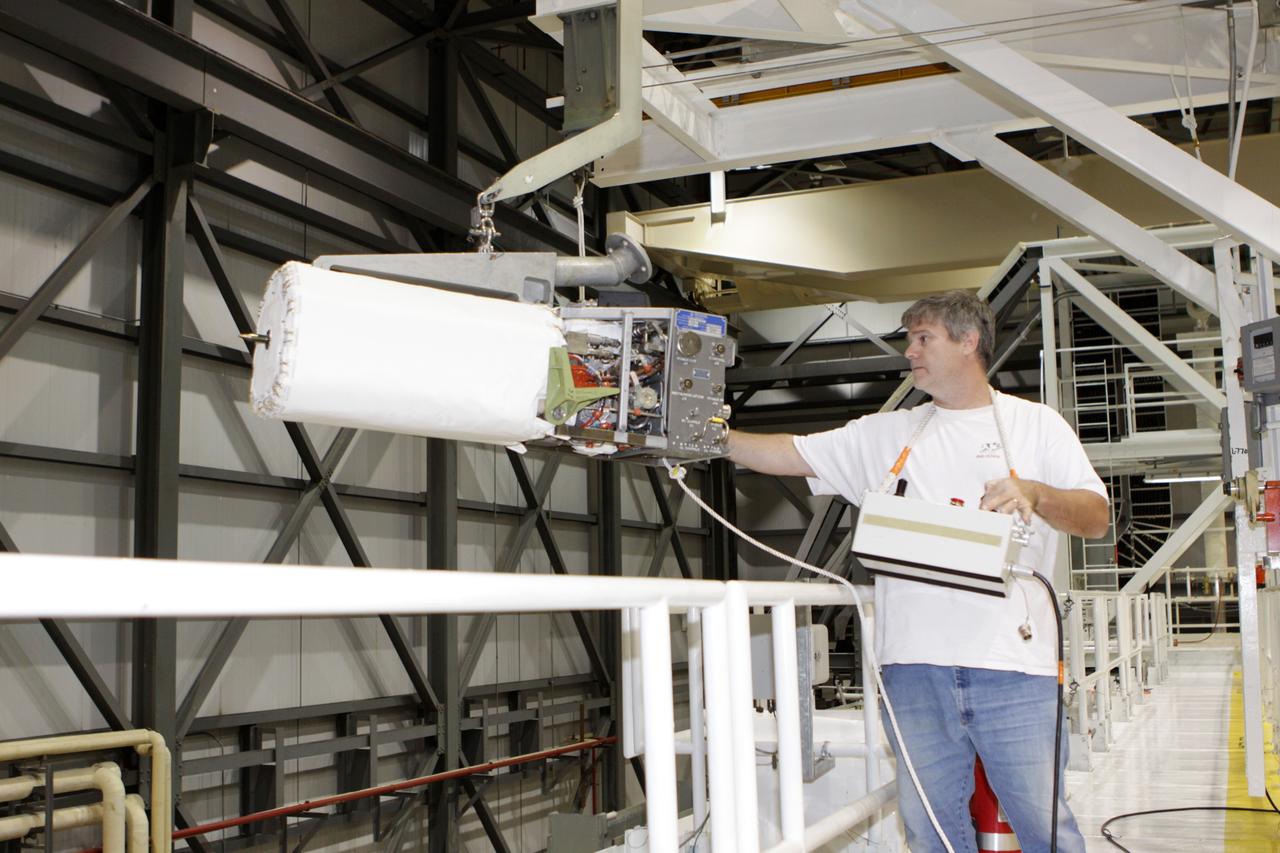
CAPE CANAVERAL, Fla. – Inside Orbiter Processing Facility-2 at NASA's Kennedy Space Center in Florida, a technician guides a newly removed fuel cell up and out of space shuttle Endeavour's payload bay. All three of Endeavour's fuel cells were removed and will be drained of fluids. The hydrogen and oxygen dewars which feed reactants to the fuel cells remain in Endeavour's midbody and will be purged with inert gases and vented down. The work is part of the Space Shuttle Program's transition and retirement processing of shuttle Endeavour, which is being prepared for public display at the California Science Center in Los Angeles. Its ferry flight to California is targeted for mid-September. Endeavour was the last space shuttle added to NASA's orbiter fleet. Over the course of its 19-year career, Endeavour spent 299 days in space during 25 missions. For more information, visit http://www.nasa.gov/shuttle. Photo credit: NASA/Glenn Benson
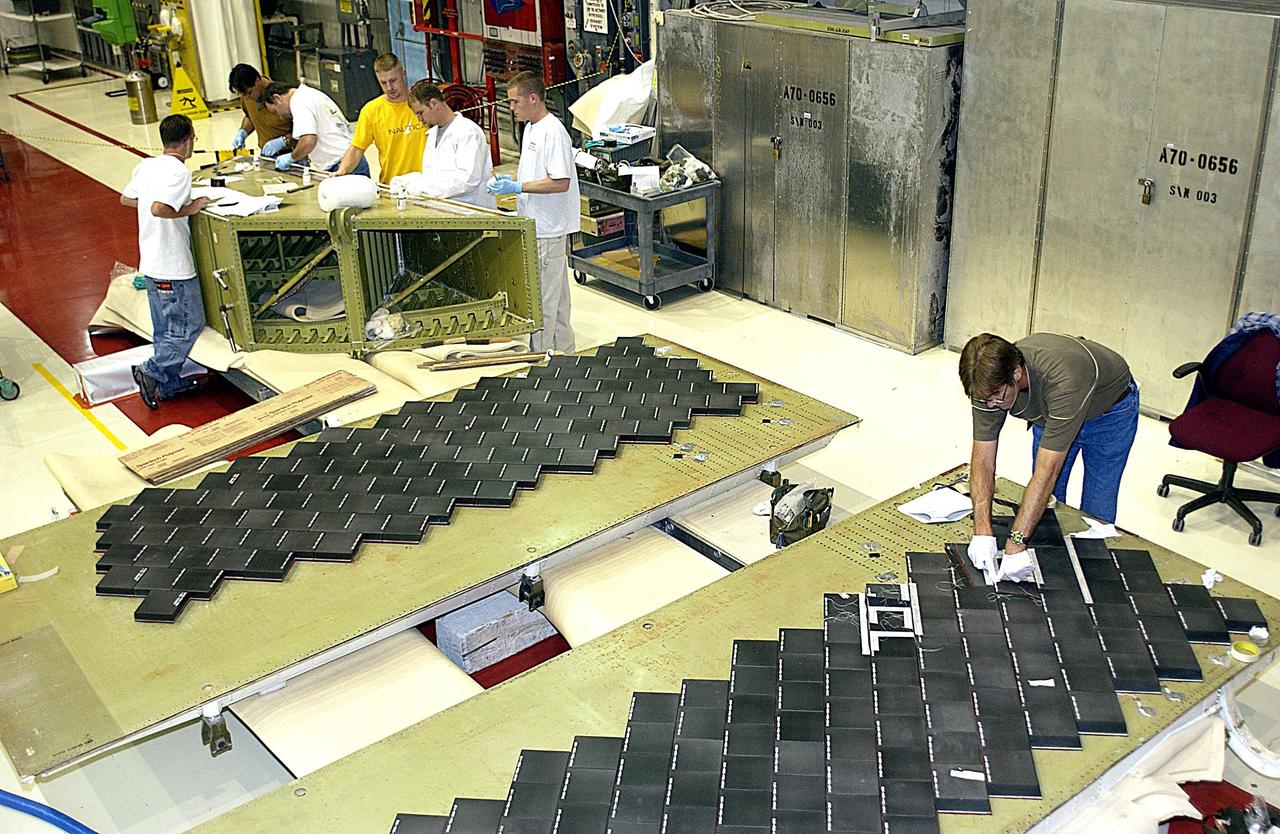
KENNEDY SPACE CENTER, FLA. -- In the Orbiter Processing Facility (OPF), United Space Alliance (USA) employee Harrell Watts (right) installs Thermal Protection System (TPS) tiles on a main landing gear door of Space Shuttle orbiter Enterprise (OV-101). In the background, other USA employees, members of the OPF midbody TPS crew, prepare to install TPS tile on a simulated orbiter wing. The wing and the sections of Enterprise will be transferred to the Southwest Research Institute for testing after the tile installation is complete. The testing has been requested by the Columbia Accident Investigation Board. Sections of Enterprise were borrowed from the Smithsonian Institution's Air and Space Museum where the orbiter is being stored at the Washington Dulles International Airport. Enterprise was the first orbiter built in the Shuttle fleet and was used to conduct the Approach and Landing Test Program before the first powered Shuttle flight.
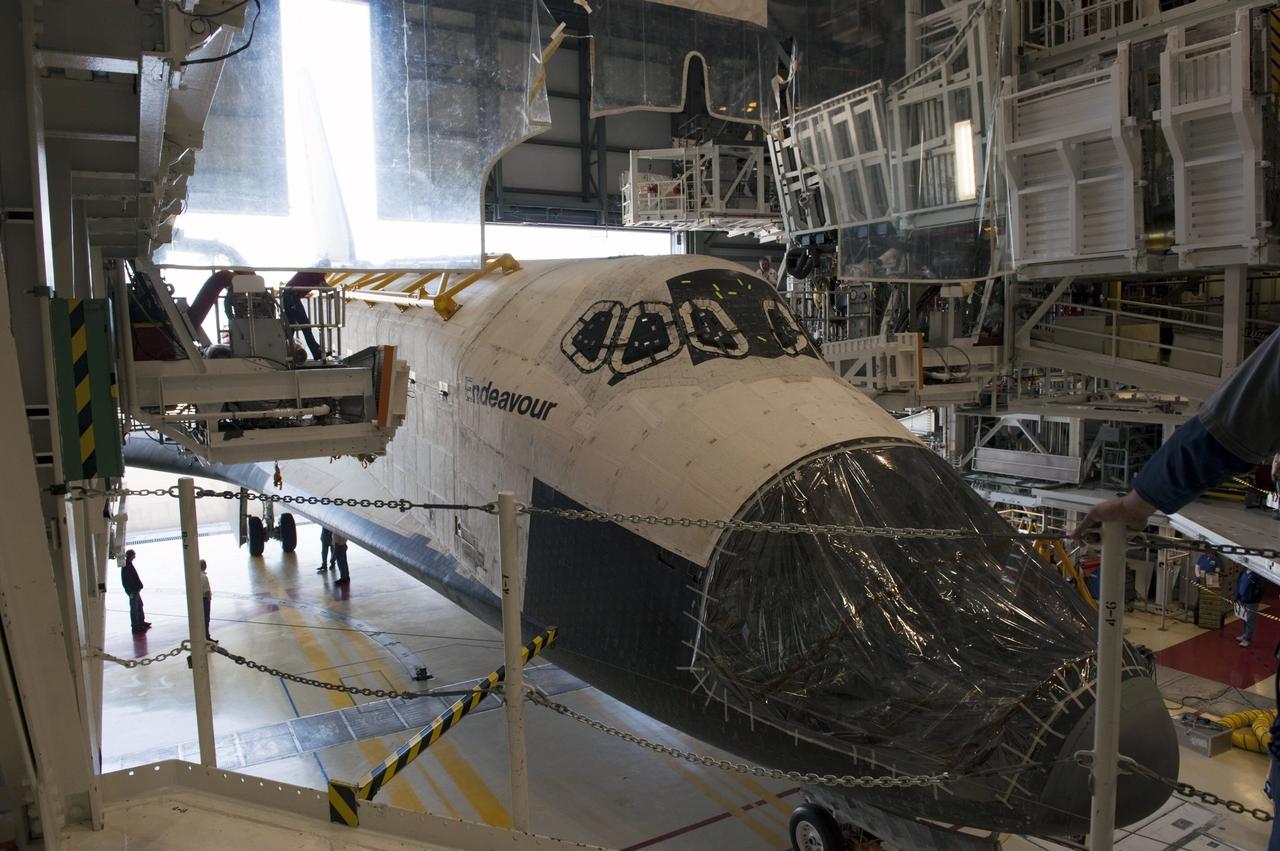
CAPE CANAVERAL, Fla. – At NASA’s Kennedy Space Center in Florida, space shuttle Endeavour is towed inside Orbiter Processing Facility-2 (OPF-2). Shuttle Endeavour will remain in OPF-2 so that the orbiter maneuvering system (OMS) pods and forward reaction control system can be installed. Technicians also will offload water and Freon gas from lines located in Endeavour’s midbody. The work is part of Endeavour’s transition and retirement processing. The spacecraft is being prepared for public display at the California Science Center in Los Angeles. Endeavour flew 25 missions, spent 299 days in space, orbited Earth 4,671 times and traveled 122, 883, 151 miles over the course of its 19-year career. Endeavour’s STS-134 and final mission was completed after landing on June 1, 2011. Photo credit: Kim Shiflett
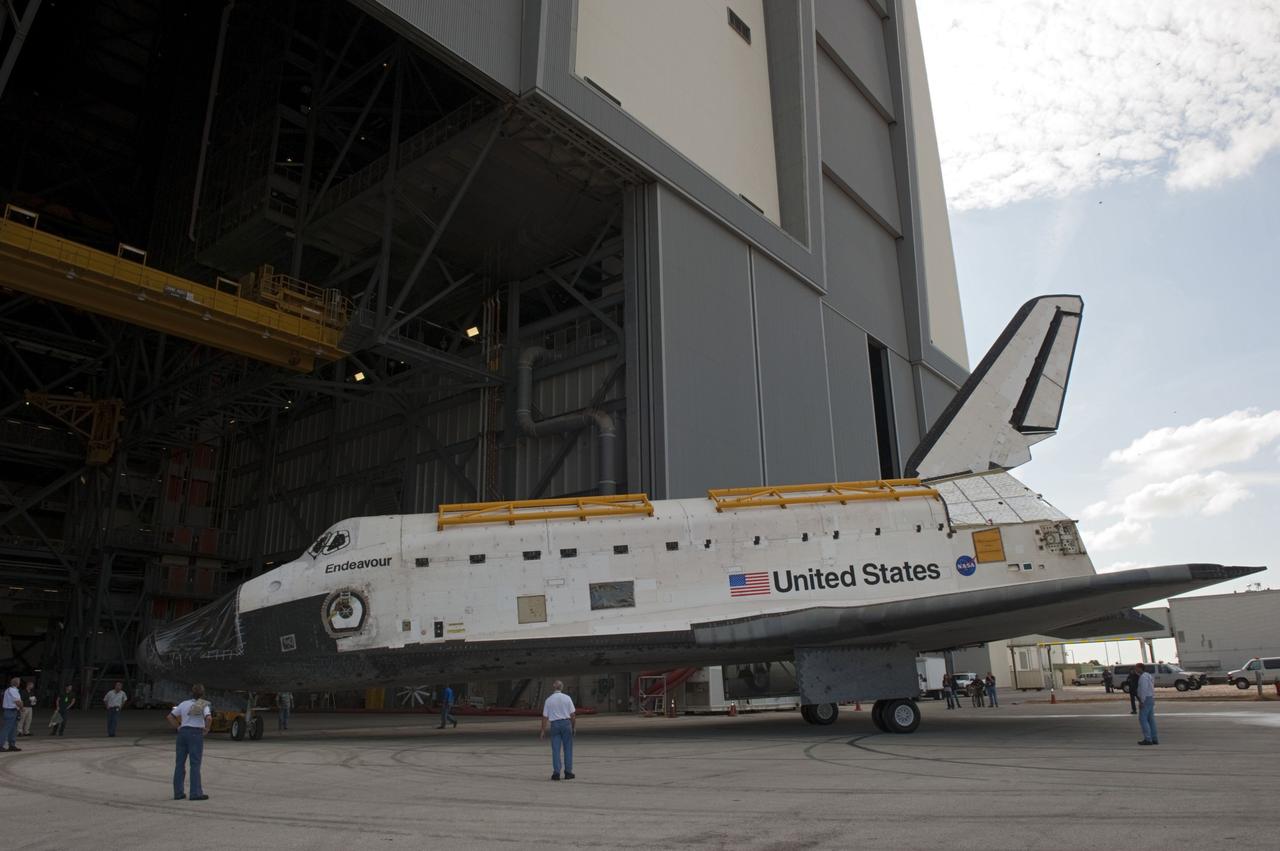
CAPE CANAVERAL, Fla. – Technicians monitor the progress as Space shuttle Endeavour is backed away from the Vehicle Assembly Building at NASA’s Kennedy Space Center in Florida so that it can be towed to Orbiter Processing Facility-2 (OPF-2). Shuttle Endeavour will remain in OPF-2 so that the orbiter maneuvering system (OMS) pods and forward reaction control system can be installed. Technicians also will offload water and Freon gas from lines located in Endeavour’s midbody. The work is part of Endeavour’s transition and retirement processing. The spacecraft is being prepared for public display at the California Science Center in Los Angeles. Endeavour flew 25 missions, spent 299 days in space, orbited Earth 4,671 times and traveled 122, 883, 151 miles over the course of its 19-year career. Endeavour’s STS-134 and final mission was completed after landing on June 1, 2011. Photo credit: Kim Shiflett

CAPE CANAVERAL, Fla. – Technicians inside Kennedy Space Center's Orbiter Processing Facility-2 lower one of space shuttle Endeavour's recently removed fuel cells onto a waiting platform. All three of Endeavour's fuel cells were removed and will be drained of fluids. The hydrogen and oxygen dewars which feed reactants to the fuel cells remain in Endeavour's midbody and will be purged with inert gases and vented down. The work is part of the Space Shuttle Program's transition and retirement processing of shuttle Endeavour, which is being prepared for public display at the California Science Center in Los Angeles. Its ferry flight to California is targeted for mid-September. Endeavour was the last space shuttle added to NASA's orbiter fleet. Over the course of its 19-year career, Endeavour spent 299 days in space during 25 missions. For more information, visit http://www.nasa.gov/shuttle. Photo credit: NASA/Glenn Benson
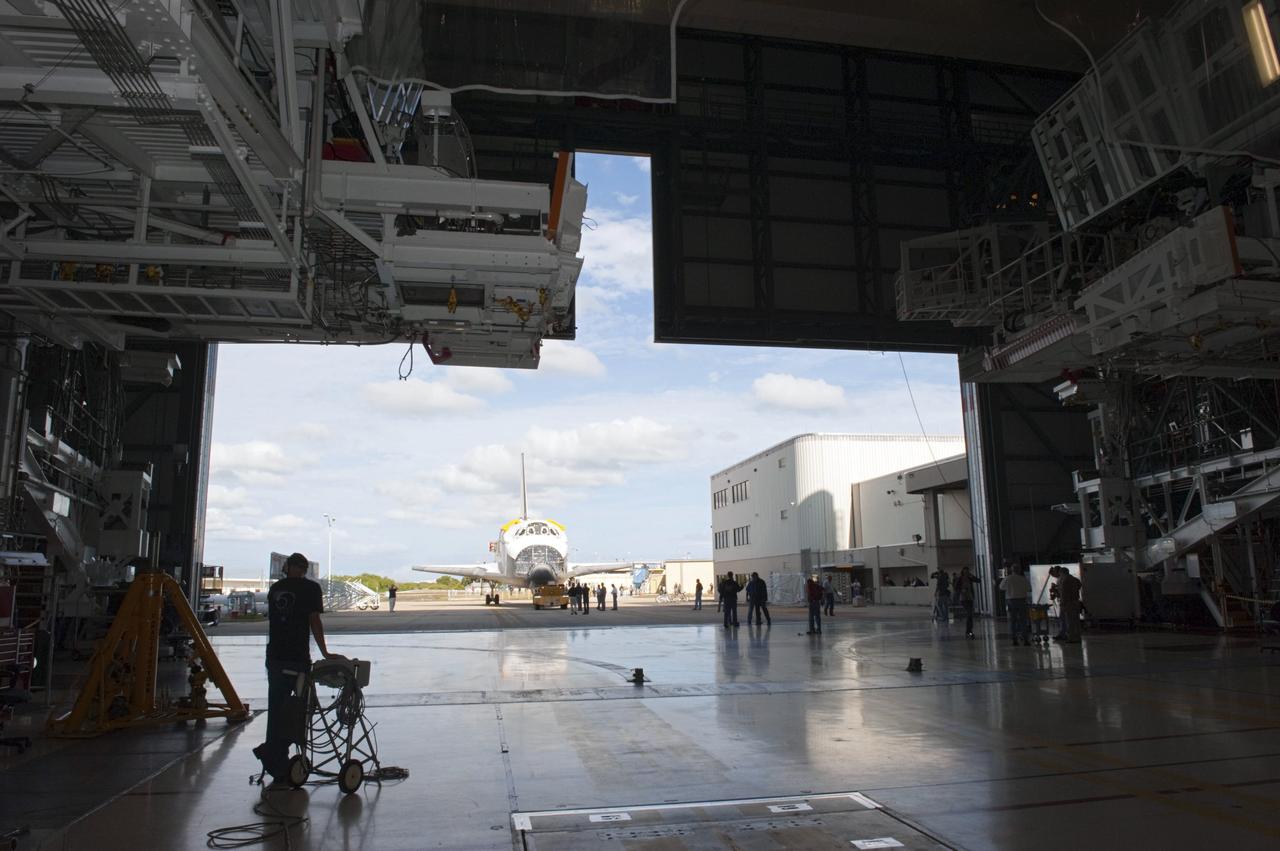
CAPE CANAVERAL, Fla. – At NASA’s Kennedy Space Center in Florida, space shuttle Endeavour is being towed to Orbiter Processing Facility-2 (OPF-2). Shuttle Endeavour will remain in OPF-2 so that the orbiter maneuvering system (OMS) pods and forward reaction control system can be installed. Technicians also will offload water and Freon gas from lines located in Endeavour’s midbody. The work is part of Endeavour’s transition and retirement processing. The spacecraft is being prepared for public display at the California Science Center in Los Angeles. Endeavour flew 25 missions, spent 299 days in space, orbited Earth 4,671 times and traveled 122, 883, 151 miles over the course of its 19-year career. Endeavour’s STS-134 and final mission was completed after landing on June 1, 2011. Photo credit: Kim Shiflett
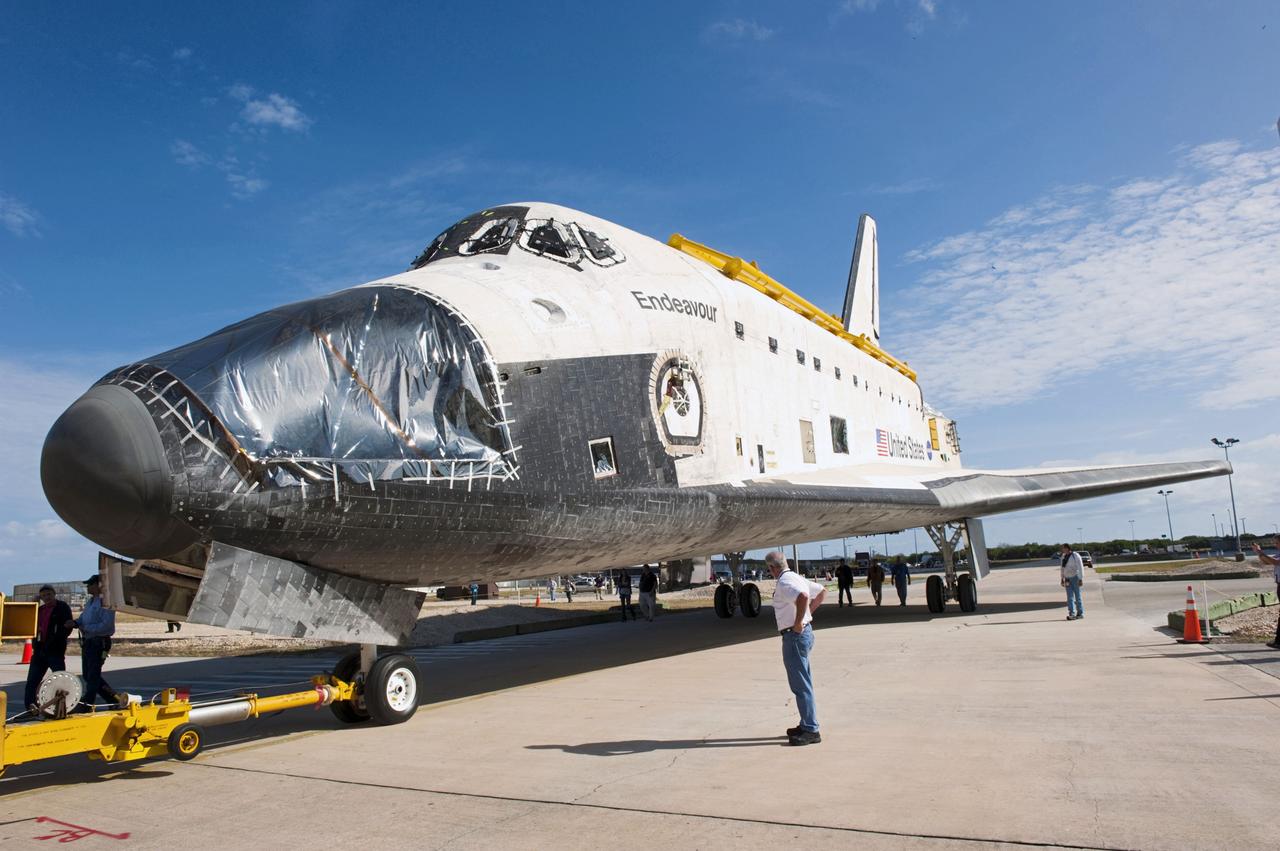
CAPE CANAVERAL, Fla. – At NASA’s Kennedy Space Center in Florida, technicians walk alongside as space shuttle Endeavour is being towed from the Vehicle Assembly Building to Orbiter Processing Facility-2. Shuttle Endeavour will remain in OPF-2 so that the orbiter maneuvering system (OMS) pods and forward reaction control system can be installed. Technicians also will offload water and Freon gas from lines located in Endeavour’s midbody. The work is part of Endeavour’s transition and retirement processing. The spacecraft is being prepared for public display at the California Science Center in Los Angeles. Endeavour flew 25 missions, spent 299 days in space, orbited Earth 4,671 times and traveled 122, 883, 151 miles over the course of its 19-year career. Endeavour’s STS-134 and final mission was completed after landing on June 1, 2011. Photo credit: Kim Shiflett
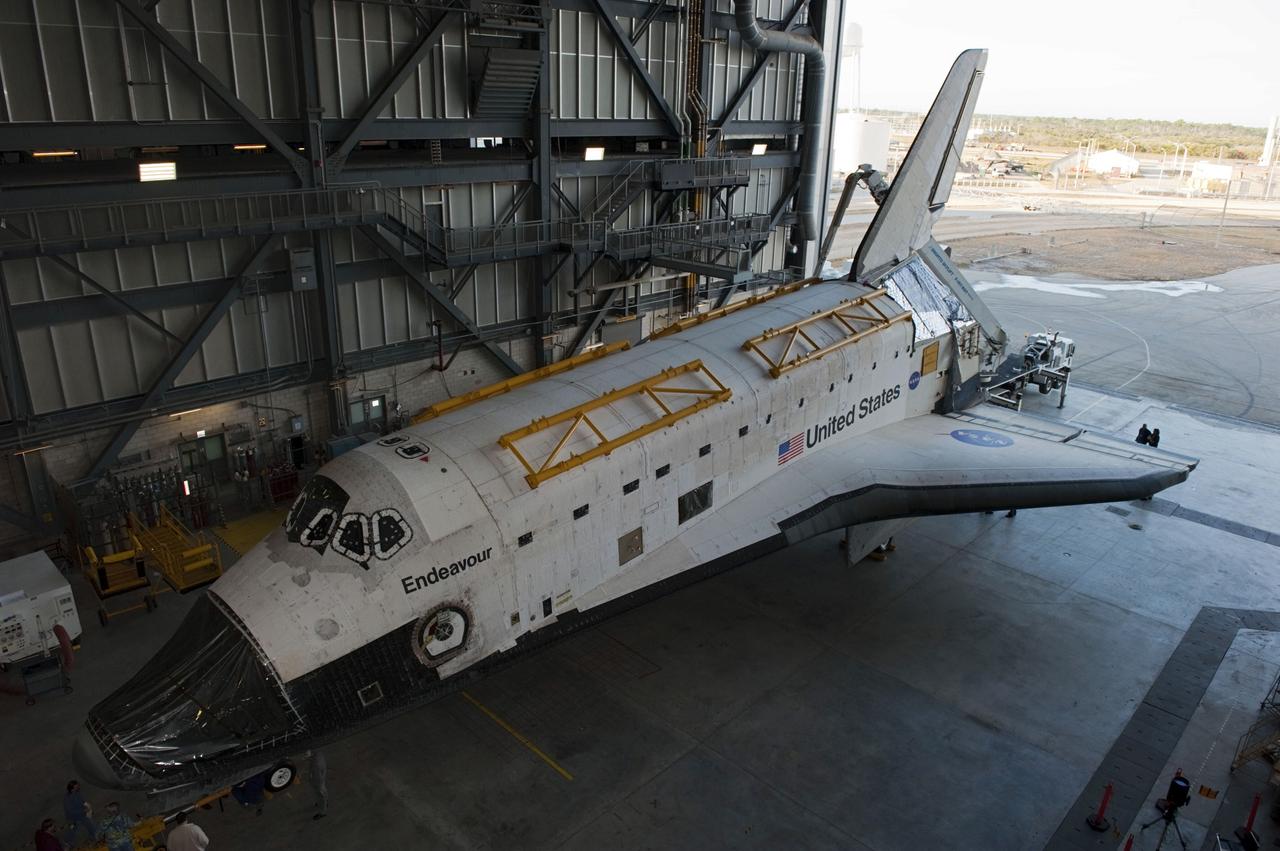
CAPE CANAVERAL, Fla. – Inside the Vehicle Assembly Building at NASA’s Kennedy Space Center in Florida, space shuttle Endeavour is being prepared for its move to Orbiter Processing Facility-2 (OPF-2). Shuttle Endeavour will remain in OPF-2 so that the orbiter maneuvering system (OMS) pods and forward reaction control system can be installed. Technicians also will offload water and Freon gas from lines located in Endeavour’s midbody. The work is part of Endeavour’s transition and retirement processing. The spacecraft is being prepared for public display at the California Science Center in Los Angeles. Endeavour flew 25 missions, spent 299 days in space, orbited Earth 4,671 times and traveled 122, 883, 151 miles over the course of its 19-year career. Endeavour’s STS-134 and final mission was completed after landing on June 1, 2011. Photo credit: Kim Shiflett
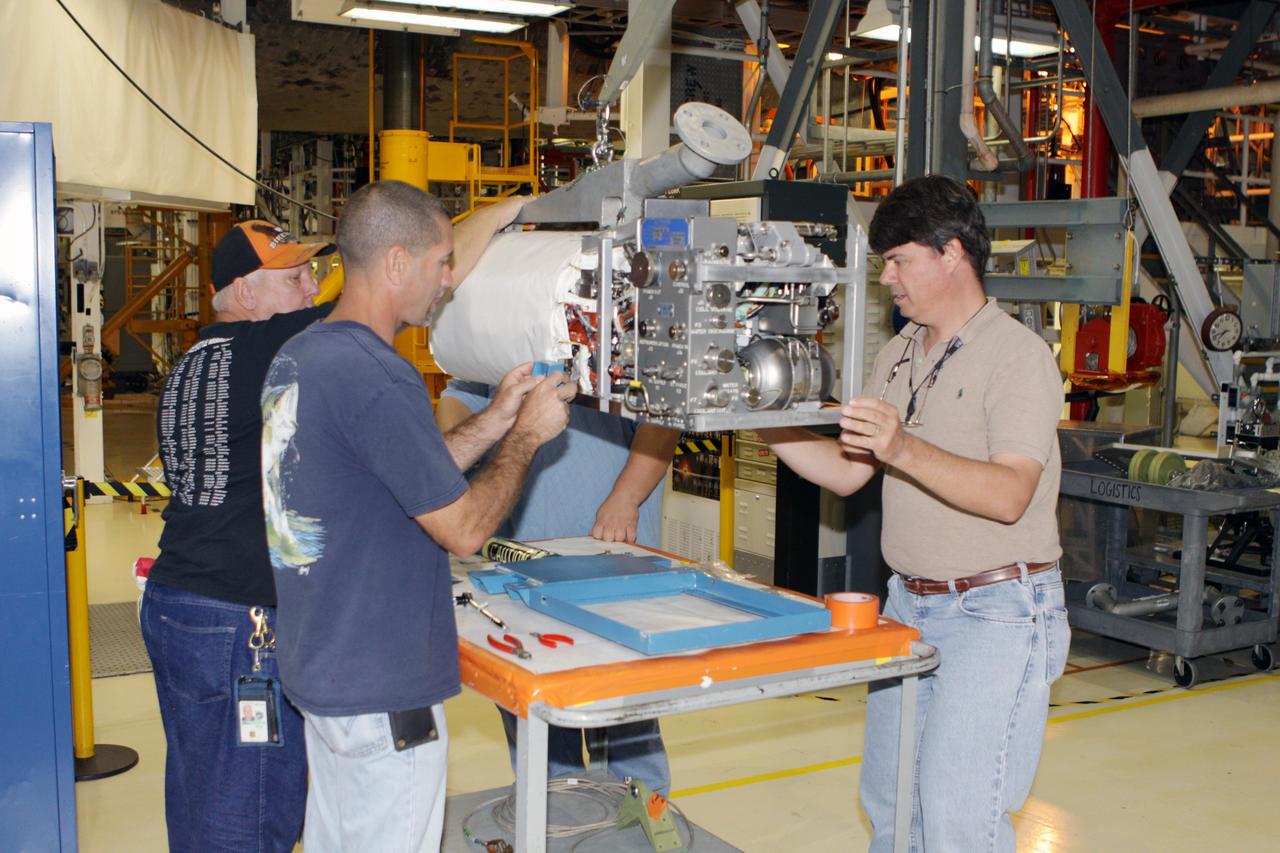
CAPE CANAVERAL, Fla. – Technicians inside Kennedy Space Center's Orbiter Processing Facility-2 lower one of space shuttle Endeavour's recently removed fuel cells onto a waiting platform. All three of Endeavour's fuel cells were removed and will be drained of fluids. The hydrogen and oxygen dewars which feed reactants to the fuel cells remain in Endeavour's midbody and will be purged with inert gases and vented down. The work is part of the Space Shuttle Program's transition and retirement processing of shuttle Endeavour, which is being prepared for public display at the California Science Center in Los Angeles. Its ferry flight to California is targeted for mid-September. Endeavour was the last space shuttle added to NASA's orbiter fleet. Over the course of its 19-year career, Endeavour spent 299 days in space during 25 missions. For more information, visit http://www.nasa.gov/shuttle. Photo credit: NASA/Glenn Benson
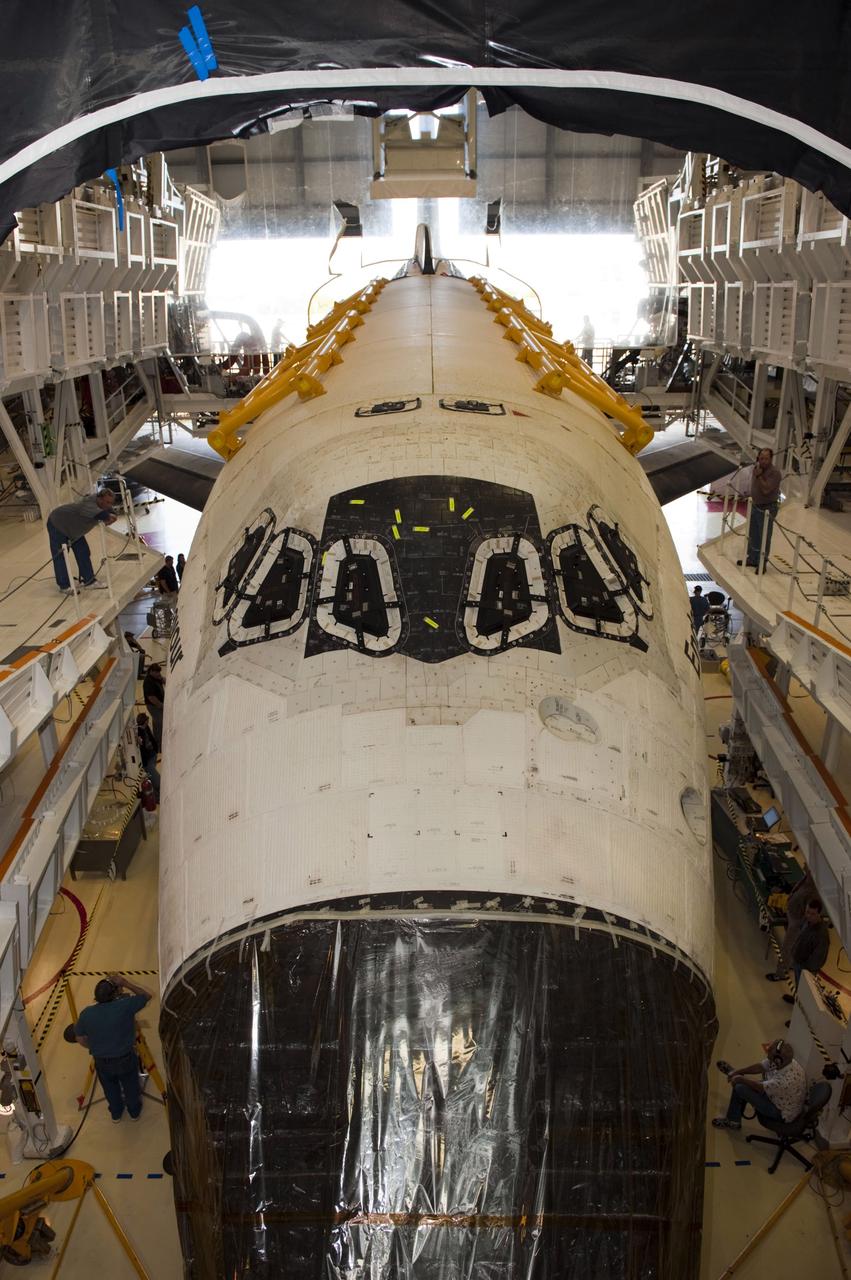
CAPE CANAVERAL, Fla. – At NASA’s Kennedy Space Center in Florida, space shuttle Endeavour is safed inside Orbiter Processing Facility-2 (OPF-2) after being towed from the Vehicle Assembly Building. Shuttle Endeavour will remain in OPF-2 so that the orbiter maneuvering system (OMS) pods and forward reaction control system can be installed. Technicians also will offload water and Freon gas from lines located in Endeavour’s midbody. The work is part of Endeavour’s transition and retirement processing. The spacecraft is being prepared for public display at the California Science Center in Los Angeles. Endeavour flew 25 missions, spent 299 days in space, orbited Earth 4,671 times and traveled 122, 883, 151 miles over the course of its 19-year career. Endeavour’s STS-134 and final mission was completed after landing on June 1, 2011. Photo credit: Kim Shiflett
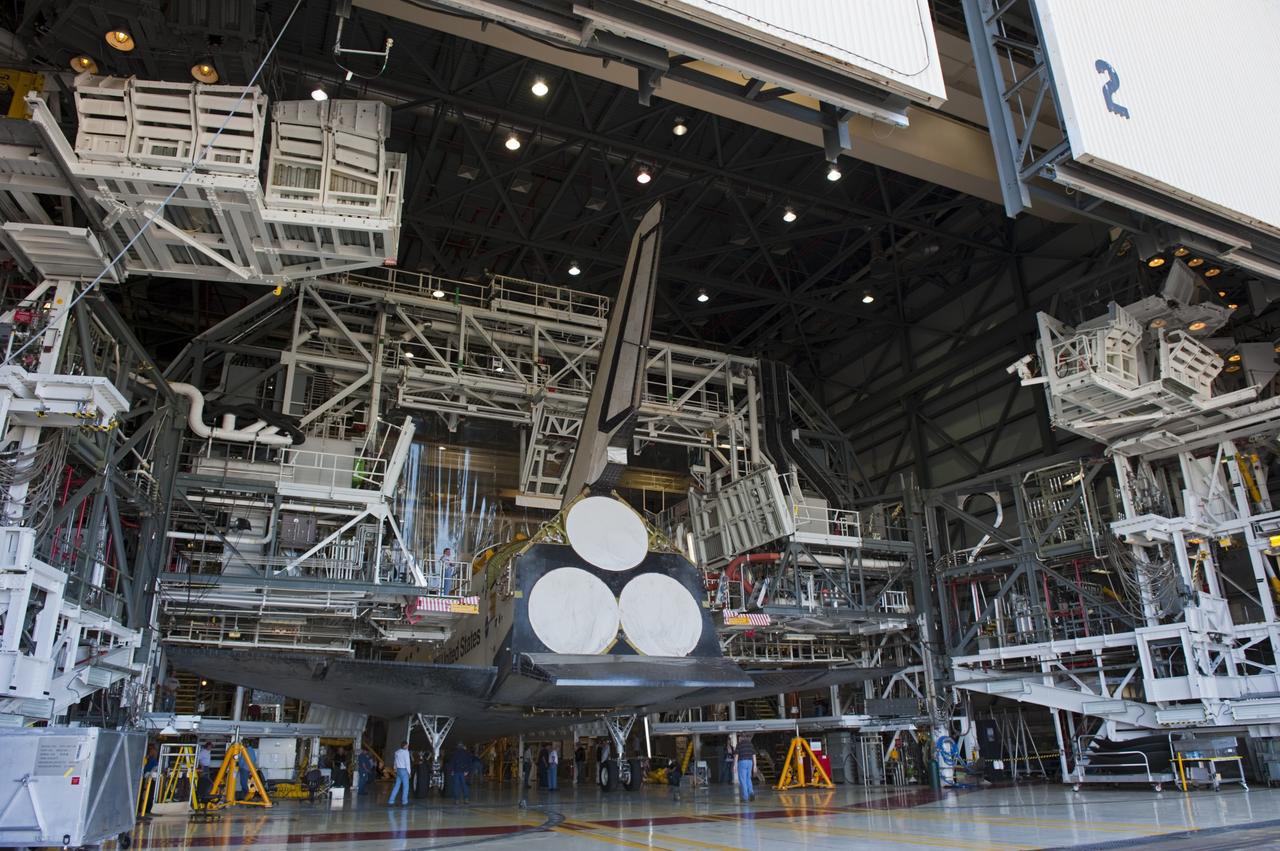
CAPE CANAVERAL, Fla. – At NASA’s Kennedy Space Center in Florida, space shuttle Endeavour is towed inside Orbiter Processing Facility-2 (OPF-2). Shuttle Endeavour will remain in OPF-2 so that the orbiter maneuvering system (OMS) pods and forward reaction control system can be installed. Technicians also will offload water and Freon gas from lines located in Endeavour’s midbody. The work is part of Endeavour’s transition and retirement processing. The spacecraft is being prepared for public display at the California Science Center in Los Angeles. Endeavour flew 25 missions, spent 299 days in space, orbited Earth 4,671 times and traveled 122, 883, 151 miles over the course of its 19-year career. Endeavour’s STS-134 and final mission was completed after landing on June 1, 2011. Photo credit: Kim Shiflett
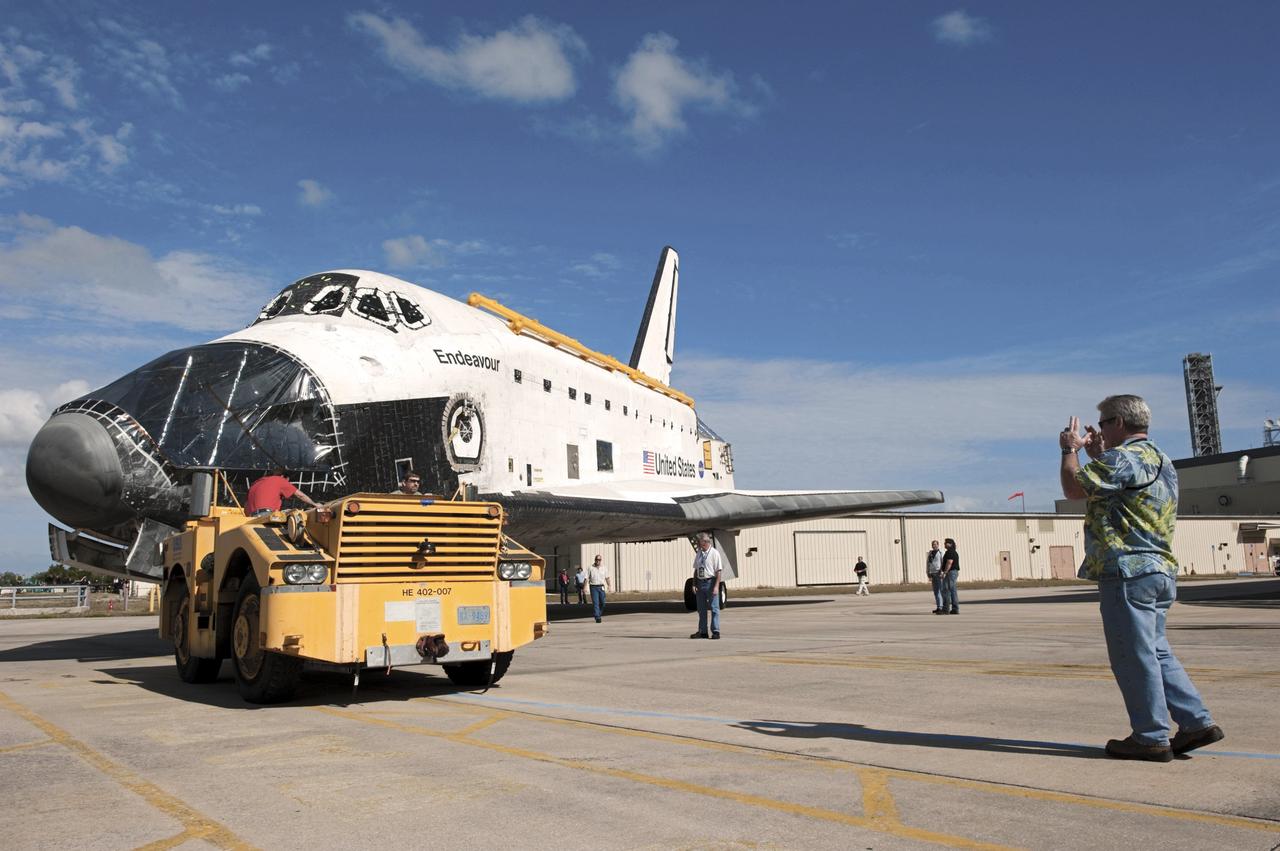
CAPE CANAVERAL, Fla. – At NASA’s Kennedy Space Center in Florida, technicians assist as space shuttle Endeavour is being towed from the Vehicle Assembly Building to Orbiter Processing Facility-2 (OPF-2). Shuttle Endeavour will remain in OPF-2 so that the orbiter maneuvering system (OMS) pods and forward reaction control system can be installed. Technicians also will offload water and Freon gas from lines located in Endeavour’s midbody. The work is part of Endeavour’s transition and retirement processing. The spacecraft is being prepared for public display at the California Science Center in Los Angeles. Endeavour flew 25 missions, spent 299 days in space, orbited Earth 4,671 times and traveled 122, 883, 151 miles over the course of its 19-year career. Endeavour’s STS-134 and final mission was completed after landing on June 1, 2011. Photo credit: Kim Shiflett
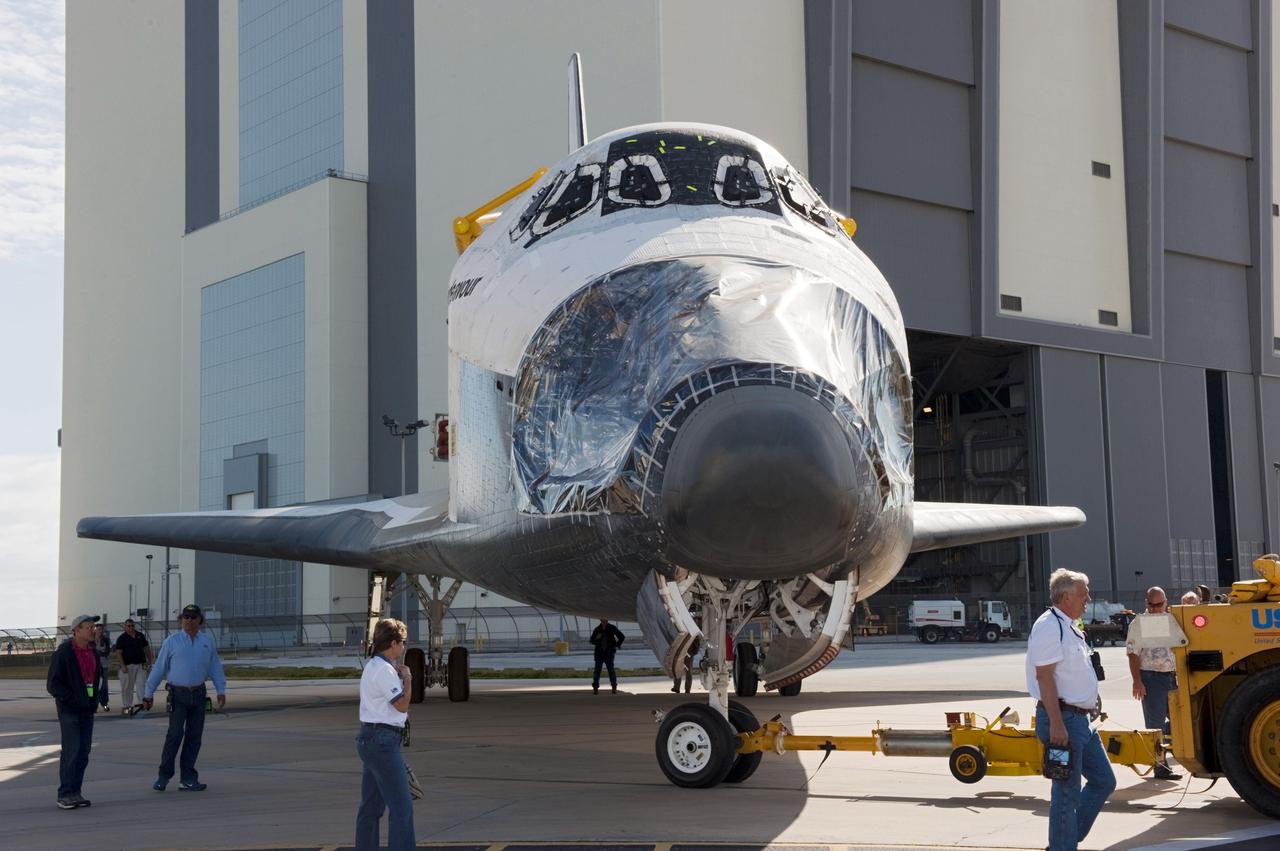
CAPE CANAVERAL, Fla. – At NASA’s Kennedy Space Center in Florida, technicians walk alongside as space shuttle Endeavour is being towed from the Vehicle Assembly Building to Orbiter Processing Facility-2. Shuttle Endeavour will remain in OPF-2 so that the orbiter maneuvering system (OMS) pods and forward reaction control system can be installed. Technicians also will offload water and Freon gas from lines located in Endeavour’s midbody. The work is part of Endeavour’s transition and retirement processing. The spacecraft is being prepared for public display at the California Science Center in Los Angeles. Endeavour flew 25 missions, spent 299 days in space, orbited Earth 4,671 times and traveled 122, 883, 151 miles over the course of its 19-year career. Endeavour’s STS-134 and final mission was completed after landing on June 1, 2011. Photo credit: Kim Shiflett
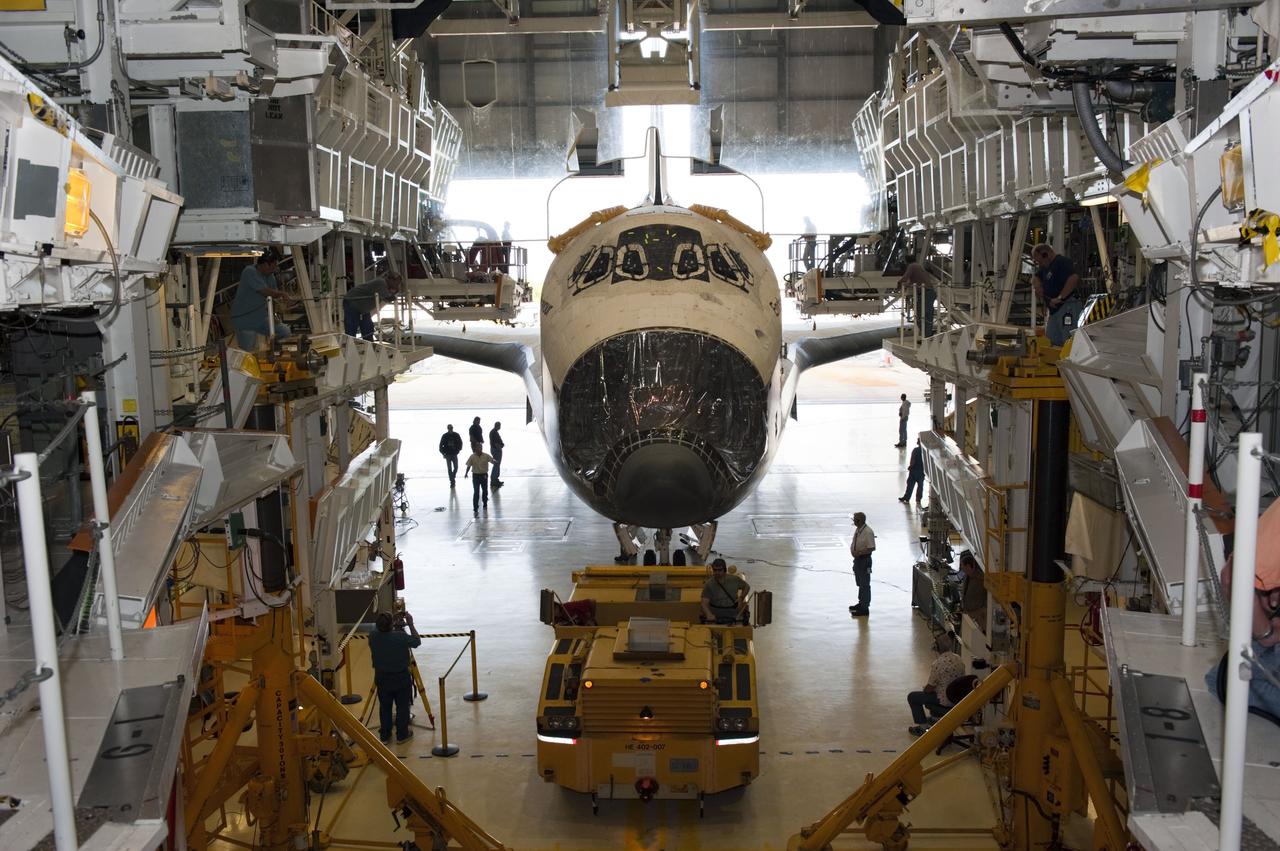
CAPE CANAVERAL, Fla. – At NASA’s Kennedy Space Center in Florida, space shuttle Endeavour is towed inside Orbiter Processing Facility-2 (OPF-2). Shuttle Endeavour will remain in OPF-2 so that the orbiter maneuvering system (OMS) pods and forward reaction control system can be installed. Technicians also will offload water and Freon gas from lines located in Endeavour’s midbody. The work is part of Endeavour’s transition and retirement processing. The spacecraft is being prepared for public display at the California Science Center in Los Angeles. Endeavour flew 25 missions, spent 299 days in space, orbited Earth 4,671 times and traveled 122, 883, 151 miles over the course of its 19-year career. Endeavour’s STS-134 and final mission was completed after landing on June 1, 2011. Photo credit: Kim Shiflett
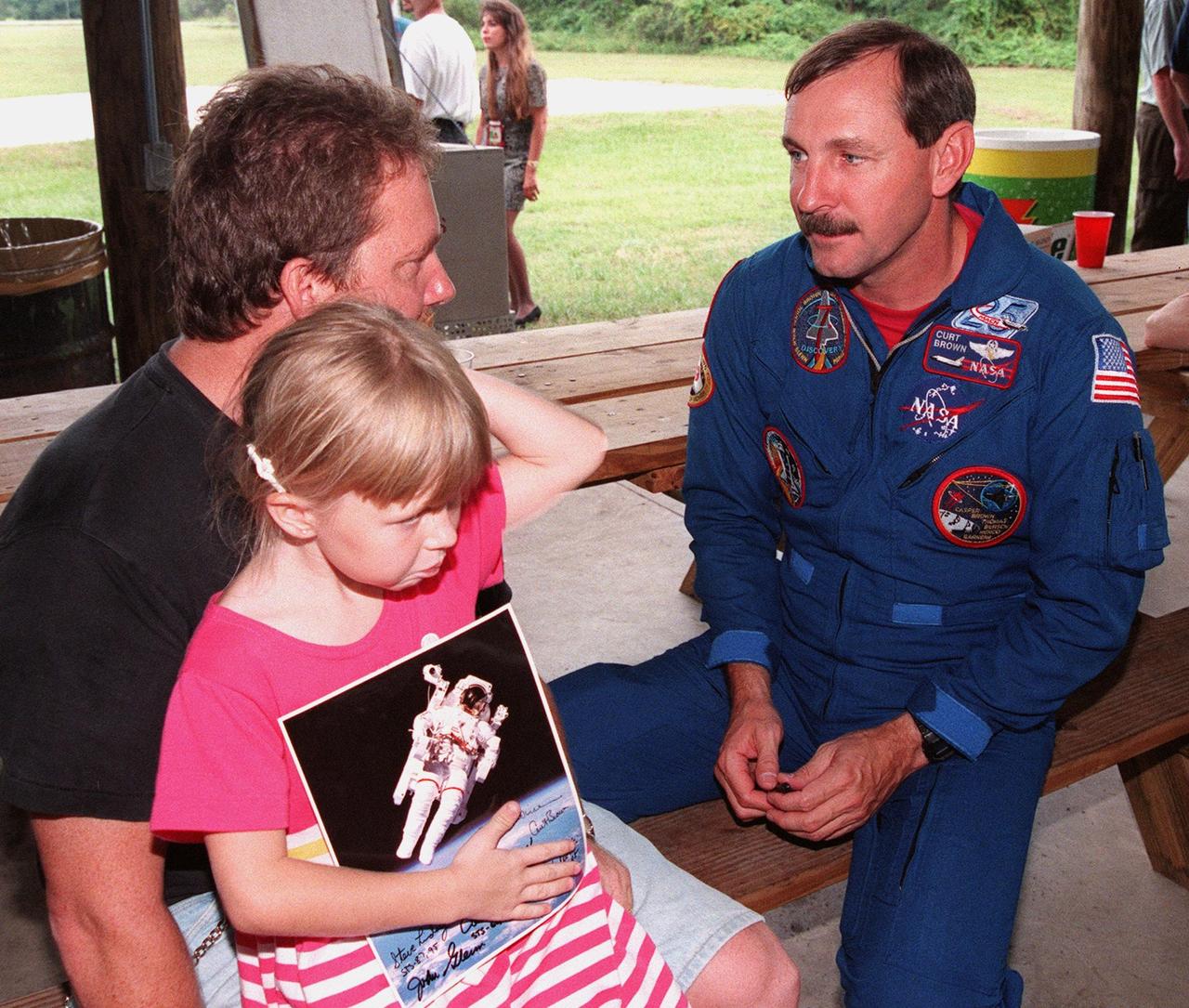
During a break in the Crew Equipment Interface Test (CEIT) at KSC, STS-95 Mission Commander Curtis L. Brown Jr. talks to Mark King, a Space Shuttle midbody mechanical technician with United Space Alliance, and his daughter Jilianne. King is working in the Orbiter Processing Facility Bay 2 on STS-95 payloads. The CEIT gives astronauts an opportunity for a hands-on look at the payloads and equipment which they will be working with on orbit. The launch of the STS-95 mission is scheduled for Oct. 29, 1998, on the Space Shuttle Discovery. The mission includes research payloads such as the Spartan solar-observing deployable spacecraft, the Hubble Space Telescope Orbital Systems Test Platform, the International Extreme Ultraviolet Hitchhiker, as well as the SPACEHAB single module with experiments on space flight and the aging process
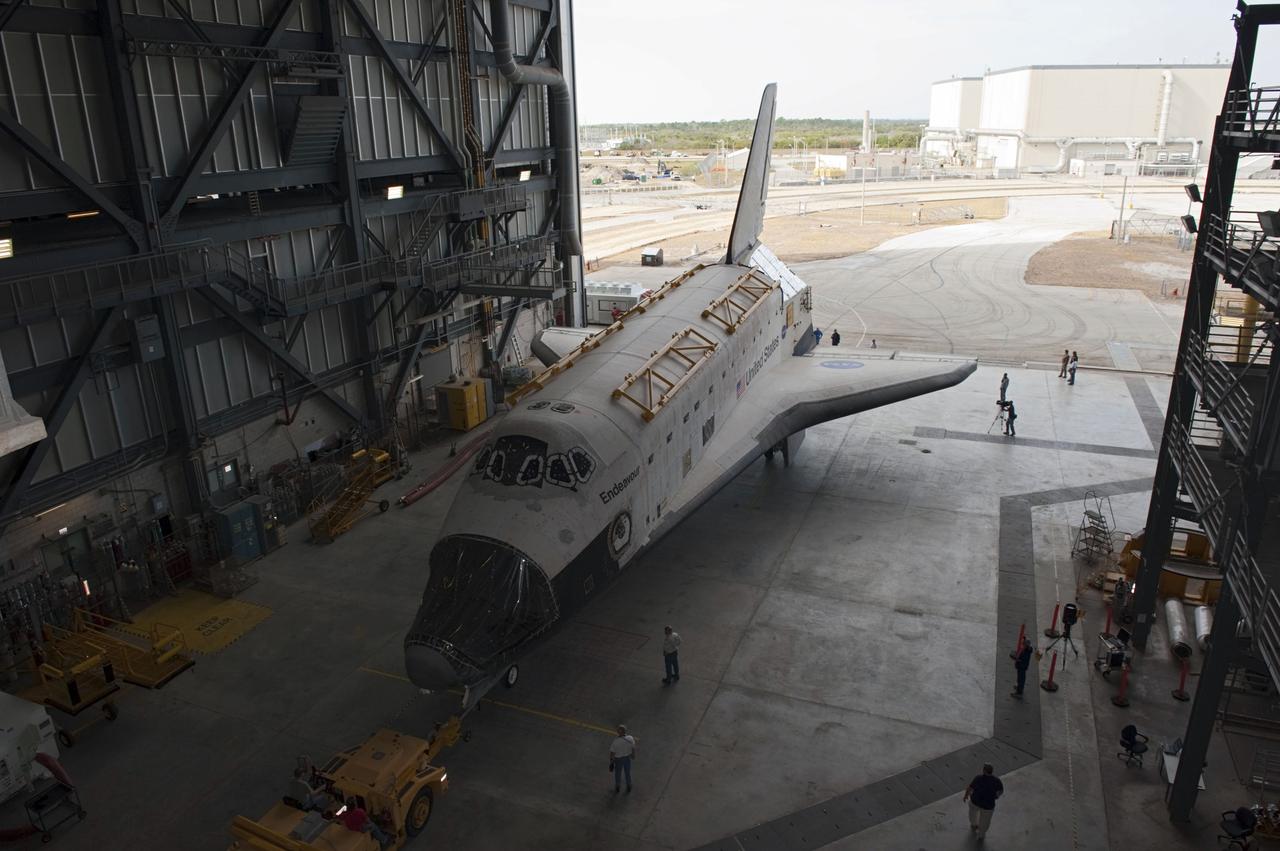
CAPE CANAVERAL, Fla. – Inside the Vehicle Assembly Building at NASA’s Kennedy Space Center in Florida, technicians prepare space shuttle Endeavour for its move to Orbiter Processing Facility-2 (OPF-2). Shuttle Endeavour will remain in OPF-2 so that the orbiter maneuvering system (OMS) pods and forward reaction control system can be installed. Technicians also will offload water and Freon gas from lines located in Endeavour’s midbody. The work is part of Endeavour’s transition and retirement processing. The spacecraft is being prepared for public display at the California Science Center in Los Angeles. Endeavour flew 25 missions, spent 299 days in space, orbited Earth 4,671 times and traveled 122, 883, 151 miles over the course of its 19-year career. Endeavour’s STS-134 and final mission was completed after landing on June 1, 2011. Photo credit: Kim Shiflett
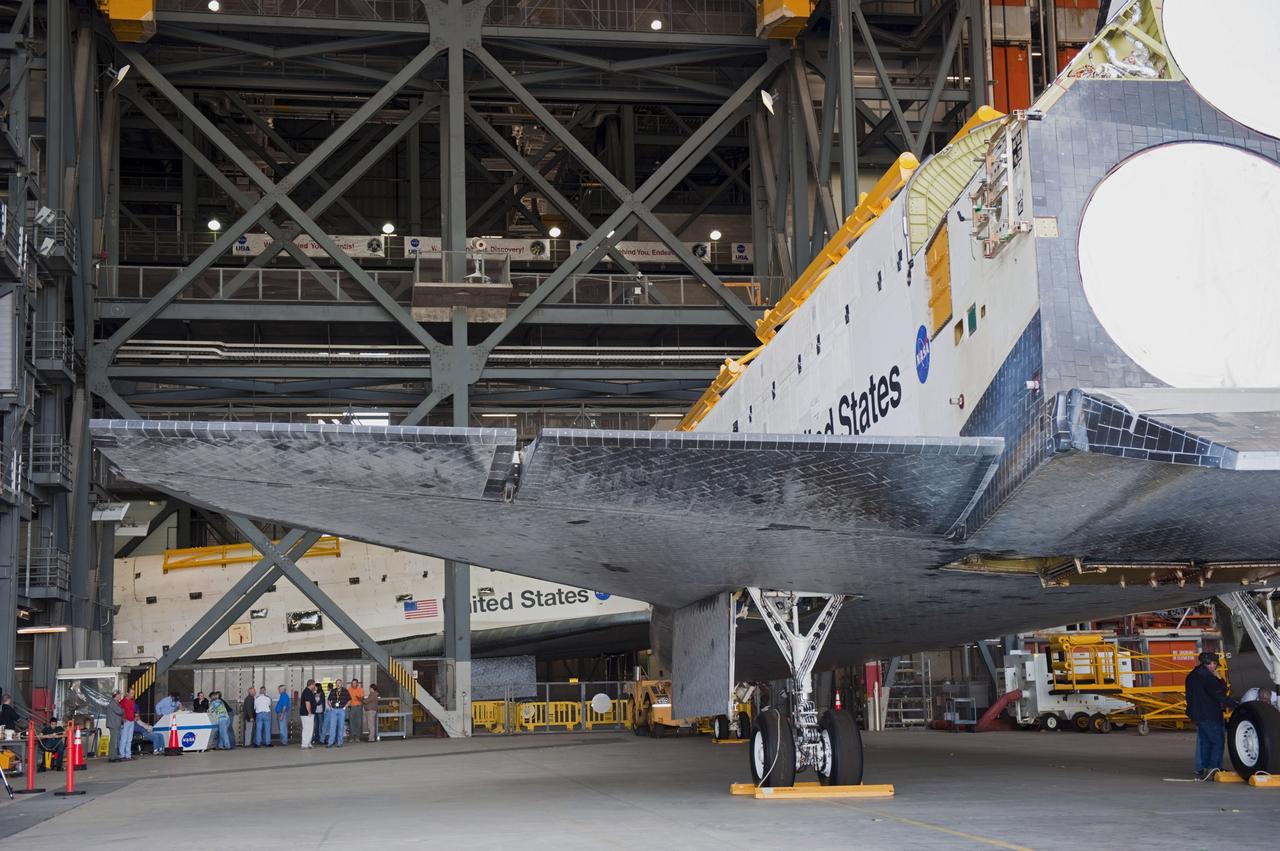
CAPE CANAVERAL, Fla. – Inside the Vehicle Assembly Building at NASA’s Kennedy Space Center in Florida, space shuttle Endeavour is being prepared to be backed out and towed to Orbiter Processing Facility-2 (OPF-2). In the background is space shuttle Atlantis. Shuttle Endeavour will remain in OPF-2 so that the orbiter maneuvering system (OMS) pods and forward reaction control system can be installed. Technicians also will offload water and Freon gas from lines located in Endeavour’s midbody. The work is part of Endeavour’s transition and retirement processing. The spacecraft is being prepared for public display at the California Science Center in Los Angeles. Endeavour flew 25 missions, spent 299 days in space, orbited Earth 4,671 times and traveled 122, 883, 151 miles over the course of its 19-year career. Endeavour’s STS-134 and final mission was completed after landing on June 1, 2011. Photo credit: Kim Shiflett
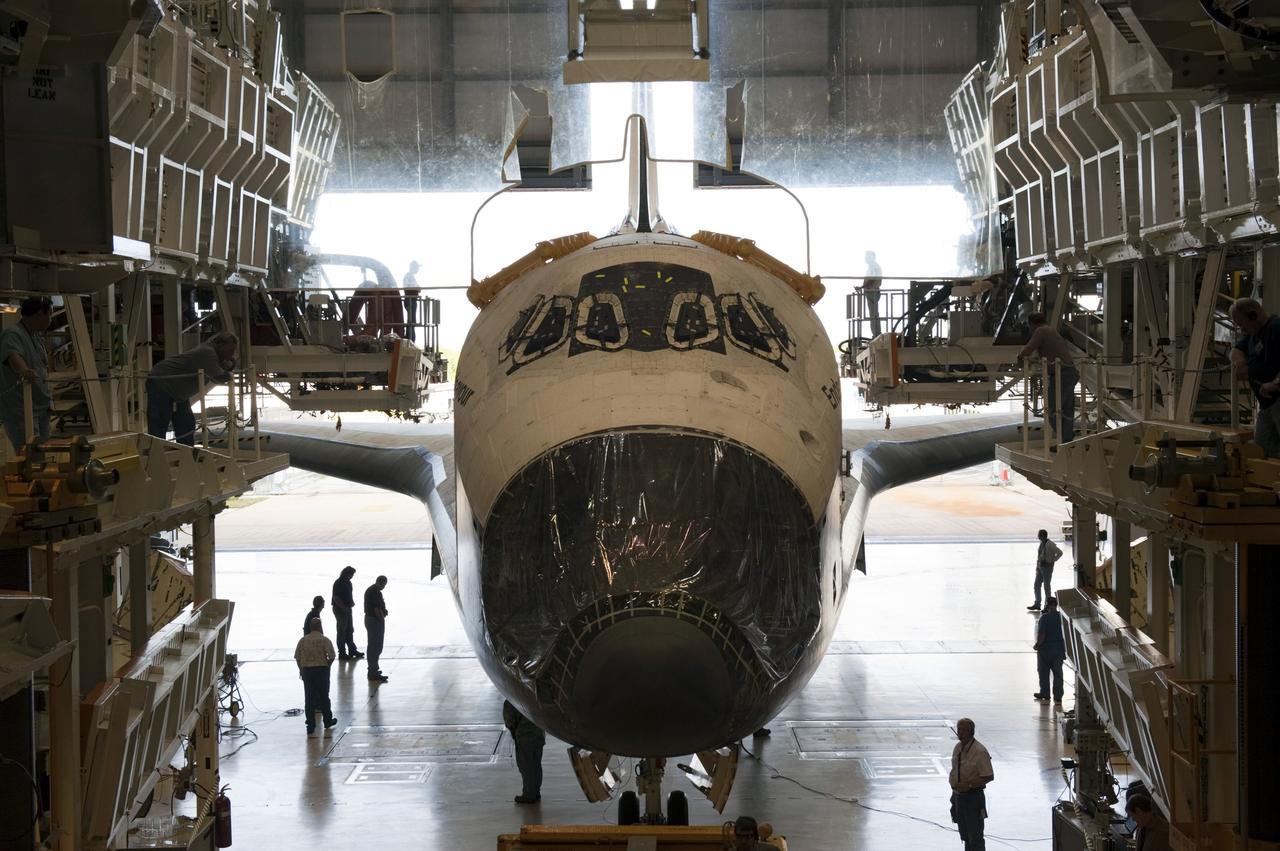
CAPE CANAVERAL, Fla. – At NASA’s Kennedy Space Center in Florida, space shuttle Endeavour is towed inside Orbiter Processing Facility-2 (OPF-2). Shuttle Endeavour will remain in OPF-2 so that the orbiter maneuvering system (OMS) pods and forward reaction control system can be installed. Technicians also will offload water and Freon gas from lines located in Endeavour’s midbody. The work is part of Endeavour’s transition and retirement processing. The spacecraft is being prepared for public display at the California Science Center in Los Angeles. Endeavour flew 25 missions, spent 299 days in space, orbited Earth 4,671 times and traveled 122, 883, 151 miles over the course of its 19-year career. Endeavour’s STS-134 and final mission was completed after landing on June 1, 2011. Photo credit: Kim Shiflett
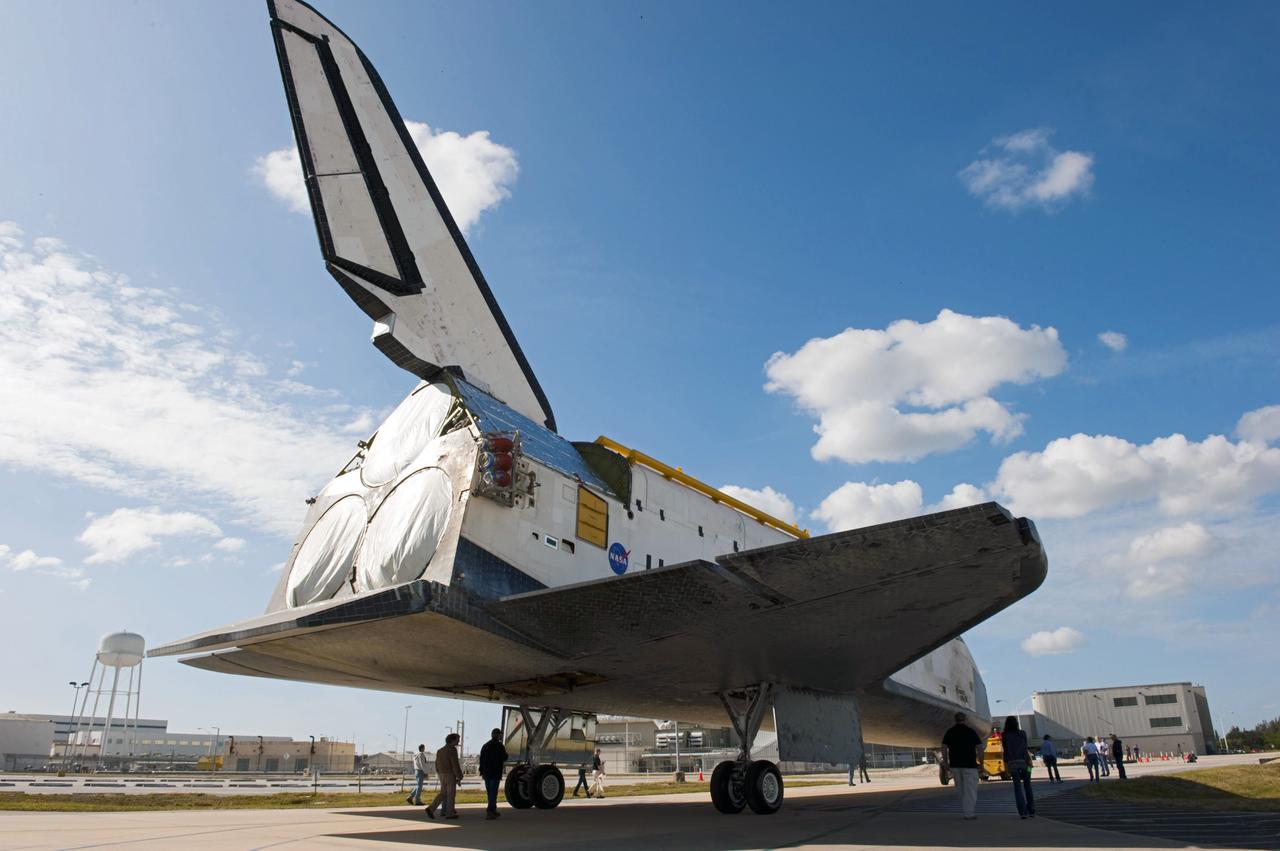
CAPE CANAVERAL, Fla. – At NASA’s Kennedy Space Center in Florida, technicians walk alongside as space shuttle Endeavour is being towed from the Vehicle Assembly Building to Orbiter Processing Facility-2. Shuttle Endeavour will remain in OPF-2 so that the orbiter maneuvering system (OMS) pods and forward reaction control system can be installed. Technicians also will offload water and Freon gas from lines located in Endeavour’s midbody. The work is part of Endeavour’s transition and retirement processing. The spacecraft is being prepared for public display at the California Science Center in Los Angeles. Endeavour flew 25 missions, spent 299 days in space, orbited Earth 4,671 times and traveled 122, 883, 151 miles over the course of its 19-year career. Endeavour’s STS-134 and final mission was completed after landing on June 1, 2011. Photo credit: Kim Shiflett
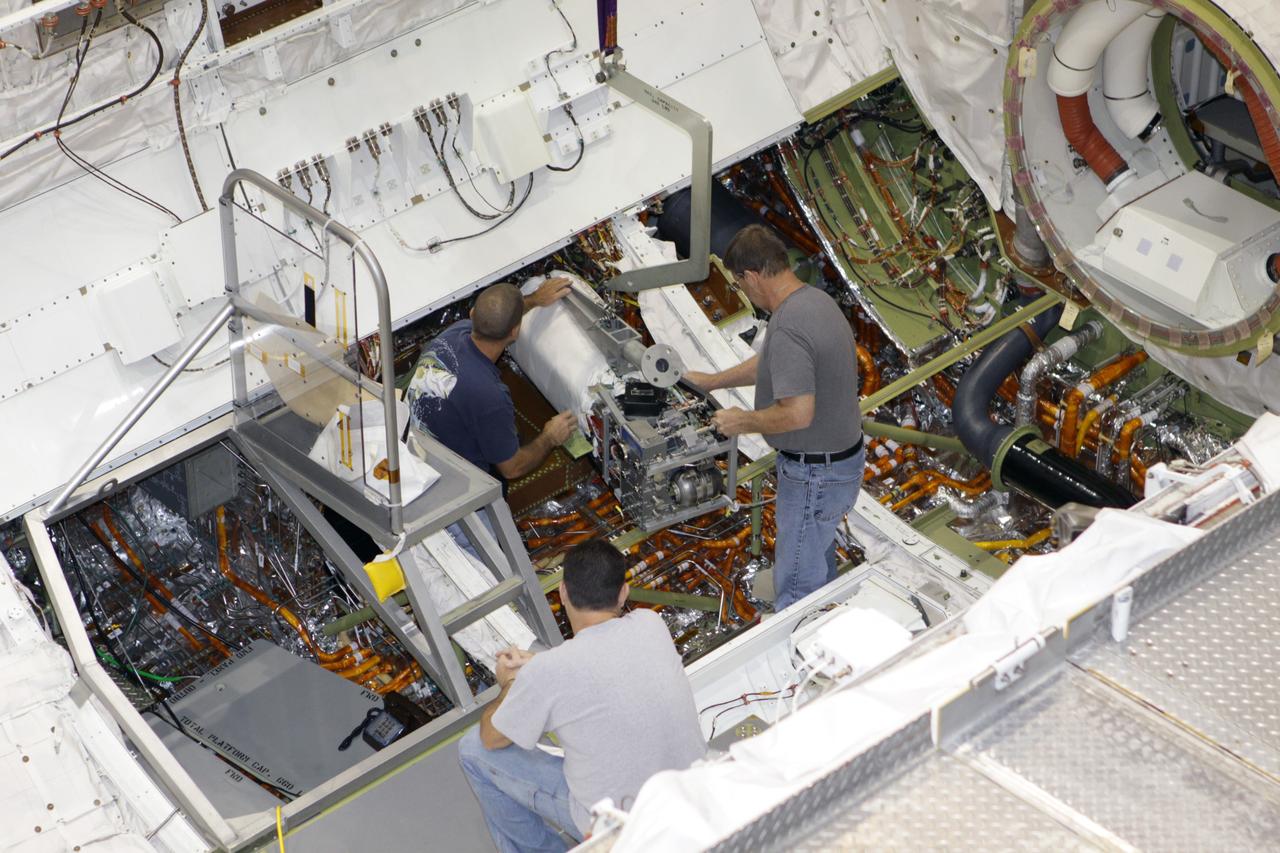
CAPE CANAVERAL, Fla. – Inside Orbiter Processing Facility-2 at NASA's Kennedy Space Center in Florida, technicians use a special crane to lift a fuel cell out of space shuttle Endeavour's payload bay. All three of Endeavour's fuel cells were removed and will be drained of fluids. The hydrogen and oxygen dewars which feed reactants to the fuel cells remain in Endeavour's midbody and will be purged with inert gases and vented down. The work is part of the Space Shuttle Program's transition and retirement processing of shuttle Endeavour, which is being prepared for public display at the California Science Center in Los Angeles. Its ferry flight to California is targeted for mid-September. Endeavour was the last space shuttle added to NASA's orbiter fleet. Over the course of its 19-year career, Endeavour spent 299 days in space during 25 missions. For more information, visit http://www.nasa.gov/shuttle. Photo credit: NASA/Glenn Benson
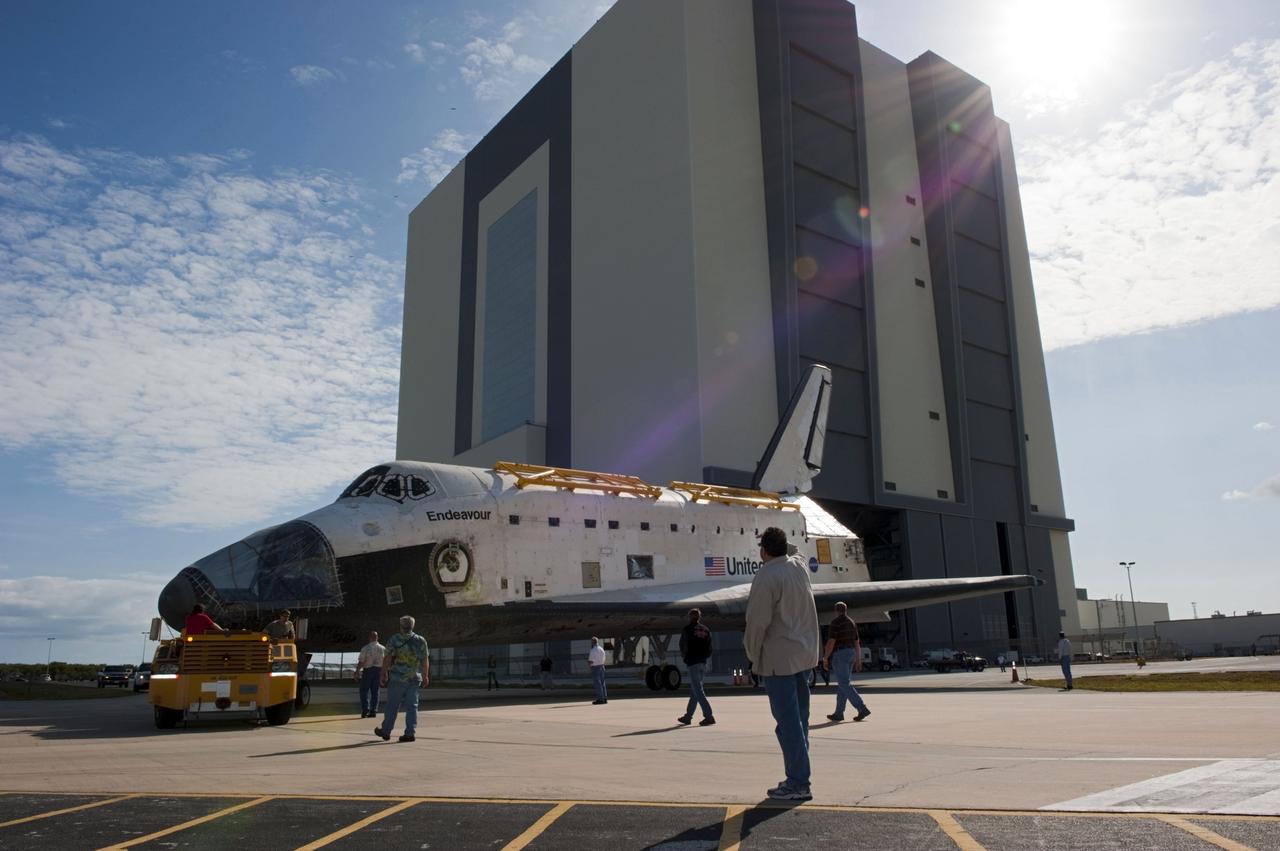
CAPE CANAVERAL, Fla. – At NASA’s Kennedy Space Center in Florida, technicians walk alongside as space shuttle Endeavour is being towed from the Vehicle Assembly Building to Orbiter Processing Facility-2. Shuttle Endeavour will remain in OPF-2 so that the orbiter maneuvering system (OMS) pods and forward reaction control system can be installed. Technicians also will offload water and Freon gas from lines located in Endeavour’s midbody. The work is part of Endeavour’s transition and retirement processing. The spacecraft is being prepared for public display at the California Science Center in Los Angeles. Endeavour flew 25 missions, spent 299 days in space, orbited Earth 4,671 times and traveled 122, 883, 151 miles over the course of its 19-year career. Endeavour’s STS-134 and final mission was completed after landing on June 1, 2011. Photo credit: Kim Shiflett
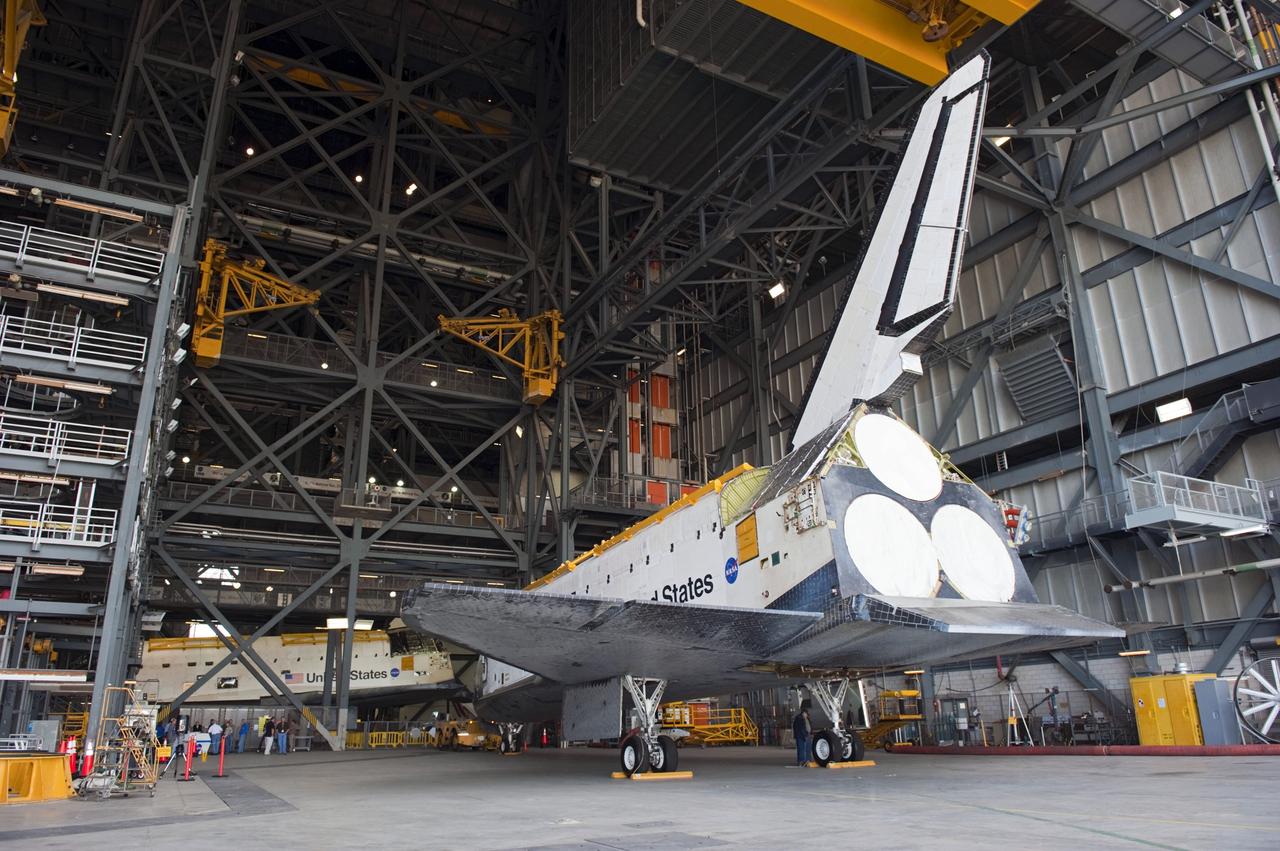
CAPE CANAVERAL, Fla. – Inside the Vehicle Assembly Building at NASA’s Kennedy Space Center in Florida, space shuttle Endeavour is being prepared to be backed out and towed to Orbiter Processing Facility-2 (OPF-2). In the background is space shuttle Atlantis. Shuttle Endeavour will remain in OPF-2 so that the orbiter maneuvering system (OMS) pods and forward reaction control system can be installed. Technicians also will offload water and Freon gas from lines located in Endeavour’s midbody. The work is part of Endeavour’s transition and retirement processing. The spacecraft is being prepared for public display at the California Science Center in Los Angeles. Endeavour flew 25 missions, spent 299 days in space, orbited Earth 4,671 times and traveled 122, 883, 151 miles over the course of its 19-year career. Endeavour’s STS-134 and final mission was completed after landing on June 1, 2011. Photo credit: Kim Shiflett
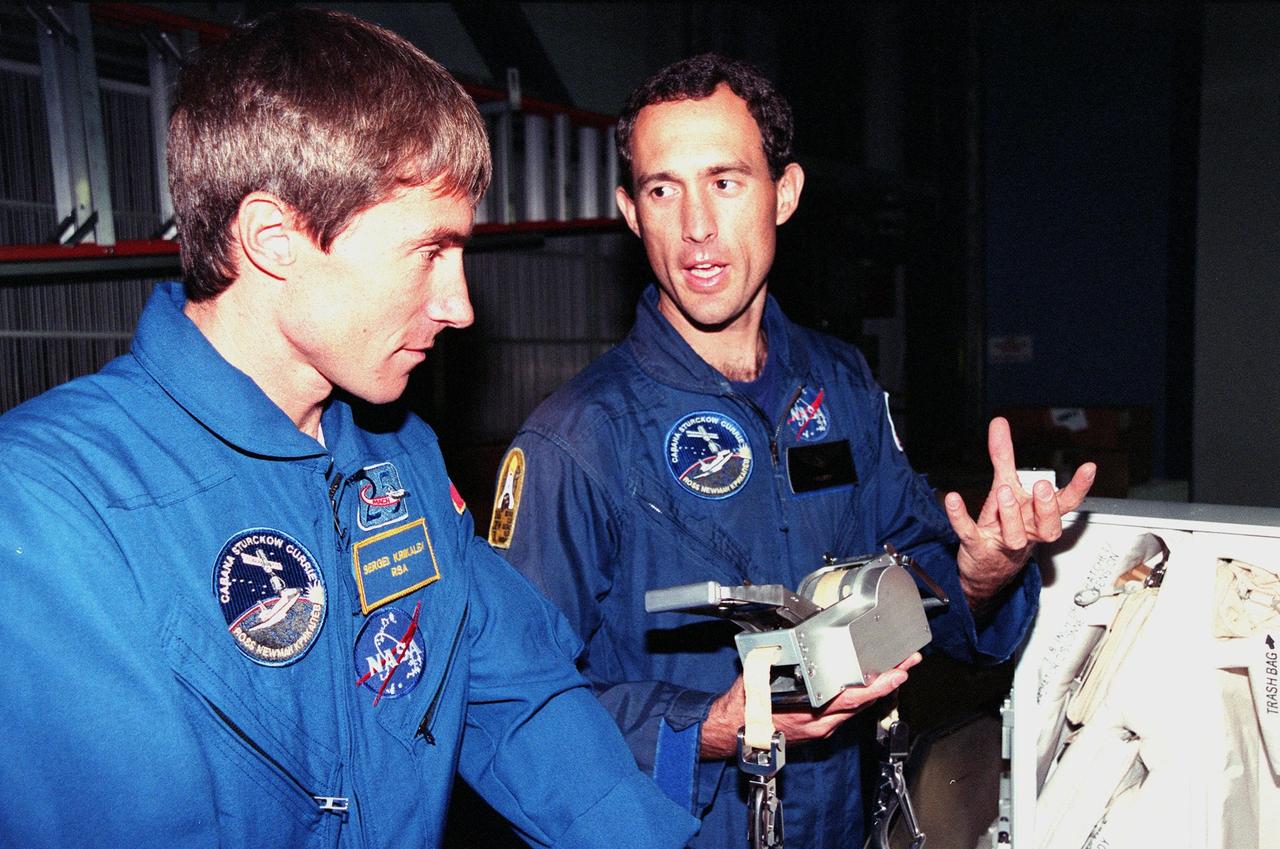
KENNEDY SPACE CENTER, FLA. -- Inside the Orbiter Processing Facility Bay 1, STS-88 Mission Specialists Sergei Krikalev (left), a Russian cosmonaut; and James H. Newman look over equipment for their upcoming flight. The STS-88 crew members are participating in a Crew Equipment Interface Test (CEIT), familiarizing themselves with the orbiter's midbody and crew compartments. Targeted for liftoff on Dec. 3, 1998, STS-88 will be the first Space Shuttle launch for assembly of the International Space Station (ISS). The primary payload is the Unity connecting module which will be mated to the Russian-built Zarya control module, expected to be already on orbit after a November launch from Russia. The first major U.S.-built component of ISS, Unity will serve as a connecting passageway to living and working areas of the space station. Unity has two attached pressurized mating adapters (PMAs) and one stowage rack installed inside. PMA-1 provides the permanent connection point between Unity and Zarya; PMA-2 will serve as a Space Shuttle docking port. Zarya is a self-supporting active vehicle, providing propulsive control capability and power during the early assembly stages. It also has fuel storage capability
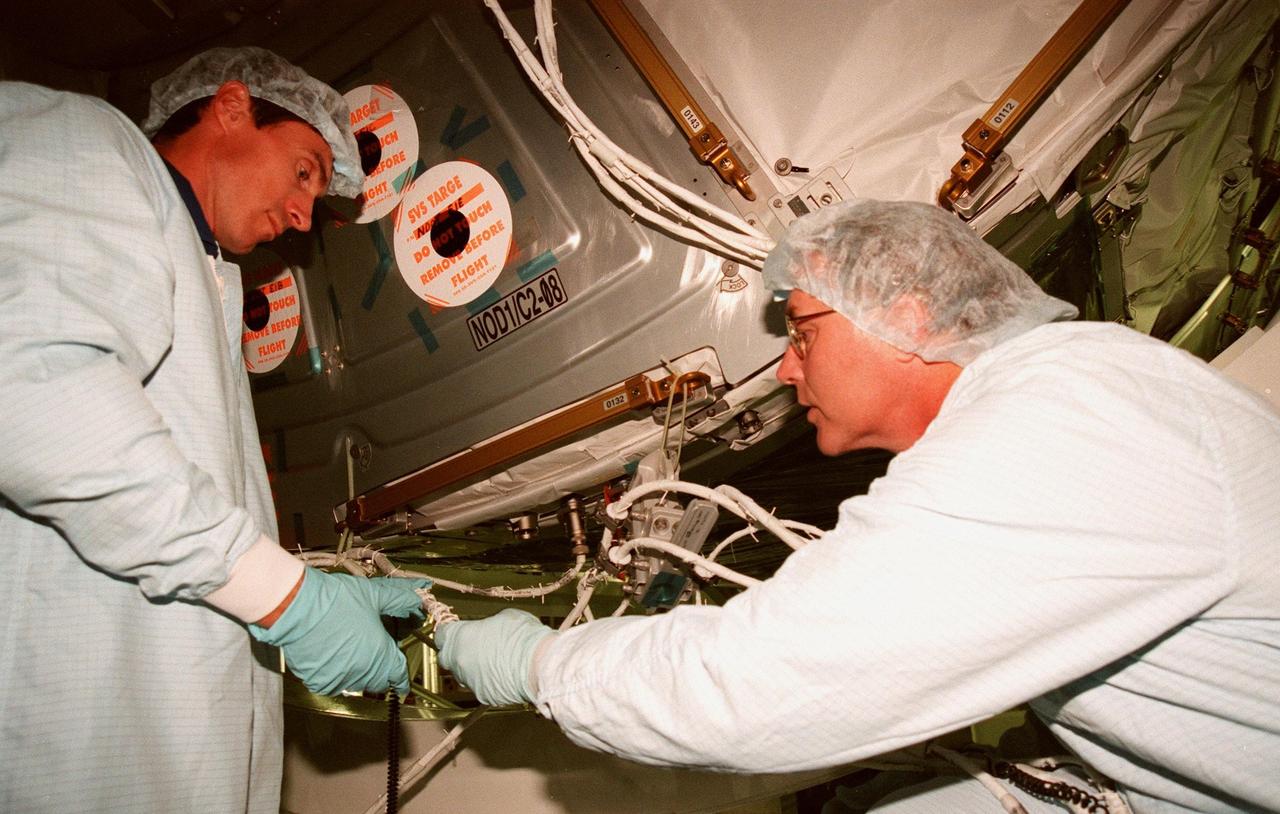
KENNEDY SPACE CENTER, FLA. -- In the Space Station Processing Facility, STS-88 Mission Specialists Sergei Krikalev, a Russian cosmonaut, and Jerry L. Ross check out equipment on the Unity connecting module, primary payload on the mission. The STS-88 crew members are participating in a Crew Equipment Interface Test (CEIT), familiarizing themselves with the orbiter's midbody and crew compartments. Scheduled for launch on Dec. 3, 1998, STS-88 will be the first Space Shuttle launch for the International Space Station. The Unity connecting module will be mated to the Russian-built Zarya control module, already on orbit after a November launch. Unity will have two Pressurized Mating Adapters (PMAs) attached and 1 stowage rack installed inside. PMA-1 will connect U.S. and Russian elements; PMA-2 will provide a Shuttle docking location. Eventually, Unity's six ports will provide connecting points for the Z1 truss exterior framework, U.S. lab, airlock, cupola, Node 3, and the Multi-Purpose Logistics Module, as well as the control module. Zarya is a self-supporting active vehicle, providing propulsive control capability and power through the early assembly stages. It provides fuel storage capability and a rendezvous and docking capability to the Service Module
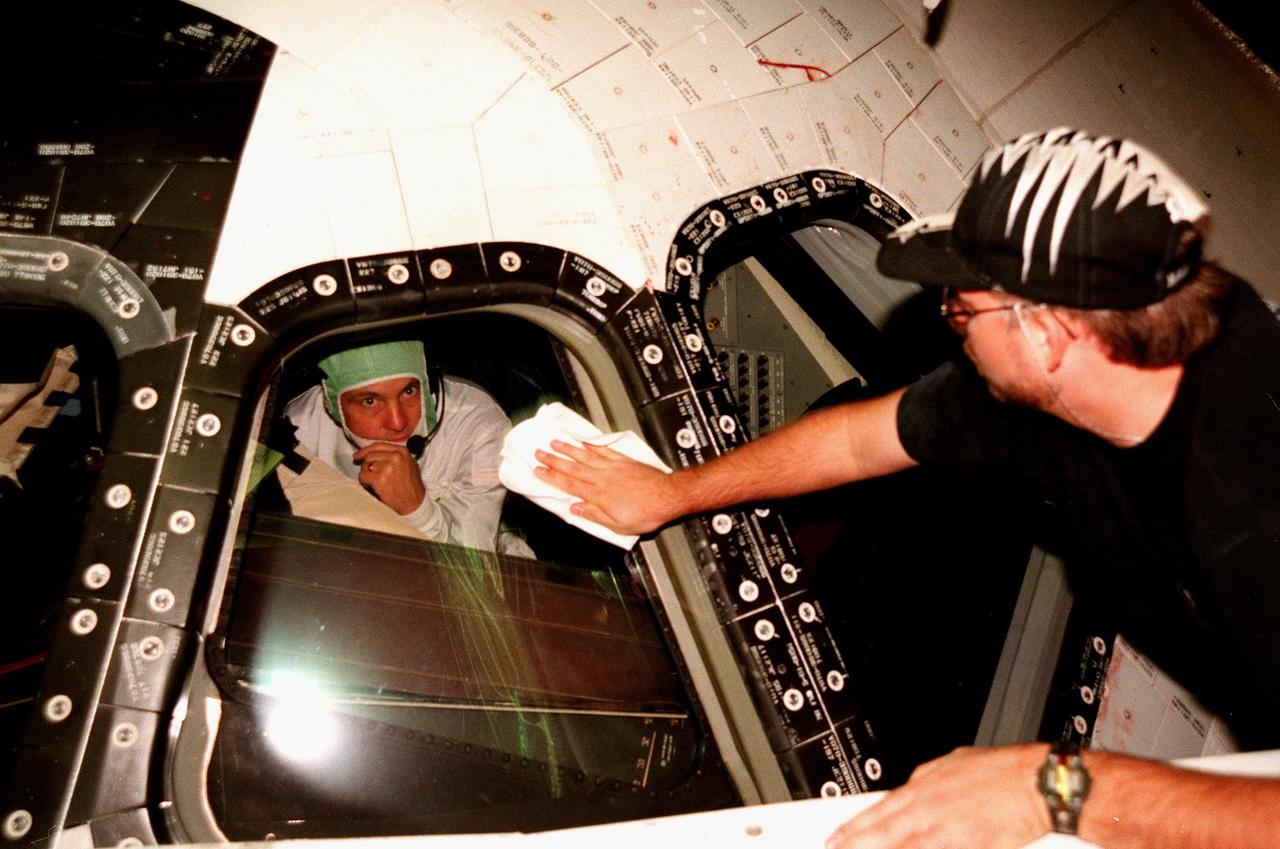
KENNEDY SPACE CENTER, FLA. -- In the Orbiter Processing Facility Bay 1, STS-88 Commander Robert D. Cabana watches from inside Space Shuttle orbiter Endeavour as worker Tracey Hackett cleans the outside of a window. The STS-88 crew members are participating in a Crew Equipment Interface Test (CEIT), familiarizing themselves with the orbiter's midbody and crew compartments. Targeted for liftoff on Dec. 3, 1998, STS-88 will be the first Space Shuttle launch for assembly of the International Space Station (ISS). The primary payload is the Unity connecting module which will be mated to the Russian-built Zarya control module, expected to be already on orbit after a November launch from Russia. The first major U.S.-built component of ISS, Unity will serve as a connecting passageway to living and working areas of the space station. Unity has two attached pressurized mating adapters (PMAs) and one stowage rack installed inside. PMA-1 provides the permanent connection point between Unity and Zarya; PMA-2 will serve as a Space Shuttle docking port. Zarya is a self-supporting active vehicle, providing propulsive control capability and power during the early assembly stages. It also has fuel storage capability
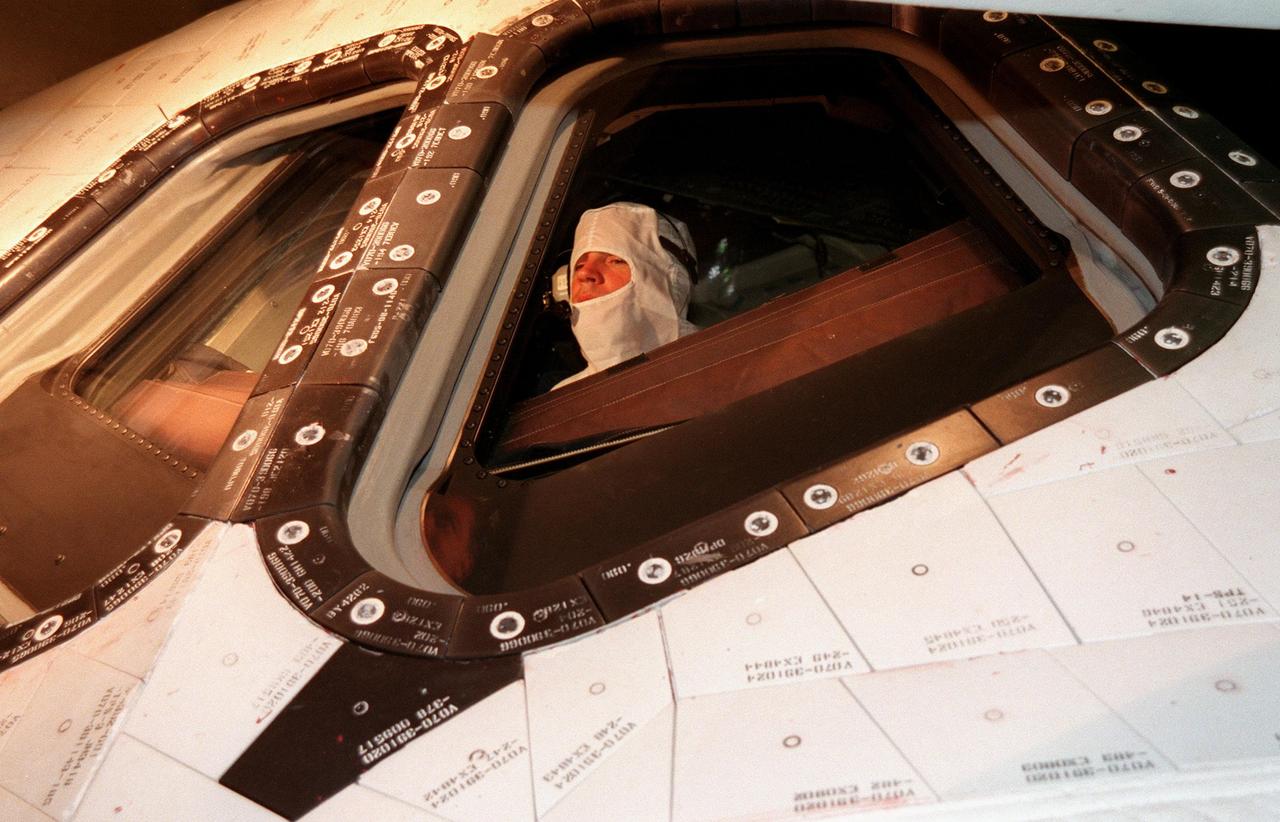
KENNEDY SPACE CENTER, FLA. -- In the Orbiter Processing Facility Bay 1, STS-88 Pilot Frederick W. Sturckow makes a visual inspection of windows on the Space Shuttle orbiter Endeavour. The STS-88 crew members are participating in a Crew Equipment Interface Test (CEIT), familiarizing themselves with the orbiter's midbody and crew compartments. Targeted for launch on Dec. 3, 1998, STS-88 will be the first Space Shuttle launch for assembly of the International Space Station (ISS). The primary payload is the Unity connecting module which will be mated to the Russian-built Zarya control module, expected to be already on orbit after a November launch from Russia. The first major U.S.-built component of ISS, Unity will serve as a connecting passageway to living and working areas of the space station. Unity has two attached pressurized mating adapters (PMAs) and one stowage rack installed inside. PMA-1 provides the permanent connection point between Unity and Zarya; PMA-2 will serve as a Space Shuttle docking port. Zarya is a self-supporting active vehicle, providing propulsive control capability and power during the early assembly stages. It also has fuel storage capability
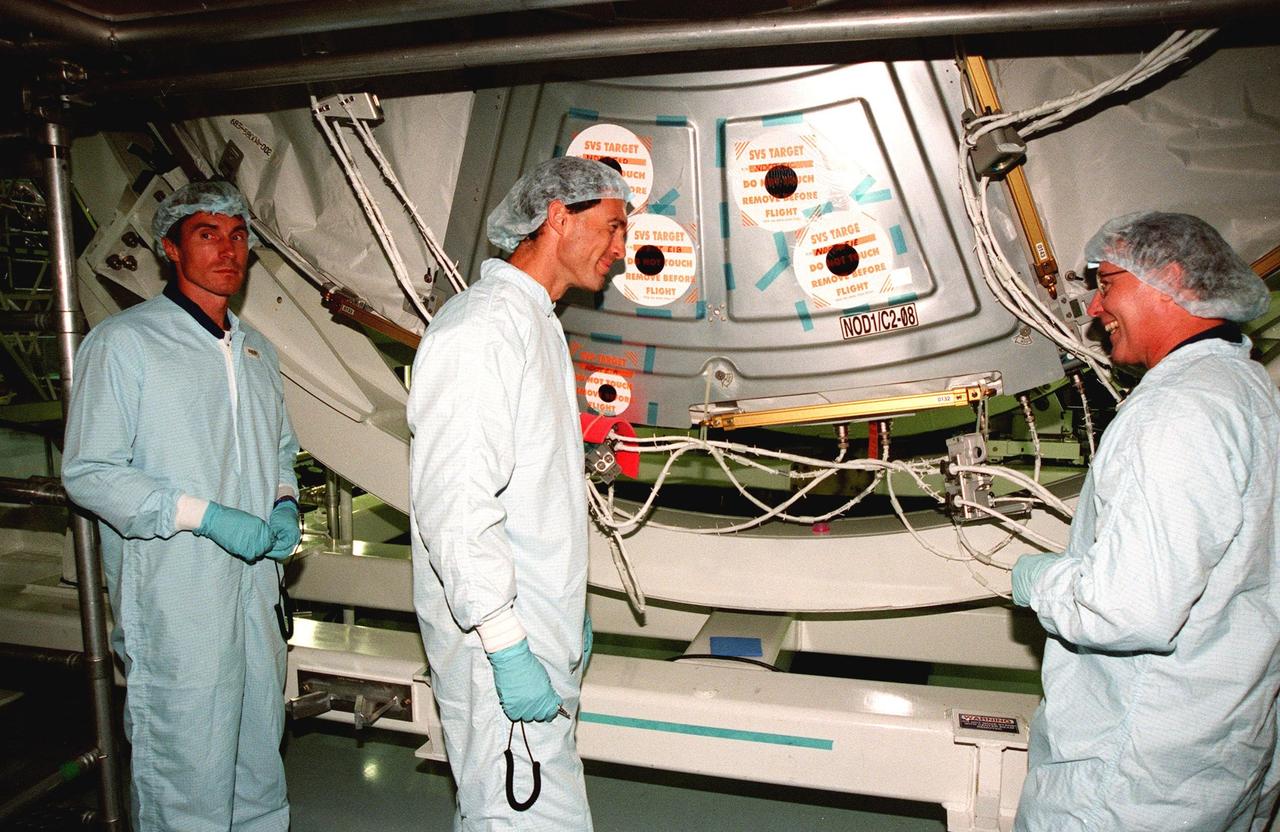
KENNEDY SPACE CENTER, FLA. -- In the Space Station Processing Facility, STS-88 Mission Specialists Sergei Krikalev (left), a Russian cosmonaut; James H. Newman (center); and Jerry L. Ross conduct a sharp-edge inspection of the Unity connecting module, which is the primary payload on their upcoming mission. The STS-88 crew members are participating in a Crew Equipment Interface Test (CEIT), familiarizing themselves with the orbiter's midbody and crew compartments. Targeted for liftoff on Dec. 3, 1998, STS-88 will be the first Space Shuttle launch for assembly of the International Space Station (ISS). The primary payload is the Unity connecting module which will be mated to the Russian-built Zarya control module, expected to be already on orbit after a November launch from Russia. The first major U.S.-built component of ISS, Unity will serve as a connecting passageway to living and working areas of the space station. Unity has two attached pressurized mating adapters (PMAs) and one stowage rack installed inside. PMA-1 provides the permanent connection point between Unity and Zarya; PMA-2 will serve as a Space Shuttle docking port. Zarya is a self-supporting active vehicle, providing propulsive control capability and power during the early assembly stages. It also has fuel storage capability
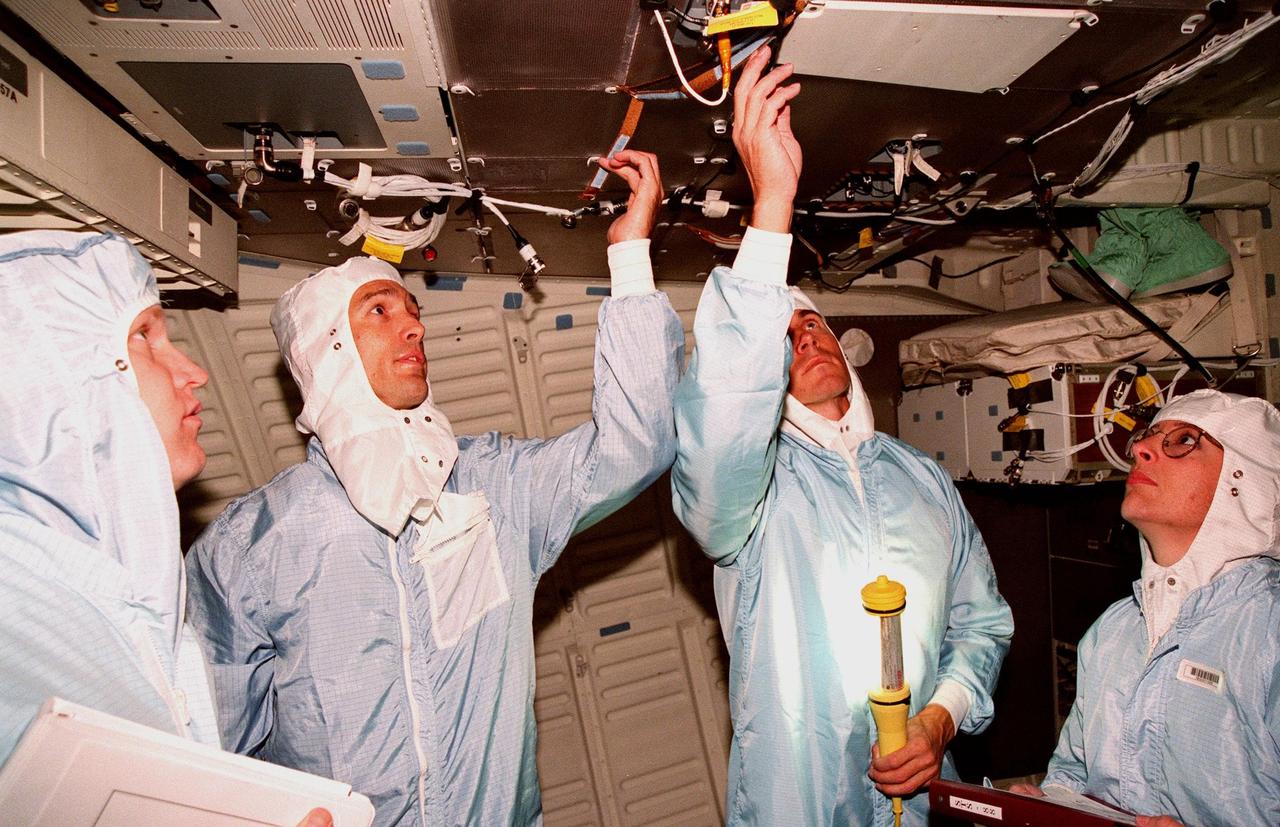
KENNEDY SPACE CENTER, FLA. -- Inside Space Shuttle orbiter Endeavour in the Orbiter Processing Facility Bay 1, workers James Neilhouse (left) and Melissa Groening (right) watch while STS-88 Mission Specialists James H. Newman (second from left) and Sergei Krikalev, a Russian cosmonaut, check overhead equipment. STS-88 crew members are participating in a Crew Equipment Interface Test (CEIT), familiarizing themselves with the orbiter's midbody and crew compartments. Targeted for liftoff on Dec. 3, 1998, STS-88 will be the first Space Shuttle launch for assembly of the International Space Station (ISS). The primary payload is the Unity connecting module which will be mated to the Russian-built Zarya control module, expected to be already on orbit after a November launch from Russia. The first major U.S.-built component of ISS, Unity will serve as a connecting passageway to living and working areas of the space station. Unity has two attached pressurized mating adapters (PMAs) and one stowage rack installed inside. PMA-1 provides the permanent connection point between Unity and Zarya; PMA-2 will serve as a Space Shuttle docking port. Zarya is a self-supporting active vehicle, providing propulsive control capability and power during the early assembly stages. It also has fuel storage capability.
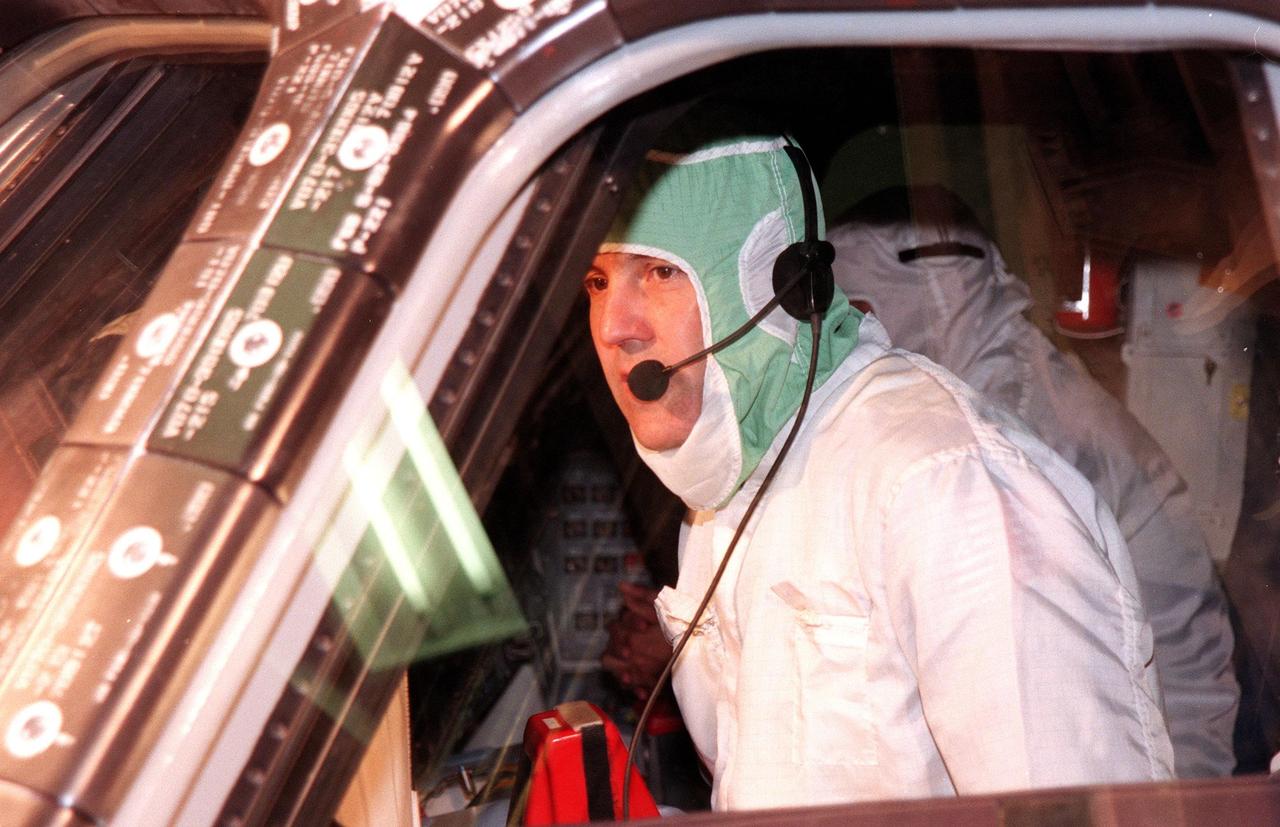
KENNEDY SPACE CENTER, FLA. -- In the Orbiter Processing Facility Bay 1, STS-88 Commander Robert D. Cabana makes a visual inspection of the windows on Space Shuttle orbiter Endeavour. The STS-88 crew members are participating in a Crew Equipment Interface Test (CEIT), familiarizing themselves with the orbiter's midbody and crew compartments. Targeted for liftoff on Dec. 3, 1998, STS-88 will be the first Space Shuttle launch for assembly of the International Space Station (ISS). The primary payload is the Unity connecting module which will be mated to the Russian-built Zarya control module, expected to be already on orbit after a November launch from Russia. The first major U.S.-built component of ISS, Unity will serve as a connecting passageway to living and working areas of the space station. Unity has two attached pressurized mating adapters (PMAs) and one stowage rack installed inside. PMA-1 provides the permanent connection point between Unity and Zarya; PMA-2 will serve as a Space Shuttle docking port. Zarya is a self-supporting active vehicle, providing propulsive control capability and power during the early assembly stages. It also has fuel storage capability
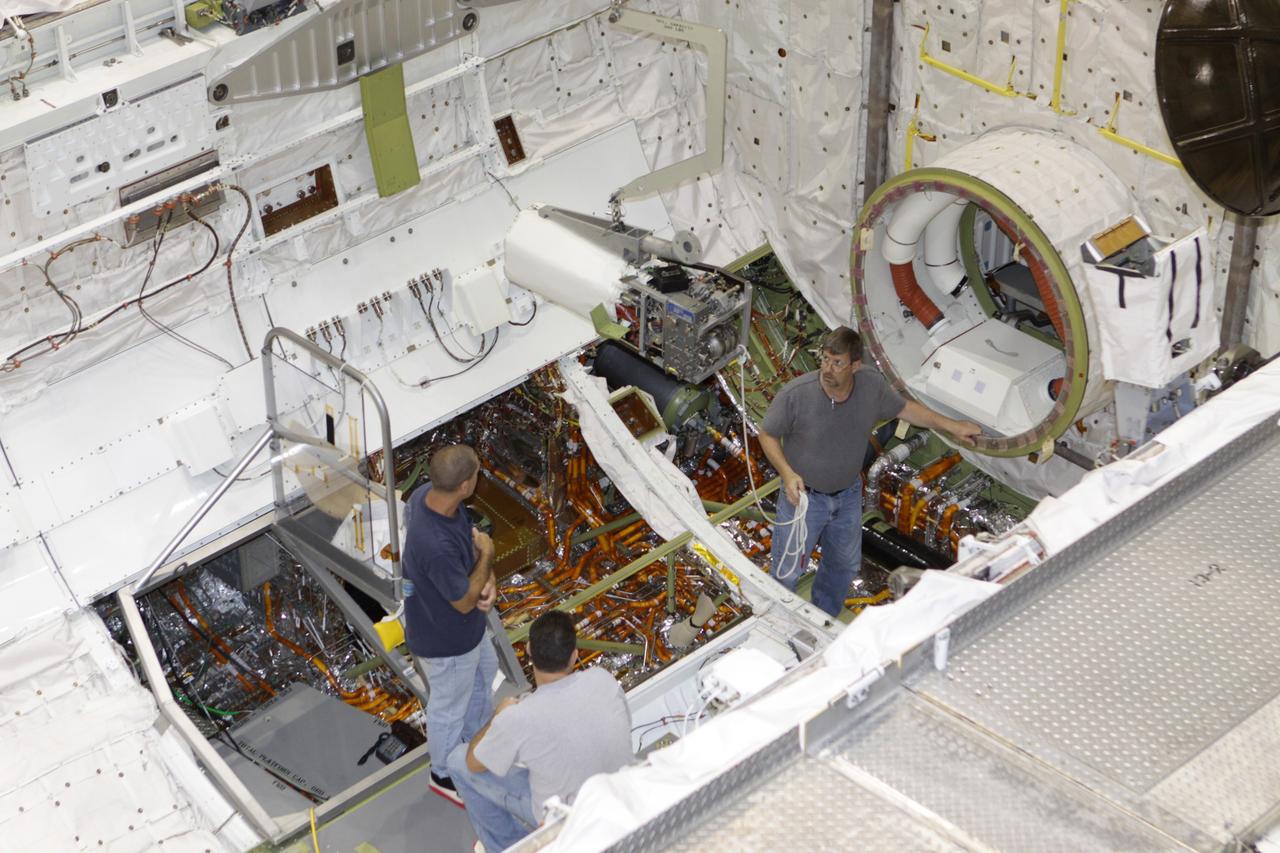
CAPE CANAVERAL, Fla. – Technicians monitor the progress as one of space shuttle Endeavour's three fuel cells is removed from the vehicle's payload bay. The operation took place inside Orbiter Processing Facility-2 at NASA's Kennedy Space Center in Florida. All three of Endeavour's fuel cells were removed and will be drained of fluids. The hydrogen and oxygen dewars which feed reactants to the fuel cells remain in Endeavour's midbody and will be purged with inert gases and vented down. The work is part of the Space Shuttle Program's transition and retirement processing of shuttle Endeavour, which is being prepared for public display at the California Science Center in Los Angeles. Its ferry flight to California is targeted for mid-September. Endeavour was the last space shuttle added to NASA's orbiter fleet. Over the course of its 19-year career, Endeavour spent 299 days in space during 25 missions. For more information, visit http://www.nasa.gov/shuttle. Photo credit: NASA/Glenn Benson
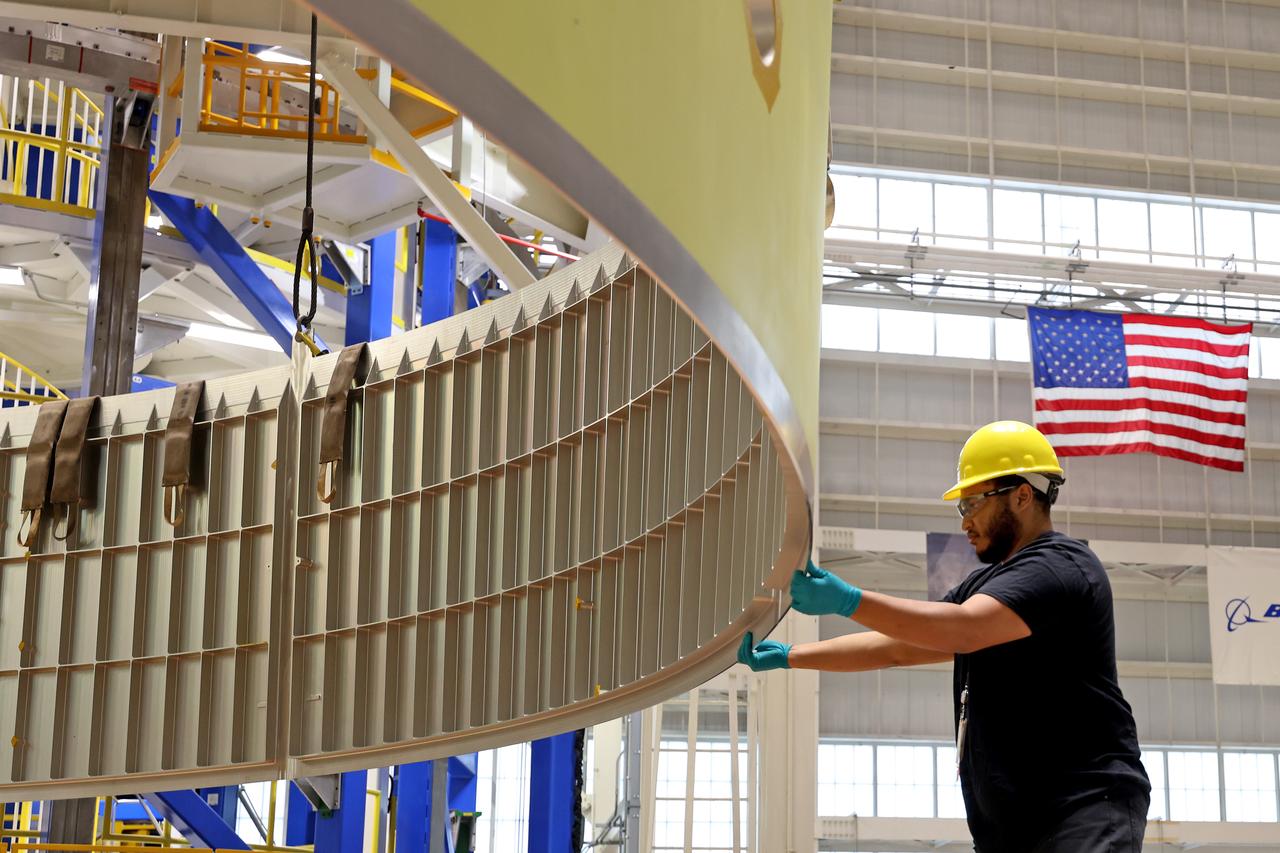
These images and videos show technicians at NASA’s Michoud Assembly Facility in New Orleans examining and lifting midbody barrels for the Exploration Upper Stage (EUS) structural test article of the SLS (Space Launch System) rocket in May 2023. The barrel sections make up the body, or main structure, of the future in-space propulsion stage for the mega rocket. The Exploration Upper Stage will be used on the second configuration of the SLS rocket, known as Block 1B, and will provide in-space propulsion to send astronauts in NASA’s Orion spacecraft and heavy cargo on a precise trajectory to the Moon. Beginning with Artemis IV, EUS will replace the interim cryogenic propulsion stage for the Block 1 configuration of SLS. It has larger propellant tanks and four RL10 engines, enabling SLS to launch 40% more cargo to the Moon along with crew. EUS flight hardware is in early production at Michoud. Crews with NASA and Boeing, the lead contractor for the SLS core stage and EUS, are also manufacturing the EUS structural test article. The test hardware is structurally identical to the flight version and will be used during a series of strenuous testing that simulates the forces the rocket will experience during launch and flight and verify its structural integrity. NASA is working to land the first woman and first person of color on the Moon under Artemis. SLS is part of NASA’s backbone for deep space exploration, along with Orion and the Gateway in orbit around the Moon. SLS is the only rocket that can send Orion, astronauts, and supplies to the Moon in a single mission.
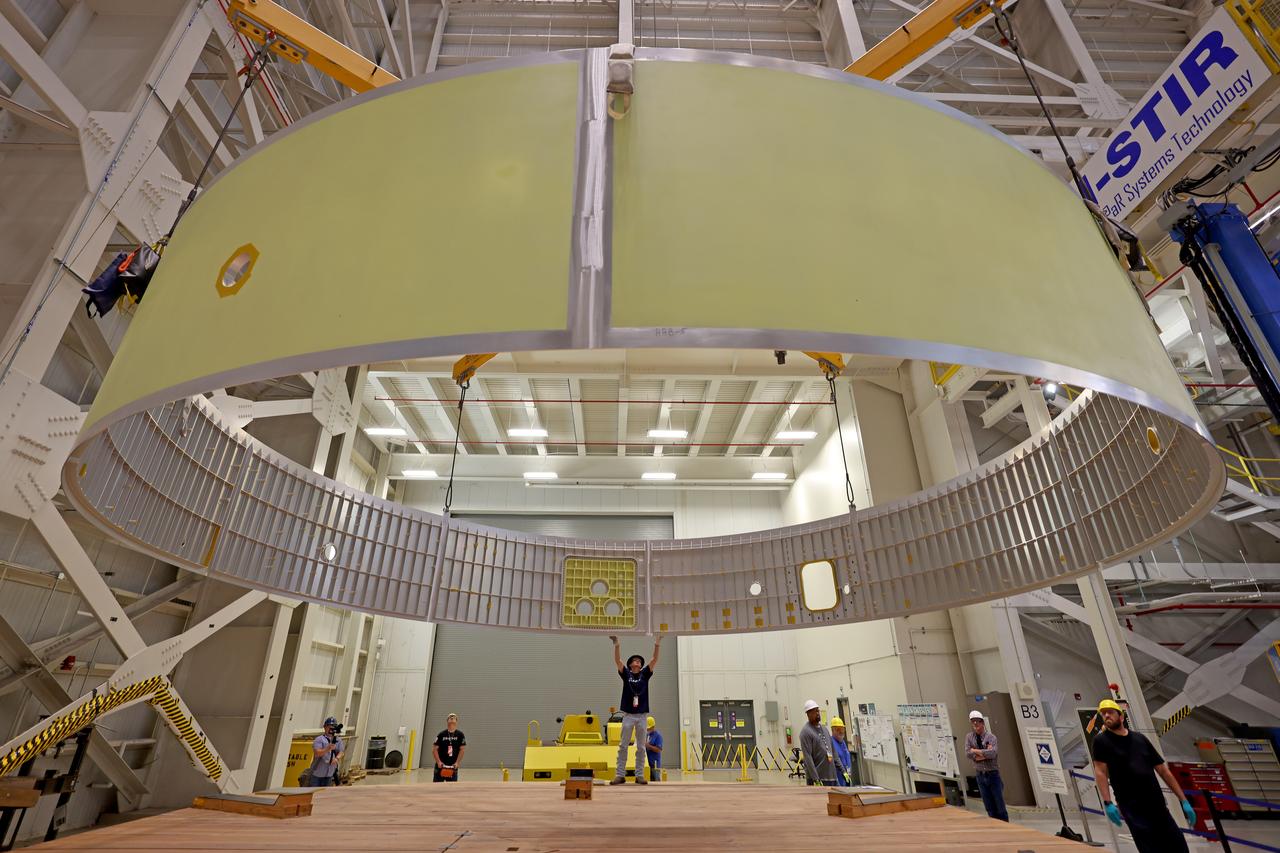
These images and videos show technicians at NASA’s Michoud Assembly Facility in New Orleans examining and lifting midbody barrels for the Exploration Upper Stage (EUS) structural test article of the SLS (Space Launch System) rocket in May 2023. The barrel sections make up the body, or main structure, of the future in-space propulsion stage for the mega rocket. The Exploration Upper Stage will be used on the second configuration of the SLS rocket, known as Block 1B, and will provide in-space propulsion to send astronauts in NASA’s Orion spacecraft and heavy cargo on a precise trajectory to the Moon. Beginning with Artemis IV, EUS will replace the interim cryogenic propulsion stage for the Block 1 configuration of SLS. It has larger propellant tanks and four RL10 engines, enabling SLS to launch 40% more cargo to the Moon along with crew. EUS flight hardware is in early production at Michoud. Crews with NASA and Boeing, the lead contractor for the SLS core stage and EUS, are also manufacturing the EUS structural test article. The test hardware is structurally identical to the flight version and will be used during a series of strenuous testing that simulates the forces the rocket will experience during launch and flight and verify its structural integrity. NASA is working to land the first woman and first person of color on the Moon under Artemis. SLS is part of NASA’s backbone for deep space exploration, along with Orion and the Gateway in orbit around the Moon. SLS is the only rocket that can send Orion, astronauts, and supplies to the Moon in a single mission.
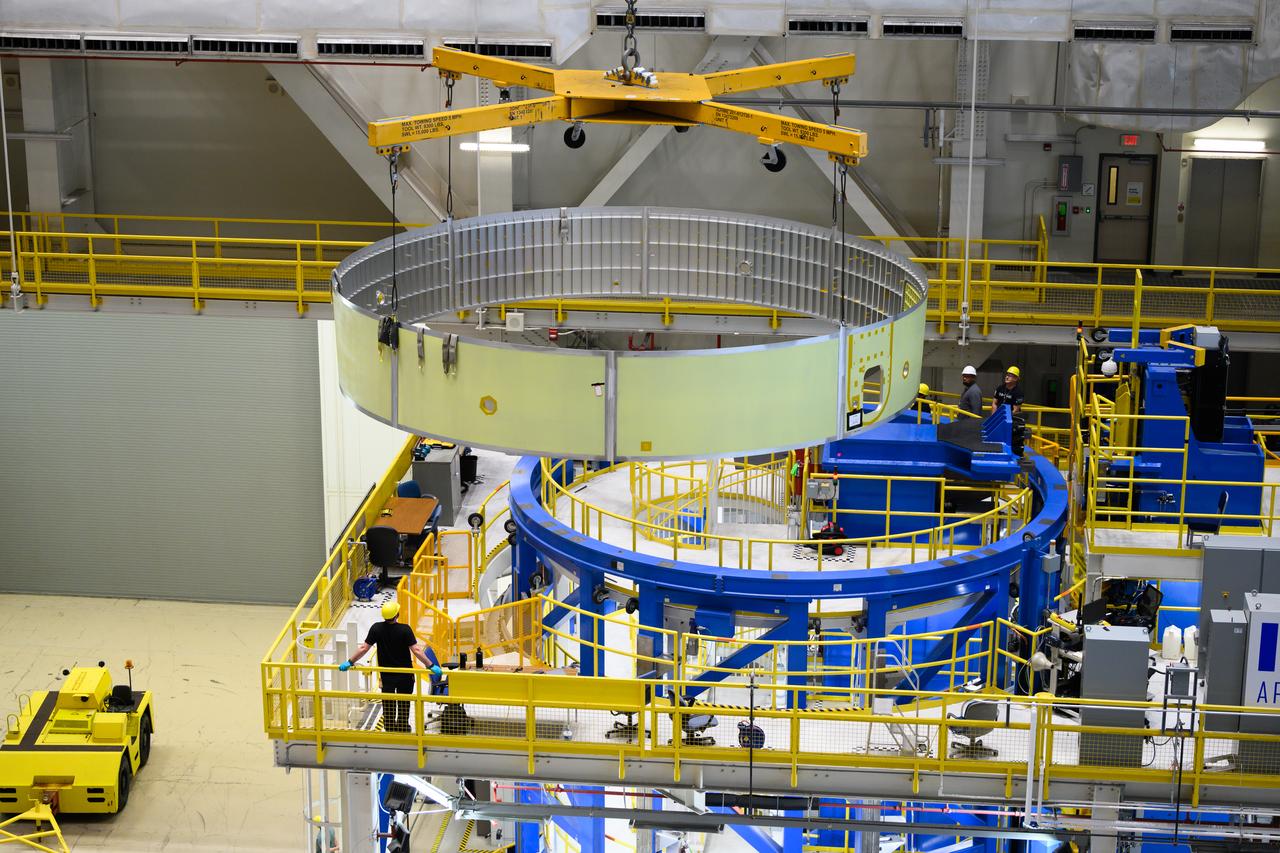
These images and videos show technicians at NASA’s Michoud Assembly Facility in New Orleans examining and lifting midbody barrels for the Exploration Upper Stage (EUS) structural test article of the SLS (Space Launch System) rocket in May 2023. The barrel sections make up the body, or main structure, of the future in-space propulsion stage for the mega rocket. The Exploration Upper Stage will be used on the second configuration of the SLS rocket, known as Block 1B, and will provide in-space propulsion to send astronauts in NASA’s Orion spacecraft and heavy cargo on a precise trajectory to the Moon. Beginning with Artemis IV, EUS will replace the interim cryogenic propulsion stage for the Block 1 configuration of SLS. It has larger propellant tanks and four RL10 engines, enabling SLS to launch 40% more cargo to the Moon along with crew. EUS flight hardware is in early production at Michoud. Crews with NASA and Boeing, the lead contractor for the SLS core stage and EUS, are also manufacturing the EUS structural test article. The test hardware is structurally identical to the flight version and will be used during a series of strenuous testing that simulates the forces the rocket will experience during launch and flight and verify its structural integrity. NASA is working to land the first woman and first person of color on the Moon under Artemis. SLS is part of NASA’s backbone for deep space exploration, along with Orion and the Gateway in orbit around the Moon. SLS is the only rocket that can send Orion, astronauts, and supplies to the Moon in a single mission.

These images and videos show technicians at NASA’s Michoud Assembly Facility in New Orleans examining and lifting midbody barrels for the Exploration Upper Stage (EUS) structural test article of the SLS (Space Launch System) rocket in May 2023. The barrel sections make up the body, or main structure, of the future in-space propulsion stage for the mega rocket. The Exploration Upper Stage will be used on the second configuration of the SLS rocket, known as Block 1B, and will provide in-space propulsion to send astronauts in NASA’s Orion spacecraft and heavy cargo on a precise trajectory to the Moon. Beginning with Artemis IV, EUS will replace the interim cryogenic propulsion stage for the Block 1 configuration of SLS. It has larger propellant tanks and four RL10 engines, enabling SLS to launch 40% more cargo to the Moon along with crew. EUS flight hardware is in early production at Michoud. Crews with NASA and Boeing, the lead contractor for the SLS core stage and EUS, are also manufacturing the EUS structural test article. The test hardware is structurally identical to the flight version and will be used during a series of strenuous testing that simulates the forces the rocket will experience during launch and flight and verify its structural integrity. NASA is working to land the first woman and first person of color on the Moon under Artemis. SLS is part of NASA’s backbone for deep space exploration, along with Orion and the Gateway in orbit around the Moon. SLS is the only rocket that can send Orion, astronauts, and supplies to the Moon in a single mission.
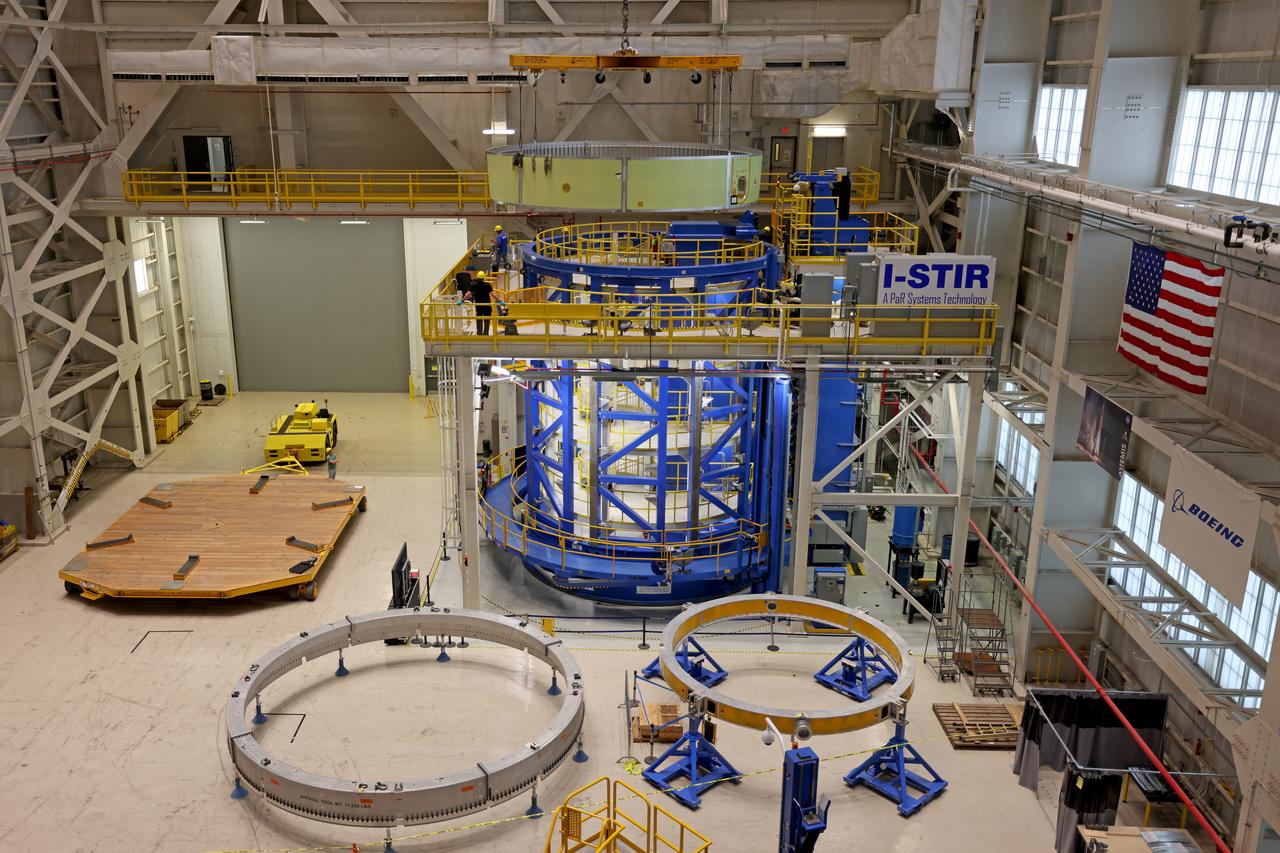
These images and videos show technicians at NASA’s Michoud Assembly Facility in New Orleans examining and lifting midbody barrels for the Exploration Upper Stage (EUS) structural test article of the SLS (Space Launch System) rocket in May 2023. The barrel sections make up the body, or main structure, of the future in-space propulsion stage for the mega rocket. The Exploration Upper Stage will be used on the second configuration of the SLS rocket, known as Block 1B, and will provide in-space propulsion to send astronauts in NASA’s Orion spacecraft and heavy cargo on a precise trajectory to the Moon. Beginning with Artemis IV, EUS will replace the interim cryogenic propulsion stage for the Block 1 configuration of SLS. It has larger propellant tanks and four RL10 engines, enabling SLS to launch 40% more cargo to the Moon along with crew. EUS flight hardware is in early production at Michoud. Crews with NASA and Boeing, the lead contractor for the SLS core stage and EUS, are also manufacturing the EUS structural test article. The test hardware is structurally identical to the flight version and will be used during a series of strenuous testing that simulates the forces the rocket will experience during launch and flight and verify its structural integrity. NASA is working to land the first woman and first person of color on the Moon under Artemis. SLS is part of NASA’s backbone for deep space exploration, along with Orion and the Gateway in orbit around the Moon. SLS is the only rocket that can send Orion, astronauts, and supplies to the Moon in a single mission.

KENNEDY SPACE CENTER, FLA. -- Clad in their blue flight suits, STS-88 Mission Specialists (from left) Sergei Krikalev, a cosmonaut from Russia; Jerry L. Ross; and James H. Newman examine equipment from a toolbox that will be on the Space Shuttle Endeavour during their flight. Talking to Ross is Wayne Wedlake of United Space Alliance at Johnson Space Center, while Henry Thacker (facing camera), of Flight Crew Systems at KSC, looks on. Launch of mission STS-88 is targeted for Dec. 3, 1998. The STS-88 crew members are participating in a Crew Equipment Interface Test (CEIT) in the Orbiter Processing Facility Bay 1 to familiarize themselves with the orbiter's midbody and crew compartments. STS-88 will be the first Space Shuttle launch for assembly of the International Space Station (ISS). The primary payload is the Unity connecting module which will be mated to the Russian-built Zarya control module, expected to be already on orbit after a November launch from Russia. The first major U.S.-built component of ISS, Unity will serve as a connecting passageway to living and working areas of the space station. Unity has two attached pressurized mating adapters (PMAs) and one stowage rack installed inside. PMA-1 provides the permanent connection point between Unity and Zarya; PMA-2 will serve as a Space Shuttle docking port. Zarya is a self-supporting active vehicle, providing propulsive control capability and power during the early assembly stages. It also has fuel storage capability
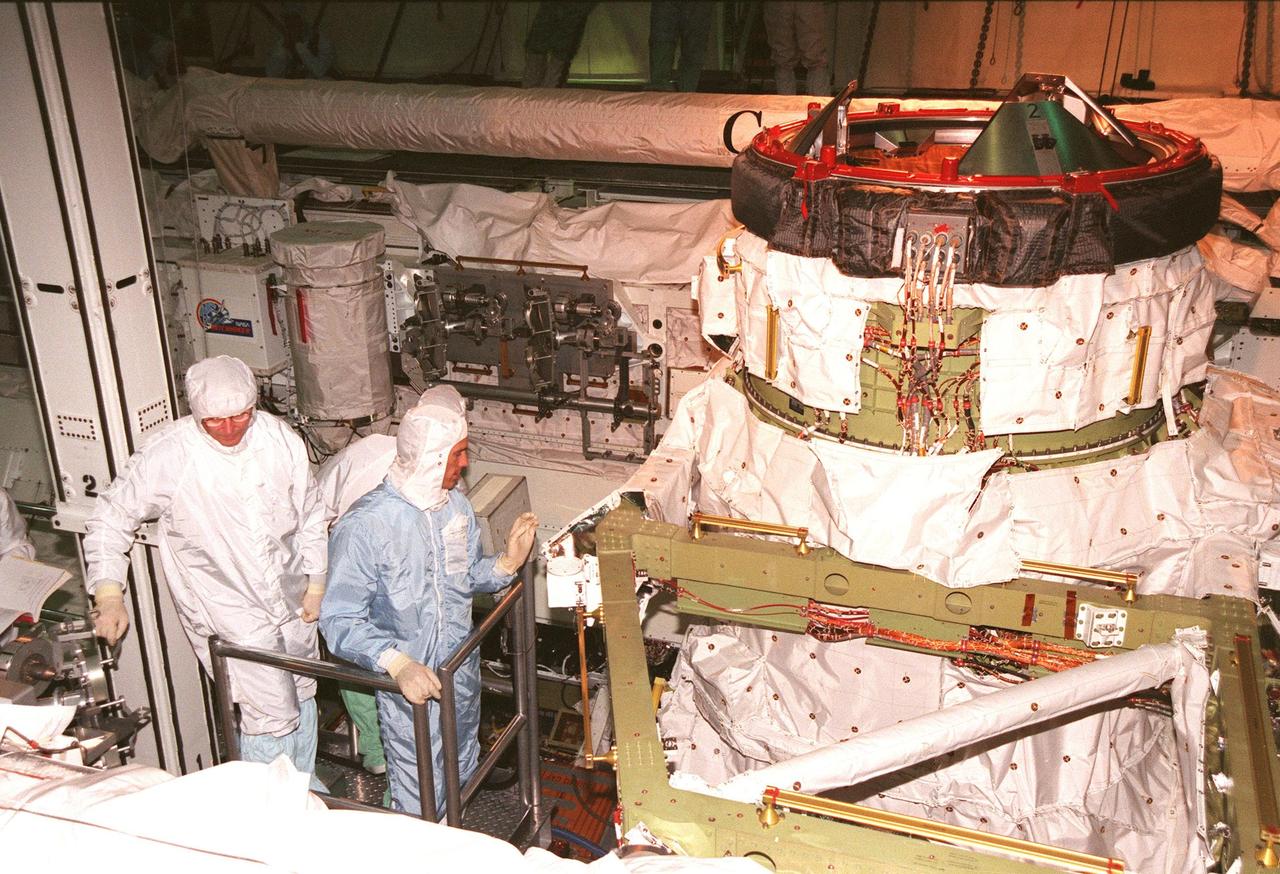
KENNEDY SPACE CENTER, FLA. -- Inside the payload bay of orbiter Endeavour in the Orbiter Processing Facility Bay 1, STS-88 Mission Specialists Jerry L. Ross (left) and James H. Newman (right foreground) get a close look at the Orbiter Docking System. The STS-88 crew members are participating in a Crew Equipment Interface Test (CEIT), familiarizing themselves with the orbiter's midbody and crew compartments. Targeted for liftoff on Dec. 3, 1998, STS-88 will be the first Space Shuttle launch for assembly of the International Space Station (ISS). The primary payload is the Unity connecting module which will be mated to the Russian-built Zarya control module, expected to be already on orbit after a November launch from Russia. While on orbit during STS-88, Unity will be latched atop the Orbiter Docking System in the forward section of Endeavour's payload bay for the mating of the two modules. After the mating, Ross and Newman are scheduled to perform three spacewalks to connect power, data and utility lines and install exterior equipment. The first major U.S.-built component of ISS, Unity will serve as a connecting passageway to living and working areas of the space station. Unity has two attached pressurized mating adapters (PMAs) and one stowage rack installed inside. PMA-1 provides the permanent connection point between Unity and Zarya; PMA-2 will serve as a Space Shuttle docking port. Zarya is a self-supporting active vehicle, providing propulsive control capability and power during the early assembly stages. It also has fuel storage capability
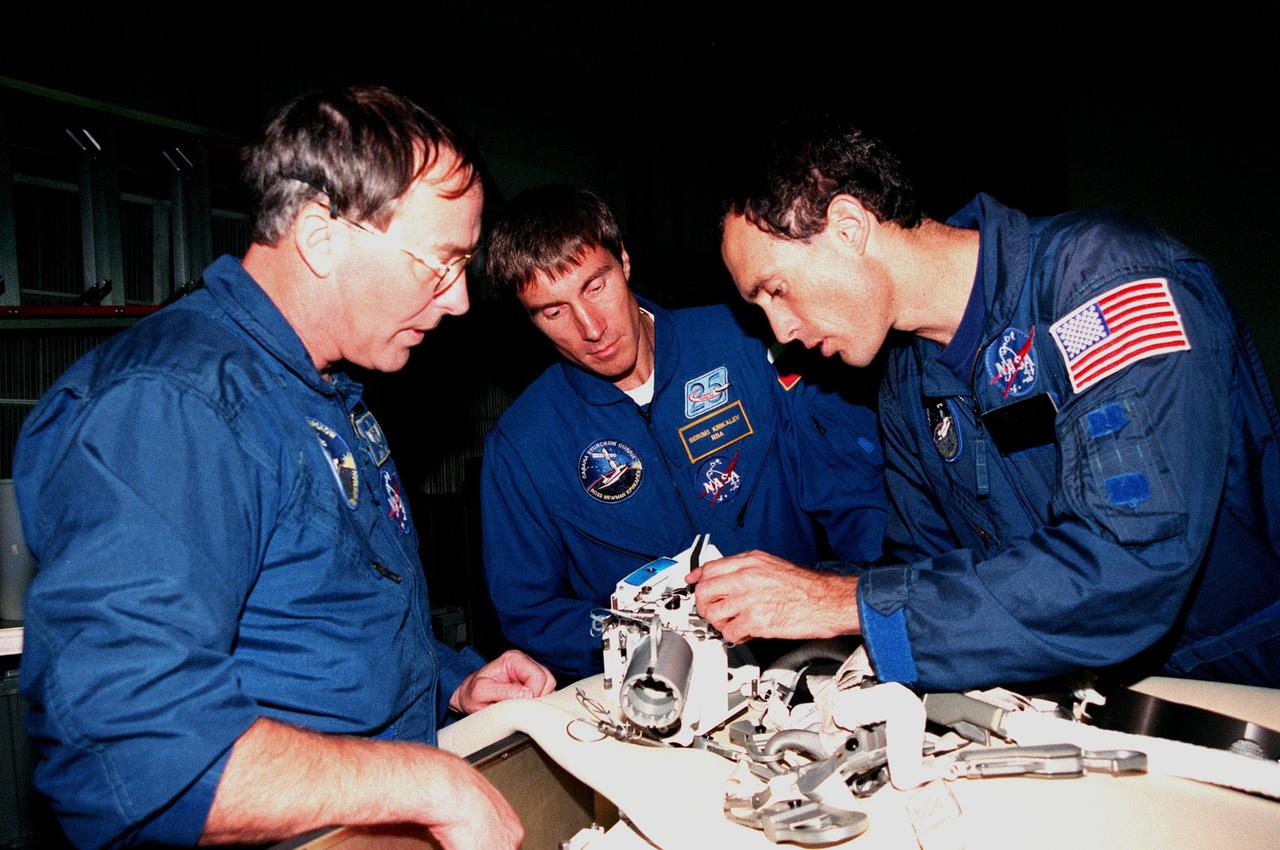
KENNEDY SPACE CENTER, FLA. -- In the Orbiter Processing Facility Bay 1, STS-88 Mission Specialists (left to right) Jerry L. Ross; Sergei Krikalev, a cosmonaut from Russia; and James H. Newman examine equipment that will be on the Space Shuttle Endeavour during their upcoming flight. Launch of Mission STS-88 is targeted for Dec. 3, 1998. The STS-88 crew members are participating in a Crew Equipment Interface Test (CEIT), familiarizing themselves with the orbiter's midbody and crew compartments. Other crew members are Commander Robert D. Cabana, Pilot Frederick W. "Rick" Sturckow and Mission Specialist Nancy J. Currie. STS-88 will be the first Space Shuttle launch for assembly of the International Space Station (ISS). The primary payload is the Unity connecting module which will be mated to the Russian-built Zarya control module, expected to be already on orbit after a November launch from Russia. The first major U.S.-built component of ISS, Unity will serve as a connecting passageway to living and working areas of the space station. Unity has two attached pressurized mating adapters (PMAs) and one stowage rack installed inside. PMA-1 provides the permanent connection point between Unity and Zarya; PMA-2 will serve as a Space Shuttle docking port. Zarya is a self-supporting active vehicle, providing propulsive control capability and power during the early assembly stages. It also has fuel storage capability
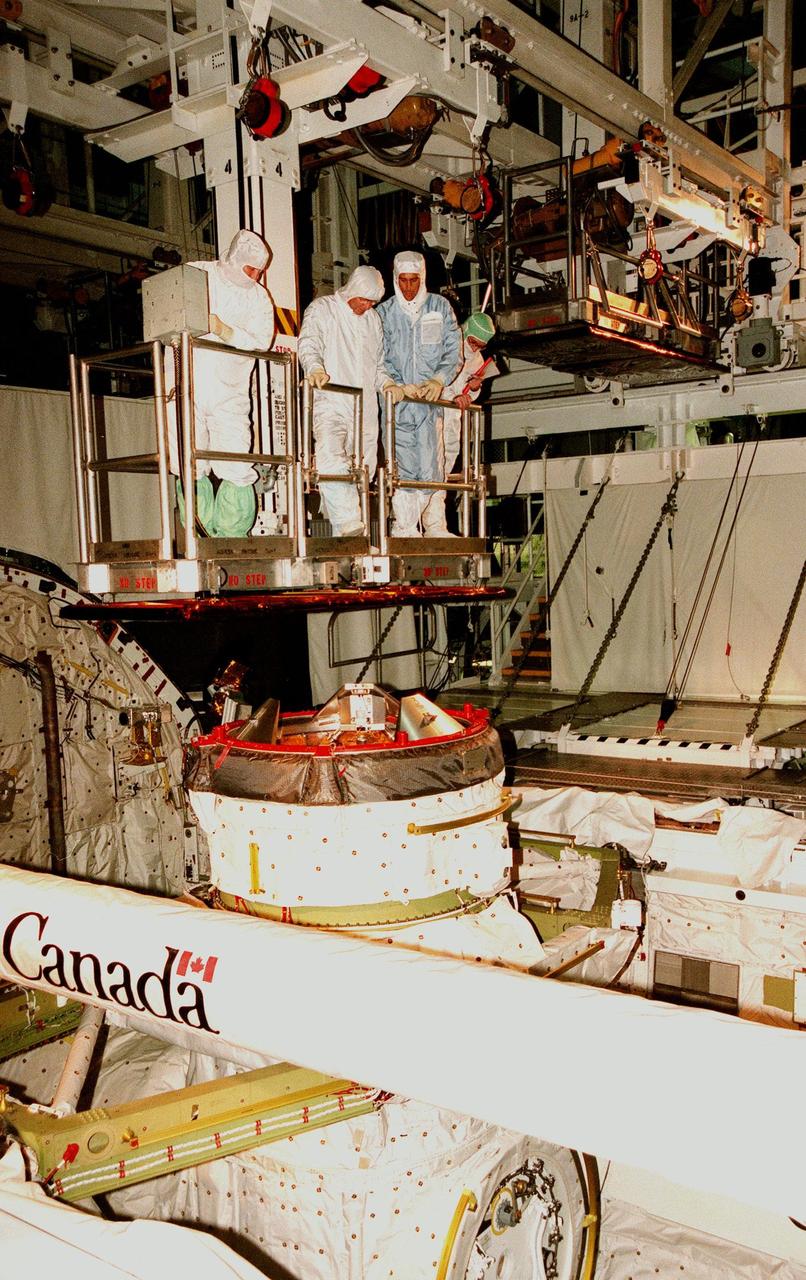
KENNEDY SPACE CENTER, FLA. -- As the bucket operator (left) lowers them into the open payload bay of the orbiter Endeavour, STS-88 Mission Specialists Jerry L. Ross (second from left) and James H. Newman (second from right) do a sharp-edge inspection. At their right is Wayne Wedlake, with United Space Alliance at Johnson Space Center. Below them is the Orbiter Docking System, the remote manipulator system arm and a tunnel into the payload bay. The STS-88 crew members are participating in a Crew Equipment Interface Test (CEIT), familiarizing themselves with the orbiter's midbody and crew compartments. Targeted for liftoff on Dec. 3, 1998, STS-88 will be the first Space Shuttle launch for assembly of the International Space Station (ISS). The primary payload is the Unity connecting module which will be mated to the Russian-built Zarya control module, expected to be already on orbit after a November launch from Russia. After the mating, Ross and Newman are scheduled to perform three spacewalks to connect power, data and utility lines and install exterior equipment. The first major U.S.-built component of ISS, Unity will serve as a connecting passageway to living and working areas of the space station. Unity has two attached pressurized mating adapters (PMAs) and one stowage rack installed inside. PMA-1 provides the permanent connection point between Unity and Zarya; PMA-2 will serve as a Space Shuttle docking port. Zarya is a self-supporting active vehicle, providing propulsive control capability and power during the early assembly stages. It also has fuel storage capability
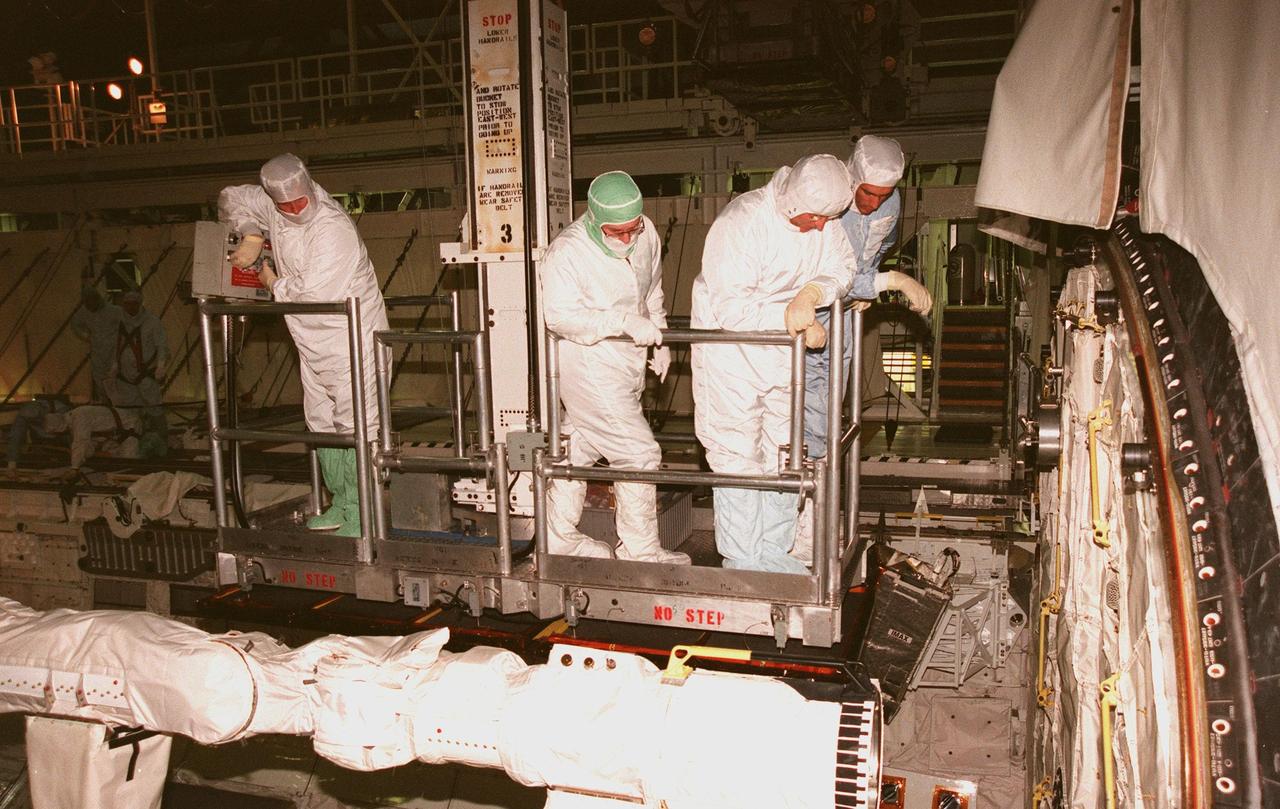
KENNEDY SPACE CENTER, FLA. -- Inside the payload bay of Space Shuttle orbiter Endeavour, workers and STS-88 crew members on a movable work platform or bucket move closer to the rear of the orbiter's crew compartment. While Endeavour is being prepared for flight inside Orbiter Processing Facility Bay 1, the STS-88 crew members are participating in a Crew Equipment Interface Test (CEIT) to familiarize themselves with the orbiter's midbody and crew compartments. A KSC worker (left) maneuvers the platform to give Mission Specialists Jerry L. Ross and James H. Newman (right) a closer look. Looking on is Wayne Wedlake of United Space Alliance at Johnson Space Center. Targeted for liftoff on Dec. 3, 1998, STS-88 will be the first Space Shuttle launch for assembly of the International Space Station (ISS). The primary payload is the Unity connecting module which will be mated to the Russian-built Zarya control module, expected to be already on orbit after a November launch from Russia. After the mating, Ross and Newman are scheduled to perform three spacewalks to connect power, data and utility lines and install exterior equipment. The first major U.S.-built component of ISS, Unity will serve as a connecting passageway to living and working areas of the space station. Unity has two attached pressurized mating adapters (PMAs) and one stowage rack installed inside. PMA-1 provides the permanent connection point between Unity and Zarya; PMA-2 will serve as a Space Shuttle docking port. Zarya is a self-supporting active vehicle, providing propulsive control capability and power during the early assembly stages. It also has fuel storage capability
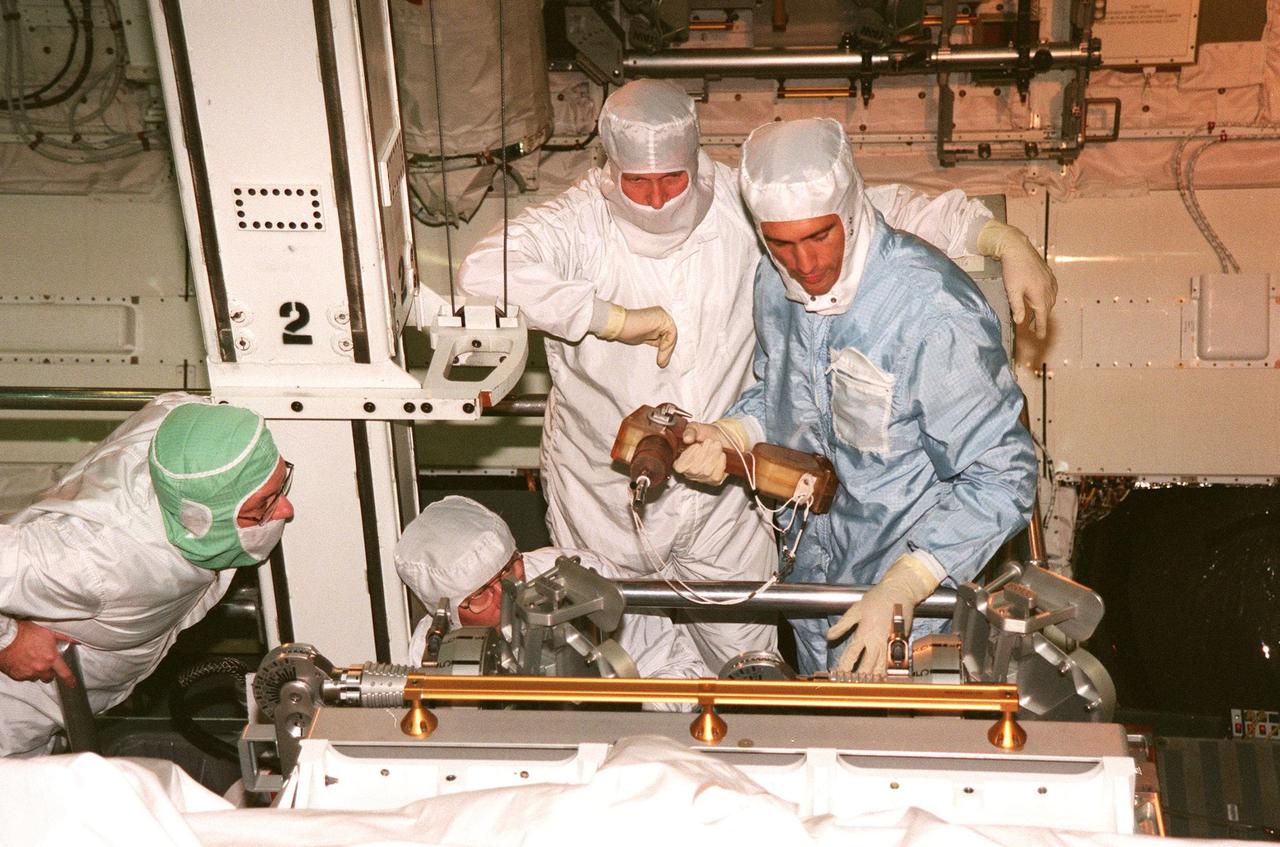
KENNEDY SPACE CENTER, FLA. -- Inside the payload bay of Space Shuttle orbiter Endeavour in Orbiter Processing Facility Bay 1, STS-88 Mission Specialists Jerry L. Ross (crouching at left) and James H. Newman (far right) get a close look at equipment. Looking on is Wayne Wedlake (far left), with United Space Alliance at Johnson Space Center, and a KSC worker (behind Newman) who is operating the movable work platform or bucket. The STS-88 crew members are participating in a Crew Equipment Interface Test (CEIT), familiarizing themselves with the orbiter's midbody and crew compartments. Targeted for liftoff on Dec. 3, 1998, STS-88 will be the first Space Shuttle launch for assembly of the International Space Station (ISS). The primary payload is the Unity connecting module which will be mated to the Russian-built Zarya control module, expected to be already on orbit after a November launch from Russia. After the mating, Ross and Newman are scheduled to perform three spacewalks to connect power, data and utility lines and install exterior equipment. The first major U.S.-built component of ISS, Unity will serve as a connecting passageway to living and working areas of the space station. Unity has two attached pressurized mating adapters (PMAs) and one stowage rack installed inside. PMA-1 provides the permanent connection point between Unity and Zarya; PMA-2 will serve as a Space Shuttle docking port. Zarya is a self-supporting active vehicle, providing propulsive control capability and power during the early assembly stages. It also has fuel storage capability
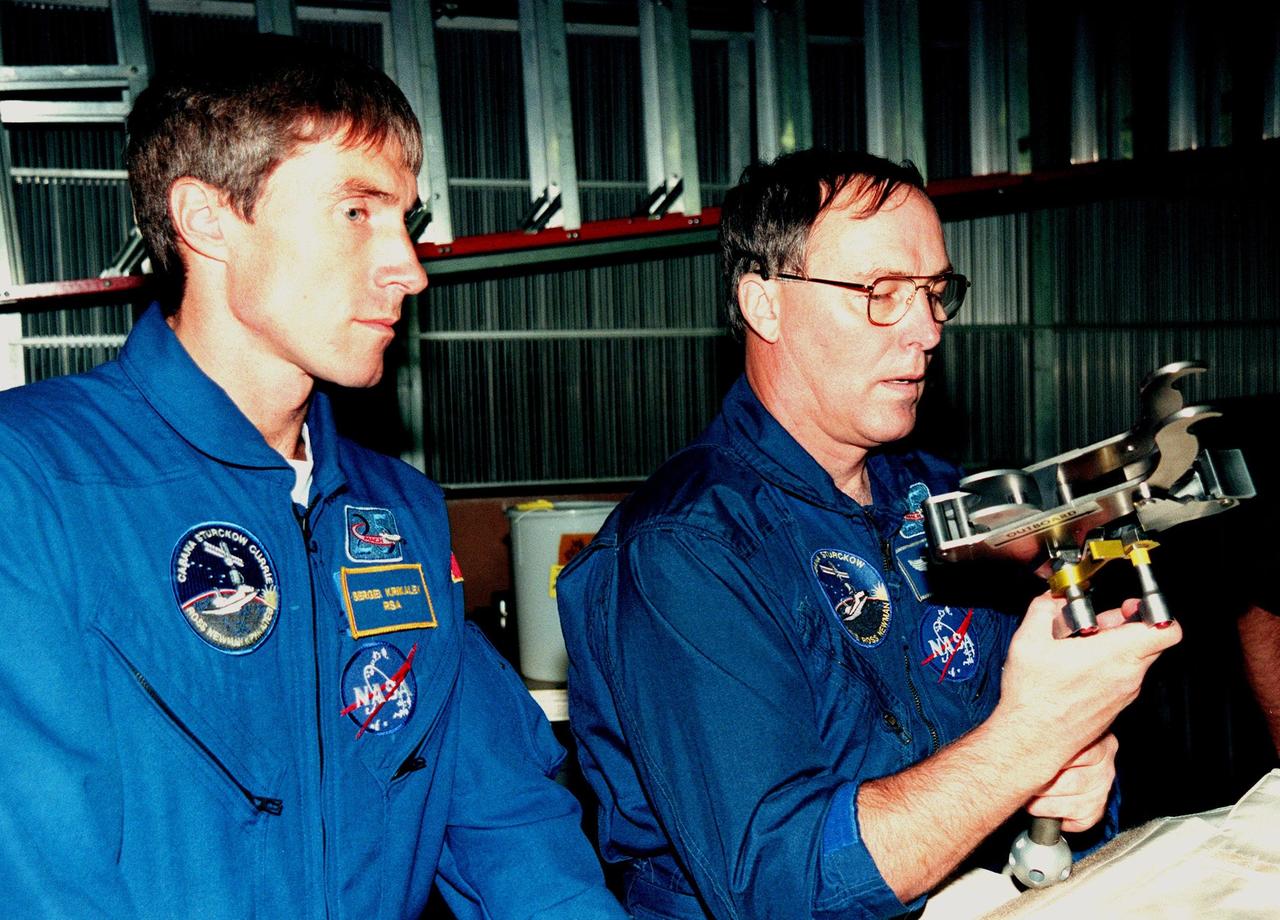
KENNEDY SPACE CENTER, FLA. -- In the Orbiter Processing Facility Bay 1, STS-88 Mission Specialists Sergei Krikalev (left), a cosmonaut from Russia; and Jerry L. Ross examine equipment that will be aboard Space Shuttle Endeavour. Launch of mission STS-88 is targeted for Dec. 3, 1998. The STS-88 crew members are participating in a Crew Equipment Interface Test (CEIT), familiarizing themselves with the orbiter's midbody and crew compartments. Other crew members are Commander Robert D. Cabana, Pilot Frederick W. "Rick" Sturckow and Mission Specialists Nancy J. Currie and James H. Newman. STS-88 will be the first Space Shuttle launch for assembly of the International Space Station (ISS). The primary payload is the Unity connecting module which will be mated to the Russian-built Zarya control module, expected to be already on orbit after a November launch from Russia. The first major U.S.-built component of ISS, Unity will serve as a connecting passageway to living and working areas of the space station. Unity has two attached pressurized mating adapters (PMAs) and one stowage rack installed inside. PMA-1 provides the permanent connection point between Unity and Zarya; PMA-2 will serve as a Space Shuttle docking port. Zarya is a self-supporting active vehicle, providing propulsive control capability and power during the early assembly stages. It also has fuel storage capability
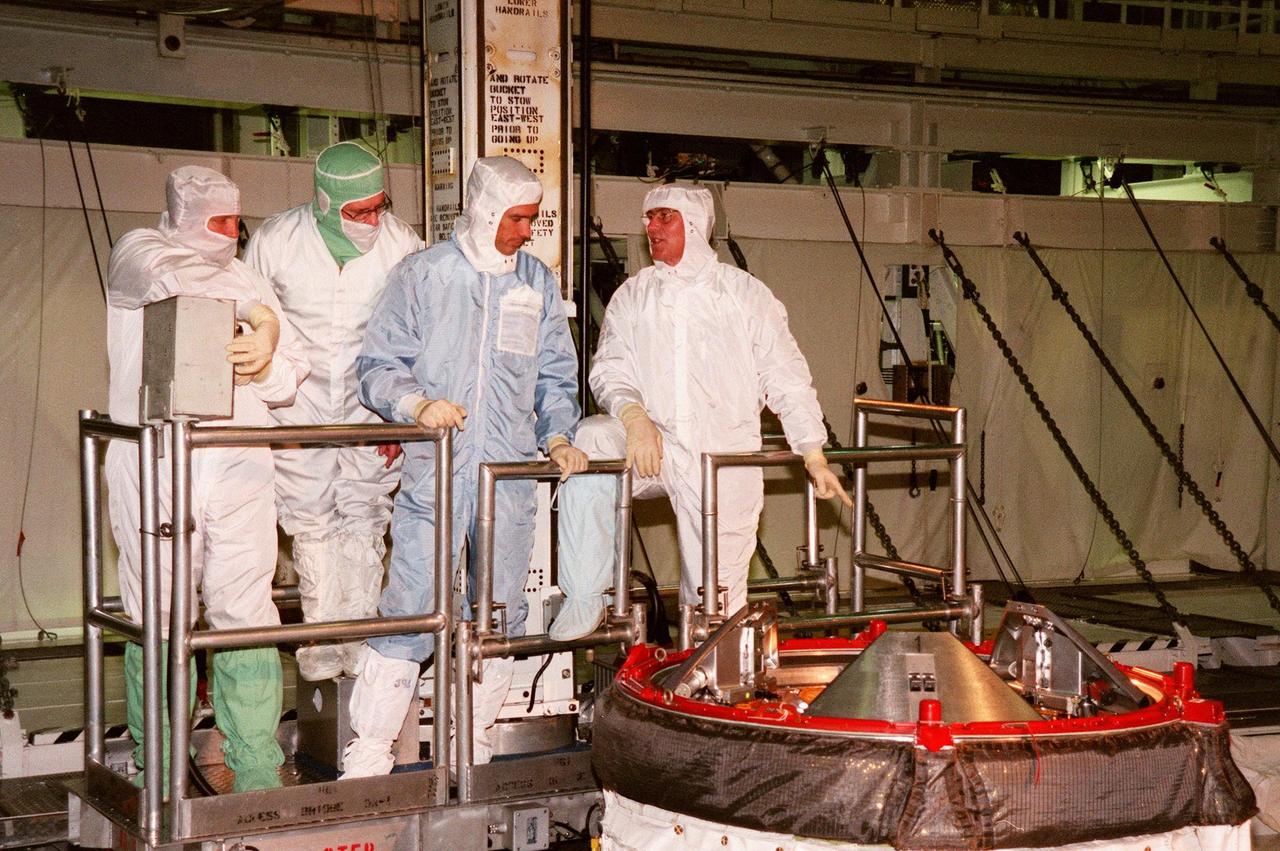
KENNEDY SPACE CENTER, FLA. -- Lowered on a movable work platform or bucket inside the payload bay of orbiter Endeavour, STS-88 Mission Specialists Jerry L. Ross (far right) and James H. Newman (second from right) get a close look at the Orbiter Docking System. At left is the bucket operator and Wayne Wedlake, with United Space Alliance at Johnson Space Center. The STS-88 crew members are in Orbiter Processing Facility Bay 1 to participate in a Crew Equipment Interface Test (CEIT) to familiarize themselves with the orbiter's midbody and crew compartments. Targeted for liftoff on Dec. 3, 1998, STS-88 will be the first Space Shuttle launch for assembly of the International Space Station (ISS). The primary payload is the Unity connecting module which will be mated to the Russian-built Zarya control module, expected to be already on orbit after a November launch from Russia. While on orbit during STS-88, Unity will be latched atop the Orbiter Docking System in the forward section of Endeavour's payload bay for the mating of the two modules. After the mating, Ross and Newman are scheduled to perform three spacewalks to connect power, data and utility lines and install exterior equipment. The first major U.S.-built component of ISS, Unity will serve as a connecting passageway to living and working areas of the space station. Unity has two attached pressurized mating adapters (PMAs) and one stowage rack installed inside. PMA-1 provides the permanent connection point between Unity and Zarya; PMA-2 will serve as a Space Shuttle docking port. Zarya is a self-supporting active vehicle, providing propulsive control capability and power during the early assembly stages. It also has fuel storage capability