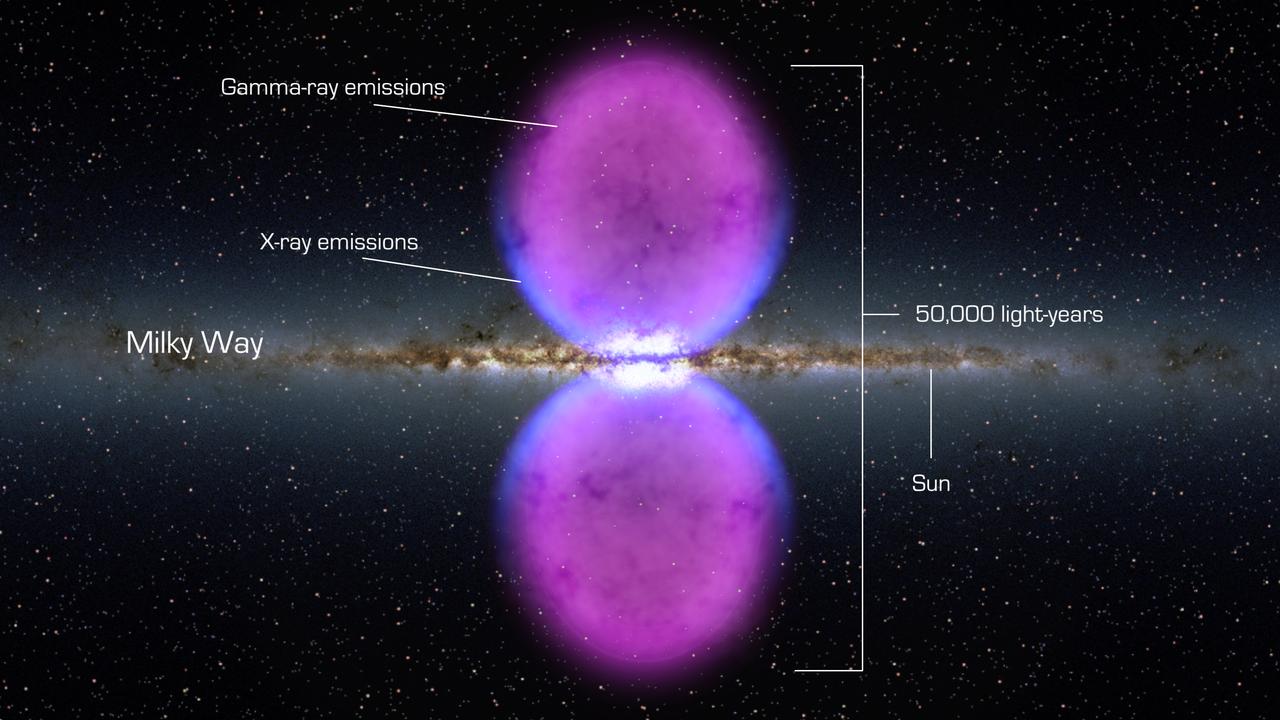
NASA image release November 9, 2010 To view a video about this story go to: <a href="http://www.flickr.com/photos/gsfc/5162413062">www.flickr.com/photos/gsfc/5162413062</a> From end to end, the gamma-ray bubbles extend 50,000 light-years, or roughly half of the Milky Way's diameter, as shown in this illustration. The bubbles stretch across 100 degrees, spanning the sky from the constellation Virgo to the constellation Grus. If the structure were rotated into the galaxy's plane, it would extend beyond our solar system. Hints of the bubbles' edges were first observed in X-rays (blue) by ROSAT (Röntgen Satellite), a Germany-led mission operating in the 1990s. The gamma rays mapped by Fermi (magenta) extend much farther from the galaxy's plane. To learn more go to: <a href="http://www.nasa.gov/mission_pages/GLAST/news/new-structure.html" rel="nofollow">www.nasa.gov/mission_pages/GLAST/news/new-structure.html</a> <b><a href="http://www.nasa.gov/centers/goddard/home/index.html" rel="nofollow">NASA Goddard Space Flight Center</a></b> enables NASA’s mission through four scientific endeavors: Earth Science, Heliophysics, Solar System Exploration, and Astrophysics. Goddard plays a leading role in NASA’s accomplishments by contributing compelling scientific knowledge to advance the Agency’s mission. <b>Follow us on <a href="http://twitter.com/NASA_GoddardPix" rel="nofollow">Twitter</a></b> <b>Join us on <a href="http://www.facebook.com/pages/Greenbelt-MD/NASA-Goddard/395013845897?ref=tsd" rel="nofollow">Facebook</a></b> Credit: <a href="http://svs.gsfc.nasa.gov/index.html" rel="nofollow">NASA/Goddard Space Flight Center Scientific Visualization Studio</a>
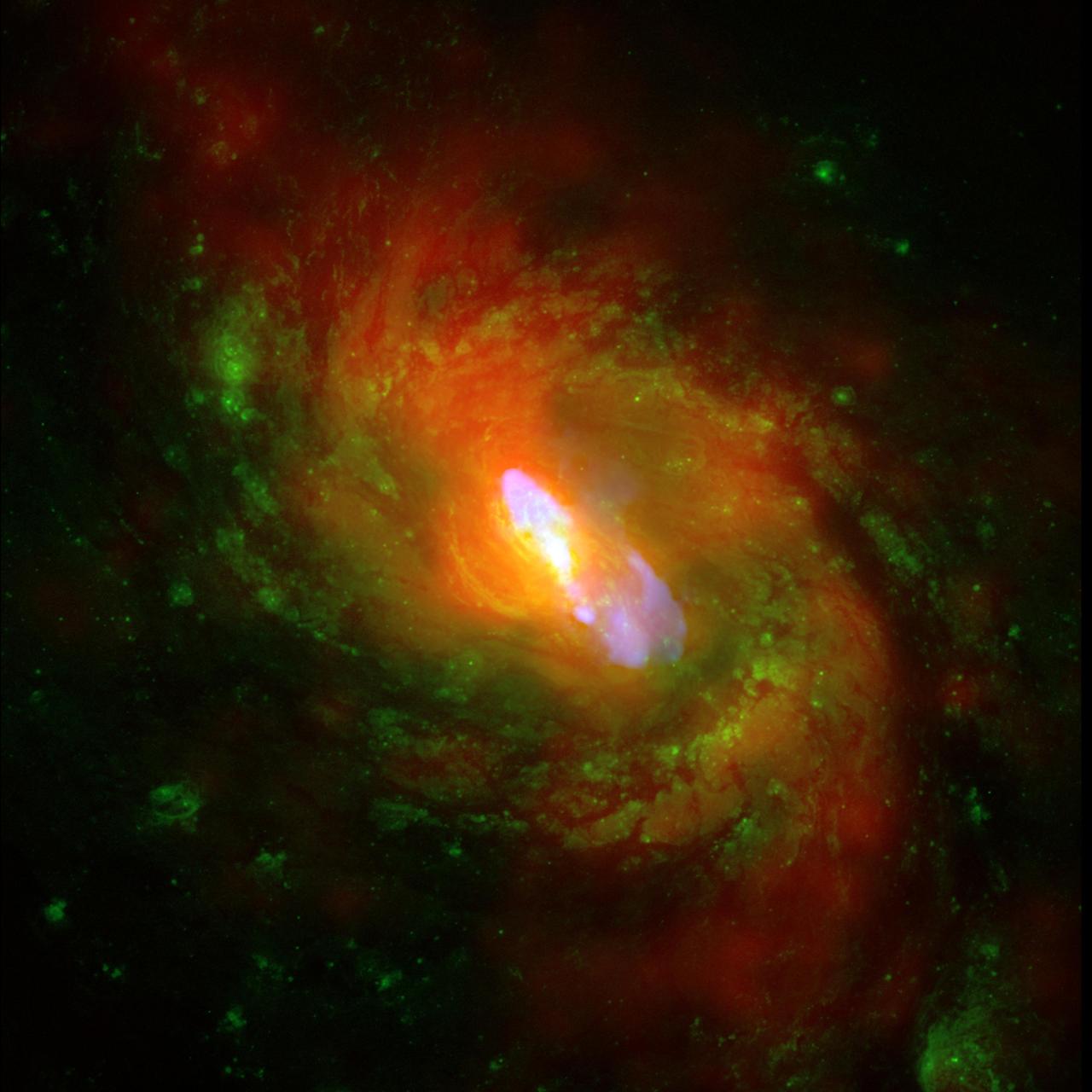
Observation Date: 1 pointing on Dec 4, 2000 and 9 pointings between Nov 18 and Dec 5, 2008. Distance Estimate: About 50 million light years away. This is a composite image of NGC 1068, one of the nearest and brightest galaxies containing a rapidly growing supermassive black hole. The X-ray images and spectra obtained using Chandra's High Energy Transmission Grating Spectrometer show that a strong wind is being driven away from the center of NGC 1068 at a rate of about a million miles per hour. This wind is likely generated as surrounding gas is accelerated and heated as it swirls toward the black hole. A portion of the gas is pulled into the black hole, but some of it is blown away. High energy X-rays produced by the gas near the black hole heat the ouflowing gas, causing it to glow at lower X-ray energies. X-ray data from the Chandra X-ray Observatory are shown in red, optical data from the Hubble Space Telescope in green and radio data from the Very Large Array in blue. The spiral structure of NGC 1068 is shown by the X-ray and optical data, and a jet powered by the central supermassive black hole is shown by the radio data. This Chandra study is much deeper than previous X-ray observations. Using this data, researchers believe that each year several times the mass of our sun is being deposited out to large distances, about 3,000 light years from the black hole. The wind likely carries enough energy to heat the surrounding gas and suppress extra star formation. These results help explain how a supermassive black hole can alter the evolution of its host galaxy. It has long been suspected that material blown away from a black hole can affect its environment, but a key question has been whether such "black hole blowback" typically delivers enough power to have a significant impact. NGC 1068 is located about 50 million light years from Earth and contains a supermassive black hole about twice as massive as the one in the middle of the Milky Way Galaxy. Image Credit: X-ray (NASA/CXC/ MIT/C.Canizares, D.Evans et al), Optical (NASA/STScI), Radio (NSF/ NRAO/VLA)
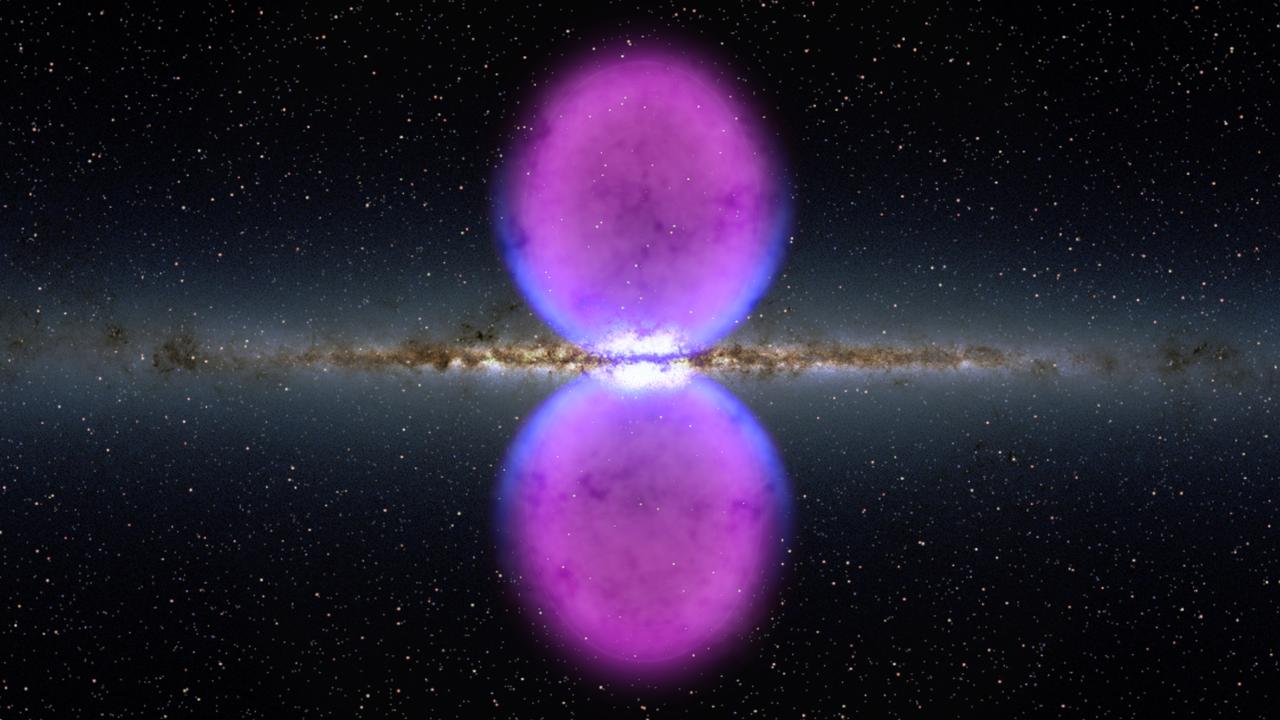
NASA image release November 9, 2010 To view a video about this story go to: <a href="http://www.flickr.com/photos/gsfc/5162413062">www.flickr.com/photos/gsfc/5162413062</a> From end to end, the newly discovered gamma-ray bubbles extend 50,000 light-years, or roughly half of the Milky Way's diameter, as shown in this illustration. Hints of the bubbles' edges were first observed in X-rays (blue) by ROSAT, a Germany-led mission operating in the 1990s. The gamma rays mapped by Fermi (magenta) extend much farther from the galaxy's plane. To learn more go to: <a href="http://www.nasa.gov/mission_pages/GLAST/news/new-structure.html" rel="nofollow">www.nasa.gov/mission_pages/GLAST/news/new-structure.html</a> <b><a href="http://www.nasa.gov/centers/goddard/home/index.html" rel="nofollow">NASA Goddard Space Flight Center</a></b> enables NASA’s mission through four scientific endeavors: Earth Science, Heliophysics, Solar System Exploration, and Astrophysics. Goddard plays a leading role in NASA’s accomplishments by contributing compelling scientific knowledge to advance the Agency’s mission. <b>Follow us on <a href="http://twitter.com/NASA_GoddardPix" rel="nofollow">Twitter</a></b> <b>Join us on <a href="http://www.facebook.com/pages/Greenbelt-MD/NASA-Goddard/395013845897?ref=tsd" rel="nofollow">Facebook</a></b> Credit: <a href="http://svs.gsfc.nasa.gov/index.html" rel="nofollow">NASA/Goddard Space Flight Center Scientific Visualization Studio</a>
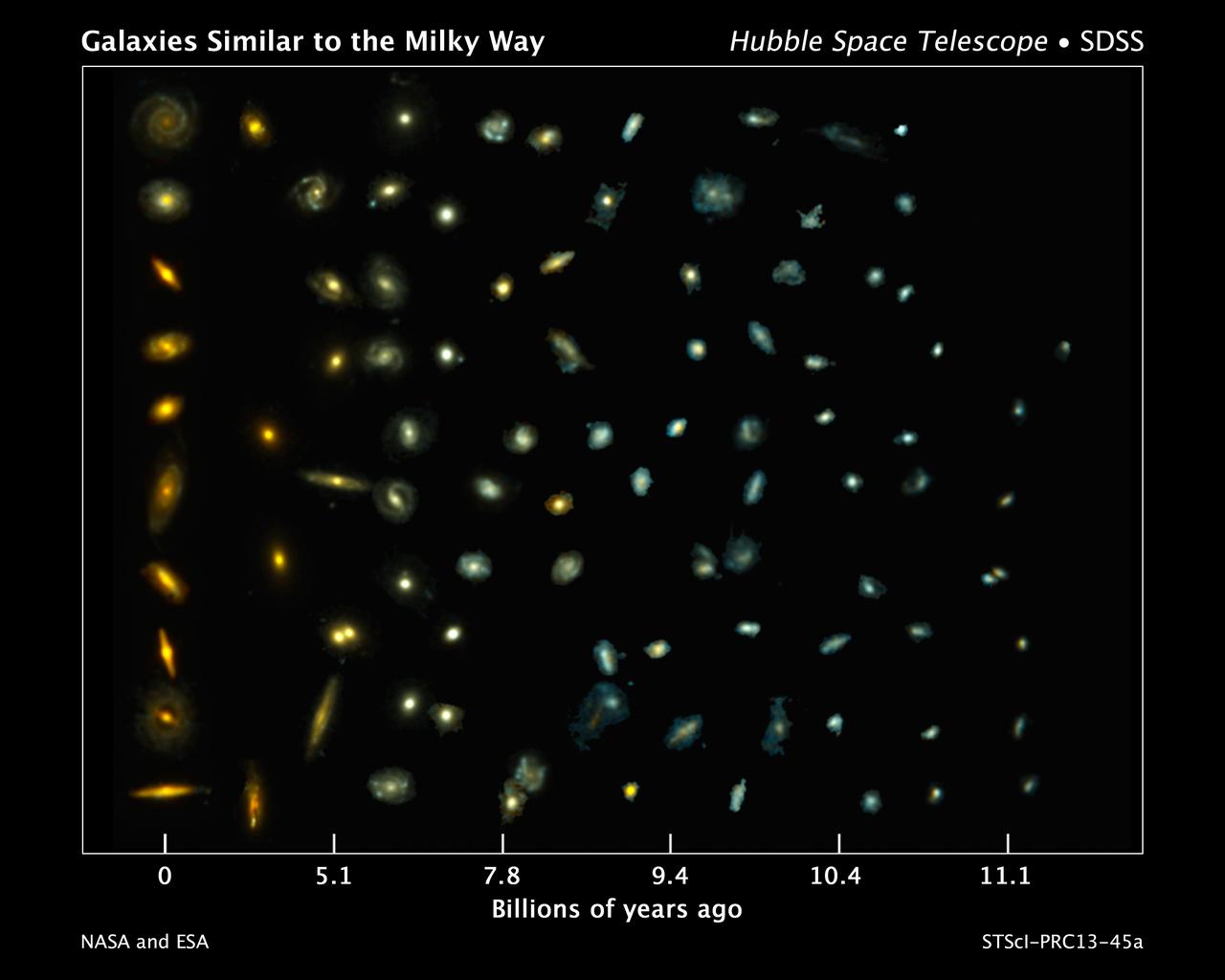
This composite image shows examples of galaxies similar to our Milky Way at various stages of construction over a time span of 11 billion years. The galaxies are arranged according to time. Those on the left reside nearby; those at far right existed when the cosmos was about 2 billion years old. The bluish glow from young stars dominates the color of the galaxies on the right. The galaxies at left are redder from the glow of older stellar populations. Astronomers found the distant galaxies in two Hubble Space Telescope surveys: 3D-HST and the Cosmic Assembly Near-infrared Deep Extragalactic Legacy Survey, or CANDELS. The observations were made in visible and near-infrared light by Hubble's Wide Field Camera 3 and Advanced Camera for Surveys. The nearby galaxies were taken from the Sloan Digital Sky Survey. This image traces Milky Way-like galaxies over most of cosmic history, revealing how they evolve over time. Hubble's sharp vision resolved the galaxies' shapes, showing that their bulges and disks grew simultaneously. Credit: NASA, ESA, P. van Dokkum (Yale University), S. Patel (Leiden University), and the 3D-HST Team <b><a href="http://www.nasa.gov/audience/formedia/features/MP_Photo_Guidelines.html" rel="nofollow">NASA image use policy.</a></b> <b><a href="http://www.nasa.gov/centers/goddard/home/index.html" rel="nofollow">NASA Goddard Space Flight Center</a></b> enables NASA’s mission through four scientific endeavors: Earth Science, Heliophysics, Solar System Exploration, and Astrophysics. Goddard plays a leading role in NASA’s accomplishments by contributing compelling scientific knowledge to advance the Agency’s mission. <b>Follow us on <a href="http://twitter.com/NASA_GoddardPix" rel="nofollow">Twitter</a></b> <b>Like us on <a href="http://www.facebook.com/pages/Greenbelt-MD/NASA-Goddard/395013845897?ref=tsd" rel="nofollow">Facebook</a></b> <b>Find us on <a href="http://instagram.com/nasagoddard?vm=grid" rel="nofollow">Instagram</a></b>

NASA image release Thursday, May 31, 2012 <b>To view a video from this Hubble release go to: <a href="http://www.flickr.com/photos/gsfc/7309212940">www.flickr.com/photos/gsfc/7309212940</a> </b> Caption: This illustration shows a stage in the predicted merger between our Milky Way galaxy and the neighboring Andromeda galaxy, as it will unfold over the next several billion years. In this image, representing Earth's night sky in 3.75 billion years, Andromeda (left) fills the field of view and begins to distort the Milky Way with tidal pull. Credit: NASA; ESA; Z. Levay and R. van der Marel, STScI; T. Hallas; and A. Mellinger To read more go to: <a href="http://www.nasa.gov/mission_pages/hubble/science/milky-way-collide.html" rel="nofollow">www.nasa.gov/mission_pages/hubble/science/milky-way-colli...</a> <b><a href="http://www.nasa.gov/audience/formedia/features/MP_Photo_Guidelines.html" rel="nofollow">NASA image use policy.</a></b> <b><a href="http://www.nasa.gov/centers/goddard/home/index.html" rel="nofollow">NASA Goddard Space Flight Center</a></b> enables NASA’s mission through four scientific endeavors: Earth Science, Heliophysics, Solar System Exploration, and Astrophysics. Goddard plays a leading role in NASA’s accomplishments by contributing compelling scientific knowledge to advance the Agency’s mission. <b>Follow us on <a href="http://twitter.com/NASA_GoddardPix" rel="nofollow">Twitter</a></b> <b>Like us on <a href="http://www.facebook.com/pages/Greenbelt-MD/NASA-Goddard/395013845897?ref=tsd" rel="nofollow">Facebook</a></b> <b>Find us on <a href="http://instagrid.me/nasagoddard/?vm=grid" rel="nofollow">Instagram</a></b>

This NASA/ESA Hubble Space Telescope image presents the Arches Cluster, the densest known star cluster in the Milky Way. It is located about 25,000 light-years from Earth in the constellation of Sagittarius (The Archer), close to the heart of our galaxy, the Milky Way. It is, like its neighbor the Quintuplet Cluster, a fairly young astronomical object at between two and four million years old. The Arches cluster is so dense that in a region with a radius equal to the distance between the sun and its nearest star there would be over 100,000 stars! At least 150 stars within the cluster are among the brightest ever discovered in the Milky Way. These stars are so bright and massive that they will burn their fuel within a short time (on a cosmological scale that means just a few million years). Then they will die in spectacular supernova explosions. Due to the short lifetime of the stars in the cluster the gas between the stars contains an unusually high amount of heavier elements, which were produced by earlier generations of stars. Despite its brightness the Arches Cluster cannot be seen with the naked eye. The visible light from the cluster is completely obscured by gigantic clouds of dust in this region. To make the cluster visible astronomers have to use detectors which can collect light from the X-ray, infrared, and radio bands, as these wavelengths can pass through the dust clouds. This observation shows the Arches Cluster in the infrared and demonstrates the leap in Hubble’s performance since its 1999 image of same object. Credit: NASA/ESA <b><a href="http://www.nasa.gov/centers/goddard/home/index.html" rel="nofollow">NASA Goddard Space Flight Center</a></b> enables NASA’s mission through four scientific endeavors: Earth Science, Heliophysics, Solar System Exploration, and Astrophysics. Goddard plays a leading role in NASA’s accomplishments by contributing compelling scientific knowledge to advance the Agency’s mission. <b>Follow us on <a href="http://twitter.com/NASAGoddardPix" rel="nofollow">Twitter</a></b> <b>Like us on <a href="http://www.facebook.com/pages/Greenbelt-MD/NASA-Goddard/395013845897?ref=tsd" rel="nofollow">Facebook</a></b> <b>Find us on <a href="http://instagrid.me/nasagoddard/?vm=grid" rel="nofollow">Instagram</a></b>

NASA image release January 23, 2013 Nearly 200 000 light-years from Earth, the Large Magellanic Cloud, a satellite galaxy of the Milky Way, floats in space, in a long and slow dance around our galaxy. As the Milky Way’s gravity gently tugs on its neighbour’s gas clouds, they collapse to form new stars. In turn, these light up the gas clouds in a kaleidoscope of colours, visible in this image from the NASA/ESA Hubble Space Telescope. To read more go to: <a href="http://1.usa.gov/10vcJIi" rel="nofollow">1.usa.gov/10vcJIi</a> <b><a href="http://www.nasa.gov/audience/formedia/features/MP_Photo_Guidelines.html" rel="nofollow">NASA image use policy.</a></b> <b><a href="http://www.nasa.gov/centers/goddard/home/index.html" rel="nofollow">NASA Goddard Space Flight Center</a></b> enables NASA’s mission through four scientific endeavors: Earth Science, Heliophysics, Solar System Exploration, and Astrophysics. Goddard plays a leading role in NASA’s accomplishments by contributing compelling scientific knowledge to advance the Agency’s mission. <b>Follow us on <a href="http://twitter.com/NASA_GoddardPix" rel="nofollow">Twitter</a></b> <b>Like us on <a href="http://www.facebook.com/pages/Greenbelt-MD/NASA-Goddard/395013845897?ref=tsd" rel="nofollow">Facebook</a></b> <b>Find us on <a href="http://instagram.com/nasagoddard?vm=grid" rel="nofollow">Instagram</a></b>
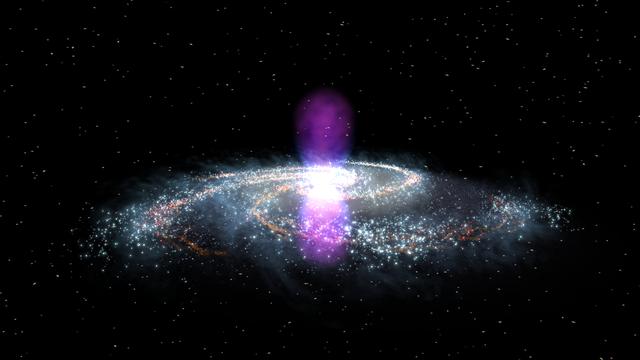
NASA image release November 9, 2010 To view a video about this story go to: <a href="http://www.flickr.com/photos/gsfc/5162413062">www.flickr.com/photos/gsfc/5162413062</a> Using data from NASA's Fermi Gamma-ray Space Telescope, scientists have recently discovered a gigantic, mysterious structure in our galaxy. This never-before-seen feature looks like a pair of bubbles extending above and below our galaxy's center. But these enormous gamma-ray emitting lobes aren't immediately visible in the Fermi all-sky map. However, by processing the data, a group of scientists was able to bring these unexpected structures into sharp relief. Each lobe is 25,000 light-years tall and the whole structure may be only a few million years old. Within the bubbles, extremely energetic electrons are interacting with lower-energy light to create gamma rays, but right now, no one knows the source of these electrons. Are the bubbles remnants of a massive burst of star formation? Leftovers from an eruption by the supermassive black hole at our galaxy's center? Or or did these forces work in tandem to produce them? Scientists aren't sure yet, but the more they learn about this amazing structure, the better we'll understand the Milky Way. To learn more go to: <a href="http://www.nasa.gov/mission_pages/GLAST/news/new-structure.html" rel="nofollow">www.nasa.gov/mission_pages/GLAST/news/new-structure.html</a> <b><a href="http://www.nasa.gov/centers/goddard/home/index.html" rel="nofollow">NASA Goddard Space Flight Center</a></b> enables NASA’s mission through four scientific endeavors: Earth Science, Heliophysics, Solar System Exploration, and Astrophysics. Goddard plays a leading role in NASA’s accomplishments by contributing compelling scientific knowledge to advance the Agency’s mission. <b>Follow us on <a href="http://twitter.com/NASA_GoddardPix" rel="nofollow">Twitter</a></b> <b>Join us on <a href="http://www.facebook.com/pages/Greenbelt-MD/NASA-Goddard/395013845897?ref=tsd" rel="nofollow">Facebook</a></b> Credit: <a href="http://svs.gsfc.nasa.gov/index.html" rel="nofollow">NASA/Goddard Space Flight Center Scientific Visualization Studio</a>
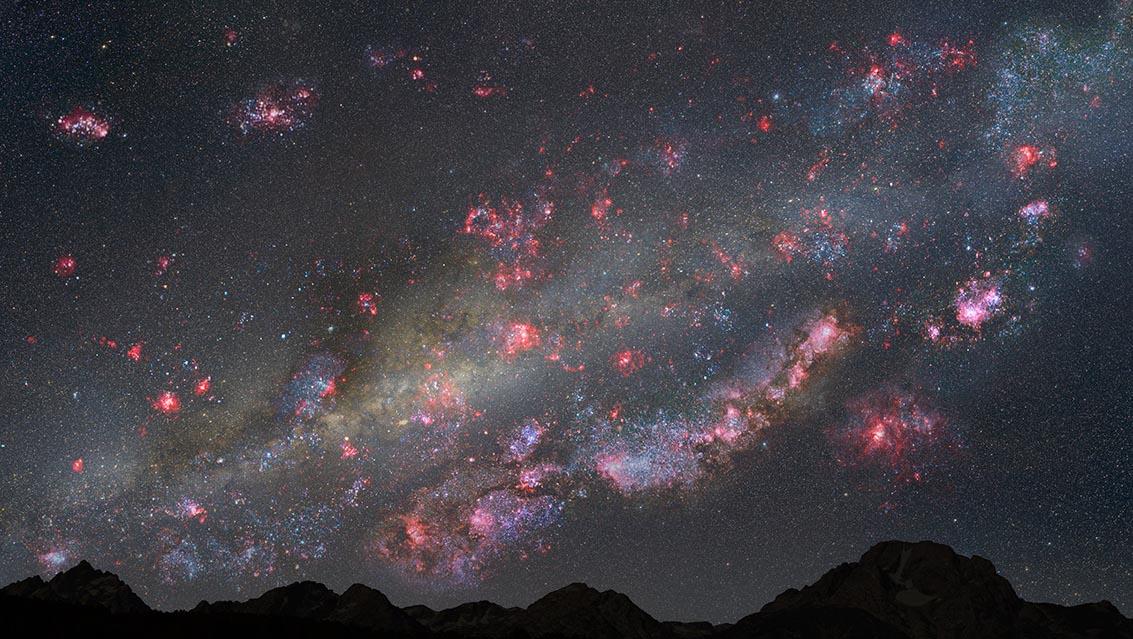
Caption: Artist's view of night sky from a hypothetical planet within a young Milky Way-like galaxy 10 billion years ago, the sky are ablaze with star birth. Pink clouds of gas harbor newborn stars, and bluish-white, young star clusters litter the landscape. Image Credit: NASA/ESA/Z. Levay (STScI) More info: In one of the most comprehensive multi-observatory galaxy surveys yet, astronomers find that galaxies like our Milky Way underwent a stellar “baby boom,” churning out stars at a prodigious rate, about 30 times faster than today. Our sun, however, is a late “boomer.” The Milky Way’s star-birthing frenzy peaked 10 billion years ago, but our sun was late for the party, not forming until roughly 5 billion years ago. By that time the star formation rate in our galaxy had plunged to a trickle. Missing the party, however, may not have been so bad. The sun’s late appearance may actually have fostered the growth of our solar system’s planets. Elements heavier than hydrogen and helium were more abundant later in the star-forming boom as more massive stars ended their lives early and enriched the galaxy with material that served as the building blocks of planets and even life on Earth. Astronomers don’t have baby pictures of our Milky Way’s formative years to trace the history of stellar growth so they studied galaxies similar in mass to our Milky Way, found in deep surveys of the universe. The farther into the universe astronomers look, the further back in time they are seeing, because starlight from long ago is just arriving at Earth now. From those surveys, stretching back in time more than 10 billion years, researchers assembled an album of images containing nearly 2,000 snapshots of Milky Way-like galaxies. The new census provides the most complete picture yet of how galaxies like the Milky Way grew over the past 10 billion years into today’s majestic spiral galaxies. The multi-wavelength study spans ultraviolet to far-infrared light, combining observations from NASA’s Hubble and Spitzer space telescopes, the European Space Agency’s Herschel Space Observatory, and ground-based telescopes, including the Magellan Baade Telescope at the Las Campanas Observatory in Chile. Read more: <a href="http://www.nasa.gov/content/goddard/our-sun-came-late-to-the-milky-way-s-star-birth-party/" rel="nofollow">www.nasa.gov/content/goddard/our-sun-came-late-to-the-mil...</a> <b><a href="http://www.nasa.gov/audience/formedia/features/MP_Photo_Guidelines.html" rel="nofollow">NASA image use policy.</a></b> <b><a href="http://www.nasa.gov/centers/goddard/home/index.html" rel="nofollow">NASA Goddard Space Flight Center</a></b> enables NASA’s mission through four scientific endeavors: Earth Science, Heliophysics, Solar System Exploration, and Astrophysics. Goddard plays a leading role in NASA’s accomplishments by contributing compelling scientific knowledge to advance the Agency’s mission. <b>Follow us on <a href="http://twitter.com/NASAGoddardPix" rel="nofollow">Twitter</a></b> <b>Like us on <a href="http://www.facebook.com/pages/Greenbelt-MD/NASA-Goddard/395013845897?ref=tsd" rel="nofollow">Facebook</a></b> <b>Find us on <a href="http://instagrid.me/nasagoddard/?vm=grid" rel="nofollow">Instagram</a></b>
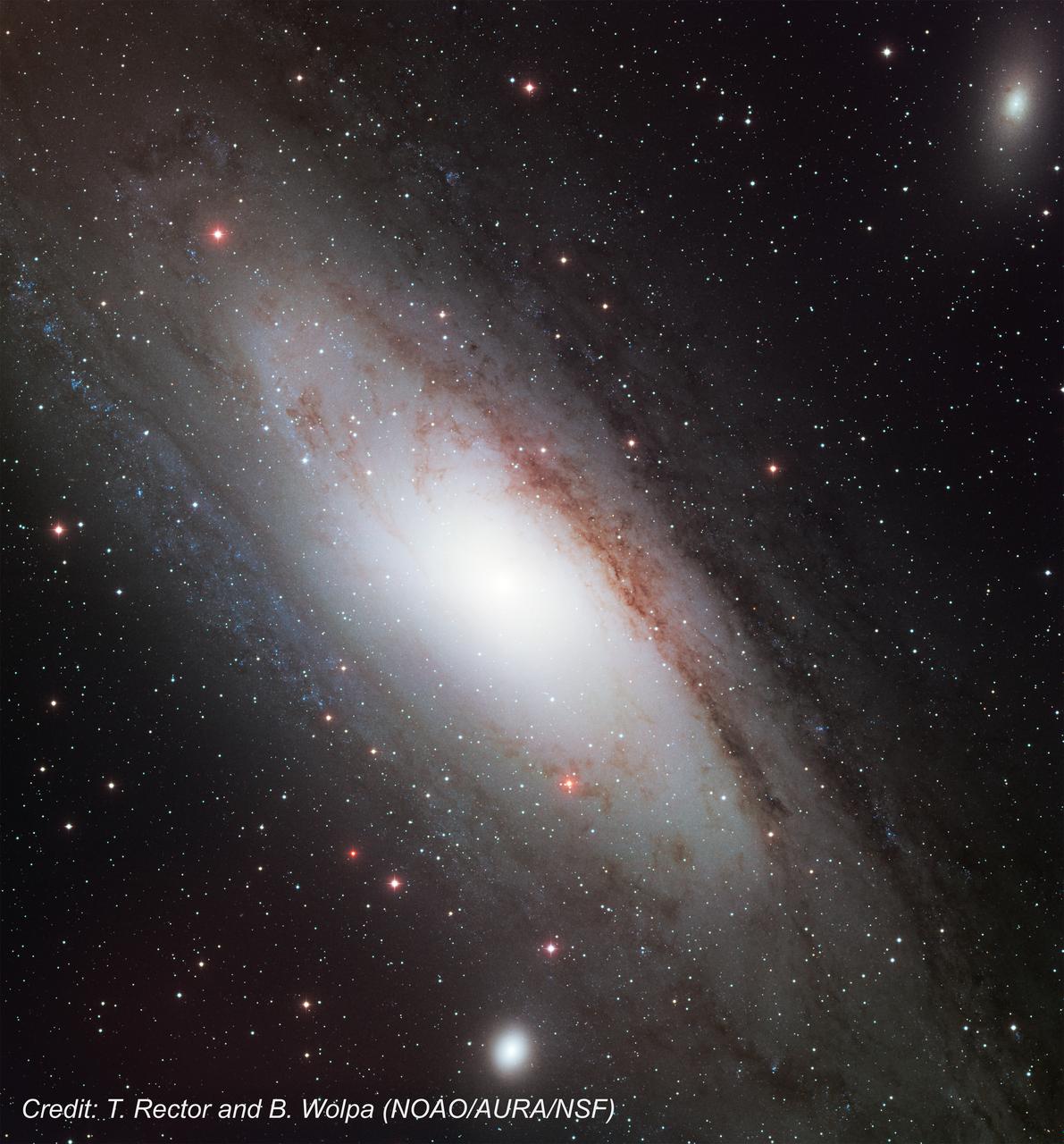
Image release January 11, 2012 A new Hubble Space Telescope image centers on the 100-million-solar-mass black hole at the hub of the neighboring spiral galaxy M31, or the Andromeda galaxy, one of the few galaxies outside the Milky Way visible to the naked eye and the only other giant galaxy in the Local Group. This is the sharpest visible-light image ever made of the nucleus of an external galaxy. The Hubble image is being presented today at the meeting of the American Astronomical Society in Austin, Texas. To read more go to: <a href="http://www.nasa.gov/mission_pages/hubble/science/ultra-blue.html" rel="nofollow">www.nasa.gov/mission_pages/hubble/science/ultra-blue.html</a> <b><a href="http://www.nasa.gov/audience/formedia/features/MP_Photo_Guidelines.html" rel="nofollow">NASA image use policy.</a></b> <b><a href="http://www.nasa.gov/centers/goddard/home/index.html" rel="nofollow">NASA Goddard Space Flight Center</a></b> enables NASA’s mission through four scientific endeavors: Earth Science, Heliophysics, Solar System Exploration, and Astrophysics. Goddard plays a leading role in NASA’s accomplishments by contributing compelling scientific knowledge to advance the Agency’s mission. <b>Follow us on <a href="http://twitter.com/NASA_GoddardPix" rel="nofollow">Twitter</a></b> <b>Like us on <a href="http://www.facebook.com/pages/Greenbelt-MD/NASA-Goddard/395013845897?ref=tsd" rel="nofollow">Facebook</a></b> <b>Find us on <a href="http://instagrid.me/nasagoddard/?vm=grid" rel="nofollow">Instagram</a></b>