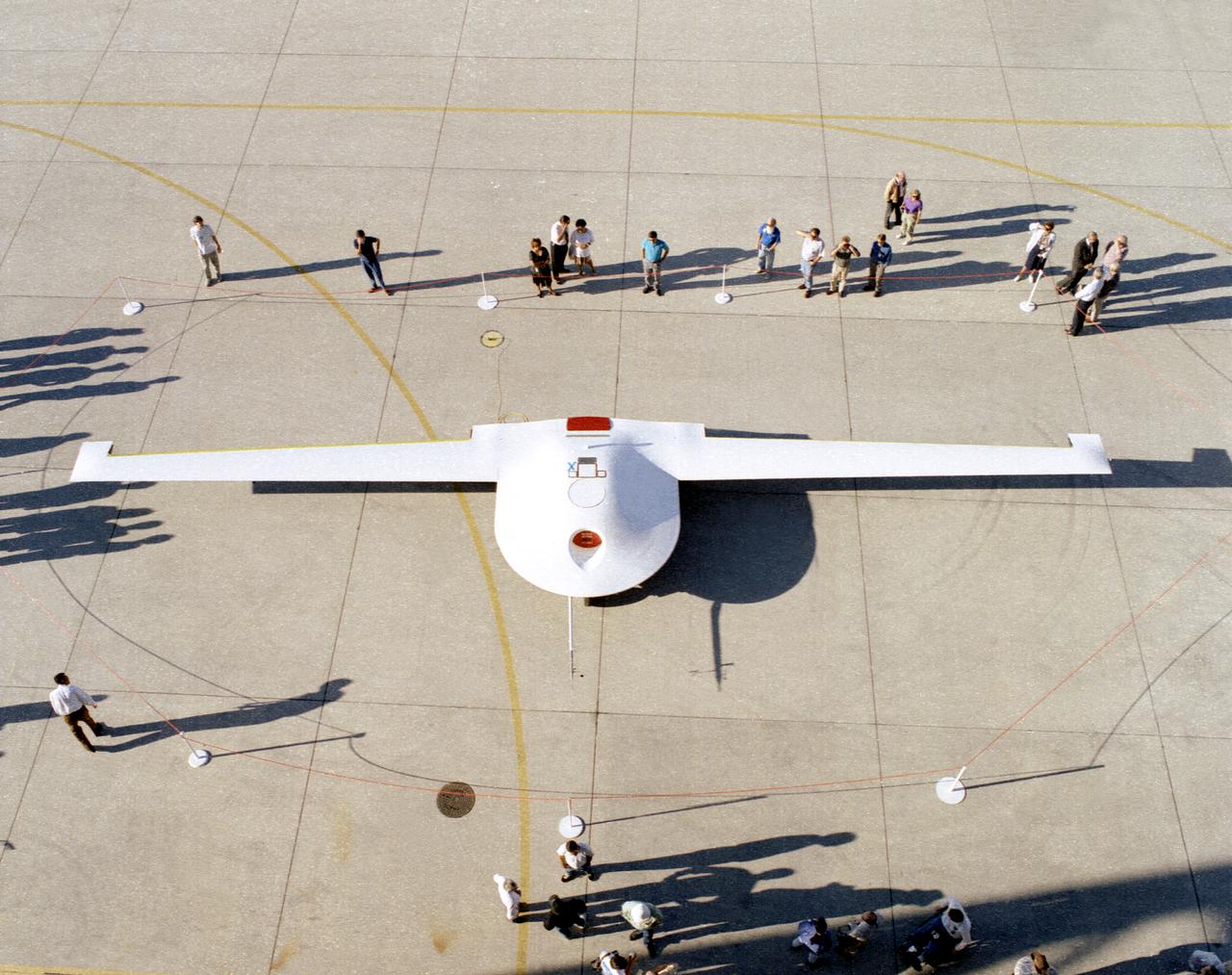
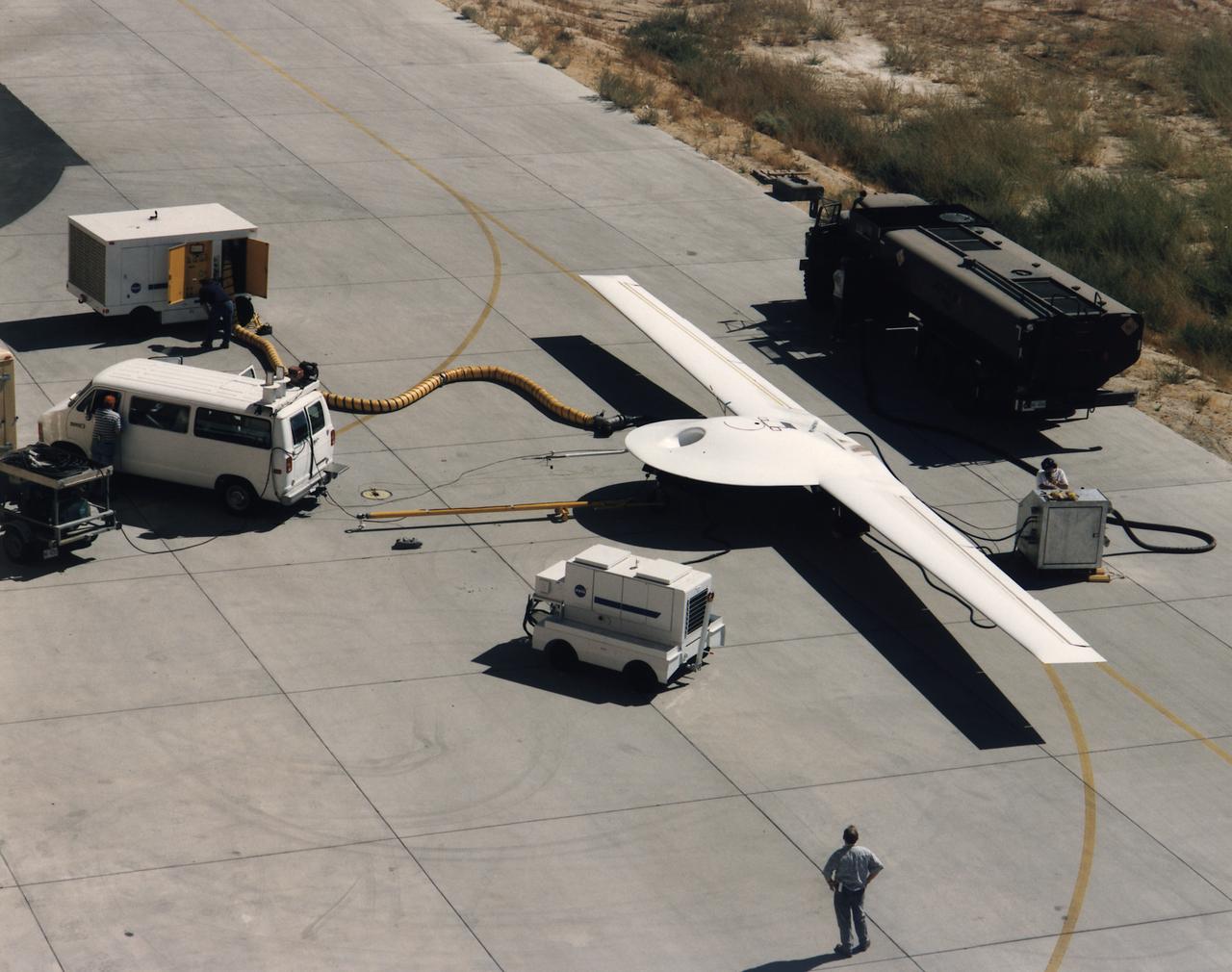
The Lockheed Martin/Boeing Tier III- (minus) unpiloted aerial vehicle undergoing an engine run on the ramp at the Dryden Flight Research Center, Edwards, California.
Tier 3- DarkStar engine run on ramp
The Lockheed Martin/Boeing Tier III- (minus) unpiloted aerial vehicle is inspected by NASA personnel September 14, 1995, following its arrival at the Dryden Flight Research Center, Edwards, California.
Tier 3- DarkStar on ramp from above
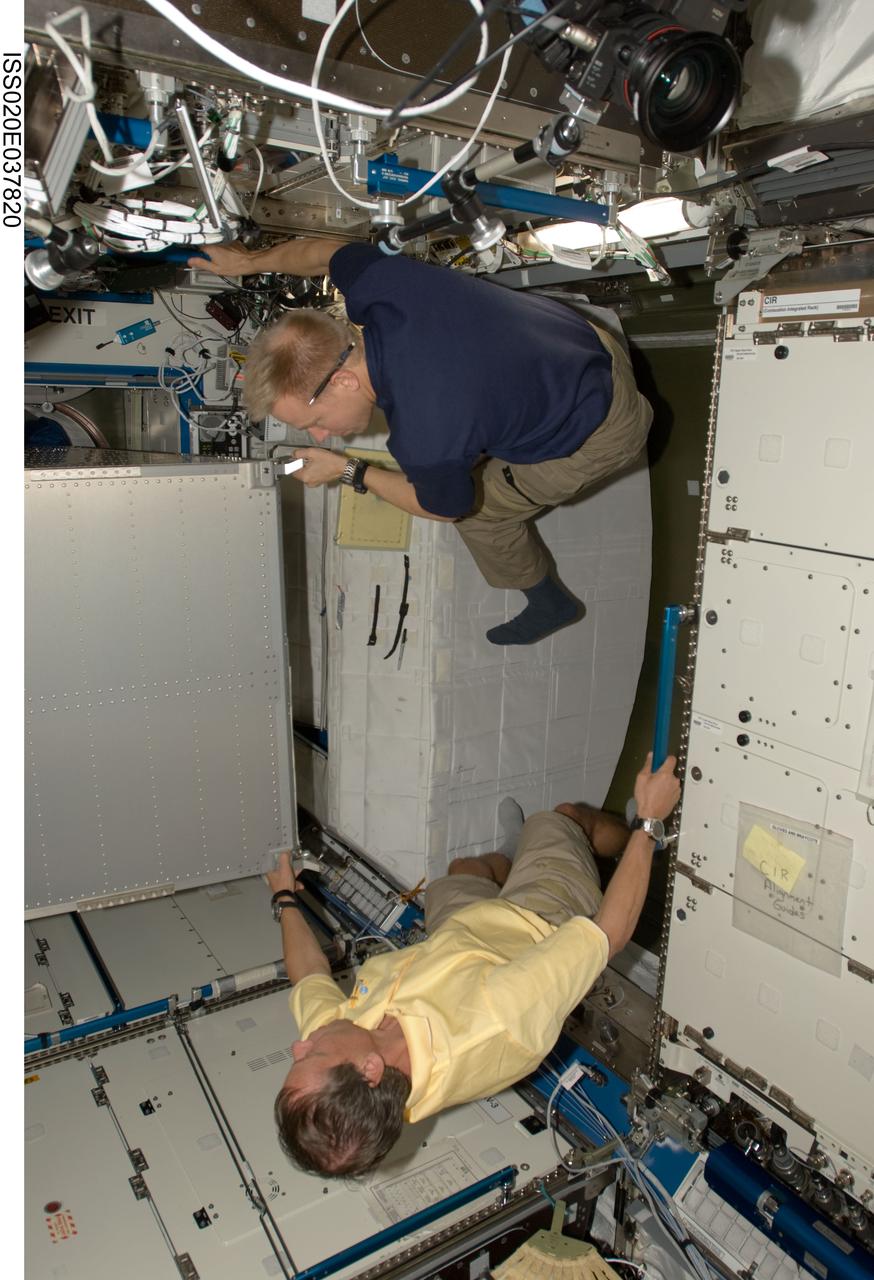
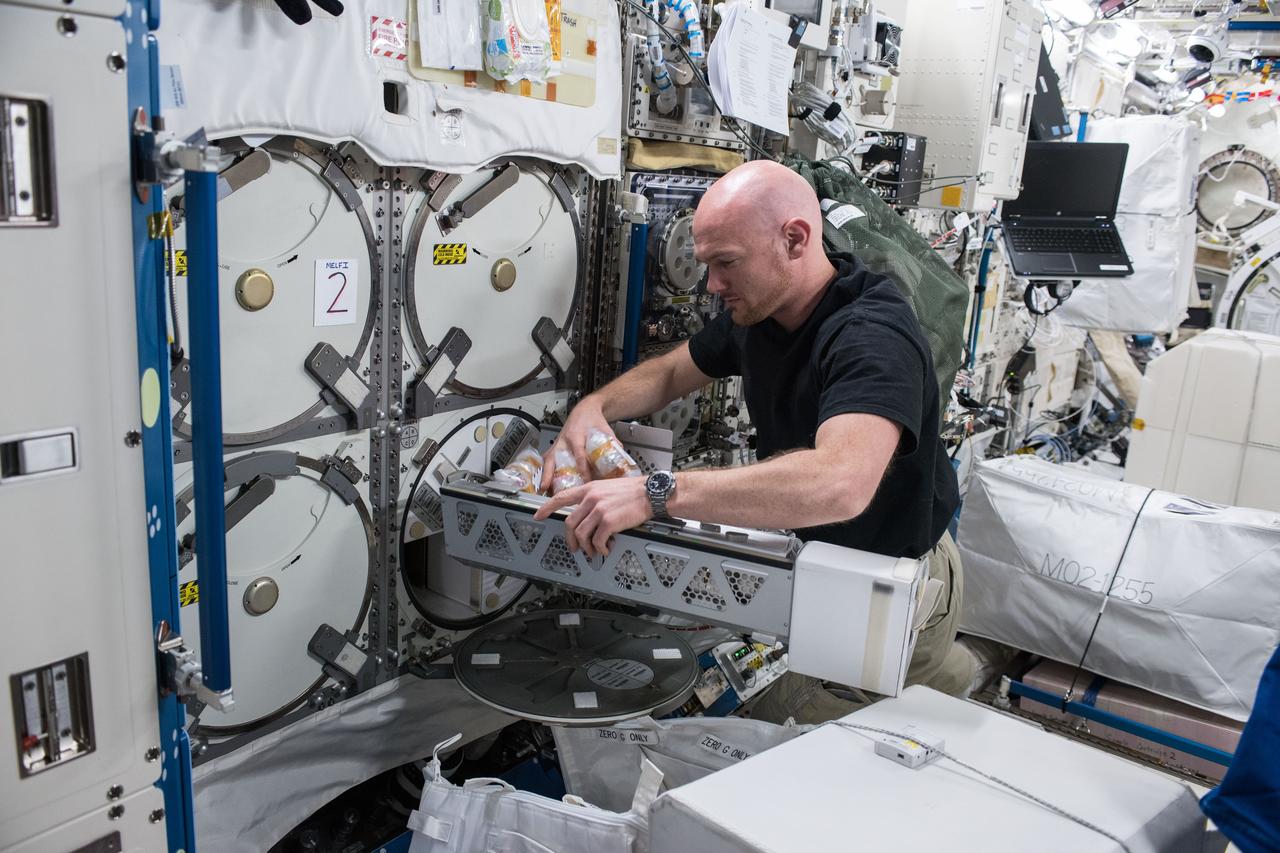
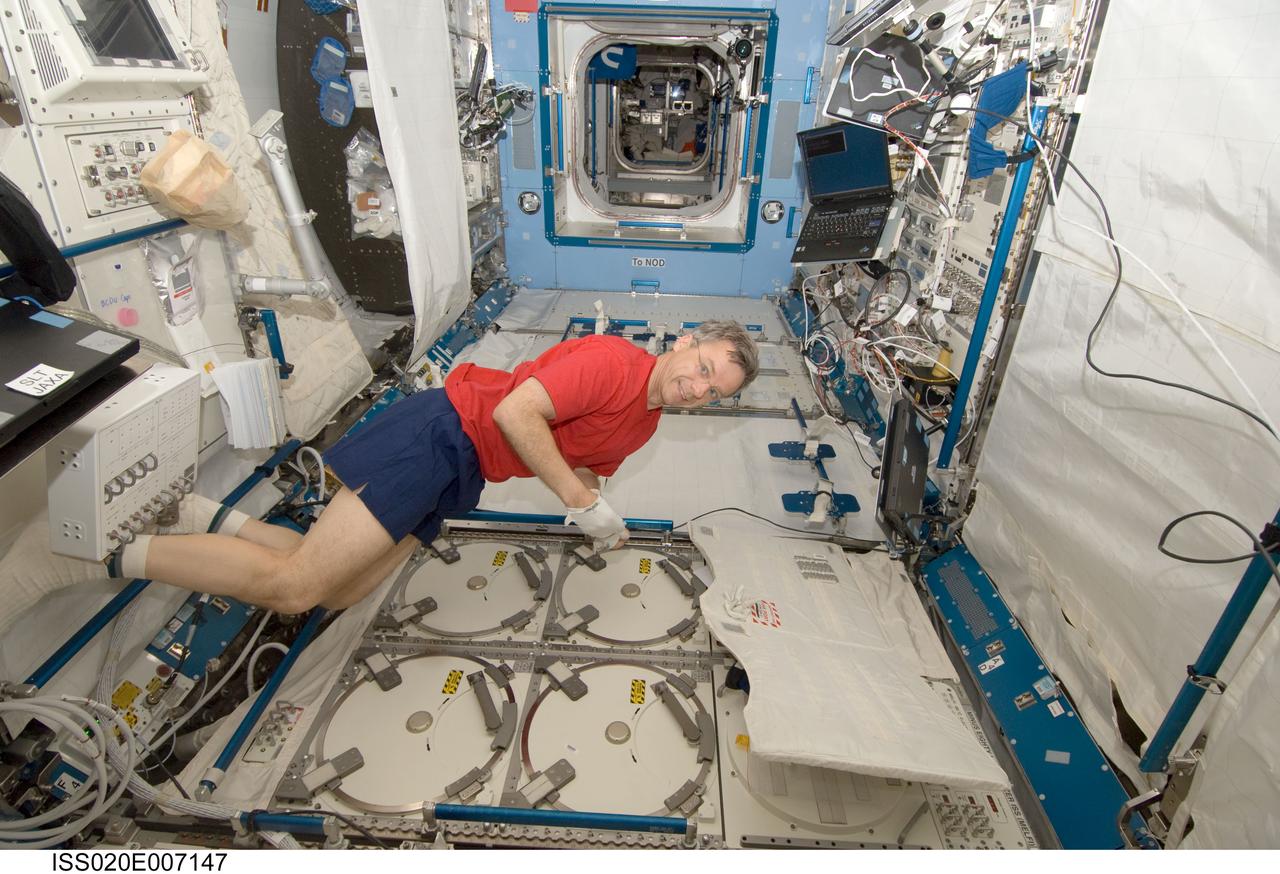
ISS020-E-037820 (2 Sept. 2009) --- European Space Agency astronaut Christer Fuglesang (bottom) and NASA astronaut Tim Kopra, both STS-128 mission specialists, install a new Minus Eighty Degree Laboratory Freezer for ISS (MELFI) rack in the Destiny laboratory of the International Space Station.
Minus Eighty Degree Laboratory Freezer for ISS (MELFI) rack
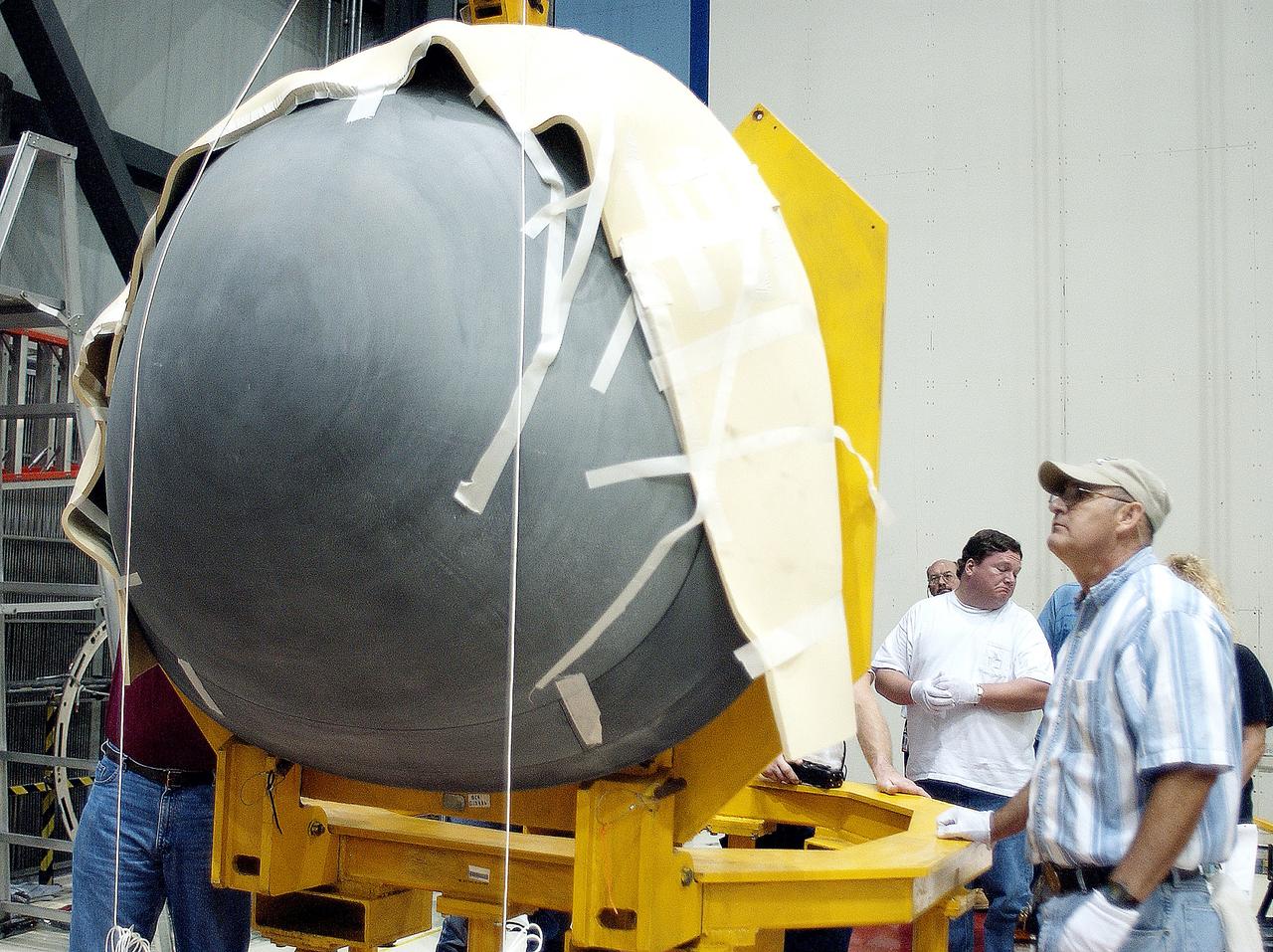
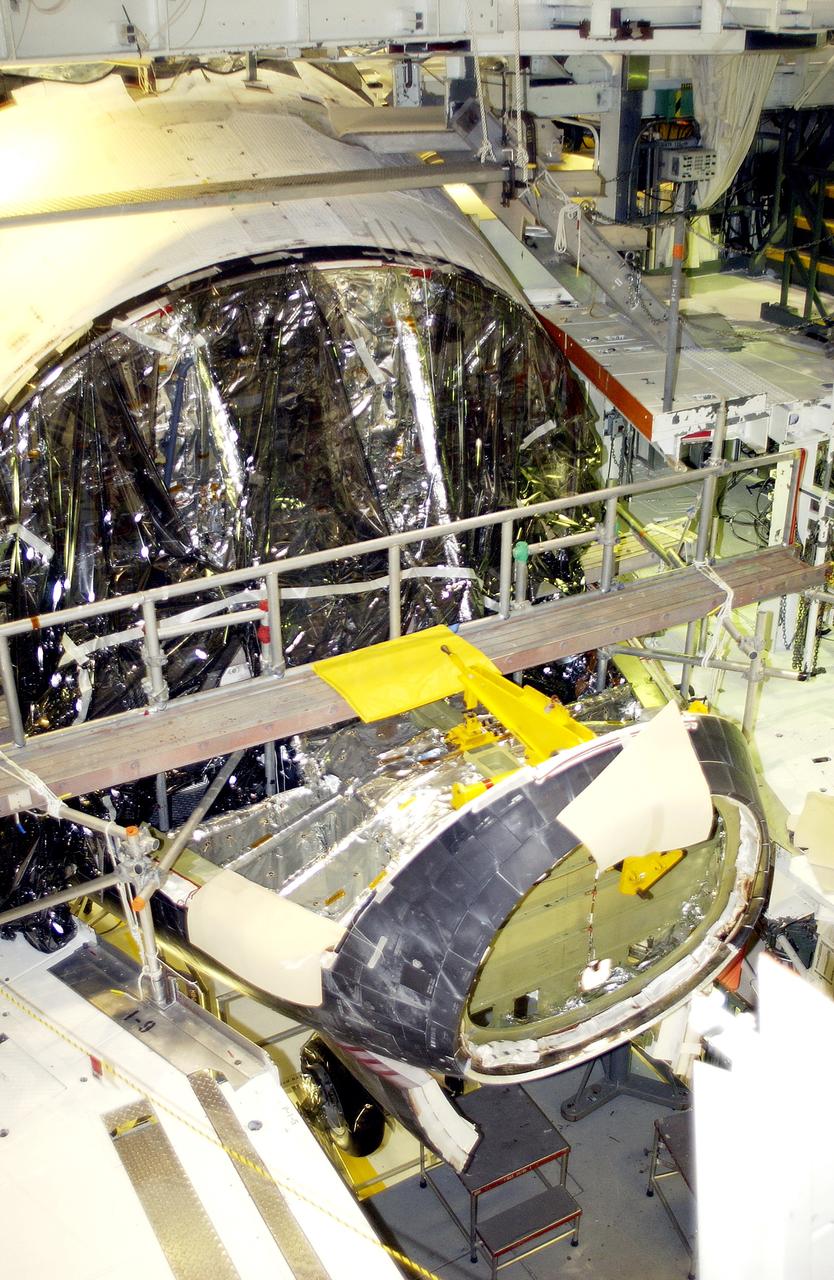
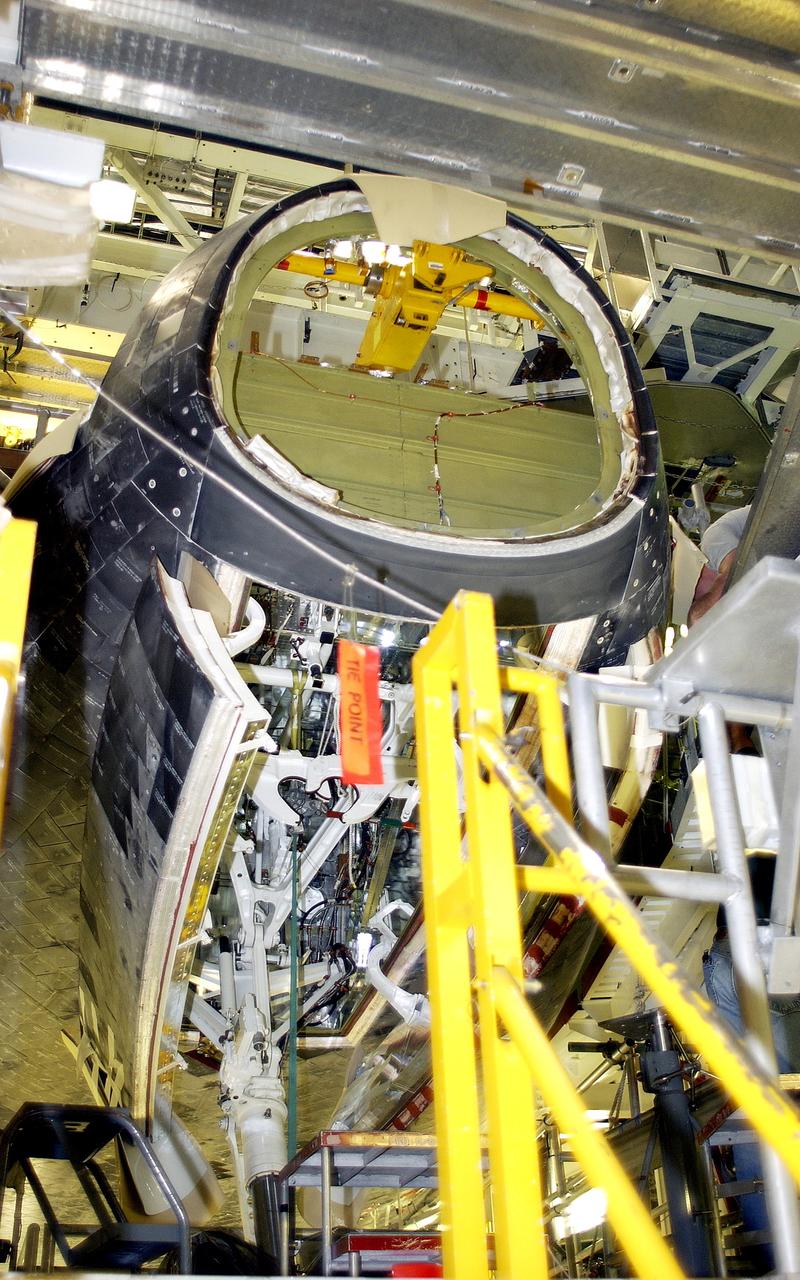
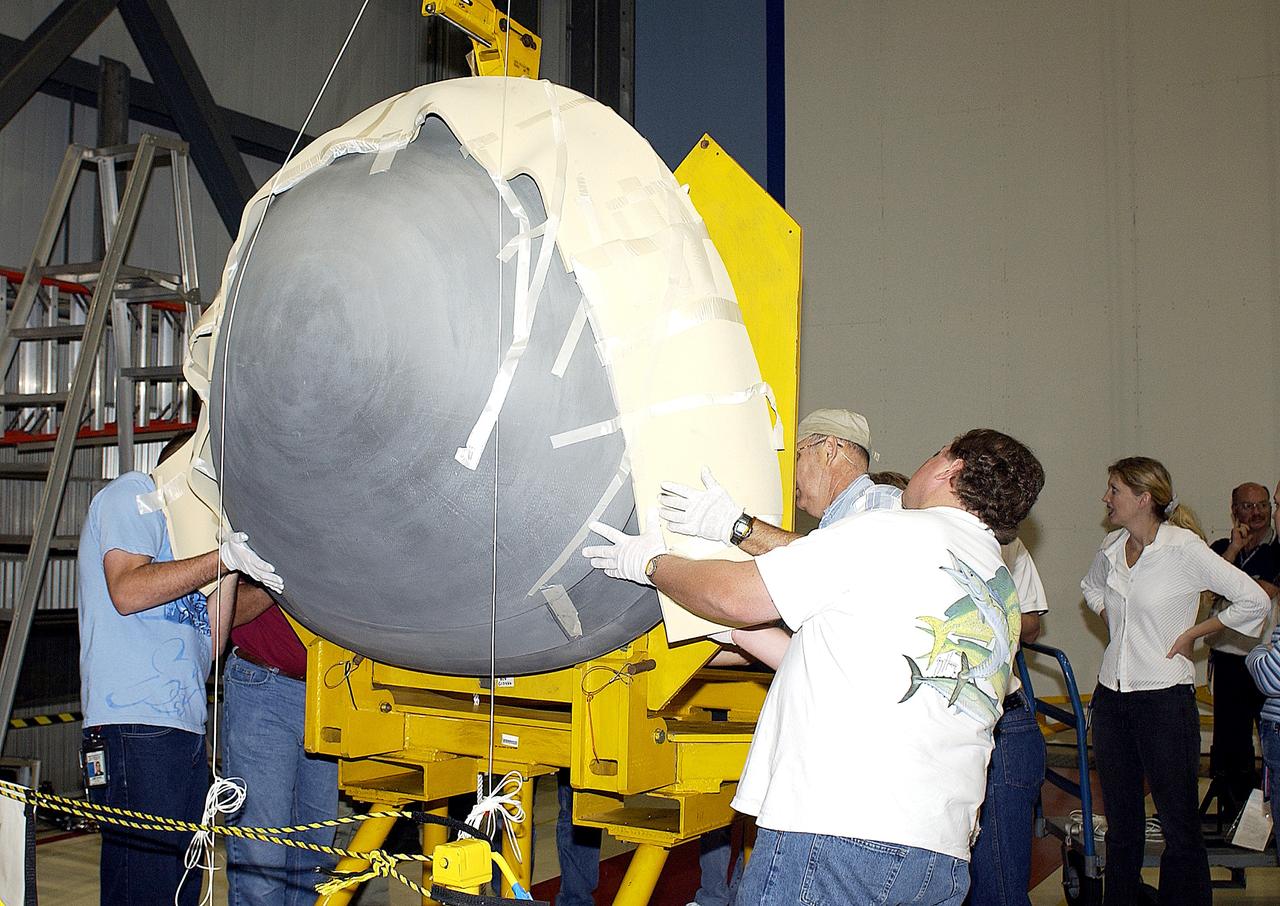
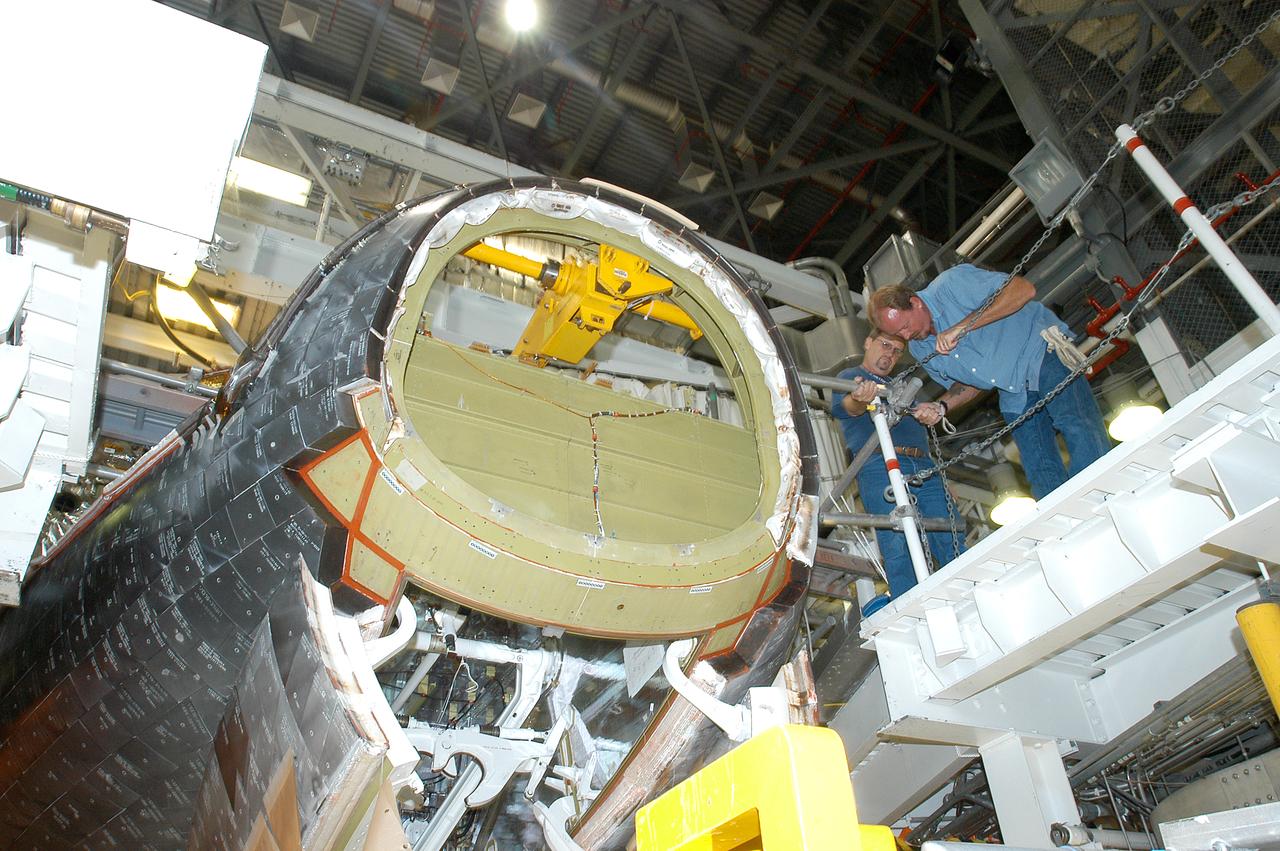
KENNEDY SPACE CENTER, FLA. - In the Orbiter Processing Facility, Atlantis is seen after its nose cap was removed for routine inspection. The nose cap is made of reinforced carbon-carbon (RCC), which has an operating range of minus 250° F to about 3,000° F.
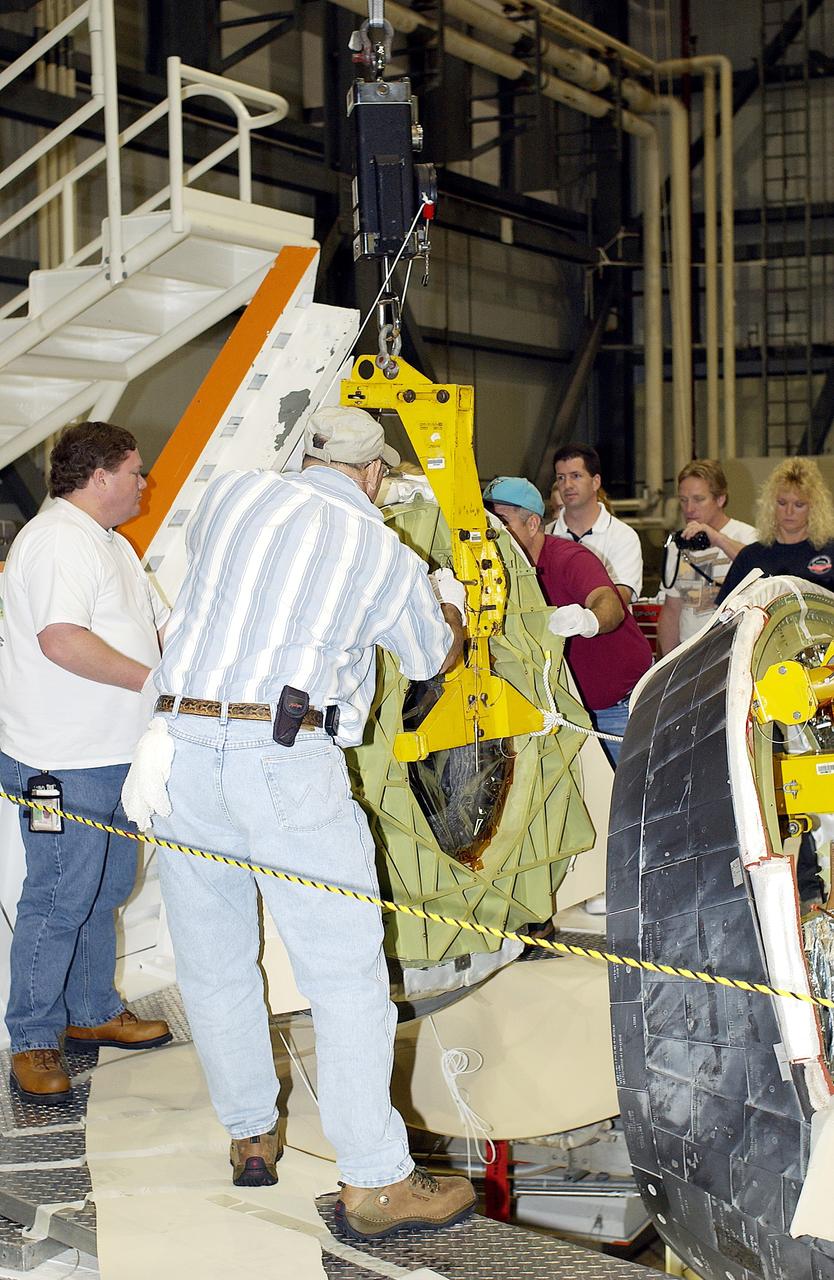
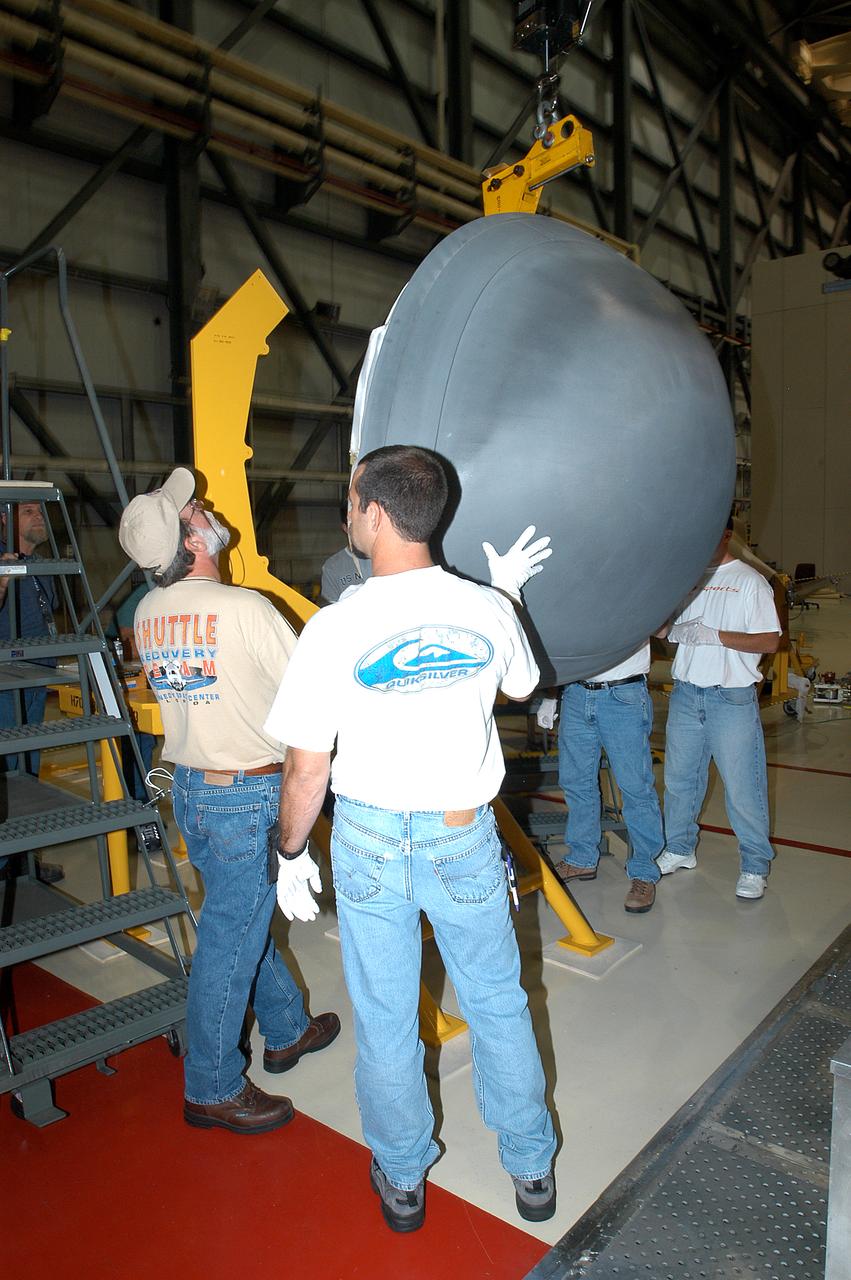
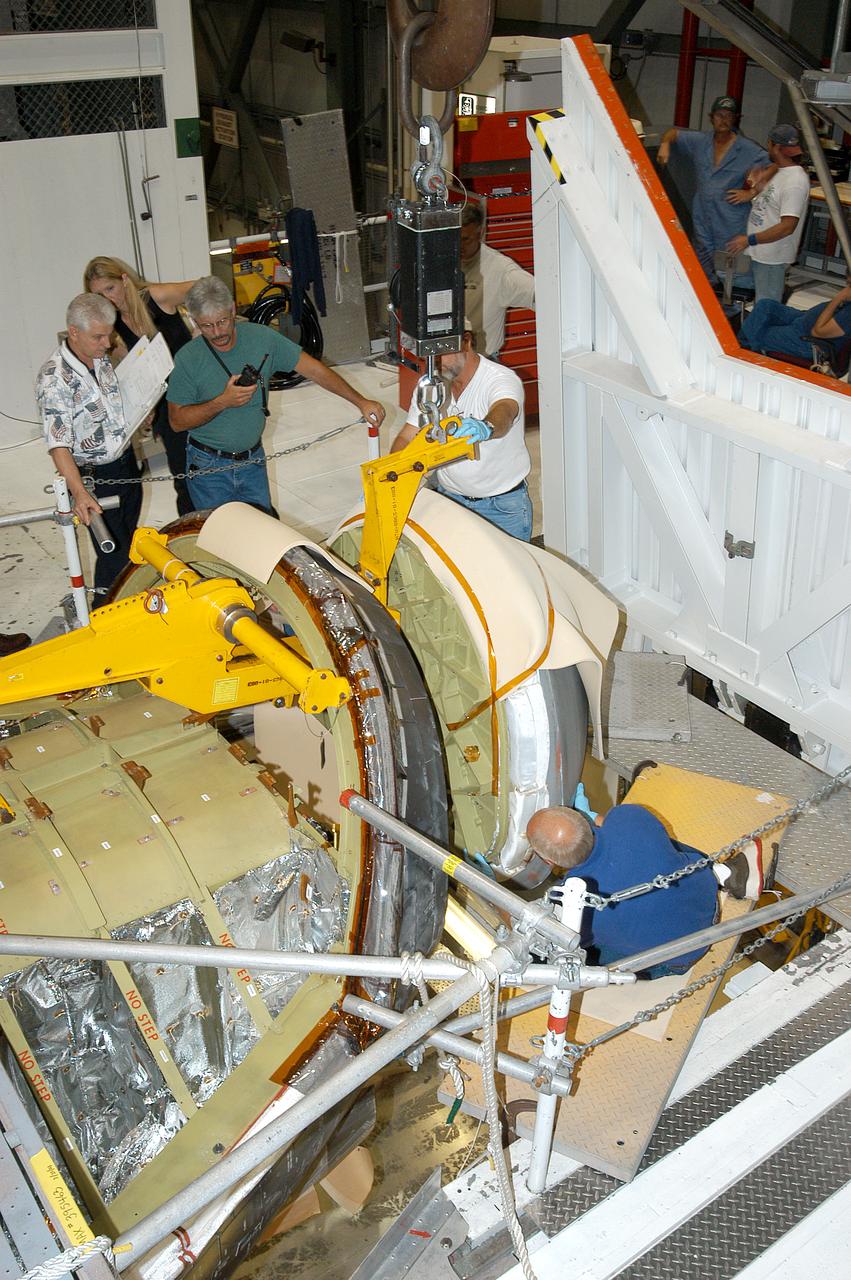
KENNEDY SPACE CENTER, FLA. - In the Orbiter Processing Facility, workers watch as the nose cap of the orbiter Atlantis is lowered toward the floor.   The cap was removed from the orbiter for routine inspection. The nose cap is made of reinforced carbon-carbon (RCC), which has an operating range of minus 250° F to about 3,000° F.
KENNEDY SPACE CENTER, FLA. - In the Orbiter Processing Facility, workers watch as the nose cap of the orbiter Atlantis is lowered toward the floor. The cap was removed from the orbiter for routine inspection. The nose cap is made of reinforced carbon-carbon (RCC), which has an operating range of minus 250° F to about 3,000° F.
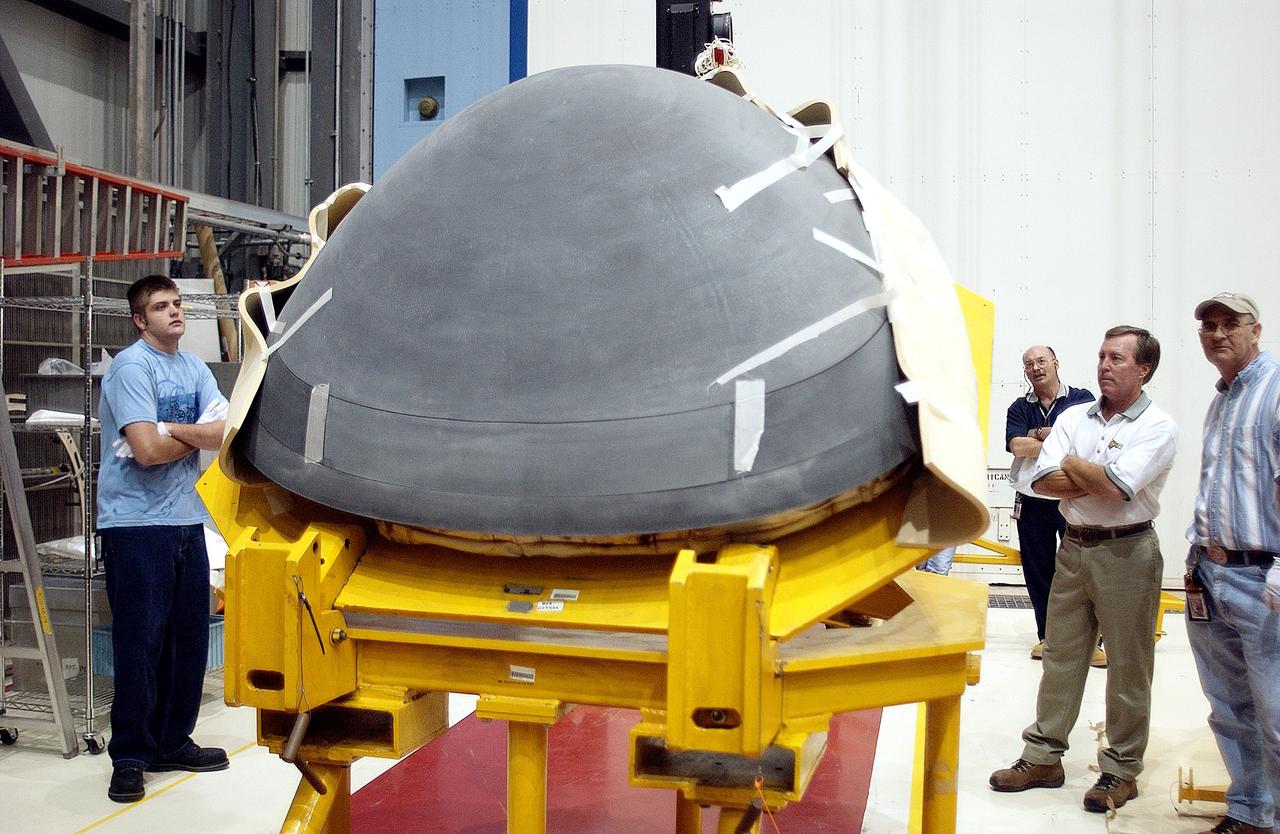
KENNEDY SPACE CENTER, FLA. -  In the Orbiter Processing Facility, the nose cap of the orbiter Atlantis rests on a stand after its removal from the orbiter for routine inspection. The nose cap is made of reinforced carbon-carbon (RCC), which has an operating range of minus 250° F to about 3,000° F.
KENNEDY SPACE CENTER, FLA. - In the Orbiter Processing Facility, the nose cap of the orbiter Atlantis rests on a stand after its removal from the orbiter for routine inspection. The nose cap is made of reinforced carbon-carbon (RCC), which has an operating range of minus 250° F to about 3,000° F.
KENNEDY SPACE CENTER, FLA. -  In the Orbiter Processing Facility, workers secure the nose cap of the orbiter Atlantis on a stand.   The cap was removed from the orbiter for routine inspection. The nose cap is made of reinforced carbon-carbon (RCC), which has an operating range of minus 250° F to about 3,000° F.
KENNEDY SPACE CENTER, FLA. - In the Orbiter Processing Facility, workers secure the nose cap of the orbiter Atlantis on a stand. The cap was removed from the orbiter for routine inspection. The nose cap is made of reinforced carbon-carbon (RCC), which has an operating range of minus 250° F to about 3,000° F.
KENNEDY SPACE CENTER, FLA. - In the Orbiter Processing Facility, workers watch as the nose cap of the orbiter Atlantis is shifted to a horizontal position on a stand.  The cap was removed from the orbiter for routine inspection. The nose cap is made of reinforced carbon-carbon (RCC), which has an operating range of minus 250° F to about 3,000° F.
KENNEDY SPACE CENTER, FLA. - In the Orbiter Processing Facility, workers watch as the nose cap of the orbiter Atlantis is shifted to a horizontal position on a stand. The cap was removed from the orbiter for routine inspection. The nose cap is made of reinforced carbon-carbon (RCC), which has an operating range of minus 250° F to about 3,000° F.
KENNEDY SPACE CENTER, FLA. - In the Orbiter Processing Facility, Atlantis is seen after its nose cap was removed for routine inspection. The nose cap is made of reinforced carbon-carbon (RCC), which has an operating range of minus 250° F to about 3,000° F.
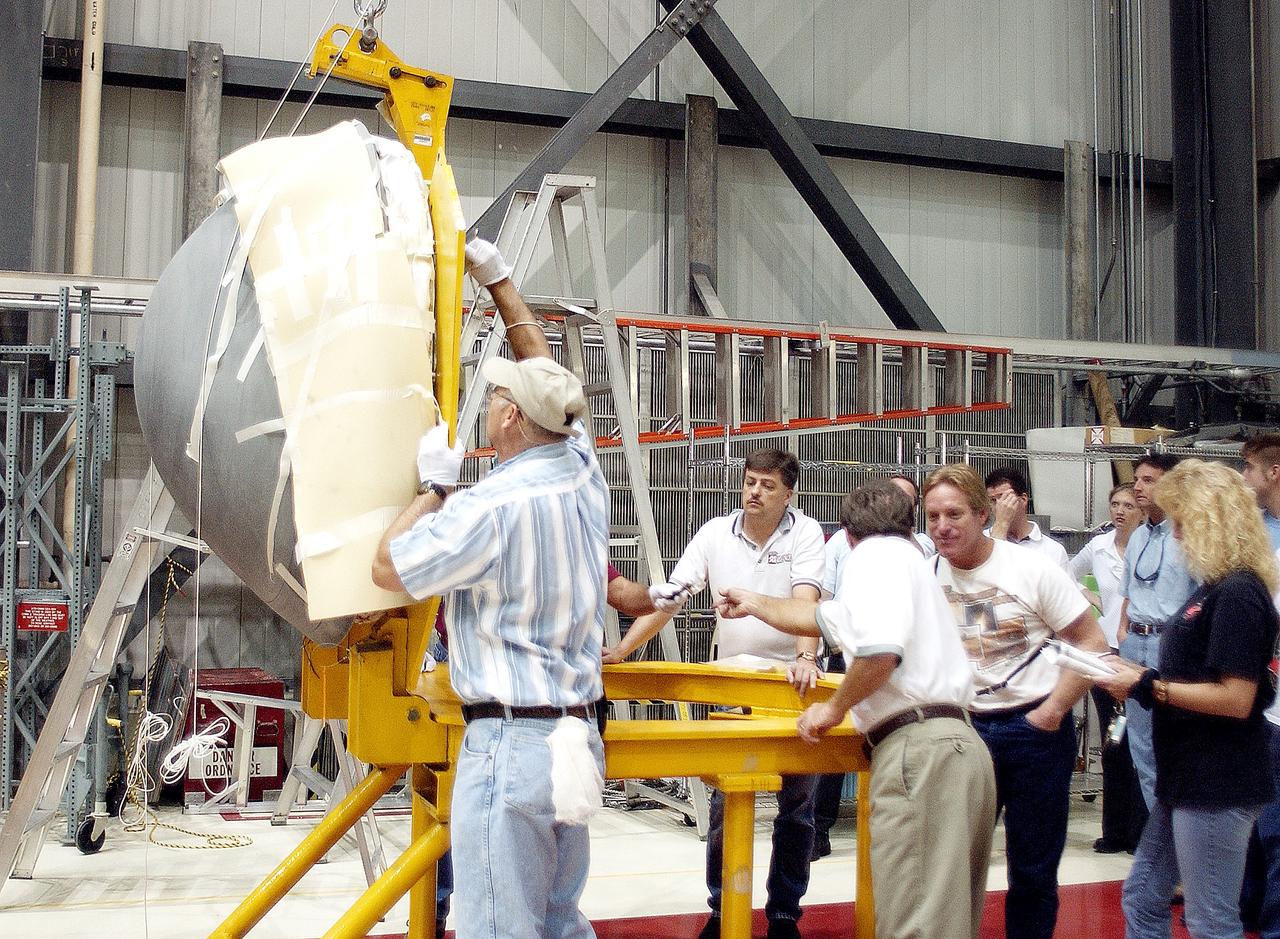
KENNEDY SPACE CENTER, FLA. - In the Orbiter Processing Facility, the nose cap of the orbiter Atlantis is lifted for its transfer to a stand.  The cap was removed for routine inspection. The nose cap is made of reinforced carbon-carbon (RCC), which has an operating range of minus 250° F to about 3,000° F.
KENNEDY SPACE CENTER, FLA. - In the Orbiter Processing Facility, the nose cap of the orbiter Atlantis is lifted for its transfer to a stand. The cap was removed for routine inspection. The nose cap is made of reinforced carbon-carbon (RCC), which has an operating range of minus 250° F to about 3,000° F.
KENNEDY SPACE CENTER, FLA. -  In the Orbiter Processing Facility, workers help guide the nose cap of the orbiter Atlantis toward a stand.  The cap was removed from the orbiter for routine inspection. The nose cap is made of reinforced carbon-carbon (RCC), which has an operating range of minus 250° F to about 3,000° F.
KENNEDY SPACE CENTER, FLA. - In the Orbiter Processing Facility, workers help guide the nose cap of the orbiter Atlantis toward a stand. The cap was removed from the orbiter for routine inspection. The nose cap is made of reinforced carbon-carbon (RCC), which has an operating range of minus 250° F to about 3,000° F.
KENNEDY SPACE CENTER, FLA. - In the Orbiter Processing Facility, workers watch as the nose cap of the orbiter Atlantis is moved toward the stand at left.  The cap was removed from the orbiter for routine inspection. The nose cap is made of reinforced carbon-carbon (RCC), which has an operating range of minus 250° F to about 3,000° F.
KENNEDY SPACE CENTER, FLA. - In the Orbiter Processing Facility, workers watch as the nose cap of the orbiter Atlantis is moved toward the stand at left. The cap was removed from the orbiter for routine inspection. The nose cap is made of reinforced carbon-carbon (RCC), which has an operating range of minus 250° F to about 3,000° F.
KENNEDY SPACE CENTER, FLA. - In the Orbiter Processing Facility, workers remove the nose cone of the orbiter Atlantis for routine inspection. The nose cap is made of reinforced carbon-carbon (RCC), which has an operating range of minus 250° F to about 3,000° F.
KENNEDY SPACE CENTER, FLA. - In the Orbiter Processing Facility, the nose cap of the orbiter Atlantis is shifted to a horizontal position on a stand.  The cap was removed from the orbiter for routine inspection. The nose cap is made of reinforced carbon-carbon (RCC), which has an operating range of minus 250° F to about 3,000° F.
KENNEDY SPACE CENTER, FLA. - In the Orbiter Processing Facility, the nose cap of the orbiter Atlantis is shifted to a horizontal position on a stand. The cap was removed from the orbiter for routine inspection. The nose cap is made of reinforced carbon-carbon (RCC), which has an operating range of minus 250° F to about 3,000° F.
KENNEDY SPACE CENTER, FLA. - In the Orbiter Processing Facility, workers secure the nose cap of the orbiter Atlantis for its transfer to a stand.  The cap was removed for routine inspection. The nose cap is made of reinforced carbon-carbon (RCC), which has an operating range of minus 250° F to about 3,000° F.
KENNEDY SPACE CENTER, FLA. - In the Orbiter Processing Facility, workers secure the nose cap of the orbiter Atlantis for its transfer to a stand. The cap was removed for routine inspection. The nose cap is made of reinforced carbon-carbon (RCC), which has an operating range of minus 250° F to about 3,000° F.
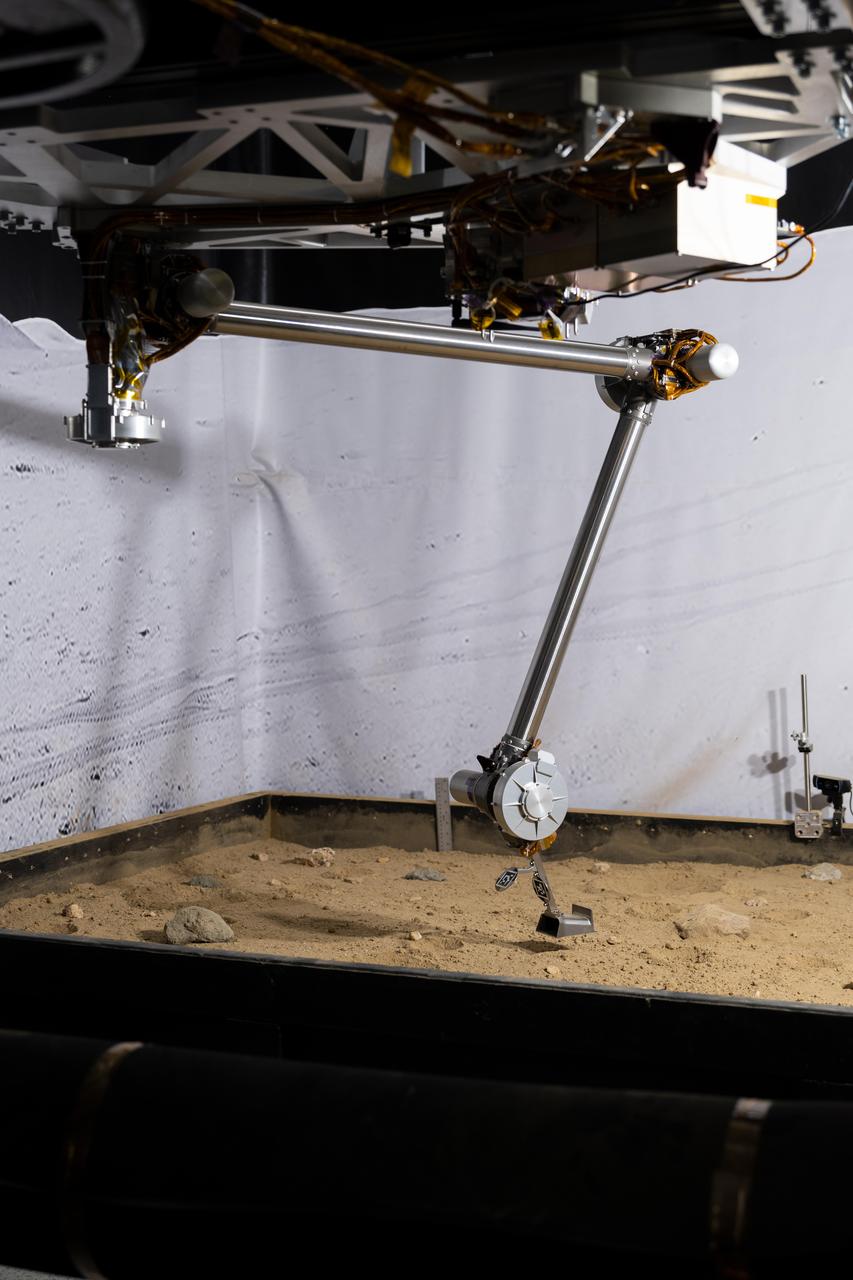
The 3D-printed titanium scoop of the Cold Operable Lunar Deployable Arm (COLDArm) robotic arm system is poised above a test bed filled with material to simulate lunar regolith (broken rocks and dust) at NASA's Jet Propulsion Laboratory in Southern California. COLDArm can function in temperatures as cold as minus 280 degrees Fahrenheit (minus 173 degrees Celsius).  COLDArm is designed to go on a Moon lander and operate during lunar night, a period that lasts about 14 Earth days. Frigid temperatures during lunar night would stymie current spacecraft, which must rely on energy-consuming heaters to stay warm.  To operate in the cold, the 6-foot-6-inch (2-meter) arm combines several key new technologies: gears made of bulk metallic glass that require no lubrication or heating, cold motor controllers that don't need to be kept warm in an electronics box near the core of the spacecraft, and a cryogenic six-axis force torque sensor that lets the arm "feel" what it's doing and make adjustments.  A variety of attachments and small instruments could go on the end of the arm, including the scoop, which could be used for collecting samples from a planet's surface. Like the arm on NASA's InSight Mars lander, COLDArm could deploy science instruments to the surface.  https://photojournal.jpl.nasa.gov/catalog/PIA25317
NASA's COLDArm at Lunar Regolith Simulant Test Bed
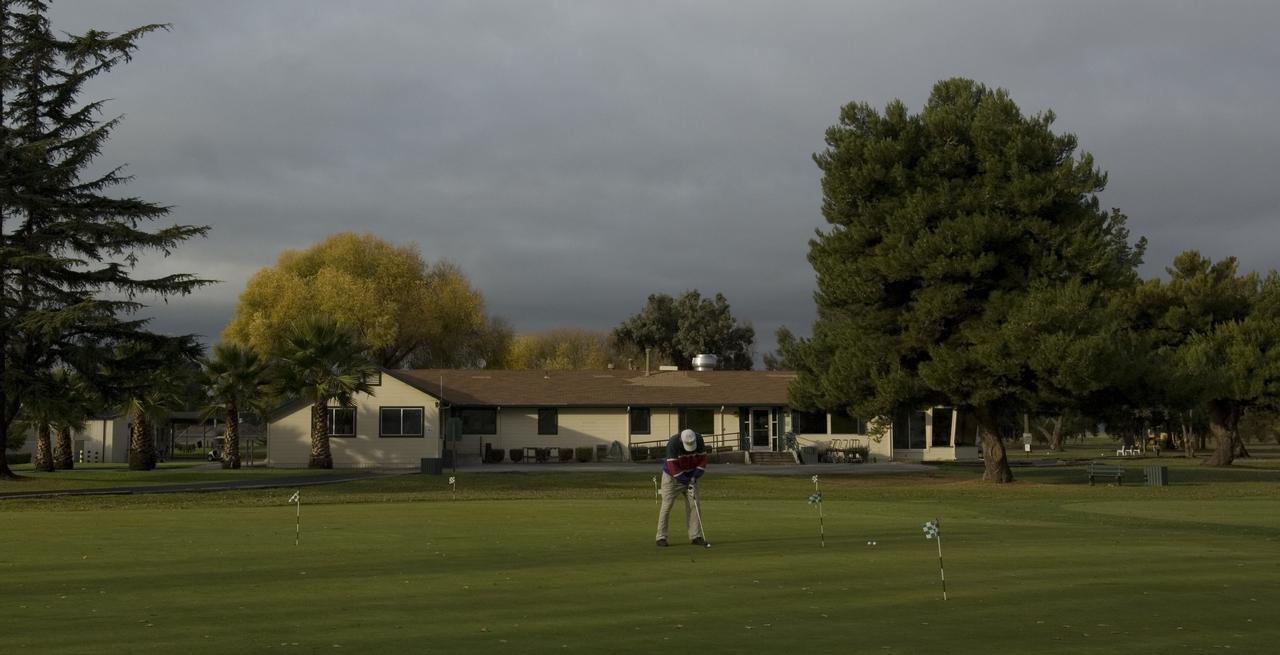
Ames Exchange - Tee Minus One (T-1) Golf course
ARC-2006-ACD06-0201-022
Ames Exchange - Tee Minus One (T-1) Golf course
ARC-2006-ACD06-0201-019
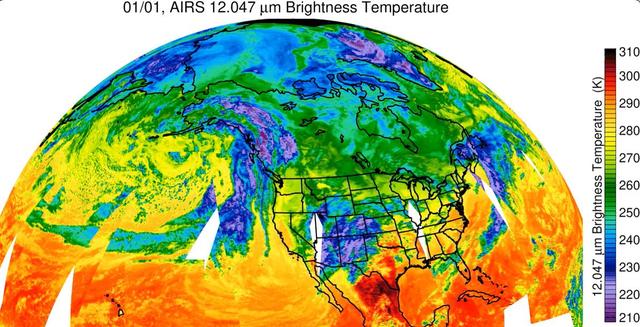
Since the start of 2023 California has been drenched by a series of storms being transported by an atmospheric river – a relatively narrow, windy region in Earth's atmosphere that can transport moisture or tiny particles for thousands of miles, much like a river on land moves water. NASA's Atmospheric Infrared Sounder (AIRS) captured the series of storms as they dumped record amounts of rain in some parts of California, caused flooding, and damaged infrastructure. Forecasts say this pattern of storms will continue through the week of Jan. 9.  The images show cloud temperatures taken at infrared wavelengths not visible to the human eye. Purple and violet areas are colder, between about minus 82 degrees Fahrenheit and minus 46 degrees Fahrenheit (minus 63 degrees Celsius to minus 44 degrees Celsius), than blue and green regions which are roughly minus 28 degrees Fahrenheit to 26 degrees Fahrenheit (minus 33 degrees Celsius to minus 3 degrees Celsius). Warmer red sections are between roughly 62 degrees Fahrenheit and 80 degrees Fahrenheit (17 degrees Celsius to 27 degrees Celsius), representing mostly cloud-free air. The cooler parts of the clouds are associated with very heavy rainfall. White patches represent gaps in satellite coverage.  Located aboard the Aqua satellite AIRS, in conjunction with the Advanced Microwave Sounding Unit (AMSU), senses emitted infrared and microwave radiation from Earth to provide a 3D look at the planet's weather and climate. Working in tandem, the two instruments make simultaneous observations down to Earth's surface. With more than 2,000 channels sensing different regions of the atmosphere, the system creates a global, 3D map of atmospheric temperature and humidity, cloud amounts and heights, greenhouse gas concentrations, and many other atmospheric phenomena. Launched into Earth orbit in 2002 aboard NASA's Aqua spacecraft, the AIRS and AMSU instruments are managed by NASA's Jet Propulsion Laboratory in Southern California, under contract to NASA. JPL is a division of Caltech.  Animation available at https://photojournal.jpl.nasa.gov/catalog/PIA25597
California Atmospheric River Storms Captured by NASA's AIRS
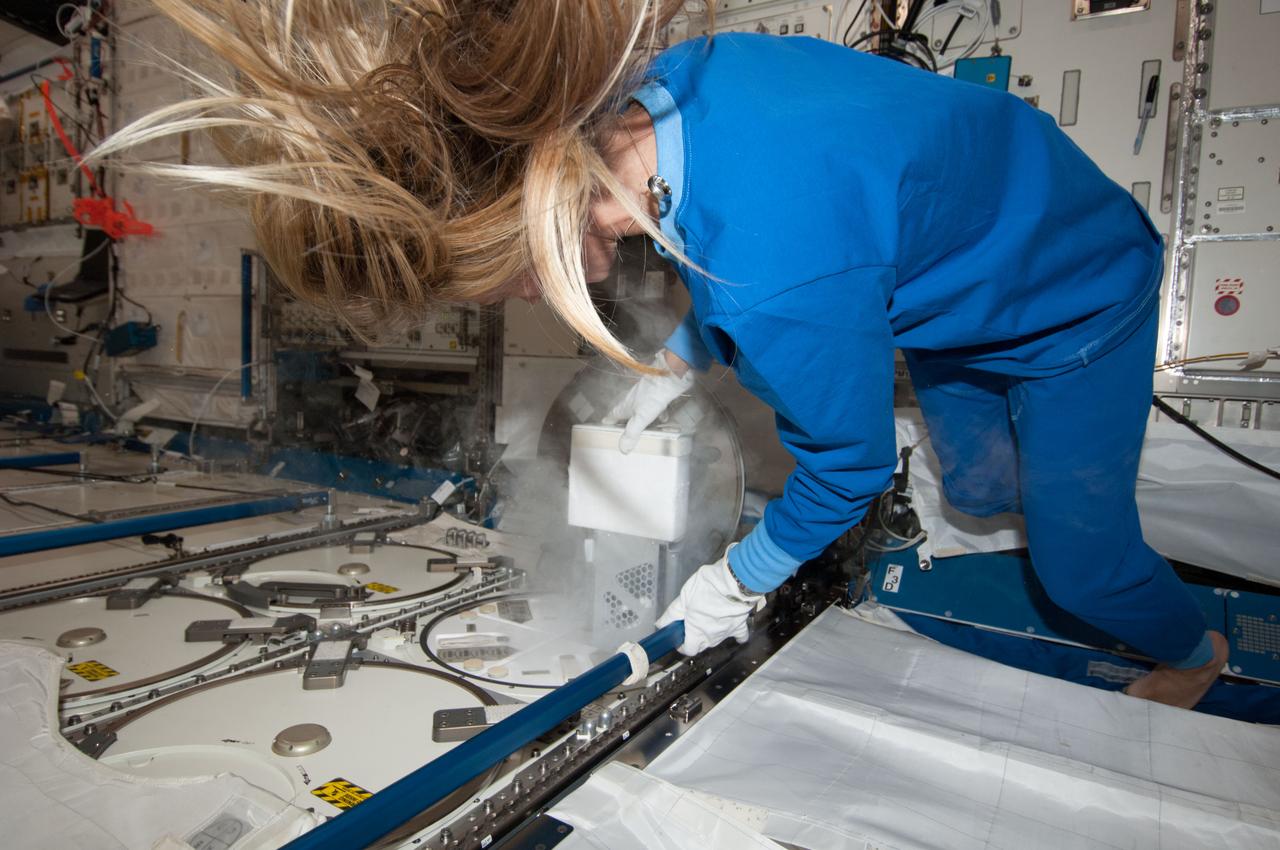
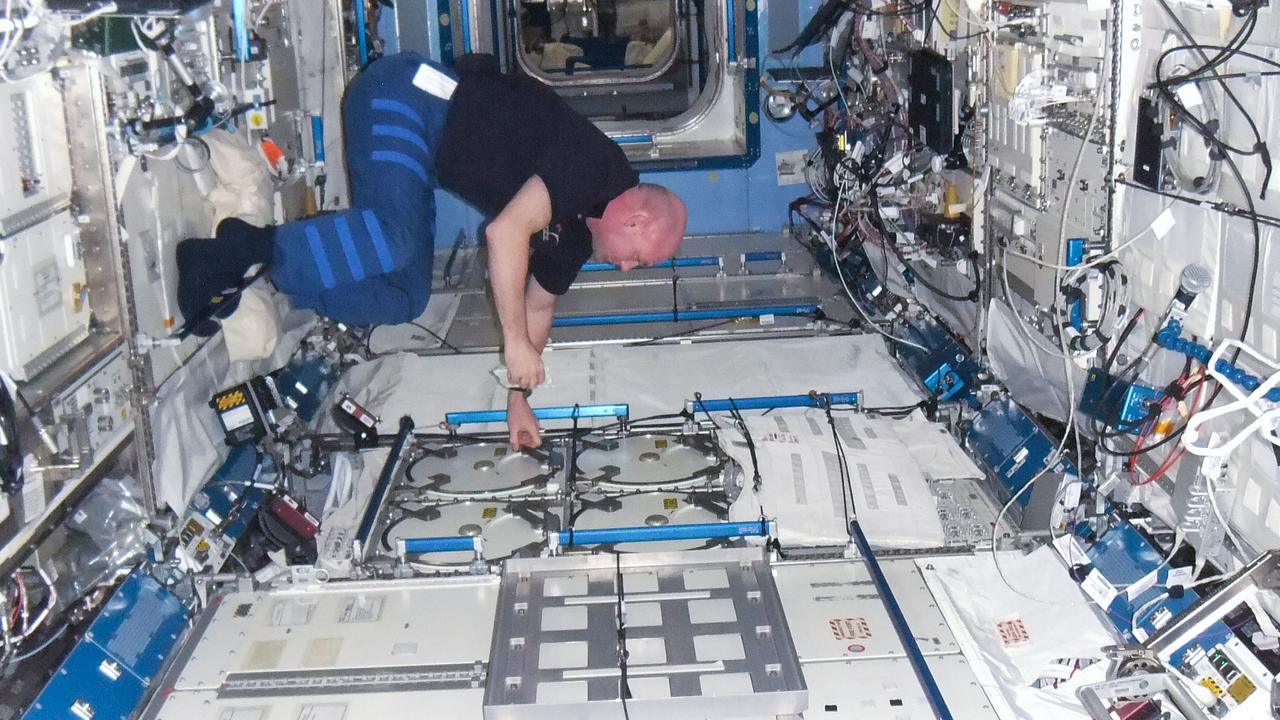
iss049e052550 (10/29/20160 --- NASA astronaut Kate Rubins is photographed removing samples from the Minus Eighty-Degree Laboratory Freezer for ISS 2 (MELFI2) as part of handover to the Russian crew for packing. The Minus Eighty-degree Laboratory Freezer for ISS (MELFI) is a cold storage unit that maintains experiment samples at ultra-cold temperatures throughout a mission.
Handover of PCMs and experiment samples to Russian crew
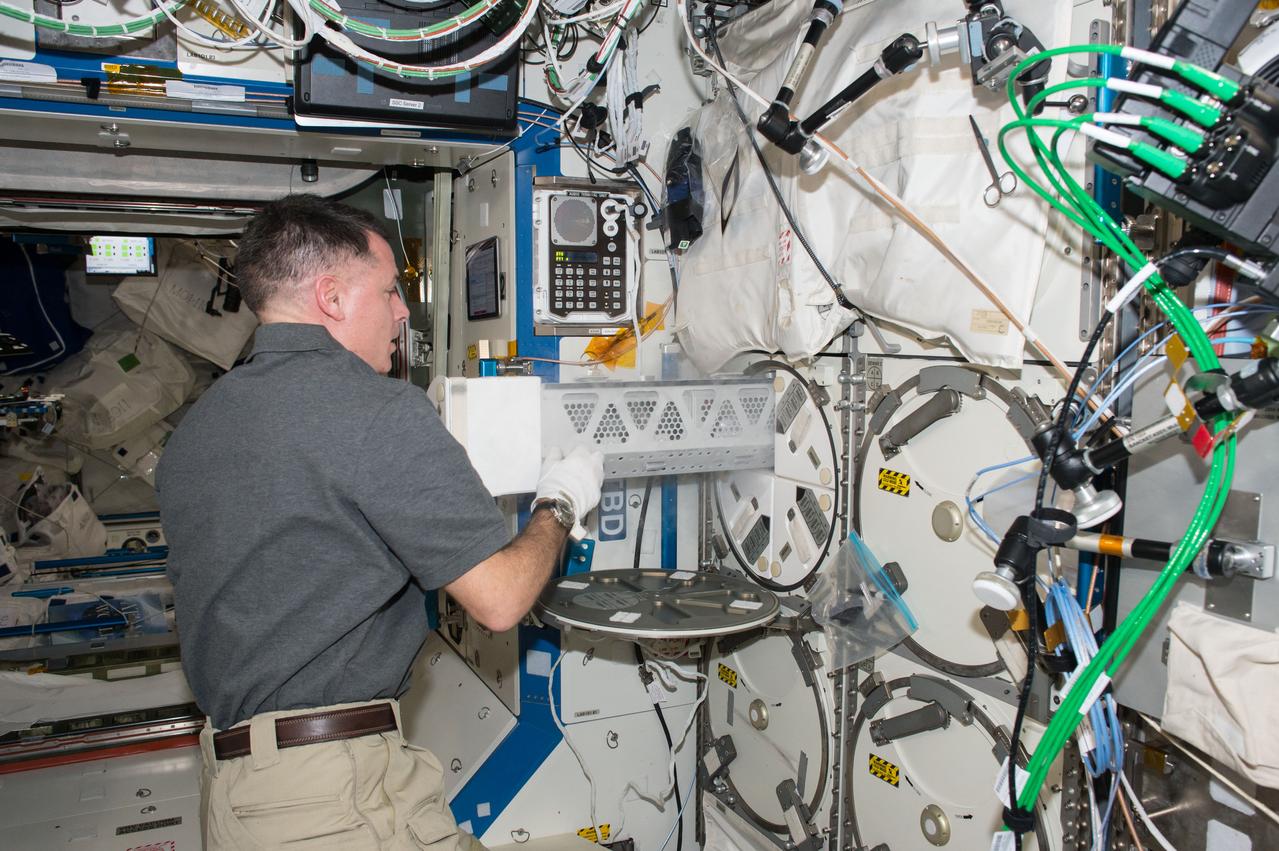
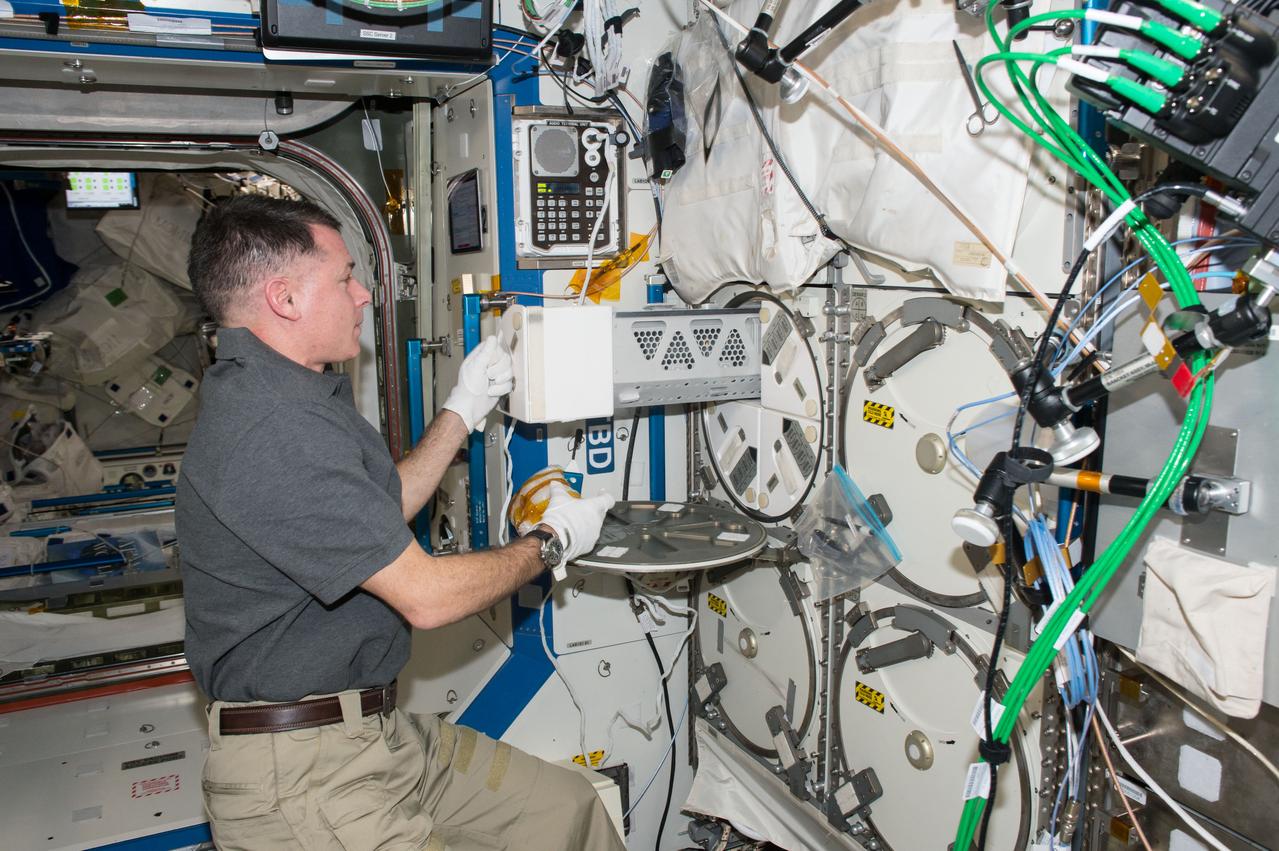
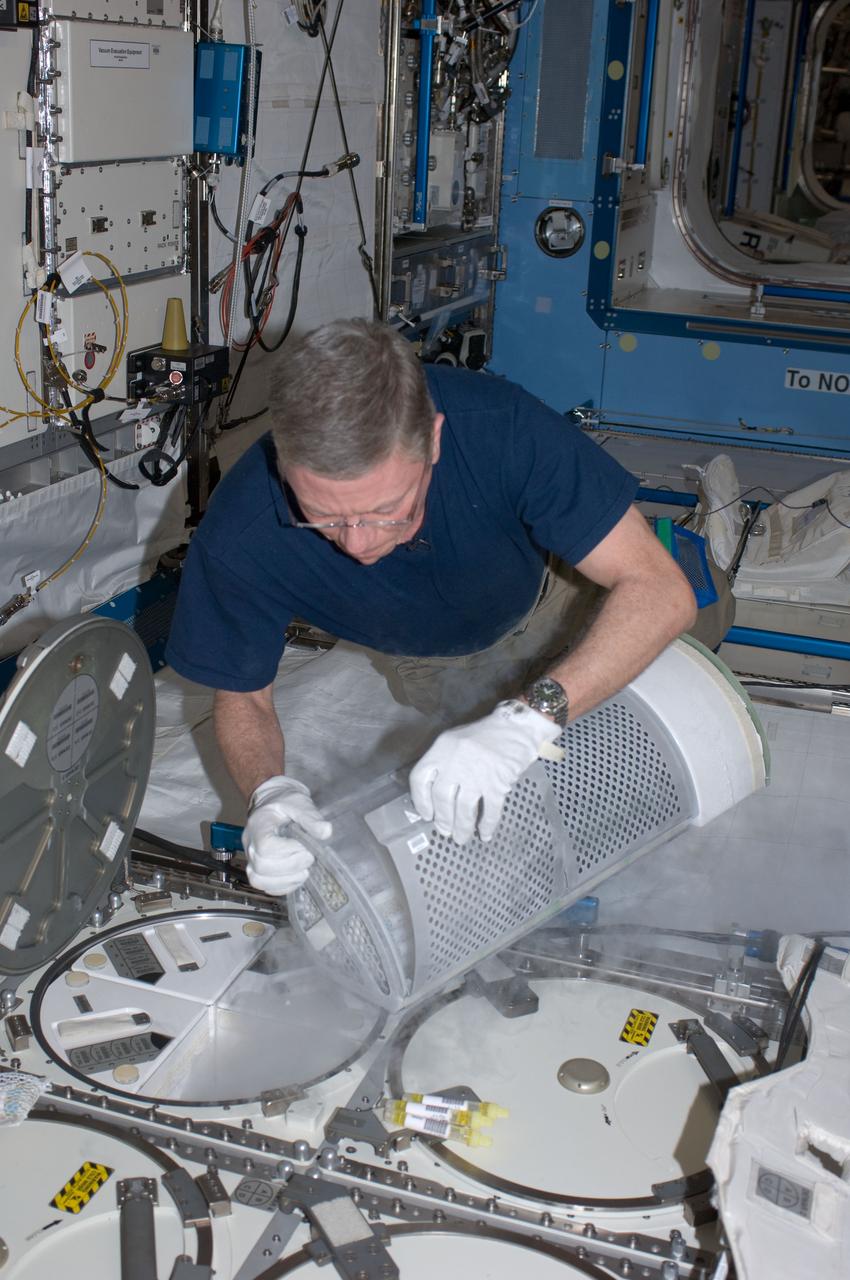
iss050e057444 (3/15/2017) --- NASA astronaut Shane Kimbrough removing a storage locker in the Minus Eighty-degree Laboratory Freezer for ISS (MELFI) to store samples from an experiment, in the U.S. Laboratory. The Minus Eighty-Degree Laboratory Freezer for ISS (MELFI) is a cold storage unit that maintains experiment samples at ultra-cold temperatures throughout a mission.
Kimbrough works with MELFI
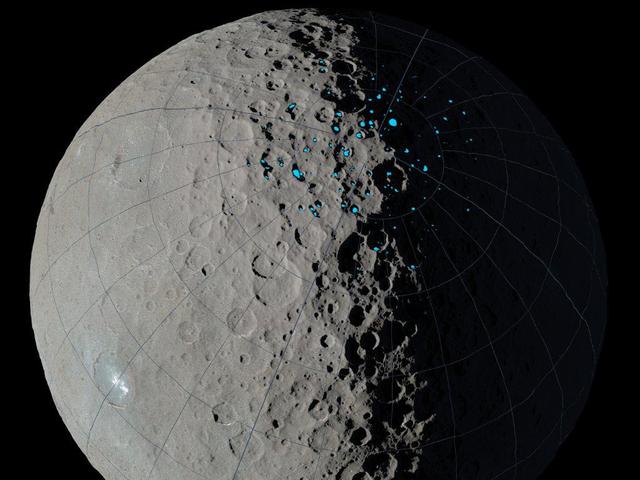
At the poles of Ceres, scientists have found craters that are permanently in shadow (indicated by blue markings). Such craters are called "cold traps" if they remain below about minus 240 degrees Fahrenheit (minus 151 degrees Celsius). These shadowed craters may have been collecting ice for billions of years because they are so cold.  This image was created using data from NASA's Dawn spacecraft.  http://photojournal.jpl.nasa.gov/catalog/PIA20696
Shadowed Craters on Ceres
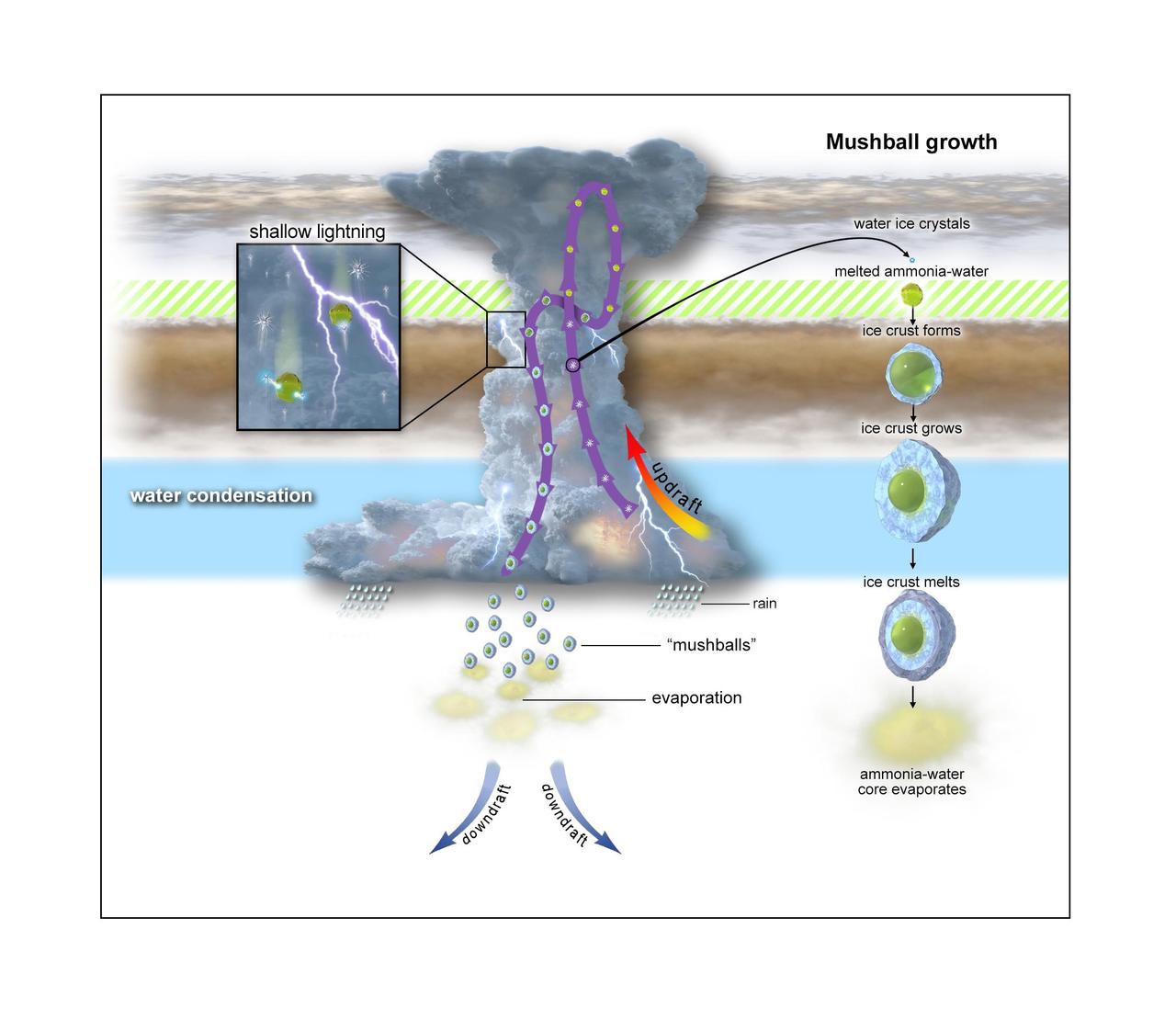
This graphic depicts the evolutionary process of "shallow lightning" and ammonia-water hailstones called "mushballs." An anvil-shaped thunderstorm cloud originates about 40 miles (65 kilometers) below Jupiter's visible cloud deck. Powered by water-based moist convection, the cloud generates strong updrafts that move liquid water and water ice particles upward. About 12 miles (19 kilometers) up, temperatures are so low that all of the water particles turn to ice. Still climbing, the ice particles cross a region located about 14 miles (23 kilometers) below the upper clouds, where temperatures are between minus 121 degrees Fahrenheit (minus 85 degrees Celsius) and minus 150 degrees Fahrenheit (minus 100 degrees Celsius), (depicted as green-hashed layer). At that point, ammonia vapor in the atmosphere acts like an antifreeze, melting the water-ice crystals, transforming them into ammonia-water liquid droplets which then grow and gather a solid icy shell to become mushballs. Once big enough, these slushy hailstones fall down, transporting both ammonia and water into Jupiter's deep atmosphere where the mushballs eventually evaporate.  https://photojournal.jpl.nasa.gov/catalog/PIA24042
A Mushball and Shallow-Lightning Factory (Illustration)
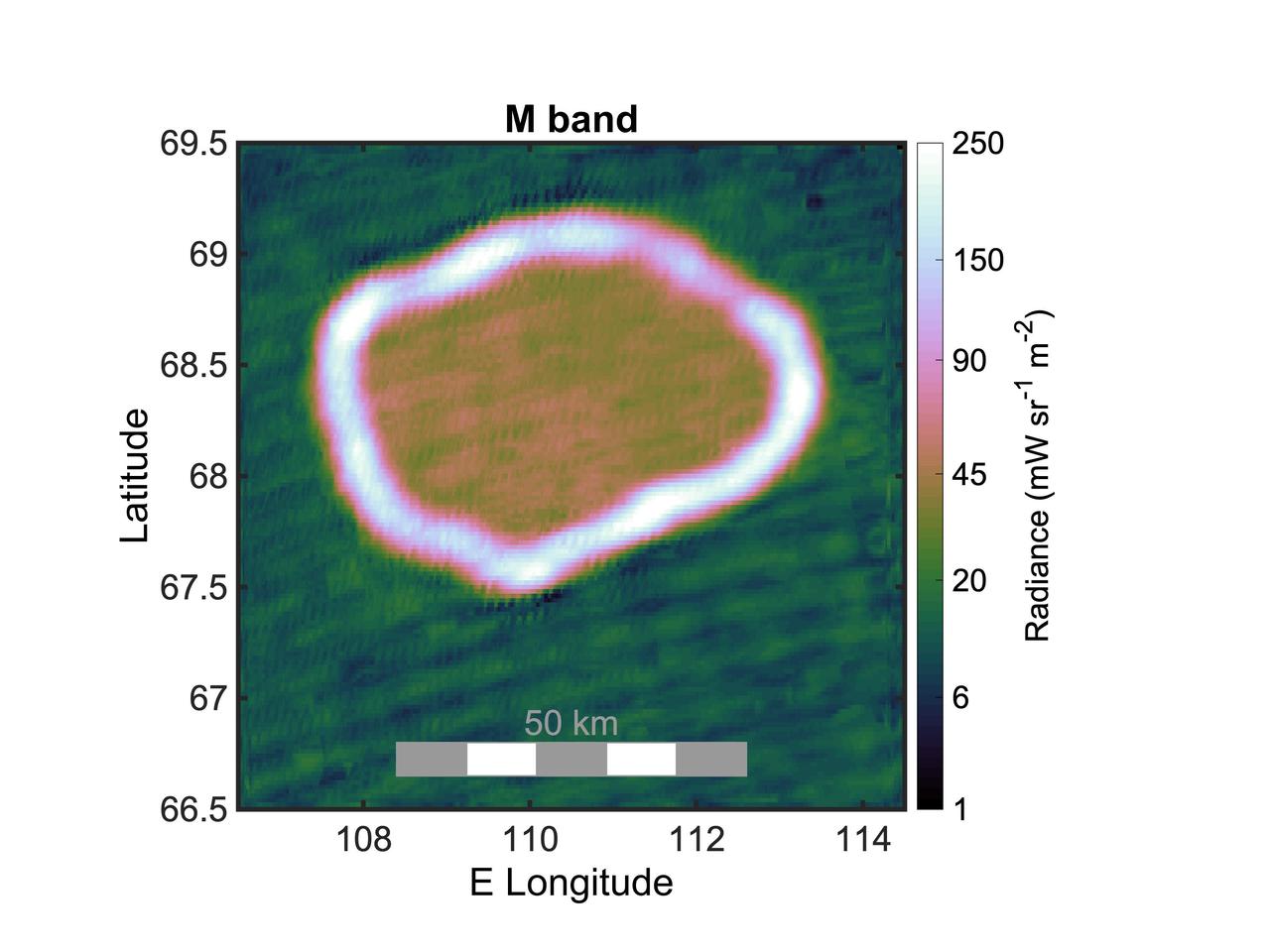
This graphic shows the infrared radiance of Chors Patera, a lava lake on Jupiter's moon Io. It was created using infrared data collected by the JIRAM (Jovian Infrared Auroral Mapper) instrument aboard NASA's Juno spacecraft during a flyby of the moon on Oct. 15, 2023. The lake is about 31 miles (50 kilometers) wide.  Juno scientists believe the majority of the lake is covered with a thick crust of molten material (appearing red/green in graphic, inside the white ring) that is approximately minus 45 degrees Fahrenheit (minus 43 degrees Celsius) at its surface. The white ring indicates where lava from Io's interior is directly exposed to space, providing the geologic feature's hottest thermal signature: between 450 and 1,350 F (232 and 732 C). The area in green, outside the lava lake, is very cold: about minus 225 F (minus 143 C).  JIRAM "sees" infrared light not visible to the human eye. In this composite image, the measurements of thermal emissions radiated from the planet were in the infrared wavelength between 4.5 and 5 microns.  https://photojournal.jpl.nasa.gov/catalog/PIA26371
Juno Captures Lava Lake Chors Patera on Io
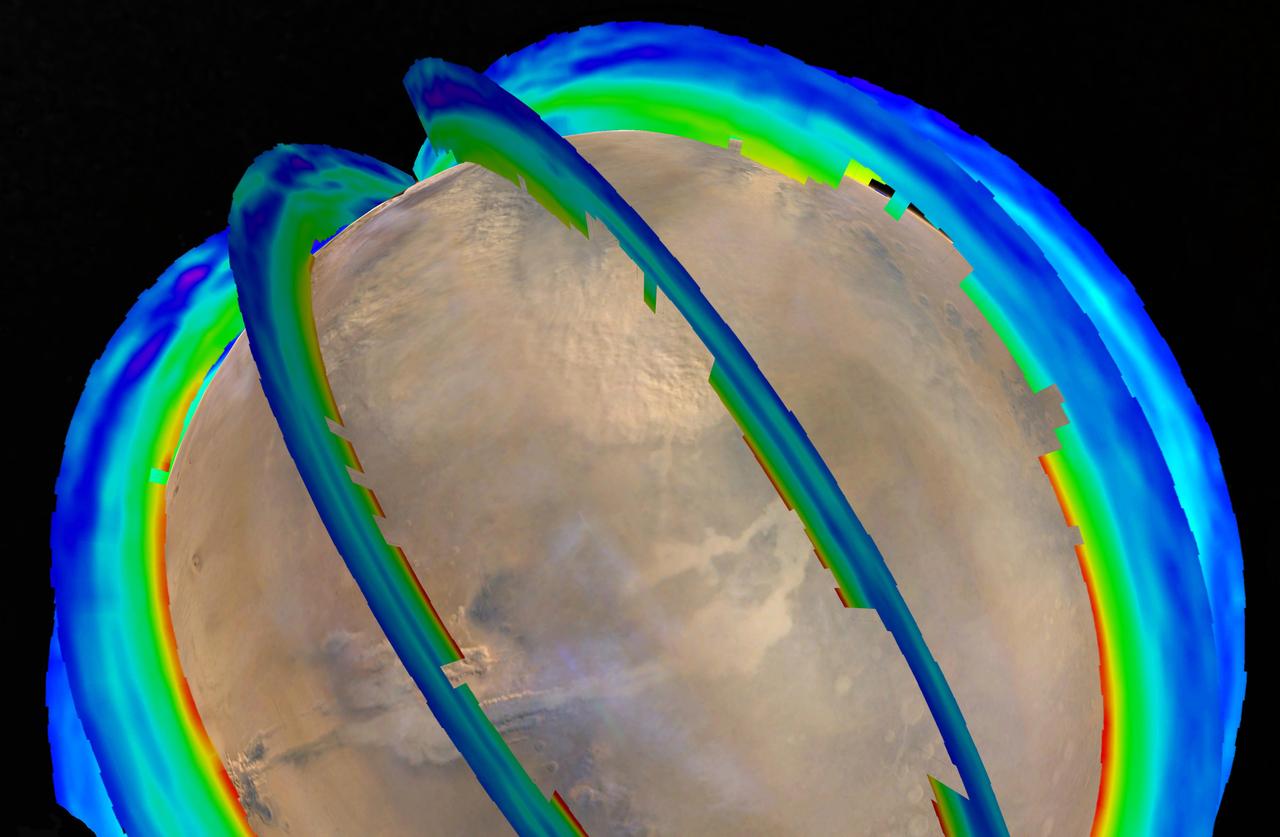
This graphic overlays Martian atmospheric temperature data as curtains over an image of Mars taken during a regional dust storm. The temperature profiles extend from the surface to about 50 miles (80 kilometers) up. Temperatures are color coded, ranging from minus 243 degrees Fahrenheit (minus 153 degrees Celsius) where coded purple to minus 9 F (minus 23 C) where coded red.  The temperature data and global image were both recorded on Oct. 18, 2014, by instruments on NASA's Mars Reconnaissance Orbiter: Mars Climate Sounder and Mars Color Imager. On that day a regional dust storm was active in the Acidalia Planitia region of northern Mars, at the upper center of this image. A storm from this area in typically travels south and grows into a large regional storm in the southern hemisphere during southern spring.  That type of southern-spring storm and two other large regional dust storms repeat as a three-storm series most Martian years. The pattern has been identified from their effects on atmospheric temperature in a layer about 16 miles (25 kilometers) above the surface.  http://photojournal.jpl.nasa.gov/catalog/PIA20747
Mars Atmospheric Temperature and Dust Storm Tracking
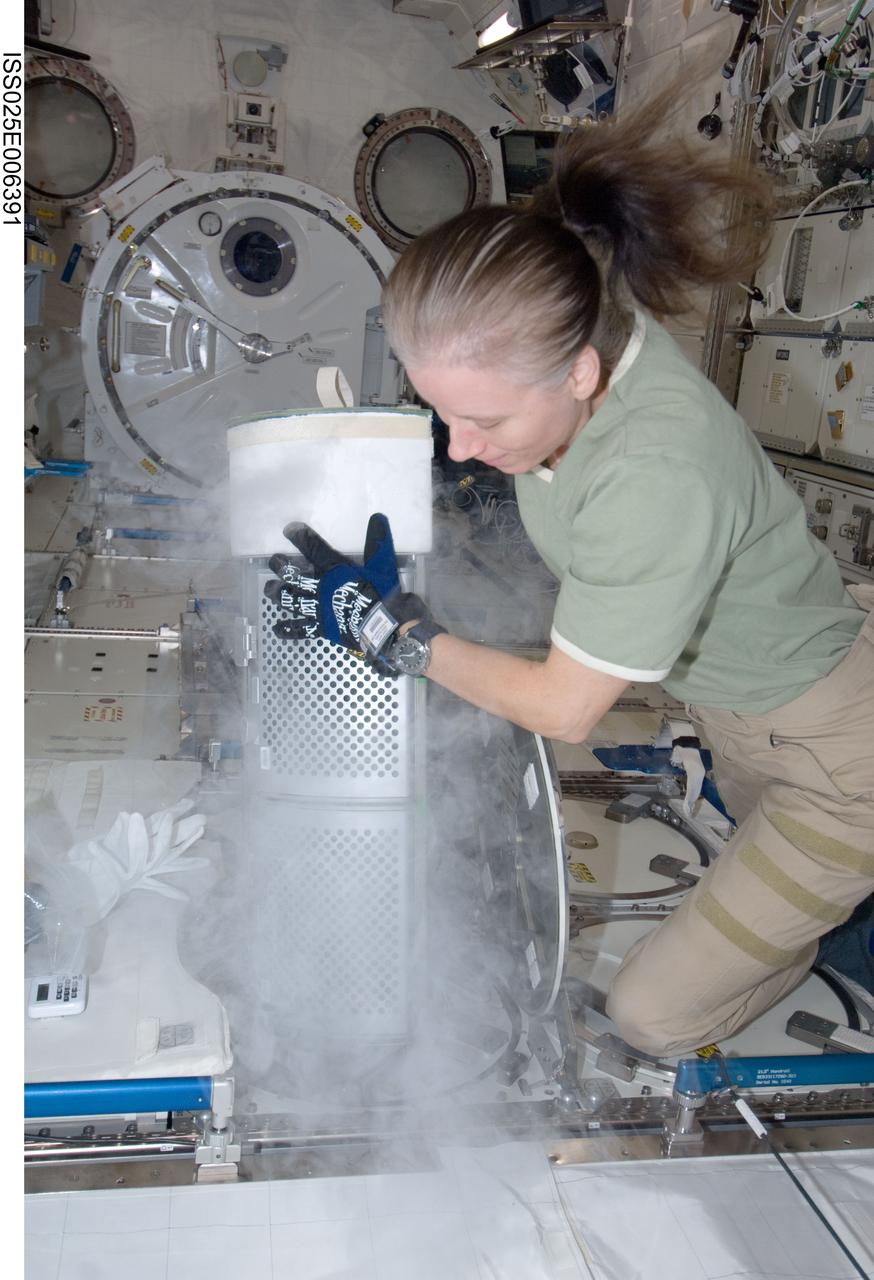
ISS025-E-006391 (8 Oct. 2010) --- NASA astronaut Shannon Walker, Expedition 25 flight engineer, services the Minus Eighty Laboratory Freezer for ISS (MELFI-1) in the Kibo laboratory of the International Space Station.
MELFI Ops
View of Astronaut Reid Wiseman,Expedition 40 flight engineer,inserting urine samples in the Minus Eighty Laboratory Freezer for ISS (MELFI) located in the Japanese Experiment Module (JEM).
HRF – Urine Sample MELFI Insertion
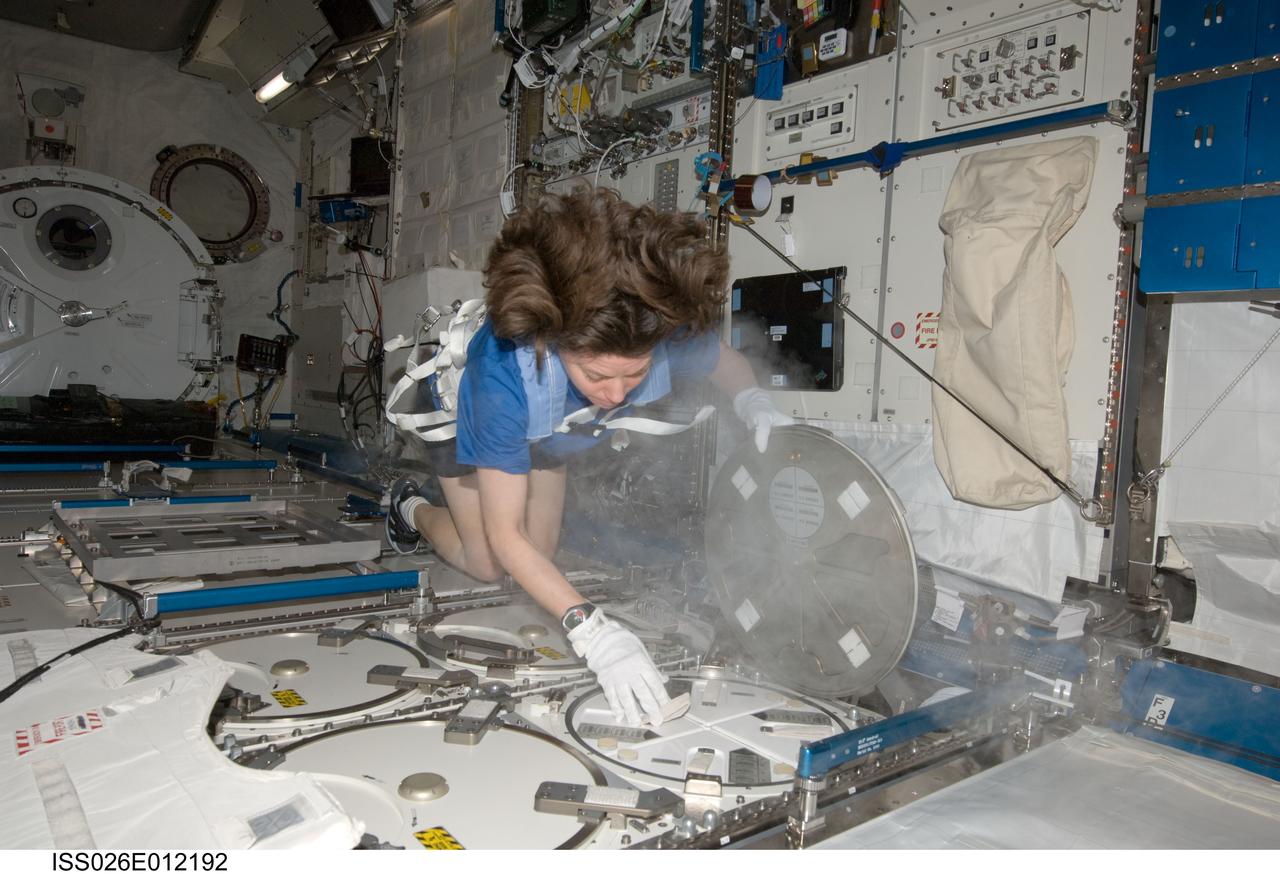
ISS026-E-012192 (26 Dec. 2010) --- NASA astronaut Catherine (Cady) Coleman, Expedition 26 flight engineer, services the Minus Eighty Laboratory Freezer for ISS (MELFI-1) in the Kibo laboratory of the International Space Station.
Coleman at MELFI in the JPM
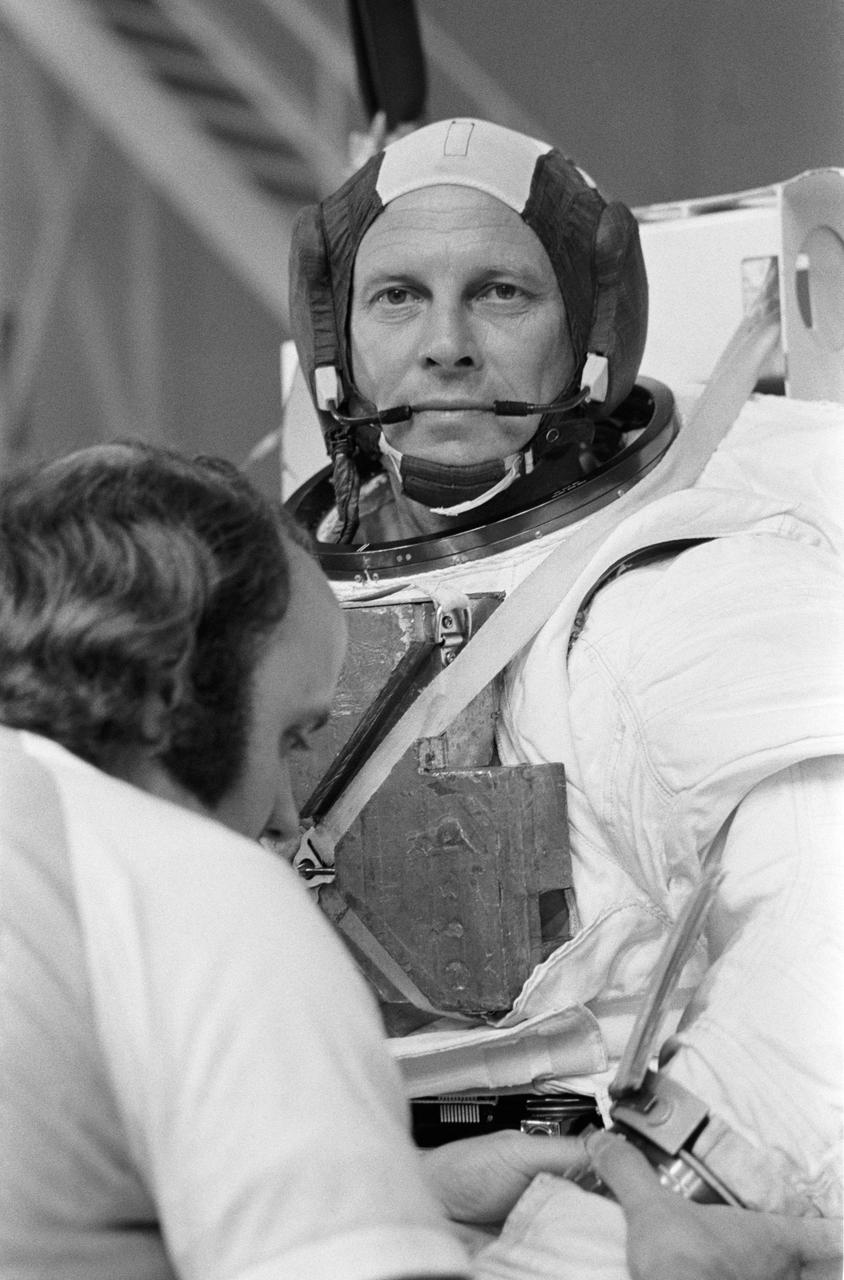
Portrait view of astronaut Jack Lousma in the Extravehicular Mobility Unit (EMU) at bldg 29 Weightless Environment Training Facility (WETF). He is wearing the EMU minus the helmet.
View of astronaut Jack Lousma in the Shuttle spacesuits (EMU) at bldg 29
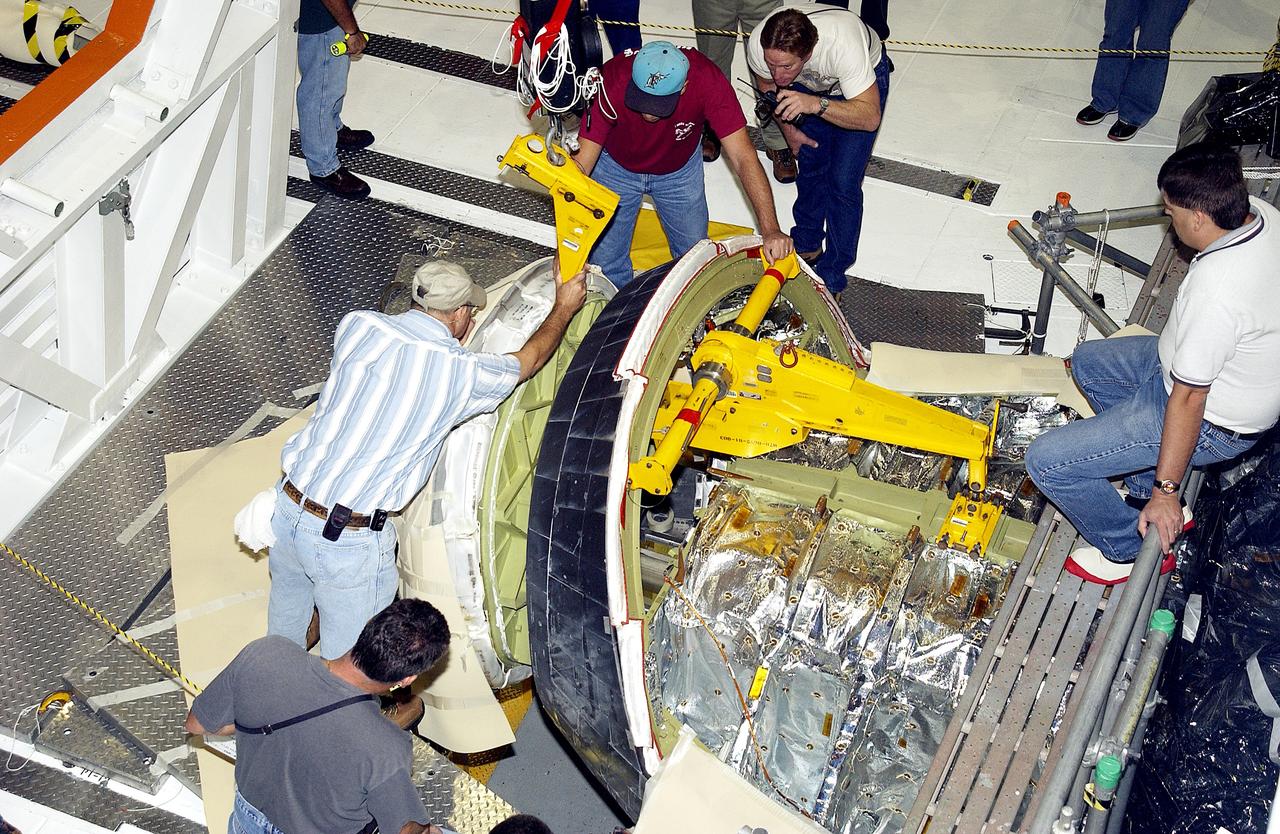
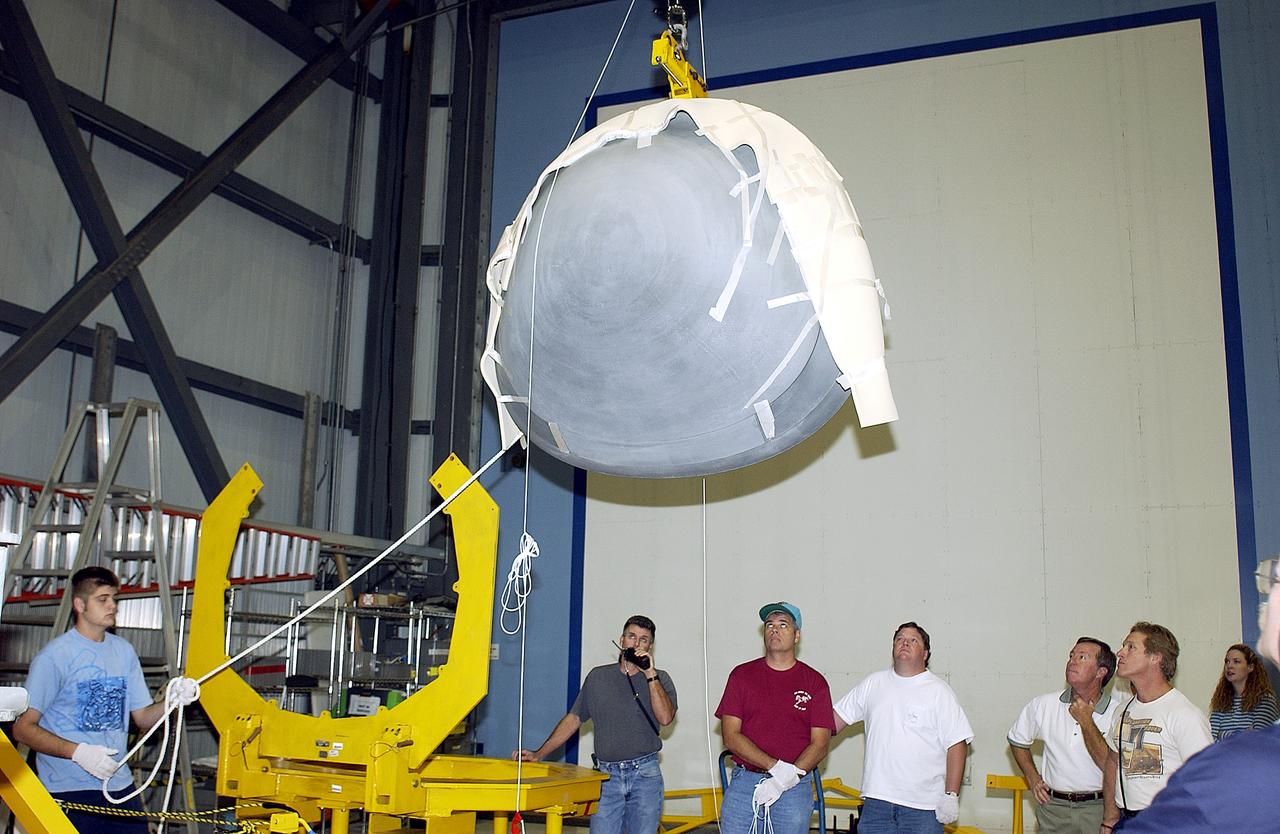
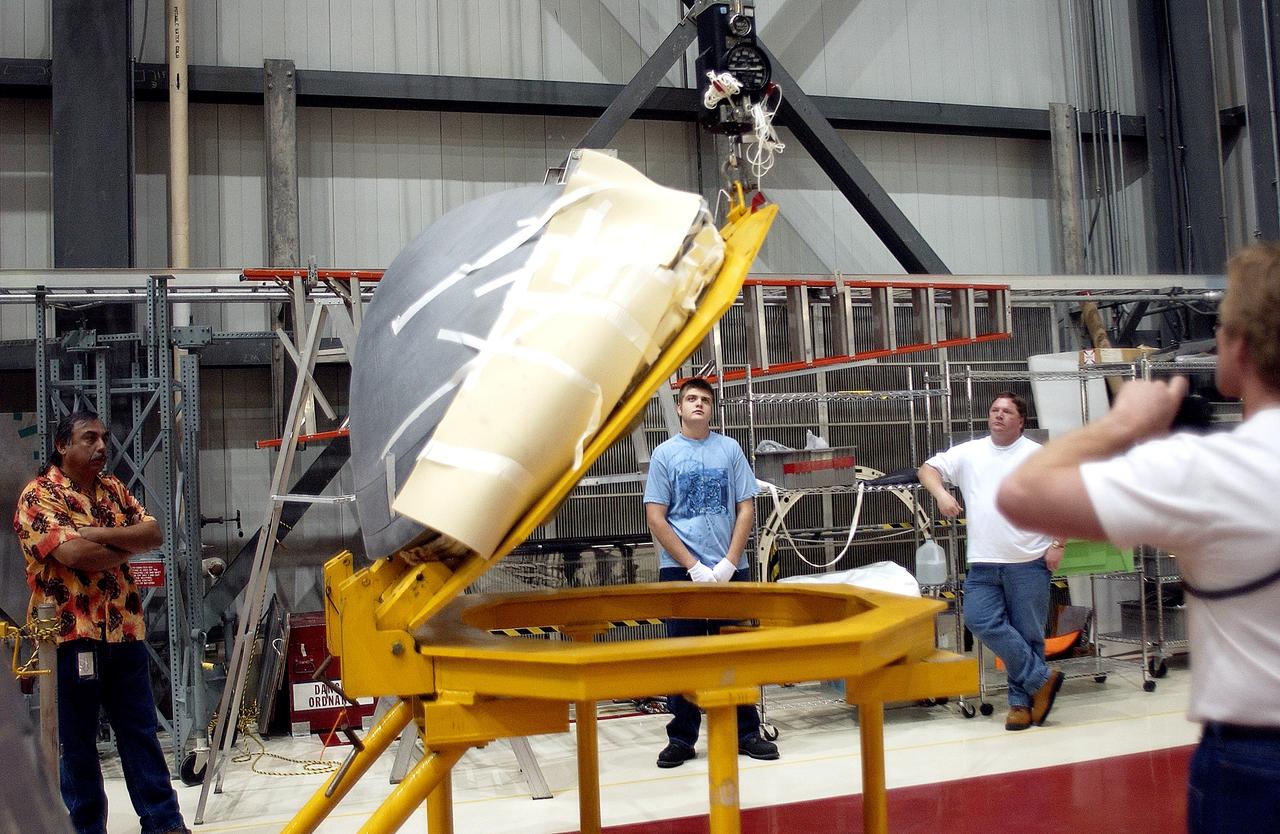
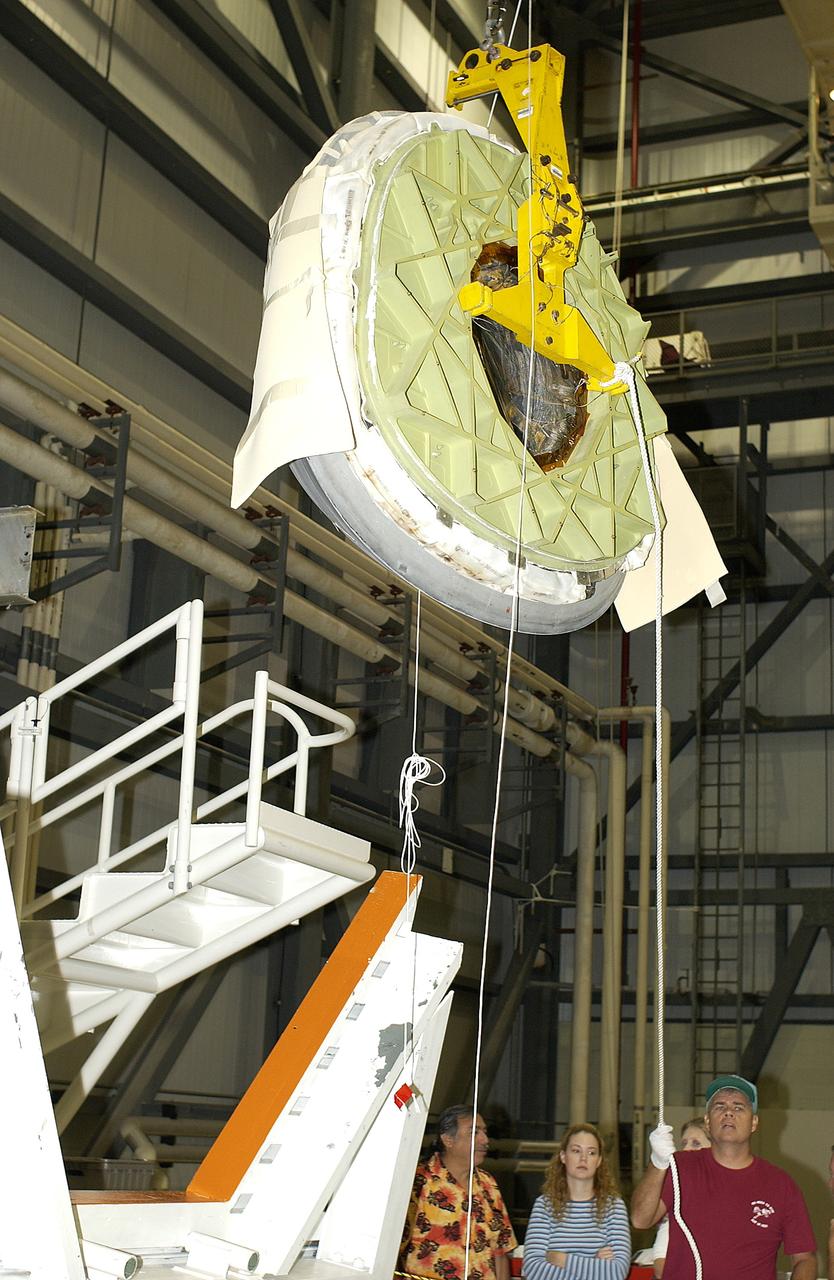
Workers watch as the nose cap of orbiter Endeavour is lowered after removal for routine inspection. The nose cap is made of reinforced carbon-carbon (RCC). The RCC has an operating range of minus 250° F to about 3,000° F.
Delta II - SIRTF Lift and Mate
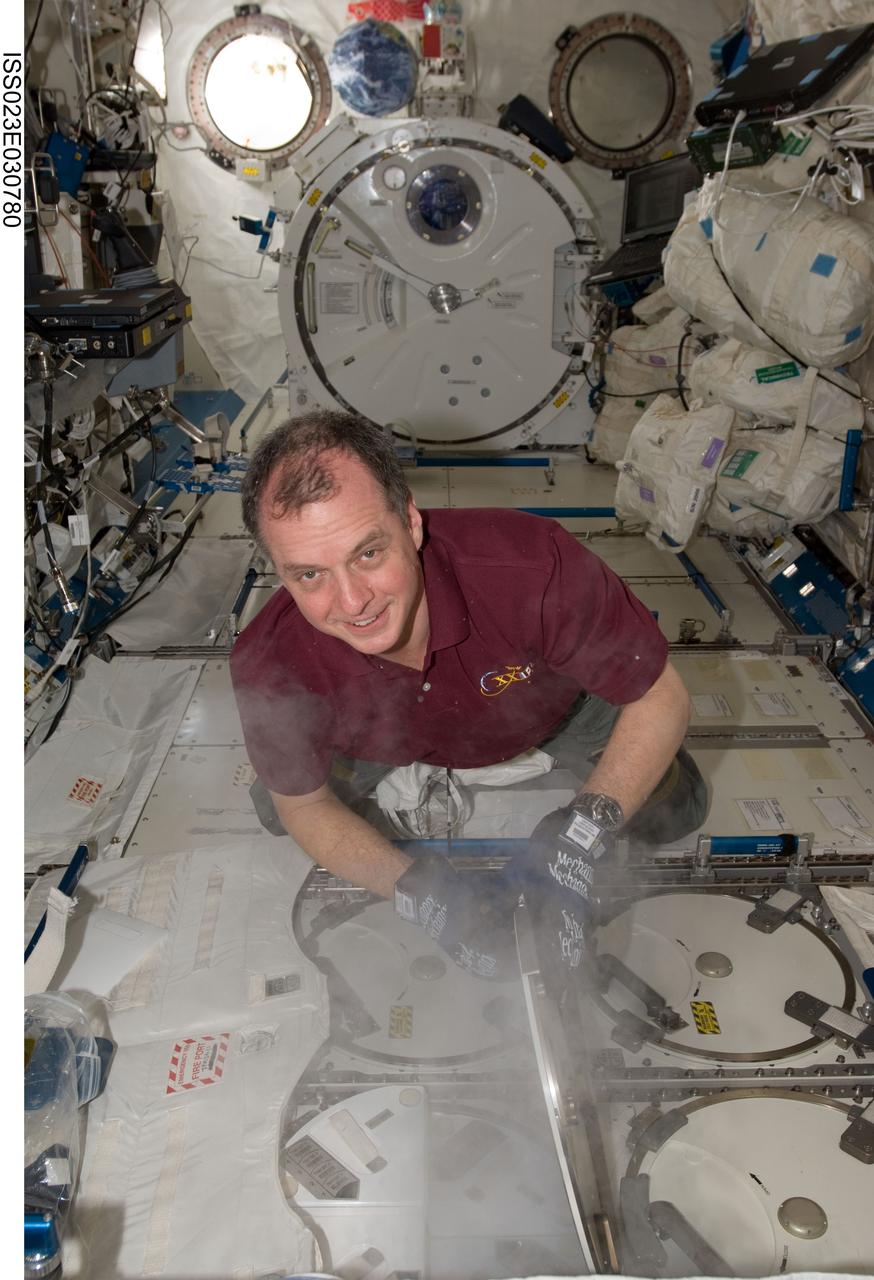
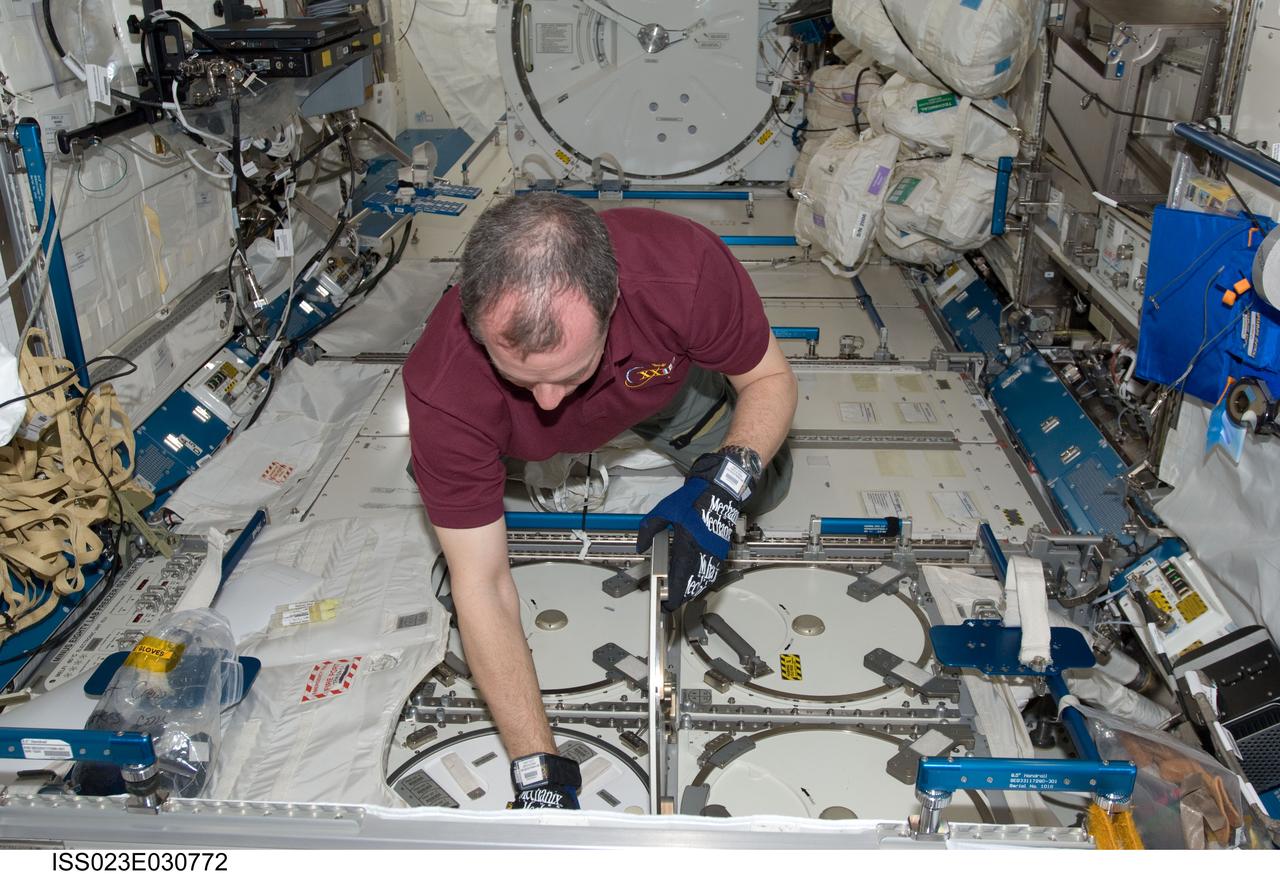
ISS023-E-030772 (2 May 2010) --- NASA astronaut T.J. Creamer, Expedition 23 flight engineer, services the Minus Eighty Laboratory Freezer for ISS (MELFI-1) in the Kibo laboratory of the International Space Station.
Creamer stows urine samples in MELFI
Astronaut Karen Nyberg,Expedition 36 flight engineer,works with samples in Minus Eighty-Degree Laboratory Freezer for ISS (MELFI-3) in the Destiny laboratory of the Earth-orbiting International Space Station.
MELFI ops
View of Astronaut Reid Wiseman,Expedition 40 flight engineer,inserting urine samples in the Minus Eighty Laboratory Freezer for ISS (MELFI) located in the Japanese Experiment Module (JEM).
HRF – Urine Sample MELFI Insertion
The nose cap of orbiter Endeavour is being removed for routine inspection. The nose cap is made of reinforced carbon-carbon (RCC). The RCC has an operating range of minus 250° F to about 3,000° F.
Delta II - SIRTF Lift and Mate
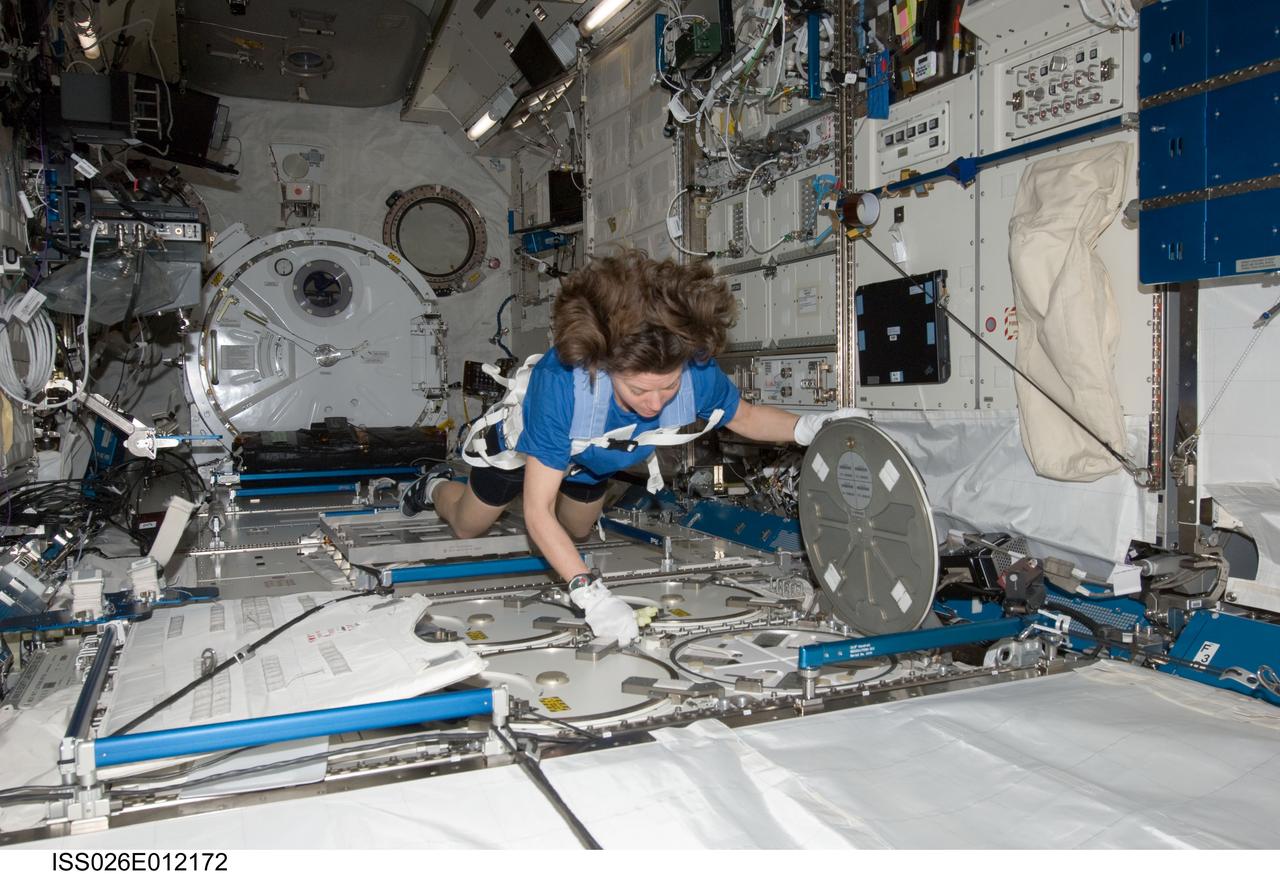
ISS026-E-012172 (26 Dec. 2010) --- NASA astronaut Catherine (Cady) Coleman, Expedition 26 flight engineer, services the Minus Eighty Laboratory Freezer for ISS (MELFI-1) in the Kibo laboratory of the International Space Station.
Coleman at MELFI in the JPM
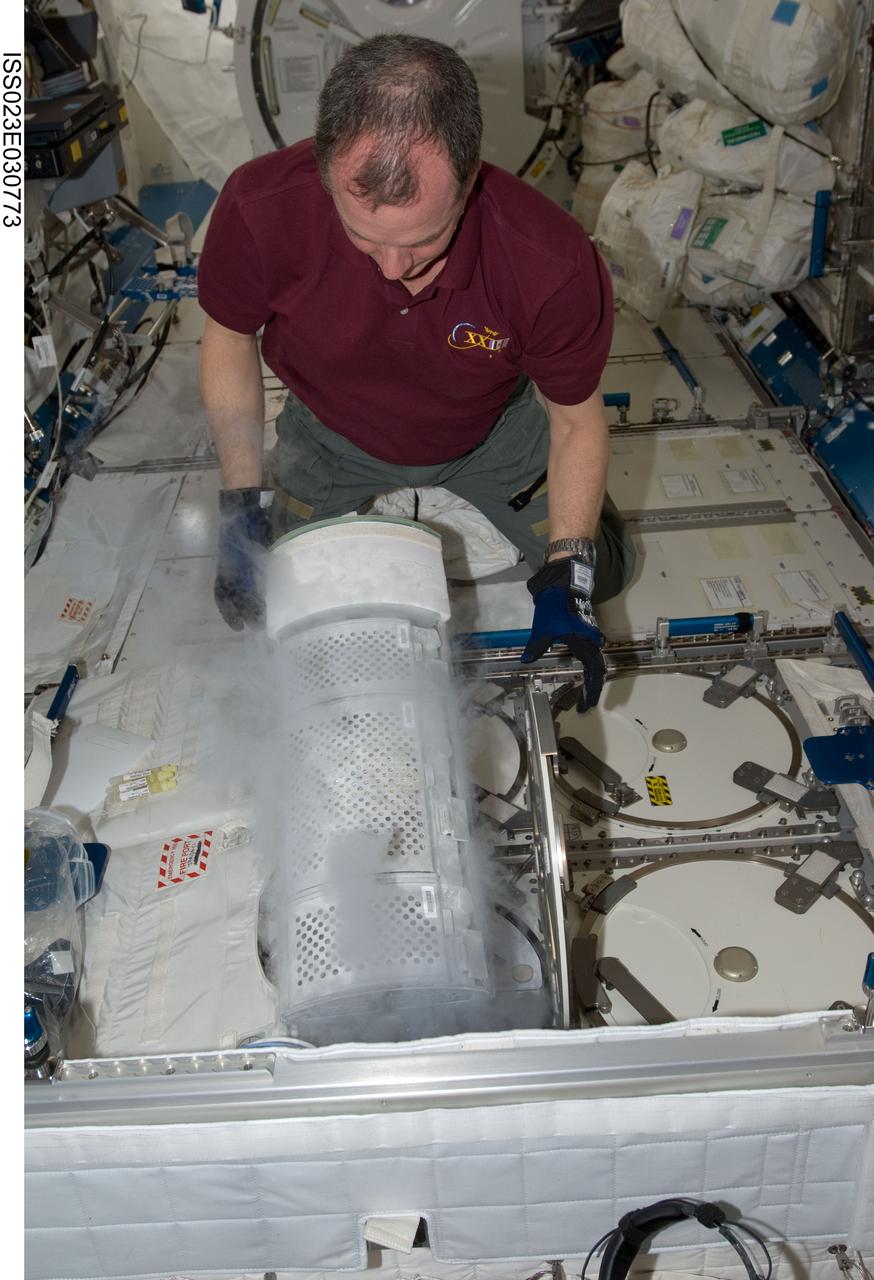
ISS023-E-030773 (2 May 2010) --- NASA astronaut T.J. Creamer, Expedition 23 flight engineer, services the Minus Eighty Laboratory Freezer for ISS (MELFI-1) in the Kibo laboratory of the International Space Station.
Creamer stows urine samples in MELFI
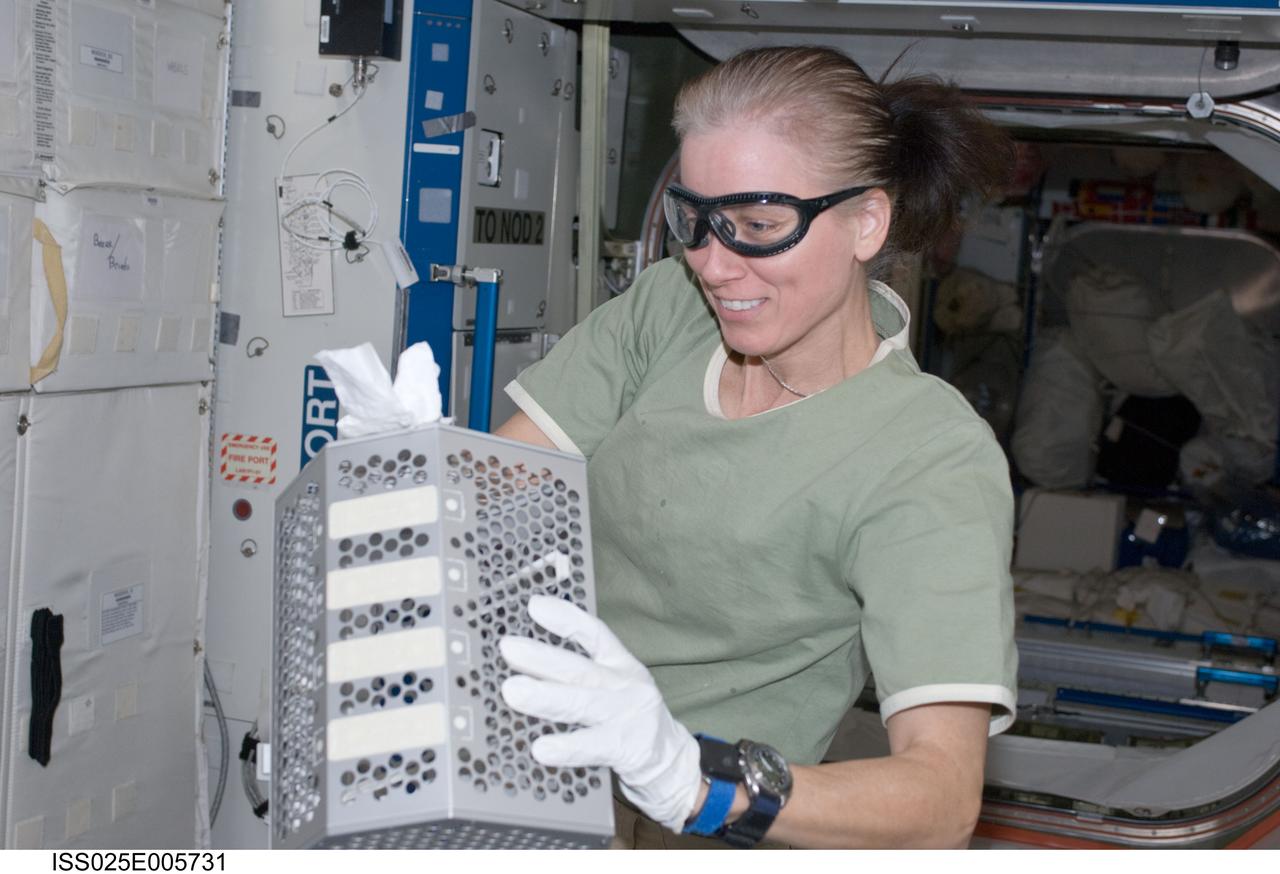
ISS025-E-005731 (1 Oct. 2010) --- NASA astronaut Shannon Walker, Expedition 25 flight engineer, services the Minus Eighty Laboratory Freezer for ISS-2 (MELFI-2) in the Destiny laboratory of the International Space Station.
Walker with MELFI-2 in U.S. Laboratory
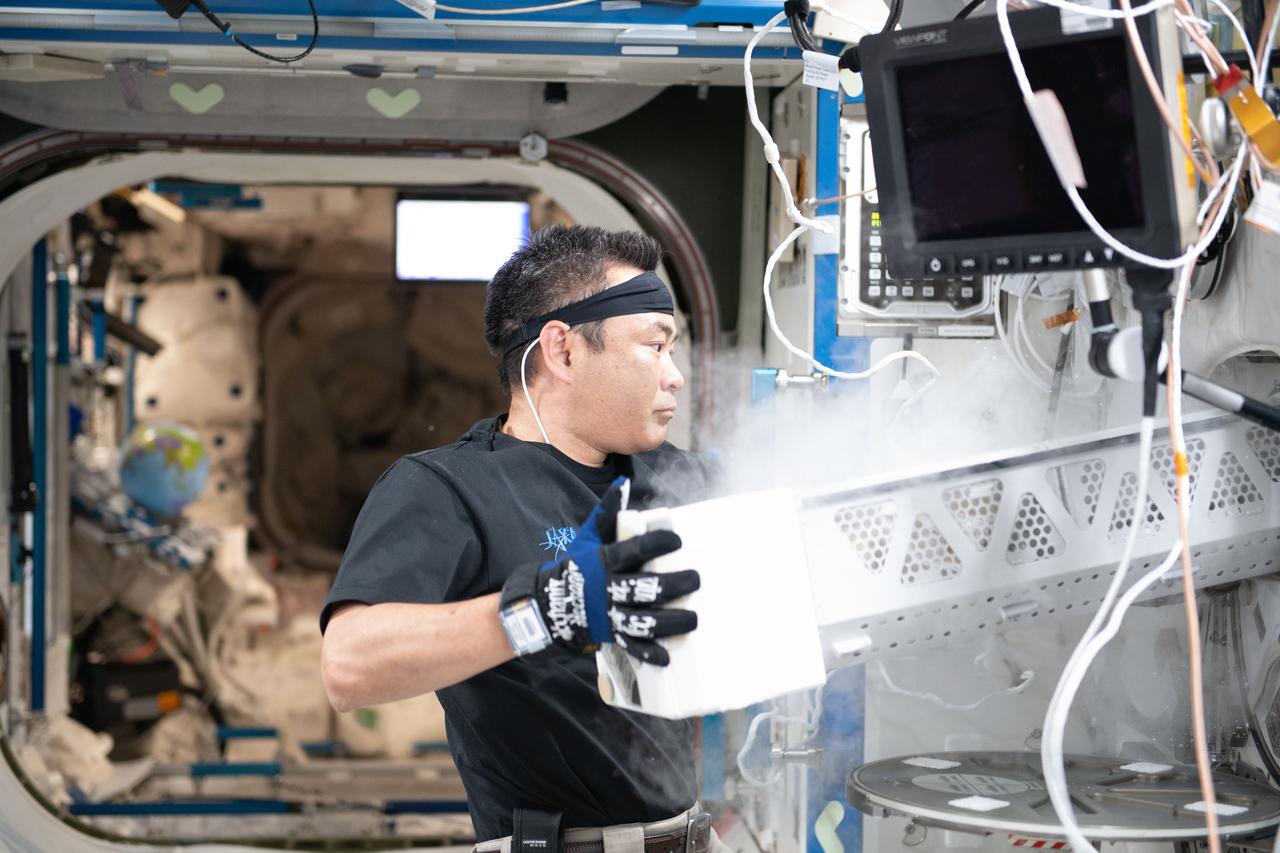
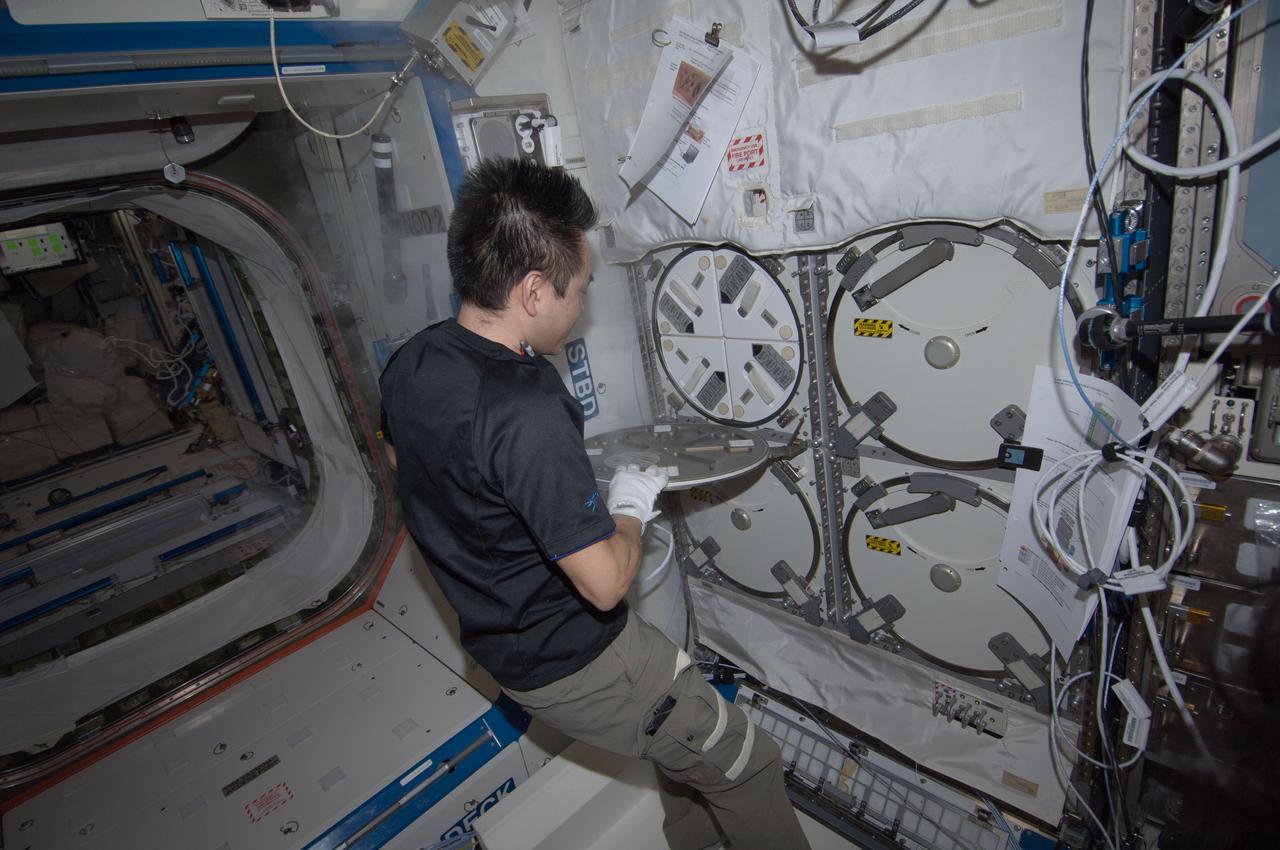
iss065e047574 (May 19, 2021) --- Expedition 65 Commander Akihiko Hoshide of the Japan Aerospace Exploration Agency stows samples inside a science freezer, also known as the Minus Eighty-Degree Laboratory Freezer for ISS (MELFI).
iss065e047574
ISS023-E-030780 (2 May 2010) --- NASA astronaut T.J. Creamer, Expedition 23 flight engineer, services the Minus Eighty Laboratory Freezer for ISS (MELFI-1) in the Kibo laboratory of the International Space Station.
Creamer stows urine samples in MELFI
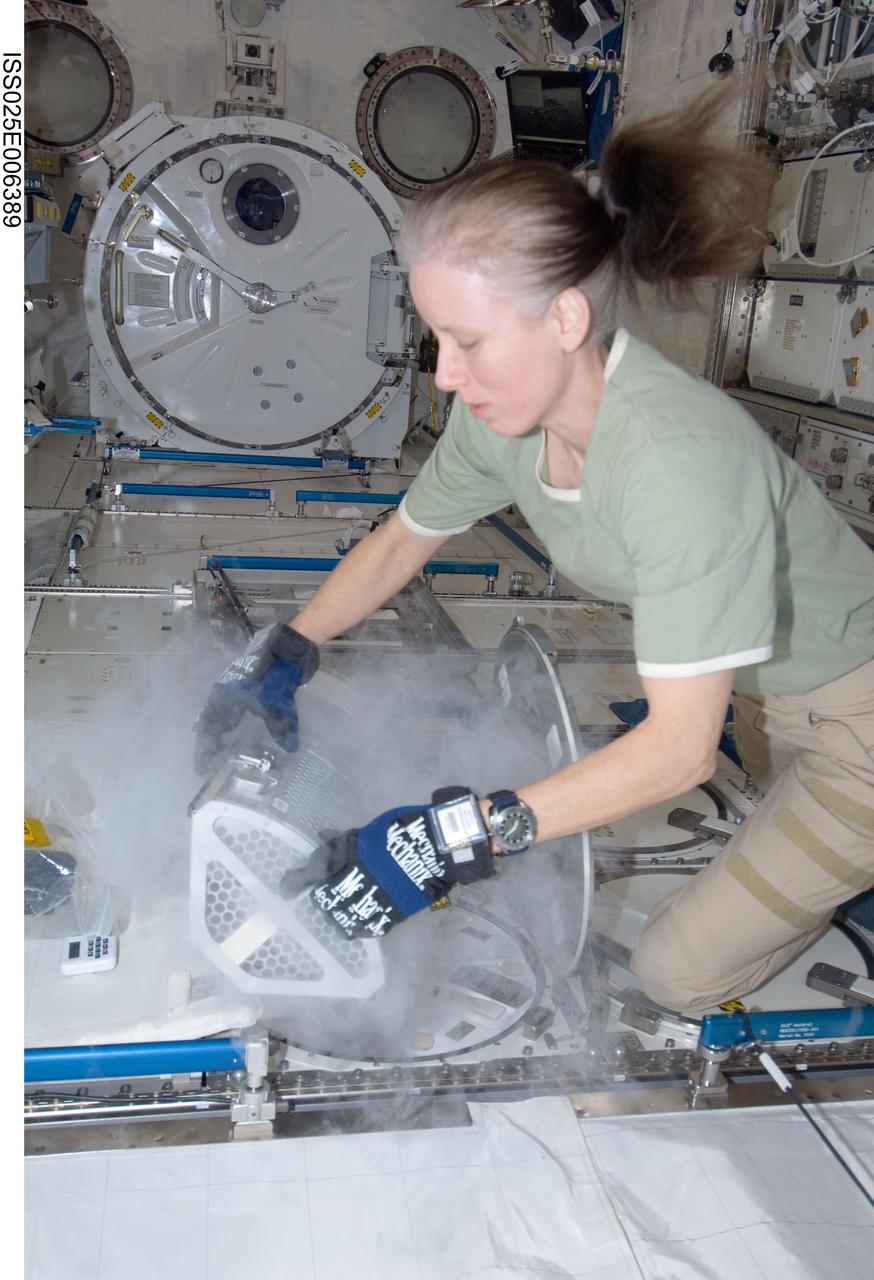
ISS025-E-006389 (8 Oct. 2010) --- NASA astronaut Shannon Walker, Expedition 25 flight engineer, services the Minus Eighty Laboratory Freezer for ISS (MELFI-1) in the Kibo laboratory of the International Space Station.
MELFI Ops
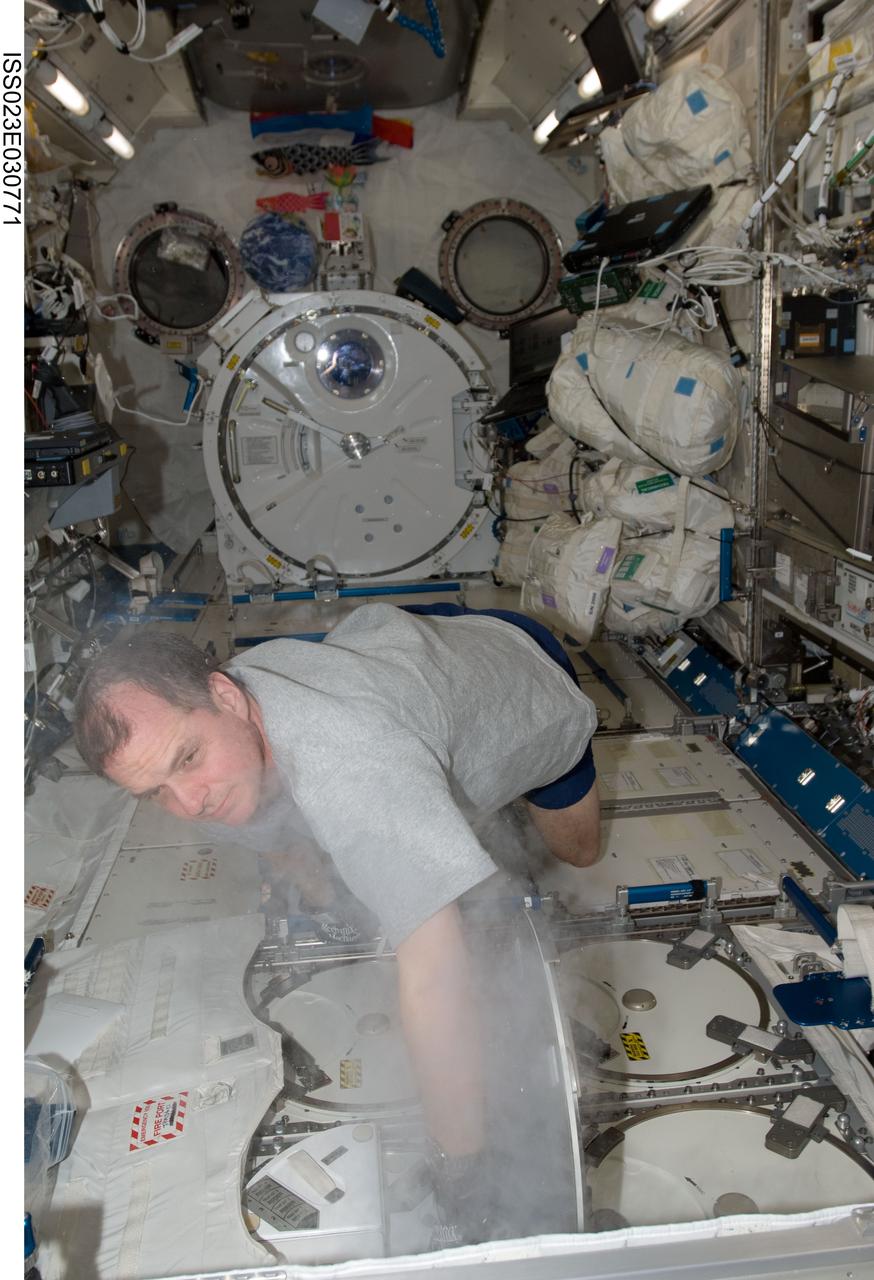
ISS023-E-030771 (2 May 2010) --- NASA astronaut T.J. Creamer, Expedition 23 flight engineer, services the Minus Eighty Laboratory Freezer for ISS (MELFI-1) in the Kibo laboratory of the International Space Station.
Creamer stows urine samples in MELFI
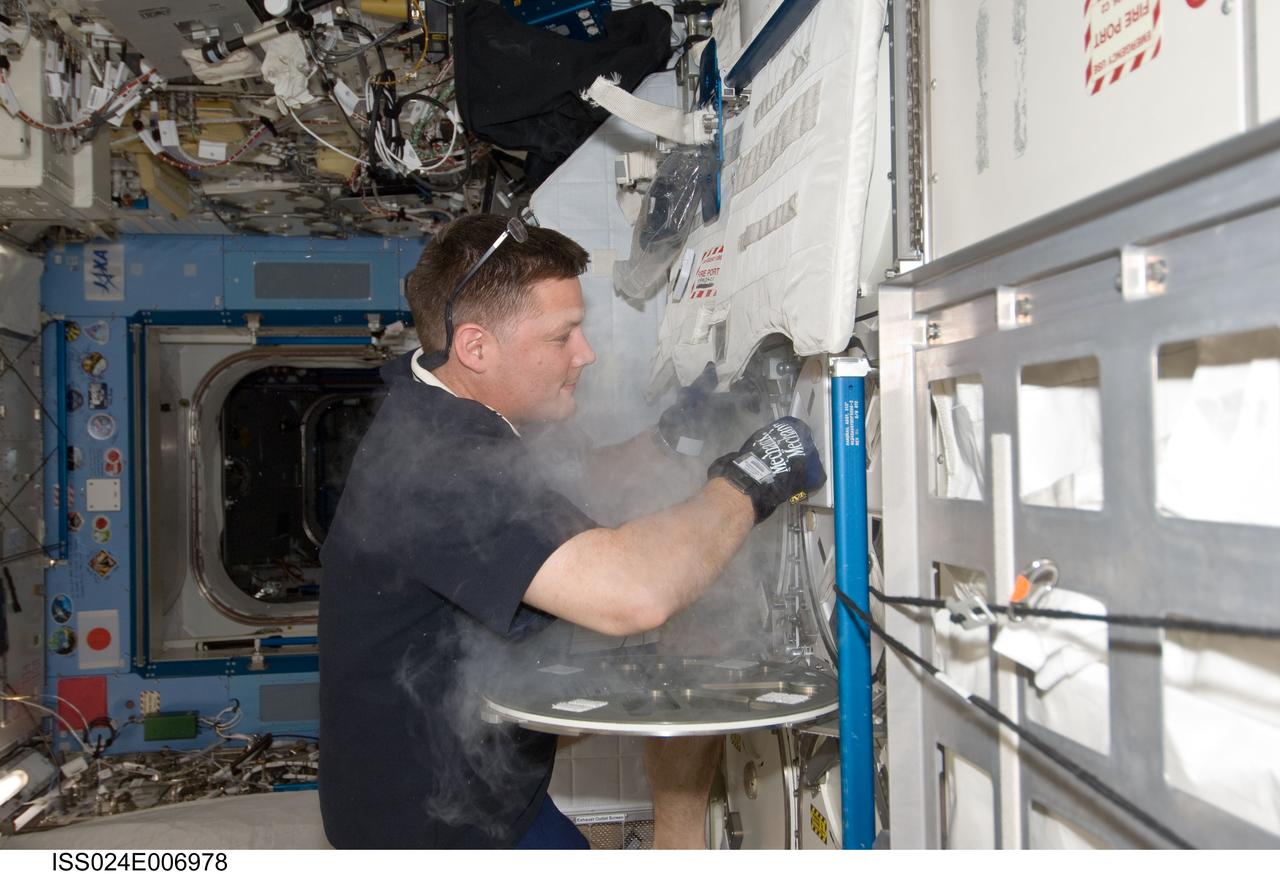
ISS024-E-006978 (27 June 2010) --- NASA astronaut Doug Wheelock, Expedition 24 flight engineer, services the Minus Eighty Laboratory Freezer for ISS (MELFI-1) in the Kibo laboratory of the International Space Station.
Sample stowage in MELFI
ISS026-E-012185 (26 Dec. 2010) --- NASA astronaut Catherine (Cady) Coleman, Expedition 26 flight engineer, services the Minus Eighty Laboratory Freezer for ISS (MELFI-1) in the Kibo laboratory of the International Space Station.
Coleman at MELFI in the JPM
Workers look at orbiter Endeavour after the nose cap was removed for routine inspection. The nose cap is made of reinforced carbon-carbon (RCC). The RCC has an operating range of minus 250° F to about 3,000° F.
Delta II - SIRTF Lift and Mate
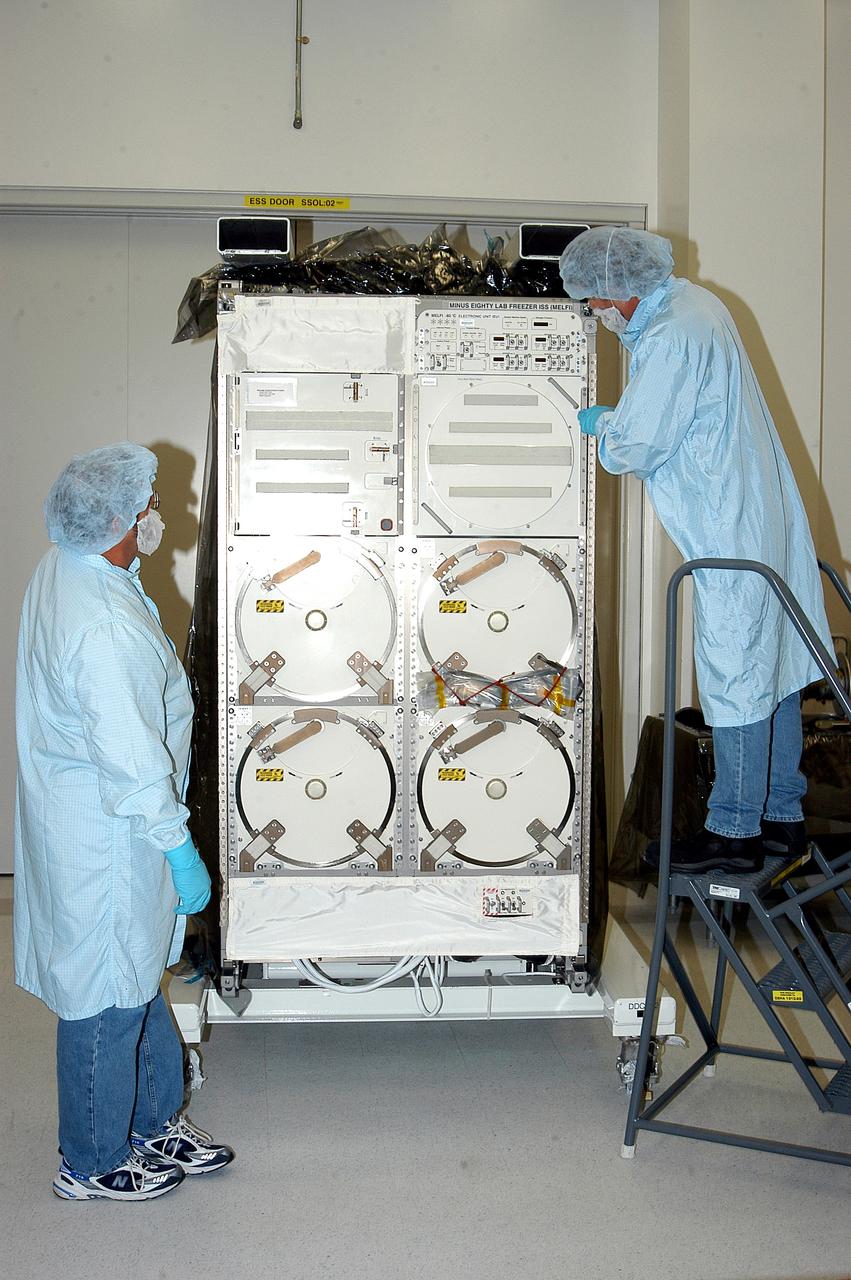
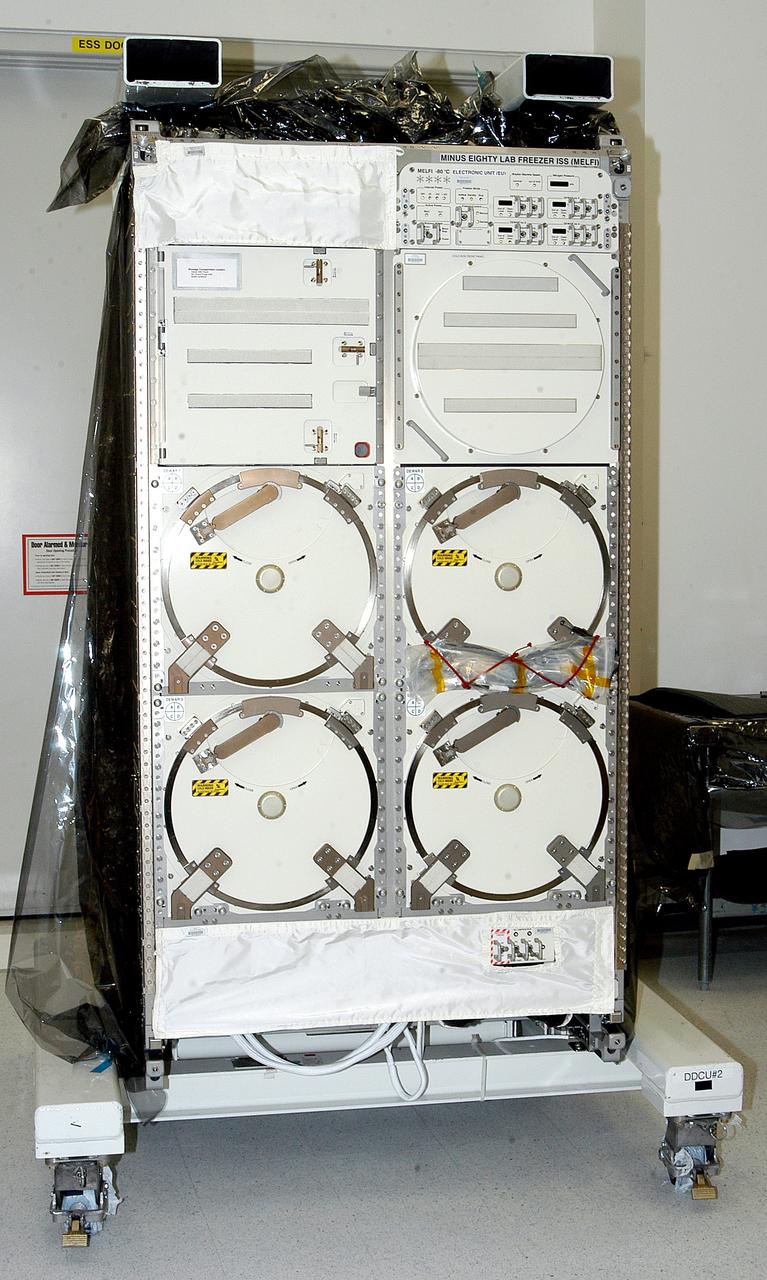
KENNEDY SPACE CENTER, FLA. -  After removing its cover, technicians look over the Minus Eighty Lab Freezer for ISS (MELFI),  provided as Laboratory Support Equipment by the European Space Agency for the International Space Station.  The lab will provide cooling and storage for reagents, samples and perishable materials in four insulated containers called dewars with independently selectable temperatures of -80°C, -26°C, and +4°C. It also will be used to transport samples to and from the station.   The MELFI is planned for launch on the ULF-1 mission.
KENNEDY SPACE CENTER, FLA. - After removing its cover, technicians look over the Minus Eighty Lab Freezer for ISS (MELFI), provided as Laboratory Support Equipment by the European Space Agency for the International Space Station. The lab will provide cooling and storage for reagents, samples and perishable materials in four insulated containers called dewars with independently selectable temperatures of -80°C, -26°C, and +4°C. It also will be used to transport samples to and from the station. The MELFI is planned for launch on the ULF-1 mission.
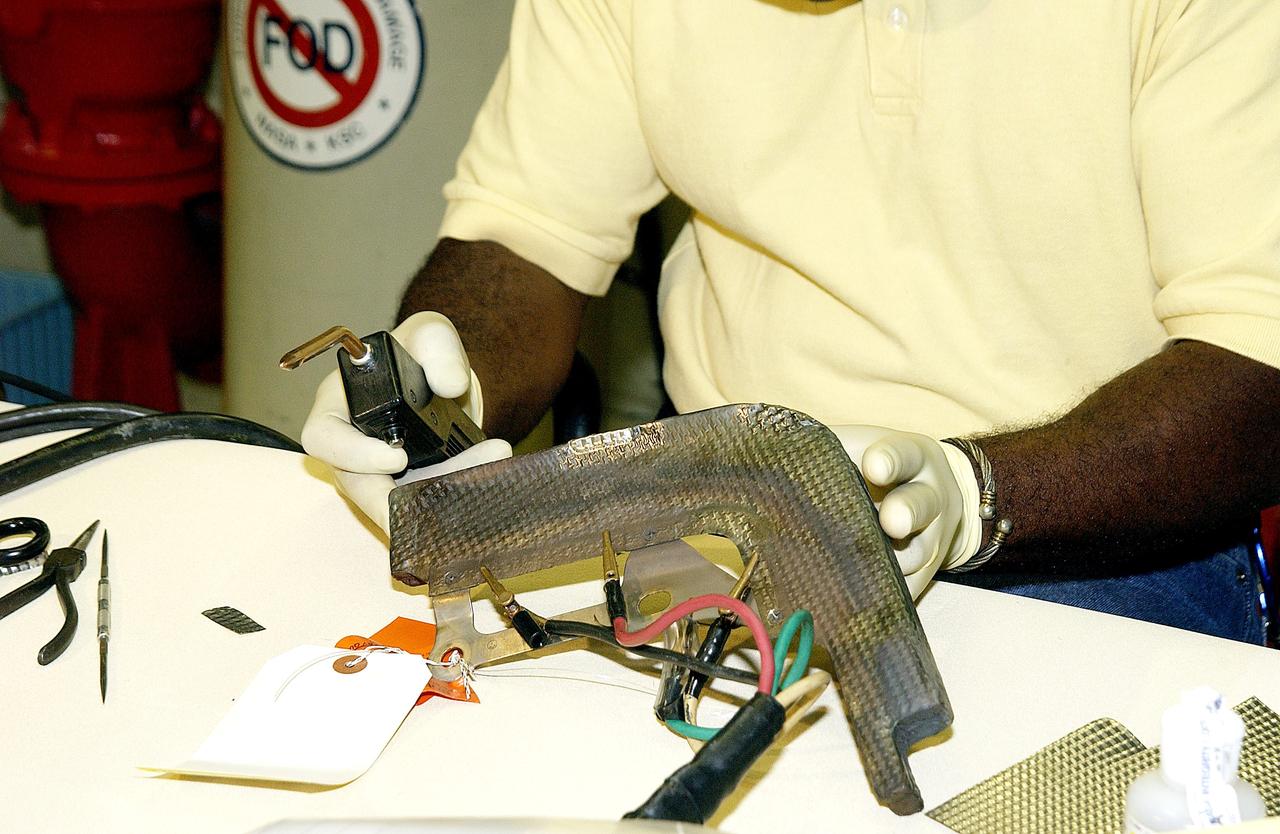
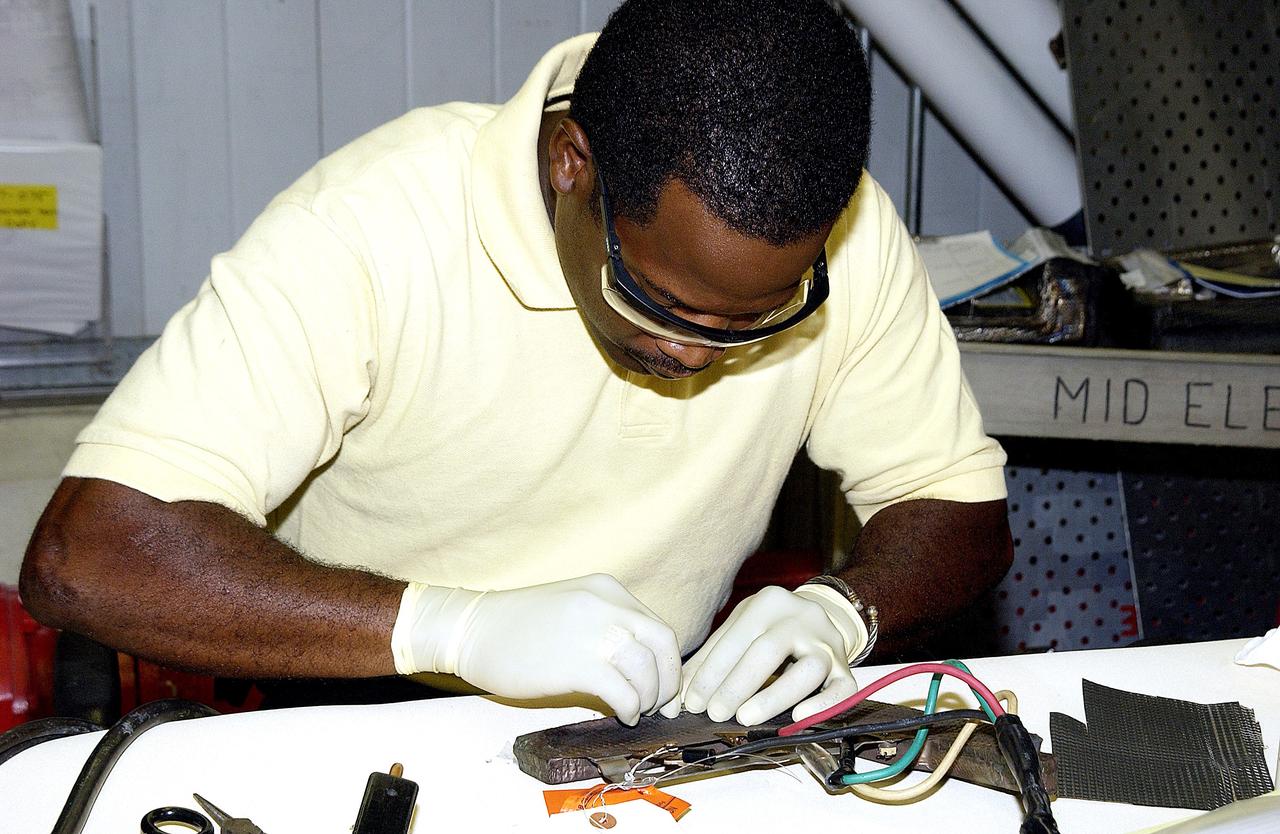
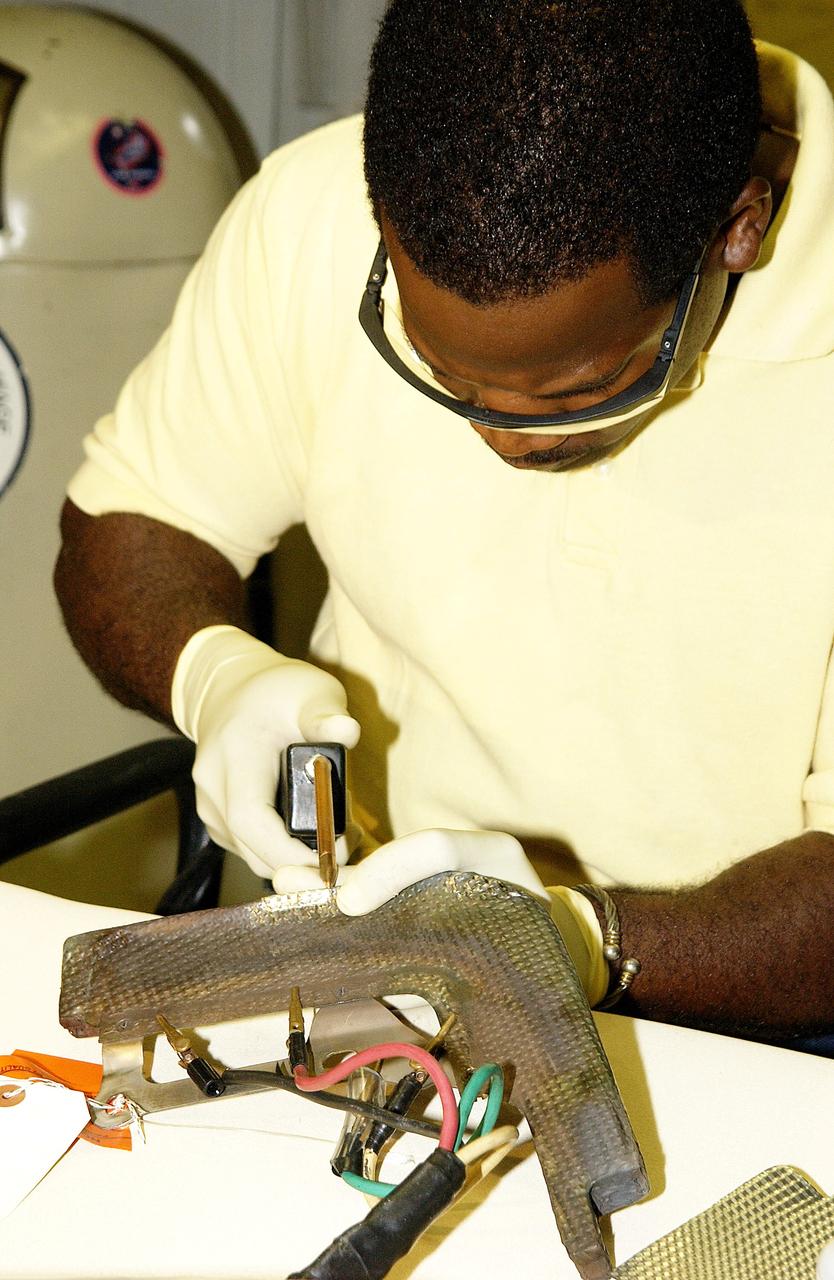
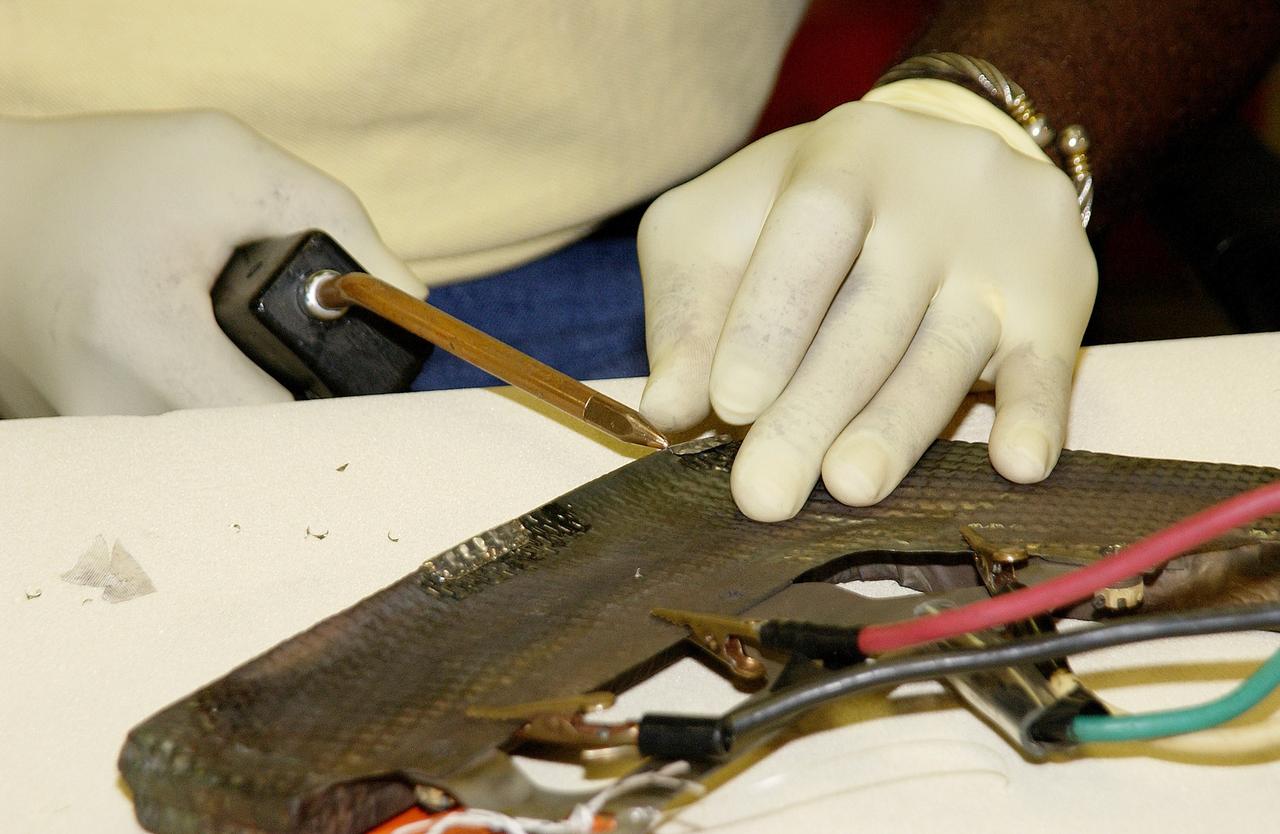
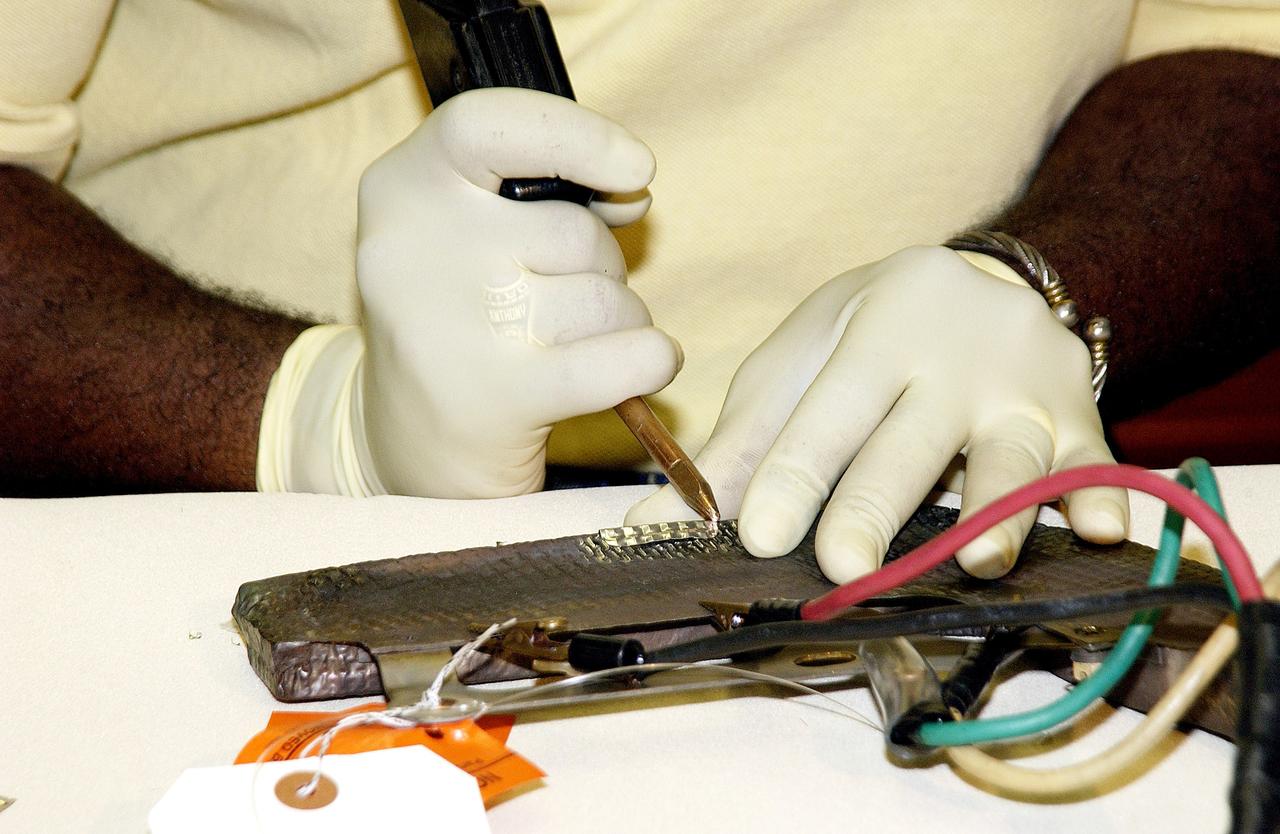
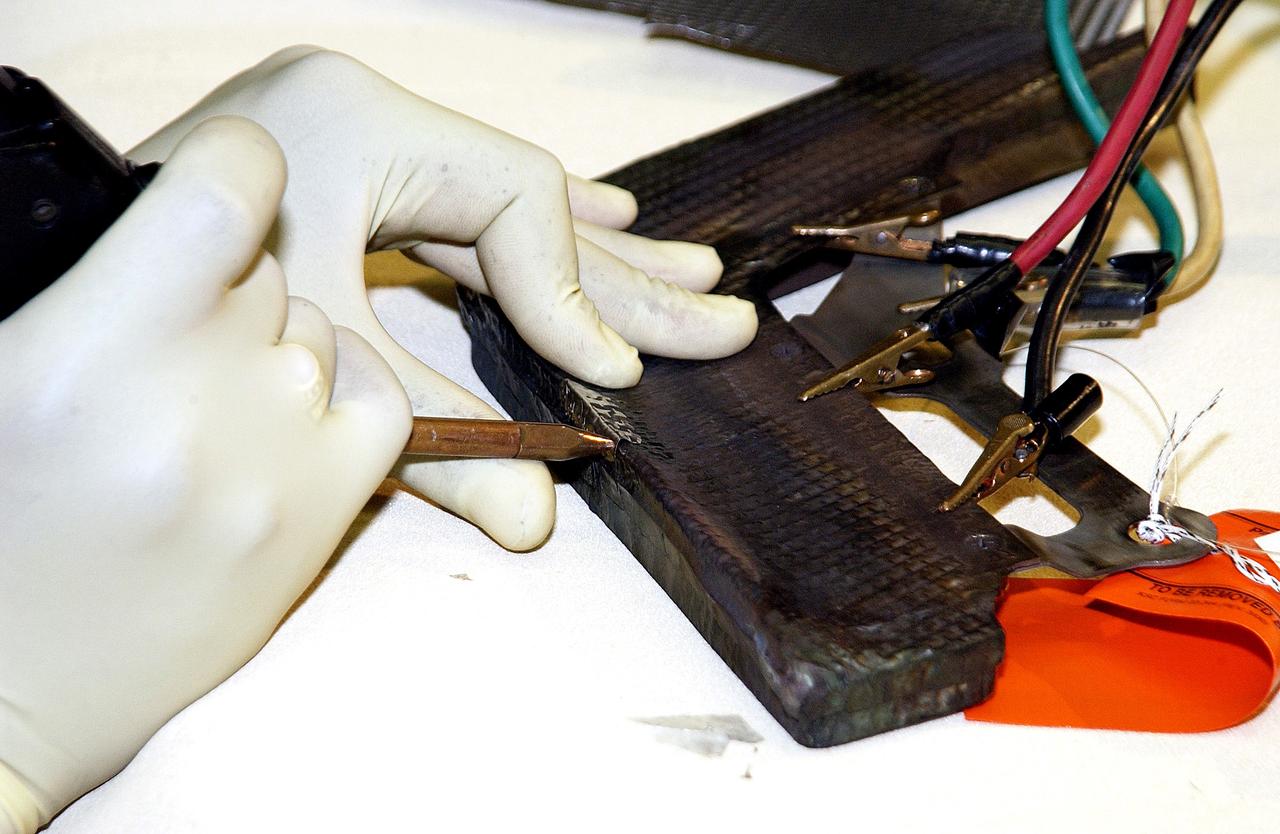
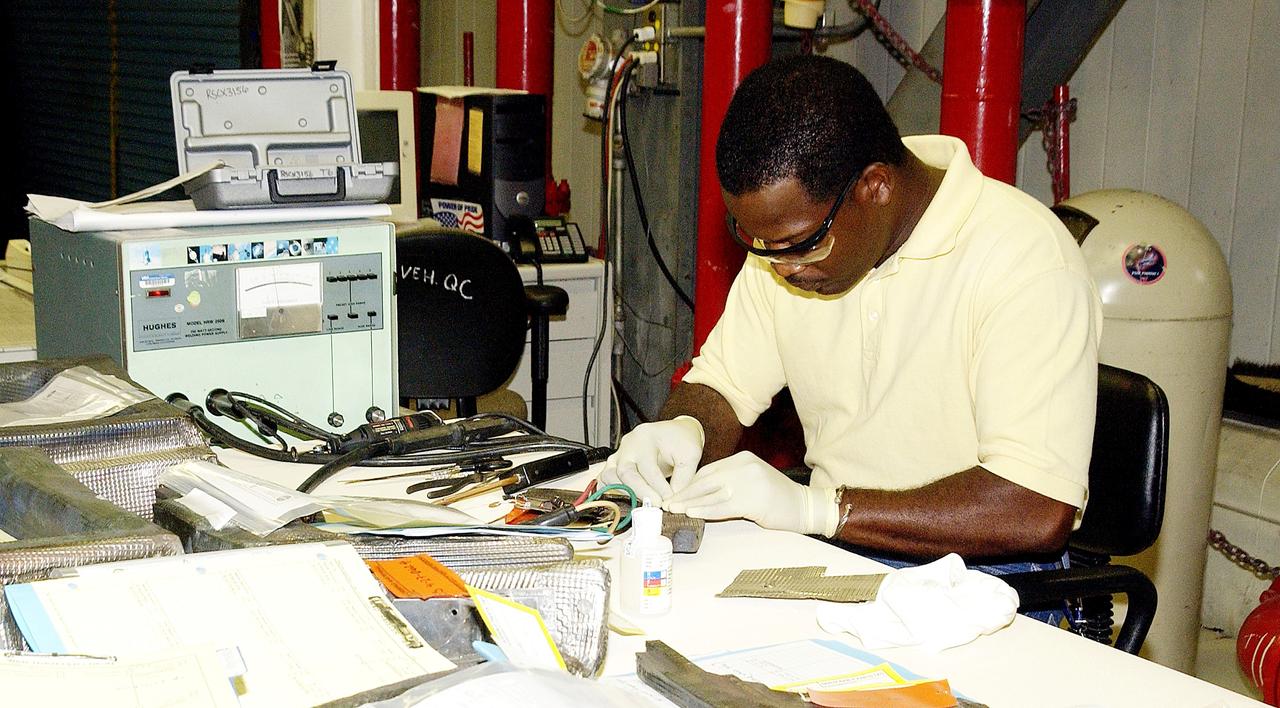
KENNEDY SPACE CENTER, FLA. -   United Space Alliance employee Anthony Simmons continues electrowelding on an insulator inside a Reinforced Carbon Carbon panel.   The gray carbon composite RCC panels are attached to the leading edge of the wing of the orbiters to withstand the aerodynamic forces experienced during launch and reentry, which can reach as high as 800 pounds per square foot.  The operating range of RCC is from minus 250º F to about 3,000º F, the temperature produced by friction with the atmosphere during reentry.
KENNEDY SPACE CENTER, FLA. - United Space Alliance employee Anthony Simmons continues electrowelding on an insulator inside a Reinforced Carbon Carbon panel. The gray carbon composite RCC panels are attached to the leading edge of the wing of the orbiters to withstand the aerodynamic forces experienced during launch and reentry, which can reach as high as 800 pounds per square foot. The operating range of RCC is from minus 250º F to about 3,000º F, the temperature produced by friction with the atmosphere during reentry.
KENNEDY SPACE CENTER, FLA. -  United Space Alliance employee Anthony Simmons electrowelds a crack formed in the insulator inside a Reinforced Carbon Carbon panel.   The gray carbon composite RCC panels are attached to the leading edge of the wing of the orbiters to withstand the aerodynamic forces experienced during launch and reentry, which can reach as high as 800 pounds per square foot.  The operating range of RCC is from minus 250º F to about 3,000º F, the temperature produced by friction with the atmosphere during reentry.
KENNEDY SPACE CENTER, FLA. - United Space Alliance employee Anthony Simmons electrowelds a crack formed in the insulator inside a Reinforced Carbon Carbon panel. The gray carbon composite RCC panels are attached to the leading edge of the wing of the orbiters to withstand the aerodynamic forces experienced during launch and reentry, which can reach as high as 800 pounds per square foot. The operating range of RCC is from minus 250º F to about 3,000º F, the temperature produced by friction with the atmosphere during reentry.
KENNEDY SPACE CENTER, FLA. -   United Space Alliance employee Anthony Simmons continues electrowelding on an insulator inside a Reinforced Carbon Carbon panel.   The gray carbon composite RCC panels are attached to the leading edge of the wing of the orbiters to withstand the aerodynamic forces experienced during launch and reentry, which can reach as high as 800 pounds per square foot.  The operating range of RCC is from minus 250º F to about 3,000º F, the temperature produced by friction with the atmosphere during reentry.
KENNEDY SPACE CENTER, FLA. - United Space Alliance employee Anthony Simmons continues electrowelding on an insulator inside a Reinforced Carbon Carbon panel. The gray carbon composite RCC panels are attached to the leading edge of the wing of the orbiters to withstand the aerodynamic forces experienced during launch and reentry, which can reach as high as 800 pounds per square foot. The operating range of RCC is from minus 250º F to about 3,000º F, the temperature produced by friction with the atmosphere during reentry.
KENNEDY SPACE CENTER, FLA. -  The Minus Eighty Lab Freezer for ISS (MELFI), provided as Laboratory Support Equipment by the European Space Agency for the International Space Station, is seen in the Space Station Processing Facility.  The lab will provide cooling and storage for reagents, samples and perishable materials in four insulated containers called dewars with independently selectable temperatures of -80°C, -26°C, and +4°C. It also will be used to transport samples to and from the station.   The MELFI is planned for launch on the ULF-1 mission.
KENNEDY SPACE CENTER, FLA. - The Minus Eighty Lab Freezer for ISS (MELFI), provided as Laboratory Support Equipment by the European Space Agency for the International Space Station, is seen in the Space Station Processing Facility. The lab will provide cooling and storage for reagents, samples and perishable materials in four insulated containers called dewars with independently selectable temperatures of -80°C, -26°C, and +4°C. It also will be used to transport samples to and from the station. The MELFI is planned for launch on the ULF-1 mission.
KENNEDY SPACE CENTER, FLA. - United Space Alliance employee Anthony Simmons checks the electroweld he performed on an insulator inside a Reinforced Carbon Carbon panel.   The gray carbon composite RCC panels are attached to the leading edge of the wing of the orbiters to withstand the aerodynamic forces experienced during launch and reentry, which can reach as high as 800 pounds per square foot.  The operating range of RCC is from minus 250º F to about 3,000º F, the temperature produced by friction with the atmosphere during reentry.
KENNEDY SPACE CENTER, FLA. - United Space Alliance employee Anthony Simmons checks the electroweld he performed on an insulator inside a Reinforced Carbon Carbon panel. The gray carbon composite RCC panels are attached to the leading edge of the wing of the orbiters to withstand the aerodynamic forces experienced during launch and reentry, which can reach as high as 800 pounds per square foot. The operating range of RCC is from minus 250º F to about 3,000º F, the temperature produced by friction with the atmosphere during reentry.
KENNEDY SPACE CENTER, FLA. -   United Space Alliance employee Anthony Simmons prepares to electroweld a crack found on an insulator inside a Reinforced Carbon Carbon panel.   The gray carbon composite RCC panels are attached to the leading edge of the wing of the orbiters to withstand the aerodynamic forces experienced during launch and reentry, which can reach as high as 800 pounds per square foot.  The operating range of RCC is from minus 250º F to about 3,000º F, the temperature produced by friction with the atmosphere during reentry.
KENNEDY SPACE CENTER, FLA. - United Space Alliance employee Anthony Simmons prepares to electroweld a crack found on an insulator inside a Reinforced Carbon Carbon panel. The gray carbon composite RCC panels are attached to the leading edge of the wing of the orbiters to withstand the aerodynamic forces experienced during launch and reentry, which can reach as high as 800 pounds per square foot. The operating range of RCC is from minus 250º F to about 3,000º F, the temperature produced by friction with the atmosphere during reentry.
KENNEDY SPACE CENTER, FLA. -  United Space Alliance employee Anthony Simmons electrowelds a crack formed in the insulator inside a Reinforced Carbon Carbon panel.   The gray carbon composite RCC panels are attached to the leading edge of the wing of the orbiters to withstand the aerodynamic forces experienced during launch and reentry, which can reach as high as 800 pounds per square foot.  The operating range of RCC is from minus 250º F to about 3,000º F, the temperature produced by friction with the atmosphere during reentry.
KENNEDY SPACE CENTER, FLA. - United Space Alliance employee Anthony Simmons electrowelds a crack formed in the insulator inside a Reinforced Carbon Carbon panel. The gray carbon composite RCC panels are attached to the leading edge of the wing of the orbiters to withstand the aerodynamic forces experienced during launch and reentry, which can reach as high as 800 pounds per square foot. The operating range of RCC is from minus 250º F to about 3,000º F, the temperature produced by friction with the atmosphere during reentry.
KENNEDY SPACE CENTER, FLA. -  United Space Alliance employee Anthony Simmons prepares to electroweld a crack formed in the insulator inside a Reinforced Carbon Carbon panel.   The gray carbon composite RCC panels are attached to the leading edge of the wing of the orbiters to withstand the aerodynamic forces experienced during launch and reentry, which can reach as high as 800 pounds per square foot.  The operating range of RCC is from minus 250º F to about 3,000º F, the temperature produced by friction with the atmosphere during reentry.
KENNEDY SPACE CENTER, FLA. - United Space Alliance employee Anthony Simmons prepares to electroweld a crack formed in the insulator inside a Reinforced Carbon Carbon panel. The gray carbon composite RCC panels are attached to the leading edge of the wing of the orbiters to withstand the aerodynamic forces experienced during launch and reentry, which can reach as high as 800 pounds per square foot. The operating range of RCC is from minus 250º F to about 3,000º F, the temperature produced by friction with the atmosphere during reentry.
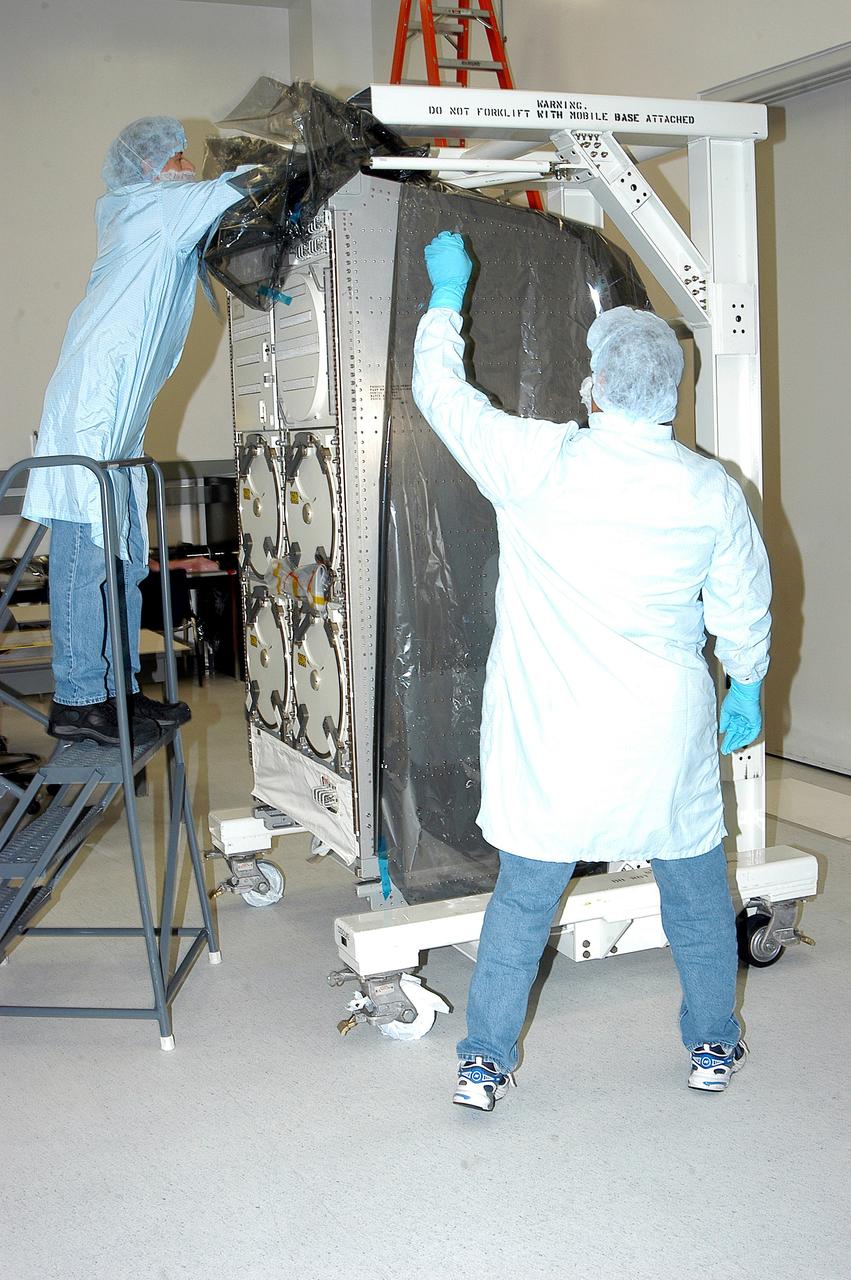
KENNEDY SPACE CENTER, FLA. -  In the Space Station Processing Facility, technicians remove the cover from the Minus Eighty Lab Freezer for ISS(MELFI) provided as Laboratory Support Equipment by the European Space Agency for the International Space Station.  The lab will provide cooling and storage for reagents, samples and perishable materials in four insulated containers called dewars with independently selectable temperatures of -80°C, -26°C, and +4°C. It also will be used to transport samples to and from the station.   The MELFI is planned for launch on the ULF-1 mission.
KENNEDY SPACE CENTER, FLA. - In the Space Station Processing Facility, technicians remove the cover from the Minus Eighty Lab Freezer for ISS(MELFI) provided as Laboratory Support Equipment by the European Space Agency for the International Space Station. The lab will provide cooling and storage for reagents, samples and perishable materials in four insulated containers called dewars with independently selectable temperatures of -80°C, -26°C, and +4°C. It also will be used to transport samples to and from the station. The MELFI is planned for launch on the ULF-1 mission.
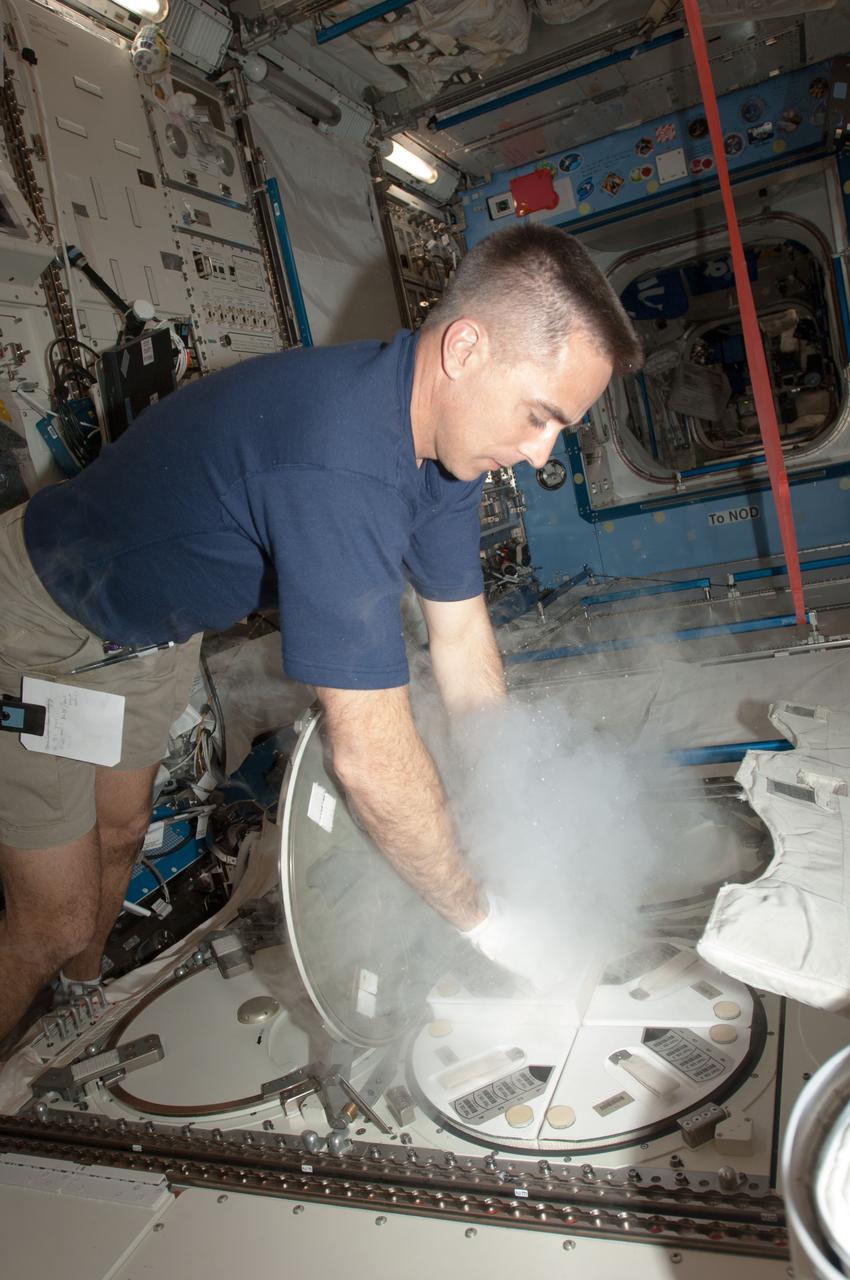
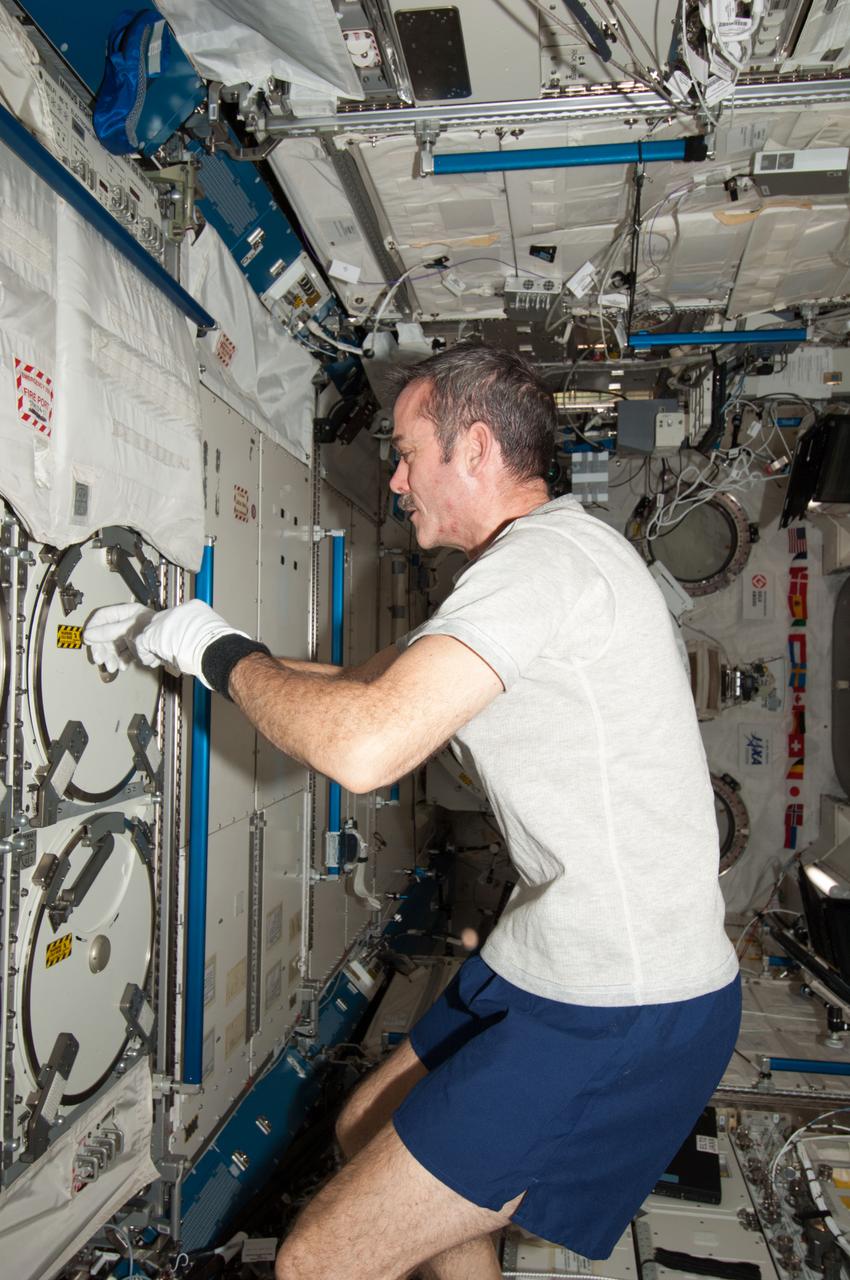
ISS034-E-023768 (7 Jan. 2013) --- Canadian Space Agency astronaut Chris Hadfield, Expedition 34 flight engineer, prepares to insert biological samples in the Minus Eighty Laboratory Freezer for ISS (MELFI-1) in the Kibo laboratory of the International Space Station.
Hadfield prepares to insert biological samples in the MELFI-1
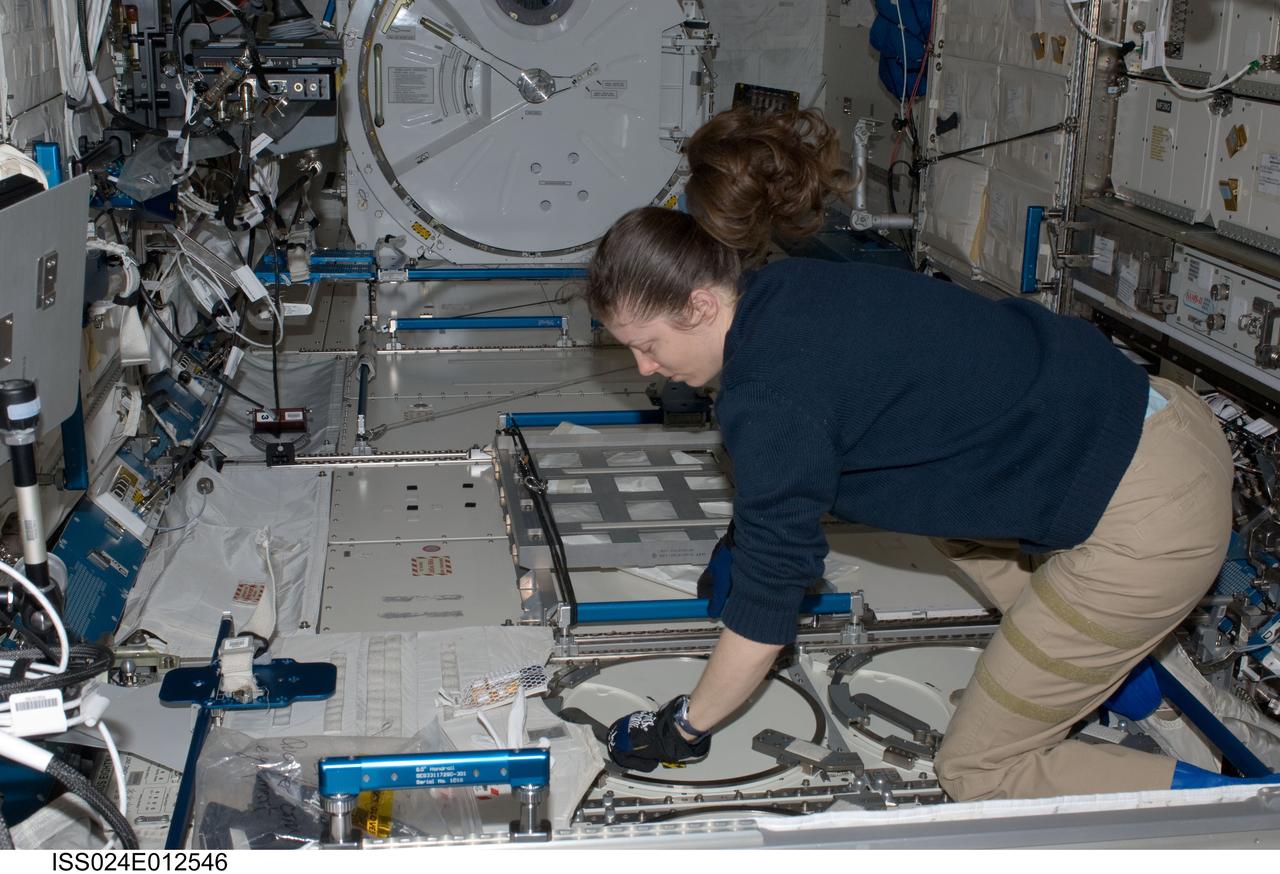
ISS024-E-012546 (26 Aug. 2010) --- NASA astronaut Tracy Caldwell Dyson, Expedition 24 flight engineer, prepares to insert biological samples in a dewar tray in the Minus Eighty Laboratory Freezer for ISS (MELFI-1) in the Kibo laboratory of the International Space Station.
Vascular Blood Collection stowage in MELFI
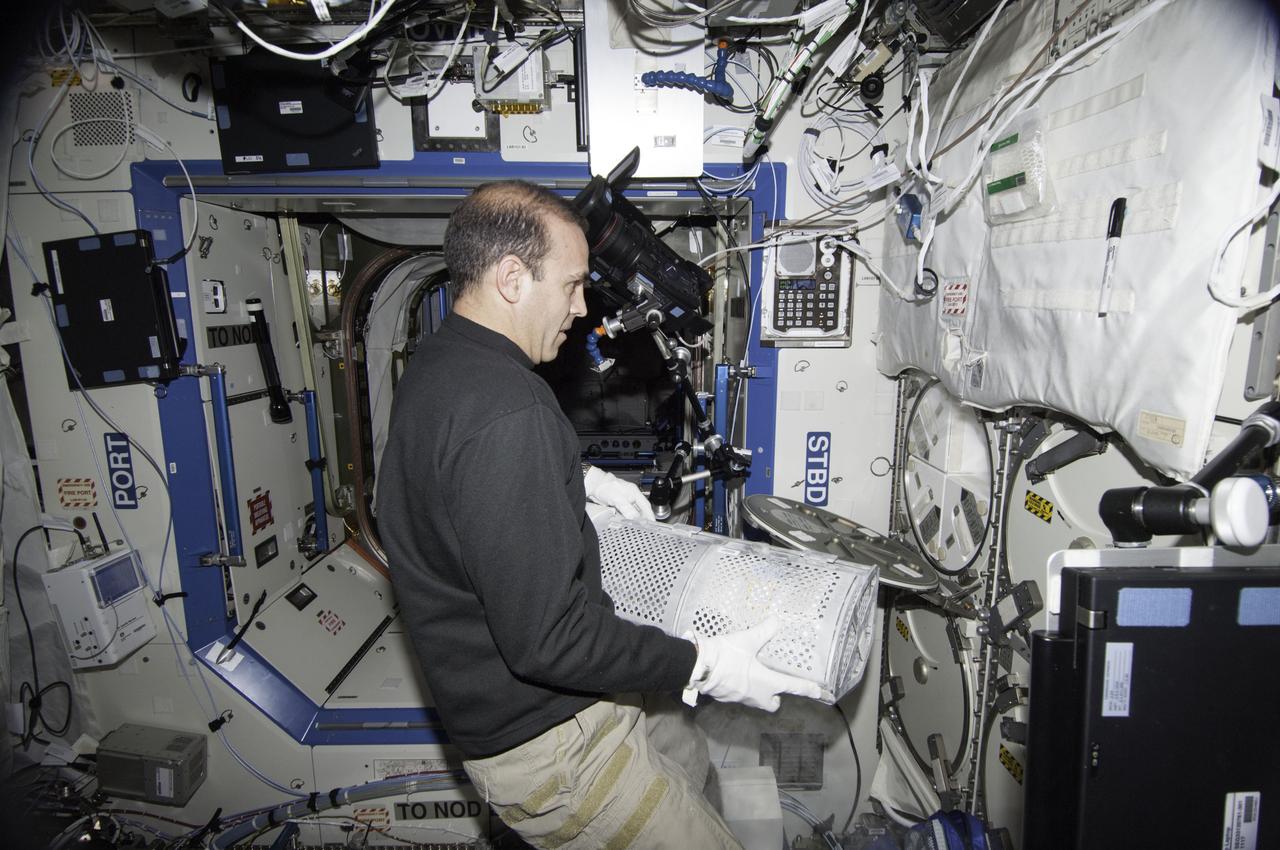
ISS038-E-006765 (21 Nov. 2013) --- In the International Space Station's Destiny laboratory, NASA astronaut Rick Mastracchio, Expedition 38 flight engineer, prepares to replace a dewar tray in the Minus Eighty Laboratory Freezer for ISS (MELFI) after inserting biological samples into the trays.
Mastracchio removing dewar tray from MELFI
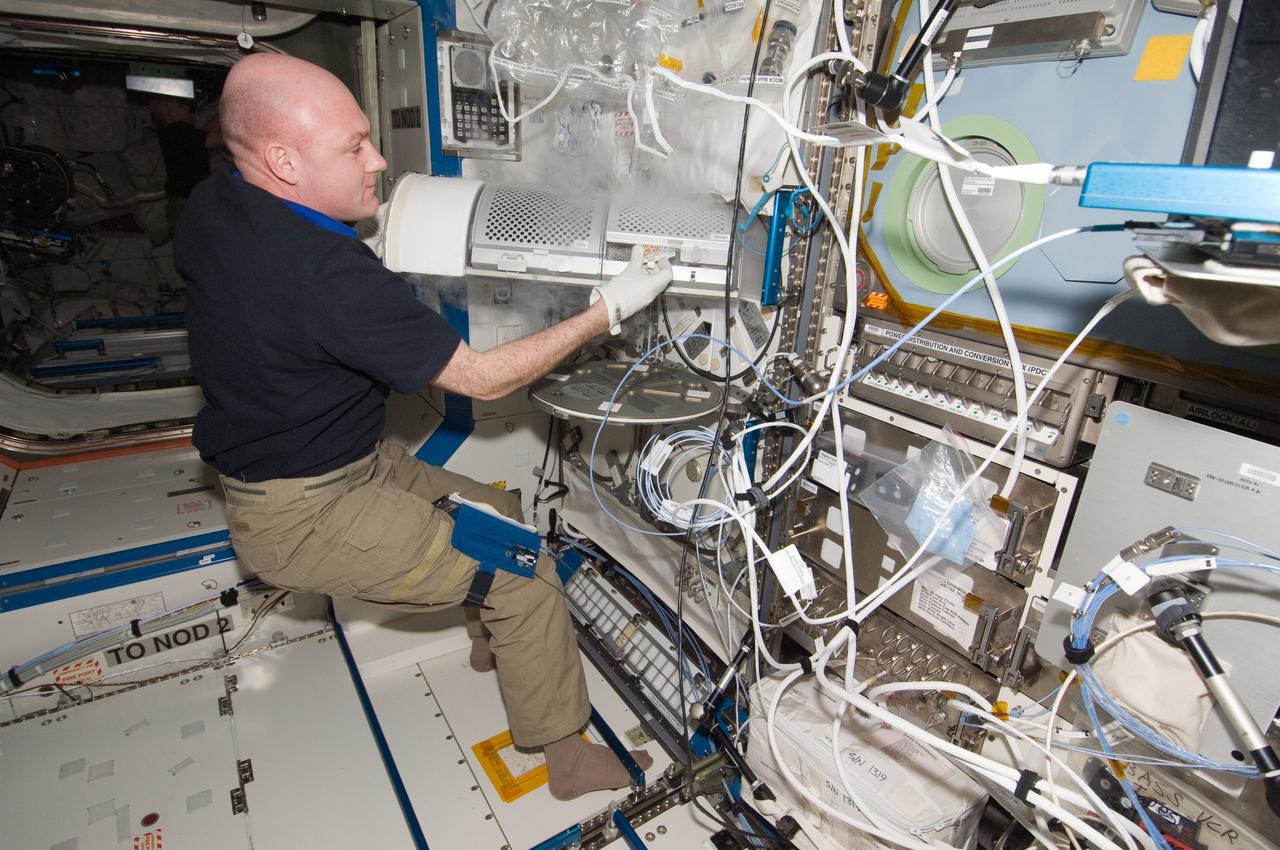
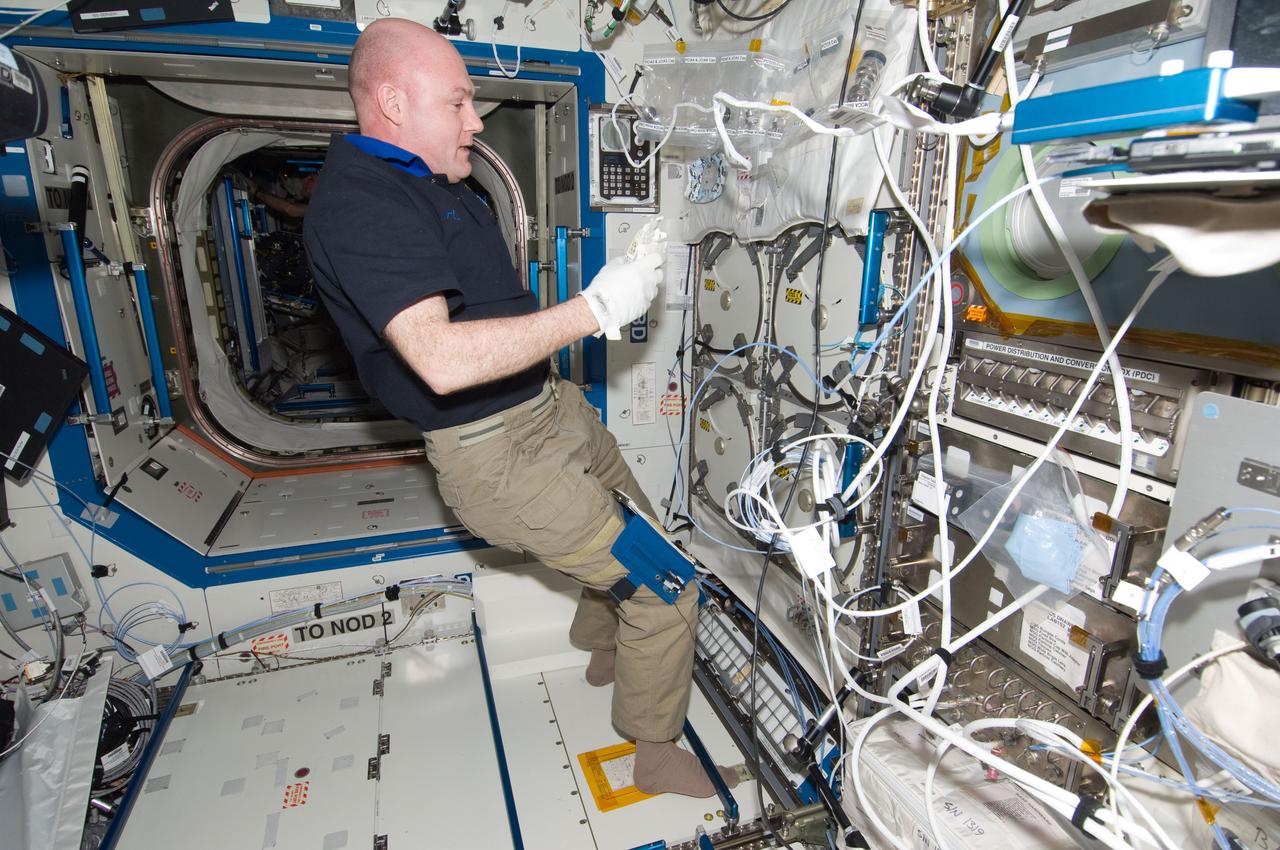
ISS030-E-116878 (9 Feb. 2012) --- European Space Agency astronaut Andre Kuipers, Expedition 30 flight engineer, prepares to insert biological samples in the Minus Eighty Laboratory Freezer for ISS (MELFI-1) in the Kibo laboratory of the International Space Station.
Kuipers prepares to insert biological samples in the MELFI
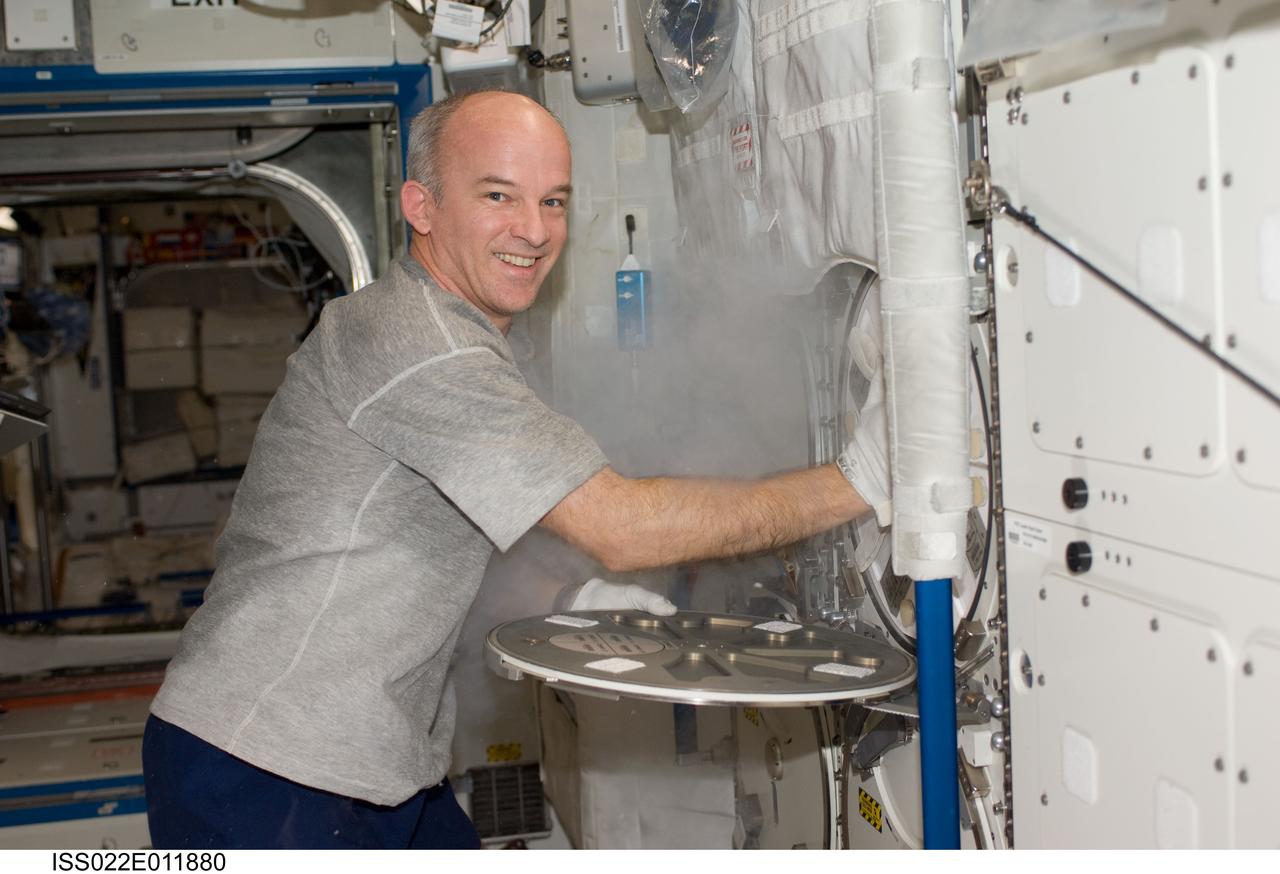
ISS022-E-011880 (16 Dec. 2009) --- NASA astronaut Jeffrey Williams, Expedition 22 commander, services the Advanced Plant Experiments on Orbit-Cambium (APEX-C) payload in the Minus Eighty Laboratory Freezer for ISS-2 (MELFI-2) in the Destiny laboratory of the International Space Station.
Williams installs the APXC Payload in MELFI during Expedition 22
ISS033-E-016196 (26 Oct. 2012) --- Japan Aerospace Exploration Agency astronaut Aki Hoshide, Expedition 33 flight engineer, closes a dewar cover after servicing the Minus Eighty Laboratory Freezer for ISS-2 (MELFI-2) in the Destiny laboratory of the International Space Station.
MELFI ops
iss050e057428 (03/15/2017) --- NASA astronaut Shane Kimbrough removes a storage locker in the Minus Eighty-degree Laboratory Freezer for ISS (MELFI) to store samples from an experiment. MELFI is a cold storage unit that maintains experiment samples at ultra-cold temperatures throughout a mission.
iss050e057428
ISS038-E-006757 (21 Nov. 2013) --- In the International Space Station's Destiny laboratory, NASA astronaut Rick Mastracchio, Expedition 38 flight engineer, removes a dewar tray from the Minus Eighty Laboratory Freezer for ISS (MELFI) in order to insert biological samples into the trays.
Mastracchio removing dewar tray from MELFI
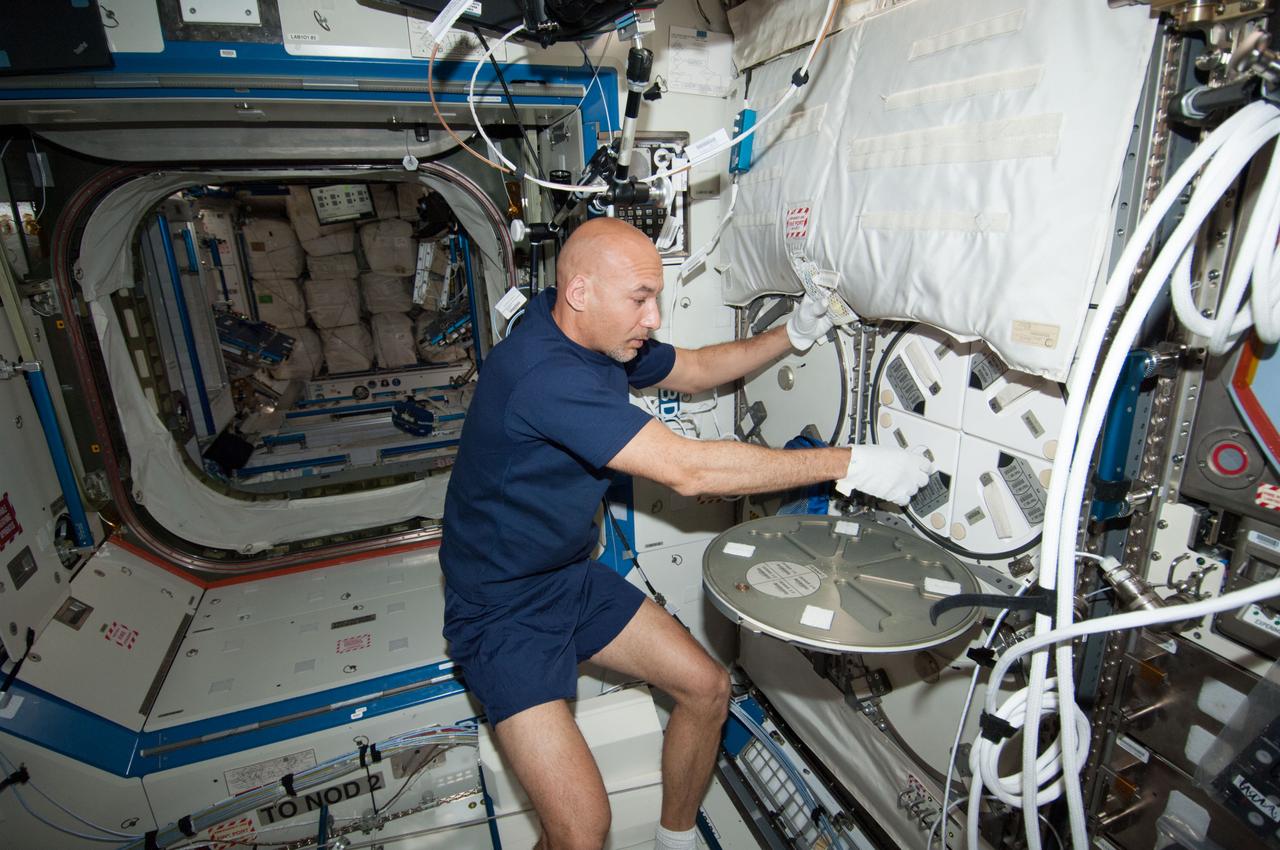
ISS036-E-006564 (6 June 2013) --- European Space Agency astronaut Luca Parmitano, Expedition 36 flight engineer, works with samples in Minus Eighty-Degree Laboratory Freezer for ISS (MELFI-3) in the Destiny laboratory of the Earth-orbiting International Space Station.
MELFI ops
ISS037-E-010711 (5 Oct. 2013) --- In the International Space Station’s Destiny laboratory, NASA astronaut Michael Hopkins, Expedition 37 flight engineer, removes a dewar tray from the Minus Eighty Laboratory Freezer for ISS (MELFI) in order to insert biological samples into the trays.
HRF Operations
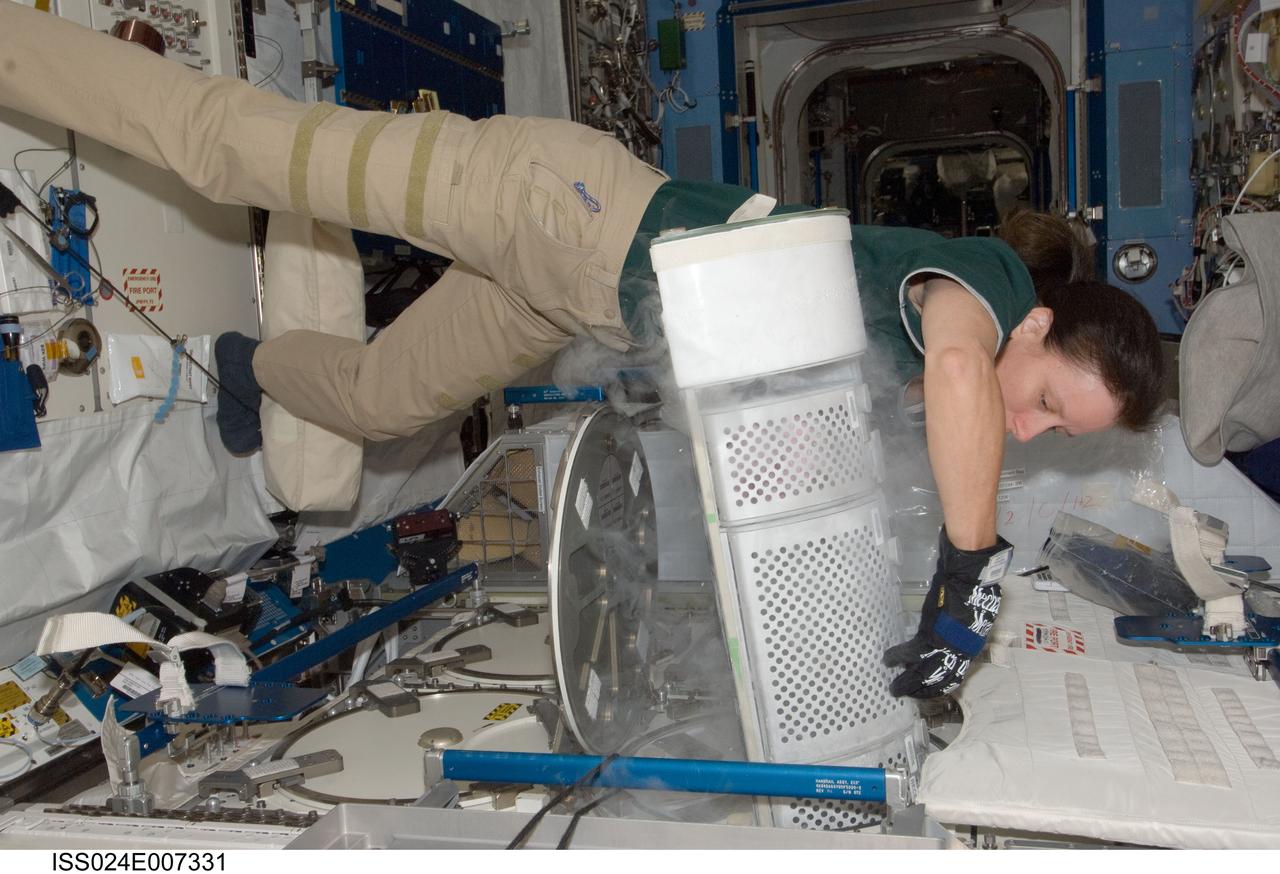
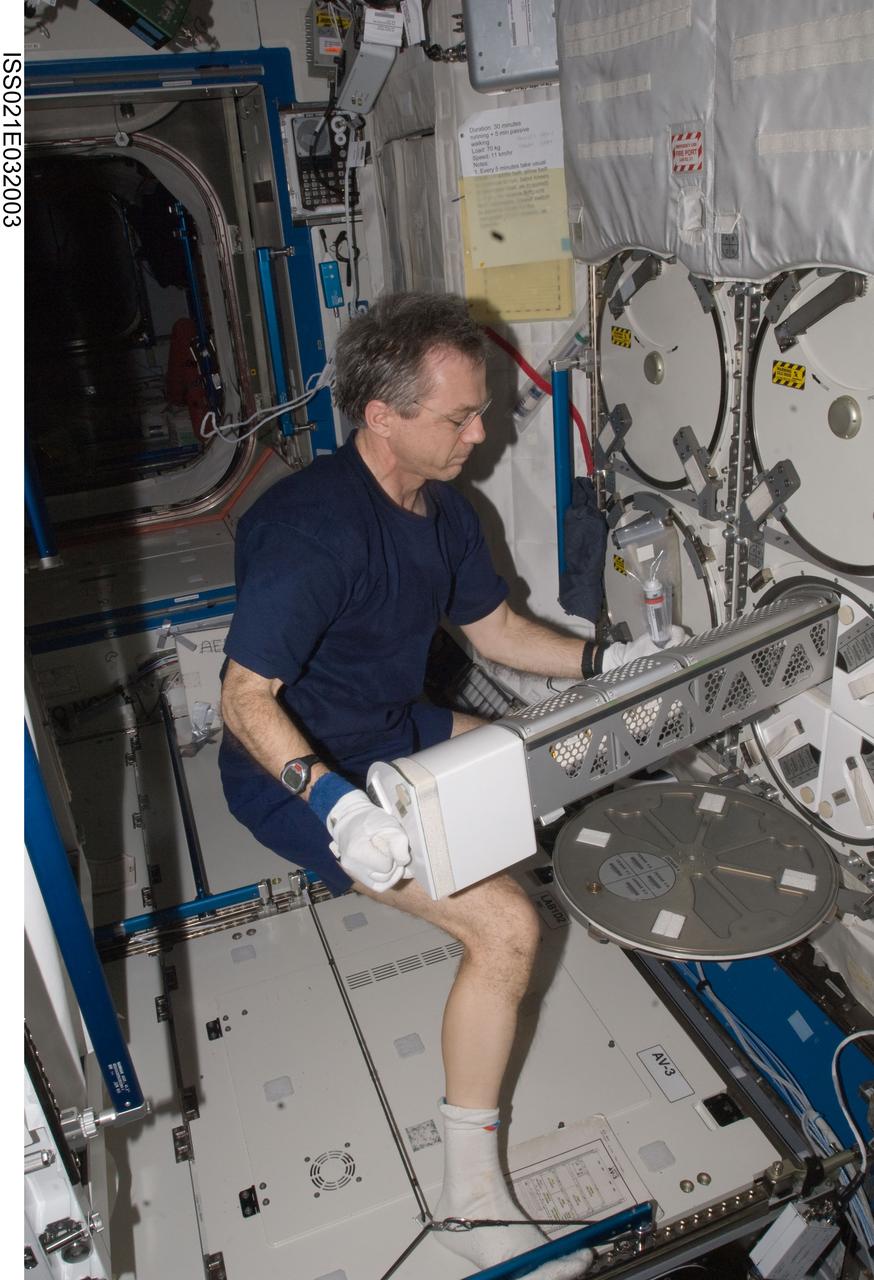
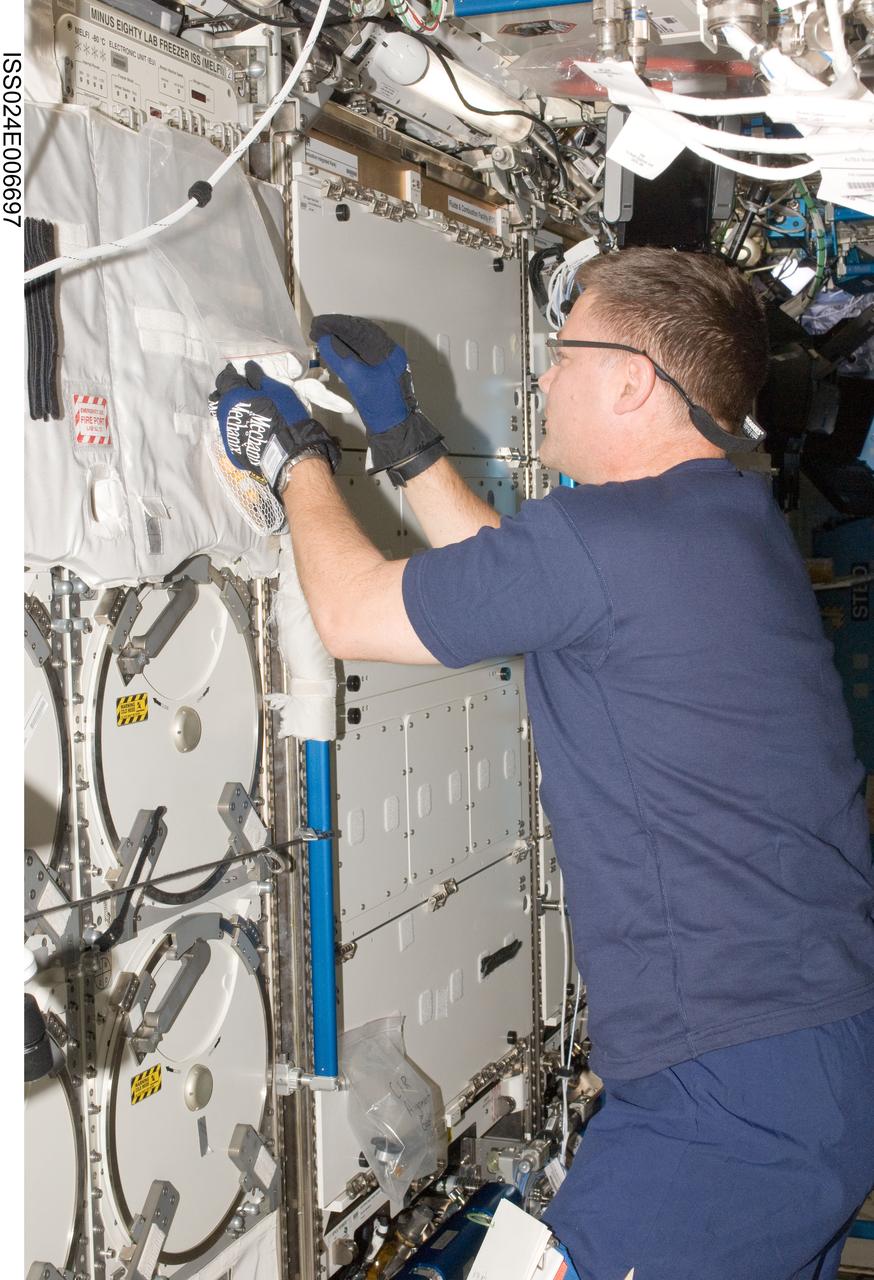
ISS024-E-006697 (28 June 2010) --- NASA astronaut Doug Wheelock, Expedition 24 flight engineer, prepares to insert biological samples into trays in the Minus Eighty Laboratory Freezer for ISS-2 (MELFI-2) in the Destiny laboratory of the International Space Station.
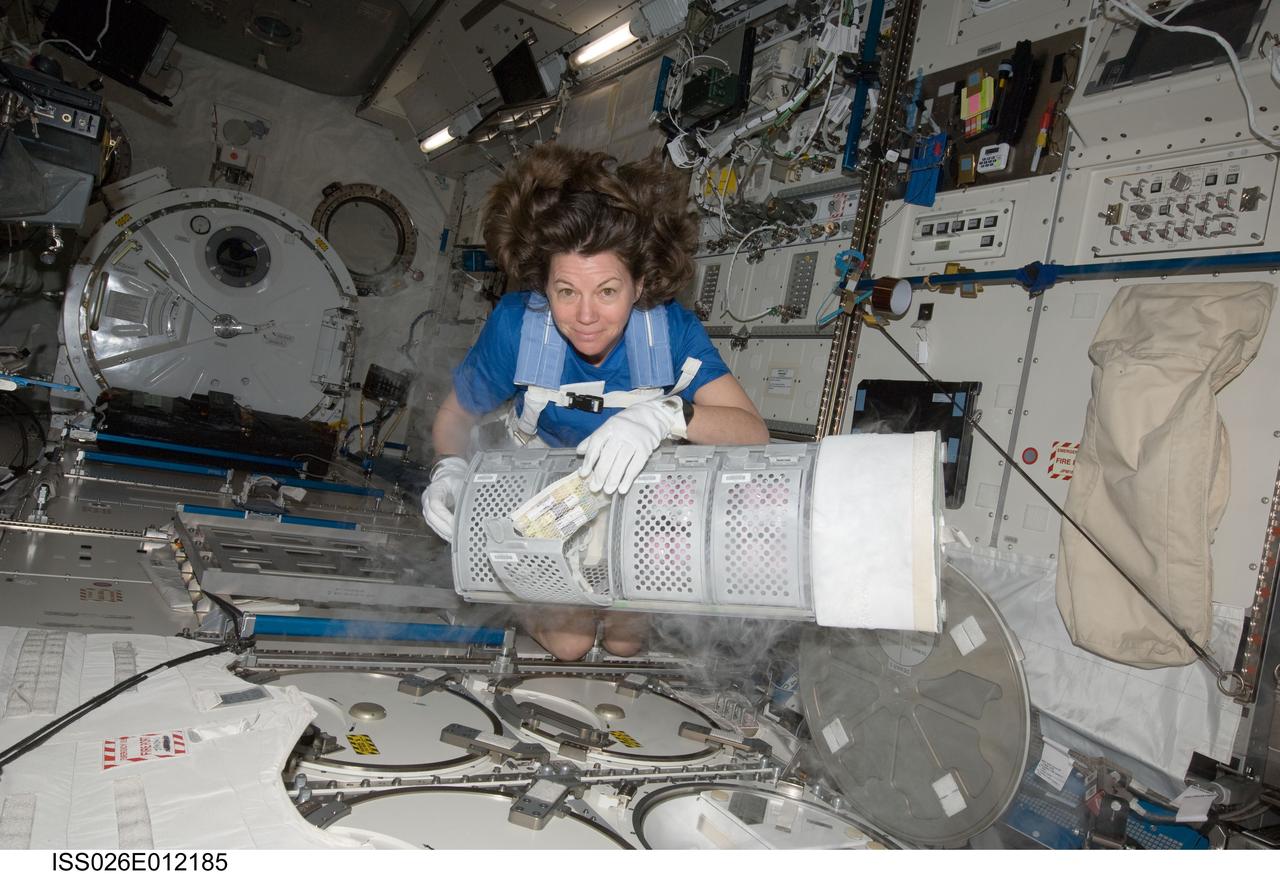
MELFI Sample Insertion
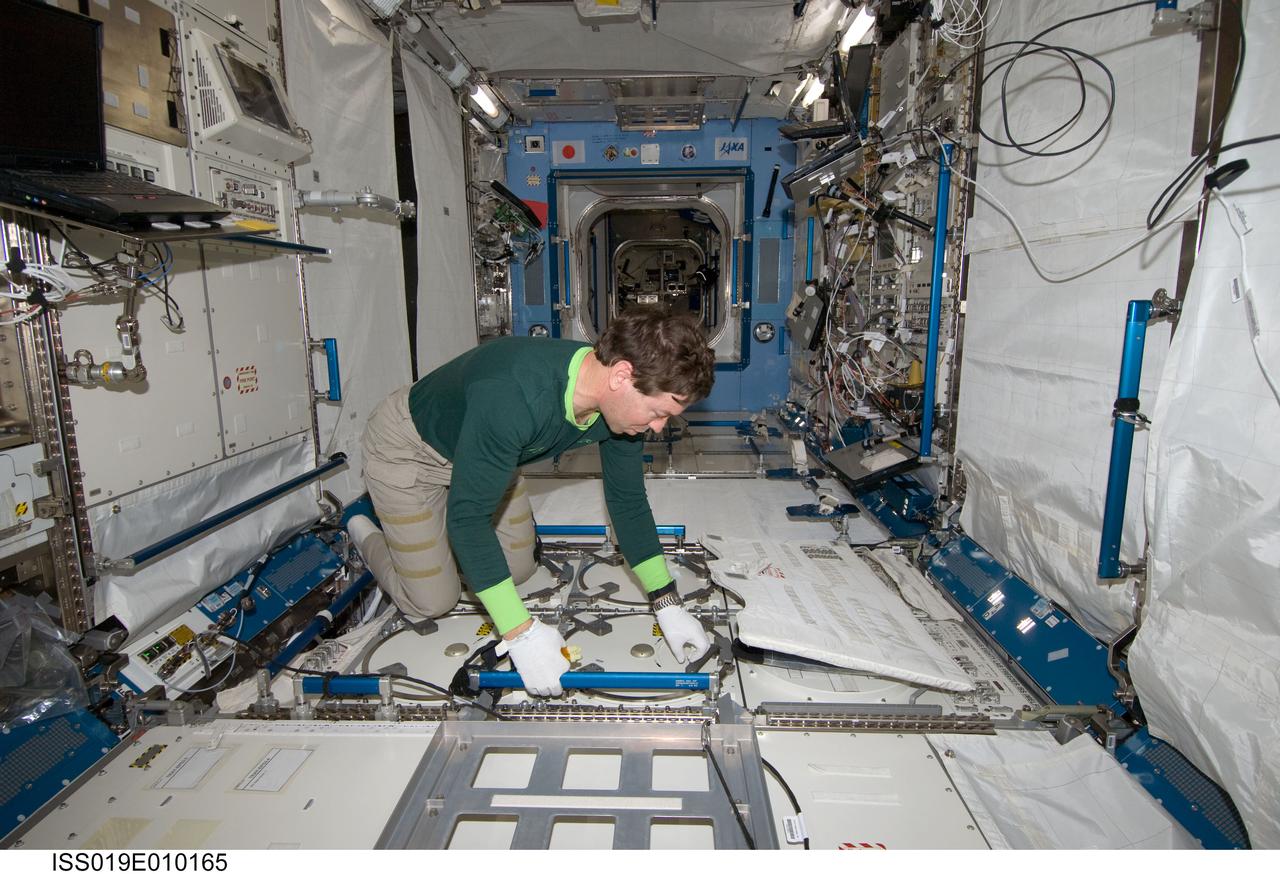
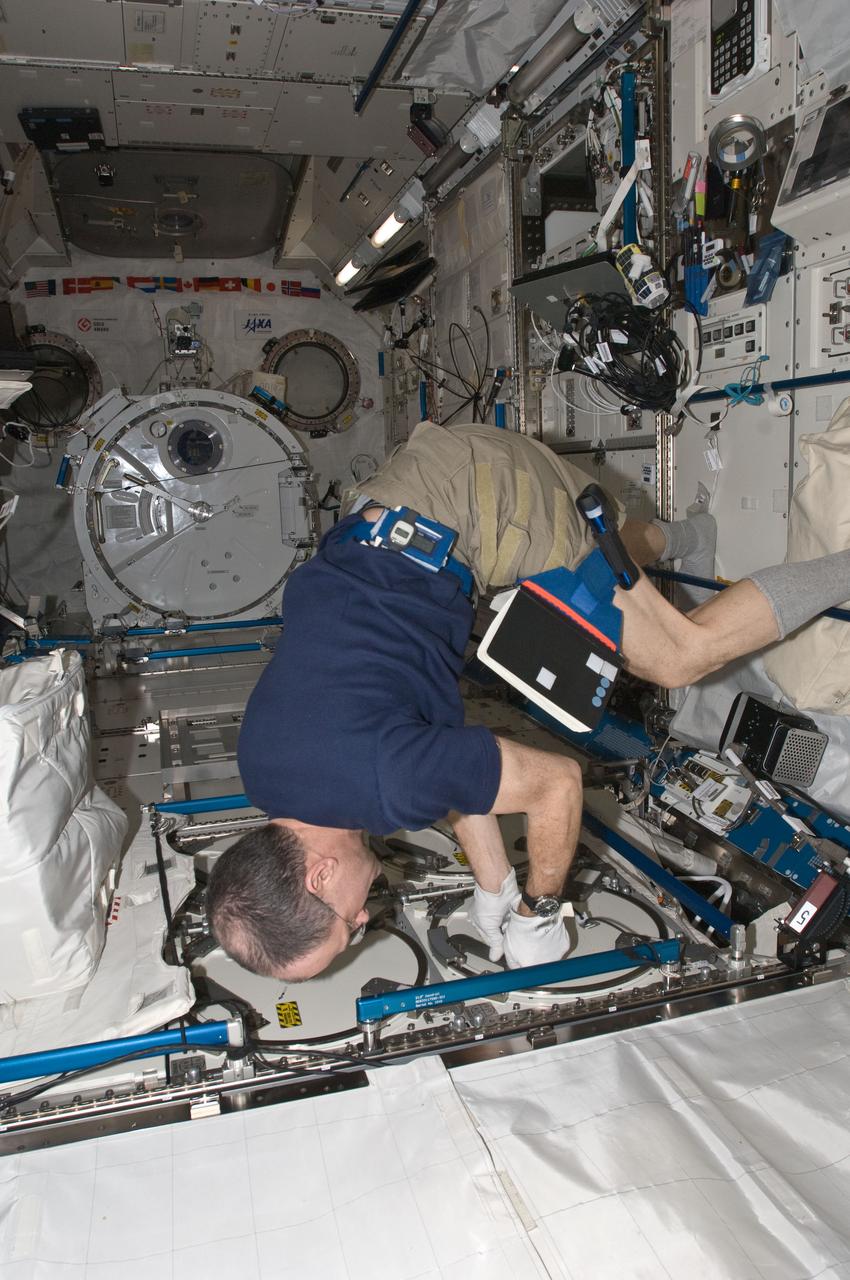
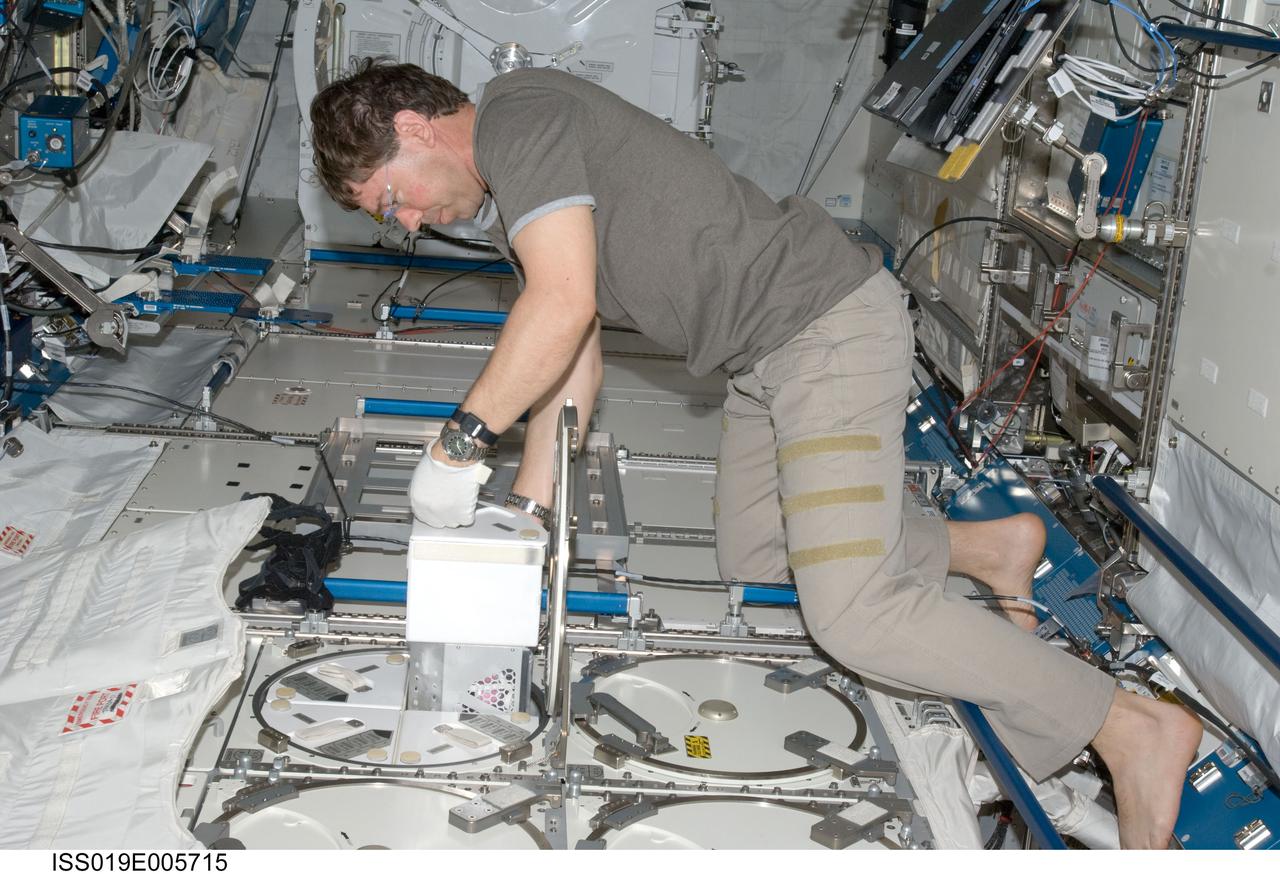
ISS019-E-010165 (18 April 2009) --- Astronaut Michael Barratt, Expedition 19/20 flight engineer, performs an insertion of urine samples into the Minus Eighty Degree Laboratory Freezer for ISS (MELFI) as part of the Nutritional Status Assessment (NUTRITION) study in the Japanese Kibo laboratory of the International Space Station.
Nutrition and Repository: Insertion of Urine Sample into MELFI
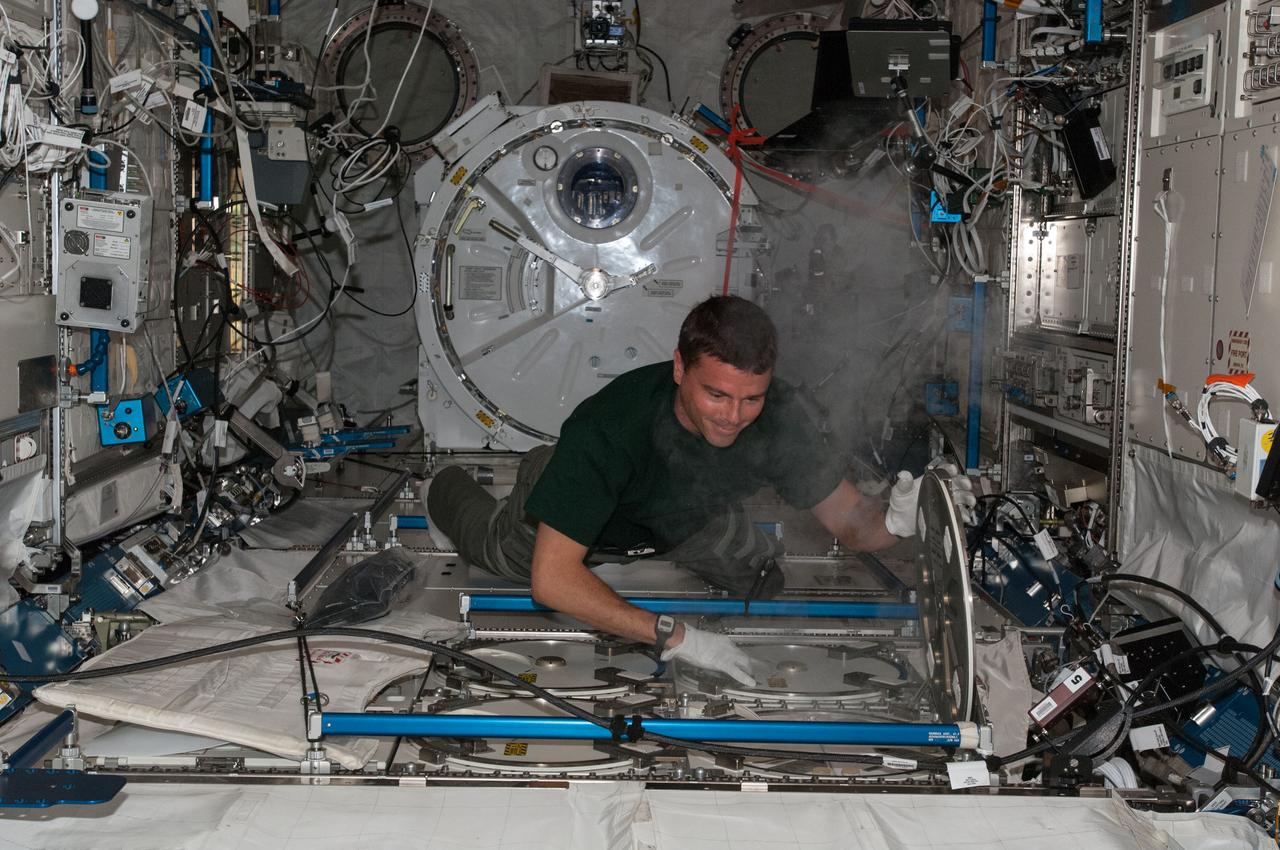
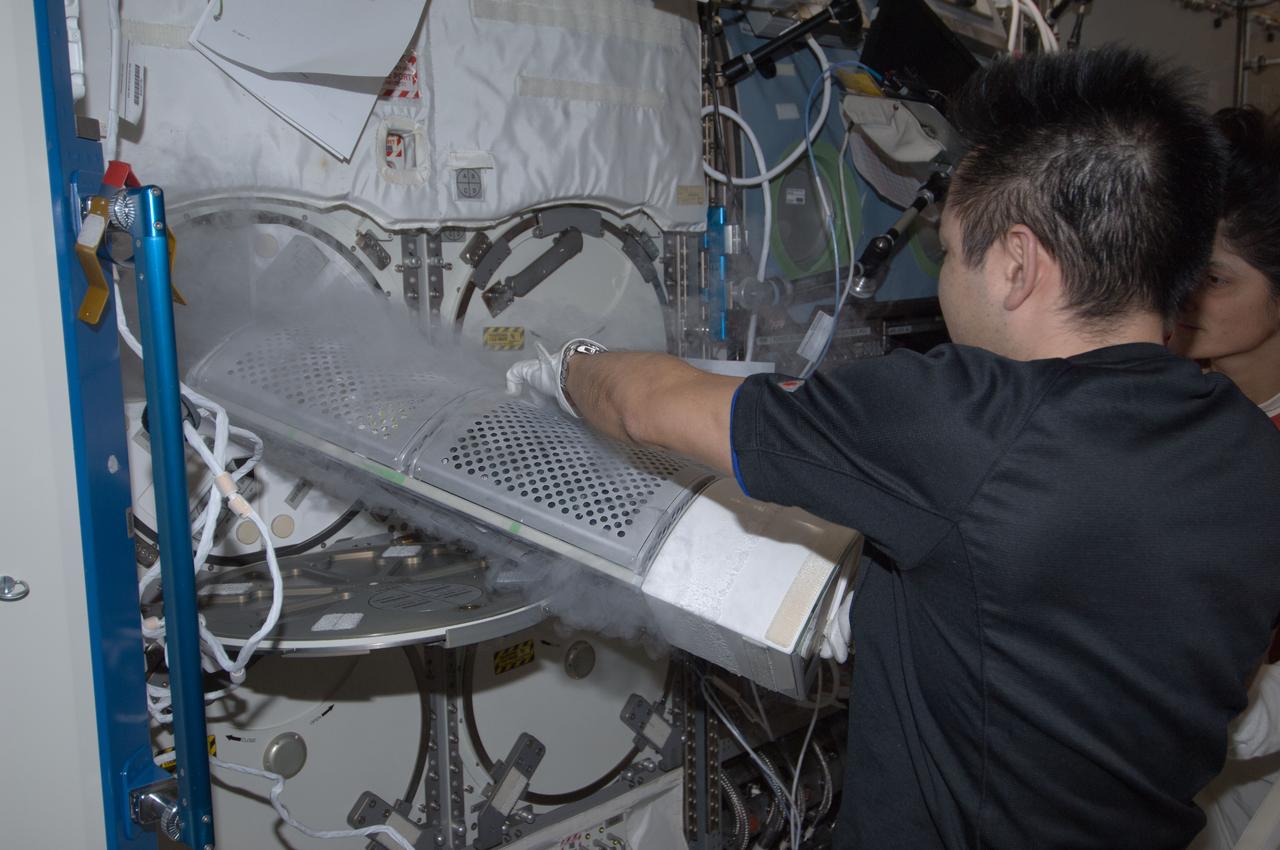
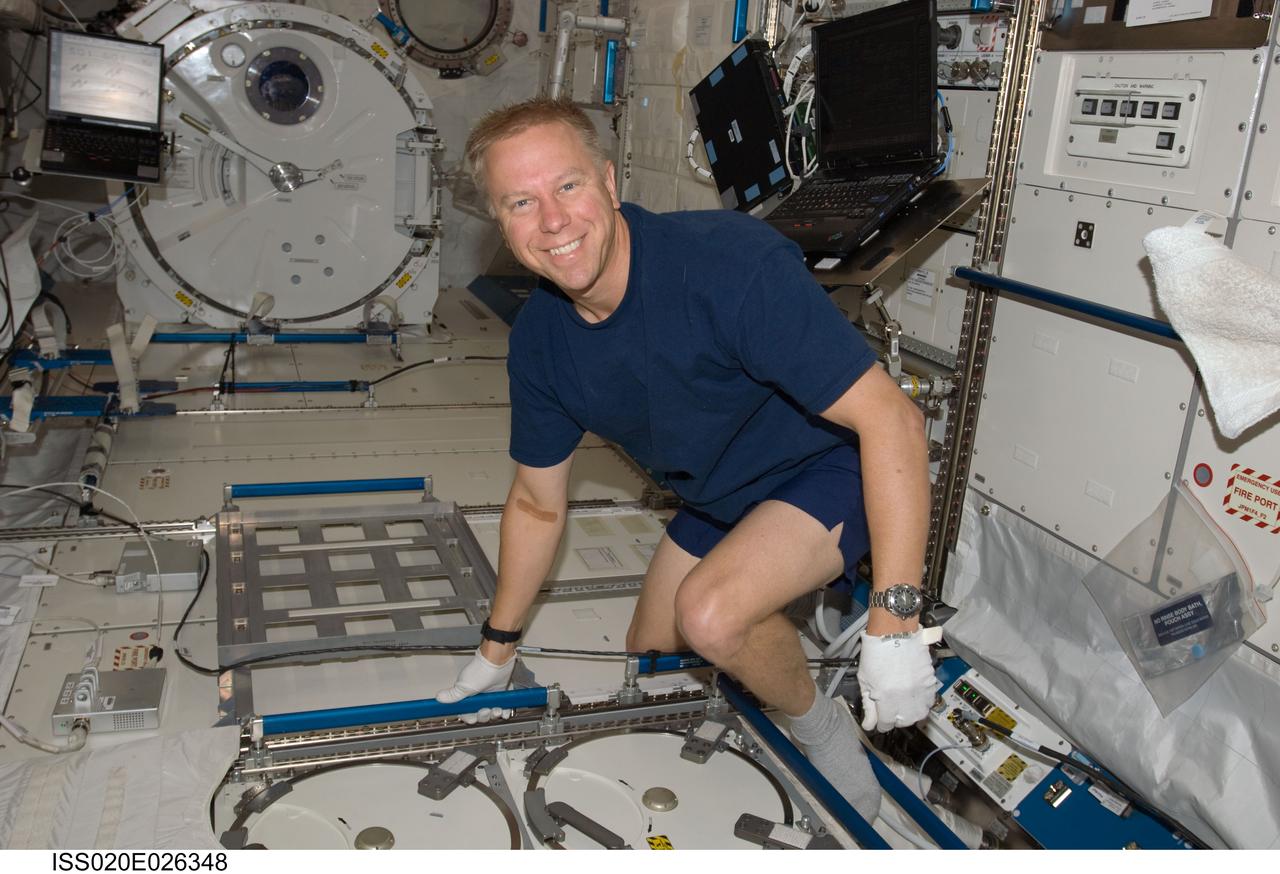
ISS020-E-026348 (30 July 2009) --- Astronaut Tim Kopra, Expedition 20 flight engineer, smiles for the camera as he completes the task of placing samples taken for the Nutritional Status Assessment (NUTRITION) w/Repository study into the Minus Eighty Degree Laboratory Freezer for ISS (MELFI) in the Kibo laboratory of the International Space Station.
NUTRITION w/Repository into MELFI
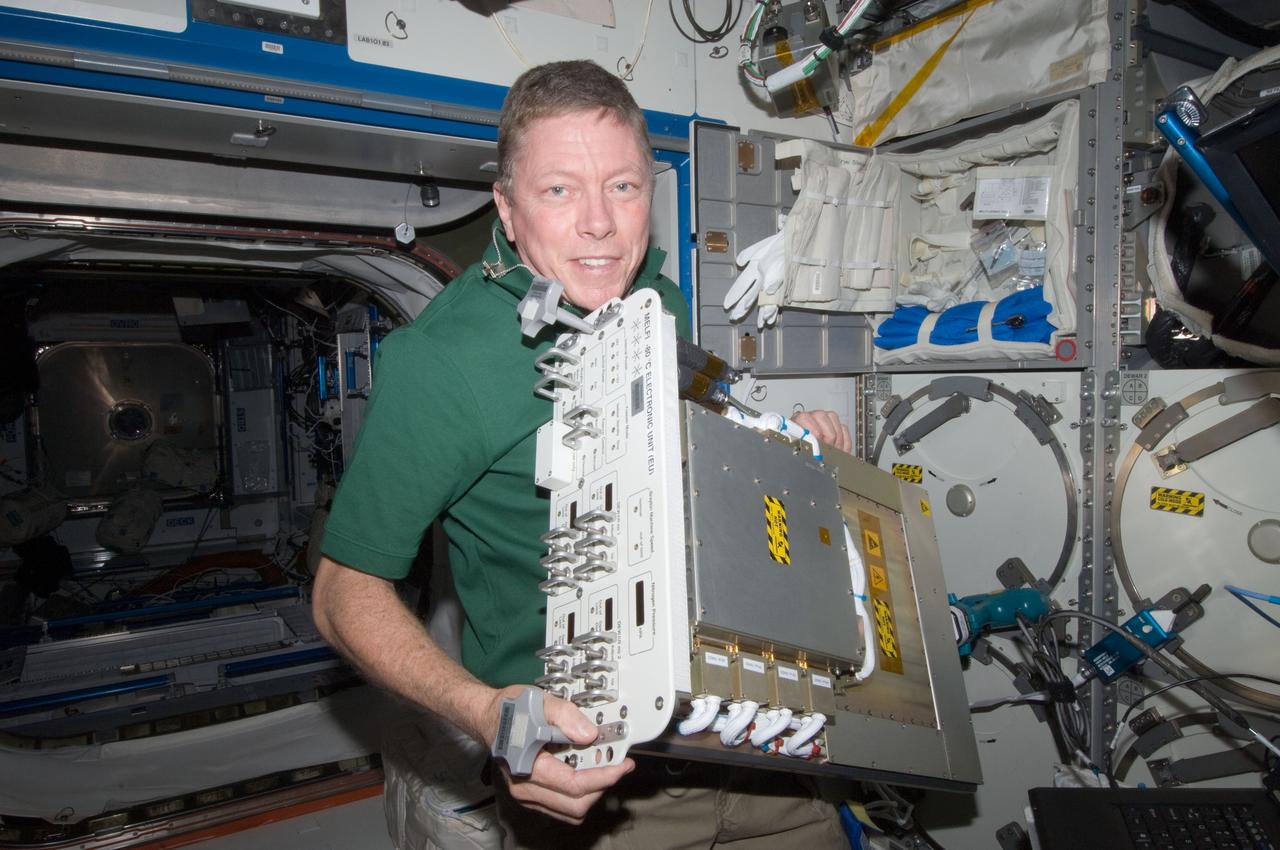
ISS028-E-013799 (1 July 2011) --- NASA astronaut Mike Fossum, Expedition 28 flight engineer, replaces a failed electronic unit for the Minus Eighty Laboratory Freezer for ISS 3 (MELFI-3) with a spare unit in the Kibo laboratory of the International Space Station.
MELFI-3 Electronic Unit Replacement
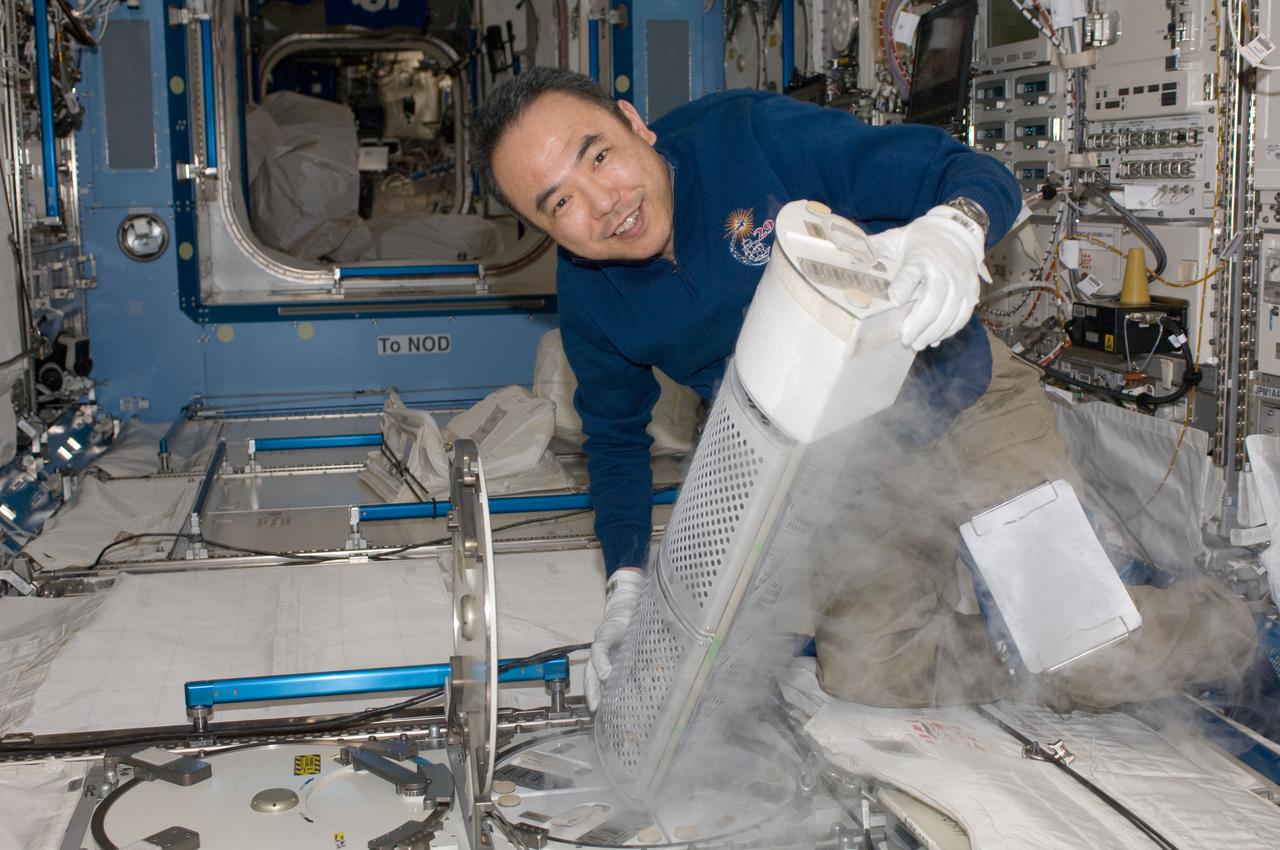
iss029e028495 (10/18/2011) --- Japan Aerospace Exploration Agency astronaut Satoshi Furukawa,Expedition 29 flight engineer,prepares to put samples from the CSA (Canadian Space Agency) Vascular Blood Collection protocol into the MELFI-1 (Minus Eighty Laboratory Freezer for ISS 1) unit.
Vascular Blood Collection protocol samples into MELFI
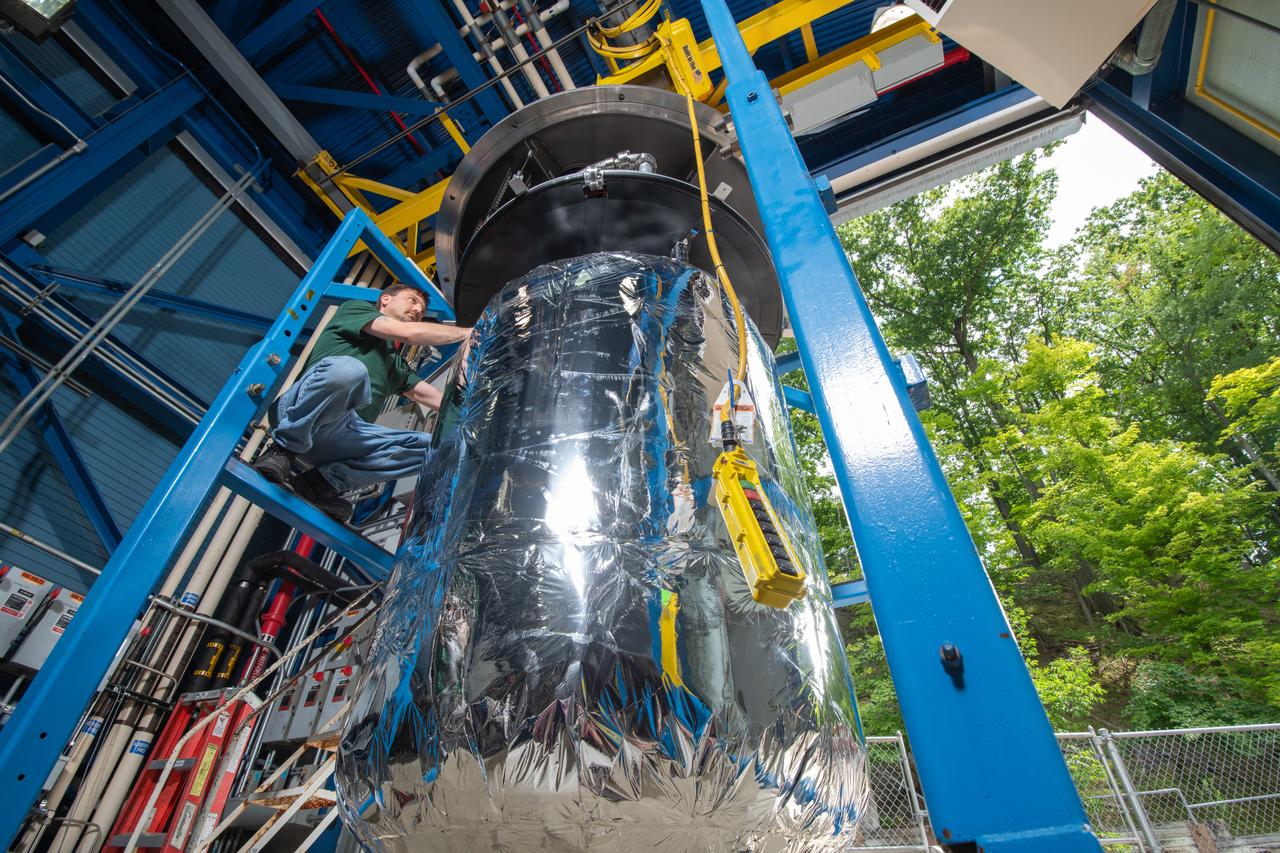
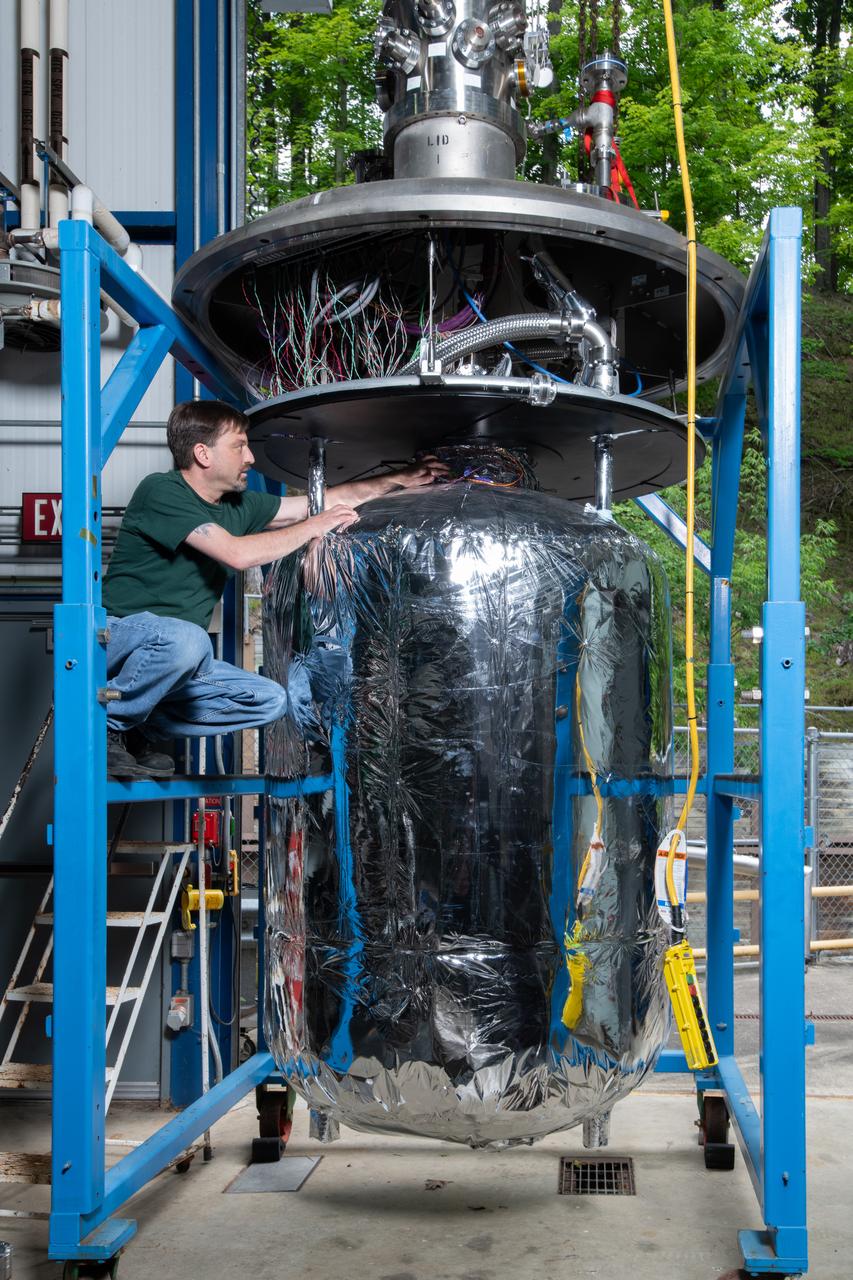
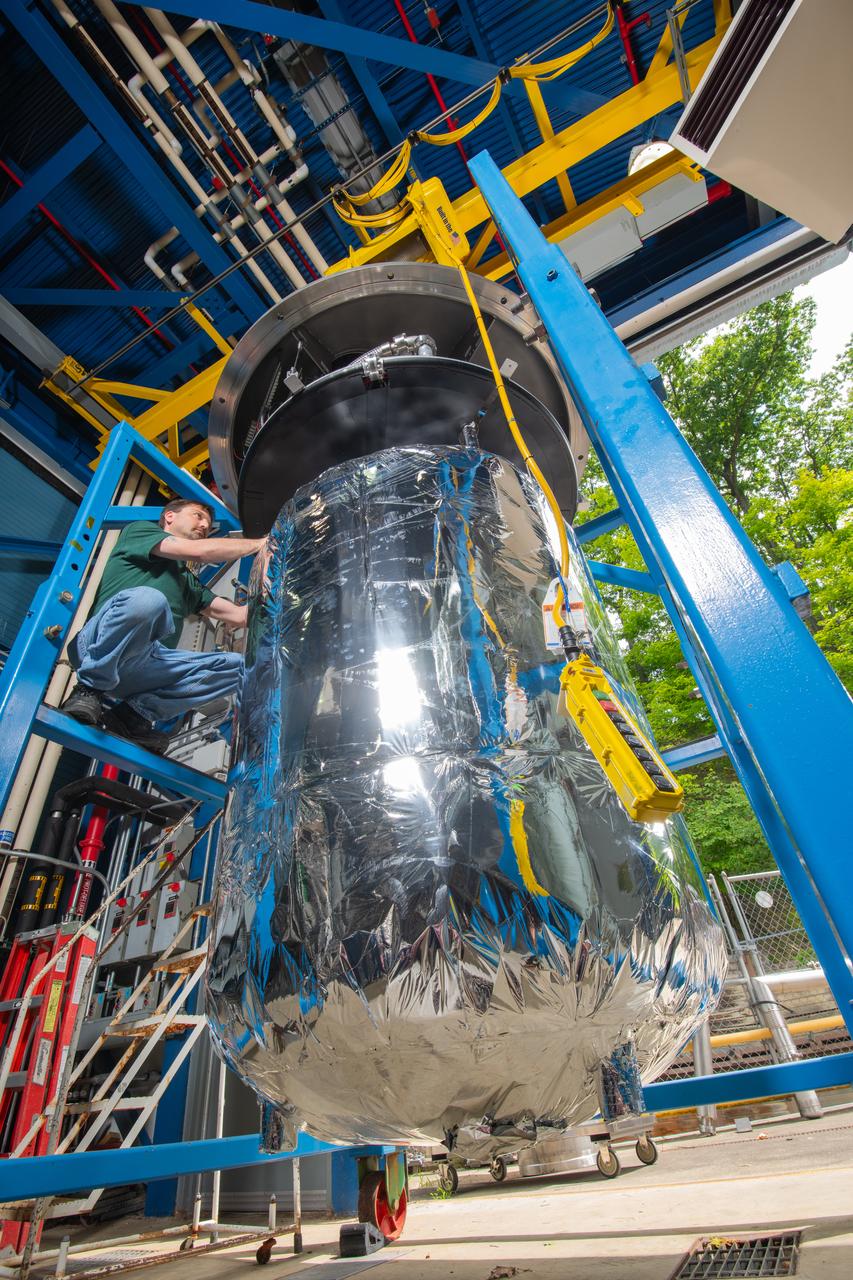
A tank is used in CryoFILL experiments to liquefy oxygen at minus 290 degrees Fahrenheit as it could be done on the Moon or Mars. The tests conducted at NASA Glenn Research Center, used Fiber Optic Sensing System (FOSS) developed by NASA Armstrong Flight Research Center, to measure oxygen temperatures inside the tank.
Helping CryoFILL Turn Oxygen into Fuel
   Photographic documentation of inspection and regular maintenance on Minus Eighty-degree Laboratory Freezer for the ISS 3 (MELFI-3) located in the LAB1S1 rack. View is of European Space Agency (ESA) astronaut Samantha Cristoforetti, Expedition 43 flight engineer, at work with the MELFI-3.
iss043e000742
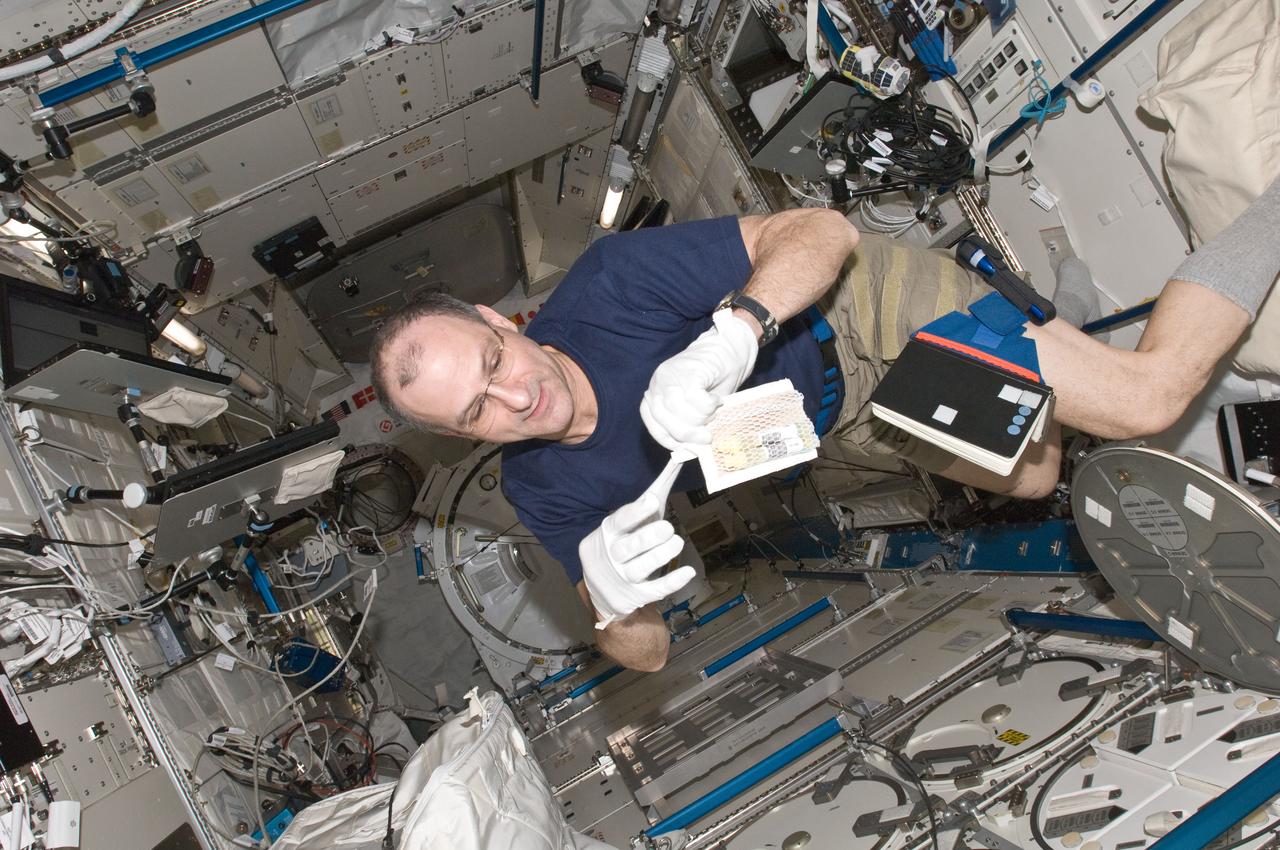
ISS030-E-050849 (26 Jan. 2012) --- NASA astronaut Don Pettit, Expedition 30 flight engineer, prepares to insert biological samples in the Minus Eighty Laboratory Freezer for ISS (MELFI-1) in the Kibo laboratory of the International Space Station.
Pettit prepares to insert biological samples in the MELFI-1 in the JPM
S69-38866 (22 Sept. 1969) --- Portrait of astronaut Charles Conrad Jr., prime crew commander of the Apollo 12 lunar landing mission, in his spacesuit minus the helmet. He is standing outside beside a mock-up of the Lunar Lander.
Portraits - Apollo XII
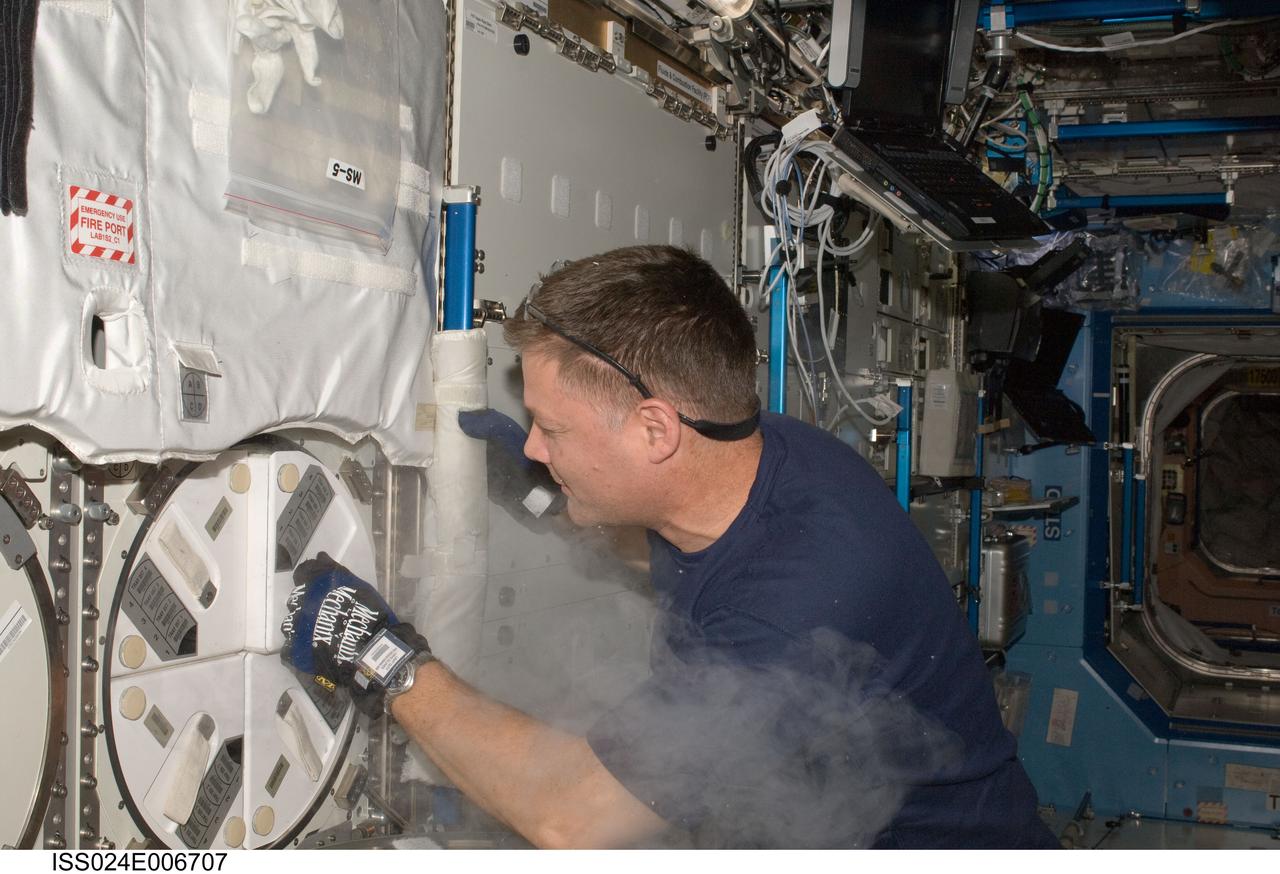
ISS024-E-006707 (28 June 2010) --- After inserting biological samples, NASA astronaut Doug Wheelock, Expedition 24 flight engineer, replaces a dewar tray in the Minus Eighty Laboratory Freezer for ISS-2 (MELFI-2) in the Destiny laboratory of the International Space Station.
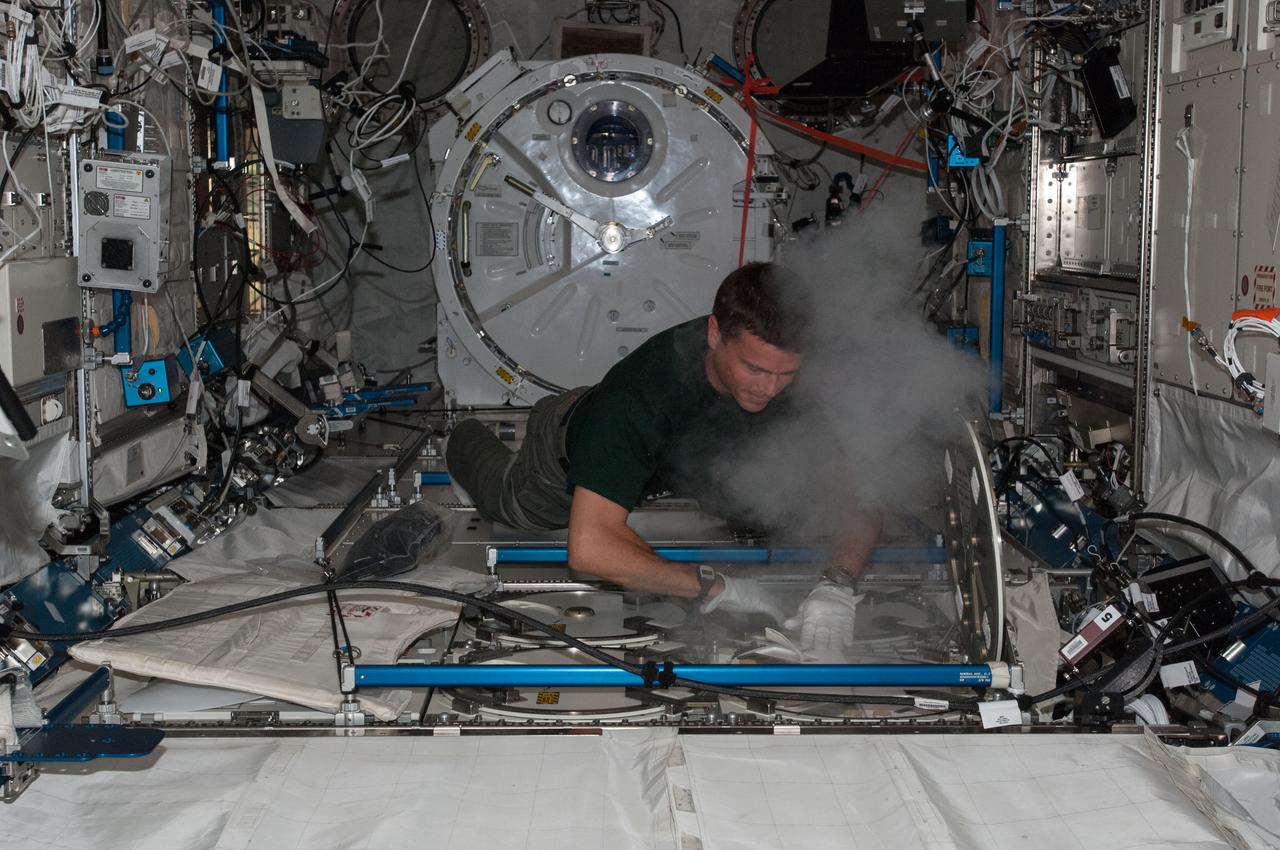
MELFI Sample Insertion
ISS030-E-116988 (27 Feb. 2012) --- European Space Agency astronaut Andre Kuipers, Expedition 30 flight engineer, is pictured near the Minus Eighty Laboratory Freezer for ISS (MELFI-1) in the Kibo laboratory of the International Space Station.
Kuipers prepares to open the MELFI in the JPM
ISS034-E-023771 (7 Jan. 2013) --- Canadian Space Agency astronaut Chris Hadfield, Expedition 34 flight engineer, prepares to insert biological samples in the Minus Eighty Laboratory Freezer for ISS (MELFI-1) in the Kibo laboratory of the International Space Station.
Hadfield prepares to insert biological samples in the MELFI-1
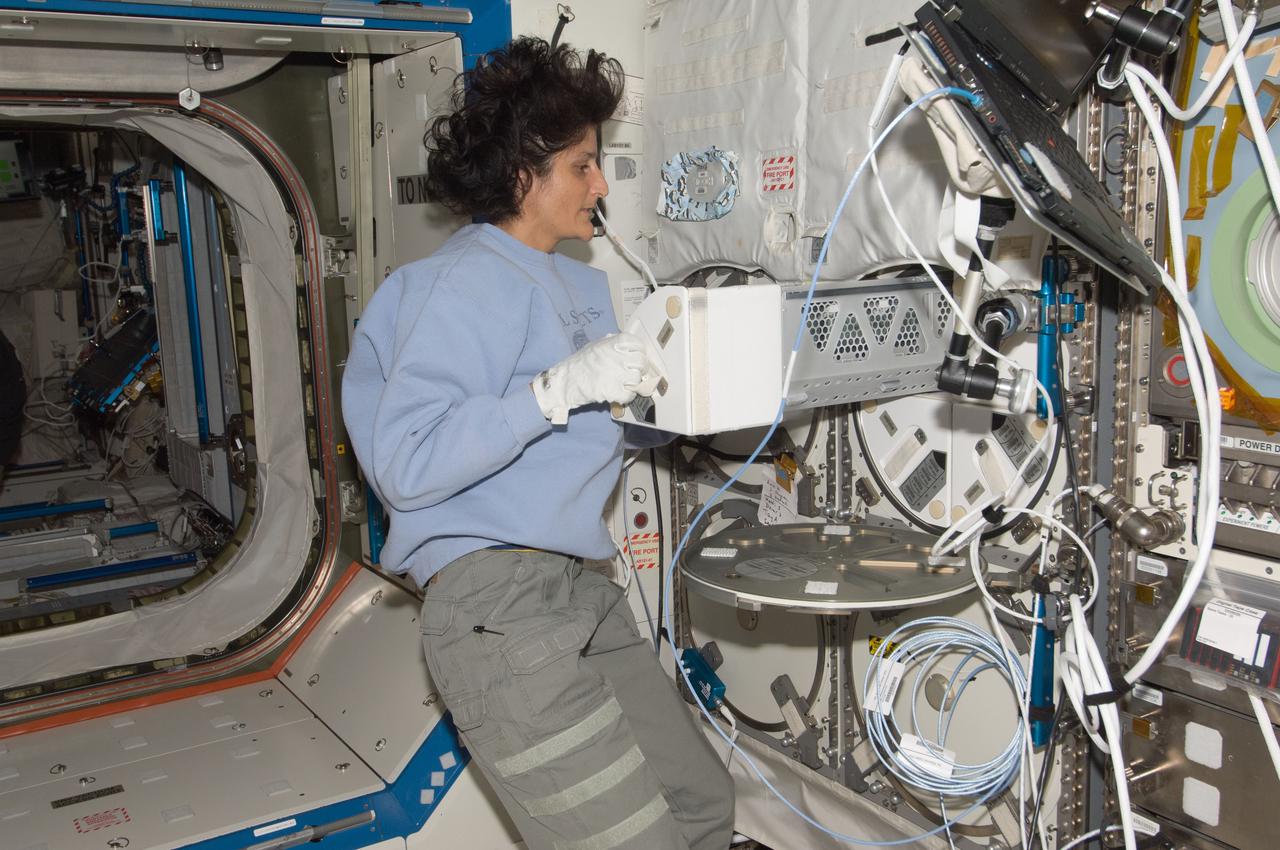
ISS032-E-011639 (2 Aug. 2012) --- NASA astronaut Sunita Williams, Expedition 32 flight engineer, prepares to insert biological samples in the Minus Eighty Laboratory Freezer for ISS-2 (MELFI-2) in the Destiny laboratory of the International Space Station.
FE Williams inserts Biological Samples into the MELFI-2
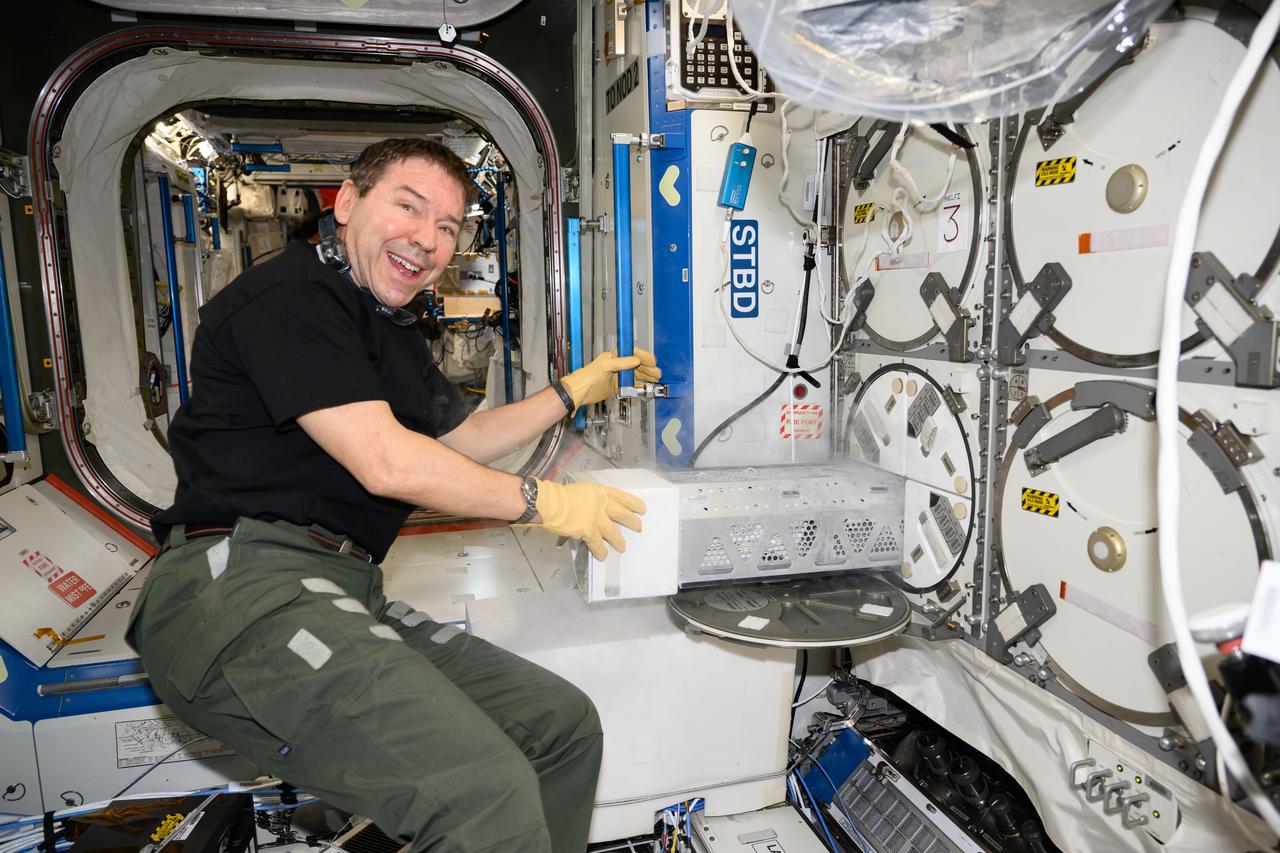
iss072e035693 (Oct. 11, 2024) --- NASA astronaut and Expedition 72 Flight Engineer Mike Barratt stows research samples in a science freezer, also known as the Minus Eighty-Degree Laboratory Freezer for ISS (MELFI). MELFI can preserve biological samples such as blood, microbes, plants, and more for retrieval and later analysis.
Astronaut Mike Barratt stows research samples in a science freezer
ISS024-E-006699 (28 June 2010) --- NASA astronaut Doug Wheelock, Expedition 24 flight engineer, prepares to insert biological samples into trays in the Minus Eighty Laboratory Freezer for ISS-2 (MELFI-2) in the Destiny laboratory of the International Space Station.
MELFI Sample Insertion
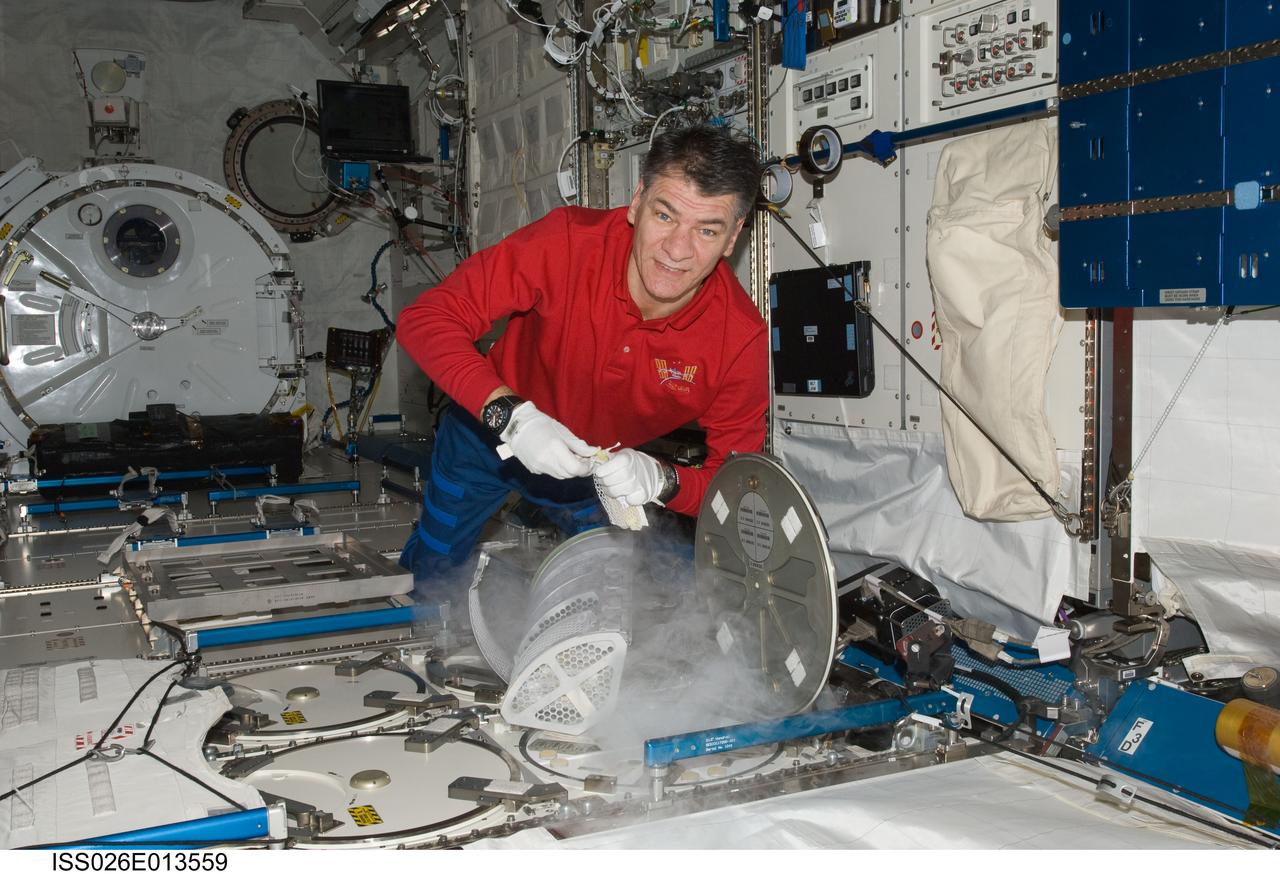
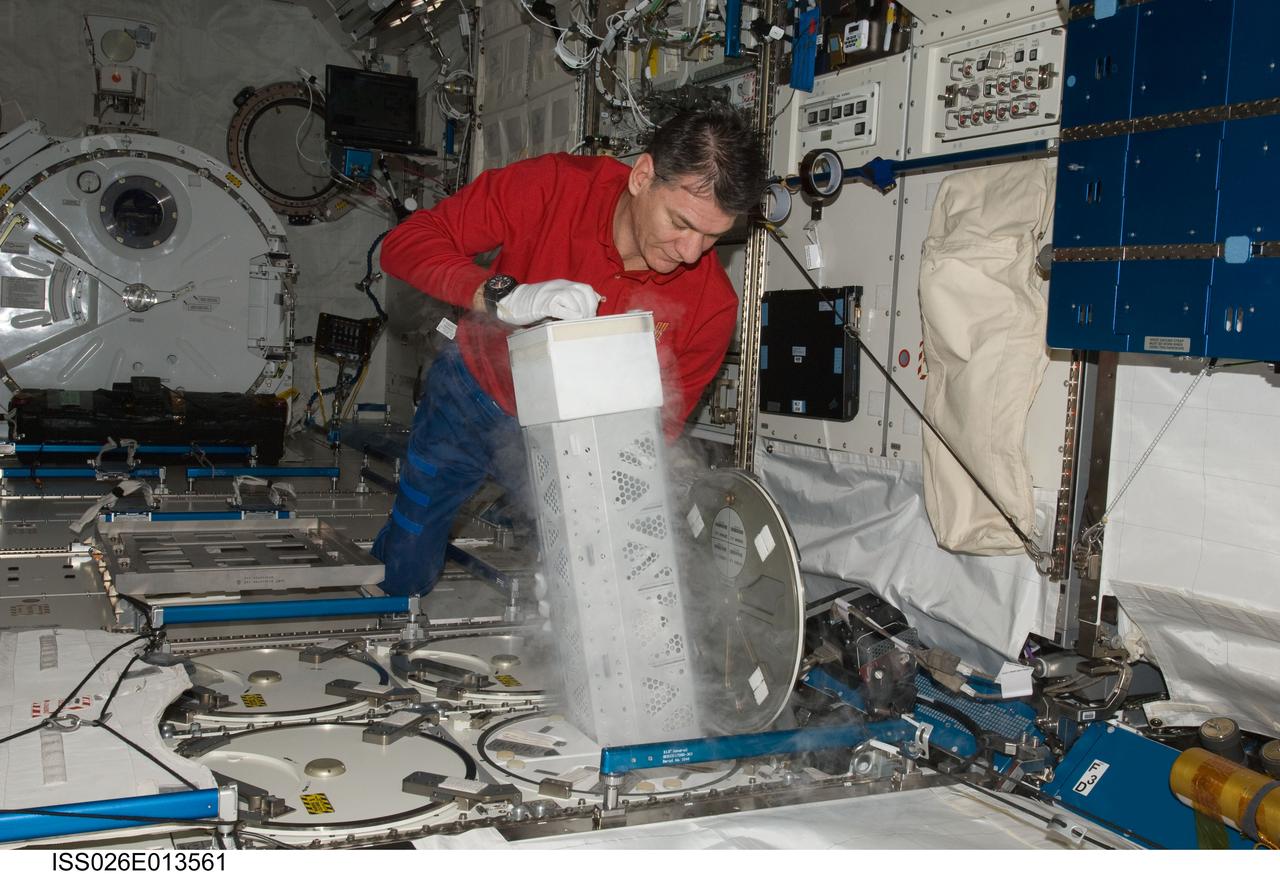
ISS026-E-013561 (26 Dec. 2010) --- European Space Agency astronaut Paolo Nespoli, Expedition 26 flight engineer, services the Minus Eighty Laboratory Freezer for ISS (MELFI-1) in the Kibo laboratory of the International Space Station.
Nespoli works on the MELFI in the Kibo JPM during Expedition 26
ISS031-E-143832 (25 June 2012) --- European Space Agency astronaut Andre Kuipers, Expedition 31 flight engineer, prepares to insert biological samples in the Minus Eighty Laboratory Freezer for ISS-2 (MELFI-2) in the Destiny laboratory of the International Space Station.
iss031e143832
S118-E-07456 (13 Aug. 2007) --- Astronaut Clay Anderson, Expedition 15 flight engineer, works with the Minus Eighty Degree Laboratory Freezer for ISS (MELFI) in the Destiny laboratory of the International Space Station while Space Shuttle Endeavour (STS-118) remains docked with the station.
Anderson working at the MELFI during STS-118/Expedition 15 Joint Operations
ISS033-E-016183 (26 Oct. 2012) --- Japan Aerospace Exploration Agency astronaut Aki Hoshide, Expedition 33 flight engineer, services the Minus Eighty Laboratory Freezer for ISS-2 (MELFI-2) in the Destiny laboratory of the International Space Station.
MELFI ops
ISS029-E-015110 (4 Oct. 2011) --- In the International Space Station?s Kibo laboratory, NASA astronaut Mike Fossum, Expedition 29 commander, inserts a dewar tray of samples into the Minus Eighty Laboratory Freezer for ISS (MELFI-1) for the second NUTRITION w/Repository collection period.
2nd NUTRITION w/Repository collection period
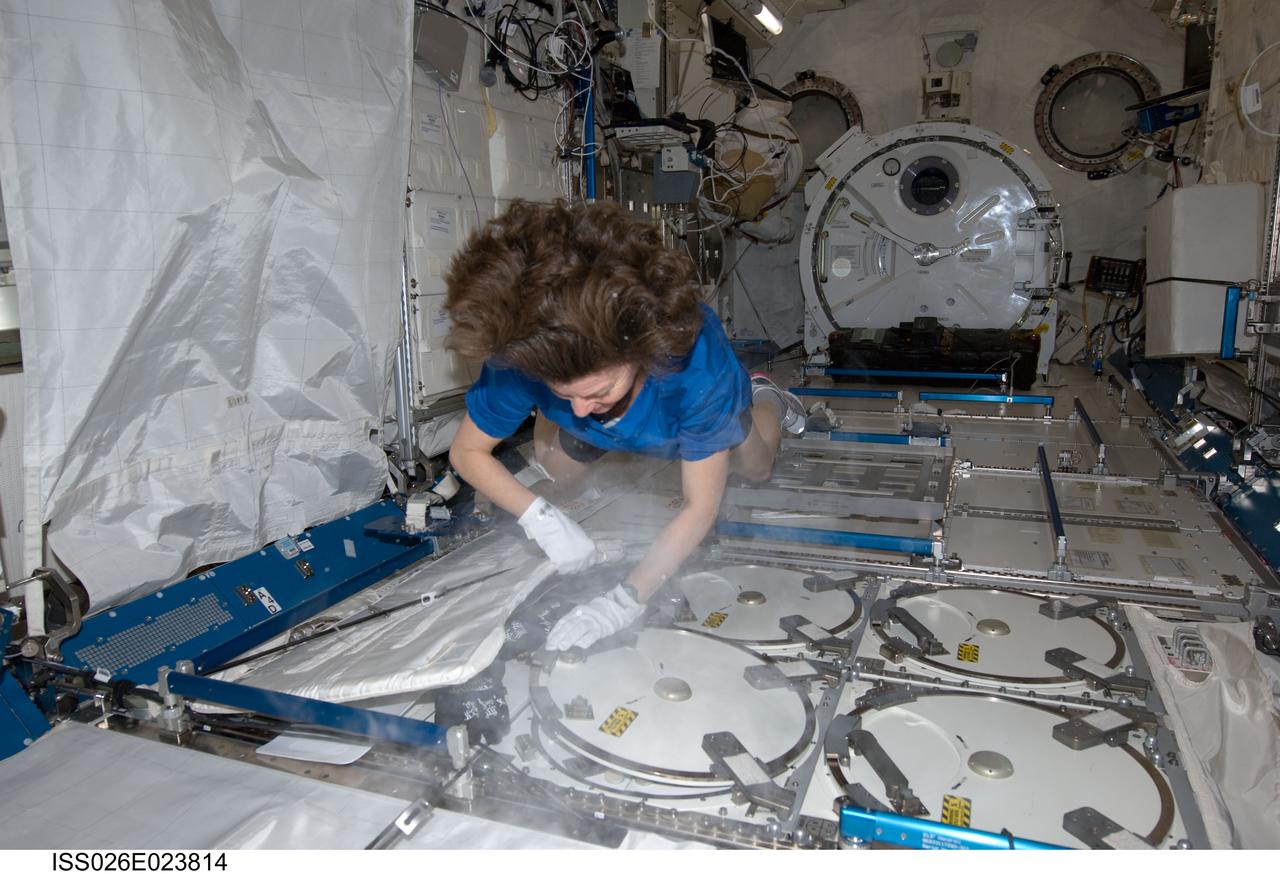
ISS026-E-023814 (27 Dec. 2010) --- NASA astronaut Catherine (Cady) Coleman, Expedition 26 flight engineer, works with the Minus Eighty Degree Laboratory Freezer for ISS (MELFI) as part of the Nutritional Status Assessment (NUTRITION) study in the Japanese Kibo laboratory of the International Space Station.
Coleman prepares to insert samples into the MELFI
ISS024-E-007346 (2 July 2010) --- NASA astronauts Tracy Caldwell Dyson (background) and Shannon Walker, both Expedition 24 flight engineers, prepare to insert biological samples in a dewar tray in the Minus Eighty Laboratory Freezer for ISS (MELFI-1) in the Kibo laboratory of the International Space Station.
MELFI Sample Insertion
ISS026-E-023768 (27 Dec. 2010) --- NASA astronaut Catherine (Cady) Coleman, Expedition 26 flight engineer, prepares to insert samples into the Minus Eighty Degree Laboratory Freezer for ISS (MELFI) as part of the Nutritional Status Assessment (NUTRITION) study in the Japanese Kibo laboratory of the International Space Station.
Coleman prepares to insert samples into the MELFI
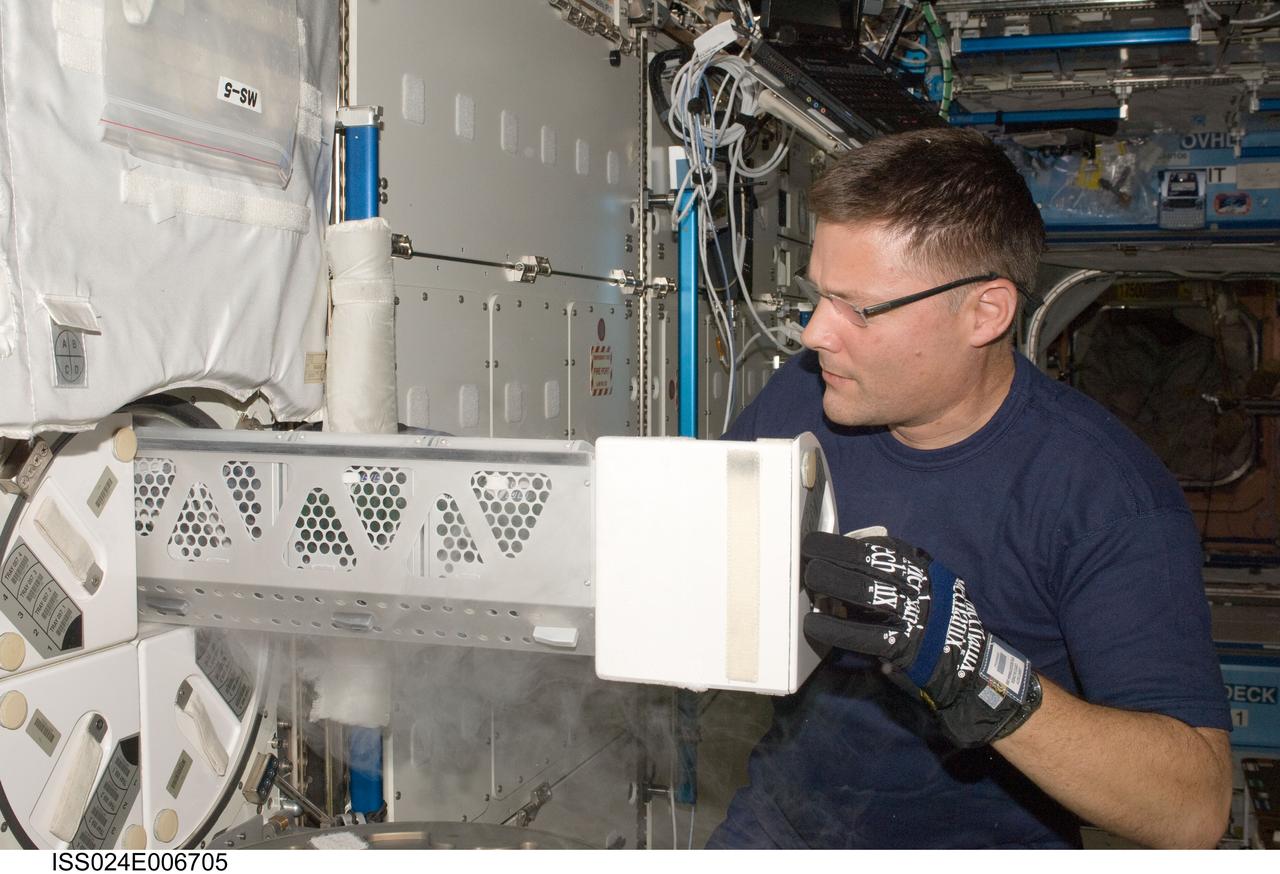
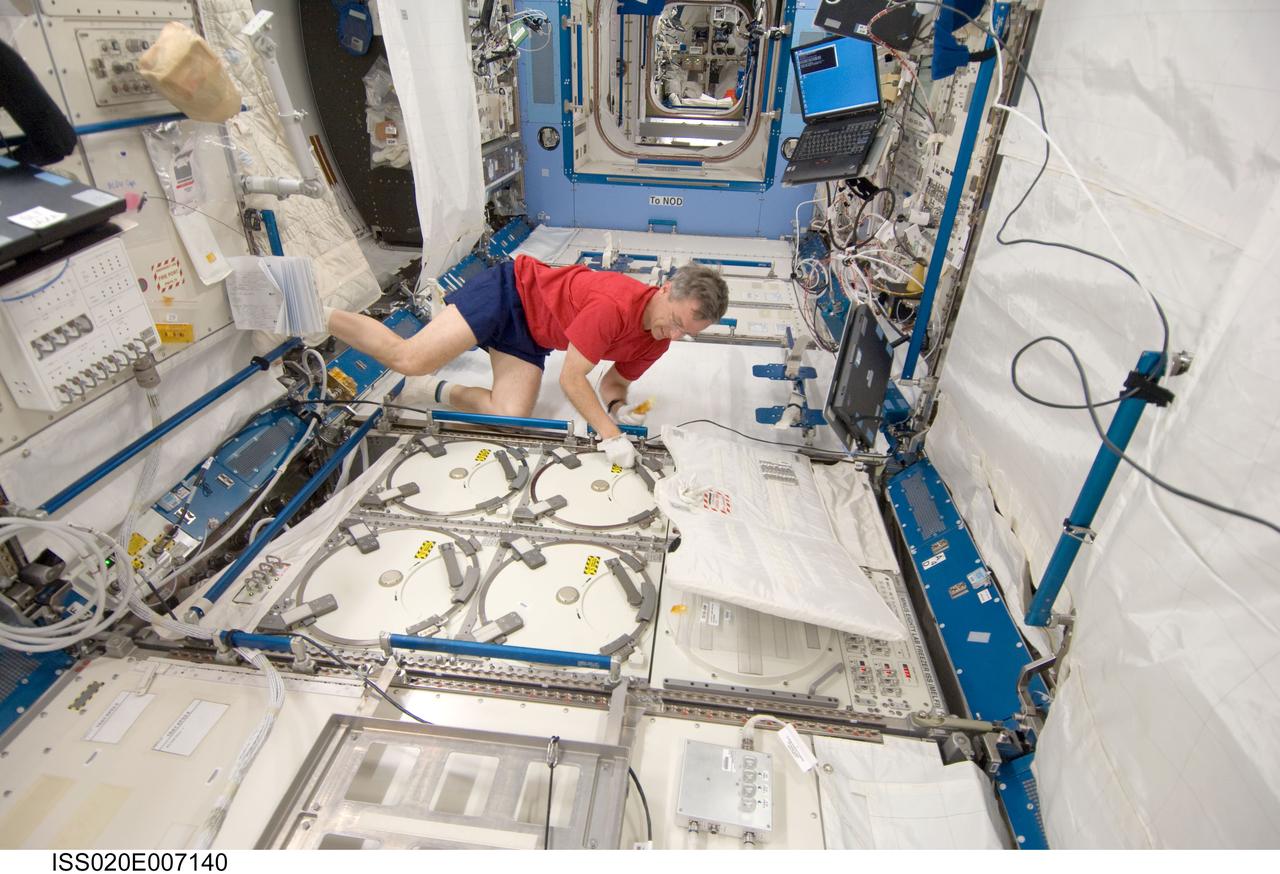
ISS020-E-007156 (7 June 2009) --- Canadian Space Agency astronaut Robert Thirsk, Expedition 20 flight engineer, performs an insertion of urine samples into the Minus Eighty Degree Laboratory Freezer for ISS (MELFI) as part of the Nutritional Status Assessment (NUTRITION) study in the Japanese Kibo laboratory of the International Space Station.
Thirsk inserts samples into MELFI in the JPM
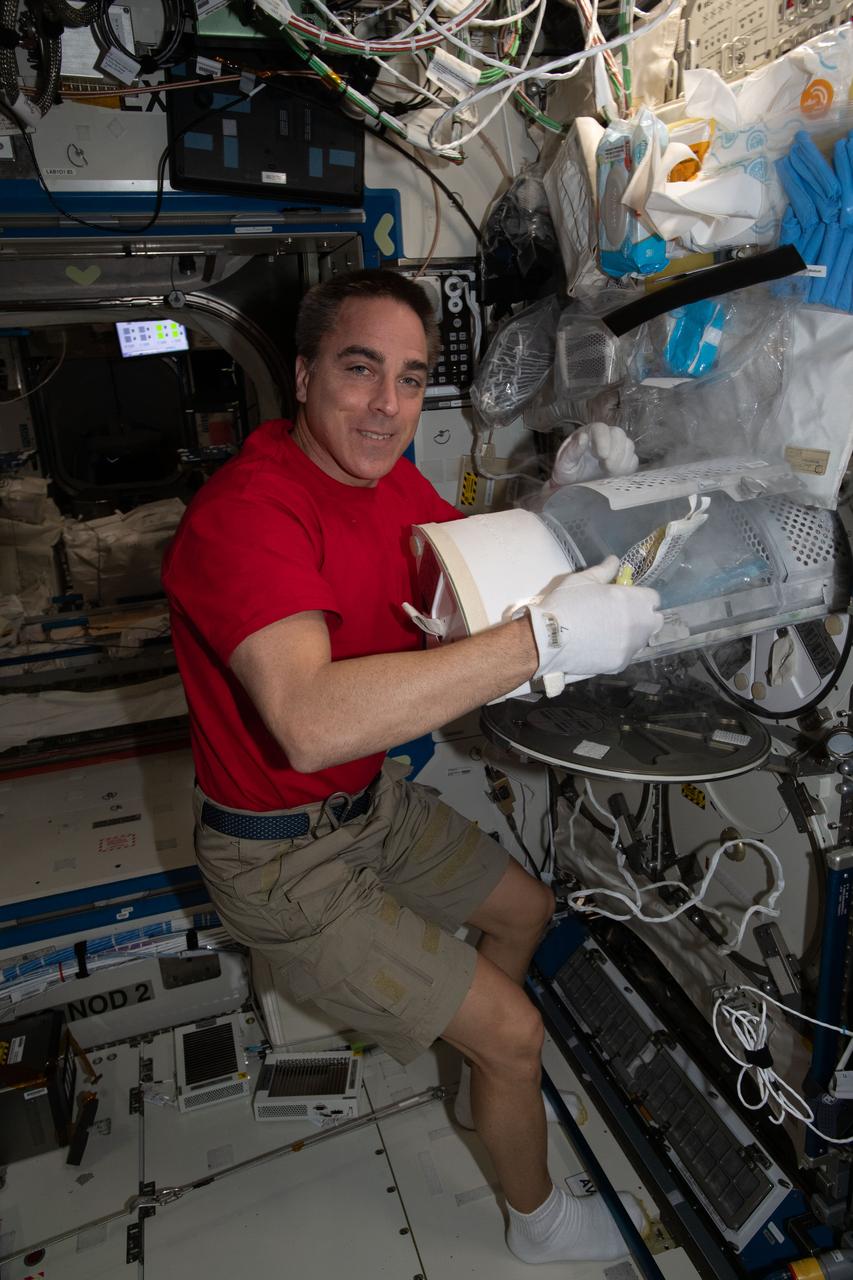
ISS043E207615 (05/18/2015) --- Expedition 43 Commander Terry Virts on the International Space Station works with experiment samples stored inside one of the station’s Minus Eighty-Degree Laboratory Freezer for ISS, or MELFI. These laboratory freezers are used to maintain experiment samples at ultra-cold temperatures throughout a mission.
MELFI ops
ISS030-E-116879 (9 Feb. 2012) --- European Space Agency astronaut Andre Kuipers, Expedition 30 flight engineer, prepares to insert biological samples in the Minus Eighty Laboratory Freezer for ISS (MELFI-1) in the Kibo laboratory of the International Space Station.
Kuipers prepares to insert biological samples in the MELFI
ISS028-E-013797 (1 July 2011) --- NASA astronaut Mike Fossum, Expedition 28 flight engineer, replaces a failed electronic unit for the Minus Eighty Laboratory Freezer for ISS 3 (MELFI-3) with a spare unit in the Kibo laboratory of the International Space Station.
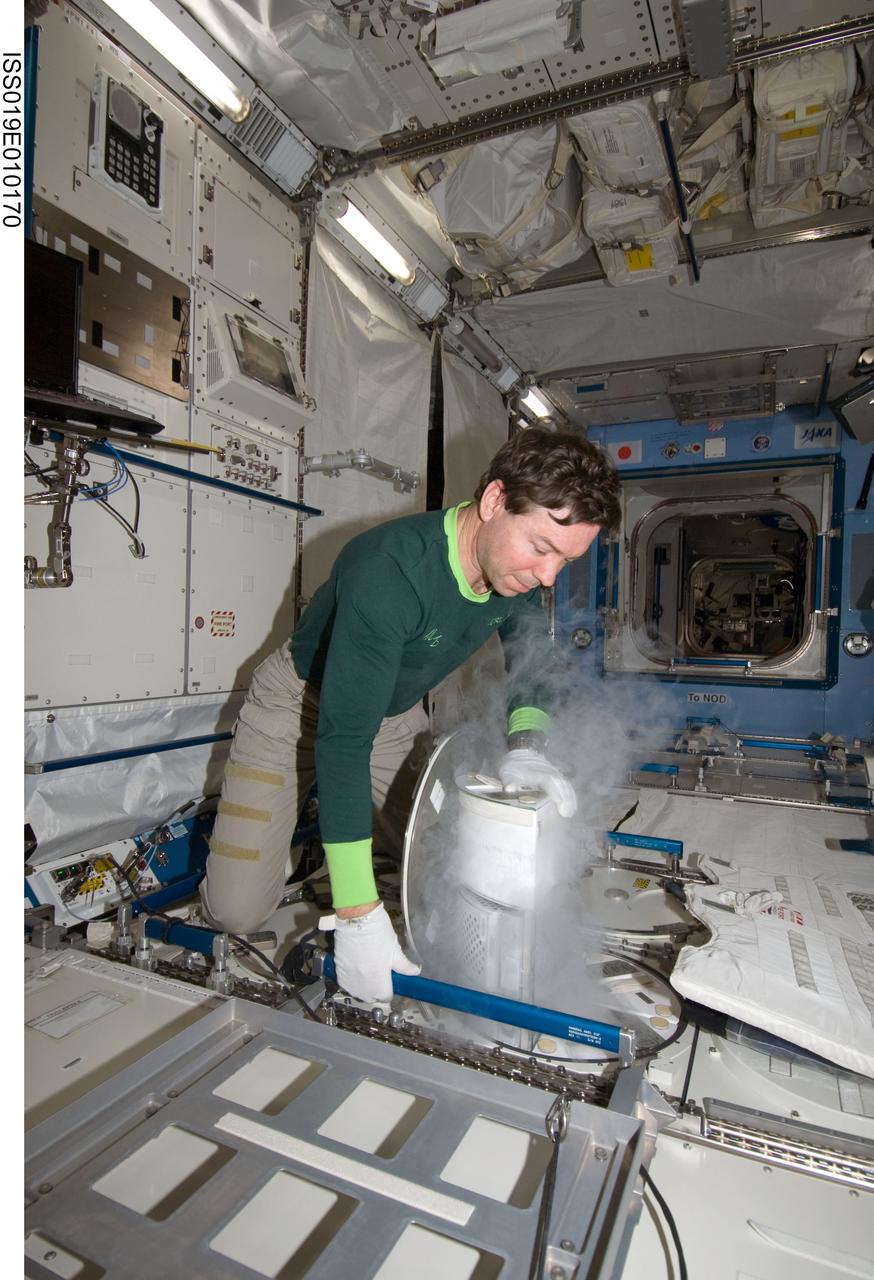
MELFI-3 Electronic Unit Replacement
A tank is used in CryoFILL experiments to liquefy oxygen at minus 290 degrees Fahrenheit as it could be done on the Moon or Mars. The tests conducted at NASA Glenn Research Center, used Fiber Optic Sensing System (FOSS) developed by NASA Armstrong Flight Research Center, to measure oxygen temperatures inside the tank.
Helping CryoFILL Turn Oxygen into Fuel
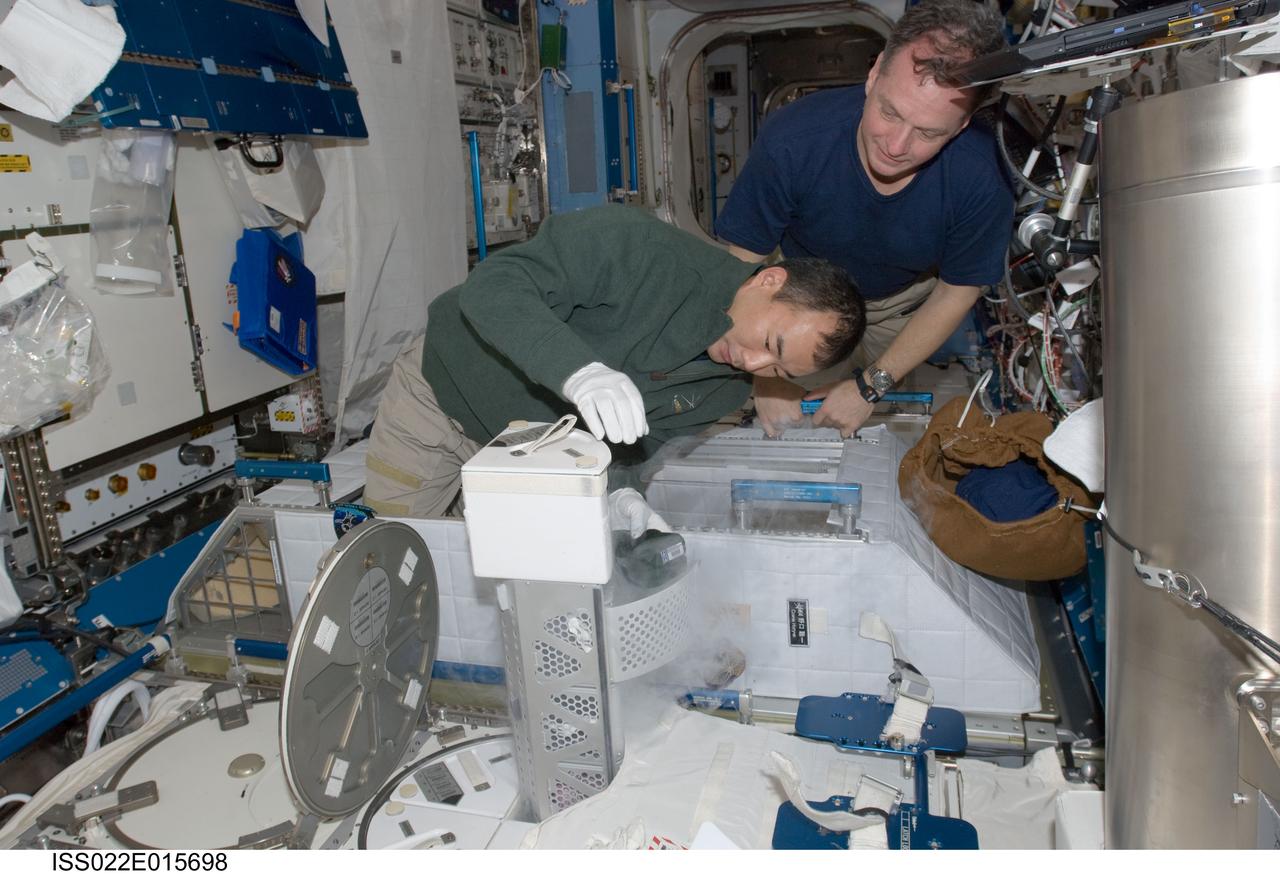
ISS022-E-015698 (28 Dec. 2009) --- Japan Aerospace Exploration Agency astronaut Soichi Noguchi (left) and NASA astronaut T.J. Creamer, both Expedition 22 flight engineers, service the Minus Eighty Laboratory Freezer for ISS (MELFI-1) in the Kibo laboratory of the International Space Station.
Noguchi and Creamer service the MELFI-1 in the JEM during Expedition 22
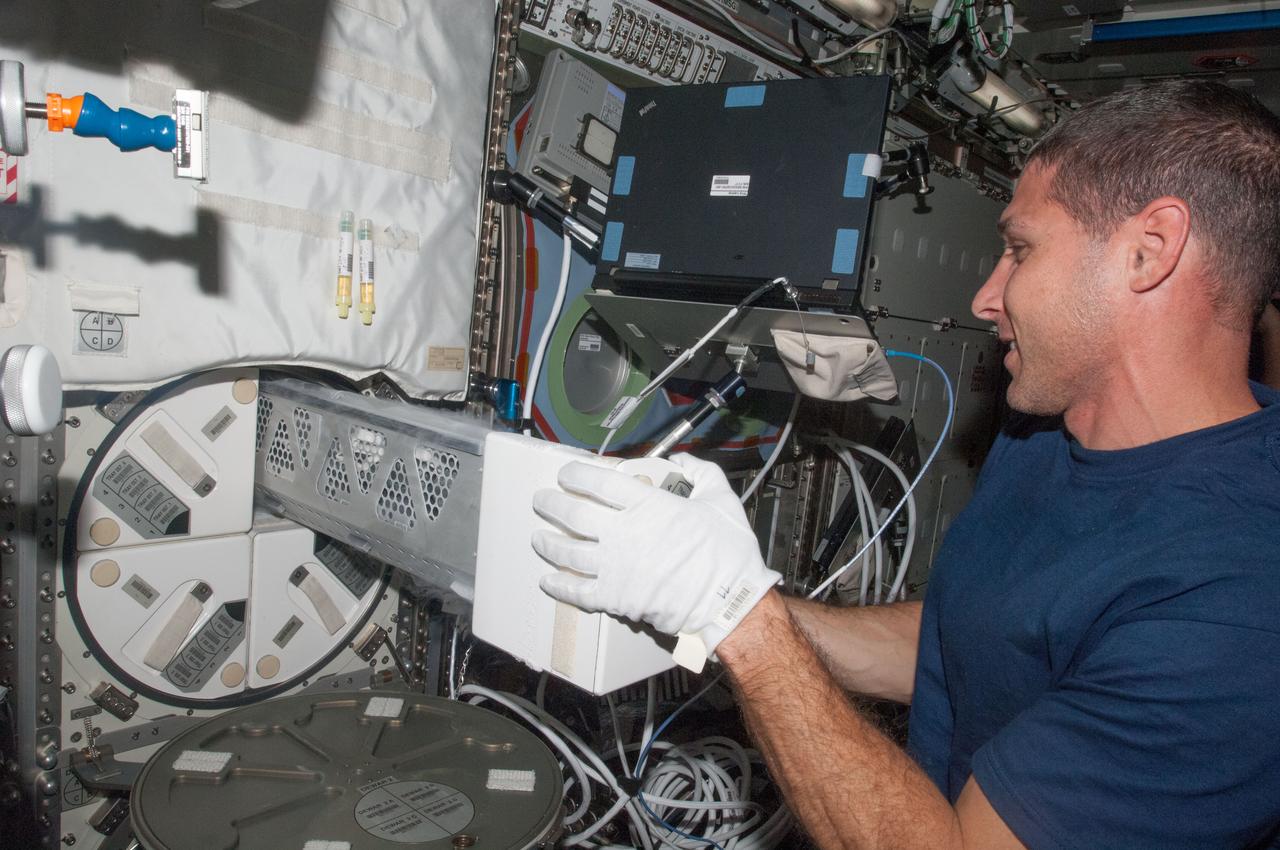
ISS034-E-026607 (7 Jan. 2013) --- NASA astronaut Tom Marshburn, Expedition 34 flight engineer, prepares to insert biological samples in the Minus Eighty Laboratory Freezer for ISS (MELFI-1) in the Kibo laboratory of the International Space Station.
Marshburn prepares to insert biological samples in the MELFI-1
View of Canadian Space Agency (CSA) Chris Hadfield,Expedition 34 Flight Engineer (FE),preparing to insert biological samples in the Minus Eighty Laboratory Freezer for International Space Station (ISS) - (MELFI-1),in the Japanese Experiment Module (JEM) Pressurized Module (JPM).  Photo was taken during Expedition 34.
Hadfield prepares to insert biological samples in the MELFI-1
ISS031-E-143839 (25 June 2012) --- European Space Agency astronaut Andre Kuipers, Expedition 31 flight engineer, prepares to insert biological samples in the Minus Eighty Laboratory Freezer for ISS-2 (MELFI-2) in the Destiny laboratory of the International Space Station.
iss031e143839
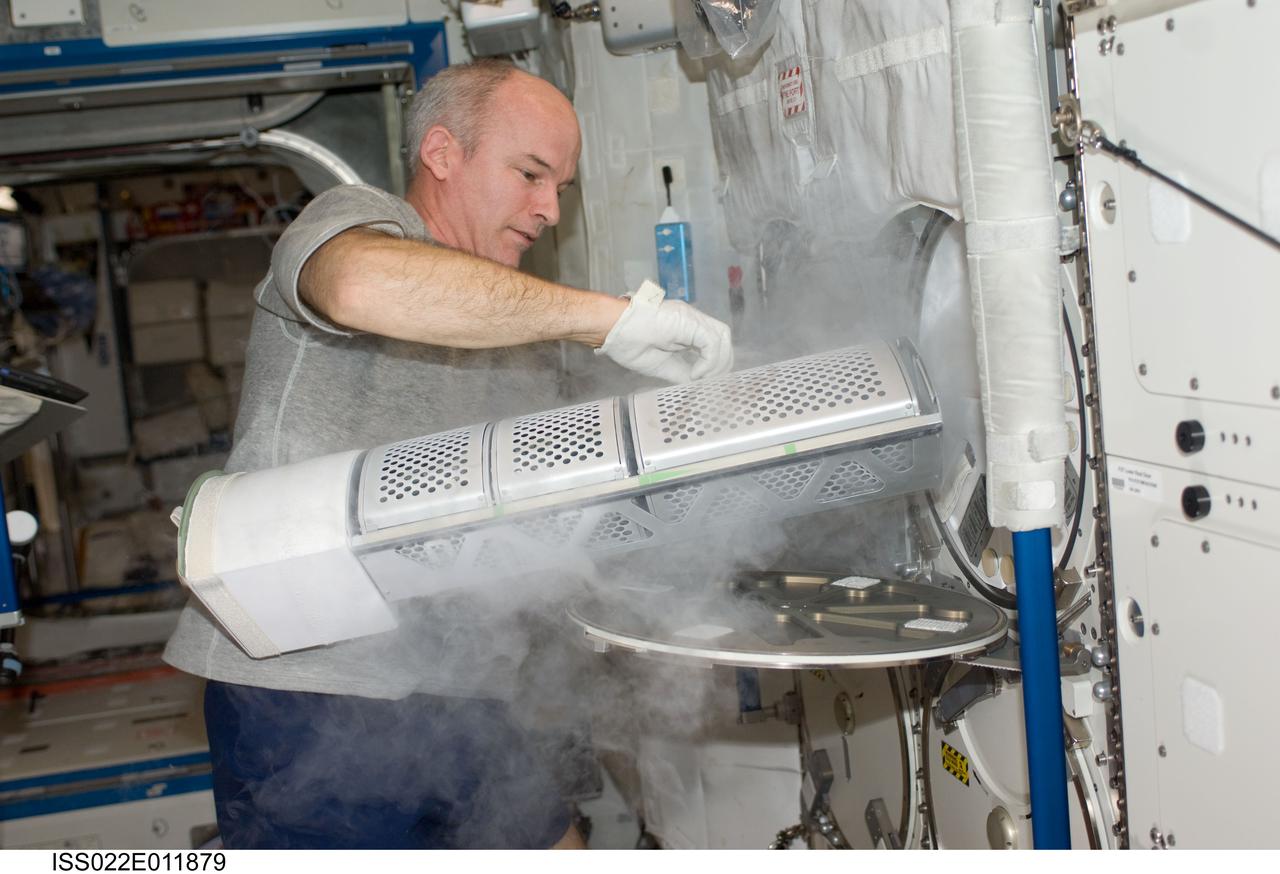
ISS022-E-011879 (16 Dec. 2009) --- NASA astronaut Jeffrey Williams, Expedition 22 commander, services the Advanced Plant Experiments on Orbit-Cambium (APEX-C) payload in the Minus Eighty Laboratory Freezer for ISS-2 (MELFI-2) in the Destiny laboratory of the International Space Station.
Williams installs the APXC Payload in MELFI during Expedition 22
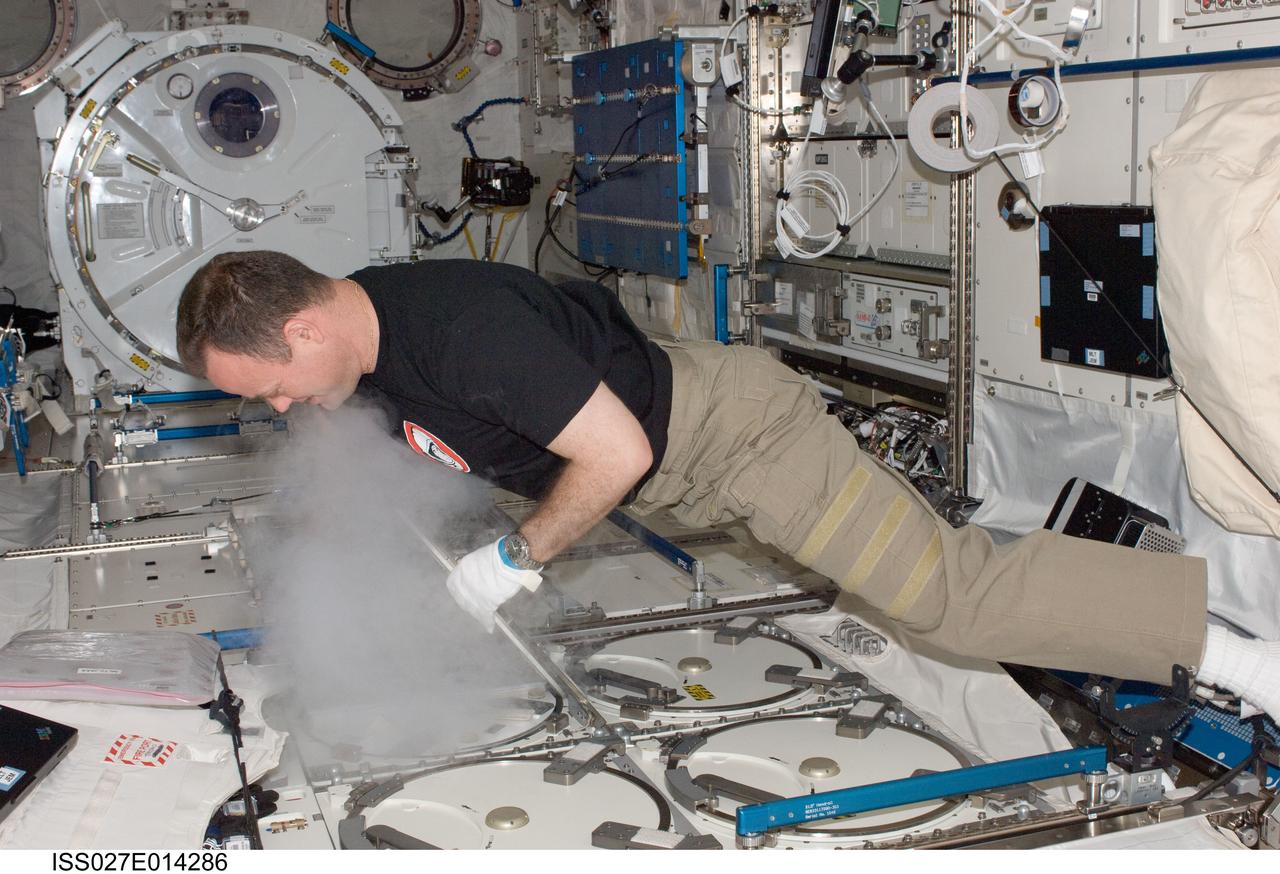
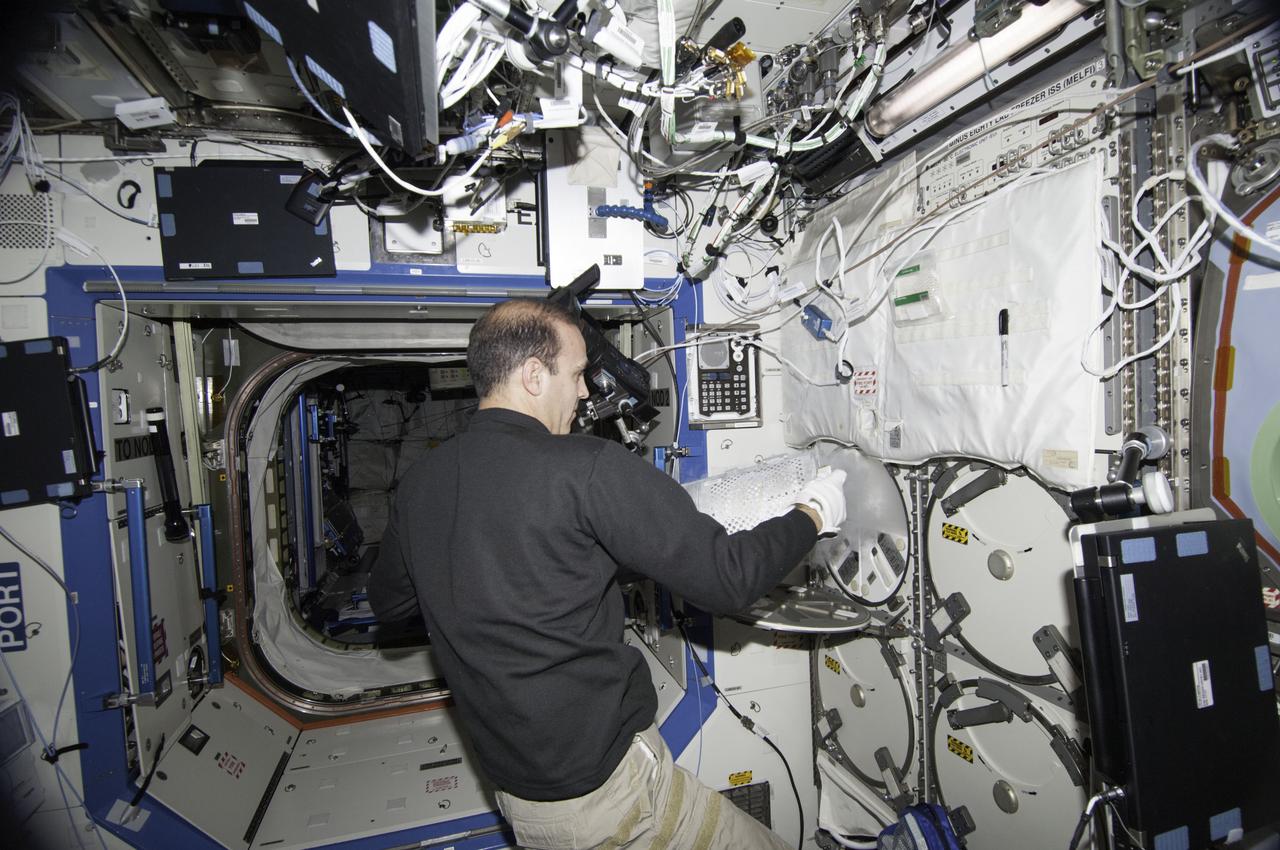
ISS027-E-014286 (14 April 2011) --- NASA astronaut Ron Garan, Expedition 27 flight engineer, replaces a dewar tray containing biological samples in the Minus Eighty Laboratory Freezer for ISS (MELFI-1) in the Kibo laboratory of the International Space Station.
Garan works with MELFI in Kibo
iss027e014283 (4/13/2011) --- Expedition 27 flight engineer Ron Garan prepares to stow a blood draw for the CSA (Canadian Space Agency) Vascular Blood Collection protocol in the Minus Eighty Laboratory Freezer for ISS (MELFI-1) in the Kibo laboratory of the International Space Station.
Garan works with MELFI in Kibo
ISS020-E-007140 (6 June 2009) --- Canadian Space Agency astronaut Robert Thirsk, Expedition 20 flight engineer, performs an insertion of urine samples into the Minus Eighty Degree Laboratory Freezer for ISS (MELFI) as part of the Nutritional Status Assessment (NUTRITION) study in the Japanese Kibo laboratory of the International Space Station.
Thirsk in JPM