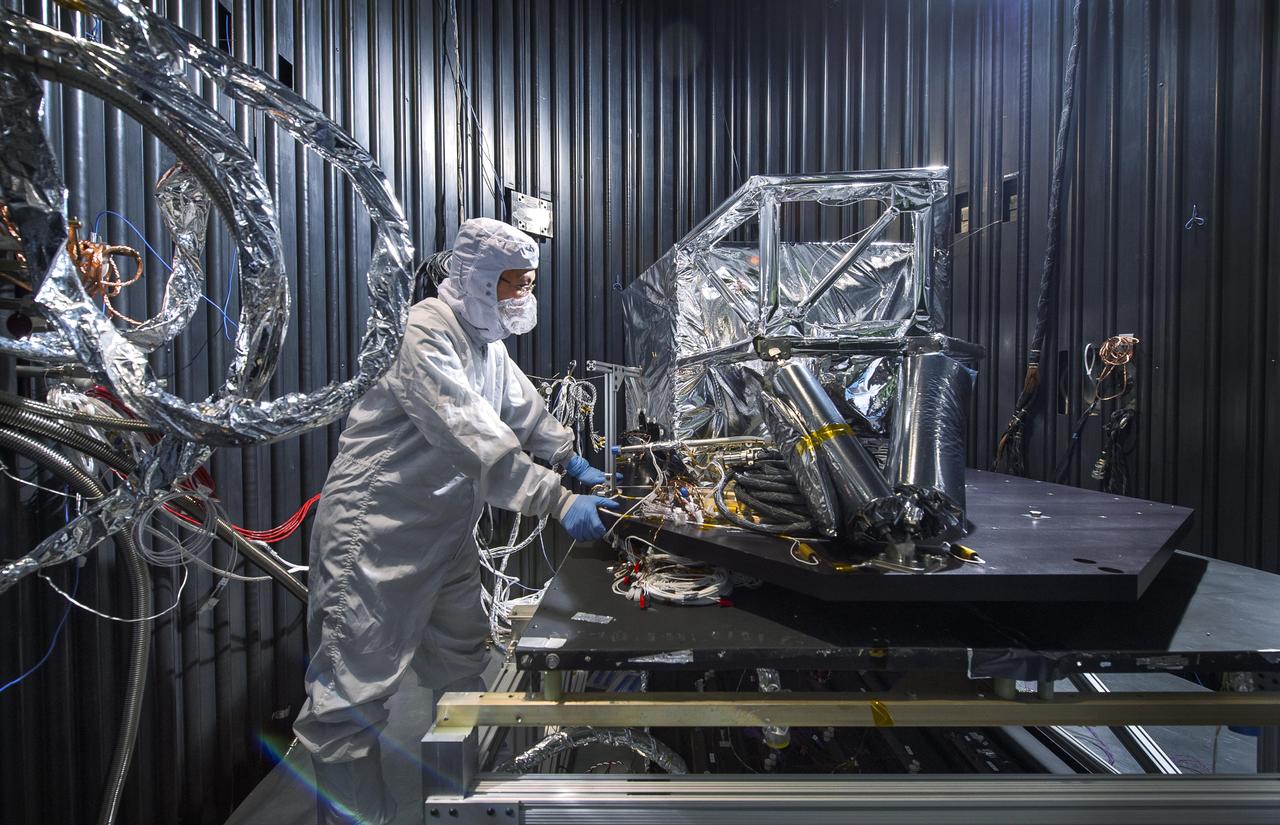
NASA engineer Acey Herrera recently checked out copper test wires inside the thermal shield of the Mid-Infrared Instrument, known as MIRI, that will fly aboard NASA's James Webb Space Telescope. The shield is designed to protect the vital MIRI instrument from excess heat. At the time of the photo, the thermal shield was about to go through rigorous environmental testing to ensure it can perform properly in the extreme cold temperatures that it will encounter in space. Herrera is working in a thermal vacuum chamber at NASA's Goddard Space Flight Center in Greenbelt, Md. As the MIRI shield lead, Herrera along with a thermal engineer and cryo-engineer verify that the shield is ready for testing. On the Webb telescope, the pioneering camera and spectrometer that comprise the MIRI instrument sit inside the Integrated Science Instrument Module flight structure, that holds Webb's four instruments and their electronic systems during launch and operations. Read more: <a href="http://1.usa.gov/15I0wrS" rel="nofollow">1.usa.gov/15I0wrS</a> Credit: NASA/Chris Gunn <b><a href="http://www.nasa.gov/audience/formedia/features/MP_Photo_Guidelines.html" rel="nofollow">NASA image use policy.</a></b> <b><a href="http://www.nasa.gov/centers/goddard/home/index.html" rel="nofollow">NASA Goddard Space Flight Center</a></b> enables NASA’s mission through four scientific endeavors: Earth Science, Heliophysics, Solar System Exploration, and Astrophysics. Goddard plays a leading role in NASA’s accomplishments by contributing compelling scientific knowledge to advance the Agency’s mission. <b>Follow us on <a href="http://twitter.com/NASA_GoddardPix" rel="nofollow">Twitter</a></b> <b>Like us on <a href="http://www.facebook.com/pages/Greenbelt-MD/NASA-Goddard/395013845897?ref=tsd" rel="nofollow">Facebook</a></b> <b>Find us on <a href="http://instagram.com/nasagoddard?vm=grid" rel="nofollow">Instagram</a></b>
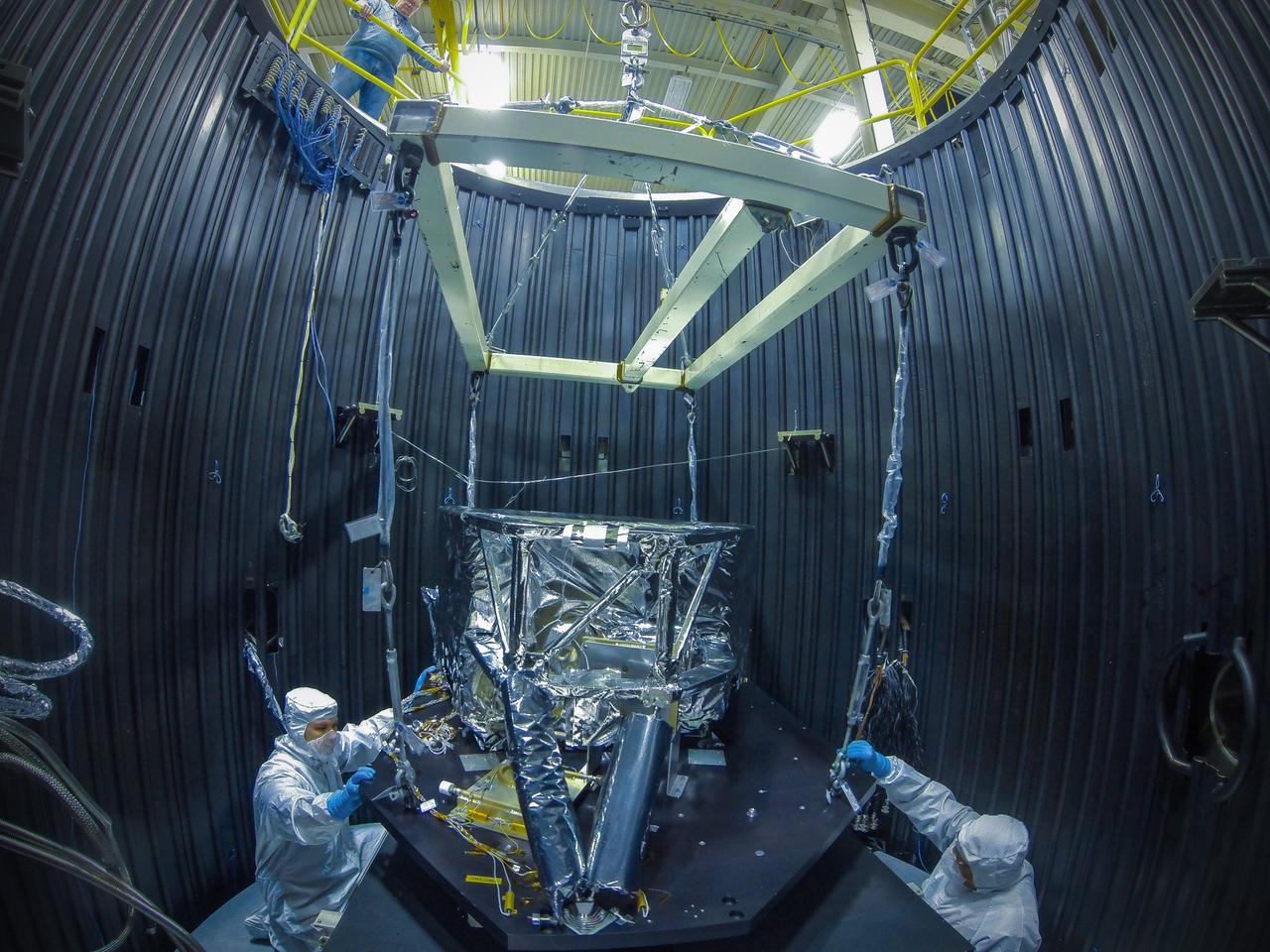
Goddard Technicians Tony Kiem (left) and George Mooney (right) guide the craned structure holding the Webb telescope's Mid-Infrared Instrument or MIRI Shield Environmental Test Unit into place in a cryogenic (cooling) test chamber. This shield will be used to simulate the MIRI instrument during prelaunch testing to verify that the MIRI cooling system will function properly in space. Goddard Safety Engineer Richard Bowlan watches from above. Image Credit: NASA/Chris Gunn <b><a href="http://www.nasa.gov/audience/formedia/features/MP_Photo_Guidelines.html" rel="nofollow">NASA image use policy.</a></b> <b><a href="http://www.nasa.gov/centers/goddard/home/index.html" rel="nofollow">NASA Goddard Space Flight Center</a></b> enables NASA’s mission through four scientific endeavors: Earth Science, Heliophysics, Solar System Exploration, and Astrophysics. Goddard plays a leading role in NASA’s accomplishments by contributing compelling scientific knowledge to advance the Agency’s mission. <b>Follow us on <a href="http://twitter.com/NASA_GoddardPix" rel="nofollow">Twitter</a></b> <b>Like us on <a href="http://www.facebook.com/pages/Greenbelt-MD/NASA-Goddard/395013845897?ref=tsd" rel="nofollow">Facebook</a></b> <b>Find us on <a href="http://instagram.com/nasagoddard?vm=grid" rel="nofollow">Instagram</a></b>
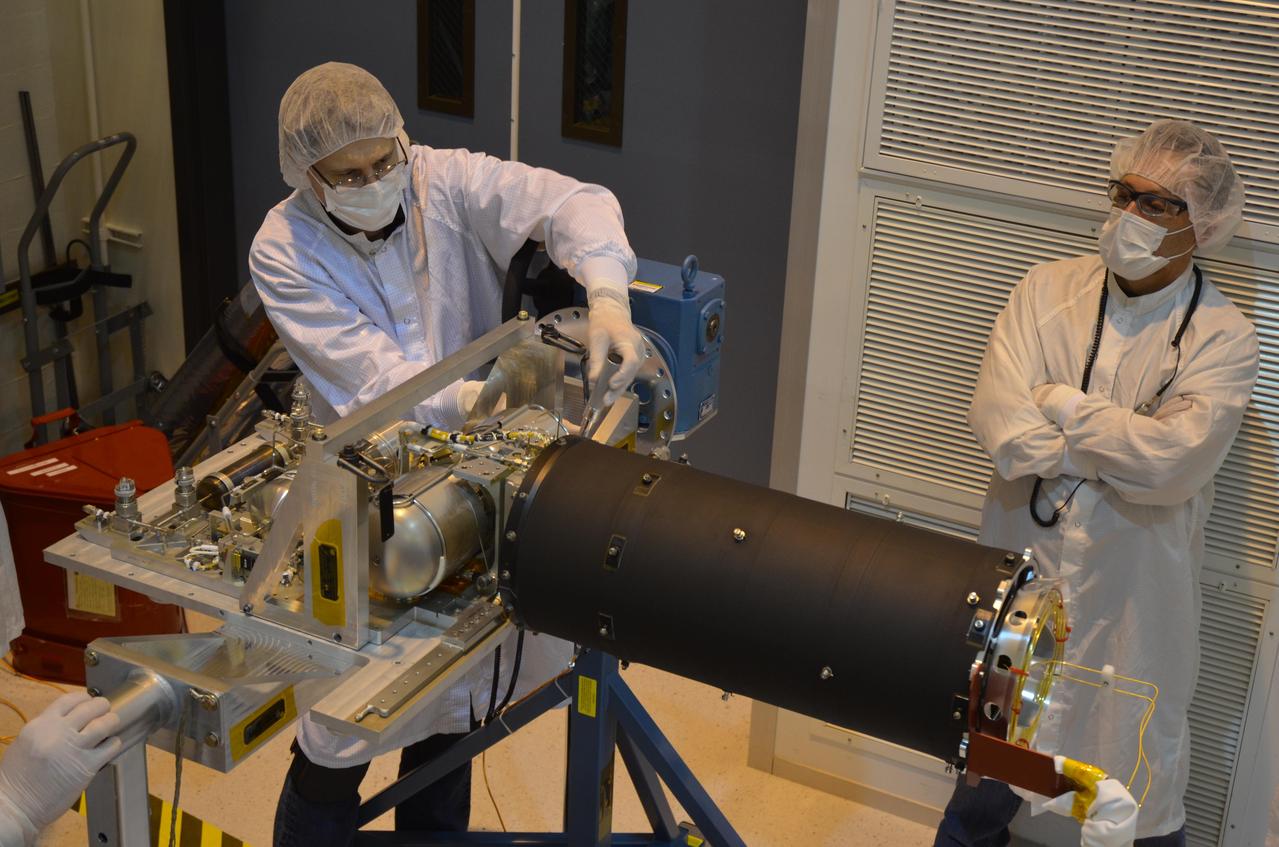
Technicians inspect a component of the cryocooler for the Mid-Infrared Instrument, or MIRI, part of NASA's James Webb Space Telescope. This photo was taken after the cooler had completed testing, and was taken out of the test chamber in preparation for being placed into its shipping container. The cooler was shipped to the Northrop Grumman Aerospace Systems facility in Redondo Beach, California, on May 26, 2016. There, the cooler will be attached to the body of the Webb telescope. http://photojournal.jpl.nasa.gov/catalog/PIA20686
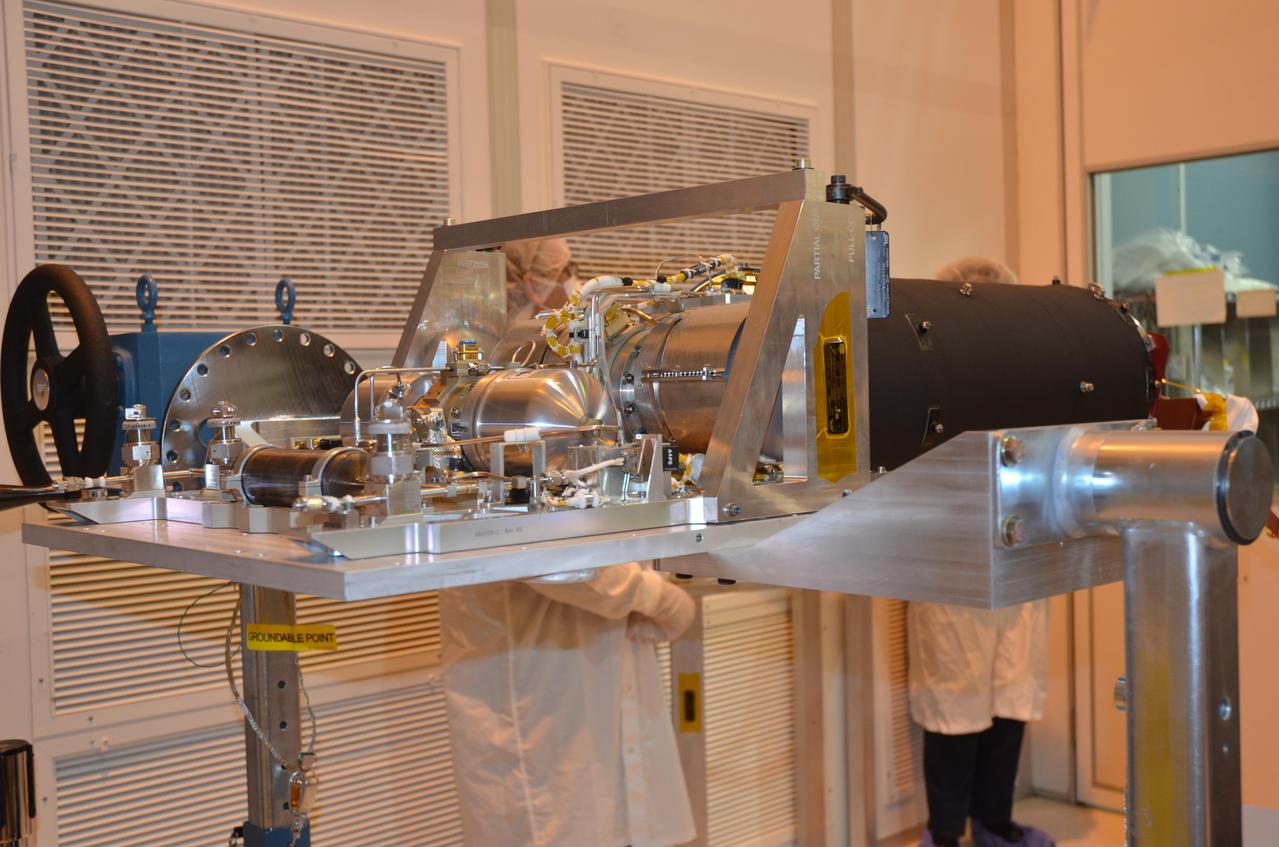
This image shows the cooling device for the Mid-Infrared Instrument, or MIRI, one of the James Webb Space Telescope's four instruments. This photo was taken after the cryocooler had completed testing, and was taken out of the test chamber in preparation for being placed into its shipping container. The cooler was shipped to the Northrop Grumman Aerospace Systems facility in Redondo Beach, California, on May 26, 2016. There, the cooler will be attached to the body of the Webb telescope. http://photojournal.jpl.nasa.gov/catalog/PIA20688

This side-by-side comparison shows observations of the Southern Ring Nebula in near-infrared light, at left, and mid-infrared light, at right, from NASA’s Webb Telescope. This scene was created by a white dwarf star – the remains of a star like our Sun after it shed its outer layers and stopped burning fuel though nuclear fusion. Those outer layers now form the ejected shells all along this view. In the Near-Infrared Camera (NIRCam) image, the white dwarf appears to the lower left of the bright, central star, partially hidden by a diffraction spike. The same star appears – but brighter, larger, and redder – in the Mid-Infrared Instrument (MIRI) image. This white dwarf star is cloaked in thick layers of dust, which make it appear larger. The brighter star in both images hasn’t yet shed its layers. It closely orbits the dimmer white dwarf, helping to distribute what it’s ejected. Over thousands of years and before it became a white dwarf, the star periodically ejected mass – the visible shells of material. As if on repeat, it contracted, heated up – and then, unable to push out more material, pulsated. Stellar material was sent in all directions – like a rotating sprinkler – and provided the ingredients for this asymmetrical landscape. Today, the white dwarf is heating up the gas in the inner regions – which appear blue at left and red at right. Both stars are lighting up the outer regions, shown in orange and blue, respectively. The images look very different because NIRCam and MIRI collect different wavelengths of light. NIRCam observes near-infrared light, which is closer to the visible wavelengths our eyes detect. MIRI goes farther into the infrared, picking up mid-infrared wavelengths. The second star more clearly appears in the MIRI image, because this instrument can see the gleaming dust around it, bringing it more clearly into view. The stars – and their layers of light – steal more attention in the NIRCam image, while dust plays the lead in the MIRI image, specifically dust that is illuminated. Peer at the circular region at the center of both images. Each contains a wobbly, asymmetrical belt of material. This is where two “bowls” that make up the nebula meet. (In this view, the nebula is at a 40-degree angle.) This belt is easier to spot in the MIRI image – look for the yellowish circle – but is also visible in the NIRCam image. The light that travels through the orange dust in the NIRCam image – which look like spotlights – disappear at longer infrared wavelengths in the MIRI image. In near-infrared light, stars have more prominent diffraction spikes because they are so bright at these wavelengths. In mid-infrared light, diffraction spikes also appear around stars, but they are fainter and smaller (zoom in to spot them). Physics is the reason for the difference in the resolution of these images. NIRCam delivers high-resolution imaging because these wavelengths of light are shorter. MIRI supplies medium-resolution imagery because its wavelengths are longer – the longer the wavelength, the coarser the images are. But both deliver an incredible amount of detail about every object they observe – providing never-before-seen vistas of the universe. For a full array of Webb’s first images and spectra, including downloadable files, please visit: https://webbtelescope.org/news/first-images NIRCam was built by a team at the University of Arizona and Lockheed Martin’s Advanced Technology Center. MIRI was contributed by ESA and NASA, with the instrument designed and built by a consortium of nationally funded European Institutes (The MIRI European Consortium) in partnership with JPL and the University of Arizona.

Engineers are checking to make sure that MIRI is precisely positioned with the ISIM as it slides into position. They have to make sure it's installed exactly where it needs to be within the width of a thin human hair. Visible is MIRI's pickoff mirror, which is the protrusion on the right side of the instrument that looks like a periscope on its side. This is where MIRI grabs light coming from the telescope optics. Also visible is the silver-colored base of MIRI's cryocooled shield, already installed on the ISIM structure and with a hole in it for MIRI's pickoff mirror. MIRI itself has special silver-colored blanketing around it as insulation to keep it at its proper cryogenic temperature during operation. Photo Credit: NASA/Chris Gunn; Text Credit: NASA/Laura Betz ---- Engineers worked meticulously to implant the James Webb Space Telescope's Mid-Infrared Instrument into the ISIM, or Integrated Science Instrument Module, in the cleanroom at NASA's Goddard Space Flight Center in Greenbelt, Md. As the successor to NASA's Hubble Space Telescope, the Webb telescope will be the most powerful space telescope ever built. It will observe the most distant objects in the universe, provide images of the first galaxies formed and see unexplored planets around distant stars. For more information, visit: <a href="http://www.jwst.nasa.gov" rel="nofollow">www.jwst.nasa.gov</a> <b><a href="http://www.nasa.gov/audience/formedia/features/MP_Photo_Guidelines.html" rel="nofollow">NASA image use policy.</a></b> <b><a href="http://www.nasa.gov/centers/goddard/home/index.html" rel="nofollow">NASA Goddard Space Flight Center</a></b> enables NASA’s mission through four scientific endeavors: Earth Science, Heliophysics, Solar System Exploration, and Astrophysics. Goddard plays a leading role in NASA’s accomplishments by contributing compelling scientific knowledge to advance the Agency’s mission. <b>Follow us on <a href="http://twitter.com/NASA_GoddardPix" rel="nofollow">Twitter</a></b> <b>Like us on <a href="http://www.facebook.com/pages/Greenbelt-MD/NASA-Goddard/395013845897?ref=tsd" rel="nofollow">Facebook</a></b> <b>Find us on <a href="http://instagram.com/nasagoddard?vm=grid" rel="nofollow">Instagram</a></b>
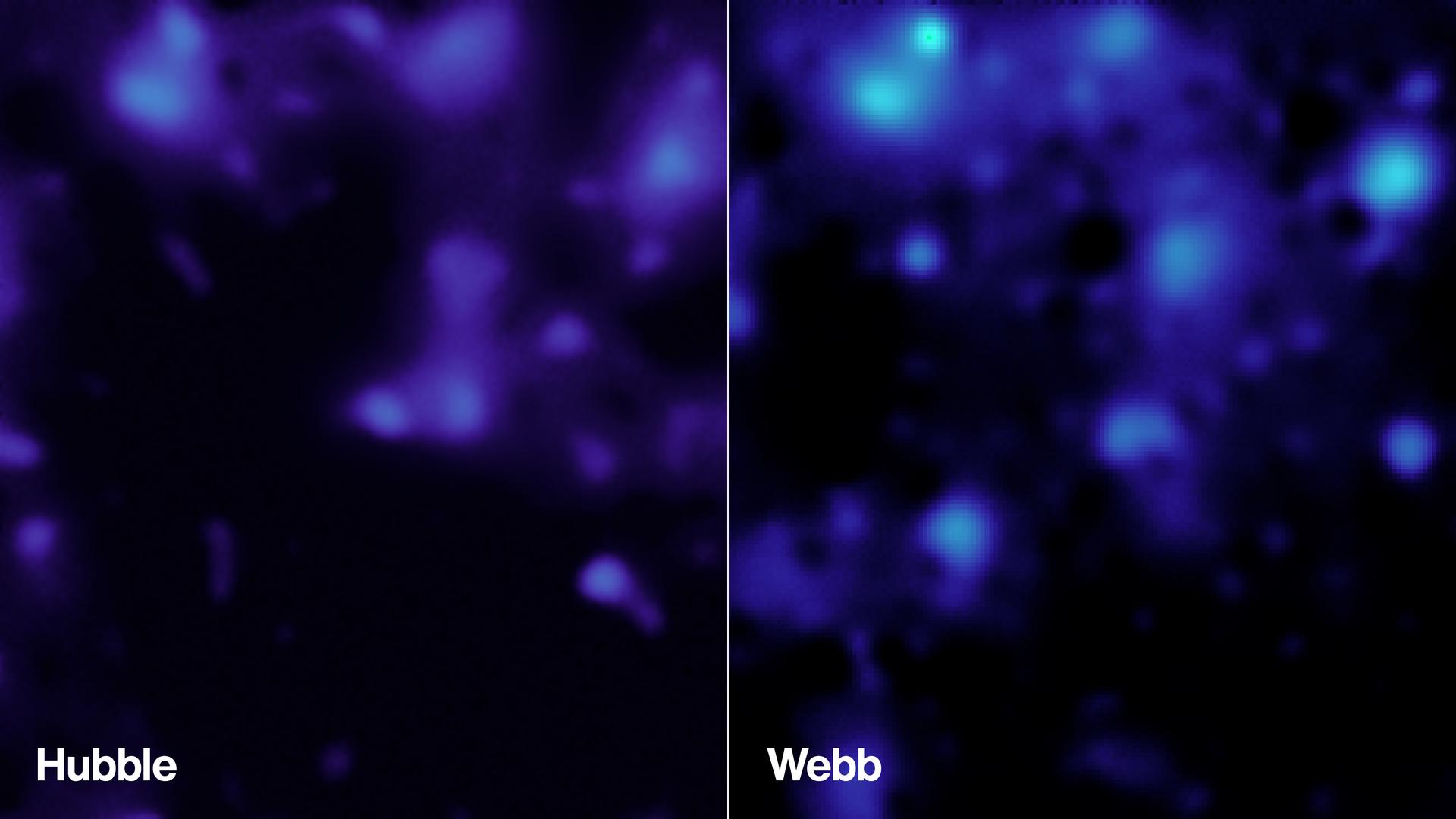
These images show the presence of dark matter in the same region of sky, created using data from NASA’s Webb telescope in 2026 (right) and from the Hubble Space Telescope in 2007 (left). Webb’s higher resolution is providing new insights into how this invisible component influences the distribution of ordinary matter in the universe. The James Webb Space Telescope is solving mysteries in our solar system, looking beyond to distant worlds around other stars, and probing the mysterious structures and origins of our universe and our place in it. Webb is an international program led by NASA with its partners, ESA (European Space Agency) and CSA (Canadian Space Agency). Webb’s MIRI was developed through a 50-50 partnership between NASA and ESA. A division of Caltech in Pasadena, California, JPL led the U.S. contribution to MIRI. JPL also led development of MIRI’s cryocooler, done in collaboration with Northrop Grumman in Redondo Beach, California, and NASA’s Goddard Space Flight Center in Greenbelt, Maryland. To learn more about Webb, visit: https://science.nasa.gov/webb
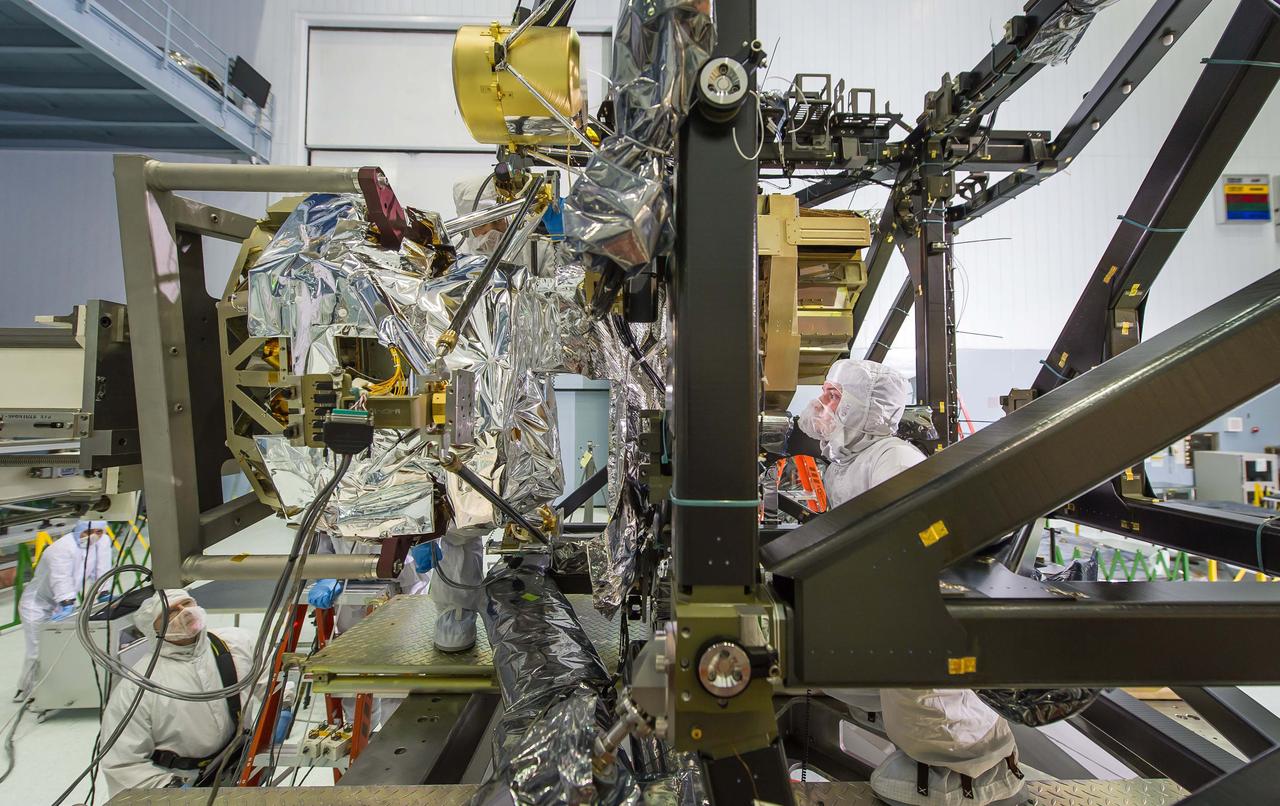
Engineers Tom Huber (behind MIRI) and Mick Wilks (inside black ISIM Structure) check that MIRI is integrated precisely. The engineers have to make sure that MIRI, the only instrument on the Webb telescope that 'sees' mid-infrared light, is precisely positioned so that it and the other instruments can glimpse the formation of galaxies and see deeper into the universe than ever before. Photo Credit: NASA/Chris Gunn; Text Credit: NASA/Laura Betz ---- Engineers worked meticulously to implant the James Webb Space Telescope's Mid-Infrared Instrument into the ISIM, or Integrated Science Instrument Module, in the cleanroom at NASA's Goddard Space Flight Center in Greenbelt, Md. As the successor to NASA's Hubble Space Telescope, the Webb telescope will be the most powerful space telescope ever built. It will observe the most distant objects in the universe, provide images of the first galaxies formed and see unexplored planets around distant stars. For more information, visit: <a href="http://www.jwst.nasa.gov" rel="nofollow">www.jwst.nasa.gov</a> <b><a href="http://www.nasa.gov/audience/formedia/features/MP_Photo_Guidelines.html" rel="nofollow">NASA image use policy.</a></b> <b><a href="http://www.nasa.gov/centers/goddard/home/index.html" rel="nofollow">NASA Goddard Space Flight Center</a></b> enables NASA’s mission through four scientific endeavors: Earth Science, Heliophysics, Solar System Exploration, and Astrophysics. Goddard plays a leading role in NASA’s accomplishments by contributing compelling scientific knowledge to advance the Agency’s mission. <b>Follow us on <a href="http://twitter.com/NASA_GoddardPix" rel="nofollow">Twitter</a></b> <b>Like us on <a href="http://www.facebook.com/pages/Greenbelt-MD/NASA-Goddard/395013845897?ref=tsd" rel="nofollow">Facebook</a></b> <b>Find us on <a href="http://instagram.com/nasagoddard?vm=grid" rel="nofollow">Instagram</a></b>
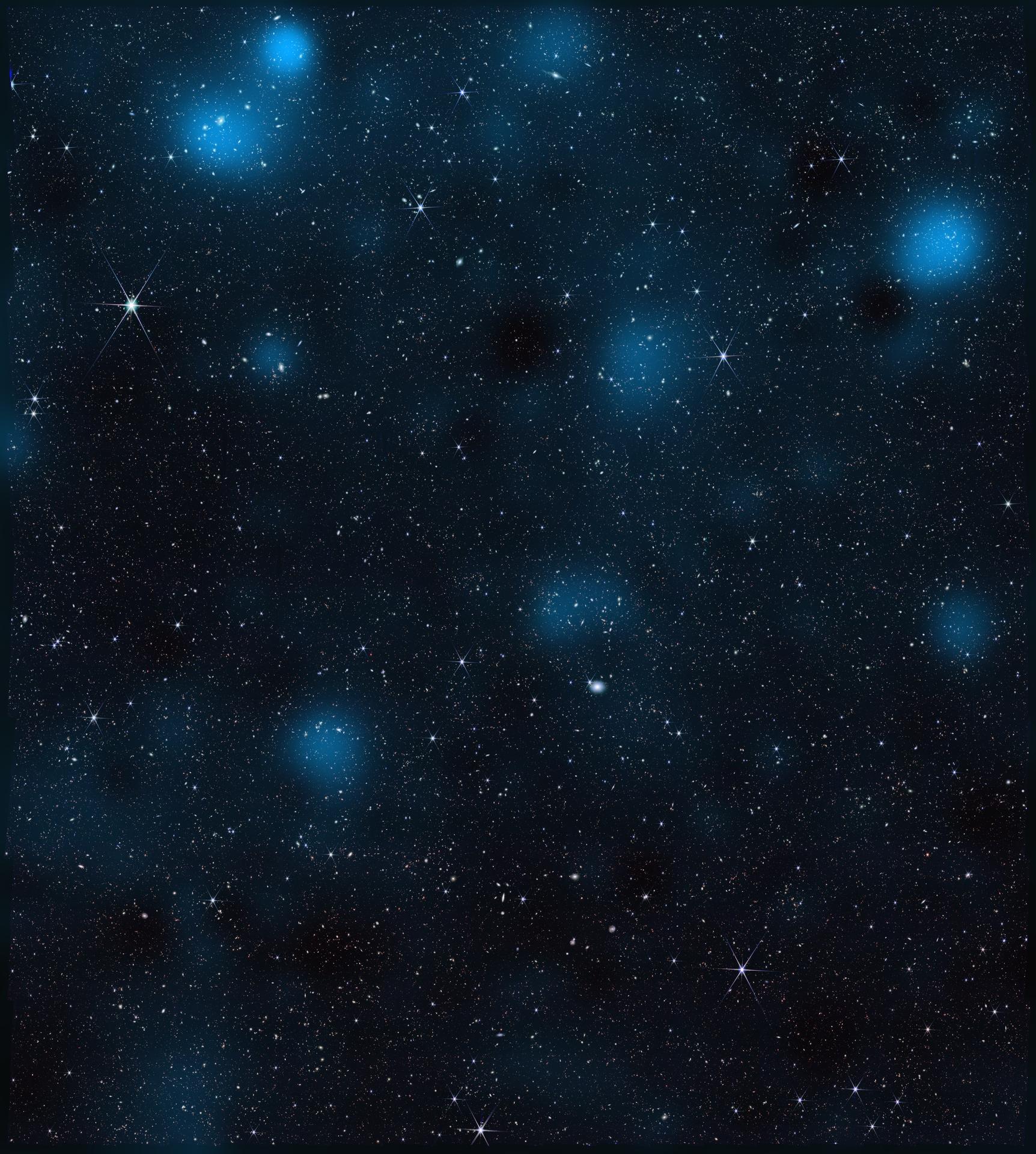
This image from NASA’s James Webb Space Telescope, containing nearly 800,000 galaxies, is overlaid with a map of dark matter, represented in blue. Brighter blue areas indicate a higher density of dark matter. Researchers used Webb data to find the dark matter — which is invisible — via its gravitational influence on regular matter. The area of sky shown here is 0.54 square degrees (about 2½ times the size of the full Moon) and located in the constellation Sextans. Webb’s Near-Infrared Camera (NIRCam) peered at this region for a total of about 255 hours. Dark matter doesn’t emit, reflect, absorb, or even block light, and is therefore not visible to the human eye or traditional telescopes. But it does interact with the universe through gravity, and large clumps or clusters of dark matter have enough mass to curve space itself. Light traveling to Earth from distant galaxies becomes slightly distorted as it passes through the curved fabric of spacetime. In some cases, the warping is significant enough that it is apparent to the naked eye, almost as if the galaxy were being viewed through a warped windowpane, an effect called strong gravitational lensing. In the case of the dark matter map shown here, scientists inferred dark matter’s distribution by relying instead on an effect called weak gravitational lensing, which leads to much more subtle distortions of the light from thousands of galaxies. The dark matter in this area of sky was also mapped in 2007 using data from NASA’s Hubble Space Telescope. The Webb map contains about 10 times more galaxies than do maps of the area made by ground-based observatories and twice as many as Hubble’s map. It reveals new clumps of dark matter and captures a higher-resolution view compared to the Hubble map. Both the Hubble and Webb dark matter maps are part of a project called the Cosmic Evolution Survey (COSMOS). The full COSMOS “field” is 2 square degrees (about 10 times the size of the full Moon) and has been imaged by at least 15 telescopes in space and on the ground. Observing the same region with many different telescopes allows scientists to combine complementary views to understand how galaxies grow and how dark matter influences their evolution. Only Webb and Hubble data have been used to map dark matter in the region. To refine measurements of the distance to many galaxies for the map, the team used Webb’s Mid-Infrared Instrument (MIRI), designed and managed through launch by the agency’s Jet Propulsion Laboratory, along with other space- and ground-based telescopes. The wavelengths that MIRI detects also make it adept at detecting galaxies obscured by cosmic dust clouds. The James Webb Space Telescope is solving mysteries in our solar system, looking beyond to distant worlds around other stars, and probing the mysterious structures and origins of our universe and our place in it. Webb is an international program led by NASA with its partners, ESA (European Space Agency) and CSA (Canadian Space Agency). Webb’s MIRI was developed through a 50-50 partnership between NASA and ESA. A division of Caltech in Pasadena, California, JPL led the U.S. contribution to MIRI. JPL also led development of MIRI’s cryocooler, done in collaboration with Northrop Grumman in Redondo Beach, California, and NASA’s Goddard Space Flight Center in Greenbelt, Maryland. To learn more about Webb, visit: https://science.nasa.gov/webb

This image from NASA's James Webb Space Telescope reveals at least 17 concentric dust rings emanating from a pair of stars orbiting one another. Located just over 5,000 light-years from Earth, the system is known as Wolf-Rayet 140 because one of the stars is a Wolf-Rayet star. The other is an O-type star, one of the most massive star types known. Each ring was created when the two stars came close together and their stellar winds (streams of gas they blow into space) collided, compressing the gas and forming dust. A ring is produced once per orbit, every 7.93 years. A Wolf-Rayet star is an O-type star born with at least 25 times more mass than our Sun that is nearing the end of its life, when it will likely collapse directly to black hole, or explode as a supernova. These delays between periods of dust production create the unique ring pattern. Some Wolf-Rayet binaries in which the stars are close enough together and have circular orbits produce dust continuously, often forming a pinwheel pattern. WR 140's rings are also referred to as shells because they are not perfectly circular and are thicker and wider than they appear in the image. The rings appear brighter in some areas but are almost invisible in others, rather than forming a perfect "bullseye" pattern. That's because production of dust is variable as the stars get close to one another, and because Webb views the system at an angle and is not looking directly at the orbital plane of the stars. One of the densest regions of dust production creates the bright feature appearing at 2 o'clock. The image was taken by the Mid-Infrared Instrument (MIRI), now managed by the agency's Goddard Space Flight Center. MIRI was developed through a 50-50 partnership between NASA and ESA (European Space Agency). The Jet Propulsion Laboratory in Southern California led the effort for NASA, and a multinational consortium of European astronomical institutes contributed for ESA. Webb's science instruments detect infrared light, a range of wavelengths emitted by warm objects and invisible to the human eye. MIRI detects the longest infrared wavelengths, which means it can often see cooler objects – including these dust rings – than the other three Webb instruments can. The filters used to take this image were the F770W (7.7 micrometers, shown as blue), F1500W (15 micrometers, shown as green), and F2100W (21 micrometers, shown as red). The observations were done under Webb's early release observation (ERO) program number 1349. The most common element found in stars, hydrogen, can't form dust on its own. But Wolf-Rayet stars in their later stages have blown away all of their hydrogen, so they eject elements typically found deep in a star's interior, like carbon, which can form dust. Data from MIRI's Medium Resolution Spectrometer (MRS) shows that the dust made by WR 140 is likely made of a class of molecules called polycyclic aromatic hydrocarbons (PAHs), which are a type of organic carbon-rich compounds that are thought to enrich the carbon content throughout the Universe. Initial processing of the Webb WR 140 data included eight bright "spikes" of light emanating from the center of the image. These are not features of the system, but so-called artifacts of the telescope itself. They were removed from the image, in order to give viewers an unobscured view of the source object. https://photojournal.jpl.nasa.gov/catalog/PIA25432
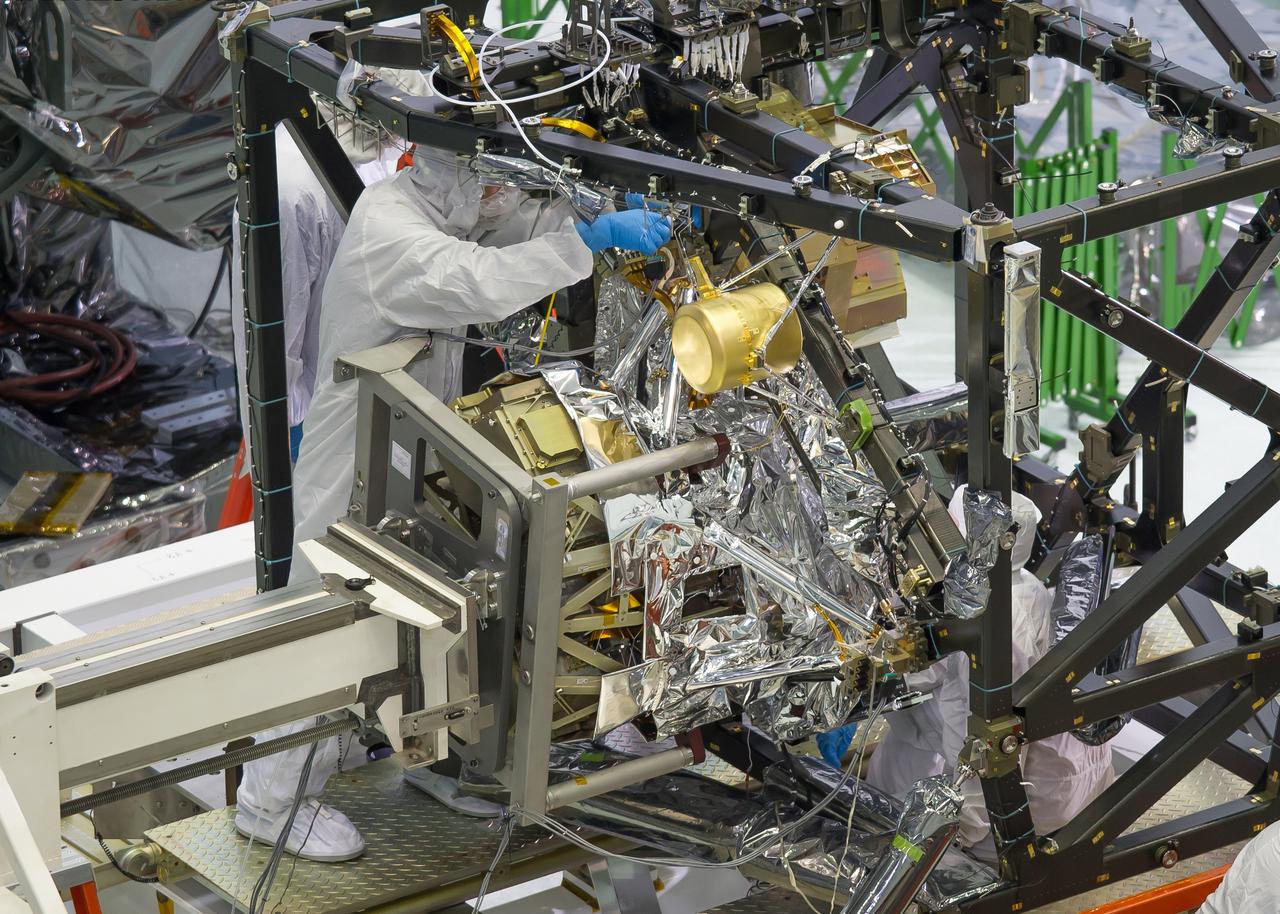
A technician is installing the bolts that will hold the MIRI, or Mid-Infrared Instrument, to the composite Integrated Science Instrument Module (ISIM) structure, or the black frame. The MIRI is attached to a balance beam, called the Horizontal Integration Tool (HIT), hanging from a precision overhead crane. That's the same tool that Hubble engineers used to prepare hardware for its servicing missions. Photo Credit: NASA/Chris Gunn; Text Credit: NASA/Laura Betz ---- Engineers worked meticulously to implant the James Webb Space Telescope's Mid-Infrared Instrument into the ISIM, or Integrated Science Instrument Module, in the cleanroom at NASA's Goddard Space Flight Center in Greenbelt, Md. As the successor to NASA's Hubble Space Telescope, the Webb telescope will be the most powerful space telescope ever built. It will observe the most distant objects in the universe, provide images of the first galaxies formed and see unexplored planets around distant stars. For more information, visit: <a href="http://www.jwst.nasa.gov" rel="nofollow">www.jwst.nasa.gov</a> <b><a href="http://www.nasa.gov/audience/formedia/features/MP_Photo_Guidelines.html" rel="nofollow">NASA image use policy.</a></b> <b><a href="http://www.nasa.gov/centers/goddard/home/index.html" rel="nofollow">NASA Goddard Space Flight Center</a></b> enables NASA’s mission through four scientific endeavors: Earth Science, Heliophysics, Solar System Exploration, and Astrophysics. Goddard plays a leading role in NASA’s accomplishments by contributing compelling scientific knowledge to advance the Agency’s mission. <b>Follow us on <a href="http://twitter.com/NASA_GoddardPix" rel="nofollow">Twitter</a></b> <b>Like us on <a href="http://www.facebook.com/pages/Greenbelt-MD/NASA-Goddard/395013845897?ref=tsd" rel="nofollow">Facebook</a></b> <b>Find us on <a href="http://instagram.com/nasagoddard?vm=grid" rel="nofollow">Instagram</a></b>
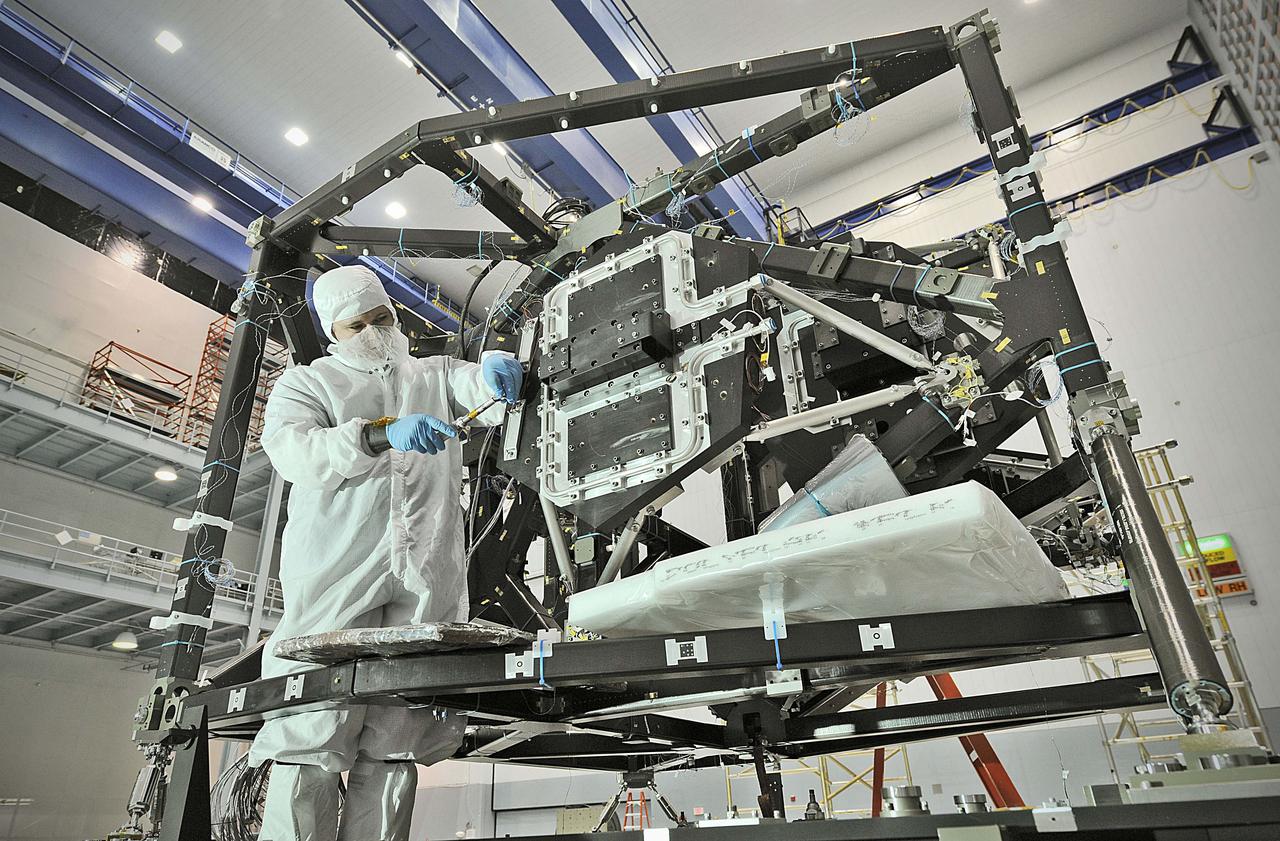
NASA image release September 17, 2010 In preparation for a cryogenic test NASA Goddard technicians install instrument mass simulators onto the James Webb Space Telescope ISIM structure. The ISIM Structure supports and holds the four Webb telescope science instruments : the Mid-Infrared Instrument (MIRI), the Near-Infrared Camera (NIRCam), the Near-Infrared Spectrograph (NIRSpec) and the Fine Guidance Sensor (FGS). Credit: NASA/GSFC/Chris Gunn To learn more about the James Webb Space Telescope go to: <a href="http://www.jwst.nasa.gov/" rel="nofollow">www.jwst.nasa.gov/</a> <b><a href="http://www.nasa.gov/centers/goddard/home/index.html" rel="nofollow">NASA Goddard Space Flight Center</a></b> contributes to NASA’s mission through four scientific endeavors: Earth Science, Heliophysics, Solar System Exploration, and Astrophysics. Goddard plays a leading role in NASA’s endeavors by providing compelling scientific knowledge to advance the Agency’s mission. <b>Follow us on <a href="http://twitter.com/NASA_GoddardPix" rel="nofollow">Twitter</a></b> <b>Join us on <a href="http://www.facebook.com/pages/Greenbelt-MD/NASA-Goddard/395013845897?ref=tsd" rel="nofollow">Facebook</a></b>
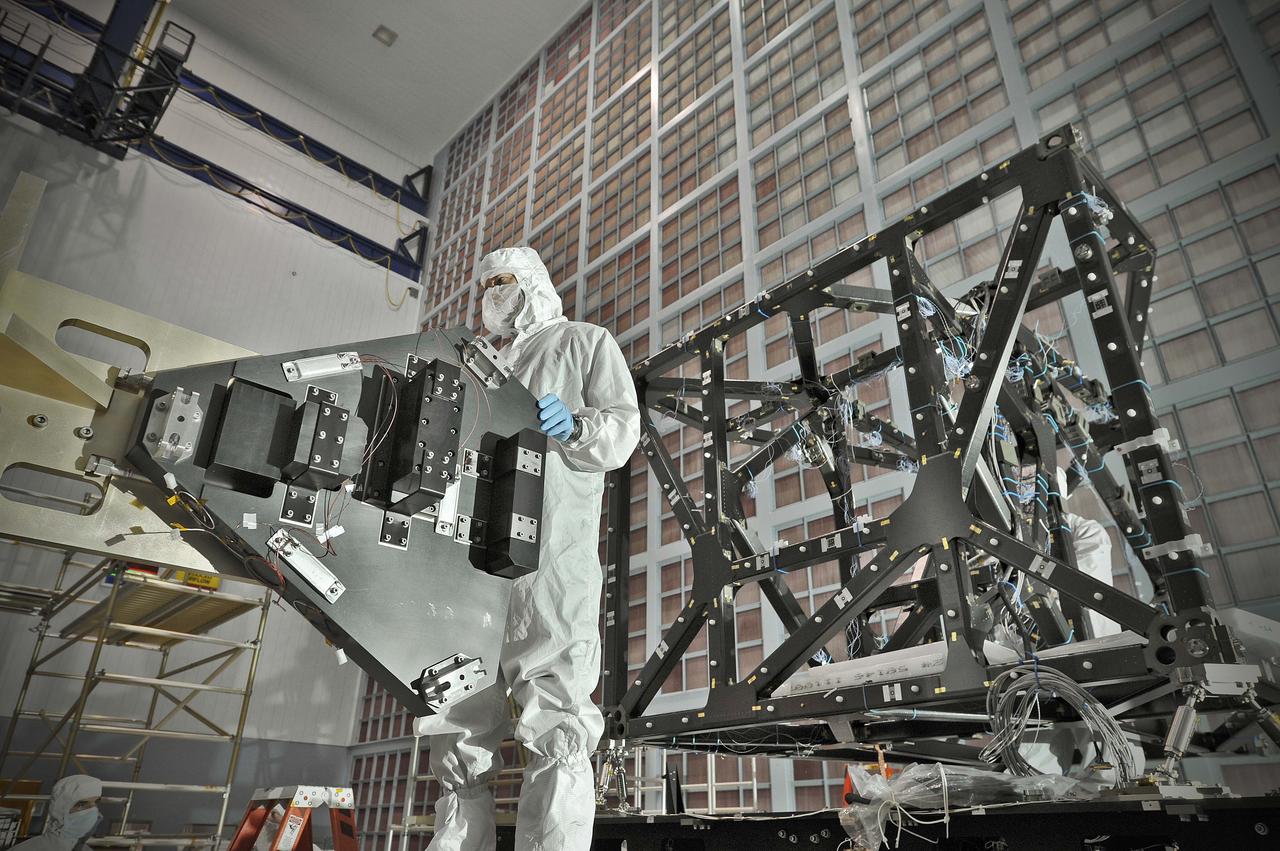
NASA image release September 17, 2010 In preparation for a cryogenic test NASA Goddard technicians install instrument mass simulators onto the James Webb Space Telescope ISIM structure. The ISIM Structure supports and holds the four Webb telescope science instruments : the Mid-Infrared Instrument (MIRI), the Near-Infrared Camera (NIRCam), the Near-Infrared Spectrograph (NIRSpec) and the Fine Guidance Sensor (FGS). Credit: NASA/GSFC/Chris Gunn To learn more about the James Webb Space Telescope go to: <a href="http://www.jwst.nasa.gov/" rel="nofollow">www.jwst.nasa.gov/</a> <b><a href="http://www.nasa.gov/centers/goddard/home/index.html" rel="nofollow">NASA Goddard Space Flight Center</a></b> contributes to NASA’s mission through four scientific endeavors: Earth Science, Heliophysics, Solar System Exploration, and Astrophysics. Goddard plays a leading role in NASA’s endeavors by providing compelling scientific knowledge to advance the Agency’s mission. <b>Follow us on <a href="http://twitter.com/NASA_GoddardPix" rel="nofollow">Twitter</a></b> <b>Join us on <a href="http://www.facebook.com/pages/Greenbelt-MD/NASA-Goddard/395013845897?ref=tsd" rel="nofollow">Facebook</a></b>
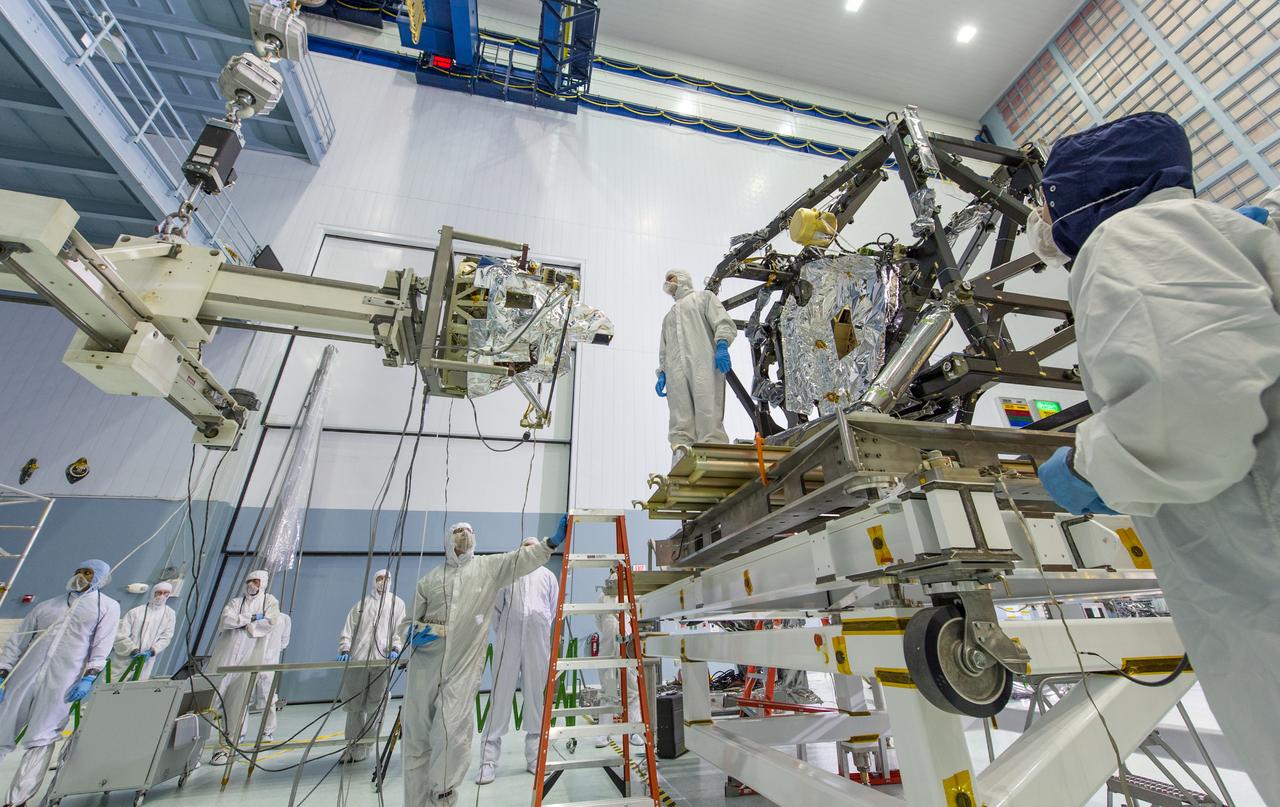
The MIRI itself weighs 181 pounds (82 kg) and is being held by a special balance beam (on the left of the photo), which is being maneuvered using a precision overhead crane by the engineer at the base of the ladder. Photo Credit: NASA/Chris Gunn; Text Credit: NASA/Laura Betz ---- Engineers worked meticulously to implant the James Webb Space Telescope's Mid-Infrared Instrument into the ISIM, or Integrated Science Instrument Module, in the cleanroom at NASA's Goddard Space Flight Center in Greenbelt, Md. As the successor to NASA's Hubble Space Telescope, the Webb telescope will be the most powerful space telescope ever built. It will observe the most distant objects in the universe, provide images of the first galaxies formed and see unexplored planets around distant stars. For more information, visit: <a href="http://www.jwst.nasa.gov" rel="nofollow">www.jwst.nasa.gov</a> <b><a href="http://www.nasa.gov/audience/formedia/features/MP_Photo_Guidelines.html" rel="nofollow">NASA image use policy.</a></b> <b><a href="http://www.nasa.gov/centers/goddard/home/index.html" rel="nofollow">NASA Goddard Space Flight Center</a></b> enables NASA’s mission through four scientific endeavors: Earth Science, Heliophysics, Solar System Exploration, and Astrophysics. Goddard plays a leading role in NASA’s accomplishments by contributing compelling scientific knowledge to advance the Agency’s mission. <b>Follow us on <a href="http://twitter.com/NASA_GoddardPix" rel="nofollow">Twitter</a></b> <b>Like us on <a href="http://www.facebook.com/pages/Greenbelt-MD/NASA-Goddard/395013845897?ref=tsd" rel="nofollow">Facebook</a></b> <b>Find us on <a href="http://instagram.com/nasagoddard?vm=grid" rel="nofollow">Instagram</a></b>