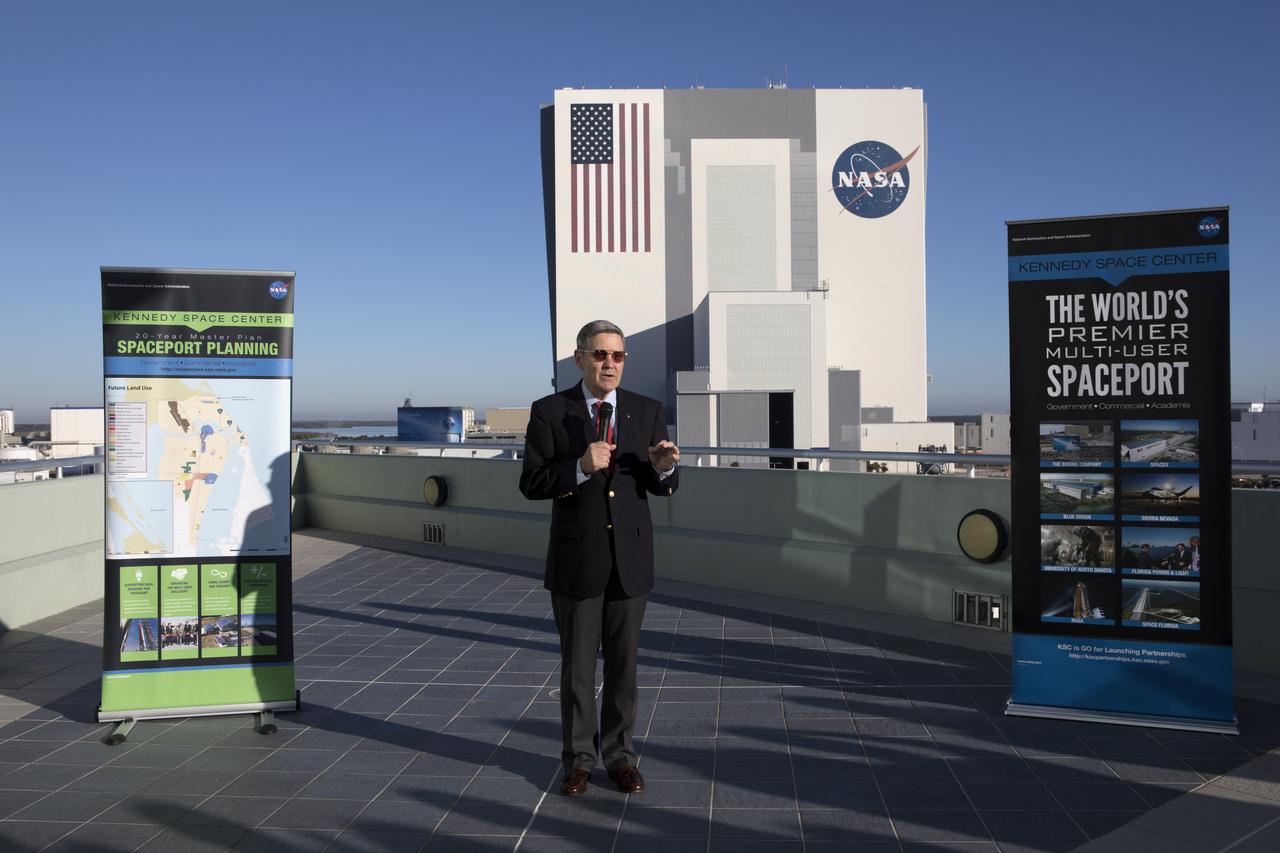
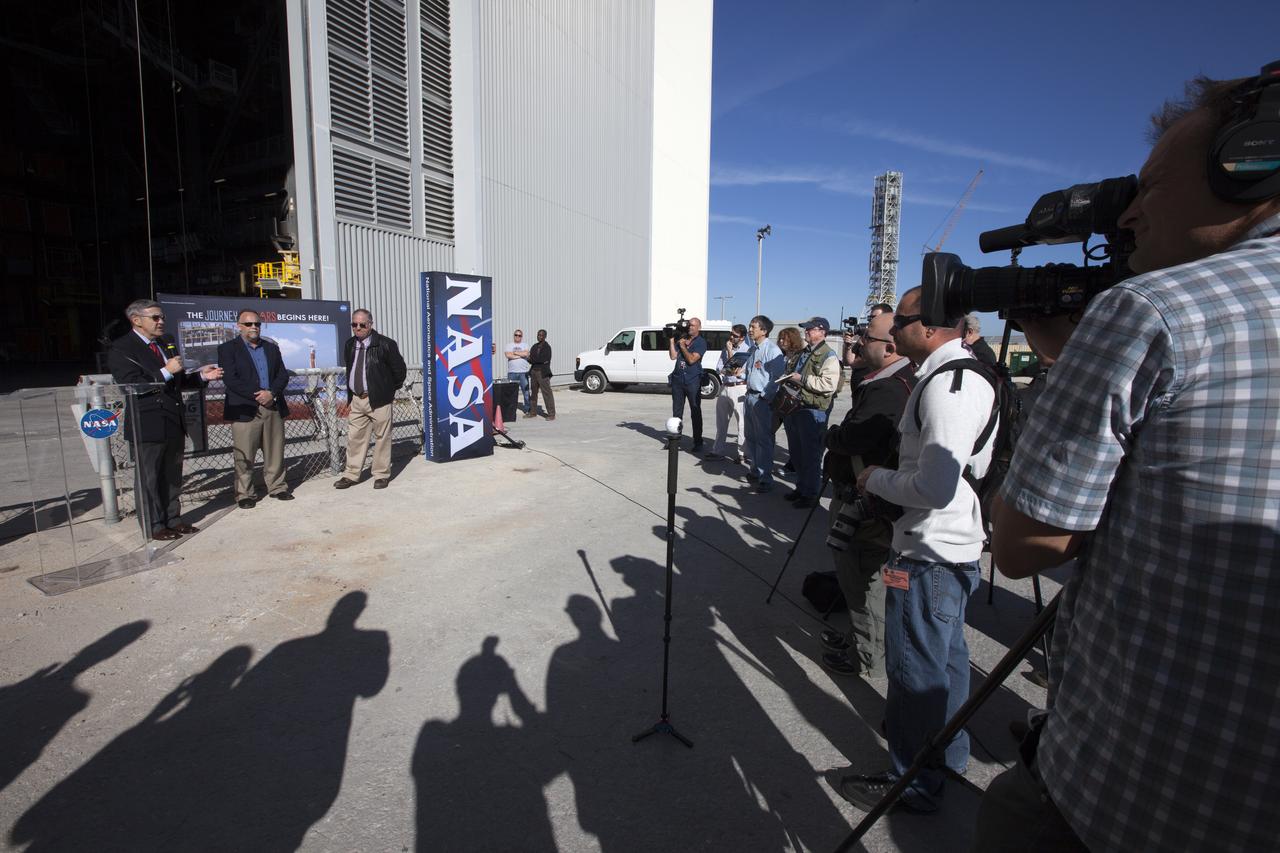
Kennedy Space Center Director Bob Cabana speaks to members of the news media on the balcony of Operations Support Building II describing the site's transition from a primarily government-only facility to a premier, multi-user spaceport. In the background is the Vehicle Assembly Building (VAB). Modifications were recently completed in the VAB where new work platforms were installed to support processing of NASA's Space Launch System rocket designed to send the Orion spacecraft on missions beyond low-Earth orbit.
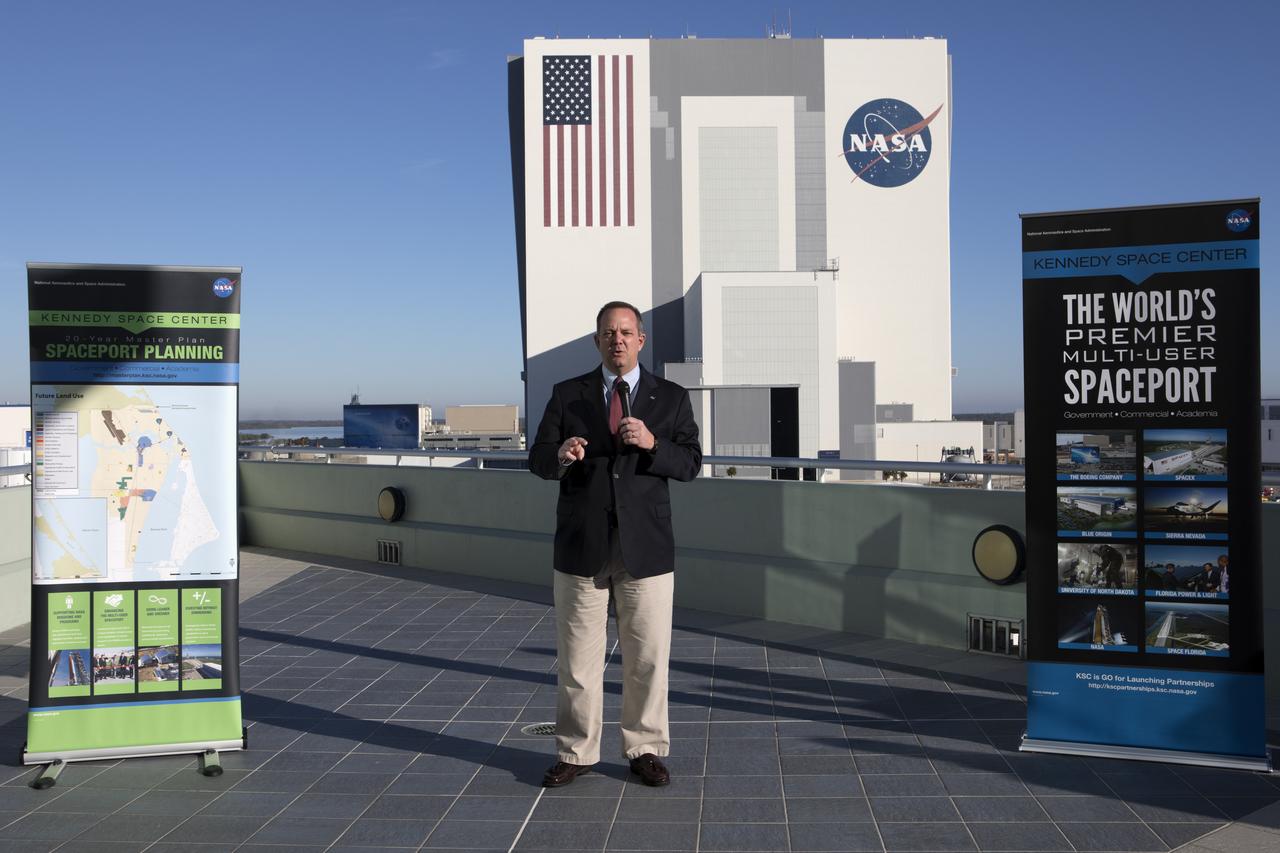
Tom Engler, director of Center Planning and Development at NASA's Kennedy Space Center, speaks to members of the news media on the balcony of Operations Support Building II describing the site's transition from a primarily government-only facility to a premier, multi-user spaceport. In the background is the Vehicle Assembly Building (VAB). Modifications were recently completed in the VAB where new work platforms were installed to support processing of NASA's Space Launch System rocket designed to send the Orion spacecraft on missions beyond low-Earth orbit.
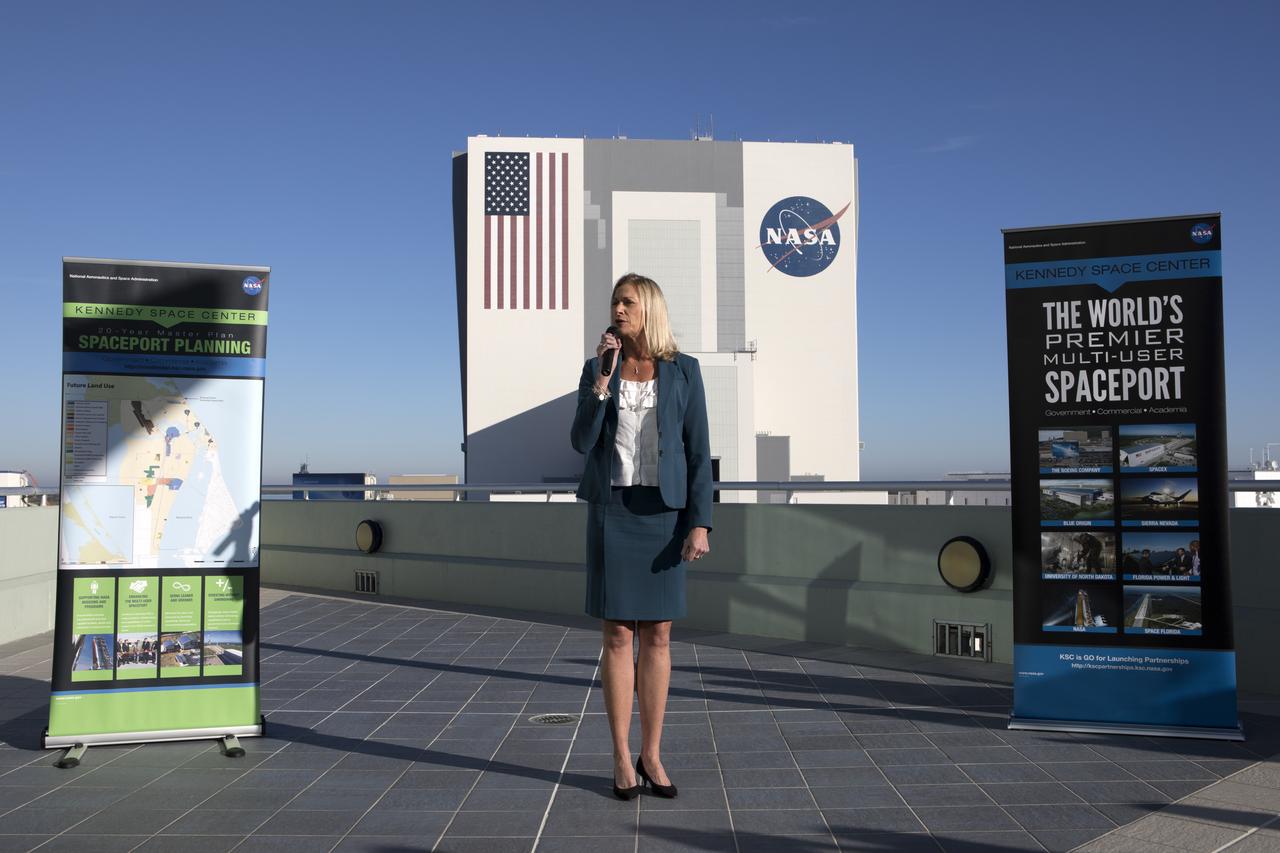
Nancy Bray, director of Spaceport Integration and Services at NASA's Kennedy Space Center, speaks to members of the news media on the balcony of Operations Support Building II describing the site's transition from a primarily government-only facility to a premier, multi-user spaceport. In the background is the Vehicle Assembly Building (VAB). Modifications were recently completed in the VAB where new work platforms were installed to support processing of NASA's Space Launch System rocket designed to send the Orion spacecraft on missions beyond low-Earth orbit.
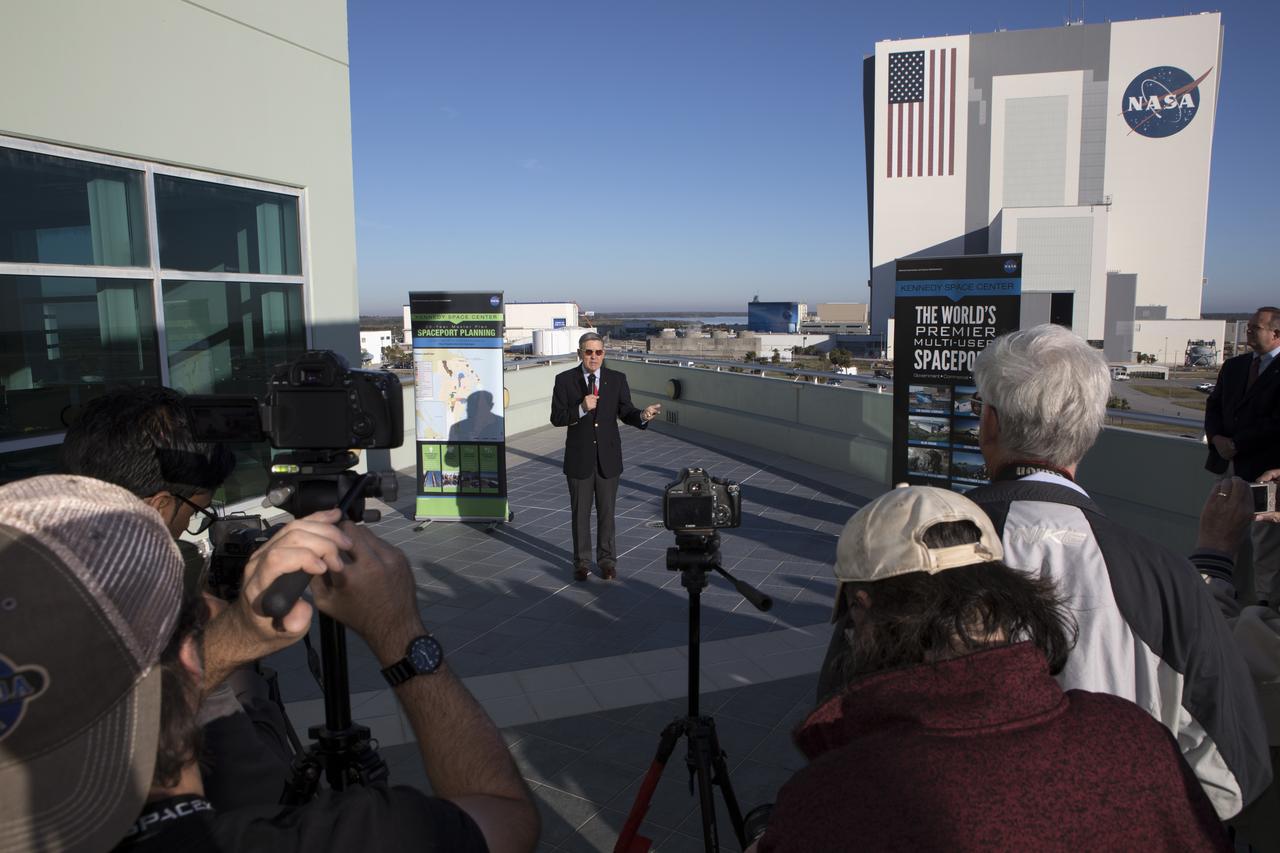
Kennedy Space Center Director Bob Cabana speaks to members of the news media on the balcony of Operations Support Building II describing the site's transition from a primarily government-only facility to a premier, multi-user spaceport. In the background is the Vehicle Assembly Building (VAB). Modifications were recently completed in the VAB where new work platforms were installed to support processing of NASA's Space Launch System rocket designed to send the Orion spacecraft on missions beyond low-Earth orbit.
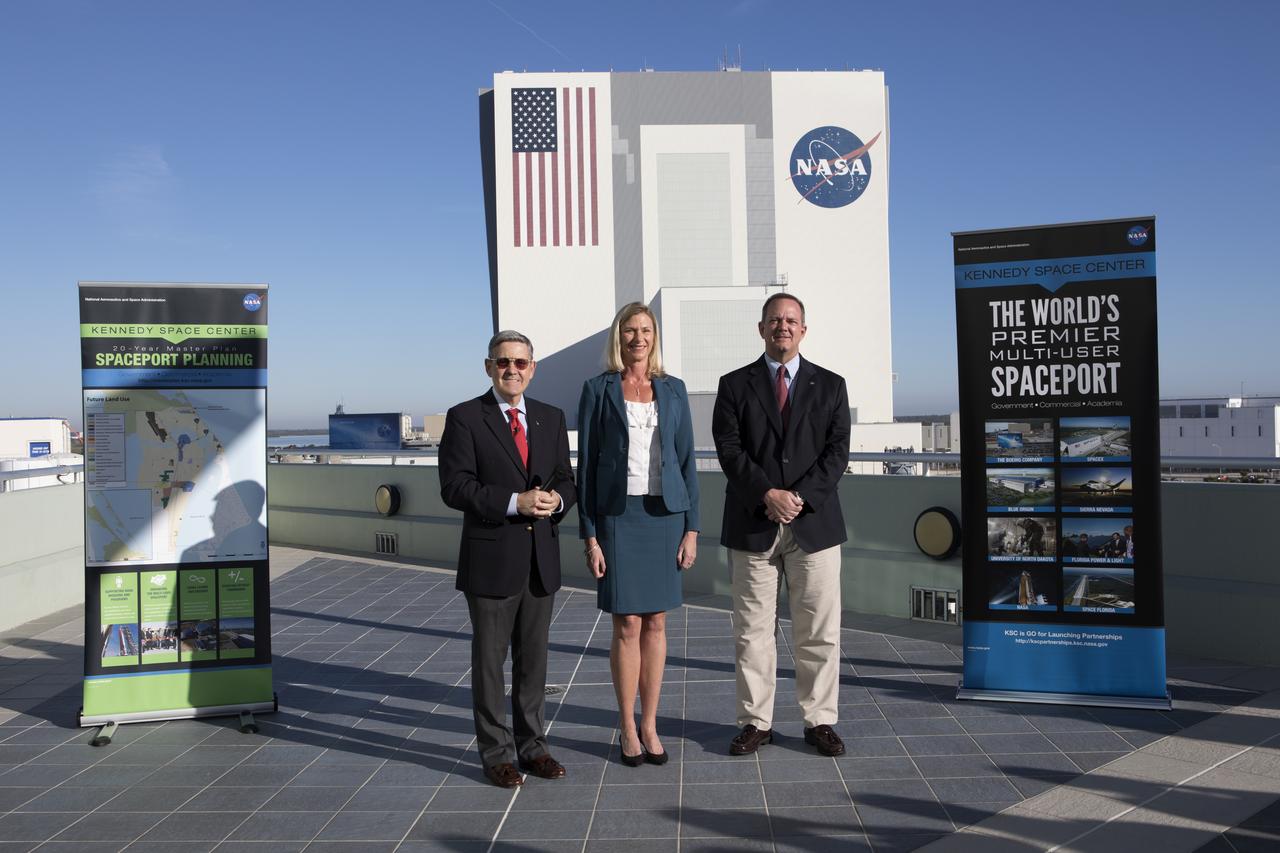
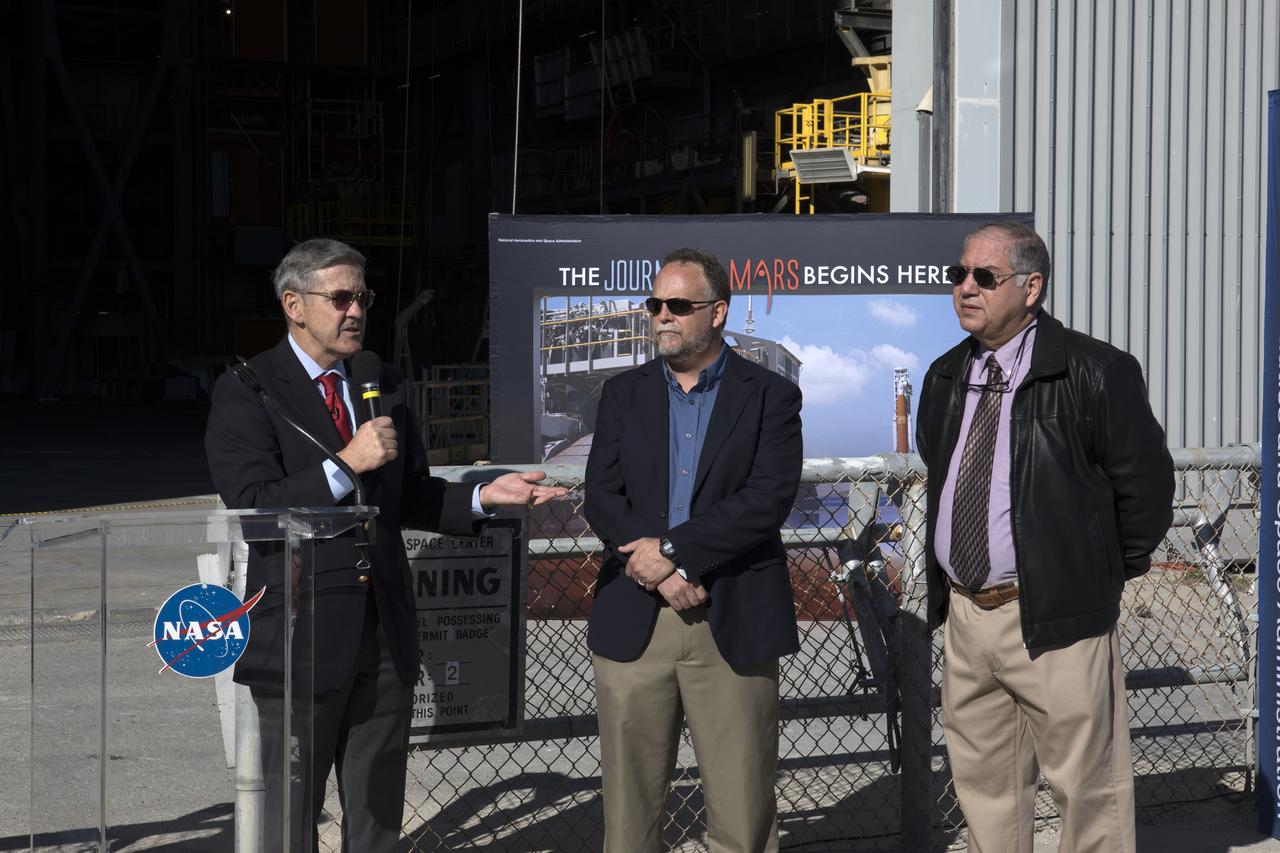
Kennedy Space Center Director Bob Cabana, left, was joined by Nancy Bray, director of Spaceport Integration and Services, center, and Tom Engler, director of Center Planning and Development in briefing members of the news media on the balcony of Operations Support Building II. They described Kennedy's transition from a primarily government-only facility to a premier, multi-user spaceport. In the background is the Vehicle Assembly Building (VAB). Modifications were recently completed in the VAB where new work platforms were installed to support processing of NASA's Space Launch System rocket designed to send the Orion spacecraft on missions beyond low-Earth orbit.
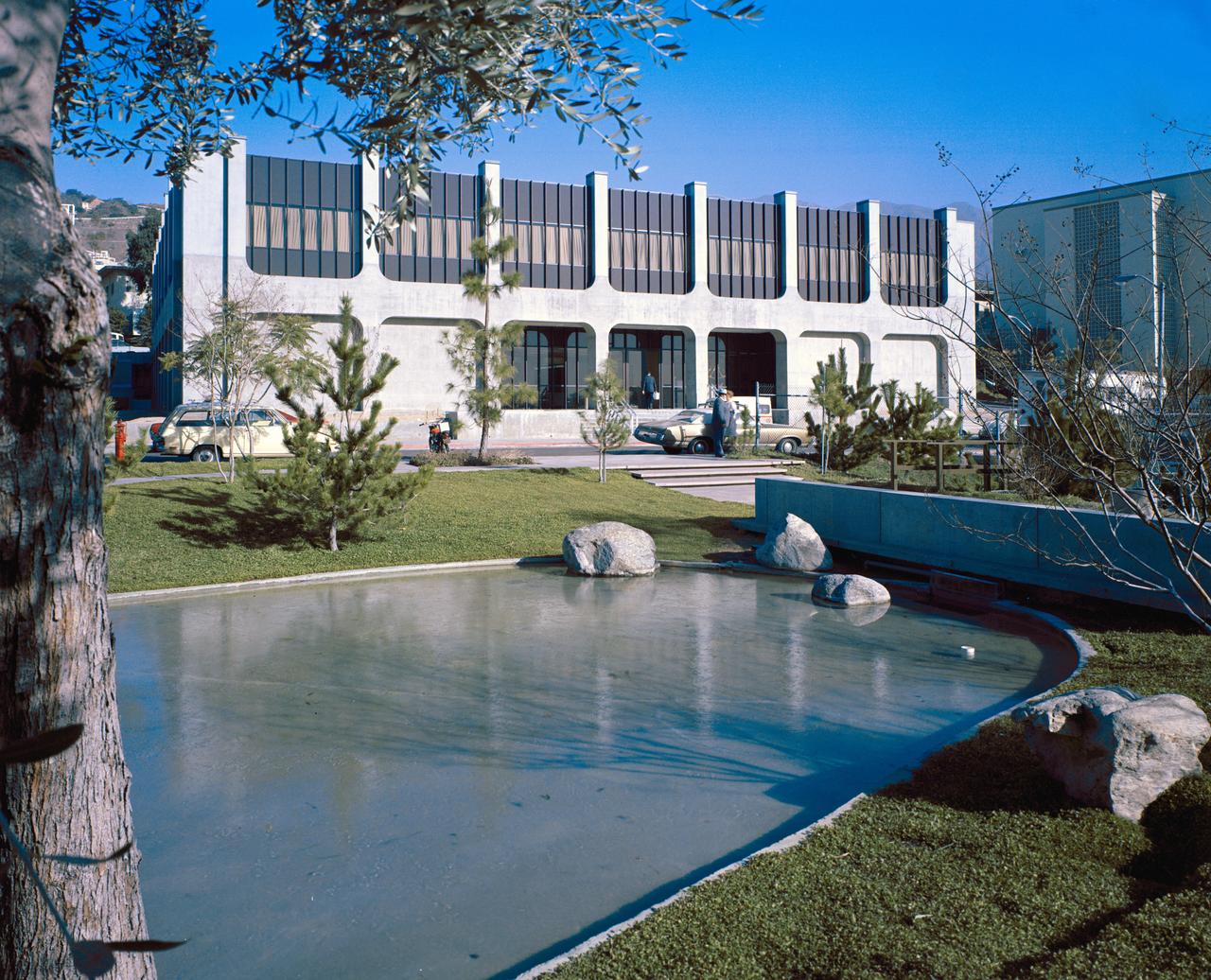
This archival image was released as part of a gallery comparing JPL’s past and present, commemorating the 80th anniversary of NASA’s Jet Propulsion Laboratory on Oct. 31, 2016. Building 264, also known as the Space Flight Support Building, hosts engineers supporting space missions in flight at NASA's Jet Propulsion Laboratory. It used to be just two stories, as seen in this image from January 1972, but then the Viking project to Mars needed more room. The building still serves the same function today, but now has eight floors. http://photojournal.jpl.nasa.gov/catalog/PIA21123
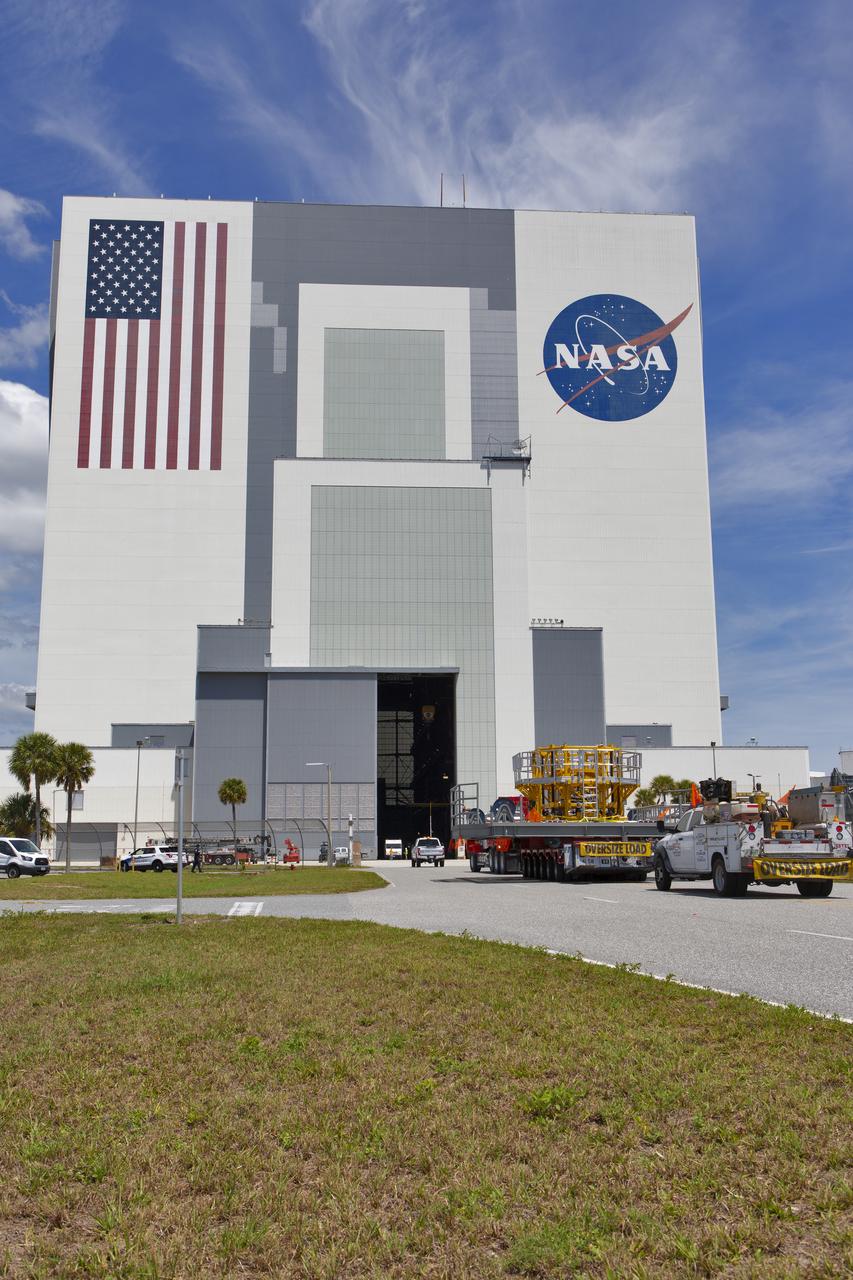
The engine vertical installer for NASA’s Space Launch System (SLS) arrives by large transport truck at the Vehicle Assembly Building at NASA’s Kennedy Space Center in Florida on April 25, 2019. The engine installer arrived from the manufacturer, Precision Fabrication and Cleaning in Canaveral Groves, Florida. The new ground support equipment will be ready for preflight assembly in the event one of the four RS-25 engines on the core stage of the SLS rocket needs to be replaced. During launch of the SLS and Orion spacecraft, the four core stage engines will provide the thrust needed to lift the rocket and Orion spacecraft off Launch Pad 39B at Kennedy for Exploration Mission-1. The uncrewed Orion will travel on a three-week test mission thousands of miles beyond the Moon and back to Earth for a splashdown in the Pacific Ocean.
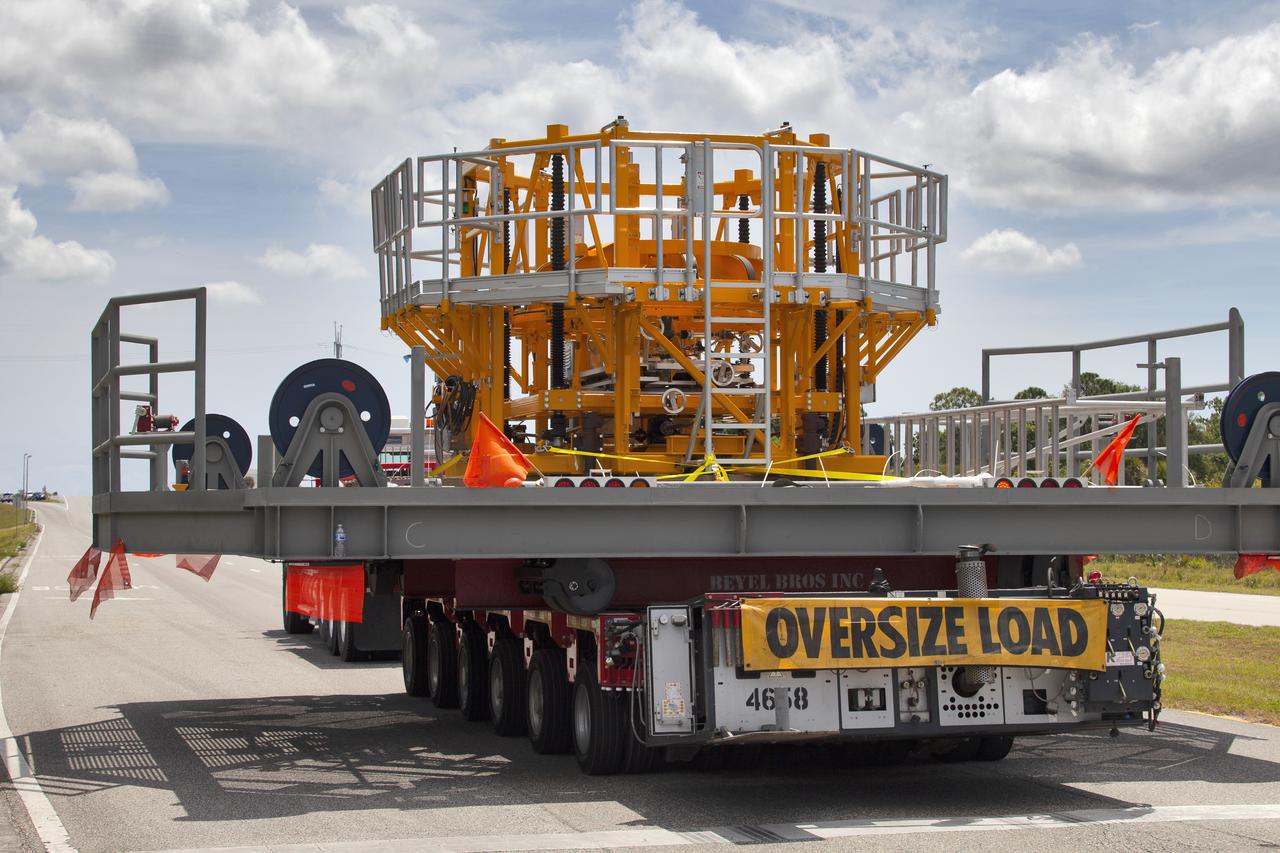
The engine vertical installer for NASA’s Space Launch System (SLS) arrives by large transport truck at NASA’s Kennedy Space Center in Florida on April 25, 2019, from the manufacturer, Precision Fabrication and Cleaning in Canaveral Groves, Florida. The new ground support equipment will be delivered to the Vehicle Assembly Building where it will be ready for preflight assembly in the event one of the four RS-25 engines on the core stage of the SLS rocket needs to be replaced. During launch of the SLS and Orion spacecraft, the four core stage engines will provide the thrust needed to lift the rocket and Orion spacecraft off Launch Pad 39B at Kennedy for Exploration Mission-1. The uncrewed Orion will travel on a three-week test mission thousands of miles beyond the Moon and back to Earth for a splashdown in the Pacific Ocean.
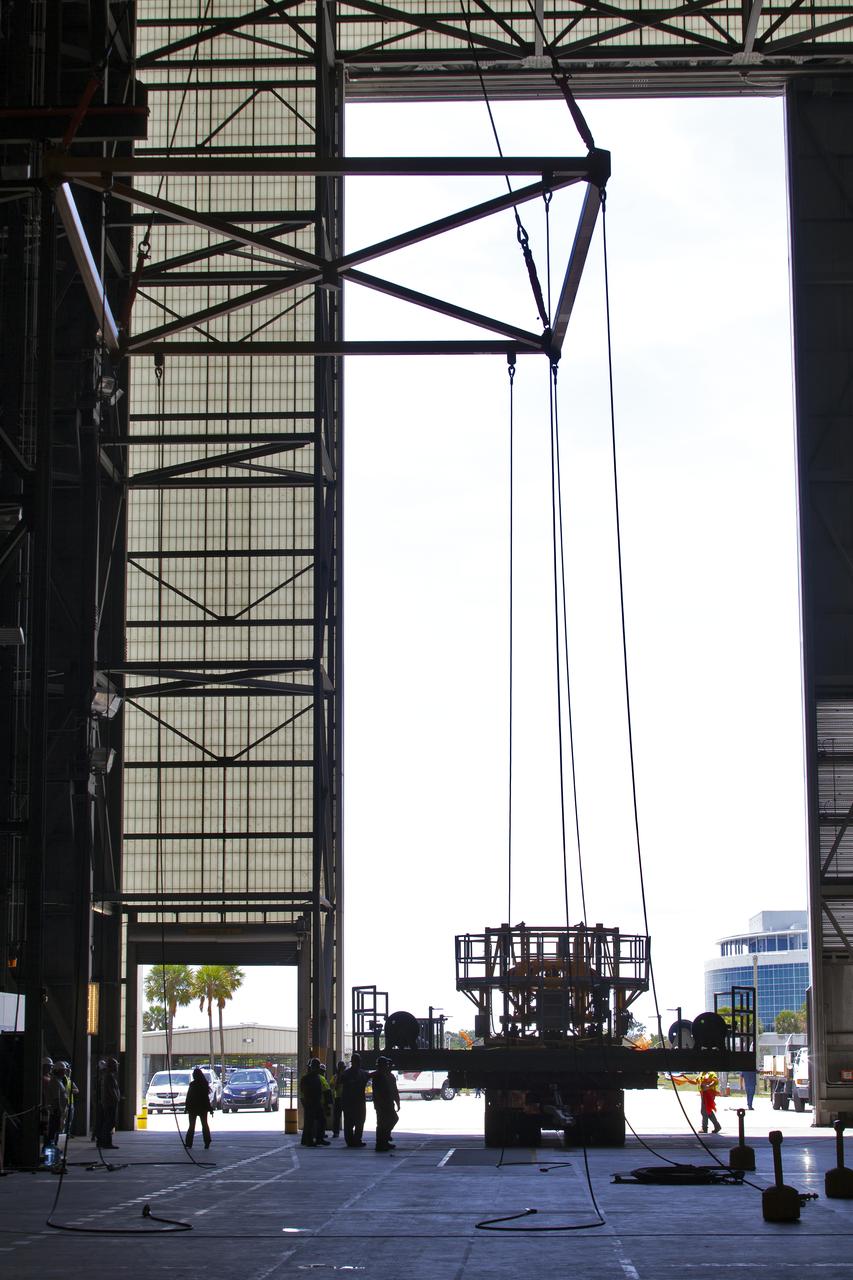
The engine vertical installer for NASA’s Space Launch System (SLS) is being lifted by crane in the Vehicle Assembly Building at NASA’s Kennedy Space Center in Florida on April 25, 2019. The engine installer arrived from the manufacturer, Precision Fabrication and Cleaning in Canaveral Groves, Florida. The new ground support equipment will be transferred into High Bay 3 where it will be ready for preflight processing in the event one of the four RS-25 engines on the core stage of the SLS rocket needs to be replaced. During launch of the SLS and Orion spacecraft, the four core stage engines will provide the thrust needed to lift the rocket and Orion spacecraft off Launch Pad 39B at Kennedy for Exploration Mission-1. The uncrewed Orion will travel on a three-week test mission thousands of miles beyond the Moon and back to Earth for a splashdown in the Pacific Ocean.
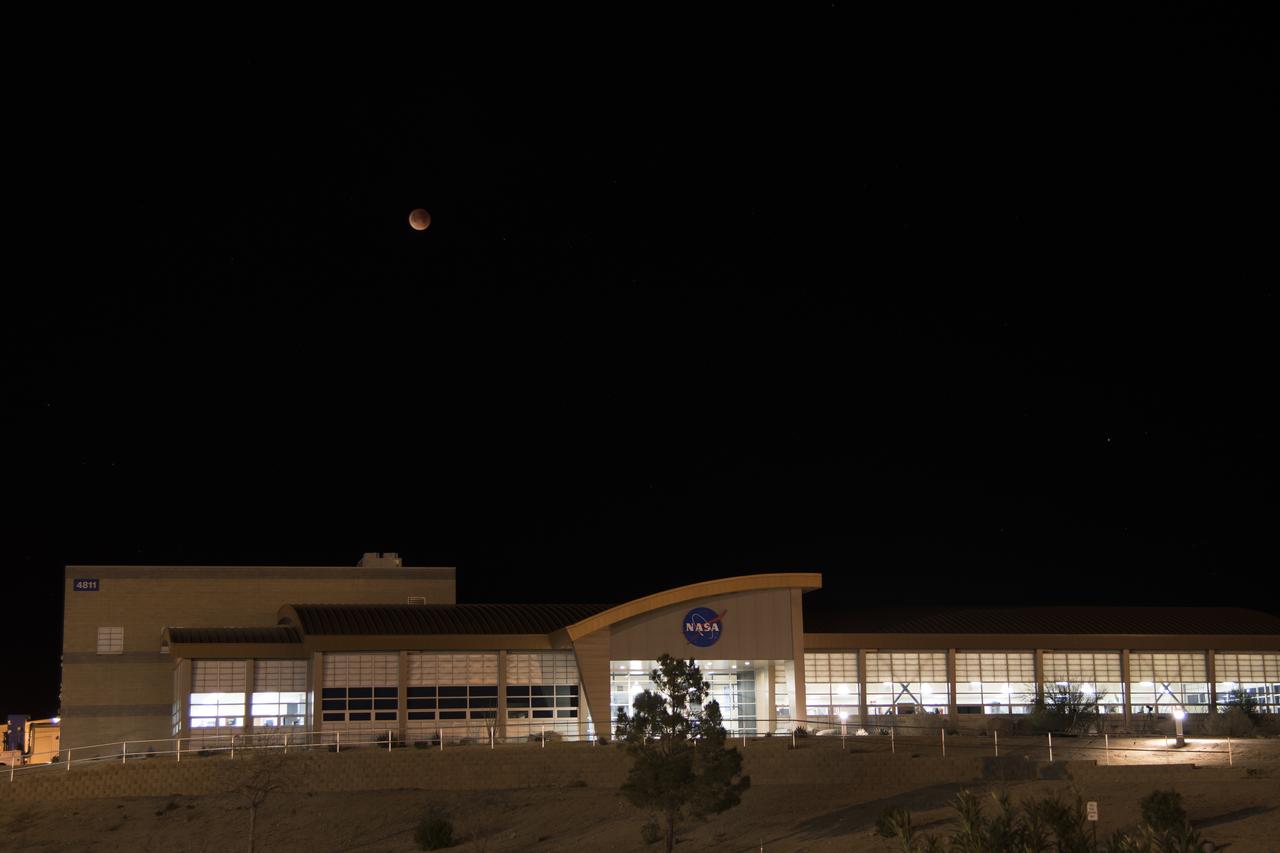
California's NASA Armstrong Flight Research Center photographer Carla Thomas takes photos on January 31 of the rare opportunity to capture a supermoon, a blue moon and a lunar eclipse at the same time. A supermoon occurs when the Moon is closer to Earth in its orbit and appearing 14 percent brighter than usual. As the second full moon of the month, this moon is also commonly known as a blue moon, though it will not be blue in appearance. The super blue moon passed through Earth's shadow and took on a reddish tint, known as a blood moon. This total lunar eclipse occurs when the Sun, Earth, and a full moon form a near-perfect lineup in space. The Moon passes directly behind the Earth into its umbra (shadow).
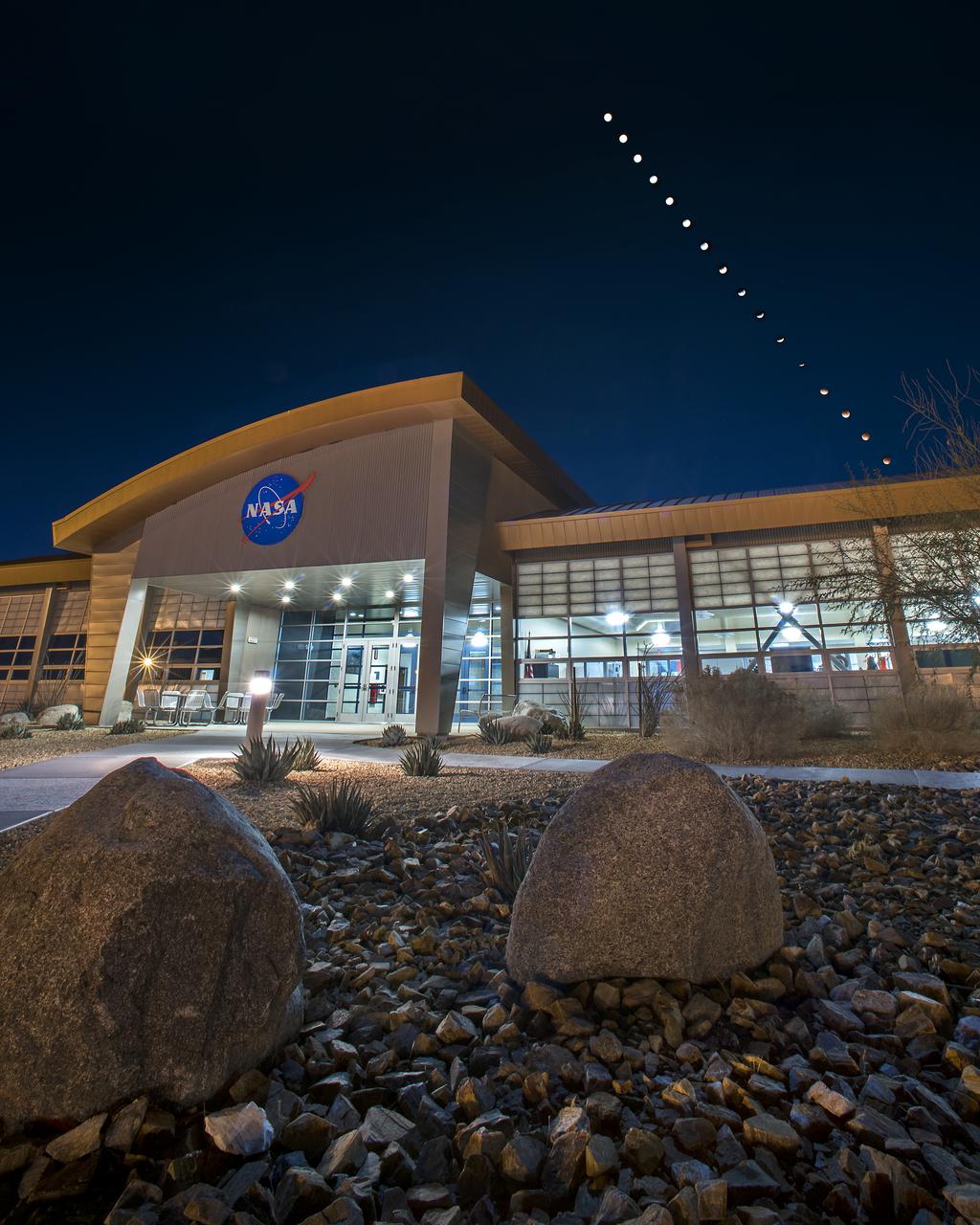
California’s NASA Armstrong Flight Research Center photographer Ken Ulbrich takes photos of Super Blue Blood Moon eclipse making a time-lapse composition of the event on January 31. The total lunar eclipse provided a rare opportunity to capture a supermoon, a blue moon and a lunar eclipse at the same time. A supermoon occurs when the Moon is closer to Earth in its orbit and appearing 14 percent brighter than usual. As the second full moon of the month, this moon is also commonly known as a blue moon, though it will not be blue in appearance. The super blue moon passed through Earth’s shadow and took on a reddish tint, known as a blood moon. This total lunar eclipse occurs when the Sun, Earth, and a full moon form a near-perfect lineup in space. The Moon passes directly behind the Earth into its umbra (shadow).
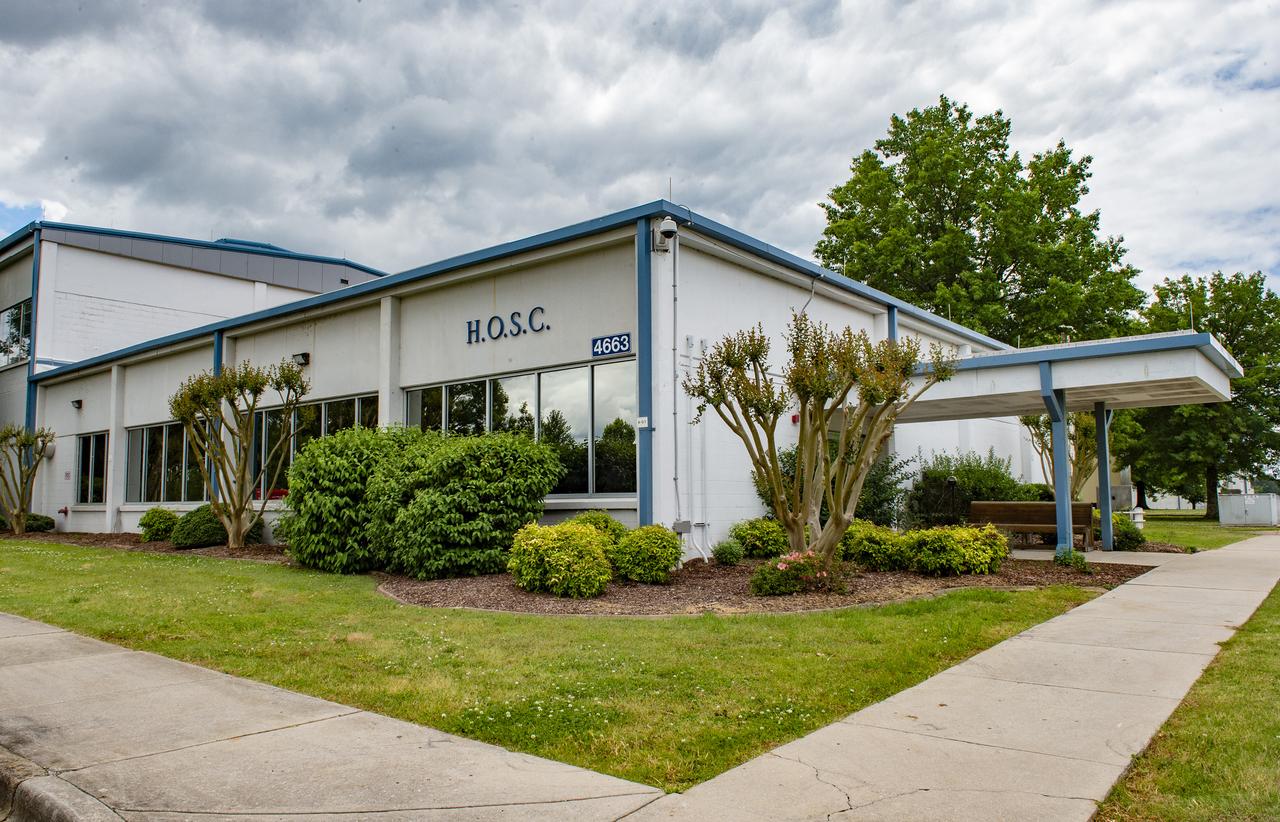
MSFC Building 4663, NW corner view showing entrance to Huntsville Operations Support Center (HOSC). The HOSC is home to the Payload Operations Integration Center (POIC) which supports the mission and scientific experiments aboard the International Space Station (ISS).
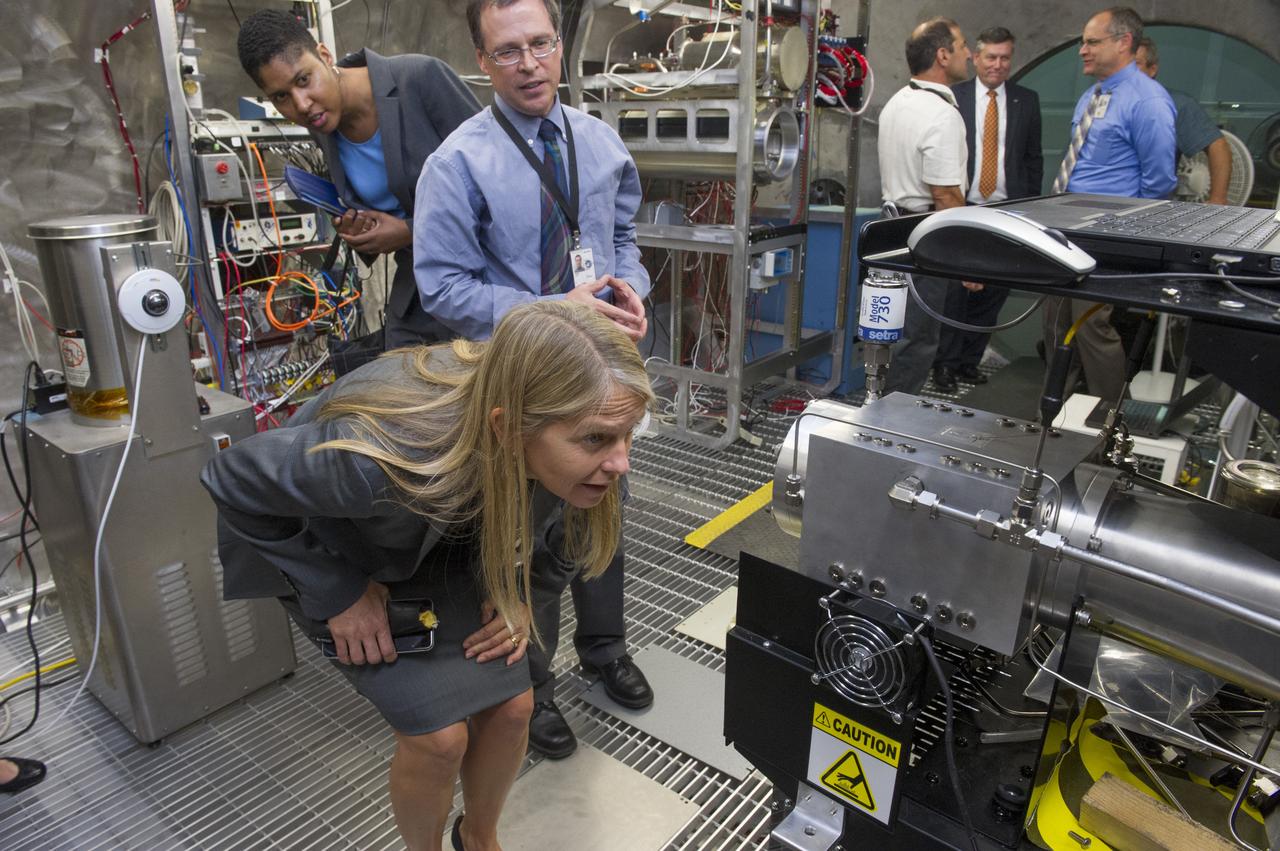
NEWMAN TAKES A CLOSER LOOK AT EQUIPMENT UNDER DEVELOPMENT IN THE ENVIRONMENTAL CONTROL & LIFE SUPPORT SYSTEMS SECTION IN BUILDING 4755. ELCSS IS BUILDING DEVICES TO RECYCLE AIR AND WATER FOR CREW MEMBERS ON THE INTERNATIONAL SPACE STATION, USING THE ORBITING LABORATORY AS A TEST BED FOR LIFE SUPPORT SYSTEMS ON LONG-DURATION MISSIONS DEEPER INTO OUR SOLAR SYSTEM.

Over 600 middle school, high school, and college students from across the nation launched 30 high-powered rockets just north of NASA’s Marshall Space Flight Center in Huntsville, Alabama. This year marked the 26th anniversary of the competition. To compete, students follow the NASA engineering design lifecycle by going through a series of reviews for nine months leading up to launch day. Each year, a payload challenge is issued to the university teams, and this year’s task took inspiration from the agency’s Artemis missions, where NASA will send astronauts to explore the Moon for scientific discovery, economic benefit, and to build the foundation for the first crewed missions to Mars. Teams were challenged build and fly a STEMnaut Habitat for Agricultural Utilization Study (HAUS) that safely houses four STEMnauts, non-living objects representing astronauts. The habitat had to include equipment capable of both collecting and testing soil samples to support agricultural research operations.

Over 600 middle school, high school, and college students from across the nation launched 30 high-powered rockets just north of NASA’s Marshall Space Flight Center in Huntsville, Alabama. This year marked the 26th anniversary of the competition. To compete, students follow the NASA engineering design lifecycle by going through a series of reviews for nine months leading up to launch day. Each year, a payload challenge is issued to the university teams, and this year’s task took inspiration from the agency’s Artemis missions, where NASA will send astronauts to explore the Moon for scientific discovery, economic benefit, and to build the foundation for the first crewed missions to Mars. Teams were challenged build and fly a STEMnaut Habitat for Agricultural Utilization Study (HAUS) that safely houses four STEMnauts, non-living objects representing astronauts. The habitat had to include equipment capable of both collecting and testing soil samples to support agricultural research operations.

Over 600 middle school, high school, and college students from across the nation launched 30 high-powered rockets just north of NASA’s Marshall Space Flight Center in Huntsville, Alabama. This year marked the 26th anniversary of the competition. To compete, students follow the NASA engineering design lifecycle by going through a series of reviews for nine months leading up to launch day. Each year, a payload challenge is issued to the university teams, and this year’s task took inspiration from the agency’s Artemis missions, where NASA will send astronauts to explore the Moon for scientific discovery, economic benefit, and to build the foundation for the first crewed missions to Mars. Teams were challenged build and fly a STEMnaut Habitat for Agricultural Utilization Study (HAUS) that safely houses four STEMnauts, non-living objects representing astronauts. The habitat had to include equipment capable of both collecting and testing soil samples to support agricultural research operations.

Over 600 middle school, high school, and college students from across the nation launched 30 high-powered rockets just north of NASA’s Marshall Space Flight Center in Huntsville, Alabama. This year marked the 26th anniversary of the competition. To compete, students follow the NASA engineering design lifecycle by going through a series of reviews for nine months leading up to launch day. Each year, a payload challenge is issued to the university teams, and this year’s task took inspiration from the agency’s Artemis missions, where NASA will send astronauts to explore the Moon for scientific discovery, economic benefit, and to build the foundation for the first crewed missions to Mars. Teams were challenged build and fly a STEMnaut Habitat for Agricultural Utilization Study (HAUS) that safely houses four STEMnauts, non-living objects representing astronauts. The habitat had to include equipment capable of both collecting and testing soil samples to support agricultural research operations.

Over 600 middle school, high school, and college students from across the nation launched 30 high-powered rockets just north of NASA’s Marshall Space Flight Center in Huntsville, Alabama. This year marked the 26th anniversary of the competition. To compete, students follow the NASA engineering design lifecycle by going through a series of reviews for nine months leading up to launch day. Each year, a payload challenge is issued to the university teams, and this year’s task took inspiration from the agency’s Artemis missions, where NASA will send astronauts to explore the Moon for scientific discovery, economic benefit, and to build the foundation for the first crewed missions to Mars. Teams were challenged build and fly a STEMnaut Habitat for Agricultural Utilization Study (HAUS) that safely houses four STEMnauts, non-living objects representing astronauts. The habitat had to include equipment capable of both collecting and testing soil samples to support agricultural research operations.

Over 600 middle school, high school, and college students from across the nation launched 30 high-powered rockets just north of NASA’s Marshall Space Flight Center in Huntsville, Alabama. This year marked the 26th anniversary of the competition. To compete, students follow the NASA engineering design lifecycle by going through a series of reviews for nine months leading up to launch day. Each year, a payload challenge is issued to the university teams, and this year’s task took inspiration from the agency’s Artemis missions, where NASA will send astronauts to explore the Moon for scientific discovery, economic benefit, and to build the foundation for the first crewed missions to Mars. Teams were challenged build and fly a STEMnaut Habitat for Agricultural Utilization Study (HAUS) that safely houses four STEMnauts, non-living objects representing astronauts. The habitat had to include equipment capable of both collecting and testing soil samples to support agricultural research operations.

Over 600 middle school, high school, and college students from across the nation launched 30 high-powered rockets just north of NASA’s Marshall Space Flight Center in Huntsville, Alabama. This year marked the 26th anniversary of the competition. To compete, students follow the NASA engineering design lifecycle by going through a series of reviews for nine months leading up to launch day. Each year, a payload challenge is issued to the university teams, and this year’s task took inspiration from the agency’s Artemis missions, where NASA will send astronauts to explore the Moon for scientific discovery, economic benefit, and to build the foundation for the first crewed missions to Mars. Teams were challenged build and fly a STEMnaut Habitat for Agricultural Utilization Study (HAUS) that safely houses four STEMnauts, non-living objects representing astronauts. The habitat had to include equipment capable of both collecting and testing soil samples to support agricultural research operations.

Over 600 middle school, high school, and college students from across the nation launched 30 high-powered rockets just north of NASA’s Marshall Space Flight Center in Huntsville, Alabama. This year marked the 26th anniversary of the competition. To compete, students follow the NASA engineering design lifecycle by going through a series of reviews for nine months leading up to launch day. Each year, a payload challenge is issued to the university teams, and this year’s task took inspiration from the agency’s Artemis missions, where NASA will send astronauts to explore the Moon for scientific discovery, economic benefit, and to build the foundation for the first crewed missions to Mars. Teams were challenged build and fly a STEMnaut Habitat for Agricultural Utilization Study (HAUS) that safely houses four STEMnauts, non-living objects representing astronauts. The habitat had to include equipment capable of both collecting and testing soil samples to support agricultural research operations.

Over 600 middle school, high school, and college students from across the nation launched 30 high-powered rockets just north of NASA’s Marshall Space Flight Center in Huntsville, Alabama. This year marked the 26th anniversary of the competition. To compete, students follow the NASA engineering design lifecycle by going through a series of reviews for nine months leading up to launch day. Each year, a payload challenge is issued to the university teams, and this year’s task took inspiration from the agency’s Artemis missions, where NASA will send astronauts to explore the Moon for scientific discovery, economic benefit, and to build the foundation for the first crewed missions to Mars. Teams were challenged build and fly a STEMnaut Habitat for Agricultural Utilization Study (HAUS) that safely houses four STEMnauts, non-living objects representing astronauts. The habitat had to include equipment capable of both collecting and testing soil samples to support agricultural research operations.
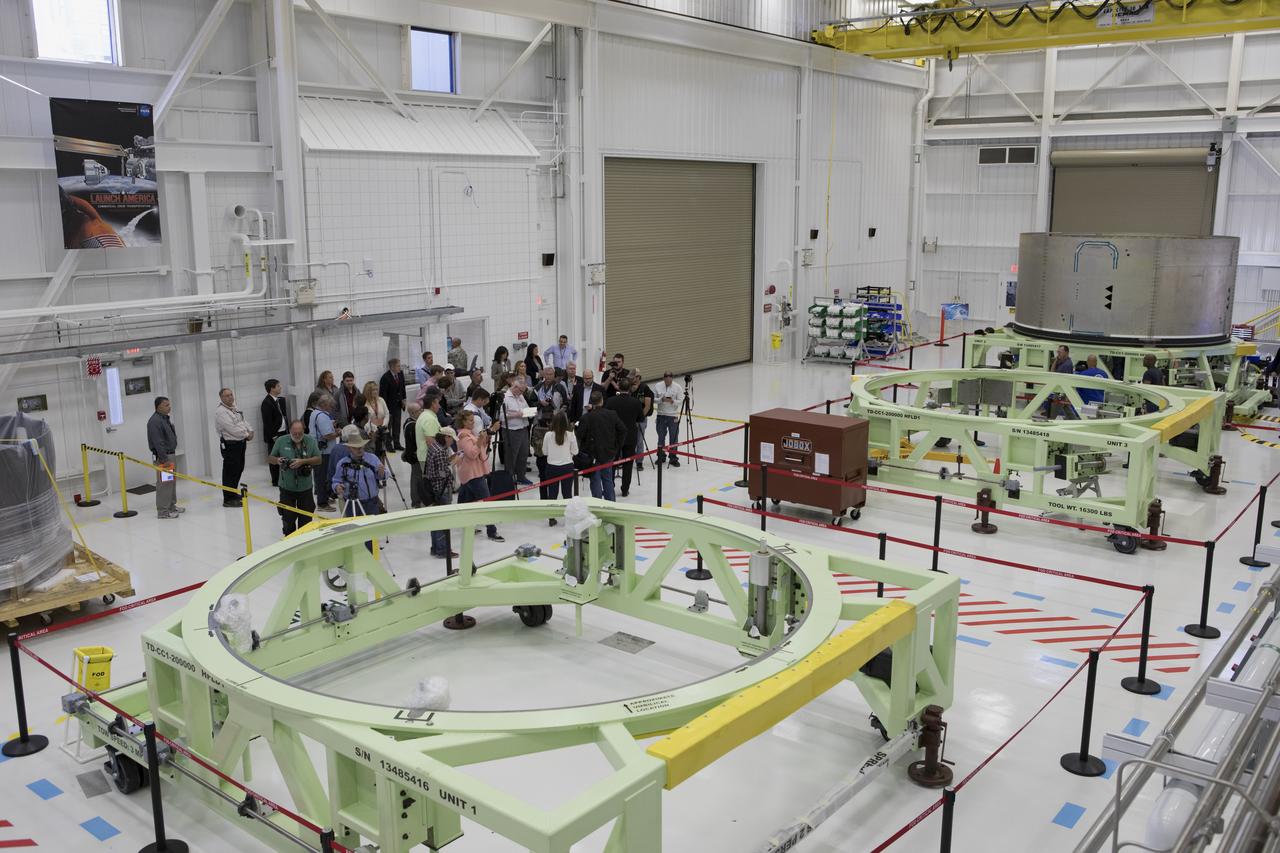
Inside Boeing’s Commercial Crew and Cargo Processing Facility at NASA's Kennedy Space Center in Florida members of the news media view work platforms that will be used in manufacturing Boeing's CST-100 Starliner spacecraft for flight tests and crew rotation missions to the International Space Station as part of the agency's Commercial Crew Program.
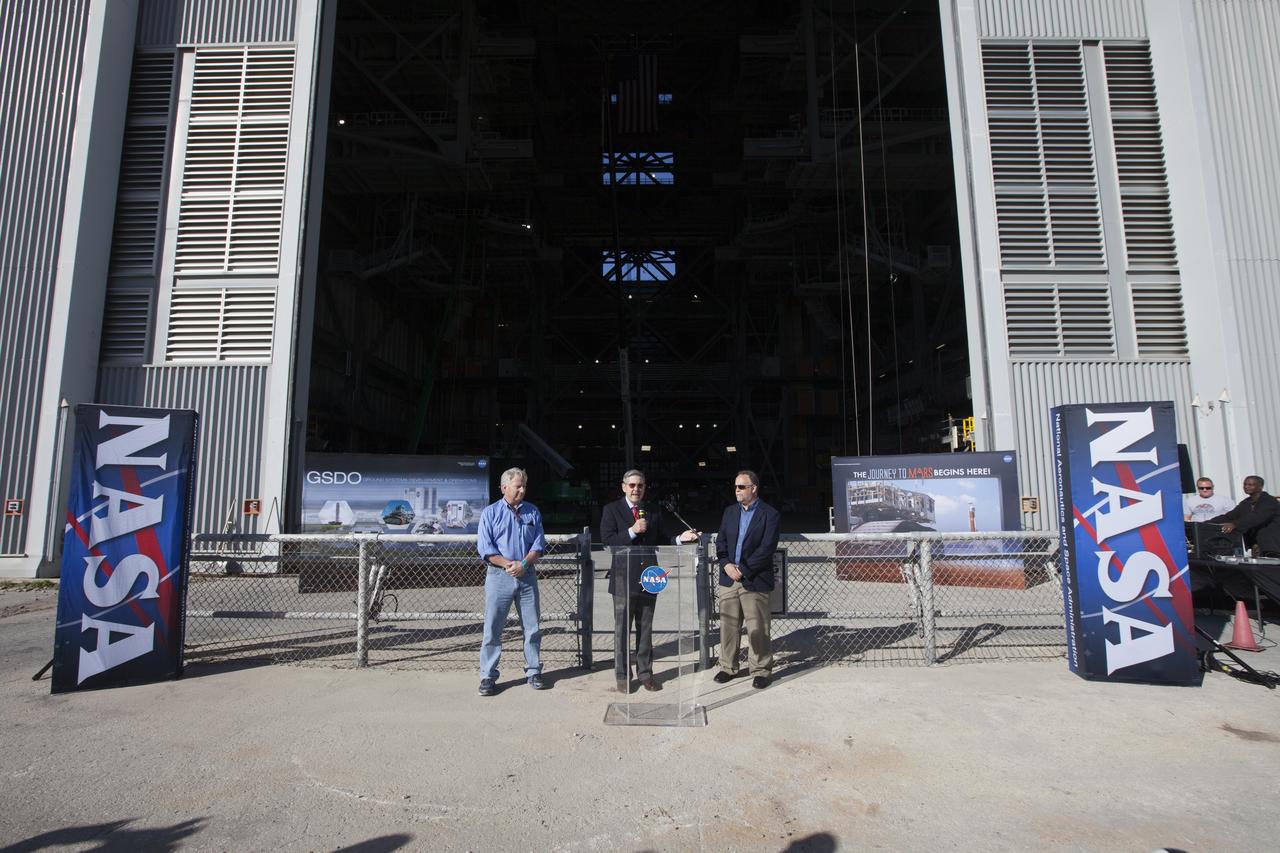
Members of the news media viewed the 10 levels of new work platforms in High Bay 3 inside the Vehicle Assembly Building during a multi-user tour of NASA's Kennedy Space Center in Florida with Center Director Bob Cabana. The final platform, A north, was recently installed. From left are Kerry Chreist of Jacobs on the Test and Operations Support Contract; Cabana; and Shawn Quinn, associate program manager for the Ground Systems Development and Operations Program. The platforms will surround the Space Launch System and Orion spacecraft on the mobile launcher during processing to prepare for the first test flight.
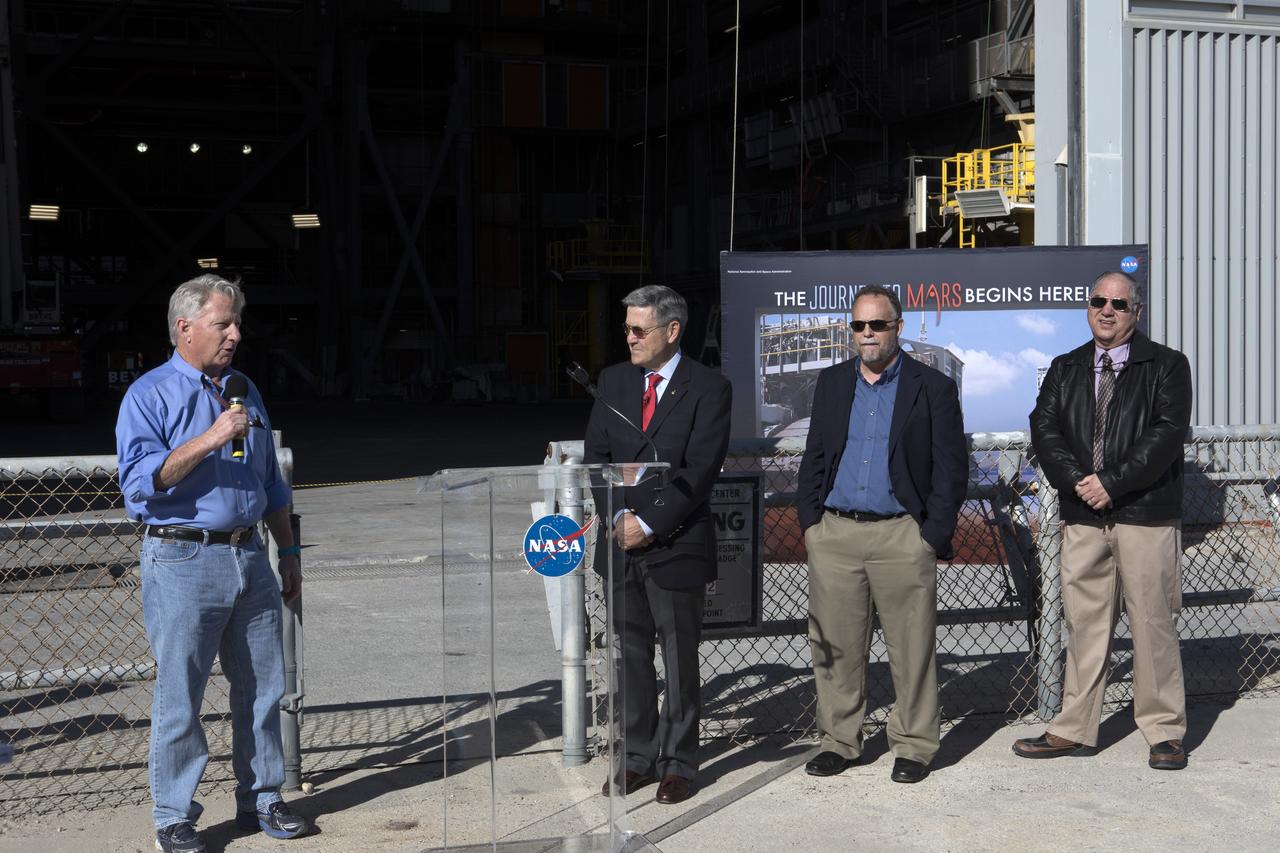
Members of the news media viewed the 10 levels of new work platforms in High Bay 3 inside the Vehicle Assembly Building during a multi-user tour of NASA's Kennedy Space Center in Florida with Center Director Bob Cabana. The final platform, A north, was recently installed. From left are Kerry Chreist of Jacobs on the Test and Operations Support Contract; Cabana; Shawn Quinn, associate program manager for the Ground Systems Development and Operations Program (GSDO); and Jose Perez-Morales, GSDO project manager for platform installation. The platforms will surround the Space Launch System and Orion spacecraft on the mobile launcher during processing to prepare for the first test flight.
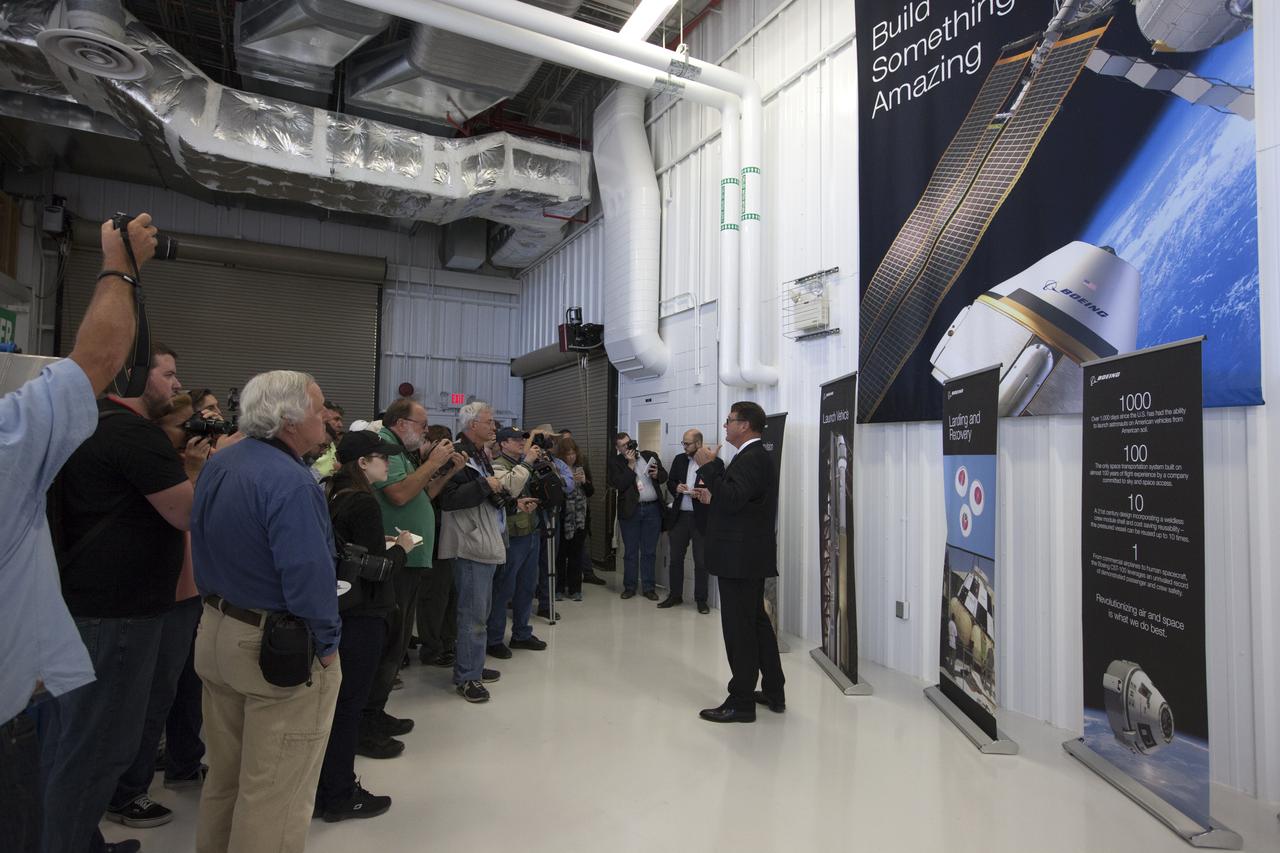
John Mulholland, Boeing vice president and program manager for Commercial Programs, speaks to members of the news media inside the Boeing’s Commercial Crew and Cargo Processing Facility at the Florida spaceport. The facility will be used in manufacturing Boeing's CST-100 Starliner spacecraft for flight tests and crew rotation missions to the International Space Station as part of the agency's Commercial Crew Program.
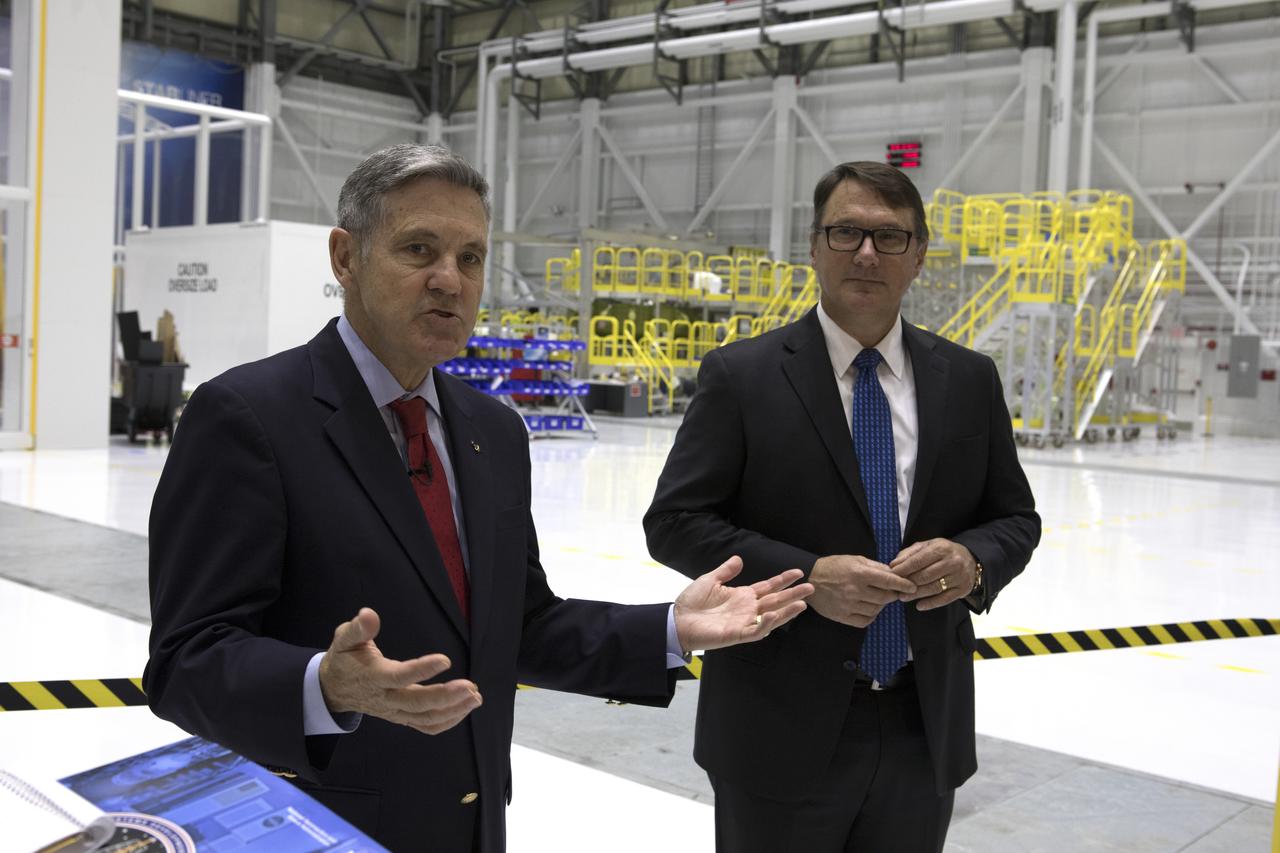
Kennedy Space Center Director Bob Cabana, left, and John Mulholland, Boeing vice president and program manager for Commercial Programs, speak to members of the news media inside the Boeing’s Commercial Crew and Cargo Processing Facility at the Florida spaceport. The facility will be used in manufacturing Boeing's CST-100 Starliner spacecraft for flight tests and crew rotation missions to the International Space Station as part of the agency's Commercial Crew Program.
Members of the news media viewed the 10 levels of new work platforms in High Bay 3 inside the Vehicle Assembly Building during a multi-user tour of NASA's Kennedy Space Center in Florida with Center Director Bob Cabana. The final platform, A north, was recently installed. From left are Cabana; Shawn Quinn, associate program manager for the Ground Systems Development and Operations Program (GSDO); and Jose Perez-Morales, GSDO project manager for platform installation. The platforms will surround the Space Launch System and Orion spacecraft on the mobile launcher during processing to prepare for the first test flight.
Members of the news media viewed the 10 levels of new work platforms in High Bay 3 inside the Vehicle Assembly Building during a multi-user tour of NASA's Kennedy Space Center in Florida with Center Director Bob Cabana. The final platform, A north, was recently installed. From left are Cabana; Shawn Quinn, associate program manager for the Ground Systems Development and Operations Program (GSDO); and Jose Perez-Morales, GSDO project manager for platform installation. The platforms will surround the Space Launch System and Orion spacecraft on the mobile launcher during processing to prepare for the first test flight.
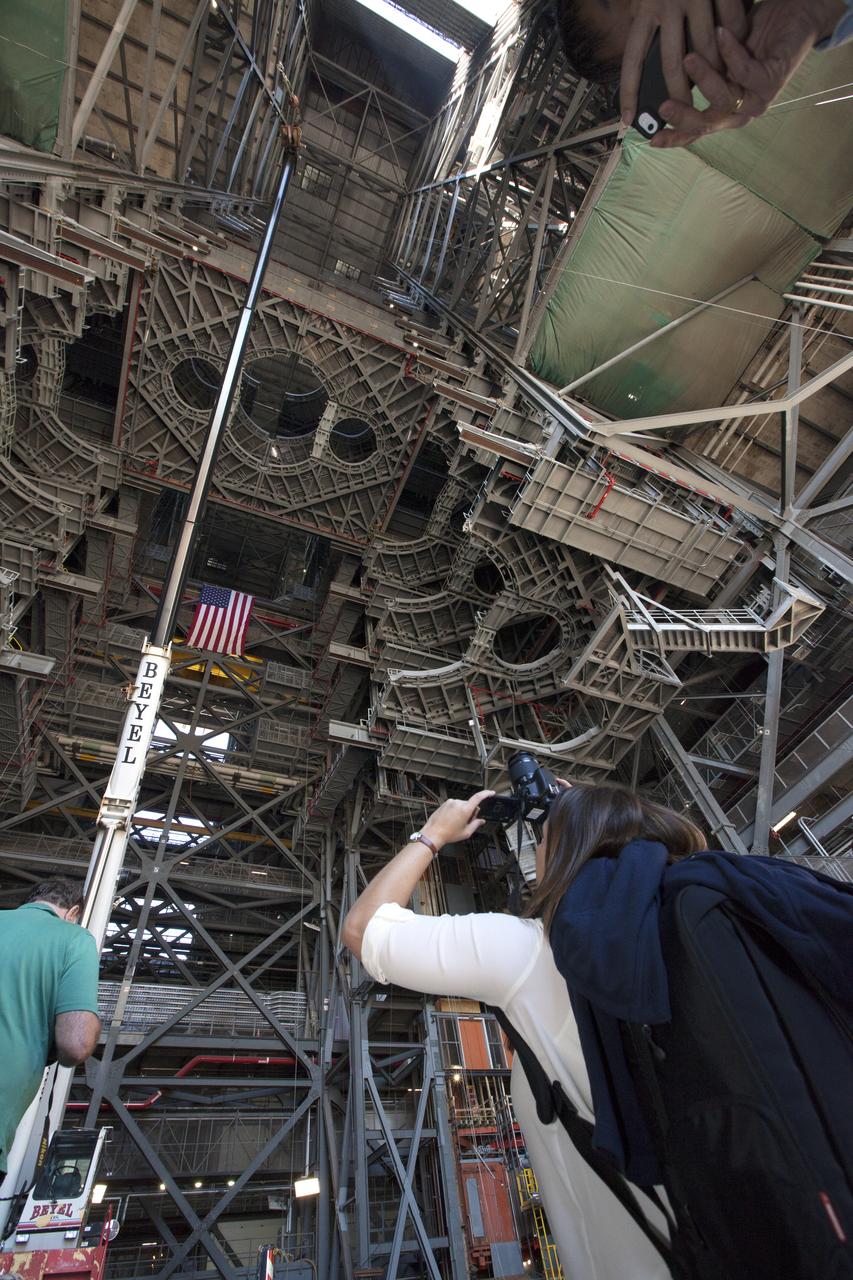
Members of the news media view the 10 levels of new work platforms in High Bay 3 inside the Vehicle Assembly Building (VAB) during a tour of NASA's Kennedy Space Center in Florida with Center Director Bob Cabana. The final platform, A north, was recently installed. The platforms will surround the Space Launch System and Orion spacecraft on the mobile launcher during processing to prepare for the first test flight. The Ground Systems Development and Operations Program is overseeing upgrades to the VAB, including installation of the new work platforms.
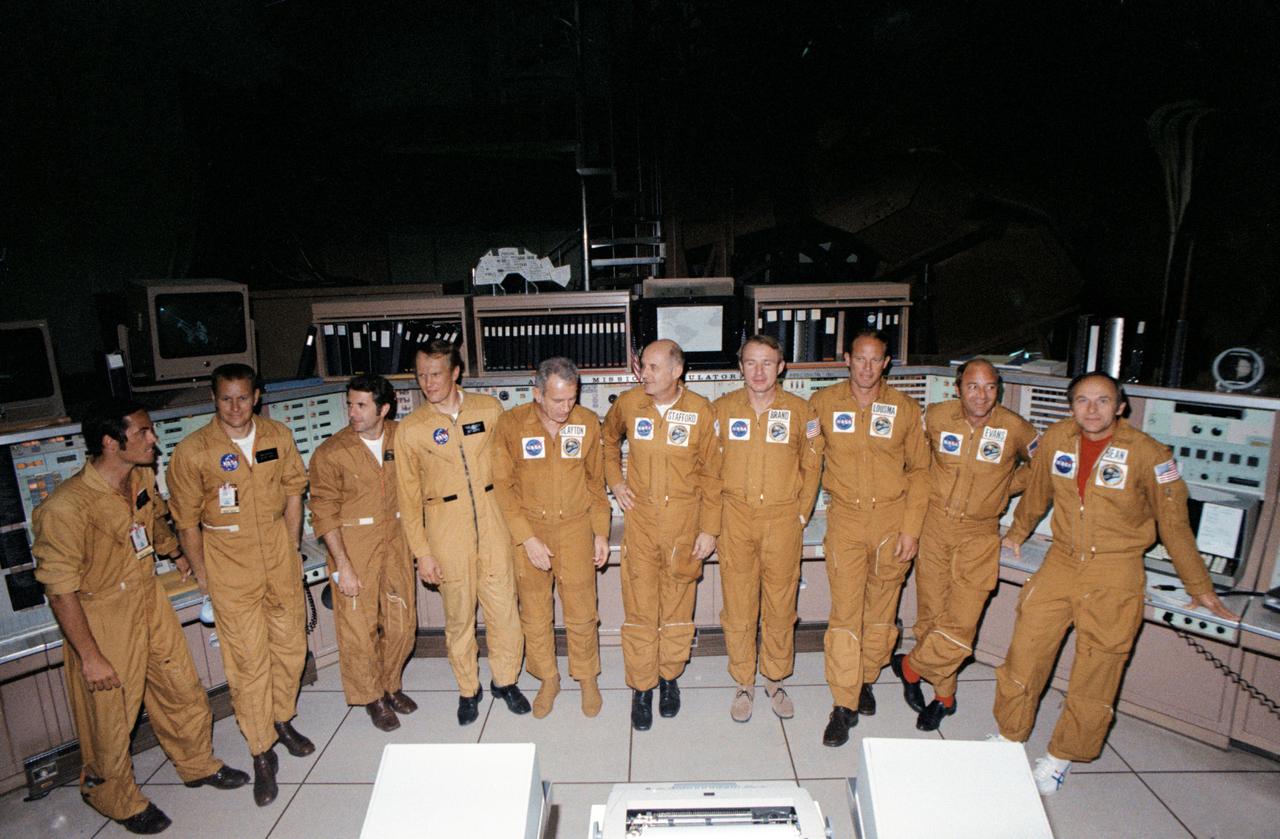
S75-28361 (9 July 1975) --- These ten American astronauts compose the U.S. prime crew, the backup crew and the crew support team for the joint U.S.-USSR Apollo-Soyuz Test Project docking mission in Earth orbit. They are, left to right, Robert L. Crippen, support team; Robert F. Overmyer, support team; Richard H. Truly, support team; Karol J. Bobko, support team; Donald K. Slayton, prime crew docking module pilot; Thomas P. Stafford, prime crew commander; Vance D. Brand, prime crew command module pilot; Jack R. Lousma, backup crew docking module pilot; Ronald E. Evans, backup crew command module pilot; and Alan L. Bean, backup crew commander. They are photographed by the Apollo Mission Simulator console in Building 5 at NASA's Johnson Space Center.
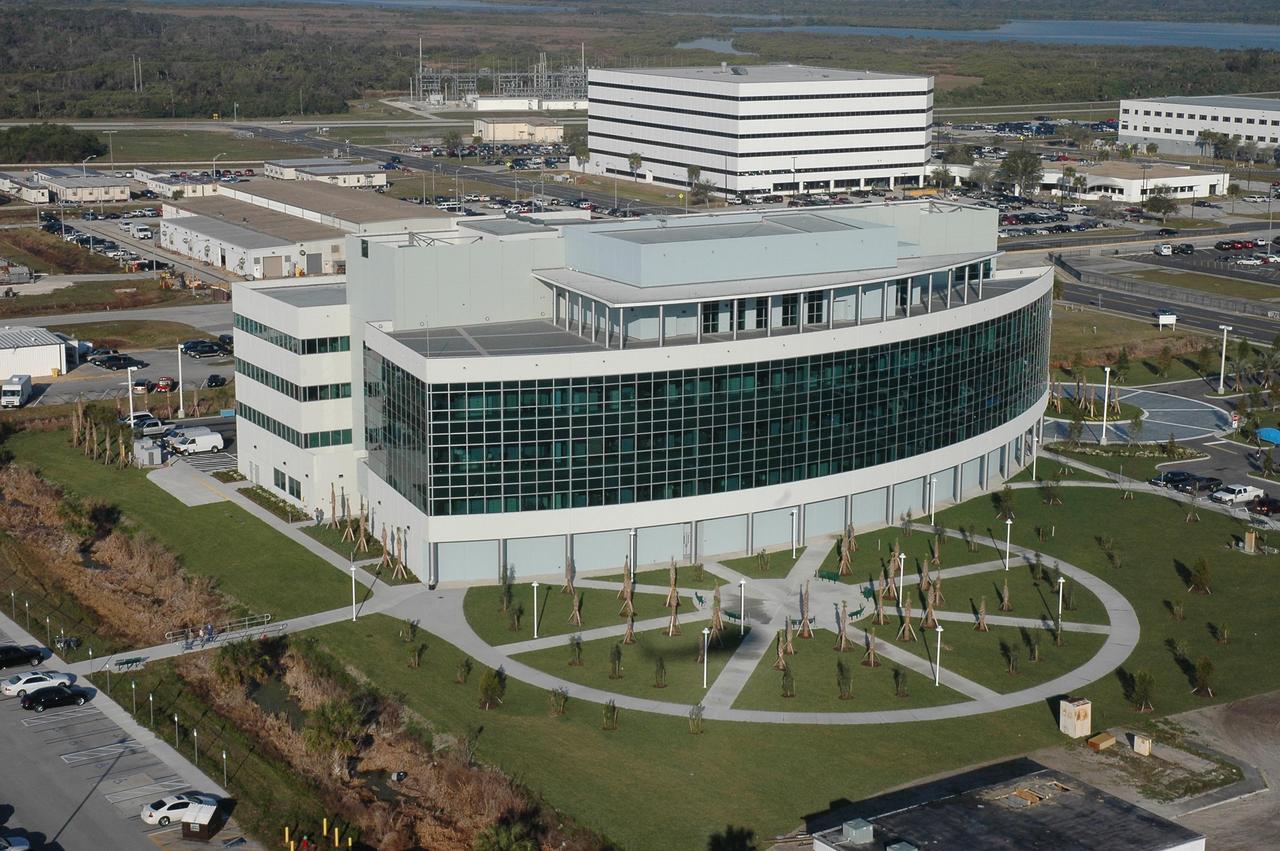
KENNEDY SPACE CENTER, FLA. - The Operations Support Building II at NASA's Kennedy Space Center is seen here, newly built and landscaped. The building replaced modular housing and trailers in the Launch Complex 39 area. The five-story, 189,000-square-foot building consists of approximately 860 office spaces, training rooms, computer rooms, multimedia conference rooms, technical libraries, and a 352-person mission conference center with observation deck. Photo credit: Cory Huston

Over 600 middle school, high school, and college students from across the nation launched 30 high-powered rockets just north of NASA’s Marshall Space Flight Center in Huntsville, Alabama. This year marked the 26th anniversary of the competition. To compete, students follow the NASA engineering design lifecycle by going through a series of reviews for nine months leading up to launch day. Each year, a payload challenge is issued to the university teams, and this year’s task took inspiration from the agency’s Artemis missions, where NASA will send astronauts to explore the Moon for scientific discovery, economic benefit, and to build the foundation for the first crewed missions to Mars. Teams were challenged build and fly a STEMnaut Habitat for Agricultural Utilization Study (HAUS) that safely houses four STEMnauts, non-living objects representing astronauts. The habitat had to include equipment capable of both collecting and testing soil samples to support agricultural research operations.
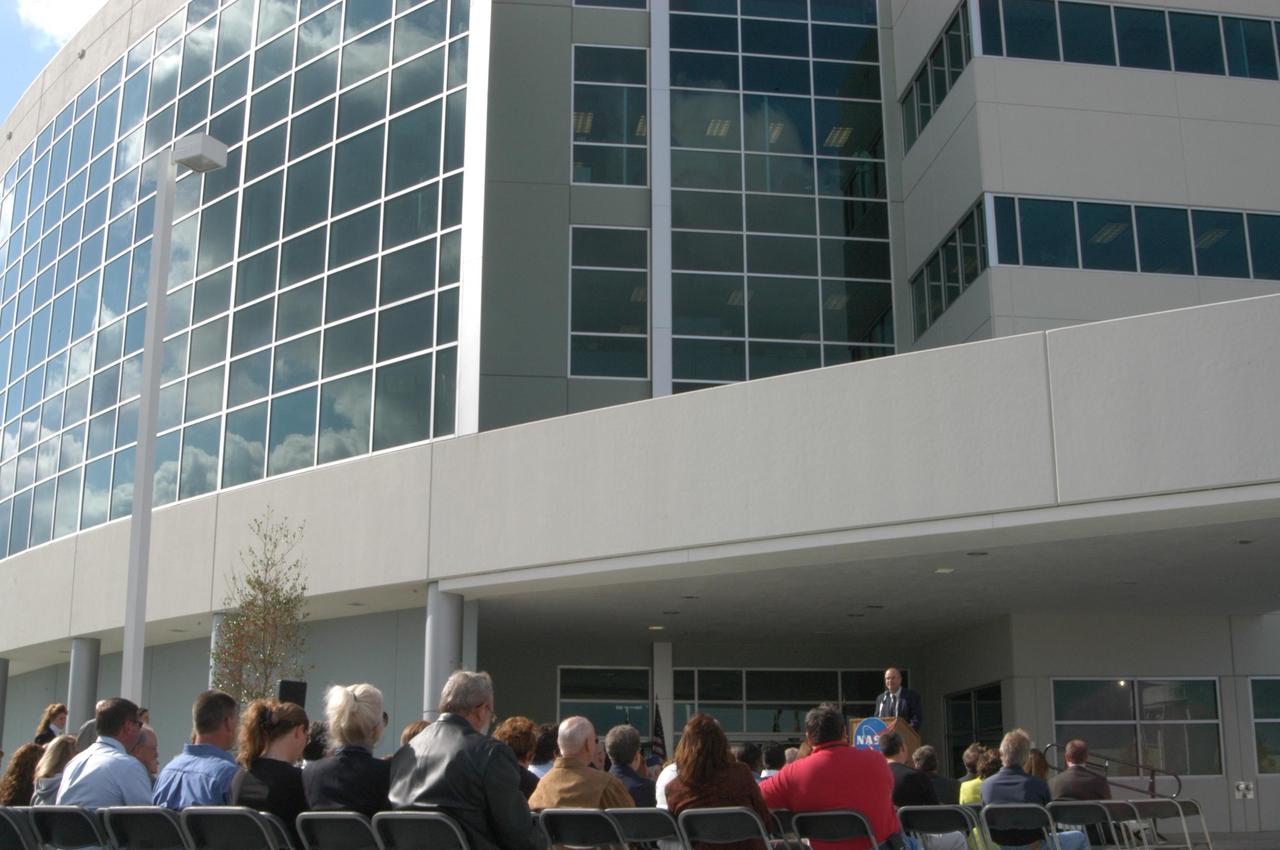
KENNEDY SPACE CENTER, FLA. -- Scott Kerr, director of Engineering Development at Kennedy Space Center, addresses guests at a ribbon-cutting ceremony for the Operations Support Building II (behind him). He and other key Center personnel and guests attended the significant event. The Operations Support Building II is an Agency safety and health initiative project to replace 198,466 square feet of substandard modular housing and trailers in the Launch Complex 39 area at Kennedy Space Center. The five-story building, which sits south of the Vehicle Assembly Building and faces the launch pads, includes 960 office spaces, 16 training rooms, computer and multimedia conference rooms, a Mission Conference Center with an observation deck, technical libraries, an Exchange store, storage, break areas, and parking. Photo credit: NASA/George Shelton
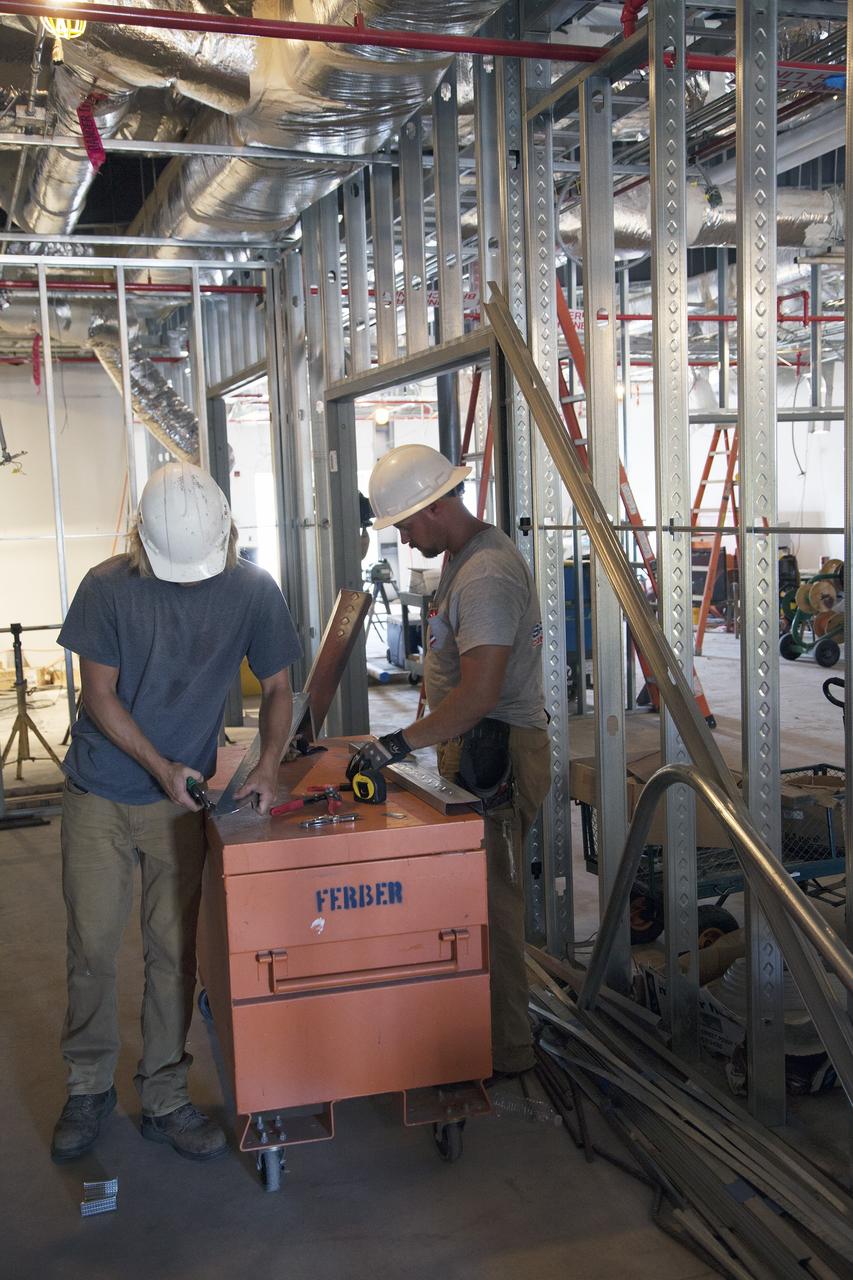
CAPE CANAVERAL, Fla. – Modifications continue on the Multi-Payload Processing Facility, or MPPF, at NASA's Kennedy Space Center in Florida. Inside the MPPF annex building, construction workers are converting the building to a ground support equipment storage area and work area. The pipes overhead are part of the Environmental Control System. Kennedy's Center Operations Directorate is overseeing upgrades to the MPPF for the Ground Systems Development and Operations Program. The extensive upgrades and modernizations will support processing of Orion spacecraft for NASA's exploration missions. The 19,647-square-foot building, originally constructed in 1995, primarily will be used for Orion hypergolic fueling, ammonia servicing and high-pressure gas servicing and checkout before being transported to the Vehicle Assembly Building for integration with the Space Launch System. Photo credit: NASA/Daniel Casper
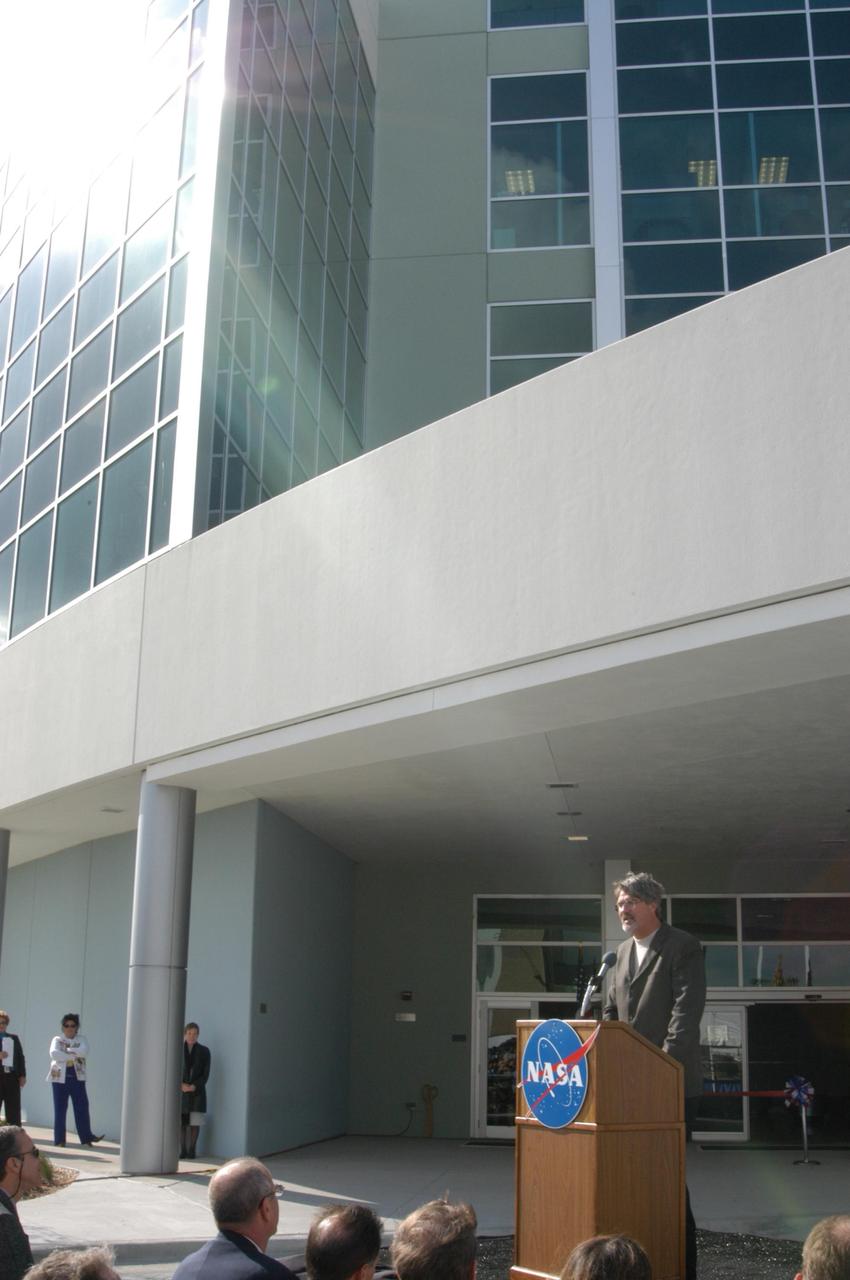
KENNEDY SPACE CENTER, FLA. -- Kennedy Space Center Deputy Director Bill Parsons talks to guests at a ribbon-cutting ceremony for the Operations Support Building II (behind him). He and other key Center personnel and guests attended the significant event. The Operations Support Building II is an Agency safety and health initiative project to replace 198,466 square feet of substandard modular housing and trailers in the Launch Complex 39 area at Kennedy Space Center. The five-story building, which sits south of the Vehicle Assembly Building and faces the launch pads, includes 960 office spaces, 16 training rooms, computer and multimedia conference rooms, a Mission Conference Center with an observation deck, technical libraries, an Exchange store, storage, break areas, and parking. Photo credit: NASA/George Shelton
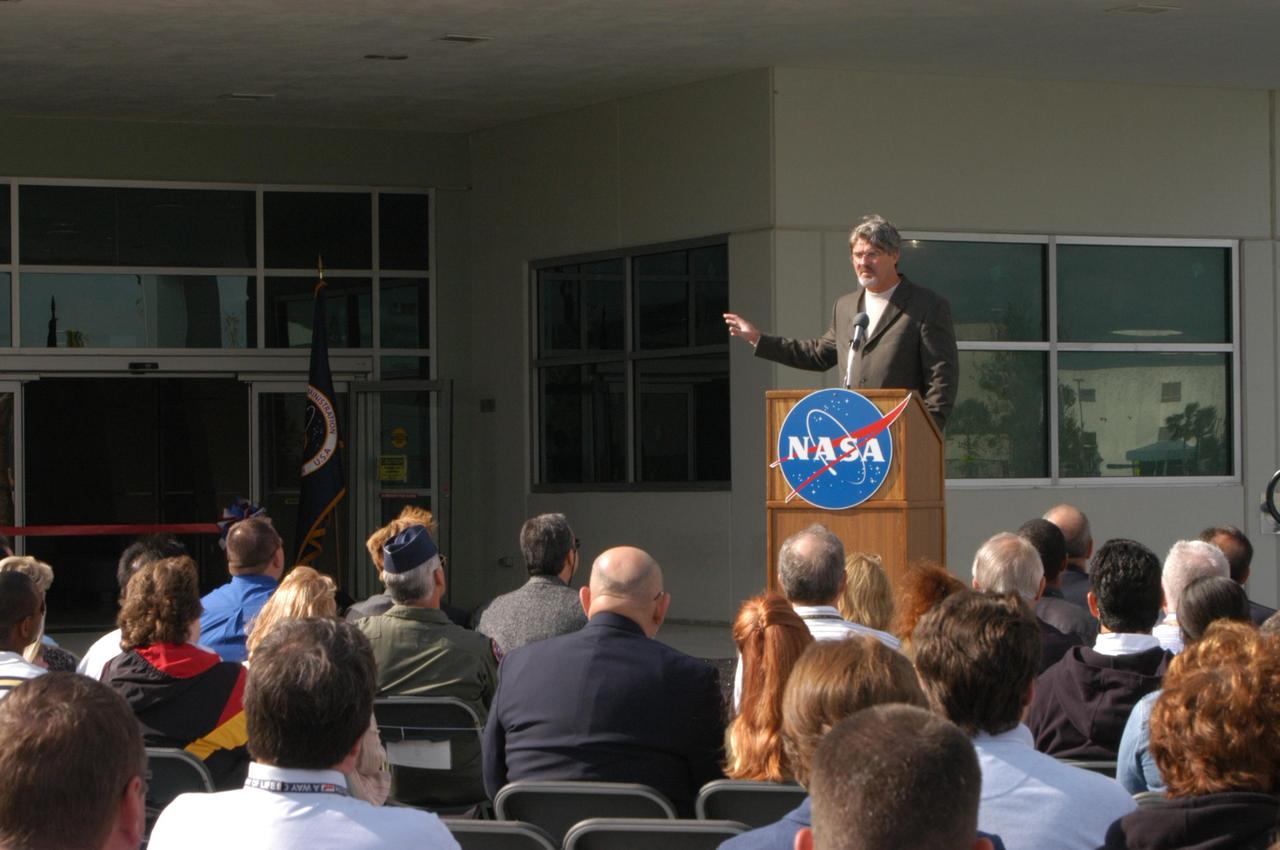
KENNEDY SPACE CENTER, FLA. -- Kennedy Space Center Deputy Director Bill Parsons explains the significance of the Operations Support Building II (behind him) to guests at the ribbon-cutting ceremony. The Operations Support Building II is an Agency safety and health initiative project to replace 198,466 square feet of substandard modular housing and trailers in the Launch Complex 39 area at Kennedy Space Center. The five-story building, which sits south of the Vehicle Assembly Building and faces the launch pads, includes 960 office spaces, 16 training rooms, computer and multimedia conference rooms, a Mission Conference Center with an observation deck, technical libraries, an Exchange store, storage, break areas, and parking. Photo credit: NASA/George Shelton
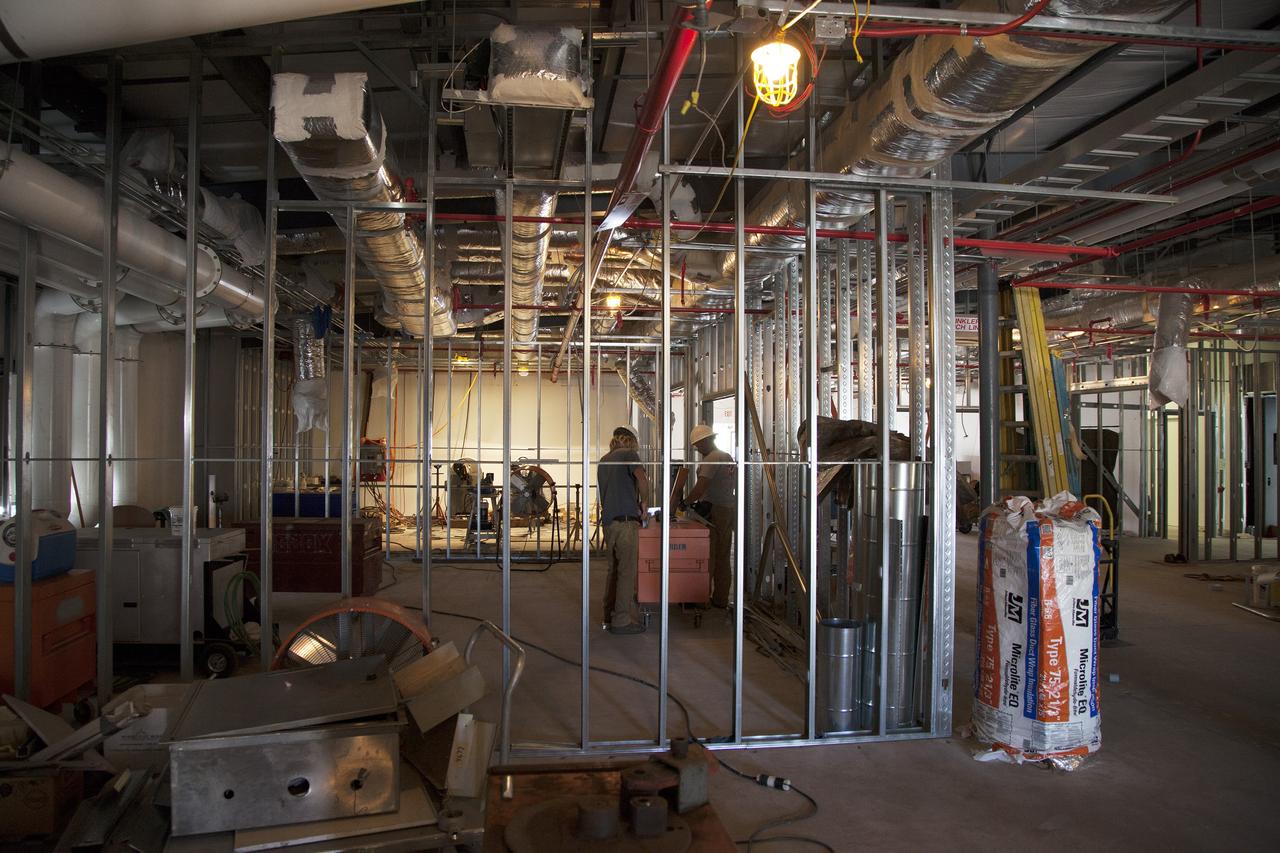
CAPE CANAVERAL, Fla. – Modifications continue on the Multi-Payload Processing Facility, or MPPF, at NASA's Kennedy Space Center in Florida. Inside the MPPF annex building, construction workers are converting the building to a ground support equipment storage area and work area. The pipes overhead are part of the Environmental Control System. Kennedy's Center Operations Directorate is overseeing upgrades to the MPPF for the Ground Systems Development and Operations Program. The extensive upgrades and modernizations will support processing of Orion spacecraft for NASA's exploration missions. The 19,647-square-foot building, originally constructed in 1995, primarily will be used for Orion hypergolic fueling, ammonia servicing and high-pressure gas servicing and checkout before being transported to the Vehicle Assembly Building for integration with the Space Launch System. Photo credit: NASA/Daniel Casper
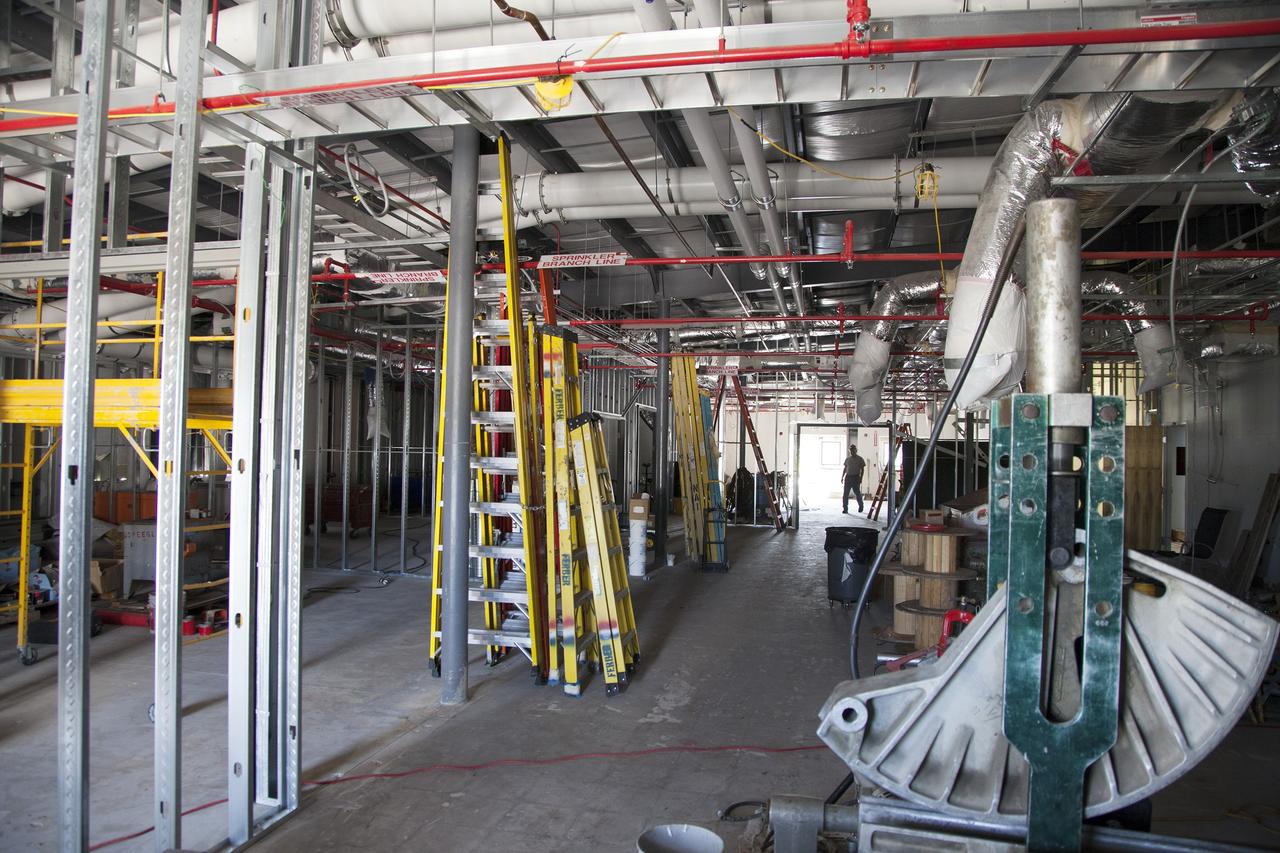
CAPE CANAVERAL, Fla. – Modifications continue on the Multi-Payload Processing Facility, or MPPF, at NASA's Kennedy Space Center in Florida. Inside the MPPF annex building, construction workers are converting the building to a ground support equipment storage area and work area. The pipes overhead are part of the Environmental Control System. Kennedy's Center Operations Directorate is overseeing upgrades to the MPPF for the Ground Systems Development and Operations Program. The extensive upgrades and modernizations will support processing of Orion spacecraft for NASA's exploration missions. The 19,647-square-foot building, originally constructed in 1995, primarily will be used for Orion hypergolic fueling, ammonia servicing and high-pressure gas servicing and checkout before being transported to the Vehicle Assembly Building for integration with the Space Launch System. Photo credit: NASA/Daniel Casper
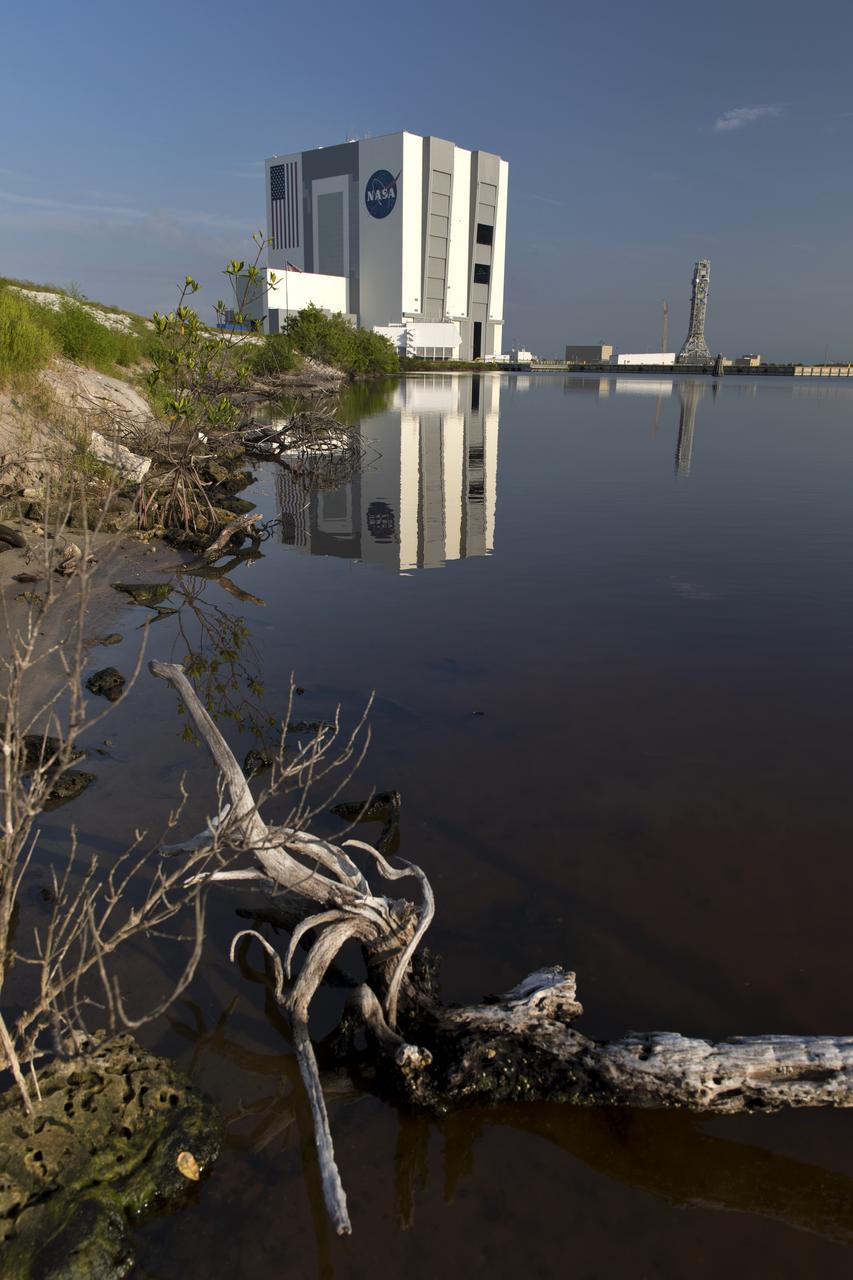
The iconic Vehicle Assembly Building (VAB) casts a reflection in a surrounding waterway at NASA's Kennedy Space Center in Florida. In view are the south and east sides of the building. Ten levels of new work platforms have been installed in VAB High Bay 3. They will surround and provide access for service and processing of NASA's Space Launch System (SLS) rocket and Orion spacecraft. Exploration Ground Systems oversaw the upgrades and installation of the new work platforms to support the launch of the SLS and Orion on Exploration Mission-1 and deep space missions.
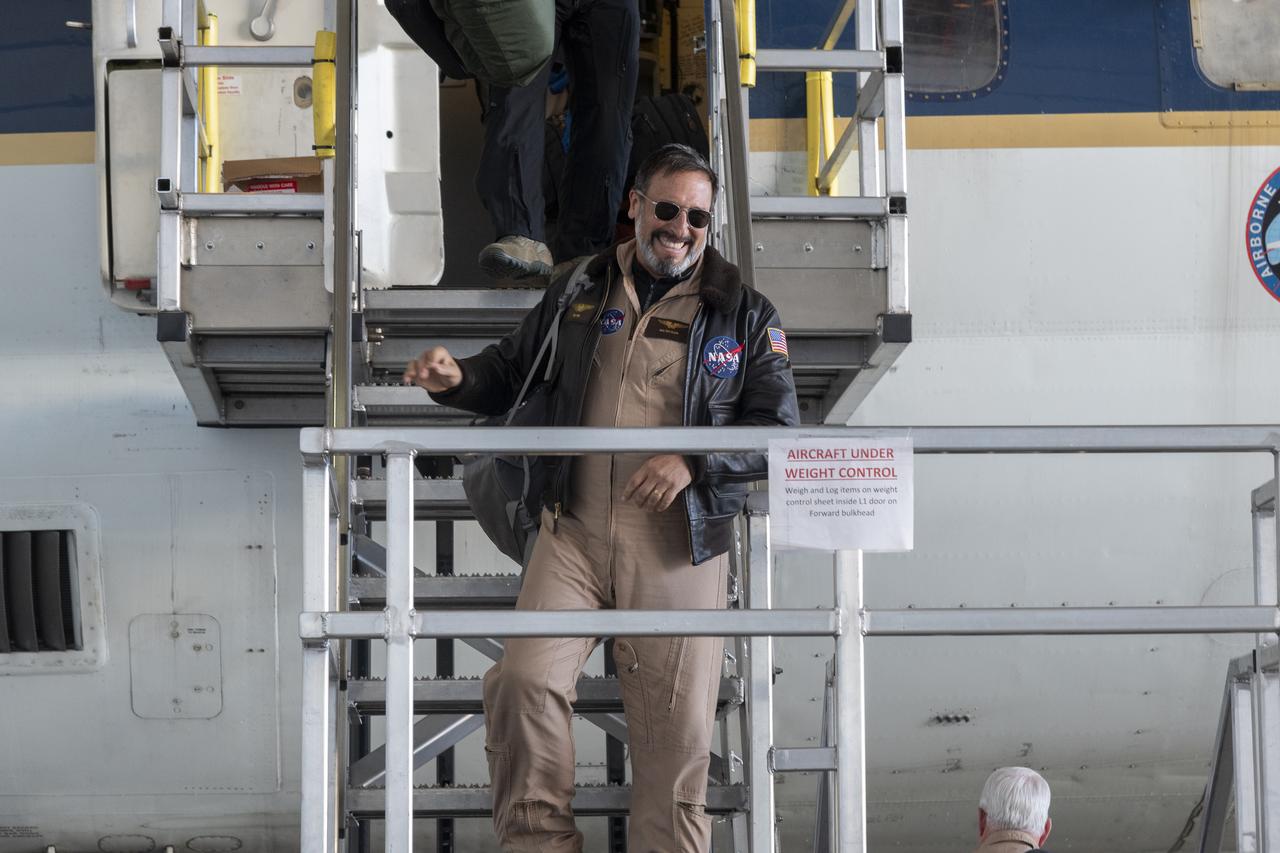
Walter Klein, DC-8 navigator, exits the aircraft cabin and is welcomed with applause from a supportive team after the DC-8 aircraft and crew return to NASA’s Armstrong Flight Research Center Building 703 in Palmdale, California, on April 1, 2024, following the aircraft’s final mission in support of the Airborne and Satellite Investigation of Asian Air Quality (ASIA-AQ).
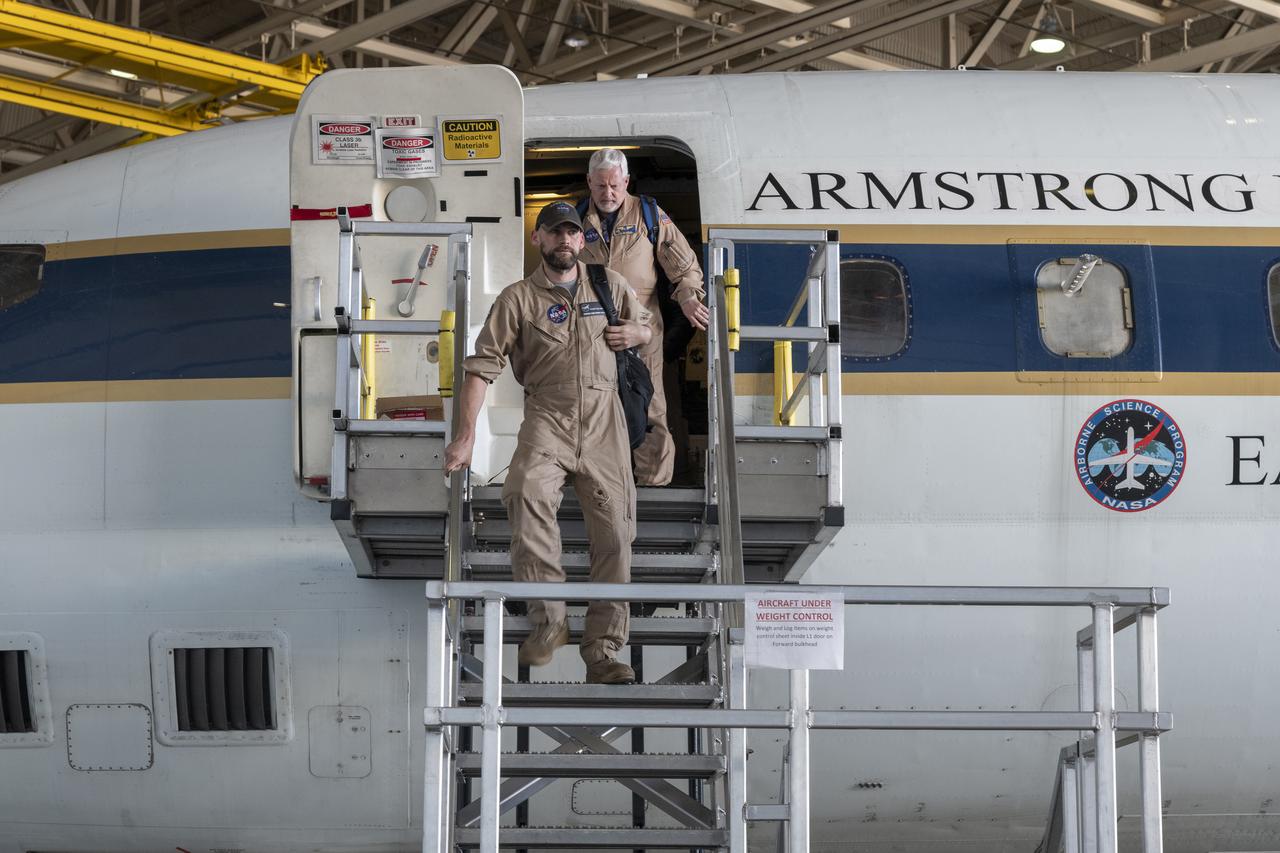
Kelly Jellison, avionics lead, and Tim Sandon, flight engineer, exit the DC-8 aircraft cabin and are welcomed with applause from a supportive team after the DC-8 aircraft and crew return to NASA’s Armstrong Flight Research Center Building 703 in Palmdale, California, on April 1, 2024, following the aircraft’s final mission in support of the Airborne and Satellite Investigation of Asian Air Quality (ASIA-AQ).
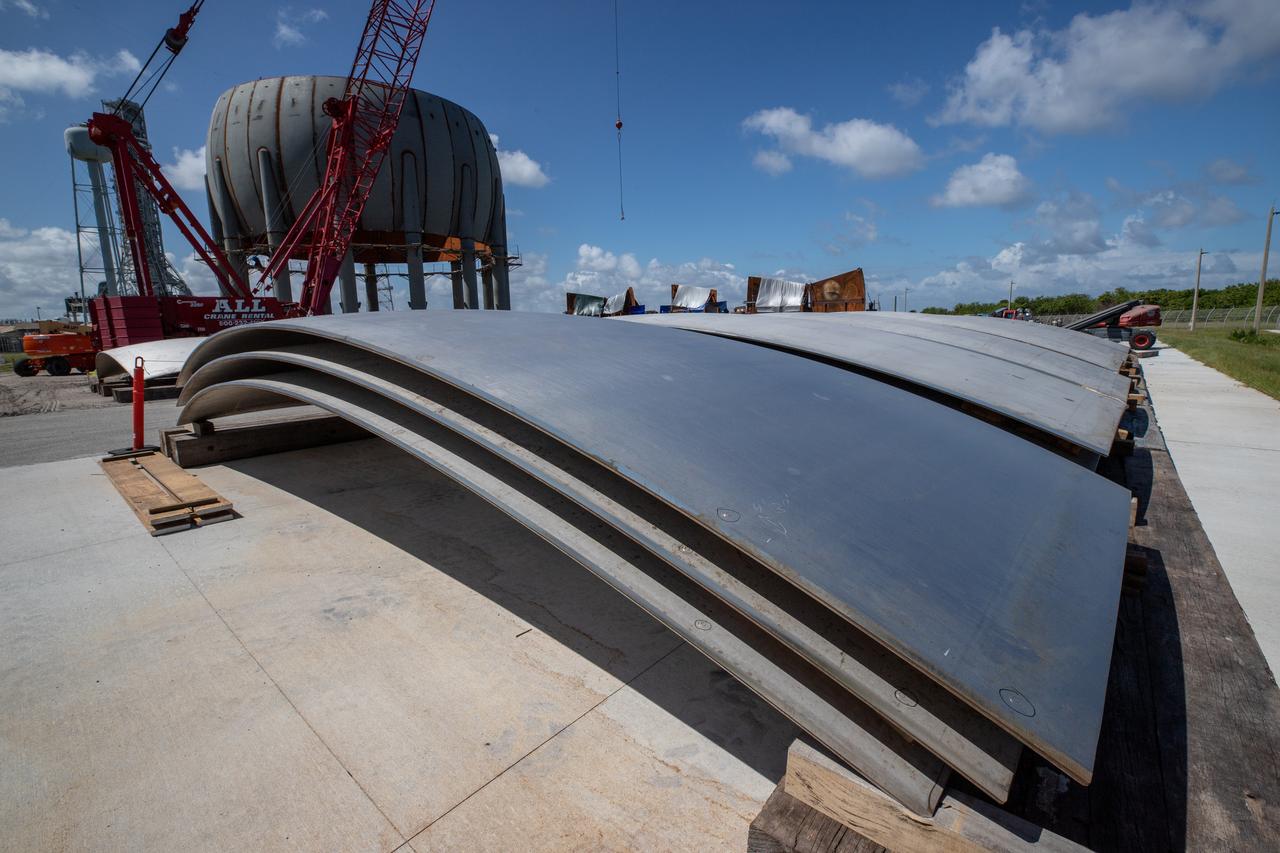
Build-up of a new liquid hydrogen (LH2) storage tank is in progress on Oct. 1, 2019, at Launch Complex 39B at NASA's Kennedy Space Center in Florida. The new tank will hold 1.25 million gallons of usable LH2 to support future launches from the pad, including Artemis missions to the Moon and on to Mars.
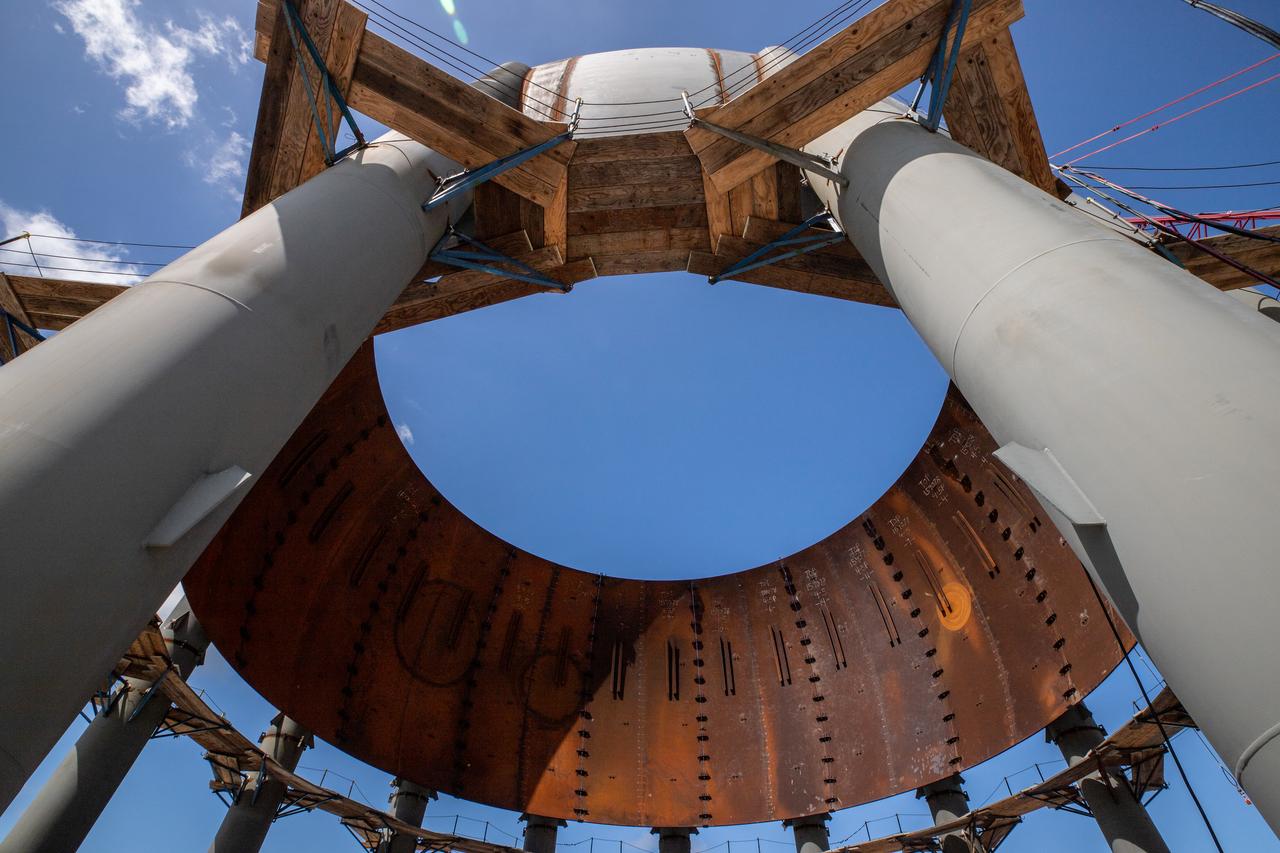
Build-up of a new liquid hydrogen (LH2) storage tank is in progress on Oct. 1, 2019, at Launch Complex 39B at NASA's Kennedy Space Center in Florida. The new tank will hold 1.25 million gallons of usable LH2 to support future launches from the pad, including Artemis missions to the Moon and on to Mars.
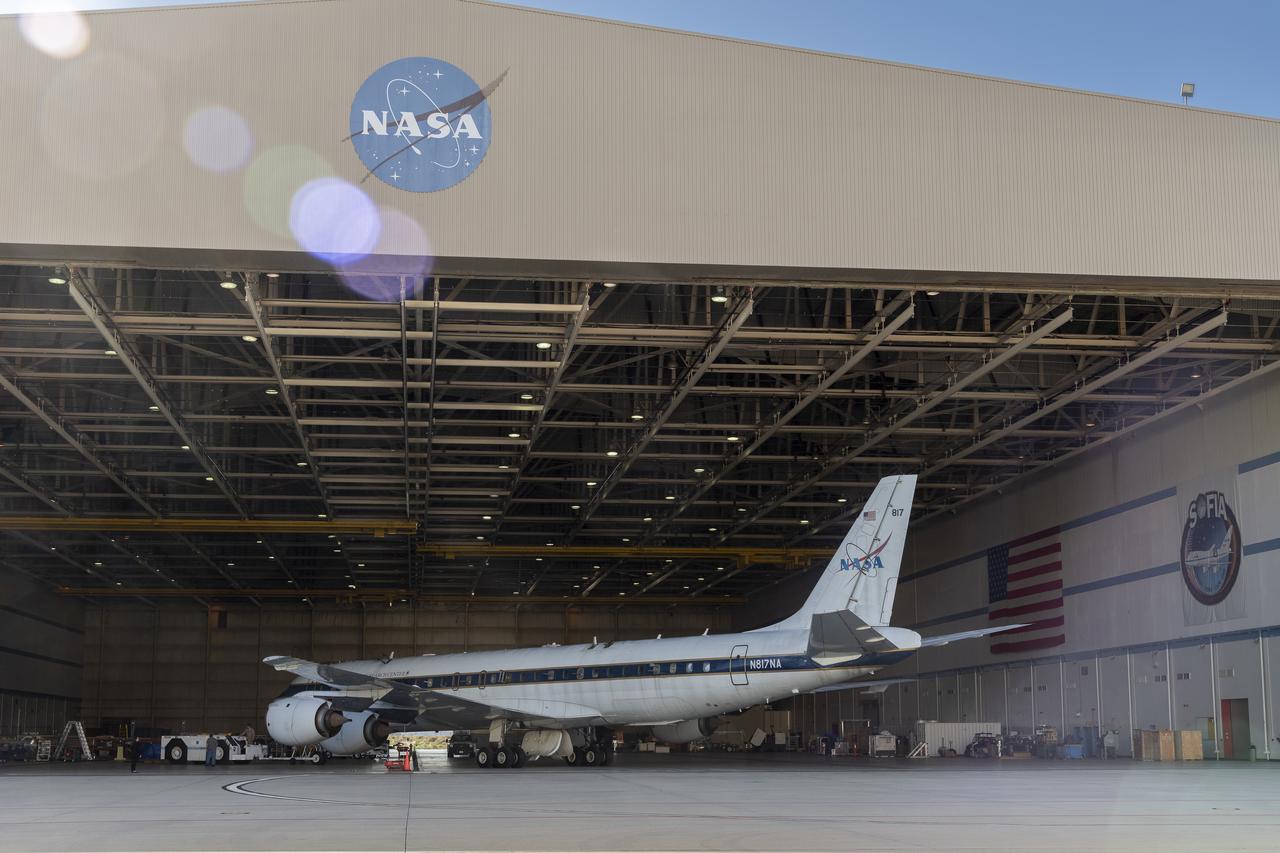
The DC-8 aircraft returns to the hangar at NASA’s Armstrong Flight Research Center Building 703 in Palmdale, California, on April 1, 2024, after completing its final mission supporting Airborne and Satellite Investigation of Asian Air Quality (ASIA-AQ).
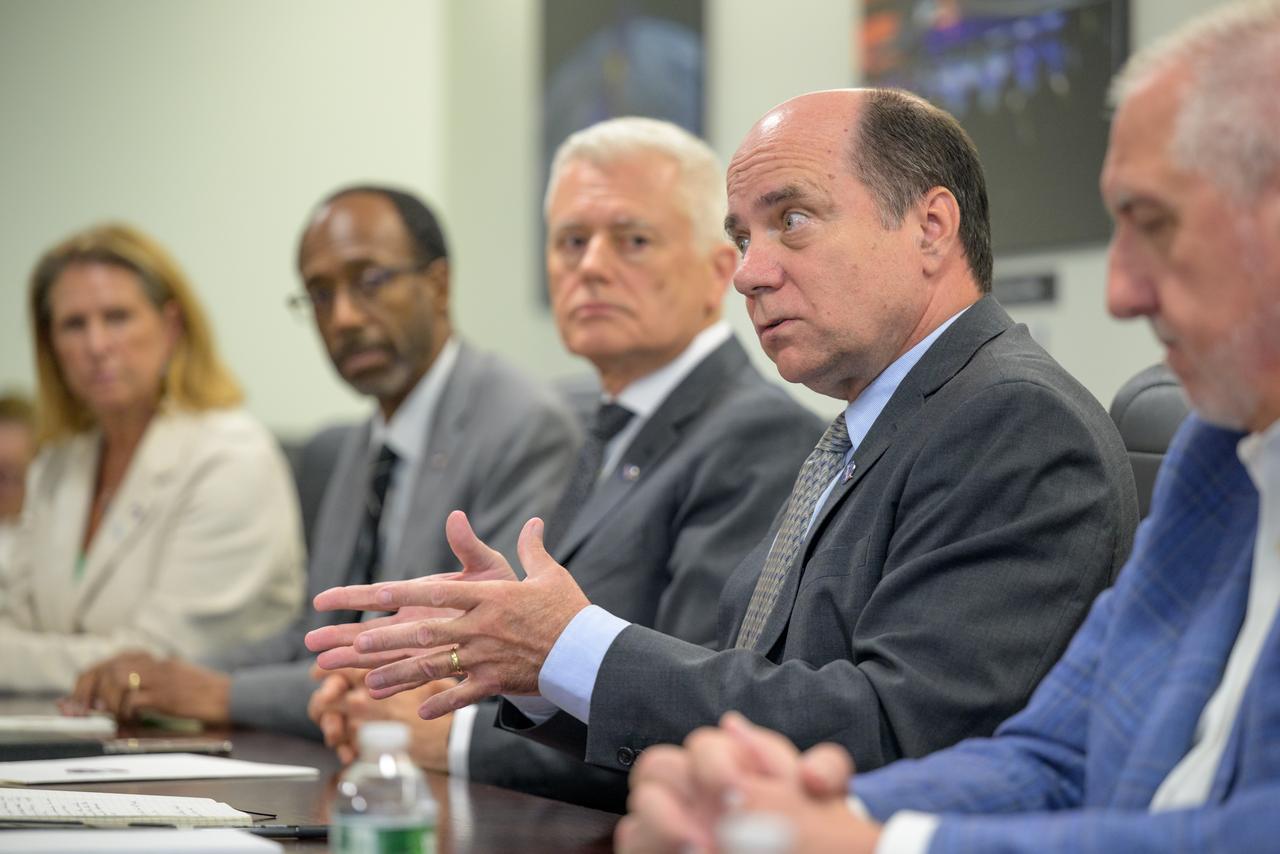
Associate Administrator for NASA's Mission Support Directorate David Mitchell speaks with acting NASA Administrator Sean Duffy, Friday, July 18, 2025, at the Mary W. Jackson NASA Headquarters Building in Washington. Photo Credit: (NASA/Bill Ingalls)
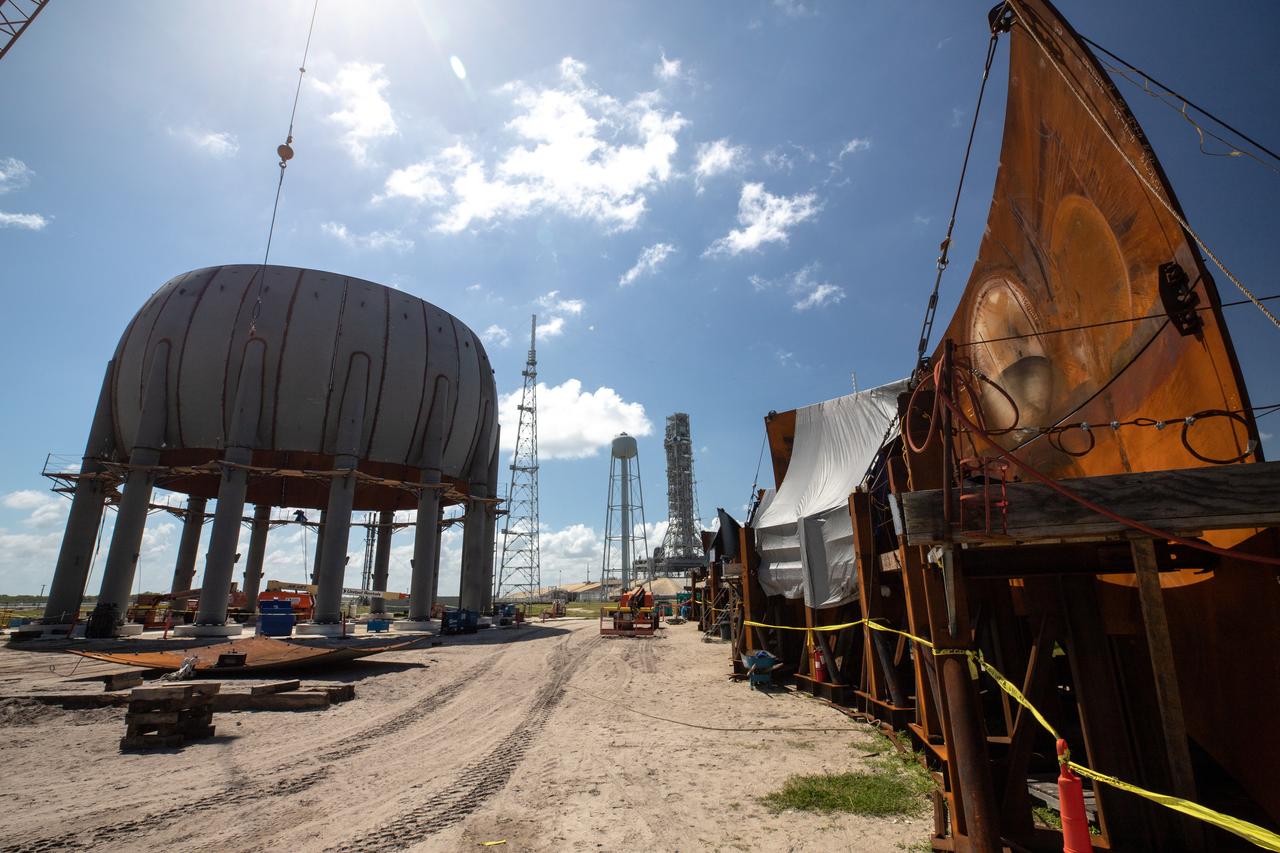
Build-up of a new liquid hydrogen (LH2) storage tank is in progress on Oct. 1, 2019, at Launch Complex 39B at NASA's Kennedy Space Center in Florida. The new tank will hold 1.25 million gallons of usable LH2 to support future launches from the pad, including Artemis missions to the Moon and on to Mars.
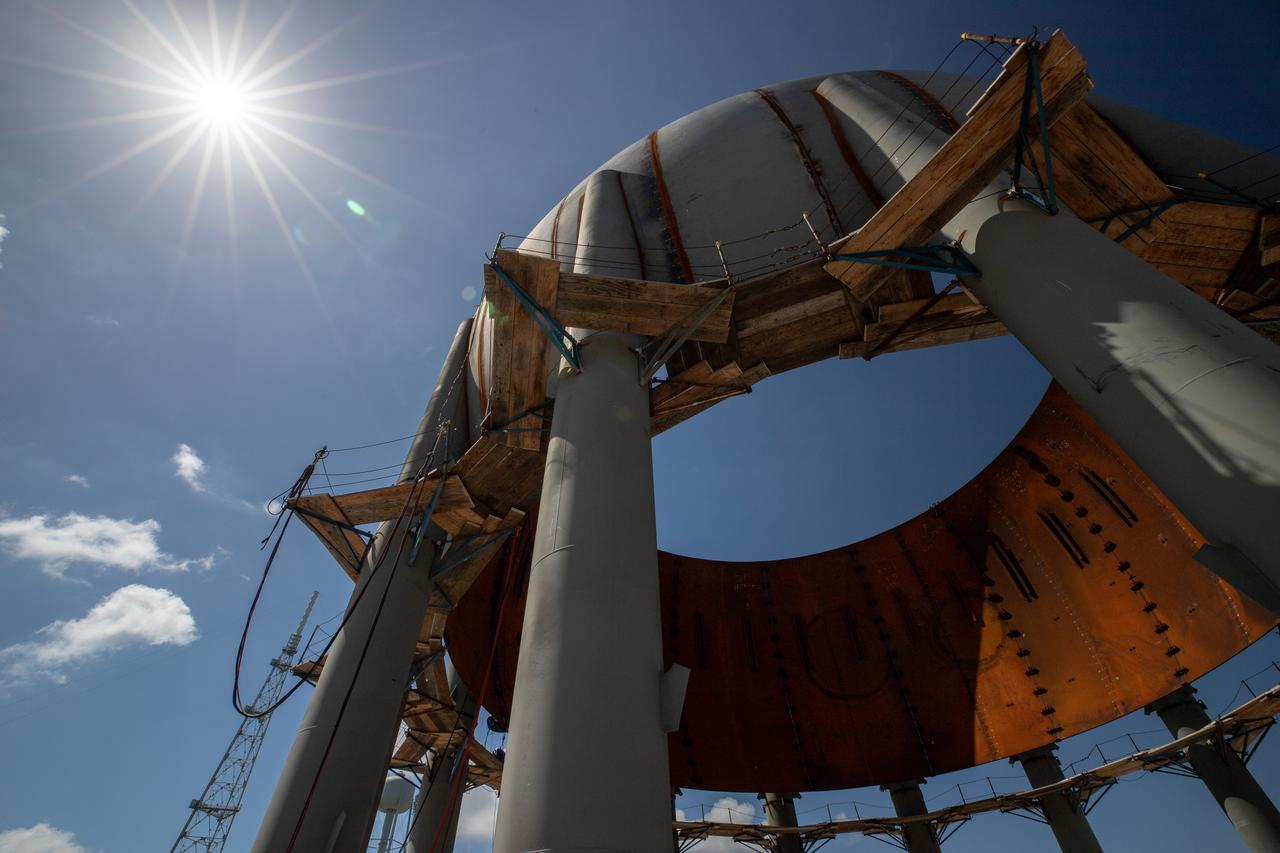
Build-up of a new liquid hydrogen (LH2) storage tank is in progress on Oct. 1, 2019, at Launch Complex 39B at NASA's Kennedy Space Center in Florida. The new tank will hold 1.25 million gallons of usable LH2 to support future launches from the pad, including Artemis missions to the Moon and on to Mars.
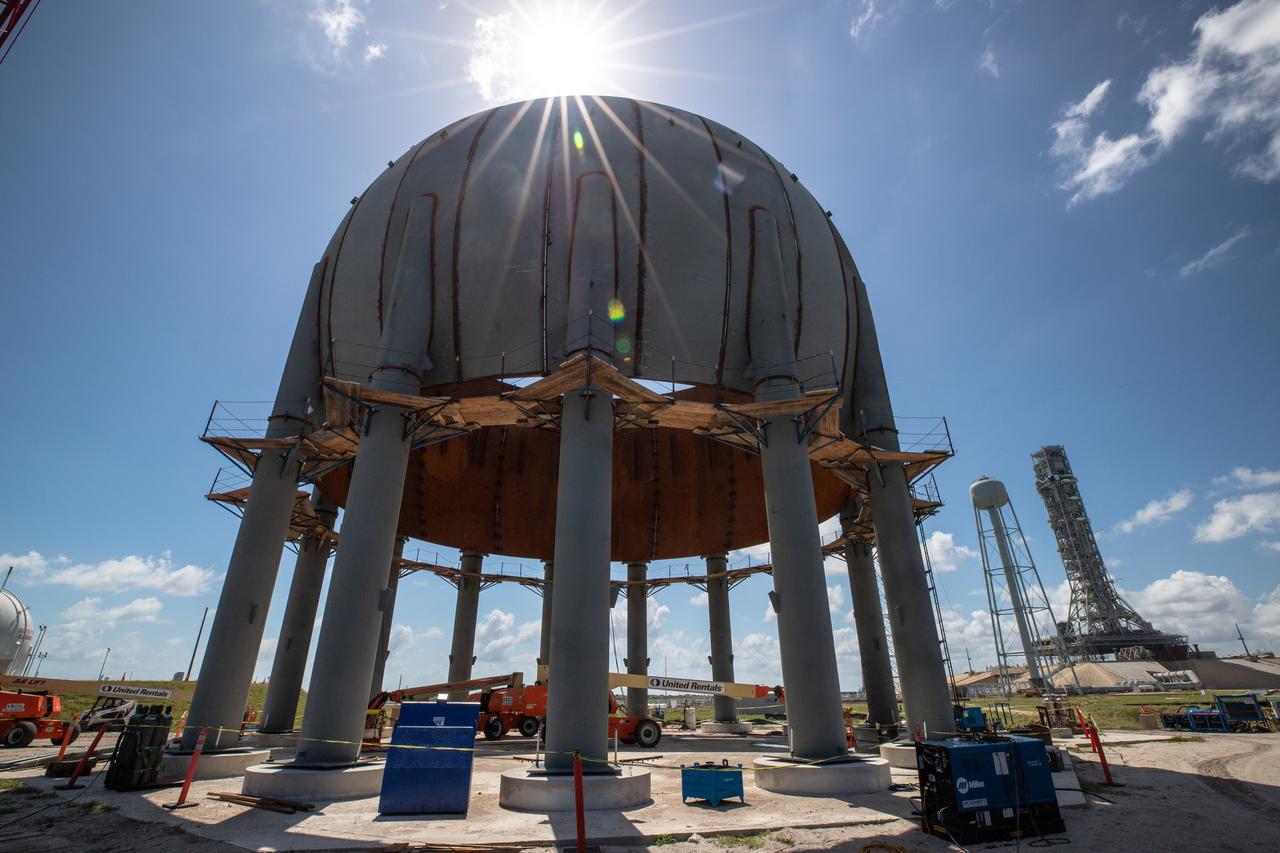
Build-up of a new liquid hydrogen (LH2) storage tank is in progress on Oct. 1, 2019, at Launch Complex 39B at NASA's Kennedy Space Center in Florida. The new tank will hold 1.25 million gallons of usable LH2 to support future launches from the pad, including Artemis missions to the Moon and on to Mars.
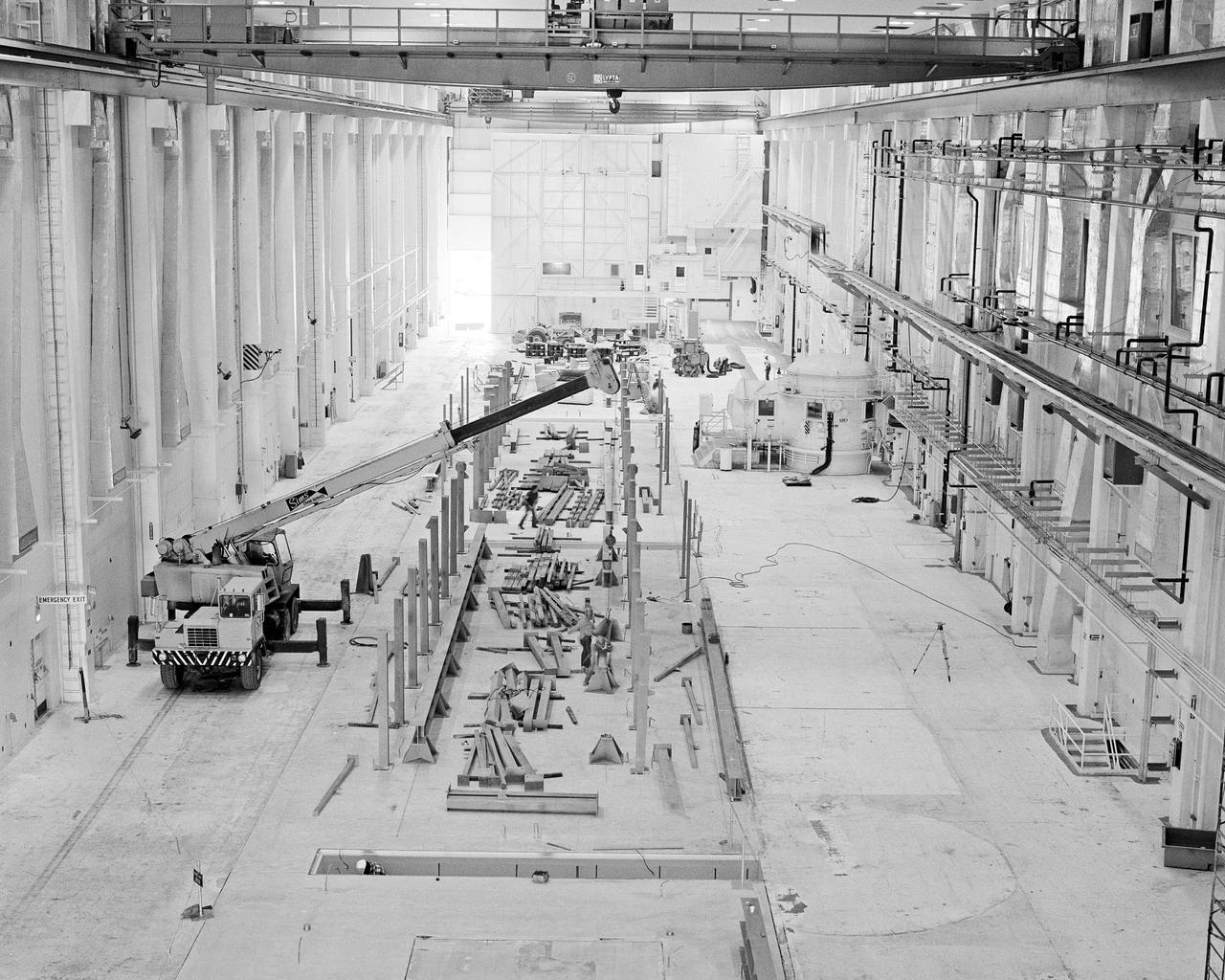
CAPE CANAVERAL, Fla. -- At the Kennedy Space Center in Florida, structural work is ongoing inside the high bay of the Operations and Checkout Building. The modifications are taking place to configure the facility flight hardware from the Apollo Program and prepare to support payload processing for future space shuttle missions. Photo Credit: NASA
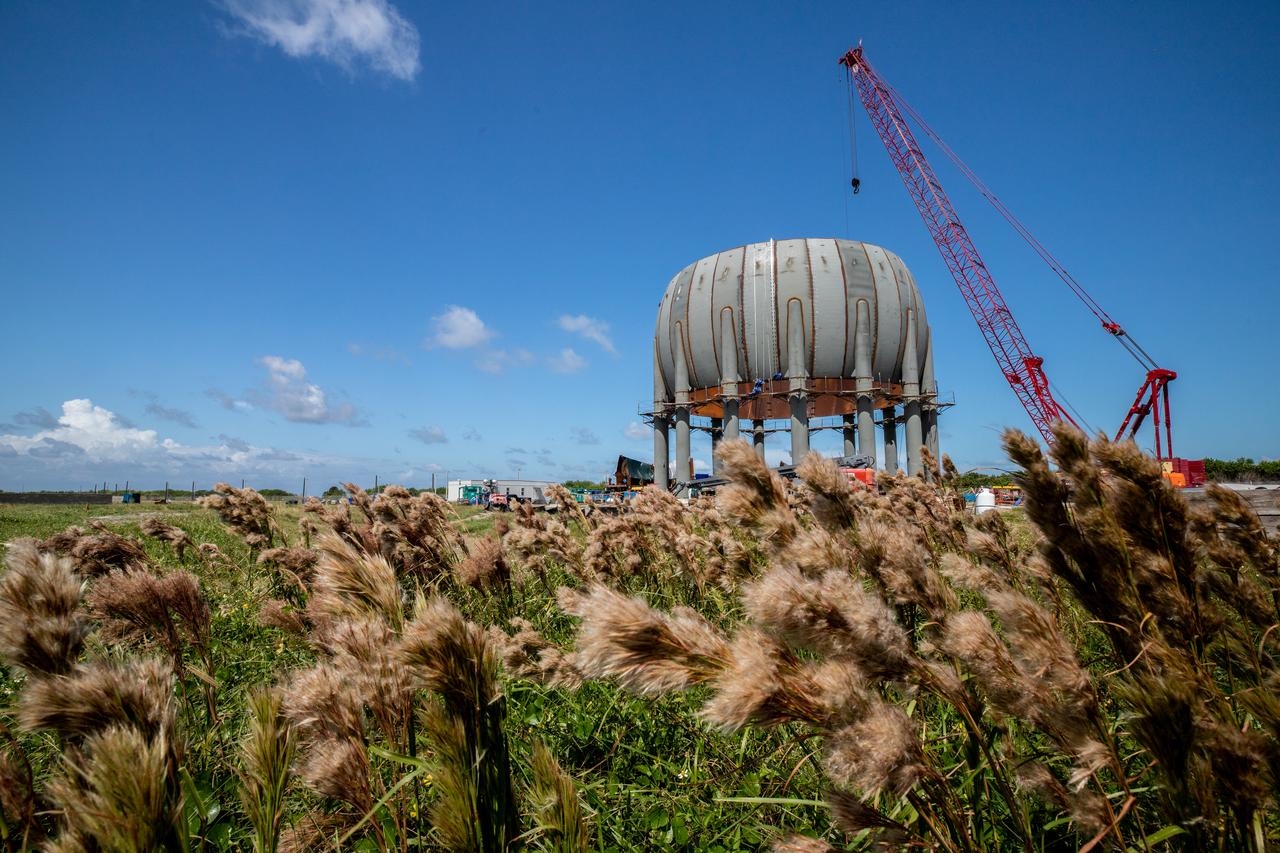
Build-up of a new liquid hydrogen (LH2) storage tank is in progress on Oct. 1, 2019, at Launch Complex 39B at NASA's Kennedy Space Center in Florida. The new tank will hold 1.25 million gallons of usable LH2 to support future launches from the pad, including Artemis missions to the Moon and on to Mars.
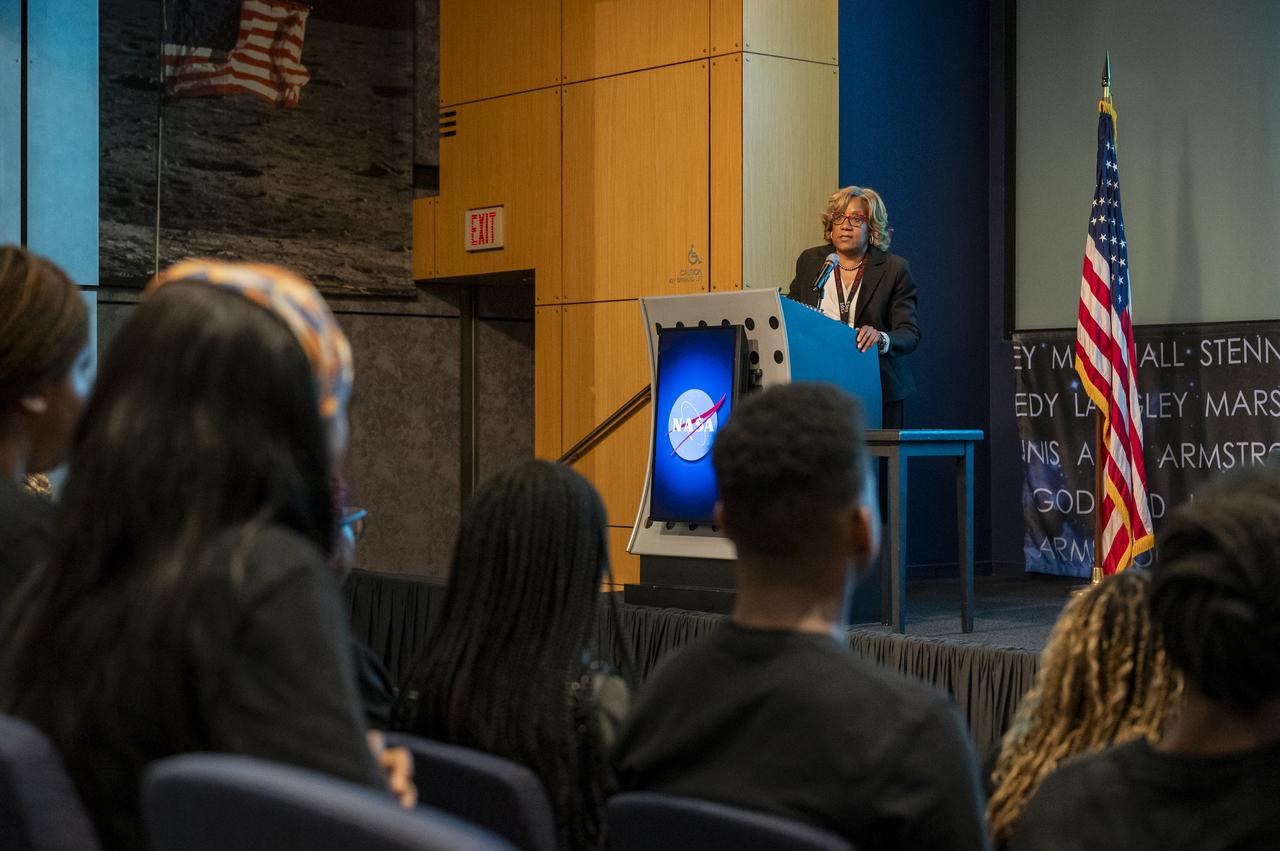
Mission Support and Headquarters Operations Director Nichole Pinkney delivers remarks during a high school student engagement event, Thursday, July 6, 2023, at the Mary W. Jackson NASA Headquarters building in Washington. Photo Credit: (NASA/Keegan Barber)
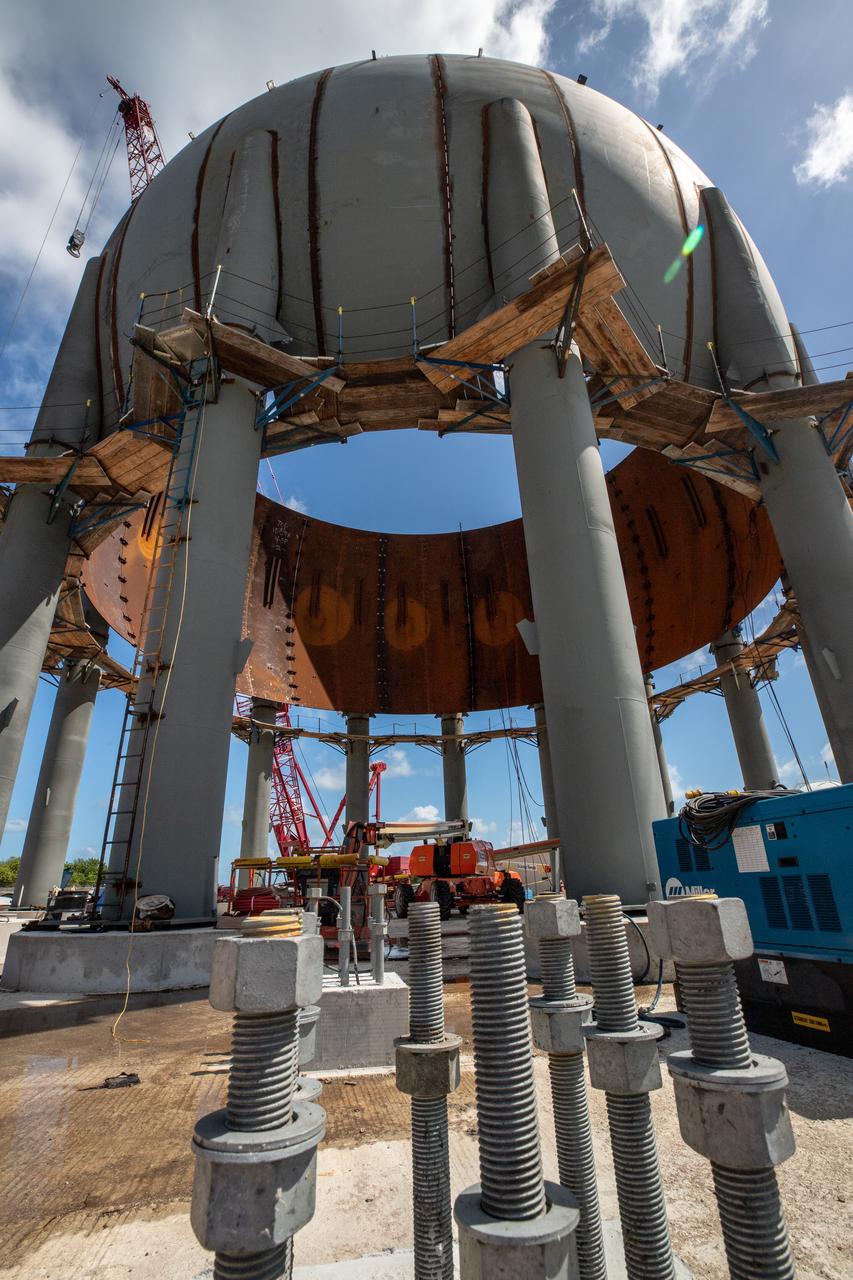
Build-up of a new liquid hydrogen (LH2) storage tank is in progress on Oct. 1, 2019, at Launch Complex 39B at NASA's Kennedy Space Center in Florida. The new tank will hold 1.25 million gallons of usable LH2 to support future launches from the pad, including Artemis missions to the Moon and on to Mars.
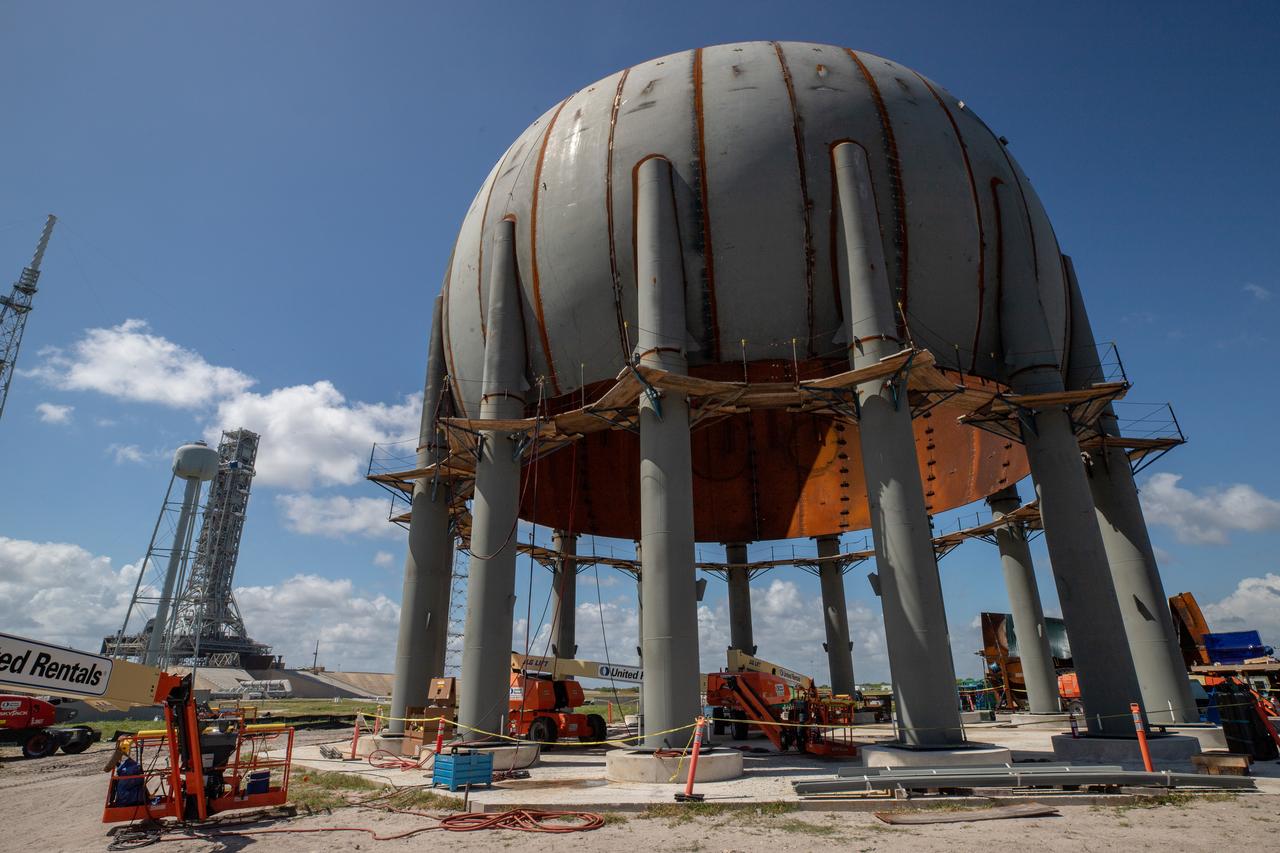
Build-up of a new liquid hydrogen (LH2) storage tank is in progress on Oct. 1, 2019, at Launch Complex 39B at NASA's Kennedy Space Center in Florida. The new tank will hold 1.25 million gallons of usable LH2 to support future launches from the pad, including Artemis missions to the Moon and on to Mars.
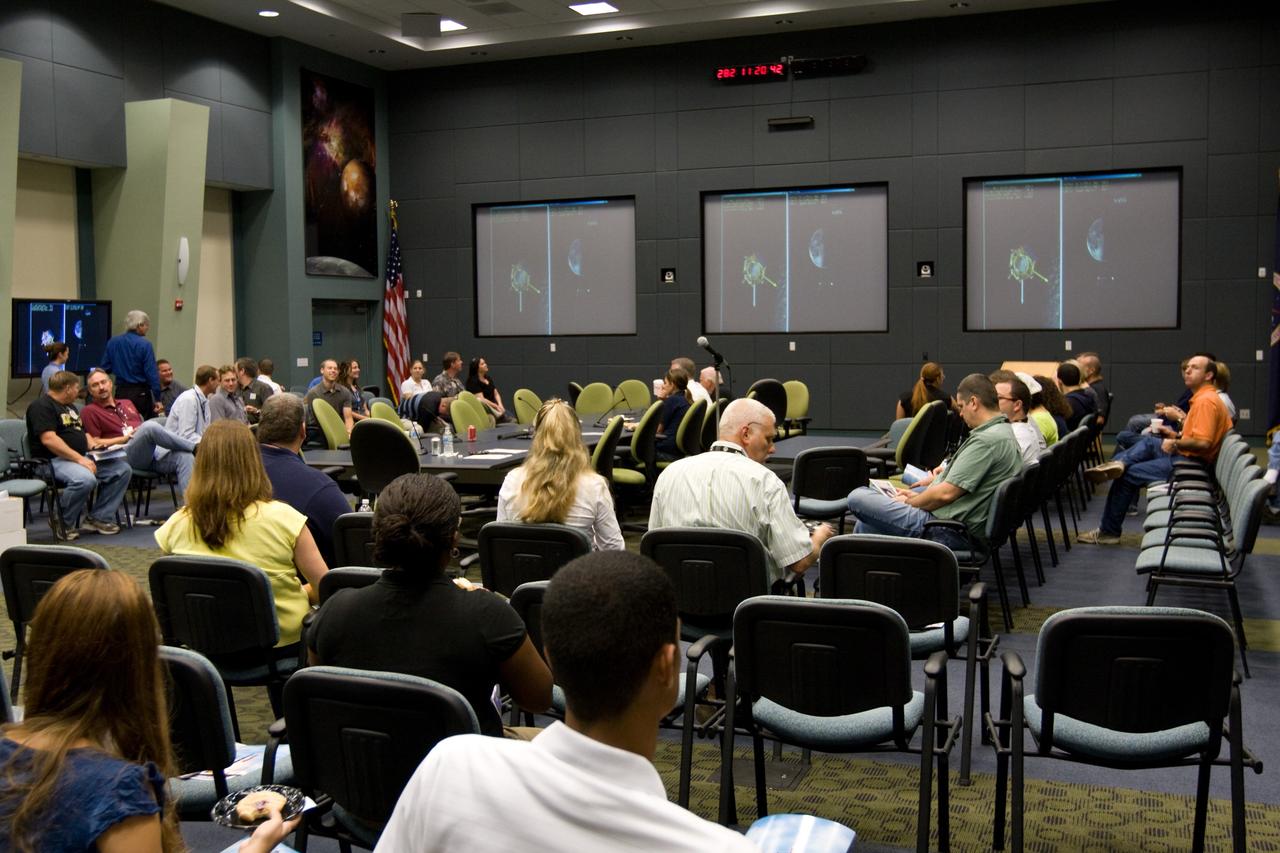
CAPE CANAVERAL, Fla. – Employees at NASA's Kennedy Space Center take advantage of an early morning opportunity to watch the Lunar Crater Observation and Sensing Satellite, or LCROSS, and its spent Centaur upper stage impact the lunar surface live on NASA Television. The employees seen here are in the 5th Floor Conference Room of Operations Support Building II; another group of employees viewed the impact on screens in the Operations and Checkout Building's Mission Briefing Room. The employee event was sponsored by the NASA Exchange, the External Relations Directorate and KSC Launching Leaders. The goal of the LCROSS mission is to search for water ice on the moon, in support of future human lunar exploration. For additional information on the LCROSS mission, visit http://www.nasa.gov/LCROSS. Photo credit: NASA/Dimitri Gerondidakis
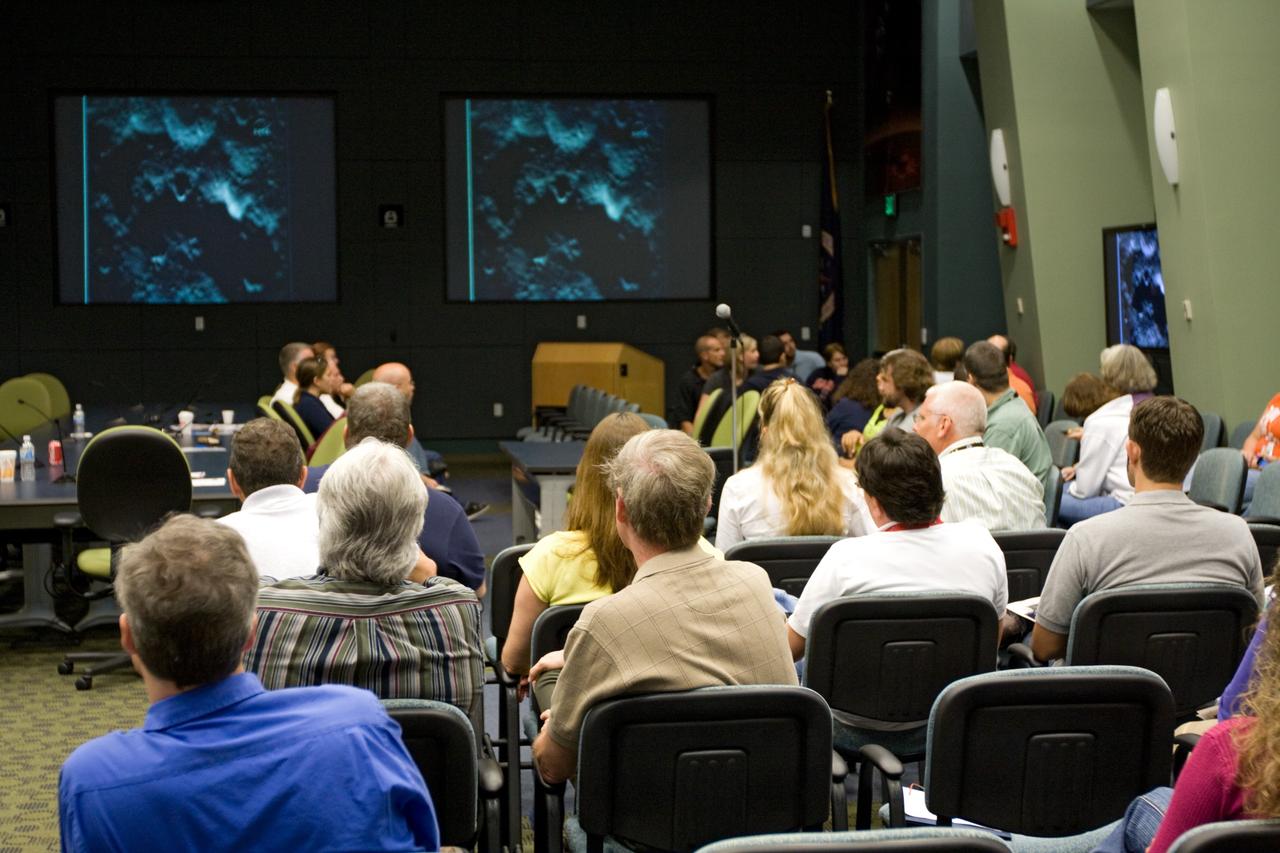
CAPE CANAVERAL, Fla. – Large screens are tuned to NASA Television to allow employees at NASA's Kennedy Space Center a live view of the impact of the Lunar Crater Observation and Sensing Satellite, or LCROSS, and its spent Centaur upper stage on the moon. The employees seen here are in the 5th Floor Conference Room of Operations Support Building II; another group of employees viewed the impact on screens in the Operations and Checkout Building's Mission Briefing Room. The employee event was sponsored by the NASA Exchange, the External Relations Directorate and KSC Launching Leaders. The goal of the LCROSS mission is to search for water ice on the moon, in support of future human lunar exploration. For additional information on the LCROSS mission, visit http://www.nasa.gov/LCROSS. Photo credit: NASA/Dimitri Gerondidakis
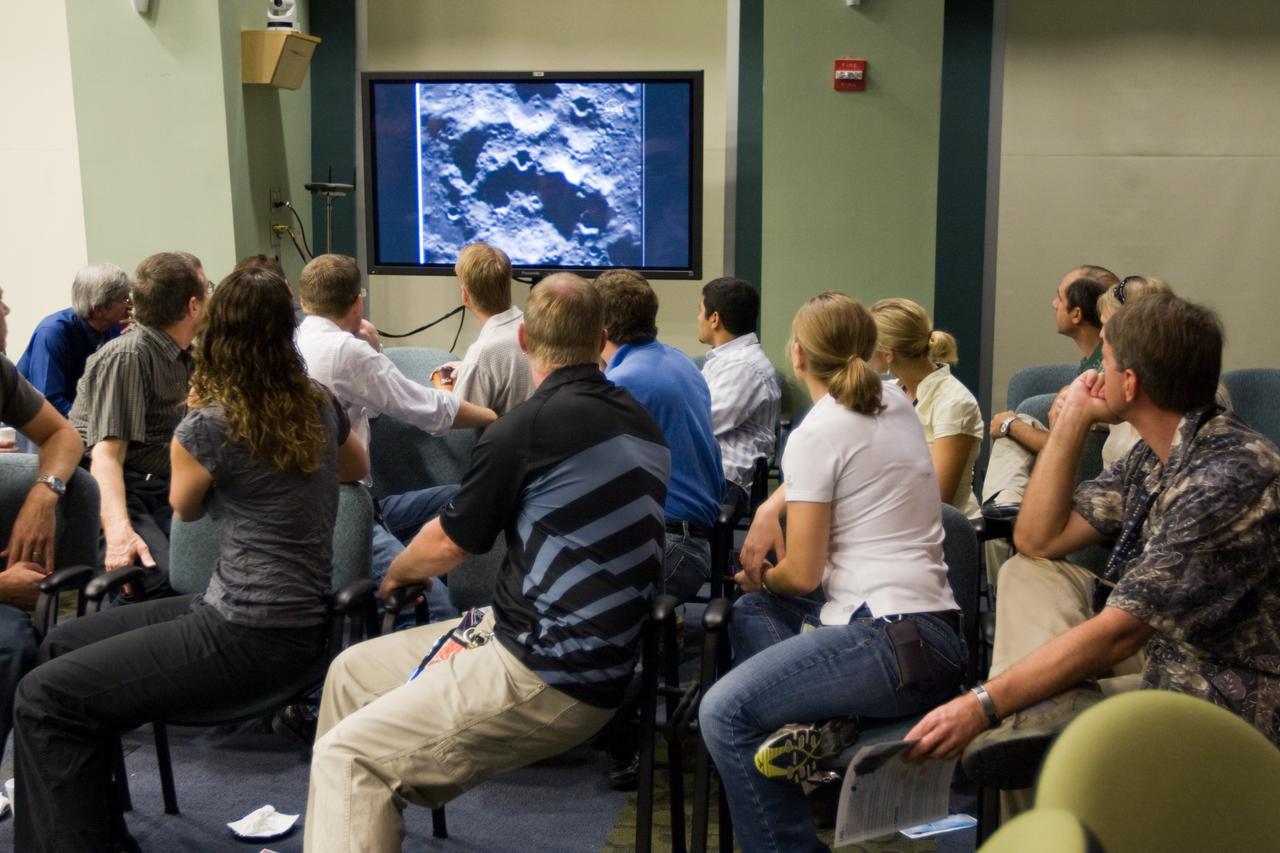
CAPE CANAVERAL, Fla. – Employees at NASA's Kennedy Space Center view live on NASA Television the impact of the Lunar Crater Observation and Sensing Satellite, or LCROSS, and its spent Centaur upper stage on the moon. The employees seen here are in the 5th Floor Conference Room of Operations Support Building II; another group of employees viewed the impact on screens in the Operations and Checkout Building's Mission Briefing Room. The employee event was sponsored by the NASA Exchange, the External Relations Directorate and KSC Launching Leaders. The goal of the LCROSS mission is to search for water ice on the moon, in support of future human lunar exploration. For additional information on the LCROSS mission, visit http://www.nasa.gov/LCROSS. Photo credit: NASA/Dimitri Gerondidakis
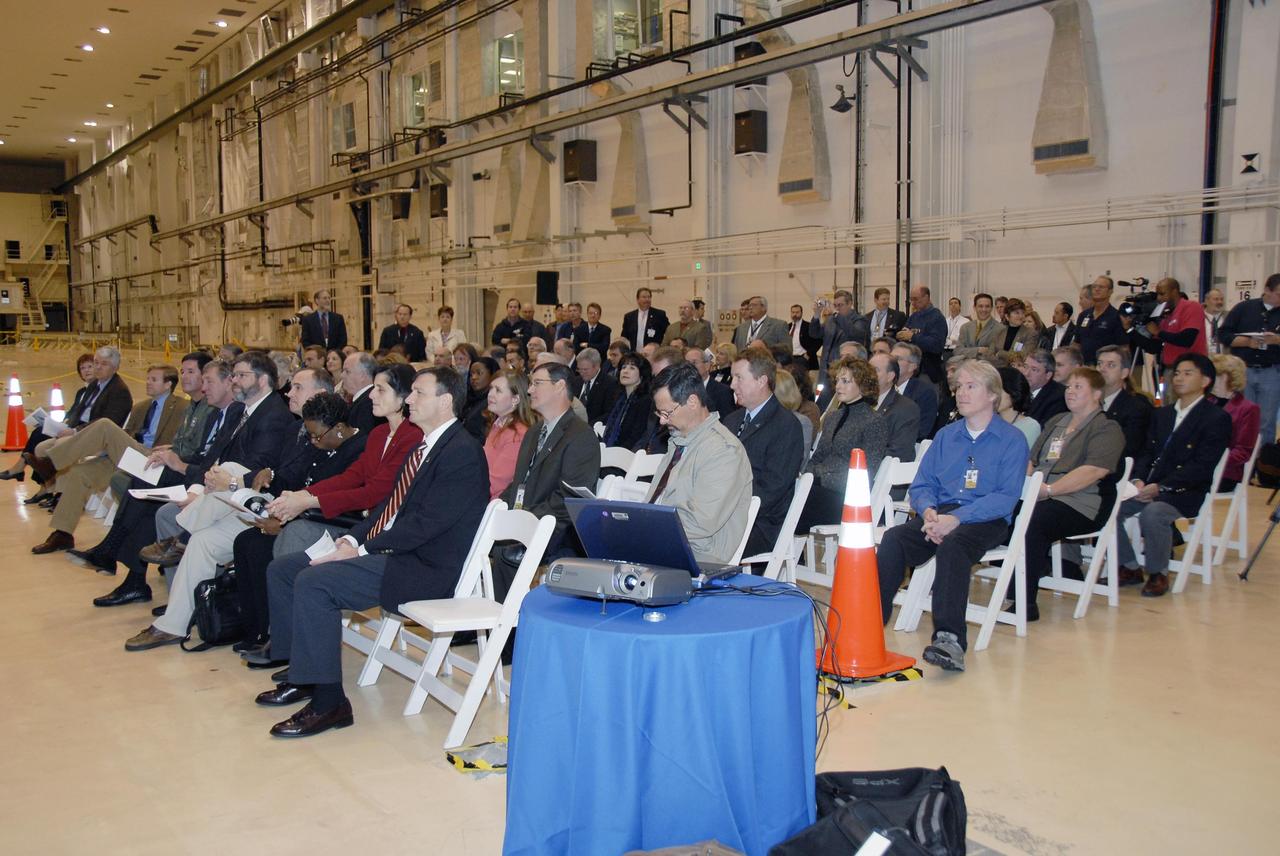
KENNEDY SPACE CENTER, FLA. -- Employees and guests are seated in the Operations and Checkout (O&C) Building high bay for the ceremony commemorating the bay's transition for use by the Constellation Program. Originally built to process space vehicles in the Apollo era, the O&C Building will serve as the final assembly facility for the Orion crew exploration vehicle. Orion, America's human spaceflight vehicle of the future, will be capable of transporting four crewmembers for lunar missions and later will support crew transfers for Mars missions. Each Orion spacecraft also may be used to support up to six crewmembers to the International Space Station after the space shuttle is retired in 2010. Design, development and construction of Orion's components will be performed by Lockheed Martin for NASA at facilities throughout the country. Photo credit: NASA/Kim Shiflett
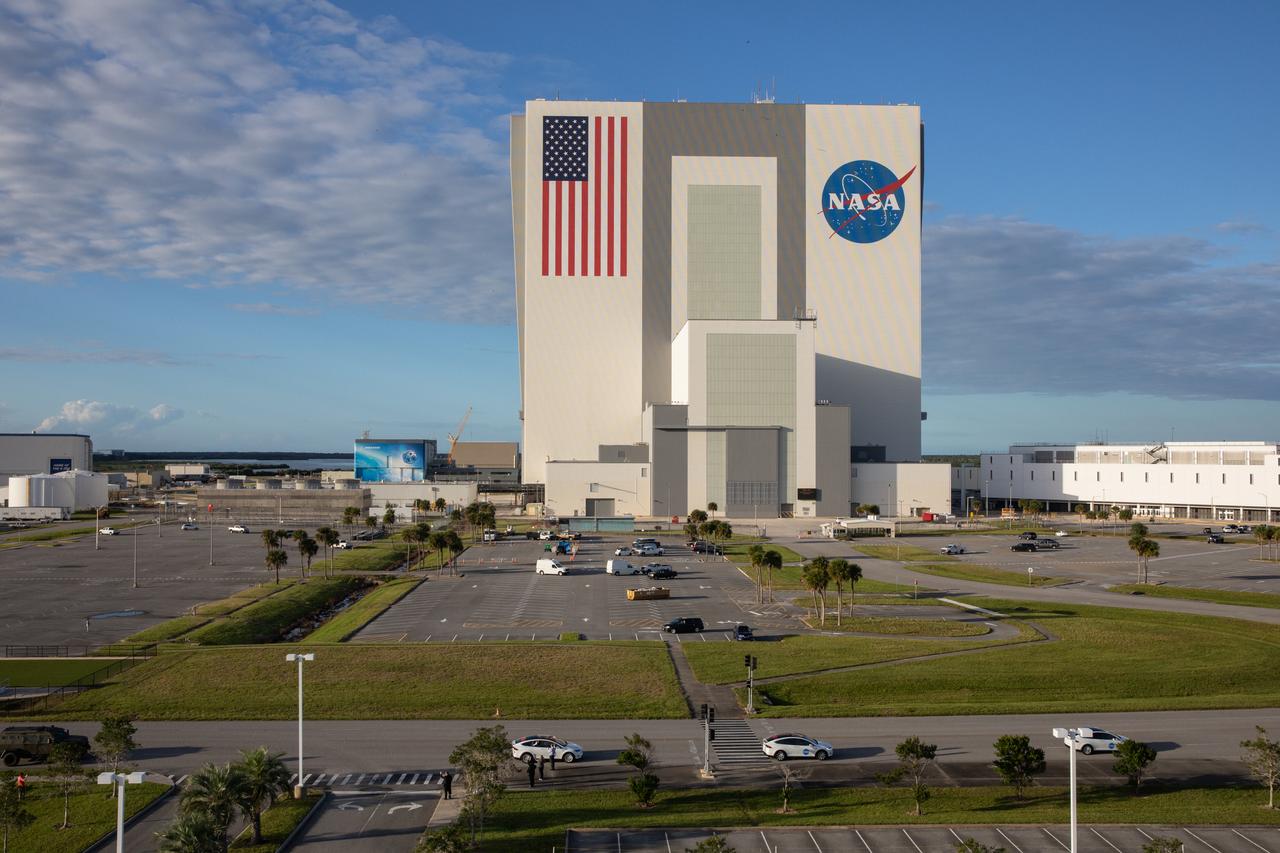
A view of the iconic Vehicle Assembly Building from the observation deck of the Operations Support Building II at NASA’s Kennedy Space Center in Florida on Nov. 15, 2020. A SpaceX Falcon 9 rocket with the Crew Dragon Resilience atop is on Launch Pad 39A for the Crew-1 mission to the International Space Station. Crew-1 is the first regular crew mission of a U.S. commercial spacecraft with astronauts to the space station as part of NASA’s Commercial Crew Program. The Crew Dragon will carry NASA astronauts Michael Hopkins, Victor Glover, Shannon Walker and Japan Aerospace Exploration Agency (JAXA) astronaut Soichi Noguchi to the space station for a six-month science mission.
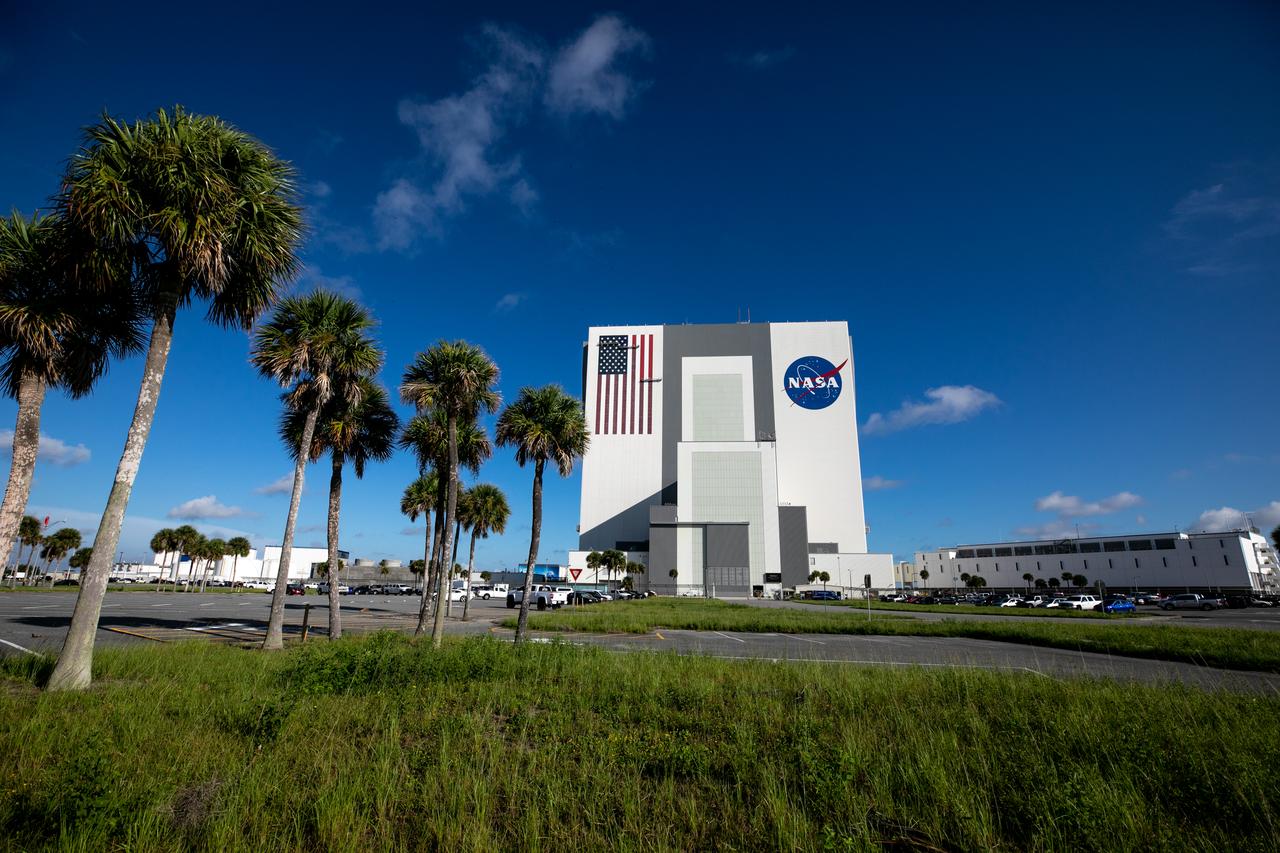
A view of the 525-foot-tall Vehicle Assembly Building (VAB) at NASA’s Kennedy Space Center in Florida, as painting of the U.S. flag continues on the iconic building on Sept. 17, 2020. HM2 and H.I.S. Painting of Titusville, Florida, are repainting the American Flag on the building. The flag is 209 feet long by 110 feet wide. Each star is more than six feet in diameter, and each stripe is nine feet wide. Exploration Ground Systems is overseeing upgrades to the VAB to support the launch of the Space Launch System and Orion for Artemis missions. Under the Artemis program, NASA will send the first woman and next man to the Moon.
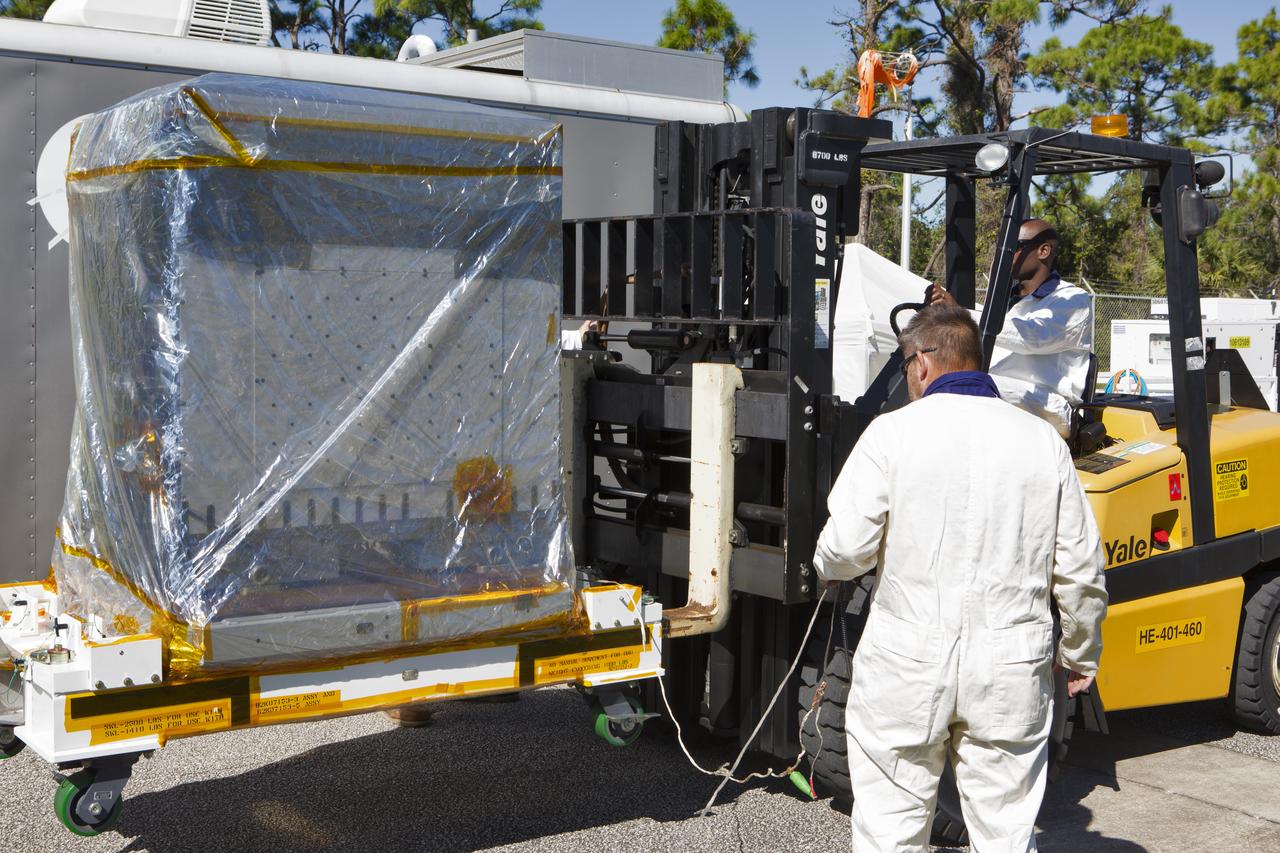
Workers prepare the Robotic Refueling Mission-3 (RRM3) payload for transport from the Fuel Transfer Building to the SpaceX facility on Oct. 30, 2018, at NASA's Kennedy Space Center in Florida. The payload will be carried to the International Space Station on SpaceX's 16th Commercial Resupply Services mission. RRM3 demonstrates the transfer of xenon gas and liquid methane in microgravity, and advances technologies for storing and manipulating these cryogenic fuels robotically. RRM3 also supports development of technology for the Restore-L mission, a robotic spacecraft equipped to service satellites in-orbit.
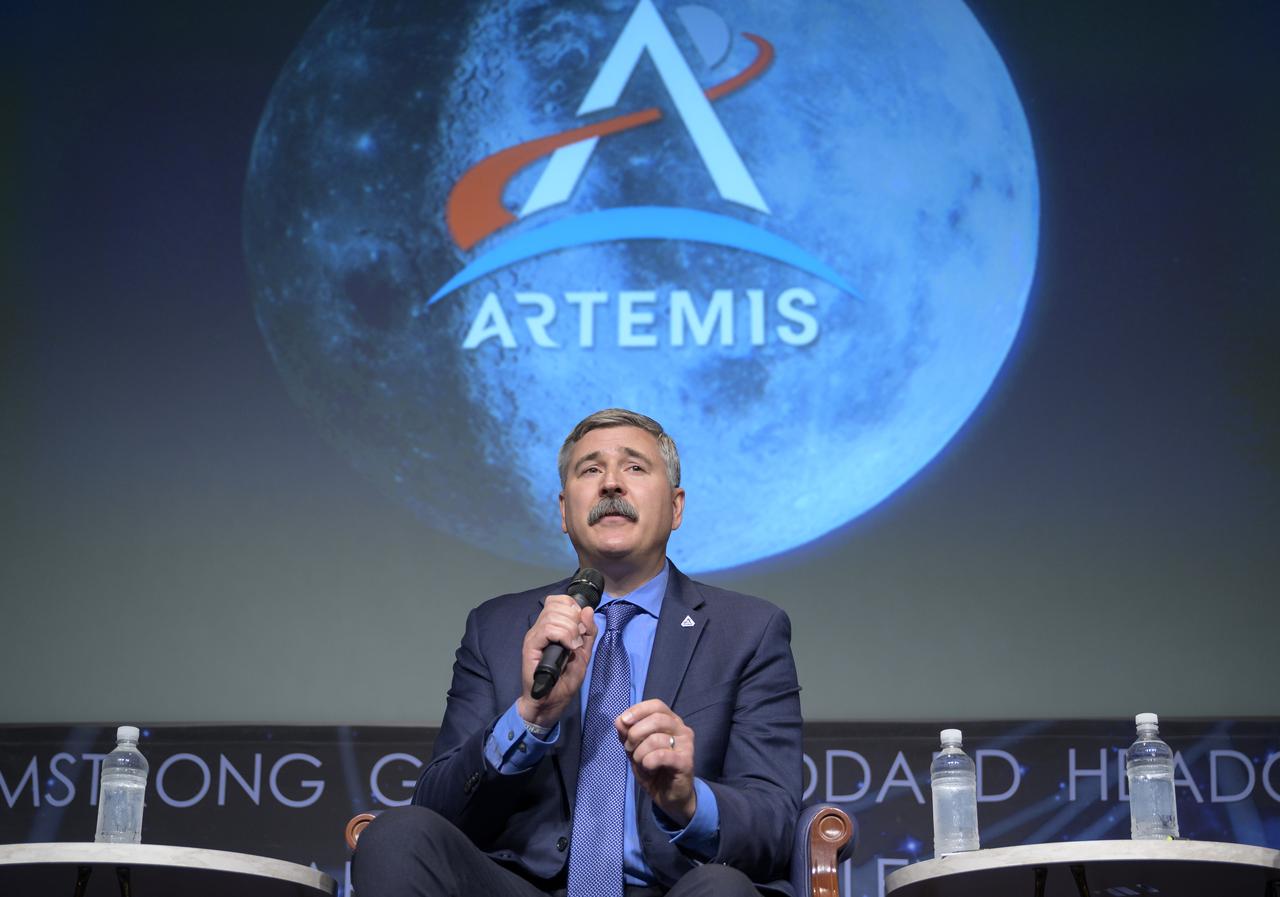
Mike Sarafin, Artemis I mission manager at NASA Headquarters speaks during a NASA briefing on the Artemis I Moon mission, Wednesday, Aug. 3, 2022, at the Mary W. Jackson NASA Headquarters building in Washington. NASA’s Artemis I mission is the first integrated test of the agency’s deep space exploration systems: the Orion spacecraft, Space Launch System rocket, and supporting ground systems. Launch of the uncrewed flight test is targeted for no earlier than Monday, Aug. 29. Photo Credit: (NASA/Bill Ingalls)

Mike Sarafin, Artemis I mission manager at NASA Headquarters speaks during a NASA briefing on the Artemis I Moon mission, Wednesday, Aug. 3, 2022, at the Mary W. Jackson NASA Headquarters building in Washington. NASA’s Artemis I mission is the first integrated test of the agency’s deep space exploration systems: the Orion spacecraft, Space Launch System rocket, and supporting ground systems. Launch of the uncrewed flight test is targeted for no earlier than Monday, Aug. 29. Photo Credit: (NASA/Bill Ingalls)
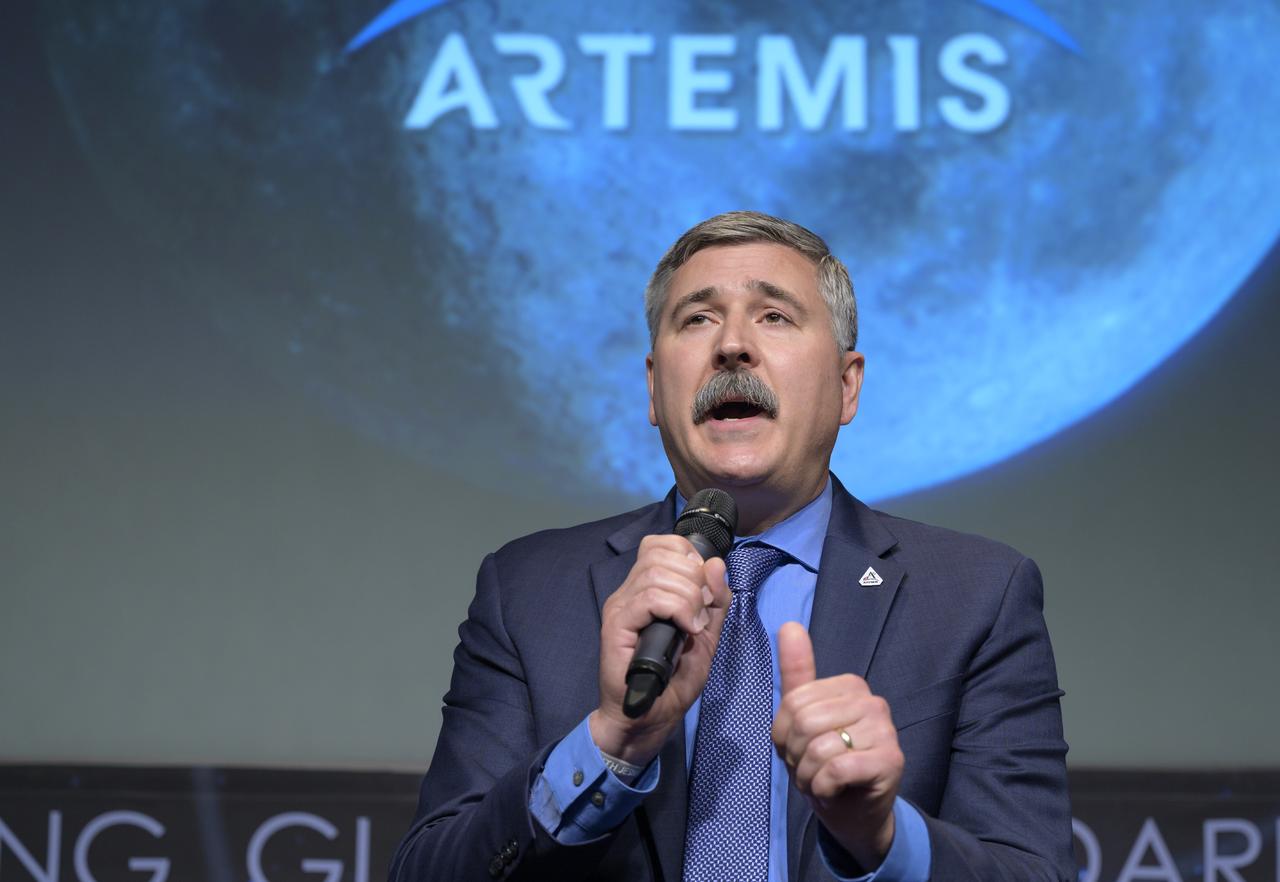
Mike Sarafin, Artemis I mission manager at NASA Headquarters speaks during a NASA briefing on the Artemis I Moon mission, Wednesday, Aug. 3, 2022, at the Mary W. Jackson NASA Headquarters building in Washington. NASA’s Artemis I mission is the first integrated test of the agency’s deep space exploration systems: the Orion spacecraft, Space Launch System rocket, and supporting ground systems. Launch of the uncrewed flight test is targeted for no earlier than Monday, Aug. 29. Photo Credit: (NASA/Bill Ingalls)
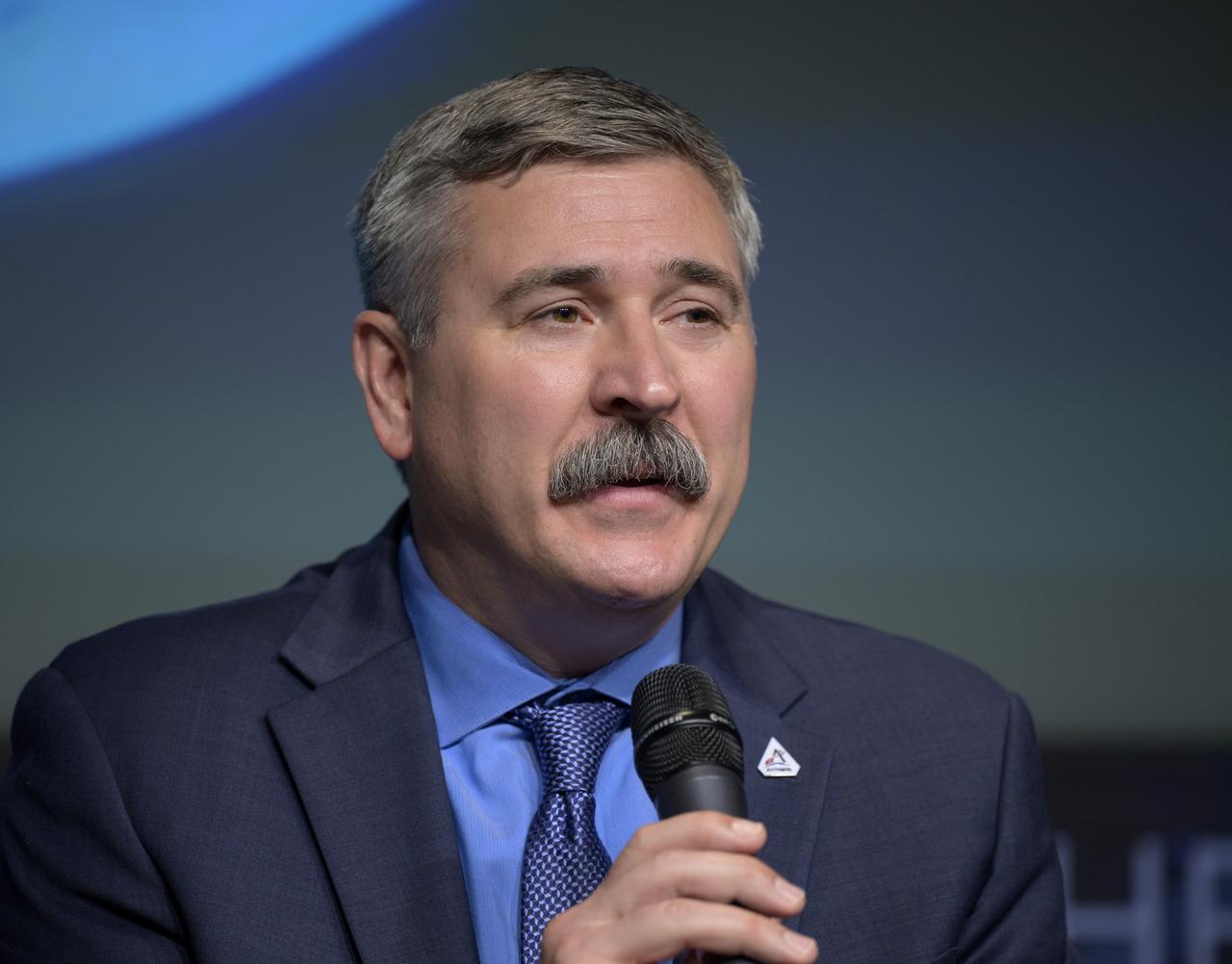
Mike Sarafin, Artemis I mission manager at NASA Headquarters speaks during a NASA briefing on the Artemis I Moon mission, Wednesday, Aug. 3, 2022, at the Mary W. Jackson NASA Headquarters building in Washington. NASA’s Artemis I mission is the first integrated test of the agency’s deep space exploration systems: the Orion spacecraft, Space Launch System rocket, and supporting ground systems. Launch of the uncrewed flight test is targeted for no earlier than Monday, Aug. 29. Photo Credit: (NASA/Bill Ingalls)
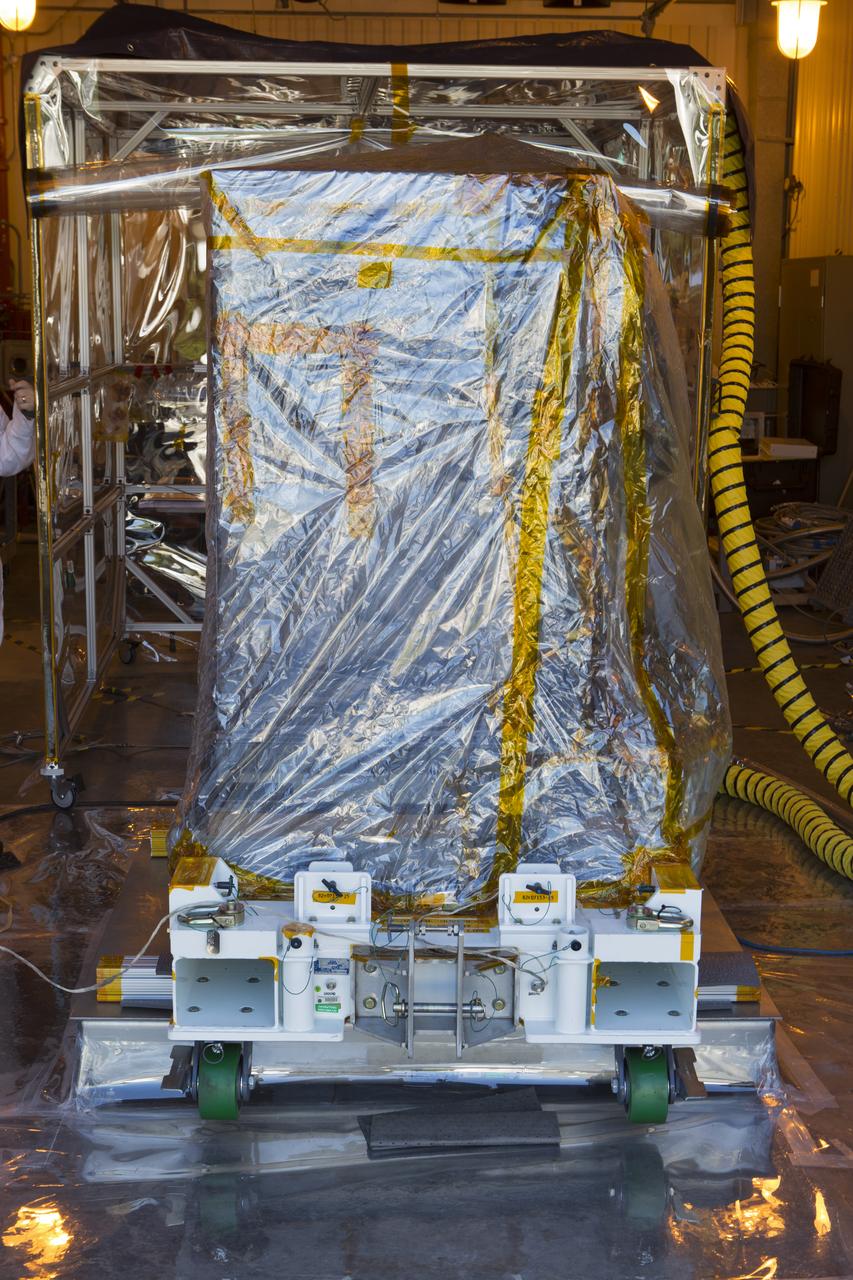
The Robotic Refueling Mission-3 (RRM3) payload is being prepared to be moved from the Fuel Transfer Building to the SpaceX facility on Oct. 30, 2018, at NASA's Kennedy Space Center in Florida. The payload will be carried to the International Space Station on SpaceX's 16th Commercial Resupply Services mission. RRM3 demonstrates the transfer of xenon gas and liquid methane in microgravity, and advances technologies for storing and manipulating these cryogenic fuels robotically. RRM3 also supports development of technology for the Restore-L mission, a robotic spacecraft equipped to service satellites in-orbit.
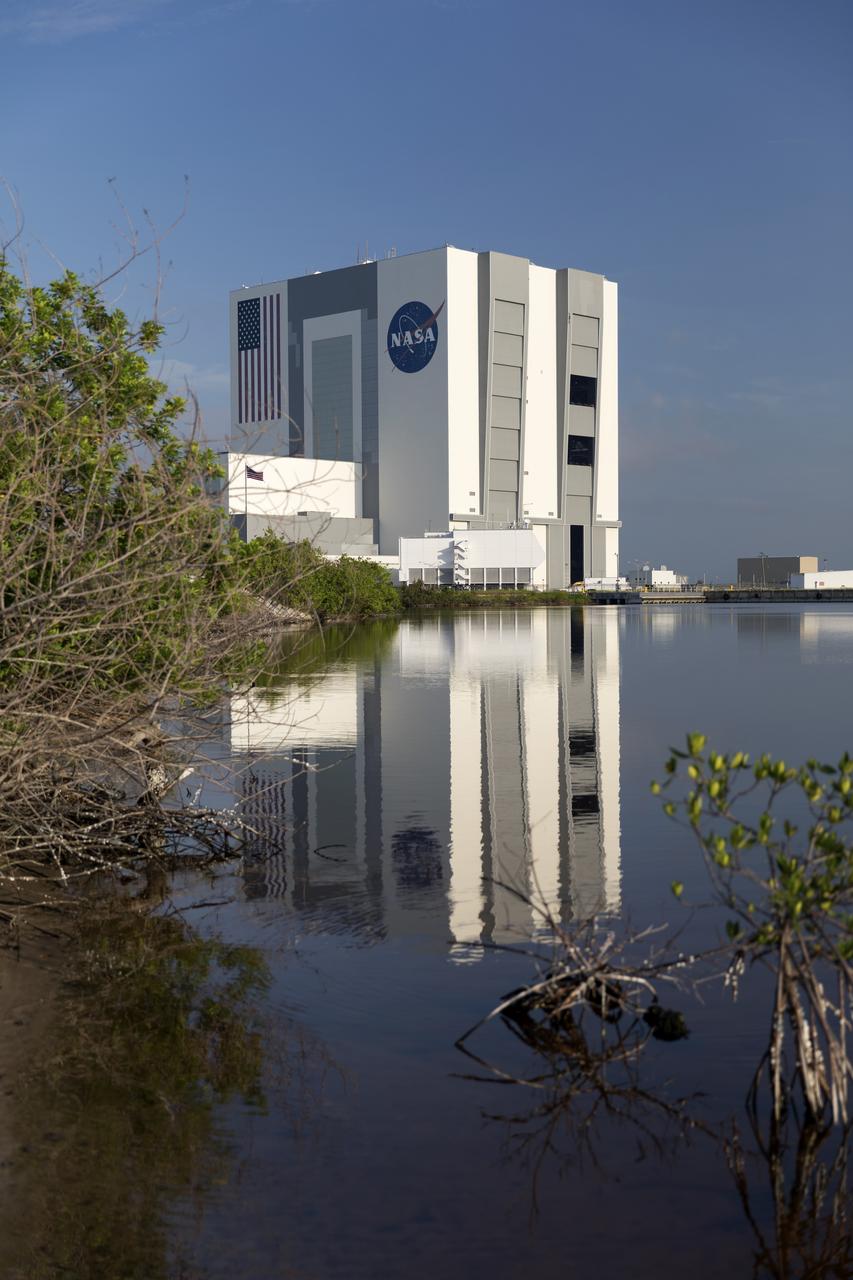
A brilliant blue sky forms the backdrop for a view of the south and east sides of the iconic Vehicle Assembly Building (VAB) at NASA's Kennedy Space Center in Florida. Exploration Ground Systems oversaw the upgrades. The building casts a reflection in a surrounding waterway. Ten levels of new work platforms have been installed in VAB High Bay 3. They will surround and provide access for service and processing of NASA's Space Launch System (SLS) rocket and Orion spacecraft. Exploration Ground Systems oversaw the upgrades and installation of the new work platforms to support the launch of the SLS and Orion on Exploration Mission-1 and deep space missions.
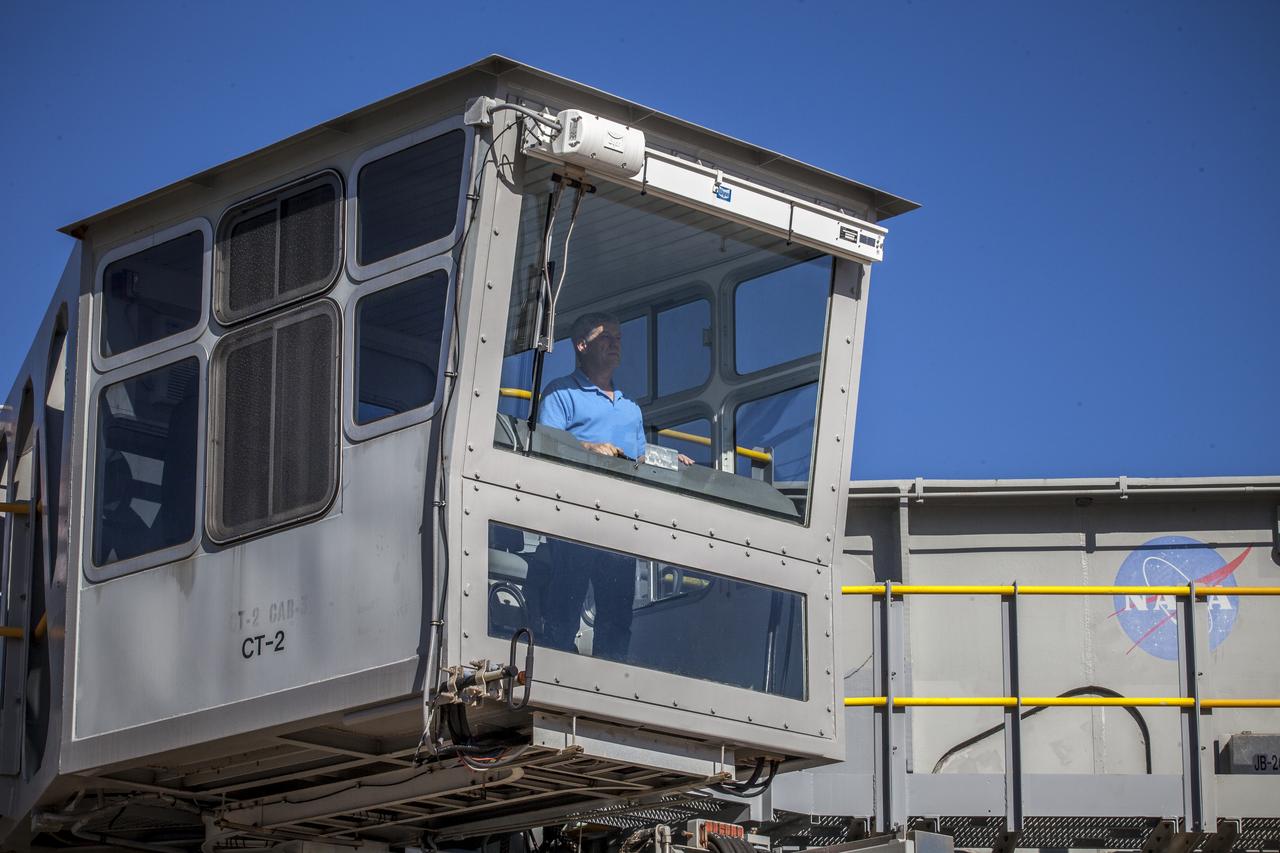
Sam Dove, a crawler-transporter engineer with Jacobs on the Test and Operations Support Contract, is inside the operator cab of crawler-transporter 2 on the crawlerway at NASA's Kennedy Space Center in Florida, on Aug. 27, 2018. CT-2 will carry the mobile launcher for the first time to Launch Pad 39B for a fit check of key systems that will support the launch of the agency's Space Launch System rocket and Orion spacecraft on Exploration Mission-1. The crawler also will carry the mobile launcher to the Vehicle Assembly Building for system checks and fit checks with the 10 levels of new platforms in High Bay 3.
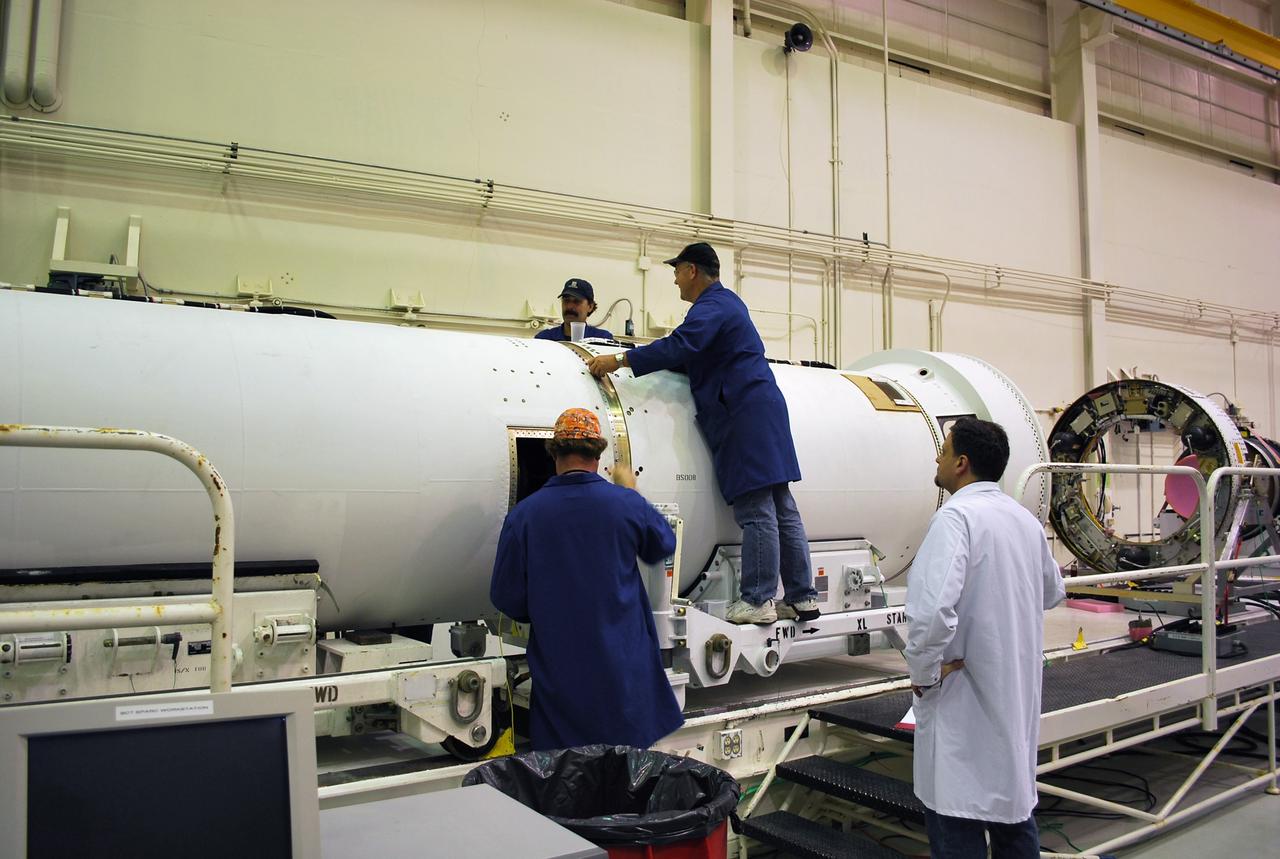
CAPE CANAVERAL, Fla. -- In Building 1555 at Vandenberg Air Force Base in California, workers do a fit check on the mating of the Stage 1 to Stage 2 motors for the Taurus XL rocket that will launch NASA's Orbiting Carbon Observatory, or OCO, spacecraft. At right can be seen the avionics shelf. The avionics skirt, a graphite/epoxy structure, supports the avionics shelf and carries the primary structural loads from the fairing and payload cone. The aluminum avionics shelf supports the third stage avionics. The OCO is a new Earth-orbiting mission sponsored by NASA's Earth System Science Pathfinder Program. The launch of OCO is targeted for January. Photo credit: NASA/Randy Beaudoin, VAFB
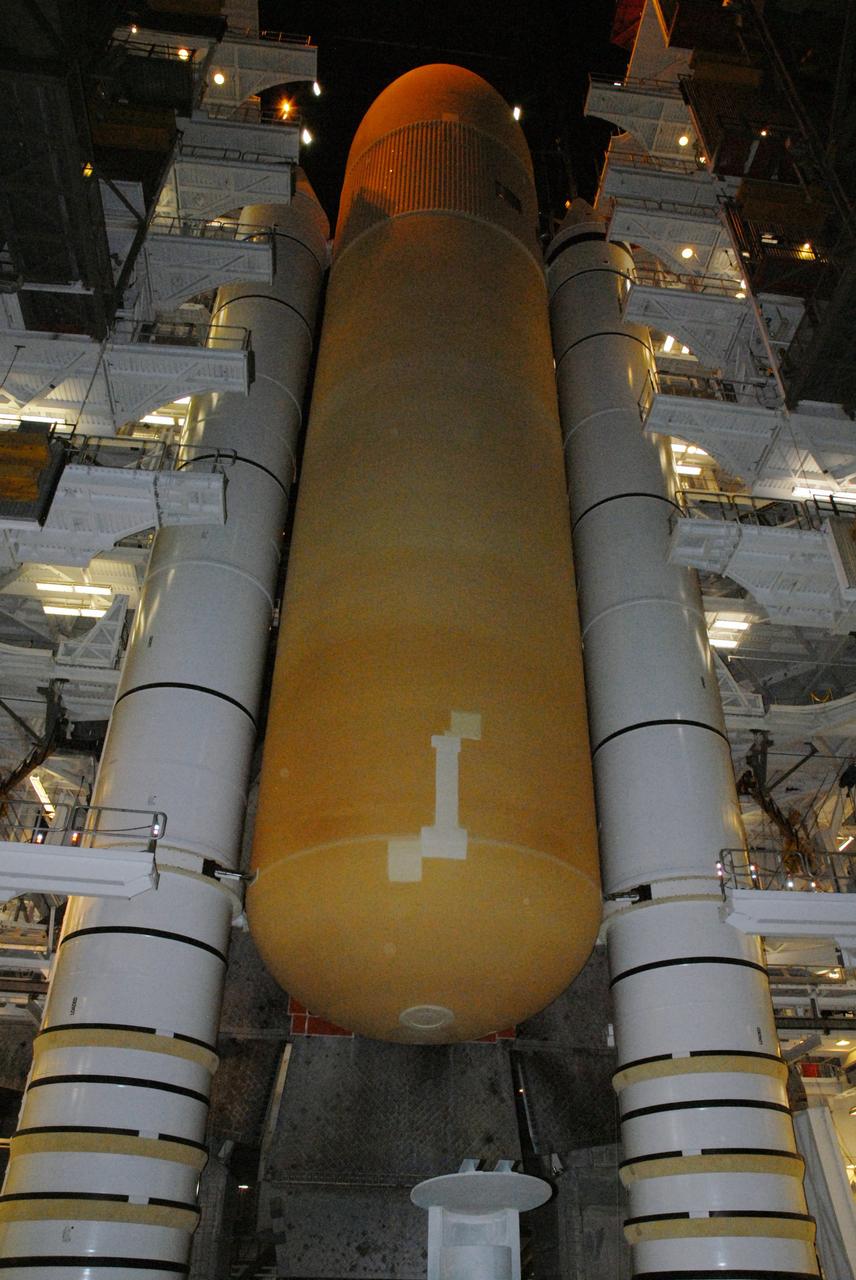
CAPE CANAVERAL, Fla. – In High Bay 1 of the Vehicle Assembly Building at NASA's Kennedy Space Center in Florida, the solid rocket boosters flank the external fuel tank that will be attached to space shuttle Discovery. The SRBs and external tank are already stacked on the mobile launcher platform. Discovery is scheduled to roll out to Launch Pad 39A the first week of August to prepare for the STS-128 mission to the International Space Station. The shuttle will carry the Leonardo Multi-Purpose Logistics Module containing life support racks and science racks and the Lightweight Multi-Purpose Experiment Support Structure Carrier in its payload bay. Launch of Discovery is targeted for late August. Photo credit: NASA/Ben Smegelsky
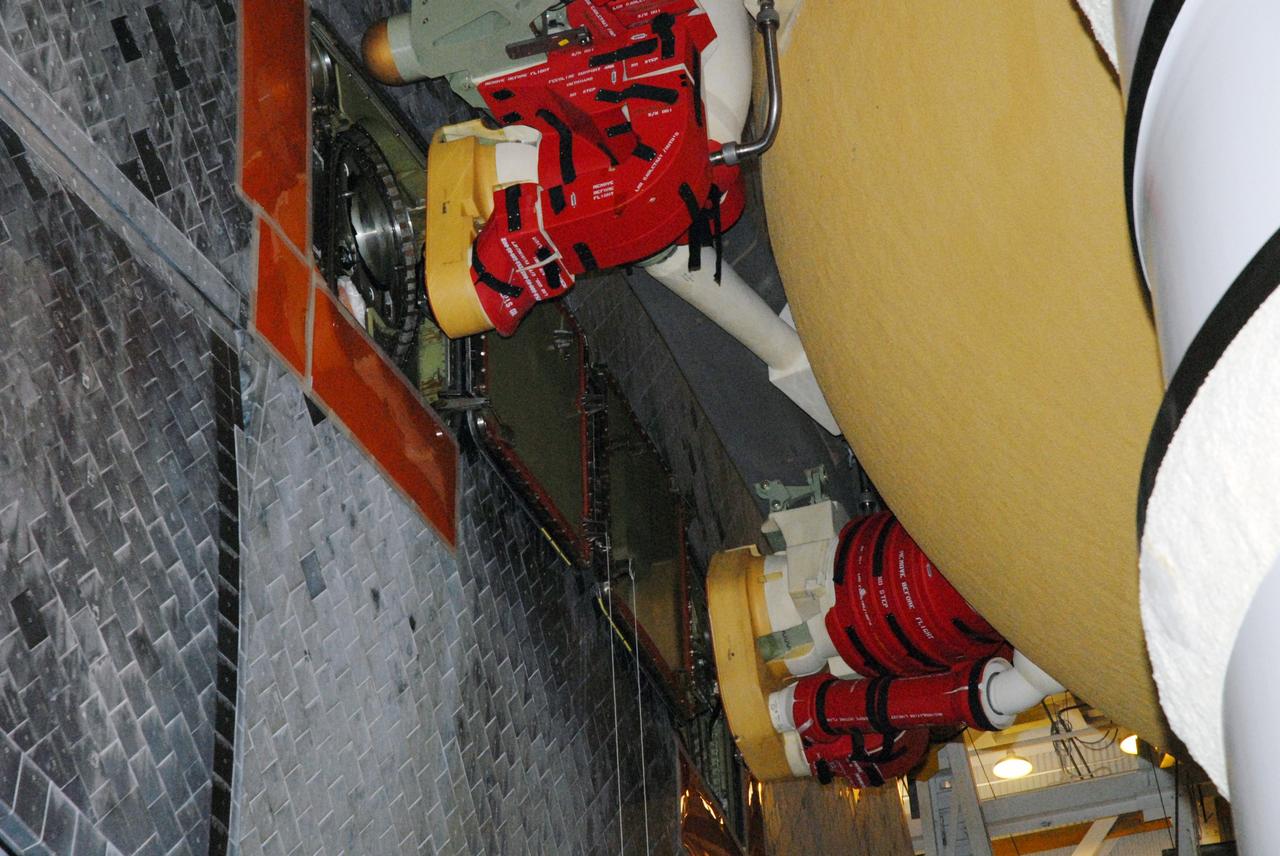
CAPE CANAVERAL, Fla. – In High Bay 1 of the Vehicle Assembly Building at NASA's Kennedy Space Center in Florida, the external fuel tank is in position to be attached to space shuttle Discovery on the mobile launcher platform. Discovery is scheduled to roll out to Launch Pad 39A the first week of August to prepare for the STS-128 mission to the International Space Station. The shuttle will carry the Leonardo Multi-Purpose Logistics Module containing life support racks and science racks and the Lightweight Multi-Purpose Experiment Support Structure Carrier in its payload bay. Launch of Discovery is targeted for late August. Photo credit: NASA/Ben Smegelsky
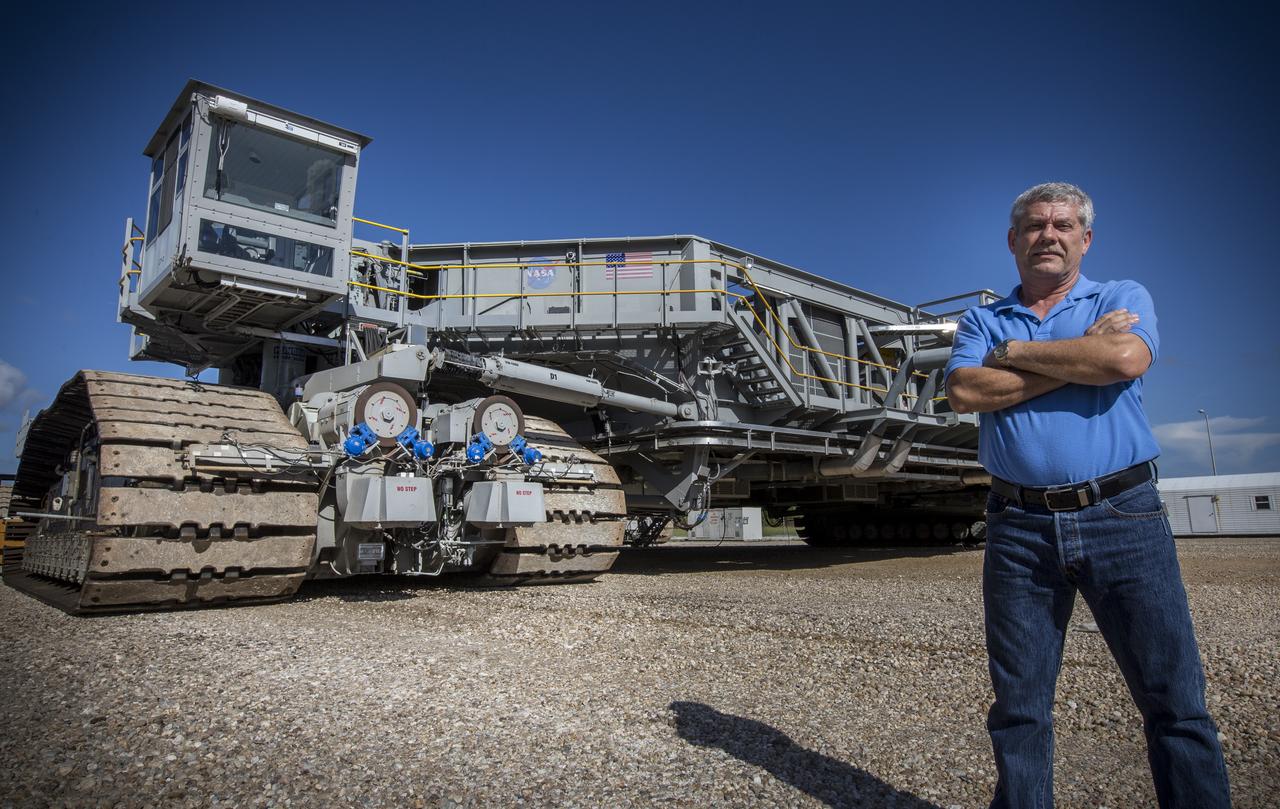
Sam Dove, a crawler-transporter engineer with Jacobs on the Test and Operations Support Contract, stands in front of crawler-transporter 2 on the crawlerway at NASA's Kennedy Space Center in Florida, on Aug. 27, 2018. CT-2 will carry the mobile launcher for the first time to Launch Pad 39B for a fit check of key systems that will support the launch of the agency's Space Launch System rocket and Orion spacecraft on Exploration Mission-1. The crawler also will carry the mobile launcher to the Vehicle Assembly Building for system checks and fit checks with the 10 levels of new platforms in High Bay 3.
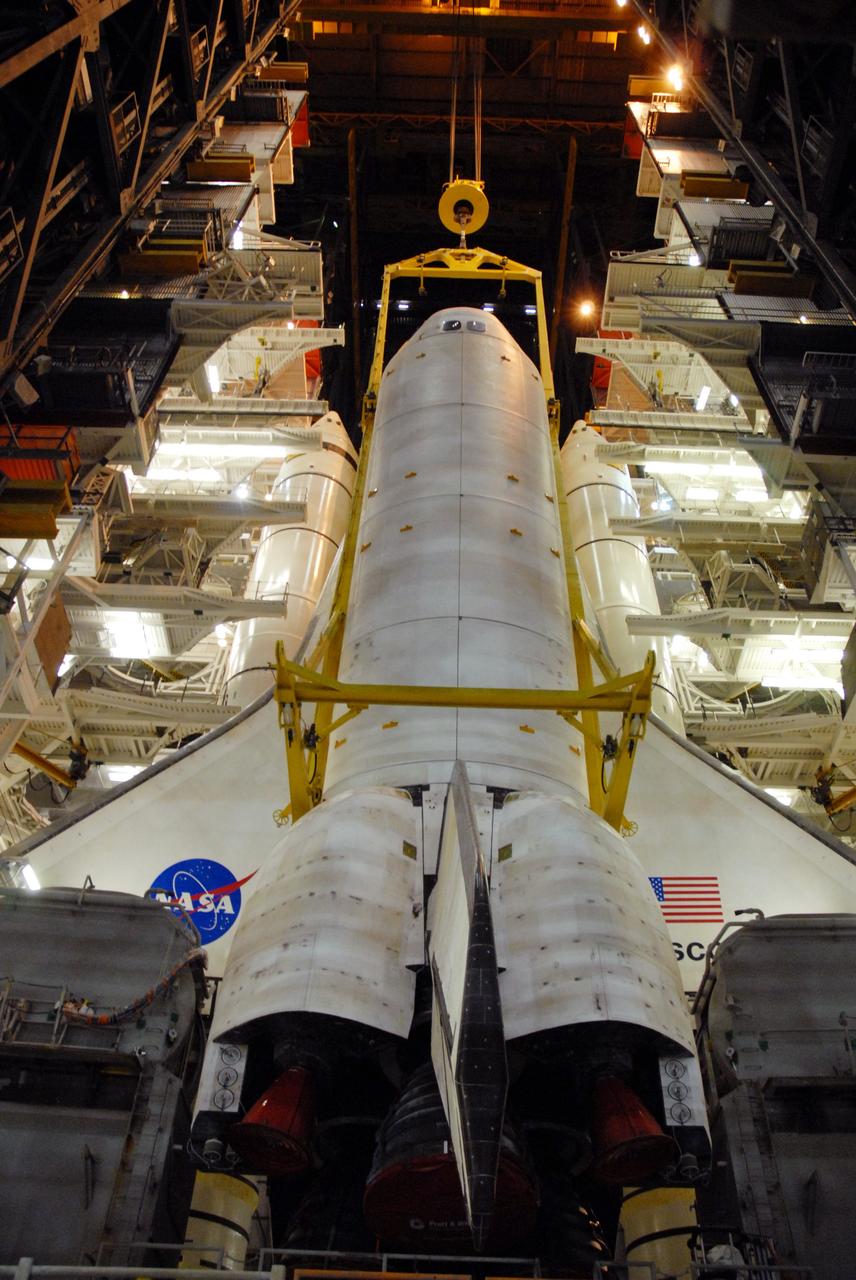
CAPE CANAVERAL, Fla. – In High Bay 1 of the Vehicle Assembly Building at NASA's Kennedy Space Center in Florida, Discovery is lowered onto the mobile launcher platform where it will be attached to the external fuel tank. Discovery is scheduled to roll out to Launch Pad 39A the first week of August to prepare for the STS-128 mission to the International Space Station. The shuttle will carry the Leonardo Multi-Purpose Logistics Module containing life support racks and science racks and the Lightweight Multi-Purpose Experiment Support Structure Carrier in its payload bay. Launch of Discovery is targeted for late August. Photo credit: NASA/Ben Smegelsky
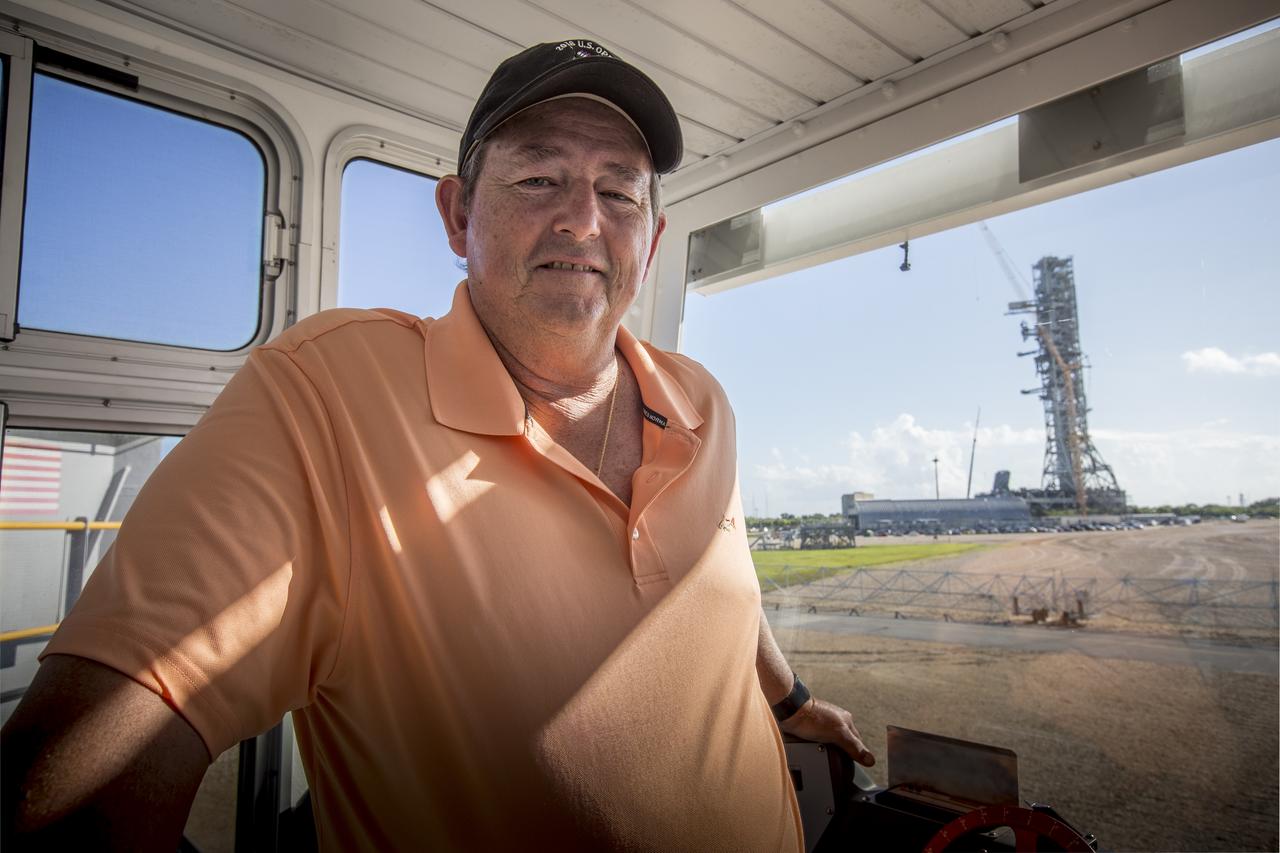
Bob Myers, a mechanical systems engineer with ERC on the Test and Operations Support Contract, is inside the operator cab of crawler-transporter 2 on the crawlerway at NASA's Kennedy Space Center in Florida, on Aug. 27, 2018. CT-2 will carry the mobile launcher for the first time to Launch Pad 39B for a fit check of key systems that will support the launch of the agency's Space Launch System rocket and Orion spacecraft on Exploration Mission-1. The crawler also will carry the mobile launcher to the Vehicle Assembly Building for system checks and fit checks with the 10 levels of new work platforms in High Bay 3.
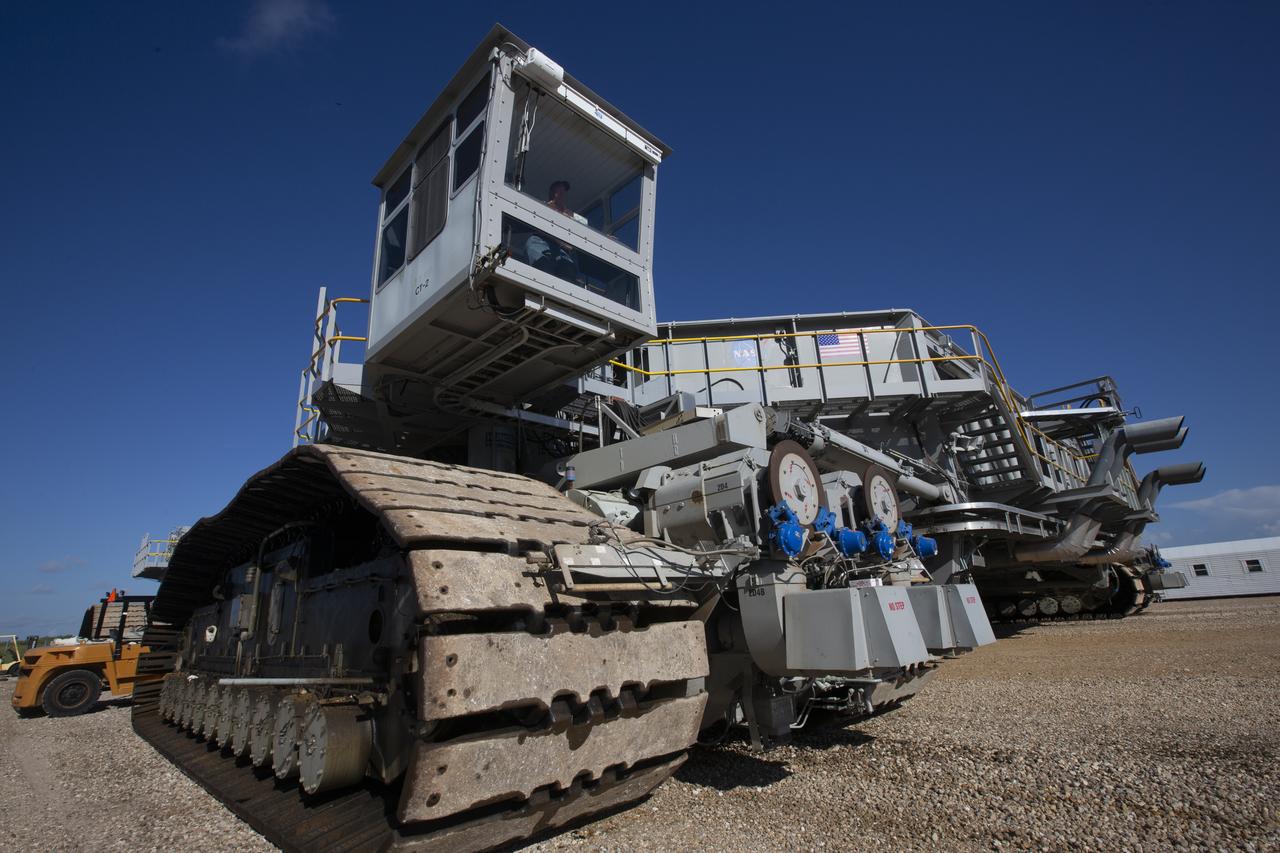
Sam Dove, a crawler-transporter engineer with Jacobs on the Test and Operations Support Contract, is inside the operator cab of crawler-transporter 2 on the crawlerway at NASA's Kennedy Space Center in Florida, on Aug. 27, 2018. CT-2 will carry the mobile launcher for the first time to Launch Pad 39B for a fit check of key systems that will support the launch of the agency's Space Launch System rocket and Orion spacecraft on Exploration Mission-1. The crawler also will carry the mobile launcher to the Vehicle Assembly Building for system checks and fit checks with the 10 levels of new work platforms in High Bay 3.
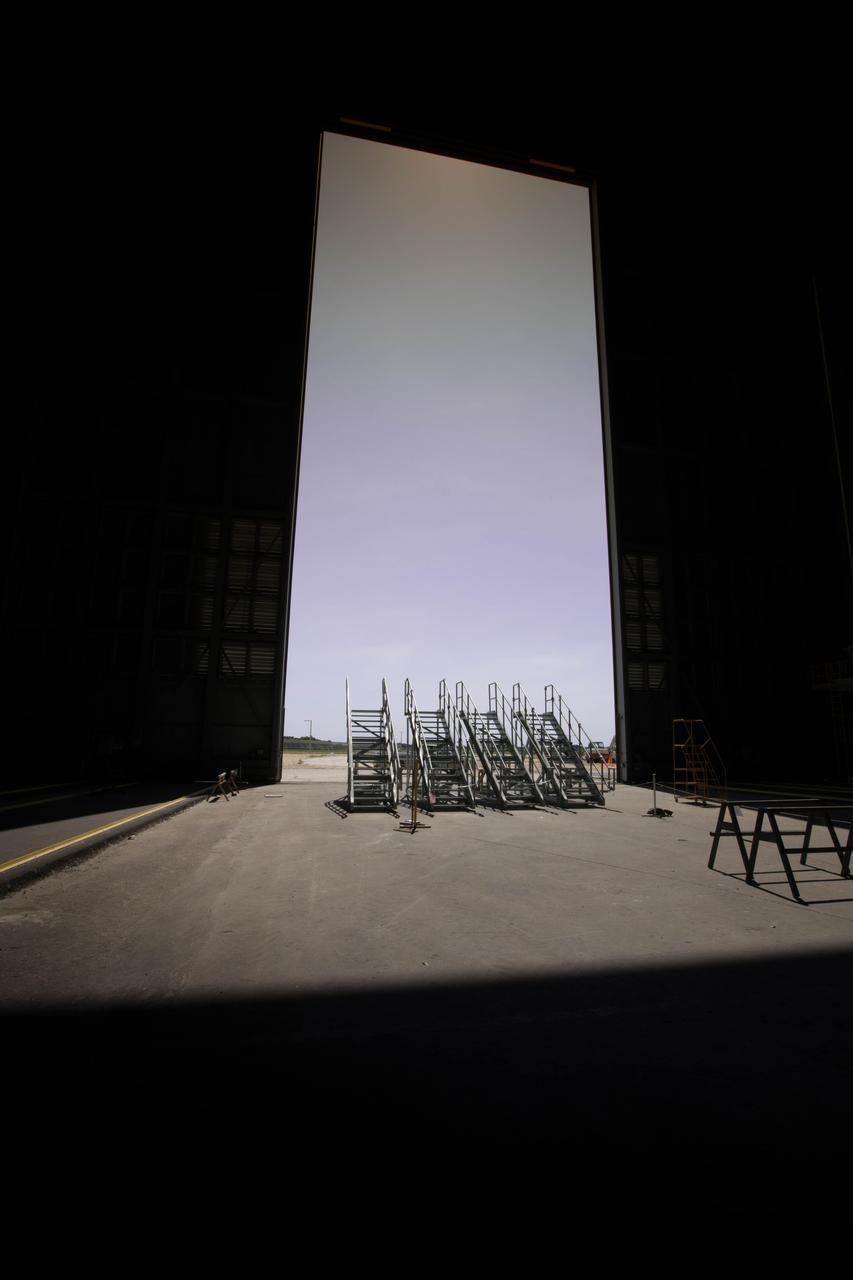
A view looking at High Bay 3 in the Vehicle Assembly Building (VAB) at NASA's Kennedy Space Center in Florida. Ten levels of new work platforms have been installed in High Bay 3. They will surround and provide access for service and processing of NASA's Space Launch System rocket and Orion spacecraft. Exploration Ground Systems oversaw the upgrades and installation of the new work platforms to support the launch of the SLS and Orion on Exploration Mission-1 and deep space missions.
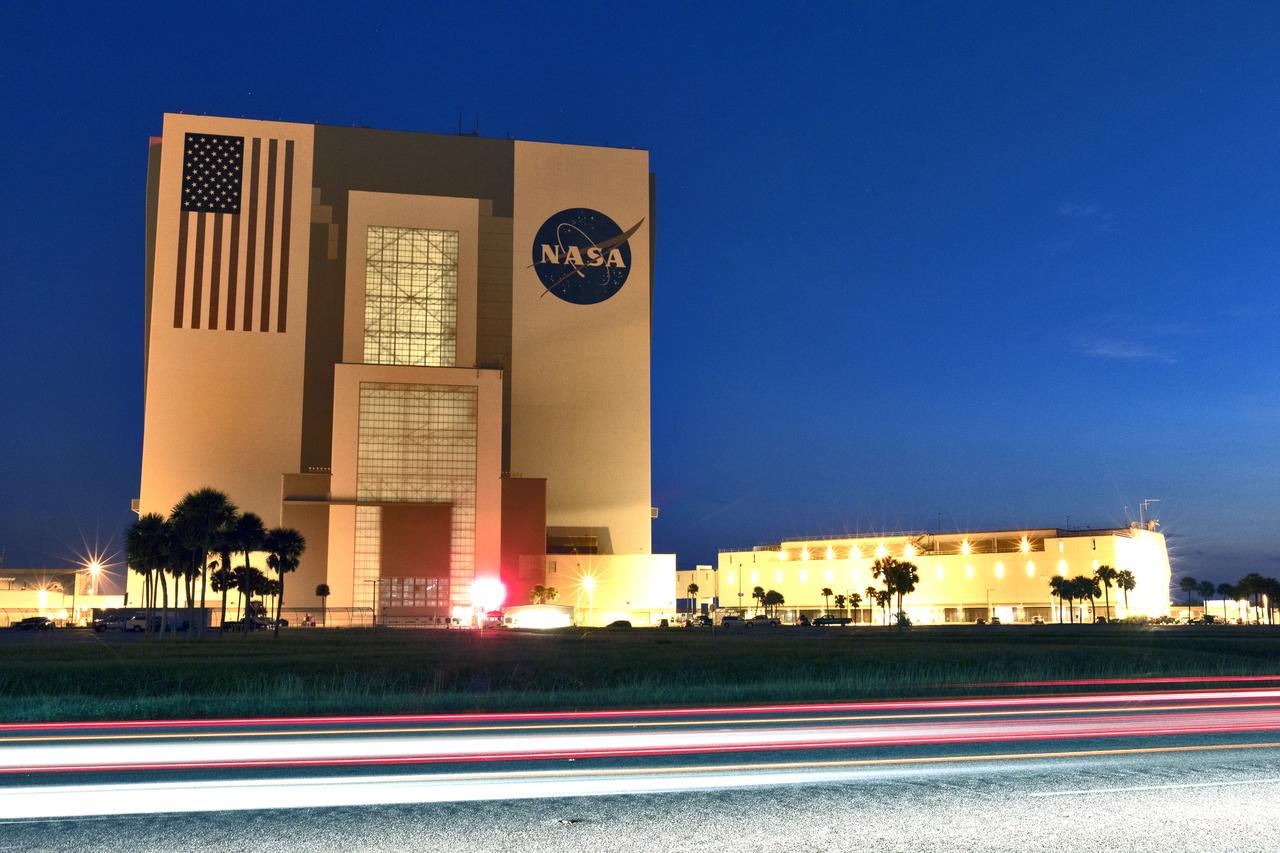
A sunrise time-lapse panoramic view of the iconic Vehicle Assembly Building (VAB) and Launch Control Center at NASA's Kennedy Space Center in Florida. Ten levels of work platforms have been installed in High Bay 3 of the VAB. They will surround and provide access for service and processing of NASA's Space Launch System (SLS) rocket and Orion spacecraft. Exploration Ground Systems oversaw the upgrades and installation of the new work platforms to support the launch of the SLS and Orion on Exploration Mission-1 and deep space missions.
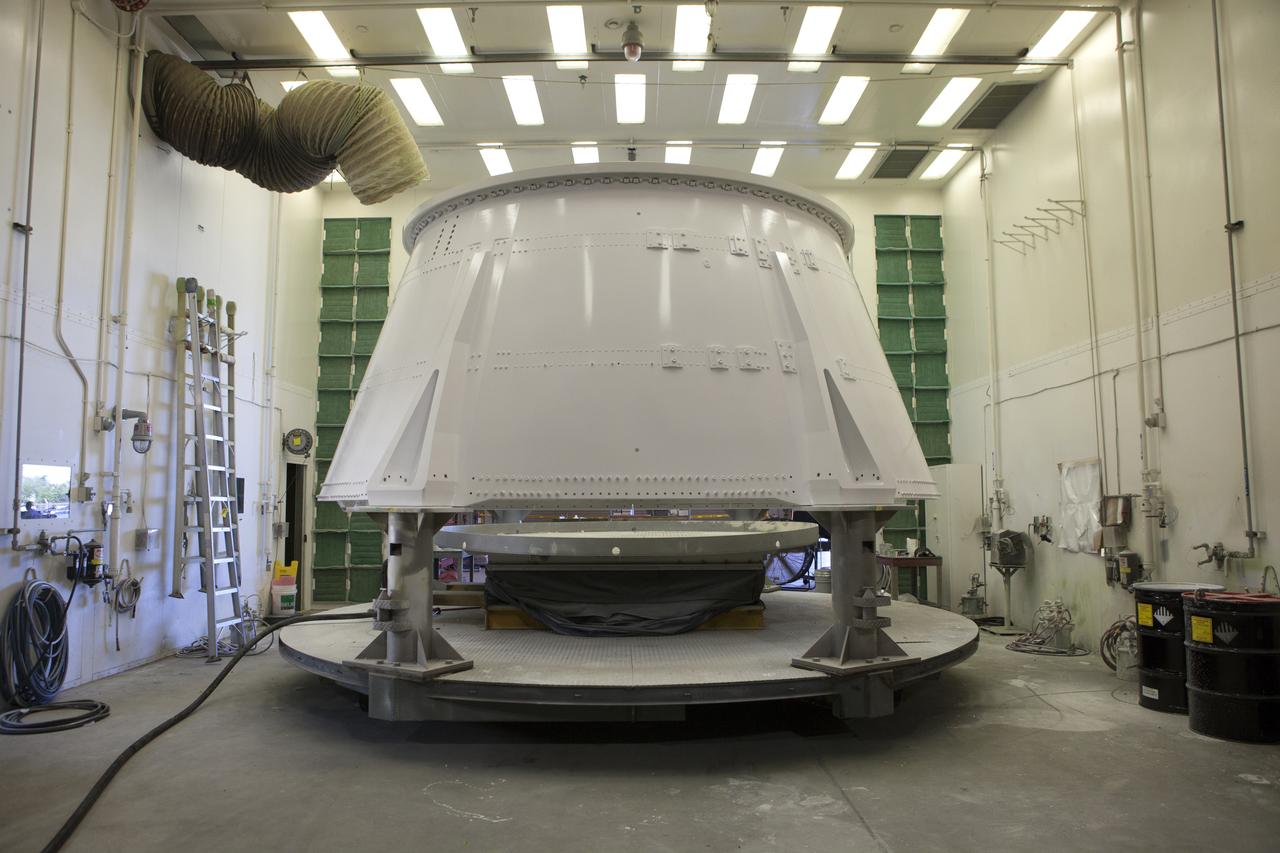
The right hand aft skirt for NASA's Space Launch System (SLS) rocket has been refurbished and painted and is in a drying cell in a support building at the Hangar AF facility at Cape Canaveral Air Force Station in Florida. The space shuttle-era aft skirt will be used on the right hand booster of the SLS for Exploration Mission 1 (EM-1). NASA is preparing for EM-1, deep space missions, and the Journey to Mars.
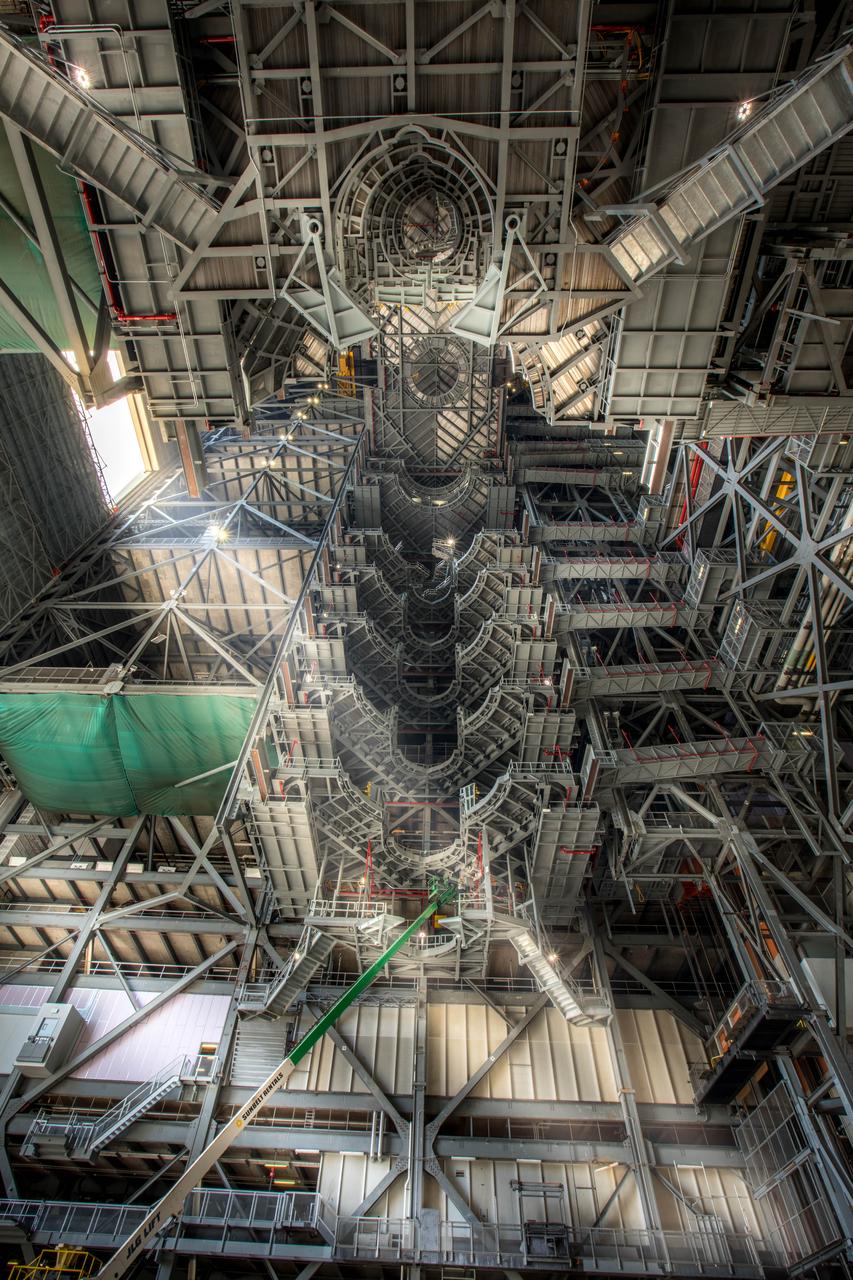
A view looking up at one side of the 10 levels of work platforms in High Bay 3 inside the Vehicle Assembly Building (VAB) at NASA's Kennedy Space Center in Florida. The work platforms will surround and provide access for service and processing of NASA's Space Launch System rocket and Orion spacecraft. Exploration Ground Systems oversaw the upgrades and installation of the new work platforms to support the launch of the SLS and Orion on Exploration Mission-1 and deep space missions.
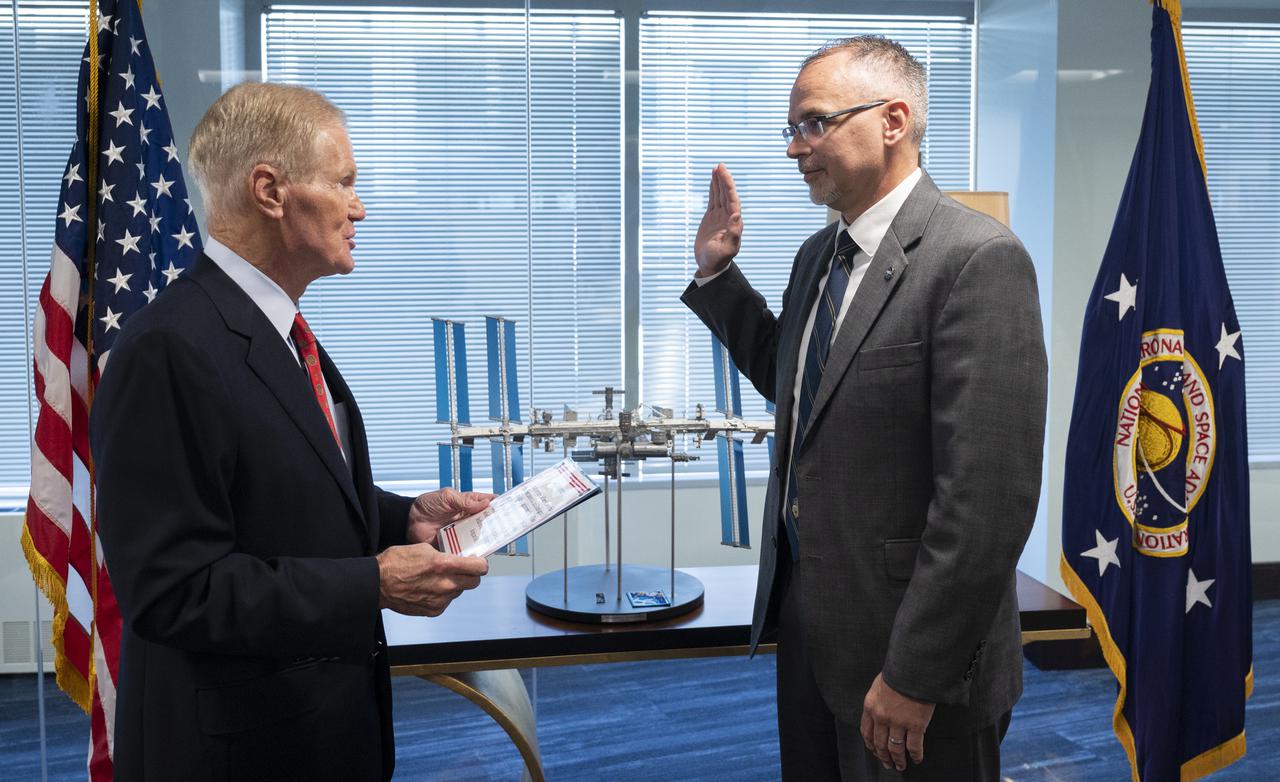
NASA Administrator Bill Nelson, left, swears in Jim Free as the first associate administrator of the new Exploration Systems Development Mission Directorate, Monday, Sept. 20, 2021, at the Mary W. Jackson NASA Headquarters building in Washington. NASA is working to establish ESDMD to focus on planning and developing future space systems while a new Space Operations Mission Directorate will focus on operations. Both areas will support NASA’s Moon to Mars exploration approach. Photo Credit: NASA/Joel Kowsky)
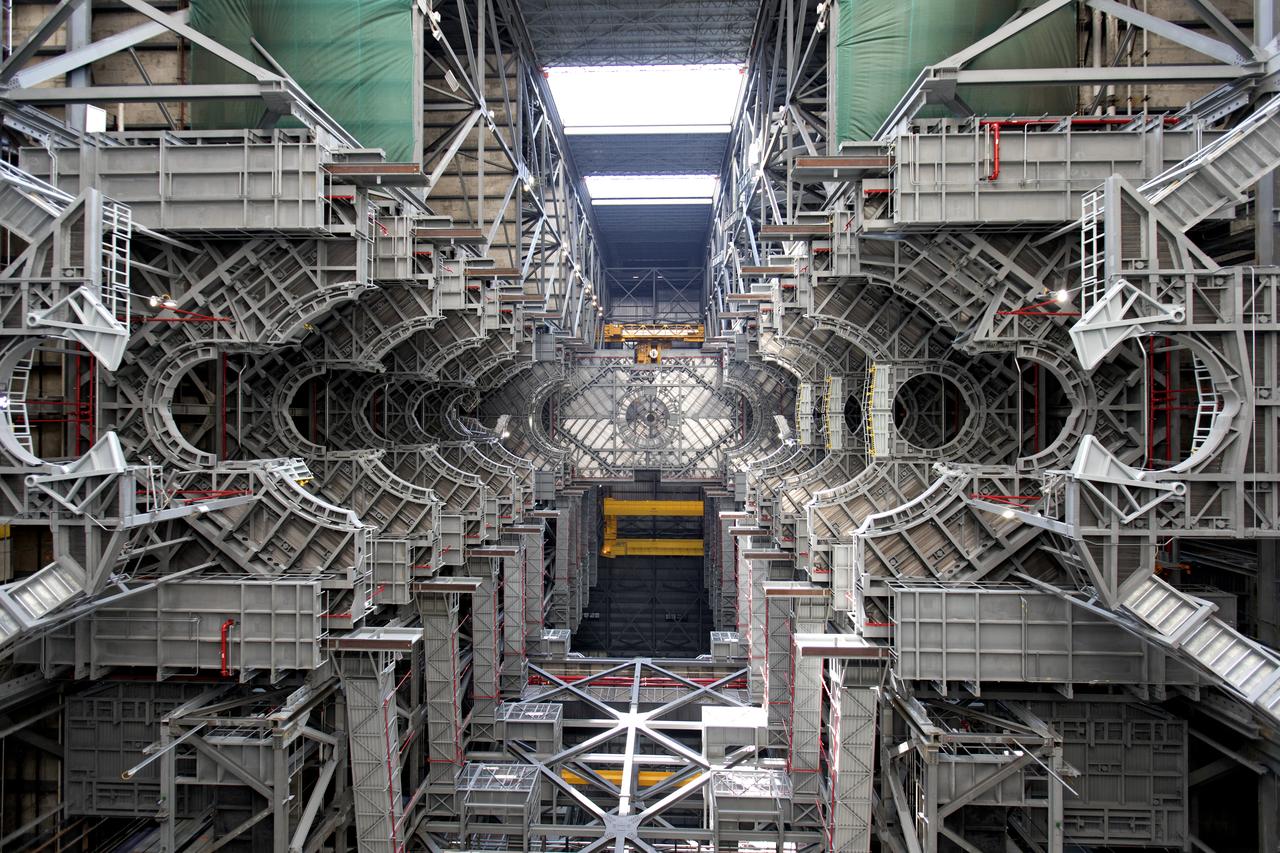
A view looking up at the 10 levels of work platforms in High Bay 3 inside the Vehicle Assembly Building (VAB) at NASA's Kennedy Space Center in Florida. The work platforms will surround and provide access for service and processing of NASA's Space Launch System rocket and Orion spacecraft. Exploration Ground Systems oversaw the upgrades and installation of the new work platforms to support the launch of the SLS and Orion on Exploration Mission-1 and deep space missions.

Bhavya Lal, associate administrator for technology, policy, and strategy at NASA Headquarters is seen during a NASA briefing on the Artemis I Moon mission, Wednesday, Aug. 3, 2022, at the Mary W. Jackson NASA Headquarters building in Washington. NASA’s Artemis I mission is the first integrated test of the agency’s deep space exploration systems: the Orion spacecraft, Space Launch System rocket, and supporting ground systems. Launch of the uncrewed flight test is targeted for no earlier than Monday, Aug. 29. Photo Credit: (NASA/Bill Ingalls)
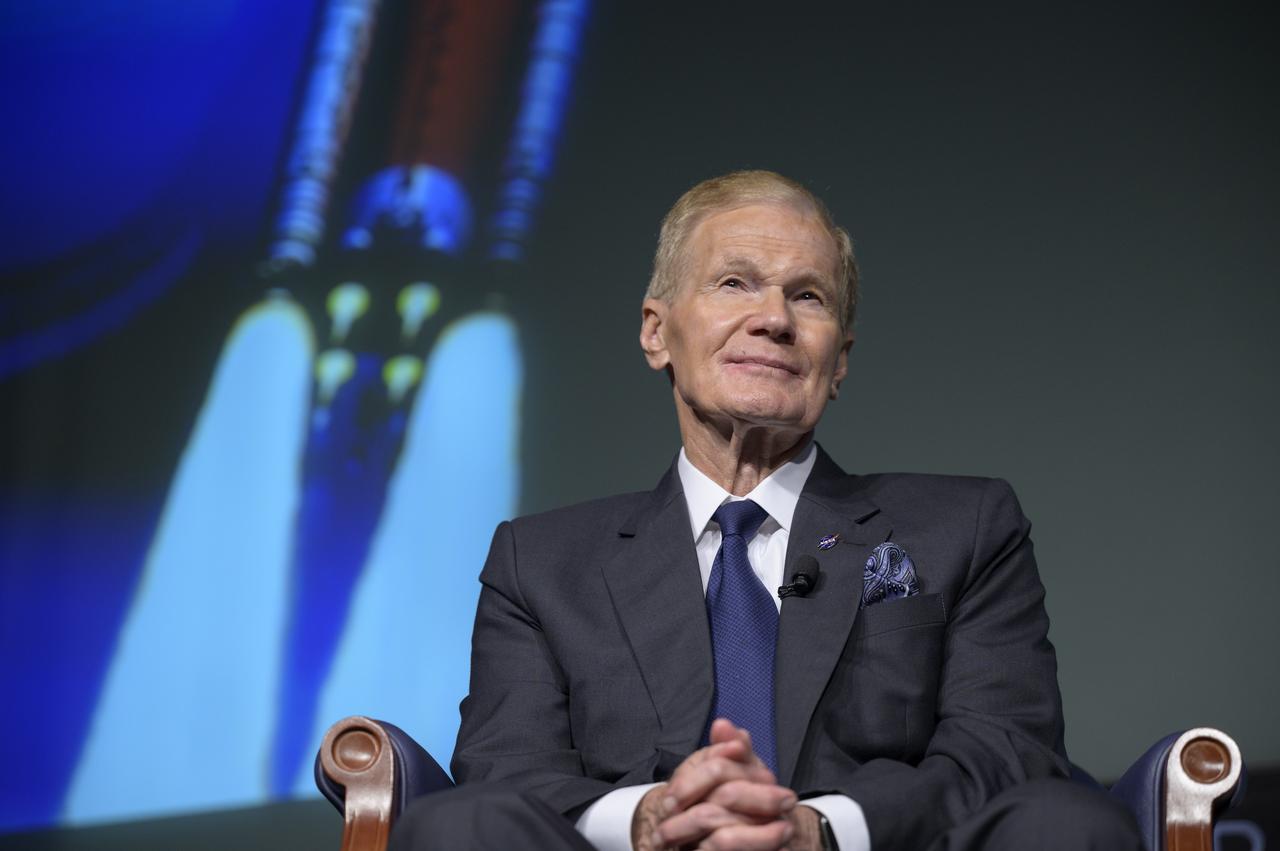
NASA Administrator Bill Nelson speaks during a NASA briefing on the Artemis I Moon mission, Wednesday, Aug. 3, 2022, at the Mary W. Jackson NASA Headquarters building in Washington. NASA’s Artemis I mission is the first integrated test of the agency’s deep space exploration systems: the Orion spacecraft, Space Launch System rocket, and supporting ground systems. Launch of the uncrewed flight test is targeted for no earlier than Monday, Aug. 29. Photo Credit: (NASA/Bill Ingalls)
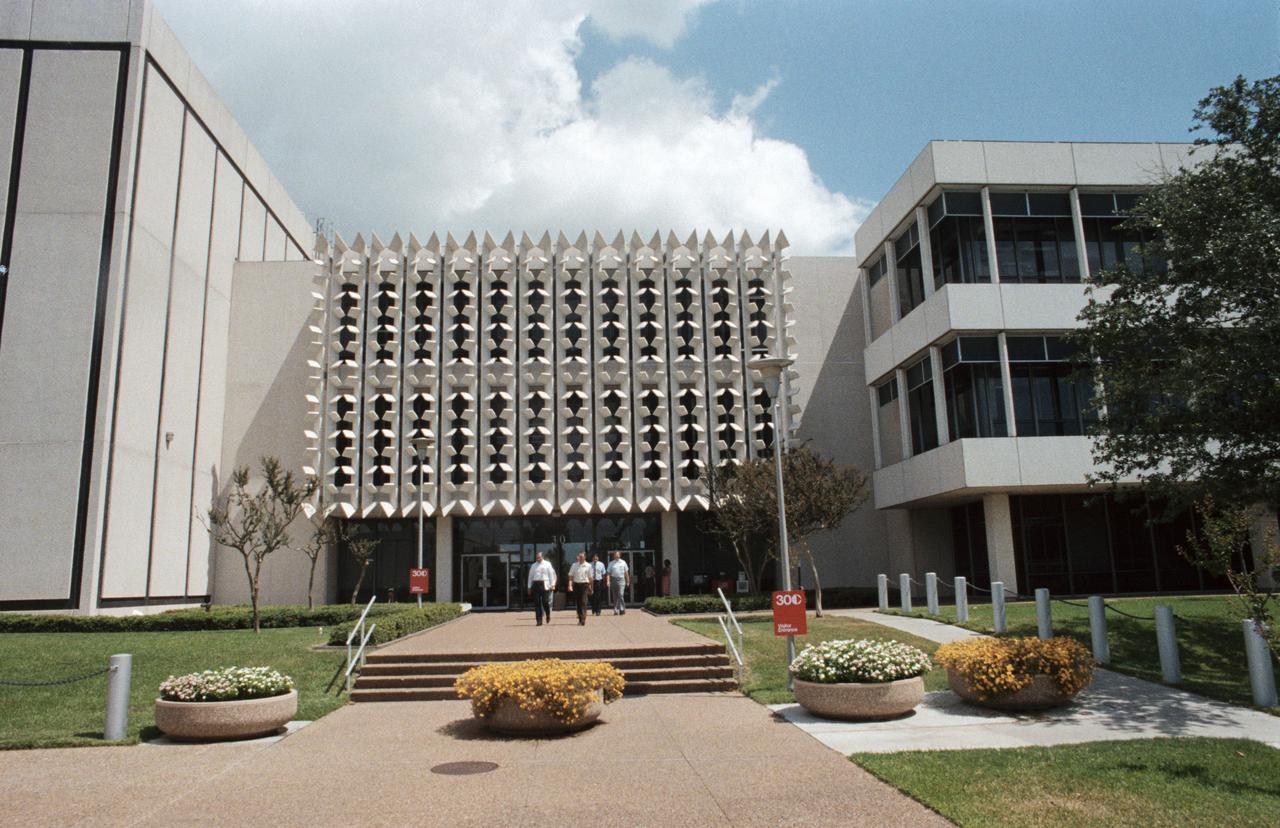
41D-3072 (30 Aug 1984) --- A 41-D shift change is taking place in the Johnson Space Center's Building 30. In its twenty years of operation, the mission control center has been the scene of many such changes. The windowless wing at left houses three floors, including rooms supporting flight control rooms 1 & 2 (formerly called mission operations control rooms 1 & 2).
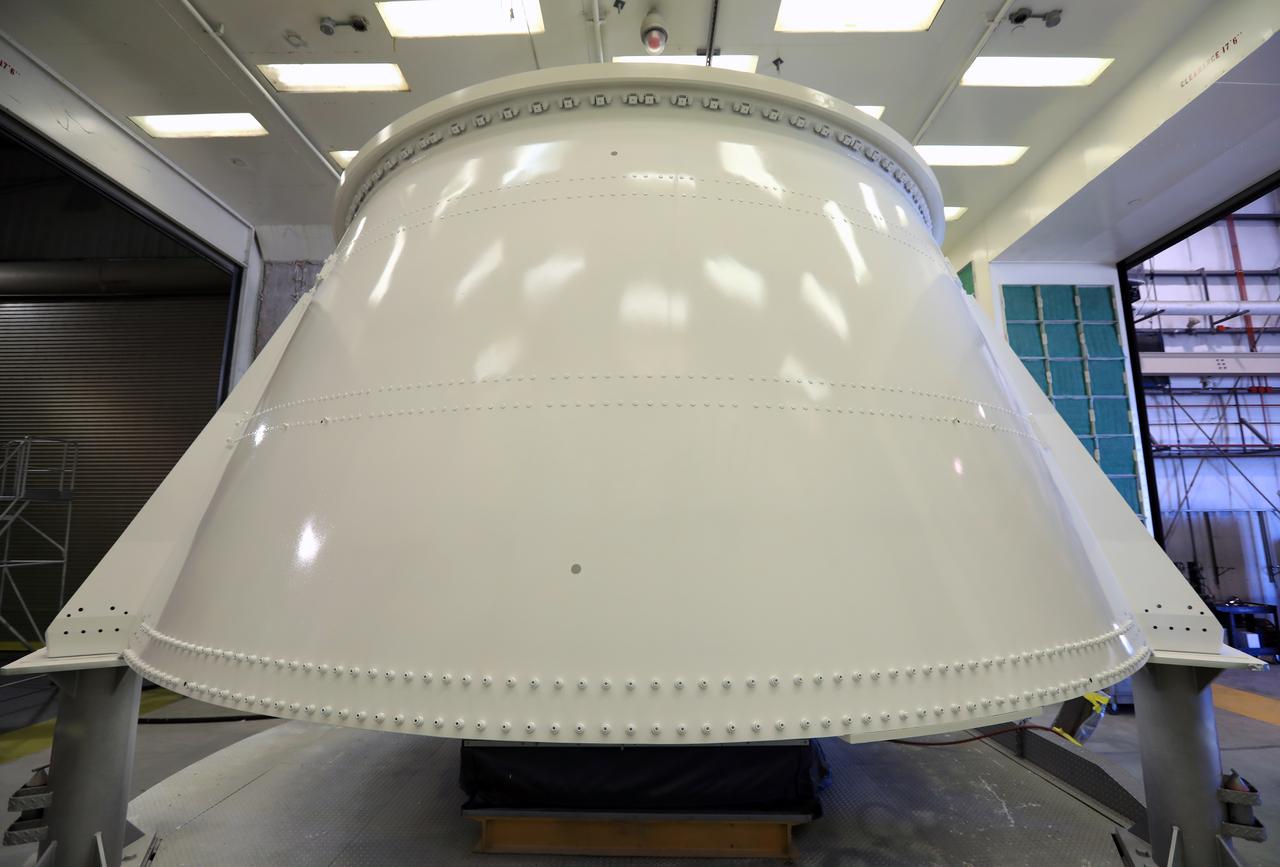
The right hand aft skirt for NASA's Space Launch System (SLS) rocket has been refurbished and painted and is in a drying cell in a support building at the Hangar AF facility at Cape Canaveral Air Force Station in Florida. The space shuttle-era aft skirt will be used on the right hand booster of the SLS for Exploration Mission 1 (EM-1). NASA is preparing for EM-1, deep space missions, and the Journey to Mars.
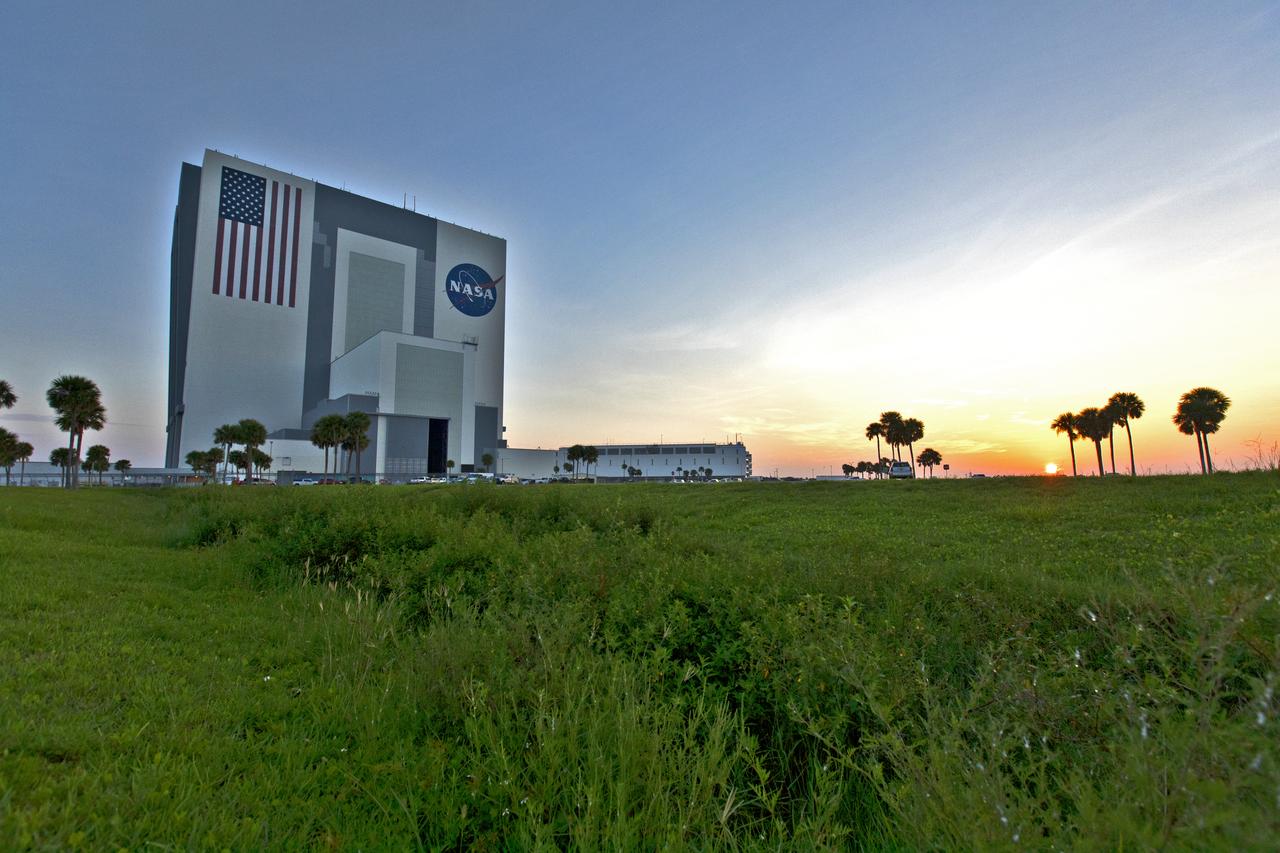
A sunrise panoramic view of the iconic Vehicle Assembly Building (VAB) and Launch Control Center at NASA's Kennedy Space Center in Florida. Ten levels of work platforms have been installed in High Bay 3 of the VAB. They will surround and provide access for service and processing of NASA's Space Launch System (SLS) rocket and Orion spacecraft. Exploration Ground Systems oversaw the upgrades and installation of the new work platforms to support the launch of the SLS and Orion on Exploration Mission-1 and deep space missions.
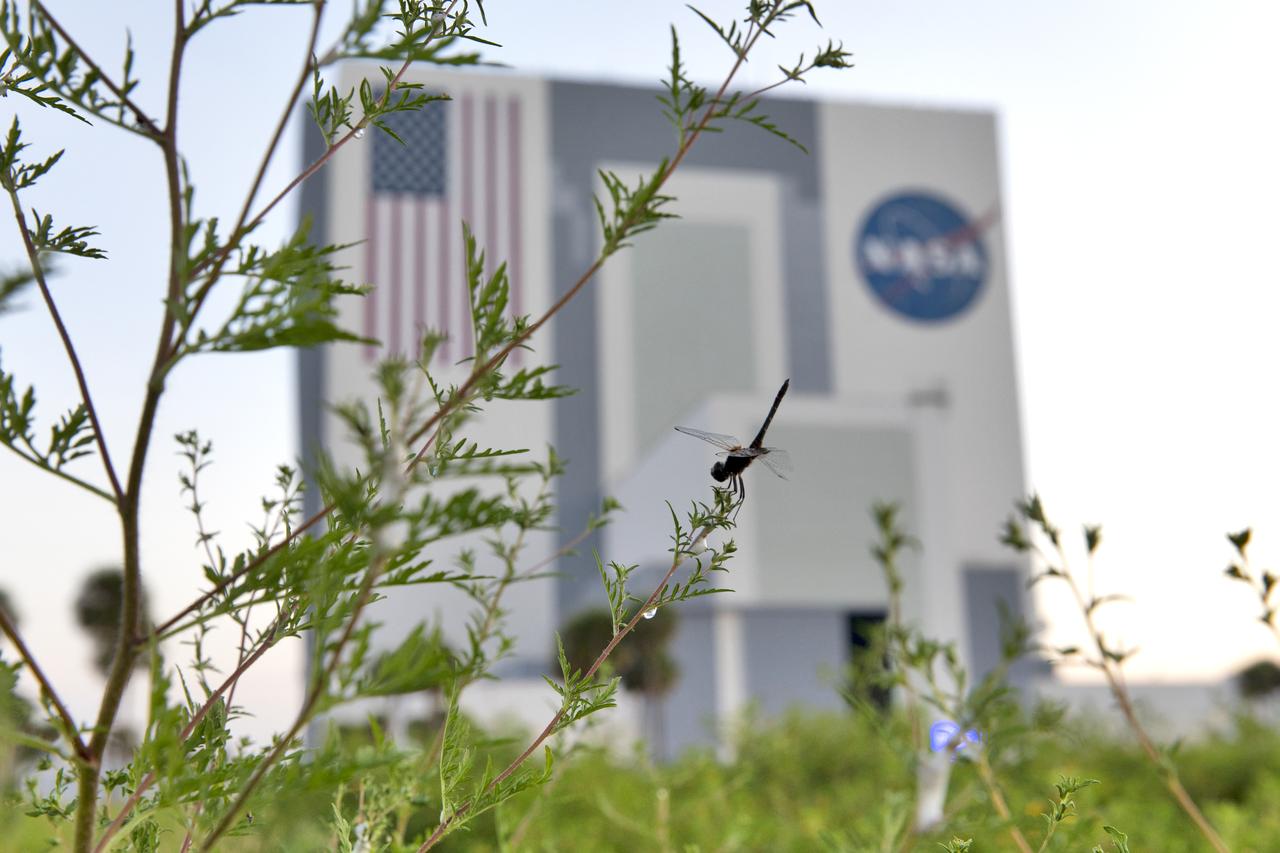
A dragonfly perches on a tree branch with the iconic Vehicle Assembly Building (VAB) in view in the background at NASA's Kennedy Space Center in Florida. Ten levels of new work platforms have been installed in VAB High Bay 3. They will surround and provide access for service and processing of NASA's Space Launch System (SLS) rocket and Orion spacecraft. Exploration Ground Systems oversaw the upgrades and installation of the new work platforms to support the launch of the SLS and Orion on Exploration Mission-1 and deep space missions.

NASA Administrator Bill Nelson speaks during a NASA briefing on the Artemis I Moon mission, Wednesday, Aug. 3, 2022, at the Mary W. Jackson NASA Headquarters building in Washington. NASA’s Artemis I mission is the first integrated test of the agency’s deep space exploration systems: the Orion spacecraft, Space Launch System rocket, and supporting ground systems. Launch of the uncrewed flight test is targeted for no earlier than Monday, Aug. 29. Photo Credit: (NASA/Bill Ingalls)
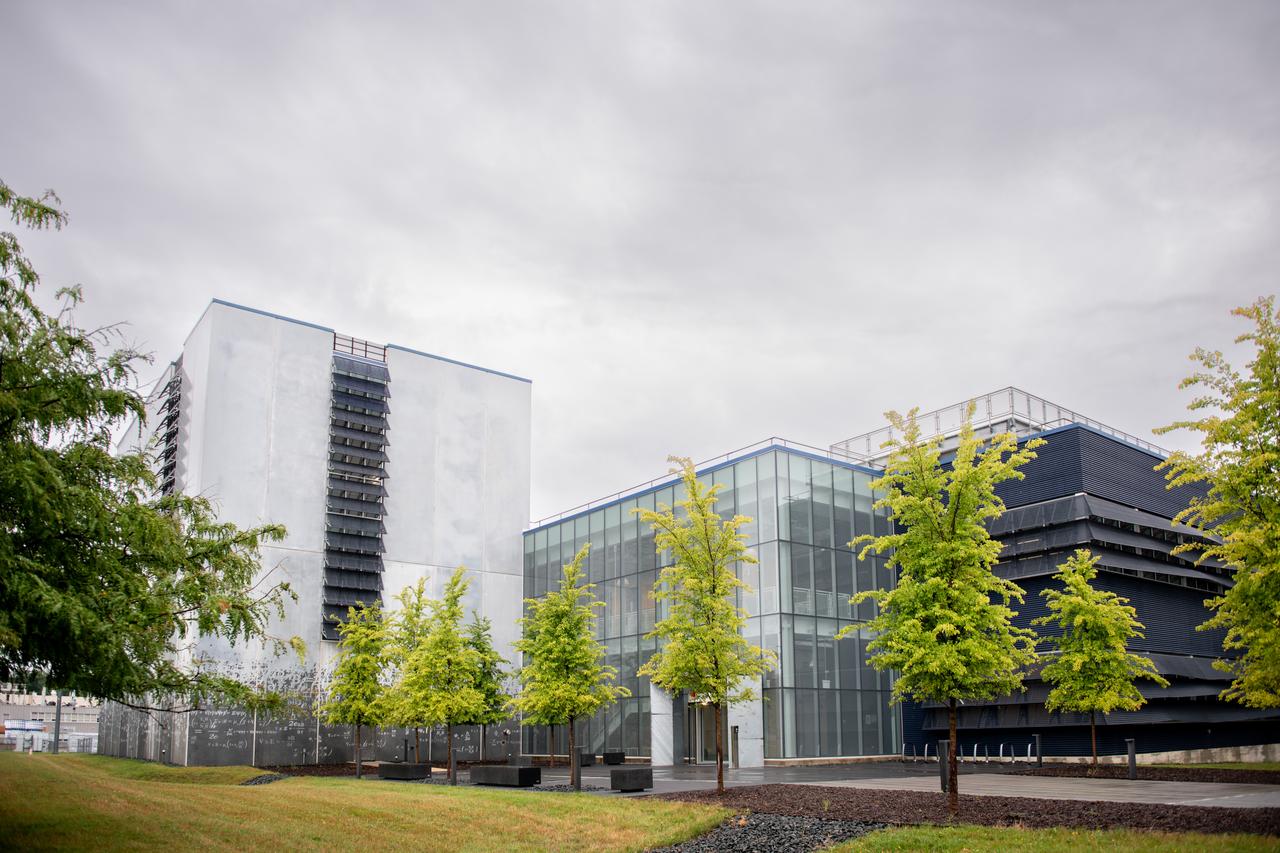
NASA’s Glenn Research Center opened the doors to a brand-new mission-focused facility that will support the agency’s Artemis and Advanced Air Mobility missions. On Aug. 30, NASA management and local officials cut the ribbon to the Aerospace Communications Facility (ACF), a new building designed for advanced radio frequency (RF) and optical communication technology research and development. Photo Credit: (NASA/Sara Lowthian-Hanna)

From left, Wayne Ringelberg, chief pilot at NASA’s Armstrong Flight Research Center in Edwards, California, is welcomed by Michael Thomson, director of NASA Armstrong’s Science Mission Directorate, and Kirsten Boogaard, NASA’s DC-8 project manager, after the DC-8 aircraft and crew return to NASA Armstrong’s Building 703 in Palmdale, California, on April 1, 2024, following the aircraft’s final mission in support of the Airborne and Satellite Investigation of Asian Air Quality (ASIA-AQ).
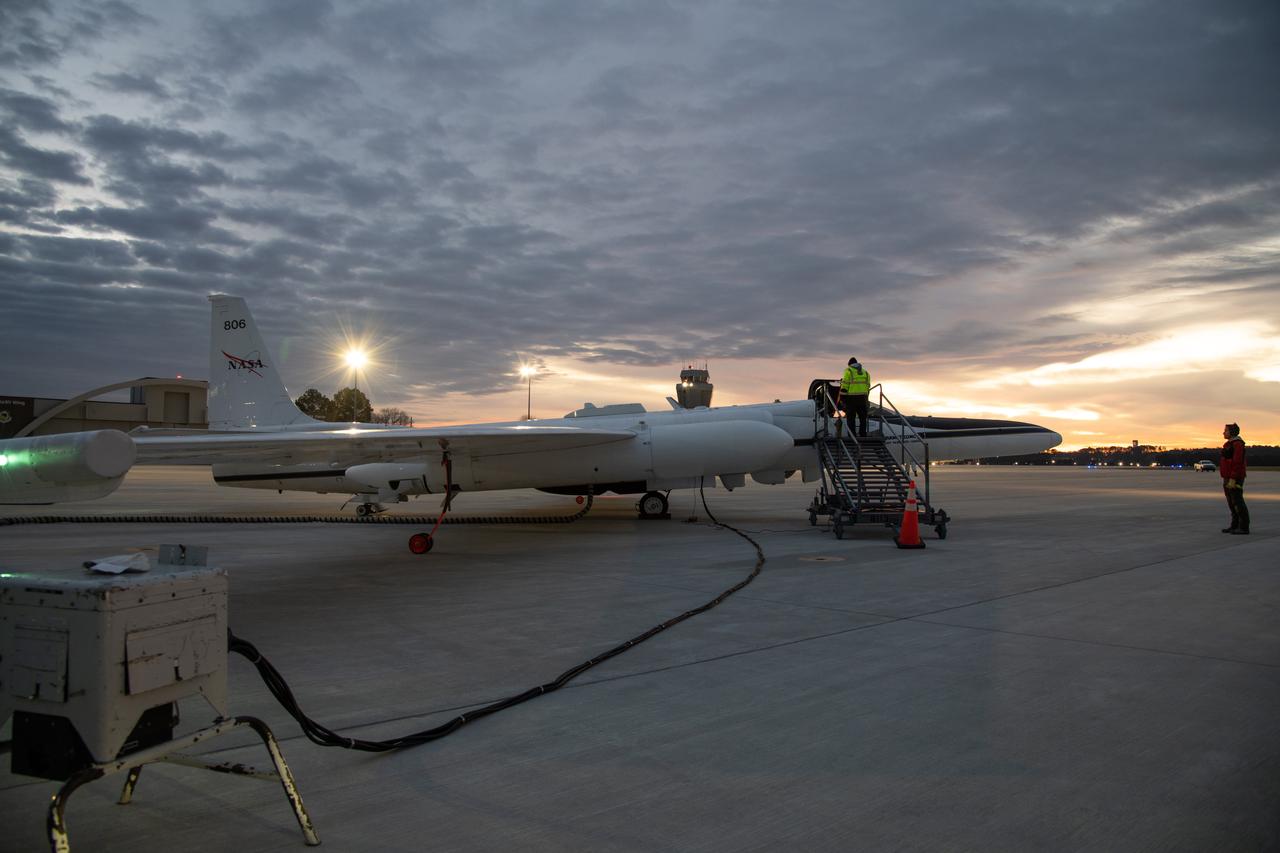
The NASA ER-2 high-altitude aircraft was prepared to support the Investigation of Microphysics and Precipitation for Atlantic Coast-Threatening Storms (IMPACTS) mission. For this mission, the IMPACTS team tracked storms across the Eastern United States to help understand how winter storms form and develop. The aircraft, which is based at NASA’s Armstrong Flight Research Center Building 703 in Palmdale, California, was temporarily based at Dobbins Air Reserve Base in Marietta, Georgia. The three-year IMPACTS campaign concluded on Feb. 28, 2023.
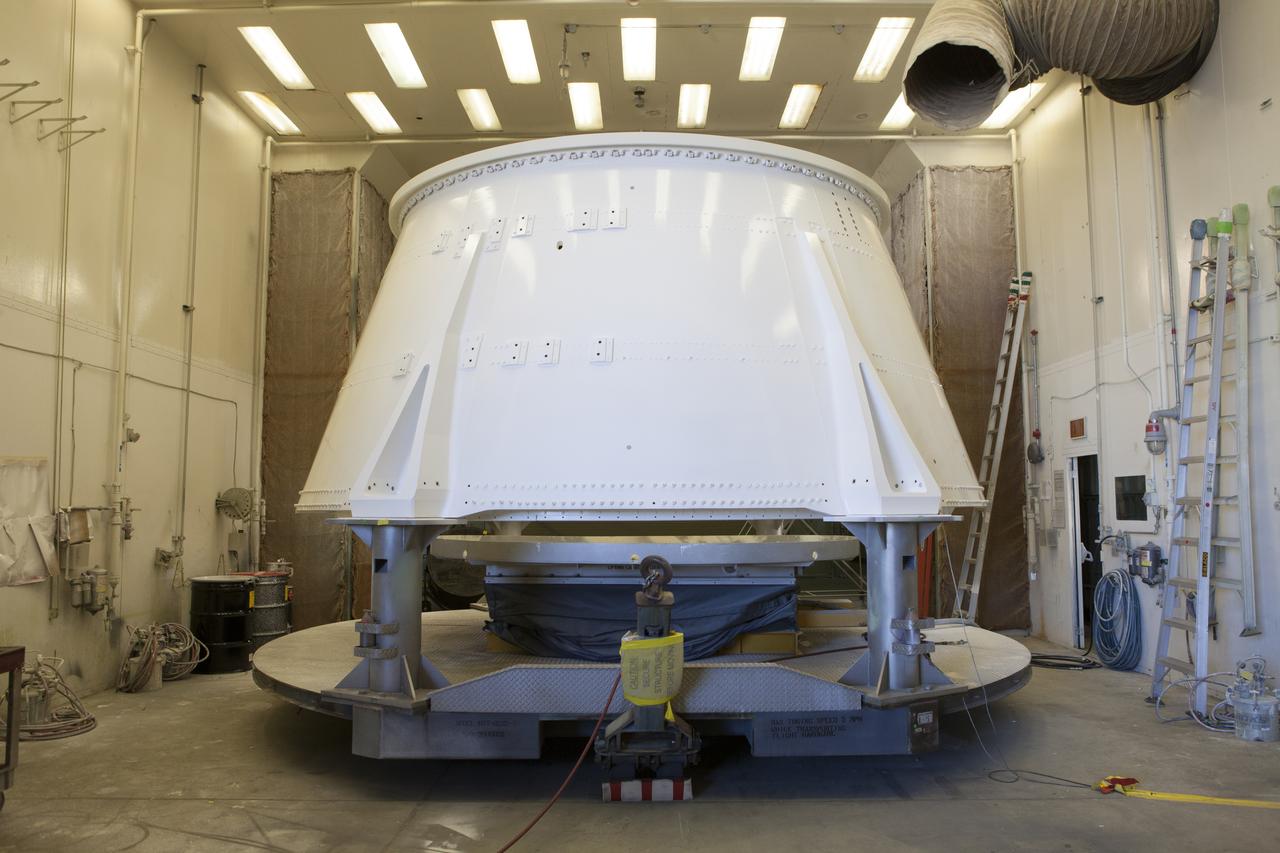
The right hand aft skirt for NASA's Space Launch System (SLS) rocket has been refurbished and painted and is in a drying cell in a support building at the Hangar AF facility at Cape Canaveral Air Force Station in Florida. The space shuttle-era aft skirt will be used on the right hand booster of the SLS for Exploration Mission 1 (EM-1). NASA is preparing for EM-1, deep space missions, and the Journey to Mars.
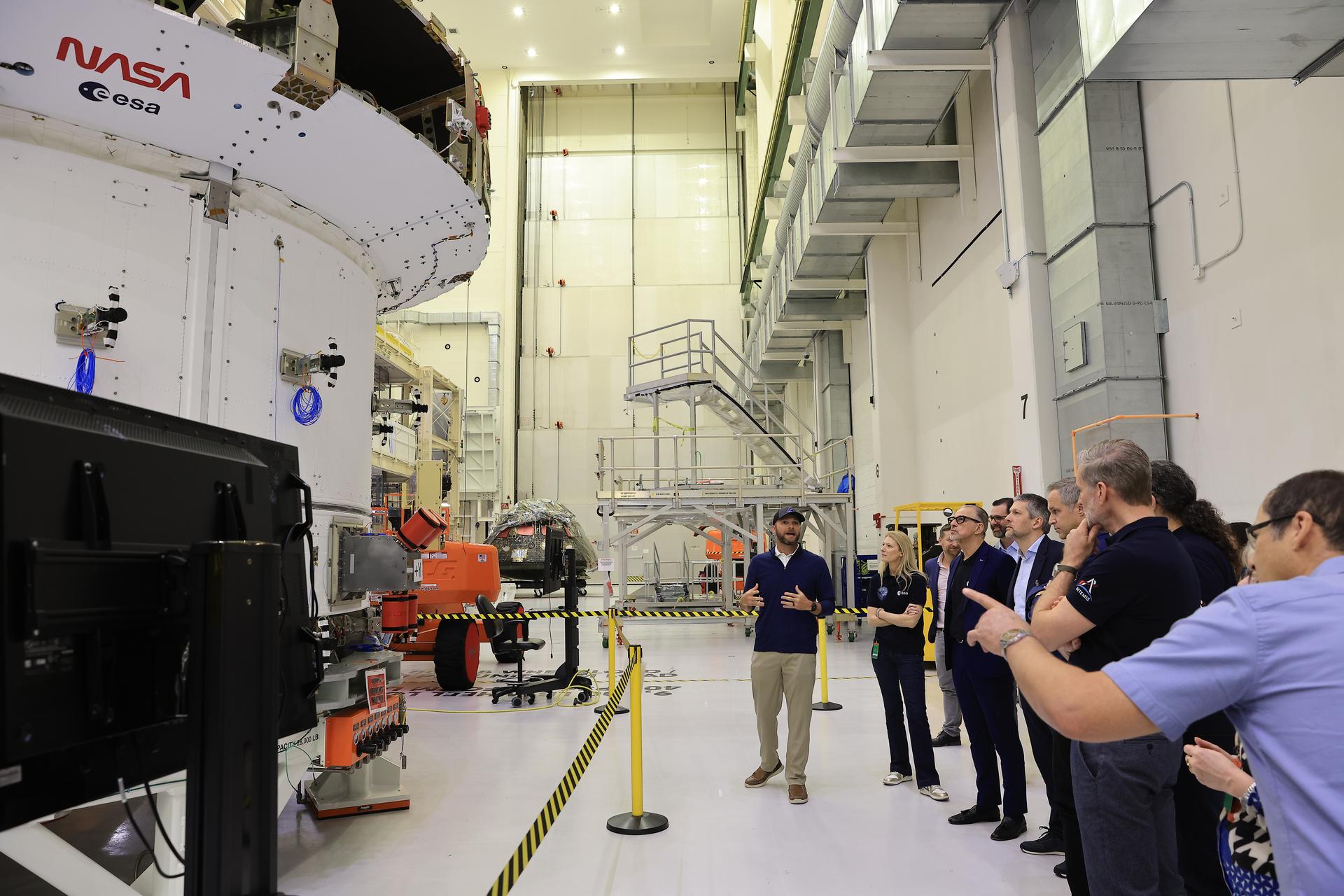
Members of the ESA (European Space Agency) leadership team and NASA Orion program team stand by European Service Module with the Orion spacecraft in the background for NASA’s Artemis III mission on Tuesday, Feb. 10, 2026, inside the high bay of the Neil A. Armstrong Operations and Checkout Building at NASA’s Kennedy Space Center in Florida. The service module provides the Orion spacecraft’s propulsion, thermal control, electrical power, and life support systems during the Artemis III mission to send humans to explore the lunar South Pole region.
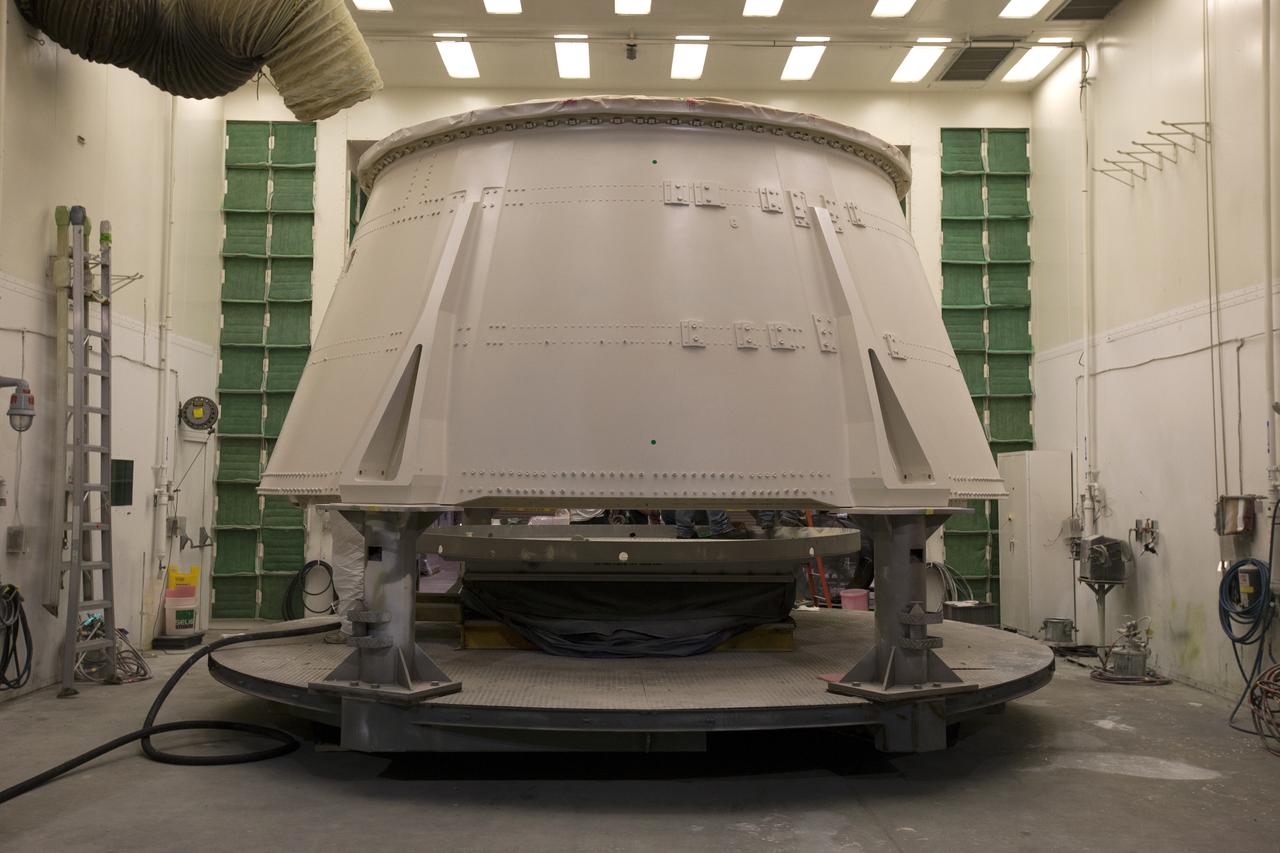
The right hand aft skirt for NASA's Space Launch System (SLS) rocket has been painted and is in a drying cell in a support building at the Hangar AF facility at Cape Canaveral Air Force Station in Florida. The space shuttle-era aft skirt will be used on the right hand booster of NASA's Space Launch System rocket for Exploration Mission 1 (EM-1). NASA is preparing for EM-1, deep space missions, and the Journey to Mars.

NASA Administrator Bill Nelson speaks during a NASA briefing on the Artemis I Moon mission, Wednesday, Aug. 3, 2022, at the Mary W. Jackson NASA Headquarters building in Washington. NASA’s Artemis I mission is the first integrated test of the agency’s deep space exploration systems: the Orion spacecraft, Space Launch System rocket, and supporting ground systems. Launch of the uncrewed flight test is targeted for no earlier than Monday, Aug. 29. Photo Credit: (NASA/Bill Ingalls)
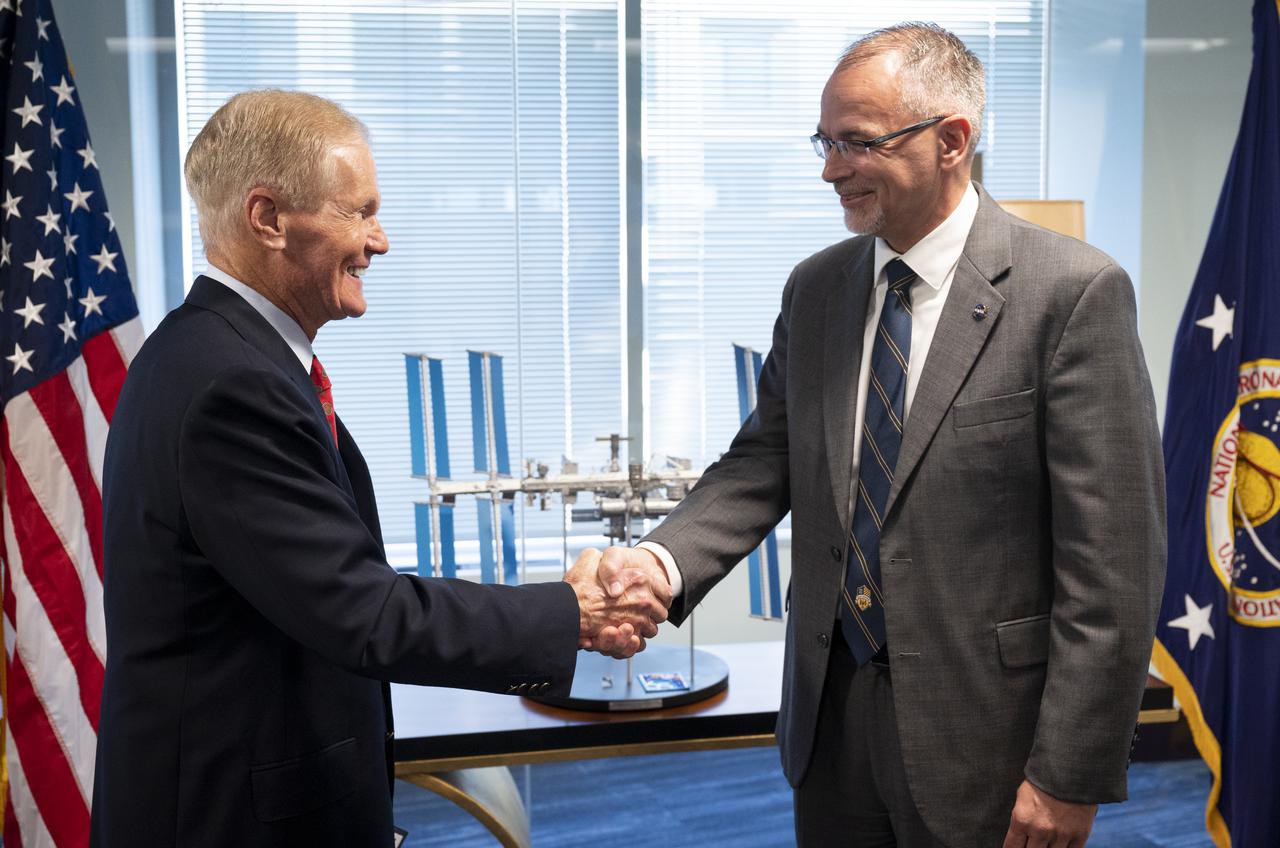
NASA Administrator Bill Nelson, left, shakes hands with Jim Free after being sworn in as the first associate administrator of the new Exploration Systems Development Mission Directorate, Monday, Sept. 20, 2021, at the Mary W. Jackson NASA Headquarters building in Washington. NASA is working to establish ESDMD to focus on planning and developing future space systems while a new Space Operations Mission Directorate will focus on operations. Both areas will support NASA’s Moon to Mars exploration approach. Photo Credit: NASA/Joel Kowsky)
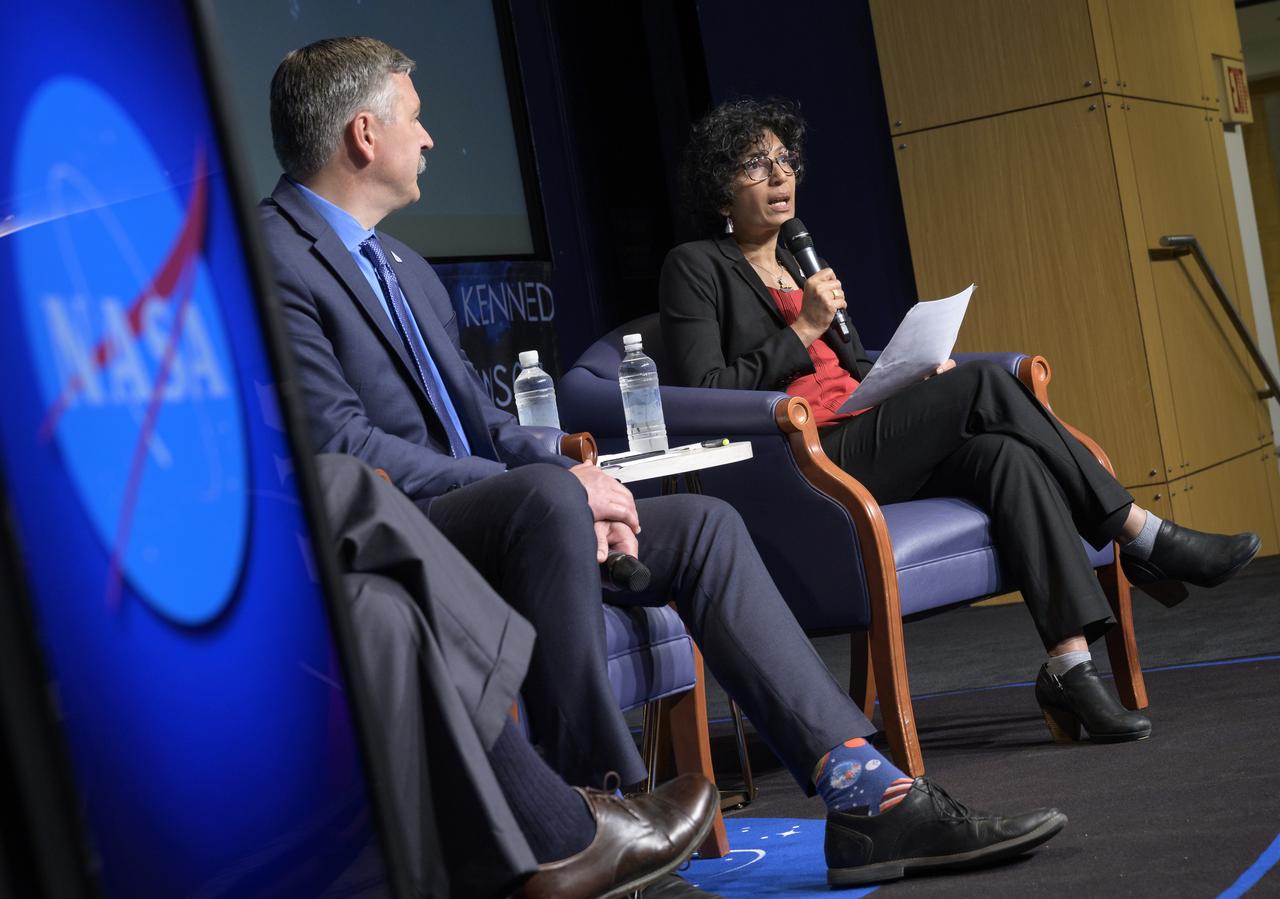
Bhavya Lal, associate administrator for technology, policy, and strategy at NASA Headquarters speaks during a NASA briefing on the Artemis I Moon mission, Wednesday, Aug. 3, 2022, at the Mary W. Jackson NASA Headquarters building in Washington. NASA’s Artemis I mission is the first integrated test of the agency’s deep space exploration systems: the Orion spacecraft, Space Launch System rocket, and supporting ground systems. Launch of the uncrewed flight test is targeted for no earlier than Monday, Aug. 29. Photo Credit: (NASA/Bill Ingalls)

Technicians with Orbital ATK, prime contractor for the Space Launch System (SLS) Booster, prepare a paint mixture for the right hand aft skirt for NASA’s SLS in a support building at the Hangar AF facility at Cape Canaveral Air Force Station in Florida. The space shuttle-era aft skirt, was inspected and resurfaced, and will be primed and painted for use on the right hand booster of the SLS rocket for Exploration Mission 1 (EM-1). NASA is preparing for EM-1, deep-space missions, and the Journey to Mars.

Stephanie Schierholz, a press secretary at NASA Headquarters, moderates a NASA briefing on the Artemis I Moon mission, Wednesday, Aug. 3, 2022, at the Mary W. Jackson NASA Headquarters building in Washington. NASA’s Artemis I mission is the first integrated test of the agency’s deep space exploration systems: the Orion spacecraft, Space Launch System rocket, and supporting ground systems. Launch of the uncrewed flight test is targeted for no earlier than Monday, Aug. 29. Photo Credit: (NASA/Bill Ingalls)
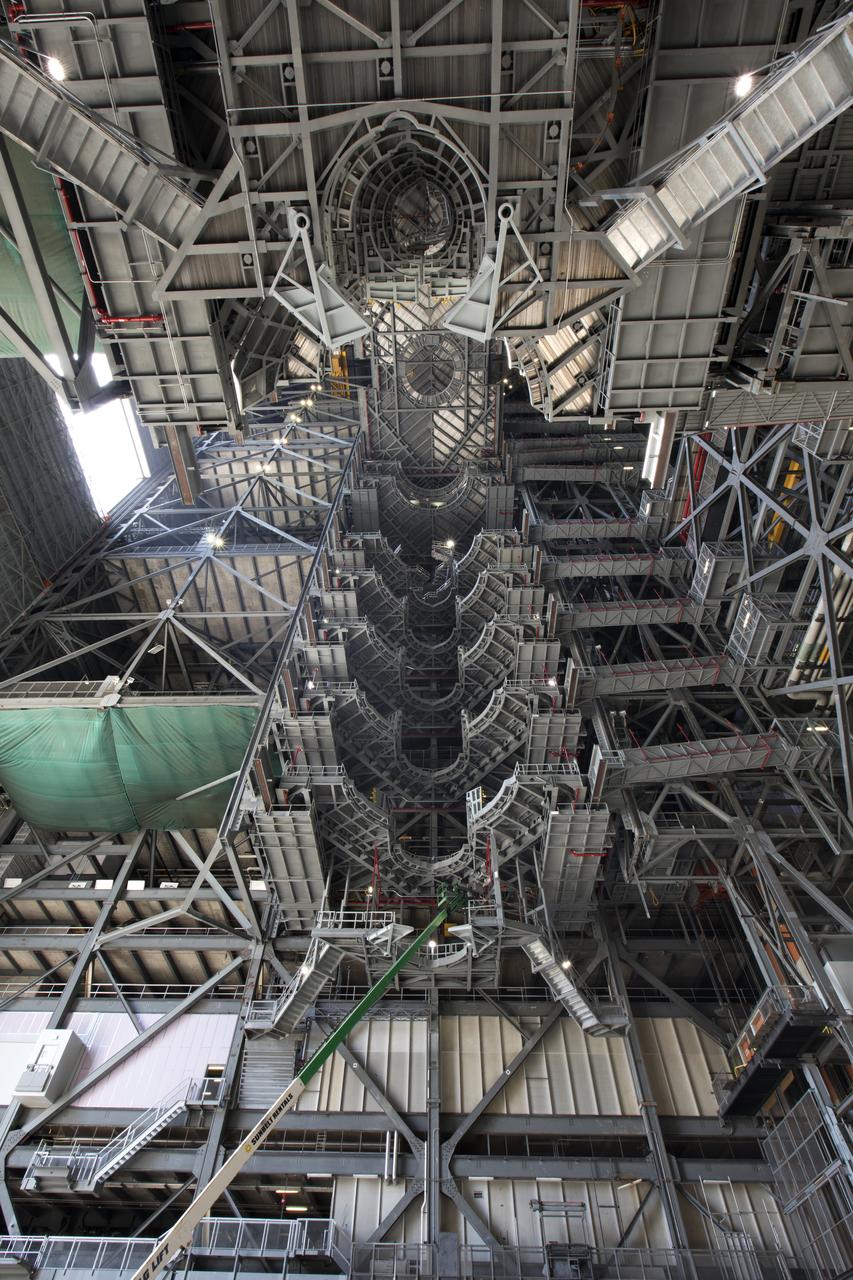
A view looking up at one side of the 10 levels of work platforms in High Bay 3 inside the Vehicle Assembly Building (VAB) at NASA's Kennedy Space Center in Florida. The work platforms will surround and provide access for service and processing of NASA's Space Launch System rocket and Orion spacecraft. Exploration Ground Systems oversaw the upgrades and installation of the new work platforms to support the launch of the SLS and Orion on Exploration Mission-1 and deep space missions.