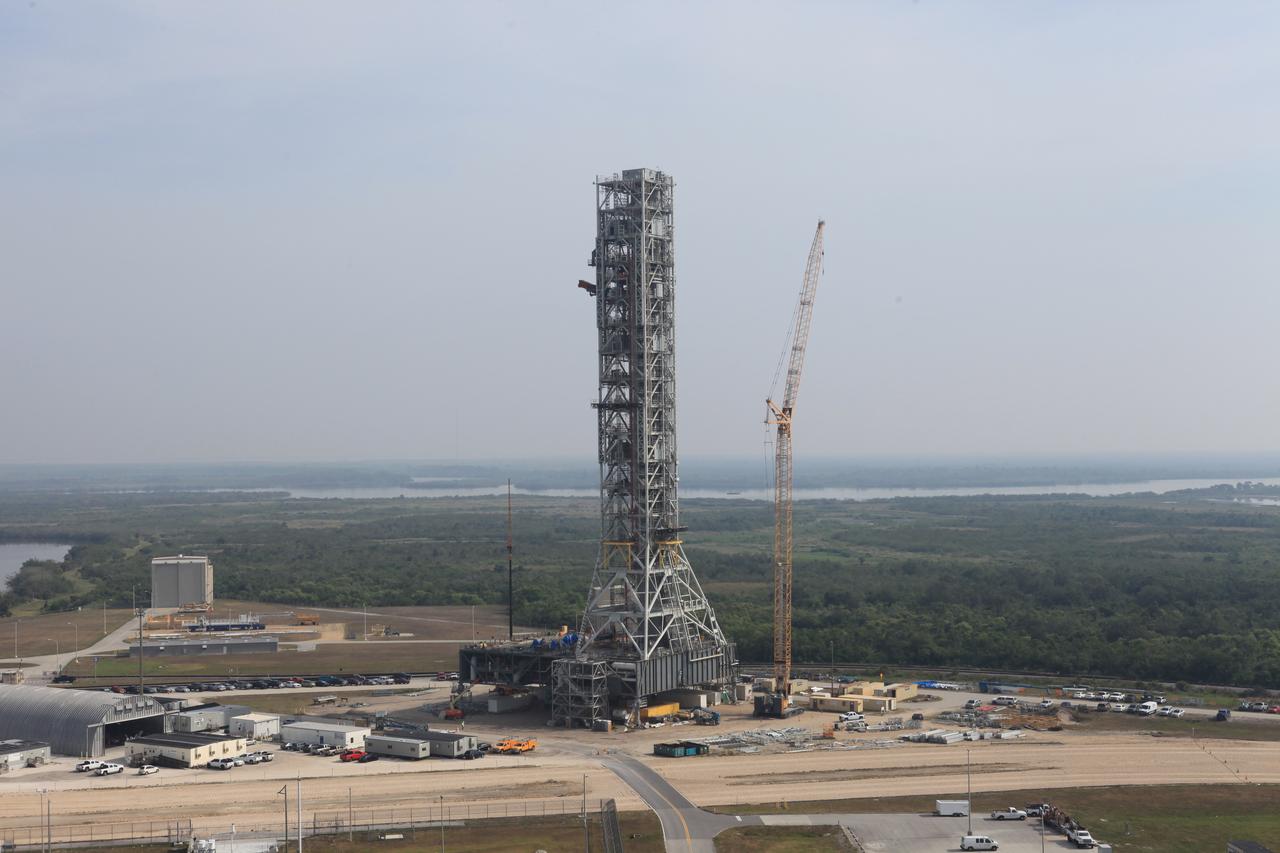
A view of the mobile launcher (ML) taken from the "eyebrow" of the nearby Vehicle Assembly Building at NASA's Kennedy Space Center in Florida. The ML tower will be equipped with a number of lines, called umbilicals that will connect to the Space Launch System rocket and Orion spacecraft for Exploration Mission-1 (EM-1). The Orion Service Module Umbilical and Core State Forward Skirt Umbilical were recently installed on the ML. The Ground Systems Development and Operations Program is overseeing installation of the umbilicals.
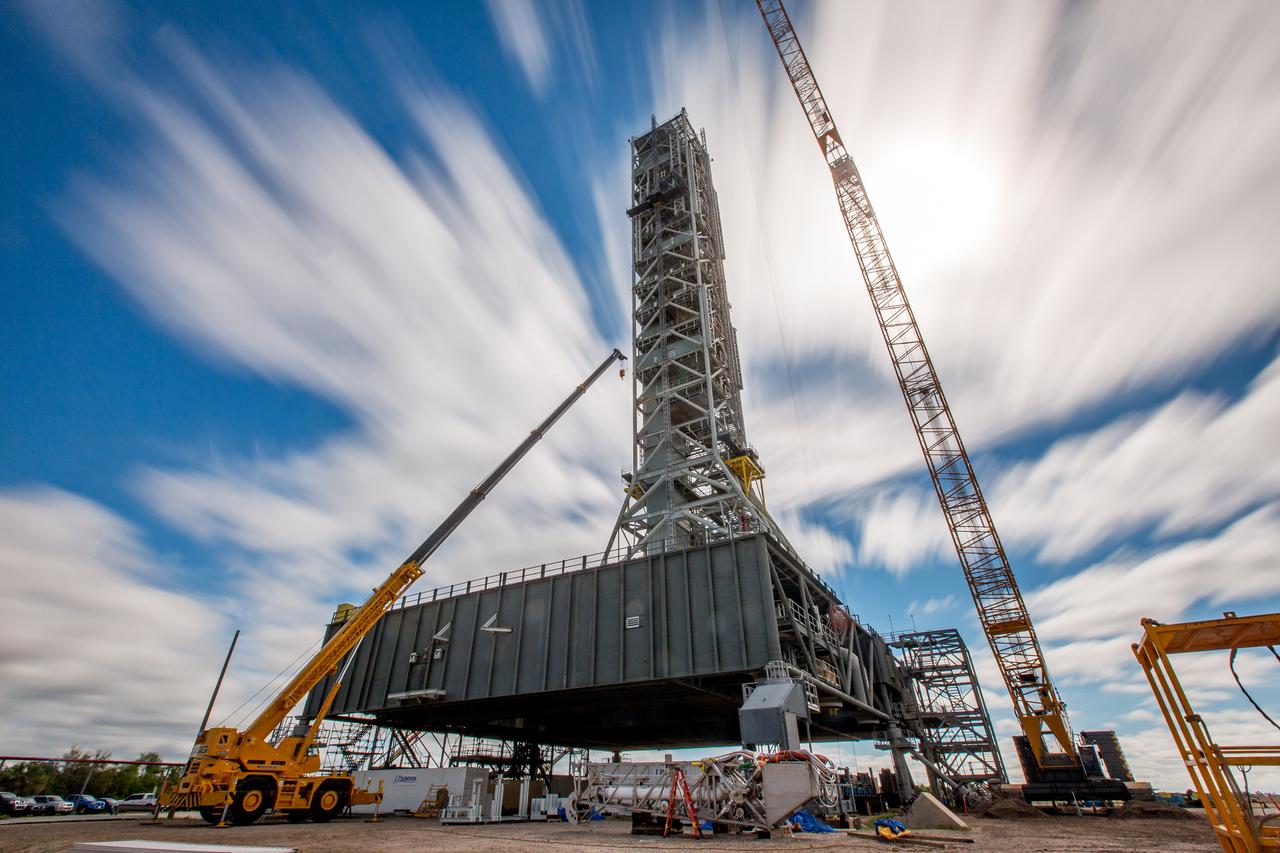
A long-exposure view of the mobile launcher at NASA's Kennedy Space Center in Florida. Cranes and rigging are being used to lift the bracket for the Orion Service Module Umbilical (OSMU) up for installation on the mobile launcher tower. The tower will be equipped with a number of lines, called umbilicals, that will connect to the Space Launch System rocket and Orion spacecraft for Exploration Mission-1 (EM-1). The OSMU will be located high on the mobile launcher tower and, prior to launch, will transfer liquid coolant for the electronics and air for the Environmental Control System to the Orion service module that houses these critical systems to support the spacecraft. EM-1 is scheduled to launch in 2018. The Ground Systems Development and Operations Program is overseeing installation of the umbilicals.
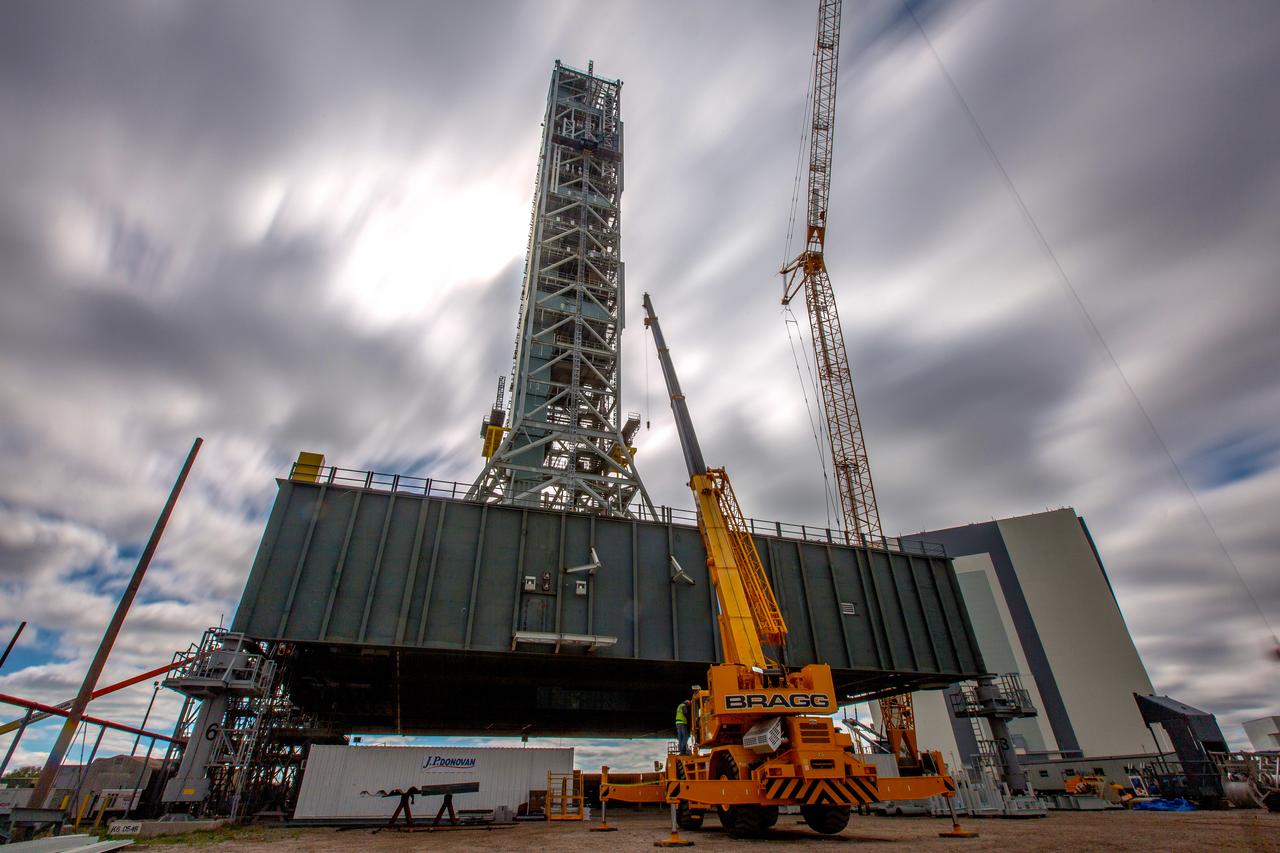
A long-exposure view of the mobile launcher at NASA's Kennedy Space Center in Florida. Cranes and rigging are being used to lift the bracket for the Orion Service Module Umbilical (OSMU) up for installation on the mobile launcher tower. The tower will be equipped with a number of lines, called umbilicals, that will connect to the Space Launch System rocket and Orion spacecraft for Exploration Mission-1 (EM-1). The OSMU will be located high on the mobile launcher tower and, prior to launch, will transfer liquid coolant for the electronics and air for the Environmental Control System to the Orion service module that houses these critical systems to support the spacecraft. EM-1 is scheduled to launch in 2018. The Ground Systems Development and Operations Program is overseeing installation of the umbilicals.
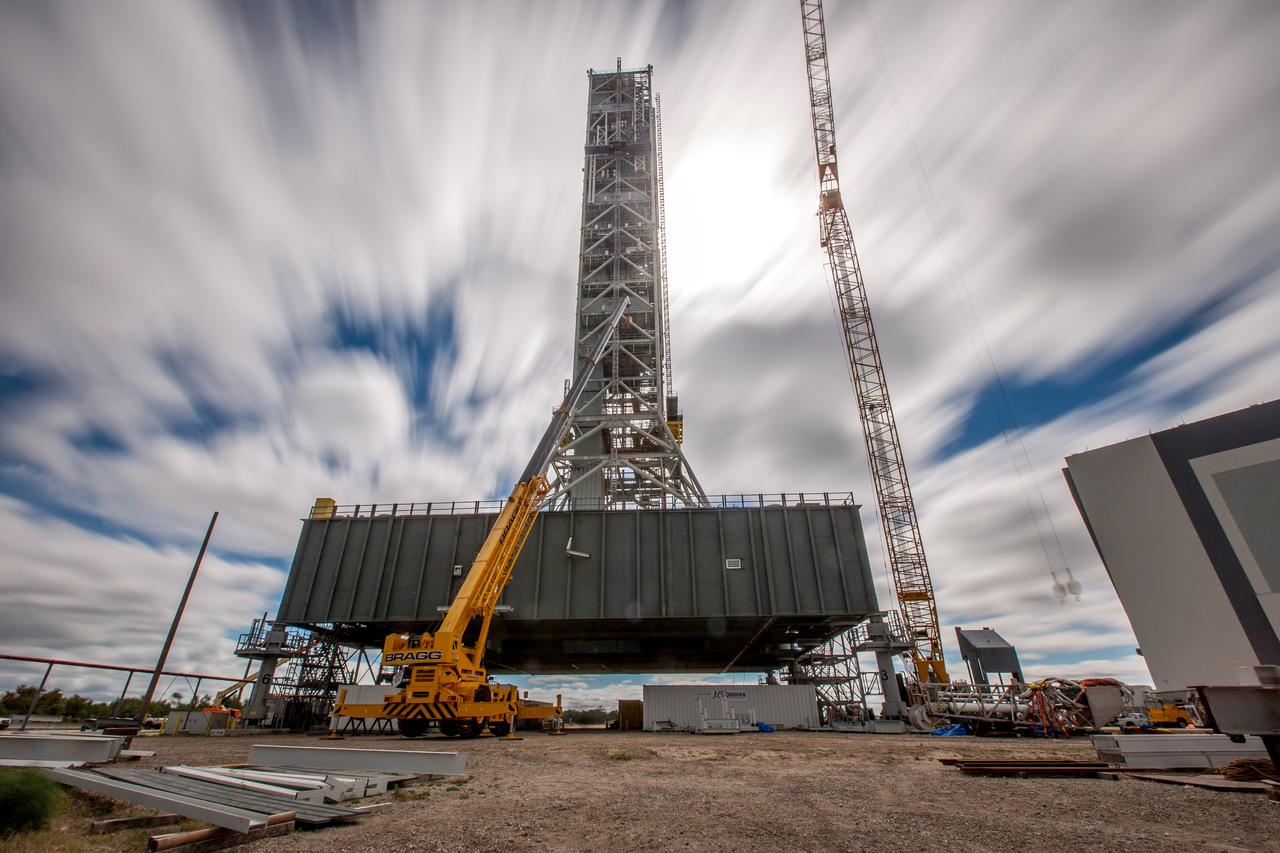
A long-exposure view of the mobile launcher at NASA's Kennedy Space Center in Florida. Cranes and rigging are being used to lift the bracket for the Orion Service Module Umbilical (OSMU) up for installation on the mobile launcher tower. The tower will be equipped with a number of lines, called umbilicals, that will connect to the Space Launch System rocket and Orion spacecraft for Exploration Mission-1 (EM-1). The OSMU will be located high on the mobile launcher tower and, prior to launch, will transfer liquid coolant for the electronics and air for the Environmental Control System to the Orion service module that houses these critical systems to support the spacecraft. EM-1 is scheduled to launch in 2018. The Ground Systems Development and Operations Program is overseeing installation of the umbilicals.

A colorful sunrise serves as the backdrop in this view of the mobile launcher at NASA's Kennedy Space Center in Florida. The mobile launcher is equipped with a number of lines, called umbilicals, which will connect to NASA's Space Launch System (SLS) and Orion spacecraft. Exploration Ground Systems is preparing the mobile launcher and ground systems necessary to process and launch the SLS and Orion spacecraft on Exploration Mission-1 and deep space missions.

A brilliant sunrise serves as the backdrop in this panoramic view of the mobile launcher at NASA's Kennedy Space Center in Florida. The mobile launcher is equipped with a number of lines, called umbilicals, which will connect to NASA's Space Launch System (SLS) and Orion spacecraft. Exploration Ground Systems is preparing the mobile launcher and ground systems necessary to process and launch the SLS and Orion spacecraft on Exploration Mission-1 and deep space missions.
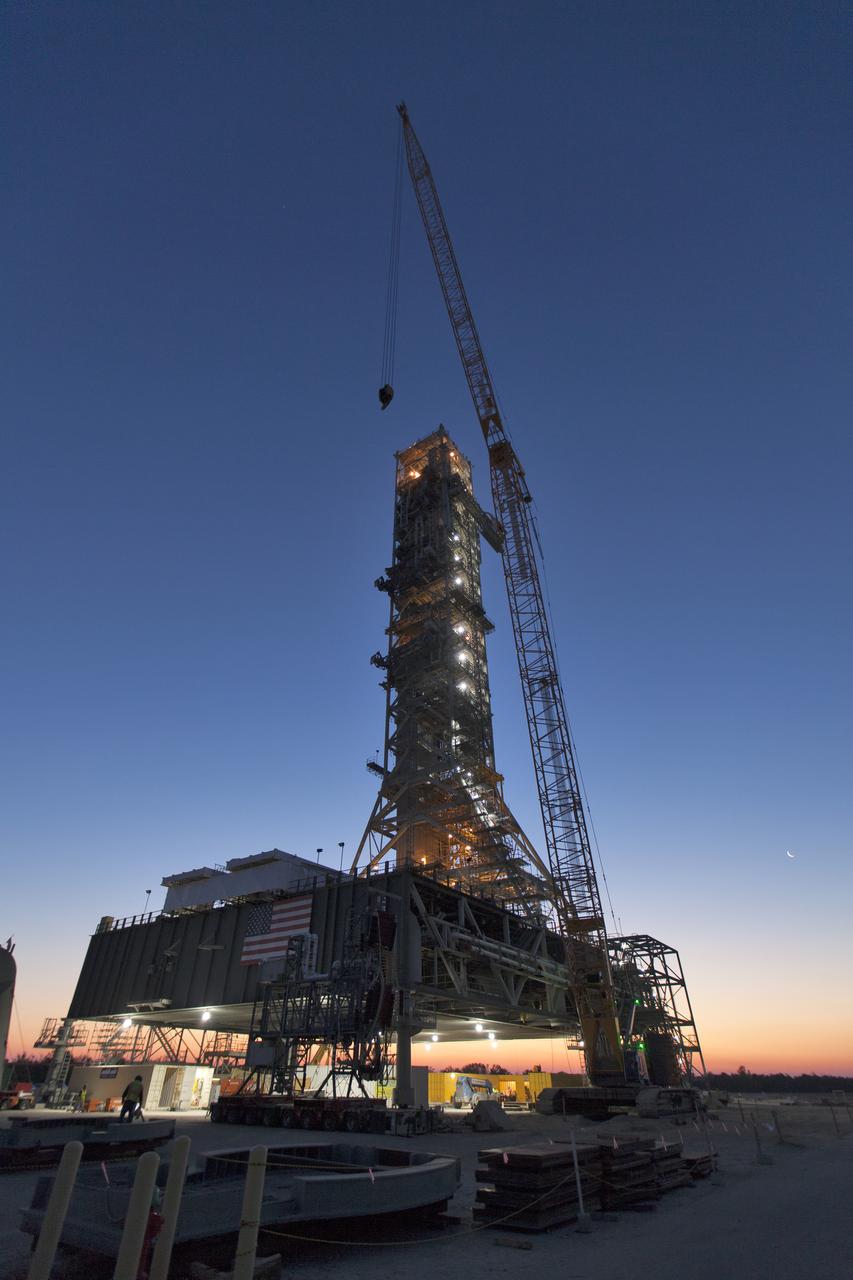
A colorful sunrise serves as the backdrop for the mobile launcher (ML) at NASA's Kennedy Space Center in Florida. Several launch umbilicals have been installed on the ML tower. Exploration Ground Systems is overseeing installation of umbilicals and launch accessories on the ML to prepare for the first integrated test flight of the Orion spacecraft on the agency's Space Launch System rocket on Exploration Mission-1.

A sliver of the Moon is visible just before sunrise at NASA's Kennedy Space Center in Florida. In view is one of the steel structures of the mobile launcher (ML). Several launch umbilicals have been installed on the ML tower. Exploration Ground Systems is overseeing installation of umbilicals and launch accessories on the ML to prepare for the first integrated test flight of the Orion spacecraft on the agency's Space Launch System rocket on Exploration Mission-1.
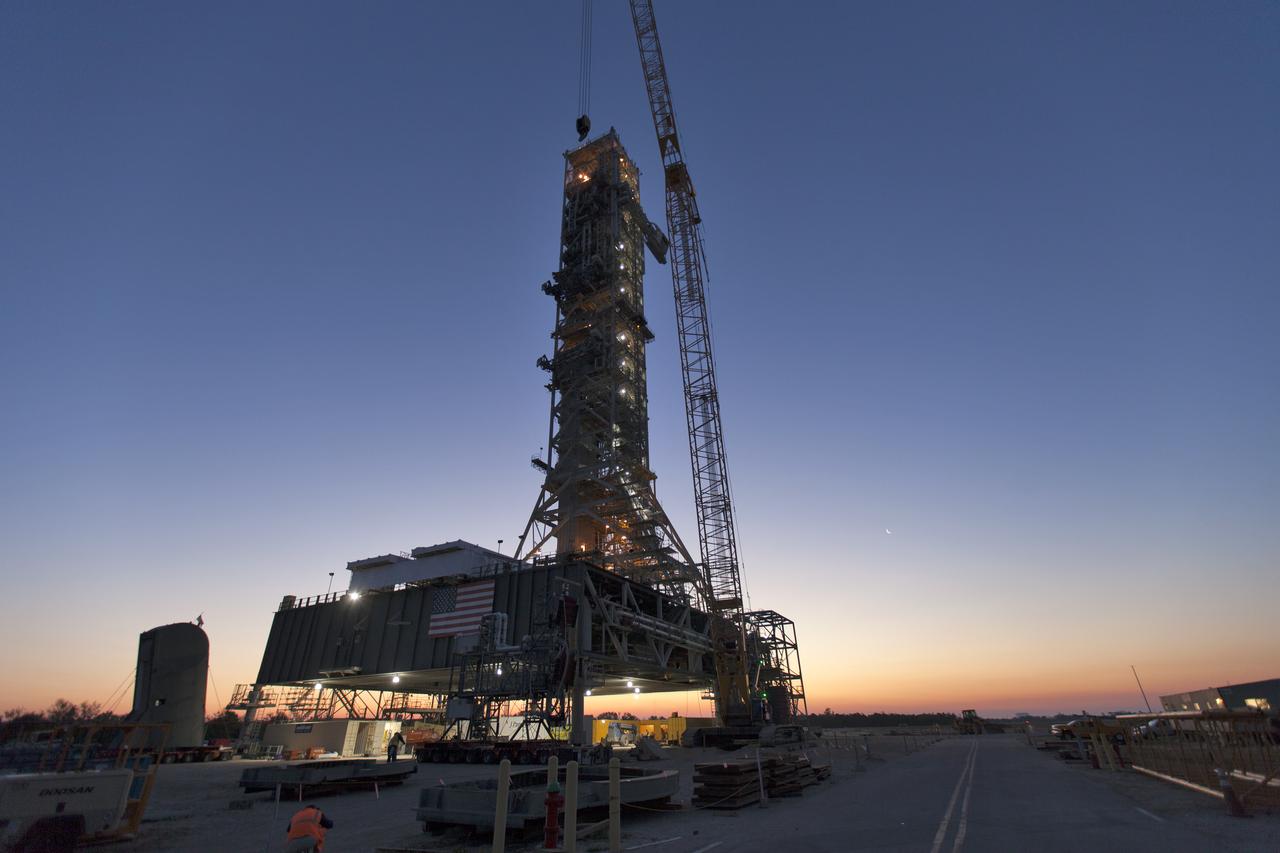
A colorful sunrise serves as the backdrop for the mobile launcher (ML) at NASA's Kennedy Space Center in Florida. Several launch umbilicals have been installed on the ML tower. Exploration Ground Systems is overseeing installation of umbilicals and launch accessories on the ML to prepare for the first integrated test flight of the Orion spacecraft on the agency's Space Launch System rocket on Exploration Mission-1.
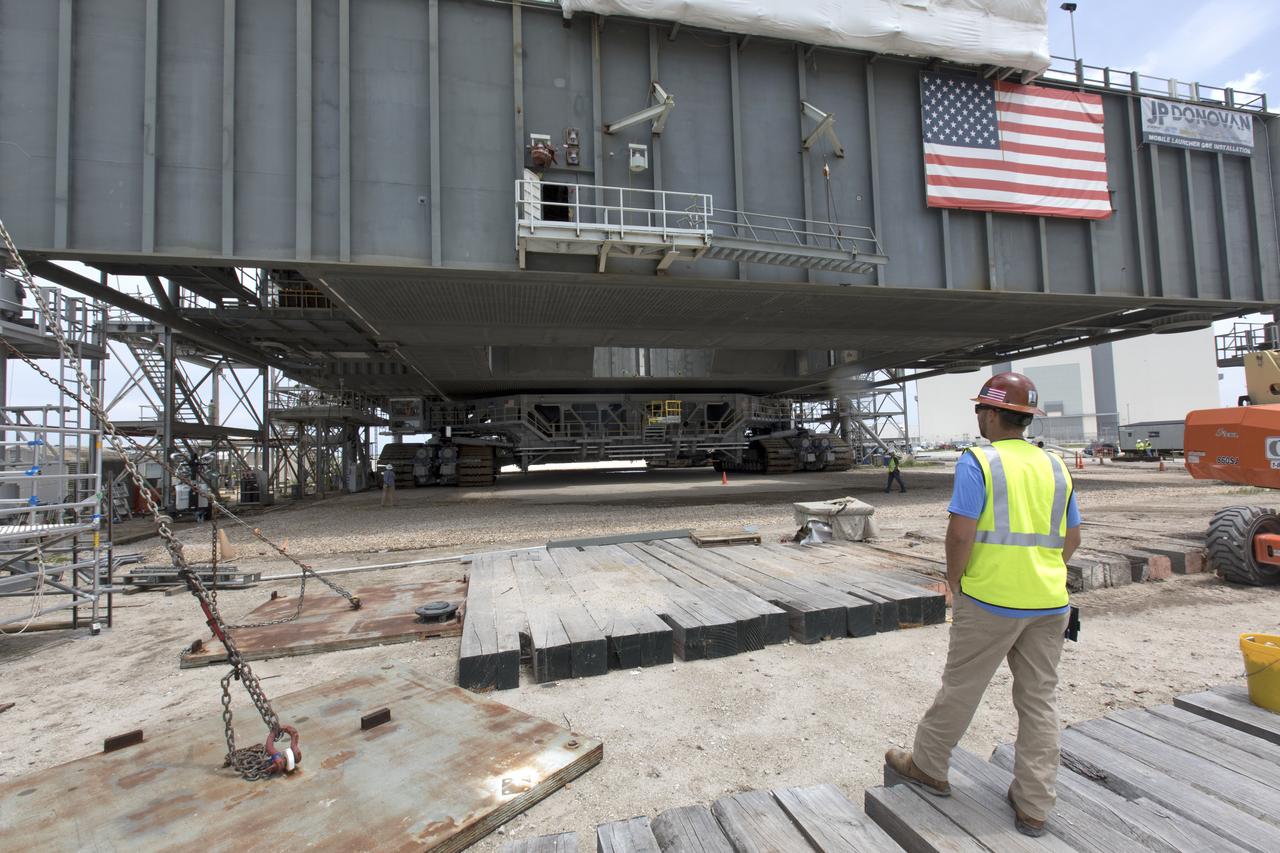
Crawler-transporter 2 (CT-2) is underneath the mobile launcher May 31, 2018, at NASA's Kennedy Space Center in Florida. Three lifts were performed to practice lifting procedures, validate interface locations, confirm the weight of the mobile launcher, and develop a baseline for modal analysis. The mobile launcher is equipped with a number of lines, called umbilicals, which will connect to NASA's Space Launch System (SLS) and Orion. CT-2 has been upgraded to handle the weight of the mobile launcher with SLS and Orion atop. Exploration Ground Systems is preparing the ground systems necessary to support the SLS and Orion spacecraft for Exploration Mission-1 and deep space missions.
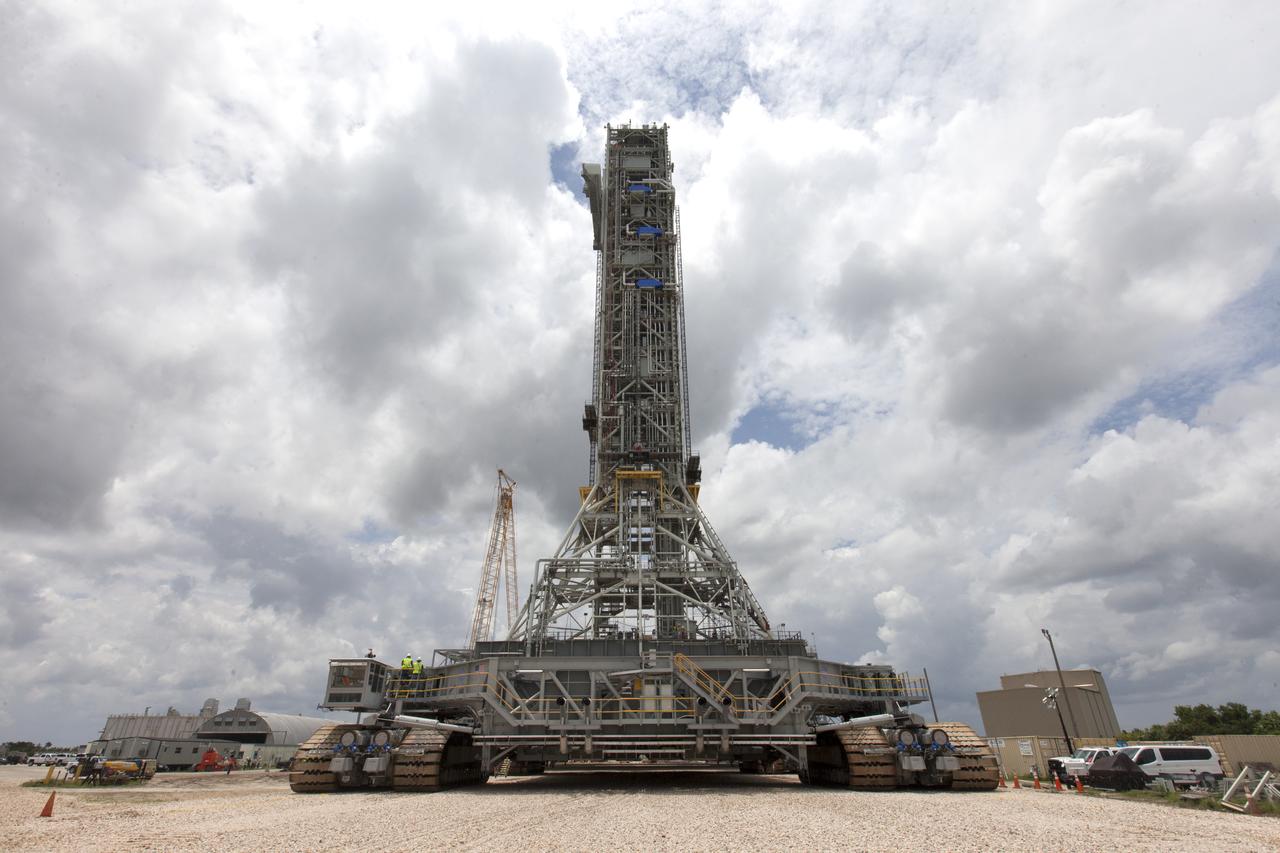
Preparations are underway May 31, 2018, to move crawler-transporter 2 (CT-2) under the mobile launcher at NASA's Kennedy Space Center in Florida. Three lifts will be performed to practice lifting procedures, validate interface locations, confirm the weight of the mobile launcher, and develop a baseline for modal analysis. The mobile launcher is equipped with a number of lines, called umbilicals, which will connect to NASA's Space Launch System (SLS) and Orion. CT-2 has been upgraded to handle the weight of the mobile launcher with SLS and Orion atop. Exploration Ground Systems is preparing the ground systems necessary to support the SLS and Orion spacecraft for Exploration Mission-1 and deep space missions.
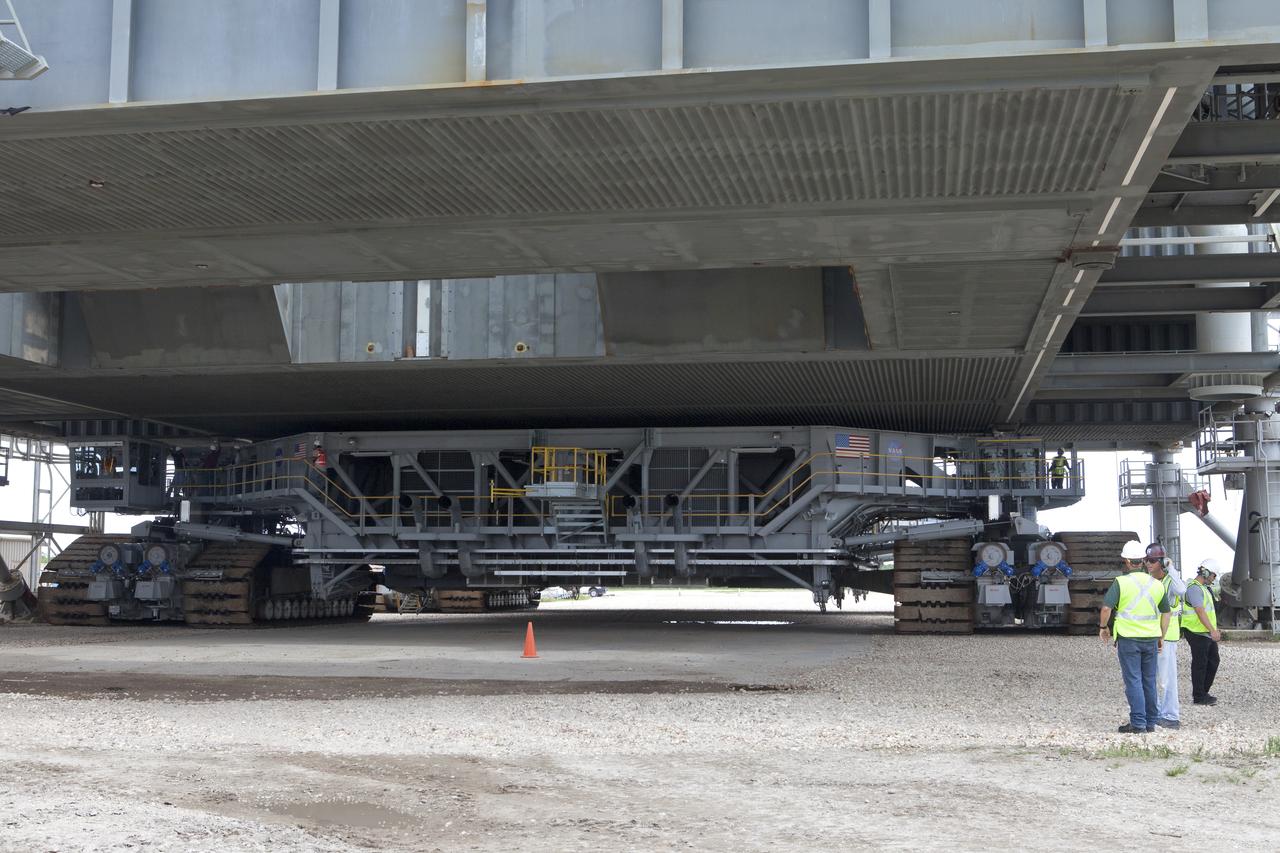
Crawler-transporter 2 (CT-2) is moved under the mobile launcher May 31, 2018, at NASA's Kennedy Space Center in Florida. Three lifts will be performed to practice lifting procedures, validate interface locations, confirm the weight of the mobile launcher, and develop a baseline for modal analysis. The mobile launcher is equipped with a number of lines, called umbilicals, which will connect to NASA's Space Launch System (SLS) and Orion. CT-2 has been upgraded to handle the weight of the mobile launcher with SLS and Orion atop. Exploration Ground Systems is preparing the ground systems necessary to support the SLS and Orion spacecraft for Exploration Mission-1 and deep space missions.
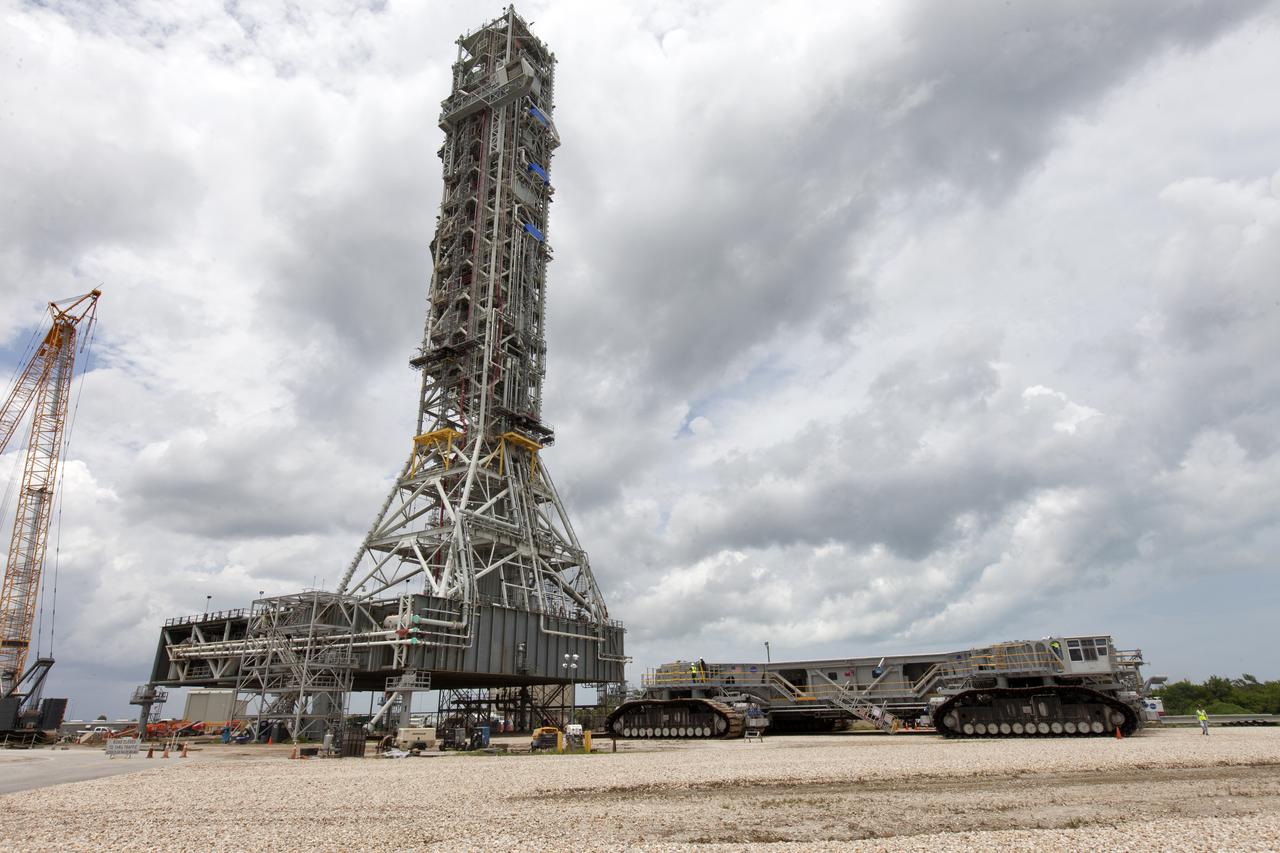
Preparations are underway May 31, 2018, to move crawler-transporter 2 (CT-2) under the mobile launcher at NASA's Kennedy Space Center in Florida. Three lifts will be performed to practice lifting procedures, validate interface locations, confirm the weight of the mobile launcher, and develop a baseline for modal analysis. The mobile launcher is equipped with a number of lines, called umbilicals, which will connect to NASA's Space Launch System (SLS) and Orion. CT-2 has been upgraded to handle the weight of the mobile launcher with SLS and Orion atop. Exploration Ground Systems is preparing the ground systems necessary to support the SLS and Orion spacecraft for Exploration Mission-1 and deep space missions.
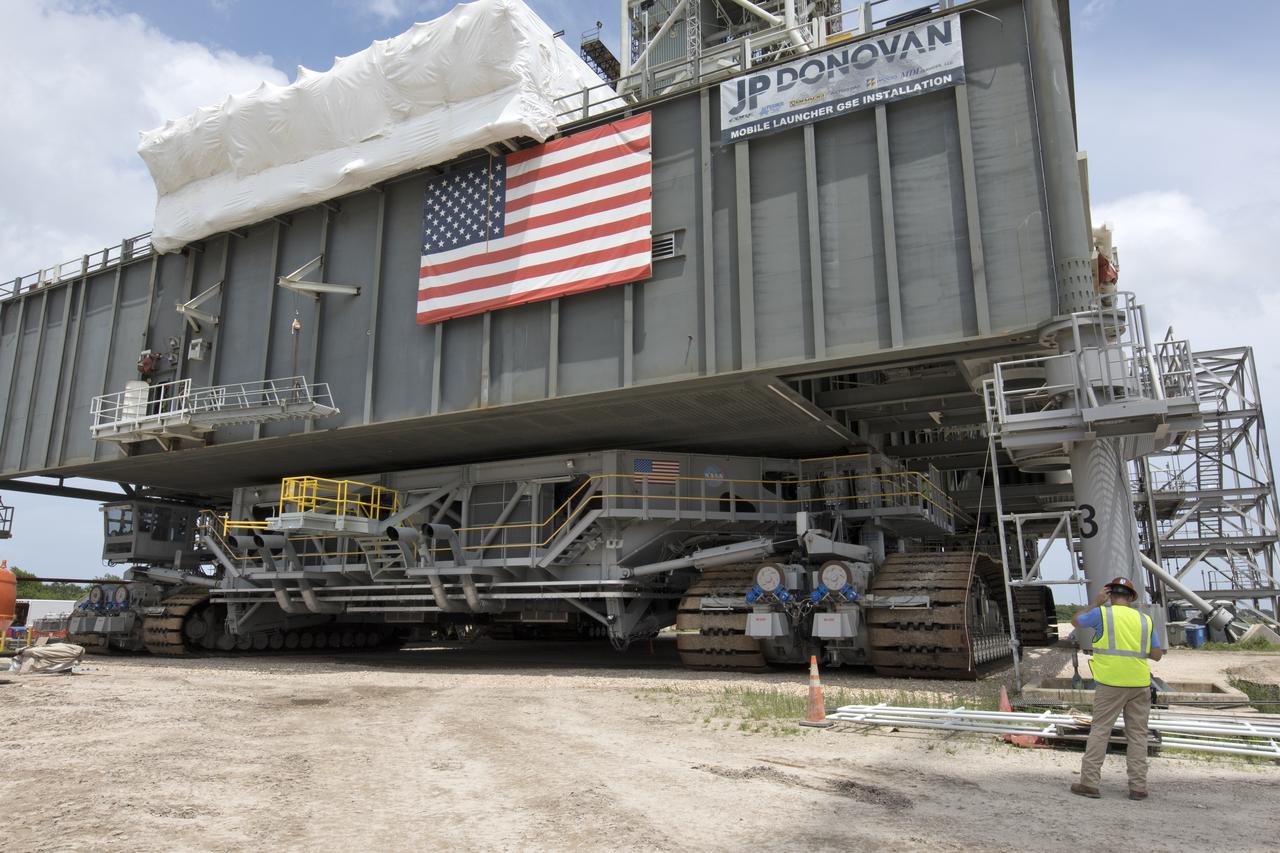
Crawler-transporter 2 (CT-2) is underneath the mobile launcher May 31, 2018, at NASA's Kennedy Space Center in Florida. Three lifts will be performed to practice lifting procedures, validate interface locations, confirm the weight of the mobile launcher, and develop a baseline for modal analysis. The mobile launcher is equipped with a number of lines, called umbilicals, which will connect to NASA's Space Launch System (SLS) and Orion. CT-2 has been upgraded to handle the weight of the mobile launcher with SLS and Orion atop. Exploration Ground Systems is preparing the ground systems necessary to support the SLS and Orion spacecraft for Exploration Mission-1 and deep space missions.

Crawler-transporter 2 (CT-2) is being moved under the mobile launcher May 31, 2018, at NASA's Kennedy Space Center in Florida. Three lifts will be performed to practice lifting procedures, validate interface locations, confirm the weight of the mobile launcher, and develop a baseline for modal analysis. The mobile launcher is equipped with a number of lines, called umbilicals, which will connect to NASA's Space Launch System (SLS) and Orion. CT-2 has been upgraded to handle the weight of the mobile launcher with SLS and Orion atop. Exploration Ground Systems is preparing the ground systems necessary to support the SLS and Orion spacecraft for Exploration Mission-1 and deep space missions.
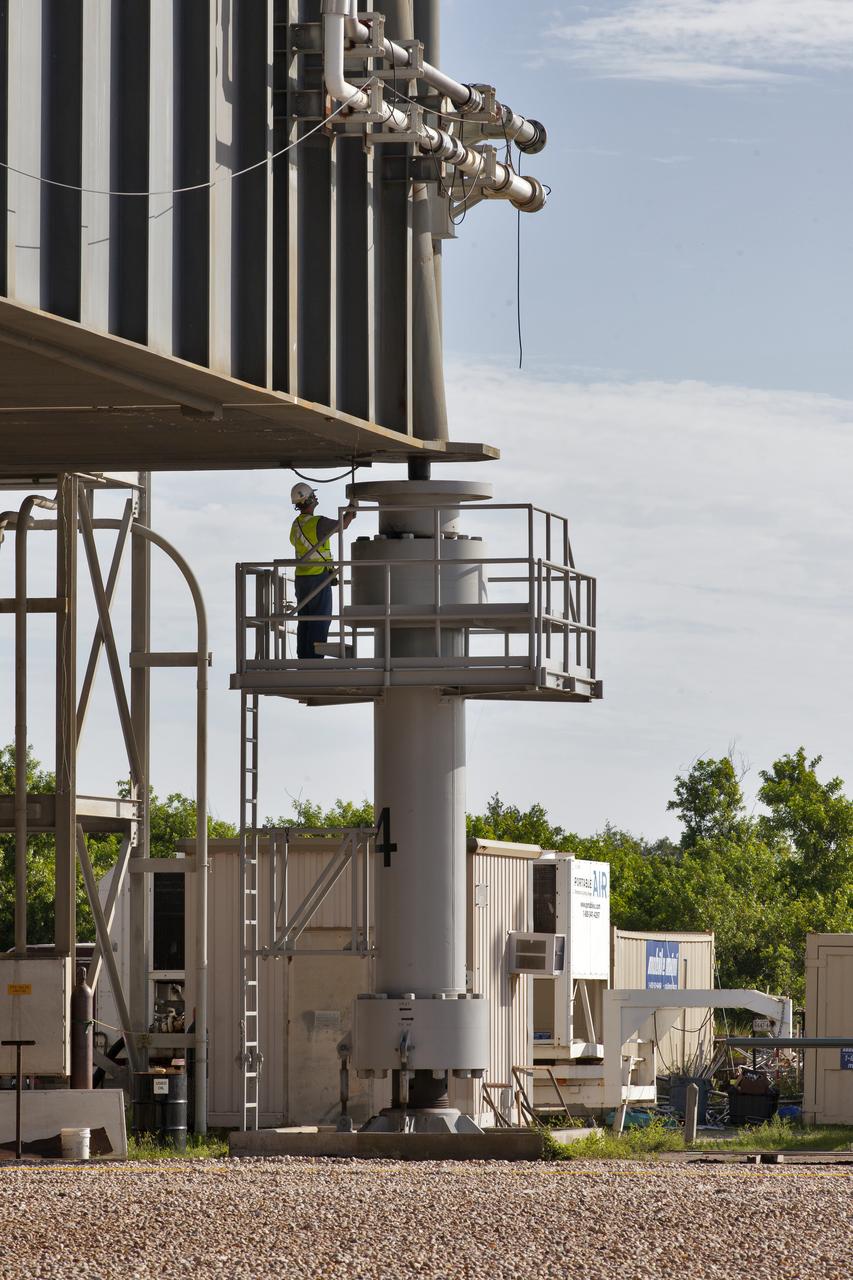
A construction worker monitors the progress as crawler-transporter 2 (CT-2) lifts the mobile launcher up a few inches from its support posts June 1, 2018, at NASA's Kennedy Space Center in Florida. Three lifts were performed to practice lifting procedures, validate interface locations, confirm the weight of the mobile launcher, and develop a baseline for modal analysis. The mobile launcher is equipped with a number of lines, called umbilicals, which will connect to NASA's Space Launch System (SLS) and Orion. The lift helped to test the capability of the upgraded CT-2 to handle the weight of the mobile launcher with SLS and Orion atop. Exploration Ground Systems is preparing the ground systems necessary to support the SLS and Orion spacecraft for Exploration Mission-1 and deep space missions.
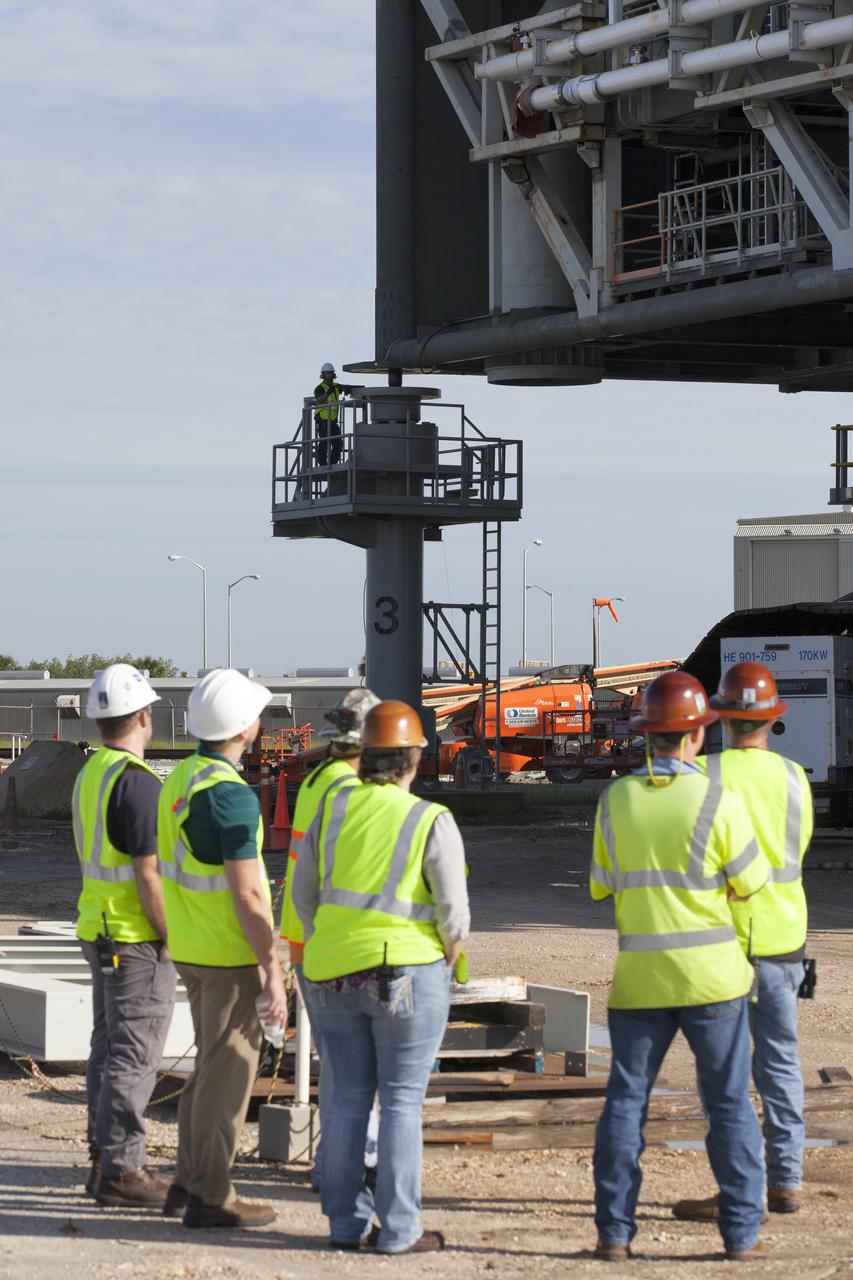
Workers watch as crawler-transporter 2 (CT-2) lifts the mobile launcher up a few inches from its support posts June 1, 2018, at NASA's Kennedy Space Center in Florida. Three lifts were performed to practice lifting procedures, validate interface locations, confirm the weight of the mobile launcher, and develop a baseline for modal analysis. The mobile launcher is equipped with a number of lines, called umbilicals, which will connect to NASA's Space Launch System (SLS) and Orion. The lift helped to test the capability of the upgraded CT-2 to handle the weight of the mobile launcher. Exploration Ground Systems is preparing the ground systems necessary to the SLS and Orion spacecraft for Exploration Mission-1 and deep space missions.
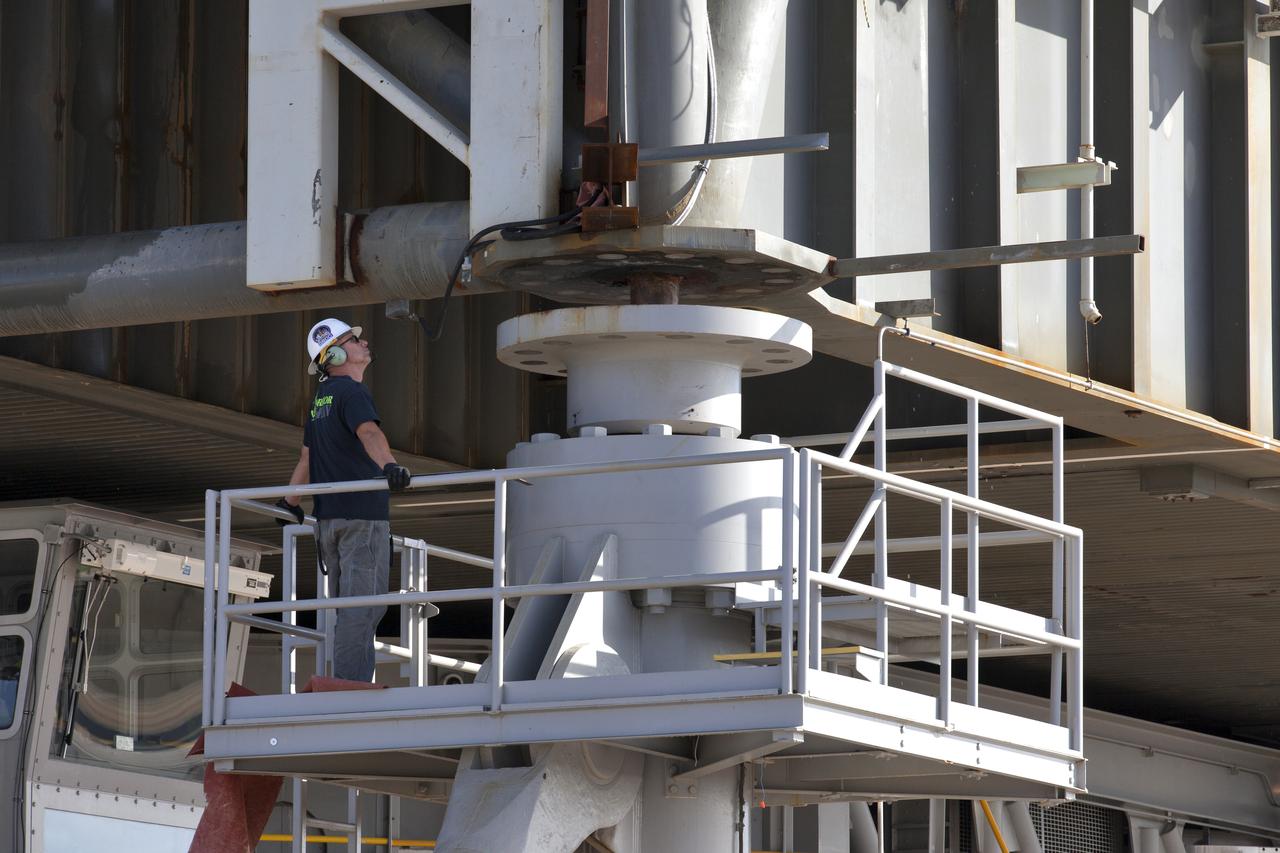
A construction worker monitors the progress as crawler-transporter 2 (CT-2) lifts the mobile launcher up a few inches from its support posts June 1, 2018, at NASA's Kennedy Space Center in Florida. Three lifts were performed to practice lifting procedures, validate interface locations, confirm the weight of the mobile launcher, and develop a baseline for modal analysis. The mobile launcher is equipped with a number of lines, called umbilicals, which will connect to NASA's Space Launch System (SLS) and Orion. The lift helped to test the capability of the upgraded CT-2 to handle the weight of the mobile launcher. Exploration Ground Systems is preparing the ground systems necessary to support the SLS and Orion spacecraft for Exploration Mission-1 and deep space missions.
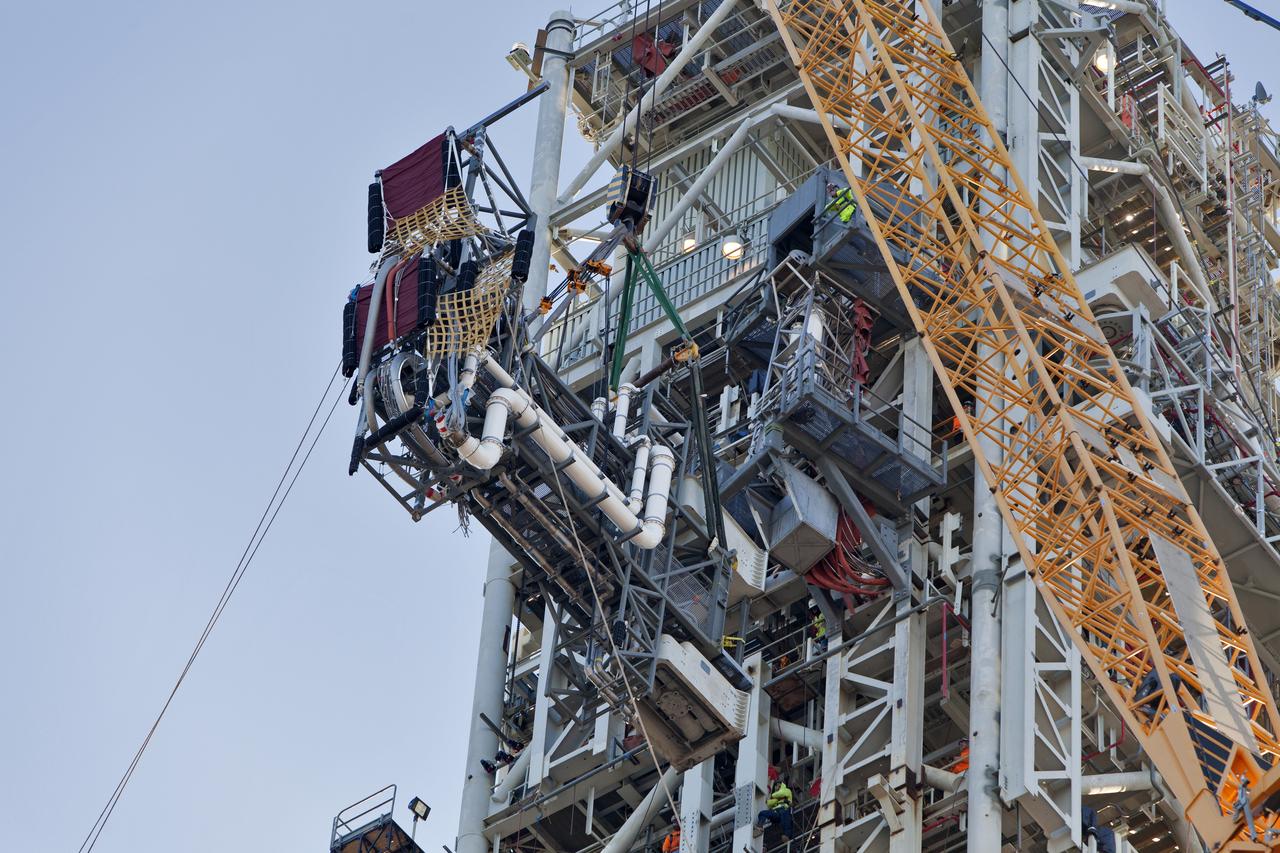
A crane and rigging lines are used to install the Interim Cryogenic Propulsion Stage Umbilical (ICPSU) high up on the mobile launcher (ML) at NASA's Kennedy Space Center in Florida. The last of the large umbilicals to be installed, the ICPSU will provide super-cooled hydrogen and liquid oxygen to the Space Launch System (SLS) rocket's interim cryogenic propulsion stage, or upper stage, at T-0 for Exploration Mission-1. The umbilical is located at about the 240-foot-level of the mobile launcher and will supply fuel, oxidizer, gaseous helium, hazardous gas leak detection, electrical commodities and environment control systems to the upper stage of the SLS rocket during launch. Exploration Ground Systems is overseeing installation of the umbilicals on the ML.

A crane and rigging lines are used to install the Interim Cryogenic Propulsion Stage Umbilical (ICPSU) high up on the mobile launcher (ML) at NASA's Kennedy Space Center in Florida. The last of the large umbilicals to be installed, the ICPSU will provide super-cooled hydrogen and liquid oxygen to the Space Launch System (SLS) rocket's interim cryogenic propulsion stage, or upper stage, at T-0 for Exploration Mission-1. The umbilical is located at about the 240-foot-level of the mobile launcher and will supply fuel, oxidizer, gaseous helium, hazardous gas leak detection, electrical commodities and environment control systems to the upper stage of the SLS rocket during launch. Exploration Ground Systems is overseeing installation of the umbilicals on the ML.
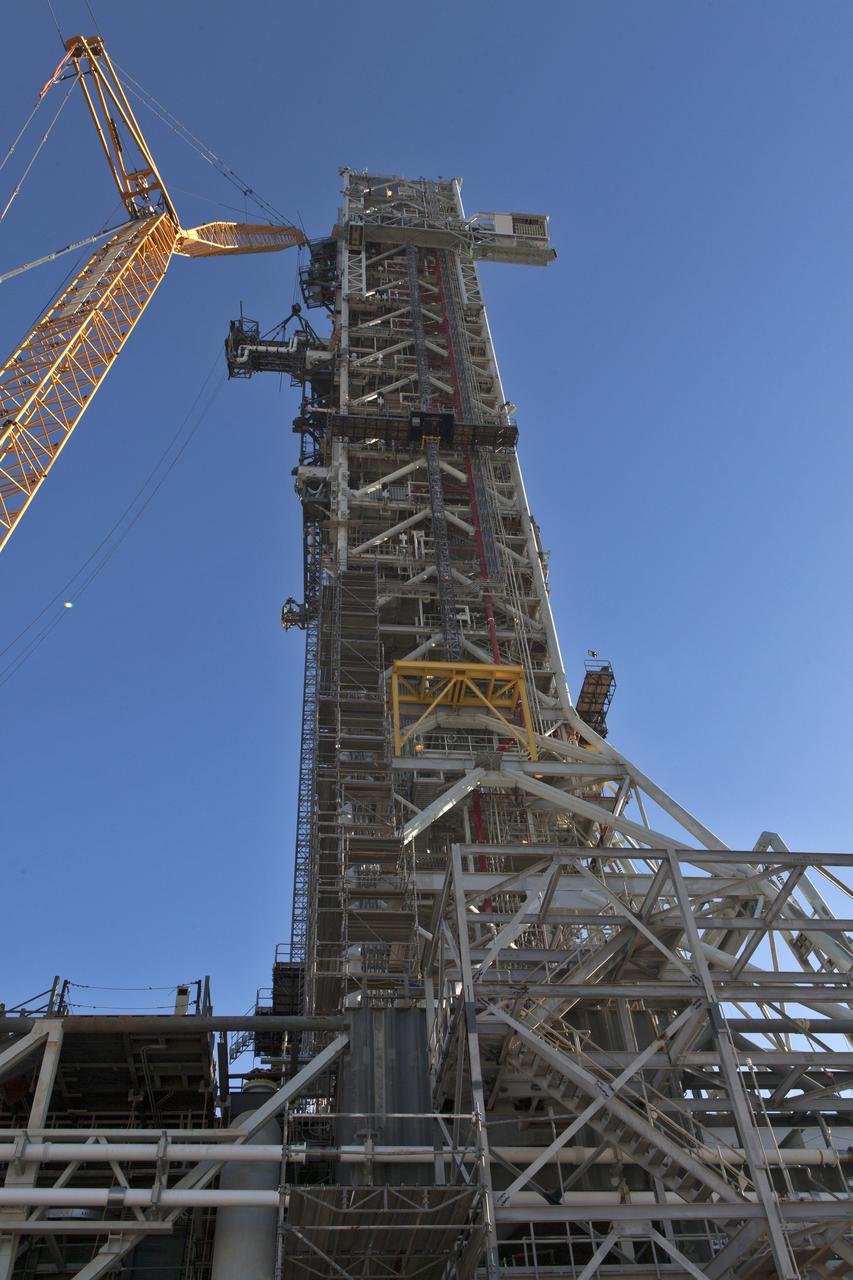
A crane and rigging lines are used to install the Interim Cryogenic Propulsion Stage Umbilical (ICPSU) high up on the mobile launcher (ML) at NASA's Kennedy Space Center in Florida. The last of the large umbilicals to be installed, the ICPSU will provide super-cooled hydrogen and liquid oxygen to the Space Launch System (SLS) rocket's interim cryogenic propulsion stage, or upper stage, at T-0 for Exploration Mission-1. The umbilical is located at about the 240-foot-level of the mobile launcher and will supply fuel, oxidizer, gaseous helium, hazardous gas leak detection, electrical commodities and environment control systems to the upper stage of the SLS rocket during launch. Exploration Ground Systems is overseeing installation of the umbilicals on the ML.
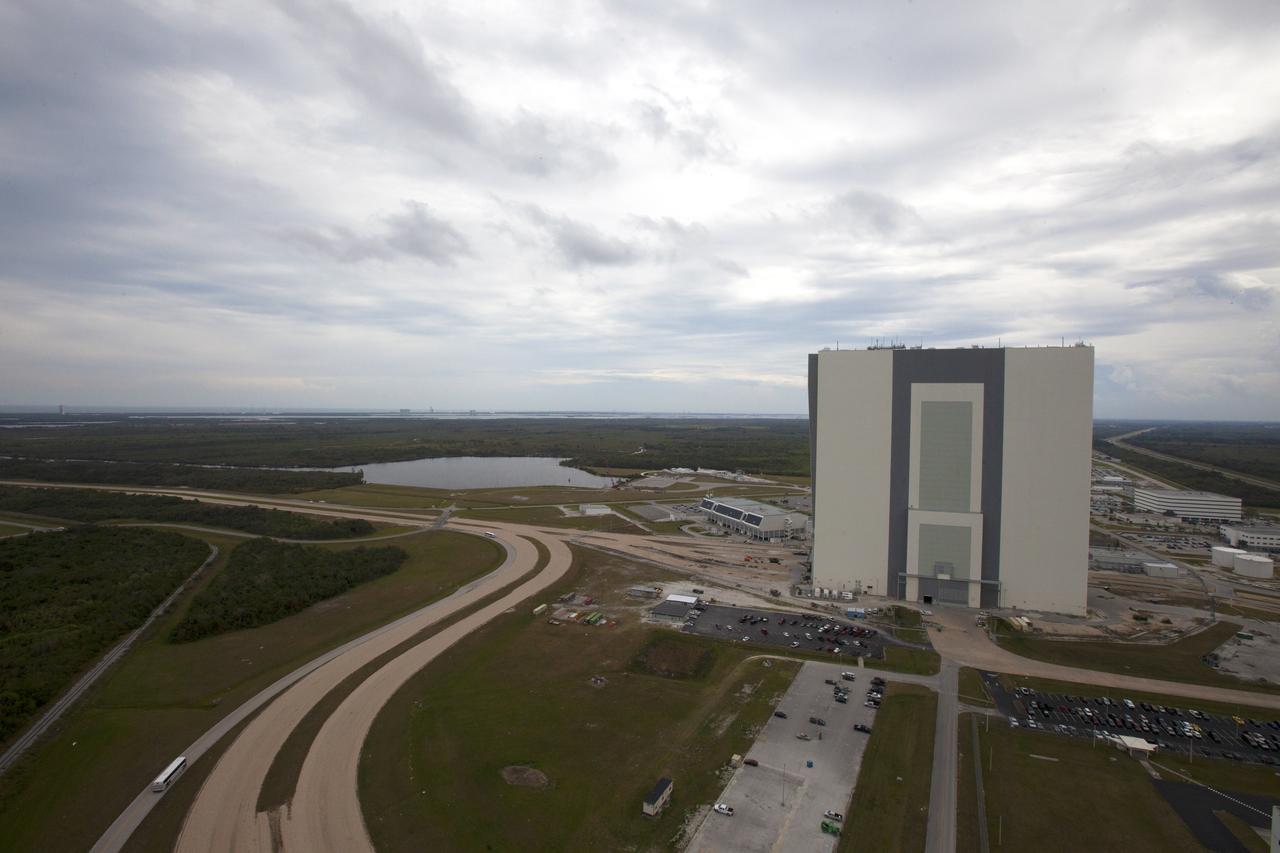
A view of the north side of the Vehicle Assembly Building (VAB) from the top of the mobile launcher tower at NASA's Kennedy Space Center in Florida. Inside the VAB, 10 levels of platforms, 20 platform halves altogether, have been installed in High Bay 3. The platforms will surround NASA's Space Launch System (SLS) rocket and the Orion spacecraft and allow access during processing for missions, including the first uncrewed flight test of Orion atop the SLS rocket in 2018. Crawler-transporter 2 will carry the rocket and spacecraft atop the mobile launcher to Launch Pad 39B for Exploration Mission 1. The Ground Systems Development and Operations Program, with support from the center's Engineering Directorate, is overseeing upgrades and modifications to the VAB and the mobile launcher.
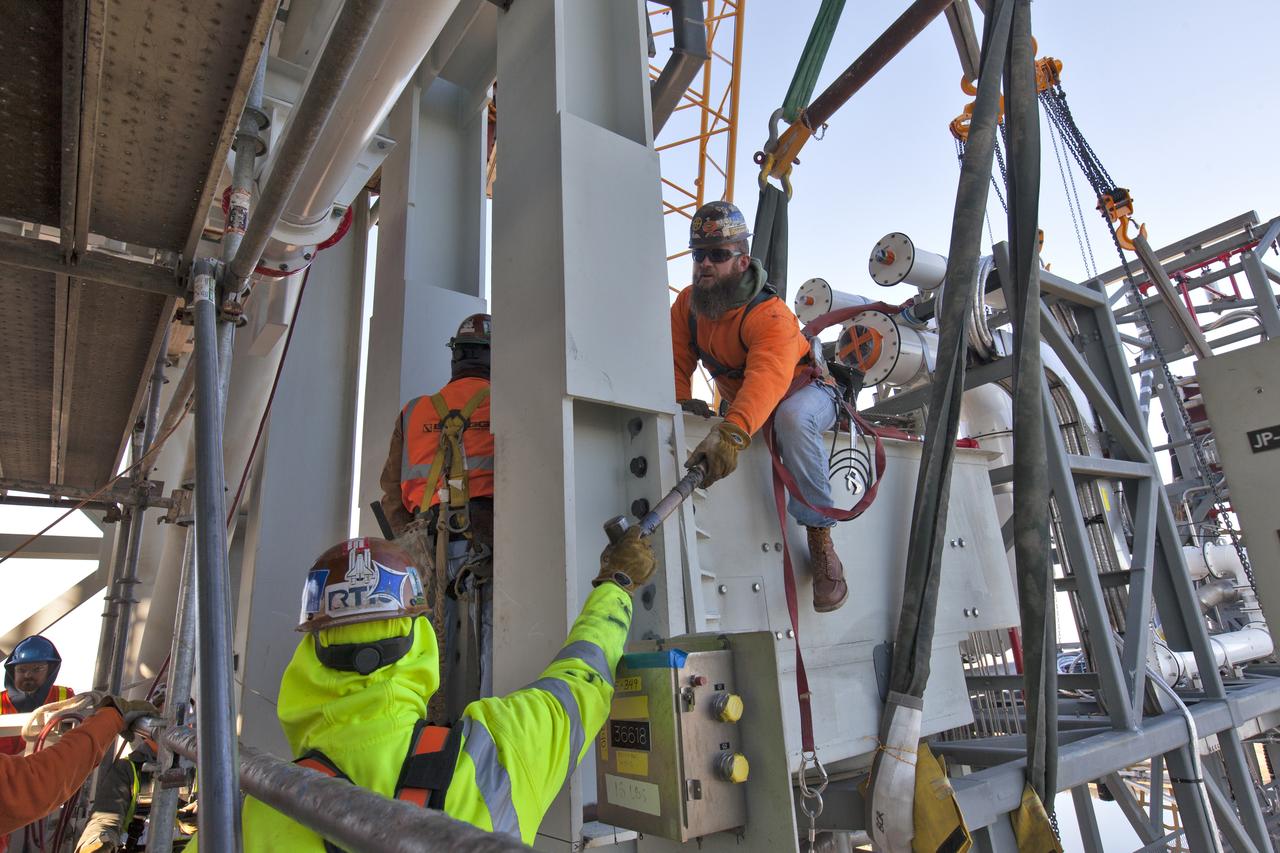
Construction workers with JP Donovan install the Interim Cryogenic Propulsion Stage Umbilical (ICPSU) at about the 240-foot-level of the mobile launcher (ML) tower at NASA's Kennedy Space Center in Florida. The last of the large umbilicals to be installed, the ICPSU will provide super-cooled hydrogen and liquid oxygen to the Space Launch System (SLS) rocket's interim cryogenic propulsion stage, or upper stage, at T-0 for Exploration Mission-1. The umbilical is located at about the 240-foot-level of the mobile launcher and will supply fuel, oxidizer, gaseous helium, hazardous gas leak detection, electrical commodities and environment control systems to the upper stage of the SLS rocket during launch. Exploration Ground Systems is overseeing installation of the umbilicals on the ML.
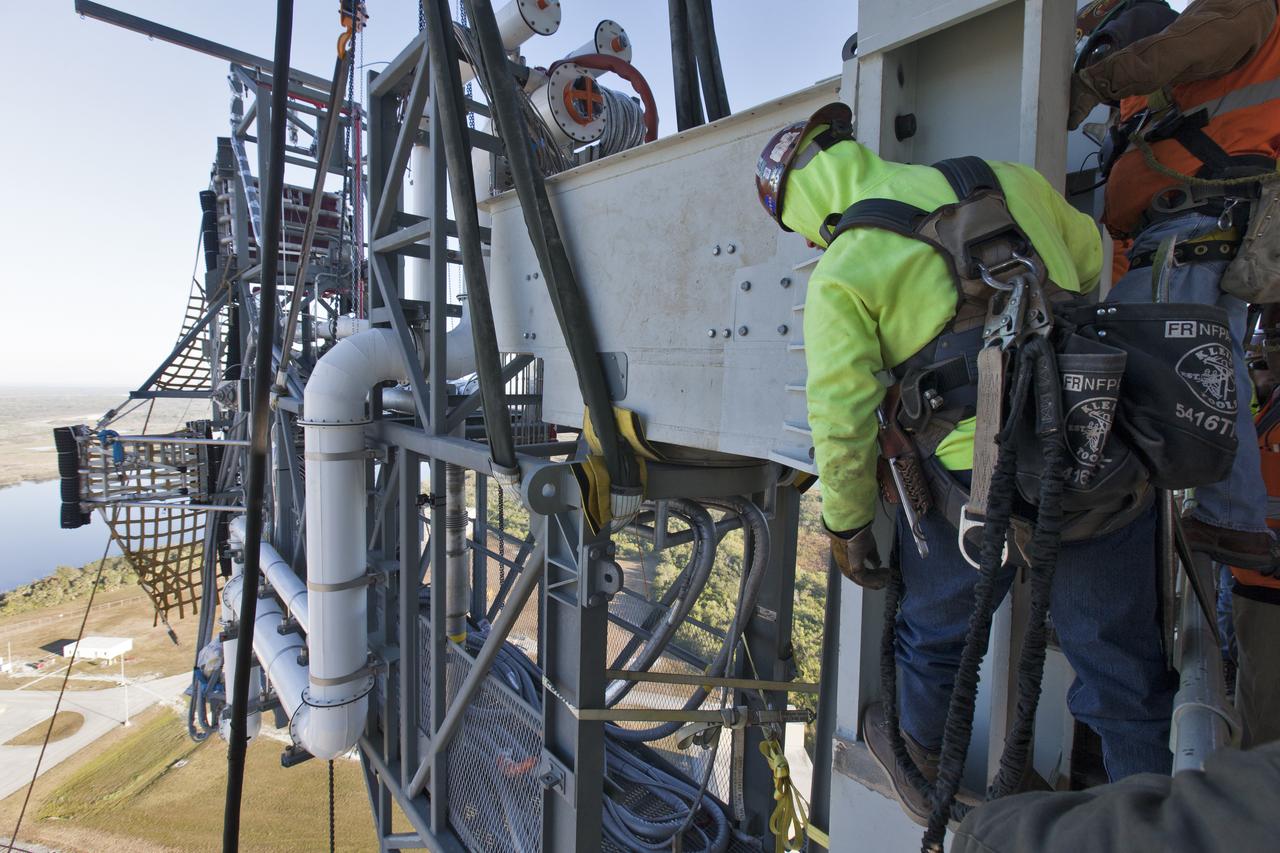
Construction workers with JP Donovan install the Interim Cryogenic Propulsion Stage Umbilical (ICPSU) at about the 240-foot-level of the mobile launcher (ML) tower at NASA's Kennedy Space Center in Florida. The last of the large umbilicals to be installed, the ICPSU will provide super-cooled hydrogen and liquid oxygen to the Space Launch System (SLS) rocket's interim cryogenic propulsion stage, or upper stage, at T-0 for Exploration Mission-1. The umbilical is located at about the 240-foot-level of the mobile launcher and will supply fuel, oxidizer, gaseous helium, hazardous gas leak detection, electrical commodities and environment control systems to the upper stage of the SLS rocket during launch. Exploration Ground Systems is overseeing installation of the umbilicals on the ML.
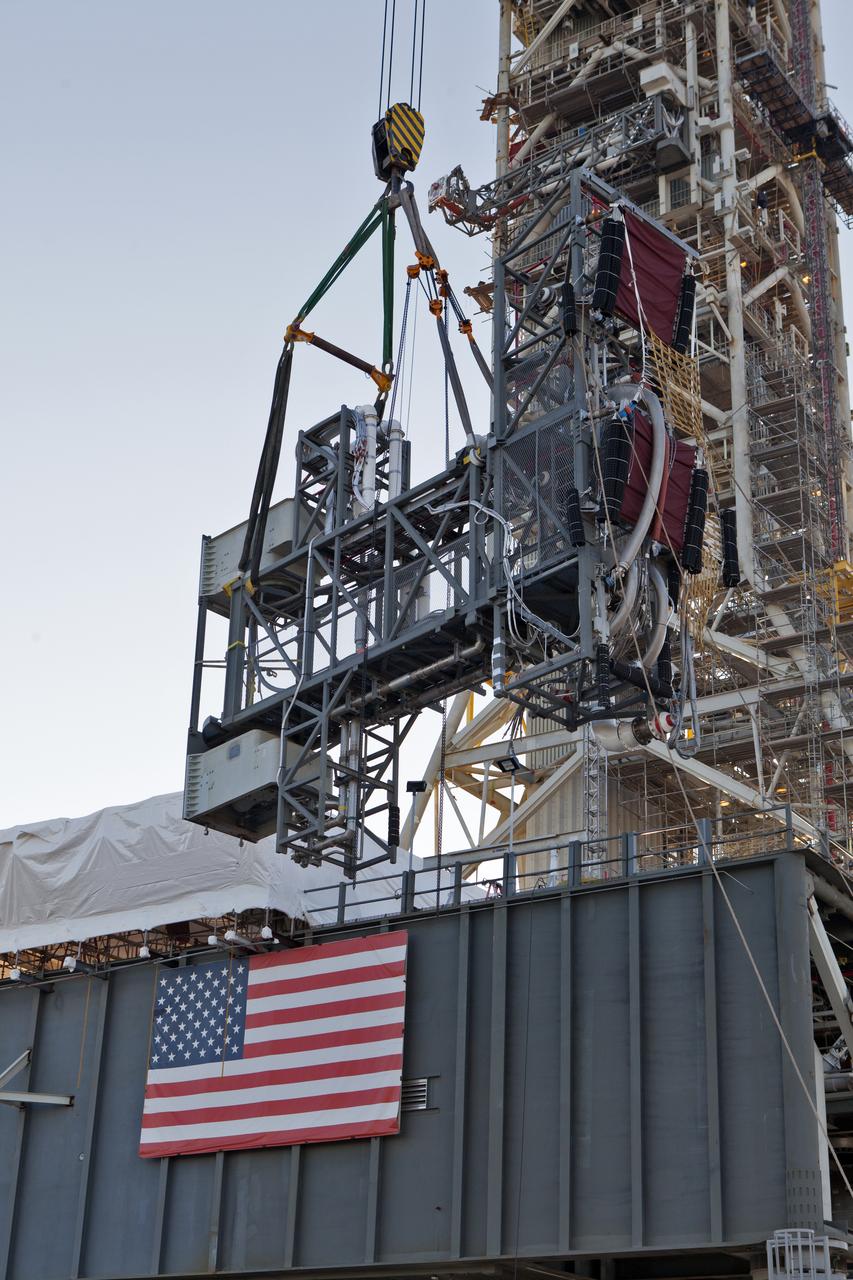
A heavy-lift crane slowly lifts the Interim Cryogenic Propulsion Stage Umbilical (ICPSU) up for installation on the tower of the mobile launcher (ML) at NASA's Kennedy Space Center in Florida. The last of the large umbilicals to be installed, the ICPSU will provide super-cooled hydrogen and liquid oxygen to the Space Launch System (SLS) rocket's interim cryogenic propulsion stage, or upper stage, at T-0 for Exploration Mission-1. The umbilical is located at about the 240-foot-level of the mobile launcher and will supply fuel, oxidizer, gaseous helium, hazardous gas leak detection, electrical commodities and environment control systems to the upper stage of the SLS rocket during launch. Exploration Ground Systems is overseeing installation of the umbilicals on the ML.
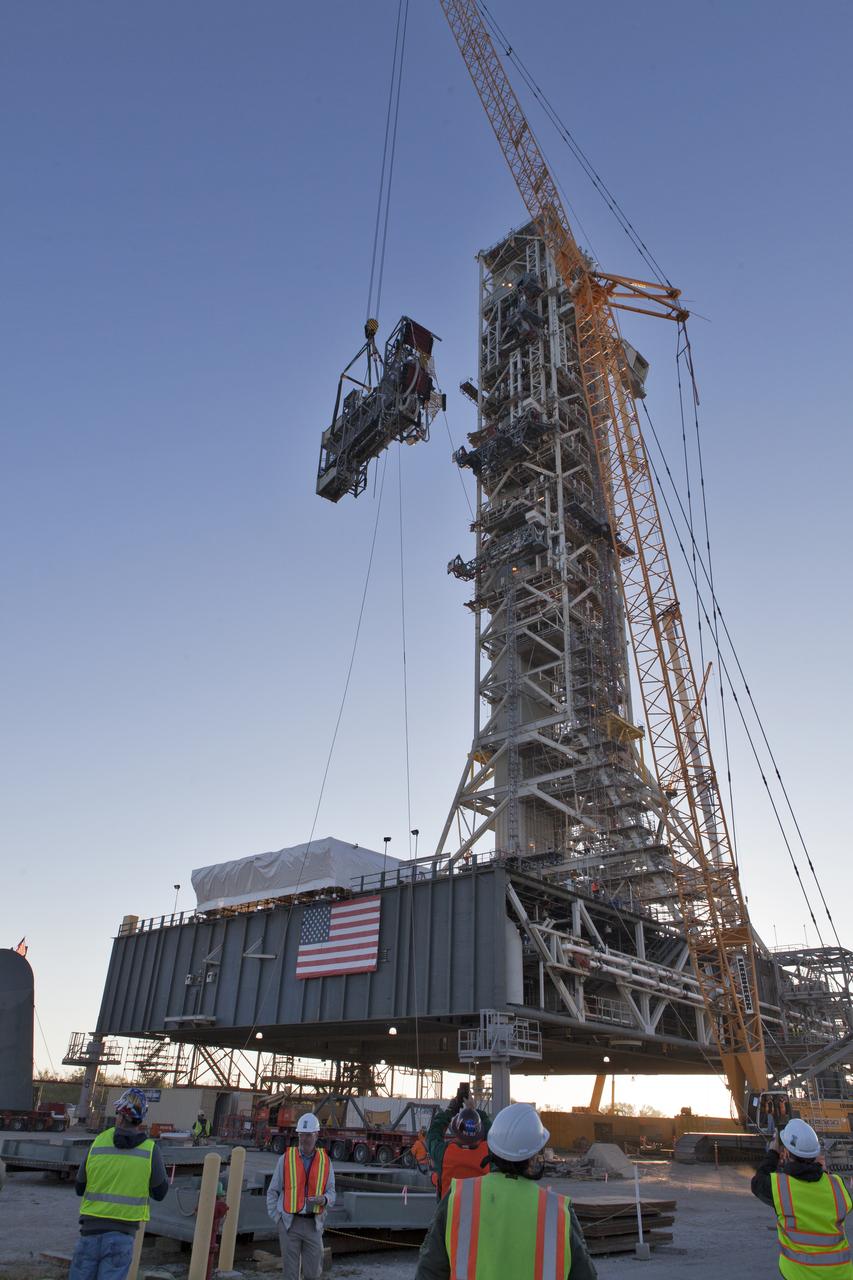
A heavy-lift crane slowly lifts the Interim Cryogenic Propulsion Stage Umbilical (ICPSU) high up for installation on the tower of the mobile launcher (ML) at NASA's Kennedy Space Center in Florida. The last of the large umbilicals to be installed, the ICPSU will provide super-cooled hydrogen and liquid oxygen to the Space Launch System (SLS) rocket's interim cryogenic propulsion stage, or upper stage, at T-0 for Exploration Mission-1. The umbilical is located at about the 240-foot-level of the mobile launcher and will supply fuel, oxidizer, gaseous helium, hazardous gas leak detection, electrical commodities and environment control systems to the upper stage of the SLS rocket during launch. Exploration Ground Systems is overseeing installation of the umbilicals on the ML.

The mobile launcher (ML) is reflected in the sunglasses of a construction worker with JP Donovan at NASA's Kennedy Space Center in Florida. A crane is lifting the Interim Cryogenic Propulsion Stage Umbilical (ICPSU) up for installation on the tower of the ML. The last of the large umbilicals to be installed, the ICPSU will provide super-cooled hydrogen and liquid oxygen to the Space Launch System (SLS) rocket's interim cryogenic propulsion stage, or upper stage, at T-0 for Exploration Mission-1. The umbilical is located at about the 240-foot-level of the mobile launcher and will supply fuel, oxidizer, gaseous helium, hazardous gas leak detection, electrical commodities and environment control systems to the upper stage of the SLS rocket during launch. Exploration Ground Systems is overseeing installation of the umbilicals on the ML.
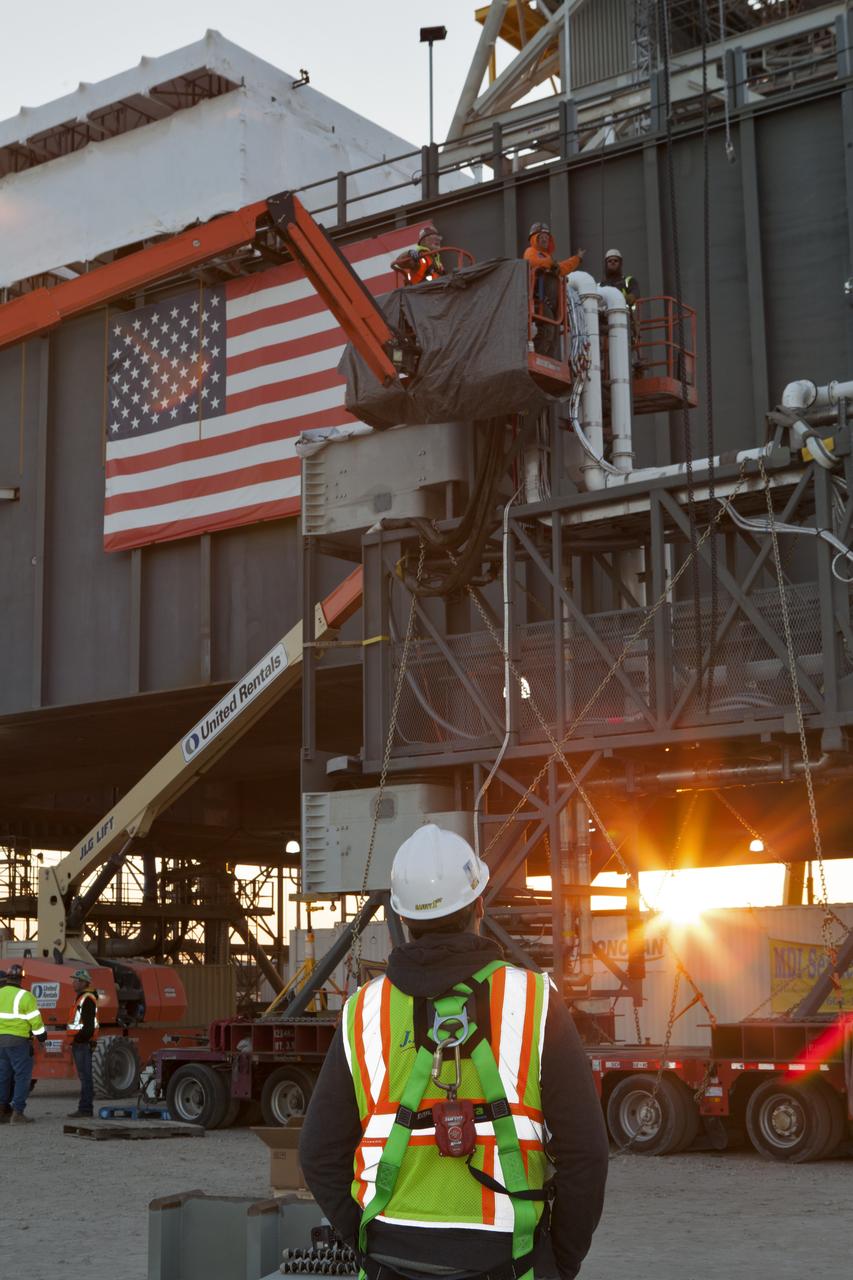
Construction workers with JP Donovan assist with preparations to lift and install the Interim Cryogenic Propulsion Stage Umbilical on the tower of the mobile launcher at NASA's Kennedy Space Center in Florida. The last of the large umbilicals to be installed, the ICPSU will provide super-cooled hydrogen and liquid oxygen to the Space Launch System (SLS) rocket's interim cryogenic propulsion stage, or upper stage, at T-0 for Exploration Mission-1. The umbilical is located at about the 240-foot-level of the mobile launcher and will supply fuel, oxidizer, gaseous helium, hazardous gas leak detection, electrical commodities and environment control systems to the upper stage of the SLS rocket during launch. Exploration Ground Systems is overseeing installation of the umbilicals on the ML.
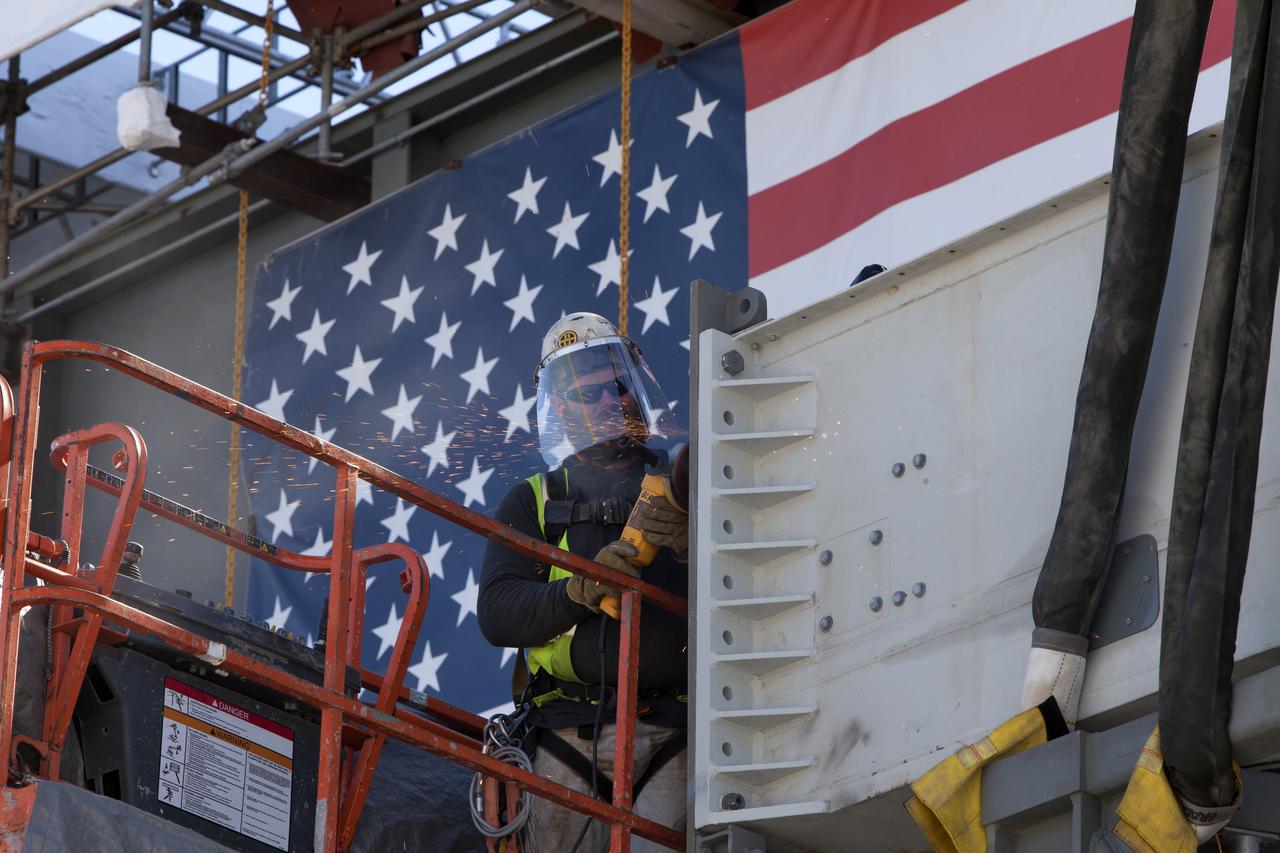
A construction worker with JP Donovan helps prepare the Interim Cryogenic Propulsion Stage Umbilical (ICPSU) for installation high up on the tower of the mobile launcher (ML) at NASA's Kennedy Space Center in Florida. The last of the large umbilicals to be installed, the ICPSU will provide super-cooled hydrogen and liquid oxygen to the Space Launch System (SLS) rocket's interim cryogenic propulsion stage, or upper stage, at T-0 for Exploration Mission-1. The umbilical will be located at about the 240-foot-level of the mobile launcher and will supply fuel, oxidizer, gaseous helium, hazardous gas leak detection, electrical commodities and environment control systems to the upper stage of the SLS rocket during launch. Exploration Ground Systems is overseeing installation of the umbilicals on the ML.
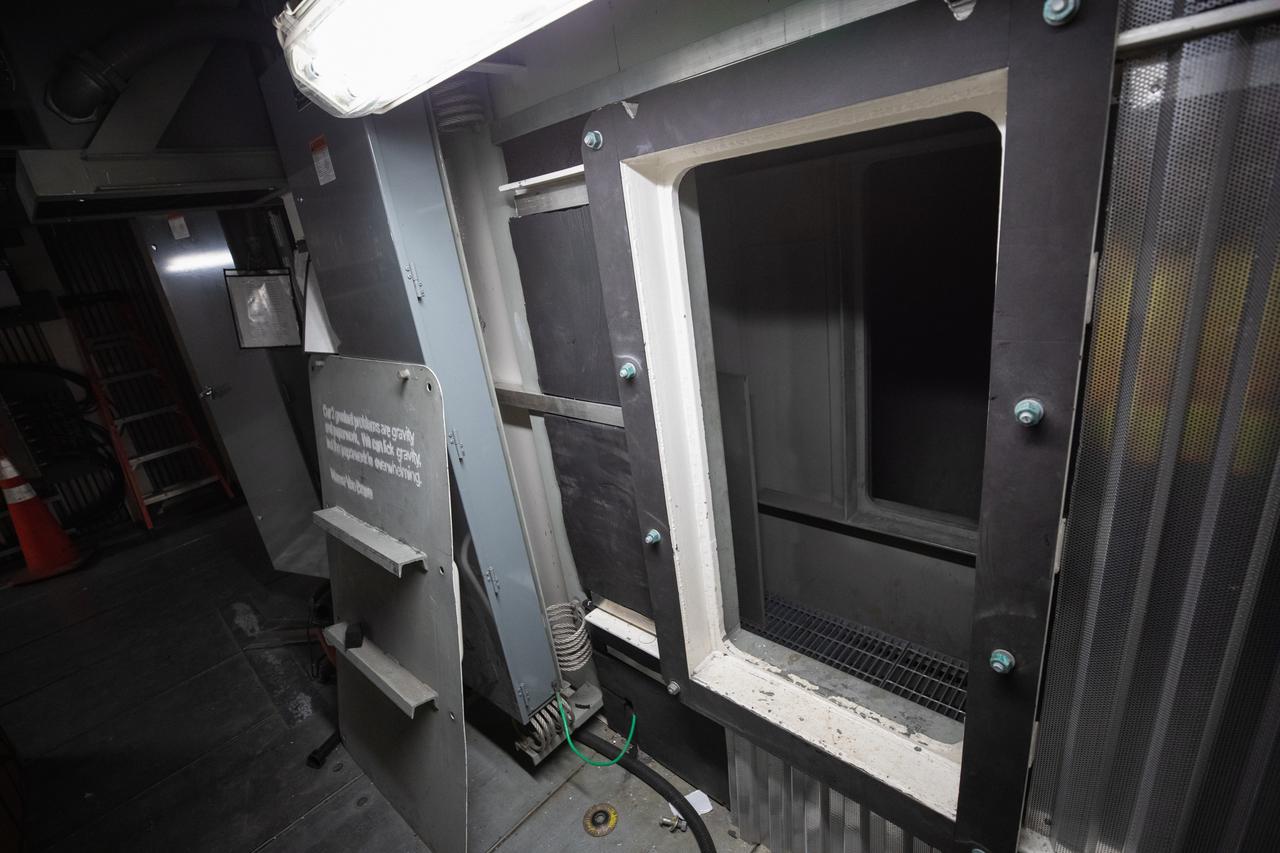
Each of the eight haunch access doors located in the mobile launcher platform contains an inspirational quote related to space travel. The quotes are from John F. Kennedy, H.G. Wells and Werner Von Braun, among others. The heavy metal doors will be bolted in place to protect electrical and support systems during liftoff of the Space Launch System rocket and Orion spacecraft.
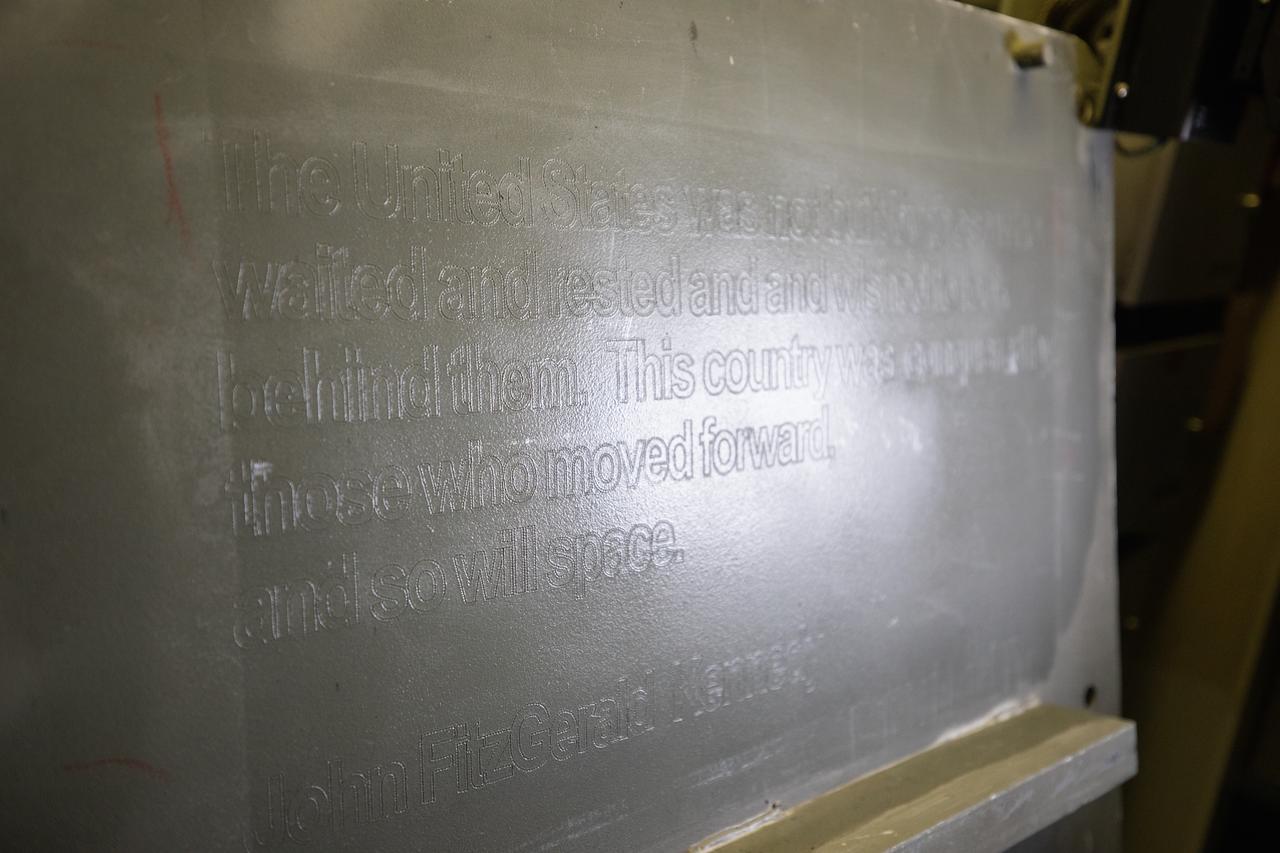
Each of the eight haunch access doors located in the mobile launcher platform contains an inspirational quote related to space travel. The quotes are from John F. Kennedy, H.G. Wells and Werner Von Braun, among others. The heavy metal doors will be bolted in place to protect electrical and support systems during liftoff of the Space Launch System rocket and Orion spacecraft.

Each of the eight haunch access doors located in the mobile launcher platform contains an inspirational quote related to space travel. The quotes are from John F. Kennedy, H.G. Wells and Werner Von Braun, among others. The heavy metal doors will be bolted in place to protect electrical and support systems during liftoff of the Space Launch System rocket and Orion spacecraft.
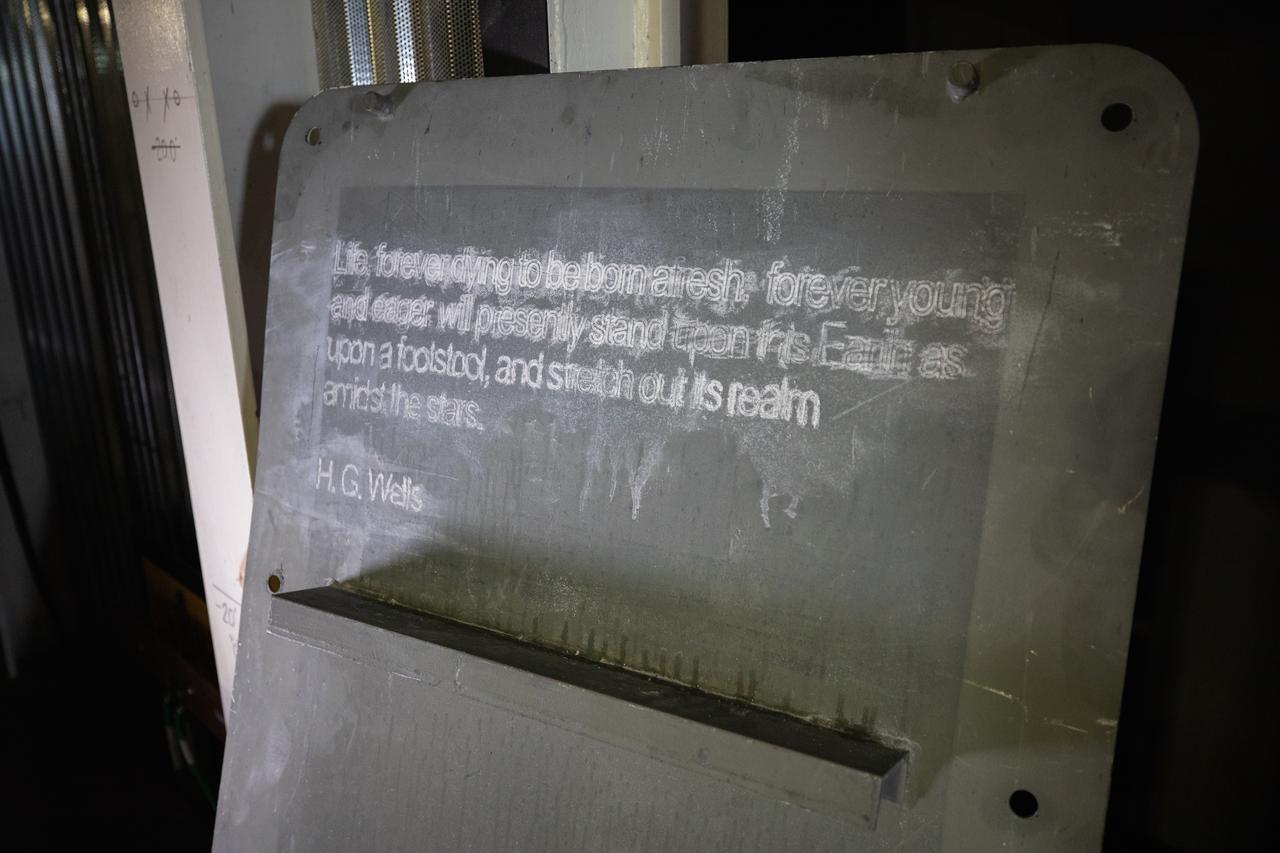
Each of the eight haunch access doors located in the mobile launcher platform contains an inspirational quote related to space travel. The quotes are from John F. Kennedy, H.G. Wells and Werner Von Braun, among others. The heavy metal doors will be bolted in place to protect electrical and support systems during liftoff of the Space Launch System rocket and Orion spacecraft.
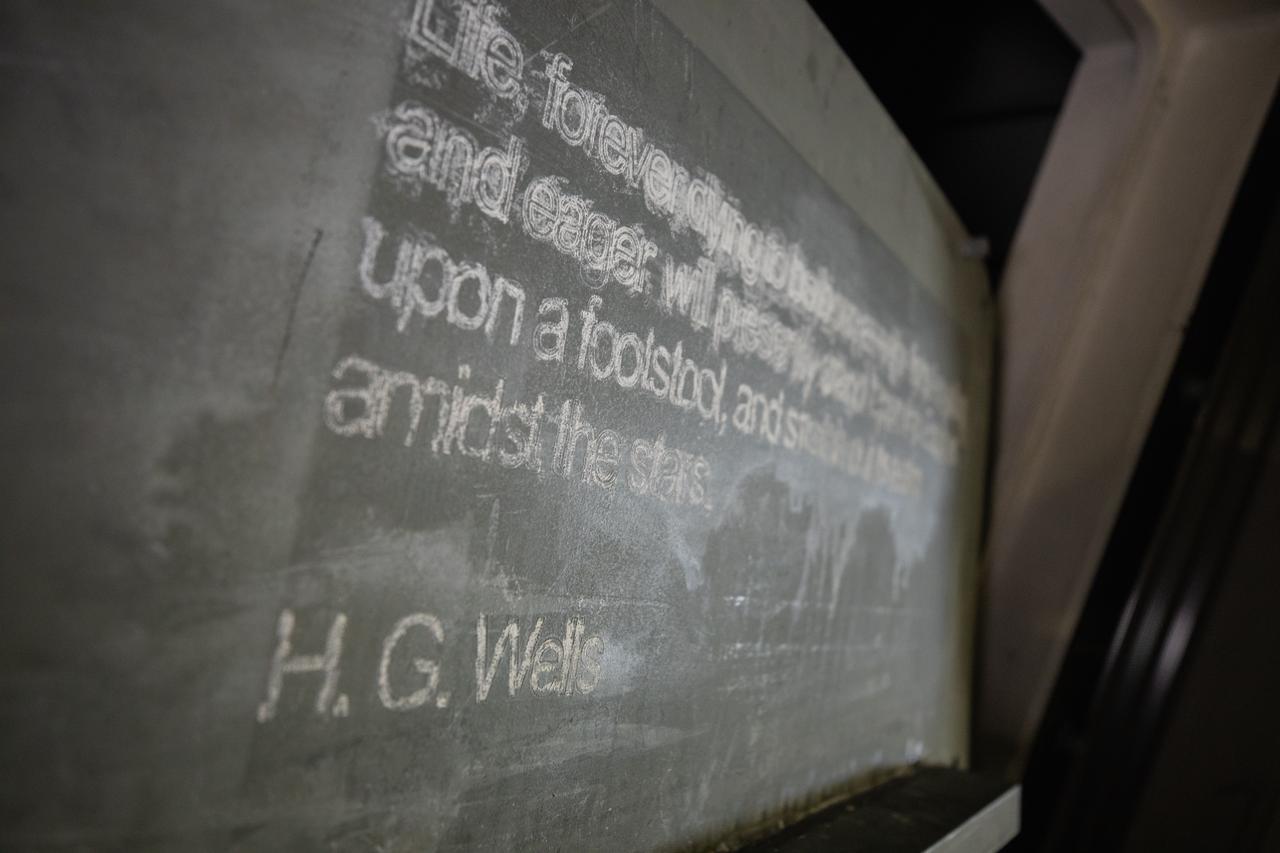
Each of the eight haunch access doors located in the mobile launcher platform contains an inspirational quote related to space travel. The quotes are from John F. Kennedy, H.G. Wells and Werner Von Braun, among others. The heavy metal doors will be bolted in place to protect electrical and support systems during liftoff of the Space Launch System rocket and Orion spacecraft.
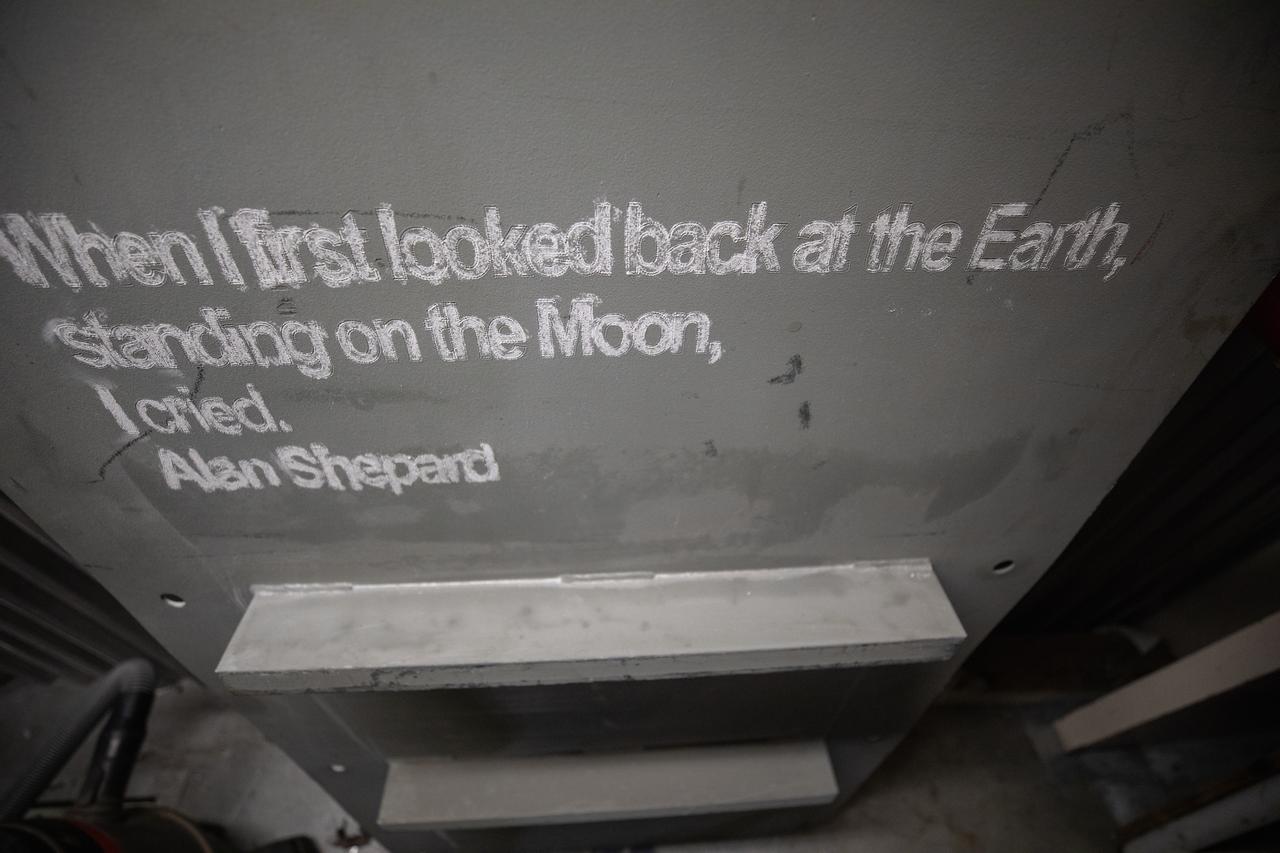
Each of the eight haunch access doors located in the mobile launcher platform contains an inspirational quote related to space travel. The quotes are from John F. Kennedy, H.G. Wells and Werner Von Braun, among others. The heavy metal doors will be bolted in place to protect electrical and support systems during liftoff of the Space Launch System rocket and Orion spacecraft.
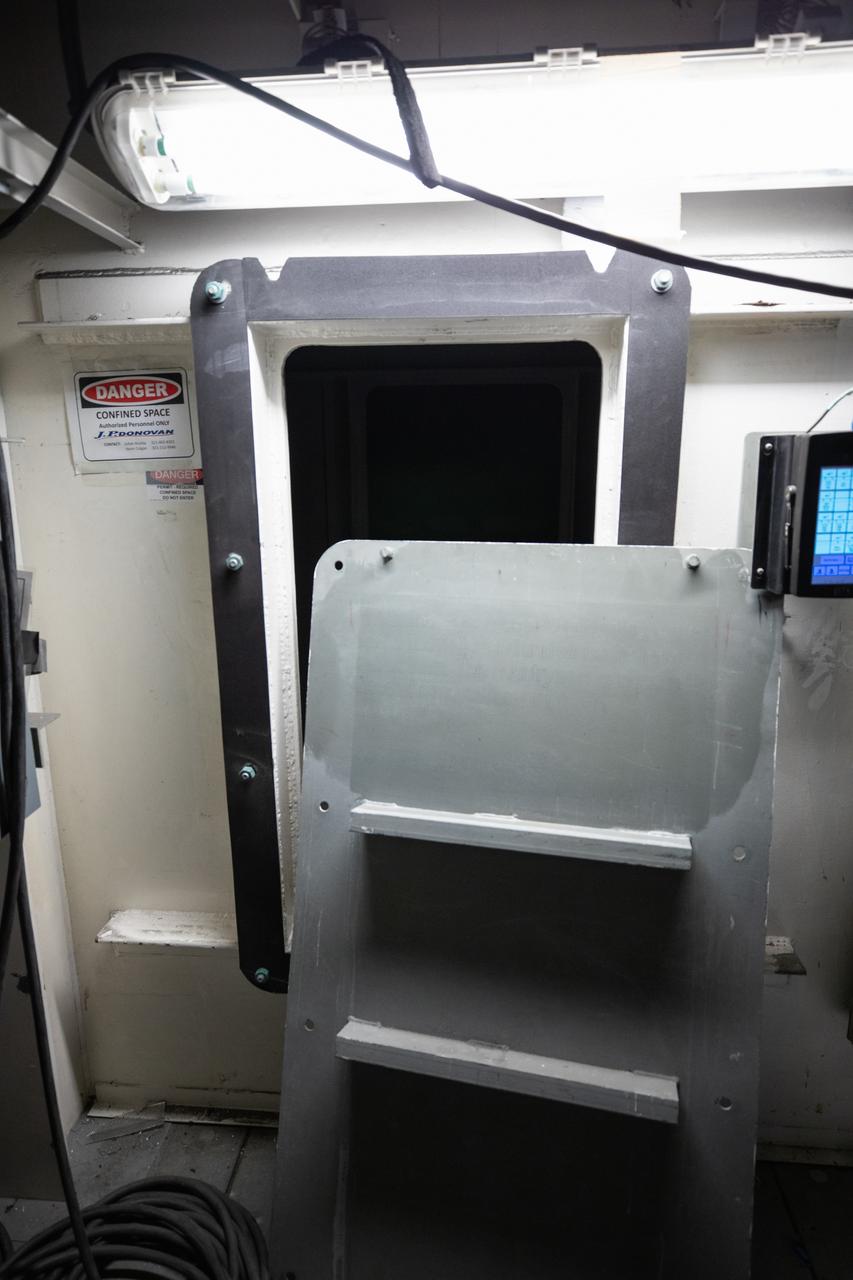
Each of the eight haunch access doors located in the mobile launcher platform contains an inspirational quote related to space travel. The quotes are from John F. Kennedy, H.G. Wells and Werner Von Braun, among others. The heavy metal doors will be bolted in place to protect electrical and support systems during liftoff of the Space Launch System rocket and Orion spacecraft.
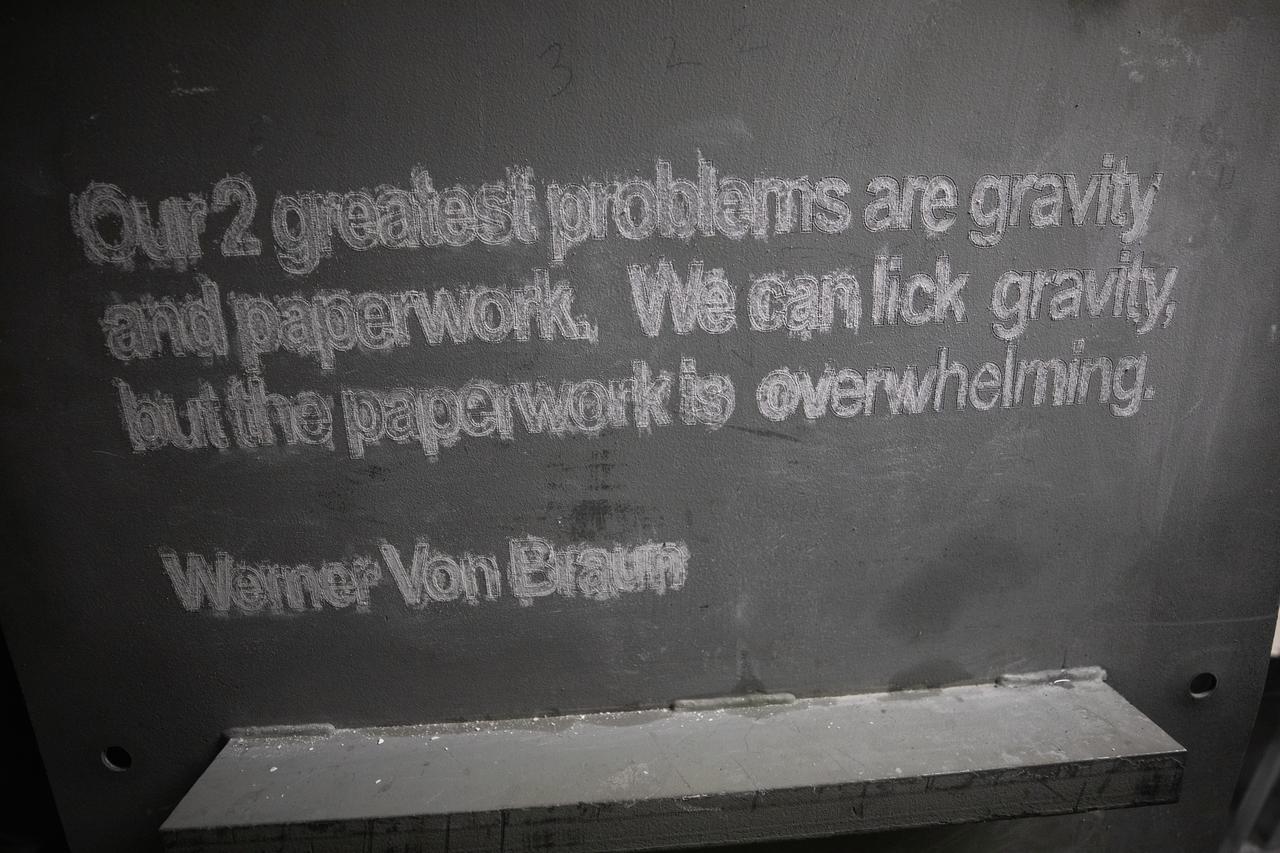
Each of the eight haunch access doors located in the mobile launcher platform contains an inspirational quote related to space travel. The quotes are from John F. Kennedy, H.G. Wells and Werner Von Braun, among others. The heavy metal doors will be bolted in place to protect electrical and support systems during liftoff of the Space Launch System rocket and Orion spacecraft.

Each of the eight haunch access doors located in the mobile launcher platform contains an inspirational quote related to space travel. The quotes are from John F. Kennedy, H.G. Wells and Werner Von Braun, among others. The heavy metal doors will be bolted in place to protect electrical and support systems during liftoff of the Space Launch System rocket and Orion spacecraft.
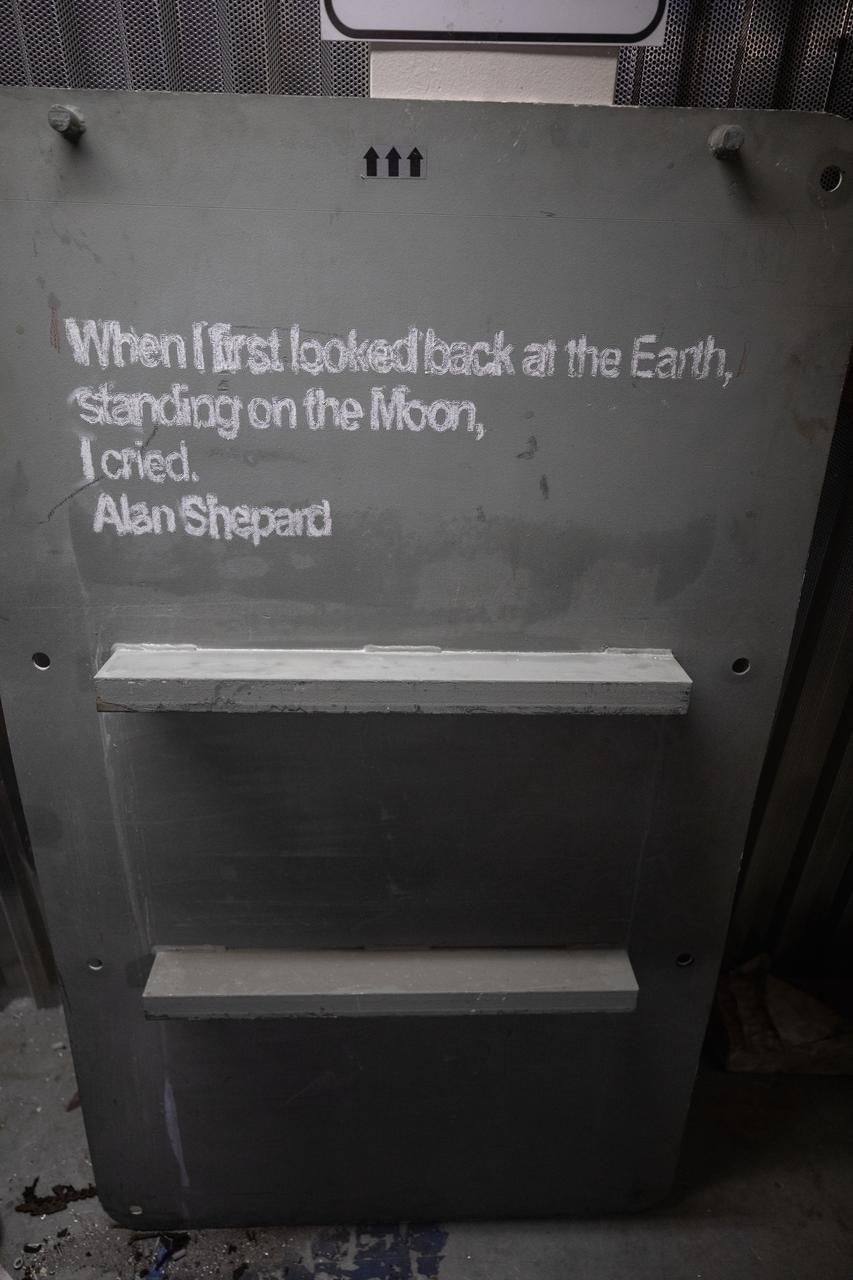
Each of the eight haunch access doors located in the mobile launcher platform contains an inspirational quote related to space travel. The quotes are from John F. Kennedy, H.G. Wells and Werner Von Braun, among others. The heavy metal doors will be bolted in place to protect electrical and support systems during liftoff of the Space Launch System rocket and Orion spacecraft.
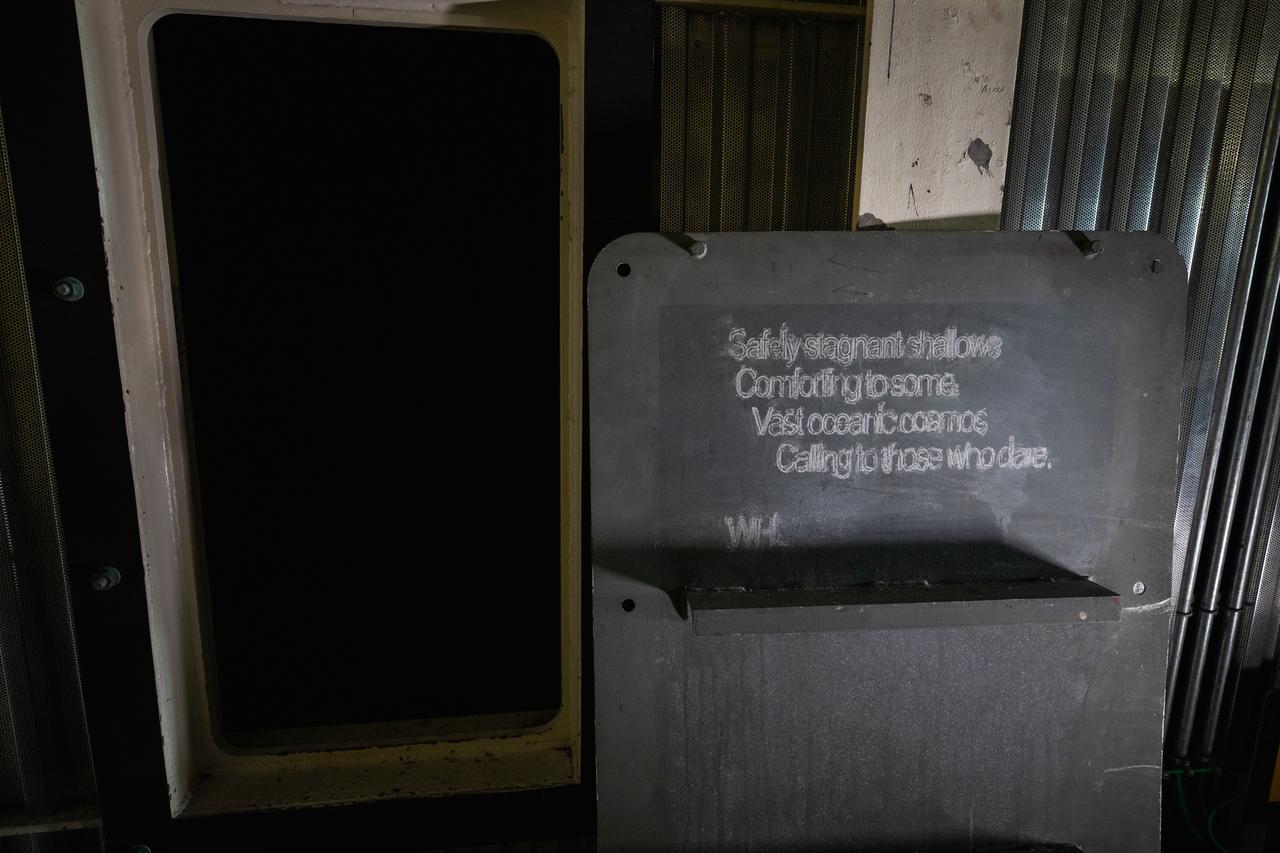
Each of the eight haunch access doors located in the mobile launcher platform contains an inspirational quote related to space travel. The quotes are from John F. Kennedy, H.G. Wells and Werner Von Braun, among others. The heavy metal doors will be bolted in place to protect electrical and support systems during liftoff of the Space Launch System rocket and Orion spacecraft.
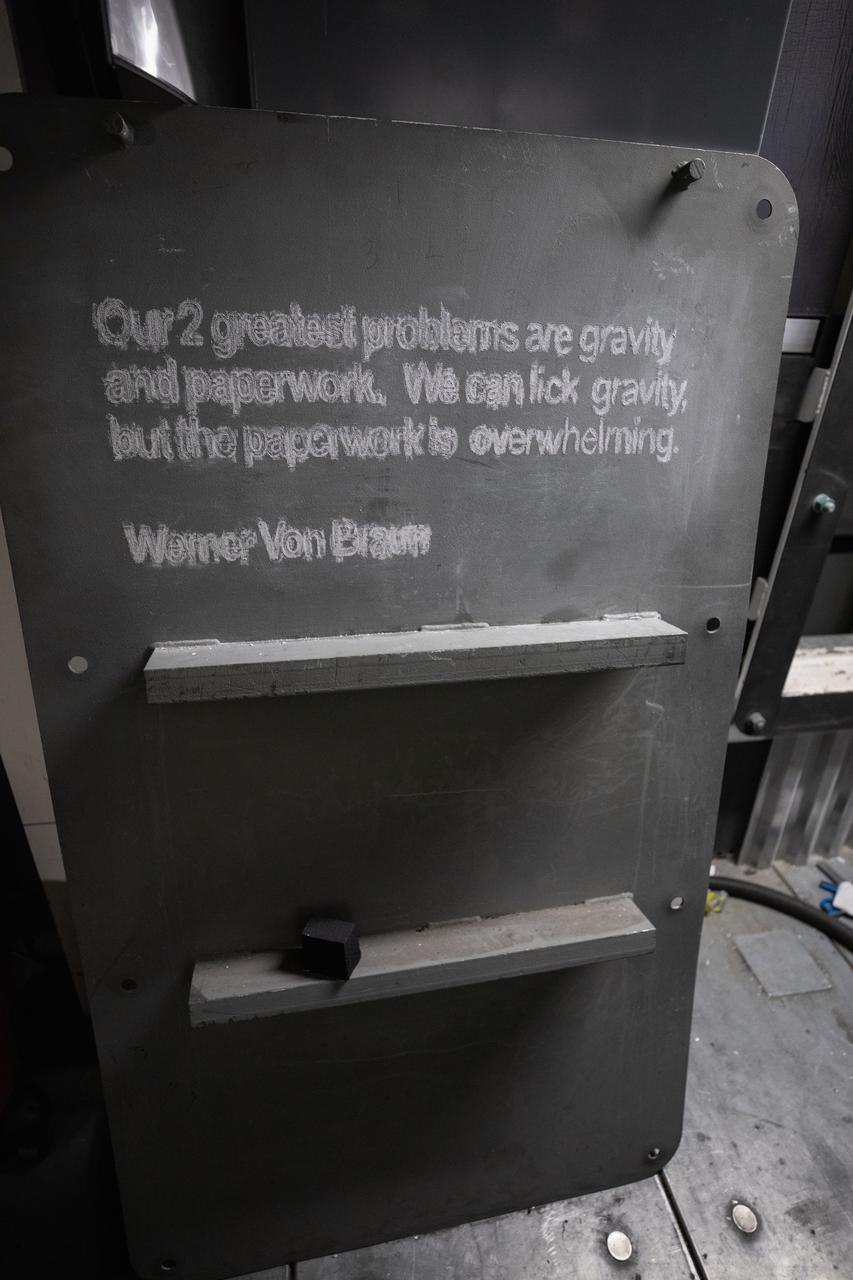
Each of the eight haunch access doors located in the mobile launcher platform contains an inspirational quote related to space travel. The quotes are from John F. Kennedy, H.G. Wells and Werner Von Braun, among others. The heavy metal doors will be bolted in place to protect electrical and support systems during liftoff of the Space Launch System rocket and Orion spacecraft.
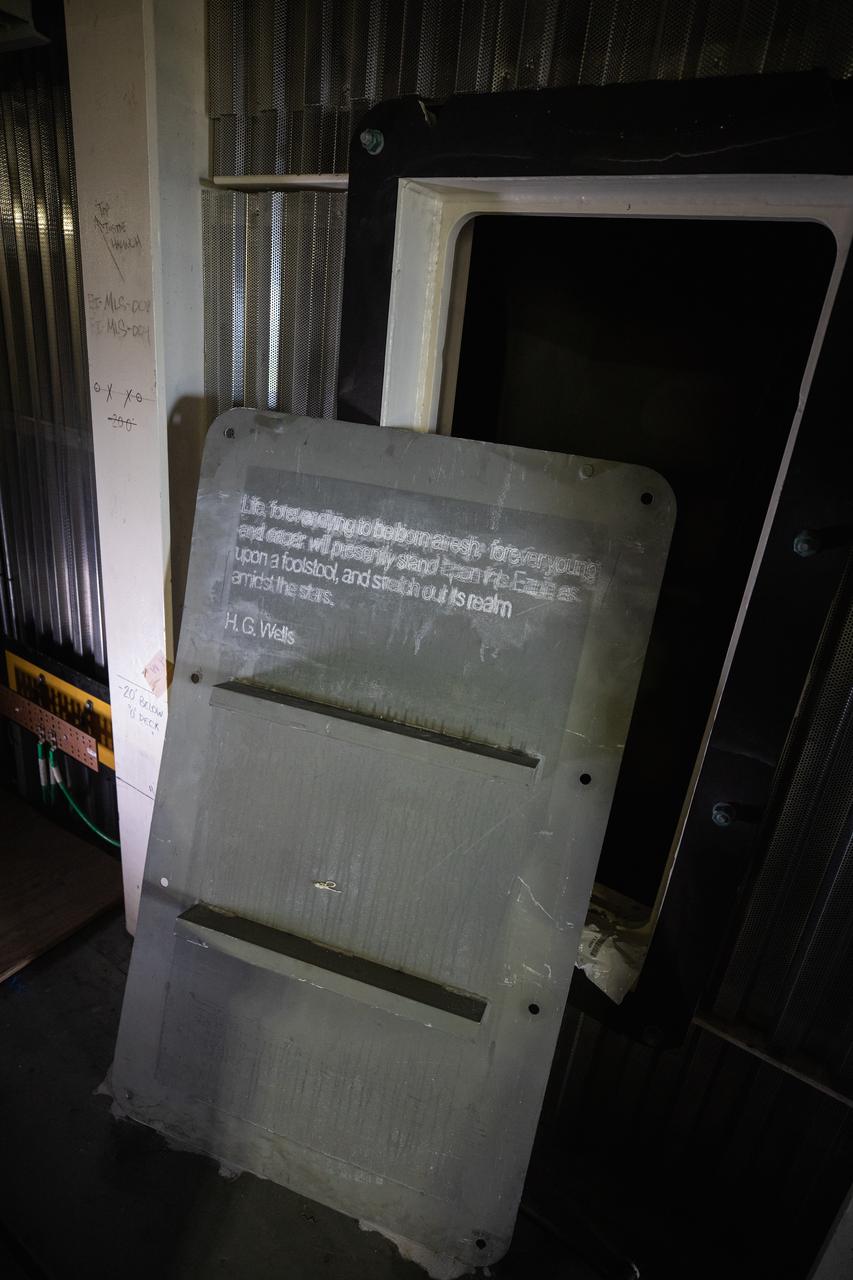
Each of the eight haunch access doors located in the mobile launcher platform contains an inspirational quote related to space travel. The quotes are from John F. Kennedy, H.G. Wells and Werner Von Braun, among others. The heavy metal doors will be bolted in place to protect electrical and support systems during liftoff of the Space Launch System rocket and Orion spacecraft.
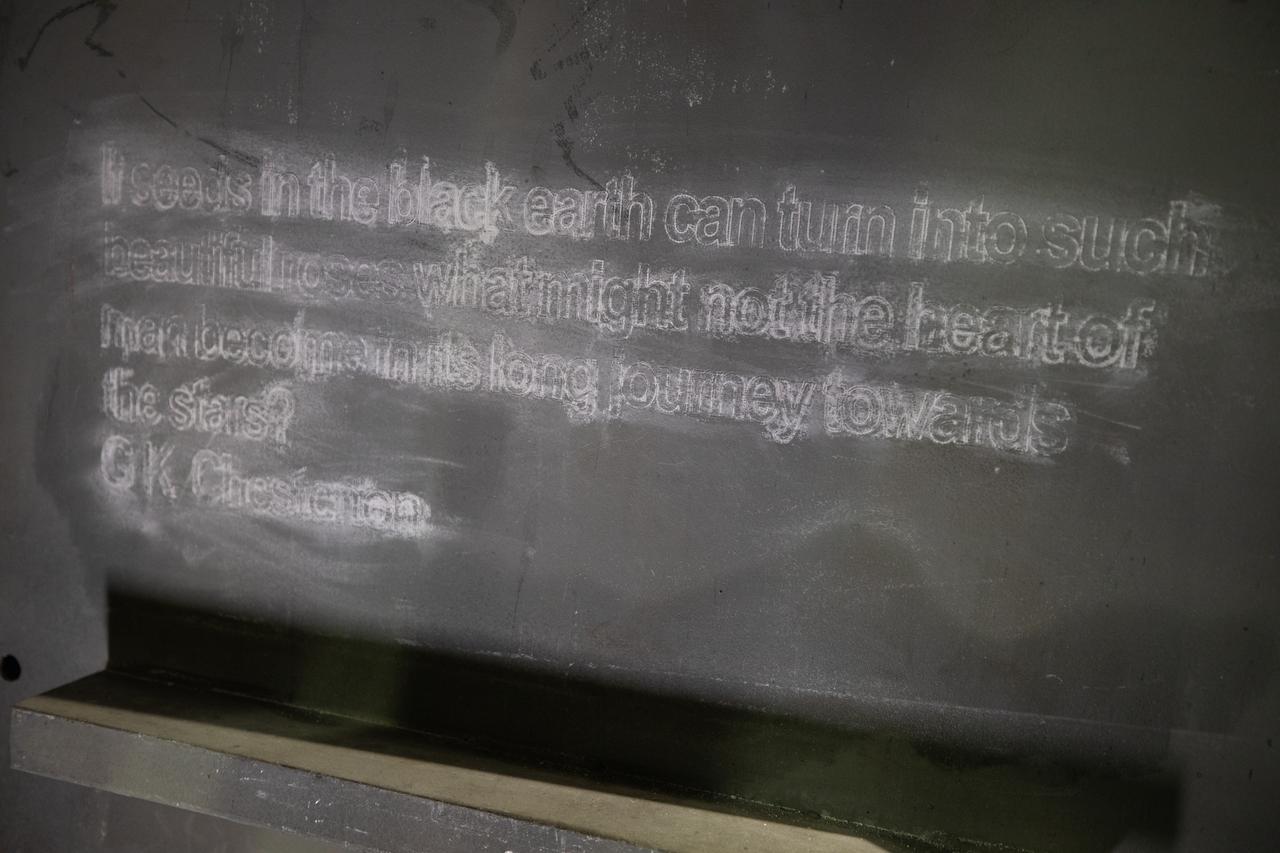
Each of the eight haunch access doors located in the mobile launcher platform contains an inspirational quote related to space travel. The quotes are from John F. Kennedy, H.G. Wells and Werner Von Braun, among others. The heavy metal doors will be bolted in place to protect electrical and support systems during liftoff of the Space Launch System rocket and Orion spacecraft.

Each of the eight haunch access doors located in the mobile launcher platform contains an inspirational quote related to space travel. The quotes are from John F. Kennedy, H.G. Wells and Werner Von Braun, among others. The heavy metal doors will be bolted in place to protect electrical and support systems during liftoff of the Space Launch System rocket and Orion spacecraft.
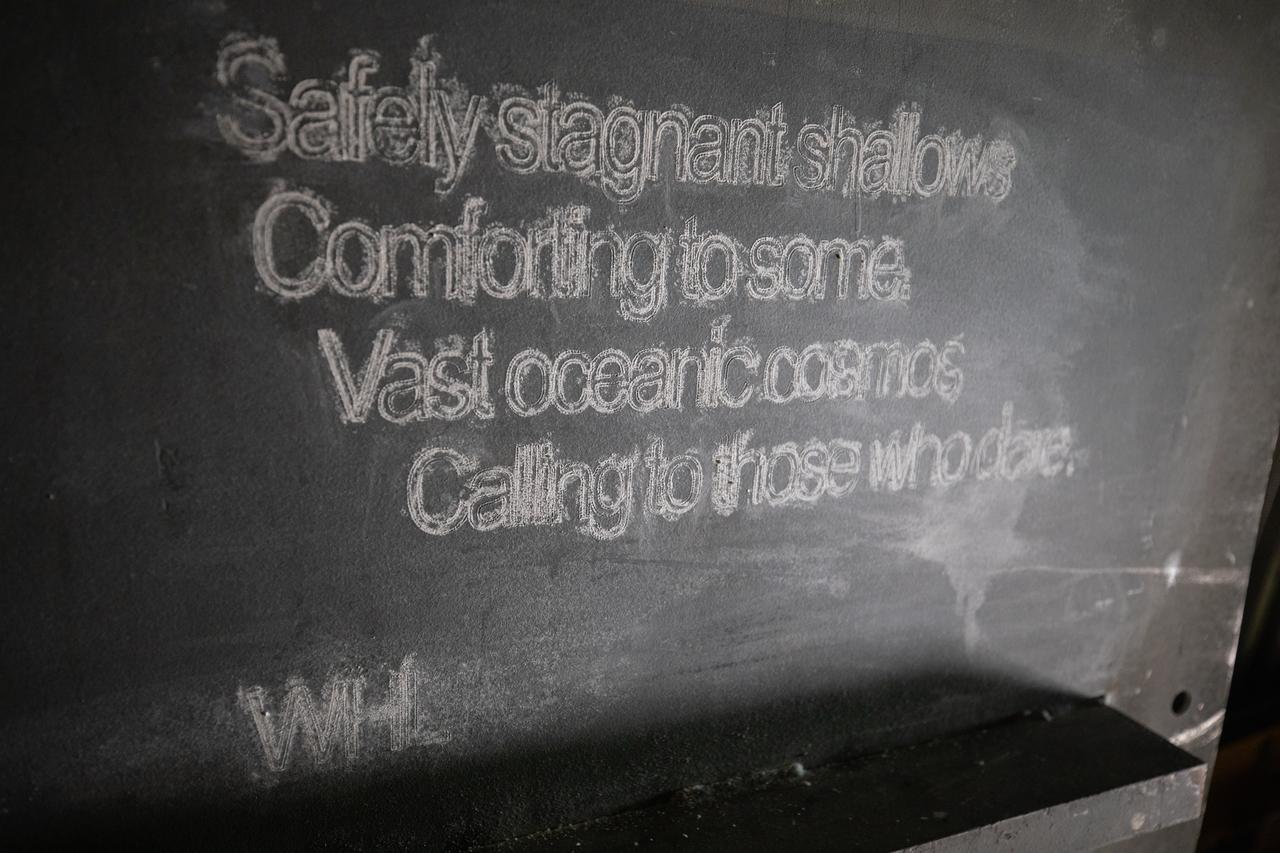
Each of the eight haunch access doors located in the mobile launcher platform contains an inspirational quote related to space travel. The quotes are from John F. Kennedy, H.G. Wells and Werner Von Braun, among others. The heavy metal doors will be bolted in place to protect electrical and support systems during liftoff of the Space Launch System rocket and Orion spacecraft.
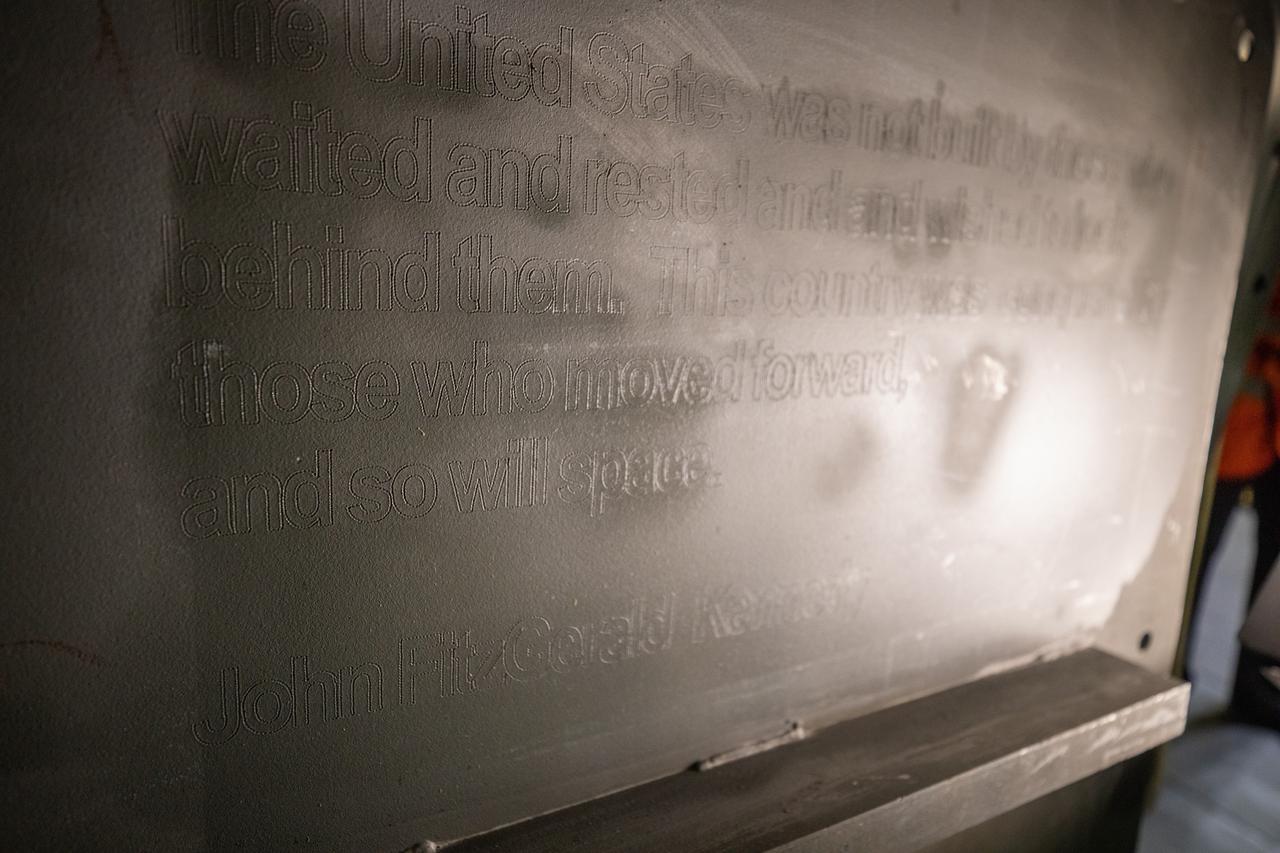
Each of the eight haunch access doors located in the mobile launcher platform contains an inspirational quote related to space travel. The quotes are from John F. Kennedy, H.G. Wells and Werner Von Braun, among others. The heavy metal doors will be bolted in place to protect electrical and support systems during liftoff of the Space Launch System rocket and Orion spacecraft.
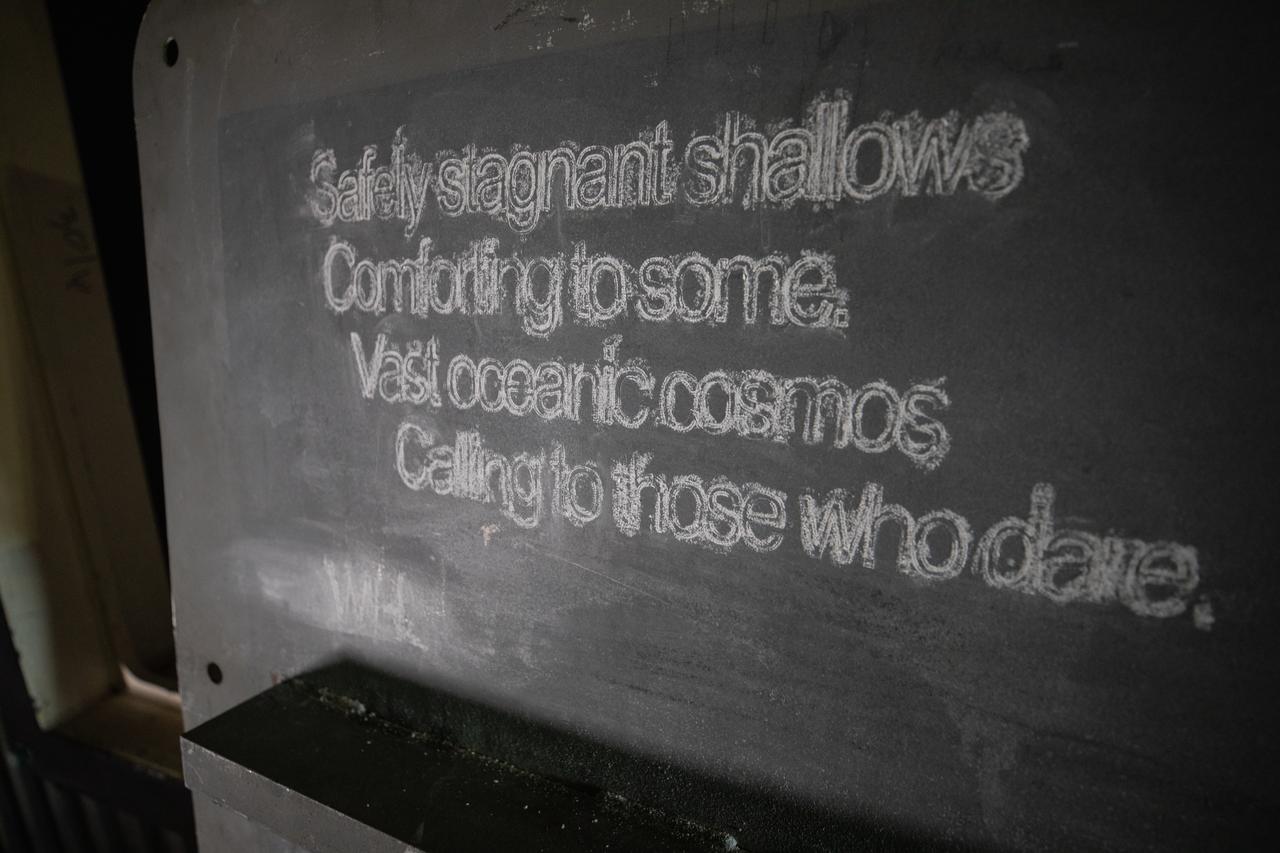
Each of the eight haunch access doors located in the mobile launcher platform contains an inspirational quote related to space travel. The quotes are from John F. Kennedy, H.G. Wells and Werner Von Braun, among others. The heavy metal doors will be bolted in place to protect electrical and support systems during liftoff of the Space Launch System rocket and Orion spacecraft.
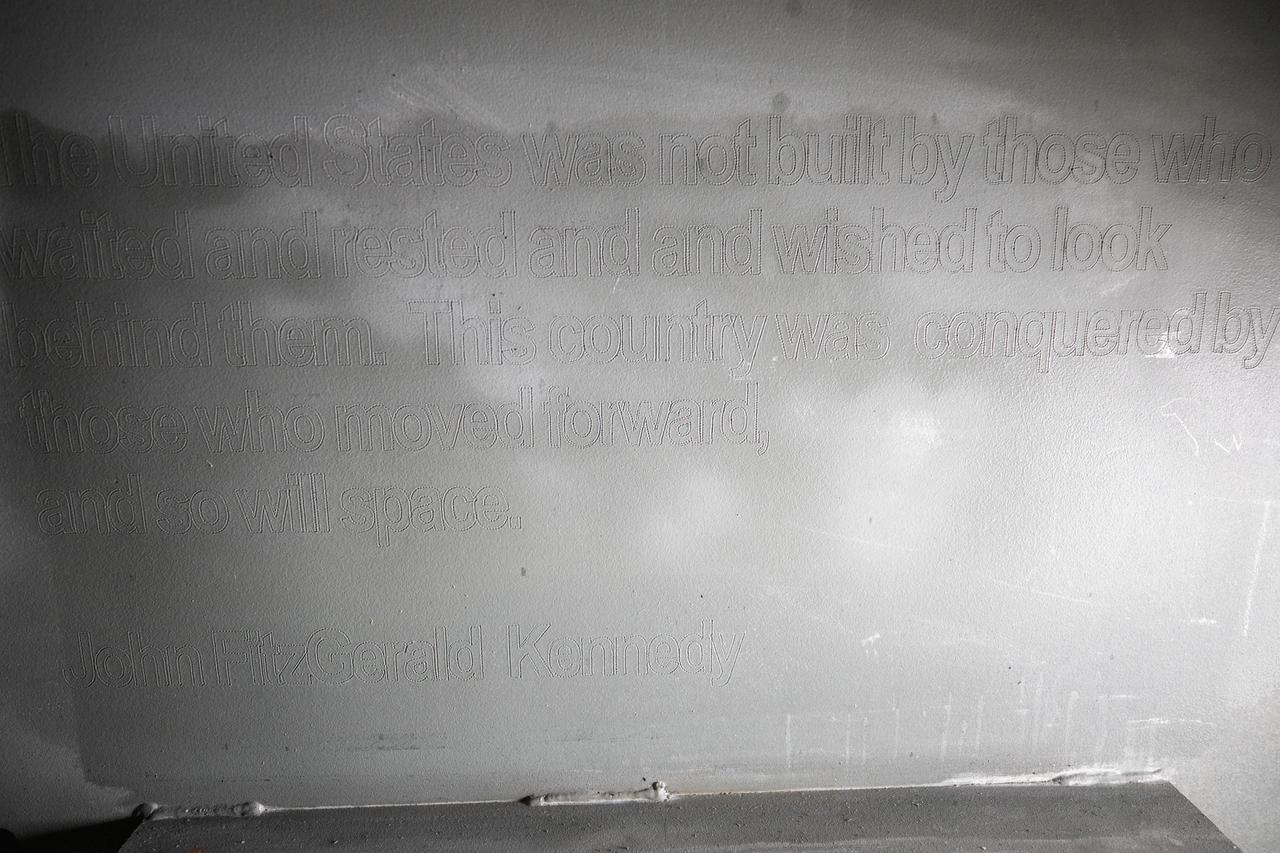
Each of the eight haunch access doors located in the mobile launcher platform contains an inspirational quote related to space travel. The quotes are from John F. Kennedy, H.G. Wells and Werner Von Braun, among others. The heavy metal doors will be bolted in place to protect electrical and support systems during liftoff of the Space Launch System rocket and Orion spacecraft.
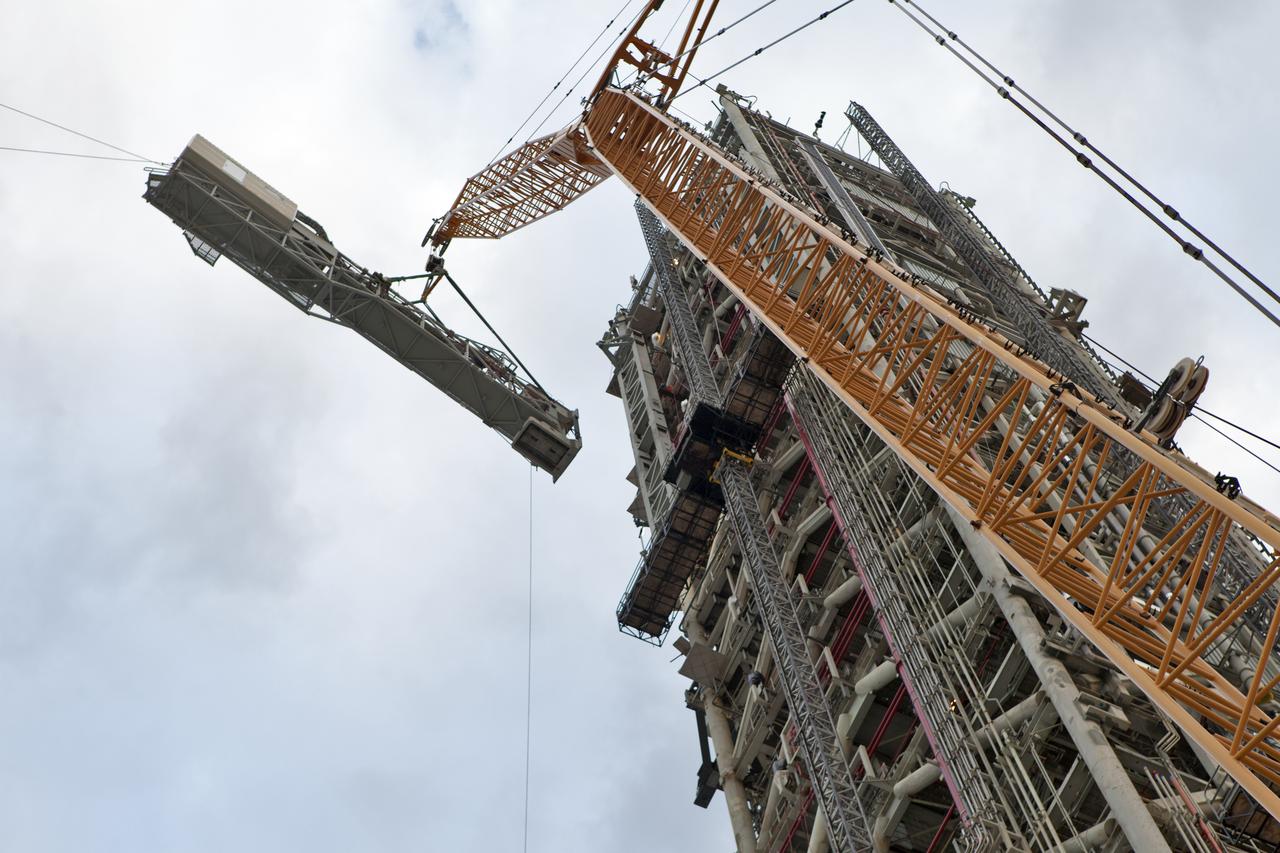
At NASA's Kennedy Space Center in Florida, a crane lifts the Orion crew access arm (CAA) so it can be attached to the mobile launcher (ML). The arm will be installed at about the 274-foot level on the ML tower. NASA's Exploration Ground Systems organization has been overseeing installation of umbilicals and other launch accessories on the 380-foot-tall ML in preparation for stacking the first launch of the Space launch System (SLS), rocket with an Orion spacecraft. The CAA is designed to rotate from its retracted position and line up with Orion's crew hatch providing entry for astronauts and technicians.
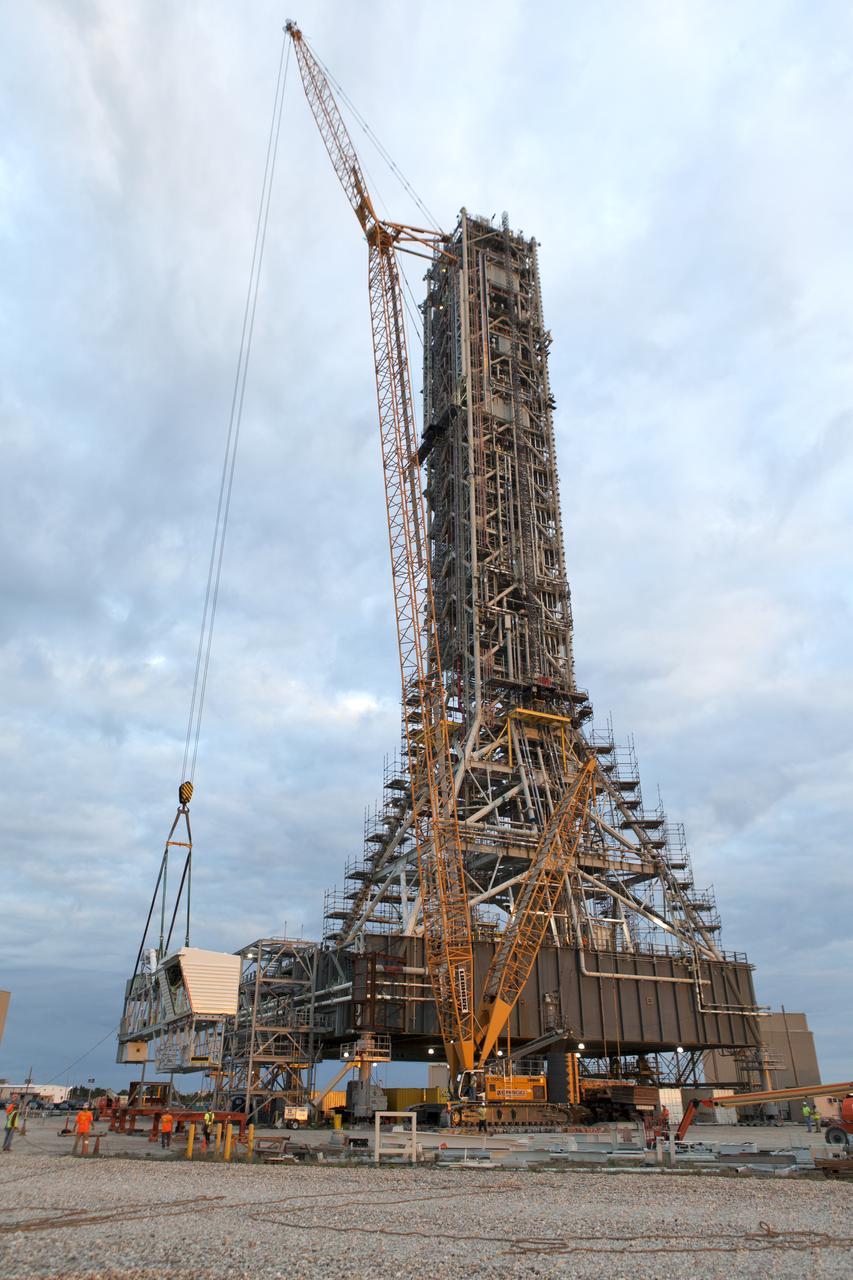
At NASA's Kennedy Space Center in Florida, a crane begins lifting the Orion crew access arm (CAA) so it can be attached to the mobile launcher (ML). The arm will be installed at about the 274-foot level on the ML tower. NASA's Exploration Ground Systems organization has been overseeing installation of umbilicals and other launch accessories on the 380-foot-tall ML in preparation for stacking the first launch of the Space launch System (SLS), rocket with an Orion spacecraft. The CAA is designed to rotate from its retracted position and line up with Orion's crew hatch providing entry for astronauts and technicians.
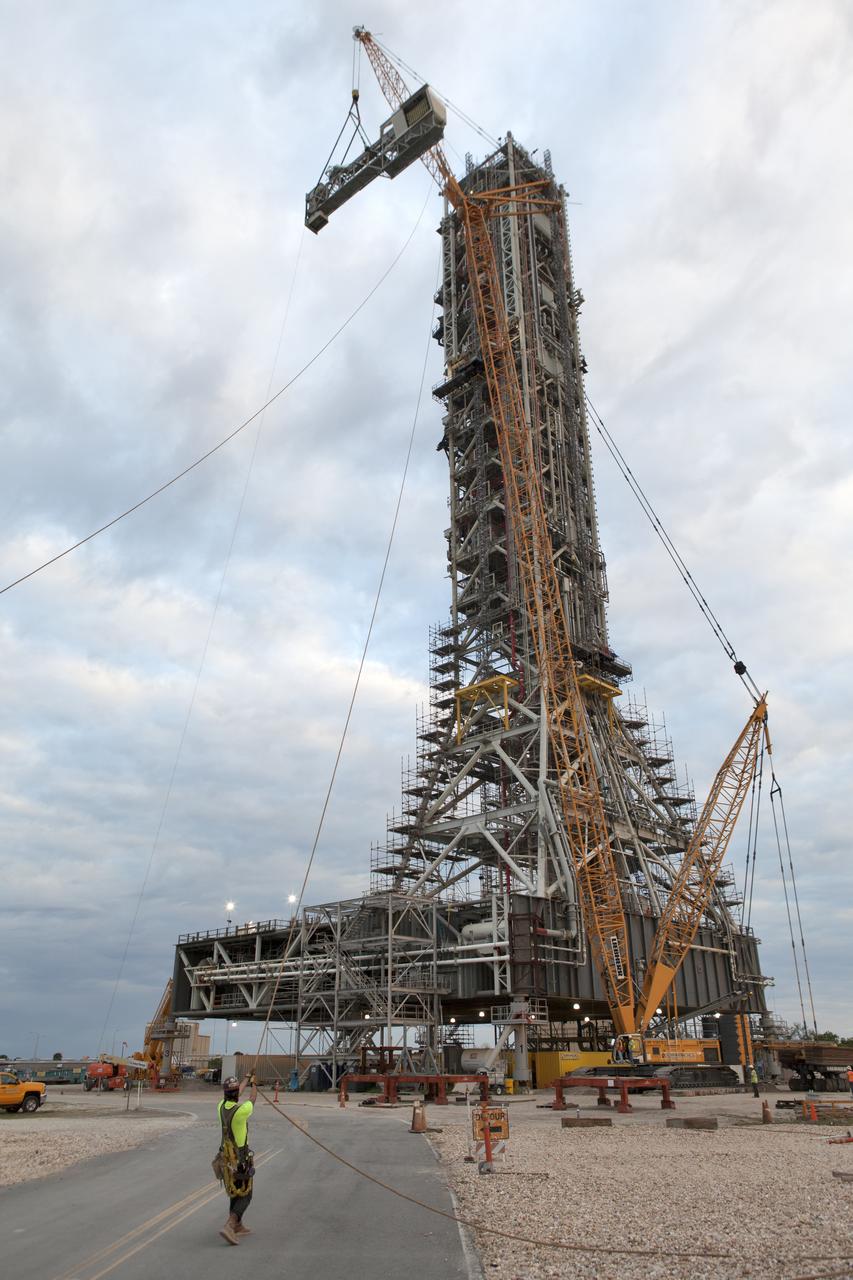
At NASA's Kennedy Space Center in Florida, a crane lifts the Orion crew access arm (CAA) so it can be attached to the mobile launcher (ML). The arm will be installed at about the 274-foot level on the ML tower. NASA's Exploration Ground Systems organization has been overseeing installation of umbilicals and other launch accessories on the 380-foot-tall ML in preparation for stacking the first launch of the Space launch System (SLS), rocket with an Orion spacecraft. The CAA is designed to rotate from its retracted position and line up with Orion's crew hatch providing entry for astronauts and technicians.
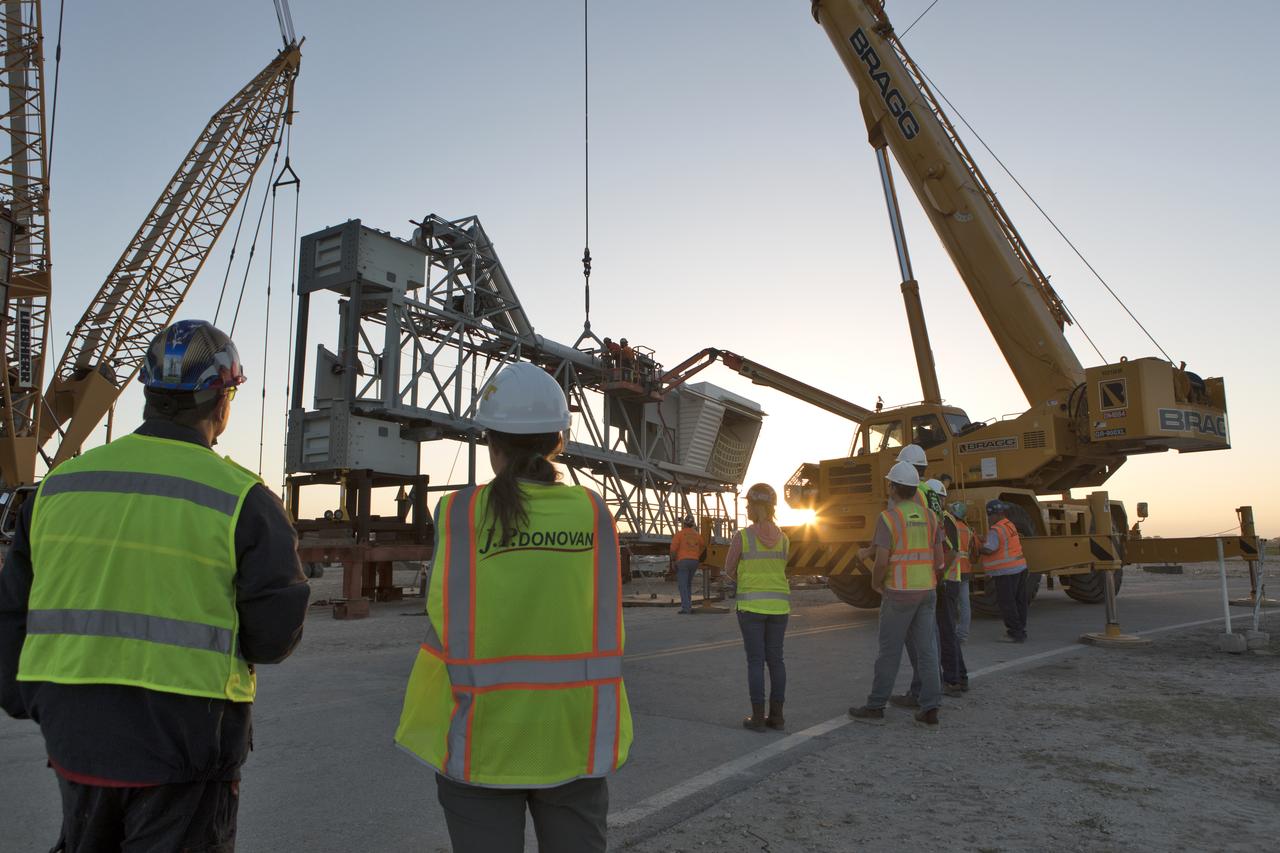
Under the watchful eye of technicians and engineers, a crane is prepared to lift the Orion crew access arm (CAA) so it can be attached to the mobile launcher (ML) at NASA's Kennedy Space Center in Florida. The arm will be installed at about the 274-foot level on the ML tower. NASA's Exploration Ground Systems organization has been overseeing installation of umbilicals and other launch accessories on the 380-foot-tall ML in preparation for stacking the first launch of the Space launch System, or SLS, rocket with an Orion spacecraft. The CAA is designed to rotate from its retracted position and line up with Orion's crew hatch providing entry for astronauts and technicians.
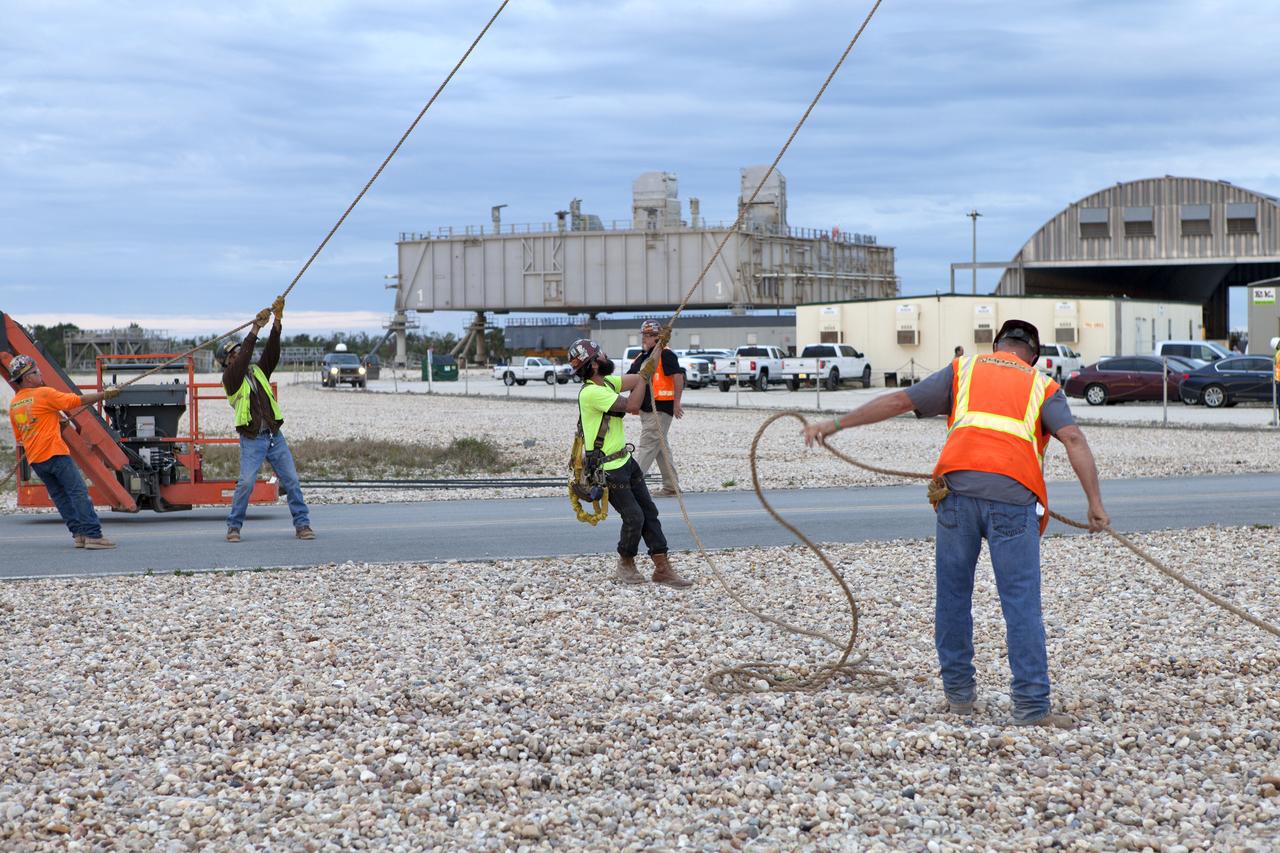
At NASA's Kennedy Space Center in Florida, technicians assist as a crane lifts the Orion crew access arm (CAA) so it can be attached to the mobile launcher (ML). The arm will be installed at about the 274-foot level on the ML tower. NASA's Exploration Ground Systems organization has been overseeing installation of umbilicals and other launch accessories on the 380-foot-tall ML in preparation for stacking the first launch of the Space launch System (SLS), rocket with an Orion spacecraft. The CAA is designed to rotate from its retracted position and line up with Orion's crew hatch providing entry for astronauts and technicians.
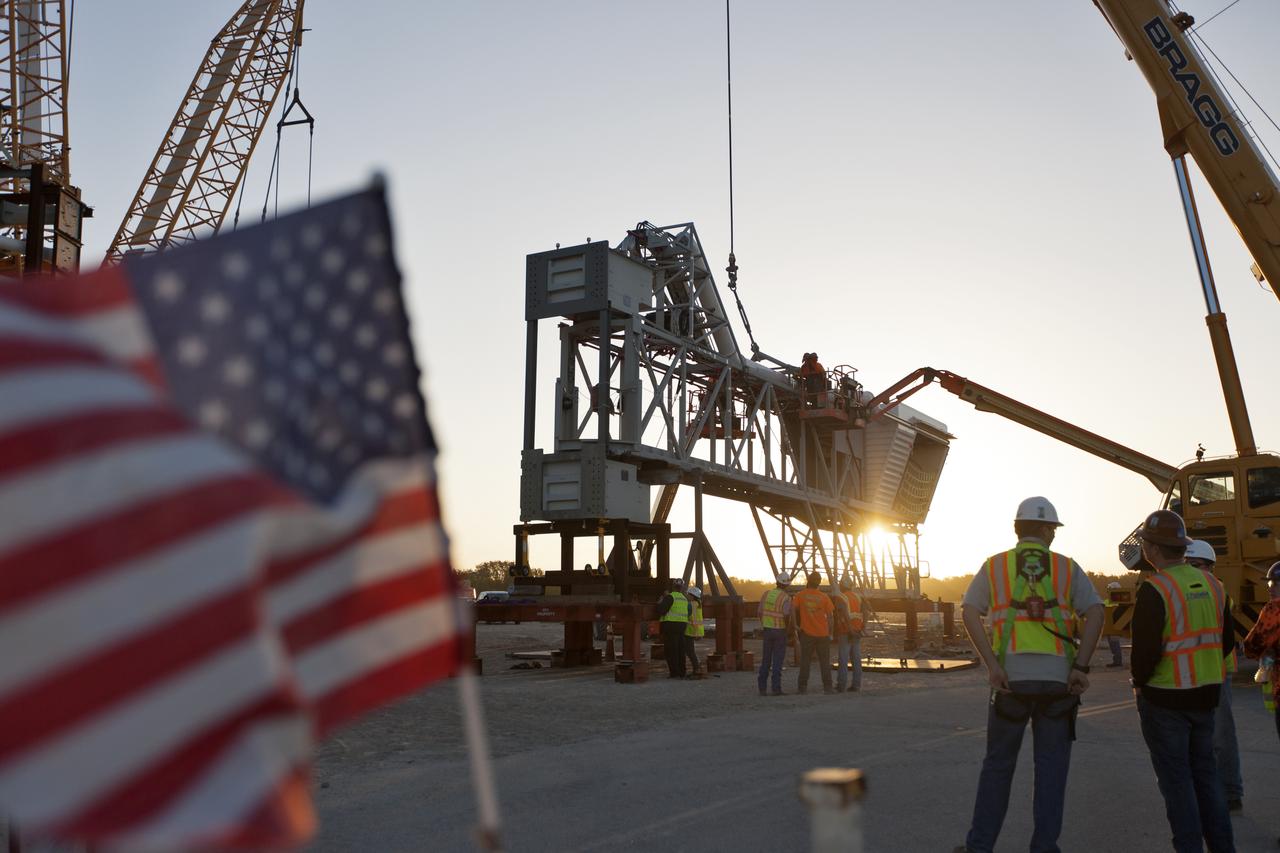
Under the watchful eye of technicians and engineers, a crane is prepared to lift the Orion crew access arm (CAA) so it can be attached to the mobile launcher (ML) at NASA's Kennedy Space Center in Florida. The arm will be installed at about the 274-foot level on the ML tower. NASA's Exploration Ground Systems organization has been overseeing installation of umbilicals and other launch accessories on the 380-foot-tall ML in preparation for stacking the first launch of the Space launch System, or SLS, rocket with an Orion spacecraft. The CAA is designed to rotate from its retracted position and line up with Orion's crew hatch providing entry for astronauts and technicians.
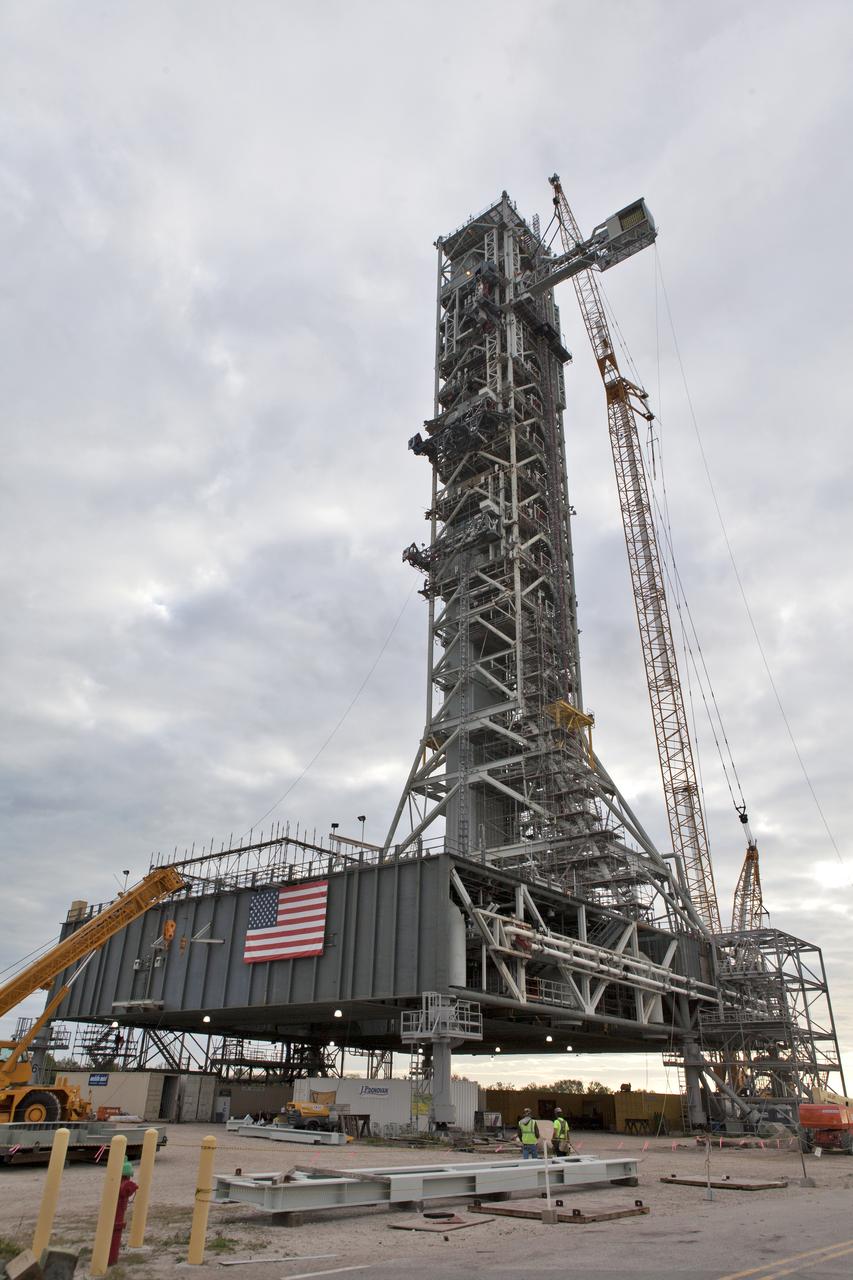
At NASA's Kennedy Space Center in Florida, a crane positions the Orion crew access arm (CAA) so it can be attached to the mobile launcher (ML). The arm will be installed at about the 274-foot level on the ML tower. NASA's Exploration Ground Systems organization has been overseeing installation of umbilicals and other launch accessories on the 380-foot-tall ML in preparation for stacking the first launch of the Space launch System (SLS), rocket with an Orion spacecraft. The CAA is designed to rotate from its retracted position and line up with Orion's crew hatch providing entry for astronauts and technicians.
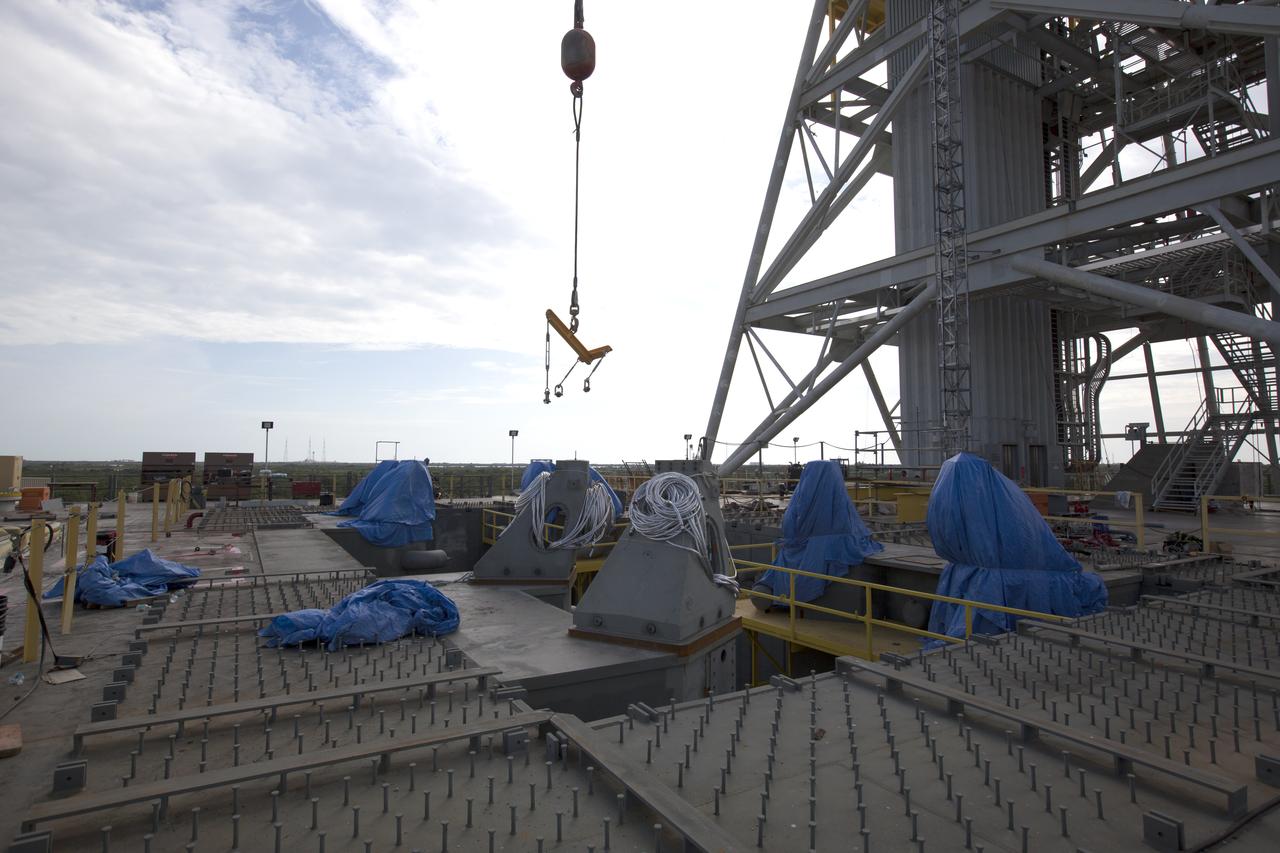
At NASA's Kennedy Space Center in Florida, the final four vehicle support posts are being installed on the deck of the mobile launcher. A total of eight support posts are being installed to support the load of the Space Launch System's (SLS) solid rocket boosters, with four posts for each of the boosters. The support posts are about five feet tall and each weigh about 10,000 pounds. The posts will structurally support the SLS rocket through T-0 and liftoff, and will drop down before vehicle liftoff to avoid contact with the flight hardware. The Ground Systems Development and Operations Program is overseeing installation of the support posts to prepare for the launch of the Orion spacecraft atop the SLS rocket.
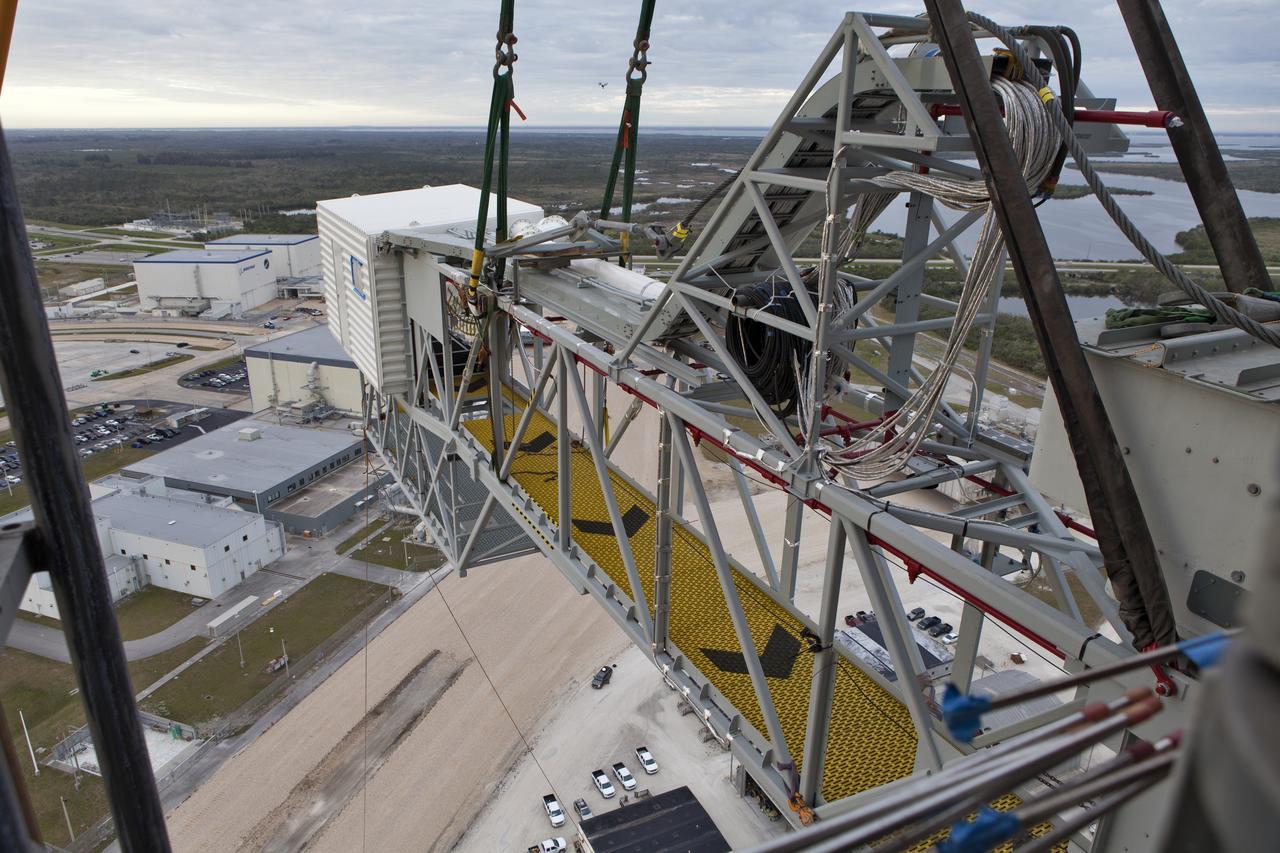
Viewed from the 274-foot level mobile launcher (ML), a crane positions the Orion crew access arm (CAA) so it can be attached to the tower that will support the Space launch System (SLS) rocket at NASA's Kennedy Space Center in Florida. NASA's Exploration Ground Systems organization has been overseeing installation of umbilicals and other launch accessories on the 380-foot-tall ML in preparation for stacking the first launch of the SLS, rocket with an Orion spacecraft. The CAA is designed to rotate from its retracted position and line up with Orion's crew hatch providing entry for astronauts and technicians.
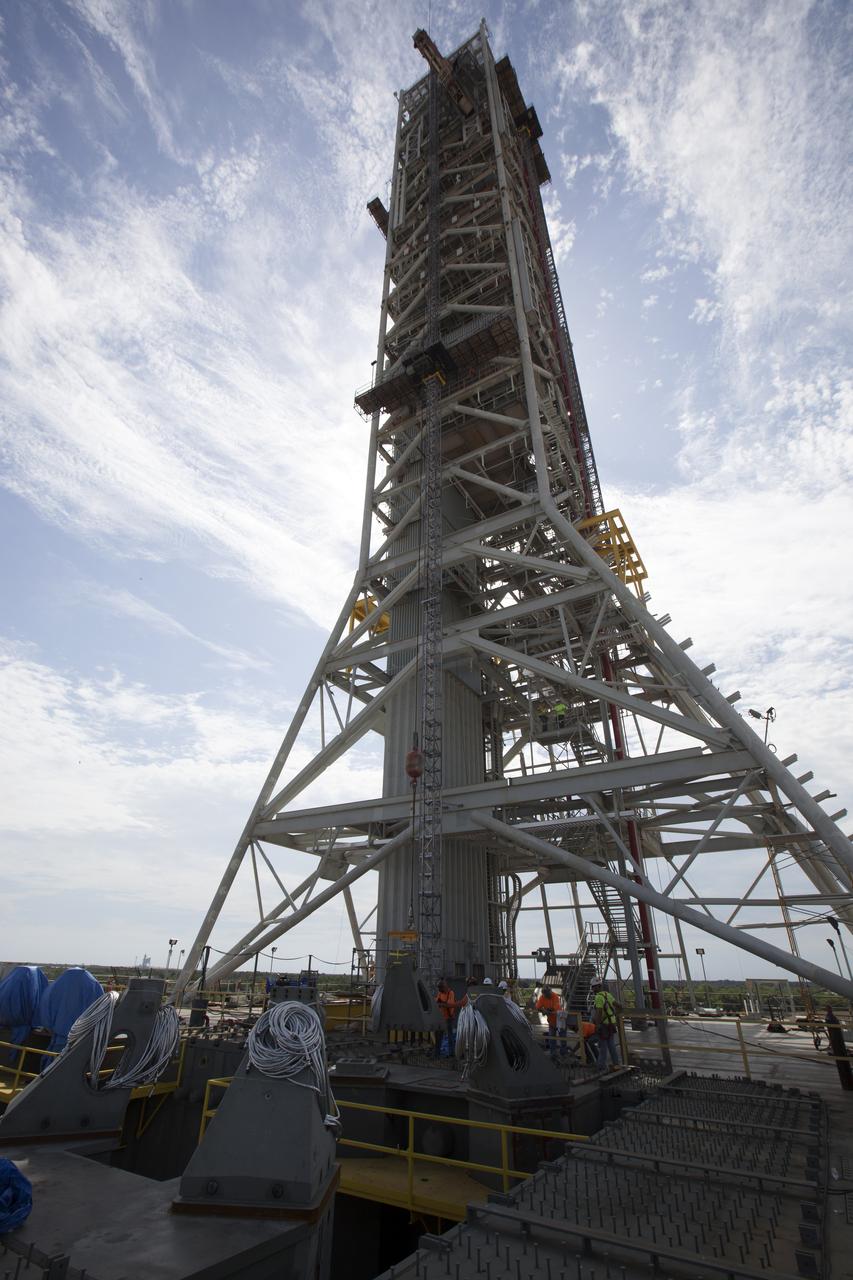
Construction workers on the deck of the mobile launcher at NASA's Kennedy Space Center in Florida, prepare to install a vehicle support post. A total of eight support posts are being installed to support the load of the Space Launch System's (SLS) solid rocket boosters, with four posts for each of the boosters. The support posts are about five feet tall and each weigh about 10,000 pounds. The posts will structurally support the SLS rocket through T-0 and liftoff, and will drop down before vehicle liftoff to avoid contact with the flight hardware. The Ground Systems Development and Operations Program is overseeing installation of the support posts to prepare for the launch of the Orion spacecraft atop the SLS rocket.
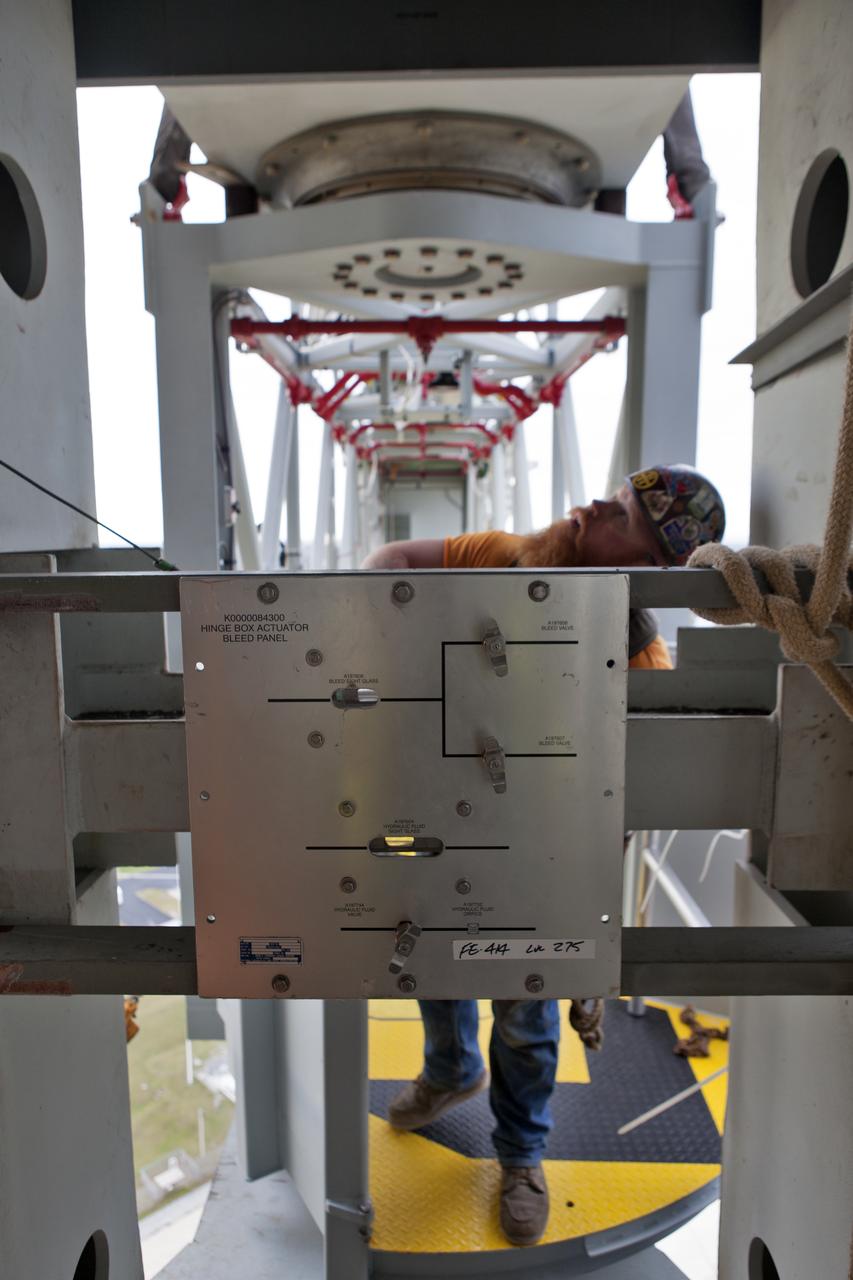
With a control panel visible in the foreground, a technician begins installation of the Orion crew access arm (CAA) to the mobile launcher (ML) tower at NASA's Kennedy Space Center in Florida. NASA's Exploration Ground Systems organization has been overseeing installation of umbilicals and other launch accessories on the 380-foot-tall ML in preparation for stacking the first launch of the Space launch System, or SLS, rocket with an Orion spacecraft. The CAA is designed to rotate from its retracted position and line up with Orion's crew hatch providing entry for astronauts and technicians.
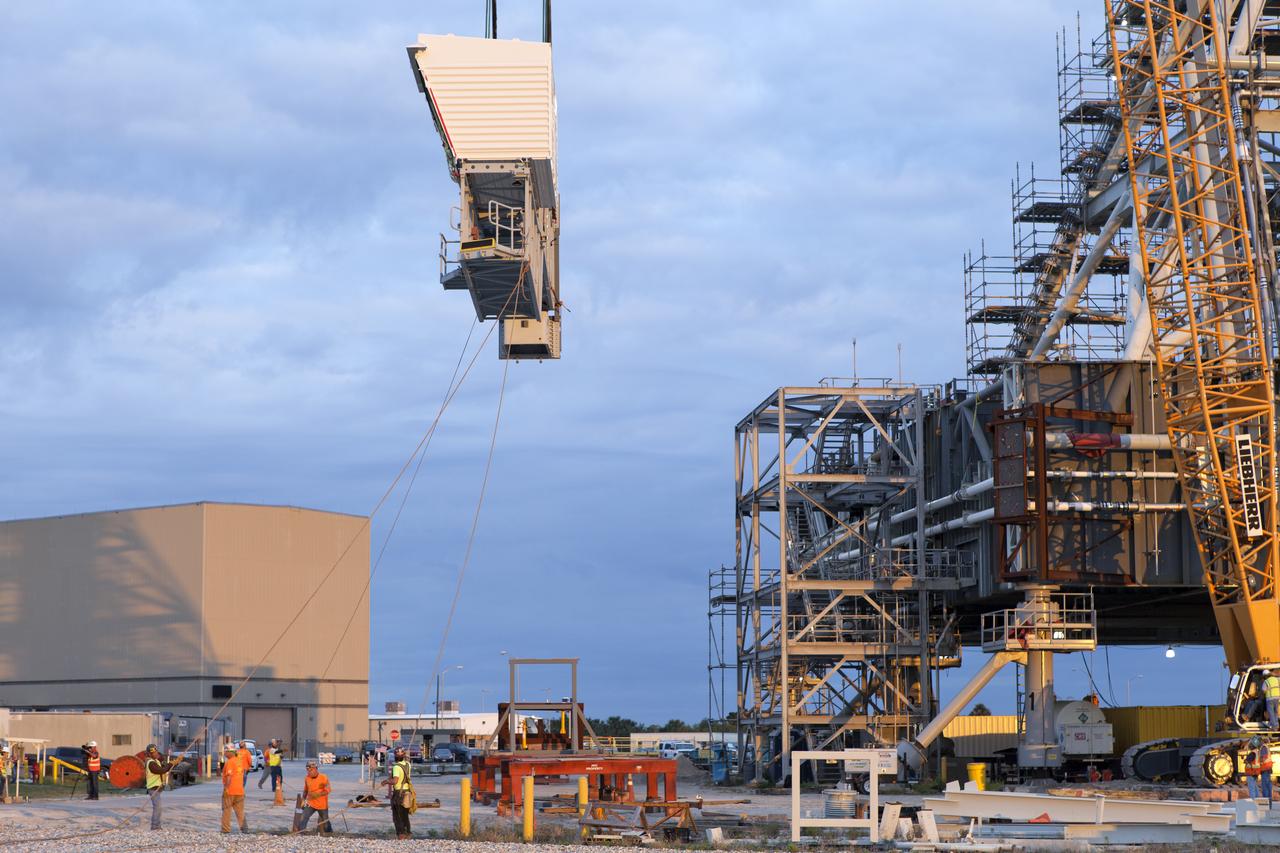
At NASA's Kennedy Space Center in Florida, a crane lifts the Orion crew access arm (CAA) so it can be attached to the mobile launcher (ML). The arm will be installed at about the 274-foot level on the ML tower. NASA's Exploration Ground Systems organization has been overseeing installation of umbilicals and other launch accessories on the 380-foot-tall ML in preparation for stacking the first launch of the Space launch System (SLS), rocket with an Orion spacecraft. The CAA is designed to rotate from its retracted position and line up with Orion's crew hatch providing entry for astronauts and technicians.
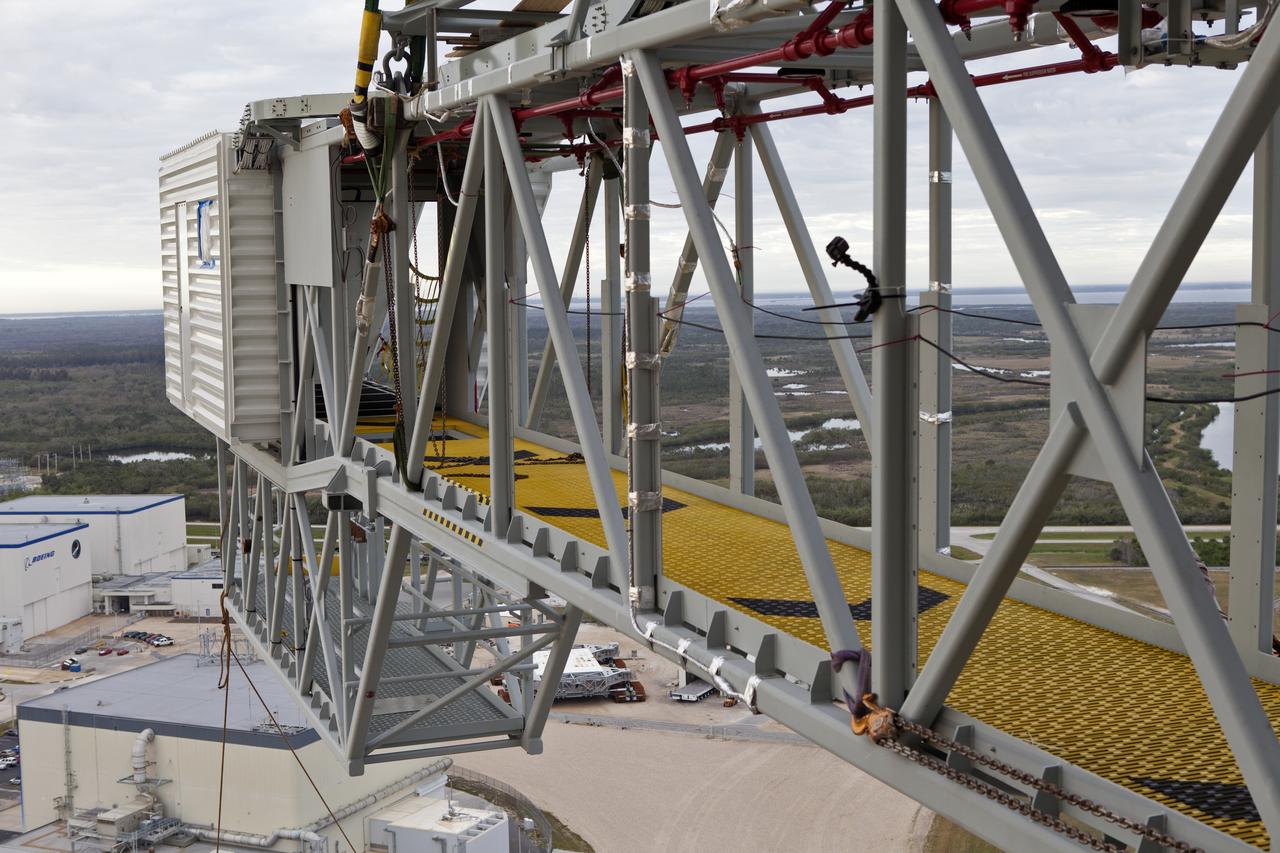
Viewed from the 274-foot level mobile launcher (ML), the Orion crew access arm (CAA) is beign installed on the tower. The CAA will support the Space launch System (SLS) rocket at NASA's Kennedy Space Center in Florida. NASA's Exploration Ground Systems organization has been overseeing installation of umbilicals and other launch accessories on the 380-foot-tall ML in preparation for stacking the first launch of the Space launch System, or SLS, rocket with an Orion spacecraft. The CAA is designed to rotate from its retracted position and line up with Orion's crew hatch providing entry for astronauts and technicians.
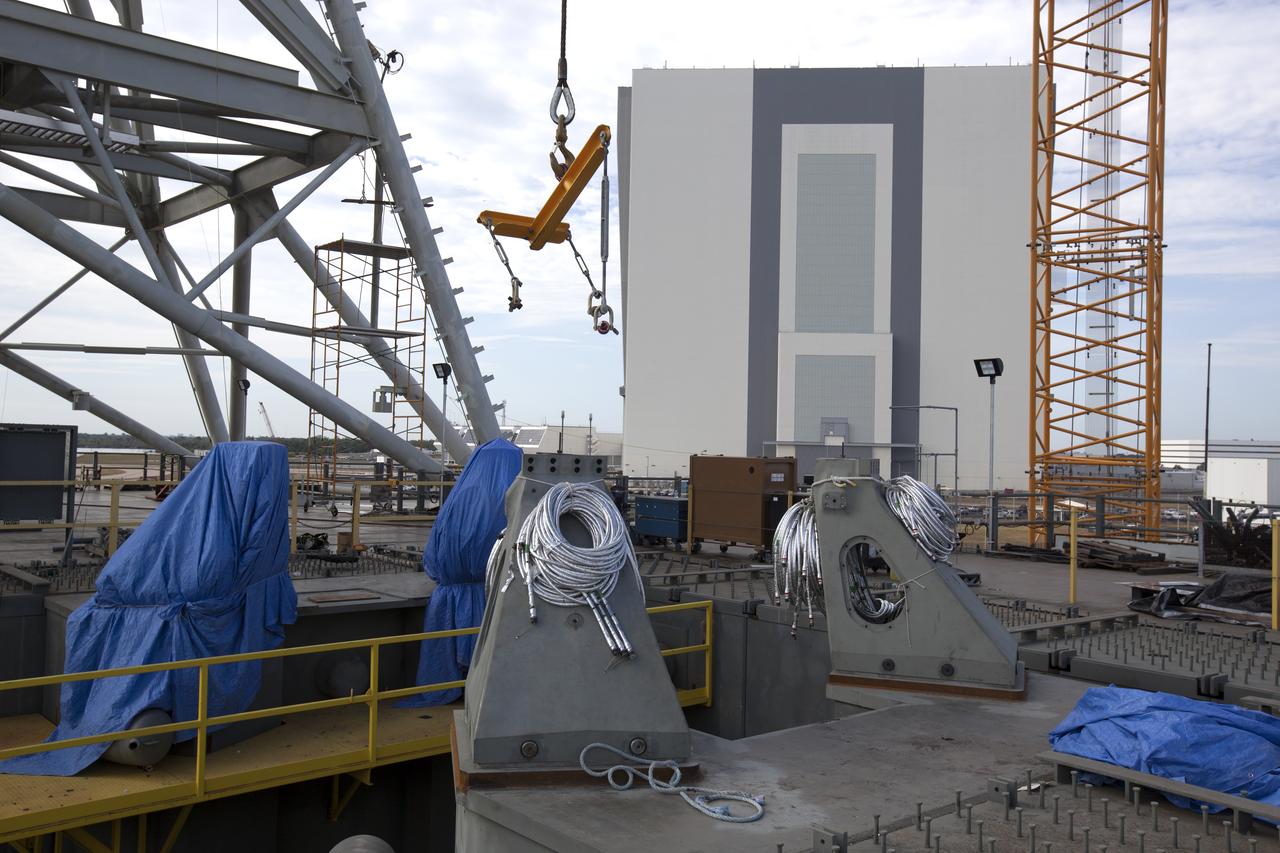
At NASA's Kennedy Space Center in Florida, the final four vehicle support posts are being installed on the deck of the mobile launcher. A total of eight support posts are being installed to support the load of the Space Launch System's (SLS) solid rocket boosters, with four posts for each of the boosters. The support posts are about five feet tall and each weigh about 10,000 pounds. The posts will structurally support the SLS rocket through T-0 and liftoff, and will drop down before vehicle liftoff to avoid contact with the flight hardware. The Ground Systems Development and Operations Program is overseeing installation of the support posts to prepare for the launch of the Orion spacecraft atop the SLS rocket.
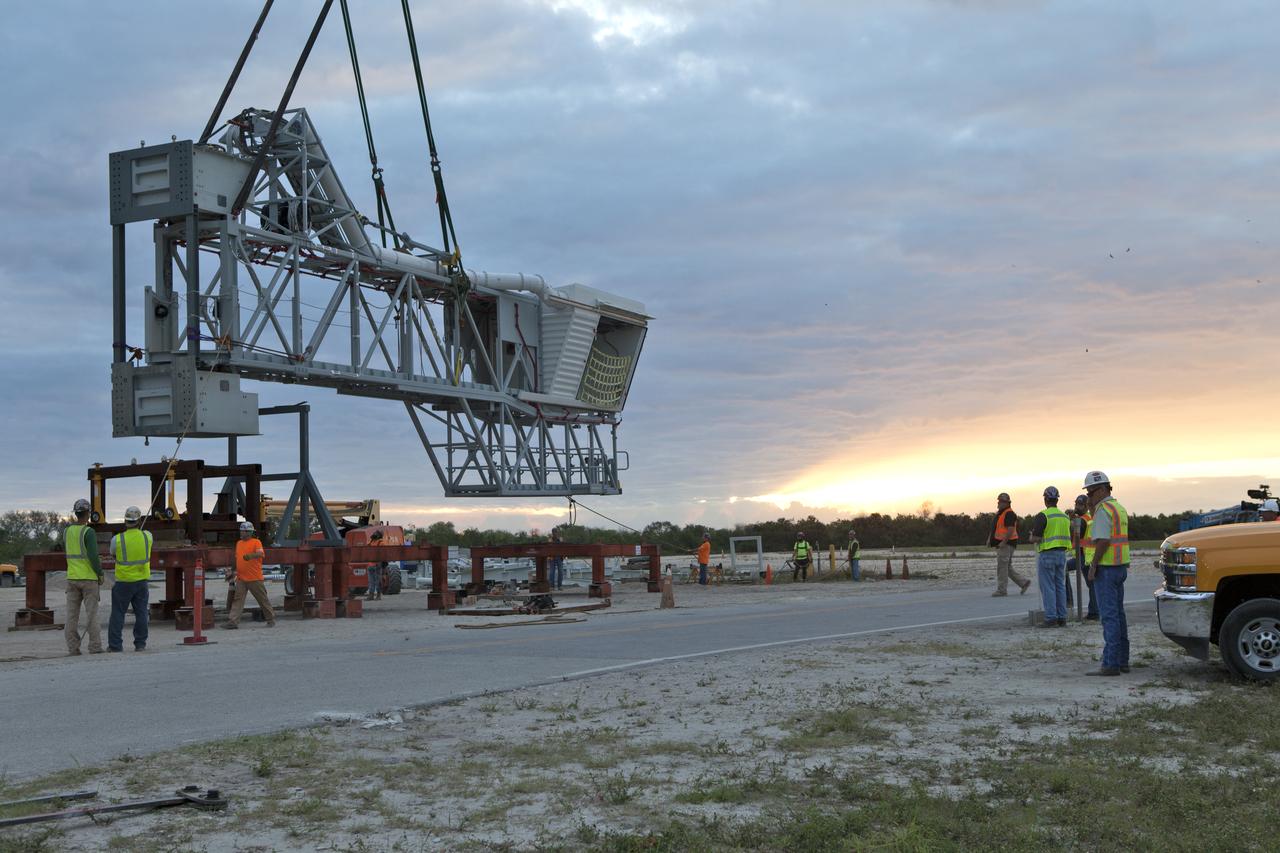
Under the watchful eye of technicians and engineers, a crane begins lifting the Orion crew access arm (CAA) so it can be attached to the mobile launcher (ML) at NASA's Kennedy Space Center in Florida. The arm will be installed at about the 274-foot level on the ML tower. NASA's Exploration Ground Systems organization has been overseeing installation of umbilicals and other launch accessories on the 380-foot-tall ML in preparation for stacking the first launch of the Space launch System (SLS), rocket with an Orion spacecraft. The CAA is designed to rotate from its retracted position and line up with Orion's crew hatch providing entry for astronauts and technicians.
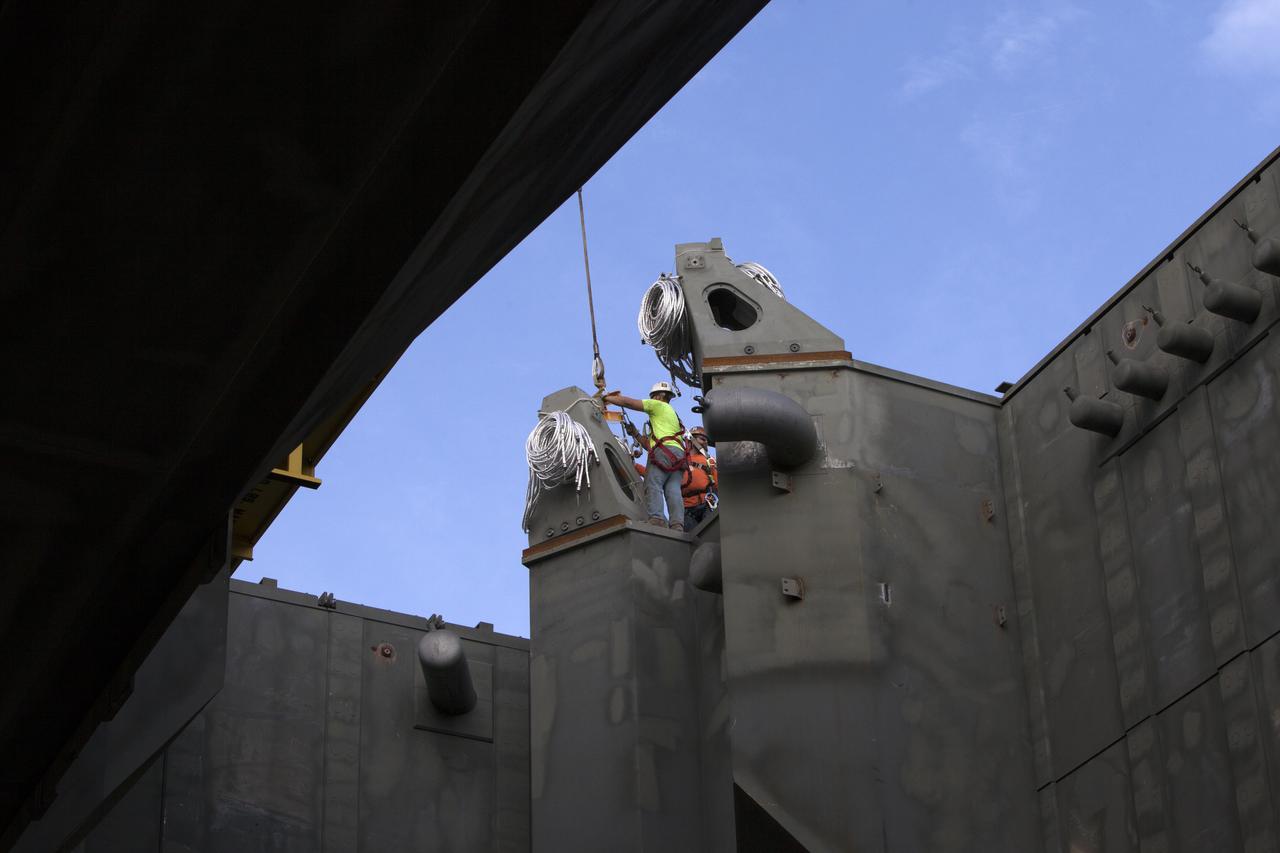
At NASA's Kennedy Space Center in Florida, construction workers on the deck of the mobile launcher install the final four vehicle support posts. A total of eight support posts are being installed to support the load of the Space Launch System's (SLS) solid rocket boosters, with four posts for each of the boosters. The support posts are about five feet tall and each weigh about 10,000 pounds. The posts will structurally support the SLS rocket through T-0 and liftoff, and will drop down before vehicle liftoff to avoid contact with the flight hardware. The Ground Systems Development and Operations Program is overseeing installation of the support posts to prepare for the launch of the Orion spacecraft atop the SLS rocket.
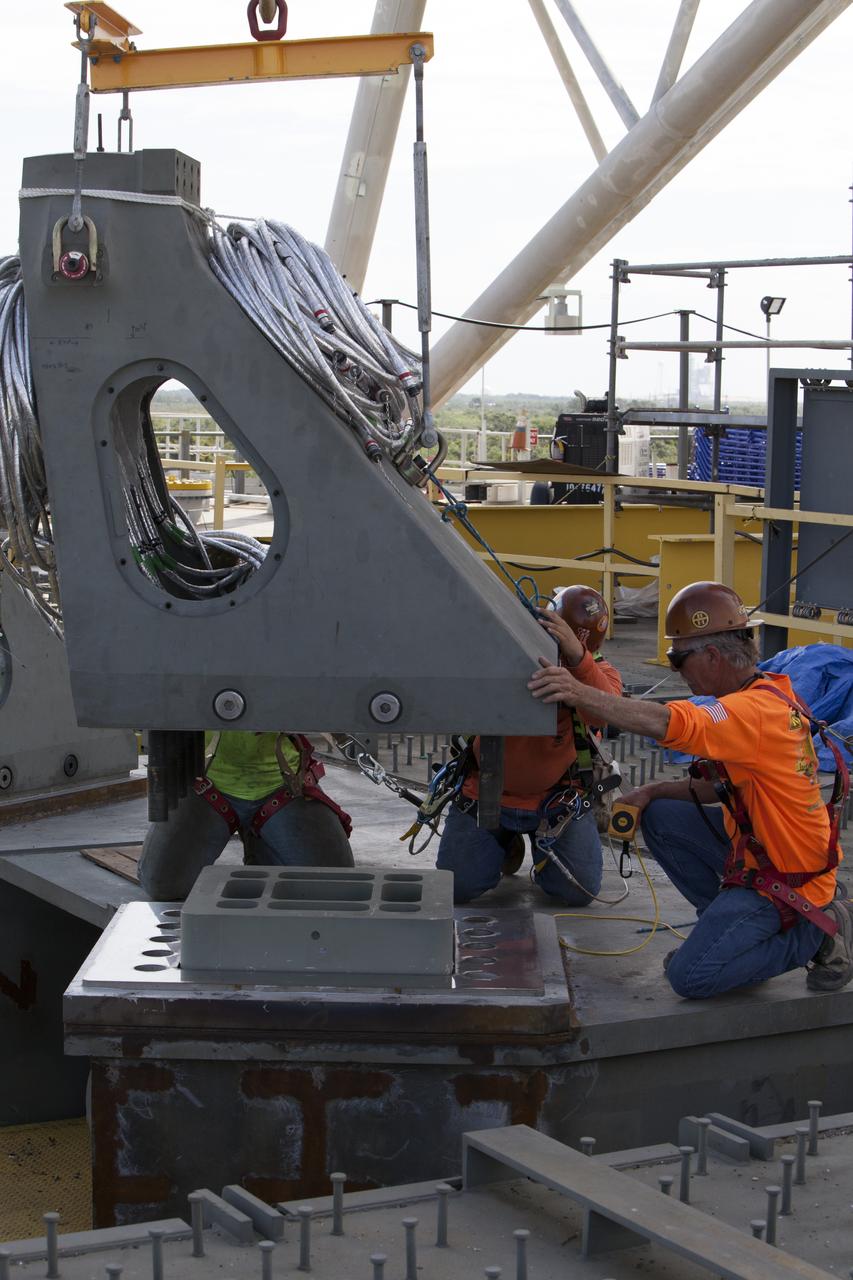
Construction workers on the deck of the mobile launcher at NASA's Kennedy Space Center in Florida, prepare to install a vehicle support post. A total of eight support posts are being installed to support the load of the Space Launch System's (SLS) solid rocket boosters, with four posts for each of the boosters. The support posts are about five feet tall and each weigh about 10,000 pounds. The posts will structurally support the SLS rocket through T-0 and liftoff, and will drop down before vehicle liftoff to avoid contact with the flight hardware. The Ground Systems Development and Operations Program is overseeing installation of the support posts to prepare for the launch of the Orion spacecraft atop the SLS rocket.
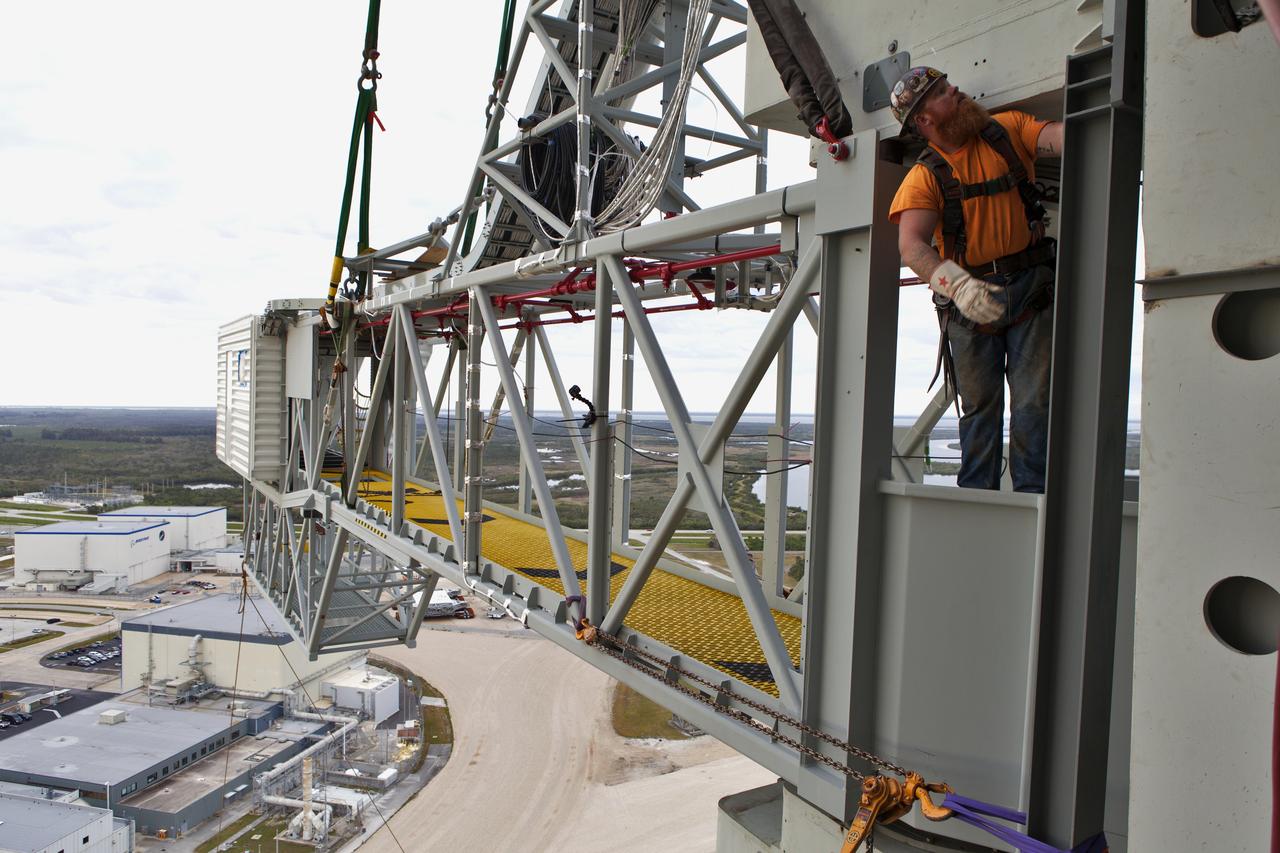
Viewed from the 274-foot level mobile launcher (ML), a technician begins installation of the Orion crew access arm (CAA) to the tower. The CAA will support the Space launch System (SLS) rocket at NASA's Kennedy Space Center in Florida. NASA's Exploration Ground Systems organization has been overseeing installation of umbilicals and other launch accessories on the 380-foot-tall ML in preparation for stacking the first launch of the Space launch System, or SLS, rocket with an Orion spacecraft. The CAA is designed to rotate from its retracted position and line up with Orion's crew hatch providing entry for astronauts and technicians.
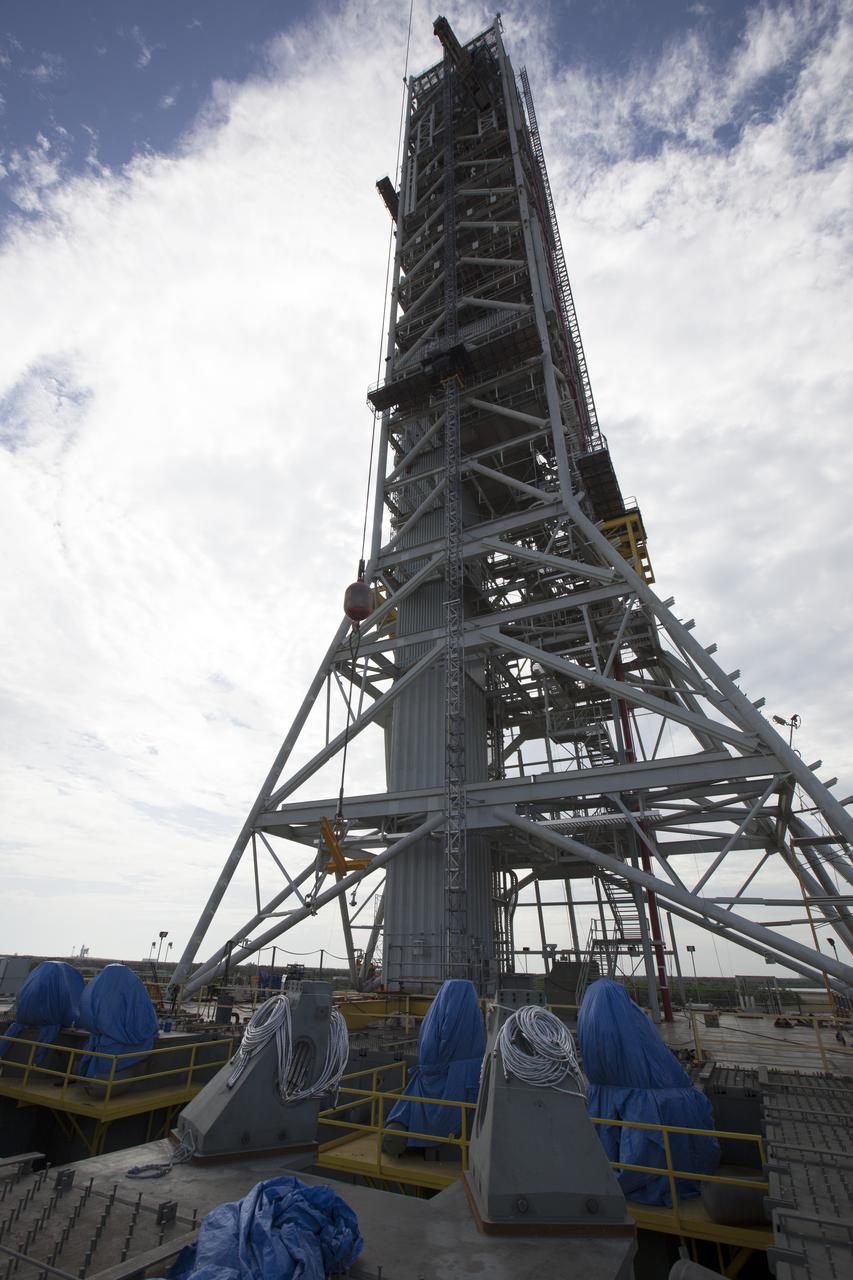
At NASA's Kennedy Space Center in Florida, the final four vehicle support posts are being installed on the deck of the mobile launcher. A total of eight support posts are being installed to support the load of the Space Launch System's (SLS) solid rocket boosters, with four posts for each of the boosters. The support posts are about five feet tall and each weigh about 10,000 pounds. The posts will structurally support the SLS rocket through T-0 and liftoff, and will drop down before vehicle liftoff to avoid contact with the flight hardware. The Ground Systems Development and Operations Program is overseeing installation of the support posts to prepare for the launch of the Orion spacecraft atop the SLS rocket.
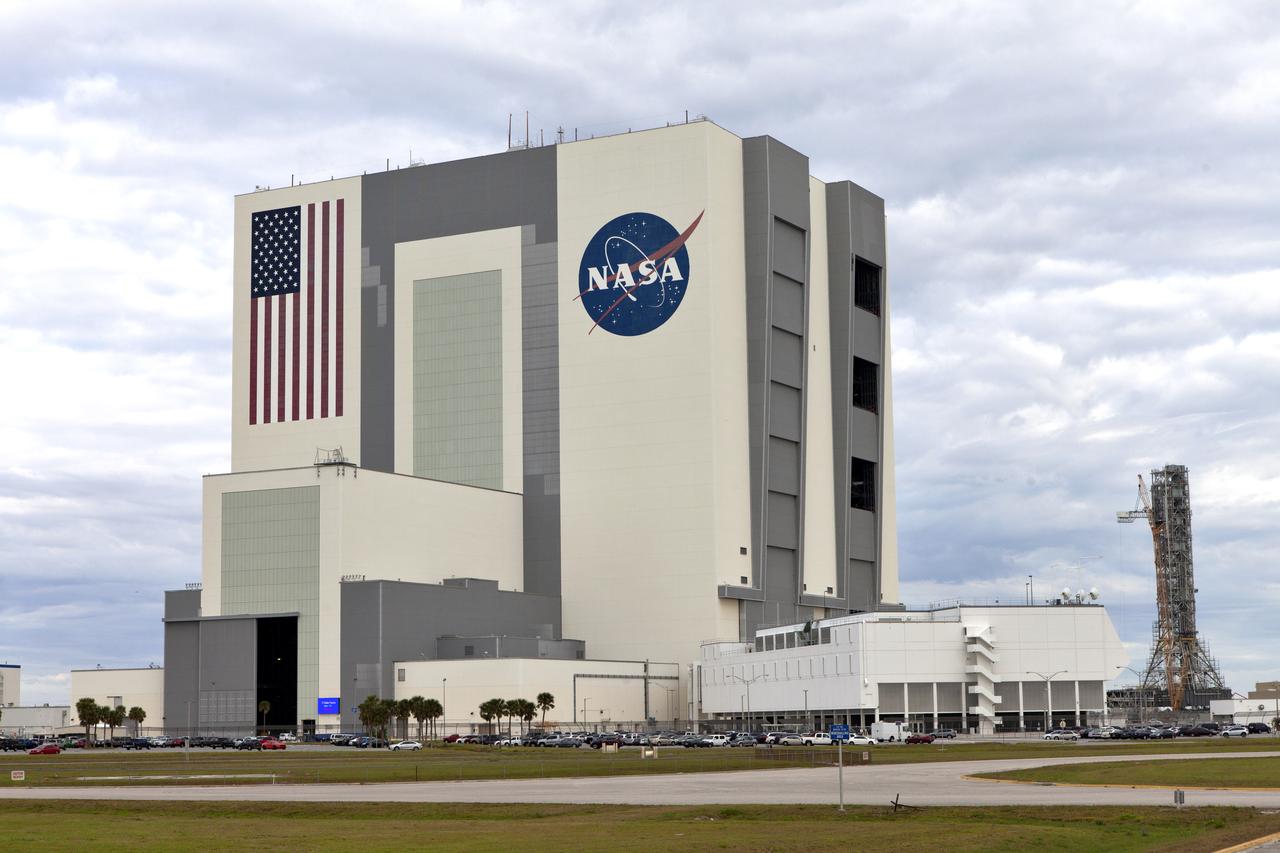
Seen to the right of the iconic Vehicle Assembly Building at NASA's Kennedy Space Center in Florida, a crane positions the Orion crew access arm (CAA) so it can be attached to the mobile launcher (ML). The arm will be installed at about the 274-foot level on the ML tower. NASA's Exploration Ground Systems organization has been overseeing installation of umbilicals and other launch accessories on the 380-foot-tall ML in preparation for stacking the first launch of the Space launch System (SLS), rocket with an Orion spacecraft. The CAA is designed to rotate from its retracted position and line up with Orion's crew hatch providing entry for astronauts and technicians.
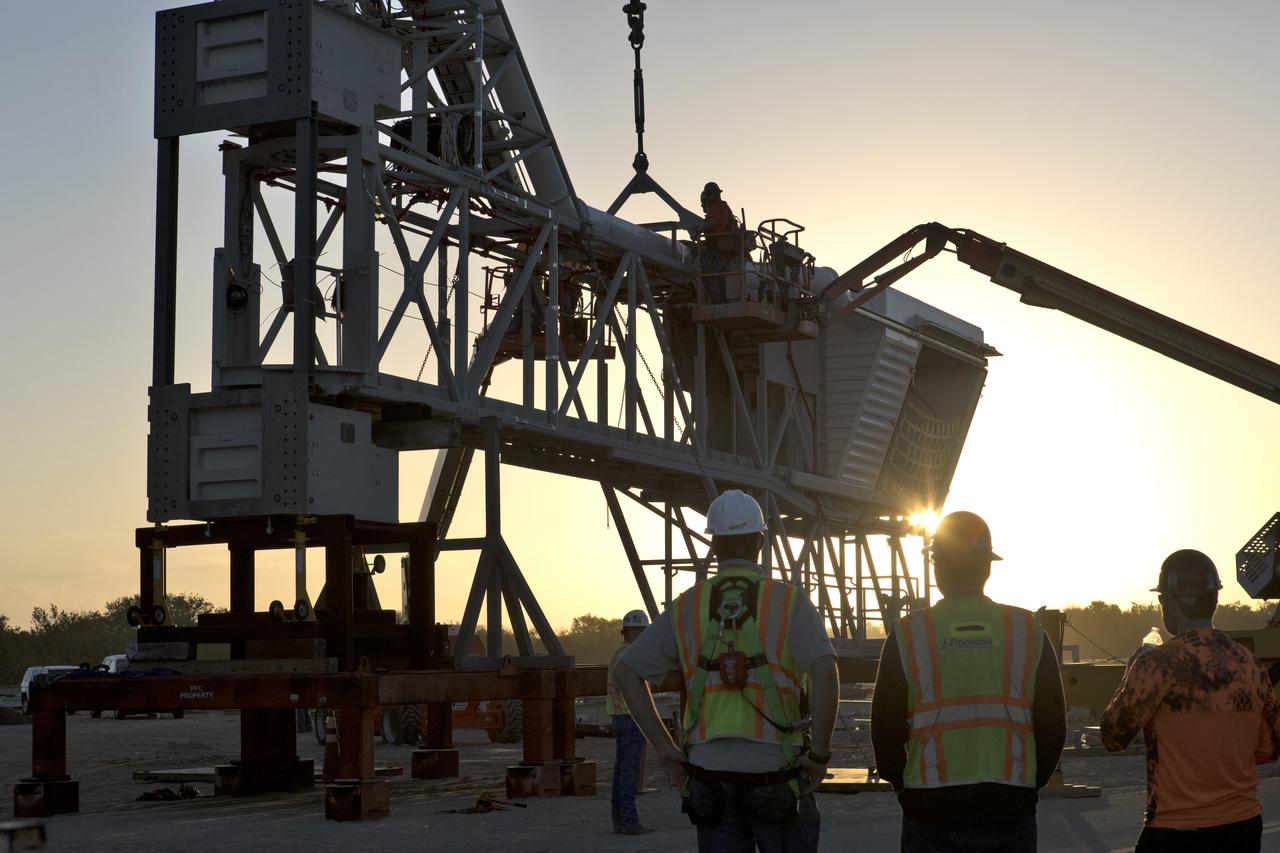
Under the watchful eye of technicians and engineers, a crane is prepared to lift the Orion crew access arm (CAA) so it can be attached to the mobile launcher (ML) at NASA's Kennedy Space Center in Florida. The arm will be installed at about the 274-foot level on the ML tower. NASA's Exploration Ground Systems organization has been overseeing installation of umbilicals and other launch accessories on the 380-foot-tall ML in preparation for stacking the first launch of the Space launch System, or SLS, rocket with an Orion spacecraft. The CAA is designed to rotate from its retracted position and line up with Orion's crew hatch providing entry for astronauts and technicians.
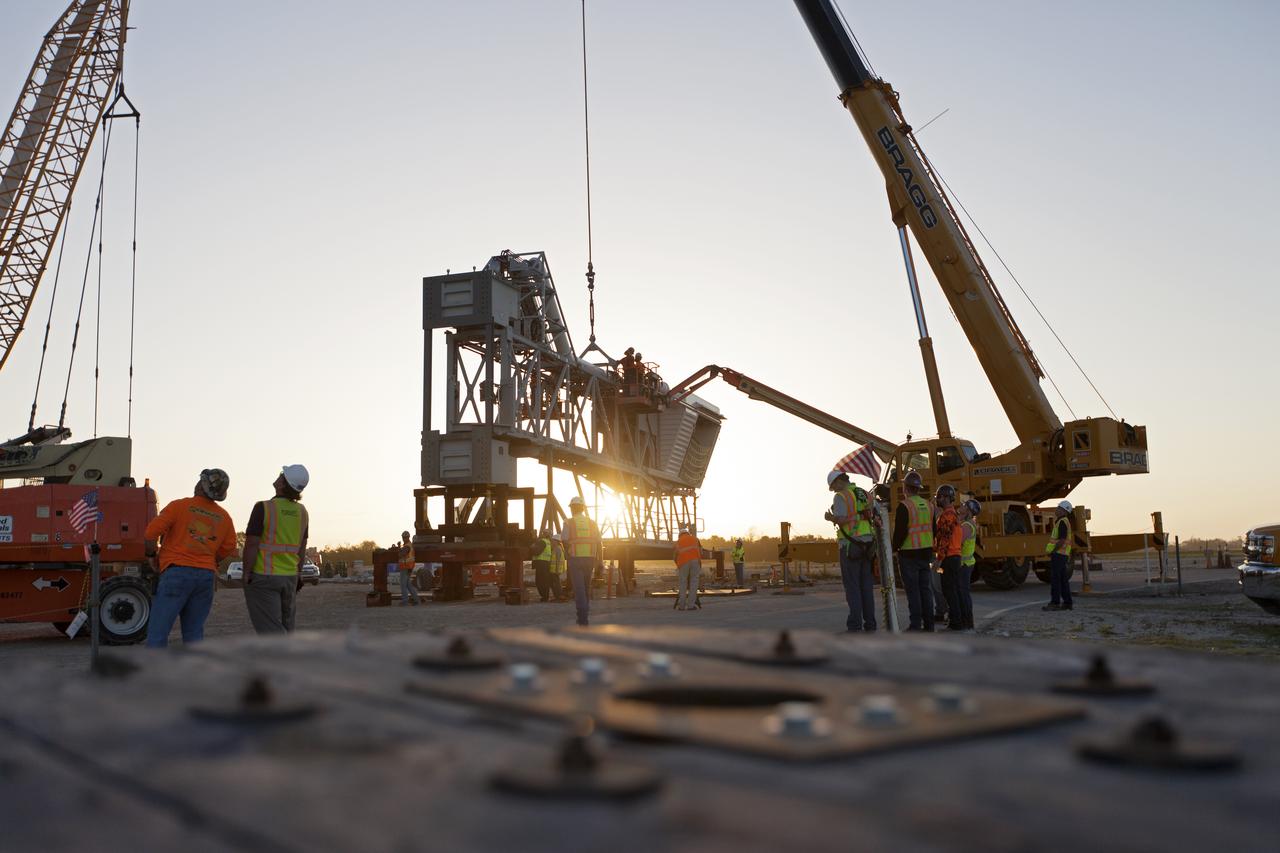
At NASA's Kennedy Space Center in Florida, a crane is prepared to lift the Orion crew access arm (CAA) so it can be attached to the mobile launcher (ML). The arm will be installed at about the 274-foot level on the ML tower. NASA's Exploration Ground Systems organization has been overseeing installation of umbilicals and other launch accessories on the 380-foot-tall ML in preparation for stacking the first launch of the Space launch System, or SLS, rocket with an Orion spacecraft. The CAA is designed to rotate from its retracted position and line up with Orion's crew hatch providing entry for astronauts and technicians.
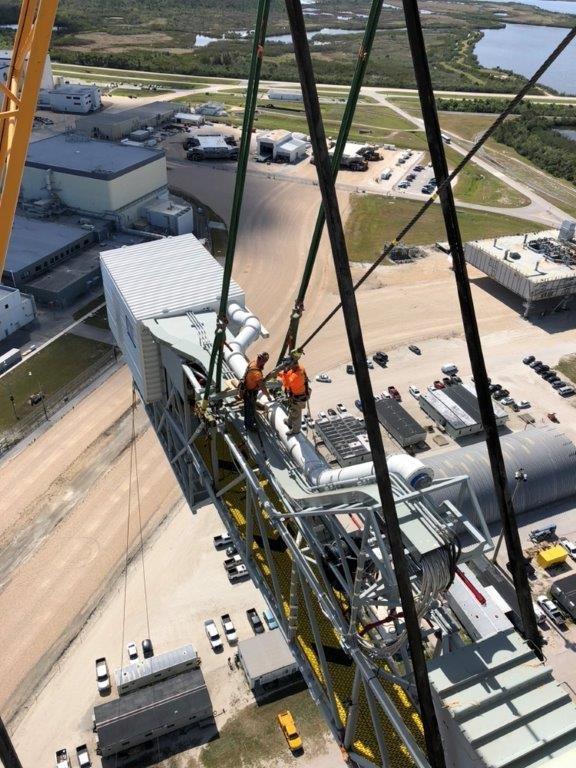
Viewed from the 274-foot level mobile launcher (ML), technicians help install the Orion crew access arm (CAA) to the tower at NASA's Kennedy Space Center in Florida. NASA's Exploration Ground Systems organization has been overseeing installation of umbilicals and other launch accessories on the 380-foot-tall ML in preparation for stacking the first launch of the Space launch System (SLS), rocket with an Orion spacecraft. The CAA is designed to rotate from its retracted position and line up with Orion's crew hatch providing entry for astronauts and technicians.
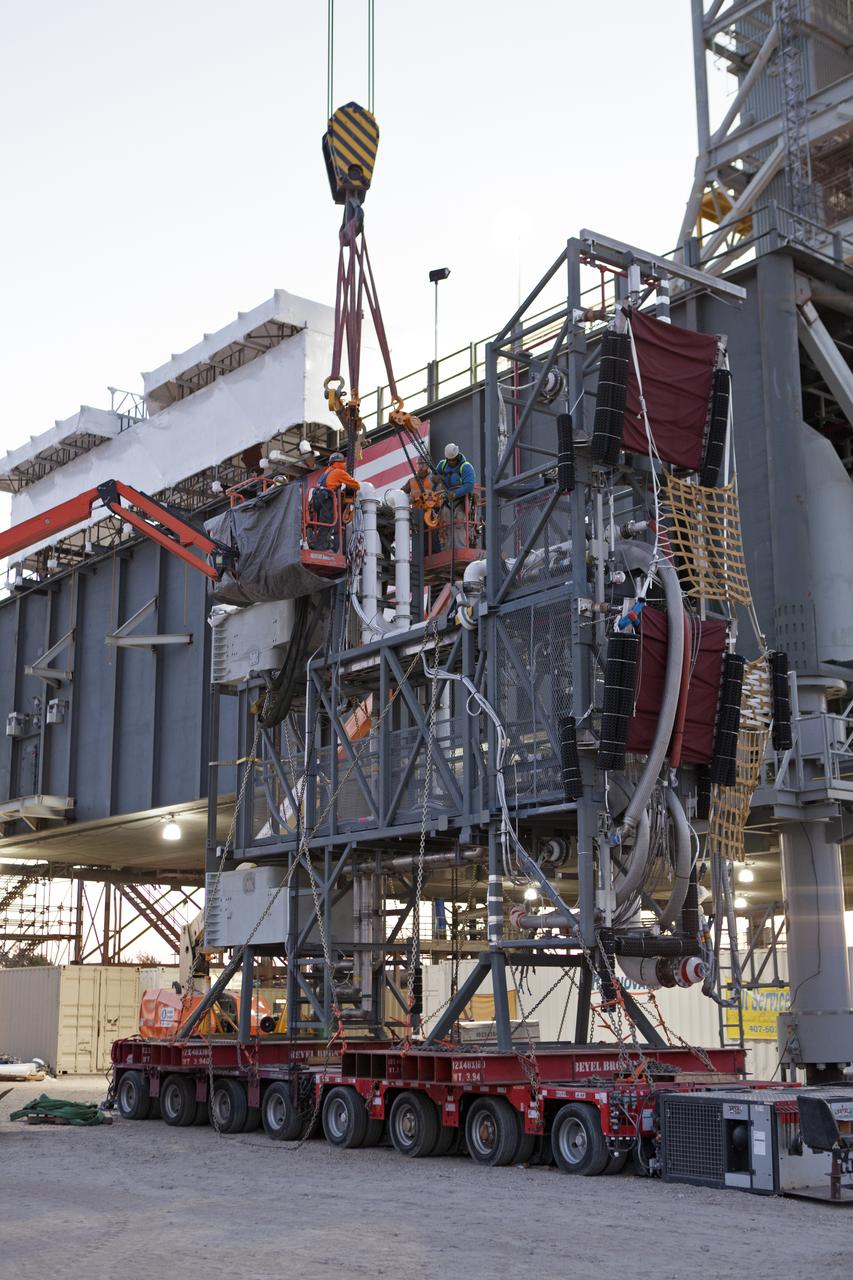
Construction workers with JP Donovan attach a heavy-lift crane to the Interim Cryogenic Propulsion Stage Umbilical (ICPSU) to prepare for lifting and installation on the mobile launcher (ML) tower at NASA's Kennedy Space Center in Florida. The last of the large umbilicals to be installed, the ICPSU will provide super-cooled hydrogen and liquid oxygen to the Space Launch System (SLS) rocket's interim cryogenic propulsion stage, or upper stage, at T-0 for Exploration Mission-1. The umbilical will be located at about the 240-foot-level of the ML and will supply fuel, oxidizer, gaseous helium, hazardous gas leak detection, electrical commodities and environment control systems to the upper stage of the SLS rocket during launch. Exploration Ground Systems is overseeing installation of the umbilicals on the ML.
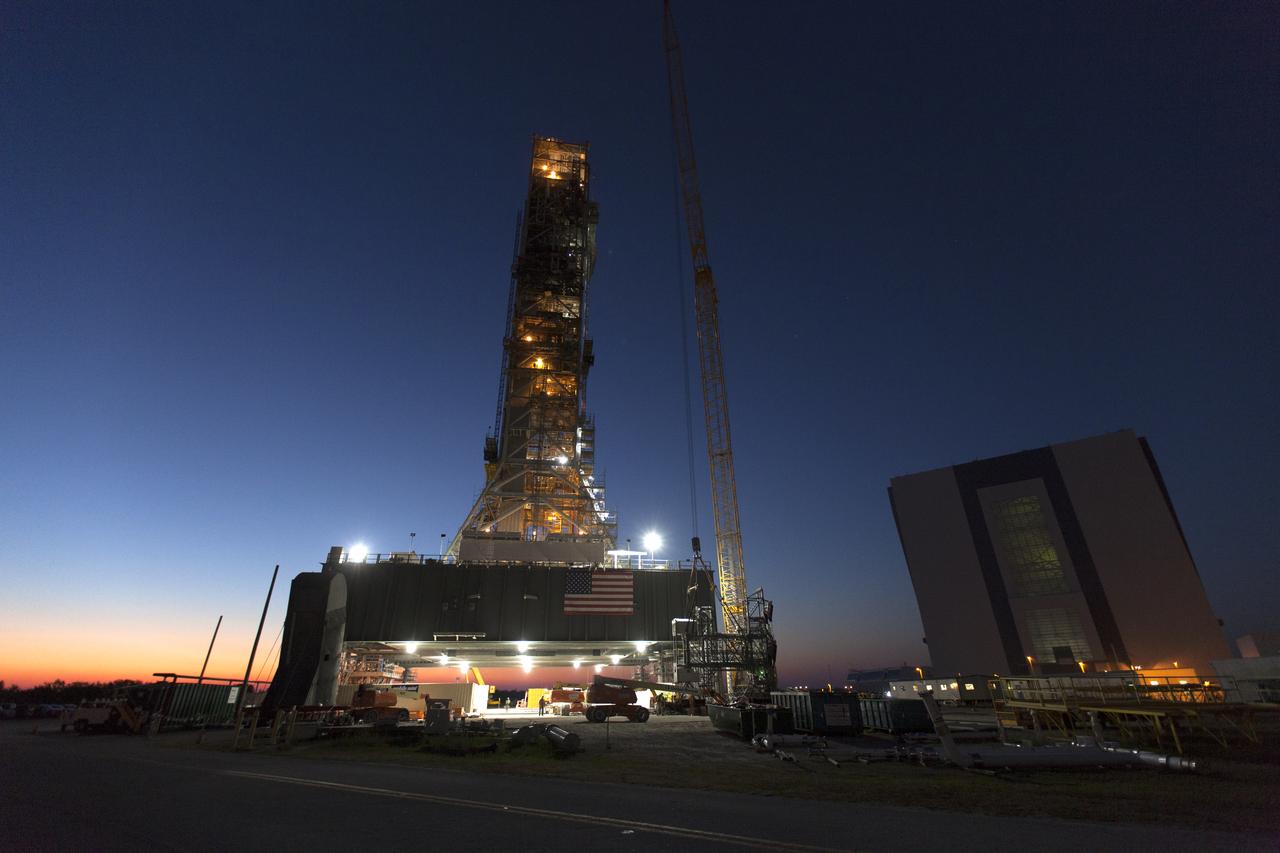
The mobile launcher (ML) tower is lit up before early morning sunrise at NASA's Kennedy Space Center in Florida. Preparations are underway to lift and install the Interim Cryogenic Propulsion Stage Umbilical (ICPSU) at about the 240-foot-level on the tower. The last of the large umbilicals to be installed, the ICPSU will provide super-cooled hydrogen and liquid oxygen to the Space Launch System (SLS) rocket's interim cryogenic propulsion stage, or upper stage, at T-0 for Exploration Mission-1. The umbilical will supply fuel, oxidizer, gaseous helium, hazardous gas leak detection, electrical commodities and environment control systems to the upper stage of the SLS rocket during launch. Exploration Ground Systems is overseeing installation of the umbilicals on the ML.
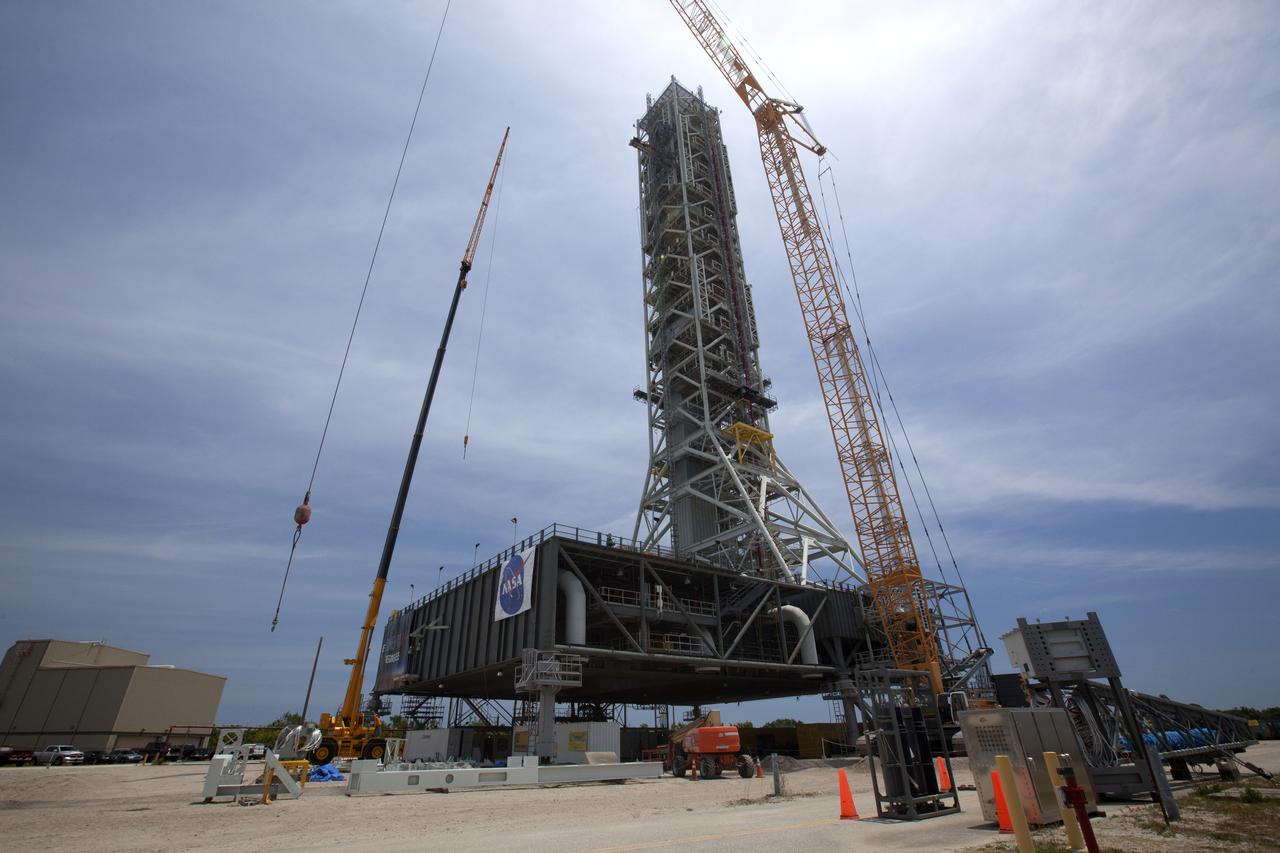
Several heavy lift cranes surround the mobile launcher at NASA's Kennedy Space Center in Florida. Preparations are underway to lift a vehicle support post up and onto the mobile launcher for installation on the deck. A total of eight support posts will be installed to support the load of the Space Launch System's (SLS) solid rocket boosters, with four posts for each of the boosters. The support posts are about five feet tall and each weigh about 10,000 pounds. The posts will structurally support the SLS rocket through T-0 and liftoff, and will drop down before vehicle liftoff to avoid contact with the flight hardware. The Ground Systems Development and Operations Program is overseeing installation of the support posts to prepare for the launch of the Orion spacecraft atop the SLS rocket.

Four vehicle support posts have been installed on the deck of the mobile launcher at NASA's Kennedy Space Center in Florida. A total of eight support posts will be installed to support the load of the Space Launch System's (SLS) solid rocket boosters, with four posts for each of the boosters. The support posts are about five feet tall and each weigh about 10,000 pounds. The posts will structurally support the SLS rocket through T-0 and liftoff, and will drop down before vehicle liftoff to avoid contact with the flight hardware. The Ground Systems Development and Operations Program is overseeing installation of the support posts to prepare for the launch of the Orion spacecraft atop the SLS rocket.
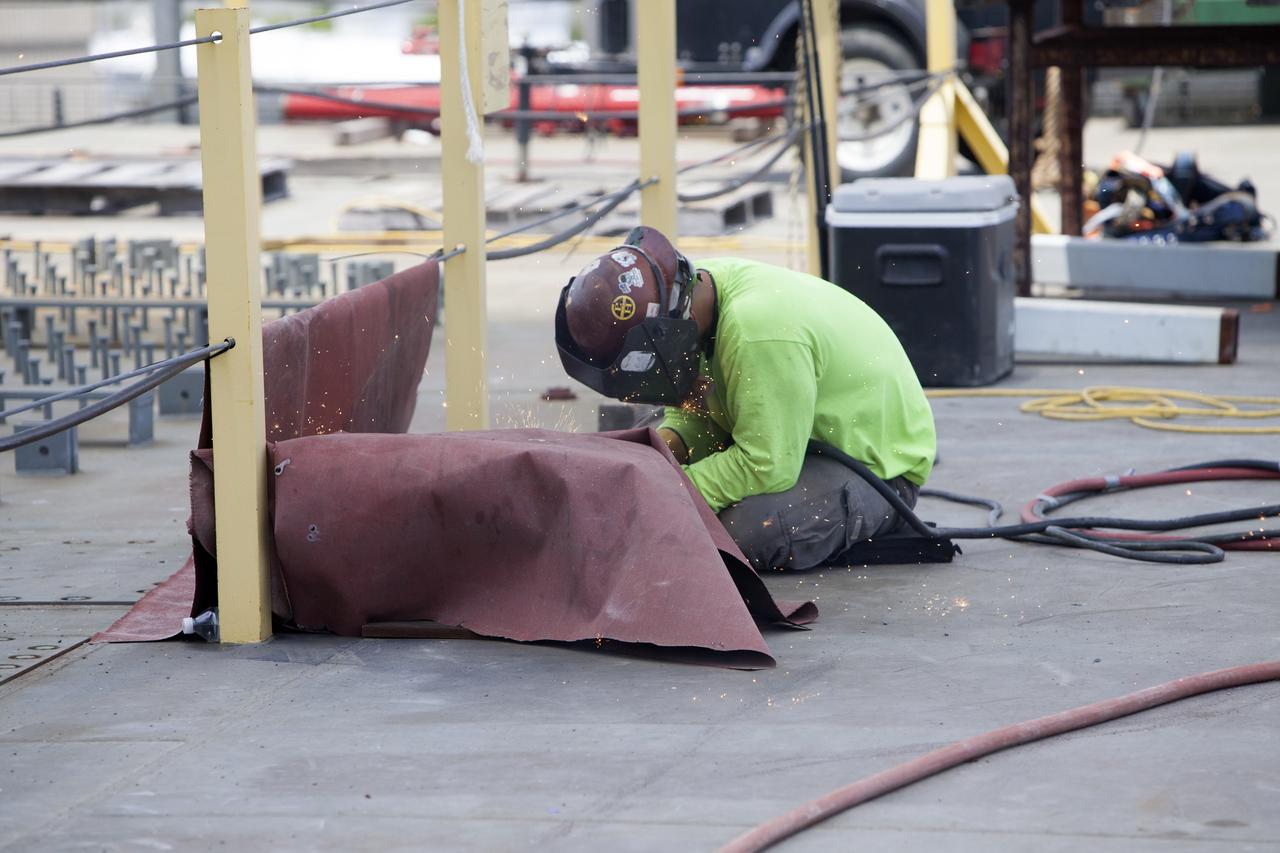
A construction worker on the deck of the mobile launcher welds a portion of a platform for installation of a vehicle support post at NASA's Kennedy Space Center in Florida. A total of eight support posts will be installed to support the load of the Space Launch System's (SLS) solid rocket boosters, with four posts for each of the boosters. The support posts are about five feet tall and each weigh about 10,000 pounds. The posts will structurally support the SLS rocket through T-0 and liftoff, and will drop down before vehicle liftoff to avoid contact with the flight hardware. The Ground Systems Development and Operations Program is overseeing installation of the support posts to prepare for the launch of the Orion spacecraft atop the SLS rocket.
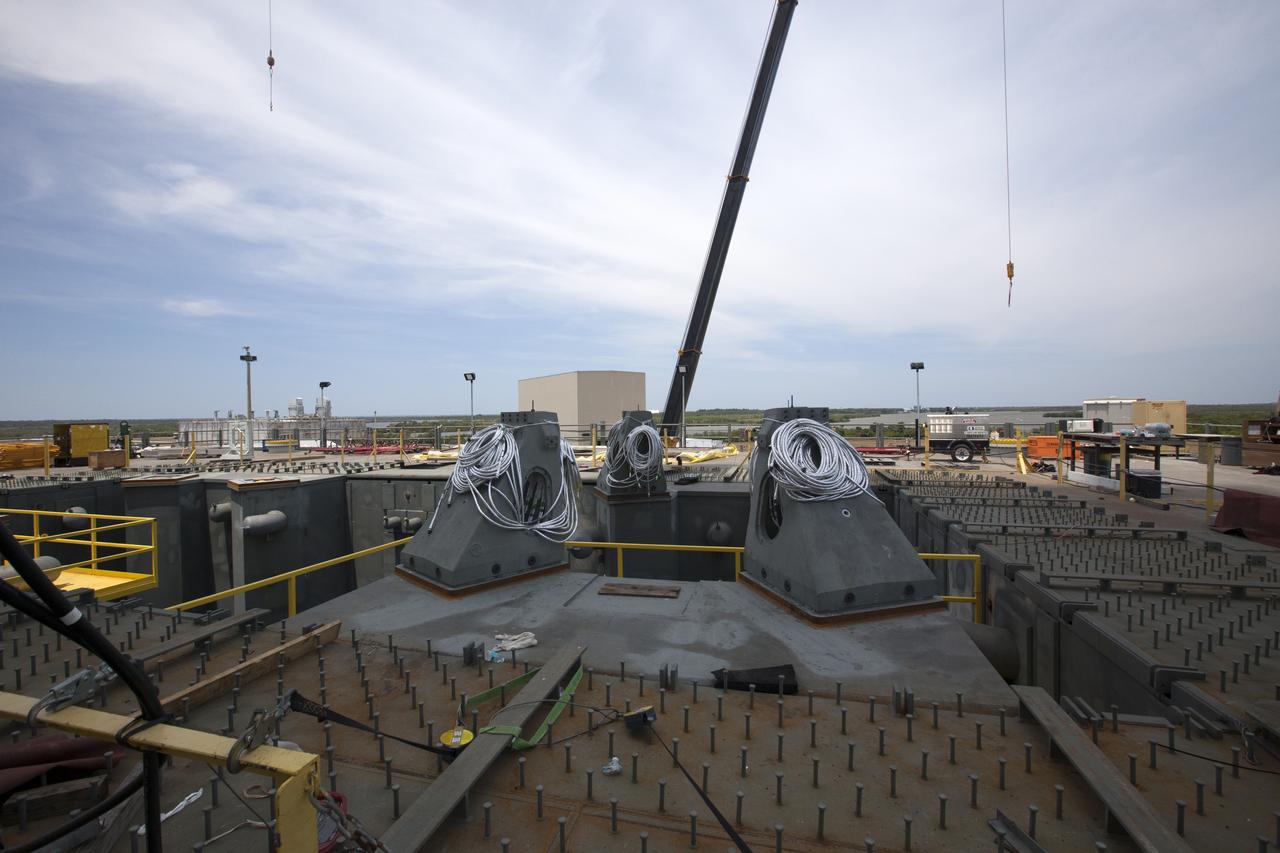
In view are three vehicle support posts installed on the deck of the mobile launcher at NASA's Kennedy Space Center in Florida. A total of eight support posts will be installed to support the load of the Space Launch System's (SLS) solid rocket boosters, with four posts for each of the boosters. The support posts are about five feet tall and each weigh about 10,000 pounds. The posts will structurally support the SLS rocket through T-0 and liftoff, and will drop down before vehicle liftoff to avoid contact with the flight hardware. The Ground Systems Development and Operations Program is overseeing installation of the support posts to prepare for the launch of the Orion spacecraft atop the SLS rocket.
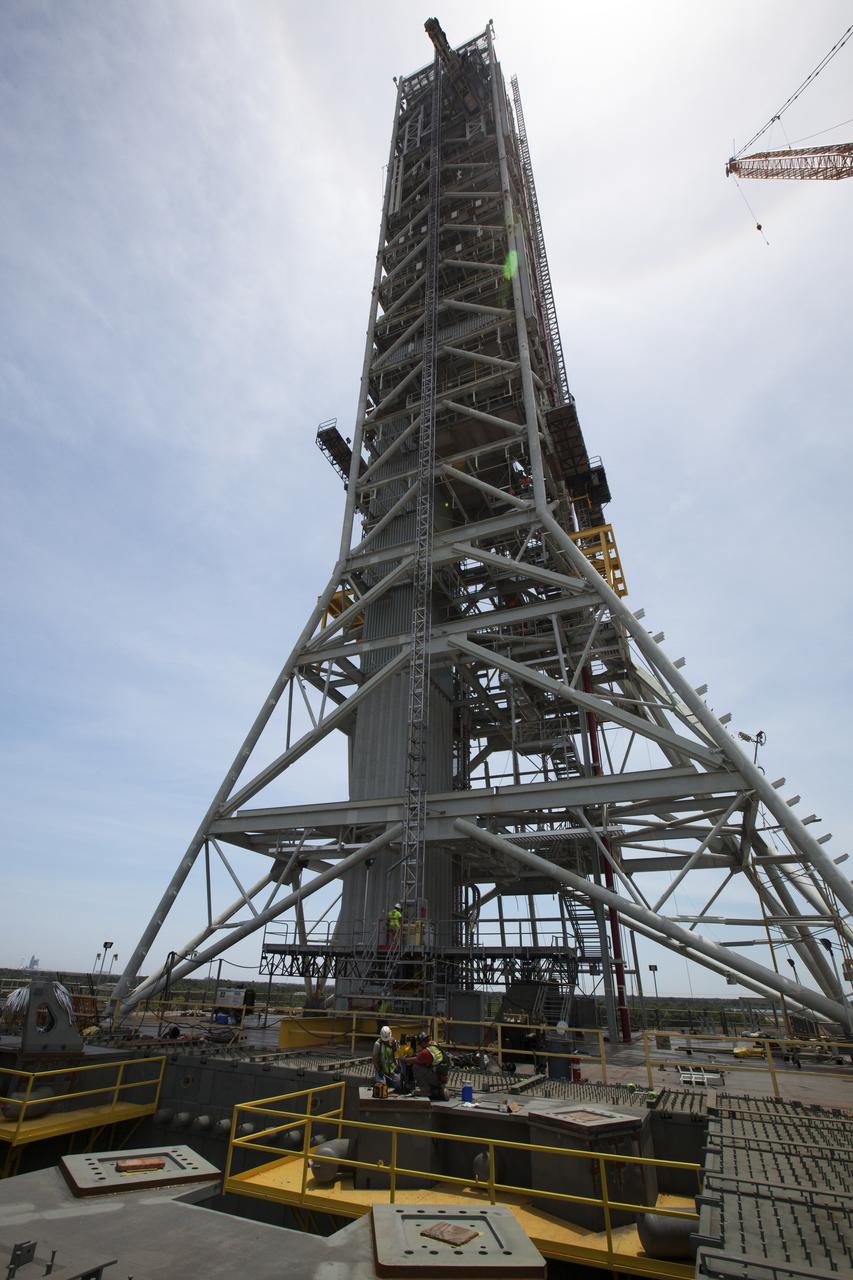
Construction workers on the deck of the mobile launcher at NASA's Kennedy Space Center in Florida, prepare a platform for installation of a vehicle support post. A total of eight support posts will be installed to support the load of the Space Launch System's (SLS) solid rocket boosters, with four posts for each of the boosters. The support posts are about five feet tall and each weigh about 10,000 pounds. The posts will structurally support the SLS rocket through T-0 and liftoff, and will drop down before vehicle liftoff to avoid contact with the flight hardware. The Ground Systems Development and Operations Program is overseeing installation of the support posts to prepare for the launch of the Orion spacecraft atop the SLS rocket.
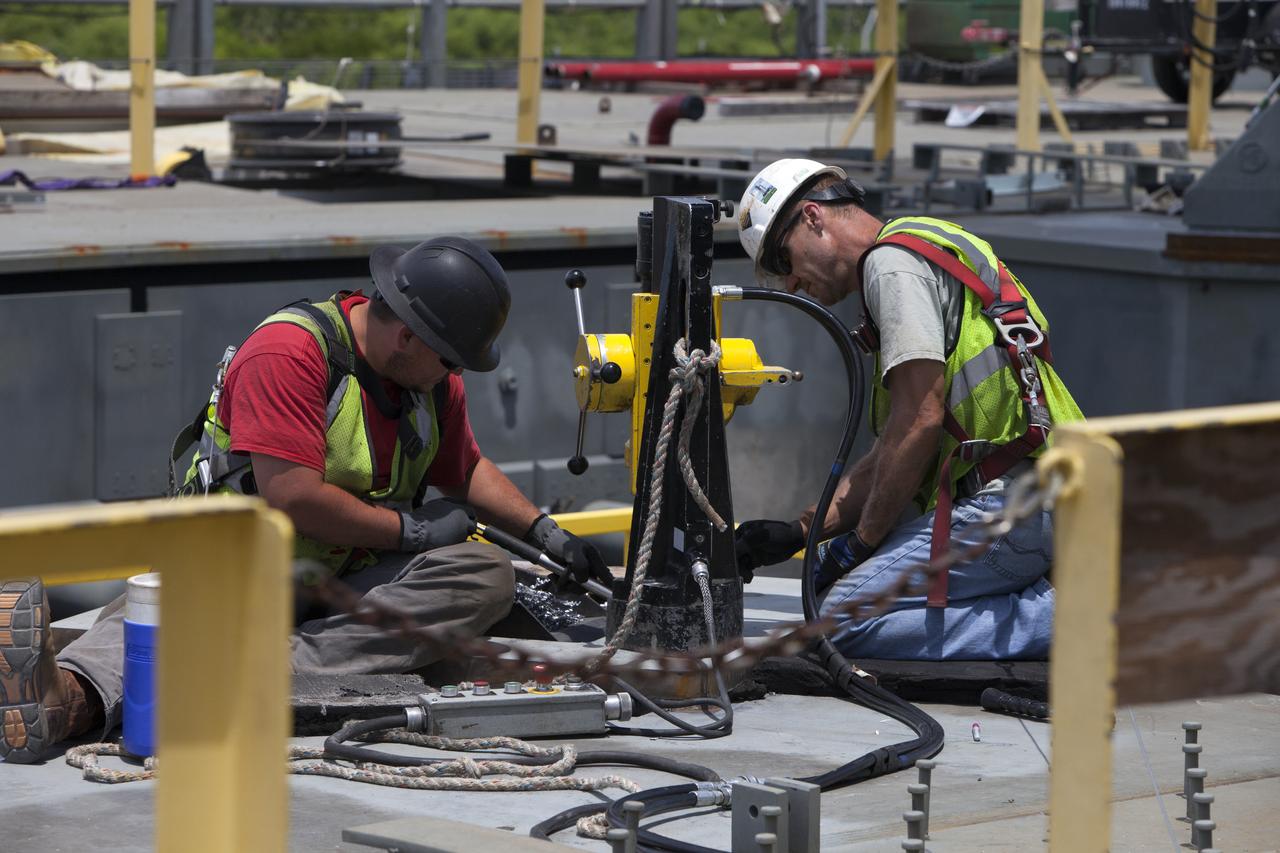
Construction workers on the deck of the mobile launcher at NASA's Kennedy Space Center in Florida, prepare a platform for installation of a vehicle support post. A total of eight support posts will be installed to support the load of the Space Launch System's (SLS) solid rocket boosters, with four posts for each of the boosters. The support posts are about five feet tall and each weigh about 10,000 pounds. The posts will structurally support the SLS rocket through T-0 and liftoff, and will drop down before vehicle liftoff to avoid contact with the flight hardware. The Ground Systems Development and Operations Program is overseeing installation of the support posts to prepare for the launch of the Orion spacecraft atop the SLS rocket.
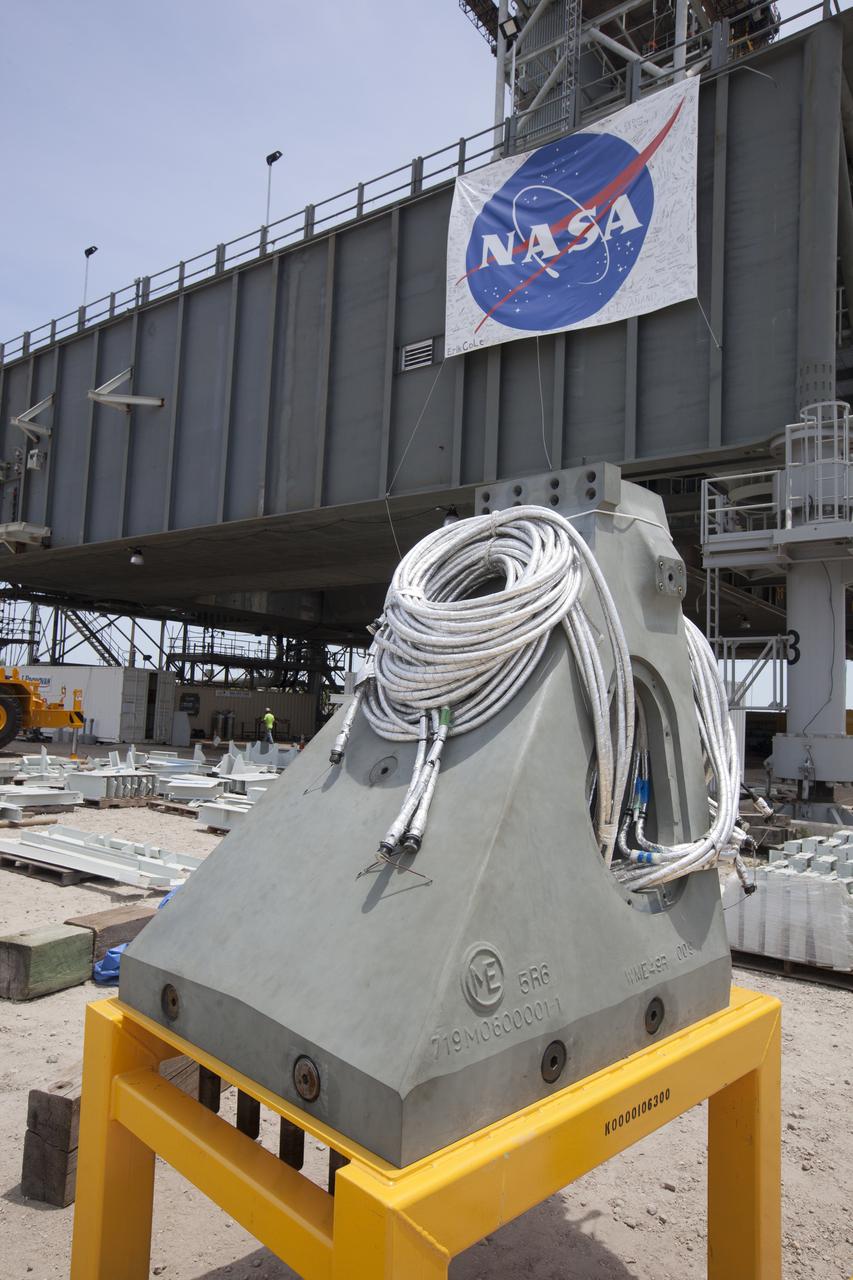
A vehicle support post will be lifted up by crane and lowered onto the deck of the mobile launcher at NASA's Kennedy Space Center in Florida. A total of eight support posts will be installed to support the load of the Space Launch System's (SLS) solid rocket boosters, with four posts for each of the boosters. The support posts are about five feet tall and each weigh about 10,000 pounds. The posts will structurally support the SLS rocket through T-0 and liftoff, and will drop down before vehicle liftoff to avoid contact with the flight hardware. The Ground Systems Development and Operations Program is overseeing installation of the support posts to prepare for the launch of the Orion spacecraft atop the SLS rocket.
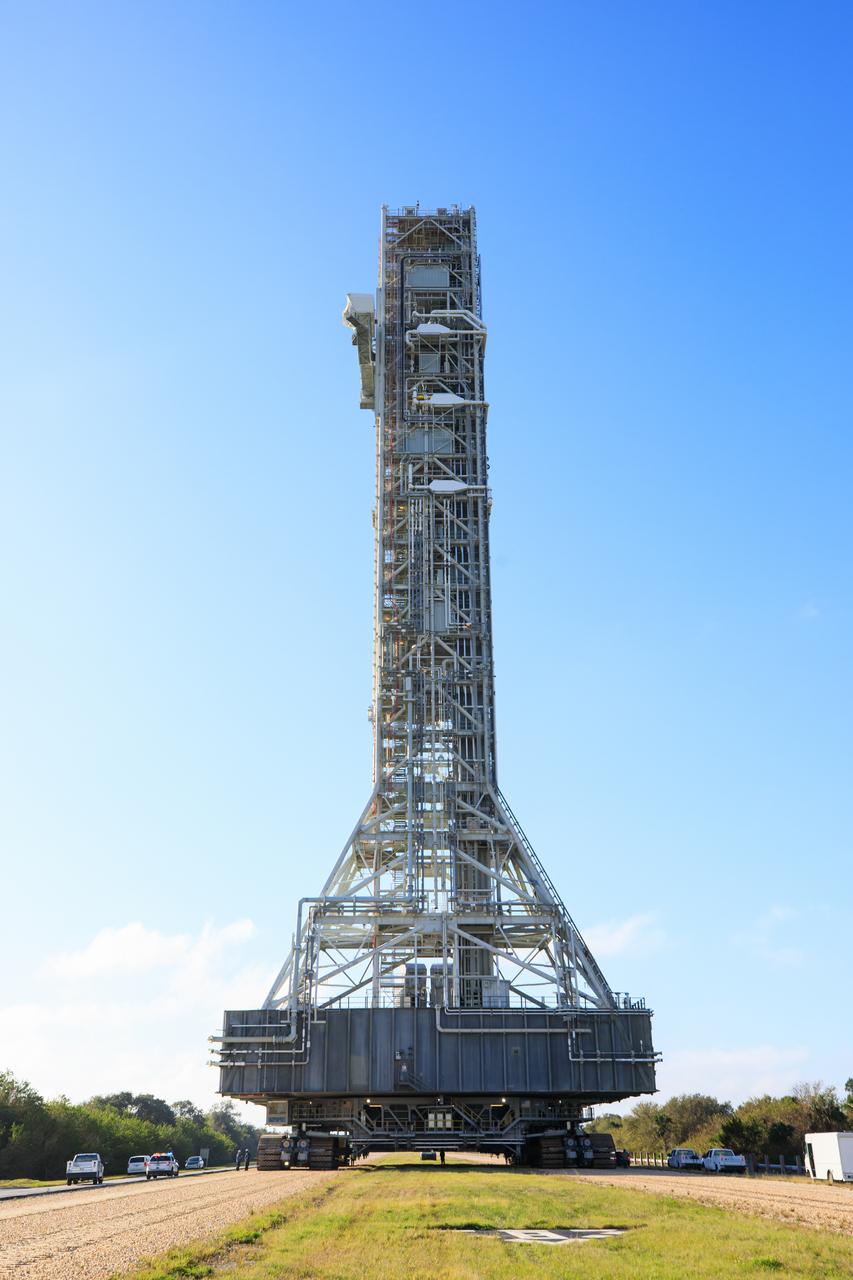
NASA’s mobile launcher, carried atop the crawler-transporter 2, left launch pad 39B at NASA’s Kennedy Space Center in Florida on Dec. 8, 2022, following the successful launch of the agency’s Space Launch System (SLS) rocket and Orion spacecraft on the Artemis I flight test on Nov. 16, 2022. The mobile launcher is scheduled to return to the Vehicle Assembly Building (VAB) on Dec. 9, 2022, and it will remain inside the VAB for several weeks as teams get it ready for the Artemis II crewed mission. Following its stay in the VAB, it will go to the mobile launcher park site location at Kennedy where it will undergo emergency egress modifications and testing to support future Artemis missions.
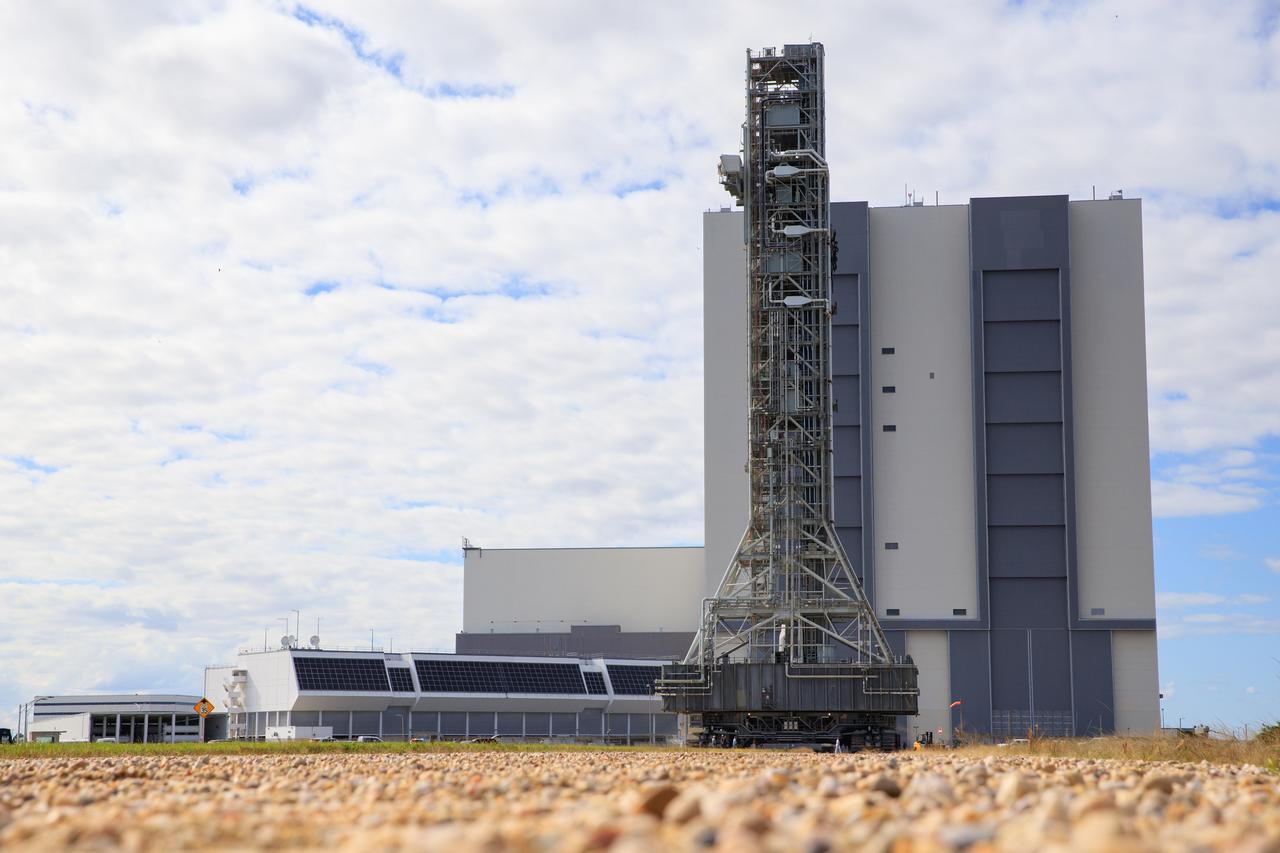
NASA’s mobile launcher, carried atop the crawler-transporter 2, left launch pad 39B at NASA’s Kennedy Space Center in Florida on Dec. 8, 2022, following the successful launch of the agency’s Space Launch System (SLS) rocket and Orion spacecraft on the Artemis I flight test on Nov. 16, 2022. The mobile launcher is scheduled to return to the Vehicle Assembly Building (VAB) on Dec. 9, 2022, and it will remain inside the VAB for several weeks as teams get it ready for the Artemis II crewed mission. Following its stay in the VAB, it will go to the mobile launcher park site location at Kennedy where it will undergo emergency egress modifications and testing to support future Artemis missions.
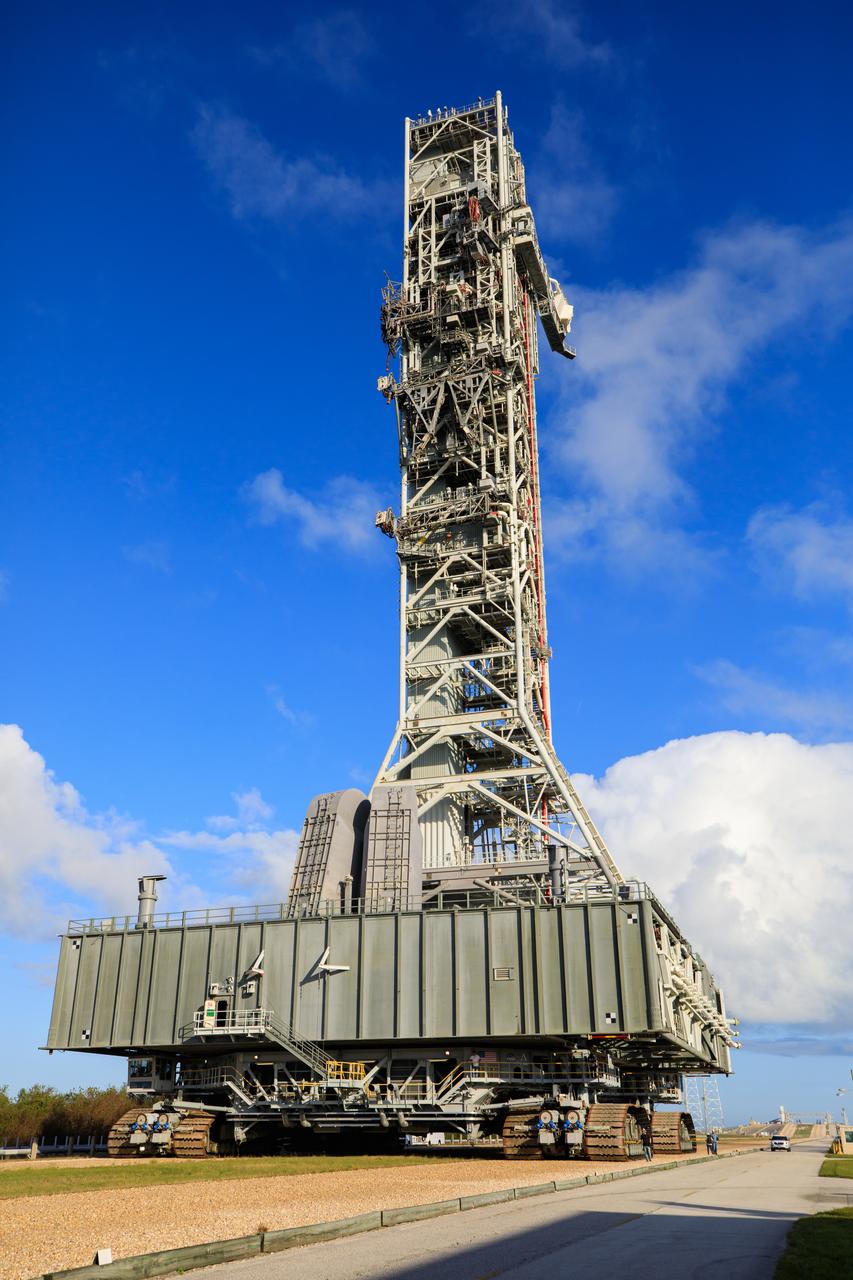
NASA’s mobile launcher, carried atop the crawler-transporter 2, left launch pad 39B at NASA’s Kennedy Space Center in Florida on Dec. 8, 2022, following the successful launch of the agency’s Space Launch System (SLS) rocket and Orion spacecraft on the Artemis I flight test on Nov. 16, 2022. The mobile launcher is scheduled to return to the Vehicle Assembly Building (VAB) on Dec. 9, 2022, and it will remain inside the VAB for several weeks as teams get it ready for the Artemis II crewed mission. Following its stay in the VAB, it will go to the mobile launcher park site location at Kennedy where it will undergo emergency egress modifications and testing to support future Artemis missions.
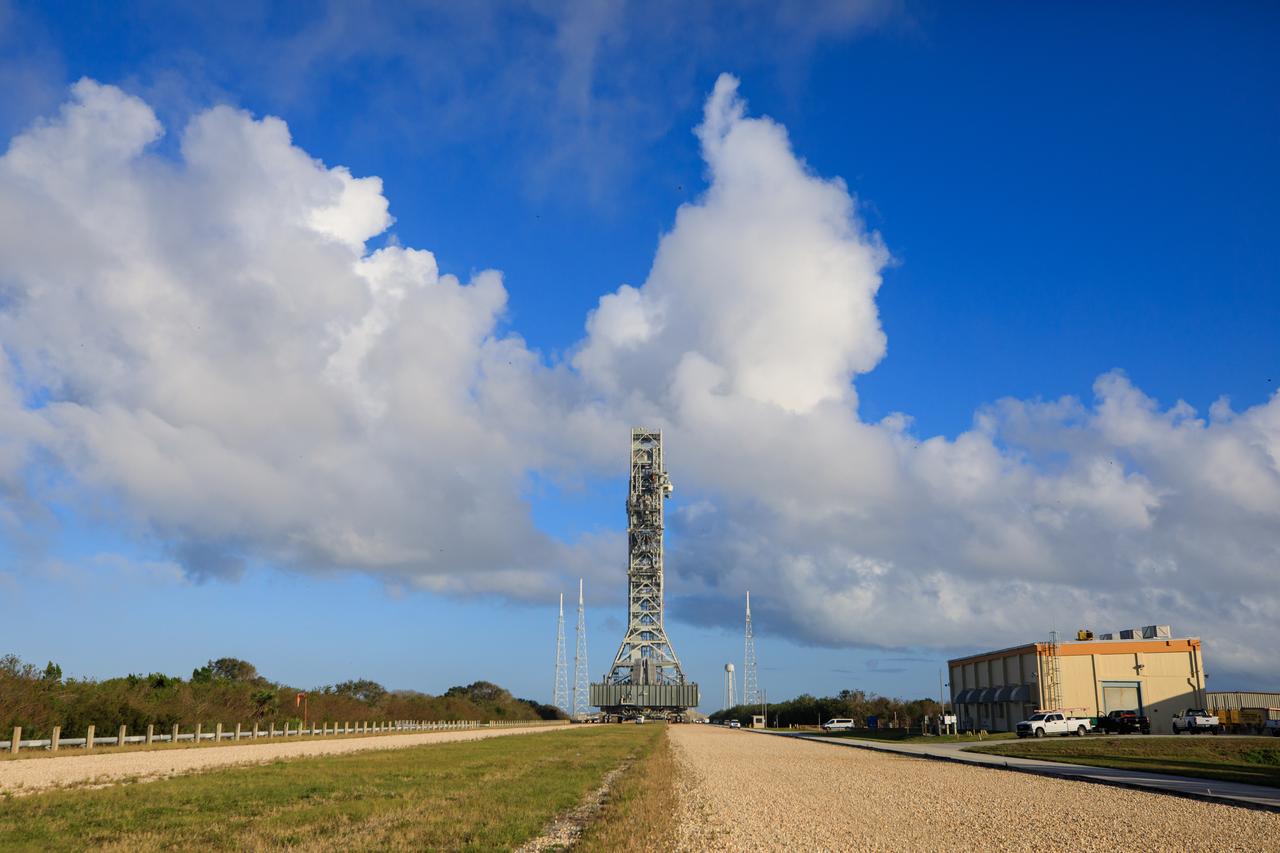
NASA’s mobile launcher, carried atop the crawler-transporter 2, left launch pad 39B at NASA’s Kennedy Space Center in Florida on Dec. 8, 2022, following the successful launch of the agency’s Space Launch System (SLS) rocket and Orion spacecraft on the Artemis I flight test on Nov. 16, 2022. The mobile launcher is scheduled to return to the Vehicle Assembly Building (VAB) on Dec. 9, 2022, and it will remain inside the VAB for several weeks as teams get it ready for the Artemis II crewed mission. Following its stay in the VAB, it will go to the mobile launcher park site location at Kennedy where it will undergo emergency egress modifications and testing to support future Artemis missions.
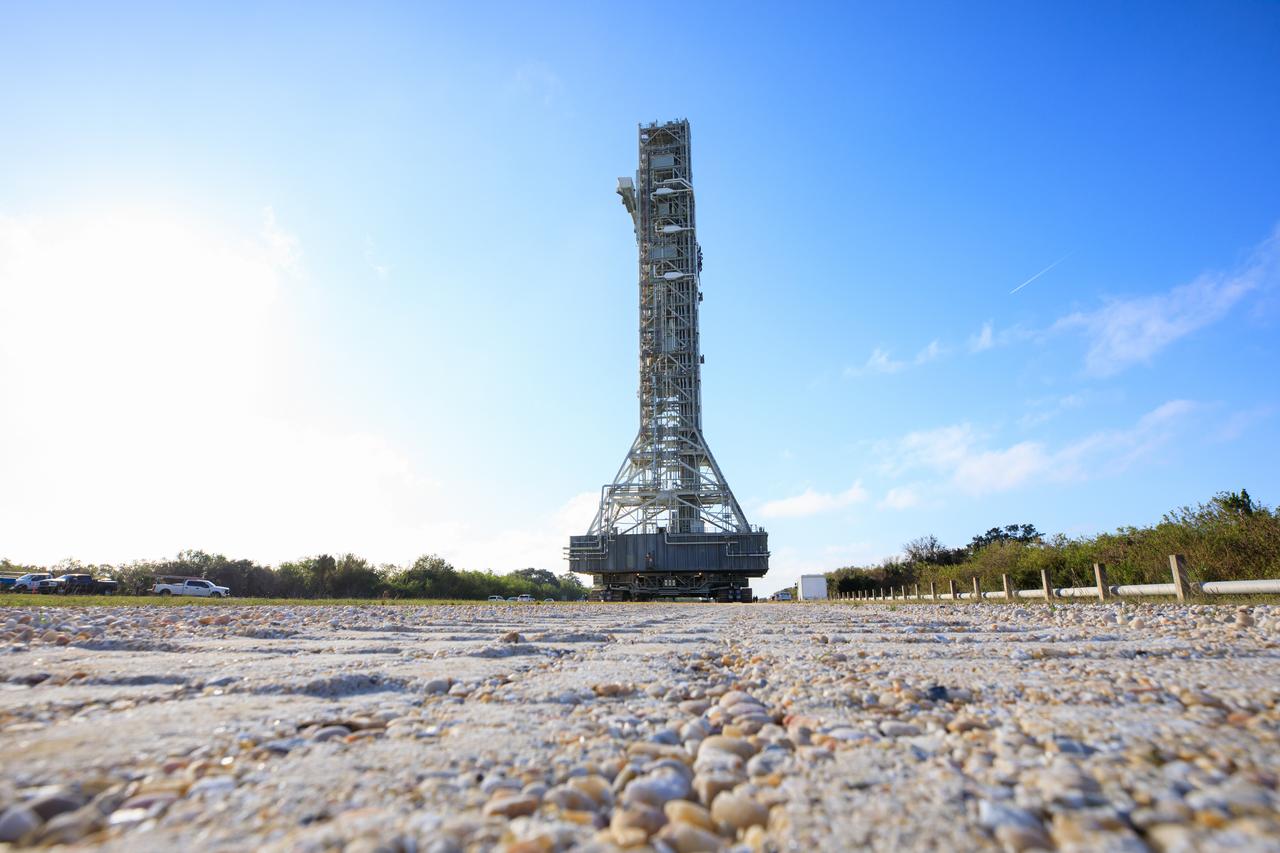
NASA’s mobile launcher, carried atop the crawler-transporter 2, left launch pad 39B at NASA’s Kennedy Space Center in Florida on Dec. 8, 2022, following the successful launch of the agency’s Space Launch System (SLS) rocket and Orion spacecraft on the Artemis I flight test on Nov. 16, 2022. The mobile launcher is scheduled to return to the Vehicle Assembly Building (VAB) on Dec. 9, 2022, and it will remain inside the VAB for several weeks as teams get it ready for the Artemis II crewed mission. Following its stay in the VAB, it will go to the mobile launcher park site location at Kennedy where it will undergo emergency egress modifications and testing to support future Artemis missions.
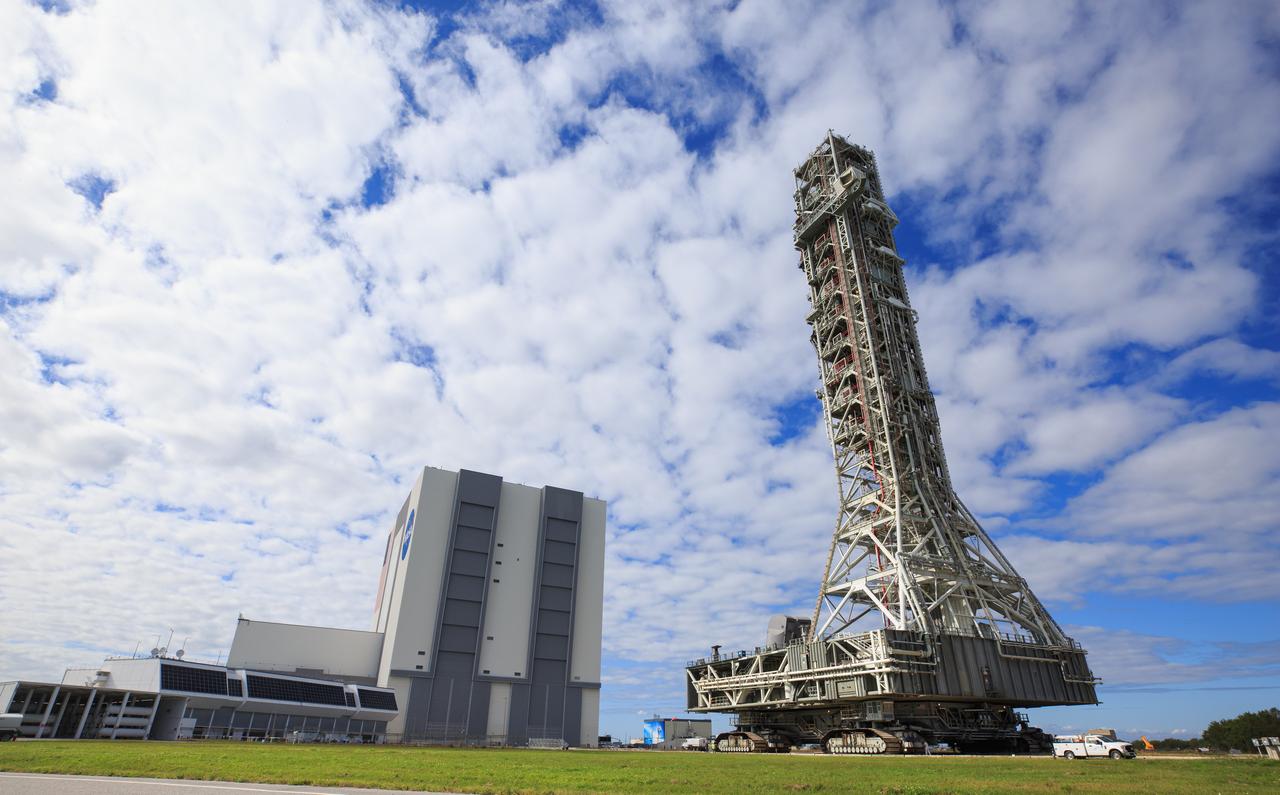
NASA’s mobile launcher, carried atop the crawler-transporter 2, left launch pad 39B at NASA’s Kennedy Space Center in Florida on Dec. 8, 2022, following the successful launch of the agency’s Space Launch System (SLS) rocket and Orion spacecraft on the Artemis I flight test on Nov. 16, 2022. The mobile launcher is scheduled to return to the Vehicle Assembly Building (VAB) on Dec. 9, 2022, and it will remain inside the VAB for several weeks as teams get it ready for the Artemis II crewed mission. Following its stay in the VAB, it will go to the mobile launcher park site location at Kennedy where it will undergo emergency egress modifications and testing to support future Artemis missions.
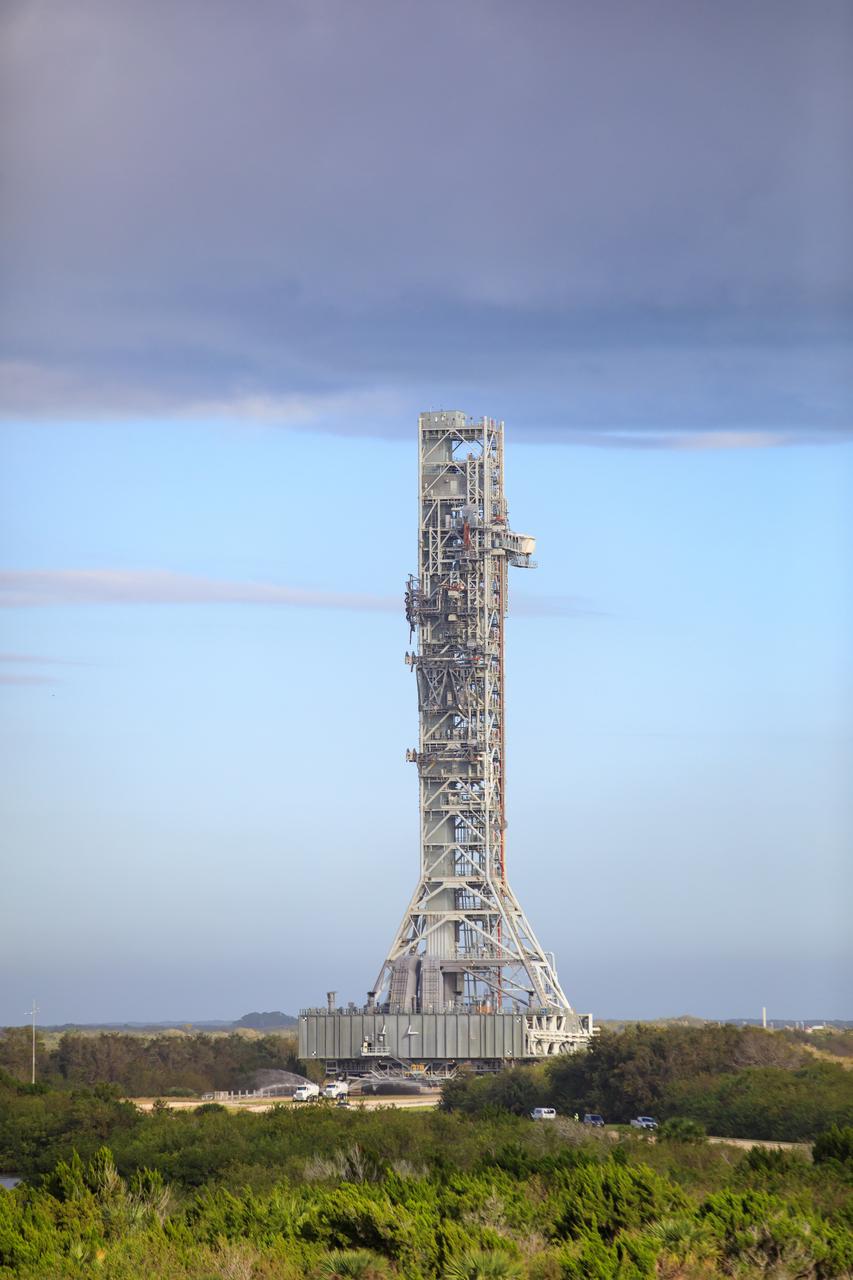
NASA’s mobile launcher, carried atop the crawler-transporter 2, left launch pad 39B at NASA’s Kennedy Space Center in Florida on Dec. 8, 2022, following the successful launch of the agency’s Space Launch System (SLS) rocket and Orion spacecraft on the Artemis I flight test on Nov. 16, 2022. The mobile launcher is scheduled to return to the Vehicle Assembly Building (VAB) on Dec. 9, 2022, and it will remain inside the VAB for several weeks as teams get it ready for the Artemis II crewed mission. Following its stay in the VAB, it will go to the mobile launcher park site location at Kennedy where it will undergo emergency egress modifications and testing to support future Artemis missions.
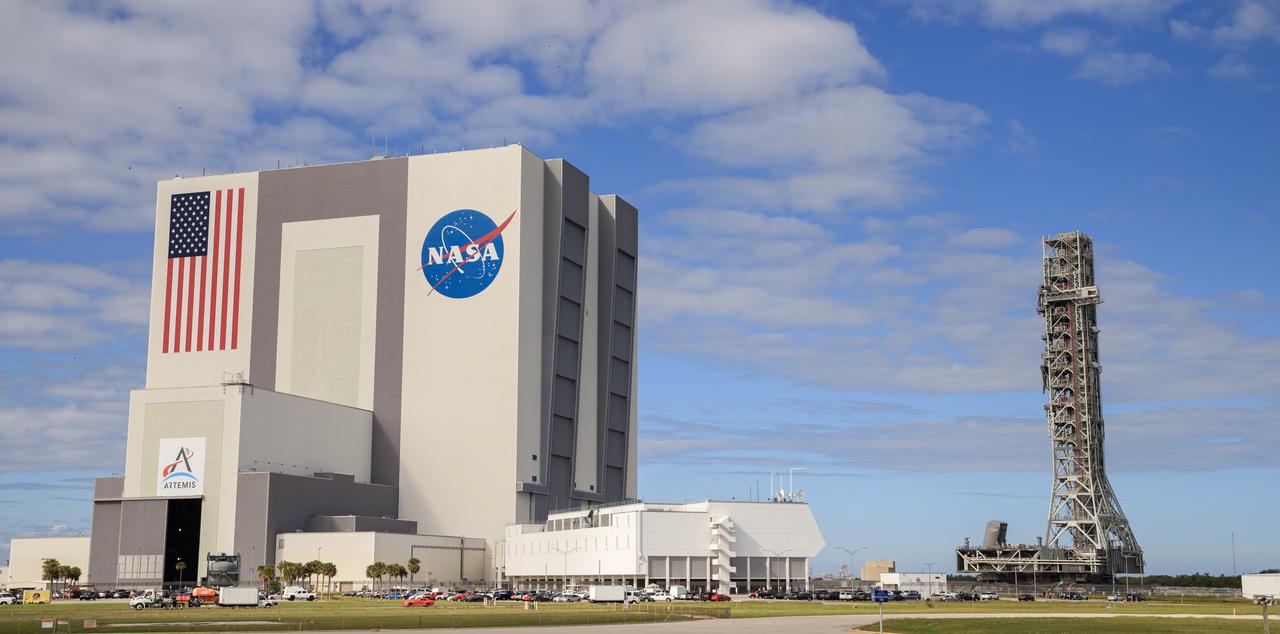
NASA’s mobile launcher, carried atop the crawler-transporter 2, left launch pad 39B at NASA’s Kennedy Space Center in Florida on Dec. 8, 2022, following the successful launch of the agency’s Space Launch System (SLS) rocket and Orion spacecraft on the Artemis I flight test on Nov. 16, 2022. The mobile launcher is scheduled to return to the Vehicle Assembly Building (VAB) on Dec. 9, 2022, and it will remain inside the VAB for several weeks as teams get it ready for the Artemis II crewed mission. Following its stay in the VAB, it will go to the mobile launcher park site location at Kennedy where it will undergo emergency egress modifications and testing to support future Artemis missions.
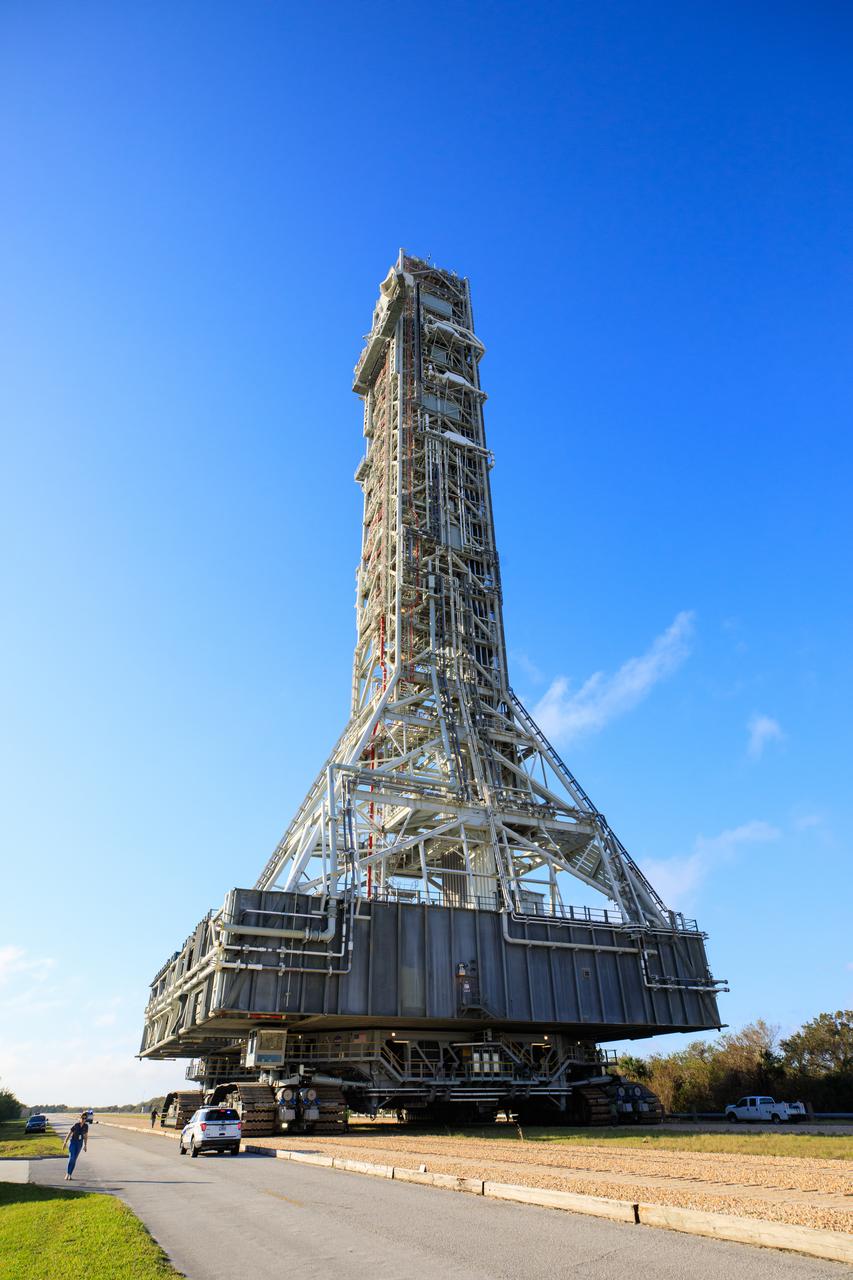
NASA’s mobile launcher, carried atop the crawler-transporter 2, left launch pad 39B at NASA’s Kennedy Space Center in Florida on Dec. 8, 2022, following the successful launch of the agency’s Space Launch System (SLS) rocket and Orion spacecraft on the Artemis I flight test on Nov. 16, 2022. The mobile launcher is scheduled to return to the Vehicle Assembly Building (VAB) on Dec. 9, 2022, and it will remain inside the VAB for several weeks as teams get it ready for the Artemis II crewed mission. Following its stay in the VAB, it will go to the mobile launcher park site location at Kennedy where it will undergo emergency egress modifications and testing to support future Artemis missions.
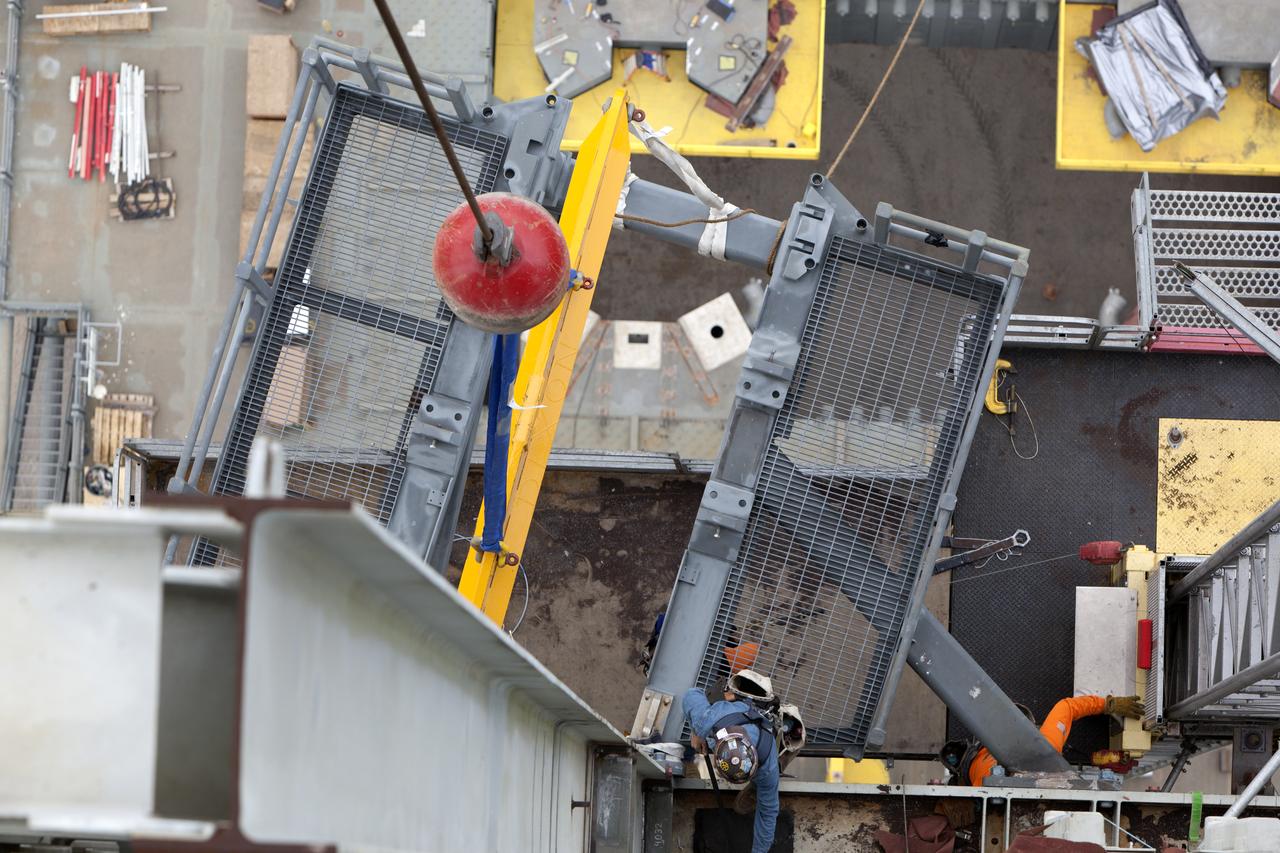
In this view looking down from high up on the mobile launcher, a crane positions the bracket for the Orion Service Module Umbilical (OSMU) for installation on the mobile launcher tower at NASA's Kennedy Space Center in Florida. The mobile launcher tower will be equipped with a number of lines, called umbilicals, that will connect to the Space Launch System rocket and Orion spacecraft for Exploration Mission-1 (EM-1). The OSMU will be located high on the mobile launcher tower and, prior to launch, will transfer liquid coolant for the electronics and air for the Environmental Control System to the Orion service module that houses these critical systems to support the spacecraft. EM-1 is scheduled to launch in 2018. The Ground Systems Development and Operations Program is overseeing installation of the umbilicals.
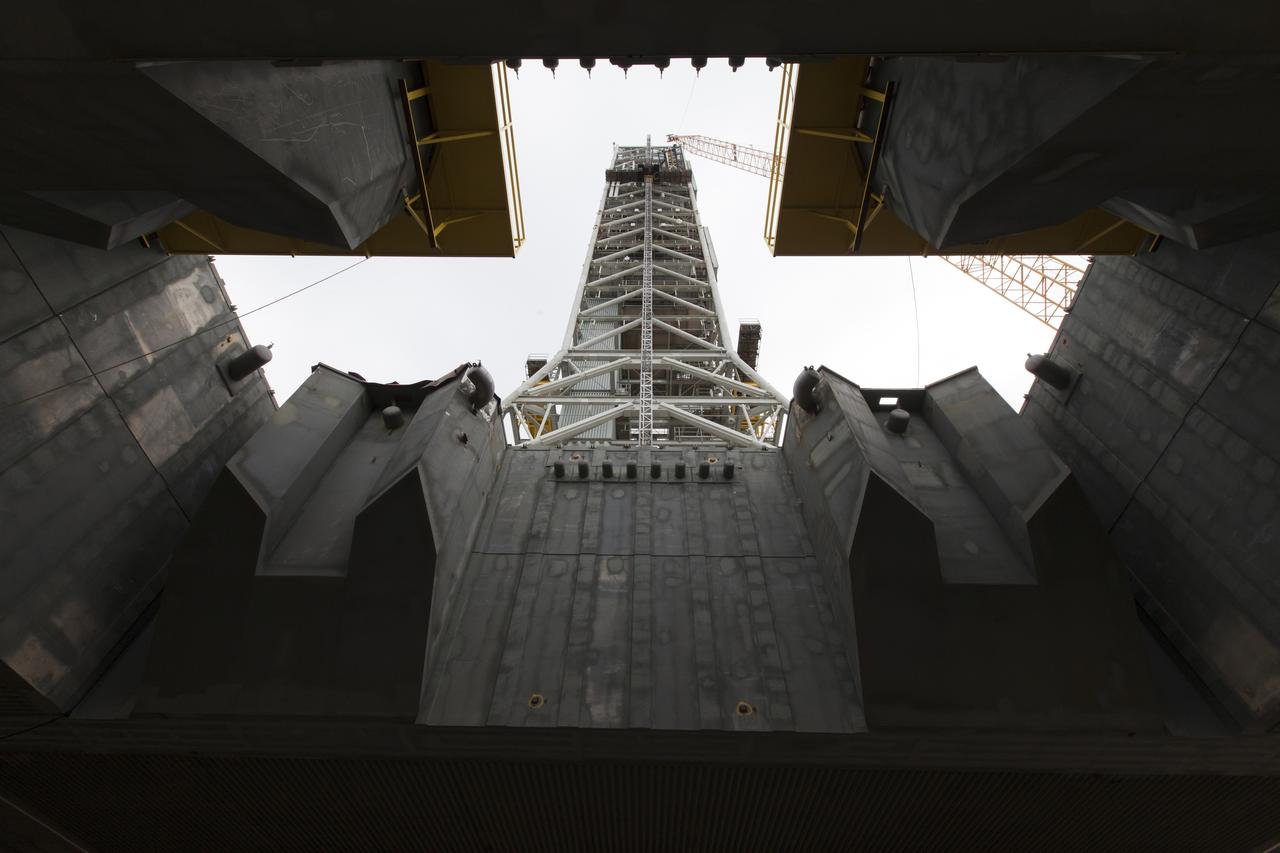
A view from below the mobile launcher shows a crane positioning the bracket for the Orion Service Module Umbilical (OSMU) high up for installation on the mobile launcher tower at NASA's Kennedy Space Center in Florida. The mobile launcher tower will be equipped with a number of lines, called umbilicals, that will connect to the Space Launch System rocket and Orion spacecraft for Exploration Mission-1 (EM-1). The OSMU will be located high on the mobile launcher tower and, prior to launch, will transfer liquid coolant for the electronics and air for the Environmental Control System to the Orion service module that houses these critical systems to support the spacecraft. EM-1 is scheduled to launch in 2018. The Ground Systems Development and Operations Program is overseeing installation of the umbilicals.
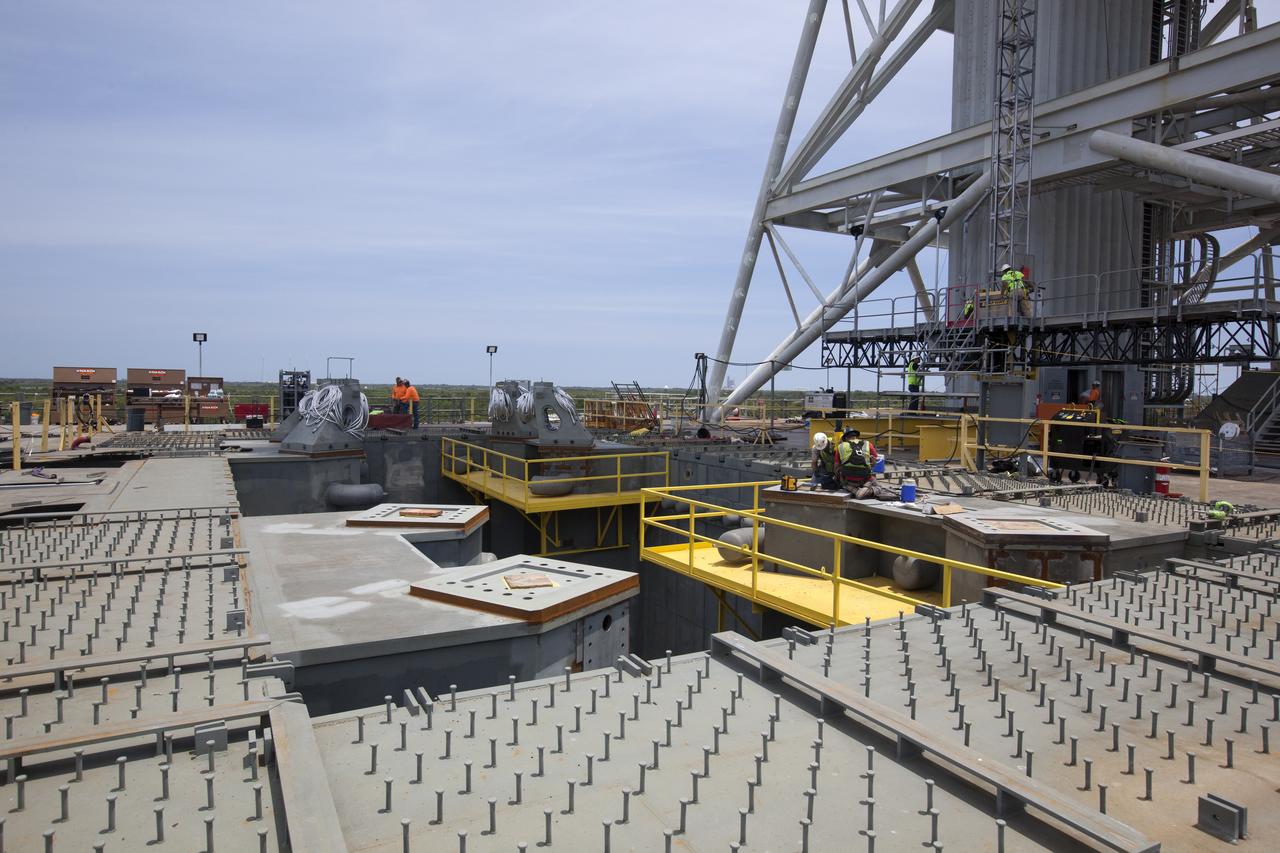
Construction workers on the deck of the mobile launcher prepare the platforms for installation of vehicle support posts at NASA's Kennedy Space Center in Florida. At left, four of the support posts are installed. A total of eight support posts will be installed to support the load of the Space Launch System's (SLS) solid rocket boosters, with four posts for each of the boosters. The support posts are about five feet tall and each weigh about 10,000 pounds. The posts will structurally support the SLS rocket through T-0 and liftoff, and will drop down before vehicle liftoff to avoid contact with the flight hardware. The Ground Systems Development and Operations Program is overseeing installation of the support posts to prepare for the launch of the Orion spacecraft atop the SLS rocket.
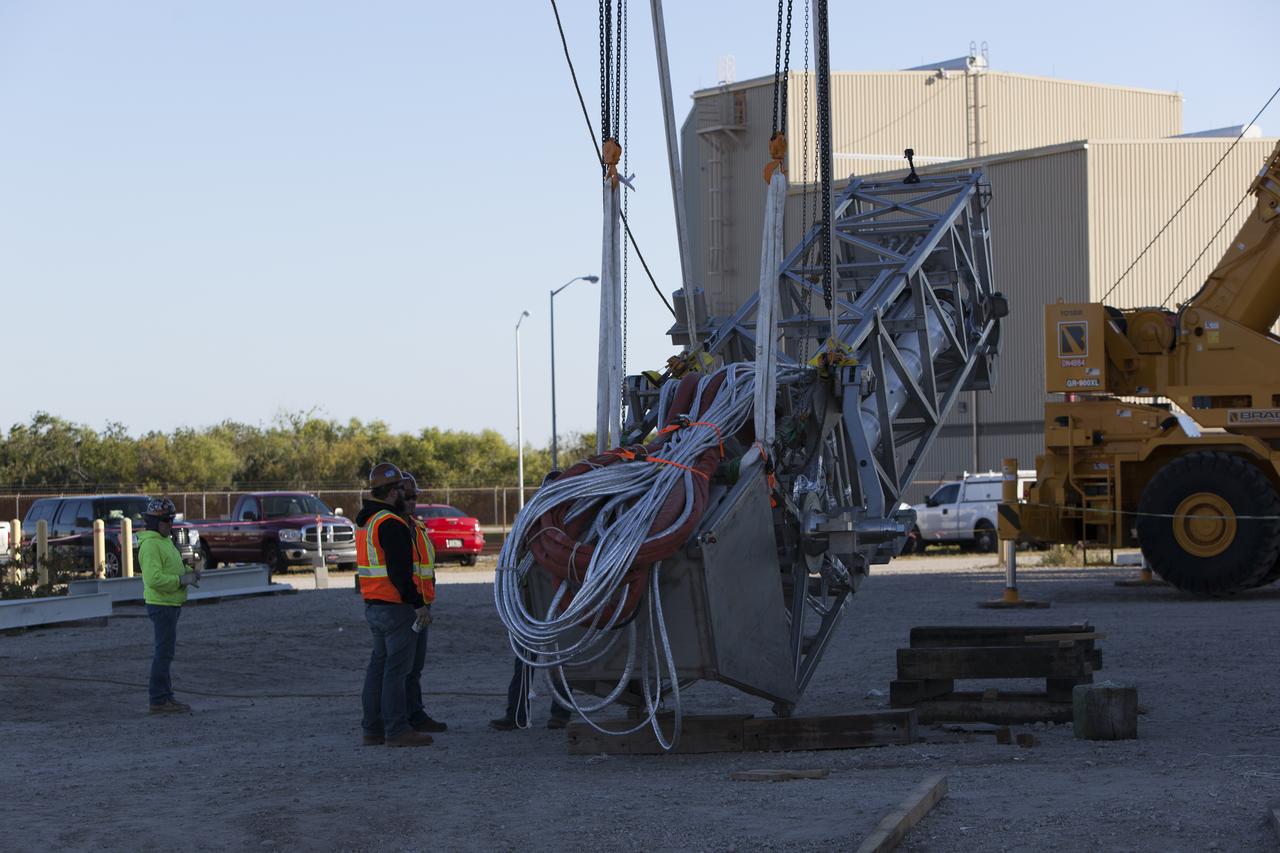
Preparations are underway to lift the Orion Service Module Umbilical (OSMU) up for installation on the mobile launcher tower at NASA's Kennedy Space Center in Florida. The mobile launcher tower will be equipped with a number of lines, called umbilicals, that will connect to the Space Launch System rocket and Orion spacecraft for Exploration Mission-1 (EM-1). The OSMU will be located high on the mobile launcher tower and, prior to launch, will transfer liquid coolant for the electronics and air for the Environmental Control System to the Orion service module that houses these critical systems to support the spacecraft. EM-1 is scheduled to launch in 2018. The Ground Systems Development and Operations Program is overseeing installation of the umbilicals.
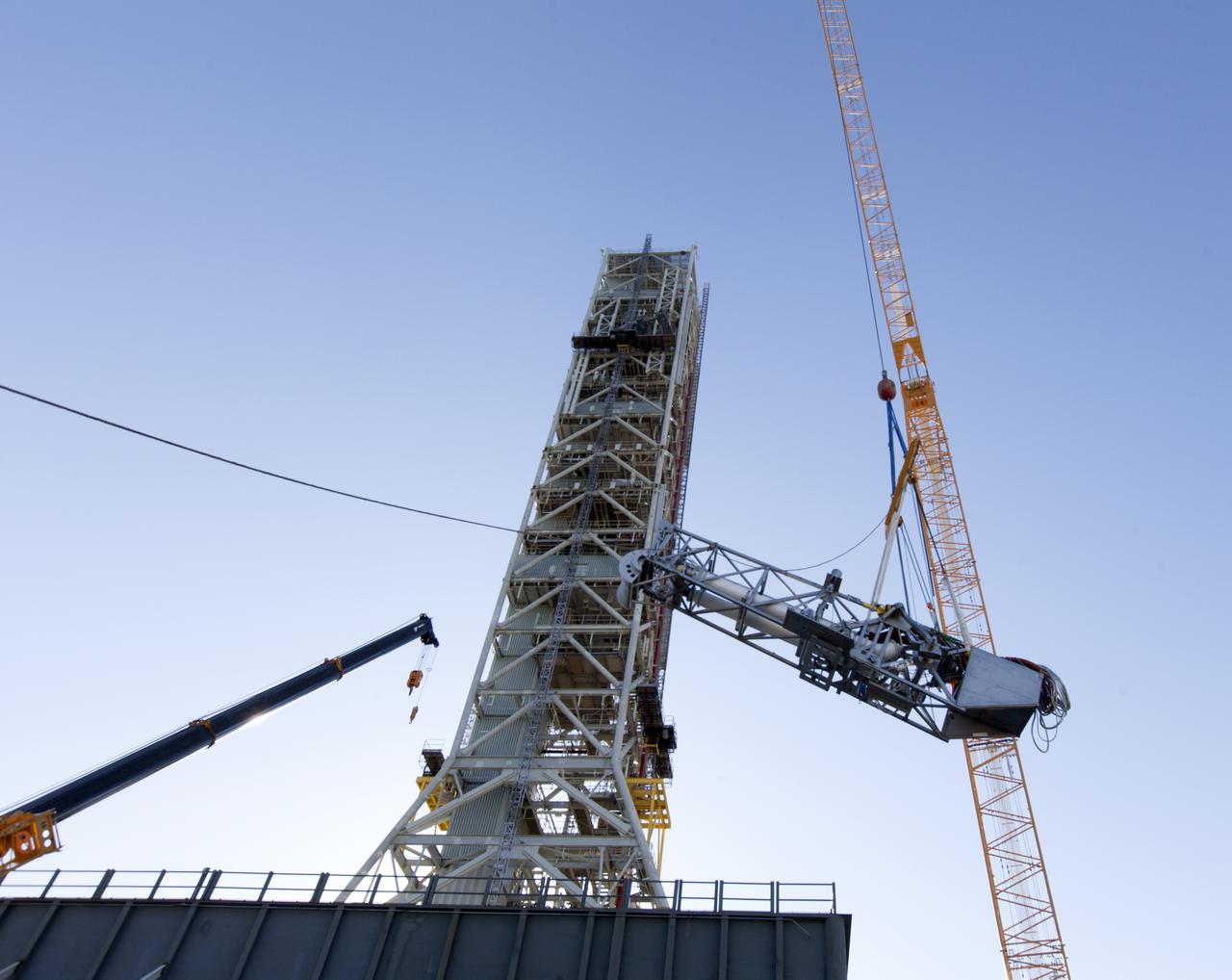
A crane and rigging are used to lift the Orion Service Module Umbilical (OSMU) up for installation on the mobile launcher tower at NASA's Kennedy Space Center in Florida. The mobile launcher tower will be equipped with a number of lines, called umbilicals, that will connect to the Space Launch System rocket and Orion spacecraft for Exploration Mission-1 (EM-1). The OSMU will be located high on the mobile launcher tower and, prior to launch, will transfer liquid coolant for the electronics and air for the Environmental Control System to the Orion service module that houses these critical systems to support the spacecraft. EM-1 is scheduled to launch in 2018. The Ground Systems Development and Operations Program is overseeing installation of the umbilicals.
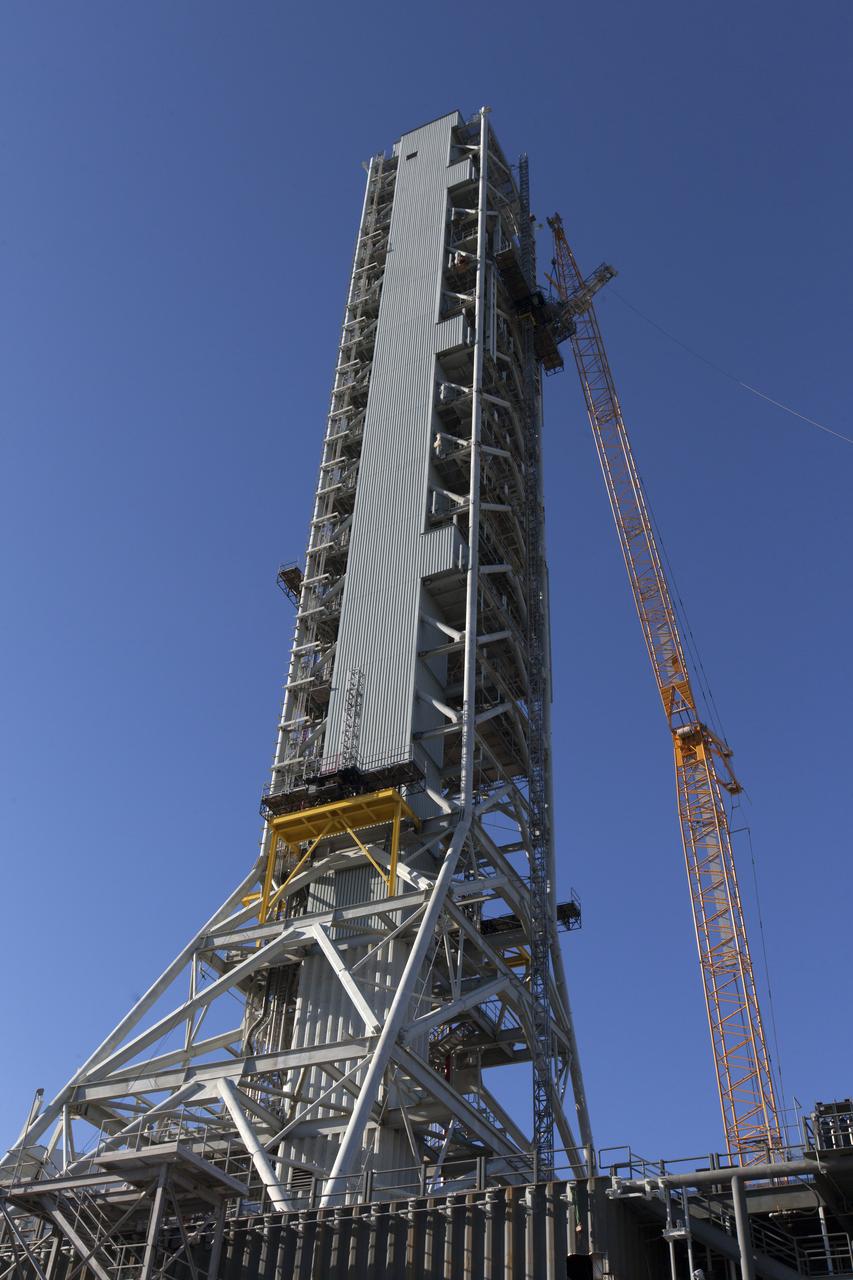
A crane and rigging are used to position the Orion Service Module Umbilical (OSMU) for installation high up on the mobile launcher tower at NASA's Kennedy Space Center in Florida. The mobile launcher tower will be equipped with a number of lines, called umbilicals, that will connect to the Space Launch System rocket and Orion spacecraft for Exploration Mission-1 (EM-1). The OSMU will be located high on the mobile launcher tower and, prior to launch, will transfer liquid coolant for the electronics and air for the Environmental Control System to the Orion service module that houses these critical systems to support the spacecraft. EM-1 is scheduled to launch in 2018. The Ground Systems Development and Operations Program is overseeing installation of the umbilicals.
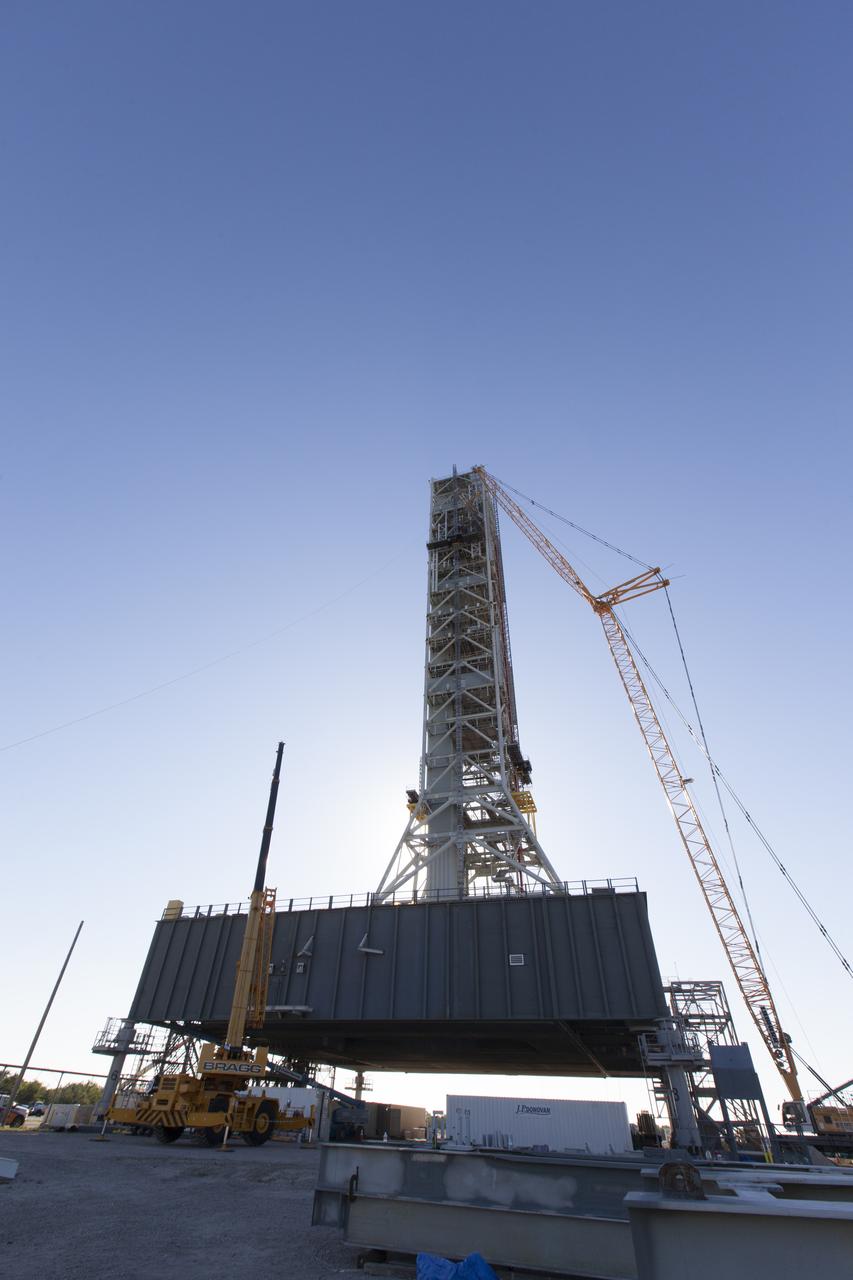
A crane and rigging are used to position the Orion Service Module Umbilical (OSMU) for installation high up on the mobile launcher tower at NASA's Kennedy Space Center in Florida. The mobile launcher tower will be equipped with a number of lines, called umbilicals, that will connect to the Space Launch System rocket and Orion spacecraft for Exploration Mission-1 (EM-1). The OSMU will be located high on the mobile launcher tower and, prior to launch, will transfer liquid coolant for the electronics and air for the Environmental Control System to the Orion service module that houses these critical systems to support the spacecraft. EM-1 is scheduled to launch in 2018. The Ground Systems Development and Operations Program is overseeing installation of the umbilicals.
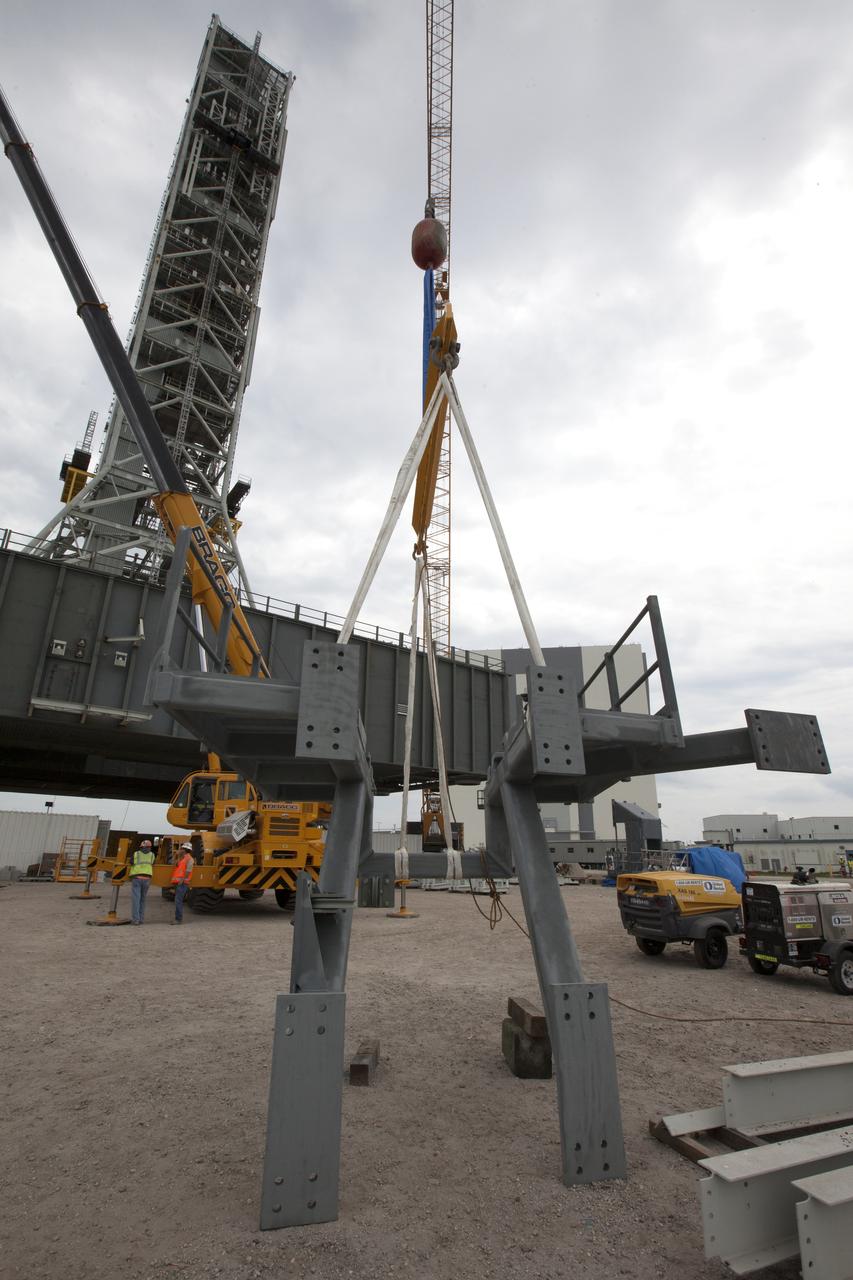
Preparations are underway to lift the bracket for the Orion Service Module Umbilical (OSMU) up for installation on the mobile launcher tower at NASA's Kennedy Space Center in Florida. The mobile launcher tower will be equipped with a number of lines, called umbilicals, that will connect to the Space Launch System rocket and Orion spacecraft for Exploration Mission-1 (EM-1). The OSMU will be located high on the mobile launcher tower and, prior to launch, will transfer liquid coolant for the electronics and air for the Environmental Control System to the Orion service module that houses these critical systems to support the spacecraft. EM-1 is scheduled to launch in 2018. The Ground Systems Development and Operations Program is overseeing installation of the umbilicals.
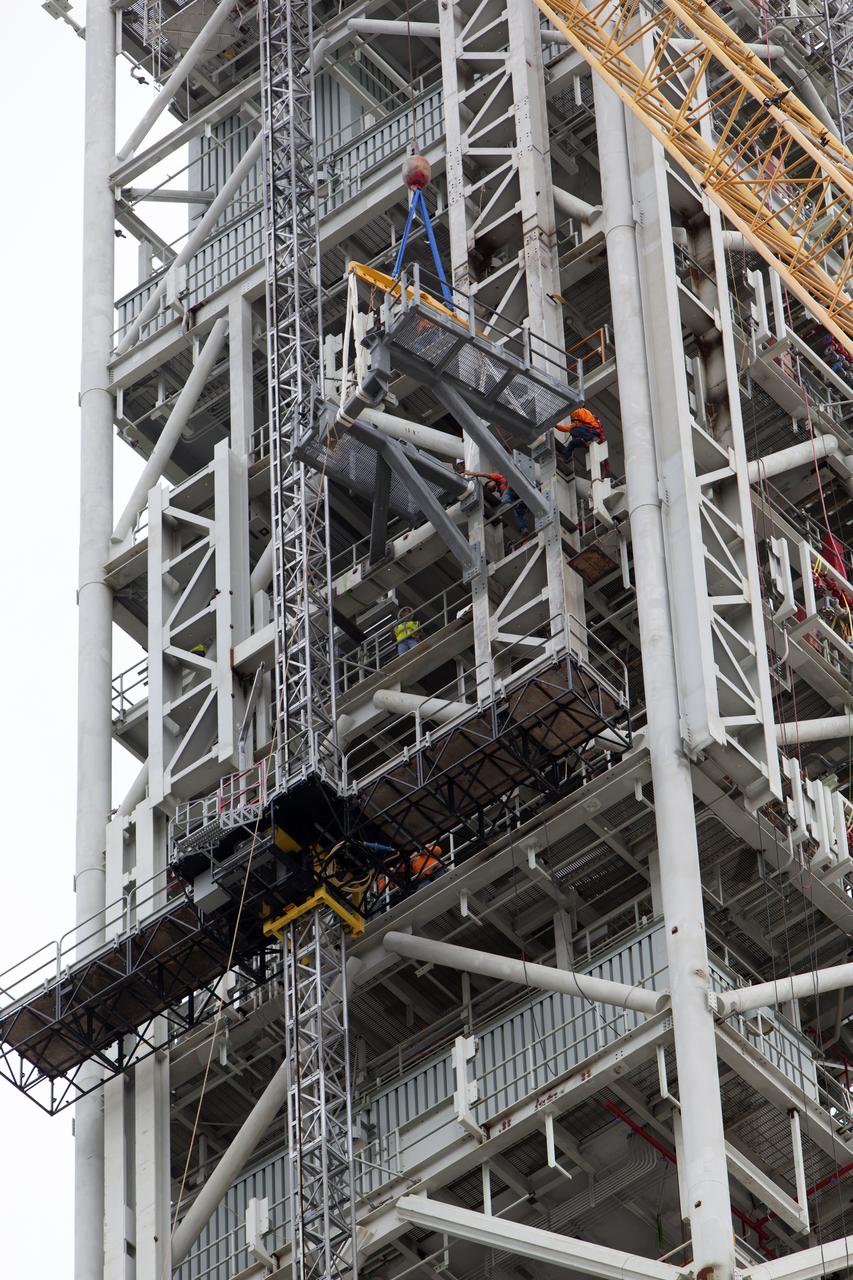
A crane positions the bracket for the Orion Service Module Umbilical (OSMU) for installation on the mobile launcher tower at NASA's Kennedy Space Center in Florida. The mobile launcher tower will be equipped with a number of lines, called umbilicals, that will connect to the Space Launch System rocket and Orion spacecraft for Exploration Mission-1 (EM-1). The OSMU will be located high on the mobile launcher tower and, prior to launch, will transfer liquid coolant for the electronics and air for the Environmental Control System to the Orion service module that houses these critical systems to support the spacecraft. EM-1 is scheduled to launch in 2018. The Ground Systems Development and Operations Program is overseeing installation of the umbilicals.
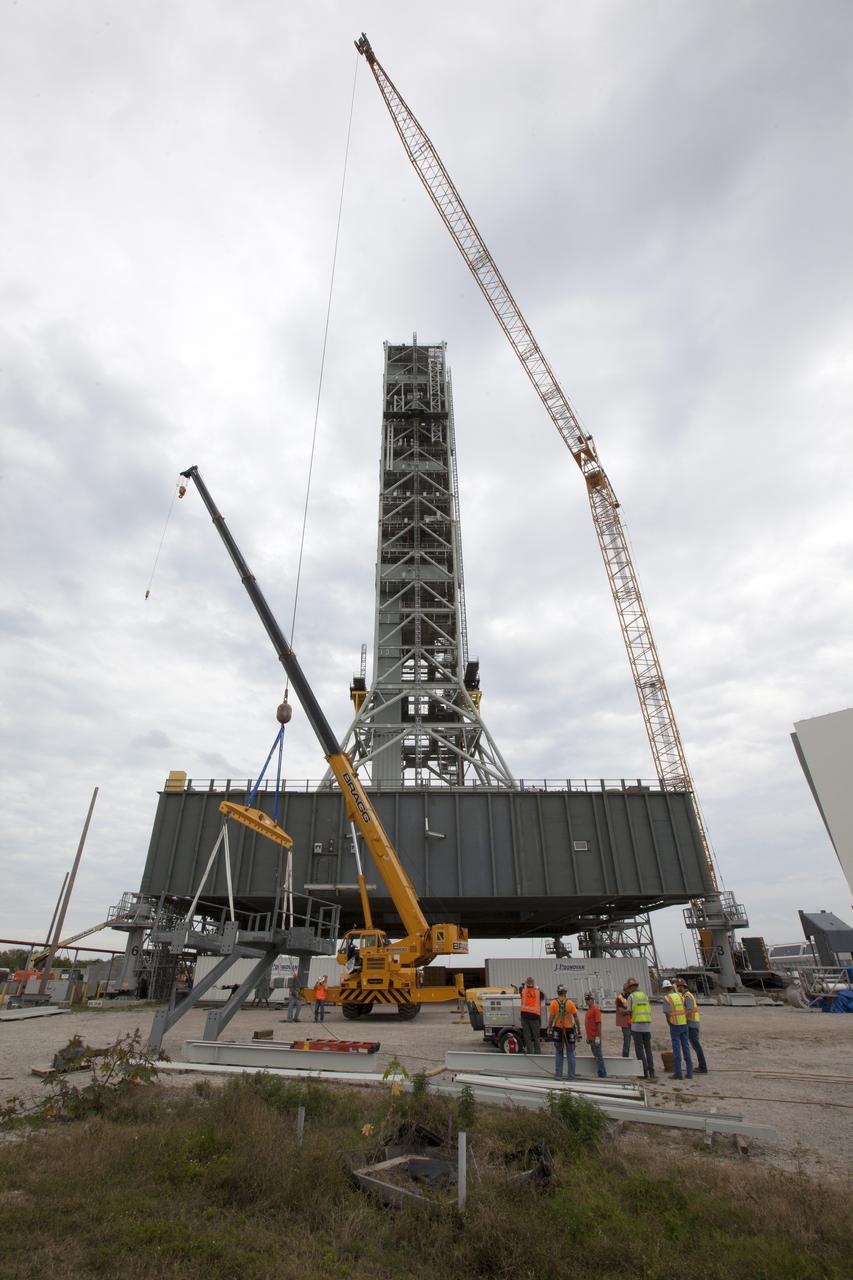
Preparations are underway to lift the bracket for the Orion Service Module Umbilical (OSMU) up for installation on the mobile launcher tower at NASA's Kennedy Space Center in Florida. The mobile launcher tower will be equipped with a number of lines, called umbilicals, that will connect to the Space Launch System rocket and Orion spacecraft for Exploration Mission-1 (EM-1). The OSMU will be located high on the mobile launcher tower and, prior to launch, will transfer liquid coolant for the electronics and air for the Environmental Control System to the Orion service module that houses these critical systems to support the spacecraft. EM-1 is scheduled to launch in 2018. The Ground Systems Development and Operations Program is overseeing installation of the umbilicals.
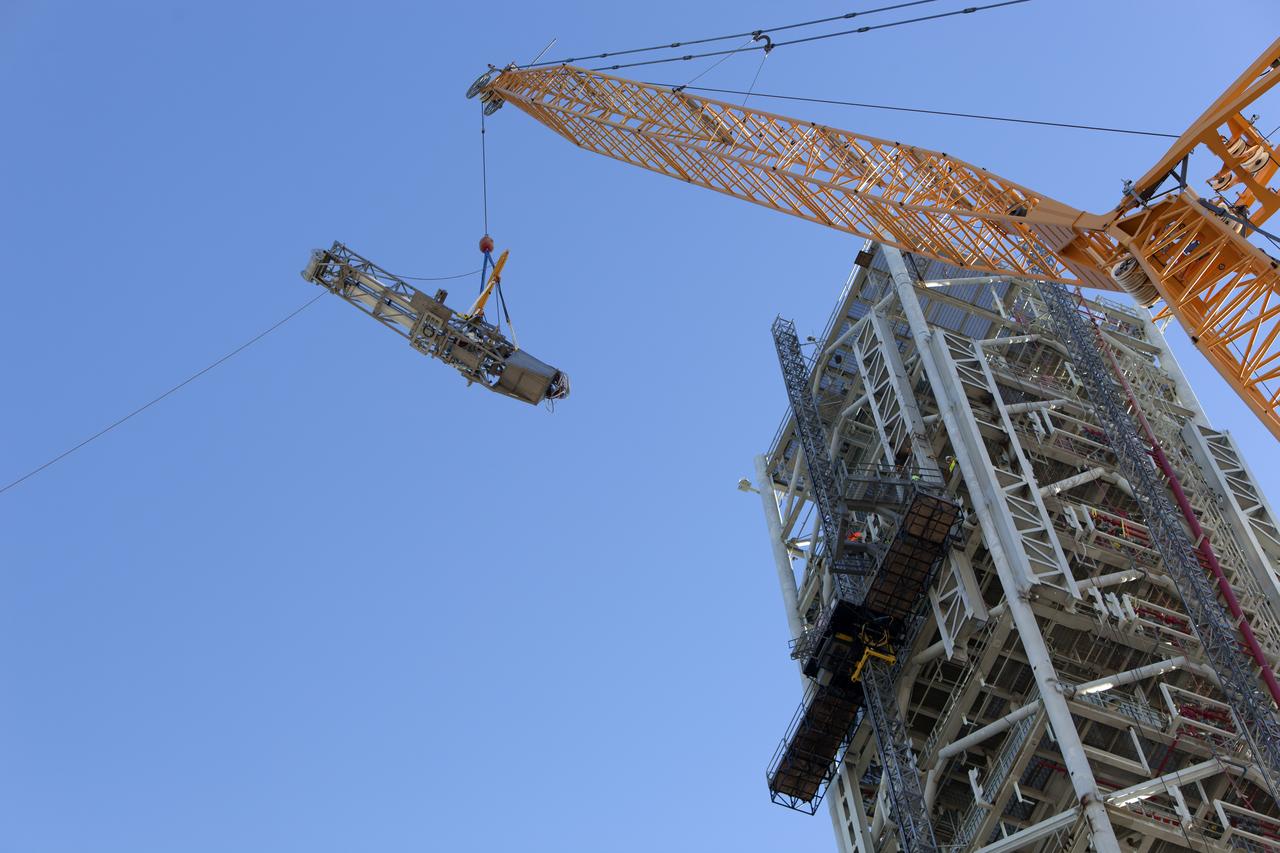
A crane and rigging are used to lift the Orion Service Module Umbilical (OSMU) high up for installation on the mobile launcher tower at NASA's Kennedy Space Center in Florida. The mobile launcher tower will be equipped with a number of lines, called umbilicals, that will connect to the Space Launch System rocket and Orion spacecraft for Exploration Mission-1 (EM-1). The OSMU will be located high on the mobile launcher tower and, prior to launch, will transfer liquid coolant for the electronics and air for the Environmental Control System to the Orion service module that houses these critical systems to support the spacecraft. EM-1 is scheduled to launch in 2018. The Ground Systems Development and Operations Program is overseeing installation of the umbilicals.