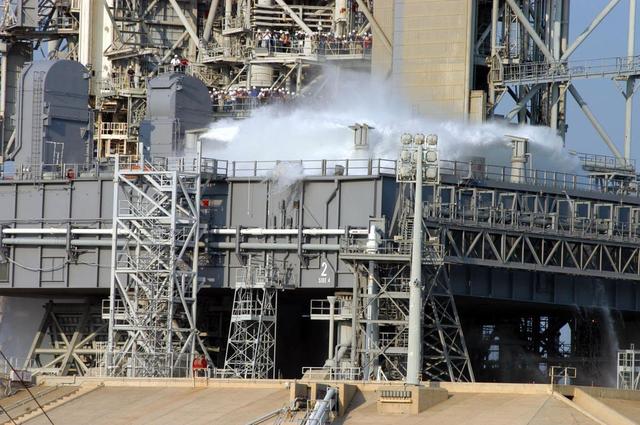
Exterior view of Mobile Launcher Platform
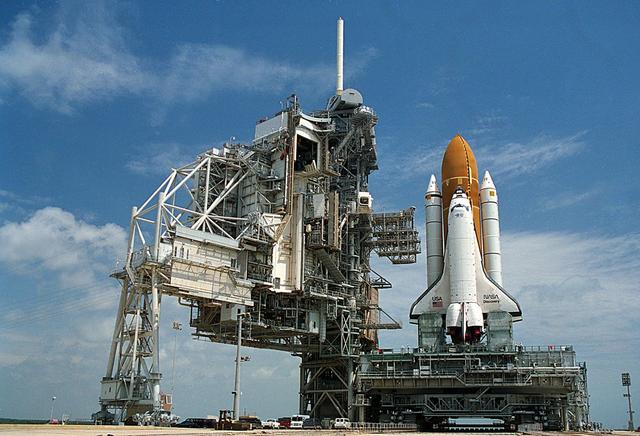
Exterior view of Mobile Launcher Platform
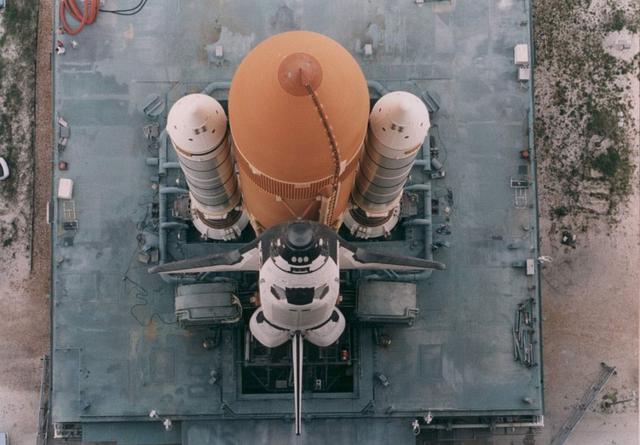
Aerial view of Mobile Launcher Platform
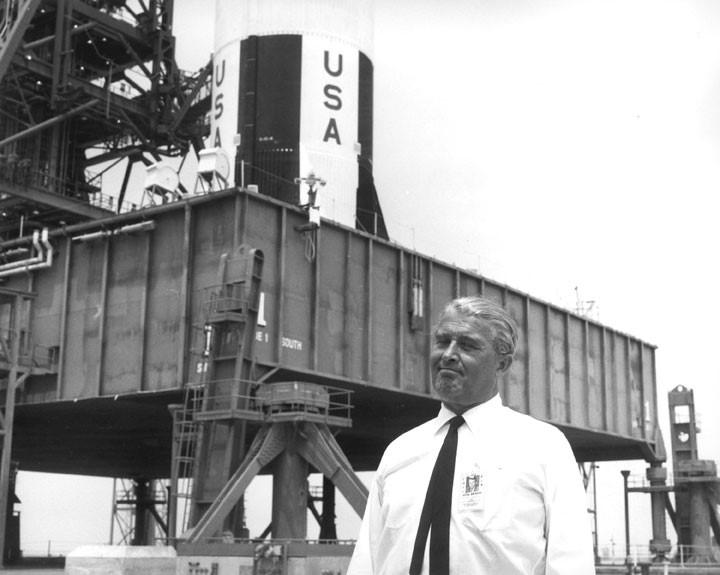
Exterior view of Mobile Launcher Platform
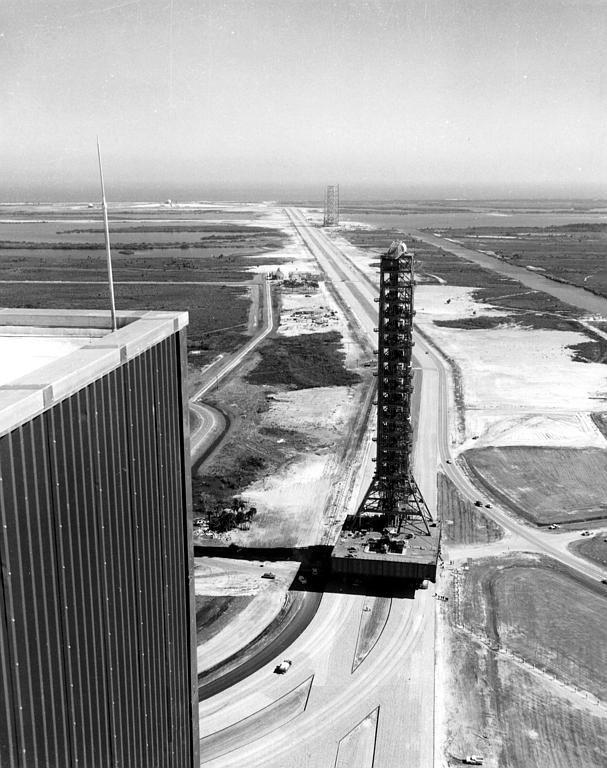
Aerial view of Mobile Launcher Platform
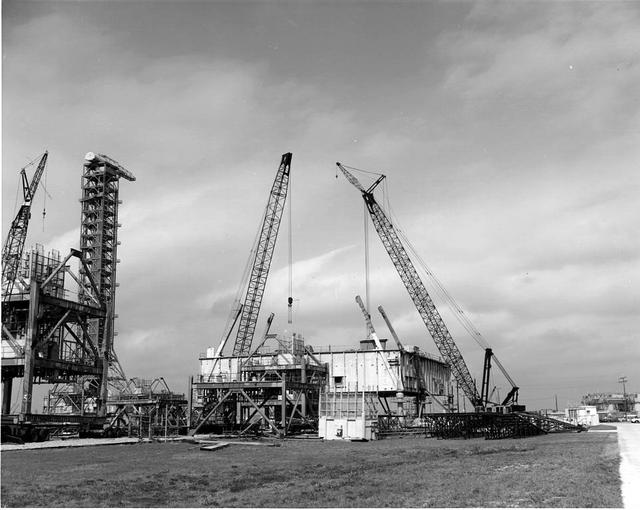
Exterior view of Mobile Launcher Platform
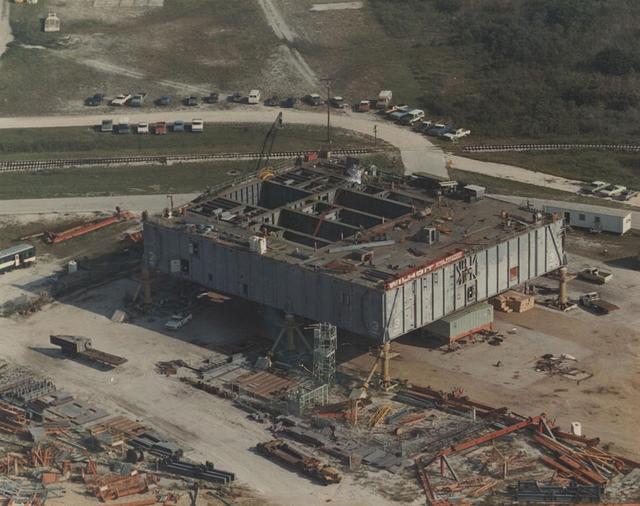
Aerial view of Mobile Launcher Platform
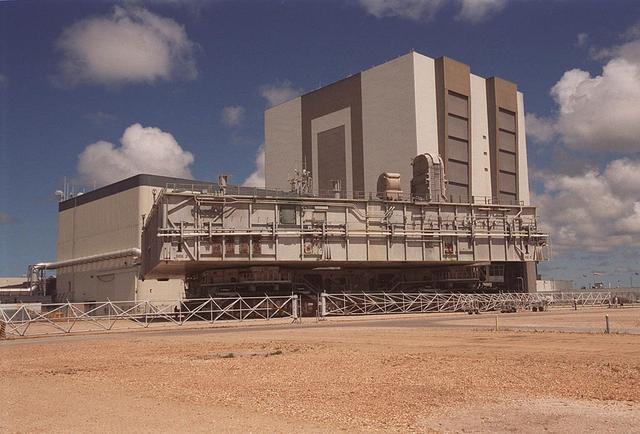
Exterior view of Mobile Launcher Platform
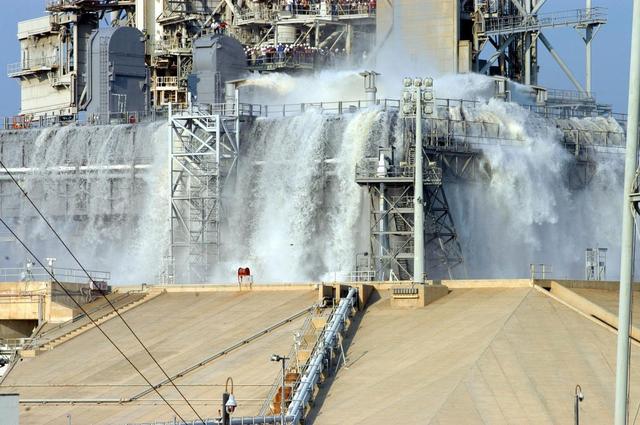
Exterior view of Mobile Launcher Platform
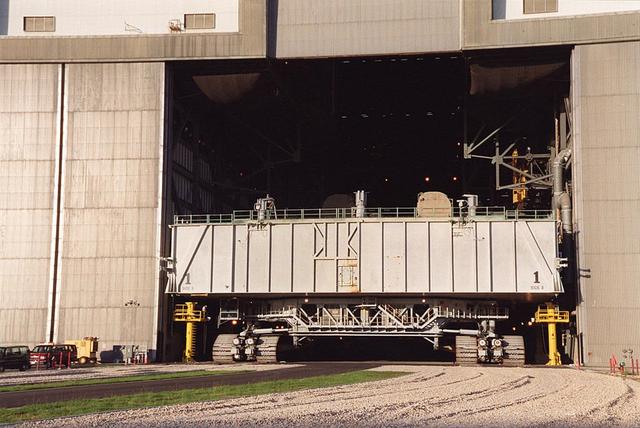
Exterior view of Mobile Launcher Platform
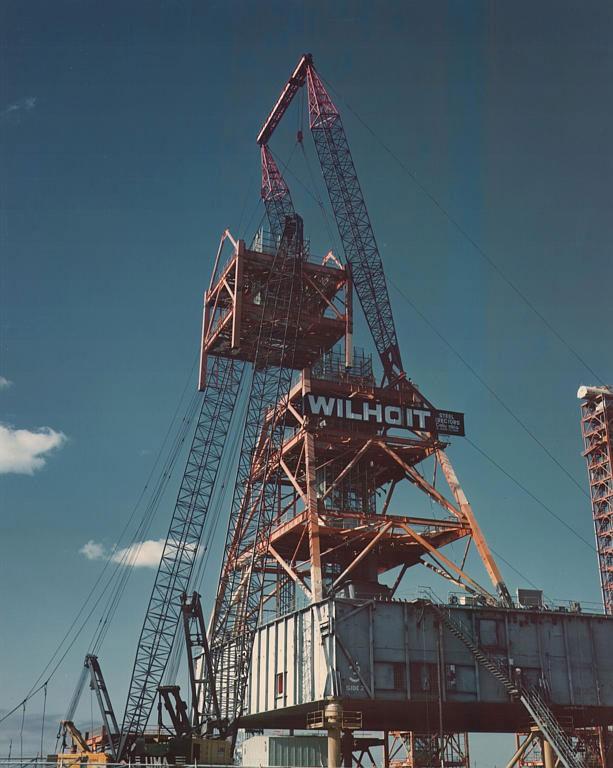
Exterior view of Mobile Launcher Platform
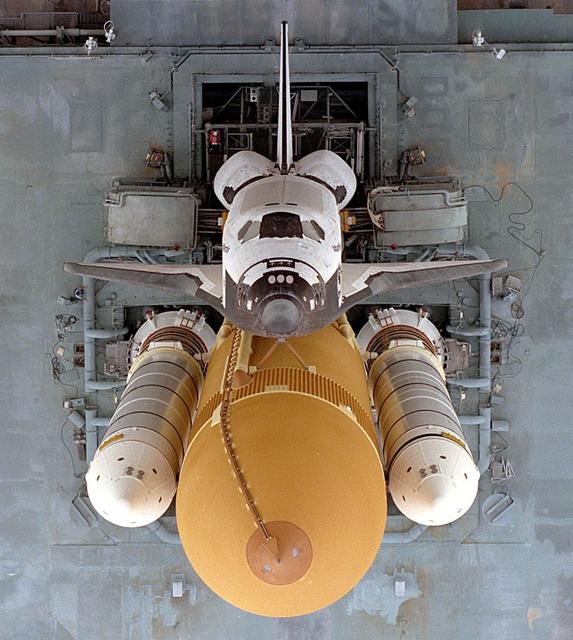
Exterior view of Mobile Launcher Platform
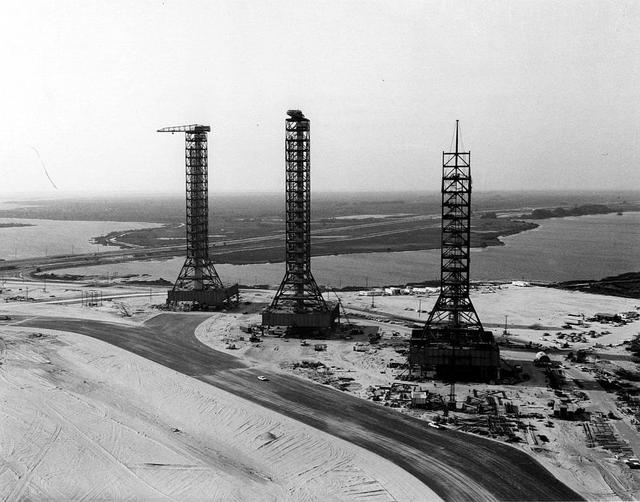
Aerial view of Mobile Launcher Platform
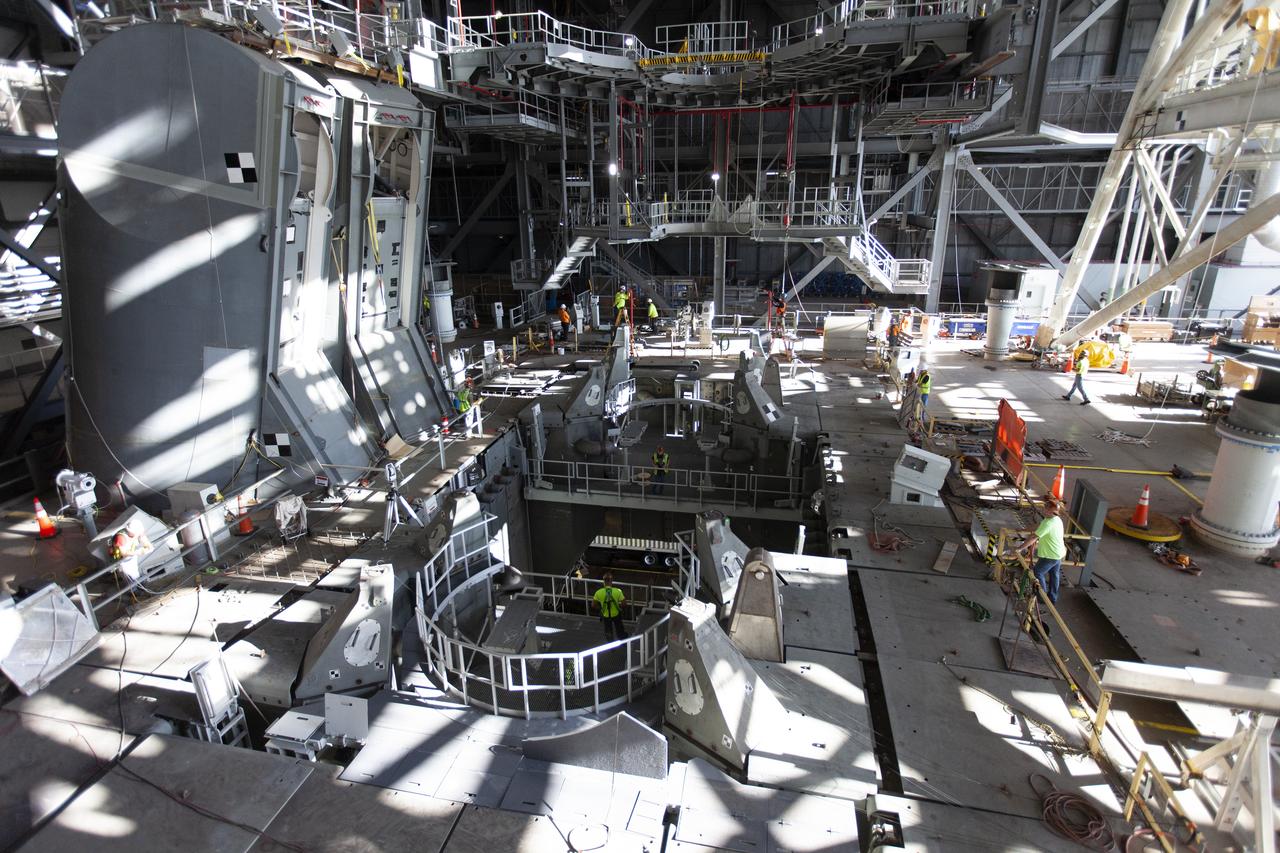
Inside the Vehicle Assembly Building at NASA’s Kennedy Space Center in Florida, the engine service platform that will provide access to the core stage of the Space Launch System (SLS) rocket is lifted up in the center of the mobile launcher (ML) in High Bay 3 on June 18, 2019. The large work platform is designed to provide unrestricted access to the RS-25 engines on the SLS core stage from the ML. The service platform will be used for Artemis 1 and subsequent missions. For Artemis 1, the Orion spacecraft will launch atop the SLS rocket from Launch Pad 39B and begin an approximately three-week mission that will send Orion thousands of miles beyond the Moon. Exploration Ground Systems is overseeing work on the ML.
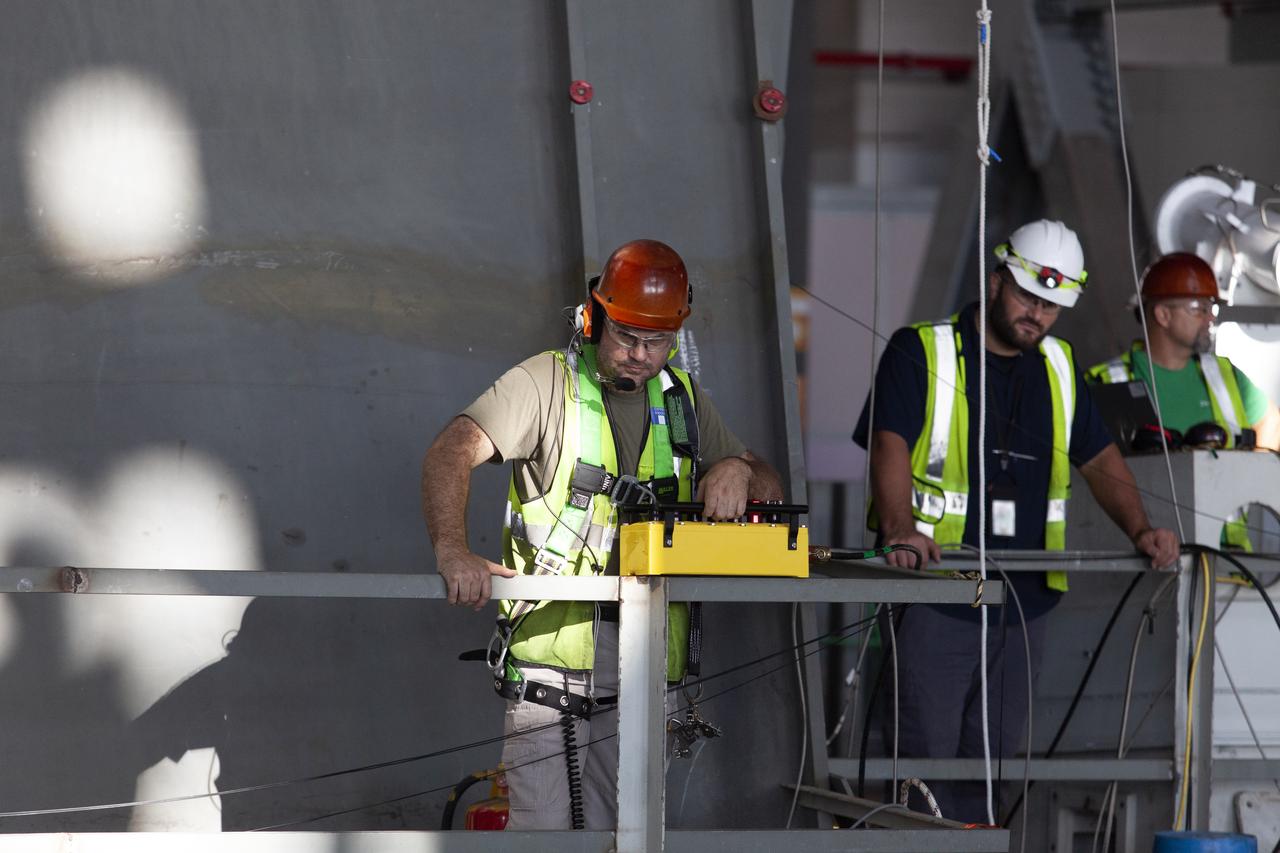
Jacobs TOSC workers prepare for the lift of the engine service platform that will provide access to the core stage of the Space Launch System (SLS) rocket on the mobile launcher (ML) in High Bay 3 of the Vehicle Assembly Building at NASA’s Kennedy Space Center in Florida on June 18, 2019. The large work platform is designed to provide unrestricted access to the RS-25 engines on the SLS core stage from the ML. The service platform will be used for Artemis 1 and subsequent missions. For Artemis 1, the Orion spacecraft will launch atop the SLS rocket from Launch Pad 39B and begin an approximately three-week mission that will send Orion thousands of miles beyond the Moon. Exploration Ground Systems is overseeing work on the ML.
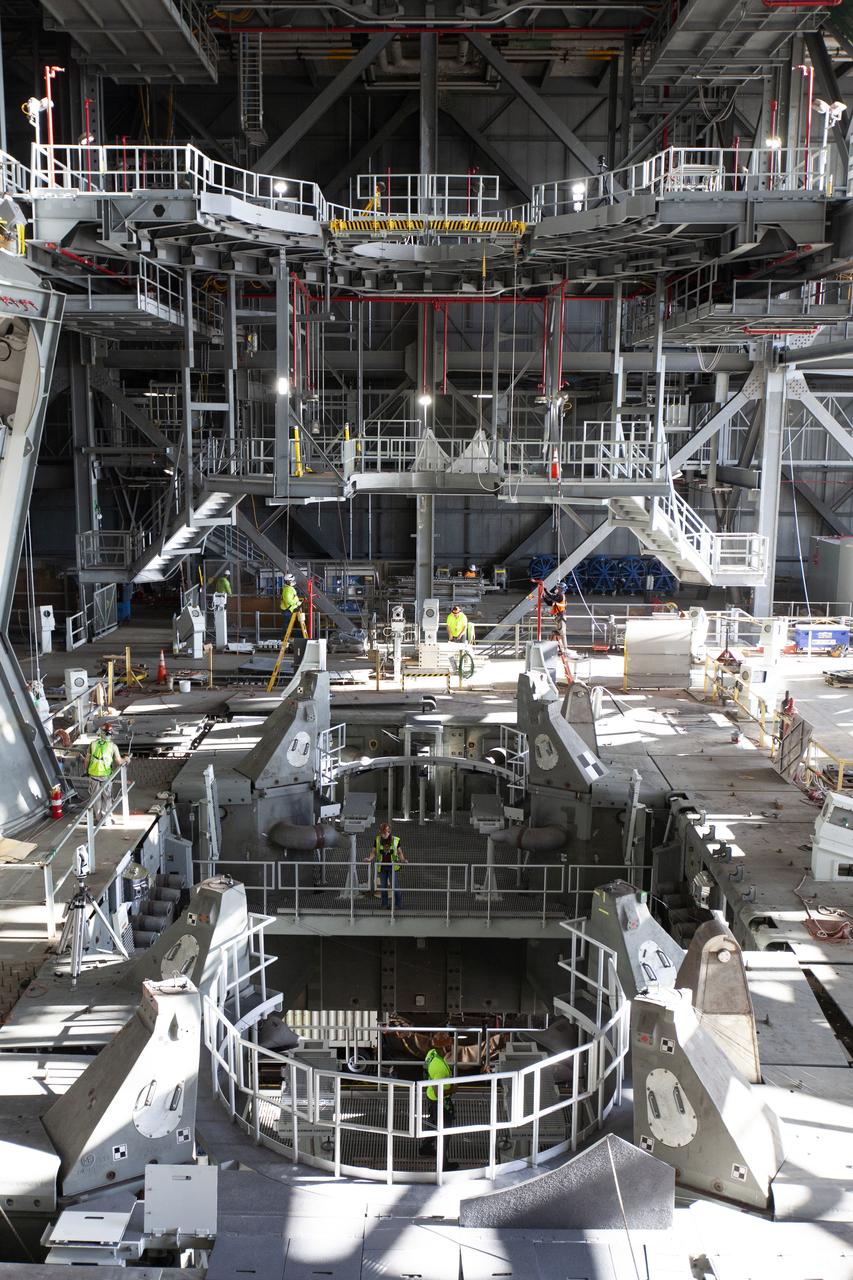
Inside the Vehicle Assembly Building at NASA’s Kennedy Space Center in Florida, the engine service platform that will provide access to the core stage of the Space Launch System (SLS) rocket is lifted up in the center of the mobile launcher (ML) in High Bay 3 on June 18, 2019. The large work platform is designed to provide unrestricted access to the RS-25 engines on the SLS core stage from the ML. The service platform will be used for Artemis 1 and subsequent missions. For Artemis 1, the Orion spacecraft will launch atop the SLS rocket from Launch Pad 39B and begin an approximately three-week mission that will send Orion thousands of miles beyond the Moon. Exploration Ground Systems is overseeing work on the ML.
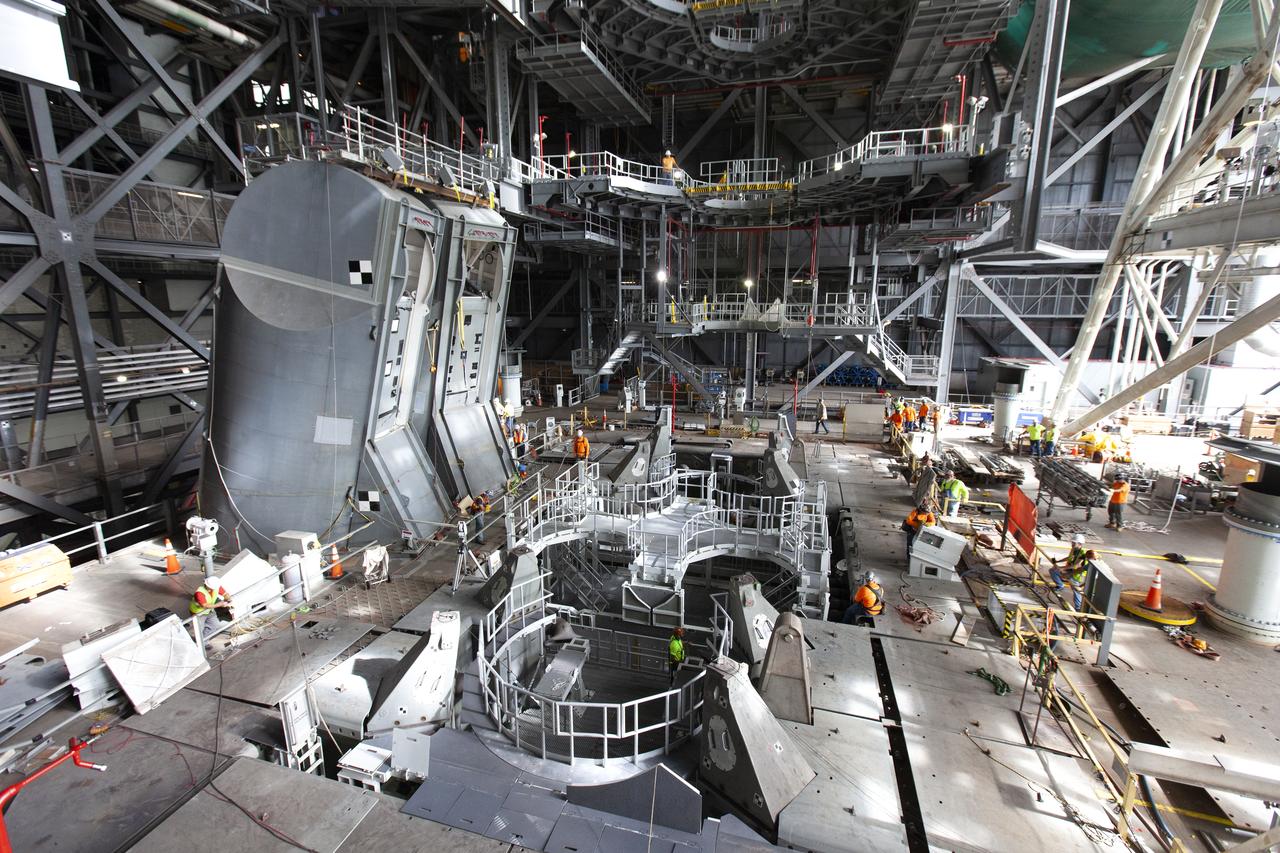
Inside the Vehicle Assembly Building at NASA’s Kennedy Space Center in Florida, the engine service platform that will provide access to the core stage of the Space Launch System (SLS) rocket is lifted up in the center of the mobile launcher (ML) in High Bay 3 on June 18, 2019. The large work platform is designed to provide unrestricted access to the RS-25 engines on the SLS core stage from the ML. The service platform will be used for Artemis 1 and subsequent missions. For Artemis 1, the Orion spacecraft will launch atop the SLS rocket from Launch Pad 39B and begin an approximately three-week mission that will send Orion thousands of miles beyond the Moon. In view at left are the two Tail Service Mast Umbilicals. They will provide liquid oxygen and liquid hydrogen fluid lines and electrical cable connections to the SLS core stage engine section. Exploration Ground Systems is overseeing work on the ML.
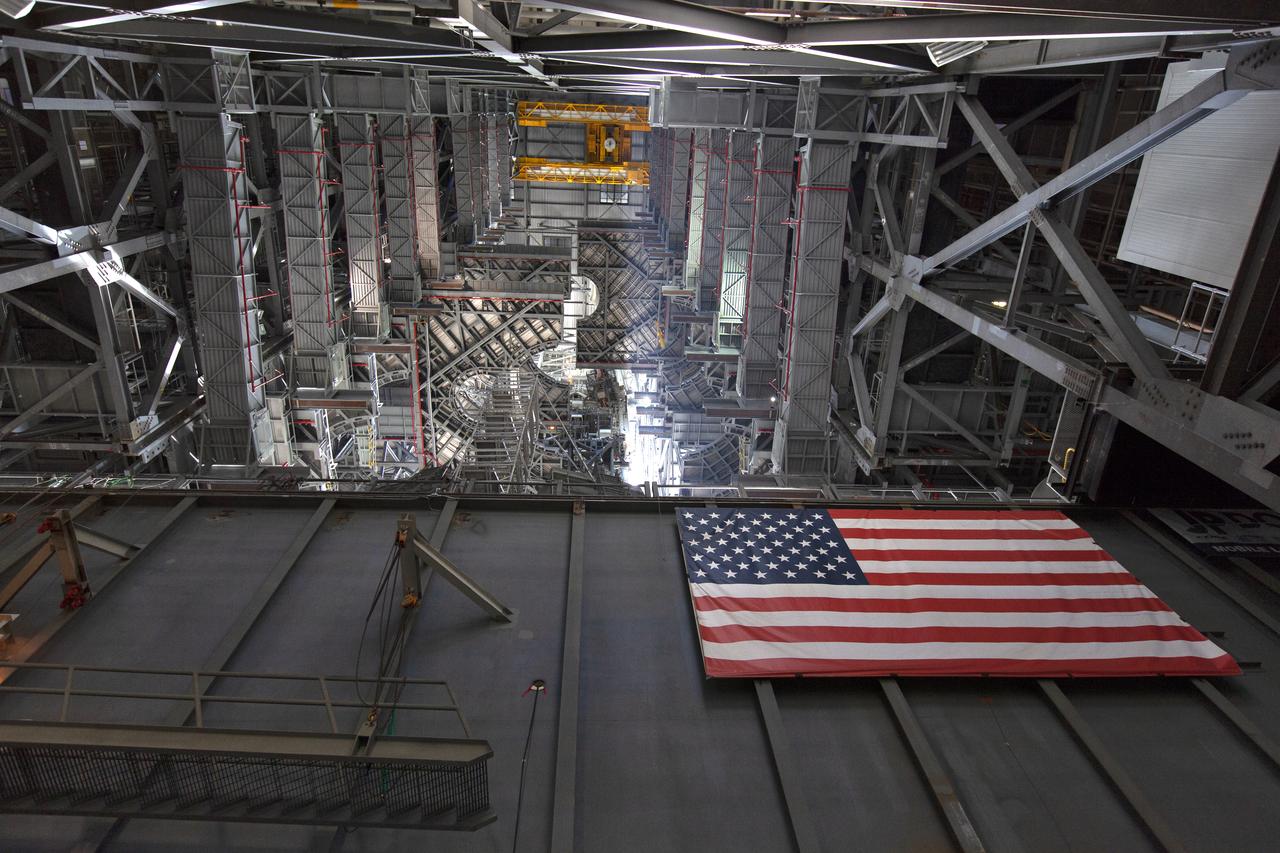
A view looking up at the mobile launcher (ML) in High Bay 3 of the Vehicle Assembly Building at NASA’s Kennedy Space Center in Florida on June 18, 2019. Work is underway to lift the engine service platform that will provide access to the core stage of the Space Launch System (SLS) rocket in the center of the ML. The large work platform is designed to provide unrestricted access to the RS-25 engines on the SLS core stage from the ML. The service platform will be used for Artemis 1 and subsequent missions. For Artemis 1, the Orion spacecraft will launch atop the SLS rocket from Launch Pad 39B and begin an approximately three-week mission that will send Orion thousands of miles beyond the Moon. Exploration Ground Systems is overseeing work on the ML.
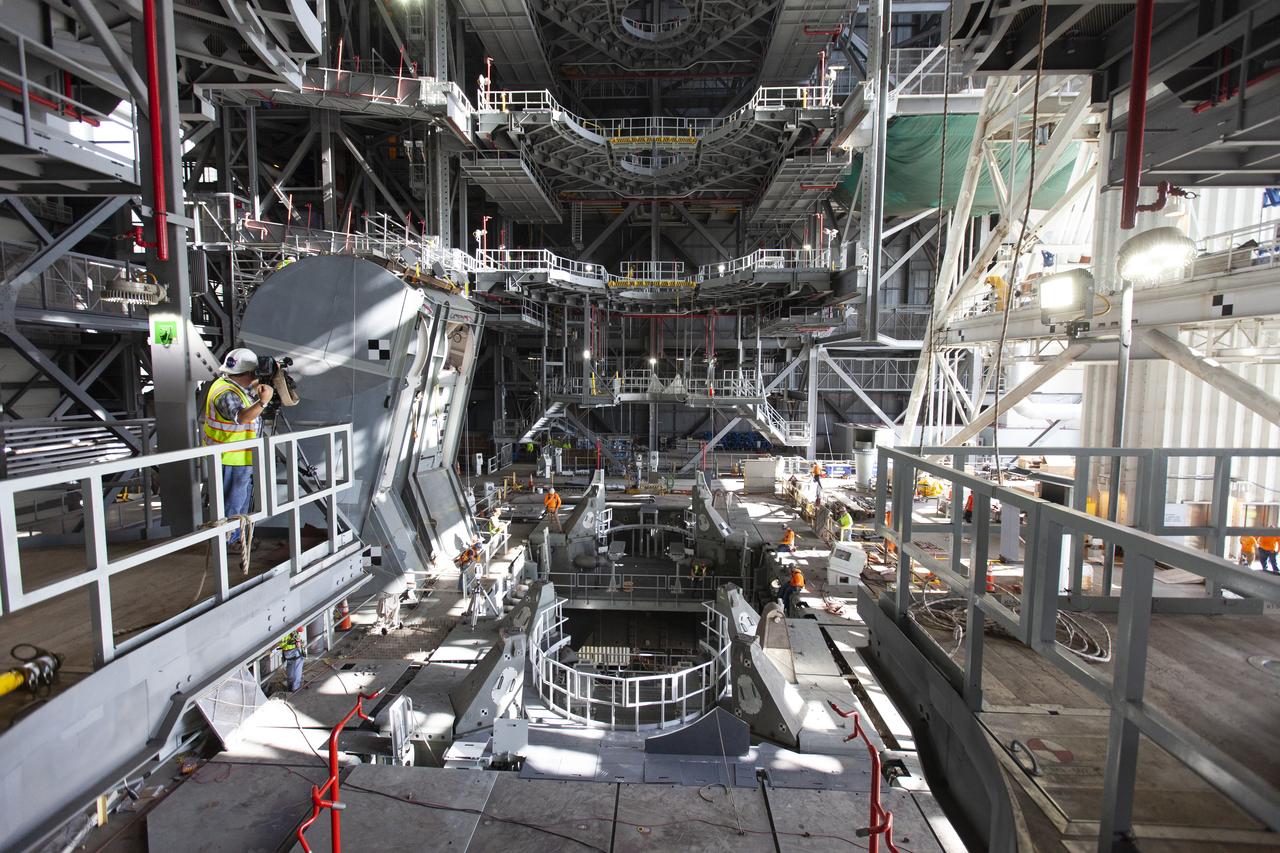
Inside the Vehicle Assembly Building at NASA’s Kennedy Space Center in Florida, the engine service platform that will provide access to the core stage of the Space Launch System (SLS) rocket is lifted up in the center of the mobile launcher (ML) in High Bay 3 on June 18, 2019. The large work platform is designed to provide unrestricted access to the RS-25 engines on the SLS core stage from the ML. The service platform will be used for Artemis 1 and subsequent missions. For Artemis 1, the Orion spacecraft will launch atop the SLS rocket from Launch Pad 39B and begin an approximately three-week mission that will send Orion thousands of miles beyond the Moon. Exploration Ground Systems is overseeing work on the ML.
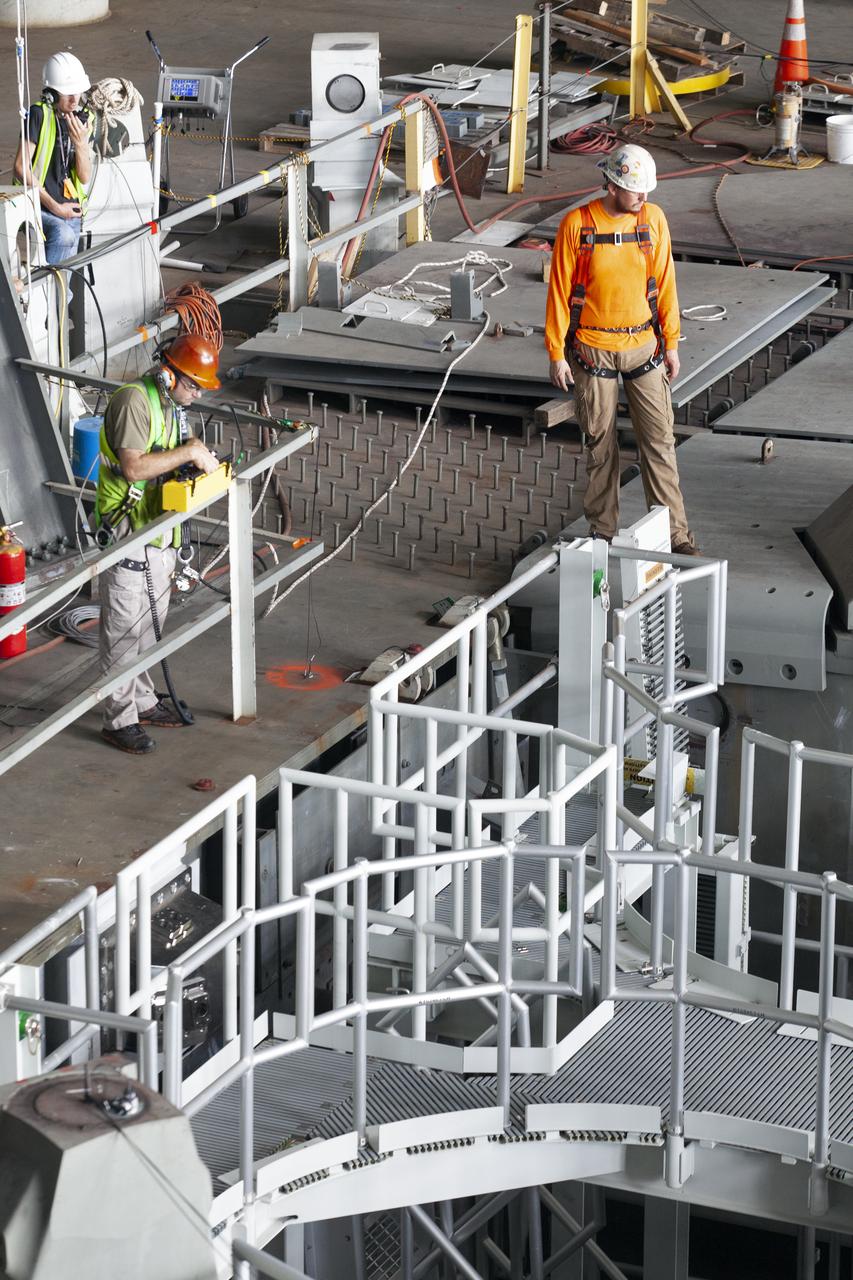
Workers with Bragg Crane and Rigging prepare for the lift of the engine service platform that will provide access to the core stage of the Space Launch System (SLS) rocket on the mobile (ML) in High Bay 3 of the Vehicle Assembly Building at NASA’s Kennedy Space Center in Florida on June 18, 2019. The large work platform is designed to provide unrestricted access to the RS-25 engines on the SLS core stage from the ML. The service platform will be used for Artemis 1 and subsequent missions. For Artemis 1, the Orion spacecraft will launch atop the SLS rocket from Launch Pad 39B and begin an approximately three-week mission that will send Orion thousands of miles beyond the Moon. Exploration Ground Systems is overseeing work on the ML.
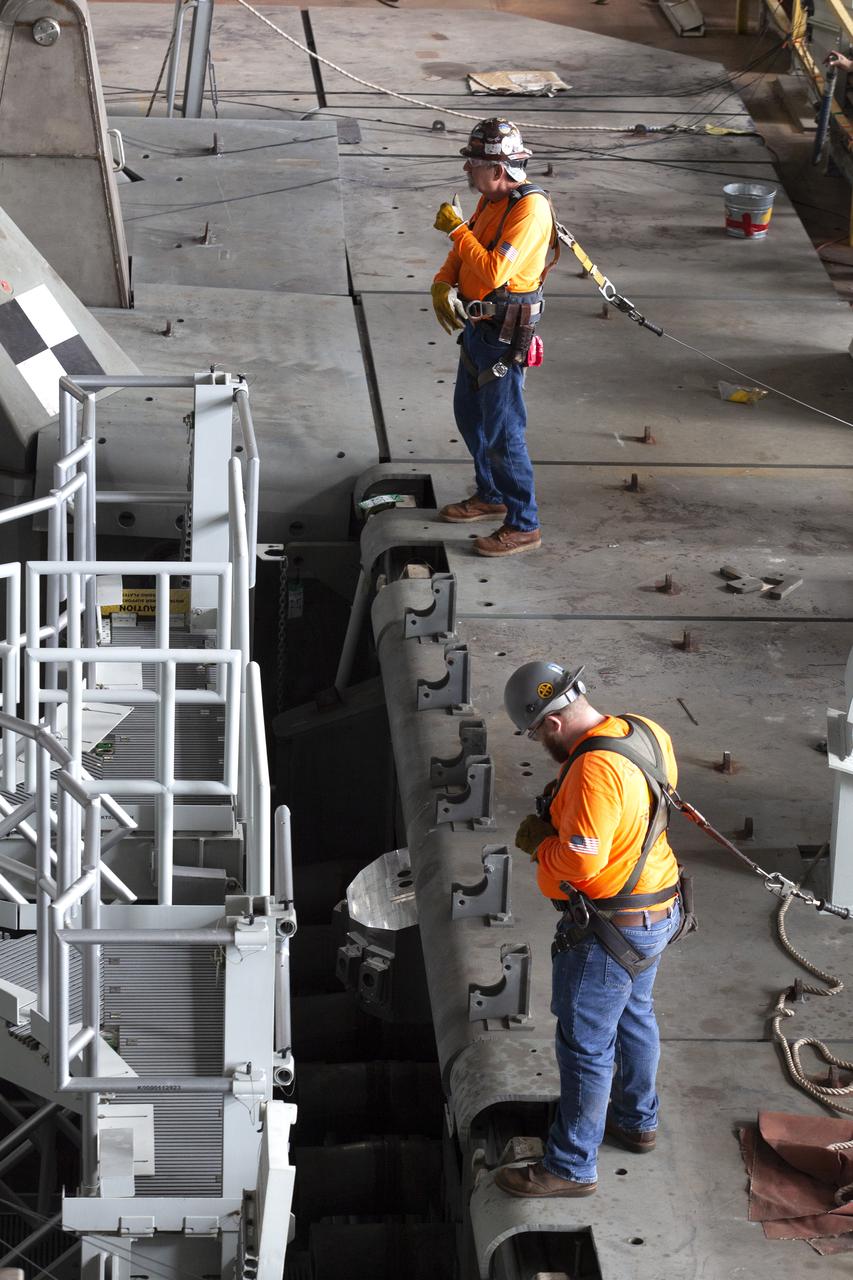
Workers with Bragg Crane and Rigging prepare to assist with the lift of the engine service platform that will provide access to the core stage of the Space Launch System (SLS) rocket on the mobile (ML) in High Bay 3 of the Vehicle Assembly Building at NASA’s Kennedy Space Center in Florida on June 18, 2019. The large work platform is designed to provide unrestricted access to the RS-25 engines on the SLS core stage from the ML. The service platform will be used for Artemis 1 and subsequent missions. For Artemis 1, the Orion spacecraft will launch atop the SLS rocket from Launch Pad 39B and begin an approximately three-week mission that will send Orion thousands of miles beyond the Moon. Exploration Ground Systems is overseeing work on the ML.
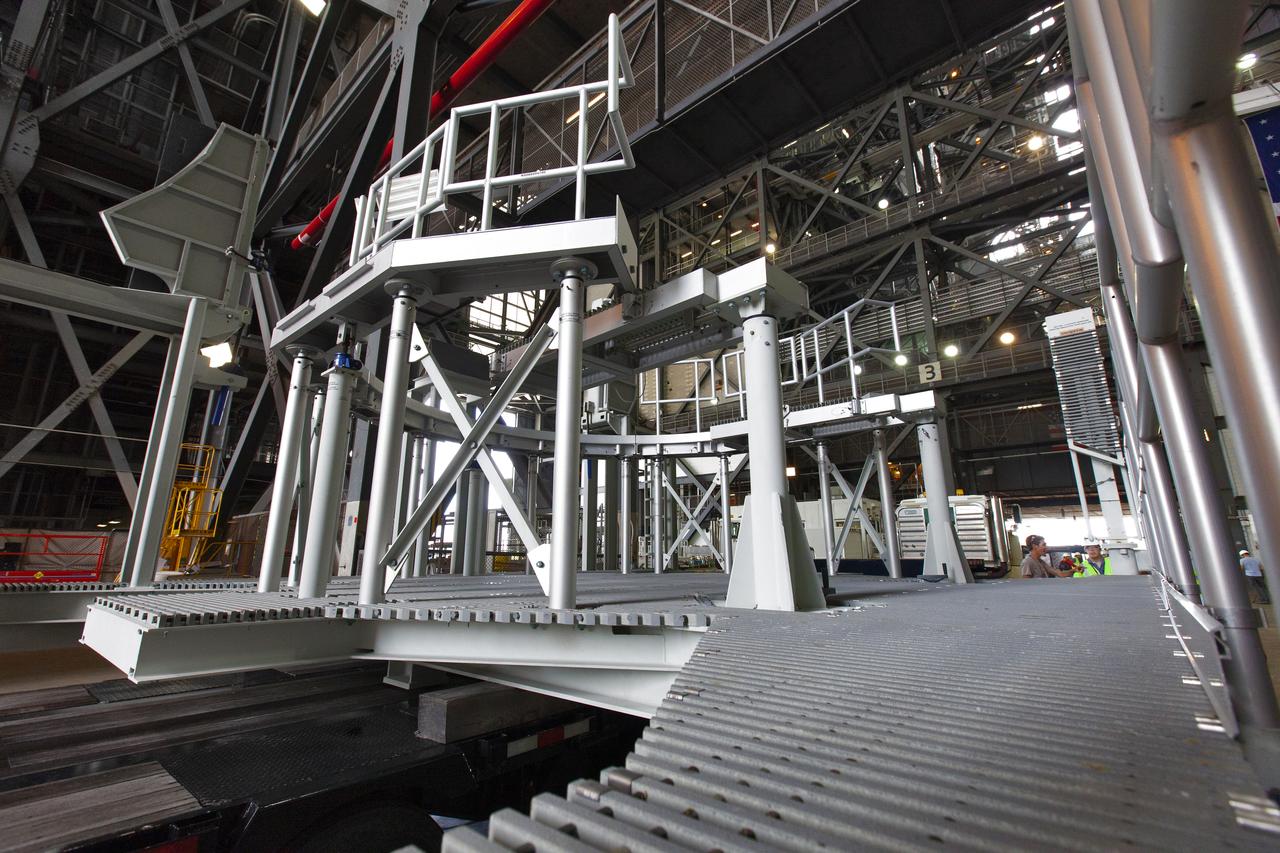
The engine service platform that will provide access to the core stage of the Space Launch System (SLS) rocket is moved beneath the mobile launcher (ML) in High Bay 3 of the Vehicle Assembly Building at NASA’s Kennedy Space Center in Florida on June 14, 2019. The large work platform is designed to provide unrestricted access to the RS-25 engines on the SLS core stage from the ML. The service platform will be used for Artemis 1 and subsequent missions. For Artemis 1, the Orion spacecraft will launch atop the SLS rocket from Launch Pad 39B and begin an approximately three-week mission that will send Orion thousands of miles beyond the Moon. Exploration Ground Systems is overseeing work on the ML.

The engine service platform that will provide access to the core stage of the Space Launch System (SLS) rocket is moved beneath the mobile launcher (ML) in High Bay 3 of the Vehicle Assembly Building at NASA’s Kennedy Space Center in Florida on June 14, 2019. The large work platform is designed to provide unrestricted access to the RS-25 engines on the SLS core stage from the ML. The service platform will be used for Artemis 1 and subsequent missions. For Artemis 1, the Orion spacecraft will launch atop the SLS rocket from Launch Pad 39B and begin an approximately three-week mission that will send Orion thousands of miles beyond the Moon. Exploration Ground Systems is overseeing work on the ML.
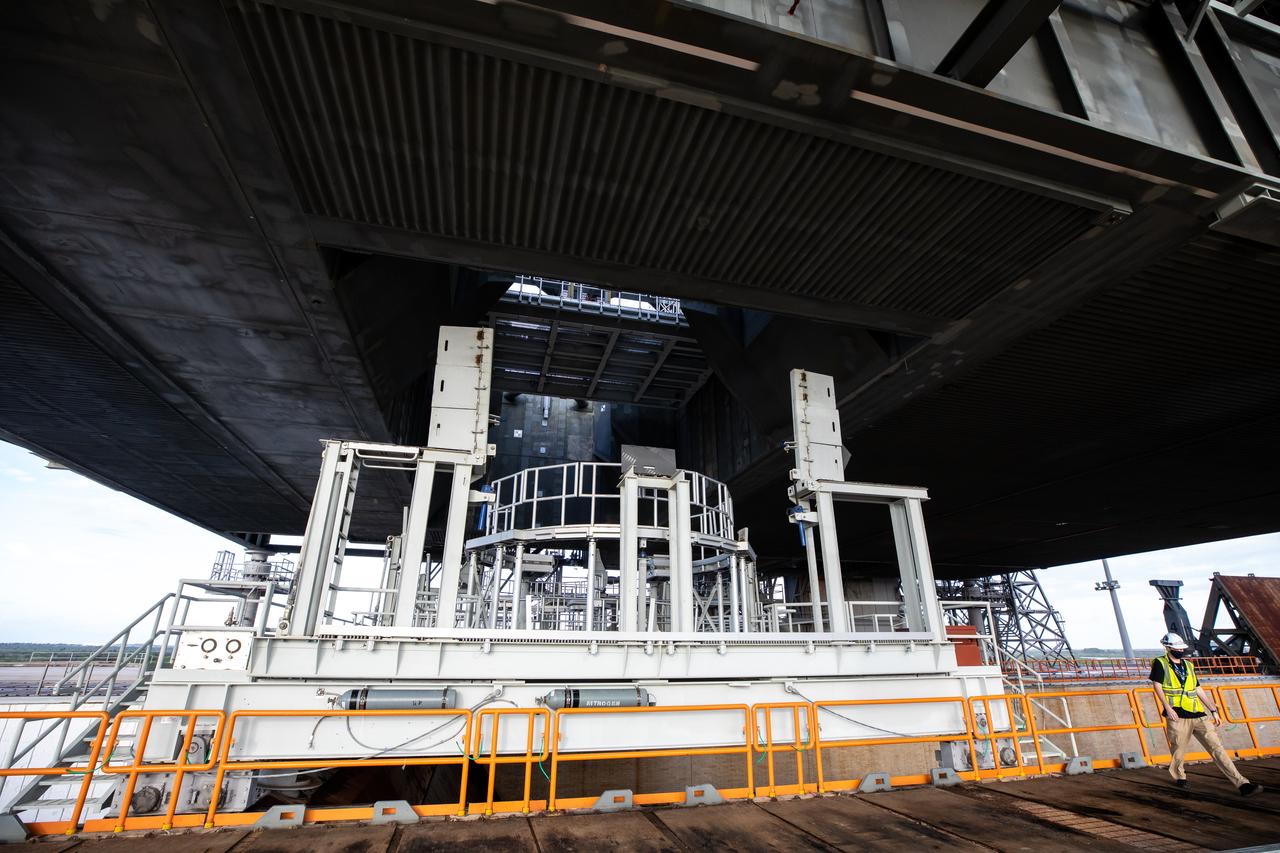
The engine service platform is moved into position beneath the mobile launcher for Artemis I at Launch Pad 39B on Oct. 23, 2020, at NASA’s Kennedy Space Center in Florida. The service platform allows access to the RS-25 engines on the Space Launch System core stage for routine work or inspections. The nearly 400-foot-tall mobile launcher will remain at the pad while engineers with Exploration Ground Systems and Jacobs complete several tasks, including a timing test to validate the launch team’s countdown timeline, and a thorough, top-to-bottom wash down of the mobile launcher to remove any debris remaining from construction and installation of the umbilical arms. Artemis I will test the Orion spacecraft and Space Launch System as an integrated system ahead of crewed flights to the Moon. Under the Artemis program, NASA will land the first woman and the next man on the Moon in 2024.

The engine service platform has been lowered and removed from the mobile launcher for Artemis I at Launch Pad 39B at NASA’s Kennedy Space Center in Florida on Oct. 23, 2020. The platform is in view on a flatbed truck. The nearly 400-foot-tall mobile launcher is at the pad while engineers with Exploration Ground Systems and Jacobs complete several tasks, including a timing test to validate the launch team’s countdown timeline, and a thorough, top-to-bottom wash down of the mobile launcher to remove any debris remaining from construction and installation of the umbilical arms. Artemis I will test the Orion spacecraft and Space Launch System as an integrated system ahead of crewed flights to the Moon. Under the Artemis program, NASA will land the first woman and the next man on the Moon in 2024.
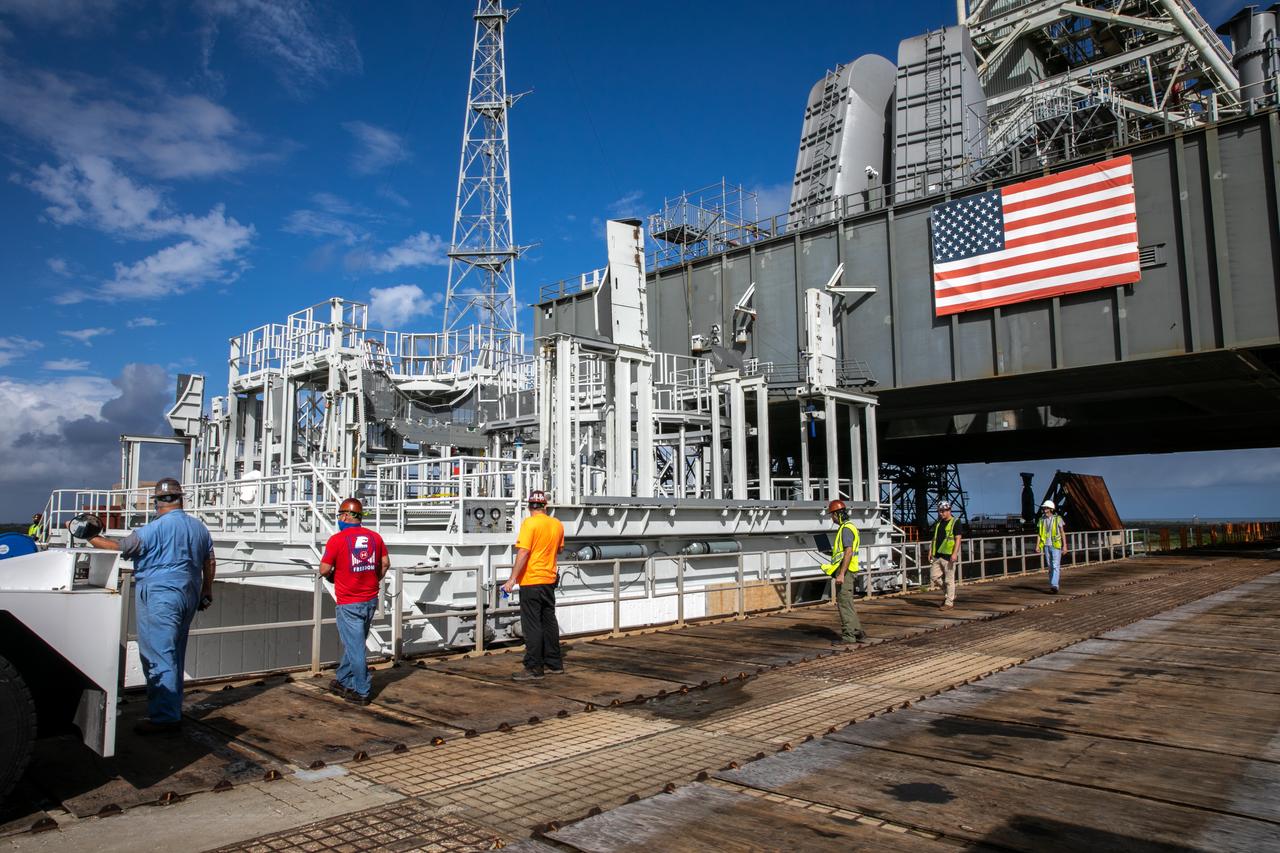
The engine service platform has been lowered and removed from the mobile launcher for Artemis I at Launch Pad 39B at NASA’s Kennedy Space Center in Florida on Oct. 23, 2020. The platform is in view on a flatbed truck. The nearly 400-foot-tall mobile launcher is at the pad while engineers with Exploration Ground Systems and Jacobs complete several tasks, including a timing test to validate the launch team’s countdown timeline, and a thorough, top-to-bottom wash down of the mobile launcher to remove any debris remaining from construction and installation of the umbilical arms. Artemis I will test the Orion spacecraft and Space Launch System as an integrated system ahead of crewed flights to the Moon. Under the Artemis program, NASA will land the first woman and the next man on the Moon in 2024.
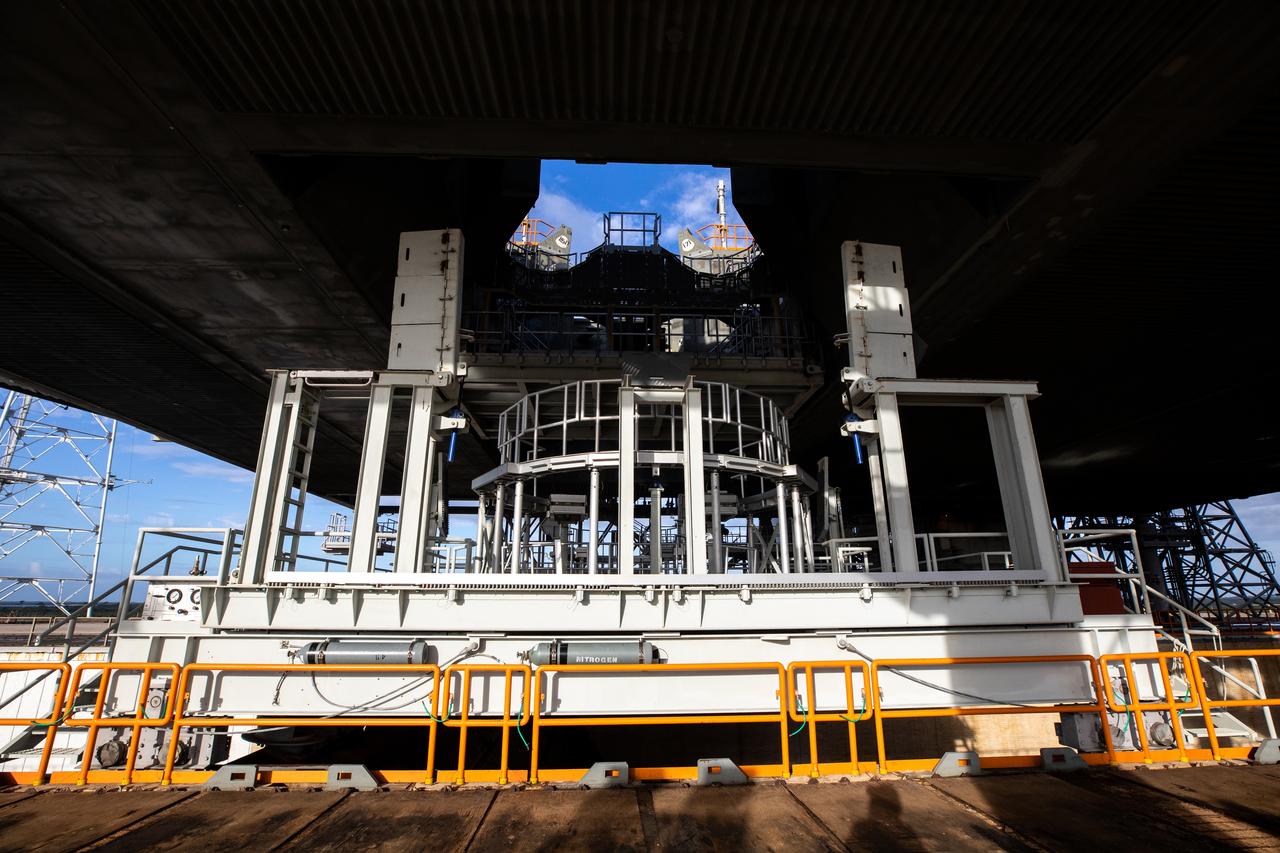
The engine service platform is moved into position beneath the mobile launcher for Artemis I at Launch Pad 39B on Oct. 23, 2020, at NASA’s Kennedy Space Center in Florida. The service platform allows access to the RS-25 engines on the Space Launch System core stage for routine work or inspections. The nearly 400-foot-tall mobile launcher will remain at the pad while engineers with Exploration Ground Systems and Jacobs will complete several tasks, including a timing test to validate the launch team’s countdown timeline, and a thorough, top-to-bottom wash down of the mobile launcher to remove any debris remaining from construction and installation of the umbilical arms. Artemis I will test the Orion spacecraft and Space Launch System as an integrated system ahead of crewed flights to the Moon. Under the Artemis program, NASA will land the first woman and the next man on the Moon in 2024.
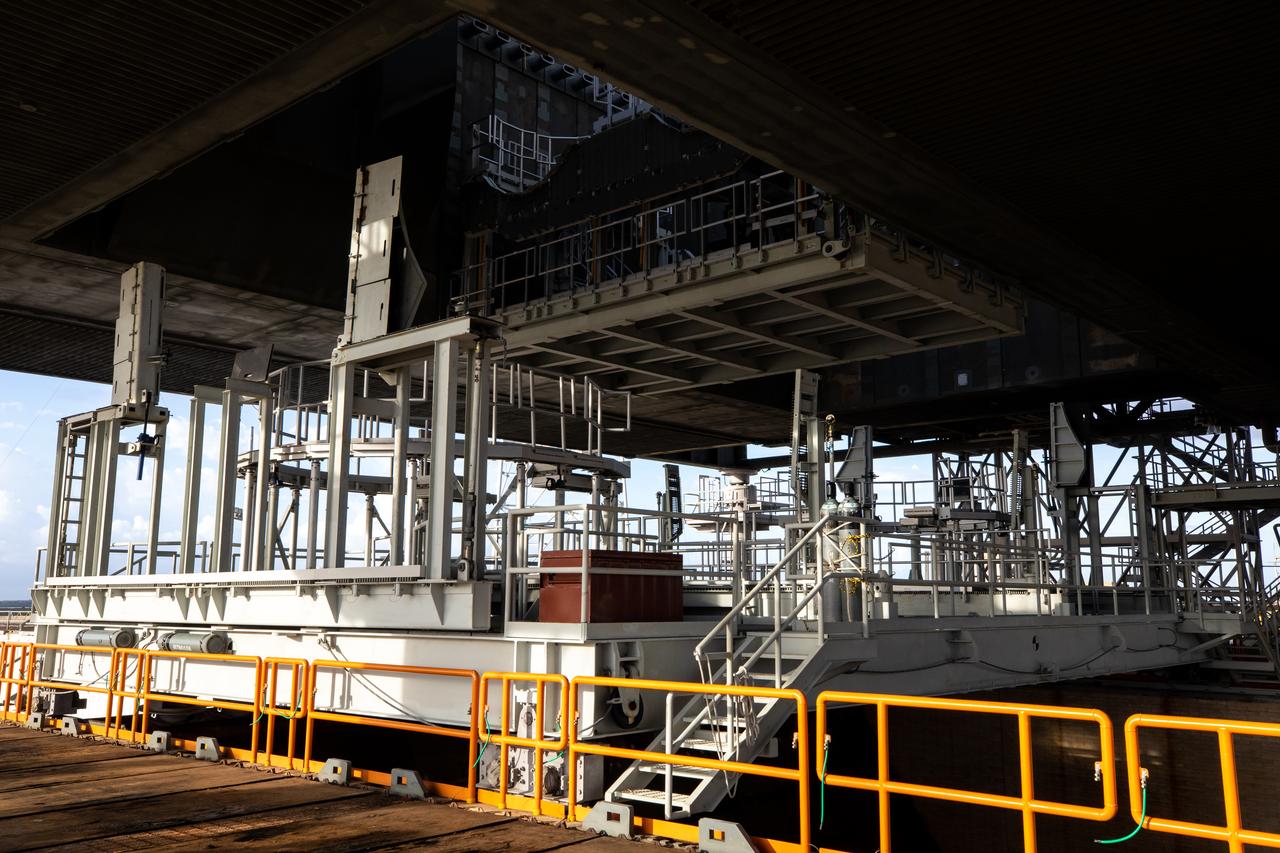
The engine service platform is moved into position beneath the mobile launcher for Artemis I at Launch Pad 39B on Oct. 23, 2020, at NASA’s Kennedy Space Center in Florida. The service platform allows access to the RS-25 engines on the Space Launch System core stage for routine work or inspections. The nearly 400-foot-tall mobile launcher will remain at the pad while engineers with Exploration Ground Systems and Jacobs complete several tasks, including a timing test to validate the launch team’s countdown timeline, and a thorough, top-to-bottom wash down of the mobile launcher to remove any debris remaining from construction and installation of the umbilical arms. Artemis I will test the Orion spacecraft and Space Launch System as an integrated system ahead of crewed flights to the Moon. Under the Artemis program, NASA will land the first woman and the next man on the Moon in 2024.
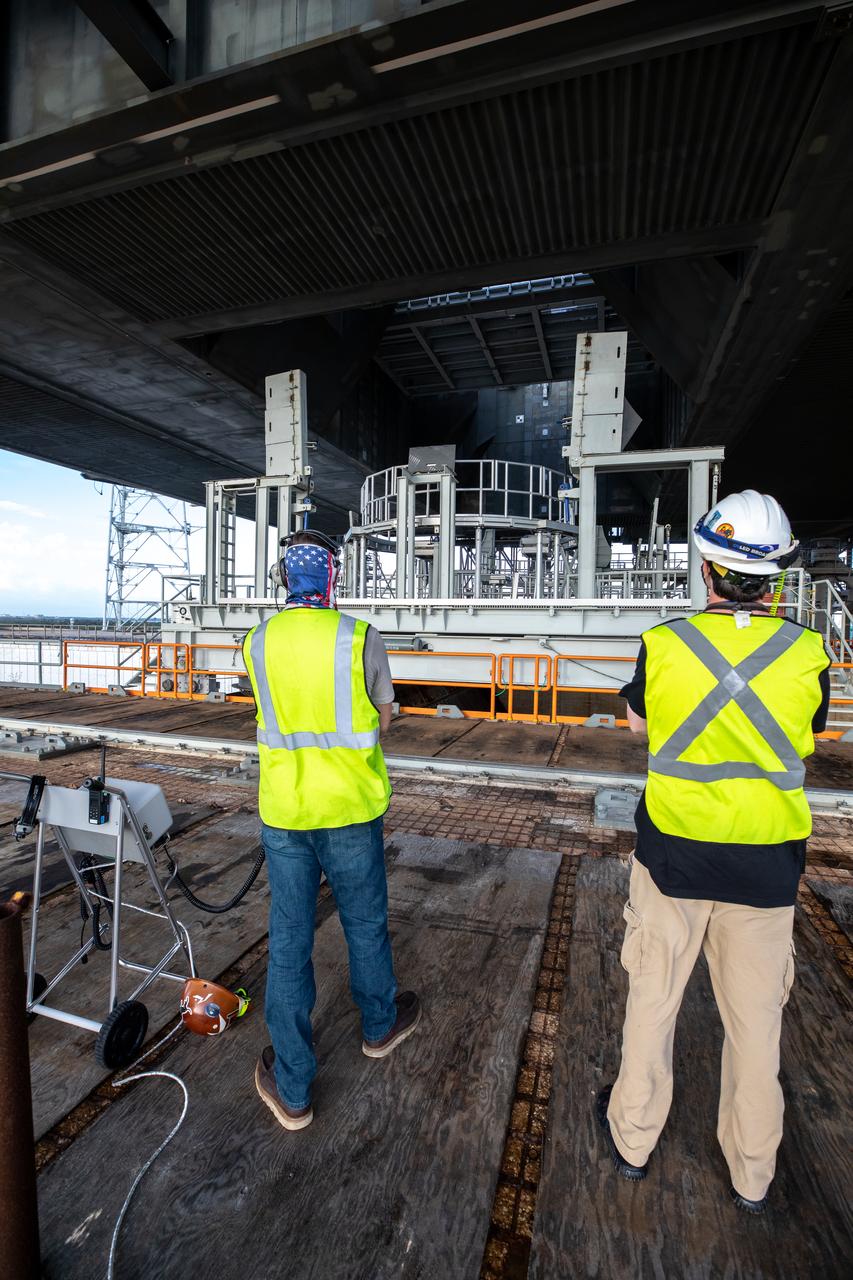
The engine service platform is moved into position beneath the mobile launcher for Artemis I at Launch Pad 39B on Oct. 23, 2020, at NASA’s Kennedy Space Center in Florida. The service platform allows access to the RS-25 engines on the Space Launch System core stage for routine work or inspections. The nearly 400-foot-tall mobile launcher will remain at the pad while engineers with Exploration Ground Systems and Jacobs will complete several tasks, including a timing test to validate the launch team’s countdown timeline, and a thorough, top-to-bottom wash down of the mobile launcher to remove any debris remaining from construction and installation of the umbilical arms. Artemis I will test the Orion spacecraft and Space Launch System as an integrated system ahead of crewed flights to the Moon. Under the Artemis program, NASA will land the first woman and the next man on the Moon in 2024.
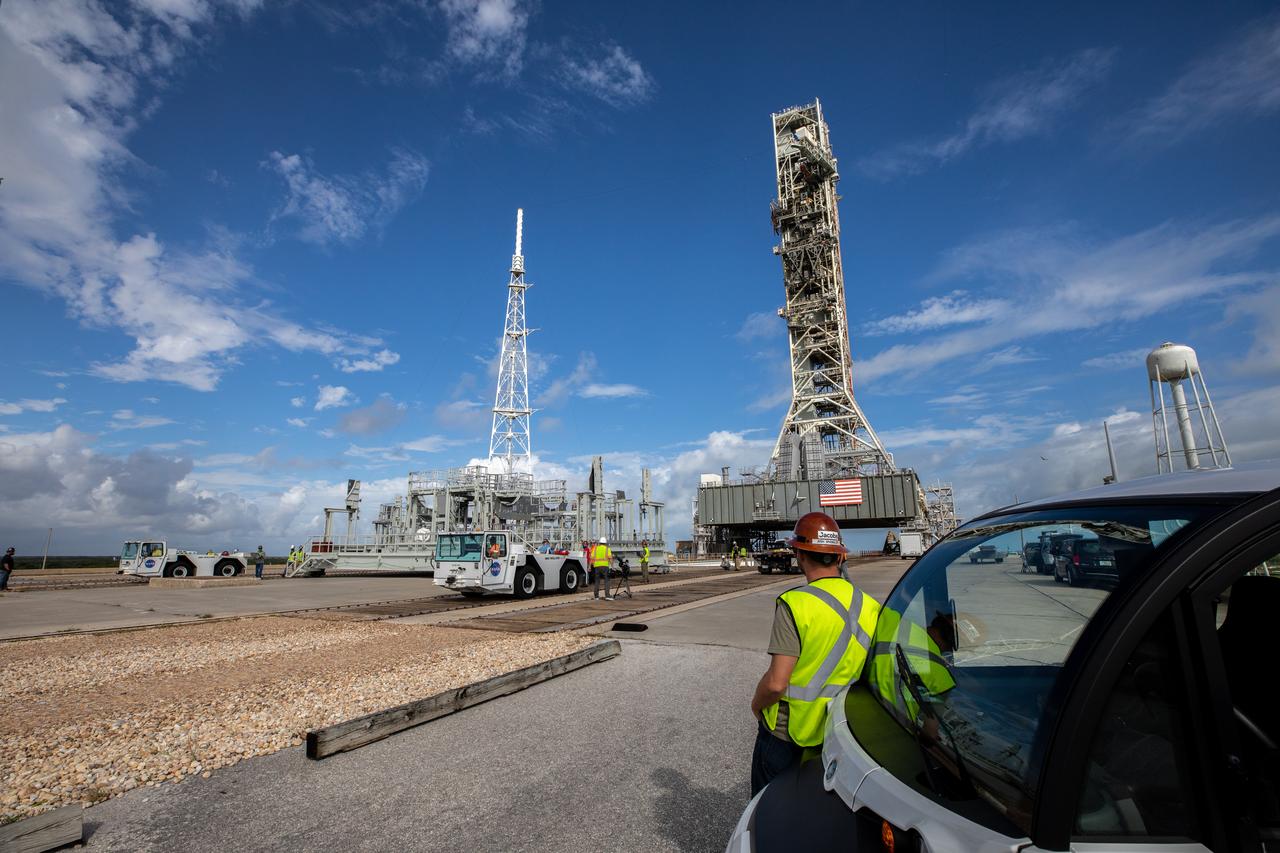
A view of the mobile launcher for Artemis I on Launch Pad 39B at NASA’s Kennedy Space Center in Florida on Oct. 23, 2020. The engine service platform has been lowered and removed from the mobile launcher and is in view on a flatbed carrier. The nearly 400-foot-tall mobile launcher is at the pad while engineers with Exploration Ground Systems and Jacobs complete several tasks, including a timing test to validate the launch team’s countdown timeline, and a thorough, top-to-bottom wash down of the mobile launcher to remove any debris remaining from construction and installation of the umbilical arms. Artemis I will test the Orion spacecraft and Space Launch System as an integrated system ahead of crewed flights to the Moon. Under the Artemis program, NASA will land the first woman and the next man on the Moon in 2024.
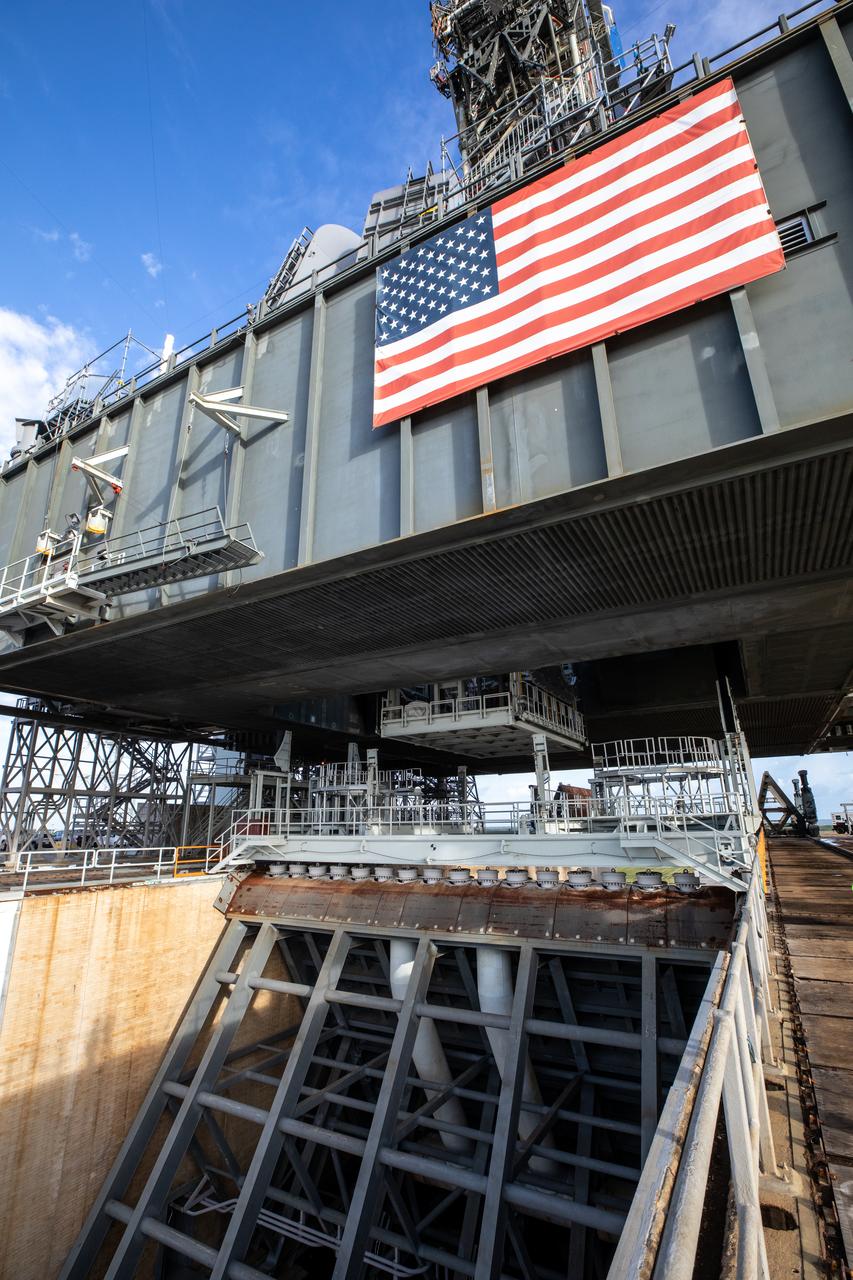
A view of the base of the mobile launcher for Artemis I and the flame trench below as the engine service platform is being raised into position below the mobile launcher at Launch Pad 39B at NASA’s Kennedy Space Center in Florida on Oct. 23, 2020. The nearly 400-foot-tall mobile launcher is at the pad while engineers with Exploration Ground Systems and Jacobs complete several tasks, including a timing test to validate the launch team’s countdown timeline, and a thorough, top-to-bottom wash down of the mobile launcher to remove any debris remaining from construction and installation of the umbilical arms. Artemis I will test the Orion spacecraft and Space Launch System as an integrated system ahead of crewed flights to the Moon. Under the Artemis program, NASA will land the first woman and the next man on the Moon in 2024.
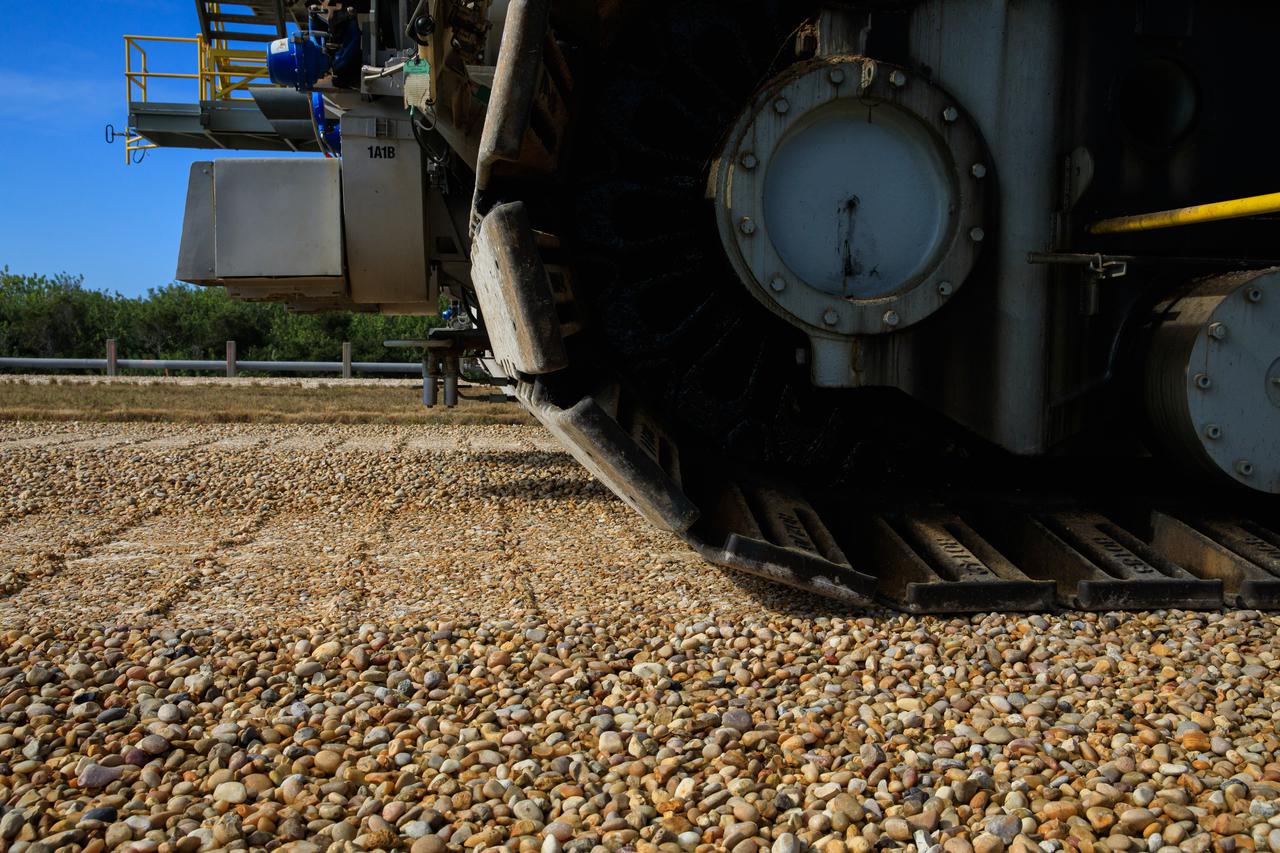
A close-up view of one of the treads on crawler-transporter 2 (CT-2) as the behemoth vehicle moves along the crawlerway at NASA’s Kennedy Space Center in Florida on Jan. 22, 2021. Teams are working to ensure the crawlerway, the path the CT-2, mobile launcher, and Space Launch System rocket with Orion atop will take from the Vehicle Assembly Building to Launch Complex 39B, is strong enough to withstand the weight and provide stability for the Artemis I mission. CT-2 carrying mobile launcher platform 1, used during the shuttle program, was driven back and forth on the crawlerway with several cement blocks, each weighing about 40,000 pounds to strengthen the crawlerway for launch. Artemis I will be the first in a series of increasingly complex missions to the Moon. Under the Artemis program, NASA aims to land the first woman and the next man on the Moon in 2024 and establish sustainable lunar exploration by the end of the decade.
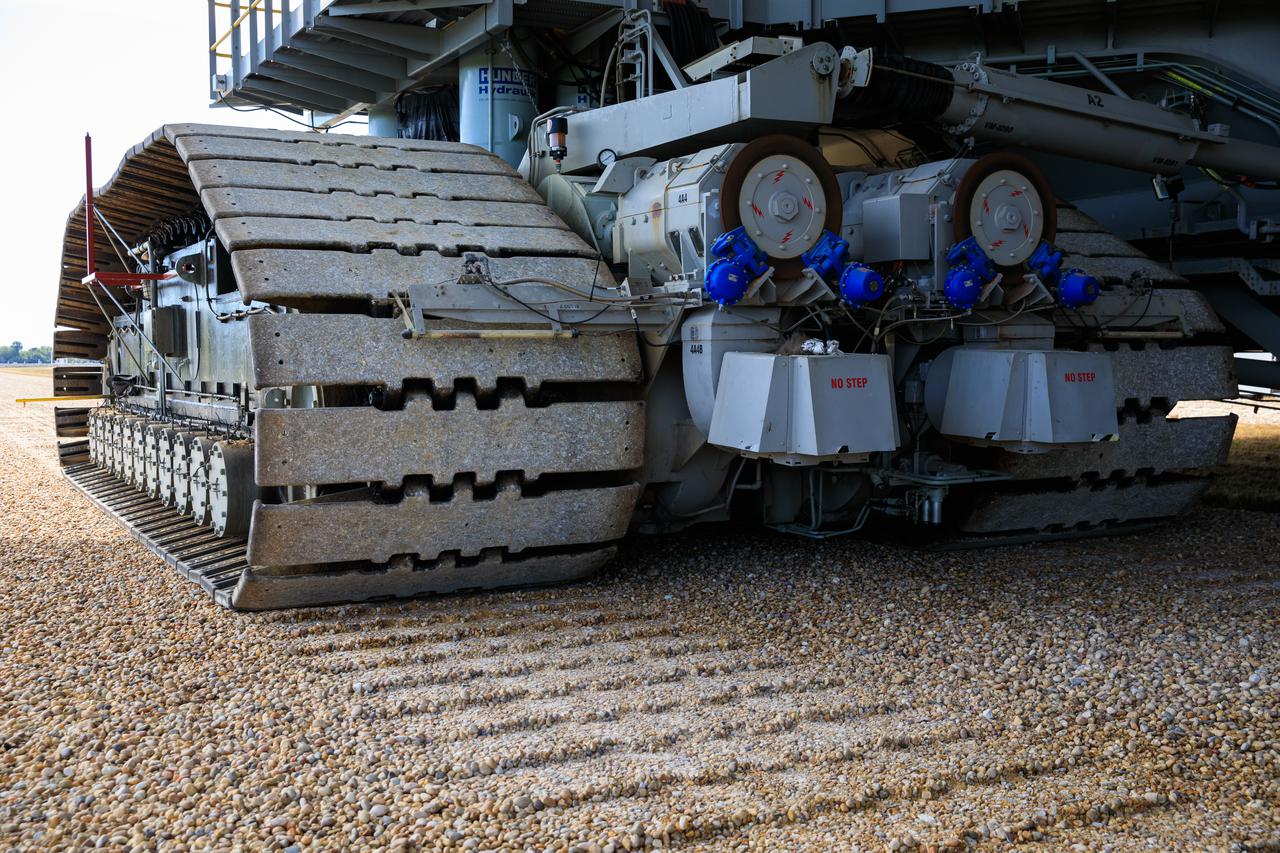
A close-up view of the treads on crawler-transporter 2 (CT-2) as the behemoth vehicle moves along the crawlerway at NASA’s Kennedy Space Center in Florida on Jan. 22, 2021. Teams are working to ensure the crawlerway, the path the CT-2, mobile launcher, and Space Launch System rocket with Orion atop will take from the Vehicle Assembly Building to Launch Complex 39B, is strong enough to withstand the weight and provide stability for the Artemis I mission. CT-2 carrying mobile launcher platform 1, used during the shuttle program, was driven back and forth on the crawlerway with several cement blocks, each weighing about 40,000 pounds to strengthen the crawlerway for launch. Artemis I will be the first in a series of increasingly complex missions to the Moon. Under the Artemis program, NASA aims to land the first woman and the next man on the Moon in 2024 and establish sustainable lunar exploration by the end of the decade.
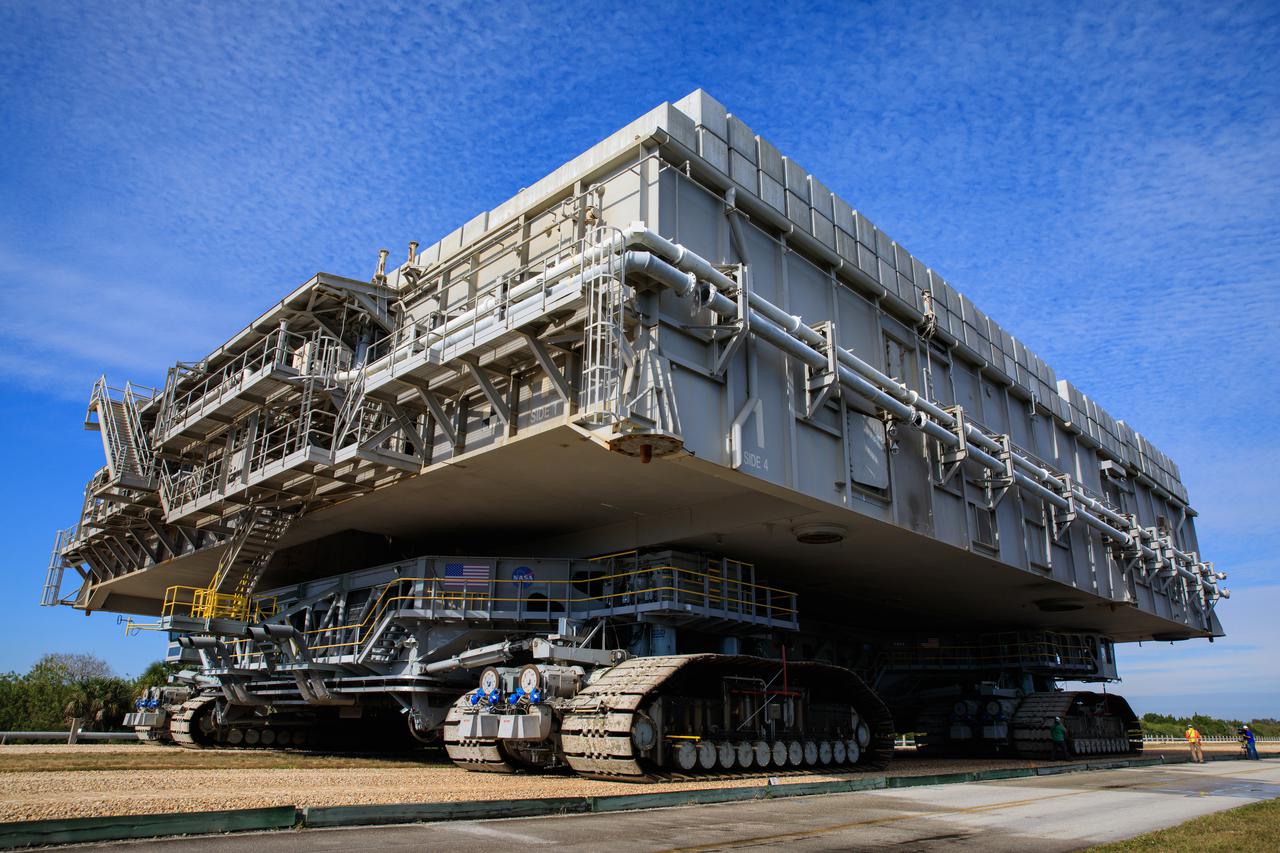
Teams at NASA’s Kennedy Space Center in Florida are working to ensure the crawlerway, the path the crawler-transporter 2 (CT-2), mobile launcher, and Space Launch System rocket with Orion atop will take from the Vehicle Assembly Building to Launch Complex 39B, is strong enough to withstand the weight and provide stability for the Artemis I mission. In this view on Jan. 22, 2021, CT-2 carrying mobile launcher platform 1 that was used during the shuttle program was driven back and forth on the crawlerway with several cement blocks, each weighing about 40,000 pounds to strengthen the crawlerway for launch. Artemis I will be the first in a series of increasingly complex missions to the Moon. Under the Artemis program, NASA aims to land the first woman and the next man on the Moon in 2024 and establish sustainable lunar exploration by the end of the decade.

A close-up view of the treads on crawler-transporter 2 (CT-2) as the behemoth vehicle moves along the crawlerway at NASA’s Kennedy Space Center in Florida on Jan. 22, 2021. Teams are working to ensure the crawlerway, the path the CT-2, mobile launcher, and Space Launch System rocket with Orion atop will take from the Vehicle Assembly Building to Launch Complex 39B, is strong enough to withstand the weight and provide stability for the Artemis I mission. CT-2 carrying mobile launcher platform 1, used during the shuttle program, was driven back and forth on the crawlerway with several cement blocks, each weighing about 40,000 pounds to strengthen the crawlerway for launch. Artemis I will be the first in a series of increasingly complex missions to the Moon. Under the Artemis program, NASA aims to land the first woman and the next man on the Moon in 2024 and establish sustainable lunar exploration by the end of the decade.
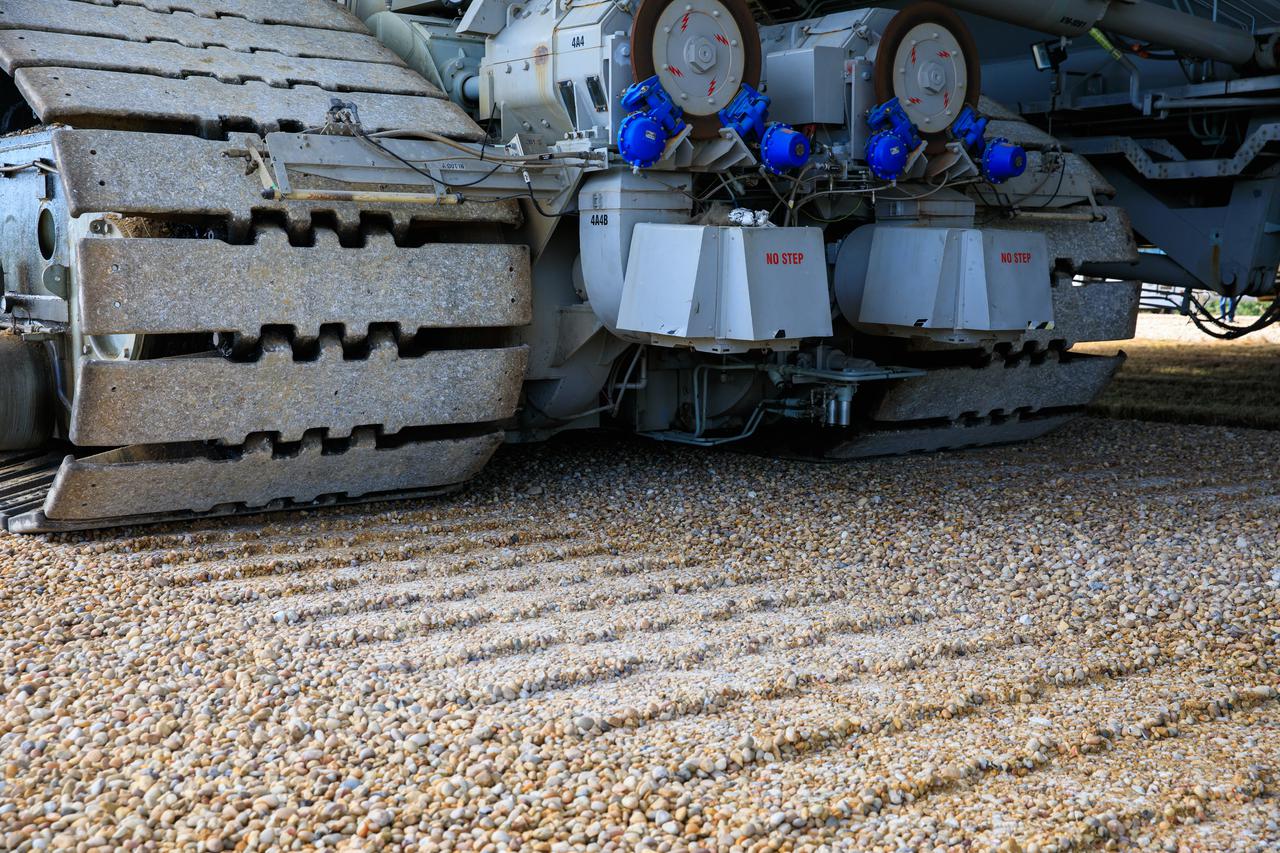
A close-up view of the treads on crawler-transporter 2 (CT-2) as the behemoth vehicle moves along the crawlerway at NASA’s Kennedy Space Center in Florida on Jan. 22, 2021. Teams are working to ensure the crawlerway, the path the CT-2, mobile launcher, and Space Launch System rocket with Orion atop will take from the Vehicle Assembly Building to Launch Complex 39B, is strong enough to withstand the weight and provide stability for the Artemis I mission. CT-2 carrying mobile launcher platform 1, used during the shuttle program, was driven back and forth on the crawlerway with several cement blocks, each weighing about 40,000 pounds to strengthen the crawlerway for launch. Artemis I will be the first in a series of increasingly complex missions to the Moon. Under the Artemis program, NASA aims to land the first woman and the next man on the Moon in 2024 and establish sustainable lunar exploration by the end of the decade.
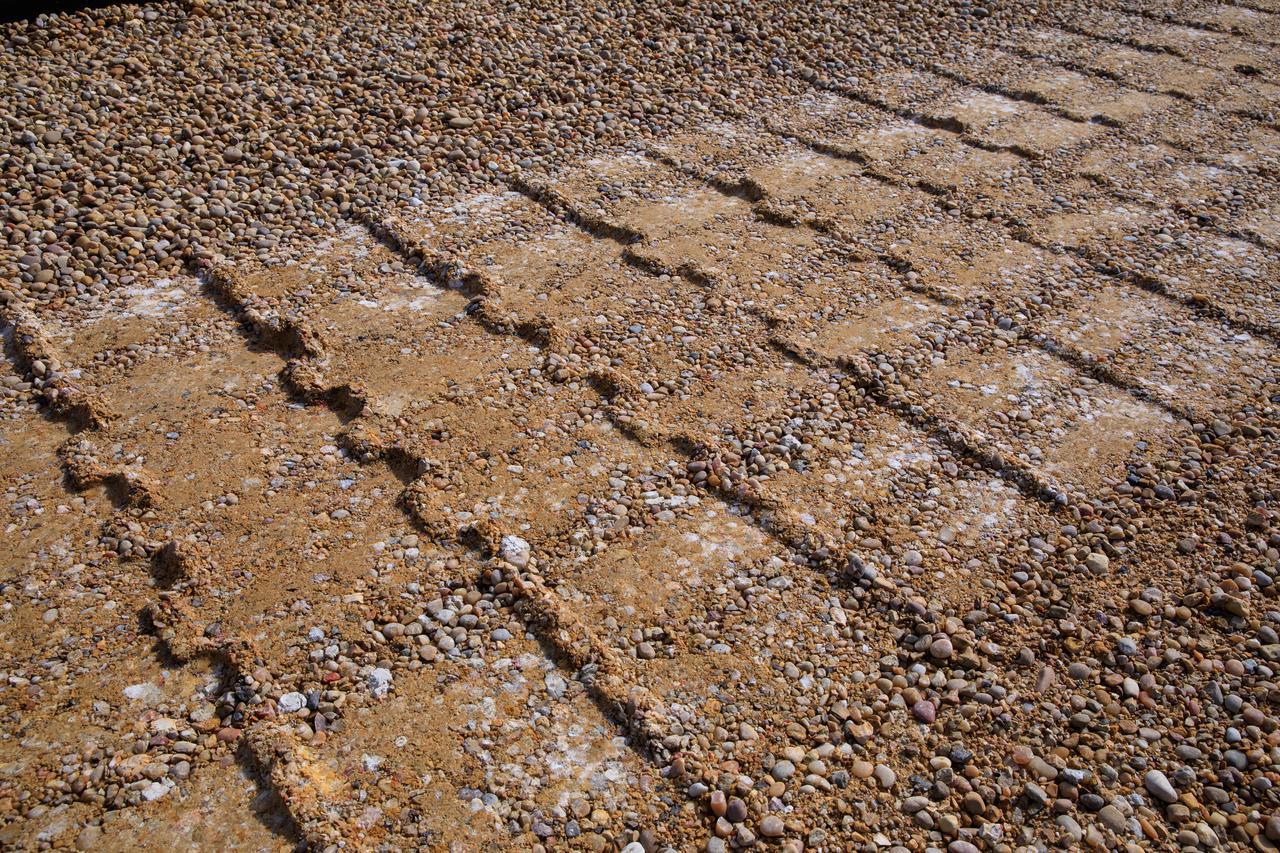
A close-up view of tread marks from crawler-transporter 2 (CT-2) as the behemoth vehicle moves along the crawlerway at NASA’s Kennedy Space Center in Florida on Jan. 22, 2021. Teams are working to ensure the crawlerway, the path the CT-2, mobile launcher, and Space Launch System rocket with Orion atop will take from the Vehicle Assembly Building to Launch Complex 39B, is strong enough to withstand the weight and provide stability for the Artemis I mission. CT-2 carrying mobile launcher platform 1, used during the shuttle program, was driven back and forth on the crawlerway with several cement blocks, each weighing about 40,000 pounds to strengthen the crawlerway for launch. Artemis I will be the first in a series of increasingly complex missions to the Moon. Under the Artemis program, NASA aims to land the first woman and the next man on the Moon in 2024 and establish sustainable lunar exploration by the end of the decade.
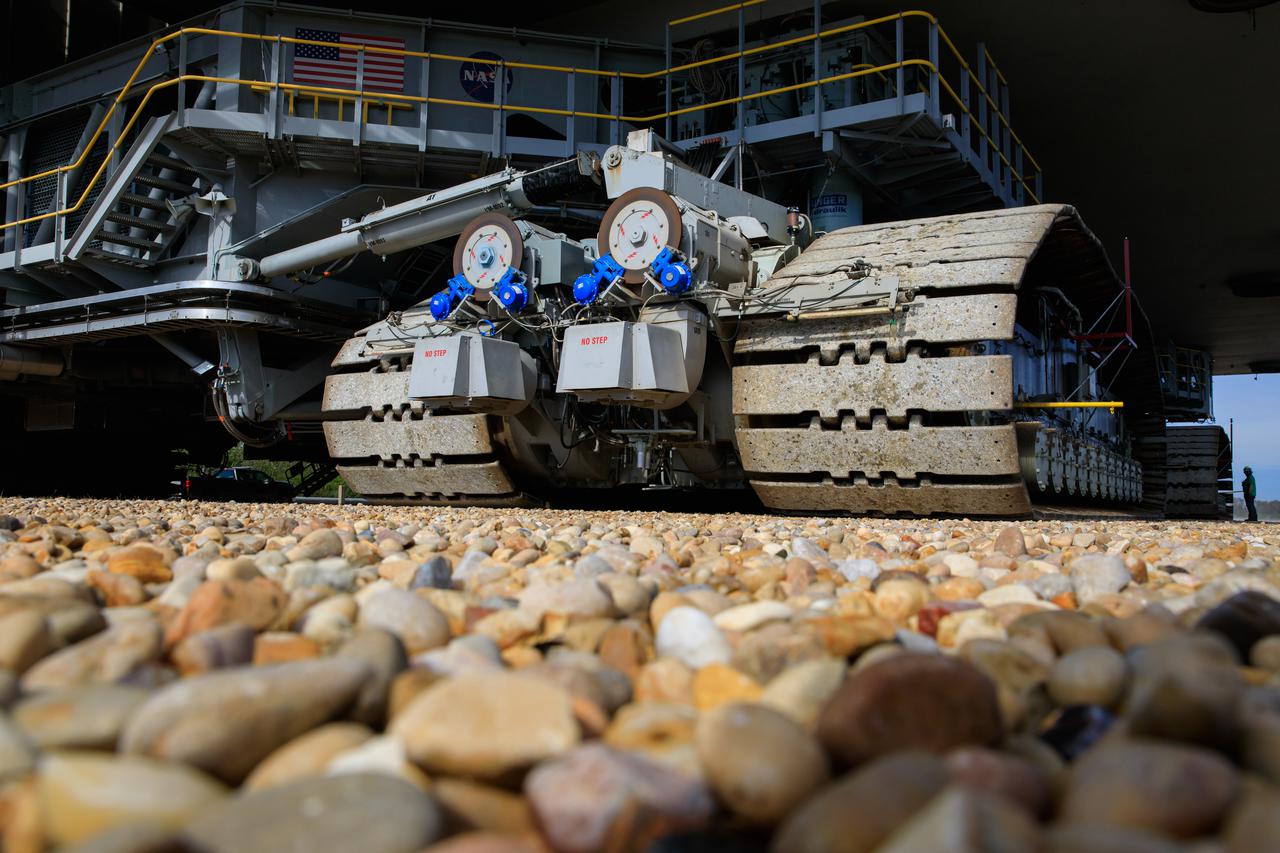
A close-up view of some of the treads on crawler-transporter 2 (CT-2) as the behemoth vehicle moves along the crawlerway at NASA’s Kennedy Space Center in Florida on Jan. 22, 2021. Teams are working to ensure the crawlerway, the path the CT-2, mobile launcher, and Space Launch System rocket with Orion atop will take from the Vehicle Assembly Building to Launch Complex 39B, is strong enough to withstand the weight and provide stability for the Artemis I mission. CT-2 carrying mobile launcher platform 1, used during the shuttle program, was driven back and forth on the crawlerway with several cement blocks, each weighing about 40,000 pounds to strengthen the crawlerway for launch. Artemis I will be the first in a series of increasingly complex missions to the Moon. Under the Artemis program, NASA aims to land the first woman and the next man on the Moon in 2024 and establish sustainable lunar exploration by the end of the decade.
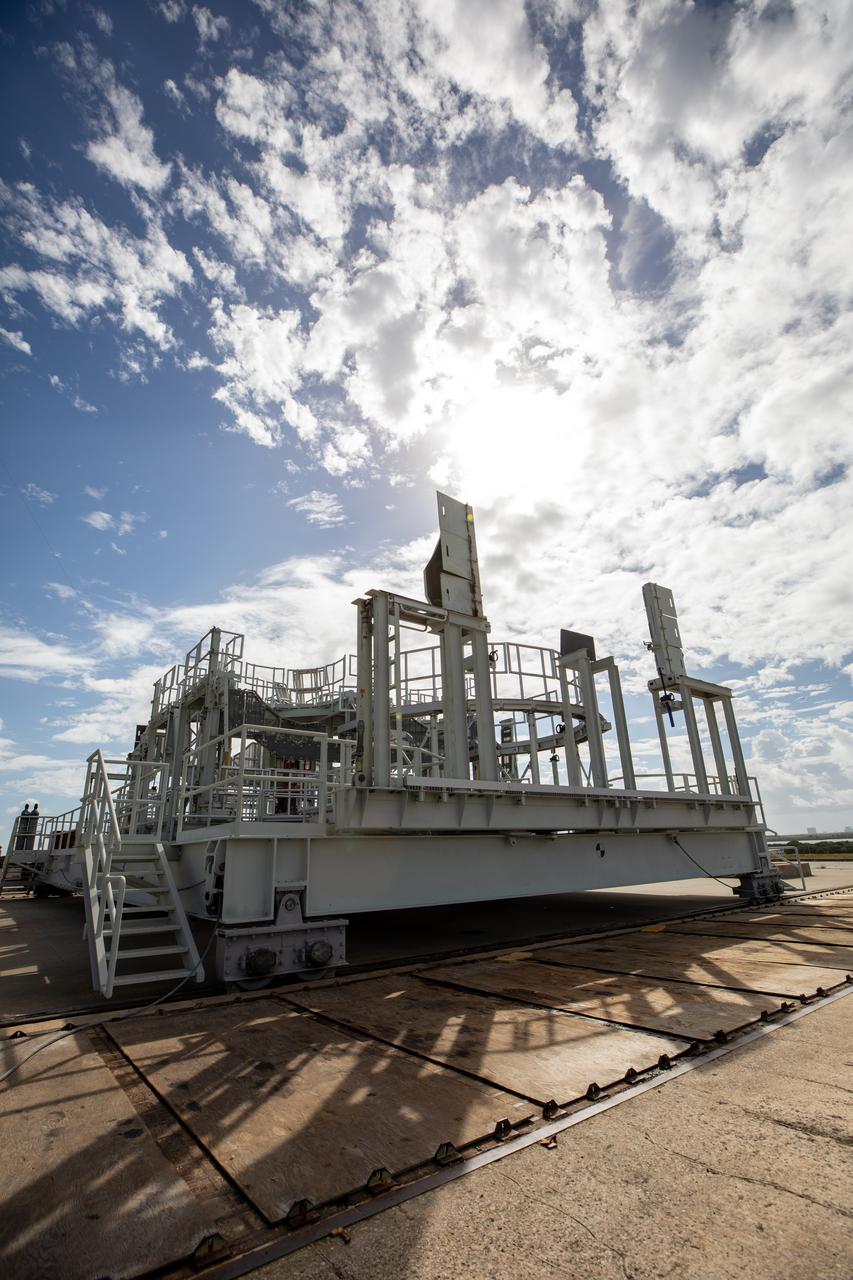
The engine service platform has been lowered and removed from the mobile launcher for Artemis I at Launch Pad 39B at NASA’s Kennedy Space Center in Florida on Oct. 23, 2020. It is staged on the top of the pad. The nearly 400-foot-tall mobile launcher is at the pad while engineers with Exploration Ground Systems and Jacobs complete several tasks, including a timing test to validate the launch team’s countdown timeline, and a thorough, top-to-bottom wash down of the mobile launcher to remove any debris remaining from construction and installation of the umbilical arms. Artemis I will test the Orion spacecraft and Space Launch System as an integrated system ahead of crewed flights to the Moon. Under the Artemis program, NASA will land the first woman and the next man on the Moon in 2024.
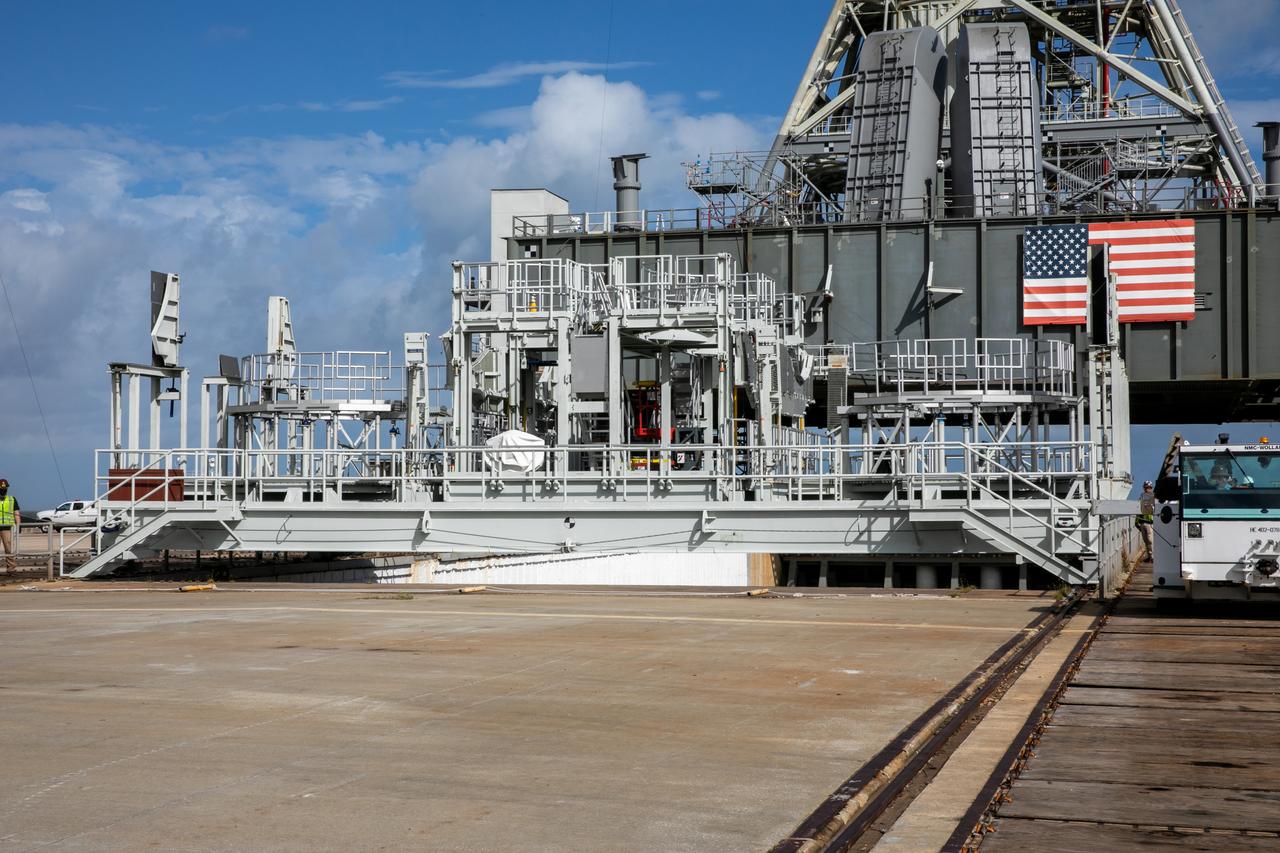
The engine service platform has been lowered and removed from underneath the mobile launcher for Artemis I at Launch Pad 39B at NASA’s Kennedy Space Center in Florida on Oct. 23, 2020. The nearly 400-foot-tall mobile launcher is at the pad while engineers with Exploration Ground Systems and Jacobs complete several tasks, including a timing test to validate the launch team’s countdown timeline, and a thorough, top-to-bottom wash down of the mobile launcher to remove any debris remaining from construction and installation of the umbilical arms. Artemis I will test the Orion spacecraft and Space Launch System as an integrated system ahead of crewed flights to the Moon. Under the Artemis program, NASA will land the first woman and the next man on the Moon in 2024.
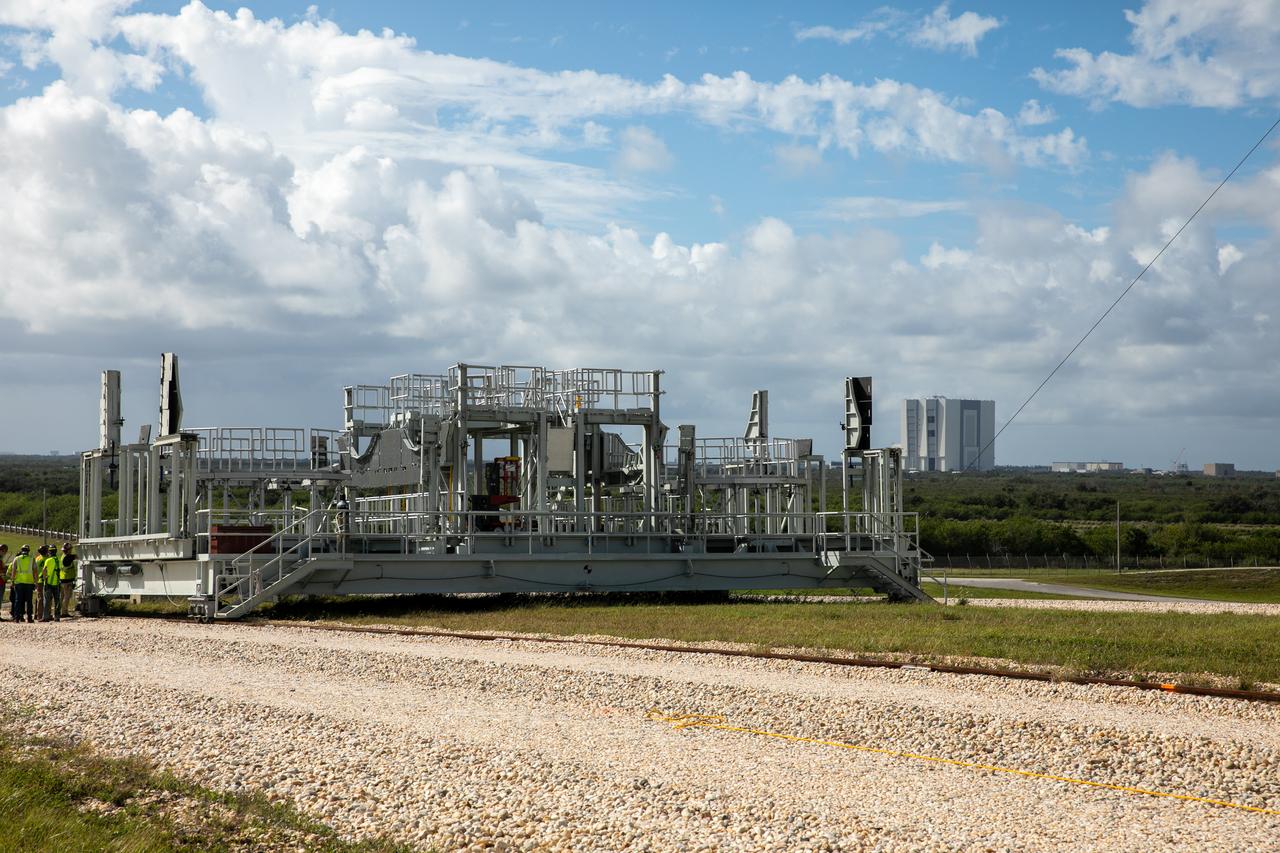
The engine service platform has been lowered and removed from the mobile launcher for Artemis I at Launch Pad 39B at NASA’s Kennedy Space Center in Florida on Oct. 23, 2020. It is being moved from the pad. The nearly 400-foot-tall mobile launcher is at the pad while engineers with Exploration Ground Systems and Jacobs complete several tasks, including a timing test to validate the launch team’s countdown timeline, and a thorough, top-to-bottom wash down of the mobile launcher to remove any debris remaining from construction and installation of the umbilical arms. Artemis I will test the Orion spacecraft and Space Launch System as an integrated system ahead of crewed flights to the Moon. Under the Artemis program, NASA will land the first woman and the next man on the Moon in 2024.
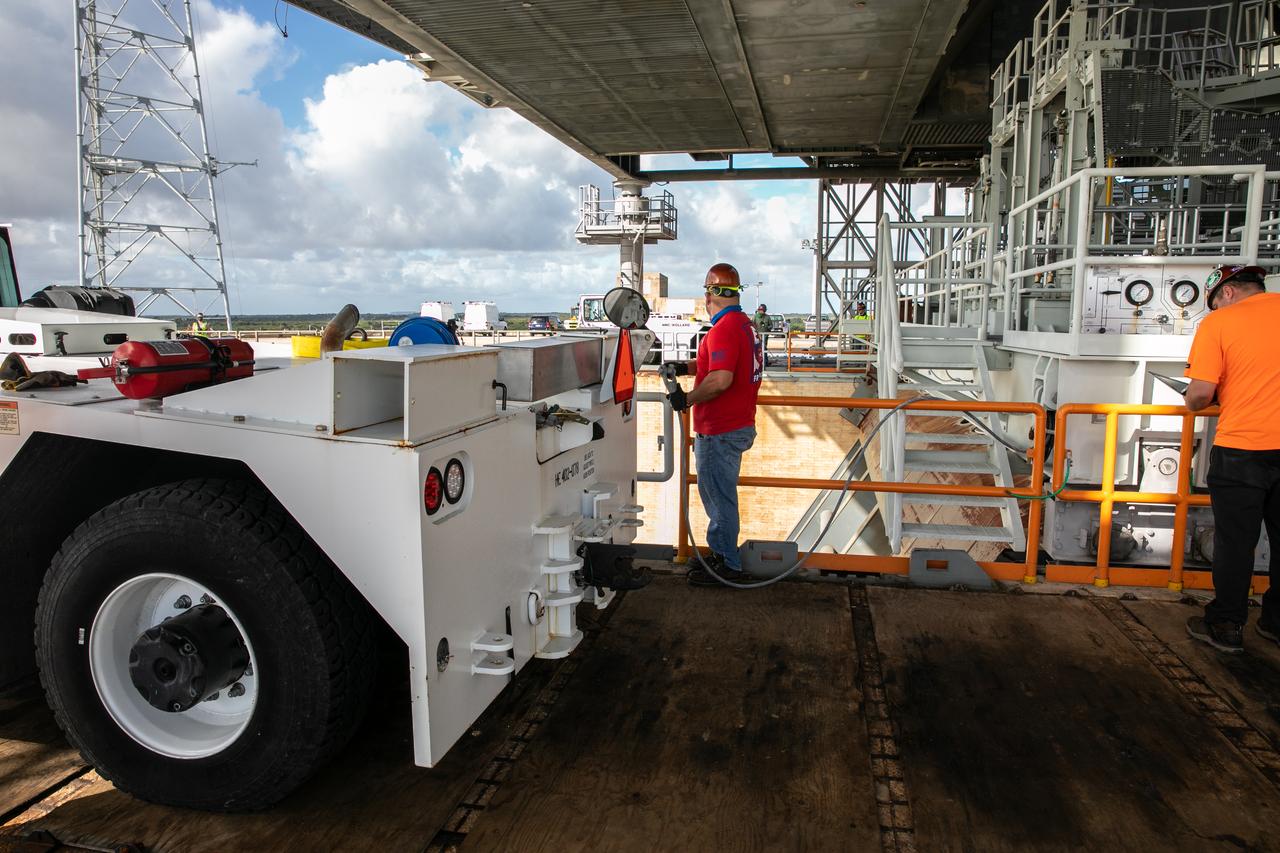
Engineers with Exploration Ground Systems and Jacobs assist with raising the engine service platform beneath the mobile launcher for Artemis I at Launch Pad 39B at NASA’s Kennedy Space Center in Florida on Oct. 23, 2020. The nearly 400-foot-tall mobile launcher is at the pad while engineers with Exploration Ground Systems and Jacobs complete several tasks, including a timing test to validate the launch team’s countdown timeline, and a thorough, top-to-bottom wash down of the mobile launcher to remove any debris remaining from construction and installation of the umbilical arms. Artemis I will test the Orion spacecraft and Space Launch System as an integrated system ahead of crewed flights to the Moon. Under the Artemis program, NASA will land the first woman and the next man on the Moon in 2024.
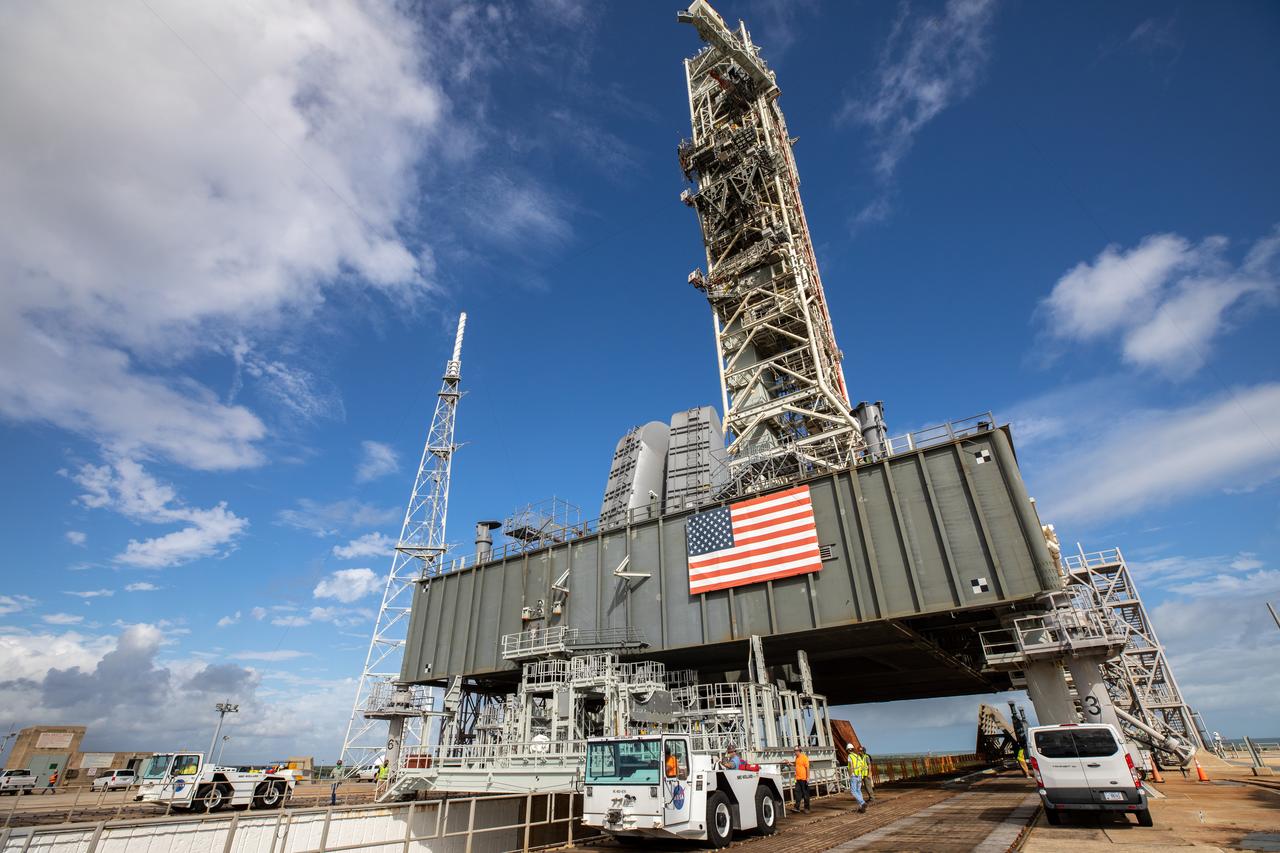
Engineers with Exploration Ground Systems and Jacobs assist with lowering the engine service platform beneath the mobile launcher for Artemis I at Launch Pad 39B at NASA’s Kennedy Space Center in Florida on Oct. 23, 2020. The nearly 400-foot-tall mobile launcher is at the pad while engineers with Exploration Ground Systems and Jacobs complete several tasks, including a timing test to validate the launch team’s countdown timeline, and a thorough, top-to-bottom wash down of the mobile launcher to remove any debris remaining from construction and installation of the umbilical arms. Artemis I will test the Orion spacecraft and Space Launch System as an integrated system ahead of crewed flights to the Moon. Under the Artemis program, NASA will land the first woman and the next man on the Moon in 2024.
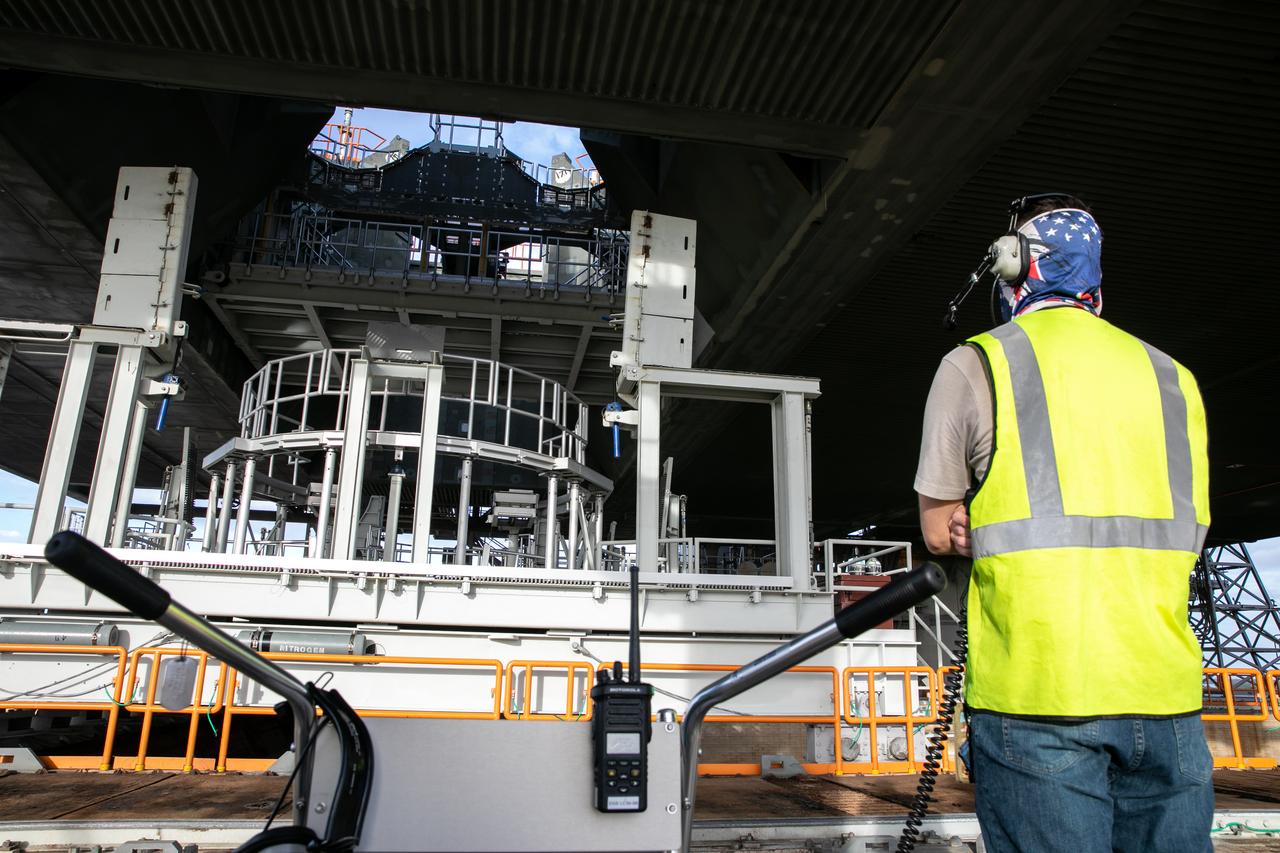
Workers assists with raising the engine service platform beneath the mobile launcher for Artemis I at Launch Pad 39B at NASA’s Kennedy Space Center in Florida on Oct. 23, 2020. The nearly 400-foot-tall mobile launcher is at the pad while engineers with Exploration Ground Systems and Jacobs complete several tasks, including a timing test to validate the launch team’s countdown timeline, and a thorough, top-to-bottom wash down of the mobile launcher to remove any debris remaining from construction and installation of the umbilical arms. Artemis I will test the Orion spacecraft and Space Launch System as an integrated system ahead of crewed flights to the Moon. Under the Artemis program, NASA will land the first woman and the next man on the Moon in 2024.
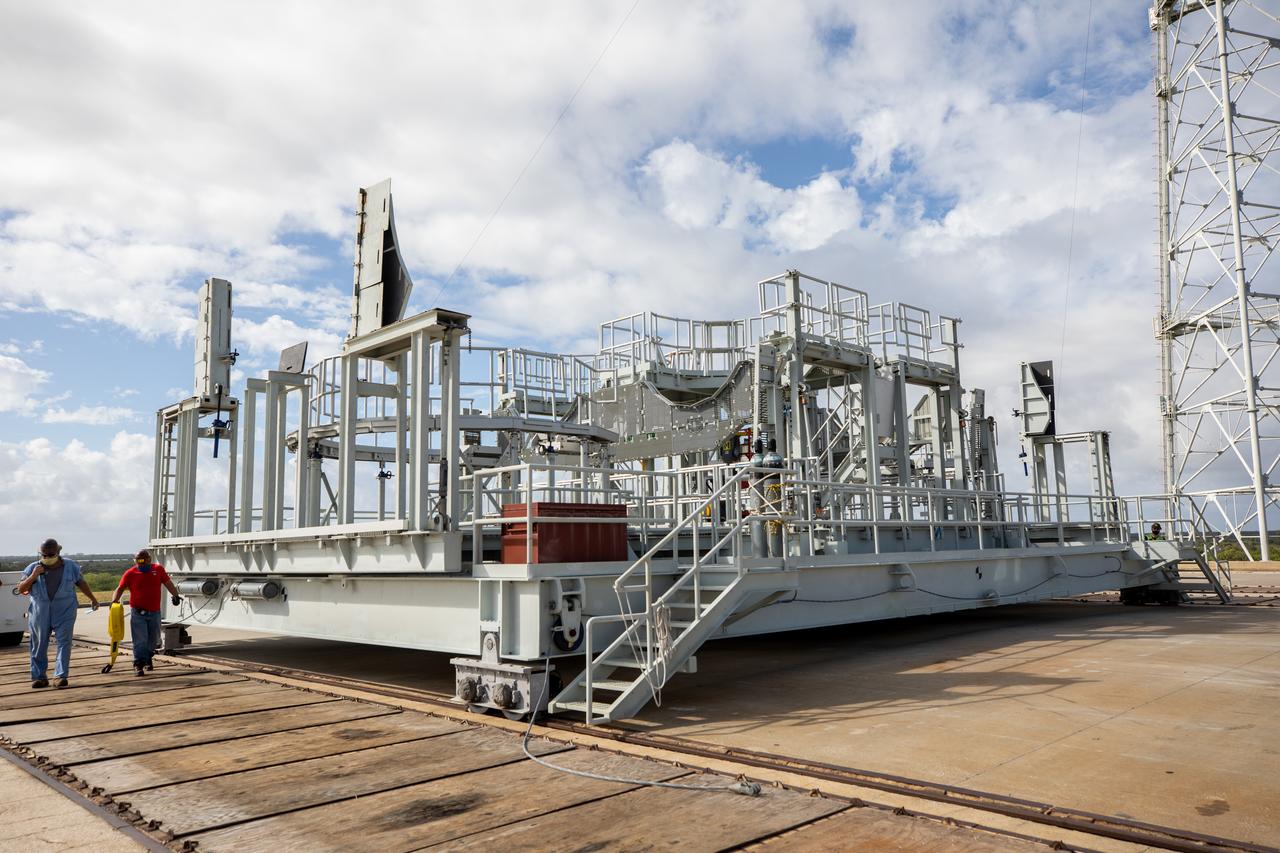
The engine service platform has been lowered and removed from the mobile launcher for Artemis I at Launch Pad 39B at NASA’s Kennedy Space Center in Florida on Oct. 23, 2020. It is staged on the top of the pad. The nearly 400-foot-tall mobile launcher is at the pad while engineers with Exploration Ground Systems and Jacobs complete several tasks, including a timing test to validate the launch team’s countdown timeline, and a thorough, top-to-bottom wash down of the mobile launcher to remove any debris remaining from construction and installation of the umbilical arms. Artemis I will test the Orion spacecraft and Space Launch System as an integrated system ahead of crewed flights to the Moon. Under the Artemis program, NASA will land the first woman and the next man on the Moon in 2024.
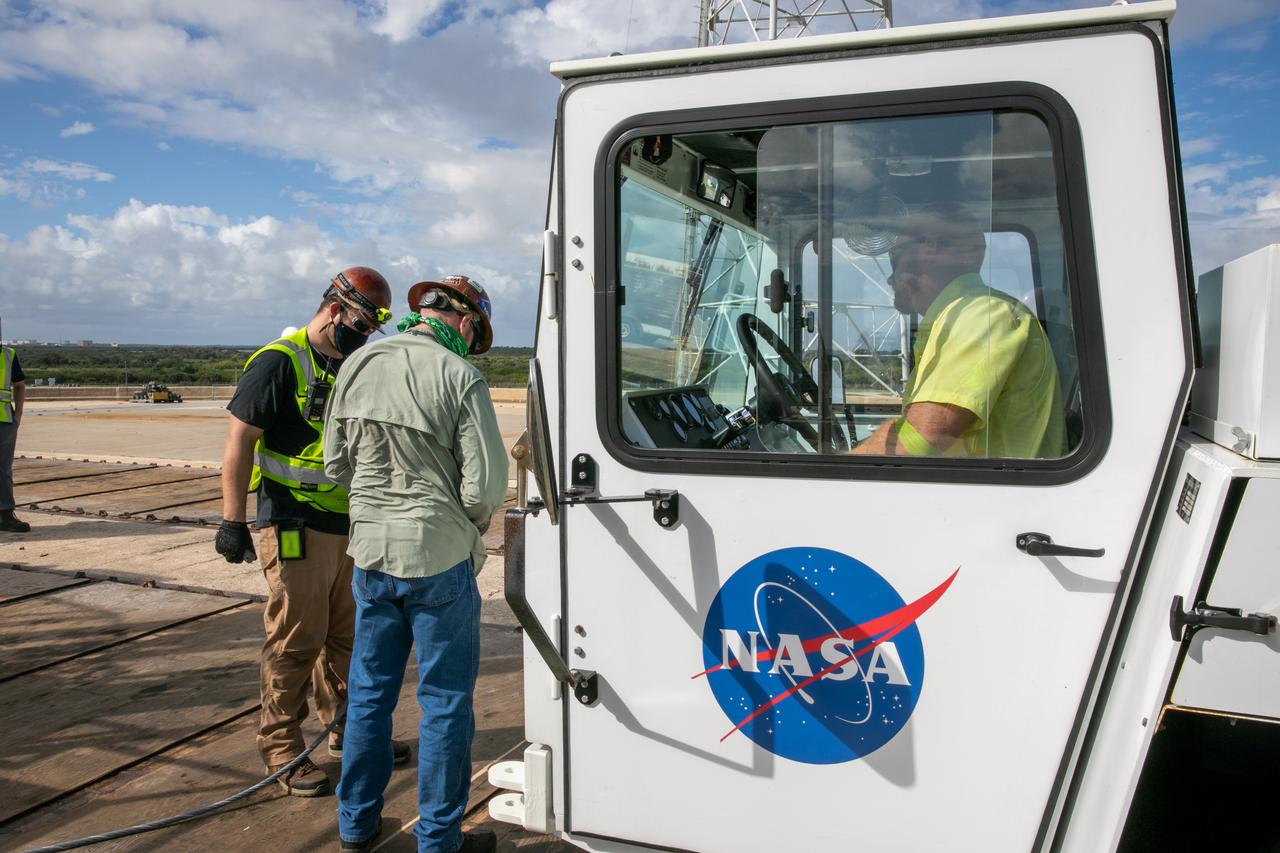
The cab of a flatbed carrier is in view on the surface of Launch Pad 39B at NASA’s Kennedy Space Center in Florida on Oct. 23, 2020. It will carry the engine service platform that was lowered and removed from the mobile launcher for Artemis I. The nearly 400-foot-tall mobile launcher is at the pad while engineers with Exploration Ground Systems and Jacobs complete several tasks, including a timing test to validate the launch team’s countdown timeline, and a thorough, top-to-bottom wash down of the mobile launcher to remove any debris remaining from construction and installation of the umbilical arms. Artemis I will test the Orion spacecraft and Space Launch System as an integrated system ahead of crewed flights to the Moon. Under the Artemis program, NASA will land the first woman and the next man on the Moon in 2024.
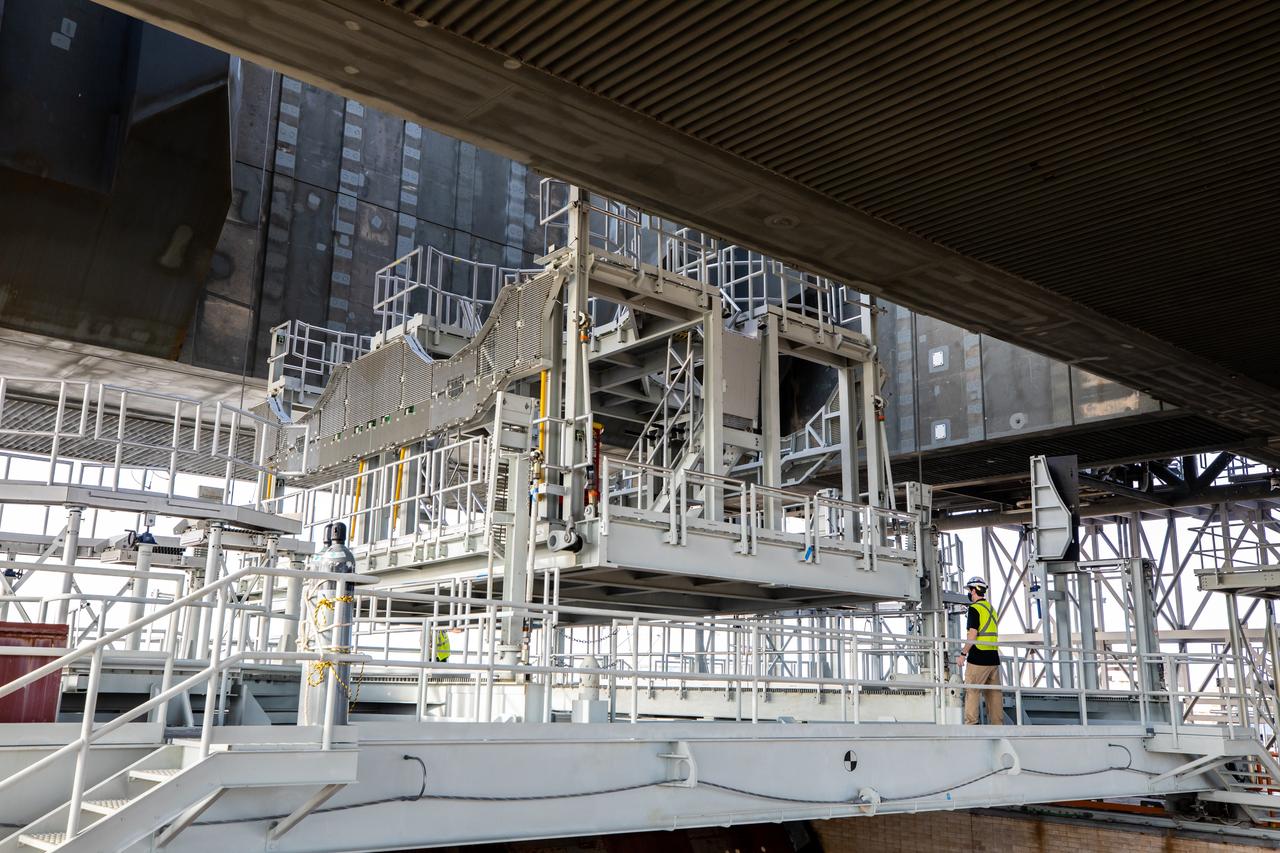
The engine service platform is being raised beneath the mobile launcher for Artemis I at Launch Pad 39B at NASA’s Kennedy Space Center in Florida on Oct. 23, 2020. The nearly 400-foot-tall mobile launcher is at the pad while engineers with Exploration Ground Systems and Jacobs complete several tasks, including a timing test to validate the launch team’s countdown timeline, and a thorough, top-to-bottom wash down of the mobile launcher to remove any debris remaining from construction and installation of the umbilical arms. Artemis I will test the Orion spacecraft and Space Launch System as an integrated system ahead of crewed flights to the Moon. Under the Artemis program, NASA will land the first woman and the next man on the Moon in 2024.
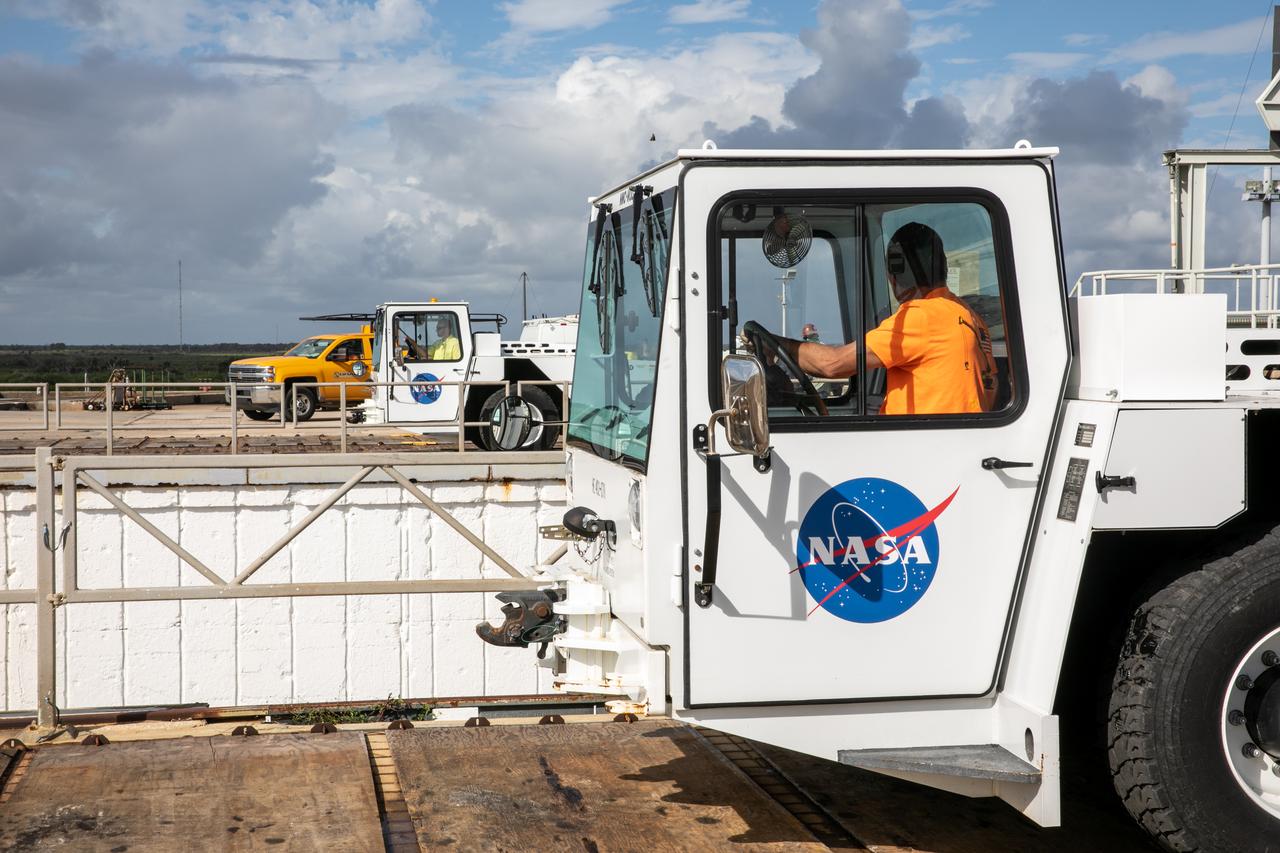
A flatbed carrier is in view on the surface of Launch Pad 39B at NASA’s Kennedy Space Center in Florida on Oct. 23, 2020. It is carrying the engine service platform that was lowered and removed from the mobile launcher for Artemis I. The nearly 400-foot-tall mobile launcher is at the pad while engineers with Exploration Ground Systems and Jacobs complete several tasks, including a timing test to validate the launch team’s countdown timeline, and a thorough, top-to-bottom wash down of the mobile launcher to remove any debris remaining from construction and installation of the umbilical arms. Artemis I will test the Orion spacecraft and Space Launch System as an integrated system ahead of crewed flights to the Moon. Under the Artemis program, NASA will land the first woman and the next man on the Moon in 2024.
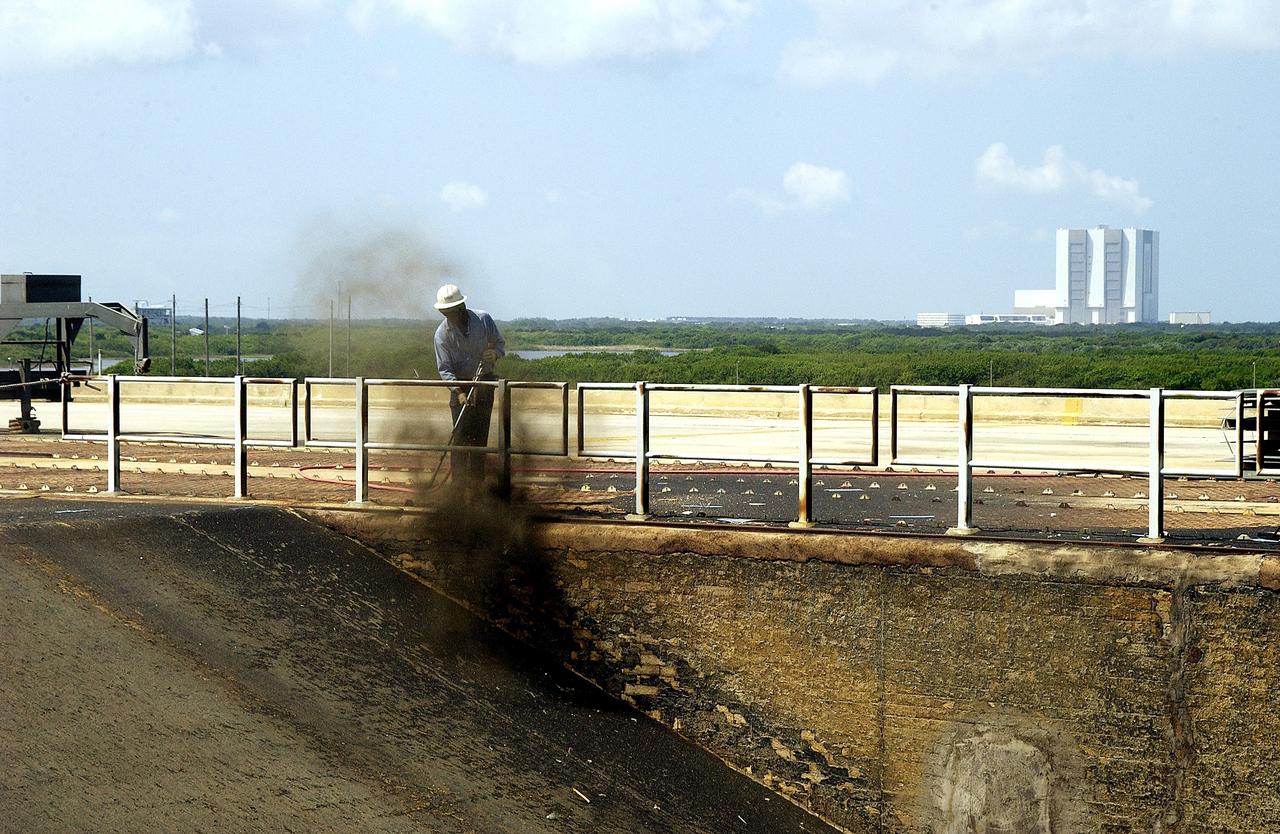
KENNEDY SPACE CENTER, FLA. - A worker sandblasts the surface behind the Mobile Launcher Platform on Launch Pad 39A . Routine maintenance includes sandblasting and repainting as preventive means to minimize corrosion.
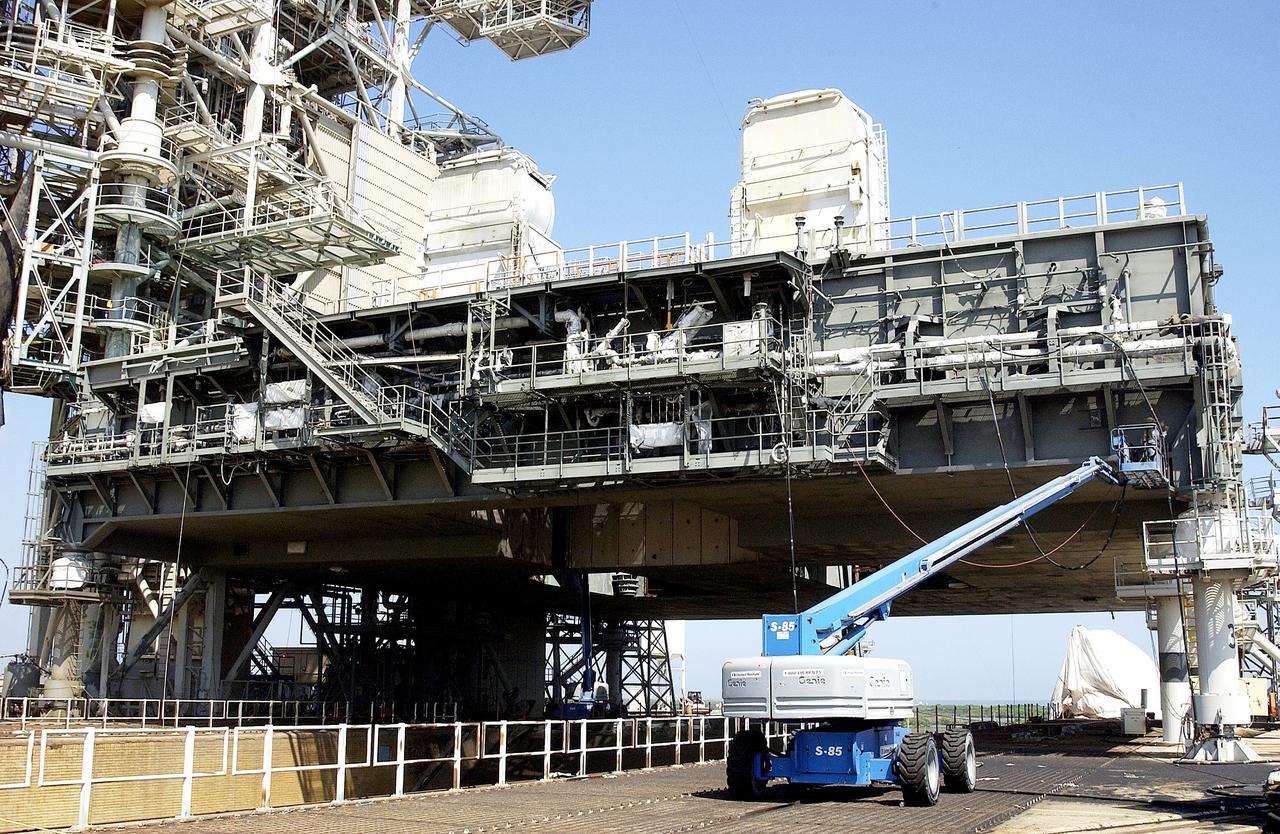
KENNEDY SPACE CENTER, FLA. - Sandblasting begins on the Mobile Launcher Platform on Launch Pad 39A to remove corrosion before repainting. Routine maintenance includes sandblasting and repainting as preventive means to minimize corrosion.
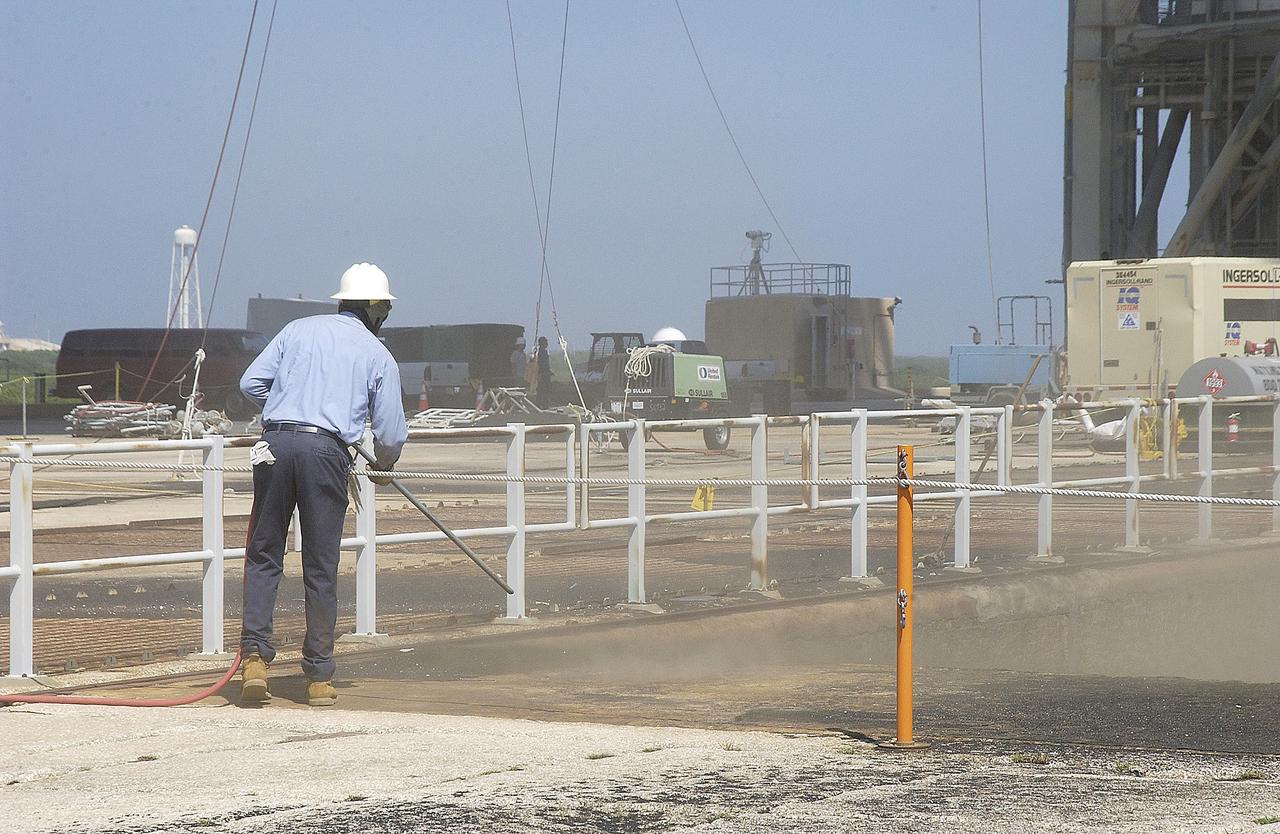
KENNEDY SPACE CENTER, FLA. - A worker sandblasts the surface behind the Mobile Launcher Platform on Launch Pad 39A . Routine maintenance includes sandblasting and repainting as preventive means to minimize corrosion.
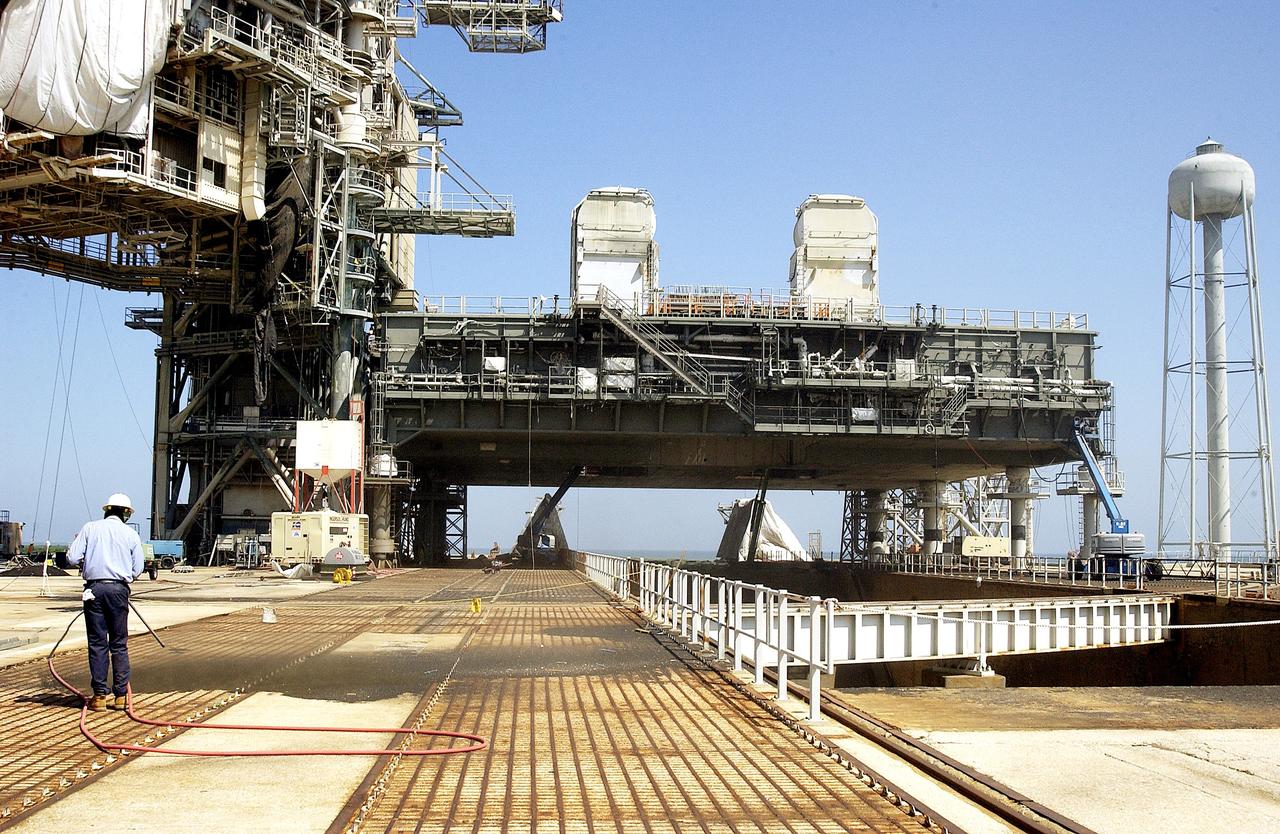
KENNEDY SPACE CENTER, FLA. - A worker sandblasts the surface behind the Mobile Launcher Platform on Launch Pad 39A . Routine maintenance includes sandblasting and repainting as preventive means to minimize corrosion.
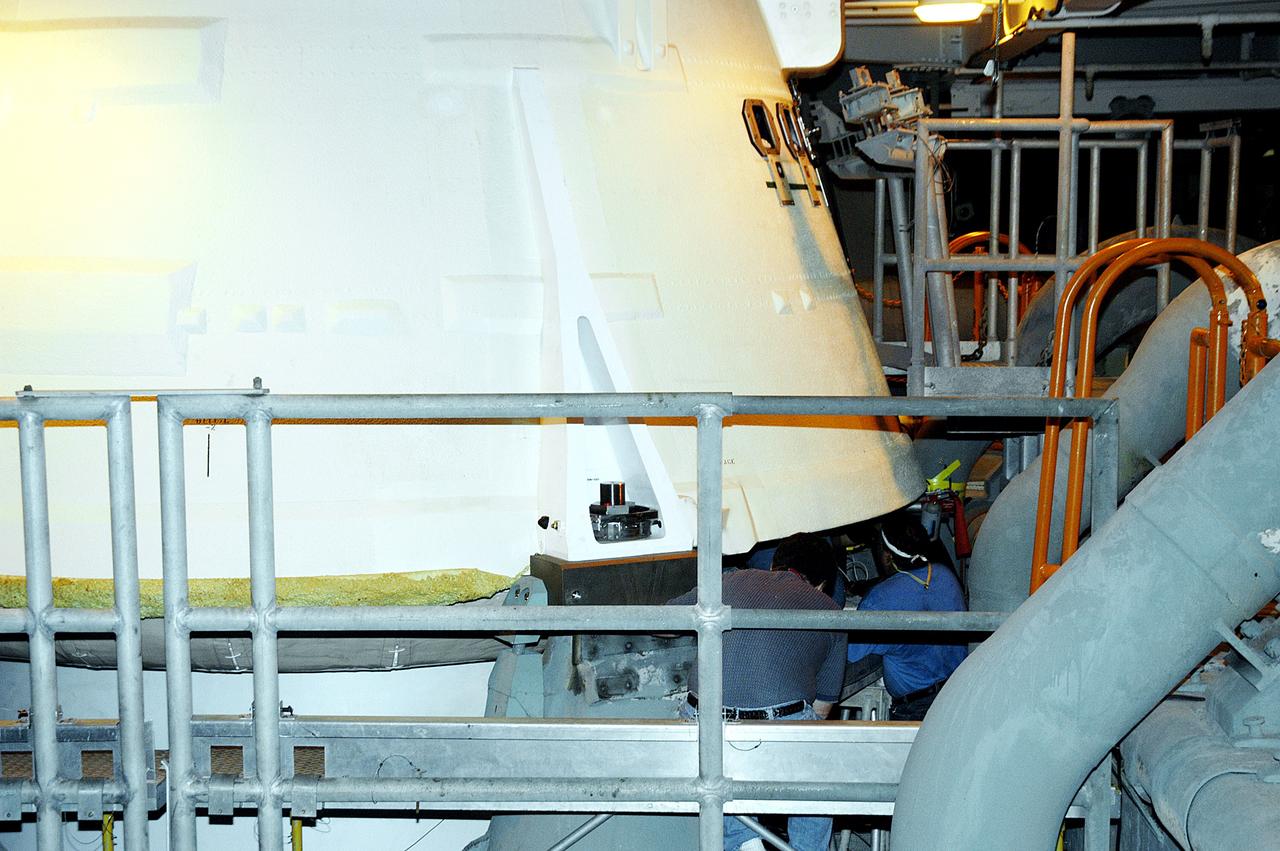
KENNEDY SPACE CENTER, FLA. - The camera installed on the aft skirt of a solid rocket booster is seen here, framed by the railing. The installation is in preparation for a vibration test of the Mobile Launcher Platform with SRBs and external tank mounted. The MLP will roll from one bay to another in the Vehicle Assembly Building.
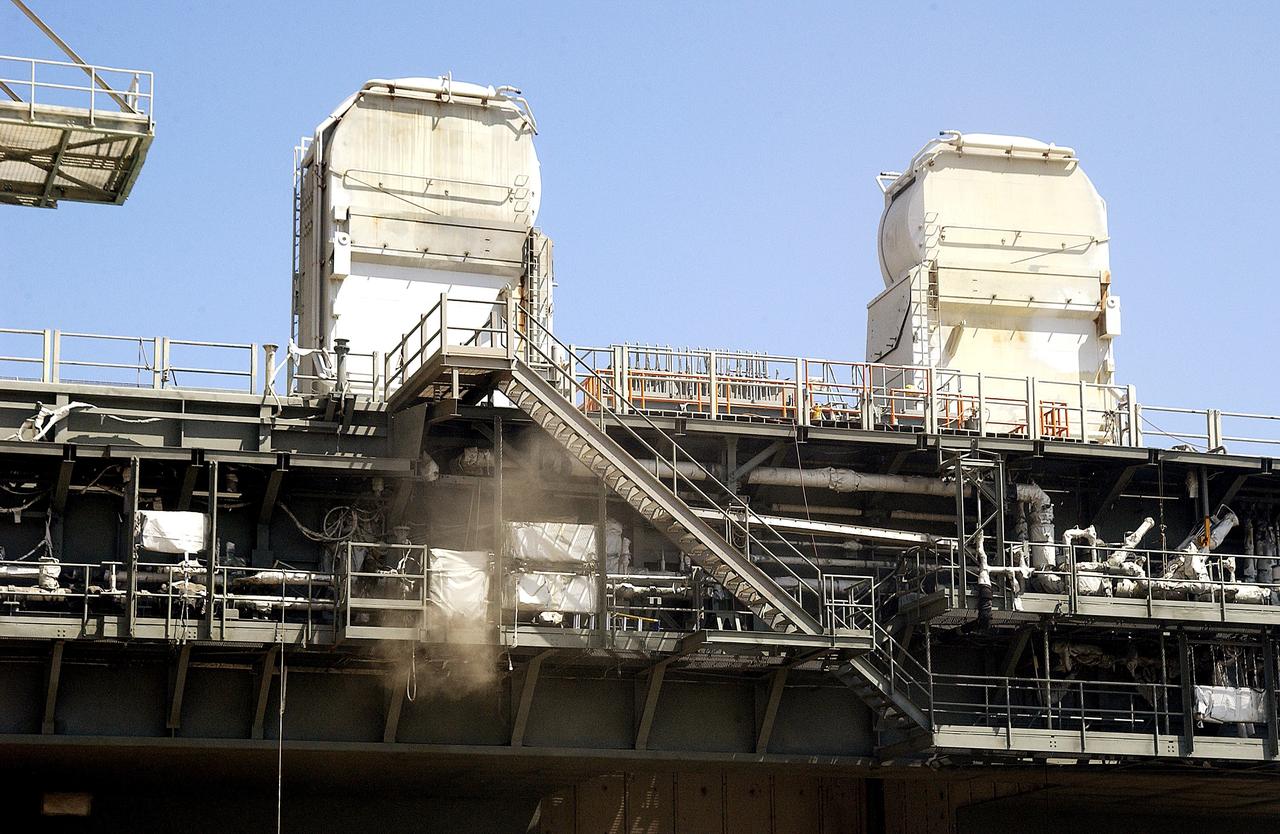
KENNEDY SPACE CENTER, FLA. - On Launch Pad 39A, clouds of dust float away from the Mobile Launcher Platform, which is undergoing sandblasting to remove corrosion before repainting. Routine maintenance includes sandblasting and repainting as preventive means to minimize corrosion.

KENNEDY SPACE CENTER, FLA. - Workers, covered in protective clothing and breathing apparatus, continue sandblasting on the Mobile Launcher Platform on Launch Pad 39A to remove corrosion before repainting. Routine maintenance includes sandblasting and repainting as preventive means to minimize corrosion.
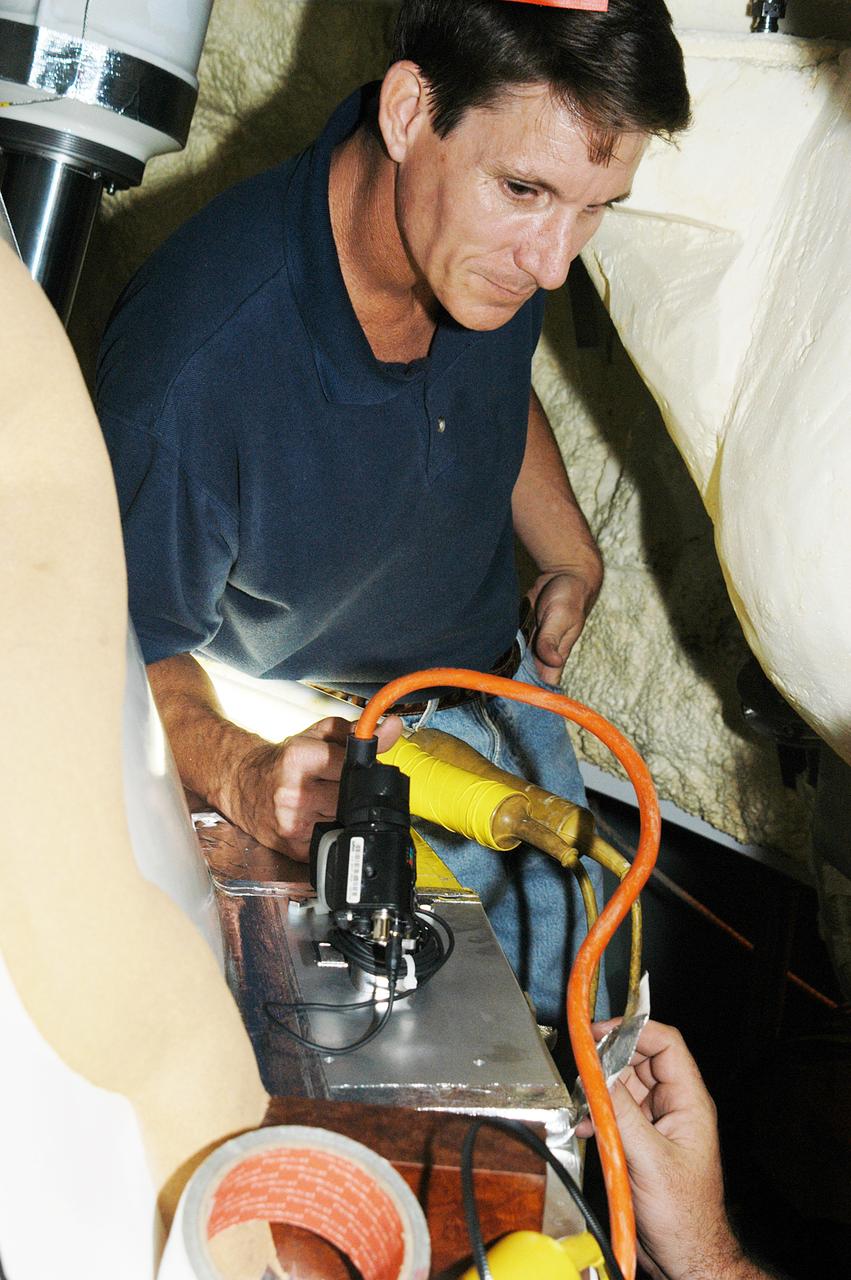
KENNEDY SPACE CENTER, FLA. - A camera is installed on the aft skirt of a solid rocket booster in preparation for a vibration test of the Mobile Launcher Platform with SRBs and external tank mounted. The MLP will roll from one bay to another in the Vehicle Assembly Building.
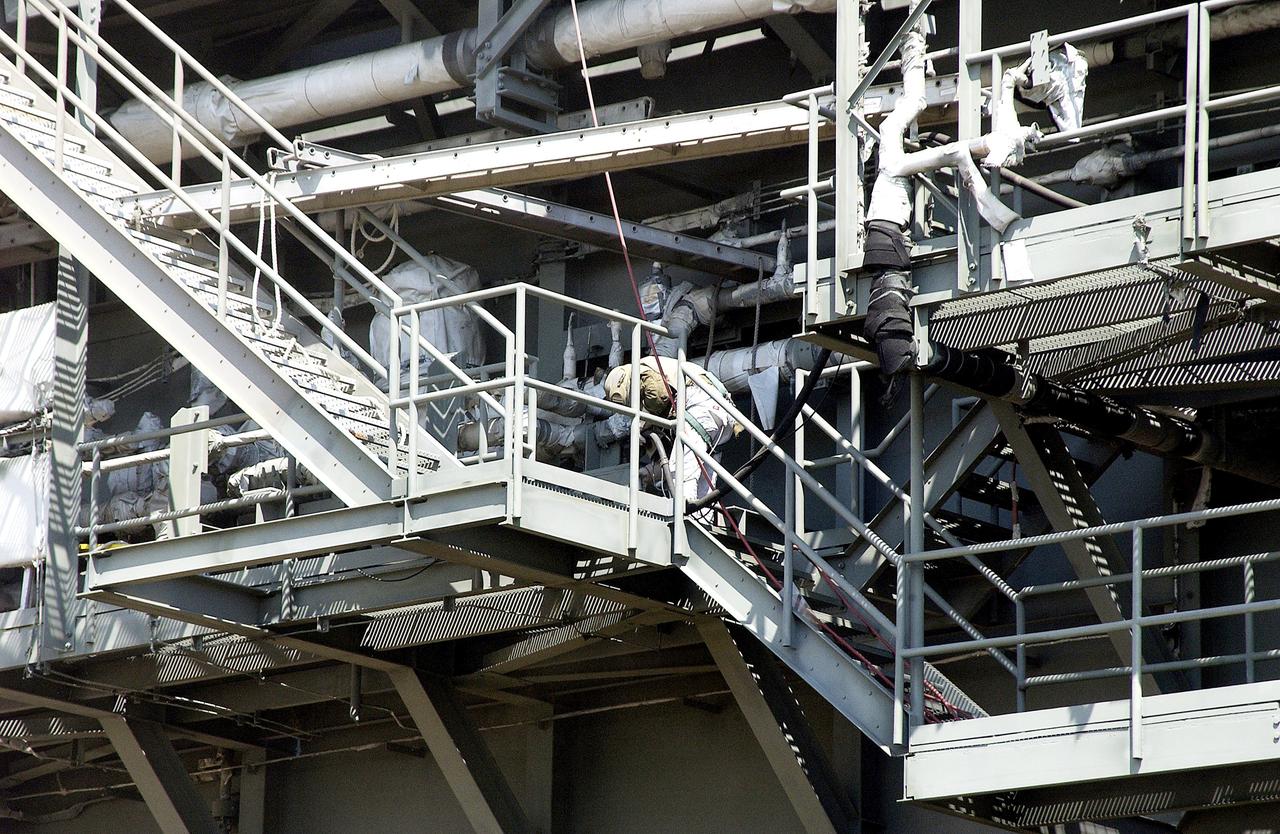
KENNEDY SPACE CENTER, FLA. - Workers, covered in protective clothing and breathing apparatus, continue sandblasting on the Mobile Launcher Platform on Launch Pad 39A to remove corrosion before repainting. Routine maintenance includes sandblasting and repainting as preventive means to minimize corrosion.
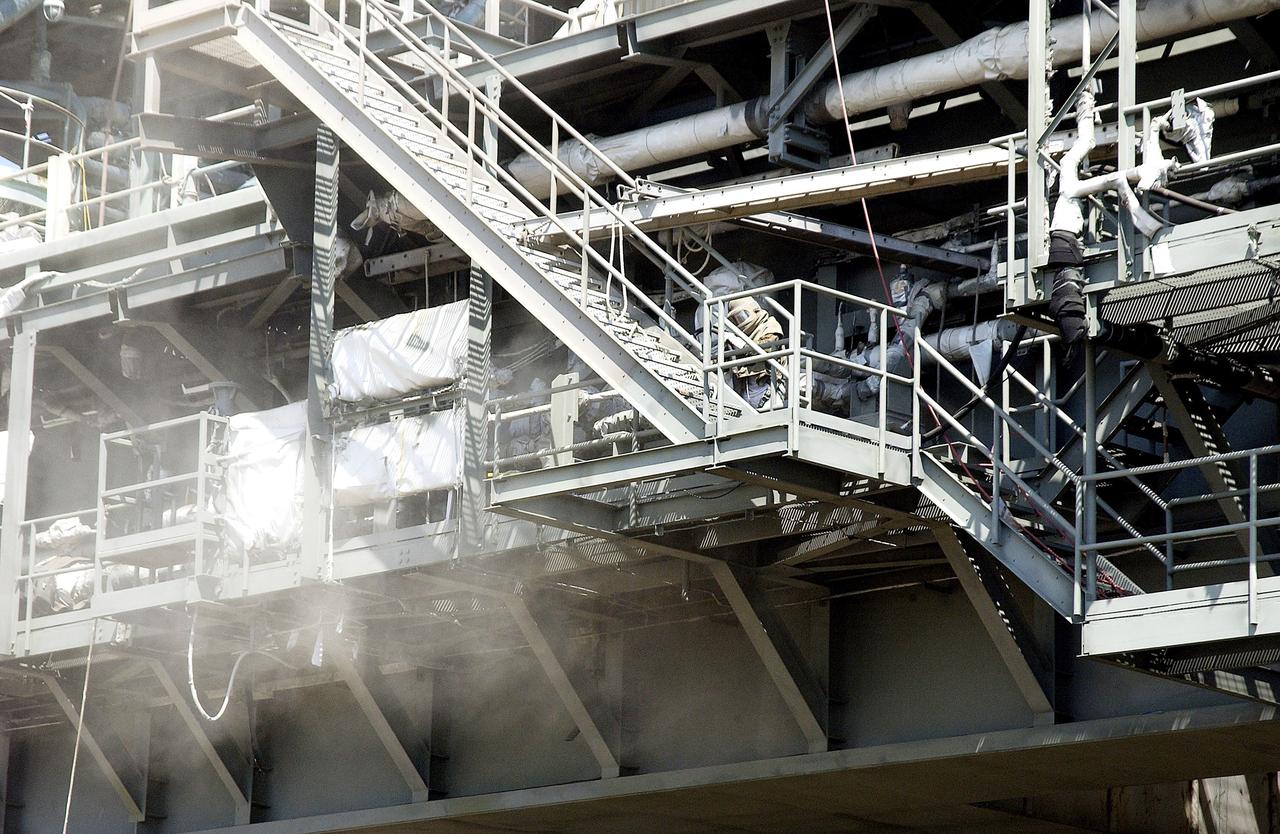
KENNEDY SPACE CENTER, FLA. - Workers, covered in protective clothing and breathing apparatus, continue sandblasting on the Mobile Launcher Platform on Launch Pad 39A to remove corrosion before repainting. Routine maintenance includes sandblasting and repainting as preventive means to minimize corrosion.
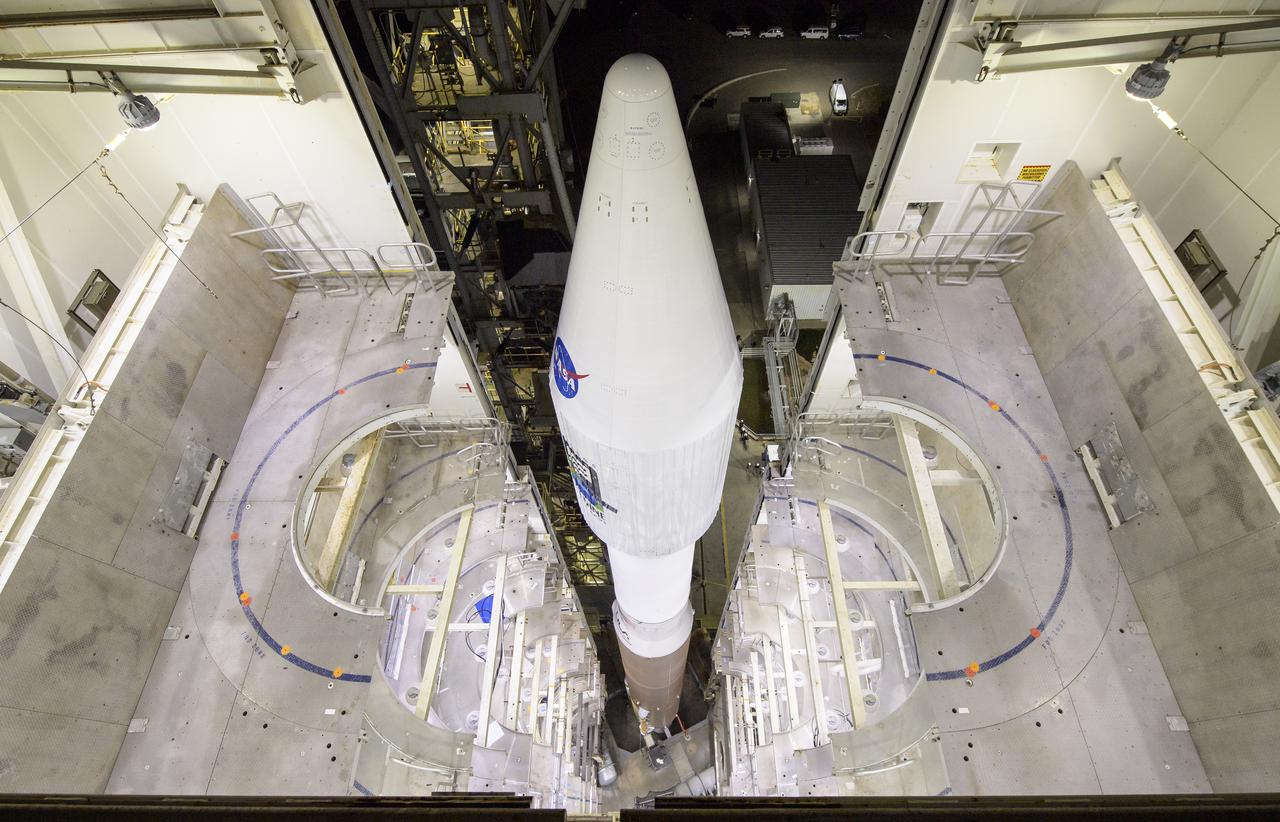
The United Launch Alliance (ULA) Atlas V rocket with the Landsat 9 satellite onboard is seen, Monday, Sept. 27, 2021, as the mobile launcher platform (MLP) is rolled back at Vandenberg Space Force Base in California. The Landsat 9 satellite is a joint NASA/U.S. Geological Survey mission that will continue the legacy of monitoring Earth’s land and coastal regions. Photo Credit: (NASA/Bill Ingalls)
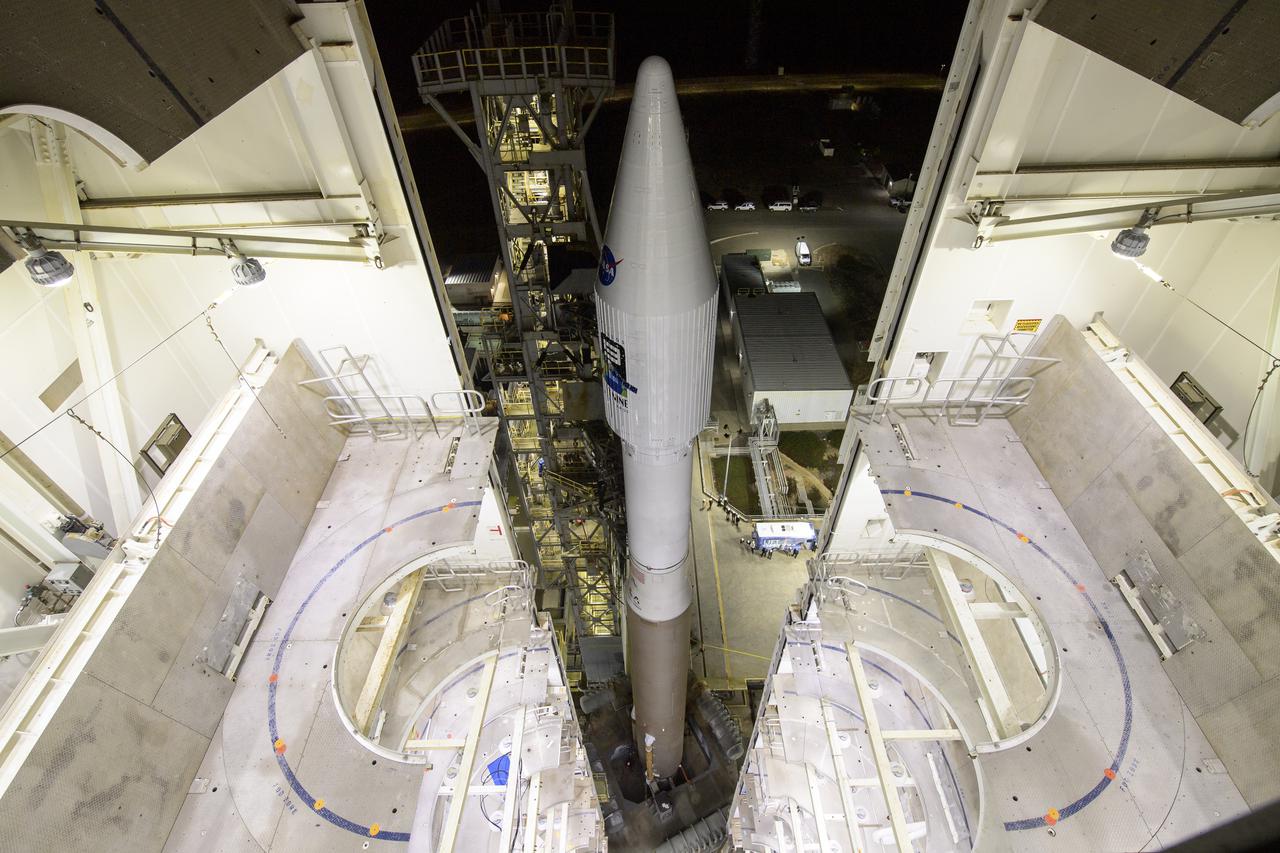
The United Launch Alliance (ULA) Atlas V rocket with the Landsat 9 satellite onboard is seen, Monday, Sept. 27, 2021, as the mobile launcher platform (MLP) is rolled back at Vandenberg Space Force Base in California. The Landsat 9 satellite is a joint NASA/U.S. Geological Survey mission that will continue the legacy of monitoring Earth’s land and coastal regions. Photo Credit: (NASA/Bill Ingalls)
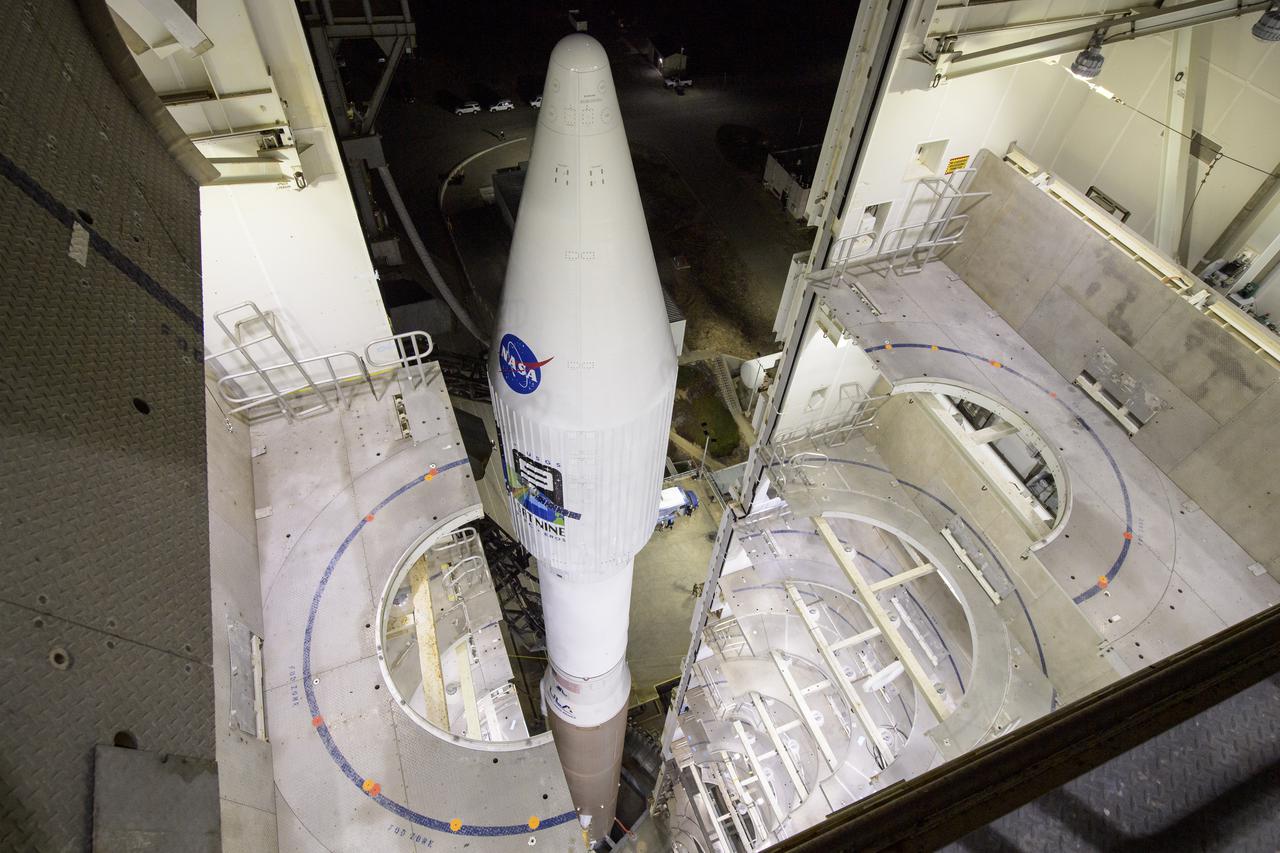
The United Launch Alliance (ULA) Atlas V rocket with the Landsat 9 satellite onboard is seen, Monday, Sept. 27, 2021, as the mobile launcher platform (MLP) is rolled back at Vandenberg Space Force Base in California. The Landsat 9 satellite is a joint NASA/U.S. Geological Survey mission that will continue the legacy of monitoring Earth’s land and coastal regions. Photo Credit: (NASA/Bill Ingalls)
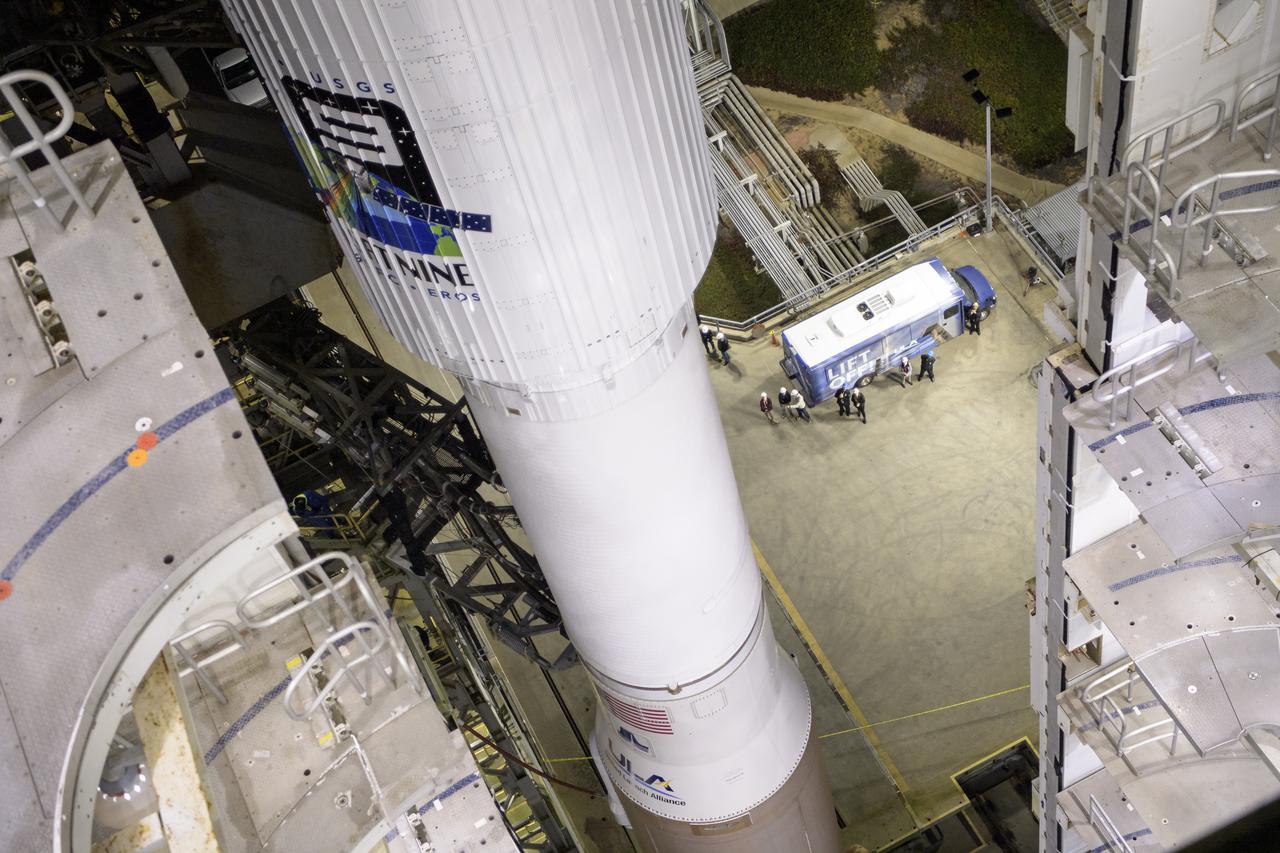
The United Launch Alliance (ULA) Atlas V rocket with the Landsat 9 satellite onboard is seen, Monday, Sept. 27, 2021, as the mobile launcher platform (MLP) is rolled back at Vandenberg Space Force Base in California. The Landsat 9 satellite is a joint NASA/U.S. Geological Survey mission that will continue the legacy of monitoring Earth’s land and coastal regions. Photo Credit: (NASA/Bill Ingalls)
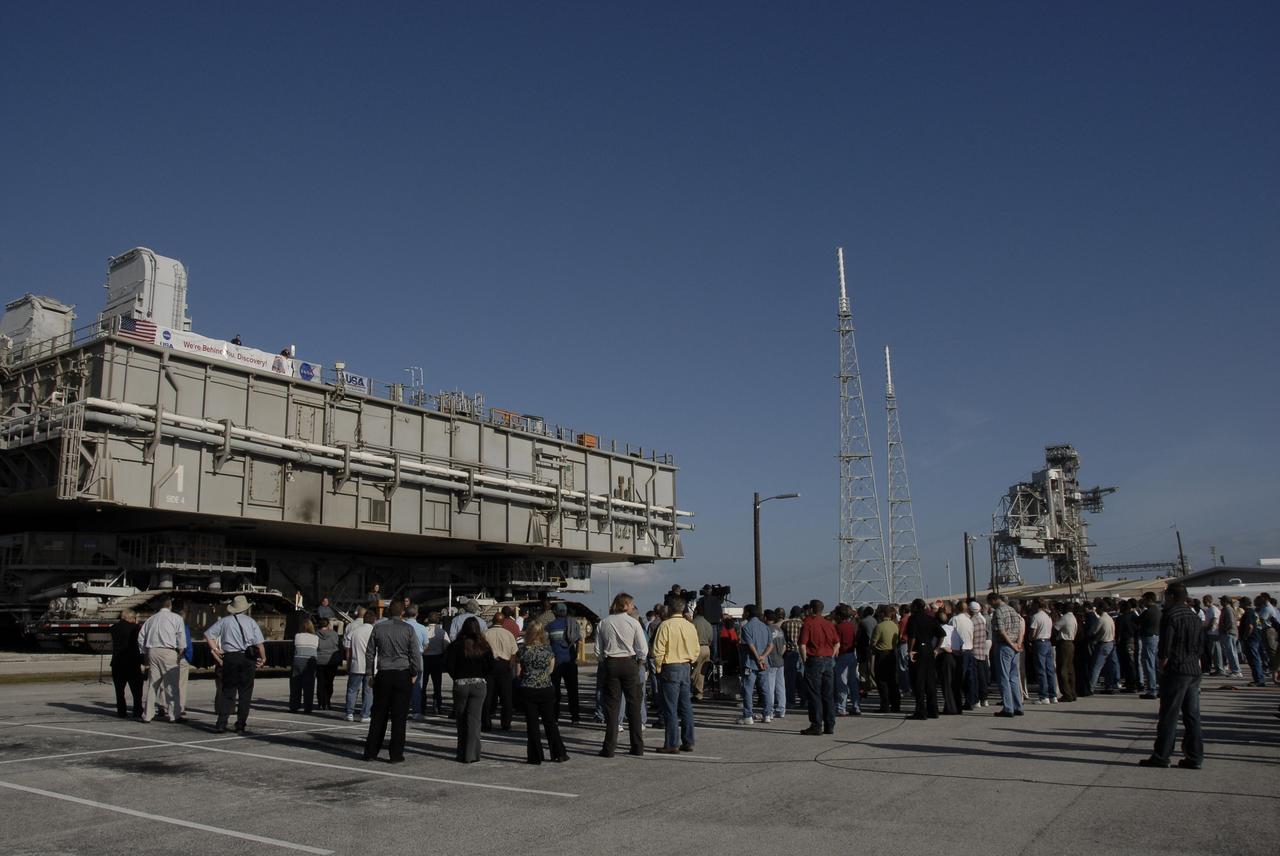
CAPE CANAVERAL, Fla. – – Employees and media gather near Launch Pad 39B at NASA's Kennedy Space Center in Florida for the handover ceremony for Mobile Launcher Platform-1, seen here. The platform is being transferred from NASA's Space Shuttle Program to the Constellation Program for the Ares I-X flight test targeted for this summer. Constructed in 1964, the mobile launchers used in Apollo/Saturn operations were modified for use in shuttle operations. With cranes, umbilical towers and swing arms removed, the mobile launchers were renamed Mobile Launcher Platforms, or MLPs. Photo credit: NASA/Kim Shiflett
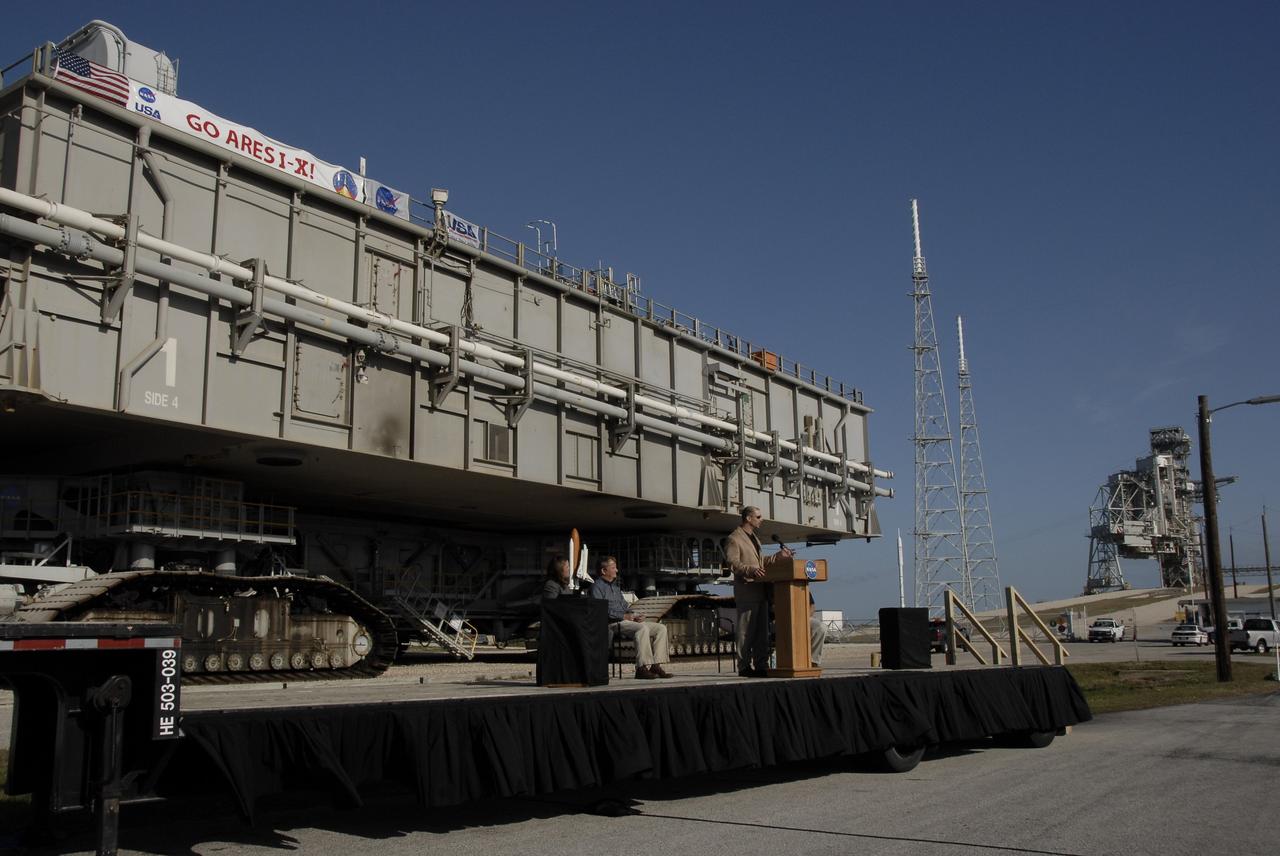
CAPE CANAVERAL, Fla. – Near Launch Pad 39B at NASA's Kennedy Space Center in Florida, Director of the Constellation Project Office Pepper E. Phillips speaks to employees and media during the handover ceremony for Mobile Launcher Platform-1. Marking the handover is the change of banner on the platform behind him. On the stage and also participating in the ceremony are Director of Launch Vehicle Processing Rita Willcoxon , Shuttle Launch Director Mike Leinbach, and Manager of MLP Operations with United Space Alliance Brett Raulerson. The platform is being transferred from NASA's Space Shuttle Program to the Constellation Program for the Ares I-X flight test targeted for this summer. Constructed in 1964, the mobile launchers used in Apollo/Saturn operations were modified for use in shuttle operations. With cranes, umbilical towers and swing arms removed, the mobile launchers were renamed Mobile Launcher Platforms, or MLPs. Photo credit: NASA/Kim Shiflett
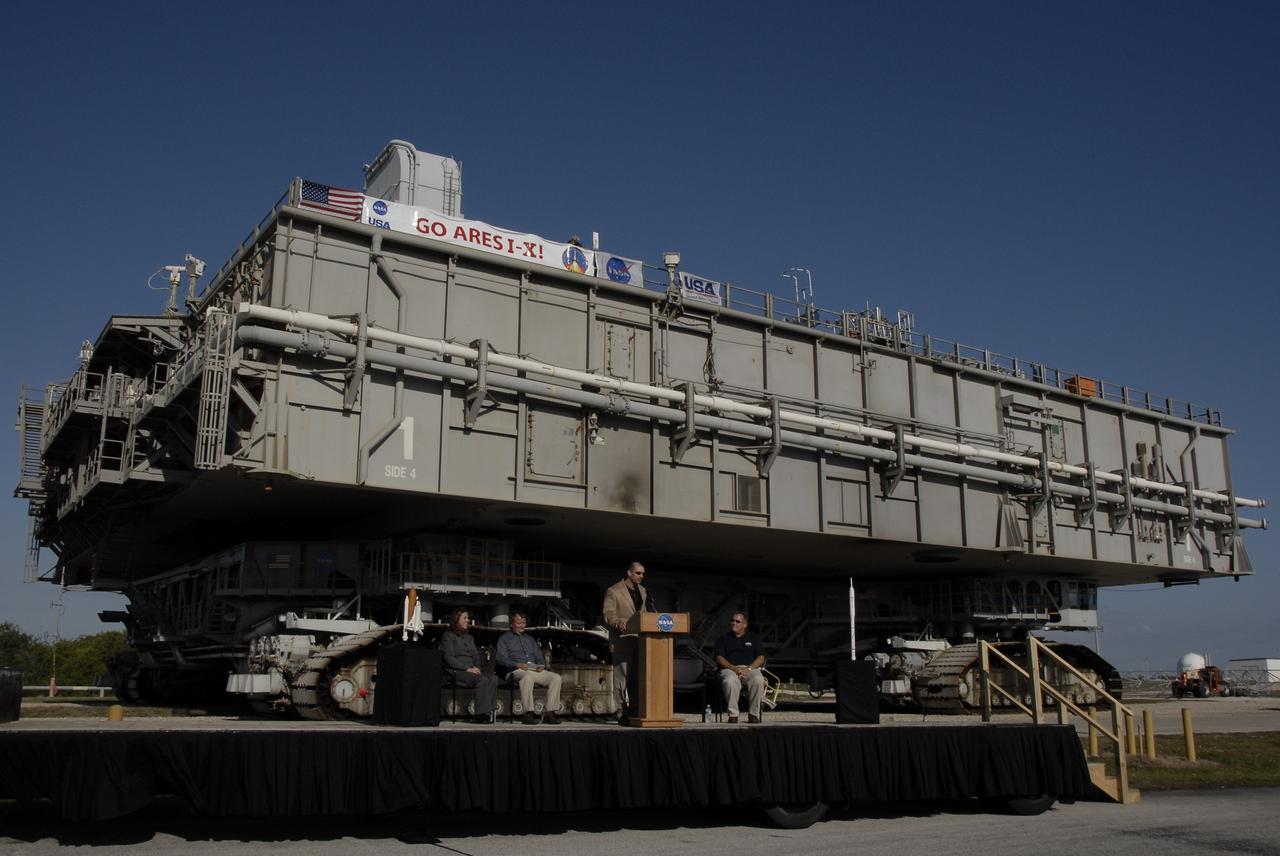
CAPE CANAVERAL, Fla. – Near Launch Pad 39B at NASA's Kennedy Space Center in Florida, Director of the Constellation Project Office Pepper E. Phillips speaks to employees and media during the handover ceremony for Mobile Launcher Platform-1. Marking the handover is the change of banner on the platform behind him. On the stage and also participating in the ceremony are Director of Launch Vehicle Processing Rita Willcoxon , Shuttle Launch Director Mike Leinbach, and Manager of MLP Operations with United Space Alliance Brett Raulerson. The platform is being transferred from NASA's Space Shuttle Program to the Constellation Program for the Ares I-X flight test targeted for this summer. Constructed in 1964, the mobile launchers used in Apollo/Saturn operations were modified for use in shuttle operations. With cranes, umbilical towers and swing arms removed, the mobile launchers were renamed Mobile Launcher Platforms, or MLPs. Photo credit: NASA/Kim Shiflett
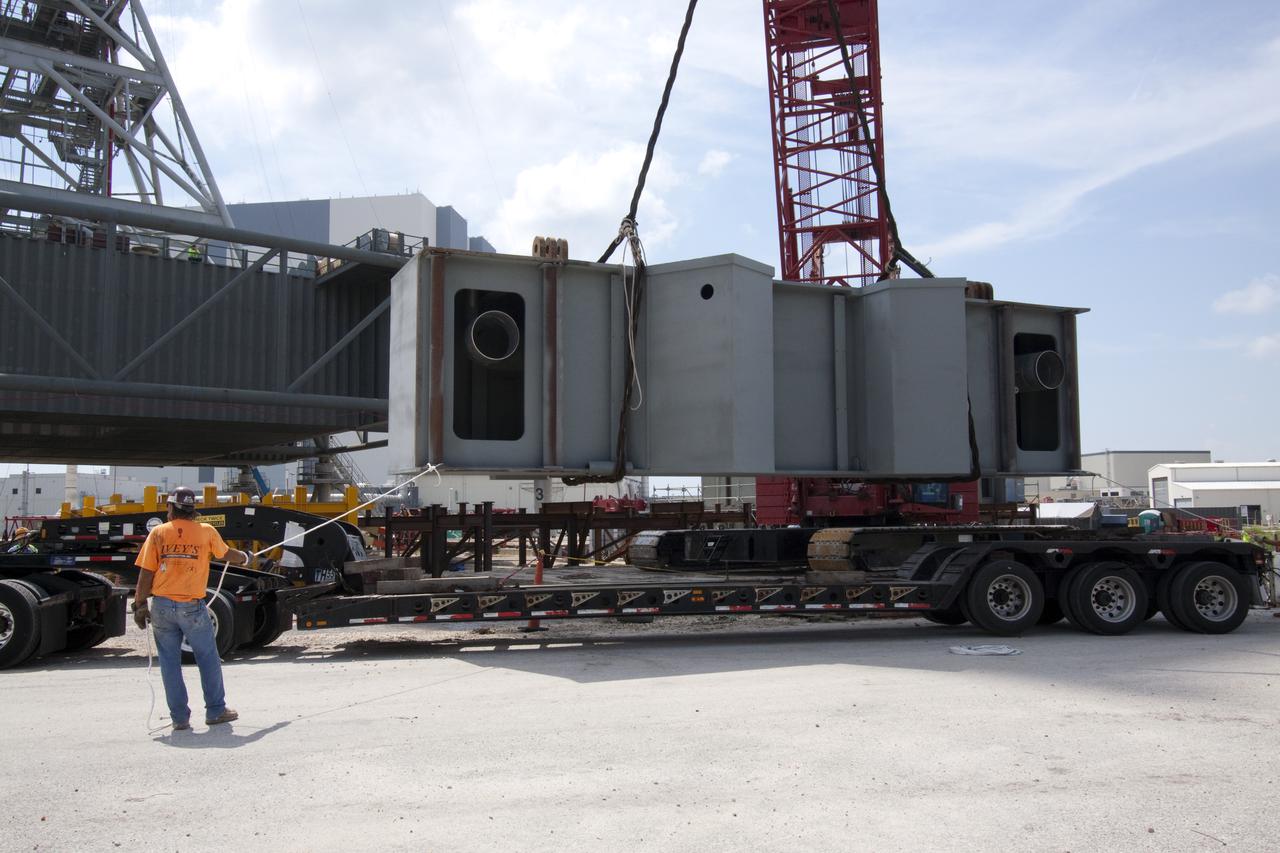
CAPE CANAVERAL, Fla. – At NASA's Kennedy Space Center in Florida, the third segment of the launch mount for a new mobile launcher, or ML, being constructed to support NASA's future human spaceflight program is lifted from the tractor-trailer on which it was delivered. The construction is taking place in the mobile launcher park site north of Kennedy's Vehicle Assembly Building. The new launcher is 355 feet tall and has multiple platforms for personnel access. The base of the launcher is lighter than space shuttle mobile launcher platforms so the crawler-transporter can pick up the heavier load of the tower and a taller rocket. For information on NASA's future plans, visit http:__www.nasa.gov. Photo credit: NASA_Jack Pfaller
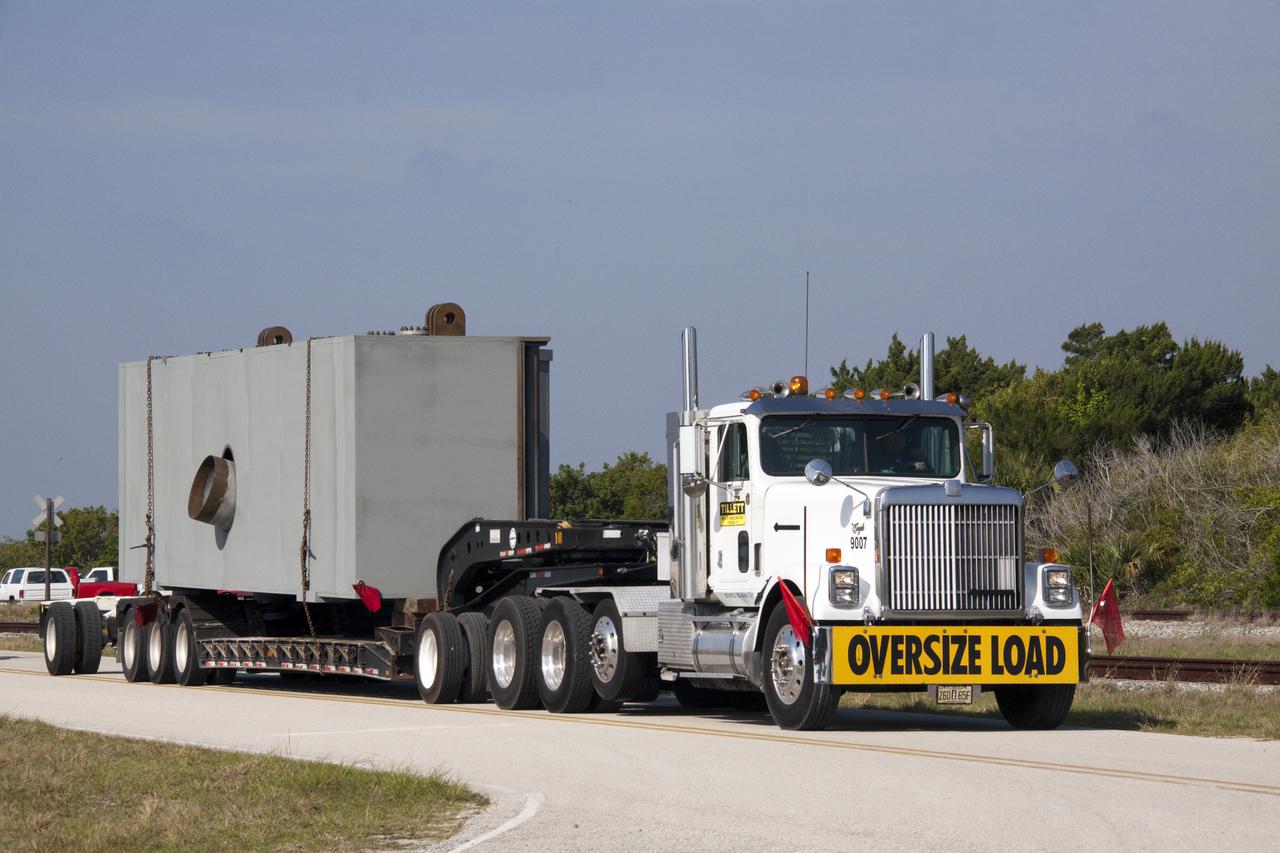
CAPE CANAVERAL, Fla. – At NASA's Kennedy Space Center in Florida, a tractor-trailer delivers the fourth segment of the launch mount for a new mobile launcher, or ML, being constructed to support NASA's future human spaceflight program. The construction is taking place in the mobile launcher park site north of Kennedy's Vehicle Assembly Building. The new launcher is 355 feet tall and has multiple platforms for personnel access. The base of the launcher is lighter than space shuttle mobile launcher platforms so the crawler-transporter can pick up the heavier load of the tower and a taller rocket. For information on NASA's future plans, visit http:__www.nasa.gov. Photo credit: NASA_Troy Cryder
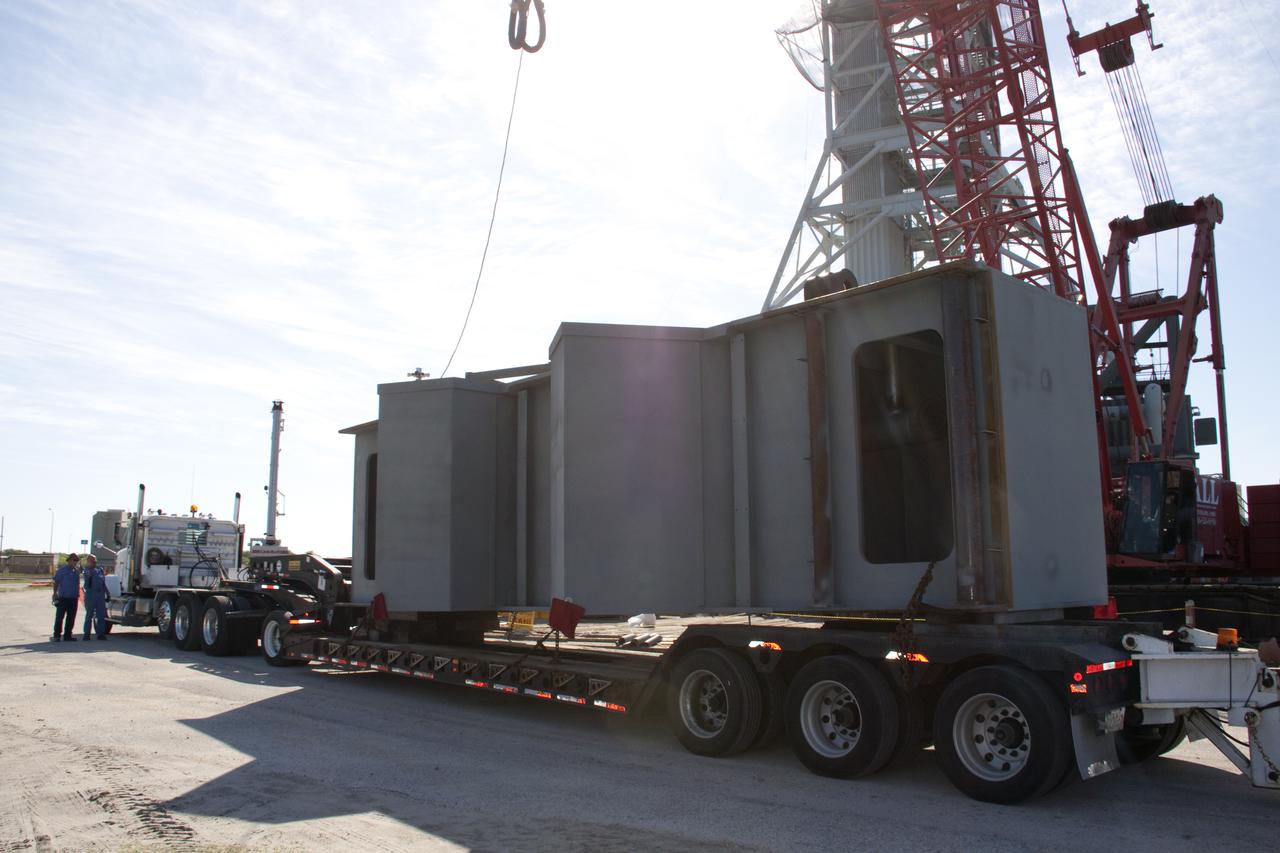
CAPE CANAVERAL, Fla. – At NASA's Kennedy Space Center in Florida, a tractor-trailer delivers the third segment of the launch mount for a new mobile launcher, or ML, being constructed to support NASA's future human spaceflight program. The construction is taking place in the mobile launcher park site north of Kennedy's Vehicle Assembly Building. The new launcher is 355 feet tall and has multiple platforms for personnel access. The base of the launcher is lighter than space shuttle mobile launcher platforms so the crawler-transporter can pick up the heavier load of the tower and a taller rocket. For information on NASA's future plans, visit http:__www.nasa.gov. Photo credit: NASA_Jack Pfaller

CAPE CANAVERAL, Fla. – At NASA's Kennedy Space Center in Florida, workers prepare for the arrival of the third segment of the launch mount for a new mobile launcher, or ML, being constructed to support NASA's future human spaceflight program. The construction is taking place in the mobile launcher park site north of Kennedy's Vehicle Assembly Building. The new launcher is 355 feet tall and has multiple platforms for personnel access. The base of the launcher is lighter than space shuttle mobile launcher platforms so the crawler-transporter can pick up the heavier load of the tower and a taller rocket. For information on NASA's future plans, visit http:__www.nasa.gov. Photo credit: NASA_Jack Pfaller
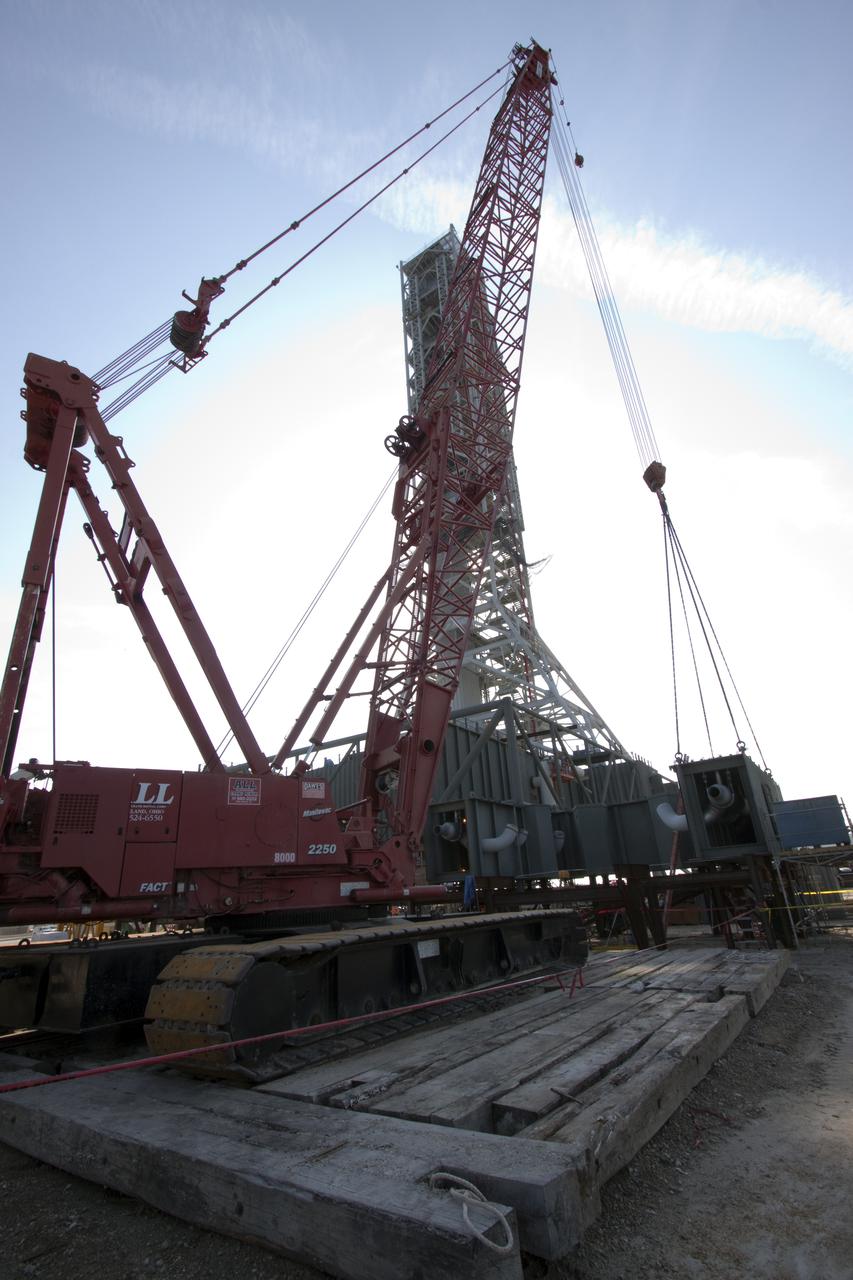
CAPE CANAVERAL, Fla. – At NASA's Kennedy Space Center in Florida, a crane is enlisted to support the arrival of the third segment of the launch mount for a new mobile launcher, or ML, being constructed to support NASA's future human spaceflight program. The construction is taking place in the mobile launcher park site north of Kennedy's Vehicle Assembly Building. The new launcher is 355 feet tall and has multiple platforms for personnel access. The base of the launcher is lighter than space shuttle mobile launcher platforms so the crawler-transporter can pick up the heavier load of the tower and a taller rocket. For information on NASA's future plans, visit http:__www.nasa.gov. Photo credit: NASA_Jack Pfaller
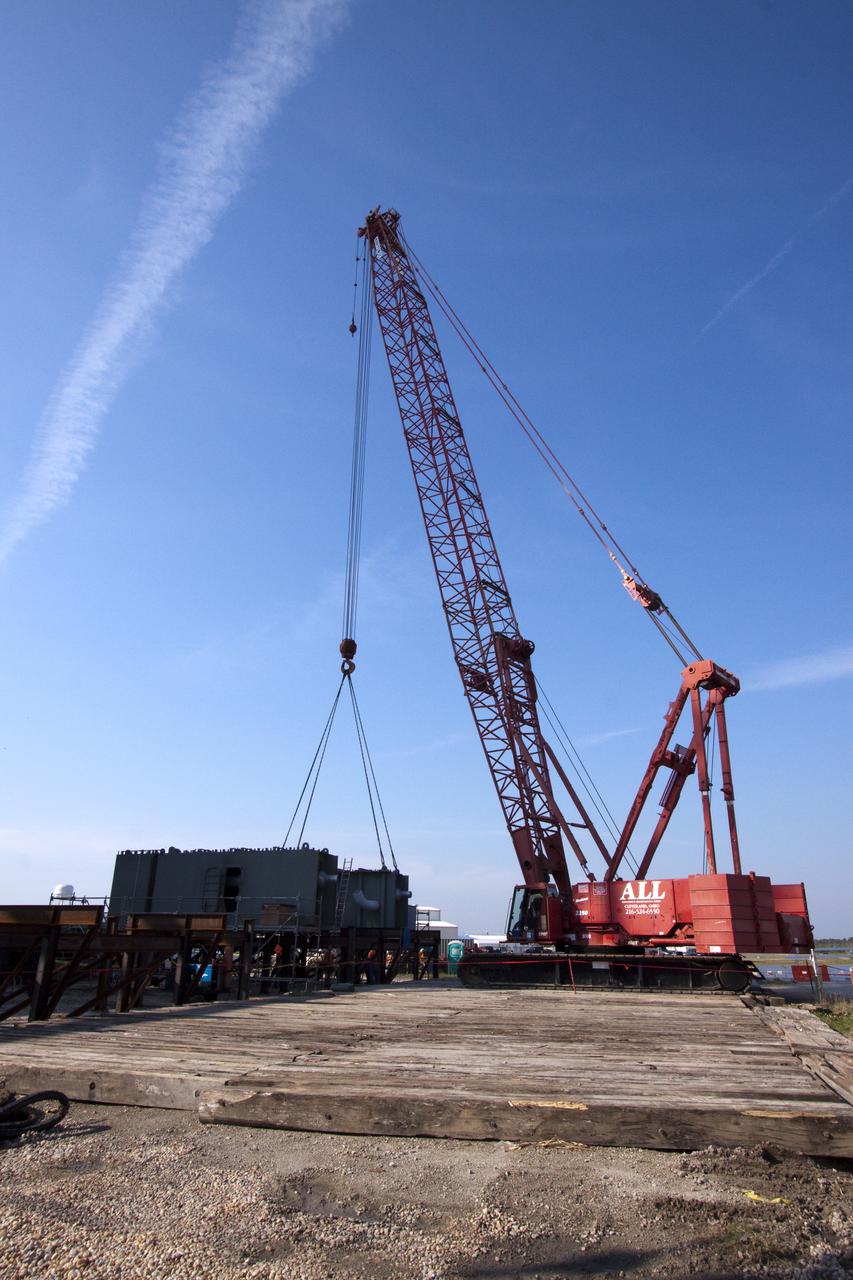
CAPE CANAVERAL, Fla. – At NASA's Kennedy Space Center in Florida, preparations are under way for the arrival of the third segment of the launch mount for a new mobile launcher, or ML, being constructed to support NASA's future human spaceflight program. The construction is taking place in the mobile launcher park site north of Kennedy's Vehicle Assembly Building. The new launcher is 355 feet tall and has multiple platforms for personnel access. The base of the launcher is lighter than space shuttle mobile launcher platforms so the crawler-transporter can pick up the heavier load of the tower and a taller rocket. For information on NASA's future plans, visit http:__www.nasa.gov. Photo credit: NASA_Jack Pfaller
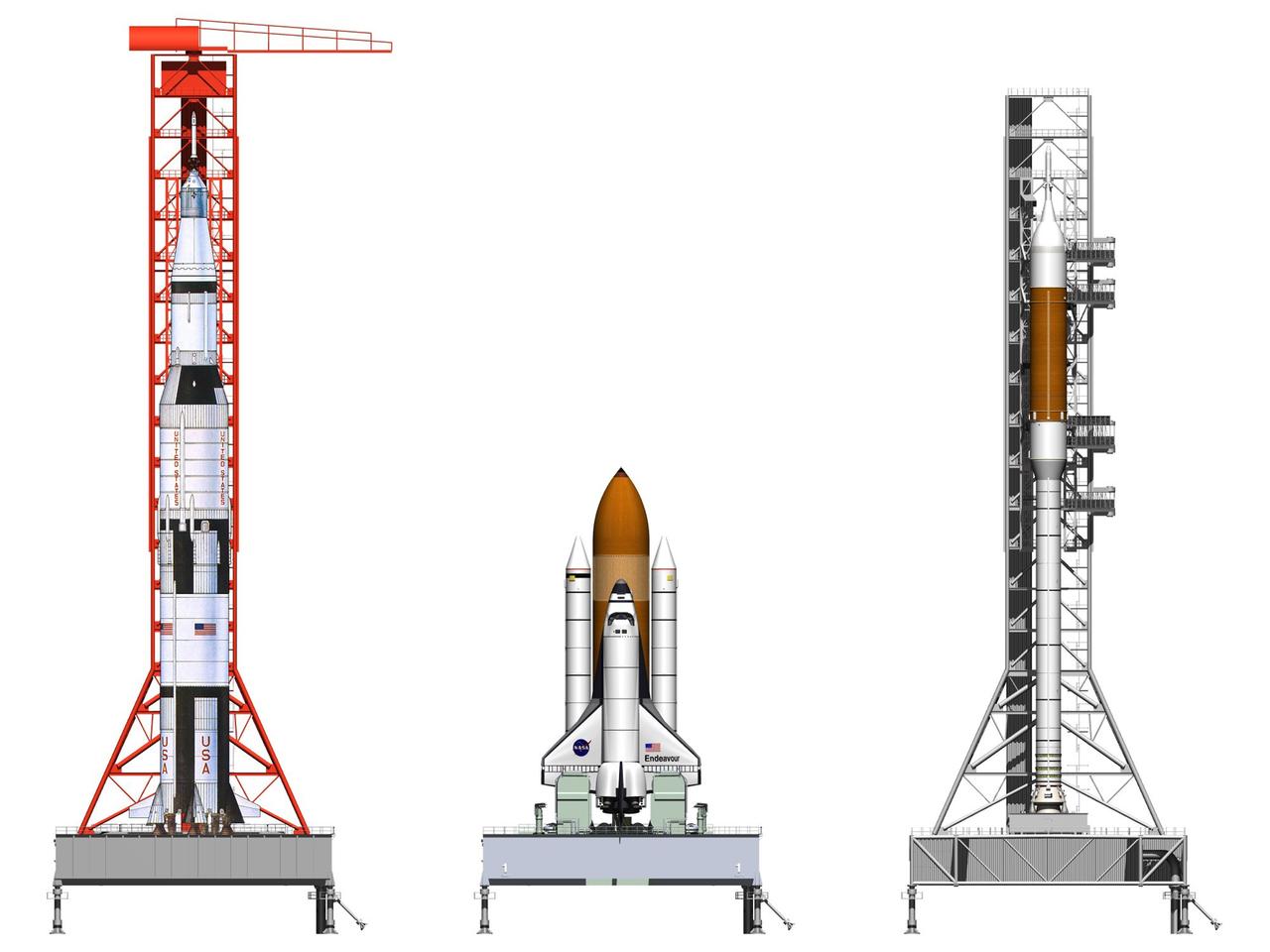
CAPE CANAVERAL, Fla. -- Artist's rendering of the Constellation Program's Ares V rocket on the mobile launcher platform (left) and the Ares I rocket on the platform (right) with the space shuttle in between for comparison. The tower of the mobile launcher will have multiple platforms for personnel access and will be approximately 390 feet tall. The tower will be used in the assembly, testing and servicing of the Ares rockets at Kennedy and will also transport the Ares rockets to the launch pad and provide ground support for launches.
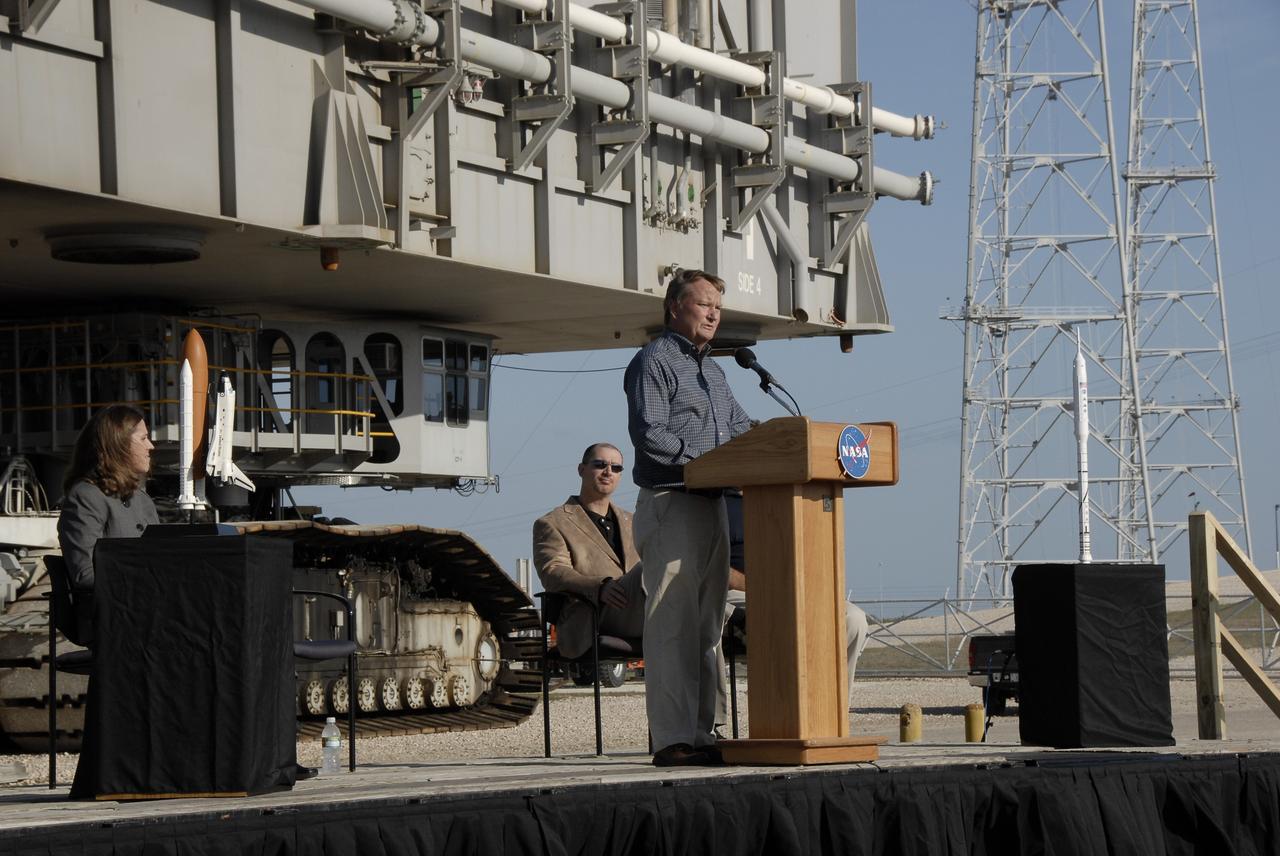
CAPE CANAVERAL, Fla. – Near Launch Pad 39B at NASA's Kennedy Space Center in Florida, Shuttle Launch Director Mike Leinbach speaks to the employees and media during the handover ceremony for Mobile Launcher Platform-1. The platform is being transferred from NASA's Space Shuttle Program to the Constellation Program for the Ares I-X flight test targeted for this summer. Also participating in the ceremony are (left) Rita Willcoxon, director of Launch Vehicle Processing at Kennedy, (right) Pepper E. Phillips, director of the Constellation Project Office, and (not visible) Brett Raulerson, manager of MLP Operations with United Space Alliance. Constructed in 1964, the mobile launchers used in Apollo/Saturn operations were modified for use in shuttle operations. With cranes, umbilical towers and swing arms removed, the mobile launchers were renamed Mobile Launcher Platforms, or MLPs. Photo credit: NASA/Kim Shiflett
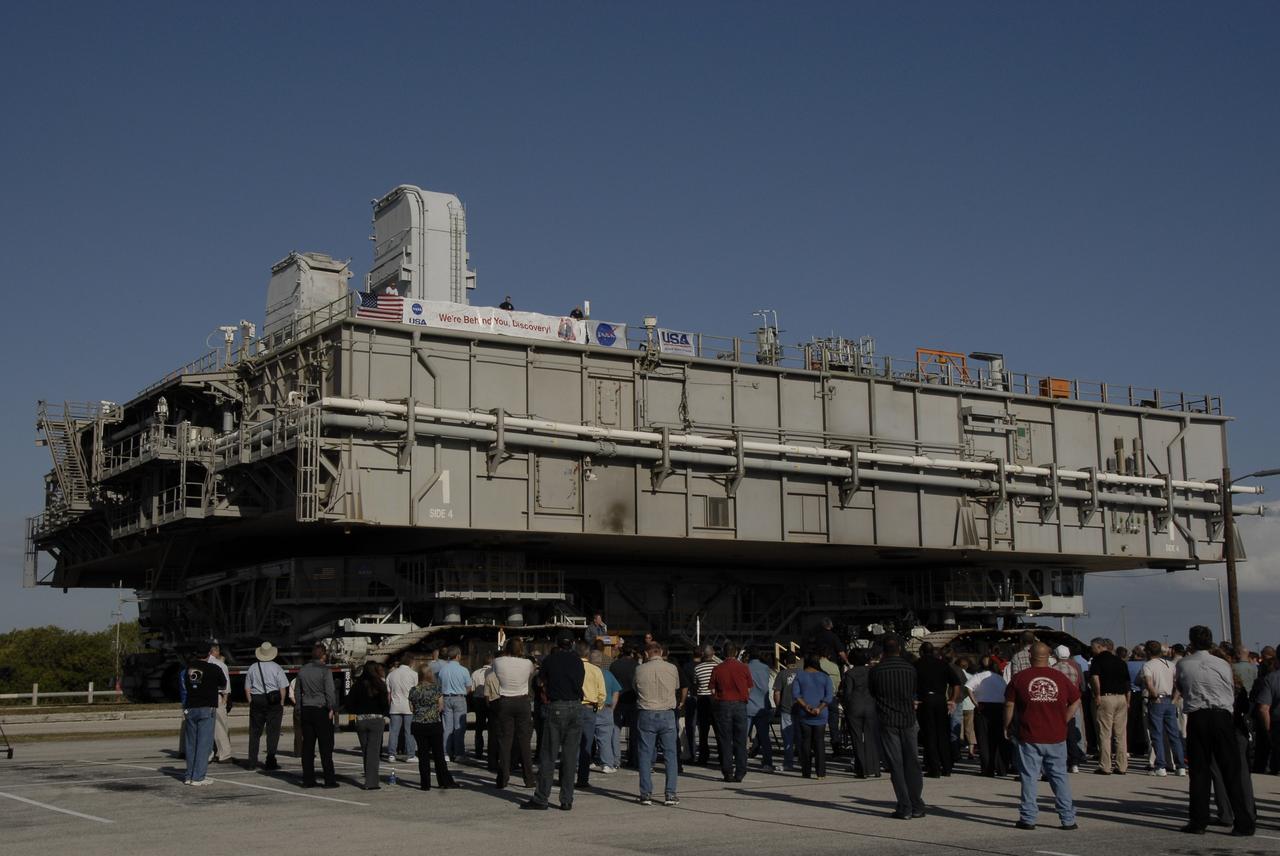
CAPE CANAVERAL, Fla. – Near Launch Pad 39B at NASA's Kennedy Space Center in Florida, employees and media gather listen to Shuttle Launch Director Mike Leinbach during the handover ceremony for Mobile Launcher Platform-1. The platform is being transferred from NASA's Space Shuttle Program to the Constellation Program for the Ares I-X flight test targeted for this summer. Also participating in the ceremony are Rita Willcoxon, director of Launch Vehicle Processing at Kennedy, Pepper E. Phillips, director of the Constellation Project Office, and Brett Raulerson, manager of MLP Operations with United Space Alliance. Constructed in 1964, the mobile launchers used in Apollo/Saturn operations were modified for use in shuttle operations. With cranes, umbilical towers and swing arms removed, the mobile launchers were renamed Mobile Launcher Platforms, or MLPs. Photo credit: NASA/Kim Shiflett
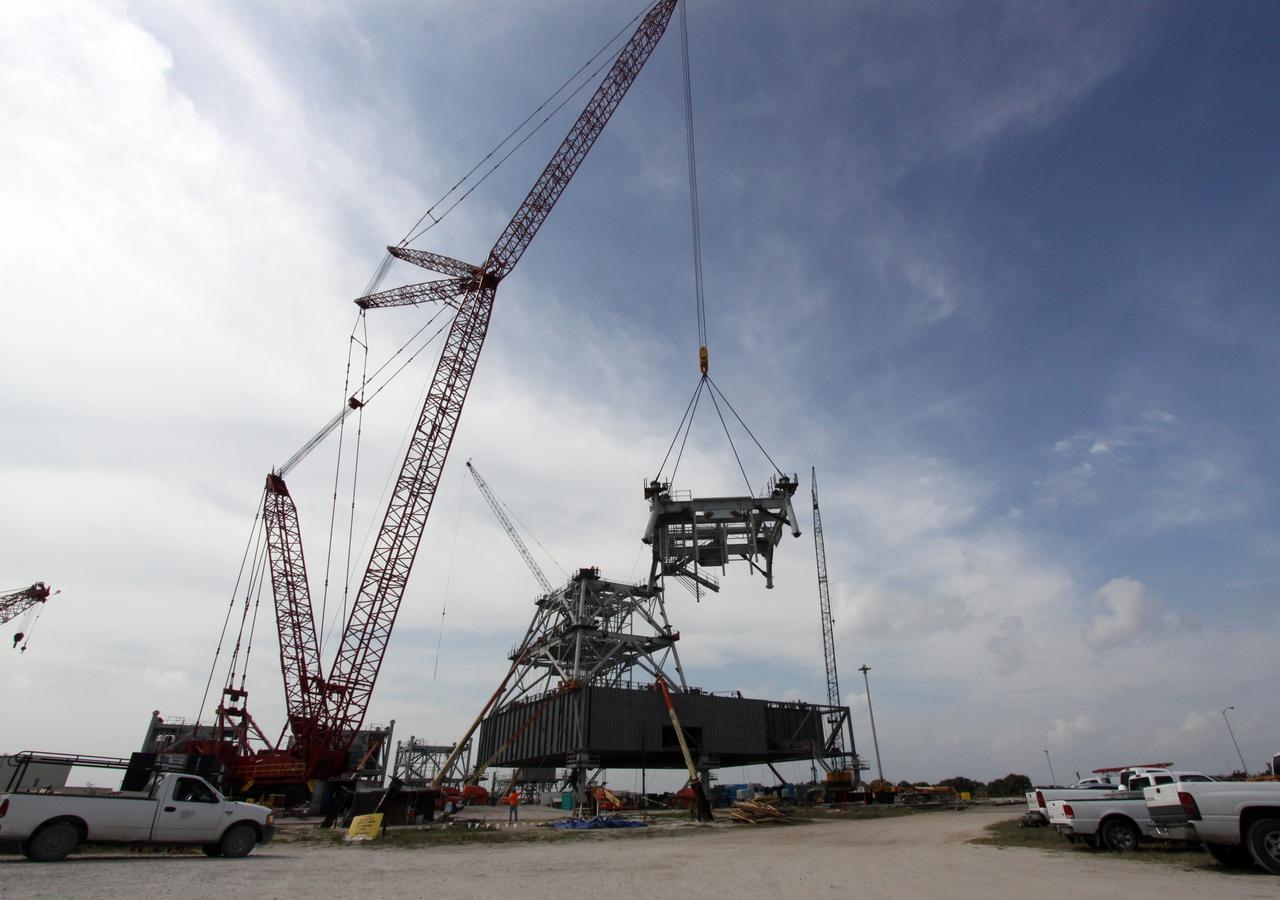
CAPE CANAVERAL, Fla. – At NASA's Kennedy Space Center in Florida, progress continues on the construction of a new mobile launcher, or ML, for the Constellation Program as a crane lifts the third section of the launcher's tower above the platform. Installation of the first section was on Sept. 24, and the second, on Oct. 15. The tower will have multiple platforms for personnel access and be approximately 345 feet tall. The launcher is being built at the mobile launcher park site area located north of Kennedy's Vehicle Assembly Building to support the Ares I rocket. The ML will provide a base to launch the Ares I, designed to transport the Orion crew exploration vehicle, its crew and cargo to low Earth orbit. The base is being made lighter than space shuttle mobile launcher platforms so the crawler-transporter can pick up the heavier load of the tower and taller rocket. For information on the Ares I, visit http://www.nasa.gov/ares. Photo credit: NASA/Jack Pfaller
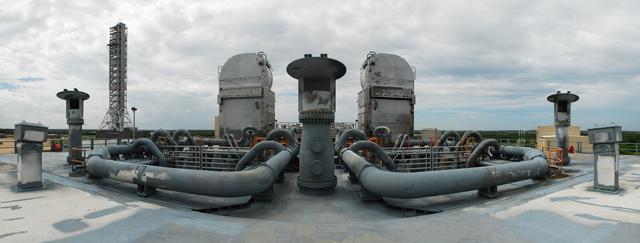
CAPE CANAVERAL, Fla. -- This panoramic view of NASA's new mobile launcher, or ML, support structure was taken from the top deck of the space shuttle's mobile launcher platform at NASA's Kennedy Space Center in Florida. It took about two years to construct the new launcher in the Mobile Launcher Park site, north of the Vehicle Assembly Building, or VAB. The 355-foot-tall structure will support NASA's future human spaceflight program. The base of the launcher is lighter than space shuttle mobile launcher platforms so the crawler-transporter can pick up the heavier load of the tower and a taller rocket. The next step will be to add ground support equipment, such as umbilicals and access arms, for future rocket launches. For information on NASA's future plans, visit www.nasa.gov. Photo credit: NASA/Frankie Martin
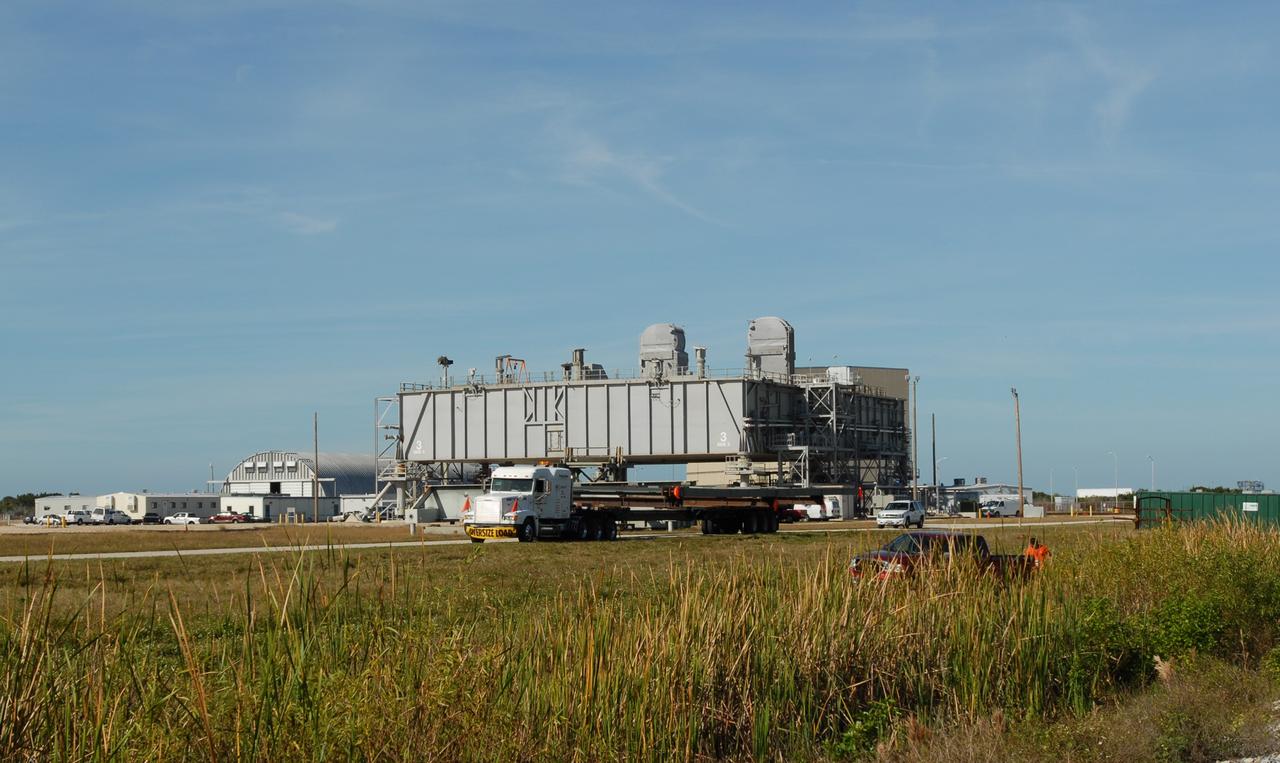
CAPE CANAVERAL, Fla. -- The Mobile Launcher truss, T4, arrives at NASA's Kennedy Space Center in Florida. It is being delivered for the new mobile launcher to be used in the Constellation Program. The new mobile launcher will be the base for the Ares rockets to launch the Orion crew exploration vehicle and the cargo vehicle. The base is being made lighter than space shuttle mobile launcher platforms so the crawler-transporter can pick up the added load of the 345-foot tower and taller rocket. When the structural portion of the new mobile launcher is complete, umbilicals, access arms, communications equipment and command/control equipment will be installed. Photo credit: NASA/Jim Grossmann
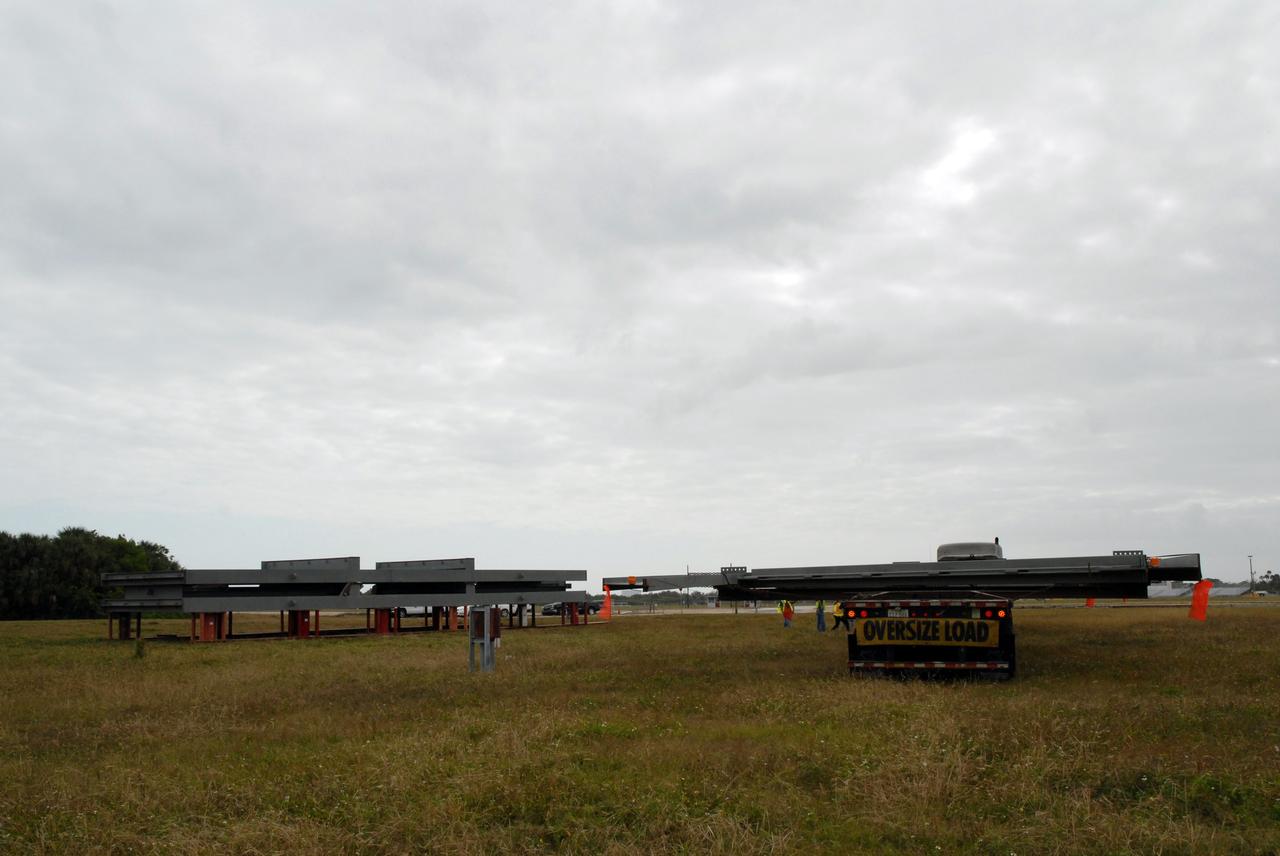
CAPE CANAVERAL, Fla. -- At NASA's Kennedy Space Center in Florida, the Mobile Launcher truss, T4, has been offloaded from its truck on grounds near the mobile launcher parking area. The new mobile launcher will be the base for the Ares rockets to launch the Orion crew exploration vehicle and the cargo vehicle. The base is being made lighter than space shuttle mobile launcher platforms so the crawler-transporter can pick up the added load of the 345-foot tower and taller rocket. When the structural portion of the new mobile launcher is complete, umbilicals, access arms, communications equipment and command/control equipment will be installed. Photo credit: NASA/Jack Pfaller
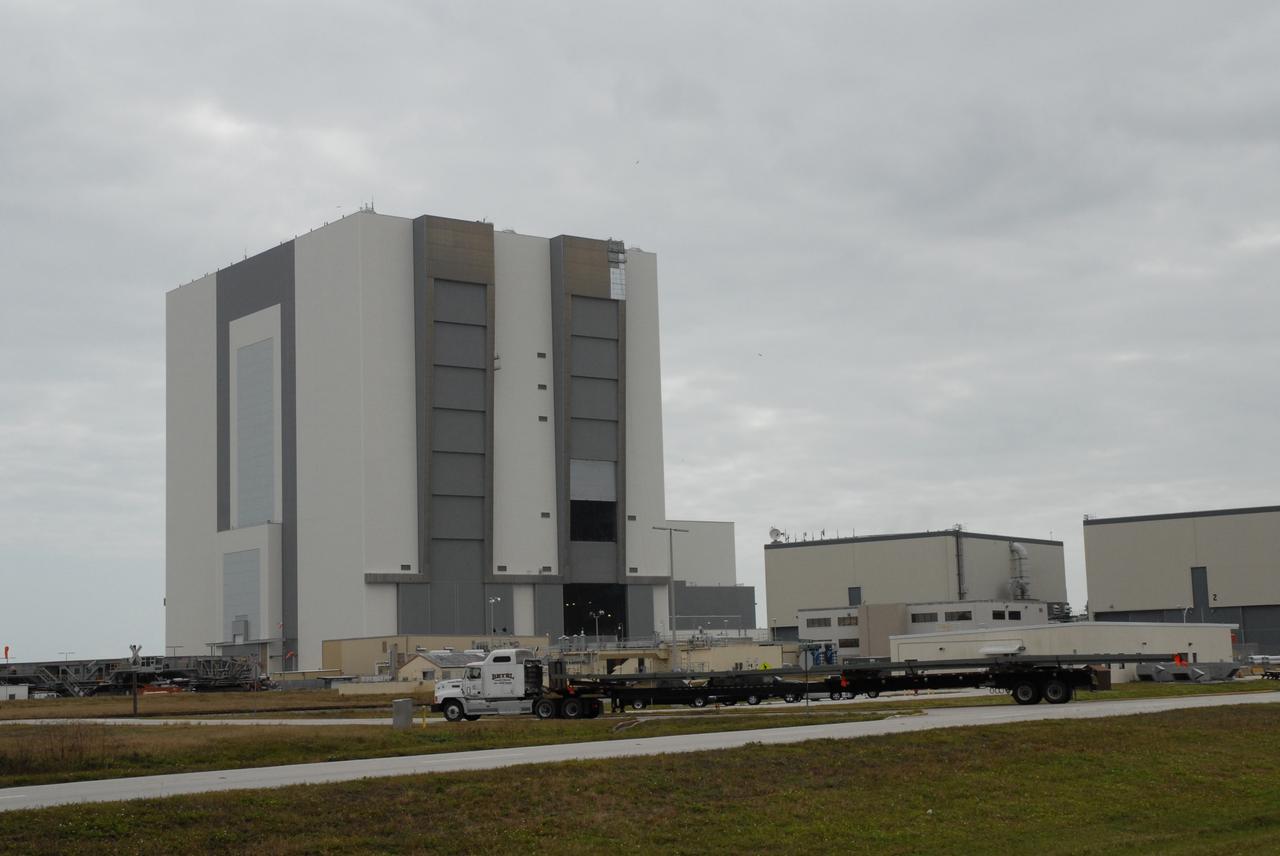
CAPE CANAVERAL, Fla. -- The mobile launcher truss, T4, arrives at NASA's Kennedy Space Center in Florida. It will be used to build the new mobile launcher for the Constellation Program. The new mobile launcher will be the base for the Ares rockets to launch the Orion crew exploration vehicle and the cargo vehicle. The base is being made lighter than space shuttle mobile launcher platforms so the crawler-transporter can pick up the added load of the 345-foot tower and taller rocket. When the structural portion of the new mobile launcher is complete, umbilicals, access arms, communications equipment and command/control equipment will be installed. Photo credit: NASA/Jack Pfaller
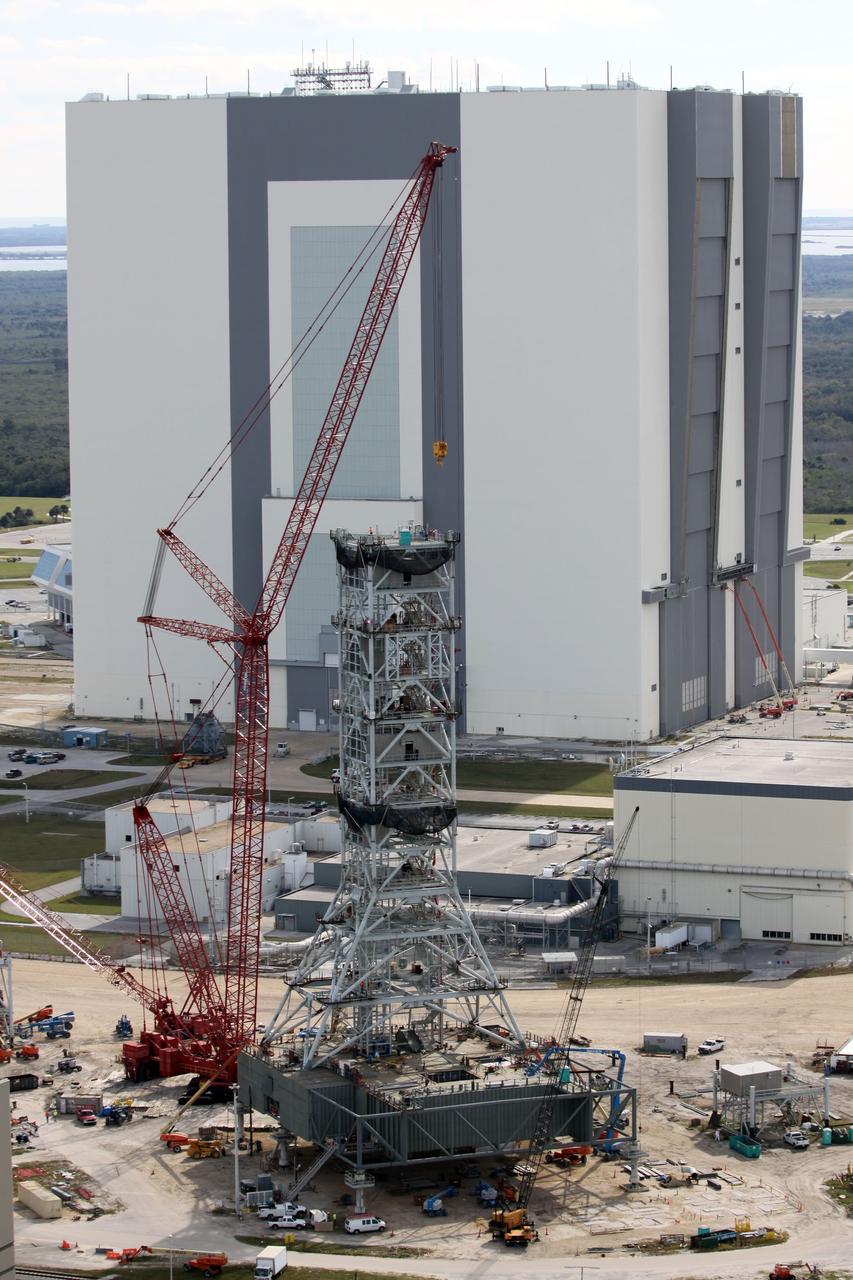
CAPE CANAVERAL, Fla. – At NASA's Kennedy Space Center in Florida, this aerial view of the mobile launcher park site area north of the 525-foot-tall Vehicle Assembly Building, in the background, shows a new mobile launcher, or ML, under construction to support the Constellation Program. When completed, the tower will be approximately 345 feet tall and have multiple platforms for personnel access. Its base is being made lighter than space shuttle mobile launcher platforms so the crawler-transporter can pick up the heavier load of the tower and a taller rocket. For information on the Constellation Program, visit http://www.nasa.gov/constellation. Photo credit: NASA/Cory Huston
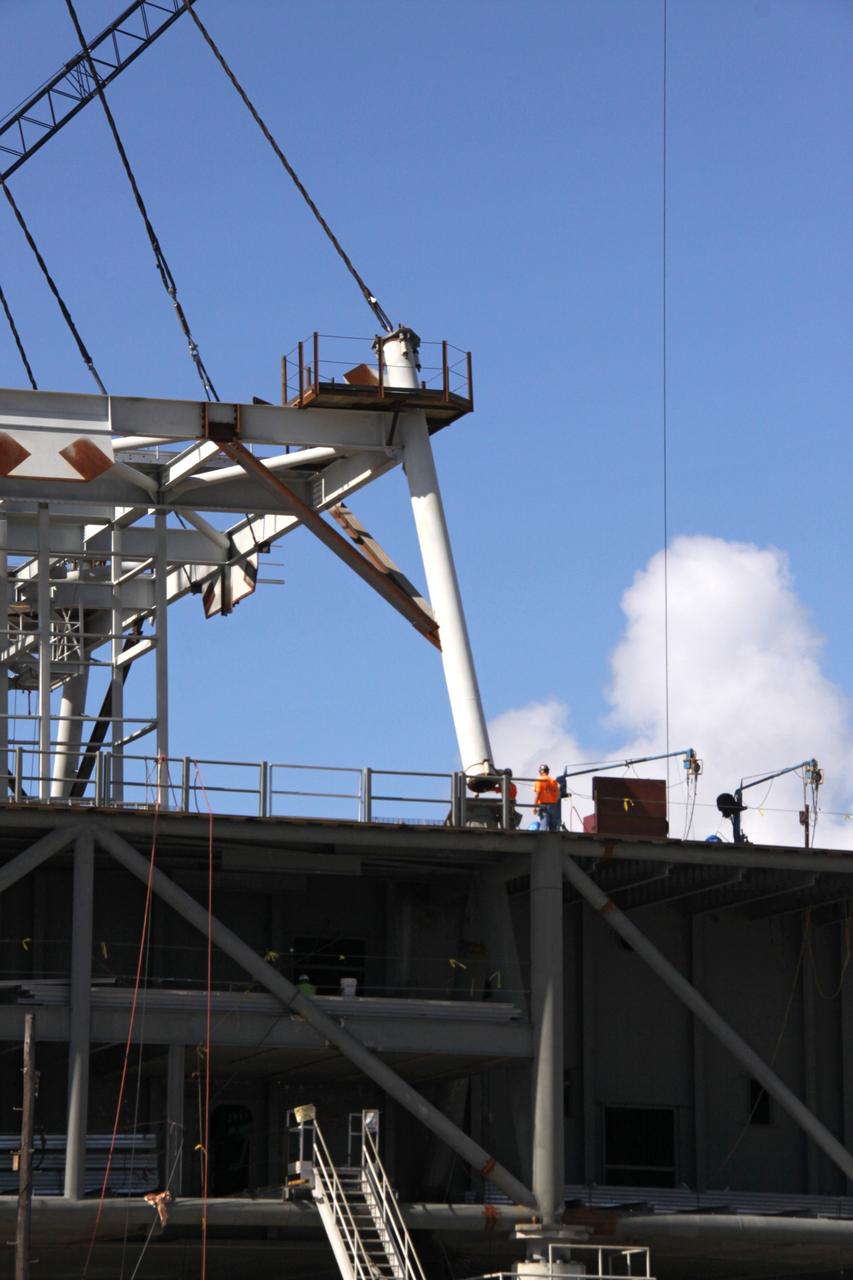
CAPE CANAVERAL, Fla. – Progress is evident in the Constellation Program at NASA's Kennedy Space Center in Florida, as workers position the first section of a tower onto a new mobile launcher, or ML. The tower of the mobile launcher will have multiple platforms for personnel access and will be approximately 345 feet tall. The launcher is being built at the mobile launcher park site area located north of Kennedy's Vehicle Assembly Building to support the Ares I rocket. The ML will provide a base to launch the Ares I which will transport the Orion crew exploration vehicle, its crew and cargo to low Earth orbit. The base is being made lighter than space shuttle mobile launcher platforms so the crawler-transporter can pick up the heavier load of the tower and taller rocket. Photo credit: NASA/Jack Pfaller
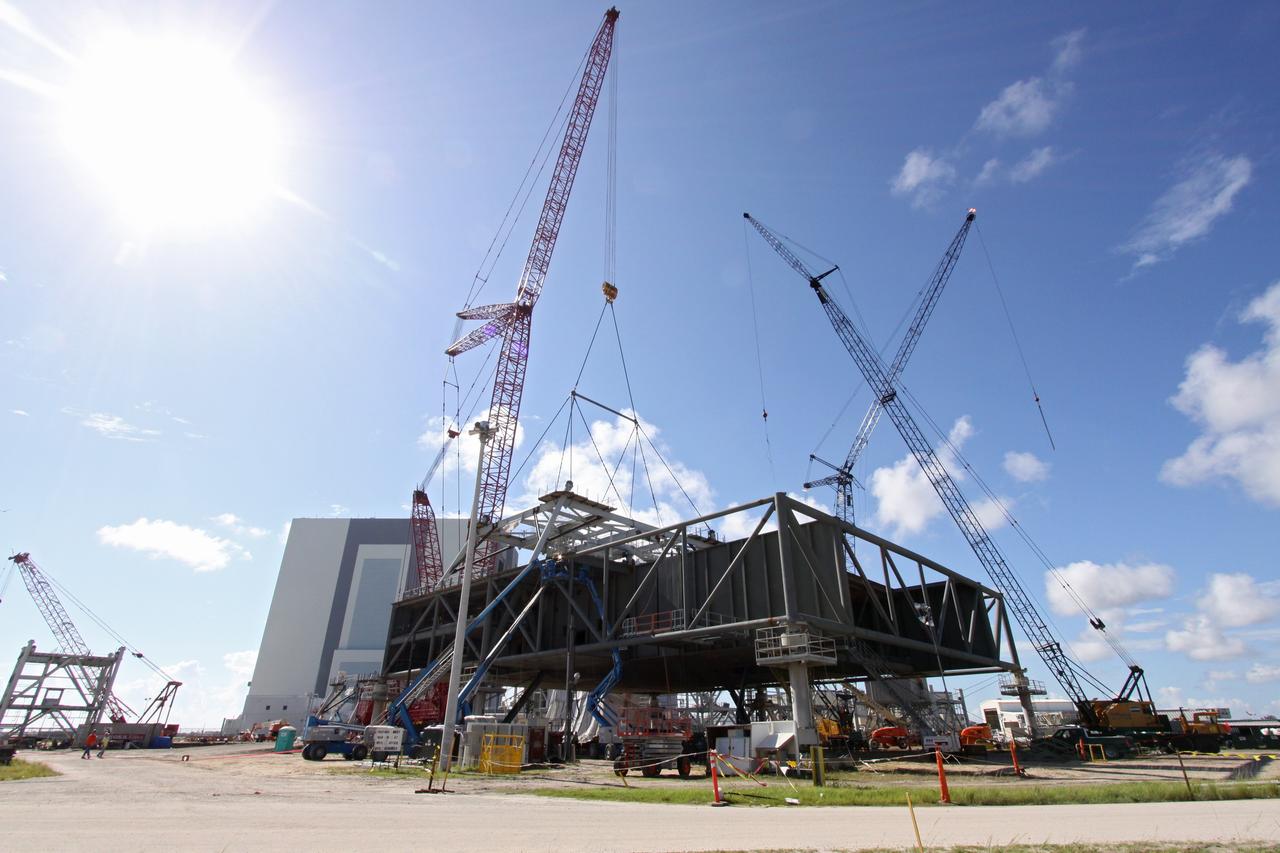
CAPE CANAVERAL, Fla. – Progress is evident in the Constellation Program at NASA's Kennedy Space Center in Florida, as the first section of a tower is secured to a new mobile launcher, or ML. The tower of the mobile launcher will have multiple platforms for personnel access and will be approximately 345 feet tall. The launcher is being built at the mobile launcher park site area located north of Kennedy's Vehicle Assembly Building to support the Ares I rocket. The ML will provide a base to launch the Ares I which will transport the Orion crew exploration vehicle, its crew and cargo to low Earth orbit. The base is being made lighter than space shuttle mobile launcher platforms so the crawler-transporter can pick up the heavier load of the tower and taller rocket. Photo credit: NASA/Jack Pfaller
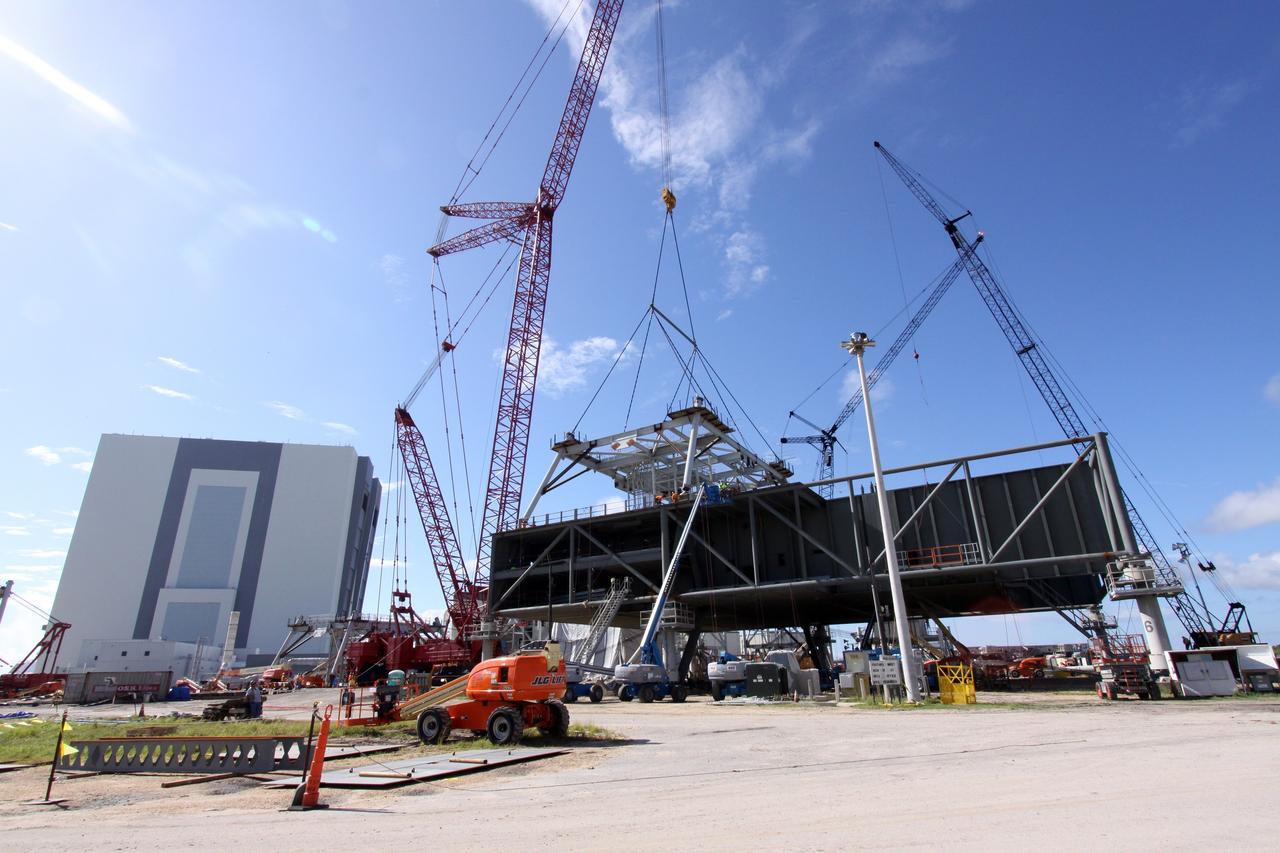
CAPE CANAVERAL, Fla. – Progress is evident in the Constellation Program at NASA's Kennedy Space Center in Florida, as the first section of a tower is lowered by crane onto a new mobile launcher, or ML. The tower of the mobile launcher will have multiple platforms for personnel access and will be approximately 345 feet tall. The launcher is being built at the mobile launcher park site area located north of Kennedy's Vehicle Assembly Building to support the Ares I rocket. The ML will provide a base to launch the Ares I which will transport the Orion crew exploration vehicle, its crew and cargo to low Earth orbit. The base is being made lighter than space shuttle mobile launcher platforms so the crawler-transporter can pick up the heavier load of the tower and taller rocket. Photo credit: NASA/Jack Pfaller
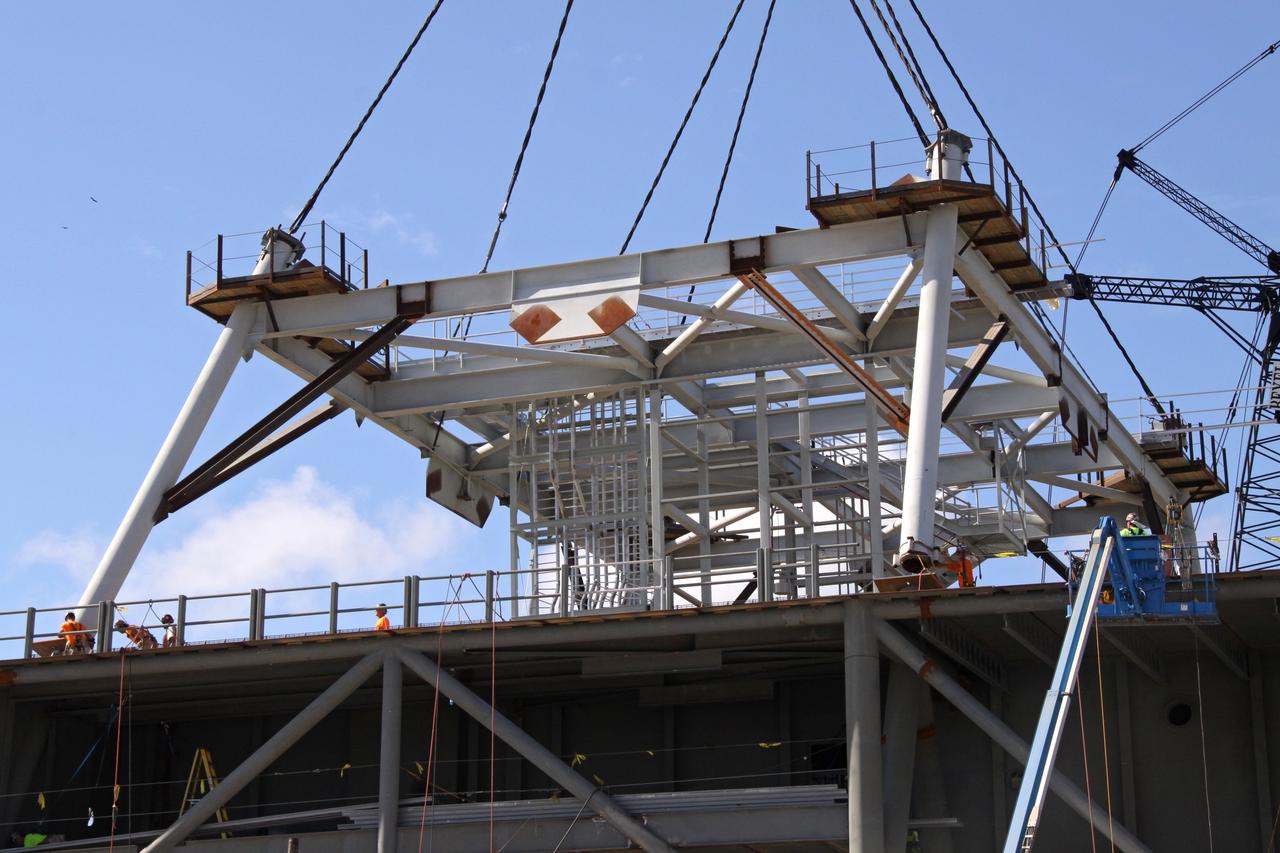
CAPE CANAVERAL, Fla. – Progress is evident in the Constellation Program at NASA's Kennedy Space Center in Florida, as workers install the first section of a tower onto a new mobile launcher, or ML. The tower of the mobile launcher will have multiple platforms for personnel access and will be approximately 345 feet tall. The launcher is being built at the mobile launcher park site area located north of Kennedy's Vehicle Assembly Building to support the Ares I rocket. The ML will provide a base to launch the Ares I which will transport the Orion crew exploration vehicle, its crew and cargo to low Earth orbit. The base is being made lighter than space shuttle mobile launcher platforms so the crawler-transporter can pick up the heavier load of the tower and taller rocket. Photo credit: NASA/Jack Pfaller
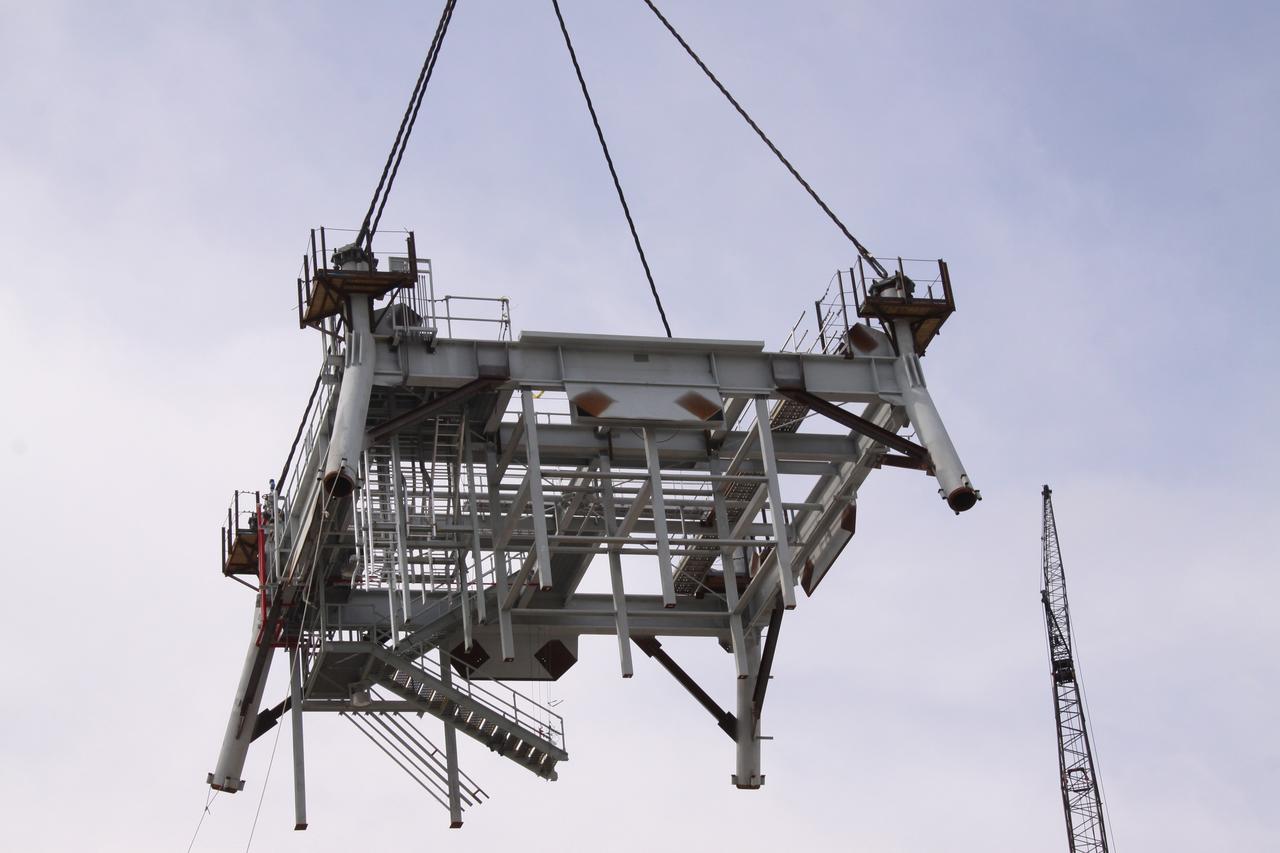
CAPE CANAVERAL, Fla. – At NASA's Kennedy Space Center in Florida, the third section of the tower for a new mobile launcher, or ML, for the Constellation Program is suspended by crane above the platform. Installation of the first section was on Sept. 24, and the second, on Oct. 15. The tower will have multiple platforms for personnel access and be approximately 345 feet tall. The launcher is being built at the mobile launcher park site area located north of Kennedy's Vehicle Assembly Building to support the Ares I rocket. The ML will provide a base to launch the Ares I, designed to transport the Orion crew exploration vehicle, its crew and cargo to low Earth orbit. The base is being made lighter than space shuttle mobile launcher platforms so the crawler-transporter can pick up the heavier load of the tower and taller rocket. For information on the Ares I, visit http://www.nasa.gov/ares. Photo credit: NASA/Jack Pfaller
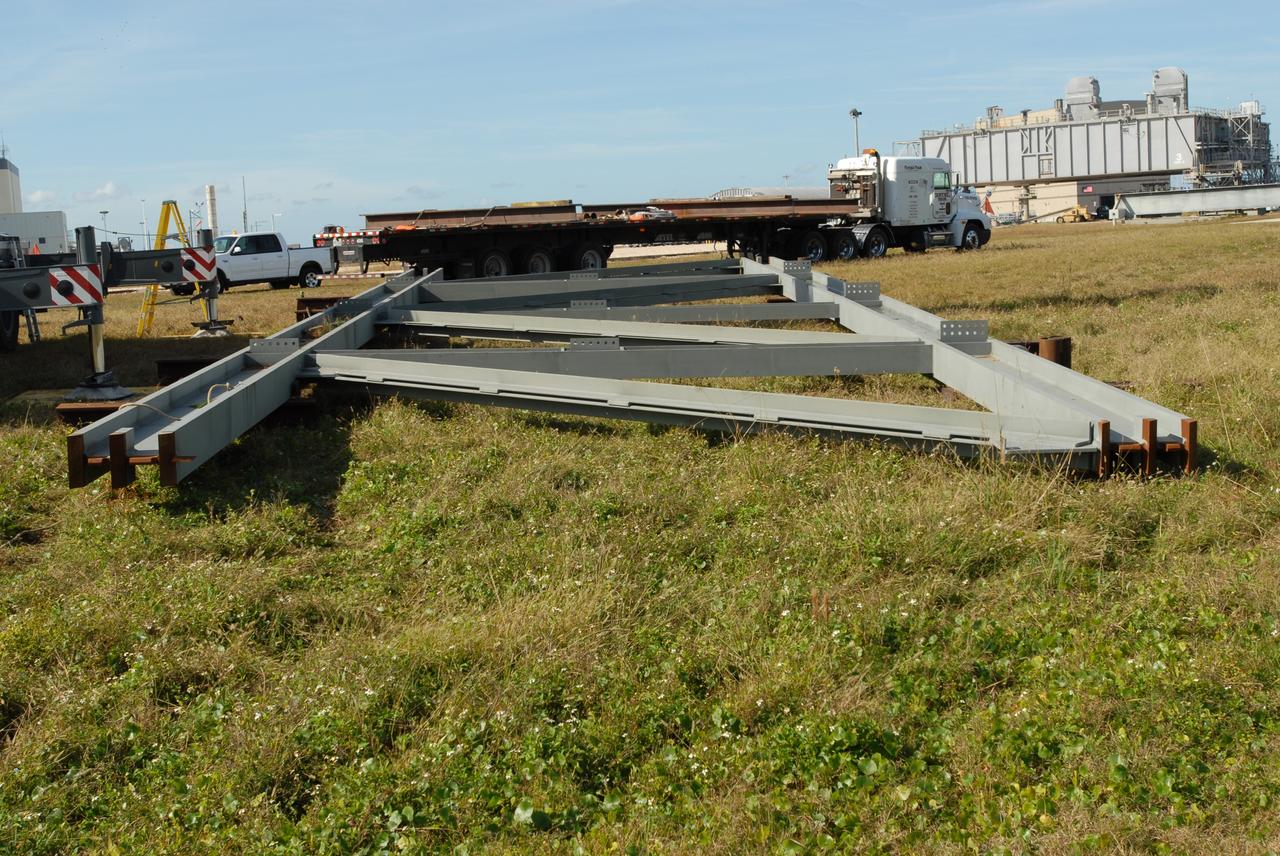
CAPE CANAVERAL, Fla. -- Near the Vehicle Assembly Building at NASA's Kennedy Space Center in Florida, one of the trusses, T4, for the new mobile launcher lies on the ground. The launcher will be built for the Constellation Program. The new mobile launcher will be the base for the Ares rockets to launch the Orion crew exploration vehicle and the cargo vehicle. The base is being made lighter than space shuttle mobile launcher platforms so the crawler-transporter can pick up the added load of the 345-foot tower and taller rocket. When the structural portion of the new mobile launcher is complete, umbilicals, access arms, communications equipment and command/control equipment will be installed. Photo credit: NASA/Jim Grossmann
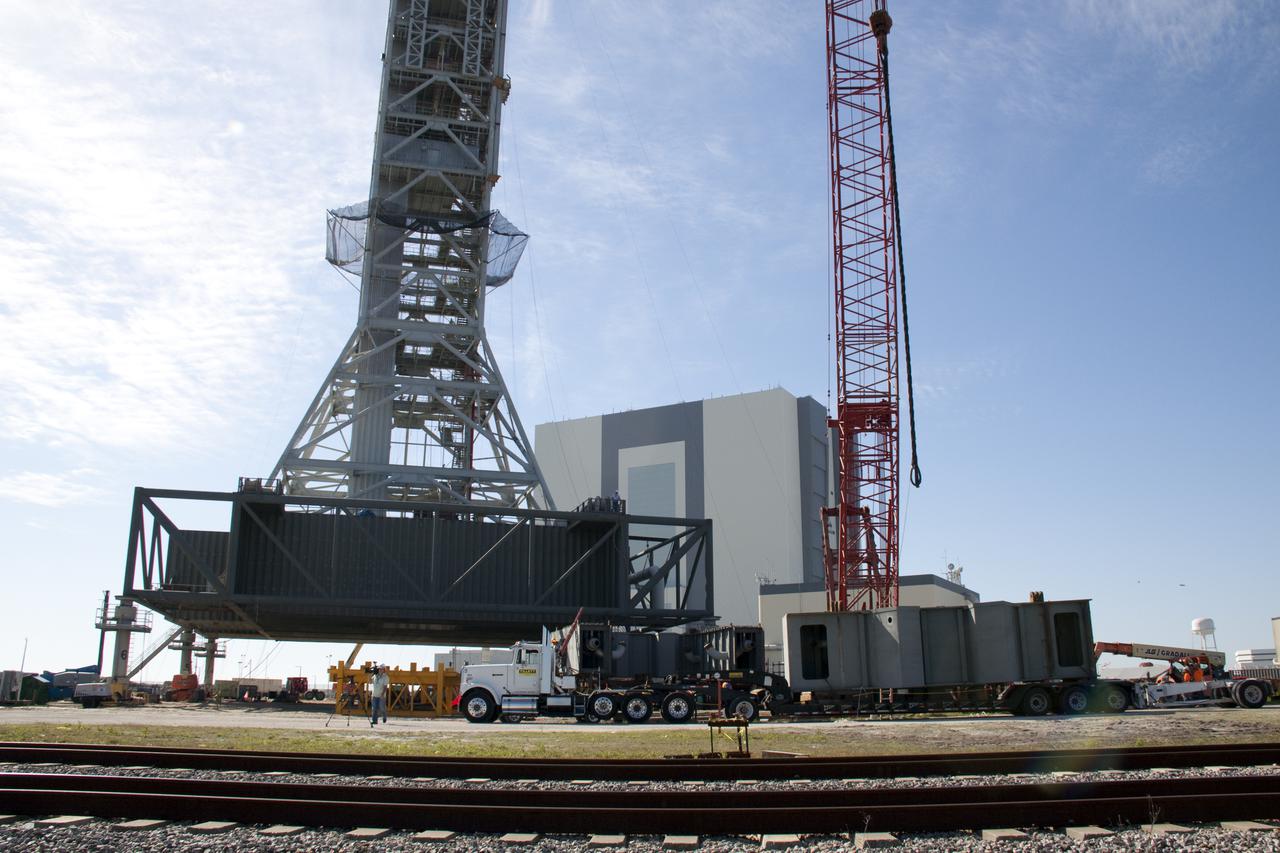
CAPE CANAVERAL, Fla. – At NASA's Kennedy Space Center in Florida, a tractor-trailer delivers the fourth segment of the launch mount for a new mobile launcher, or ML, being constructed to support NASA's future human spaceflight program. The launcher's tower looms over the cab of the tractor. In the background is the 525-foot-tall Vehicle Assembly Building. The construction is taking place in the mobile launcher park site north of Kennedy's Vehicle Assembly Building. The new launcher is 355 feet tall and has multiple platforms for personnel access. The base of the launcher is lighter than space shuttle mobile launcher platforms so the crawler-transporter can pick up the heavier load of the tower and a taller rocket. For information on NASA's future plans, visit http:__www.nasa.gov. Photo credit: NASA_Troy Cryder
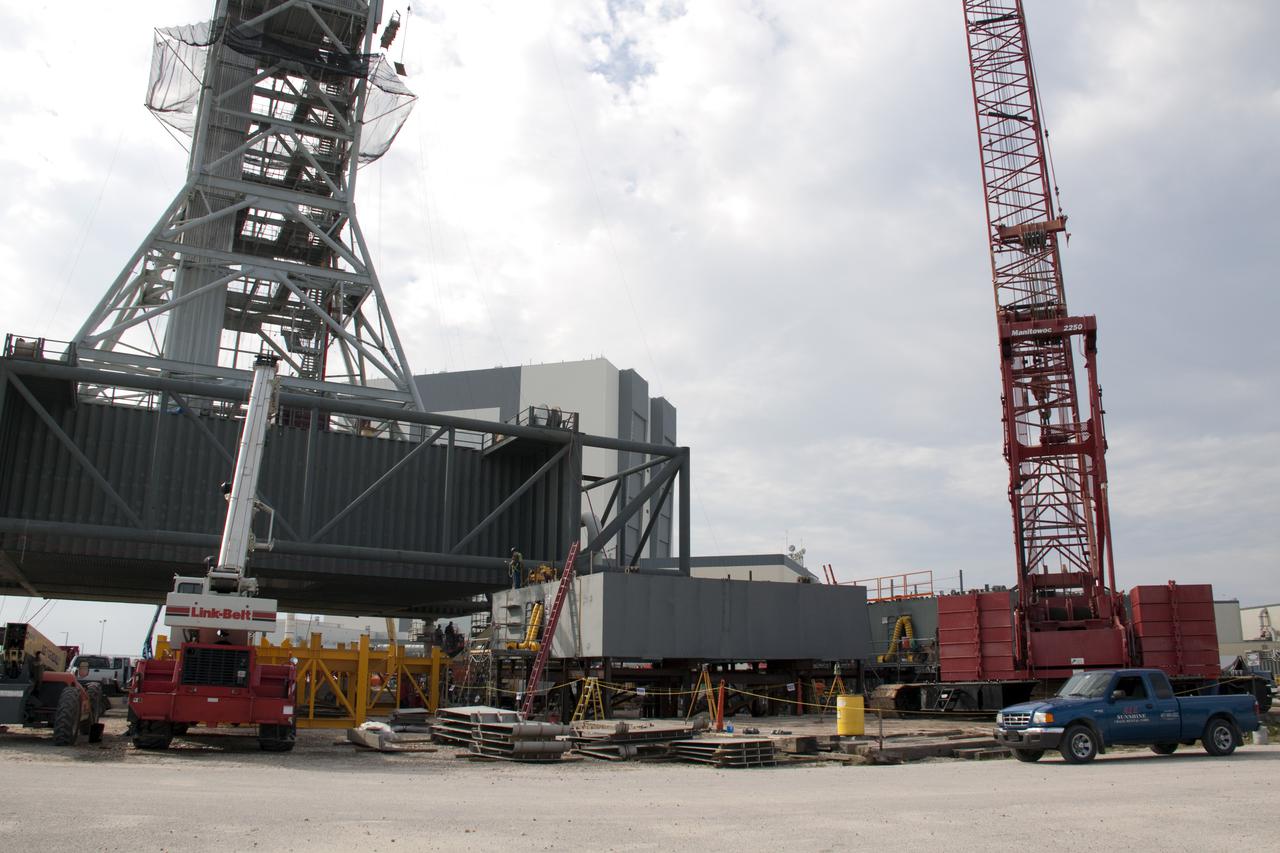
CAPE CANAVERAL, Fla. – At NASA's Kennedy Space Center in Florida, work progresses on the construction of the launch mount for a new mobile launcher, or ML, which will support NASA's future human spaceflight program, following the arrival of all eight segments. The base of the launcher's tower is at left. The construction is taking place in Launch Complex 39 in the mobile launcher park site north of Kennedy's Vehicle Assembly Building. The new launcher is 355 feet tall and has multiple platforms for personnel access. The base of the launcher is lighter than space shuttle mobile launcher platforms so the crawler-transporter can pick up the heavier load of the tower and a taller rocket. For information on NASA's future plans, visit http:__www.nasa.gov. Photo credit: NASA_Amanda Diller
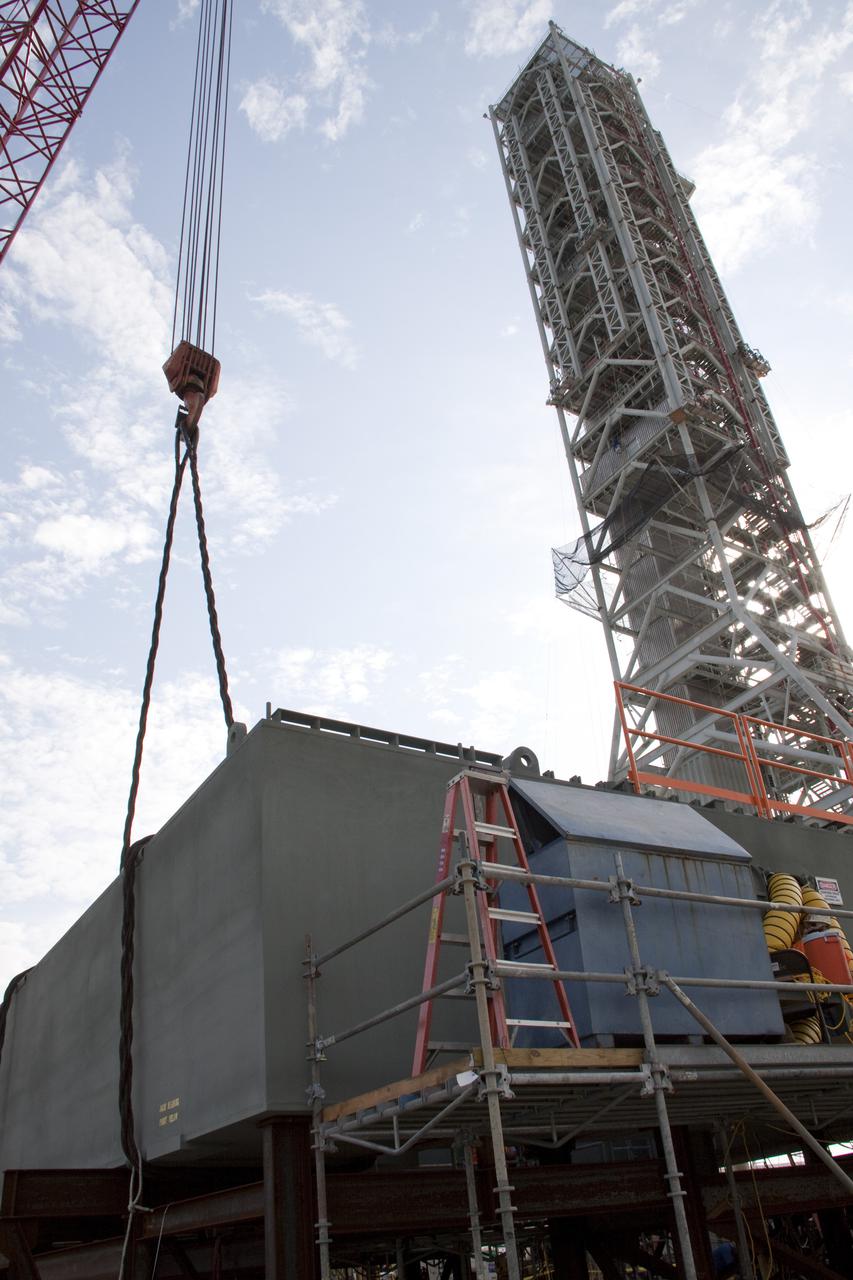
CAPE CANAVERAL, Fla. – At NASA's Kennedy Space Center in Florida, a crane is enlisted to lift a section of the launch mount for a new mobile launcher, or ML, being constructed to support NASA's future human spaceflight program. All eight segments of the mount have been delivered to Kennedy. The launcher's tower looms overhead, at right. The construction is taking place in Launch Complex 39 in the mobile launcher park site north of Kennedy's Vehicle Assembly Building. The new launcher is 355 feet tall and has multiple platforms for personnel access. The base of the launcher is lighter than space shuttle mobile launcher platforms so the crawler-transporter can pick up the heavier load of the tower and a taller rocket. For information on NASA's future plans, visit http:__www.nasa.gov. Photo credit: NASA_Amanda Diller
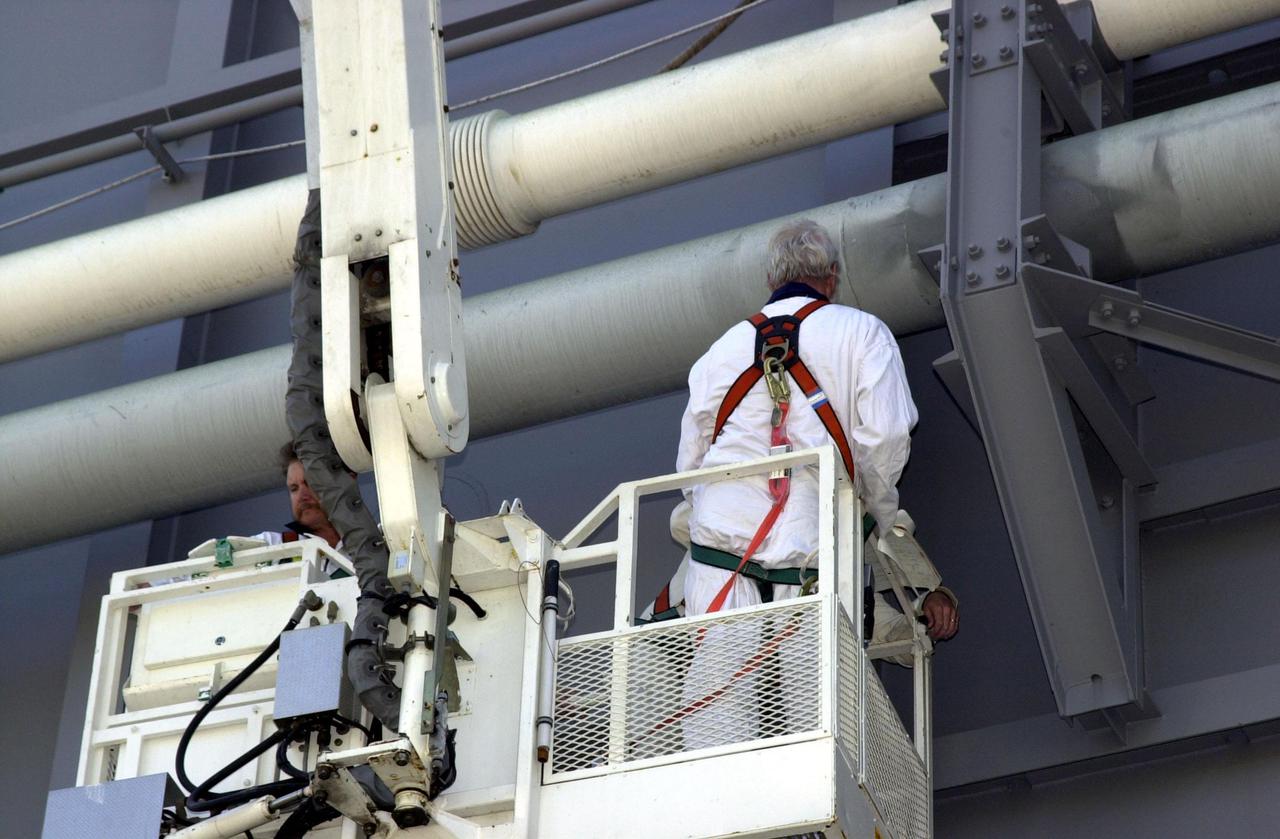
KENNEDY SPACE CENTER, FLA. -- At Launch Pad 39B, a worker on a crane inspects pipes on the Mobile Launcher Platform where Space Shuttle Atlantis sits. Earlier today a leak in a ground support liquid hydrogen vent line on the south side of the Mobile Launcher Platform caused a scrub of the launch of Atlantis on mission STS-110. An engineering team is assessing the situation to determine the best method to repair the hydrogen line. The turnaround plan includes time to perfor weld repairs and return the vehicle to a timeline to resume the countdown
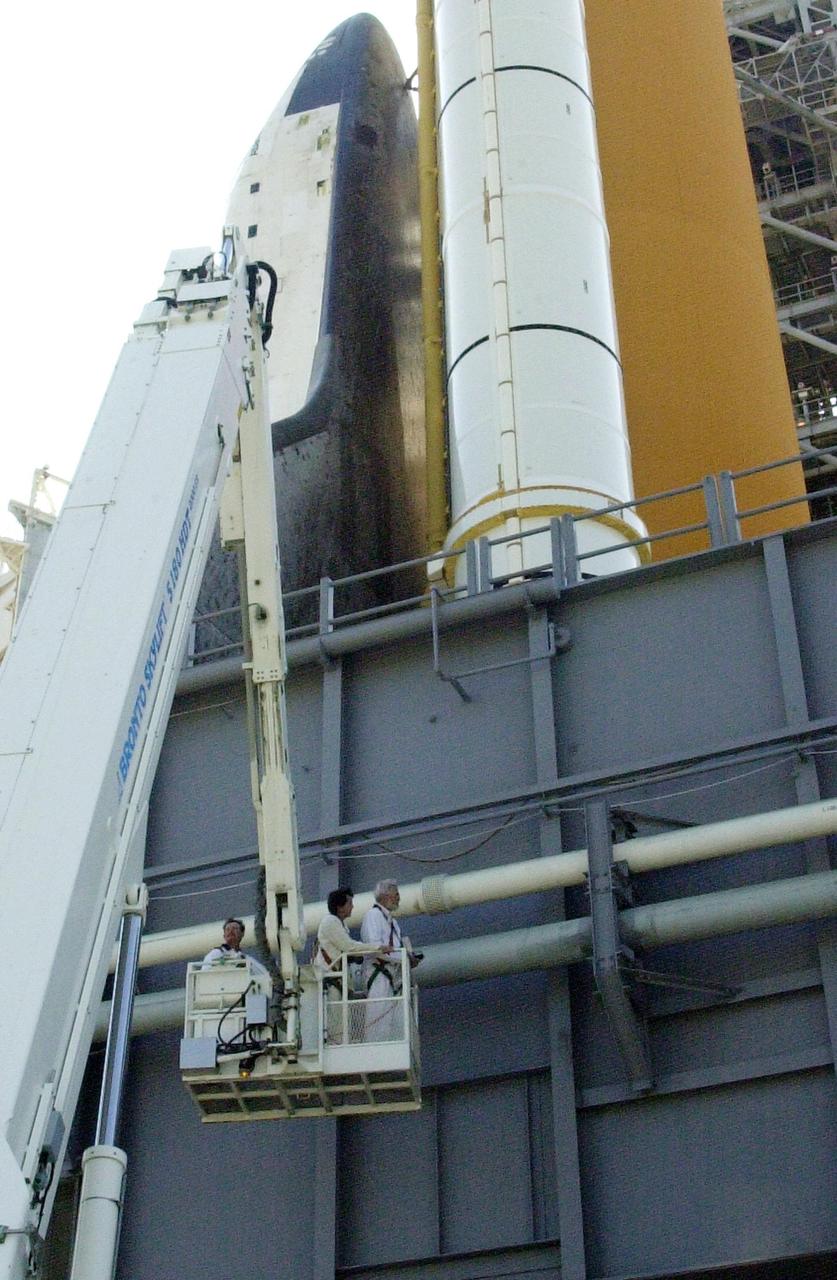
KENNEDY SPACE CENTER, FLA. -- At Launch Pad 39B, workers on a crane inspect pipes on the Mobile Launcher Platform where Space Shuttle Atlantis sits. Earlier today a leak in a ground support liquid hydrogen vent line on the south side of the Mobile Launcher Platform caused a scrub of the launch of Atlantis on mission STS-110. An engineering team is assessing the situation to determine the best method to repair the hydrogen line. The turnaround plan includes time to perfor weld repairs and return the vehicle to a timeline to resume the countdown
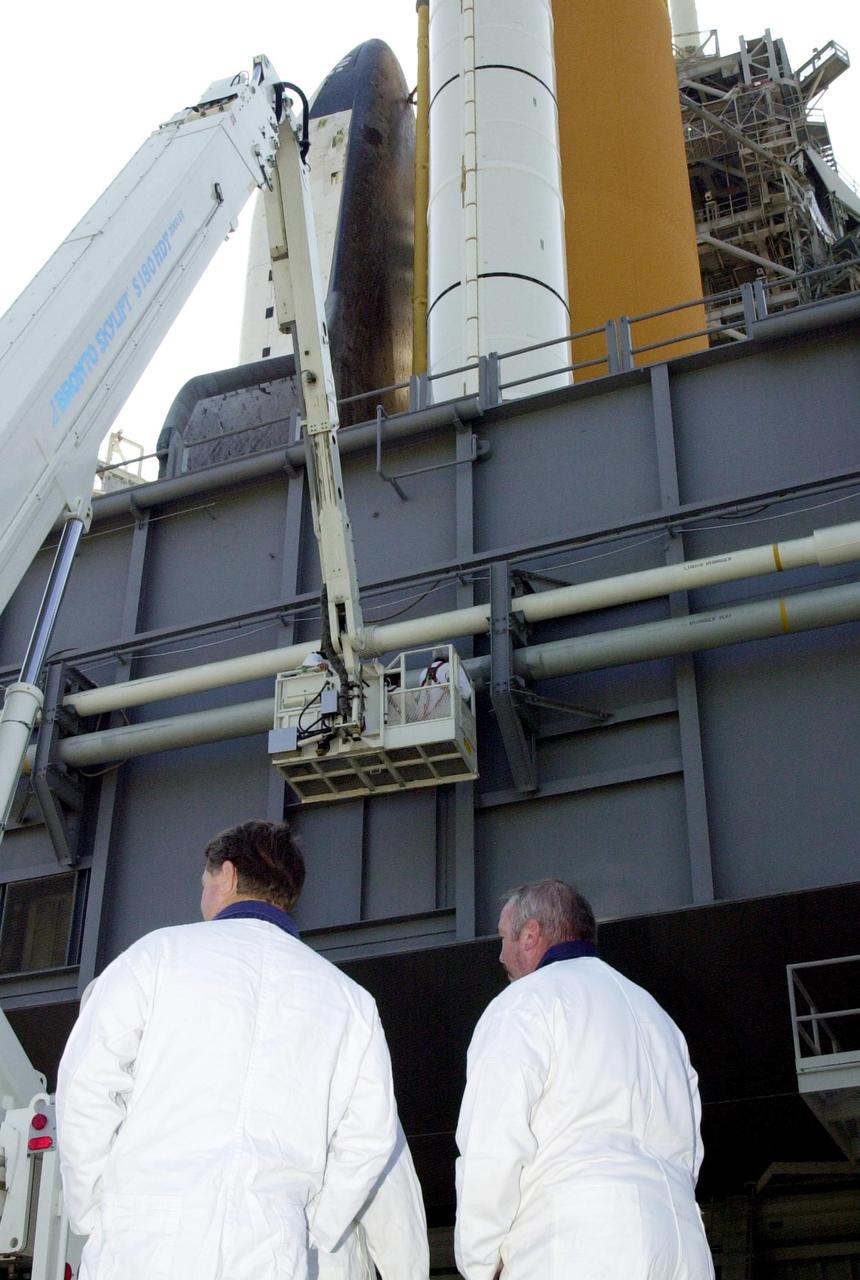
KENNEDY SPACE CENTER, FLA. -- At Launch Pad 39B, an inspection team gathers at the foot of Mobile Launcher Platform where Space Shuttle Atlantis sits. Earlier today a leak in a ground support liquid hydrogen vent line on the south side of the Mobile Launcher Platform caused a scrub of the launch of Atlantis on mission STS-110. An engineering team is assessing the situation to determine the best method to repair the hydrogen line. The turnaround plan includes time to perfor weld repairs and return the vehicle to a timeline to resume the countdown
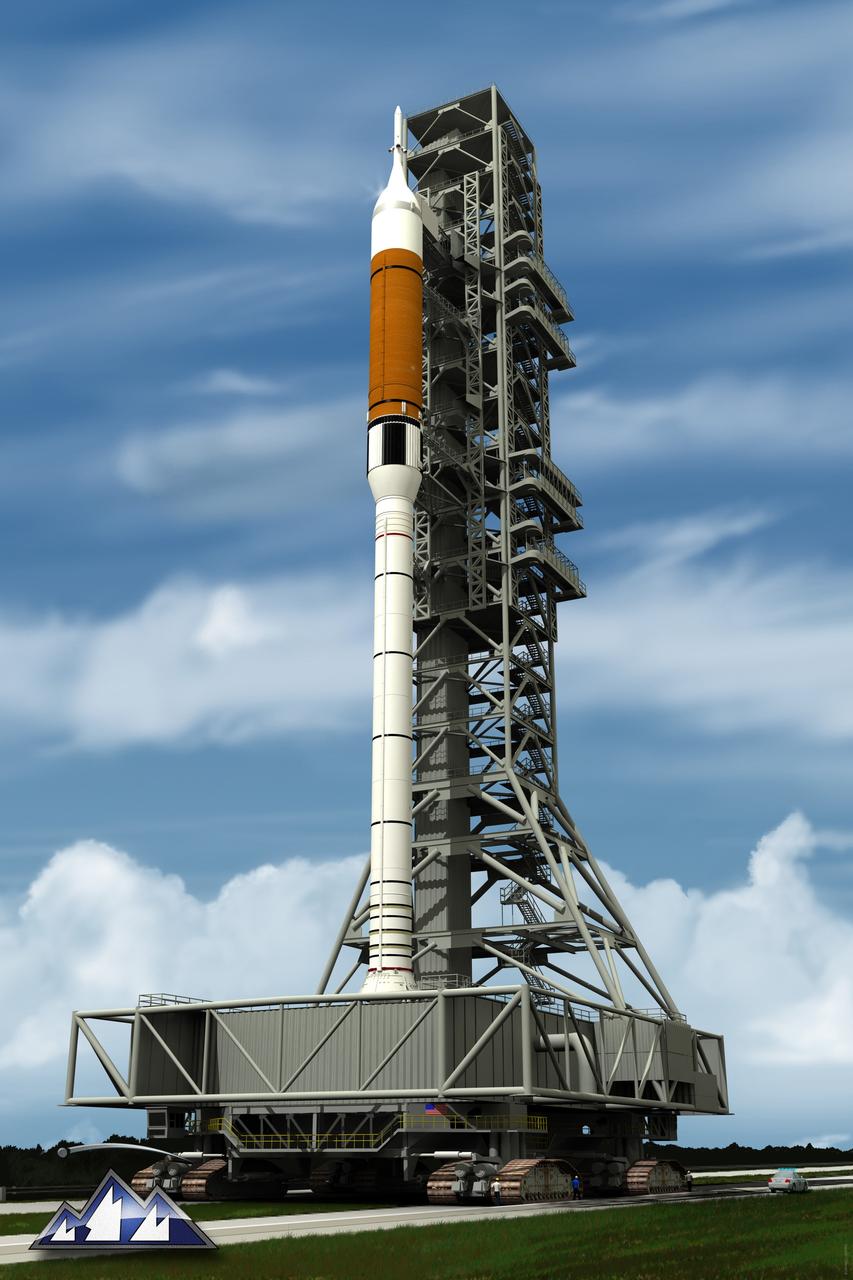
CAPE CANAVERAL, Fla. -- Artist's rendering of the Constellation Program's mobile launcher platform with an Ares I rocket attached. The tower of the mobile launcher will have multiple platforms for personnel access and will be approximately 390 feet tall. The tower will be used in the assembly, testing and servicing of the Ares rockets at Kennedy and will also transport the Ares rockets to the launch pad and provide ground support for launches.
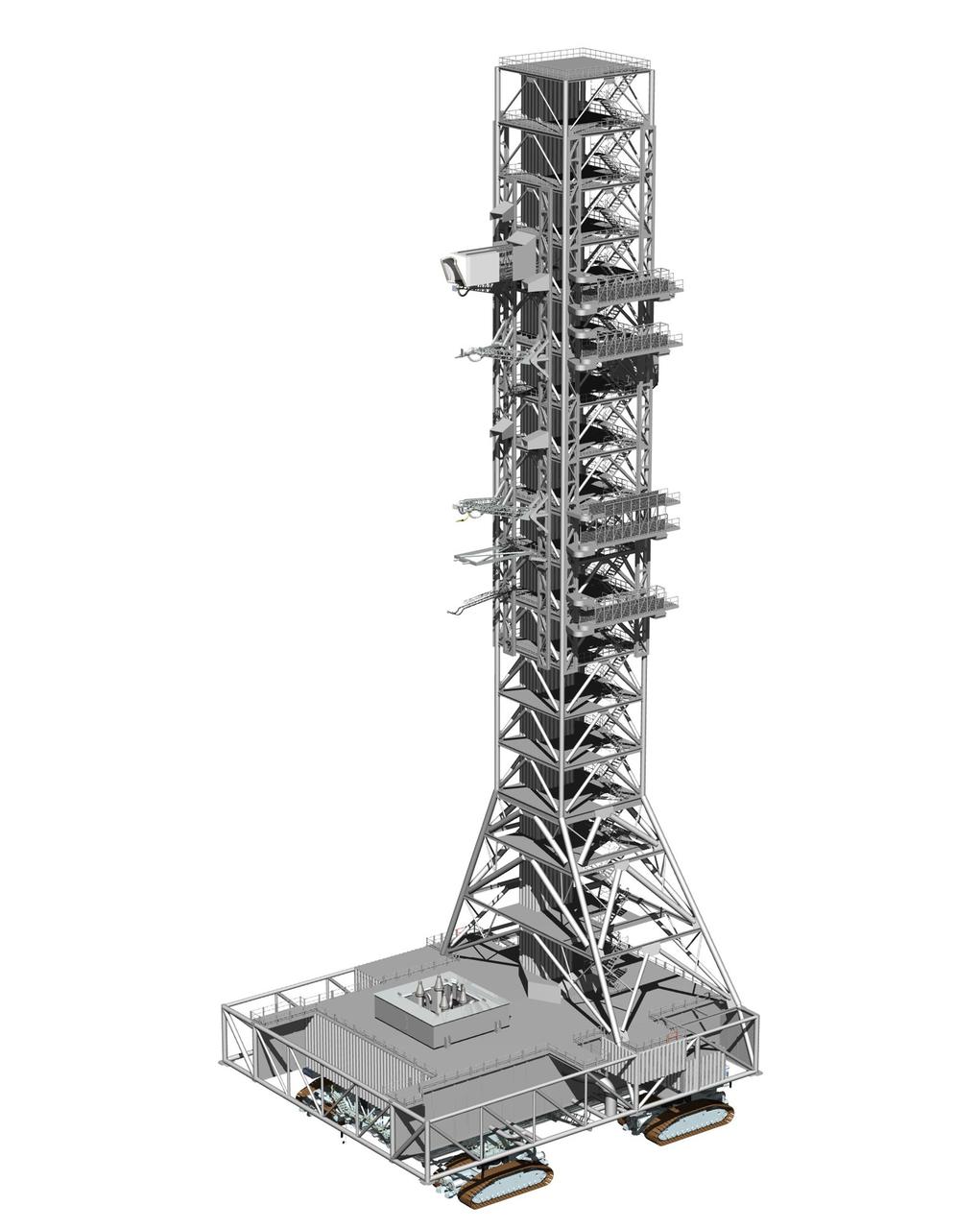
CAPE CANAVERAL, Fla. -- Artist's rendering of the empty Constellation Program's mobile launcher platform planned for the Ares I rocket. The tower of the mobile launcher will have multiple platforms for personnel access and will be approximately 390 feet tall. The tower will be used in the assembly, testing and servicing of the Ares rockets at Kennedy and will also transport the Ares rockets to the launch pad and provide ground support for launches.
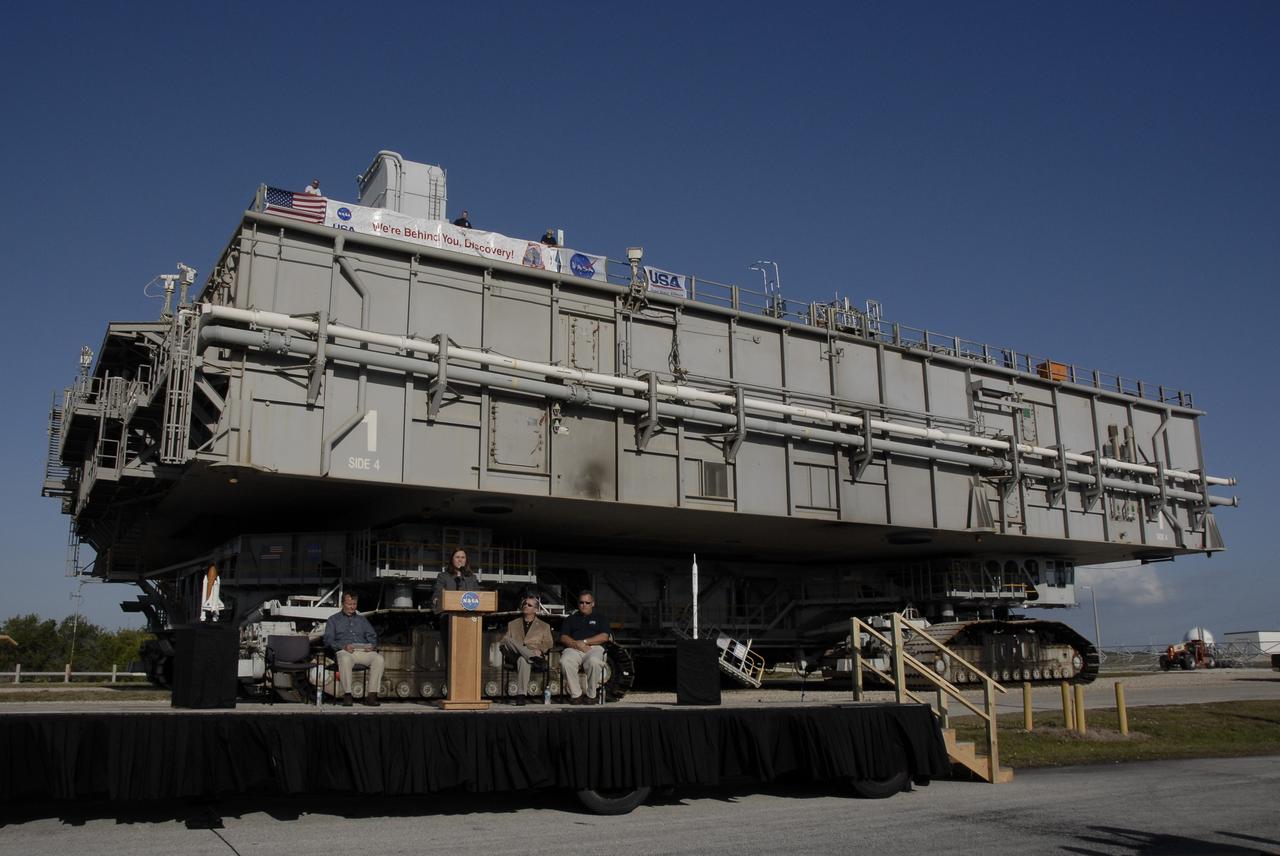
CAPE CANAVERAL, Fla. – NASA's Kennedy Space Center management host a ceremony near Launch Pad 39B to mark the handover of Mobile Launcher Platform-1 (behind them) from NASA's Space Shuttle Program to the Constellation Program for the Ares I-X flight test targeted for this summer. Seated are (left) Shuttle Launch Director Mike Leinbach and (right) Pepper E. Phillips, director of the Constellation Project Office, and Brett Raulerson, manager of MLP Operations with United Space Alliance. At the podium is Rita Willcoxon, director of Launch Vehicle Processing at Kennedy. Constructed in 1964, the mobile launchers used in Apollo/Saturn operations were modified for use in shuttle operations. With cranes, umbilical towers and swing arms removed, the mobile launchers were renamed Mobile Launcher Platforms, or MLPs. Photo credit: NASA/Kim Shiflett
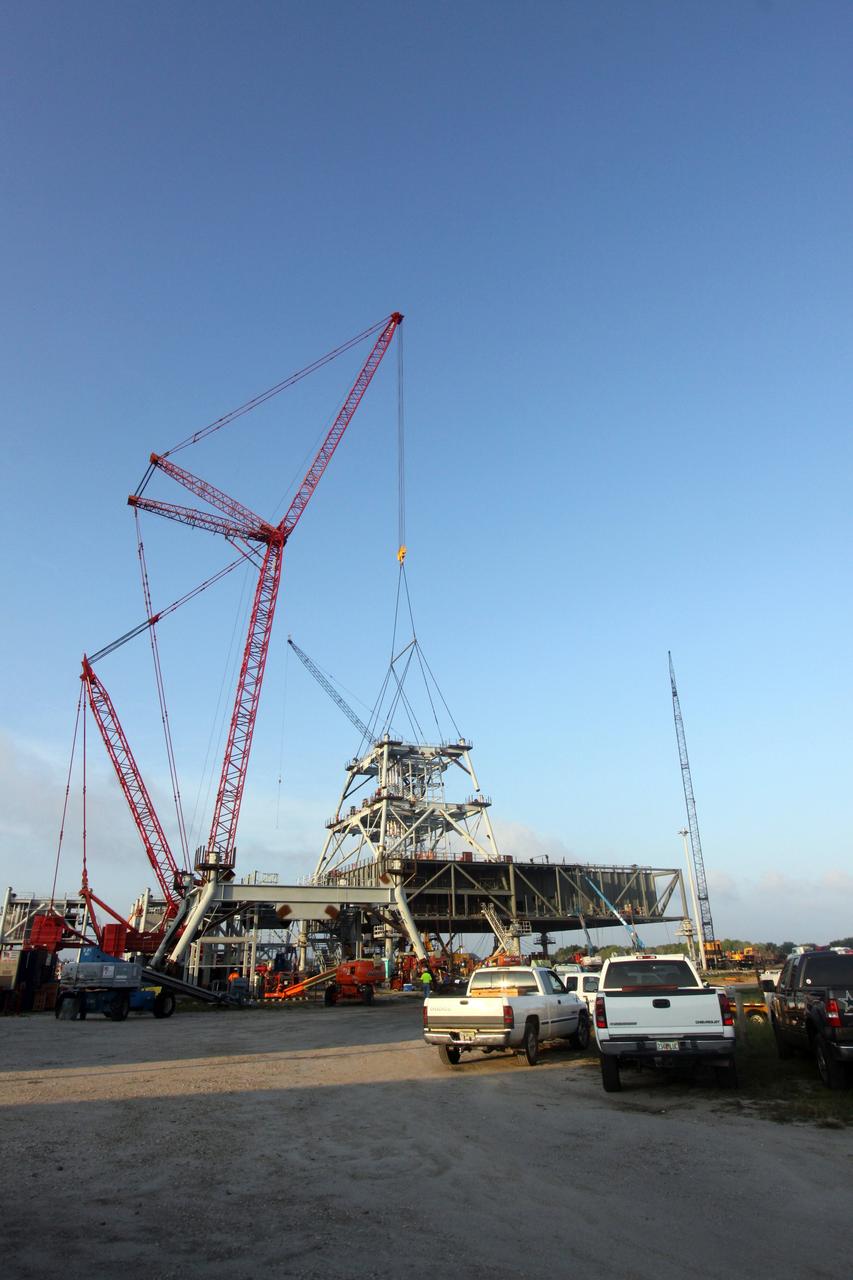
CAPE CANAVERAL, Fla. – At NASA's Kennedy Space Center in Florida, progress continues on the construction of a new mobile launcher, or ML, for the Constellation Program as a crane lifts the second section of the launcher's tower into place. Installation of the first section was on Sept. 24. The tower will have multiple platforms for personnel access and be approximately 345 feet tall. The launcher is being built at the mobile launcher park site area located north of Kennedy's Vehicle Assembly Building to support the Ares I rocket. The ML will provide a base to launch the Ares I which will transport the Orion crew exploration vehicle, its crew and cargo to low Earth orbit. The base is being made lighter than space shuttle mobile launcher platforms so the crawler-transporter can pick up the heavier load of the tower and taller rocket. For information on the Ares I, visit http://www.nasa.gov/ares. Photo credit: NASA/Jack Pfaller
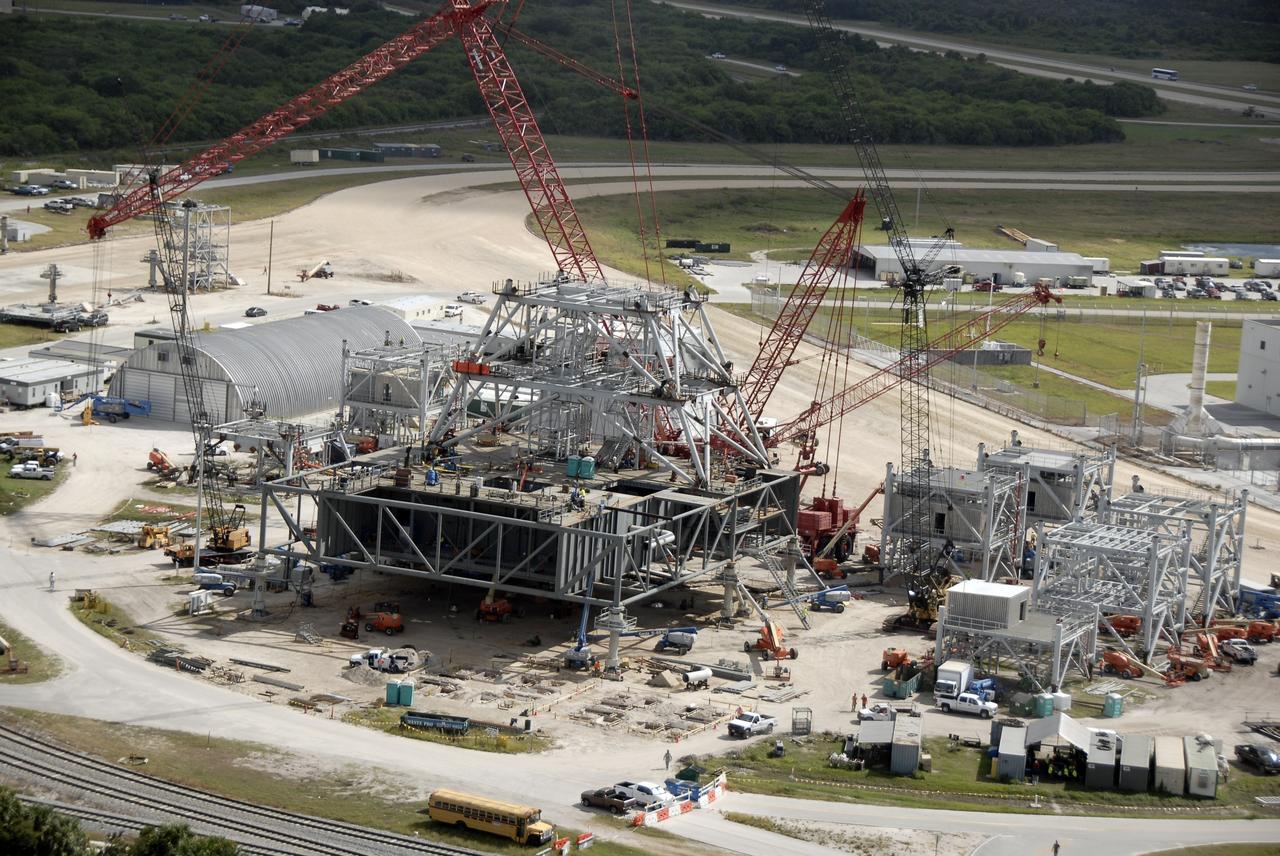
CAPE CANAVERAL, Fla. – At NASA's Kennedy Space Center in Florida, the airspace over the mobile launcher park site area is filled with the lumbering arms of multiple cranes, all doing their part in the construction of a new mobile launcher, or ML, for the Constellation Program. The launcher is being built at the site, north of Kennedy's Vehicle Assembly Building, to support the Ares I rocket. The launcher's tower will have multiple platforms for personnel access and be approximately 345 feet tall. The ML will provide a base to launch the Ares I which will transport the Orion crew exploration vehicle, its crew and cargo to low Earth orbit. The base is being made lighter than space shuttle mobile launcher platforms so the crawler-transporter can pick up the heavier load of the tower and taller rocket. For information on the Ares I, visit http://www.nasa.gov/ares. Photo credit: NASA/Kim Shiflett

CAPE CANAVERAL, Fla. – At NASA's Kennedy Space Center in Florida, work is under way to construct the launch mount for a new mobile launcher, or ML, which will support NASA's future human spaceflight program, following the arrival of all eight segments. The construction is taking place in Launch Complex 39 in the mobile launcher park site north of Kennedy's Vehicle Assembly Building. The new launcher is 355 feet tall and has multiple platforms for personnel access. The base of the launcher is lighter than space shuttle mobile launcher platforms so the crawler-transporter can pick up the heavier load of the tower and a taller rocket. For information on NASA's future plans, visit http:__www.nasa.gov. Photo credit: NASA_Amanda Diller
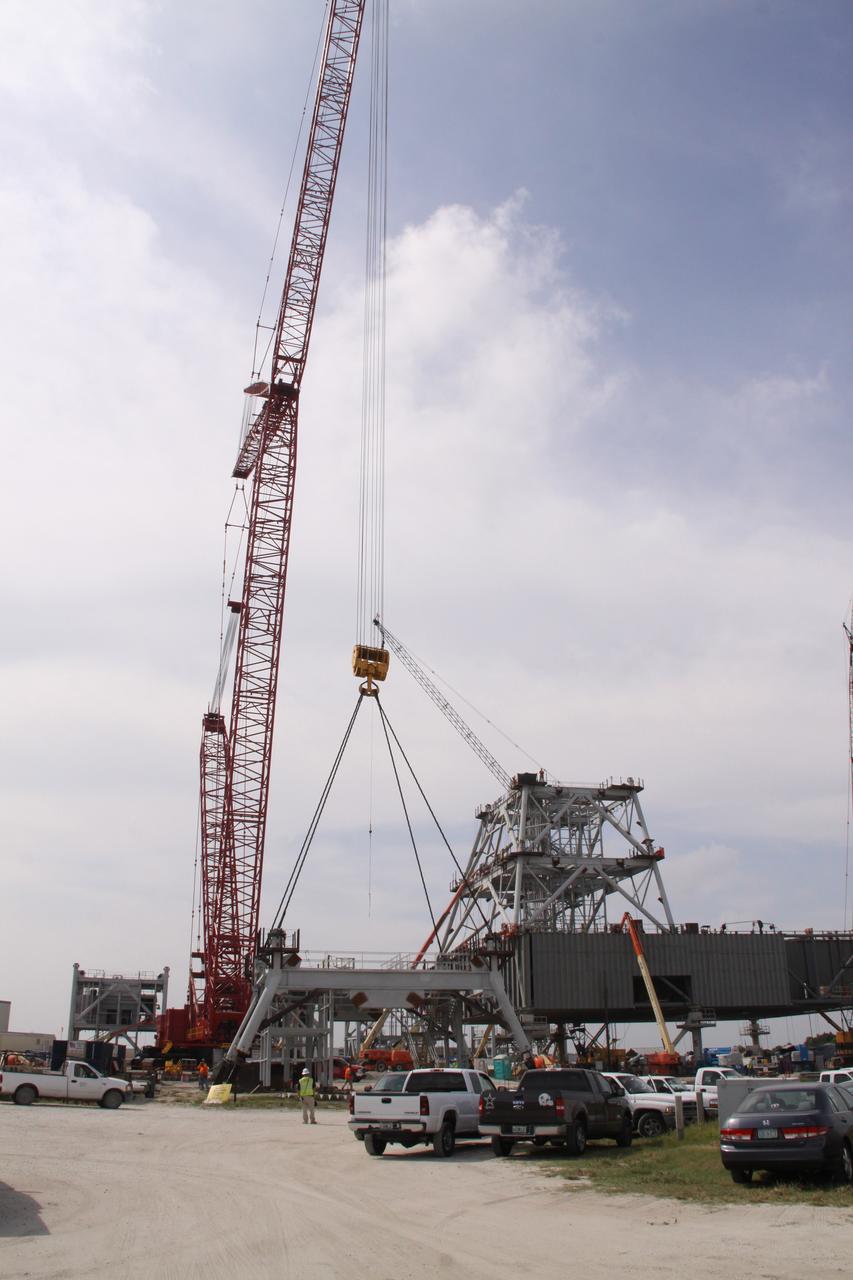
CAPE CANAVERAL, Fla. – At NASA's Kennedy Space Center in Florida, progress continues on the construction of a new mobile launcher, or ML, for the Constellation Program as a crane begins to lift the third section of the launcher's tower from the ground. Installation of the first section was on Sept. 24, and the second, on Oct. 15. The tower will have multiple platforms for personnel access and be approximately 345 feet tall. The launcher is being built at the mobile launcher park site area located north of Kennedy's Vehicle Assembly Building to support the Ares I rocket. The ML will provide a base to launch the Ares I, designed to transport the Orion crew exploration vehicle, its crew and cargo to low Earth orbit. The base is being made lighter than space shuttle mobile launcher platforms so the crawler-transporter can pick up the heavier load of the tower and taller rocket. For information on the Ares I, visit http://www.nasa.gov/ares. Photo credit: NASA/Jack Pfaller
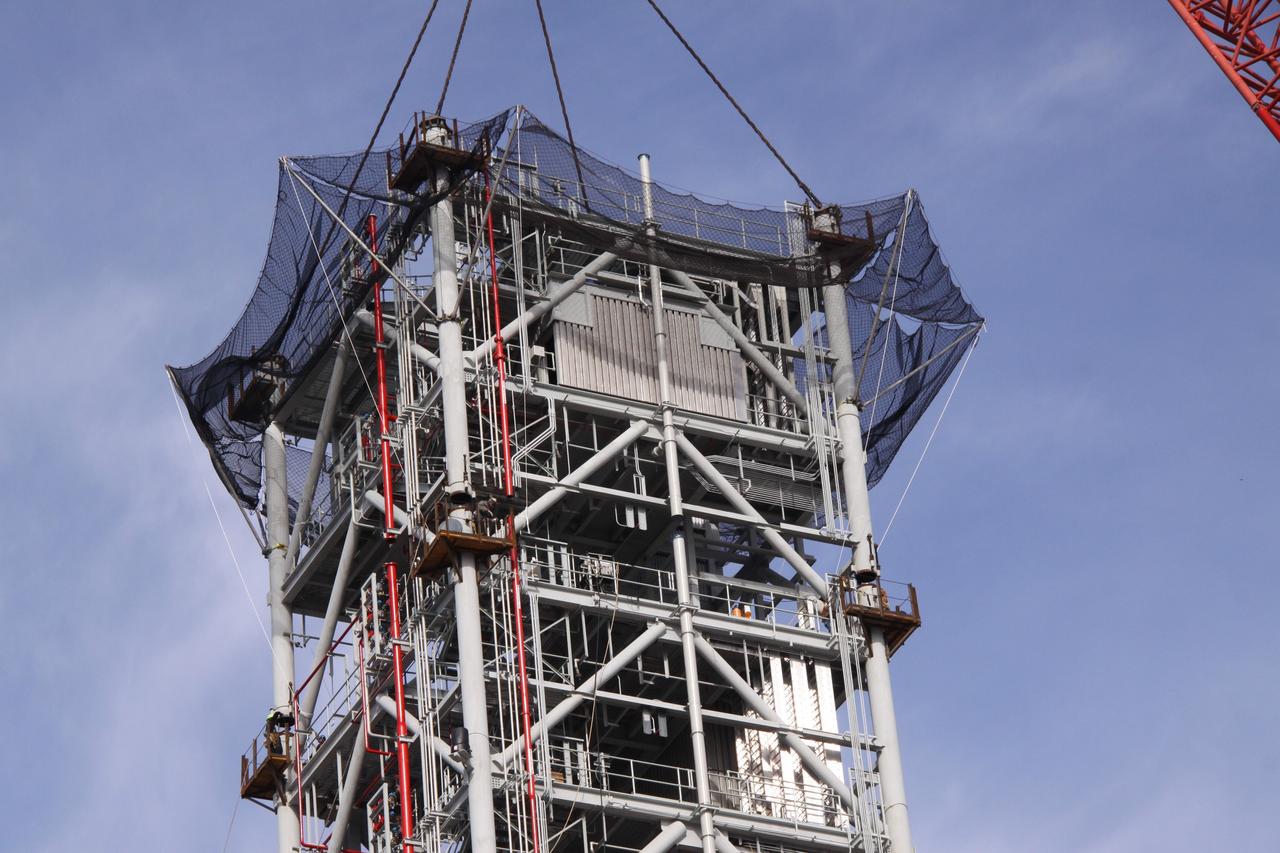
CAPE CANAVERAL, Fla. – At NASA's Kennedy Space Center in Florida, the seventh tower segment of a new mobile launcher, or ML, being constructed to support the Constellation Program, is lined up with the six segments already secured to the launcher's surface. When completed, the tower will be approximately 345 feet tall and have multiple platforms for personnel access. The construction is under way at the mobile launcher park site area north of Kennedy's Vehicle Assembly Building. The launcher will provide a base to launch the Ares I rocket, designed to transport the Orion crew exploration vehicle, its crew and cargo to low Earth orbit. Its base is being made lighter than space shuttle mobile launcher platforms so the crawler-transporter can pick up the heavier load of the tower and taller rocket. For information on the Ares I, visit http://www.nasa.gov/ares. Photo credit: NASA/Jack Pfaller