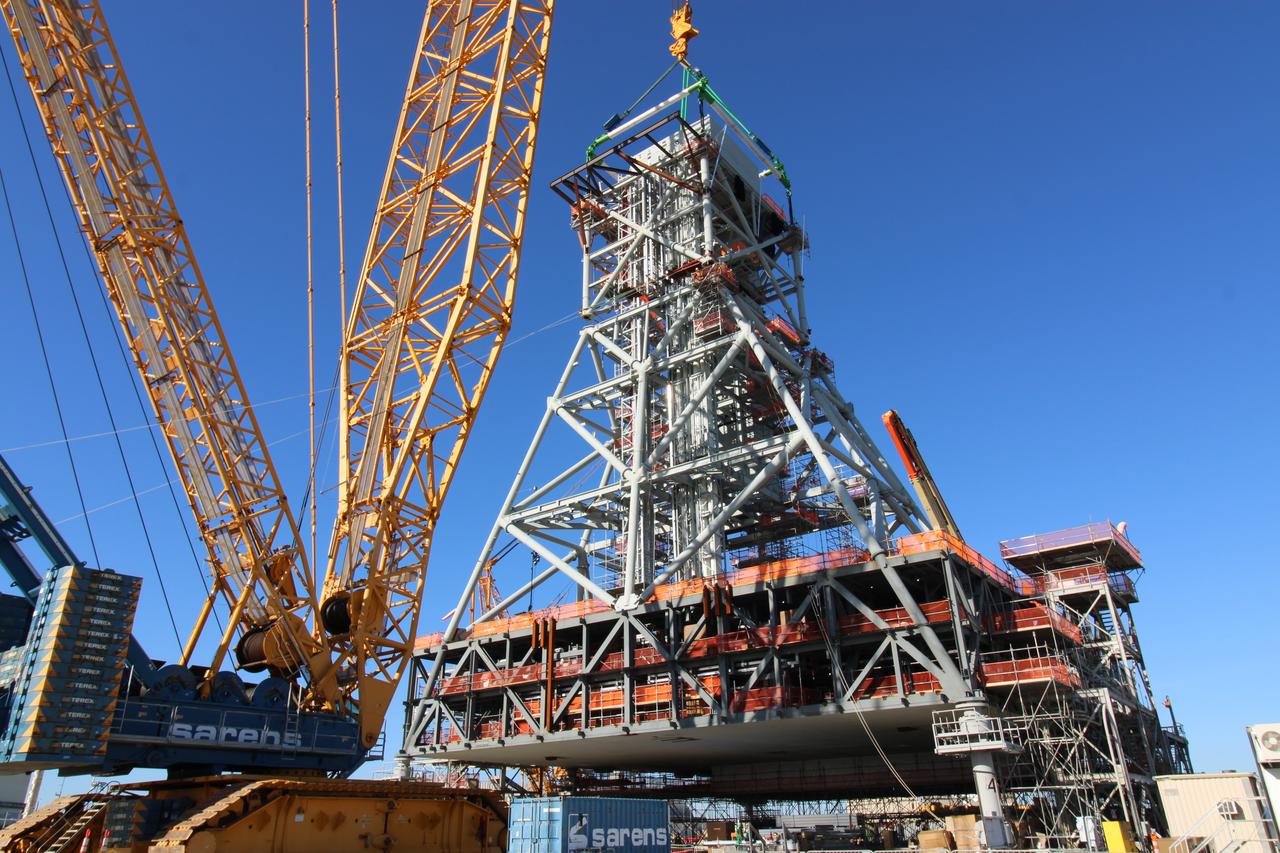
Teams at Bechtel National, Inc. use a crane to lift Module 4 into place atop the mobile launcher 2 tower chair at its Kennedy Space Center park site on January 3, 2025. Module 4 is the first of seven modules that will be stacked vertically to make up the almost 400-foot launch tower that will be used beginning with the Artemis IV mission.
Module 4 Lift onto Mobile Launcher 2
Teams at Bechtel National, Inc. use a crane to lift Module 4 into place atop the mobile launcher 2 tower chair at its Kennedy Space Center park site on January 3, 2025. Module 4 is the first of seven modules that will be stacked vertically to make up the almost 400-foot launch tower that will be used beginning with the Artemis IV mission.
Module 4 Lift onto Mobile Launcher 2
Teams at Bechtel National, Inc. use a crane to lift Module 4 into place atop the mobile launcher 2 tower chair at its Kennedy Space Center park site on January 3, 2025. Module 4 is the first of seven modules that will be stacked vertically to make up the almost 400-foot launch tower that will be used beginning with the Artemis IV mission.
Module 4 Lift onto Mobile Launcher 2
Teams at Bechtel National, Inc. use a crane to lift Module 4 into place atop the mobile launcher 2 tower chair at its Kennedy Space Center park site on January 3, 2025. Module 4 is the first of seven modules that will be stacked vertically to make up the almost 400-foot launch tower that will be used beginning with the Artemis IV mission.
Module 4 Lift onto Mobile Launcher 2
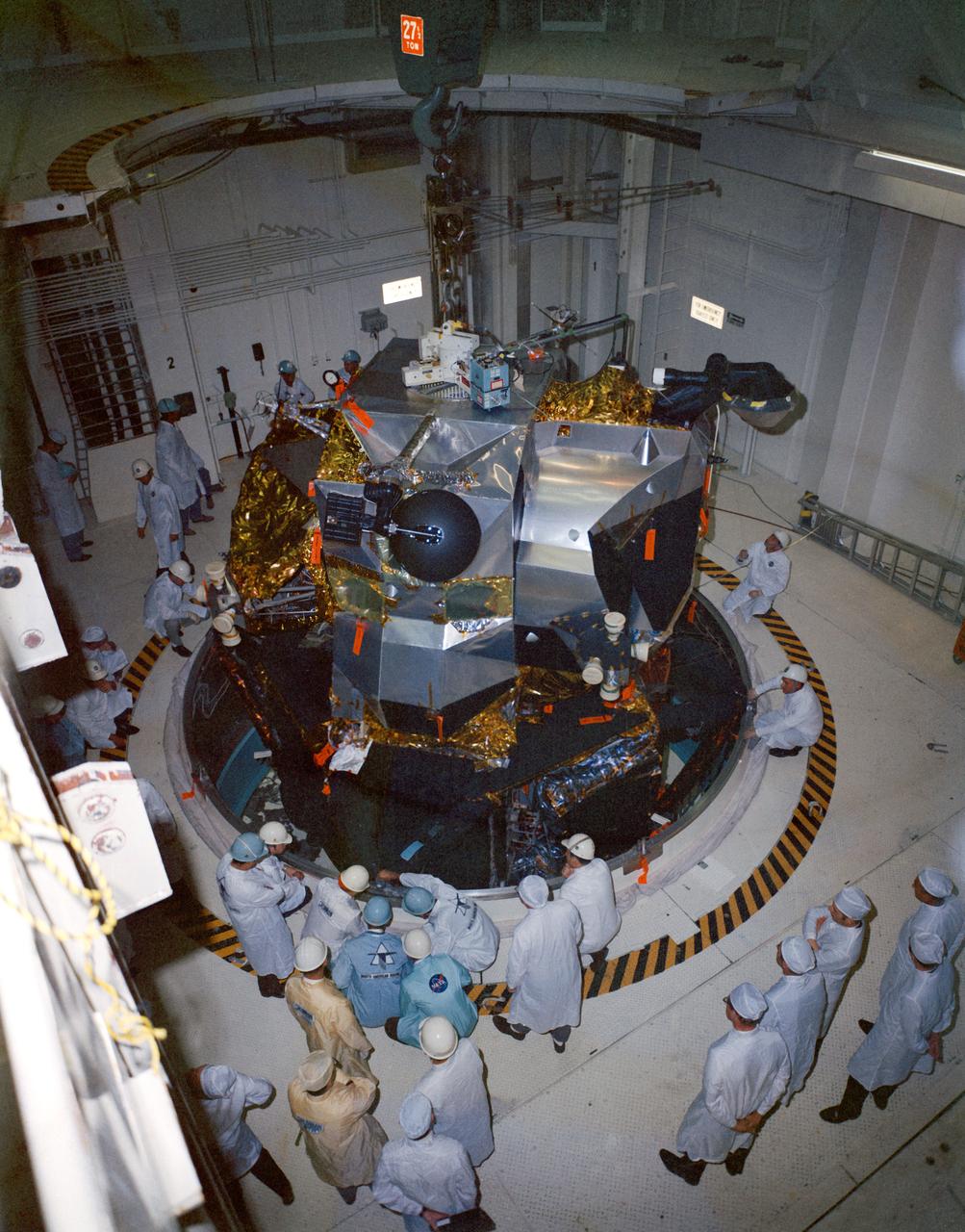
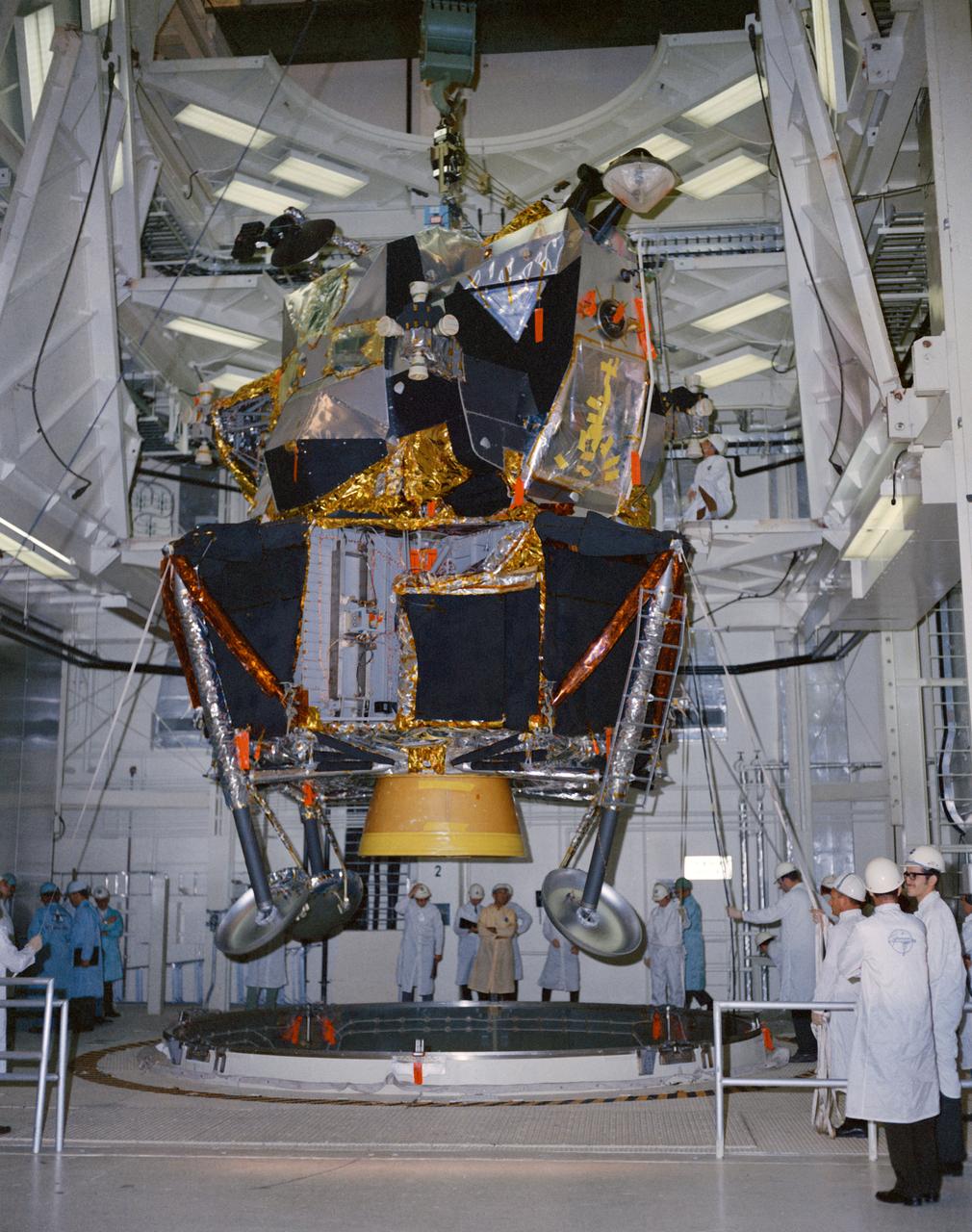
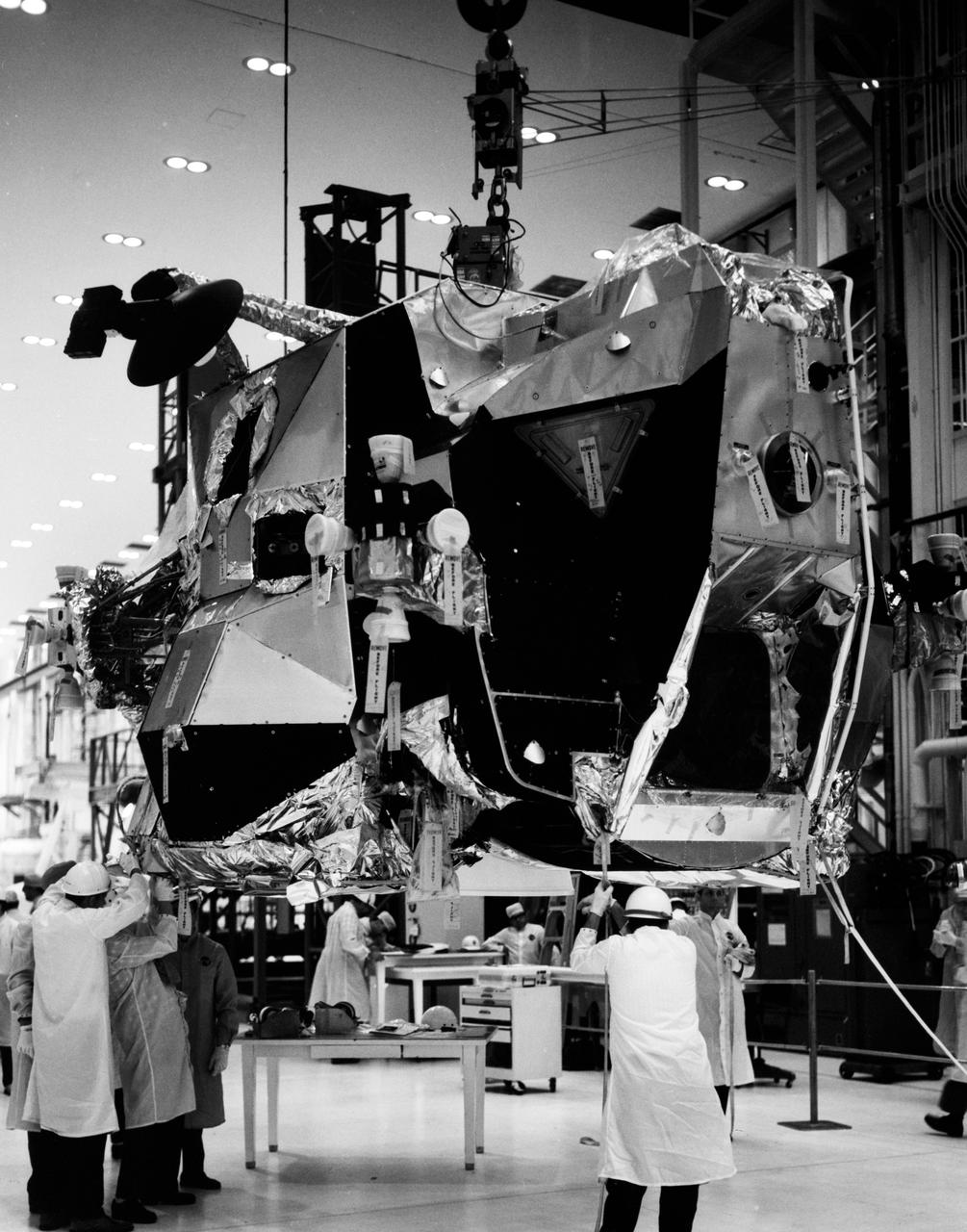
S69-17809 (13 Jan. 1969) --- Lunar Module 4 in the Kennedy Space Center's Manned Spacecraft Operations Building being moved into position for mating with Spacecraft Lunar Module Adapter (SLA) 13. Lunar Module 4 will be flown on the Apollo 10 (Spacecraft 106/Saturn 505) lunar orbit mission.
Lunar Module 4 moved for mating with Lunar Module Adapter at KSC
SL4-150-5074 (February 1974) --- Scientist-astronaut Edward G. Gibson, science pilot for the Skylab 4 mission, demonstrates the effects of zero-gravity as he sails through airlock module hatch. Photo credit: NASA
Astronaut Edward Gibson sails through airlock module hatch
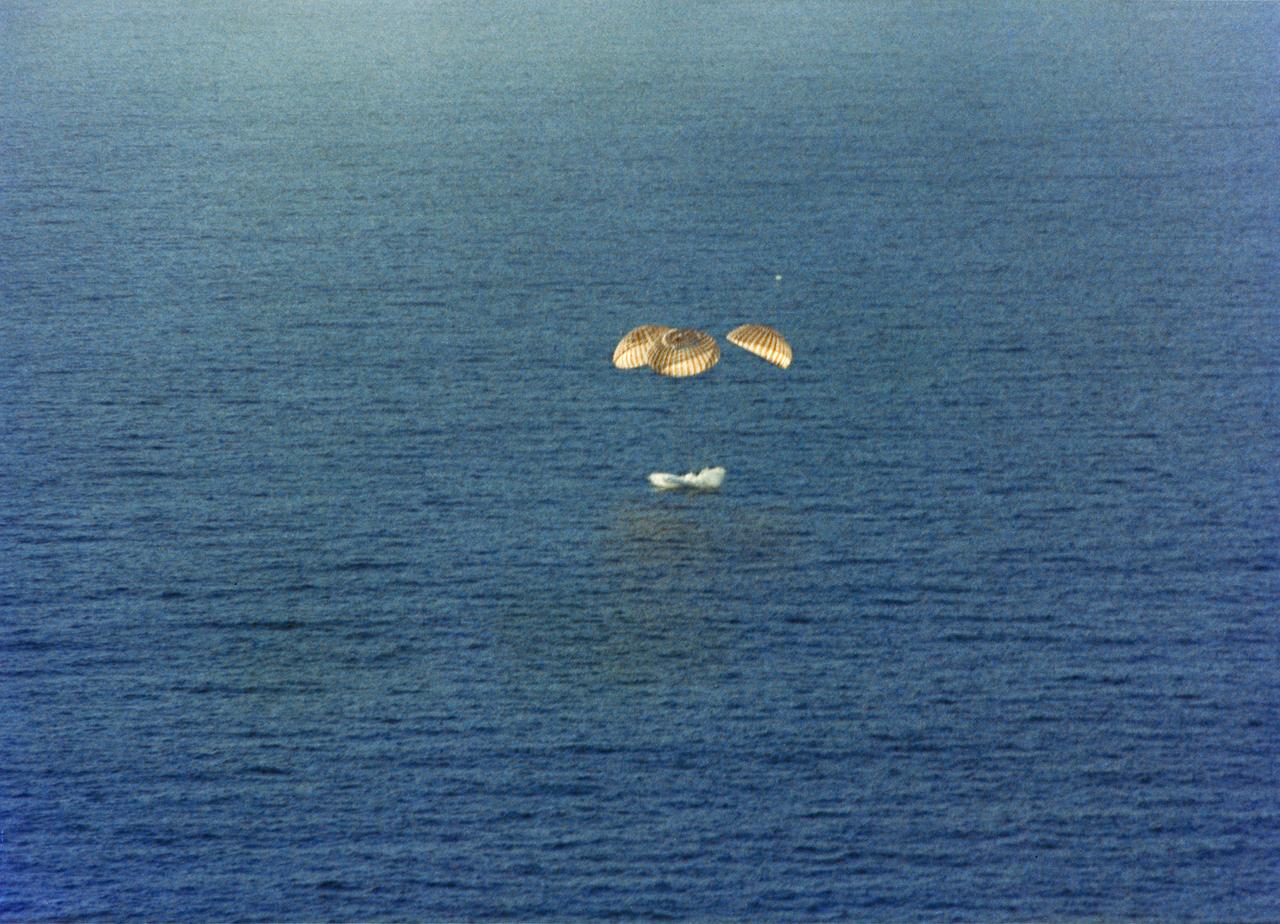
S74-17741 (8 Feb. 1974) --- The Skylab 4 Command Module splashes down in the Pacific Ocean southwest of San Diego, California at 10:17 a.m., Feb. 8, 1974. Photo credit: NASA
Skylab 4 Command Module in Pacific Ocean after splashdown
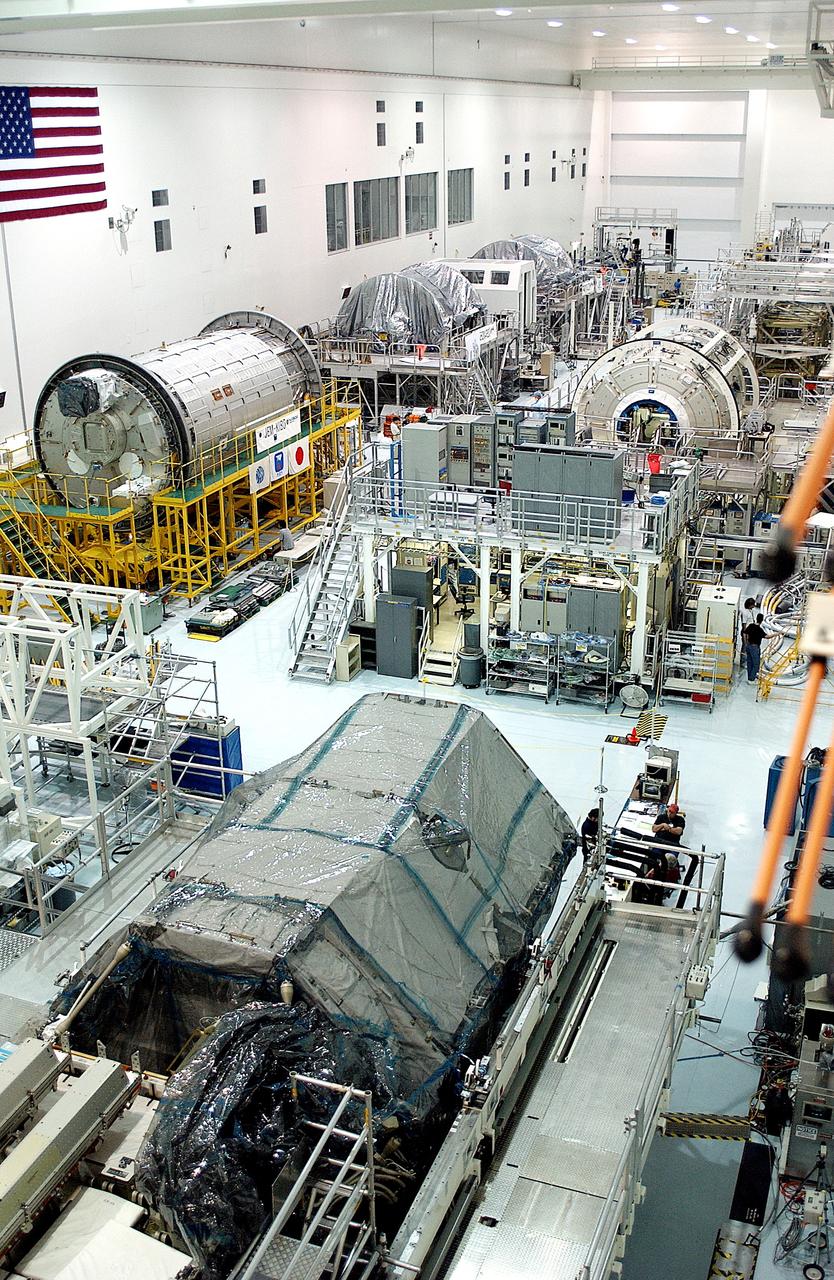
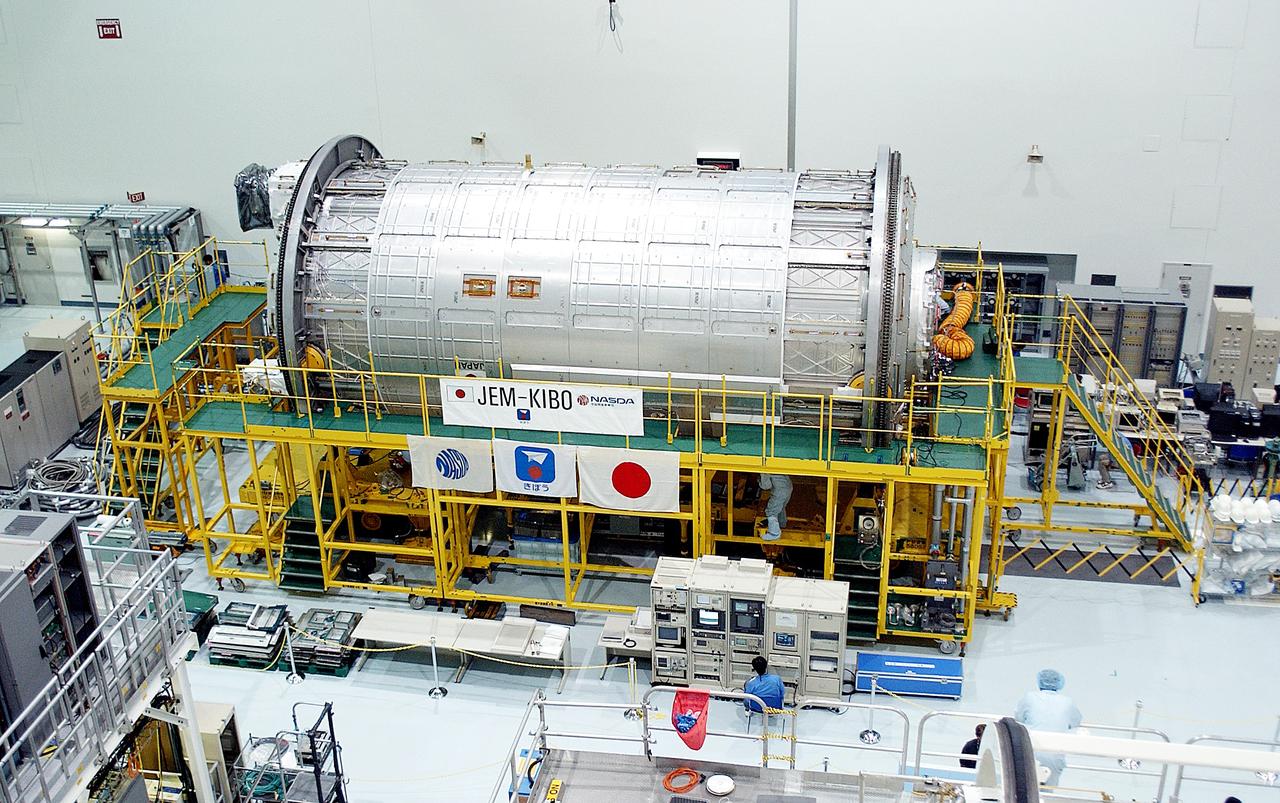
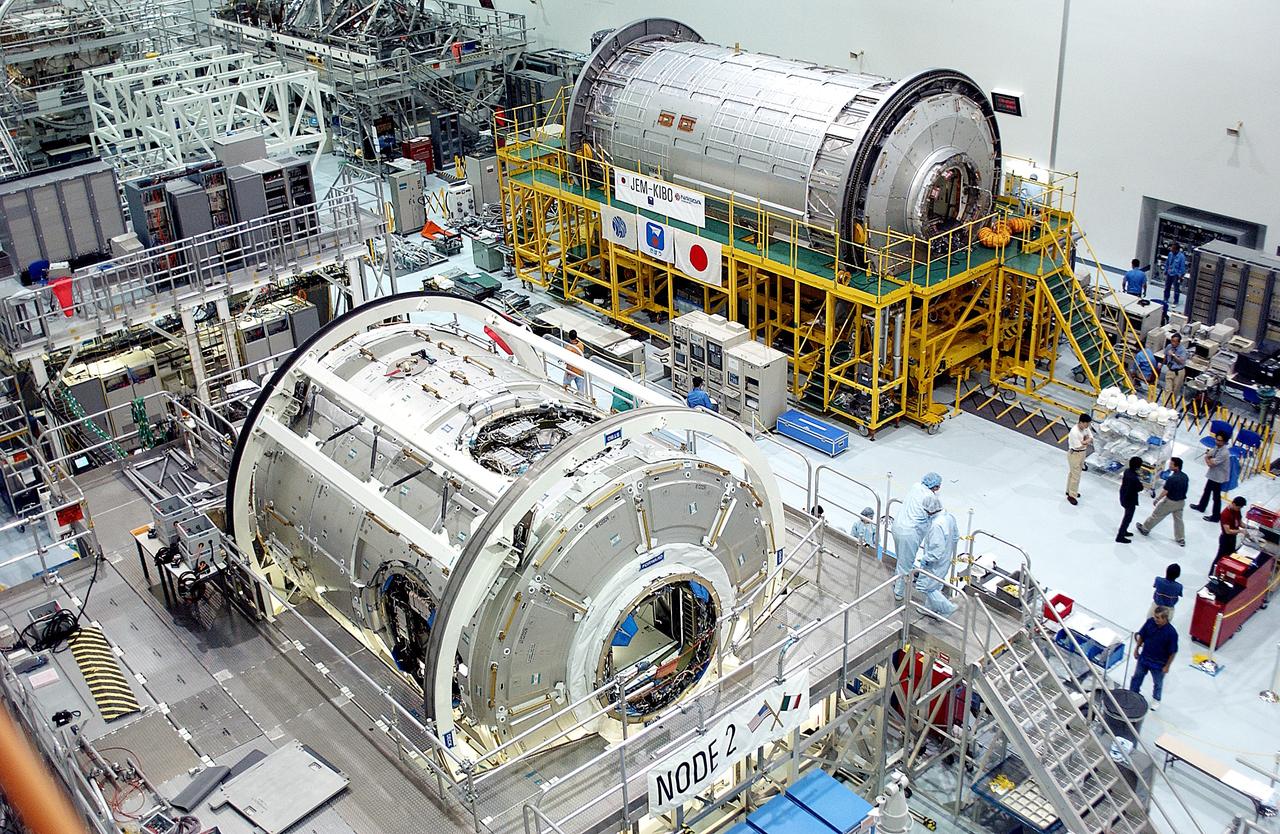
KENNEDY SPACE CENTER, FLA. -  International Space Station elements being processed for launch on upcoming Space Shuttle flights, including the Japanese Experiment Module (JEM) pressurized module (Kibo or Hope) and the U.S. Node 2, line the walls of the high bay in the Space Station Processing Facility.  NASA's Node 2, built by the European Space Agency (ESA) in Italy, arrived at KSC on June 1. It will be the next pressurized module installed on the Station. The JEM pressurized module arrived at KSC on June 4. It is Japan's primary contribution to the Station.
KENNEDY SPACE CENTER, FLA. - International Space Station elements being processed for launch on upcoming Space Shuttle flights, including the Japanese Experiment Module (JEM) pressurized module (Kibo or Hope) and the U.S. Node 2, line the walls of the high bay in the Space Station Processing Facility. NASA's Node 2, built by the European Space Agency (ESA) in Italy, arrived at KSC on June 1. It will be the next pressurized module installed on the Station. The JEM pressurized module arrived at KSC on June 4. It is Japan's primary contribution to the Station.
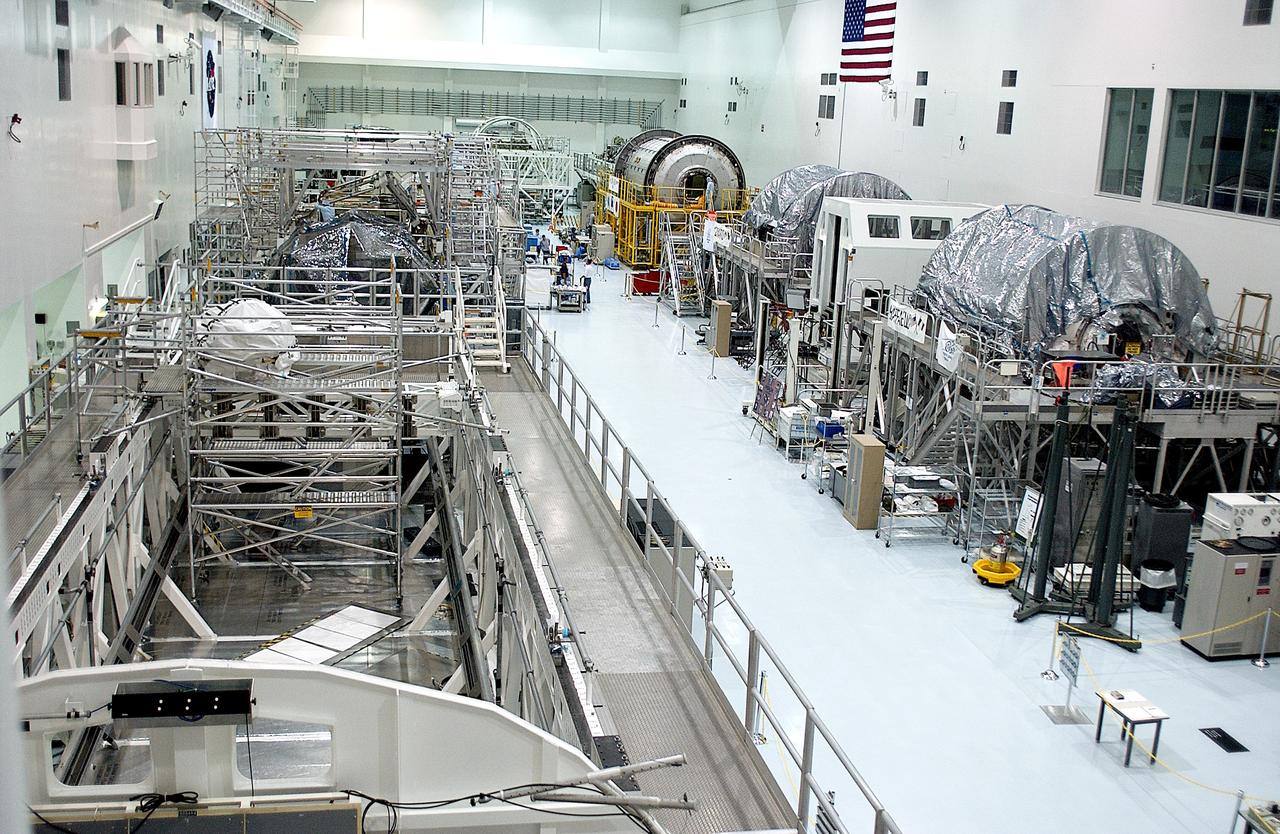
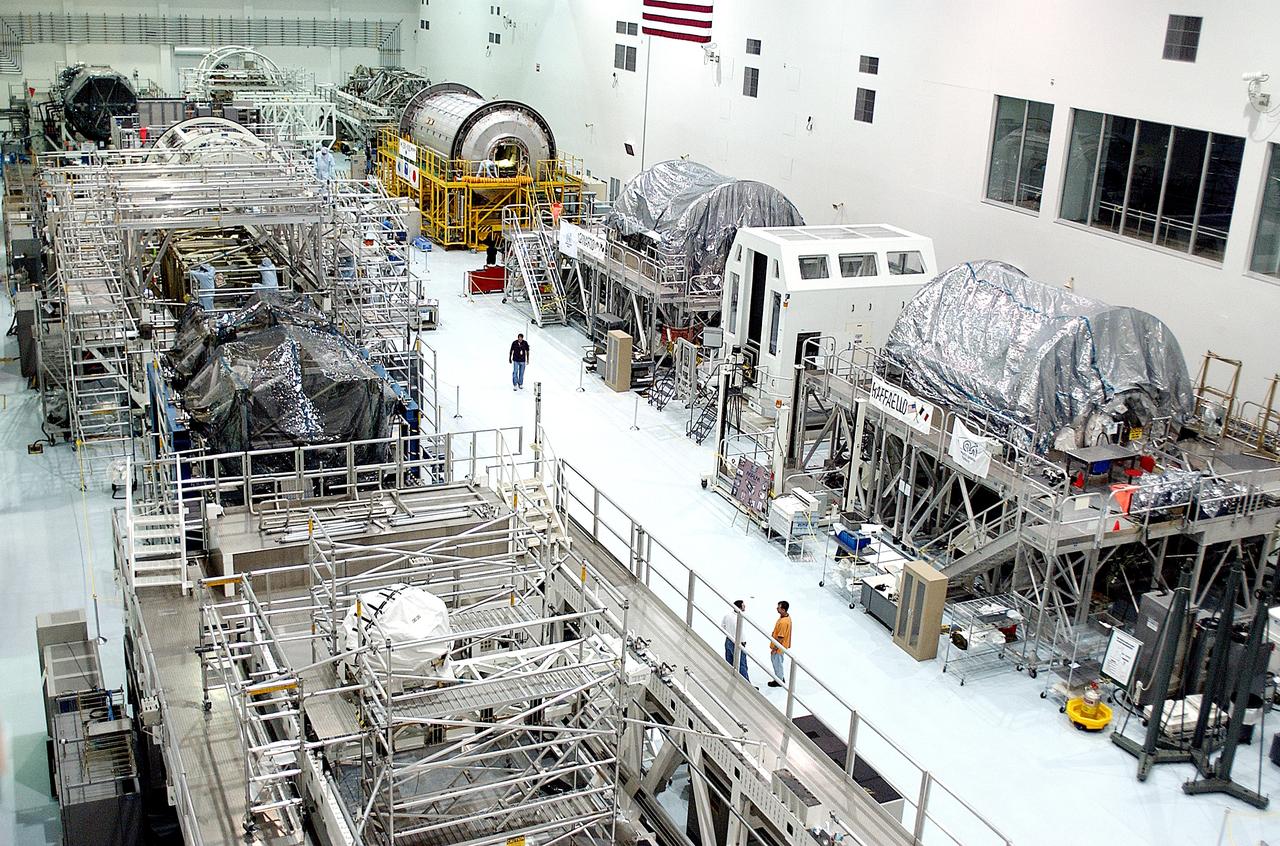
KENNEDY SPACE CENTER, FLA. -  International Space Station elements being processed for launch on upcoming Space Shuttle flights line the walls of the high bay in the Space Station Processing Facility. NASA's Node 2, built by the European Space Agency (ESA) in Italy, arrived at KSC on June 1. It will be the next pressurized module installed on the Station. The pressurized module of the Japanese Experiment Module (JEM), named "Kibo" (Hope), arrived at KSC on June 4. It is Japan's primary contribution to the Station.
KENNEDY SPACE CENTER, FLA. - International Space Station elements being processed for launch on upcoming Space Shuttle flights line the walls of the high bay in the Space Station Processing Facility. NASA's Node 2, built by the European Space Agency (ESA) in Italy, arrived at KSC on June 1. It will be the next pressurized module installed on the Station. The pressurized module of the Japanese Experiment Module (JEM), named "Kibo" (Hope), arrived at KSC on June 4. It is Japan's primary contribution to the Station.
KENNEDY SPACE CENTER, FLA. -  International Space Station elements being processed for launch on upcoming Space Shuttle flights line the walls of the high bay in the Space Station Processing Facility. NASA's Node 2, built by the European Space Agency (ESA) in Italy, arrived at KSC on June 1. It will be the next pressurized module installed on the Station. The pressurized module of the Japanese Experiment Module (JEM), named "Kibo" (Hope), arrived at KSC on June 4. It is Japan's primary contribution to the Station.
KENNEDY SPACE CENTER, FLA. - International Space Station elements being processed for launch on upcoming Space Shuttle flights line the walls of the high bay in the Space Station Processing Facility. NASA's Node 2, built by the European Space Agency (ESA) in Italy, arrived at KSC on June 1. It will be the next pressurized module installed on the Station. The pressurized module of the Japanese Experiment Module (JEM), named "Kibo" (Hope), arrived at KSC on June 4. It is Japan's primary contribution to the Station.
KENNEDY SPACE CENTER, FLA. -  International Space Station elements being processed for launch on upcoming Space Shuttle flights, including the Japanese Experiment Module (JEM) pressurized module, line the walls of the high bay in the Space Station Processing Facility. The JEM pressurized module, named "Kibo" (Hope), arrived at KSC on June 4. It is Japan's primary contribution to the Station.
KENNEDY SPACE CENTER, FLA. - International Space Station elements being processed for launch on upcoming Space Shuttle flights, including the Japanese Experiment Module (JEM) pressurized module, line the walls of the high bay in the Space Station Processing Facility. The JEM pressurized module, named "Kibo" (Hope), arrived at KSC on June 4. It is Japan's primary contribution to the Station.
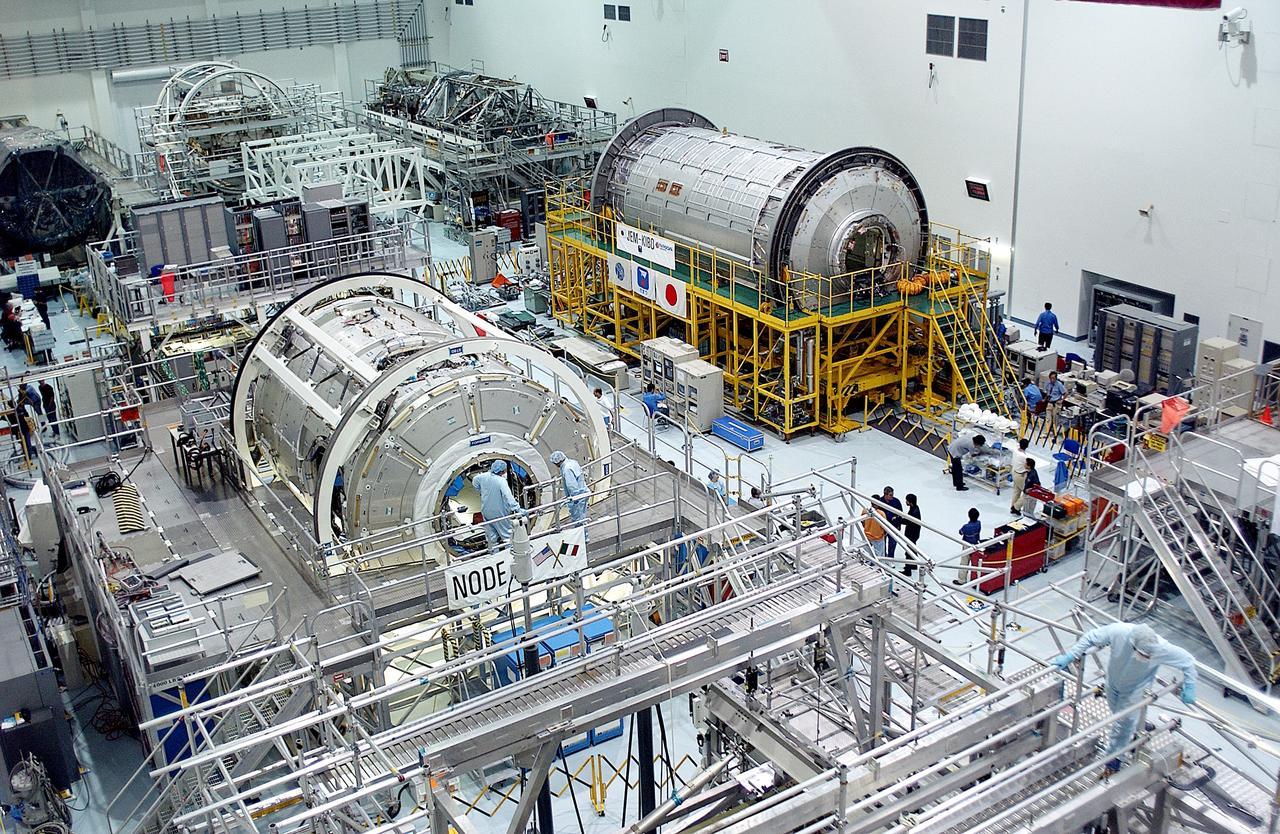
KENNEDY SPACE CENTER, FLA. -  International Space Station elements being processed for launch on upcoming Space Shuttle flights, including the U.S. Node 2 and the Japanese Experiment Module (JEM) pressurized module, line the walls of the high bay in the Space Station Processing Facility. NASA's Node 2, built by the European Space Agency (ESA) in Italy, arrived at KSC on June 1. It will be the next pressurized module installed on the Station. The JEM pressurized module, named "Kibo" (Hope), arrived at KSC on June 4. It is Japan's primary contribution to the Station.
KENNEDY SPACE CENTER, FLA. - International Space Station elements being processed for launch on upcoming Space Shuttle flights, including the U.S. Node 2 and the Japanese Experiment Module (JEM) pressurized module, line the walls of the high bay in the Space Station Processing Facility. NASA's Node 2, built by the European Space Agency (ESA) in Italy, arrived at KSC on June 1. It will be the next pressurized module installed on the Station. The JEM pressurized module, named "Kibo" (Hope), arrived at KSC on June 4. It is Japan's primary contribution to the Station.
KENNEDY SPACE CENTER, FLA. -  International Space Station elements being processed for launch on upcoming Space Shuttle flights, including the U.S. Node 2 and the Japanese Experiment Module (JEM) pressurized module, line the walls of the high bay in the Space Station Processing Facility. NASA's Node 2, built by the European Space Agency (ESA) in Italy, arrived at KSC on June 1. It will be the next pressurized module installed on the Station. The JEM pressurized module, named "Kibo" (Hope), arrived at KSC on June 4. It is Japan's primary contribution to the Station.
KENNEDY SPACE CENTER, FLA. - International Space Station elements being processed for launch on upcoming Space Shuttle flights, including the U.S. Node 2 and the Japanese Experiment Module (JEM) pressurized module, line the walls of the high bay in the Space Station Processing Facility. NASA's Node 2, built by the European Space Agency (ESA) in Italy, arrived at KSC on June 1. It will be the next pressurized module installed on the Station. The JEM pressurized module, named "Kibo" (Hope), arrived at KSC on June 4. It is Japan's primary contribution to the Station.
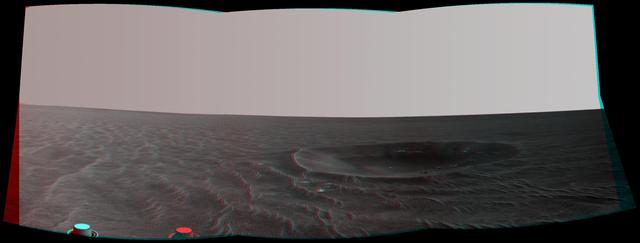
Yankee Clipper crater on Mars carries the name of the command and service module of NASA 1969 Apollo 12 mission to the moon. NASA Mars Exploration Rover Opportunity recorded this stereo view on Nov. 4, 2010. 3D glasses are necessary.
Yankee Clipper Crater on Mars Stereo
S69-17807 (13 Jan. 1969) --- Lunar Module 4 in the Kennedy Space Center's Manned Spacecraft Operations Building being moved into position for mating with Spacecraft Lunar Module Adapter (SLA) 13. Lunar Module 4 will be flown on the Apollo 10 (Spacecraft 106/Saturn 505) space mission.
APOLLO X - PRELAUNCH - MATING SPACECRAFT LUNAR ADAPTER (SLA)-13 - KSC
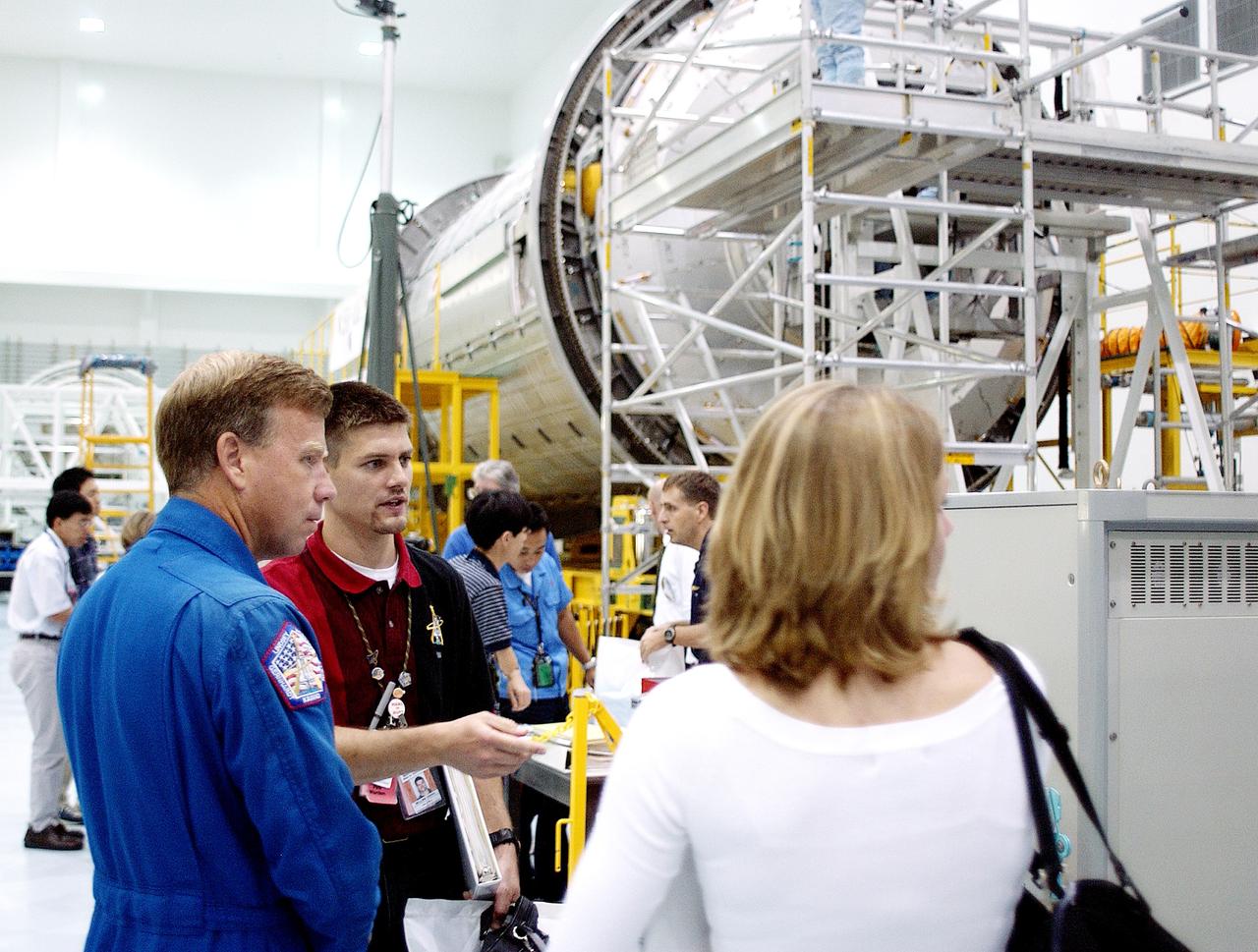
KENNEDY SPACE CENTER, FLA. -  NASA astronaut Steven W. Lindsey (left) listens to a briefing about the pressurized module of the Japanese Experiment Module (JEM) in the Space Station Processing Facility.  This major component of JEM, named "Kibo" (Hope), is Japan's primary contribution to the International Space Station and arrived at KSC on June 4.  Lindsey is assigned to command STS-119, an upcoming Space Shuttle flight to the Station.
KENNEDY SPACE CENTER, FLA. - NASA astronaut Steven W. Lindsey (left) listens to a briefing about the pressurized module of the Japanese Experiment Module (JEM) in the Space Station Processing Facility. This major component of JEM, named "Kibo" (Hope), is Japan's primary contribution to the International Space Station and arrived at KSC on June 4. Lindsey is assigned to command STS-119, an upcoming Space Shuttle flight to the Station.
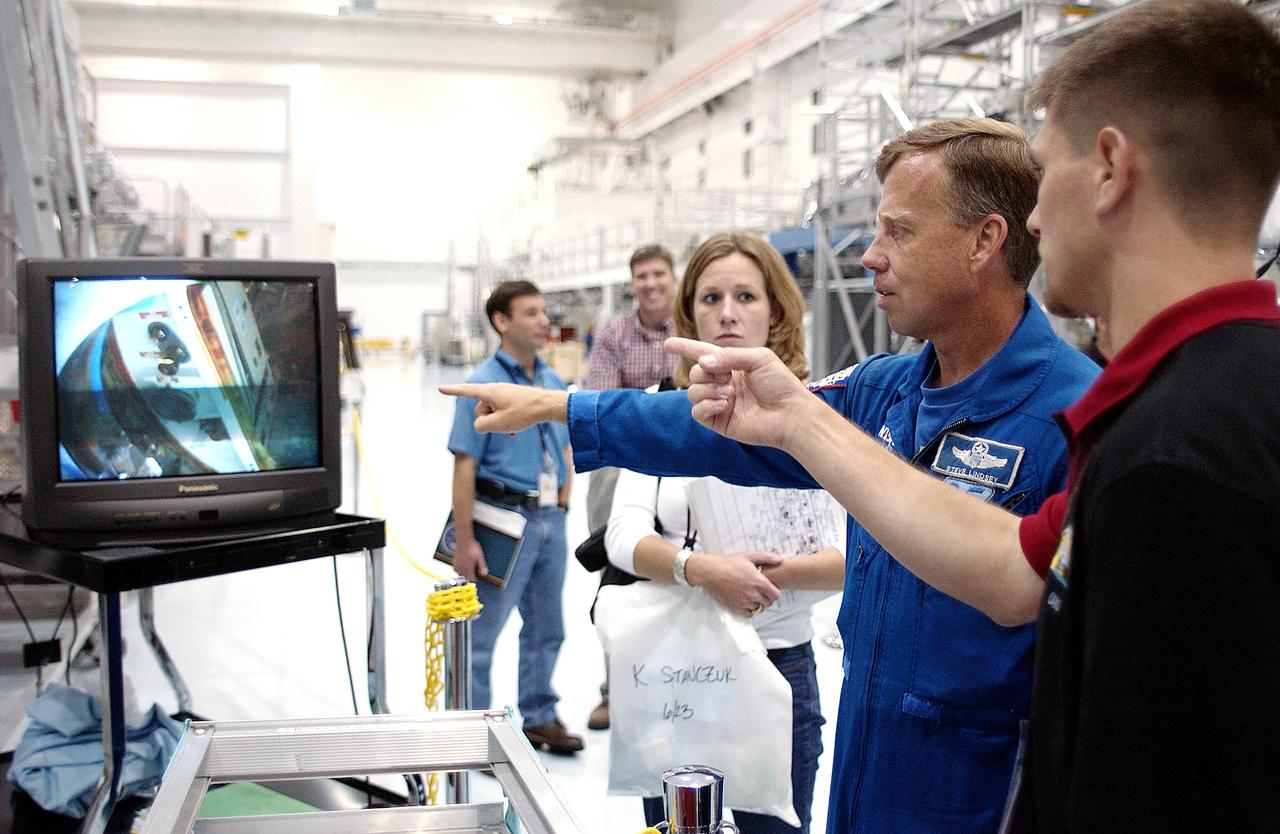
KENNEDY SPACE CENTER, FLA. -  NASA astronaut Steven W. Lindsey (second from right) views the interior of the pressurized module of the Japanese Experiment Module (JEM) on a television monitor in the Space Station Processing Facility.  This major component of JEM, named "Kibo" (Hope), is Japan's primary contribution to the International Space Station and arrived at KSC on June 4.  Lindsey is assigned to command STS-119, an upcoming Space Shuttle flight to the Station.
KENNEDY SPACE CENTER, FLA. - NASA astronaut Steven W. Lindsey (second from right) views the interior of the pressurized module of the Japanese Experiment Module (JEM) on a television monitor in the Space Station Processing Facility. This major component of JEM, named "Kibo" (Hope), is Japan's primary contribution to the International Space Station and arrived at KSC on June 4. Lindsey is assigned to command STS-119, an upcoming Space Shuttle flight to the Station.
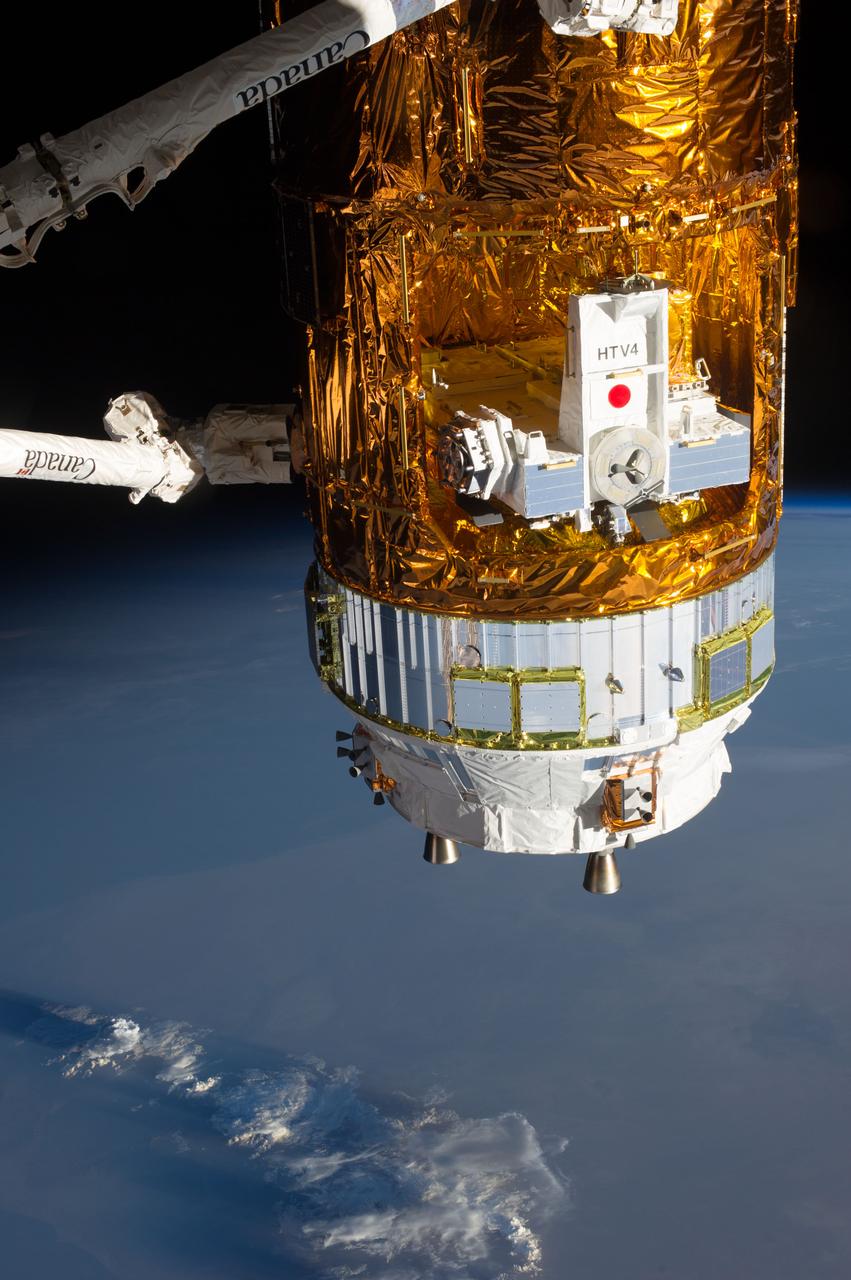
View of Japanese Kounotori H2 Transfer Vehicle-4 (HTV-4) docked to the International Space Station's Harmony Node 2 module. Sent as Twitter message.
HTV-4
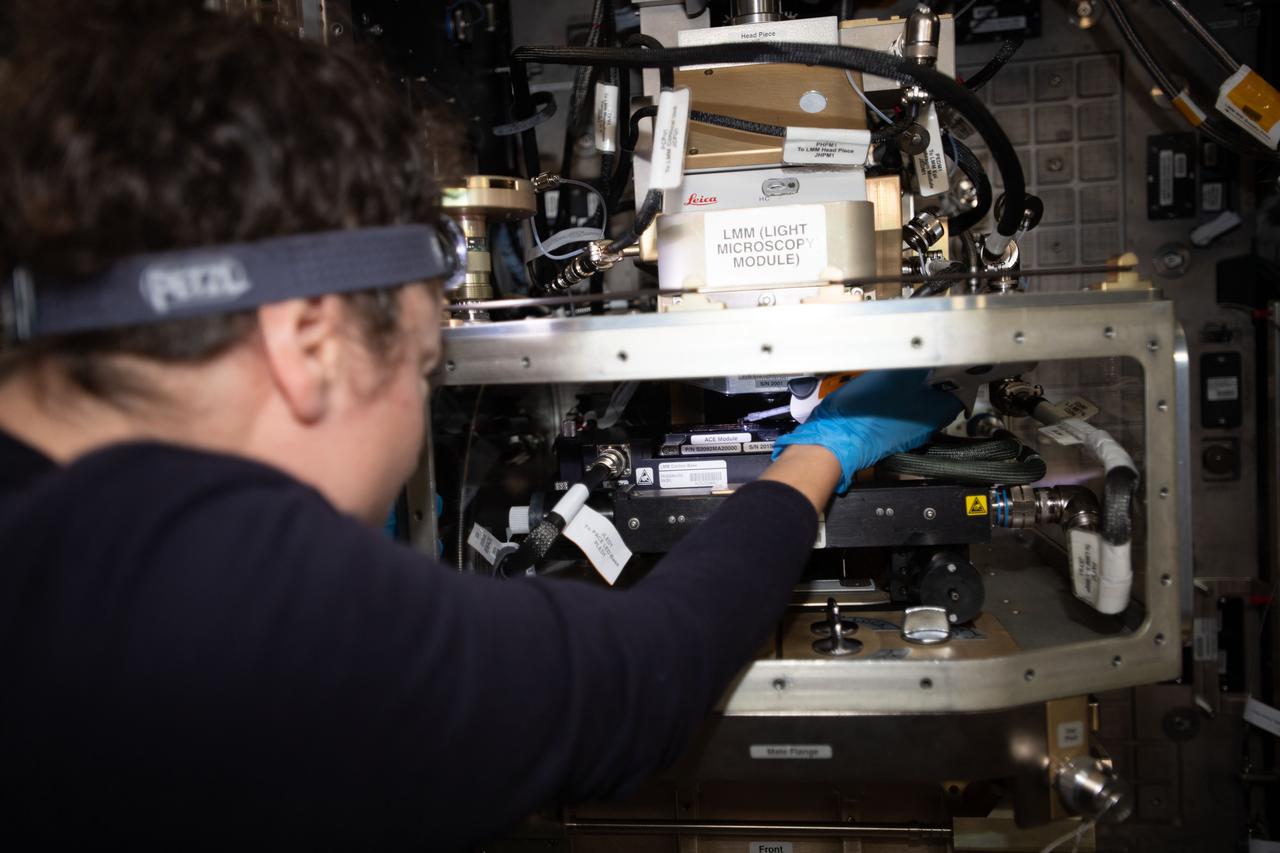
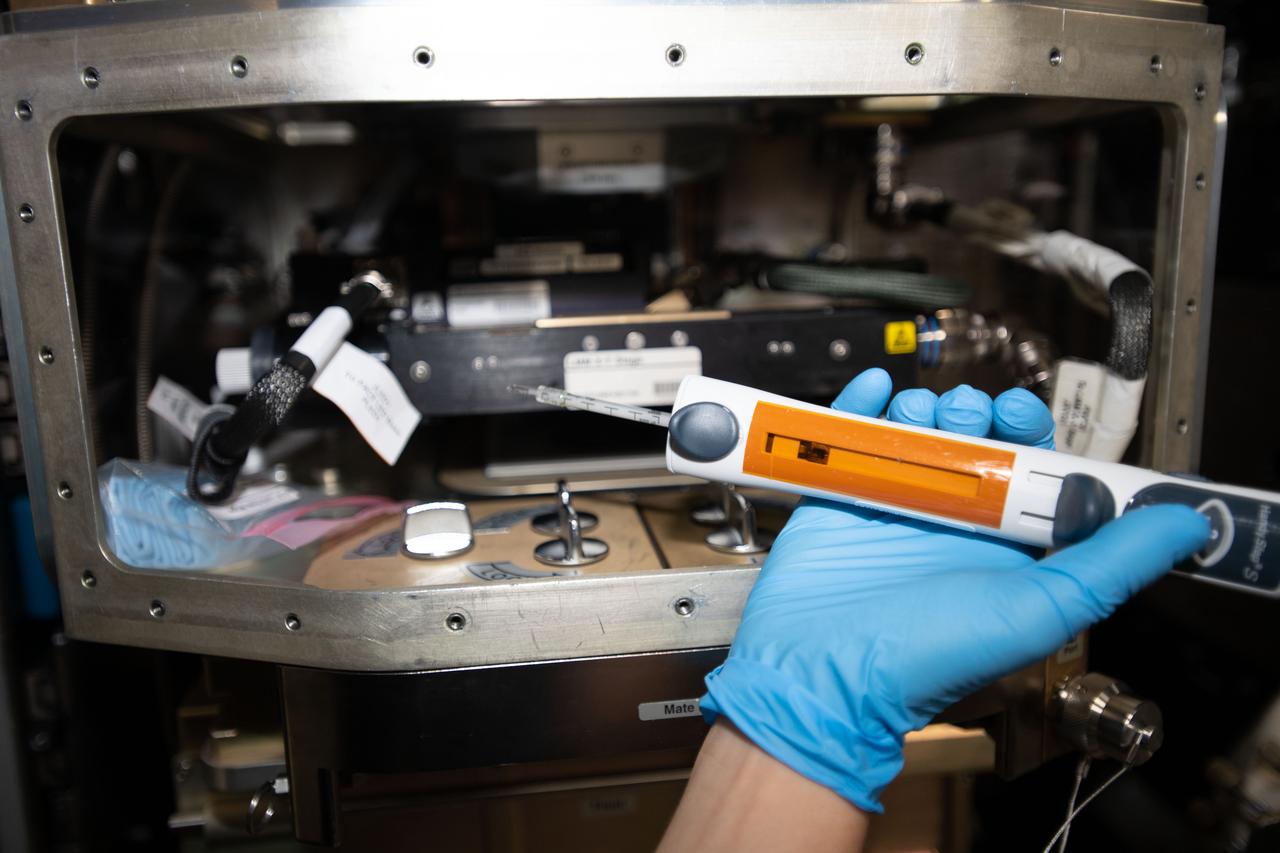
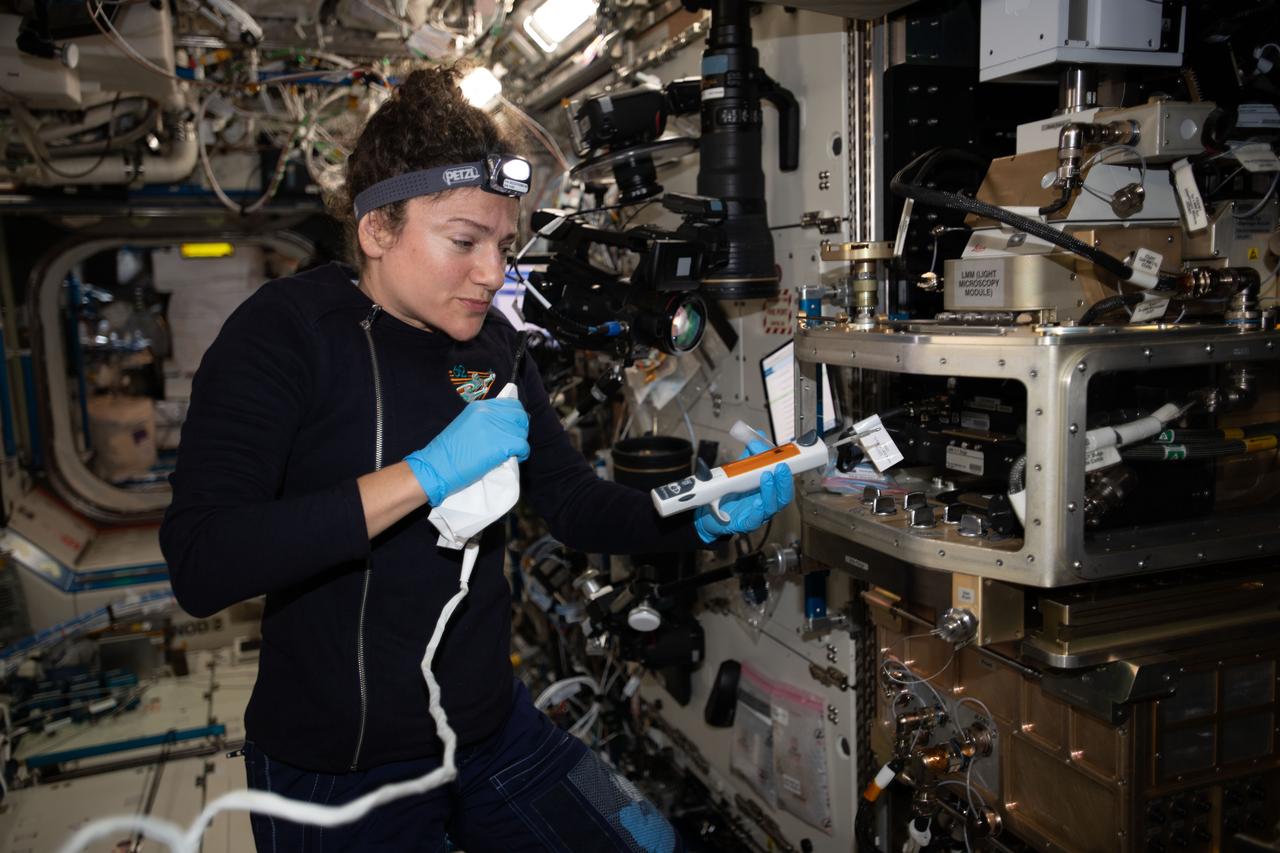
iss062e014345 (2-16-2020) --- A view of NASA astronaut Jessica Meir configuring the Light Microscopy Module (LMM) for the Advanced Colloids Experiment-Temperature-4 (ACE-T-4) science run in the Destiny module aboard the International Space Station (ISS). Introducing disorder to a crystalline system in a controlled way can form glass. Advanced Colloids Experiment-Temperature-4 (ACE-T-4) examines the transition of an ordered crystal to a disordered glass to determine how increasing disorder affects structural and dynamic properties
ACE-T4 Module Configuration
iss062e014349 (Feb. 16, 2020) --- A view of NASA astronaut Jessica Meir configuring the Light Microscopy Module (LMM) for the Advanced Colloids Experiment-Temperature-4 (ACE-T-4) science in the Destiny module aboard the International Space Station (ISS). Introducing disorder to a crystalline system in a controlled way can form glass. Advanced Colloids Experiment-Temperature-4 (ACE-T-4) examines the transition of an ordered crystal to a disordered glass to determine how increasing disorder affects structural and dynamic properties.
ACE-T4 Module Configuration
iss062e014342 (2-16-2020) --- A view of NASA astronaut Jessica Meir configuring the Light Microscopy Module (LMM) for the Advanced Colloids Experiment-Temperature-4 (ACE-T-4) science run in the Destiny module aboard the International Space Station (ISS). Introducing disorder to a crystalline system in a controlled way can form glass. Advanced Colloids Experiment-Temperature-4 (ACE-T-4) examines the transition of an ordered crystal to a disordered glass to determine how increasing disorder affects structural and dynamic properties
ACE-T4 Module Configuration
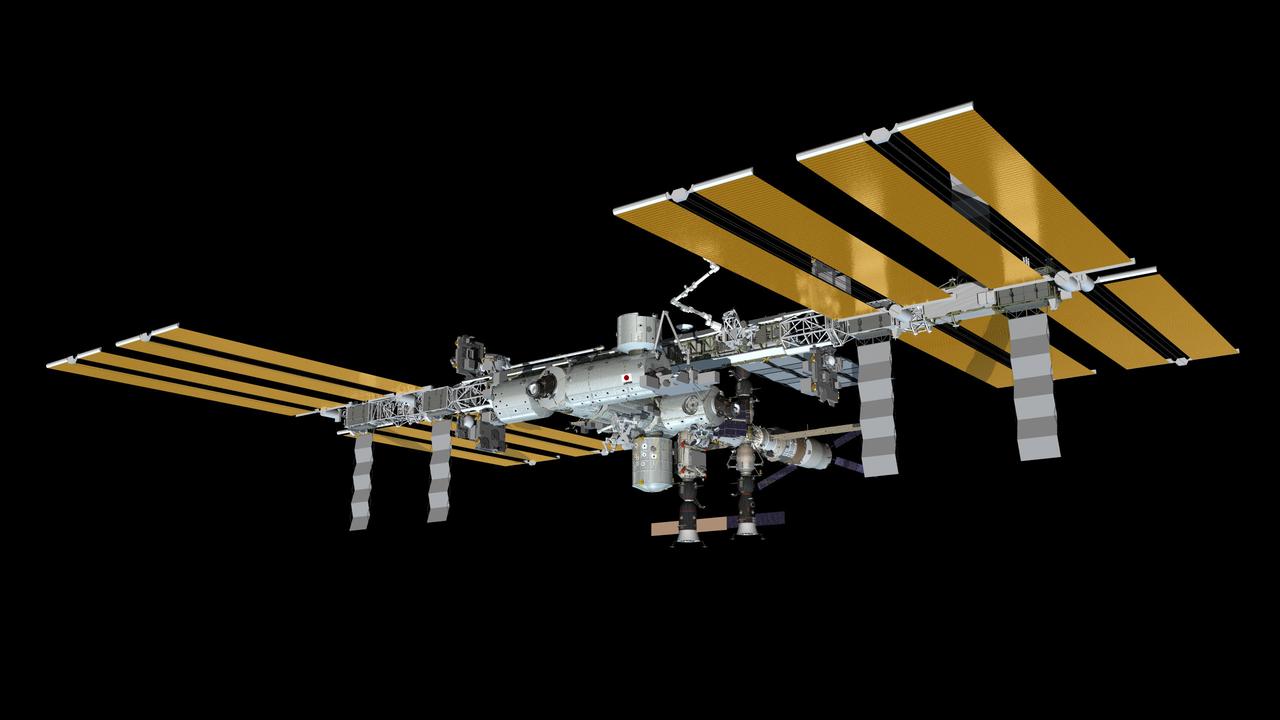
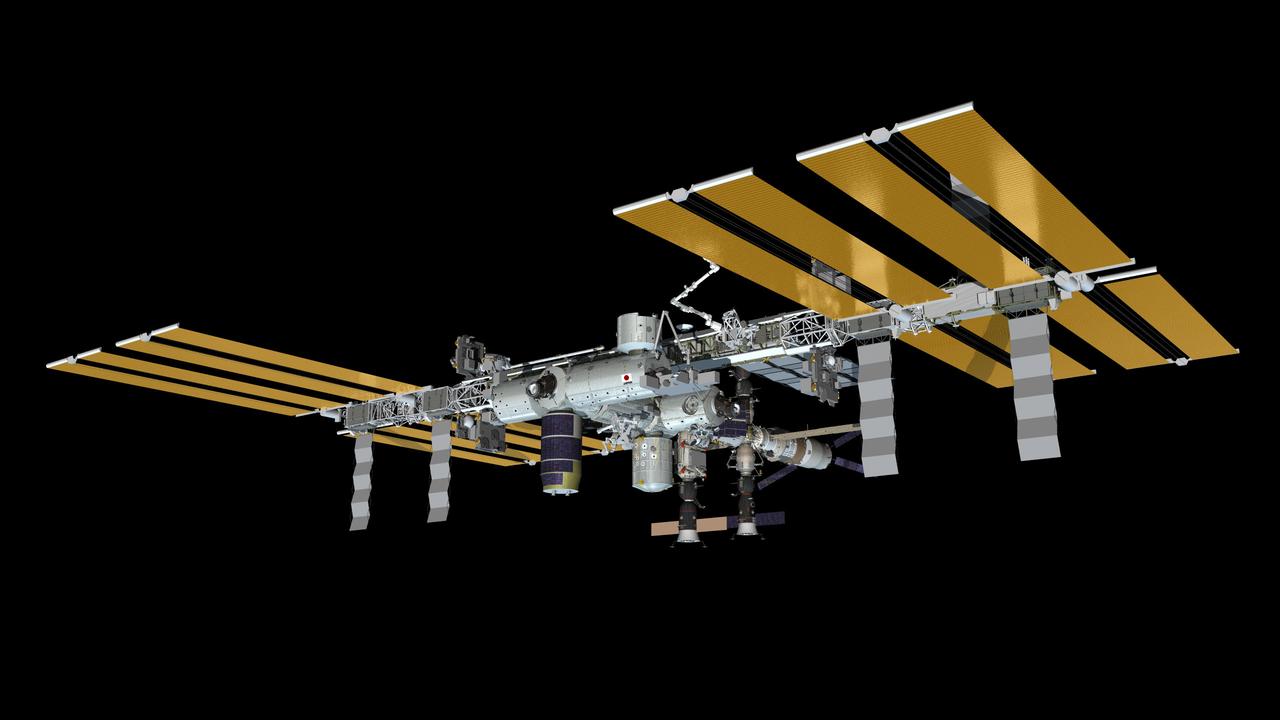
JSC2013-E-080240 (September 2013) --- Computer-generated artist?s rendering of the International Space Station as of Sept. 4, 2013. The unpiloted Japanese "Kounotori" H2 Transfer Vehicle-4 (HTV-4) is unberthed from the Harmony node. Progress 52 resupply vehicle is docked to the Pirs Docking Compartment. European Space Agency?s ?Albert Einstein? Automated Transfer Vehicle (ATV-4) cargo ship is docked to the Zvezda Service Module?s aft port. Soyuz 35 (TMA-09M) is attached to the Rassvet Mini-Research Module 1 (MRM1). Soyuz 34 (TMA-08M) is linked to the Poisk Mini-Research Module 2 (MRM2). Photo credit: NASA
jsc2013e080240
S69-25979 (December 1968) --- The ascent stage of Lunar Module-4 is moved from work stand into altitude chamber in the Kennedy Space Center's Manned Spacecraft Operations Building. Lunar Module-4 will be flown on the Apollo 10 (Spacecraft 106/Saturn 505) lunar orbit mission.
PRELAUNCH - APOLLO 10 - KSC
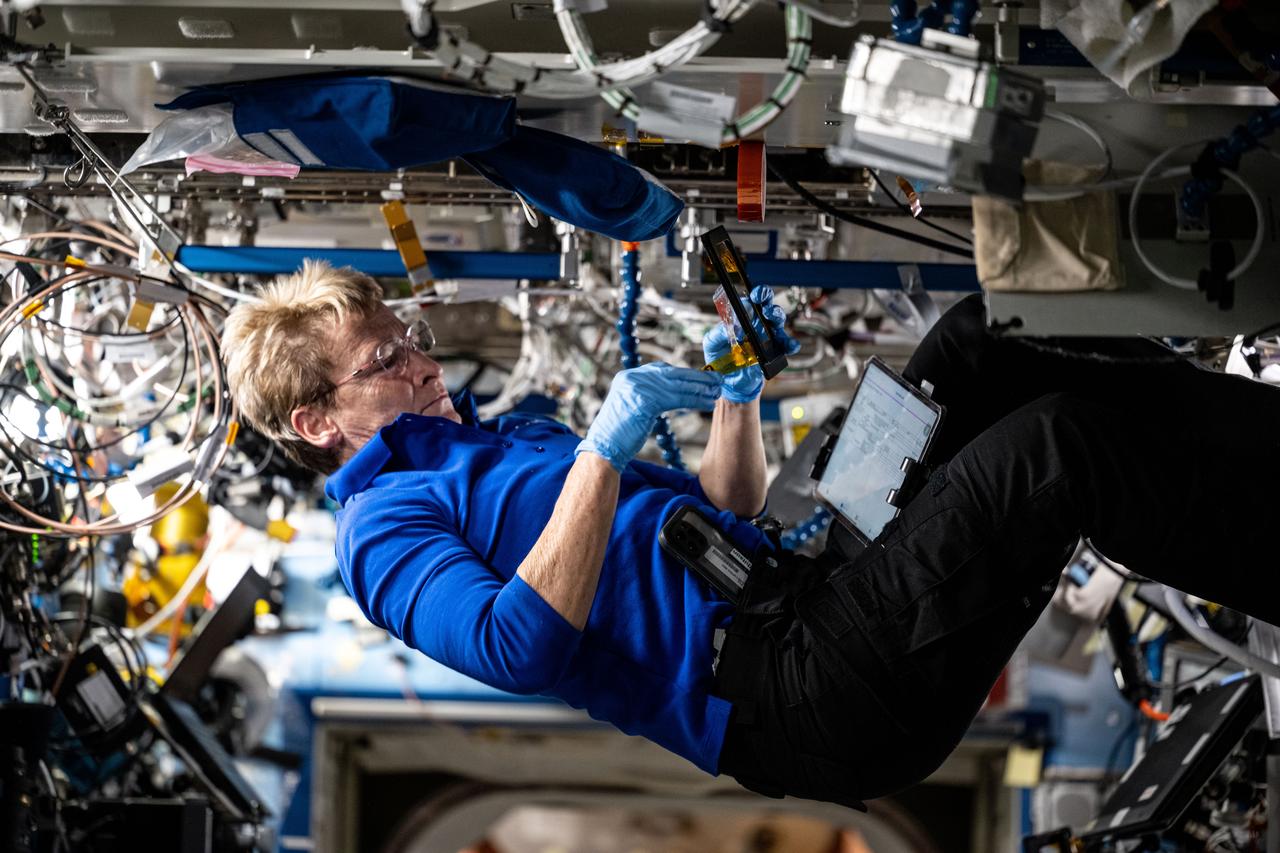
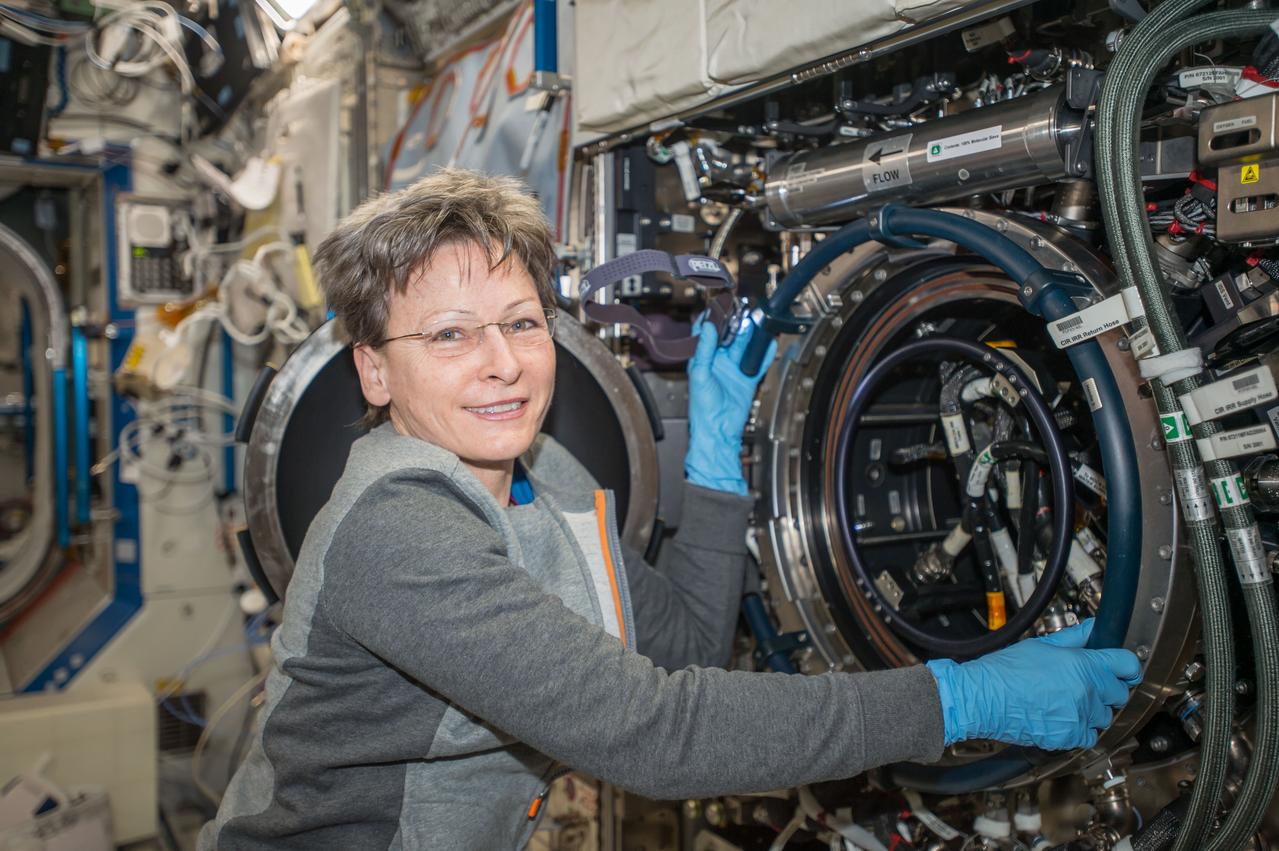
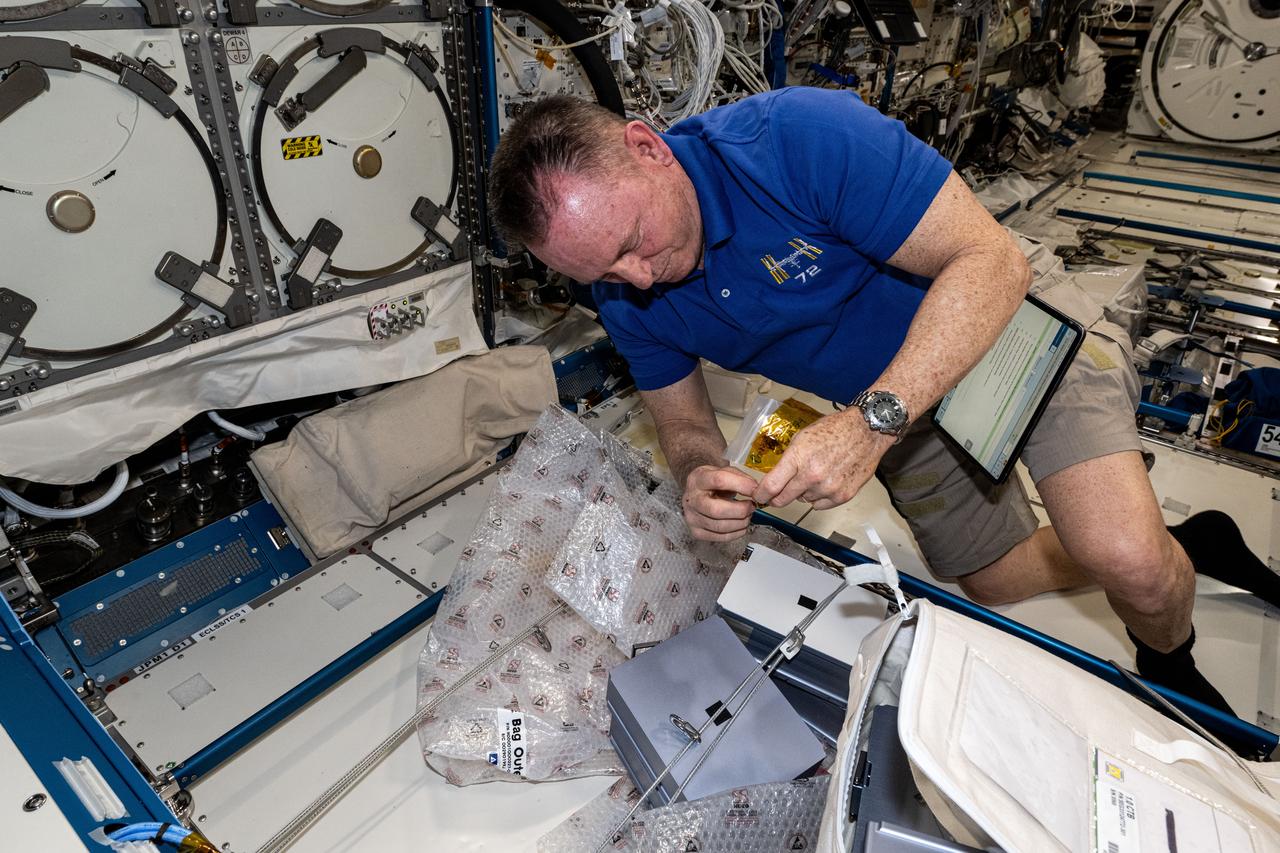
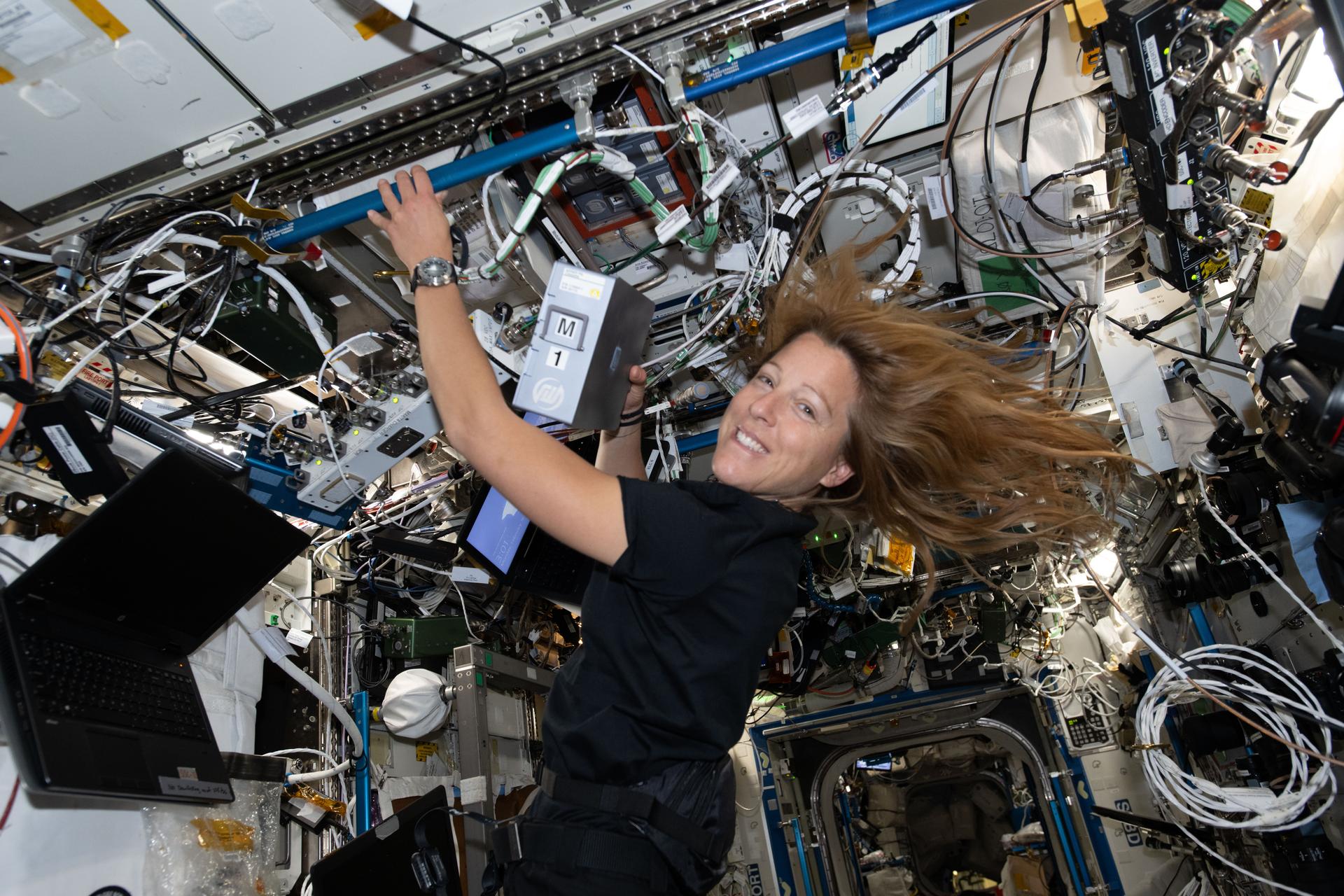
iss073e0252488 (June 28, 2025) --- Axiom Mission 4 (Ax-4) Commander Peggy Whitson from the U.S. configures research hardware aboard the International Space Station's Destiny laboratory module.
Axiom Mission 4 Commander Peggy Whitson configures research hardware
JSC2013-E-080239 (August 2013) --- Computer-generated artist?s rendering of the International Space Station as of Aug. 9, 2013. The unpiloted Japanese "Kounotori" H2 Transfer Vehicle-4 (HTV-4) is berthed to the Harmony node. Progress 52 resupply vehicle is docked to the Pirs Docking Compartment. European Space Agency?s ?Albert Einstein? Automated Transfer Vehicle (ATV-4) cargo ship is docked to the Zvezda Service Module?s aft port. Soyuz 35 (TMA-09M) is attached to the Rassvet Mini-Research Module 1 (MRM1). Soyuz 34 (TMA-08M) is linked to the Poisk Mini-Research Module 2 (MRM2). Photo credit: NASA
jsc2013e080239
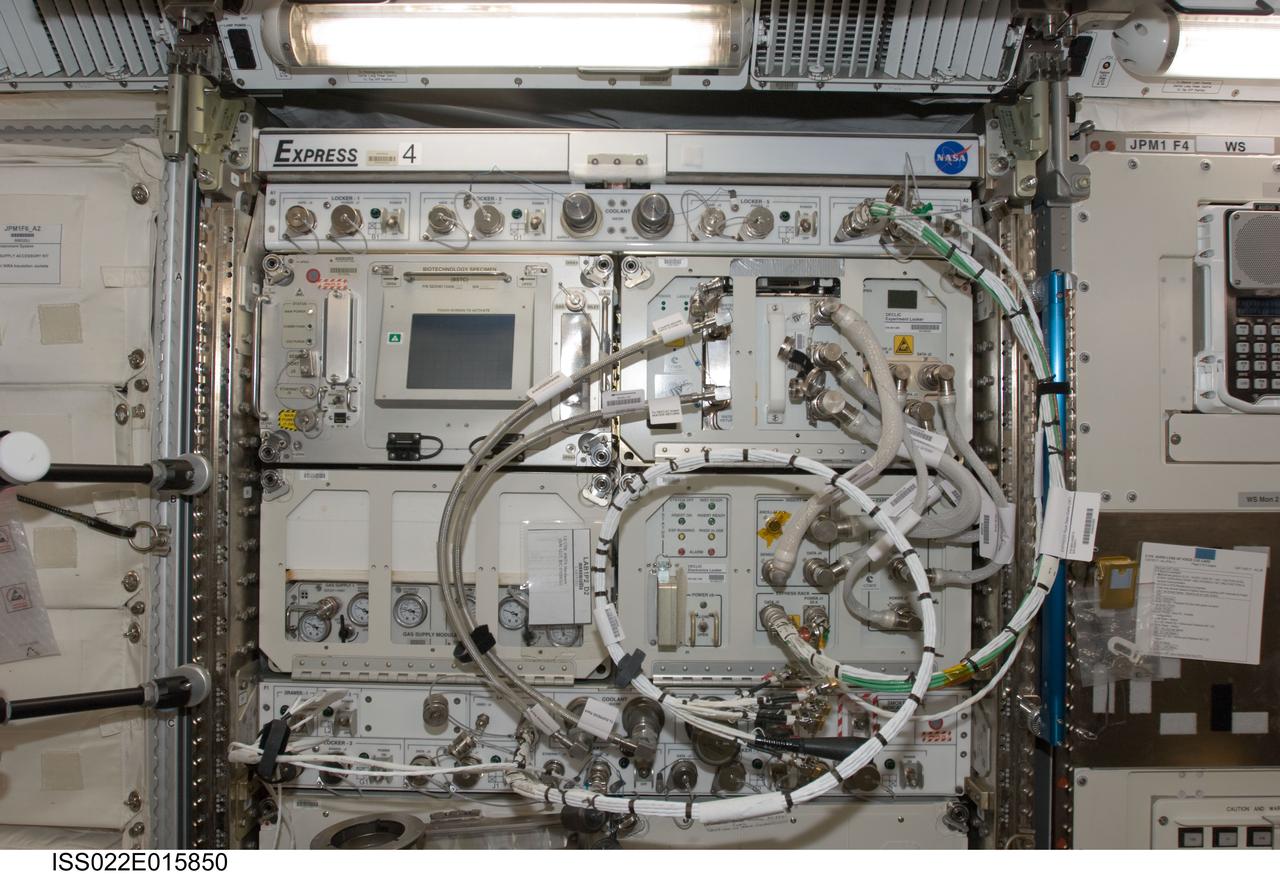
iss022e015850 (12/30/2009) --- The image shows a front view of EXpedite the PRocessing of Experiments to Space Station EXPRESS Rack 4 (Rack 4,JPM/1F5) in the Japanese Experiment Module (JEM) Japanese Pressurized Module (JPM). Equipment visible in the EXPRESS Rack includes the Biotechnology Specimen Temperature Controller (BSTC) and the Gas Supply Module (GSM) support hardware for the CBOSS (Cellular Biotechnology Operations Support Systems) investigations, and the Device for the Study of Critical Liquids and Crystallization (DECLIC).
Survey view of EXPRESS Rack 4 in the JPM during Expedition 22
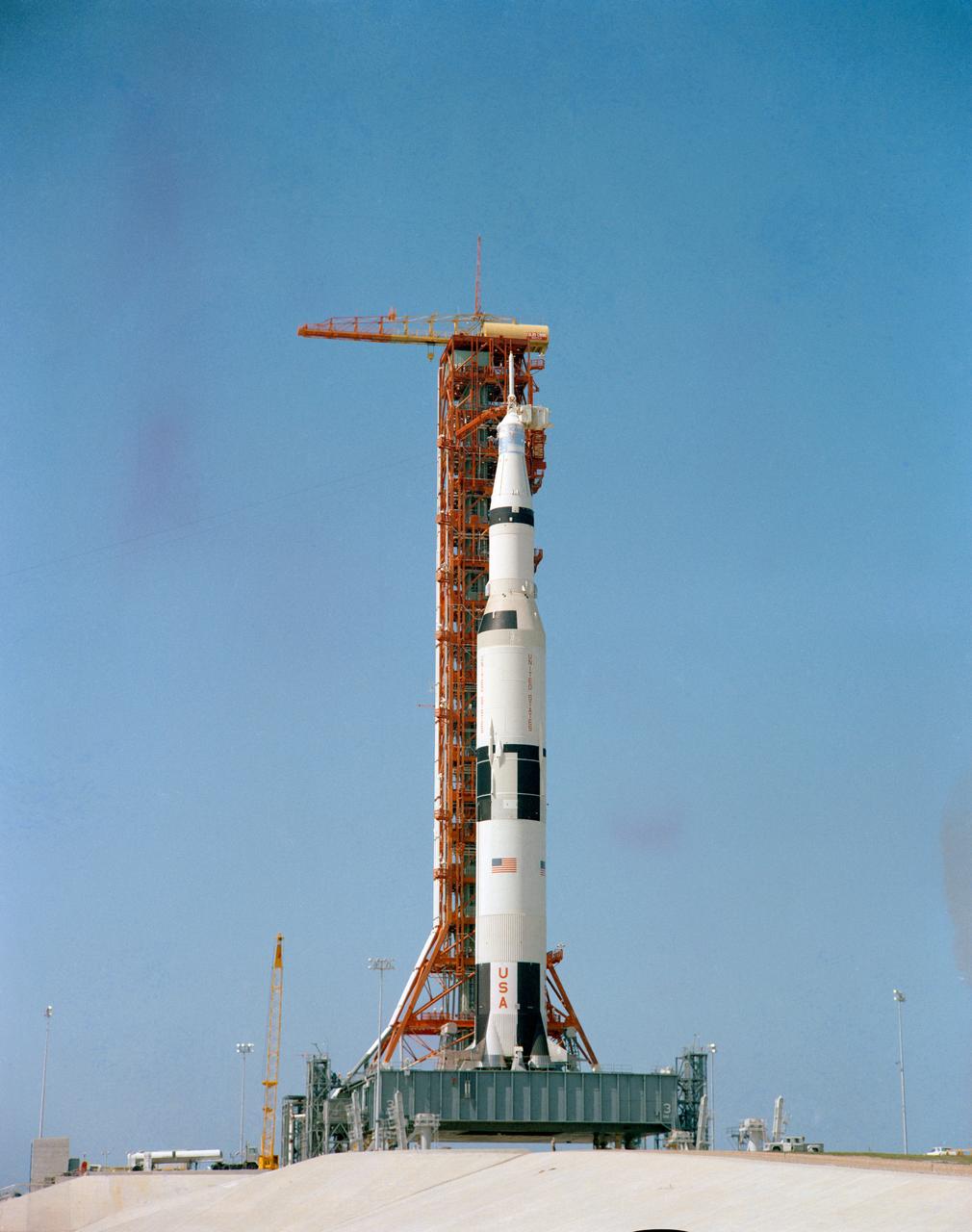
S69-33853 (4 May 1969) --- Ground-level view of the Apollo 10 (Spacecraft 106/Lunar Module 4/Saturn 505) space vehicle on Pad B, Launch Complex 39, Kennedy Space Center, Florida. This photograph of the 363-feet tall Apollo/Saturn V stack was taken during Countdown Demonstration Test (CDDT) activity. The Apollo 10 crew will be astronauts Thomas P. Stafford, commander; John W. Young, command module pilot; and Eugene A. Cernan, lunar module pilot.
APOLLO X - LAUNCH VEHICLE APOLLO-SATURN (AS)-505 - COUNTDOWN DEMONSTRATION TEST (CDDT) - KSC
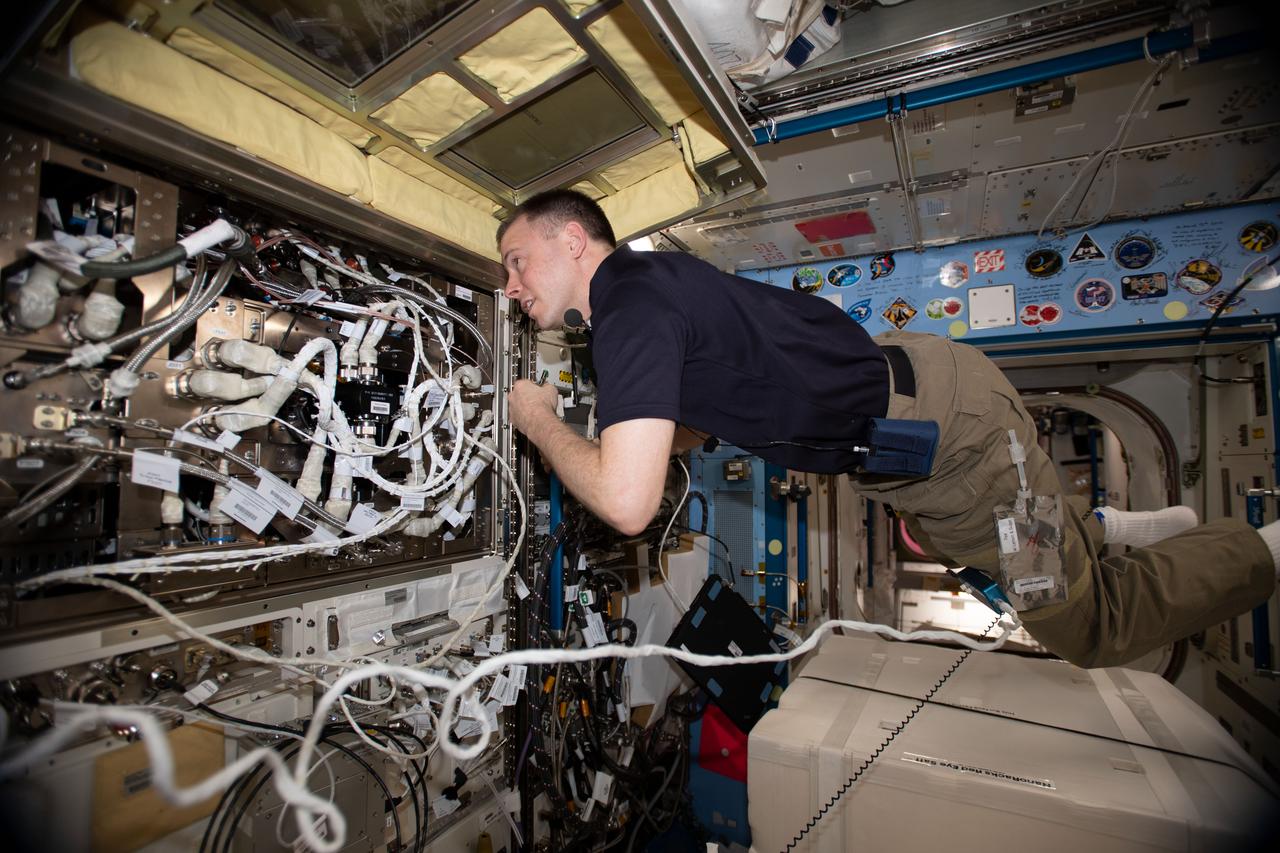
iss052e027048 (Aug. 4, 2017) --- Astronaut Peggy Whitson works on the Combustion Integrated Rack in the U.S. Destiny laboratory module.
iss052e027048
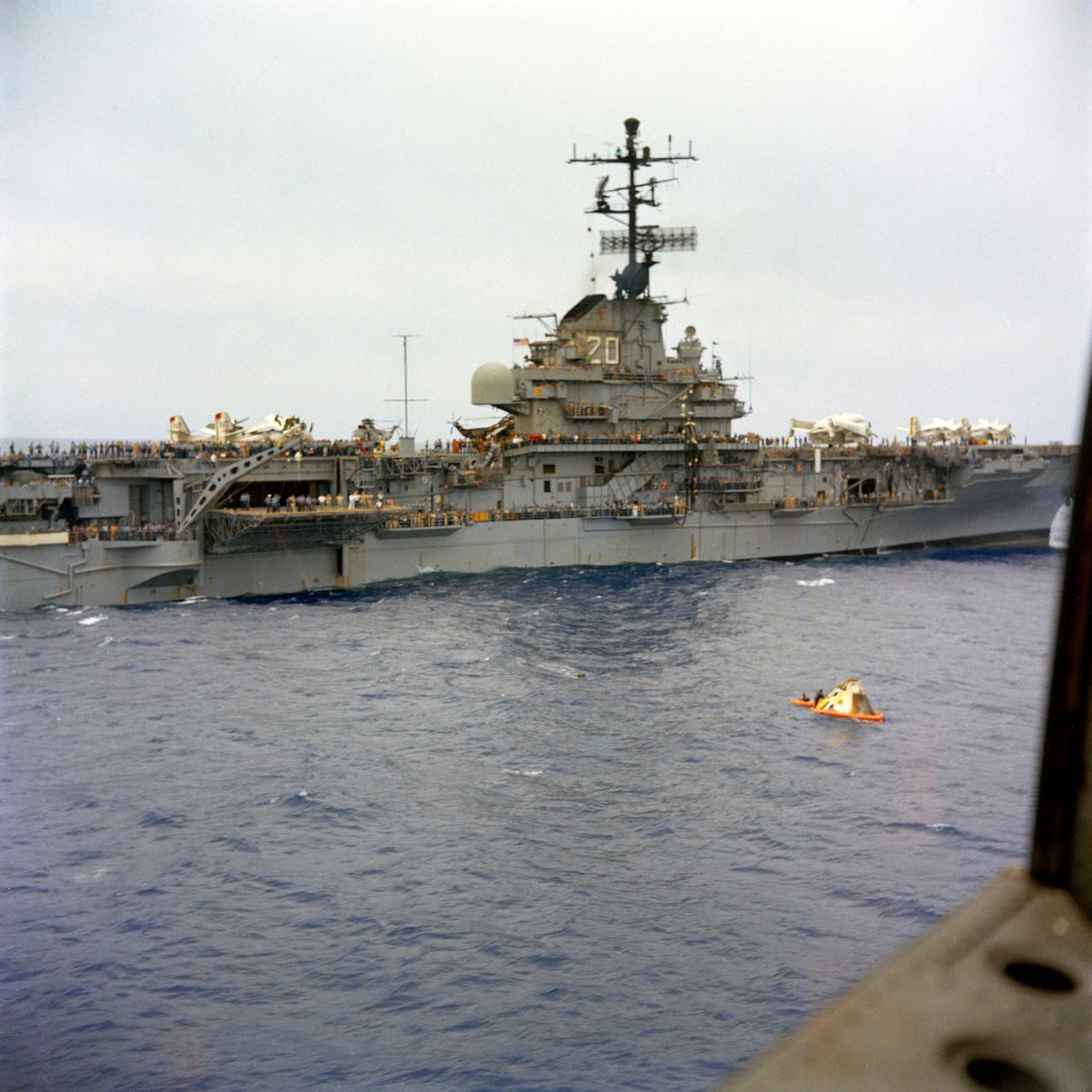
S68-26989 (4 April 1968) --- The Apollo 6 Spacecraft 020 Command Module is hoisted aboard the USS Okinawa.
Recovery of Apollo 6 unmmaned spacecraft
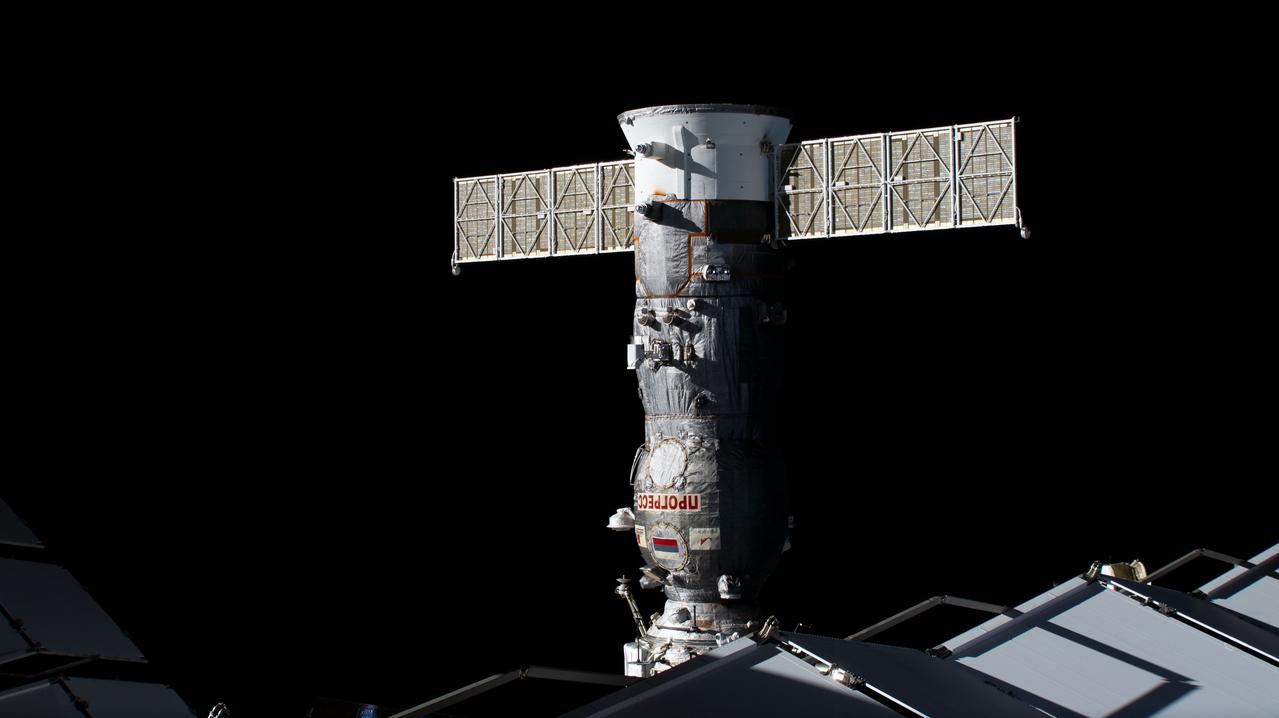
iss070e001769 (Oct. 4, 2023) --- The Roscosmos Progress 84 cargo craft is pictured docked to the International Space Station's Poisk module.
iss070e001769
iss059e089298 (June 4, 2019) --- NASA astronaut Nick Hague works inside the Japanese Kibo laboratory module on maintenance activities.
iss059e089298
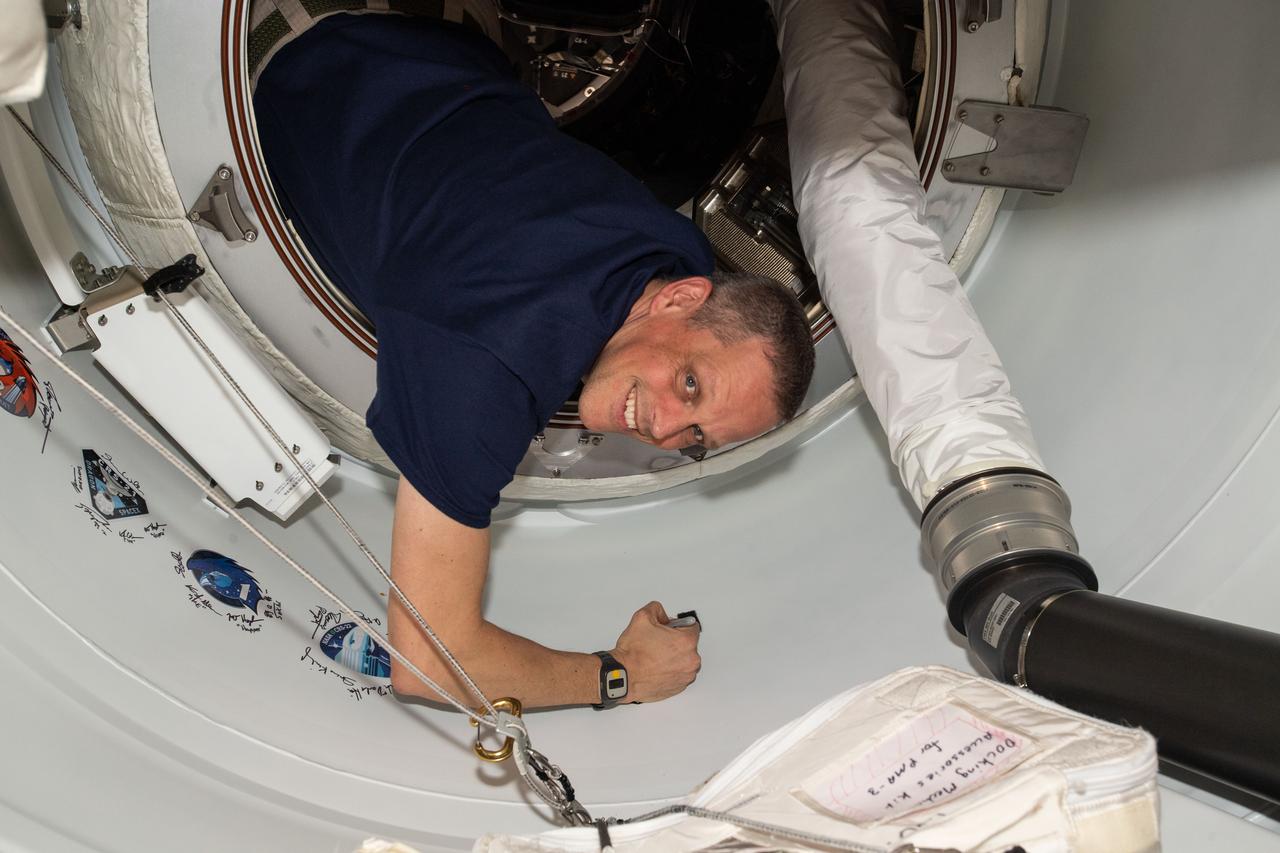
iss065e440618 (Oct. 4, 2021) --- Expedition 65 Commander Thomas Pesquet of ESA (European Space Agency) affixes his mission's insignia sticker to the vestibule in between the International Space Station's Unity module and Tranquility module.
iss065e440618
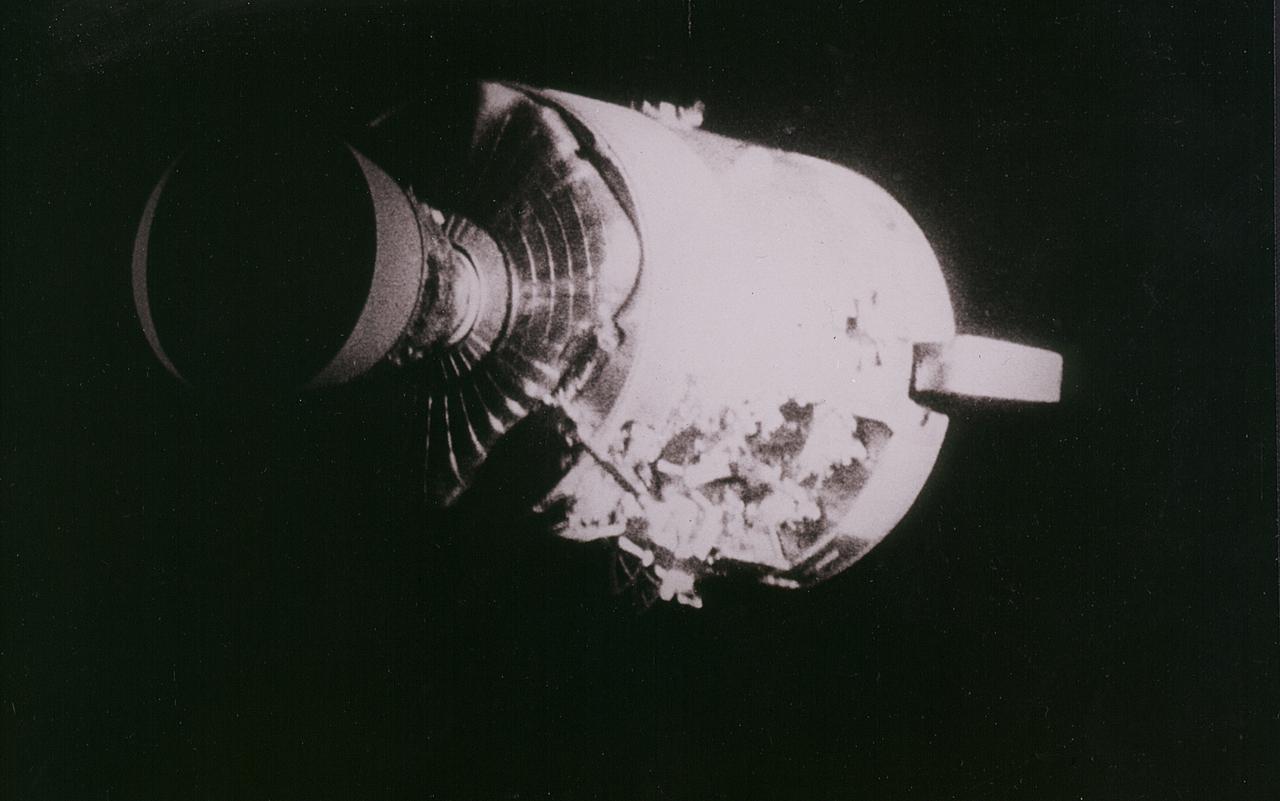
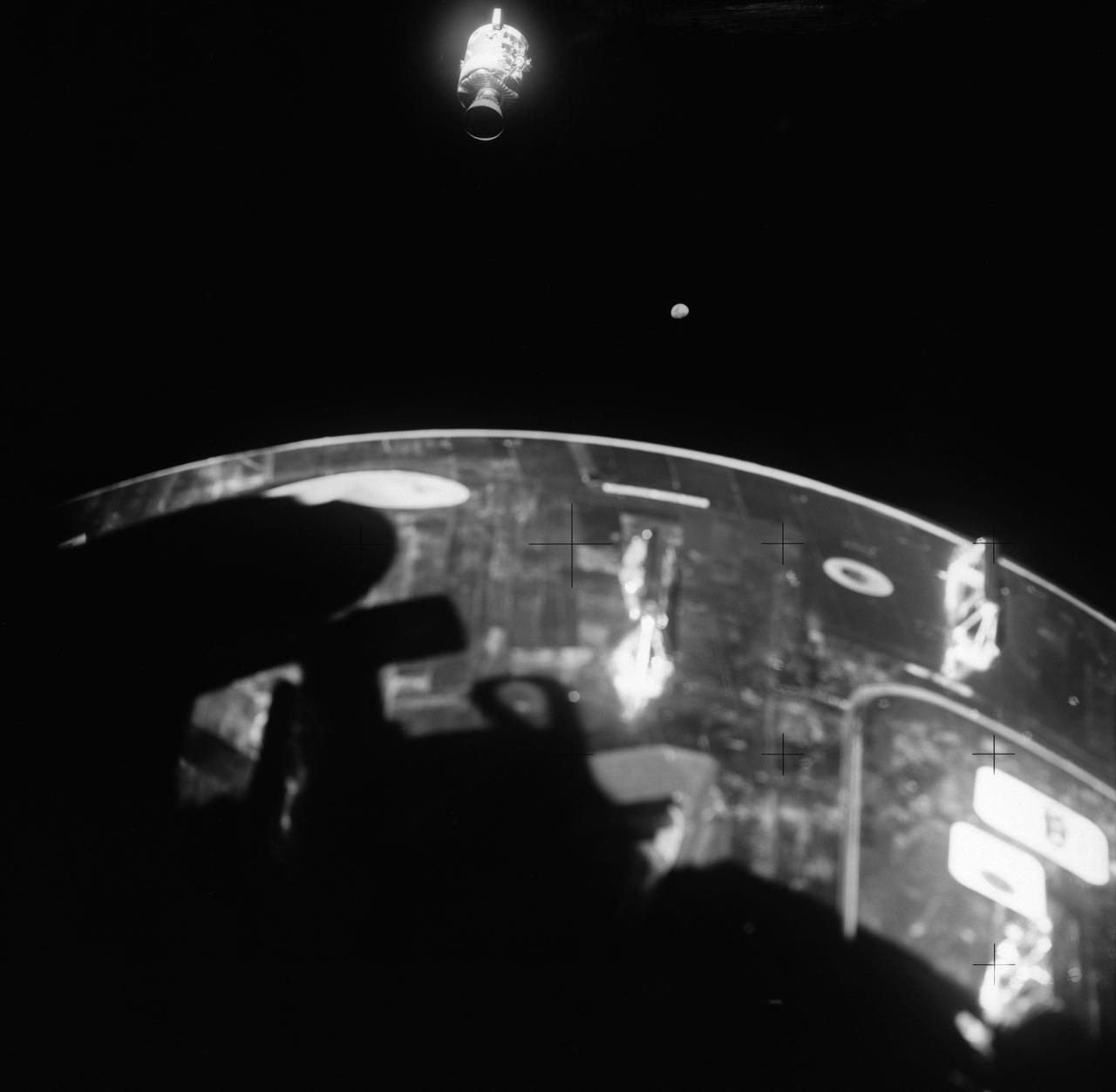
Apollo 13 onboard photo: This view of the severely damaged Apollo 13 Service Module was photographed from the Lunar Module/Command Module following the jettison of the Service Module. As seen here, an entire panel of the Service Module was blown away by the apparent explosion of oxygen tank number two located in Sector 4 of the Service Module. Two of the three fuel cells are visible just forward (above) the heavily damaged area. Three fuel cells, two oxygen tanks, and two hydrogen tanks, are located in Sector 4. The damaged area is located above the S-band high gain anterna. Nearest the camera is the Service Propulsion System (SPS) engine and nozzle. The damage to the Service Module caused the Apollo 13 crewmen to use the Lunar Module as a lifeboat. The Lunar Module was jettisoned by the Command Module just prior to Earth re-entry.
Saturn Apollo Program
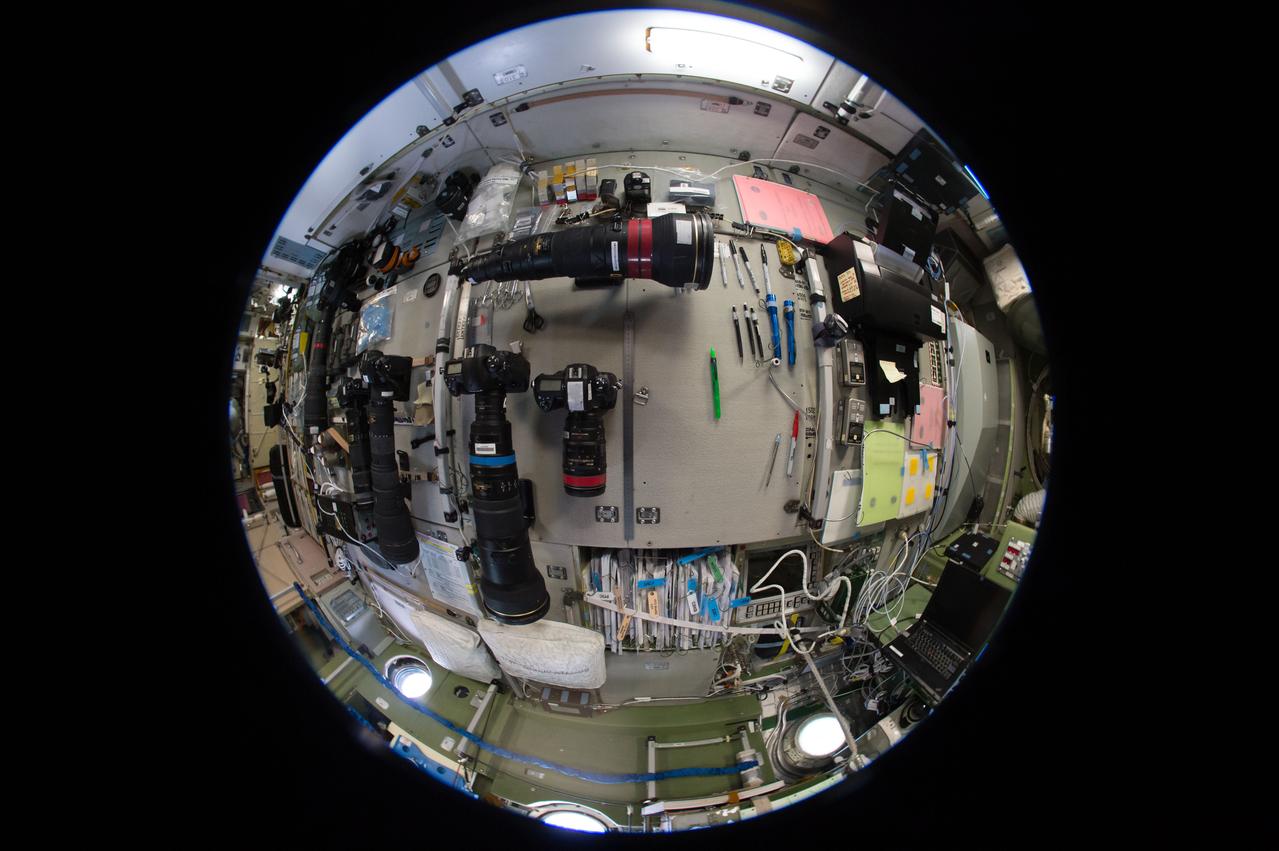
iss051e018869 (4/18/2017) --- A fish-eye view looking port in the Zvezda Service Module (SM), taken for a Google Street View of the ISS.
Google Street View Image in the SM
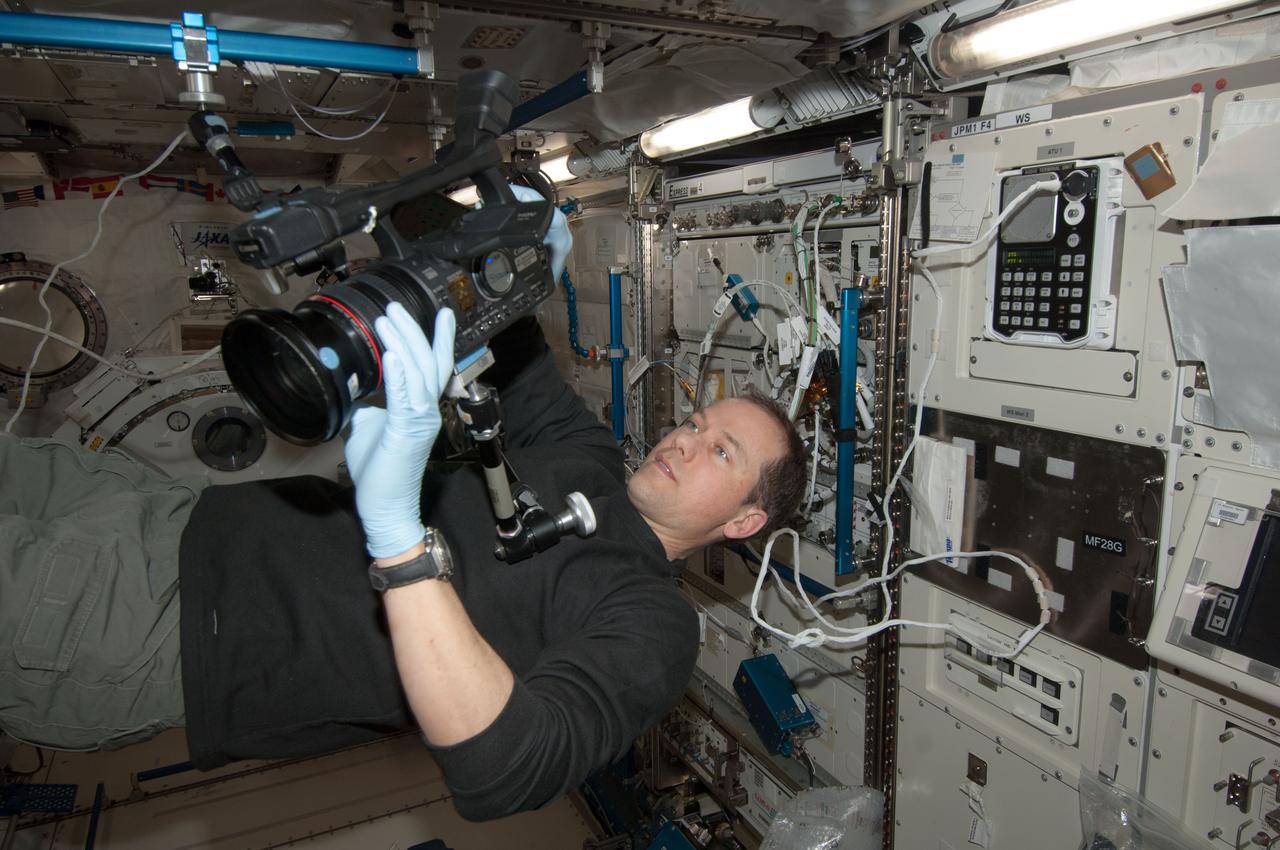
ISS035-E-016038 (4 April 2013) --- NASA astronaut Tom Marshburn records video with a camcorder in the Kibo module aboard the International Space Station.
Marshburn works on MSPR CC Setup
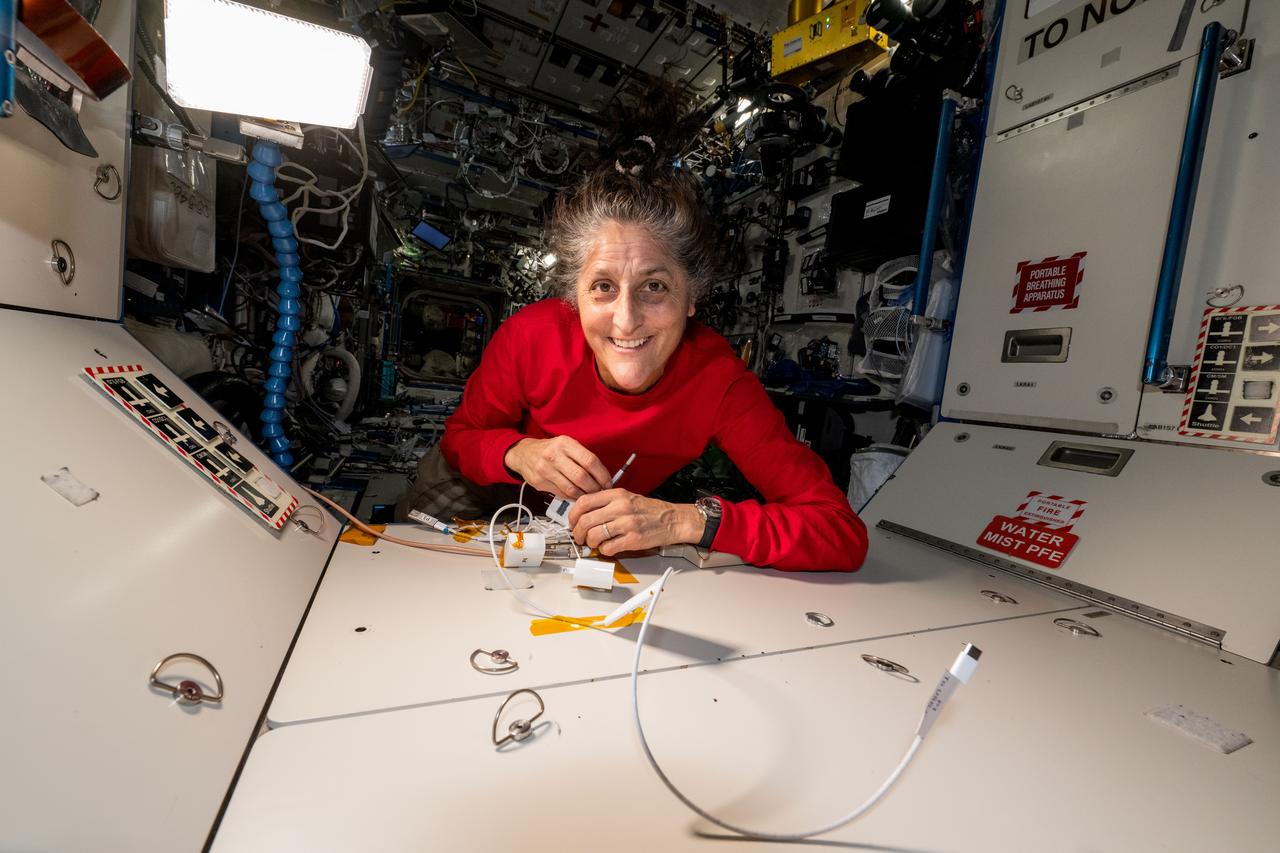
iss071e608493 (Sept. 4, 2024) --- NASA astronaut Suni Williams configures portable electronics gear aboard the International Space Station's Destiny laboratory module.
iss071e608493
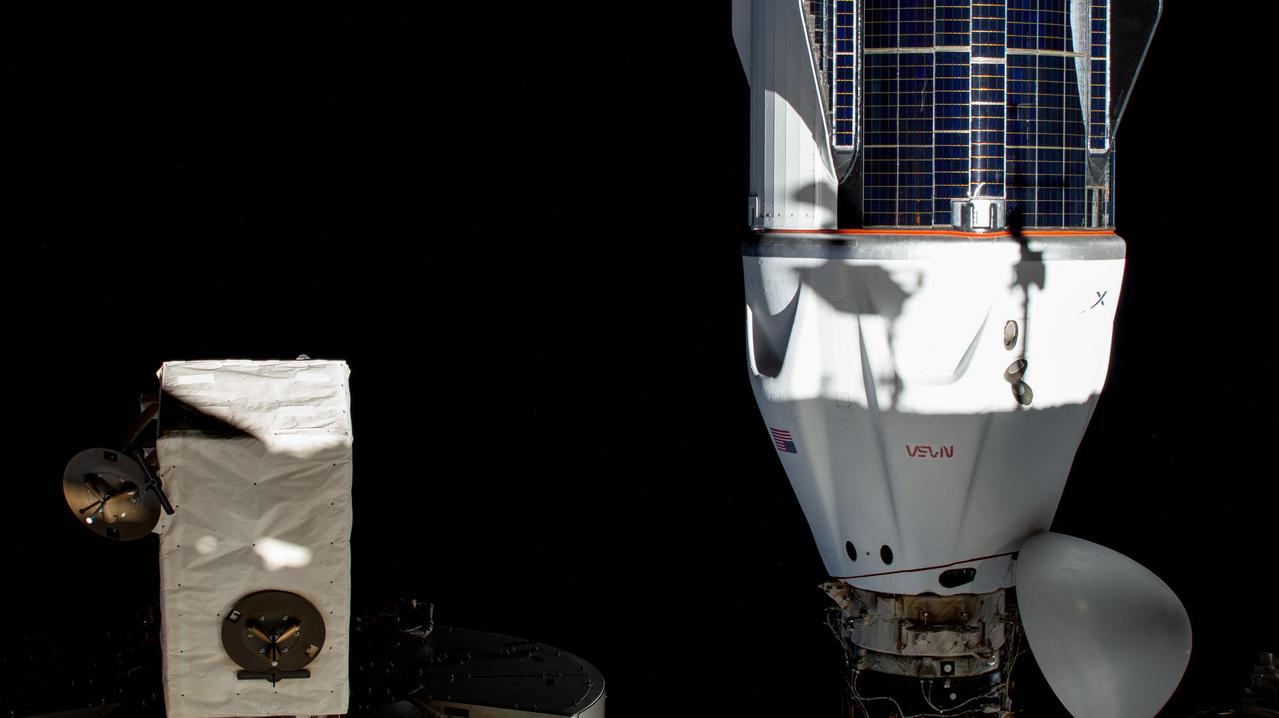
iss072e144451 (Nov. 4, 2024) --- The SpaceX Dragon Freedom spacecraft is pictured docked to the space-facing port on the International Space Station's Harmony module.
The SpaceX Dragon Freedom spacecraft
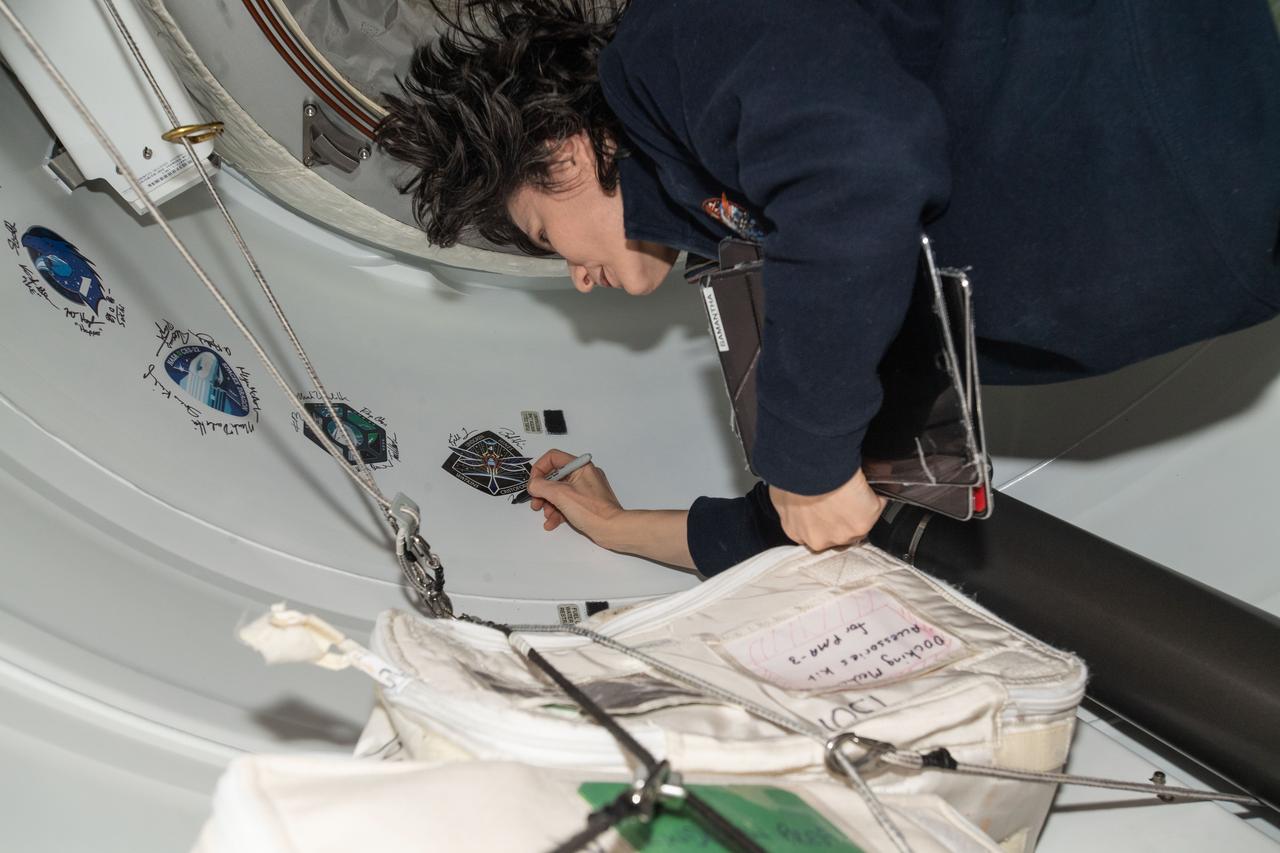
iss068e016455 (Oct. 12, 2022) --- NASA astronaut and Expedition 68 Commander Samantha Cristoforetti, also a SpaceX Crew-4 Mission Specialist, signs her name around the Crew-4 mission insignia affixed to the vestibule between the Harmony module's space-facing port and the Dragon Freedom crew ship.
iss068e016455
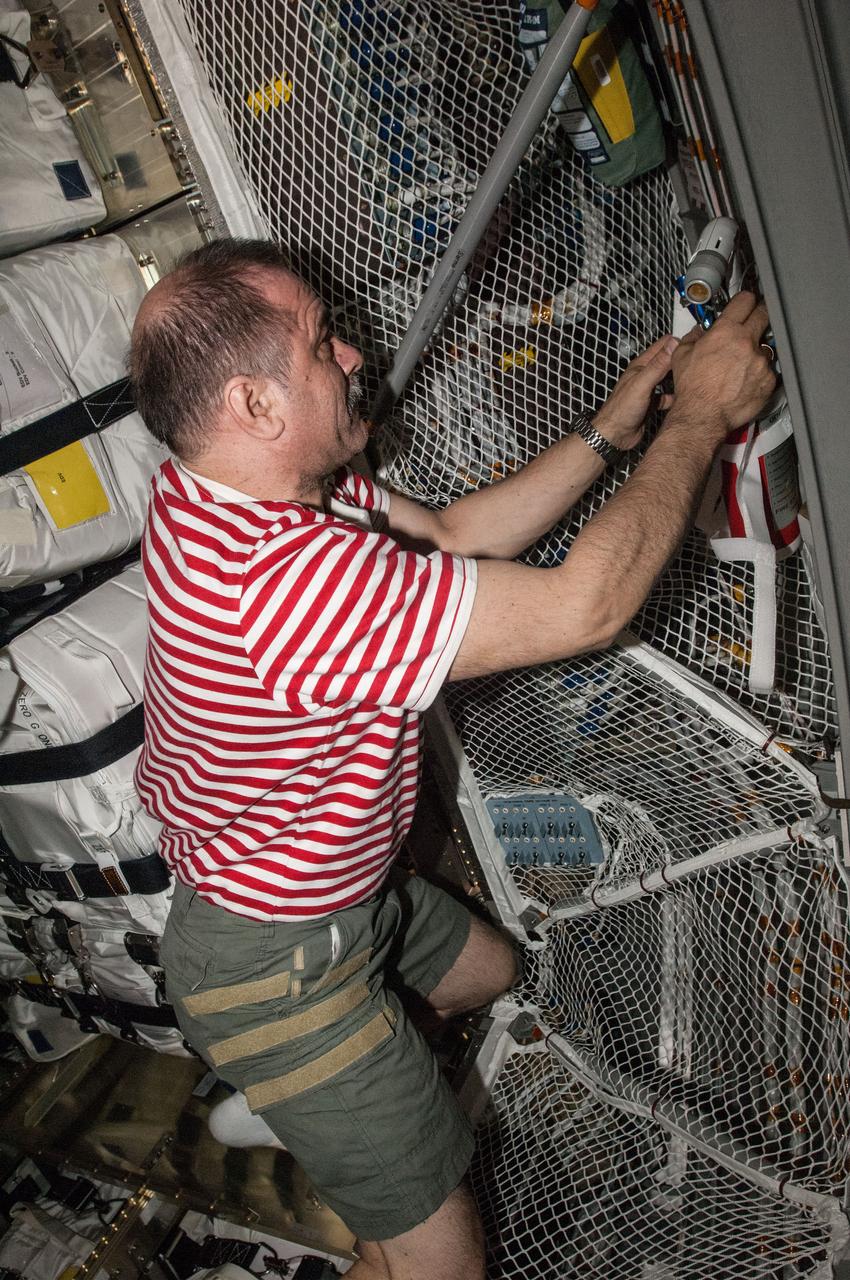
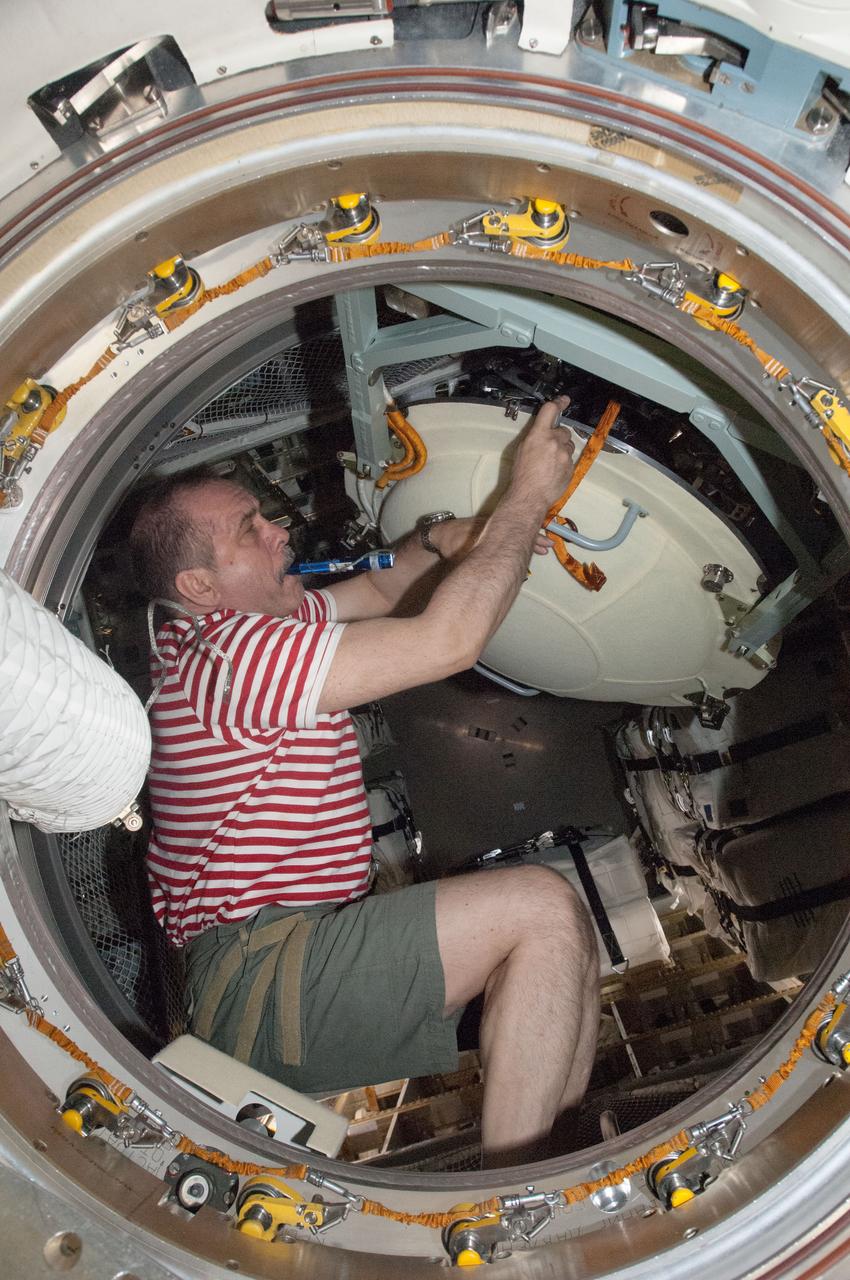
ISS036-E-009219 (18 June 2013) --- Russian cosmonaut Pavel Vinogradov, Expedition 36 commander, performs cargo operations in the European Space Agency's Automated Transfer Vehicle-4 (ATV-4) "Albert Einstein" currently docked to the Zvezda Service Module of the International Space Station.
ATV ops
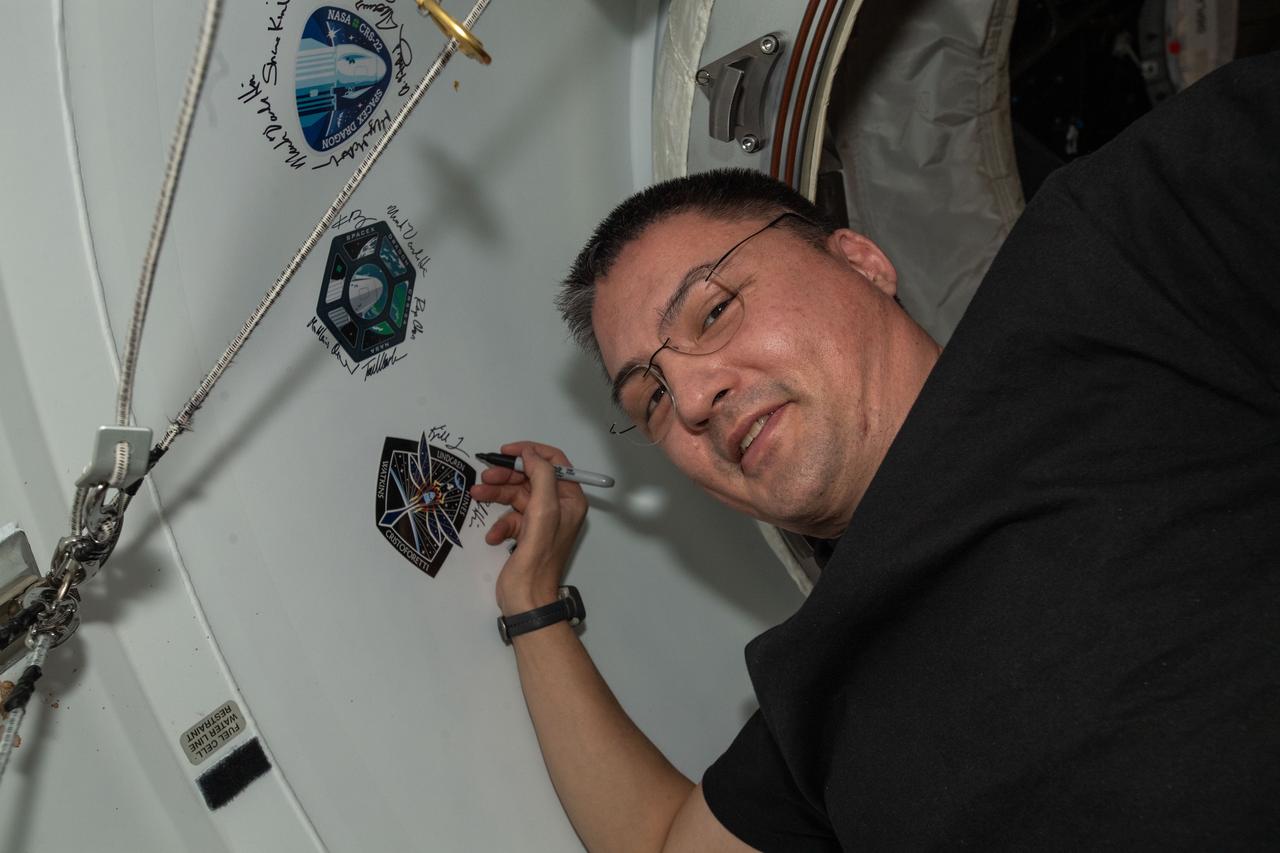
iss068e016454 (Oct. 12, 2022) --- NASA astronaut and Expedition 68 Flight Engineer Kjell Lindgren, also the SpaceX Crew-4 Commander, signs his name around the Crew-4 mission insignia affixed to the vestibule between the Harmony module's space-facing port and the Dragon Freedom crew ship.
iss068e016454
iss068e016462 (Oct. 12, 2022) --- NASA astronaut and Expedition 68 Flight Engineer Jessica Watkins, also a SpaceX Crew-4 Mission Specialist, signs her name around the Crew-4 mission insignia affixed to the vestibule between the Harmony module's space-facing port and the Dragon Freedom crew ship.
iss068e016462
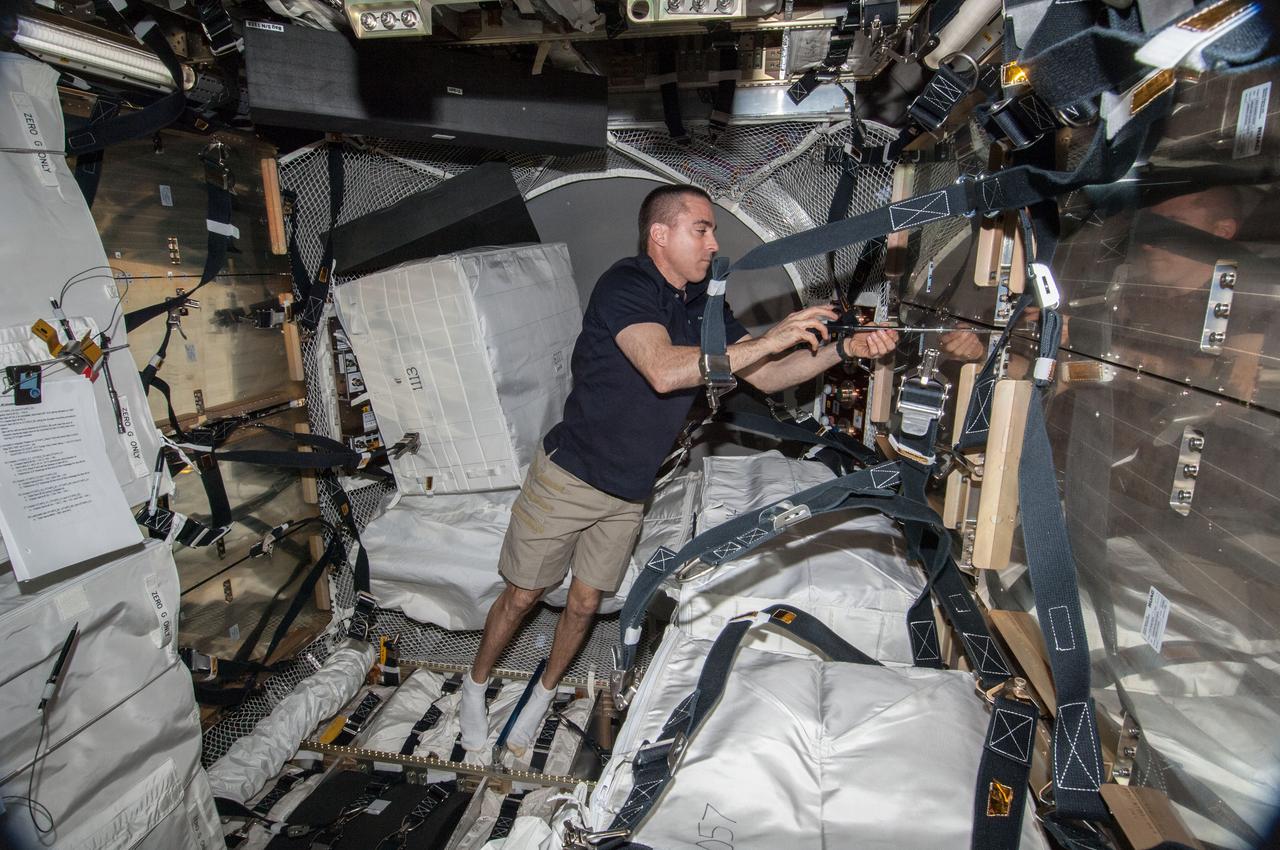
ISS036-E-009246 (18 June 2013) --- NASA astronaut Chris Cassidy, Expedition 36 flight engineer, takes inventory of cargo in the European Space Agency's Automated Transfer Vehicle-4 (ATV-4) "Albert Einstein" currently docked to the Zvezda Service Module of the International Space Station.
ATV ops
ISS036-E-009184 (18 June 2013) --- Russian cosmonaut Pavel Vinogradov, Expedition 36 commander, opens the hatch in the Zvezda Service Module transfer tunnel/ATV vestibule of the International Space Station after European Space Agency's Automated Transfer Vehicle-4 (ATV-4) "Albert Einstein" docked with the station.
ATV ops
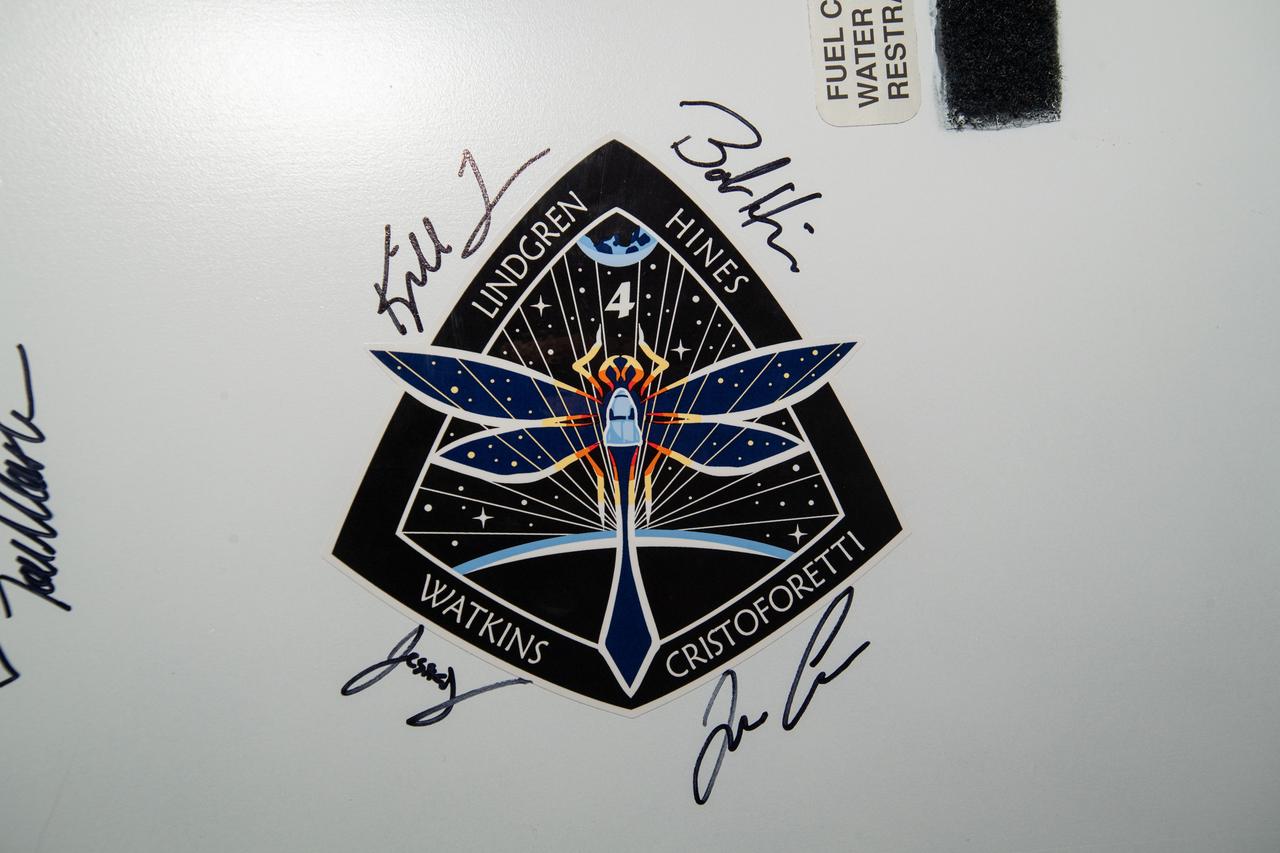
iss068e016463 (Oct. 12, 2022) --- The SpaceX Crew-4 mission insignia, affixed to the vestibule between the Harmony module's space-facing port and the Dragon Freedom crew ship, is surrounded by the signatures of Crew-4 members Kjell Lindgren, Bob Hines, Jessica Watkins, and Samantha Cristoforetti. Credit: NASA/Kjell Lindgren
iss068e016463
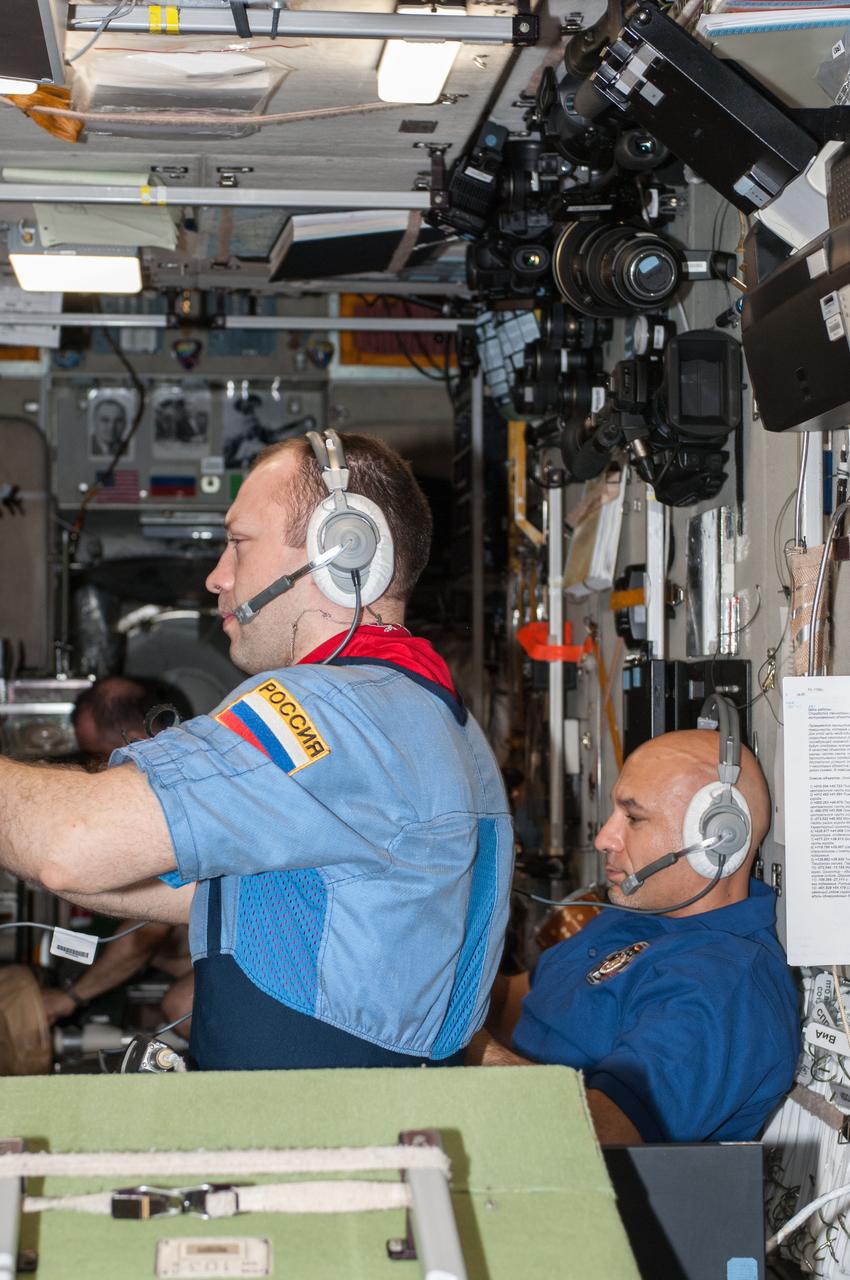
ISS036-E-008164 (15 June 2013) --- Expedition 36 Flight Engineers Alexander Misurkin (left) with Russia's Federal Space Agency (Roscosmos) and Luca Parmitano of the European Space Agency, with the assistance of Ku-band communications, monitor the approach of ESA's Automated Transfer Vehichle-4 (ATV-4) from the Zvezda service module.
Misurkin and Parmitano in Service Module
iss045e014085 (9/17/2015) --- View of the Japan Aerospace Exploration Agency (JAXA) Small Satellite S-CUBE deployed from JEM [Japanese Experiment Module]-Small Satellite Orbital Deployer 4 (J-SSOD 4) equipment on the Multi-Purpose Experiment Platform (MPEP).
J-SSOD 4 Mission
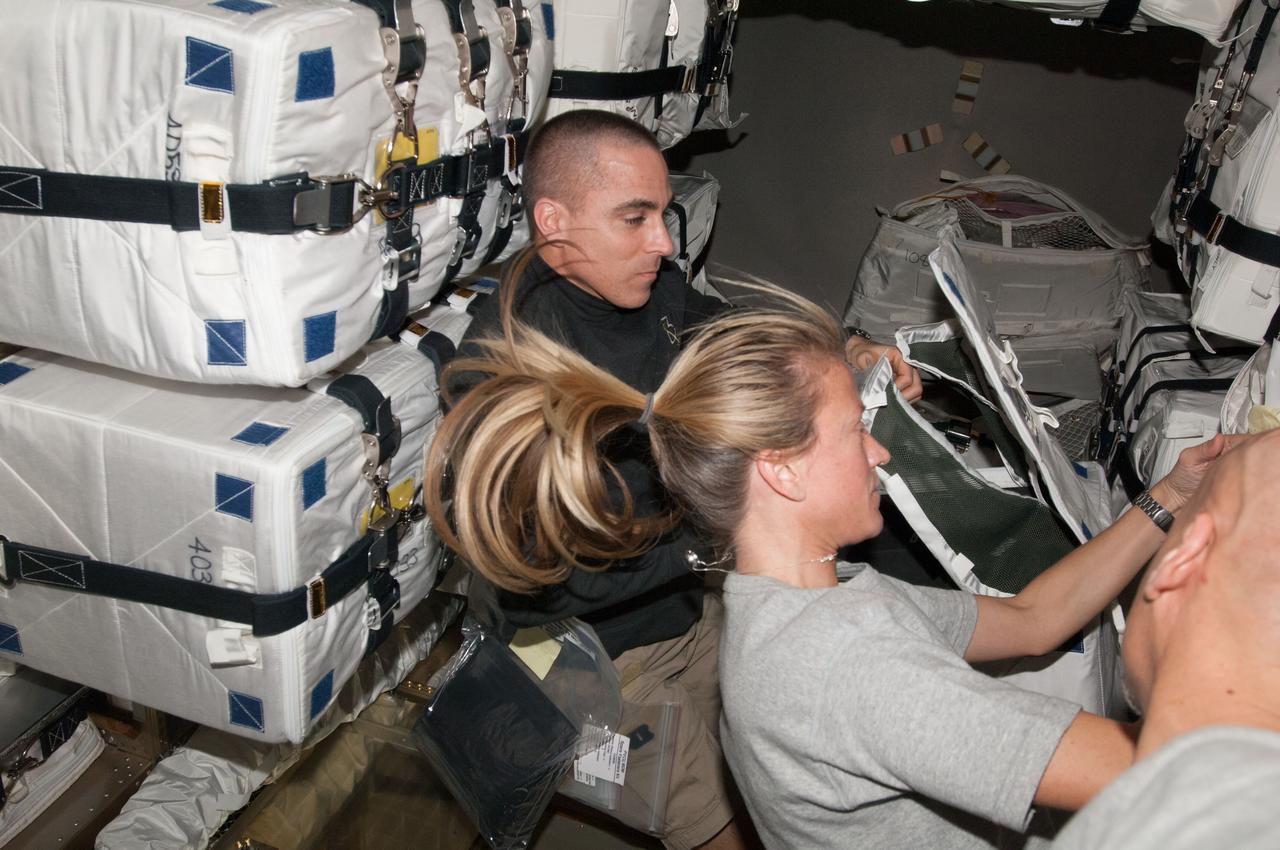
ISS036-E-009256 (18 June 2013) --- NASA astronauts Chris Cassidy and Karen Nyberg, both Expedition 36 flight engineers, perform cargo operations in the European Space Agency's Automated Transfer Vehicle-4 (ATV-4) "Albert Einstein" currently docked to the Zvezda Service Module of the International Space Station.
ATV ops
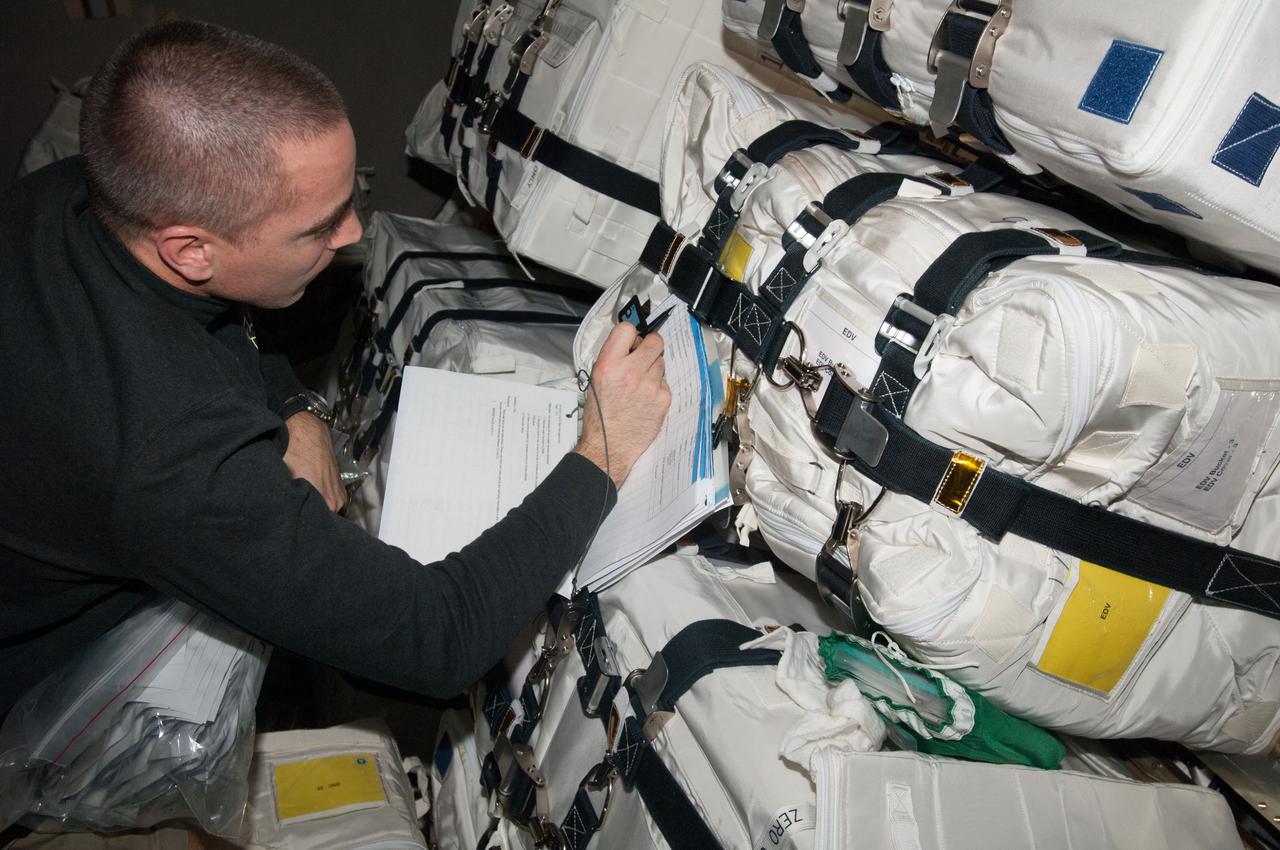
ISS036-E-013924 (2 July 2013) --- NASA astronaut Chris Cassidy, Expedition 36 flight engineer, works in the European Space Agency's Automated Transfer Vehicle-4 (ATV-4) "Albert Einstein" currently docked to the Zvezda Service Module of the International Space Station.
Unpacking of ATV
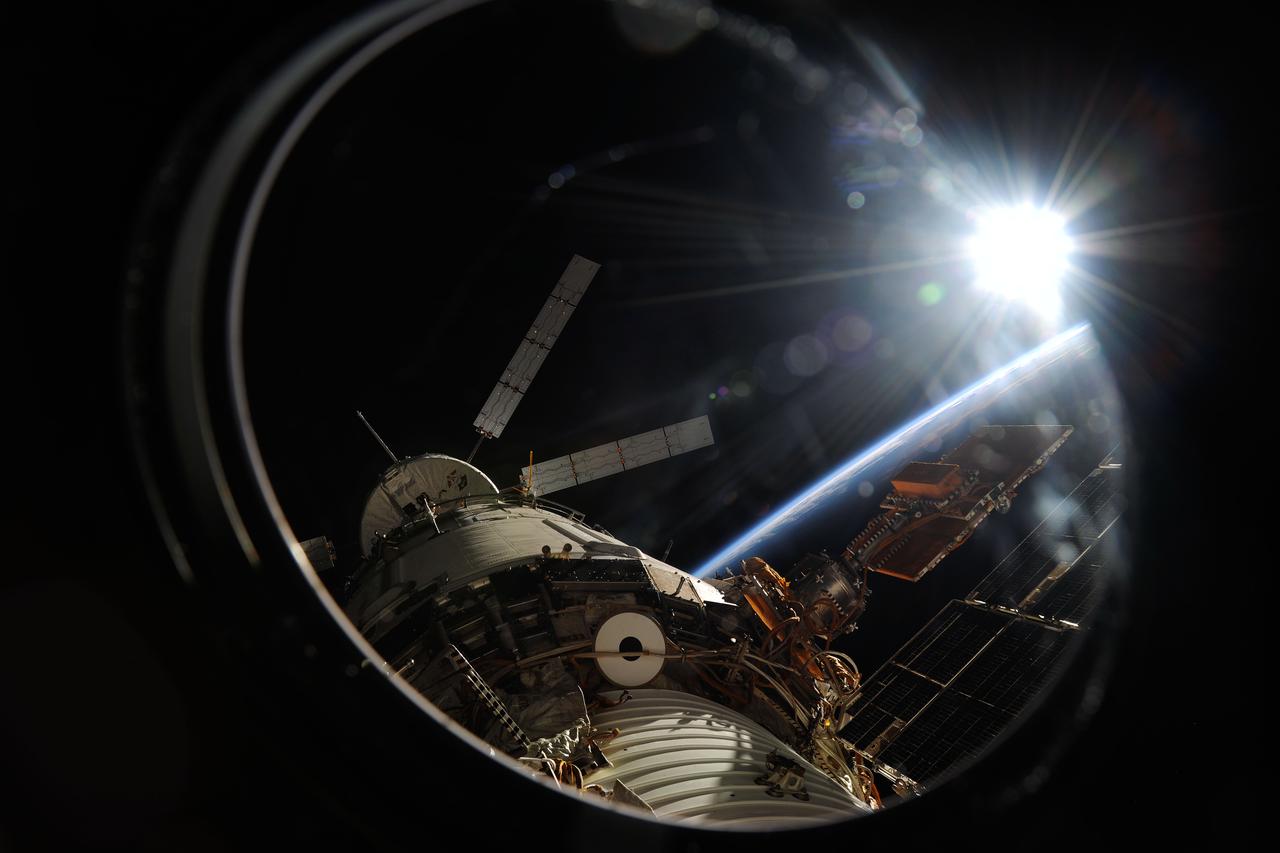
ISS036-E-007864 (15 June 2013) --- As seen from a window in the Pirs module, the European Space Agency's Automated Transfer Vehicle-4 (ATV-4) “Albert Einstein” is about to dock to the orbital outpost at 2:07 GMT, June 15, 2013, following a ten-day period of free-flight.
ESA Albert Einstein ATV-4 during approach
iss068e016449 (Oct. 12, 2022) --- NASA astronaut and Expedition 68 Flight Engineer Bob Hines, also the SpaceX Crew-4 Pilot, signs his name around the Crew-4 mission insignia affixed to the vestibule between the Harmony module's space-facing port and the Dragon Freedom crew ship.
iss068e016449
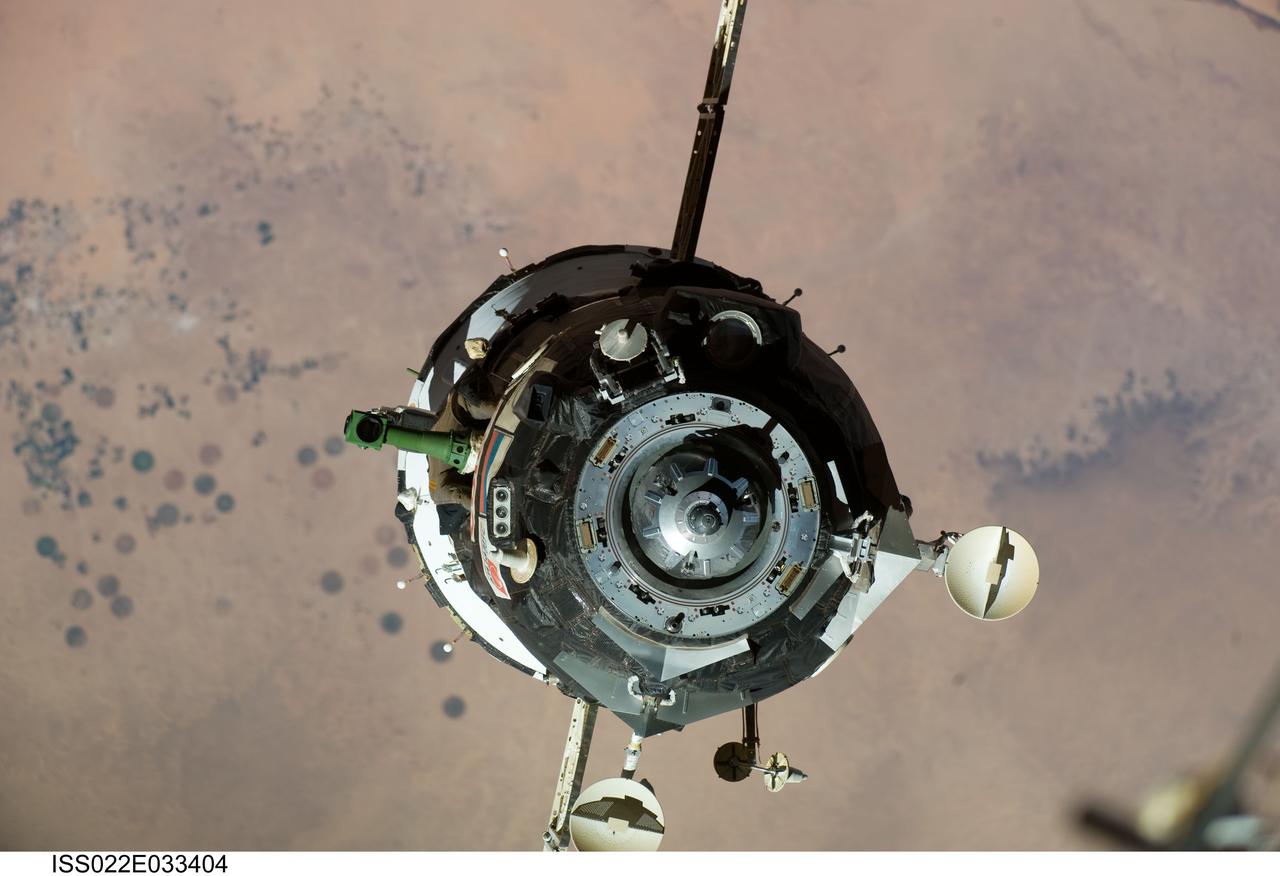
ISS022-E-033404 (21 Jan. 2010) --- The Soyuz TMA-16 spacecraft is featured in this image photographed by an Expedition 22 crew member on the International Space Station during the relocation of the Soyuz from the Zvezda Service Module’s aft port to the Poisk module. Russian cosmonaut Maxim Suraev, Soyuz commander and Expedition 22 flight engineer; along with NASA astronaut Jeffrey Williams, Expedition 22 commander, undocked the Soyuz spacecraft at 4:03 a.m. (CST) and docked it to Poisk at 4:24 a.m. on Jan. 21, 2010.
Soyuz TMA-16 during Relocation
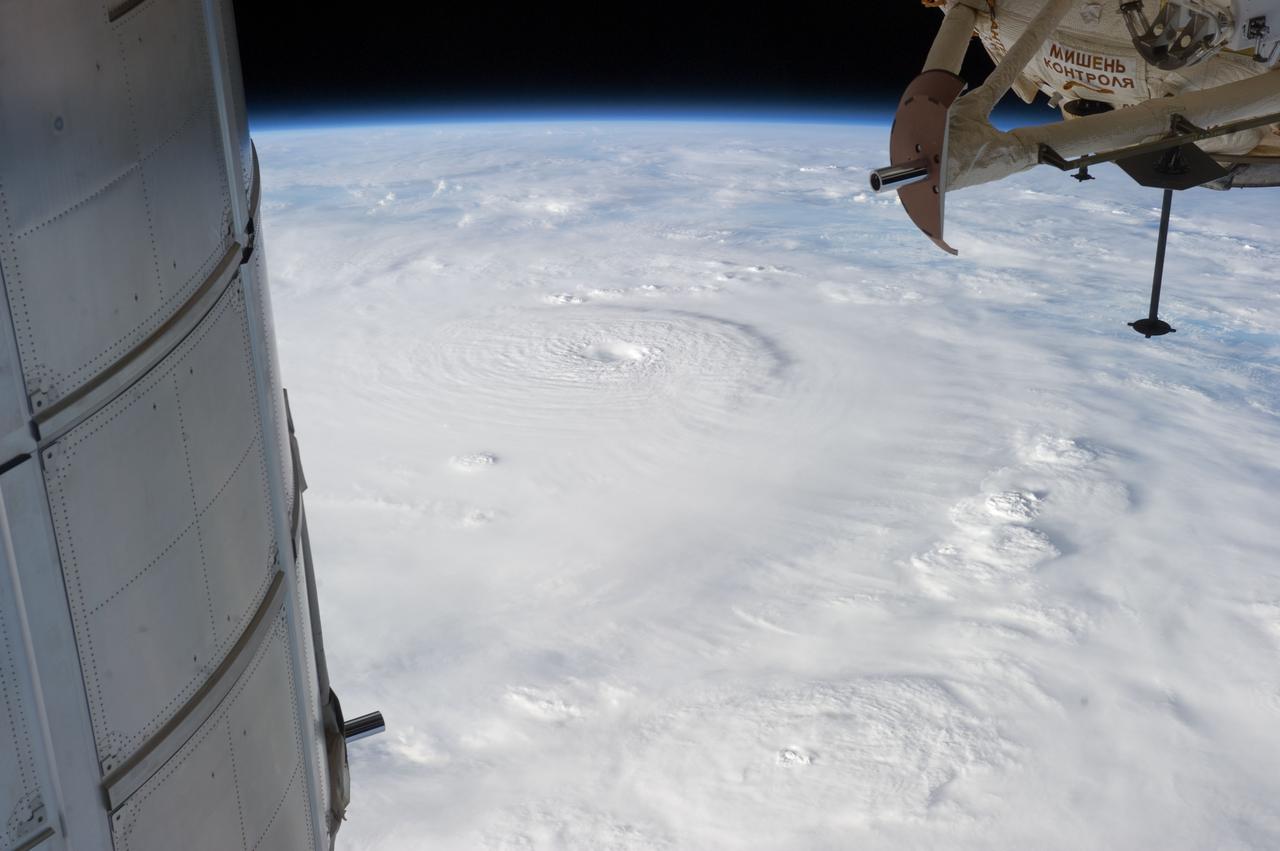
ISS034-E-005476 (2 Dec. 2012) --- One of the Expedition 34 crew members aboard the International Space Station captured this still image of Super Typhoon Bopha on Dec. 2, 2012.  The storm was bearing down on the Philippines with winds of 135 miles per hour. Meteorologists are predicting that the storm will make landfall on Mindanao in the early morning of Dec. 4 local time, as either a category 4 or 5. Parts of the orbital outpost are seen in the picture -- the Permanent Multipurpose Module on the left, and Mini-Research Module 1 (MRM1) on the right.
Earth Observations taken by Expedition 34 crewmember
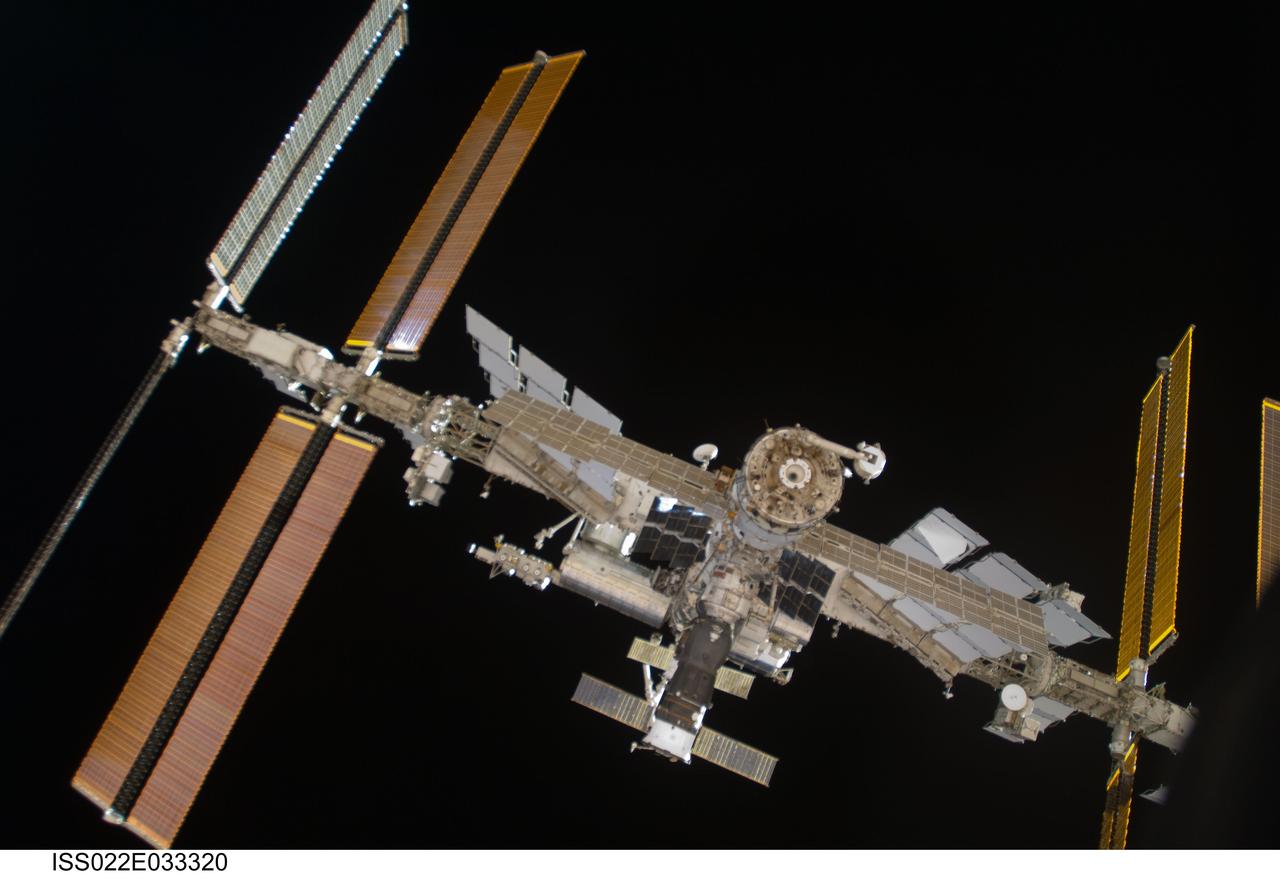
ISS022-E-033320 (21 Jan. 2010) --- The International Space Station is featured in this image photographed by a crew member on the Soyuz TMA-16 spacecraft during the relocation of the Soyuz from the Zvezda Service Module’s aft port to the Poisk module. Russian cosmonaut Maxim Suraev, Soyuz commander and Expedition 22 flight engineer; along with NASA astronaut Jeffrey Williams, Expedition 22 commander, undocked the Soyuz spacecraft at 4:03 a.m. (CST) and docked it to Poisk at 4:24 a.m. on Jan. 21, 2010.
ISS during relocation of Soyuz TMA-16 Spacecraft during Expedition 22
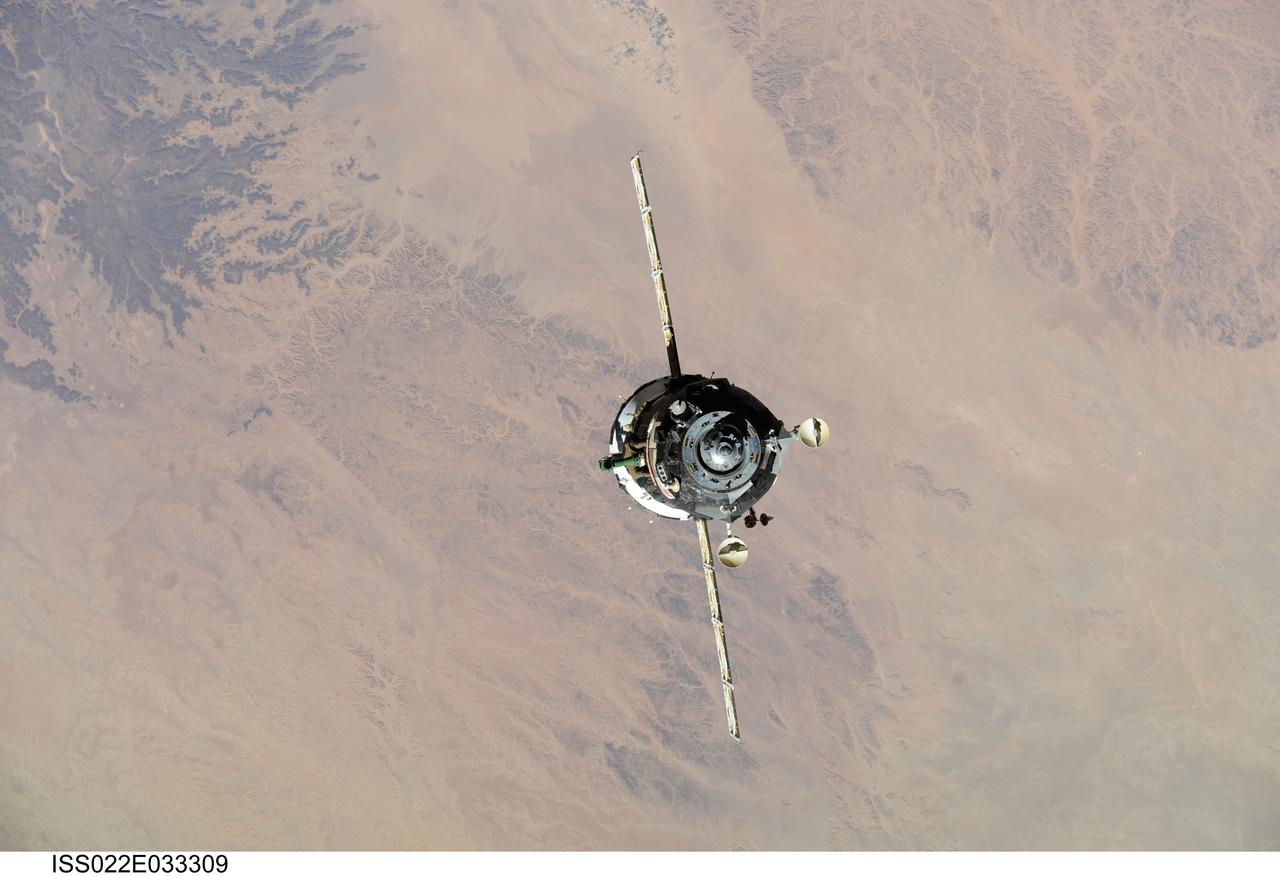
ISS022-E-033309 (21 Jan. 2010) --- The Soyuz TMA-16 spacecraft is featured in this image photographed by an Expedition 22 crew member on the International Space Station during the relocation of the Soyuz from the Zvezda Service Module’s aft port to the Poisk module. Russian cosmonaut Maxim Suraev, Soyuz commander and Expedition 22 flight engineer; along with NASA astronaut Jeffrey Williams, Expedition 22 commander, undocked the Soyuz spacecraft at 4:03 a.m. (CST) and docked it to Poisk at 4:24 a.m. on Jan. 21, 2010.
Soyuz TMA-16 Spacecraft during Relocation
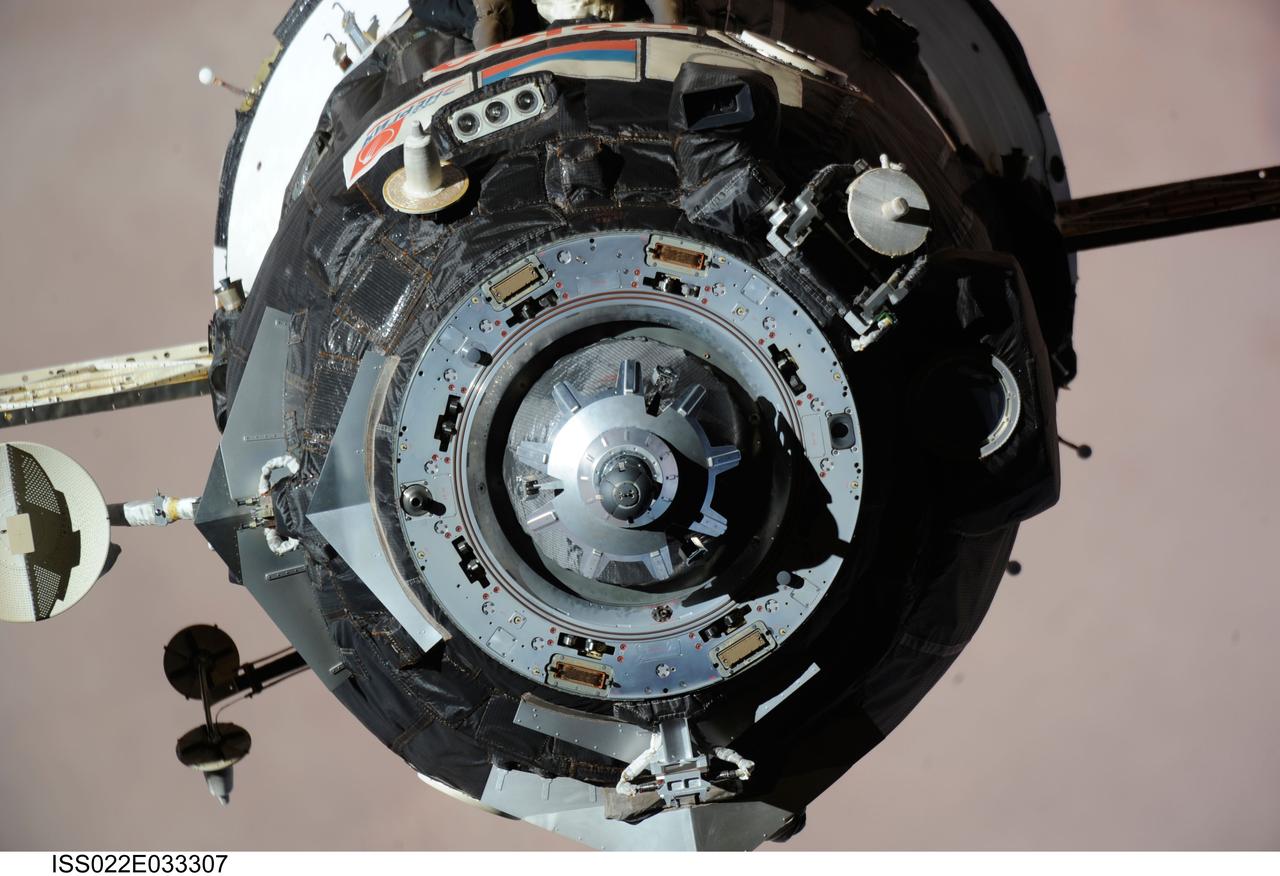
ISS022-E-033307 (21 Jan. 2010) --- The Soyuz TMA-16 spacecraft is featured in this image photographed by an Expedition 22 crew member on the International Space Station during the relocation of the Soyuz from the Zvezda Service Module’s aft port to the Poisk module. Russian cosmonaut Maxim Suraev, Soyuz commander and Expedition 22 flight engineer; along with NASA astronaut Jeffrey Williams, Expedition 22 commander, undocked the Soyuz spacecraft at 4:03 a.m. (CST) and docked it to Poisk at 4:24 a.m. on Jan. 21, 2010.
Soyuz TMA-16 Spacecraft during Relocation
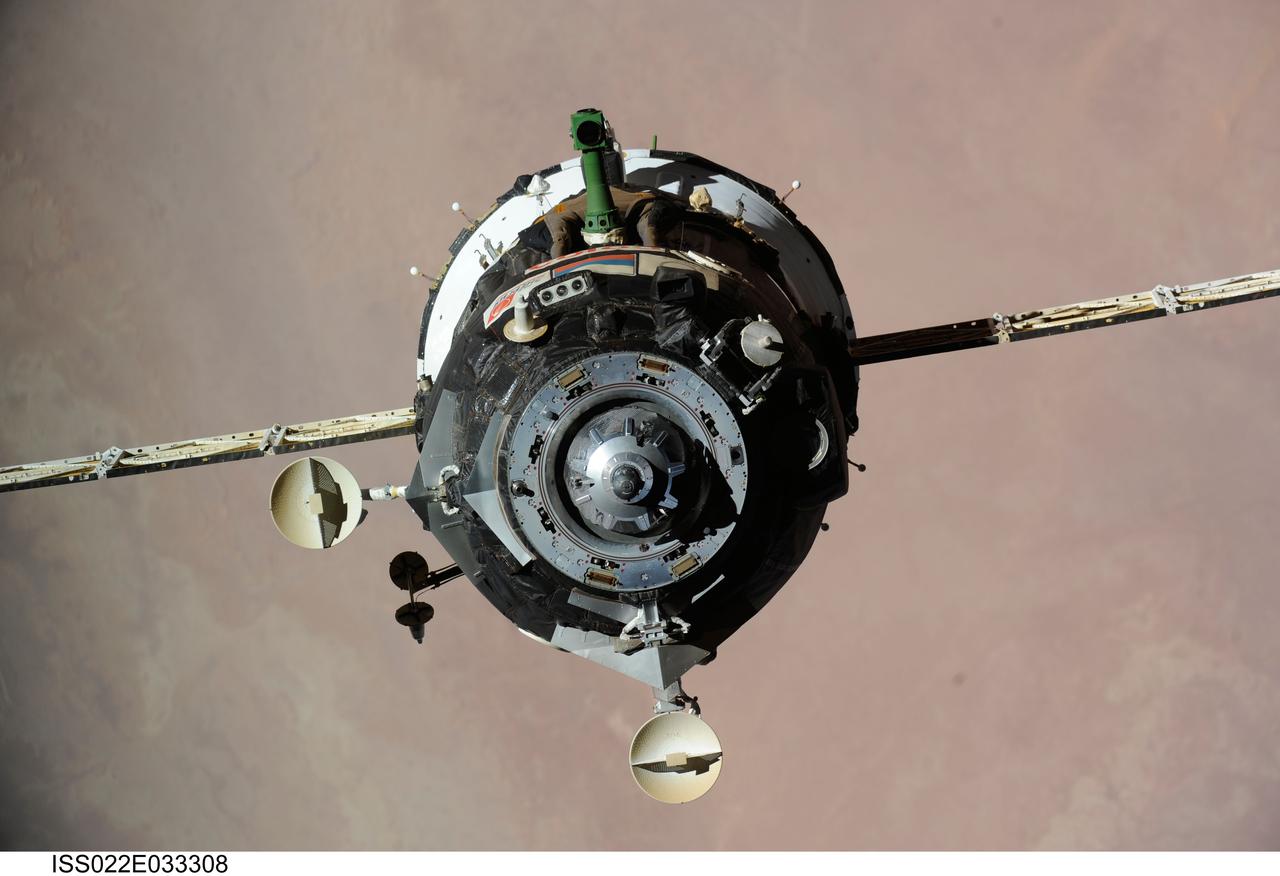
ISS022-E-033308 (21 Jan. 2010) --- The Soyuz TMA-16 spacecraft is featured in this image photographed by an Expedition 22 crew member on the International Space Station during the relocation of the Soyuz from the Zvezda Service Module’s aft port to the Poisk module. Russian cosmonaut Maxim Suraev, Soyuz commander and Expedition 22 flight engineer; along with NASA astronaut Jeffrey Williams, Expedition 22 commander, undocked the Soyuz spacecraft at 4:03 a.m. (CST) and docked it to Poisk at 4:24 a.m. on Jan. 21, 2010.
Soyuz TMA-16 Spacecraft during Relocation
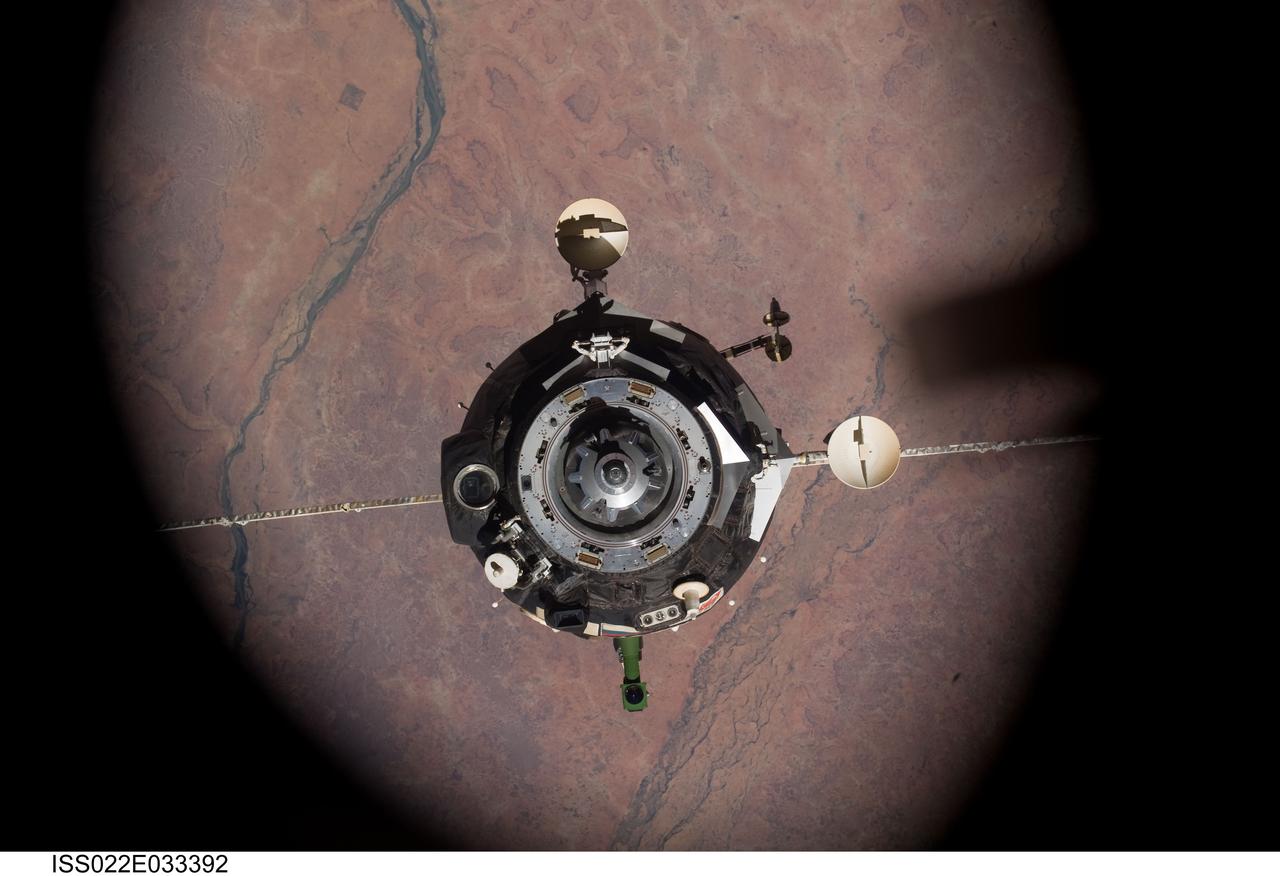
ISS022-E-033392 (21 Jan. 2010) --- The Soyuz TMA-16 spacecraft is featured in this image photographed by an Expedition 22 crew member on the International Space Station during the relocation of the Soyuz from the Zvezda Service Module’s aft port to the Poisk module. Russian cosmonaut Maxim Suraev, Soyuz commander and Expedition 22 flight engineer; along with NASA astronaut Jeffrey Williams, Expedition 22 commander, undocked the Soyuz spacecraft at 4:03 a.m. (CST) and docked it to Poisk at 4:24 a.m. on Jan. 21, 2010.
Soyuz TMA-16 during Relocation
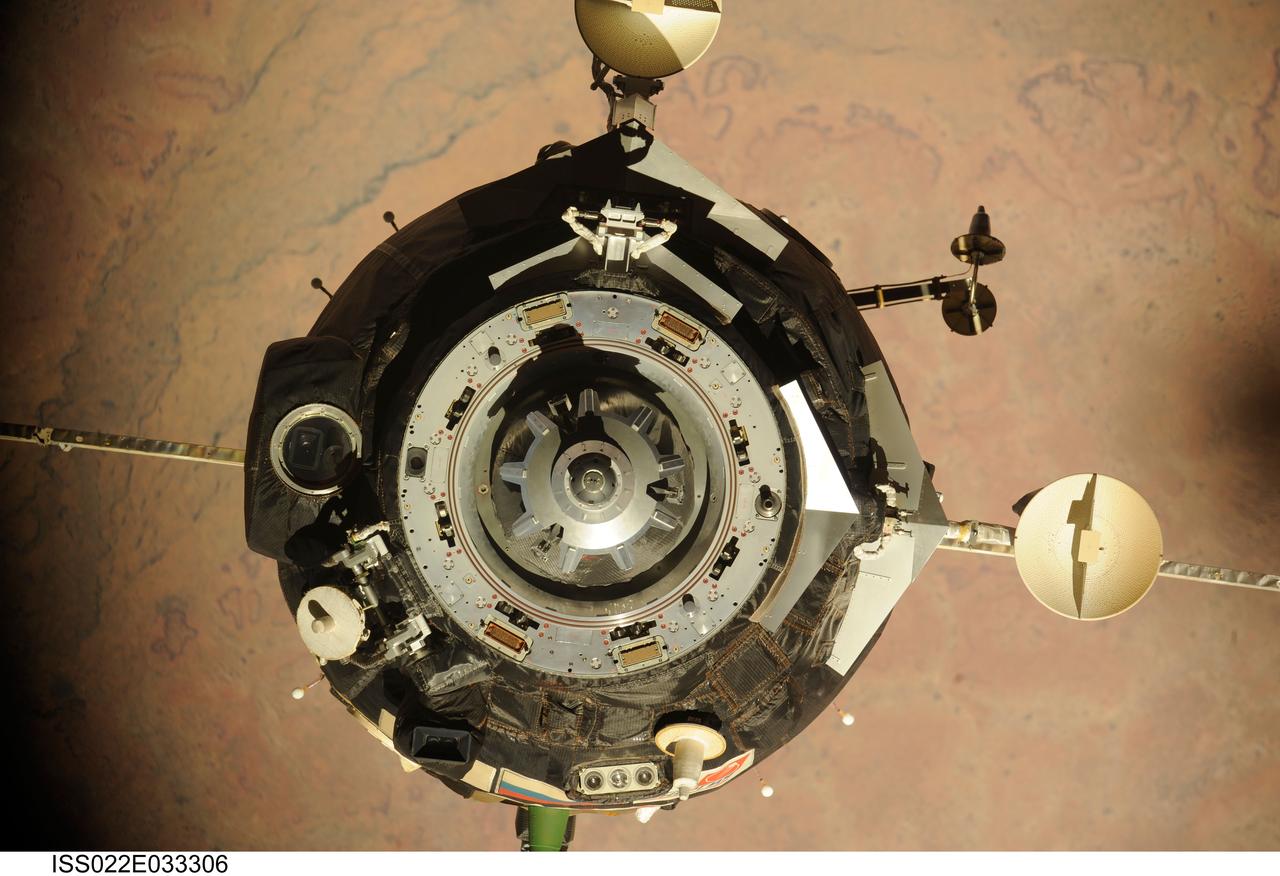
ISS022-E-033306 (21 Jan. 2010) --- The Soyuz TMA-16 spacecraft is featured in this image photographed by an Expedition 22 crew member on the International Space Station during the relocation of the Soyuz from the Zvezda Service Module’s aft port to the Poisk module. Russian cosmonaut Maxim Suraev, Soyuz commander and Expedition 22 flight engineer; along with NASA astronaut Jeffrey Williams, Expedition 22 commander, undocked the Soyuz spacecraft at 4:03 a.m. (CST) and docked it to Poisk at 4:24 a.m. on Jan. 21, 2010.
Soyuz TMA-16 Spacecraft during Relocation
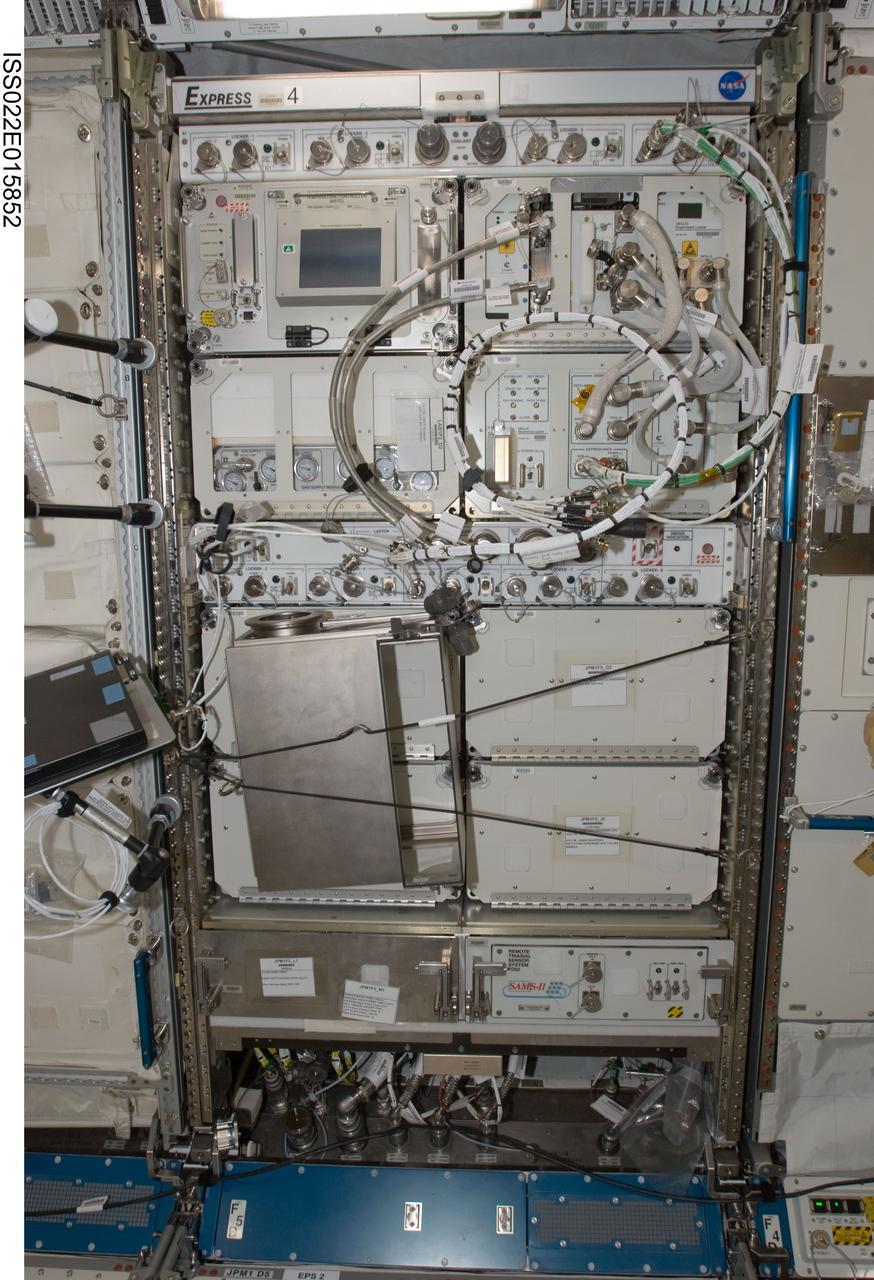
iss022e015852 (12/30/2009) --- The image shows a front view of EXpedite the PRocessing of Experiments to Space Station EXPRESS Rack 4 (Rack 4,JPM/1F5) in the Japanese Experiment Module (JEM) Japanese Pressurized Module (JPM). Equipment visible in the EXPRESS Rack includes the Biotechnology Specimen Temperature Controller (BSTC) and the Gas Supply Module (GSM) support hardware for the CBOSS (Cellular Biotechnology Operations Support Systems) investigations, and the Device for the Study of Critical Liquids and Crystallization (DECLIC). Also visible is the Space Acceleration Measurement System (SAMS) II.
Survey view of EXPRESS Rack 4 in the JPM during Expedition 22
U.S.S. Bennington comes alongside the floating Apollo spacecraft 017 Command Module during recovery operations in the mid-Pacific Ocean. The Command Module splashed down at 3:37 p.m., November 9, 1967, 934 nautical miles northwest of Honolulu, Hawaii.
U.S.S. Bennington during recovery operations for Apollo 4
Astronaut Gerald P. Carr, commander for the Skylab 4 mission, demonstrates the effects of zero-gravity as he floats in the forward dome area of the Orbital Workshop of the Skylab space station while in Earth orbit.
Astronaut Gerald Carr floats in forward dome area
iss072e217983 (Nov. 18, 2024) --- NASA astronaut and Expedition 72 Flight Engineer Butch Wilmore swaps sample cassettes inside the Advanced Space Experiment Processor-4 (ADSEP-4) located aboard the International Space Station's Kibo laboratory module. The ADSEP-4 is a portable research facility that supports multiple types of science experiments on the orbital outpost and also interfaces with the SpaceX Dragon and Northrop Grumman Cygnus cargo spacecraft.
Astronaut Butch Wilmore swaps sample cassettes inside the Advanced Space Experiment Processor-4
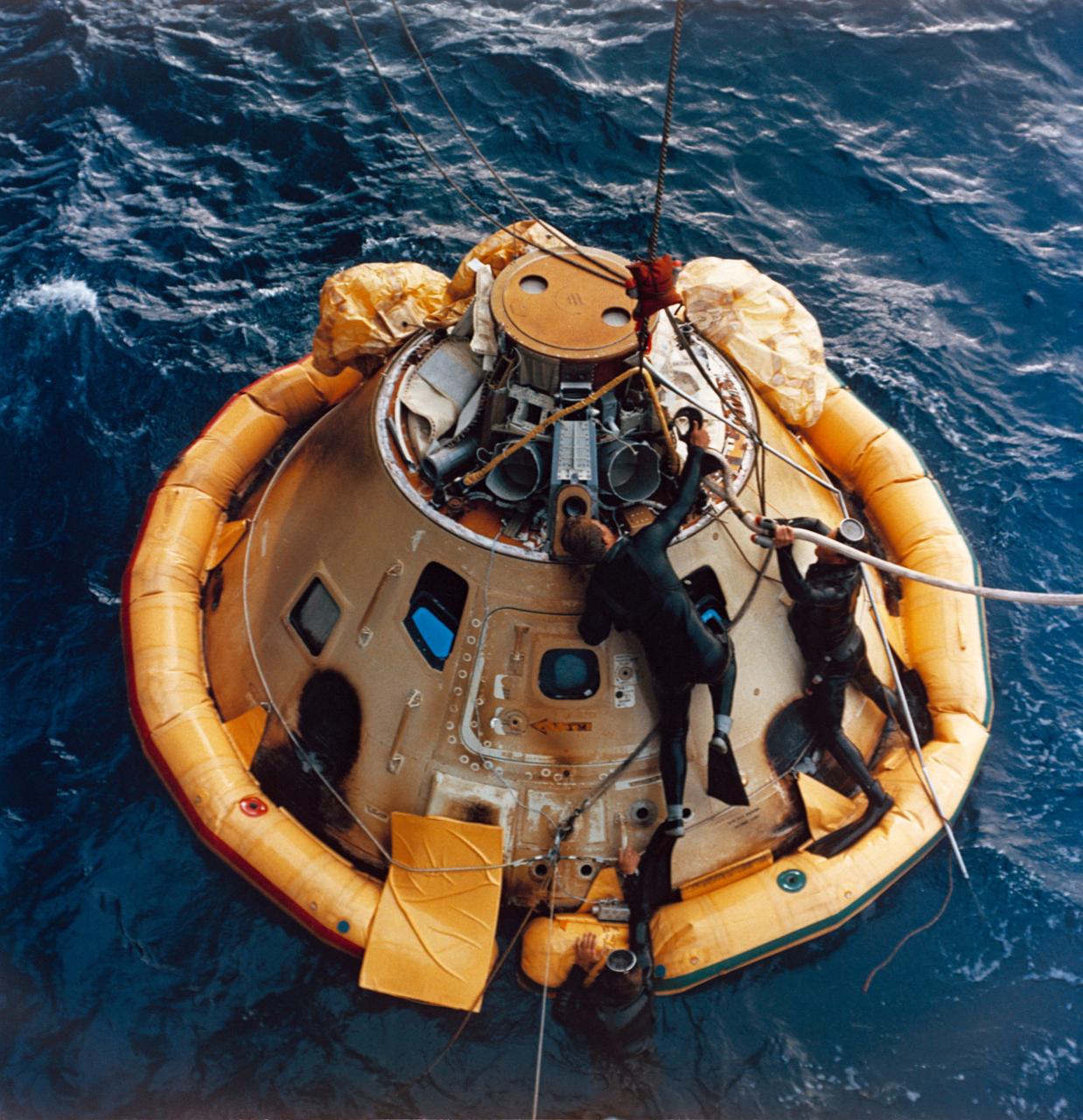
S68-27884 (4 April 1968) --- A U. S. Navy frogman team prepares the Apollo Spacecraft 020 Command Module (CM) for hoisting aboard the USS Okinawa. The USS Okinawa was the prime recovery ship for the Apollo 6 (Spacecraft 020/Saturn 502) unmanned space mission. Splashdown occurred at 4:58:45 p.m. (EST), April 4, 1968, at 375 nautical miles north of Honolulu, Hawaii.
RECOVERY - APOLLO VI
iss072e217998 (Nov. 18, 2024) --- NASA astronaut and Expedition 72 Flight Engineer Butch Wilmore swaps sample cassettes inside the Advanced Space Experiment Processor-4 (ADSEP-4) located aboard the International Space Station's Kibo laboratory module. The ADSEP-4 is a portable research facility that supports multiple types of science experiments on the orbital outpost and also interfaces with the SpaceX Dragon and Northrop Grumman Cygnus cargo spacecraft.
iss072e217998
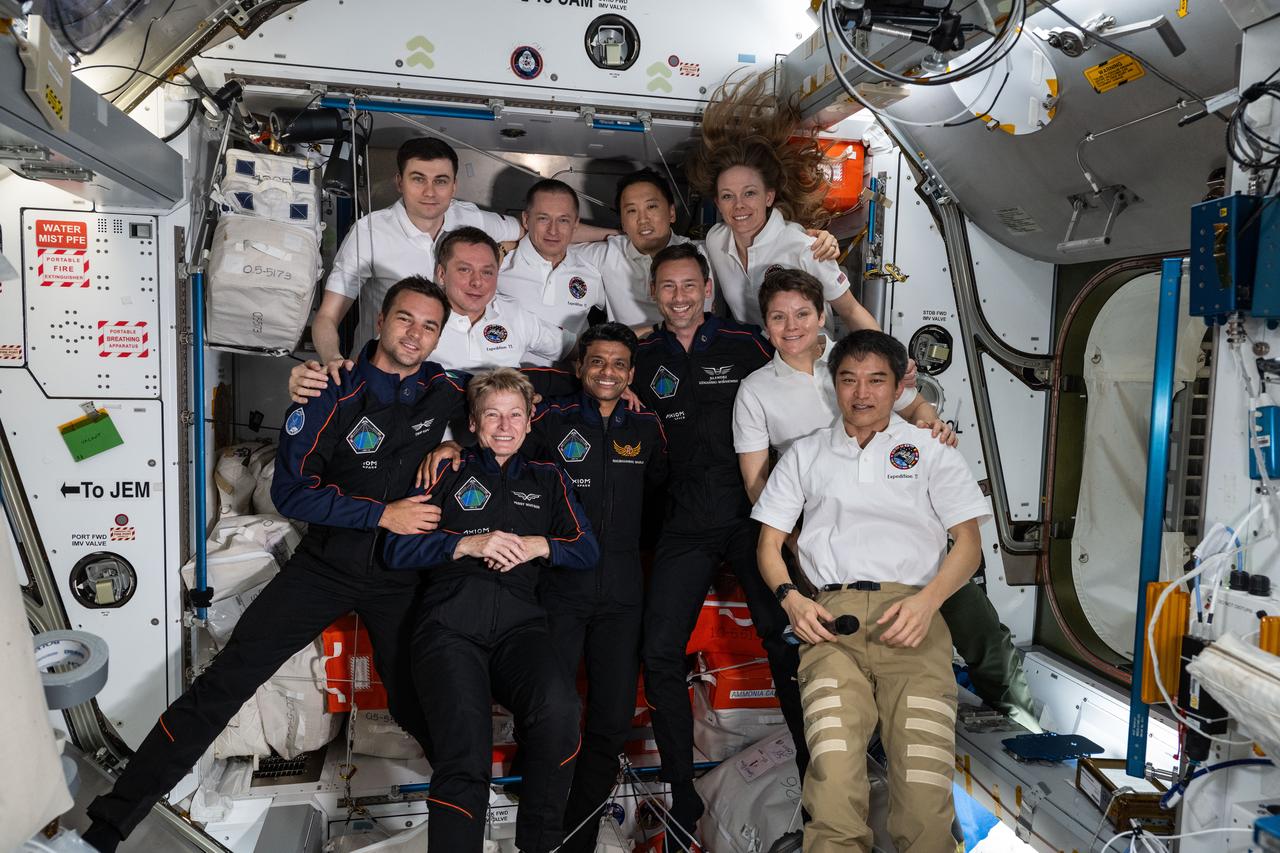
iss073e0249461 (June 26, 2025) --- The Axiom Mission 4 (Ax-4) and Expedition 73 crews join each other for a group portrait inside the International Space Station's Harmony module. In the front row (from left) are, Ax-4 crewmates Tibor Kapu, Peggy Whitson, Shubhanshu Shukla, and Sławosz Uznański-Wiśniewski with Expedition 73 crewmates Anne McClain and Takuya Onishi. In the rear are, Expedition 73 crewmates Alexey Zubritsky, Kirill Peskov, Sergey Ryzhikov, Jonny Kim, and Nichole Ayers.
The SpaceX Dragon spacecraft carrying the Axiom Mission 4 crew
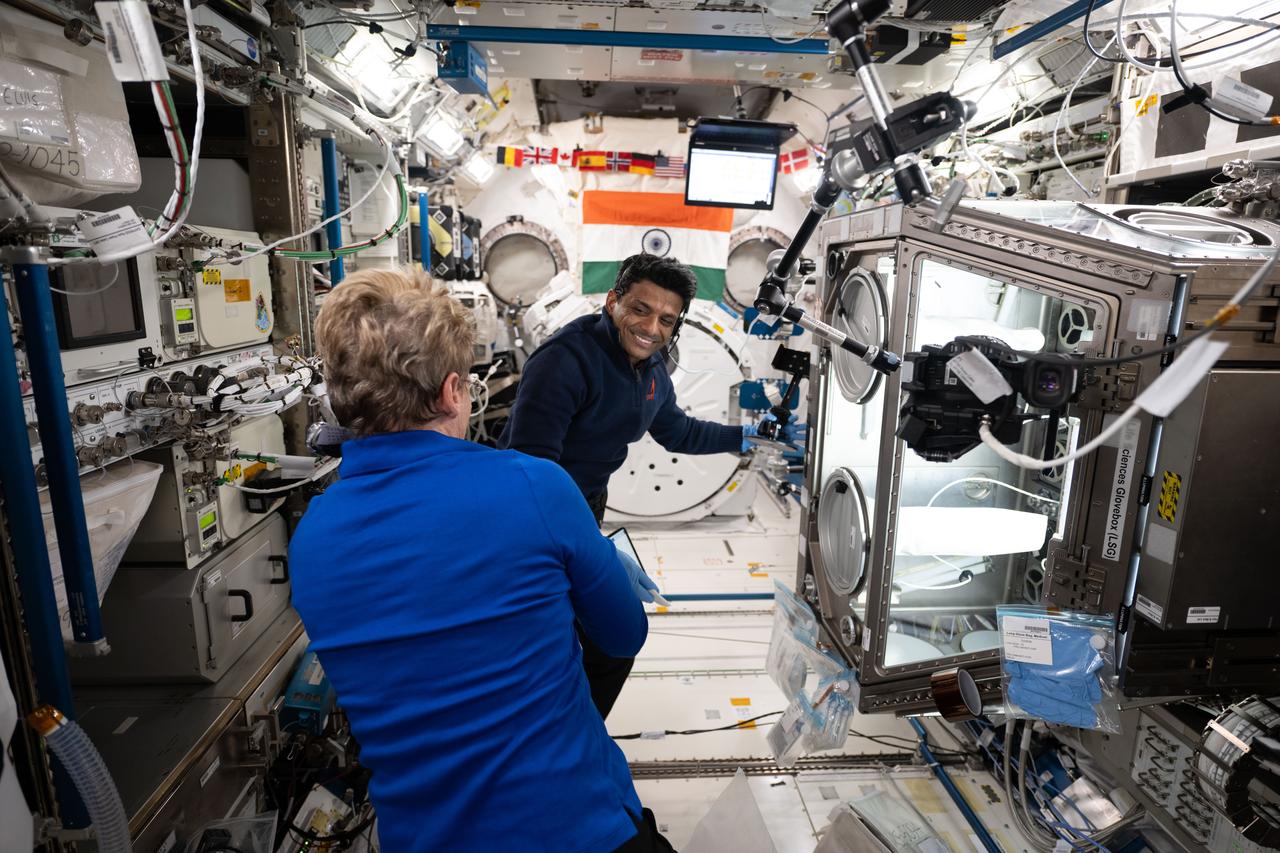
iss073e0252954 (June 28, 2025) --- Axiom Mission 4 (Ax-4) Commander and veteran astronaut Peggy Whitson assists Ax-4 Mission Specialist Shubhanshu Shukla from ISRO (Indian Space Research Organisation) during his research work inside the International Space Station's Kibo laboratory module. Shukla was using Kibo's Life Science Glovebox studying how to improve muscle regeneration in microgravity and maintain a crew member's muscle health during spaceflight.
Axiom Mission 4 astronauts Peggy Whitson and Shubhanshu Shukla
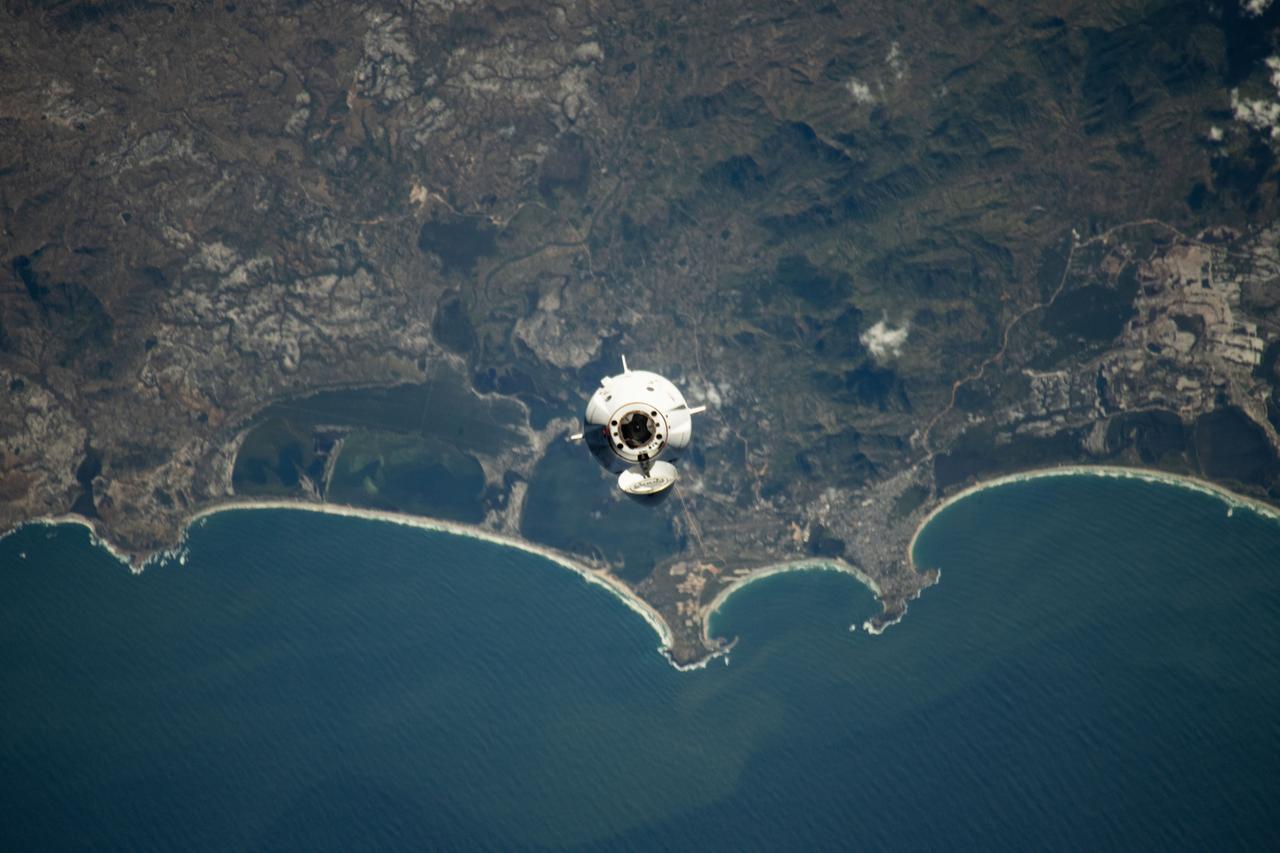
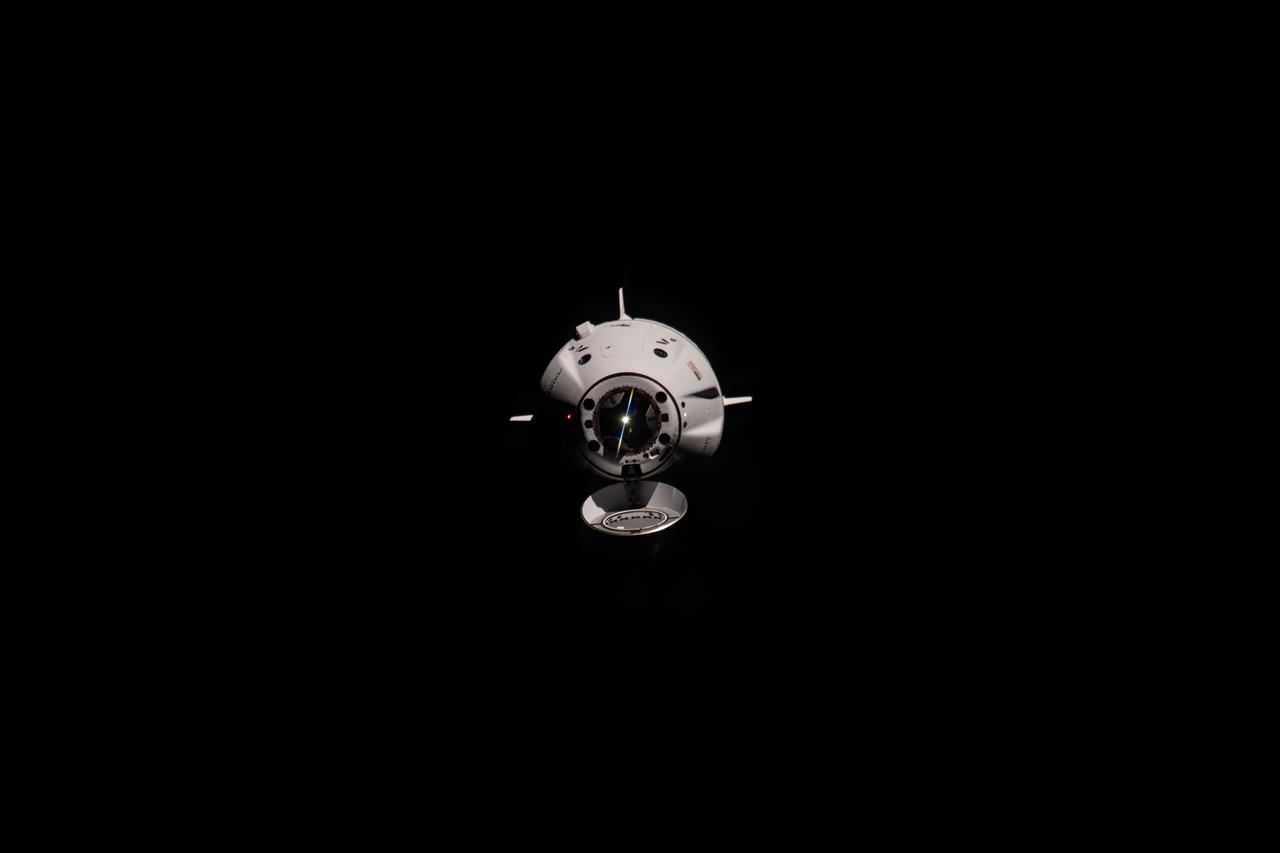
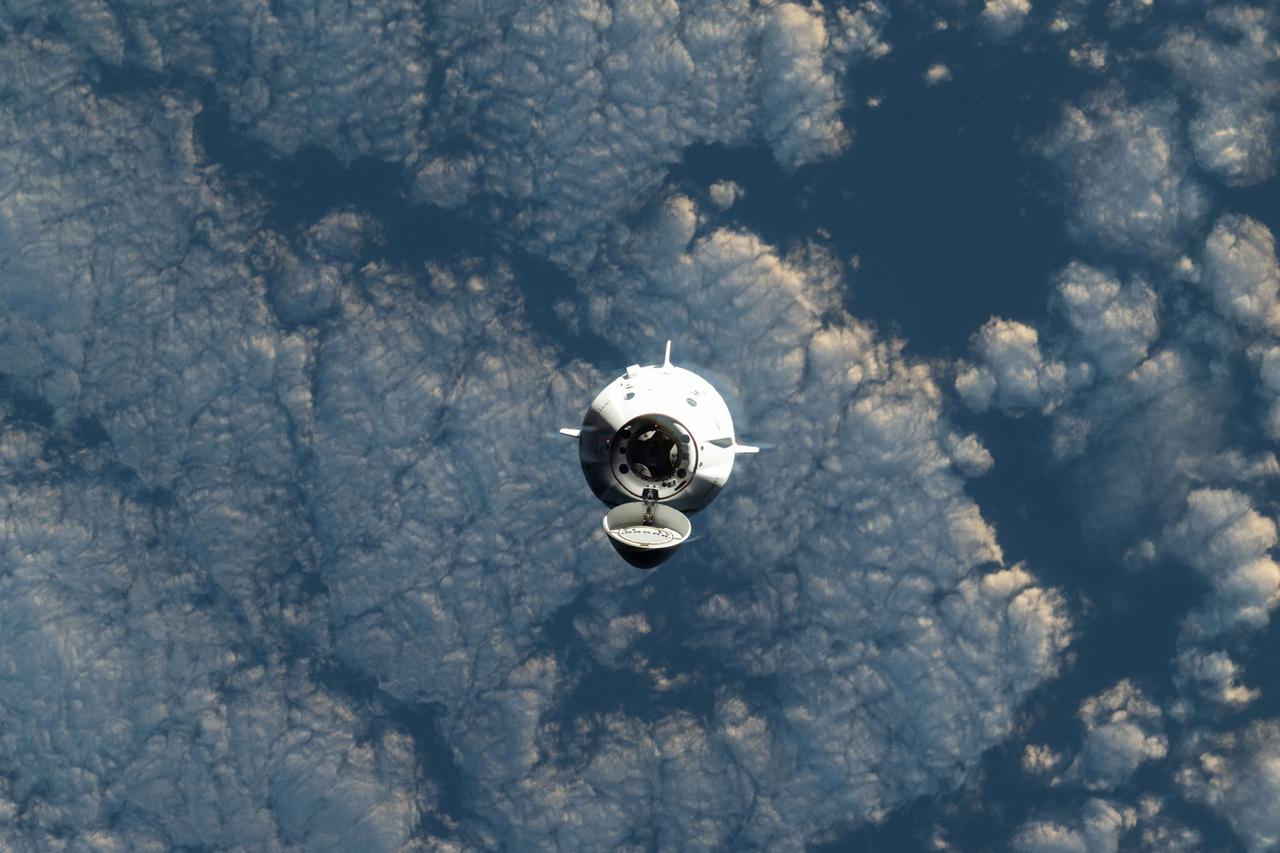
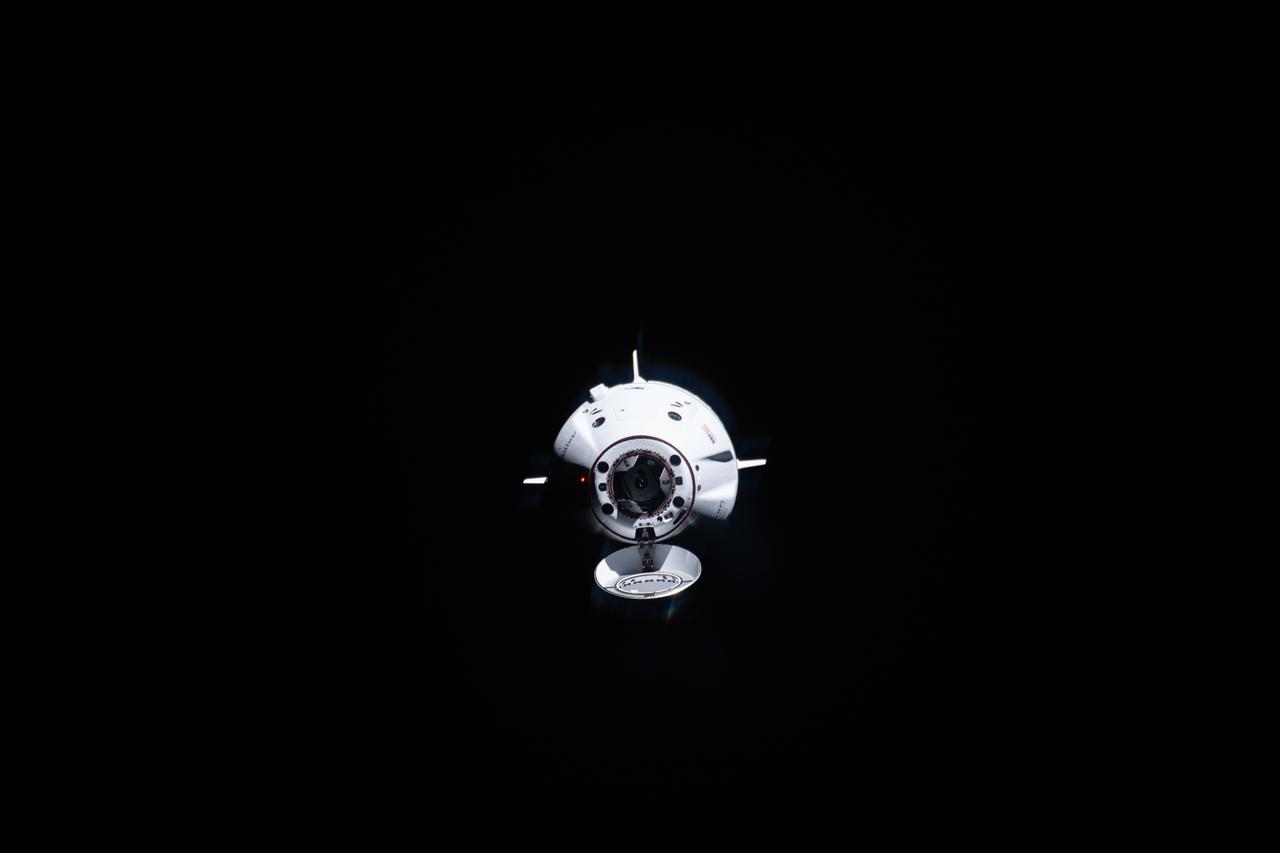
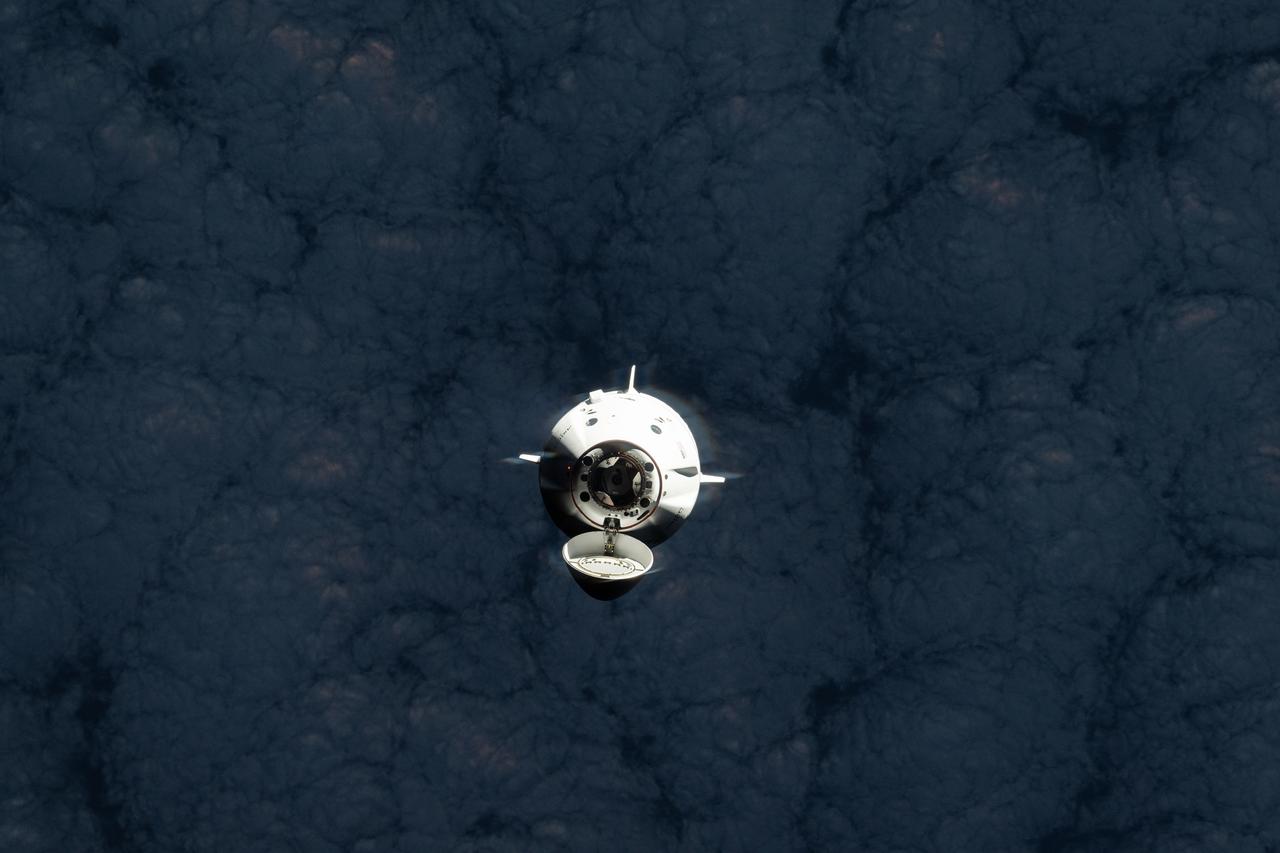
iss073e0249492 (June 26, 2025) --- The SpaceX Dragon spacecraft carrying the Axiom Mission 4 (Ax-4) crew from Axiom Space approaches the International Space Station as both spacecraft were orbiting 268 miles above a cloudy southern Indian Ocean. Commanding Ax-4 inside Dragon was veteran astronaut Peggy Whitson leading Pilot Shubhanshu Shukla, and Mission Specialists Sławosz Uznański-Wiśniewski and Tibor Kapu. Dragon would dock later to the orbital outpost's space-facing port on the Harmony module.
The SpaceX Dragon spacecraft carrying Axiom Mission 4 approaches the International Space Station
iss073e0249606 (June 26, 2025) --- The SpaceX Dragon spacecraft carrying the Axiom Mission 4 (Ax-4) crew from Axiom Space approaches the International Space Station as both spacecraft were orbiting 263 miles above the coast of southern Madagascar. Commanding Ax-4 inside Dragon was veteran astronaut Peggy Whitson leading Pilot Shubhanshu Shukla, and Mission Specialists Sławosz Uznański-Wiśniewski and Tibor Kapu. Dragon would dock later to the orbital outpost's space-facing port on the Harmony module.
The SpaceX Dragon spacecraft carrying Axiom Mission 4 approaches the International Space Station
iss073e0249494 (June 26, 2025) --- The SpaceX Dragon spacecraft carrying the Axiom Mission 4 (Ax-4) crew from Axiom Space approaches the International Space Station as both spacecraft were orbiting 269 miles above a cloudy southern Indian Ocean. Commanding Ax-4 inside Dragon was veteran astronaut Peggy Whitson leading Pilot Shubhanshu Shukla, and Mission Specialists Sławosz Uznański-Wiśniewski and Tibor Kapu. Dragon would dock later to the orbital outpost's space-facing port on the Harmony module.
The SpaceX Dragon spacecraft carrying Axiom Mission 4 approaches the International Space Station
iss073e0249700 (June 26, 2025) --- The SpaceX Dragon spacecraft carrying the Axiom Mission 4 (Ax-4) crew from Axiom Space approaches the International Space Station. Commanding Ax-4 inside Dragon was veteran astronaut Peggy Whitson leading Pilot Shubhanshu Shukla, and Mission Specialists Sławosz Uznański-Wiśniewski and Tibor Kapu. Dragon docked moments later to the orbital outpost's space-facing port on the Harmony module.
The SpaceX Dragon spacecraft carrying Axiom Mission 4 approaches the International Space Station
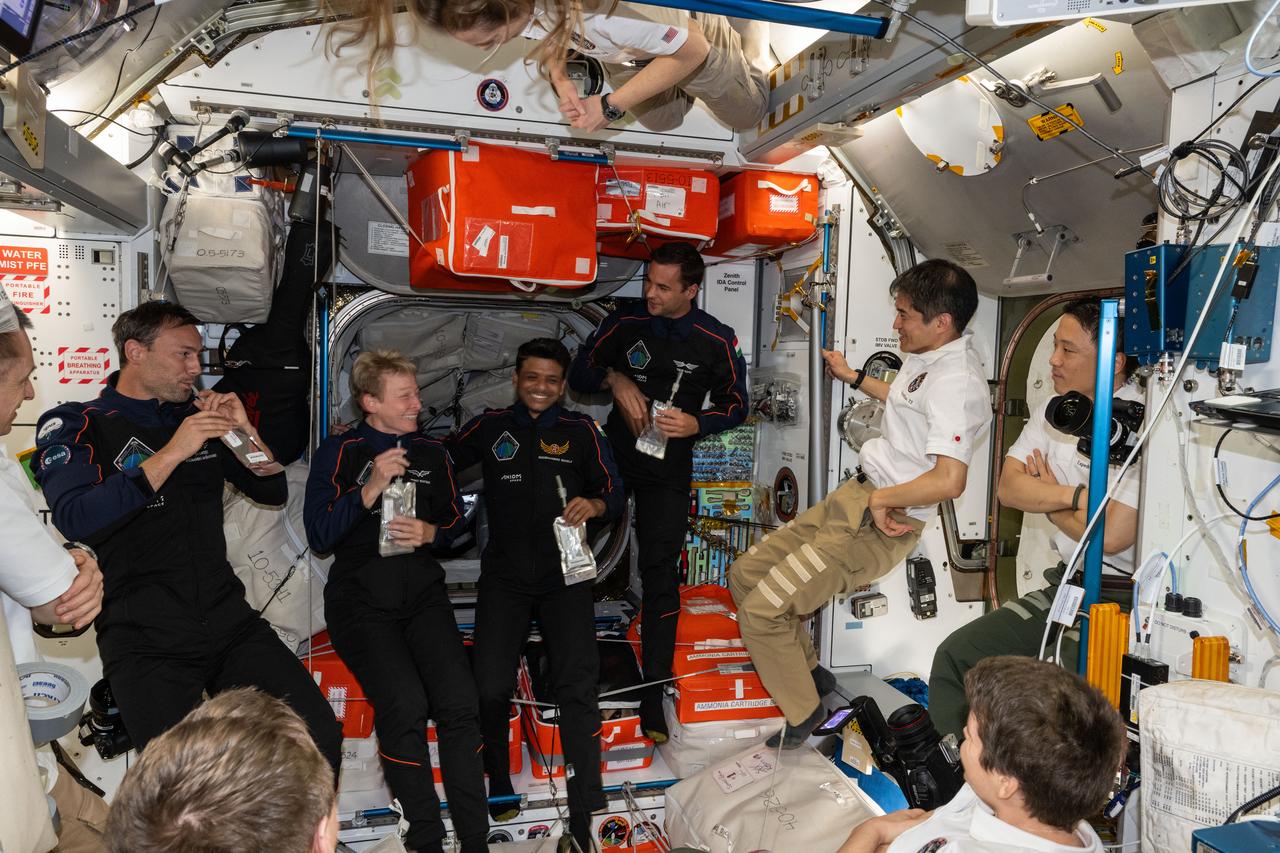
iss073e0249239 (June 26, 2025) --- The Axiom Mission 4 private astronauts gather with drink pouches inside the International Space Station shortly after docking to the orbital outpost's space-facing port on the Harmony module. In the dark suits (from left) are, Ax-4 crewmates Sławosz Uznański-Wiśniewski, Peggy Whitson, Shubhanshu Shukla, and Tibor Kapu. Surrounding the Ax-4 crew (clockwise from top are) Expedition 73 crewmates Nichole Ayers, Takuya Onishi, Jonny Kim, Anne McClain, Kirill Peskov, and Sergey Ryzhikov.
The Axiom Mission 4 private astronauts gather inside the International Space Station
iss073e0249698 (June 26, 2025) --- The SpaceX Dragon spacecraft carrying the Axiom Mission 4 (Ax-4) crew from Axiom Space approaches the International Space Station. Commanding Ax-4 inside Dragon was veteran astronaut Peggy Whitson leading Pilot Shubhanshu Shukla, and Mission Specialists Sławosz Uznański-Wiśniewski and Tibor Kapu. Dragon docked a few minutes later to the orbital outpost's space-facing port on the Harmony module.
The Axiom Mission 4 and Expedition 73 crews take a group portrait
The Orion crew module adapter for NASA’s Artemis III campaign undergoes wiring installs inside the Neil A. Armstrong Operations and Checkout Building at NASA’s Kennedy Space Center on Wednesday, Sept. 4, 2024. In Orion’s final configuration before launch, the crew module adapter connects the capsule to the European Service Module 3. The crew module adapter houses electronic equipment for communications, power, and control, and includes an umbilical connector that bridges the electrical, data, and fluid systems between the main modules.
Artemis III ESM-3 Uncrated in O&C
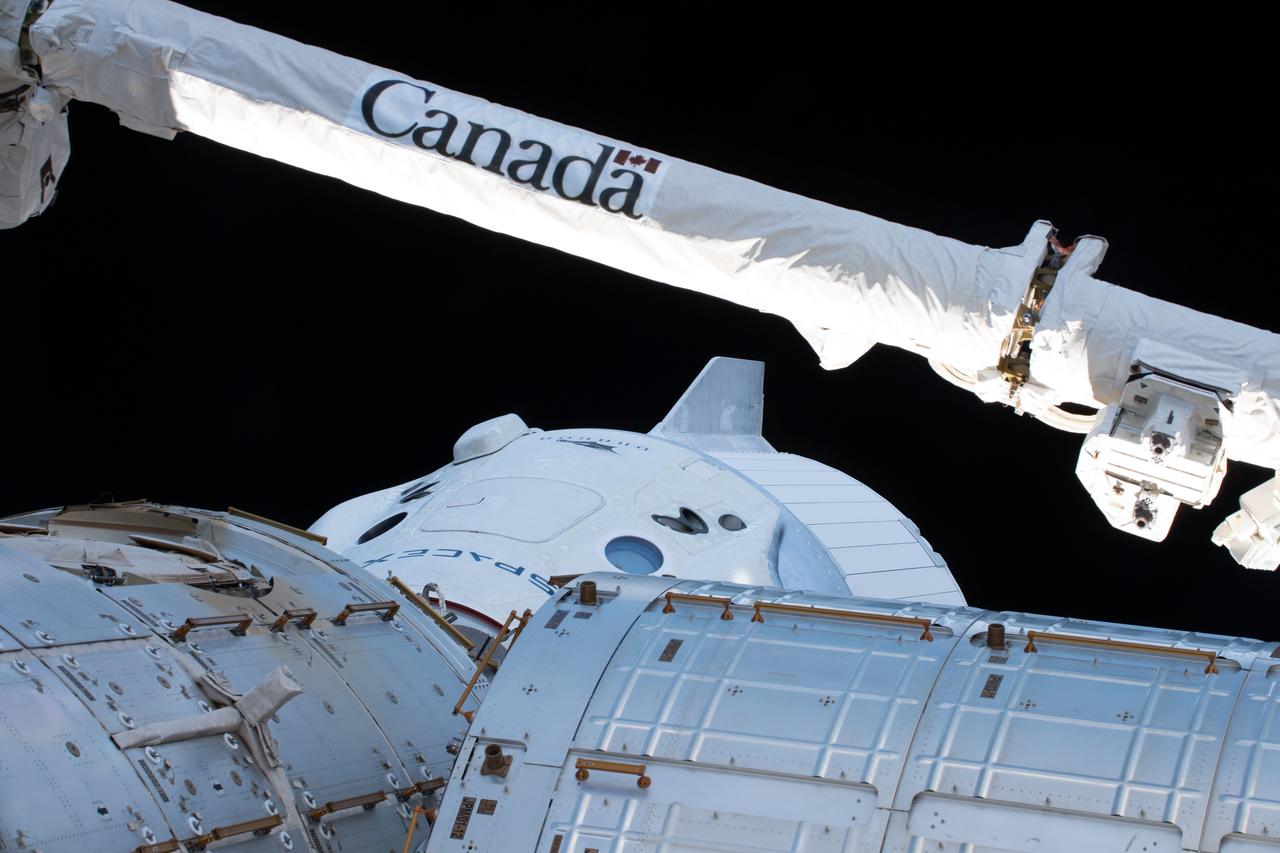
iss058e027796 (March 4, 2019) --- The uncrewed SpaceX Crew Dragon spacecraft is the first Commercial Crew vehicle to visit the International Space Station. Here it is pictured docked to the international docking adapter attached to the forward end of the Harmony module. In the foreground are portions of Harmony, the Kibo laboratory module, and the Canadarm2 robotic arm.
iss058e027796
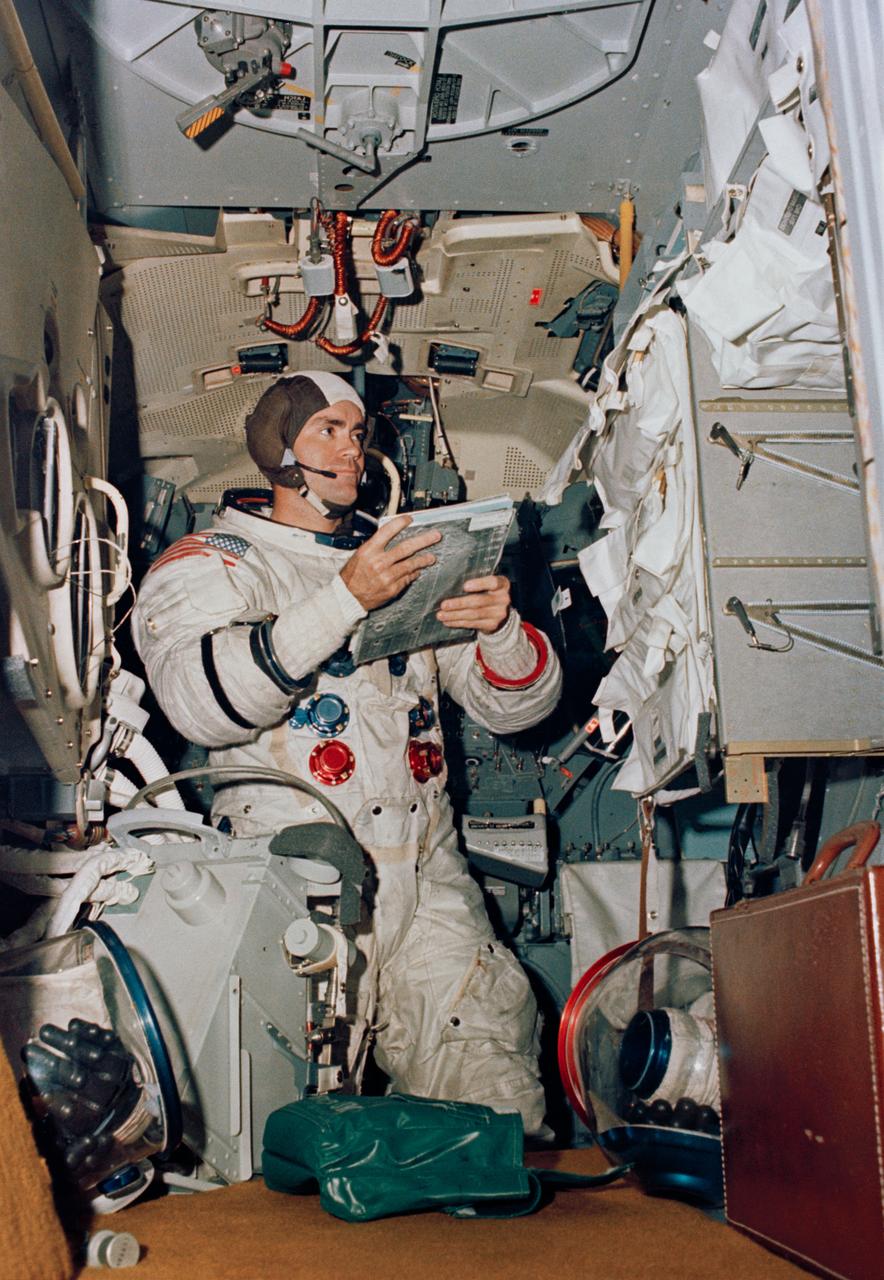
S70-34412 (4 April 1970) --- Astronaut Fred W. Haise Jr., Apollo 13 lunar module pilot, participates in simulation training in preparation for the scheduled lunar landing mission. He is in the Apollo Lunar Module Mission Simulator in the Kennedy Space Center's Flight Crew Training building.
Astronaut Fred Haise participates in simulation training
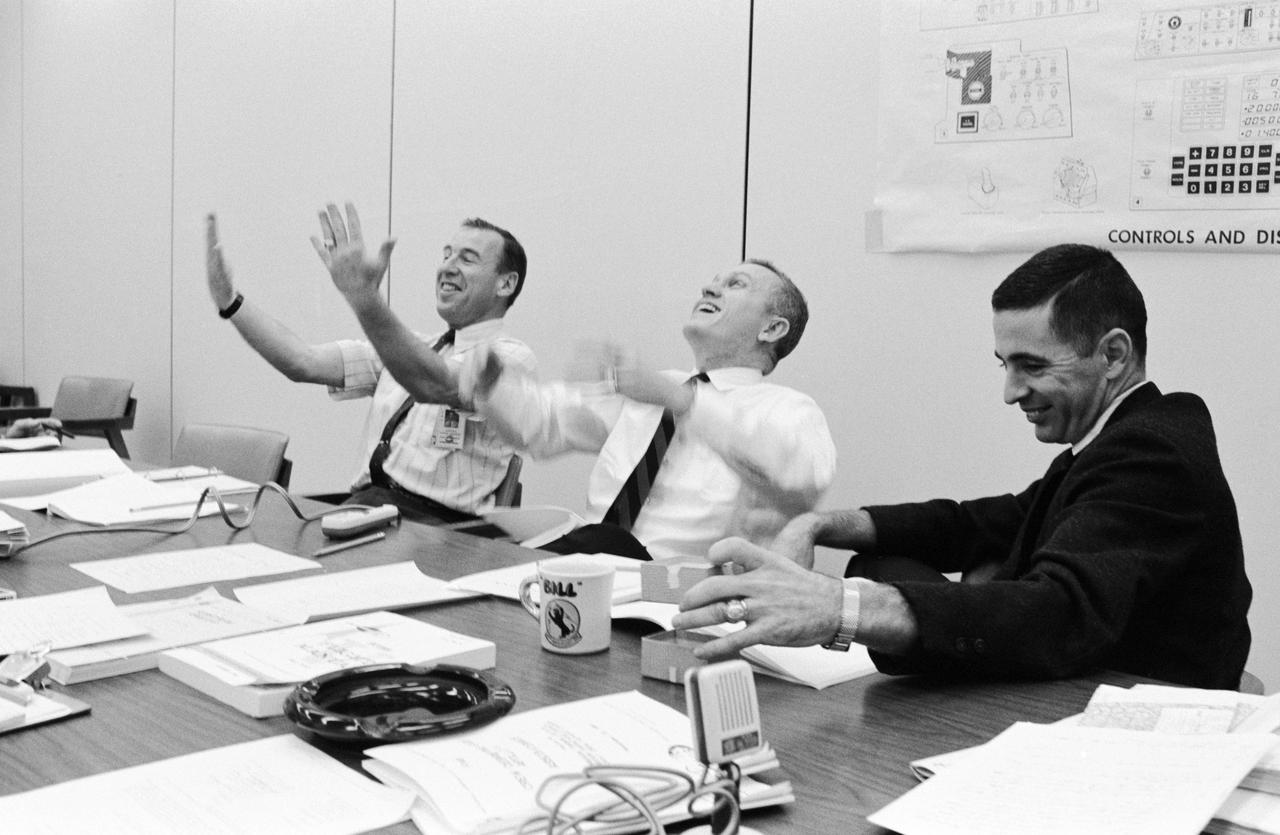
S68-56530 (30 Dec. 1968) --- The crew of the historic Apollo 8 lunar orbit mission participates in a technical de-briefing session in Building 4. Left to right, are astronauts James A. Lovell Jr., command module pilot; Frank Borman, commander; and William A. Anders, lunar module pilot.
Apollo 8 crew participate in technical debriefing at MSC
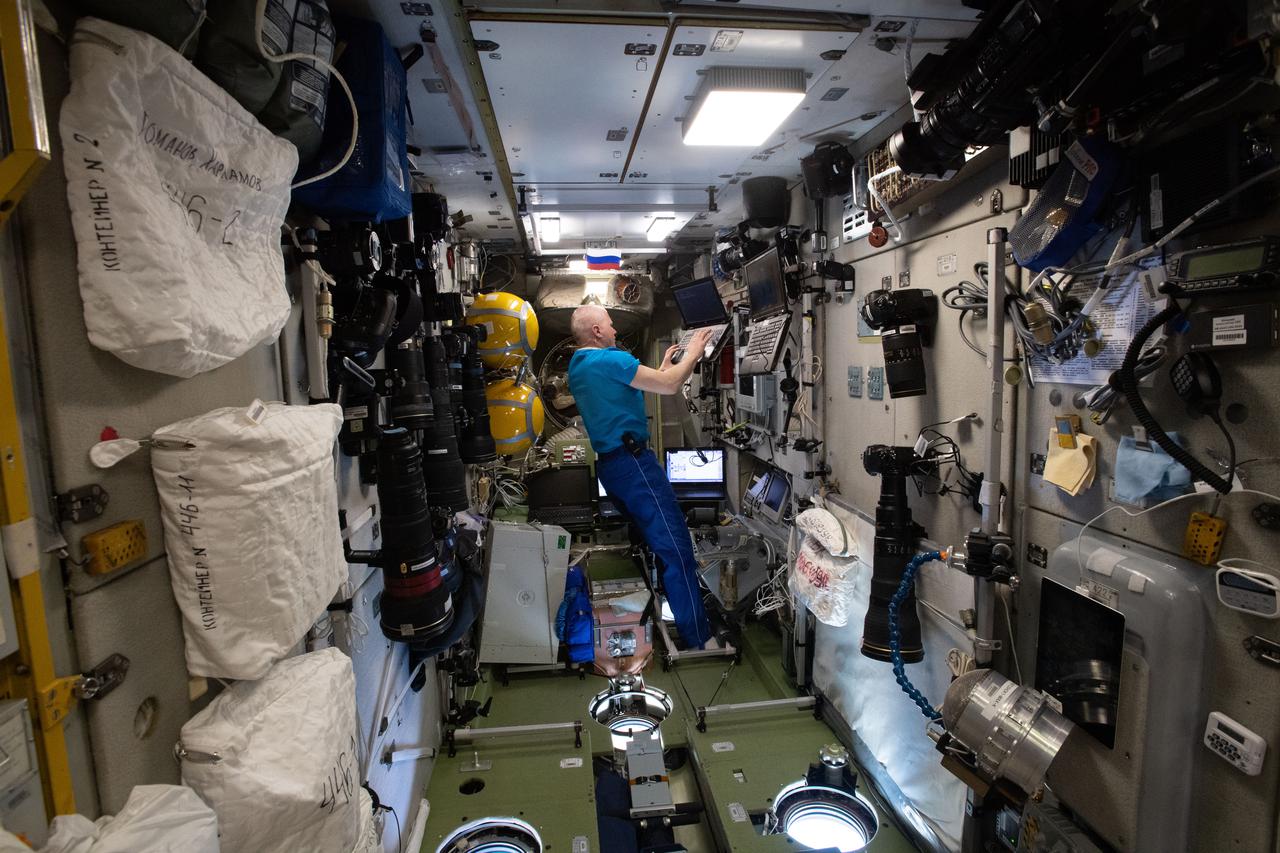
iss065e349549 (Sept. 4, 2021) --- Roscosmos cosmonaut and Expedition 65 Flight Engineer Oleg Novitskiy is in the Zvezda service module the day after a spacewalk that he and fellow cosmonaut Pyotr Dubrov conducted to begin configuring the Nauka multipurpose laboratory module for science operations.
iss065e349549
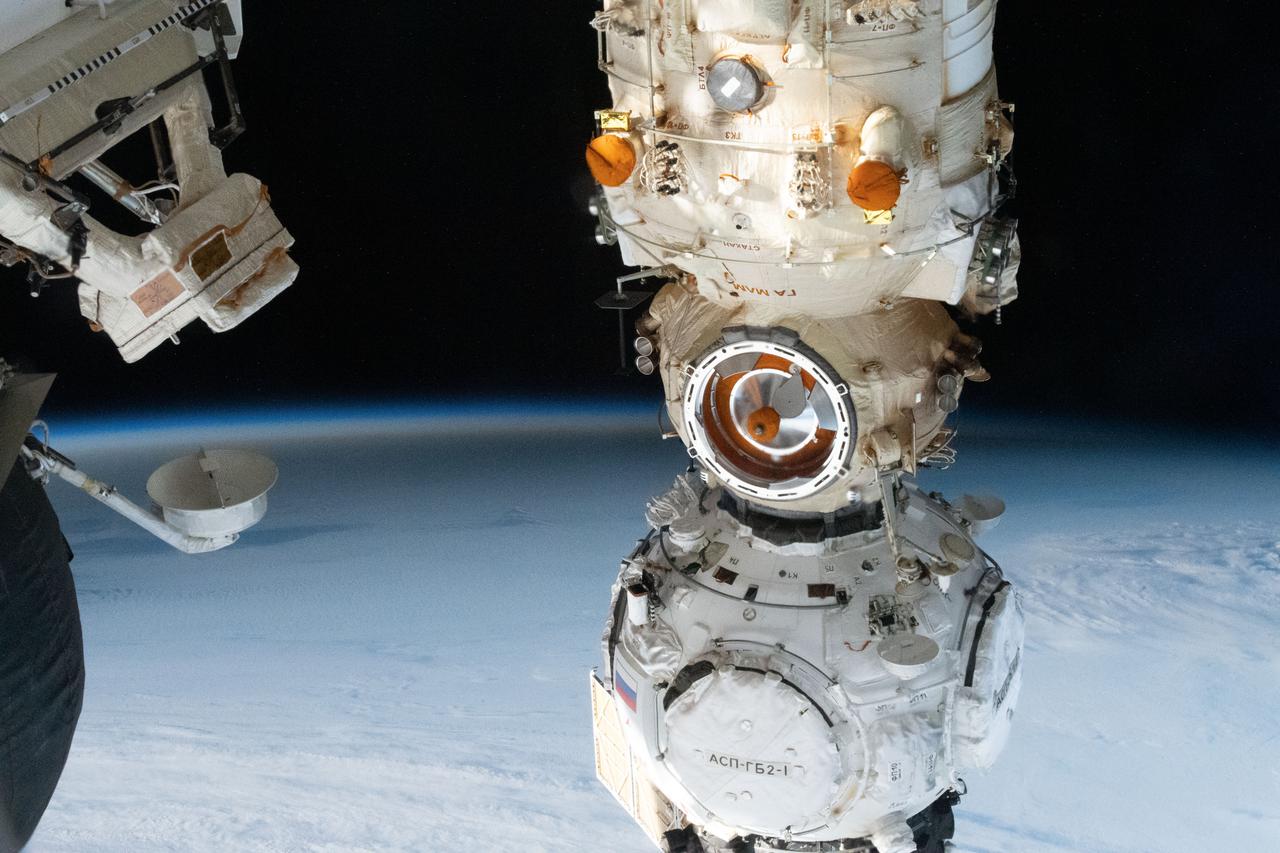
iss066e086503 (Dec, 4, 2021) --- The Moon's shadow, caused by a solar eclipse over Antarctica, is pictured from the International Space Station as it orbits 269 miles above the south Atlantic Ocean. In the foreground, is the Russian Prichal module attached to the Nauka multipurpose docking module.
iss066e086503
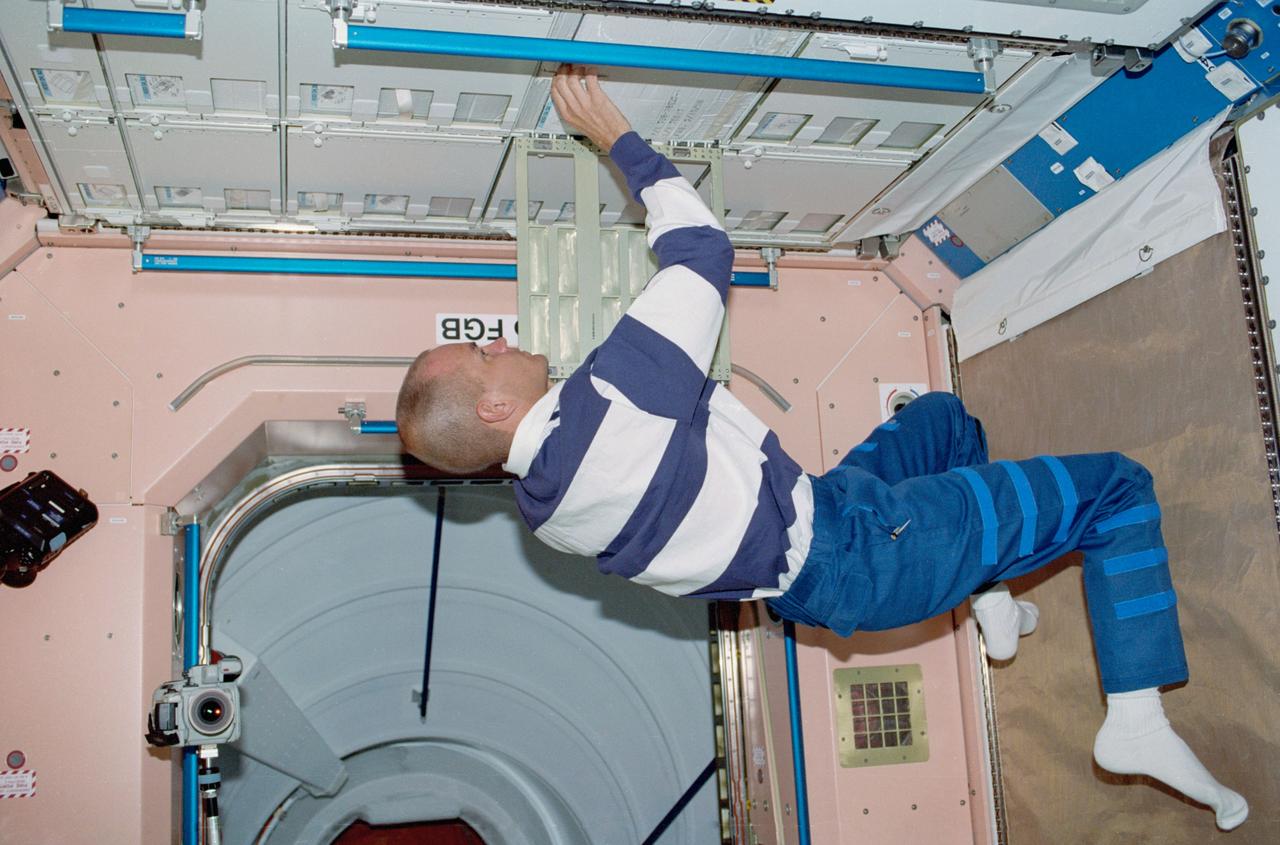
STS088-334-012  (4-15 Dec. 1998) --- Astronaut Frederick W. Sturckow, pilot, works with furnishings on the U.S.-built Unity module as he and five crew mates teamed up to  prepare Unity and the connected Russian-built Zarya module for their International Space Station (ISS) roles.
View of the STS-88 crew in the Node 1/Unity module
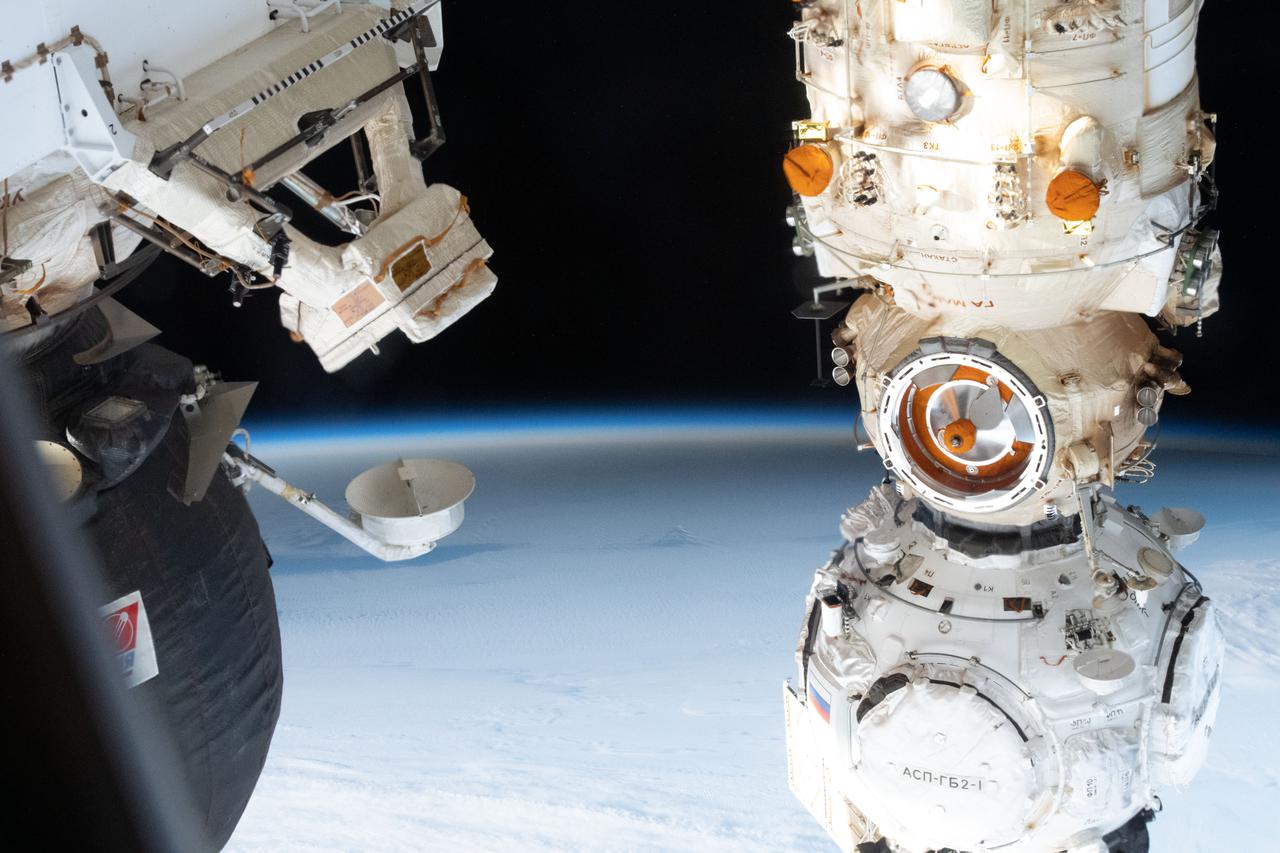
iss067e034152 (May 4, 2022) --- This view from one of seven windows on the International Space Station's cupola shows three Russian components including (from bottom) the Soyuz MS-21 crew ship, the Prichal docking module, and the Nauka multipurpose laboratory module.
iss067e034152
iss066e086505 (Dec, 4, 2021) --- The Moon's shadow, caused by a solar eclipse over Antarctica, is pictured from the International Space Station as it orbits 269 miles above the south Atlantic Ocean. In the foreground, is the Russian Prichal module attached to the Nauka multipurpose docking module.
iss066e086505
iss065e349552 (Sept. 4, 2021) --- Roscosmos cosmonaut and Expedition 65 Flight Engineer Pyotr Dubrov is in the Zvezda service module the day after a spacewalk that he and fellow cosmonaut Oleg Novitskiy conducted to begin configuring the Nauka multipurpose laboratory module for science operations
iss065e349552
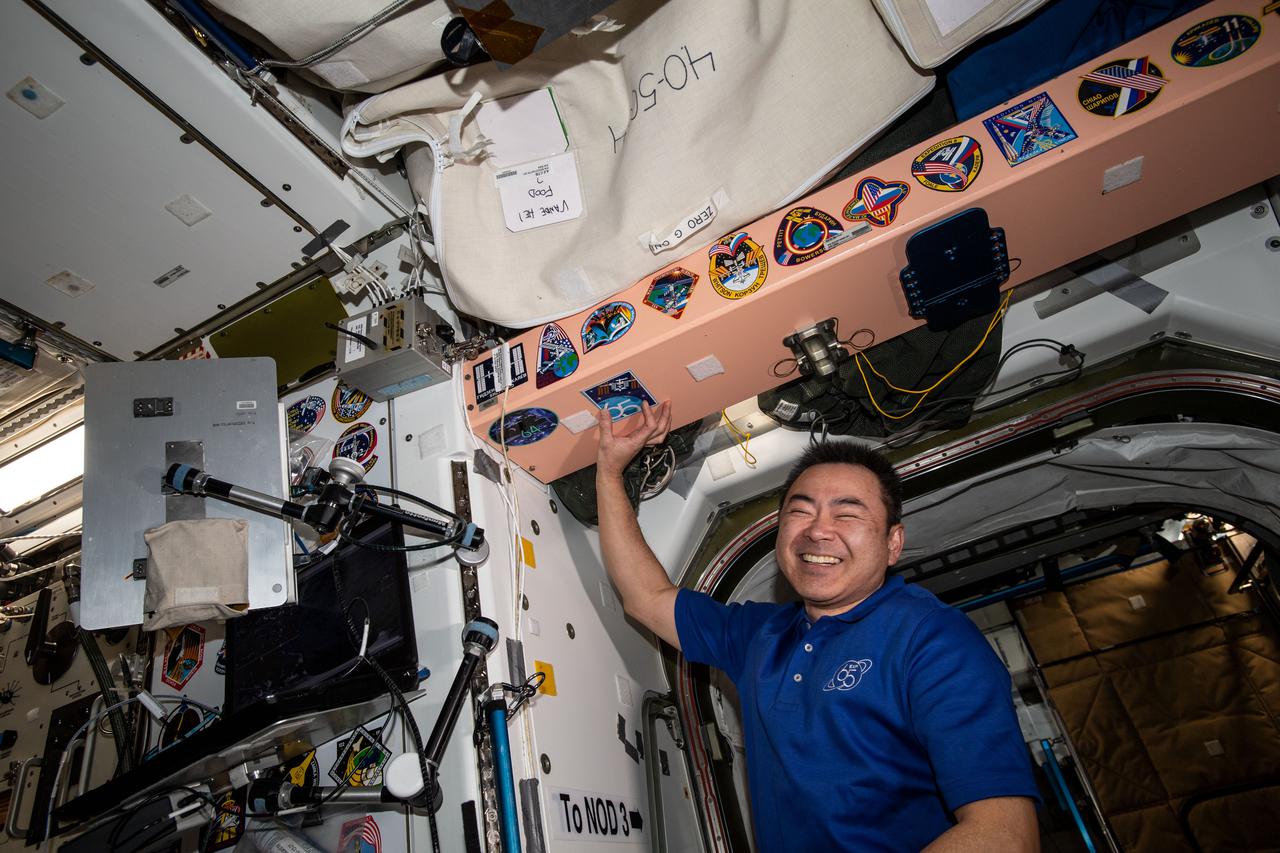
iss065e440612 (Oct. 4, 2021) --- Expedition 65 Flight Engineer Akihiko Hoshide of the Japan Aerospace Exploration Agency (JAXA) points to his mission's insignia sticker in the vestibule in between the International Space Station's Unity module and Tranquility module.
iss065e440612
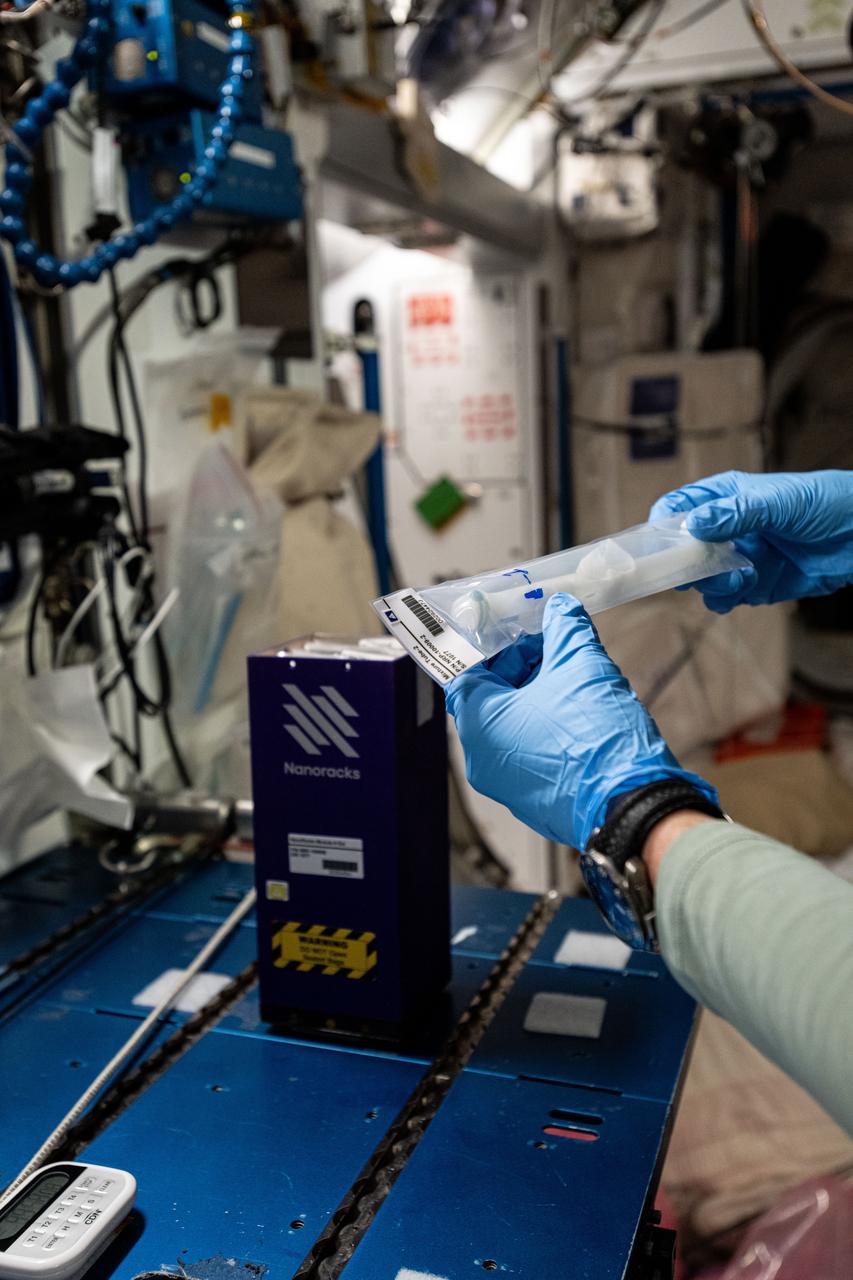
iss073e0001404 (4/23/2025) --- NASA astronaut  Nichole Ayers prepares mixture tubes containing research samples for the Nanoracks Module-9 series of student-designed space experiments. Ayers was working at the Harmony module's maintenance work area aboard the International Space Station.
iss073e0001404
This view of the damaged Apollo 13 Service Module (SM) was photographed from the Lunar Module/Command Module following SM jettisoning. As seen here, an entire panel on the SM was blown away by the apparent explosion of oxygen tank number two located in Sector 4 of the SM. Two of the three fuel cells are visible just forward (above) the heavily damaged area. Three fuel cells, two oxygen tanks, and two hydrogen tanks are locate in Sector 4. The damaged area is located above the S-band high gain antenna. Nearest the camera is the Service Propulsion System (SPS) engine and nozzle. The damage to the SM caused the Apollo 13 crewmen to use the Lunar Module (LM) as a "lifeboat". The LM was jettisoned just prior to Earth reentry by the Command Module.
View of damaged Apollo 13 Service Module from the Lunar/Command Modules
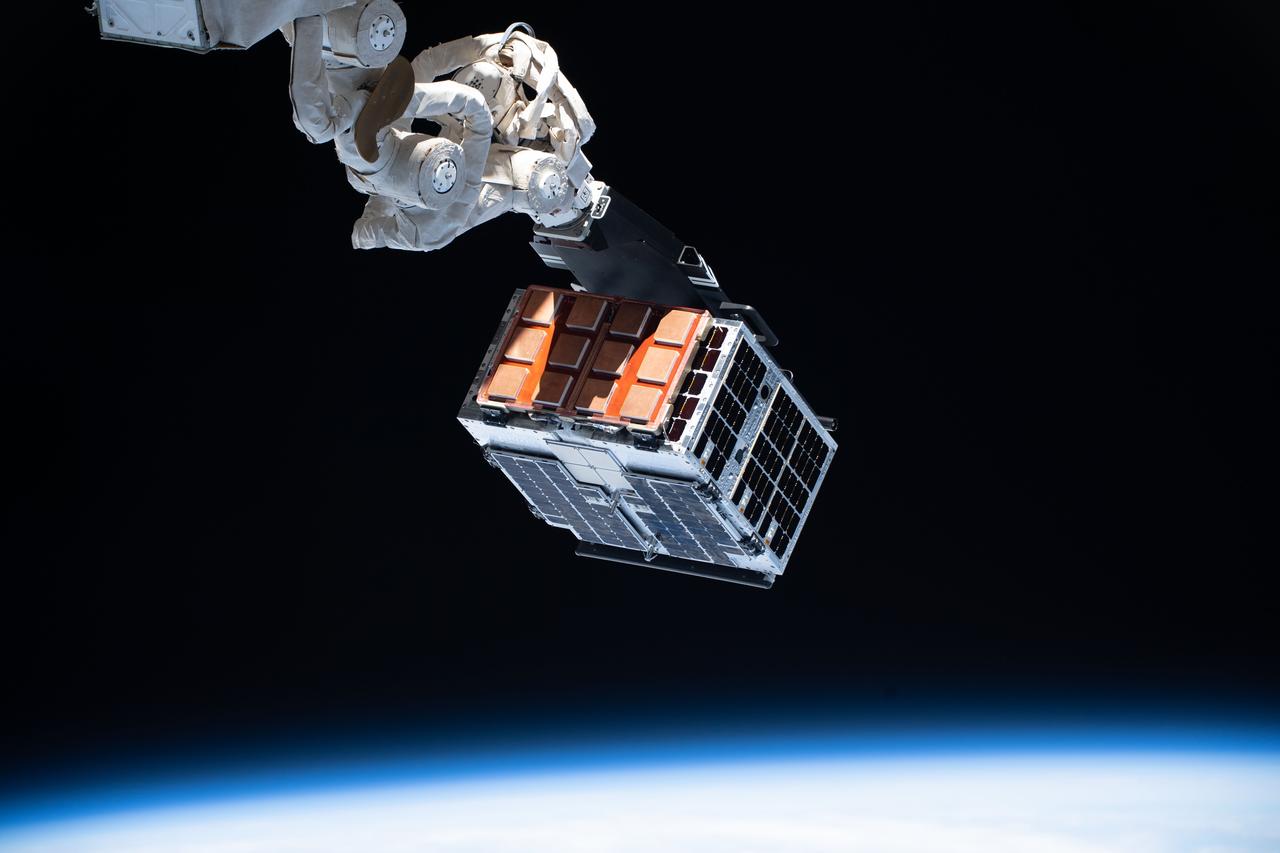
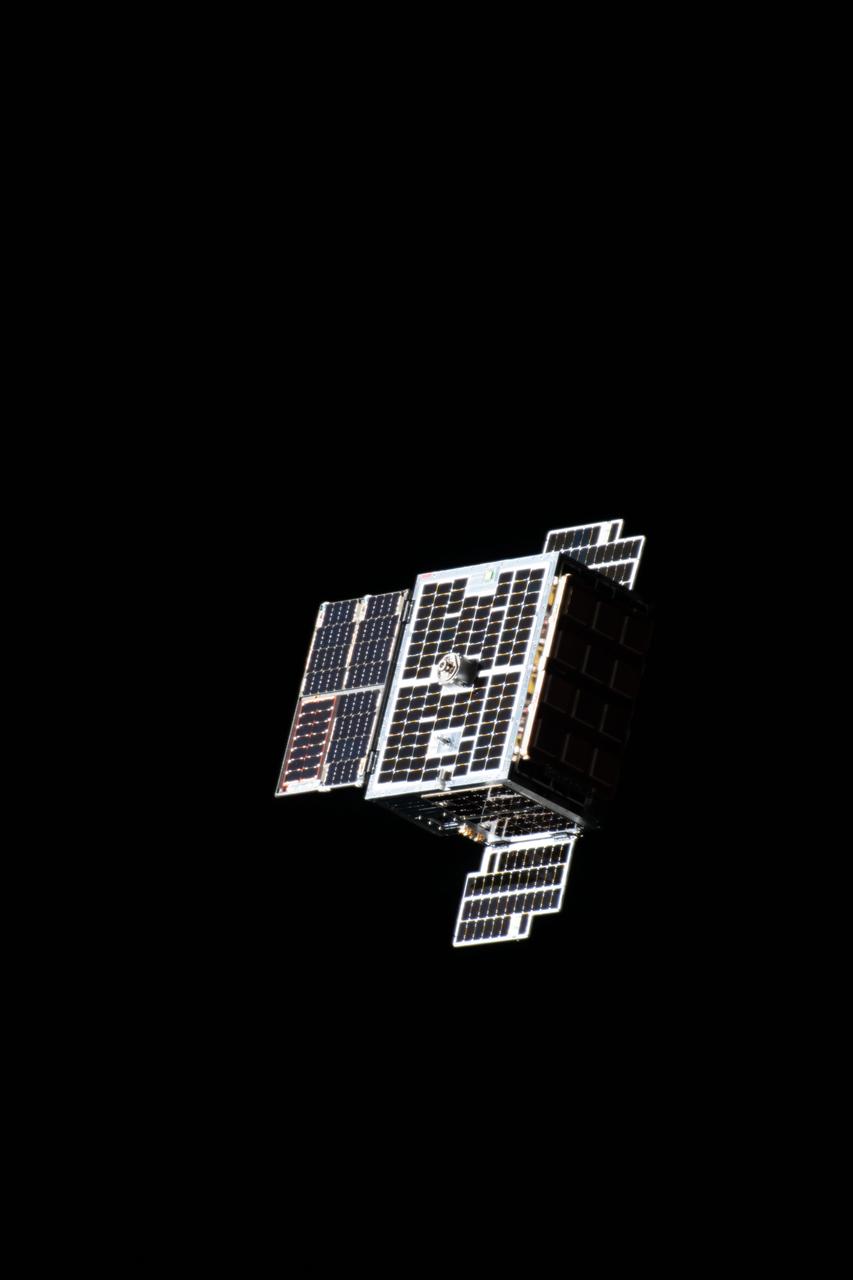
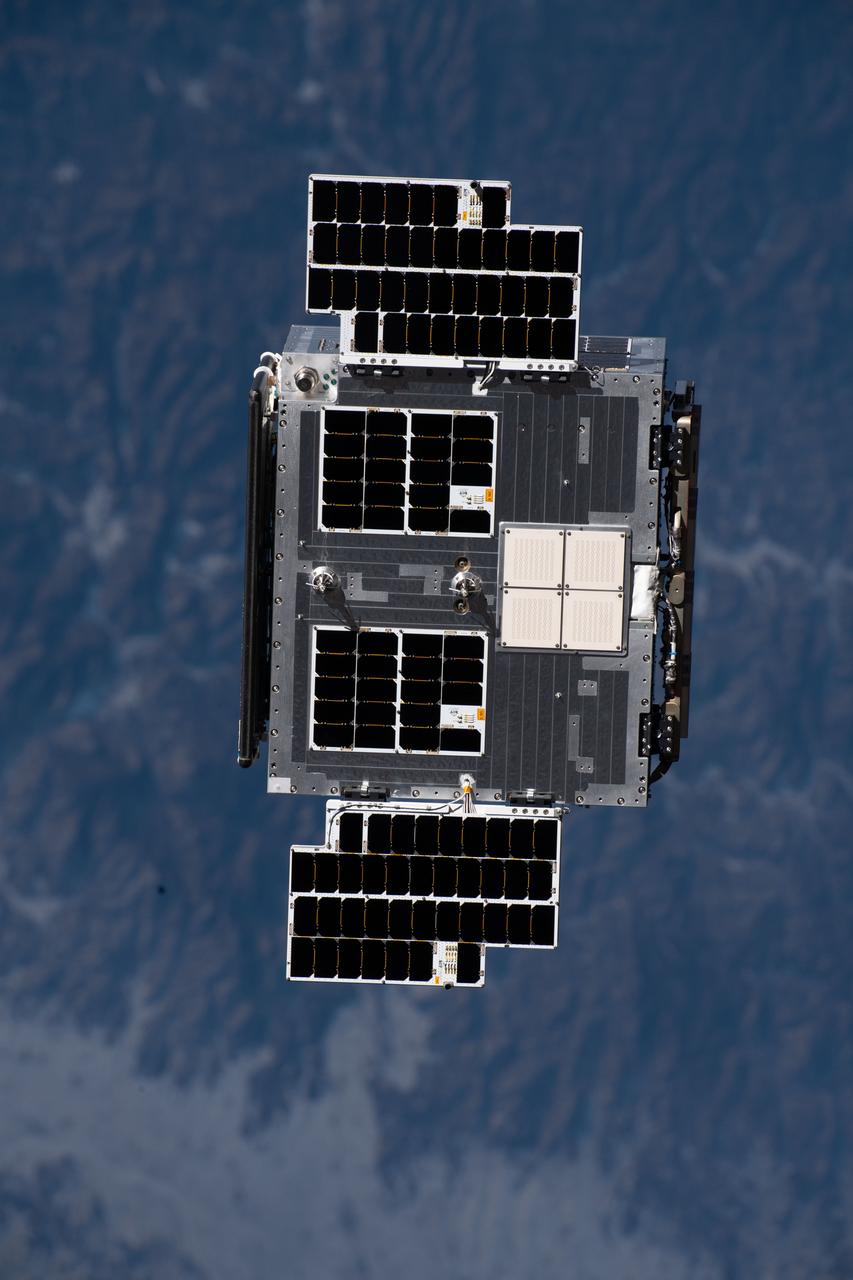
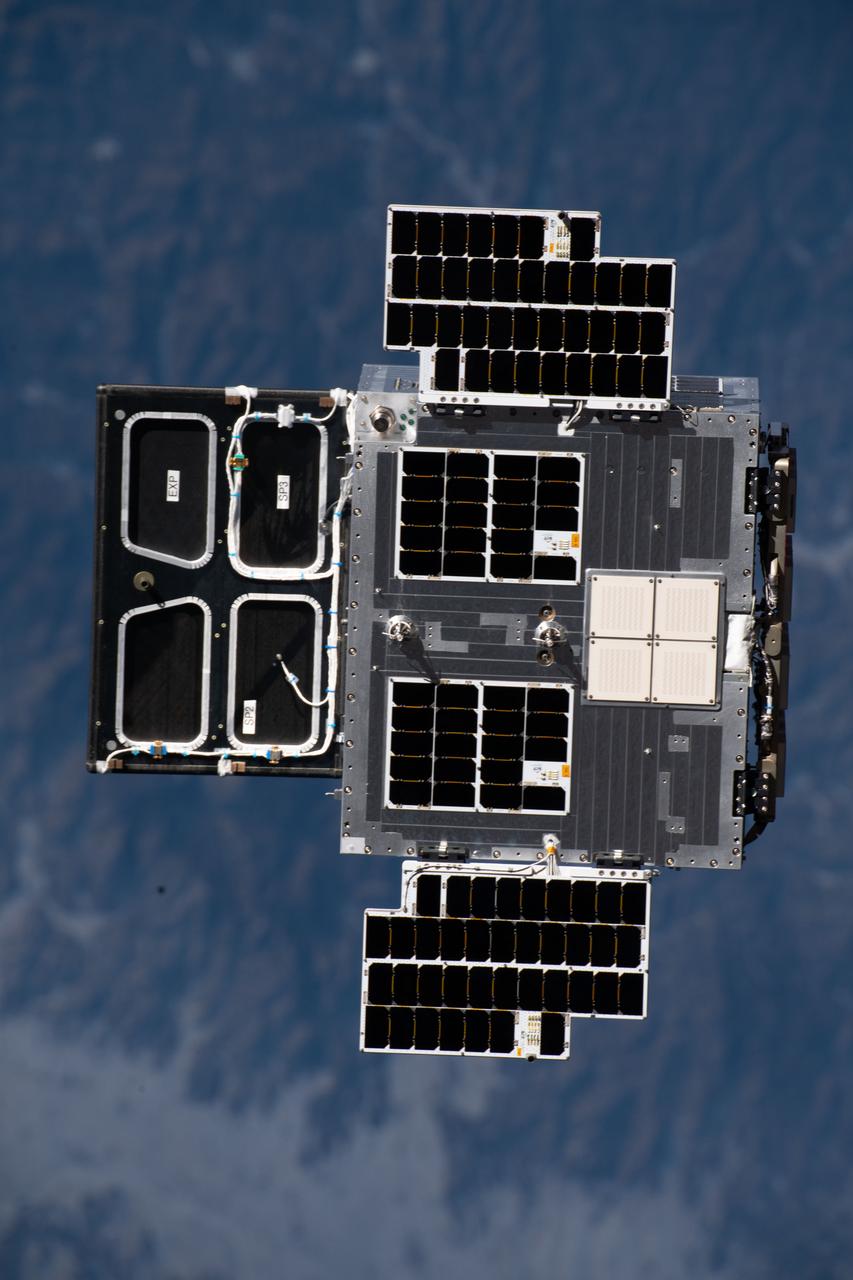
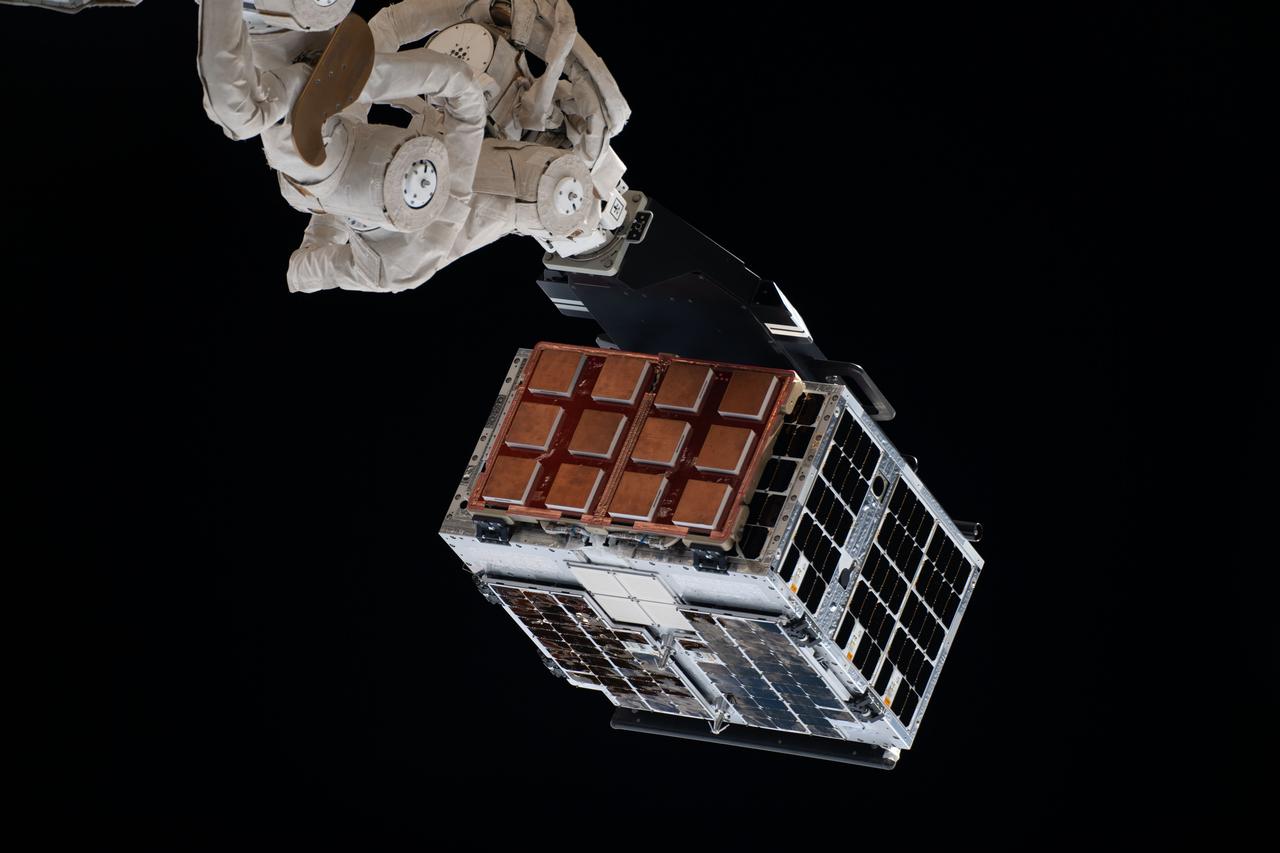
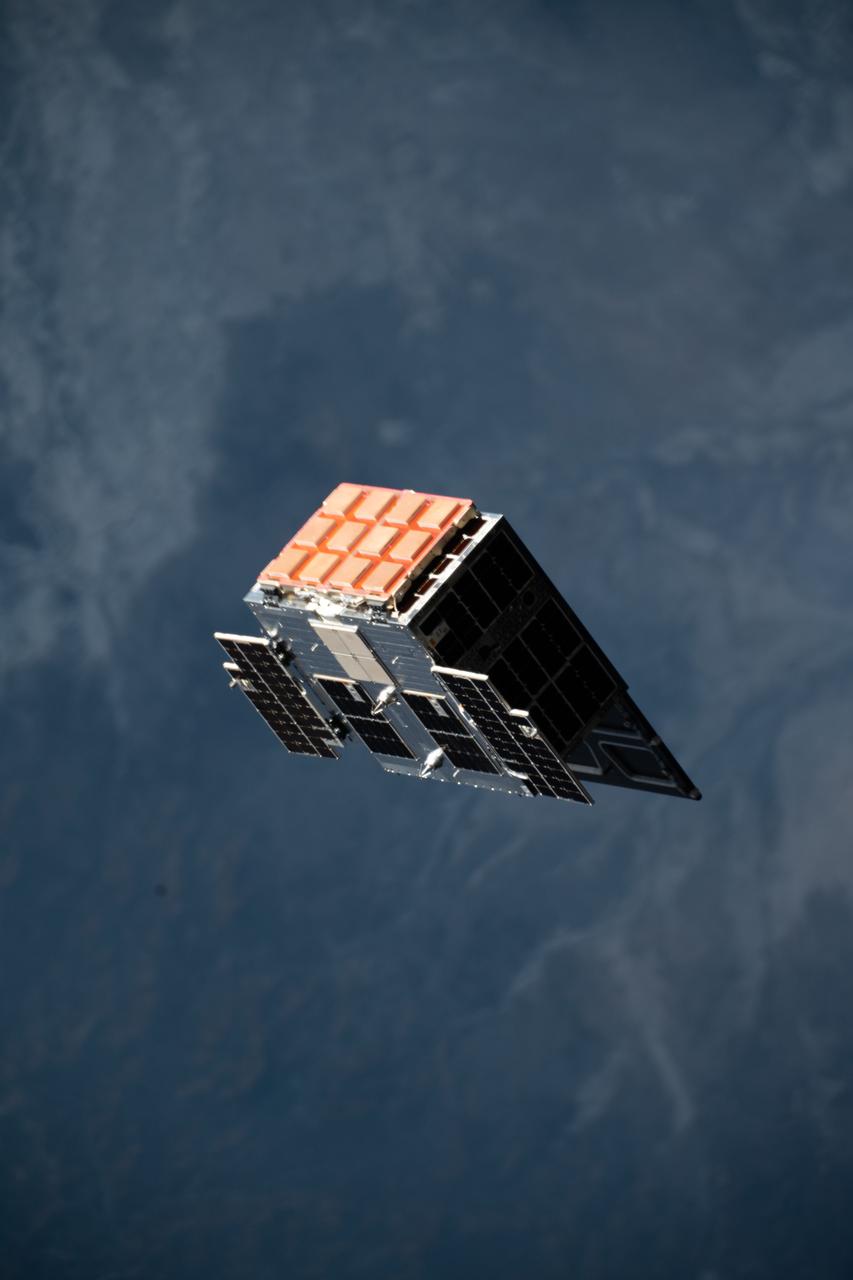
iss061e148704 (1/29/2020) --- A view taken from the Cupola Module aboard the International Space Station (ISS) of the STPSat-4 deploy. The Space Test Program Satellite-4 (STPSat-4) is a suite automated for robotic space tools and sensors that test new equipment configurations and monitor space conditions. STPSat-4 specifically includes space weather sensors, solar panels, an antenna array and devices for tracking location of both satellites and their astronomic surroundings. This project demonstrates how a range of new technologies can be integrated on nanosatellite platforms.
iss061e148704
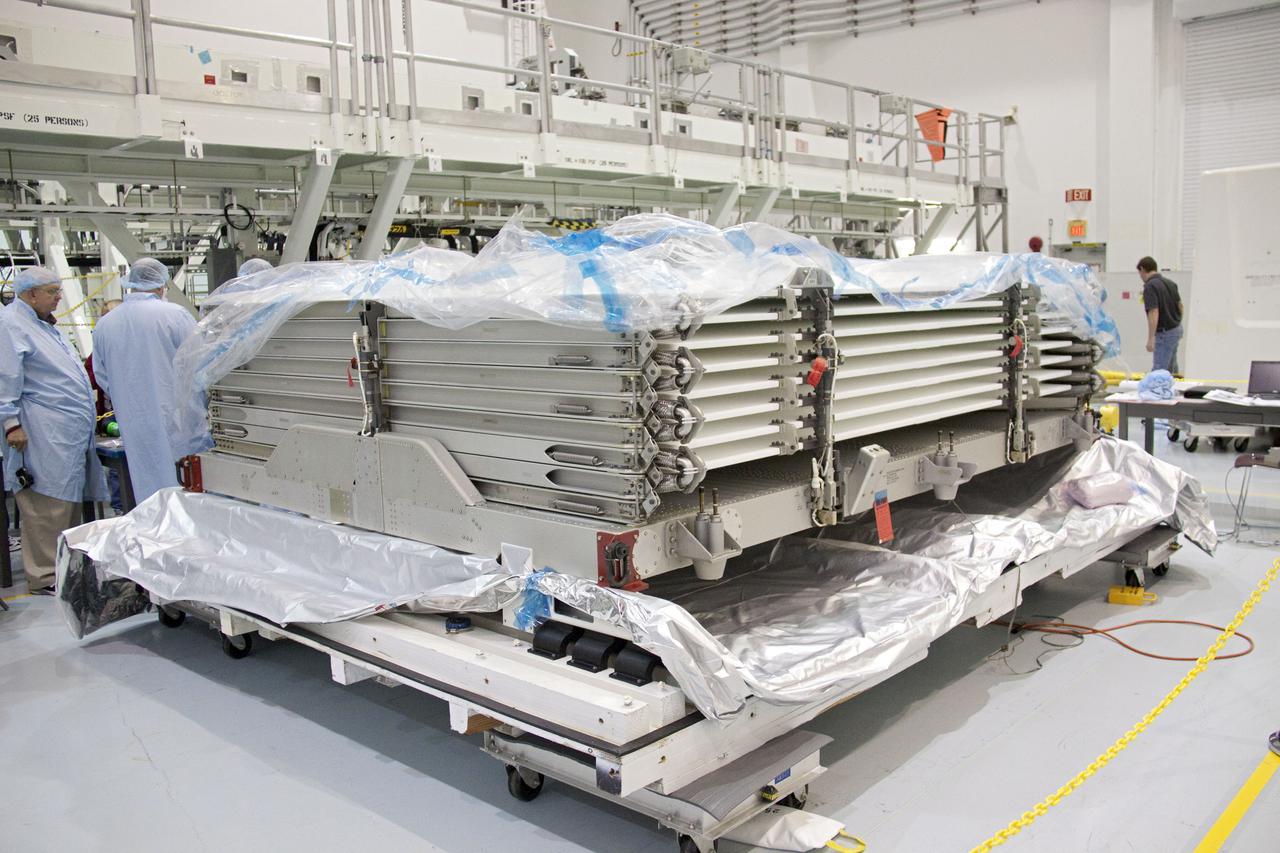
CAPE CANAVERAL, Fla. -- In the Space Station Processing Facility at NASA's Kennedy Space Center in Florida, workers prepare the Heat Rejection Subsystem, or HRS, radiator for installation onto the Express Logistics Carrier-4, or ELC-4.       Space shuttle Discovery and its STS-133 crew will deliver the ELC-4 filled with external payloads and experiments, as well as the spare radiator and the Permanent Multipurpose Module, or PMM, to the International Space Station. Launch is targeted for Nov. 1 at 4:33 p.m. EDT. For more information visit, www.nasa.gov_shuttle. Photo credit: NASA_Troy Cryder
KSC-2010-4174
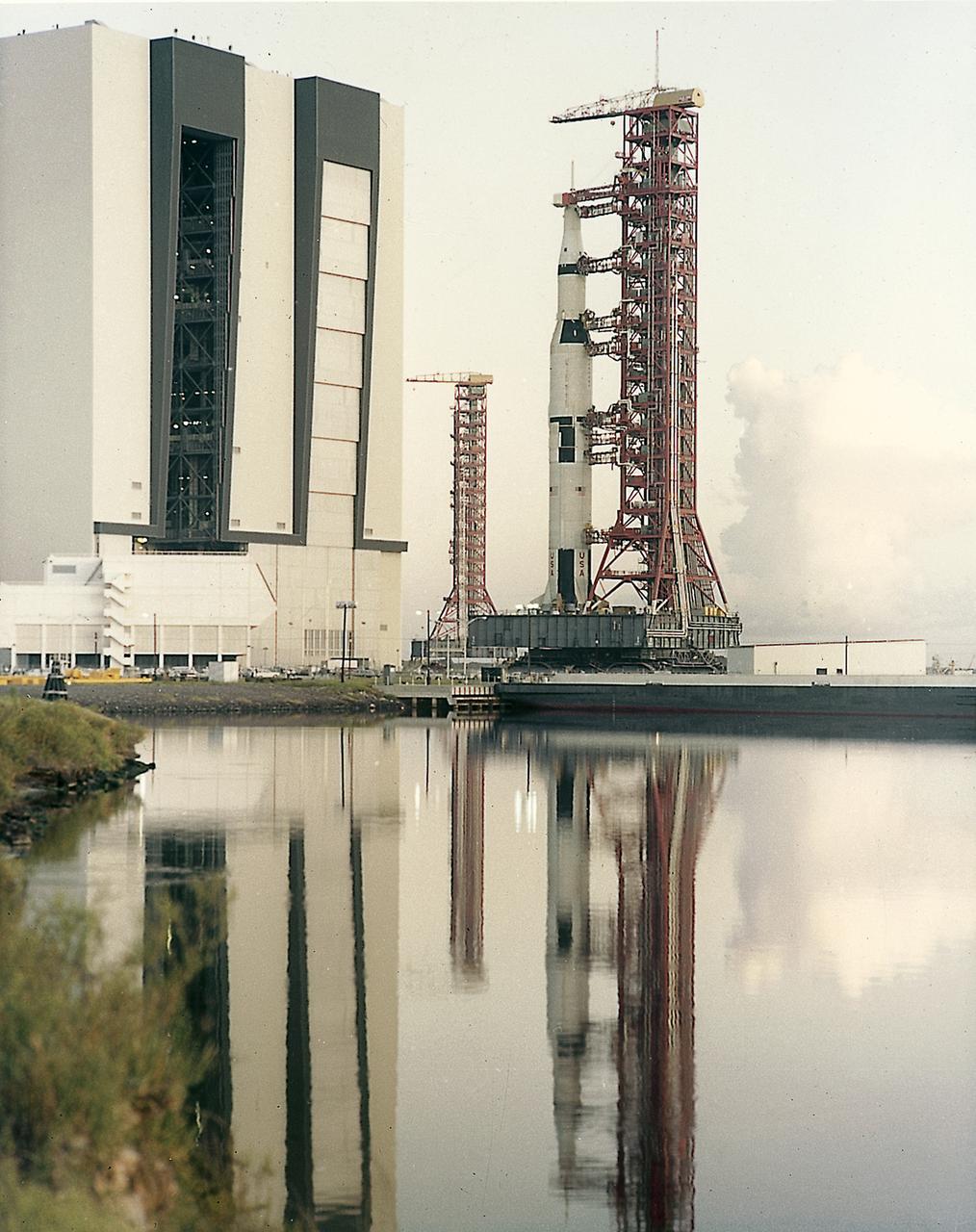
This picture shows the Saturn V vehicle (AS-501), for the Apollo 4 mission on the Crawler Transporter Vehicle. It was rolled out from the Vehicle Assembly Building and slowly (1 mph) moved to the launch pad at the Kennedy Space Center (KSC). The Apollo 4 mission was the first launch of the Saturn V launch vehicle. Objectives of the unmanned Apollo 4 test flight were to obtain flight information on launch vehicle and spacecraft structural integrity and compatibility, flight loads, stage separation, and subsystems operation including testing of restart of the S-IVB stage, and to evaluate the Apollo command module heat shield. The Apollo 4 was launched on November 9, 1967 from KSC.
Saturn Apollo Program
iss061e148634 (1/29/2020) --- A view taken from the Cupola Module aboard the International Space Station (ISS) of the STPSat-4 deploy. The Space Test Program Satellite-4 (STPSat-4) is a suite automated for robotic space tools and sensors that test new equipment configurations and monitor space conditions. STPSat-4 specifically includes space weather sensors, solar panels, an antenna array and devices for tracking location of both satellites and their astronomic surroundings. This project demonstrates how a range of new technologies can be integrated on nanosatellite platforms.
iss061e148634
iss061e148579 (1/29/2020) --- A view taken from the Cupola Module aboard the International Space Station (ISS) of the STPSat-4 deploy. The Space Test Program Satellite-4 (STPSat-4) is a suite automated for robotic space tools and sensors that test new equipment configurations and monitor space conditions. STPSat-4 specifically includes space weather sensors, solar panels, an antenna array and devices for tracking location of both satellites and their astronomic surroundings. This project demonstrates how a range of new technologies can be integrated on nanosatellite platforms.
iss061e148579
iss061e148580 (1/29/2020) --- A view taken from the Cupola Module aboard the International Space Station (ISS) of the STPSat-4 deploy. The Space Test Program Satellite-4 (STPSat-4) is a suite automated for robotic space tools and sensors that test new equipment configurations and monitor space conditions. STPSat-4 specifically includes space weather sensors, solar panels, an antenna array and devices for tracking location of both satellites and their astronomic surroundings. This project demonstrates how a range of new technologies can be integrated on nanosatellite platforms.
iss061e148580
This photograph depicts the Saturn V vehicle (SA-501) for the Apollo 4 mission in the Vehicle Assembly Building (VAB) at the Kennedy Space Center (KSC). After the completion of the assembly operation, the work platform was retracted and the vehicle was readied to rollout from the VAB to the launch pad. The Apollo 4 mission was the first launch of the Saturn V launch vehicle. Objectives of the unmanned Apollo 4 test flight were to obtain flight information on launch vehicle and spacecraft structural integrity and compatibility, flight loads, stage separation, and subsystems operation including testing of restart of the S-IVB stage, and to evaluate the Apollo command module heat shield. The Apollo 4 was launched on November 9, 1967 from KSC.
Saturn Apollo Program
iss061e148301 (1/29/2020) --- A view taken from the Cupola Module aboard the International Space Station (ISS) of the STPSat-4 deploy. The Space Test Program Satellite-4 (STPSat-4) is a suite automated for robotic space tools and sensors that test new equipment configurations and monitor space conditions. STPSat-4 specifically includes space weather sensors, solar panels, an antenna array and devices for tracking location of both satellites and their astronomic surroundings. This project demonstrates how a range of new technologies can be integrated on nanosatellite platforms.
iss061e148301
iss061e148283 (1/29/2020) ---  A view taken from the Cupola Module aboard the International Space Station (ISS) of the STPSat-4 deploy. The Space Test Program Satellite-4 (STPSat-4) is a suite automated for robotic space tools and sensors that test new equipment configurations and monitor space conditions. STPSat-4 specifically includes space weather sensors, solar panels, an antenna array and devices for tracking location of both satellites and their astronomic surroundings. This project demonstrates how a range of new technologies can be integrated on nanosatellite platforms.
iss061e148283
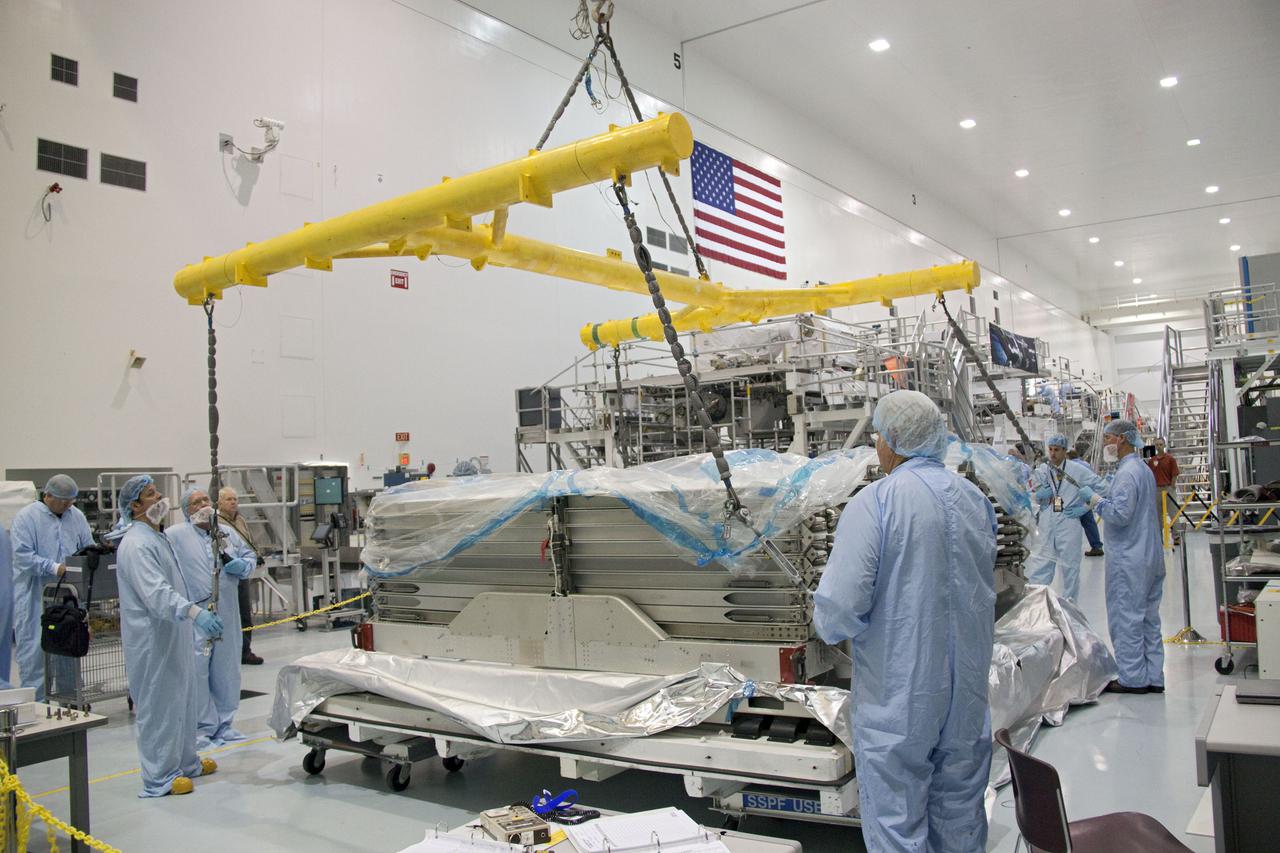
CAPE CANAVERAL, Fla. -- At NASA's Kennedy Space Center in Florida, an overhead crane in the Space Station Processing Facility is attached to the Heat Rejection Subsystem, or HRS, radiator for installation onto the Express Logistics Carrier-4, or ELC-4.       Space shuttle Discovery and its STS-133 crew will deliver the ELC-4 filled with external payloads and experiments, as well as the spare radiator and the Permanent Multipurpose Module, or PMM, to the International Space Station. Launch is targeted for Nov. 1 at 4:33 p.m. EDT. For more information visit, www.nasa.gov_shuttle. Photo credit: NASA_Troy Cryder
KSC-2010-4175
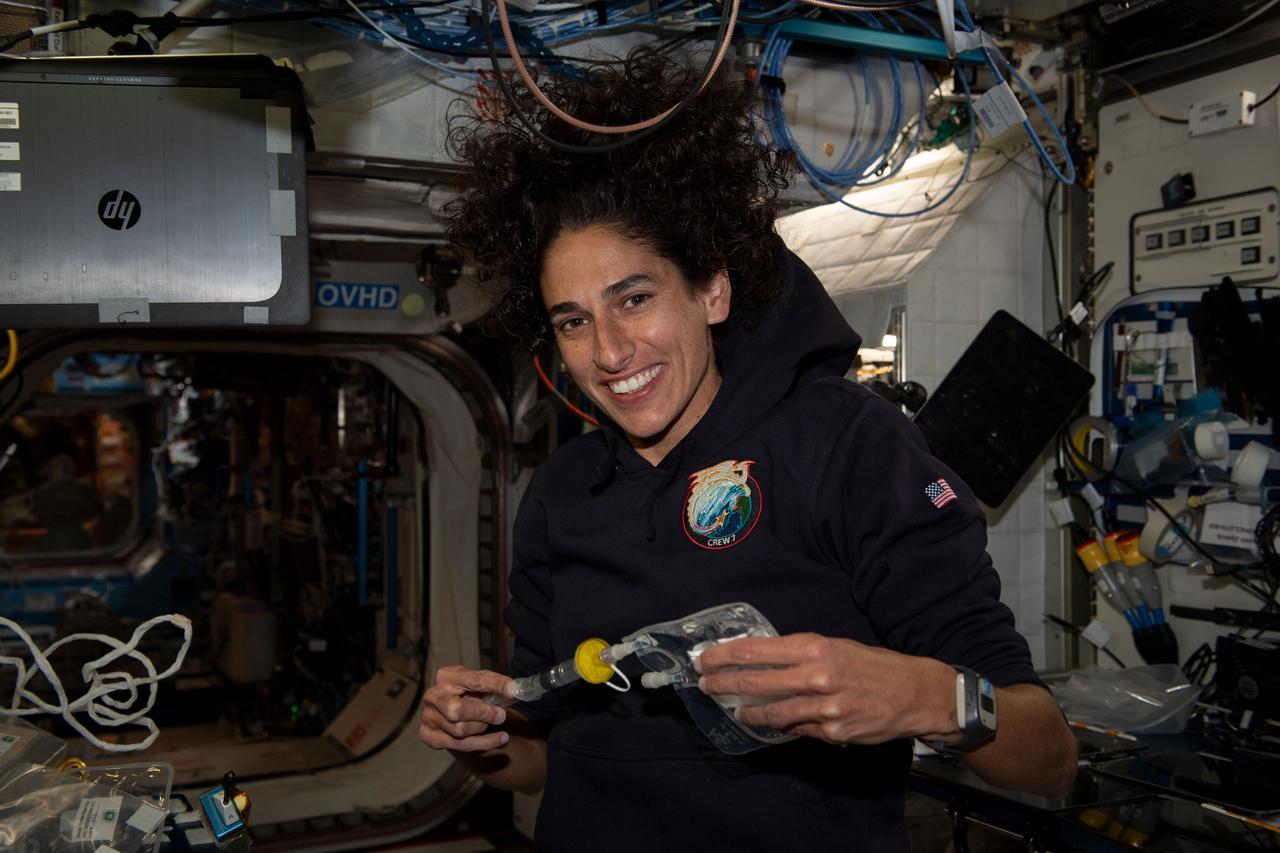
iss069e085932_alt (Sept. 4, 2023) --- NASA astronaut and Expedition 69 Flight Engineer Jasmin Moghbeli collects water samples for microbial analysis inside the International Space Station's Destiny laboratory module.
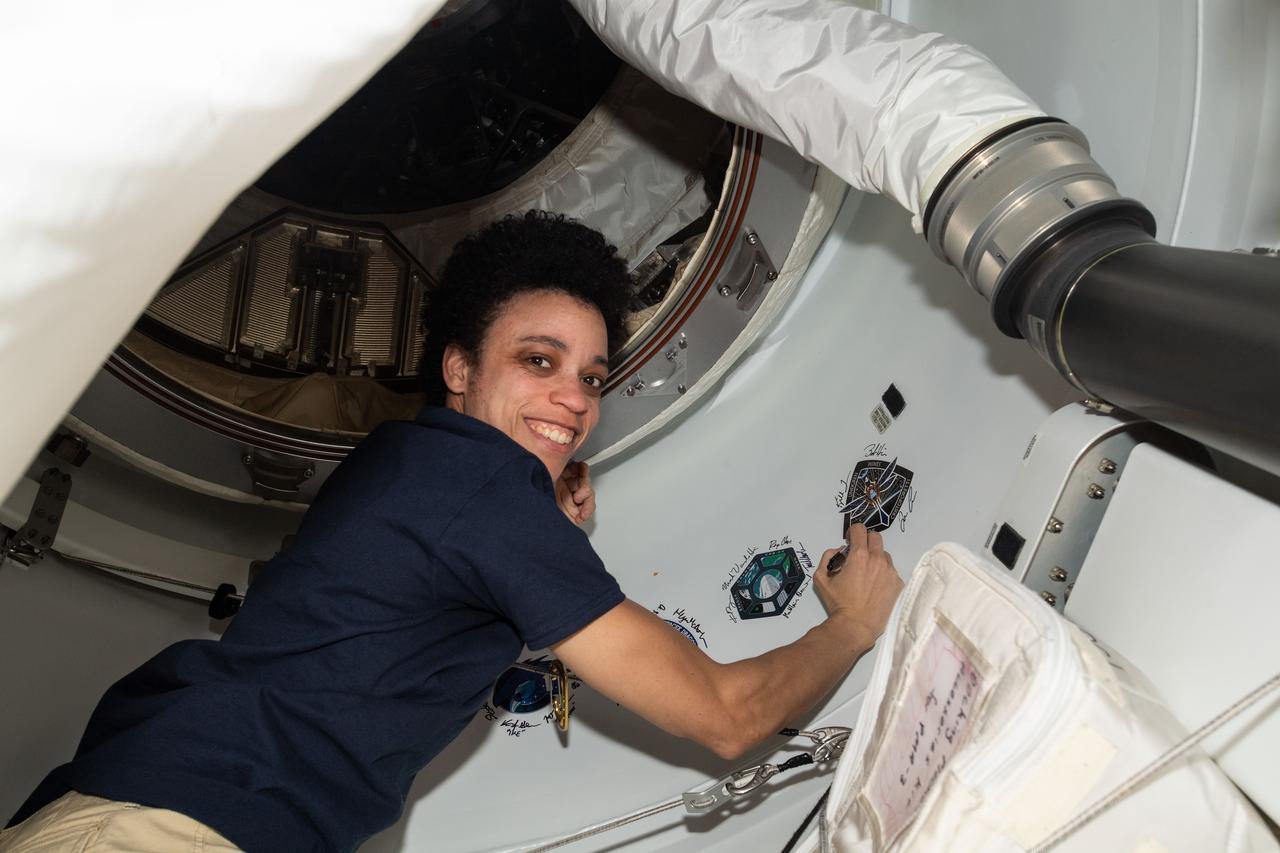
iss069e085832_alt
iss066e044523 (Nov. 4, 2021) --- Japan Aerospace Exploration Agency (JAXA) astronaut and Expedition 66 Flight Engineer Akihiko Hoshide works on orbital plumbing tasks inside the International Space Station's Tranquility module.
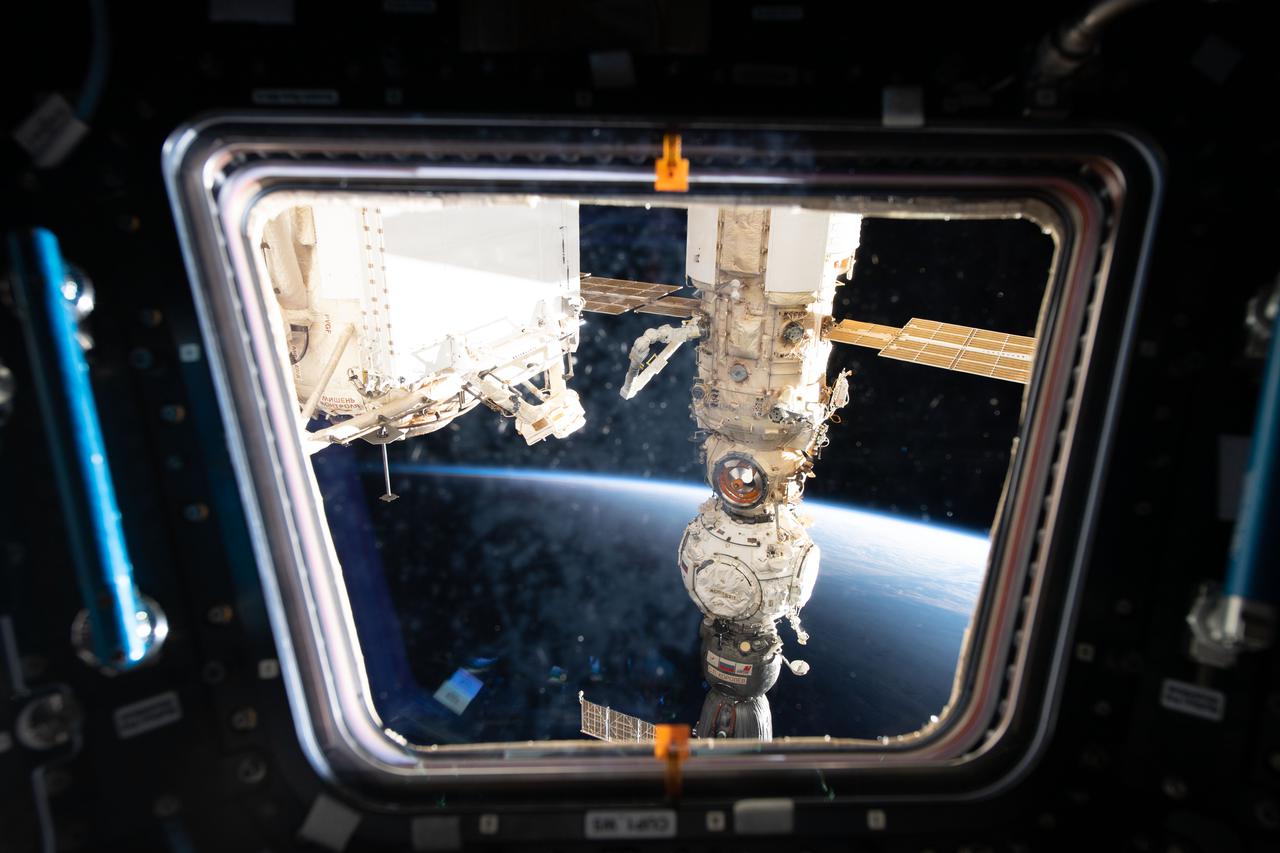
iss066e044523
iss064e009702 (Dec. 4, 2020) --- NASA astronauts and Expedition 64 Flight Engineers Shannon Walker and Michael Hopkins are pictured in the Kibo laboratory module during a space-to-ground call with SpaceX personnel.
iss064e009702
iss070e086322 (Feb. 4, 2024) --- JAXA (Japan Aerospace Exploration Agency) astronaut and Expedition 70 Flight Engineer Satoshi Furukawa poses for a photograph inside the International Space Station's Destiny laboratory module.
iss070e086322
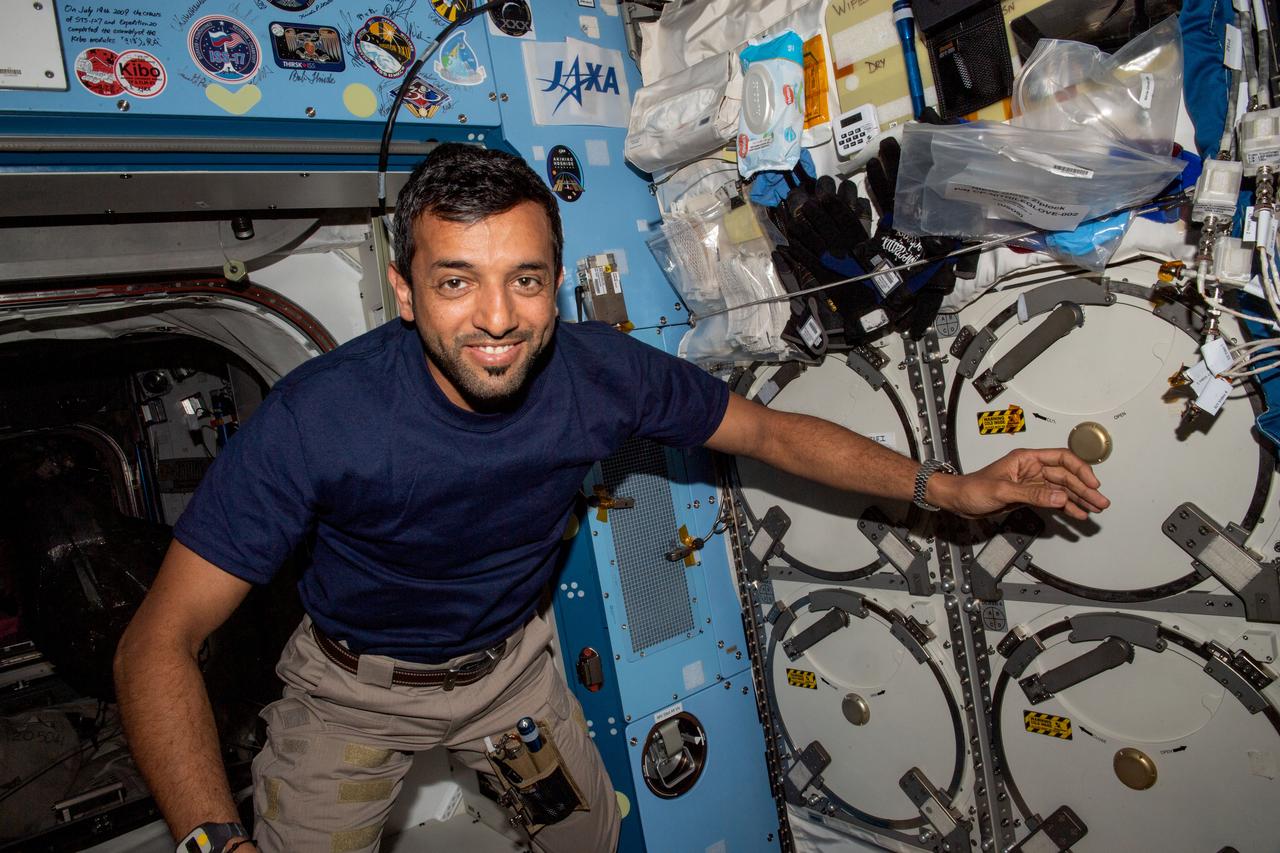
iss068e067448 (March 4, 2023) --- Expedition 68 Flight Engineer Sultan Alneyadi from UAE (United Arab Emirates) is pictured inside the Kibo laboratory module during his first week aboard the International Space Station.
iss068e067448