
This is a montage of planetary images taken by spacecraft managed by NASA’s Jet Propulsion Laboratory in Pasadena, CA. Included are from top to bottom images of Mercury, Venus, Earth and Moon, Mars, Jupiter, Saturn, Uranus and Neptune.
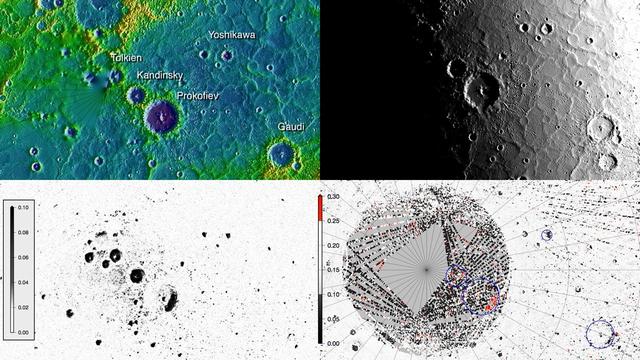
MLA Montage

Jupiter System Montage
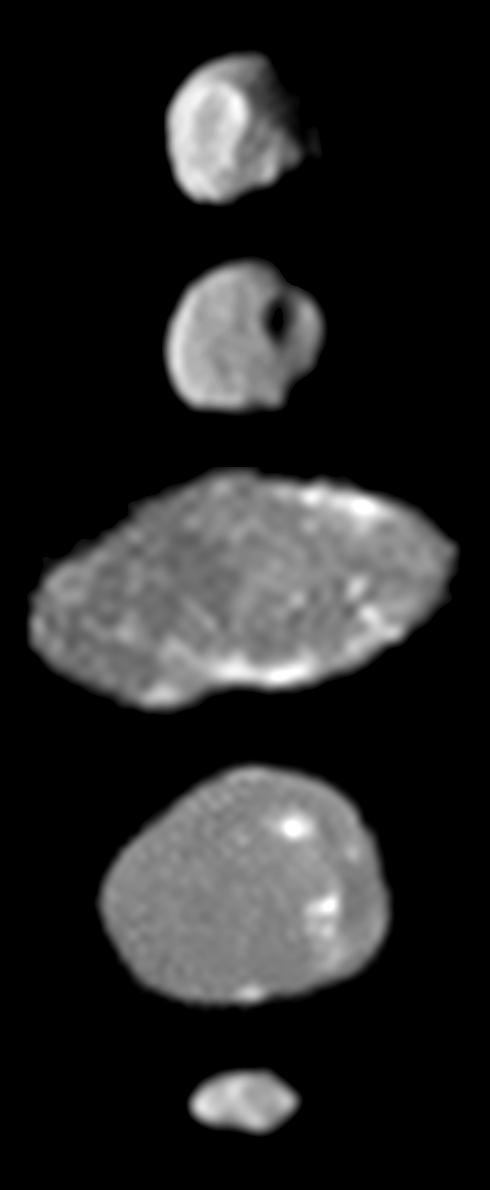
Jupiter Small Satellite Montage

Saturn System Montage

Hubble Views Ancient Storm in the Atmosphere of Jupiter - Montage
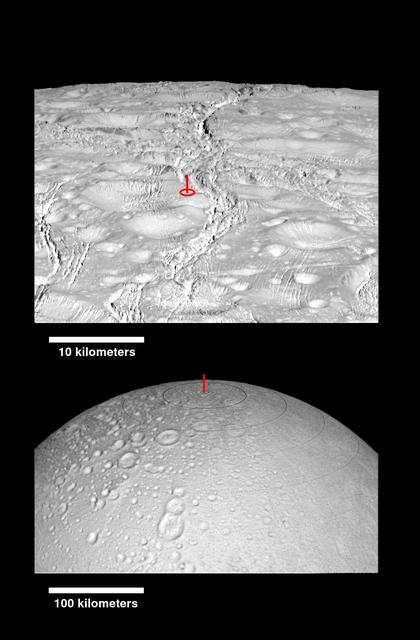
This montage of images from NASA Cassini orbiter shows the precise location of the north pole on Saturn icy moon Enceladus.

This is an artist conception of a solar-system montage of the eight planets, a comet and an asteroid.
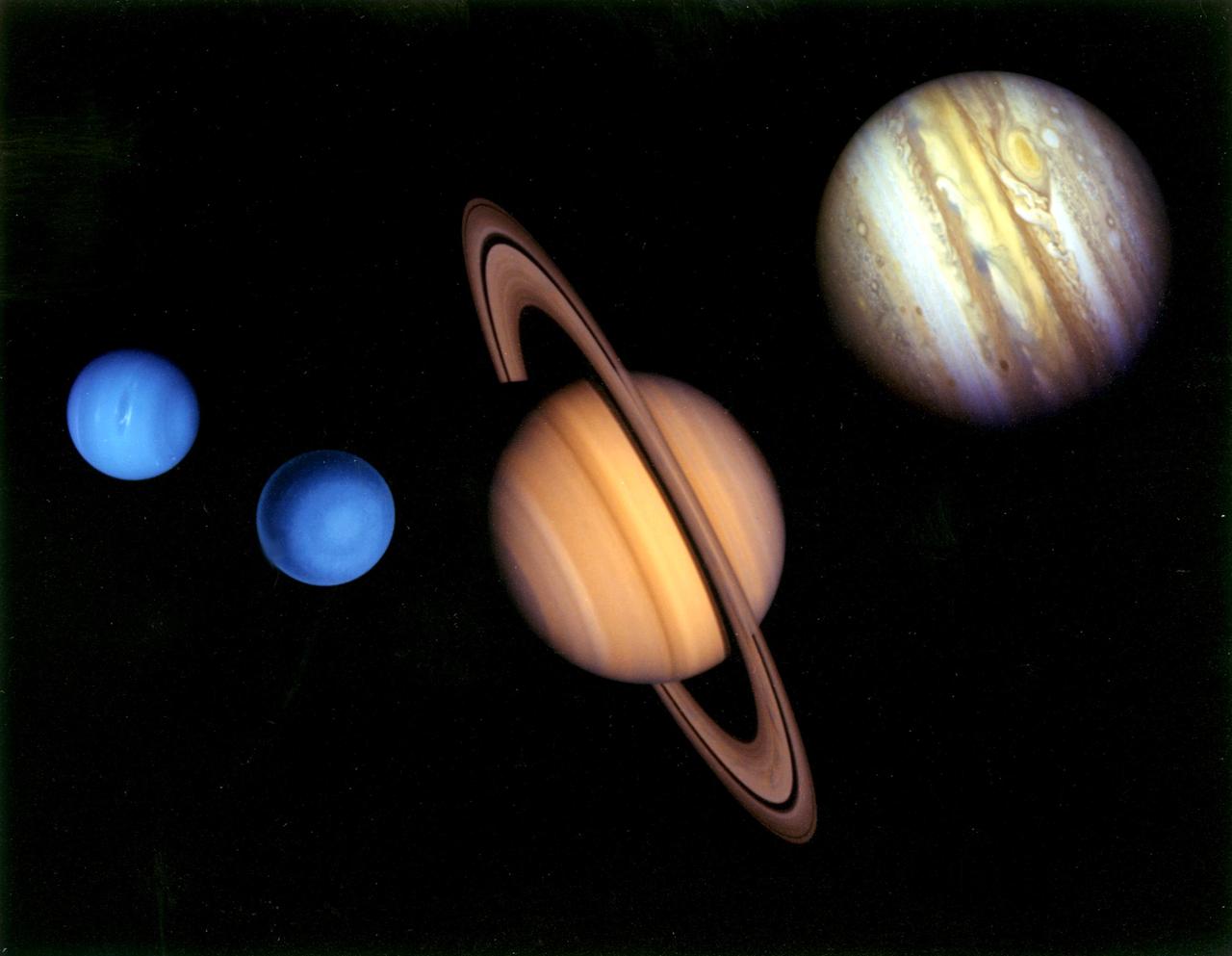
This montage of images of the planets visited by NASA's Voyager 2 was prepared from an assemblage of images taken by the 2 Voyager spacecraft. https://photojournal.jpl.nasa.gov/catalog/PIA01483
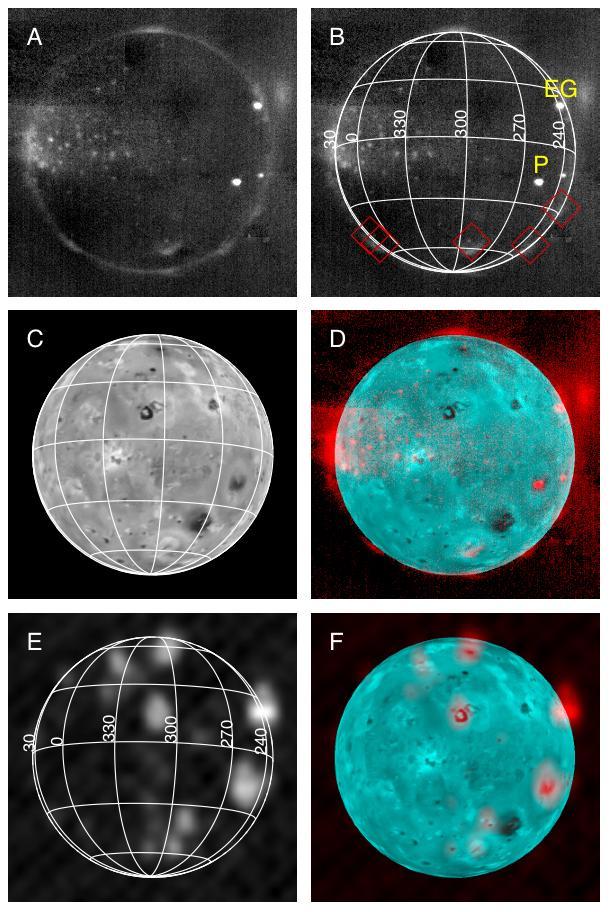
New Horizons took this montage of images of Jupiter volcanic moon Io, glowing in the dark of Jupiter shadow, as the Pluto-bound spacecraft sped through the Jupiter system on Feb. 27, 2007.

This is an updated montage of planetary images taken by spacecraft managed by NASA’s Jet Propulsion Laboratory in Pasadena, CA. Included are from top to bottom images of Mercury, Venus, Earth and Moon, Mars, Jupiter, Saturn, Uranus and Neptune.

This computer generated montage created from images obtained by NASA Voyager 2 shows Neptune as it would appear from a spacecraft approaching Triton, Neptune largest moon at 2706 km 1683 mi in diameter. http://photojournal.jpl.nasa.gov/catalog/PIA00340

This is a montage of planetary images taken by spacecraft managed by NASA’s Jet Propulsion Laboratory in Pasadena, CA. Included are from top to bottom images of Mercury, Venus, Earth and Moon, Mars, Jupiter, Saturn, Uranus and Neptune.
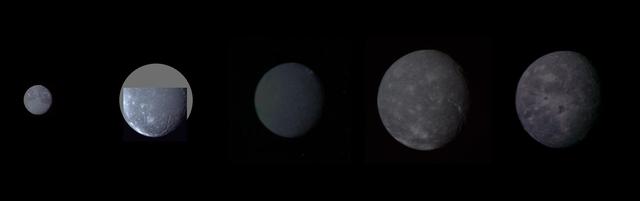
Montage of Uranus five largest satellites taken by NASA Voyager 2. From to right to left in order of decreasing distance from Uranus are Oberon, Titania, Umbriel, Ariel, and Miranda.
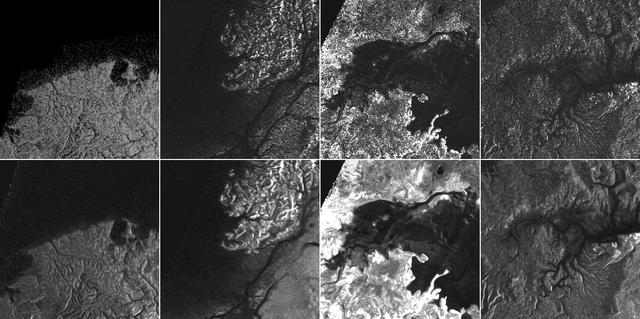
This montage of Cassini Synthetic Aperture Radar (SAR) images of the surface of Titan shows four examples of how a newly developed technique for handling noise results in clearer, easier to interpret views. The top row of images was produced in the manner used since the mission arrived in the Saturn system a decade ago; the row at bottom was produced using the new technique. The three leftmost image pairs show bays and spits of land in Ligea Mare, one of Titan's large hydrocarbon seas. The rightmost pair shows a valley network along Jingpo Lacus, one of Titan's larger northern lakes. North is toward the left in these images. Each thumbnail represents an area 70 miles (112 kilometers) wide. http://photojournal.jpl.nasa.gov/catalog/PIA19053
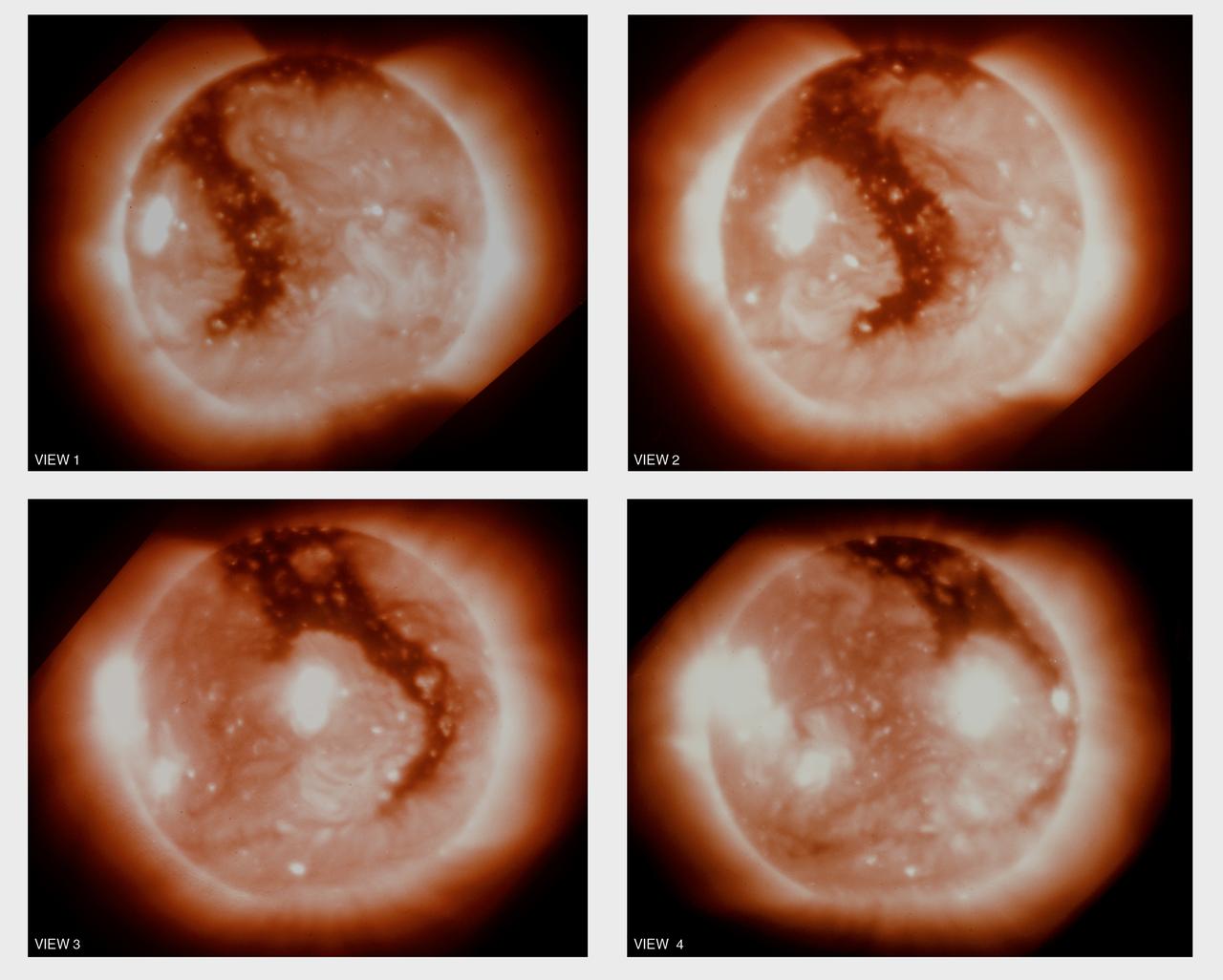
This montage is a sequence of soft x-ray photographs of the boot-shaped coronal hole rotating with the sun. The individual pictures were taken about 2 days apart by the Skylab telescope. Most of the apparent changes in this 6-day period resulted from a changing perspective. Skylab data helped demonstrate that coronal holes are sources of high-velocity streams in the solar wind. These high-velocity streams can be electrons, protons, and atomic nuclei that spray out from the Sun into interplanetary space. When the coronal hole is near the center of the Sun, as in view 2, the sprinkler is directed at Earth. These high-speed streams of solar wind distort Earth's magnetic field and disturb it's upper atmosphere.
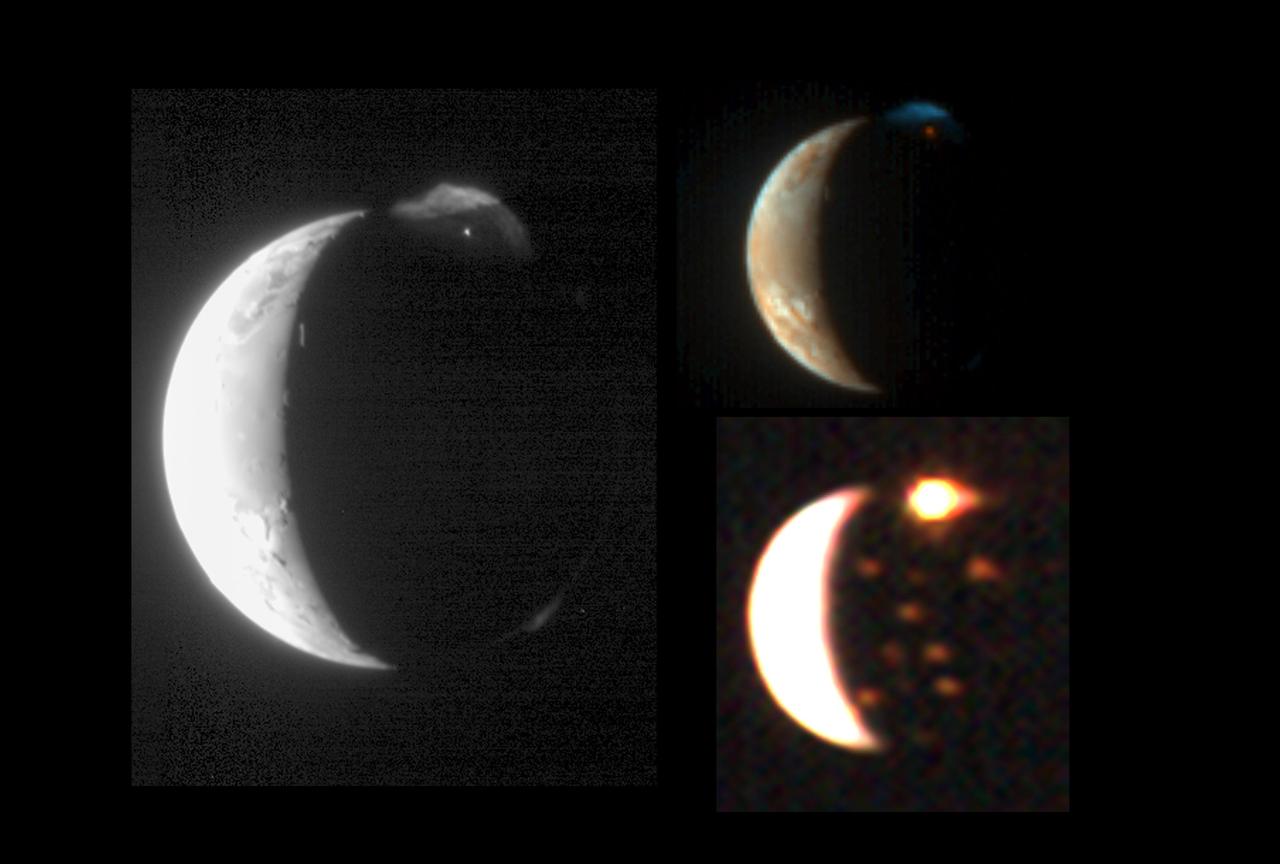
This montage demonstrates New Horizons ability to observe the same target in complementary ways using its diverse suite of instruments.
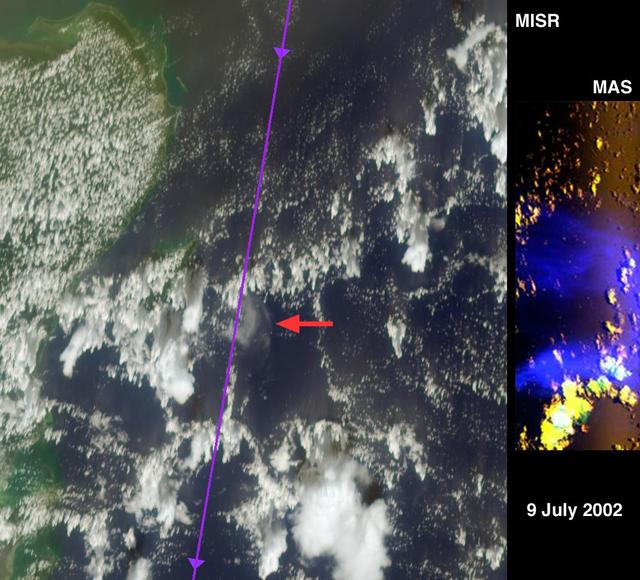
This montage is a natural-color view of the Caribbean Sea east of the Yucatan Peninsula as seen by NASA Terra satellite.

This montage shows asteroid 951 Gaspra top compared with Deimos lower left and Phobos lower right, the moons of Mars. http://photojournal.jpl.nasa.gov/catalog/PIA00078
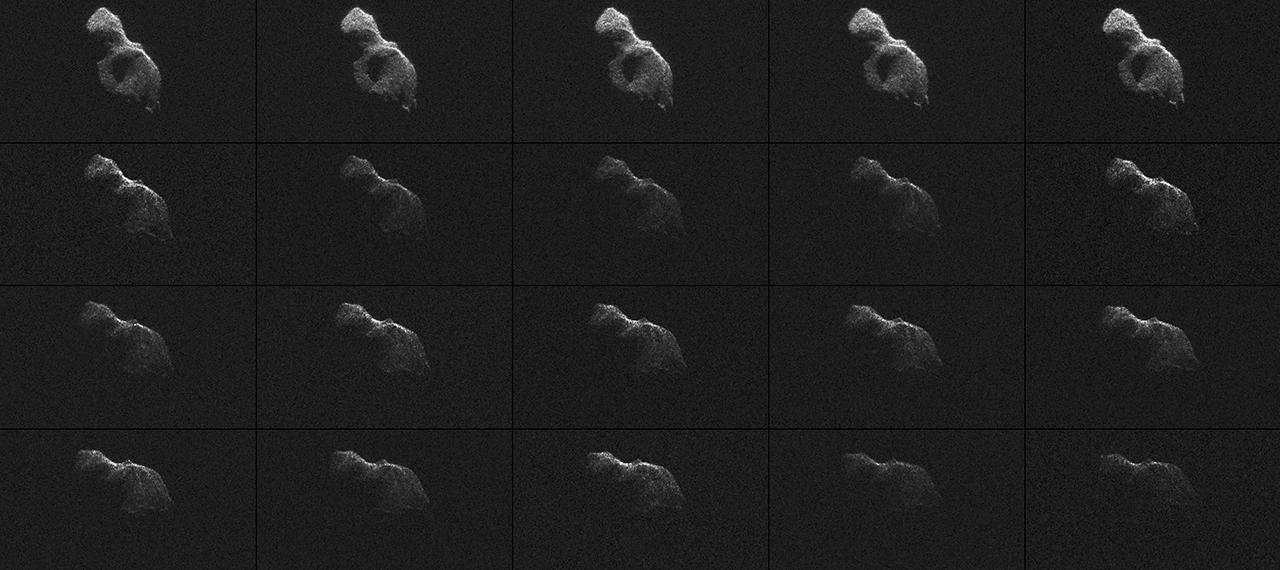
NASA scientists used Earth-based radar to produce these sharp views -- an image montage and a movie sequence -- of the asteroid designated 2014 HQ124 on June 8, 2014.
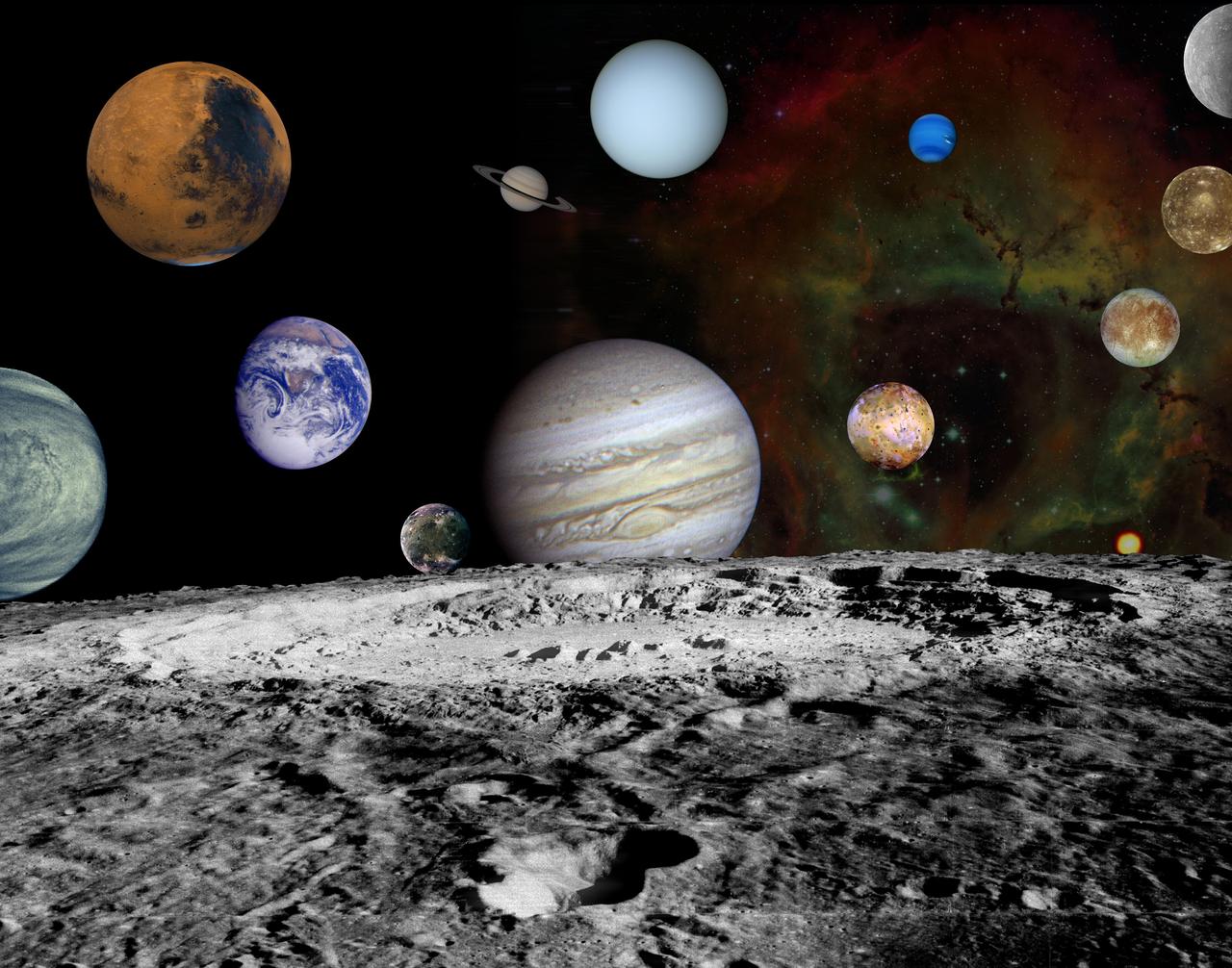
This solar system montage of the nine planets and four large moons of Jupiter in our solar system are set against a false-color view of the Rosette Nebula.

This image montage shows comet Hartley 2 as NASA EPOXI mission approached and flew under the comet. The images progress in time clockwise, starting at the top left.
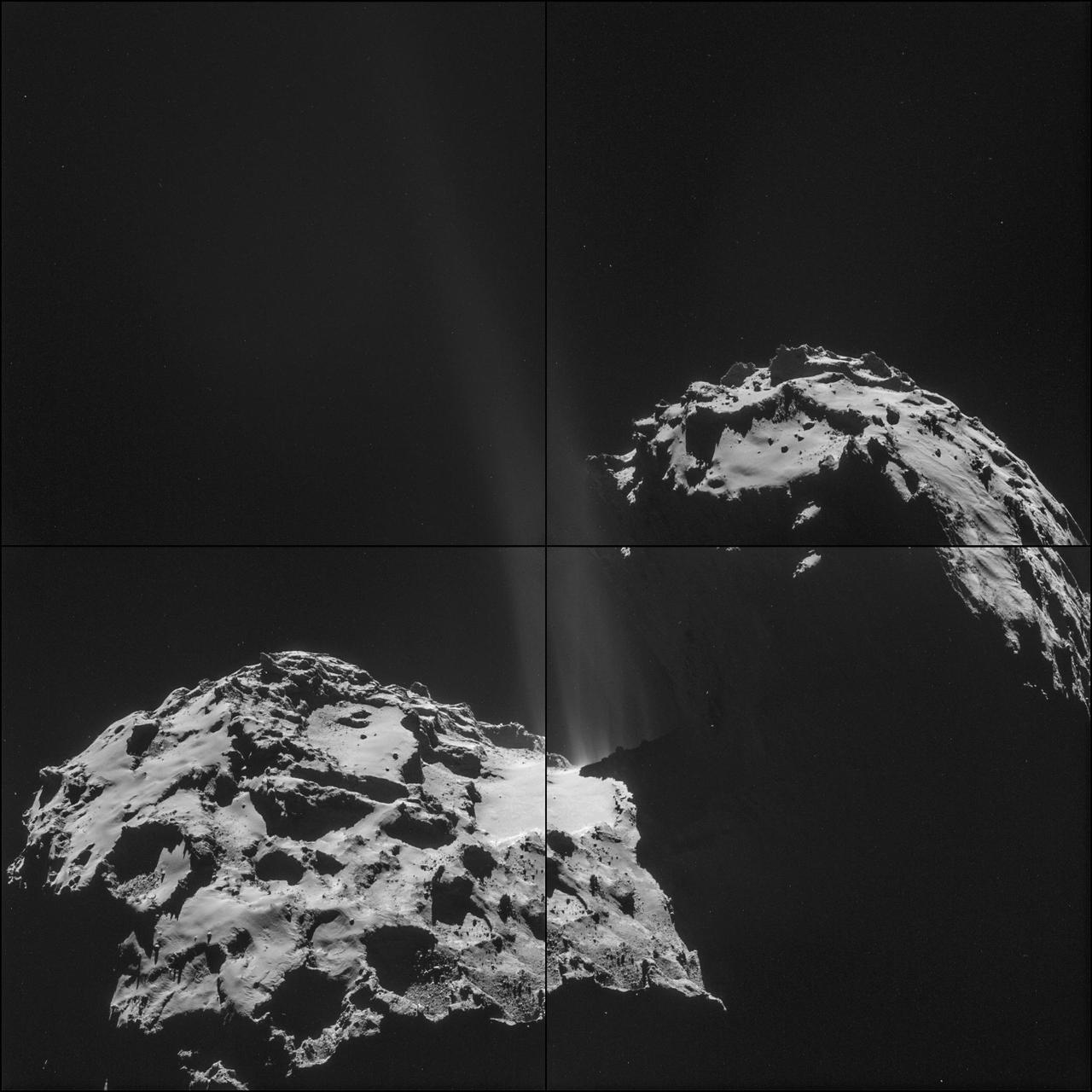
Four images taken by the ESA Rosetta spacecraft create a montage showing jets of dust and gas escaping from the nucleus of comet 67P/Churyumov–Gerasimenko.

NASA astronaut Zena Cardman presents NASA Administrator Jared Isaacman with a montage from Expeditions 73 and 74 while NASA astronauts Mike Fincke and JAXA (Japan Aerospace Exploration Agency) astronaut Kimiya Yui (not pictured) look on, Monday, June 1, 2026, at the Mary W. Jackson NASA Headquarters building in Washington. Fincke, Cardman, and Yui served as part of Expeditions 73 and 74 onboard the International Space Station. Photo Credit: (NASA/Aubrey Gemignani)

NASA astronaut Zena Cardman signs a montage from Expeditions 73 and 74 after presenting it to NASA Administrator Jared Isaacman, while NASA astronauts Mike Fincke and JAXA (Japan Aerospace Exploration Agency) astronaut Kimiya Yui look on, Monday, June 1, 2026, at the Mary W. Jackson NASA Headquarters building in Washington. Fincke, Cardman, and Yui served as part of Expeditions 73 and 74 onboard the International Space Station. Photo Credit: (NASA/Aubrey Gemignani)

NASA astronaut Zena Cardman presents NASA Administrator Jared Isaacman with a montage from Expeditions 73 and 74 while NASA astronauts Mike Fincke and JAXA (Japan Aerospace Exploration Agency) astronaut Kimiya Yui look on, Monday, June 1, 2026, at the Mary W. Jackson NASA Headquarters building in Washington. Fincke, Cardman, and Yui served as part of Expeditions 73 and 74 onboard the International Space Station. Photo Credit: (NASA/Aubrey Gemignani)

NASA astronaut Zena Cardman presents NASA Administrator Jared Isaacman with a montage from Expeditions 73 and 74 while NASA astronauts Mike Fincke and JAXA (Japan Aerospace Exploration Agency) astronaut Kimiya Yui look on, Monday, June 1, 2026, at the Mary W. Jackson NASA Headquarters building in Washington. Fincke, Cardman, and Yui served as part of Expeditions 73 and 74 onboard the International Space Station. Photo Credit: (NASA/Aubrey Gemignani)
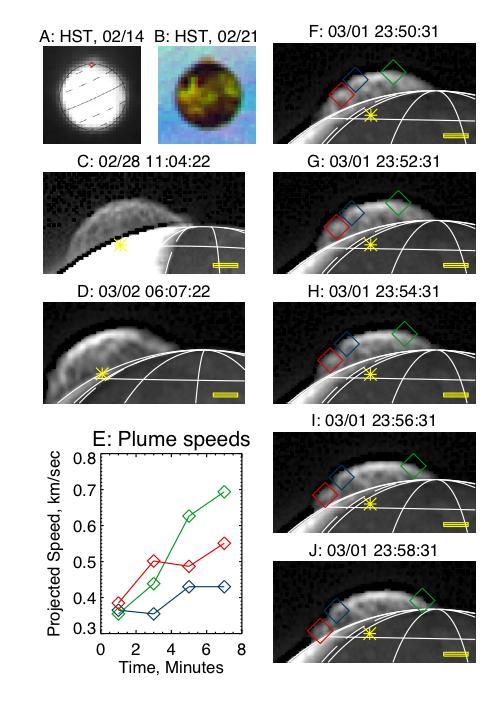
The Tvashtar plume on Io, seen by the Hubble Space Telescope HST and by New Horizons.
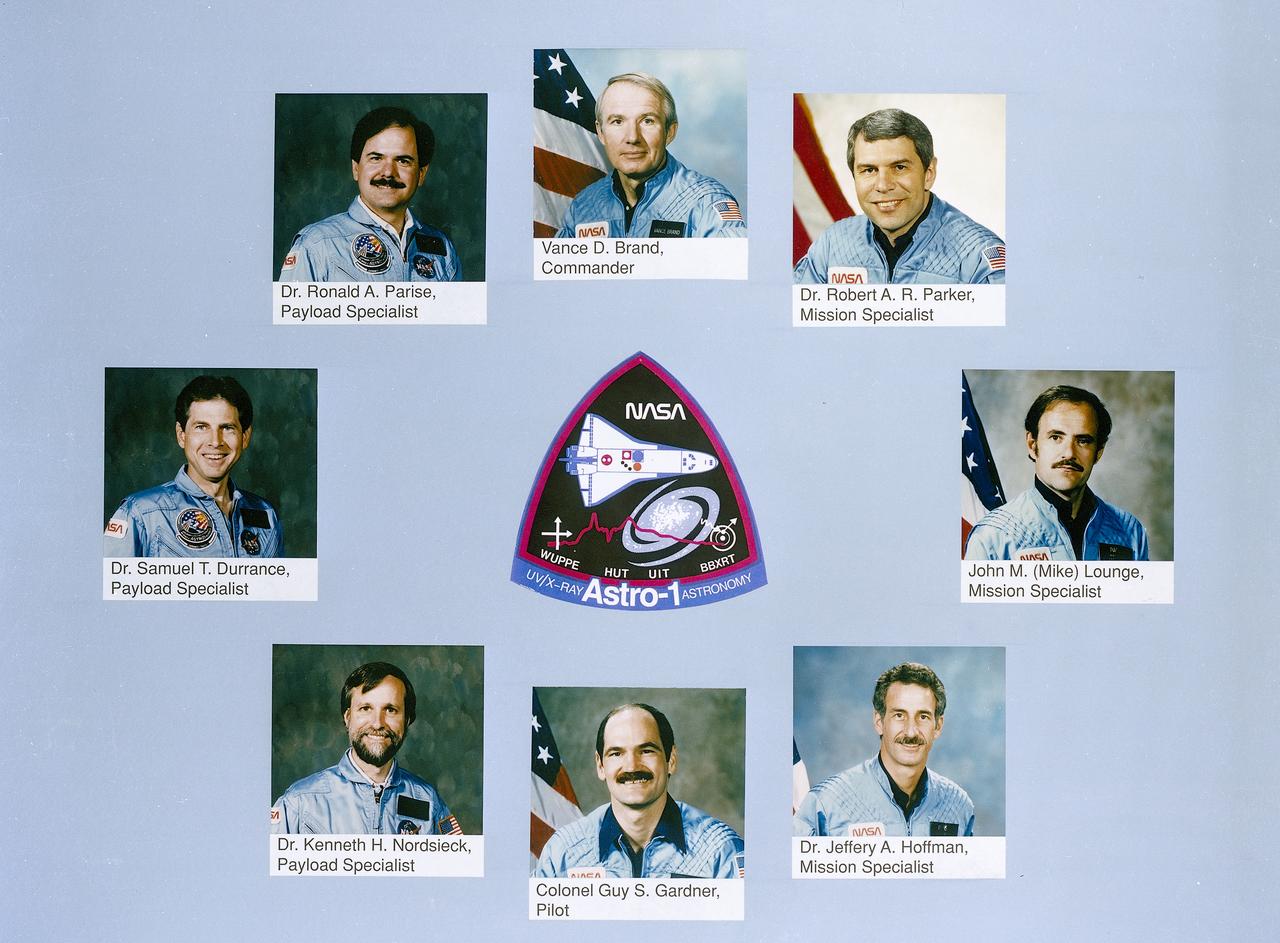
This montage consists of 8 individual STS-35 crew member portraits surrounding the mission’s insignia. Starting from top center, clockwise, are Vance D. Brand, commander; mission specialists Dr. Robert A. R. Parker, John M. (Mike) Lounge, and Dr. Jeffery A. Hoffman; Colonel Guy S. Gardner, pilot; and payload specialists Dr. Kenneth H. Nordsieck, Dr. Samual T. Durrance, and Dr. Ronald A. Parise. The crew of 8 launched aboard the Space Shuttle Orbiter Columbia on December 2, 1990 at 1:19:01am (EST). The primary objective of the mission was round the clock observation of the celestial sphere in ultrviolet and X-Ray astronomy with the Astro-1 observatory which consisted of four telescopes: the Hopkins Ultraviolet Telescope (HUT); the Wisconsin Ultraviolet Photo-Polarimeter Experiment (WUPPE); the Ultraviolet Imaging Telescope (UIT); and the Broad Band X-Ray Telescope (BBXRT). Due to loss of data used for pointing and operating the ultraviolet telescopes, Marshall Space Flight Center ground teams were forced to aim the telescopes with fine tuning by the flight crew.
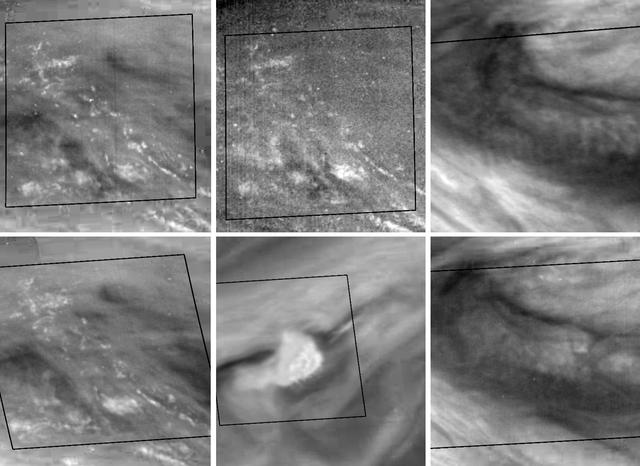
This montage features activity in the turbulent region of Jupiter Great Red Spot GRS. Four sets of images of the GRS were taken by NASA Galileo imaging system over an 11.5 hour period on 26 June, 1996.
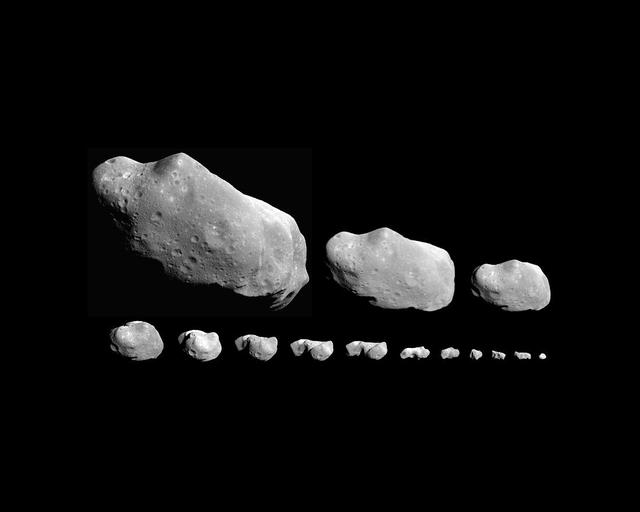
This montage of 14 images the time order is right to left, bottom to top shows asterpod Ida as it appeared in the field of view of NASA Galileo camera on August 28, 1993. http://photojournal.jpl.nasa.gov/catalog/PIA00070

This montage from NASA EPOXI mission shows the only five comets imaged up close with spacecraft. The comets vary in shape and size. Comet Hartley 2 is by far the smallest and the most active of small comets.
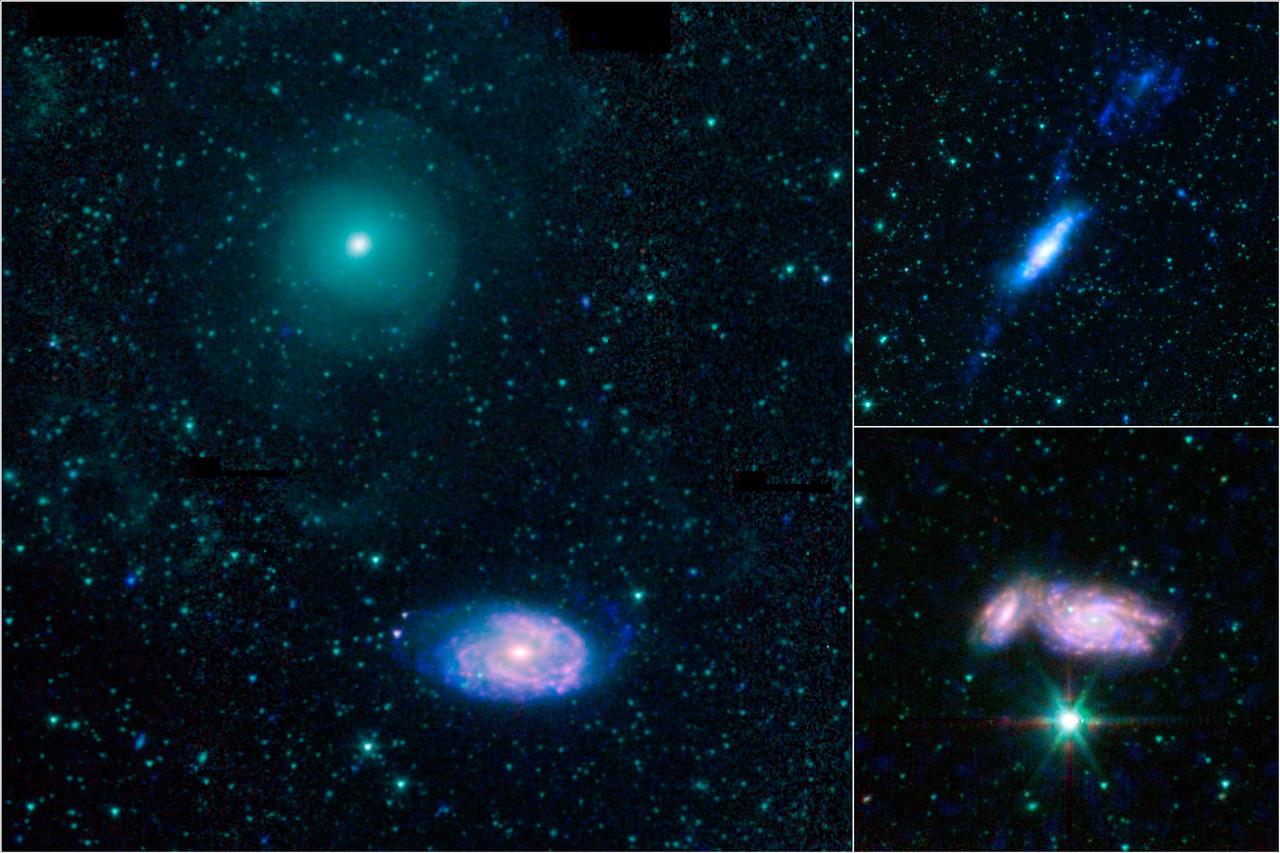
This montage combines observations from NASA Spitzer Space Telescope and NASA Galaxy Evolution Explorer GALEX spacecraft showing three examples of colliding galaxies from a new photo atlas of galactic train wrecks.

This montage of 11 images taken by NASA Galileo spacecraft as it flew by the asteroid Gaspra on Oct. 1991, shows Gaspra growing progressively larger in the field of view of Galileo solid-state imaging camera as the spacecraft approached the asteroid. http://photojournal.jpl.nasa.gov/catalog/PIA00079
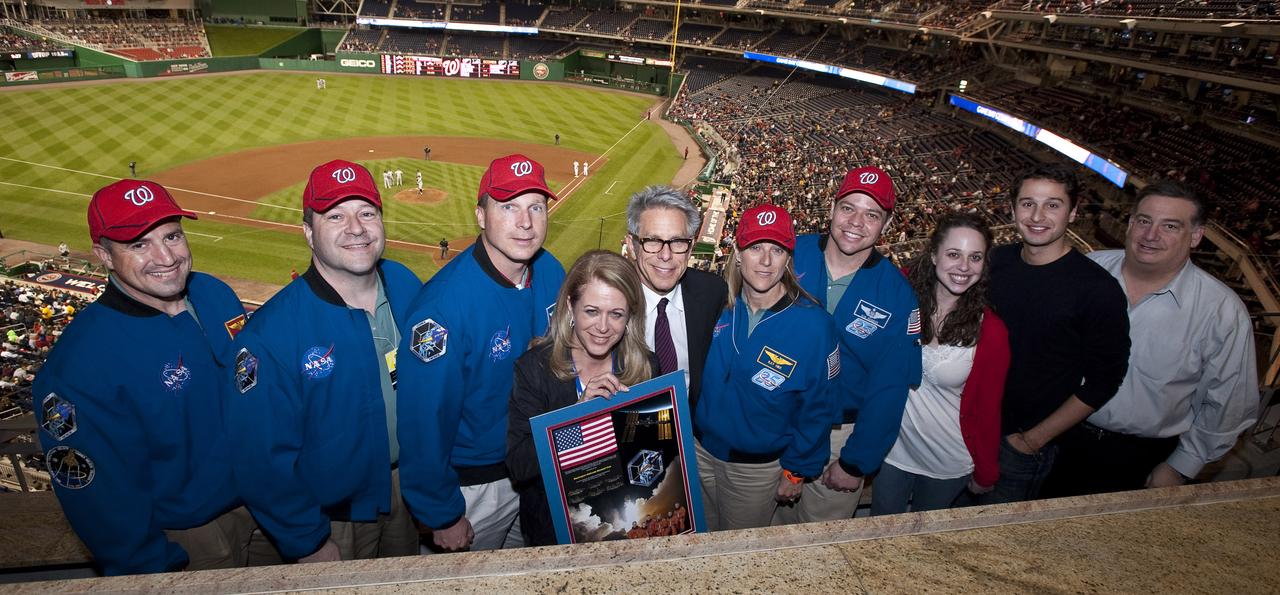
The crew of STS-130 present the principal owner of the Washington Nationals, Debra Lerner Cohen (holding montage) with a montage of their mission, Tuesday, April 20, 2010 at Nationals Park in Washington. From left are seen Commander George Zamka, Mission Specialist Nicholas Patrick, Pilot Terry Virts, Debra Lerner Cohen, Edward Cohen, Mission Specialist Kathryn Hire, Mission Specialist Robert Behnken, Lauren Lerner, Jacob Lerner and Alan Gottlieb. Photo Credit: (NASA/Carla Cioffi)
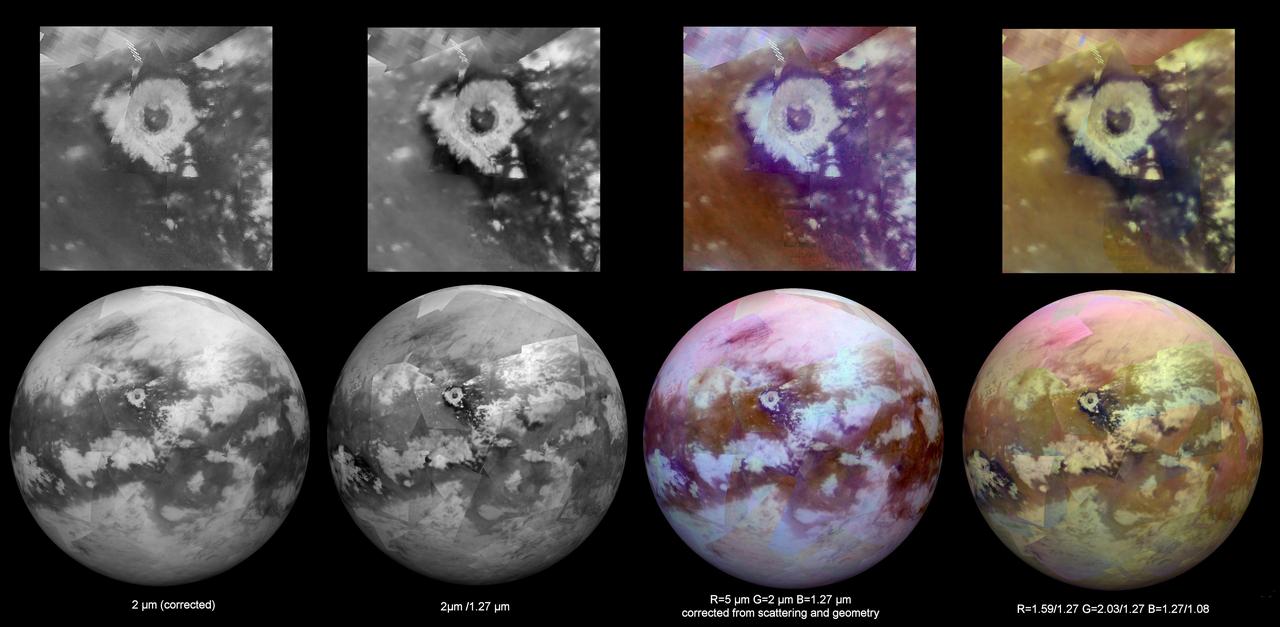
Each of these two montages shows four synthetic views of Titan created using data acquired by NASA Cassini spacecraft between 2004 and 2015. With each flyby, a brief opportunity to add small pieces to the overall mapping coverage of Titan.
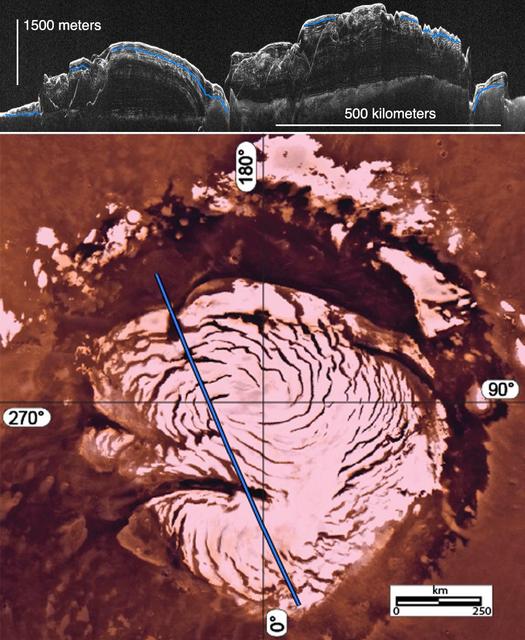
This image montage features a two-dimensional radar cross section of Mars north polar cap collected by SHARAD instrument on NASA Mars Reconnaissance Orbiter spacecraft top, and a color image mosaic of the polar cap from NASA Viking project bottom
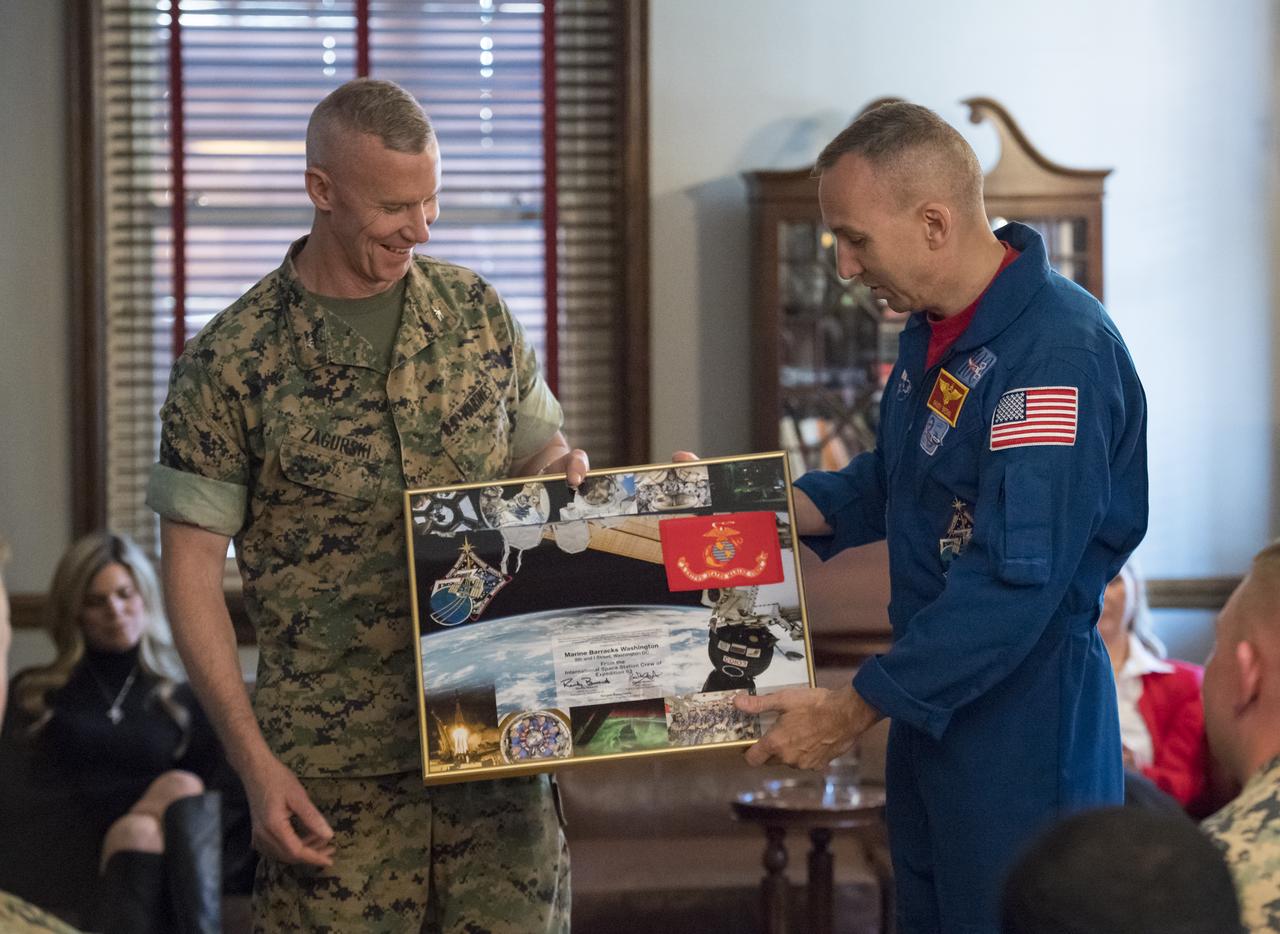
NASA astronaut Randy Bresnik presents Colonel Tyler Zagurski, Commanding Officer, Marine Corps Barracks, with a montage from his Expedition 53, Monday, May 7, 2018 in Washington. Photo Credit: (NASA/Aubrey Gemignani)
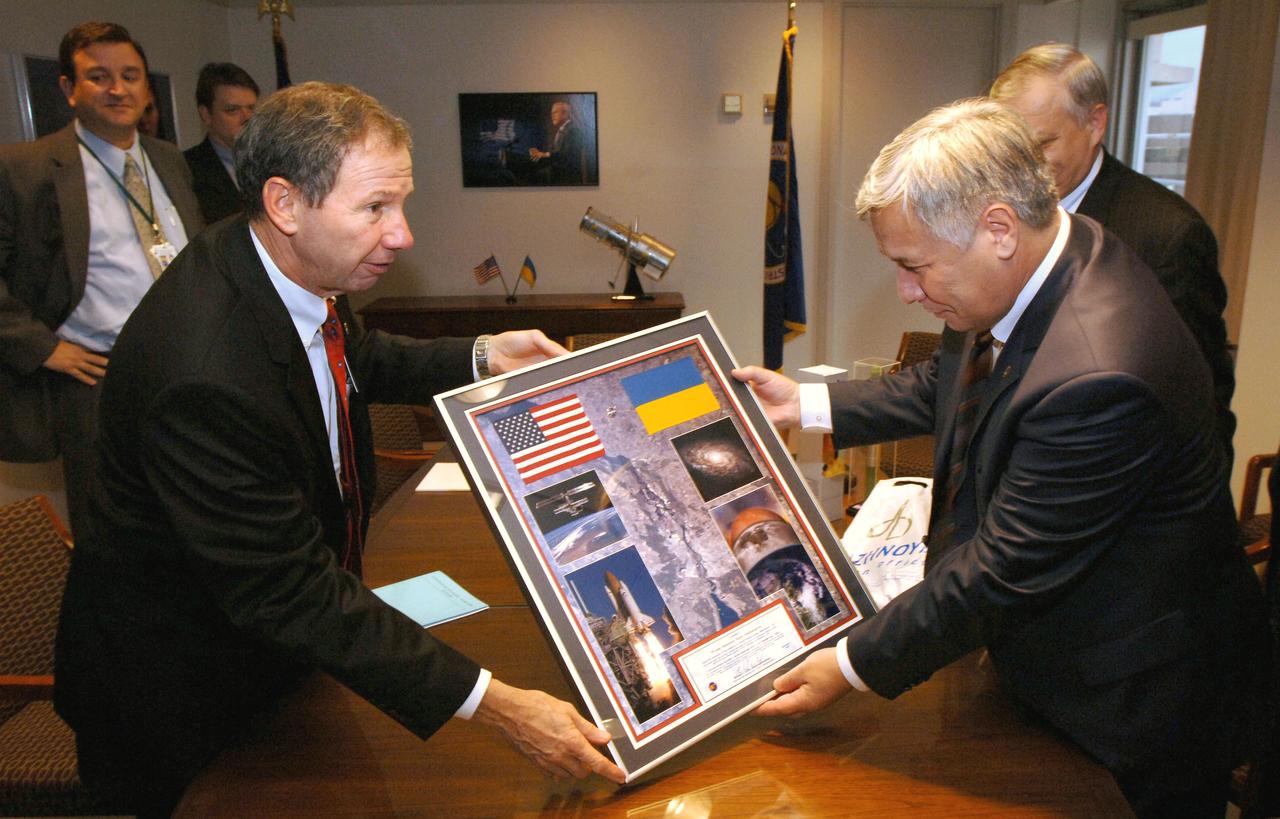
NASA Administrator Michael Griffin, left, presents Yuriy Yekhanurov, Prime Minister of Ukraine, with a montage following a meeting Tuesday, Nov. 1, 2005, at NASA Headquarters in Washington. Photo Credit: (NASA/Bill Ingalls)

NASA astronaut Drew Feustel presents Canadian Deputy Ambassador to the U.S., Kirsten Hillman, a montage from Expeditions 55 and 56 to the International Space Station, Monday, May 6, 2019 in Washington. Photo Credit: (NASA/Aubrey Gemignani)
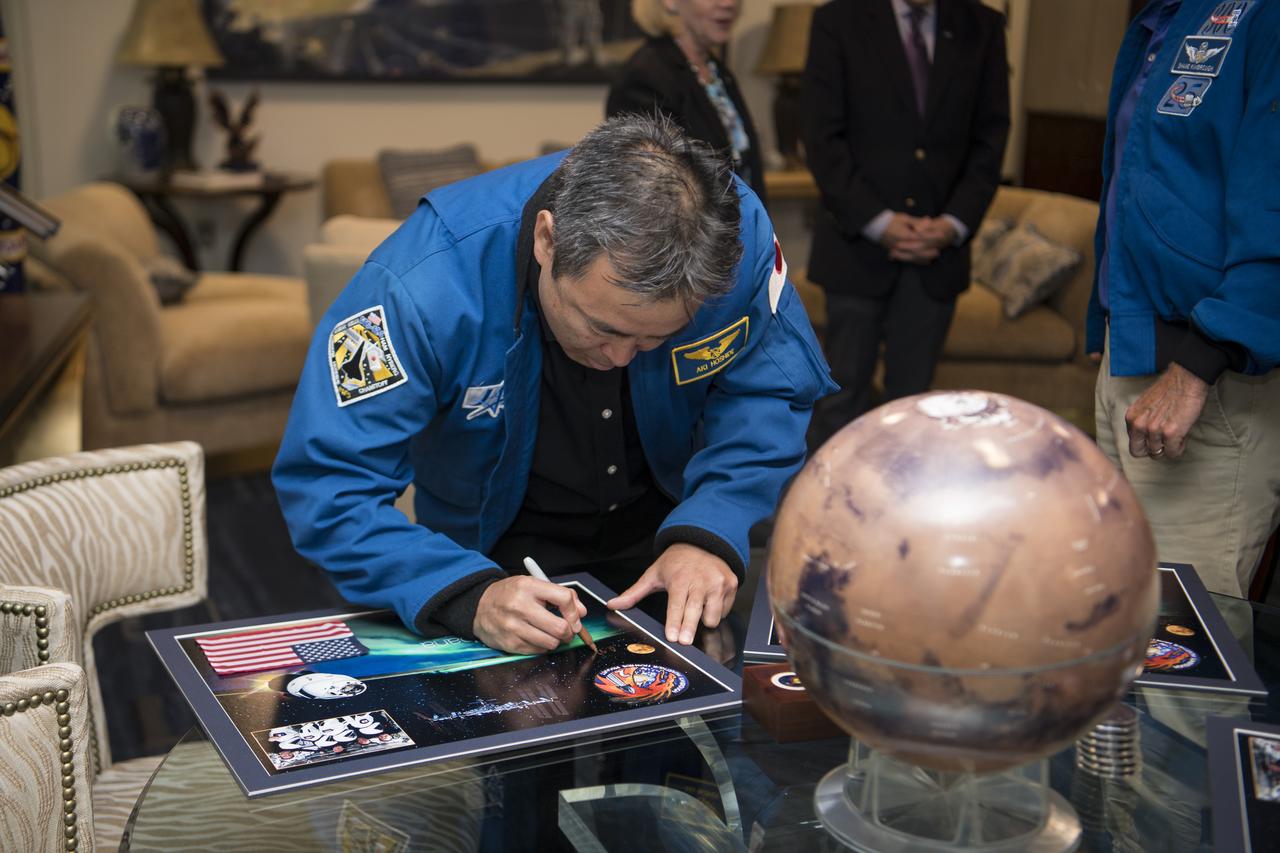
NASA’s SpaceX Crew-2 Japan Aerospace Exploration Agency (JAXA) astronaut Akihiko Hoshide, signs a montage for NASA Associate Administrator Bob Cabana, Monday, June 6, 2022, at the Mary W. Jackson NASA Headquarters Building in Washington DC. Photo Credit: (NASA/Aubrey Gemignani)
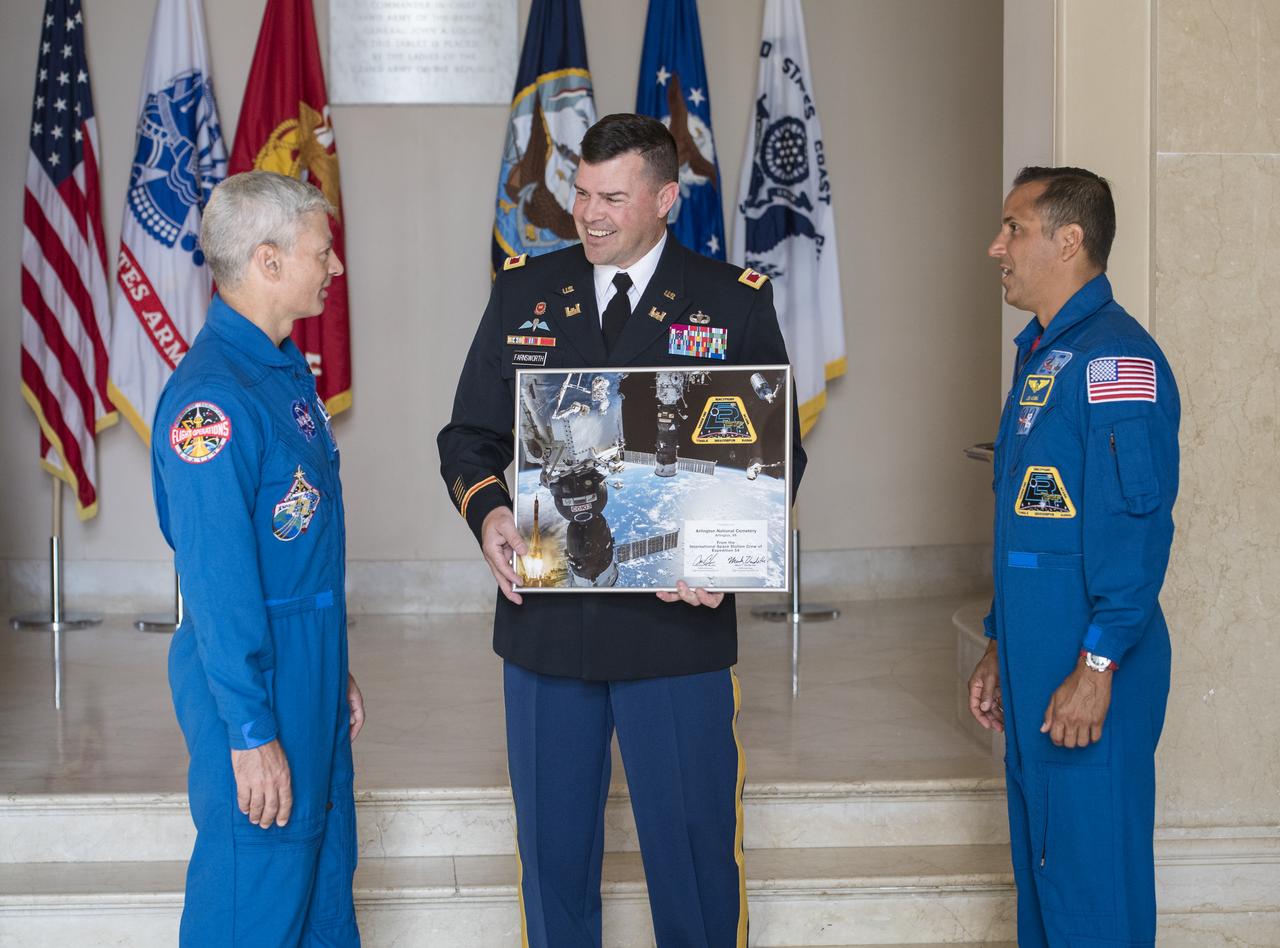
NASA astronauts Mark Vande Hei, left, and Joe Acaba, right, present Jerry Farnsworth, chief of staff at Arlington National Cemetery with a montage from Expedition 54, Friday, June 15, 2018 in Arlington, Va. Photo Credit: (NASA/Aubrey Gemignani)
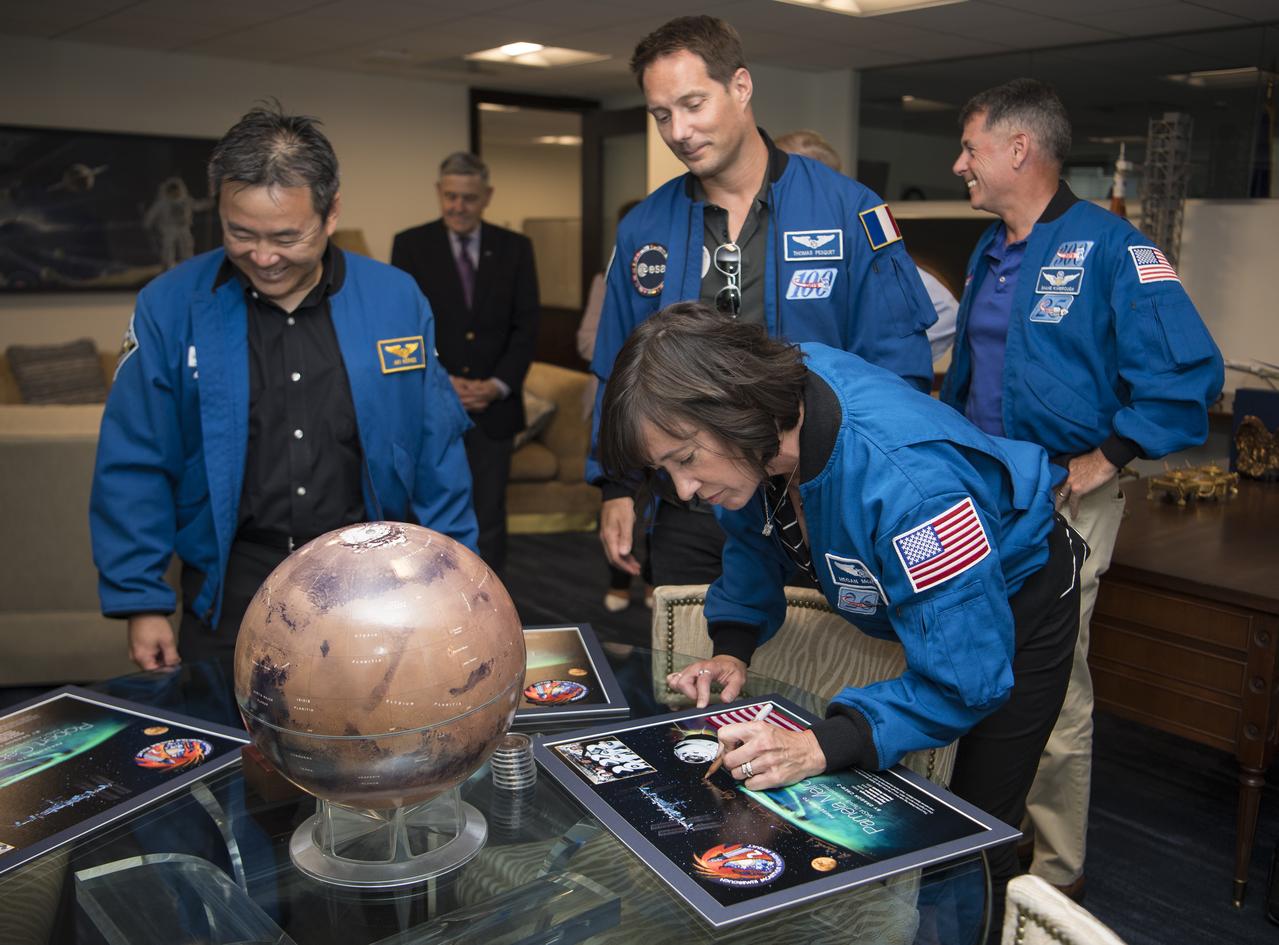
NASA’s SpaceX Crew-2 astronaut Megan McArthur signs a montage for NASA Deputy Administrator Pam Melroy while fellow Crew-2 members look on, Monday, June 6, 2022, at the Mary W. Jackson NASA Headquarters Building in Washington DC. Photo Credit: (NASA/Aubrey Gemignani)
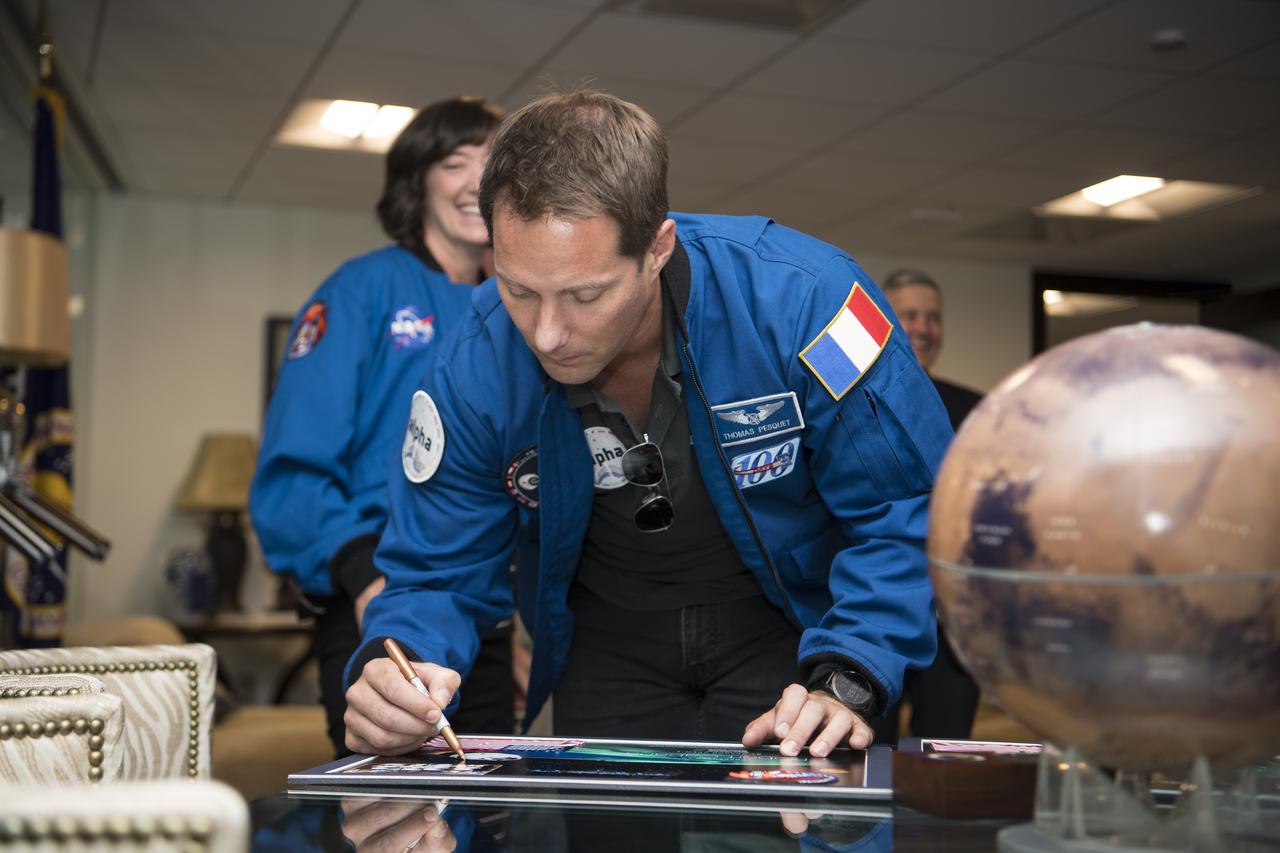
NASA’s SpaceX Crew-2 ESA (European Space Agency) astronaut Thomas Pesquet signs a montage for NASA Associate Administrator Bob Cabana, Monday, June 6, 2022, at the Mary W. Jackson NASA Headquarters Building in Washington DC. Photo Credit: (NASA/Aubrey Gemignani)
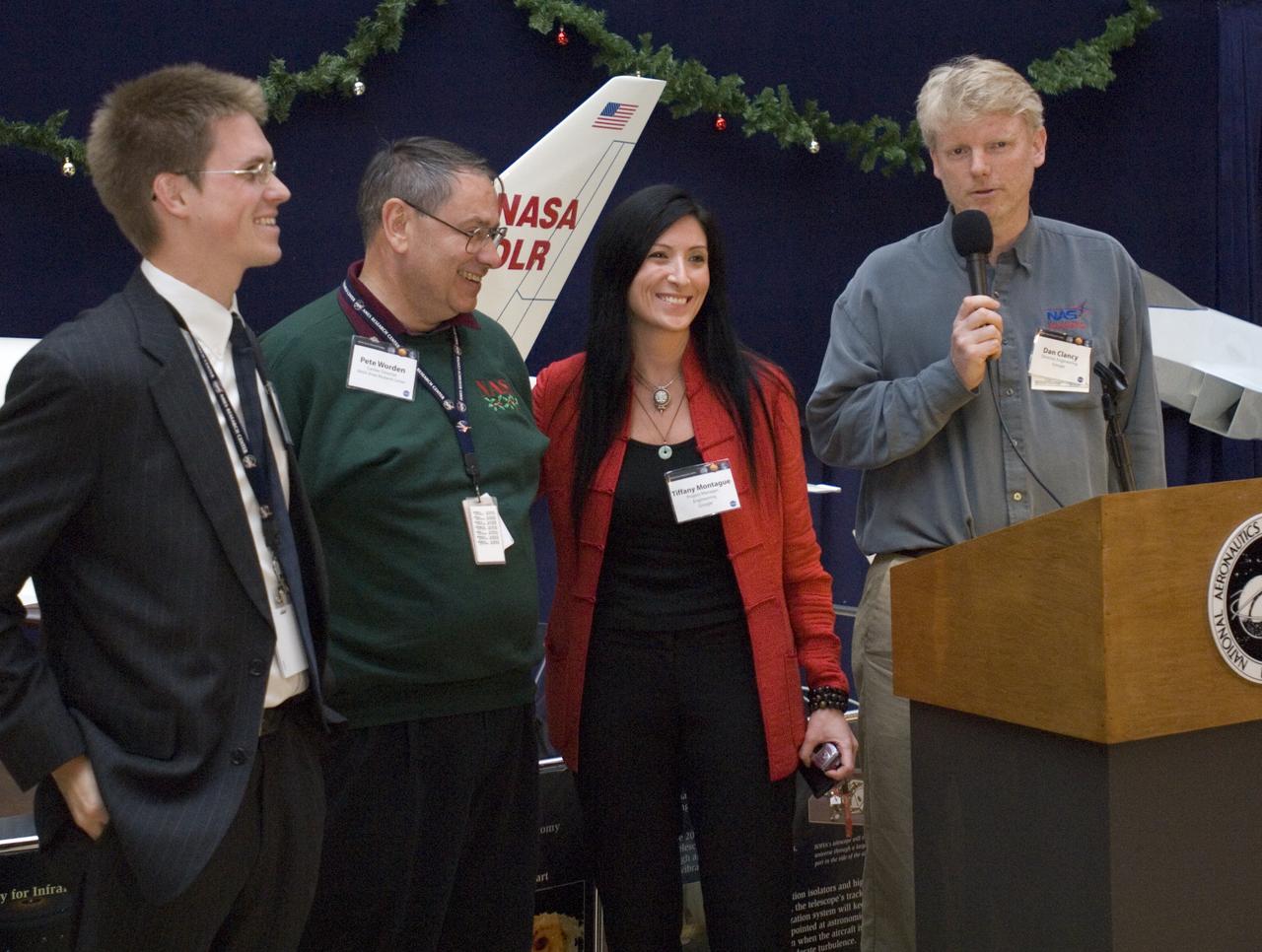
Kick-off event for Google NASA collaboration (held in the Ames Exploration Center 943A) with Chris Kemp, Ames Business Development (L) Ames Center Director Pete Worden (L-M) Tiffany Montage, Project Manager Engineering, Google (R-M) and Dan Clancy, Director of engineering Google (R)
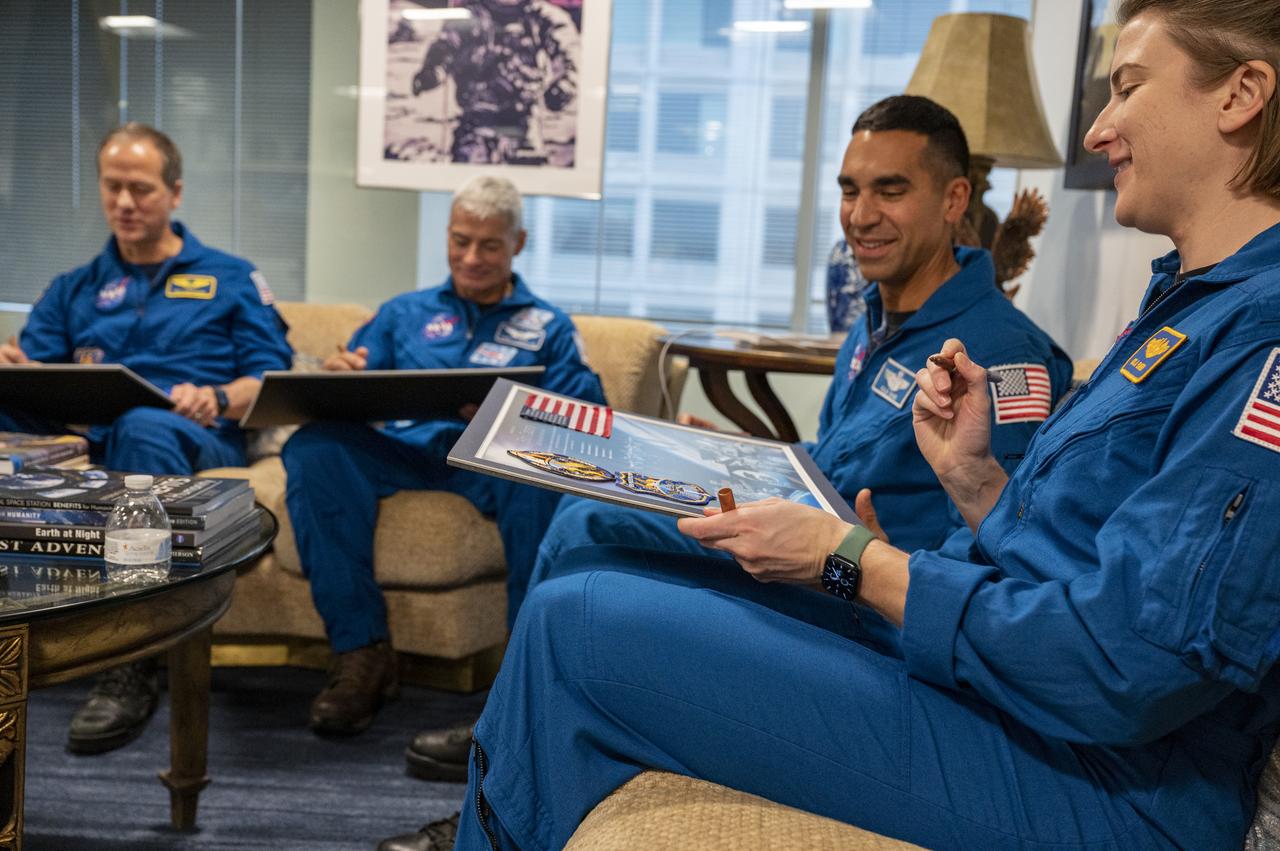
NASA’s SpaceX Crew-3 astronauts Raja Chari, Kayla Barron, Tom Marshburn, and Mark Vande Hei sign montages for NASA leadership, Wednesday, Dec. 7, 2022, at the Mary W. Jackson NASA Headquarters Building in Washington. Photo Credit: (NASA/Keegan Barber)
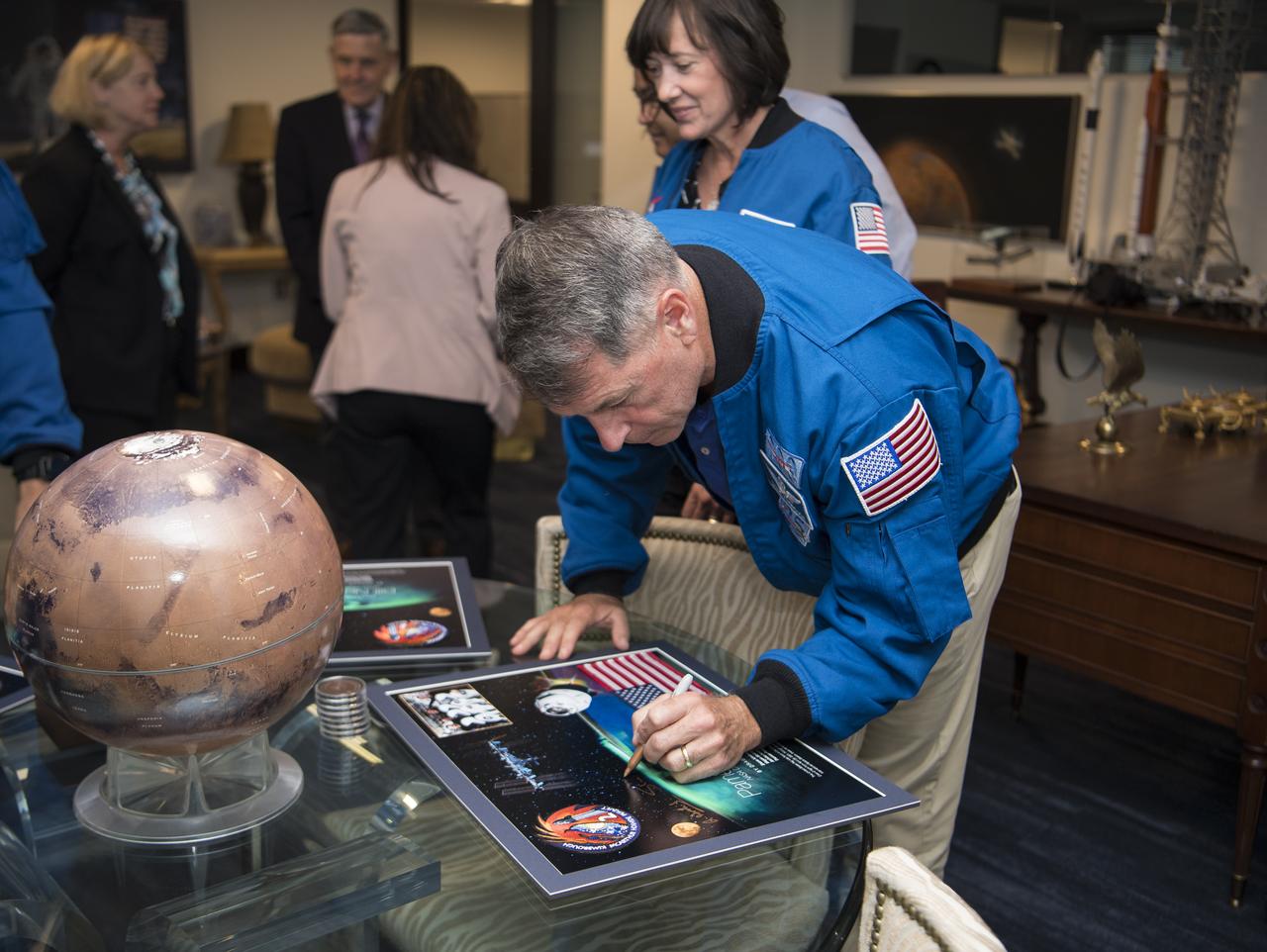
NASA’s SpaceX Crew-2 astronaut Shane Kimbrough signs a montage for NASA Deputy Administrator Pam Melroy while fellow Crew-2 members look on, Monday, June 6, 2022, at the Mary W. Jackson NASA Headquarters Building in Washington DC. Photo Credit: (NASA/Aubrey Gemignani)
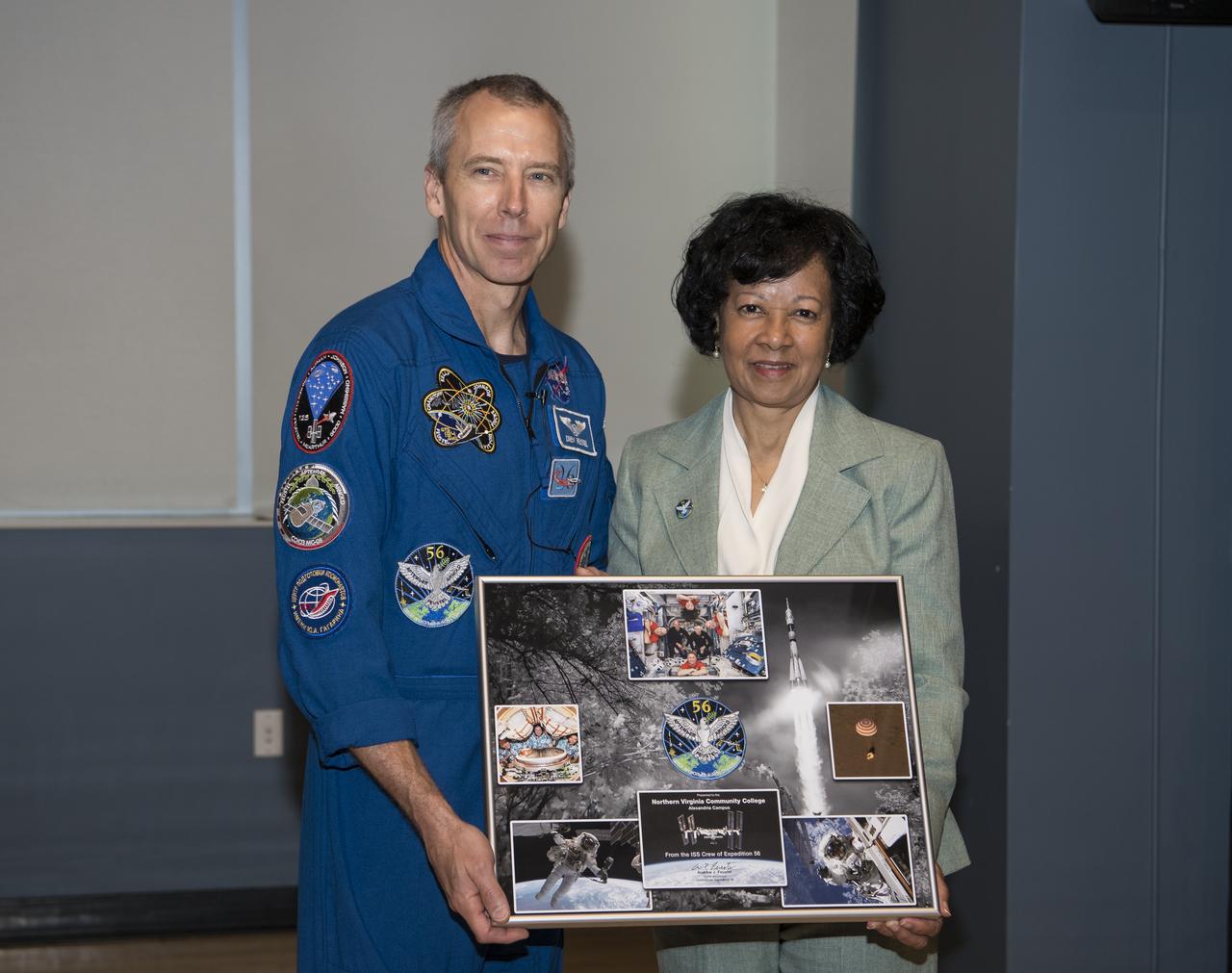
NASA astronaut Drew Feustel, left, poses for a photo with Northern Virginia Community College's Alexandria campus provost, Dr. Annette Haggray, after presenting her with a montage from Expeditions 55 and 56, Monday, May 6, 2019 in Virginia. Photo Credit: (NASA/Aubrey Gemignani)
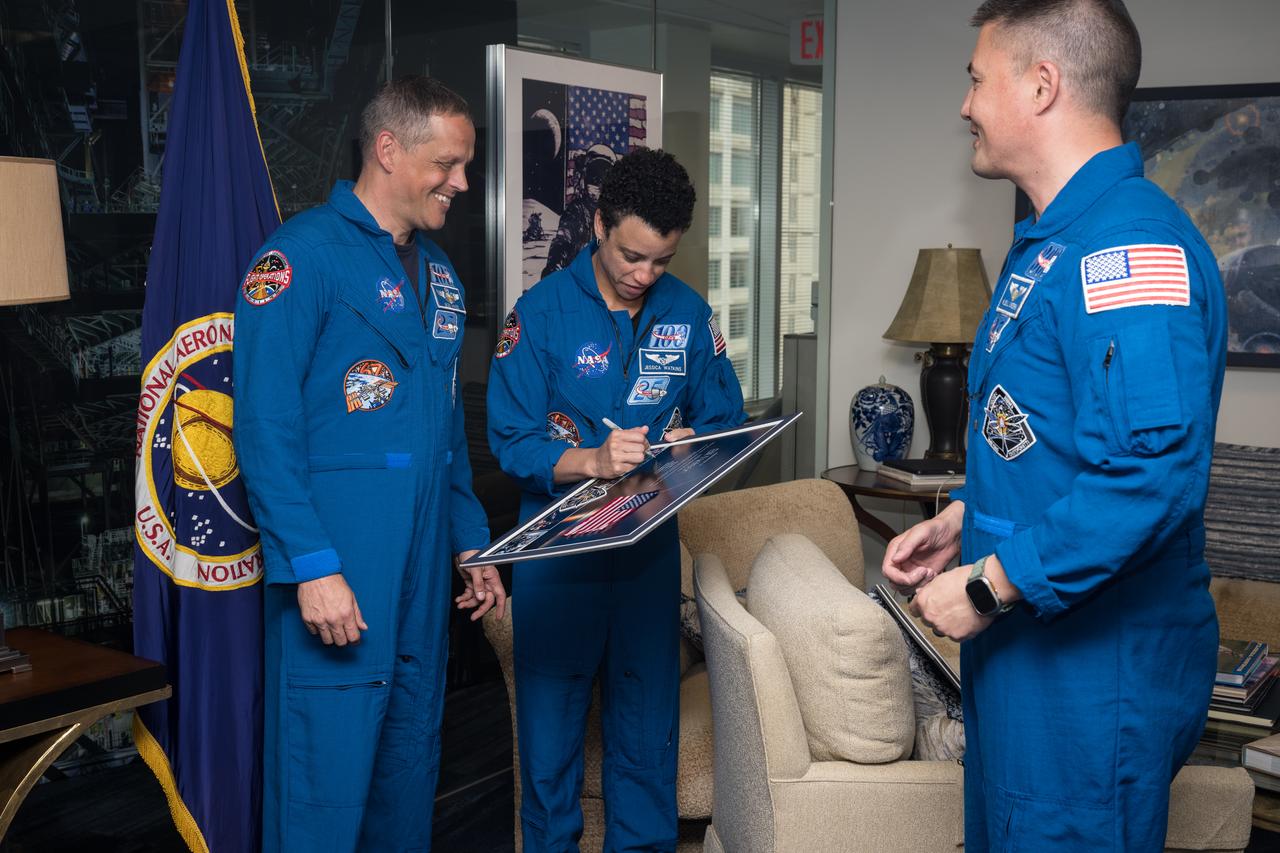
NASA’s SpaceX Crew-4 NASA astronauts Robert Hines, Jessica Watkins, and Kjell Lindgren, sign montages from their mission for NASA leadership, Monday, March 27, 2023, at the Mary W. Jackson NASA Headquarters building in Washington DC. Photo Credit: (NASA/Aubrey Gemignani)
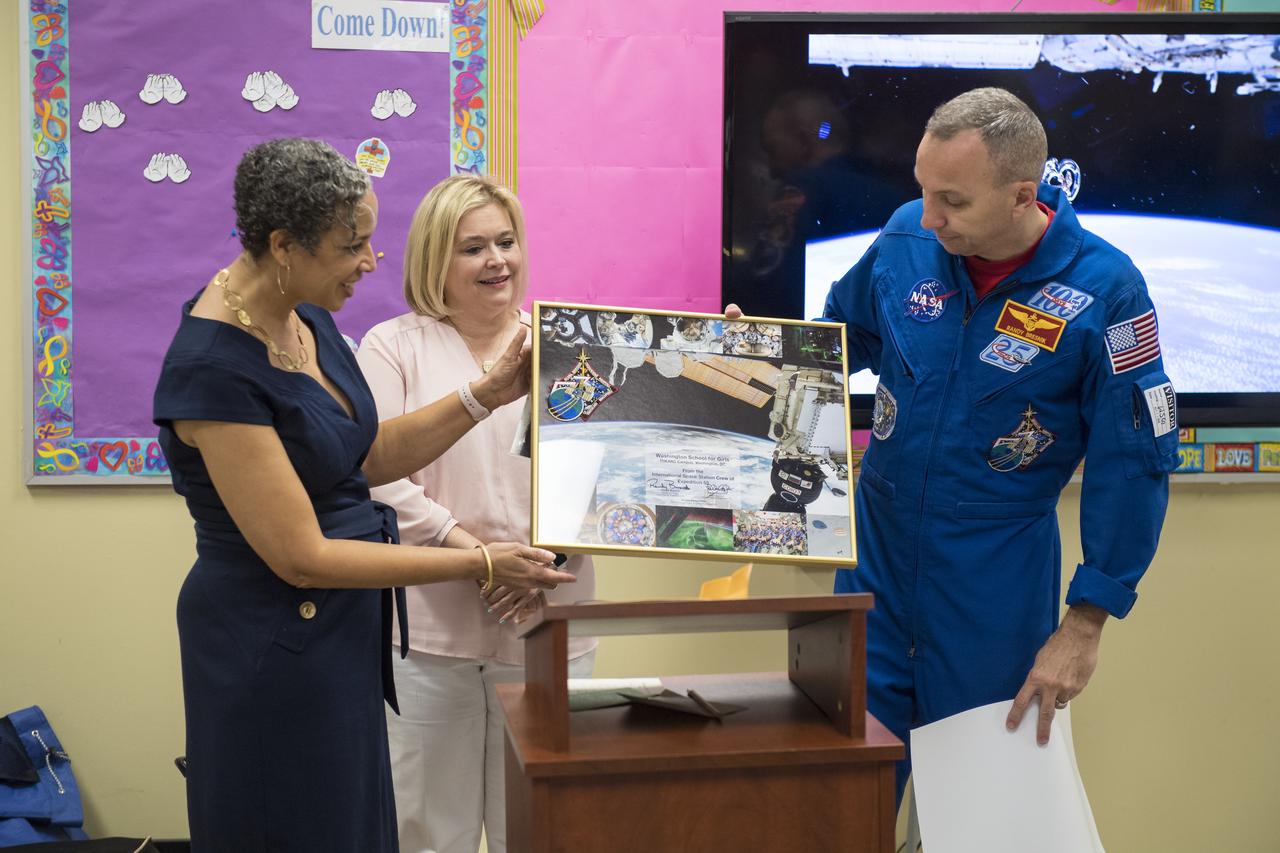
NASA astronaut Randy Bresnik, right, and his friend Shiela, center, present the principle of the school Dr. Beth Reaves, with a montage of images and items from Expedition 53, Friday, May 11, 2018 at the Washington School for Girls in Washington. Photo Credit: (NASA/Aubrey Gemignani)
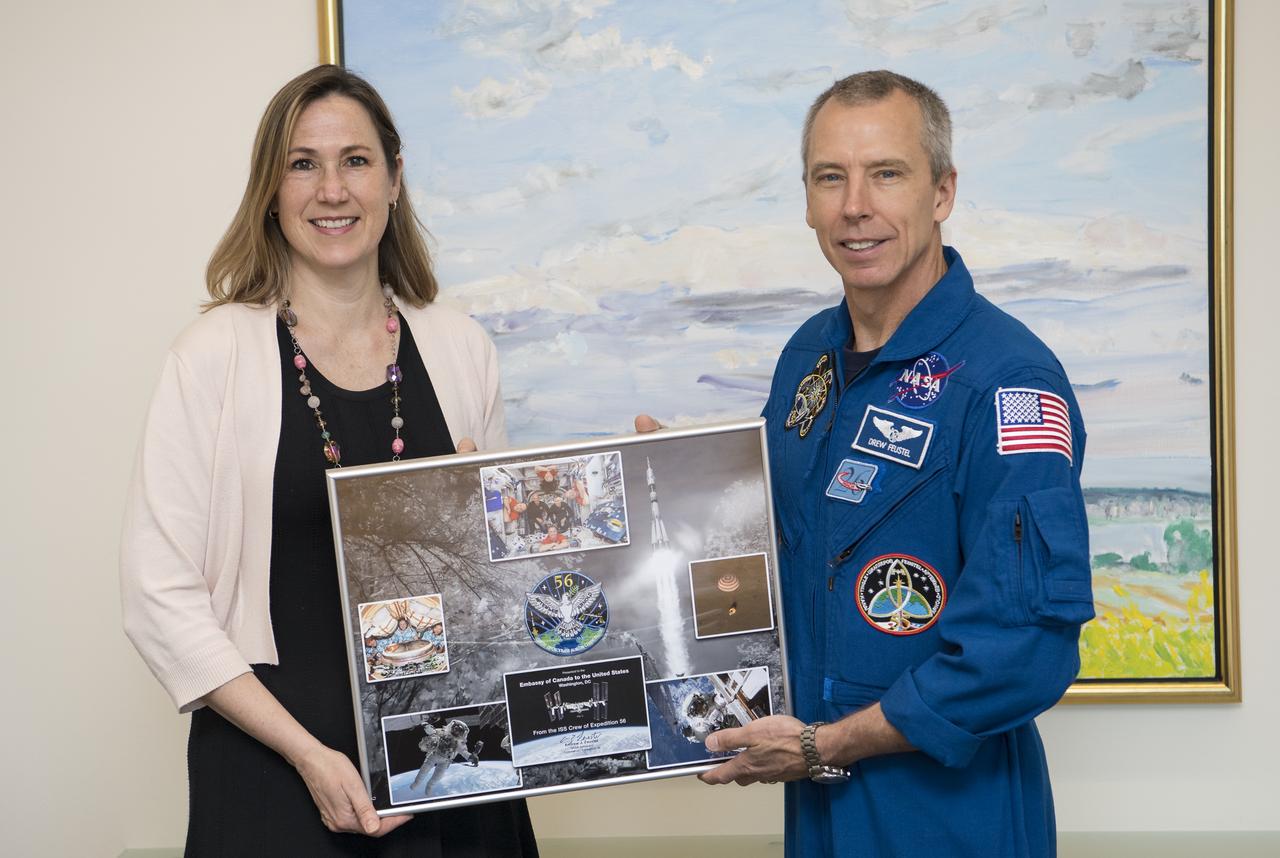
NASA astronaut Drew Feustel poses for a photo after presenting Canadian Deputy Ambassador to the U.S., Kirsten Hillman, a montage from Expeditions 55 and 56 to the International Space Station, Monday, May 6, 2019 in Washington. Photo Credit: (NASA/Aubrey Gemignani)
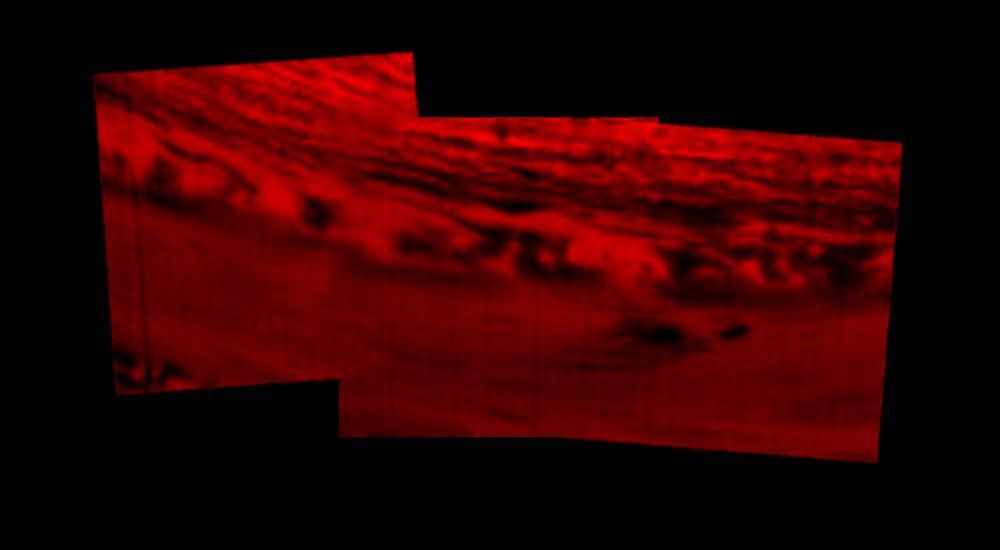
This montage of images, made from data obtained by Cassini's visual and infrared mapping spectrometer, shows the location on Saturn where the NASA spacecraft entered Saturn's atmosphere on Sept. 15, 2017. This view shows Saturn in the thermal infrared, at a wavelength of 5 microns. Here, the instrument is sensing heat coming from Saturn's interior, in red. Clouds in the atmosphere are silhouetted against that inner glow. This location -- the site of Cassini's atmospheric entry -- was at this time on the night side of the planet, but would rotate into daylight by the time Cassini made its final dive into Saturn's upper atmosphere, ending its remarkable 13-year exploration of Saturn. Both an annotated version and an animation are available at https://photojournal.jpl.nasa.gov/catalog/PIA21896
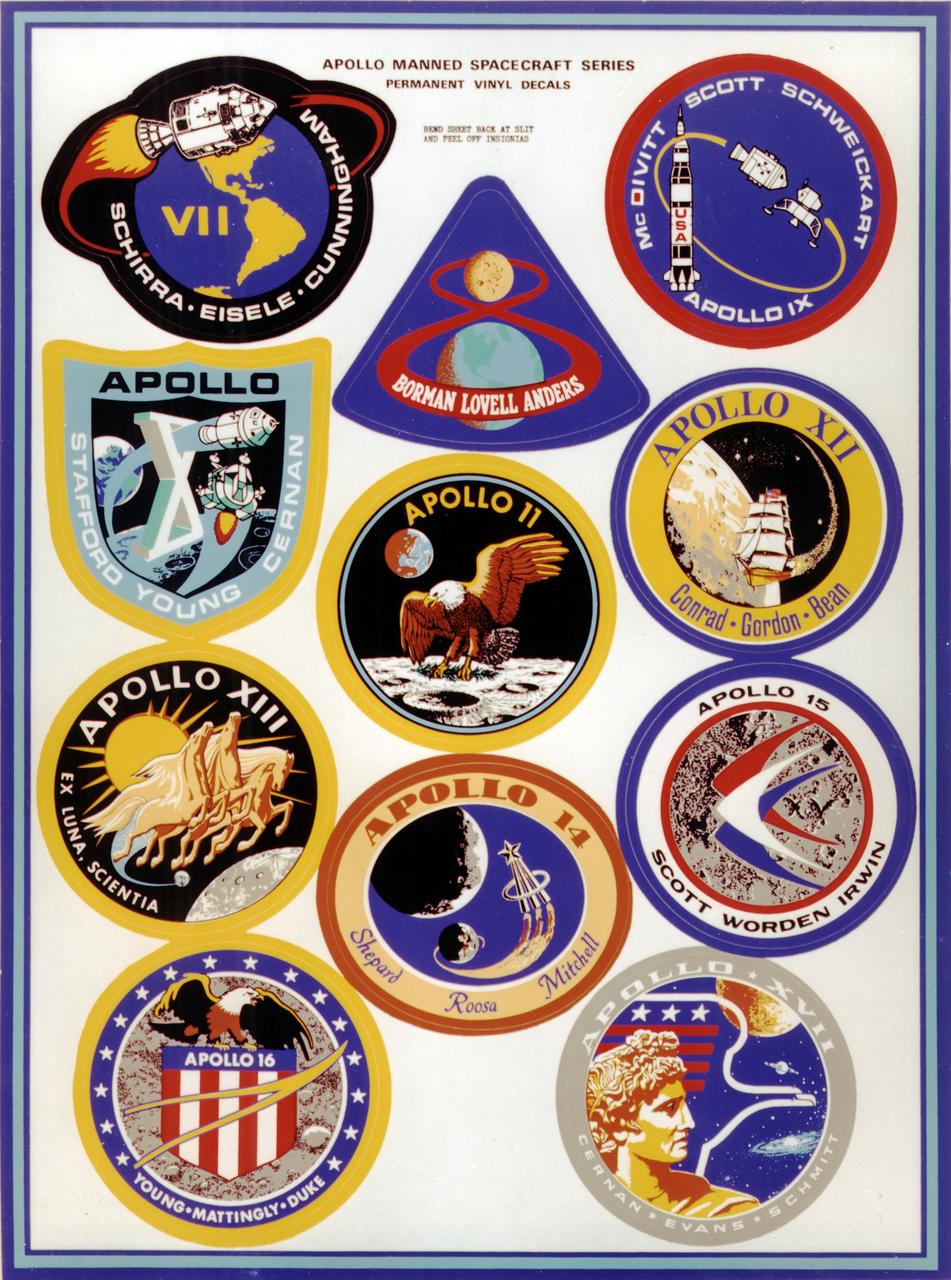
This montage depicts the flight crew patches for the manned Apollo 7 thru Apollo 17 missions. The Apollo 7 through 10 missions were basically manned test flights that paved the way for lunar landing missions. Primary objectives met included the demonstration of the Command Service Module (CSM) crew performance; crew/space vehicle/mission support facilities performance and testing during a manned CSM mission; CSM rendezvous capability; translunar injection demonstration; the first manned Apollo docking, the first Apollo Extra Vehicular Activity (EVA), performance of the first manned flight of the lunar module (LM); the CSM-LM docking in translunar trajectory, LM undocking in lunar orbit, LM staging in lunar orbit, and manned LM-CSM docking in lunar orbit. Apollo 11 through 17 were lunar landing missions with the exception of Apollo 13 which was forced to circle the moon without landing due to an onboard explosion. The craft was,however, able to return to Earth safely. Apollo 11 was the first manned lunar landing mission and performed the first lunar surface EVA. Landing site was the Sea of Tranquility. A message for mankind was delivered, the U.S. flag was planted, experiments were set up and 47 pounds of lunar surface material was collected for analysis back on Earth. Apollo 12, the 2nd manned lunar landing mission landed in the Ocean of Storms and retrieved parts of the unmanned Surveyor 3, which had landed on the Moon in April 1967. The Apollo Lunar Surface Experiments Package (ALSEP) was deployed, and 75 pounds of lunar material was gathered. Apollo 14, the 3rd lunar landing mission landed in Fra Mauro. ALSEP and other instruments were deployed, and 94 pounds of lunar materials were gathered, using a hand cart for first time to transport rocks. Apollo 15, the 4th lunar landing mission landed in the Hadley-Apennine region. With the first use of the Lunar Roving Vehicle (LRV), the crew was bale to gather 169 pounds of lunar material. Apollo 16, the 5th lunar landing mission, landed in the Descartes Highlands for the first study of highlands area. Selected surface experiments were deployed, the ultraviolet camera/spectrograph was used for first time on the Moon, and the LRV was used for second time for a collection of 213 pounds of lunar material. The Apollo program came to a close with Apollo 17, the 6th and final manned lunar landing mission that landed in the Taurus-Littrow highlands and valley area. This mission hosted the first scientist-astronaut, Schmitt, to land on the Moon. The 6th automated research station was set up, and 243 ponds of lunar material was gathered using the LRV.
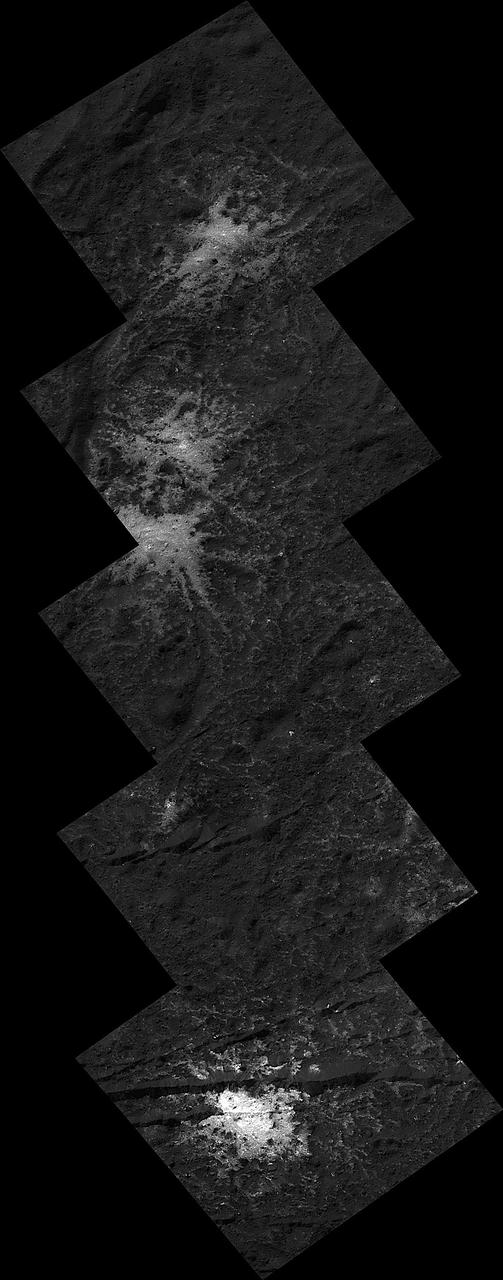
These "stars" found on the floor of Ceres' Occator Crater belong to the Vinalia Faculae. The faculae are deposits of salts, in particular sodium carbonate, possibly extruded through fractures connecting the surface to a deep reservoir of salty liquid. The images used in this montage were obtained by NASA's Dawn spacecraft in June 2018 from an altitude of about 21 miles (34 kilometers). NASA announced the conclusion of Dawn's mission operations was Oct. 31, 2018, when the spacecraft depleted its hydrazine. The center of this feature is located at about 20.2 degrees north latitude and 241.3 degrees east longitude, in the eastern part of Occator Crater. Occator Crater is named after the Roman agricultural deity of the harrowing, a helper of Ceres, the goddess of agriculture, grain crops, fertility and motherly relationships. https://photojournal.jpl.nasa.gov/catalog/PIA22980
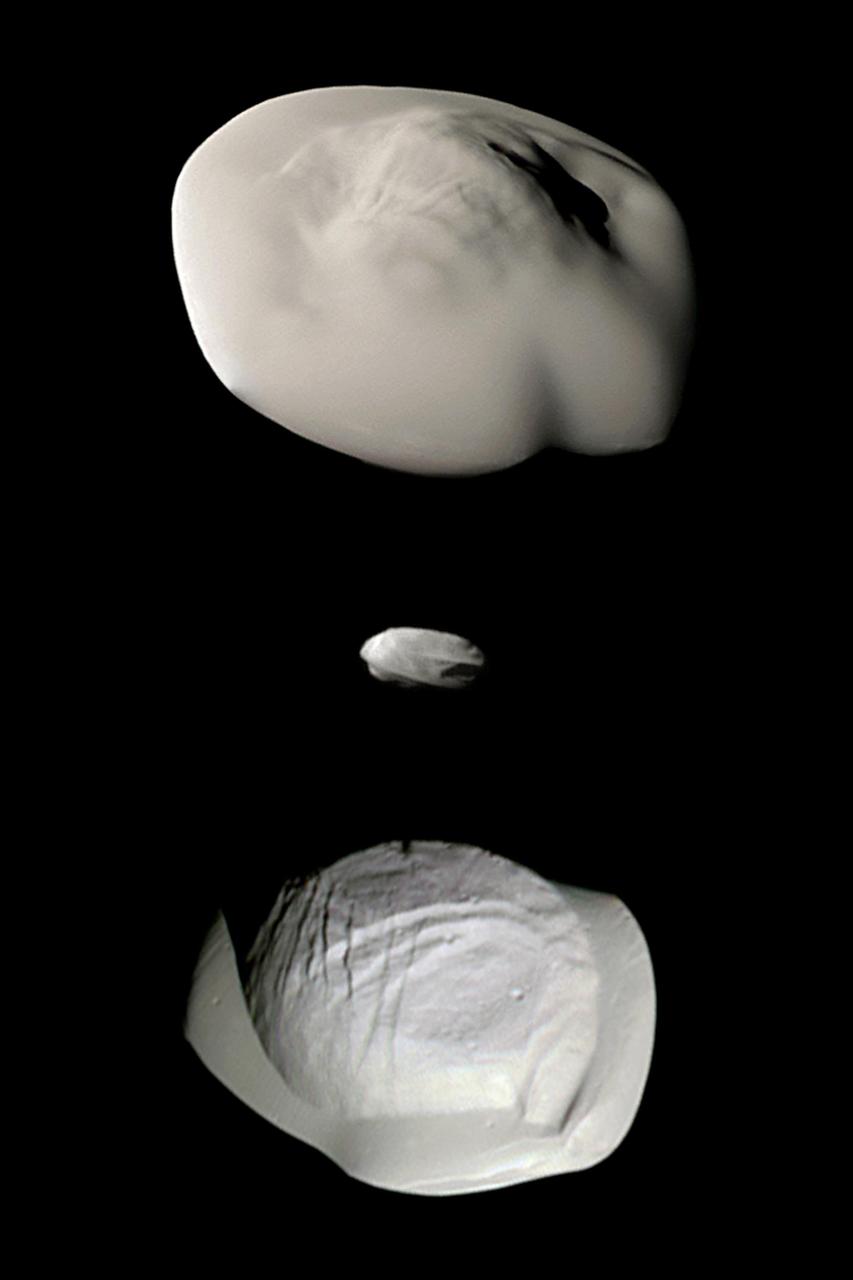
This montage of views from NASA's Cassini spacecraft shows three of Saturn's small ring moons: Atlas, Daphnis and Pan at the same scale for ease of comparison. Two differences between Atlas and Pan are obvious in this montage. Pan's equatorial band is much thinner and more sharply defined, and the central mass of Atlas (the part underneath the smooth equatorial band) appears to be smaller than that of Pan. Images of Atlas and Pan taken using infrared, green and ultraviolet spectral filters were combined to create enhanced-color views, which highlight subtle color differences across the moons' surfaces at wavelengths not visible to human eyes. (The Daphnis image was colored using the same green filter image for all three color channels, adjusted to have a realistic appearance next to the other two moons.) All of these images were taken using the Cassini spacecraft narrow-angle camera. The images of Atlas were acquired on April 12, 2017, at a distance of 10,000 miles (16,000 kilometers) and at a sun-moon-spacecraft angle (or phase angle) of 37 degrees. The images of Pan were taken on March 7, 2017, at a distance of 16,000 miles (26,000 kilometers) and a phase angle of 21 degrees. The Daphnis image was obtained on Jan. 16, 2017, at a distance of 17,000 miles (28,000 kilometers) and at a phase angle of 71 degrees. All images are oriented so that north is up. A monochrome version is available at https://photojournal.jpl.nasa.gov/catalog/PIA21449
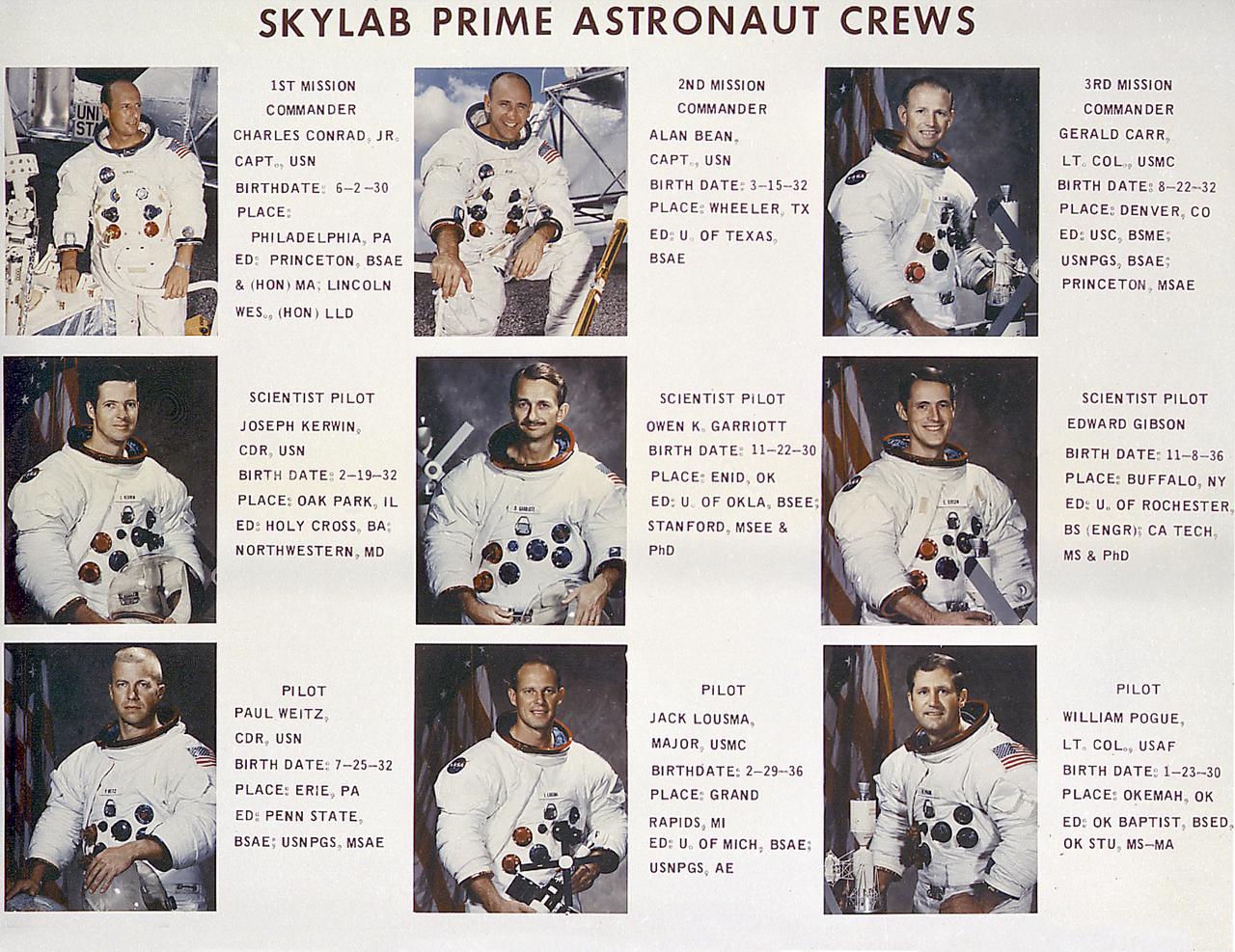
This photograph is a montage of astronaut crews for the three Skylab missions with simple biographical data of each astronaut. The 1st mission was designated as Skylab-2, 2nd mission as Skylab-3, and 3rd mission as Skylab-4. The Skylab-1 mission placed the Skylab Orbital Work Shop in orbit by a modified Saturn V launch vehicle. Skylab's 3 different 3-man crews spent up to 84 days in Earth orbit and performed a variety of more than 100 experiments.
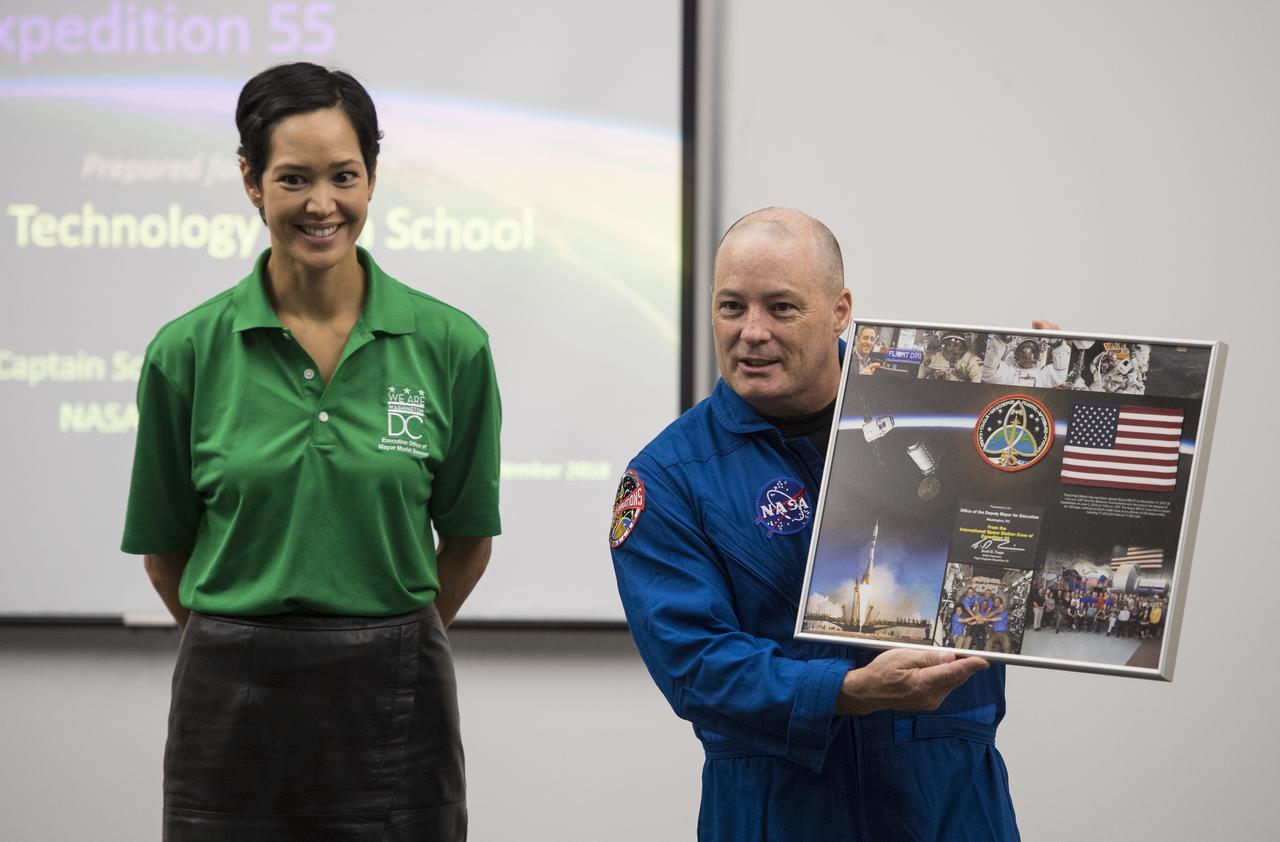
NASA astronaut Scott Tingle presents a montage for Washington, DC's Office of the Deputy Mayor for Education to Ahnna Smith, Interim Deputy Mayor for Education, prior to speaking to students about his time onboard the International Space Station, Friday, Sept. 14, 2018 at McKinley Technology High School in Washington, DC. Tingle spent 168 days onboard the International Space Station as part of Expeditions 54 and 55. Photo Credit: (NASA/Joel Kowsky)
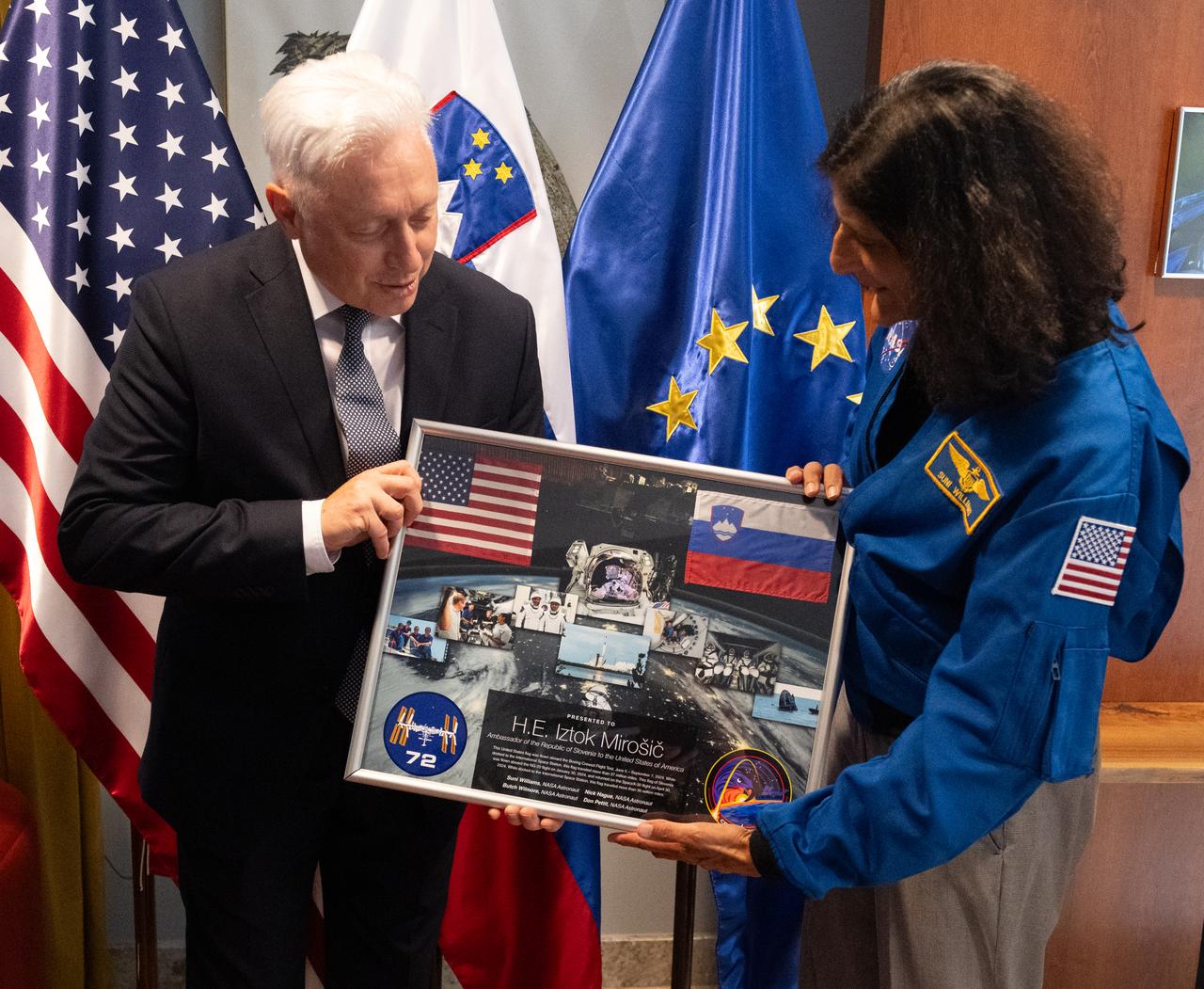
On behalf of the Expedition 72 crew NASA astronaut Suni Williams presents Iztok Mirošič, Ambassador of the Republic of Slovenia to the United States to the United States, with a montage including flags of the United States and Slovenia that have been flown in space before participating in a panel discussion at the Embassy of Slovenia, Wednesday, Sept. 17, 2025, in Washington. Williams, Don Pettit, Nick Hague, and Butch Wilmore served as part of Expedition 72 onboard the International Space Station. Photo Credit: (NASA/Joel Kowsky)
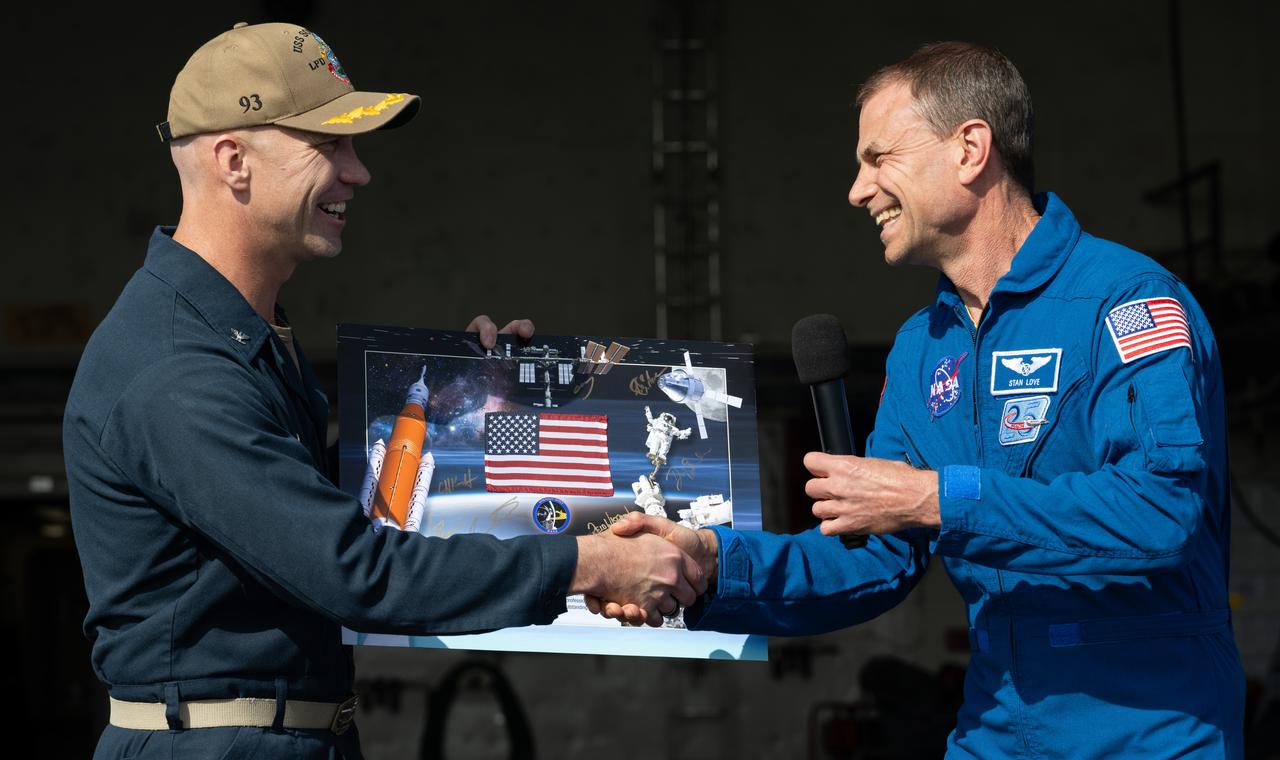
NASA astronaut Stan Love presents a montage to Capt. Andrew Koy, commanding officer of USS Somerset as NASA and Department of Defense teams participate in Underway Recovery Test-12 onboard USS Somerset off the coast of California, Saturday, March 29, 2025. During the test, NASA and Department of Defense teams are practicing to ensure recovery procedures are validated as NASA plans to send the Artemis II astronauts around the Moon and splashdown in the Pacific Ocean. Photo Credit: (NASA/Joel Kowsky)
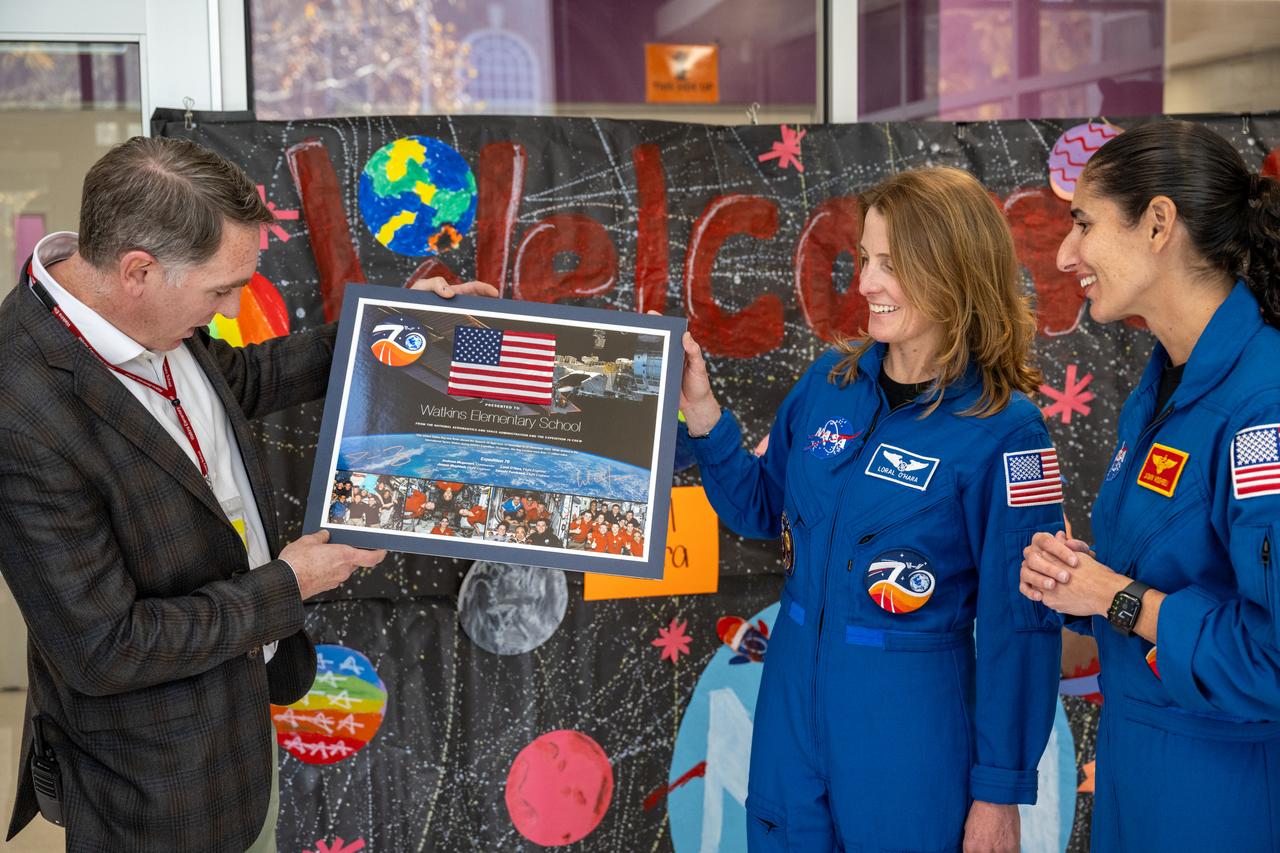
NASA astronauts Loral O’Hara, second from right, and Jasmin Moghbeli, right, present a montage to Principal MScott Berkowitz prior to an engagement event at Catherine Watkins Elementary School Monday, Dec. 2, 2024 in Washington. O’Hara and Moghbeli spent six months in space as part of Expedition 70 aboard the International Space Station. Photo Credit: (NASA/Keegan Barber)
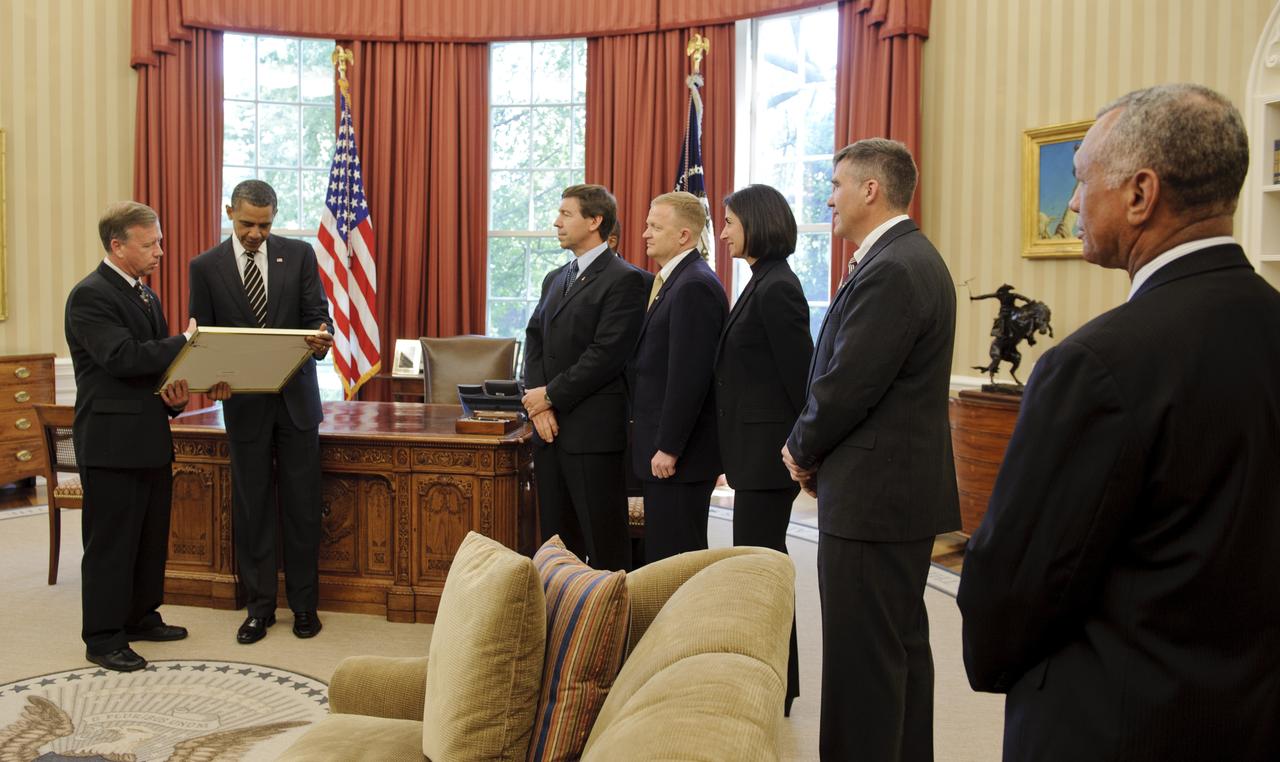
STS-133 Commander Steven Lindsey, far left, presents a montage to President Barack Obama as crew members Michael Barratt, Pilot Eric Boe, Nicole Stott, and Stephen Bowen along with NASA Administrator Charles Bolden, far right, look on during a visit to the Oval Office in the White House, Monday, May 9, 2011, in Washington. Also in attendance but not seen, was Mission Specialist Alvin Drew.Photo Credit: (NASA/Paul E. Alers)
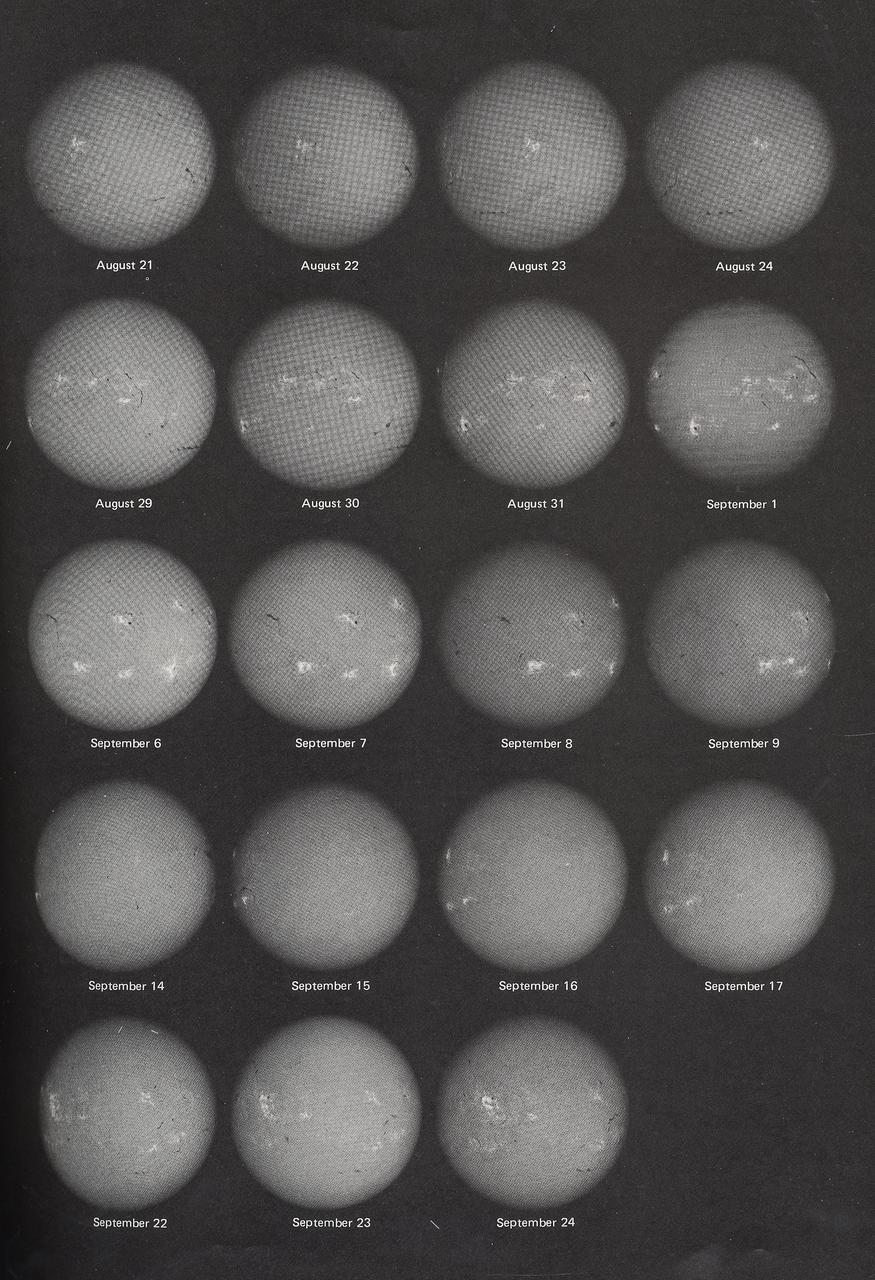
This montage shows changing faces of the Sun, recorded daily during the 59 days spent in orbit by Skylab's second crew. The Sun spun more than two full turns around its axis. Solar rotation is apparent in these daily portraits, as are real changes on the Sun. Bright features are centers of activity on the Sun. This image contains daily records from September 6, 1973 through September 24, 1973.

This montage shows changing faces of the Sun, recorded daily during the 59 days spent in orbit by Skylab's second crew. The Sun spun more than two full turns around its axis. Solar rotation is apparent in these daily portraits, as are real changes on the Sun. Bright features are centers of activity on the Sun. This image contains daily records from August 17, 1973 through September 5, 1973.

NASA astronaut Jessica Watkins presents Howard University Professor, Dr. Prabhakar Misra, left, and Howard University Professor and Chair of the Department of Physics and Astronomy, Dr. Quinton Williams, right, with a montage from her time as part of Expeditions 67 and 68 aboard the International Space Station, Friday, March 31, 2023, at Howard University in Washington. Photo Credit: (NASA/Aubrey Gemignani)
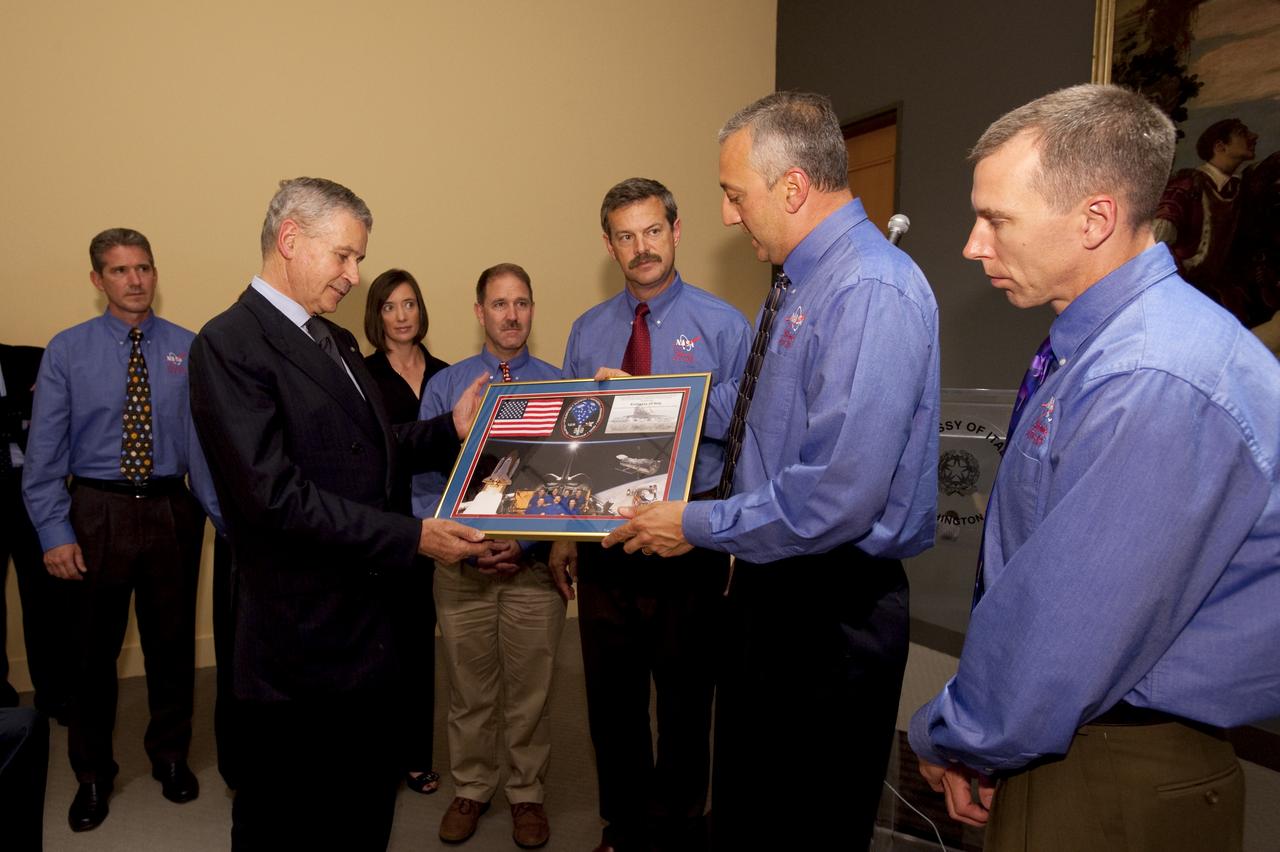
Italian Ambassador Giovanni Castellaneta, second from left, is presented with a montage by STS-125 Mission Specialist Mike Massimino, second from right, during a visit by the crew of STS-125 to the Embassy of Italy in Washington, Thursday, July 23, 2009. Other crew members, from left are Mission Specialists, Michael Good, Megan McArthur, John Grunsfeld, Commander Scott Altman and Andrew Feustel, far right. Photo Credit: (NASA/Bill Ingalls)
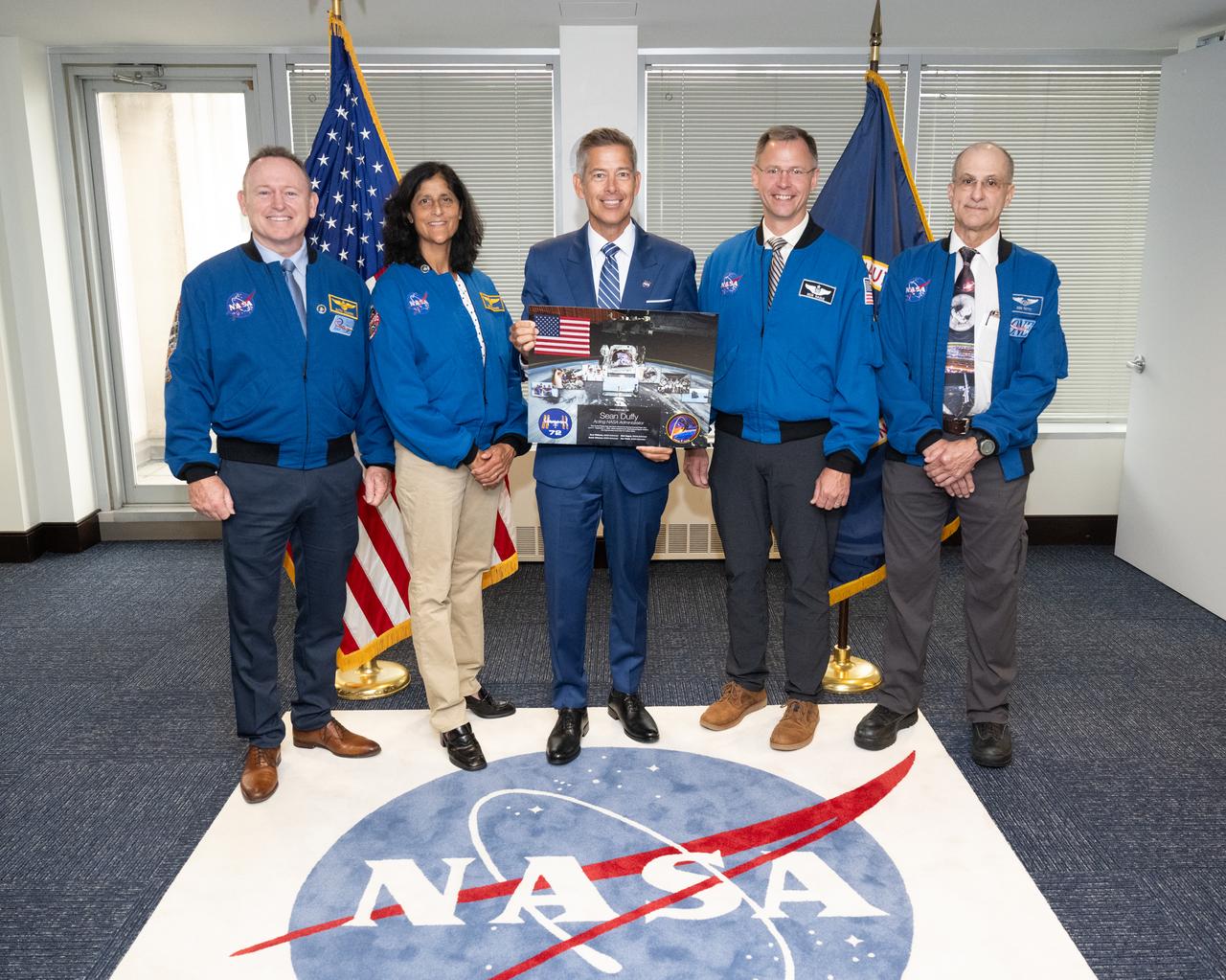
NASA astronauts Butch Wilmore, left, Suni Williams, Nick Hague, and Don Pettit pose for a picture with acting NASA Administrator Sean Duffy, center, after presenting a montage from their mission, Thursday, Sept. 18, 2025, at the Mary W. Jackson NASA Headquarters building in Washington. Hague, Wilmore, Williams, and Pettit served as part of Expedition 72 onboard the orbiting laboratory. Photo Credit: (NASA/Joel Kowsky)
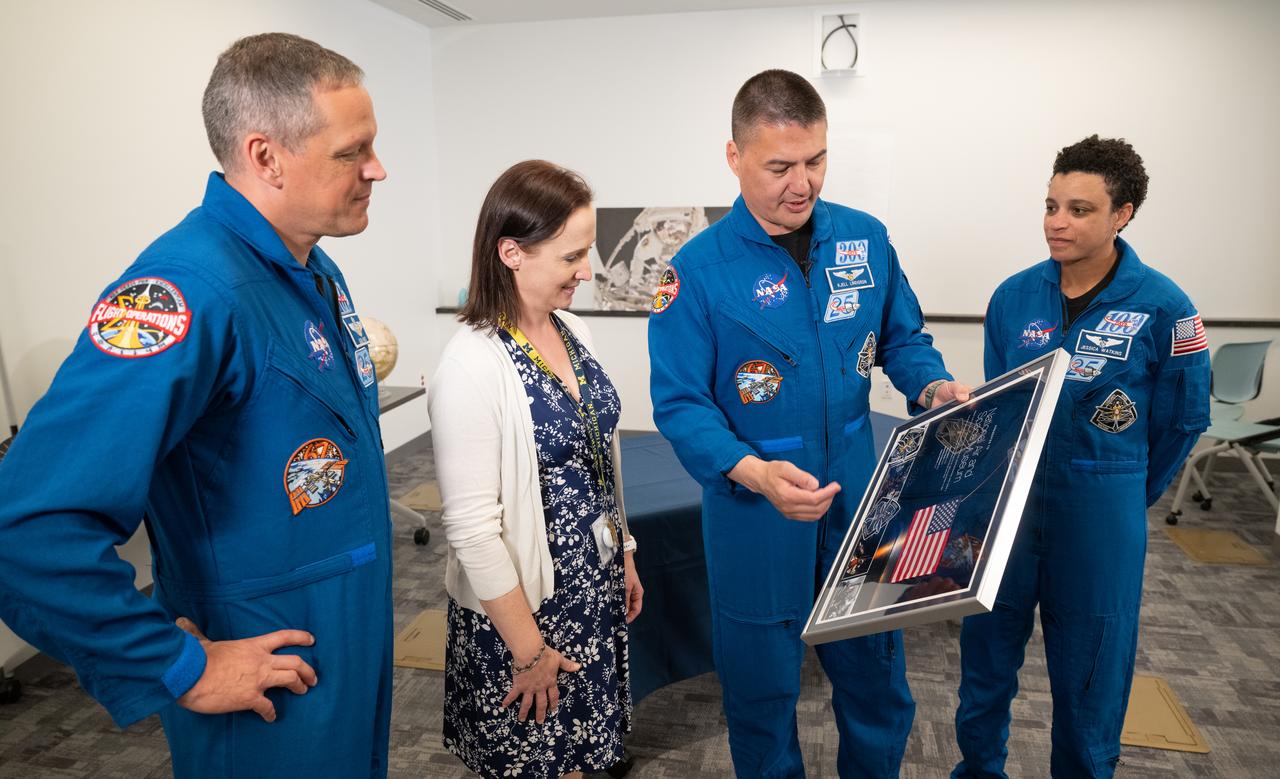
NASA astronaut Kjell Lindgren, center, along with fellow astronauts Robert Hines, left, and Jessica Watkins, right, present Smithsonian National Air and Space Museum curator Jennifer Levasseur with a montage from their mission to the International Space Station, Tuesday, March 28, 2023 at the Smithsonian’s National Air and Space Museum in Washington. Lindgren, Hines, and Watkins spent 170 days in space as part of Expeditions 67 and 68 aboard the International Space Station. Photo Credit: (NASA/Joel Kowsky)
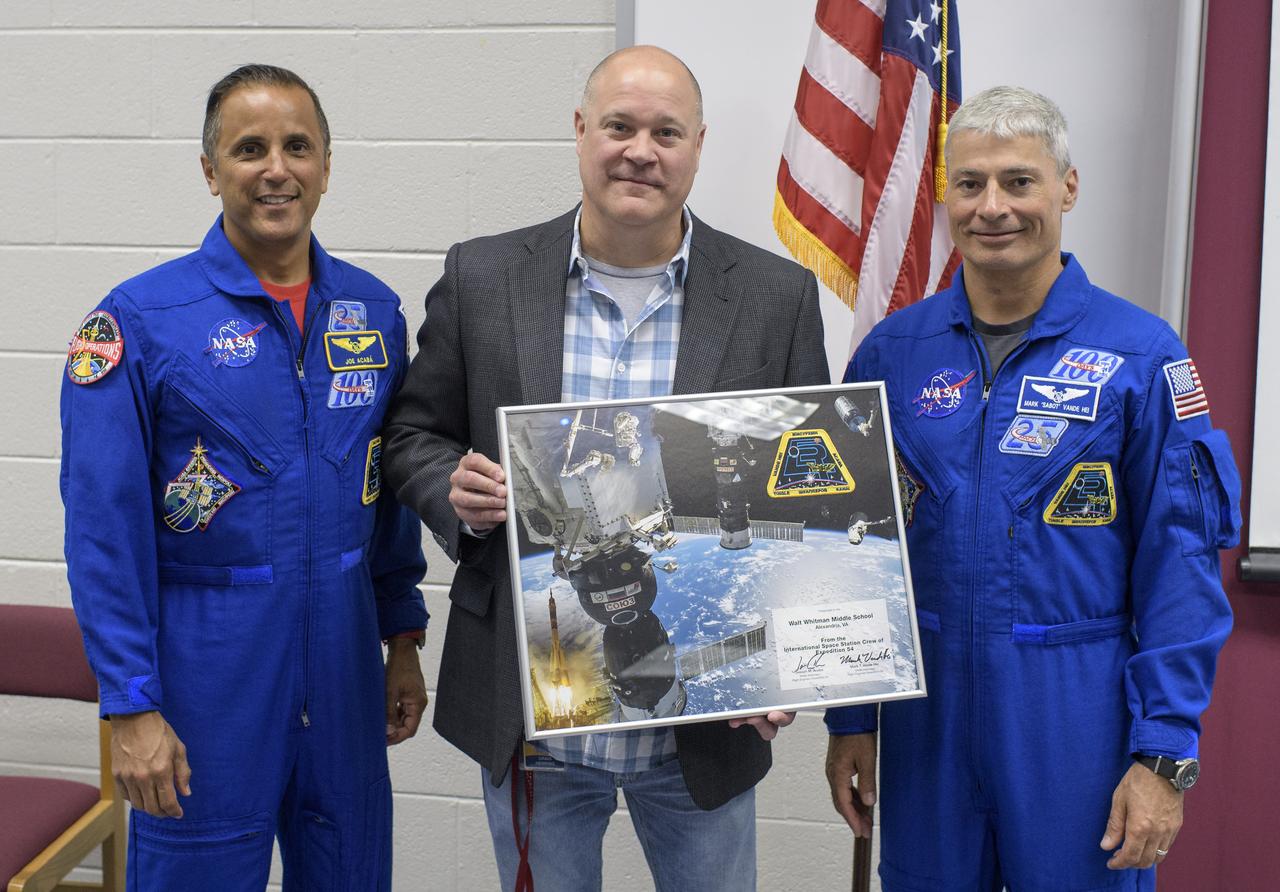
NASA astronauts Joe Acaba, left, and Mark Vande Hei, right, present Walt Whitman Middle School Principal Craig Herring with a montage from their Expedition 54 mission, Thursday, June 14, 2018 in Alexandria, Va. Acaba and astronaut Mark Vande Hei answered questions from the audience and spoke about their experiences aboard the International Space Station for 168 days as part of Expedition 53 and 54. Photo Credit: (NASA/Joel Kowsky)
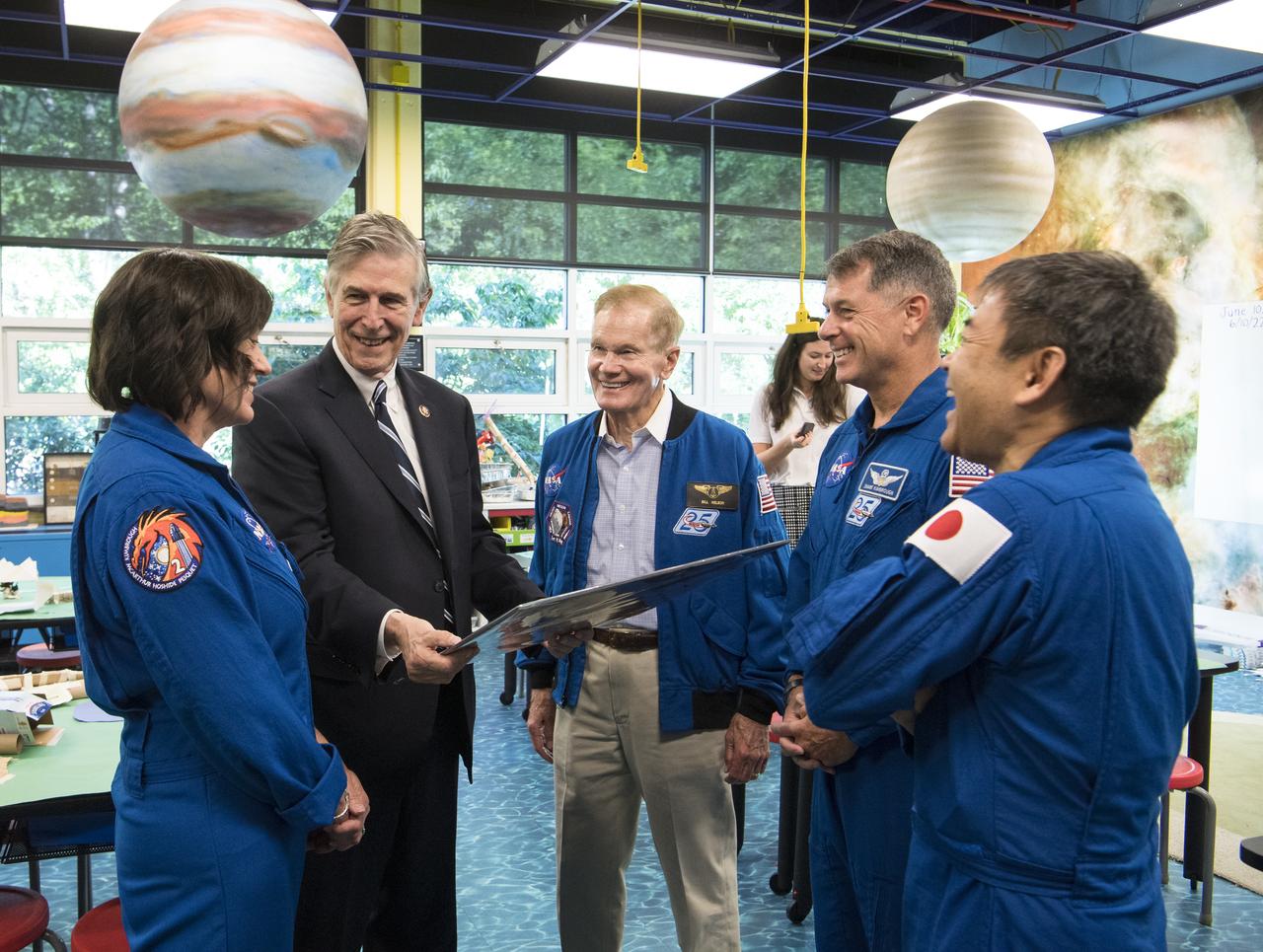
NASA’s SpaceX Crew-2 NASA astronauts Megan McArthur, left, and Shane Kimbrough, second from right, and Japan Aerospace Exploration Agency (JAXA) astronaut Akihiko Hoshide, right, present U.S. Rep. Don Beyer, D-Va., second from left, with a montage from their mission, while NASA Administrator Bill Nelson looks on, during a visit to Arlington Science Focus Elementary School, Friday, June 10, 2022, in Arlington, Virginia. Photo Credit: (NASA/Aubrey Gemignani)

From left to right, NASA Associate Administrator Bob Cabana, NASA Deputy Administrator, Pam Melroy, and NASA Administrator, Bill Nelson, pose for a photo with NASA’s SpaceX Crew-4 NASA astronauts Kjell Lindgren, Robert Hines, and Jessica Watkins, after they presented them with montages from their mission, Monday, March 27, 2023, at the Mary W. Jackson NASA Headquarters building in Washington DC. Photo Credit: (NASA/Aubrey Gemignani)
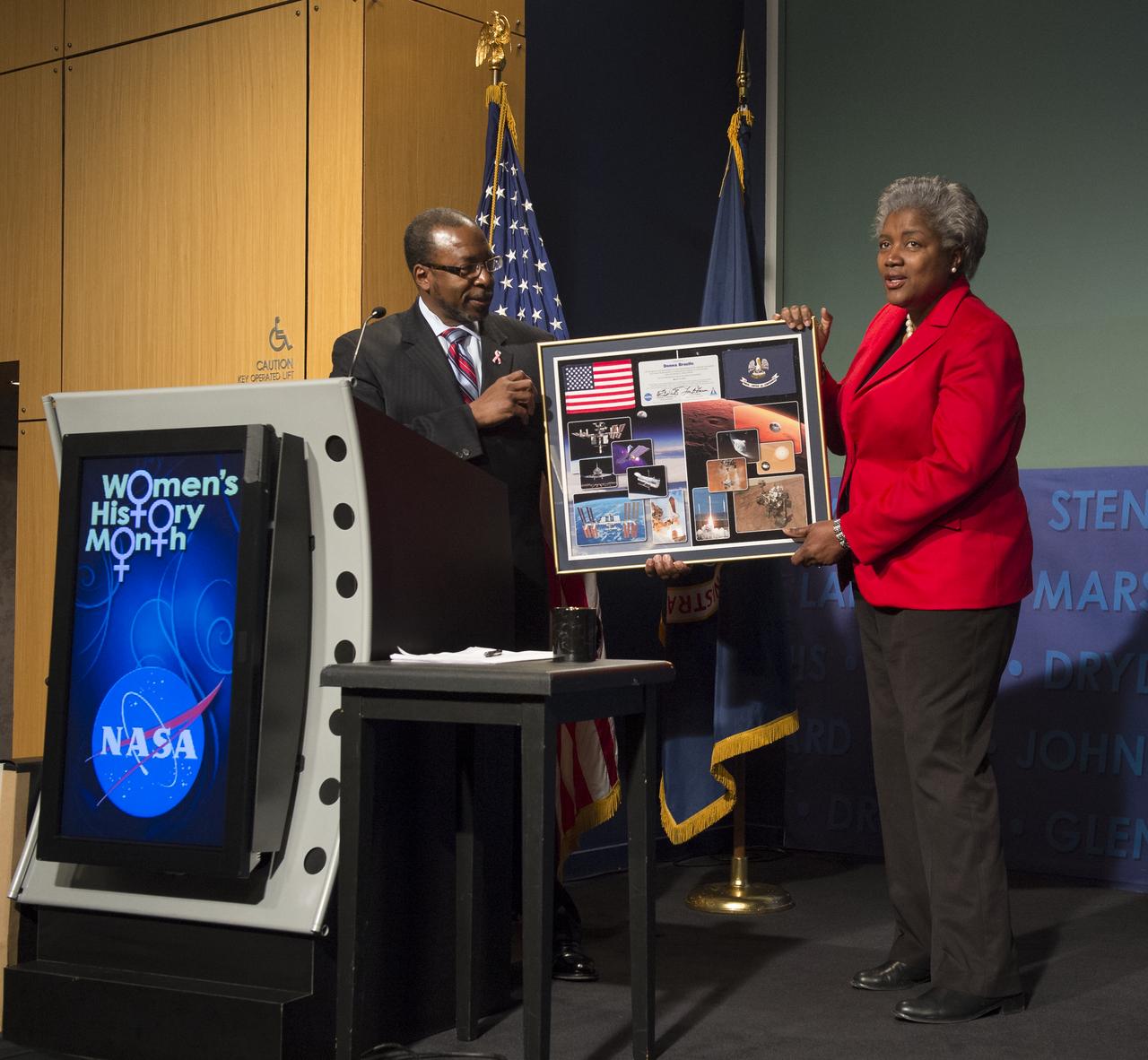
Dr. Woodrow Whitlow, Jr. (left), Associate Administrator for Mission Support Directorate at NASA Headquarters presents Donna Brazile, keynote speaker at a program celebrating National Women's History Month, with a framed NASA montage, Thursday, March 14, 2013 in Washington. The theme of theprogram was "Women Inspiring Innovation Through Imagination," and was sponsored by the HQ Equal Opportunity and Diversity Management Division at NASA Headquarters. The event also commemorates the 100th Anniversary of the Women's Suffrage March on Washington. Photo Credit: (NASA/Carla Cioffi)
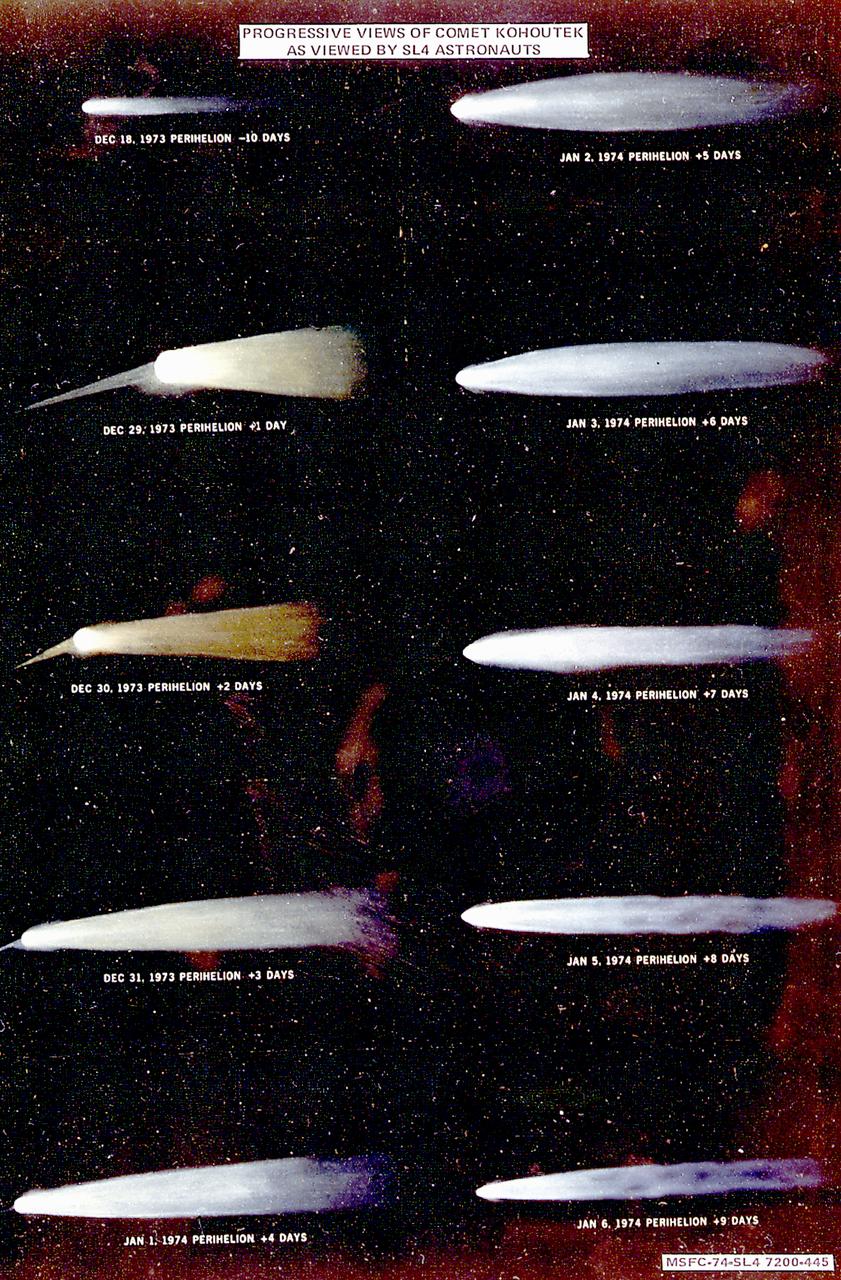
This montage is an artist's conception of progressive views of the Comet Kohoutek based on sketches and a description by Skylab-4 astronaut Edward Gibson. An early discovery of a large comet in an orbit that would reach close to the Sun at the end of 1973 prompted NASA to initiate Operation Kohoutek, a program to coordinate widespread observations of the comet from ground observatories, aircraft, balloons, rockets, unmarned satellites, and Skylab.
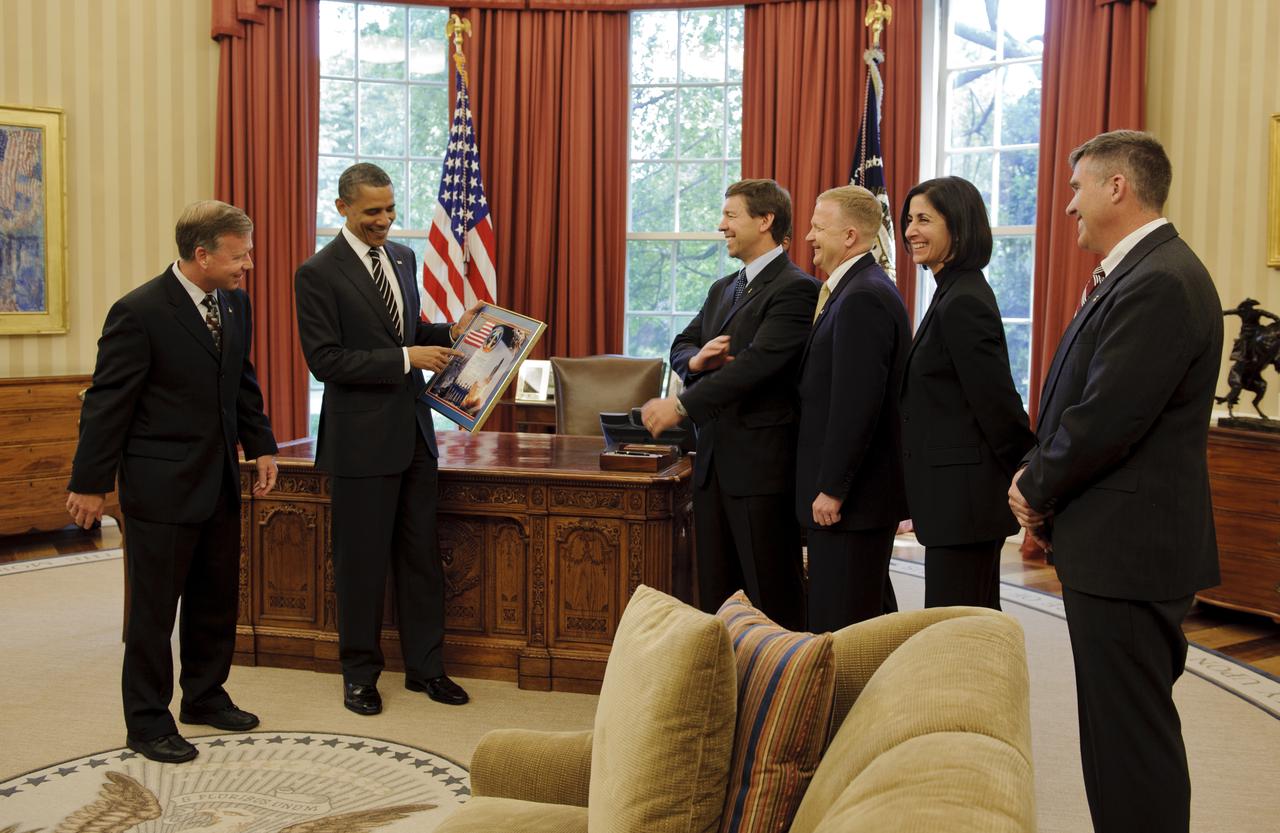
STS-133 Commander Steven Lindsey, far left, presents a montage to President Barack Obama as crew members Michael Barratt, Pilot Eric Boe, Nicole Stott, and Stephen Bowen look on during a visit to the Oval Office in the White House, Monday, May 9, 2011, in Washington. Also in attendance but not seen, was Mission Specialist Alvin Drew. Photo Credit: (NASA/Paul E. Alers)
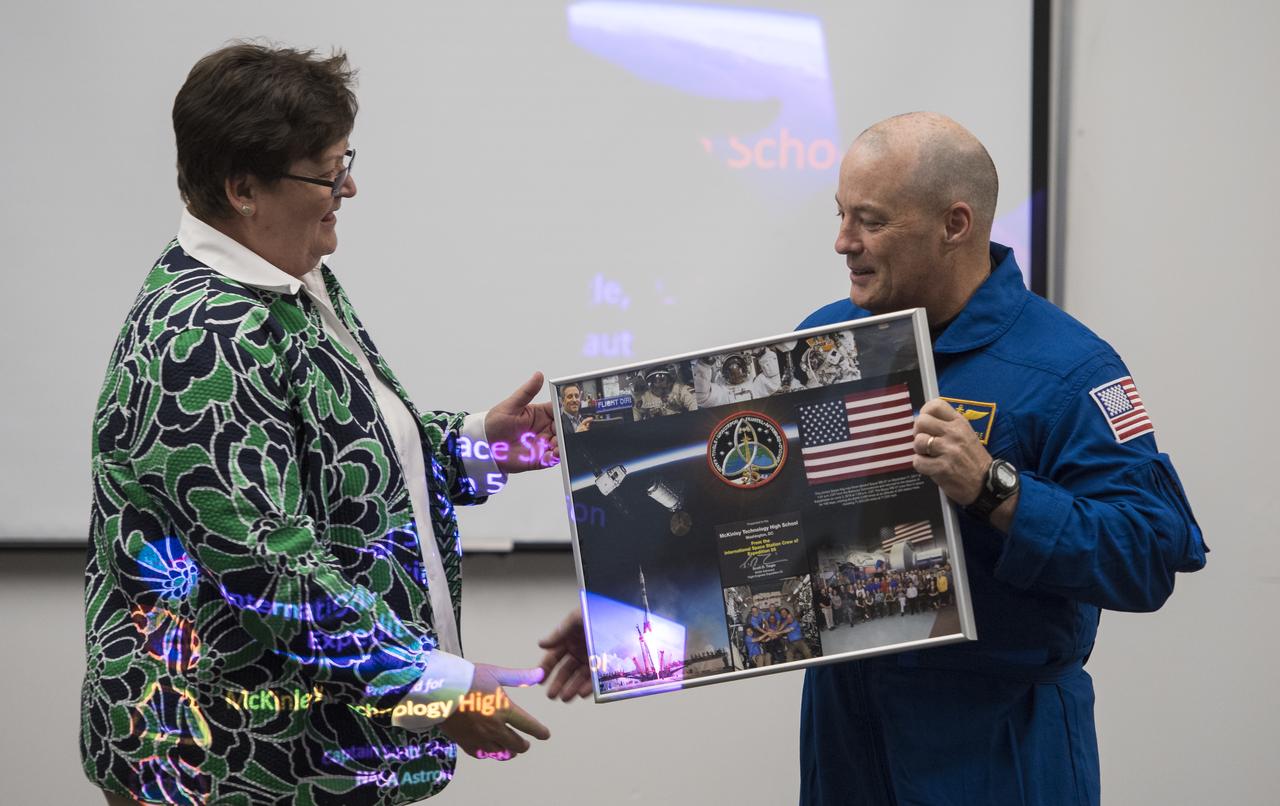
NASA astronaut Scott Tingle presents a montage for McKinley Technology High School to Principal Louise Jones before speaking to students about his time onboard the International Space Station, Friday, Sept. 14, 2018 at McKinley Technology High School in Washington, DC. Tingle spent 168 days onboard the International Space Station as part of Expeditions 54 and 55. Photo Credit: (NASA/Joel Kowsky)
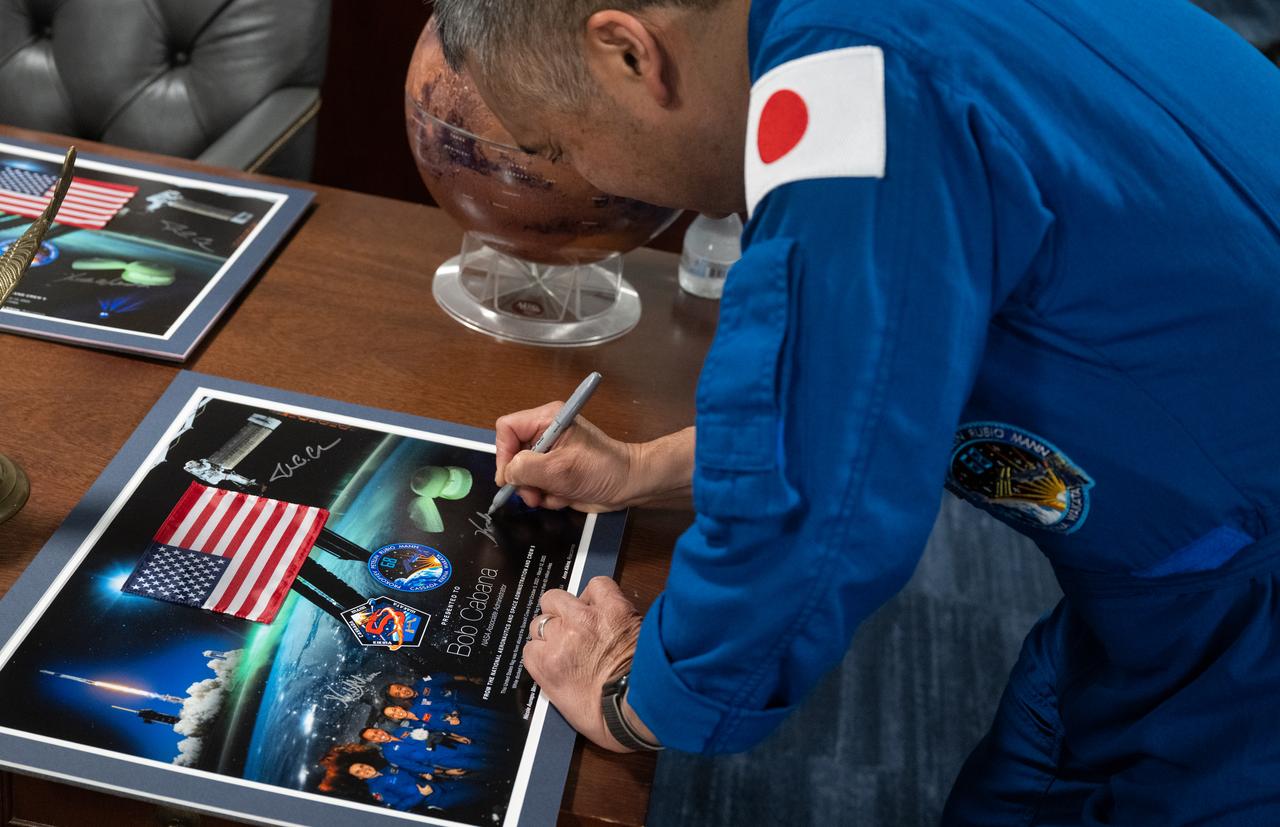
NASA’s SpaceX Crew-5 astronaut Koichi Wakata of the Japan Aerospace Exploration Agency (JAXA) signs a montage for NASA Associate Administrator Bob Cabana, Monday, June 5, 2023 at the Mary W. Jackson NASA Headquarters building in Washington. Wakata, and fellow NASA’s SpaceX Crew-5 crewmates Josh Cassada and Nicole Mann of NASA spent 157 days in space as part of Expedition 68 aboard the International Space Station. Photo Credit: (NASA/Joel Kowsky)
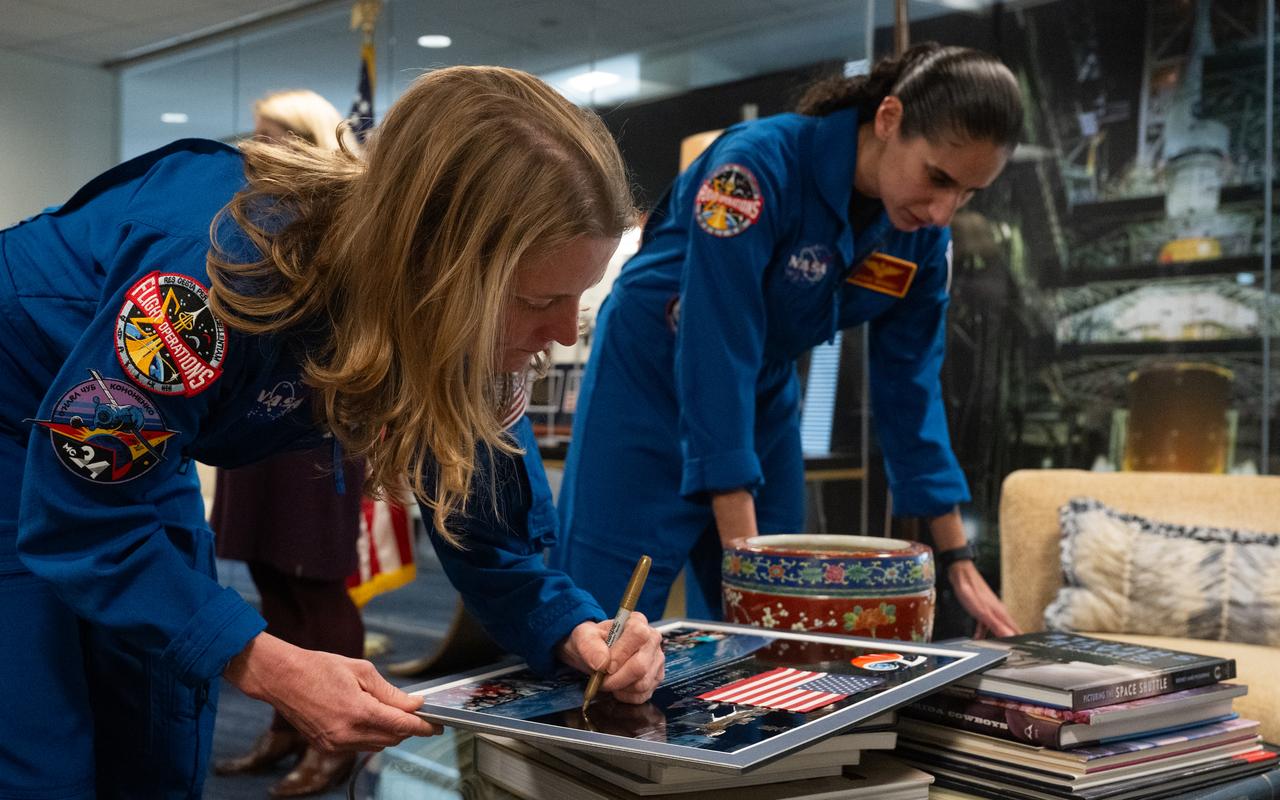
NASA astronauts Loral O’Hara, left, and Jasmin Moghbeli sign montages from their mission to present to NASA Administrator Bill Nelson, NASA Deputy Administrator Pam Melroy, and NASA Associate Administrator Jim Free, Wednesday, Dec. 4, 2024 at the Mary W. Jackson NASA Headquarters Building in Washington. O’Hara and Moghbeli spent six months in space as part of Expedition 70 aboard the International Space Station. Photo Credit: (NASA/Joel Kowsky)
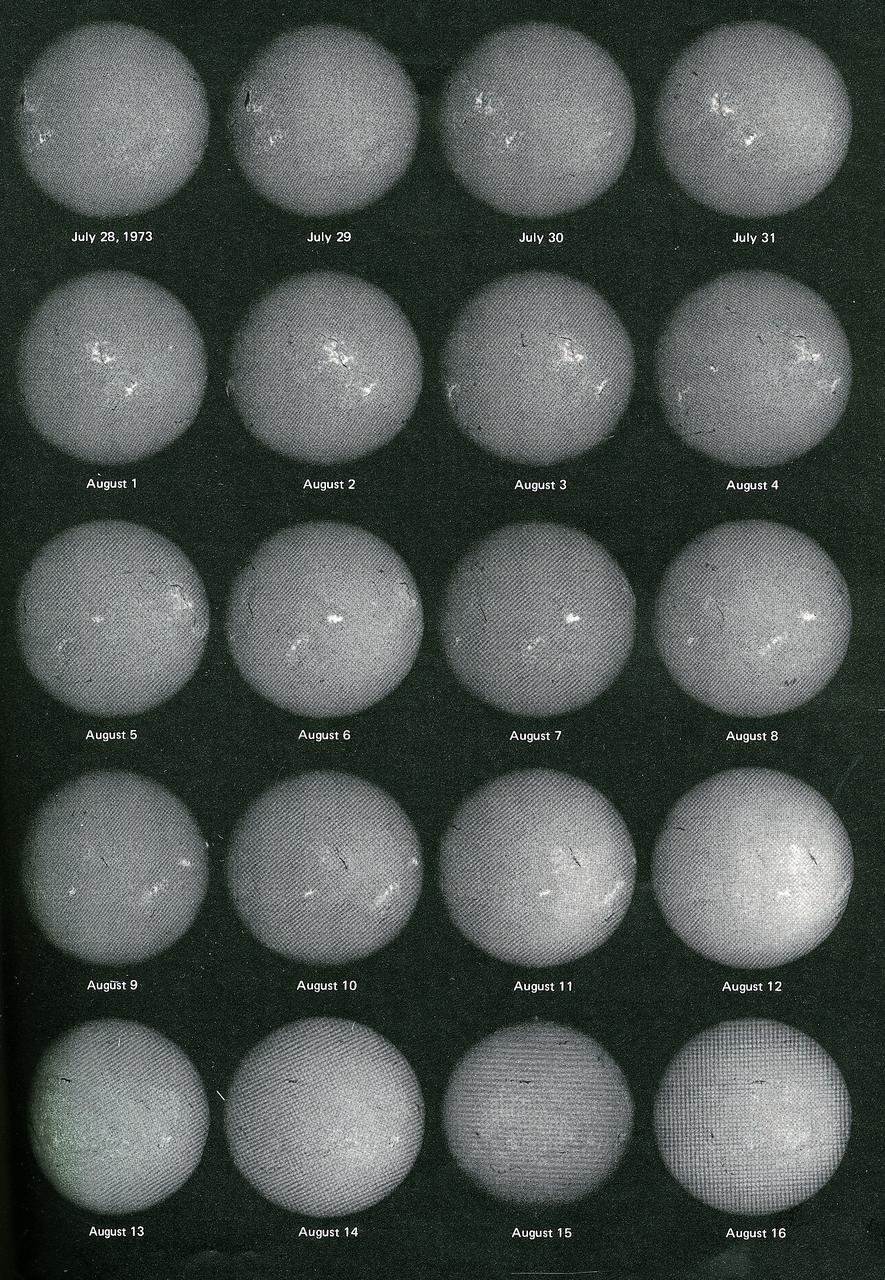
This montage shows changing faces of the Sun, recorded daily during the 59 days spent in orbit by Skylab's second crew. The Sun spun more than two full turns around its axis. Solar rotation is apparent in these daily portraits, as are real changes on the Sun. Bright features are centers of activity on the Sun. This image contains daily records from July 28, 1973 through August 16, 1973.
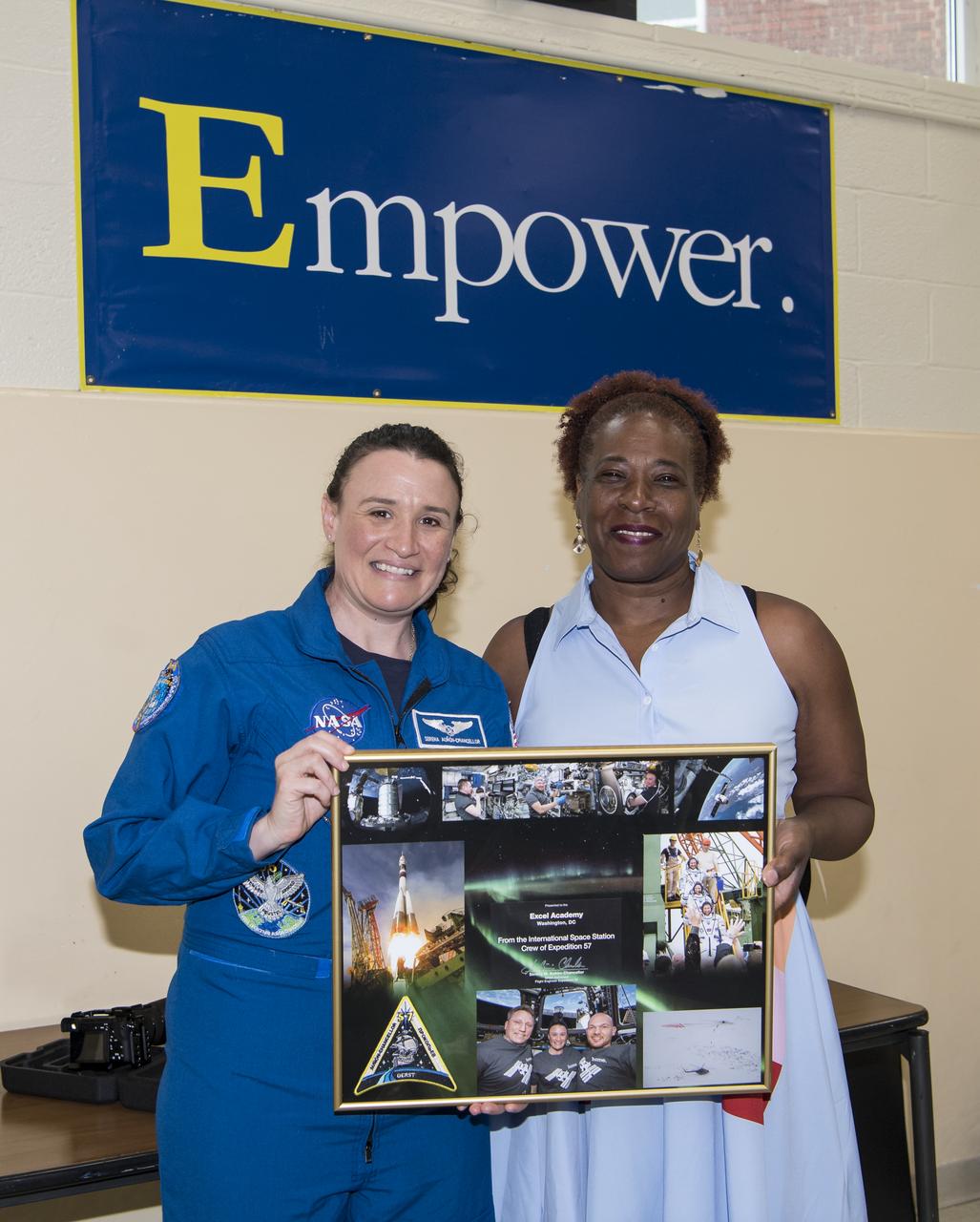
NASA astronaut Dr. Serena Auñón-Chancellor presents a montage from Expeditions 56 and 57 to Excel Academy Public Charter School, Monday, June 10, 2019 in Washington, DC. Auñón-Chancellor spent 197 days living and working onboard the ISS and contributed to hundreds of experiments in biology, biotechnology, physical science, and Earth science while there. She is also a doctor and started her career with NASA as a flight surgeon in 2006. Photo Credit: (NASA/Aubrey Gemignani)
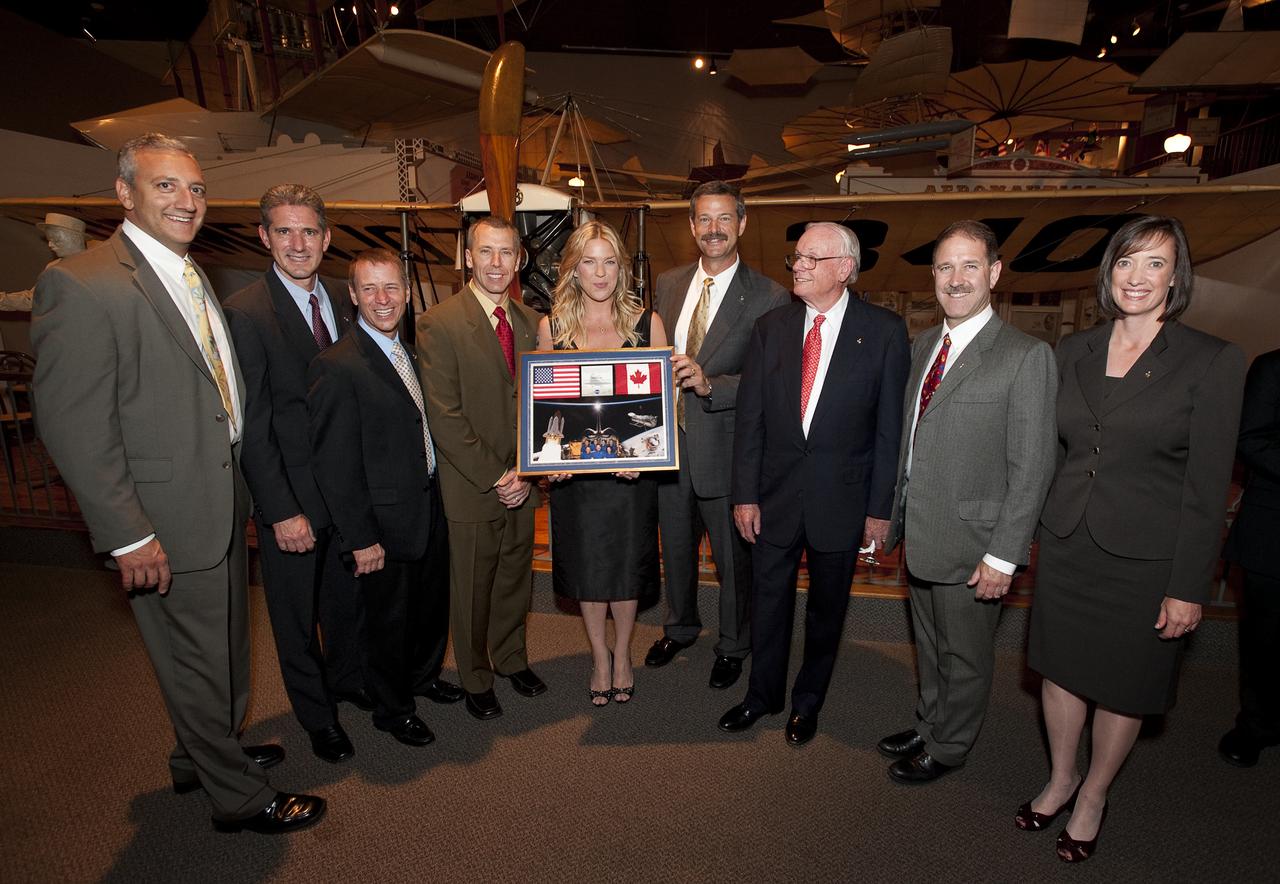
Jazz pianist and singer Diana Krall holds a montage given to her by the STS-125 space shuttle crew along with Apollo 11 Astronaut Neil Armstrong at the Apollo 40th anniversary celebration held at the National Air and Space Museum, Monday, July 20, 2009 in Washington. From left, Michael J. Massimino, Michael T. Good, Gregory C. Johnson, Andrew J. Feustel, Krall, Scott D. Altman, Neil Armstrong, John M. Grunsfeld and Megan McArthur. Photo Credit: (NASA/Bill Ingalls)
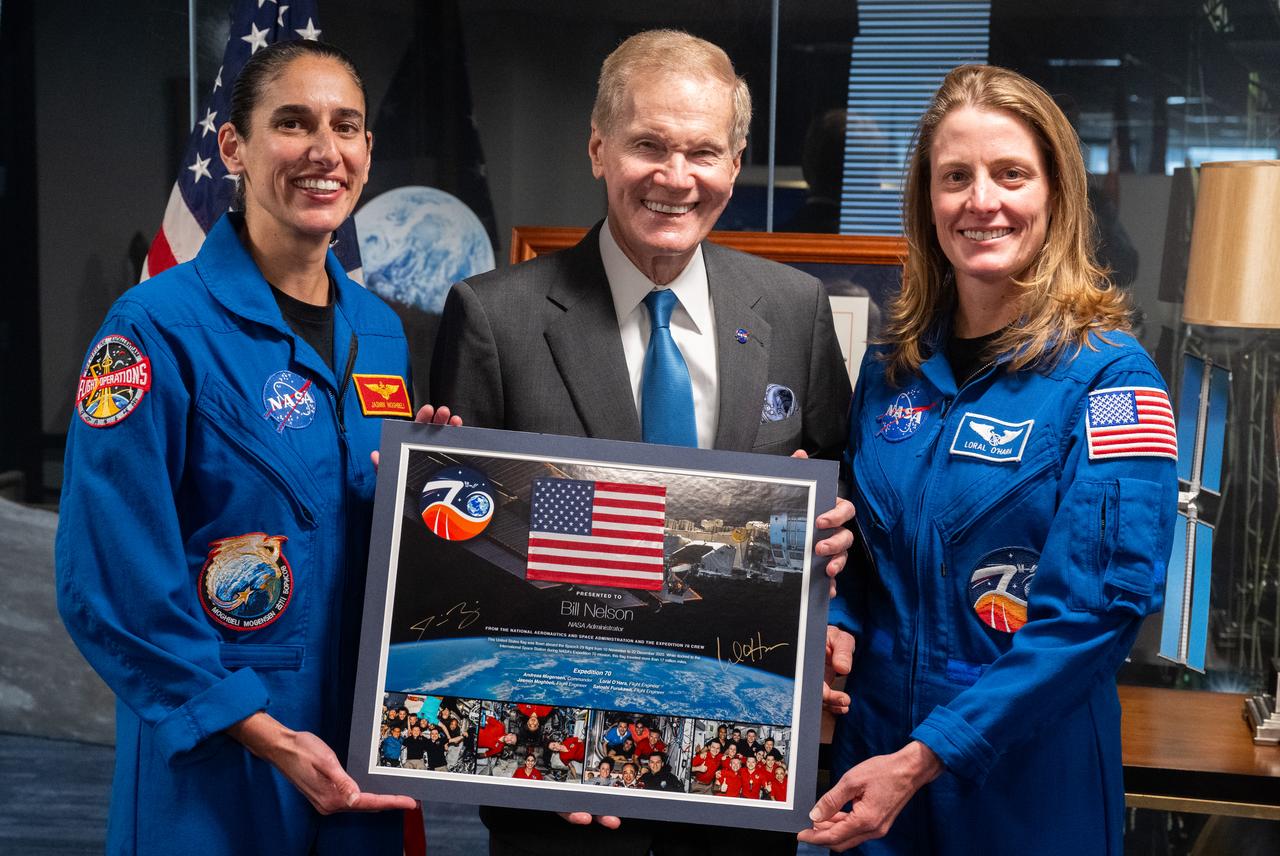
NASA astronauts Jasmin Moghbeli, left, and Loral O’Hara, right, pose for a picture with NASA Administrator Bill Nelson after presenting him with a montage from their mission to the International Space Station, Wednesday, Dec. 4, 2024 at the Mary W. Jackson NASA Headquarters Building in Washington. O’Hara and Moghbeli spent six months in space as part of Expedition 70 aboard the International Space Station. Photo Credit: (NASA/Joel Kowsky)
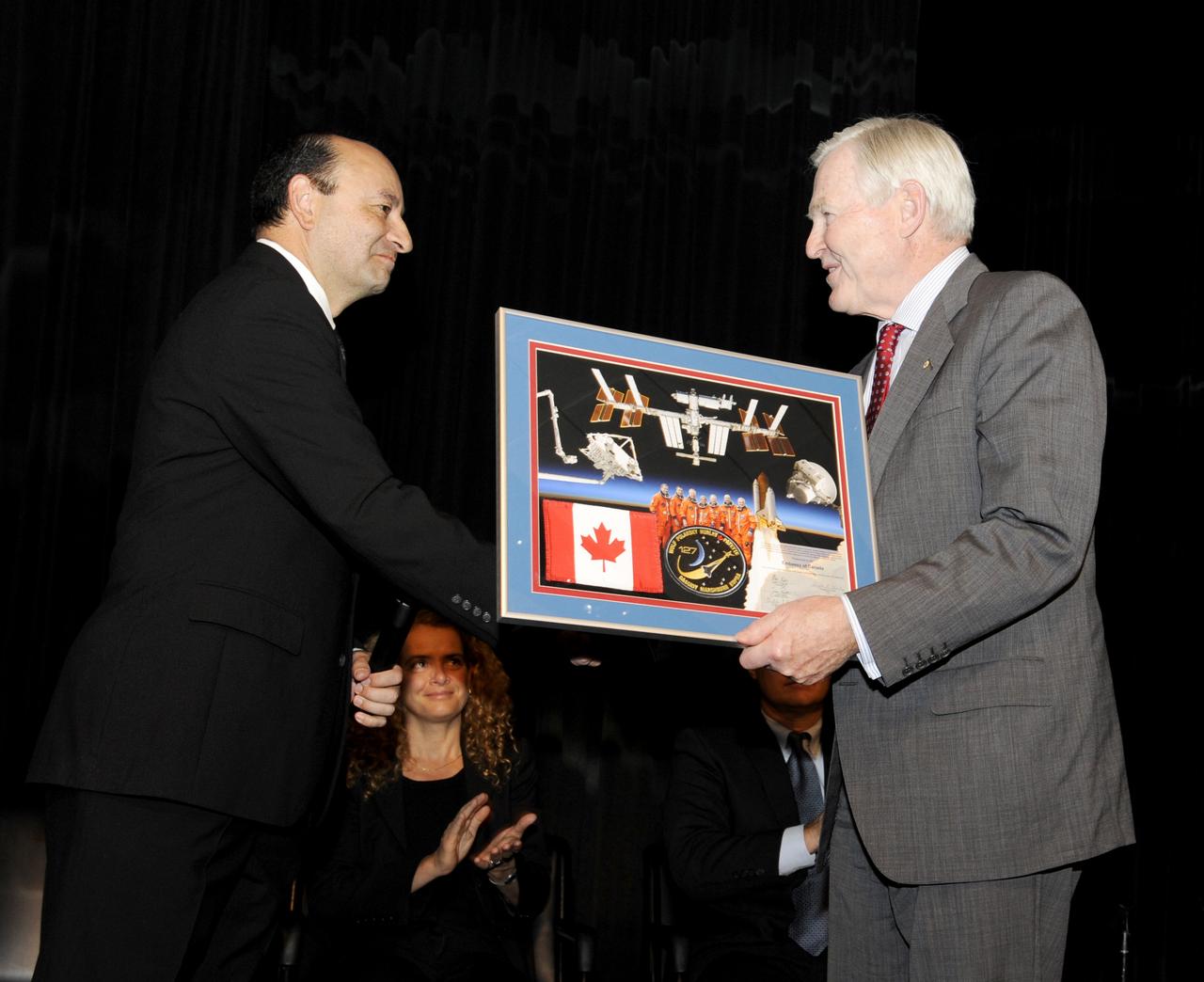
STS-127 Commander Mark Polansky, left, shakes hands with Canadian Ambassador to the United States Michael Wilson after presenting him with a montage as Canadian Space Agency astronaut Julie Payette, seated center, looks on, Tuesday, Sept. 22, 2009, during a visit to the Canadian Embassy in Washington. Photo Credit: (NASA/Paul E. Alers)
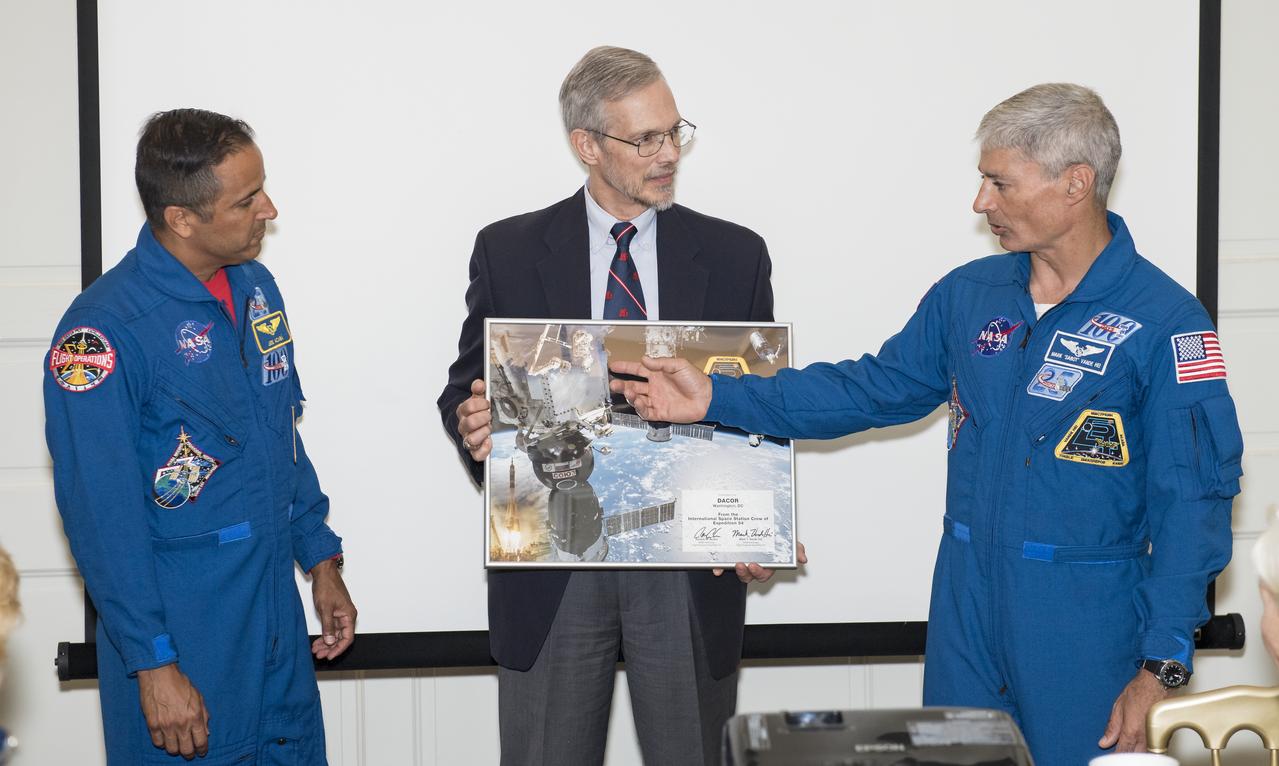
NASA astronauts Joe Acaba, left, and Mark Vande Hei, right present a montage to the President of DACOR, Jim Benson, Friday, June 15, 2018 at the DACOR Bacon House in Washington. The house is an early nineteenth century home and the current headquarters of DACOR Foundation, an organization of foreign affairs professionals. Photo Credit: (NASA/Aubrey Gemignani)
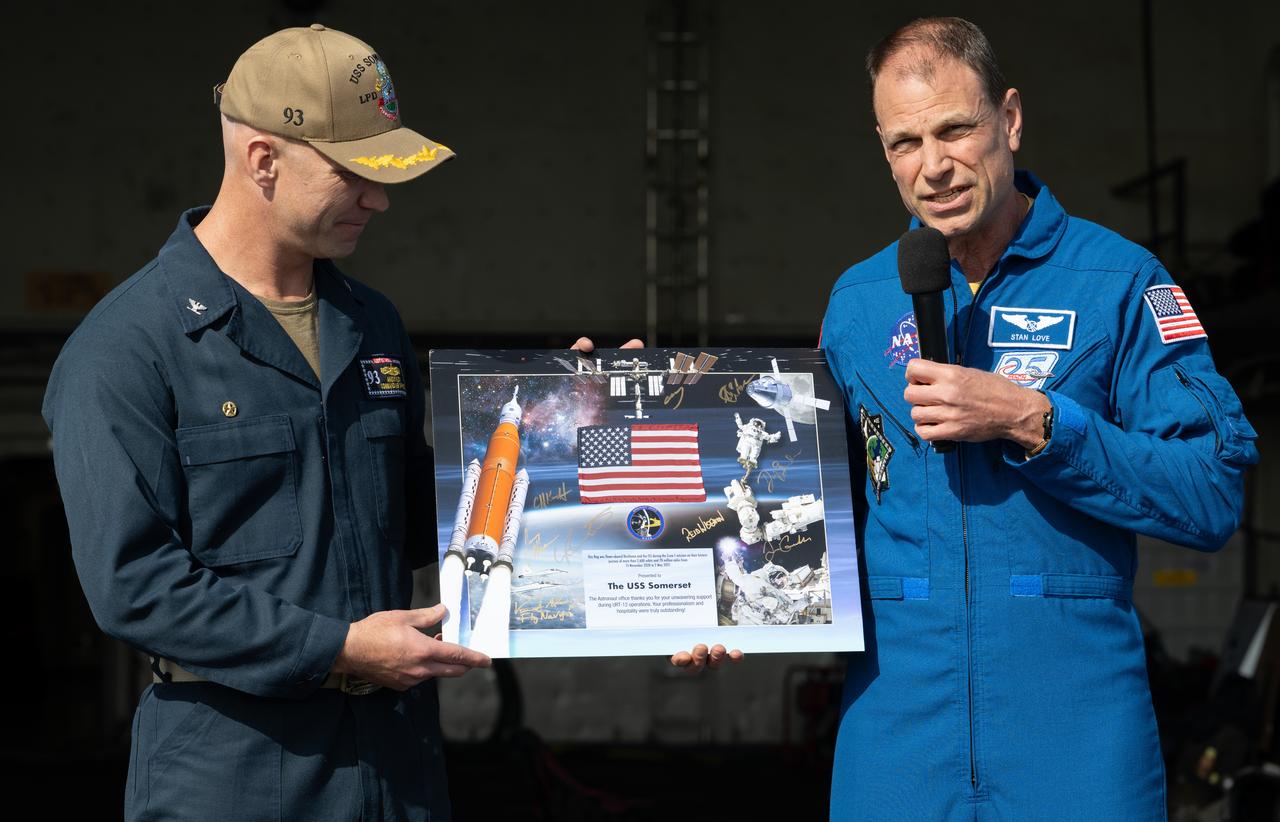
NASA astronaut Stan Love presents a montage to Capt. Andrew Koy, commanding officer of USS Somerset as NASA and Department of Defense teams participate in Underway Recovery Test-12 onboard USS Somerset off the coast of California, Saturday, March 29, 2025. During the test, NASA and Department of Defense teams are practicing to ensure recovery procedures are validated as NASA plans to send the Artemis II astronauts around the Moon and splashdown in the Pacific Ocean. Photo Credit: (NASA/Joel Kowsky)
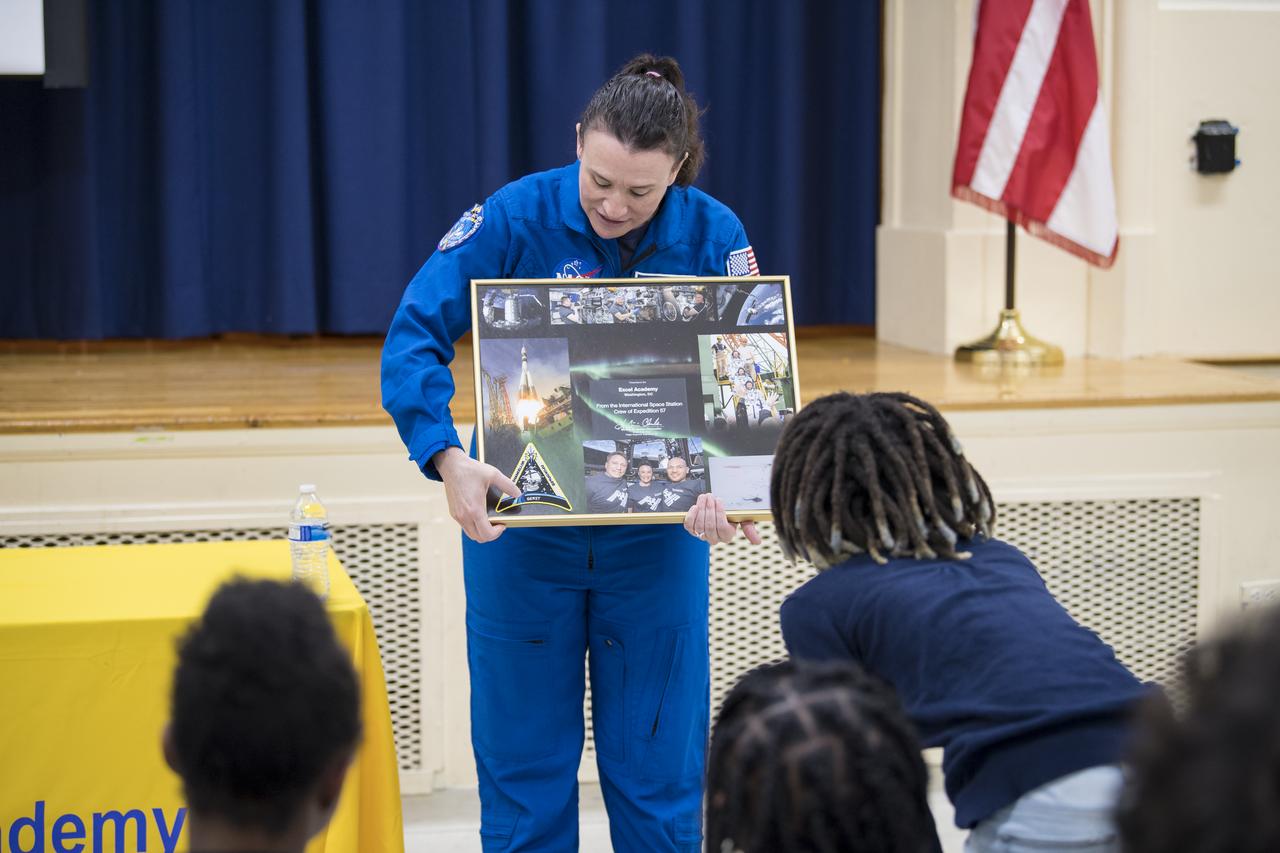
NASA astronaut Dr. Serena Auñón-Chancellor presents a montage from Expeditions 56 and 57 to the students of Excel Academy Public Charter School, Monday, June 10, 2019 in Washington, DC. Auñón-Chancellor spent 197 days living and working onboard the ISS and contributed to hundreds of experiments in biology, biotechnology, physical science, and Earth science while there. She is also a doctor and started her career with NASA as a flight surgeon in 2006. Photo Credit: (NASA/Aubrey Gemignani)
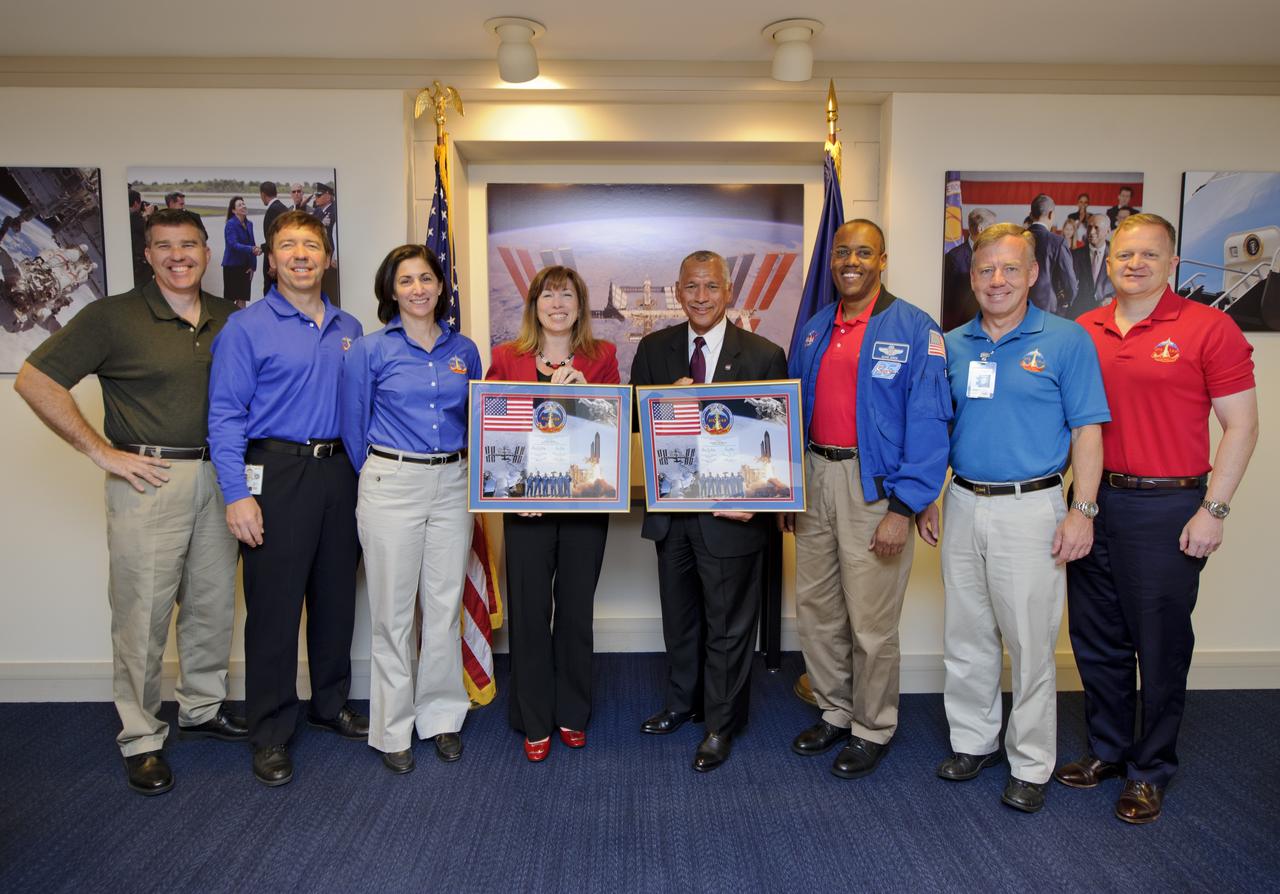
NASA Administrator Charles Bolden along with Deputy Administrator Lori Garver, center, stands with STS-133 crew members from left, Mission Specialists Stephen Bowen, Michael Barratt, Nicole Slott, Alvin Drew, Commander Steve Lindsey, and Pilot Eric Boe after being presented montages, Monday, May 9, 2011, at NASA Headquarters in Washington. Photo Credit: (NASA/Paul E. Alers)
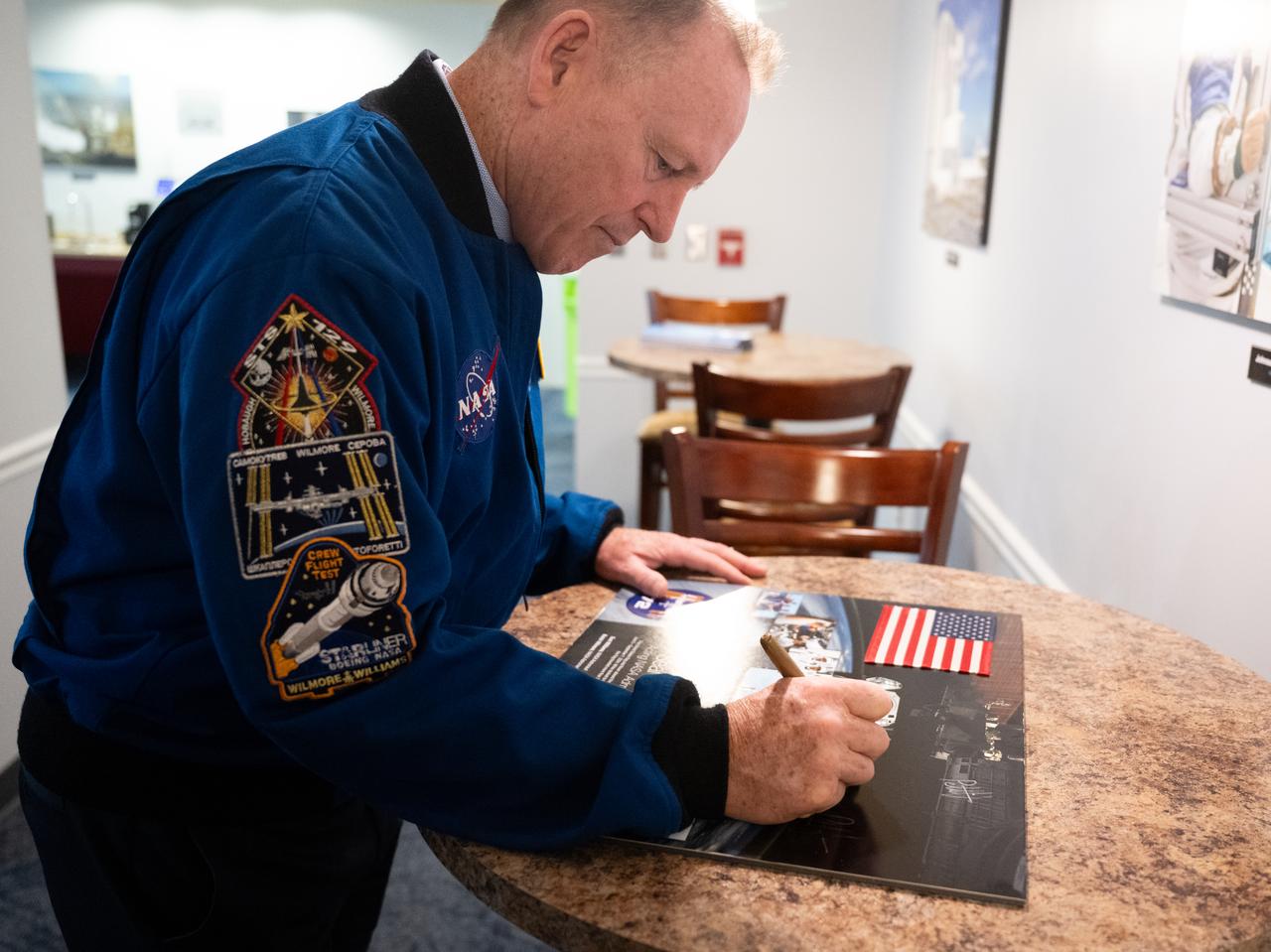
NASA astronaut Butch Wilmore signs a montage for acting NASA Administrator Sean Duffy, Thursday, Sept. 18, 2025, at the Mary W. Jackson NASA Headquarters building in Washington. Wilmore and fellow NASA astronauts Suni Williams, Don Pettit, and Nick Hague served as part of Expedition 72 onboard the orbiting laboratory. Photo Credit: (NASA/Joel Kowsky)
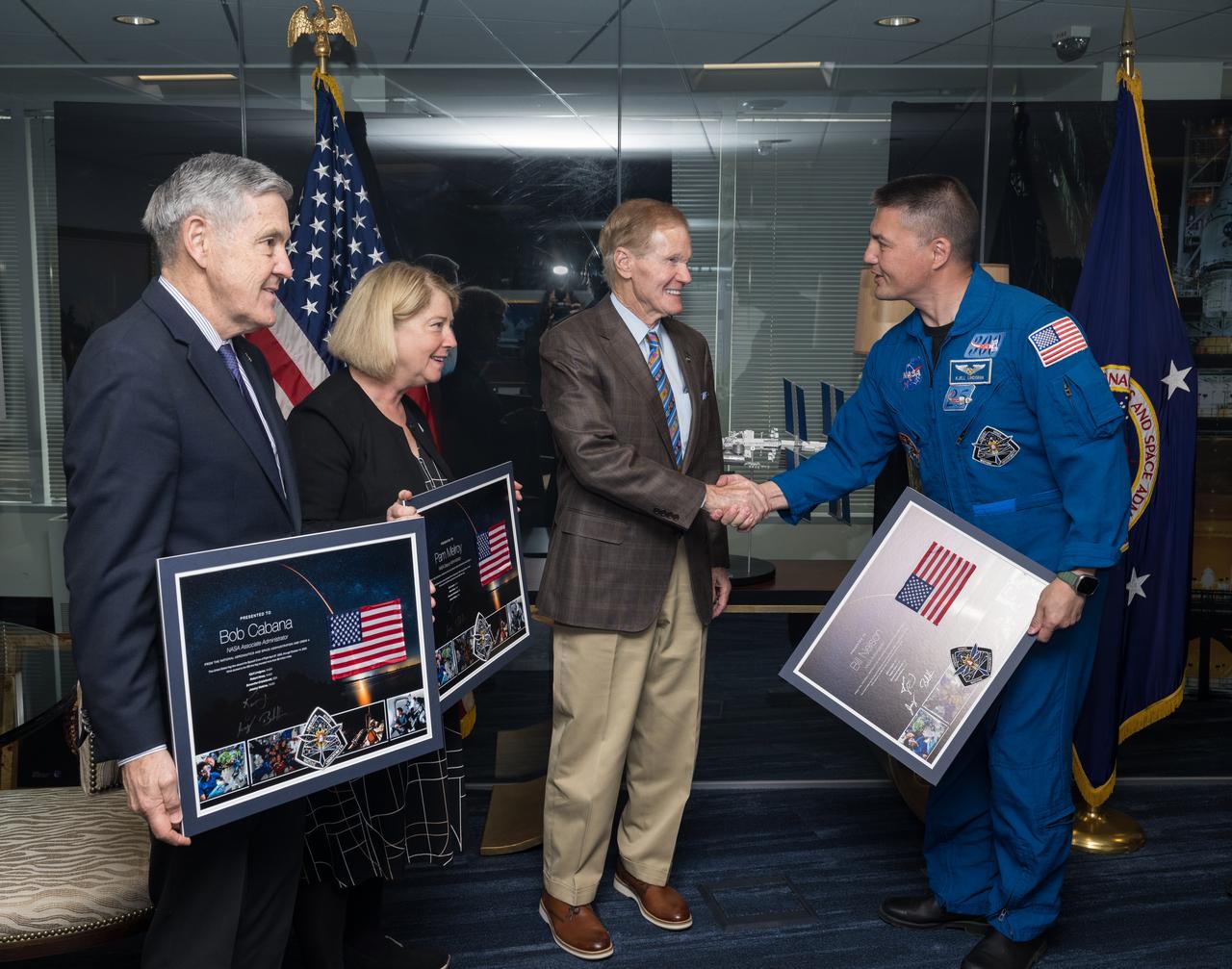
From left to right, NASA Associate Administrator Bob Cabana, NASA Deputy Administrator, Pam Melroy, and NASA Administrator Bill Nelson receive signed montages from NASA’s SpaceX Crew-4 NASA astronauts Kjell Lindgren, right, Jessica Watkins, and Robert Hines, Monday, March 27, 2023, at the Mary W. Jackson NASA Headquarters building in Washington DC. Photo Credit: (NASA/Aubrey Gemignani)
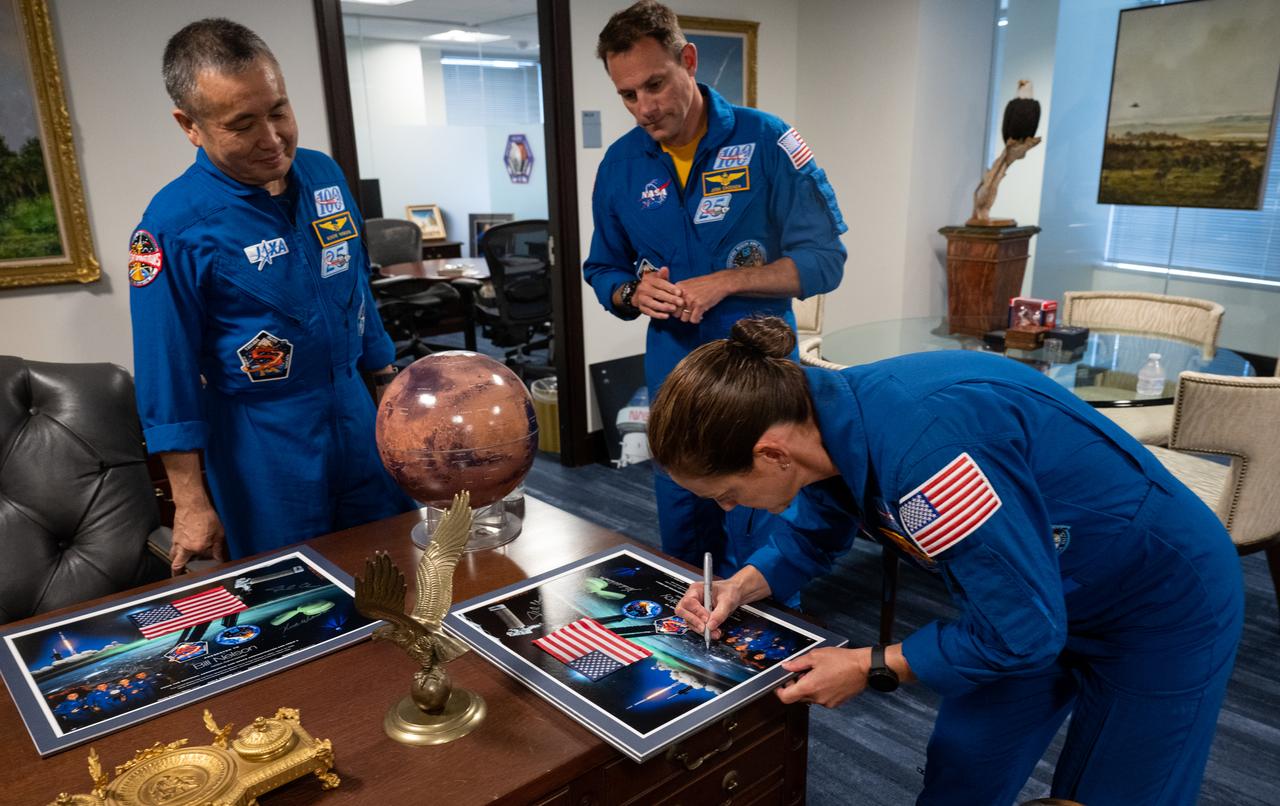
NASA’s SpaceX Crew-5 astronaut Nicole Mann of NASA signs a montage for NASA Deputy Administrator Pam Melroy as her NASA SpaceX Crew-5 crewmates Koichi Wakata of the Japan Aerospace Exploration Agency (JAXA) and Josh Cassada of NASA look on, Monday, June 5, 2023 at the Mary W. Jackson NASA Headquarters building in Washington. Mann, Cassada, and Wakata spent 157 days in space as part of Expedition 68 aboard the International Space Station. Photo Credit: (NASA/Joel Kowsky)
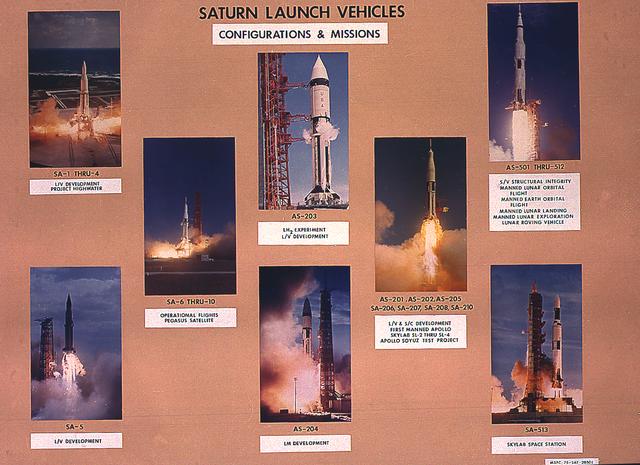
This montage illustrates the various configurations and missions of the three classes of the Saturn vehicles developed by the Marshall Space Flight Center. The missions for the Saturn I included atmospheric science investigations and the deployment of the Pegasus meteroid-detection satellite as well as launch vehicle development. The Saturn IB vehicle tested the Apollo spacecraft and launched the three marned Skylab missions as well as the Apollo Soyuz test project. The Saturn V vehicle launched the manned lunar orbital/landing missions, and the Skylab Orbital Workshop in 1973.
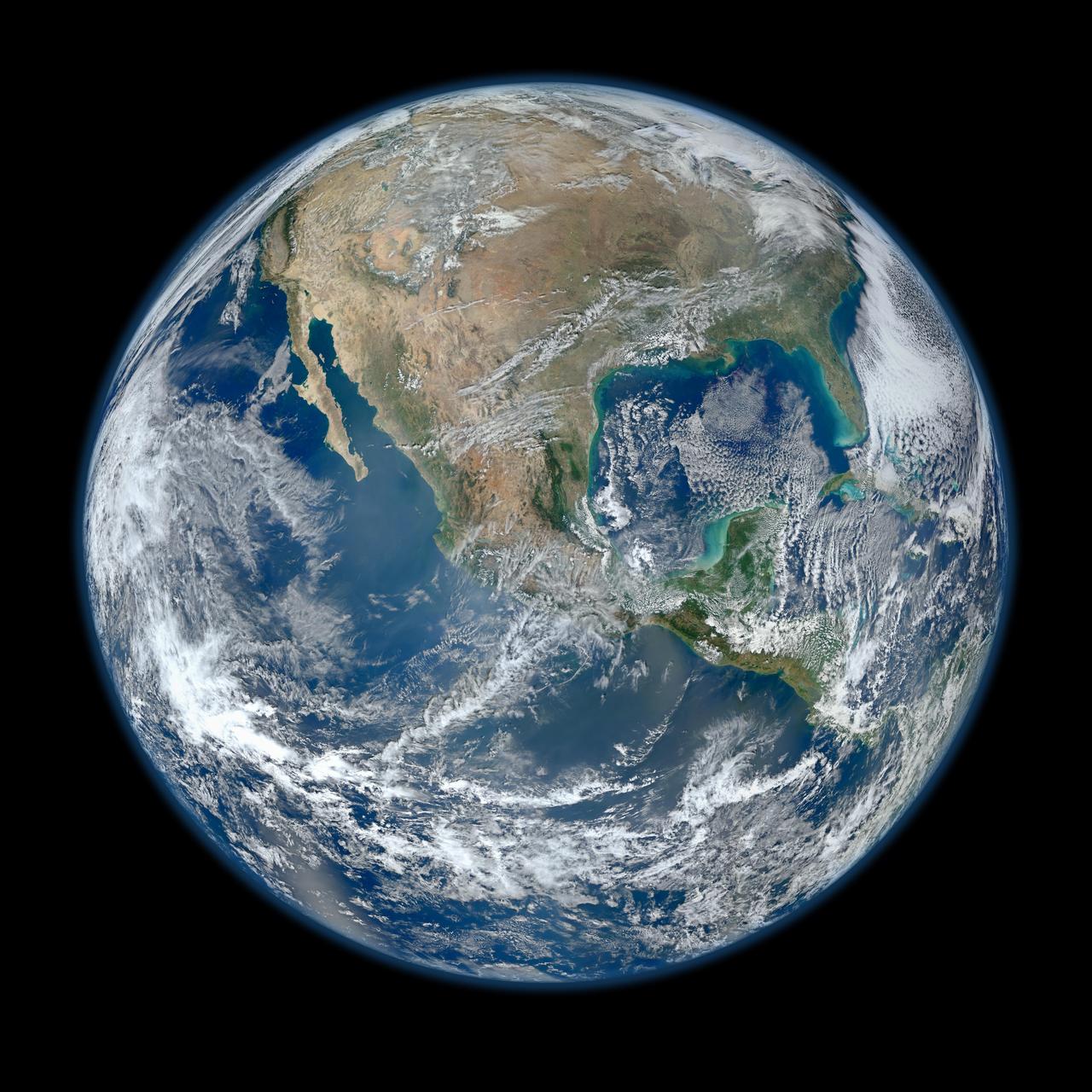
Behold one of the more detailed images of the Earth yet created. This Blue Marble Earth montage shown above -- created from photographs taken by the Visible/Infrared Imager Radiometer Suite (VIIRS) instrument on board the new Suomi NPP satellite -- shows many stunning details of our home planet. The Suomi NPP satellite was launched last October and renamed last week after Verner Suomi, commonly deemed the father of satellite meteorology. The composite was created from the data collected during four orbits of the robotic satellite taken earlier this month and digitally projected onto the globe. Many features of North America and the Western Hemisphere are particularly visible on a high resolution version of the image. http://photojournal.jpl.nasa.gov/catalog/PIA18033
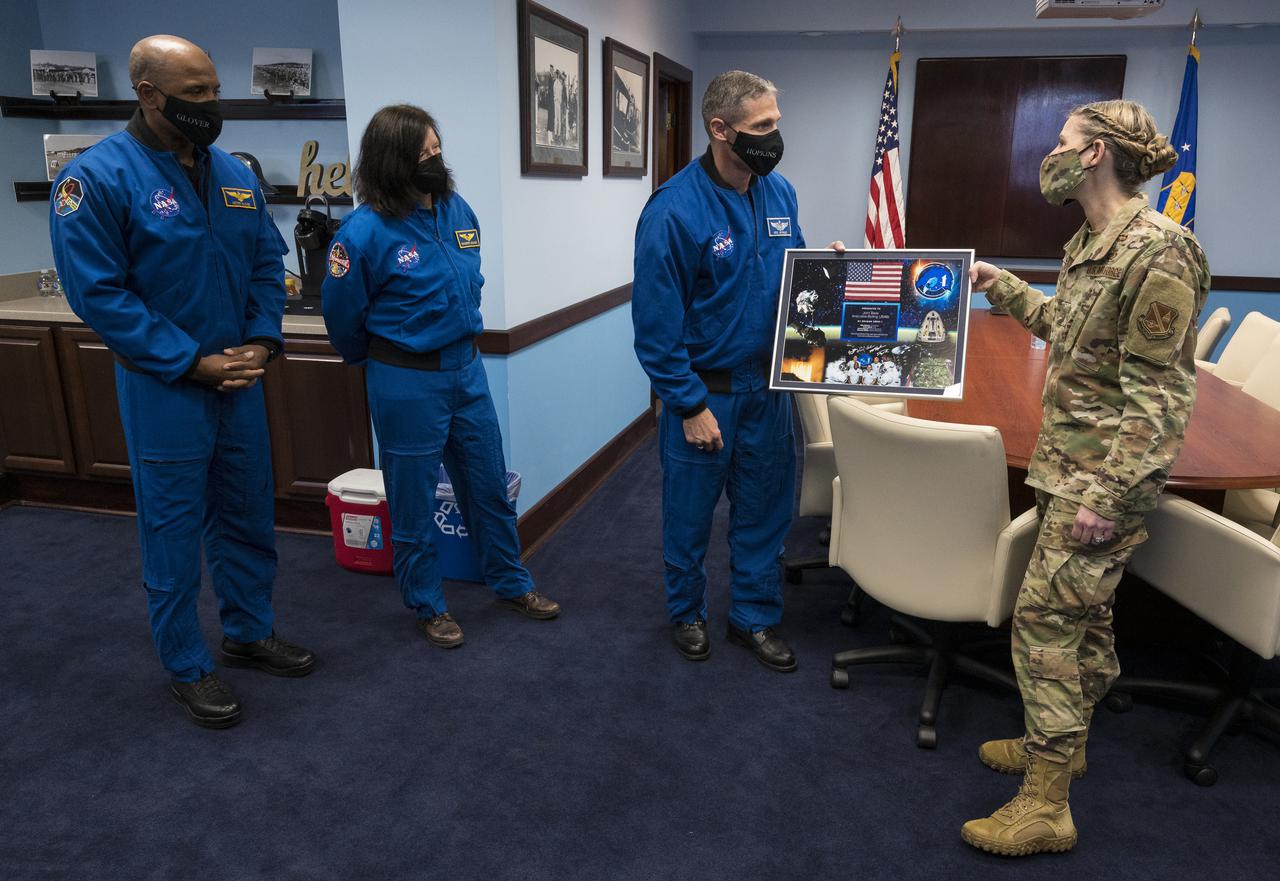
SpaceX Crew-1 NASA astronauts, from left, Victor Glover, Mike Hopkins, and Shannon Walker, present a montage from their mission to Col. Catherine Logan, commander of Joint Base Anacostia-Bolling (JBAB), Friday, Nov. 19, 2021, in Washington. Hopkins, Glover, Walker, and Japan Aerospace Exploration Agency (JAXA) astronaut Soichi Noguchi, launched on the first crew rotation mission to the International Space Station for SpaceX’s Falcon 9 and Crew Dragon spacecraft as part of the agency’s Commercial Crew Program and spent 168 days in space across Expeditions 64 and 65. Photo Credit: (NASA/Aubrey Gemignani)
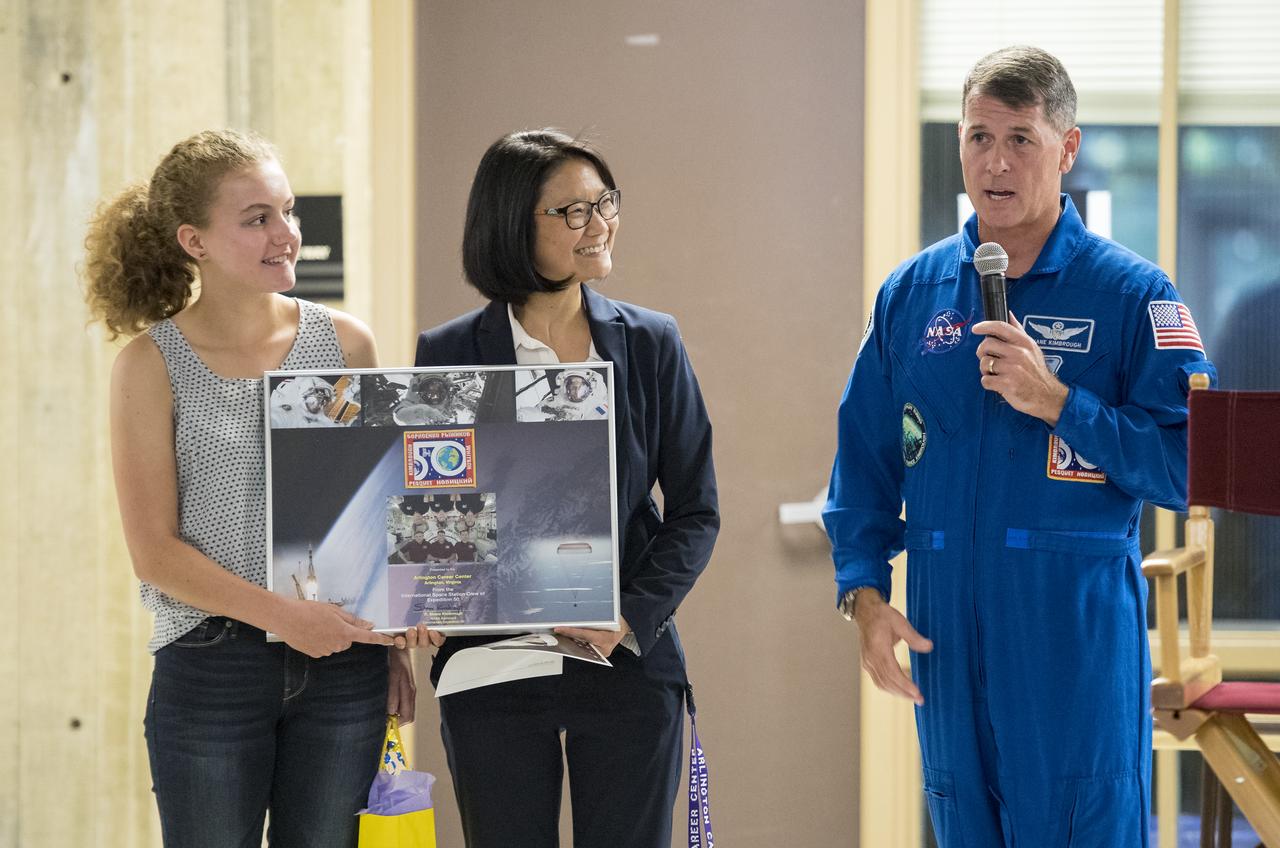
NASA astronaut Shane Kimbrough presents a montage of photos and the Expedition 50 patch to the Arlington Tech High School who hosted his presentation on his time onboard the International Space Station (ISS) during Expeditions 49/50, Tuesday, September 12, 2017 at Arlington Career Center in Arlington, Virginia. During Expedition 50, Kimbrough completed four spacewalks for a total of 39 hours outside the ISS, and concluded his 173-day mission when he landed in a remote area near the town of Zhezkazgan, Kazakhstan in April 2017. Photo Credit: (NASA/Aubrey Gemignani)

NASA astronaut Ricky Arnold presents a montage from his mission to Alan Peel, program director, and Erin Thompson, program associate, for the Science, Discovery and the Universe Scholars Program following his presentation to students, May 2, 2019 at the University of Maryland in College Park, Md. During Arnold’s 197 days onboard the International Space Station, as part of Expeditions 55 and 56, he ventured outside the space station on three spacewalks in addition to conducting numerous experiments and educational downlink events. Photo Credit: (NASA/Joel Kowsky)
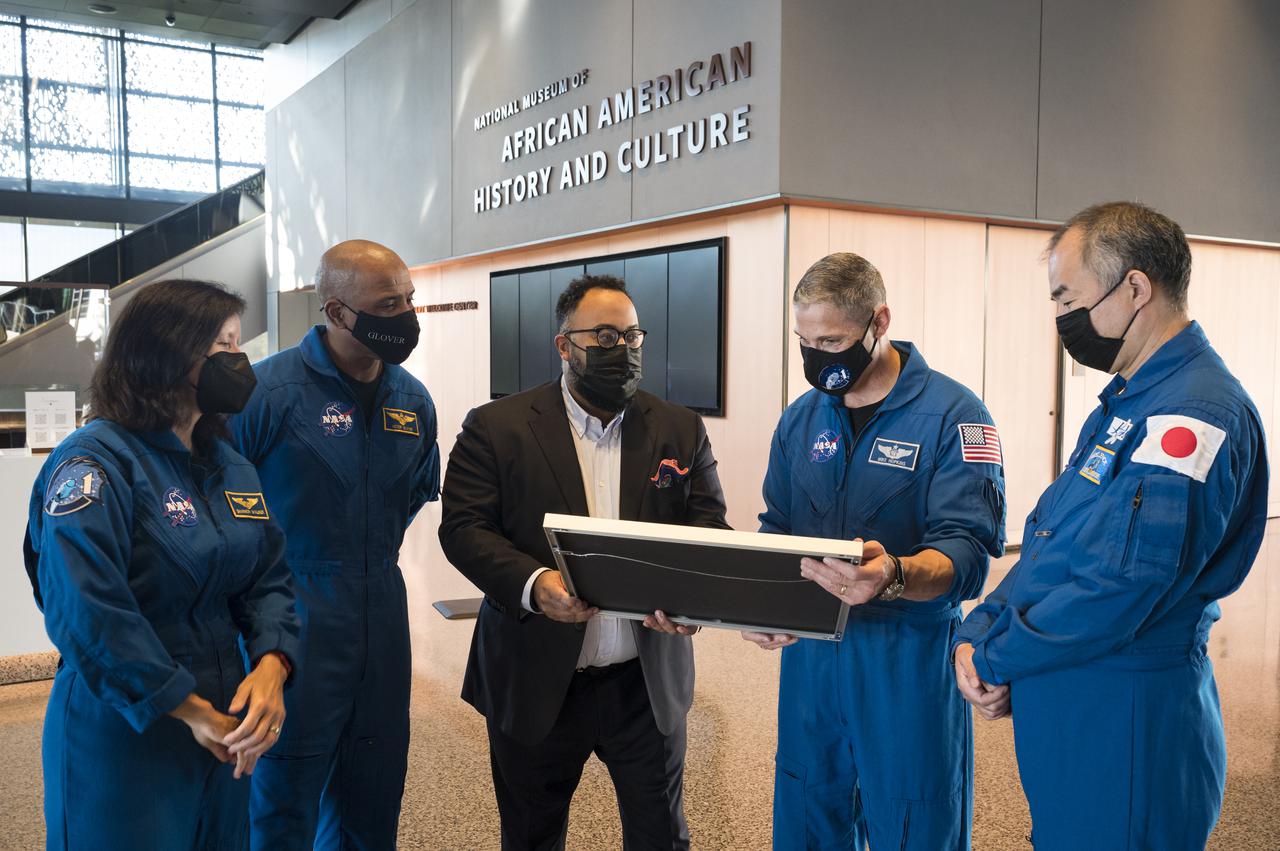
SpaceX Crew-1 NASA astronauts, Shannon Walker, left, Victor Glover, second from left, Mike Hopkins, second from right, and Japan Aerospace Exploration Agency (JAXA) astronaut Soichi Noguchi, right, present a montage from the Crew-1 mission to the director of the National Museum of African American History and Culture, Kevin Young, Tuesday, Nov. 16, 2021, in Washington. Hopkins, Glover, Walker, and Noguchi launched on the first crew rotation mission to the International Space Station for SpaceX’s Falcon 9 and Crew Dragon spacecraft as part of the agency’s Commercial Crew Program and spent 168 days in space across Expeditions 64 and 65. Photo Credit: (NASA/Aubrey Gemignani)
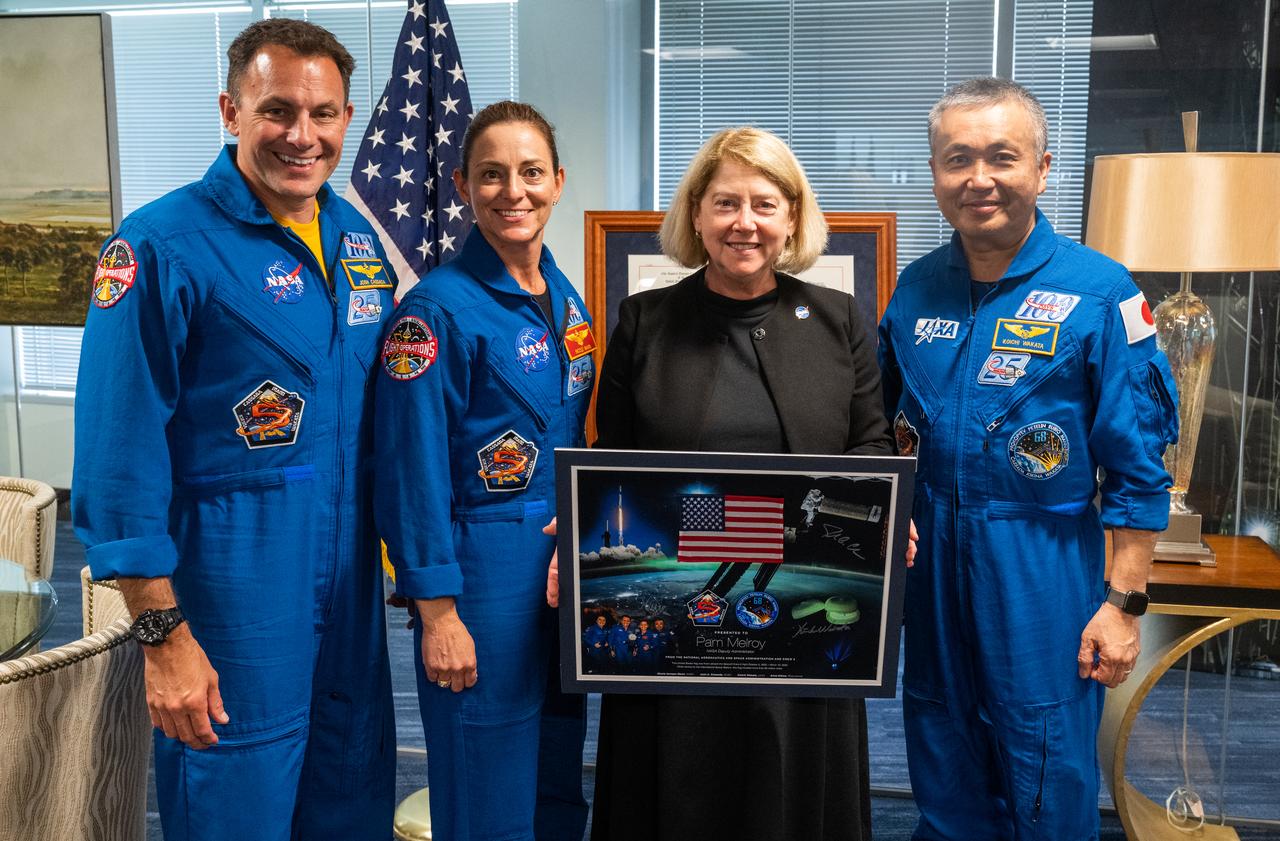
NASA’s SpaceX Crew-5 astronauts Josh Cassada, left, and Nicole Mann of NASA, second from left, and Japan Aerospace Exploration Agency (JAXA) astronaut Koichi Wakata, right, pose for a picture with NASA Deputy Administrator Pam Melroy second from right, after being presented with a montage from their flight, Monday, June 5, 2023 at the Mary W. Jackson NASA Headquarters building in Washington. Mann, Cassada, and Wakata spent 157 days in space as part of Expedition 68 aboard the International Space Station. Photo Credit: (NASA/Joel Kowsky)
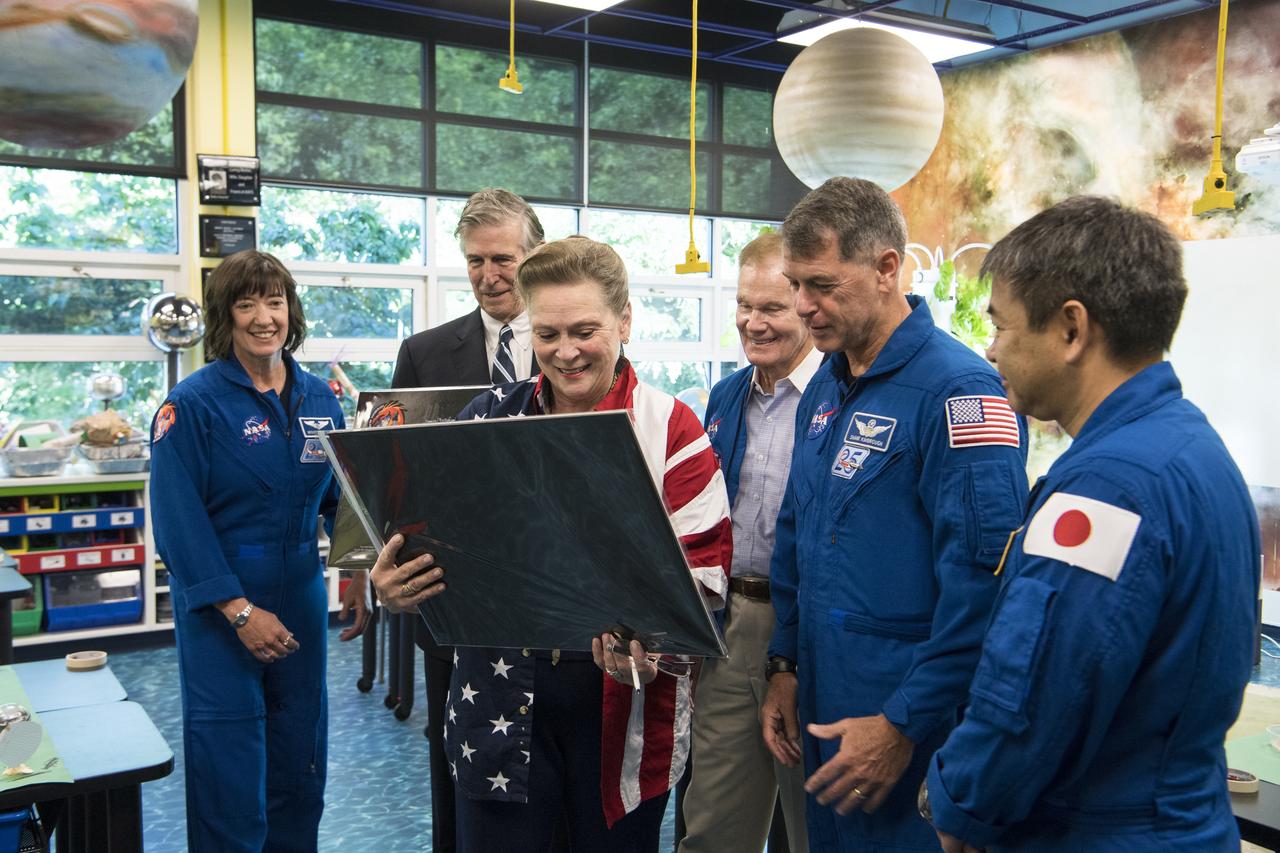
NASA’s SpaceX Crew-2 NASA astronauts Megan McArthur, left, and Shane Kimbrough, second from right, and Japan Aerospace Exploration Agency (JAXA) astronaut Akihiko Hoshide, right, present Principal of Arlington Science Focus Elementary School, Mary Begley, with a montage from their mission, while NASA Administrator Bill Nelson, third from right, and U.S. Rep. Don Beyer, D-Va., second from left, look on, during a visit to Arlington Science Focus Elementary School, Friday, June 10, 2022, in Arlington, Virginia. Photo Credit: (NASA/Aubrey Gemignani)
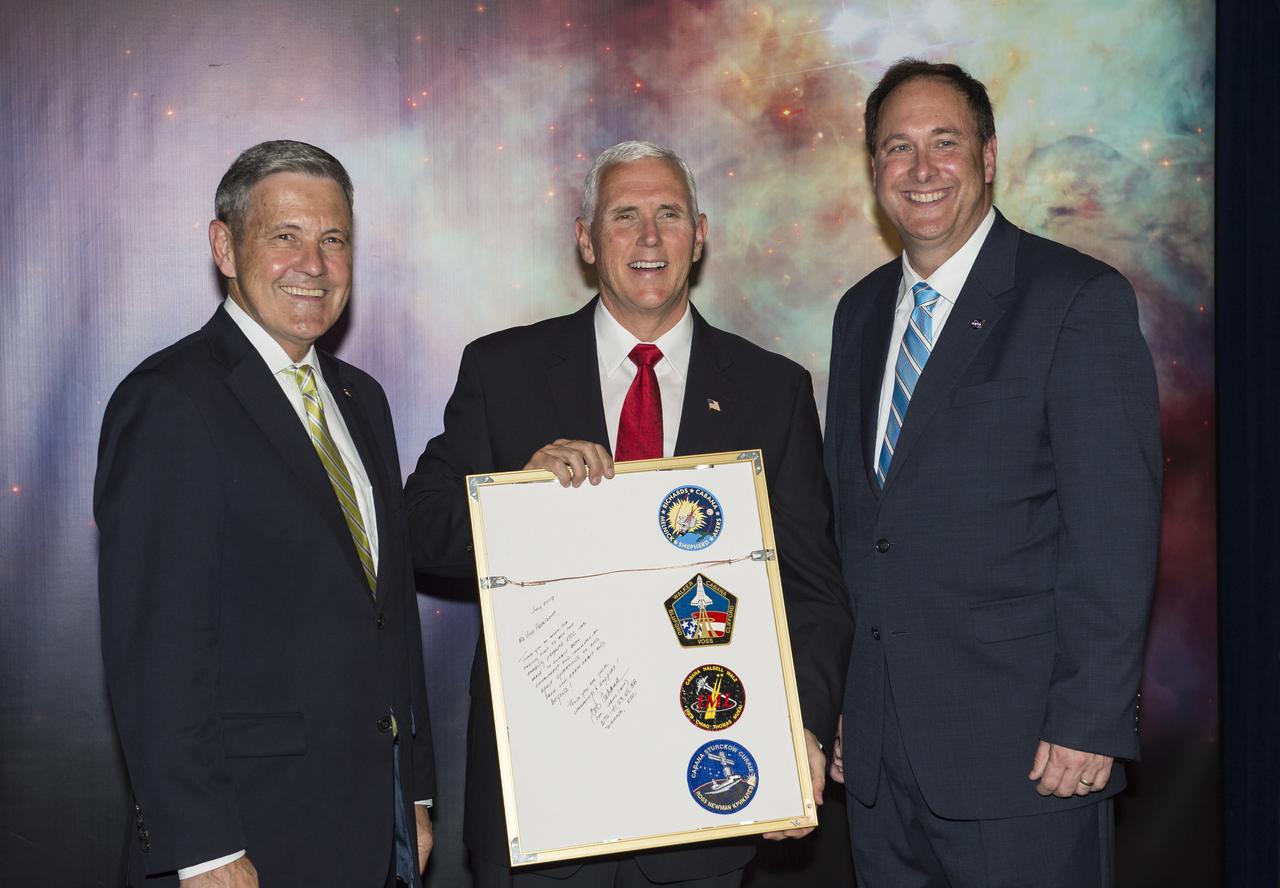
Vice President Mike Pence receives a commemorative montage from Kennedy Space Center (KSC) Director, Robert Cabana, left, and Acting NASA Administrator, Robert Lightfoot, right, including stickers on the back from all of Cabana's missions, Thursday, July 6, 2017, in the green room at KSC in Cape Canaveral, Florida. Vice President Mike Pence is scheduled to speak at the event to highlight innovations made in America and tour some of the public/private partnership work that is helping to transform the center into a multi-user spaceport. Photo Credit: (NASA/Aubrey Gemignani)
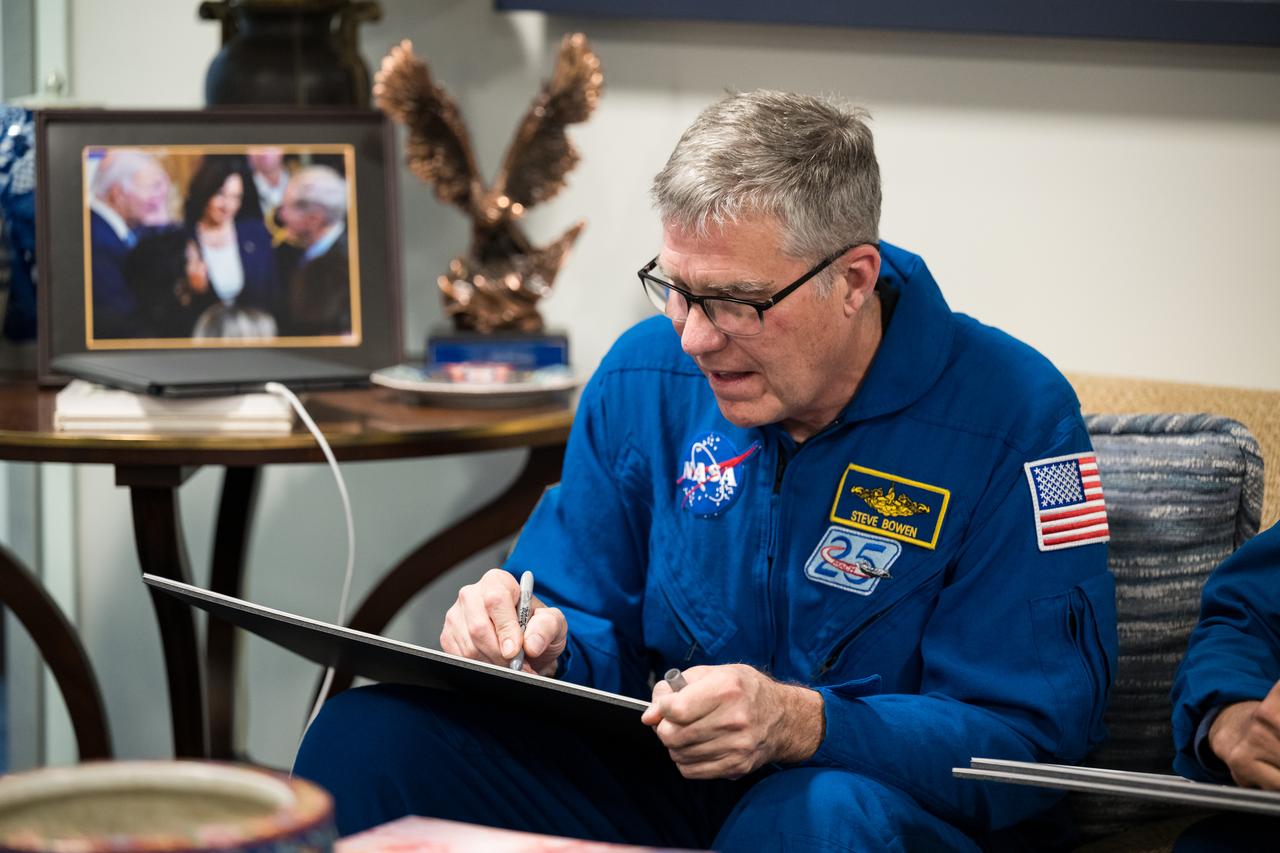
Expedition 69 NASA astronaut Stephen Bowen signs a montage as he and fellow crewmates NASA astronauts Warren Hoburg and Frank Rubio, and UAE (United Arab Emirates) astronaut Sultan Alneyadi meet with NASA Administrator Bill Nelson and Deputy Administrator Pam Melroy, Tuesday, March 19, 2024 at the Mary W. Jackson NASA Headquarters building in Washington. Bowen, Hoburg, and Alneyadi spent 186 days aboard the International Space Station as part of Expedition 69; while Rubio set a new record for the longest single spaceflight by a U.S. astronaut, spending 371 days in orbit on an extended mission spanning Expeditions 68 and 69. Photo Credit: (NASA/Aubrey Gemignani)
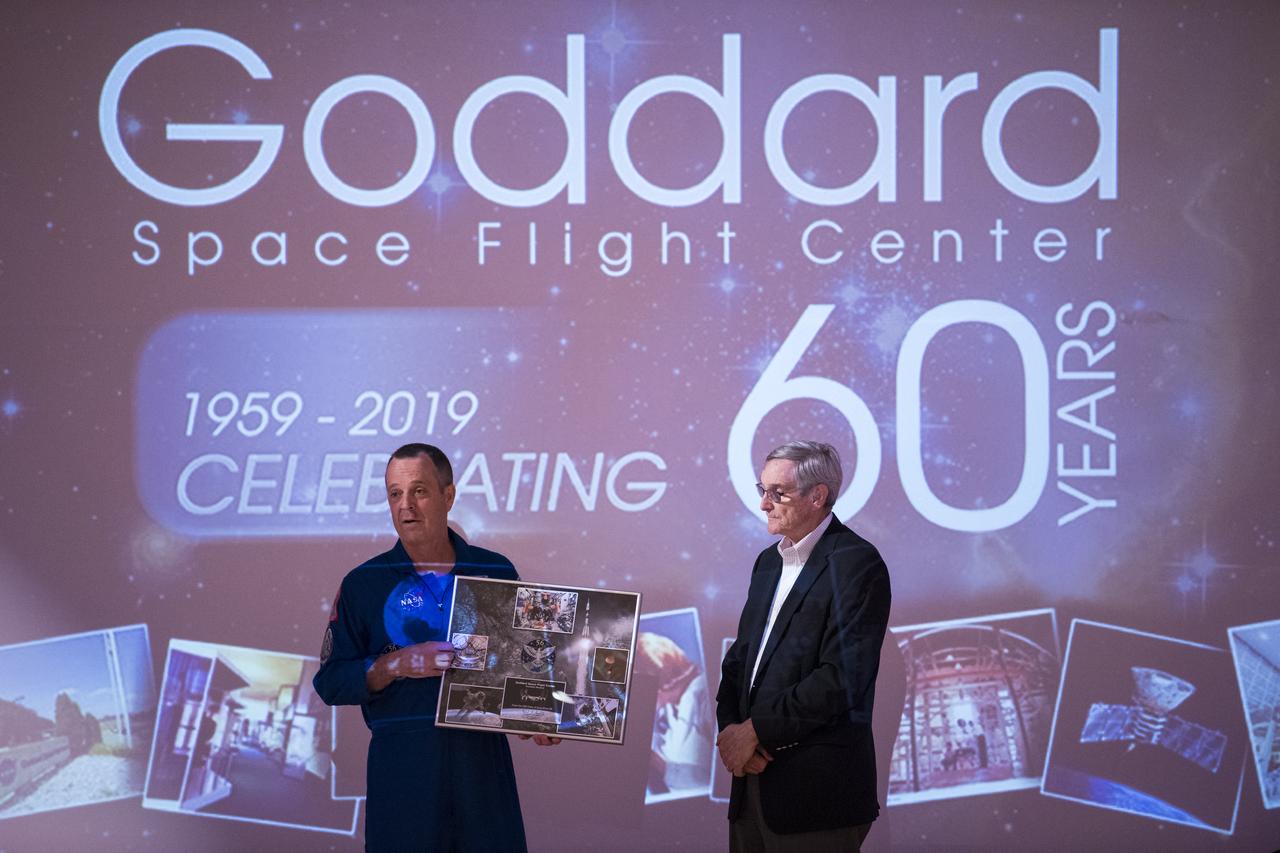
NASA astronaut Ricky Arnold presents Robert Gabrys, director of the Office fo STEM Engagement at NASA’s Goddard Space Flight Center, a montage from his mission onboard the International Space Station, Thursday, May 2, 2019 at NASA’s Goddard Space Flight Center in Greenbelt, Md. During Arnold’s 197 days onboard the International Space Station, as part of Expeditions 55 and 56, he ventured outside the space station on three spacewalks in addition to conducting numerous experiments and educational downlink events. Photo Credit: (NASA/Joel Kowsky)
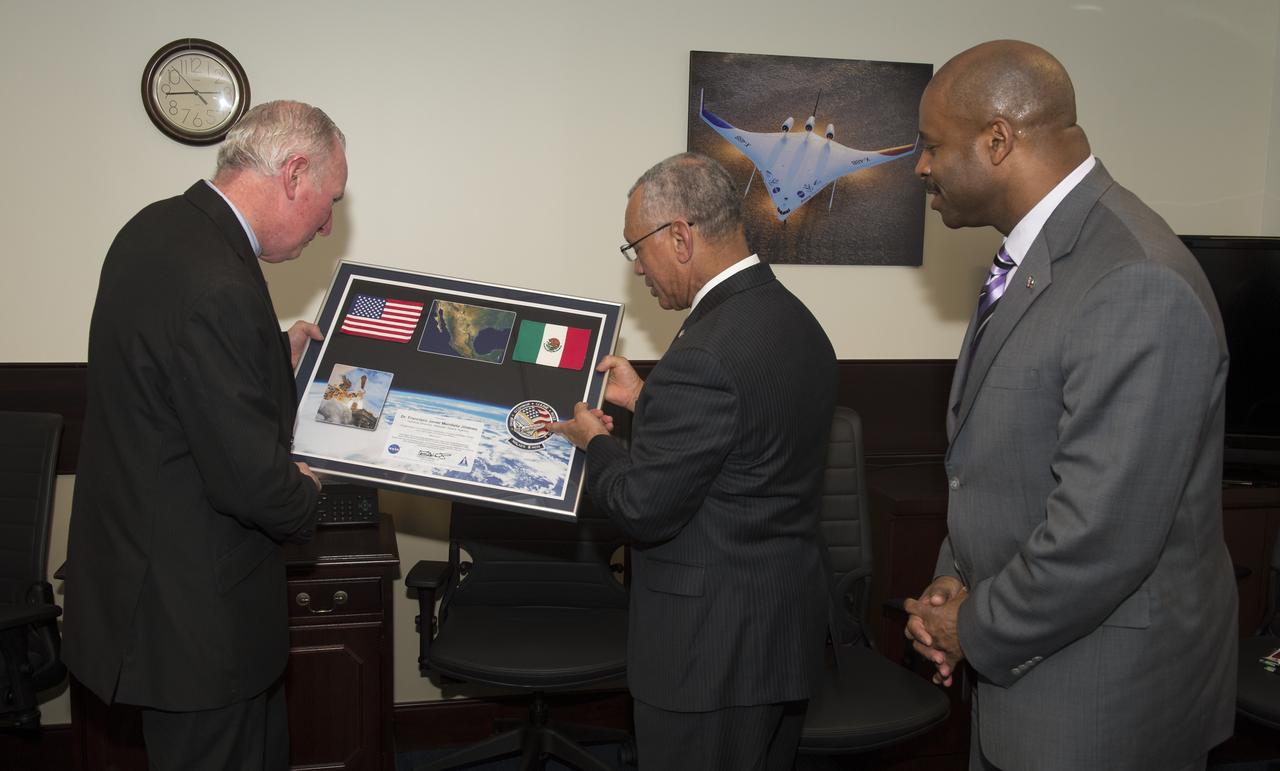
NASA Administrator Charles Bolden (center) presents Dr. Francisco Javier Mendieta Jimenez, Director General of the Mexican Space Agency, a NASA montage in honor of the Reimbursable Space Act Agreement (RSAA) signed between the two agencies, Monday, March 18, 2013 at NASA Headquarters in Washington. Leland Melvin (right), NASA Associate Administrator for Education looks on. The International Internship Program is a pilot program developed at NASA which will provide and avenue for non-US students to come to NASA for an internship. US students will be paired with a foreign student to work on a NASA research project under the guidance of a mentor. This is the first NASA-Mexico agreement signed. Photo Credit: (NASA/Carla Cioffi)