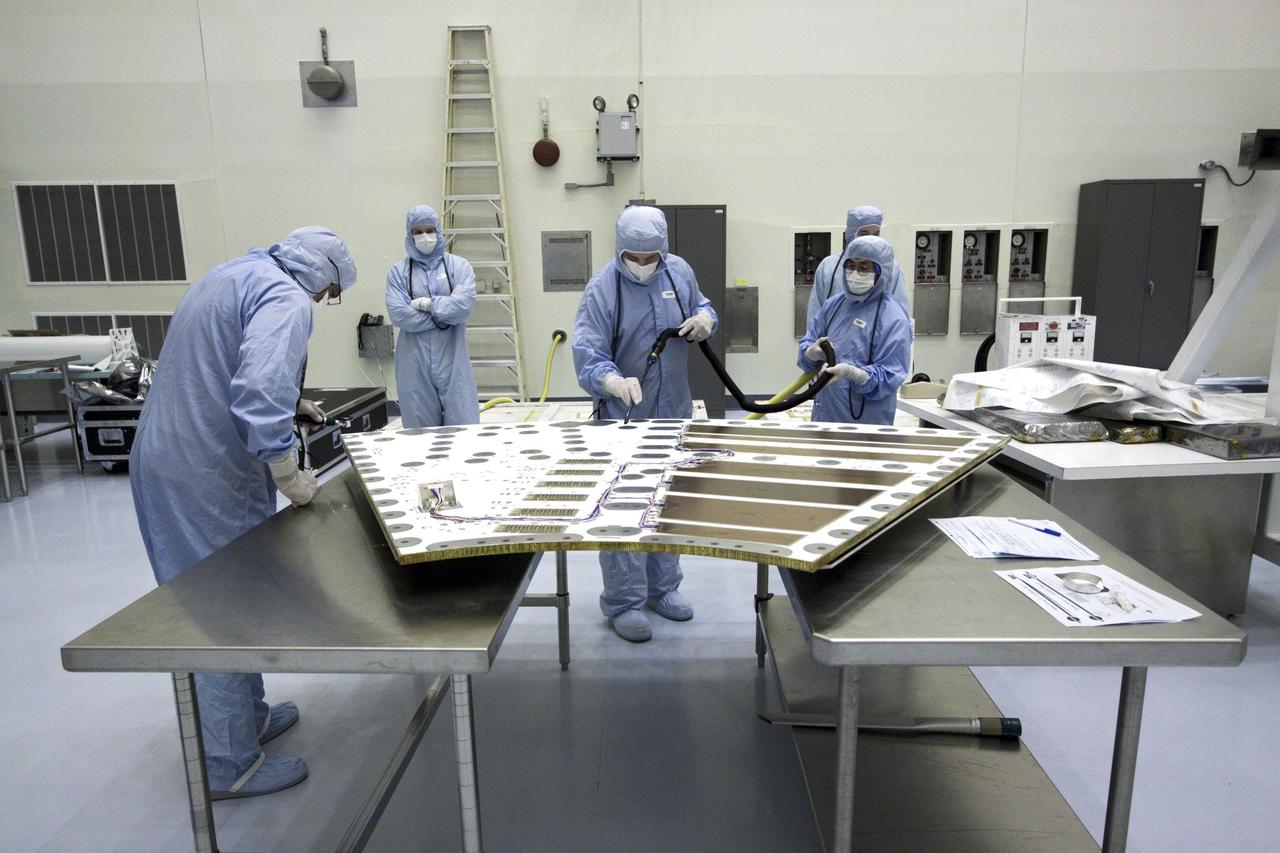
Cape Canaveral, Fla. -- At the Payload Hazardous Servicing Facility at NASA's Kennedy Space Center in Florida, technicians are preparing a solar array panel for installation to the cruise stage of NASA's Mars Science Laboratory (MSL). MSL's components include a compact car-sized rover, Curiosity, which has 10 science instruments designed to search for evidence on whether Mars has had environments favorable to microbial life, including chemical ingredients for life. The unique rover will use a laser to look inside rocks and release its gasses so that the rover’s spectrometer can analyze and send the data back to Earth. Launch of MSL aboard a United Launch Alliance Atlas V rocket is scheduled for Nov. 25 from Space Launch Complex 41 on Cape Canaveral Air Force Station in Florida. For more information, visit http://www.nasa.gov/msl. Photo credit: NASA/Jack Pfaller
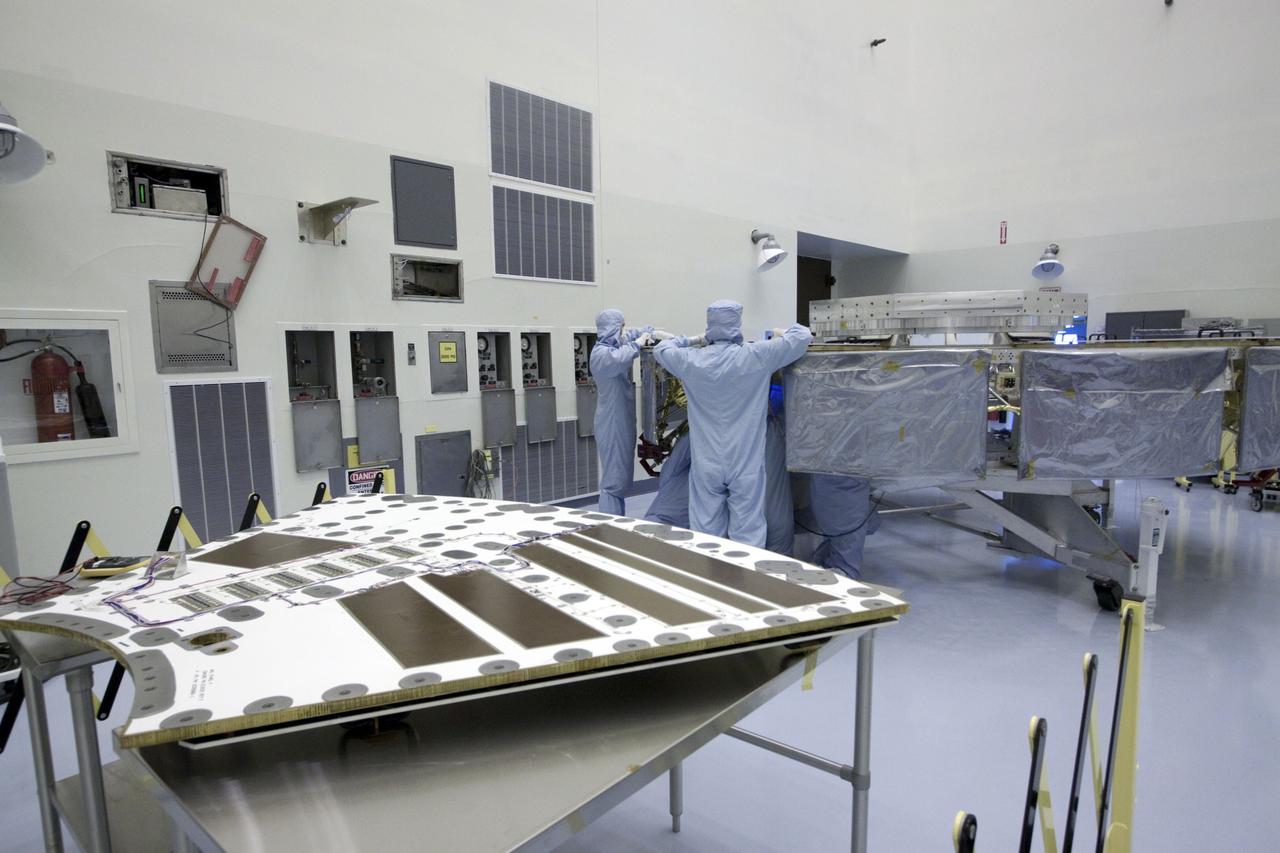
Cape Canaveral, Fla. -- At the Payload Hazardous Servicing Facility at NASA's Kennedy Space Center in Florida, technicians are installing a solar array panel to the cruise stage of NASA's Mars Science Laboratory (MSL). MSL's components include a compact car-sized rover, Curiosity, which has 10 science instruments designed to search for evidence on whether Mars has had environments favorable to microbial life, including chemical ingredients for life. The unique rover will use a laser to look inside rocks and release its gasses so that the rover’s spectrometer can analyze and send the data back to Earth. Launch of MSL aboard a United Launch Alliance Atlas V rocket is scheduled for Nov. 25 from Space Launch Complex 41 on Cape Canaveral Air Force Station in Florida. For more information, visit http://www.nasa.gov/msl. Photo credit: NASA/Jack Pfaller
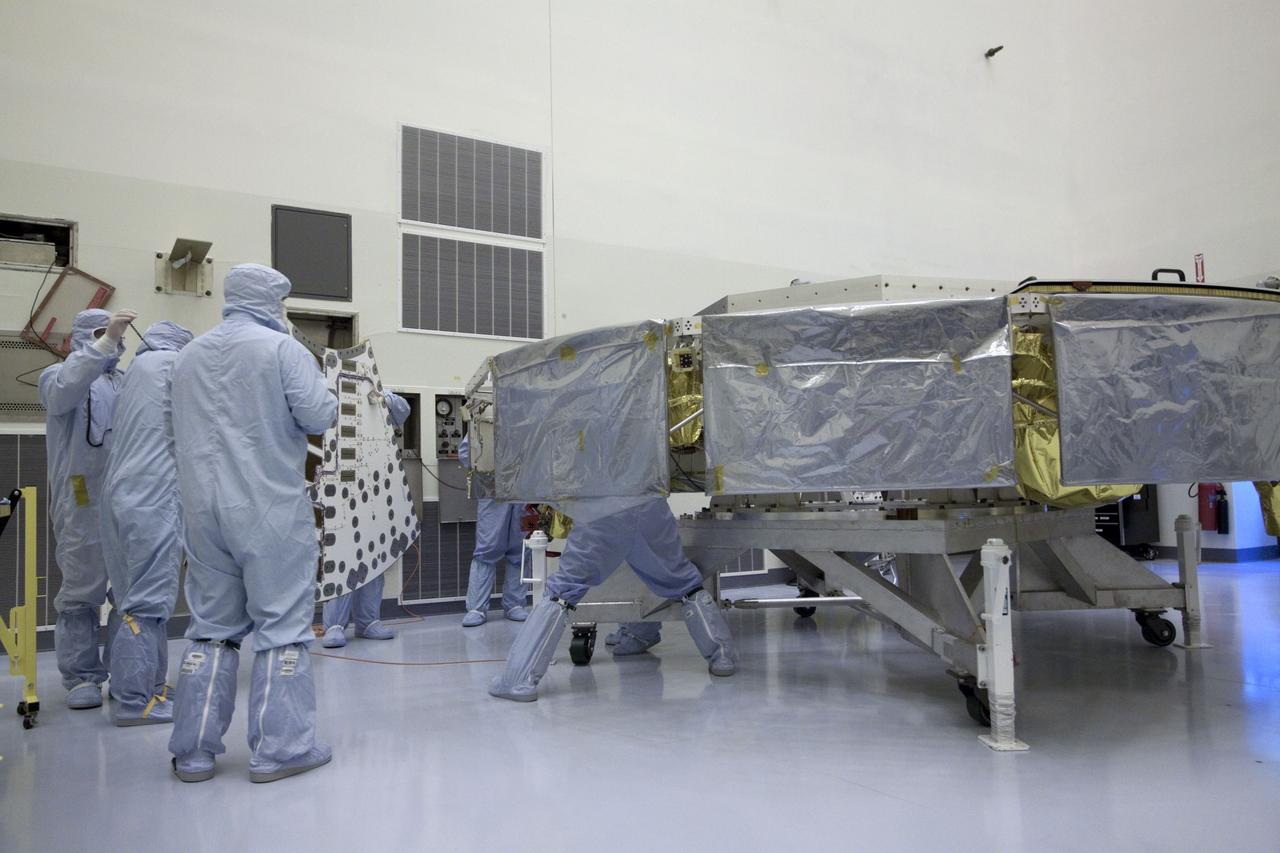
Cape Canaveral, Fla. -- At the Payload Hazardous Servicing Facility at NASA's Kennedy Space Center in Florida, technicians are installing a solar array panel to the cruise stage of NASA's Mars Science Laboratory (MSL). MSL's components include a compact car-sized rover, Curiosity, which has 10 science instruments designed to search for evidence on whether Mars has had environments favorable to microbial life, including chemical ingredients for life. The unique rover will use a laser to look inside rocks and release its gasses so that the rover’s spectrometer can analyze and send the data back to Earth. Launch of MSL aboard a United Launch Alliance Atlas V rocket is scheduled for Nov. 25 from Space Launch Complex 41 on Cape Canaveral Air Force Station in Florida. For more information, visit http://www.nasa.gov/msl. Photo credit: NASA/Jack Pfaller
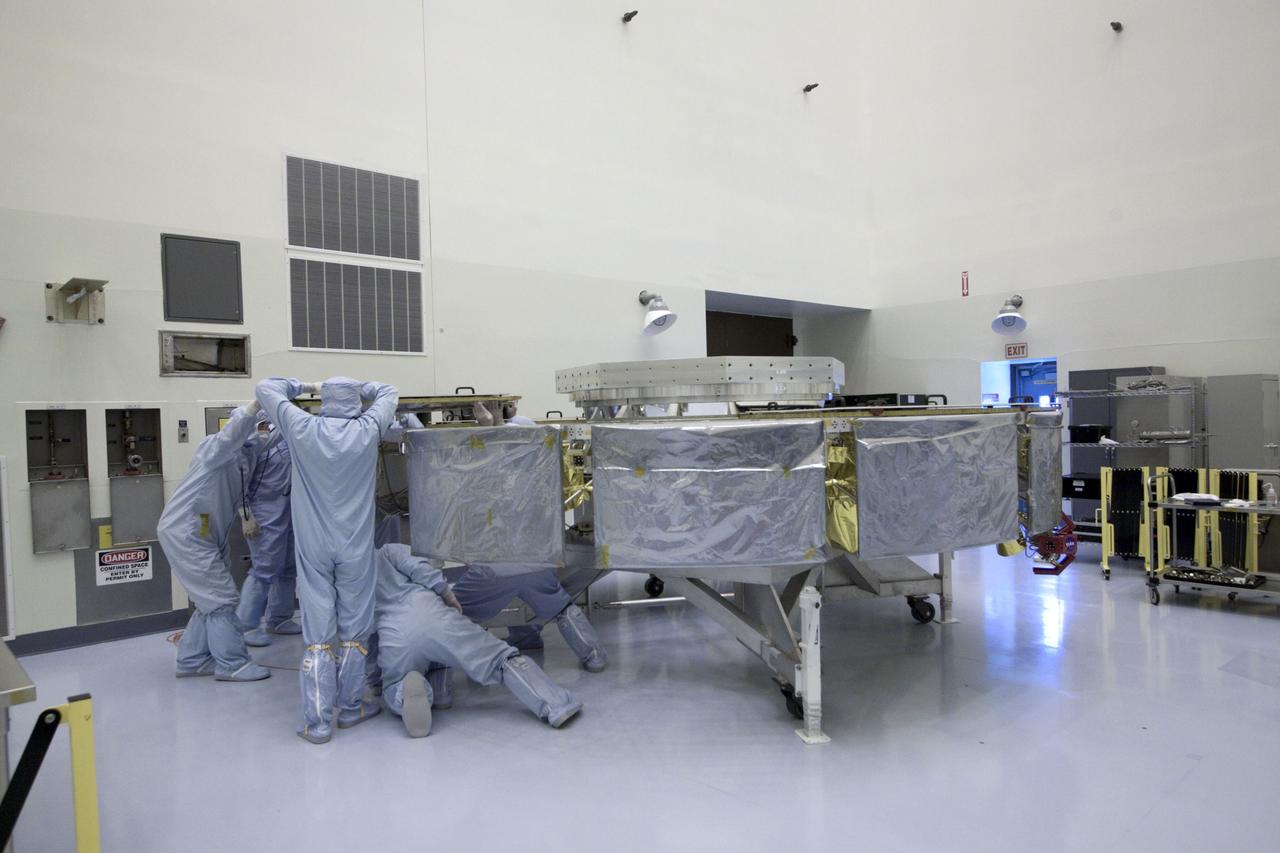
Cape Canaveral, Fla. -- At the Payload Hazardous Servicing Facility at NASA's Kennedy Space Center in Florida, technicians are installing a solar array panel to the cruise stage of NASA's Mars Science Laboratory (MSL). MSL's components include a compact car-sized rover, Curiosity, which has 10 science instruments designed to search for evidence on whether Mars has had environments favorable to microbial life, including chemical ingredients for life. The unique rover will use a laser to look inside rocks and release its gasses so that the rover’s spectrometer can analyze and send the data back to Earth. Launch of MSL aboard a United Launch Alliance Atlas V rocket is scheduled for Nov. 25 from Space Launch Complex 41 on Cape Canaveral Air Force Station in Florida. For more information, visit http://www.nasa.gov/msl. Photo credit: NASA/Jack Pfaller
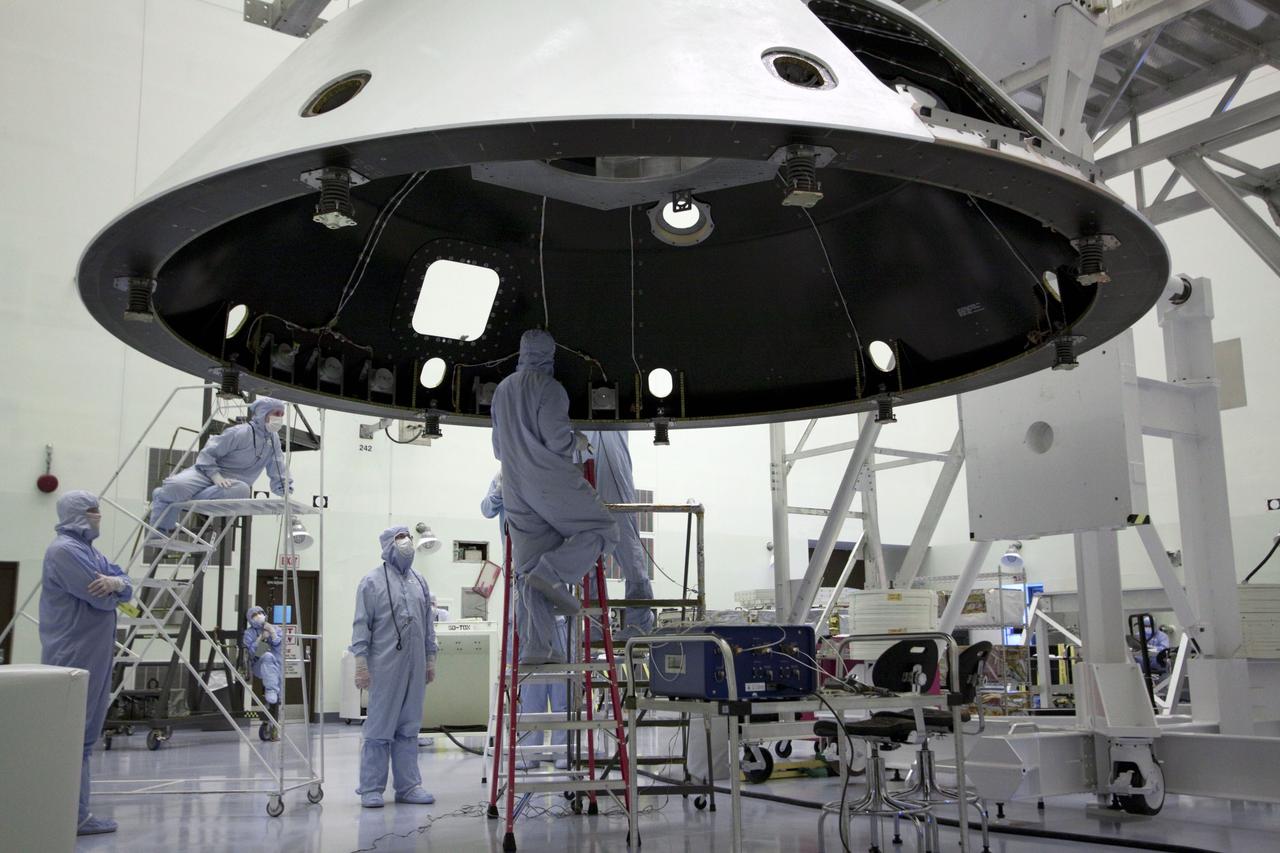
Cape Canaveral, Fla. -- At the Payload Hazardous Servicing Facility at NASA's Kennedy Space Center in Florida, technicians process the backshell for NASA's Mars Science Laboratory (MSL). The backshell carries the parachute and several components used during later stages of entry, descent and landing, and is one part of the spacecraft's heat shield which, when both are integrated is called an aeroshell. MSL's components include a compact car-sized rover, Curiosity, which has 10 science instruments designed to search for evidence on whether Mars has had environments favorable to microbial life, including chemical ingredients for life. The unique rover will use a laser to look inside rocks and release its gasses so that the rover’s spectrometer can analyze and send the data back to Earth. Launch of MSL aboard a United Launch Alliance Atlas V rocket is scheduled for Nov. 25 from Space Launch Complex 41 on Cape Canaveral Air Force Station in Florida. For more information, visit http://www.nasa.gov/msl. Photo credit: NASA/Jack Pfaller
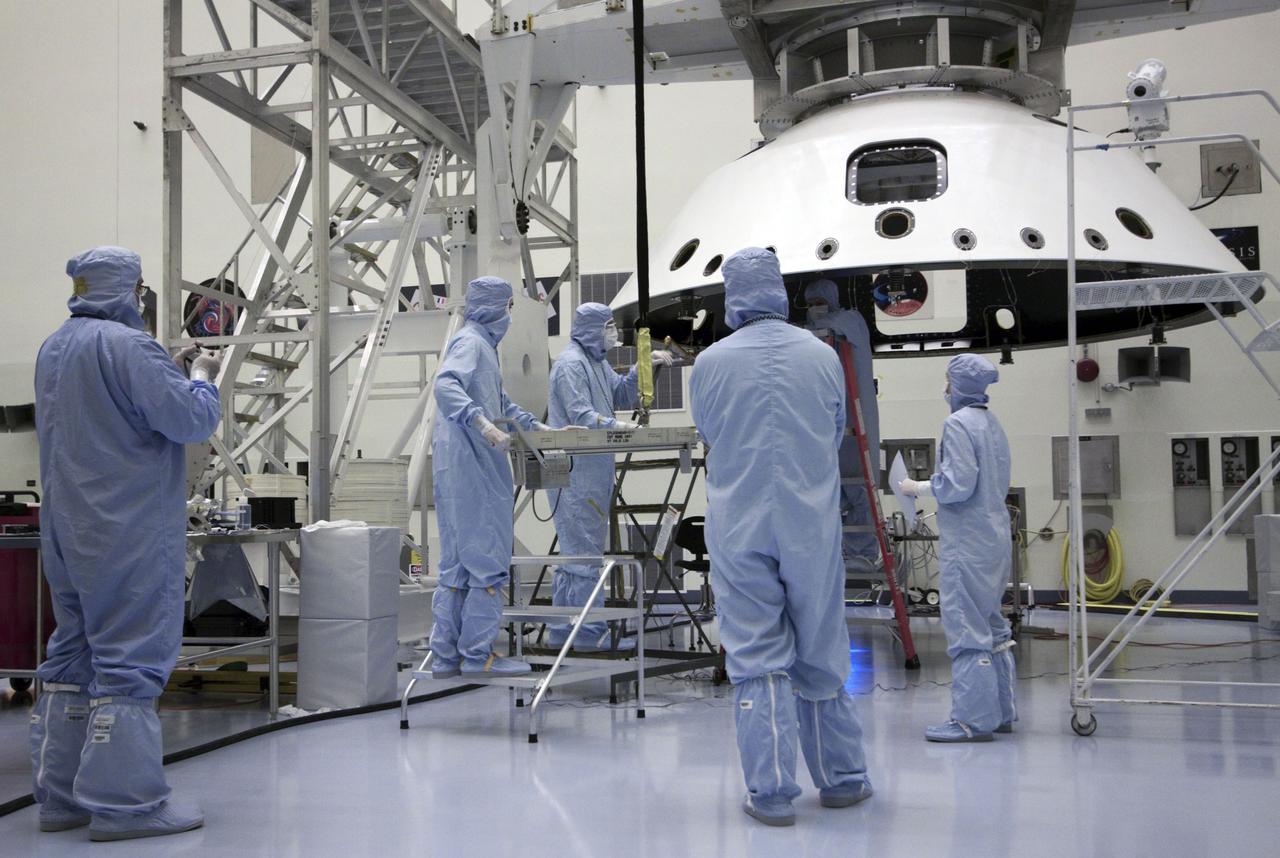
Cape Canaveral, Fla. -- At the Payload Hazardous Servicing Facility at NASA's Kennedy Space Center in Florida, technicians process the backshell for NASA's Mars Science Laboratory (MSL). The backshell carries the parachute and several components used during later stages of entry, descent and landing, and is one part of the spacecraft's heat shield which, when both are integrated is called an aeroshell. A United Launch Alliance Atlas V-541 configuration will be used to loft MSL into space. Curiosity’s 10 science instruments are designed to search for evidence on whether Mars has had environments favorable to microbial life, including chemical ingredients for life. The unique rover will use a laser to look inside rocks and release its gasses so that the rover’s spectrometer can analyze and send the data back to Earth. MSL is scheduled to launch from Cape Canaveral Air Force Station in Florida Nov. 25 with a window extending to Dec. 18 and arrival at Mars Aug. 2012. For more information, visit http://www.nasa.gov/msl. Photo credit: NASA/Jack Pfaller
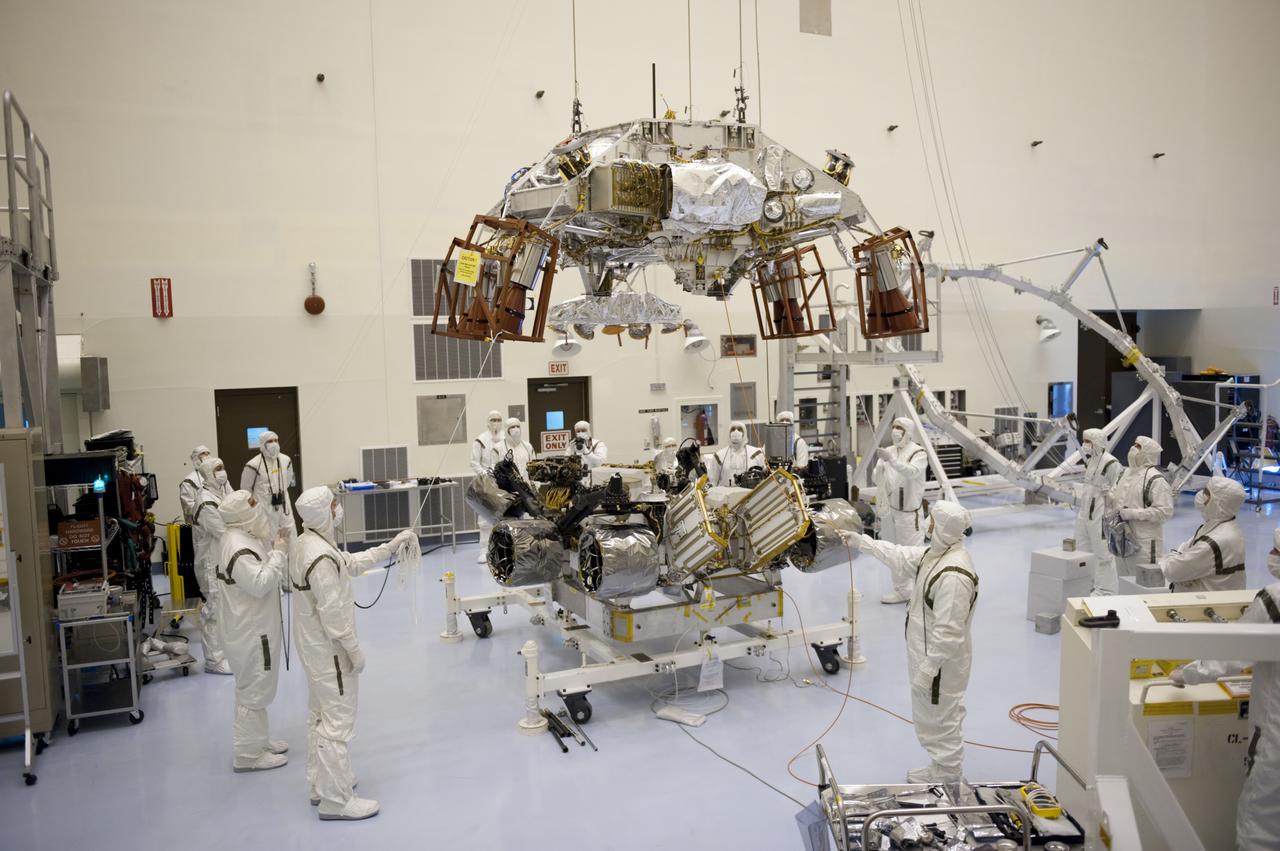
CAPE CANAVERAL, Fla. – Preparing for integration to NASA's Mars Science Laboratory (MSL) rover known as Curiosity, technicians help guide a rocket-powered descent stage over the rover at NASA's Kennedy Space Center Payload Hazardous Servicing Facility. The descent stage will lower Curiosity to the surface of Mars. A United Launch Alliance Atlas V-541 configuration will be used to loft MSL into space. Curiosity’s 10 science instruments are designed to search for evidence on whether Mars has had environments favorable to microbial life, including chemical ingredients for life. The unique rover will use a laser to look inside rocks and release its gasses so that the rover’s spectrometer can analyze and send the data back to Earth. MSL is scheduled to launch Nov. 25 with a window extending to Dec. 18 and arrival at Mars Aug. 2012. For more information, visit http://www.nasa.gov/msl. Photo credit: NASA/Kim Shiflett
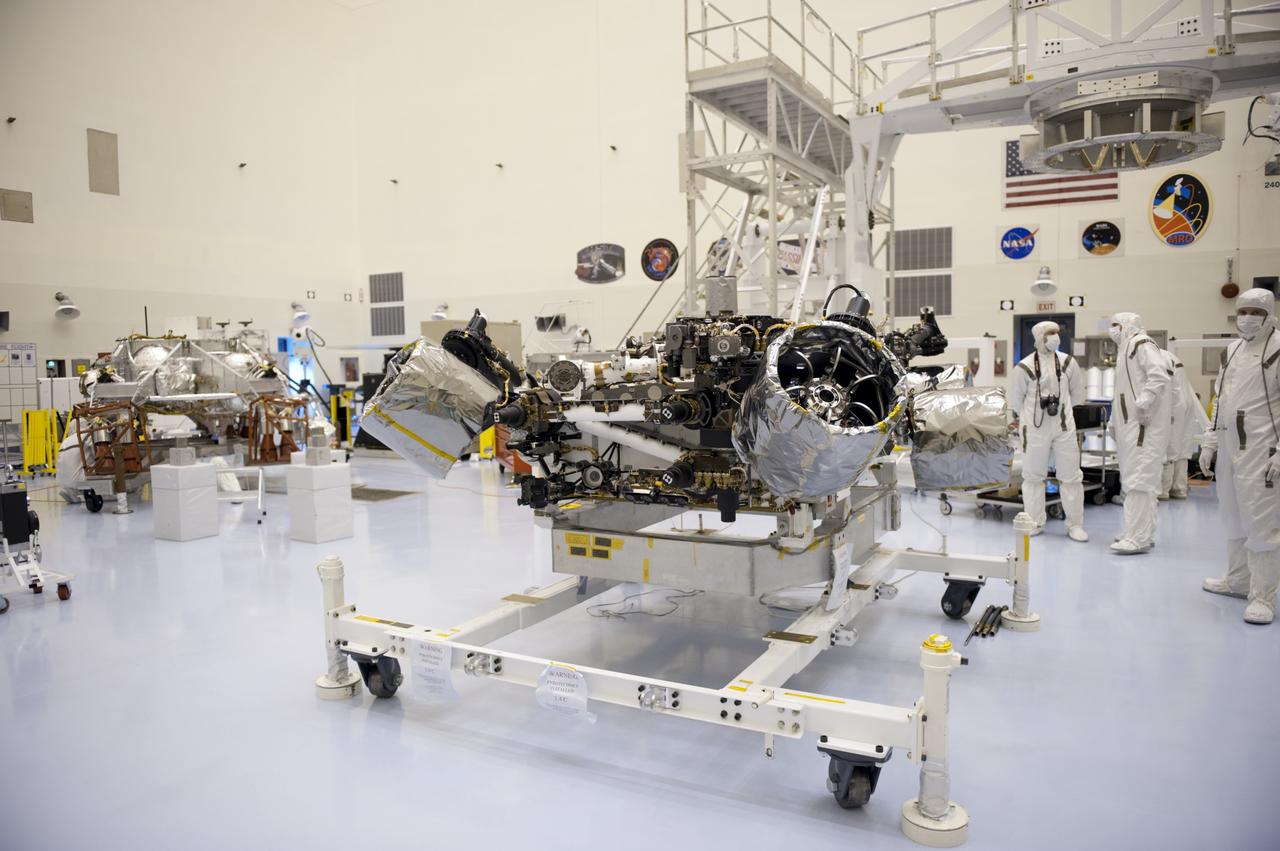
CAPE CANAVERAL, Fla. – At the Payload Hazardous Servicing Facility at NASA’s Kennedy Space Center in Florida, NASA's Mars Science Laboratory (MSL) rover, known as Curiosity, will be integrated with a rocket-powered descent stage (shown here to the left of the rover). The descent stage will lower Curiosity to the surface of Mars. A United Launch Alliance Atlas V-541 configuration will be used to loft MSL into space. Curiosity’s 10 science instruments are designed to search for evidence on whether Mars has had environments favorable to microbial life, including chemical ingredients for life. The unique rover will use a laser to look inside rocks and release its gasses so that the rover’s spectrometer can analyze and send the data back to Earth. MSL is scheduled to launch Nov. 25 with a window extending to Dec. 18 and arrival at Mars Aug. 2012. For more information, visit http://www.nasa.gov/msl. Photo credit: NASA/Kim Shiflett
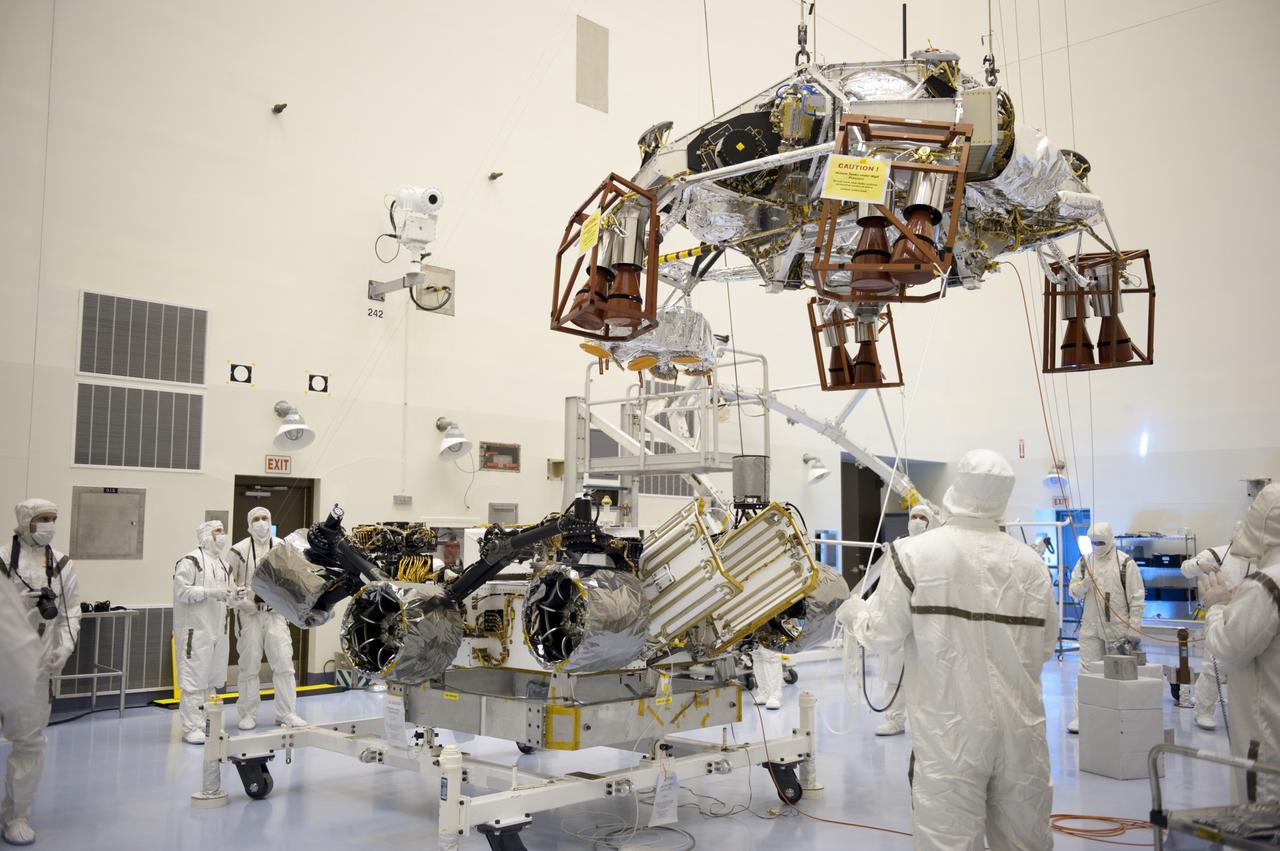
CAPE CANAVERAL, Fla. – Preparing for integration to NASA's Mars Science Laboratory (MSL) rover known as Curiosity, technicians help guide a rocket-powered descent stage over the rover at NASA's Kennedy Space Center Payload Hazardous Servicing Facility. The descent stage will lower Curiosity to the surface of Mars. A United Launch Alliance Atlas V-541 configuration will be used to loft MSL into space. Curiosity’s 10 science instruments are designed to search for evidence on whether Mars has had environments favorable to microbial life, including chemical ingredients for life. The unique rover will use a laser to look inside rocks and release its gasses so that the rover’s spectrometer can analyze and send the data back to Earth. MSL is scheduled to launch Nov. 25 with a window extending to Dec. 18 and arrival at Mars Aug. 2012. For more information, visit http://www.nasa.gov/msl. Photo credit: NASA/Kim Shiflett
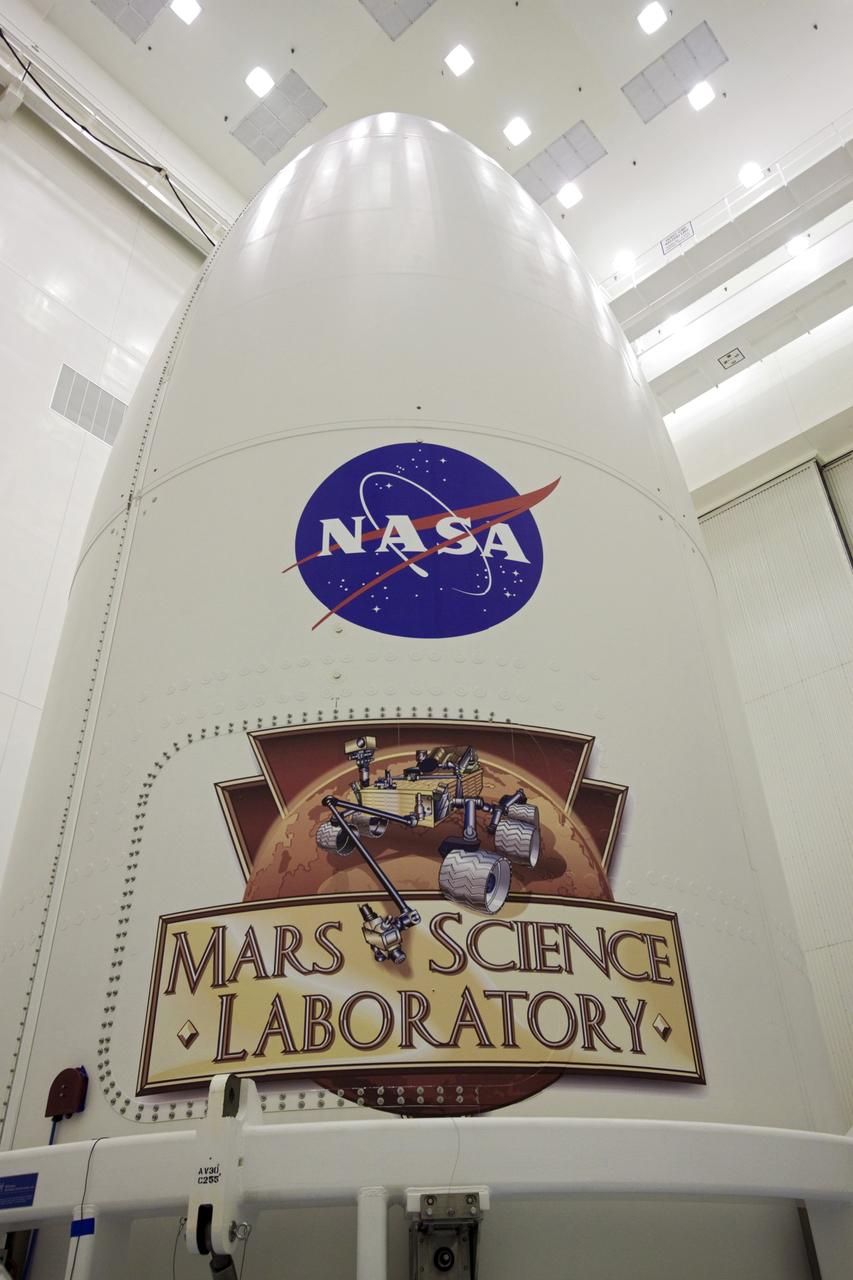
CAPE CANAVERAL, Fla. -- In the Payload Hazardous Servicing Facility at NASA's Kennedy Space Center in Florida, an Atlas V rocket's payload fairing bears the NASA logo above the Mars Science Laboratory (MSL) logo, depicting the mission's compact car-sized rover, Curiosity. Tucked inside the fairing is the MSL spacecraft, including Curiosity, which has 10 science instruments designed to search for evidence on whether Mars has had environments favorable to microbial life, including the chemical ingredients for life. The unique rover will use a laser to look inside rocks and release its gasses so that the rover’s spectrometer can analyze and send the data back to Earth. Launch of MSL aboard a United Launch Alliance Atlas V rocket is planned for Nov. 25 from Space Launch Complex-41 on Cape Canaveral Air Force Station. For more information, visit http://www.nasa.gov/msl. Photo credit: NASA/Jim Grossmann
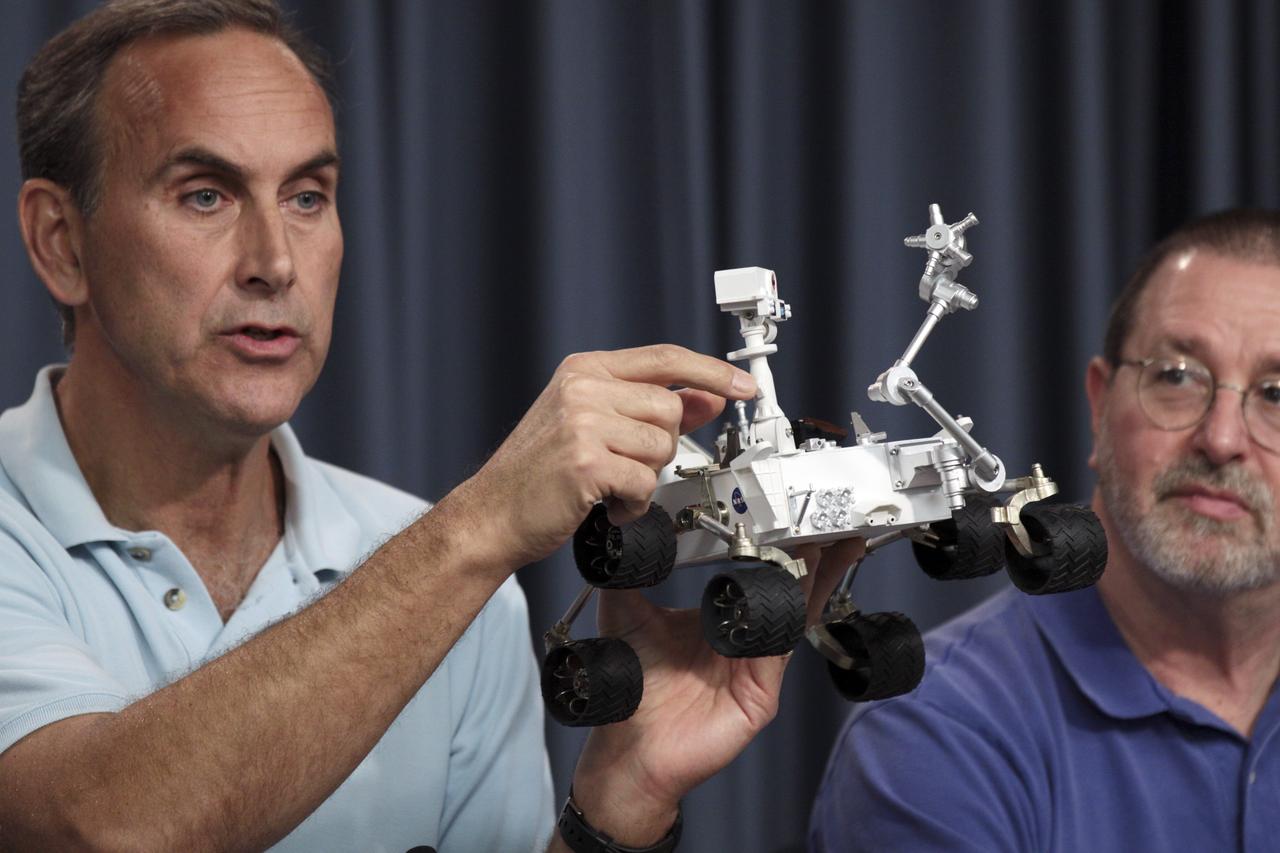
CAPE CANAVERAL, Fla. – John Grotzinger, project scientist for Mars Science Laboratory (MSL) at the California Institute of Technology in Pasadena, Calif., demonstrates the operation of MSL's rover, Curiosity, during a science briefing at NASA's Kennedy Space Center in Florida, part of preflight activities for the MSL mission. Michael Malin, principal investigator for the Mast Camera and Mars Descent Imager investigations on Curiosity from Malin Space Science Systems, looks on at right. MSL’s components include a car-sized rover, Curiosity, which has 10 science instruments designed to search for signs of life, including methane, and help determine if the gas is from a biological or geological source. Launch of MSL aboard a United Launch Alliance Atlas V rocket is scheduled for Nov. 26 from Space Launch Complex 41 on Cape Canaveral Air Force Station in Florida. For more information, visit http://www.nasa.gov/msl. Photo credit: NASA/Kim Shiflett
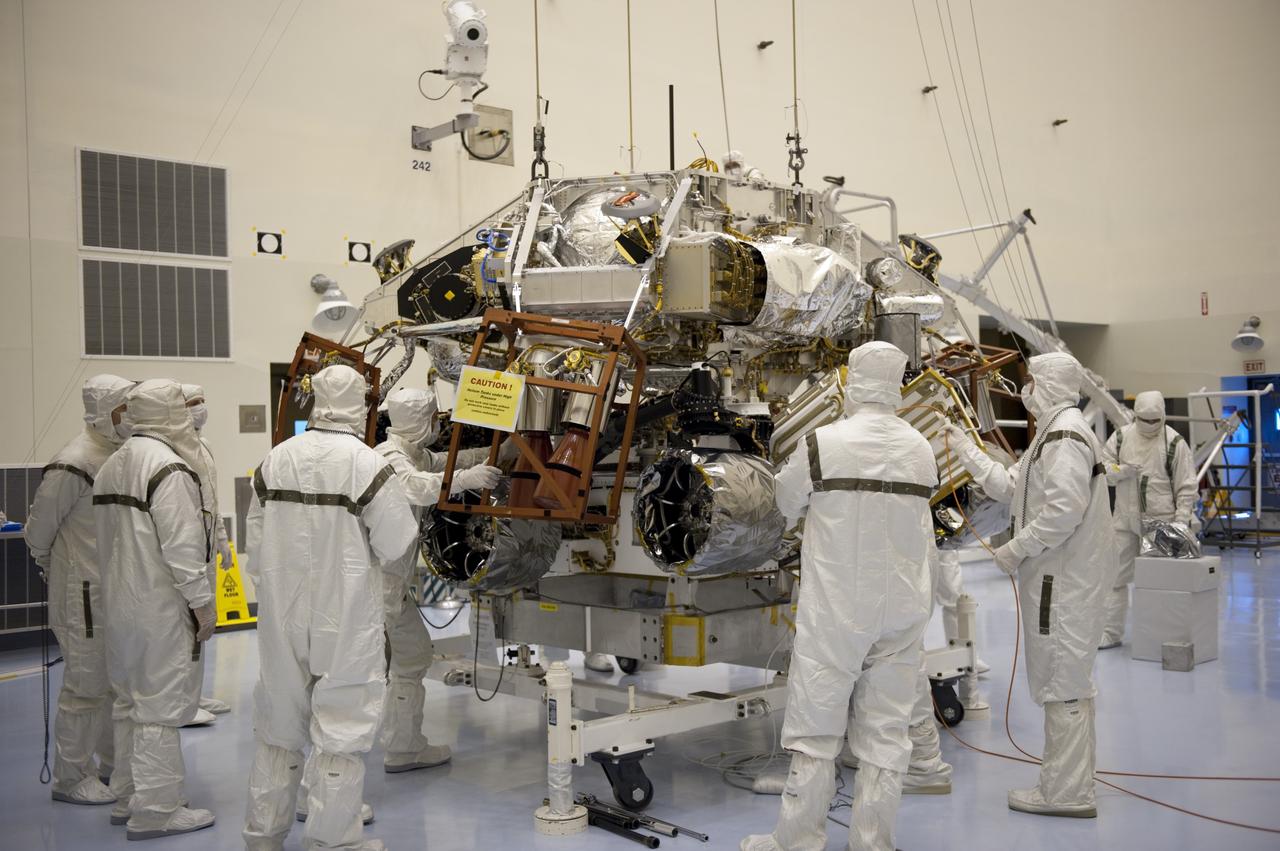
CAPE CANAVERAL, Fla. – Under the watchful eyes of technicians at the Payload Hazardous Servicing Facility at NASA's Kennedy Space Center in Florida, a rocket-powered descent stage, after being lowered by an overhead crane, is integrated with NASA's Mars Science Laboratory (MSL) rover, known as Curiosity. The descent stage will lower Curiosity to the surface of Mars. A United Launch Alliance Atlas V-541 configuration will be used to loft MSL into space. Curiosity’s 10 science instruments are designed to search for evidence on whether Mars has had environments favorable to microbial life, including chemical ingredients for life. The unique rover will use a laser to look inside rocks and release its gasses so that the rover’s spectrometer can analyze and send the data back to Earth. MSL is scheduled to launch Nov. 25 with a window extending to Dec. 18 and arrival at Mars Aug. 2012. For more information, visit http://www.nasa.gov/msl. Photo credit: NASA/Kim Shiflett

CAPE CANAVERAL, Fla. – Under the watchful eyes of technicians at the Payload Hazardous Servicing Facility at NASA's Kennedy Space Center in Florida, an overhead crane begins lifting a rocket-powered descent stage for integration with NASA's Mars Science Laboratory (MSL) rover, known as Curiosity. The descent stage will lower Curiosity to the surface of Mars. A United Launch Alliance Atlas V-541 configuration will be used to loft MSL into space. Curiosity’s 10 science instruments are designed to search for evidence on whether Mars has had environments favorable to microbial life, including chemical ingredients for life. The unique rover will use a laser to look inside rocks and release its gasses so that the rover’s spectrometer can analyze and send the data back to Earth. MSL is scheduled to launch Nov. 25 with a window extending to Dec. 18 and arrival at Mars Aug. 2012. For more information, visit http://www.nasa.gov/msl. Photo credit: NASA/Kim Shiflett

CAPE CANAVERAL, Fla. – At the Payload Hazardous Servicing Facility at NASA’s Kennedy Space Center in Florida, technicians dressed in clean room attire, known as "bunny" suits, prepare a rocket-powered descent stage for integration with NASA's Mars Science Laboratory (MSL) rover, known as Curiosity. The descent stage will lower Curiosity to the surface of Mars. A United Launch Alliance Atlas V-541 configuration will be used to loft MSL into space. Curiosity’s 10 science instruments are designed to search for evidence on whether Mars has had environments favorable to microbial life, including chemical ingredients for life. The unique rover will use a laser to look inside rocks and release its gasses so that the rover’s spectrometer can analyze and send the data back to Earth. MSL is scheduled to launch Nov. 25 with a window extending to Dec. 18 and arrival at Mars Aug. 2012. For more information, visit http://www.nasa.gov/msl. Photo credit: NASA/Kim Shiflett
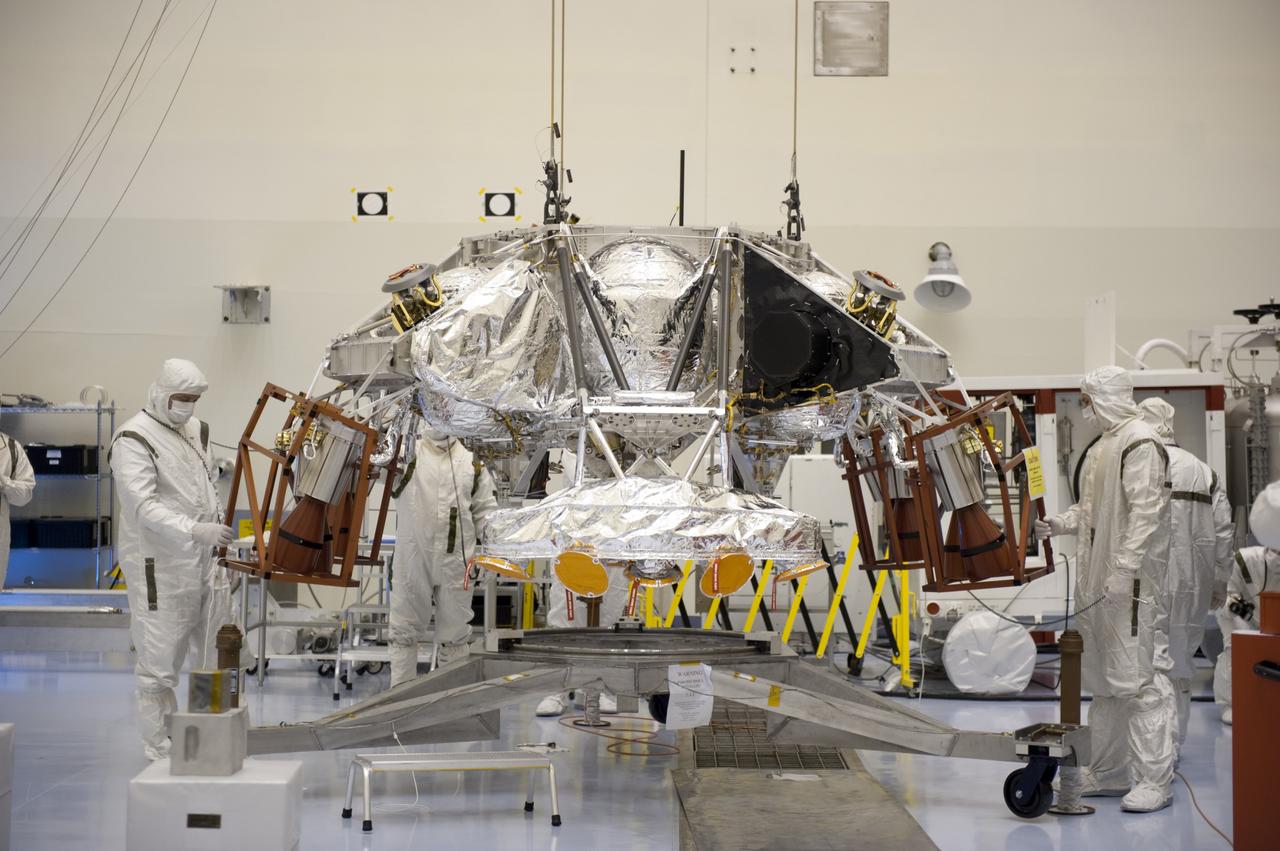
CAPE CANAVERAL, Fla. – At the Payload Hazardous Servicing Facility at NASA’s Kennedy Space Center in Florida, technicians carefully monitor the attachment of an overhead crane to a rocket-powered descent stage which will be integrated with NASA's Mars Science Laboratory (MSL) rover, known as Curiosity. The descent stage will lower Curiosity to the surface of Mars. A United Launch Alliance Atlas V-541 configuration will be used to loft MSL into space. Curiosity’s 10 science instruments are designed to search for evidence on whether Mars has had environments favorable to microbial life, including chemical ingredients for life. The unique rover will use a laser to look inside rocks and release its gasses so that the rover’s spectrometer can analyze and send the data back to Earth. MSL is scheduled to launch Nov. 25 with a window extending to Dec. 18 and arrival at Mars Aug. 2012. For more information, visit http://www.nasa.gov/msl. Photo credit: NASA/Kim Shiflett
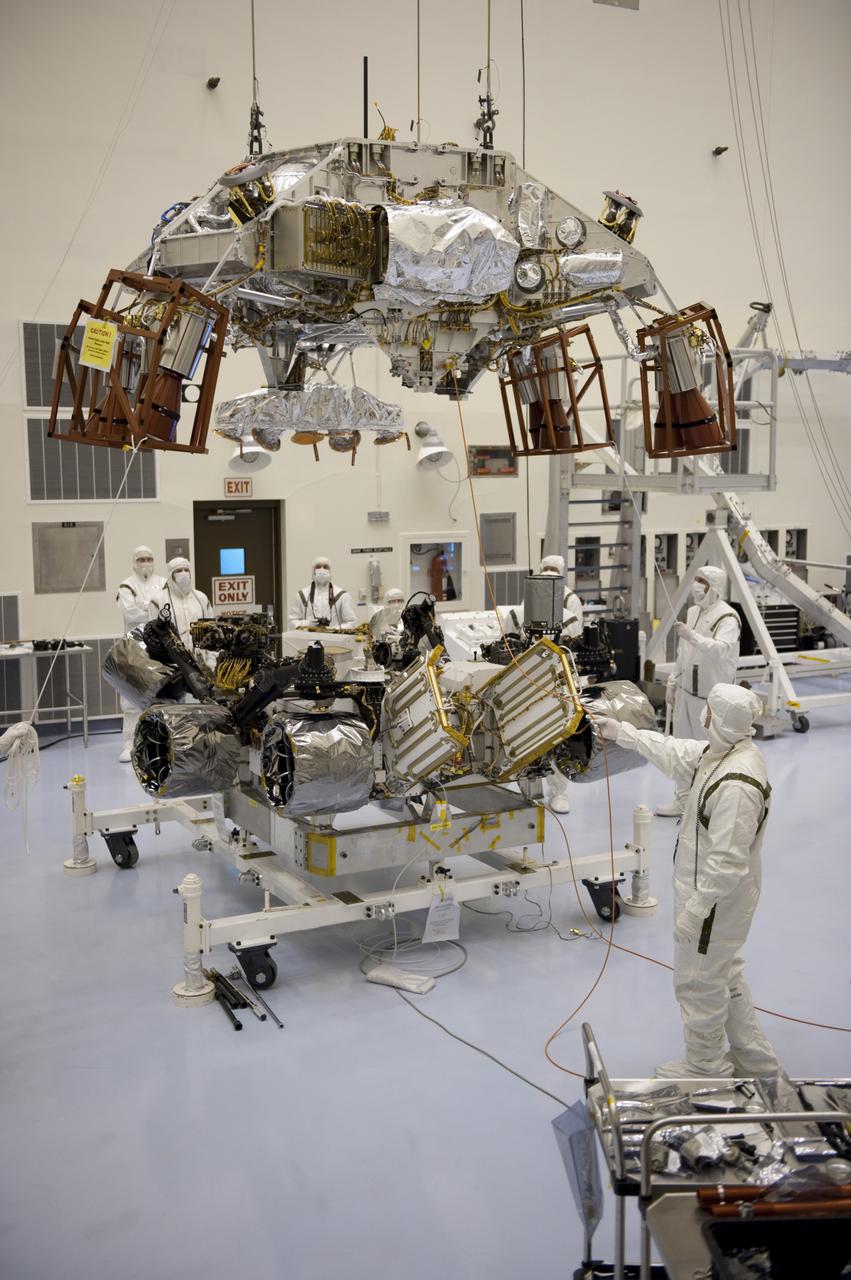
CAPE CANAVERAL, Fla. – Under the watchful eyes of technicians at the Payload Hazardous Servicing Facility at NASA's Kennedy Space Center in Florida, an overhead crane lowers a rocket-powered descent stage over NASA's Mars Science Laboratory (MSL) rover, known as Curiosity, for integration. The descent stage will lower Curiosity to the surface of Mars. A United Launch Alliance Atlas V-541 configuration will be used to loft MSL into space. Curiosity’s 10 science instruments are designed to search for evidence on whether Mars has had environments favorable to microbial life, including chemical ingredients for life. The unique rover will use a laser to look inside rocks and release its gasses so that the rover’s spectrometer can analyze and send the data back to Earth. MSL is scheduled to launch Nov. 25 with a window extending to Dec. 18 and arrival at Mars Aug. 2012. For more information, visit http://www.nasa.gov/msl. Photo credit: NASA/Kim Shiflett
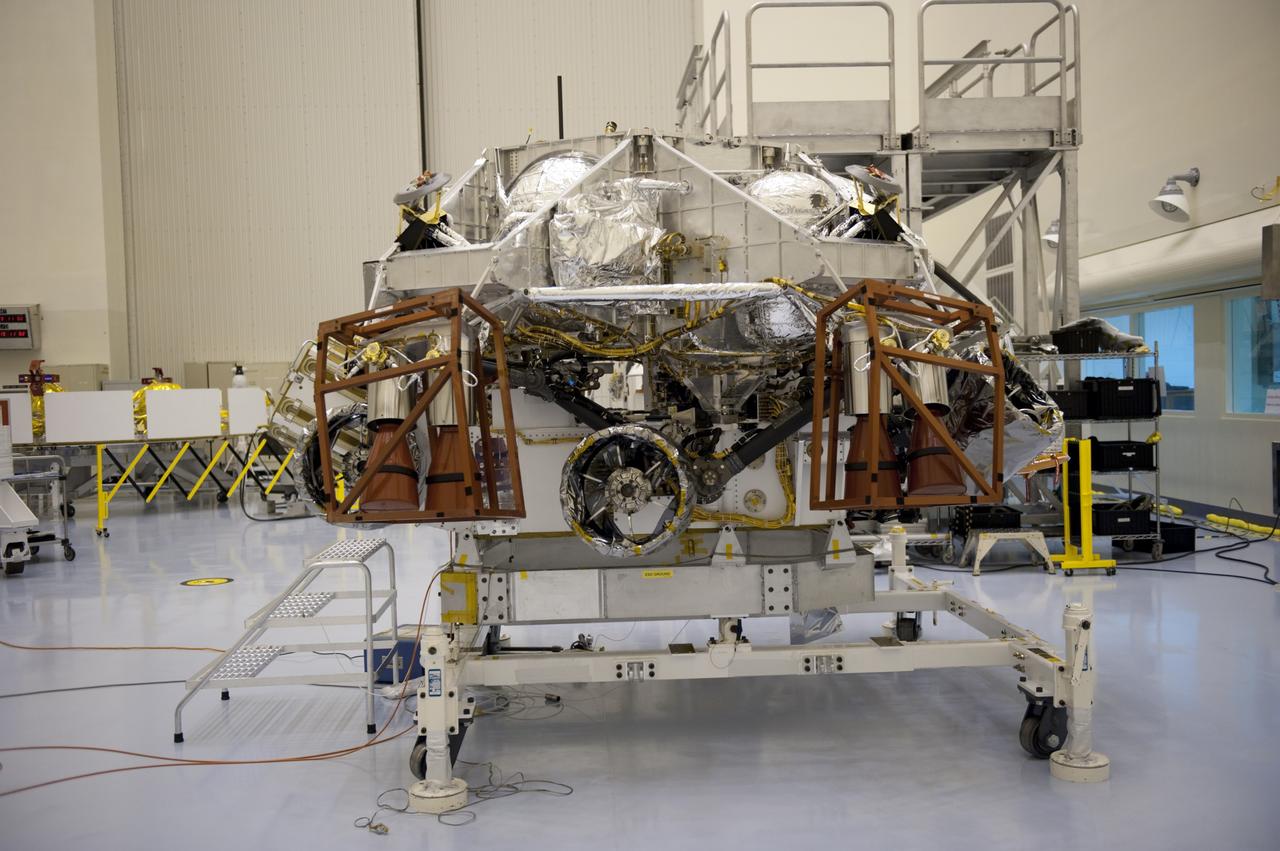
CAPE CANAVERAL, Fla. – At the Payload Hazardous Servicing Facility at NASA’s Kennedy Space Center in Florida, integration between a rocket-powered descent stage and NASA's Mars Science Laboratory (MSL) rover, known as Curiosity, is complete. The descent stage will lower Curiosity to the surface of Mars. A United Launch Alliance Atlas V-541 configuration will be used to loft MSL into space. Curiosity’s 10 science instruments are designed to search for evidence on whether Mars has had environments favorable to microbial life, including chemical ingredients for life. The unique rover will use a laser to look inside rocks and release its gasses so that the rover’s spectrometer can analyze and send the data back to Earth. MSL is scheduled to launch Nov. 25 with a window extending to Dec. 18 and arrival at Mars Aug. 2012. For more information, visit http://www.nasa.gov/msl. Photo credit: NASA/Kim Shiflett
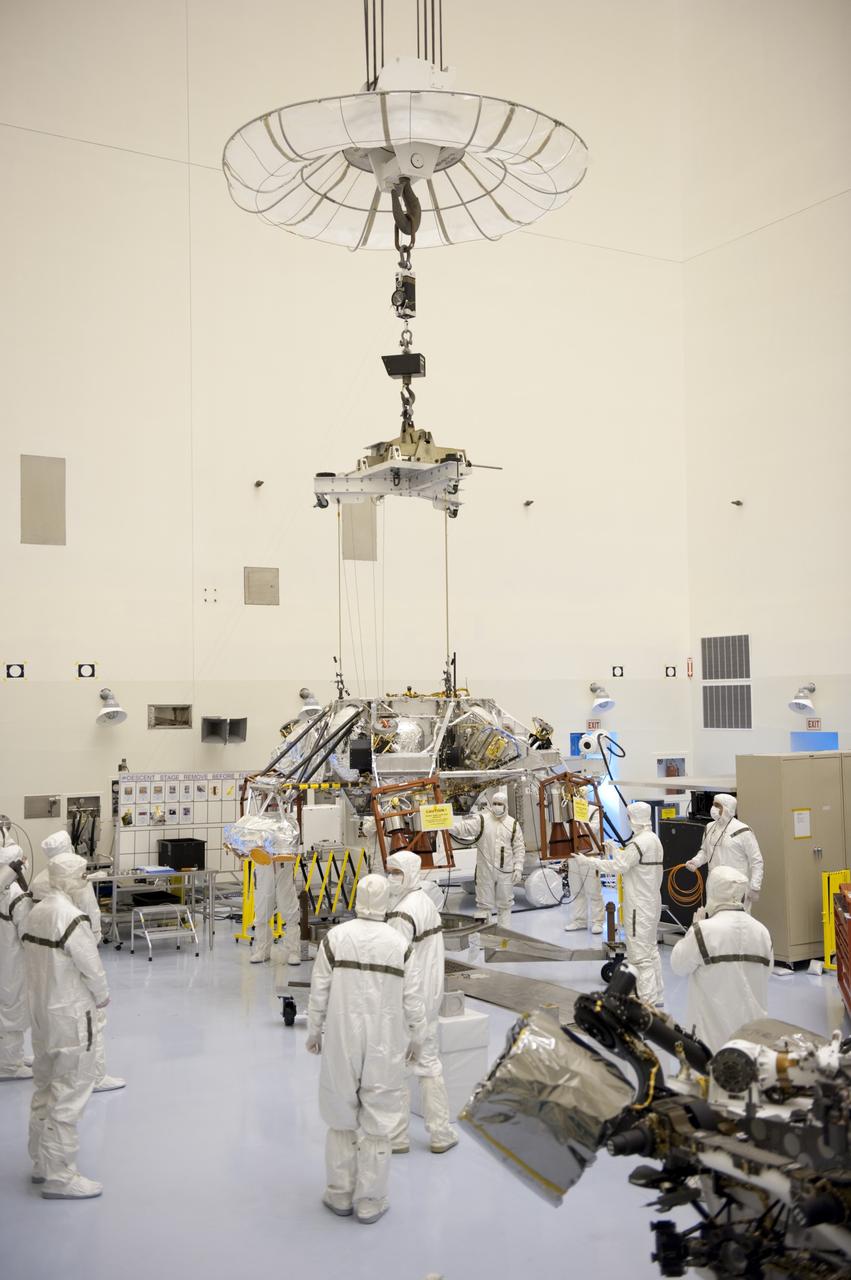
CAPE CANAVERAL, Fla. – Technicians, at the Payload Hazardous Servicing Facility at NASA's Kennedy Space Center in Florida, use an overhead crane to move a rocket-powered descent stage for integration with NASA's Mars Science Laboratory (MSL) rover, known as Curiosity. The descent stage will lower Curiosity to the surface of Mars. A United Launch Alliance Atlas V-541 configuration will be used to loft MSL into space. Curiosity’s 10 science instruments are designed to search for evidence on whether Mars has had environments favorable to microbial life, including chemical ingredients for life. The unique rover will use a laser to look inside rocks and release its gasses so that the rover’s spectrometer can analyze and send the data back to Earth. MSL is scheduled to launch Nov. 25 with a window extending to Dec. 18 and arrival at Mars Aug. 2012. For more information, visit http://www.nasa.gov/msl. Photo credit: NASA/Kim Shiflett
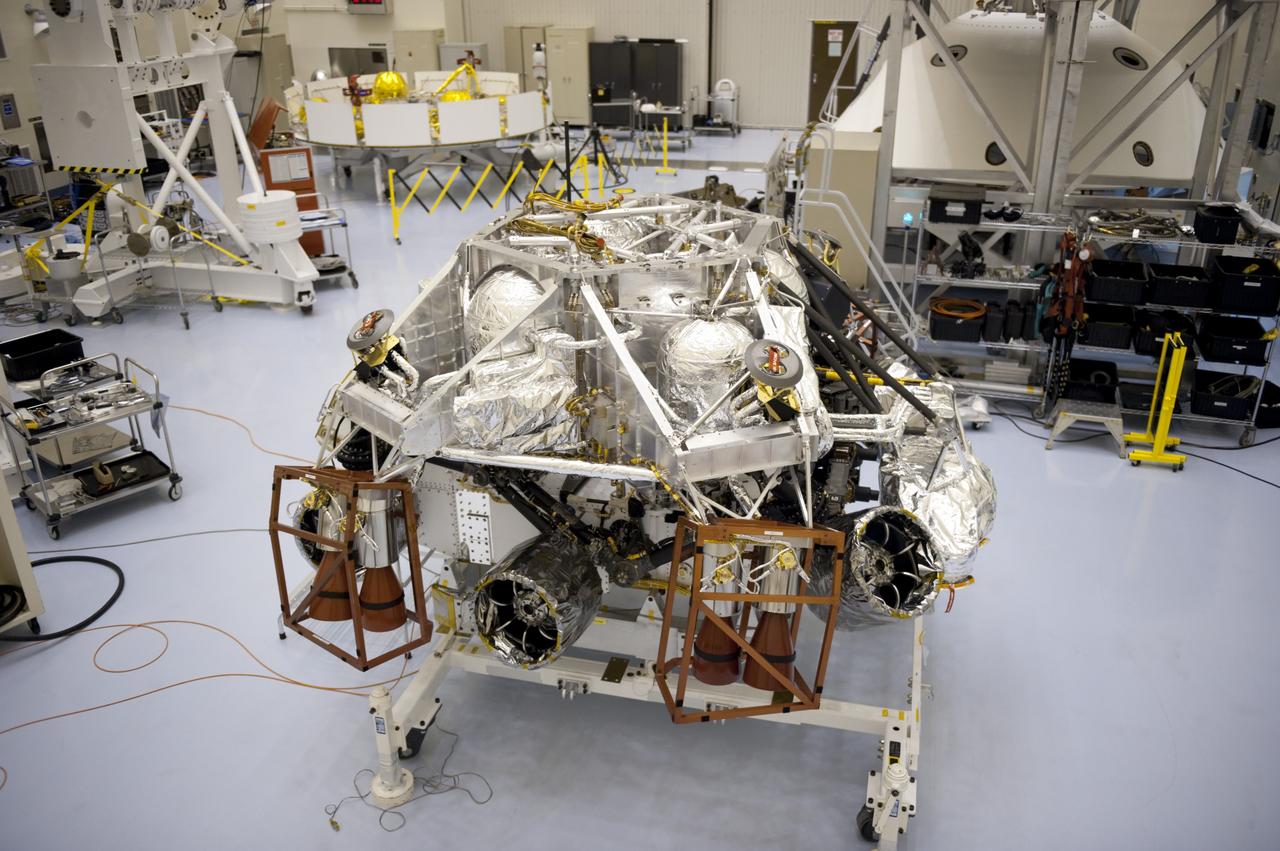
CAPE CANAVERAL, Fla. – At the Payload Hazardous Servicing Facility at NASA’s Kennedy Space Center in Florida, integration between a rocket-powered descent stage and NASA's Mars Science Laboratory (MSL) rover, known as Curiosity, is complete. The descent stage will lower Curiosity to the surface of Mars. A United Launch Alliance Atlas V-541 configuration will be used to loft MSL into space. Curiosity’s 10 science instruments are designed to search for evidence on whether Mars has had environments favorable to microbial life, including chemical ingredients for life. The unique rover will use a laser to look inside rocks and release its gasses so that the rover’s spectrometer can analyze and send the data back to Earth. MSL is scheduled to launch Nov. 25 with a window extending to Dec. 18 and arrival at Mars Aug. 2012. For more information, visit http://www.nasa.gov/msl. Photo credit: NASA/Kim Shiflett
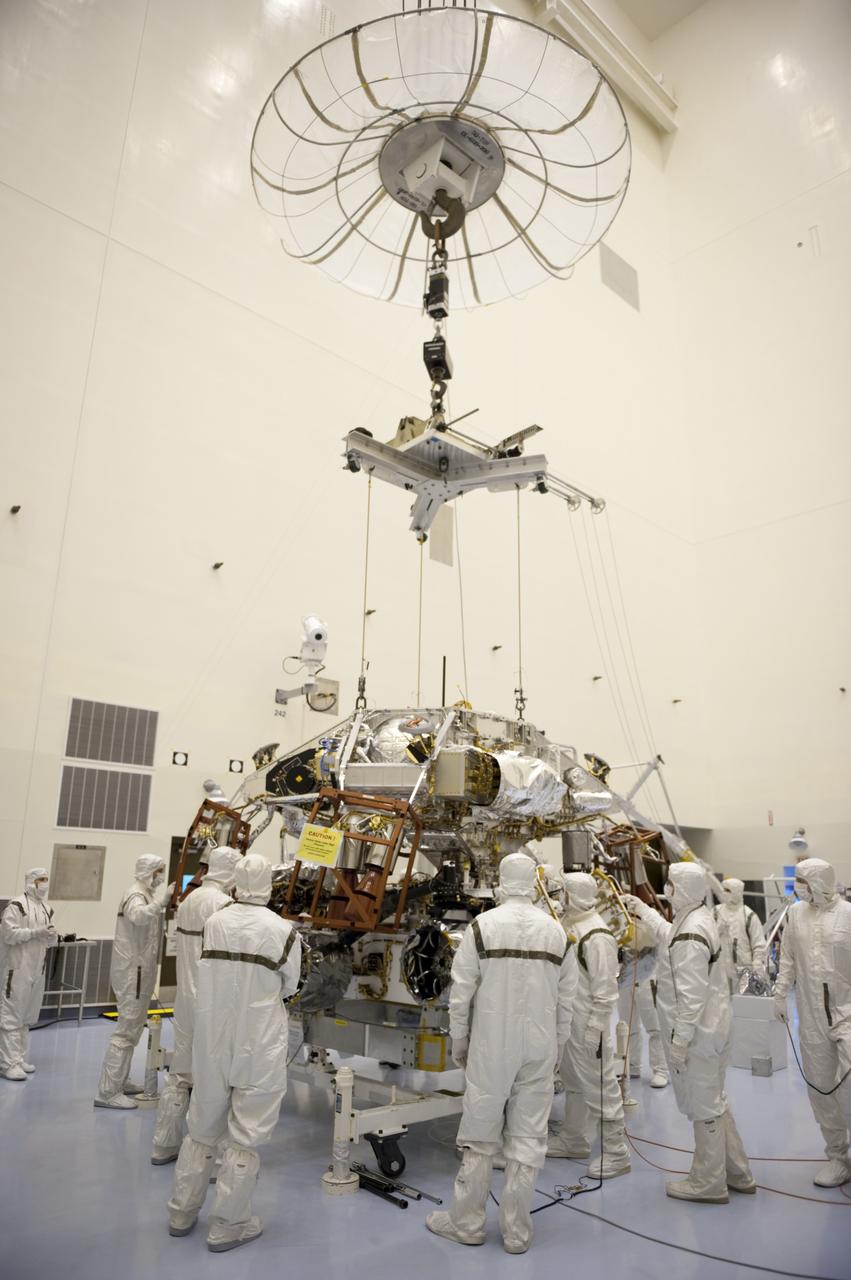
CAPE CANAVERAL, Fla. – Under the watchful eyes of technicians at the Payload Hazardous Servicing Facility at NASA's Kennedy Space Center in Florida, a rocket-powered descent stage, after being lowered by an overhead crane, is integrated with NASA's Mars Science Laboratory (MSL) rover, known as Curiosity. The descent stage will lower Curiosity to the surface of Mars. A United Launch Alliance Atlas V-541 configuration will be used to loft MSL into space. Curiosity’s 10 science instruments are designed to search for evidence on whether Mars has had environments favorable to microbial life, including chemical ingredients for life. The unique rover will use a laser to look inside rocks and release its gasses so that the rover’s spectrometer can analyze and send the data back to Earth. MSL is scheduled to launch Nov. 25 with a window extending to Dec. 18 and arrival at Mars Aug. 2012. For more information, visit http://www.nasa.gov/msl. Photo credit: NASA/Kim Shiflett

CAPE CANAVERAL, Fla. – At the Payload Hazardous Servicing Facility at NASA’s Kennedy Space Center in Florida, integration between a rocket-powered descent stage and NASA's Mars Science Laboratory (MSL) rover, known as Curiosity, is complete. The descent stage will lower Curiosity to the surface of Mars. A United Launch Alliance Atlas V-541 configuration will be used to loft MSL into space. Curiosity’s 10 science instruments are designed to search for evidence on whether Mars has had environments favorable to microbial life, including chemical ingredients for life. The unique rover will use a laser to look inside rocks and release its gasses so that the rover’s spectrometer can analyze and send the data back to Earth. MSL is scheduled to launch Nov. 25 with a window extending to Dec. 18 and arrival at Mars Aug. 2012. For more information, visit http://www.nasa.gov/msl. Photo credit: NASA/Kim Shiflett
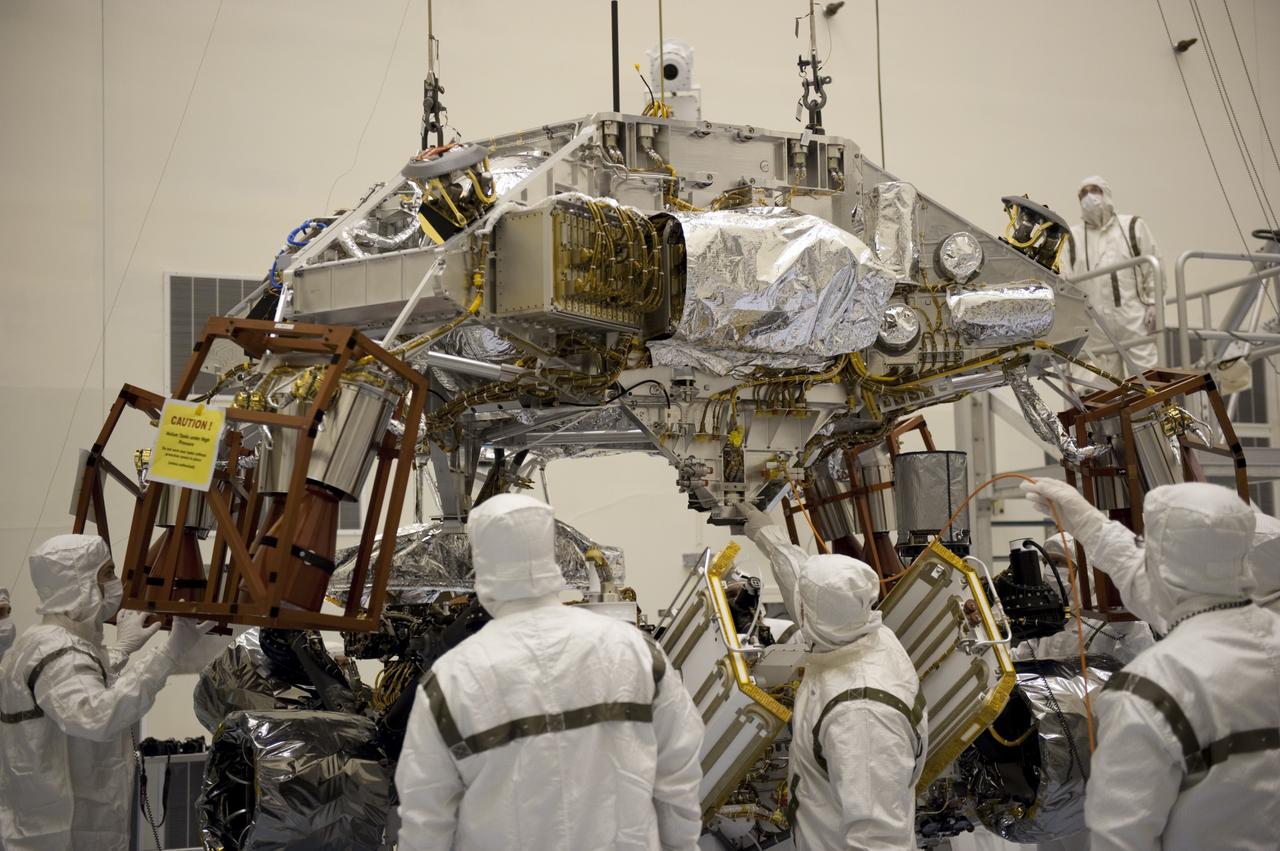
CAPE CANAVERAL, Fla. – Technicians at the Payload Hazardous Servicing Facility at NASA's Kennedy Space Center in Florida, guide an overhead crane as it lowers a rocket-powered descent stage over NASA's Mars Science Laboratory (MSL) rover, known as Curiosity, for integration. The descent stage will lower Curiosity to the surface of Mars. A United Launch Alliance Atlas V-541 configuration will be used to loft MSL into space. Curiosity’s 10 science instruments are designed to search for evidence on whether Mars has had environments favorable to microbial life, including chemical ingredients for life. The unique rover will use a laser to look inside rocks and release its gasses so that the rover’s spectrometer can analyze and send the data back to Earth. MSL is scheduled to launch Nov. 25 with a window extending to Dec. 18 and arrival at Mars Aug. 2012. For more information, visit http://www.nasa.gov/msl. Photo credit: NASA/Kim Shiflett
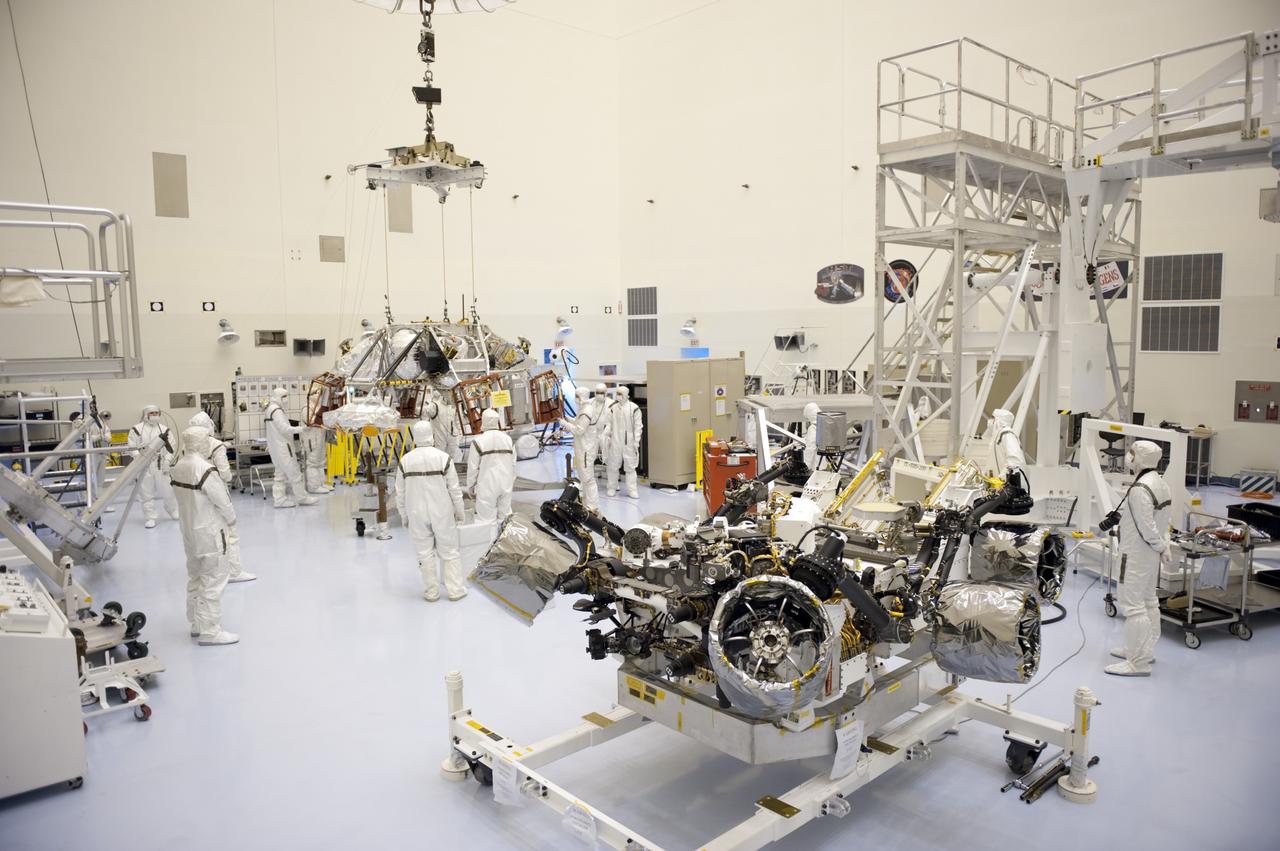
CAPE CANAVERAL, Fla. – At the Payload Hazardous Servicing Facility at NASA’s Kennedy Space Center in Florida, technicians carefully monitor the attachment of an overhead crane to a rocket-powered descent stage which will be integrated with NASA's Mars Science Laboratory (MSL) rover, known as Curiosity (in the foreground). The descent stage will lower Curiosity to the surface of Mars. A United Launch Alliance Atlas V-541 configuration will be used to loft MSL into space. Curiosity’s 10 science instruments are designed to search for evidence on whether Mars has had environments favorable to microbial life, including chemical ingredients for life. The unique rover will use a laser to look inside rocks and release its gasses so that the rover’s spectrometer can analyze and send the data back to Earth. MSL is scheduled to launch Nov. 25 with a window extending to Dec. 18 and arrival at Mars Aug. 2012. For more information, visit http://www.nasa.gov/msl. Photo credit: NASA/Kim Shiflett
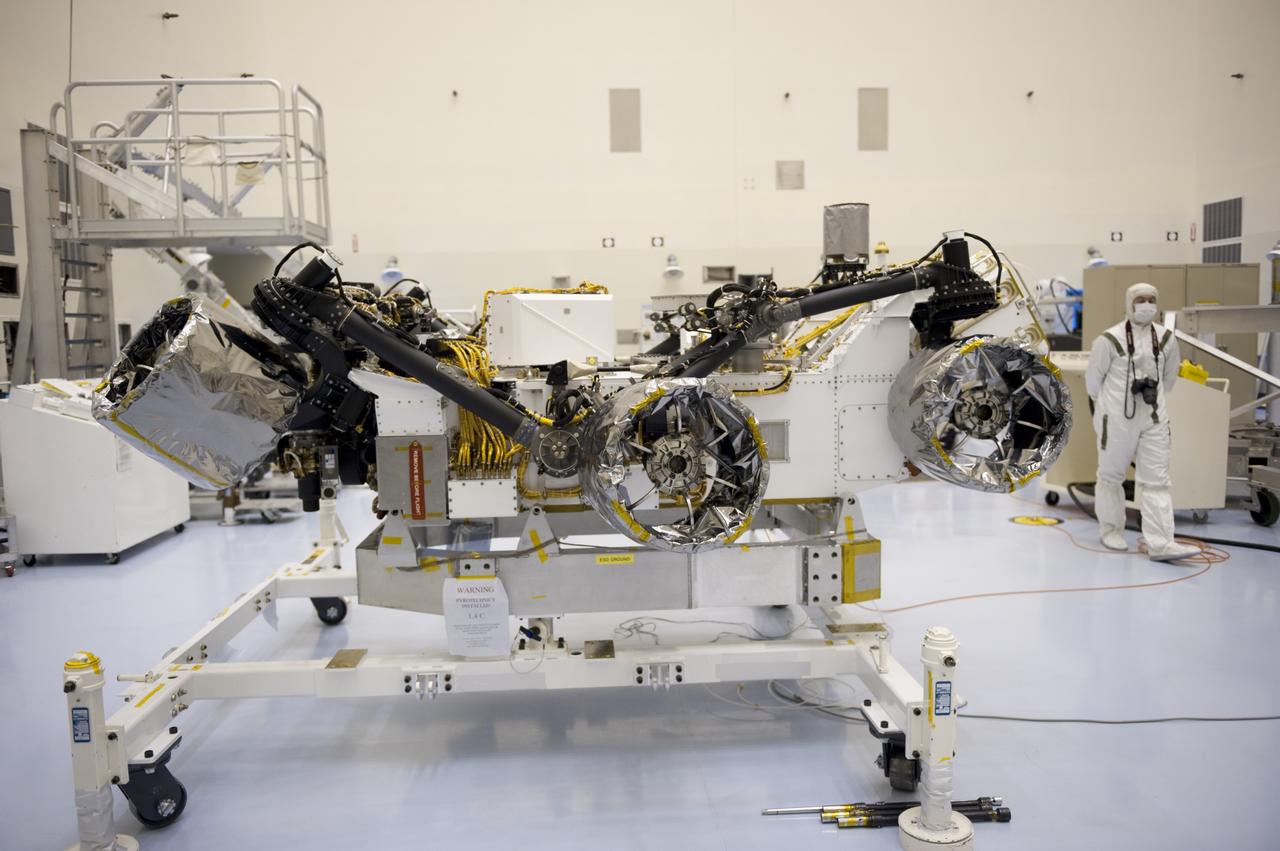
CAPE CANAVERAL, Fla. – At the Payload Hazardous Servicing Facility at NASA’s Kennedy Space Center in Florida, integration between a rocket-powered descent stage and NASA's Mars Science Laboratory (MSL) rover, known as Curiosity, is complete. The descent stage will lower Curiosity to the surface of Mars. A United Launch Alliance Atlas V-541 configuration will be used to loft MSL into space. Curiosity’s 10 science instruments are designed to search for evidence on whether Mars has had environments favorable to microbial life, including chemical ingredients for life. The unique rover will use a laser to look inside rocks and release its gasses so that the rover’s spectrometer can analyze and send the data back to Earth. MSL is scheduled to launch Nov. 25 with a window extending to Dec. 18 and arrival at Mars Aug. 2012. For more information, visit http://www.nasa.gov/msl. Photo credit: NASA/Kim Shiflett

CAPE CANAVERAL, Fla. – At the Payload Hazardous Servicing Facility at NASA’s Kennedy Space Center in Florida, integration between a rocket-powered descent stage and NASA's Mars Science Laboratory (MSL) rover, known as Curiosity, is complete. The descent stage will lower Curiosity to the surface of Mars. A United Launch Alliance Atlas V-541 configuration will be used to loft MSL into space. Curiosity’s 10 science instruments are designed to search for evidence on whether Mars has had environments favorable to microbial life, including chemical ingredients for life. The unique rover will use a laser to look inside rocks and release its gasses so that the rover’s spectrometer can analyze and send the data back to Earth. MSL is scheduled to launch Nov. 25 with a window extending to Dec. 18 and arrival at Mars Aug. 2012. For more information, visit http://www.nasa.gov/msl. Photo credit: NASA/Kim Shiflett
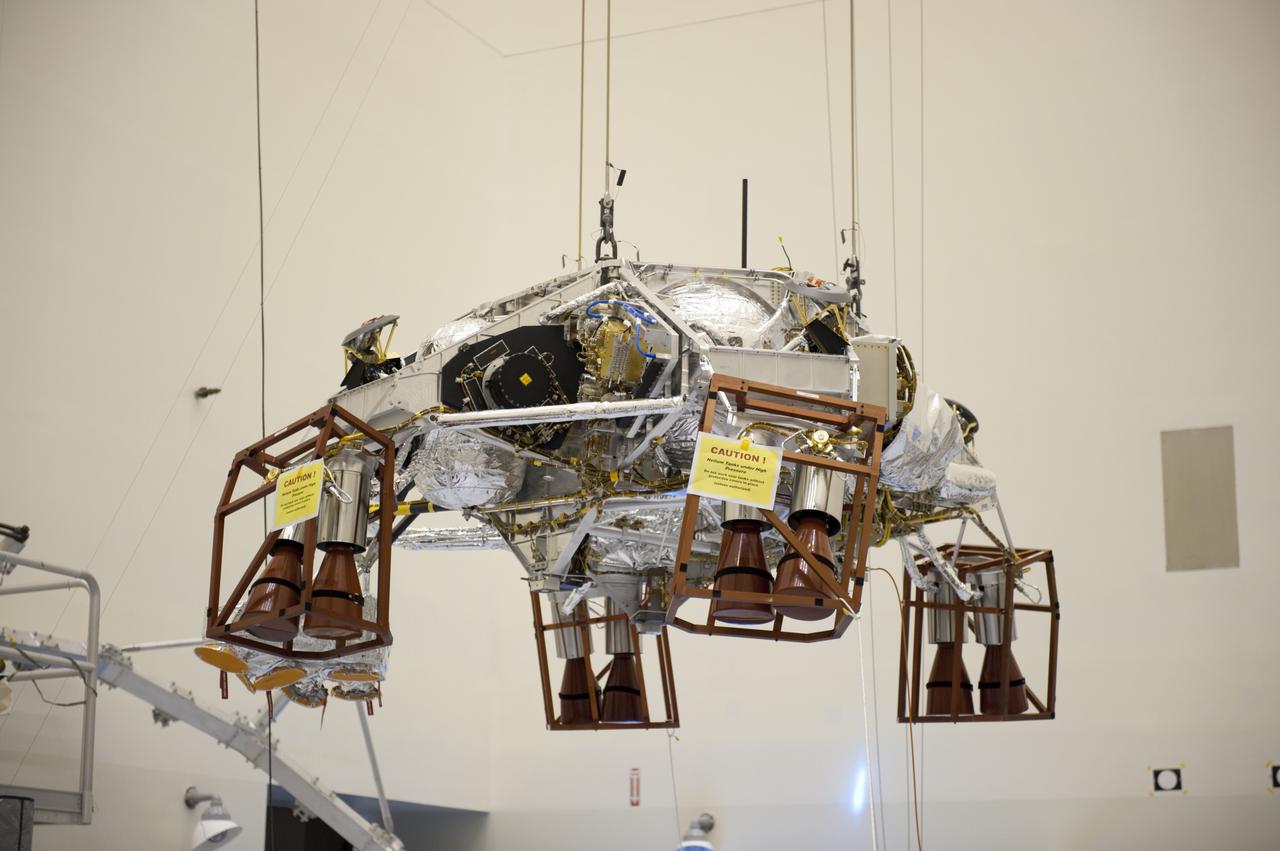
CAPE CANAVERAL, Fla. – At the Payload Hazardous Servicing Facility at NASA's Kennedy Space Center in Florida, an overhead crane lifts a rocket-powered descent stage for integration with NASA's Mars Science Laboratory (MSL) rover, known as Curiosity. The descent stage will lower Curiosity to the surface of Mars. A United Launch Alliance Atlas V-541 configuration will be used to loft MSL into space. Curiosity’s 10 science instruments are designed to search for evidence on whether Mars has had environments favorable to microbial life, including chemical ingredients for life. The unique rover will use a laser to look inside rocks and release its gasses so that the rover’s spectrometer can analyze and send the data back to Earth. MSL is scheduled to launch Nov. 25 with a window extending to Dec. 18 and arrival at Mars Aug. 2012. For more information, visit http://www.nasa.gov/msl. Photo credit: NASA/Kim Shiflett
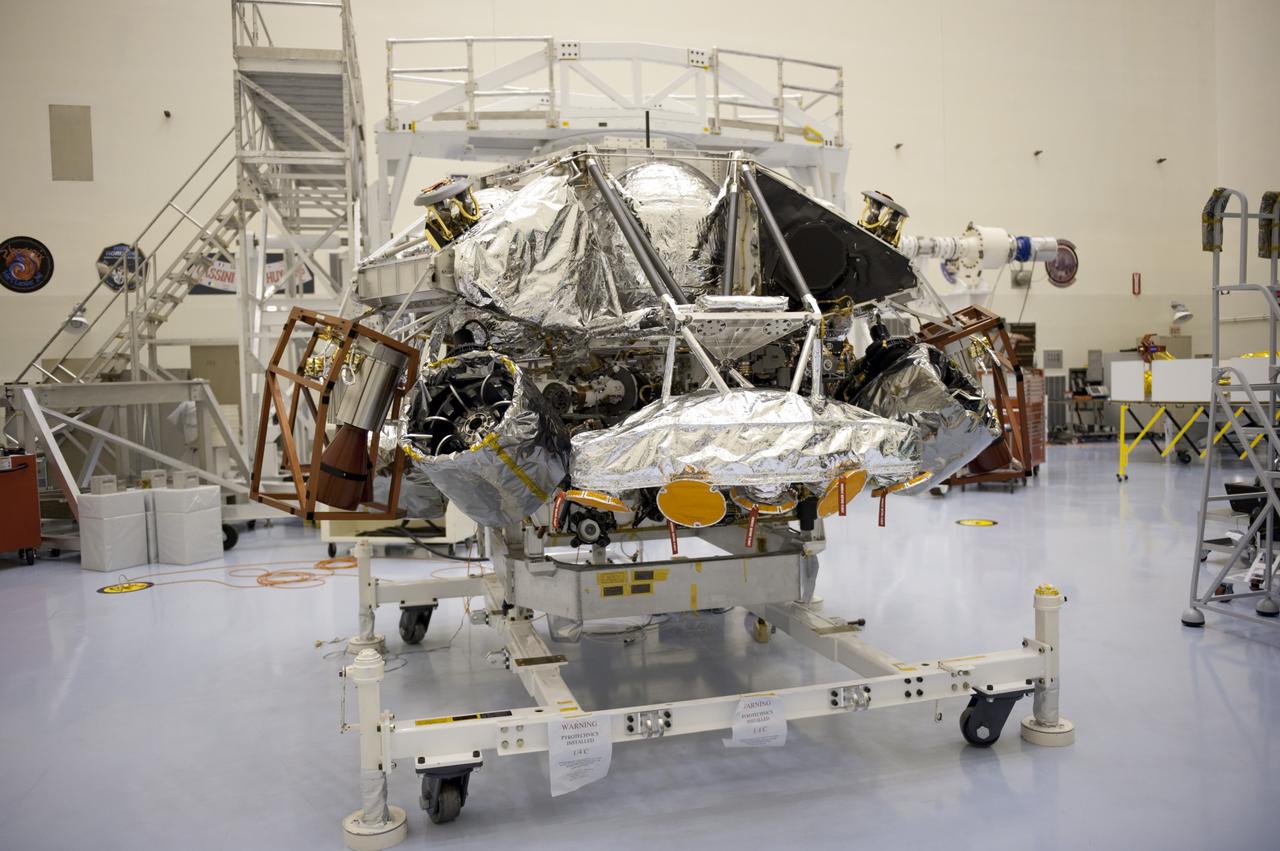
CAPE CANAVERAL, Fla. – At the Payload Hazardous Servicing Facility at NASA’s Kennedy Space Center in Florida, integration between a rocket-powered descent stage and NASA's Mars Science Laboratory (MSL) rover, known as Curiosity, is complete. The descent stage will lower Curiosity to the surface of Mars. A United Launch Alliance Atlas V-541 configuration will be used to loft MSL into space. Curiosity’s 10 science instruments are designed to search for evidence on whether Mars has had environments favorable to microbial life, including chemical ingredients for life. The unique rover will use a laser to look inside rocks and release its gasses so that the rover’s spectrometer can analyze and send the data back to Earth. MSL is scheduled to launch Nov. 25 with a window extending to Dec. 18 and arrival at Mars Aug. 2012. For more information, visit http://www.nasa.gov/msl. Photo credit: NASA/Kim Shiflett
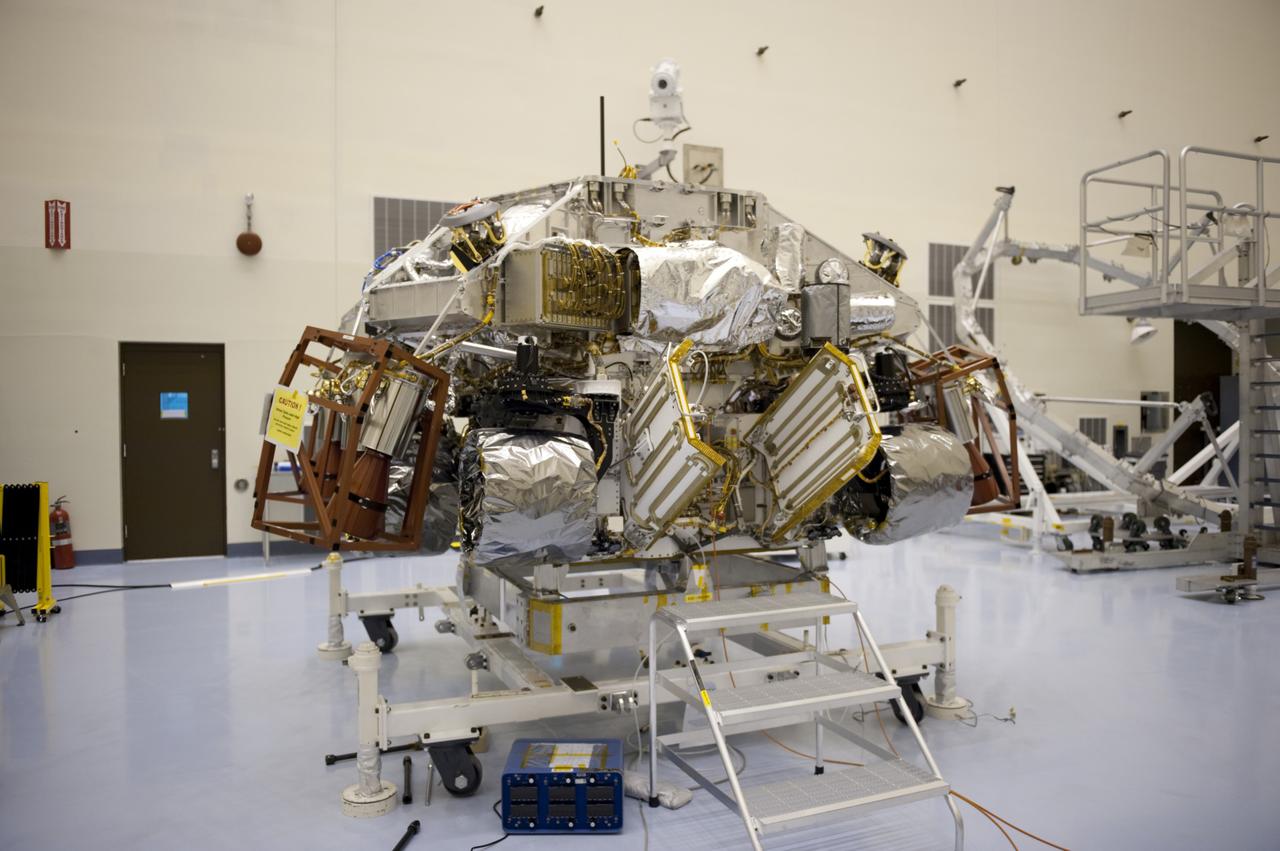
CAPE CANAVERAL, Fla. – At the Payload Hazardous Servicing Facility at NASA’s Kennedy Space Center in Florida, NASA's Mars Science Laboratory (MSL) rover, known as Curiosity, will be integrated with a rocket-powered descent stage. The descent stage will lower Curiosity to the surface of Mars. A United Launch Alliance Atlas V-541 configuration will be used to loft MSL into space. Curiosity’s 10 science instruments are designed to search for evidence on whether Mars has had environments favorable to microbial life, including chemical ingredients for life. The unique rover will use a laser to look inside rocks and release its gasses so that the rover’s spectrometer can analyze and send the data back to Earth. MSL is scheduled to launch Nov. 25 with a window extending to Dec. 18 and arrival at Mars Aug. 2012. For more information, visit http://www.nasa.gov/msl. Photo credit: NASA/Kim Shiflett
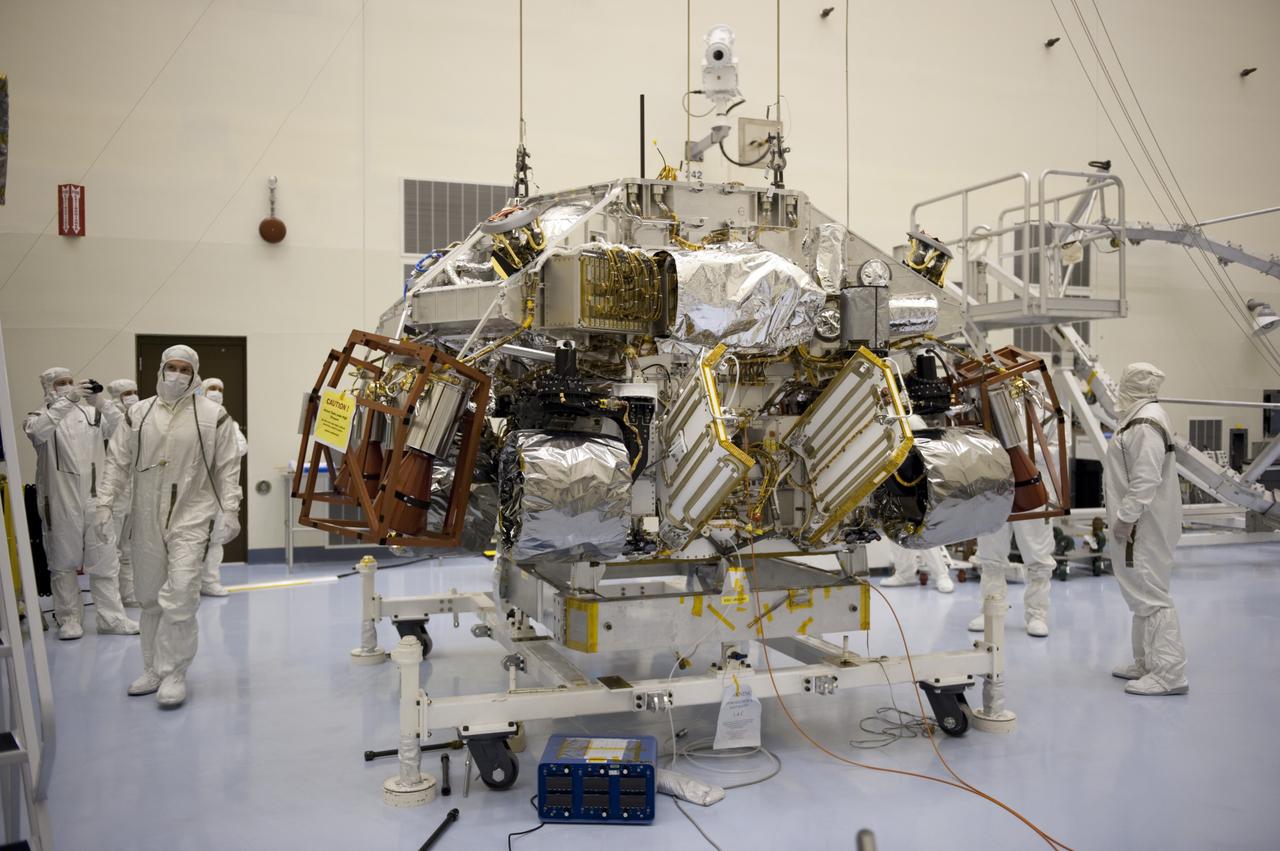
CAPE CANAVERAL, Fla. – At the Payload Hazardous Servicing Facility at NASA’s Kennedy Space Center in Florida, a rocket-powered descent stage, after being lowered by an overhead crane, is integrated with NASA's Mars Science Laboratory (MSL) rover, known as Curiosity. The descent stage will lower Curiosity to the surface of Mars. A United Launch Alliance Atlas V-541 configuration will be used to loft MSL into space. Curiosity’s 10 science instruments are designed to search for evidence on whether Mars has had environments favorable to microbial life, including chemical ingredients for life. The unique rover will use a laser to look inside rocks and release its gasses so that the rover’s spectrometer can analyze and send the data back to Earth. MSL is scheduled to launch Nov. 25 with a window extending to Dec. 18 and arrival at Mars Aug. 2012. For more information, visit http://www.nasa.gov/msl. Photo credit: NASA/Kim Shiflett
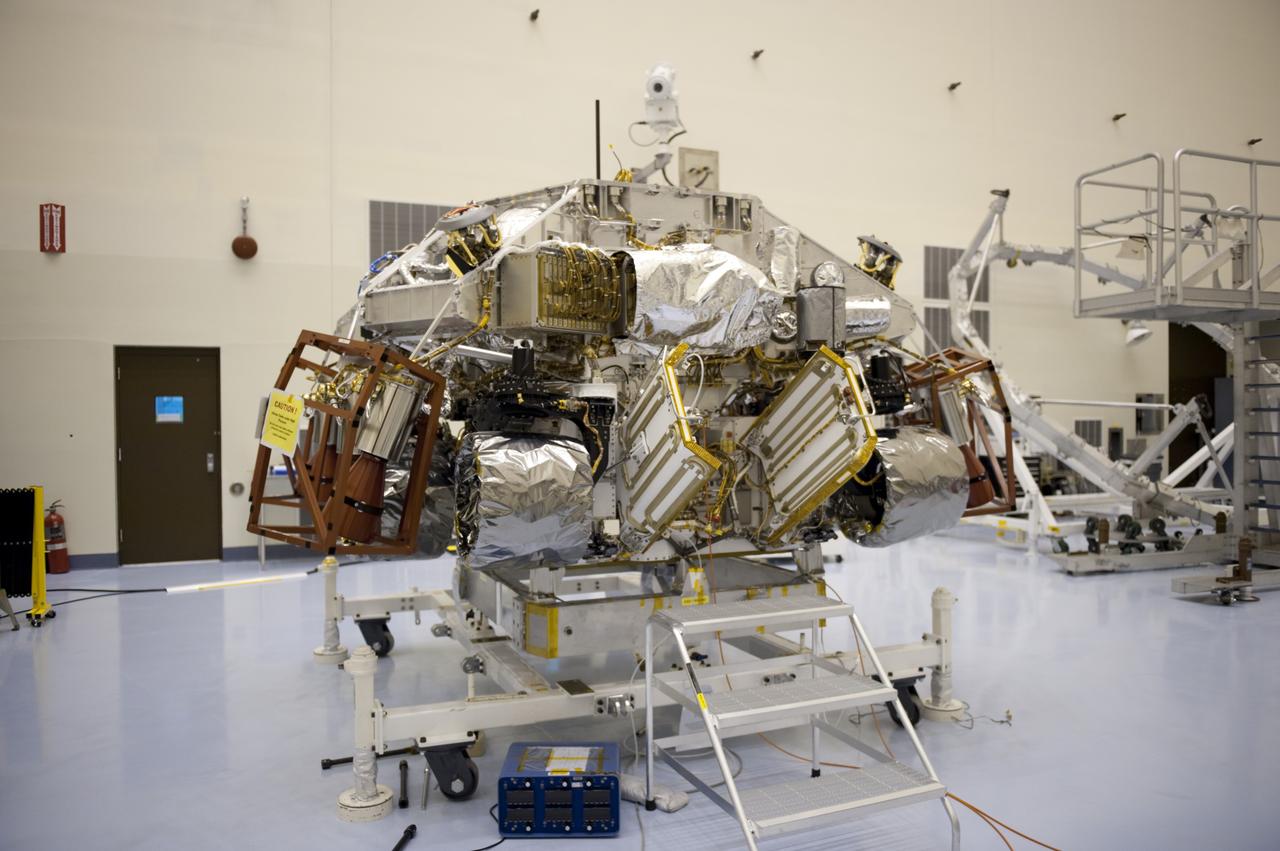
CAPE CANAVERAL, Fla. – At the Payload Hazardous Servicing Facility at NASA’s Kennedy Space Center in Florida, integration between a rocket-powered descent stage and NASA's Mars Science Laboratory (MSL) rover, known as Curiosity, is complete. The descent stage will lower Curiosity to the surface of Mars. A United Launch Alliance Atlas V-541 configuration will be used to loft MSL into space. Curiosity’s 10 science instruments are designed to search for evidence on whether Mars has had environments favorable to microbial life, including chemical ingredients for life. The unique rover will use a laser to look inside rocks and release its gasses so that the rover’s spectrometer can analyze and send the data back to Earth. MSL is scheduled to launch Nov. 25 with a window extending to Dec. 18 and arrival at Mars Aug. 2012. For more information, visit http://www.nasa.gov/msl. Photo credit: NASA/Kim Shiflett

CAPE CANAVERAL, Fla. – At the Payload Hazardous Servicing Facility at NASA’s Kennedy Space Center in Florida, integration between a rocket-powered descent stage and NASA's Mars Science Laboratory (MSL) rover, known as Curiosity, is complete. The descent stage will lower Curiosity to the surface of Mars. A United Launch Alliance Atlas V-541 configuration will be used to loft MSL into space. Curiosity’s 10 science instruments are designed to search for evidence on whether Mars has had environments favorable to microbial life, including chemical ingredients for life. The unique rover will use a laser to look inside rocks and release its gasses so that the rover’s spectrometer can analyze and send the data back to Earth. MSL is scheduled to launch Nov. 25 with a window extending to Dec. 18 and arrival at Mars Aug. 2012. For more information, visit http://www.nasa.gov/msl. Photo credit: NASA/Kim Shiflett
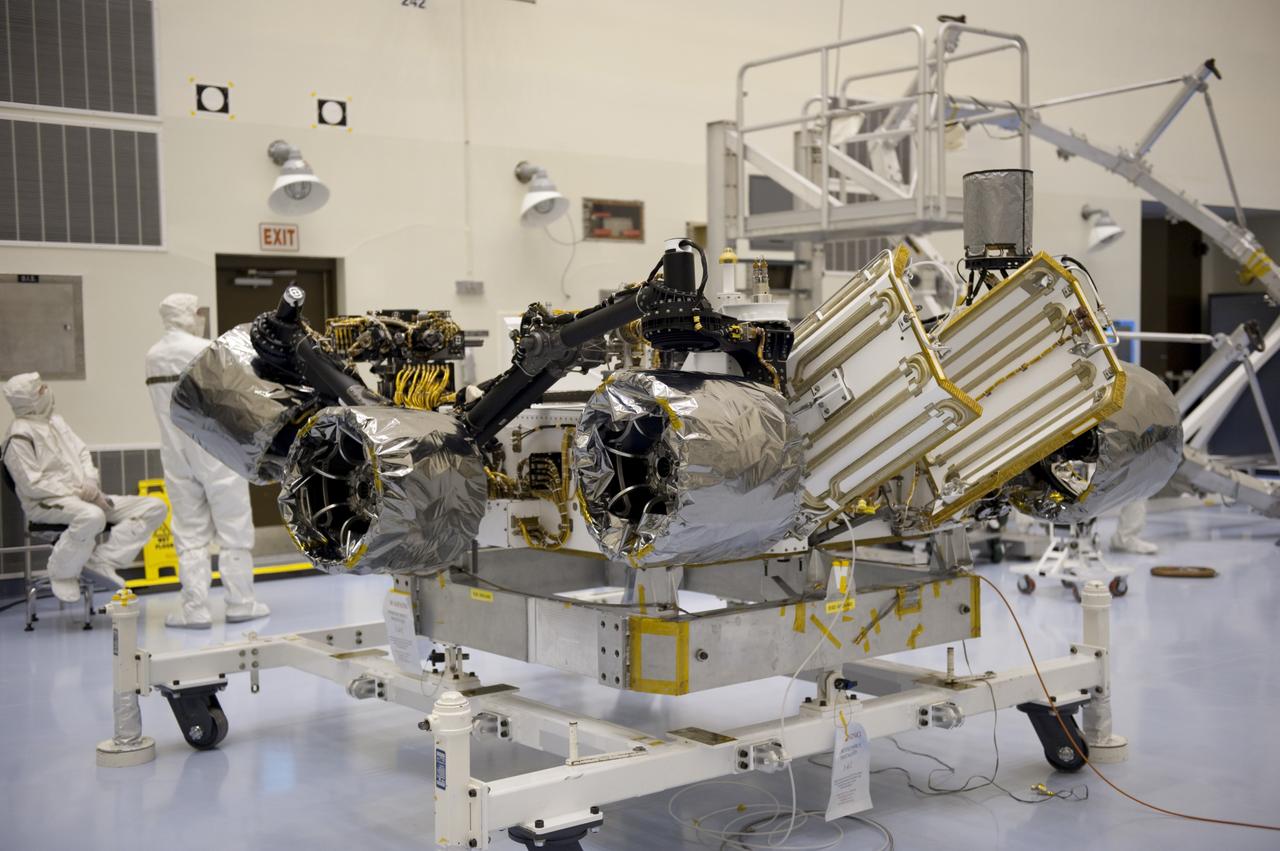
CAPE CANAVERAL, Fla. – At the Payload Hazardous Servicing Facility at NASA’s Kennedy Space Center in Florida, NASA's Mars Science Laboratory (MSL) rover, known as Curiosity, will be integrated with a rocket-powered descent stage. The descent stage will lower Curiosity to the surface of Mars. A United Launch Alliance Atlas V-541 configuration will be used to loft MSL into space. Curiosity’s 10 science instruments are designed to search for evidence on whether Mars has had environments favorable to microbial life, including chemical ingredients for life. The unique rover will use a laser to look inside rocks and release its gasses so that the rover’s spectrometer can analyze and send the data back to Earth. MSL is scheduled to launch Nov. 25 with a window extending to Dec. 18 and arrival at Mars Aug. 2012. For more information, visit http://www.nasa.gov/msl. Photo credit: NASA/Kim Shiflett
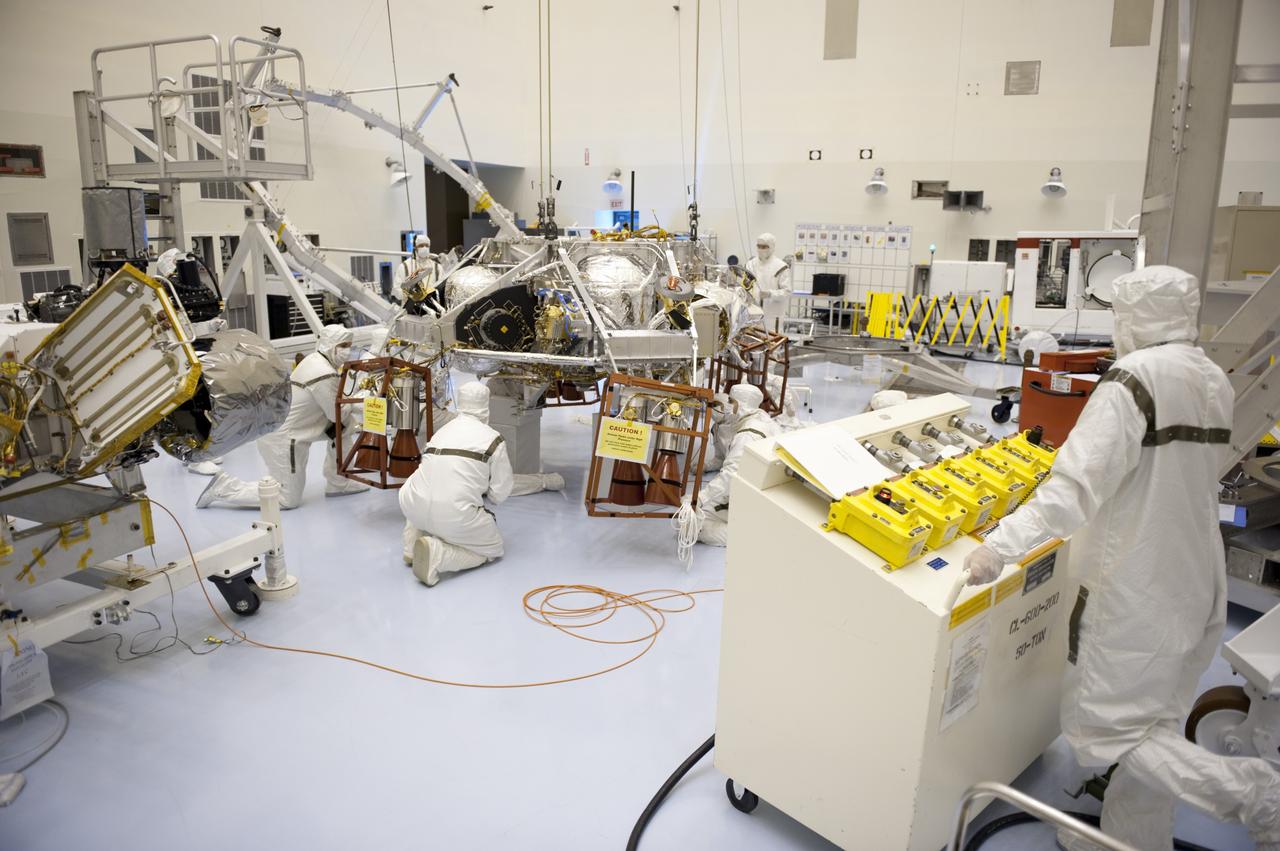
CAPE CANAVERAL, Fla. – At the Payload Hazardous Servicing Facility at NASA's Kennedy Space Center in Florida, technicians use an overhead crane to move a rocket-powered descent stage for integration with NASA's Mars Science Laboratory (MSL) rover, known as Curiosity. The descent stage will lower Curiosity to the surface of Mars. A United Launch Alliance Atlas V-541 configuration will be used to loft MSL into space. Curiosity’s 10 science instruments are designed to search for evidence on whether Mars has had environments favorable to microbial life, including chemical ingredients for life. The unique rover will use a laser to look inside rocks and release its gasses so that the rover’s spectrometer can analyze and send the data back to Earth. MSL is scheduled to launch Nov. 25 with a window extending to Dec. 18 and arrival at Mars Aug. 2012. For more information, visit http://www.nasa.gov/msl. Photo credit: NASA/Kim Shiflett
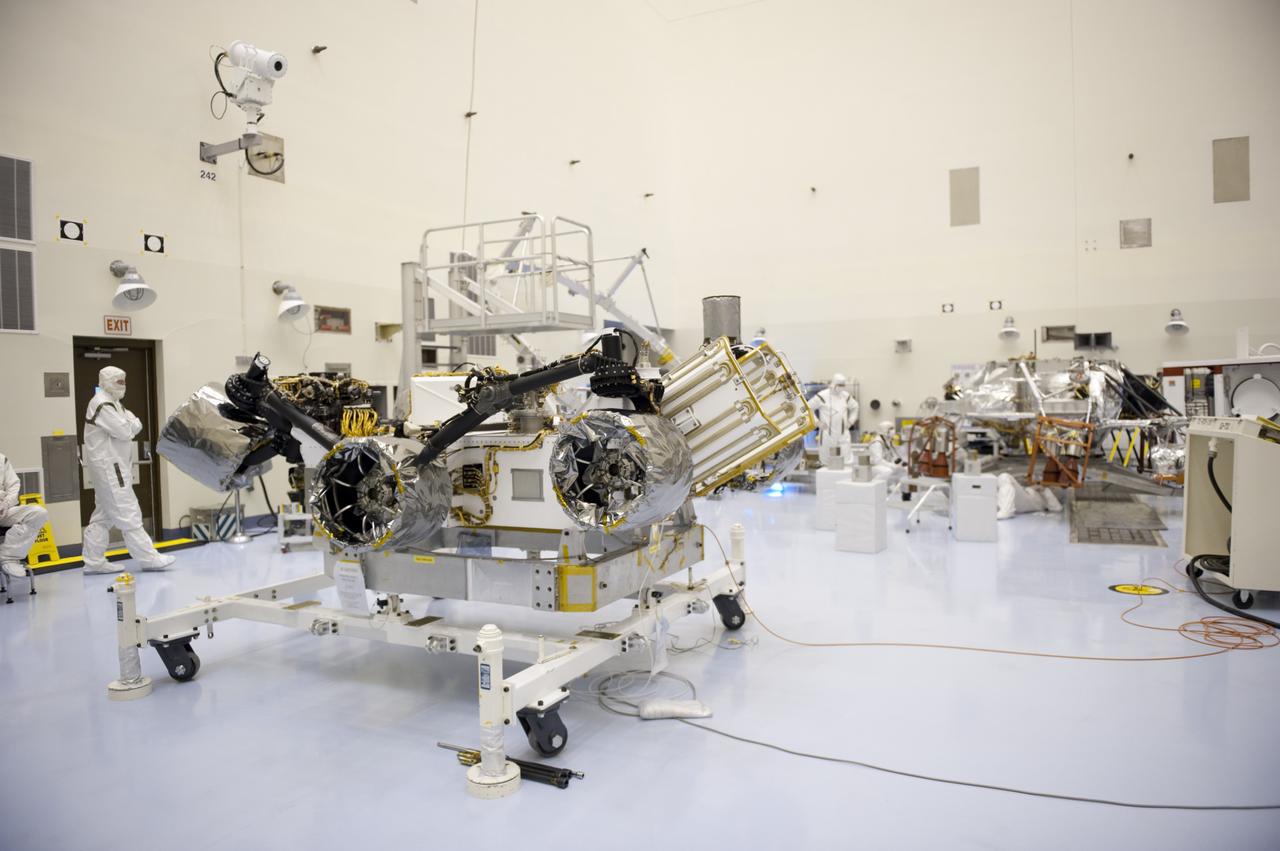
CAPE CANAVERAL, Fla. – At the Payload Hazardous Servicing Facility at NASA’s Kennedy Space Center in Florida, technicians prepare NASA's Mars Science Laboratory (MSL) rover, known as Curiosity, for integration with a rocket-powered descent stage. The descent stage will lower Curiosity to the surface of Mars. A United Launch Alliance Atlas V-541 configuration will be used to loft MSL into space. Curiosity’s 10 science instruments are designed to search for evidence on whether Mars has had environments favorable to microbial life, including chemical ingredients for life. The unique rover will use a laser to look inside rocks and release its gasses so that the rover’s spectrometer can analyze and send the data back to Earth. MSL is scheduled to launch Nov. 25 with a window extending to Dec. 18 and arrival at Mars Aug. 2012. For more information, visit http://www.nasa.gov/msl. Photo credit: NASA/Kim Shiflett
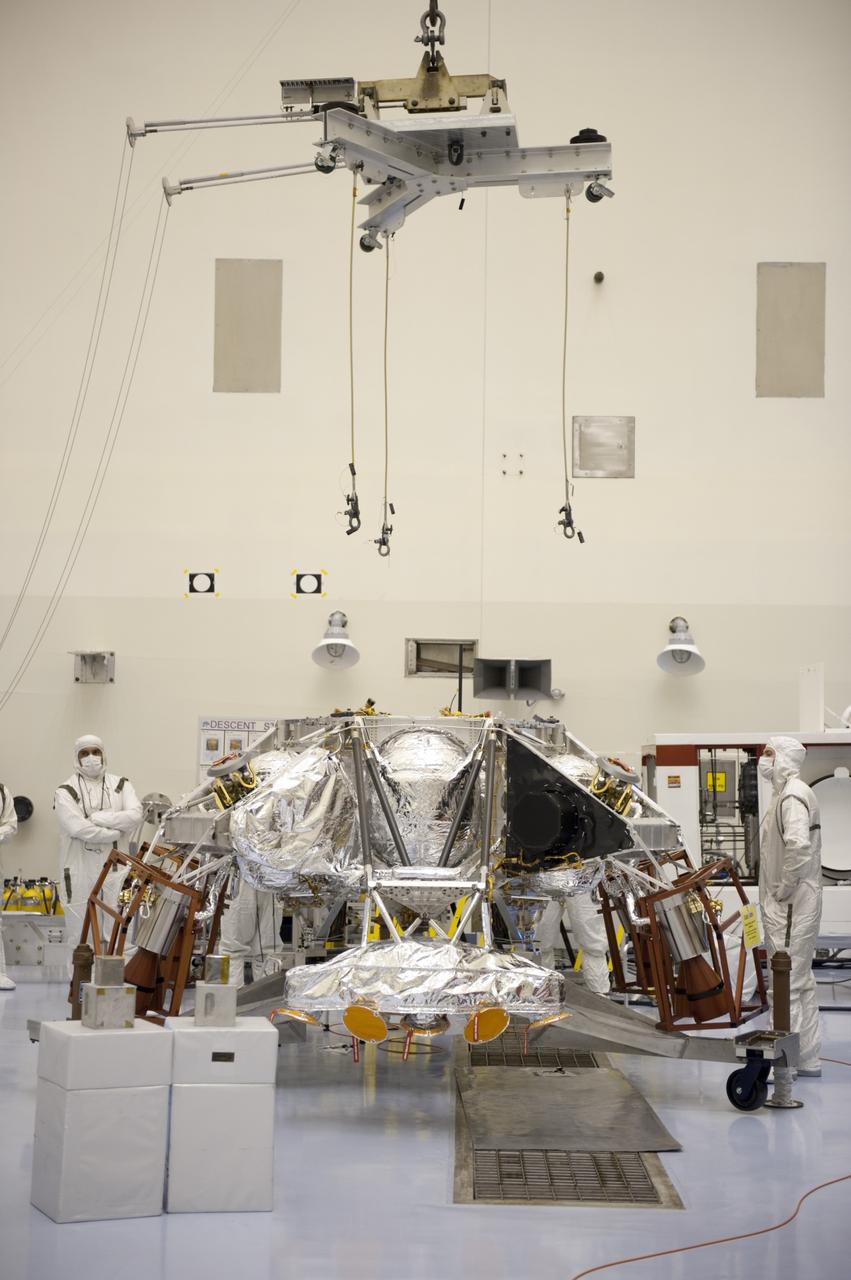
CAPE CANAVERAL, Fla. – At the Payload Hazardous Servicing Facility at NASA’s Kennedy Space Center in Florida, an overhead crane is being lowered over a rocket-powered descent stage for integration with NASA's Mars Science Laboratory (MSL) rover, known as Curiosity. The descent stage will lower Curiosity to the surface of Mars. A United Launch Alliance Atlas V-541 configuration will be used to loft MSL into space. Curiosity’s 10 science instruments are designed to search for evidence on whether Mars has had environments favorable to microbial life, including chemical ingredients for life. The unique rover will use a laser to look inside rocks and release its gasses so that the rover’s spectrometer can analyze and send the data back to Earth. MSL is scheduled to launch Nov. 25 with a window extending to Dec. 18 and arrival at Mars Aug. 2012. For more information, visit http://www.nasa.gov/msl. Photo credit: NASA/Kim Shiflett
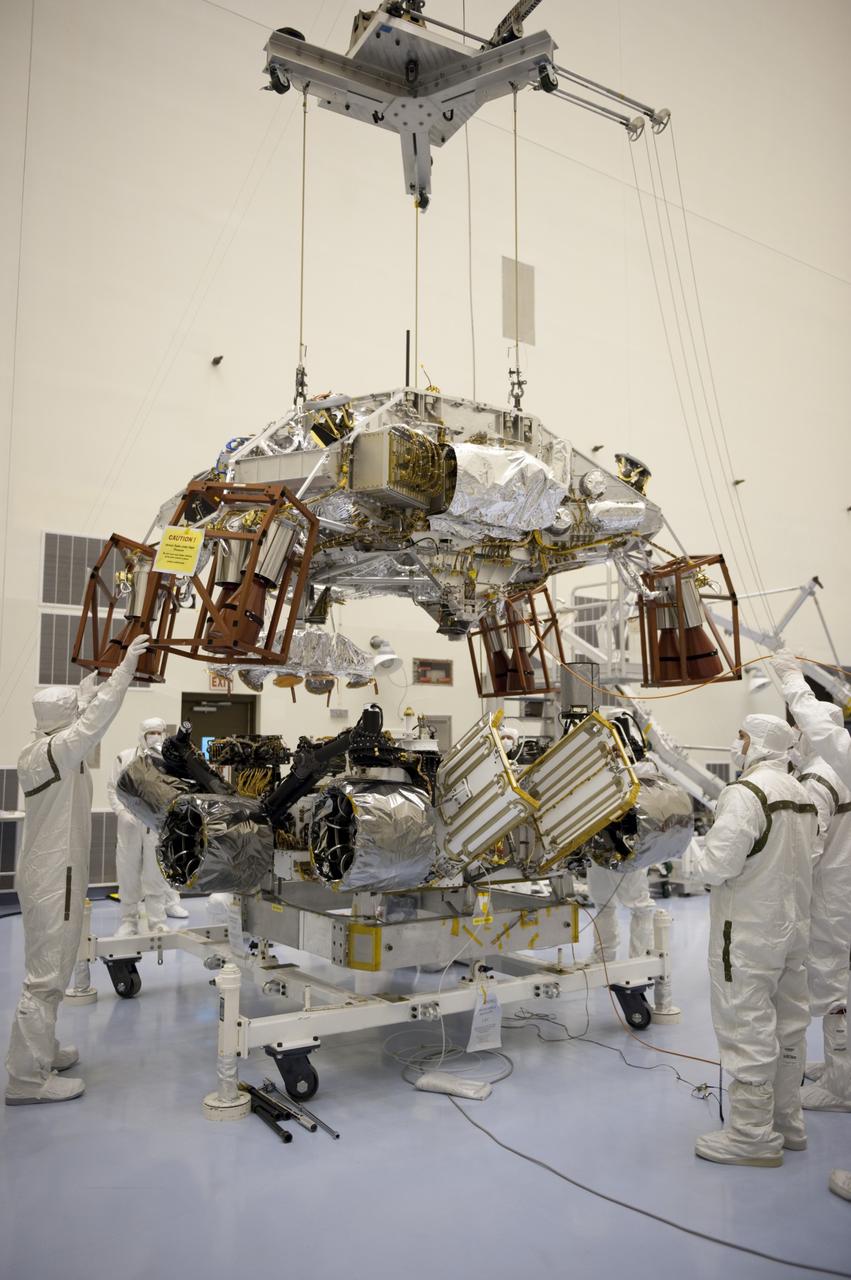
CAPE CANAVERAL, Fla. – Technicians at the Payload Hazardous Servicing Facility at NASA's Kennedy Space Center in Florida, guide an overhead crane as it lowers a rocket-powered descent stage over NASA's Mars Science Laboratory (MSL) rover, known as Curiosity, for integration. The descent stage will lower Curiosity to the surface of Mars. A United Launch Alliance Atlas V-541 configuration will be used to loft MSL into space. Curiosity’s 10 science instruments are designed to search for evidence on whether Mars has had environments favorable to microbial life, including chemical ingredients for life. The unique rover will use a laser to look inside rocks and release its gasses so that the rover’s spectrometer can analyze and send the data back to Earth. MSL is scheduled to launch Nov. 25 with a window extending to Dec. 18 and arrival at Mars Aug. 2012. For more information, visit http://www.nasa.gov/msl. Photo credit: NASA/Kim Shiflett
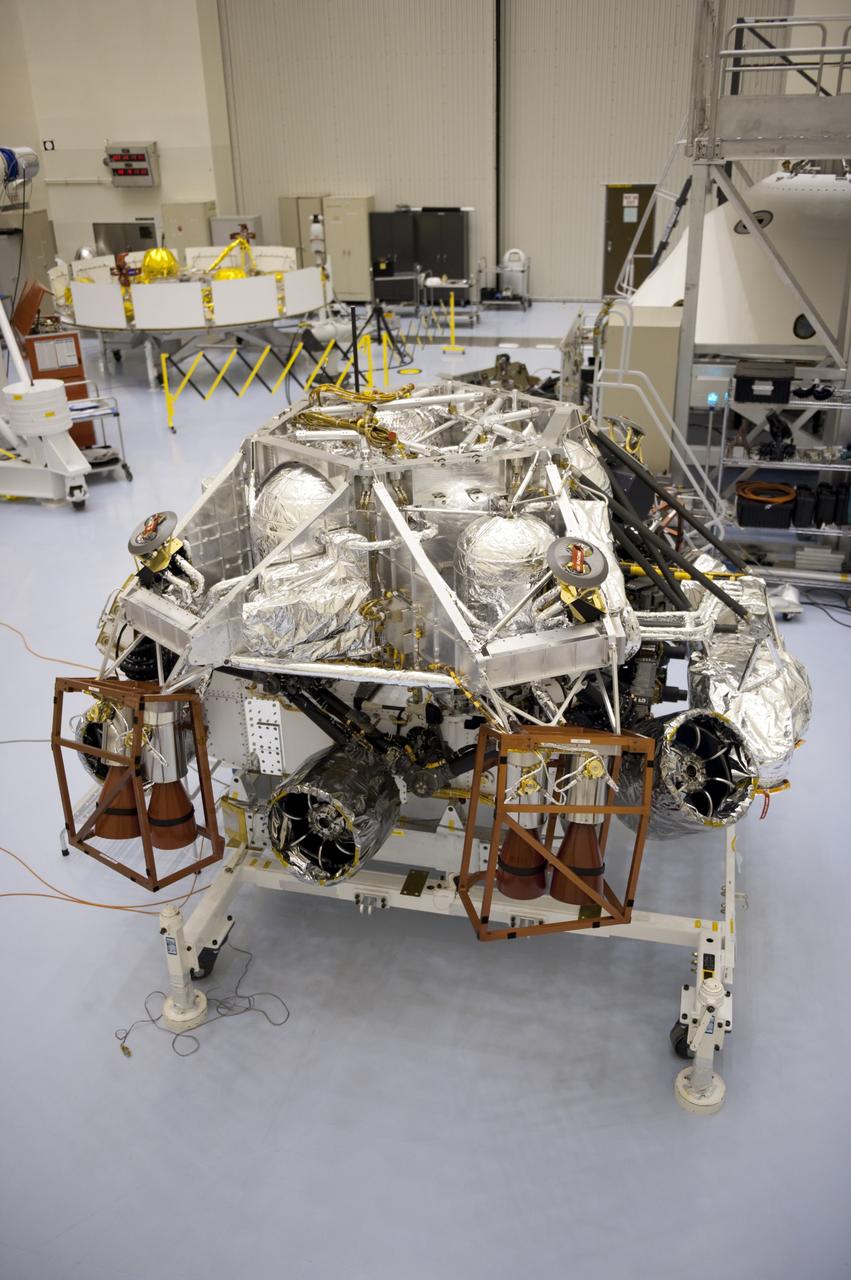
CAPE CANAVERAL, Fla. – At the Payload Hazardous Servicing Facility at NASA’s Kennedy Space Center in Florida, integration between a rocket-powered descent stage and NASA's Mars Science Laboratory (MSL) rover, known as Curiosity, is complete. The descent stage will lower Curiosity to the surface of Mars. A United Launch Alliance Atlas V-541 configuration will be used to loft MSL into space. Curiosity’s 10 science instruments are designed to search for evidence on whether Mars has had environments favorable to microbial life, including chemical ingredients for life. The unique rover will use a laser to look inside rocks and release its gasses so that the rover’s spectrometer can analyze and send the data back to Earth. MSL is scheduled to launch Nov. 25 with a window extending to Dec. 18 and arrival at Mars Aug. 2012. For more information, visit http://www.nasa.gov/msl. Photo credit: NASA/Kim Shiflett
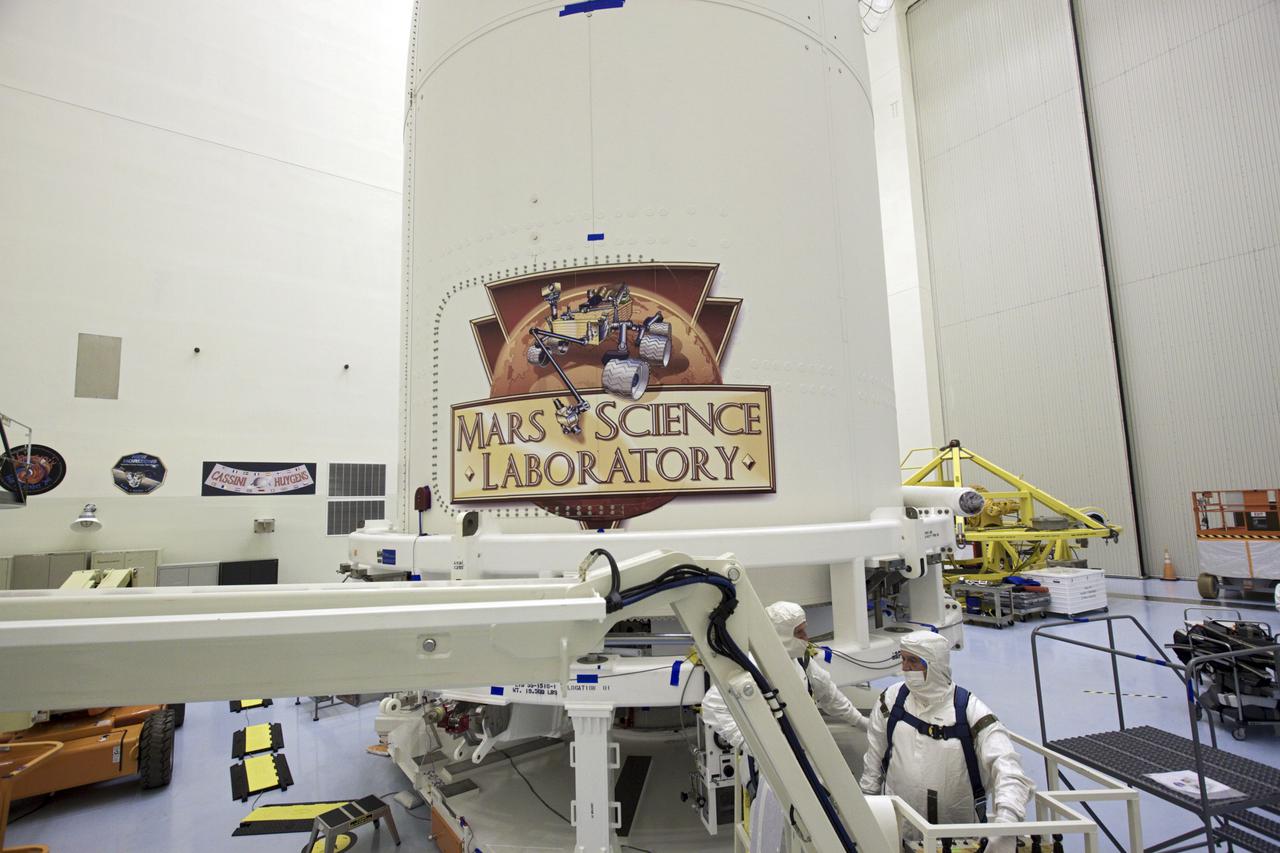
CAPE CANAVERAL, Fla. -- In the Payload Hazardous Servicing Facility at NASA's Kennedy Space Center in Florida, the Mars Science Laboratory (MSL) logo -- depicting the mission's compact car-sized rover, Curiosity -- has been applied to the exterior of an Atlas V rocket's payload fairing. Tucked inside the fairing is the MSL spacecraft, including Curiosity, which has 10 science instruments designed to search for evidence on whether Mars has had environments favorable to microbial life, including the chemical ingredients for life. The unique rover will use a laser to look inside rocks and release its gasses so that the rover’s spectrometer can analyze and send the data back to Earth. Launch of MSL aboard a United Launch Alliance Atlas V rocket is planned for Nov. 25 from Space Launch Complex-41 on Cape Canaveral Air Force Station. For more information, visit http:__www.nasa.gov_msl. Photo credit: NASA_Jim Grossmann
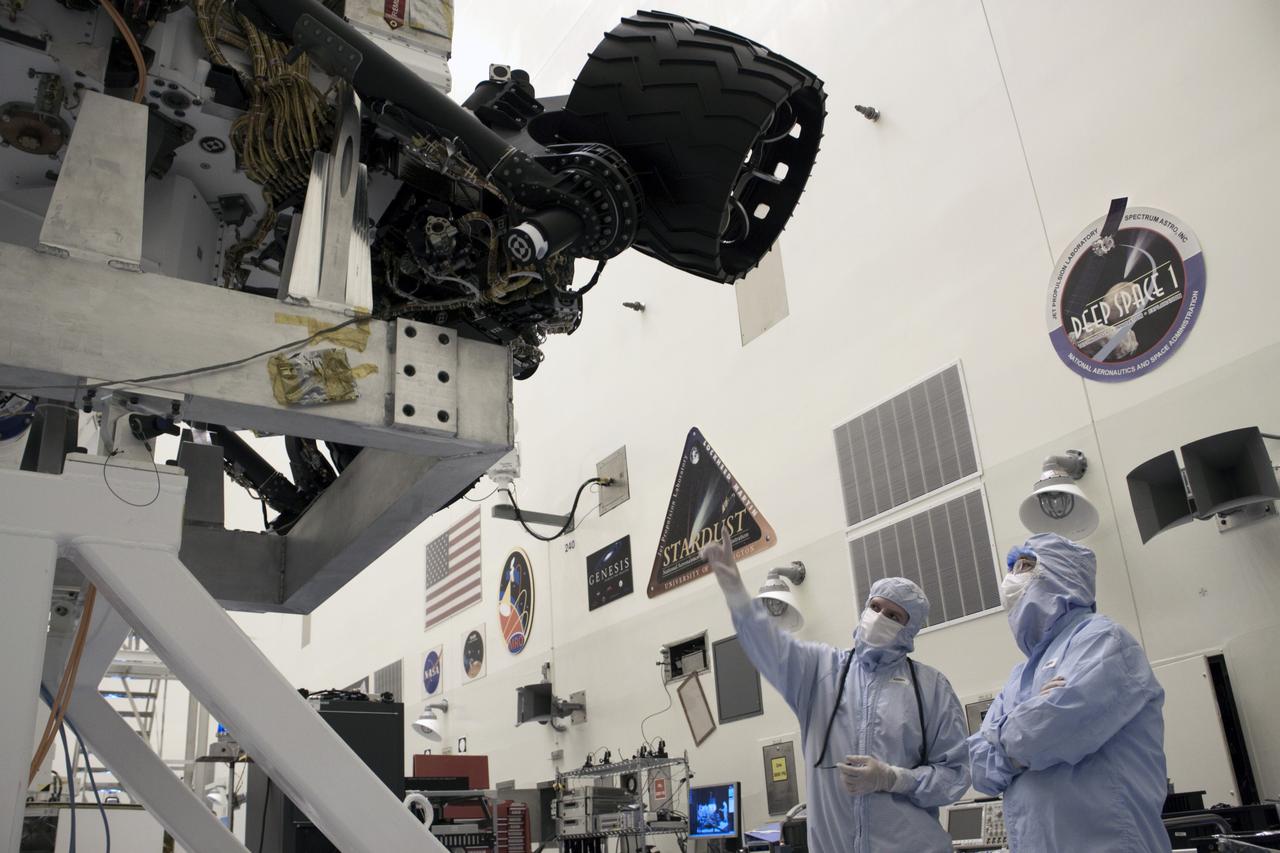
Cape Canaveral, Fla. -- At the Payload Hazardous Servicing Facility at NASA's Kennedy Space Center in Florida, Dr. Charles Elachi, Director of Advanced Planning at NASA's Jet Propulsion Laboratory (right), is shown NASA's Mars Science Laboratory (MSL) rover known as Curiosity. A United Launch Alliance Atlas V-541 configuration will be used to loft MSL into space. Curiosity’s 10 science instruments are designed to search for evidence on whether Mars has had environments favorable to microbial life, including chemical ingredients for life. The unique rover will use a laser to look inside rocks and release its gasses so that the rover’s spectrometer can analyze and send the data back to Earth. MSL is scheduled to launch from Cape Canaveral Air Force Station in Florida Nov. 25 with a window extending to Dec. 18 and arrival at Mars Aug. 2012. For more information, visit http://www.nasa.gov/msl. Photo credit: NASA/Jim Grossmann
Cape Canaveral, Fla. -- At the Payload Hazardous Servicing Facility at NASA's Kennedy Space Center in Florida, Dr. Charles Elachi, Director of Advanced Planning at NASA's Jet Propulsion Laboratory (right), is shown NASA's Mars Science Laboratory (MSL) rover known as Curiosity. A United Launch Alliance Atlas V-541 configuration will be used to loft MSL into space. Curiosity’s 10 science instruments are designed to search for evidence on whether Mars has had environments favorable to microbial life, including chemical ingredients for life. The unique rover will use a laser to look inside rocks and release its gasses so that the rover’s spectrometer can analyze and send the data back to Earth. MSL is scheduled to launch from Cape Canaveral Air Force Station in Florida Nov. 25 with a window extending to Dec. 18 and arrival at Mars Aug. 2012. For more information, visit http://www.nasa.gov/msl. Photo credit: NASA/Jim Grossmann
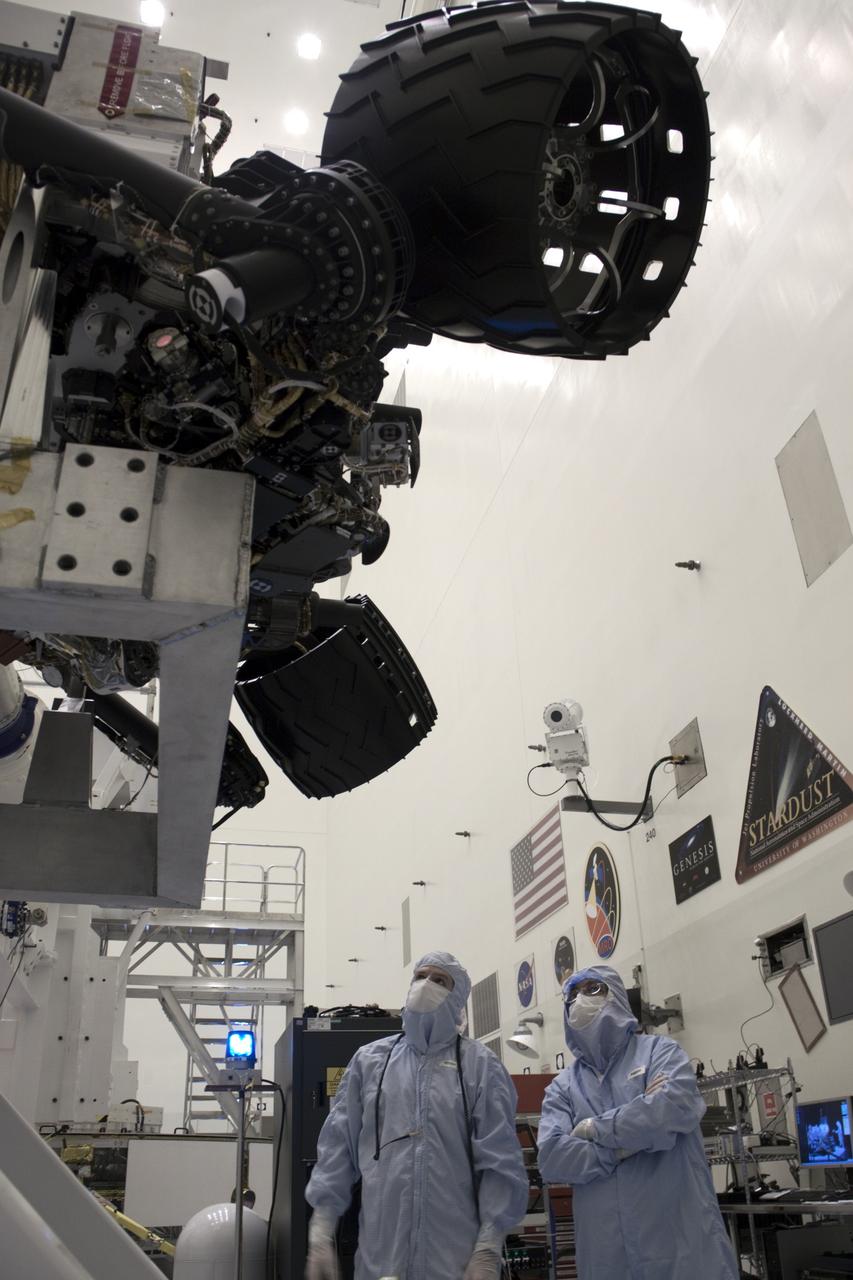
Cape Canaveral, Fla. -- At the Payload Hazardous Servicing Facility at NASA's Kennedy Space Center in Florida, Dr. Charles Elachi, Director of Advanced Planning at NASA's Jet Propulsion Laboratory (right), is shown NASA's Mars Science Laboratory (MSL) rover known as Curiosity. A United Launch Alliance Atlas V-541 configuration will be used to loft MSL into space. Curiosity’s 10 science instruments are designed to search for evidence on whether Mars has had environments favorable to microbial life, including chemical ingredients for life. The unique rover will use a laser to look inside rocks and release its gasses so that the rover’s spectrometer can analyze and send the data back to Earth. MSL is scheduled to launch from Cape Canaveral Air Force Station in Florida Nov. 25 with a window extending to Dec. 18 and arrival at Mars Aug. 2012. For more information, visit http://www.nasa.gov/msl. Photo credit: NASA/Jim Grossmann
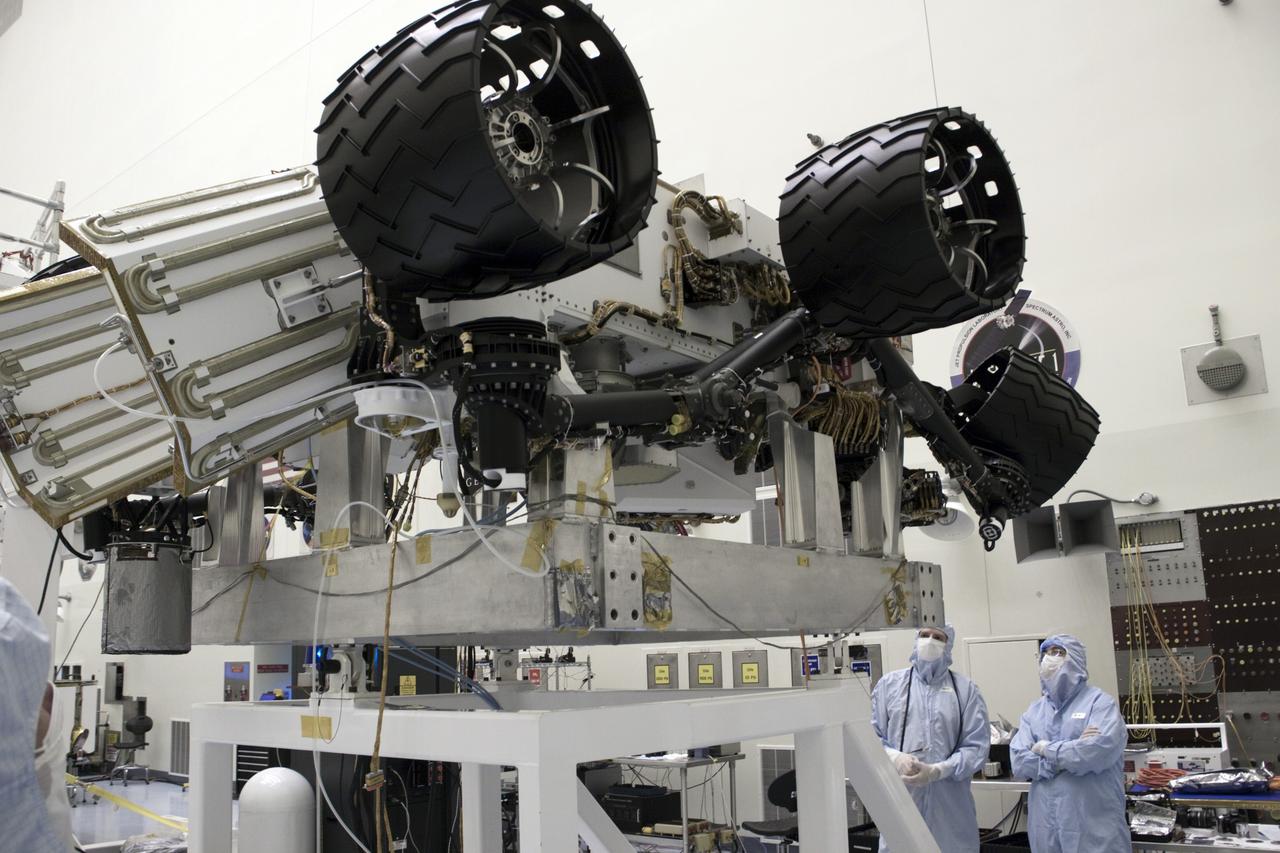
Cape Canaveral, Fla. -- At the Payload Hazardous Servicing Facility at NASA's Kennedy Space Center in Florida, Dr. Charles Elachi, Director of Advanced Planning at NASA's Jet Propulsion Laboratory (right), is shown NASA's Mars Science Laboratory (MSL) rover known as Curiosity. A United Launch Alliance Atlas V-541 configuration will be used to loft MSL into space. Curiosity’s 10 science instruments are designed to search for evidence on whether Mars has had environments favorable to microbial life, including chemical ingredients for life. The unique rover will use a laser to look inside rocks and release its gasses so that the rover’s spectrometer can analyze and send the data back to Earth. MSL is scheduled to launch from Cape Canaveral Air Force Station in Florida Nov. 25 with a window extending to Dec. 18 and arrival at Mars Aug. 2012. For more information, visit http://www.nasa.gov/msl. Photo credit: NASA/Jim Grossmann
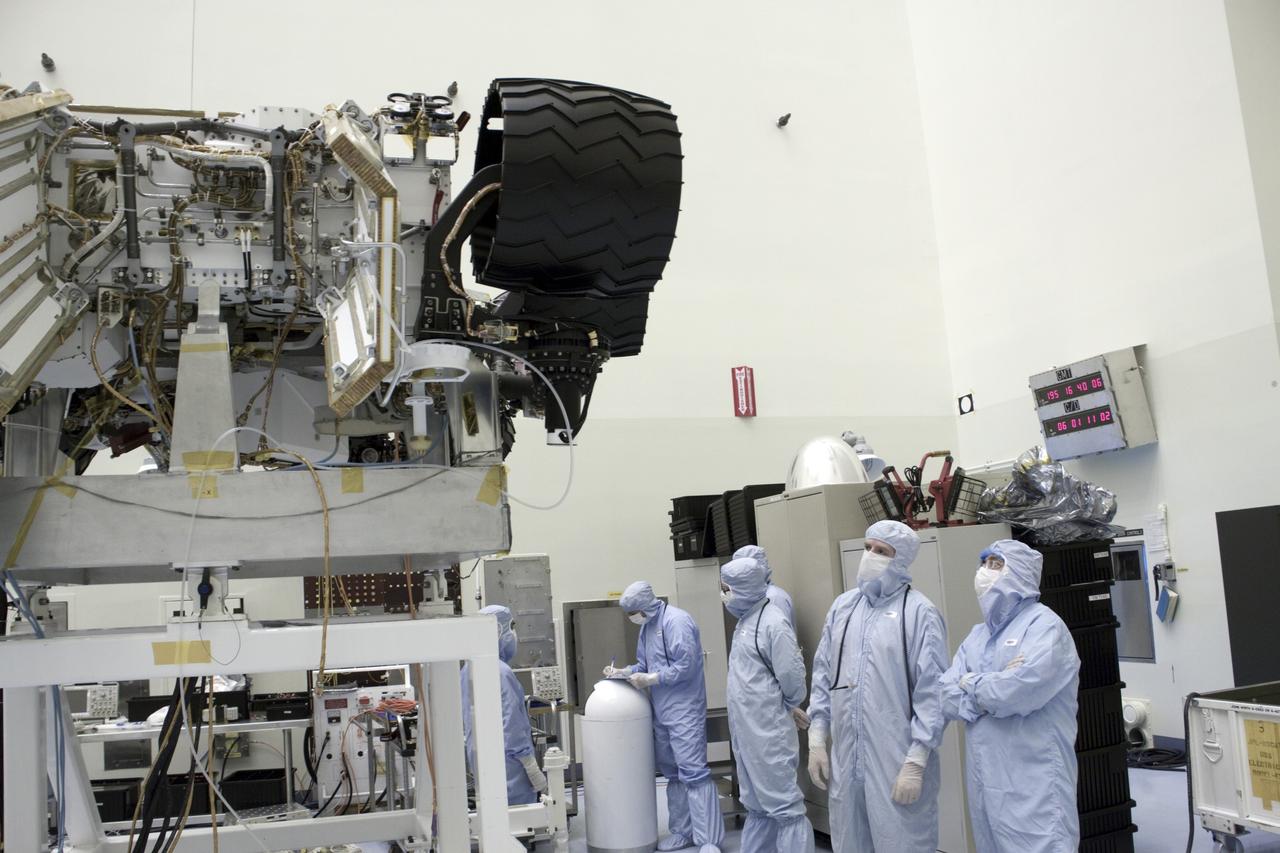
Cape Canaveral, Fla. -- At the Payload Hazardous Servicing Facility at NASA's Kennedy Space Center in Florida, Dr. Charles Elachi, Director of Advanced Planning at NASA's Jet Propulsion Laboratory (right), is shown NASA's Mars Science Laboratory (MSL) rover known as Curiosity. A United Launch Alliance Atlas V-541 configuration will be used to loft MSL into space. Curiosity’s 10 science instruments are designed to search for evidence on whether Mars has had environments favorable to microbial life, including chemical ingredients for life. The unique rover will use a laser to look inside rocks and release its gasses so that the rover’s spectrometer can analyze and send the data back to Earth. MSL is scheduled to launch from Cape Canaveral Air Force Station in Florida Nov. 25 with a window extending to Dec. 18 and arrival at Mars Aug. 2012. For more information, visit http://www.nasa.gov/msl. Photo credit: NASA/Jim Grossmann
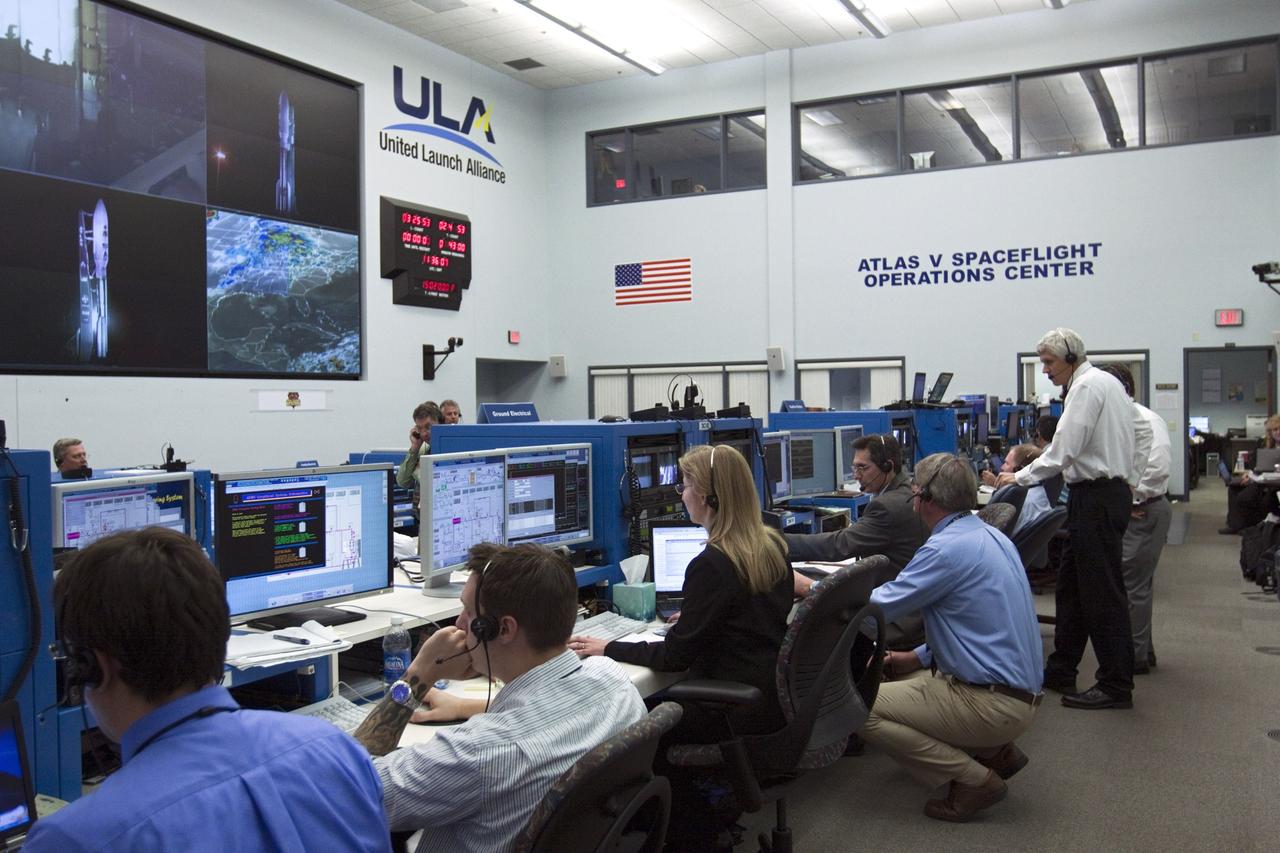
CAPE CANAVERAL – Launch controllers oversee the countdown in the Atlas V Spaceflight Operations Center (ASOC) before the launch of the Mars Science Laboratory on an Atlas V rocket. MSL lifted off at 10:02 a.m. EST Nov. 26, beginning a 9-month interplanetary cruise to Mars. MSL's components include a car-sized rover, Curiosity, which has 10 science instruments designed to search for signs of life, including methane, and help determine if the gas is from a biological or geological source. For more information, visit http://www.nasa.gov/msl. Photo credit: NASA/Kim Shiflett
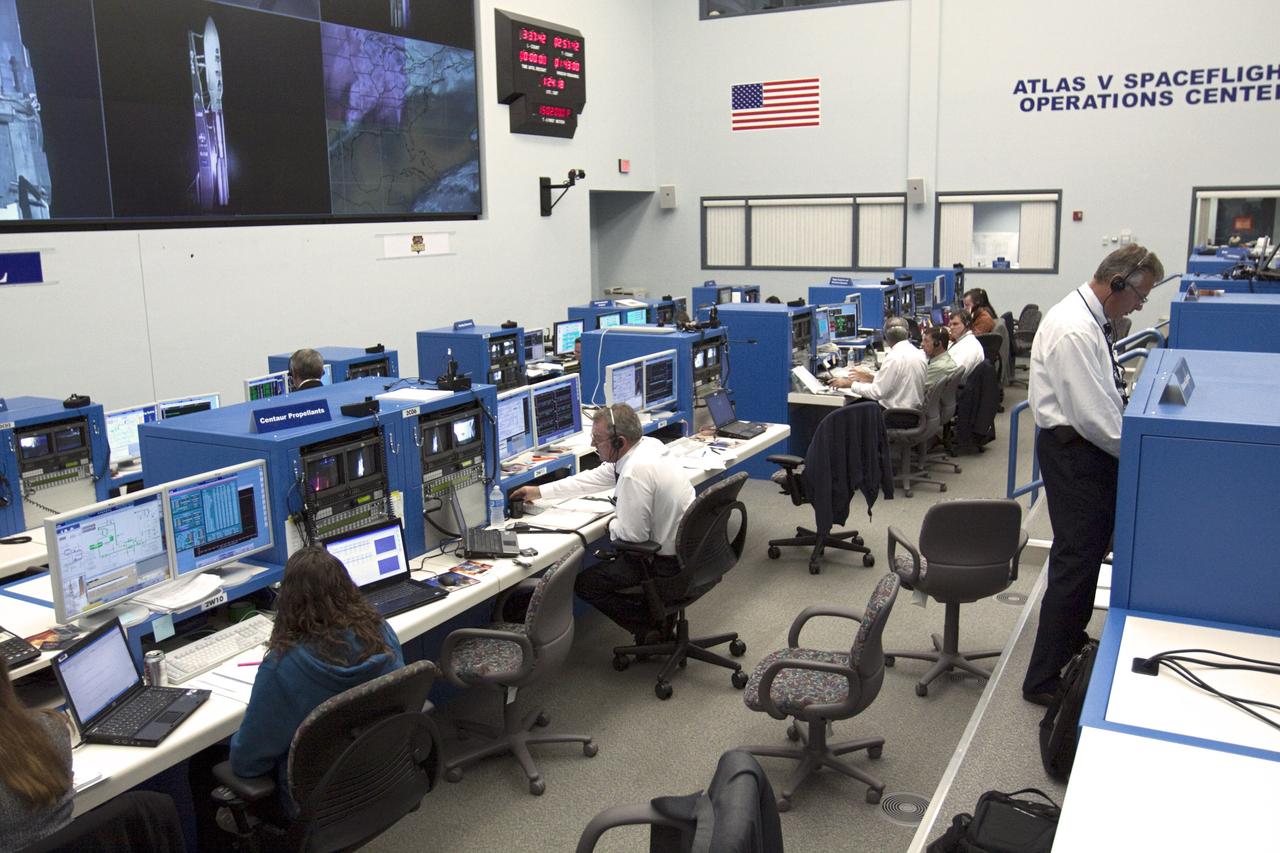
CAPE CANAVERAL – Launch controllers oversee the countdown in the Atlas V Spaceflight Operations Center (ASOC) before the launch of the Mars Science Laboratory on an Atlas V rocket. MSL lifted off at 10:02 a.m. EST Nov. 26, beginning a 9-month interplanetary cruise to Mars. MSL's components include a car-sized rover, Curiosity, which has 10 science instruments designed to search for signs of life, including methane, and help determine if the gas is from a biological or geological source. For more information, visit http://www.nasa.gov/msl. Photo credit: NASA/Kim Shiflett
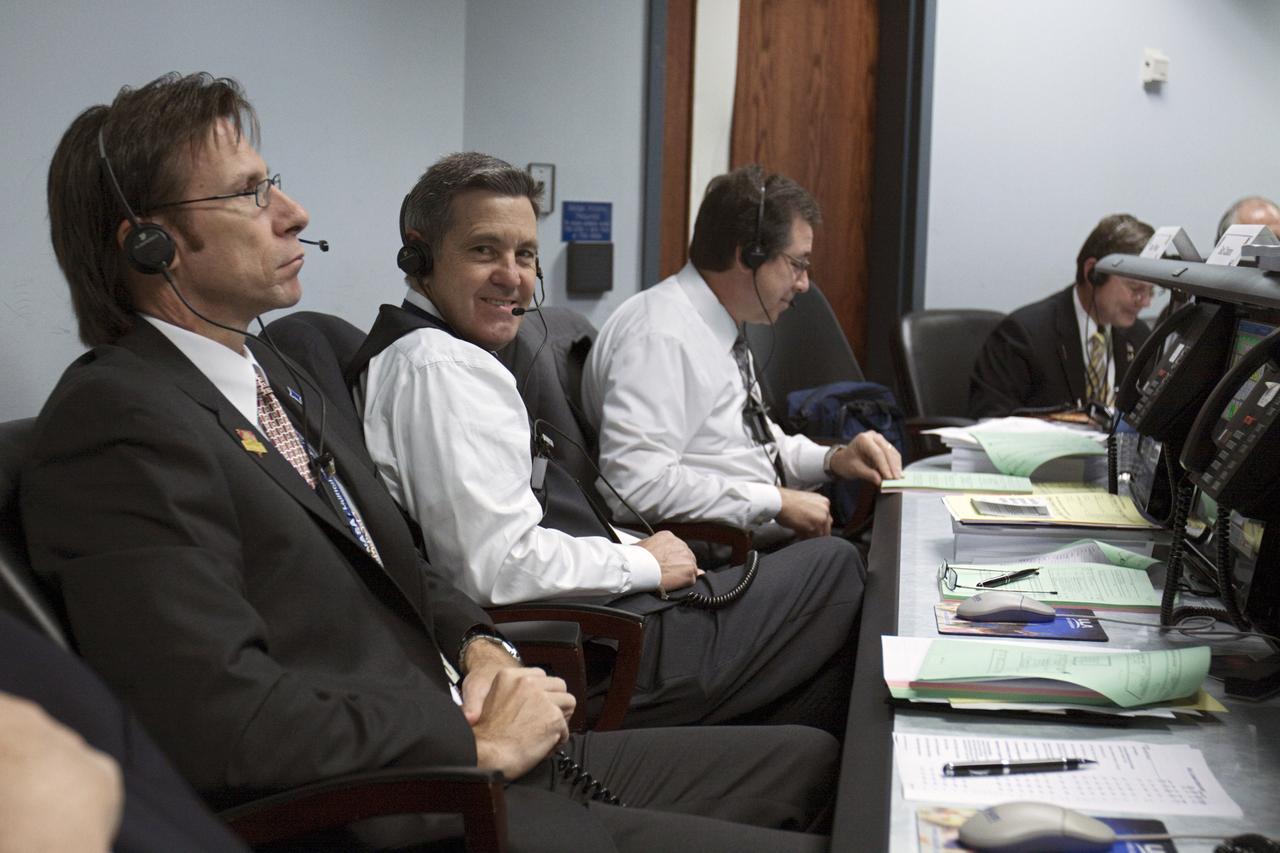
CAPE CANAVERAL – Chuck Duvale, deputy director of the Launch Services Program, left, and Bob Cabana, Kennedy Space Center director, oversee the countdown in the Atlas V Spaceflight Operations Center (ASOC) before the launch of the Mars Science Laboratory on an Atlas V rocket. MSL lifted off at 10:02 a.m. EST Nov. 26, beginning a 9-month interplanetary cruise to Mars. MSL's components include a car-sized rover, Curiosity, which has 10 science instruments designed to search for signs of life, including methane, and help determine if the gas is from a biological or geological source. For more information, visit http://www.nasa.gov/msl. Photo credit: NASA/Kim Shiflett
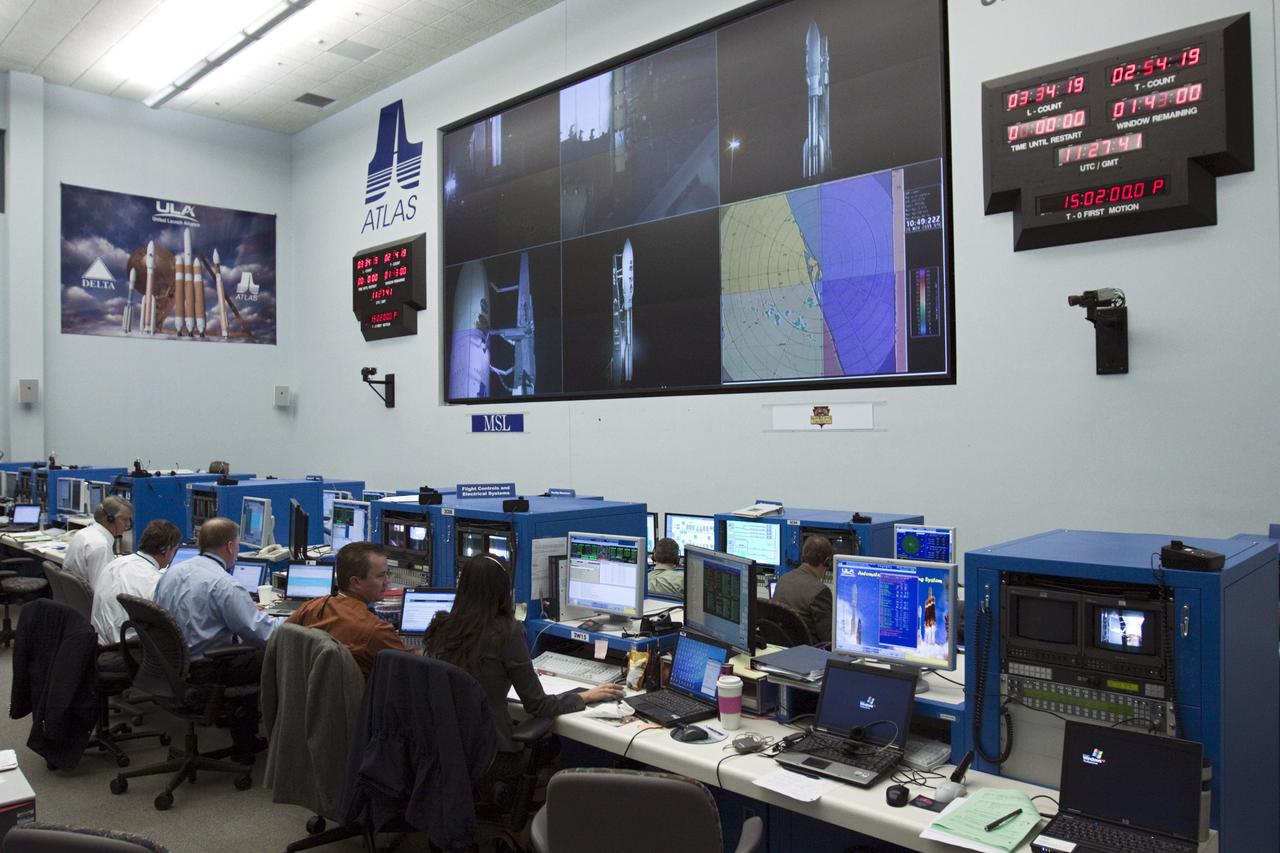
CAPE CANAVERAL – Launch controllers oversee the countdown in the Atlas V Spaceflight Operations Center (ASOC) before the launch of the Mars Science Laboratory on an Atlas V rocket. MSL lifted off at 10:02 a.m. EST Nov. 26, beginning a 9-month interplanetary cruise to Mars. MSL's components include a car-sized rover, Curiosity, which has 10 science instruments designed to search for signs of life, including methane, and help determine if the gas is from a biological or geological source. For more information, visit http://www.nasa.gov/msl. Photo credit: NASA/Kim Shiflett
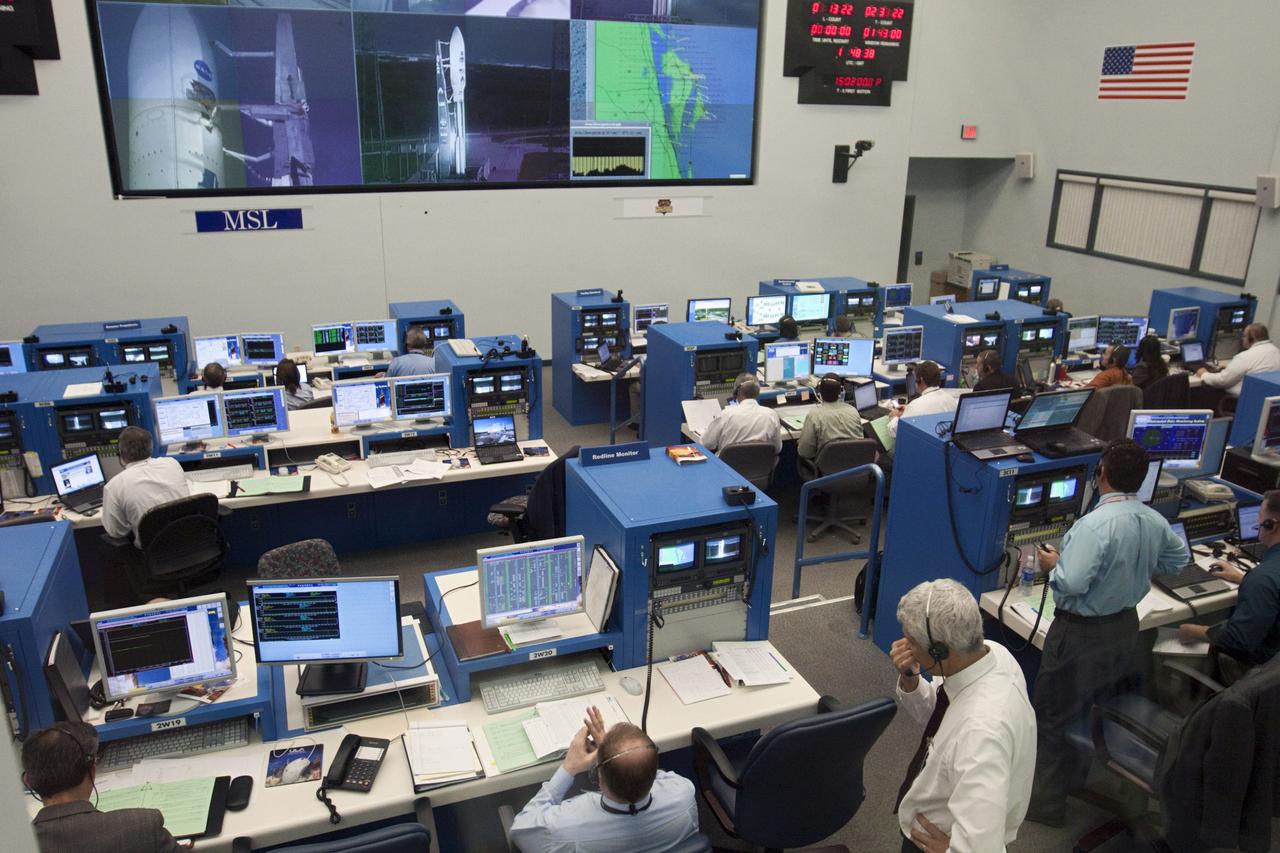
CAPE CANAVERAL – Launch controllers oversee the countdown in the Atlas V Spaceflight Operations Center (ASOC) before the launch of the Mars Science Laboratory on an Atlas V rocket. MSL lifted off at 10:02 a.m. EST Nov. 26, beginning a 9-month interplanetary cruise to Mars. MSL's components include a car-sized rover, Curiosity, which has 10 science instruments designed to search for signs of life, including methane, and help determine if the gas is from a biological or geological source. For more information, visit http://www.nasa.gov/msl. Photo credit: NASA/Kim Shiflett
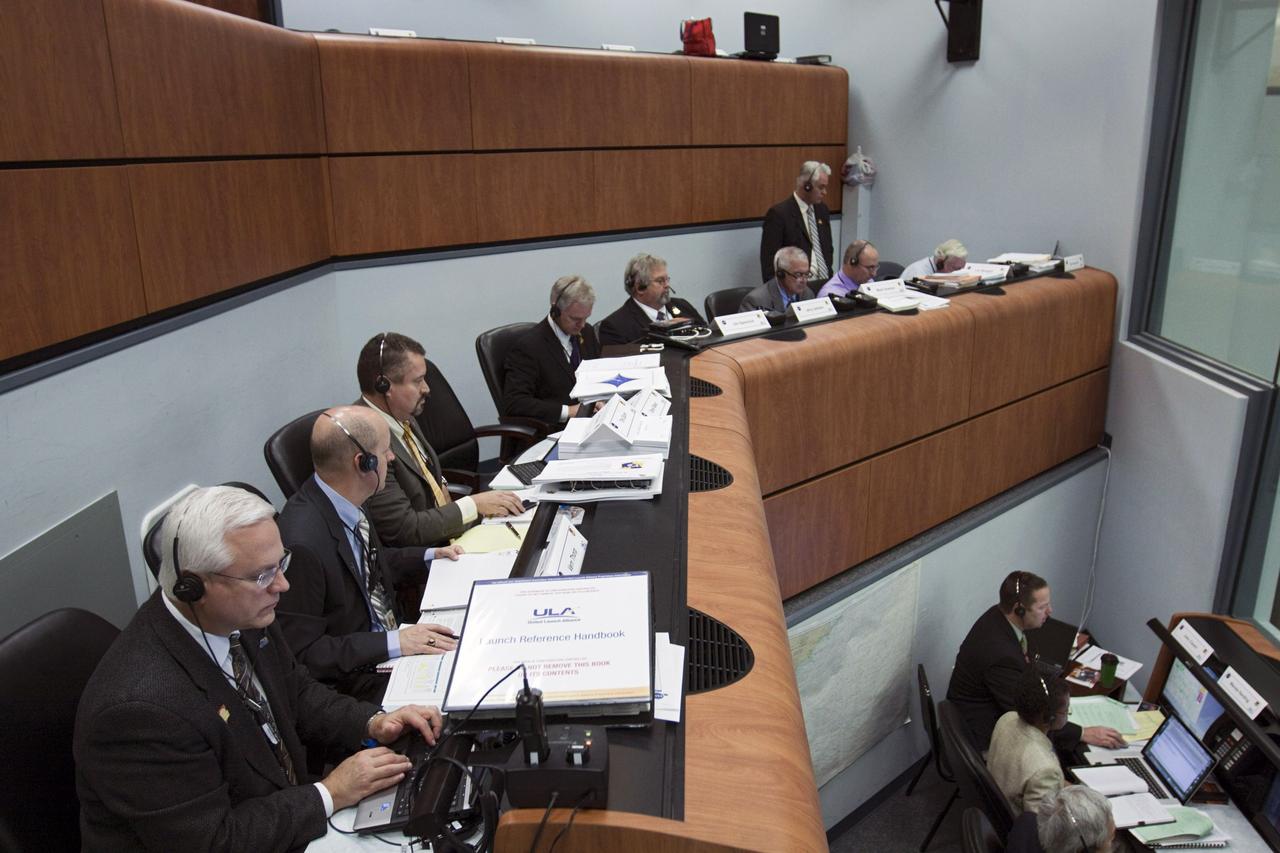
CAPE CANAVERAL – Launch managers from NASA and United Launch Alliance oversee the countdown in the Atlas V Spaceflight Operations Center (ASOC) before the launch of the Mars Science Laboratory on an Atlas V rocket. MSL lifted off at 10:02 a.m. EST Nov. 26, beginning a 9-month interplanetary cruise to Mars. MSL's components include a car-sized rover, Curiosity, which has 10 science instruments designed to search for signs of life, including methane, and help determine if the gas is from a biological or geological source. For more information, visit http://www.nasa.gov/msl. Photo credit: NASA/Kim Shiflett

CAPE CANAVERAL, Fla. -- The Atlas V first stage (left) and Centaur upper stage to support the Mars Science Laboratory (MSL) mission traverse the Banana River on their way to the Atlas Spaceflight Operations Center on Cape Canaveral Air Force Station in Florida. MSL's components include a compact car-sized rover, Curiosity, which has 10 science instruments designed to search for evidence on whether Mars has had environments favorable to microbial life, including chemical ingredients for life. The unique rover will use a laser to look inside rocks and release its gasses so that the rover’s spectrometer can analyze and send the data back to Earth. Launch of MSL aboard a United Launch Alliance Atlas V rocket is scheduled for Nov. 25 from Space Launch Complex 41 on Cape Canaveral Air Force Station. For more information, visit http://www.nasa.gov/msl. Photo credit: NASA/Kim Shiflett
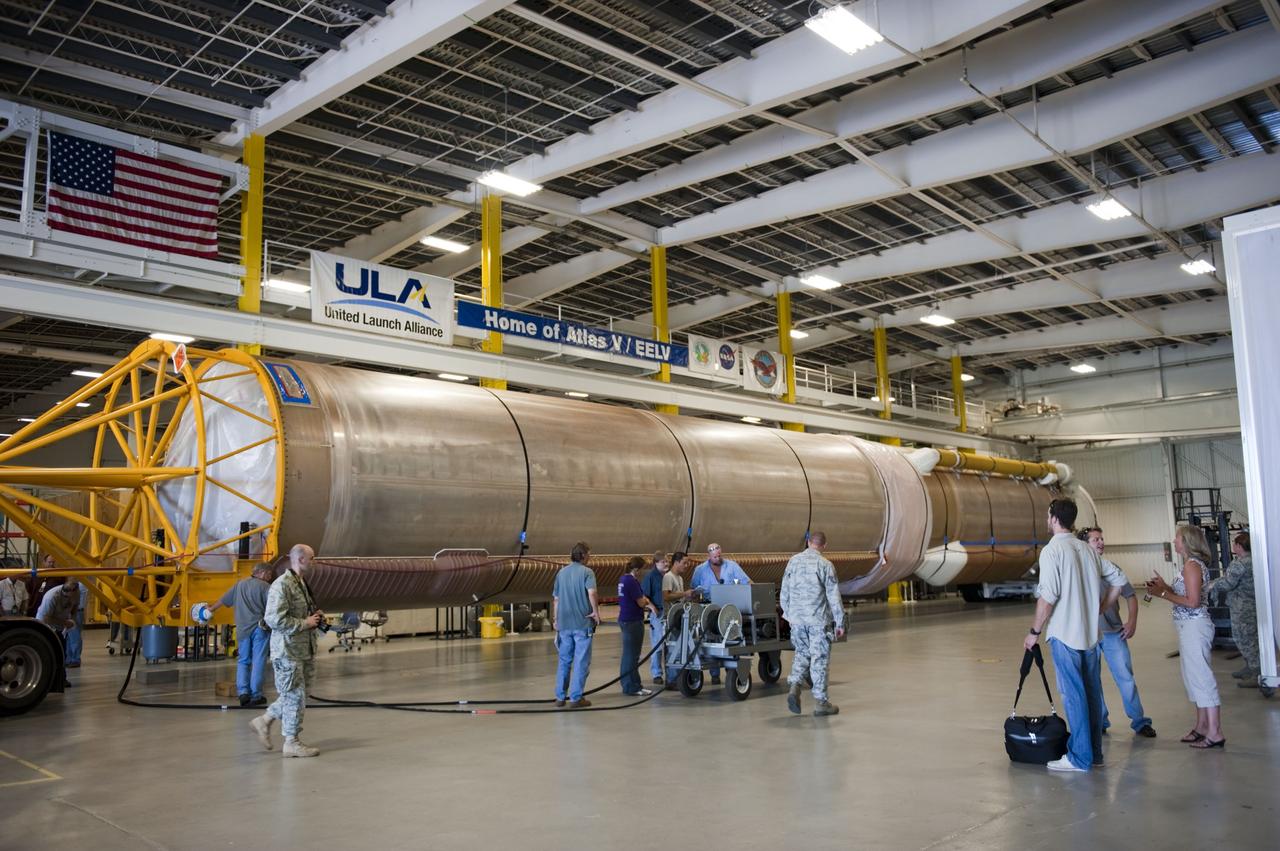
CAPE CANAVERAL, Fla. -- United Launch Alliance (ULA) workers prepare to process the first stage of the Atlas V for the Mars Science Laboratory (MSL) mission, newly arrived in the Atlas Spaceflight Operations Center on Cape Canaveral Air Force Station in Florida. MSL's components include a compact car-sized rover, Curiosity, which has 10 science instruments designed to search for evidence on whether Mars has had environments favorable to microbial life, including chemical ingredients for life. The unique rover will use a laser to look inside rocks and release its gasses so that the rover’s spectrometer can analyze and send the data back to Earth. Launch of MSL aboard a United Launch Alliance Atlas V rocket is scheduled for Nov. 25 from Space Launch Complex 41 on Cape Canaveral Air Force Station. For more information, visit http://www.nasa.gov/msl. Photo credit: NASA/Kim Shiflett
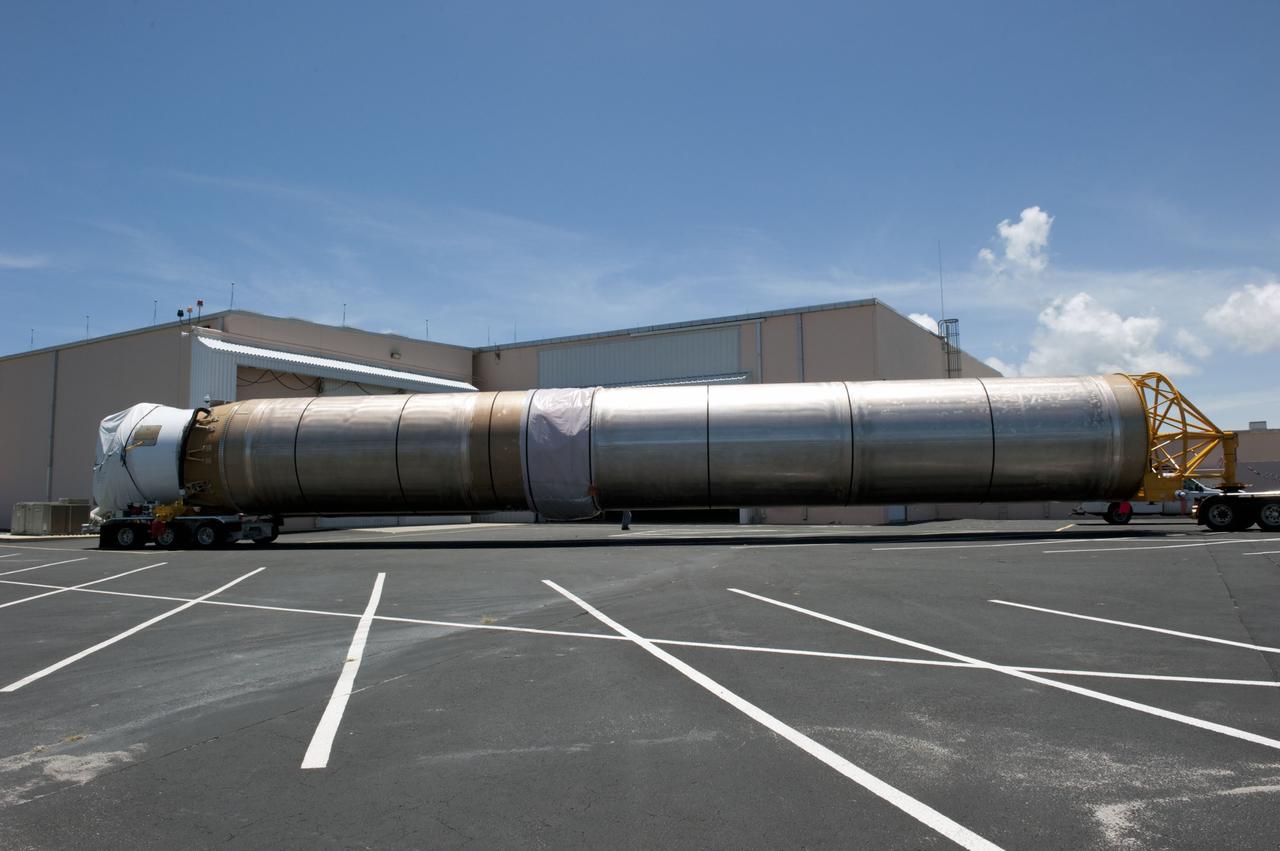
CAPE CANAVERAL, Fla. -- The Atlas V first stage to support the Mars Science Laboratory (MSL) mission arrives at the Atlas Spaceflight Operations Center on Cape Canaveral Air Force Station in Florida. MSL's components include a compact car-sized rover, Curiosity, which has 10 science instruments designed to search for evidence on whether Mars has had environments favorable to microbial life, including chemical ingredients for life. The unique rover will use a laser to look inside rocks and release its gasses so that the rover’s spectrometer can analyze and send the data back to Earth. Launch of MSL aboard a United Launch Alliance Atlas V rocket is scheduled for Nov. 25 from Space Launch Complex 41 on Cape Canaveral Air Force Station. For more information, visit http://www.nasa.gov/msl. Photo credit: NASA/Kim Shiflett
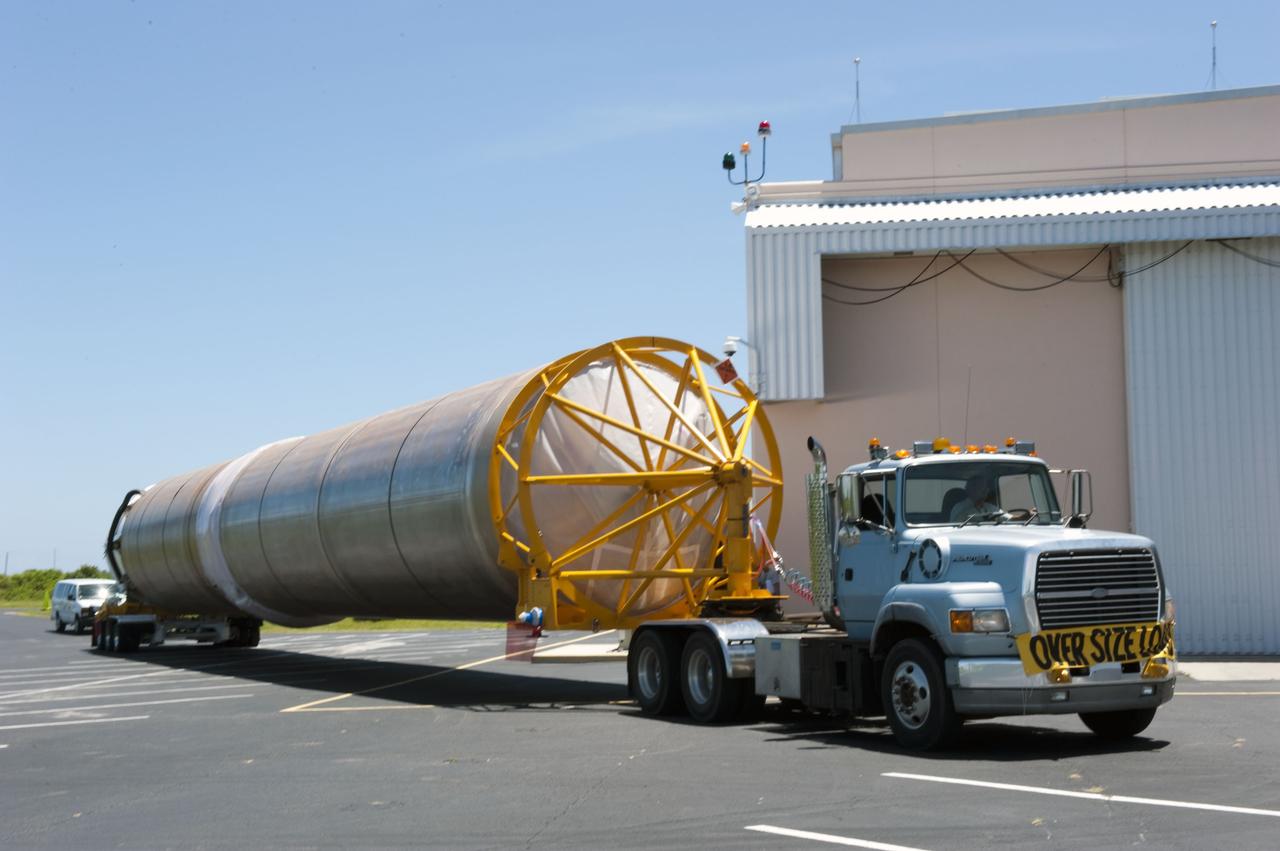
CAPE CANAVERAL, Fla. -- The Atlas V first stage to support the Mars Science Laboratory (MSL) mission approaches the Atlas Spaceflight Operations Center on Cape Canaveral Air Force Station in Florida. MSL's components include a compact car-sized rover, Curiosity, which has 10 science instruments designed to search for evidence on whether Mars has had environments favorable to microbial life, including chemical ingredients for life. The unique rover will use a laser to look inside rocks and release its gasses so that the rover’s spectrometer can analyze and send the data back to Earth. Launch of MSL aboard a United Launch Alliance Atlas V rocket is scheduled for Nov. 25 from Space Launch Complex 41 on Cape Canaveral Air Force Station. For more information, visit http://www.nasa.gov/msl. Photo credit: NASA/Kim Shiflett
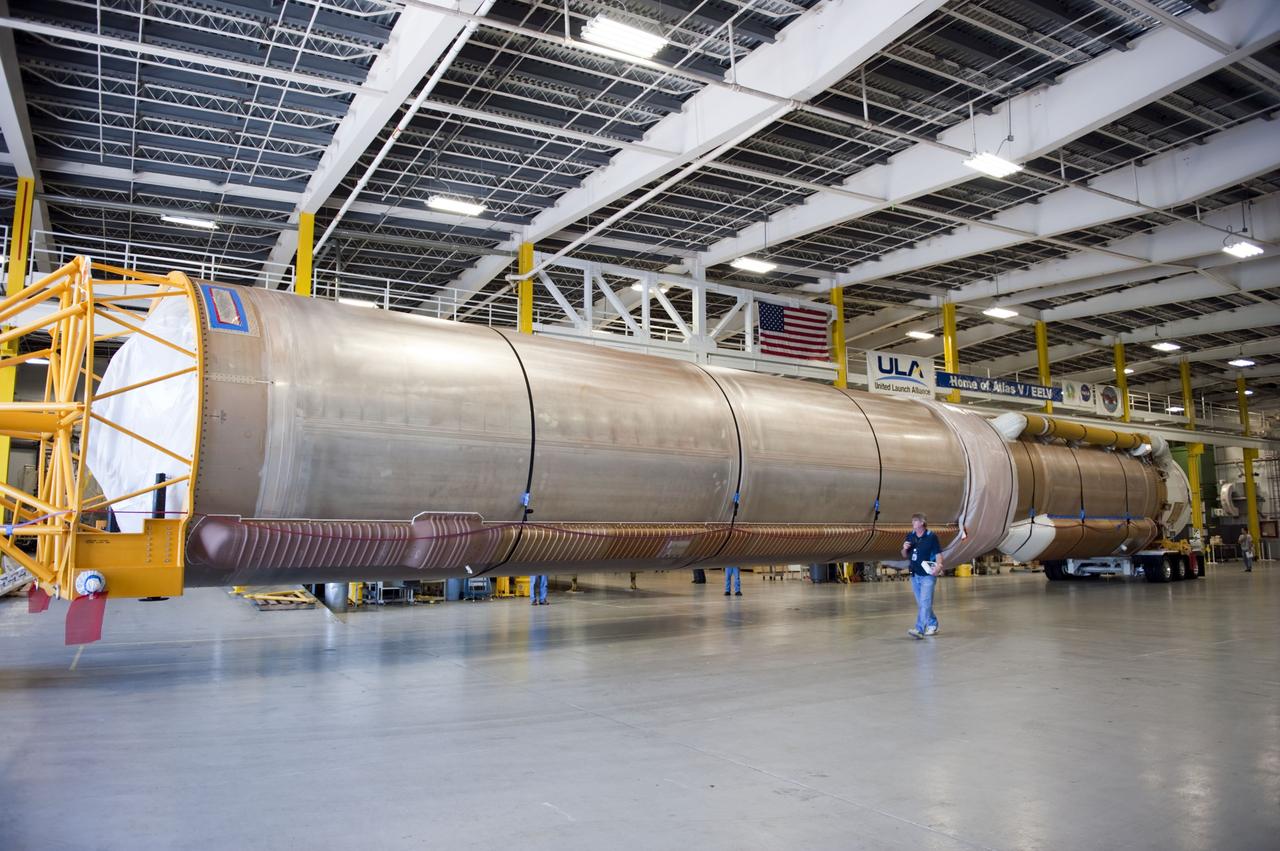
CAPE CANAVERAL, Fla. -- The Atlas V first stage to support the Mars Science Laboratory (MSL) mission is positioned inside the Atlas Spaceflight Operations Center on Cape Canaveral Air Force Station in Florida. MSL's components include a compact car-sized rover, Curiosity, which has 10 science instruments designed to search for evidence on whether Mars has had environments favorable to microbial life, including chemical ingredients for life. The unique rover will use a laser to look inside rocks and release its gasses so that the rover’s spectrometer can analyze and send the data back to Earth. Launch of MSL aboard a United Launch Alliance Atlas V rocket is scheduled for Nov. 25 from Space Launch Complex 41 on Cape Canaveral Air Force Station. For more information, visit http://www.nasa.gov/msl. Photo credit: NASA/Kim Shiflett
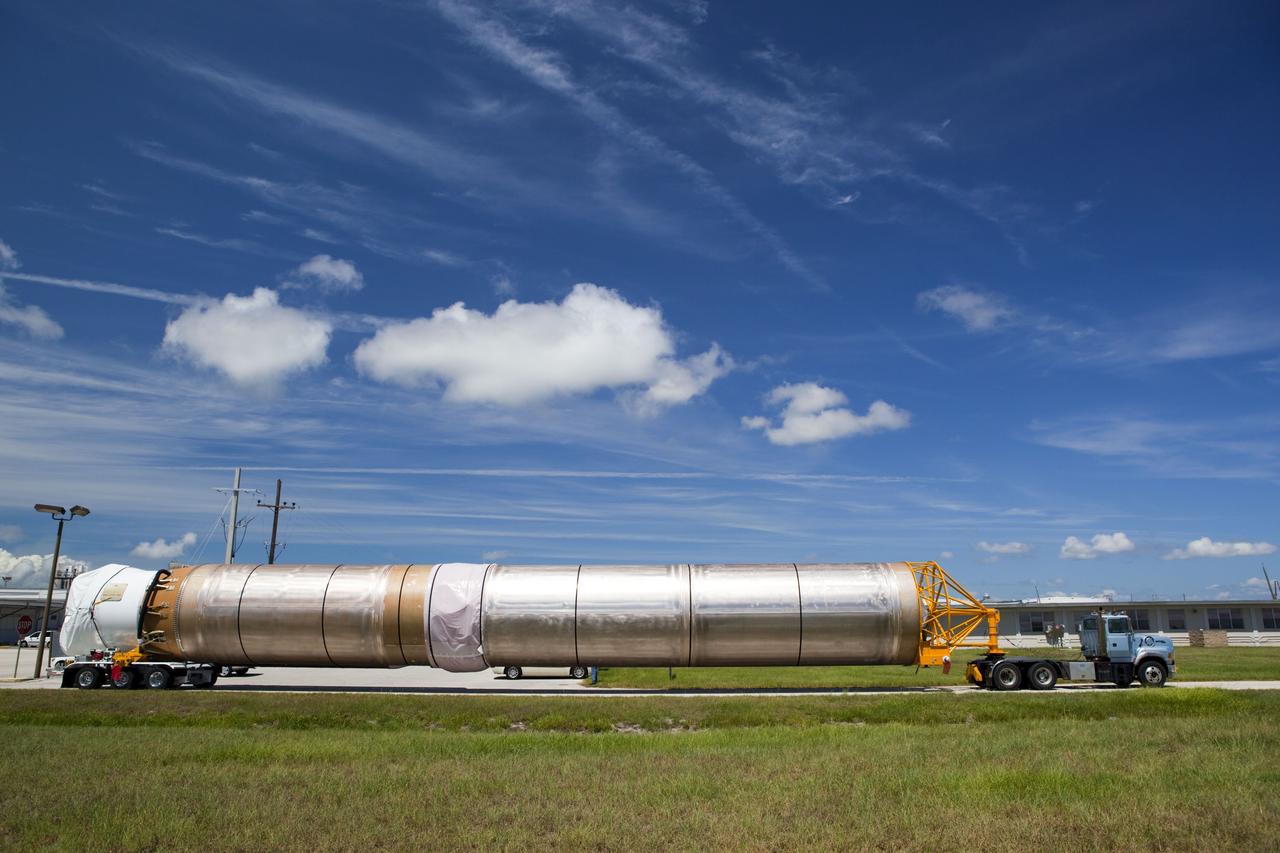
CAPE CANAVERAL, Fla. -- The Atlas V first stage to support the Mars Science Laboratory (MSL) mission begins its trip from Port Canaveral to the Atlas Spaceflight Operations Center on Cape Canaveral Air Force Station in Florida. MSL's components include a compact car-sized rover, Curiosity, which has 10 science instruments designed to search for evidence on whether Mars has had environments favorable to microbial life, including chemical ingredients for life. The unique rover will use a laser to look inside rocks and release its gasses so that the rover’s spectrometer can analyze and send the data back to Earth. Launch of MSL aboard a United Launch Alliance Atlas V rocket is scheduled for Nov. 25 from Space Launch Complex 41 on Cape Canaveral Air Force Station. For more information, visit http://www.nasa.gov/msl. Photo credit: NASA/Dimitri Gerondidakis
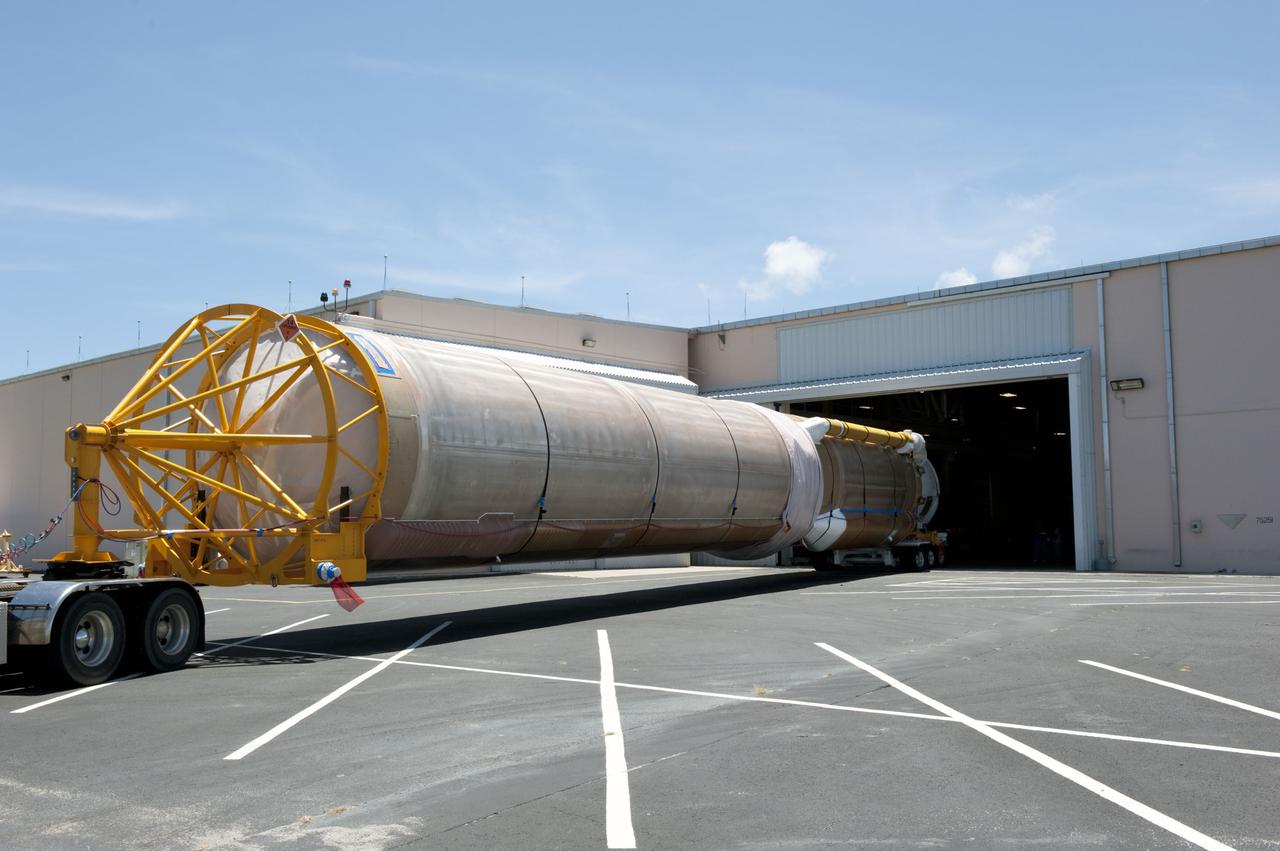
CAPE CANAVERAL, Fla. -- The door of the Atlas Spaceflight Operations Center on Cape Canaveral Air Force Station in Florida is opened to receive the Atlas V first stage to support the Mars Science Laboratory (MSL) mission. MSL's components include a compact car-sized rover, Curiosity, which has 10 science instruments designed to search for evidence on whether Mars has had environments favorable to microbial life, including chemical ingredients for life. The unique rover will use a laser to look inside rocks and release its gasses so that the rover’s spectrometer can analyze and send the data back to Earth. Launch of MSL aboard a United Launch Alliance Atlas V rocket is scheduled for Nov. 25 from Space Launch Complex 41 on Cape Canaveral Air Force Station. For more information, visit http://www.nasa.gov/msl. Photo credit: NASA/Kim Shiflett
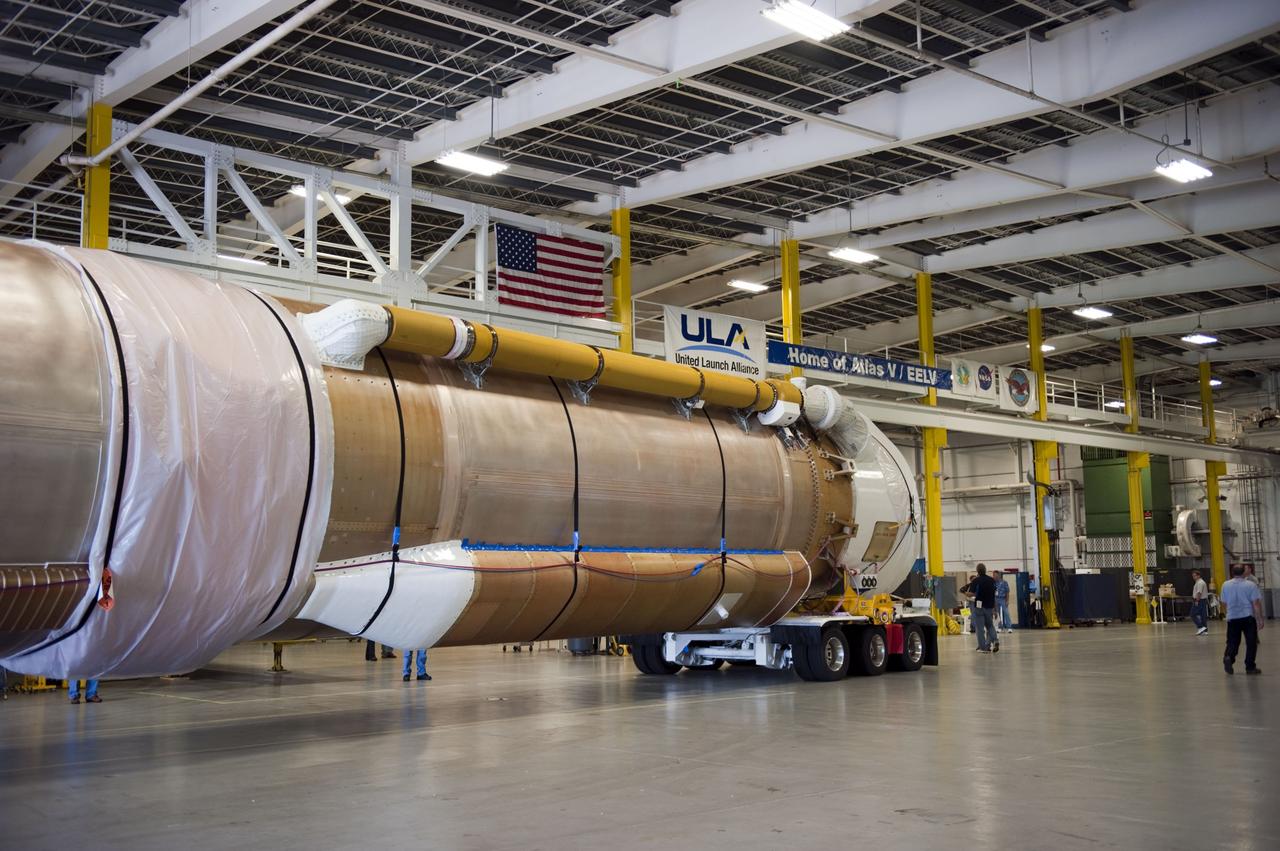
CAPE CANAVERAL, Fla. -- The Atlas V first stage to support the Mars Science Laboratory (MSL) mission rolls into position in the Atlas Spaceflight Operations Center on Cape Canaveral Air Force Station in Florida. MSL's components include a compact car-sized rover, Curiosity, which has 10 science instruments designed to search for evidence on whether Mars has had environments favorable to microbial life, including chemical ingredients for life. The unique rover will use a laser to look inside rocks and release its gasses so that the rover’s spectrometer can analyze and send the data back to Earth. Launch of MSL aboard a United Launch Alliance Atlas V rocket is scheduled for Nov. 25 from Space Launch Complex 41 on Cape Canaveral Air Force Station. For more information, visit http://www.nasa.gov/msl. Photo credit: NASA/Kim Shiflett
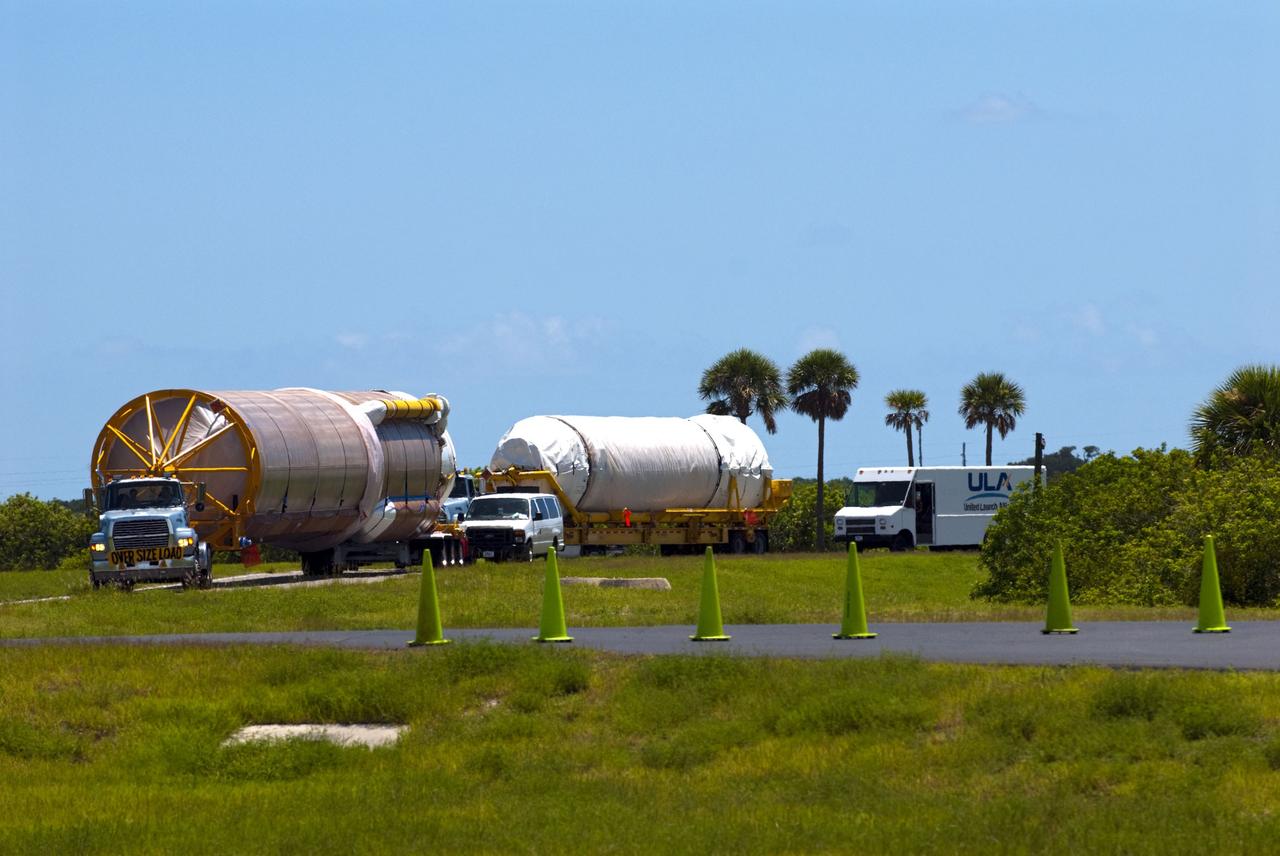
CAPE CANAVERAL, Fla. -- The Atlas V first stage (left) and Centaur upper stage to support the Mars Science Laboratory (MSL) mission approach the Atlas Spaceflight Operations Center on Cape Canaveral Air Force Station in Florida. MSL's components include a compact car-sized rover, Curiosity, which has 10 science instruments designed to search for evidence on whether Mars has had environments favorable to microbial life, including chemical ingredients for life. The unique rover will use a laser to look inside rocks and release its gasses so that the rover’s spectrometer can analyze and send the data back to Earth. Launch of MSL aboard a United Launch Alliance Atlas V rocket is scheduled for Nov. 25 from Space Launch Complex 41 on Cape Canaveral Air Force Station. For more information, visit http://www.nasa.gov/msl. Photo credit: NASA/Kim Shiflett
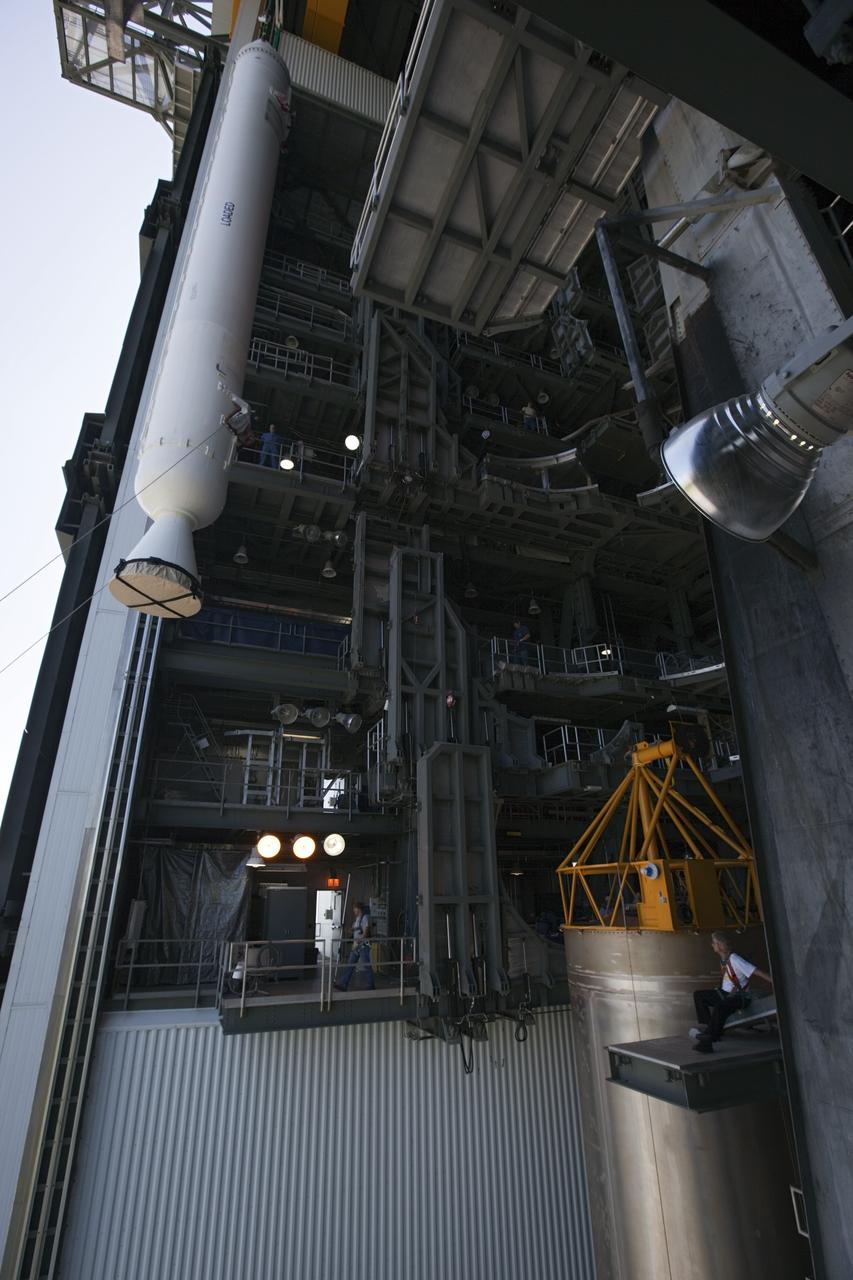
CAPE CANAVERAL, Fla. – Inside the Vertical Integration Facility at Space Launch Complex 41 on Cape Canaveral Air Force Station in Florida, a crane positions a solid rocket motor (SRM) for mating to the first stage of a United Launch Alliance Atlas V rocket. The Atlas V will carry NASA's Mars Science Laboratory (MSL) mission into space. MSL's components include a compact car-sized rover, Curiosity, which has 10 science instruments designed to search for evidence on whether Mars has had environments favorable to microbial life, including chemical ingredients for life. The unique rover will use a laser to look inside rocks and release its gasses so that the rover’s spectrometer can analyze and send the data back to Earth. MSL is scheduled to launch Nov. 25 with a window extending to Dec. 18 and arrival at Mars Aug. 2012. For more information, visit http://www.nasa.gov/msl. Photo credit: NASA/Dimitri Gerondidakis
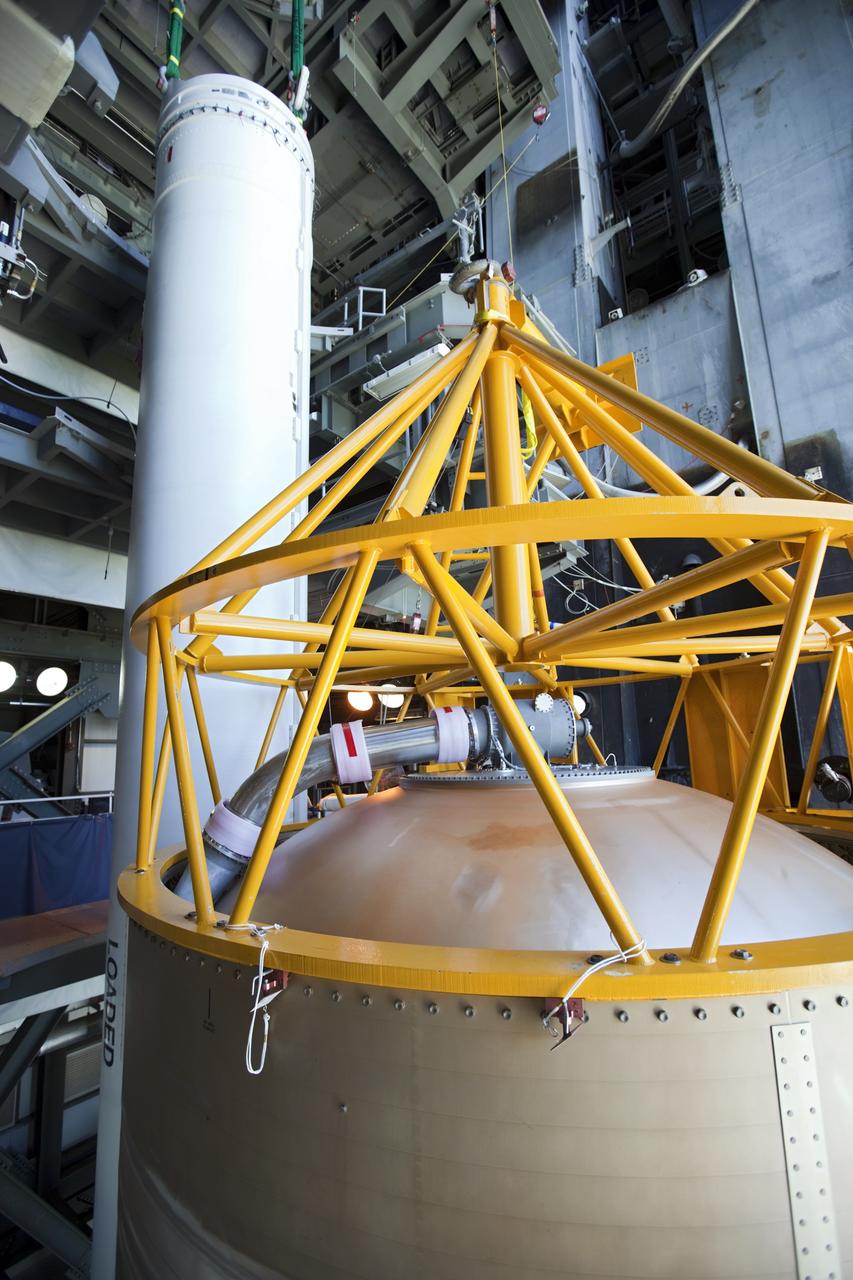
CAPE CANAVERAL, Fla. – Inside the Vertical Integration Facility at Space Launch Complex 41 on Cape Canaveral Air Force Station in Florida, a crane lowers a solid rocket motor (SRM) for mating to the first stage of a United Launch Alliance Atlas V rocket. The Atlas V will carry NASA's Mars Science Laboratory (MSL) mission into space. MSL's components include a compact car-sized rover, Curiosity, which has 10 science instruments designed to search for evidence on whether Mars has had environments favorable to microbial life, including chemical ingredients for life. The unique rover will use a laser to look inside rocks and release its gasses so that the rover’s spectrometer can analyze and send the data back to Earth. MSL is scheduled to launch Nov. 25 with a window extending to Dec. 18 and arrival at Mars Aug. 2012. For more information, visit http://www.nasa.gov/msl. Photo credit: NASA/Dimitri Gerondidakis
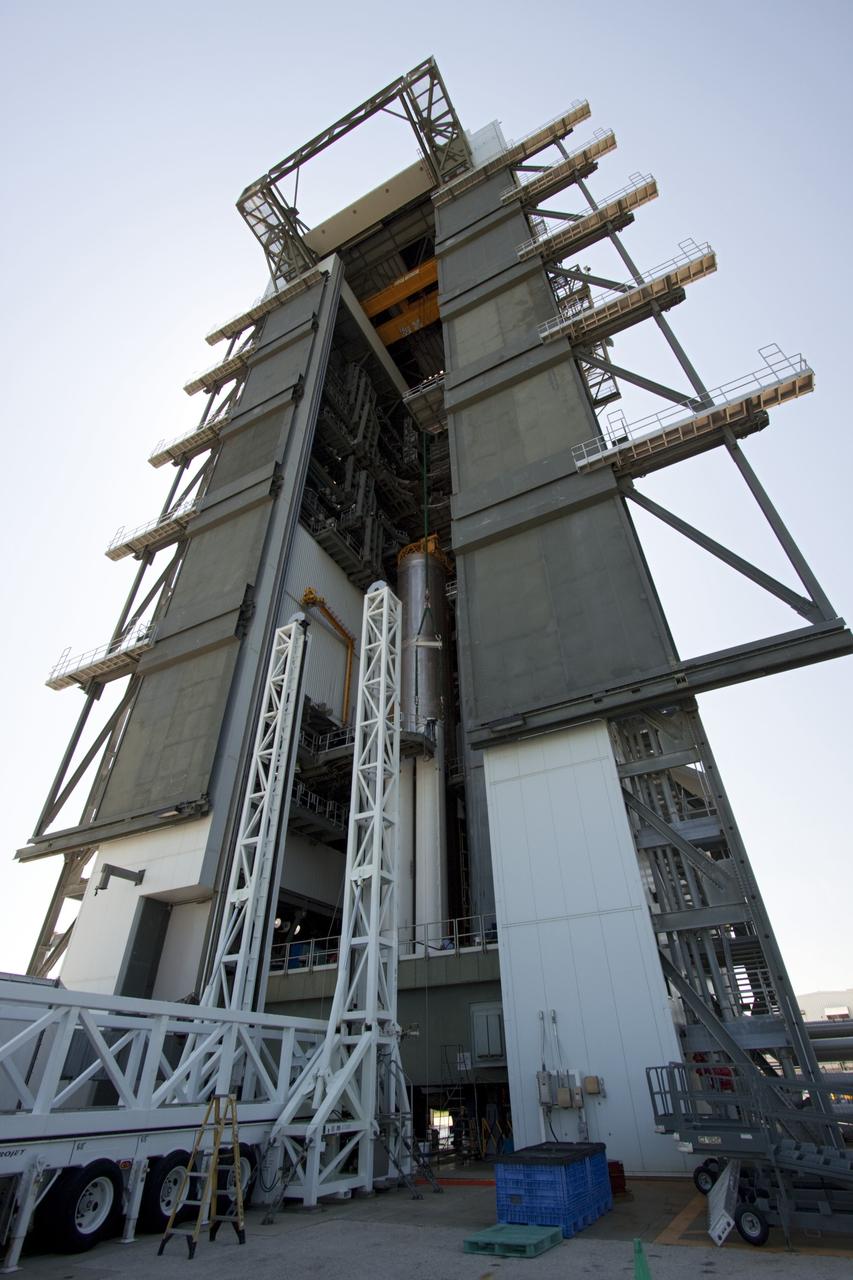
CAPE CANAVERAL, Fla. – At the Vertical Integration Facility at Space Launch Complex 41 on Cape Canaveral Air Force Station in Florida, the final solid rocket motor (SRM) is ready for mating to the first stage of a United Launch Alliance Atlas V rocket. The Atlas V will carry NASA's Mars Science Laboratory (MSL) mission into space. MSL's components include a compact car-sized rover, Curiosity, which has 10 science instruments designed to search for evidence on whether Mars has had environments favorable to microbial life, including chemical ingredients for life. The unique rover will use a laser to look inside rocks and release its gasses so that the rover’s spectrometer can analyze and send the data back to Earth. MSL is scheduled to launch Nov. 25 with a window extending to Dec. 18 and arrival at Mars Aug. 2012. For more information, visit http://www.nasa.gov/msl. Photo credit: NASA/Jim Grossmann
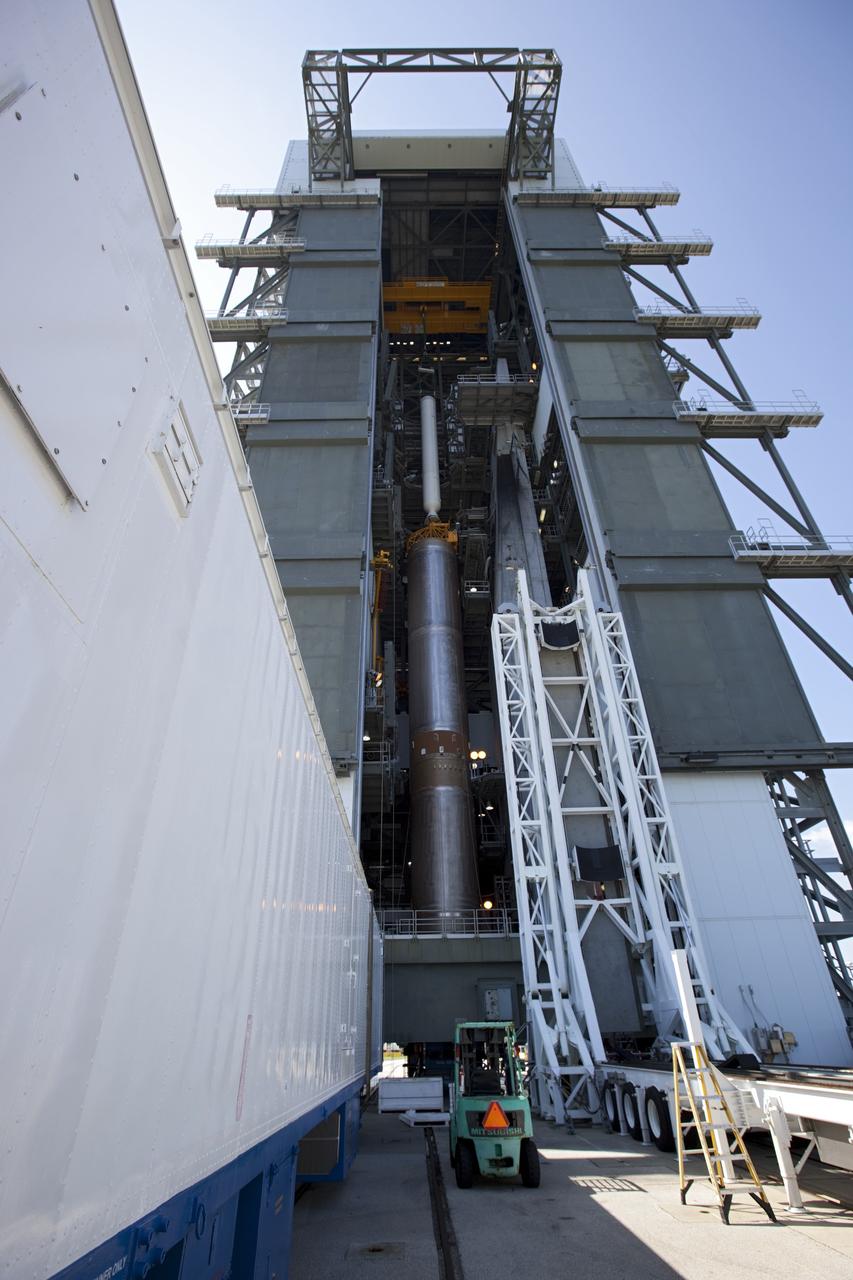
CAPE CANAVERAL, Fla. – Inside the Vertical Integration Facility at Space Launch Complex 41 on Cape Canaveral Air Force Station in Florida, a crane positions a solid rocket motor (SRM) for mating to the first stage of a United Launch Alliance Atlas V rocket. The Atlas V will carry NASA's Mars Science Laboratory (MSL) mission into space. MSL's components include a compact car-sized rover, Curiosity, which has 10 science instruments designed to search for evidence on whether Mars has had environments favorable to microbial life, including chemical ingredients for life. The unique rover will use a laser to look inside rocks and release its gasses so that the rover’s spectrometer can analyze and send the data back to Earth. MSL is scheduled to launch Nov. 25 with a window extending to Dec. 18 and arrival at Mars Aug. 2012. For more information, visit http://www.nasa.gov/msl. Photo credit: NASA/Dimitri Gerondidakis
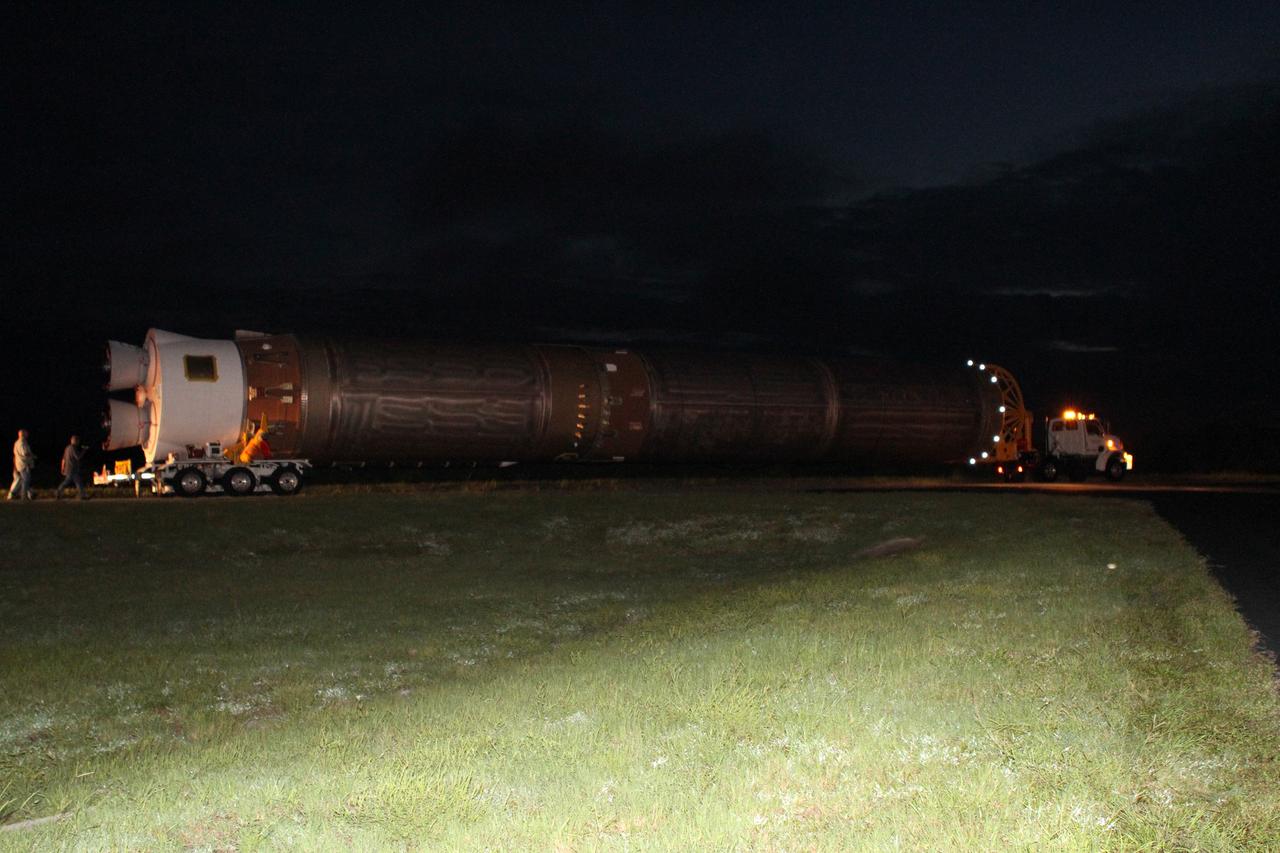
CAPE CANAVERAL, Fla. -- Workers accompany the first stage of the Atlas V rocket for NASA's Mars Science Laboratory (MSL) mission on its trip from the Atlas Spaceflight Operations Center on Cape Canaveral Air Force Station in Florida to the launch pad. A United Launch Alliance Atlas V-541 configuration will be used to loft MSL into space. Curiosity’s 10 science instruments are designed to search for evidence on whether Mars has had environments favorable to microbial life, including chemical ingredients for life. The unique rover will use a laser to look inside rocks and release its gasses so that the rover’s spectrometer can analyze and send the data back to Earth. MSL is scheduled to launch Nov. 25 with a window extending to Dec. 18 and arrival at Mars Aug. 2012. For more information, visit http://www.nasa.gov/msl. Photo credit: NASA/Cory Huston

CAPE CANAVERAL, Fla. -- The first stage of the Atlas V rocket for NASA's Mars Science Laboratory (MSL) mission begins its trip from the Atlas Spaceflight Operations Center on Cape Canaveral Air Force Station in Florida to the launch pad. A United Launch Alliance Atlas V-541 configuration will be used to loft MSL into space. Curiosity’s 10 science instruments are designed to search for evidence on whether Mars has had environments favorable to microbial life, including chemical ingredients for life. The unique rover will use a laser to look inside rocks and release its gasses so that the rover’s spectrometer can analyze and send the data back to Earth. MSL is scheduled to launch Nov. 25 with a window extending to Dec. 18 and arrival at Mars Aug. 2012. For more information, visit http://www.nasa.gov/msl. Photo credit: NASA/Cory Huston
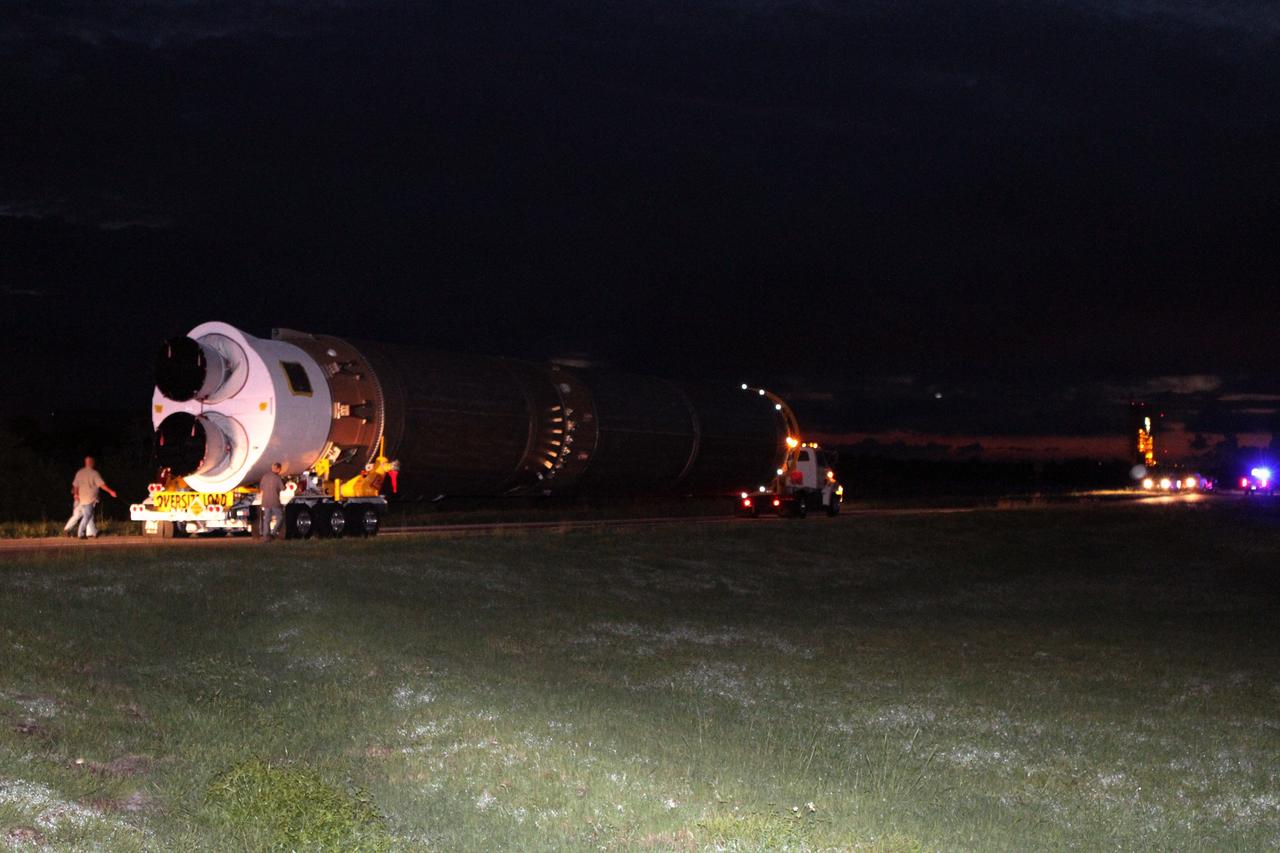
CAPE CANAVERAL, Fla. -- Early morning finds workers accompanying the first stage of the Atlas V rocket for NASA's Mars Science Laboratory (MSL) mission on its move from the Atlas Spaceflight Operations Center on Cape Canaveral Air Force Station in Florida to the launch pad. A United Launch Alliance Atlas V-541 configuration will be used to loft MSL into space. Curiosity’s 10 science instruments are designed to search for evidence on whether Mars has had environments favorable to microbial life, including chemical ingredients for life. The unique rover will use a laser to look inside rocks and release its gasses so that the rover’s spectrometer can analyze and send the data back to Earth. MSL is scheduled to launch Nov. 25 with a window extending to Dec. 18 and arrival at Mars Aug. 2012. For more information, visit http://www.nasa.gov/msl. Photo credit: NASA/Cory Huston
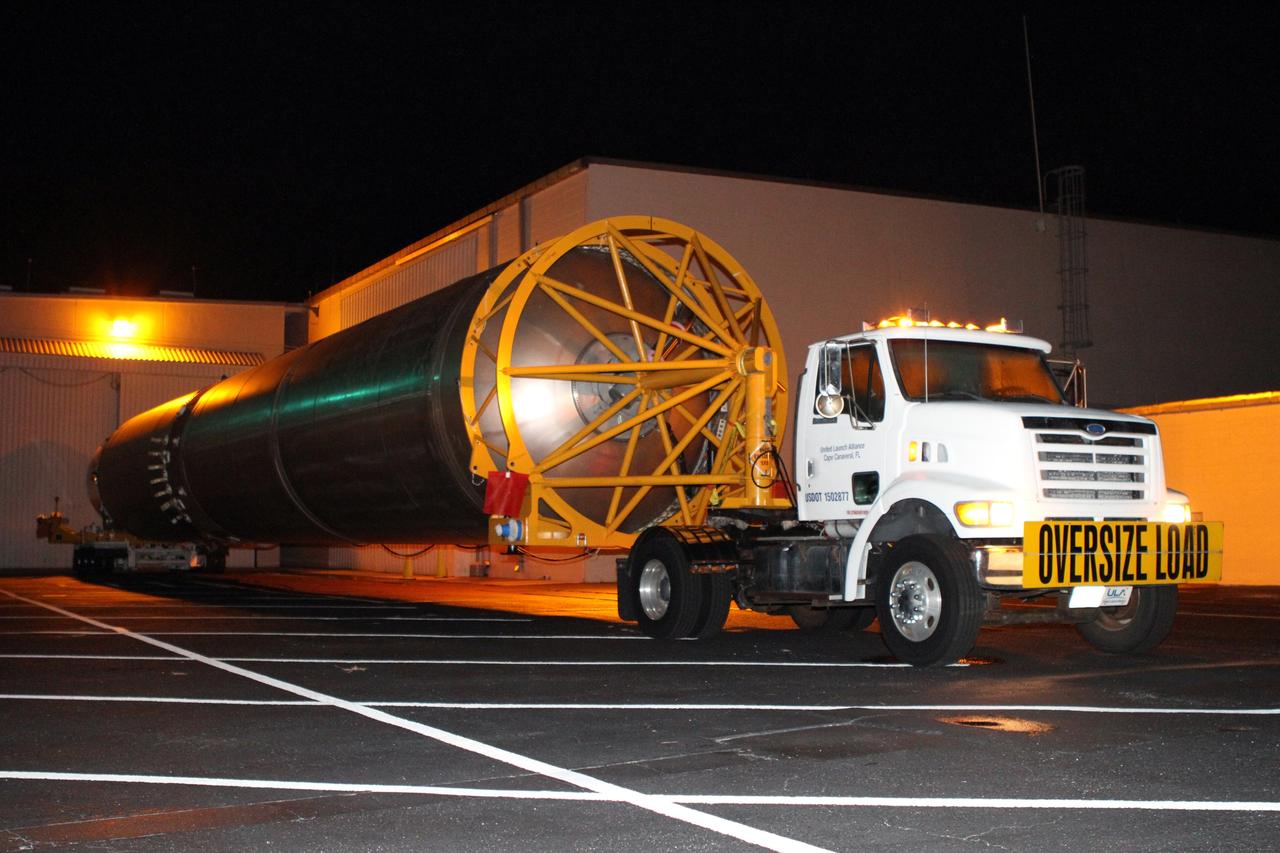
CAPE CANAVERAL, Fla. -- The first stage of the Atlas V rocket for NASA's Mars Science Laboratory (MSL) mission rolls out of the Atlas Spaceflight Operations Center on Cape Canaveral Air Force Station in Florida bound for the launch pad. A United Launch Alliance Atlas V-541 configuration will be used to loft MSL into space. Curiosity’s 10 science instruments are designed to search for evidence on whether Mars has had environments favorable to microbial life, including chemical ingredients for life. The unique rover will use a laser to look inside rocks and release its gasses so that the rover’s spectrometer can analyze and send the data back to Earth. MSL is scheduled to launch Nov. 25 with a window extending to Dec. 18 and arrival at Mars Aug. 2012. For more information, visit http://www.nasa.gov/msl. Photo credit: NASA/Cory Huston
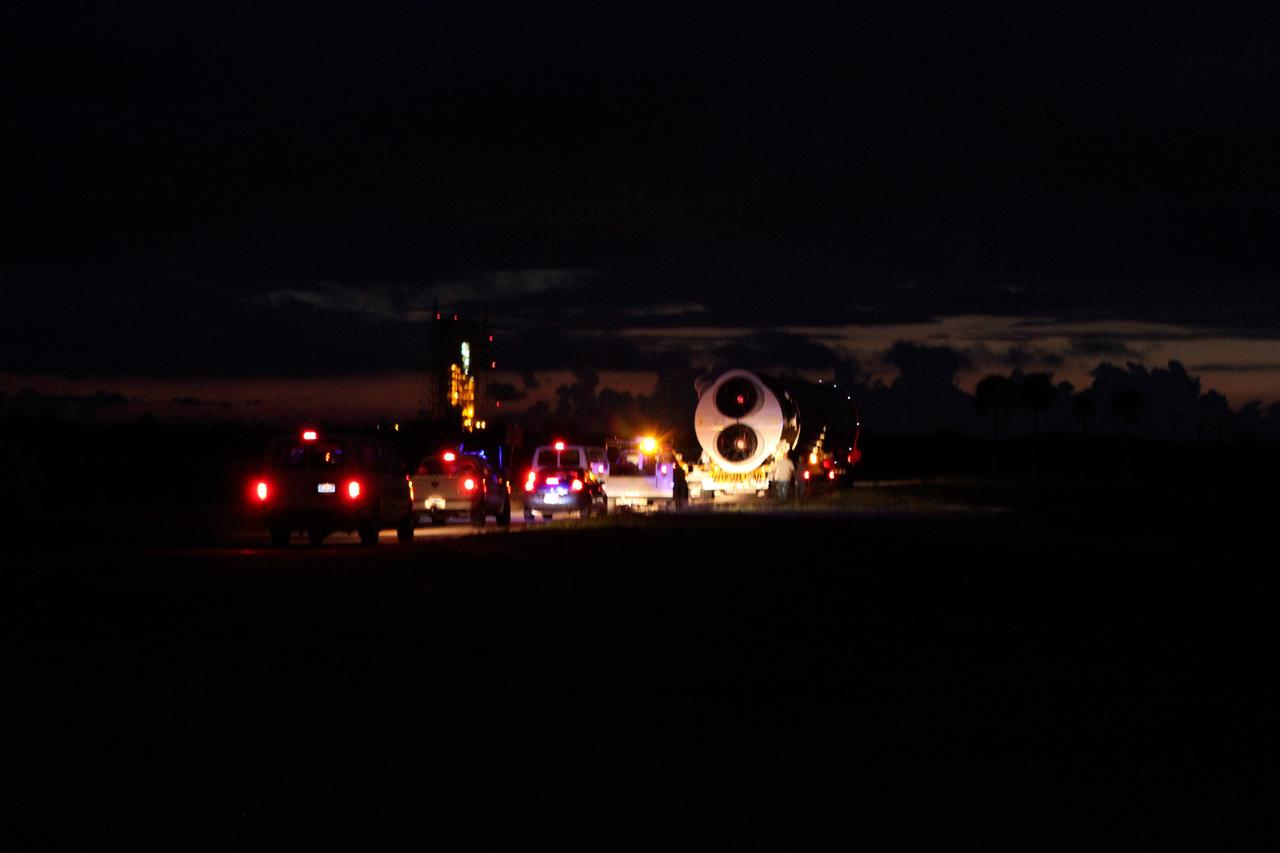
CAPE CANAVERAL, Fla. -- A convoy of support vehicles trails the first stage of the Atlas V rocket for NASA's Mars Science Laboratory (MSL) mission as it moves from the Atlas Spaceflight Operations Center on Cape Canaveral Air Force Station in Florida to the launch pad. A United Launch Alliance Atlas V-541 configuration will be used to loft MSL into space. Curiosity’s 10 science instruments are designed to search for evidence on whether Mars has had environments favorable to microbial life, including chemical ingredients for life. The unique rover will use a laser to look inside rocks and release its gasses so that the rover’s spectrometer can analyze and send the data back to Earth. MSL is scheduled to launch Nov. 25 with a window extending to Dec. 18 and arrival at Mars Aug. 2012. For more information, visit http://www.nasa.gov/msl. Photo credit: NASA/Cory Huston
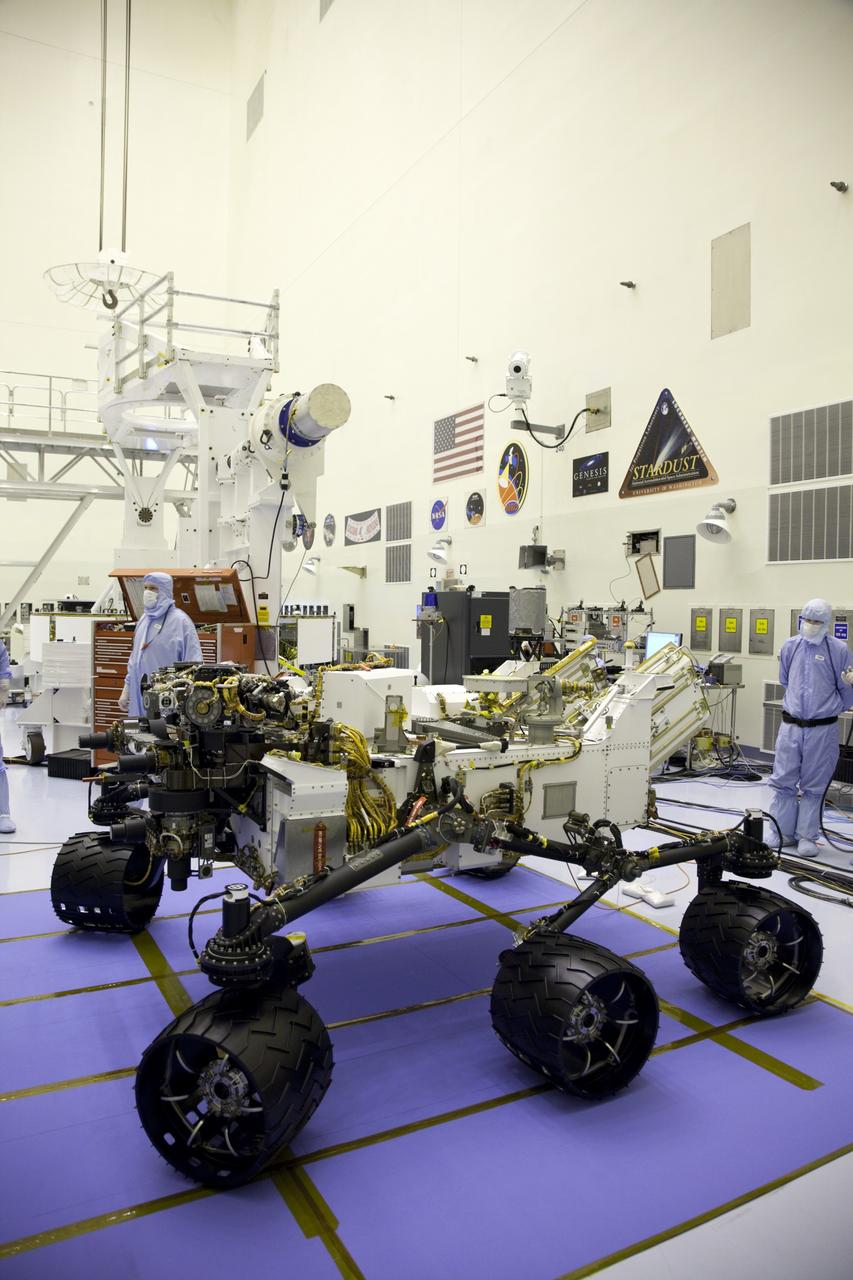
Cape Canaveral, Fla. -- Technicians, at the Payload Hazardous Servicing Facility at NASA's Kennedy Space Center in Florida, prepare NASA's Mars Science Laboratory (MSL) rover, known as Curiosity, for instrument mast and science boom deployment testing. A United Launch Alliance Atlas V-541 configuration will be used to loft MSL into space. Curiosity’s 10 science instruments are designed to search for evidence on whether Mars has had environments favorable to microbial life, including chemical ingredients for life. The unique rover will use a laser to look inside rocks and release its gasses so that the rover’s spectrometer can analyze and send the data back to Earth. MSL is scheduled to launch from Cape Canaveral Air Force Station in Florida Nov. 25 with a window extending to Dec. 18 and arrival at Mars Aug. 2012. For more information, visit http://www.nasa.gov/msl. Photo credit: NASA/Frankie Martin
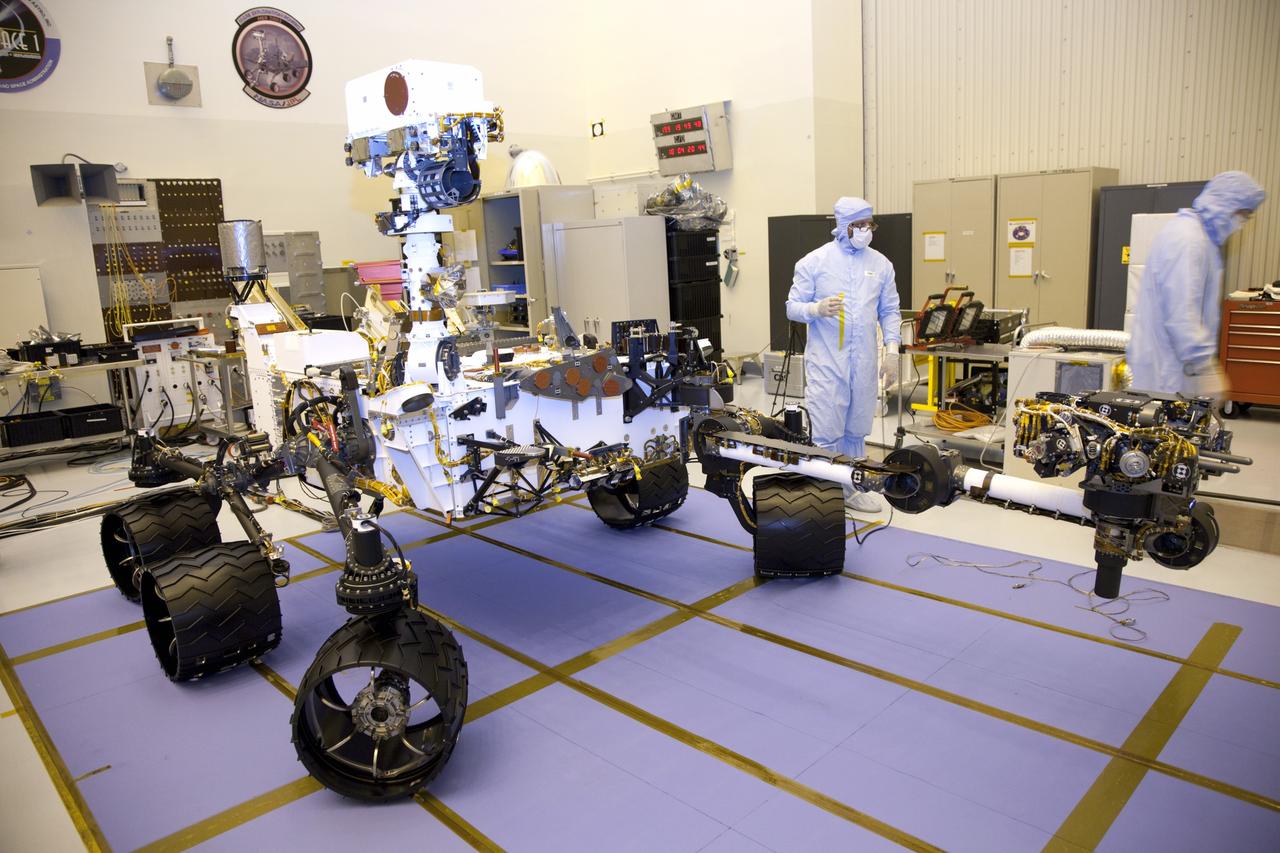
Cape Canaveral, Fla. -- Technicians at the Payload Hazardous Servicing Facility at NASA's Kennedy Space Center in Florida, put the instrument mast and science boom on NASA's Mars Science Laboratory (MSL) rover, known as Curiosity, through a series of deployment tests. A United Launch Alliance Atlas V-541 configuration will be used to loft MSL into space. Curiosity’s 10 science instruments are designed to search for evidence on whether Mars has had environments favorable to microbial life, including chemical ingredients for life. The unique rover will use a laser to look inside rocks and release its gasses so that the rover’s spectrometer can analyze and send the data back to Earth. MSL is scheduled to launch from Cape Canaveral Air Force Station in Florida Nov. 25 with a window extending to Dec. 18 and arrival at Mars Aug. 2012. For more information, visit http://www.nasa.gov/msl. Photo credit: NASA/Frankie Martin
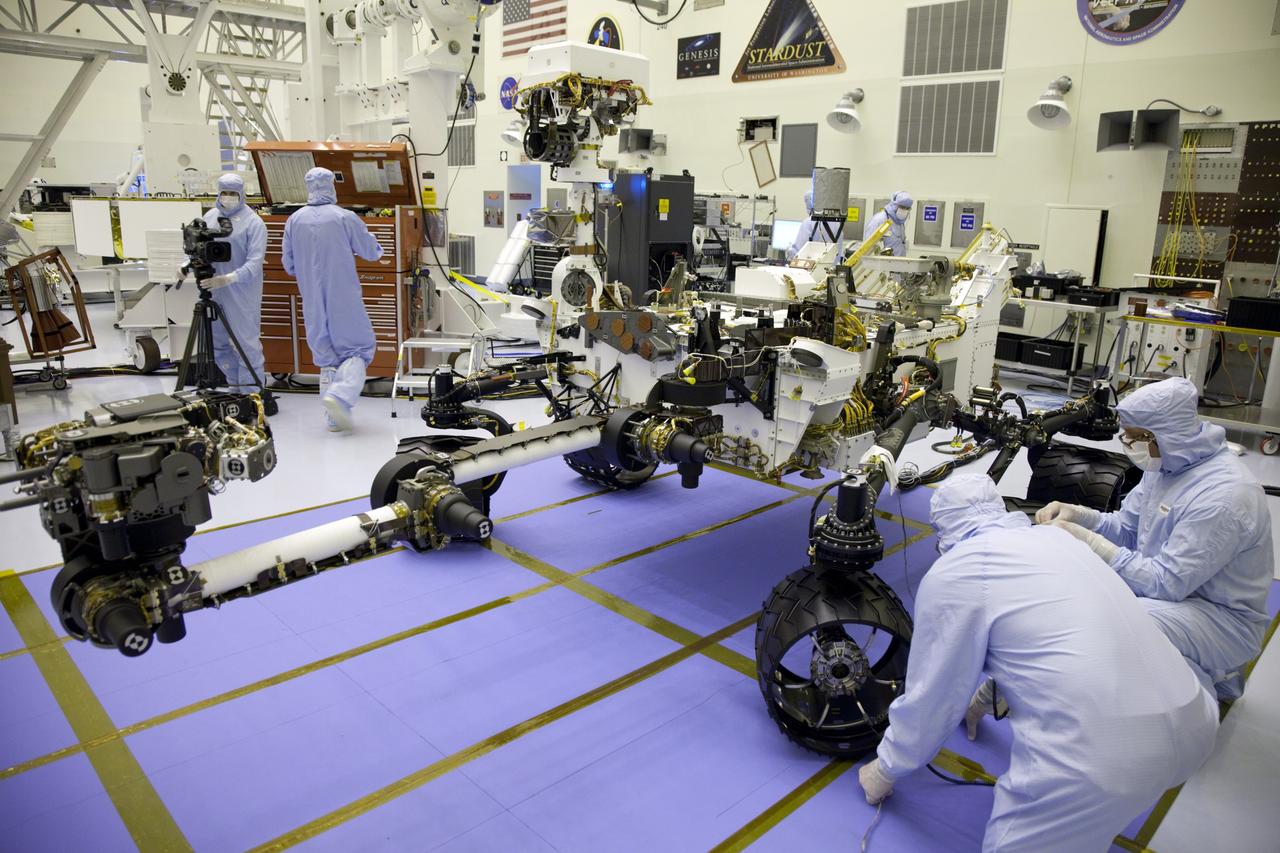
Cape Canaveral, Fla. -- Technicians at the Payload Hazardous Servicing Facility at NASA's Kennedy Space Center in Florida, put the instrument mast and science boom on NASA's Mars Science Laboratory (MSL) rover, known as Curiosity, through a series of deployment tests. A United Launch Alliance Atlas V-541 configuration will be used to loft MSL into space. Curiosity’s 10 science instruments are designed to search for evidence on whether Mars has had environments favorable to microbial life, including chemical ingredients for life. The unique rover will use a laser to look inside rocks and release its gasses so that the rover’s spectrometer can analyze and send the data back to Earth. MSL is scheduled to launch from Cape Canaveral Air Force Station in Florida Nov. 25 with a window extending to Dec. 18 and arrival at Mars Aug. 2012. For more information, visit http://www.nasa.gov/msl. Photo credit: NASA/Frankie Martin
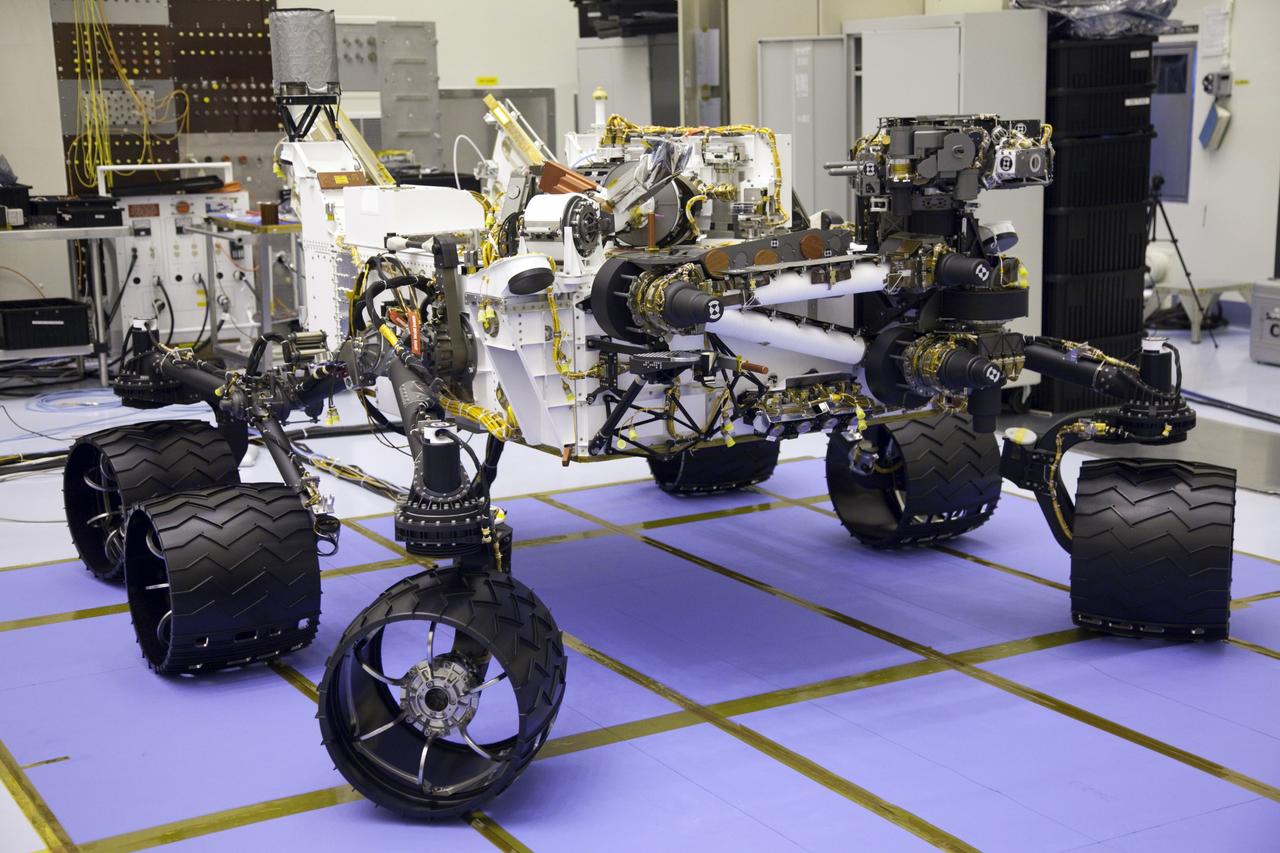
Cape Canaveral, Fla. -- Technicians, at the Payload Hazardous Servicing Facility at NASA's Kennedy Space Center in Florida, prepare NASA's Mars Science Laboratory (MSL) rover, known as Curiosity, for instrument mast and science boom deployment testing. A United Launch Alliance Atlas V-541 configuration will be used to loft MSL into space. Curiosity’s 10 science instruments are designed to search for evidence on whether Mars has had environments favorable to microbial life, including chemical ingredients for life. The unique rover will use a laser to look inside rocks and release its gasses so that the rover’s spectrometer can analyze and send the data back to Earth. MSL is scheduled to launch from Cape Canaveral Air Force Station in Florida Nov. 25 with a window extending to Dec. 18 and arrival at Mars Aug. 2012. For more information, visit http://www.nasa.gov/msl. Photo credit: NASA/Frankie Martin
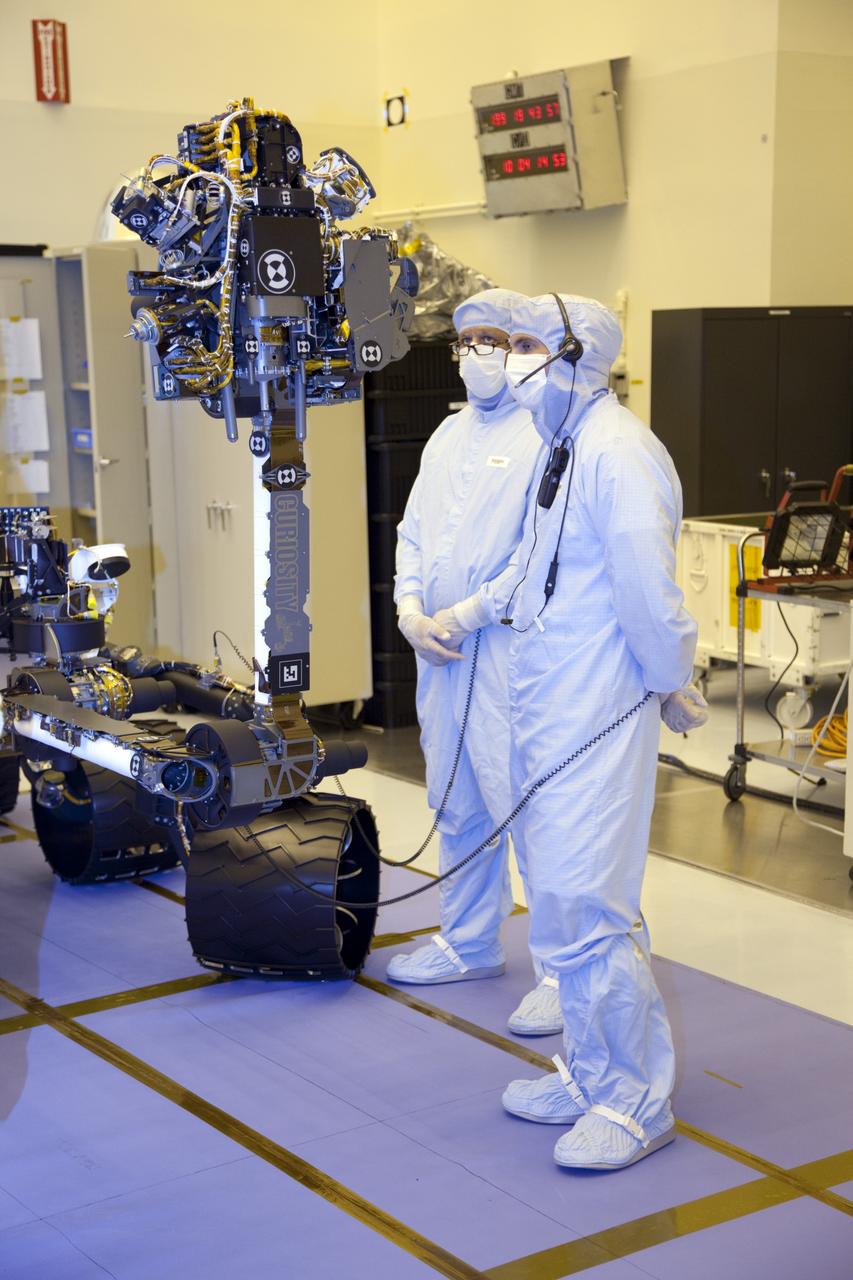
Cape Canaveral, Fla. -- Technicians at the Payload Hazardous Servicing Facility at NASA's Kennedy Space Center in Florida, put the instrument mast and science boom on NASA's Mars Science Laboratory (MSL) rover, known as Curiosity, through a series of deployment tests. A United Launch Alliance Atlas V-541 configuration will be used to loft MSL into space. Curiosity’s 10 science instruments are designed to search for evidence on whether Mars has had environments favorable to microbial life, including chemical ingredients for life. The unique rover will use a laser to look inside rocks and release its gasses so that the rover’s spectrometer can analyze and send the data back to Earth. MSL is scheduled to launch from Cape Canaveral Air Force Station in Florida Nov. 25 with a window extending to Dec. 18 and arrival at Mars Aug. 2012. For more information, visit http://www.nasa.gov/msl. Photo credit: NASA/Frankie Martin
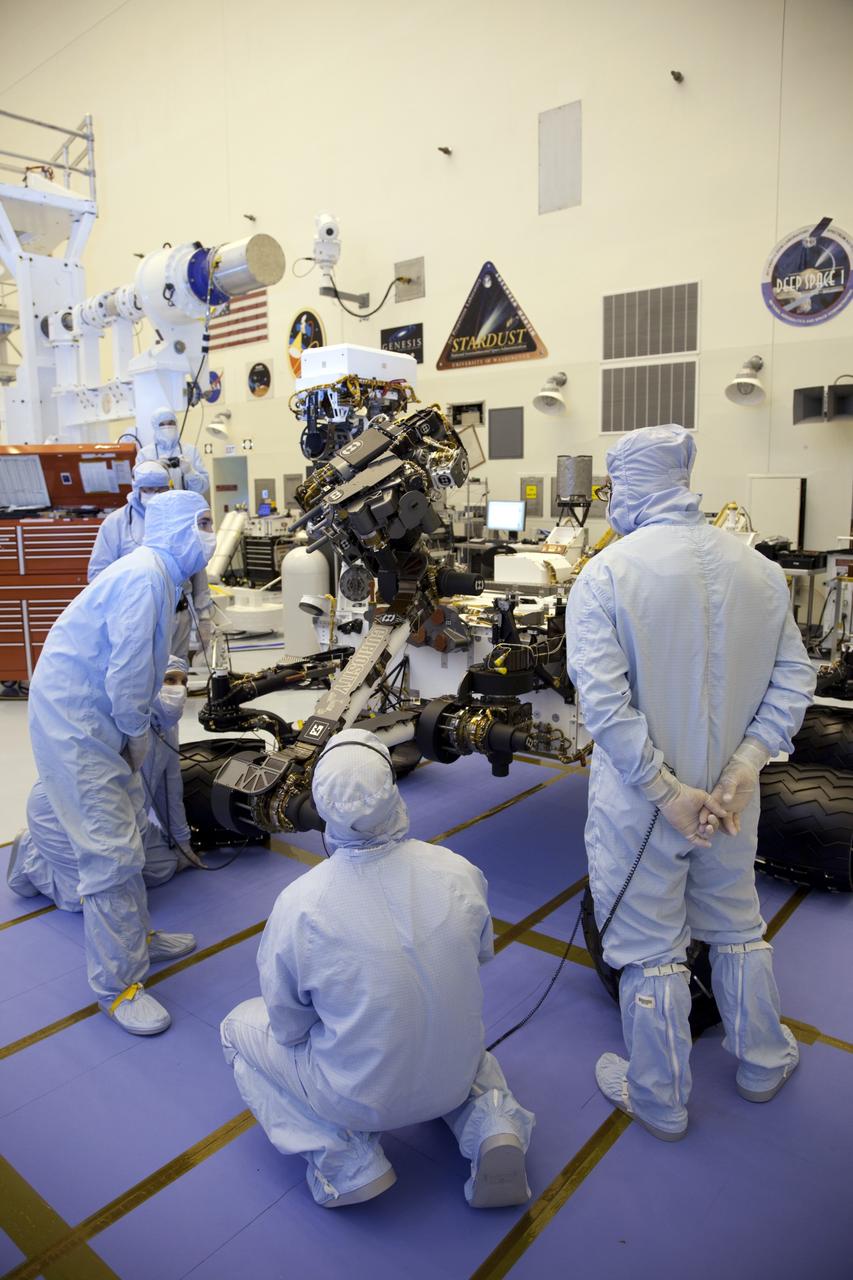
Cape Canaveral, Fla. -- Technicians at the Payload Hazardous Servicing Facility at NASA's Kennedy Space Center in Florida, put the instrument mast and science boom on NASA's Mars Science Laboratory (MSL) rover, known as Curiosity, through a series of deployment tests. A United Launch Alliance Atlas V-541 configuration will be used to loft MSL into space. Curiosity’s 10 science instruments are designed to search for evidence on whether Mars has had environments favorable to microbial life, including chemical ingredients for life. The unique rover will use a laser to look inside rocks and release its gasses so that the rover’s spectrometer can analyze and send the data back to Earth. MSL is scheduled to launch from Cape Canaveral Air Force Station in Florida Nov. 25 with a window extending to Dec. 18 and arrival at Mars Aug. 2012. For more information, visit http://www.nasa.gov/msl. Photo credit: NASA/Frankie Martin
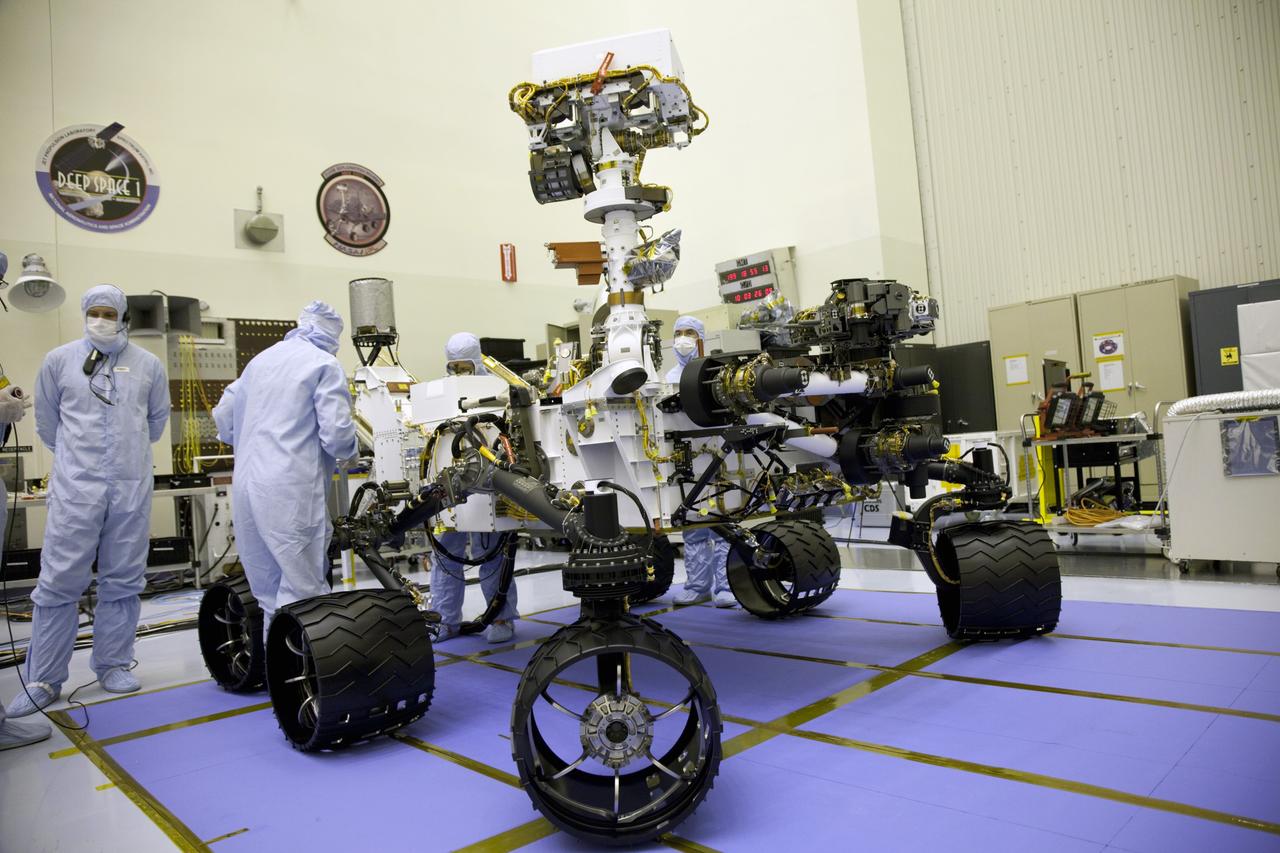
Cape Canaveral, Fla. -- Technicians at the Payload Hazardous Servicing Facility at NASA's Kennedy Space Center in Florida, put the instrument mast and science boom on NASA's Mars Science Laboratory (MSL) rover, known as Curiosity, through a series of deployment tests. A United Launch Alliance Atlas V-541 configuration will be used to loft MSL into space. Curiosity’s 10 science instruments are designed to search for evidence on whether Mars has had environments favorable to microbial life, including chemical ingredients for life. The unique rover will use a laser to look inside rocks and release its gasses so that the rover’s spectrometer can analyze and send the data back to Earth. MSL is scheduled to launch from Cape Canaveral Air Force Station in Florida Nov. 25 with a window extending to Dec. 18 and arrival at Mars Aug. 2012. For more information, visit http://www.nasa.gov/msl. Photo credit: NASA/Frankie Martin
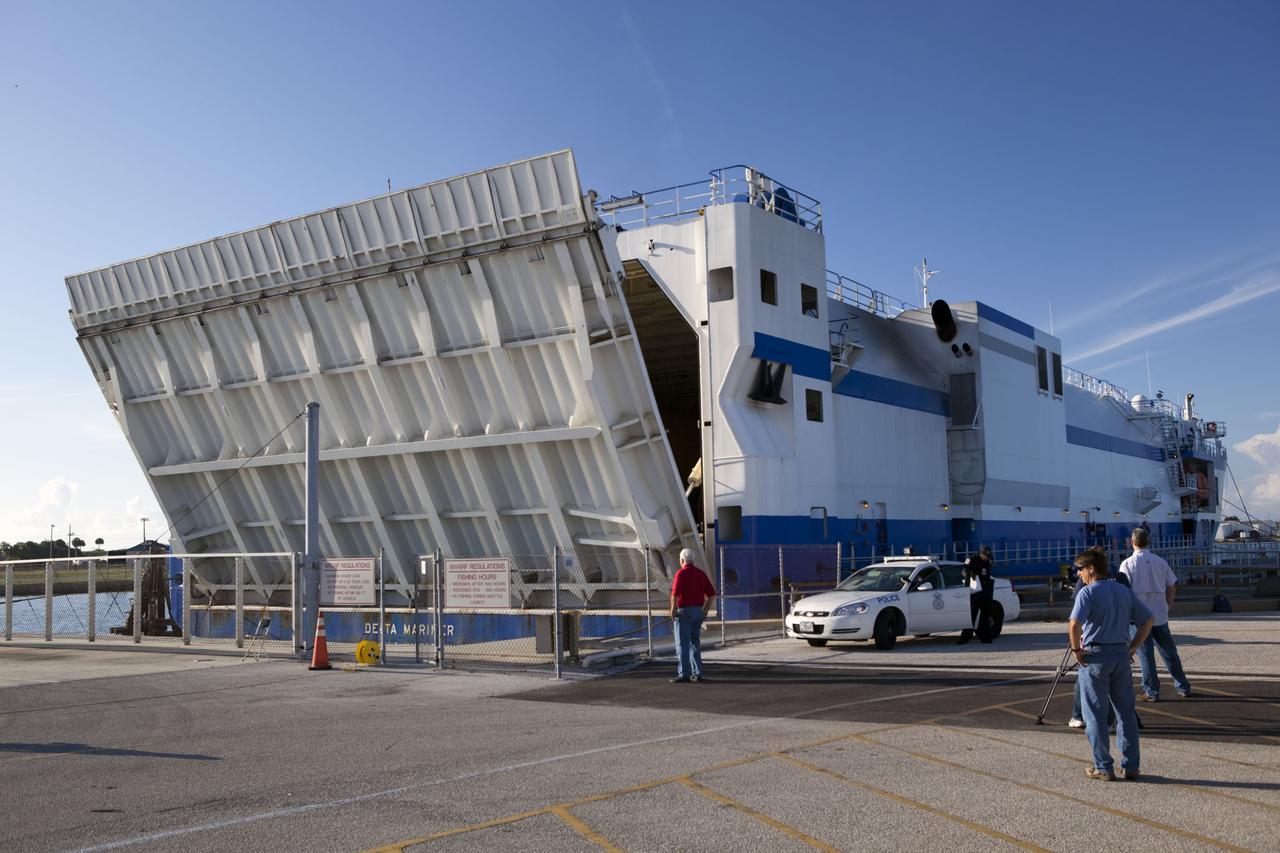
CAPE CANAVERAL, Fla. -- The Atlas V first stage and Centaur upper stage to support the Mars Science Laboratory (MSL) mission arrive at Port Canaveral in Florida aboard the Delta Mariner transport ship. MSL's components include a compact car-sized rover, Curiosity, which has 10 science instruments designed to search for evidence on whether Mars has had environments favorable to microbial life, including chemical ingredients for life. The unique rover will use a laser to look inside rocks and release its gasses so that the rover’s spectrometer can analyze and send the data back to Earth. Launch of MSL aboard a United Launch Alliance Atlas V rocket is scheduled for Nov. 25 from Space Launch Complex 41 on Cape Canaveral Air Force Station. For more information, visit http://www.nasa.gov/msl. Photo credit: NASA/Dimitri Gerondidakis
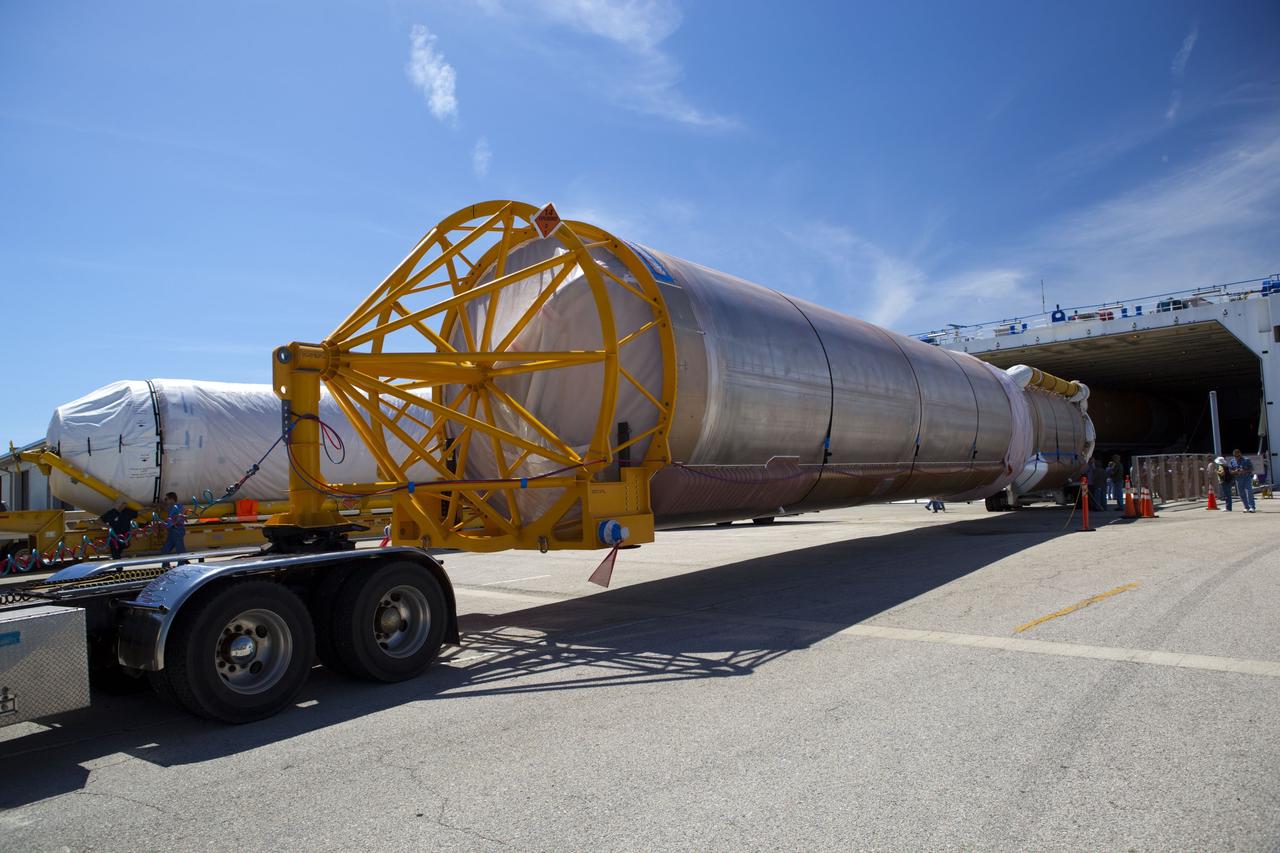
CAPE CANAVERAL, Fla. -- The Atlas V first stage (right) and Centaur upper stage to support the Mars Science Laboratory (MSL) mission are offloaded from the Delta Mariner transport ship at Port Canaveral in Florida. MSL's components include a compact car-sized rover, Curiosity, which has 10 science instruments designed to search for evidence on whether Mars has had environments favorable to microbial life, including chemical ingredients for life. The unique rover will use a laser to look inside rocks and release its gasses so that the rover’s spectrometer can analyze and send the data back to Earth. Launch of MSL aboard a United Launch Alliance Atlas V rocket is scheduled for Nov. 25 from Space Launch Complex 41 on Cape Canaveral Air Force Station. For more information, visit http://www.nasa.gov/msl. Photo credit: NASA/Dimitri Gerondidakis
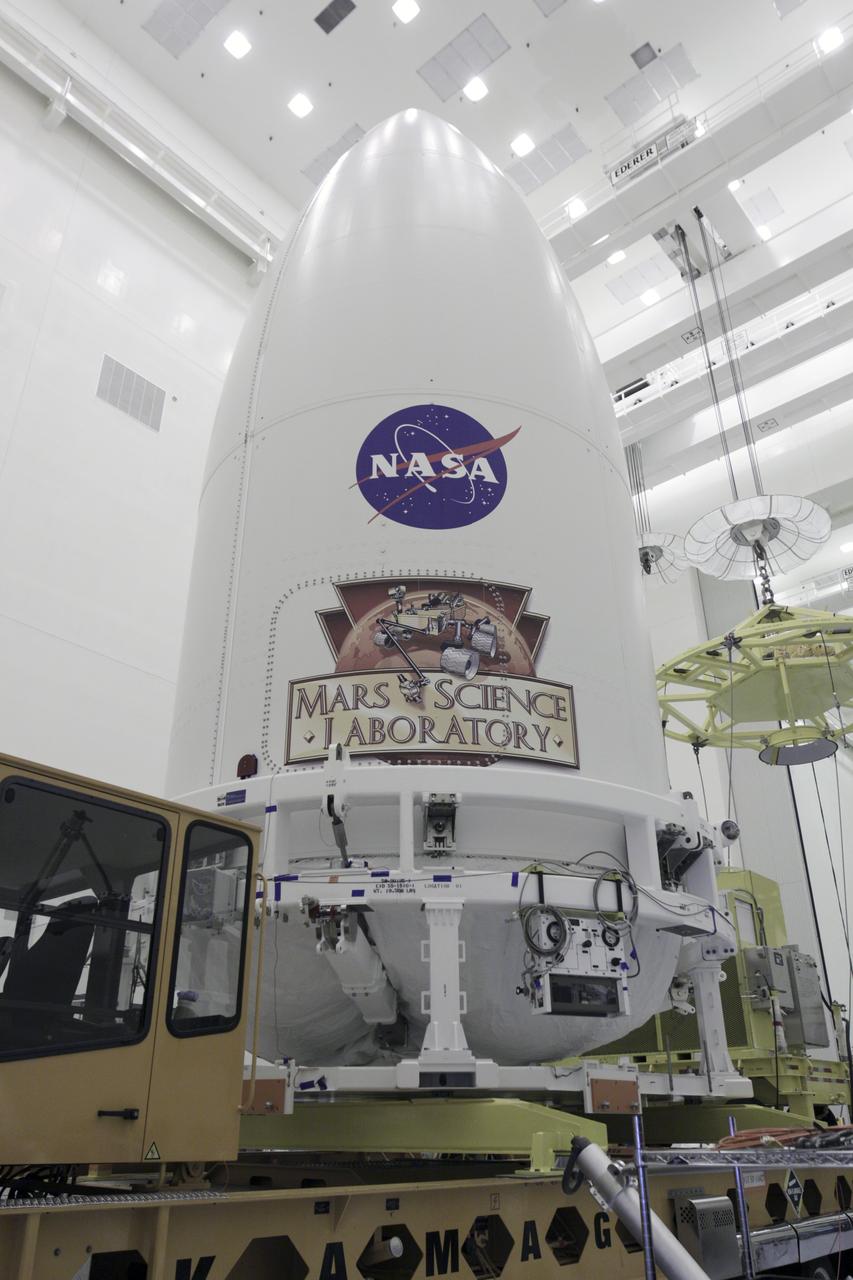
CAPE CANAVERAL, Fla. -- In the Payload Hazardous Servicing Facility at NASA's Kennedy Space Center in Florida, the Atlas V rocket's payload fairing containing the Mars Science Laboratory (MSL) spacecraft stands securely atop the transporter that will carry it to Space Launch Complex 41. MSL's components include a compact car-sized rover, Curiosity, which has 10 science instruments designed to search for evidence on whether Mars has had environments favorable to microbial life, including the chemical ingredients for life. The unique rover will use a laser to look inside rocks and release its gasses so that the rover’s spectrometer can analyze and send the data back to Earth. Launch of MSL aboard a United Launch Alliance Atlas V rocket is planned for Nov. 25 from Space Launch Complex-41 on Cape Canaveral Air Force Station. For more information, visit http://www.nasa.gov/msl. Photo credit: NASA/Kim Shiflett
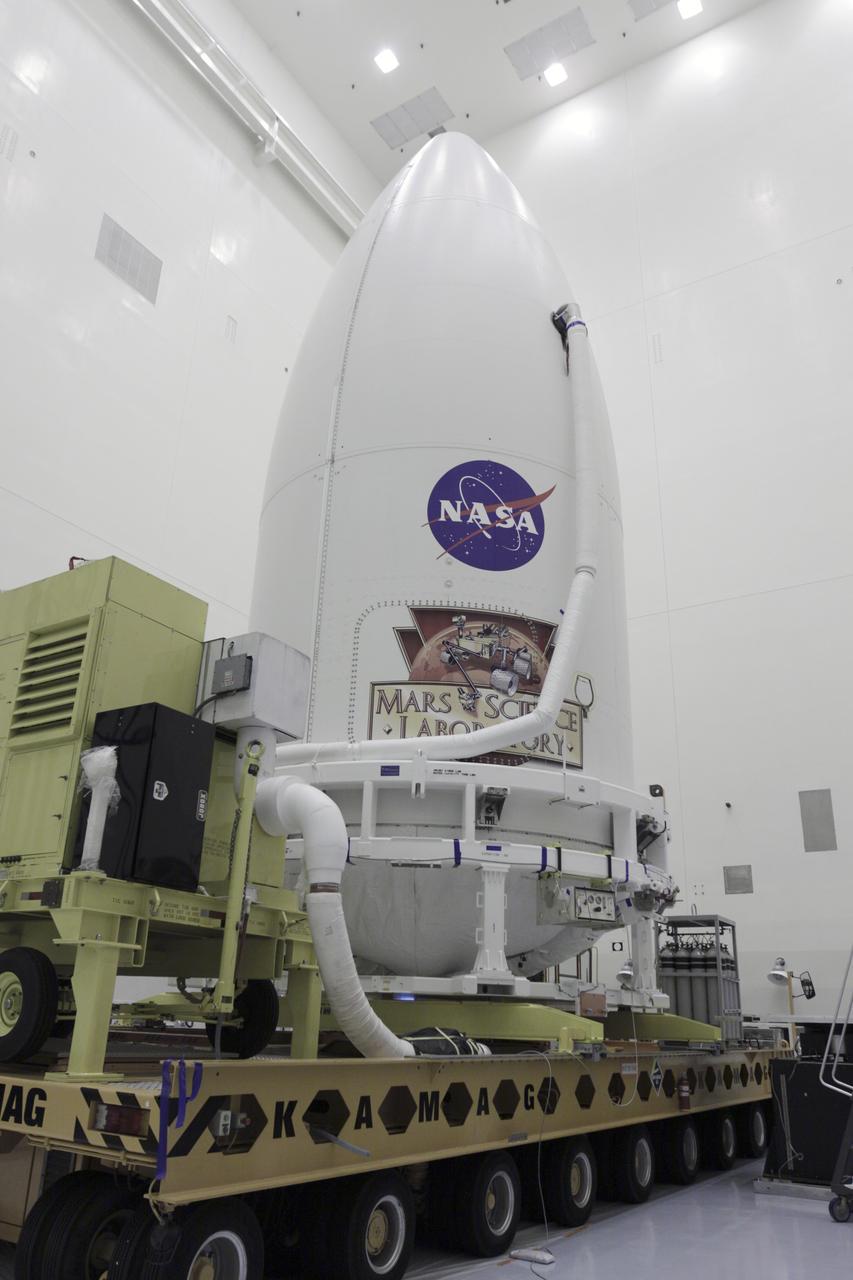
CAPE CANAVERAL, Fla. -- In the Payload Hazardous Servicing Facility at NASA's Kennedy Space Center in Florida, an Atlas V rocket's payload fairing, containing the Mars Science Laboratory (MSL) spacecraft, is in place atop a transporter that will carry it to Space Launch Complex 41. MSL's components include a compact car-sized rover, Curiosity, which has 10 science instruments designed to search for evidence on whether Mars has had environments favorable to microbial life, including the chemical ingredients for life. The unique rover will use a laser to look inside rocks and release its gasses so that the rover’s spectrometer can analyze and send the data back to Earth. Launch of MSL aboard a United Launch Alliance Atlas V rocket is planned for Nov. 25 from Space Launch Complex-41 on Cape Canaveral Air Force Station. For more information, visit http://www.nasa.gov/msl. Photo credit: NASA/Kim Shiflett

CAPE CANAVERAL, Fla. -- The Atlas V first stage (right) and Centaur upper stage to support the Mars Science Laboratory (MSL) mission are offloaded from the Delta Mariner transport ship at Port Canaveral in Florida. MSL's components include a compact car-sized rover, Curiosity, which has 10 science instruments designed to search for evidence on whether Mars has had environments favorable to microbial life, including chemical ingredients for life. The unique rover will use a laser to look inside rocks and release its gasses so that the rover’s spectrometer can analyze and send the data back to Earth. Launch of MSL aboard a United Launch Alliance Atlas V rocket is scheduled for Nov. 25 from Space Launch Complex 41 on Cape Canaveral Air Force Station. For more information, visit http://www.nasa.gov/msl. Photo credit: NASA/Dimitri Gerondidakis
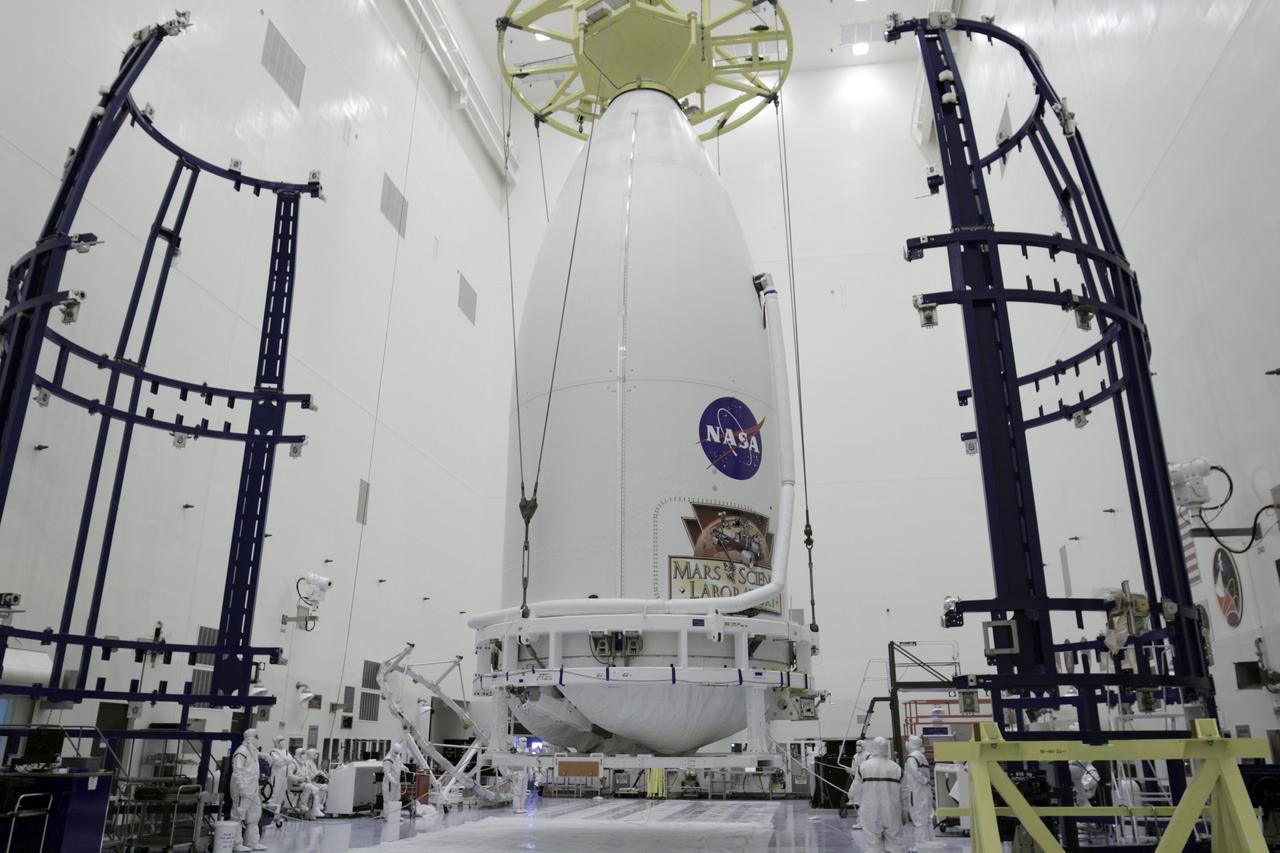
CAPE CANAVERAL, Fla. -- In the Payload Hazardous Servicing Facility at NASA's Kennedy Space Center in Florida, technicians prepare to lift the Mars Science Laboratory (MSL) spacecraft, enclosed in an Atlas V rocket's payload fairing, and place it on a transporter for the move to Space Launch Complex 41. MSL's components include a compact car-sized rover, Curiosity, which has 10 science instruments designed to search for evidence on whether Mars has had environments favorable to microbial life, including the chemical ingredients for life. The unique rover will use a laser to look inside rocks and release its gasses so that the rover’s spectrometer can analyze and send the data back to Earth. Launch of MSL aboard a United Launch Alliance Atlas V rocket is planned for Nov. 25 from Space Launch Complex-41 on Cape Canaveral Air Force Station. For more information, visit http://www.nasa.gov/msl. Photo credit: NASA/Kim Shiflett
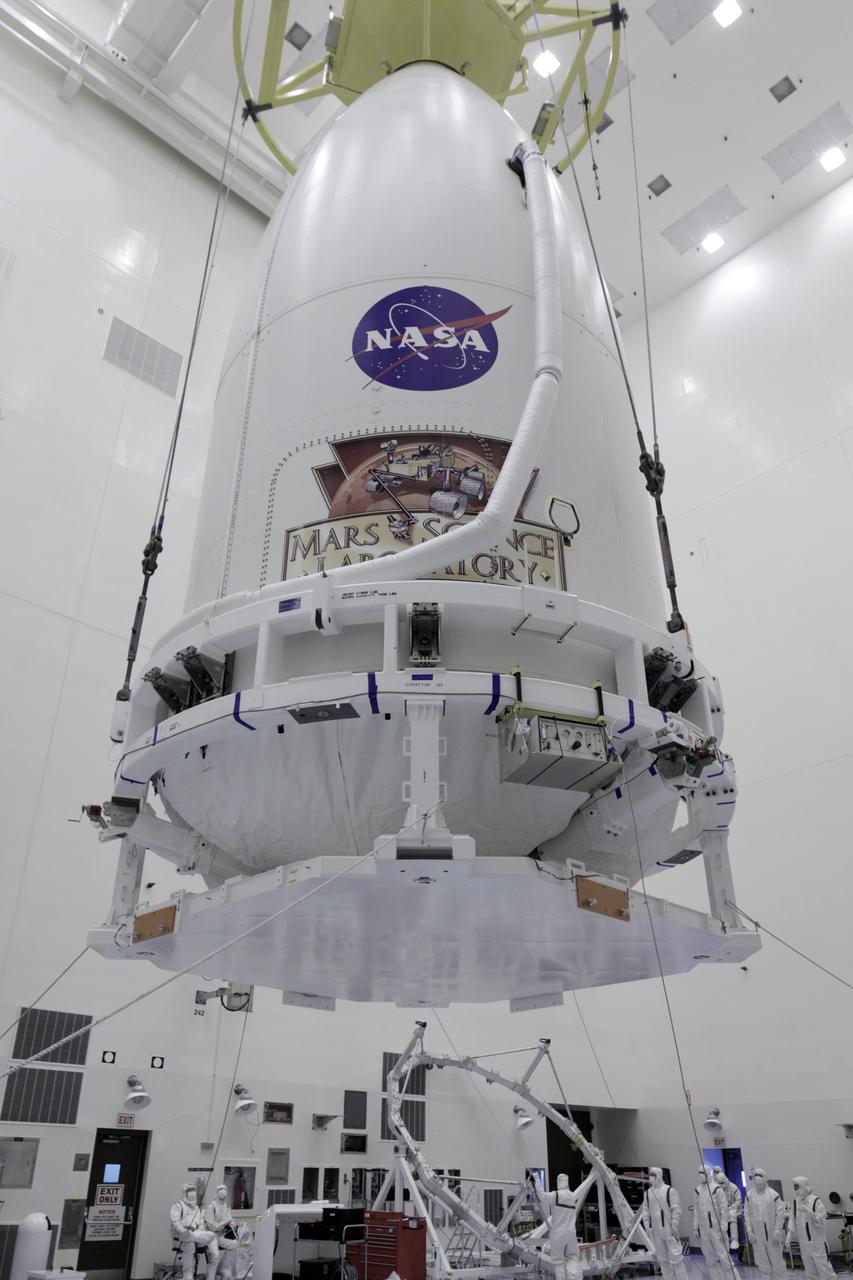
CAPE CANAVERAL, Fla. -- The Atlas V payload fairing containing NASA's Mars Science Laboratory (MSL) spacecraft rises above the floor of the Payload Hazardous Servicing Facility at Kennedy Space Center in Florida. The fairing will be placed on a transporter for the move to Space Launch Complex 41. MSL's components include a compact car-sized rover, Curiosity, which has 10 science instruments designed to search for evidence on whether Mars has had environments favorable to microbial life, including the chemical ingredients for life. The unique rover will use a laser to look inside rocks and release its gasses so that the rover’s spectrometer can analyze and send the data back to Earth. Launch of MSL aboard a United Launch Alliance Atlas V rocket is planned for Nov. 25 from Space Launch Complex-41 on Cape Canaveral Air Force Station. For more information, visit http://www.nasa.gov/msl. Photo credit: NASA/Kim Shiflett

CAPE CANAVERAL, Fla. -- The Atlas V first stage (right) and Centaur upper stage to support the Mars Science Laboratory (MSL) mission are offloaded from the Delta Mariner transport ship at Port Canaveral in Florida. MSL's components include a compact car-sized rover, Curiosity, which has 10 science instruments designed to search for evidence on whether Mars has had environments favorable to microbial life, including chemical ingredients for life. The unique rover will use a laser to look inside rocks and release its gasses so that the rover’s spectrometer can analyze and send the data back to Earth. Launch of MSL aboard a United Launch Alliance Atlas V rocket is scheduled for Nov. 25 from Space Launch Complex 41 on Cape Canaveral Air Force Station. For more information, visit http://www.nasa.gov/msl. Photo credit: NASA/Dimitri Gerondidakis
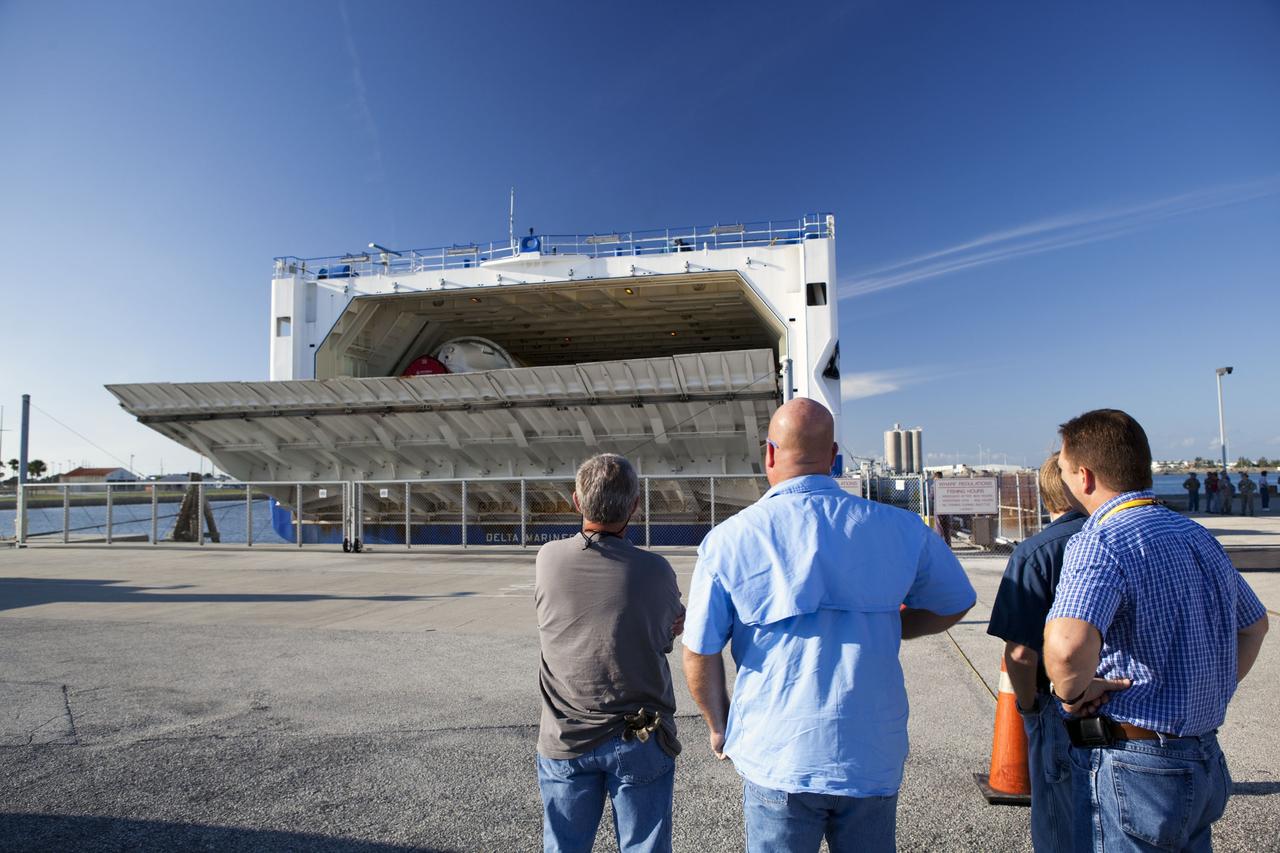
CAPE CANAVERAL, Fla. -- The Atlas V first stage and Centaur upper stage to support the Mars Science Laboratory (MSL) mission arrive at Port Canaveral in Florida aboard the Delta Mariner transport ship. MSL's components include a compact car-sized rover, Curiosity, which has 10 science instruments designed to search for evidence on whether Mars has had environments favorable to microbial life, including chemical ingredients for life. The unique rover will use a laser to look inside rocks and release its gasses so that the rover’s spectrometer can analyze and send the data back to Earth. Launch of MSL aboard a United Launch Alliance Atlas V rocket is scheduled for Nov. 25 from Space Launch Complex 41 on Cape Canaveral Air Force Station. For more information, visit http://www.nasa.gov/msl. Photo credit: NASA/Dimitri Gerondidakis

CAPE CANAVERAL, Fla. -- Technicians in the Payload Hazardous Servicing Facility at NASA's Kennedy Space Center in Florida complete rotation tests on NASA's Mars Science Laboratory (MSL) rover, known as Curiosity, and lower it towards a rolling work stand. There, the wheels will undergo deployment testing. A United Launch Alliance Atlas V-541 configuration will be used to loft MSL into space. Curiosity’s 10 science instruments are designed to search for evidence on whether Mars has had environments favorable to microbial life, including chemical ingredients for life. The unique rover will use a laser to look inside rocks and release its gasses so that the rover’s spectrometer can analyze and send the data back to Earth. MSL is scheduled to launch from Cape Canaveral Air Force Station in Florida Nov. 25 with a window extending to Dec. 18 and arrival at Mars Aug. 2012. For more information, visit http://www.nasa.gov/msl. Photo credit: NASA/Jim Grossmann
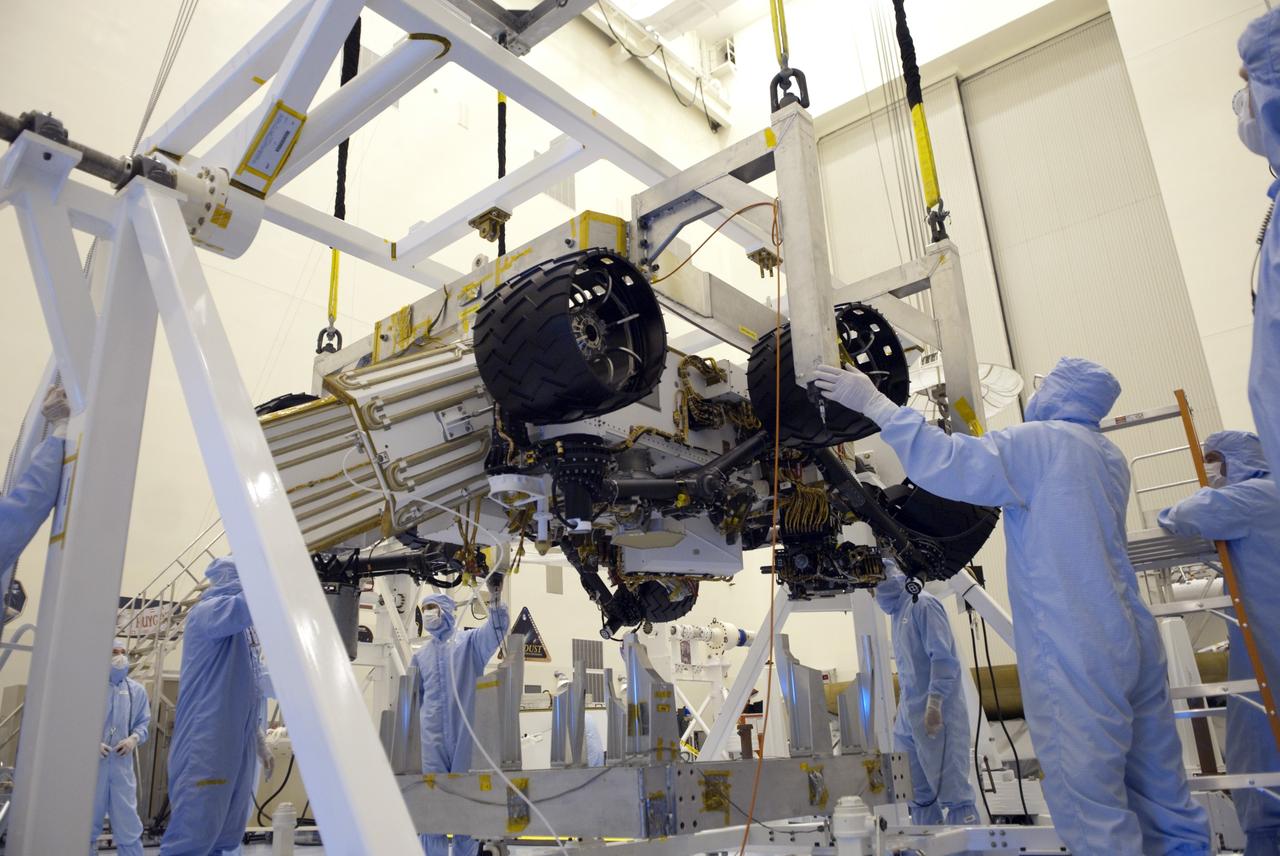
CAPE CANAVERAL, Fla. -- Technicians, using an overhead crane in the Payload Hazardous Servicing Facility at NASA's Kennedy Space Center in Florida, lift and secure NASA's Mars Science Laboratory (MSL) rover, known as Curiosity, to a rotation fixture for testing. A United Launch Alliance Atlas V-541 configuration will be used to loft MSL into space. Curiosity’s 10 science instruments are designed to search for evidence on whether Mars has had environments favorable to microbial life, including chemical ingredients for life. The unique rover will use a laser to look inside rocks and release its gasses so that the rover’s spectrometer can analyze and send the data back to Earth. MSL is scheduled to launch from Cape Canaveral Air Force Station in Florida Nov. 25 with a window extending to Dec. 18 and arrival at Mars Aug. 2012. For more information, visit http://www.nasa.gov/msl. Photo credit: NASA/Jim Grossmann
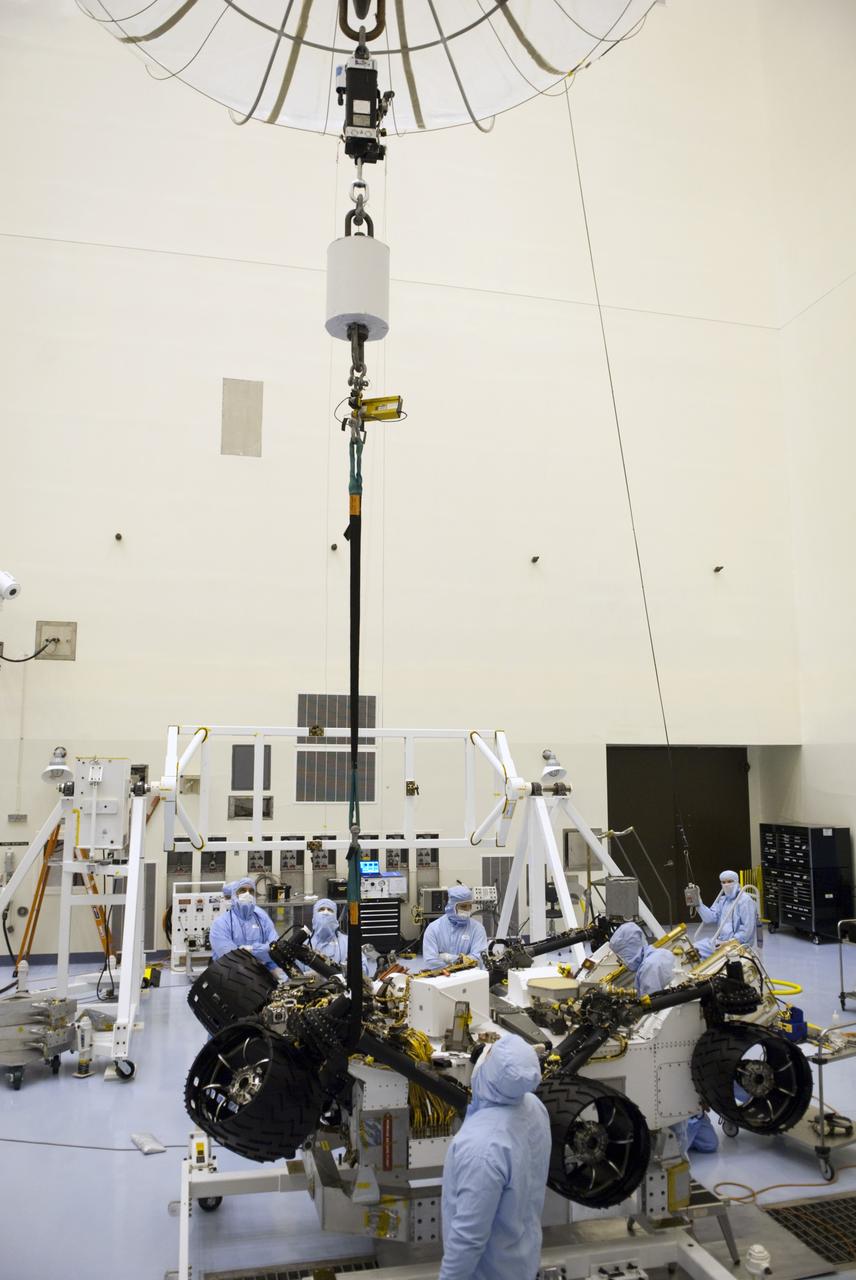
CAPE CANAVERAL, Fla. -- Technicians in the Payload Hazardous Servicing Facility at NASA's Kennedy Space Center in Florida complete rotation tests on NASA's Mars Science Laboratory (MSL) rover, known as Curiosity, and lower it towards a rolling work stand. There, the wheels will undergo deployment testing. A United Launch Alliance Atlas V-541 configuration will be used to loft MSL into space. Curiosity’s 10 science instruments are designed to search for evidence on whether Mars has had environments favorable to microbial life, including chemical ingredients for life. The unique rover will use a laser to look inside rocks and release its gasses so that the rover’s spectrometer can analyze and send the data back to Earth. MSL is scheduled to launch from Cape Canaveral Air Force Station in Florida Nov. 25 with a window extending to Dec. 18 and arrival at Mars Aug. 2012. For more information, visit http://www.nasa.gov/msl. Photo credit: NASA/Jim Grossmann
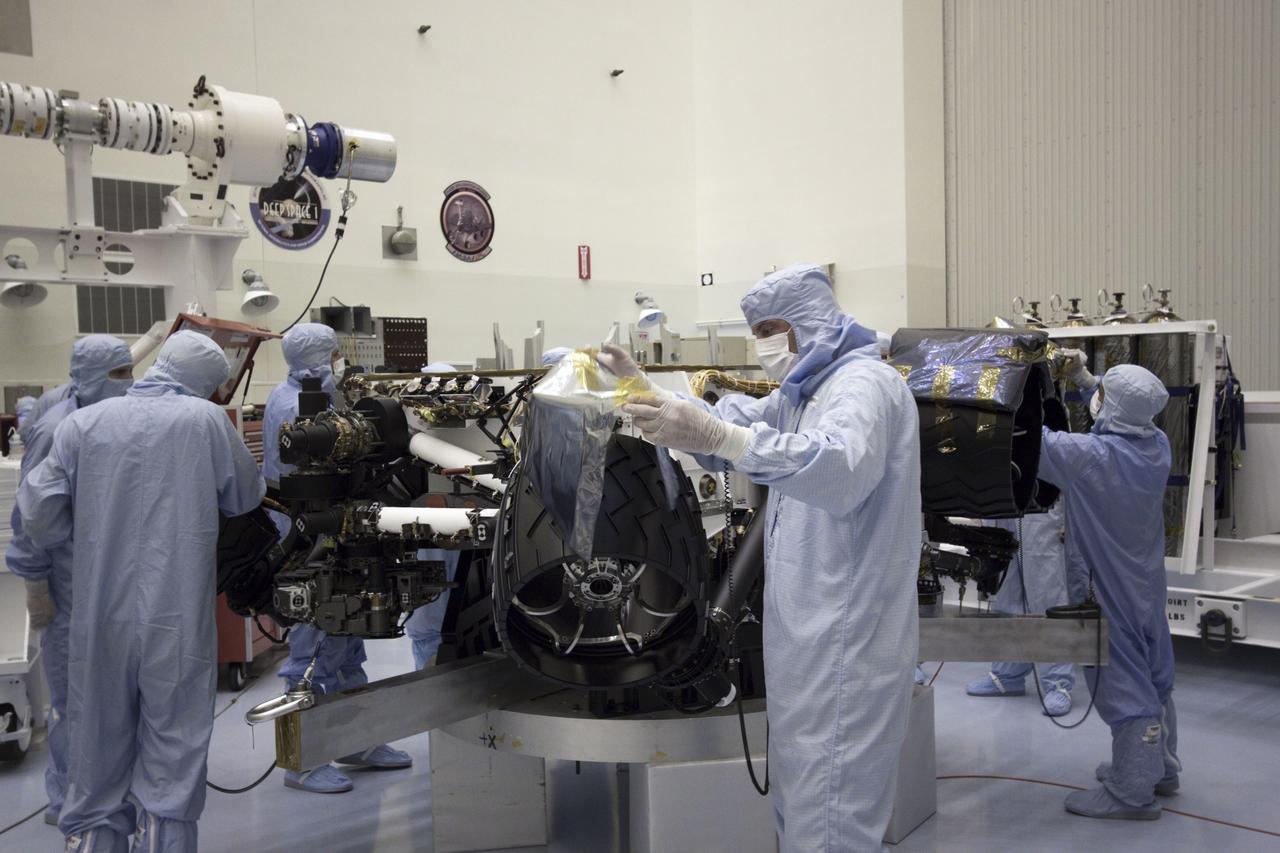
Cape Canaveral, Fla. -- At the Payload Hazardous Servicing Facility at NASA's Kennedy Space Center in Florida, technicians remove the protective cover from NASA's Mars Science Laboratory (MSL) rover known as Curiosity, before processing and testing. A United Launch Alliance Atlas V-541 configuration will be used to loft MSL into space. Curiosity’s 10 science instruments are designed to search for evidence on whether Mars has had environments favorable to microbial life, including chemical ingredients for life. The unique rover will use a laser to look inside rocks and release its gasses so that the rover’s spectrometer can analyze and send the data back to Earth. MSL is scheduled to launch from Cape Canaveral Air Force Station in Florida Nov. 25 with a window extending to Dec. 18 and arrival at Mars Aug. 2012. For more information, visit http://www.nasa.gov/msl. Photo credit: NASA/Jim Grossmann
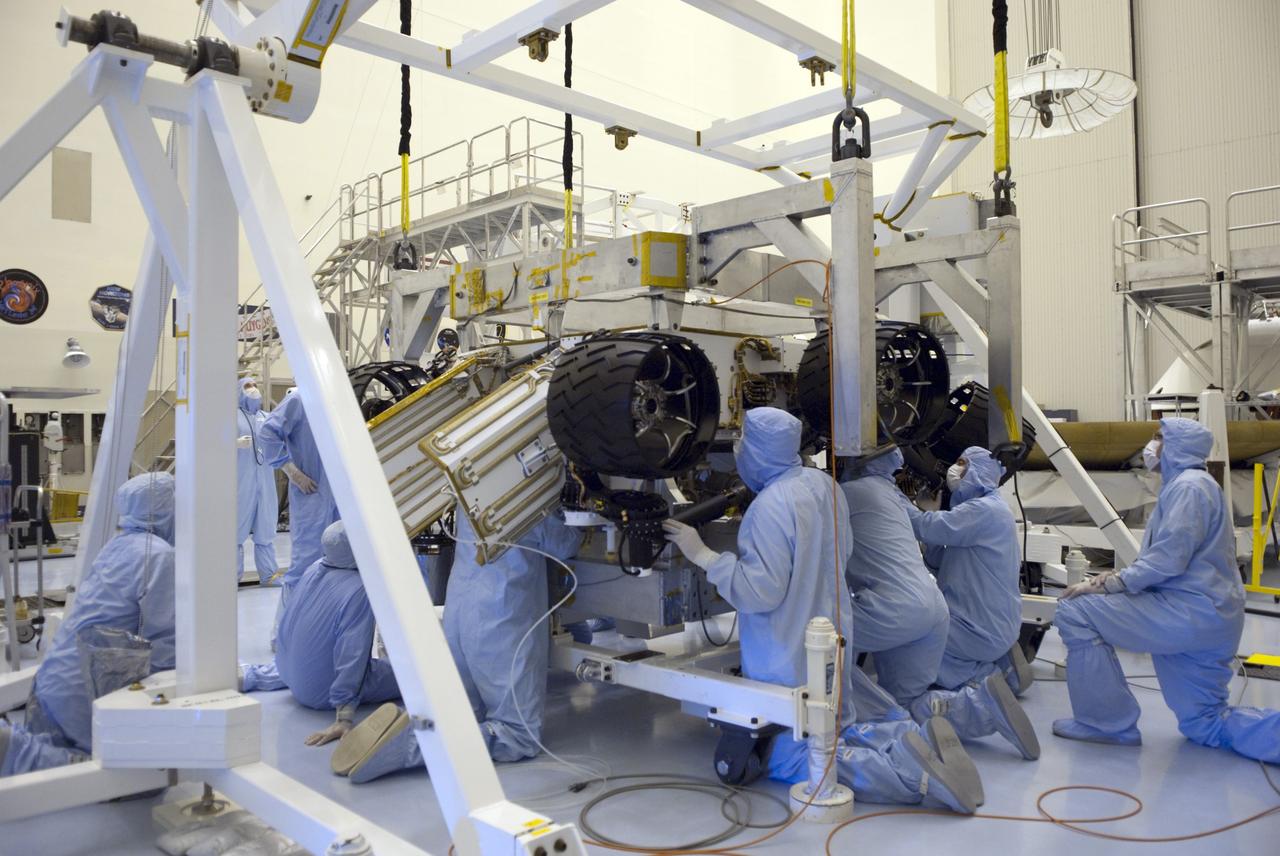
CAPE CANAVERAL, Fla. -- Technicians, in the Payload Hazardous Servicing Facility at NASA's Kennedy Space Center in Florida, disconnect NASA's Mars Science Laboratory (MSL) rover, known as Curiosity, from a rolling work stand for its lift to a rotation fixture for testing. A United Launch Alliance Atlas V-541 configuration will be used to loft MSL into space. Curiosity’s 10 science instruments are designed to search for evidence on whether Mars has had environments favorable to microbial life, including chemical ingredients for life. The unique rover will use a laser to look inside rocks and release its gasses so that the rover’s spectrometer can analyze and send the data back to Earth. MSL is scheduled to launch from Cape Canaveral Air Force Station in Florida Nov. 25 with a window extending to Dec. 18 and arrival at Mars Aug. 2012. For more information, visit http://www.nasa.gov/msl. Photo credit: NASA/Jim Grossmann
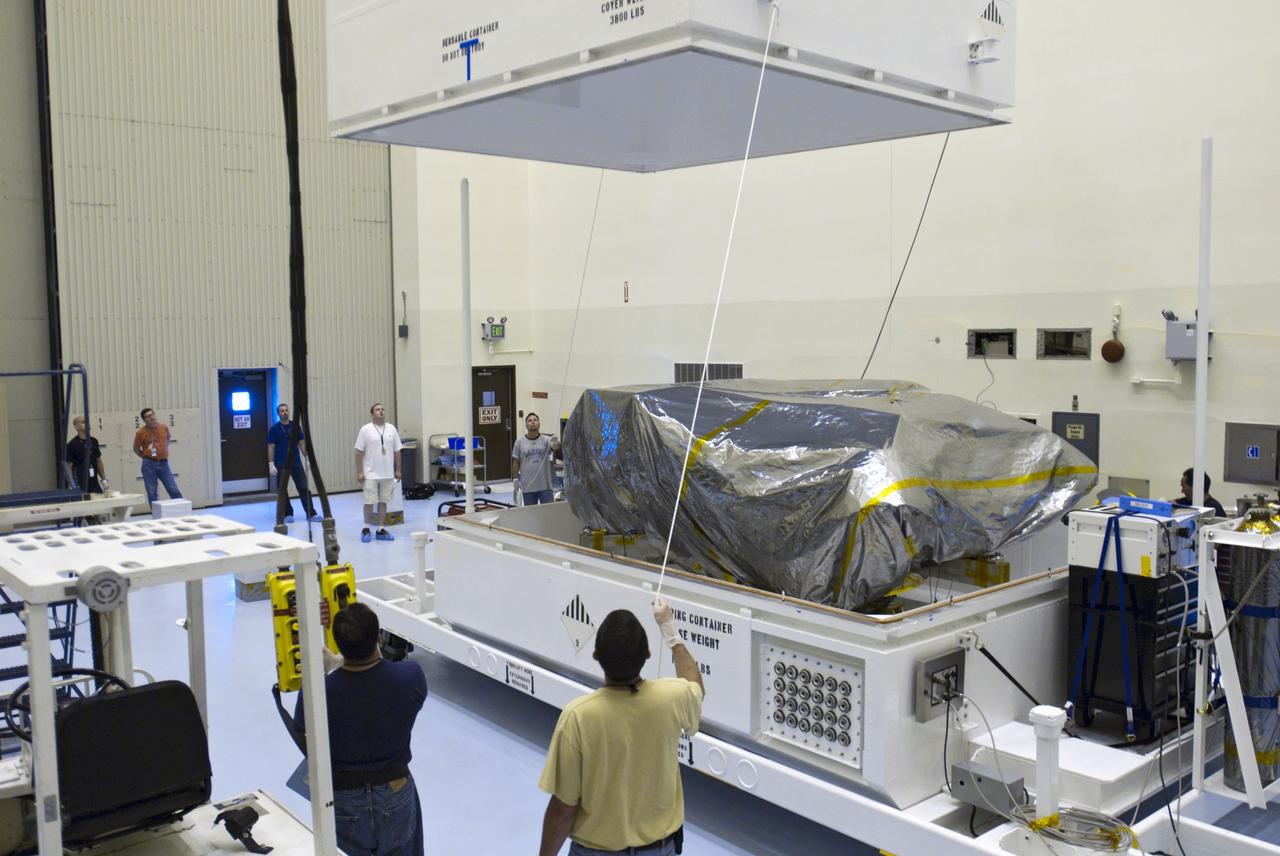
Cape Canaveral, Fla. -- At the Payload Hazardous Servicing Facility at NASA's Kennedy Space Center in Florida, workers using an overhead crane lift the container cover from NASA's Mars Science Laboratory (MSL) rover, known as Curiosity. A United Launch Alliance Atlas V-541 configuration will be used to loft MSL into space. Curiosity’s 10 science instruments are designed to search for evidence on whether Mars has had environments favorable to microbial life, including chemical ingredients for life. The unique rover will use a laser to look inside rocks and release its gasses so that the rover’s spectrometer can analyze and send the data back to Earth. MSL is scheduled to launch from Cape Canaveral Air Force Station in Florida Nov. 25 with a window extending to Dec. 18 and arrival at Mars Aug. 2012. For more information, visit http://www.nasa.gov/msl. Photo credit: NASA/Charisse Nahser
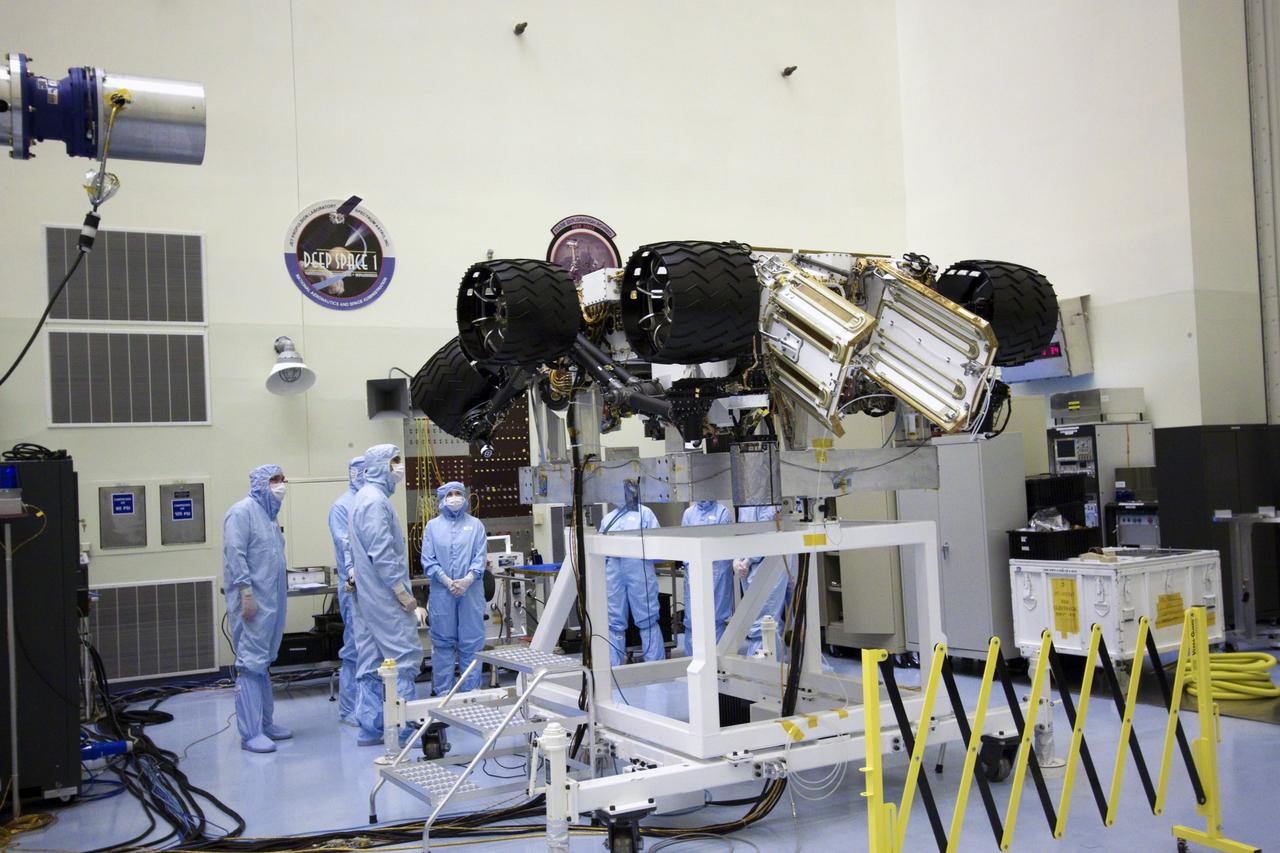
Cape Canaveral, Fla. - NASA Deputy Administrator Lori Garver, fourth from left, looks over NASA's Mars Science Laboratory (MSL) rover known as Curiosity as it sits in a workstand at the Payload Hazardous Servicing Facility at NASA's Kennedy Space Center in Florida. A United Launch Alliance Atlas V-541 configuration will be used to loft MSL into space. Curiosity’s 10 science instruments are designed to search for evidence on whether Mars has had environments favorable to microbial life, including chemical ingredients for life. The unique rover will use a laser to look inside rocks and release its gasses so that the rover’s spectrometer can analyze and send the data back to Earth. MSL is scheduled to launch from Cape Canaveral Air Force Station in Florida Nov. 25 with a window extending to Dec. 18 and arrival at Mars Aug. 2012. For more information, visit http://www.nasa.gov/msl. Photo credit: NASA/Jim Grossmann
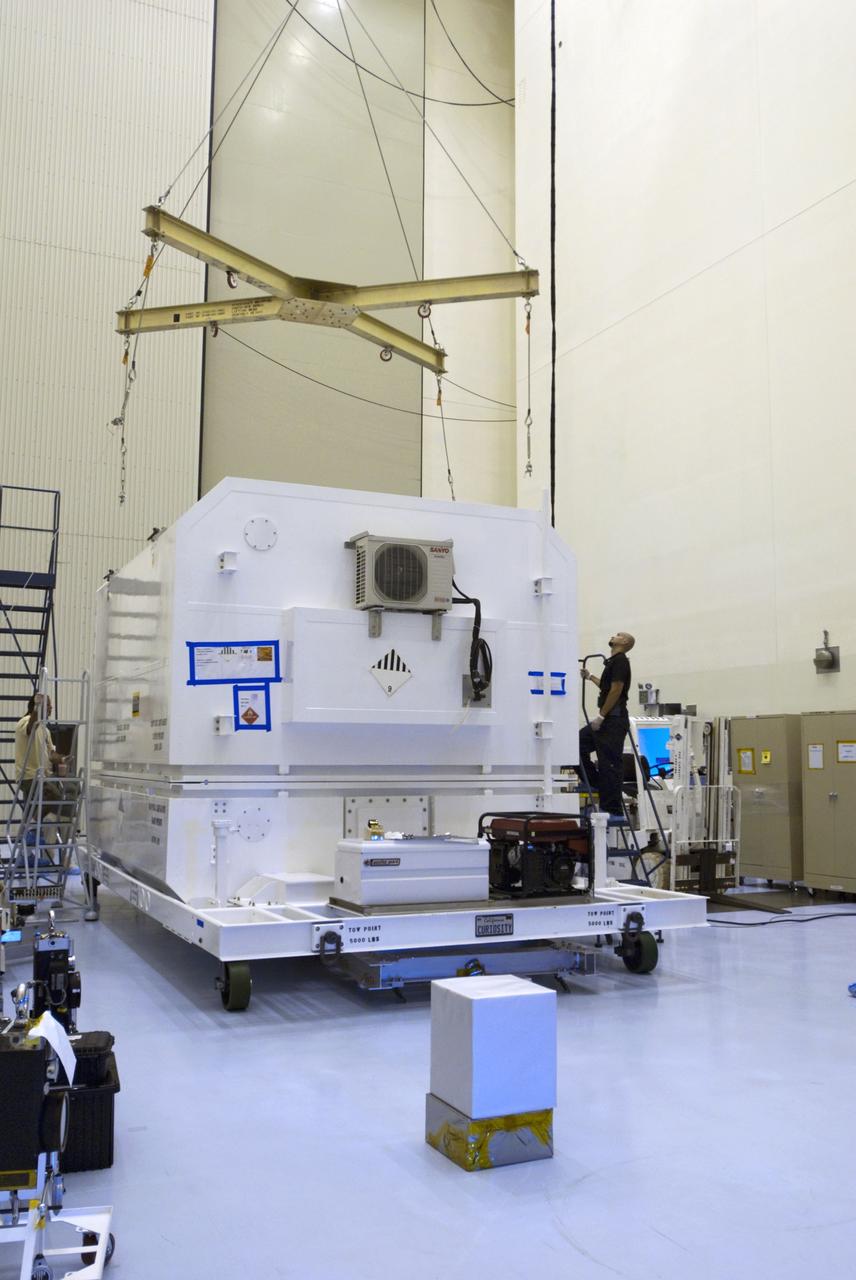
Cape Canaveral, Fla. -- At the Payload Hazardous Servicing Facility at NASA's Kennedy Space Center in Florida, workers prepare to attach an overhead crane to lift the container cover from NASA's Mars Science Laboratory (MSL) rover, known as Curiosity. A United Launch Alliance Atlas V-541 configuration will be used to loft MSL into space. Curiosity’s 10 science instruments are designed to search for evidence on whether Mars has had environments favorable to microbial life, including chemical ingredients for life. The unique rover will use a laser to look inside rocks and release its gasses so that the rover’s spectrometer can analyze and send the data back to Earth. MSL is scheduled to launch from Cape Canaveral Air Force Station in Florida Nov. 25 with a window extending to Dec. 18 and arrival at Mars Aug. 2012. For more information, visit http://www.nasa.gov/msl. Photo credit: NASA/Charisse Nahser
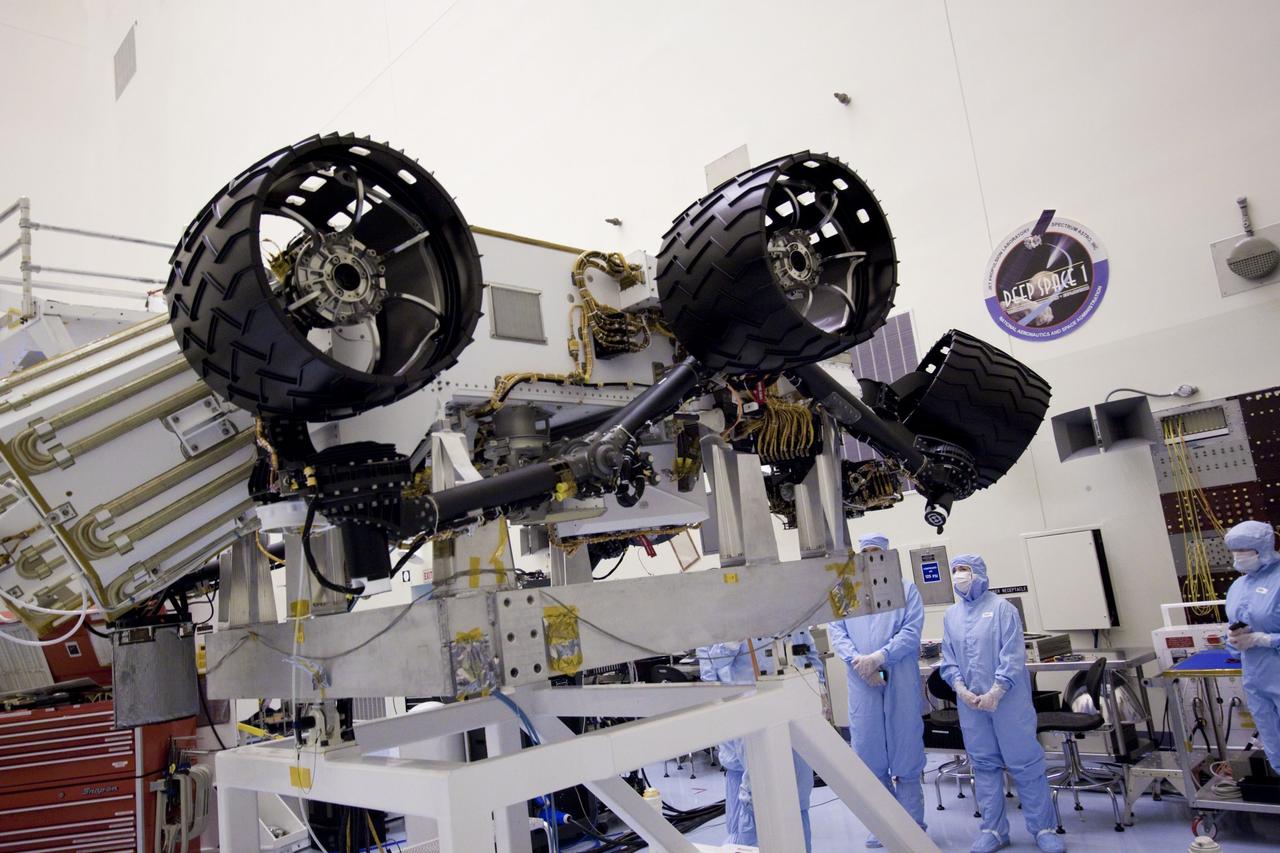
Cape Canaveral, Fla. - NASA Deputy Administrator Lori Garver looks over NASA's Mars Science Laboratory (MSL) rover known as Curiosity as it sits in a workstand at the Payload Hazardous Servicing Facility at NASA's Kennedy Space Center in Florida. A United Launch Alliance Atlas V-541 configuration will be used to loft MSL into space. Curiosity’s 10 science instruments are designed to search for evidence on whether Mars has had environments favorable to microbial life, including chemical ingredients for life. The unique rover will use a laser to look inside rocks and release its gasses so that the rover’s spectrometer can analyze and send the data back to Earth. MSL is scheduled to launch from Cape Canaveral Air Force Station in Florida Nov. 25 with a window extending to Dec. 18 and arrival at Mars Aug. 2012. For more information, visit http://www.nasa.gov/msl. Photo credit: NASA/Jim Grossmann
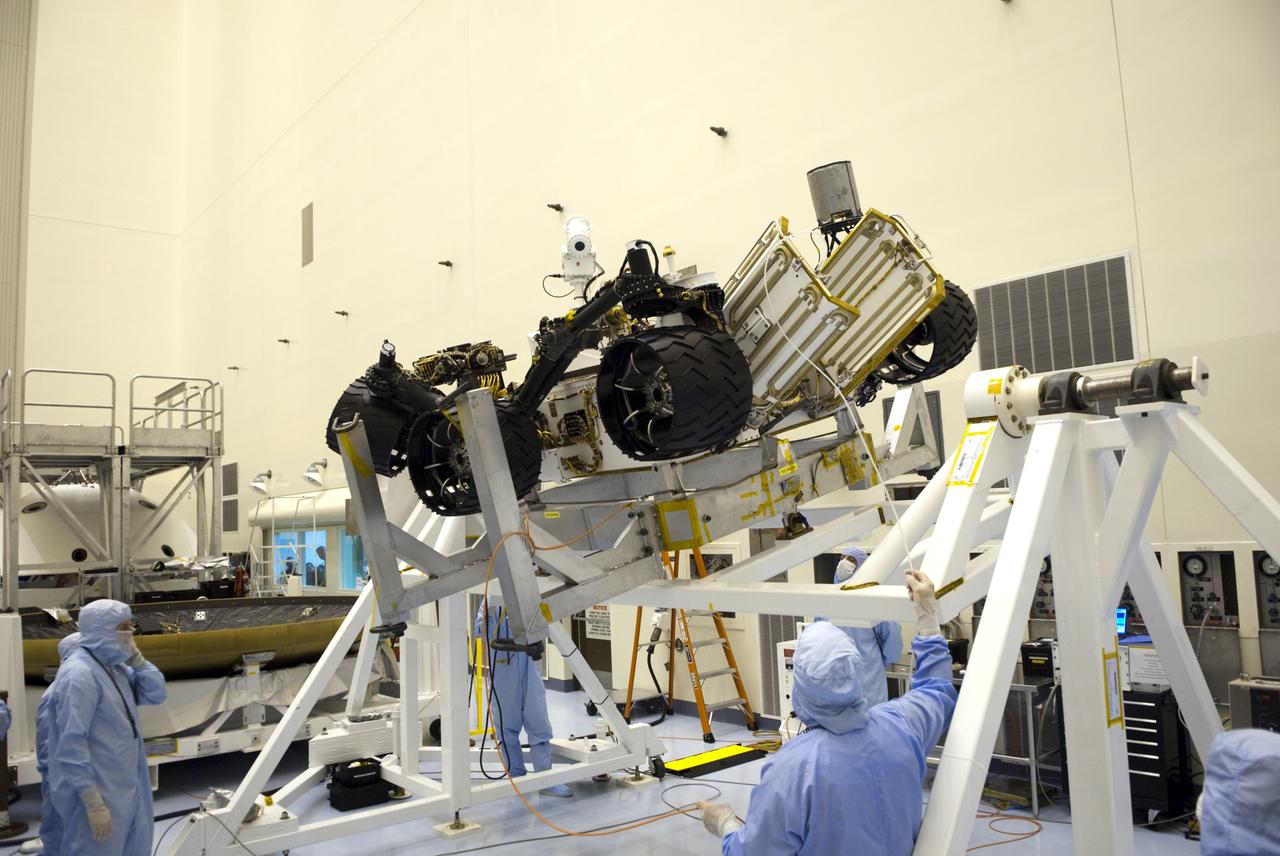
CAPE CANAVERAL, Fla. -- Technicians in the Payload Hazardous Servicing Facility at NASA's Kennedy Space Center in Florida put NASA's Mars Science Laboratory (MSL) rover, known as Curiosity, through a series of rotation tests. A United Launch Alliance Atlas V-541 configuration will be used to loft MSL into space. Curiosity’s 10 science instruments are designed to search for evidence on whether Mars has had environments favorable to microbial life, including chemical ingredients for life. The unique rover will use a laser to look inside rocks and release its gasses so that the rover’s spectrometer can analyze and send the data back to Earth. MSL is scheduled to launch from Cape Canaveral Air Force Station in Florida Nov. 25 with a window extending to Dec. 18 and arrival at Mars Aug. 2012. For more information, visit http://www.nasa.gov/msl. Photo credit: NASA/Jim Grossmann
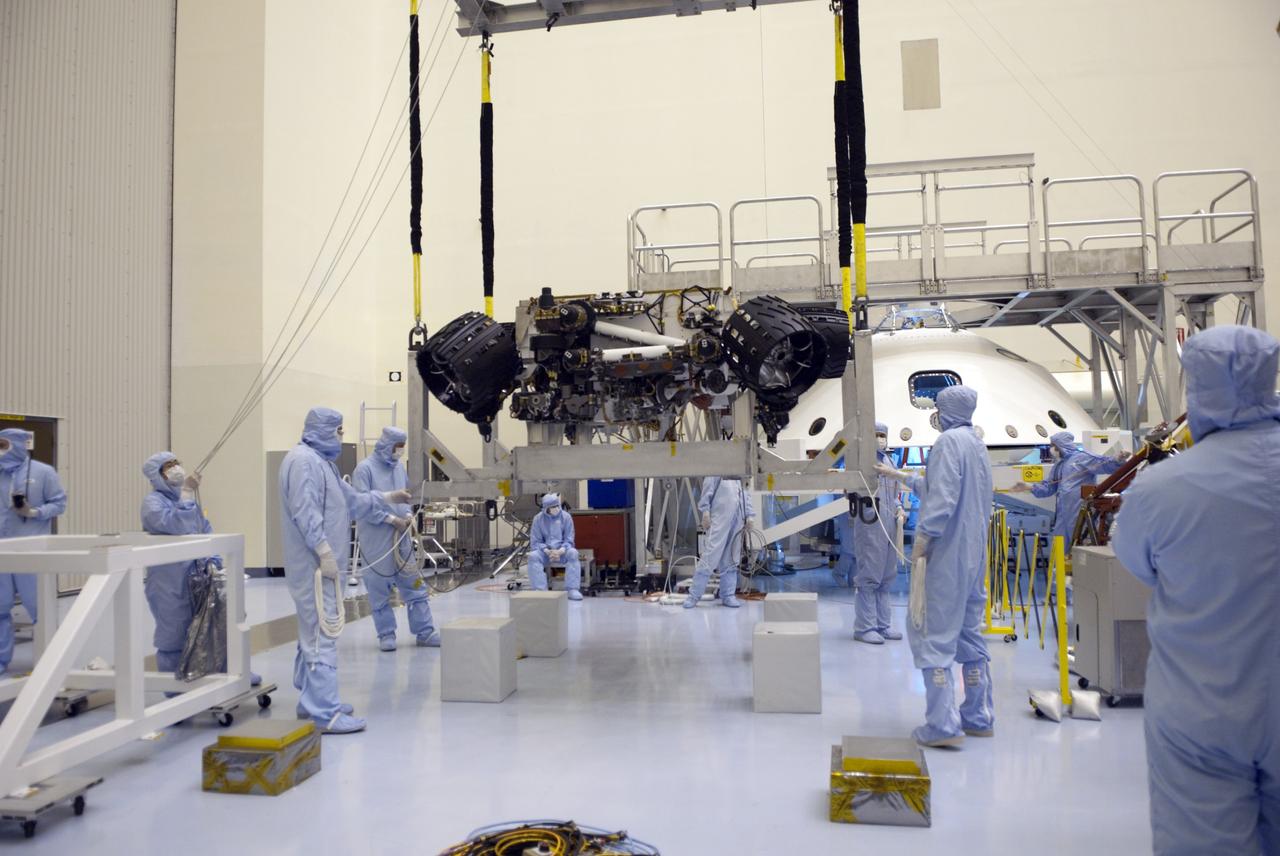
CAPE CANAVERAL, Fla. -- Technicians, using an overhead crane in the Payload Hazardous Servicing Facility at NASA's Kennedy Space Center in Florida, lift NASA's Mars Science Laboratory (MSL) rover, known as Curiosity, for its move to a rotation fixture for testing. A United Launch Alliance Atlas V-541 configuration will be used to loft MSL into space. Curiosity’s 10 science instruments are designed to search for evidence on whether Mars has had environments favorable to microbial life, including chemical ingredients for life. The unique rover will use a laser to look inside rocks and release its gasses so that the rover’s spectrometer can analyze and send the data back to Earth. MSL is scheduled to launch from Cape Canaveral Air Force Station in Florida Nov. 25 with a window extending to Dec. 18 and arrival at Mars Aug. 2012. For more information, visit http://www.nasa.gov/msl. Photo credit: NASA/Jim Grossmann
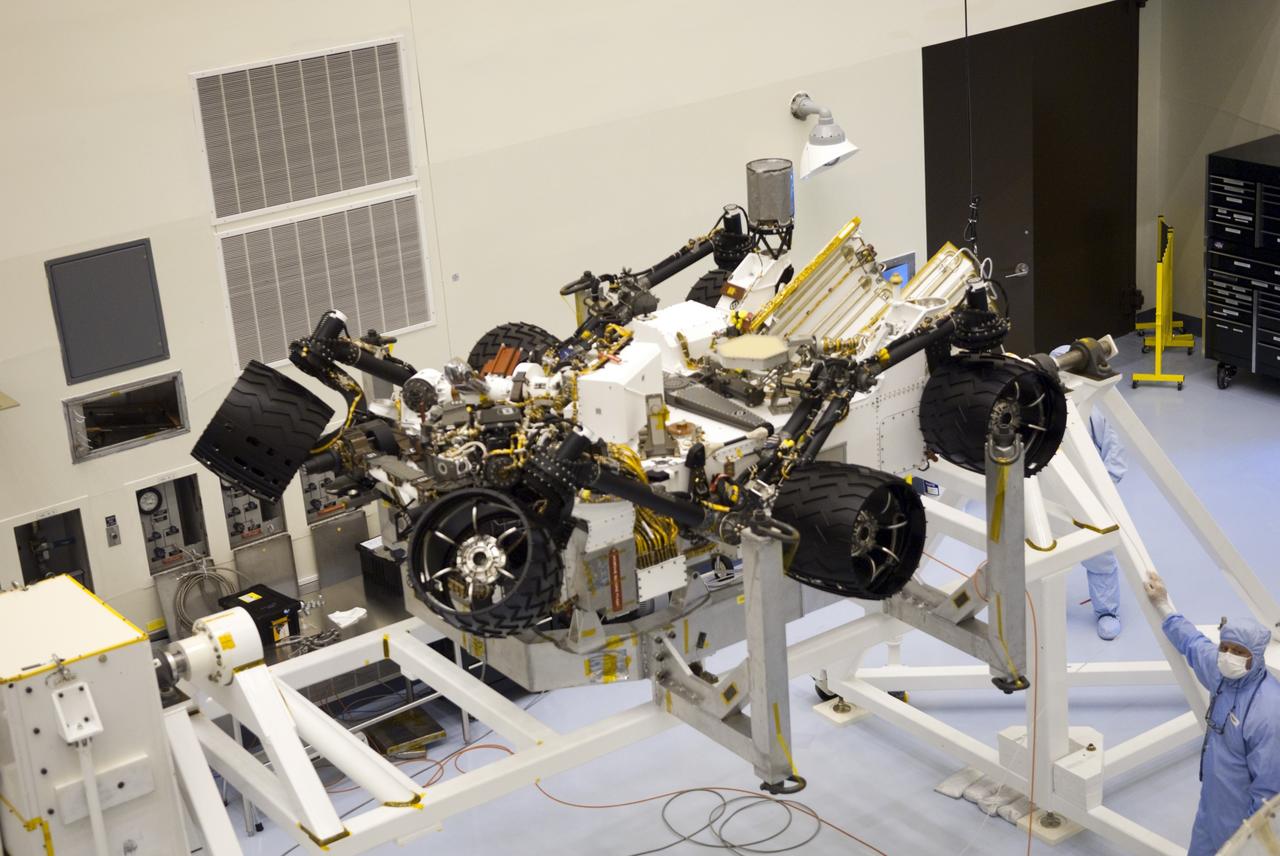
CAPE CANAVERAL, Fla. -- Technicians in the Payload Hazardous Servicing Facility at NASA's Kennedy Space Center in Florida put NASA's Mars Science Laboratory (MSL) rover, known as Curiosity, through a series of rotation tests. A United Launch Alliance Atlas V-541 configuration will be used to loft MSL into space. Curiosity’s 10 science instruments are designed to search for evidence on whether Mars has had environments favorable to microbial life, including chemical ingredients for life. The unique rover will use a laser to look inside rocks and release its gasses so that the rover’s spectrometer can analyze and send the data back to Earth. MSL is scheduled to launch from Cape Canaveral Air Force Station in Florida Nov. 25 with a window extending to Dec. 18 and arrival at Mars Aug. 2012. For more information, visit http://www.nasa.gov/msl. Photo credit: NASA/Jim Grossmann
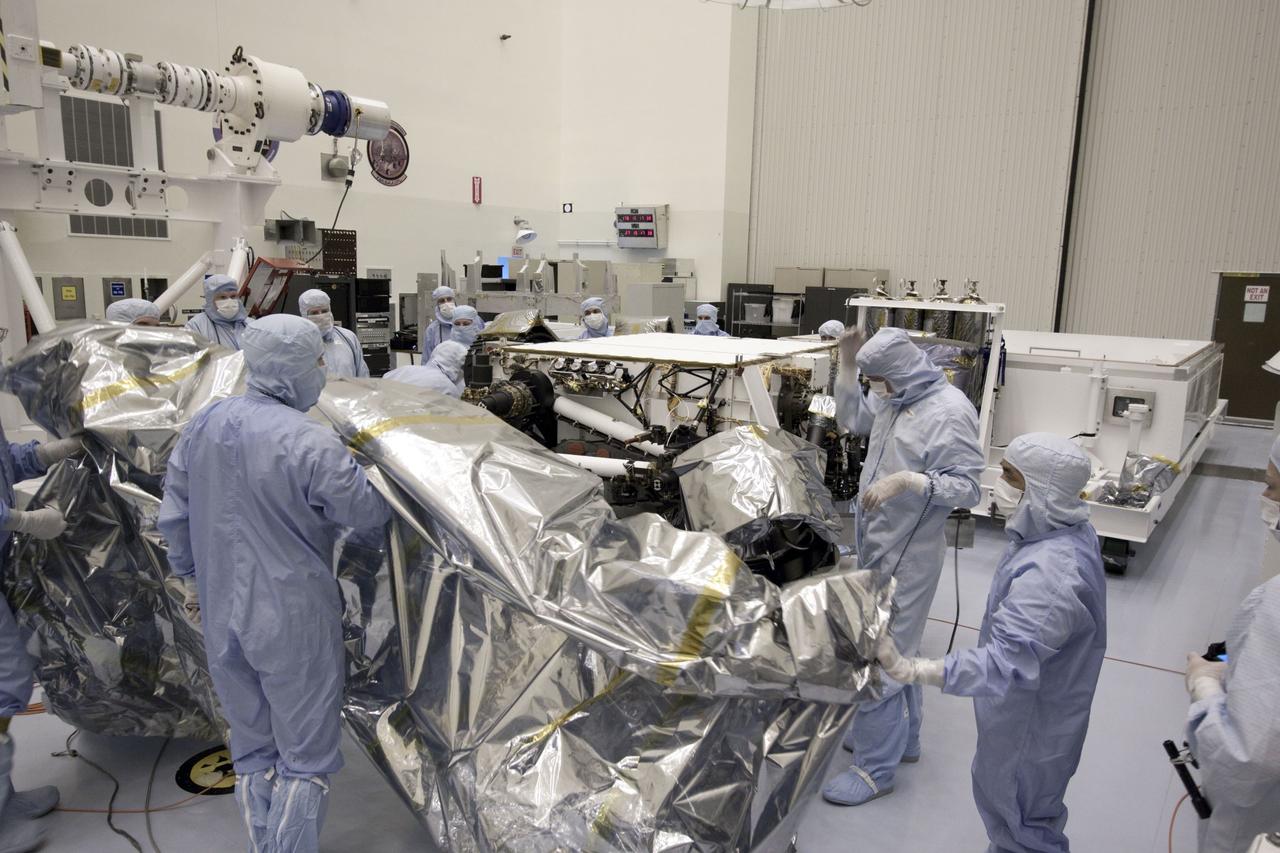
Cape Canaveral, Fla. -- At the Payload Hazardous Servicing Facility at NASA's Kennedy Space Center in Florida, technicians remove the protective cover from NASA's Mars Science Laboratory (MSL) rover known as Curiosity, before processing and testing. A United Launch Alliance Atlas V-541 configuration will be used to loft MSL into space. Curiosity’s 10 science instruments are designed to search for evidence on whether Mars has had environments favorable to microbial life, including chemical ingredients for life. The unique rover will use a laser to look inside rocks and release its gasses so that the rover’s spectrometer can analyze and send the data back to Earth. MSL is scheduled to launch from Cape Canaveral Air Force Station in Florida Nov. 25 with a window extending to Dec. 18 and arrival at Mars Aug. 2012. For more information, visit http://www.nasa.gov/msl. Photo credit: NASA/Jim Grossmann
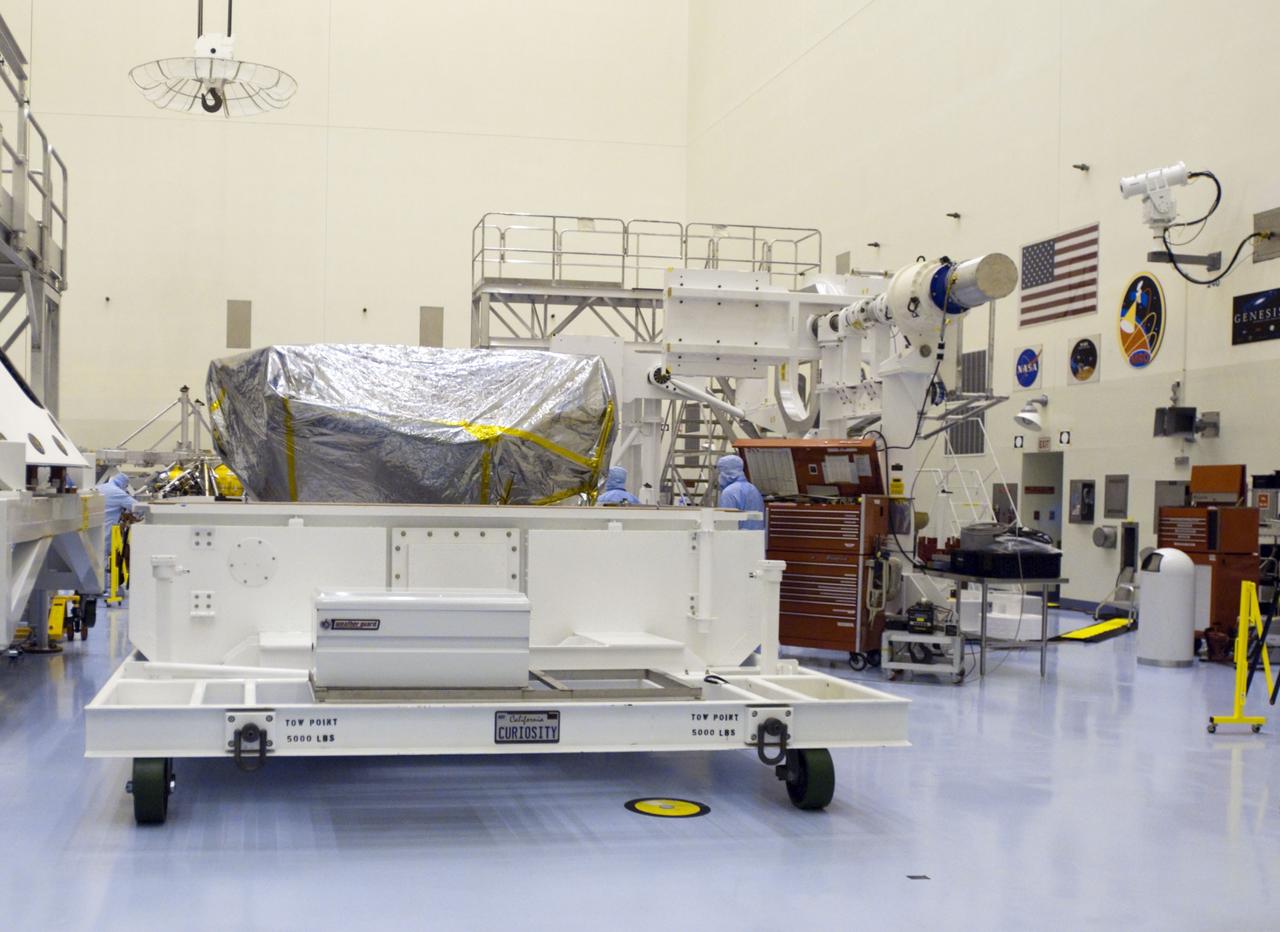
Cape Canaveral, Fla. -- At the Payload Hazardous Servicing Facility at NASA's Kennedy Space Center in Florida, workers removed the container cover from NASA's Mars Science Laboratory (MSL) rover, known as Curiosity. A United Launch Alliance Atlas V-541 configuration will be used to loft MSL into space. Curiosity’s 10 science instruments are designed to search for evidence on whether Mars has had environments favorable to microbial life, including chemical ingredients for life. The unique rover will use a laser to look inside rocks and release its gasses so that the rover’s spectrometer can analyze and send the data back to Earth. MSL is scheduled to launch from Cape Canaveral Air Force Station in Florida Nov. 25 with a window extending to Dec. 18 and arrival at Mars Aug. 2012. For more information, visit http://www.nasa.gov/msl. Photo credit: NASA/Charisse Nahser
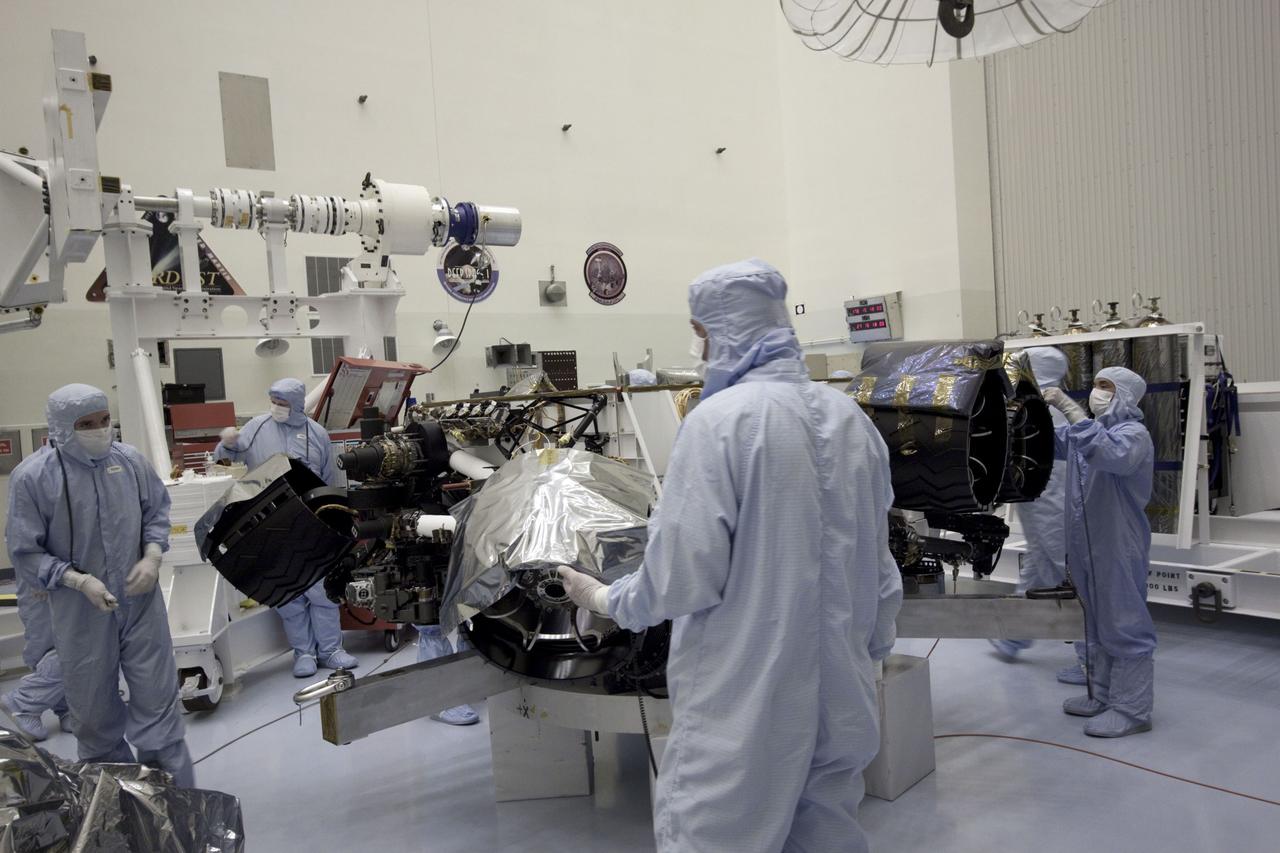
Cape Canaveral, Fla. -- At the Payload Hazardous Servicing Facility at NASA's Kennedy Space Center in Florida, technicians remove the protective cover from NASA's Mars Science Laboratory (MSL) rover known as Curiosity, before processing and testing. A United Launch Alliance Atlas V-541 configuration will be used to loft MSL into space. Curiosity’s 10 science instruments are designed to search for evidence on whether Mars has had environments favorable to microbial life, including chemical ingredients for life. The unique rover will use a laser to look inside rocks and release its gasses so that the rover’s spectrometer can analyze and send the data back to Earth. MSL is scheduled to launch from Cape Canaveral Air Force Station in Florida Nov. 25 with a window extending to Dec. 18 and arrival at Mars Aug. 2012. For more information, visit http://www.nasa.gov/msl. Photo credit: NASA/Jim Grossmann
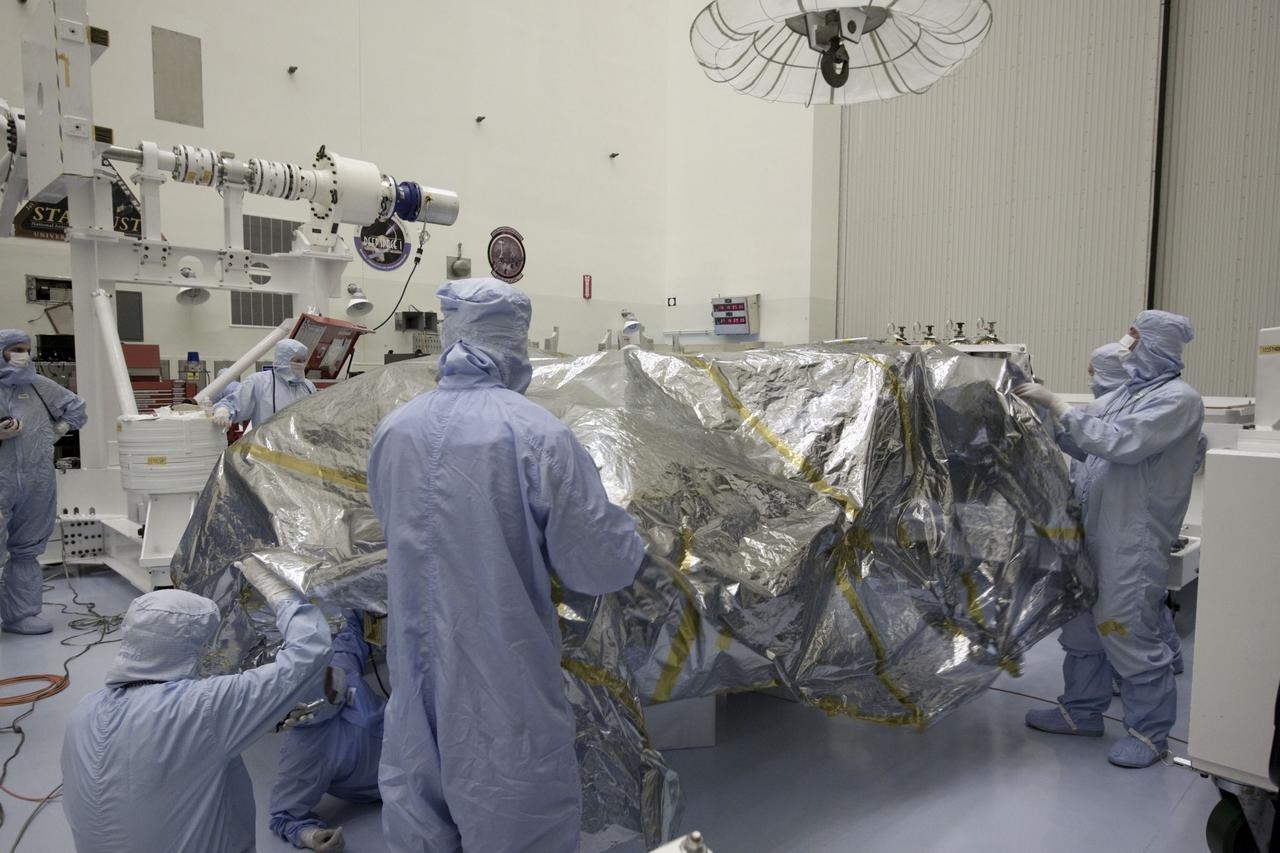
Cape Canaveral, Fla. -- At the Payload Hazardous Servicing Facility at NASA's Kennedy Space Center in Florida, technicians remove the protective cover from NASA's Mars Science Laboratory (MSL) rover known as Curiosity, before processing and testing. A United Launch Alliance Atlas V-541 configuration will be used to loft MSL into space. Curiosity’s 10 science instruments are designed to search for evidence on whether Mars has had environments favorable to microbial life, including chemical ingredients for life. The unique rover will use a laser to look inside rocks and release its gasses so that the rover’s spectrometer can analyze and send the data back to Earth. MSL is scheduled to launch from Cape Canaveral Air Force Station in Florida Nov. 25 with a window extending to Dec. 18 and arrival at Mars Aug. 2012. For more information, visit http://www.nasa.gov/msl. Photo credit: NASA/Jim Grossmann
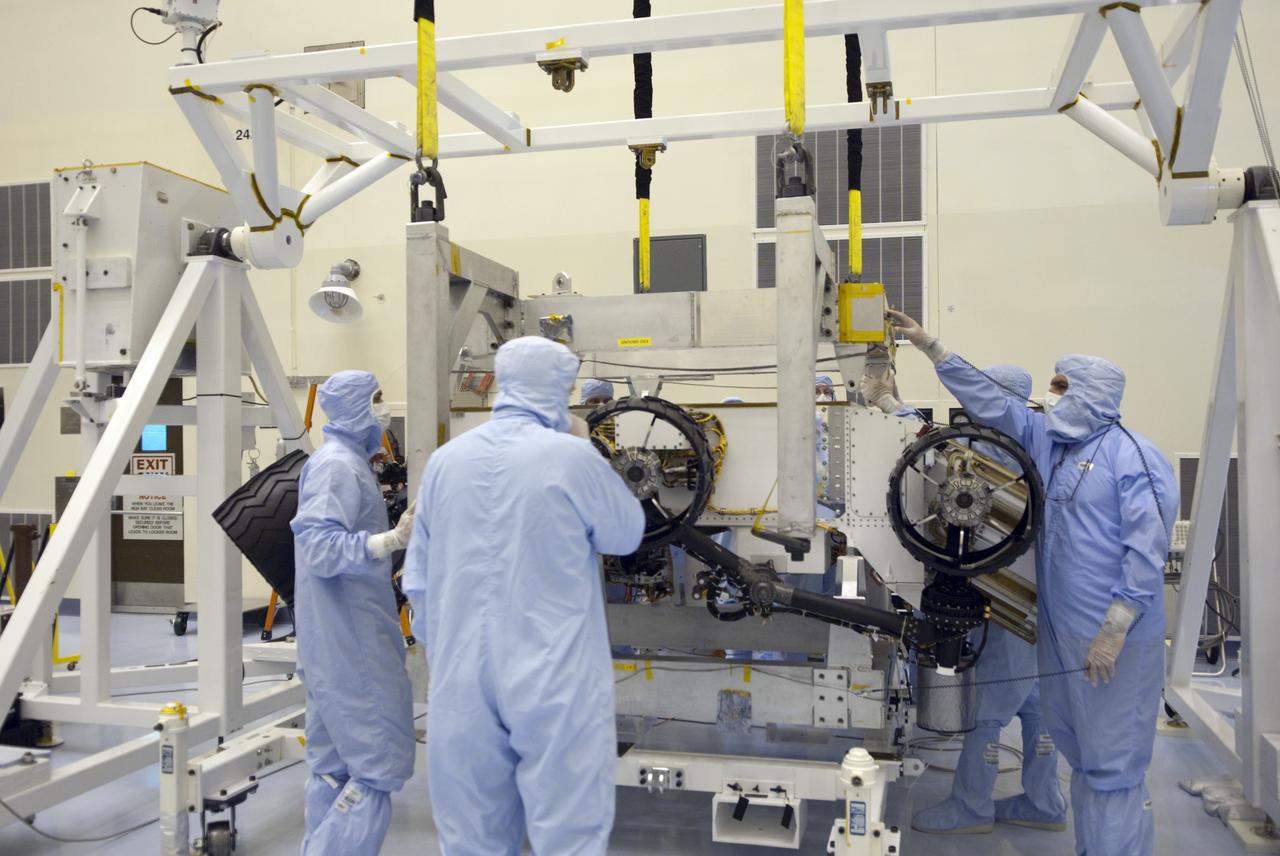
CAPE CANAVERAL, Fla. -- Technicians, in the Payload Hazardous Servicing Facility at NASA's Kennedy Space Center in Florida, disconnect NASA's Mars Science Laboratory (MSL) rover, known as Curiosity, from a rolling work stand for its lift to a rotation fixture for testing. A United Launch Alliance Atlas V-541 configuration will be used to loft MSL into space. Curiosity’s 10 science instruments are designed to search for evidence on whether Mars has had environments favorable to microbial life, including chemical ingredients for life. The unique rover will use a laser to look inside rocks and release its gasses so that the rover’s spectrometer can analyze and send the data back to Earth. MSL is scheduled to launch from Cape Canaveral Air Force Station in Florida Nov. 25 with a window extending to Dec. 18 and arrival at Mars Aug. 2012. For more information, visit http://www.nasa.gov/msl. Photo credit: NASA/Jim Grossmann