![The stimulus of gravity affects RNA production, which helps maintain the strength of human muscles on Earth (top), as seen in this section of muscle fiber taken from an astronaut before spaceflight. Astronauts in orbit and patients on Earth fighting muscle-wasting diseases need countermeasures to prevent muscle atrophy, indicated here with white lipid droplets (bottom) in the muscle sample taken from the same astronaut after spaceflight. Kerneth Baldwin of the University of California, Irvine, is conducting research on how reducing the stimulus of gravity affects production of the RNA that the body uses as a blueprint for making muscle proteins. Muscle proteins are what give muscles their strength, so when the RNA blueprints aren't available for producing new proteins to replace old ones -- a situation that occurs in microgravity -- the muscles atrophy. When the skeletal muscle system is exposed to microgravity during spaceflight, the muscles undergo a reduced mass that translates to a reduction in strength. When this happens, muscle endurance decreases and the muscles are more prone to injury, so individuals could have problems in performing extravehicular activity [space walks] or emergency egress because their bodies are functionally compromised.](https://images-assets.nasa.gov/image/0300206/0300206~medium.jpg)
The stimulus of gravity affects RNA production, which helps maintain the strength of human muscles on Earth (top), as seen in this section of muscle fiber taken from an astronaut before spaceflight. Astronauts in orbit and patients on Earth fighting muscle-wasting diseases need countermeasures to prevent muscle atrophy, indicated here with white lipid droplets (bottom) in the muscle sample taken from the same astronaut after spaceflight. Kerneth Baldwin of the University of California, Irvine, is conducting research on how reducing the stimulus of gravity affects production of the RNA that the body uses as a blueprint for making muscle proteins. Muscle proteins are what give muscles their strength, so when the RNA blueprints aren't available for producing new proteins to replace old ones -- a situation that occurs in microgravity -- the muscles atrophy. When the skeletal muscle system is exposed to microgravity during spaceflight, the muscles undergo a reduced mass that translates to a reduction in strength. When this happens, muscle endurance decreases and the muscles are more prone to injury, so individuals could have problems in performing extravehicular activity [space walks] or emergency egress because their bodies are functionally compromised.
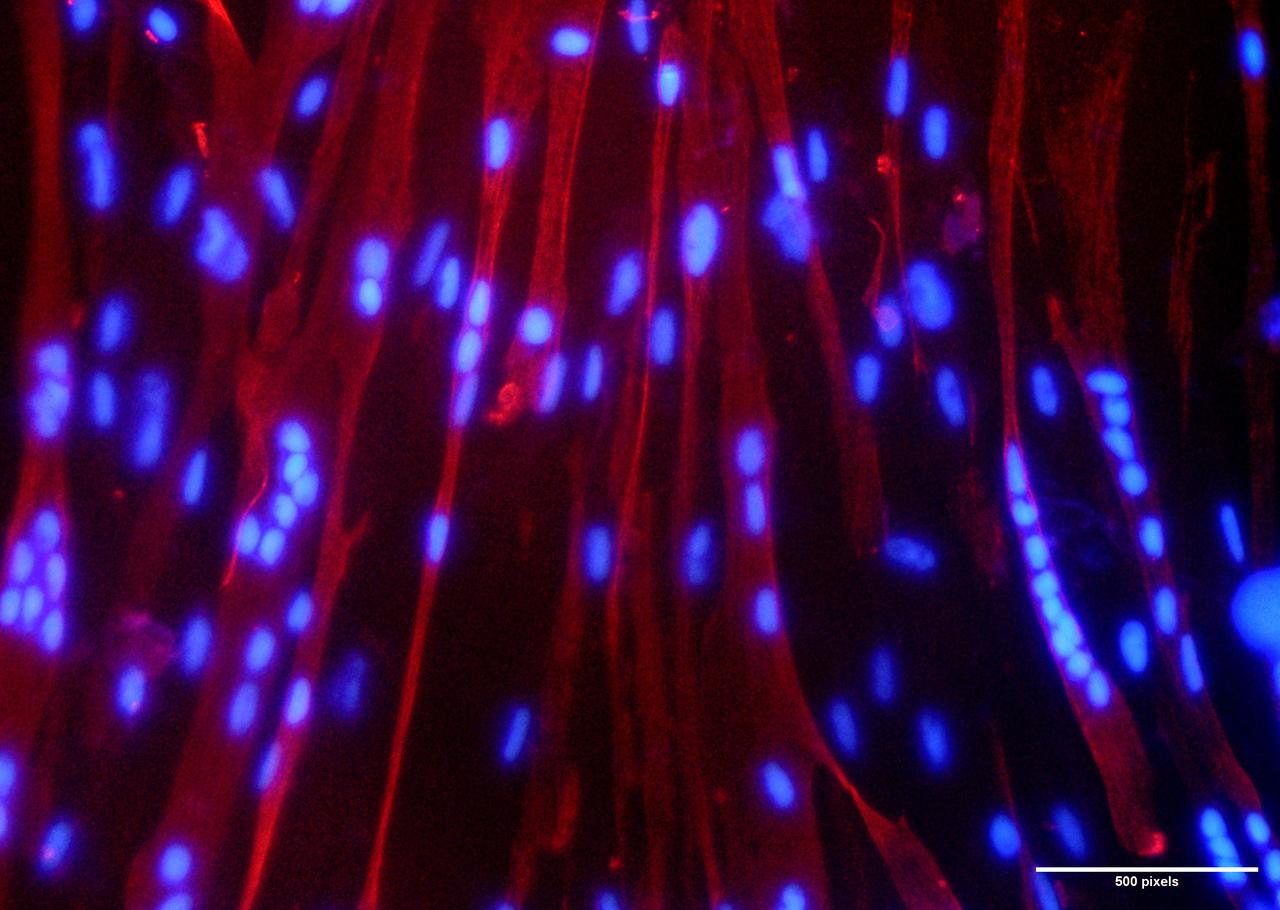
jsc2025e039327 (4/17/2025) --- Immunofluorescence images of multinucleated human myotubes with blue-colored nuclei and red-colored Myosin Heavy Chain protein are shown. The Myotube fibers were obtained after growing human skeletal muscle stem cells for eight days in a differentiation medium, during which individual cells fused into muscle fibers. The Myogenesis – ISRO investigation studies the mechanism of this differentiation process in the microgravity environment aboard the International Space Station in hopes of protecting the muscle health of astronauts on future long-duration space missions, as well as apply this technology to treating people on Earth that suffer from diseases that impair muscle function. Imagery courtesy of Institute for Stem Cell Science and Regenerative Medicine (India).
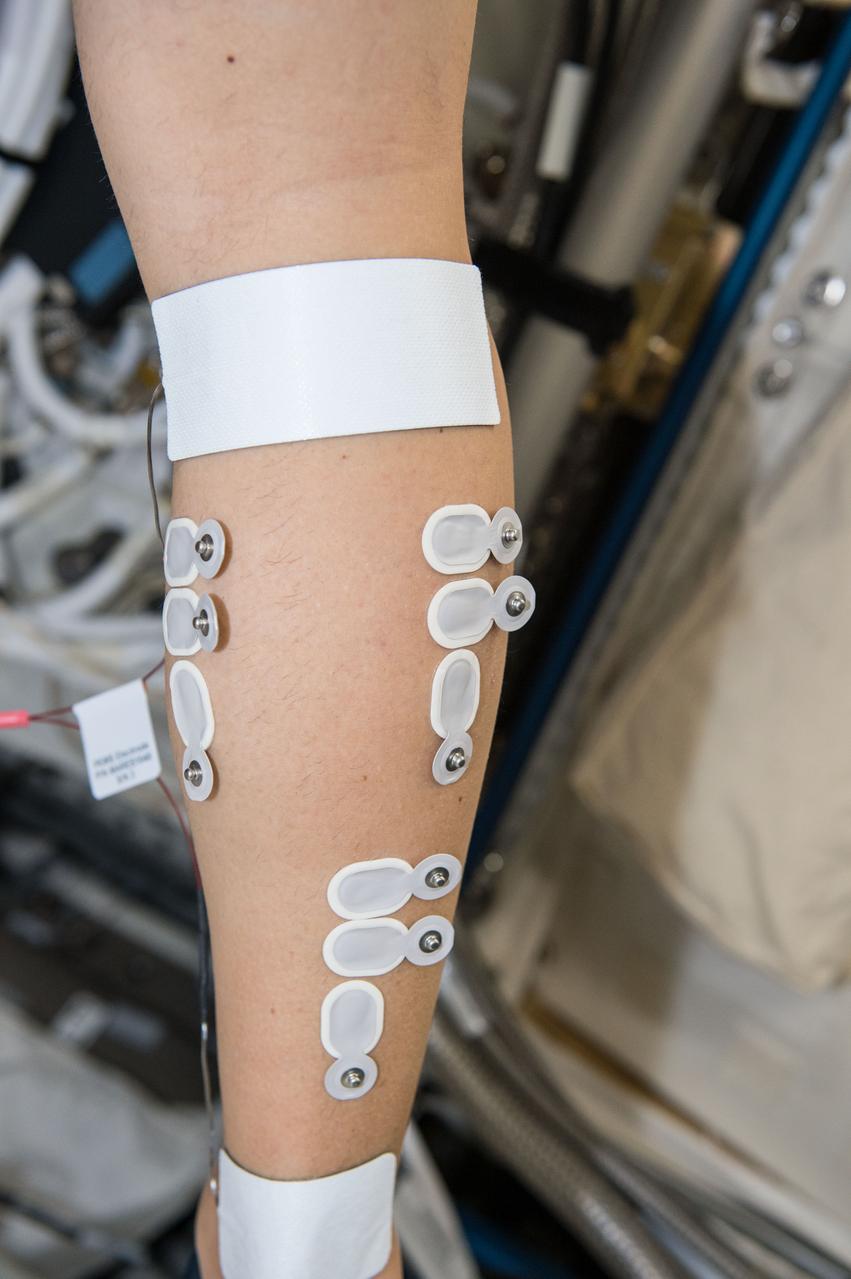
iss050e012909 (11/29/2016) --- A view of an Expedition 50 Crewmember (wearing electrodes) during the setup phase of the Sarcolab-3 Experiment in the Columbus Module. Myotendinous and Neuromuscular Adaptation to Long-term Spaceflight (Sarcolab) investigates the adaptation and deterioration of the soleus, or calf muscle, where it joins the Achilles tendon, which links it to the heel and carries loads from the entire body. Muscle fiber samples are taken from crew members before and after flight, and analyzed for changes in structural and chemical properties.
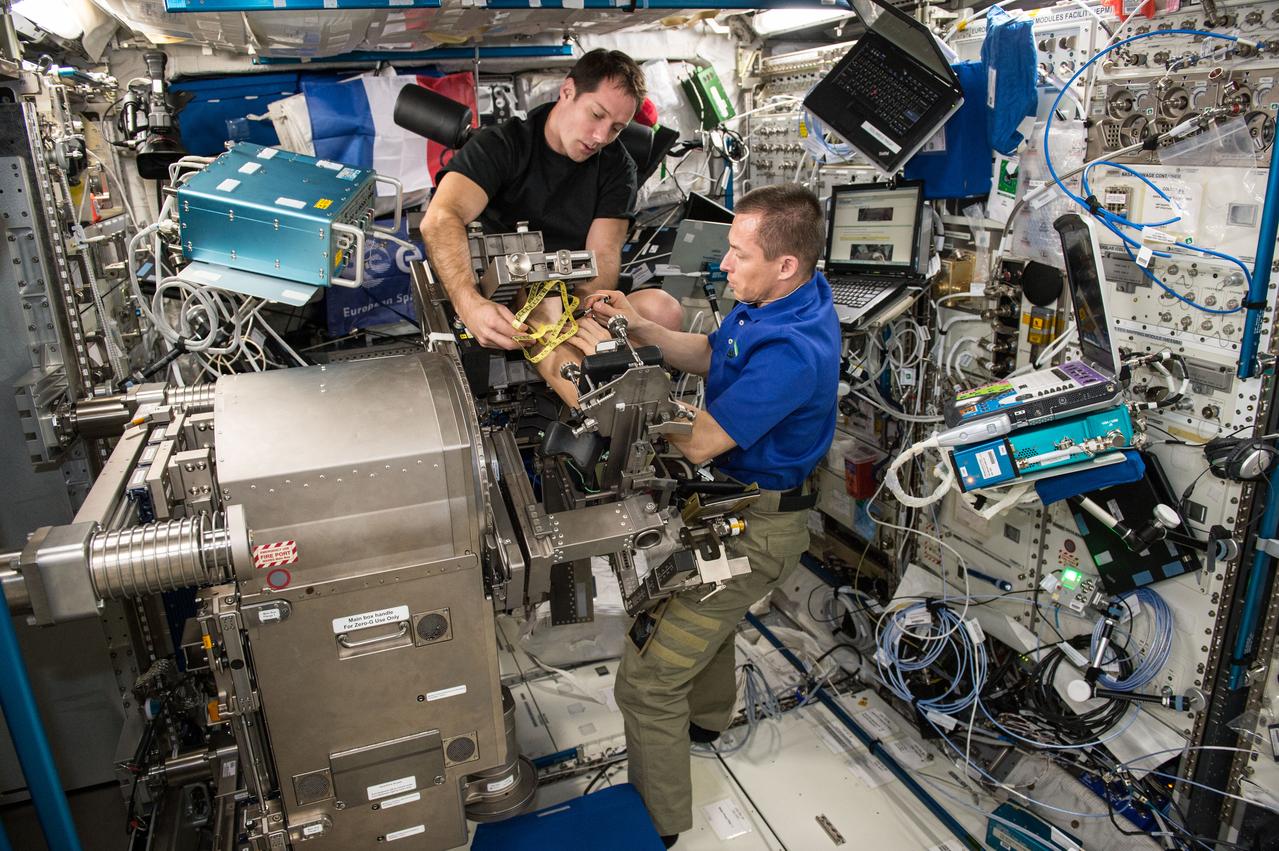
iss050e012389 (11/29/2016) --- European Space Agency (ESA) Thomas Pesquet and Cosmonaut Sergei Ryzhikov during the setup phase of the Sarcolab-3 Experiment in the Columbus Module. Myotendinous and Neuromuscular Adaptation to Long-term Spaceflight (Sarcolab) investigates the adaptation and deterioration of the soleus, or calf muscle, where it joins the Achilles tendon, which links it to the heel and carries loads from the entire body. Muscle fiber samples are taken from crew members before and after flight, and analyzed for changes in structural and chemical properties.
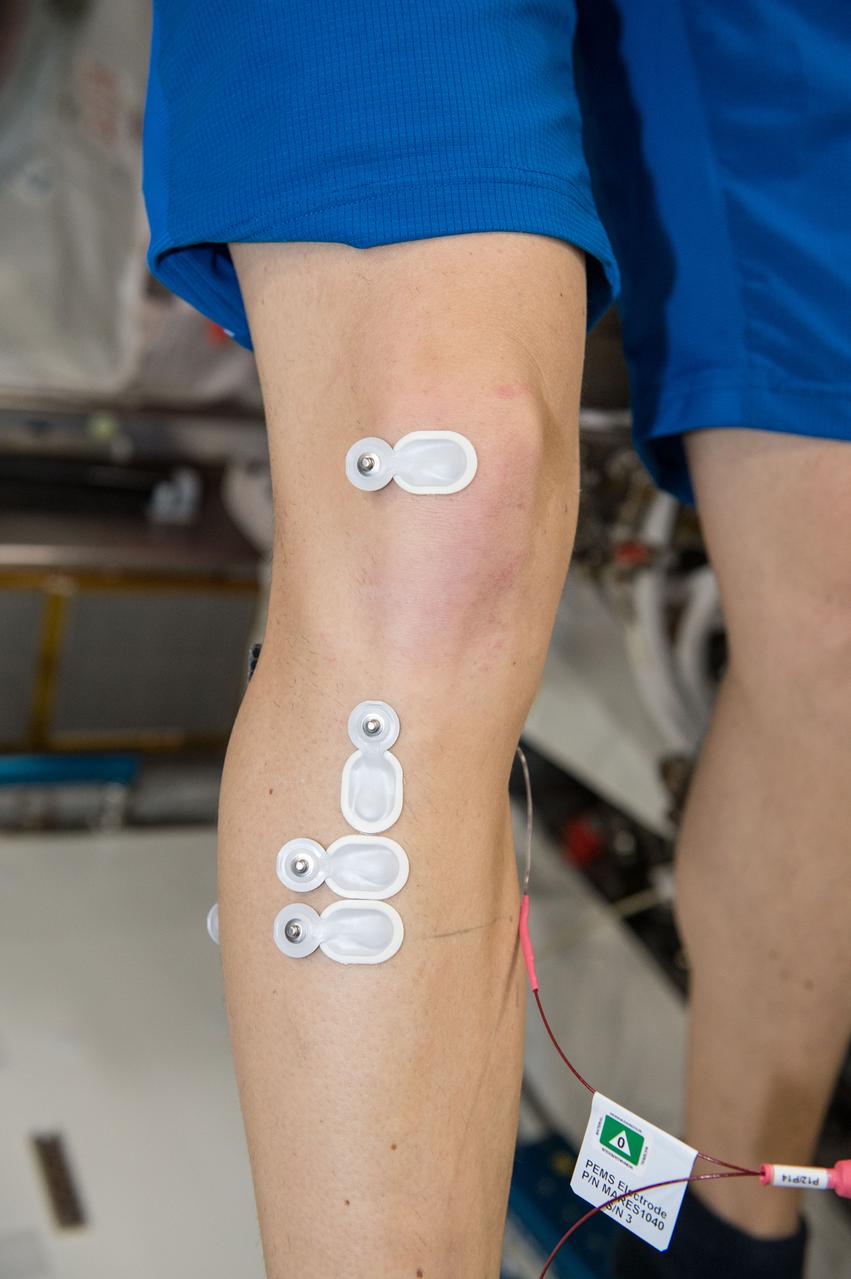
iss050e012907 (11/29/2016) --- European Space Agency (ESA) Thomas Pesquet (only leg - wearing electrodes) during the setup phase of the Sarcolab-3 Experiment in the Columbus Module. Myotendinous and Neuromuscular Adaptation to Long-term Spaceflight (Sarcolab) investigates the adaptation and deterioration of the soleus, or calf muscle, where it joins the Achilles tendon, which links it to the heel and carries loads from the entire body. Muscle fiber samples are taken from crew members before and after flight, and analyzed for changes in structural and chemical properties.
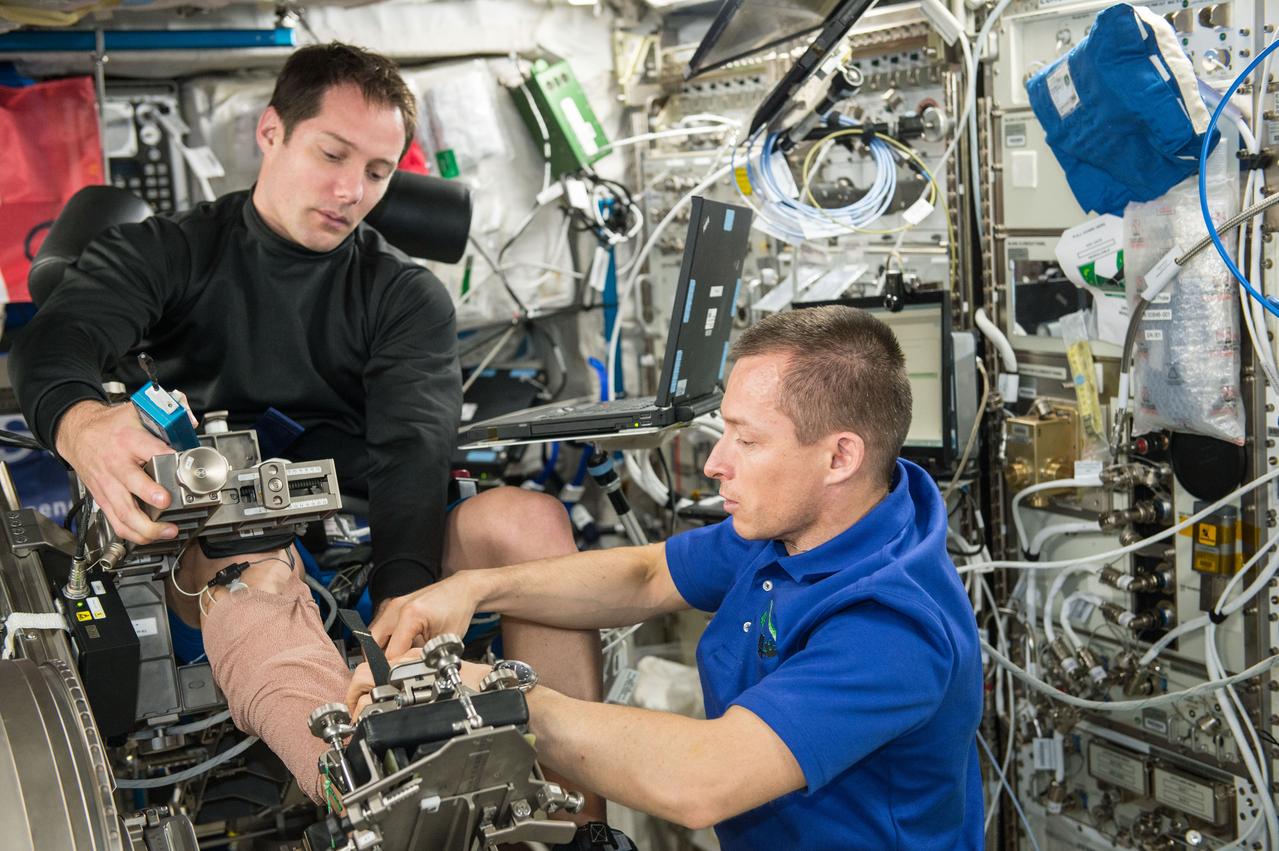
iss050e012915 (11/29/2016) --- European Space Agency (ESA) Thomas Pesquet and Cosmonaut Sergei Ryzhikov during the setup phase of the Sarcolab-3 Experiment in the Columbus Module. Myotendinous and Neuromuscular Adaptation to Long-term Spaceflight (Sarcolab) investigates the adaptation and deterioration of the soleus, or calf muscle, where it joins the Achilles tendon, which links it to the heel and carries loads from the entire body. Muscle fiber samples are taken from crew members before and after flight, and analyzed for changes in structural and chemical properties.
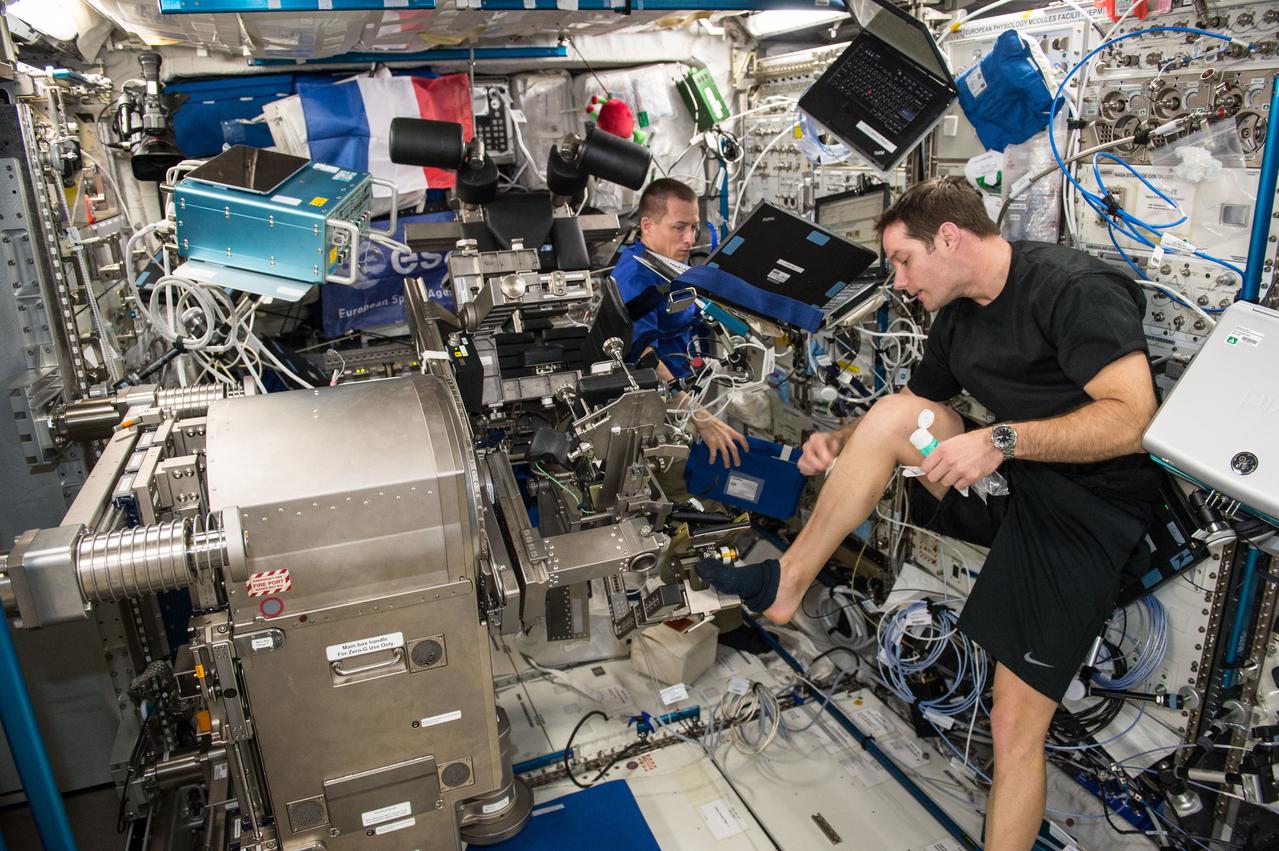
iss050e012767 (11/29/2016) --- European Space Agency (ESA) Thomas Pesquet and Cosmonaut Sergei Ryzhikov during the setup phase of the Sarcolab-3 Experiment, by deploying and configuring the Muscle Atrophy Resistive Exercise System (MARES), in the Columbus Module. Myotendinous and Neuromuscular Adaptation to Long-term Spaceflight (Sarcolab) investigates the adaptation and deterioration of the soleus, or calf muscle, where it joins the Achilles tendon, which links it to the heel and carries loads from the entire body. Muscle fiber samples are taken from crew members before and after flight, and analyzed for changes in structural and chemical properties.
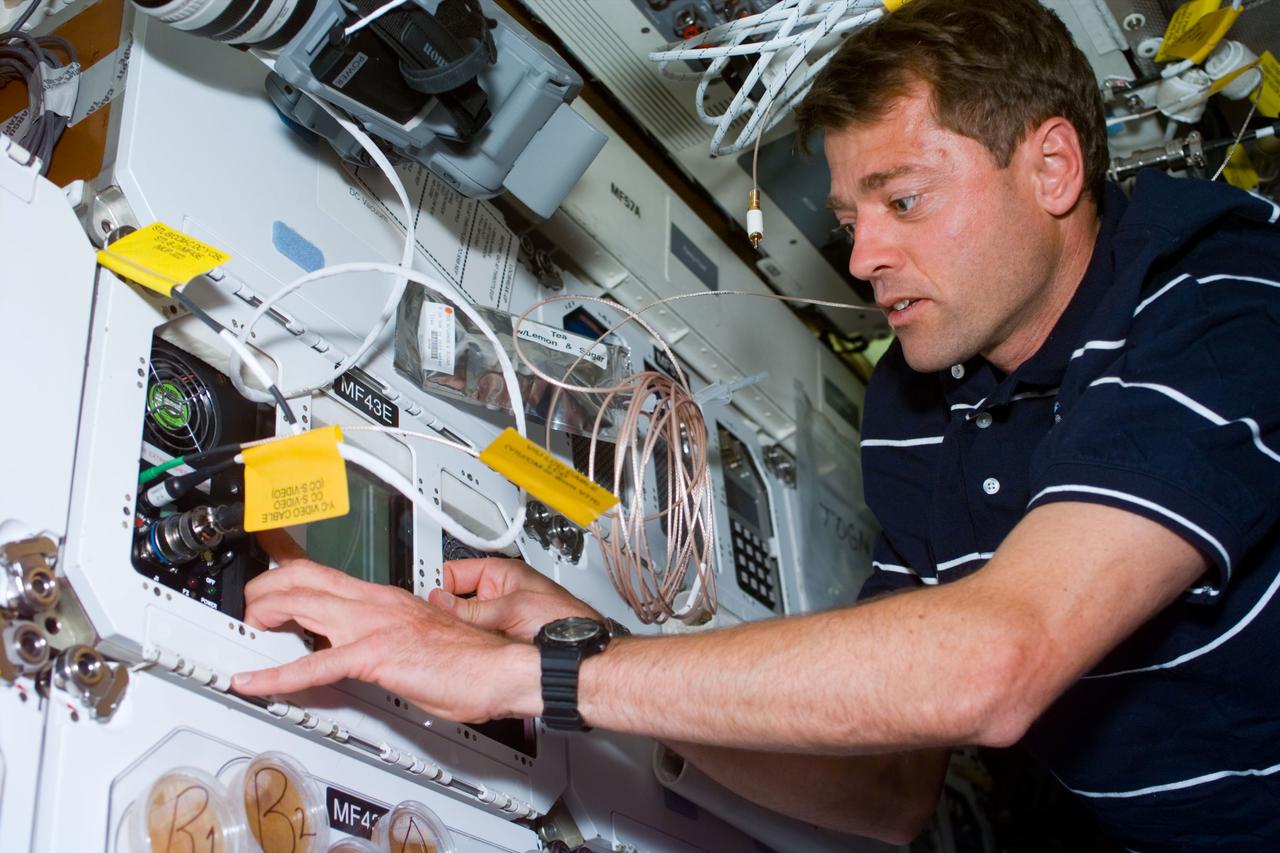
S93-E-5003 (23 July 1999) --- Astronaut Jeffrey S. Ashby, pilot, works at the Space Tissue Loss-B experiment on Space Shuttle Columbia's middeck. The experiment is set up to observe cells in culture with a video microscope imaging system to record near-real-time interactions of detecting and inducing cellular responses (macromorphological changes). Just above and to the right of STL-B is the part of the Commercial Generic Bioprocessing Apparatus (CGBA) for the National Institute of Health (NIH-B experiment). It is an experiment designed to investigate the effects of space flight on neural development in Drosophila melanogaster (fruit fly) larvae. This information may help scientists understand how gravity affects nerve growth and development and how neural connections to muscle fibers work. The photo was recorded with an electronic still camera (ESC) on Flight Day 1. Ashby and his four crew mates are scheduled to spend five days aboard Columbia in Earth orbit.
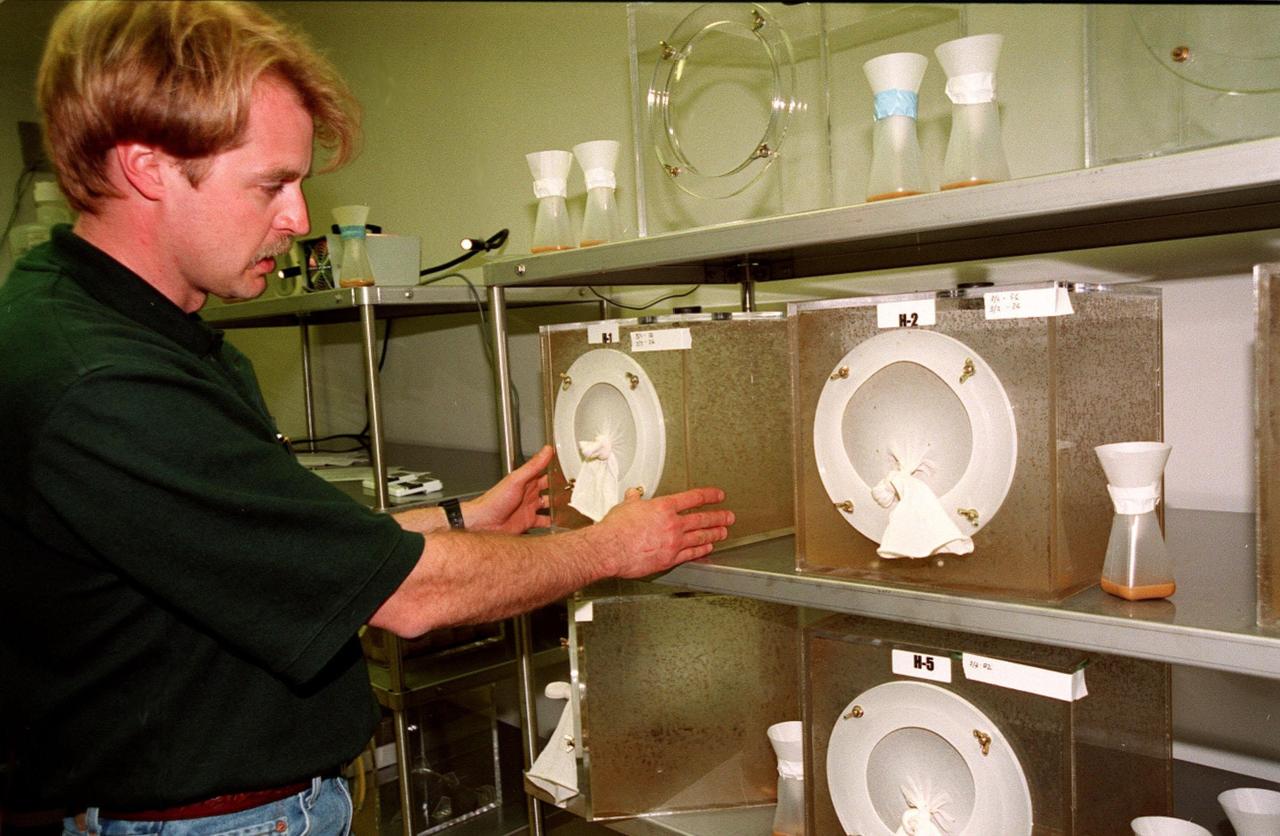
In the KSC Life Sciences Building, Hangar L, Cape Canaveral Air Station, Shawn Bengtson, with Lockheed Martin, checks population cages containing fruit flies. The larvae of the flies are part of an experiment that is a secondary payload on mission STS-93. The experiment will examine the effects of microgravity and space flight on the development of neural connections between specific motor neurons and their targets in muscle fibers. That information could lead to understanding the effect of microgravity on human nervous system connectivity. The larvae will be contained in incubators that are part of a Commercial Generic Bioprocessing Apparatus (CGBA), which can start bioprocessing reactions by mixing or heating a sample and can also initiate multiple-step, sequential reactions in a technique called phased processing. The primary payload of mission STS-93 is the Chandra X-ray Observatory, which will allow scientists from around the world to see previously invisible black holes and high-temperature gas clouds, giving the observatory the potential to rewrite the books on the structure and evolution of our universe. The target launch date for STS-93 is July 9, aboard Space Shuttle Columbia, from Launch Pad 39B
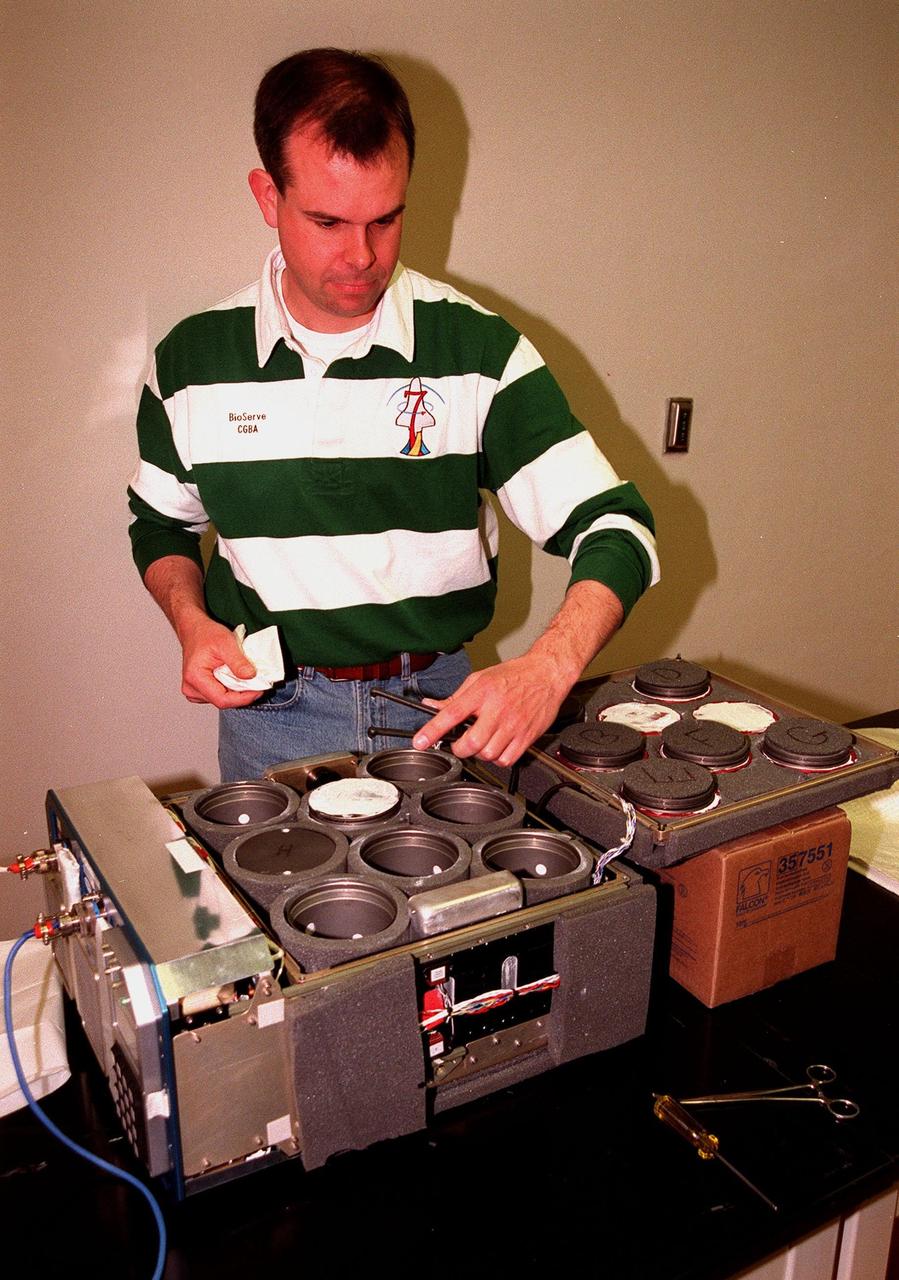
In the KSC Life Sciences Building, Hangar L, Cape Canaveral Air Station, Mark Rupert, with BioServe Space Technologies, checks the canisters, or incubators, that will hold an experiment to fly on mission STS-93. The incubators will hold a mix of fruit fly embryos and larvae to examine the effects of microgravity and space flight on the development of neural connections between specific motor neurons and their targets in muscle fibers. The incubators are part of a Commercial Generic Bioprocessing Apparatus (CGBA), which can start bioprocessing reactions by mixing or heating a sample and can also initiate multiple-step, sequential reactions in a technique called phased processing. The primary payload of mission STS-93 is the Chandra X-ray Observatory, which will allow scientists from around the world to see previously invisible black holes and high-temperature gas clouds, giving the observatory the potential to rewrite the books on the structure and evolution of our universe. The target launch date for STS-93 is July 9, aboard Space Shuttle Columbia, from Launch Pad 39B
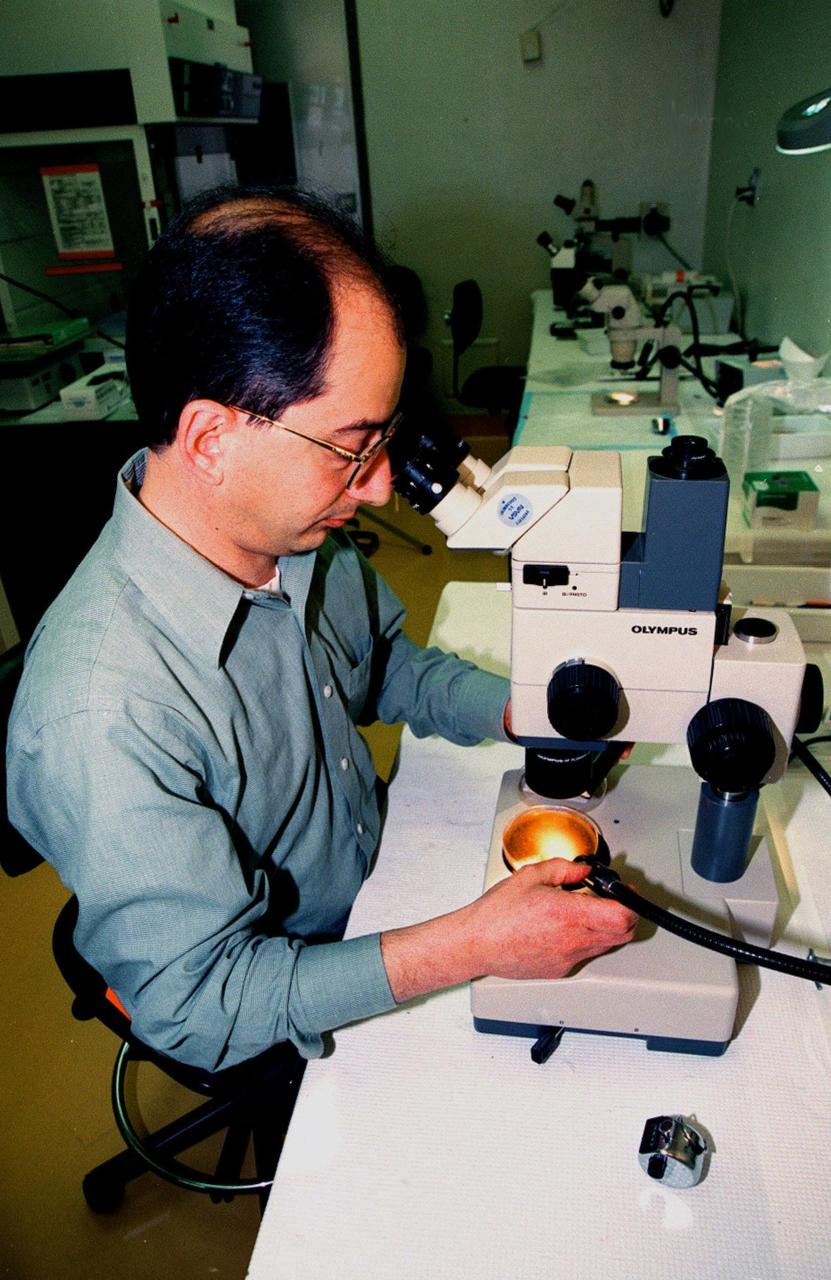
In the KSC Life Sciences Building, Hangar L, Cape Canaveral Air Station, Dr. Haig Keshishian checks fruit fly larvae in a petri dish. The larvae are part of an experiment that is a secondary payload on mission STS-93. The experiment will examine the effects of microgravity and space flight on the development of neural connections between specific motor neurons and their targets in muscle fibers. Dr. Keshishian, from Yale University, is the principle investigator for the experiment. The larvae will be contained in incubators that are part of a Commercial Generic Bioprocessing Apparatus (CGBA), which can start bioprocessing reactions by mixing or heating a sample and can also initiate multiple-step, sequential reactions in a technique called phased processing. The primary payload of mission STS-93 is the Chandra X-ray Observatory, which will allow scientists from around the world to see previously invisible black holes and high-temperature gas clouds, giving the observatory the potential to rewrite the books on the structure and evolution of our universe. The target launch date for STS-93 is July 9, aboard Space Shuttle Columbia, from Launch Pad 39B
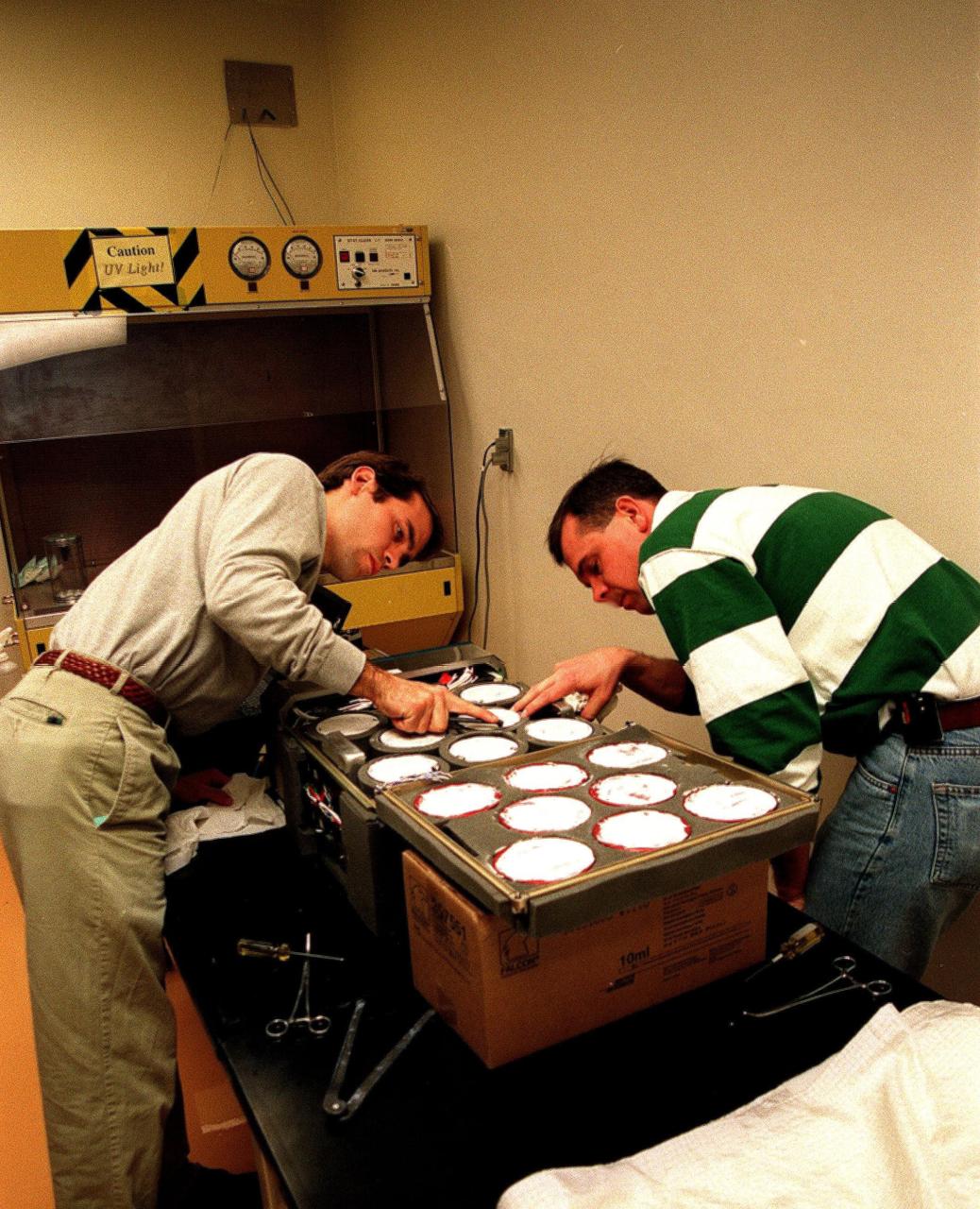
In the KSC Life Sciences Building, Hangar L, Cape Canaveral Air Station, Jake Freeman and Mark Rupert, with BioServe Space Technologies, check canisters, or incubators, that will hold fruit fly embryos and larvae for an experiment to fly on mission STS-93. The experiment will examine the effects of microgravity and space flight on the development of neural connections between specific motor neurons and their targets in muscle fibers. The incubators are part of the Commercial Generic Bioprocessing Apparatus (CGBA), which can start bioprocessing reactions by mixing or heating a sample and can also initiate multiple-step, sequential reactions in a technique called phased processing. The primary payload of mission STS-93 is the Chandra X-ray Observatory, which will allow scientists from around the world to see previously invisible black holes and high-temperature gas clouds, giving the observatory the potential to rewrite the books on the structure and evolution of our universe. The target launch date for STS-93 is July 9, aboard Space Shuttle Columbia, from Launch Pad 39B