
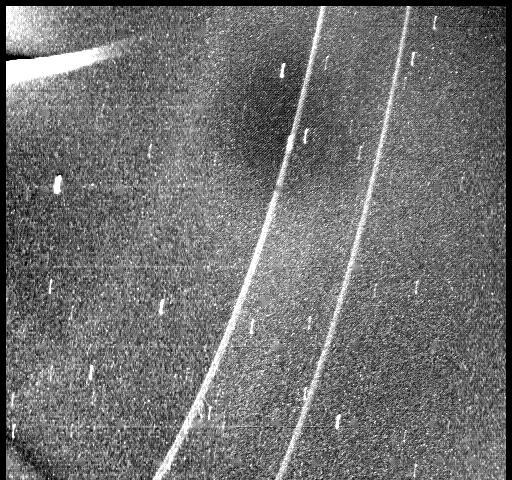
In Neptune outermost ring, 39,000 miles out, material mysteriously clumps into three arcs. Voyager 2 acquired this image as it encountered Neptune in August of 1989.

This contrast enhanced color picture of Neptune was acquired by NASA Voyager 2 on Aug. 14, 1989. As Voyager 2 approached Neptune, rapidly increasing image resolution is revealed striking new details. Bright, wispy clouds are seen overlying the Great Dar

This image of Neptune shows the discovery of shadows in Neptune atmosphere, shadows cast onto a deep cloud band by small elevated clouds. They are the first cloud shadows ever seen by NASA Voyager on any planet.

These two images of Neptune were taken by NASA Voyager 2 narrow angle camera when the spacecraft was about 12 million km 7.5 million miles from Neptune.

This dramatic view of the crescents of Neptune and Triton was acquired by Voyager 2 approximately 3 days, 6 and one-half hours after its closest approach to Neptune north is to the right.
This image of Neptune south polar region was obtained by NASA Voyager on Aug. 23, 1989. The image shows the discovery of shadows in Neptune atmosphere, shadows cast onto a deep cloud bank by small elevated clouds.

This photograph of Neptune shows three of the features that NASA Voyager 2 has been photographing during recent weeks. At the north is the Great Dark Spot, accompanied by bright, white clouds that undergo rapid changes in appearance.
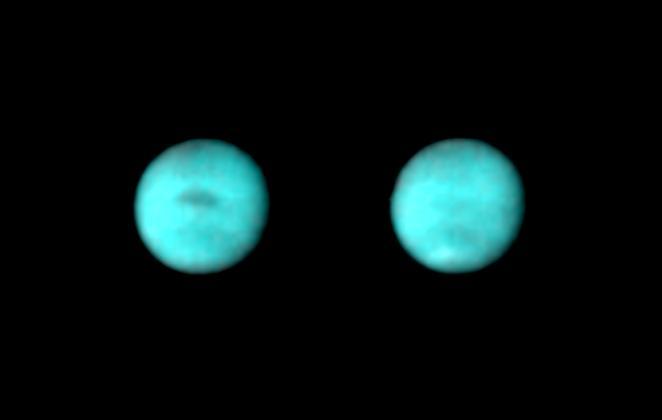
These pictures of Neptune were obtained by NASA Voyager 2 on Apr. 26,1989. The picture on the right was taken five hours after that at left, during which time the planet rotated 100 degrees.

On July 23, 1989, NASA Voyager 2 spacecraft took this picture of Neptune through a clear filter on its narrow-angle camera. The image on the right has a latitude and longitude grid added for reference. Neptune Great Dark Spot is visible on the left.

This image of Neptune south polar region was obtained by NASA Voyager on Aug. 23, 1989. The smallest cloud features are 45 kilometers 28 miles in diameter. The image shows the discovery of shadows in Neptune atmosphere, shadows cast onto a deep cl
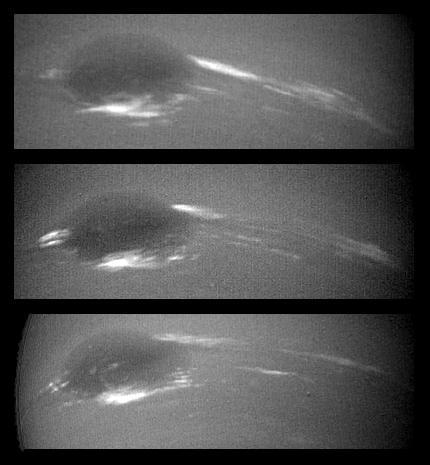
The bright cirrus-like clouds of Neptune change rapidly, often forming and dissipating over periods of several to tens of hours as seen in this sequence spanning two rotations of Neptune about 36 hours by NASA Voyager 2. http://photojournal.jpl.nasa.gov/catalog/PIA00047

This image of Neptune was taken through the clear filter of the narrow-angle camera on July 16, 1989 by NASA Voyager 2 spacecraft. The image was processed by computer to show the newly resolved dark oval feature embedded in the middle of the dusky south
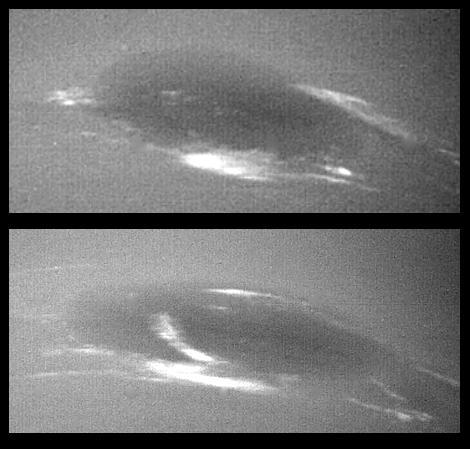
The bright cirrus-like clouds of Neptune change rapidly, often forming and dissipating over periods of several to tens of hours. In this sequence NASA Voyager 2 observed cloud evolution in the region around the Great Dark Spot GDS.

This photograph of Neptune was reconstructed from two images taken by NASA Voyager 2. At the north top is the Great Dark Spot, accompanied by bright, white clouds that undergo rapid changes in appearance.

This image was returned by NASA Voyager 2 spacecraft on July 3, 1989. The planet and its largest satellite, Triton, are captured in view; Triton appears in the lower right corner at about 5 oclock relative to Neptune.

These NASA Hubble Space Telescope views of the blue-green planet Neptune provide three snapshots of changing weather conditions. The images were taken in 1994 on 3 separate days when Neptune was 2.8 billion miles 4.5 billion kilometers from Earth.

These two NASA Hubble Space Telescope images provide views of weather on opposite hemispheres of Neptune. Taken Aug. 13, 1996; these composite images blend information from different wavelengths to bring out features of Neptune blustery weather.

This image captured by the NASA Voyager 2 spacecraft on July 30, 1989, was used to confirm the discovery of three new satellites orbiting Neptune.
The large, dark oval spot in Neptune atmosphere is just coming into view in this picture returned from NASA Voyager 2 spacecraft on June 30, 1989.

NASA New Horizons Long Range Reconnaissance Imager LORRI observed Neptune on June 23, apl2010, as part of a test of the critical optical navigation Annual Checkout ACO-4.

NASA Voyager 2 post-encounter view of Neptune south pole as the spacecraft sped away on a southward trajectory.

These three images of Neptune were acquired 90 minutes apart by NASA Voyager 2 spacecraft on April 3, 1989, from a range of 208 million kilometers 129 million miles. Several atmospheric features clouds are visible.

This photograph of Neptune southern hemisphere was taken by the narrow-angle camera on NASA Voyager 2 when the spacecraft was 4.2 million km 2.6 million miles from the planet. http://photojournal.jpl.nasa.gov/catalog/PIA00050

During August 16 and 17, 1989, the Voyager 2 narrow-angle camera was used to photograph Neptune almost continuously, recording approximately two and one-half rotations of the planet. http://photojournal.jpl.nasa.gov/catalog/PIA00046

This image of clouds in Neptune atmosphere is the first that tests the accuracy of the weather forecast that was made eight days earlier to select targets for NASA Voyager narrow angle camera. http://photojournal.jpl.nasa.gov/catalog/PIA00048
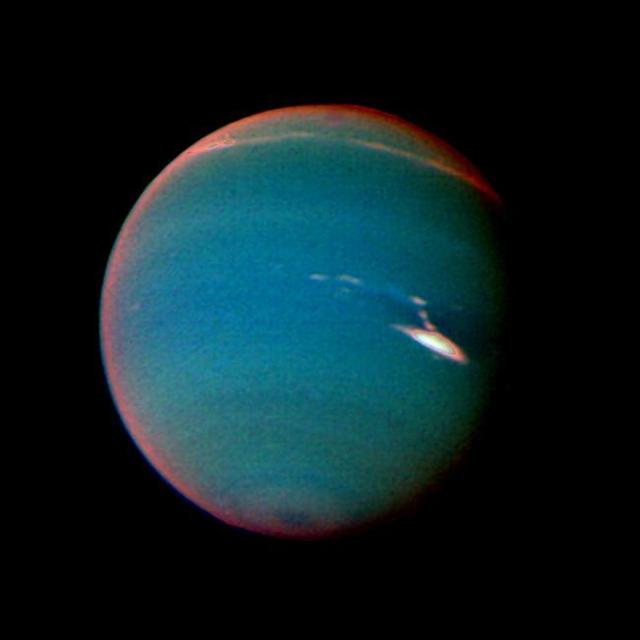
In this false color image of Neptune, objects that are deep in the atmosphere are blue, while those at higher altitudes are white. The image was taken by Voyager 2 wide-angle camera through an orange filter and two different methane filters. http://photojournal.jpl.nasa.gov/catalog/PIA00051

This bulls-eye view of Neptune small dark spot D2 was obtained by NASA Voyager 2 narrow-angle camera. Banding surrounding the feature indicates unseen strong winds.

This image of Neptune was taken by NASA Voyager 2 wide-angle camera; small trails of similar clouds trending east to west and large scale structure east of the Great Dark Spot all suggest that waves are present in the atmosphere and play a large role. http://photojournal.jpl.nasa.gov/catalog/PIA00063
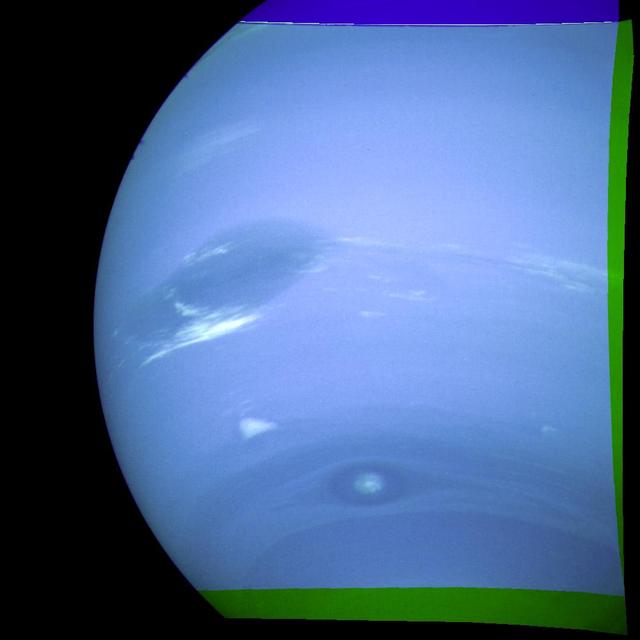
This photograph of Neptune was reconstructed from two images taken by NASA Voyager 2. At the north top is the Great Dark Spot. http://photojournal.jpl.nasa.gov/catalog/PIA00049

This picture of Neptune was produced from the last whole planet images taken through the green and orange filters on NASA's Voyager 2 narrow angle camera. The images were taken at a range of 4.4 million miles from the planet, 4 days and 20 hours before closest approach. The picture shows the Great Dark Spot and its companion bright smudge; on the west limb the fast moving bright feature called Scooter and the little dark spot are visible. These clouds were seen to persist for as long as Voyager's cameras could resolve them. North of these, a bright cloud band similar to the south polar streak may be seen. http://photojournal.jpl.nasa.gov/catalog/PIA01492
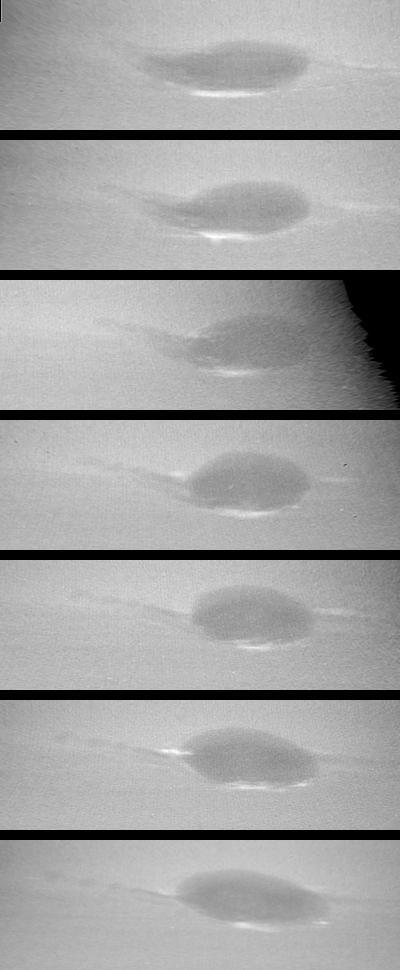
These images taken by NASA Voyager 2 show changes in the clouds around Neptune Great Dark Spot GDS over a four and one-half-day period. From top to bottom the images show successive rotations of the planet an interval of about 18 hours. http://photojournal.jpl.nasa.gov/catalog/PIA00045

Neptune's blue-green atmosphere is shown in greater detail than ever before by the Voyager 2 spacecraft as it rapidly approaches its encounter with the giant planet. This color image, produced from a distance of about 16 million kilometers, shows several complex and puzzling atmospheric features. The Great Dark Spot (GDS) seen at the center is about 13,000 km by 6,600 km in size -- as large along its longer dimension as the Earth. The bright, wispy "cirrus-type" clouds seen hovering in the vicinity of the GDS are higher in altitude than the dark material of unknown origin which defines its boundaries. A thin veil often fills part of the GDS interior, as seen on the image. The bright cloud at the southern (lower) edge of the GDS measures about 1,000 km in its north-south extent. The small, bright cloud below the GDS, dubbed the "scooter," rotates faster than the GDS, gaining about 30 degrees eastward (toward the right) in longitude every rotation. Bright streaks of cloud at the latitude of the GDS, the small clouds overlying it, and a dimly visible dark protrusion at its western end are examples of dynamic weather patterns on Neptune, which can change significantly on time scales of one rotation (about 18 hours). https://photojournal.jpl.nasa.gov/catalog/PIA02245

These thermal images show a hot south pole on the planet Neptune. These warmer temperatures provide an avenue for methane to escape out of the deep atmosphere. The images were obtained with the Very Large Telescope in Chile Sept. 1 and 2, 2006.

NASA image release July 12, 2011 Neptune: 23:09 UT (June 25, 2011) Today, Neptune has arrived at the same location in space where it was discovered nearly 165 years ago. To commemorate the event, NASA's Hubble Space Telescope has taken these "anniversary pictures" of the blue-green giant planet. Neptune is the most distant major planet in our solar system. German astronomer Johann Galle discovered the planet on September 23, 1846. At the time, the discovery doubled the size of the known solar system. The planet is 2.8 billion miles (4.5 billion kilometers) from the Sun, 30 times farther than Earth. Under the Sun's weak pull at that distance, Neptune plods along in its huge orbit, slowly completing one revolution approximately every 165 years. <b>To read more go <a href="http://www.nasa.gov/mission_pages/hubble/science/neptune-circuit.html" rel="nofollow"> here</a></b> <b><a href="http://www.nasa.gov/centers/goddard/home/index.html" rel="nofollow">NASA Goddard Space Flight Center</a></b> enables NASA’s mission through four scientific endeavors: Earth Science, Heliophysics, Solar System Exploration, and Astrophysics. Goddard plays a leading role in NASA’s accomplishments by contributing compelling scientific knowledge to advance the Agency’s mission. <b>Follow us on <a href="http://twitter.com/NASA_GoddardPix" rel="nofollow">Twitter</a></b> <b>Like us on <a href="http://www.facebook.com/pages/Greenbelt-MD/NASA-Goddard/395013845897?ref=tsd" rel="nofollow">Facebook</a></b> <b>Find us on <a href="http://web.stagram.com/n/nasagoddard/?vm=grid" rel="nofollow">Instagram</a></b>
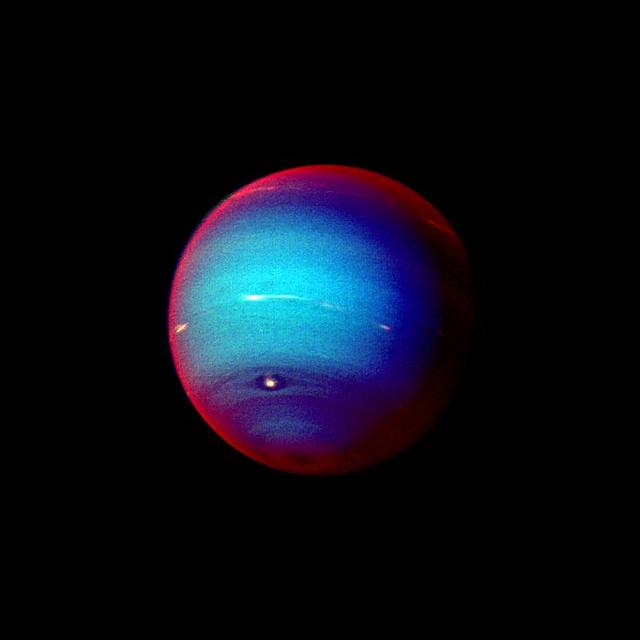
This false color photograph of Neptune was made from NASA's Voyager 2 images taken through three filters: blue, green, and a filter that passes light at a wavelength that is absorbed by methane gas. Thus, regions that appear white or bright red are those that reflect sunlight before it passes through a large quantity of methane. The image reveals the presence of a ubiquitous haze that covers Neptune in a semitransparent layer. Near the center of the disk, sunlight passes through the haze and deeper into the atmosphere, where some wavelengths are absorbed by methane gas, causing the center of the image to appear less red. Near the edge of the planet, the haze scatters sunlight at higher altitude, above most of the methane, causing the bright red edge around the planet. By measuring haze brightness at several wavelengths, scientists are able to estimate the thickness of the haze and its ability to scatter sunlight. The image is among the last full disk photos that Voyager 2 took before beginning its endless journey into interstellar space. http://photojournal.jpl.nasa.gov/catalog/PIA00057

This bulls-eye view of Neptune small dark spot D2 was obtained by NASA s Voyager 2 narrow-angle camera on Aug. 24, 1989, when Voyager 2 was within 1.1 million km 680,000 miles of the planet. http://photojournal.jpl.nasa.gov/catalog/PIA00064

In 1995, NASA Hubble Space Telescope discovered a new great dark spot, located in the northern hemisphere of the planet Neptune. Because the planet northern hemisphere was tilted away from Earth, the new feature appeared near the limb of the planet.

This Hubble Space Telescope Wide Field Camera 3 image of Neptune, taken in September and November 2018, shows a new dark storm (top center). Credits: NASA, ESA, A. Simon (NASA Goddard Space Flight Center), and M.H. Wong and A. Hsu (University of California, Berkeley)
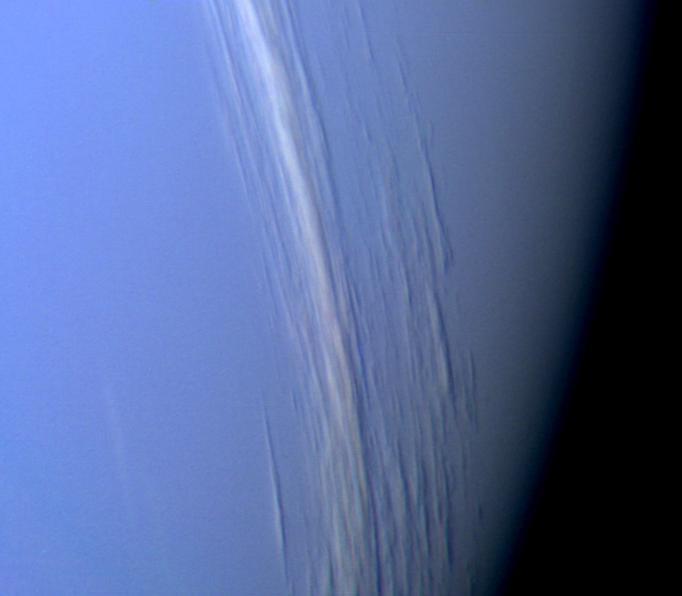
NASA's Voyager 2 high resolution color image, taken 2 hours before closest approach, provides obvious evidence of vertical relief in Neptune's bright cloud streaks. These clouds were observed at a latitude of 29 degrees north near Neptune's east terminator. The linear cloud forms are stretched approximately along lines of constant latitude and the sun is toward the lower left. The bright sides of the clouds which face the sun are brighter than the surrounding cloud deck because they are more directly exposed to the sun. Shadows can be seen on the side opposite the sun. These shadows are less distinct at short wavelengths (violet filter) and more distinct at long wavelengths (orange filter). This can be understood if the underlying cloud deck on which the shadow is cast is at a relatively great depth, in which case scattering by molecules in the overlying atmosphere will diffuse light into the shadow. Because molecules scatter blue light much more efficiently than red light, the shadows will be darkest at the longest (reddest) wavelengths, and will appear blue under white light illumination. The resolution of this image is 11 kilometers (6.8 miles per pixel) and the range is only 157,000 kilometers (98,000 miles). The width of the cloud streaks range from 50 to 200 kilometers (31 to 124 miles), and their shadow widths range from 30 to 50 kilometers (18 to 31 miles). Cloud heights appear to be of the order of 50 kilometers (31 miles). This corresponds to 2 scale heights. http://photojournal.jpl.nasa.gov/catalog/PIA00058

This image was returned by NASA's Voyager 2 spacecraft on July 3, 1989. The planet and its largest satellite, Triton, are captured in view; Triton appears in the lower right corner at about 5 oclock relative to Neptune. http://photojournal.jpl.nasa.gov/catalog/PIA01287

During its routine yearly monitoring of the weather on our solar system's outer planets, NASA's Hubble Space Telescope has uncovered a new mysterious dark storm on Neptune (right) and provided a fresh look at a long-lived storm circling around the north polar region on Uranus (left).

NASA Voyager 2 obtained these images of satellite 1989N2 and revealed it to be and irregularly shaped, dark object. The satellite appeared to have several craters. The irregular outline suggests that this moon has remained cold and rigid throughout much

This computer generated montage created from images obtained by NASA Voyager 2 shows Neptune as it would appear from a spacecraft approaching Triton, Neptune largest moon at 2706 km 1683 mi in diameter. http://photojournal.jpl.nasa.gov/catalog/PIA00340

This wide-angle image from NASA Voyager 2, taken in 1989, was taken through the camera clear filter, and was the first to show Neptune rings in detail.

This 591-second exposure of the rings of Neptune were taken with the clear filter by NASA Voyager 2 wide-angle camera. The two main rings are clearly visible and appear complete over the region imaged.

This mosaic from NASA Galileo Probe is of an equatorial hotspot on Jupiter and shows the features of a hazy cloud layer tens of kilometers above Jupiter main visible cloud deck.

This mosaic from NASA Galileo Probe is of an equatorial hotspot on Jupiter and shows the features of a hazy cloud layer tens of kilometers above Jupiter main visible cloud deck. http://photojournal.jpl.nasa.gov/catalog/PIA02200

This clear filter image was acquired by NASA Voyager 2 on Aug. 14, 1989. The image shows a dark feature extending westward left and northward up toward the equator from the Great Dark Spot GDS.

This photo was taken by NASA Voyager 2 wide-angle camera. Light at methane wavelengths is mostly absorbed in the deeper atmosphere. The bright, white feature is a high-altitude cloud just south of the Great Dark Spot.

NASA Voyager spacecraft was 8.6 million kilometers 5.3 million miles from Neptune when it took this 61 second exposure through the clear filter with the narrow angle camera on August 19, 1989.

Intriguing patterns of unknown origin appeared on the surface of Neptune largest satellite, Triton, in this image returned by NASA Voyager 2 on Aug. 22, 1989. Voyager images showed that Triton is one of the brightest objects in the solar system,

These two 591-second exposures of the rings of Neptune were taken with the clear filter by the NASA Voyager 2 wide-angle camera on Aug. 26, 1989. The two main rings are clearly visible and appear complete over the region imaged.

Using powerful ground-and space-based NASA telescopes, scientists have obtained a moving look at some of the wildest, weirdest weather in the solar system.

Nereid, the last satellite of Neptune to be discovered before NASA Voyager's recent discoveries, was first seen by Gerard Kuiper in 1949. Until this Voyager 2 image was obtained, all that was known about Nereid was its orbital parameters and intrinsic brightness. This Voyager view of Nereid was obtained on Aug. 24, 1989 at a distance of 4.7 million kilometers (2.9 million miles). With a resolution of 43 kilometers (26.6 miles) per pixel, this image has sufficient detail to show the overall size and albedo. Nereid is about 170 kilometers (105 miles) across and reflects about 12 percent of the incident light. http://photojournal.jpl.nasa.gov/catalog/PIA00054

This composite view from NASA Voyager 2 shows Neptune on Triton horizon. The foreground in this computer generated view of Triton maria as they would appear from a point approximately 45 km above the surface. http://photojournal.jpl.nasa.gov/catalog/PIA00344

This Hubble Space Telescope Wide Field Camera 3 image of Uranus, taken in November 2018, reveals a vast, bright stormy cloud cap across the planet's north pole. Credits: NASA, ESA, A. Simon (NASA Goddard Space Flight Center), and M.H. Wong and A. Hsu (University of California, Berkeley)

NASA's Voyager 2 acquired this black and white image of Triton, Neptune's largest satellite, during the night of Aug. 24-25, 1989. Triton's limb cuts obliquely across the middle of the image. The field of view is about 1,000 km (600 miles) across. Three irregular dark areas, surrounded by brighter material, dominate the image. Low-lying material with intermediate albedo occupies the central area, and fresh craters occur along the right margin. Sub-parallel alignment of linear patches of dark material shown in the lower and left part of the image suggests that the patches are structurally controlled. http://photojournal.jpl.nasa.gov/catalog/PIA00056

This photograph shows the last face on view of the Great Dark Spot that Voyager will make with the narrow angle camera. The image was shuttered 45 hours before closest approach at a distance of 2.8 million kilometers (1.7 million miles). The smallest structures that can be seen are of an order of 50 kilometers (31 miles). The image shows feathery white clouds that overlie the boundary of the dark and light blue regions. The pinwheel (spiral) structure of both the dark boundary and the white cirrus suggest a storm system rotating counterclockwise. Periodic small scale patterns in the white cloud, possibly waves, are short lived and do not persist from one Neptunian rotation to the next. This color composite was made from the clear and green filters of the narrow-angle camera. http://photojournal.jpl.nasa.gov/catalog/PIA00052

In this image from NASA's Voyager wide-angle taken on Aug. 23 1989, the two main rings of Neptune can be clearly seen. In the lower part of the frame the originally announced ring arc, consisting of three distinct features, is visible. This feature covers about 35 degrees of longitude and has yet to be radially resolved in Voyager images. From higher resolution images it is known that this region contains much more material than the diffuse belts seen elsewhere in its orbit, which seem to encircle the planet. This is consistent with the fact that ground-based observations of stellar occultations by the rings show them to be very broken and clumpy. The more sensitive wide-angle camera is revealing more widely distributed but fainter material. Each of these rings of material lies just outside of the orbit of a newly discovered moon. One of these moons, 1989N2, may be seen in the upper right corner. The moon is streaked by its orbital motion, whereas the stars in the frame are less smeared. The dark area around the bright moon and star are artifacts of the processing required to bring out the faint rings. This wide-angle image was taken from a range of 2 million kilometers (1.2 million miles), through the clear filter. http://photojournal.jpl.nasa.gov/catalog/PIA00053

This is an artist's concept of the tiny moon Hippocamp that was discovered by the Hubble Space Telescope in 2013. Only 20 miles across, it may actually be a broken-off fragment from a much larger neighboring moon, Proteus, seen as a crescent in the background. This is the first evidence for a moon being an offshoot from a comet collision with a much larger parent body. Credit: NASA, ESA and J. Olmsted (STScI)

Features as small as 100 km 62 miles across can be seen in this color image of Neptune satellite Triton, photographed by NASA Voyager 2 on Aug. 20, 1989, while it was still 5.4 million km 3.3 million miles from Neptune.

NASA Voyager 2 spacecraft flew by Triton, a moon of Neptune, on August 25, 1989. This frame from a video using Voyager data recreates that exciting encounter.

This image of Neptune satellite 1989N1 was obtained by NASA Voyager 2 on Aug. 25, 1989 from a range of 146,000 kilometers 91,000 miles. http://photojournal.jpl.nasa.gov/catalog/PIA00062

A sculpture resembling the Roman god Neptune is seen dockside of the Woods Hole Oceanographic Institution research vessel Knorr on Tuesday, Sept. 4, 2012, in Woods Hole, Mass. Knorr is scheduled to depart on Sept. 6 to take part in the Salinity Processes in the Upper Ocean Regional Study (SPURS). The NASA-sponsored expedition will sail to the North Atlantic's saltiest spot to get a detailed, 3-D picture of how salt content fluctuates in the ocean's upper layers and how these variations are related to shifts in rainfall patterns around the planet. Photo Credit: (NASA/Bill Ingalls)

The newfound planet K2-288Bb, illustrated here, is slightly smaller than Neptune. Located about 226 light-years away, it orbits the fainter member of a pair of cool M-type stars every 31.3 days. https://photojournal.jpl.nasa.gov/catalog/PIA23004

P-34675 Range : 5.9 million km. ( 3.6 million miles ) Orbital Speed : 40,000 km/hr. or 25,000 mi/hr. The most recently discovered satellites of Neptune, 1989N5 and 1989N6, are shown in this Voyager 2 image. Their high orbital speed, in combination with the a 15 sec. exposure, has caused faint streaks. 1989N3 was discovered in early August, 1989. 1989N6 is distinguished by an orbit that is inclined 4.5 degrees to Neptune's equatorial plane, the only new satellite in the Neptune system to have noticably inclined orbit. 1989N5 cicles Neptune every 7.5 hours at a ditance of 25,000 km. or 15,500 miles above the cloud tops. 1989N6 orbits Neptune 23,00 km. or 14,000 miles from cloud tops every 7.1 hours

Voyager 2 was the first spacecraft to observe the planet Neptune and its two satellites: Triton, the largest, and Nereid. The most obvious feature of the planet is its blue color, the result of methane in the atmosphere. Research continues on Neptune's two largest satellites and the additional six that were discovered by Voyager 2's investigation. These images represent the most complete set of full disk Neptune images that the spacecraft will acquire.

This view of the volcanic plains of Neptune moon Triton was produced using topographic maps derived from images acquired by NASA Voyager spacecraft during its August 1989 flyby, 20 years ago this week.

This view of the volcanic plains of Neptune moon Triton was produced using topographic maps derived from images acquired by NASA Voyager spacecraft during its August 1989 flyby, 20 years ago this week.

Part of the complex geologic history of icy Triton, Neptune largest satellite, is shown in this NASA Voyager 2 photo. The photo was received as part of a Triton-mapping sequence in 1989.

NASA Voyager 2 obtained this parting shot of Triton, Neptune largest satellite, shortly after closest approach to the moon and passage through its shadow on the morning of Aug. 25, 1989.

NASA Voyager 2 spacecraft flew by Triton, a moon of Neptune, in the summer of 1989. Dr. Paul Schenk, a scientist at the Lunar and Planetary Institute in Houston, used Voyager data to construct the best-ever global color map of Triton.

This is a montage of planetary images taken by spacecraft managed by NASA’s Jet Propulsion Laboratory in Pasadena, CA. Included are from top to bottom images of Mercury, Venus, Earth and Moon, Mars, Jupiter, Saturn, Uranus and Neptune.

Jupiter, Saturn, Uranus, and Neptune are known as the jovian Jupiter-like planets because they are all gigantic compared with Earth, and they have a gaseous nature. This diagram shows the approximate distance of the jovian planets from the Sun.

This color photo of Neptune large satellite Triton was obtained on Aug. 24 1989. In reality, there is no part of Triton that would appear blue to the eye. The bright southern hemisphere of Triton, which fills most of this frame, is generally pink.

NASA Voyager 2 obtained this color image of Neptune largest satellite,Triton, on Aug. 22, 1989. The south pole of Triton is tipped toward the sun and it is summer in the southern hemisphere.

This view of the volcanic plains of Neptune moon Triton was produced using topographic maps derived from images acquired by NASA Voyager spacecraft during its August 1989 flyby, 20 years ago this week.

This is a montage of planetary images taken by spacecraft managed by NASA’s Jet Propulsion Laboratory in Pasadena, CA. Included are from top to bottom images of Mercury, Venus, Earth and Moon, Mars, Jupiter, Saturn, Uranus and Neptune.

A Neptune-size planet with a clear atmosphere is shown crossing in front of its star in this artist depiction. Such crossings, or transits, are observed by telescopes like NASA Hubble and Spitzer to glean information about planets atmospheres.

These artist concepts show some of the best known objects found outside Neptune orbit. Included are Pluto and fellow plutinos, Kuiper Belt Objects, and an Oort Cloud object.

NASA Voyager 2 was 530,000 kilometers 330,000 miles from Neptune largest satellite, Triton, when this photo was taken, Aug. 24, 1989. This is the first photo of Triton to reveal surface topography.

This is an updated montage of planetary images taken by spacecraft managed by NASA’s Jet Propulsion Laboratory in Pasadena, CA. Included are from top to bottom images of Mercury, Venus, Earth and Moon, Mars, Jupiter, Saturn, Uranus and Neptune.

This simulated voyage over the surface of Neptune large moon Triton was produced using topographic maps derived from images acquired by NASA Voyager spacecraft during its August 1989 flyby, 20 years ago this week.

This image, taken by NASA Voyager 2 early in the morning of Aug. 23, 1989, is a false color image of Triton, Neptune largest satellite; mottling in the bright southern hemisphere is present.

Scientists were excited to discover clear skies on a relatively small planet, about the size of Neptune, using the combined power of NASA Hubble, Spitzer and Kepler space telescopes.

This image from NASA's Voyager 2 of the south polar terrain of Triton, taken on Aug. 25, 1989 reveals about 50 dark plumes or 'wind streaks' on the icy surface. The plumes originate at very dark spots generally a few miles in diameter and some are more than 100 miles long. The spots which clearly mark the source of the dark material may be vents where gas has erupted from beneath the surface and carried dark particles into Triton's nitrogen atmosphere. Southwesterly winds then transported the erupted particles, which formed gradually thinning deposits to the northeast of most vents. It is possible that the eruptions have been driven by seasonal heating of very shallow subsurface deposits of volatiles, and the winds transporting particles similarly may be seasonal winds. The polar terrain, upon which the dark streaks have been deposited, is a region of bright materials mottled with irregular, somewhat dark patches. The pattern of irregular patches suggests that they may correspond to lag deposits of moderately dark material that cap the bright ice over the polar terrain. http://photojournal.jpl.nasa.gov/catalog/PIA00059

Range : 4.86 million km (3 million mi.) This dramatic view of the crescents of Neptune and Triton was acquired by Voyager 2 approx. 3 days, 6 1/2 hours after its closest approach to Neptune. The space craft was pluging southward at an angle of 48 degrees to the plane of the ecliptic. This direction, combined with the current season of southern summer in the Neptune system, gives this picture its unique geometry. The smallest detail discernible is approx. 90 km (56 mi.). Color was produced using images taken through the narrow-angle camera's clear, orange and green filters. Neptune does not appear as blue from this viewpoint because the forward scattering nature of its atmosphere is more important than its absorption of red light at this high phase angle (134 degrees).

The bright cirrus-like clouds of Neptune change rapidly, often forming and dissipation over periods of several to tens of hours. In this sequence spanning two rotations of Neptune (about 36 hours) Voyager 2 observed cloud evolution in the region around the Great Dark Spot (GDS) at an effective resolution of about 100 km (62 miles) per pixel. The surprisingly rapid changes which occur over the 18 hours separating each panel shows that in this region Neptune's weather is perhaps as dynamic and variable as that of the Earth. However, the scale is immense by our standards--the Earth and the GDS are of similar size -- and in Neptune's frigid atmosphere, where temperatures are as low as 55 degree Kelvin (-360F), the cirrus clouds are composed of frozen methane rather than Earth's crystalse of water ice.

This is one of the most detailed views of the surface of Triton taken by NASA Voyager 2 on its flyby of the large satellite of Neptune early in the morning of Aug. 25, 1989. The picture was stored on the tape recorder and relayed to Earth later. http://photojournal.jpl.nasa.gov/catalog/PIA00061

Art by Don Davis Pioneer 10 looking back at the Sun from Neptune's orbit as it becomes the first spacecraft to leave the Solar system
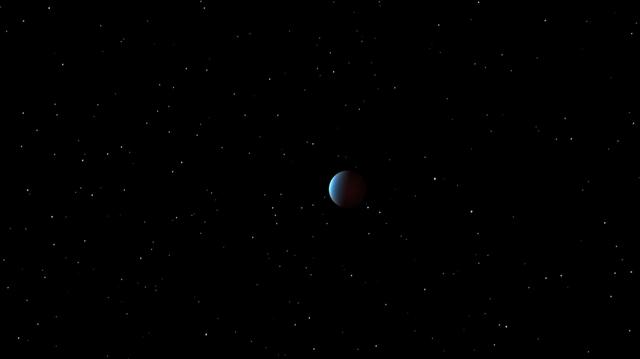
This artist concept depicts 55 Cancri e as it orbits its star. NASA Spitzer Space Telescope has, for the first time, captured the light emanating from a distant super Earth, a planet more massive than Earth but lighter than Neptune.
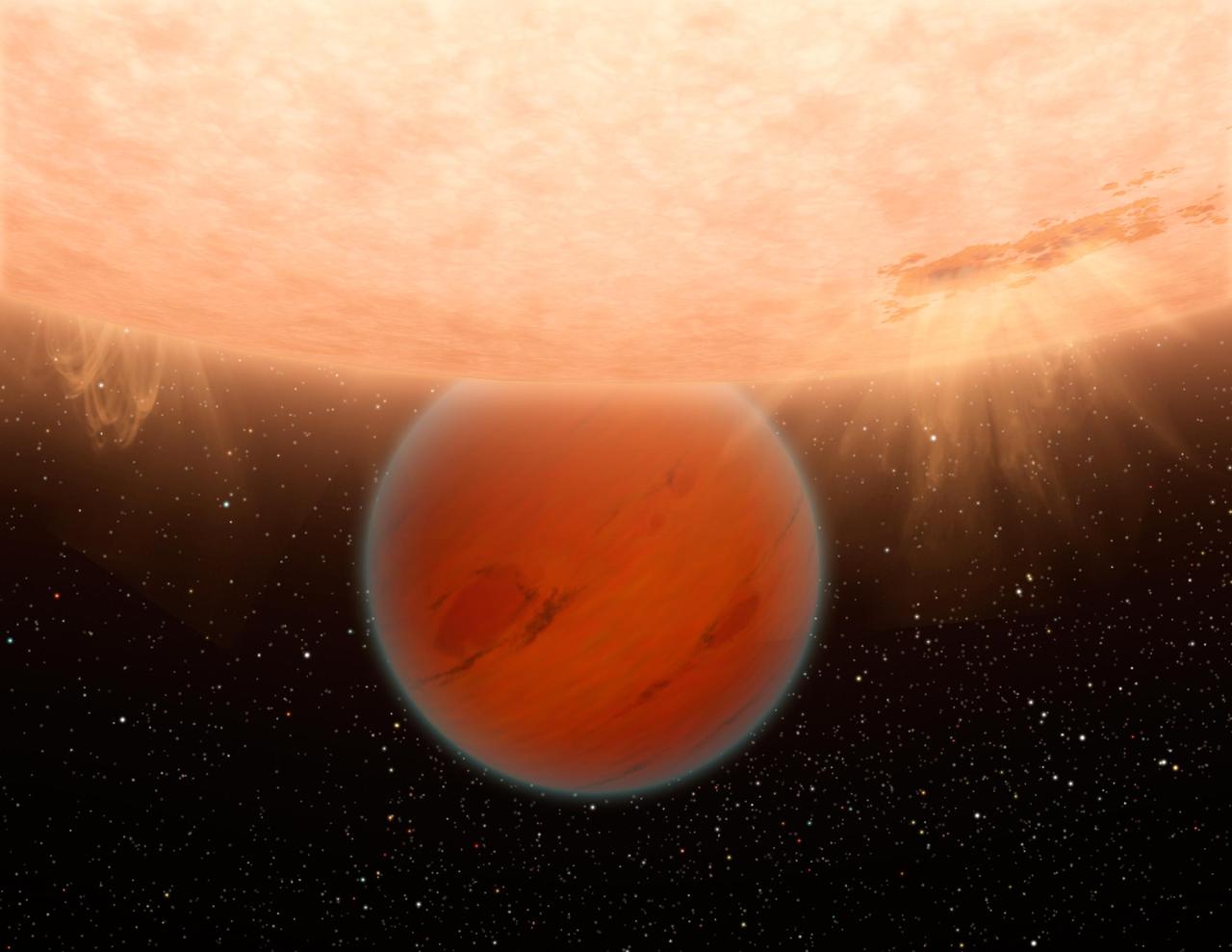
This artist concept illustrates a hot, Neptune-sized planet called GJ 436b. NASA Spitzer Space Telescope has found evidence that GJ 436b, orbiting a star beyond our sun lacks methane -- an ingredient common to many planets in our own solar system.
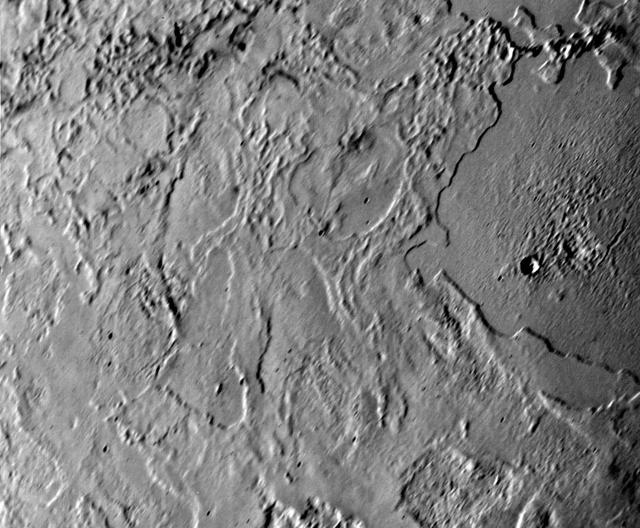
NASA Voyager 2 took this picture of Neptune largest satellite,Triton, from less than 80,000 km 50,000 miles. The image shows an area in Triton northern hemisphere. The Sun is just above the horizon, so features cast shadows that accentuate height

P-34715 Range: 900,000 kilometers (560,000 miles) This post-encounter view of the south pole of Neptune was obtained after Voyager 2 passed the planet and sped away on a southward-trending trajectory. Voyager's wide-angle camera saw features as small as 120 km (75 mi) in diameter. The angle between the Sun, the center of the planet, and the spacecraft is 137 °, so the entire south polar region is illuminated. Near the bright limb, clouds located at 71 and 42 degrees south latitude rotate eastward onto Neptune's night side. A bright cloud (bottom center) lies within 1.5 ° of Neptune's south pole, which has been determined from the orbits of the planet's rings and satellites. The feature is believed to be created by an organized circulation around the pole that forms a clear 'eye' at the center of the system.

P-34630 Range: 10.5 million kilometers (6.5 million miles) This cylindrical projection view of Neptune uses five narrow-angle images equally spaced around the planet. They were taken by Voyager 2 over the course of a Neptunian day, an interval of about 18 hours. Latitude lines are horizontal in the image, and range from 80 degrees south to 30 degrees north of the equator. Near the center, the Great Dark Spot leaves a disturbed wave-like pattern that stretches around Neptune. Features further south move eastward at speeds up to 400 mph relative to the Great Dark Spot. The features are storms--moving cloud systems that persist for months or longer. The weather forecast for Neptune is therefore continued high winds and cold with little change in temperature.
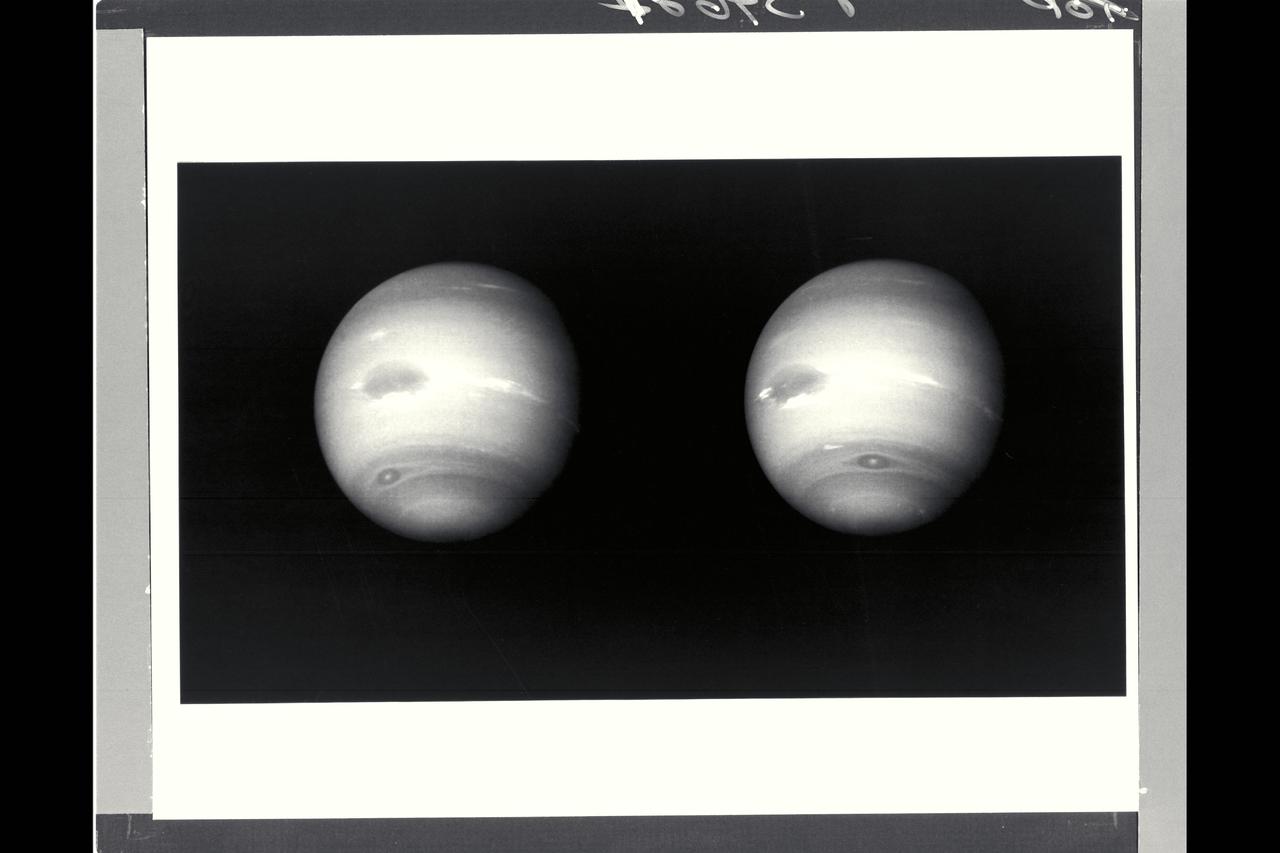
Range : 12 million km (7.5 million miles) Resolution 110 km (68 miles) per pixel. These 2 images of Neptune were taken by Voyager 2's narrow-angle camera. During the 17.6 hours between the left and right images, the Great Dark Spot, at 22 degrees south latitude (left of center), has completed a little less than one rotation of Neptune. The smaller dark spot, at 54 south, completed a little more than one rotation, as can be seen by comparing its relative positions in the two pictures. The Great Dark Spot and the smaller spot have a relative velocity of 100 meters per second (220 miles an hour). The light and dark bands circling Neptune indicate predominantly zonal (east-west) motion. The diffuse white feature north of the Great Dark Spot is near Neptune's equator, and rotates with about the same period as the Great Dark Spot. Streak of bright clouds at the south edge, and just east of the Great Dark Spot, are its constatnt companions, and change the details of their appearance, often within a few hours. Changing brightness of the cloud streaks could be a result of vertical mortions.
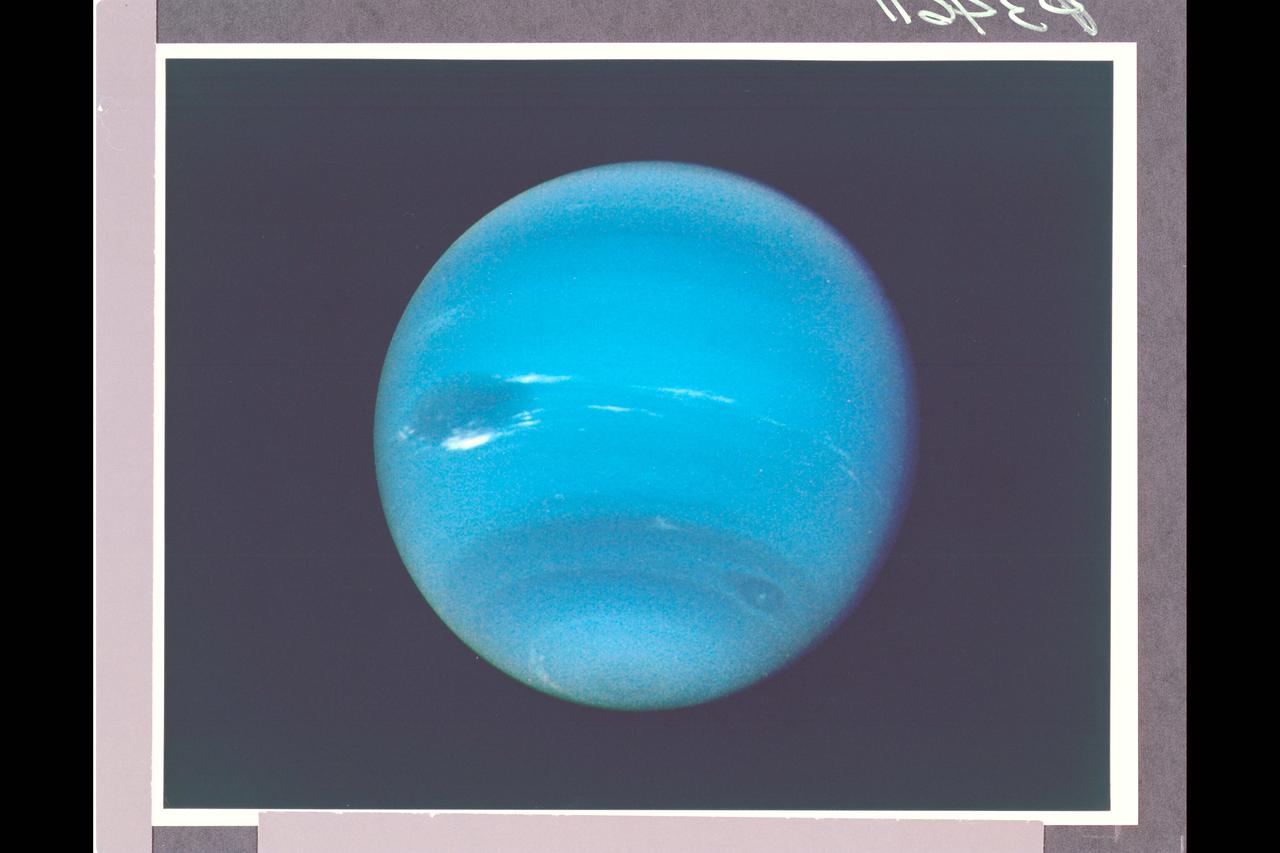
Photo by Voyager 2 (JPL) During August 16 and 17, 1989, the Voyager 2 narrow-angle camera was used to photograph Neptune almost continuously, recording approximately two and one-half rotations of the planet. These images represent the most complete set of full disk Neptune images that the spacecraft will acquire. This picture from the sequence shows two of the four cloud features which have been tracked by the Voyager cameras during the past two months. The large dark oval near the western limb (the left edge) is at a latitude of 22 degrees south and circuits Neptune every 18.3 hours. The bright clouds immediately to the south and east of this oval are seen to substantially change their appearances in periods as short as four hours. The second dark spot, at 54 degrees south latitude near the terminator (lower right edge), circuits Neptune every 16.1 hours. This image has been processed to enchance the visibility of small features, at some sacrifice of color fidelity. The Voyager Mission is conducted by JPL for NASA's Office of Space Science and Applications. (JPL Ref: A-34611 Voyager 2-N29)
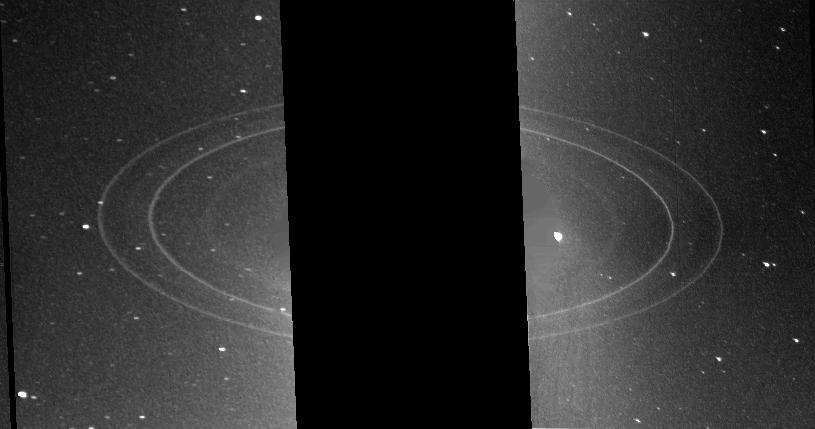
This mosaic from NASA Galileo Probe is of an equatorial hotspot on Jupiter and shows the features of a hazy cloud layer tens of kilometers above Jupiter main visible cloud deck.
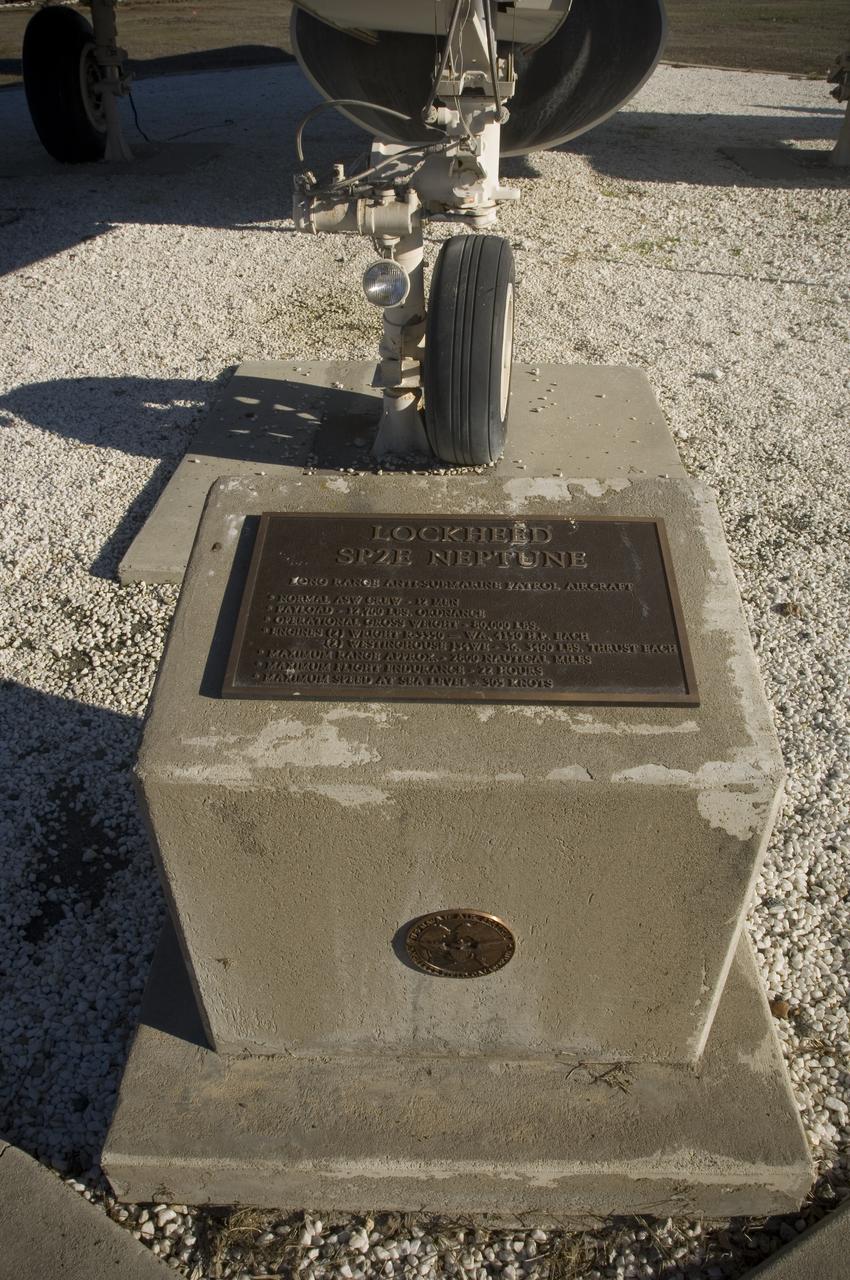
Ames and Moffett Field (MFA) historical sites and memorials Navy Lockheed SP-2E Neptune Long Range Antisubmarine Partol Aircraft on display in front of MFA Bldg 158 Flgiht Ops (tower) with monuments
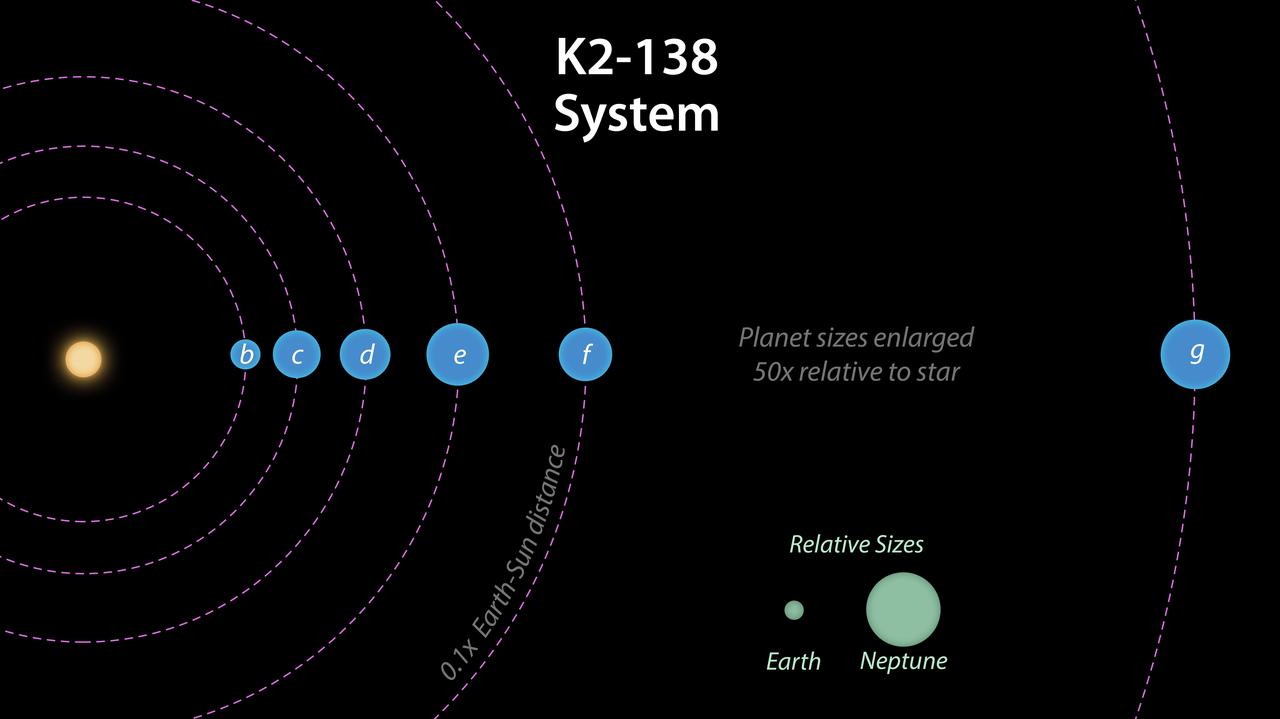
This image shows the estimated radii of the six planets in the planetary system K2-128, as well as their distance from the parent star. The radii of the Earth and Neptune are shown for scale. https://photojournal.jpl.nasa.gov/catalog/PIA23003