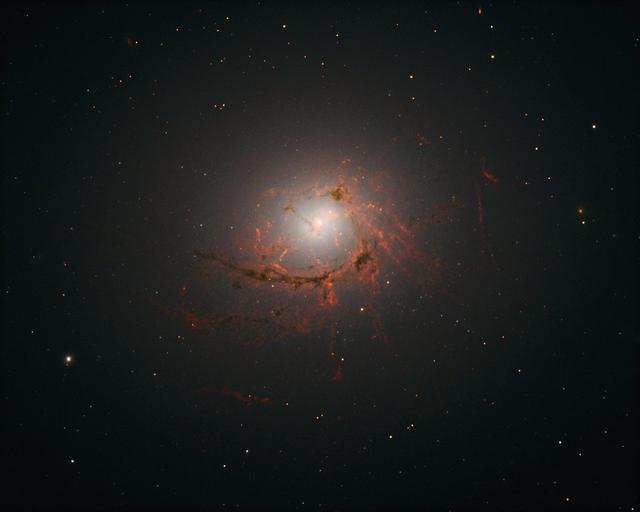
New observations from the NASA/ESA Hubble Space Telescope have revealed the intricate structure of the galaxy NGC 4696 in greater detail than ever before. The elliptical galaxy is a beautiful cosmic oddity with a bright core wrapped in system of dark, swirling, thread-like filaments. Read more: <a href="http://bit.ly/2gLGojx" rel="nofollow">bit.ly/2gLGojx</a> <b><a href="http://www.nasa.gov/audience/formedia/features/MP_Photo_Guidelines.html" rel="nofollow">NASA image use policy.</a></b> <b><a href="http://www.nasa.gov/centers/goddard/home/index.html" rel="nofollow">NASA Goddard Space Flight Center</a></b> enables NASA’s mission through four scientific endeavors: Earth Science, Heliophysics, Solar System Exploration, and Astrophysics. Goddard plays a leading role in NASA’s accomplishments by contributing compelling scientific knowledge to advance the Agency’s mission. <b>Follow us on <a href="http://twitter.com/NASAGoddardPix" rel="nofollow">Twitter</a></b> <b>Like us on <a href="http://www.facebook.com/pages/Greenbelt-MD/NASA-Goddard/395013845897?ref=tsd" rel="nofollow">Facebook</a></b> <b>Find us on <a href="http://instagrid.me/nasagoddard/?vm=grid" rel="nofollow">Instagram</a></b>
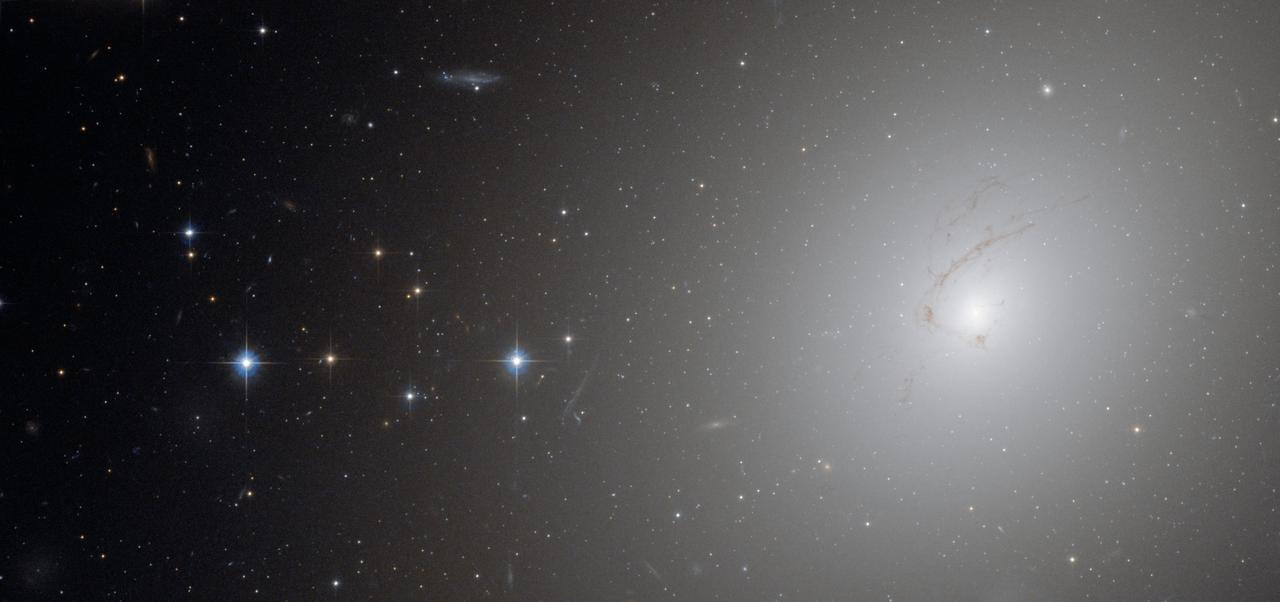
This picture, taken by Hubble’s Advanced Camera for Surveys, shows NGC 4696, the largest galaxy in the Centaurus Cluster. (To see a video of NGC 4696 go here: <a href="http://www.flickr.com/photos/gsfc/4888176841/)">www.flickr.com/photos/gsfc/4888176841/)</a> The huge dust lane, around 30 000 light-years across, that sweeps across the face of the galaxy makes NGC 4696 look different from most other elliptical galaxies. Viewed at certain wavelengths, strange thin filaments of ionised hydrogen are visible within it. In this picture, these structures are visible as a subtle marbling effect across the galaxy’s bright centre. Credit: ESA/Hubble and NASA <b><a href="http://www.nasa.gov/centers/goddard/home/index.html" rel="nofollow">NASA Goddard Space Flight Center</a></b> is home to the nation's largest organization of combined scientists, engineers and technologists that build spacecraft, instruments and new technology to study the Earth, the sun, our solar system, and the universe. <b>Follow us on <a href="http://twitter.com/NASA_GoddardPix" rel="nofollow">Twitter</a></b> <b>Join us on <a href="http://www.facebook.com/pages/Greenbelt-MD/NASA-Goddard/395013845897?ref=tsd" rel="nofollow">Facebook</a><b></b></b>