
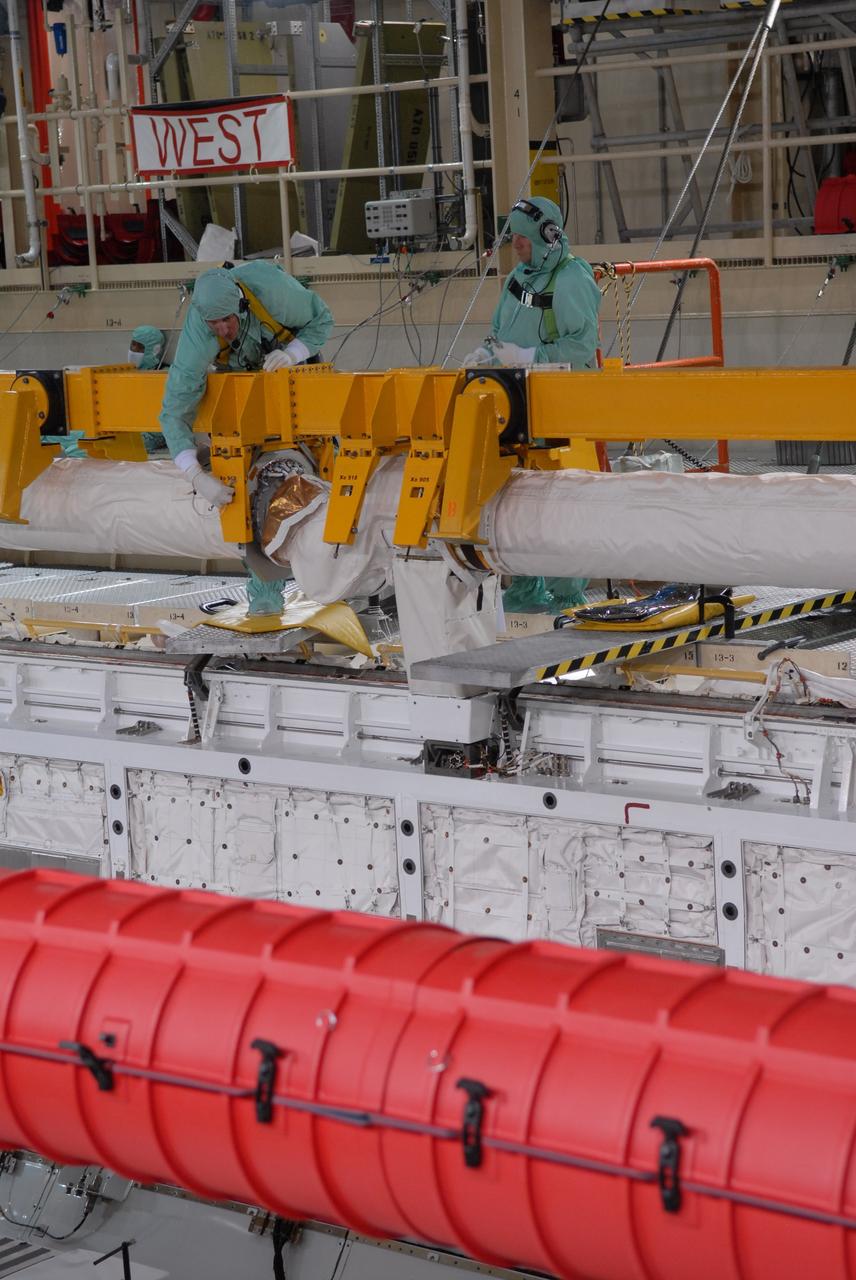
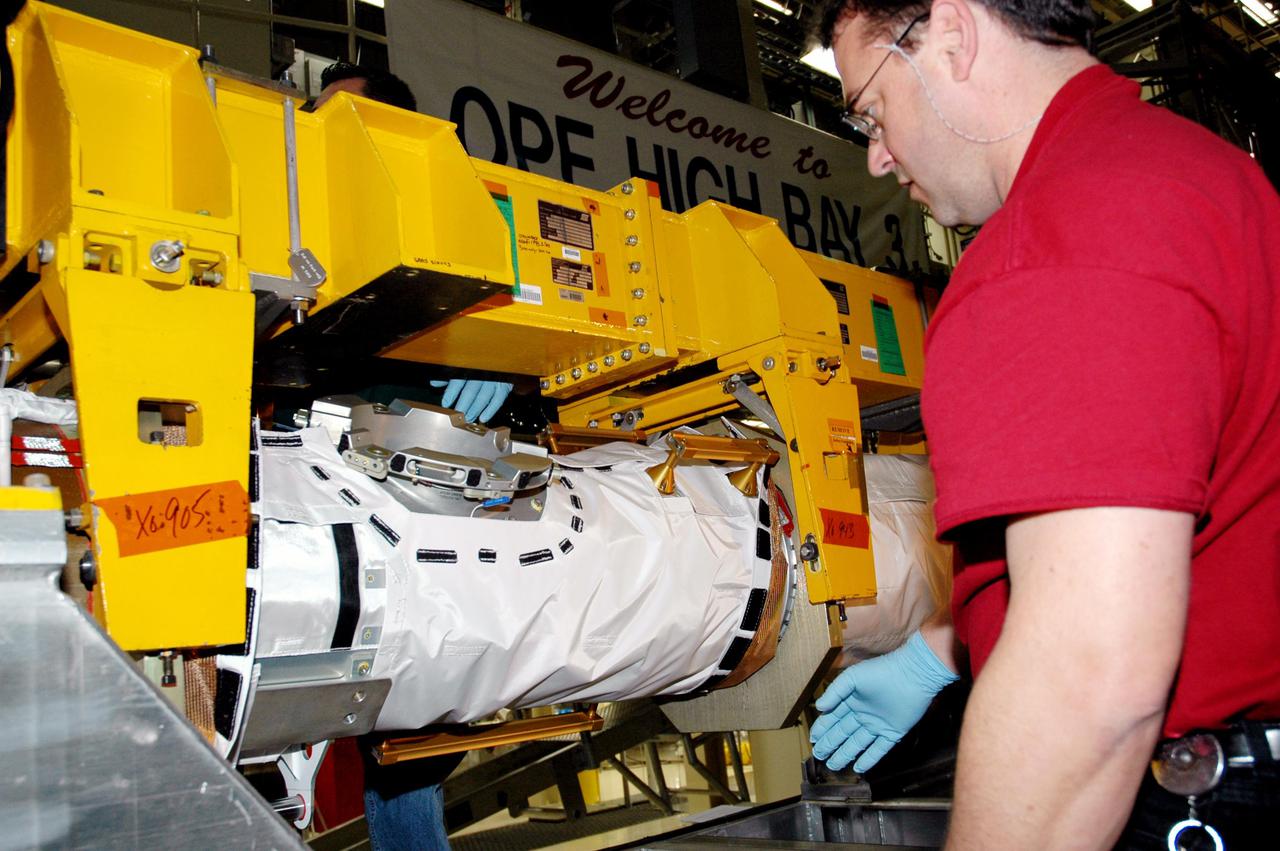
KENNEDY SPACE CENTER, FLA. - In the Remote Manipulator System lab in the Vehicle Assembly Building (VAB), Kennedy workers remove the shipping container surrounding part of the new Orbiter Boom Sensor System (OBSS). Once the entire structure has arrived, the OBSS will be assembled and undergo final checkout and testing in the lab prior to being transferred to the Orbiter Processing Facility (OPF) for installation on Space Shuttle Discovery. The 50-foot-long OBSS will be attached to the Remote Manipulator System, or Shuttle arm, and is one of the new safety measures for Return to Flight, equipping the orbiter with cameras and laser systems to inspect the Shuttle's Thermal Protection System while in space. Discovery is slated to fly mission STS-114 once Space Shuttle launches resume. The launch planning window is May 12 to June 3, 2005.

KENNEDY SPACE CENTER, FLA. - A shipping container carrying part of the new Orbiter Boom Sensor System (OBSS) is parked in the Remote Manipulator System lab in the Vehicle Assembly Building (VAB). Once the entire structure has arrived, the OBSS will be assembled and undergo final checkout and testing in the lab prior to being transferred to the Orbiter Processing Facility (OPF) for installation on Space Shuttle Discovery. The 50-foot-long OBSS will be attached to the Remote Manipulator System, or Shuttle arm, and is one of the new safety measures for Return to Flight, equipping the orbiter with cameras and laser systems to inspect the Shuttle's Thermal Protection System while in space. Discovery is slated to fly mission STS-114 once Space Shuttle launches resume. The launch planning window is May 12 to June 3, 2005.

KENNEDY SPACE CENTER, FLA. - In the Remote Manipulator System lab in the Vehicle Assembly Building (VAB), Kennedy workers move the shipping container aside to gain access to part of the new Orbiter Boom Sensor System (OBSS). Once the entire structure has arrived, the OBSS will be assembled and undergo final checkout and testing in the lab prior to being transferred to the Orbiter Processing Facility (OPF) for installation on Space Shuttle Discovery. The 50-foot-long OBSS will be attached to the Remote Manipulator System, or Shuttle arm, and is one of the new safety measures for Return to Flight, equipping the orbiter with cameras and laser systems to inspect the Shuttle's Thermal Protection System while in space. Discovery is slated to fly mission STS-114 once Space Shuttle launches resume. The launch planning window is May 12 to June 3, 2005.

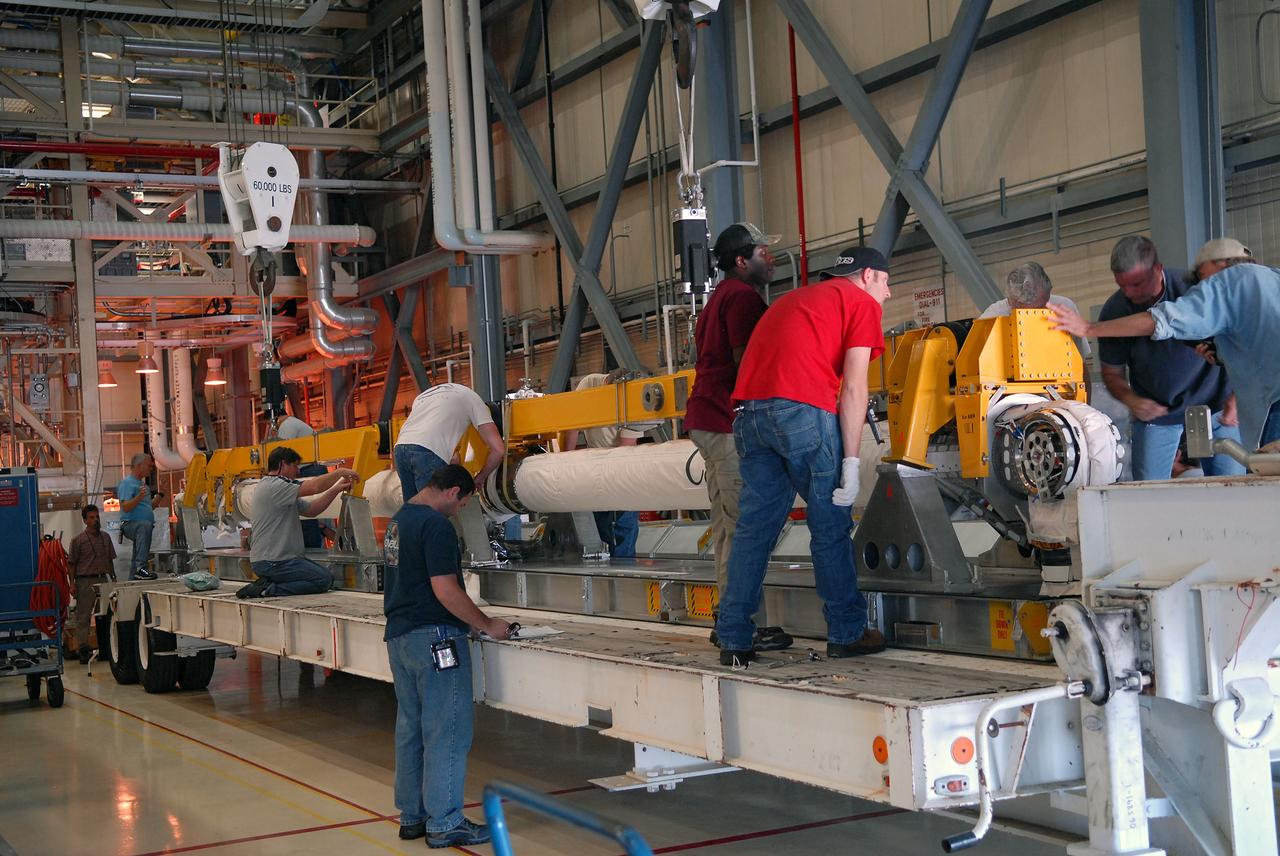
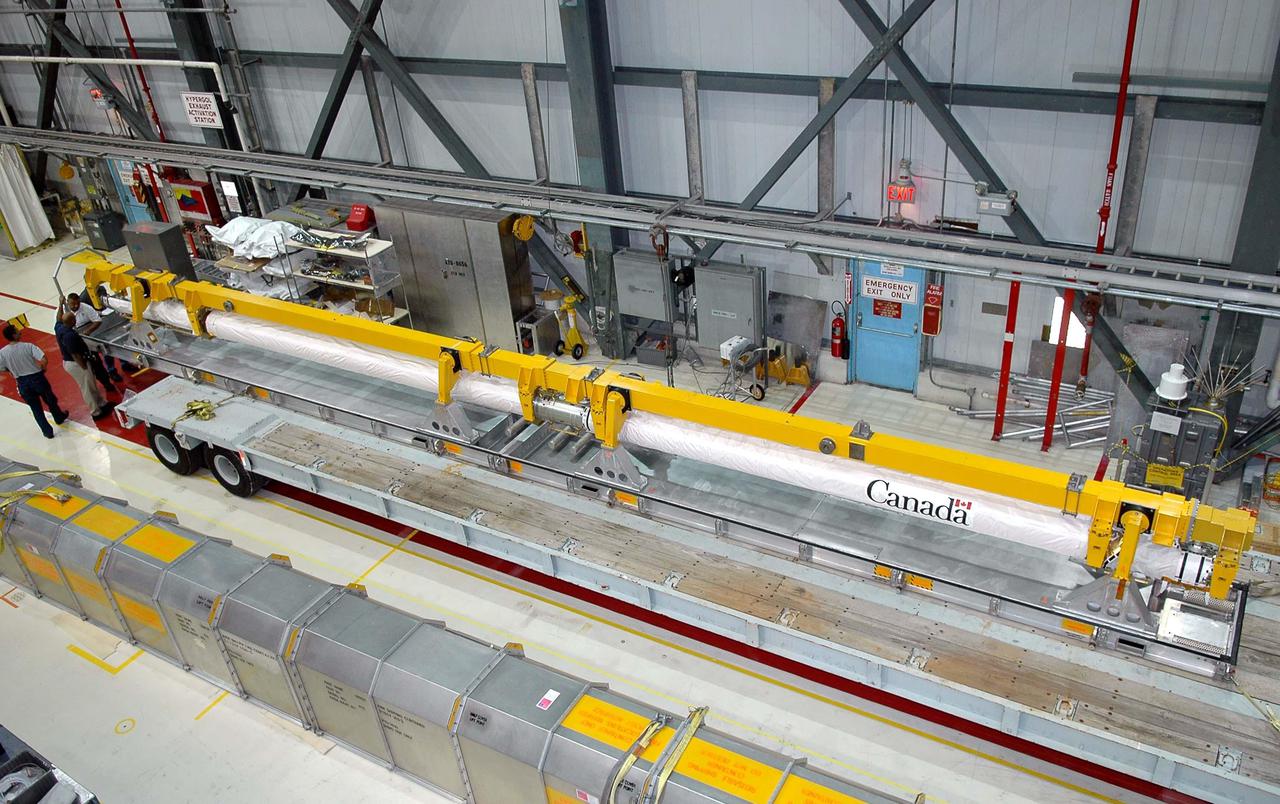
KENNEDY SPACE CENTER, FLA. - A shipping container transporting part of the new Orbiter Boom Sensor System (OBSS) is delivered by truck to the Remote Manipulator System lab in the Vehicle Assembly Building (VAB). Once the entire structure has arrived, the OBSS will be assembled and undergo final checkout and testing in the lab prior to being transferred to the Orbiter Processing Facility (OPF) for installation on Space Shuttle Discovery. The 50-foot-long OBSS will be attached to the Remote Manipulator System, or Shuttle arm, and is one of the new safety measures for Return to Flight, equipping the orbiter with cameras and laser systems to inspect the Shuttle's Thermal Protection System while in space. Discovery is slated to fly mission STS-114 once Space Shuttle launches resume. The launch planning window is May 12 to June 3, 2005.

KENNEDY SPACE CENTER, FLA. - A shipping container housing part of the new Orbiter Boom Sensor System (OBSS) is backed into the Remote Manipulator System lab in the Vehicle Assembly Building (VAB). Once the entire structure has arrived, the OBSS will be assembled and undergo final checkout and testing in the lab prior to being transferred to the Orbiter Processing Facility (OPF) for installation on Space Shuttle Discovery. The 50-foot-long OBSS will be attached to the Remote Manipulator System, or Shuttle arm, and is one of the new safety measures for Return to Flight, equipping the orbiter with cameras and laser systems to inspect the Shuttle's Thermal Protection System while in space. Discovery is slated to fly mission STS-114 once Space Shuttle launches resume. The launch planning window is May 12 to June 3, 2005.

KENNEDY SPACE CENTER, FLA. - A shipping container housing part of the new Orbiter Boom Sensor System (OBSS) is lifted from a truck into the Remote Manipulator System lab in the Vehicle Assembly Building (VAB). Once the entire structure has arrived, the OBSS will be assembled and undergo final checkout and testing in the lab prior to being transferred to the Orbiter Processing Facility (OPF) for installation on Space Shuttle Discovery. The 50-foot-long OBSS will be attached to the Remote Manipulator System, or Shuttle arm, and is one of the new safety measures for Return to Flight, equipping the orbiter with cameras and laser systems to inspect the Shuttle's Thermal Protection System while in space. Discovery is slated to fly mission STS-114 once Space Shuttle launches resume. The launch planning window is May 12 to June 3, 2005.

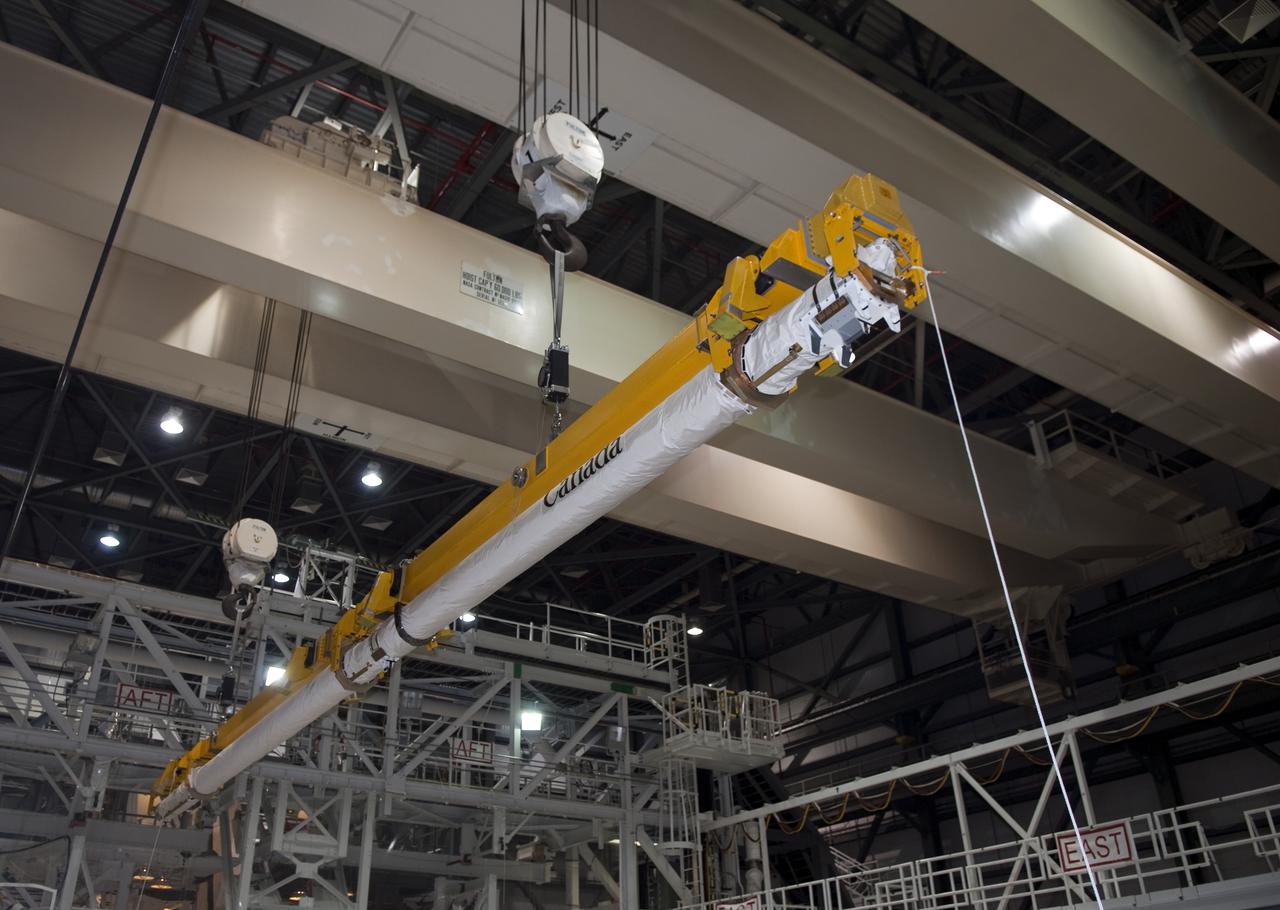
KENNEDY SPACE CENTER, FLA. - One part of the Orbiter Boom Sensor System (OBSS) sits in the Remote Manipulator System lab inside the Vehicle Assembly Building. The OBSS will be assembled and undergo final checkout and testing in the lab prior to being transferred to the Orbiter Processing Facility for installation on Space Shuttle Discovery. The 50-foot-long OBSS will be attached to the Remote Manipulator System, or Shuttle arm, and is one of the new safety measures for Return to Flight, equipping the orbiter with cameras and laser systems to inspect the Shuttle's Thermal Protection System while in space. Discovery is slated to fly mission STS-114 once Space Shuttle launches resume. The launch planning window is May 12 to June 3, 2005.

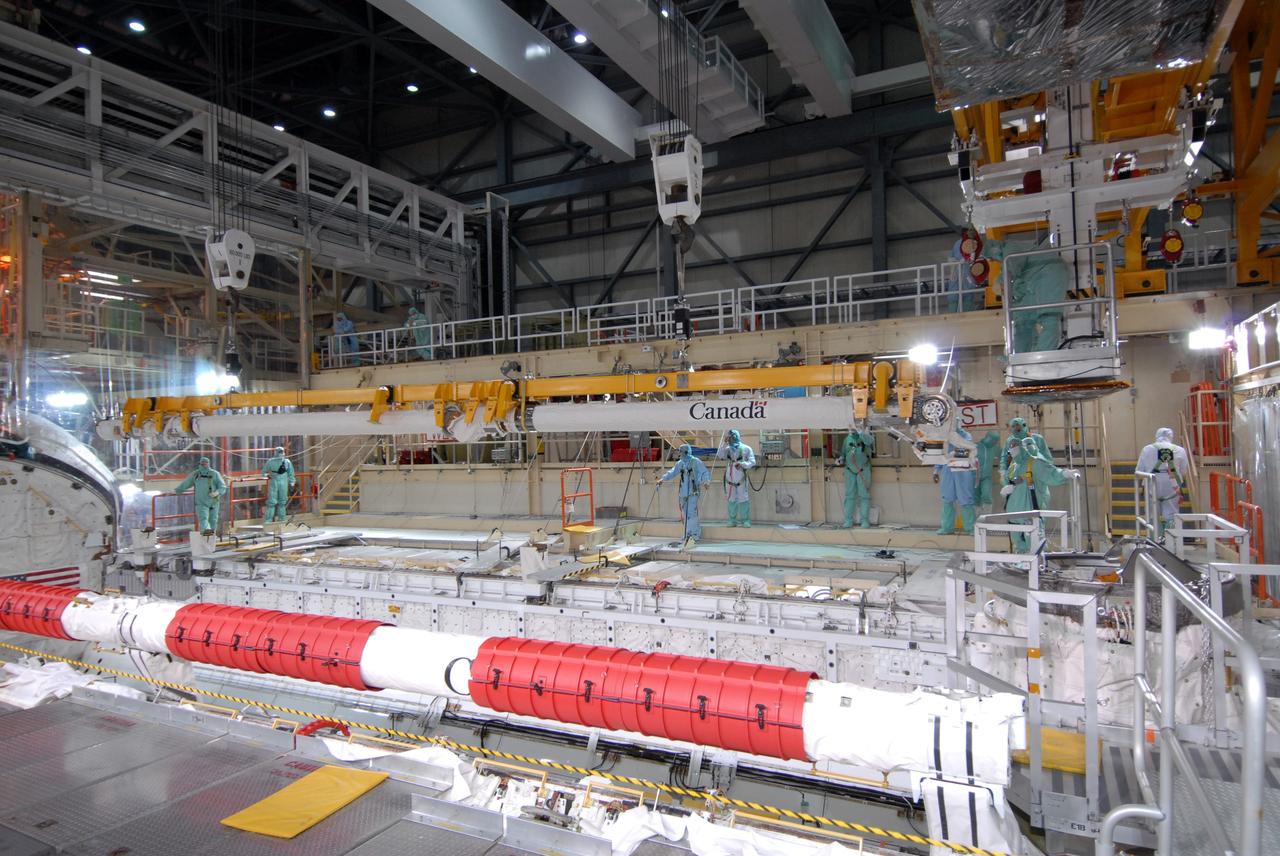
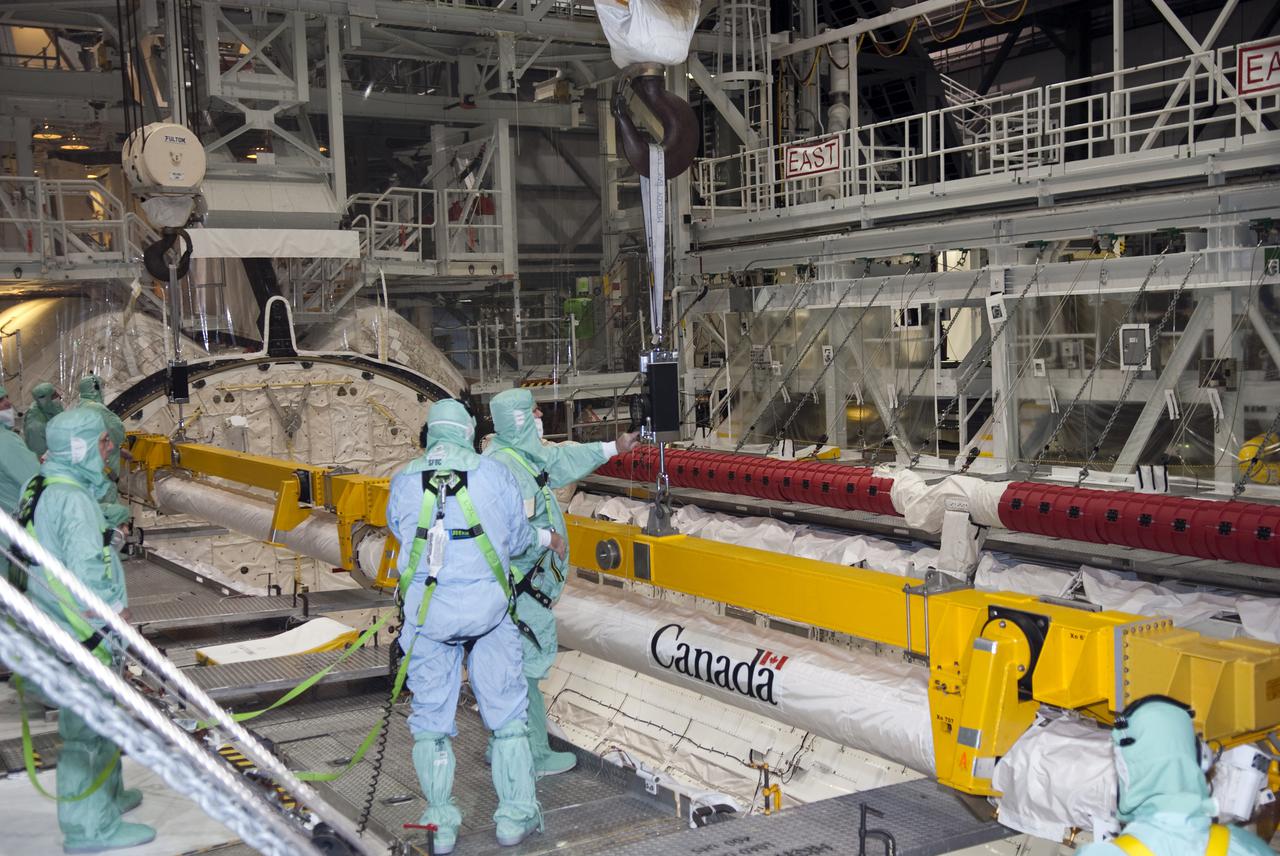
KENNEDY SPACE CENTER, FLA. - Two parts of the Orbiter Boom Sensor System sit end to end in the Remote Manipulator System lab inside the Vehicle Assembly Building. The OBSS will be assembled and undergo final checkout and testing in the lab prior to being transferred to the Orbiter Processing Facility for installation on Space Shuttle Discovery. The 50-foot-long OBSS will be attached to the Remote Manipulator System, or Shuttle arm, and is one of the new safety measures for Return to Flight, equipping the orbiter with cameras and laser systems to inspect the Shuttle's Thermal Protection System while in space. Discovery is slated to fly mission STS-114 once Space Shuttle launches resume. The launch planning window is May 12 to June 3, 2005.

KENNEDY SPACE CENTER, FLA. - Two parts of the Orbiter Boom Sensor System sit end to end in the Remote Manipulator System lab inside the Vehicle Assembly Building. The OBSS will be assembled and undergo final checkout and testing in the lab prior to being transferred to the Orbiter Processing Facility for installation on Space Shuttle Discovery. The 50-foot-long OBSS will be attached to the Remote Manipulator System, or Shuttle arm, and is one of the new safety measures for Return to Flight, equipping the orbiter with cameras and laser systems to inspect the Shuttle's Thermal Protection System while in space. Discovery is slated to fly mission STS-114 once Space Shuttle launches resume. The launch planning window is May 12 to June 3, 2005.
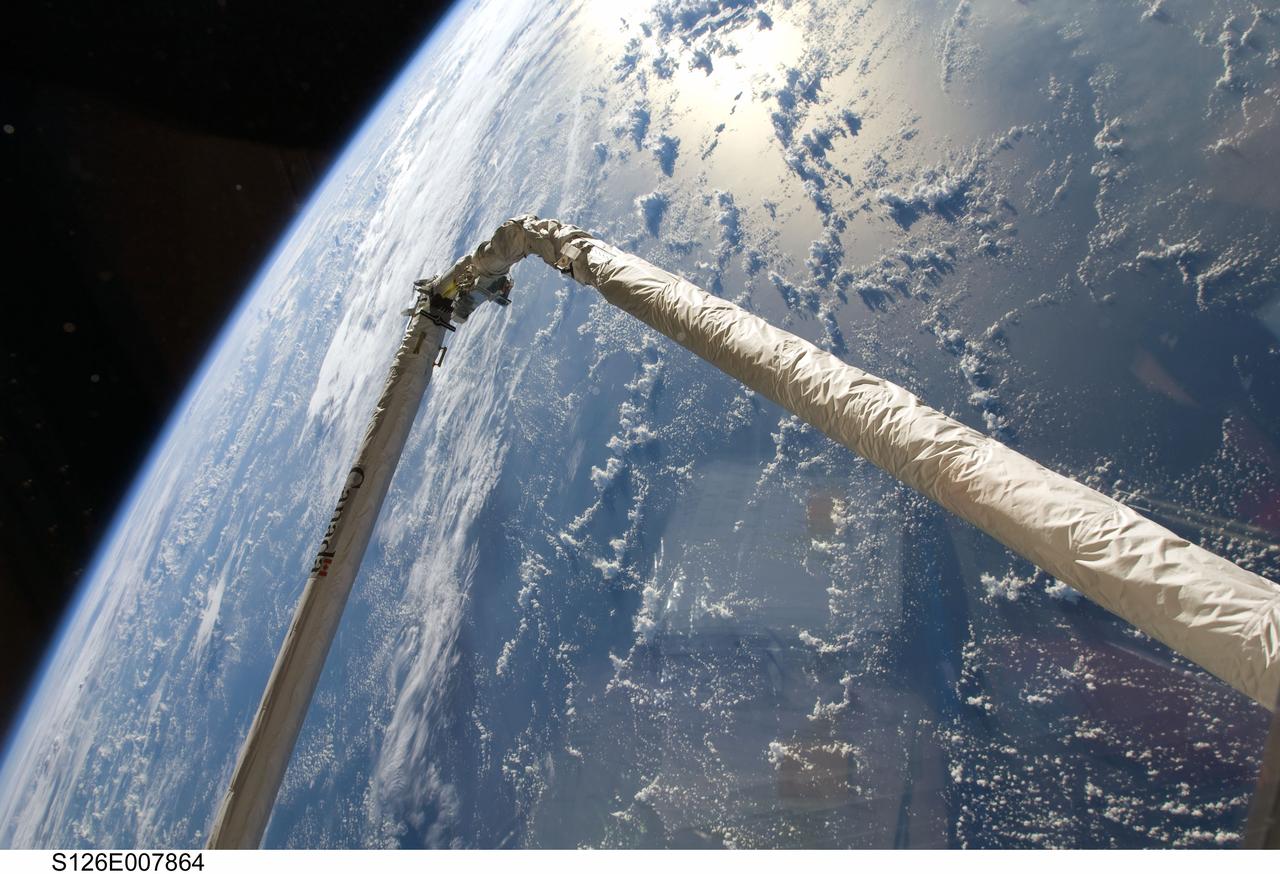
S126-E-007864 (15 Nov. 2008) --- Space Shuttle Endeavour's Remote Manipulator System/Orbiter Boom Sensor System (RMS/OBSS) is featured in this image photographed by an STS-126 crewmember aboard the shuttle. Earth's horizon and the blackness of space provide the backdrop for the scene.
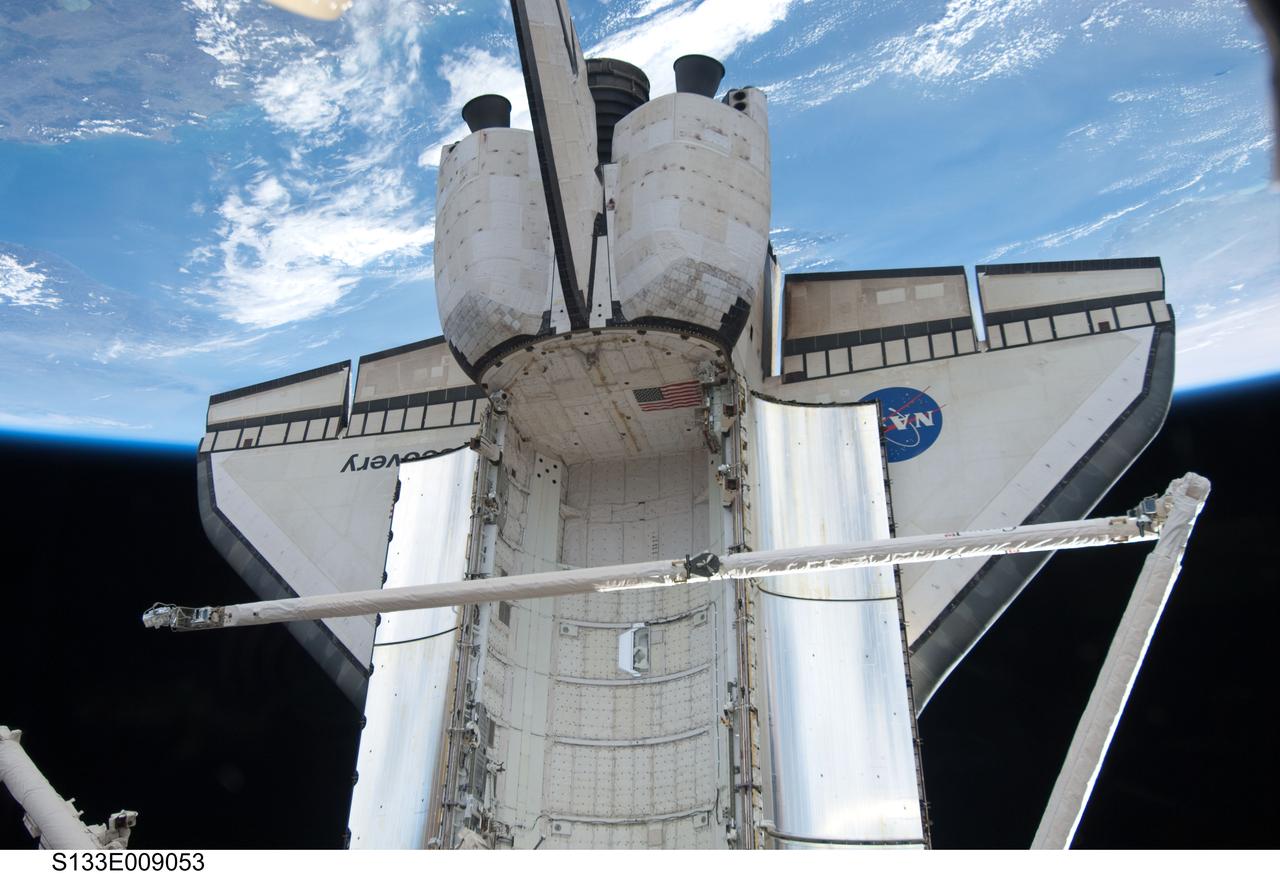
S133-E-009053 (6 March 2011) --- Backdropped by Earth’s horizon and the blackness of space, space shuttle Discovery and its remote manipulator system/orbiter boom sensor system (RMS/OBSS) is featured in this image photographed by an STS-133 crew member while docked with the International Space Station. Photo credit: NASA or National Aeronautics and Space Administration
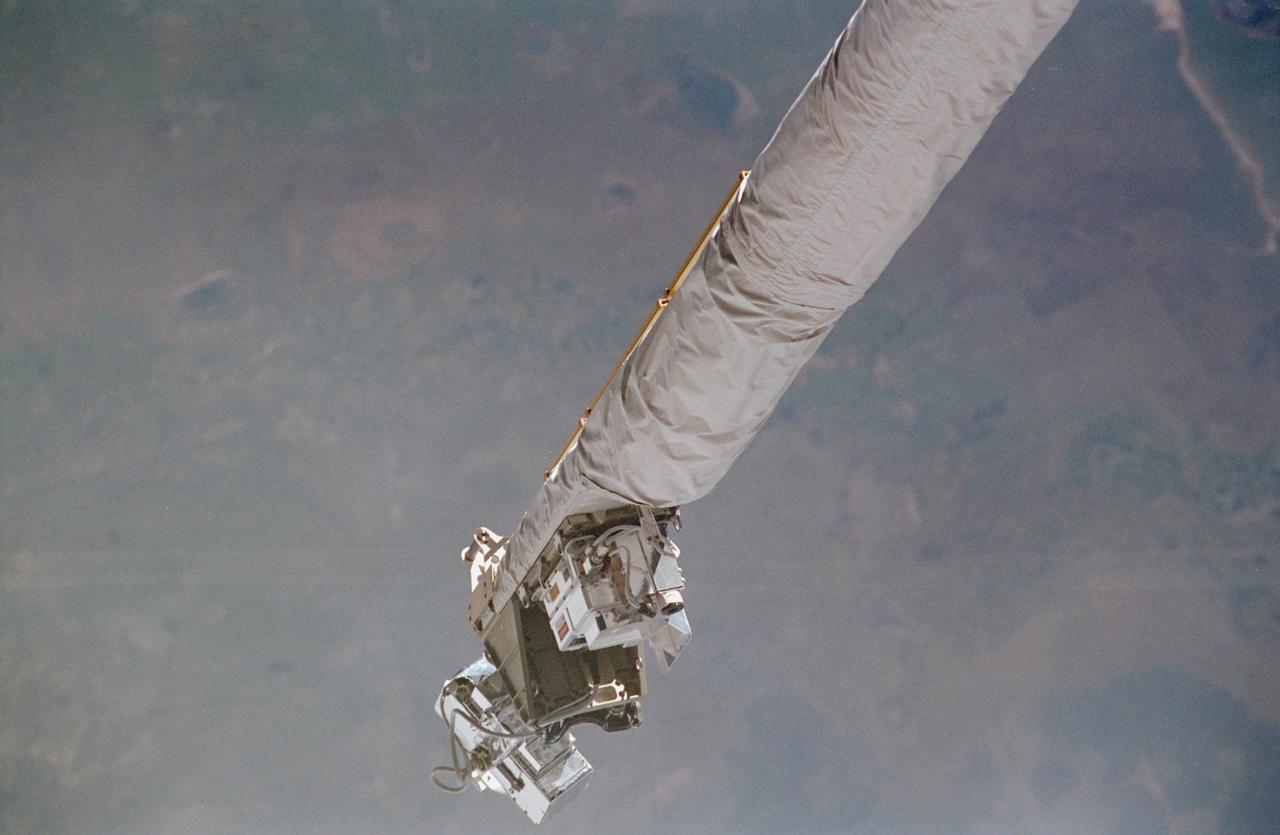
STS121-319-004 (5 July 2006) --- The Laser Dynamic Range Imager (LDRI), Intensified Television Camera (ITVC) and Laser Camera System (LCS), located on the end of Space Shuttle Discovery's Remote Manipulator System/Orbiter Boom Sensor System (RMS/OBSS), is featured in this image photographed during STS-121 Flight Day 2 survey activities. The inspection included an examination of Discovery's nose cap and the reinforced carbon-carbon panels along the leading edge of the port and starboard wings, looking for any evidence of damage.
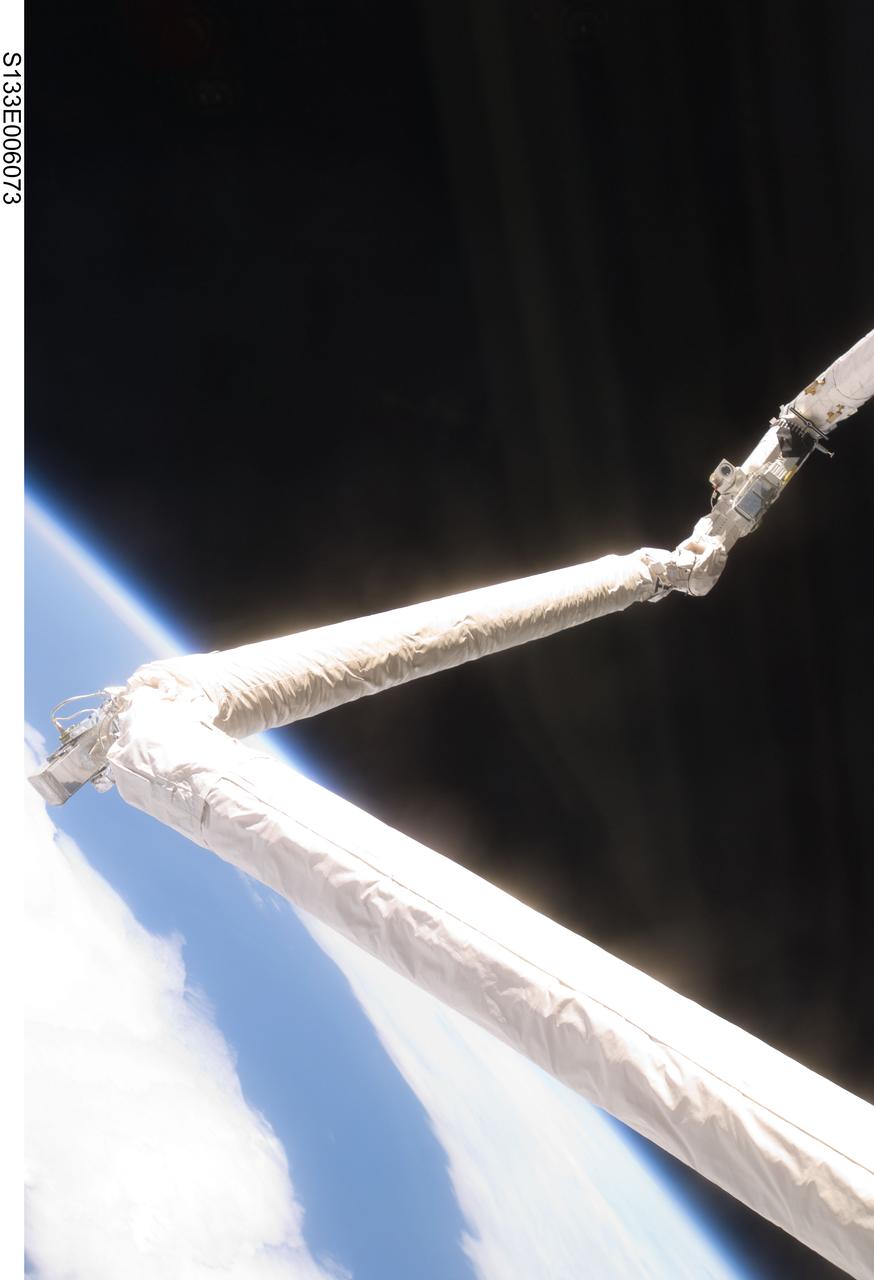
S133-E-006073 (25 Feb. 2011) --- Controlled by the STS-133 astronauts inside Discovery's cabin, the Remote Manipulator System/Orbiter Boom Sensor System (RMS/OBSS) equipped with special cameras, begins to conduct thorough inspections of the shuttle’s thermal tile system on flight day 2. Photo credit: NASA or National Aeronautics and Space Administration
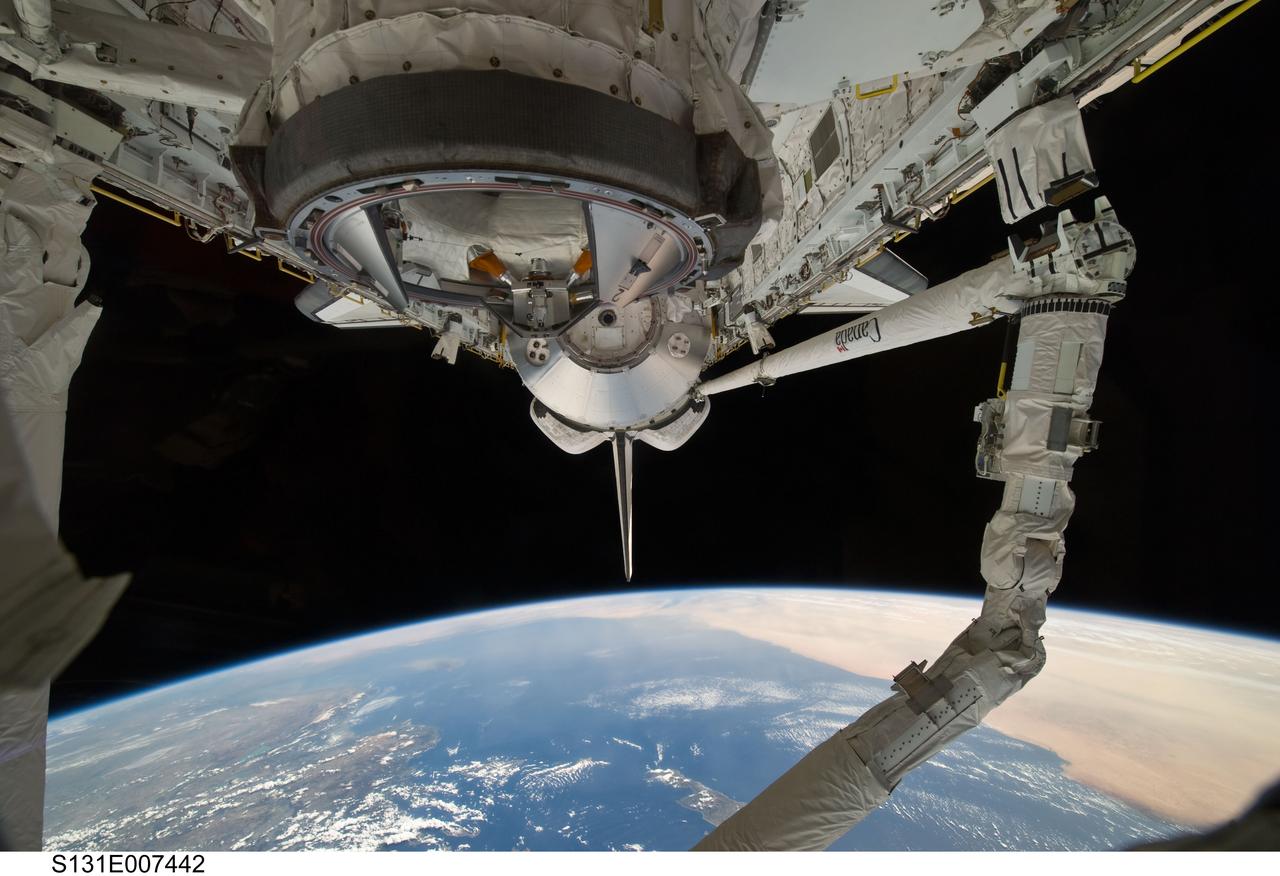
S131-E-007442 (6 April 2010) --- The Leonardo Multi-Purpose Logistics Module (MPLM) visible in space shuttle Discovery's payload bay, docking mechanism, vertical stabilizer, orbital maneuvering system (OMS) pods and Remote Manipulator System/Orbiter Boom Sensor System (RMS/OBSS) are featured in this image photographed by an STS-131 crew member from an aft flight deck window during flight day two activities. Earth?s horizon and the blackness of space provide the backdrop for the scene.
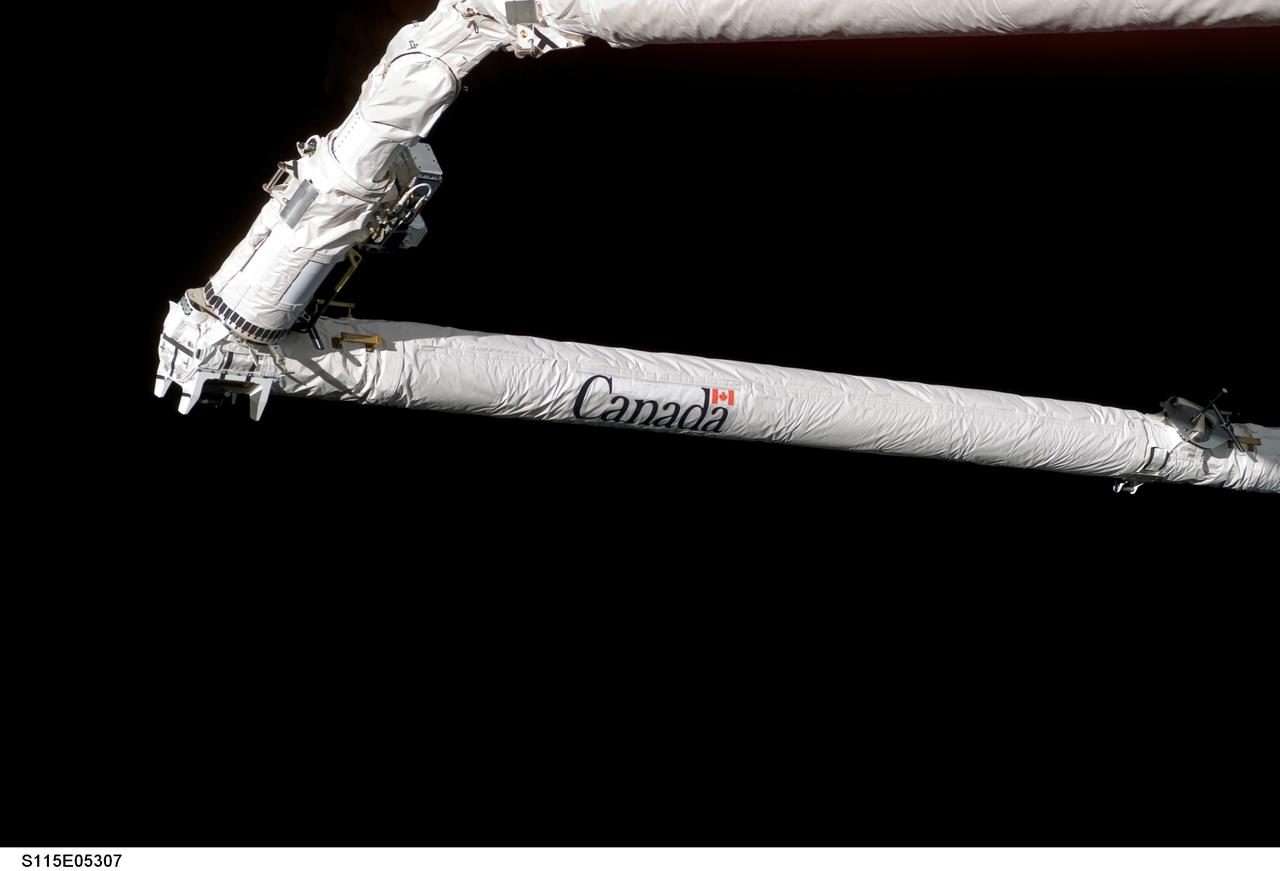
S115-E-05307 (10 Sept. 2006) --- As in the case of the previous two shuttle missions, a tandem of the orbiter boom sensor system (OBSS) and the remote manipulator system (RMS) arm conducts a survey of the thermal protection system on the Space Shuttle Atlantis.
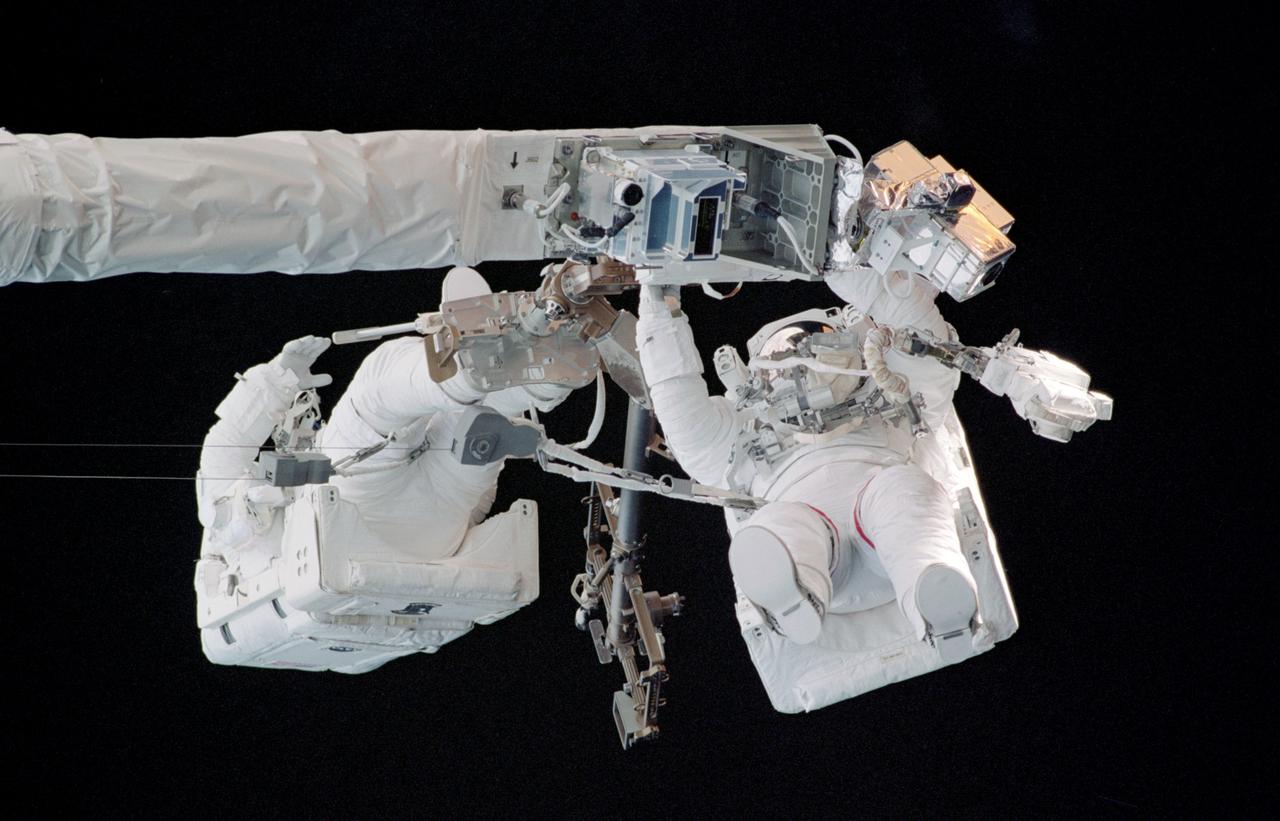
STS121-323-011 (8 July 2006) --- Astronauts Piers J. Sellers and Michael E. Fossum, STS-121 mission specialists, work in tandem on Space Shuttle Discovery's Remote Manipulator System/Orbiter Boom Sensor System (RMS/OBSS) during the mission's first scheduled session of extravehicular activity (EVA). Also visible on the OBSS are the Laser Dynamic Range Imager (LDRI), Intensified Television Camera (ITVC) and Laser Camera System (LCS).
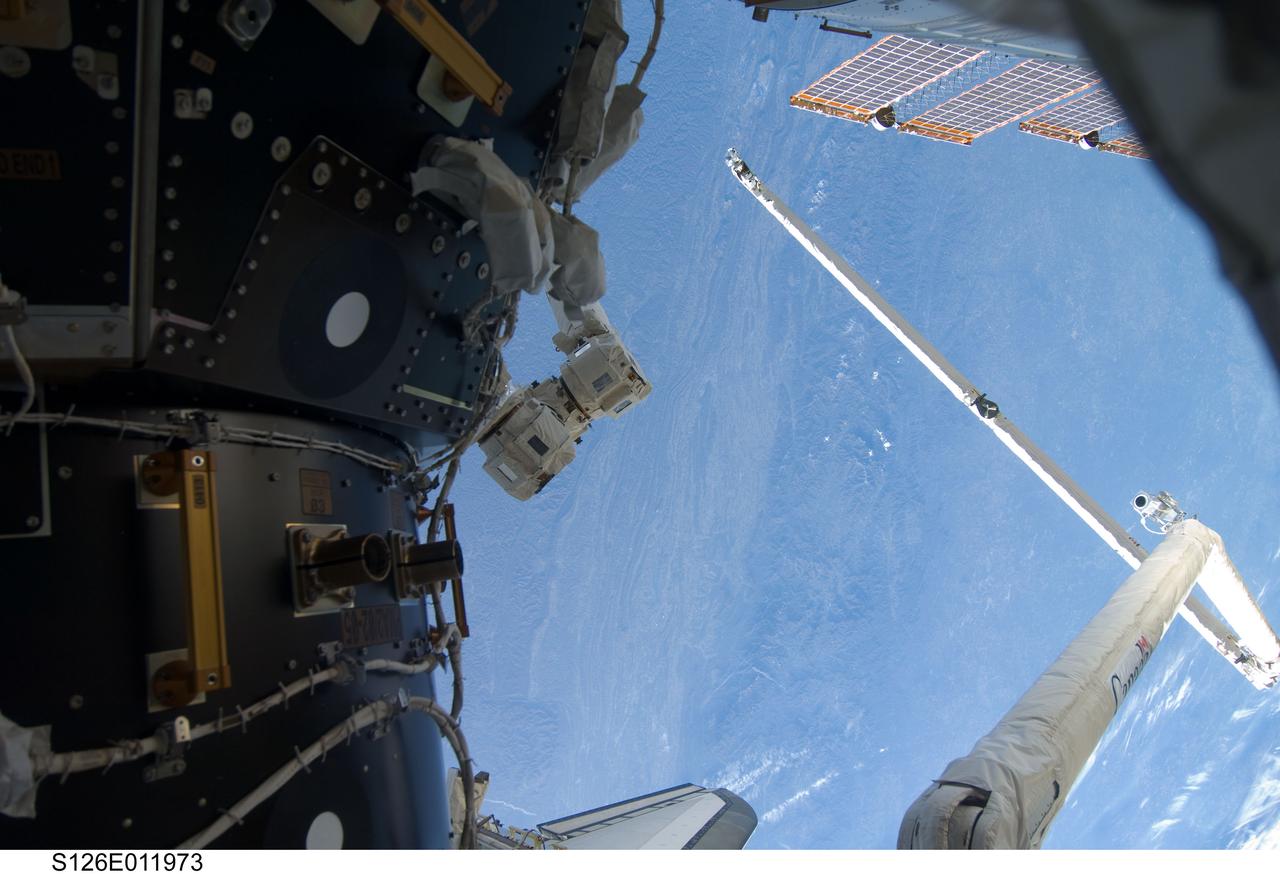
S126-E-011973 (26 Nov. 2008) --- The Canadian-built Orbiter Boom Sensor System (OBSS), in its parked position, and part of the International Space Station are featured in this image, photographed over the Blue Ridge Mountains of West Virginia and Tennessee by one of the Endeavour crew members on the eve of Thanksgiving. The OBSS, on the end of the Canadarm, awaits the final part of its STS-126 role when it will inspect the shuttle one more time, following separation of the orbiter from the space station in a couple of days. When that task is complete, it will be stowed across the payload bay from the robot arm.
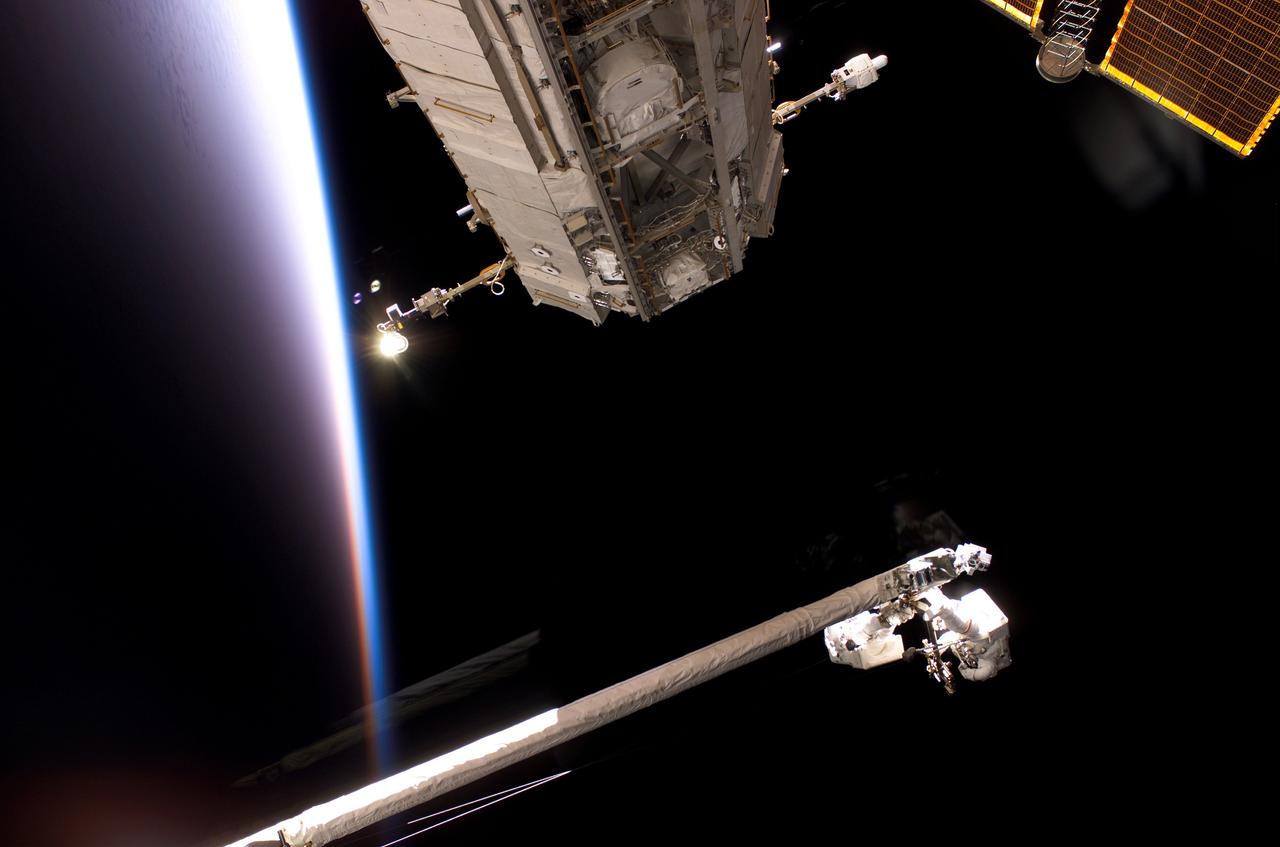
S121-E-06040 (8 July 2006) --- Astronauts Piers J. Sellers (red stripes) and Michael E. Fossum, STS-121 mission specialists, work in tandem on the shuttle's Remote Manipulator System/Orbiter Boom Sensor System (RMS/OBSS) during the mission's first scheduled session of extravehicular activity (EVA).
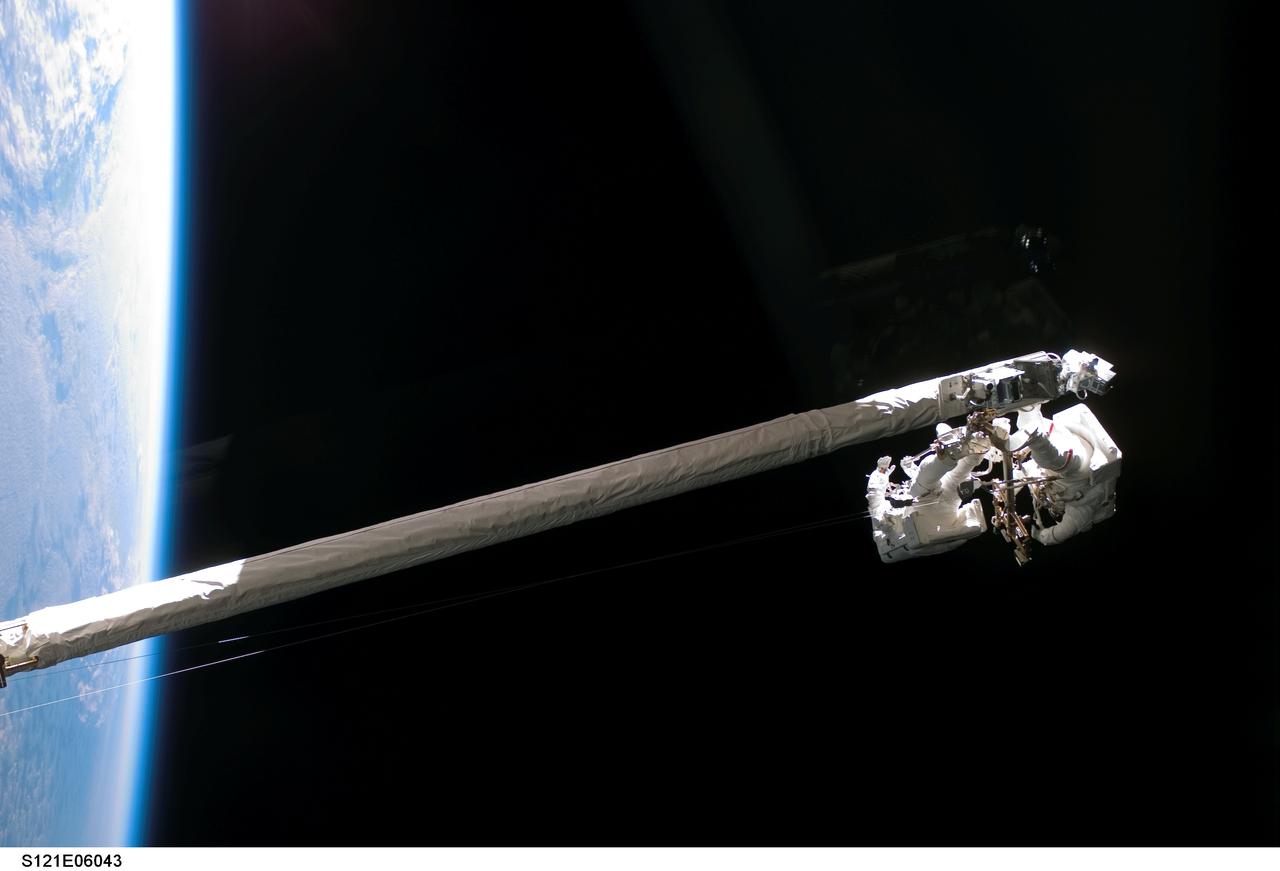
S121-E-06043 (8 July 2006) --- Astronauts Piers J. Sellers (red stripes) and Michael E. Fossum, STS-121 mission specialists, work in tandem on the shuttle's Remote Manipulator System/Orbiter Boom Sensor System (RMS/OBSS) during the mission's first scheduled session of extravehicular activity (EVA).
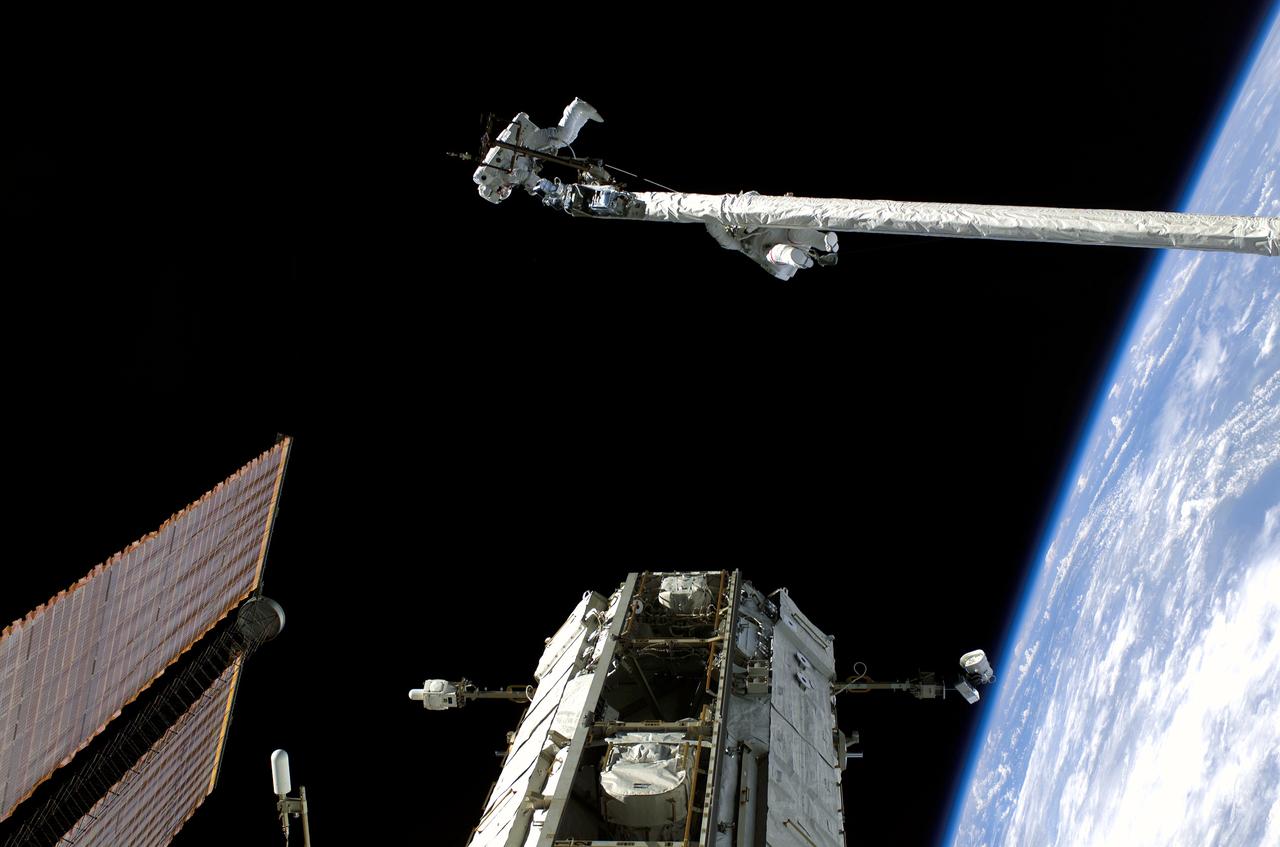
S121-E-06058 (8 July 2006) --- Astronauts Piers J. Sellers (red stripes) and Michael E. Fossum, STS-121 mission specialists, work in tandem on the shuttle's Remote Manipulator System/Orbiter Boom Sensor System (RMS/OBSS) during the mission's first scheduled session of extravehicular activity (EVA).
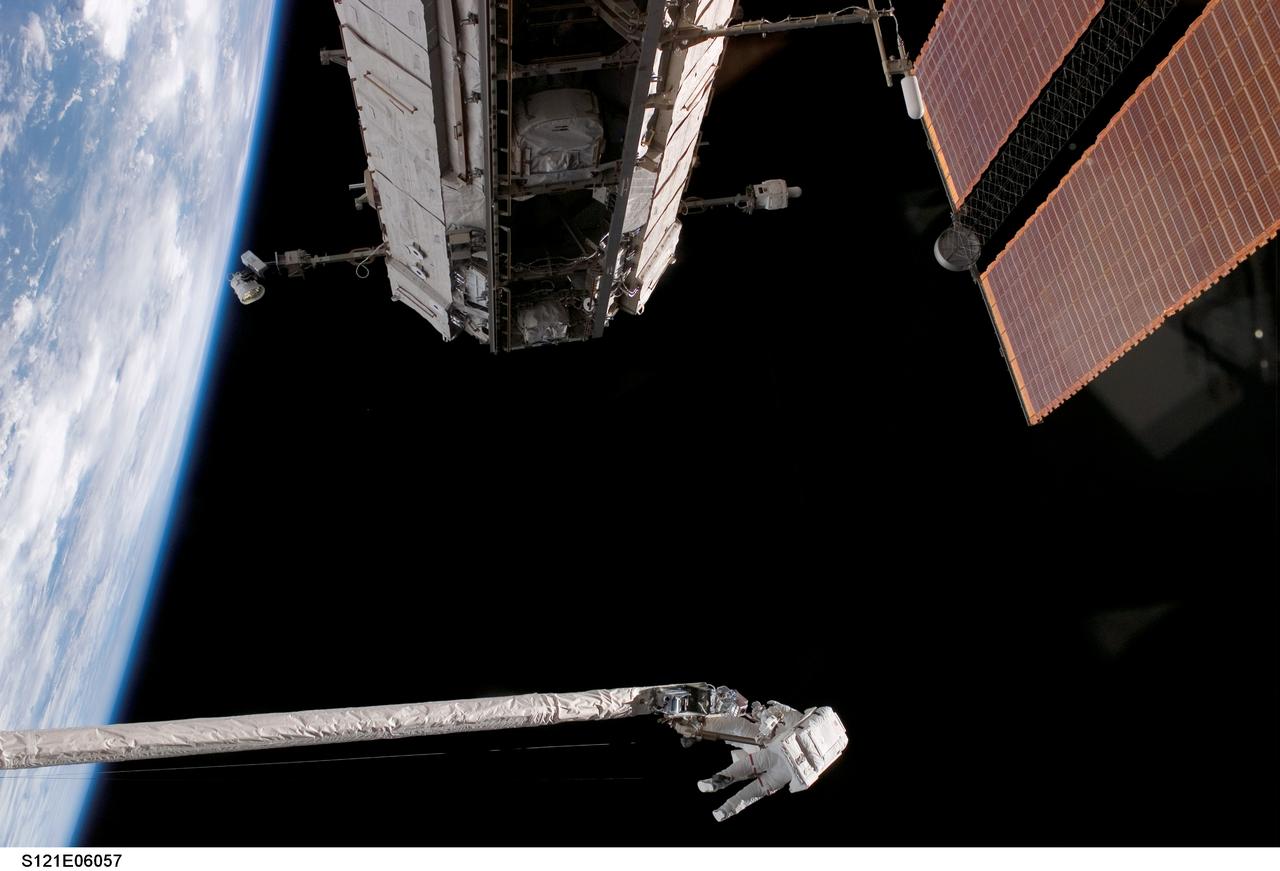
S121-E-06057 (8 July 2006) --- Astronauts Piers J. Sellers (red stripes) and Michael E. Fossum, STS-121 mission specialists, work in tandem on the shuttle's Remote Manipulator System/Orbiter Boom Sensor System (RMS/OBSS) during the mission's first scheduled session of extravehicular activity (EVA).
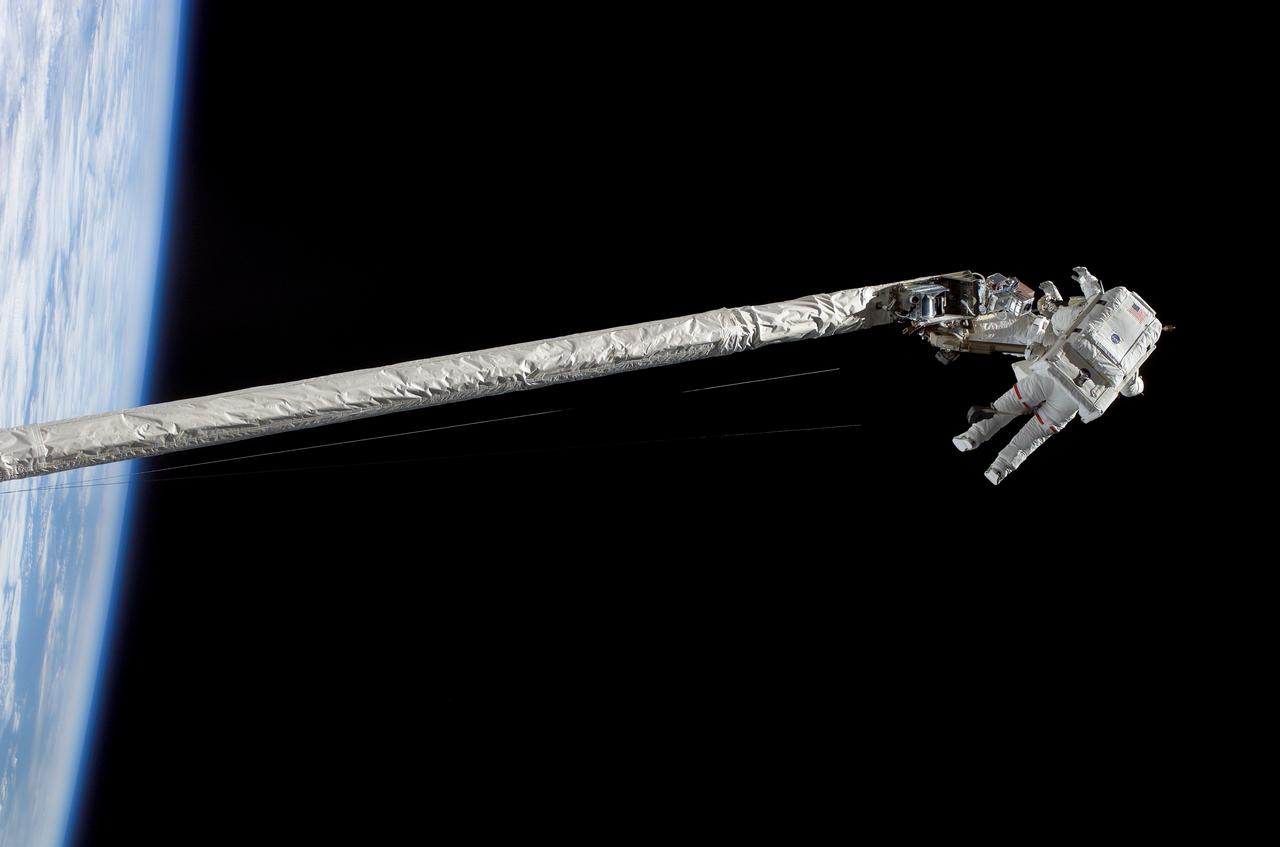
S121-E-06056 (8 July 2006) --- Astronauts Piers J. Sellers (red stripes) and Michael E. Fossum, STS-121 mission specialists, work in tandem on the shuttle's Remote Manipulator System/Orbiter Boom Sensor System (RMS/OBSS) during the mission's first scheduled session of extravehicular activity (EVA).
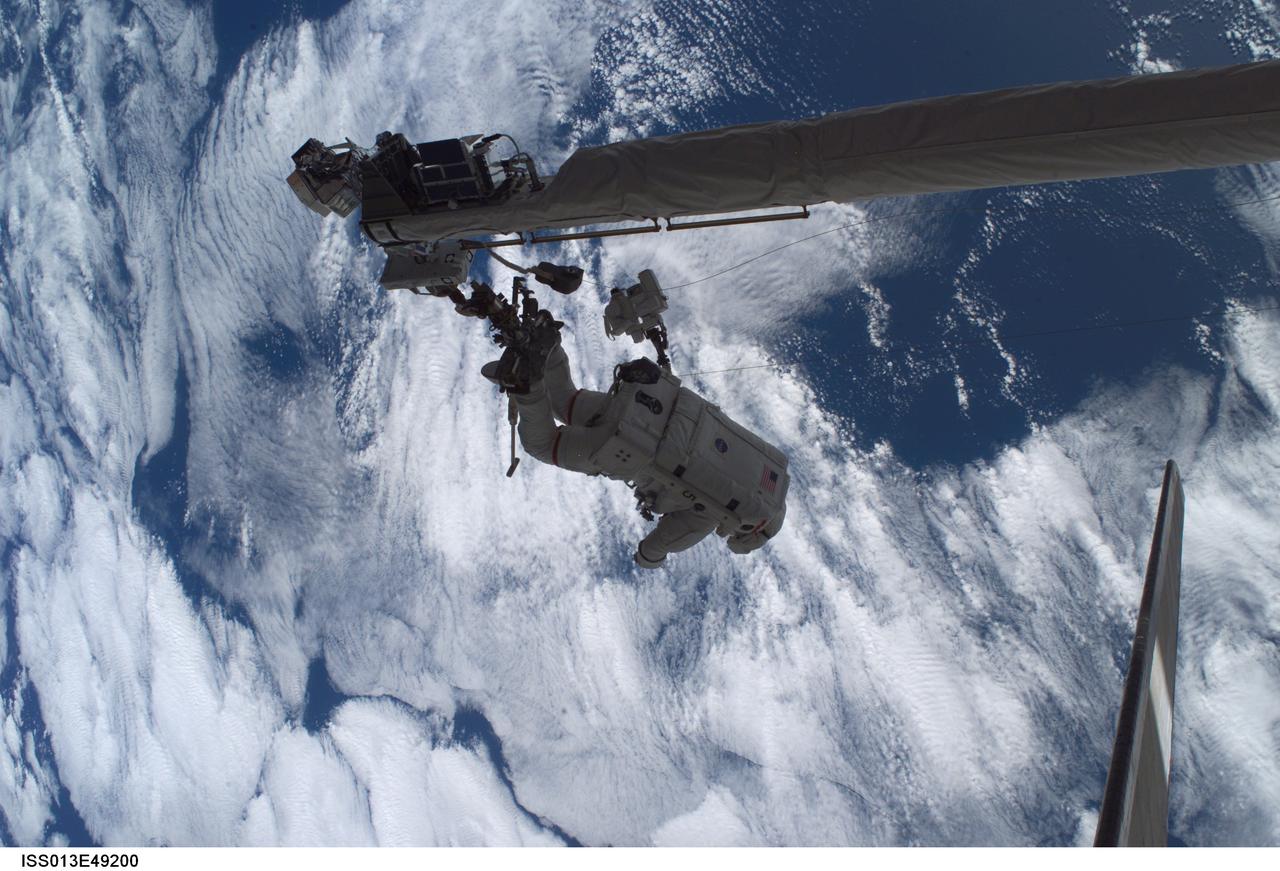
ISS013-E-49200 (8 July 2006) --- Anchored to the Space Shuttle Discovery's Remote Manipulator System/Orbiter Boom Sensor System (RMS/OBSS) foot restraint, astronaut Piers J. Sellers, STS-121 mission specialist, participates in the mission's first session of extravehicular activity (EVA) while the shuttle was docked with the International Space Station. Discovery's vertical stabilizer is at right. A cloud-covered Earth provides the backdrop for the scene.
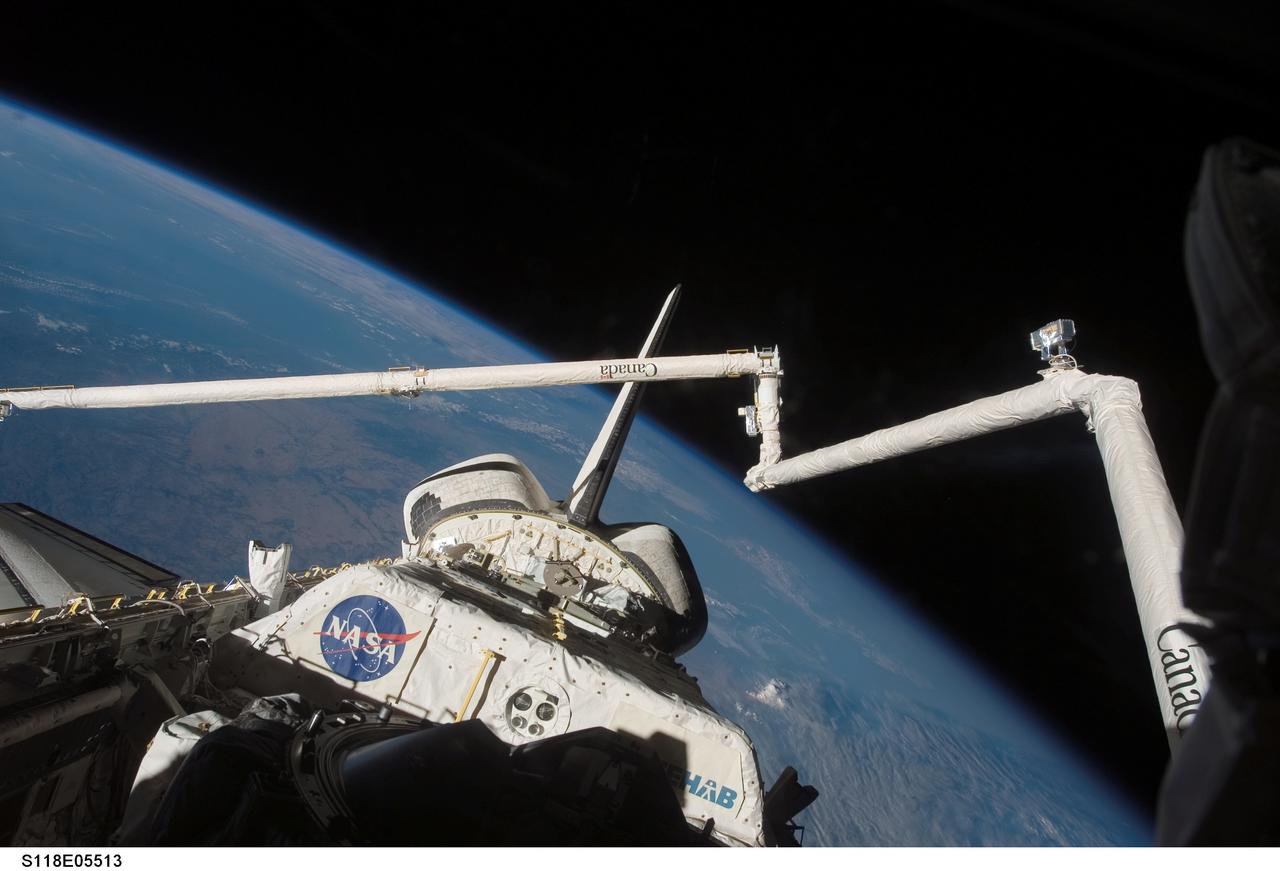
S118-E-05513 (9 Aug. 2007) --- Backdropped by the blackness of space and Earth's horizon, the SPACEHAB pressurized logistics module in Space Shuttle Endeavour's payload bay, vertical stabilizer and the shuttle's Remote Manipulator System/Orbiter Boom Sensor System (RMS/OBSS) are featured in this image photographed by an STS-118 crewmember during flight day two activities.
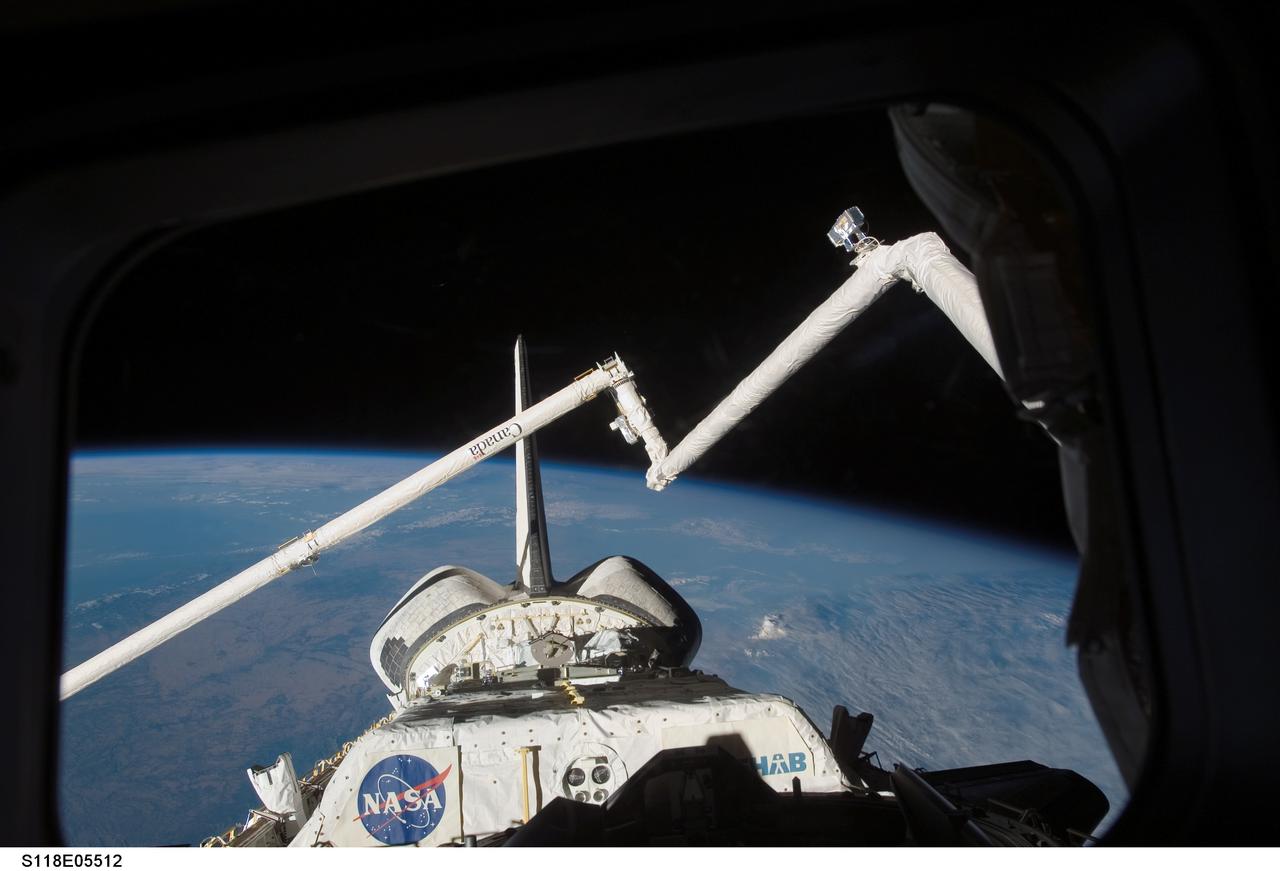
S118-E-05512 (9 Aug. 2007) --- Backdropped by the blackness of space and Earth's horizon, the SPACEHAB pressurized logistics module in Space Shuttle Endeavour's payload bay, vertical stabilizer and the shuttle's Remote Manipulator System/Orbiter Boom Sensor System (RMS/OBSS) are featured in this image photographed by an STS-118 crewmember during flight day two activities.
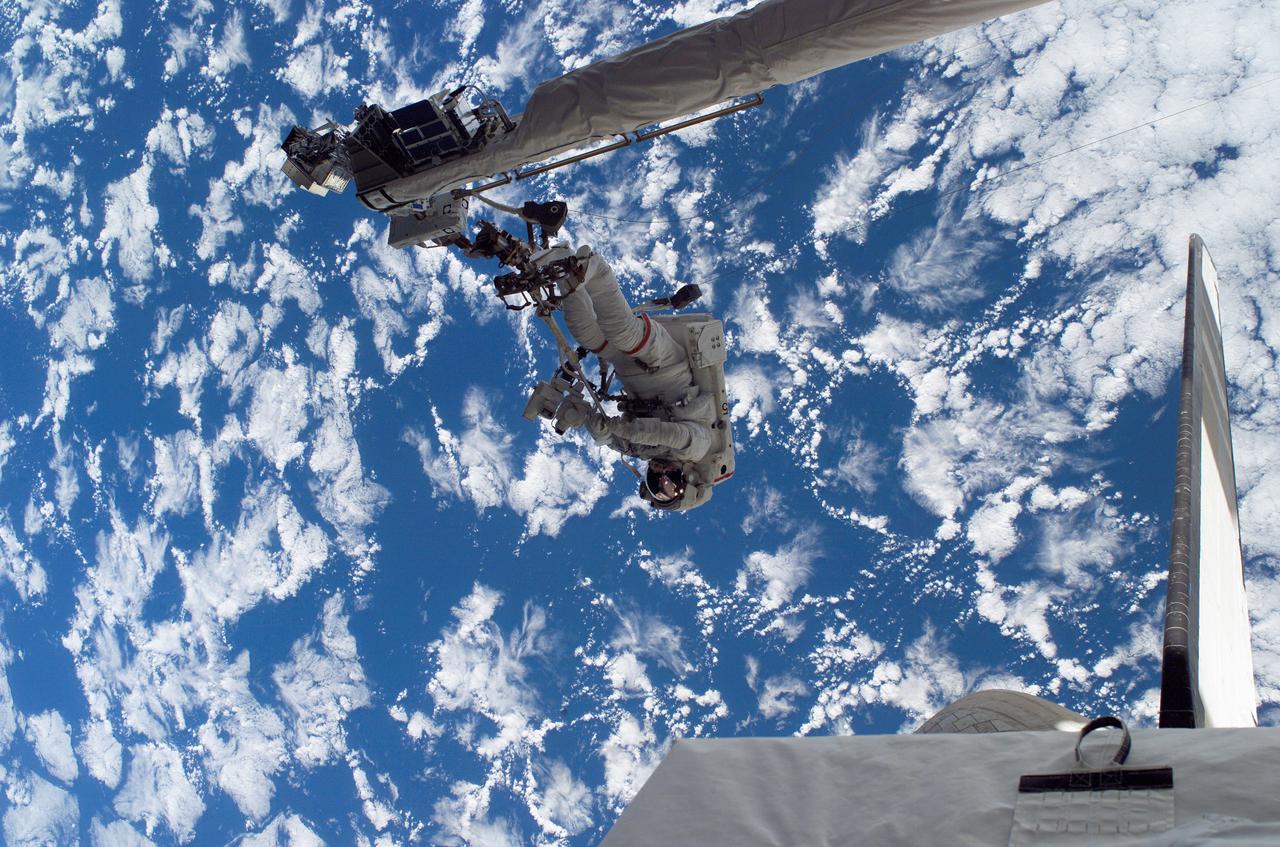
ISS013-E-49186 (8 July 2006) --- Anchored to the Space Shuttle Discovery's Remote Manipulator System/Orbiter Boom Sensor System (RMS/OBSS) foot restraint, astronaut Piers J. Sellers, STS-121 mission specialist, participates in the mission's first session of extravehicular activity (EVA) while the shuttle was docked with the International Space Station. Discovery's vertical stabilizer is at right. A blue and white Earth provides the backdrop for the scene.
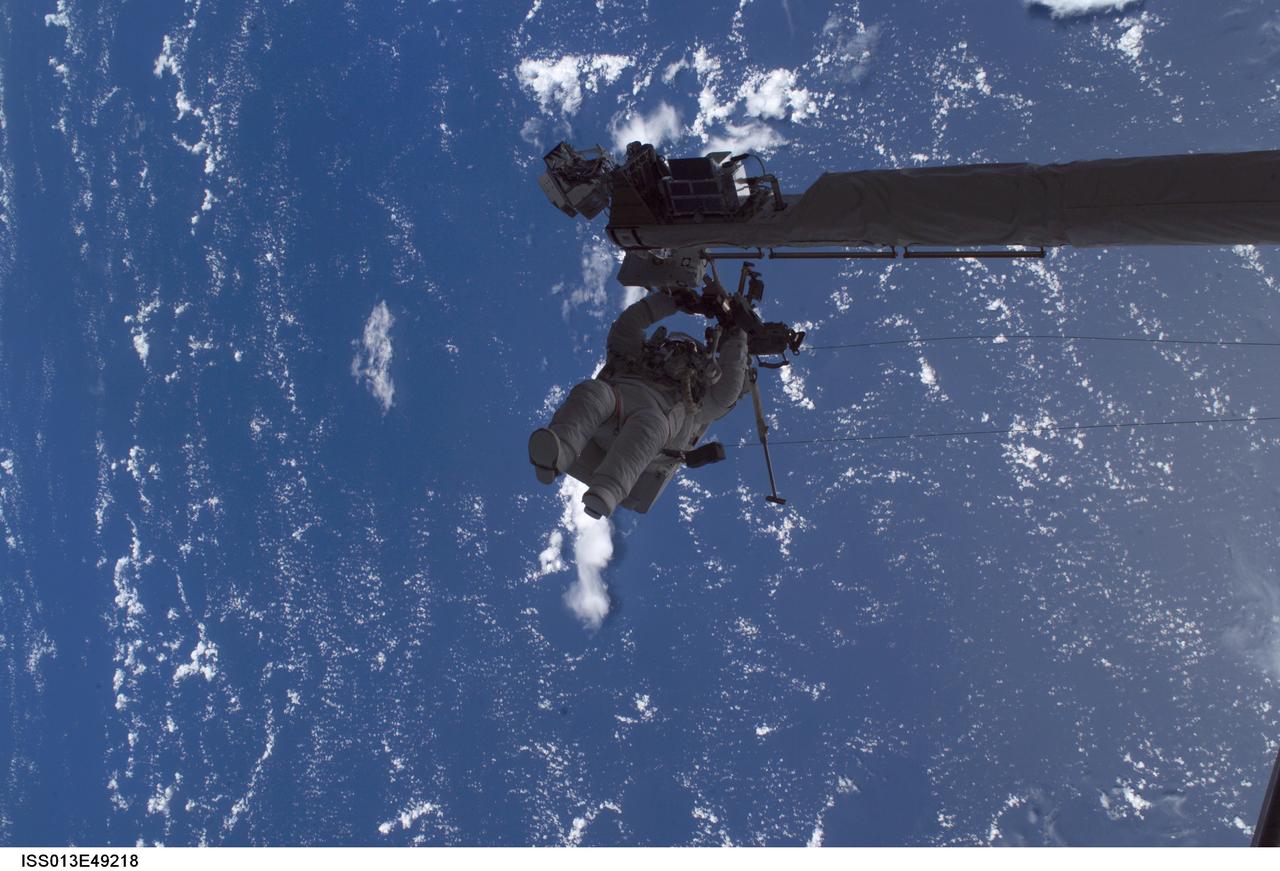
ISS013-E-49218 (8 July 2006) --- Anchored to the Space Shuttle Discovery's Remote Manipulator System/Orbiter Boom Sensor System (RMS/OBSS) foot restraint, astronaut Piers J. Sellers, STS-121 mission specialist, participates in the mission's first session of extravehicular activity (EVA) while the shuttle was docked with the International Space Station. A blue and white Earth provides the backdrop for the scene.

ISS013-E-49197 (8 July 2006) --- Anchored to the Space Shuttle Discovery's Remote Manipulator System/Orbiter Boom Sensor System (RMS/OBSS) foot restraint, astronaut Piers J. Sellers, STS-121 mission specialist, participates in the mission's first session of extravehicular activity (EVA) while the shuttle was docked with the International Space Station. Discovery's vertical stabilizer is at right. A cloud-covered Earth provides the backdrop for the scene.
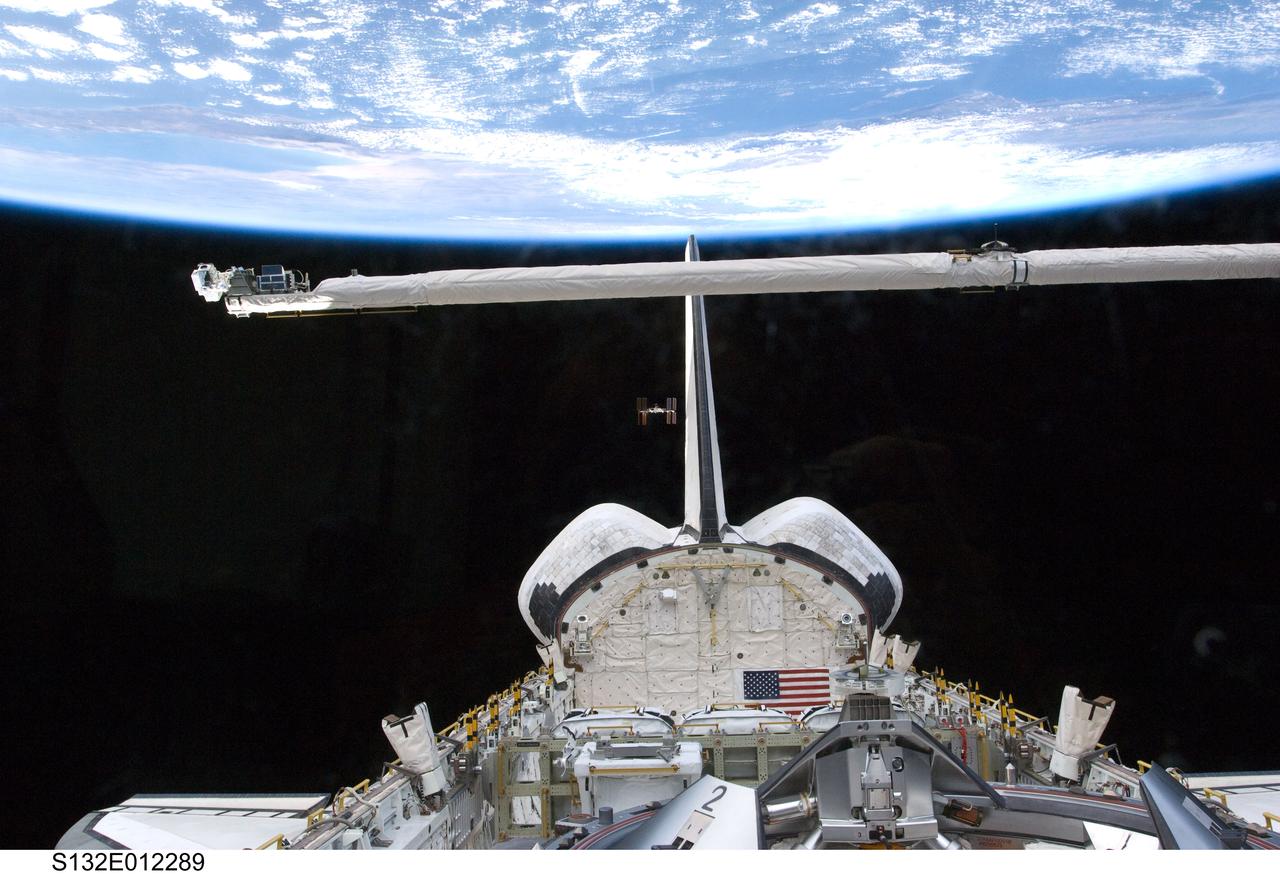
S132-E-012289 (23 May 2010) --- The International Space Station (center) appears very small from the point of view of the space shuttle Atlantis as the two spacecraft carry out their relative separation. Atlantis? vertical stabilizer, orbital maneuvering system (OMS) pods, remote manipulator system/orbiter boom sensor system (RMS/OBSS) and payload bay are also pictured in this image photographed by an STS-132 crew member onboard the shuttle. Earlier the STS-132 and Expedition 23 crews concluded seven days of cooperative work onboard the shuttle and station. Undocking of the two spacecraft occurred at 10:22 a.m. (CDT) on May 23, 2010. Earth?s horizon and the blackness of space provide the backdrop for the scene.

STS-132 OBSS TESTING FOR ATLANTIS

STS-132 OBSS TESTING FOR ATLANTIS

STS-132 OBSS TESTING FOR ATLANTIS

STS-132 OBSS TESTING FOR ATLANTIS

STS-132 OBSS TESTING FOR ATLANTIS

STS-132 OBSS TESTING FOR ATLANTIS
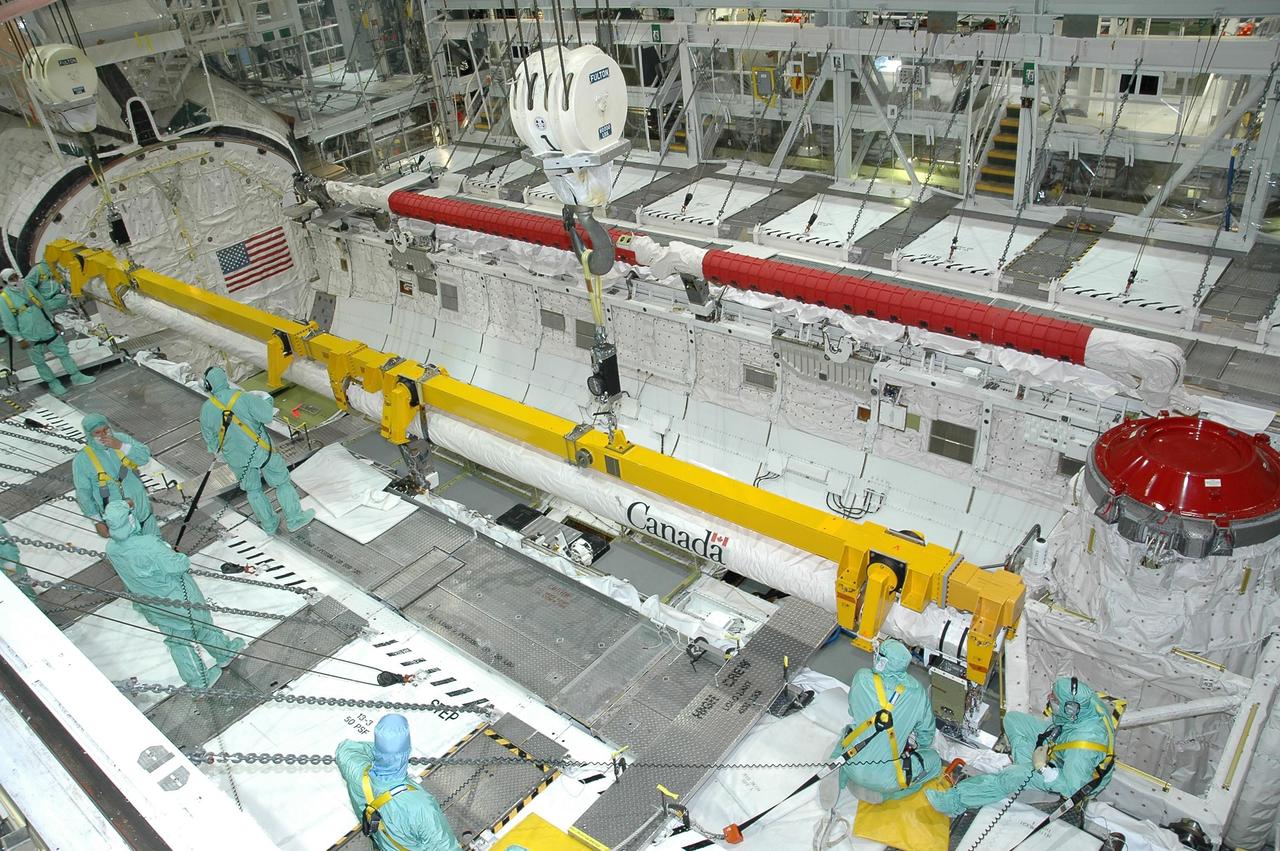
KENNEDY SPACE CENTER, FLA. - In Orbiter Processing Facility bay 1 at NASA's Kennedy Space Center, workers complete installation of the orbiter boom sensor system into Atlantis' payload bay. The 50-foot-long boom attaches to the shuttle arm and is one of the new safety measures added prior to Return to Flight last year. It equips the orbiter with cameras and laser systems to inspect the shuttle's heat shield while in space. Atlantis is scheduled to launch on mission STS-115 no earlier than Aug. 28. Photo credit: NASA/Jim Grossmann
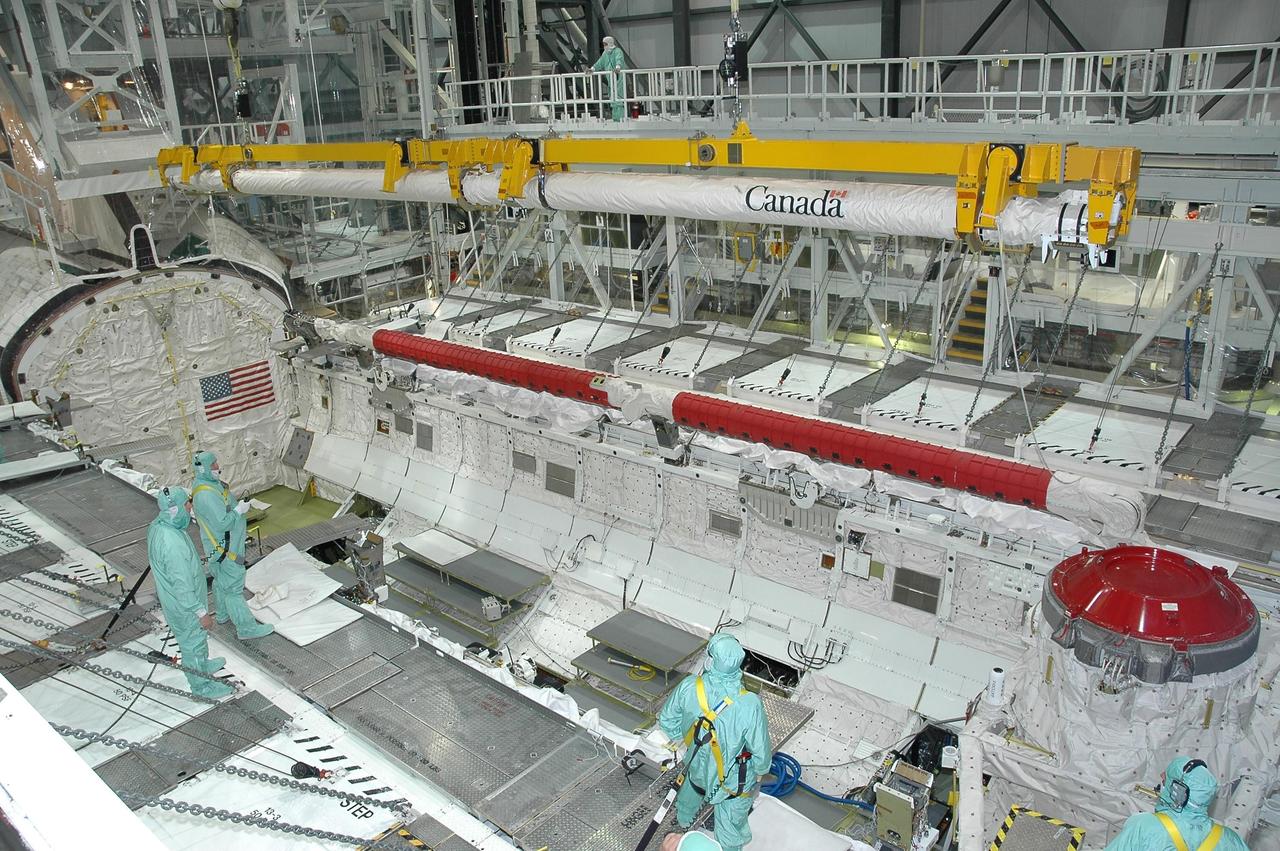
KENNEDY SPACE CENTER, FLA. - In Orbiter Processing Facility bay 1 at NASA's Kennedy Space Center, the orbiter boom sensor system is lowered into Atlantis' payload bay for installation. The 50-foot-long boom attaches to the shuttle arm and is one of the new safety measures added prior to Return to Flight last year. It equips the orbiter with cameras and laser systems to inspect the shuttle's heat shield while in space. Atlantis is scheduled to launch on mission STS-115 no earlier than Aug. 28. Photo credit: NASA/Jim Grossmann
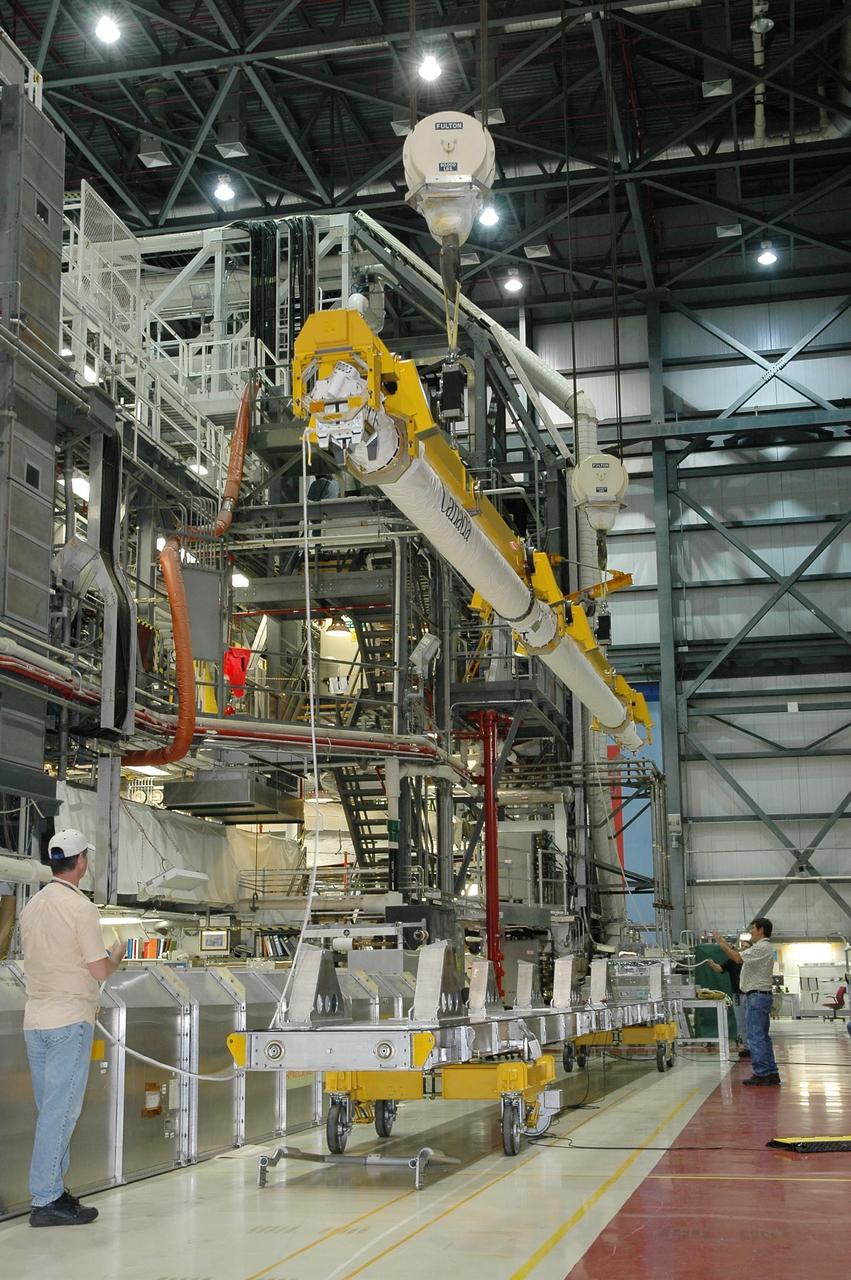
KENNEDY SPACE CENTER, FLA. - In Orbiter Processing Facility bay 1 at NASA's Kennedy Space Center, the orbiter boom sensor system is lifted off a transporter. The boom will be installed in Atlantis' payload bay. The 50-foot-long boom attaches to the shuttle arm and is one of the new safety measures added prior to Return to Flight last year. It equips the orbiter with cameras and laser systems to inspect the shuttle's heat shield while in space. Atlantis is scheduled to launch on mission STS-115 no earlier than Aug. 28. Photo credit: NASA/Jim Grossmann
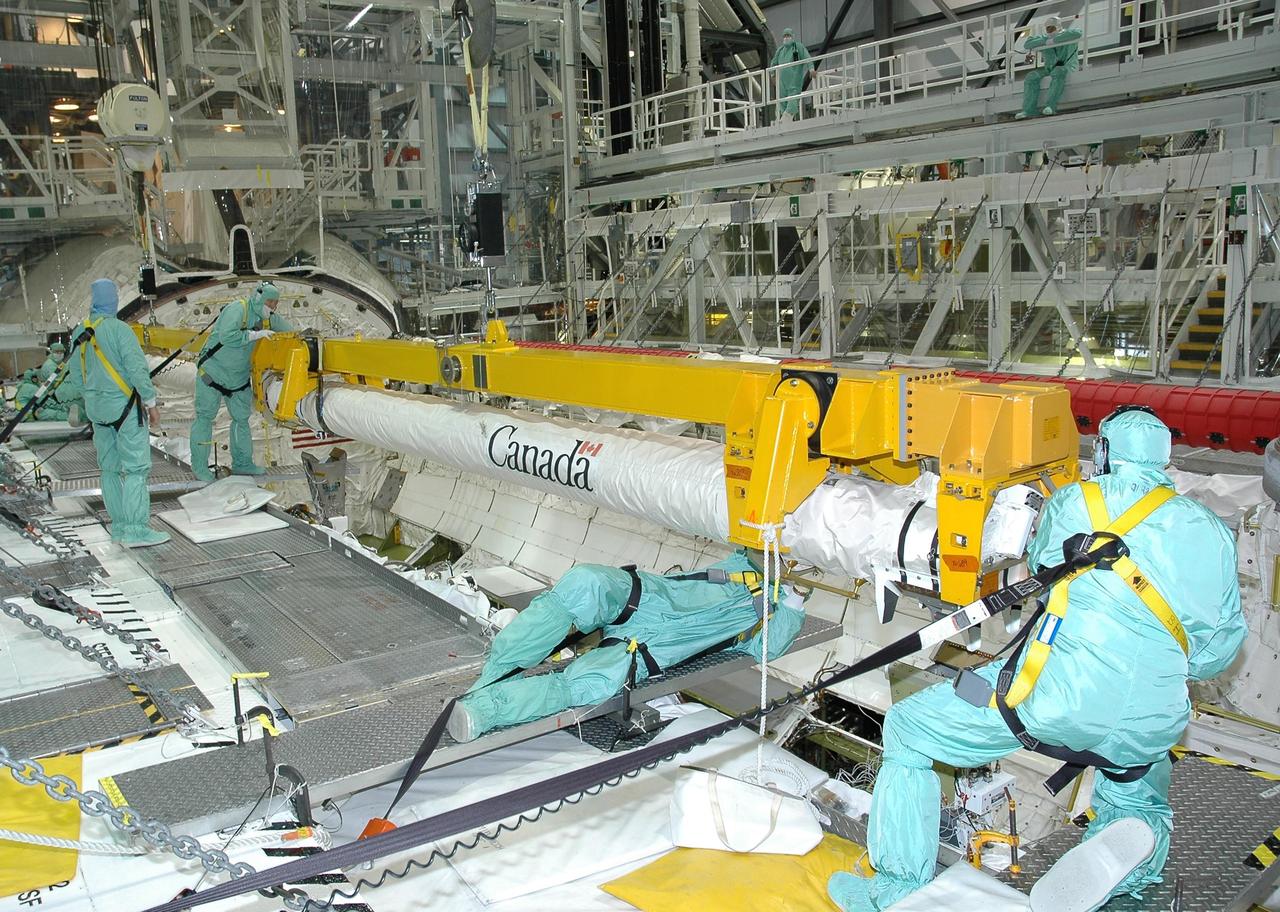
KENNEDY SPACE CENTER, FLA. - In Orbiter Processing Facility bay 1 at NASA's Kennedy Space Center, workers install the orbiter boom sensor system into Atlantis' payload bay. The 50-foot-long boom attaches to the shuttle arm and is one of the new safety measures added prior to Return to Flight last year. It equips the orbiter with cameras and laser systems to inspect the shuttle's heat shield while in space. Atlantis is scheduled to launch on mission STS-115 no earlier than Aug. 28. Photo credit: NASA/Jim Grossmann
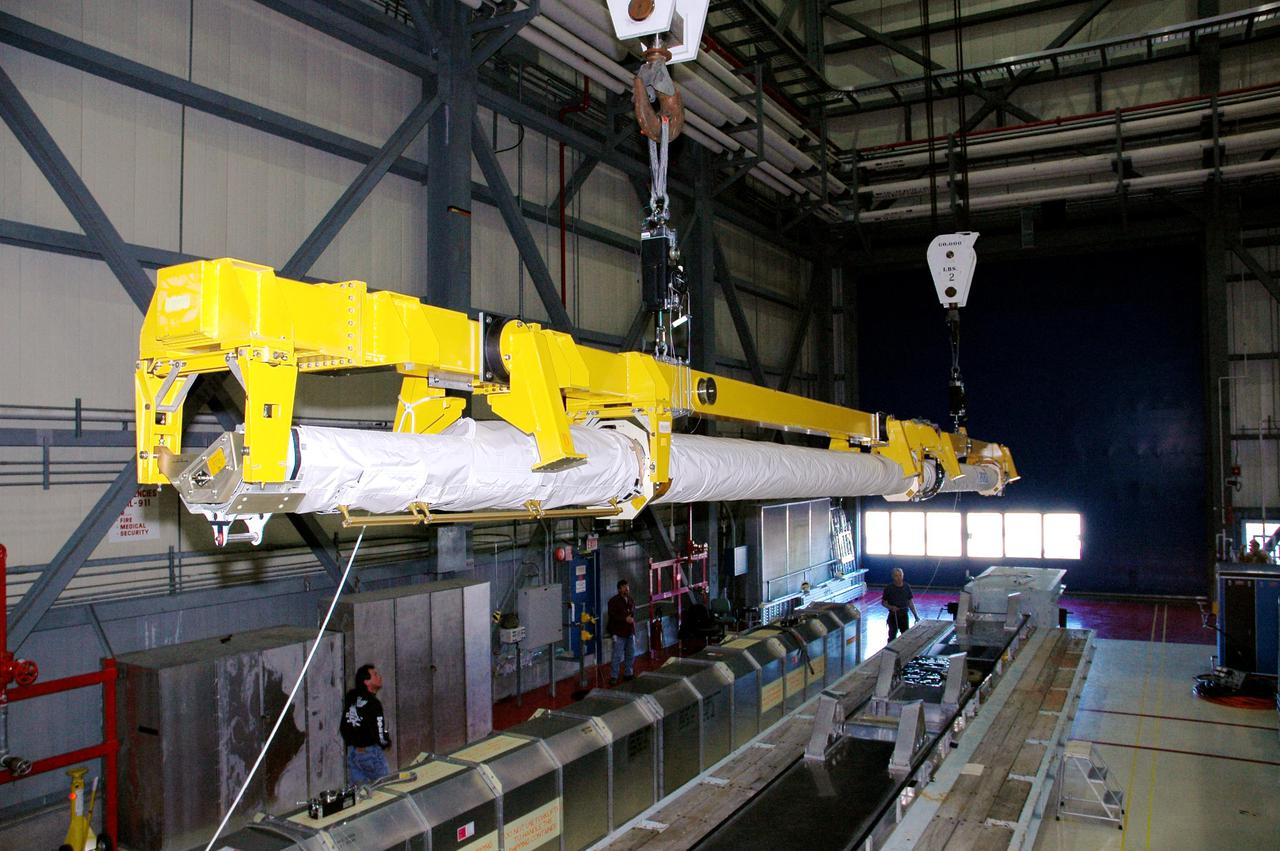
KENNEDY SPACE CENTER, FLA. - In the Orbiter Processing Facility high bay, cranes lift the Orbiter Boom Sensor System (OBSS) from its transporter. The OBSS will be installed on the starboard side of the payload bay in the orbiter Discovery. The 50-foot-long OBSS attaches to the Remote Manipulator System, or Shuttle robotic arm, and is one of the new safety measures for Return to Flight, equipping the orbiter with cameras and laser systems to inspect the Shuttle’s Thermal Protection System while in space. The Return to Flight mission, STS-114, has a launch window of May 12 to June 3, 2005.
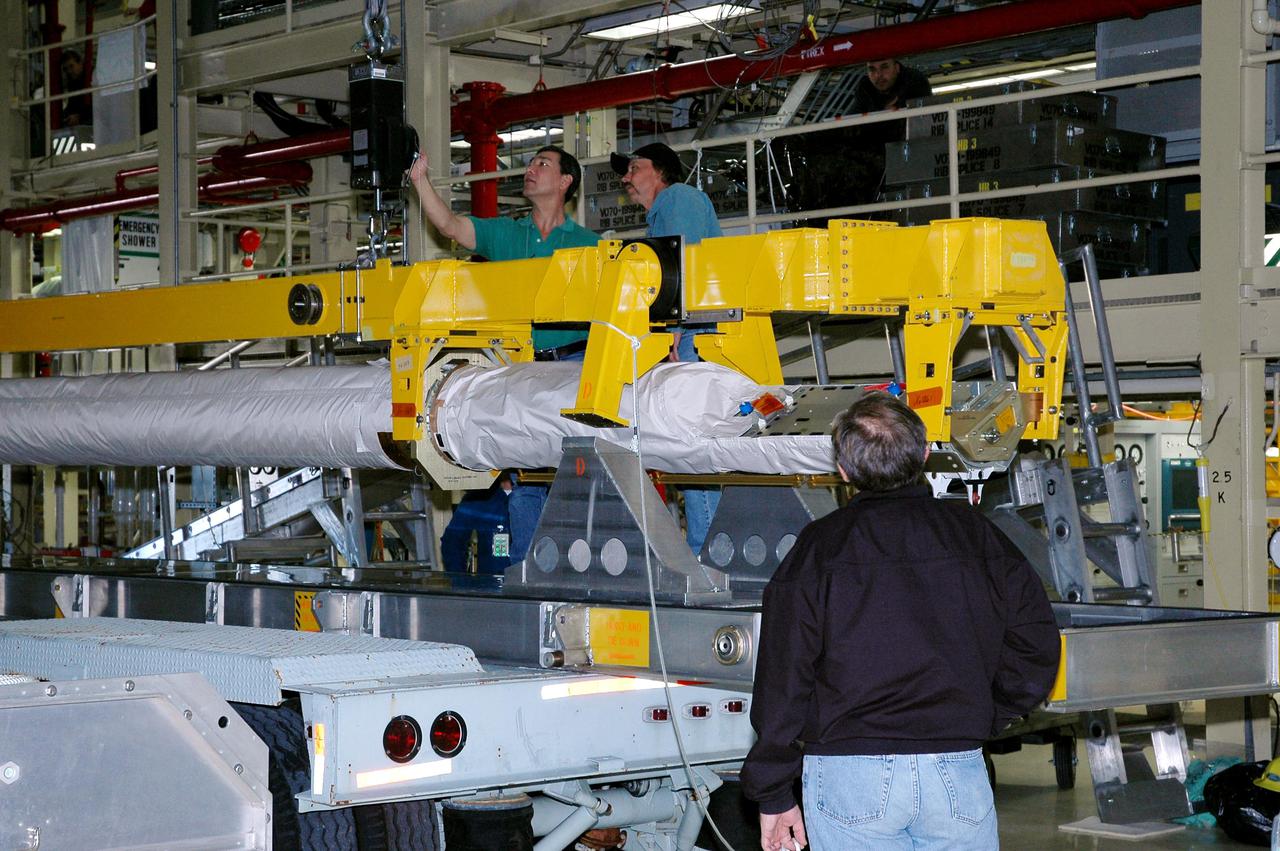
KENNEDY SPACE CENTER, FLA. - In the Orbiter Processing Facility high bay, technicians check the crane that will lift the Orbiter Boom Sensor System (OBSS) from its transporter. The OBSS will be installed on the starboard side of the payload bay in the orbiter Discovery. The 50-foot-long OBSS attaches to the Remote Manipulator System, or Shuttle robotic arm, and is one of the new safety measures for Return to Flight, equipping the orbiter with cameras and laser systems to inspect the Shuttle’s Thermal Protection System while in space. The Return to Flight mission, STS-114, has a launch window of May 12 to June 3, 2005.

KENNEDY SPACE CENTER, FLA. - In the Remote Manipulator Lab inside the Vehicle Assembly Building, STS-114 Mission Specialist Andrew Thomas talks with Rafael Rodriguez, an advance systems technician with United Space Alliance, about the 50-foot-long Orbiter Boom Sensor System (OBSS) in front of them. The OBSS will fly on Shuttle Discovery on Return to Flight mission STS-114. The OBSS attaches to the end of the Shuttle’s robotic arm. The system is one of the new safety measures for Return to Flight, equipping the orbiter with cameras and laser systems to inspect the Shuttle’s Thermal Protection System while in space. The mission launch window is May 12 to June 3, 2005.

KENNEDY SPACE CENTER, FLA. - In the Orbiter Processing Facility high bay, the Orbiter Boom Sensor System (OBSS) moves toward the orbiter Discovery at left. The OBSS will be installed on the starboard side of the payload bay. The 50-foot-long OBSS attaches to the Remote Manipulator System, or Shuttle robotic arm, and is one of the new safety measures for Return to Flight, equipping the orbiter with cameras and laser systems to inspect the Shuttle’s Thermal Protection System while in space. The Return to Flight mission, STS-114, has a launch window of May 12 to June 3, 2005.
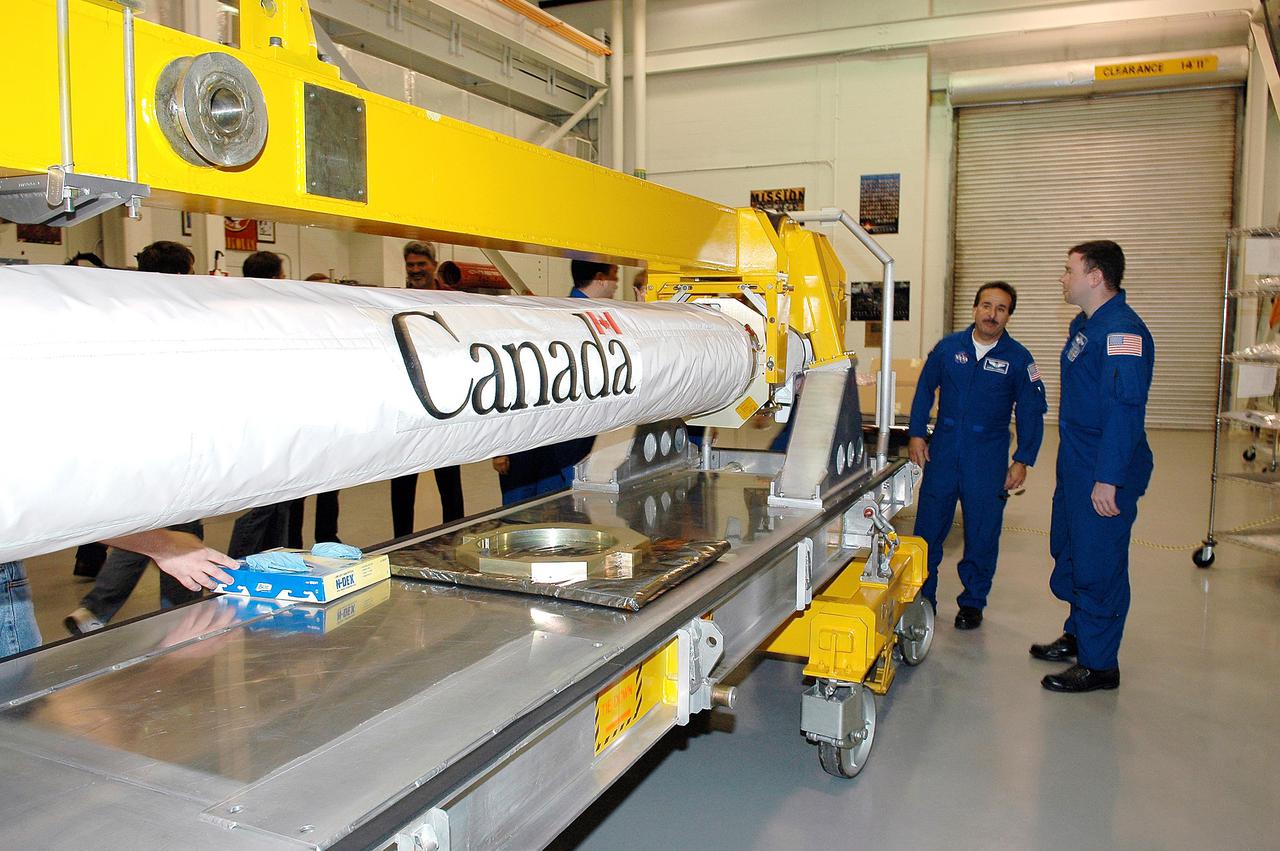
KENNEDY SPACE CENTER, FLA. - In the Remote Manipulator Lab inside the Vehicle Assembly Building, STS-114 Mission Specialist Charles Camarda (left) and Pilot James Kelly look at the new 50-foot-long Orbiter Boom Sensor System (OBSS) that will fly on Shuttle Discovery on Return to Flight mission STS-114. The OBSS attaches to the end of the Shuttle’s robotic arm. The system is one of the new safety measures for Return to Flight, equipping the orbiter with cameras and laser systems to inspect the Shuttle's Thermal Protection System while in space. Crew members are at Kennedy to become familiar with Shuttle equipment such as the OBSS and the newly redesigned External Tank. The launch window is May 12 to June 3, 2005.
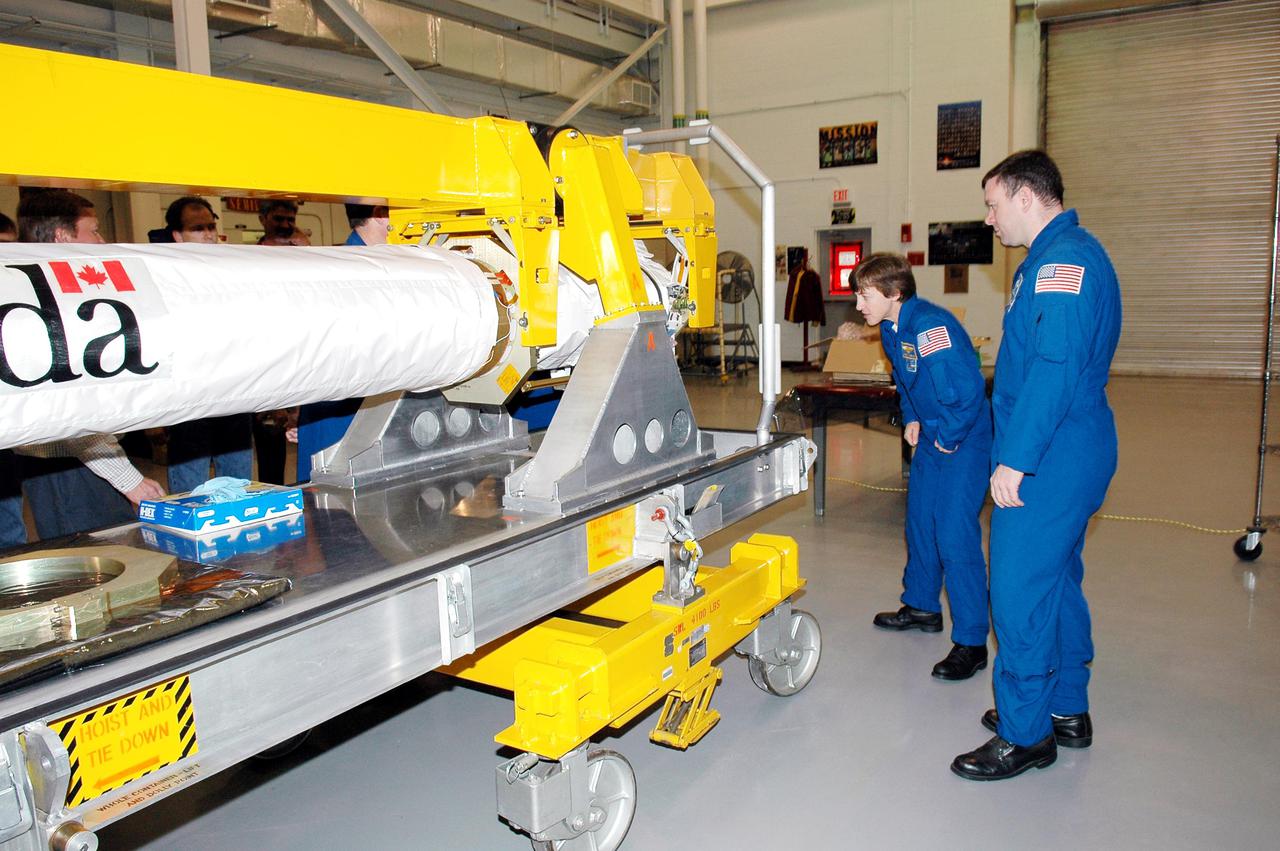
KENNEDY SPACE CENTER, FLA. - In the Remote Manipulator Lab inside the Vehicle Assembly Building, STS-114 Mission Specialist Wendy Lawrence and Pilot James Kelly look at the new 50-foot-long Orbiter Boom Sensor System (OBSS) that will fly on Shuttle Discovery on Return to Flight mission STS-114. The OBSS attaches to the end of the Shuttle’s robotic arm. The system is one of the new safety measures for Return to Flight, equipping the orbiter with cameras and laser systems to inspect the Shuttle's Thermal Protection System while in space. Crew members are at Kennedy to become familiar with Shuttle equipment such as the OBSS and the newly redesigned External Tank. The launch window is May 12 to June 3, 2005.
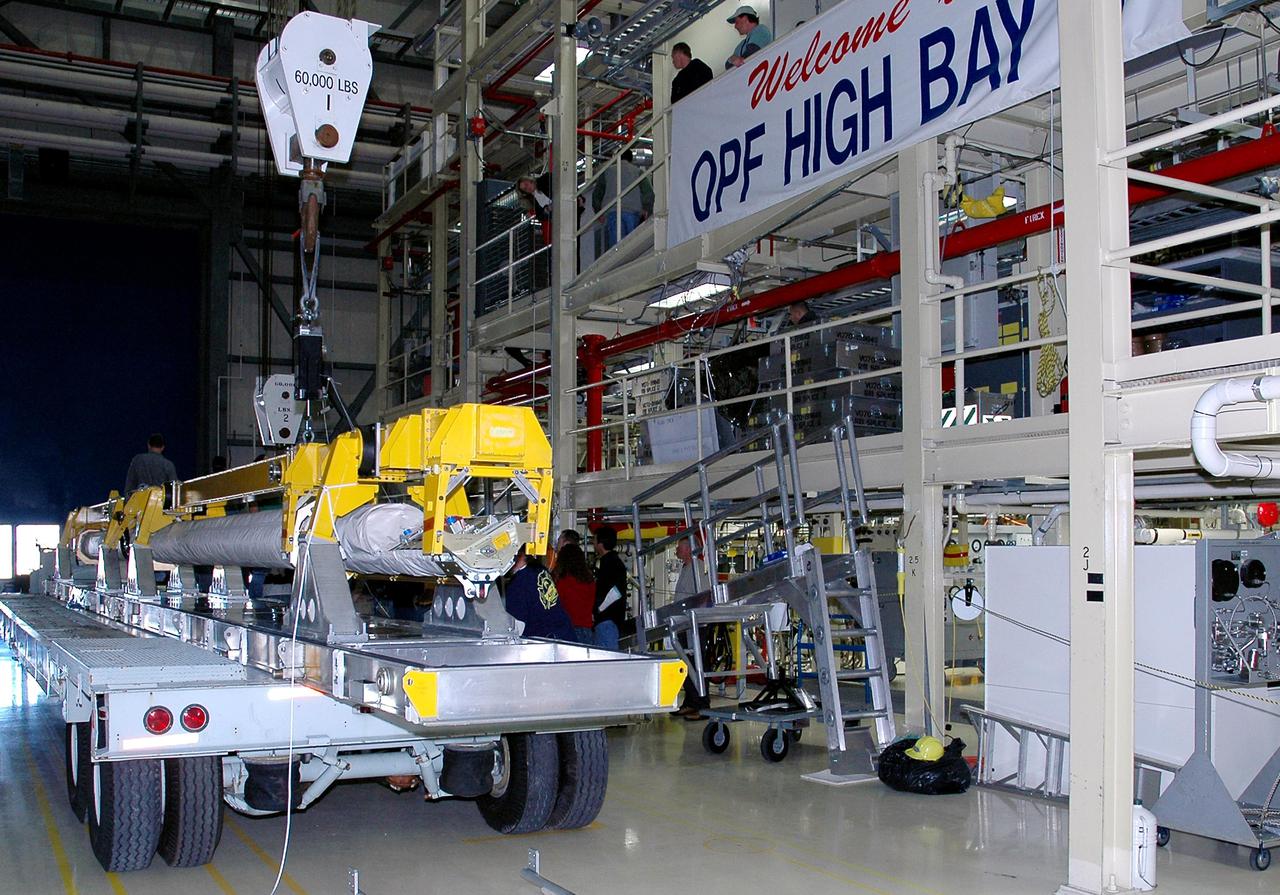
KENNEDY SPACE CENTER, FLA. - In the Orbiter Processing Facility high bay, the Orbiter Boom Sensor System (OBSS) is fitted with a crane. After being lifted from its transporter, the OBSS will be installed on the starboard side of the payload bay in the orbiter Discovery. The 50-foot-long OBSS attaches to the Remote Manipulator System, or Shuttle robotic arm, and is one of the new safety measures for Return to Flight, equipping the orbiter with cameras and laser systems to inspect the Shuttle’s Thermal Protection System while in space. The Return to Flight mission, STS-114, has a launch window of May 12 to June 3, 2005.
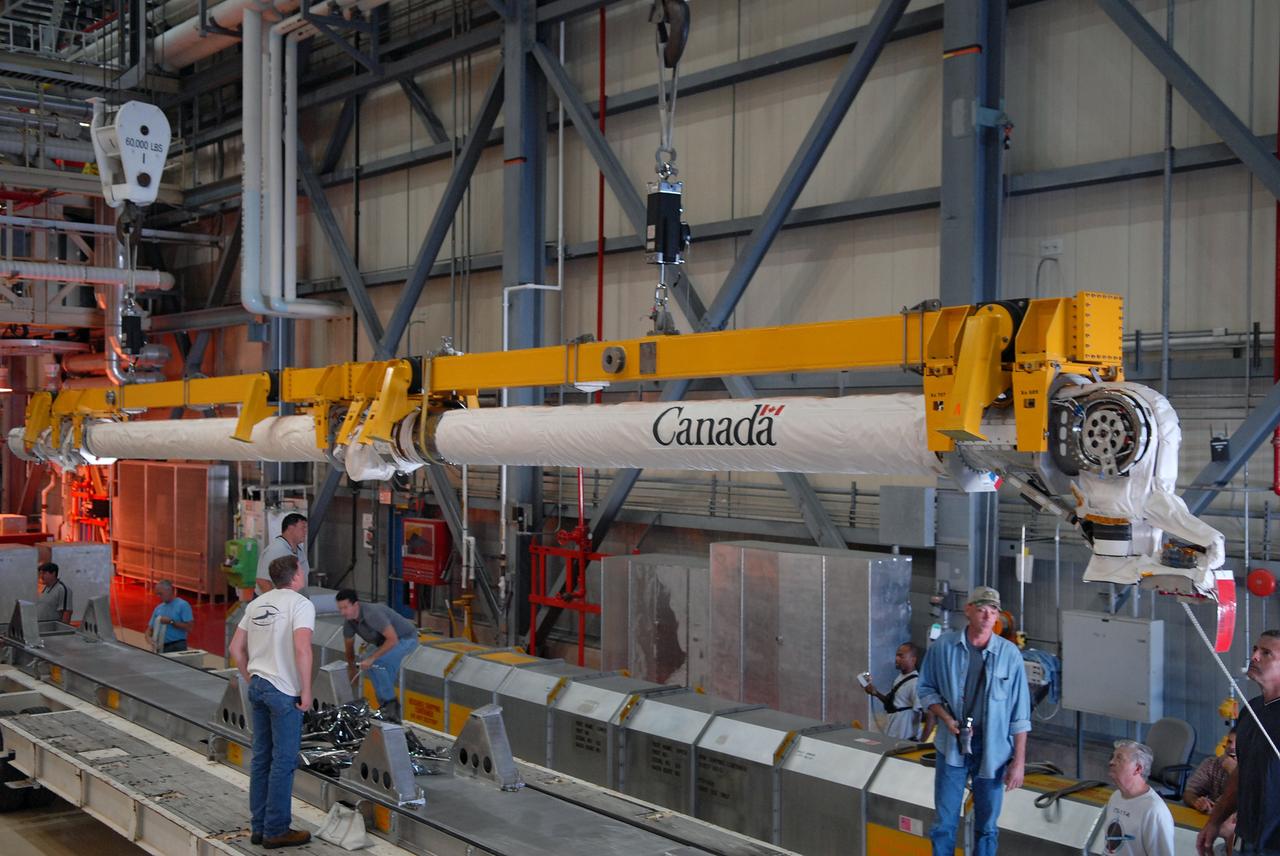
CAPE CANAVERAL, Fla. – In Orbiter Processing Facility bay 3 at NASA's Kennedy Space Center in Florida, the remote manipulator system, or RMS, removed from space shuttle Discovery is lowered toward a storage platform. The RMS is used to grab, or grapple, the payload as well as retrieve, repair and deploy satellites; provide a mobile extension ladder for spacewalking crewmembers; and be used as an inspection aid to allow flight crew members to view the orbiter’s or payload’s surfaces through a TV camera on the arm. Discovery is targeted to launch Aug. 6 on the STS-128 mission. Photo credit: NASA/Jack Pfaller
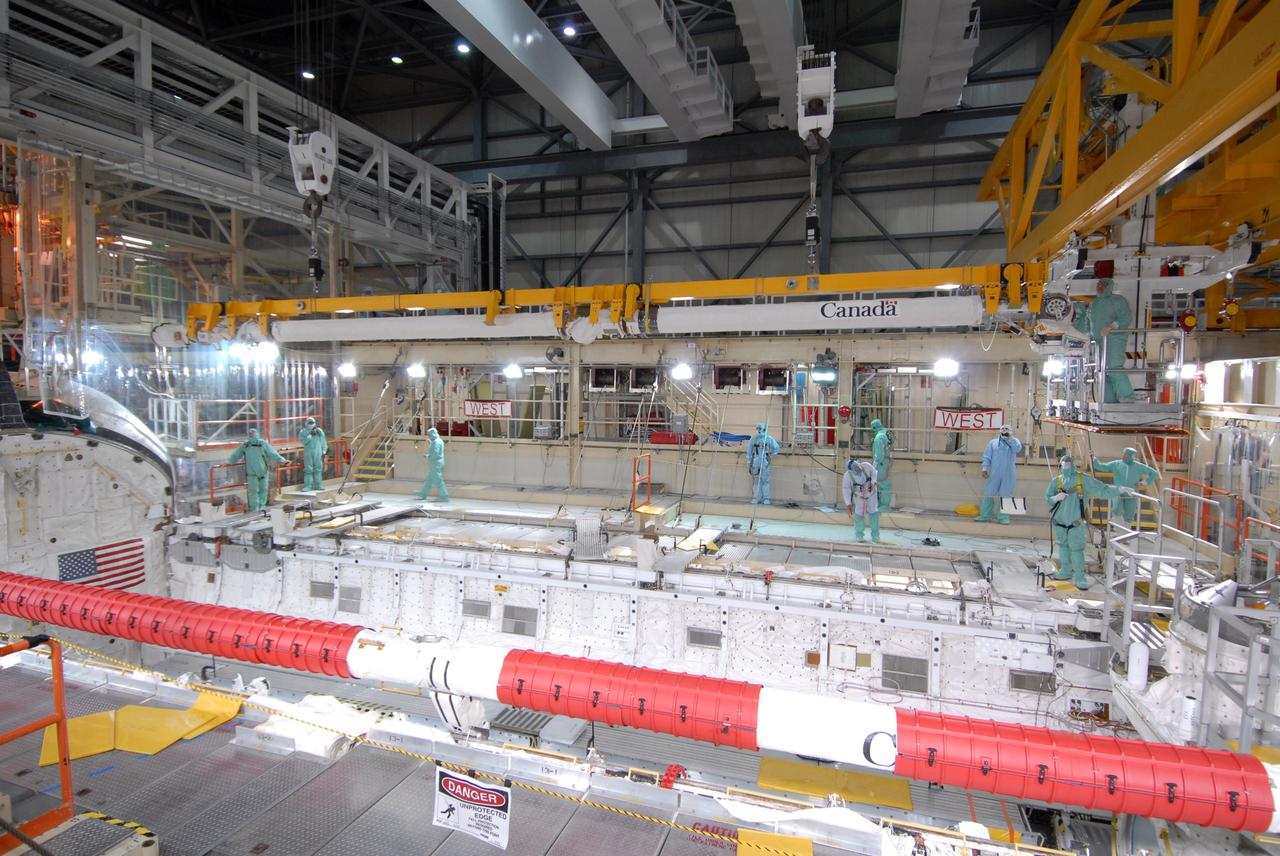
CAPE CANAVERAL, Fla. – In Orbiter Processing Facility bay 3 at NASA's Kennedy Space Center in Florida, the remote manipulator system, or RMS, arm is lifted away from the payload bay of space shuttle Discovery. The RMS is used to grab, or grapple, the payload as well as retrieve, repair and deploy satellites; provide a mobile extension ladder for spacewalking crewmembers; and be used as an inspection aid to allow flight crew members to view the orbiter’s or payload’s surfaces through a TV camera on the arm. Discovery is targeted to launch Aug. 6 on the STS-128 mission. Photo credit: NASA/Jack Pfaller
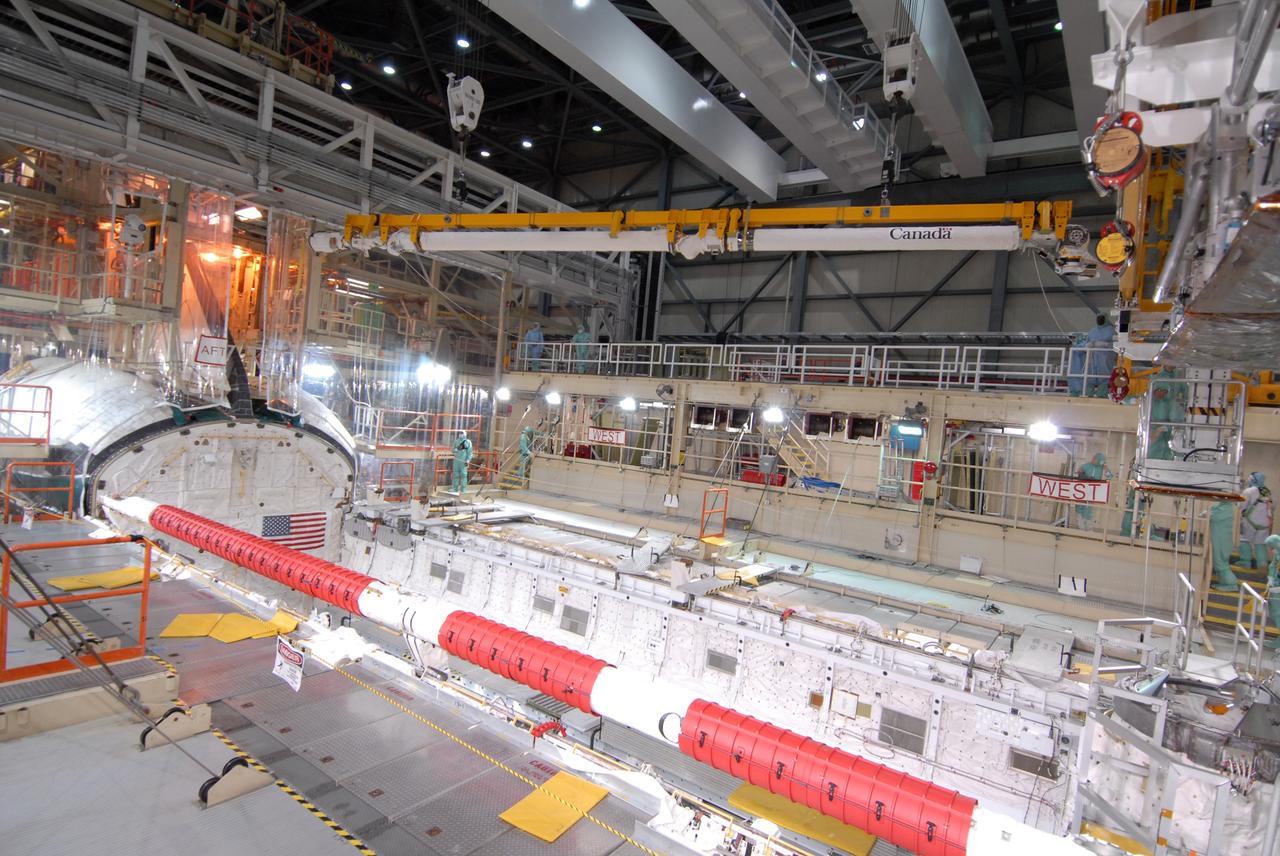
CAPE CANAVERAL, Fla. – In Orbiter Processing Facility bay 3 at NASA's Kennedy Space Center in Florida, the remote manipulator system, or RMS, arm is lifted out of space shuttle Discovery's payload bay. The RMS is used to grab, or grapple, the payload as well as retrieve, repair and deploy satellites; provide a mobile extension ladder for spacewalking crewmembers; and be used as an inspection aid to allow flight crew members to view the orbiter’s or payload’s surfaces through a TV camera on the arm. Discovery is targeted to launch Aug. 6 on the STS-128 mission. Photo credit: NASA/Jack Pfaller
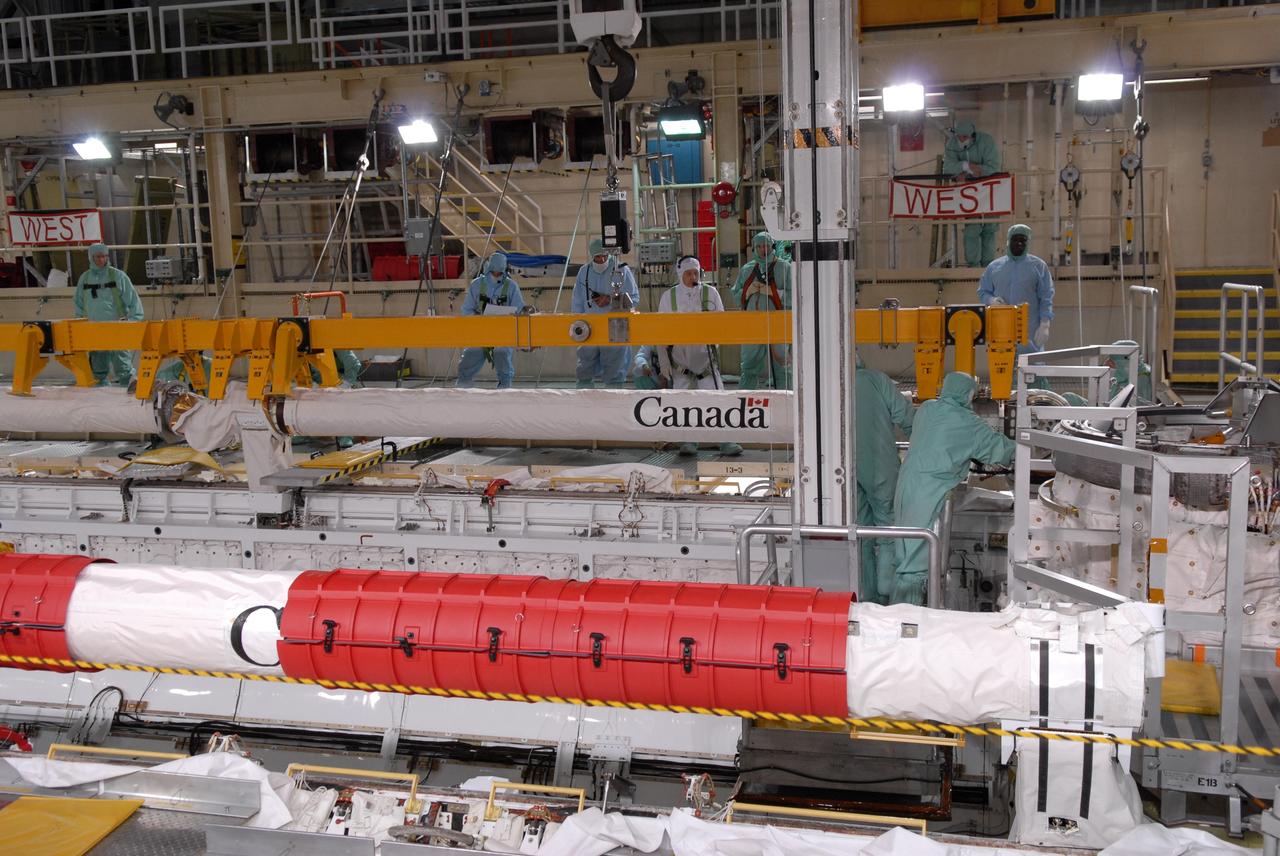
CAPE CANAVERAL, Fla. – In Orbiter Processing Facility bay 3 at NASA's Kennedy Space Center in Florida, technicians prepare to remove the remote manipulator system, or RMS, arm in the payload bay of space shuttle Discovery. The RMS is used to grab, or grapple, the payload as well as retrieve, repair and deploy satellites; provide a mobile extension ladder for spacewalking crewmembers; and be used as an inspection aid to allow flight crew members to view the orbiter’s or payload’s surfaces through a TV camera on the arm. Discovery is targeted to launch Aug. 6 on the STS-128 mission. Photo credit: NASA/Jack Pfaller
CAPE CANAVERAL, Fla. – In Orbiter Processing Facility bay 3 at NASA's Kennedy Space Center in Florida, technicians prepare to remove remote manipulator system, or RMS, arm in the payload bay of space shuttle Discovery. The RMS is used to grab, or grapple, the payload as well as retrieve, repair and deploy satellites; provide a mobile extension ladder for spacewalking crewmembers; and be used as an inspection aid to allow flight crew members to view the orbiter’s or payload’s surfaces through a TV camera on the arm. Discovery is targeted to launch Aug. 6 on the STS-128 mission. Photo credit: NASA/Jack Pfaller
CAPE CANAVERAL, Fla. – In Orbiter Processing Facility bay 3 at NASA's Kennedy Space Center in Florida, the remote manipulator system, or RMS, arm is lifted away from space shuttle Discovery's payload bay. The RMS is used to grab, or grapple, the payload as well as retrieve, repair and deploy satellites; provide a mobile extension ladder for spacewalking crewmembers; and be used as an inspection aid to allow flight crew members to view the orbiter’s or payload’s surfaces through a TV camera on the arm. Discovery is targeted to launch Aug. 6 on the STS-128 mission. Photo credit: NASA/Jack Pfaller
CAPE CANAVERAL, Fla. – In Orbiter Processing Facility bay 3 at NASA's Kennedy Space Center in Florida, the remote manipulator system, or RMS, arm is moved out of the payload bay of space shuttle Discovery. The RMS is used to grab, or grapple, the payload as well as retrieve, repair and deploy satellites; provide a mobile extension ladder for spacewalking crewmembers; and be used as an inspection aid to allow flight crew members to view the orbiter’s or payload’s surfaces through a TV camera on the arm. Discovery is targeted to launch Aug. 6 on the STS-128 mission. Photo credit: NASA/Jack Pfaller
CAPE CANAVERAL, Fla. – In Orbiter Processing Facility bay 3 at NASA's Kennedy Space Center in Florida, technicians secure the remote manipulator system, or RMS, removed from space shuttle Discovery onto a storage platform. The RMS is used to grab, or grapple, the payload as well as retrieve, repair and deploy satellites; provide a mobile extension ladder for spacewalking crewmembers; and be used as an inspection aid to allow flight crew members to view the orbiter’s or payload’s surfaces through a TV camera on the arm. Discovery is targeted to launch Aug. 6 on the STS-128 mission. Photo credit: NASA/Jack Pfaller
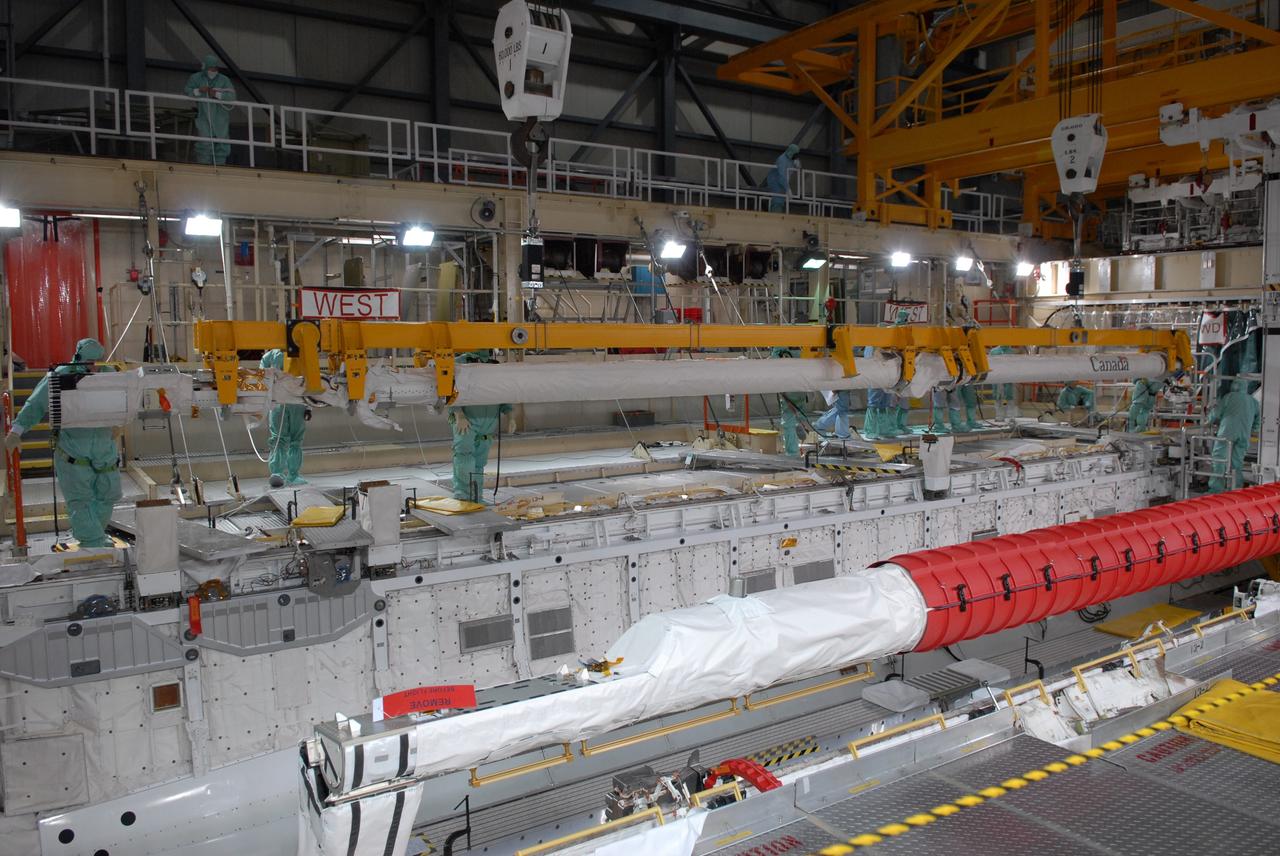
CAPE CANAVERAL, Fla. – In Orbiter Processing Facility bay 3 at NASA's Kennedy Space Center in Florida, remote manipulator system, or RMS, arm is lifted out of the payload bay of space shuttle Discovery. The RMS is used to grab, or grapple, the payload as well as retrieve, repair and deploy satellites; provide a mobile extension ladder for spacewalking crewmembers; and be used as an inspection aid to allow flight crew members to view the orbiter’s or payload’s surfaces through a TV camera on the arm. Discovery is targeted to launch Aug. 6 on the STS-128 mission. Photo credit: NASA/Jack Pfaller
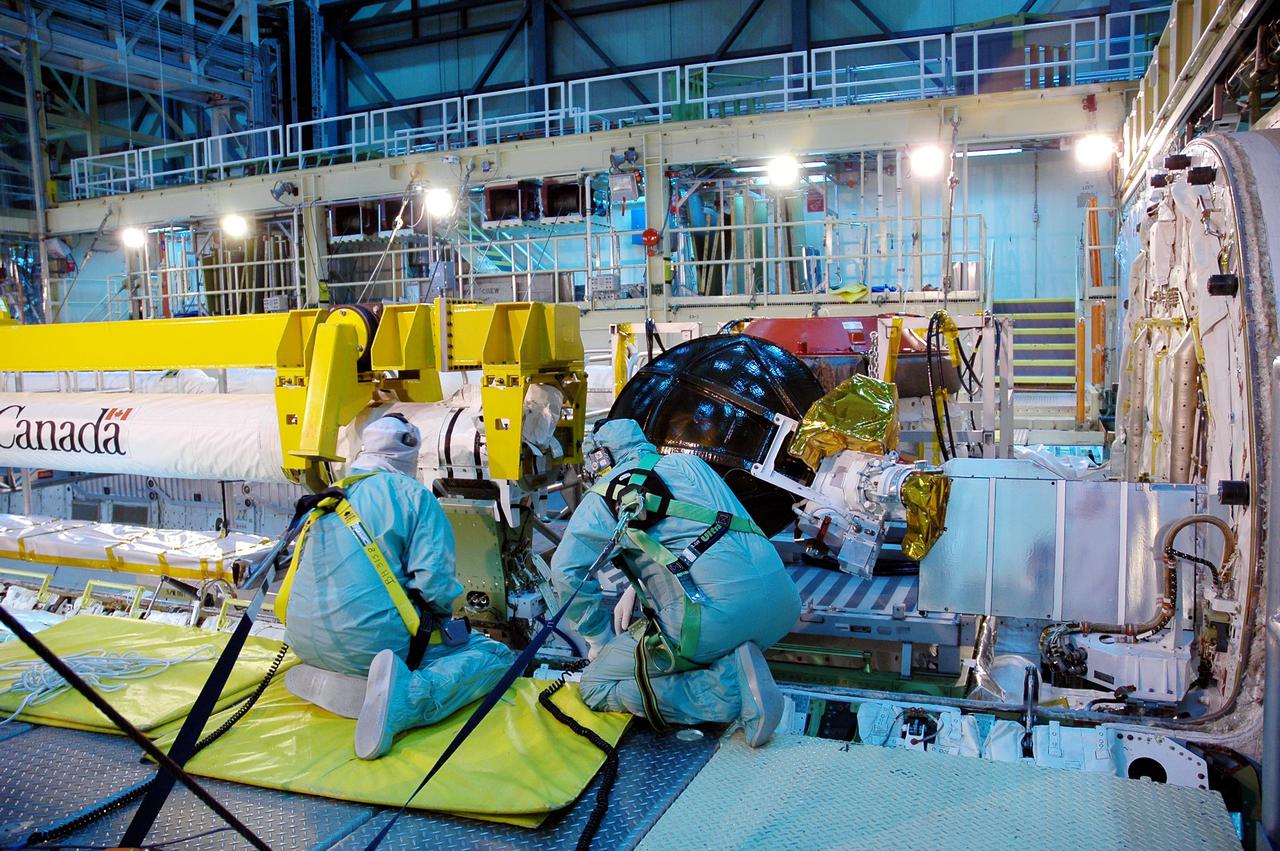
KENNEDY SPACE CENTER, FLA. - In the Orbiter Processing Facility bay 3, workers install the Orbiter Boom Sensor System (OBSS) onto the starboard side of Discovery’s payload bay. The 50-foot-long OBSS attaches to the Remote Manipulator System, or Shuttle robotic arm, and is one of the new safety measures for Return to Flight, equipping the orbiter with cameras and laser systems to inspect the Shuttle’s Thermal Protection System while in space. The Return to Flight mission, STS-114, has a launch window of May 12 to June 3, 2005.
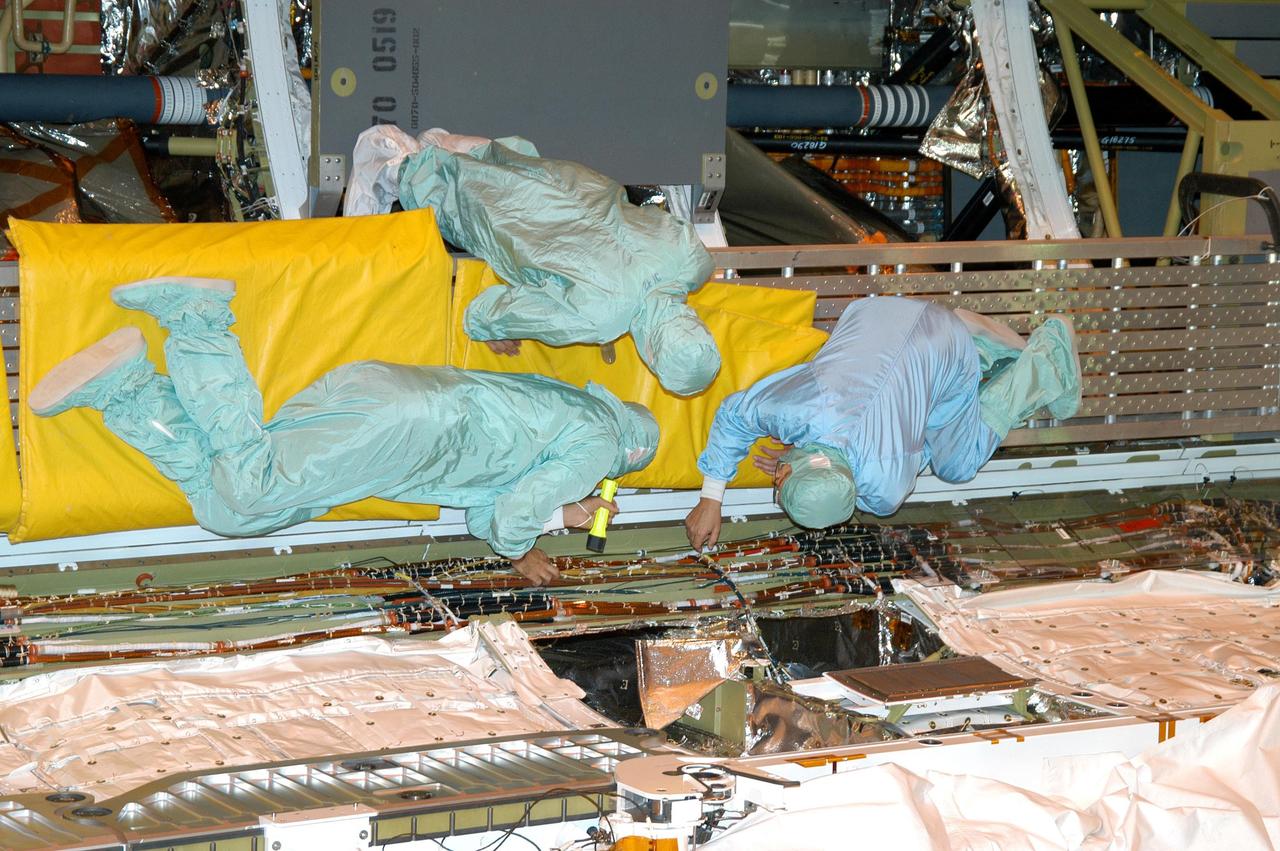
KENNEDY SPACE CENTER, FLA. - In the Orbiter Processing Facility, workers check wiring being installed in Discovery’s cargo bay that will support the addition of an Orbiter Boom Sensor System (OBSS) . The OBSS is one of the new safety measures for Return to Flight, equipping the Shuttle with cameras and laser systems to inspect the Shuttle’s Thermal Protection System while in space. Discovery is designated as the Return to Flight vehicle for mission STS-114, no earlier than March 2005
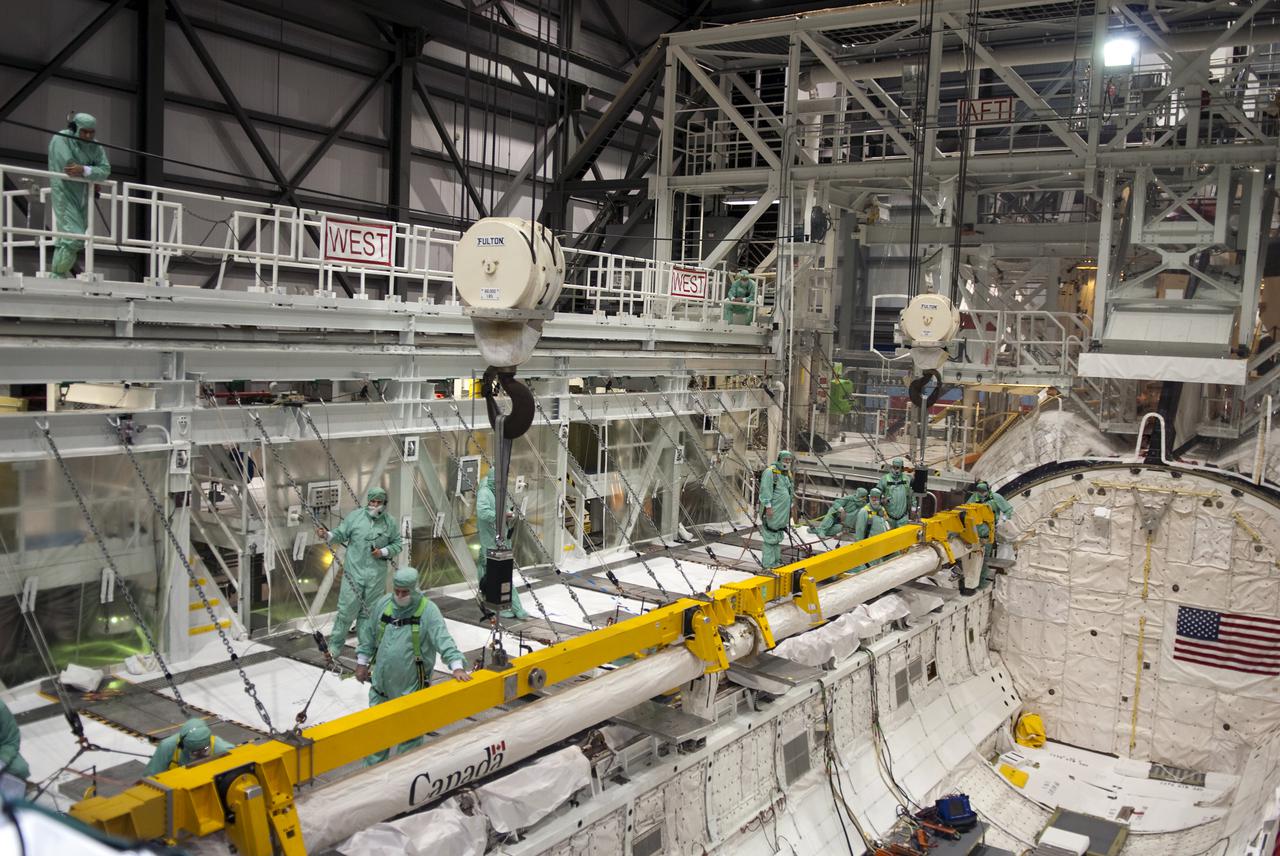
CAPE CANAVERAL, Fla. - Inside Orbiter Processing Facility-2 at Kennedy Space Center in Florida, technicians begin to detach the Orbiter Boom Sensor System, or OBSS, from the payload bay of space shuttle Endeavour. The OBSS will be transported to the Vehicle Assembly Building for refurbishment. After refurbishment, the boom will be reinstalled in Endeavour for use during the STS-134 mission, currently targeted for launch in July. Photo credit: NASA_Jim Grossmann
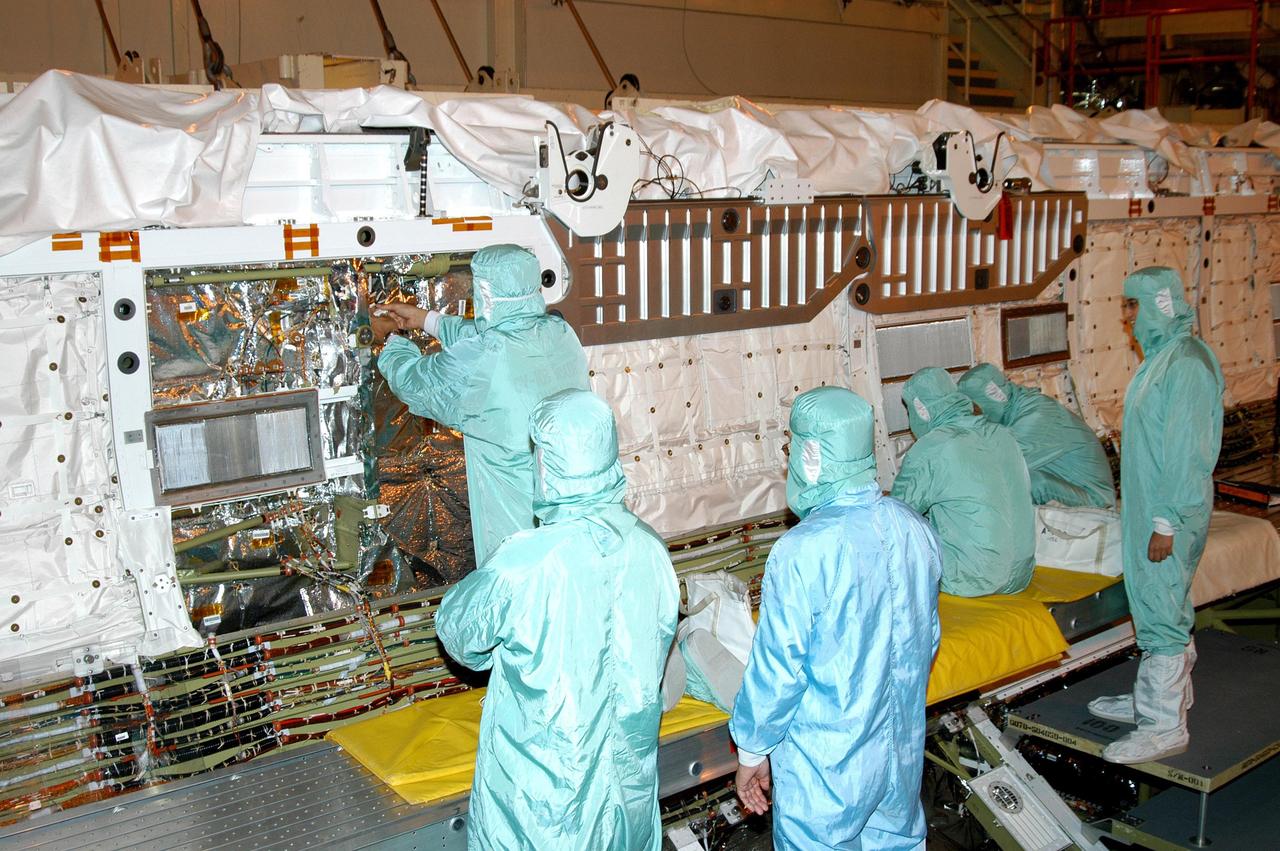
KENNEDY SPACE CENTER, FLA. - In the Orbiter Processing Facility, workers are installing wiring in Discovery’s cargo bay that will support the addition of an Orbiter Boom Sensor System (OBSS) . The OBSS is one of the new safety measures for Return to Flight, equipping the Shuttle with cameras and laser systems to inspect the Shuttle’s Thermal Protection System while in space. Discovery is designated as the Return to Flight vehicle for mission STS-114, no earlier than March 2005.
CAPE CANAVERAL, Fla. - Inside Orbiter Processing Facility-2 at Kennedy Space Center in Florida, a crane is used to lift the Orbiter Boom Sensor System, or OBSS, from the payload bay of space shuttle Endeavour. The OBSS will be transported to the Vehicle Assembly Building for refurbishment. After refurbishment, the boom will be reinstalled in Endeavour for use during the STS-134 mission, currently targeted for launch in July. Photo credit: NASA_Jim Grossmann
CAPE CANAVERAL, Fla. - Inside Orbiter Processing Facility-2 at Kennedy Space Center in Florida, technicians detach the Orbiter Boom Sensor System, or OBSS, from the payload bay of space shuttle Endeavour. The OBSS will be transported to the Vehicle Assembly Building for refurbishment. After refurbishment, the boom will be reinstalled in Endeavour for use during the STS-134 mission, currently targeted for launch in July. Photo credit: NASA_Jim Grossmann
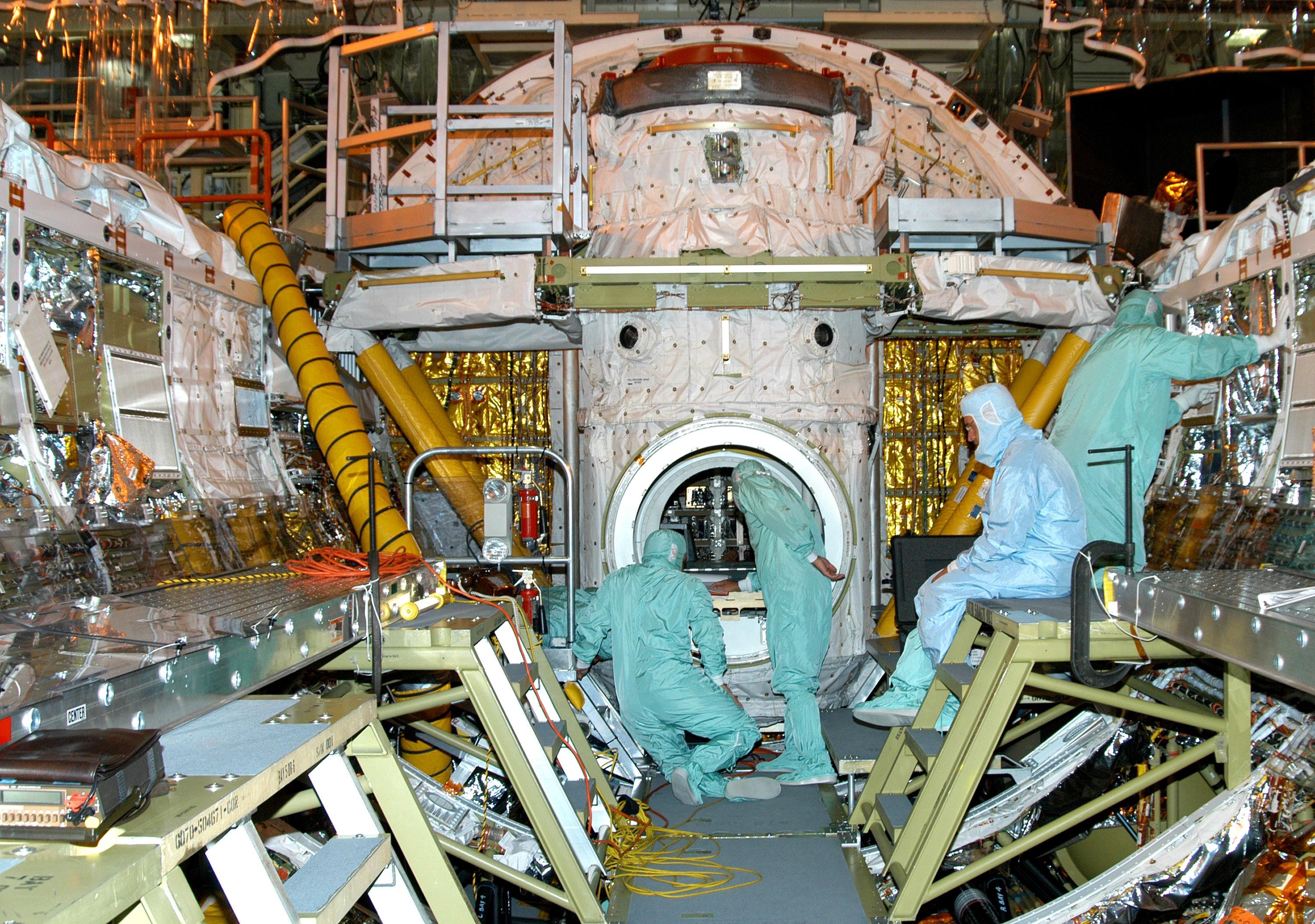
KENNEDY SPACE CENTER, FLA. - In the Orbiter Processing Facility, two workers (center) check paperwork about the wiring being installed in Discovery’s cargo bay that will support the addition of an Orbiter Boom Sensor System (OBSS) . The OBSS is one of the new safety measures for Return to Flight, equipping the Shuttle with cameras and laser systems to inspect the Shuttle’s Thermal Protection System while in space. Discovery is designated as the Return to Flight vehicle for mission STS-114, no earlier than March 2005.
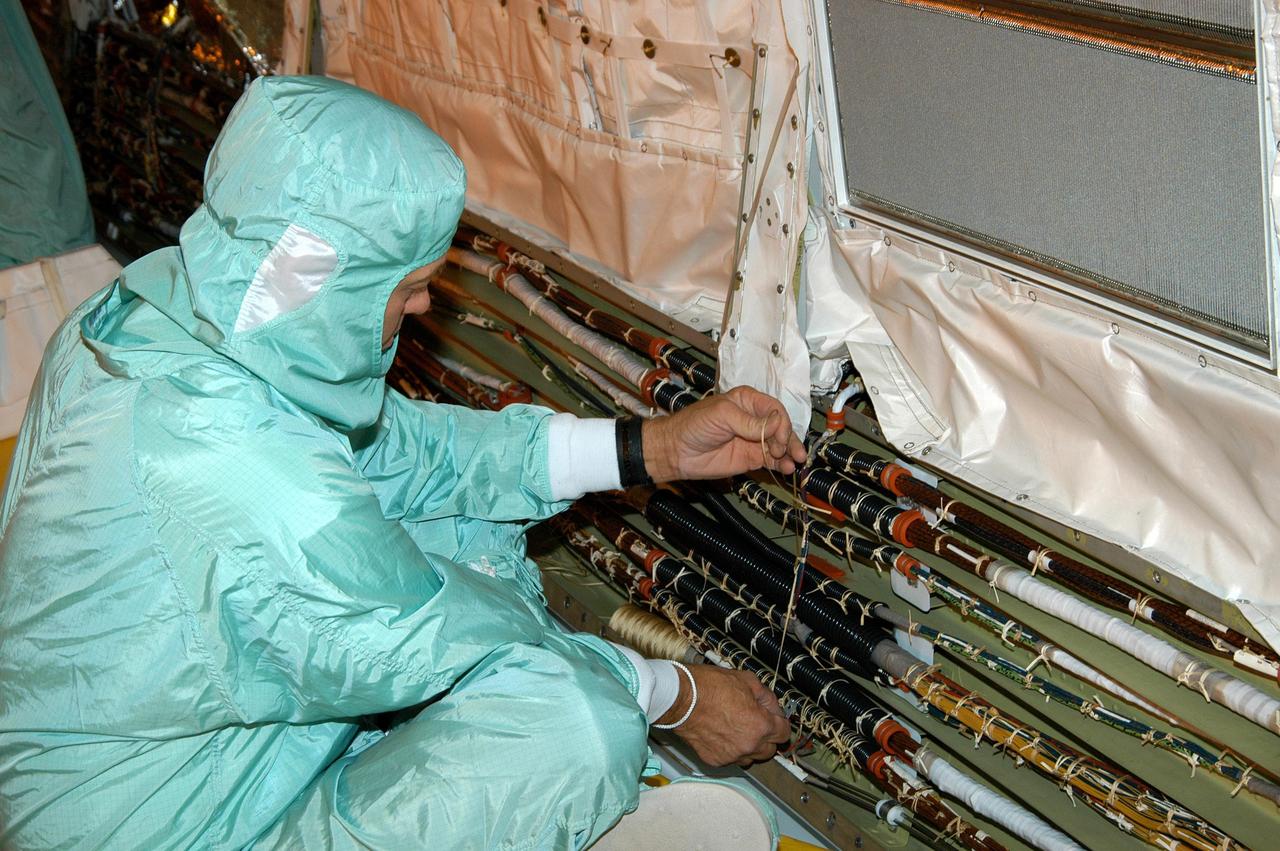
KENNEDY SPACE CENTER, FLA. - In the Orbiter Processing Facility, a worker is installing wiring in Discovery’s cargo bay that will support the addition of an Orbiter Boom Sensor System (OBSS) . The OBSS is one of the new safety measures for Return to Flight, equipping the Shuttle with cameras and laser systems to inspect the Shuttle’s Thermal Protection System while in space. Discovery is designated as the Return to Flight vehicle for mission STS-114, no earlier than March 2005.
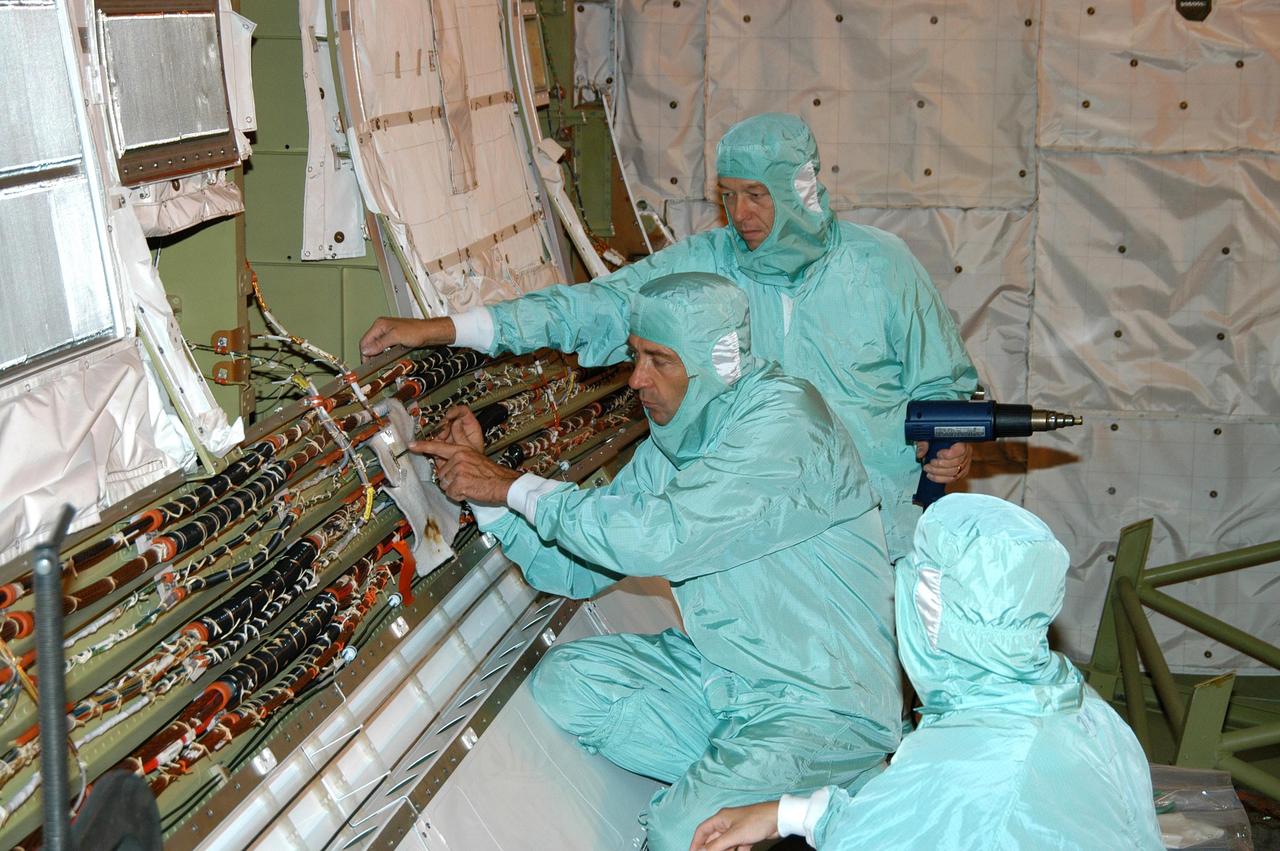
KENNEDY SPACE CENTER, FLA. - In the Orbiter Processing Facility, workers are installing in Discovery’s cargo bay wiring that will support the addition of an Orbiter Boom Sensor System (OBSS). The OBSS is one of the new safety measures for Return to Flight, equipping the Shuttle with cameras and laser systems to inspect the Shuttle’s Thermal Protection System while in space. Discovery is designated as the Return to Flight vehicle for mission STS-114, no earlier than March 2005.
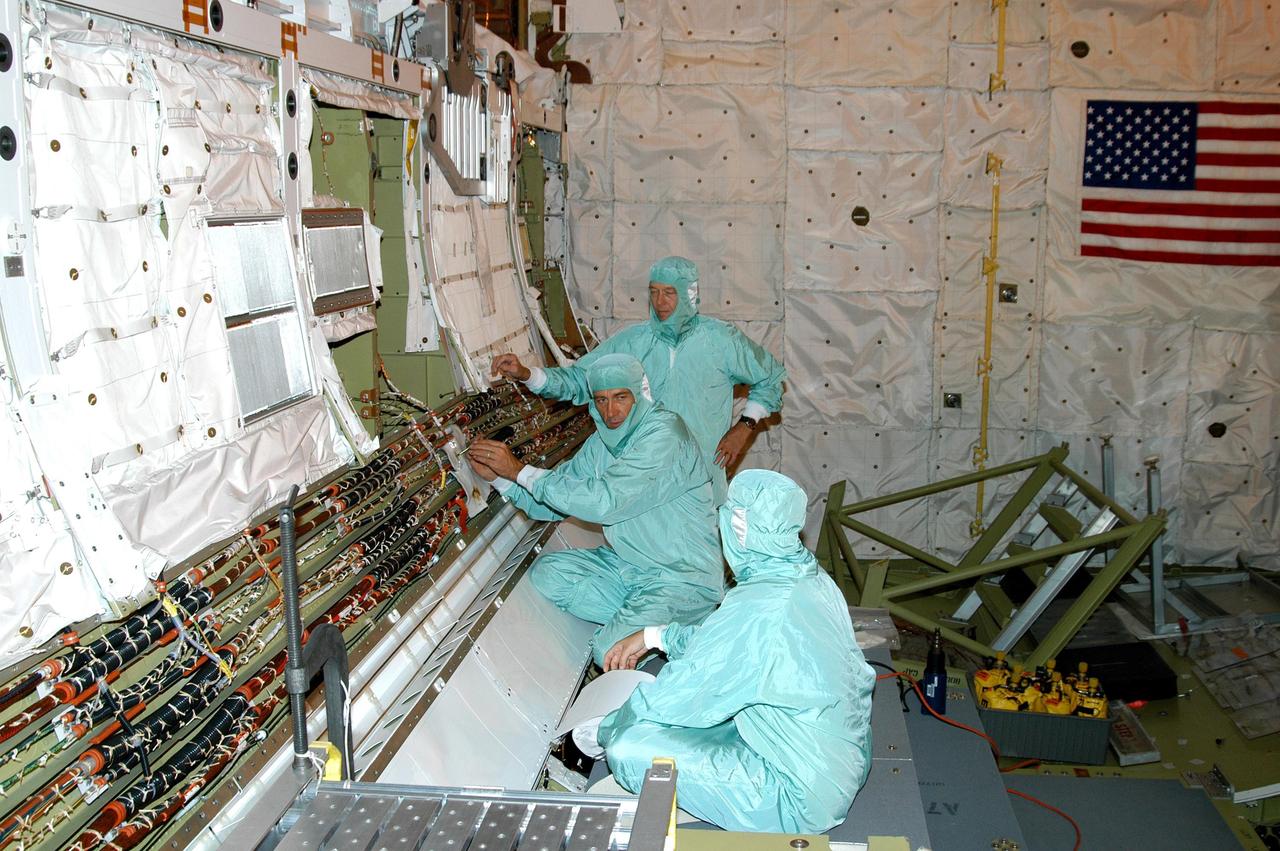
KENNEDY SPACE CENTER, FLA. - In the Orbiter Processing Facility, workers are installing wiring in Discovery’s cargo bay that will support the addition of an Orbiter Boom Sensor System (OBSS) . The OBSS is one of the new safety measures for Return to Flight, equipping the Shuttle with cameras and laser systems to inspect the Shuttle’s Thermal Protection System while in space. Discovery is designated as the Return to Flight vehicle for mission STS-114, no earlier than March 2005.
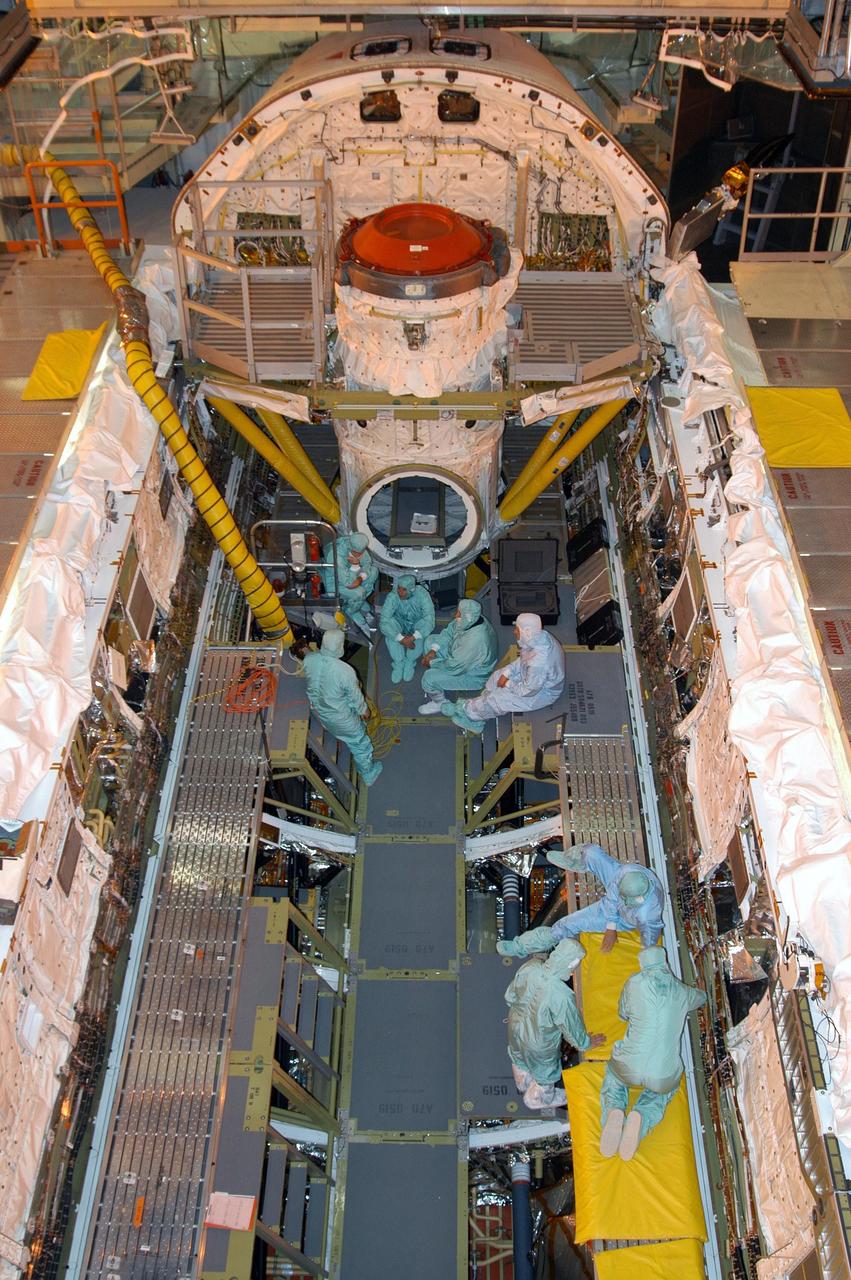
KENNEDY SPACE CENTER, FLA. - In the Orbiter Processing Facility, installation is underway in Discovery’s cargo bay of wiring that will support the addition of an Orbiter Boom Sensor System (OBSS) . The OBSS is one of the new safety measures for Return to Flight, equipping the Shuttle with cameras and laser systems to inspect the Shuttle’s Thermal Protection System while in space. Discovery is designated as the Return to Flight vehicle for mission STS-114, no earlier than March 2005.
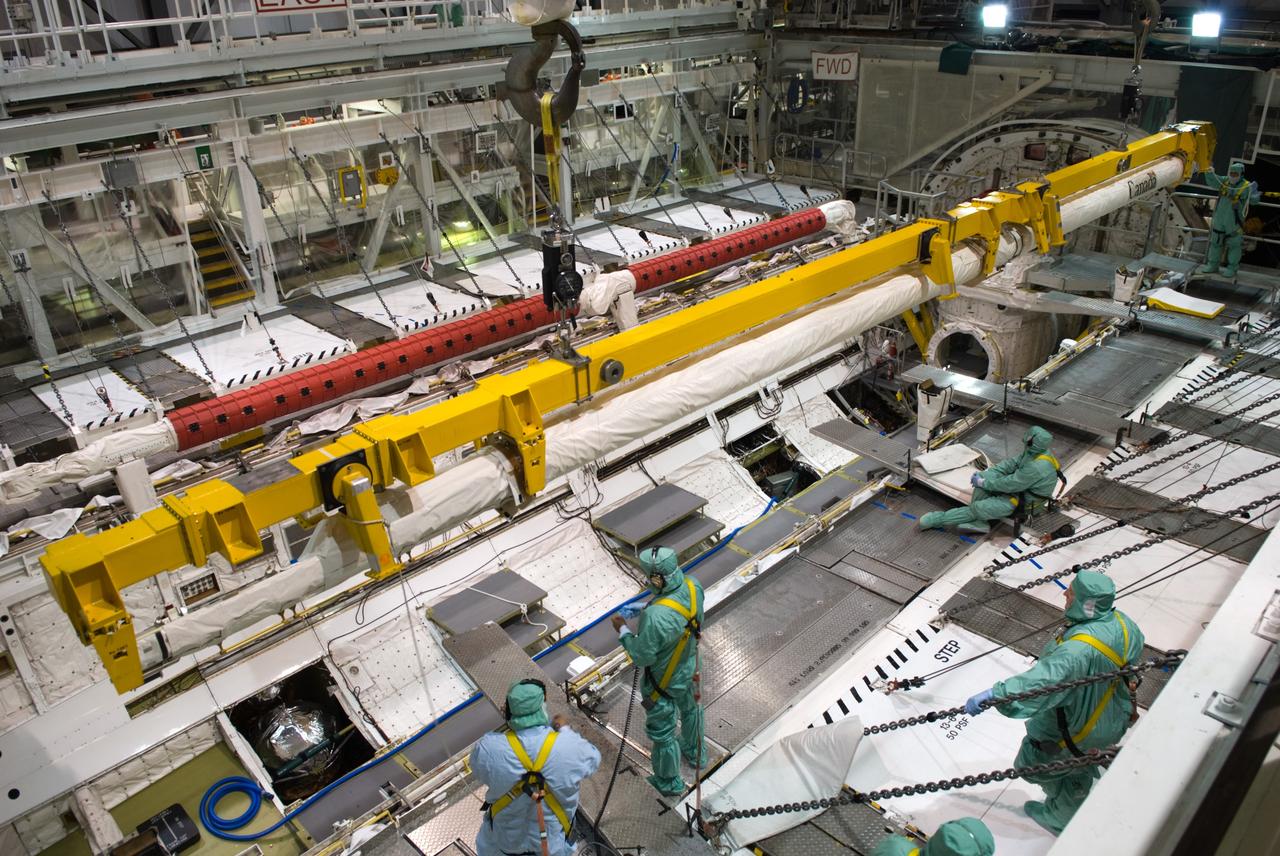
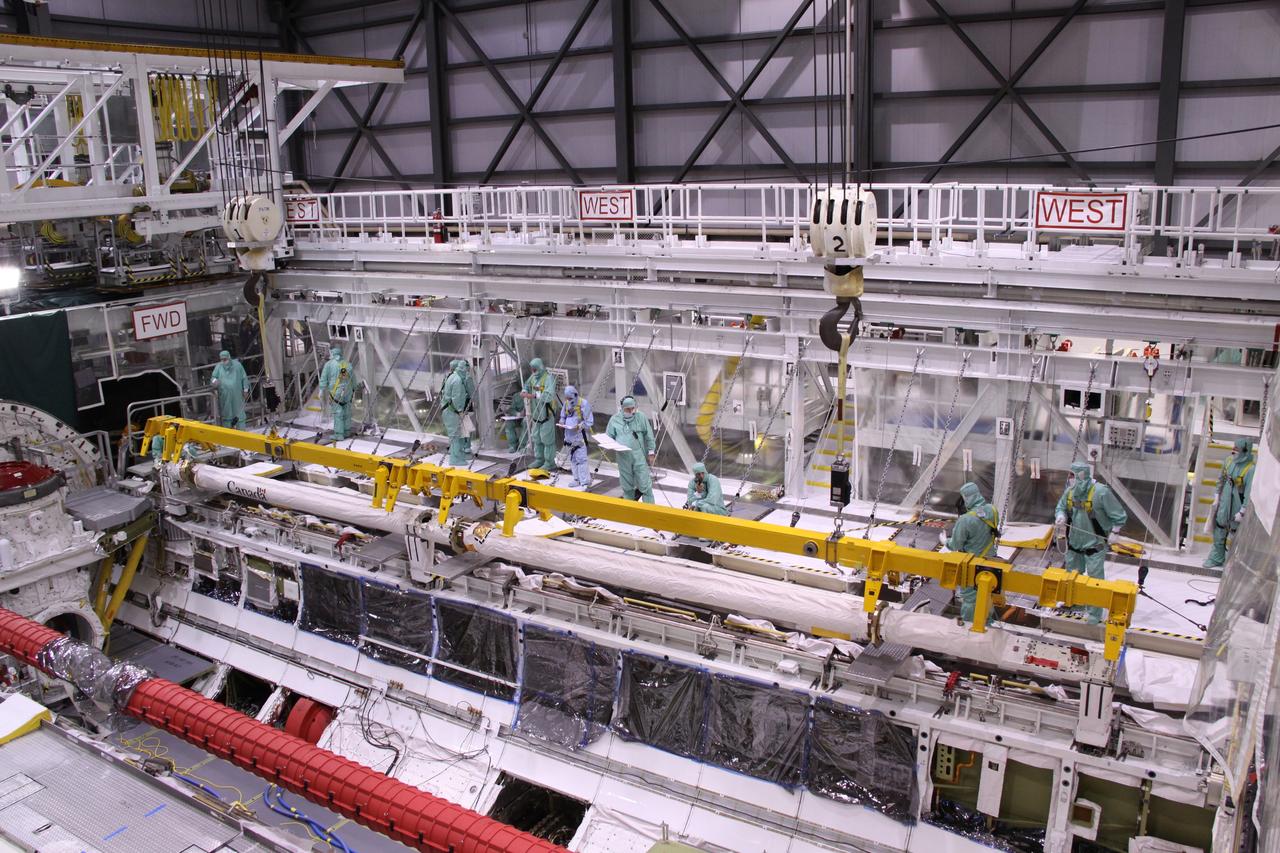
CAPE CANAVERAL, Fla. - In Orbiter Processing Facility 1 at NASA's Kennedy Space Center in Florida, a crane lowers the orbiter boom sensor system, or OBSS, into space shuttle Atlantis' payload bay where it will be installed. The OBSS' inspection boom assembly, or IBA, is removed from the arm every other processing flow for a detailed inspection. After five consecutive flights, all IBA internal components are submitted to a thorough electrical checkout in the Remote Manipulator System Lab. The 50-foot-long OBSS attaches to the end of the shuttle’s robotic arm and supports the cameras and laser systems used to inspect the shuttle’s thermal protection system while in space. Atlantis is next slated to deliver an Integrated Cargo Carrier and Russian-built Mini Research Module to the International Space Station on the STS-132 mission. Launch is targeted for May 14. Photo credit: NASA/Jim Grossmann

CAPE CANAVERAL, Fla. - In Orbiter Processing Facility 1 at NASA's Kennedy Space Center in Florida, technicians ensure that the installation of the orbiter boom sensor system, or OBSS, into space shuttle Atlantis' payload bay meets the correct specifications. The OBSS' inspection boom assembly, or IBA, is removed from the arm every other processing flow for a detailed inspection. After five consecutive flights, all IBA internal components are submitted to a thorough electrical checkout in the Remote Manipulator System Lab. The 50-foot-long OBSS attaches to the end of the shuttle’s robotic arm and supports the cameras and laser systems used to inspect the shuttle’s thermal protection system while in space. Atlantis is next slated to deliver an Integrated Cargo Carrier and Russian-built Mini Research Module to the International Space Station on the STS-132 mission. Launch is targeted for May 14. Photo credit: NASA/Jim Grossmann
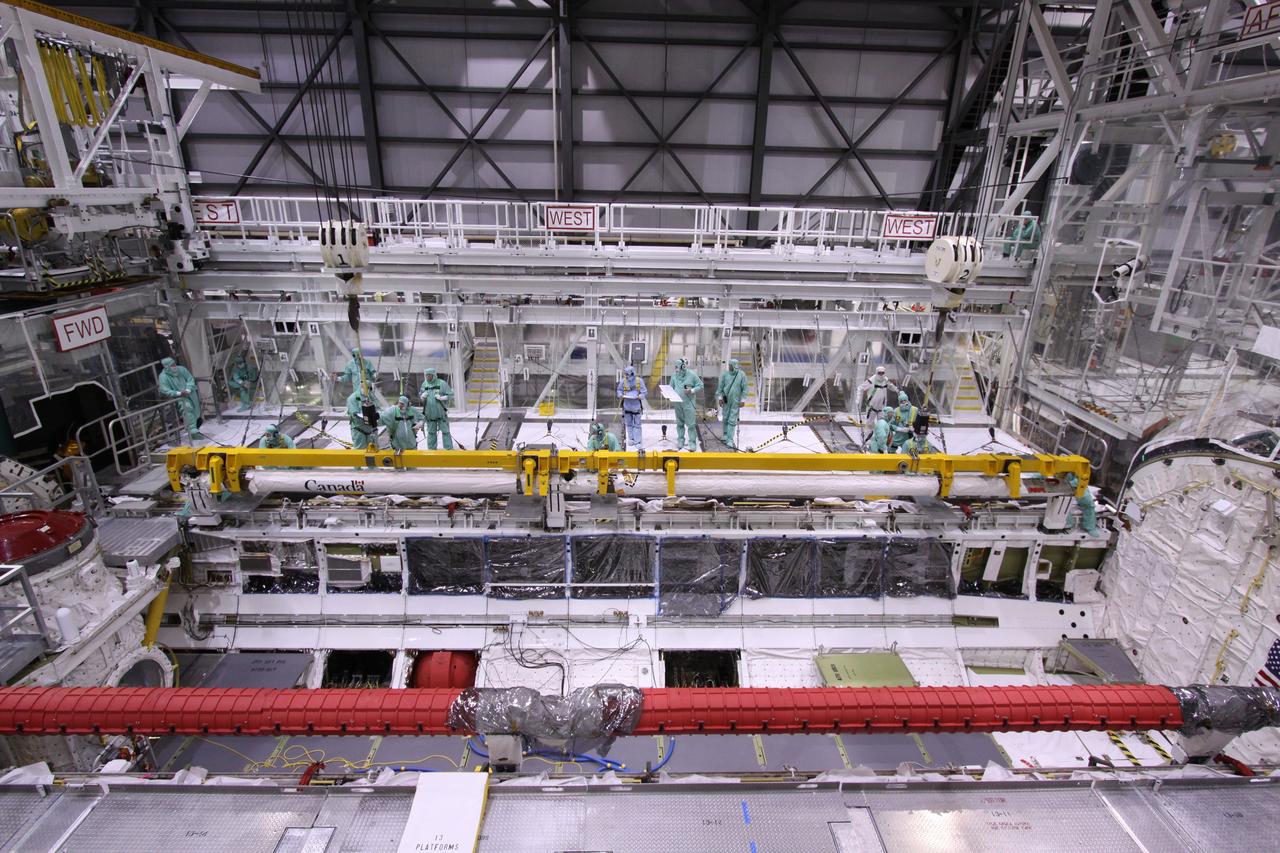
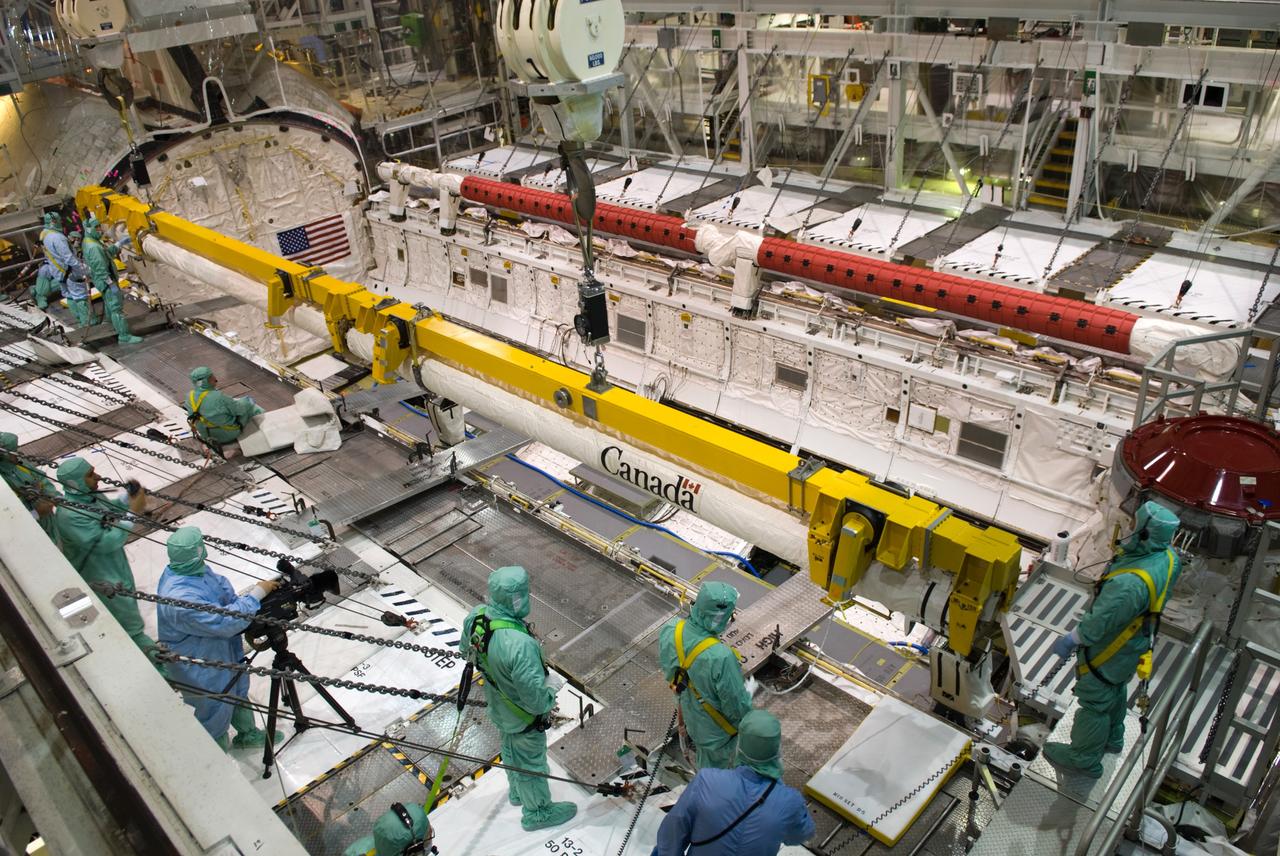
CAPE CANAVERAL, Fla. – In NASA Kennedy Space Center's Orbiter Processing Facility bay 2, space shuttle Endeavour's Orbiter Boom Sensor System is lowered into position in the shuttle's payload bay. The OBSS is being reinstalled in the payload bay. The OBSS is being reinstalled in the payload bay. The OBSS is a 50-foot boom with a laser and cameras on it that astronauts use to inspect a shuttle's heat shield while in orbit. After returning from the STS-127 mission July 31, 2009, Endeavour now is being processed for the STS-130 mission targeted for Feb. 4, 2010. Endeavour will deliver to the International Space Station the Tranquility pressurized module that will provide room for many of the station's life support systems. Photo credit: NASA/Jack Pfaller
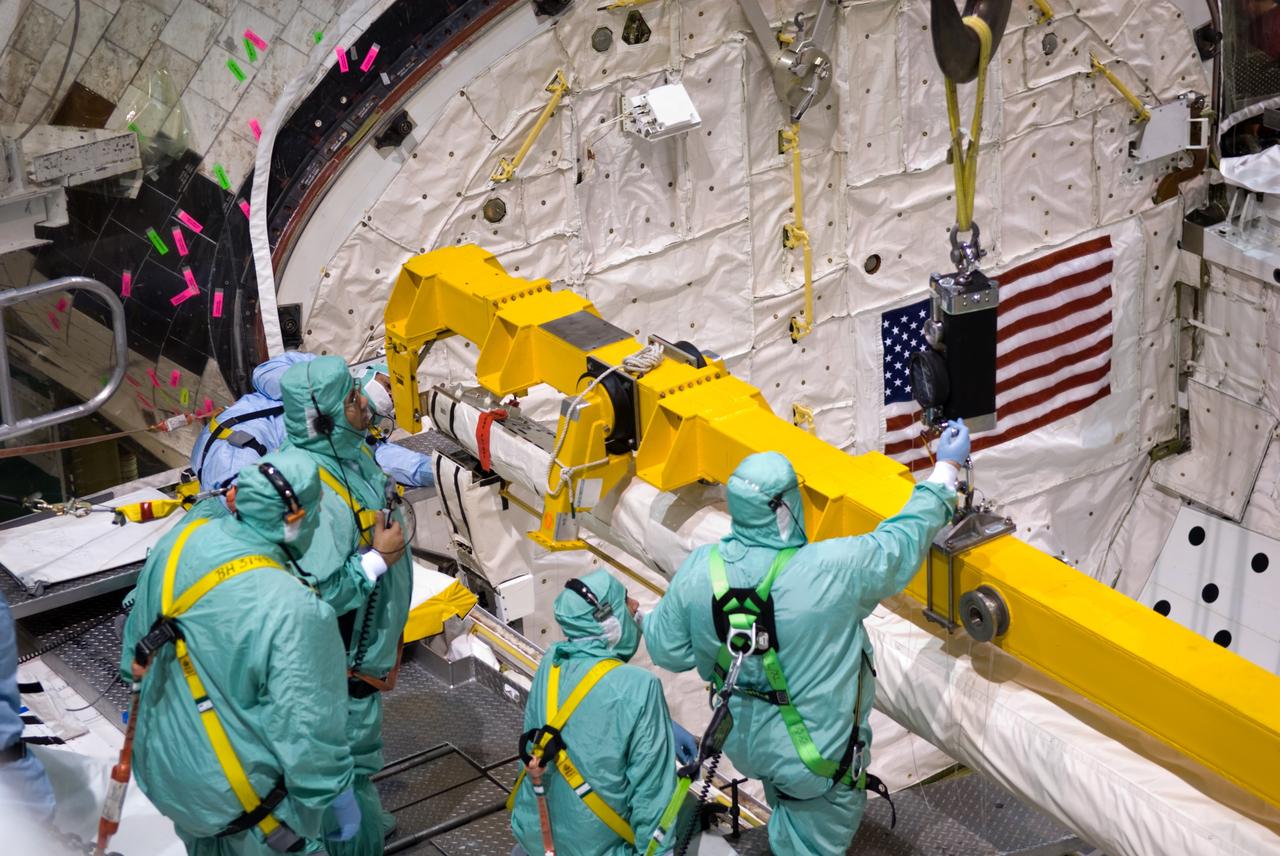
CAPE CANAVERAL, Fla. - In Orbiter Processing Facility 1 at NASA's Kennedy Space Center in Florida, installation of the orbiter boom sensor system, or OBSS, into space shuttle Atlantis' payload bay is under way. The OBSS' inspection boom assembly, or IBA, is removed from the arm every other processing flow for a detailed inspection. After five consecutive flights, all IBA internal components are submitted to a thorough electrical checkout in the Remote Manipulator System Lab. The 50-foot-long OBSS attaches to the end of the shuttle’s robotic arm and supports the cameras and laser systems used to inspect the shuttle’s thermal protection system while in space. Atlantis is next slated to deliver an Integrated Cargo Carrier and Russian-built Mini Research Module to the International Space Station on the STS-132 mission. Launch is targeted for May 14. Photo credit: NASA/Jim Grossmann

CAPE CANAVERAL, Fla. - In Orbiter Processing Facility 1 at NASA's Kennedy Space Center in Florida, the orbiter boom sensor system, or OBSS, is installed in space shuttle Atlantis' payload bay. The OBSS' inspection boom assembly, or IBA, is removed from the arm every other processing flow for a detailed inspection. After five consecutive flights, all IBA internal components are submitted to a thorough electrical checkout in the Remote Manipulator System Lab. The 50-foot-long OBSS attaches to the end of the shuttle’s robotic arm and supports the cameras and laser systems used to inspect the shuttle’s thermal protection system while in space. Atlantis is next slated to deliver an Integrated Cargo Carrier and Russian-built Mini Research Module to the International Space Station on the STS-132 mission. Launch is targeted for May 14. Photo credit: NASA/Jim Grossmann
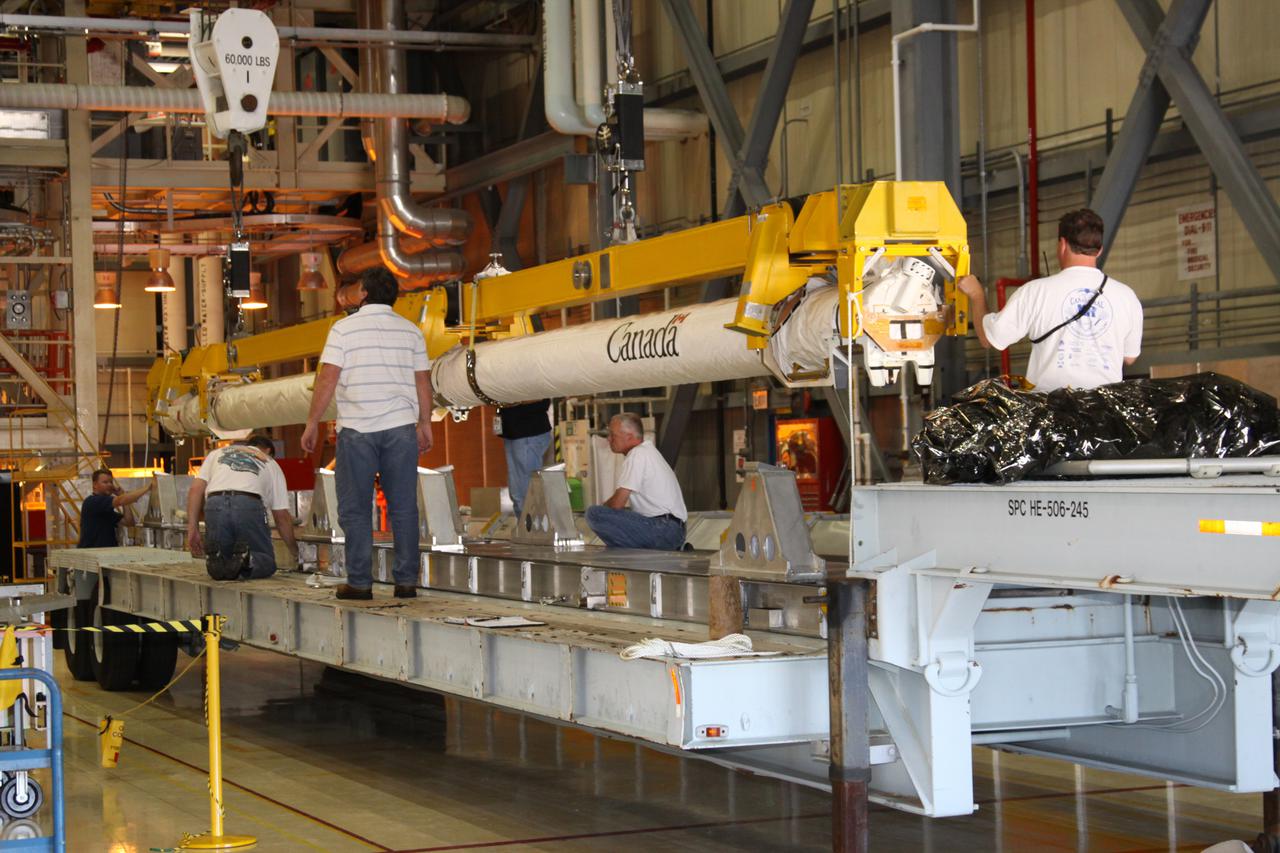
CAPE CANAVERAL, Fla. - In Orbiter Processing Facility-3 at NASA's Kennedy Space Center in Florida, the orbiter boom sensor system, or OBSS, removed from space shuttle Discovery's payload bay, is positioned over a transporter. The 50-foot-long OBSS attaches to the end of the shuttle’s robotic arm and supports the cameras and laser systems used to inspect the shuttle’s thermal protection system while in space. The OBSS' inspection boom assembly, or IBA, is removed from the arm every other processing flow for a detailed inspection. After five consecutive flights, all IBA internal components are submitted to a thorough electrical checkout in Kennedy's Remote Manipulator System Lab. Discovery next will deliver the first Permanent Multi-purpose Module, or PMM; the Express Logistics Carrier 4; and critical spare parts to the International Space Station on the STS-133 mission. Launch is targeted for Sept. 16. Photo credit: NASA_Jack Pfaller
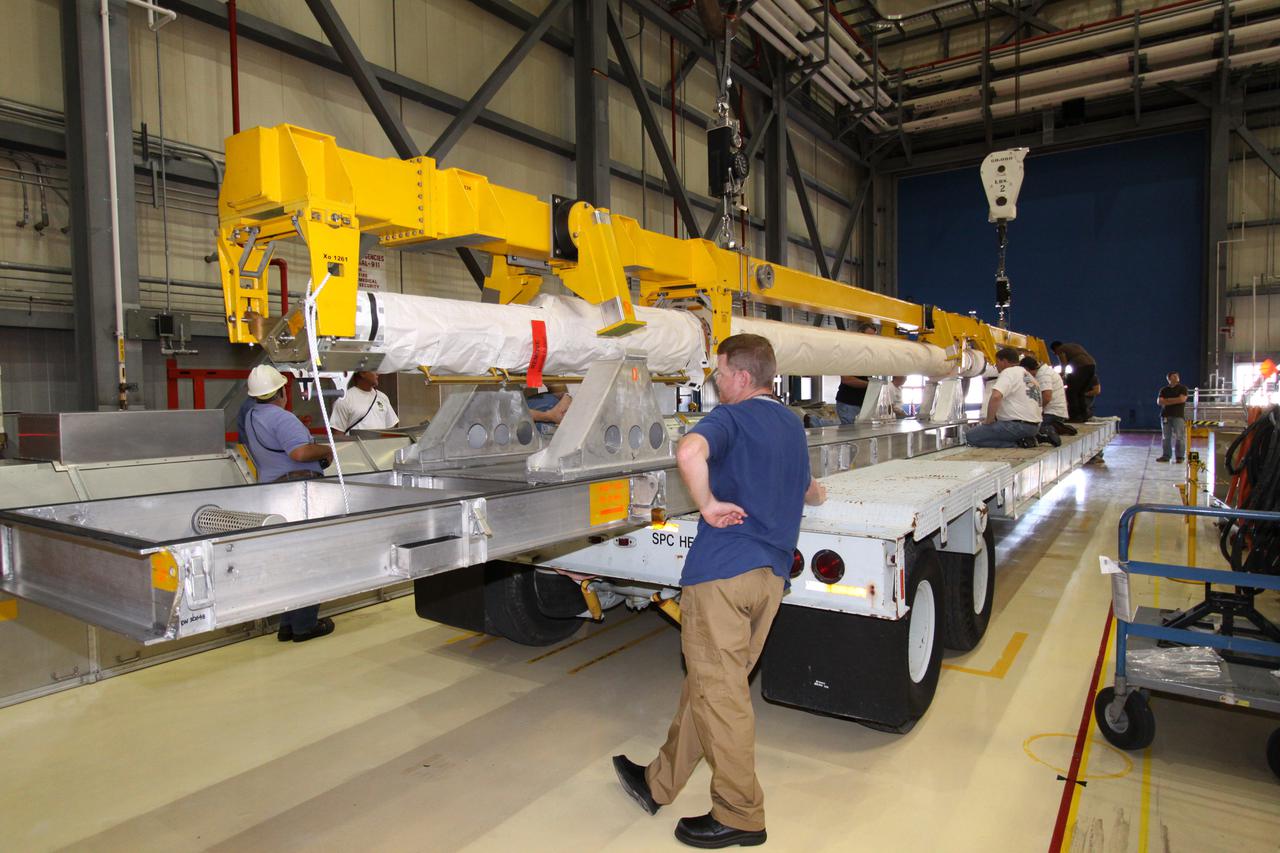
CAPE CANAVERAL, Fla. - In Orbiter Processing Facility-3 at NASA's Kennedy Space Center in Florida, the orbiter boom sensor system, or OBSS, removed from space shuttle Discovery's payload bay, is secured on a transporter. The 50-foot-long OBSS attaches to the end of the shuttle’s robotic arm and supports the cameras and laser systems used to inspect the shuttle’s thermal protection system while in space. The OBSS' inspection boom assembly, or IBA, is removed from the arm every other processing flow for a detailed inspection. After five consecutive flights, all IBA internal components are submitted to a thorough electrical checkout in Kennedy's Remote Manipulator System Lab. Discovery next will deliver the first Permanent Multi-purpose Module, or PMM; the Express Logistics Carrier 4; and critical spare parts to the International Space Station on the STS-133 mission. Launch is targeted for Sept. 16. Photo credit: NASA_Jack Pfaller
CAPE CANAVERAL, Fla. - In Orbiter Processing Facility 1 at NASA's Kennedy Space Center in Florida, technicians prepare to install the orbiter boom sensor system, or OBSS, into space shuttle Atlantis' payload bay. The OBSS' inspection boom assembly, or IBA, is removed from the arm every other processing flow for a detailed inspection. After five consecutive flights, all IBA internal components are submitted to a thorough electrical checkout in the Remote Manipulator System Lab. The 50-foot-long OBSS attaches to the end of the shuttle’s robotic arm and supports the cameras and laser systems used to inspect the shuttle’s thermal protection system while in space. Atlantis is next slated to deliver an Integrated Cargo Carrier and Russian-built Mini Research Module to the International Space Station on the STS-132 mission. Launch is targeted for May 14. Photo credit: NASA/Jim Grossmann
CAPE CANAVERAL, Fla. – In NASA Kennedy Space Center's Orbiter Processing Facility bay 2, space shuttle Endeavour's Orbiter Boom Sensor System is lowered into position in the shuttle's payload bay. The OBSS is being reinstalled in the payload bay. The OBSS is being reinstalled in the payload bay. The OBSS is a 50-foot boom with a laser and cameras on it that astronauts use to inspect a shuttle's heat shield while in orbit. After returning from the STS-127 mission July 31, 2009, Endeavour now is being processed for the STS-130 mission targeted for Feb. 4, 2010. Endeavour will deliver to the International Space Station the Tranquility pressurized module that will provide room for many of the station's life support systems. Photo credit: NASA/Jack Pfaller
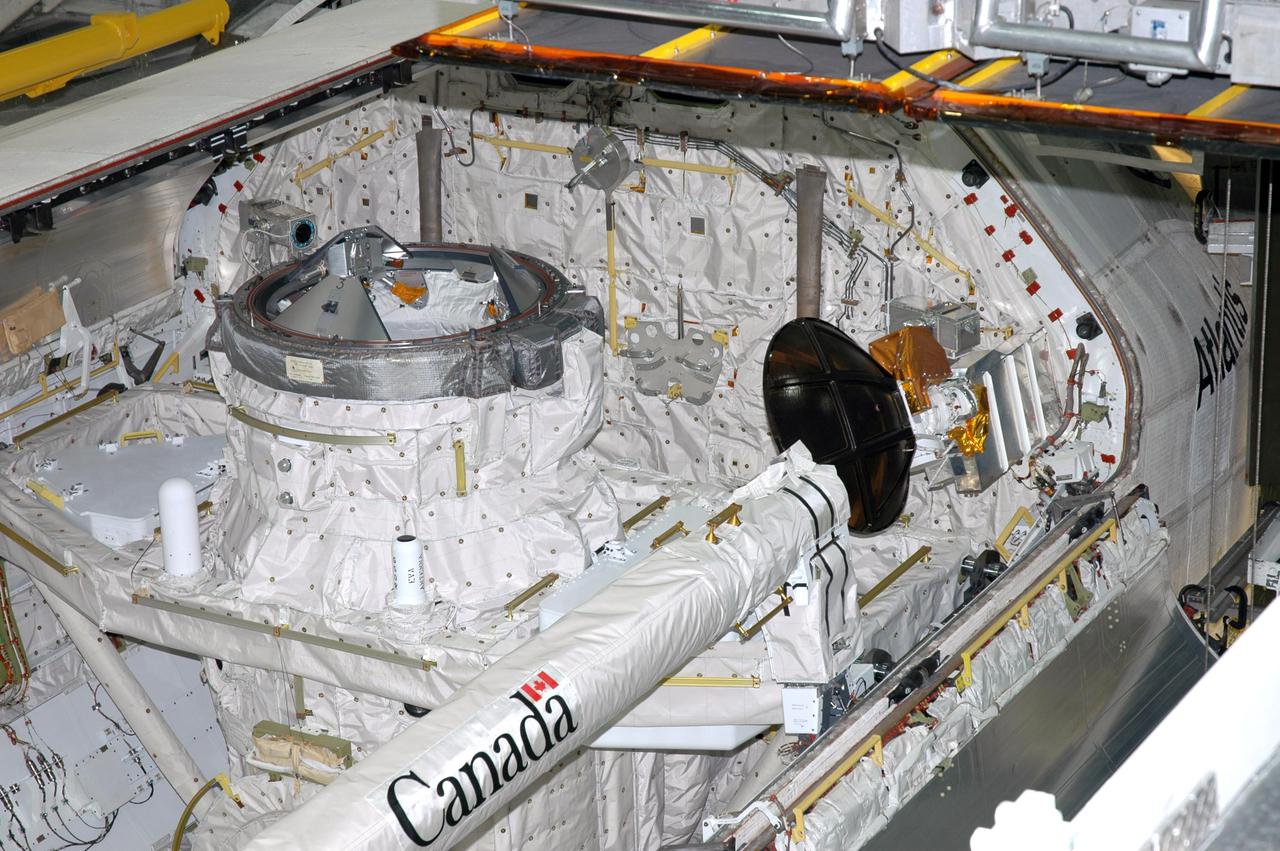
KENNEDY SPACE CENTER, FLA. - In the Orbiter Processing Facility at Kennedy Space Center in Florida, the payload bay doors of the orbiter Atlantis are being closed. The Orbiter Boom Sensor System (OBSS) is seen on the starboard side (right) of the payload bay. The 50-foot-long OBSS attaches to the Remote Manipulator System, or Shuttle arm, and is one of the new safety measures for Return to Flight. It equips the orbiter with cameras and laser systems to inspect the Shuttle’s Thermal Protection System while in space. At left of the OBSS is Atlantis’ airlock, which is sized to accommodate two fully suited flight crew members simultaneously. Support functions include airlock depressurization and repressurization, extravehicular activity equipment recharge, liquid-cooled garment water cooling, EVA equipment checkout, and communications. Atlantis is scheduled to fly on the second Return to Flight mission, STS-121, targeted for launch in a window extending from Sept. 9 to Sept. 24.
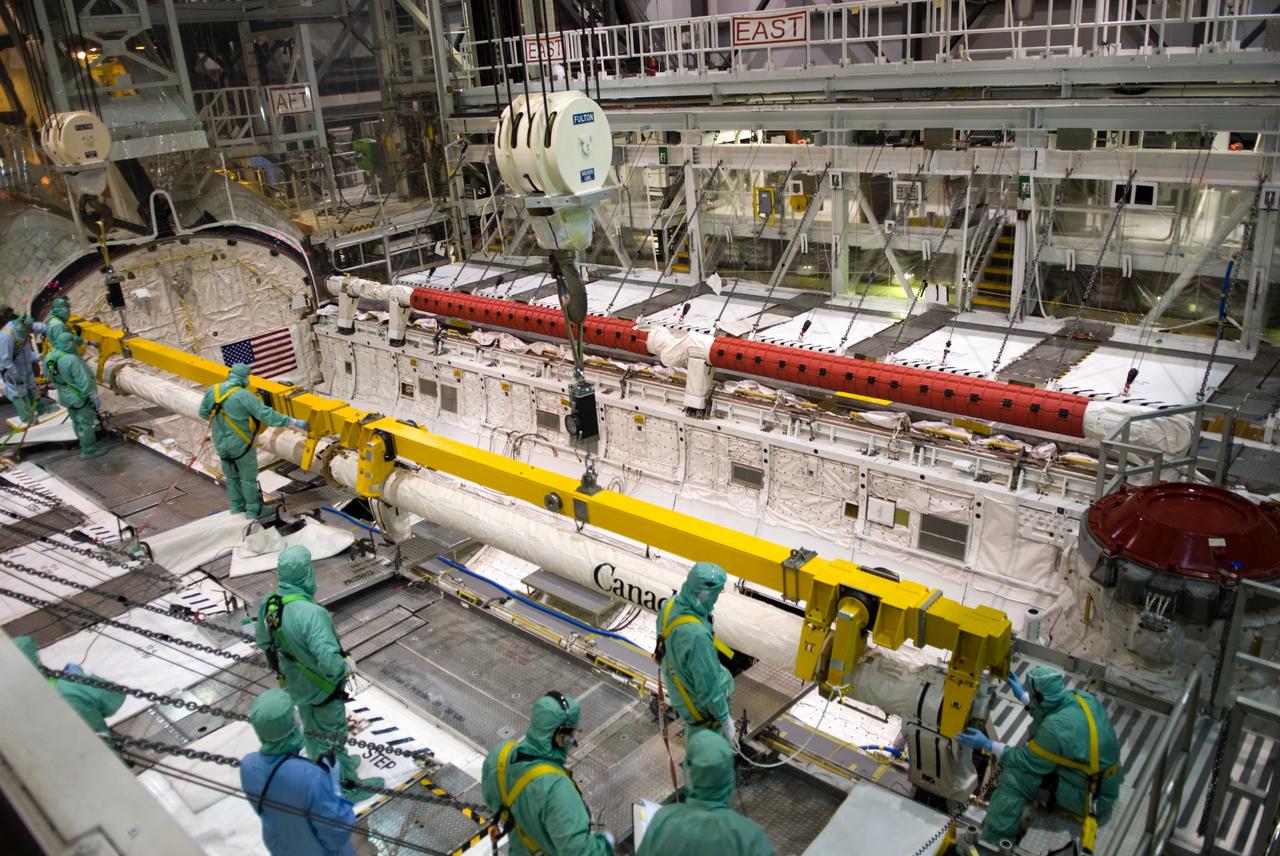
CAPE CANAVERAL, Fla. - In Orbiter Processing Facility 1 at NASA's Kennedy Space Center in Florida, technicians install the orbiter boom sensor system, or OBSS, in space shuttle Atlantis' payload bay across from the remote manipulator system arm. The OBSS' inspection boom assembly, or IBA, is removed from the arm every other processing flow for a detailed inspection. After five consecutive flights, all IBA internal components are submitted to a thorough electrical checkout in the Remote Manipulator System Lab. The 50-foot-long OBSS attaches to the end of the shuttle’s robotic arm and supports the cameras and laser systems used to inspect the shuttle’s thermal protection system while in space. Atlantis is next slated to deliver an Integrated Cargo Carrier and Russian-built Mini Research Module to the International Space Station on the STS-132 mission. Launch is targeted for May 14. Photo credit: NASA/Jim Grossmann
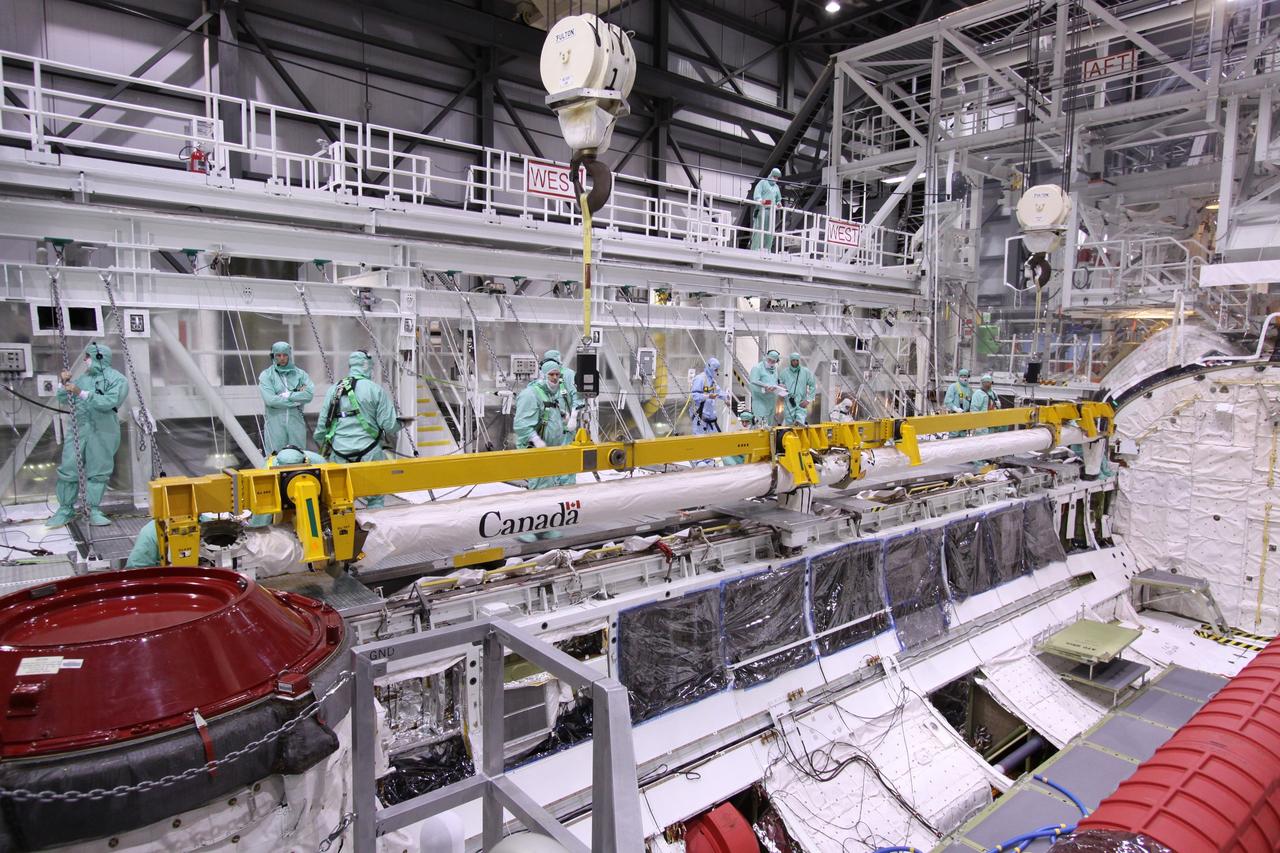
CAPE CANAVERAL, Fla. – In NASA Kennedy Space Center's Orbiter Processing Facility bay 2, workers check the movement of space shuttle Endeavour's Orbiter Boom Sensor System as it is lowered into the payload bay. The OBSS is being reinstalled in the payload bay. The OBSS is being reinstalled in the payload bay. The OBSS is a 50-foot boom with a laser and cameras on it that astronauts use to inspect a shuttle's heat shield while in orbit. After returning from the STS-127 mission July 31, 2009, Endeavour now is being processed for the STS-130 mission targeted for Feb. 4, 2010. Endeavour will deliver to the International Space Station the Tranquility pressurized module that will provide room for many of the station's life support systems. Photo credit: NASA/Jack Pfaller
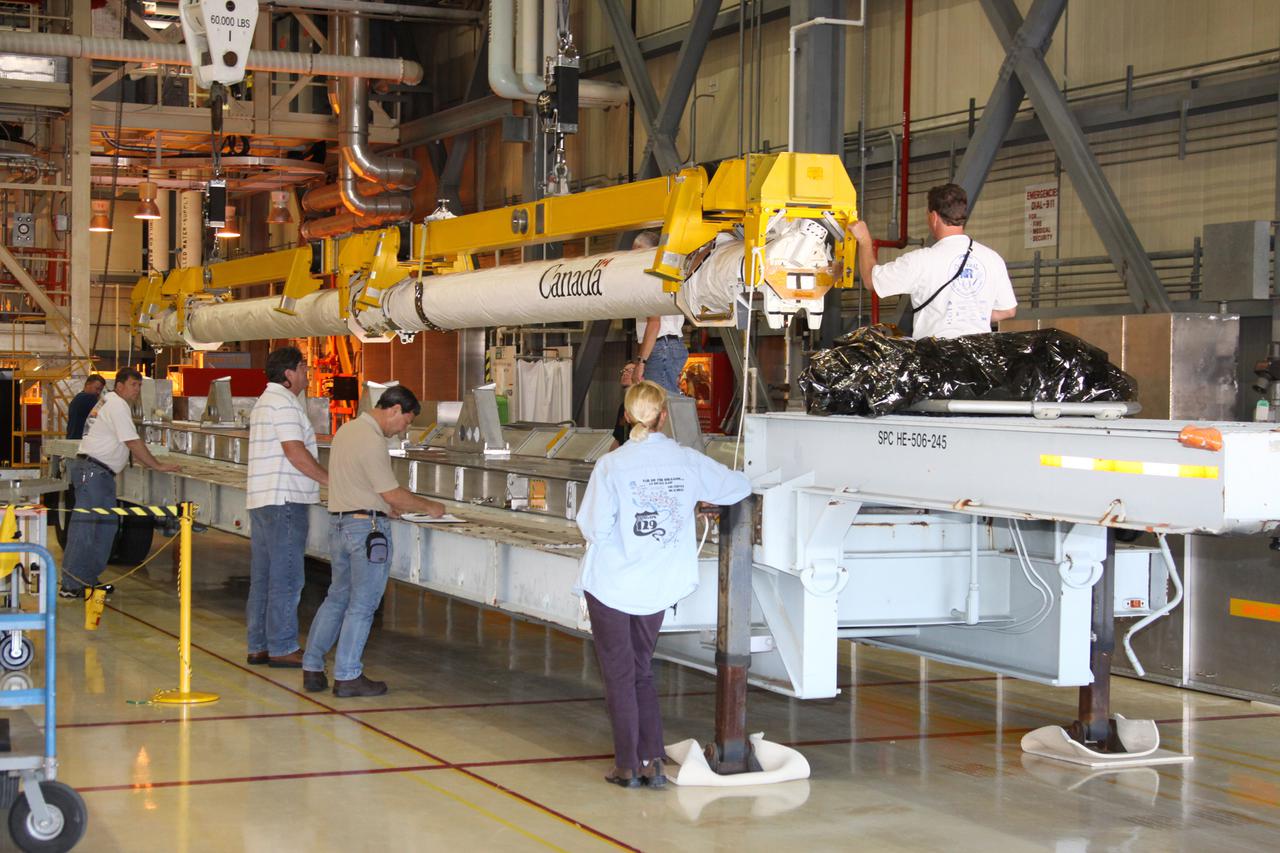
CAPE CANAVERAL, Fla. - In Orbiter Processing Facility-3 at NASA's Kennedy Space Center in Florida, the orbiter boom sensor system, or OBSS, removed from space shuttle Discovery's payload bay, is lowered onto a transporter. The 50-foot-long OBSS attaches to the end of the shuttle’s robotic arm and supports the cameras and laser systems used to inspect the shuttle’s thermal protection system while in space. The OBSS' inspection boom assembly, or IBA, is removed from the arm every other processing flow for a detailed inspection. After five consecutive flights, all IBA internal components are submitted to a thorough electrical checkout in Kennedy's Remote Manipulator System Lab. Discovery next will deliver the first Permanent Multi-purpose Module, or PMM; the Express Logistics Carrier 4; and critical spare parts to the International Space Station on the STS-133 mission. Launch is targeted for Sept. 16. Photo credit: NASA_Jack Pfaller
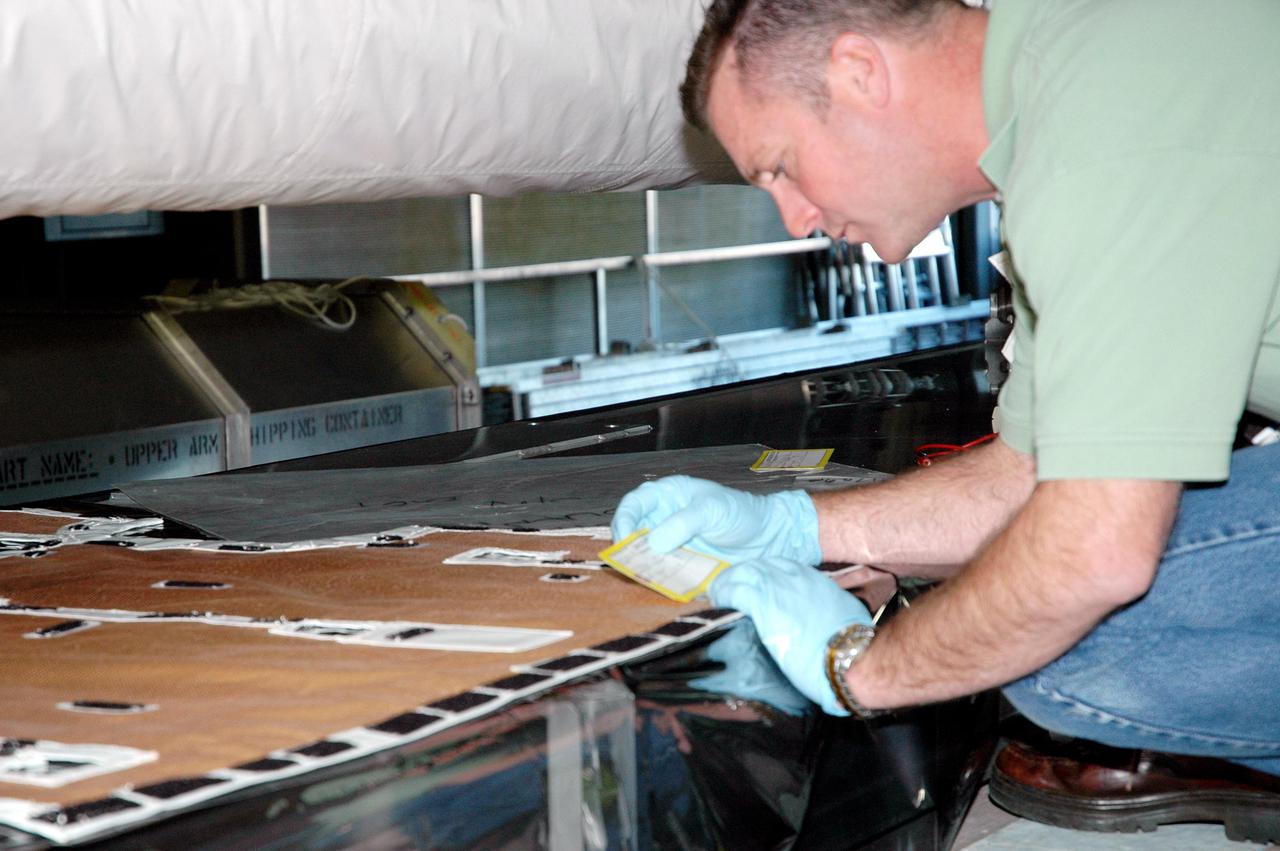
KENNEDY SPACE CENTER, FLA. - In the back transfer aisle of the Orbiter Processing Facility bay 3, a worker checks paperwork for the Thermal Protection System (TPS) blanket to be wrapped around the Orbiter Boom Sensor System (OBSS). The installation of the insulation concludes TPS closeout prior to installation of the boom in the orbiter Discovery. The OBSS is one of the new safety measures for Return to Flight, equipping the Shuttle with cameras and laser systems to inspect the Shuttle’s Thermal Protection System while in space. Discovery is designated as the Return to Flight vehicle for mission STS-114, with a launch window of May 12 to June 3, 2005.

KENNEDY SPACE CENTER, FLA. - In the Orbiter Processing Facility bay 3, workers oversee the lowering of the Orbiter Boom Sensor System (OBSS) on the starboard side of Discovery’s payload bay. At lower right is the Remote Manipulator System (RMS), or Shuttle robotic arm. The 50-foot-long OBSS attaches to the RMS, and is one of the new safety measures for Return to Flight, equipping the orbiter with cameras and laser systems to inspect the Shuttle’s Thermal Protection System while in space. The Return to Flight mission, STS-114, has a launch window of May 12 to June 3, 2005.
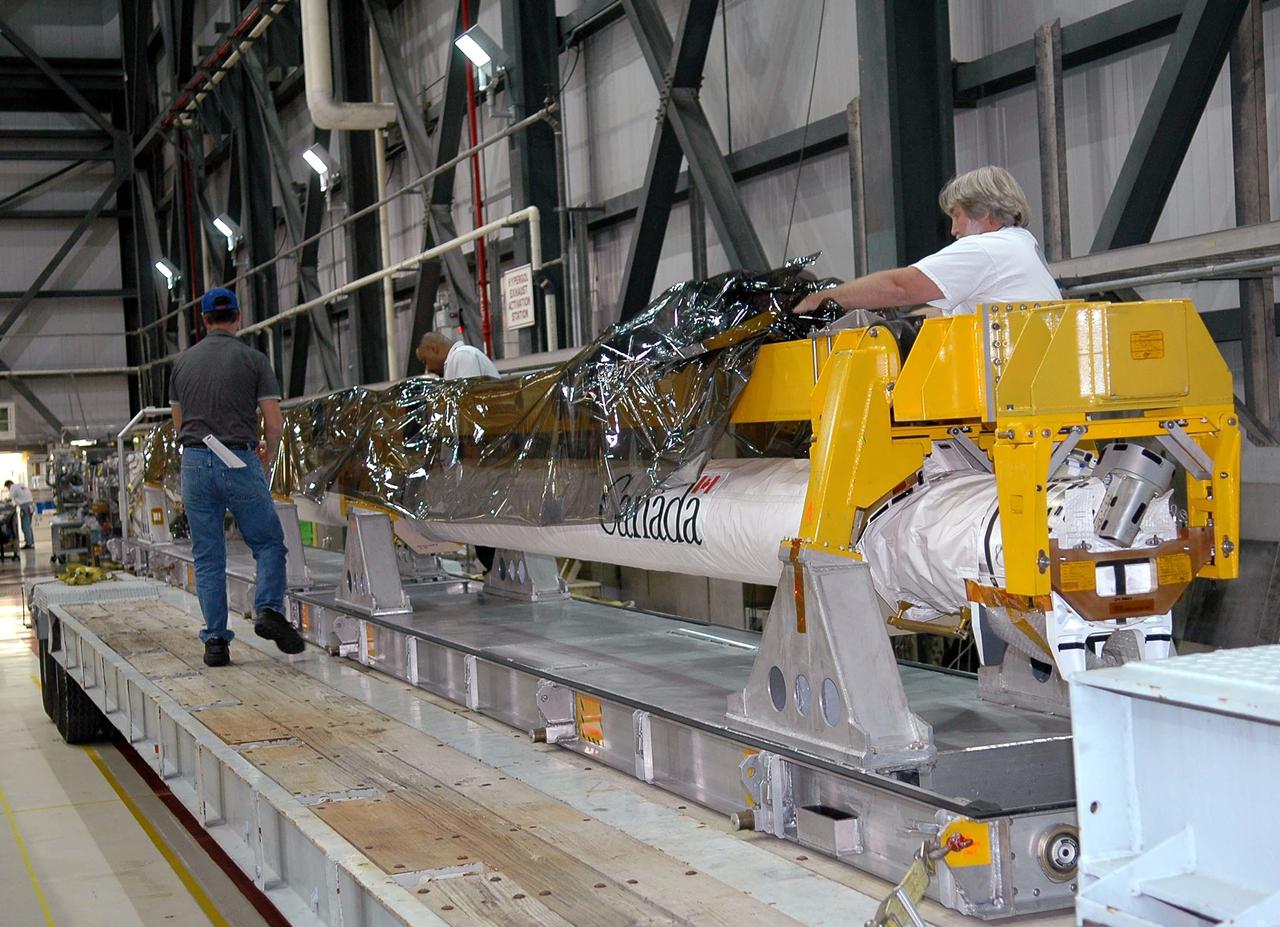
KENNEDY SPACE CENTER, FLA. - In the Orbiter Processing Facility bay 1 at NASA’s Kennedy Space Center, workers begin removing the protective cover from the Orbital Boom Sensor System (OBSS) to be installed in the payload bay of Atlantis. The 50-foot-long OBSS attaches to the Remote Manipulator System, or Shuttle robotic arm, and is one of the new safety measures for Return to Flight, equipping the orbiter with cameras and laser systems to inspect the Shuttle’s Thermal Protection System while in space. The Return to Flight mission STS-121 has a launch window of July 12 - July 31, 2005.
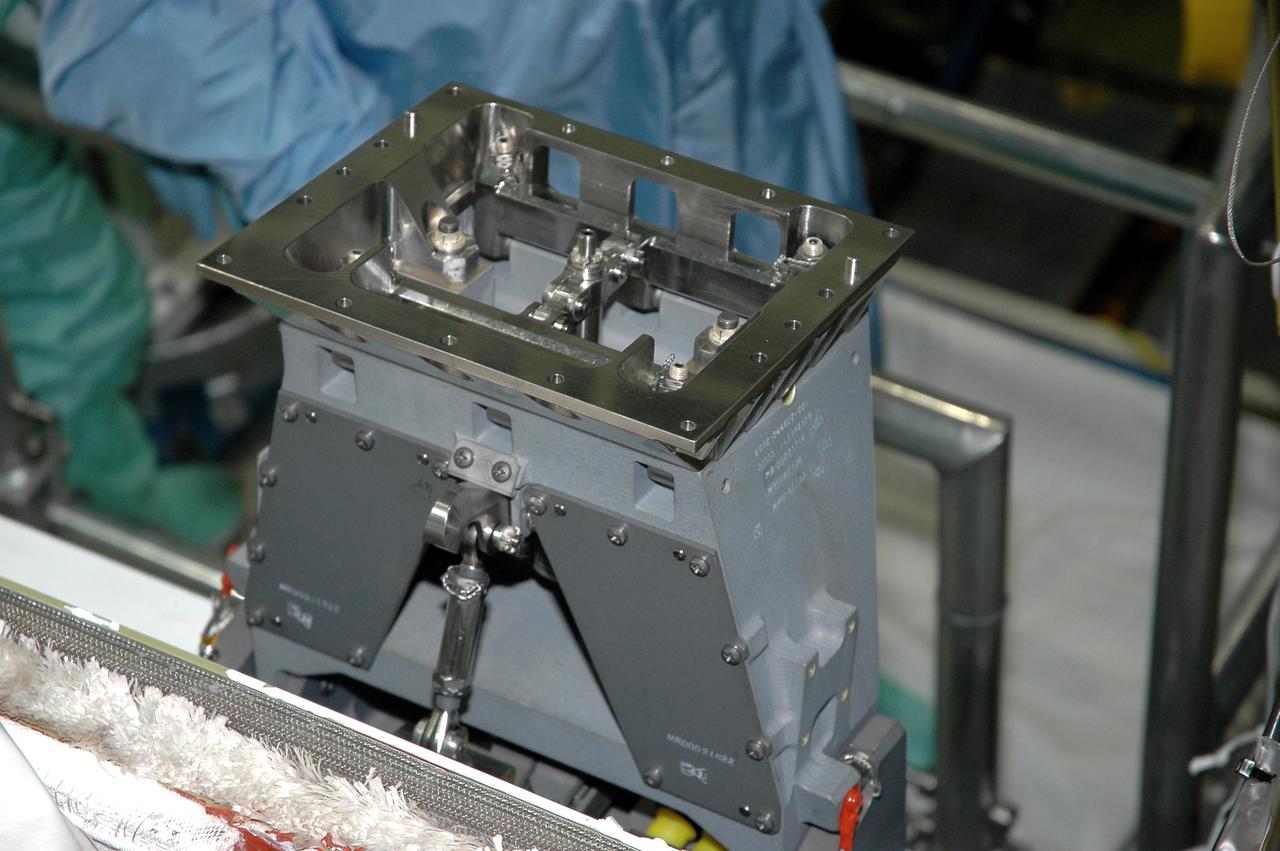
KENNEDY SPACE CENTER, FLA. - A close-up is shown of the base of the Manipulator Positioning Mechanism (MPM) installed on the starboard side of Atlantis’ payload bay in the Orbiter Processing Facility at NASA’s Kennedy Space Center. The MPM will hold the 50-foot-long Orbiter Boom Sensor System (OBSS) that will attach to the Remote Manipulator System, or Shuttle robotic arm. The OBSS is one of the new safety measures for Return to Flight, equipping the orbiter with cameras and laser systems to inspect the Shuttle's Thermal Protection System while in space. Atlantis is scheduled to fly on Return to Flight mission STS-121, which has a launch window of July 12 to July 31, 2005.
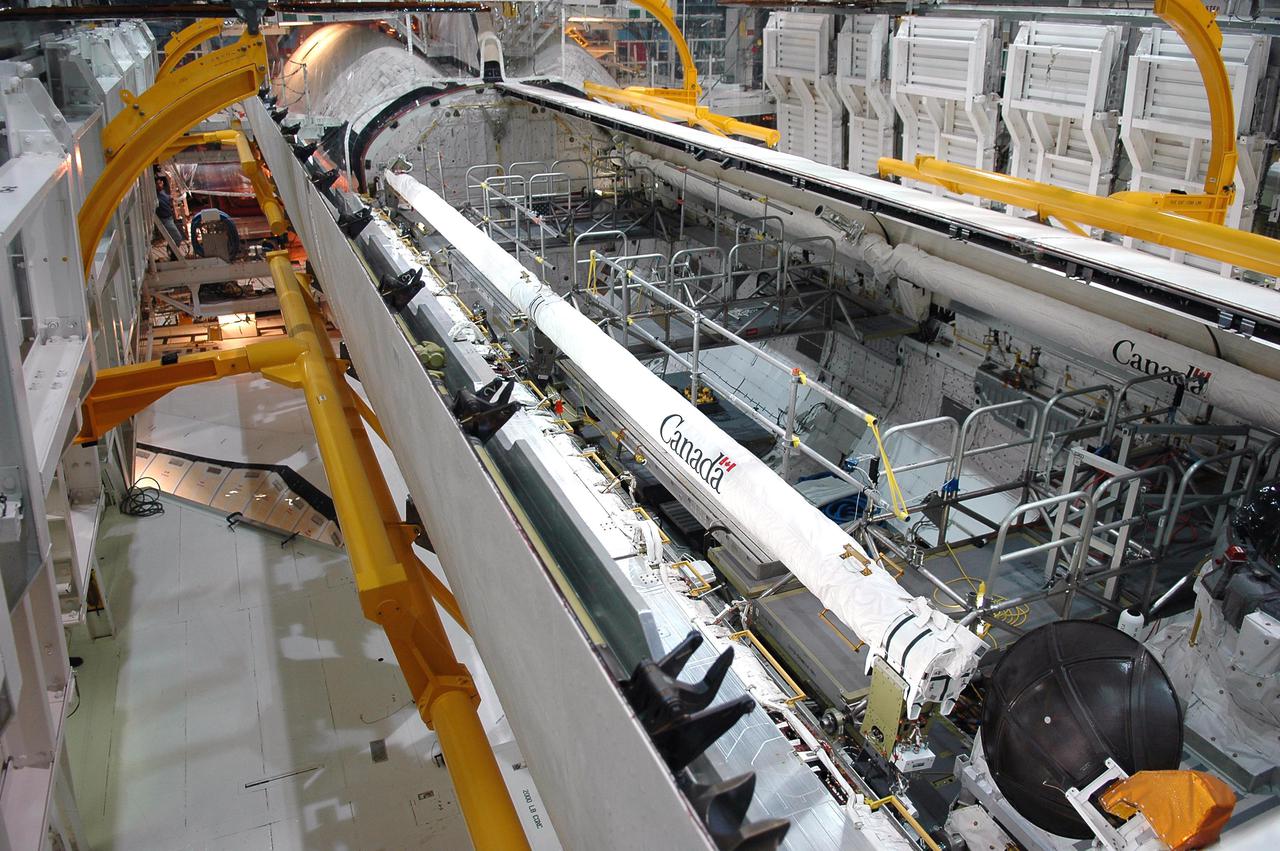
KENNEDY SPACE CENTER, FLA. - In Orbiter Processing Facility bay 1 at NASA’s Kennedy Space Center, Atlantis’ payload bay doors are open. The Remote Manipulator System, or Shuttle arm, is seen on the port side (top) and Orbiter Boom Sensor System (OBSS) is seen on the starboard side (lower) of the payload bay. The 50-foot-long OBSS attaches to the Shuttle arm and is one of the new safety measures for Return to Flight. It equips the orbiter with cameras and laser systems to inspect the Shuttle’s Thermal Protection System while in space. Mission STS-121 is targeted for launch in September. Once Atlantis' bay doors are open again, further work will be done in the bay.
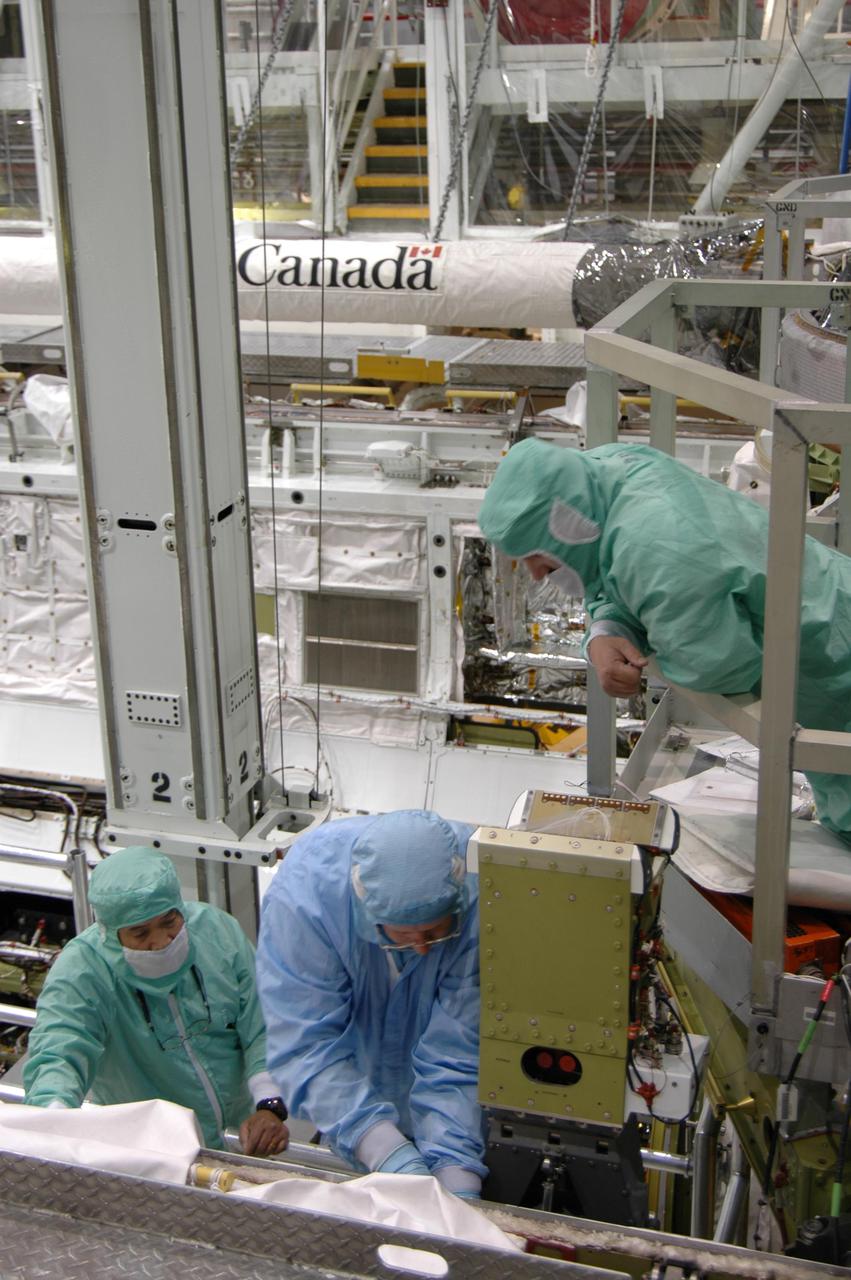
KENNEDY SPACE CENTER, FLA. - In the Orbiter Processing Facility at NASA’s Kennedy Space Center, technicians install the pedestal of the Manipulator Positioning Mechanism (MPM) on the starboard side of Atlantis’ payload bay. The MPM will hold the 50-foot-long Orbiter Boom Sensor System (OBSS) that will attach to the Remote Manipulator System, or Shuttle robotic arm. The OBSS is one of the new safety measures for Return to Flight, equipping the orbiter with cameras and laser systems to inspect the Shuttle's Thermal Protection System while in space. Atlantis is scheduled to fly on Return to Flight mission STS-121, which has a launch window of July 12 to July 31, 2005.
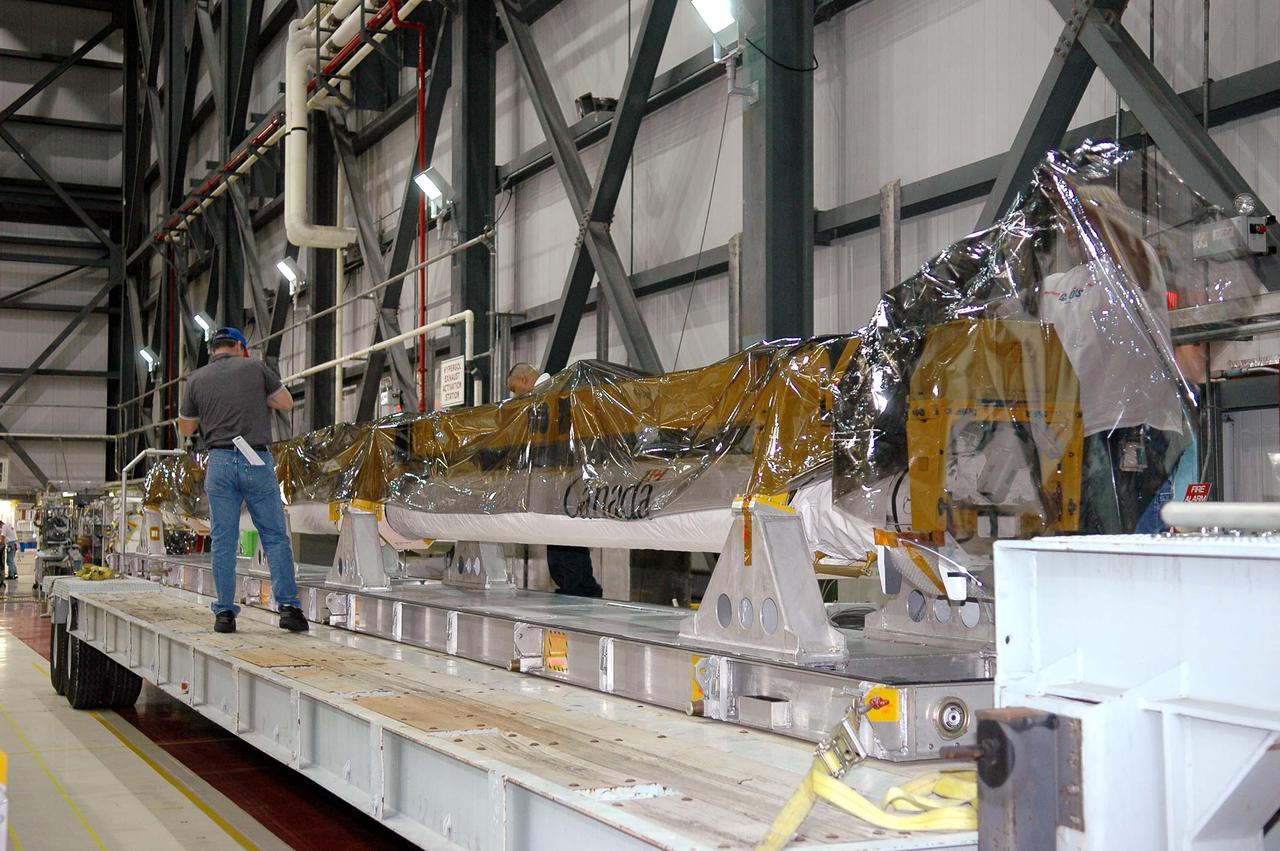
KENNEDY SPACE CENTER, FLA. - In the Orbiter Processing Facility bay 1 at NASA’s Kennedy Space Center, the Orbital Boom Sensor System (OBSS), waits to be installed in the payload bay of Atlantis. The 50-foot-long OBSS attaches to the Remote Manipulator System, or Shuttle robotic arm, and is one of the new safety measures for Return to Flight, equipping the orbiter with cameras and laser systems to inspect the Shuttle’s Thermal Protection System while in space. The Return to Flight mission STS-121 has a launch window of July 12 - July 31, 2005.
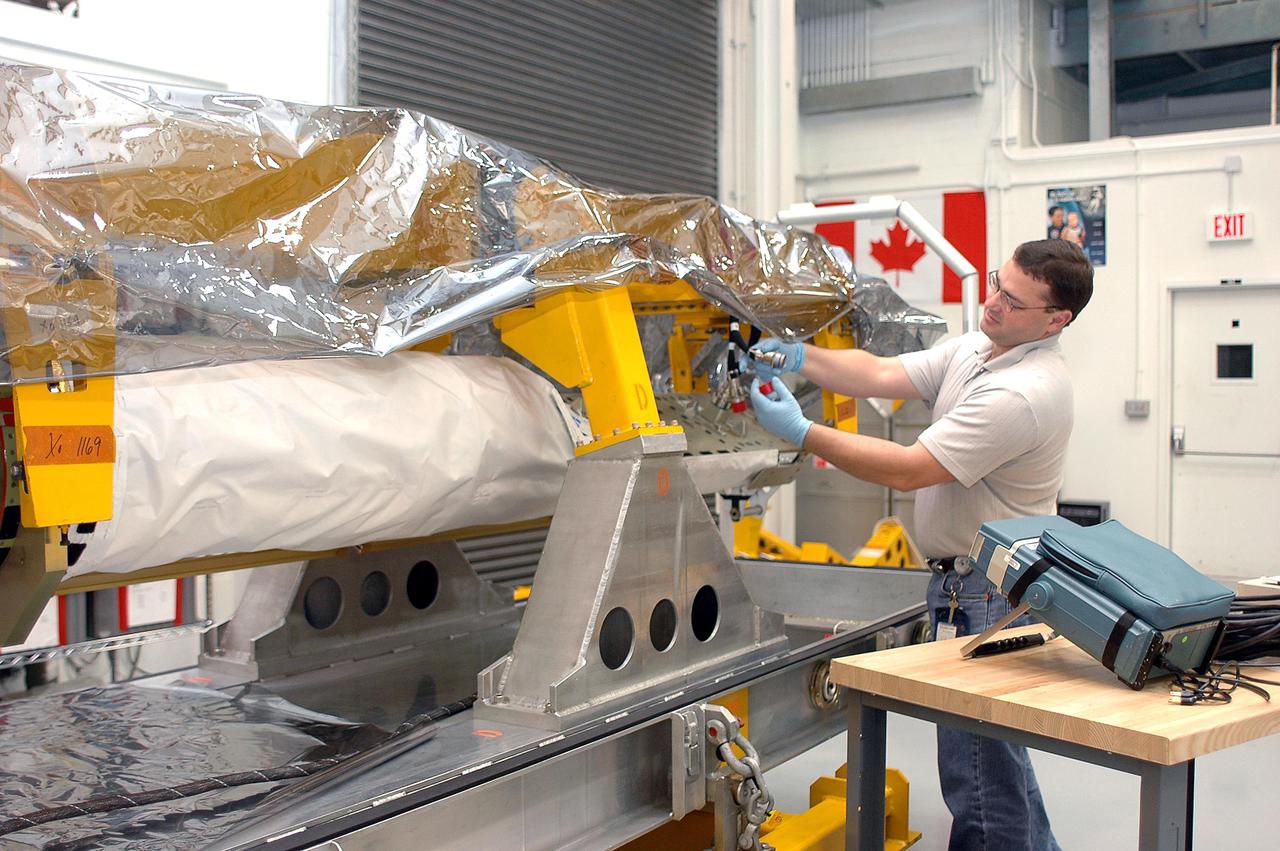
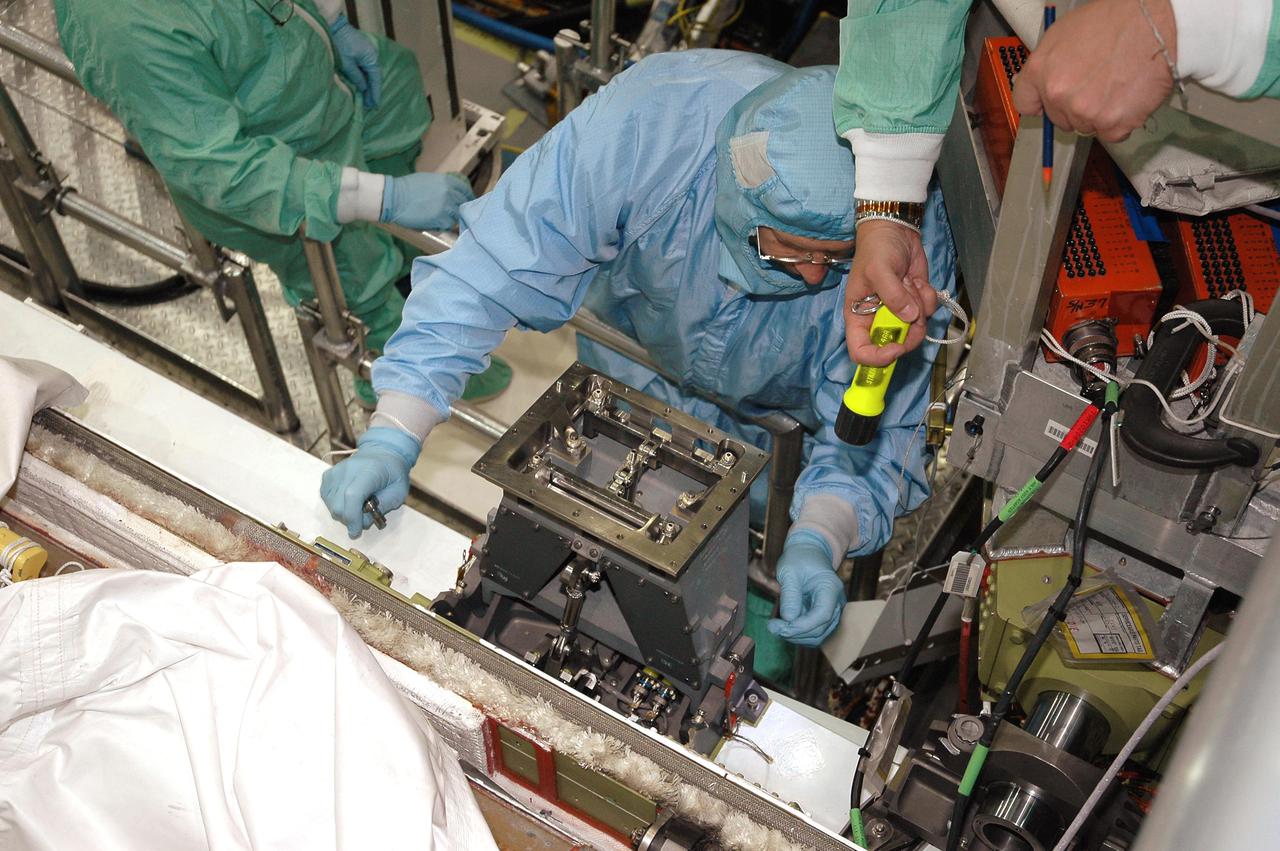
KENNEDY SPACE CENTER, FLA. - In the Remote Manipulator System lab, United Space Alliance technician Todd Dugan works on the Orbiter Boom Sensor System. The OBSS is undergoing final checkout and testing in the lab prior to being transferred to the Orbiter Processing Facility for installation on Space Shuttle Discovery. The 50-foot-long OBSS will be attached to the Remote Manipulator System, or Shuttle arm, and is one of the new safety measures for Return to Flight, equipping the orbiter with cameras and laser systems to inspect the Shuttle's Thermal Protection System while in space. Discovery is slated to fly mission STS-114 once Space Shuttle launches resume. The launch planning window is May 12 to June 3, 2005.
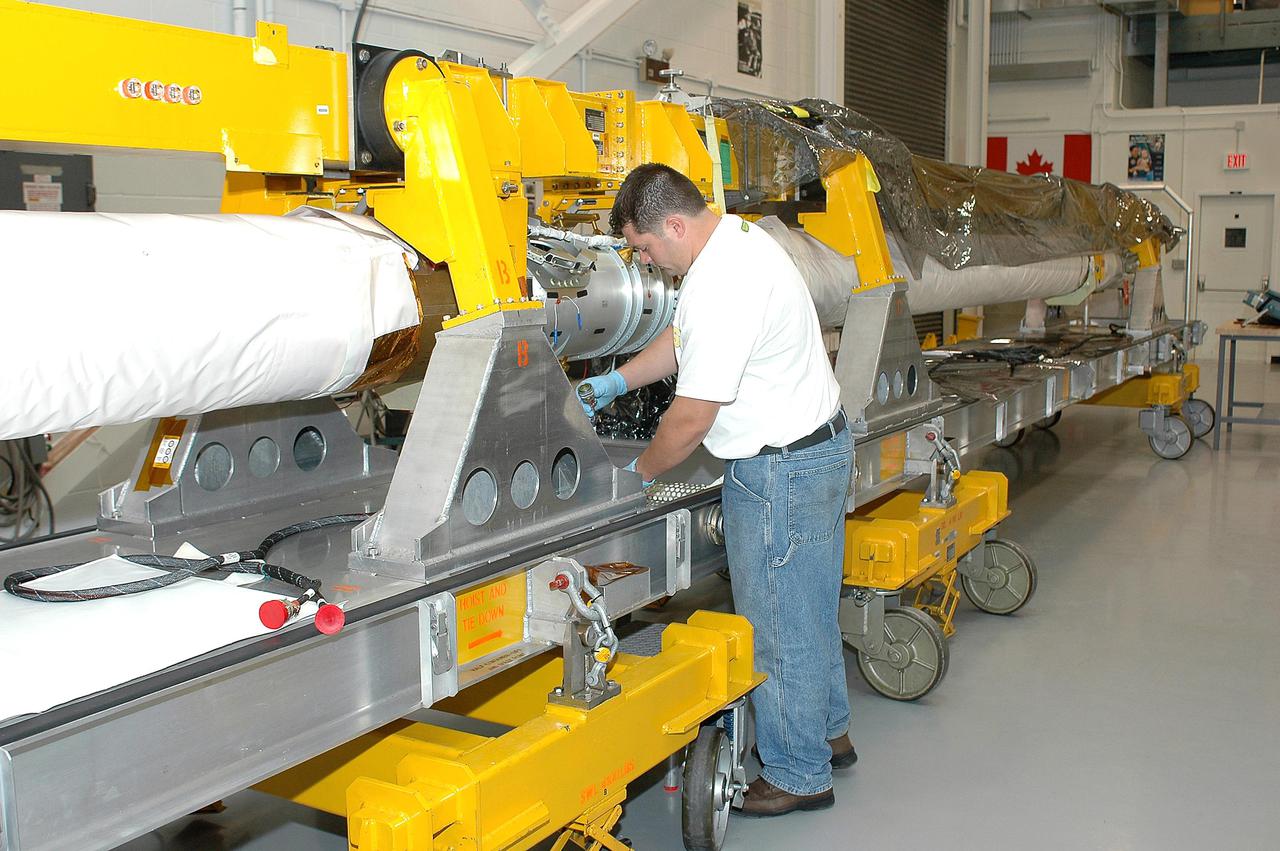
KENNEDY SPACE CENTER, FLA. - Jake Senior, United Space Alliance technician, prepares the Orbiter Boom Sensor System in the Remote Manipulator System lab for testing. The OBSS is undergoing final checkout and testing in the lab prior to being transferred to the Orbiter Processing Facility for installation on Space Shuttle Discovery. The 50-foot-long OBSS will be attached to the Remote Manipulator System, or Shuttle arm, and is one of the new safety measures for Return to Flight, equipping the orbiter with cameras and laser systems to inspect the Shuttle's Thermal Protection System while in space. Discovery is slated to fly mission STS-114 once Space Shuttle launches resume. The launch planning window is May 12 to June 3, 2005.
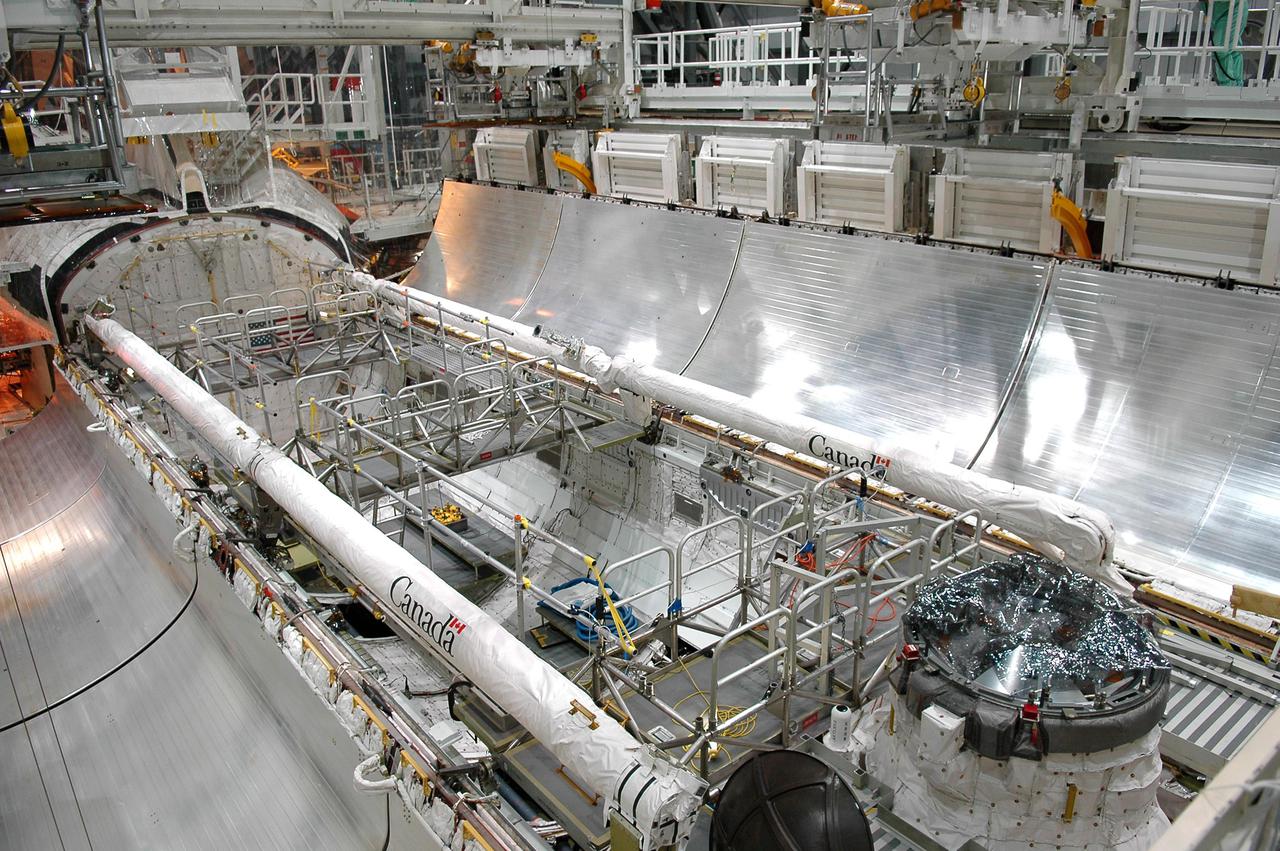
KENNEDY SPACE CENTER, FLA. - In Orbiter Processing Facility bay 1 at NASA’s Kennedy Space Center, Atlantis’ payload bay doors are fully open. The Remote Manipulator System, or Shuttle arm, is seen on the port side (top) and Orbiter Boom Sensor System (OBSS) is seen on the starboard side (lower) of the payload bay. The 50-foot-long OBSS attaches to the Shuttle arm and is one of the new safety measures for Return to Flight. It equips the orbiter with cameras and laser systems to inspect the Shuttle’s Thermal Protection System while in space. Mission STS-121 is targeted for launch in September. Once Atlantis' bay doors are open again, further work will be done in the bay.
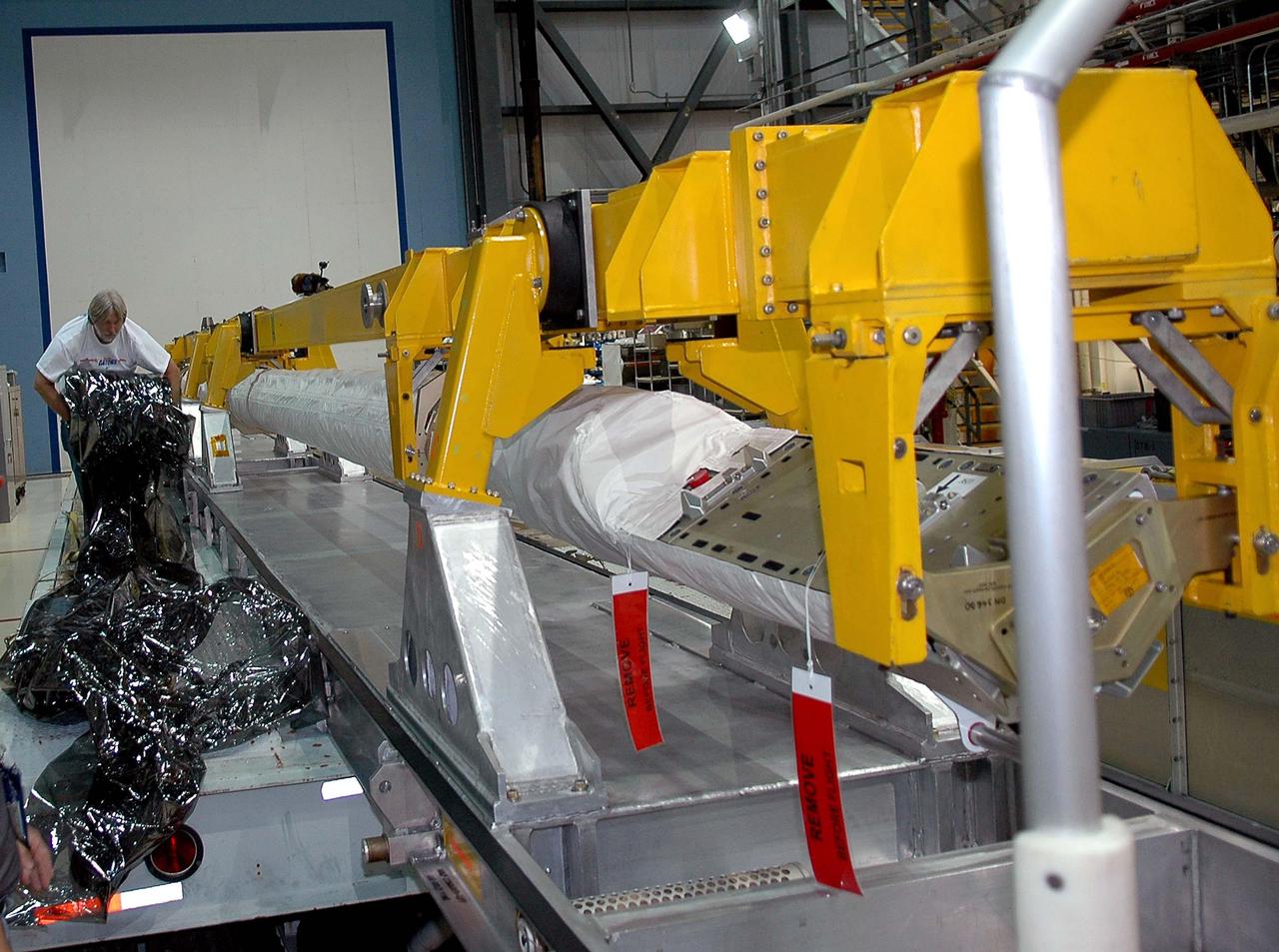
KENNEDY SPACE CENTER, FLA. - In the Orbiter Processing Facility bay 1 at NASA’s Kennedy Space Center, a worker rolls the plastic cover removed from the Orbital Boom Sensor System (OBSS), at right, which will be installed in the payload bay of Atlantis. The 50-foot-long OBSS attaches to the Remote Manipulator System, or Shuttle robotic arm, and is one of the new safety measures for Return to Flight, equipping the orbiter with cameras and laser systems to inspect the Shuttle’s Thermal Protection System while in space. The Return to Flight mission STS-121 has a launch window of July 12 - July 31, 2005.
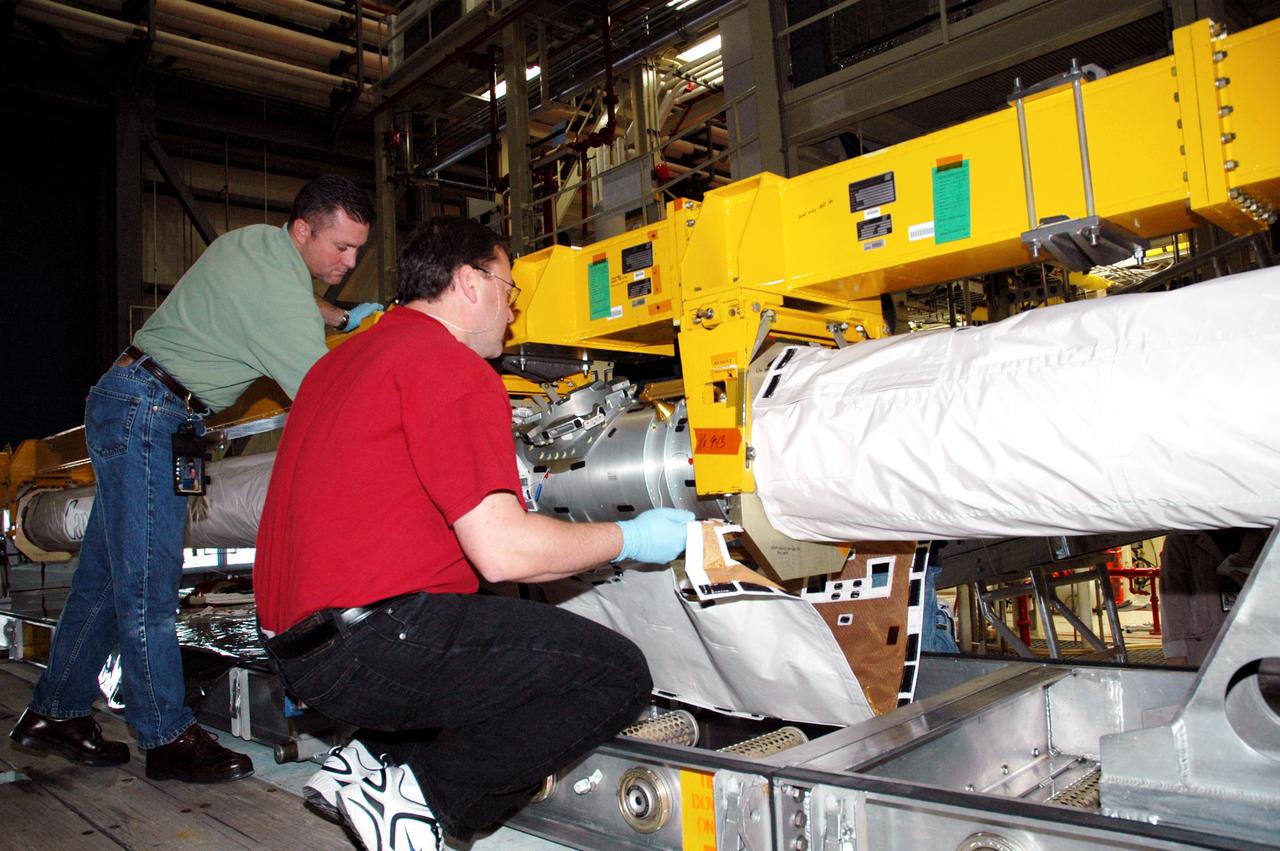
KENNEDY SPACE CENTER, FLA. - In the back transfer aisle of the Orbiter Processing Facility bay 3, Todd Dugan (right), a technician with United Space Alliance, lifts a Thermal Protection System (TPS) blanket onto an area of the Orbiter Boom Sensor System (OBSS). The installation will conclude TPS closeout prior to installation of the boom in the orbiter Discovery. The OBSS is one of the new safety measures for Return to Flight, equipping the Shuttle with cameras and laser systems to inspect the Shuttle’s Thermal Protection System while in space. Discovery is designated as the Return to Flight vehicle for mission STS-114, with a launch window of May 12 to June 3, 2005.
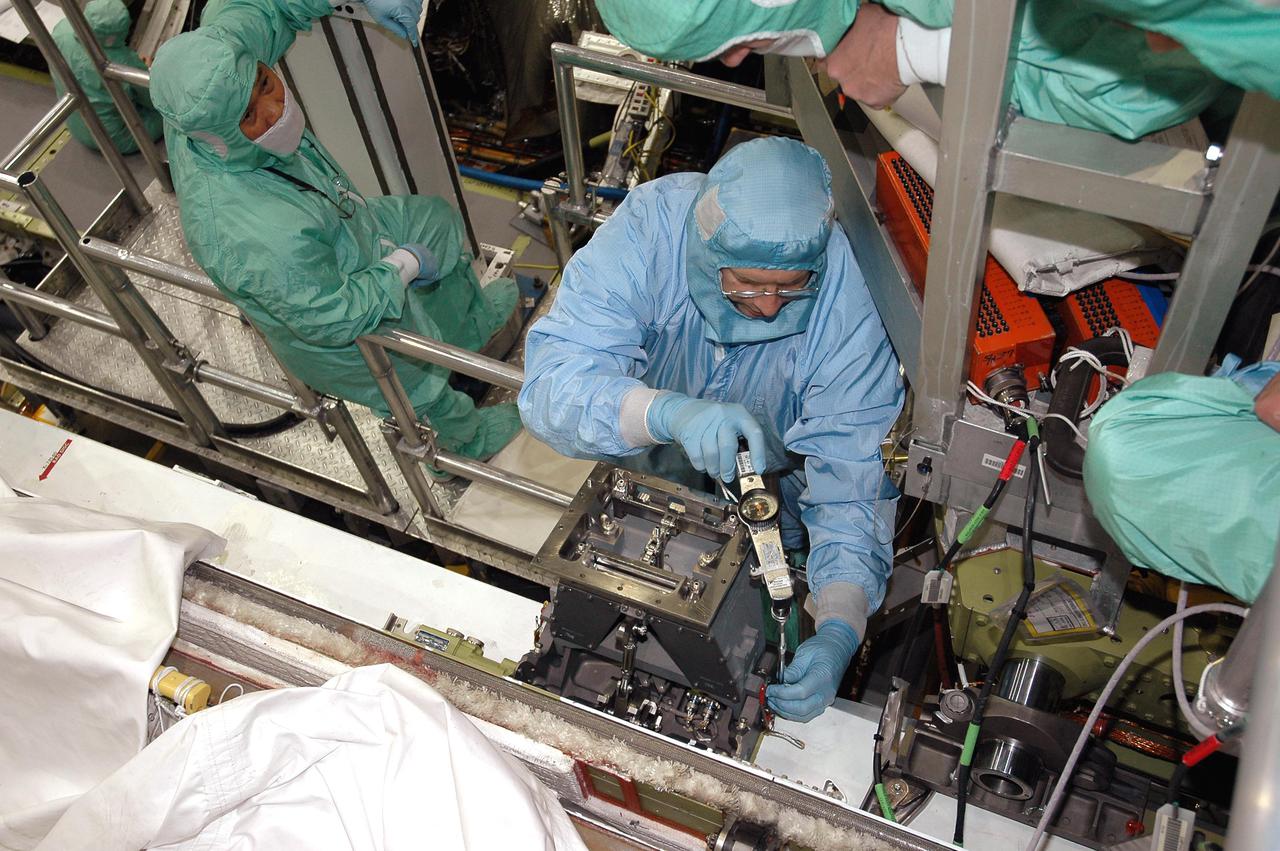
KENNEDY SPACE CENTER, FLA. - In the Orbiter Processing Facility at NASA’s Kennedy Space Center, technicians check out the base of the Manipulator Positioning Mechanism (MPM) installed on the starboard side of Atlantis’ payload bay. The MPM will hold the 50-foot-long Orbiter Boom Sensor System (OBSS) that will attach to the Remote Manipulator System, or Shuttle robotic arm. The OBSS is one of the new safety measures for Return to Flight, equipping the orbiter with cameras and laser systems to inspect the Shuttle's Thermal Protection System while in space. Atlantis is scheduled to fly on Return to Flight mission STS-121, which has a launch window of July 12 to July 31, 2005.
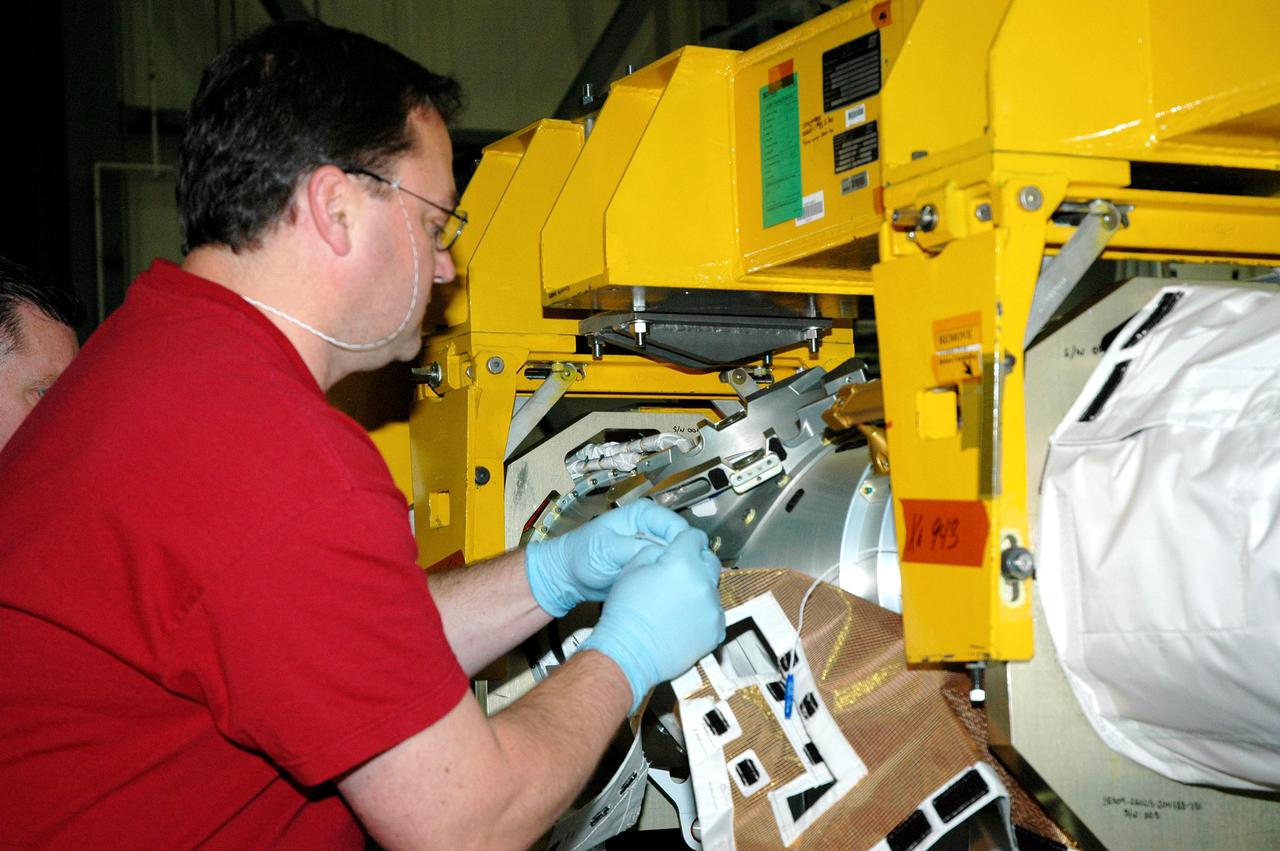
KENNEDY SPACE CENTER, FLA. - In the back transfer aisle of the Orbiter Processing Facility bay 3, Todd Dugan, a technician with United Space Alliance, begins attaching the Thermal Protection System (TPS) blanket to the Orbiter Boom Sensor System (OBSS). The installation of the insulation concludes TPS closeout prior to installation of the boom in the orbiter Discovery. The OBSS is one of the new safety measures for Return to Flight, equipping the Shuttle with cameras and laser systems to inspect the Shuttle’s Thermal Protection System while in space. Discovery is designated as the Return to Flight vehicle for mission STS-114, with a launch window of May 12 to June 3, 2005.
KENNEDY SPACE CENTER, FLA. - In the back transfer aisle of the Orbiter Processing Facility bay 3, Todd Dugan, a technician with United Space Alliance, checks out the Thermal Protection System (TPS) blanket wrapped around the Orbiter Boom Sensor System (OBSS). The installation of the insulation concludes TPS closeout prior to installation of the boom in the orbiter Discovery. The OBSS is one of the new safety measures for Return to Flight, equipping the Shuttle with cameras and laser systems to inspect the Shuttle’s Thermal Protection System while in space. Discovery is designated as the Return to Flight vehicle for mission STS-114, with a launch window of May 12 to June 3, 2005.
KENNEDY SPACE CENTER, FLA. - In the Orbiter Processing Facility bay 1 at NASA’s Kennedy Space Center, the Orbital Boom Sensor System (OBSS) is ready to be installed in the payload bay of Atlantis. The 50-foot-long OBSS attaches to the Remote Manipulator System, or Shuttle robotic arm, and is one of the new safety measures for Return to Flight, equipping the orbiter with cameras and laser systems to inspect the Shuttle’s Thermal Protection System while in space. The Return to Flight mission STS-121 has a launch window of July 12 - July 31, 2005.
KENNEDY SPACE CENTER, FLA. - In the Orbiter Processing Facility at NASA’s Kennedy Space Center, technicians install the base of the Manipulator Positioning Mechanism (MPM) on the starboard side of Atlantis’ payload bay. The MPM will hold the 50-foot-long Orbiter Boom Sensor System (OBSS) that will attach to the Remote Manipulator System, or Shuttle robotic arm. The OBSS is one of the new safety measures for Return to Flight, equipping the orbiter with cameras and laser systems to inspect the Shuttle's Thermal Protection System while in space. Atlantis is scheduled to fly on Return to Flight mission STS-121, which has a launch window of July 12 to July 31, 2005.
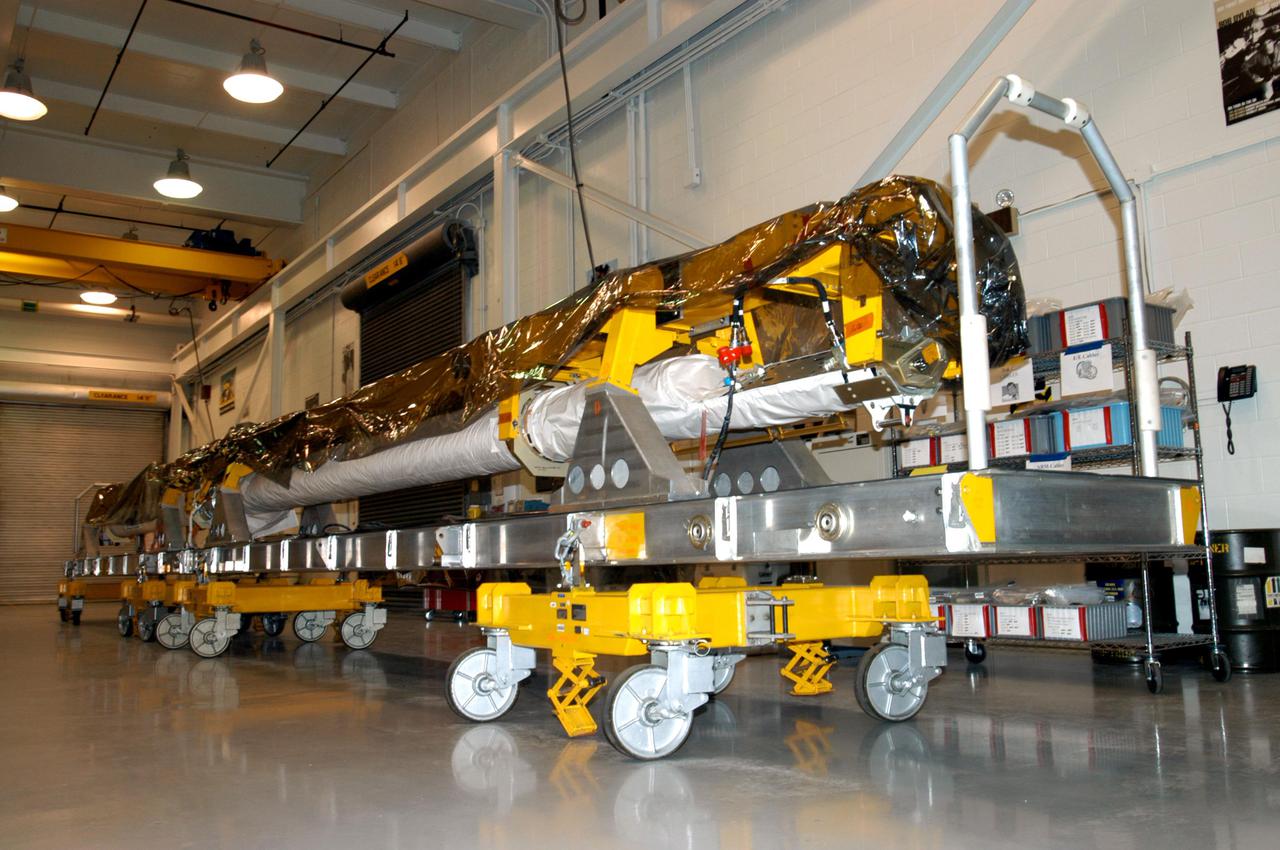
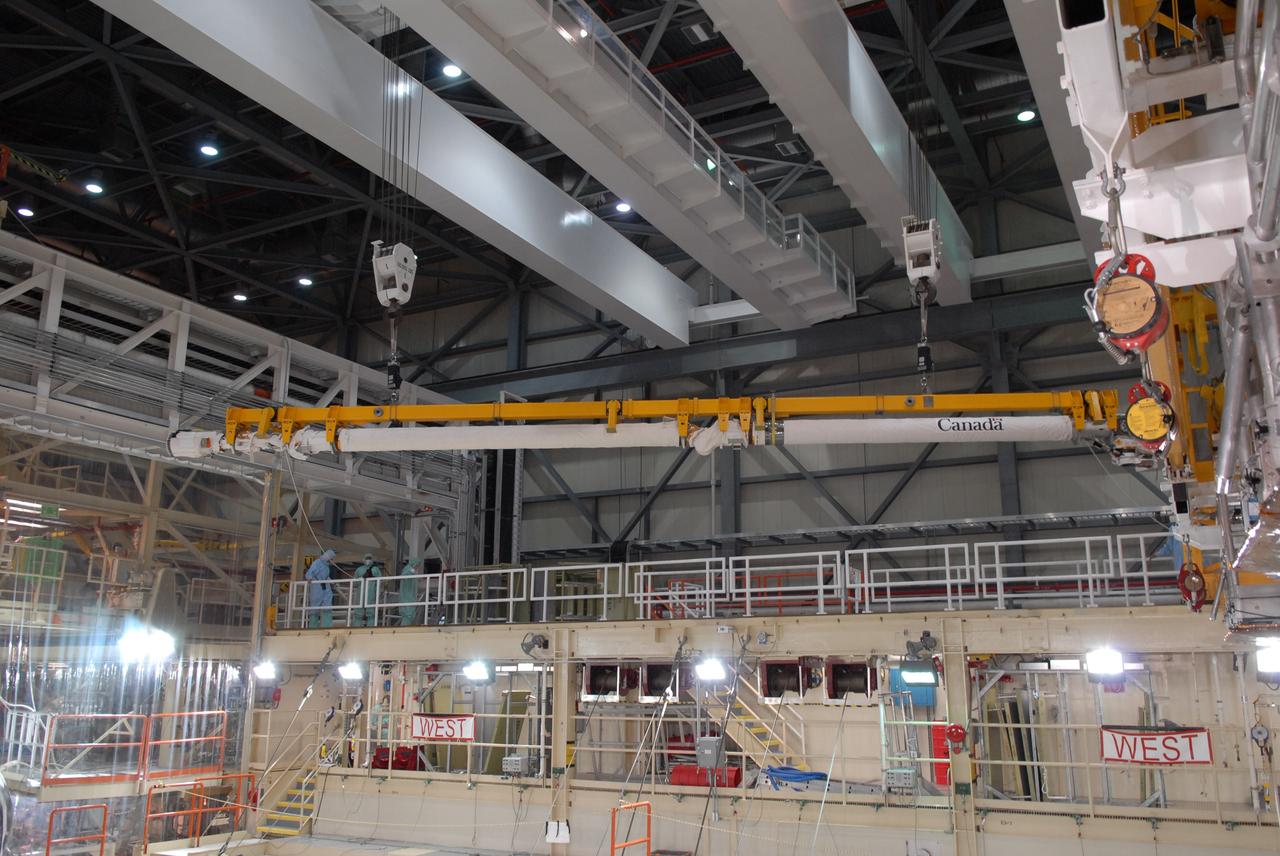
KENNEDY SPACE CENTER, FLA. - The assembled Orbiter Boom Sensor System sits in the Remote Manipulator System lab inside the Vehicle Assembly Building. The OBSS will undergo final checkout and testing in the lab prior to being transferred to the Orbiter Processing Facility for installation on Space Shuttle Discovery. The 50-foot-long OBSS will be attached to the Remote Manipulator System, or Shuttle arm, and is one of the new safety measures for Return to Flight, equipping the orbiter with cameras and laser systems to inspect the Shuttle’s Thermal Protection System while in space. Discovery is slated to fly Return to Flight mission STS-114 once Space Shuttle launches resume. The launch planning window is May 12 to June 3, 2005.

KENNEDY SPACE CENTER, FLA. - In the Orbiter Processing Facility bay 1 at Kennedy Space Center in Florida, the payload bay doors of the orbiter Atlantis are being closed. The Orbiter Boom Sensor System (OBSS) is seen on the starboard side (lower) of the payload bay. The 50-foot-long OBSS attaches to the Shuttle arm and is one of the new safety measures for Return to Flight. It equips the orbiter with cameras and laser systems to inspect the Shuttle’s Thermal Protection System while in space. Atlantis is scheduled to fly on the second Return to Flight mission, STS-121, targeted for launch in a window extending from Sept. 9 to Sept. 24.
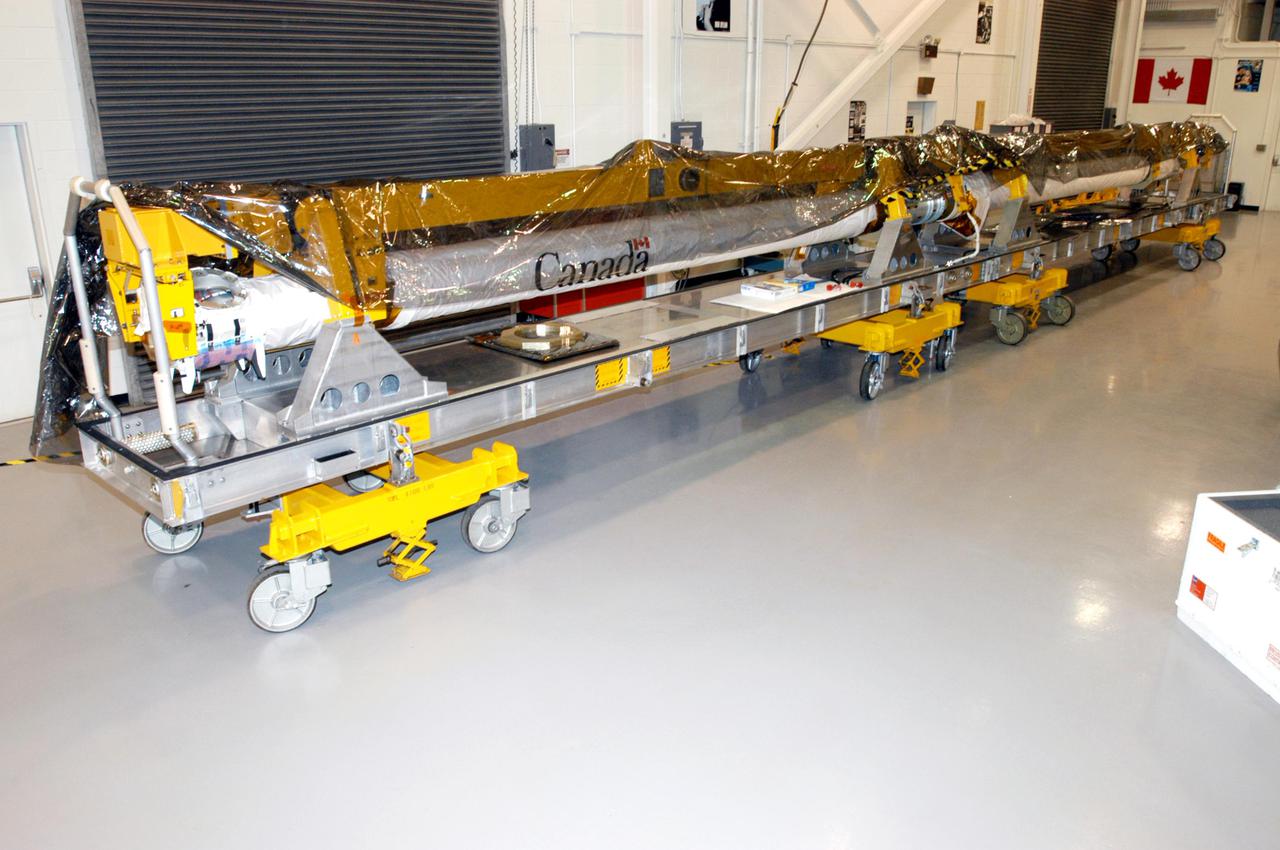
KENNEDY SPACE CENTER, FLA. - The assembled Orbiter Boom Sensor System sits in the Remote Manipulator System lab inside the Vehicle Assembly Building. The OBSS will undergo final checkout and testing in the lab prior to being transferred to the Orbiter Processing Facility for installation on Space Shuttle Discovery. The 50-foot-long OBSS will be attached to the Remote Manipulator System, or Shuttle arm, and is one of the new safety measures for Return to Flight, equipping the orbiter with cameras and laser systems to inspect the Shuttle’s Thermal Protection System while in space. Discovery is slated to fly Return to Flight mission STS-114 once Space Shuttle launches resume. The launch planning window is May 12 to June 3, 2005.
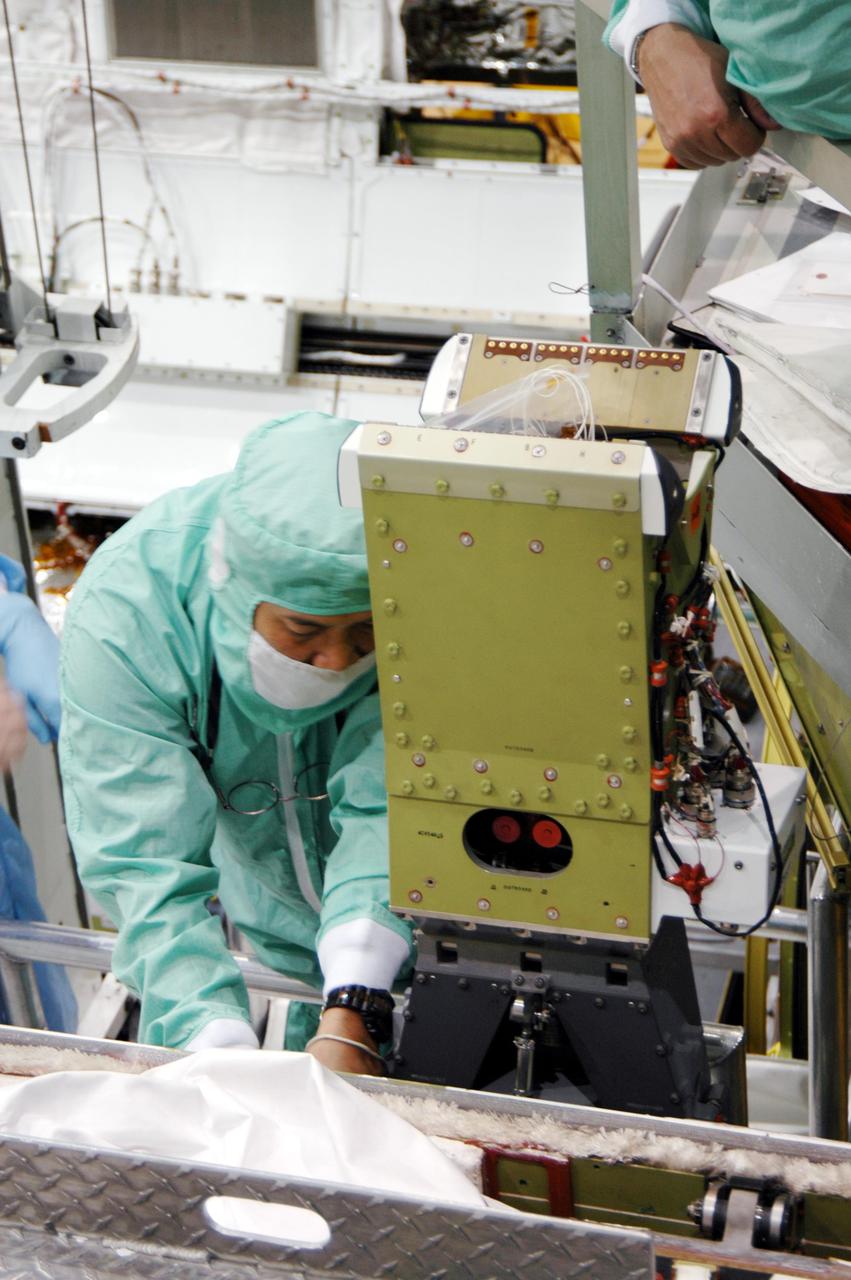
KENNEDY SPACE CENTER, FLA. - In the Orbiter Processing Facility at NASA’s Kennedy Space Center, technicians check the installation of the pedestal of the Manipulator Positioning Mechanism (MPM) on the starboard side of Atlantis’ payload bay. The MPM will hold the 50-foot-long Orbiter Boom Sensor System (OBSS) that will attach to the Remote Manipulator System, or Shuttle robotic arm. The OBSS is one of the new safety measures for Return to Flight, equipping the orbiter with cameras and laser systems to inspect the Shuttle's Thermal Protection System while in space. Atlantis is scheduled to fly on Return to Flight mission STS-121, which has a launch window of July 12 to July 31, 2005.