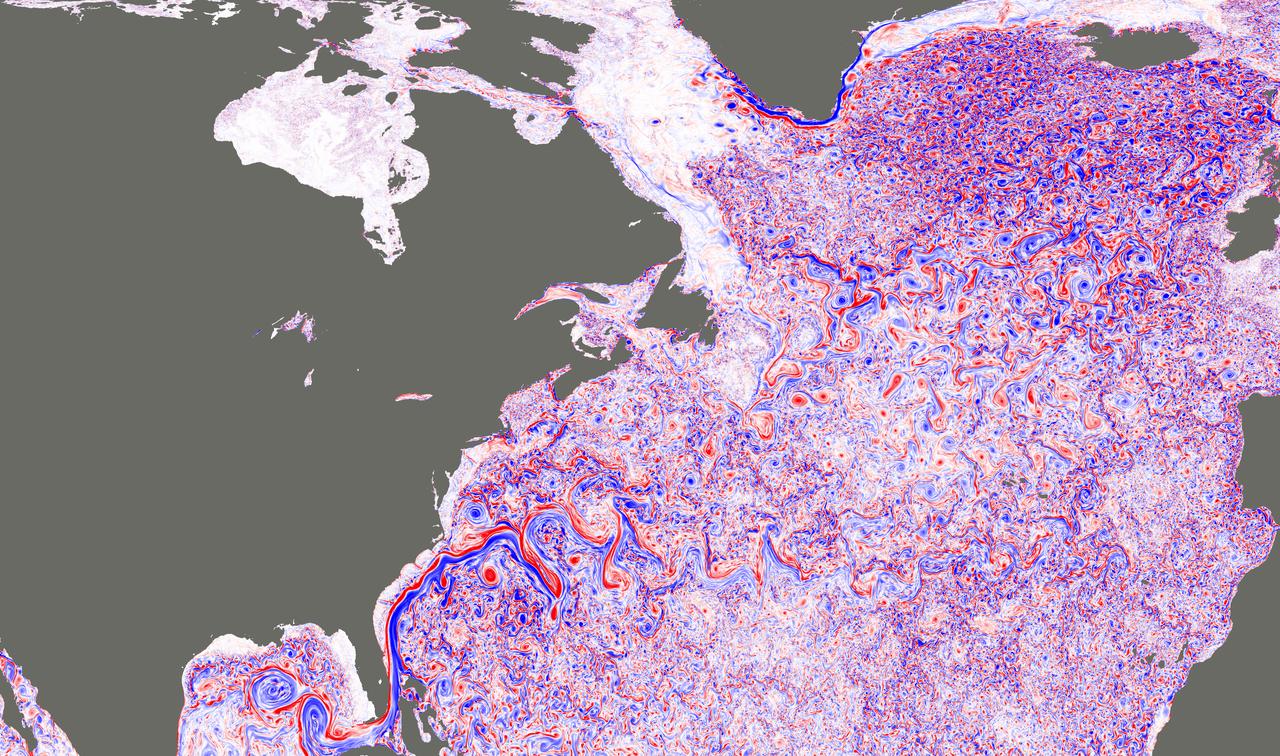
This image shows a simulated snapshot of ocean turbulence in the North Atlantic Ocean in March 2012, from a groundbreaking super-high-resolution global ocean simulation (approximately 1.2 miles, or 2 kilometers, horizontal resolution) developed at JPL (http://wwwcvs.mitgcm.org/viewvc/MITgcm/MITgcm_contrib/llc_hires/llc_4320/). The colors represent the magnitude of surface relative vorticity, a measure of the spin of fluid parcels. The image emphasizes fast-rotating, small-scale (defined here as 6.2 to 31-mile, or 10 to 50 kilometer, range) turbulence, especially during the winter. High levels of relative vorticity caused by small-scale turbulence are believed to strongly transport heat and carbon vertically in the ocean. The image appears in a study (Su et al. 2018), entitled "Ocean submesoscales as a key component of the global heat budget," published recently in Nature Communications. The study suggests that upper-ocean small-scale turbulence transports heat upward in the ocean at a level five times larger than larger-scale heat transport by ocean eddies, significantly affecting the exchange of heat between the ocean interior and atmosphere. Such interactions have a crucial impact on the Earth's climate. A movie is available at https://photojournal.jpl.nasa.gov/catalog/PIA22256
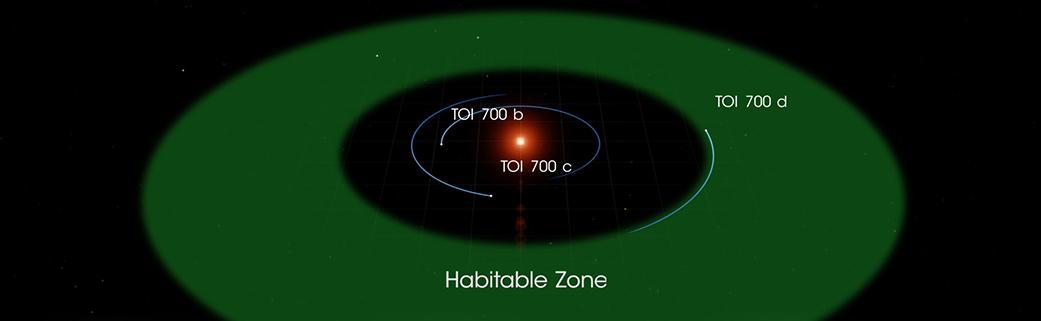
This illustration of TOI 700 d is based on several simulated environments for an ocean-covered version of the planet. https://photojournal.jpl.nasa.gov/catalog/PIA23407
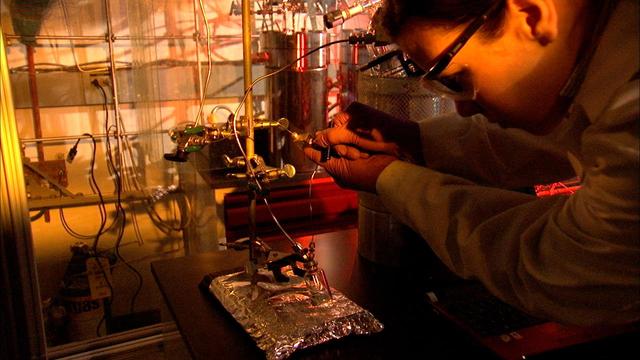
Lauren White, a scientist at NASA's Jet Propulsion Laboratory, adjusts an experiment that simulates how ancient seawater and fluid from hydrothermal vents could have reacted with minerals from the seafloor to create organic molecules 4.5 billion years ago. The image was taken at JPL in 2014. https://photojournal.jpl.nasa.gov/catalog/PIA23688
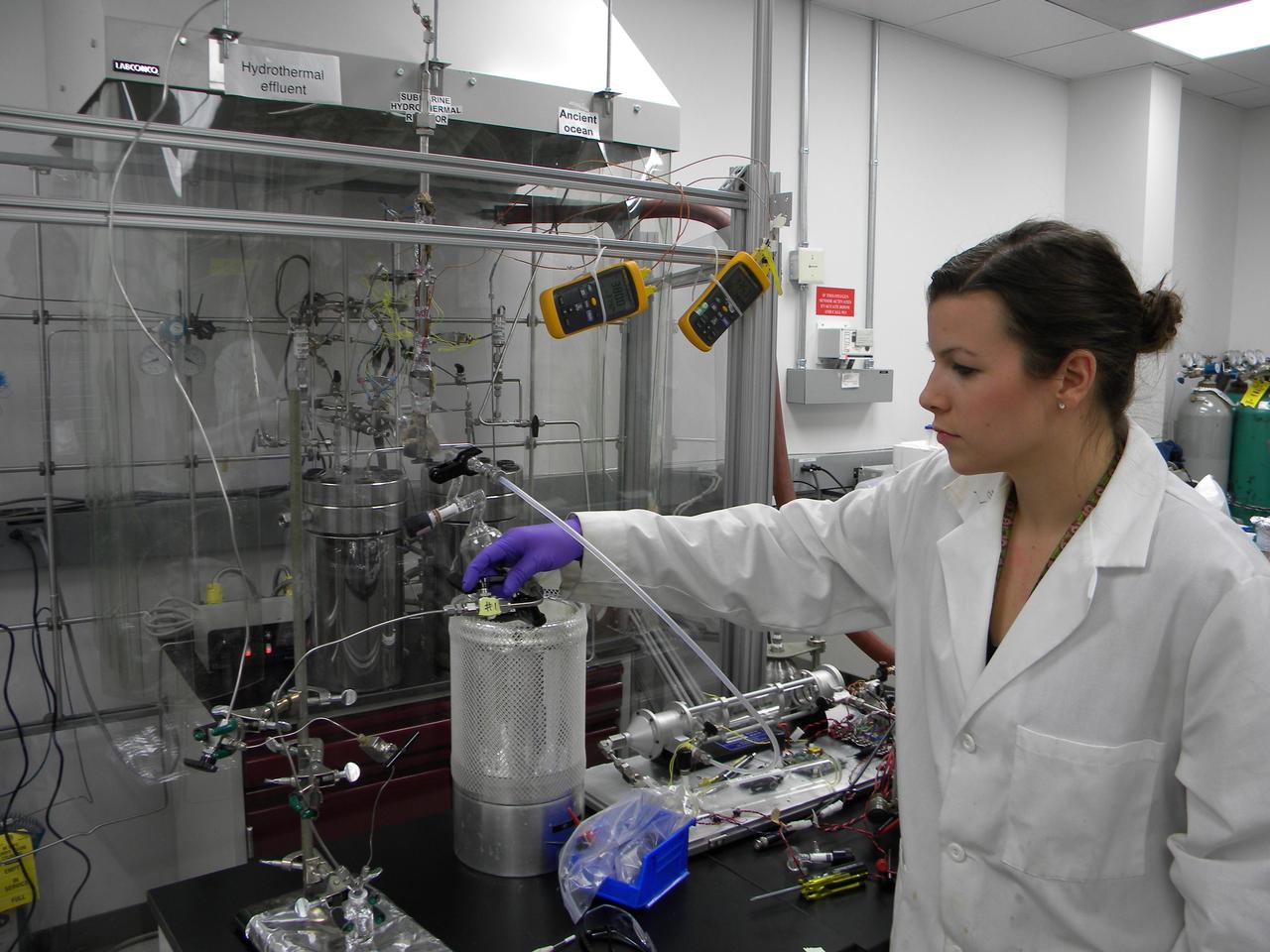
A team of scientists at NASA Jet Propulsion Laboratory is testing whether organic molecules can be brewed in a simulated ocean vent. Pictured here is Lauren White, a member of the NASA Astrobiology Icy Worlds team.
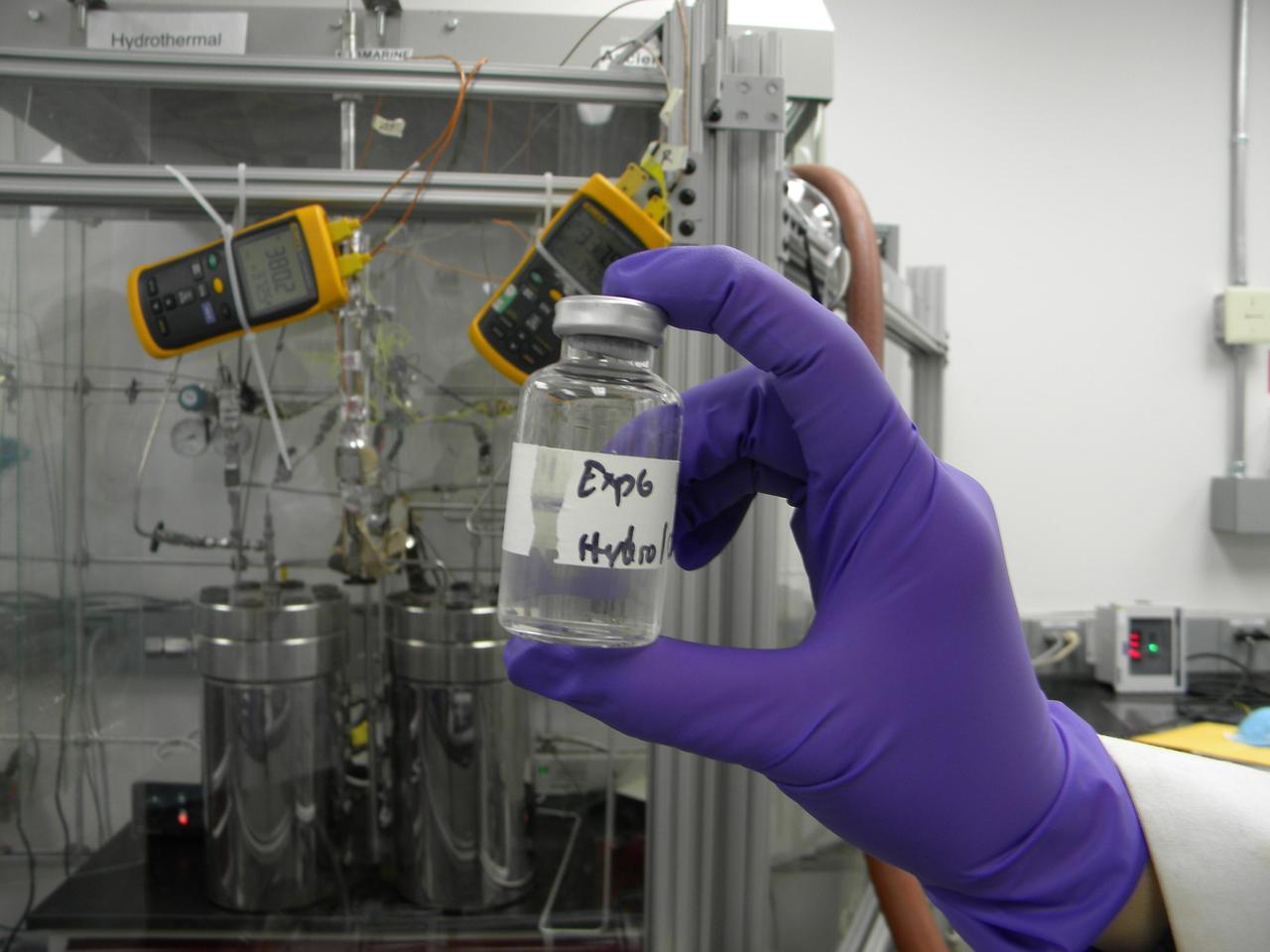
The NASA Astrobiology Icy Worlds team at NASA Jet Propulsion Laboratory are collecting samples from a simulated ocean vent to see if they can detect organic molecules being brewed.
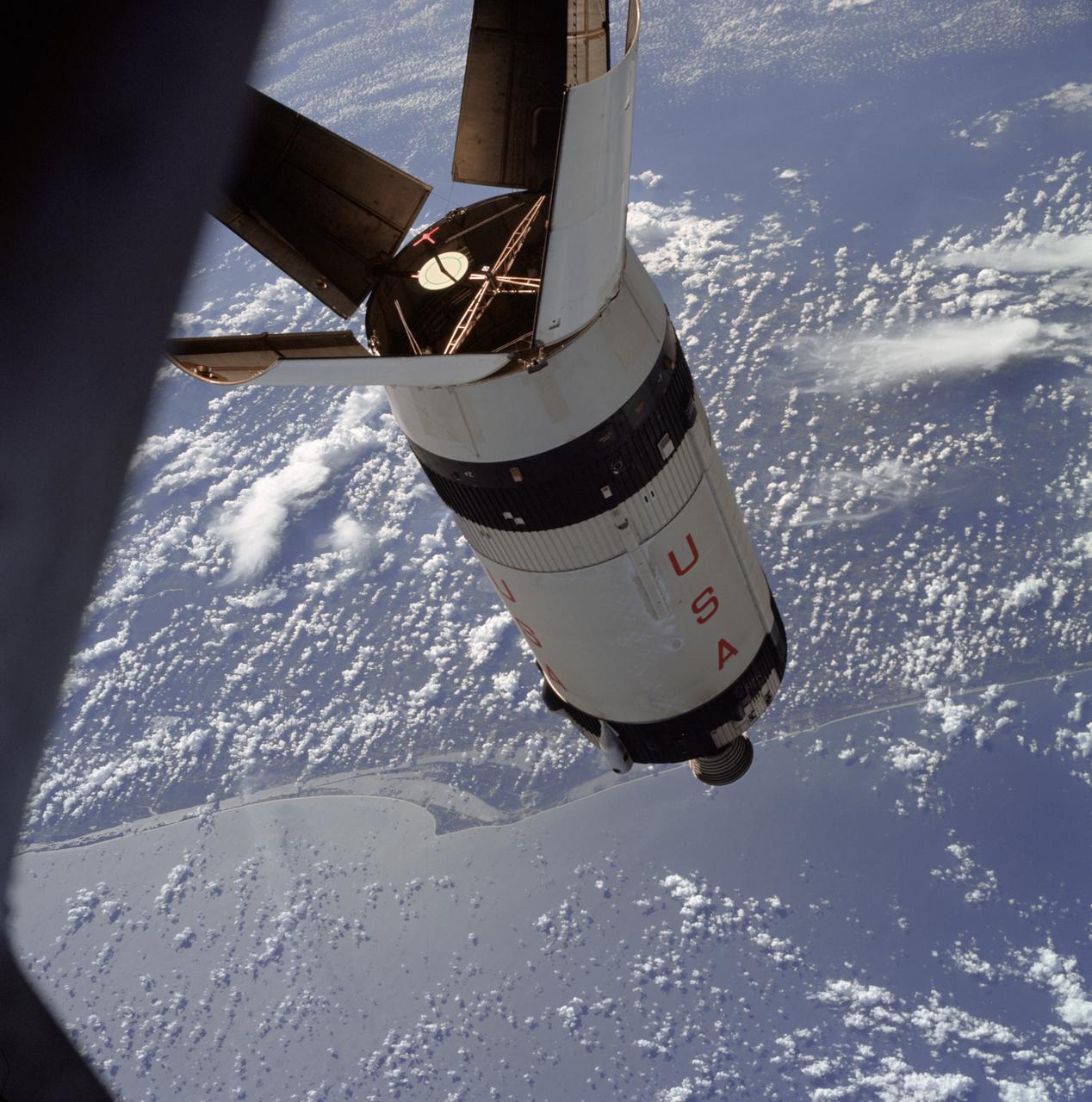
AS07-03-1545 (11 Oct. 1968) --- The expended Saturn S-IVB stage as photographed from the Apollo 7 spacecraft during transposition and docking maneuvers at an approximate altitude of 125 nautical miles, at ground elapsed time of three hours and 16 minutes (beginning of third revolution). This view is over the Atlantic Ocean off the coast of Cape Kennedy, Florida. The Florida coastline from Flagler Beach southward to Vero Beach is clearly visible in picture. Much of the Florida peninsula can be seen. Behind the open panels is the Gulf of Mexico. Distance between the Apollo 7 spacecraft and the S-IVB is approximately 100 feet. The round, white disc inside the open panels of the S-IVB is a simulated docking target similar to that used on the Lunar Module (LM) for docking during lunar missions.
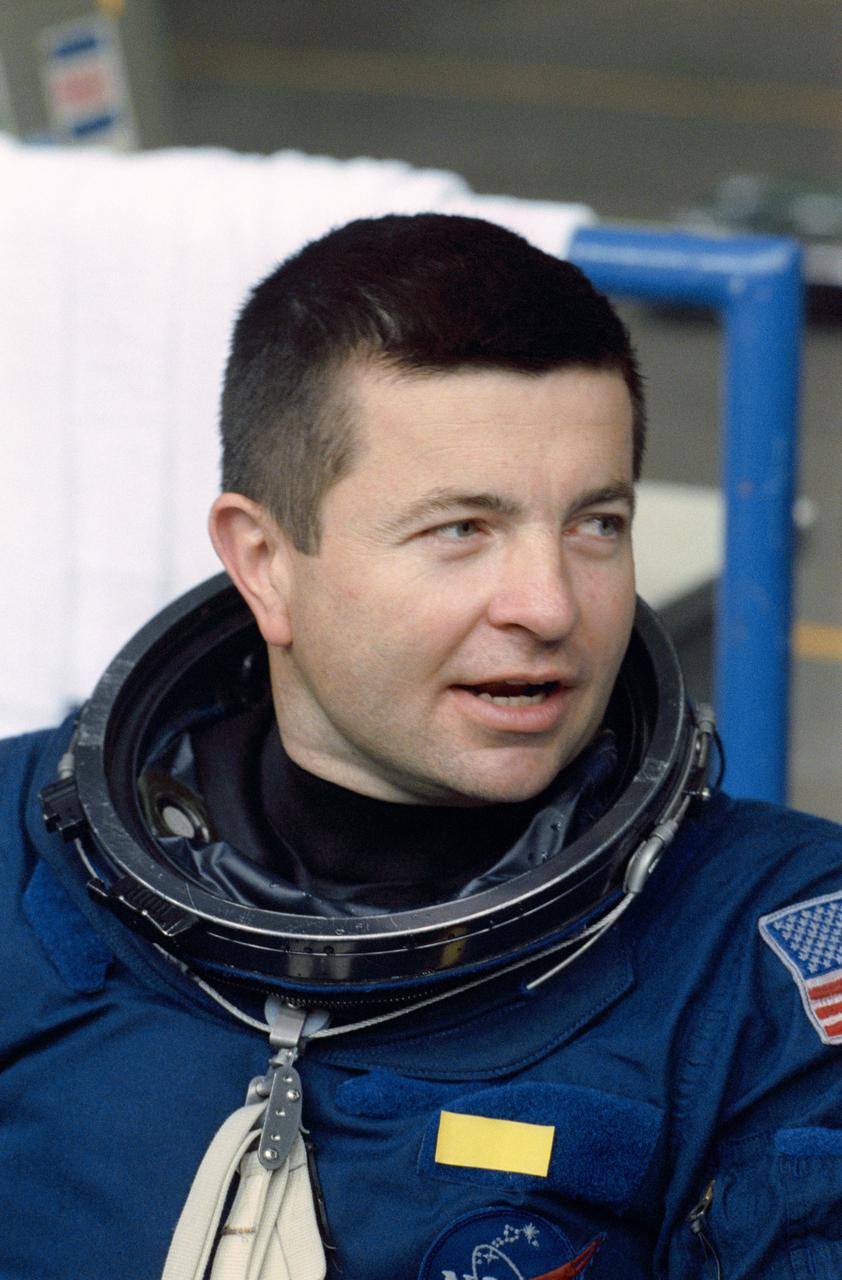
STS-37 Pilot Kenneth D. Cameron, wearing launch and entry suit (LES), discusses simulated emergency egress training on the pool side of JSC's Weightless Environment Training Facility (WETF) Bldg 29. Cameron will be dropped into a simulated ocean, the WETF's 25-ft pool, into which a parachute landing might be made.
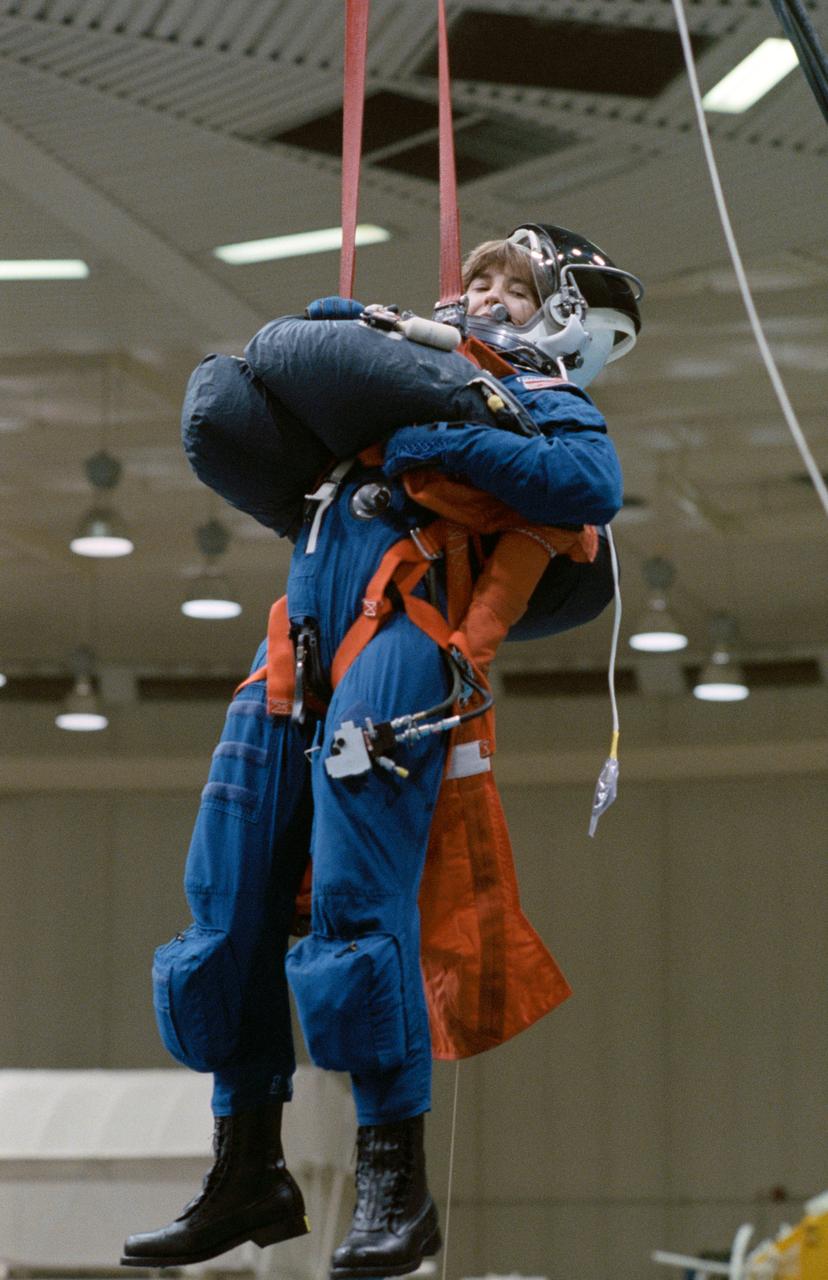
S90-45238 (25 June 1990) ---- Astronaut Linda M. Godwin, STS 37 mission specialist, simulates emergency egress from a Space Shuttle. The training session was held in the Johnson Space Center's (JSC) weightless environment training facility (WET-F). The 25-ft. pool in the facility served as a simulated ocean into which a parachute landing might be made. Early next year, Godwin, along with four other astronauts, will fly onboard Atlantis for a five-day mission.
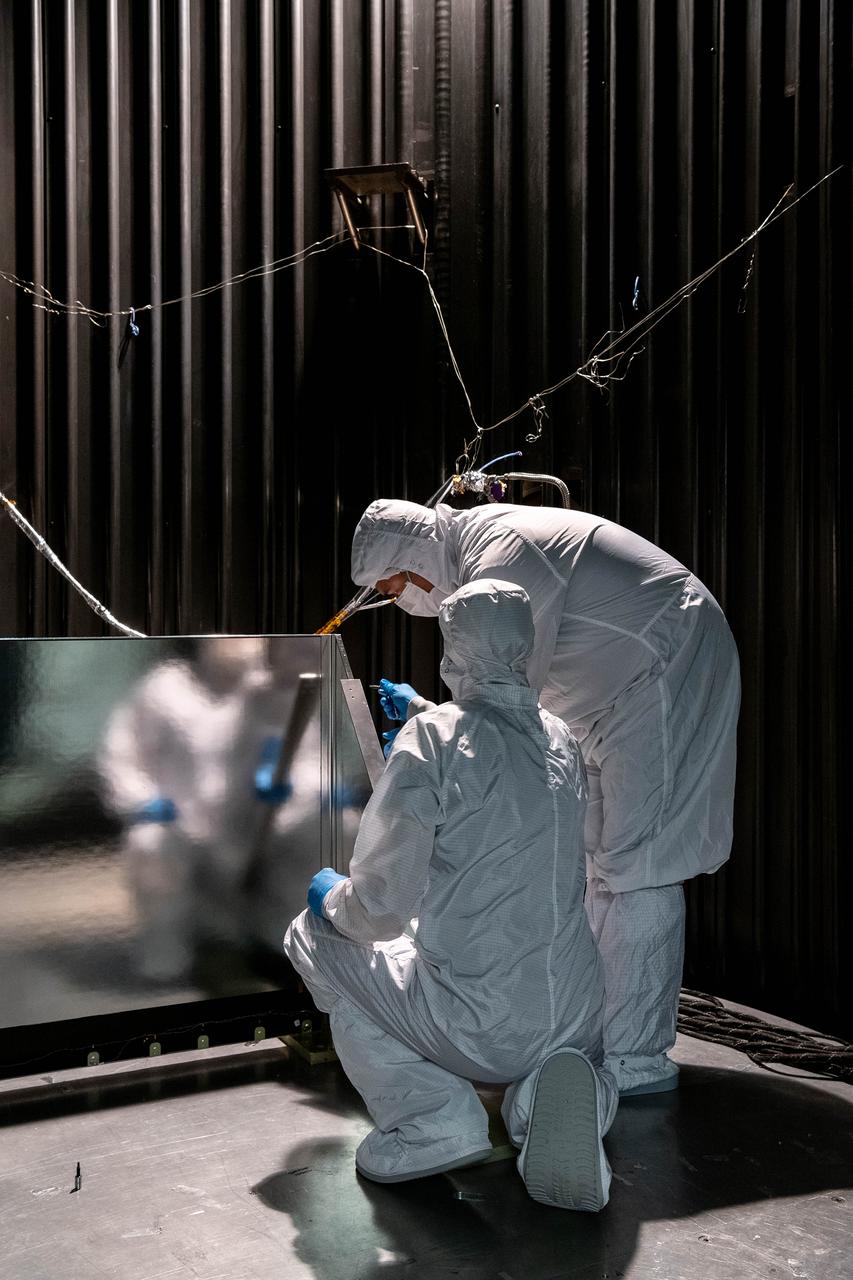
Mechanical Technicians, Daniel Dizon and Joseph Eddy, install the Ocean Color Instrument (OCI) Earth Shade into a thermal vacuum chamber so that team members can test the thermal capabilities of the hardware under a simulated space environment. OCI is a highly advanced optical spectrometer that will be used to measure properties of light over portions of the electromagnetic spectrum. It will enable continuous measurement of light at finer wavelength resolution than previous NASA satellite sensors, extending key system ocean color data records for climate studies. OCI is PACE's (Plankton, Aerosol, Cloud, ocean Ecosystem) primary sensor built at Goddard Space Flight Center in Greenbelt, MD.
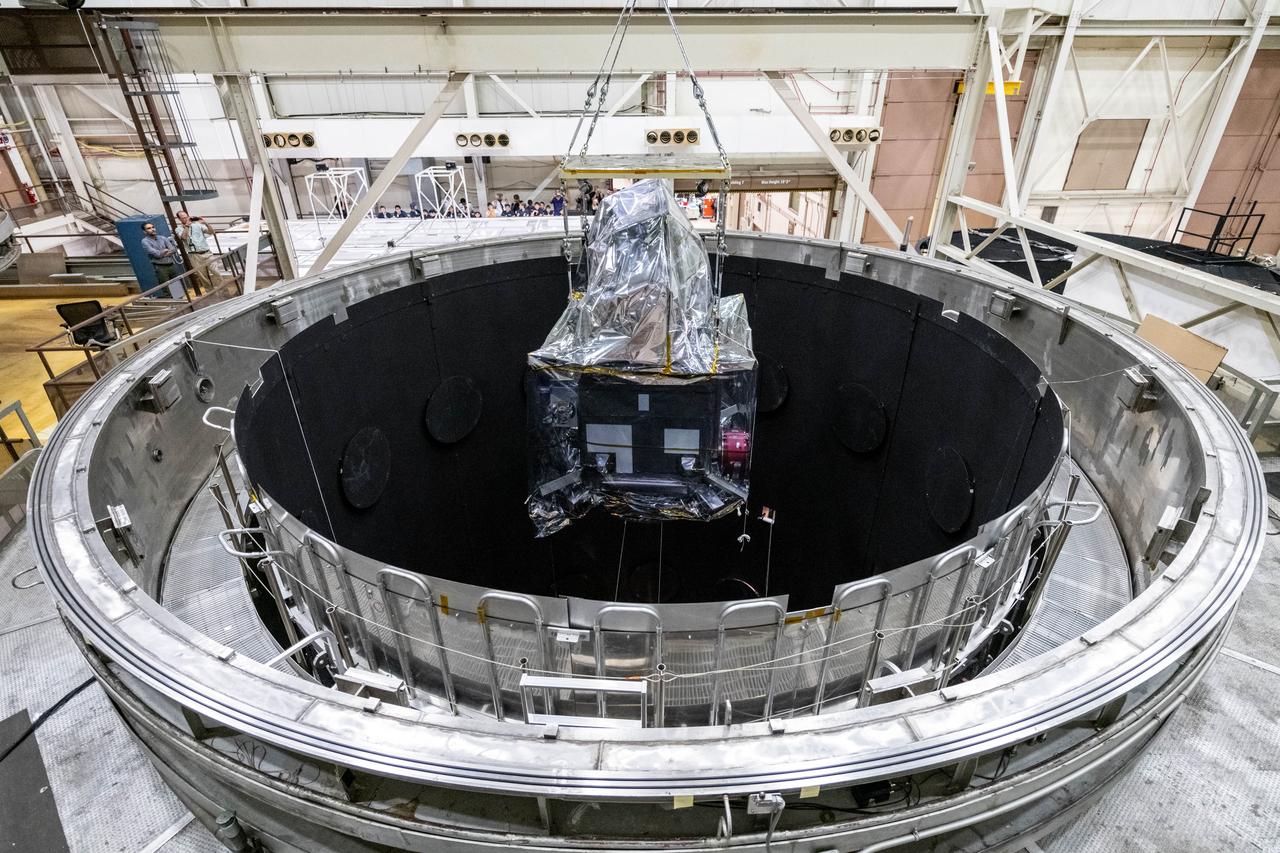
The Plankton, Aerosol, Cloud, ocean Ecosystem (PACE) Observatory is lowered into the Space Environment Simulator (SES) thermal vacuuum chamber at NASA's Goddard Space Flight Center in Greenbelt, Maryland on June 1st, 2023. PACE's unprecedented spectral coverage will provide the first-ever global measurements designed to identify phytoplankton community composition. The mission will make global ocean color measurements, using the Ocean Color Instrument (OCI), to provide extended data records on ocean ecology and global biogeochemistry along with polarimetry measurements, using the Spectro-polarimeter for Planetary Exploration (SPEXone) and the Hyper Angular Research Polarimeter (HARP2) to provide extended data records on clouds and aerosols. The Earth-observing satellite mission, built at Goddard Space Flight Center in Greenbelt, MD, will continue and advance observations of global ocean color, biogeochemistry, and ecology, as well as the carbon cycle, aerosols and clouds.
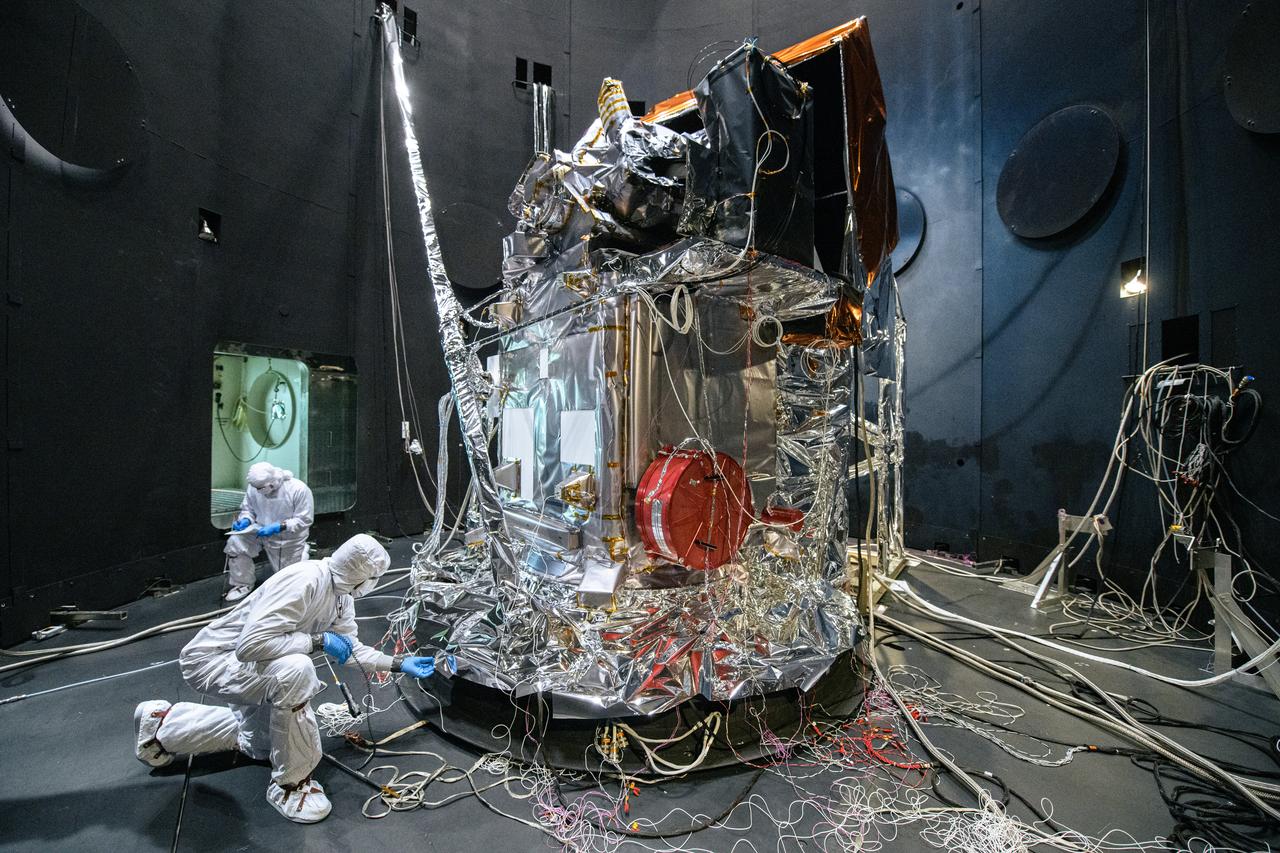
The Plankton, Aerosol, Cloud, ocean Ecosystem (PACE) Observatory inside the Space Environment Simulator (SES) thermal vacuuum chamber before thermal environmental testing at NASA's Goddard Space Flight Center in Greenbelt, Maryland on June 17th, 2023. PACE's unprecedented spectral coverage will provide the first-ever global measurements designed to identify phytoplankton community composition. The mission will make global ocean color measurements, using the Ocean Color Instrument (OCI), to provide extended data records on ocean ecology and global biogeochemistry along with polarimetry measurements, using the Spectro-polarimeter for Planetary Exploration (SPEXone) and the Hyper Angular Research Polarimeter (HARP2) to provide extended data records on clouds and aerosols. The Earth-observing satellite mission, built at Goddard Space Flight Center in Greenbelt, MD, will continue and advance observations of global ocean color, biogeochemistry, and ecology, as well as the carbon cycle, aerosols and clouds.
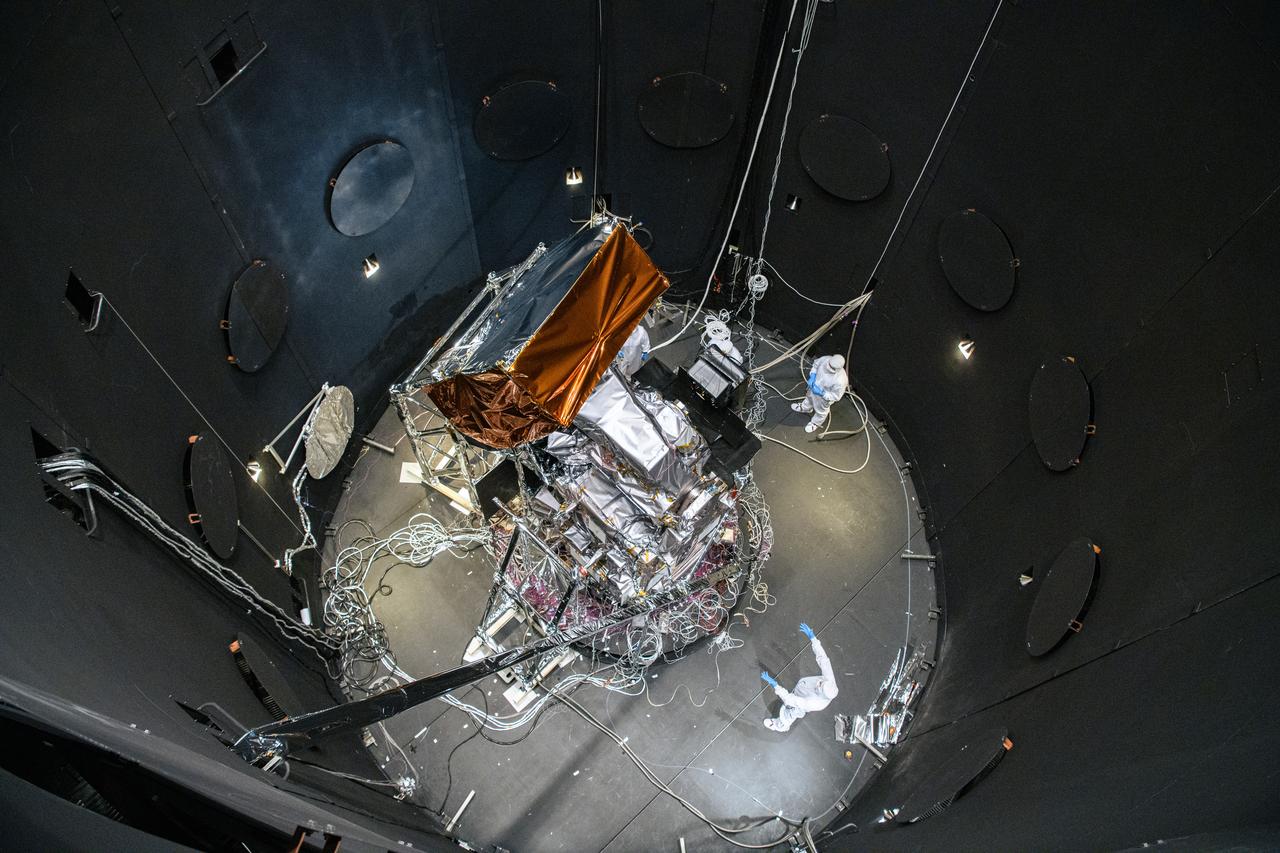
The Plankton, Aerosol, Cloud, ocean Ecosystem (PACE) Observatory inside the Space Environment Simulator (SES) thermal vacuuum chamber before thermal environmental testing at NASA's Goddard Space Flight Center in Greenbelt, Maryland on June 16th, 2023. PACE's unprecedented spectral coverage will provide the first-ever global measurements designed to identify phytoplankton community composition. The mission will make global ocean color measurements, using the Ocean Color Instrument (OCI), to provide extended data records on ocean ecology and global biogeochemistry along with polarimetry measurements, using the Spectro-polarimeter for Planetary Exploration (SPEXone) and the Hyper Angular Research Polarimeter (HARP2) to provide extended data records on clouds and aerosols. The Earth-observing satellite mission, built at Goddard Space Flight Center in Greenbelt, MD, will continue and advance observations of global ocean color, biogeochemistry, and ecology, as well as the carbon cycle, aerosols and clouds.
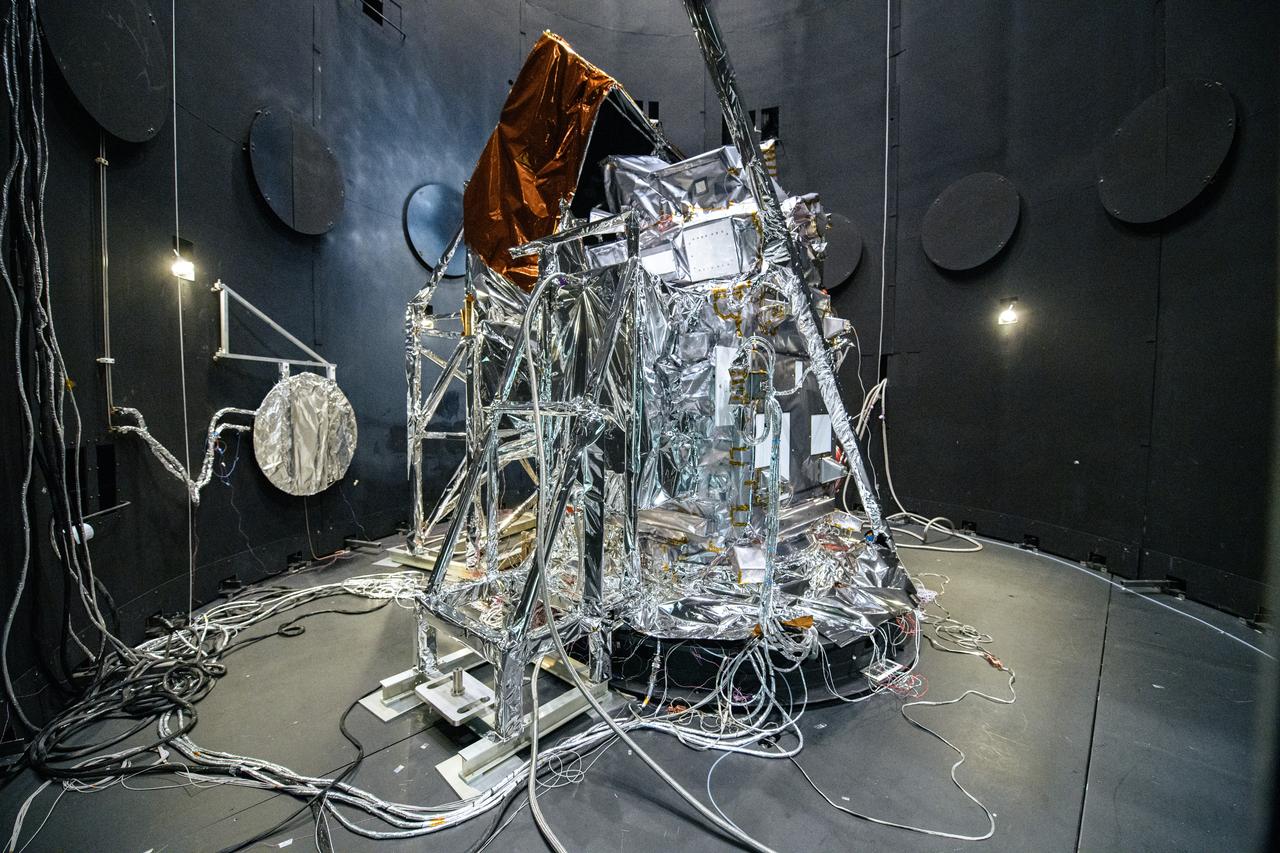
The Plankton, Aerosol, Cloud, ocean Ecosystem (PACE) Observatory inside the Space Environment Simulator (SES) thermal vacuuum chamber before thermal environmental testing at NASA's Goddard Space Flight Center in Greenbelt, Maryland on June 17th, 2023. PACE's unprecedented spectral coverage will provide the first-ever global measurements designed to identify phytoplankton community composition. The mission will make global ocean color measurements, using the Ocean Color Instrument (OCI), to provide extended data records on ocean ecology and global biogeochemistry along with polarimetry measurements, using the Spectro-polarimeter for Planetary Exploration (SPEXone) and the Hyper Angular Research Polarimeter (HARP2) to provide extended data records on clouds and aerosols. The Earth-observing satellite mission, built at Goddard Space Flight Center in Greenbelt, MD, will continue and advance observations of global ocean color, biogeochemistry, and ecology, as well as the carbon cycle, aerosols and clouds.
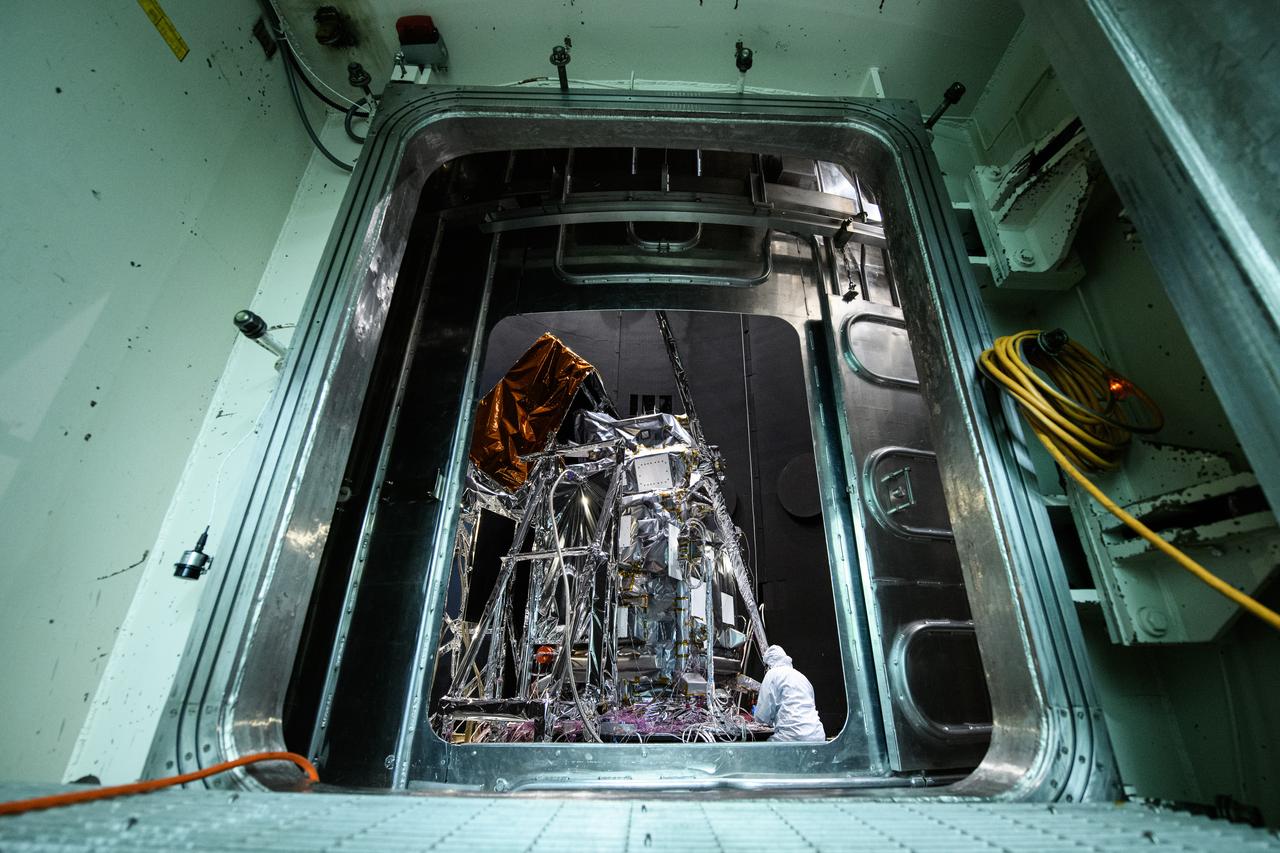
The Plankton, Aerosol, Cloud, ocean Ecosystem (PACE) Observatory inside the Space Environment Simulator (SES) thermal vacuuum chamber before thermal environmental testing at NASA's Goddard Space Flight Center in Greenbelt, Maryland on June 16th, 2023. PACE's unprecedented spectral coverage will provide the first-ever global measurements designed to identify phytoplankton community composition. The mission will make global ocean color measurements, using the Ocean Color Instrument (OCI), to provide extended data records on ocean ecology and global biogeochemistry along with polarimetry measurements, using the Spectro-polarimeter for Planetary Exploration (SPEXone) and the Hyper Angular Research Polarimeter (HARP2) to provide extended data records on clouds and aerosols. The Earth-observing satellite mission, built at Goddard Space Flight Center in Greenbelt, MD, will continue and advance observations of global ocean color, biogeochemistry, and ecology, as well as the carbon cycle, aerosols and clouds.
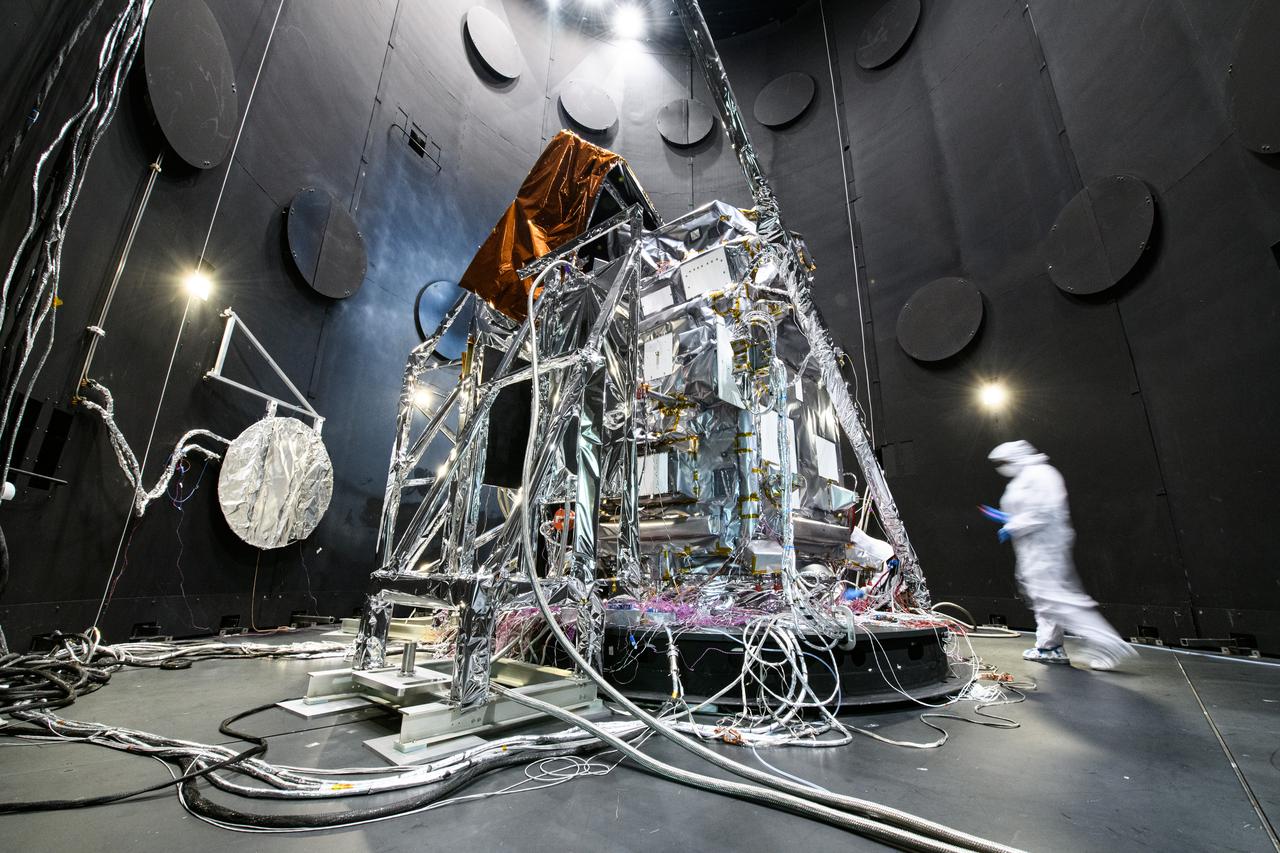
The Plankton, Aerosol, Cloud, ocean Ecosystem (PACE) Observatory inside the Space Environment Simulator (SES) thermal vacuuum chamber before thermal environmental testing at NASA's Goddard Space Flight Center in Greenbelt, Maryland on June 16th, 2023. PACE's unprecedented spectral coverage will provide the first-ever global measurements designed to identify phytoplankton community composition. The mission will make global ocean color measurements, using the Ocean Color Instrument (OCI), to provide extended data records on ocean ecology and global biogeochemistry along with polarimetry measurements, using the Spectro-polarimeter for Planetary Exploration (SPEXone) and the Hyper Angular Research Polarimeter (HARP2) to provide extended data records on clouds and aerosols. The Earth-observing satellite mission, built at Goddard Space Flight Center in Greenbelt, MD, will continue and advance observations of global ocean color, biogeochemistry, and ecology, as well as the carbon cycle, aerosols and clouds.
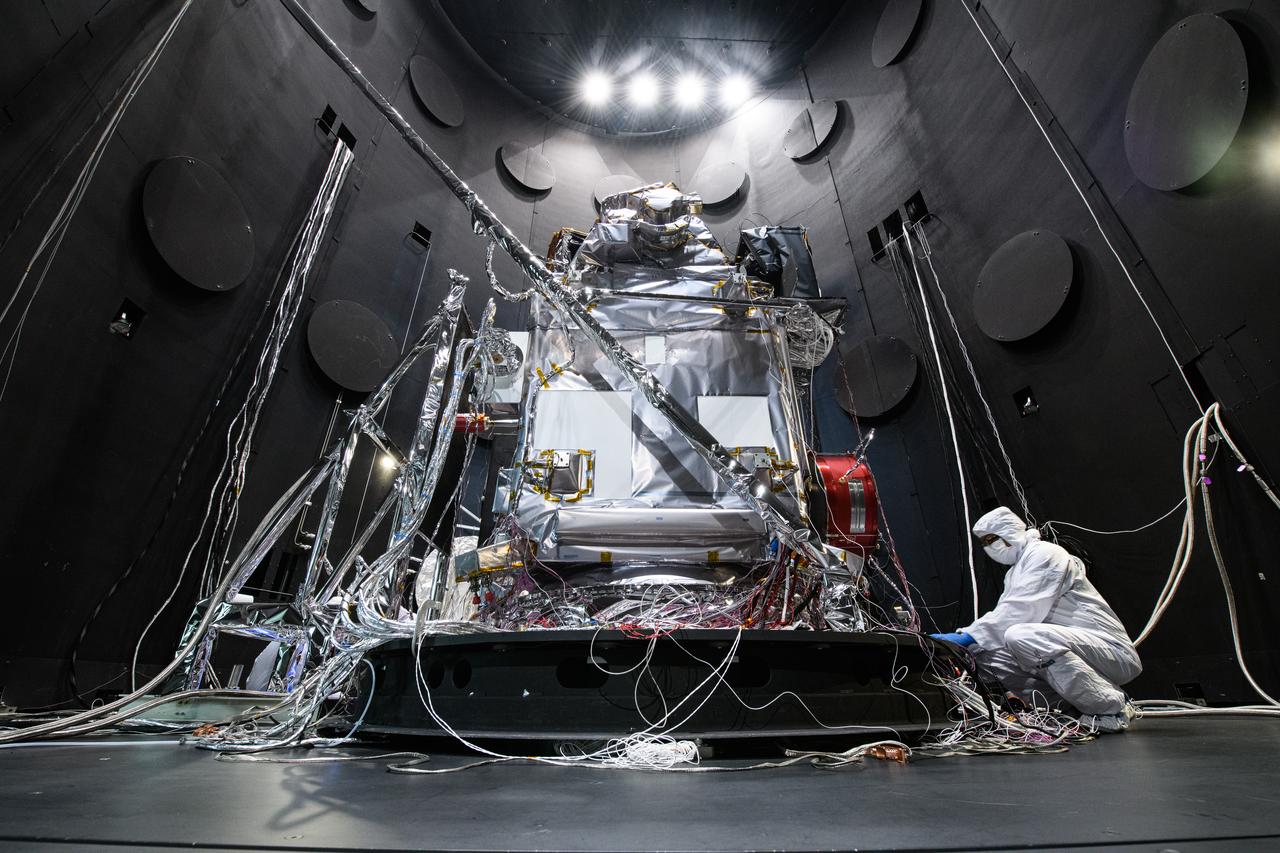
The Plankton, Aerosol, Cloud, ocean Ecosystem (PACE) Observatory inside the Space Environment Simulator (SES) thermal vacuuum chamber before thermal environmental testing at NASA's Goddard Space Flight Center in Greenbelt, Maryland on June 16th, 2023. PACE's unprecedented spectral coverage will provide the first-ever global measurements designed to identify phytoplankton community composition. The mission will make global ocean color measurements, using the Ocean Color Instrument (OCI), to provide extended data records on ocean ecology and global biogeochemistry along with polarimetry measurements, using the Spectro-polarimeter for Planetary Exploration (SPEXone) and the Hyper Angular Research Polarimeter (HARP2) to provide extended data records on clouds and aerosols. The Earth-observing satellite mission, built at Goddard Space Flight Center in Greenbelt, MD, will continue and advance observations of global ocean color, biogeochemistry, and ecology, as well as the carbon cycle, aerosols and clouds.
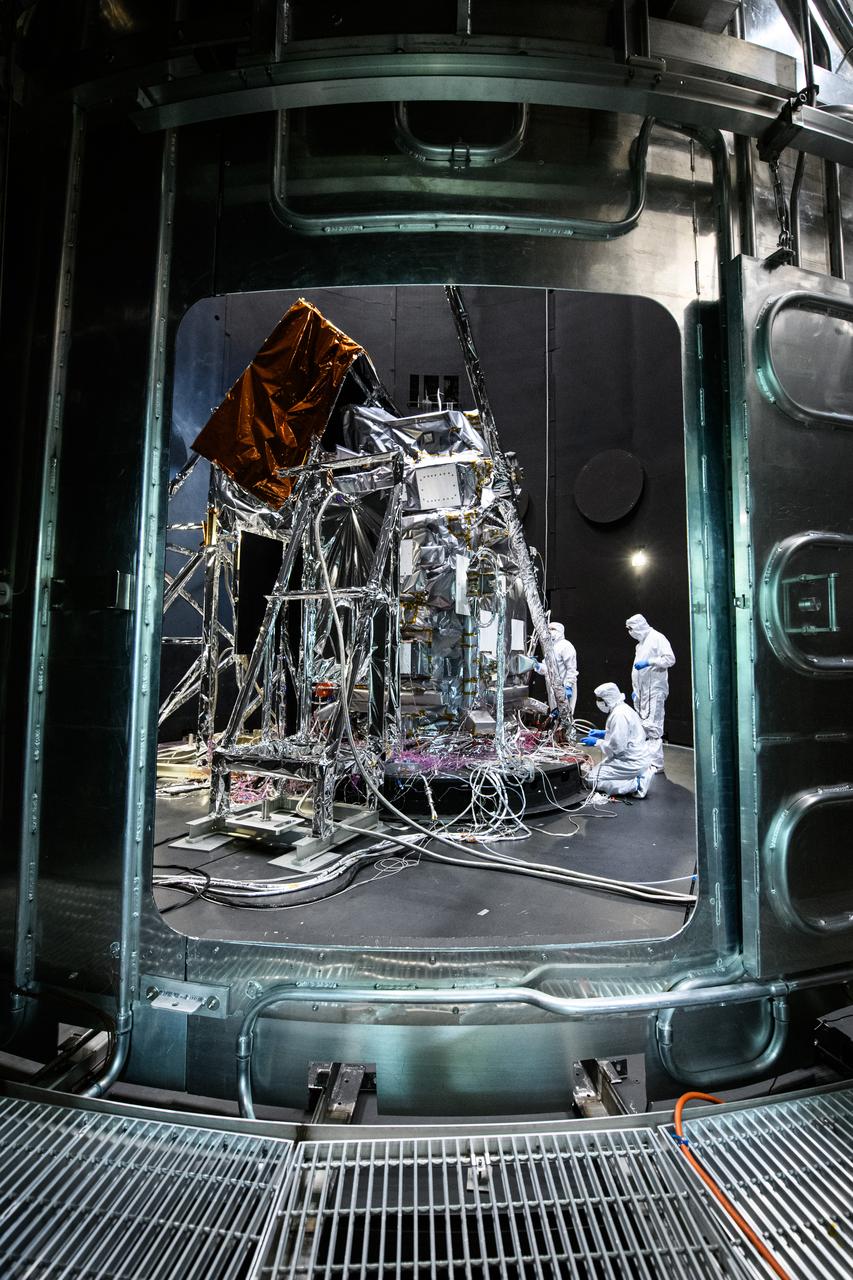
The Plankton, Aerosol, Cloud, ocean Ecosystem (PACE) Observatory inside the Space Environment Simulator (SES) thermal vacuuum chamber before thermal environmental testing at NASA's Goddard Space Flight Center in Greenbelt, Maryland on June 16th, 2023. PACE's unprecedented spectral coverage will provide the first-ever global measurements designed to identify phytoplankton community composition. The mission will make global ocean color measurements, using the Ocean Color Instrument (OCI), to provide extended data records on ocean ecology and global biogeochemistry along with polarimetry measurements, using the Spectro-polarimeter for Planetary Exploration (SPEXone) and the Hyper Angular Research Polarimeter (HARP2) to provide extended data records on clouds and aerosols. The Earth-observing satellite mission, built at Goddard Space Flight Center in Greenbelt, MD, will continue and advance observations of global ocean color, biogeochemistry, and ecology, as well as the carbon cycle, aerosols and clouds.

Engineers at NASA’s Langley Research Center in Hampton, Virginia, install test dummies into the seats of an Orion test article on Feb. 26, 2016. The capsule, coupled with the heat shield from the spacecraft’s first flight, will be used for water-impact testing to simulate what astronauts will experience when landing in the Pacific Ocean during a real mission.
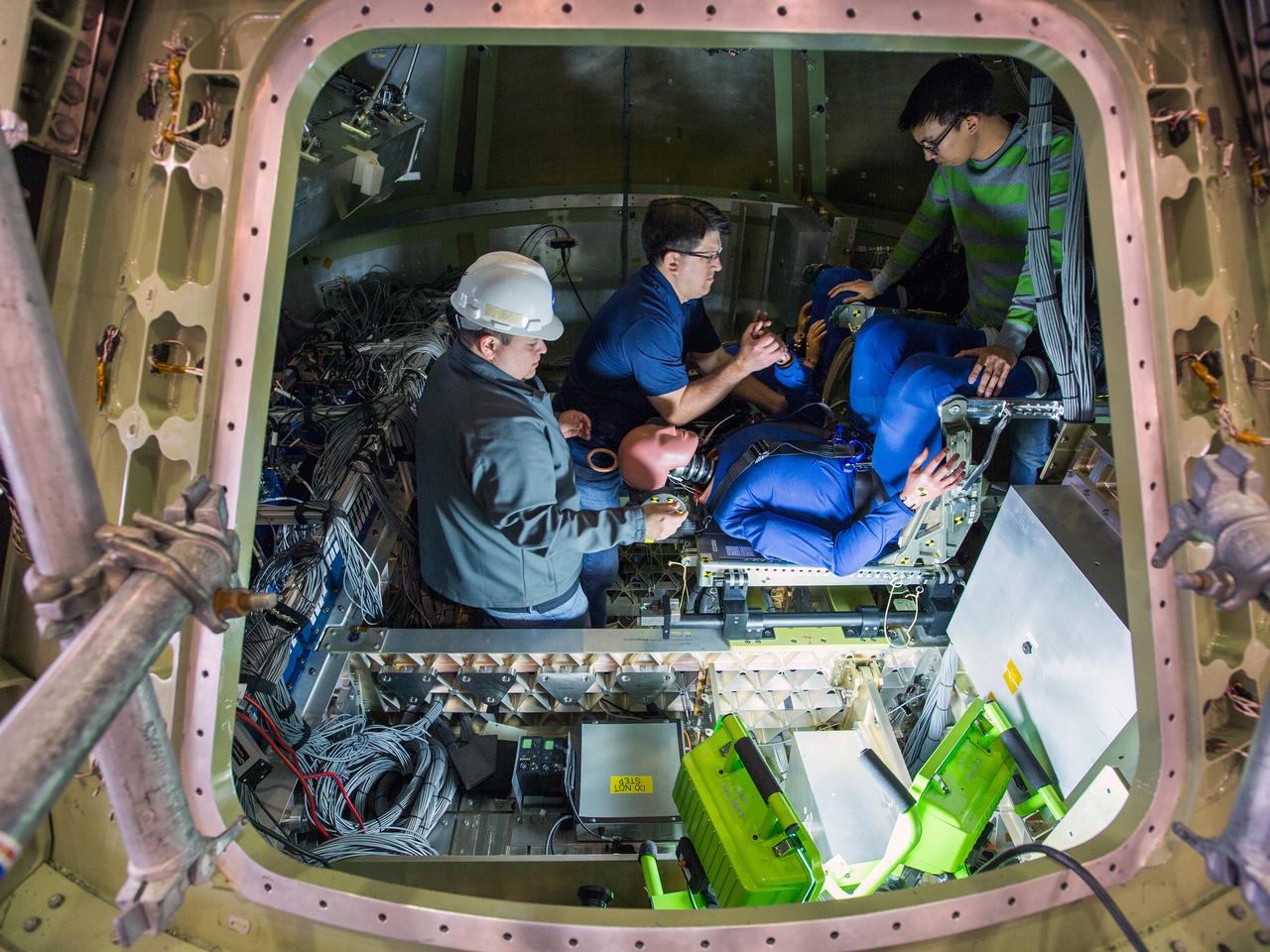
Engineers at NASA’s Langley Research Center in Hampton, Virginia, install test dummies into the seats of an Orion test article on Feb. 26, 2016. The capsule, coupled with the heat shield from the spacecraft’s first flight, will be used for water-impact testing to simulate what astronauts will experience when landing in the Pacific Ocean during a real mission.

Engineers at NASA’s Langley Research Center in Hampton, Virginia, install test dummies into the seats of an Orion test article on Feb. 26, 2016. The capsule, coupled with the heat shield from the spacecraft’s first flight, will be used for water-impact testing to simulate what astronauts will experience when landing in the Pacific Ocean during a real mission.

Engineers at NASA’s Langley Research Center in Hampton, Virginia, install test dummies into the seats of an Orion test article on Feb. 26, 2016. The capsule, coupled with the heat shield from the spacecraft’s first flight, will be used for water-impact testing to simulate what astronauts will experience when landing in the Pacific Ocean during a real mission.
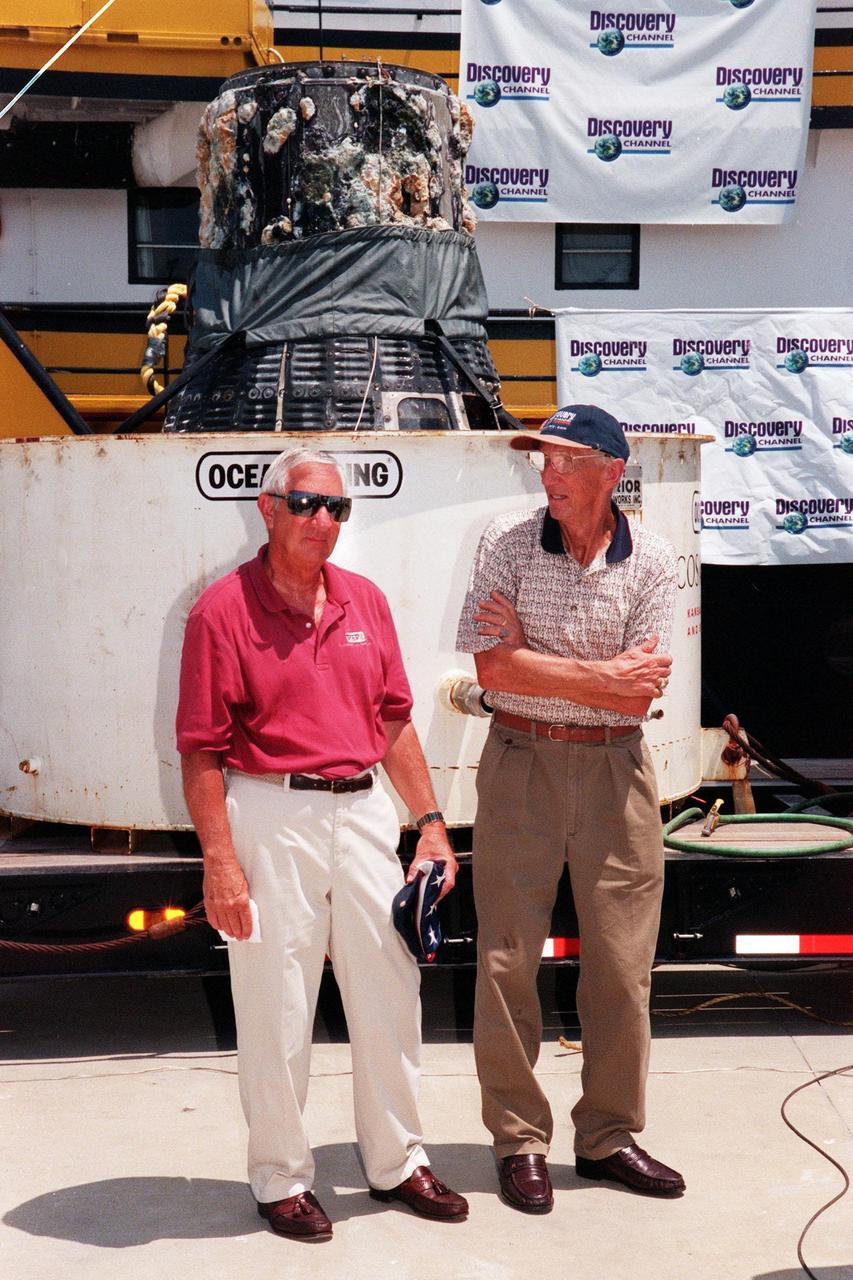
KENNEDY SPACE CENTER, FLA. -- Waiting for the arrival of the Liberty Bell 7 after its raising from the ocean floor. Liberty Bell 7 launched U.S. Air Force Captain Virgil "Gus" Grissom July 21, 1961 on a mission that lasted 15 minutes and 37 seconds before sinking to the floor of the Atlantic Ocean, three miles deep. It lay undetected for nearly four decades before a Discovery Channel expedition located it and recovered it. The space capsule is now restored and preserved, and part of an interactive exhibit touring science centers and museums in 12 cities throughout the United States until 2003. The exhibit includes hands-on elements such as a capsule simulator, a centrifuge, and ROV pilot.
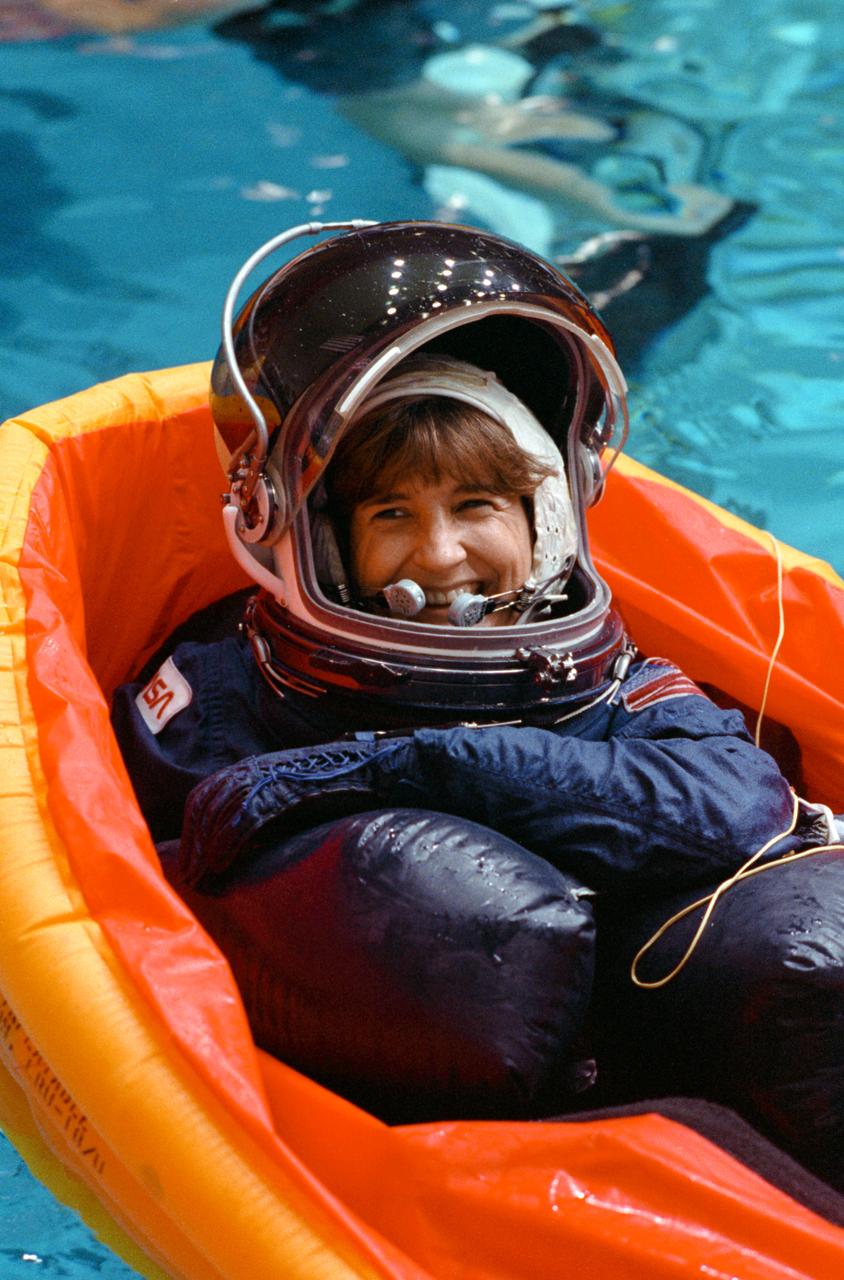
S90-45229 (25 June 1990) --- Astronaut Linda M. Godwin, STS-37 mission specialist, floats in a one-person life raft. She was simulating steps involved in emergency egress from a space shuttle. The training session was held in the Johnson Space Center's weightless environment training facility (WET-F). The 25-ft. deep pool in the facility served as a simulated ocean into which a parachute landing might be made. Early next year, Godwin, along with four other astronauts, will fly onboard Atlantis for a five-day mission.
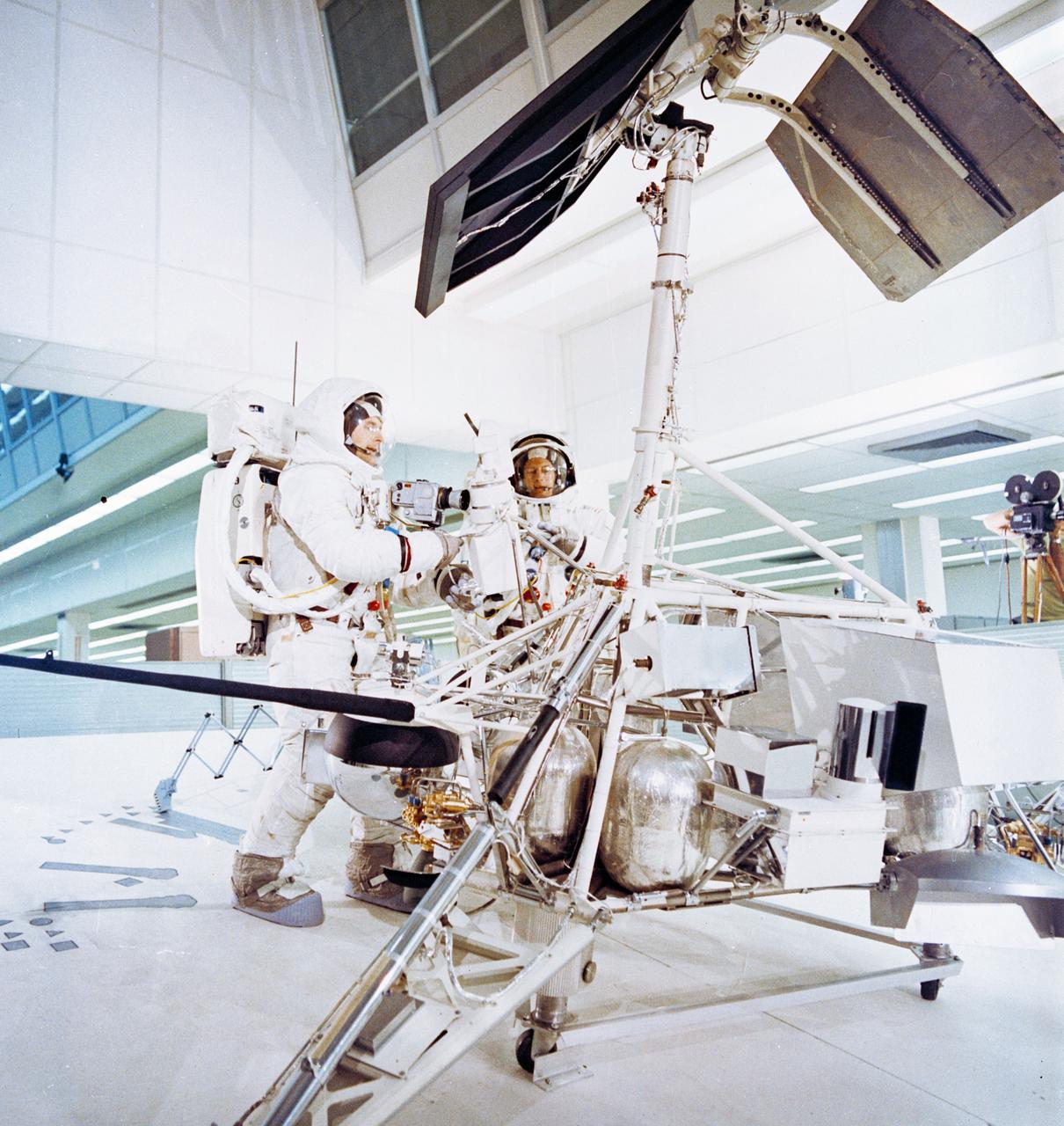
S69-55367 (6 Oct. 1969) --- Two members of the Apollo 12 lunar landing mission participate in lunar surface extravehicular activity (EVA) simulations in the Kennedy Space Center's (KSC) Flight Crew Training Building. Here, astronauts Charles Conrad Jr. (right), commander; and Alan L. Bean, lunar module pilot, simulate a photographic inspection of the unmanned Surveyor 3 spacecraft. The inspection of Surveyor 3, which has been resting on the moon's Ocean of Storms since April 1967, is an important objective of the Apollo 12 mission. Selected pieces will be cut from Surveyor 3 and brought back to Earth for scientific examination.
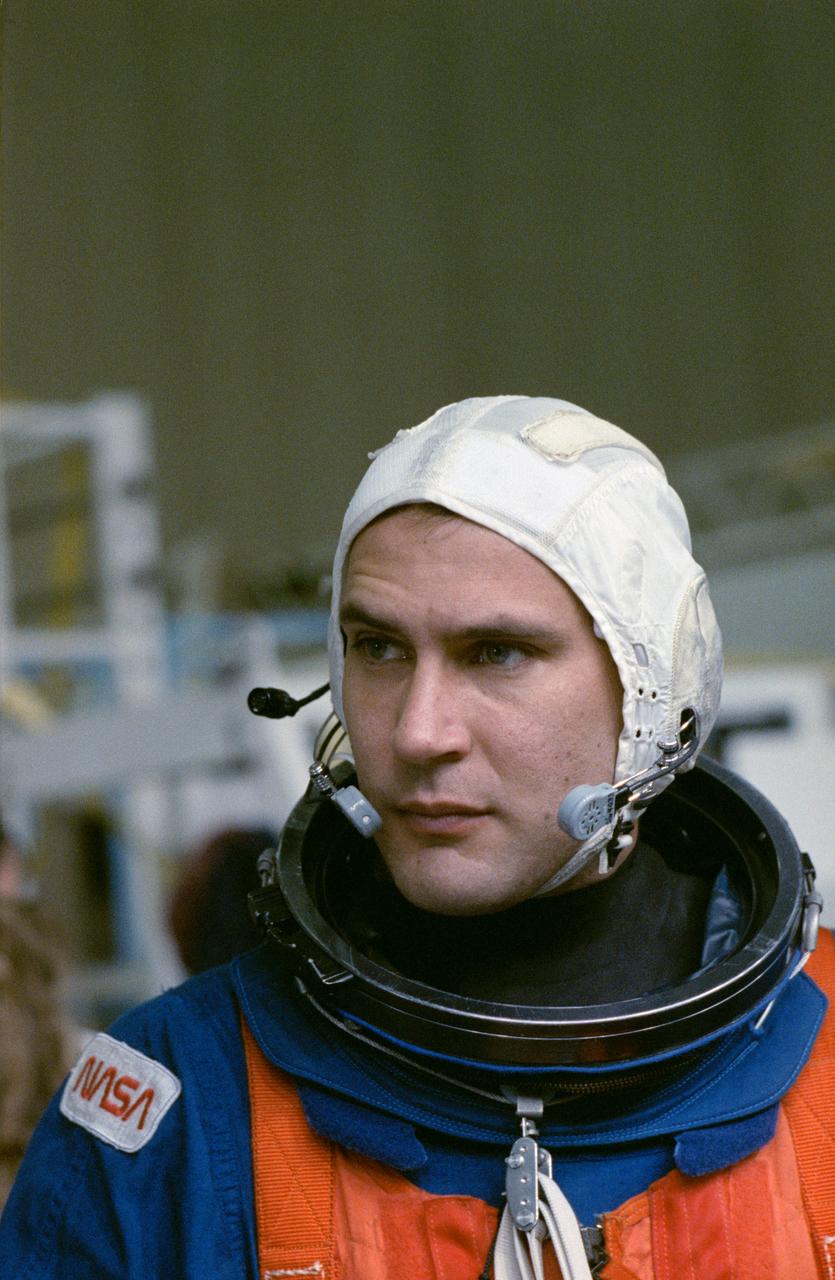
S90-54750 (7 Dec 1990) --- Astronaut Richard J. Hieb, mission specialist, listens attentively as a trainer (out of frame) briefs the STS-39 crewmembers on emergency egress measures. The seven astronauts were in JSC's weightless environment training facility (WET-F). This type training uses the WET-F's 25 ft. deep pool to simulate an ocean parachute landing.
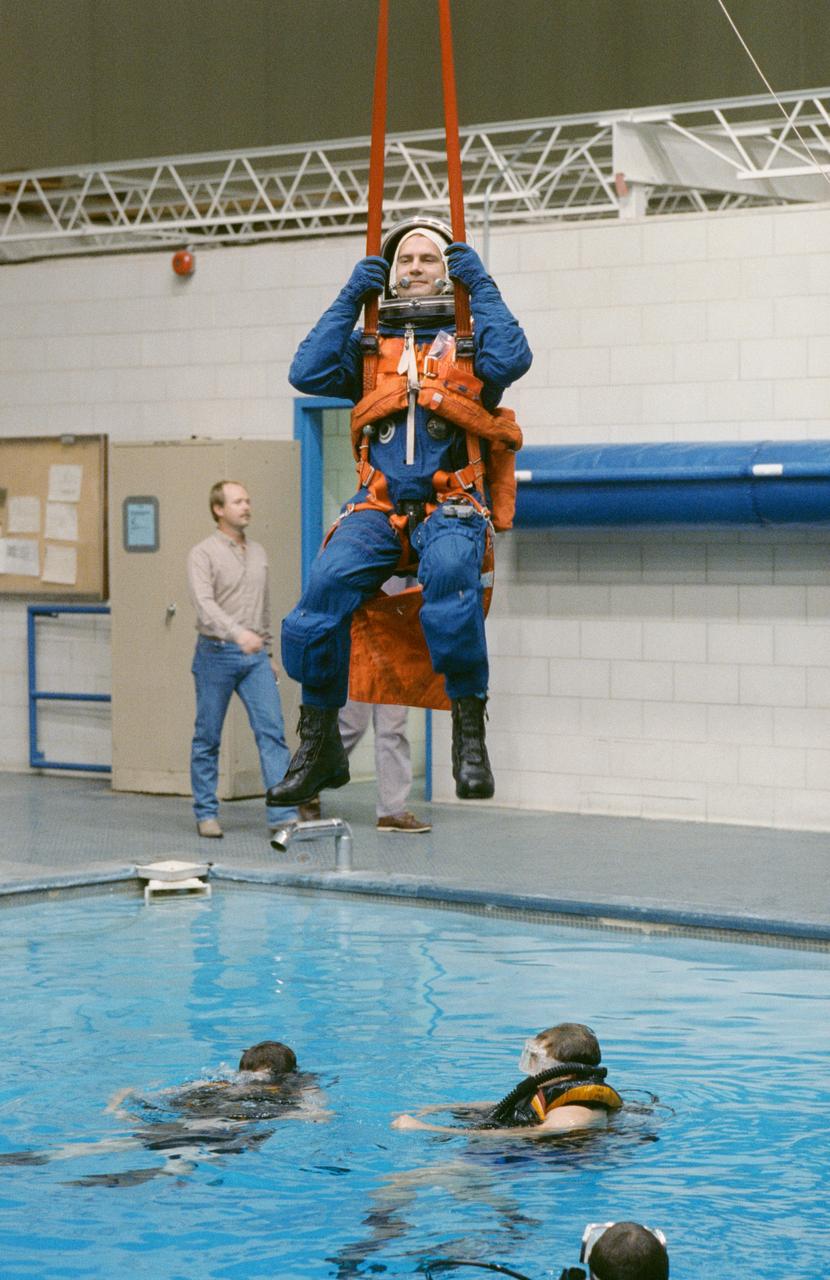
S90-54760 (7 Dec 1990) --- Astronaut Richard J. Hieb, mission specialist, participates in emergency egress training. Hieb and six fellow STS 39 astronauts were in JSC's weightless environment training facility (WET-F). This type training uses the WET-F's 25 ft. deep pool to simulate an ocean parachute landing. A number of SCUBA-equipped divers assist in the training session.
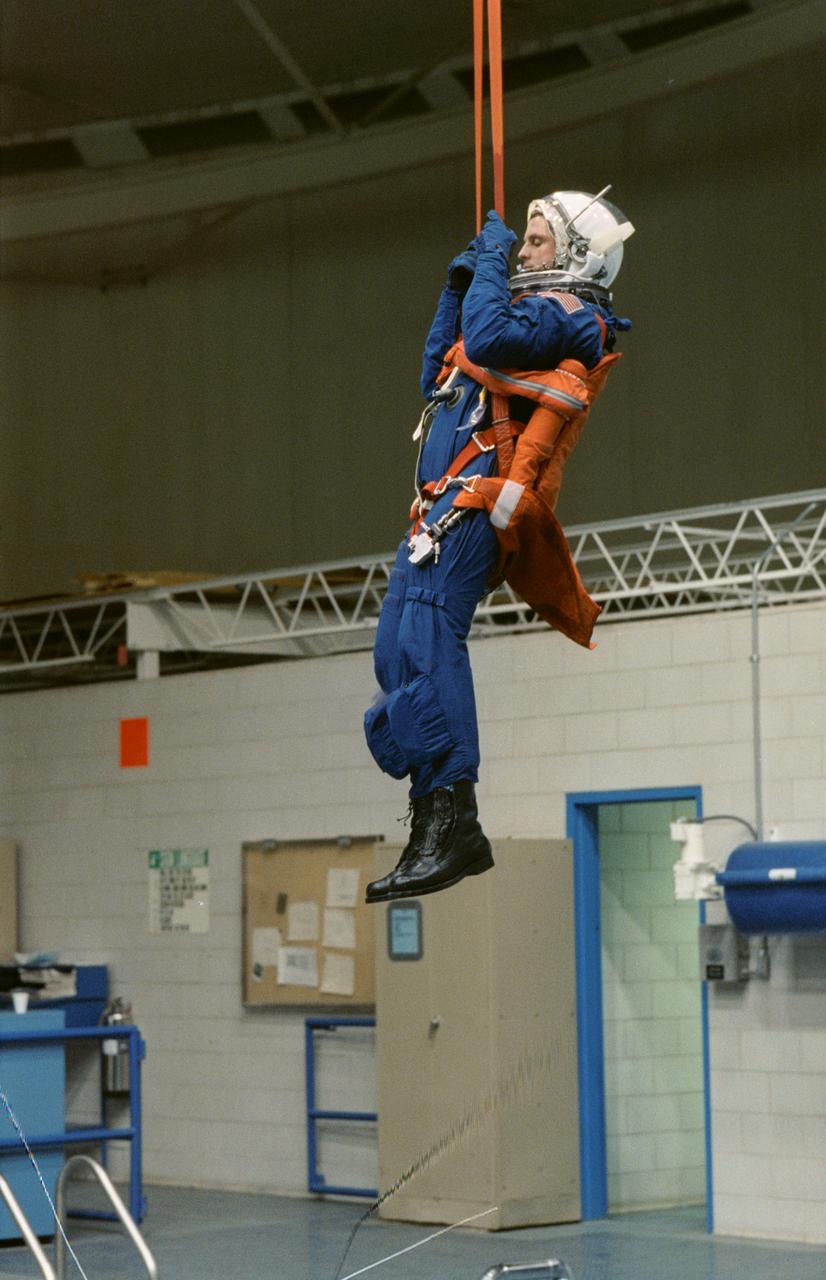
S90-54763 (7 Dec 1990) --- Astronaut Gregory J. Harbaugh. Mission specialist, participates in emergency egress training. Harbaugh and some of his fellow STS 39 astronauts were in JSC's weightless environment training facility (WET-F). Harbaugh is actually suspended over water. This type training uses the WET-F's 25 ft. deep pool to simulate an ocean parachute landing.
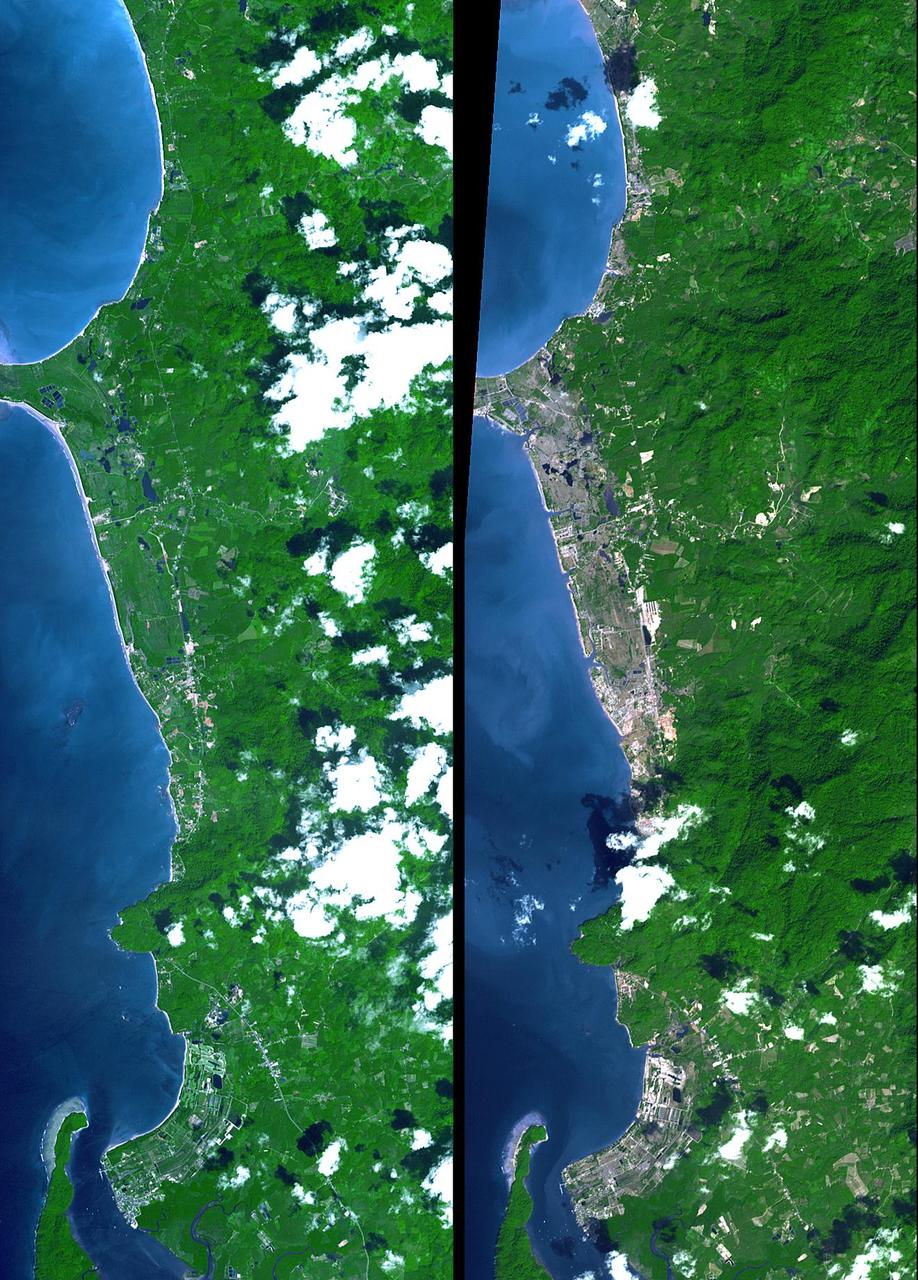
The island of Phuket on the Indian Ocean coast of Thailand is a major tourist destination and was also in the path of the tsunami that washed ashore on December 26, 2004. These simulated natural color ASTER images show a 27 kilometer (17-mile) long stretch of coast north of the Phuket airport on December 31 (right), along with an image acquired two years earlier (left). The changes along the coast are obvious where the vegetation has been stripped away. http://photojournal.jpl.nasa.gov/catalog/PIA07227
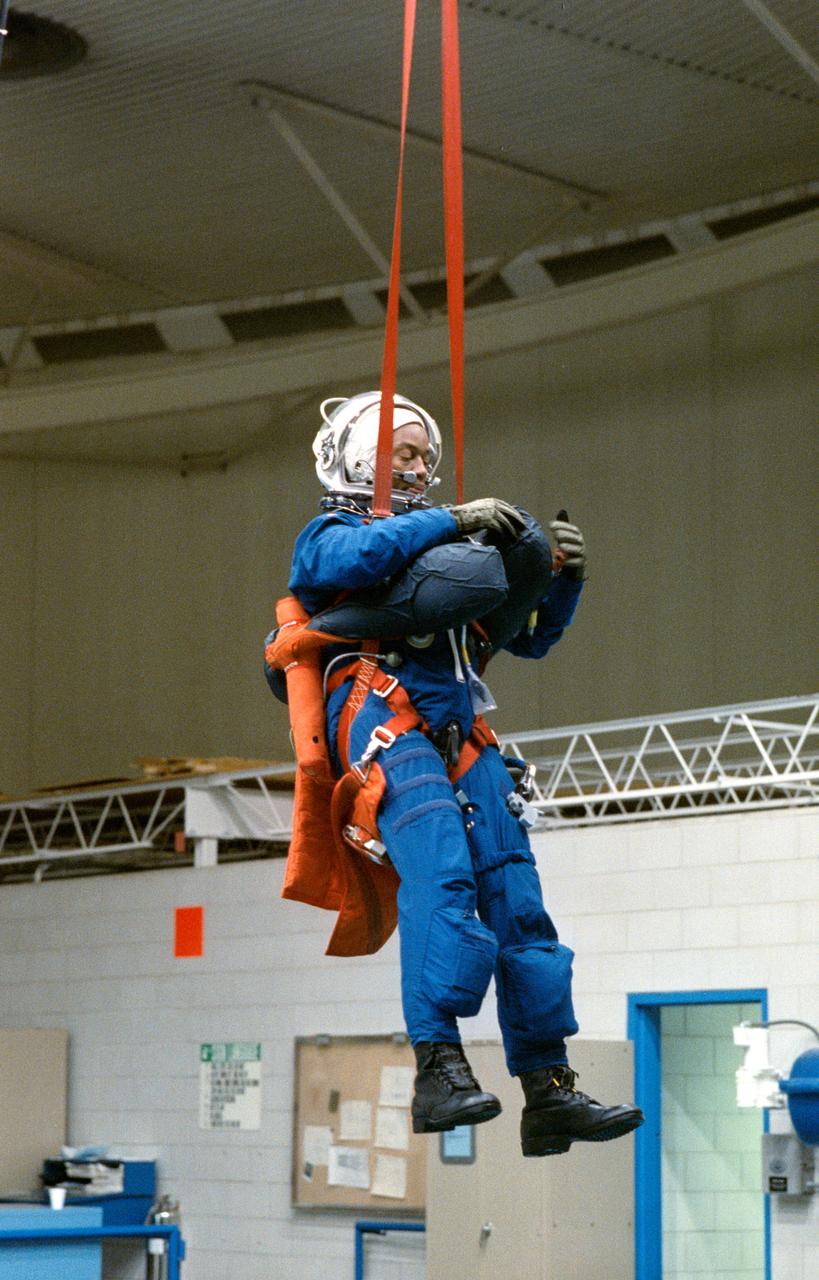
S90-54755 (13 Dec 1990) --- Astronaut Guion S. Bluford, Jr., STS-39 Mission Specialist wearing launch and entry suit (LES) and launch and entry helmet (LEH), is suspended above JSC's Weightless Environment Training Facility (WETF) Bldg 29 pool via his parachute harness. Bluford will be dropped from the harness into the WETF's 25 ft deep pool to simulate an emergency egress bailout from the Space Shuttle into the ocean.
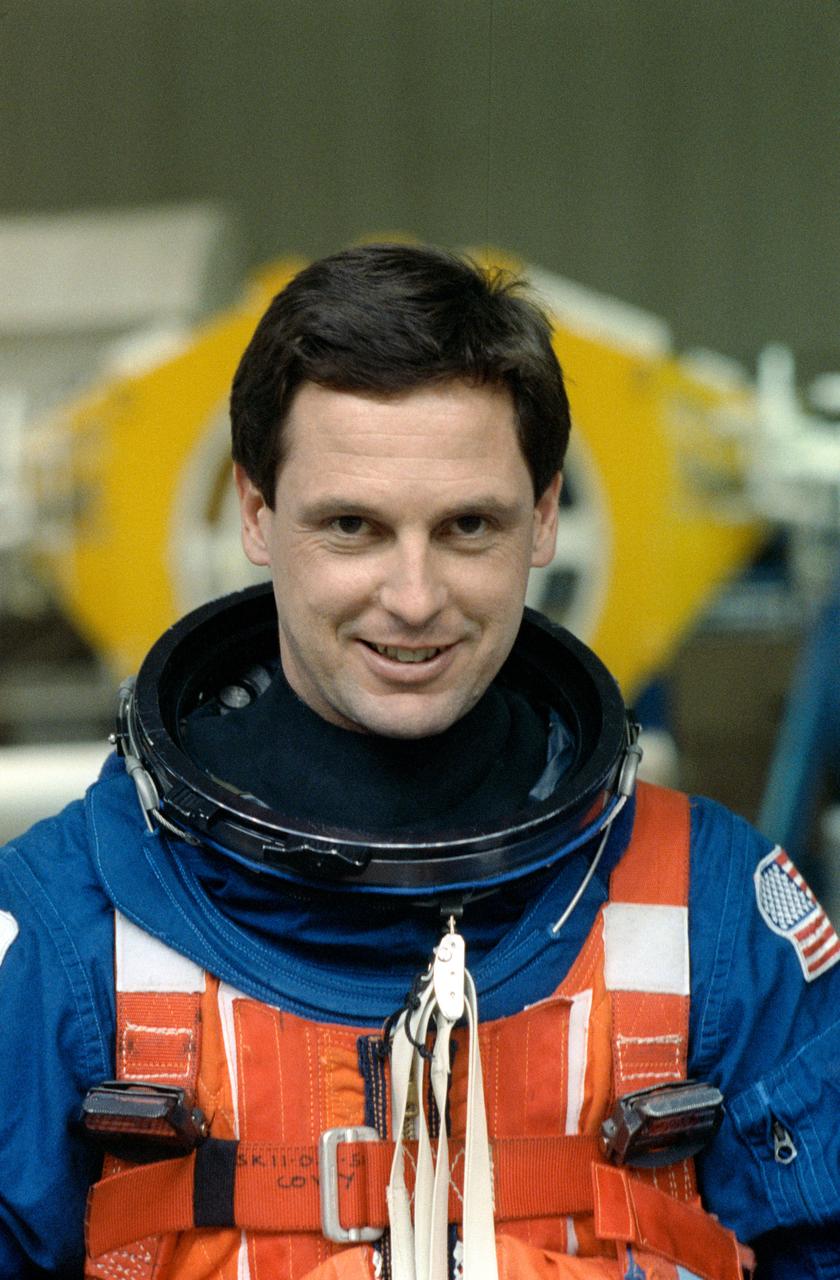
S90-54764 (7 Dec 1990) --- Astronaut Gregory J. Harbaugh, mission specialist, listens attentively as a trainer (out of frame) briefs the STS-39 crewmembers on emergency egress measures. The seven astronauts were in the Johnson Space Center's (JSC) weightless environment training facility (WET-F). This type training uses the WET-F's 25 ft. deep pool to simulate an ocean parachute landing.
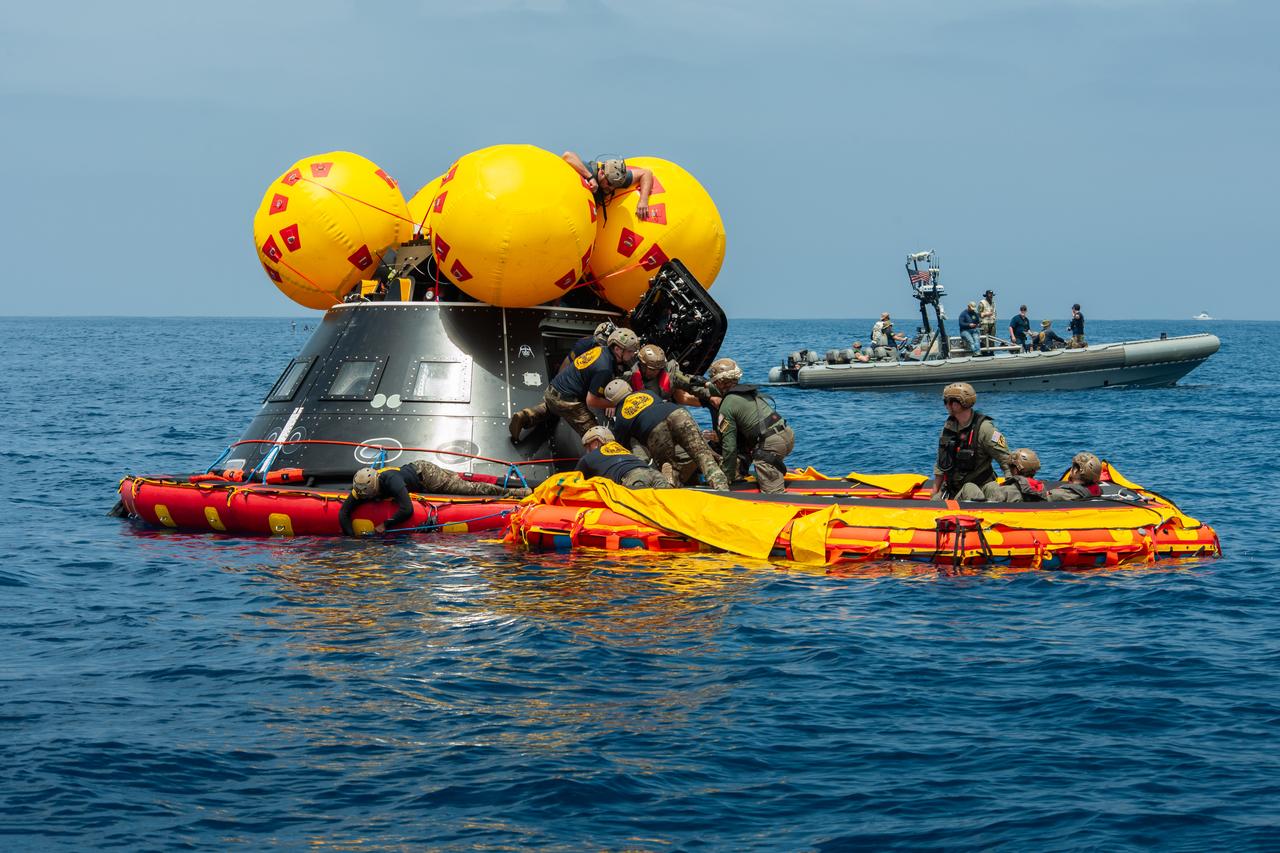
NASA, Navy, and Air Force personnel practice Artemis recovery procedures in the Pacific Ocean as part of Underway Recovery Test 10 (URT-10) off the coast of San Diego. In this photo, Navy divers are seen entering the Orion Crew Module Test Article (CMTA) and assisting a simulated crew member exiting the spacecraft to practice recovering astronauts out of the spacecraft and onto an inflatable “front porch” where the crew will be picked up with helicopters and lifted up via helicopter back to the recovery vessel.
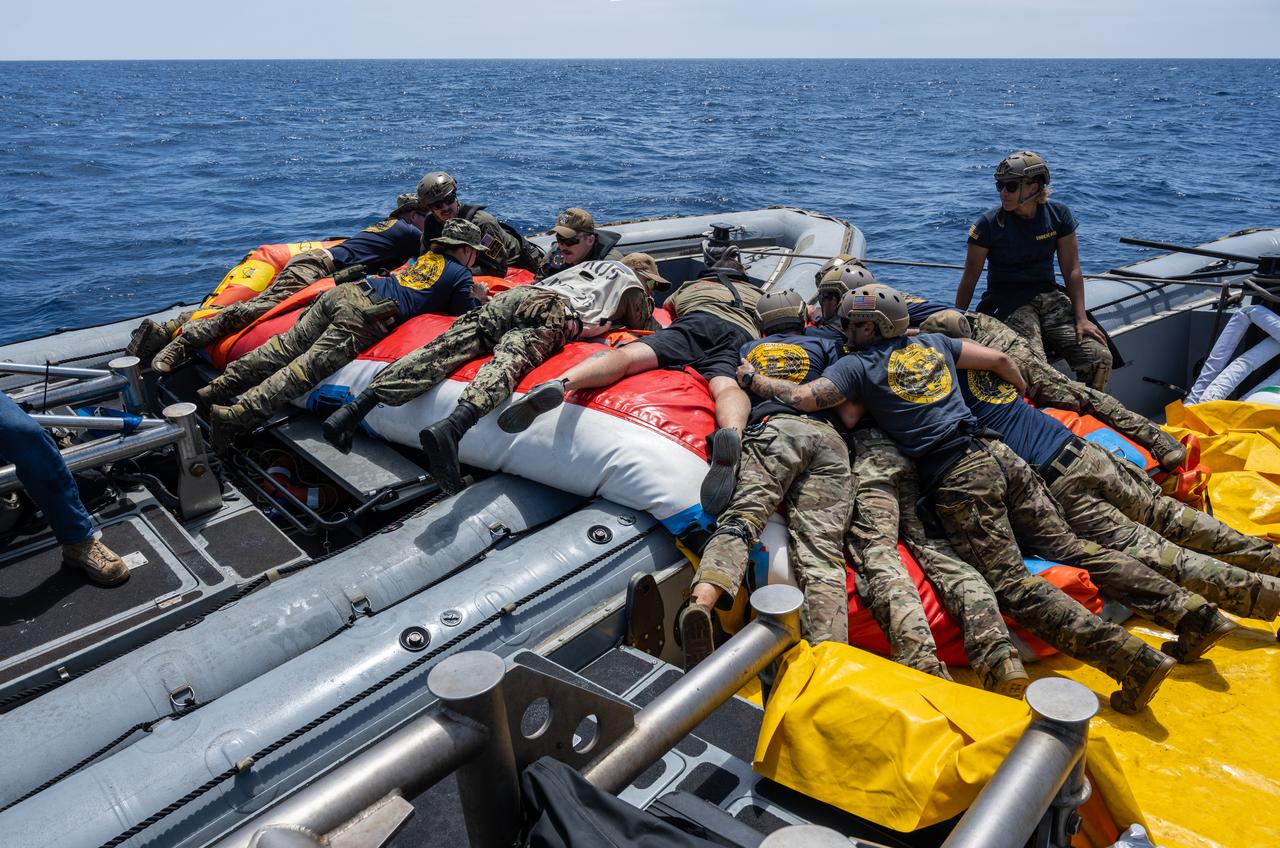
Navy Divers from Explosive Ordnance Disposal (EOD) Expeditionary Support Unit 1, sailors from USS John P Murtha and NASA Open Water Lead, Tim Goddard, work to deflate Artemis recovery equipment after a simulated Artemis recovery operation as part of NASA’s Underway Recovery Test 10. The team will use these inflatables as a platform for astronauts as they exit the Orion spacecraft after splashing down in the Pacific Ocean
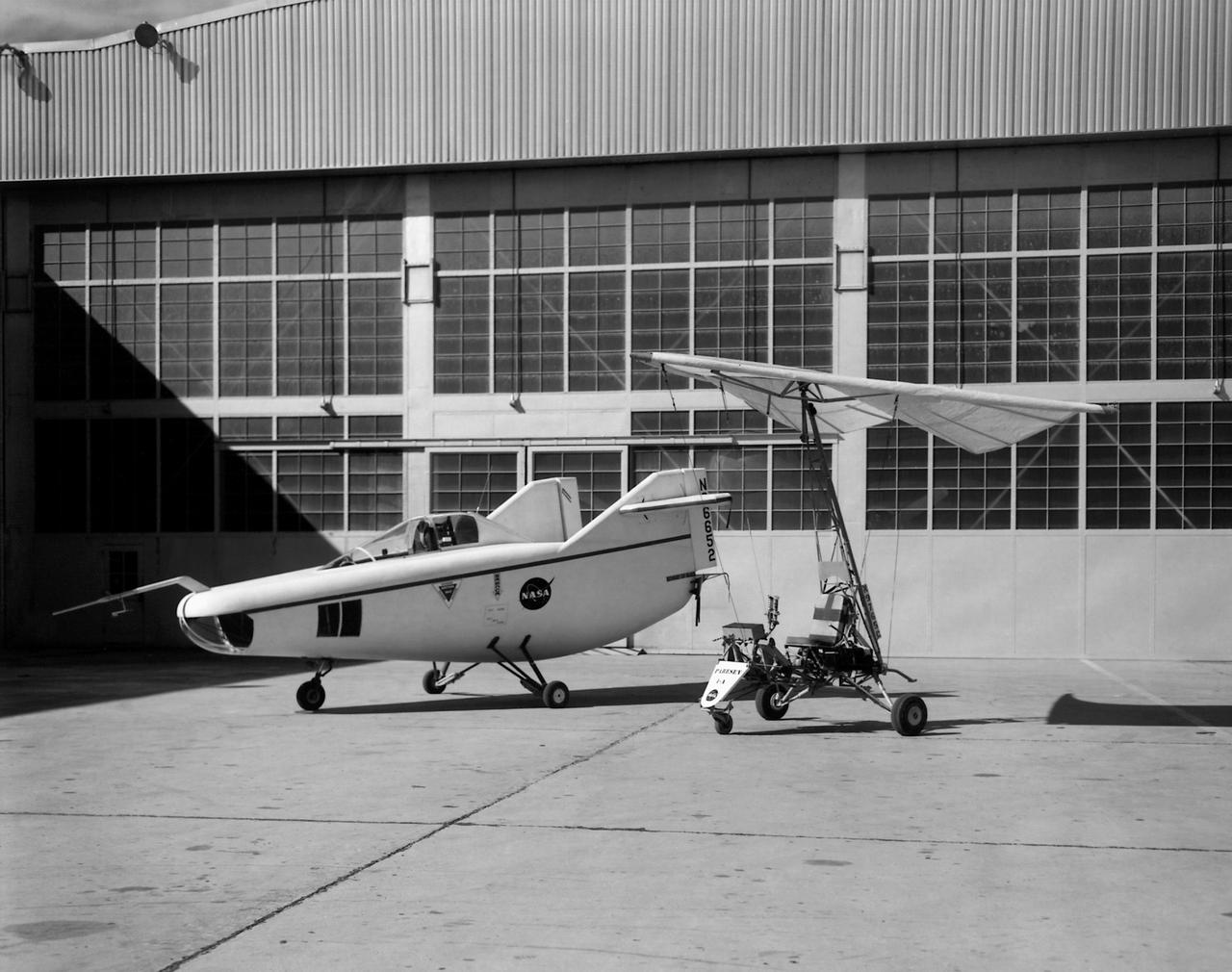
In this photo of the M2-F1 lifting body and the Paresev 1B on the ramp, the viewer sees two vehicles representing different approaches to building a research craft to simulate a spacecraft able to land on the ground instead of splashing down in the ocean as the Mercury capsules did. The M2-F1 was a lifting body, a shape able to re-enter from orbit and land. The Paresev (Paraglider Research Vehicle) used a Rogallo wing that could be (but never was) used to replace a conventional parachute for landing a capsule-type spacecraft, allowing it to make a controlled landing on the ground.
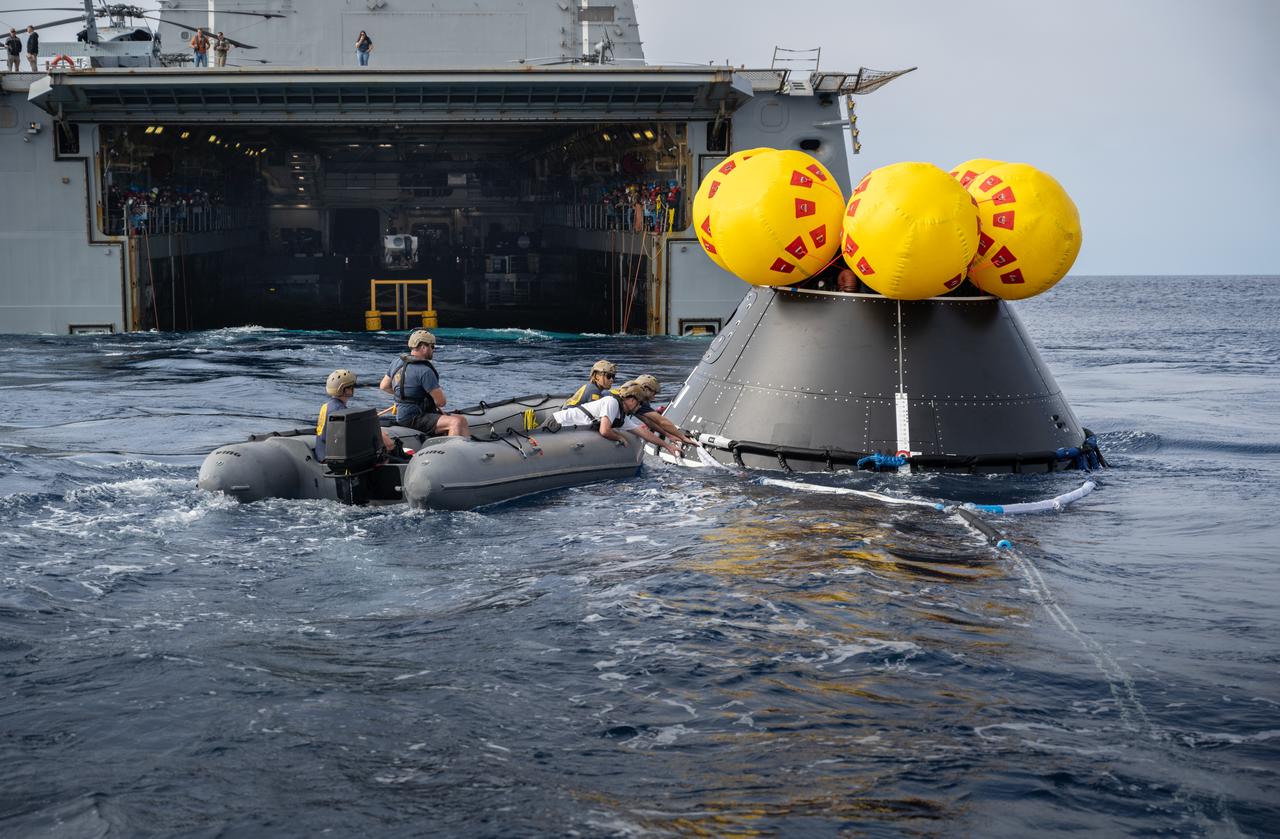
NASA, Navy, and Air Force personnel practice Artemis recovery procedures in the Pacific Ocean as part of Underway Recovery Test 10 (URT-10) off the coast of San Diego. In this photo, Navy divers are seen surrounding the Orion Crew Module Test Article (CMTA) and preparing to recover it inside the recovery ship while simulated astronauts are picked up on an inflatable “front porch” by Naval helicopter pilots from Helicopter Sea Combat Squadron (HSC) 23 “Wildcards” and flown back to the USS John P. Murtha.
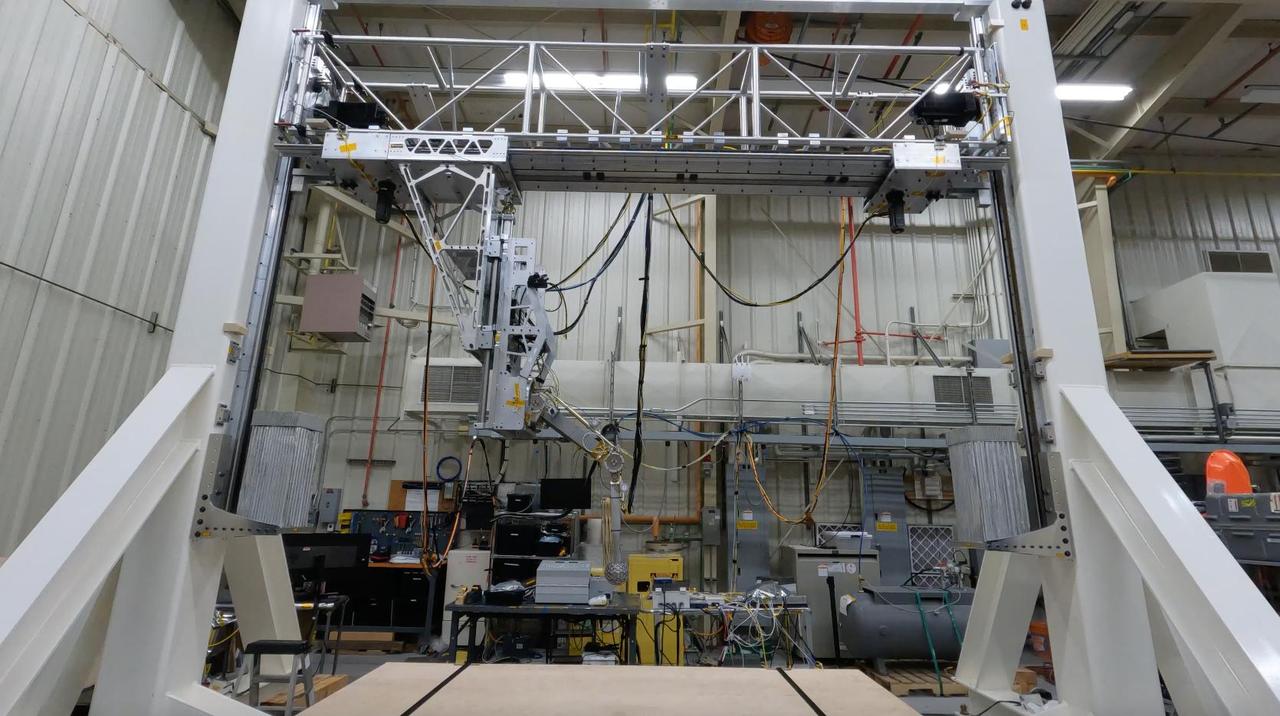
Engineers test the mechanical landing system for the proposed Europa Lander project at NASA's Jet Propulsion Laboratory on Sept. 15, 2022. This test, using the Europa Lander landing gear testbed, fully exercises the Europa Lander landing gear mechanism through a simulated dynamic landing. Europa Lander is a concept for a potential future mission that would look for signs of life in the icy surface material of Jupiter's moon Europa. The moon is thought to contain a global ocean of salty water beneath its frozen crust. If life exists in that ocean, signs of its existence called biosignatures could potentially find their way to the surface. In this mission concept, a spacecraft would land on Europa and collect and study samples from about 4 inches (10 centimeters) beneath the surface, looking for signs of life. The Europa Lander landing gear testbed was developed to test and inform the design of the landing gear for the spacecraft: It mimics the landing loads and ground interaction forces that a single flight landing gear would experience when touching down on the Europan surface. It does this by using gravity offloading to simulate the reduced gravity on Europa, and by replicating the mass and inertial properties of a flight lander as well as all the degrees of freedom that the landing gear would experience. Video available at https://photojournal.jpl.nasa.gov/catalog/PIA26199
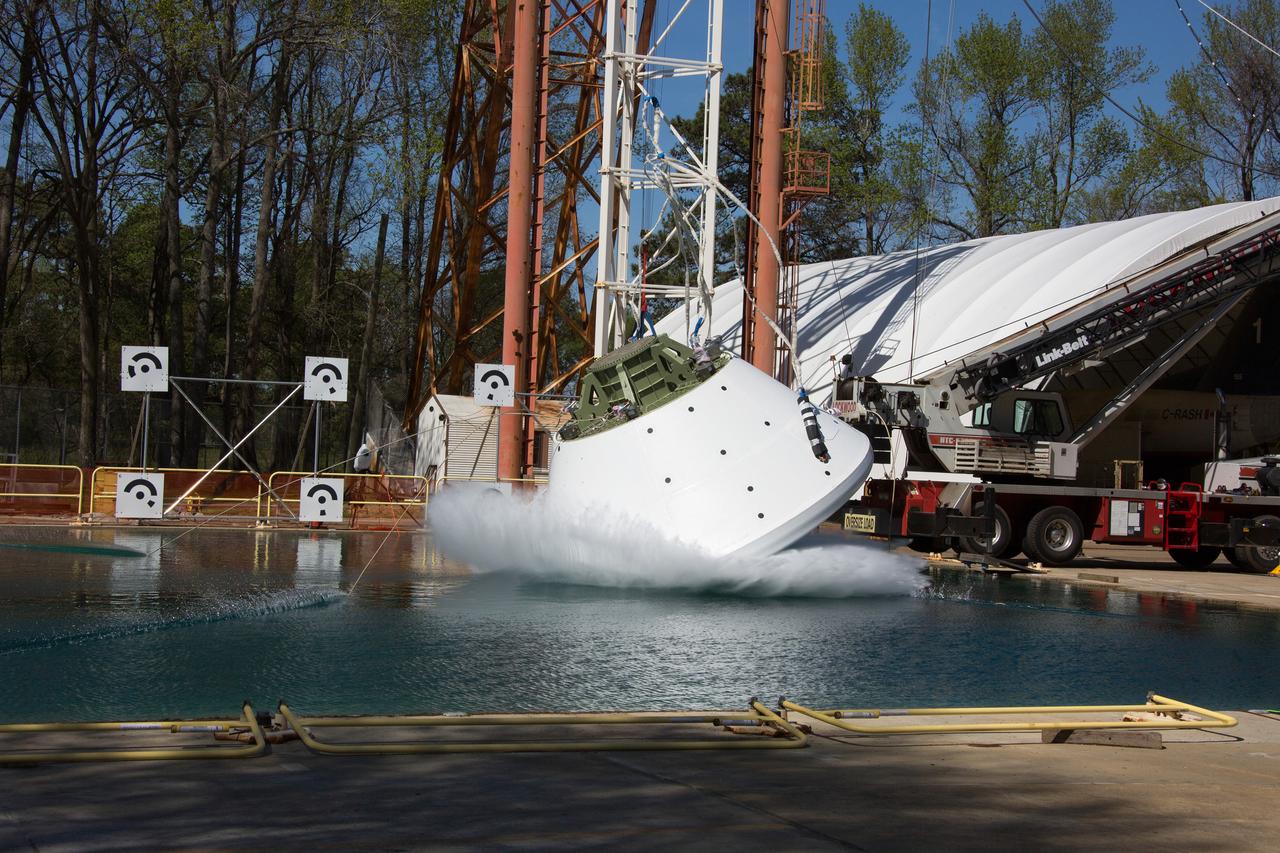
On April 6, 2016, engineers at NASA’s Langley Research Center in Hampton, Virginia, kicked off a series of nine drop tests of a representative Orion crew capsule with crash test dummies inside to understand what the spacecraft and astronauts may experience when landing in the Pacific Ocean after deep-space missions. The high-fidelity capsule, coupled with the heat shield from Orion's first flight in space, was hoisted approximately 16 feet above the water and vertically dropped into Langley’s 20-foot-deep Hydro Impact Basin. The crash test dummies were instrumented to provide data and secured inside the capsule to help provide information engineers need to ensure astronauts will be protected from injury during splashdown. Each test in the series simulates different scenarios for Orion’s parachute-assisted landings, wind conditions, velocities and wave heights the spacecraft may experience when touching down in the ocean.
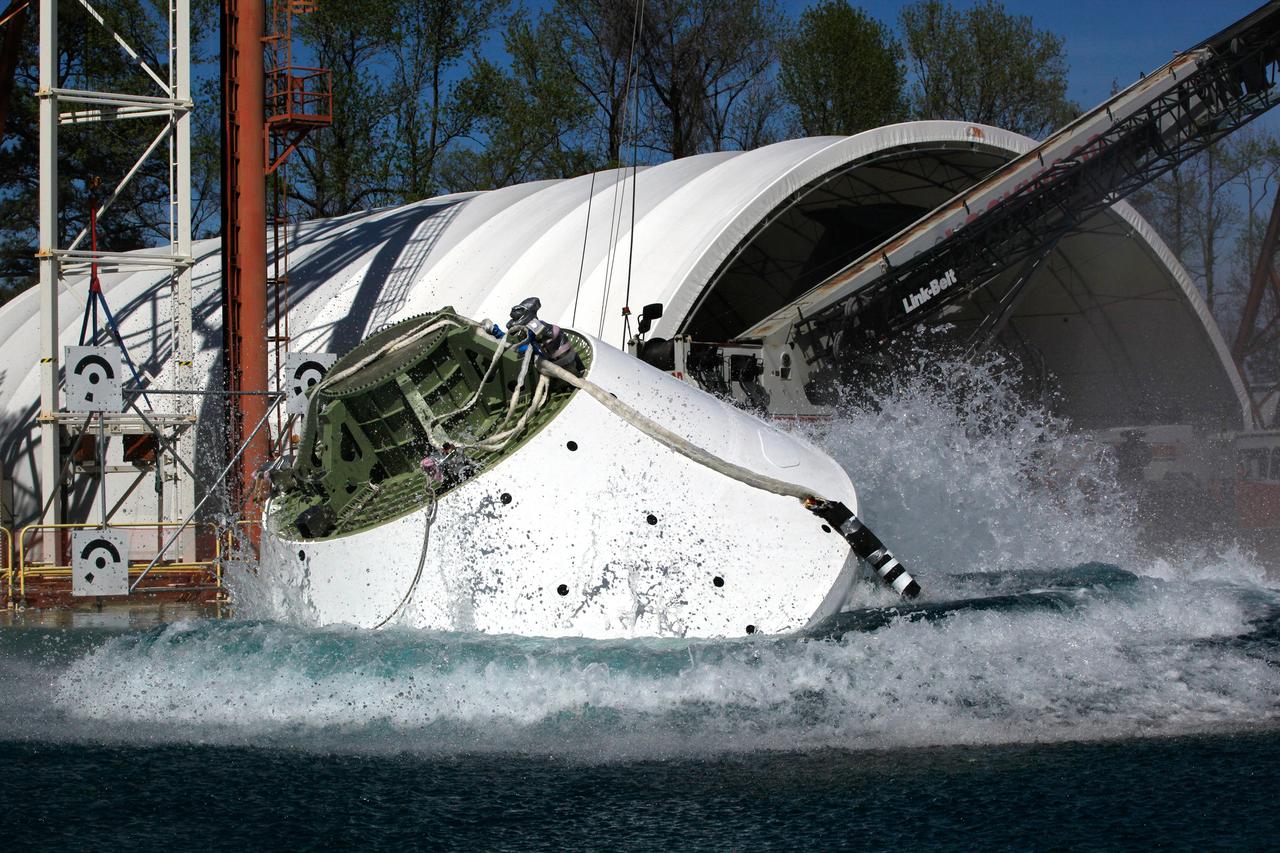
On April 6, 2016, engineers at NASA’s Langley Research Center in Hampton, Virginia, kicked off a series of nine drop tests of a representative Orion crew capsule with crash test dummies inside to understand what the spacecraft and astronauts may experience when landing in the Pacific Ocean after deep-space missions. The high-fidelity capsule, coupled with the heat shield from Orion's first flight in space, was hoisted approximately 16 feet above the water and vertically dropped into Langley’s 20-foot-deep Hydro Impact Basin. The crash test dummies were instrumented to provide data and secured inside the capsule to help provide information engineers need to ensure astronauts will be protected from injury during splashdown. Each test in the series simulates different scenarios for Orion’s parachute-assisted landings, wind conditions, velocities and wave heights the spacecraft may experience when touching down in the ocean.
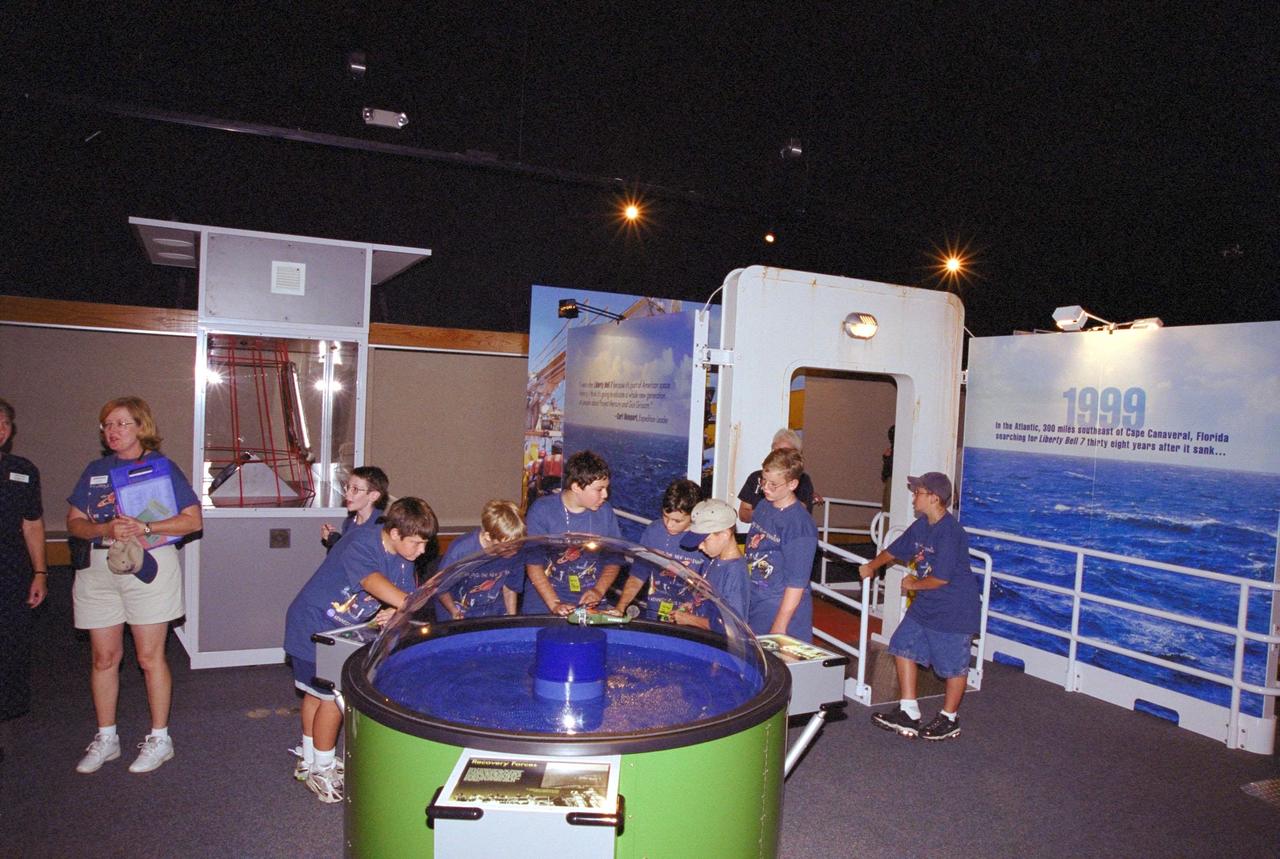
Children on a tour at the KSC Visitor Complex get an early look at the Discovery Channel's Liberty Bell 7 Space Capsule Exhibit, which opens to the public on Saturday, June 17. They are on a re-creation of the deck of Ocean Project, the ship that located and recovered the space capsule from the floor of the Atlantic Ocean. Liberty Bell 7 launched U.S. Air Force Captain Virgil “Gus” Grissom July 21, 1961, on a mission that lasted 15 minutes and 37 seconds before sinking. It lay undetected for nearly four decades before a Discovery Channel expedition located it and recovered it. The space capsule, now restored and preserved, is part of an interactive exhibit touring science centers and museums in 12 cities throughout the United States until 2003. The exhibit also includes hands-on elements such as a capsule simulator, a centrifuge, and ROV pilot
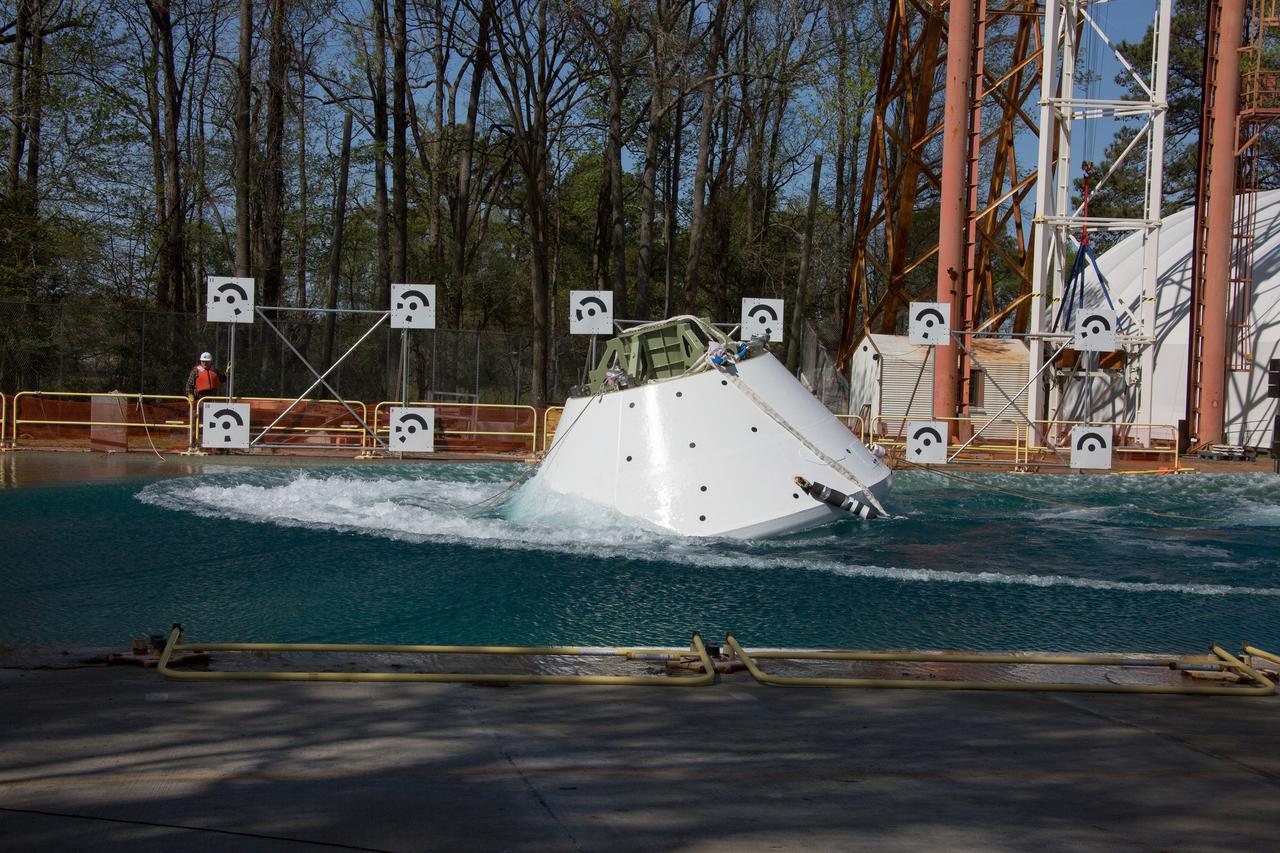
On April 6, 2016, engineers at NASA’s Langley Research Center in Hampton, Virginia, kicked off a series of nine drop tests of a representative Orion crew capsule with crash test dummies inside to understand what the spacecraft and astronauts may experience when landing in the Pacific Ocean after deep-space missions. The high-fidelity capsule, coupled with the heat shield from Orion's first flight in space, was hoisted approximately 16 feet above the water and vertically dropped into Langley’s 20-foot-deep Hydro Impact Basin. The crash test dummies were instrumented to provide data and secured inside the capsule to help provide information engineers need to ensure astronauts will be protected from injury during splashdown. Each test in the series simulates different scenarios for Orion’s parachute-assisted landings, wind conditions, velocities and wave heights the spacecraft may experience when touching down in the ocean.
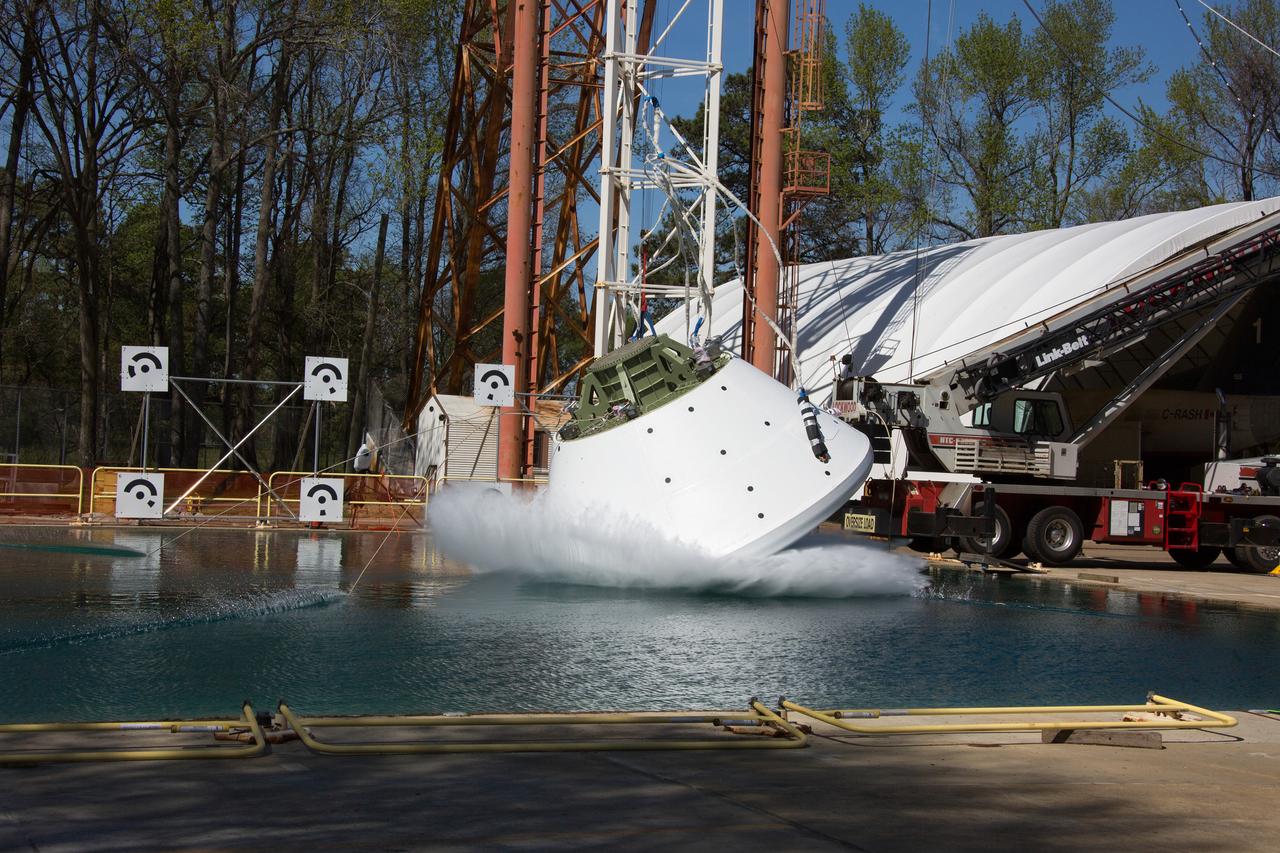
On April 6, 2016, engineers at NASA’s Langley Research Center in Hampton, Virginia, kicked off a series of nine drop tests of a representative Orion crew capsule with crash test dummies inside to understand what the spacecraft and astronauts may experience when landing in the Pacific Ocean after deep-space missions. The high-fidelity capsule, coupled with the heat shield from Orion's first flight in space, was hoisted approximately 16 feet above the water and vertically dropped into Langley’s 20-foot-deep Hydro Impact Basin. The crash test dummies were instrumented to provide data and secured inside the capsule to help provide information engineers need to ensure astronauts will be protected from injury during splashdown. Each test in the series simulates different scenarios for Orion’s parachute-assisted landings, wind conditions, velocities and wave heights the spacecraft may experience when touching down in the ocean.
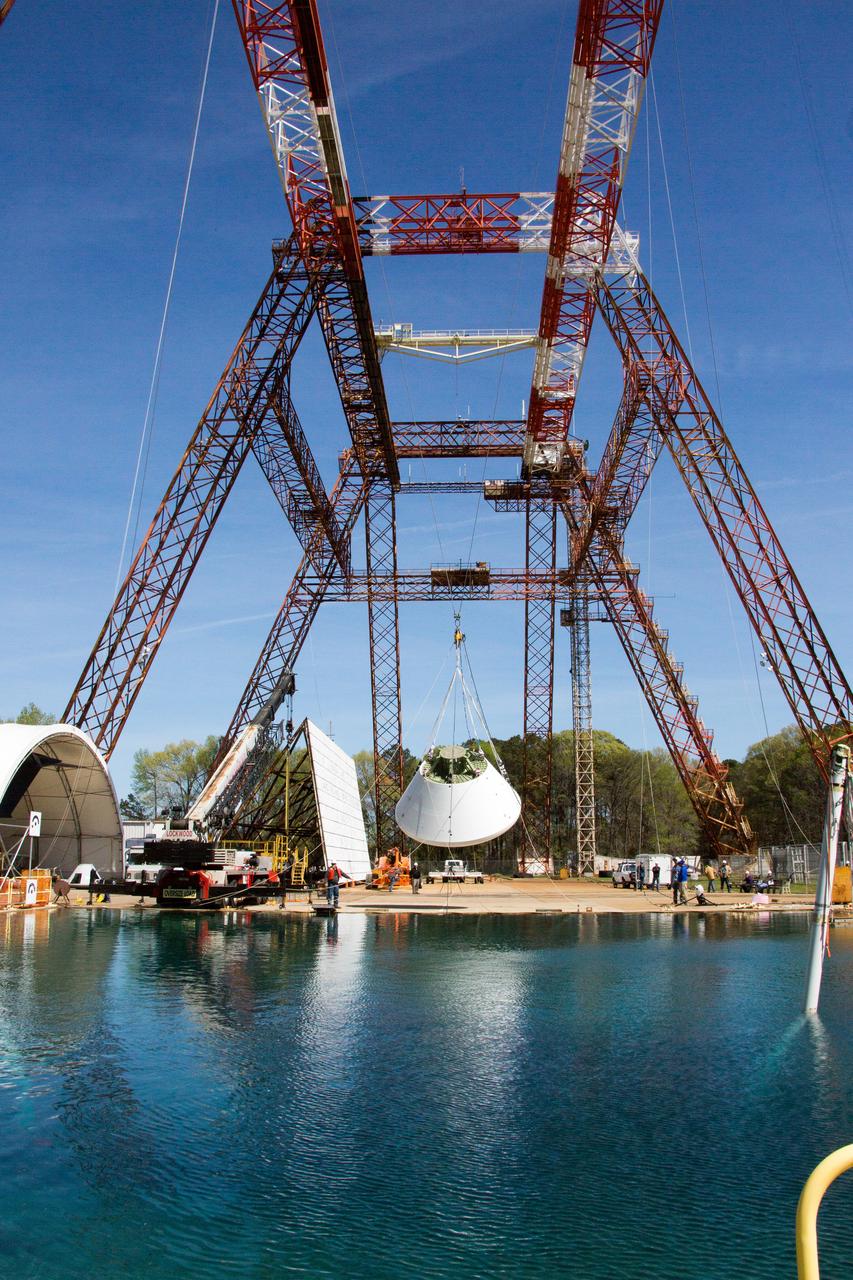
On April 6, 2016, engineers at NASA’s Langley Research Center in Hampton, Virginia, kicked off a series of nine drop tests of a representative Orion crew capsule with crash test dummies inside to understand what the spacecraft and astronauts may experience when landing in the Pacific Ocean after deep-space missions. The high-fidelity capsule, coupled with the heat shield from Orion's first flight in space, was hoisted approximately 16 feet above the water and vertically dropped into Langley’s 20-foot-deep Hydro Impact Basin. The crash test dummies were instrumented to provide data and secured inside the capsule to help provide information engineers need to ensure astronauts will be protected from injury during splashdown. Each test in the series simulates different scenarios for Orion’s parachute-assisted landings, wind conditions, velocities and wave heights the spacecraft may experience when touching down in the ocean.
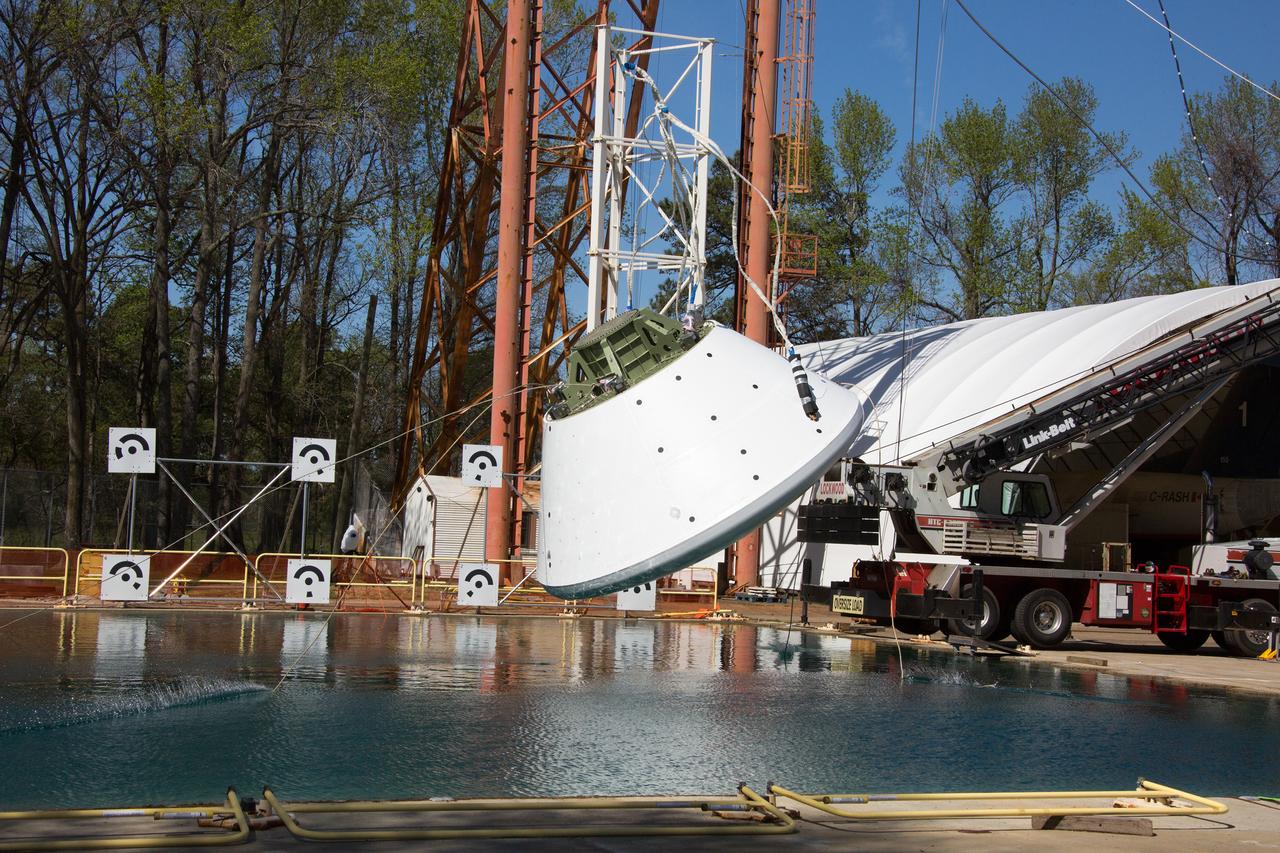
On April 6, 2016, engineers at NASA’s Langley Research Center in Hampton, Virginia, kicked off a series of nine drop tests of a representative Orion crew capsule with crash test dummies inside to understand what the spacecraft and astronauts may experience when landing in the Pacific Ocean after deep-space missions. The high-fidelity capsule, coupled with the heat shield from Orion's first flight in space, was hoisted approximately 16 feet above the water and vertically dropped into Langley’s 20-foot-deep Hydro Impact Basin. The crash test dummies were instrumented to provide data and secured inside the capsule to help provide information engineers need to ensure astronauts will be protected from injury during splashdown. Each test in the series simulates different scenarios for Orion’s parachute-assisted landings, wind conditions, velocities and wave heights the spacecraft may experience when touching down in the ocean.
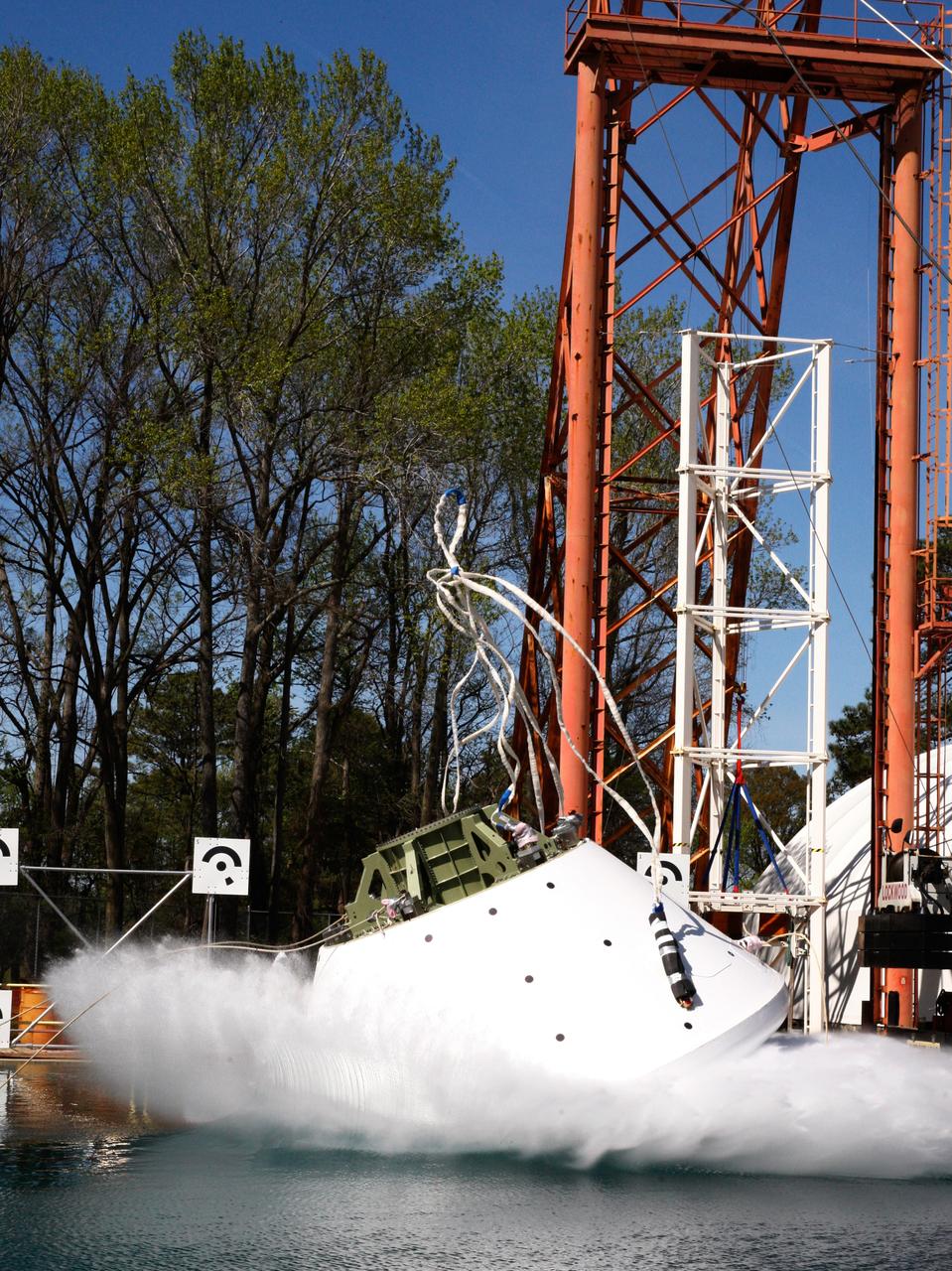
On April 6, 2016, engineers at NASA’s Langley Research Center in Hampton, Virginia, kicked off a series of nine drop tests of a representative Orion crew capsule with crash test dummies inside to understand what the spacecraft and astronauts may experience when landing in the Pacific Ocean after deep-space missions. The high-fidelity capsule, coupled with the heat shield from Orion's first flight in space, was hoisted approximately 16 feet above the water and vertically dropped into Langley’s 20-foot-deep Hydro Impact Basin. The crash test dummies were instrumented to provide data and secured inside the capsule to help provide information engineers need to ensure astronauts will be protected from injury during splashdown. Each test in the series simulates different scenarios for Orion’s parachute-assisted landings, wind conditions, velocities and wave heights the spacecraft may experience when touching down in the ocean.
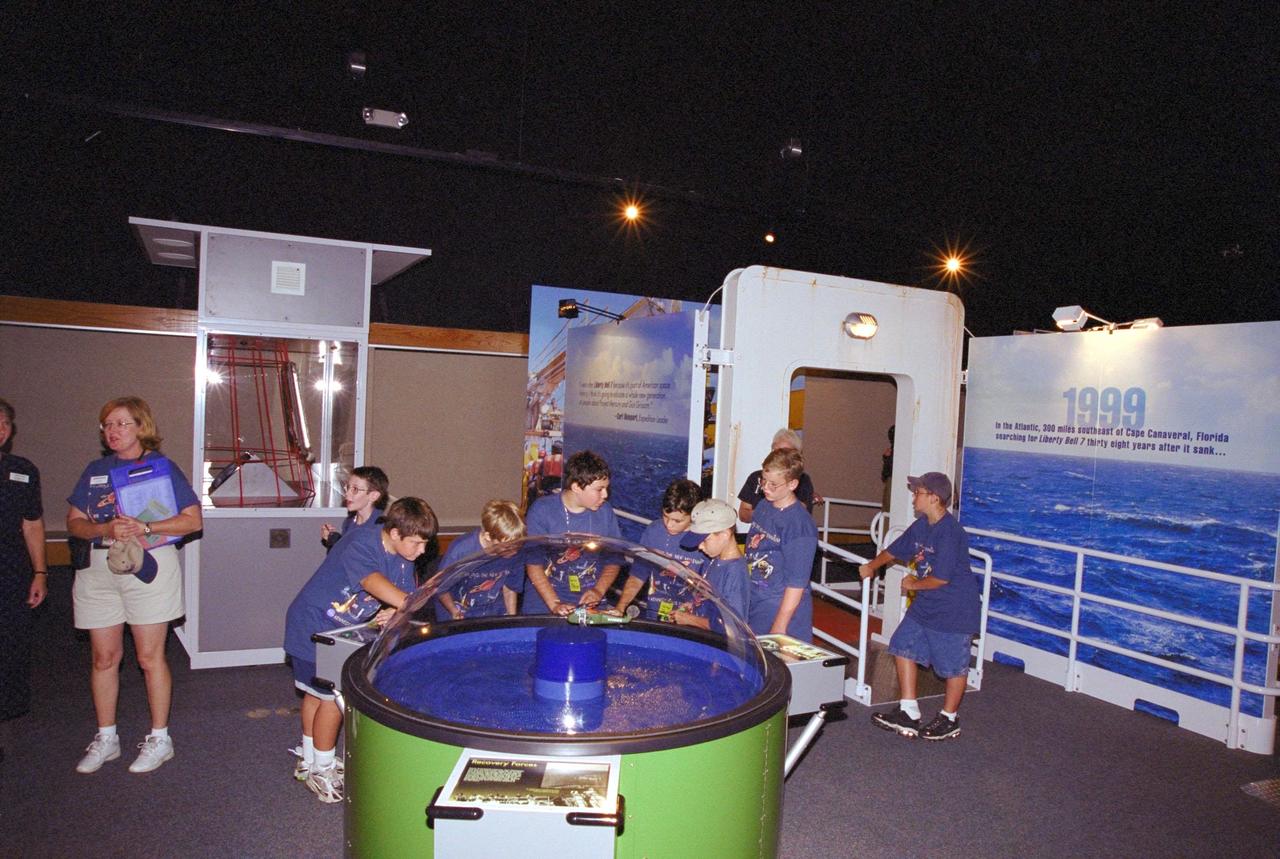
Children on a tour at the KSC Visitor Complex get an early look at the Discovery Channel's Liberty Bell 7 Space Capsule Exhibit, which opens to the public on Saturday, June 17. They are on a re-creation of the deck of Ocean Project, the ship that located and recovered the space capsule from the floor of the Atlantic Ocean. Liberty Bell 7 launched U.S. Air Force Captain Virgil “Gus” Grissom July 21, 1961, on a mission that lasted 15 minutes and 37 seconds before sinking. It lay undetected for nearly four decades before a Discovery Channel expedition located it and recovered it. The space capsule, now restored and preserved, is part of an interactive exhibit touring science centers and museums in 12 cities throughout the United States until 2003. The exhibit also includes hands-on elements such as a capsule simulator, a centrifuge, and ROV pilot
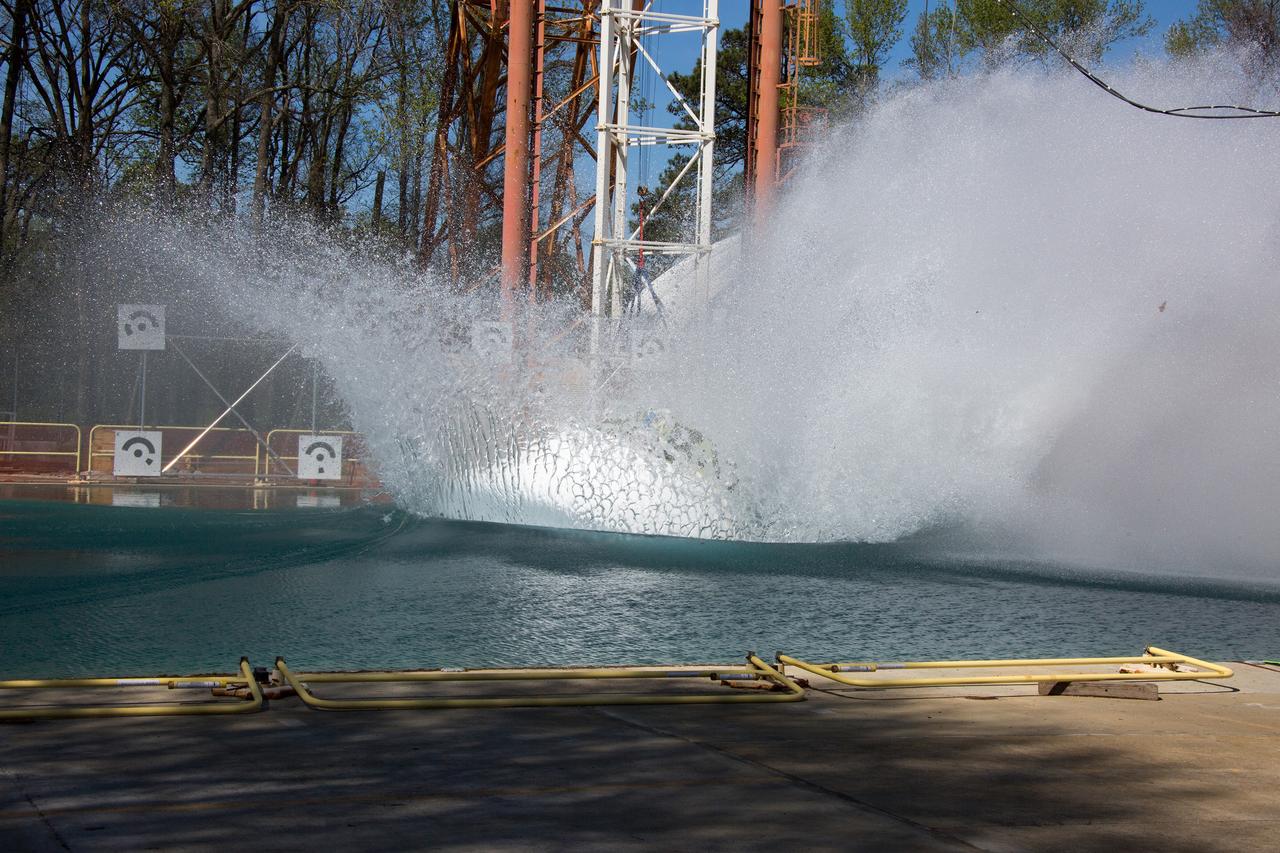
On April 6, 2016, engineers at NASA’s Langley Research Center in Hampton, Virginia, kicked off a series of nine drop tests of a representative Orion crew capsule with crash test dummies inside to understand what the spacecraft and astronauts may experience when landing in the Pacific Ocean after deep-space missions. The high-fidelity capsule, coupled with the heat shield from Orion's first flight in space, was hoisted approximately 16 feet above the water and vertically dropped into Langley’s 20-foot-deep Hydro Impact Basin. The crash test dummies were instrumented to provide data and secured inside the capsule to help provide information engineers need to ensure astronauts will be protected from injury during splashdown. Each test in the series simulates different scenarios for Orion’s parachute-assisted landings, wind conditions, velocities and wave heights the spacecraft may experience when touching down in the ocean.
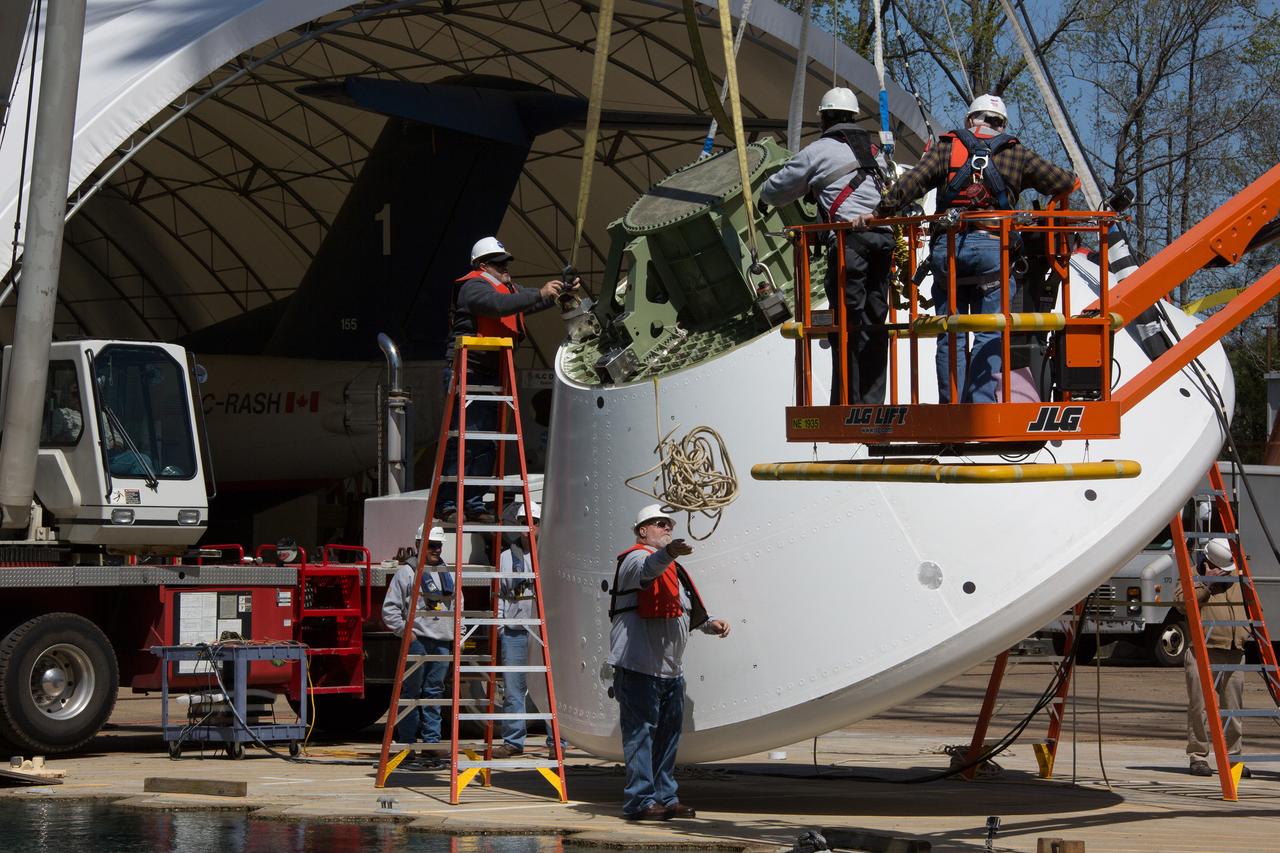
On April 6, 2016, engineers at NASA’s Langley Research Center in Hampton, Virginia, kicked off a series of nine drop tests of a representative Orion crew capsule with crash test dummies inside to understand what the spacecraft and astronauts may experience when landing in the Pacific Ocean after deep-space missions. The high-fidelity capsule, coupled with the heat shield from Orion's first flight in space, was hoisted approximately 16 feet above the water and vertically dropped into Langley’s 20-foot-deep Hydro Impact Basin. The crash test dummies were instrumented to provide data and secured inside the capsule to help provide information engineers need to ensure astronauts will be protected from injury during splashdown. Each test in the series simulates different scenarios for Orion’s parachute-assisted landings, wind conditions, velocities and wave heights the spacecraft may experience when touching down in the ocean.
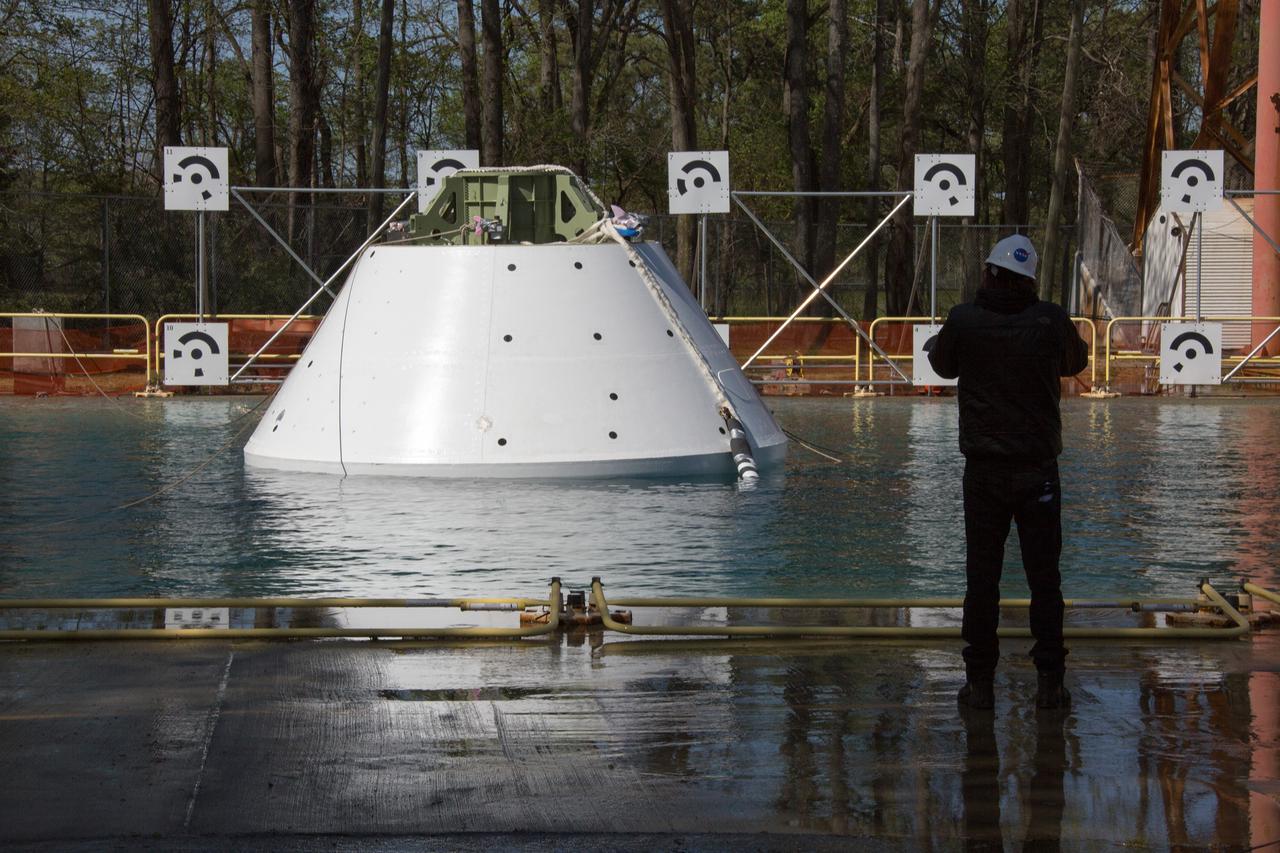
On April 6, 2016, engineers at NASA’s Langley Research Center in Hampton, Virginia, kicked off a series of nine drop tests of a representative Orion crew capsule with crash test dummies inside to understand what the spacecraft and astronauts may experience when landing in the Pacific Ocean after deep-space missions. The high-fidelity capsule, coupled with the heat shield from Orion's first flight in space, was hoisted approximately 16 feet above the water and vertically dropped into Langley’s 20-foot-deep Hydro Impact Basin. The crash test dummies were instrumented to provide data and secured inside the capsule to help provide information engineers need to ensure astronauts will be protected from injury during splashdown. Each test in the series simulates different scenarios for Orion’s parachute-assisted landings, wind conditions, velocities and wave heights the spacecraft may experience when touching down in the ocean.
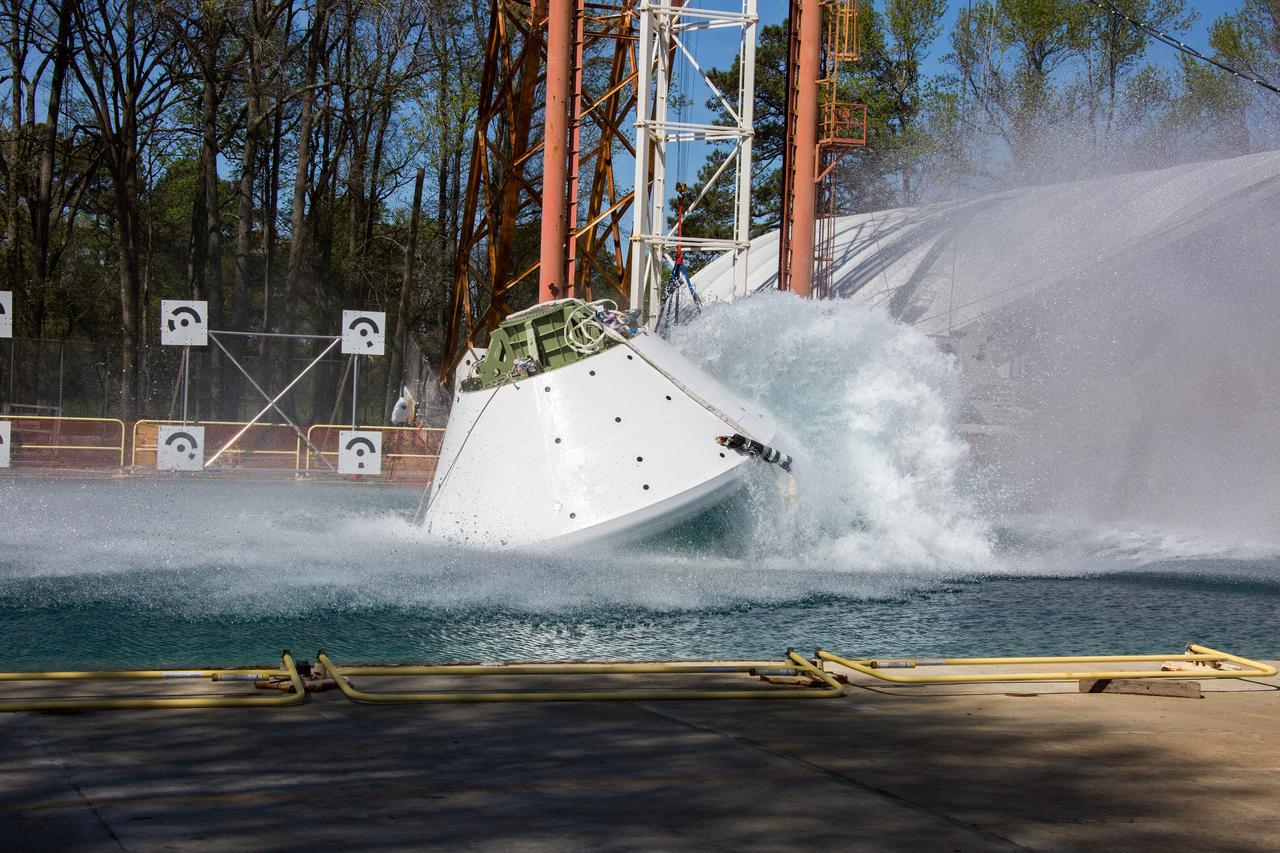
On April 6, 2016, engineers at NASA’s Langley Research Center in Hampton, Virginia, kicked off a series of nine drop tests of a representative Orion crew capsule with crash test dummies inside to understand what the spacecraft and astronauts may experience when landing in the Pacific Ocean after deep-space missions. The high-fidelity capsule, coupled with the heat shield from Orion's first flight in space, was hoisted approximately 16 feet above the water and vertically dropped into Langley’s 20-foot-deep Hydro Impact Basin. The crash test dummies were instrumented to provide data and secured inside the capsule to help provide information engineers need to ensure astronauts will be protected from injury during splashdown. Each test in the series simulates different scenarios for Orion’s parachute-assisted landings, wind conditions, velocities and wave heights the spacecraft may experience when touching down in the ocean.
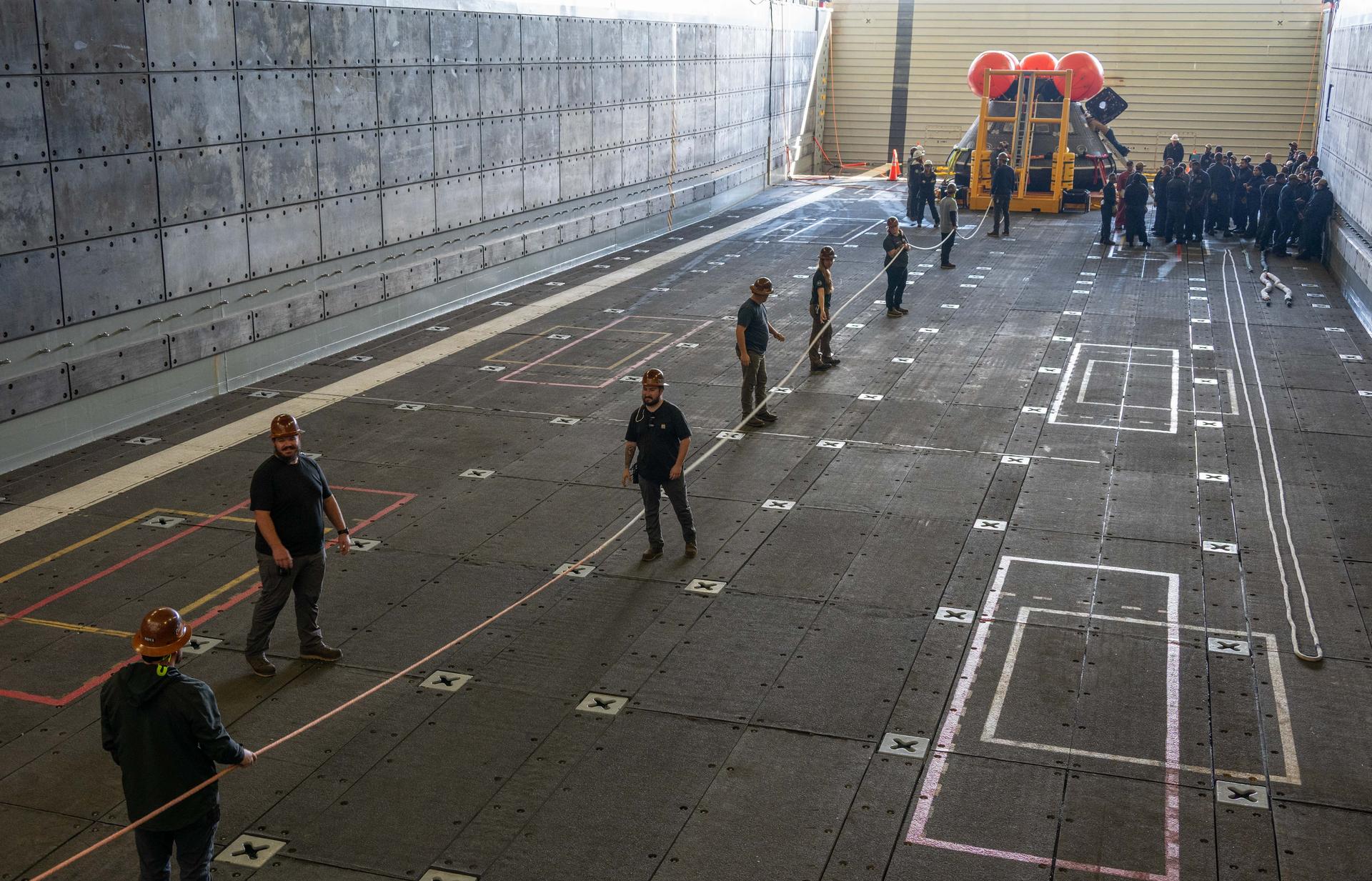
Off the coast of California, NASA’s Artemis Landing and Recovery team and the Department of War that will work together to retrieve the Artemis II crew and Orion spacecraft following their return to Earth and splashdown in the Pacific Ocean are performing a final simulation of their activities, called a just-in-time training, at sea on Monday, Jan. 26, 2026. During the training, teams use the Crew Module Test Article, a full-scale mockup of the Orion spacecraft, to simulate as close as possible the conditions they can expect to encounter during splashdown of the Artemis II mission. NASA’s first crewed test flight in the Artemis campaign, the approximately 10-day Artemis II mission will send NASA astronauts Reid Wiseman, Victor Glover, and Christina Koch, and CSA (Canadian Space Agency) astronaut Jeremy Hansen around the Moon and farther than any humans have ever been from Earth.
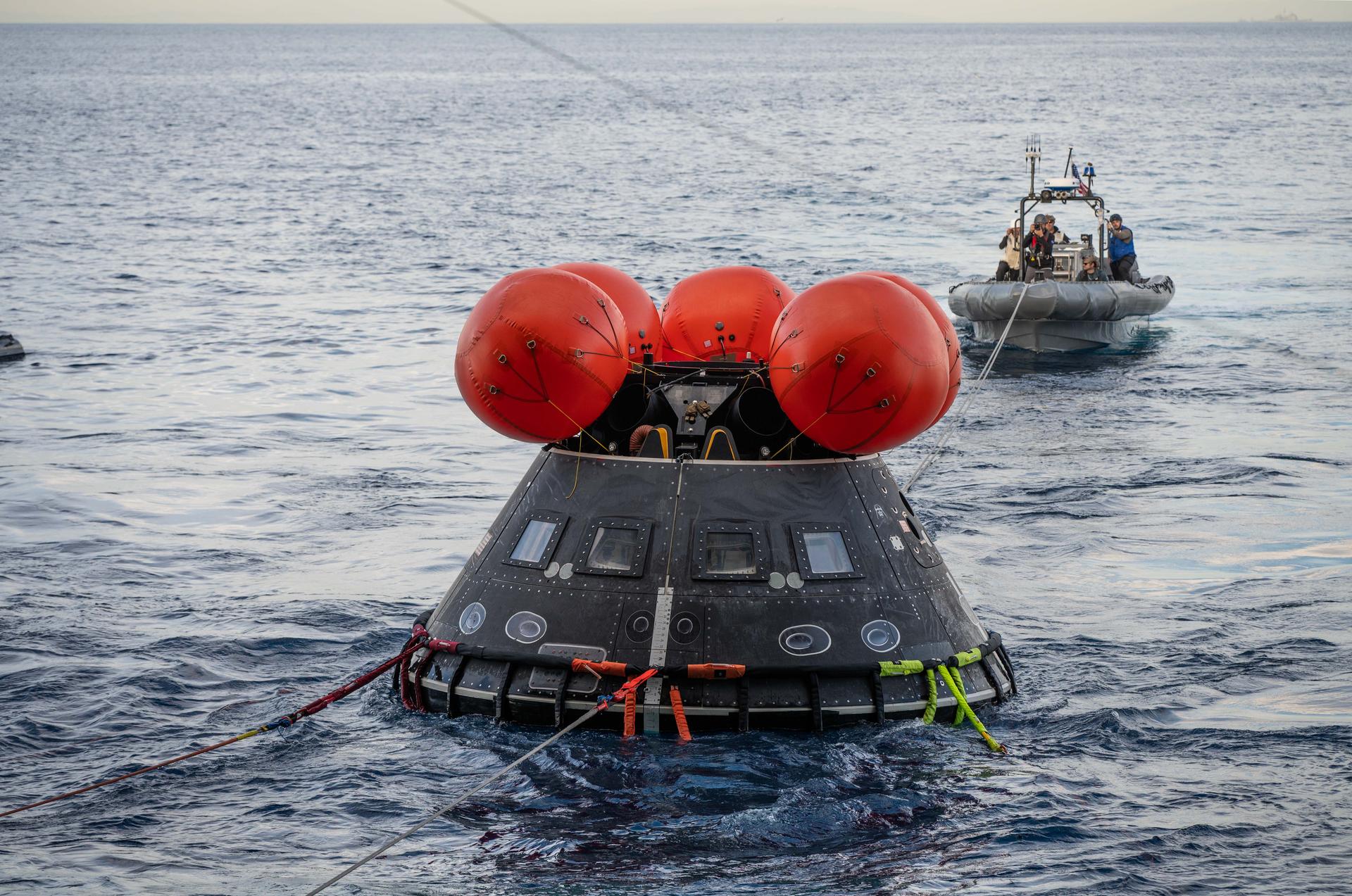
Off the coast of California, NASA’s Artemis Landing and Recovery team and the Department of War that will work together to retrieve the Artemis II crew and Orion spacecraft following their return to Earth and splashdown in the Pacific Ocean are performing a final simulation of their activities, called a just-in-time training, at sea on Wednesday, Jan. 28, 2026. During the training, teams use the Crew Module Test Article, a full-scale mockup of the Orion spacecraft, to simulate as close as possible the conditions they can expect to encounter during splashdown of the Artemis II mission. NASA’s first crewed test flight in the Artemis campaign, the approximately 10-day Artemis II mission will send NASA astronauts Reid Wiseman, Victor Glover, and Christina Koch, and CSA (Canadian Space Agency) astronaut Jeremy Hansen around the Moon and farther than any humans have ever been from Earth.
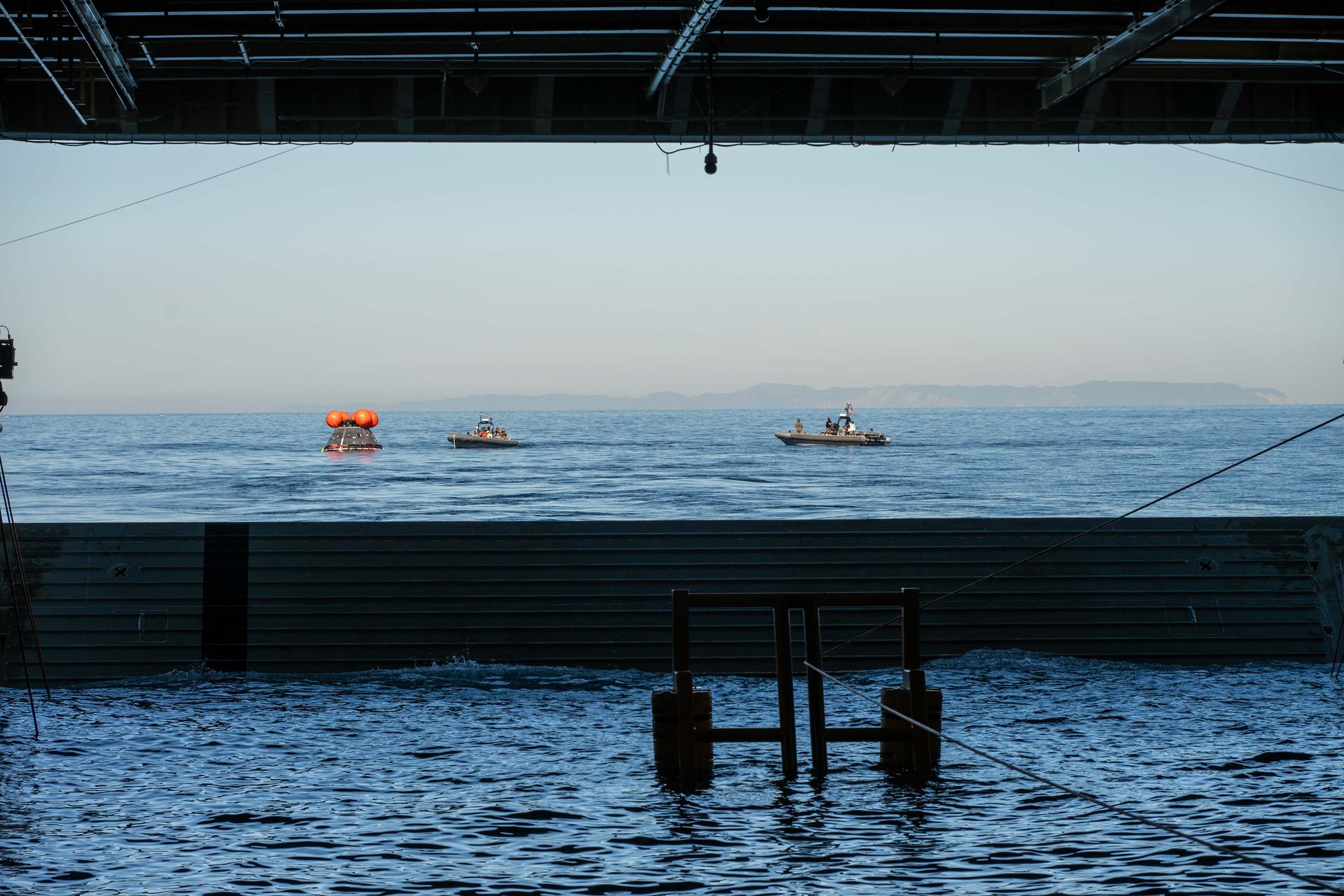
Off the coast of California, NASA’s Artemis Landing and Recovery team and the Department of War that will work together to retrieve the Artemis II crew and Orion spacecraft following their return to Earth and splashdown in the Pacific Ocean are performing a final simulation of their activities, called a just-in-time training, at sea on Tuesday, Jan. 27, 2026. During the training, teams use the Crew Module Test Article, a full-scale mockup of the Orion spacecraft, to simulate as close as possible the conditions they can expect to encounter during splashdown of the Artemis II mission. NASA’s first crewed test flight in the Artemis campaign, the approximately 10-day Artemis II mission will send NASA astronauts Reid Wiseman, Victor Glover, and Christina Koch, and CSA (Canadian Space Agency) astronaut Jeremy Hansen around the Moon and farther than any humans have ever been from Earth.
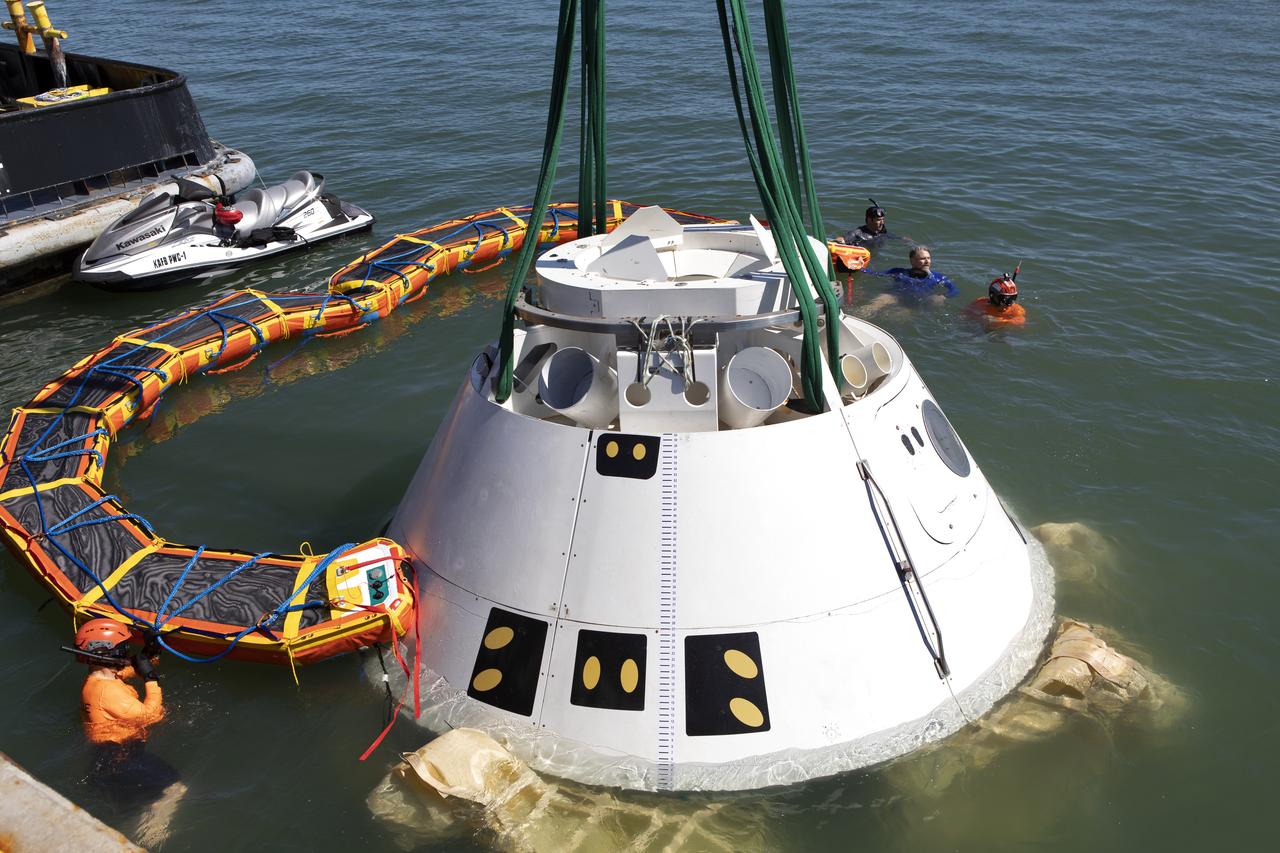
Rescue team members remove the stabilization collar from the Boeing CST-100 Starliner training capsule, known as Boiler Plate 3, in the water at the Army Wharf at Cape Canaveral Air Force Station in Florida on April 16, 2019. NASA and the Department of Defense Human Space Flight Support Office Rescue Division are conducting a search and rescue training exercise using the Starliner trainer over the next several days at the Wharf and in the Atlantic Ocean simulating a rescue in the unlikely event of an emergency. It is the first at-sea exercise with the Starliner training capsule ahead of Boeing’s Crew Flight Test with astronauts targeted for later this year. During normal return scenarios, Boeing's Starliner will land on land in a safe zone of about 15 square miles in the Western United States. Throughout the commercial crew development phases with NASA, Boeing has performed dozens of qualification tests on its parachute and airbag systems simulating conditions on land and in the water.
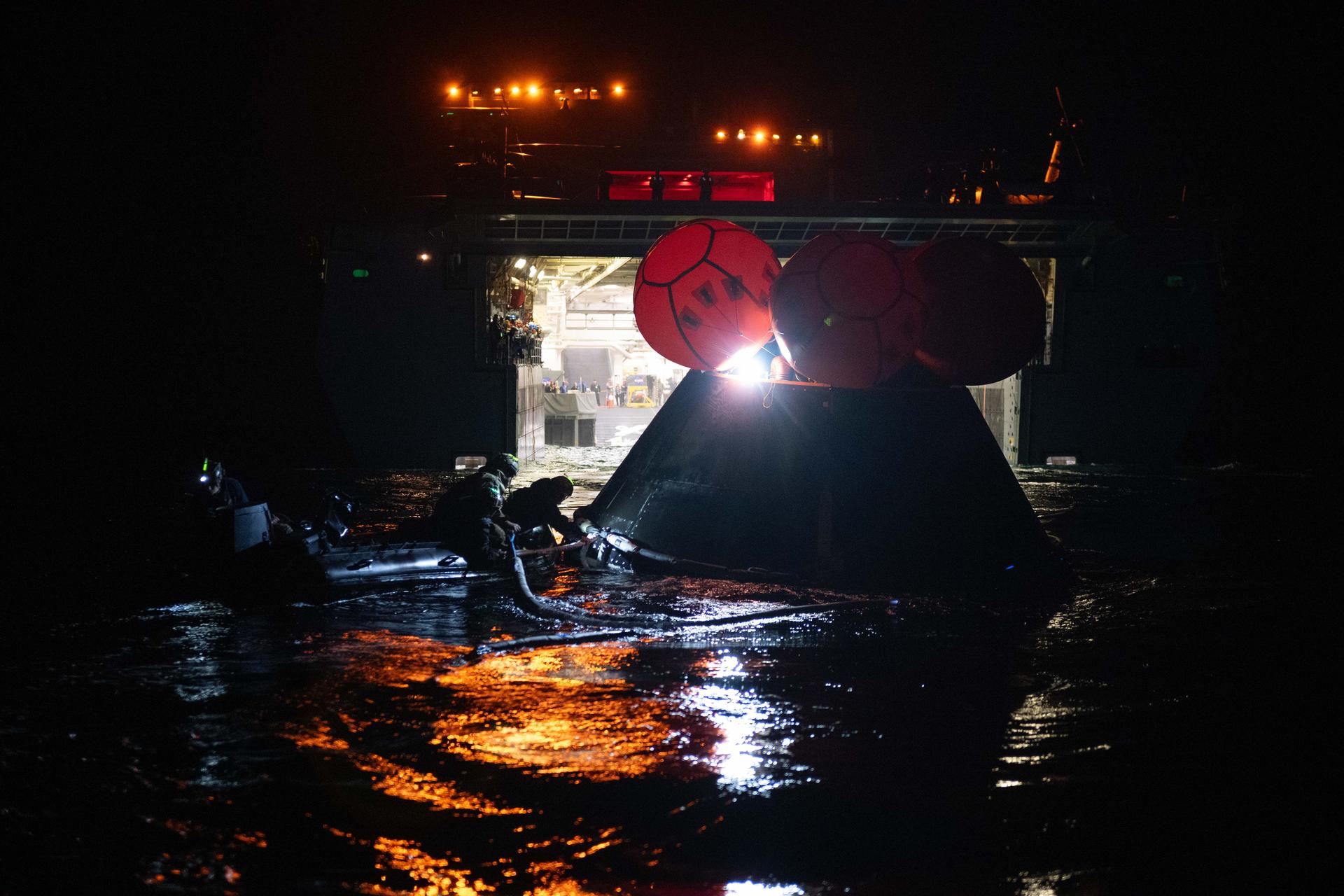
Members from NASA’s Artemis Landing and Recovery team and the Department of War perform a final simulation of the Artemis II splashdown, called a just-in-time training, in the Pacific Ocean off the coast of California on Thursday, Jan. 29, 2026. The teams will work together to retrieve the Artemis II crew and Orion spacecraft following their return to Earth, and during the training the teams use the Crew Module Test Article, a full-scale mockup of the Orion spacecraft, to simulate as close as possible the conditions they can expect to encounter during splashdown of the Artemis II mission. NASA’s first crewed test flight in the Artemis campaign, the approximately 10-day Artemis II mission will send NASA astronauts Reid Wiseman, Victor Glover, and Christina Koch, and CSA (Canadian Space Agency) astronaut Jeremy Hansen around the Moon and farther than any humans have ever been from Earth.
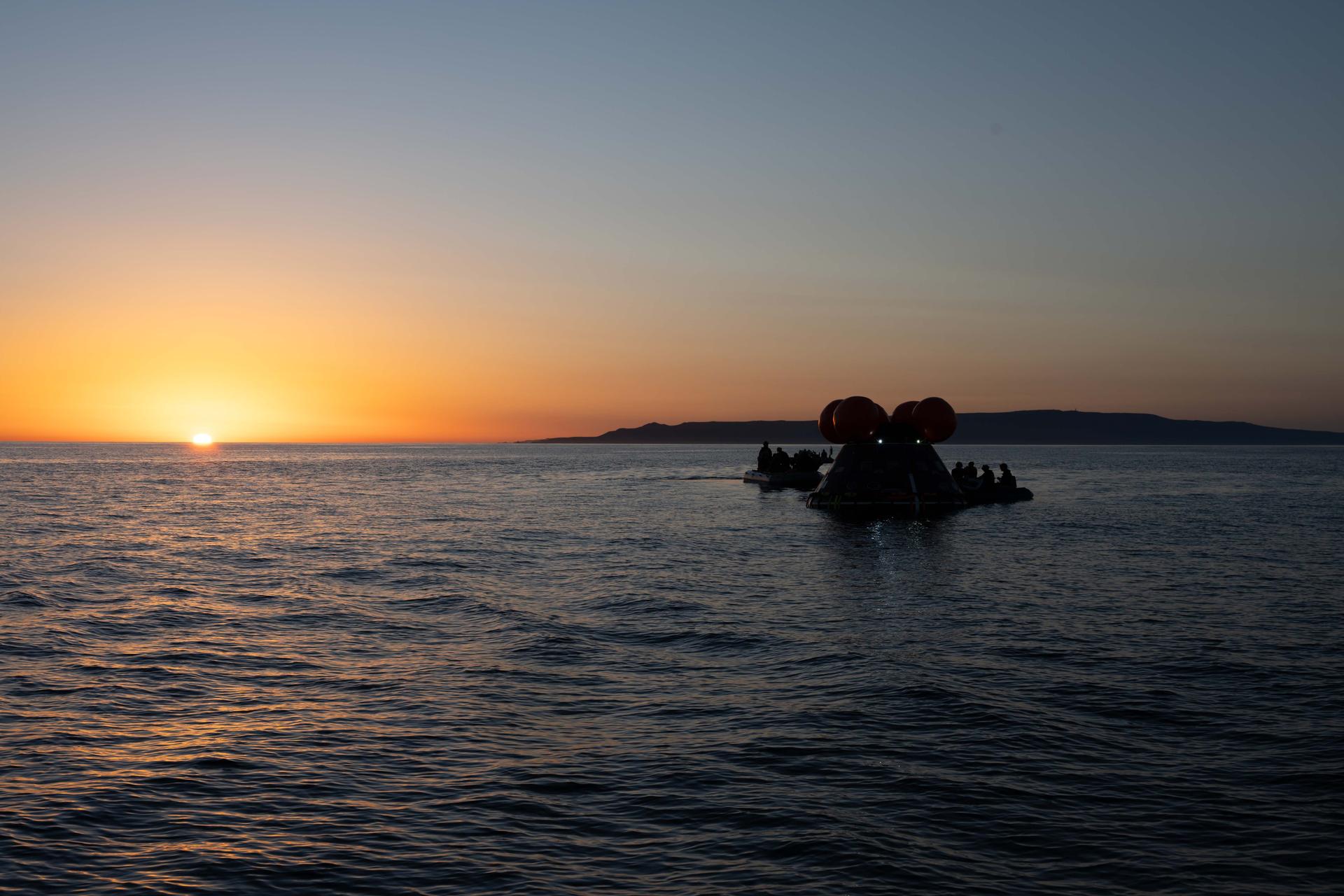
Members from NASA’s Artemis Landing and Recovery team and the Department of War perform a final simulation of the Artemis II splashdown, called a just-in-time training, in the Pacific Ocean off the coast of California at sunset on Thursday, Jan. 29, 2026. The teams will work together to retrieve the Artemis II crew and Orion spacecraft following their return to Earth, and during the training the teams use the Crew Module Test Article, a full-scale mockup of the Orion spacecraft, to simulate as close as possible the conditions they can expect to encounter during splashdown of the Artemis II mission. NASA’s first crewed test flight in the Artemis campaign, the approximately 10-day Artemis II mission will send NASA astronauts Reid Wiseman, Victor Glover, and Christina Koch, and CSA (Canadian Space Agency) astronaut Jeremy Hansen around the Moon and farther than any humans have ever been from Earth.
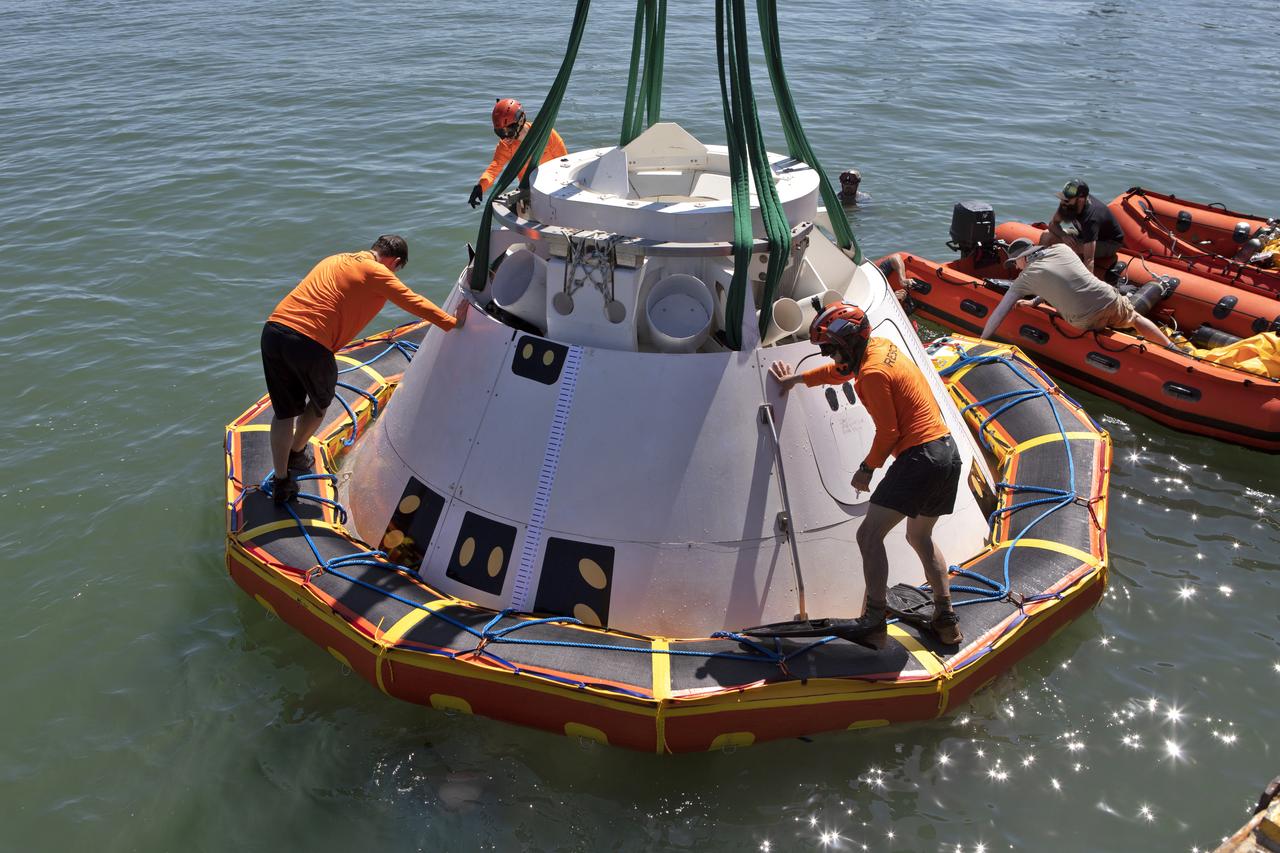
Rescue team members stand on the stabilization collar attached to the Boeing CST-100 Starliner training capsule, known as Boiler Plate 3, to perform checks during a search and rescue training exercise April 16, 2019. NASA and the Department of Defense Human Space Flight Support Office Rescue Division are conducting the exercise over the next several days at the Wharf and in the Atlantic Ocean simulating a rescue in the unlikely event of an emergency. It is the first at-sea exercise with the Starliner training capsule ahead of Boeing’s Crew Flight Test with astronauts targeted for later this year. During normal return scenarios, Boeing's Starliner will land on land in a safe zone of about 15 square miles in the Western United States. Throughout the commercial crew development phases with NASA, Boeing has performed dozens of qualification tests on its parachute and airbag systems simulating conditions on land and in the water.
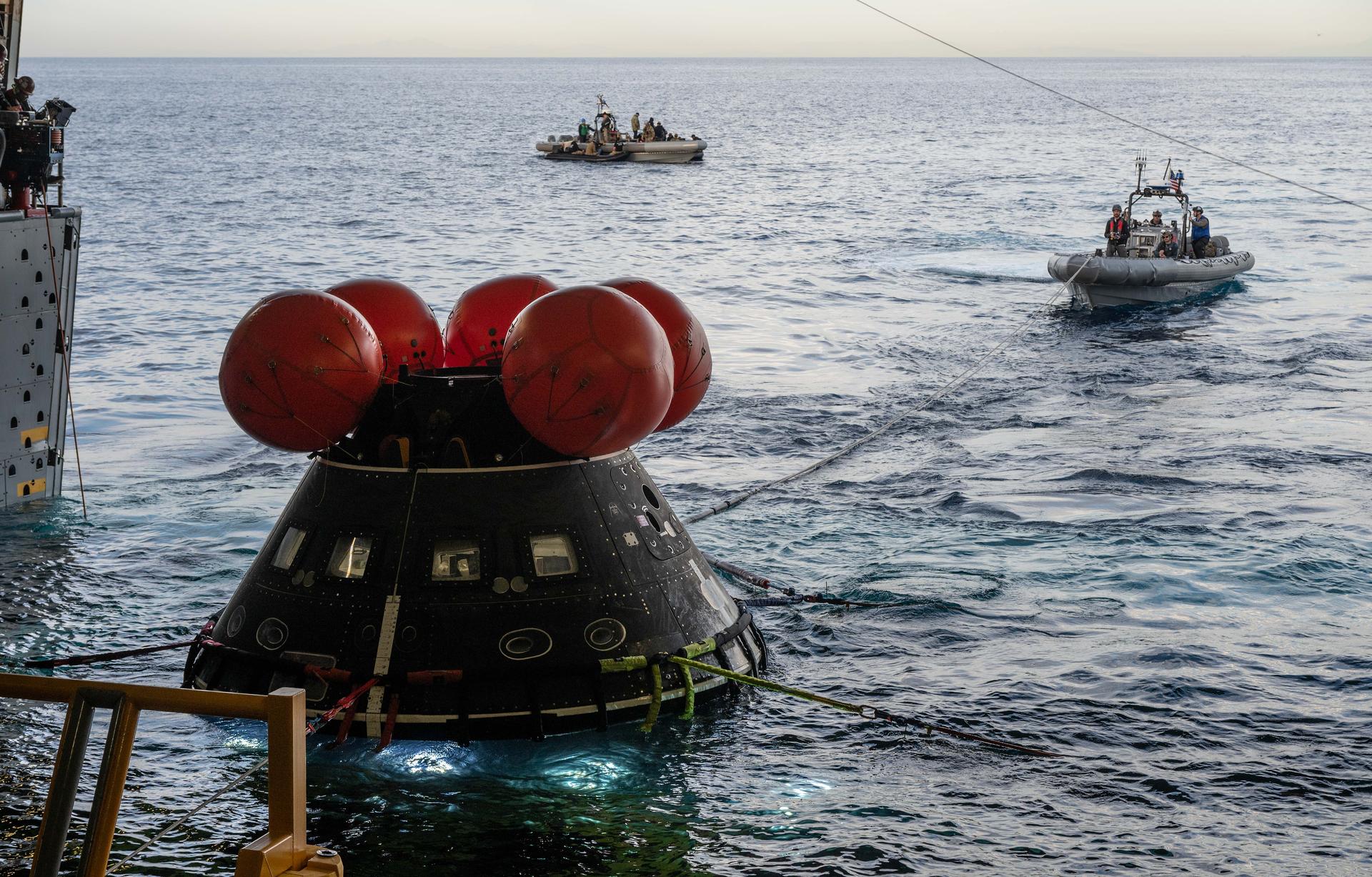
Off the coast of California, NASA’s Artemis Landing and Recovery team and the Department of War that will work together to retrieve the Artemis II crew and Orion spacecraft following their return to Earth and splashdown in the Pacific Ocean are performing a final simulation of their activities, called a just-in-time training, at sea on Wednesday, Jan. 28, 2026. During the training, teams use the Crew Module Test Article, a full-scale mockup of the Orion spacecraft, to simulate as close as possible the conditions they can expect to encounter during splashdown of the Artemis II mission. NASA’s first crewed test flight in the Artemis campaign, the approximately 10-day Artemis II mission will send NASA astronauts Reid Wiseman, Victor Glover, and Christina Koch, and CSA (Canadian Space Agency) astronaut Jeremy Hansen around the Moon and farther than any humans have ever been from Earth.
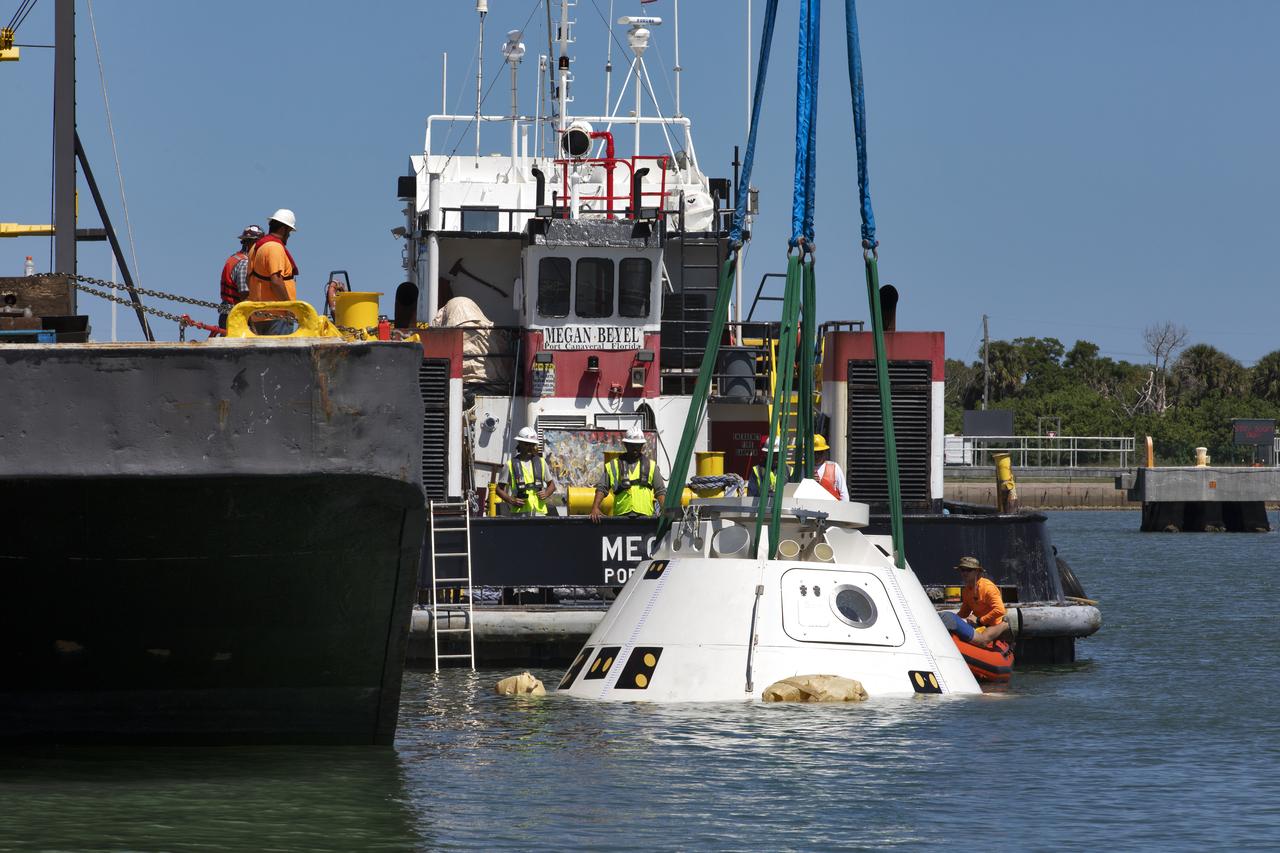
The Boeing CST-100 Starliner training capsule, known as Boiler Plate 3, is lowered into the water at the Army Wharf at Cape Canaveral Air Force Station in Florida on April 16, 2019. NASA and the Department of Defense Human Space Flight Support Office Rescue Division are conducting a search and rescue training exercise over the next several days at the Wharf and in the Atlantic Ocean simulating a rescue in the unlikely event of an emergency. It is the first at-sea exercise with the Starliner training capsule ahead of Boeing’s Crew Flight Test with astronauts targeted for later this year. During normal return scenarios, Boeing's Starliner will land on land in a safe zone of about 15 square miles in the Western United States. Throughout the commercial crew development phases with NASA, Boeing has performed dozens of qualification tests on its parachute and airbag systems simulating conditions on land and in the water.
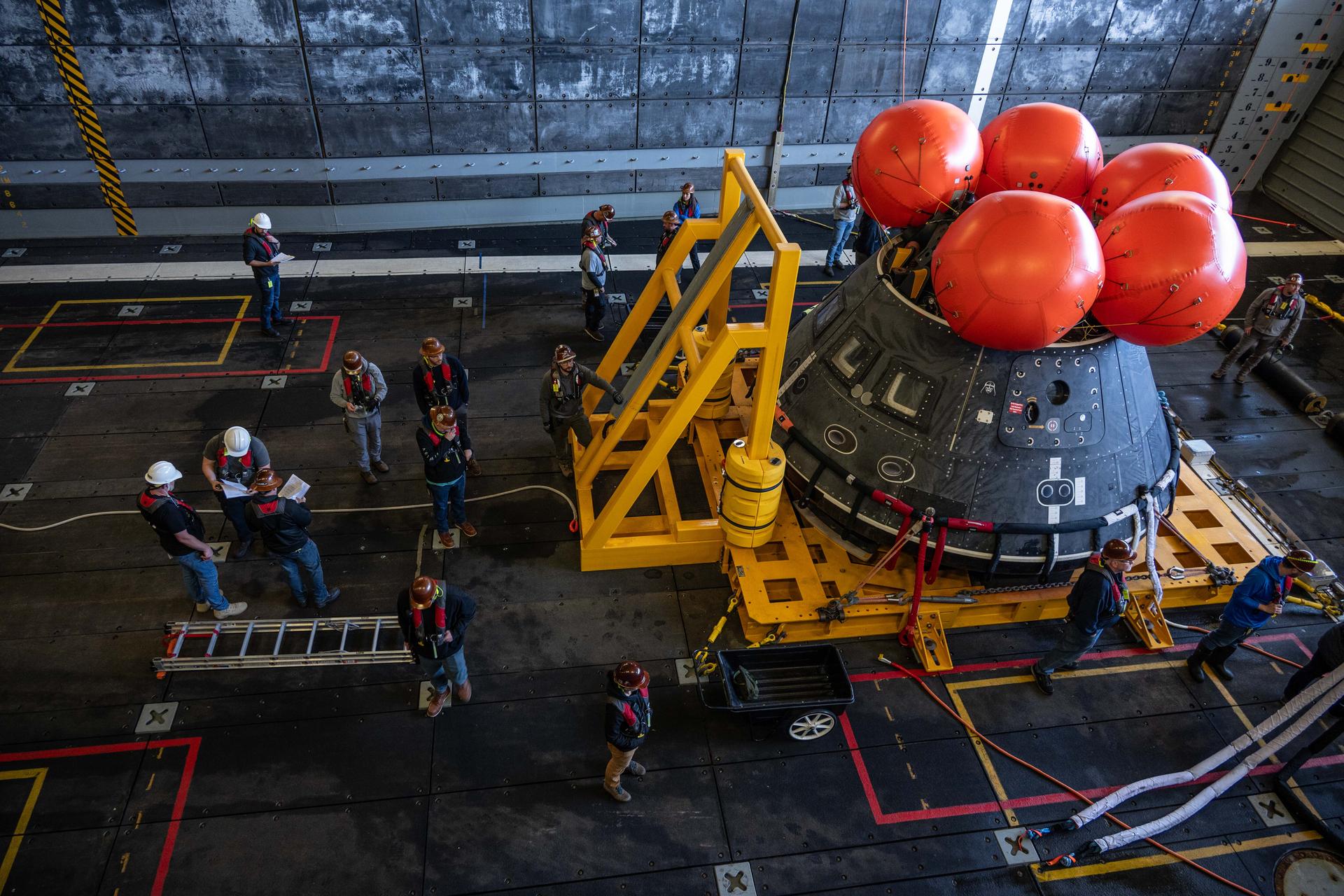
Off the coast of California, NASA’s Artemis Landing and Recovery team and the Department of War that will work together to retrieve the Artemis II crew and Orion spacecraft following their return to Earth and splashdown in the Pacific Ocean are performing a final simulation of their activities, called a just-in-time training, at sea on Monday, Jan. 26, 2026. During the training, teams use the Crew Module Test Article, a full-scale mockup of the Orion spacecraft, to simulate as close as possible the conditions they can expect to encounter during splashdown of the Artemis II mission. NASA’s first crewed test flight in the Artemis campaign, the approximately 10-day Artemis II mission will send NASA astronauts Reid Wiseman, Victor Glover, and Christina Koch, and CSA (Canadian Space Agency) astronaut Jeremy Hansen around the Moon and farther than any humans have ever been from Earth.
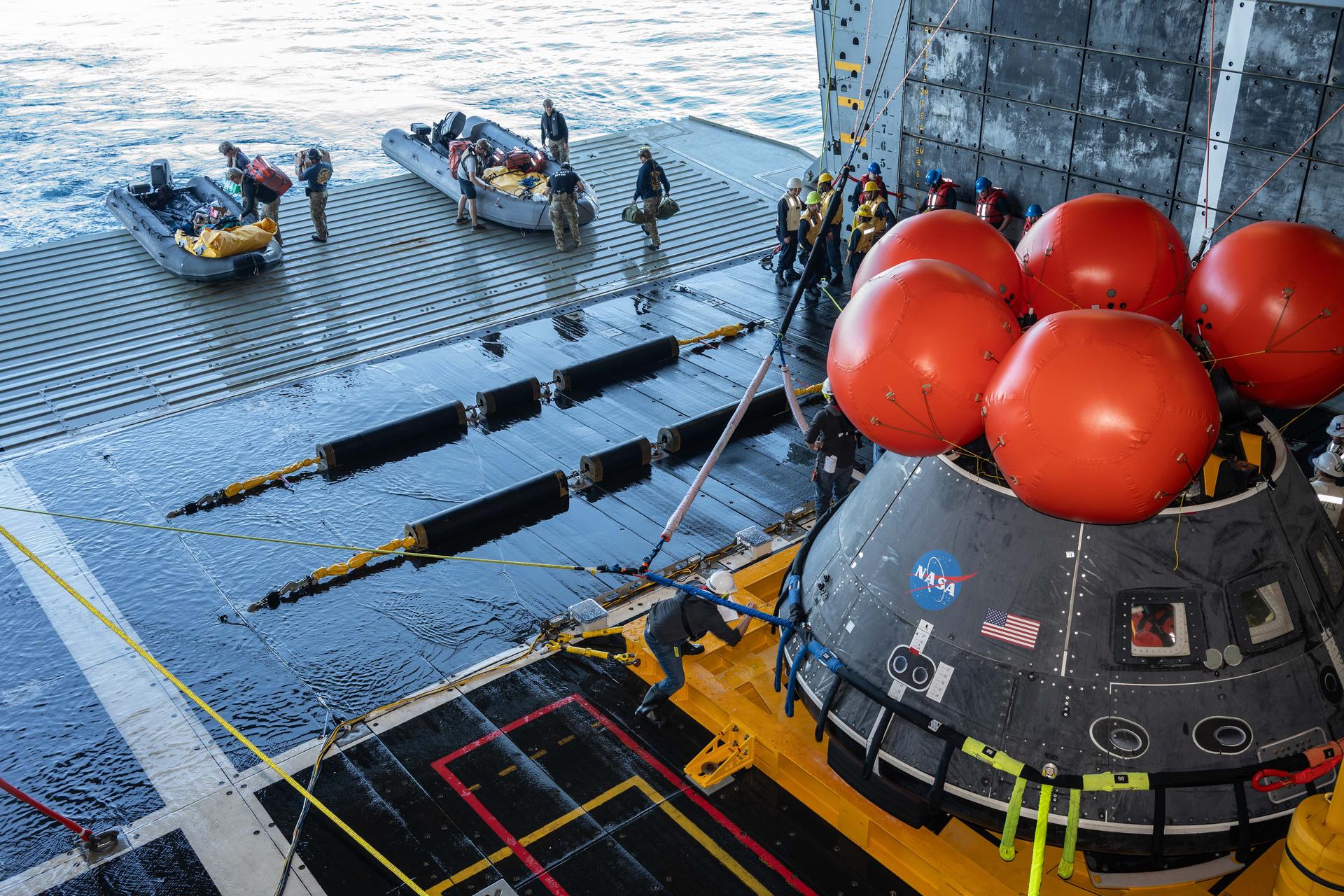
Off the coast of California, NASA’s Artemis Landing and Recovery team and the Department of War that will work together to retrieve the Artemis II crew and Orion spacecraft following their return to Earth and splashdown in the Pacific Ocean are performing a final simulation of their activities, called a just-in-time training, at sea on Tuesday, Jan. 27, 2026. During the training, teams use the Crew Module Test Article, a full-scale mockup of the Orion spacecraft, to simulate as close as possible the conditions they can expect to encounter during splashdown of the Artemis II mission. NASA’s first crewed test flight in the Artemis campaign, the approximately 10-day Artemis II mission will send NASA astronauts Reid Wiseman, Victor Glover, and Christina Koch, and CSA (Canadian Space Agency) astronaut Jeremy Hansen around the Moon and farther than any humans have ever been from Earth.
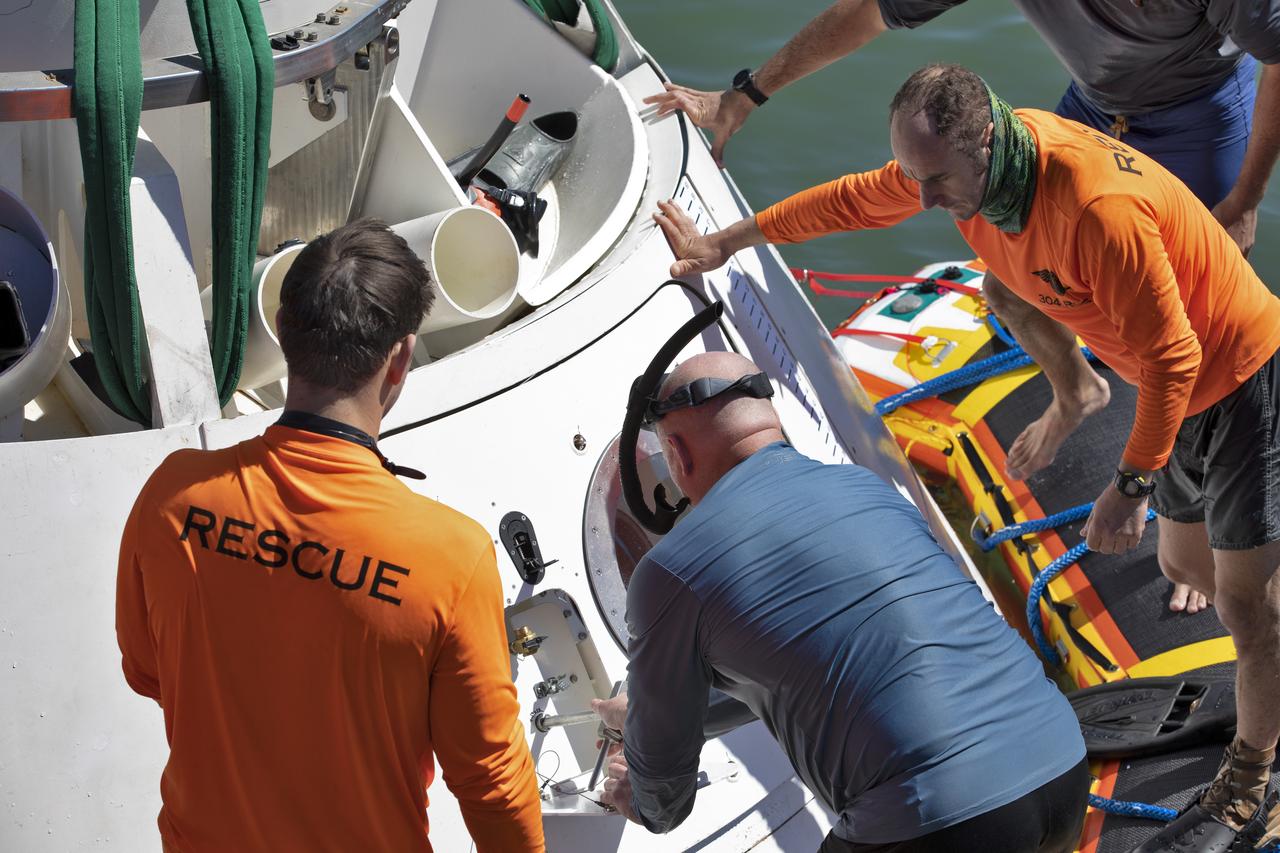
Rescue team members perform checks of the Boeing CST-100 Starliner training capsule, known as Boiler Plate 3, during a search and rescue exercise on April 16, 2019. NASA and the Department of Defense Human Space Flight Support Office Rescue Division are conducting a search and rescue training exercise over the next several days at the Wharf and in the Atlantic Ocean simulating a rescue in the unlikely event of an emergency. It is the first at-sea exercise with the Starliner training capsule ahead of Boeing’s Crew Flight Test with astronauts targeted for later this year. During normal return scenarios, Boeing's Starliner will land on land in a safe zone of about 15 square miles in the Western United States. Throughout the commercial crew development phases with NASA, Boeing has performed dozens of qualification tests on its parachute and airbag systems simulating conditions on land and in the water.
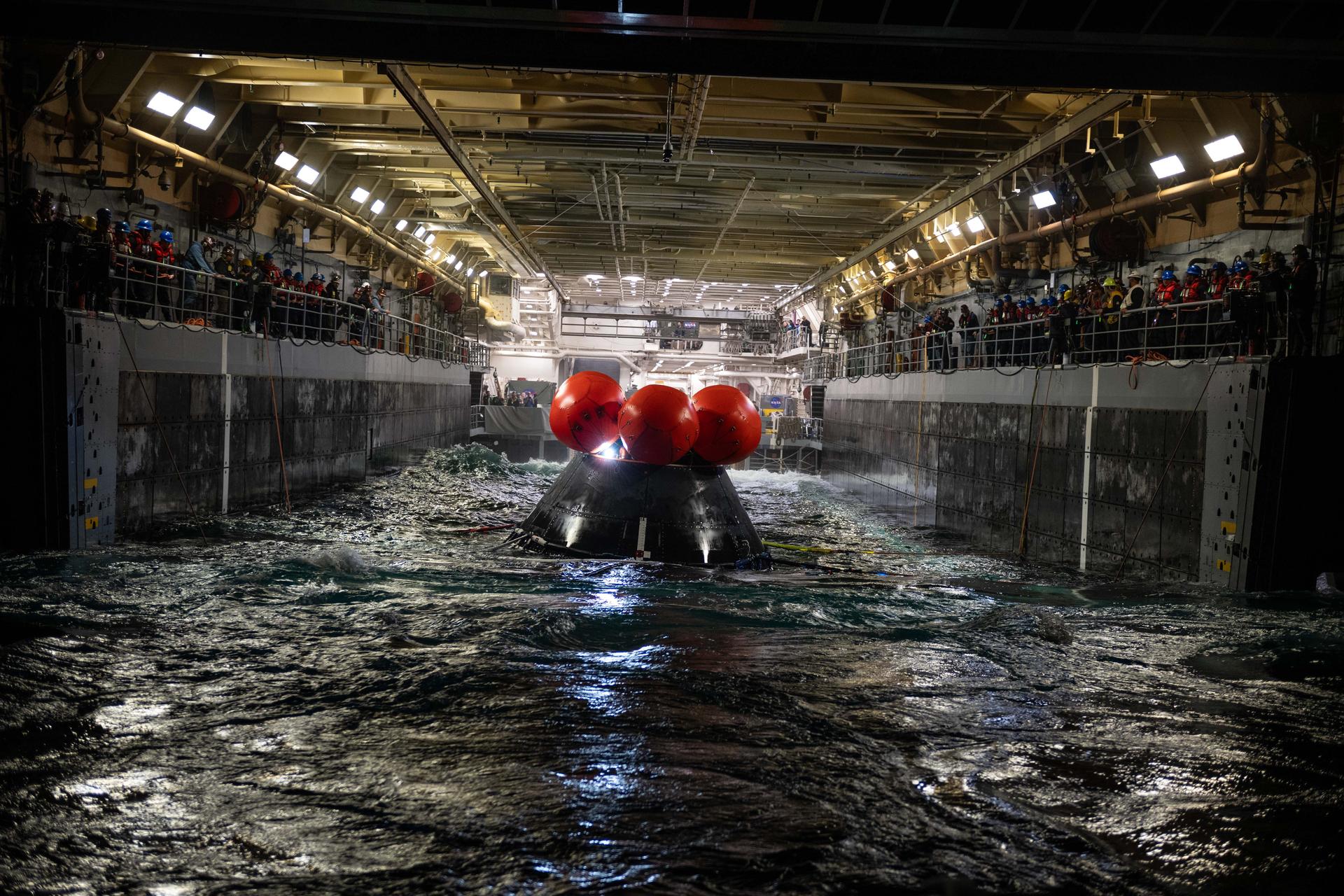
Members from NASA’s Artemis Landing and Recovery team and the Department of War perform a final simulation of the Artemis II splashdown, called a just-in-time training, in the Pacific Ocean off the coast of California on Thursday, Jan. 29, 2026. The teams will work together to retrieve the Artemis II crew and Orion spacecraft following their return to Earth, and during the training the teams use the Crew Module Test Article, a full-scale mockup of the Orion spacecraft, to simulate as close as possible the conditions they can expect to encounter during splashdown of the Artemis II mission. NASA’s first crewed test flight in the Artemis campaign, the approximately 10-day Artemis II mission will send NASA astronauts Reid Wiseman, Victor Glover, and Christina Koch, and CSA (Canadian Space Agency) astronaut Jeremy Hansen around the Moon and farther than any humans have ever been from Earth.
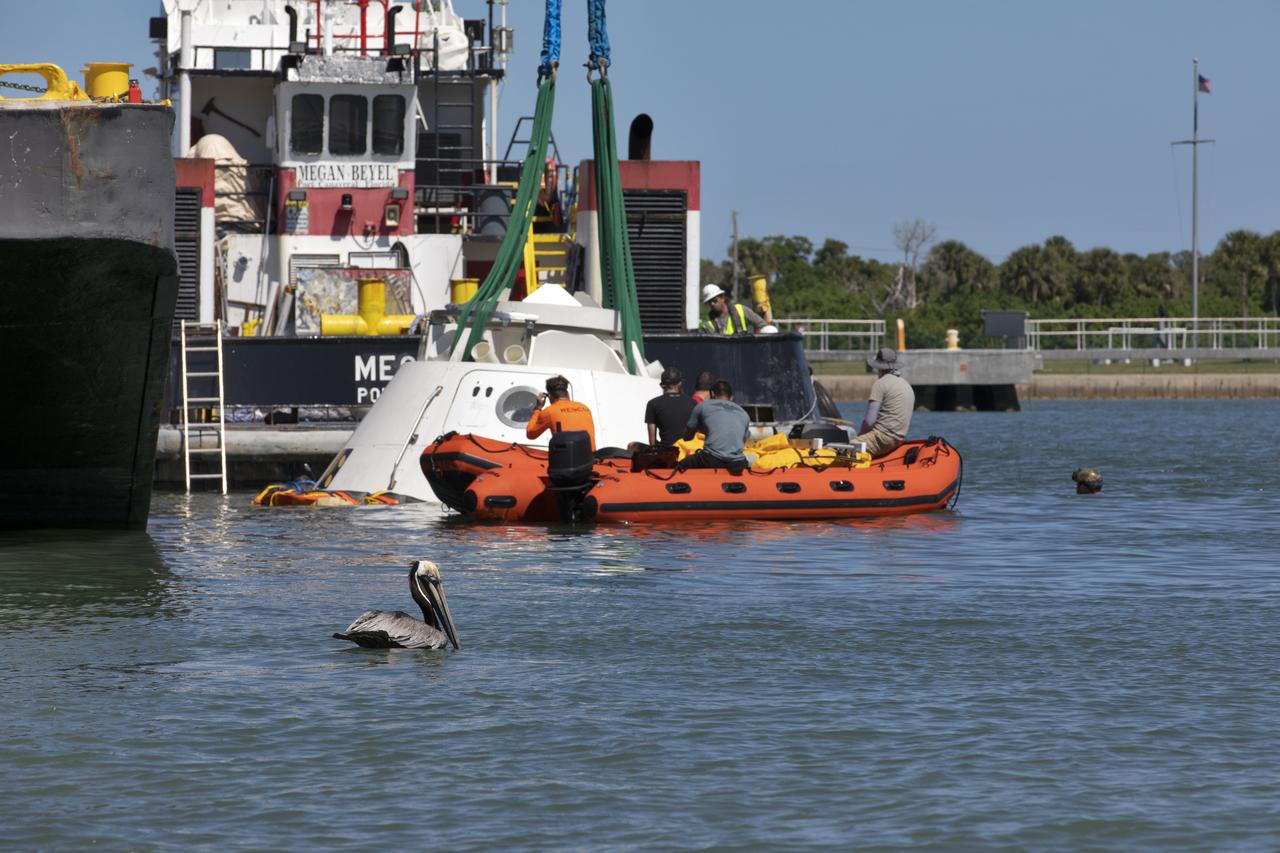
Rescue team members in an inflatable boat approach the Boeing CST-100 Starliner training capsule, known as Boiler Plate 3, at the Army Wharf at Cape Canaveral Air Force Station in Florida on April 16, 2019. NASA and the Department of Defense Human Space Flight Support Office Rescue Division are conducting a search and rescue training exercise over the next several days at the Wharf and in the Atlantic Ocean simulating a rescue in the unlikely event of an emergency. It is the first at-sea exercise with the Starliner training capsule ahead of Boeing’s Crew Flight Test with astronauts targeted for later this year. During normal return scenarios, Boeing's Starliner will land on land in a safe zone of about 15 square miles in the Western United States. Throughout the commercial crew development phases with NASA, Boeing has performed dozens of qualification tests on its parachute and airbag systems simulating conditions on land and in the water.
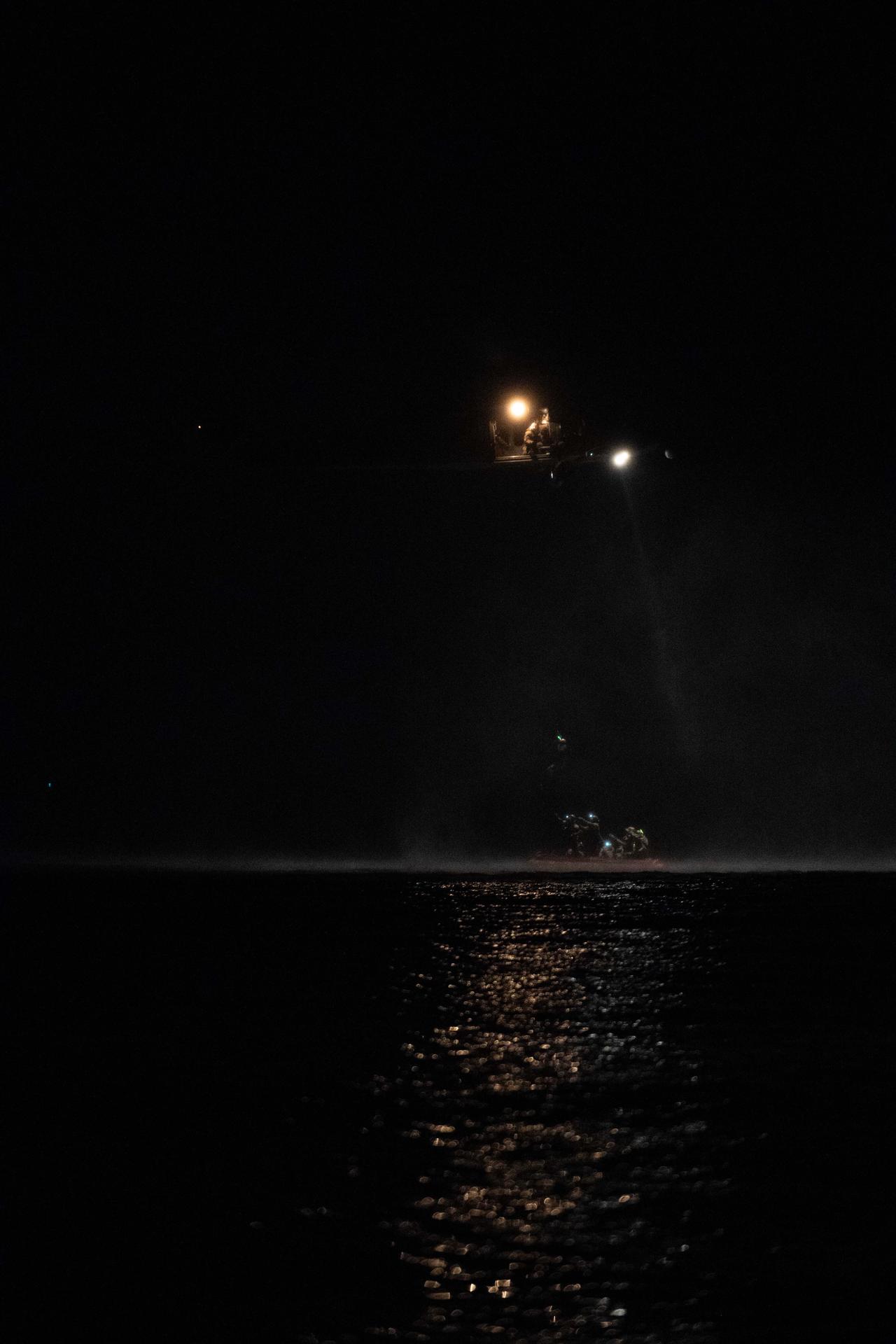
Members from NASA’s Artemis Landing and Recovery team and the Department of War perform a final simulation of the Artemis II splashdown, called a just-in-time training, in the Pacific Ocean off the coast of California on Thursday, Jan. 29, 2026. The teams will work together to retrieve the Artemis II crew and Orion spacecraft following their return to Earth, and during the training the teams use the Crew Module Test Article, a full-scale mockup of the Orion spacecraft, to simulate as close as possible the conditions they can expect to encounter during splashdown of the Artemis II mission. NASA’s first crewed test flight in the Artemis campaign, the approximately 10-day Artemis II mission will send NASA astronauts Reid Wiseman, Victor Glover, and Christina Koch, and CSA (Canadian Space Agency) astronaut Jeremy Hansen around the Moon and farther than any humans have ever been from Earth.
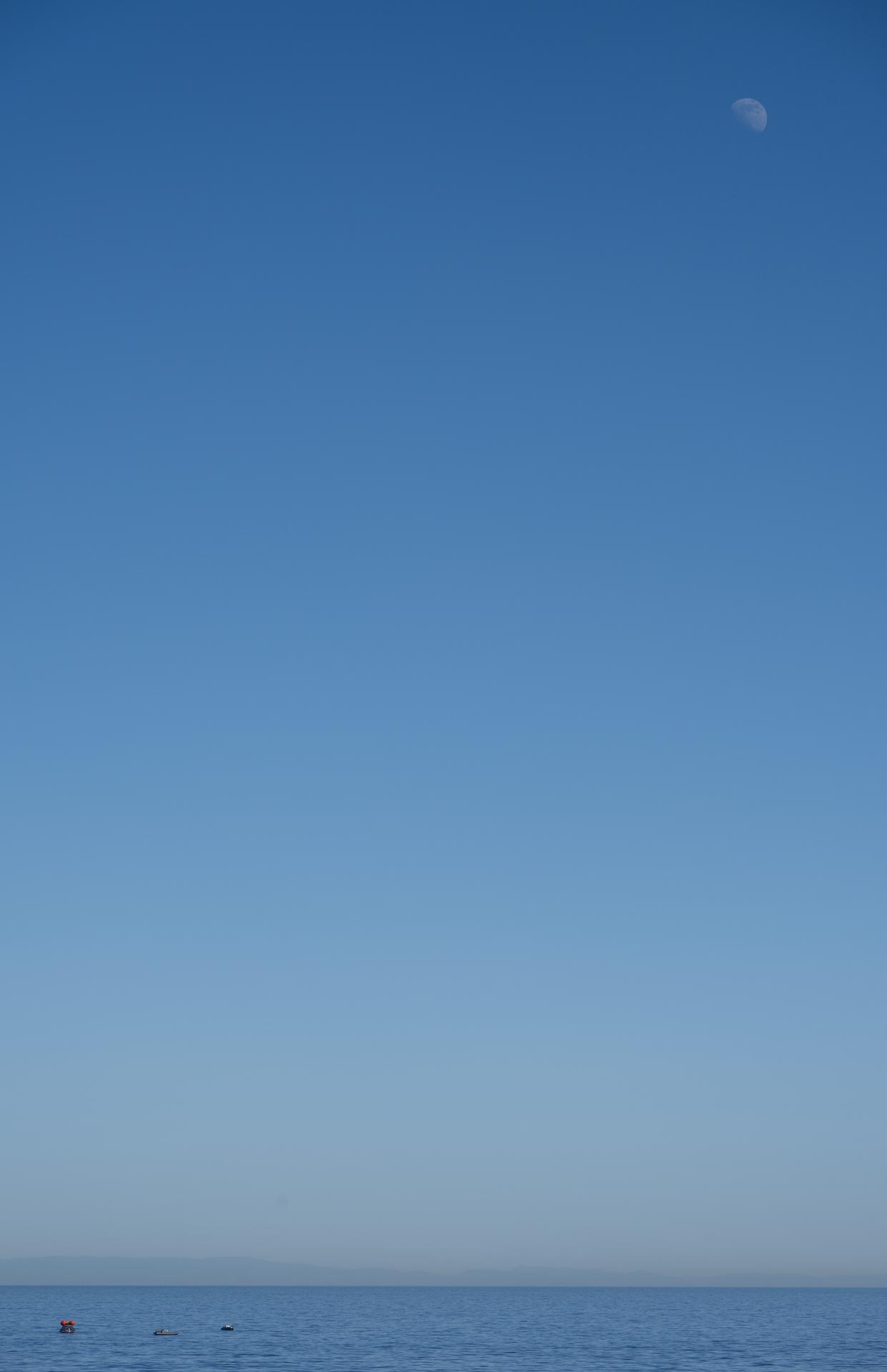
Off the coast of California, NASA’s Artemis Landing and Recovery team and the Department of War that will work together to retrieve the Artemis II crew and Orion spacecraft following their return to Earth and splashdown in the Pacific Ocean are performing a final simulation of their activities, called a just-in-time training, at sea on Tuesday, Jan. 27, 2026. During the training, teams use the Crew Module Test Article, a full-scale mockup of the Orion spacecraft, to simulate as close as possible the conditions they can expect to encounter during splashdown of the Artemis II mission. NASA’s first crewed test flight in the Artemis campaign, the approximately 10-day Artemis II mission will send NASA astronauts Reid Wiseman, Victor Glover, and Christina Koch, and CSA (Canadian Space Agency) astronaut Jeremy Hansen around the Moon and farther than any humans have ever been from Earth.
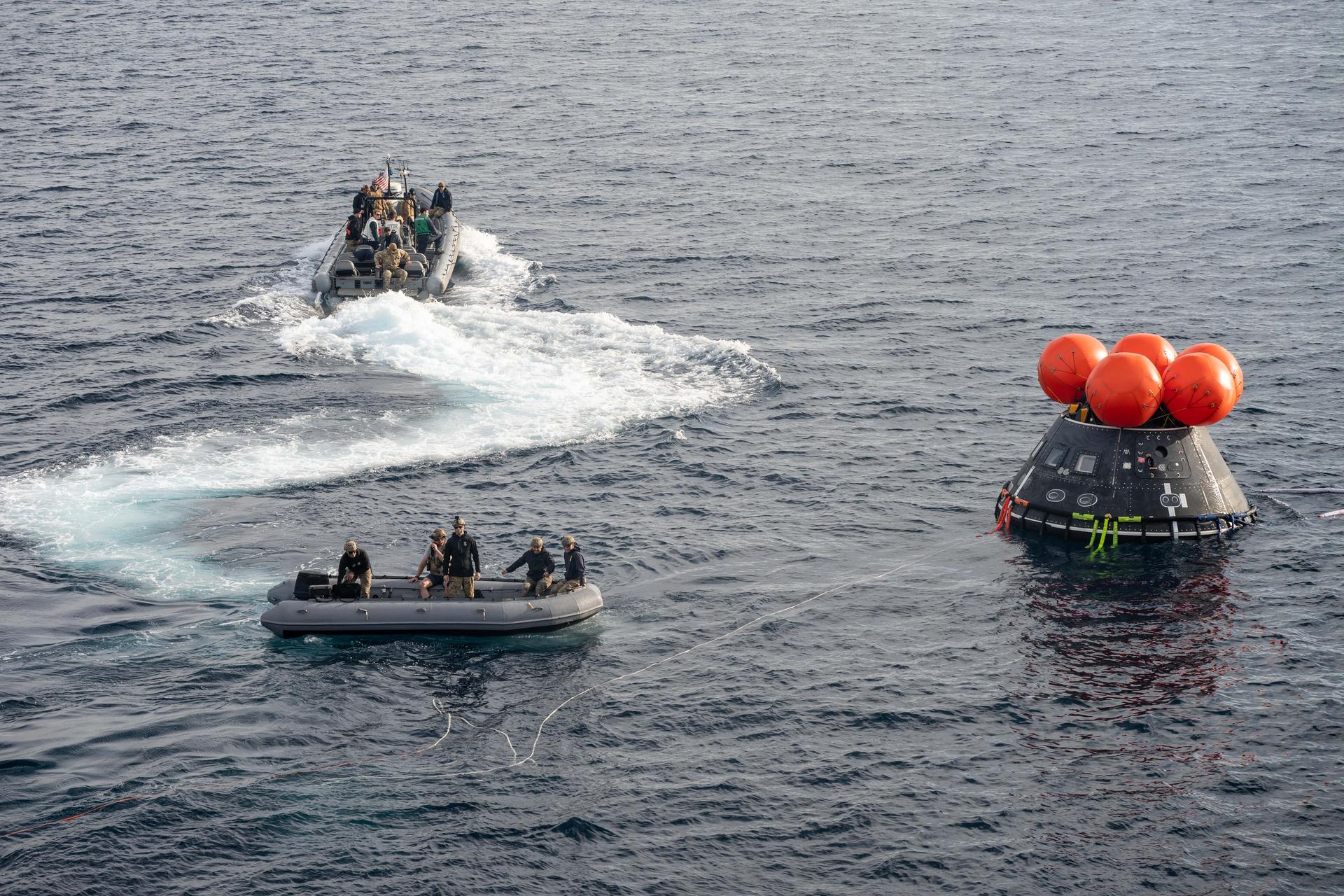
Off the coast of California, NASA’s Artemis Landing and Recovery team and the Department of War that will work together to retrieve the Artemis II crew and Orion spacecraft following their return to Earth and splashdown in the Pacific Ocean are performing a final simulation of their activities, called a just-in-time training, at sea on Tuesday, Jan. 27, 2026. During the training, teams use the Crew Module Test Article, a full-scale mockup of the Orion spacecraft, to simulate as close as possible the conditions they can expect to encounter during splashdown of the Artemis II mission. NASA’s first crewed test flight in the Artemis campaign, the approximately 10-day Artemis II mission will send NASA astronauts Reid Wiseman, Victor Glover, and Christina Koch, and CSA (Canadian Space Agency) astronaut Jeremy Hansen around the Moon and farther than any humans have ever been from Earth.
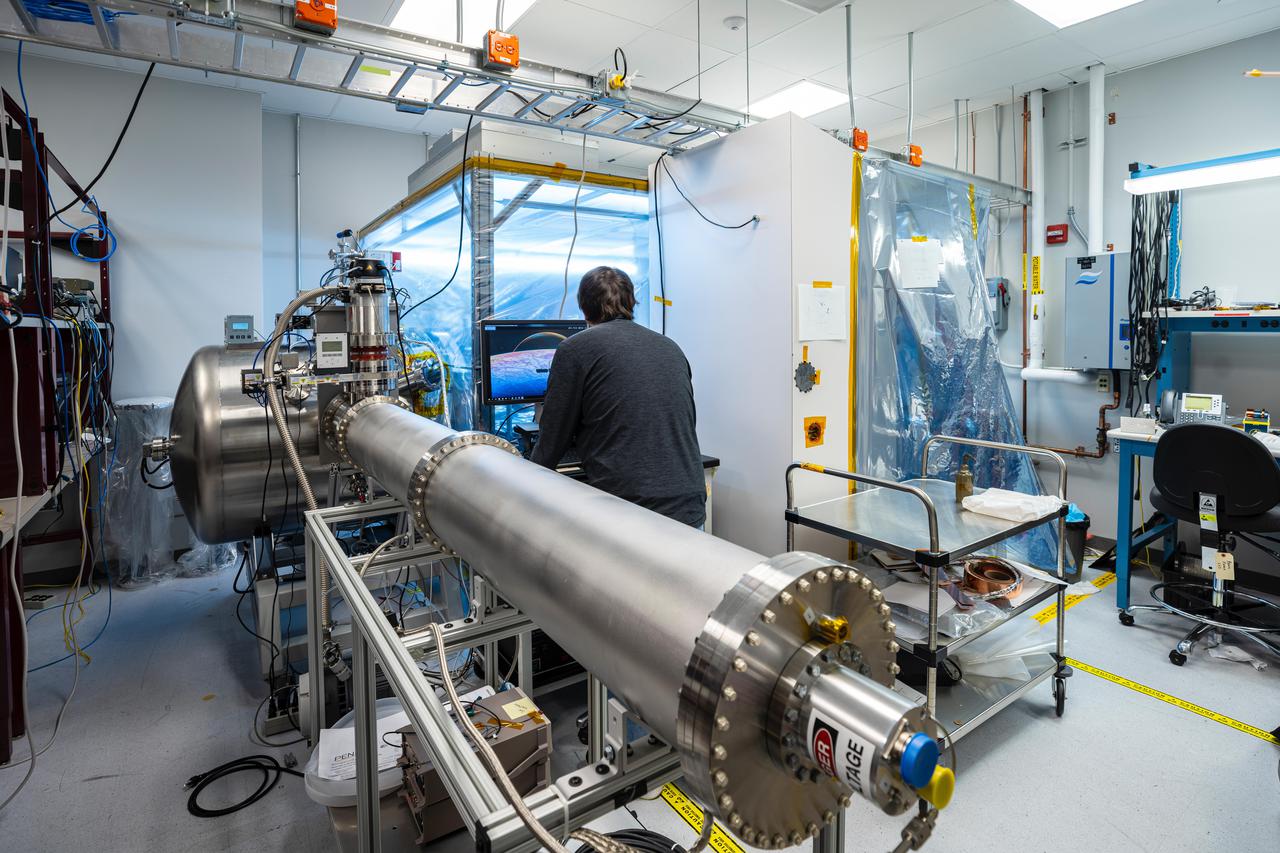
Included in the payload of science instruments for NASA's Europa Clipper is the Plasma Instrument for Magnetic Sounding (PIMS). Scientists will use PIMS to study the characteristics of plasma around Europa to better understand the moon's ice-shell thickness, ocean depth, and ocean salinity. PIMS will have four sensors, called Faraday cups, to measure the electrical current produced by charged particles (or plasma) as they strike a detector plate inside each sensor. In this photo, the Plasma Instrument Calibration Chamber at the Johns Hopkins Applied Physics Laboratory (APL) in Laurel, Maryland, recreates the plasma environments that PIMS and other instruments will encounter in space. The equipment in this lab simulates these environments with ion beams that reproduce plasma energy ranges found at Jupiter and Europa. Once PIMS is fully assembled in the clean room attached to the chamber, the team will direct these ion and electron beams into the Faraday cup sensors for calibration. This will be used specifically to simulate the plasma in Europa's ionosphere and Jupiter's magnetosphere, which PIMS will later measure directly. With an internal global ocean twice the size of Earth's oceans combined, Europa may have the potential to harbor life. NASA's Europa Clipper spacecraft will swoop around Jupiter on an elliptical path, dipping close to the moon on each flyby to collect data. Understanding Europa's habitability will help scientists better understand how life developed on Earth and the potential for finding life beyond our planet. https://photojournal.jpl.nasa.gov/catalog/PIA24330
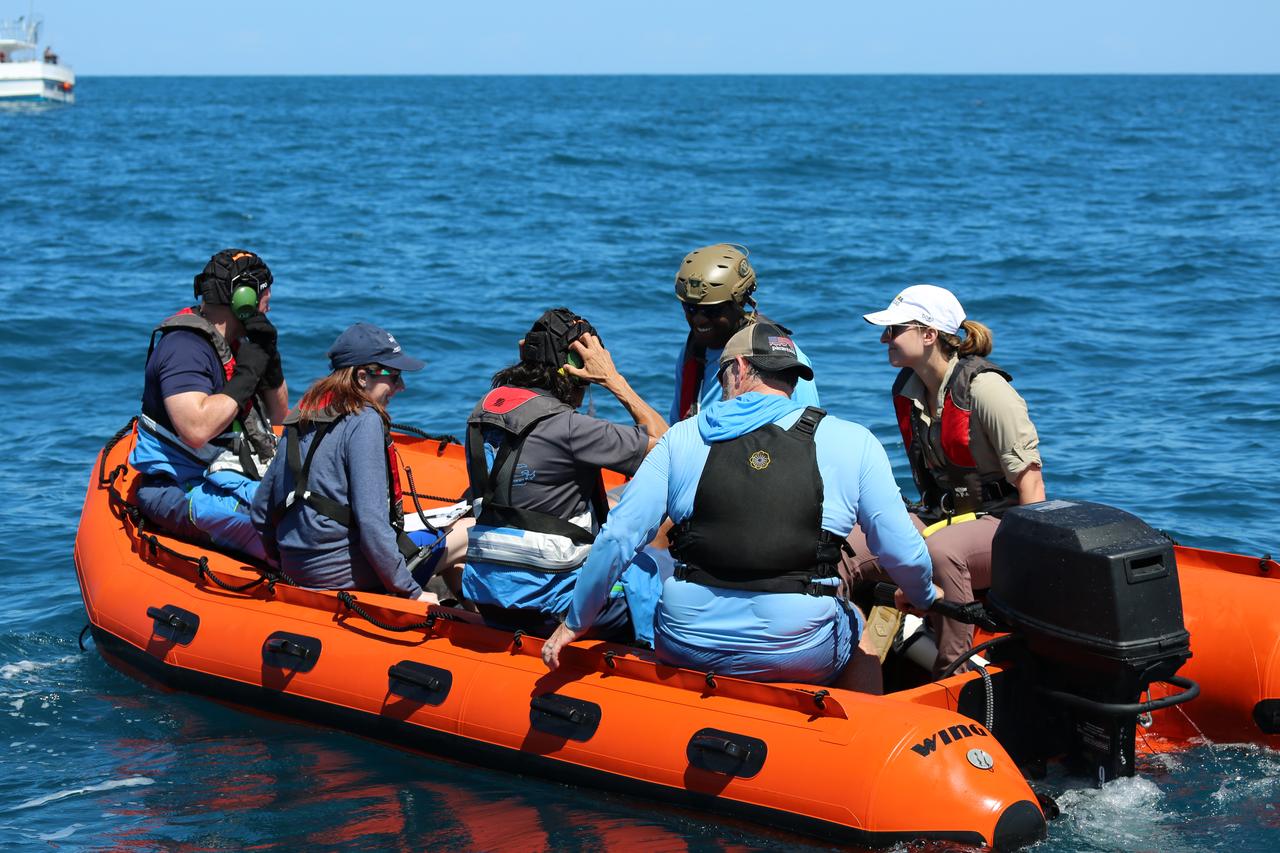
NASA astronauts Suni Williams and Barry “Butch” Wilmore, joined by their training team on a watercraft in the Atlantic Ocean, secure their safety gear as they prepare to rehearse the steps they would take to exit Boeing’s CST-100 Starliner spacecraft without assistance in the unlikely event of an emergency resulting in a splashdown. The training exercise, which occurred April 27, 2019, took place several miles off the coast of Cape Canaveral near NASA’s Kennedy Space Center in Florida. It included the astronauts unloading a rescue raft from inside the spacecraft, climbing out through a hatch at the top of the spacecraft, jumping into the Atlantic Ocean and boarding the raft. This open-ocean exercise provides the astronauts with the necessary training ahead of Boeing’s Crew Flight Test and subsequent missions. During normal return scenarios, Boeing’s Starliner will land in a safe zone of about 15 square miles in the Western United States. Throughout the commercial crew development phases with NASA, Boeing has performed dozens of qualification tests on its parachute and airbag systems simulating conditions on land and in the water.
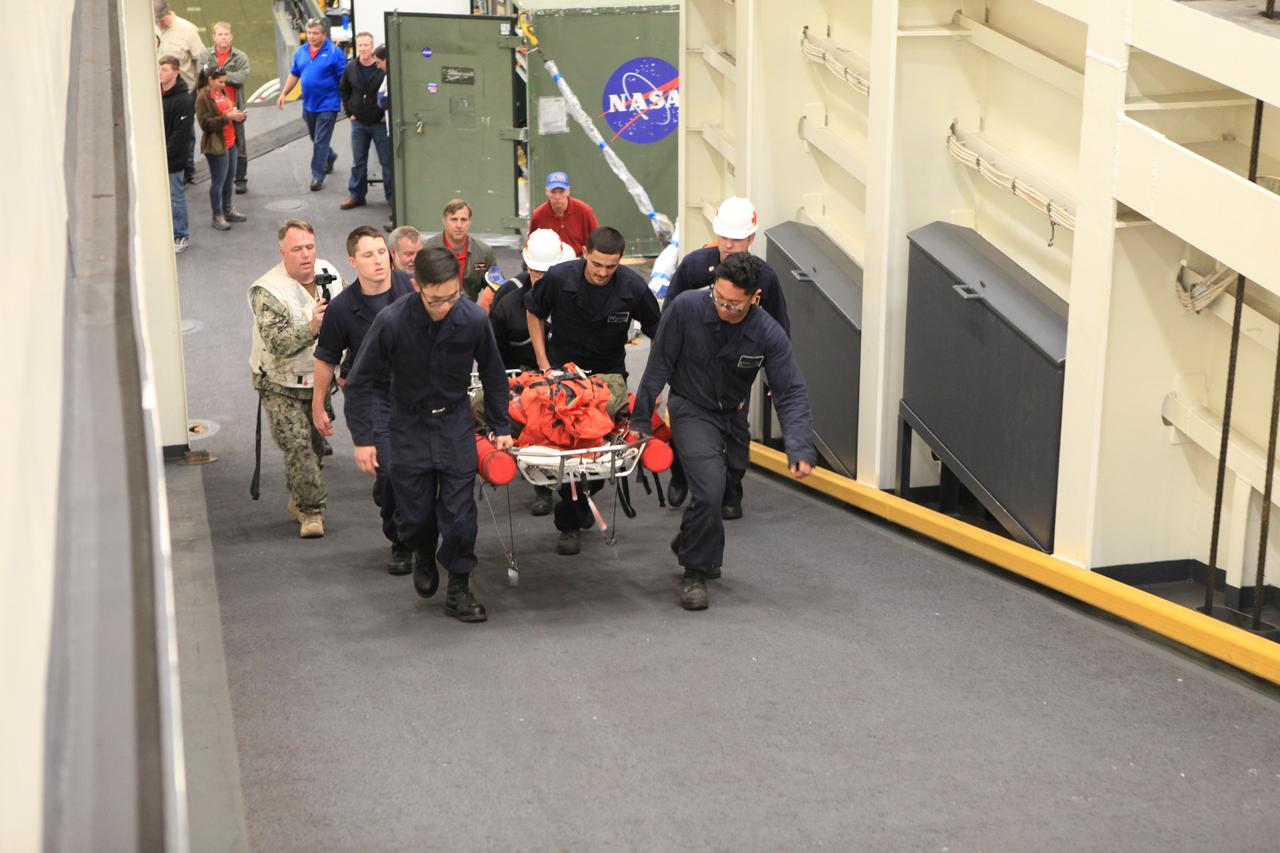
Sailors from the USS Anchorage simulate “Oscar,” a dummy used for man overboard drills, to the medical unit. During Underway Recovery Test 6, the USS Anchorage’s man overboard drill gave Kennedy Space Center’s NASA Recovery Team a glimpse of one way an astronaut could be brought from a small boat onto the ship using a stretcher. Once the Orion capsule splashes down in the Pacific Ocean, astronauts can choose to stay in the capsule until it is pulled into the well deck of the Navy vessel, or have a diver retrieve them in the open water and then get the capsule later.
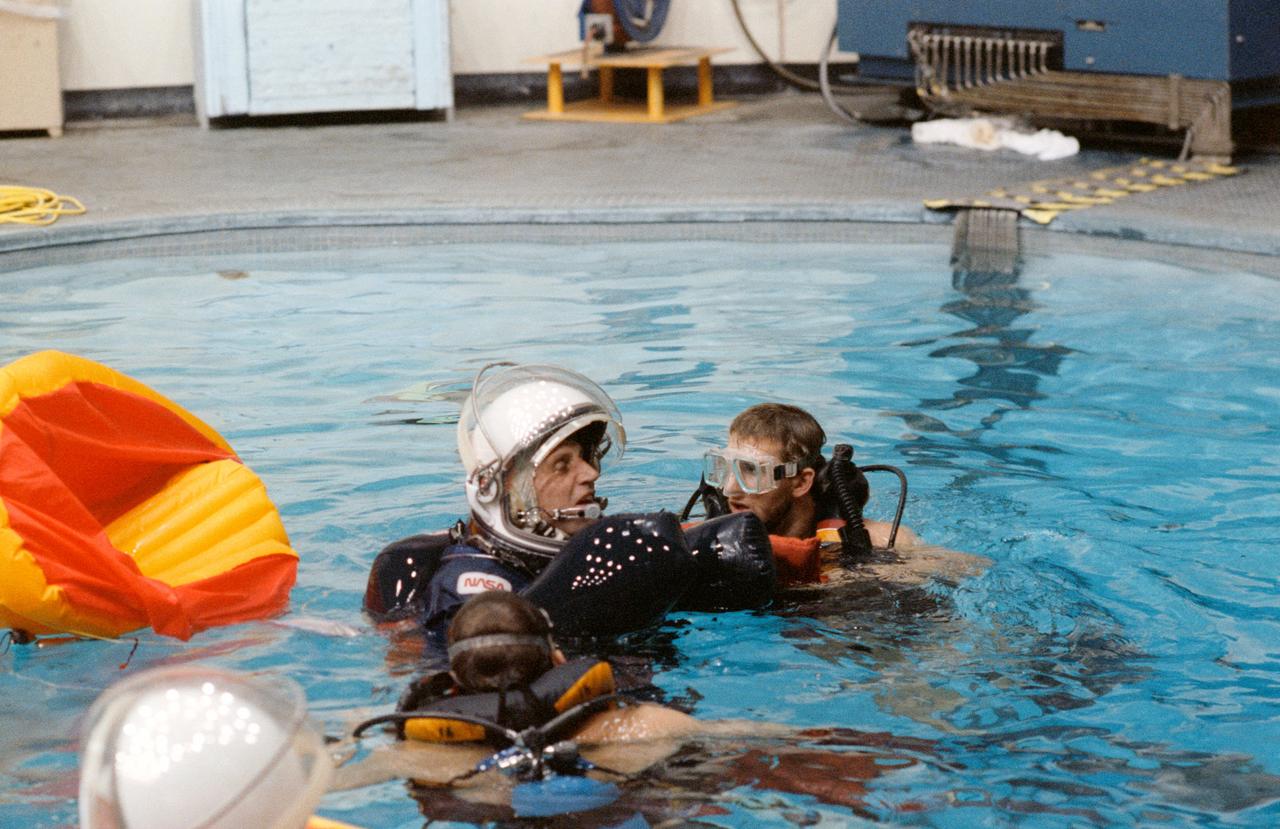
S91-51995 (26 Nov 1991) --- Astronaut David C. Hilmers, STS-42 mission specialist, wearing launch and entry suit (LES) and launch and entry helmet (LEH), floats in the water with the aid of an underarm flotation device as SCUBA-equipped divers look on. Behind Hilmers is his yellow and orange single person life raft. Hilmers is rehearsing launch emergency egress (bailout) procedures in the Johnson Space Center?s (JSC) Weightless Environment Training Facility (WETF) Bldg 29. The crewmembers would use this equipment in the event of an emergency bailout over water. The WETF's 25 ft deep pool is used to simulate the ocean.
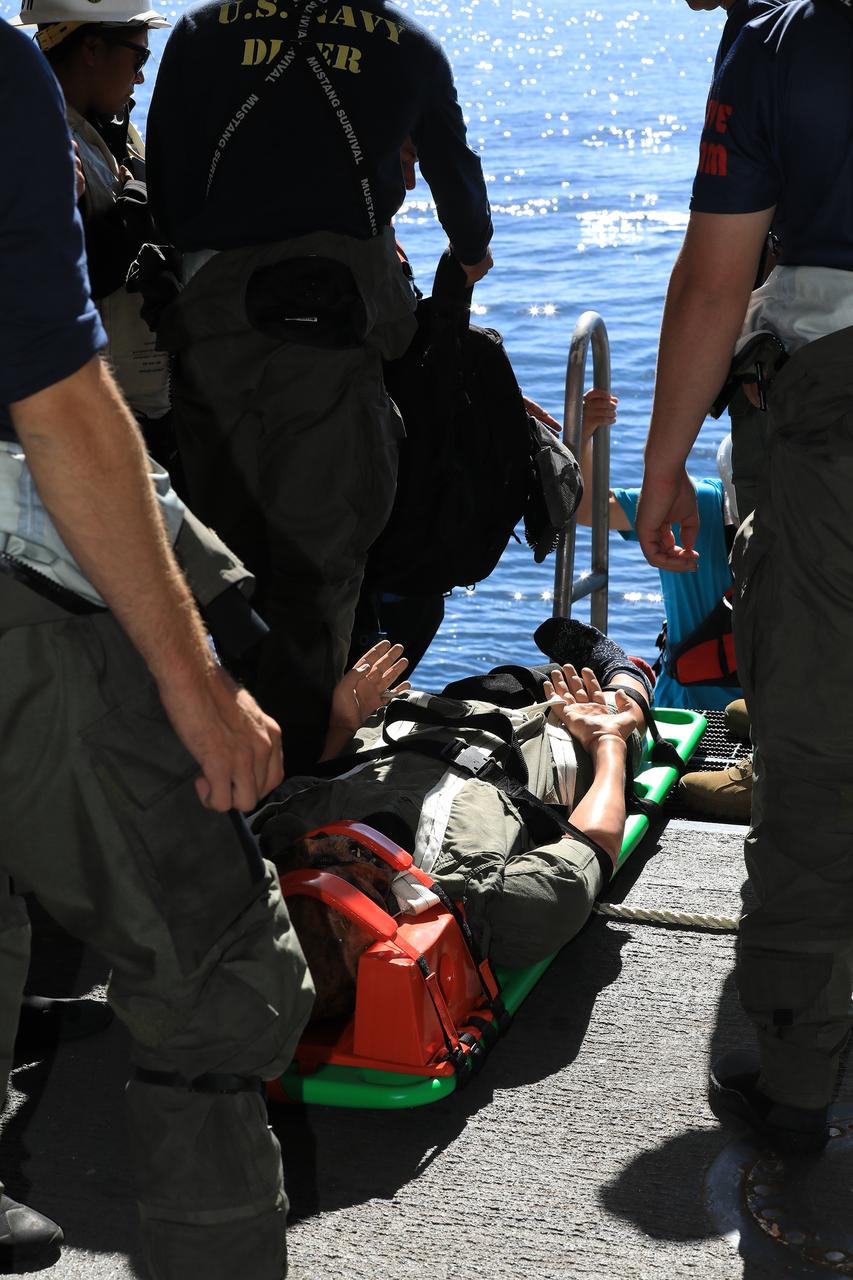
During Underway Recovery Test-7 (URT-7), the crew of the USS John P. Murtha simulate transporting an astronaut from a test version of the Orion capsule onto the ship on Nov. 1, 2018. The test is one in a series of tests to verify and validate procedures and hardware that will be used to recover the Orion spacecraft after it splashes down in the Pacific Ocean following deep space exploration missions. Orion will have emergency abort capability, sustain the crew during space travel and provide safe re-entry from deep space return velocities.
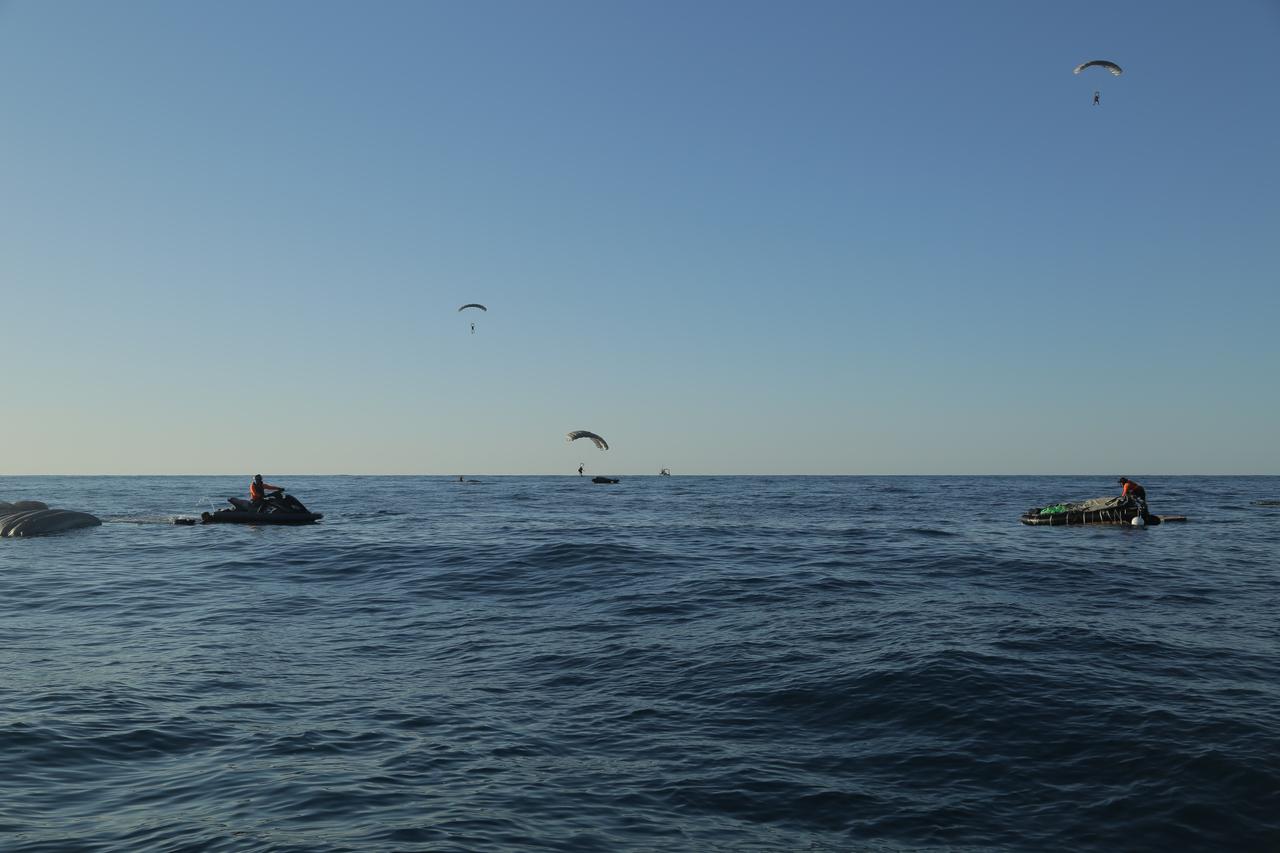
Pararescue specialists from the 304th Rescue Squadron, located in Portland, Oregon and supporting the 45th Operations Group’s Detachment 3, based out of Patrick Air Force Base, deploy their parachutes and prepare to touch down on the Atlantic Ocean surface during an April astronaut rescue exercise with NASA’s Commercial Crew Program and SpaceX off of Florida’s eastern coast. The pararescue specialists, also known as “Guardian Angels,” jumped from military aircraft and simulated a rescue operation to demonstrate their ability to safely remove crew from the SpaceX Crew Dragon in the unlikely event of an emergency landing.
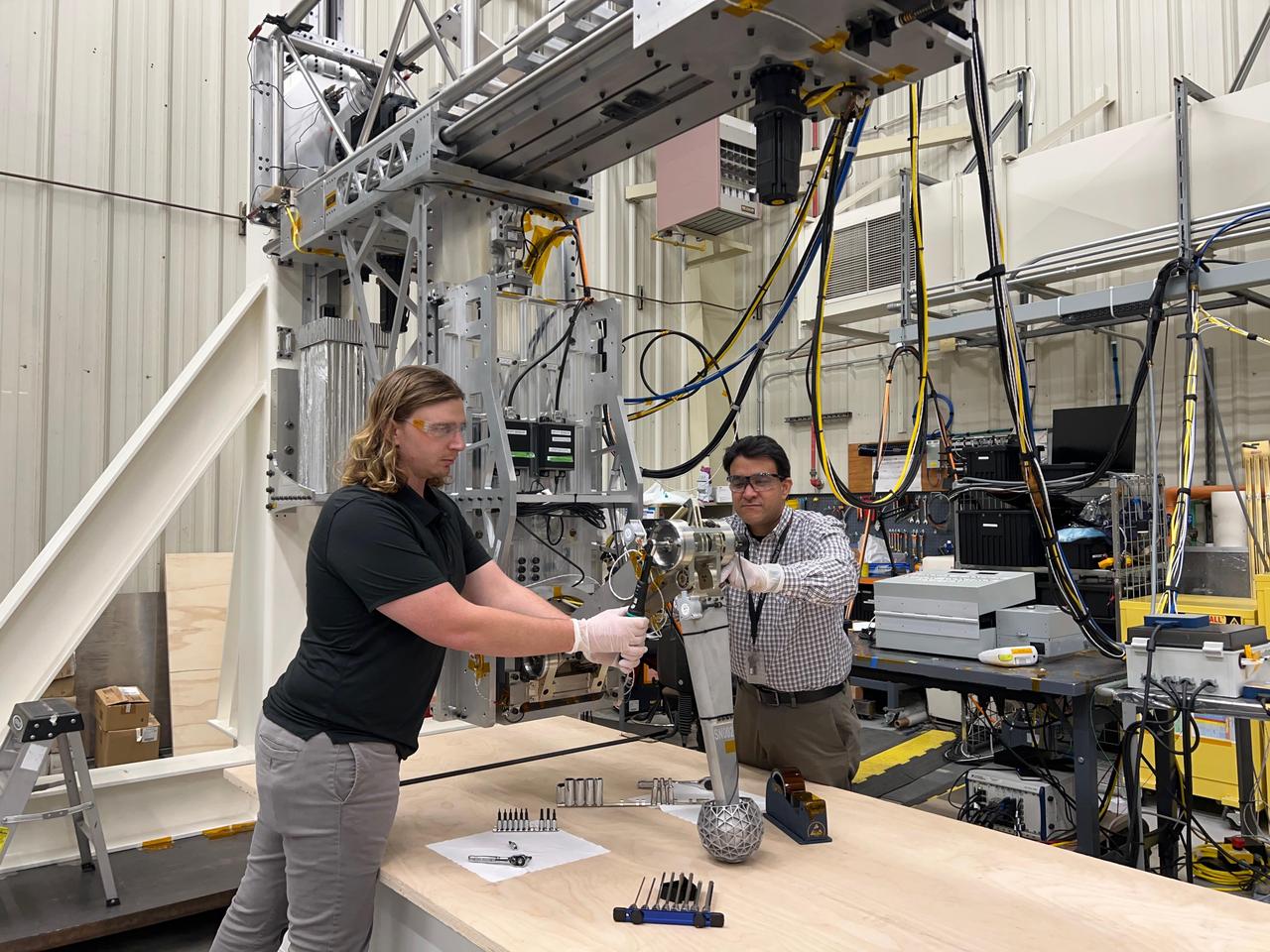
Engineers at NASA's Jet Propulsion Laboratory – from left, Matthew Cameron-Hooper, and Thomas Reynoso – prepare flight-like landing gear in the Europa Lander landing gear testbed in summer 2022. Europa Lander is a concept for a potential future mission that would look for signs of life in the icy surface material of Jupiter's moon Europa. The moon is thought to contain a global ocean of salty water beneath its frozen crust. If life exists in that ocean, signs of its existence called biosignatures could potentially find their way to the surface. In this mission concept, a spacecraft would land on Europa and collect and study samples from about 4 inches (10 centimeters) beneath the surface, looking for signs of life. The Europa Lander landing gear testbed was developed to test and inform the design of the landing gear for the spacecraft: It mimics the landing loads and ground interaction forces that a single flight landing gear would experience when touching down on the Europan surface. It does this by using gravity offloading to simulate the reduced gravity on Europa, and by replicating the mass and inertial properties of a flight lander as well as all the degrees of freedom that the landing gear would experience. https://photojournal.jpl.nasa.gov/catalog/PIA26198
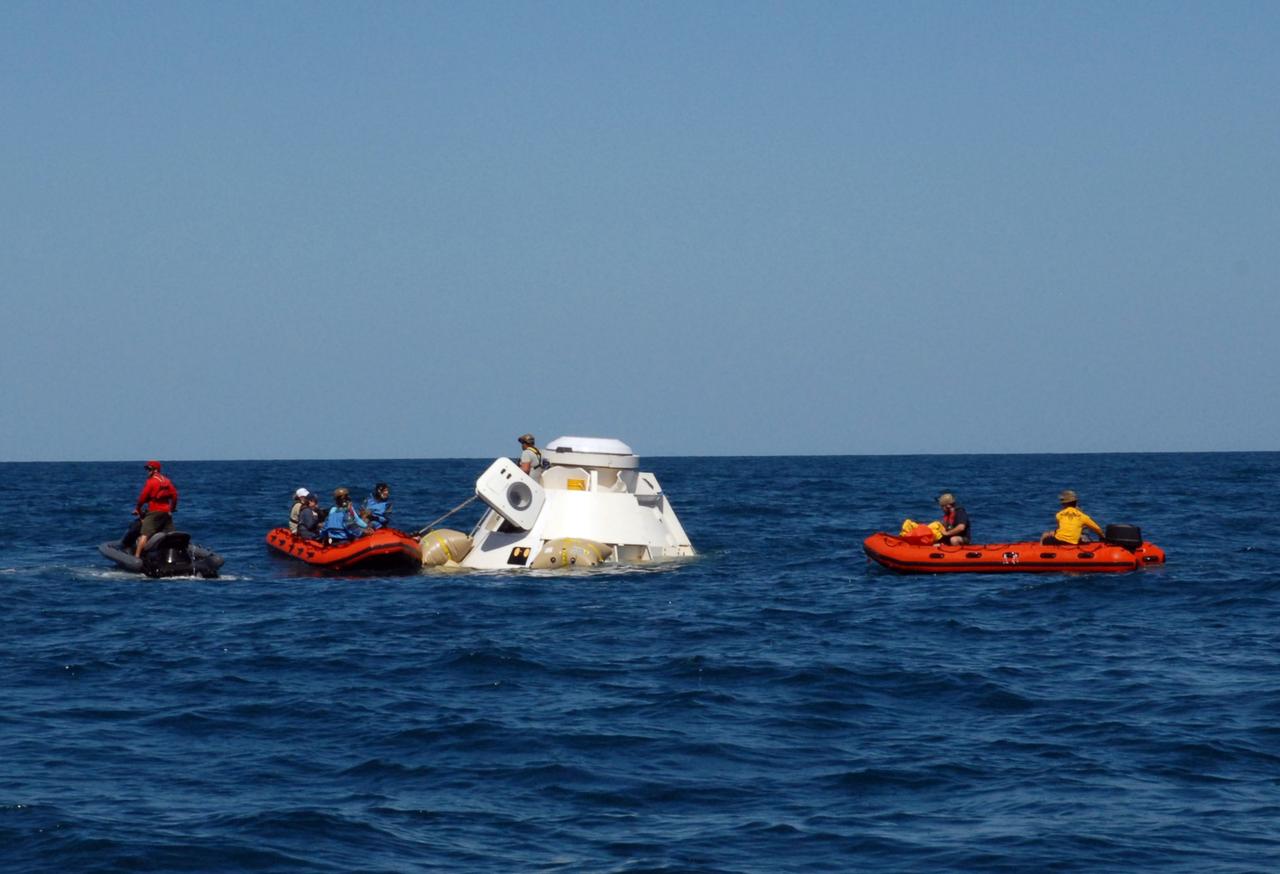
NASA astronauts Suni Williams and Barry “Butch” Wilmore rehearse the steps they would take to exit Boeing’s CST-100 Starliner spacecraft without assistance in the unlikely event of an emergency resulting in a splashdown. The training exercise, which occurred April 27, 2019, took place several miles off the coast of Cape Canaveral near NASA’s Kennedy Space Center in Florida. It included the astronauts unloading a rescue raft from inside the spacecraft, climbing out through a hatch at the top of the spacecraft, jumping into the Atlantic Ocean and boarding the raft. This open-ocean exercise provides the astronauts with the necessary training ahead of Boeing’s Crew Flight Test and subsequent missions. During normal return scenarios, Boeing’s Starliner will land in a safe zone of about 15 square miles in the Western United States. Throughout the commercial crew development phases with NASA, Boeing has performed dozens of qualification tests on its parachute and airbag systems simulating conditions on land and in the water.
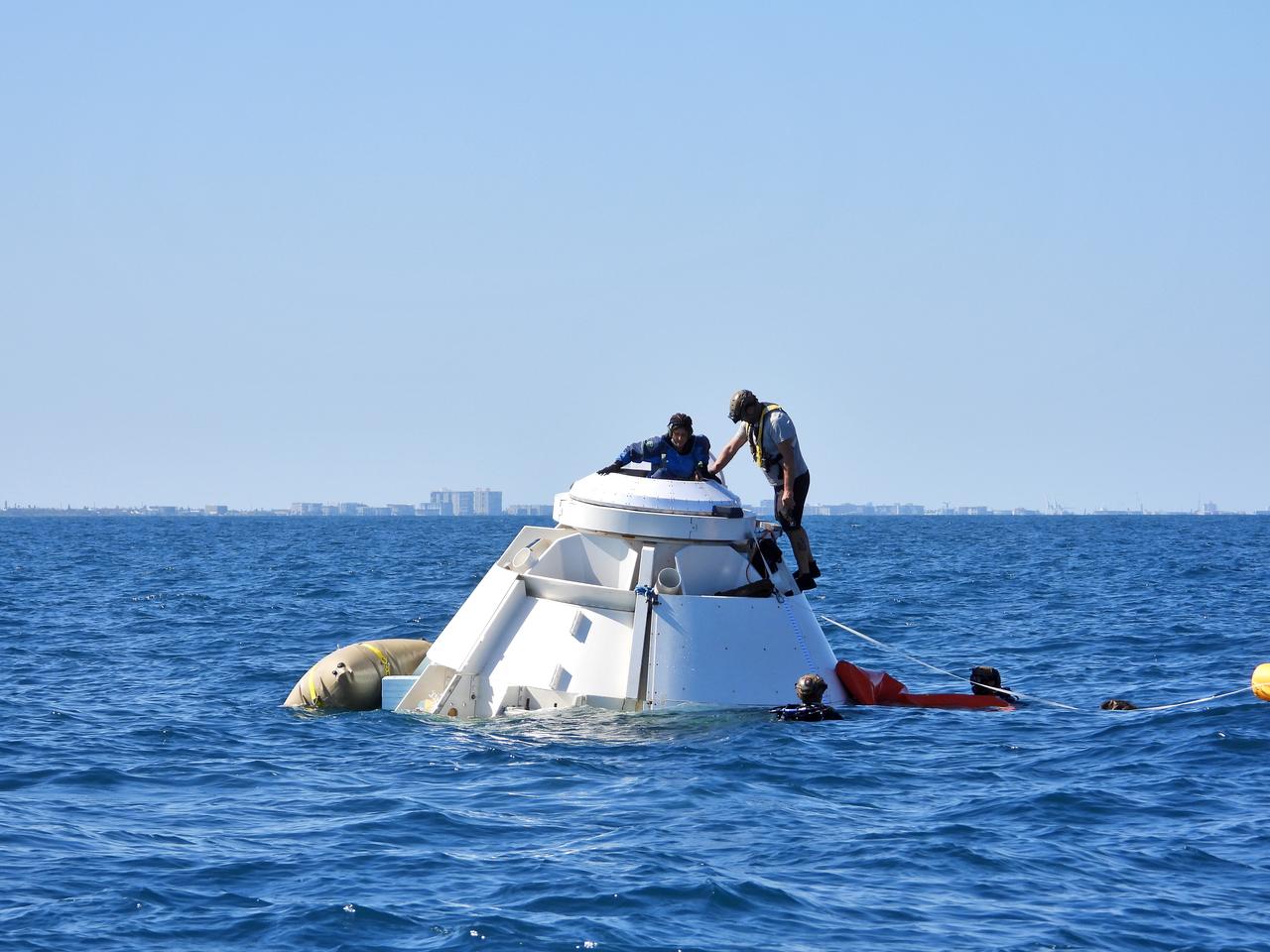
NASA astronauts Suni Williams and Barry “Butch” Wilmore rehearse the steps they would take to exit Boeing’s CST-100 Starliner spacecraft without assistance in the unlikely event of an emergency resulting in a splashdown. The training exercise, which occurred April 27, 2019, took place several miles off the coast of Cape Canaveral near NASA’s Kennedy Space Center in Florida. It included the astronauts unloading a rescue raft from inside the spacecraft, climbing out through a hatch at the top of the spacecraft, jumping into the Atlantic Ocean and boarding the raft. This open-ocean exercise provides the astronauts with the necessary training ahead of Boeing’s Crew Flight Test and subsequent missions. During normal return scenarios, Boeing’s Starliner will land in a safe zone of about 15 square miles in the Western United States. Throughout the commercial crew development phases with NASA, Boeing has performed dozens of qualification tests on its parachute and airbag systems simulating conditions on land and in the water.
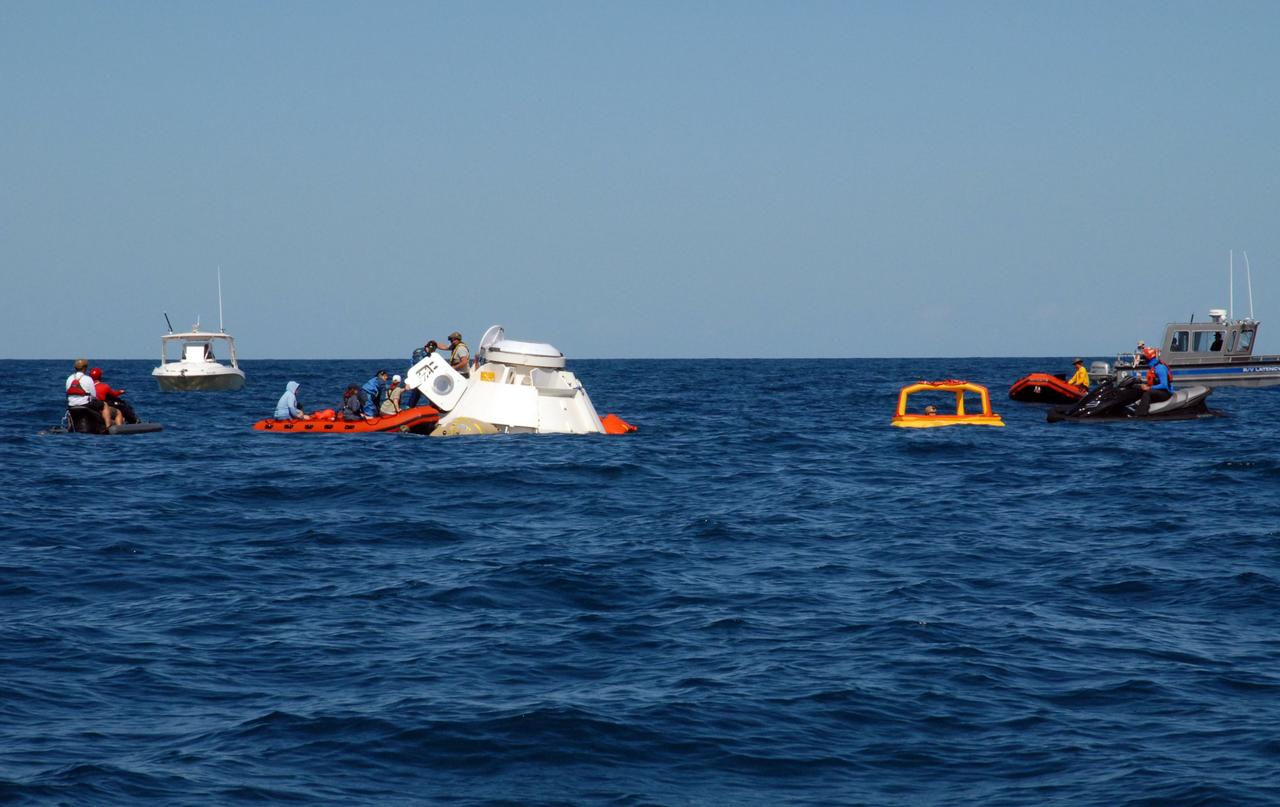
NASA astronauts Suni Williams and Barry “Butch” Wilmore rehearse the steps they would take to exit Boeing’s CST-100 Starliner spacecraft without assistance in the unlikely event of an emergency resulting in a splashdown. The training exercise, which occurred April 27, 2019, took place several miles off the coast of Cape Canaveral near NASA’s Kennedy Space Center in Florida. It included the astronauts unloading a rescue raft from inside the spacecraft, climbing out through a hatch at the top of the spacecraft, jumping into the Atlantic Ocean and boarding the raft. This open-ocean exercise provides the astronauts with the necessary training ahead of Boeing’s Crew Flight Test and subsequent missions. During normal return scenarios, Boeing’s Starliner will land in a safe zone of about 15 square miles in the Western United States. Throughout the commercial crew development phases with NASA, Boeing has performed dozens of qualification tests on its parachute and airbag systems simulating conditions on land and in the water.

U.S. Air Force “Guardian Angel” Pararescue forces are airdropped into the Atlantic Ocean off the coast of Cape Canaveral near Kennedy Space Center in Florida to rehearse a full mission profile training exercise on April 27, 2019. The exercise included using a Boeing CST-100 Starliner training capsule to run through the necessary steps in the unlikely event of an emergency resulting in a splashdown. NASA and the Department of Defense (DoD) Human Space Flight Support Office Rescue Division conducted the training, which included rehearsing assisted egress, extracting DoD team members acting as astronauts, from the capsule and providing immediate medical treatment. This open-ocean exercise provides team members with the necessary training ahead of Boeing’s Crew Flight Test with astronauts targeted for later this year. During normal return scenarios, Boeing’s Starliner will land in a safe zone of about 15 square miles in the Western United States. Throughout the commercial crew development phases with NASA, Boeing has performed dozens of qualification tests on its parachute and airbag systems simulating conditions on land and in the water.
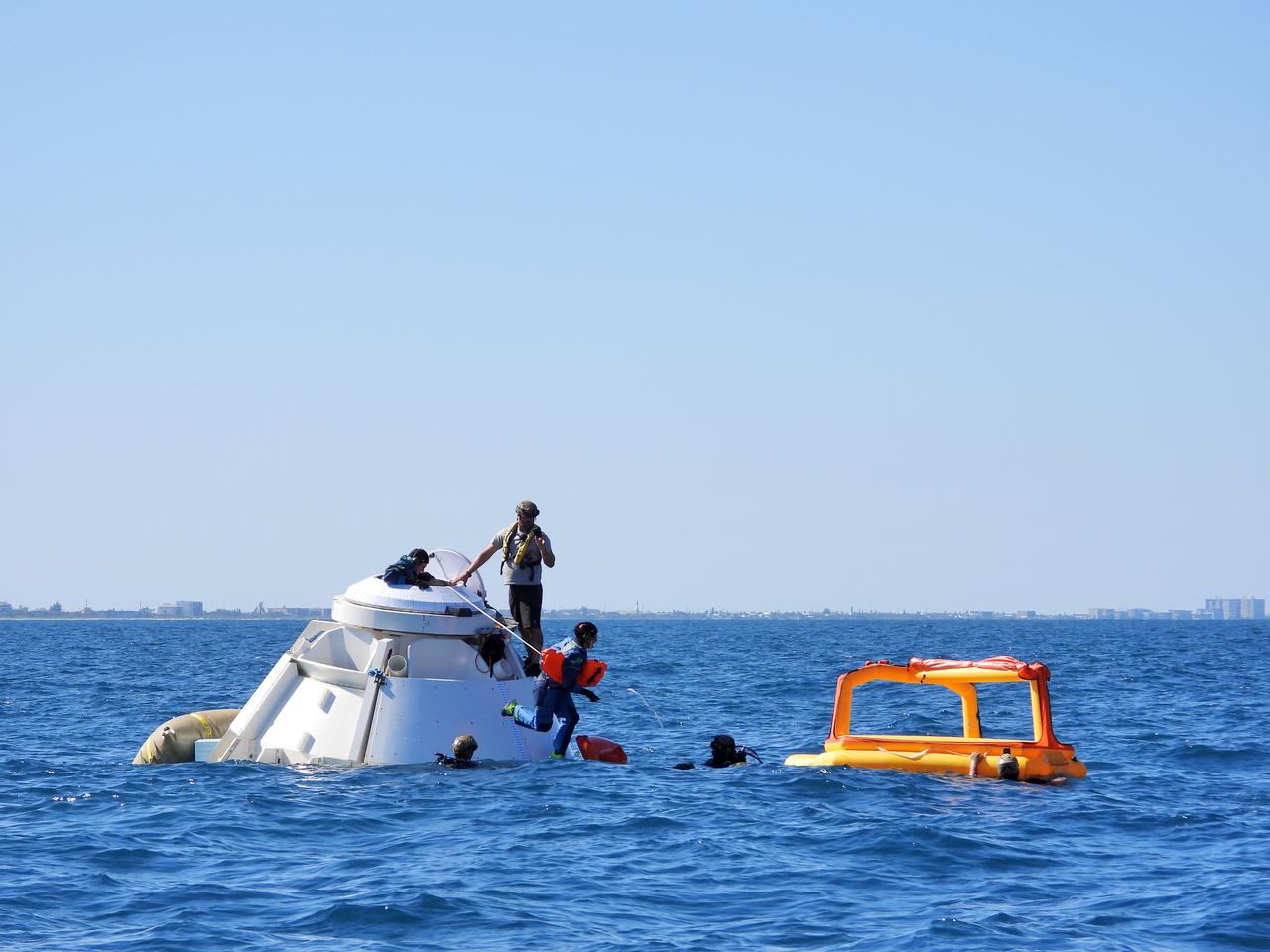
NASA astronauts Suni Williams and Barry “Butch” Wilmore rehearse the steps they would take to exit Boeing’s CST-100 Starliner spacecraft without assistance in the unlikely event of an emergency resulting in a splashdown. The training exercise, which occurred April 27, 2019, took place several miles off the coast of Cape Canaveral near NASA’s Kennedy Space Center in Florida. It included the astronauts unloading a rescue raft from inside the spacecraft, climbing out through a hatch at the top of the spacecraft, jumping into the Atlantic Ocean and boarding the raft. This open-ocean exercise provides the astronauts with the necessary training ahead of Boeing’s Crew Flight Test and subsequent missions. During normal return scenarios, Boeing’s Starliner will land in a safe zone of about 15 square miles in the Western United States. Throughout the commercial crew development phases with NASA, Boeing has performed dozens of qualification tests on its parachute and airbag systems simulating conditions on land and in the water.
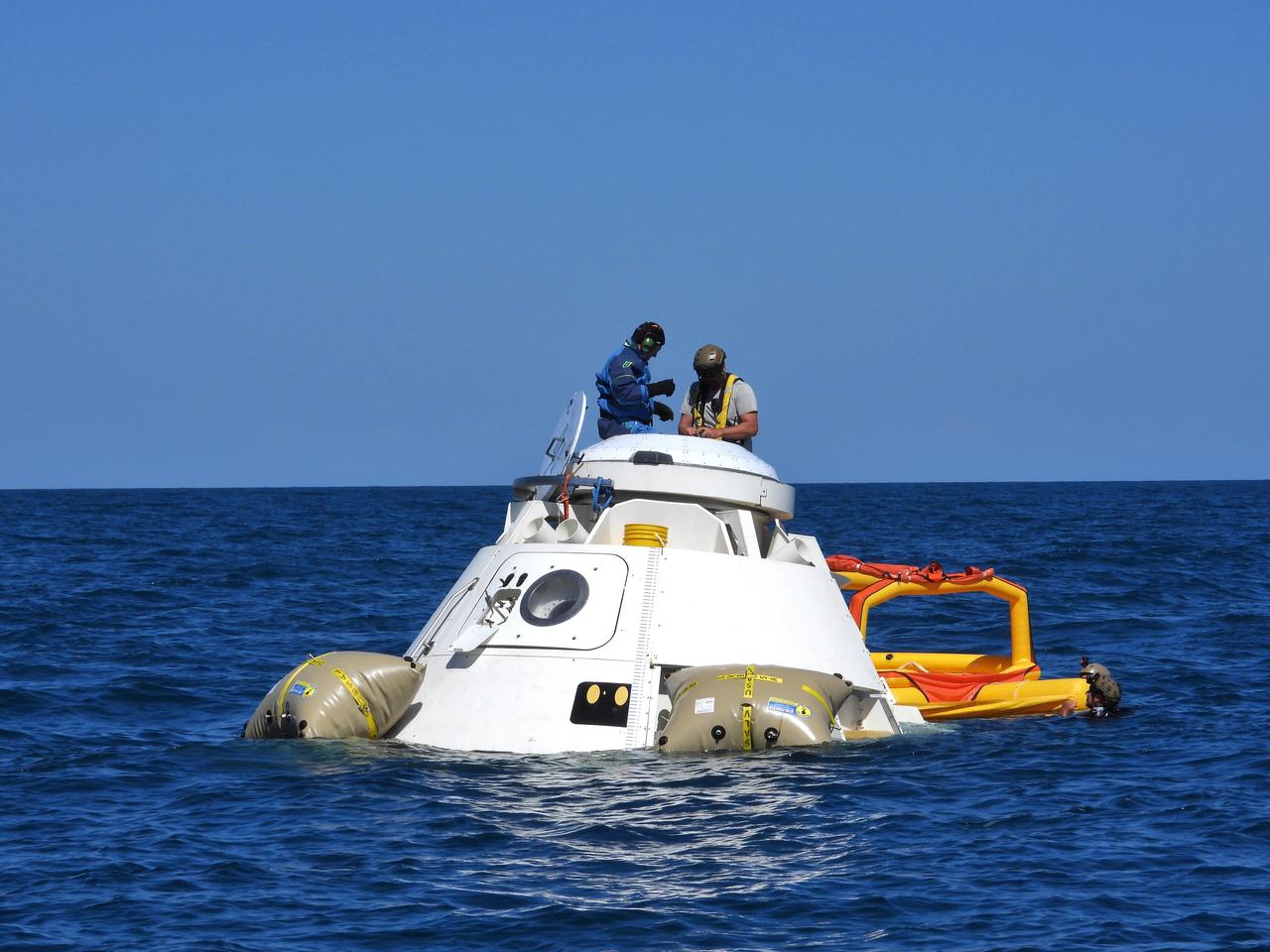
NASA astronauts Suni Williams and Barry “Butch” Wilmore rehearse the steps they would take to exit Boeing’s CST-100 Starliner spacecraft without assistance in the unlikely event of an emergency resulting in a splashdown. The training exercise, which occurred April 27, 2019, took place several miles off the coast of Cape Canaveral near NASA’s Kennedy Space Center in Florida. It included the astronauts unloading a rescue raft from inside the spacecraft, climbing out through a hatch at the top of the spacecraft, jumping into the Atlantic Ocean and boarding the raft. This open-ocean exercise provides the astronauts with the necessary training ahead of Boeing’s Crew Flight Test and subsequent missions. During normal return scenarios, Boeing’s Starliner will land in a safe zone of about 15 square miles in the Western United States. Throughout the commercial crew development phases with NASA, Boeing has performed dozens of qualification tests on its parachute and airbag systems simulating conditions on land and in the water.
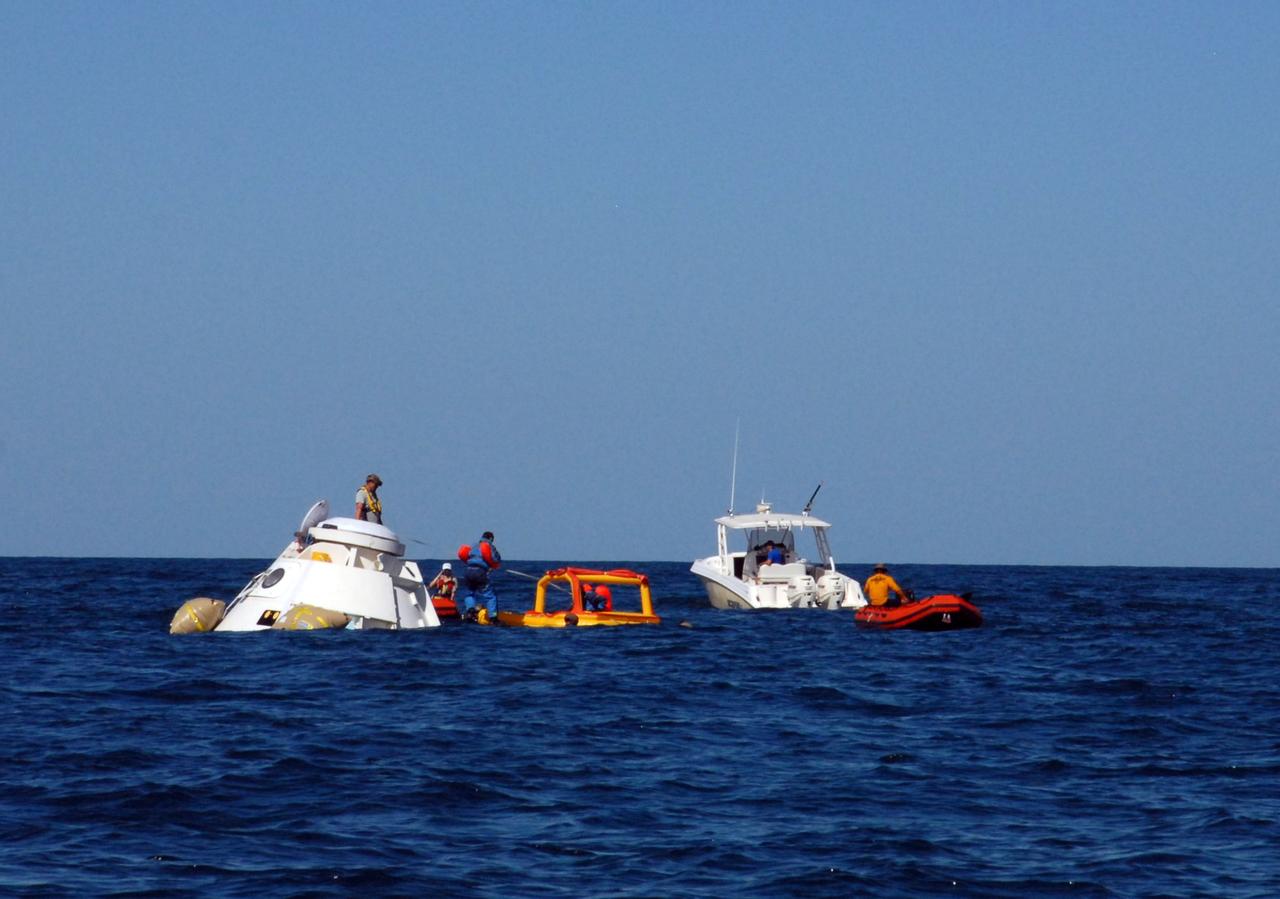
NASA astronauts Suni Williams and Barry “Butch” Wilmore rehearse the steps they would take to exit Boeing’s CST-100 Starliner spacecraft without assistance in the unlikely event of an emergency resulting in a splashdown. The training exercise, which occurred April 27, 2019, took place several miles off the coast of Cape Canaveral near NASA’s Kennedy Space Center in Florida. It included the astronauts unloading a rescue raft from inside the spacecraft, climbing out through a hatch at the top of the spacecraft, jumping into the Atlantic Ocean and boarding the raft. This open-ocean exercise provides the astronauts with the necessary training ahead of Boeing’s Crew Flight Test and subsequent missions. During normal return scenarios, Boeing’s Starliner will land in a safe zone of about 15 square miles in the Western United States. Throughout the commercial crew development phases with NASA, Boeing has performed dozens of qualification tests on its parachute and airbag systems simulating conditions on land and in the water.
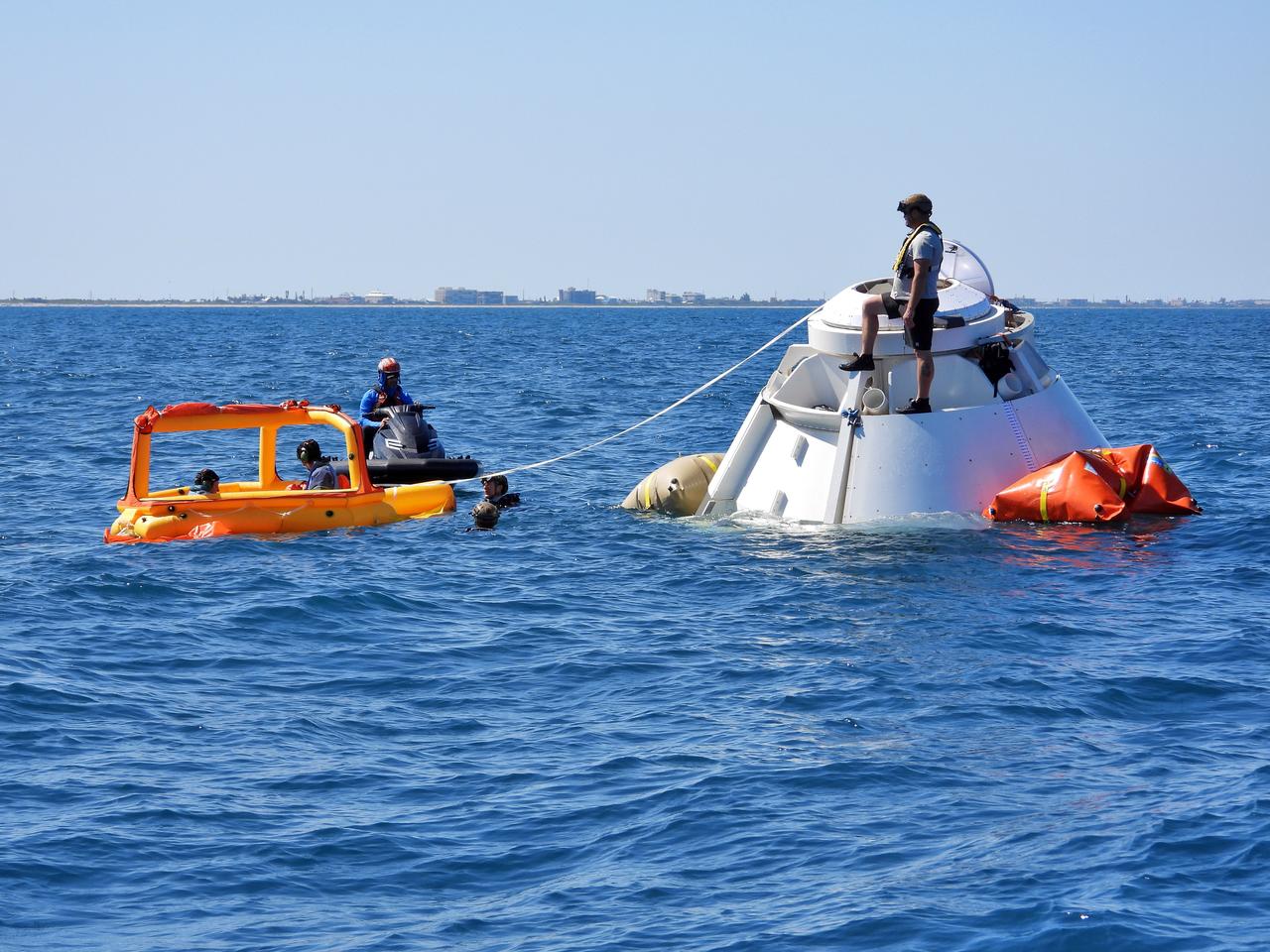
NASA astronauts Suni Williams and Barry “Butch” Wilmore rehearse the steps they would take to exit Boeing’s CST-100 Starliner spacecraft without assistance in the unlikely event of an emergency resulting in a splashdown. The training exercise, which occurred April 27, 2019, took place several miles off the coast of Cape Canaveral near NASA’s Kennedy Space Center in Florida. It included the astronauts unloading a rescue raft from inside the spacecraft, climbing out through a hatch at the top of the spacecraft, jumping into the Atlantic Ocean and boarding the raft. This open-ocean exercise provides the astronauts with the necessary training ahead of Boeing’s Crew Flight Test and subsequent missions. During normal return scenarios, Boeing’s Starliner will land in a safe zone of about 15 square miles in the Western United States. Throughout the commercial crew development phases with NASA, Boeing has performed dozens of qualification tests on its parachute and airbag systems simulating conditions on land and in the water.
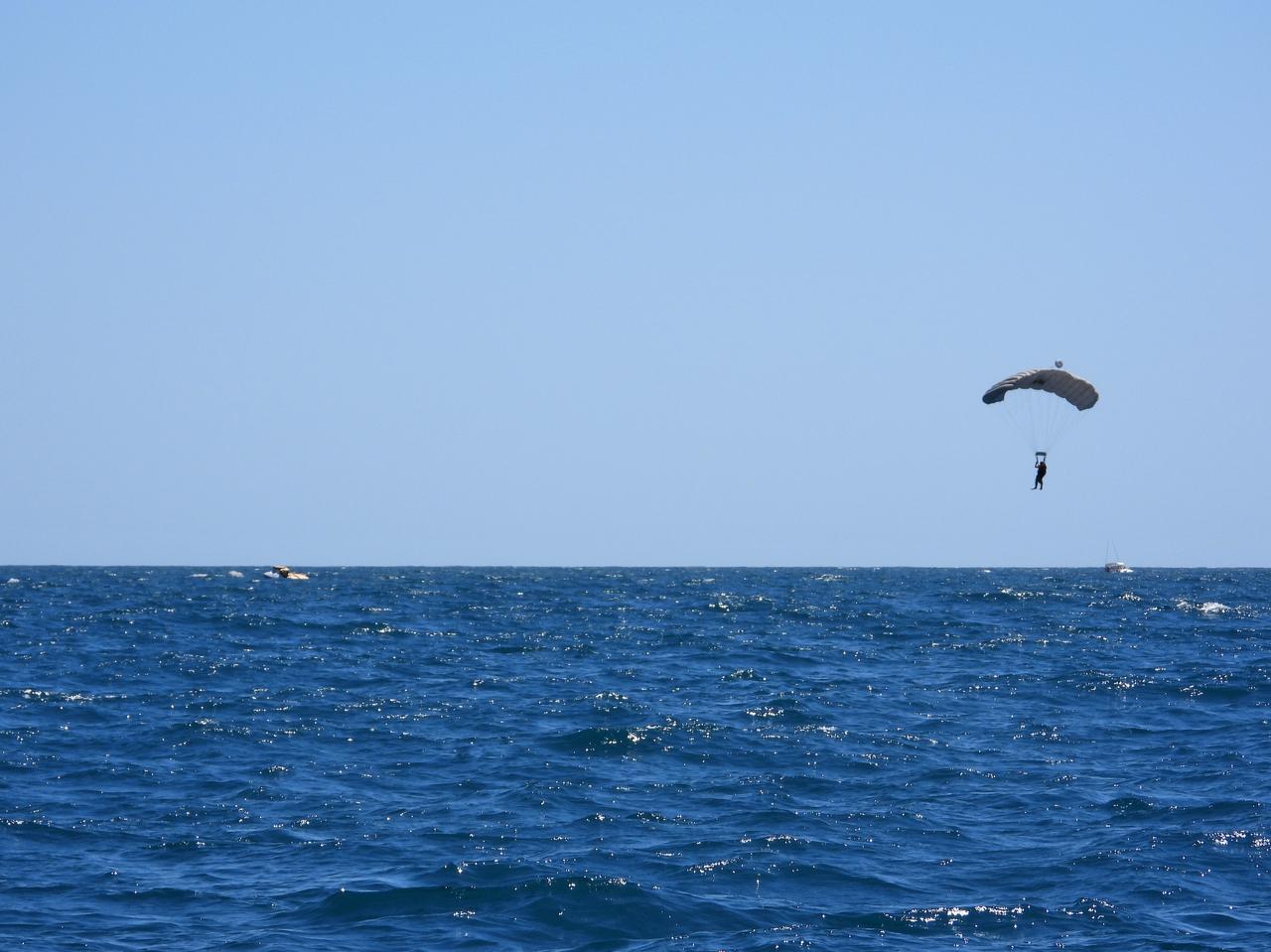
U.S. Air Force “Guardian Angel” Pararescue forces are airdropped into the Atlantic Ocean off the coast of Cape Canaveral near Kennedy Space Center in Florida to rehearse a full mission profile training exercise on April 27, 2019. The exercise included using a Boeing CST-100 Starliner training capsule to run through the necessary steps in the unlikely event of an emergency resulting in a splashdown. NASA and the Department of Defense (DoD) Human Space Flight Support Office Rescue Division conducted the training, which included rehearsing assisted egress, extracting DoD team members acting as astronauts, from the capsule and providing immediate medical treatment. This open-ocean exercise provides team members with the necessary training ahead of Boeing’s Crew Flight Test with astronauts targeted for later this year. During normal return scenarios, Boeing’s Starliner will land in a safe zone of about 15 square miles in the Western United States. Throughout the commercial crew development phases with NASA, Boeing has performed dozens of qualification tests on its parachute and airbag systems simulating conditions on land and in the water.
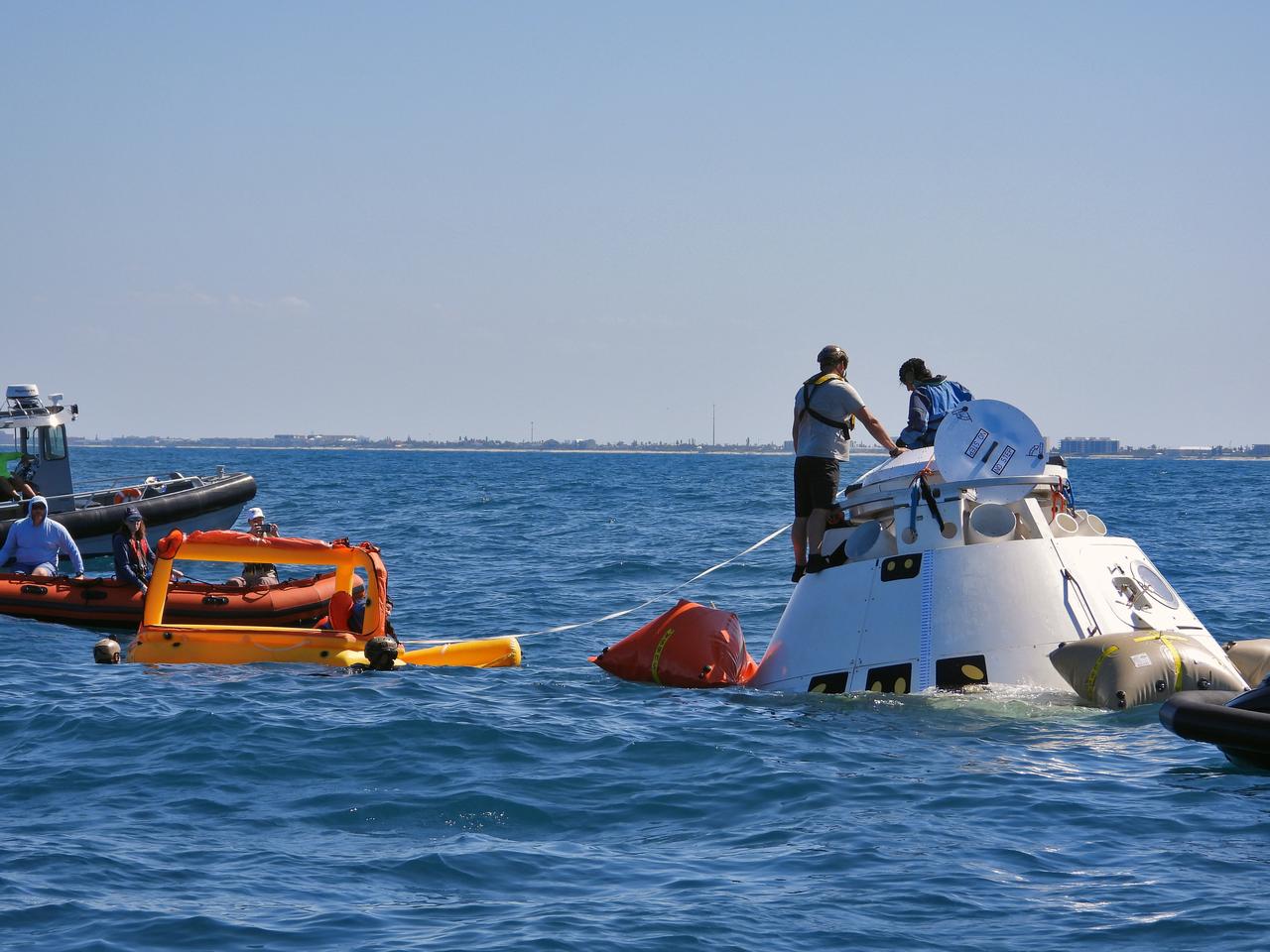
NASA astronauts Suni Williams and Barry “Butch” Wilmore rehearse the steps they would take to exit Boeing’s CST-100 Starliner spacecraft without assistance in the unlikely event of an emergency resulting in a splashdown. The training exercise, which occurred April 27, 2019, took place several miles off the coast of Cape Canaveral near NASA’s Kennedy Space Center in Florida. It included the astronauts unloading a rescue raft from inside the spacecraft, climbing out through a hatch at the top of the spacecraft, jumping into the Atlantic Ocean and boarding the raft. This open-ocean exercise provides the astronauts with the necessary training ahead of Boeing’s Crew Flight Test and subsequent missions. During normal return scenarios, Boeing’s Starliner will land in a safe zone of about 15 square miles in the Western United States. Throughout the commercial crew development phases with NASA, Boeing has performed dozens of qualification tests on its parachute and airbag systems simulating conditions on land and in the water.
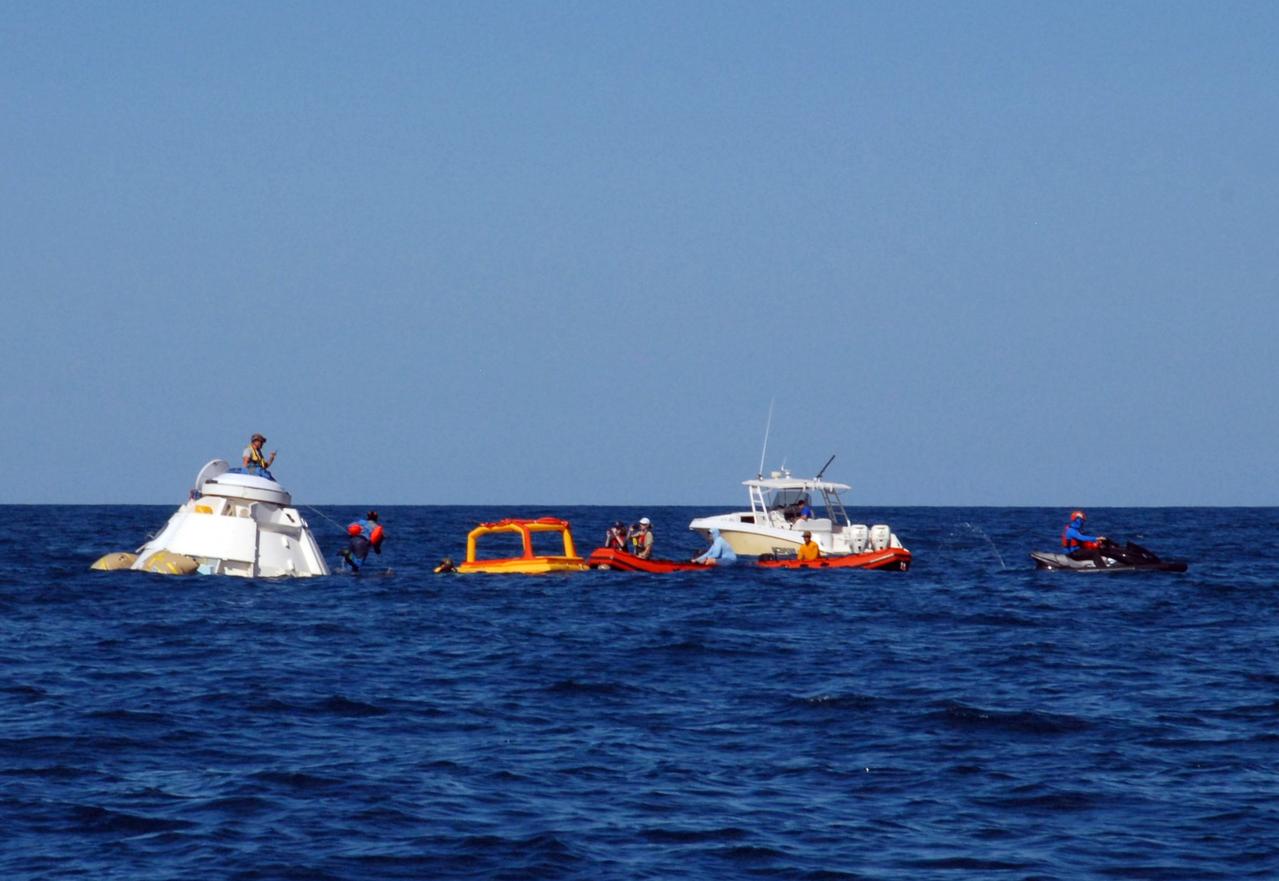
NASA astronauts Suni Williams and Barry “Butch” Wilmore rehearse the steps they would take to exit Boeing’s CST-100 Starliner spacecraft without assistance in the unlikely event of an emergency resulting in a splashdown. The training exercise, which occurred April 27, 2019, took place several miles off the coast of Cape Canaveral near NASA’s Kennedy Space Center in Florida. It included the astronauts unloading a rescue raft from inside the spacecraft, climbing out through a hatch at the top of the spacecraft, jumping into the Atlantic Ocean and boarding the raft. This open-ocean exercise provides the astronauts with the necessary training ahead of Boeing’s Crew Flight Test and subsequent missions. During normal return scenarios, Boeing’s Starliner will land in a safe zone of about 15 square miles in the Western United States. Throughout the commercial crew development phases with NASA, Boeing has performed dozens of qualification tests on its parachute and airbag systems simulating conditions on land and in the water.
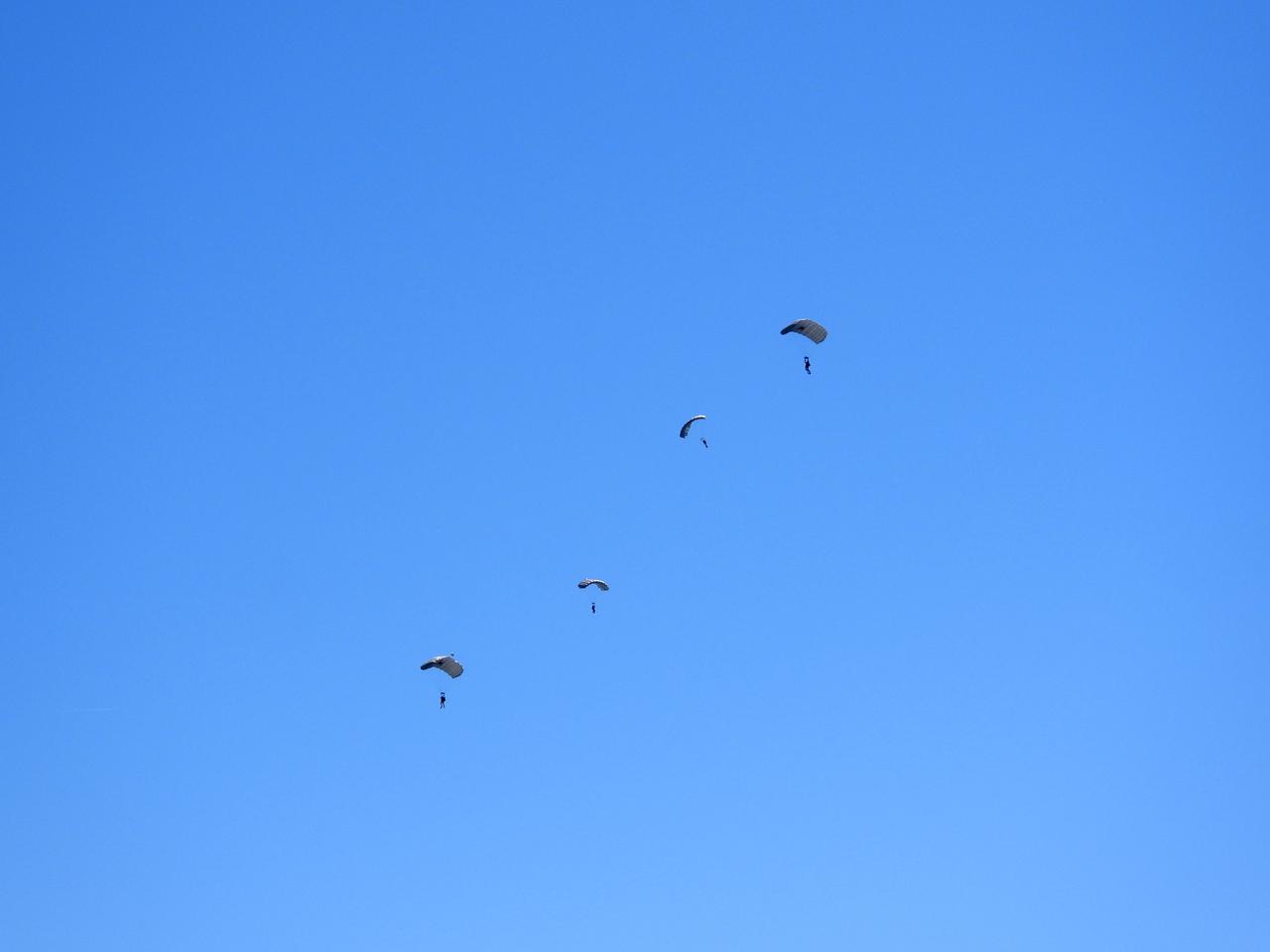
U.S. Air Force “Guardian Angel” Pararescue forces are airdropped into the Atlantic Ocean off the coast of Cape Canaveral near Kennedy Space Center in Florida to rehearse a full mission profile training exercise on April 27, 2019. The exercise included using a Boeing CST-100 Starliner training capsule to run through the necessary steps in the unlikely event of an emergency resulting in a splashdown. NASA and the Department of Defense (DoD) Human Space Flight Support Office Rescue Division conducted the training, which included rehearsing assisted egress, extracting DoD team members acting as astronauts, from the capsule and providing immediate medical treatment. This open-ocean exercise provides team members with the necessary training ahead of Boeing’s Crew Flight Test with astronauts targeted for later this year. During normal return scenarios, Boeing’s Starliner will land in a safe zone of about 15 square miles in the Western United States. Throughout the commercial crew development phases with NASA, Boeing has performed dozens of qualification tests on its parachute and airbag systems simulating conditions on land and in the water.
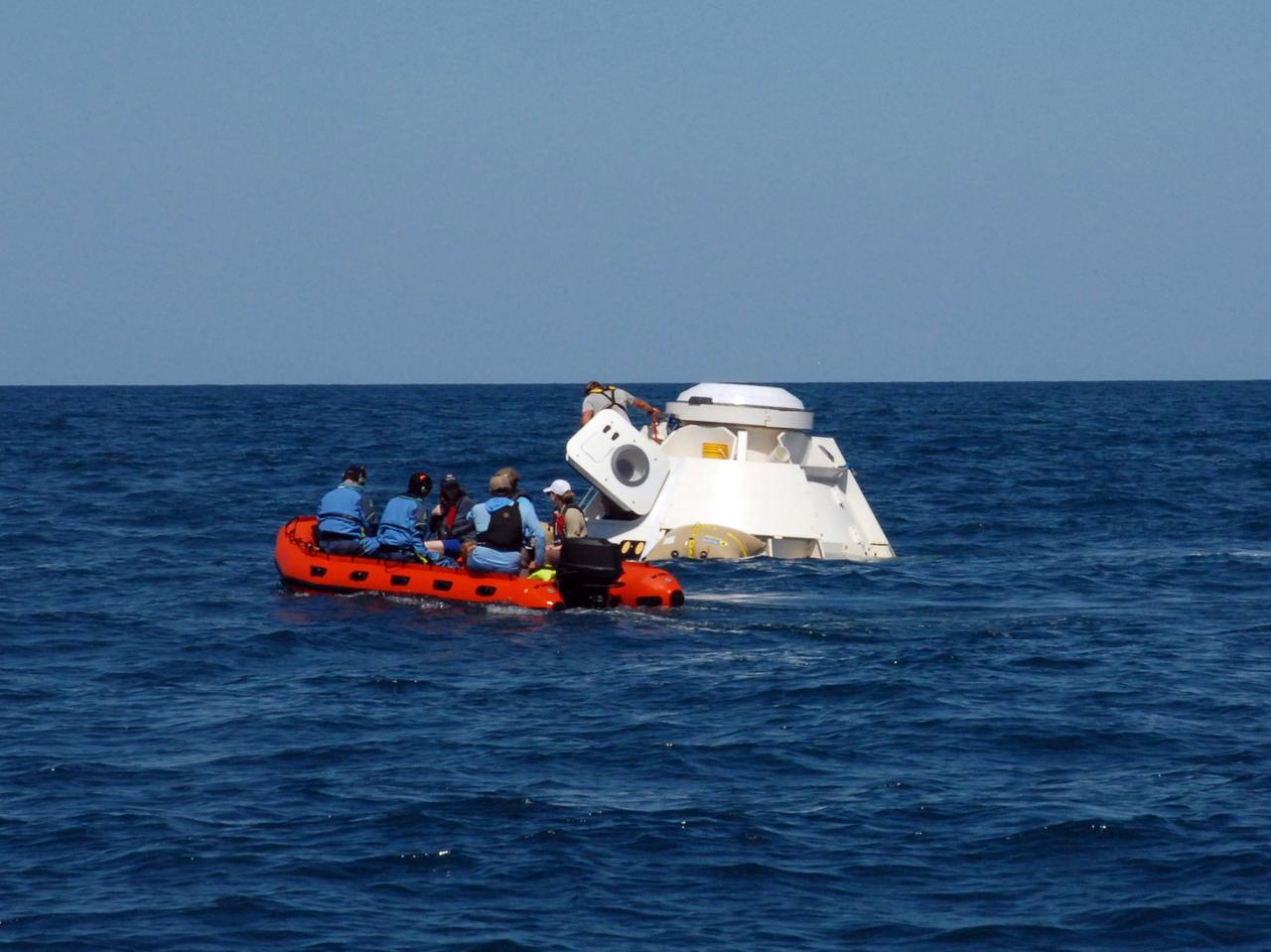
NASA astronauts Suni Williams and Barry “Butch” Wilmore rehearse the steps they would take to exit Boeing’s CST-100 Starliner spacecraft without assistance in the unlikely event of an emergency resulting in a splashdown. The training exercise, which occurred April 27, 2019, took place several miles off the coast of Cape Canaveral near NASA’s Kennedy Space Center in Florida. It included the astronauts unloading a rescue raft from inside the spacecraft, climbing out through a hatch at the top of the spacecraft, jumping into the Atlantic Ocean and boarding the raft. This open-ocean exercise provides the astronauts with the necessary training ahead of Boeing’s Crew Flight Test and subsequent missions. During normal return scenarios, Boeing’s Starliner will land in a safe zone of about 15 square miles in the Western United States. Throughout the commercial crew development phases with NASA, Boeing has performed dozens of qualification tests on its parachute and airbag systems simulating conditions on land and in the water.

NASA astronauts Suni Williams and Barry “Butch” Wilmore rehearse the steps they would take to exit Boeing’s CST-100 Starliner spacecraft without assistance in the unlikely event of an emergency resulting in a splashdown. The training exercise, which occurred April 27, 2019, took place several miles off the coast of Cape Canaveral near NASA’s Kennedy Space Center in Florida. It included the astronauts unloading a rescue raft from inside the spacecraft, climbing out through a hatch at the top of the spacecraft, jumping into the Atlantic Ocean and boarding the raft. This open-ocean exercise provides the astronauts with the necessary training ahead of Boeing’s Crew Flight Test and subsequent missions. During normal return scenarios, Boeing’s Starliner will land in a safe zone of about 15 square miles in the Western United States. Throughout the commercial crew development phases with NASA, Boeing has performed dozens of qualification tests on its parachute and airbag systems simulating conditions on land and in the water.
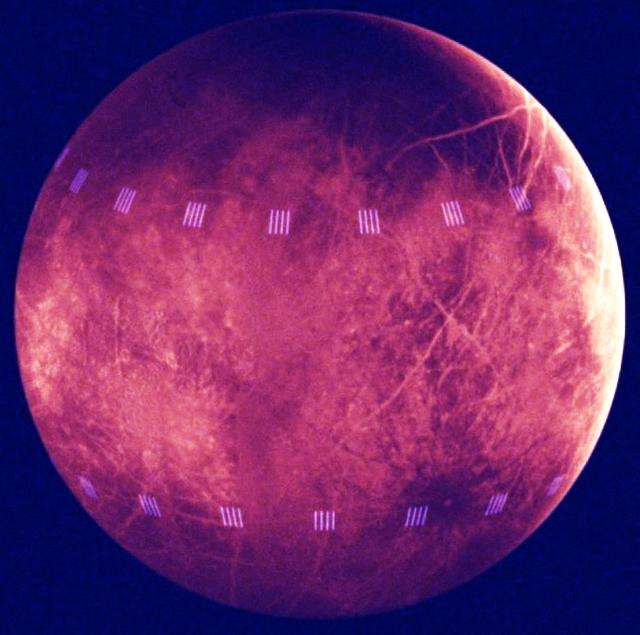
This image is a simulation of how NASA's Europa Clipper will understand which areas of the Jovian moon Europa are warm and active by studying the moon's thermal emissions. Scientists based this image on a model of data from NASA's Galileo mission and data from an instrument on NASA's Cassini mission that studied warm regions of Saturn's moon Enceladus where jets of water ice and organic chemicals spray out from vents in the icy surface. Europa Clipper's Europa Thermal Emission Imaging System, or E-THEMIS, will take both daytime and nighttime observations of Europa. The light pink vertical stripes simulate the warm vents seen on the surface of Enceladus, if they were viewed on Europa in the night. If Europa has warm spots like Enceladus, E-THEMIS is expected to detect such areas on Europa, even from a distance. Europa Clipper will get as close as 16 miles (25 kilometers) from the moon's surface, resulting in observations at much higher resolution. Europa Clipper's three main science objectives are to determine the thickness of the moon's icy shell and its interactions with the ocean below, to investigate its composition, and to characterize its geology. The mission's detailed exploration of Europa will help scientists better understand the astrobiological potential for habitable worlds beyond our planet. https://photojournal.jpl.nasa.gov/catalog/PIA26105
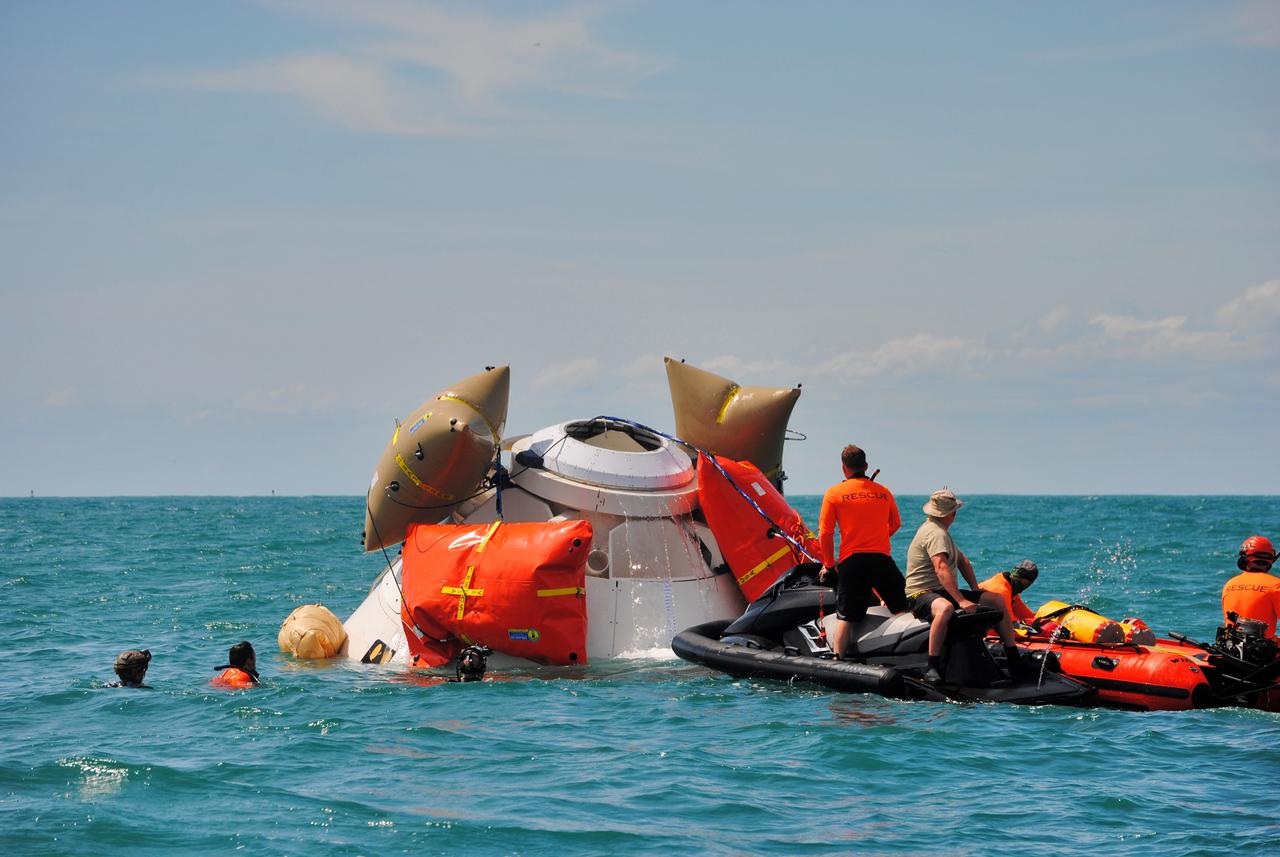
Rescue team members are using a Boeing CST-100 Starliner training capsule to rehearse a search and rescue training exercise in the unlikely event of an emergency resulting in a splashdown. NASA and the Department of Defense (DoD) Human Space Flight Support Office Rescue Division conducted the open-ocean exercise, after nearly two weeks of training, off the coast of Cape Canaveral near the agency’s Kennedy Space Center in Florida on April 25, 2019. This exercise provides team members with the necessary training ahead of Boeing’s Crew Flight Test with astronauts targeted for later this year. During normal return scenarios, Boeing’s Starliner will land in a safe zone of about 15 square miles in the Western United States. Throughout the commercial crew development phases with NASA, Boeing has performed dozens of qualification tests on its parachute and airbag systems simulating conditions on land and in the water.
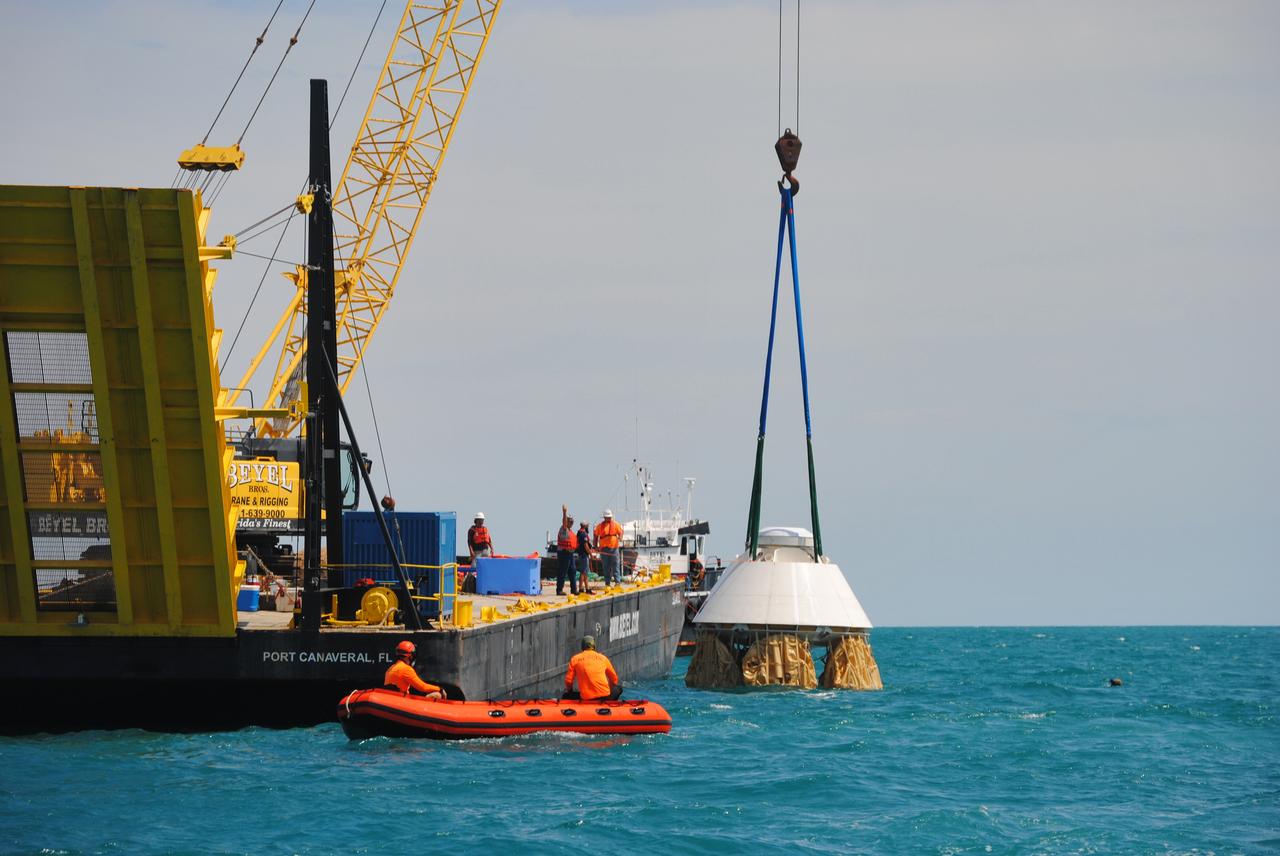
Rescue team members are using a Boeing CST-100 Starliner training capsule to rehearse a search and rescue training exercise in the unlikely event of an emergency resulting in a splashdown. NASA and the Department of Defense (DoD) Human Space Flight Support Office Rescue Division conducted the open-ocean exercise, after nearly two weeks of training, off the coast of Cape Canaveral near the agency’s Kennedy Space Center in Florida on April 25, 2019. This exercise provides team members with the necessary training ahead of Boeing’s Crew Flight Test with astronauts targeted for later this year. During normal return scenarios, Boeing’s Starliner will land in a safe zone of about 15 square miles in the Western United States. Throughout the commercial crew development phases with NASA, Boeing has performed dozens of qualification tests on its parachute and airbag systems simulating conditions on land and in the water.
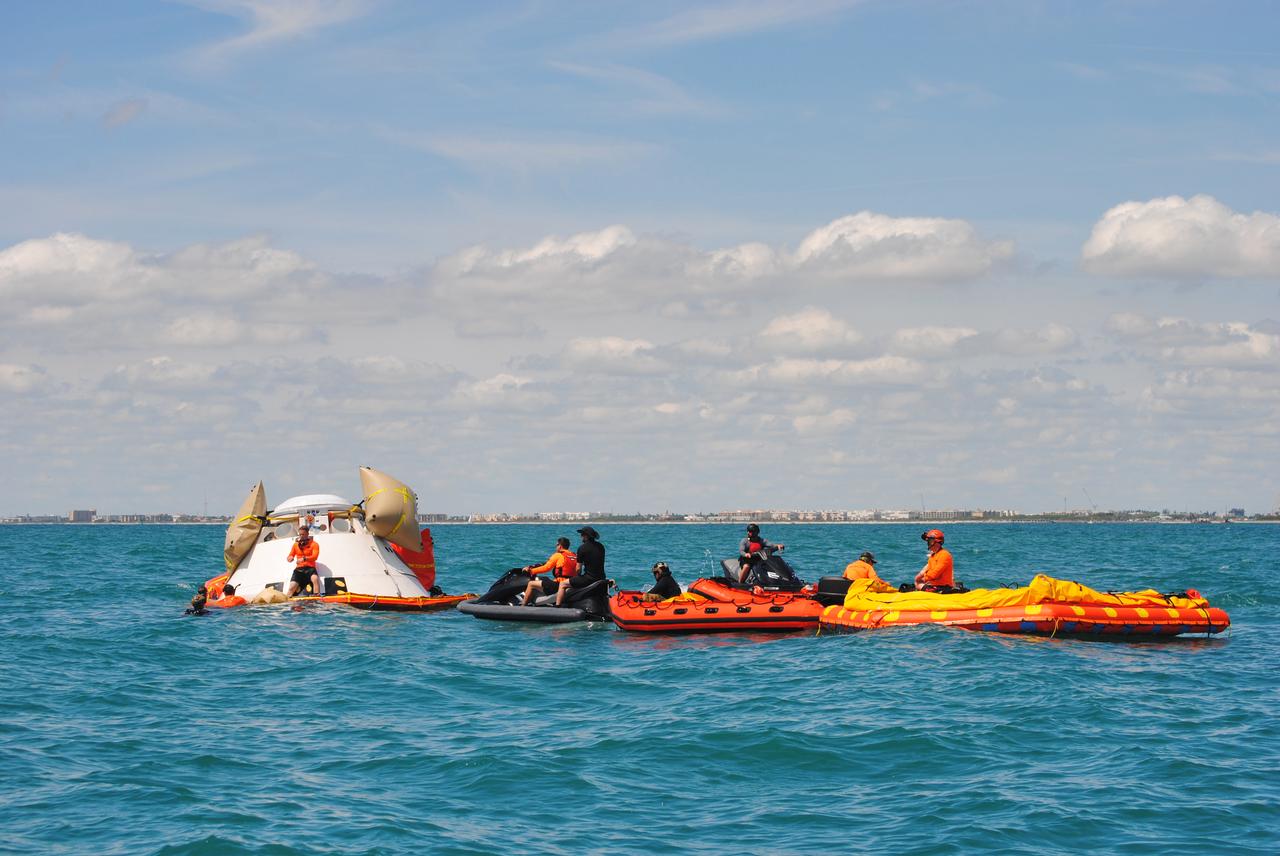
Rescue team members are using a Boeing CST-100 Starliner training capsule to rehearse a search and rescue training exercise in the unlikely event of an emergency resulting in a splashdown. NASA and the Department of Defense (DoD) Human Space Flight Support Office Rescue Division conducted the open-ocean exercise, after nearly two weeks of training, off the coast of Cape Canaveral near the agency’s Kennedy Space Center in Florida on April 25, 2019. This exercise provides team members with the necessary training ahead of Boeing’s Crew Flight Test with astronauts targeted for later this year. During normal return scenarios, Boeing’s Starliner will land in a safe zone of about 15 square miles in the Western United States. Throughout the commercial crew development phases with NASA, Boeing has performed dozens of qualification tests on its parachute and airbag systems simulating conditions on land and in the water.
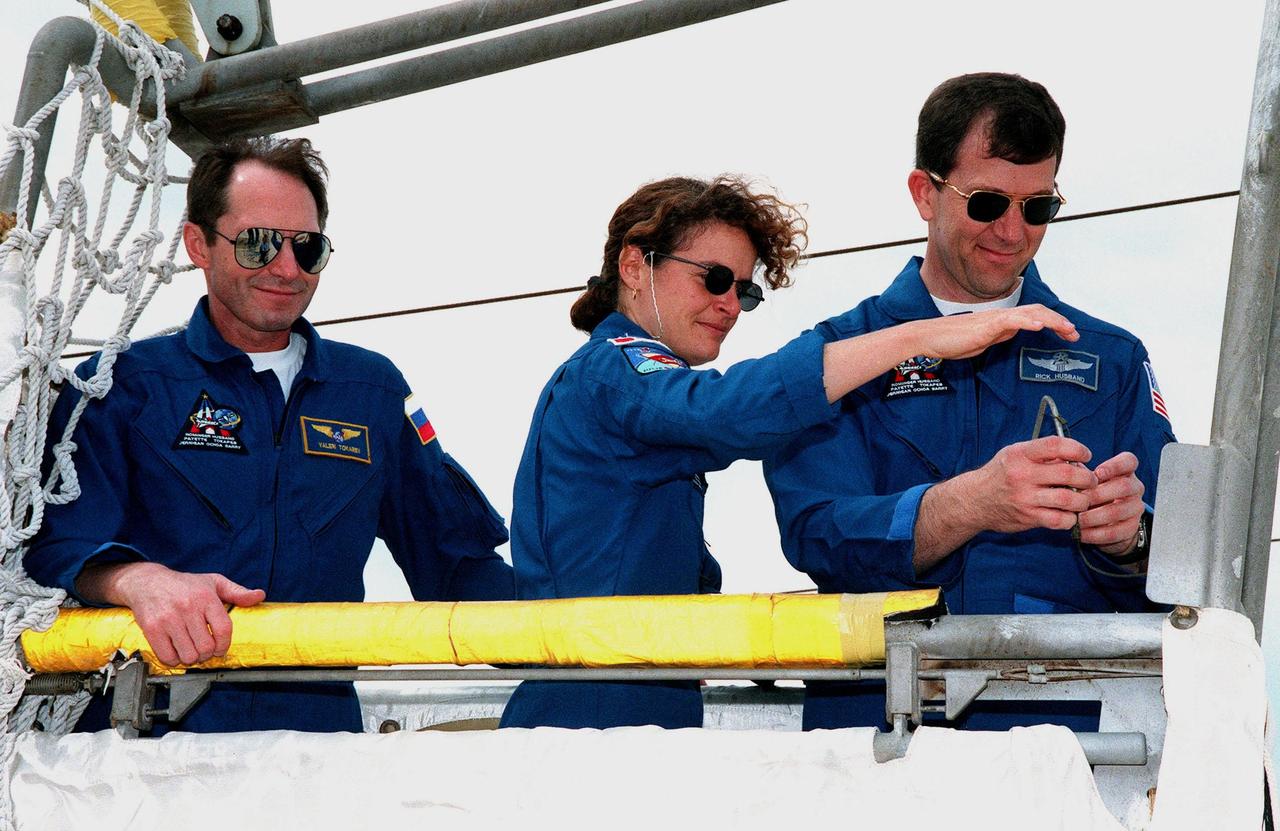
At the 195-foot level of Launch Pad 39B, STS-96 Mission Specialists Valery Ivanovich Tokarev and Julie Payette, plus Pilot Rick Douglas Husband, inspect the slidewire basket used for emergency egress. The training is part of Terminal Countdown Demonstration Test (TCDT) activities, which also provide the crew with simulated countdown exercises and opportunities to inspect the mission payloads in the orbiter's payload bay. Other crew members taking part in the TCDT are Commander Kent V. Rominger and Mission Specialists Tamara E. Jernigan (Ph.D.), Daniel Barry (M.D., Ph.D.), and Ellen Ochoa (Ph.D.). Scheduled for liftoff on May 20 at 9:32 a.m., STS-96 is a logistics and resupply mission for the International Space Station, carrying such payloads as a Russian crane, the Strela; a U.S.-built crane; the Spacehab Oceaneering Space System Box (SHOSS), a logistics items carrier; and STARSHINE, a student-led experiment
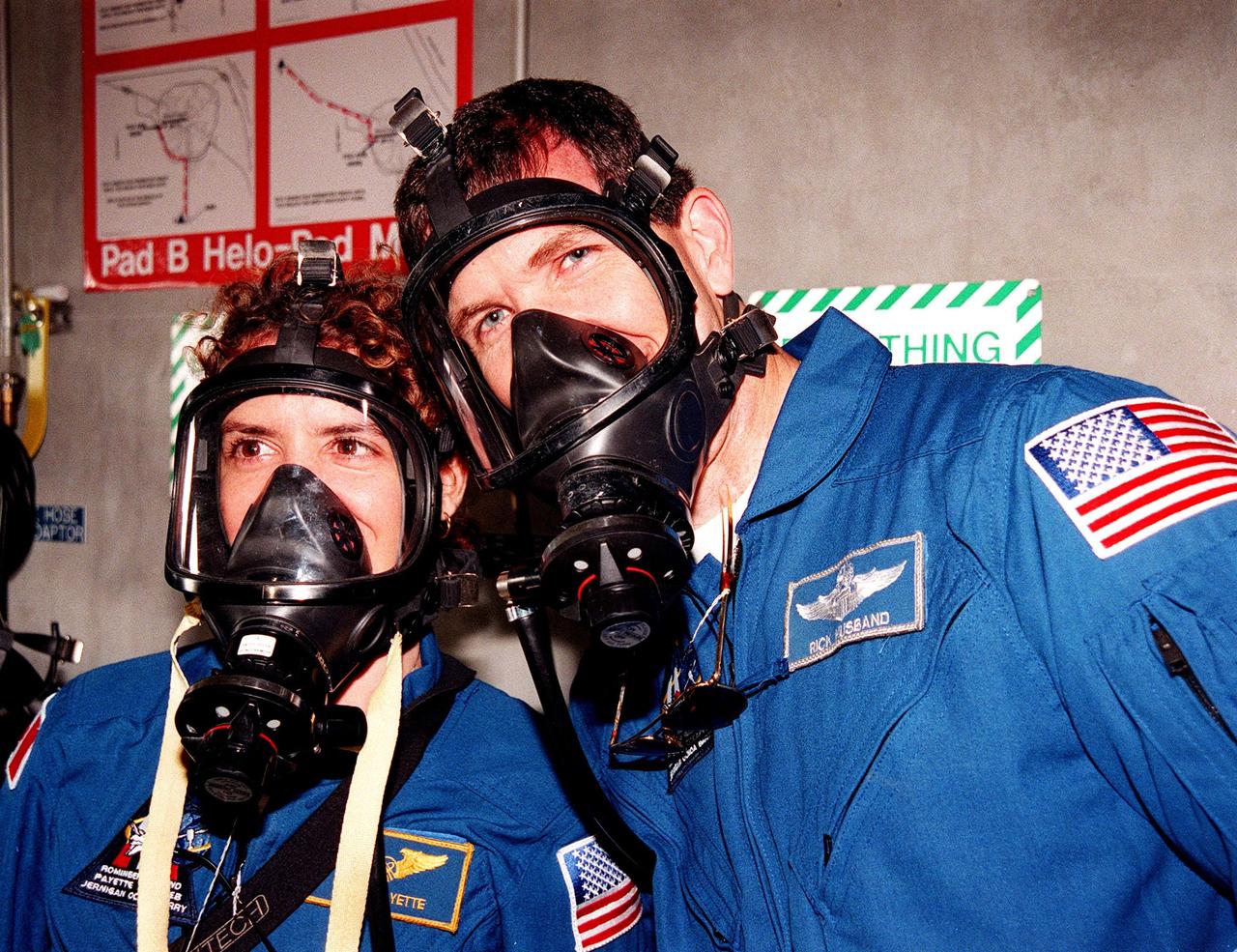
At Launch Pad 39B, STS-96 Mission Specialist Julie Payette, with the Canadian Space Agency, and Pilot Rick Douglas Husband practice putting on oxygen gas masks as part of Terminal Countdown Demonstration Test (TCDT) activities. The TCDT provides the crew with emergency egress traiing, simulated countdown exercises and opportunities to inspect the mission payloads in the orbiter's payload bay. Other crew members taking part in the TCDT are Commander Kent V. Rominger and Mission Specialists Tamara E. Jernigan (Ph.D.), Daniel Barry (M.D., Ph.D.), Ellen Ochoa (Ph.D.) and Valery Ivanovich Tokarev, with the Russian Space Agency. Scheduled for liftoff on May 20 at 9:32 a.m., STS-96 is a logistics and resupply mission for the International Space Station, carrying such payloads as a Russian crane, the Strela; a U.S.-built crane; the Spacehab Oceaneering Space System Box (SHOSS), a logistics items carrier; and STARSHINE, a student-led experiment
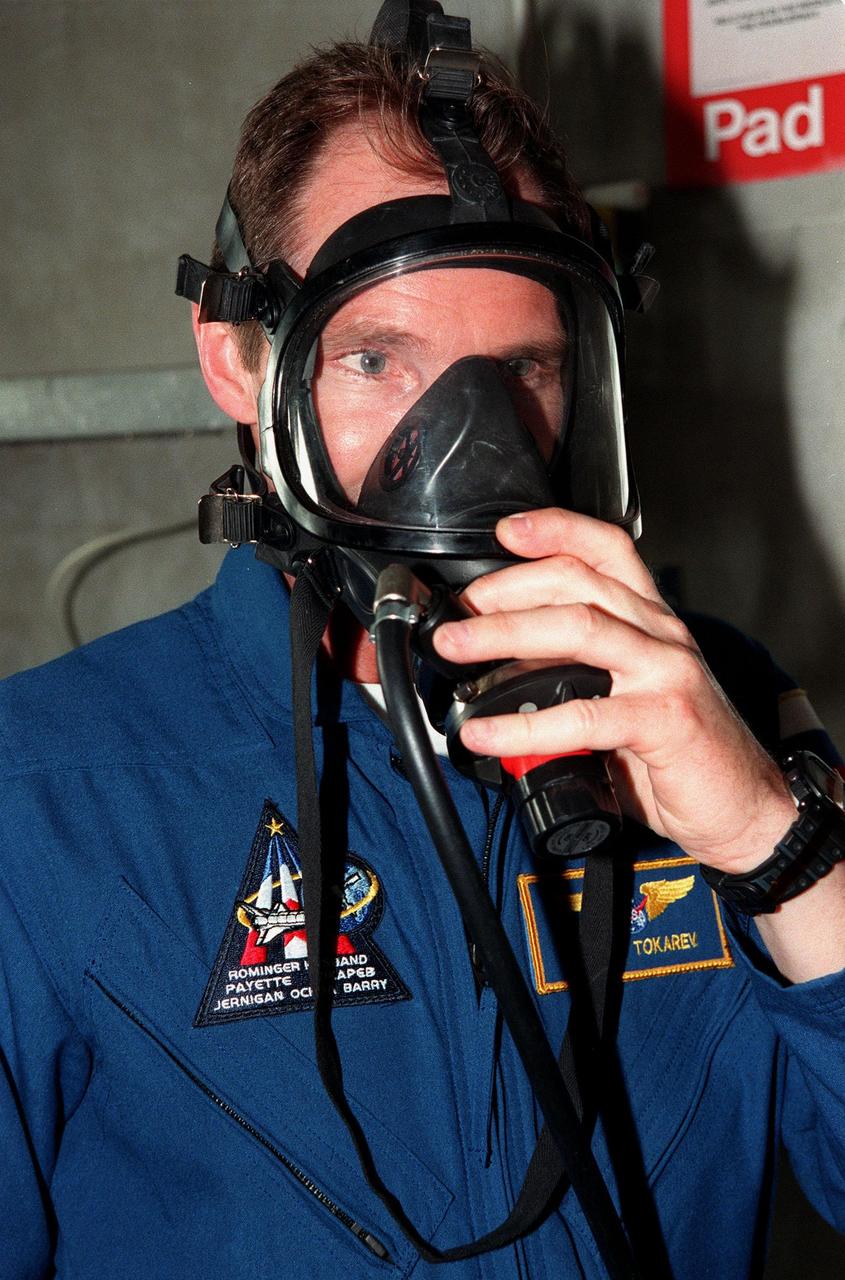
STS-96 Mission Specialist Valery Ivanovich Tokarev, with the Russian Space Agency, tries on an oxygen gas mask during Terminal Countdown Demonstration Test (TCDT) activities at Launch Pad 39B. The TCDT provides the crew with simulated countdown exercises, emergency egress training and opportunities to inspect the mission payloads in the orbiter's payload bay. Other crew members taking part in the TCDT are Commander Kent V. Rominger, Pilot Rick Douglas Husband, and Mission Specialists Tamara E. Jernigan (Ph.D.), Daniel Barry (M.D., Ph.D.), Ellen Ochoa (Ph.D.) and Julie Payette, with the Canadian Space Agency. Scheduled for liftoff on May 20 at 9:32 a.m., STS-96 is a logistics and resupply mission for the International Space Station, carrying such payloads as a Russian crane, the Strela; a U.S.-built crane; the Spacehab Oceaneering Space System Box (SHOSS), a logistics items carrier; and STARSHINE, a student-led experiment
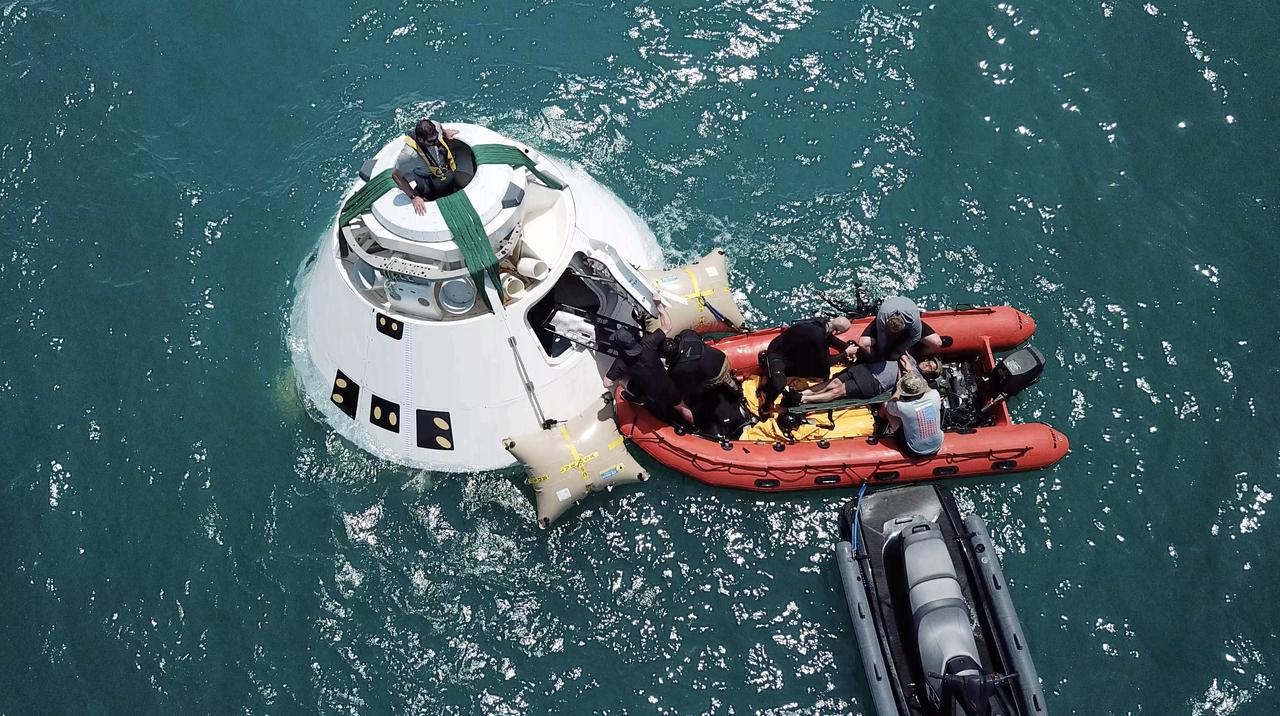
Rescue team members are using a Boeing CST-100 Starliner training capsule to rehearse a search and rescue training exercise in the unlikely event of an emergency resulting in a splashdown. NASA and the Department of Defense (DoD) Human Space Flight Support Office Rescue Division conducted the open-ocean exercise, after nearly two weeks of training, off the coast of Cape Canaveral near the agency’s Kennedy Space Center in Florida on April 25, 2019. This exercise provides team members with the necessary training ahead of Boeing’s Crew Flight Test with astronauts targeted for later this year. During normal return scenarios, Boeing’s Starliner will land in a safe zone of about 15 square miles in the Western United States. Throughout the commercial crew development phases with NASA, Boeing has performed dozens of qualification tests on its parachute and airbag systems simulating conditions on land and in the water.
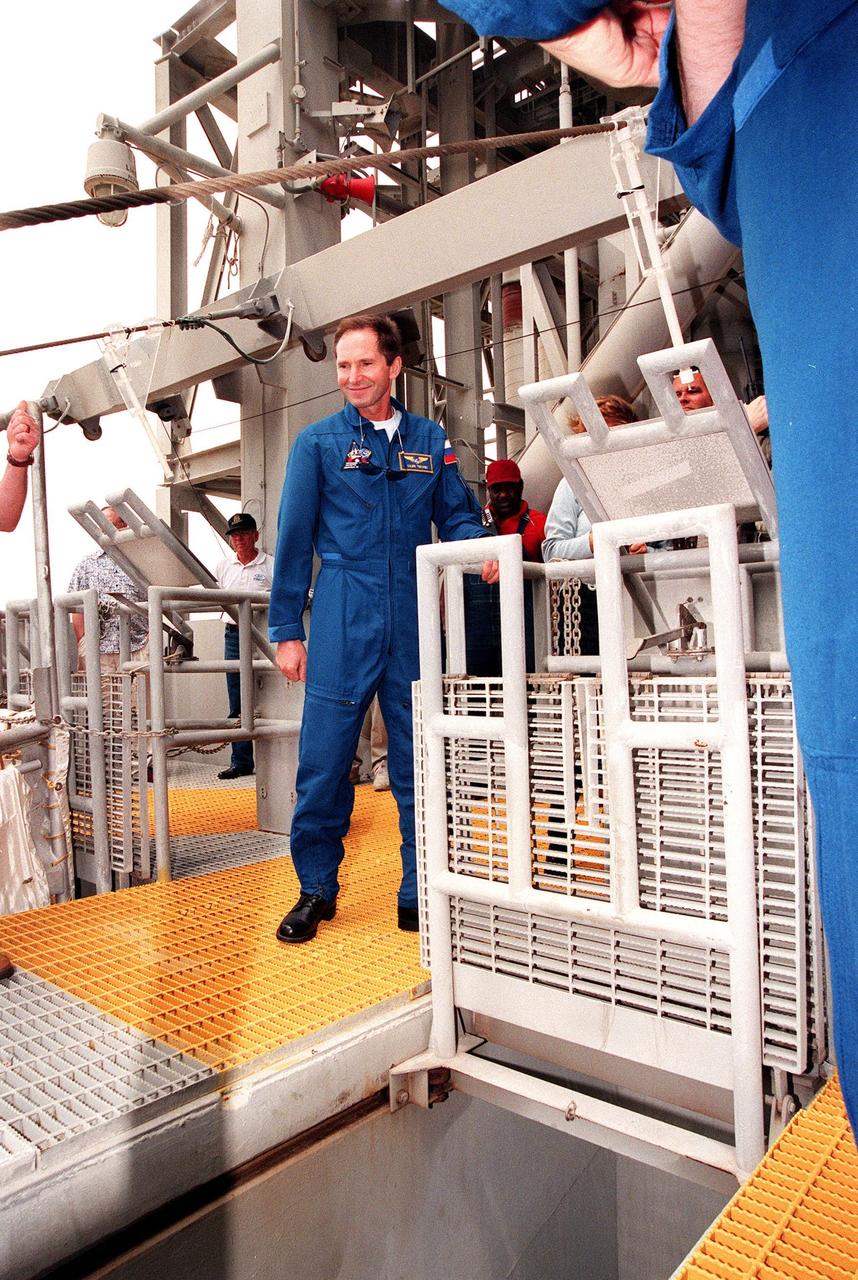
At the 195-foot level of Launch Pad 39B, STS-96 Mission Specialist Valery Ivanovich Tokarev releases a slidewire basket, part of emergency egress training. The STS-96 crew are taking part in Terminal Countdown Demonstration Test activities which also provide simulated countdown exercises and opportunities to inspect the mission payloads in the orbiter's payload bay. The other crew members are Commander Kent V. Rominger, Pilot Rick Douglas Husband and Mission Specialists Ellen Ochoa (Ph.D.), Tamara E. Jernigan (Ph.D.), Daniel Barry (M.D., Ph.D.) and Julie Payette, with the Canadian Space. STS-96, which is scheduled for liftoff on May 20 at 9:32 a.m., is a logistics and resupply mission for the International Space Station, carrying such payloads as a Russian crane, the Strela; a U.S.-built crane; the Spacehab Oceaneering Space System Box (SHOSS), a logistics items carrier; and STARSHINE, a student-led experiment
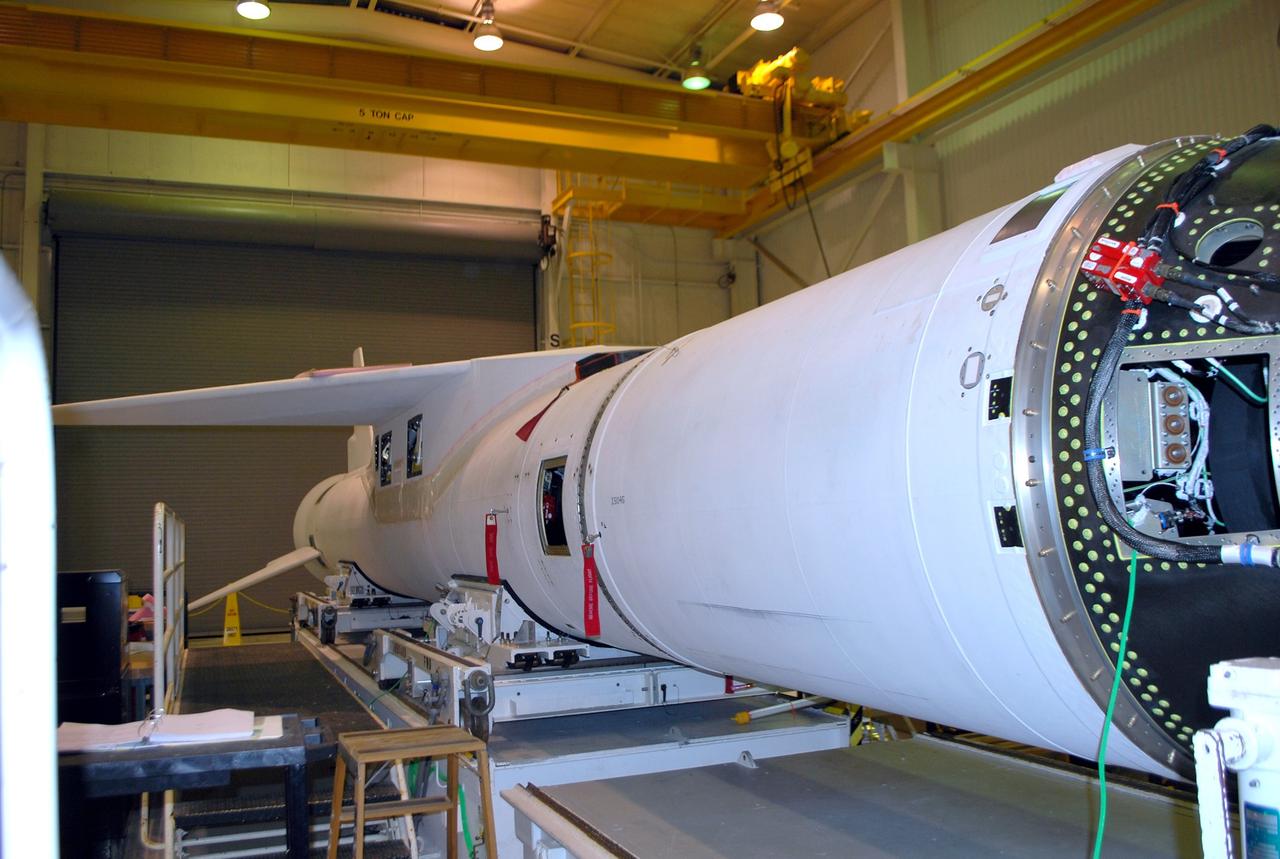
VANDENBERG AIR FORCE BASE, Calif. -- Preparations for the second flight simulation of an Orbital Sciences Corp. Pegasus rocket are under way in processing facility 1555 at Vandenberg Air Force Base (VAFB) in California. The rocket is being prepared to launch NASA's Nuclear Spectroscopic Telescope Array (NuSTAR) into space. After the rocket and spacecraft are processed at Vandenberg, they will be flown on the Orbital Sciences' L-1011 carrier aircraft to the Ronald Reagan Ballistic Missile Defense Test Site at the Pacific Ocean's Kwajalein Atoll for launch, targeted for no earlier than March 14. The high-energy x-ray telescope will conduct a census for black holes, map radioactive material in young supernovae remnants, and study the origins of cosmic rays and the extreme physics around collapsed stars. For more information, visit http://www.nasa.gov/nustar. Photo credit: NASA/Randy Beaudoin, VAFB
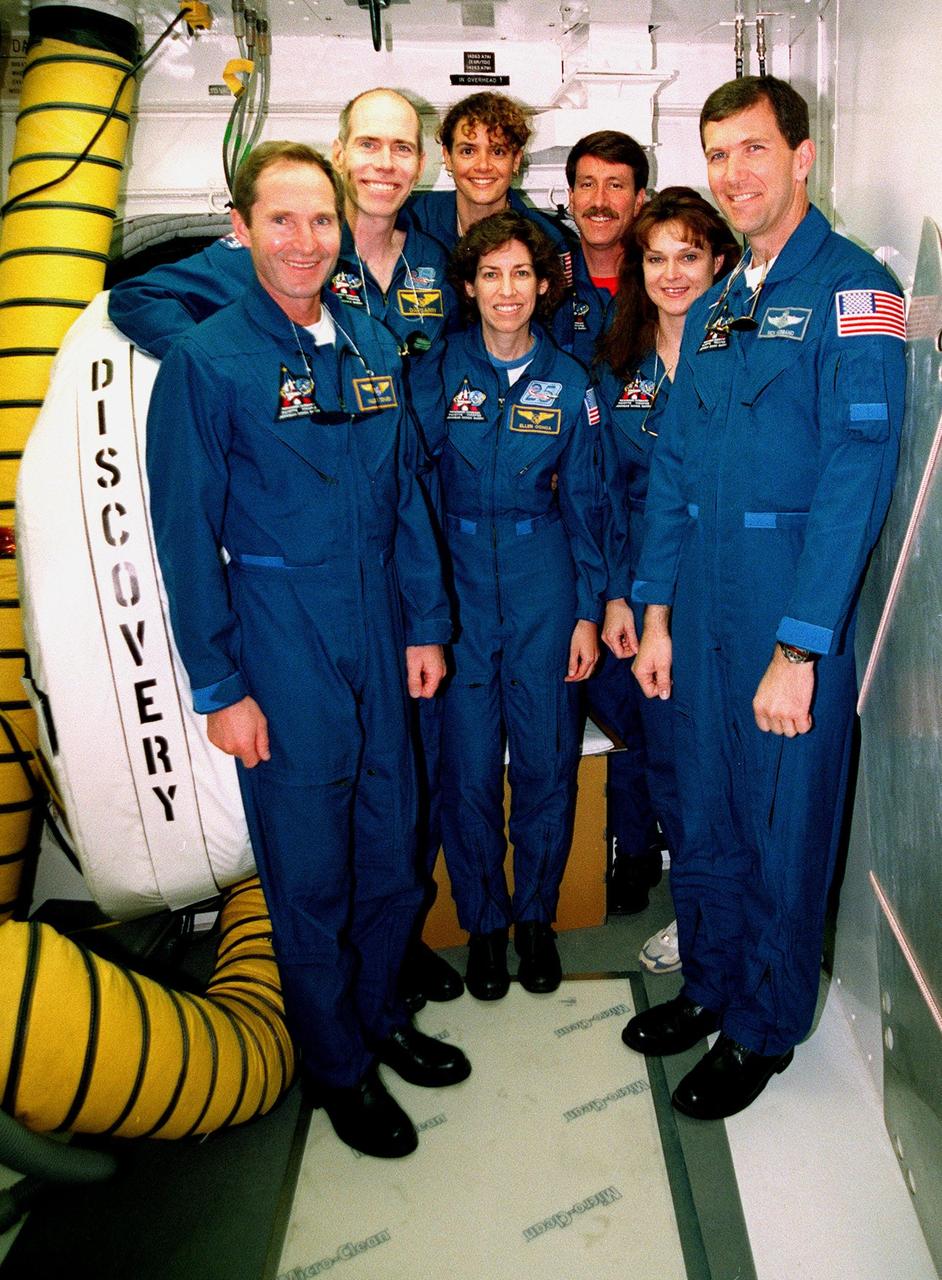
The STS-96 crew take a photo break during Terminal Countdown Demonstration Test (TCDT) activities at Launch Pad 39B. From left, they are Mission Specialists Valery Ivanovich Tokarev, Daniel Barry (M.D., Ph.D.), Julie Payette, Ellen Ochoa (Ph.D.), Commander Kent V. Rominger, Mission Specialist Tamara E. Jernigan (Ph.D.) and Pilot Rick Douglas Husband. Payette is with the Canadian Space Agency and Tokarev with the Russian Space Agency. The TCDT provides simulated countdown exercises, emergency egress training and opportunities to inspect the mission payloads in the orbiter's payload bay. STS-96, which is scheduled for liftoff on May 20 at 9:32 a.m., is a logistics and resupply mission for the International Space Station, carrying such payloads as a Russian crane, the Strela; a U.S.-built crane; the Spacehab Oceaneering Space System Box (SHOSS), a logistics items carrier; and STARSHINE, a student-led experiment
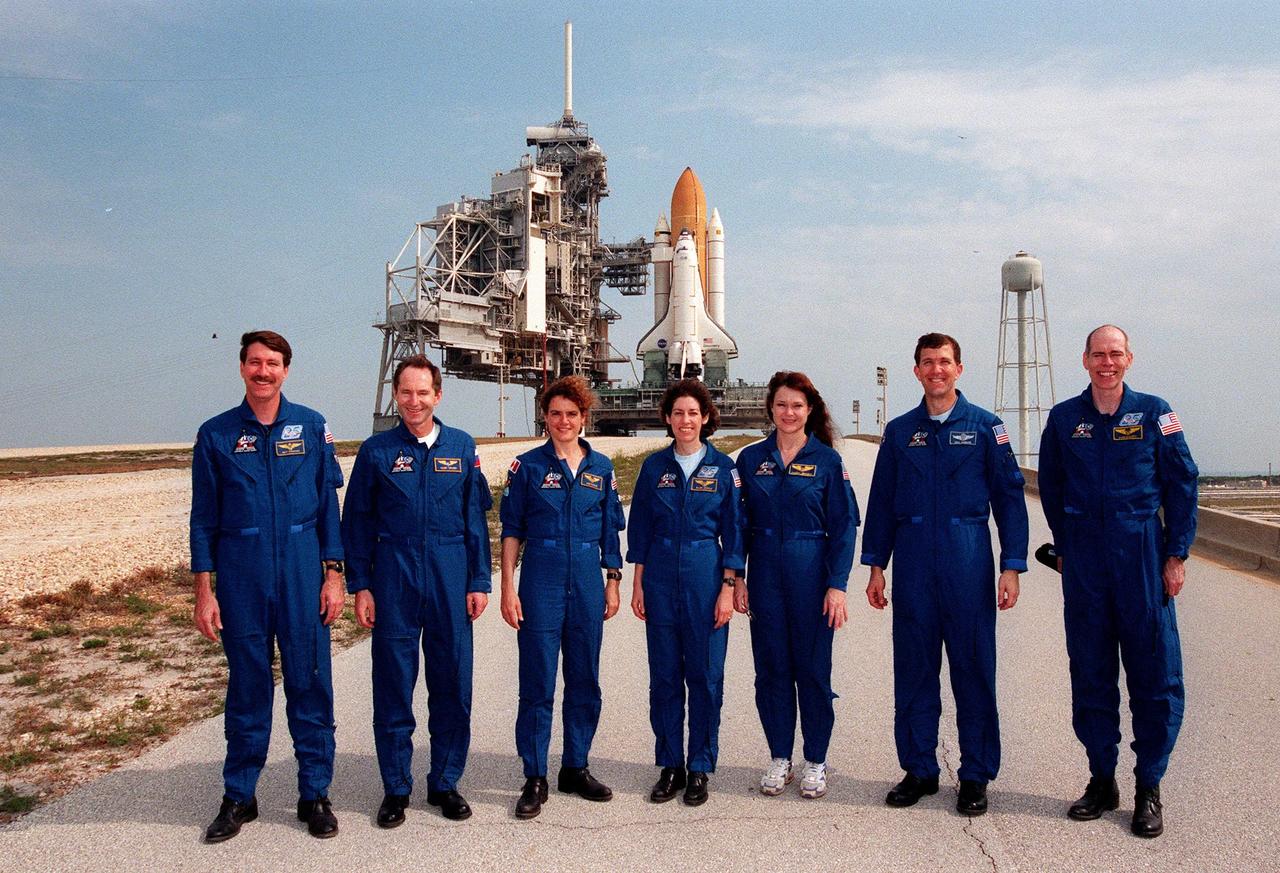
The STS-96 crew visit Launch Pad 39B where Space Shuttle Discovery, in the background, is being prepared for the mission launch on May 20. From left to right are Commander Kent V. Rominger; Mission Specialists Valery Ivanovich Tokarev, Julie Payette, Ellen Ochoa (Ph.D.), and Tamara E. Jernigan (Ph.D.); Pilot Rick Douglas Husband; and Mission Specialist Daniel Barry (M.D., Ph.D.). The crew are taking part in Terminal Countdown Demonstration Test (TCDT) activities. The TCDT provides simulated countdown exercises, emergency egress training, and opportunities to inspect the mission payloads in the orbiter's payload bay. Mission STS-96 is a logistics and resupply mission for the International Space Station, carrying such payloads as a Russian crane, the Strela; a U.S.-built crane; the Spacehab Oceaneering Space System Box (SHOSS), a logistics items carrier; and STARSHINE, a student-led experiment
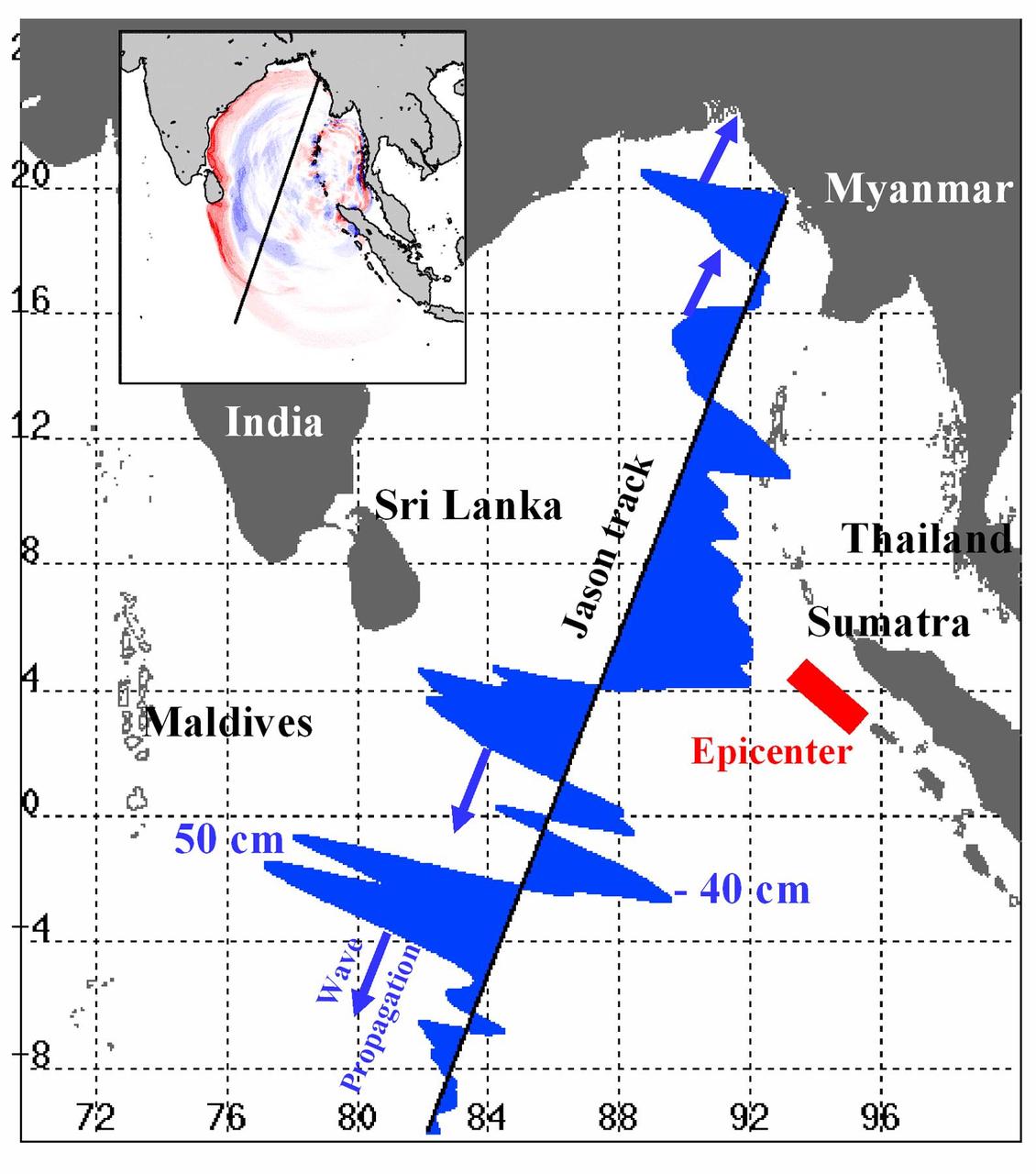
Displayed in blue color is the height of sea surface (shown in blue) measured by the Jason satellite two hours after the initial magnitude 9 earthquake hit the region (shown in red) southwest of Sumatra on December 26, 2004. The data were taken by a radar altimeter onboard the satellite along a track traversing the Indian Ocean when the tsunami waves had just filled the entire Bay of Bengal (see the model simulation inset image). The data shown are the changes of sea surface height from previous observations made along the same track 20-30 days before the earthquake, reflecting the signals of the tsunami waves. The maximum height of the leading wave crest was about 50 cm (or 1.6 ft), followed by a trough of sea surface depression of 40 cm. The directions of wave propagation along the satellite track are shown by the blue arrows. http://photojournal.jpl.nasa.gov/catalog/PIA07219
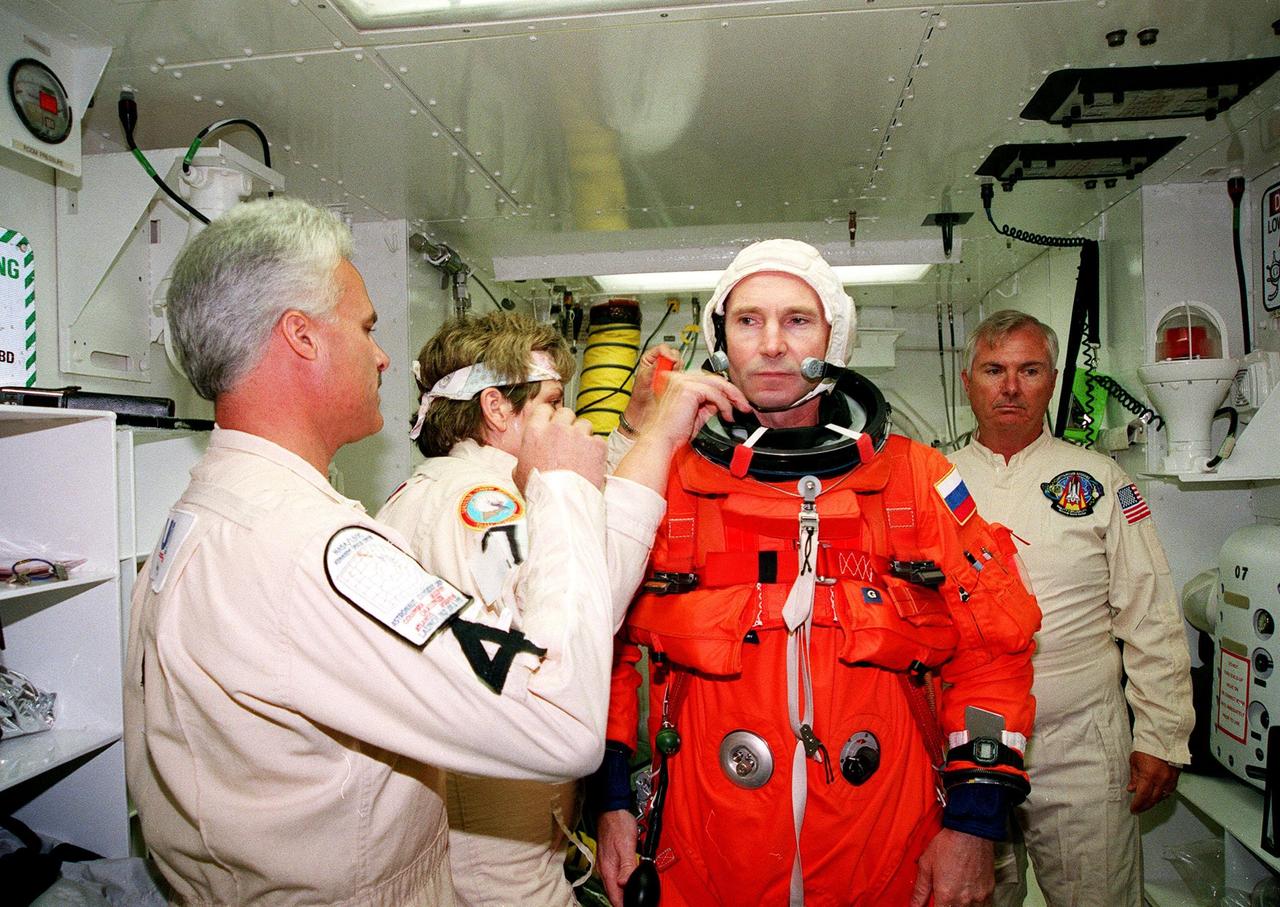
In the white room, an environmental chamber, at Launch Pad 39B, STS-96 Mission Specialist Valery Ivanovich Tokarev, with the Russian Space Agency, gets help with equipment from Chris Menard, Jean Alexander and James Davis before entering the orbiter Discovery at Launch Pad 39B. The crew are taking part in Terminal Countdown Demonstration Test (TCDT) activities, which provide opportunities to inspect the mission payloads in the orbiter's payload bay, as well as simulated countdown exercises and emergency egress training. STS-96, scheduled for liftoff on May 20 at 9:32 a.m., is a logistics and resupply mission for the International Space Station, carrying such payloads as a Russian crane, the Strela; a U.S.-built crane; the Spacehab Oceaneering Space System Box (SHOSS), a logistics items carrier; and STARSHINE, a student-led experiment