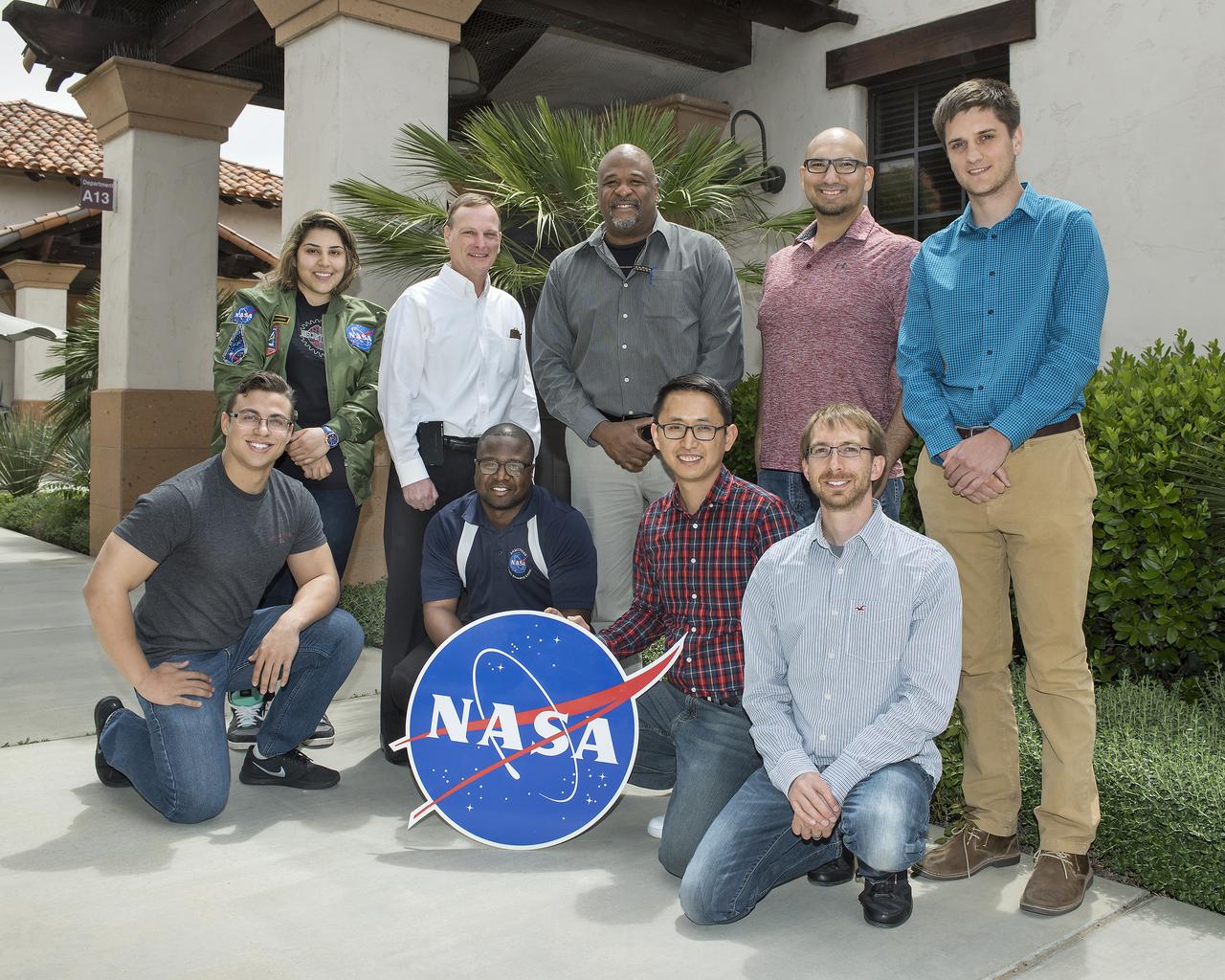
The Fiber Optic Sensing System team includes in the front from left Nick Finks, Ryan Warner, Patrick Chan and Paul Bean. In the back row from left are Shideh Naderi, Jeff Bauer, Allen Parker, Frank Pena and Nathan Perreau. Lance Richards, Anthony Piazza and Phil Hamory are current FOSS team members who are not pictured.

Shideh Naderi works on designing the electronics for the next generation Fiber Optic Sensing System.

Patrick Chan demonstrates one way that the Fiber Optic Sensing System is used by bending a fiber with a 3D representation of the fiber’s shape as it bends.
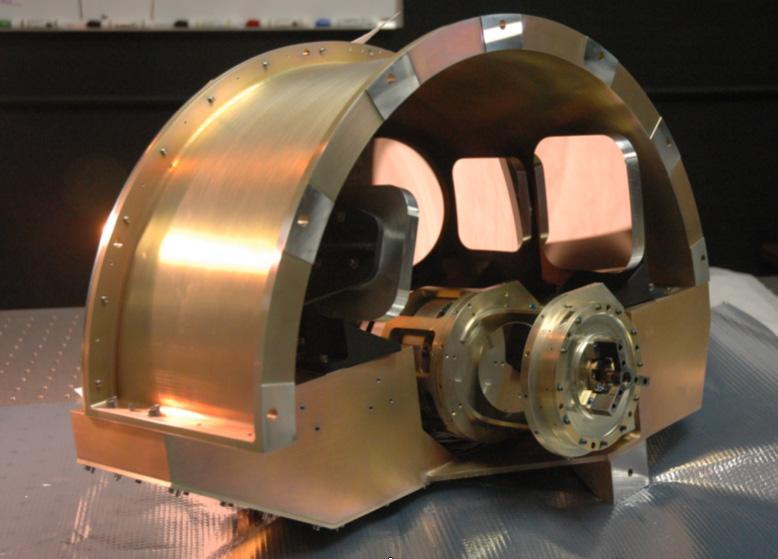
NASA Wide-field Infrared Survey Explorer, or WISE, back-end imager optics. This picture shows the imager optics which are mounted at the back of the optical system.
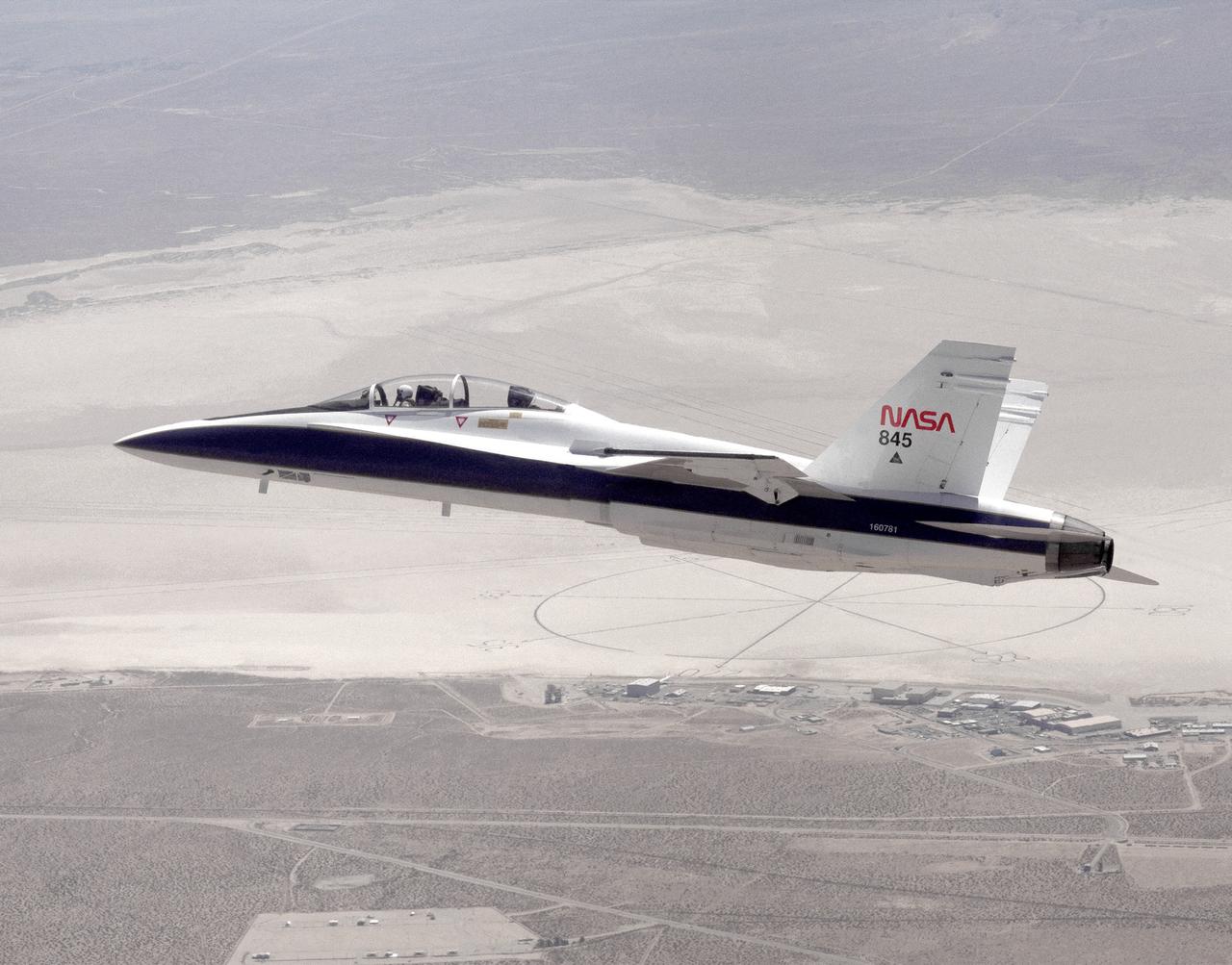
The National Aeronautics and Space Administration's Systems Research Aircraft (SRA), a highly modified F-18 jet fighter, on an early research flight over Rogers Dry Lake. The former Navy aircraft was flown by NASA's Dryden Flight Research Center at Edwards Air Force Base, California, to evaluate a number of experimental aerospace technologies in a multi-year, joint NASA/DOD/industry program. Among the more than 20 experiments flight-tested were several involving fiber optic sensor systems. Experiments developed by McDonnell-Douglas and Lockheed-Martin centered on installation and maintenace techniques for various types of fiber-optic hardware proposed for use in military and commercial aircraft, while a Parker-Hannifin experiment focused on alternative fiber-optic designs for postion measurement sensors as well as operational experience in handling optical sensor systems. Other experiments flown on this testbed aircraft included electronically-controlled control surface actuators, flush air data collection systems, "smart" skin antennae and laser-based systems. Incorporation of one or more of these technologies in future aircraft and spacecraft could result in signifigant savings in weight, maintenance and overall cost.
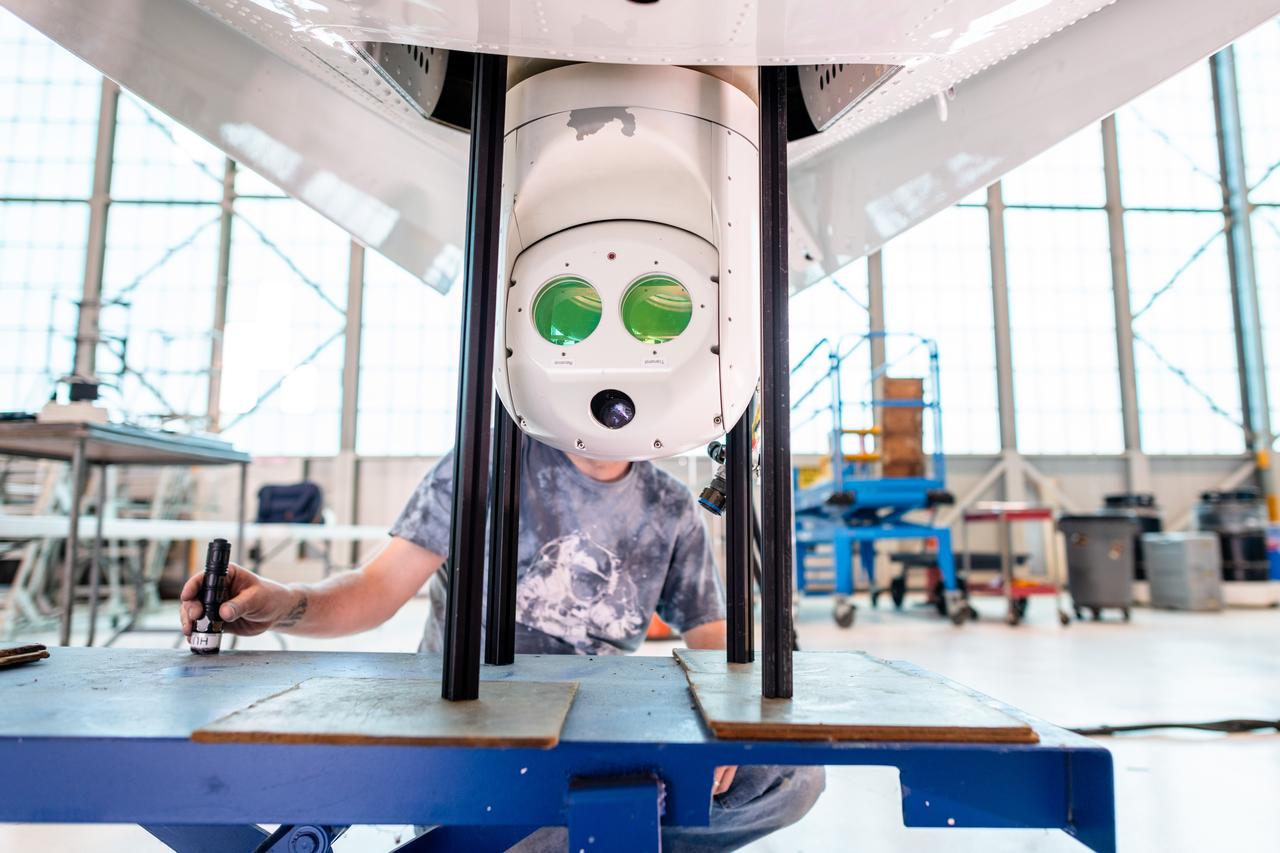
Dave Brennen, an electronics technician, installing the optical system under the belly of the PC-12 aircraft that streamed the first 4K video from aircraft to the International Space Station and back on May 20, 2024. Photo Credit: (NASA/Sara Lowthian-Hanna)
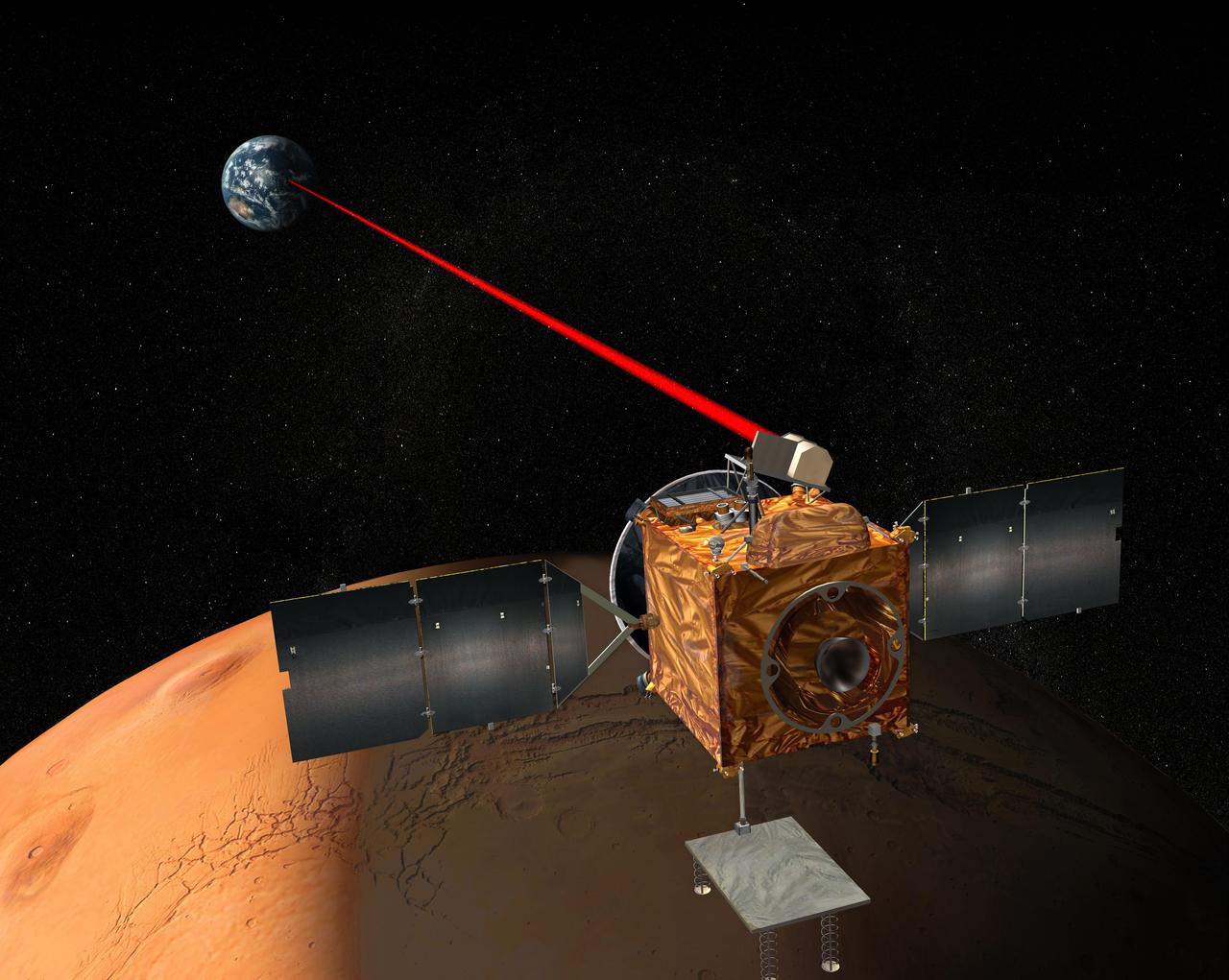
This illustration depicts a concept for operation of an optical communications system on NASA Mars Telecommunications Orbiter.
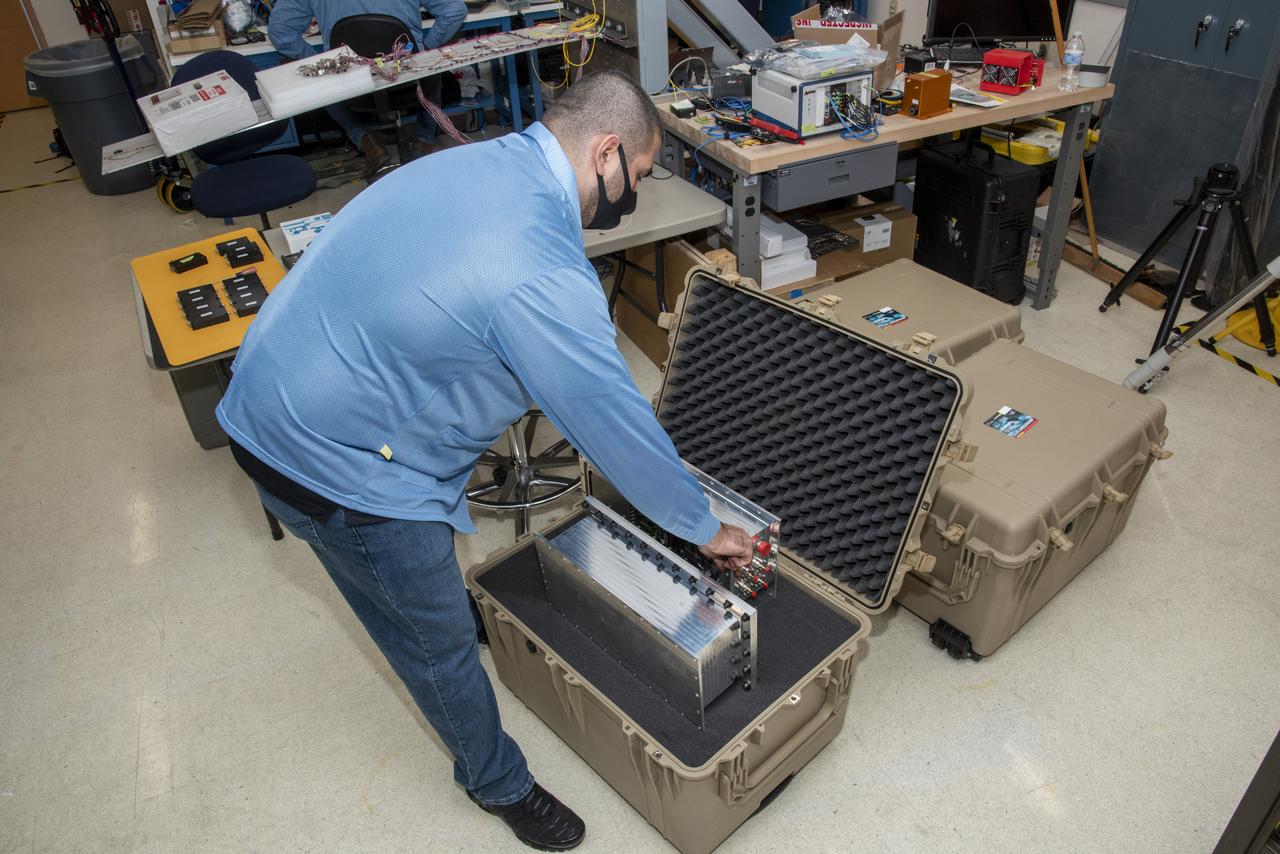
NASA research engineer Jonathan Lopez secures a Compact Fiber Optic Sensing System unit, also known as a FOSS Rocket Box, which was developed at NASA's Armstrong Flight Research Center in California. The unit is a new variant of aircraft technology that researchers have advanced to withstand the harsh environments of a rocket launch and space travel.
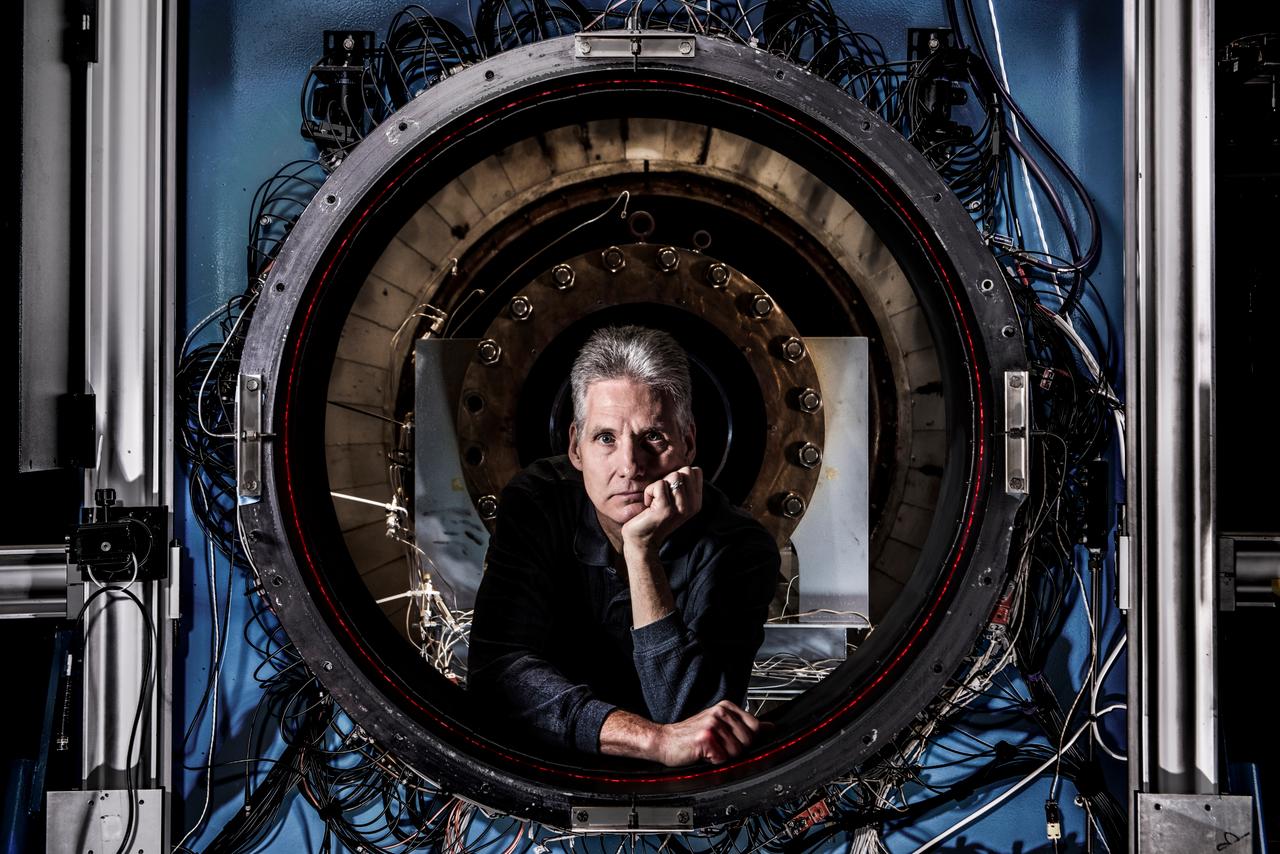
How do you measure a cloud? Tim Bencic does it with lasers. The NASA Glenn engineer invented a tomography system for our Propulsion Systems Lab to help understand the dangers of ice crystal icing on airplanes. Bencic’s system, affectionally called “Tim-ography” is like a CAT Scan. The laser light within its circular geometry bounces off the surface of ice particles in the cloud and fiber optic detectors map out its properties. This tool is helping NASA’s researchers make aircraft safer in challenging weather conditions.
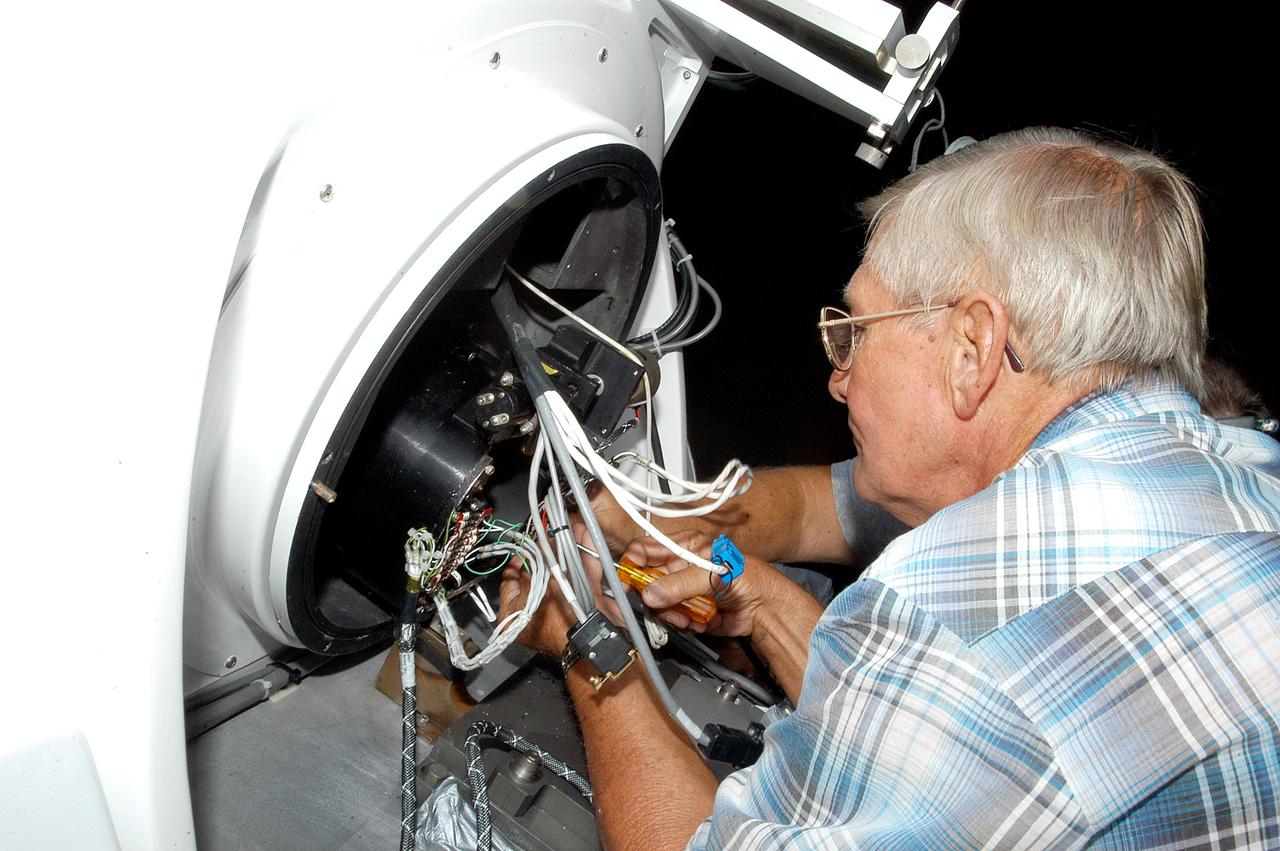
KENNEDY SPACE CENTER, FLA. - A worker calibrates a tracking telescope, part of the Distant Object Attitude Measurement System (DOAMS), located in Cocoa Beach, Fla. The telescope provides optical support for launches from KSC and Cape Canaveral.
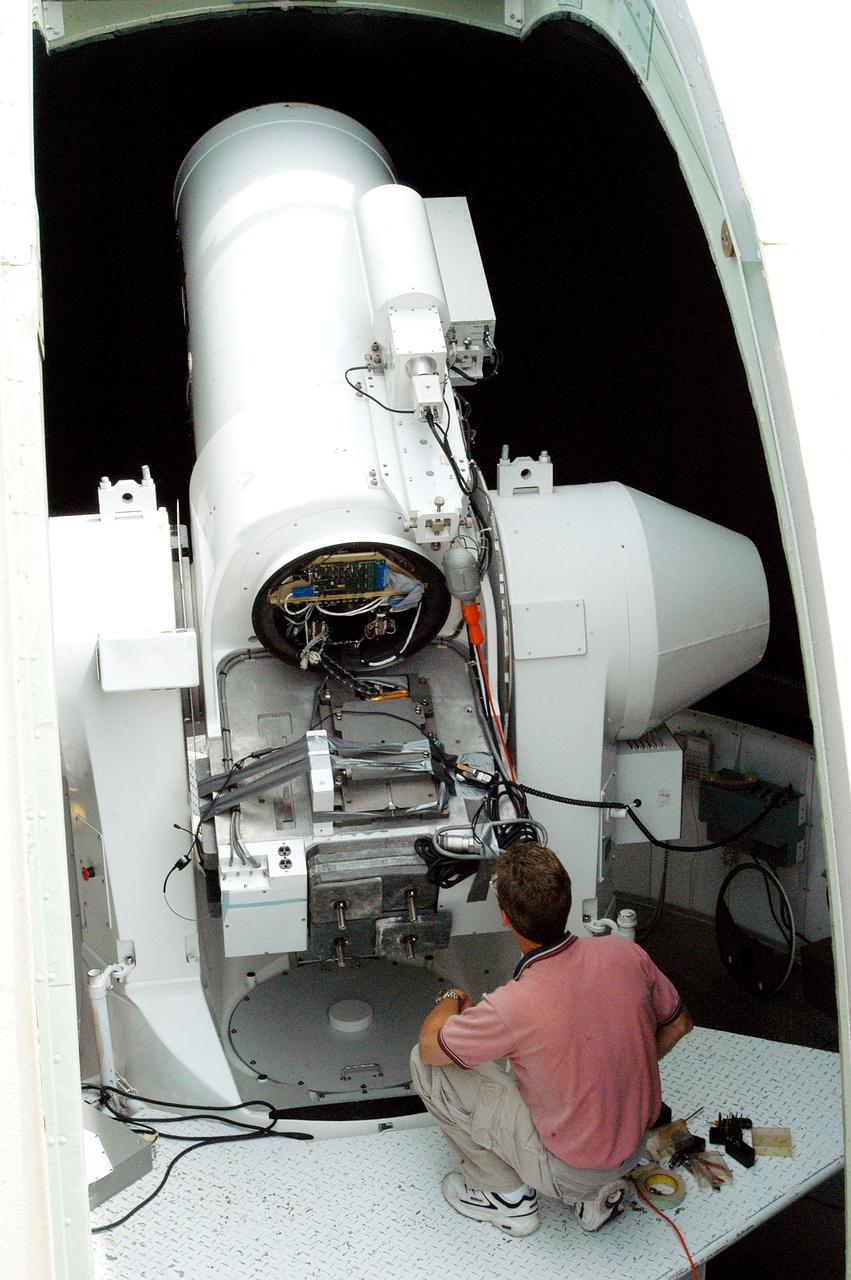
KENNEDY SPACE CENTER, FLA. - Workers calibrate a tracking telescope, part of the Distant Object Attitude Measurement System (DOAMS), located in Cocoa Beach, Fla. The telescope provides optical support for launches from KSC and Cape Canaveral.
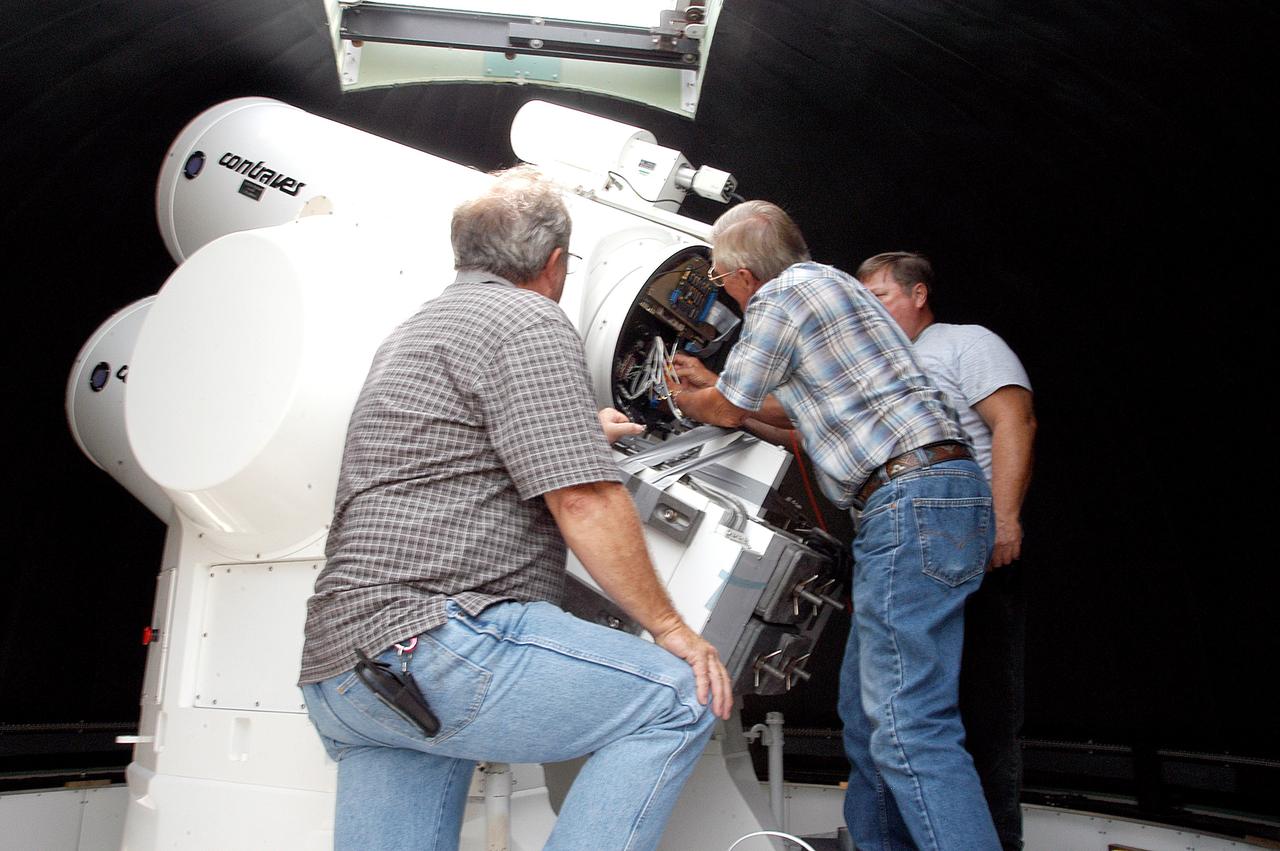
KENNEDY SPACE CENTER, FLA. - Workers calibrate a tracking telescope, part of the Distant Object Attitude Measurement System (DOAMS), located in Cocoa Beach, Fla. The telescope provides optical support for launches from KSC and Cape Canaveral.
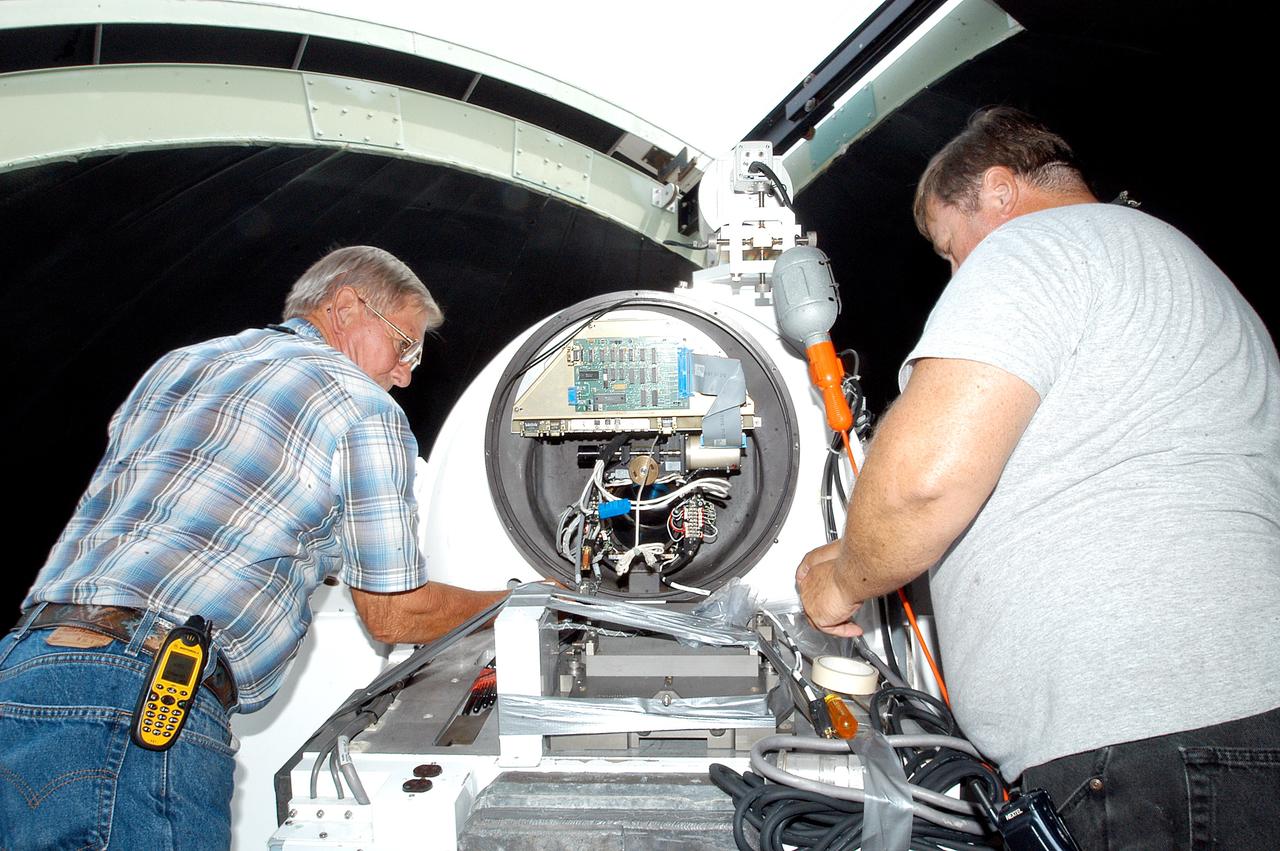
KENNEDY SPACE CENTER, FLA. - A worker calibrates a tracking telescope, part of the Distant Object Attitude Measurement System (DOAMS), located in Cocoa Beach, Fla. The telescope provides optical support for launches from KSC and Cape Canaveral.
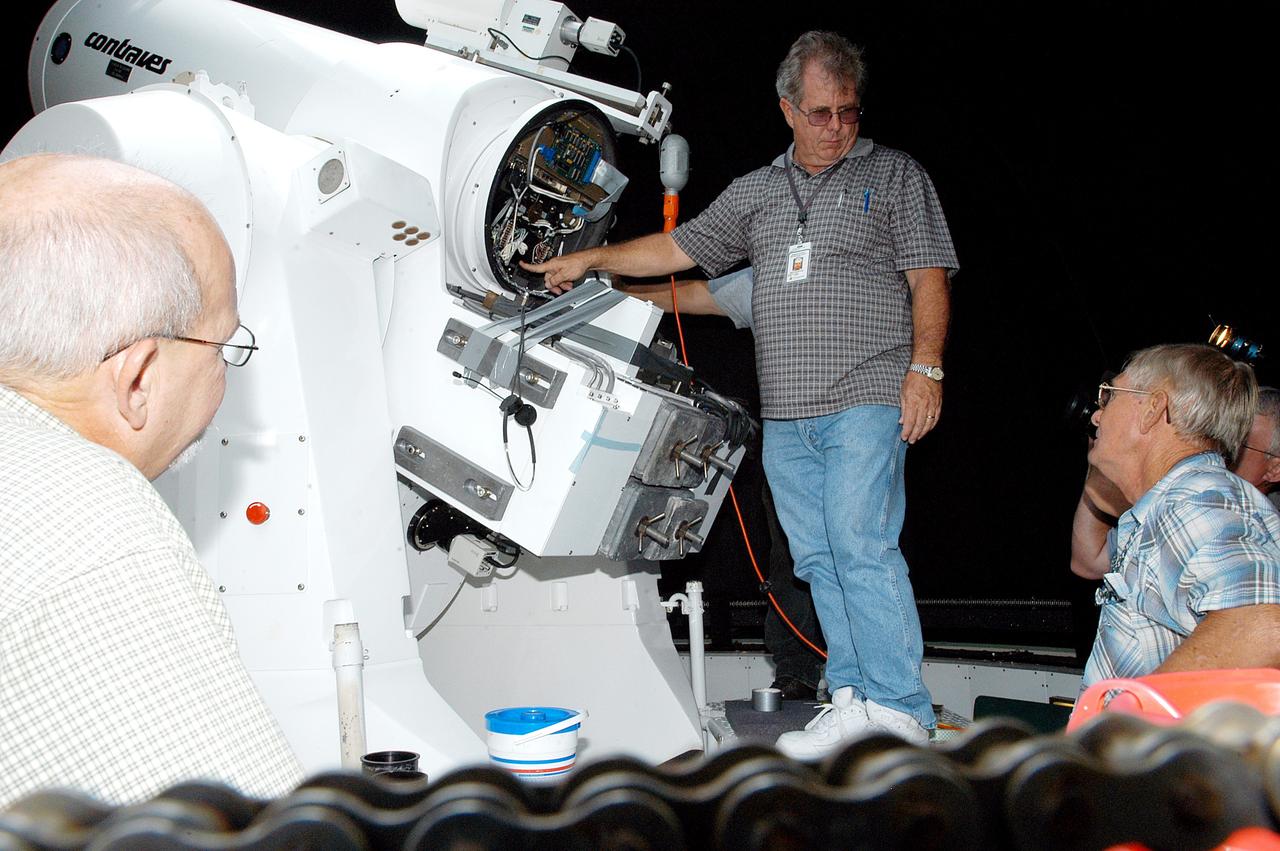
KENNEDY SPACE CENTER, FLA. - Workers calibrate a tracking telescope, part of the Distant Object Attitude Measurement System (DOAMS), located in Cocoa Beach, Fla. The telescope provides optical support for launches from KSC and Cape Canaveral.
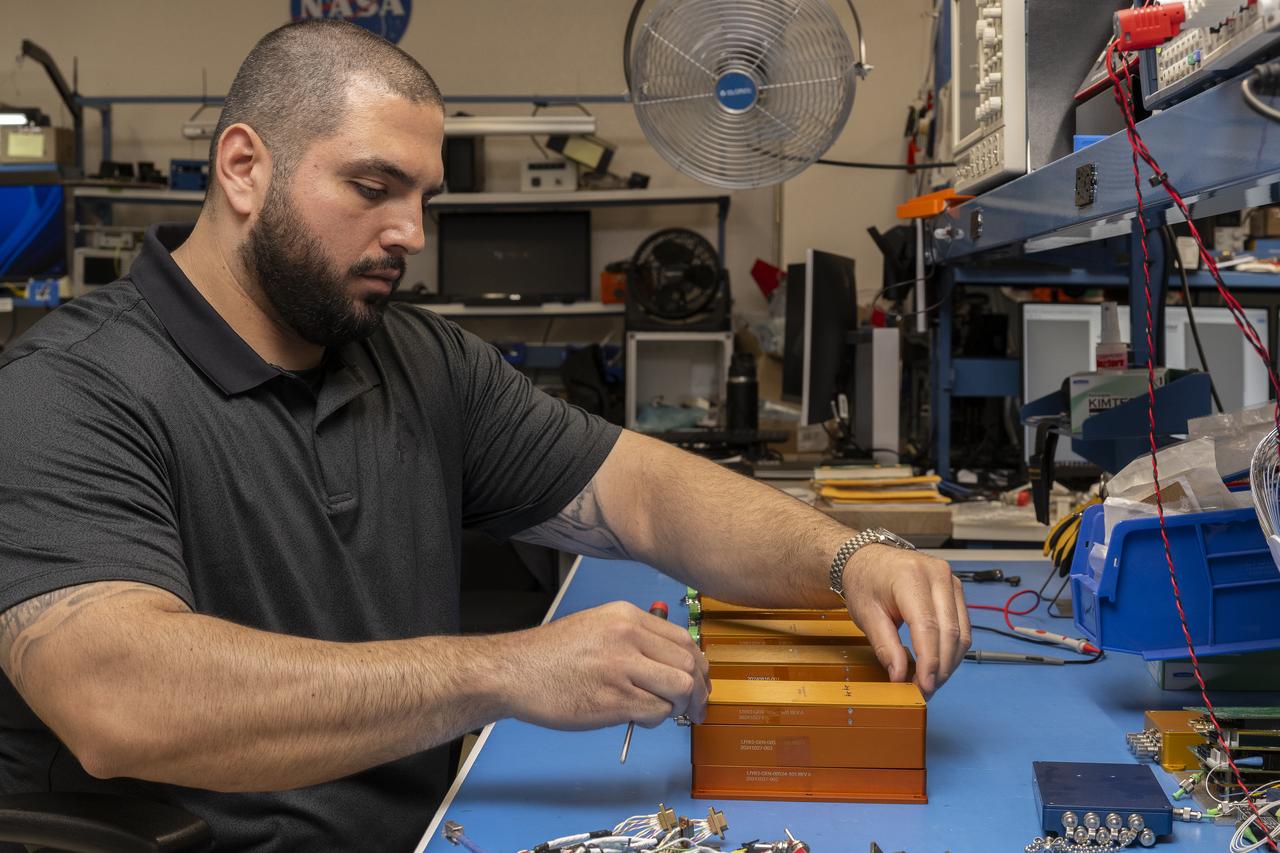
Jonathan Lopez works on a hypersonic Fiber Optic Sensing System at NASA’s Armstrong Flight Research Center in Edwards, California, on Feb. 13, 2025. The system measures strain and temperature, critical safety data for hypersonic vehicles that travel five time the speed of sound.
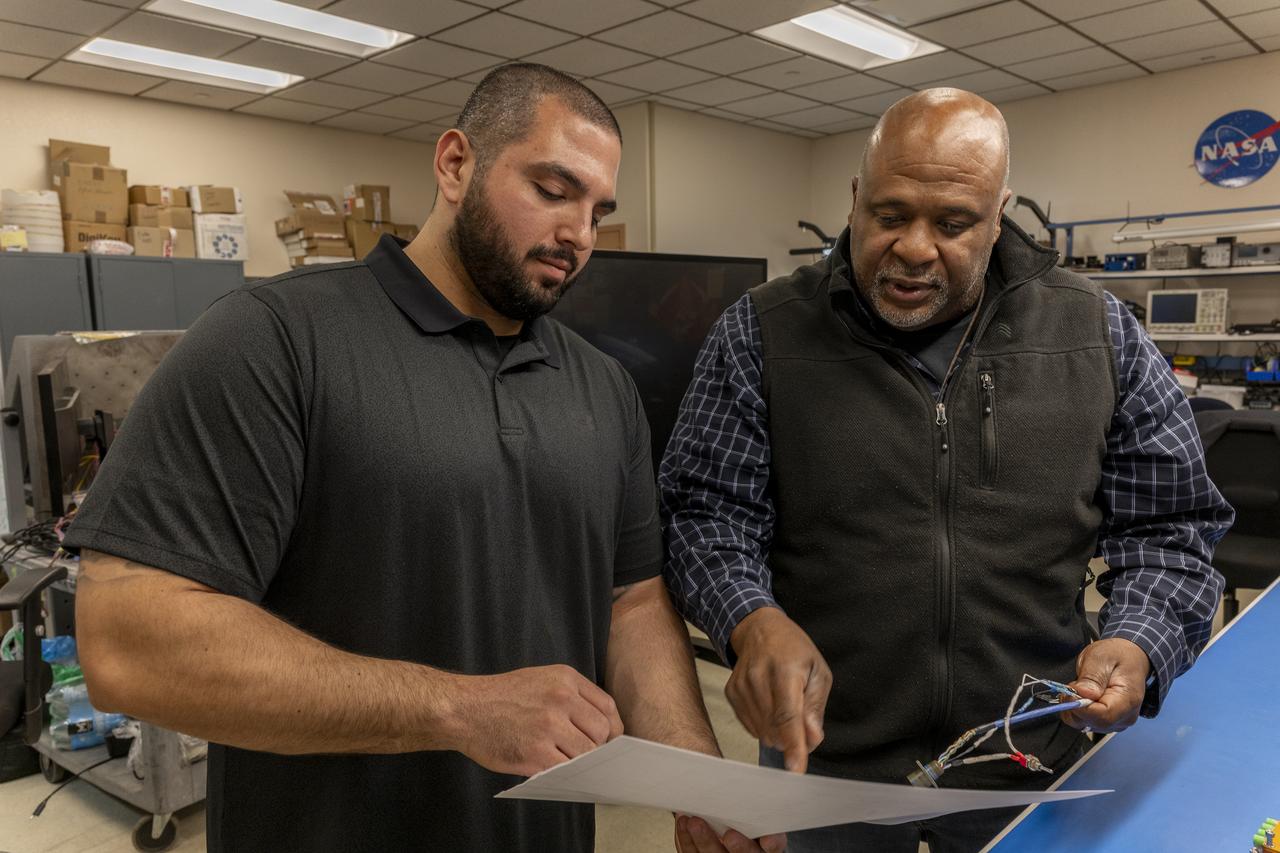
Jonathan Lopez and Allen Parker confer on the hypersonic Fiber Optic Sensor System at NASA’s Armstrong Flight Research Center in Edwards, California, on February 13, 2025. The system measures strain and temperature, critical safety data for hypersonic vehicles that travel five time the speed of sound.
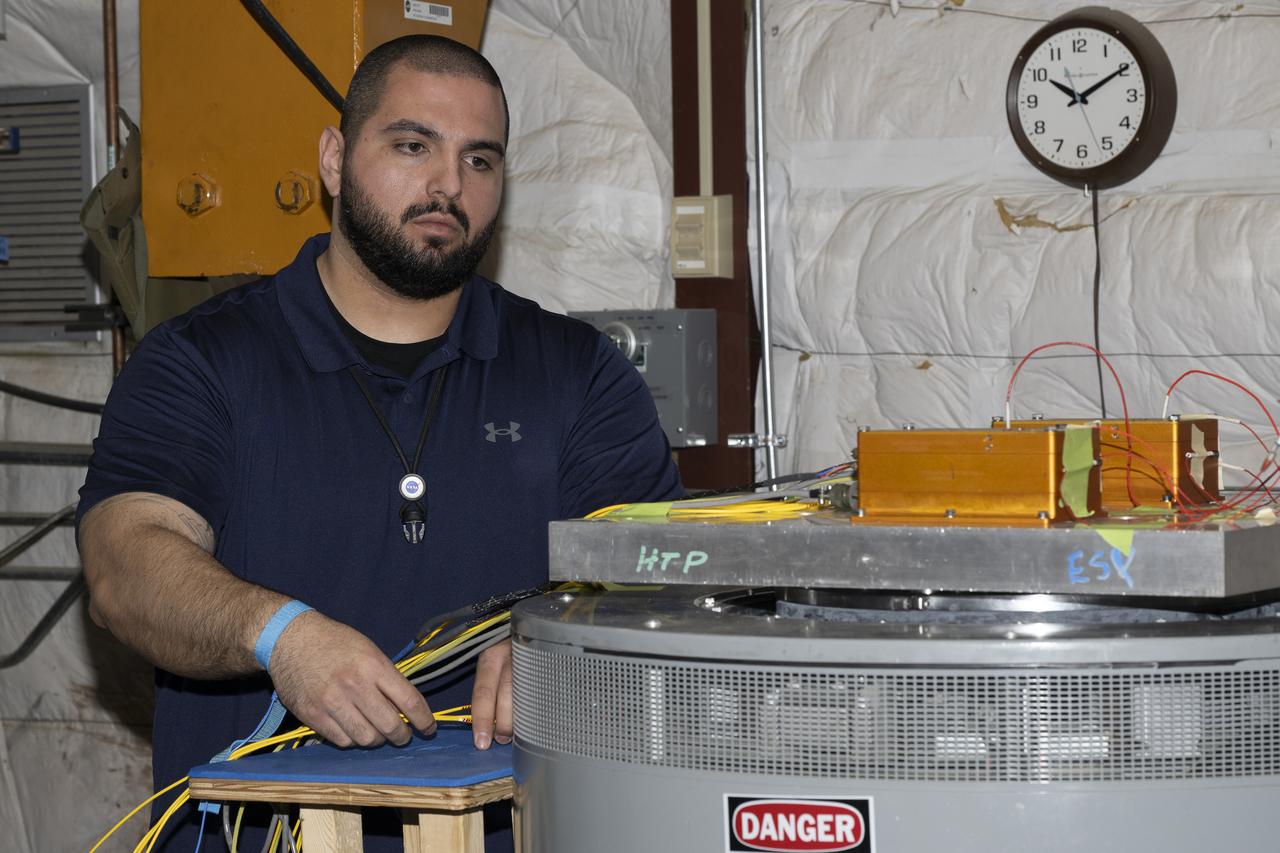
Jonathan Lopez prepares the hypersonic Fiber Optic Sensing System for vibration tests in the Environmental Laboratory at NASA’s Armstrong Flight Research Center in Edwards, California. Testing on a machine called a shaker proved that the system could withstand the severe vibration it will endure in hypersonic flight, or travel at five times the speed of sound.
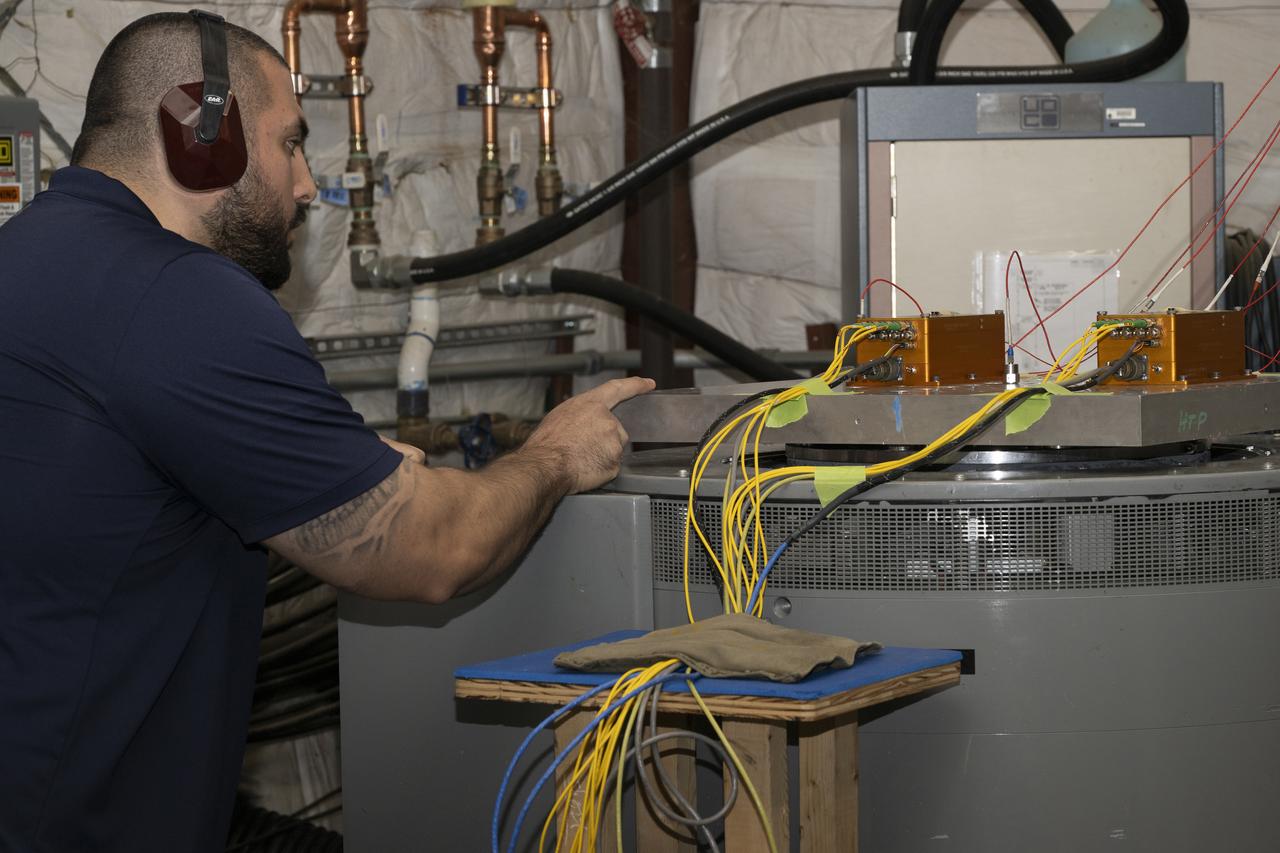
Jonathan Lopez prepares the hypersonic Fiber Optic Sensing System for vibration tests in the Environmental Laboratory at NASA’s Armstrong Flight Research Center in Edwards, California. Testing on a machine called a shaker proved that the system could withstand the severe vibration it will endure in hypersonic flight, or travel at five times the speed of sound.
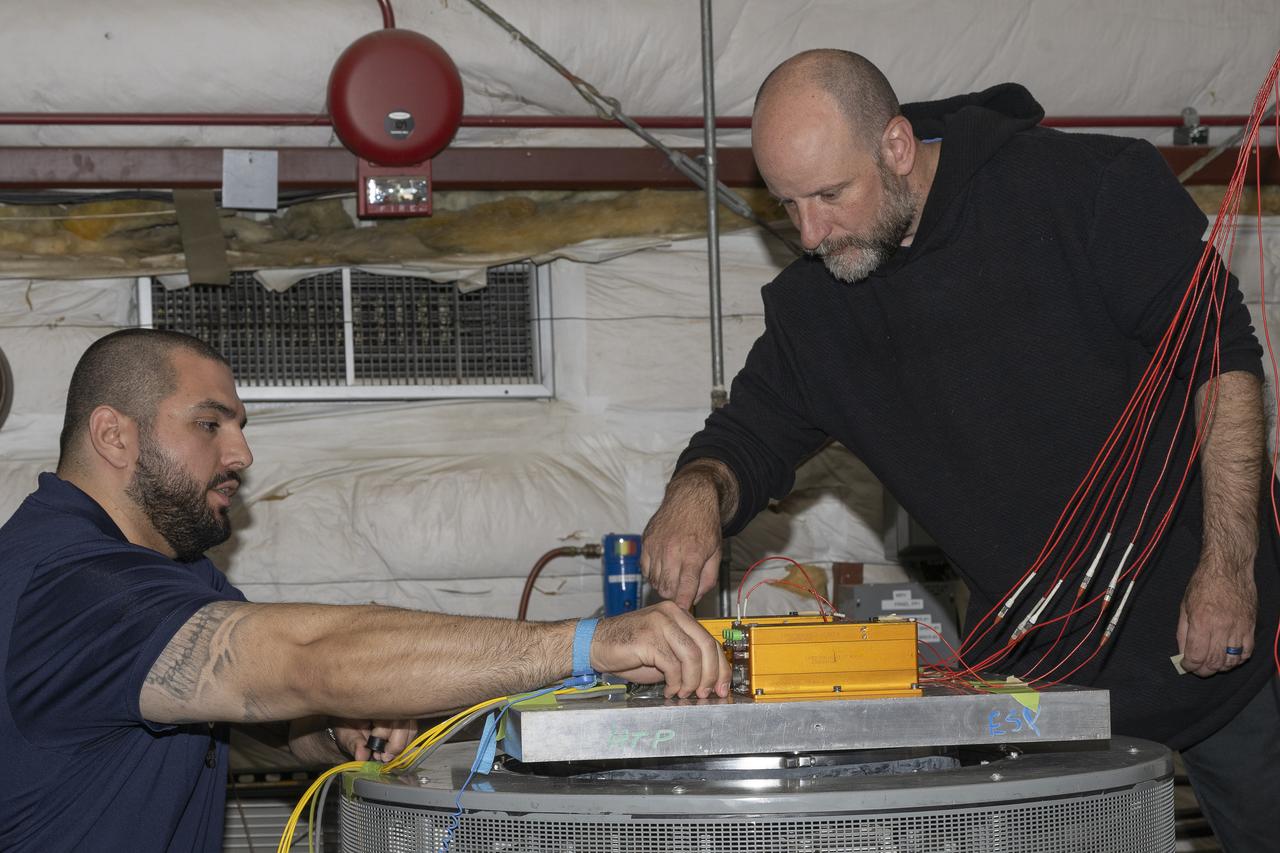
Jonathan Lopez and Nathan Rick prepare the hypersonic Fiber Optic Sensing System for vibration tests in the Environmental Laboratory at NASA’s Armstrong Flight Research Center in Edwards, California. Testing on a machine called a shaker proved that the system could withstand the severe vibration it will endure in hypersonic flight, or travel at five times the speed of sound.
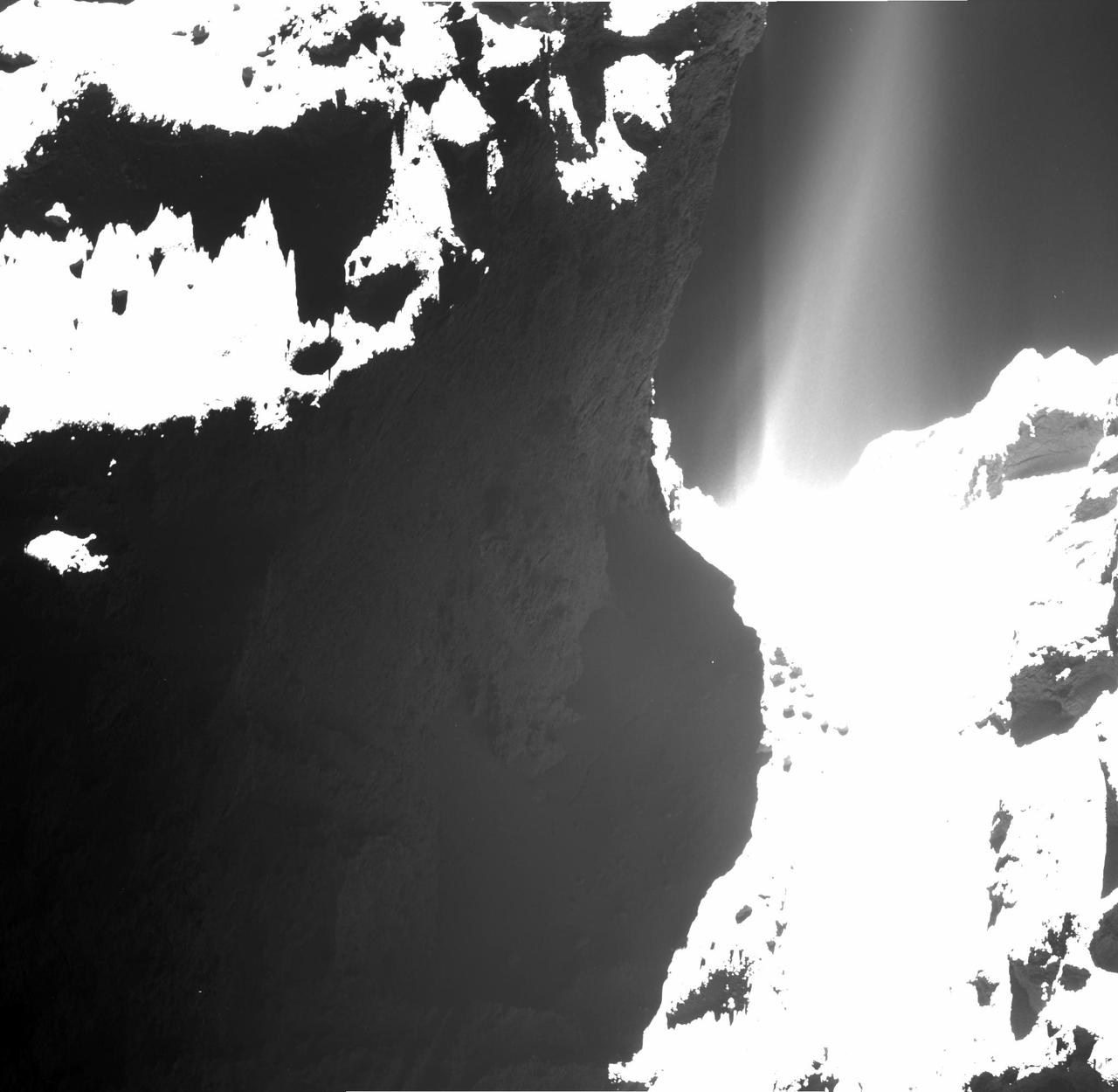
This image was taken by the Optical, Spectroscopic, and Infrared Remote Imaging System, Rosetta main onboard scientific imaging system, on Sept. 10, 2014. Jets of cometary activity can be seen along almost the entire body of the comet.
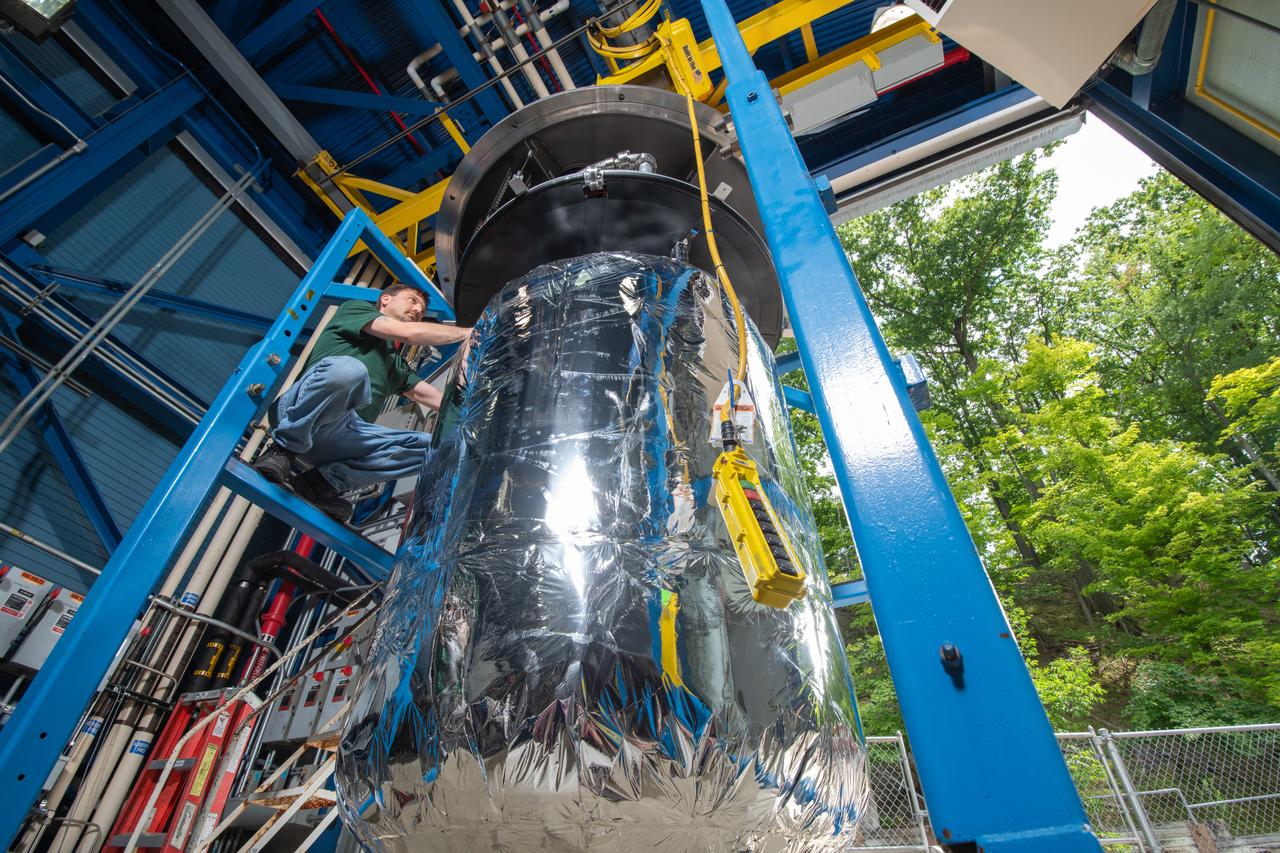
A tank is used in CryoFILL experiments to liquefy oxygen at minus 290 degrees Fahrenheit as it could be done on the Moon or Mars. The tests conducted at NASA Glenn Research Center, used Fiber Optic Sensing System (FOSS) developed by NASA Armstrong Flight Research Center, to measure oxygen temperatures inside the tank.
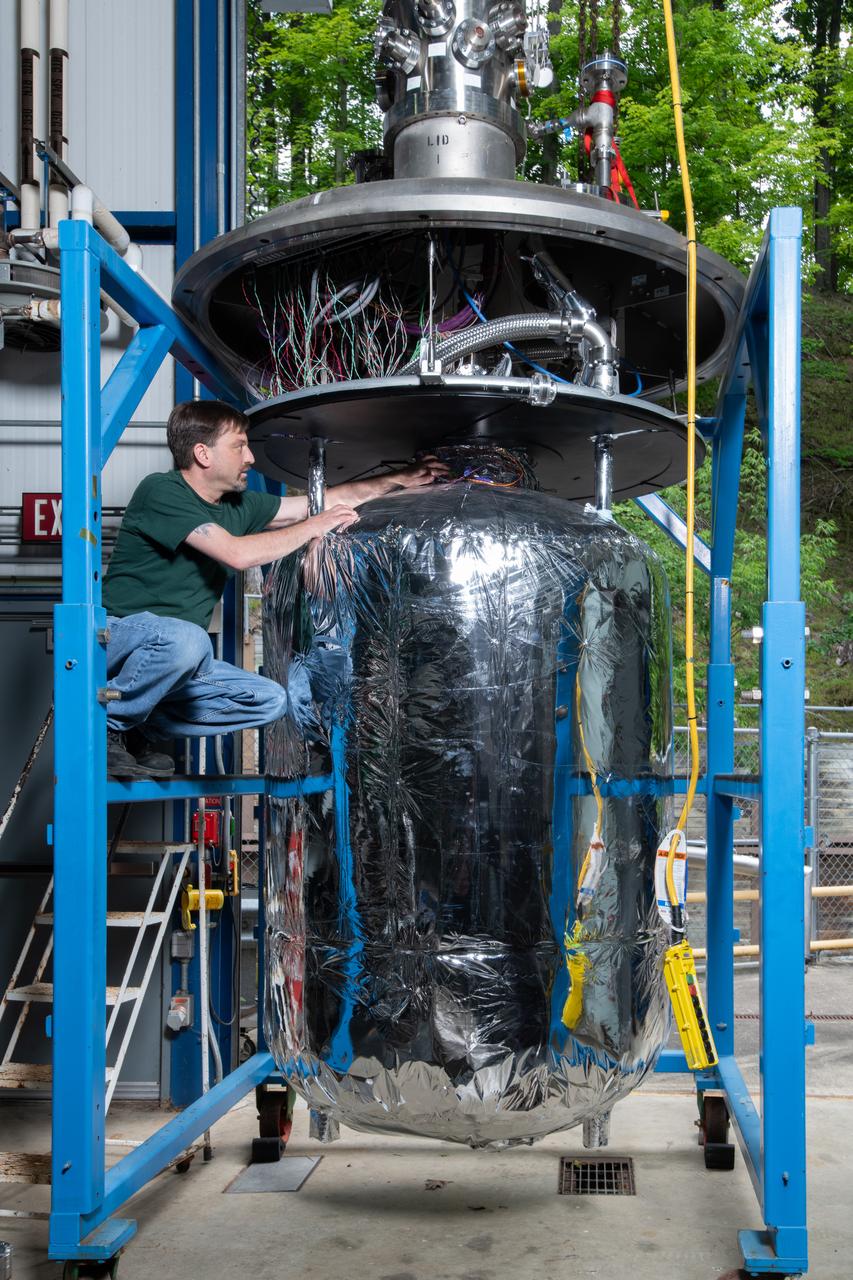
A tank is used in CryoFILL experiments to liquefy oxygen at minus 290 degrees Fahrenheit as it could be done on the Moon or Mars. The tests conducted at NASA Glenn Research Center, used Fiber Optic Sensing System (FOSS) developed by NASA Armstrong Flight Research Center, to measure oxygen temperatures inside the tank.
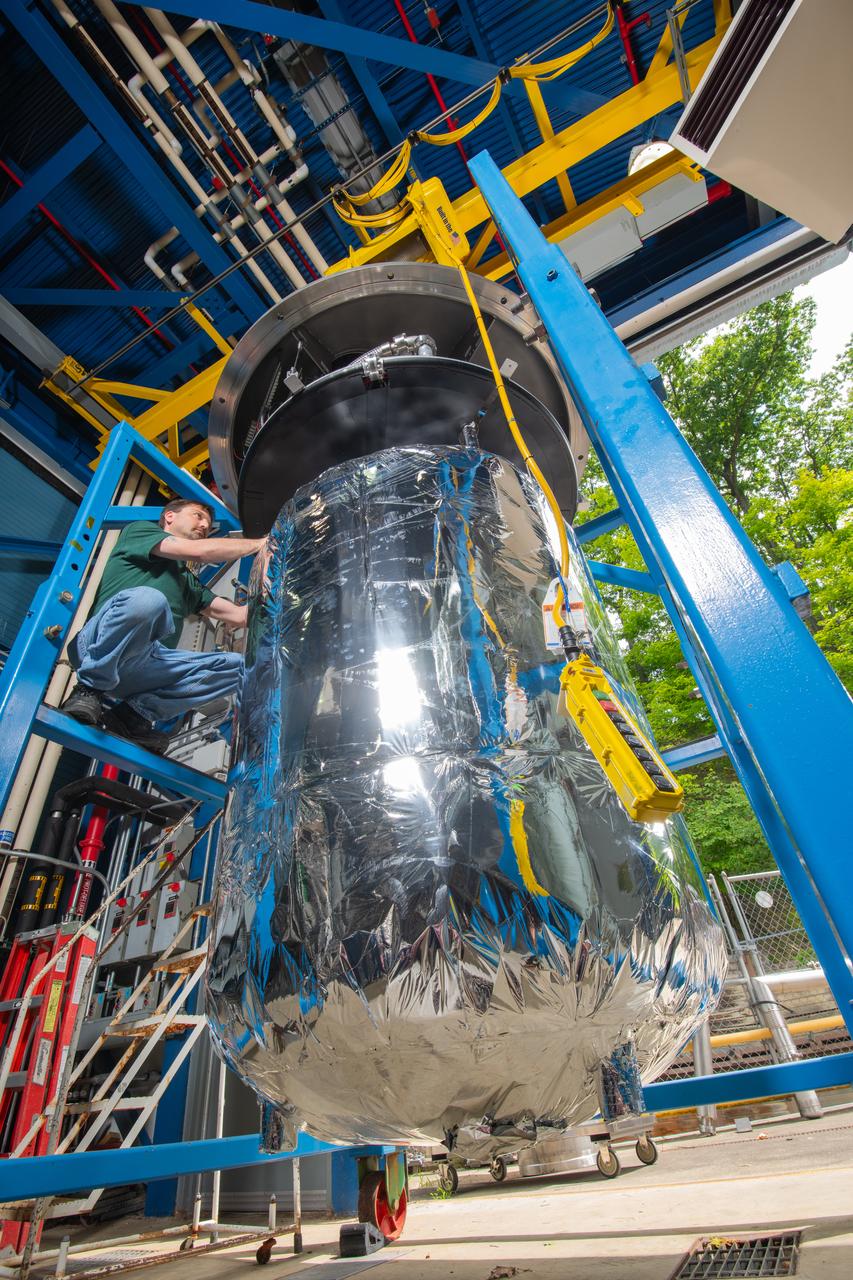
A tank is used in CryoFILL experiments to liquefy oxygen at minus 290 degrees Fahrenheit as it could be done on the Moon or Mars. The tests conducted at NASA Glenn Research Center, used Fiber Optic Sensing System (FOSS) developed by NASA Armstrong Flight Research Center, to measure oxygen temperatures inside the tank.
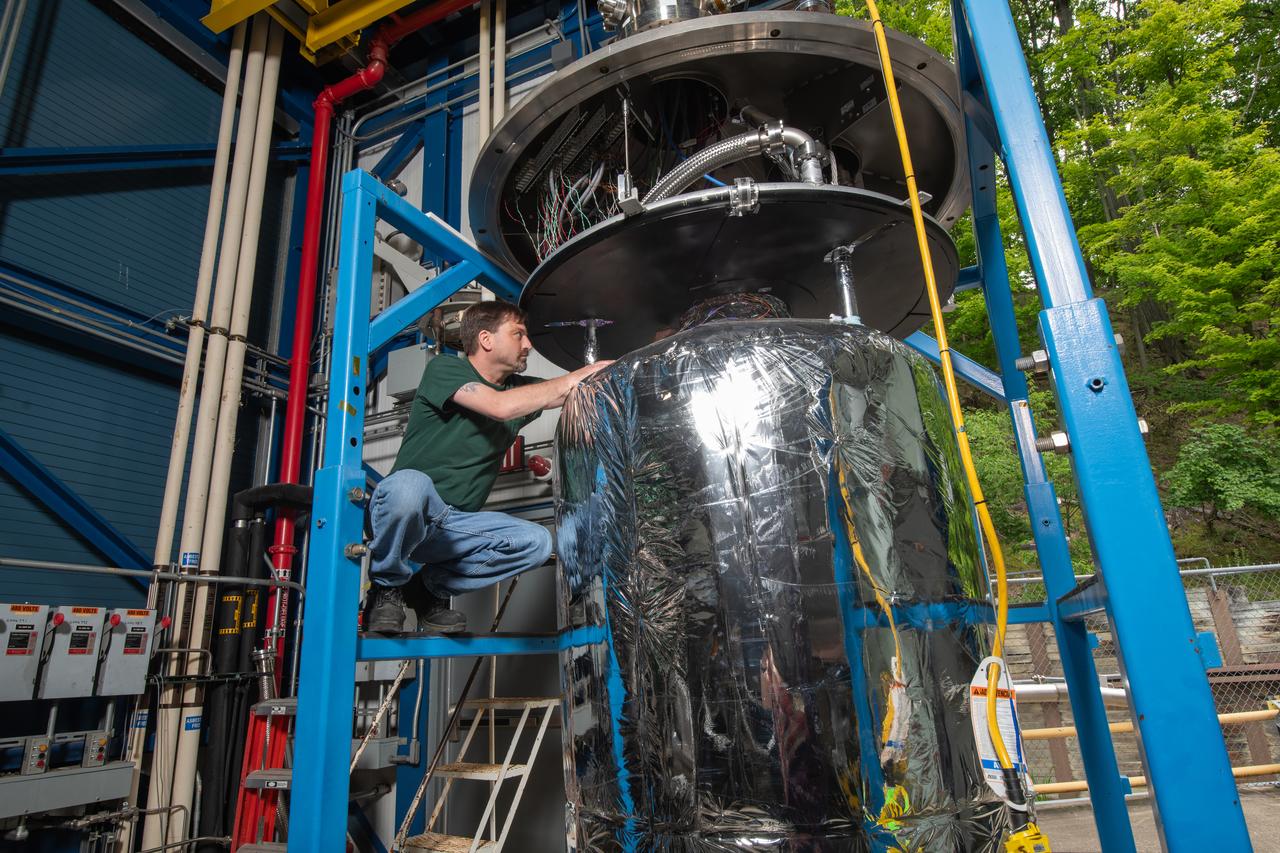
A tank is used in CryoFILL experiments to liquefy oxygen at minus 290 degrees Fahrenheit as it could be done on the Moon or Mars. The tests conducted at NASA Glenn Research Center, used Fiber Optic Sensing System (FOSS) developed by NASA Armstrong Flight Research Center, to measure oxygen temperatures inside the tank.
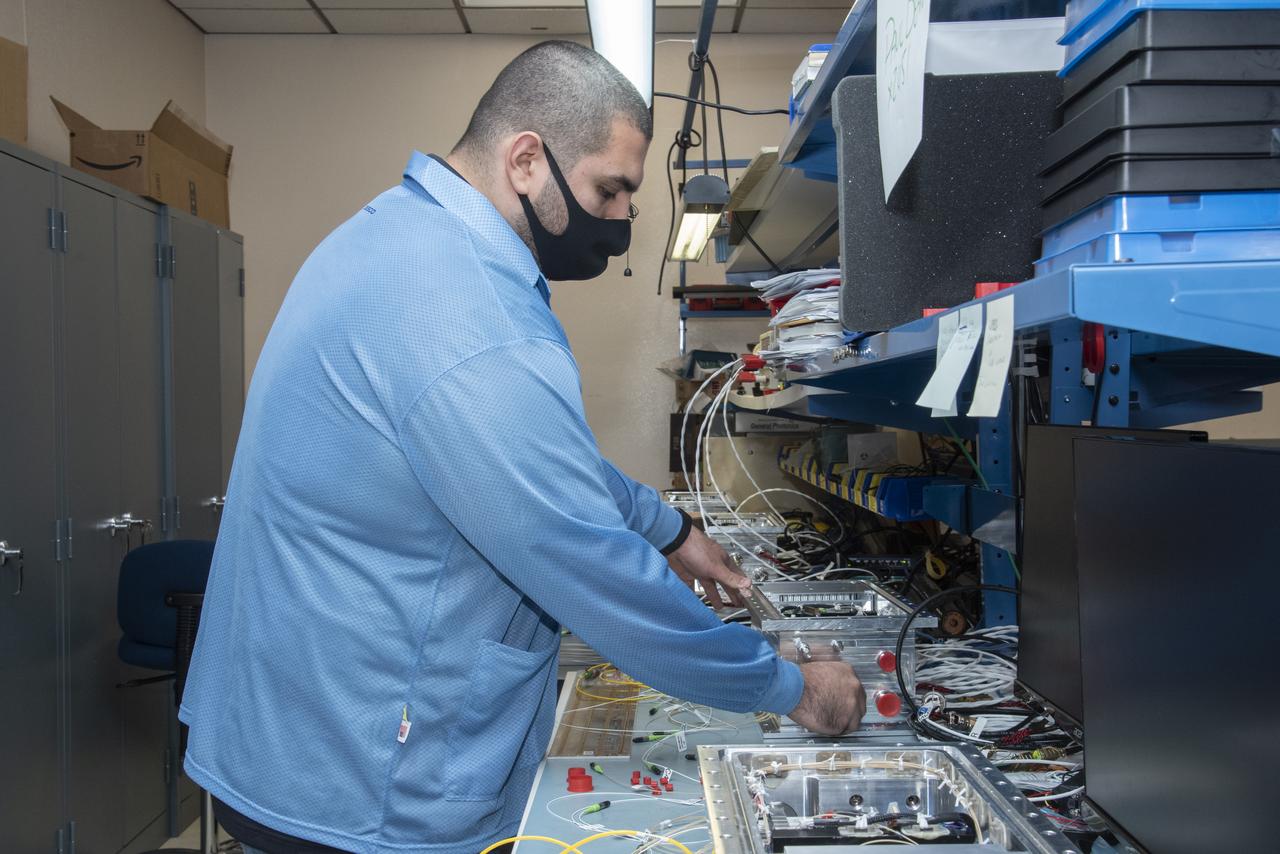
NASA research engineer Jonathan Lopez works on preparing a Compact Fiber Optic Sensing System unit, also known as a FOSS Rocket Box, which was developed at NASA's Armstrong Flight Research Center in California. The unit is a new variant of aircraft technology that researchers have advanced to withstand the harsh environments of a rocket launch and space travel.
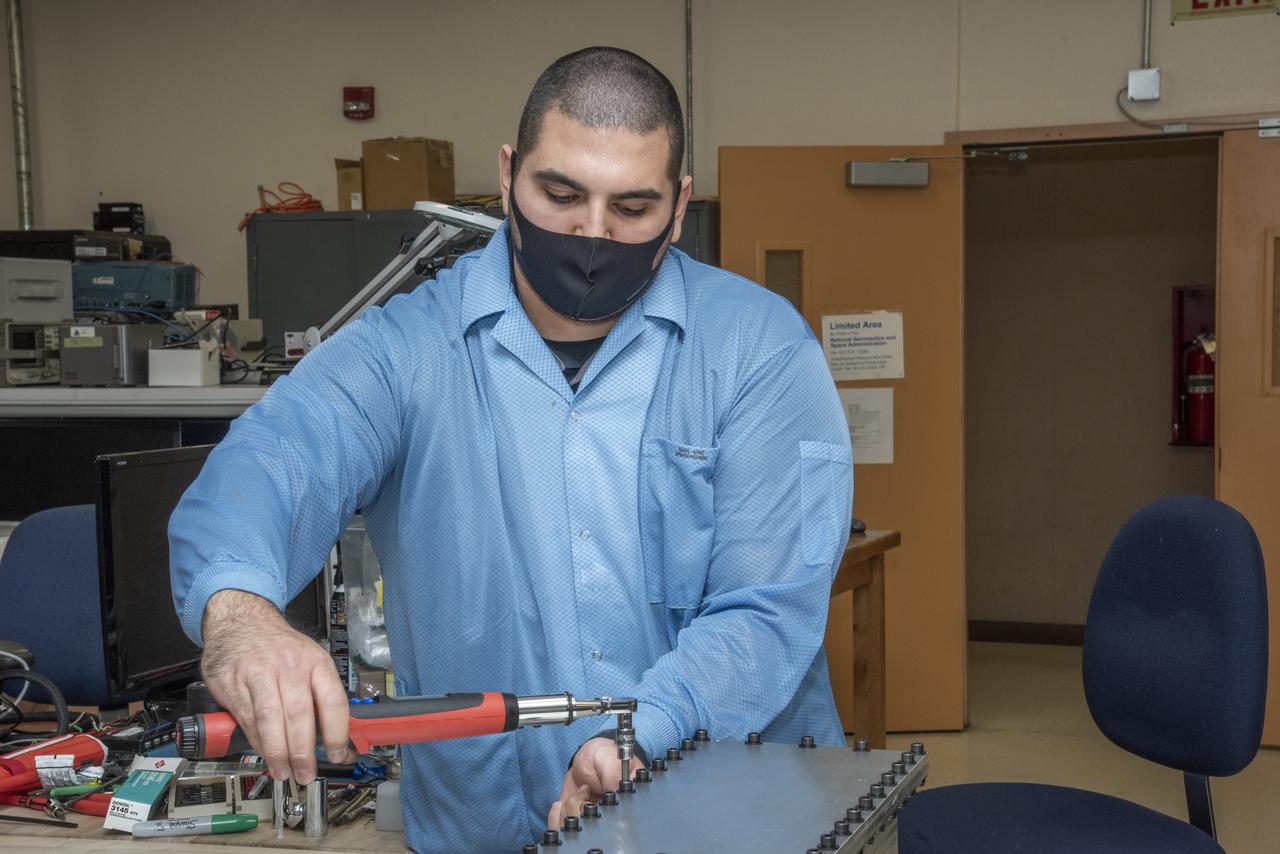
Bolts are torqued on a Compact Fiber Optic Sensing System unit, also known as a FOSS Rocket Box, which was developed at NASA's Armstrong Flight Research Center in California. NASA research engineer Jonathan Lopez works on the unit that is a new variant of aircraft technology that researchers have advanced to withstand the harsh environments of a rocket launch and space travel
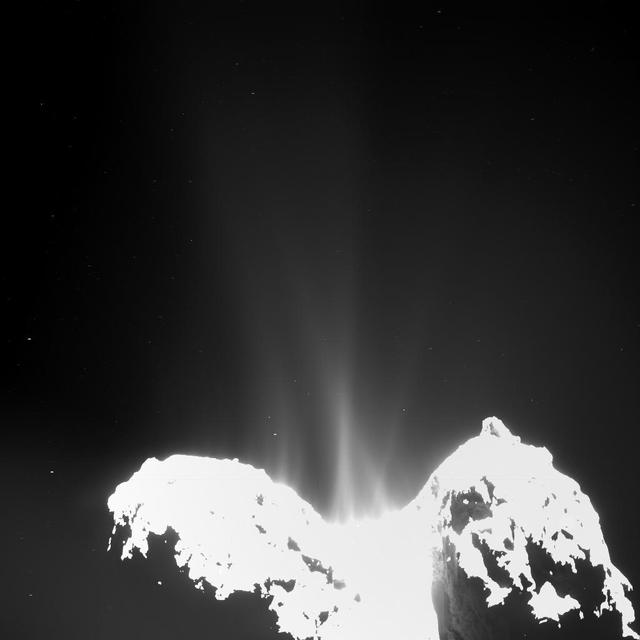
This image was taken by the Optical, Spectroscopic, and Infrared Remote Imaging System, Rosetta main onboard scientific imaging system, on Sept. 10, 2014. Jets of cometary activity can be seen along almost the entire body of the comet. http://photojournal.jpl.nasa.gov/catalog/PIA18886
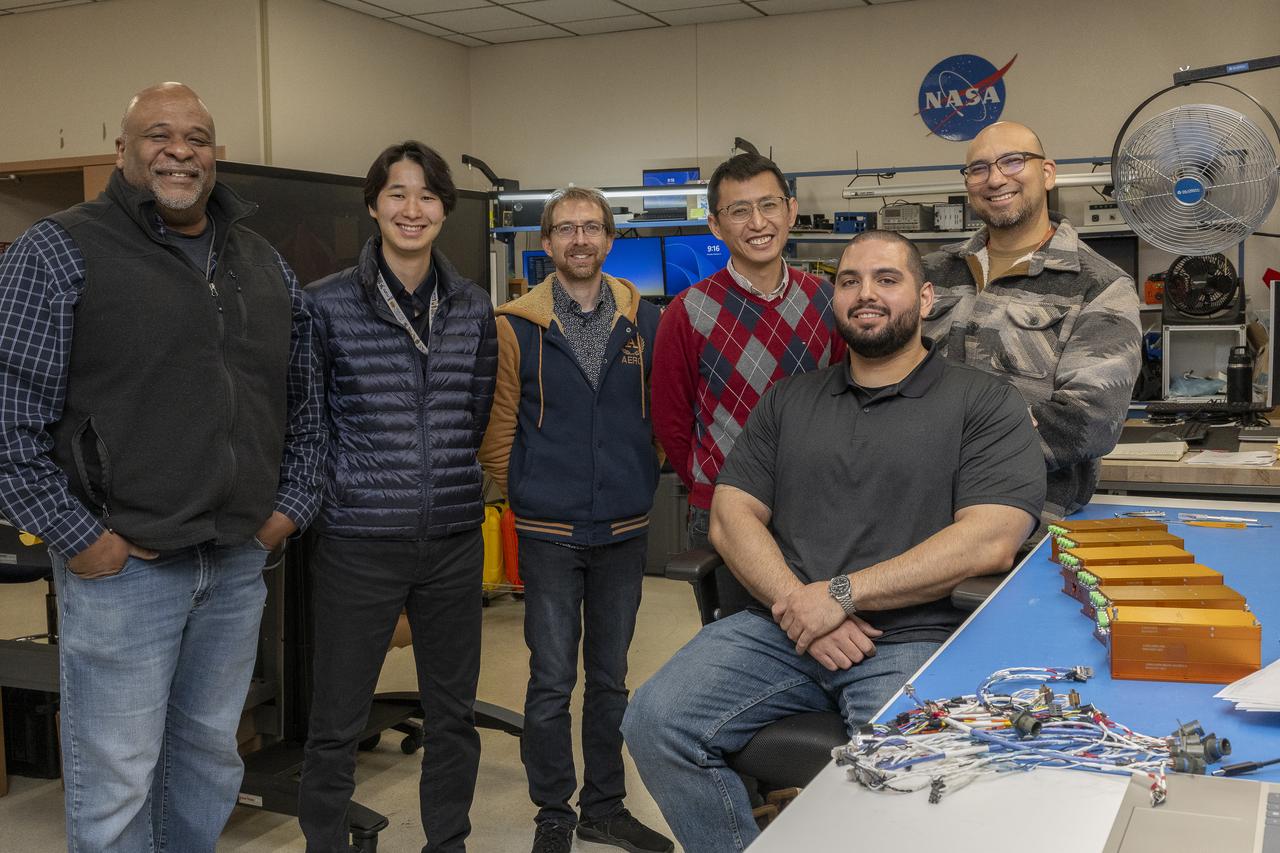
Allen Parker, Mark Hagiwara, Paul Bean, Patrick Chan, Jonathan Lopez (seated), and Frank Pena comprise the Fiber Optic Sensing System team at NASA’s Armstrong Flight Research Center, in Edwards, California. The systems on the table measure strain and temperature, critical safety data for hypersonic vehicles that travel five time the speed of sound.
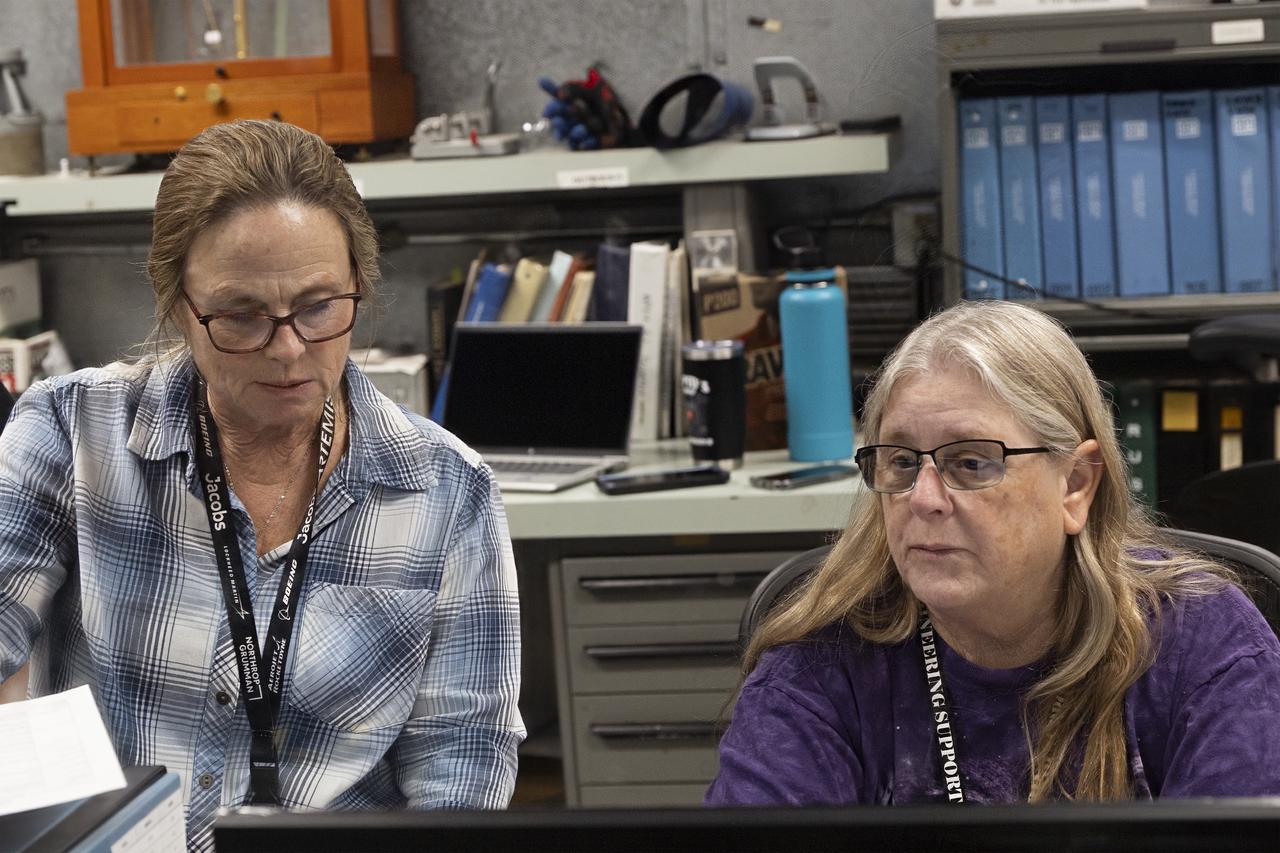
From left, April Torres and Karen Estes watch incoming data from vibration tests on the hypersonic Fiber Optic Sensing System at NASA’s Armstrong Flight Research Center in Edwards California. Testing on a machine called a shaker proved that the system could withstand the severe vibration it will endure in hypersonic flight, or travel at five times the speed of sound.
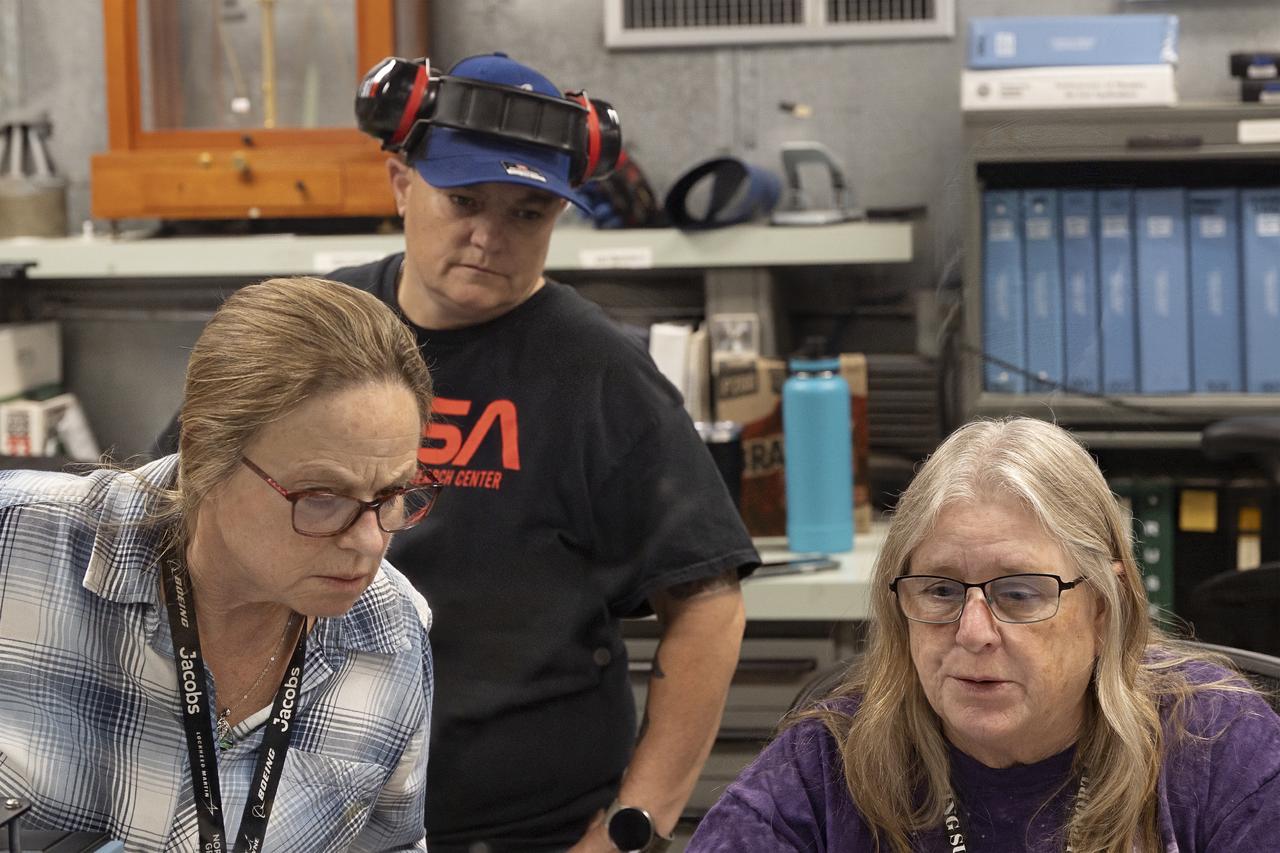
April Torres, from left, Cryss Punteney, and Karen Estes watch as data flows from the hypersonic Fiber Optic Sensing System at NASA’s Armstrong Flight Research Center in Edwards, California. Testing on a machine called a shaker proved that the system could withstand the severe vibration it will endure in hypersonic flight, or travel at five times the speed of sound.
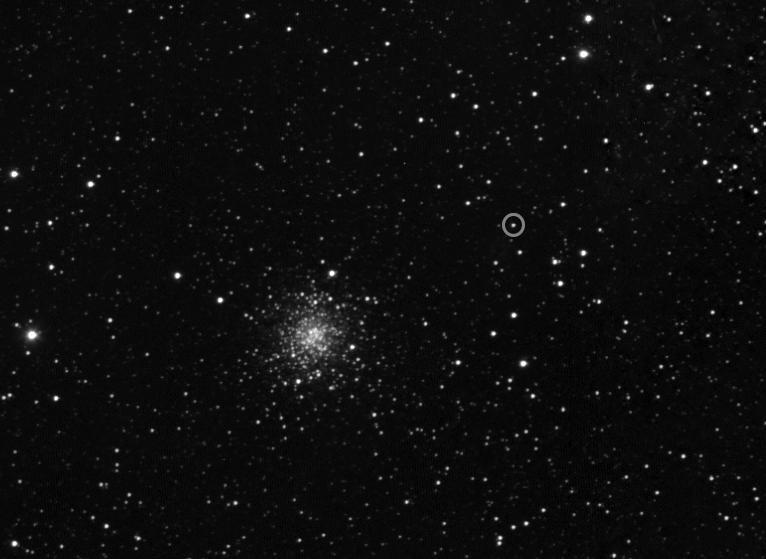
This image of comet 67P/Churymov-Gerasimenko was taken on March 21, 2014, by the narrow-angle camera of the Rosetta spacecraft Optical, Spectroscopic and Infrared Remote Imaging System OSIRIS.
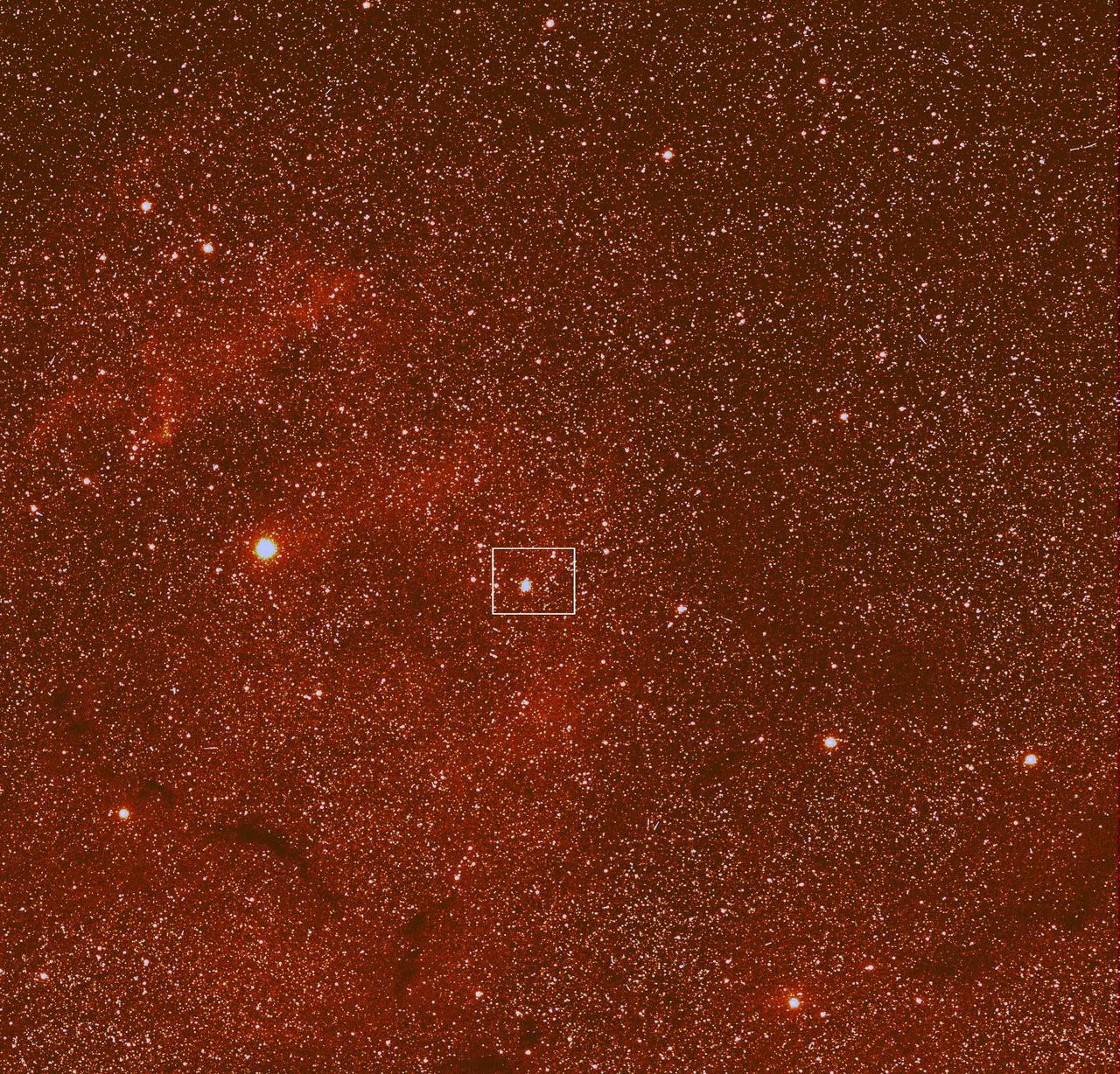
This image of comet 67P/Churymov-Gerasimenko was taken on March 20, 2014, by the wide-angle camera of the Rosetta spacecraft Optical, Spectroscopic and Infrared Remote Imaging System OSIRIS.
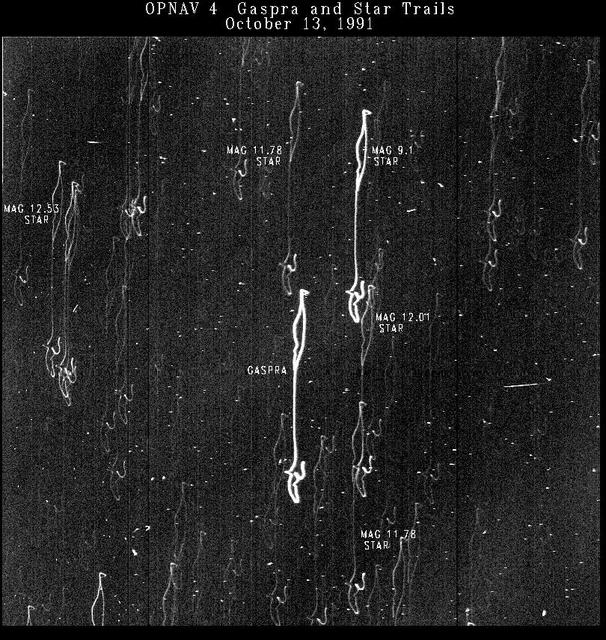
This time-exposure picture of the asteroid Gaspra and background stars is one of four optical navigation images made by NASA Galileo imaging system to improve knowledge of Gaspra location for the spacecraft flyby. http://photojournal.jpl.nasa.gov/catalog/PIA00229
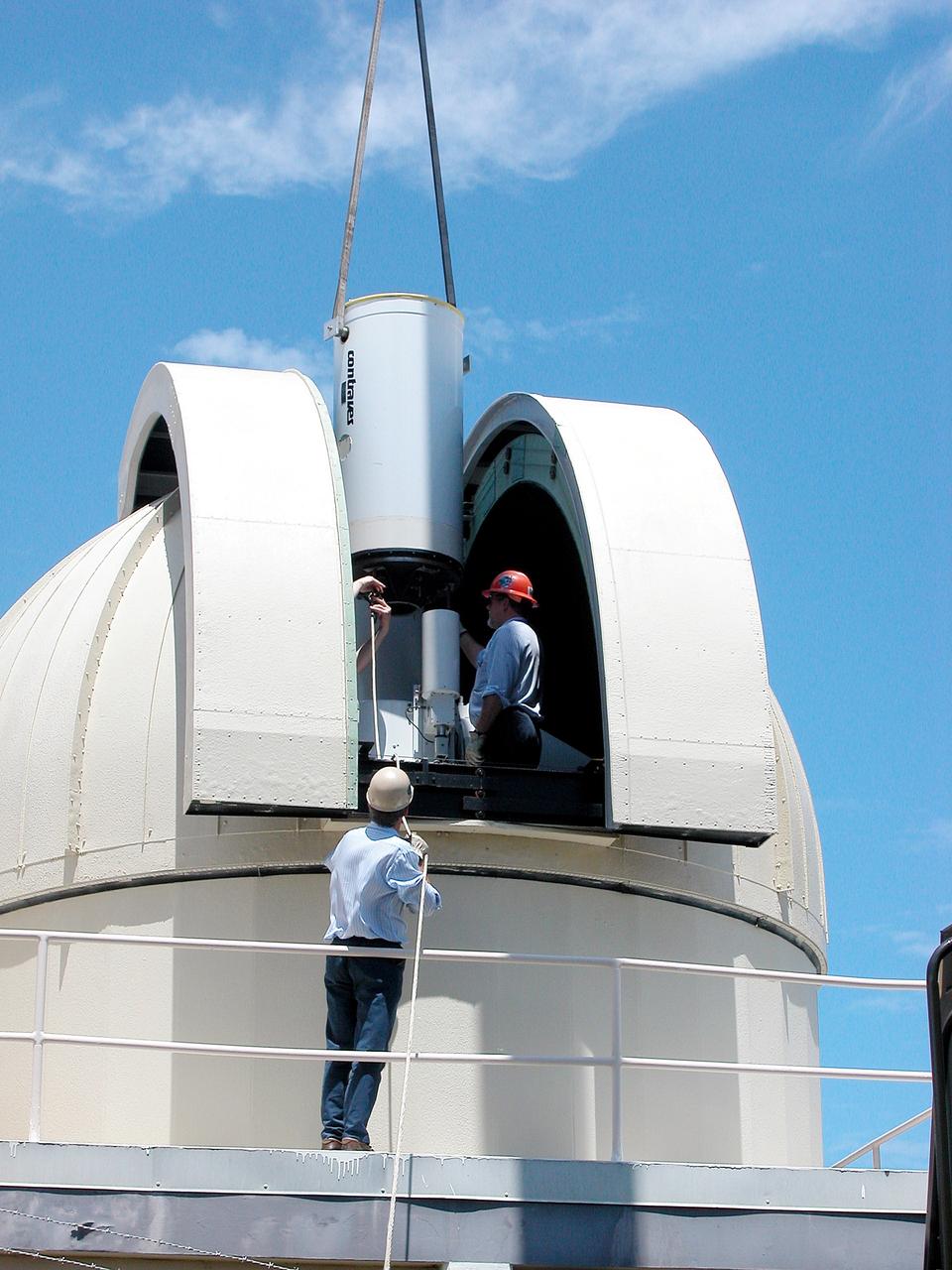
KENNEDY SPACE CENTER, FLA. - In Cocoa Beach, Fla., a new five-meter telescope is lowered into the dome for installation. The tracking telescope is part of the Distant Object Attitude Measurement System (DOAMS) that provides optical support for launches from KSC and Cape Canaveral.
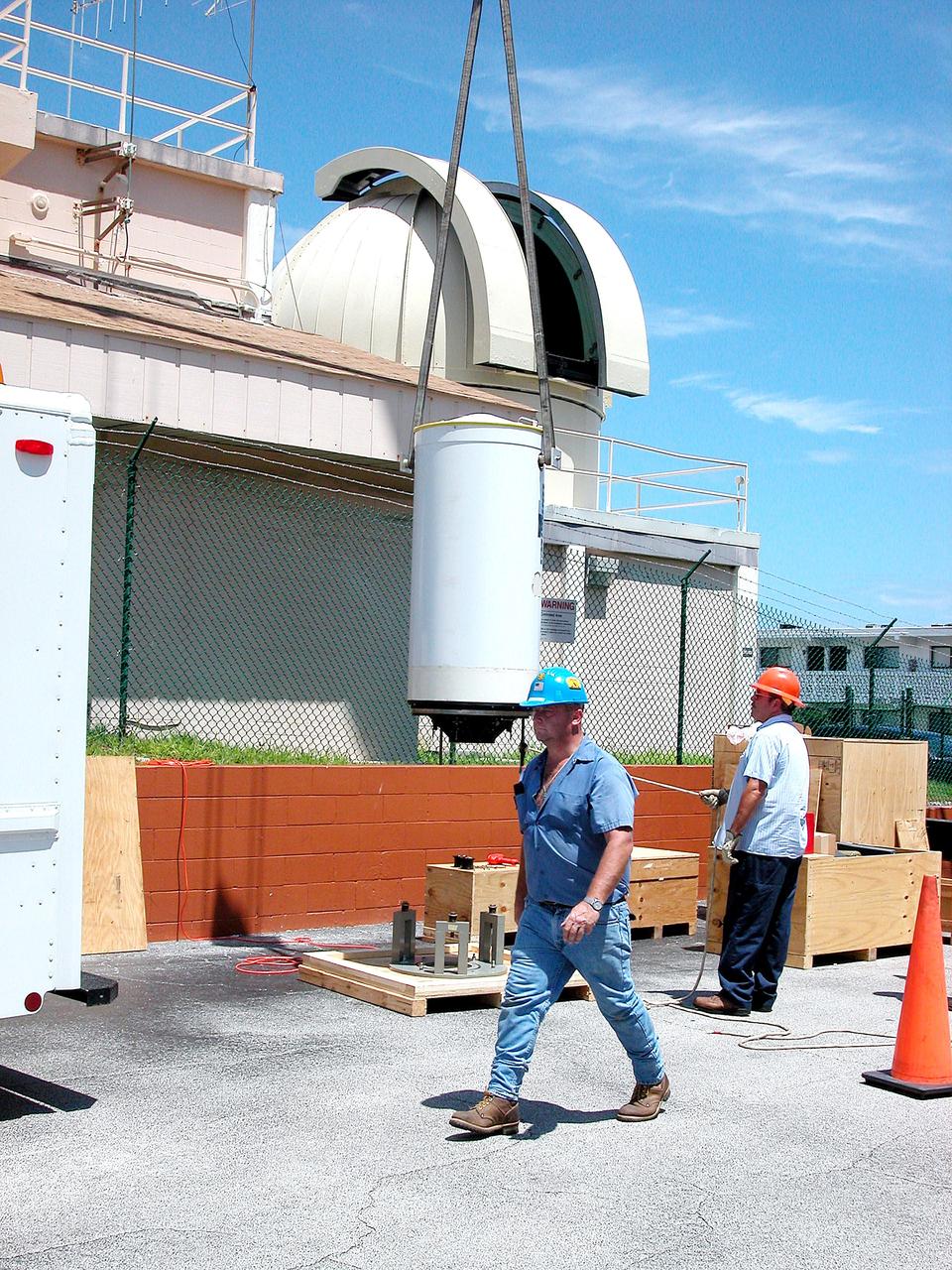
KENNEDY SPACE CENTER, FLA. - In Cocoa Beach, Fla., a new five-meter telescope is lifted up to the dome for installation. The tracking telescope is part of the Distant Object Attitude Measurement System (DOAMS) that provides optical support for launches from KSC and Cape Canaveral.
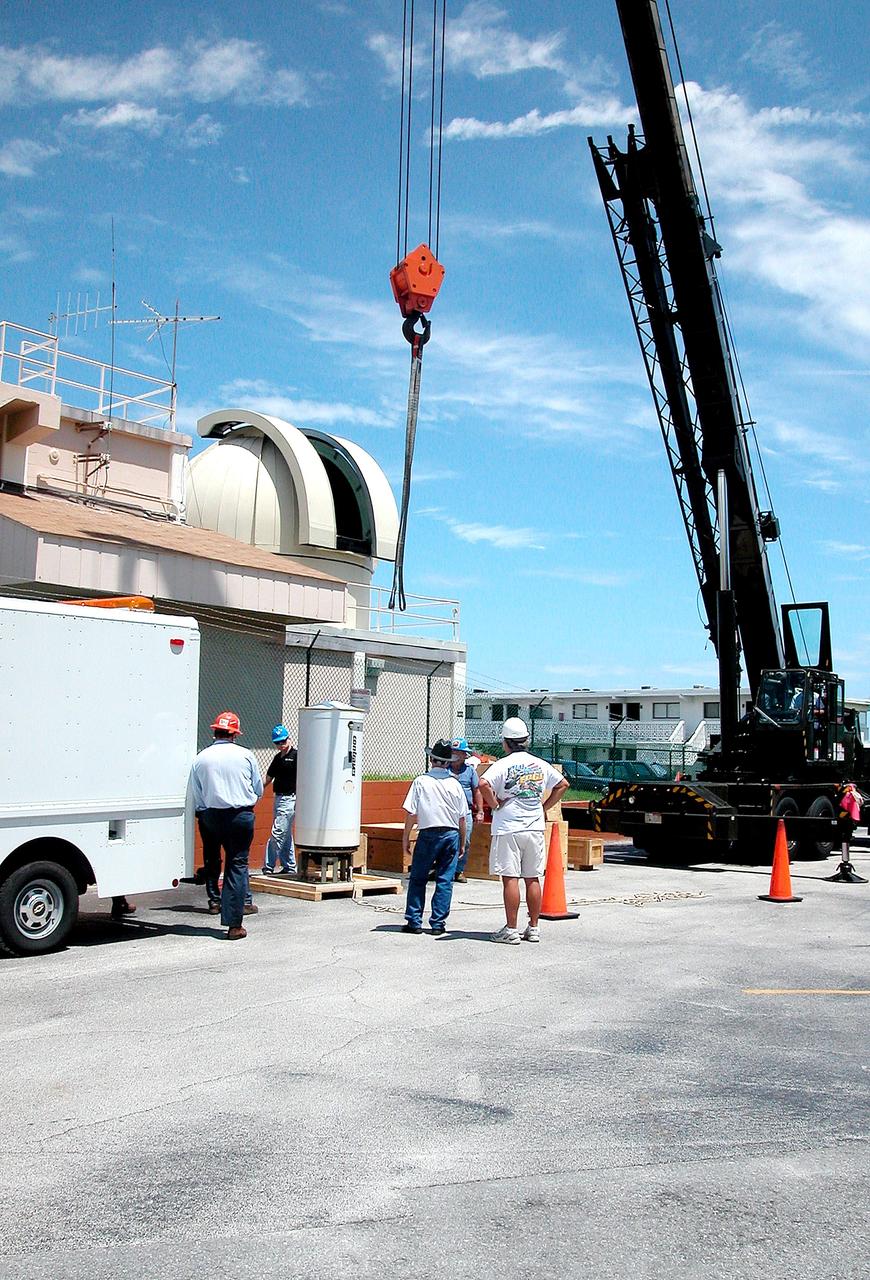
KENNEDY SPACE CENTER, FLA. - In Cocoa Beach, Fla., a new five-meter telescope sits on a pallet waiting to be lifted up to the dome above and installed. The tracking telescope is part of the Distant Object Attitude Measurement System (DOAMS) that provides optical support for launches from KSC and Cape Canaveral.
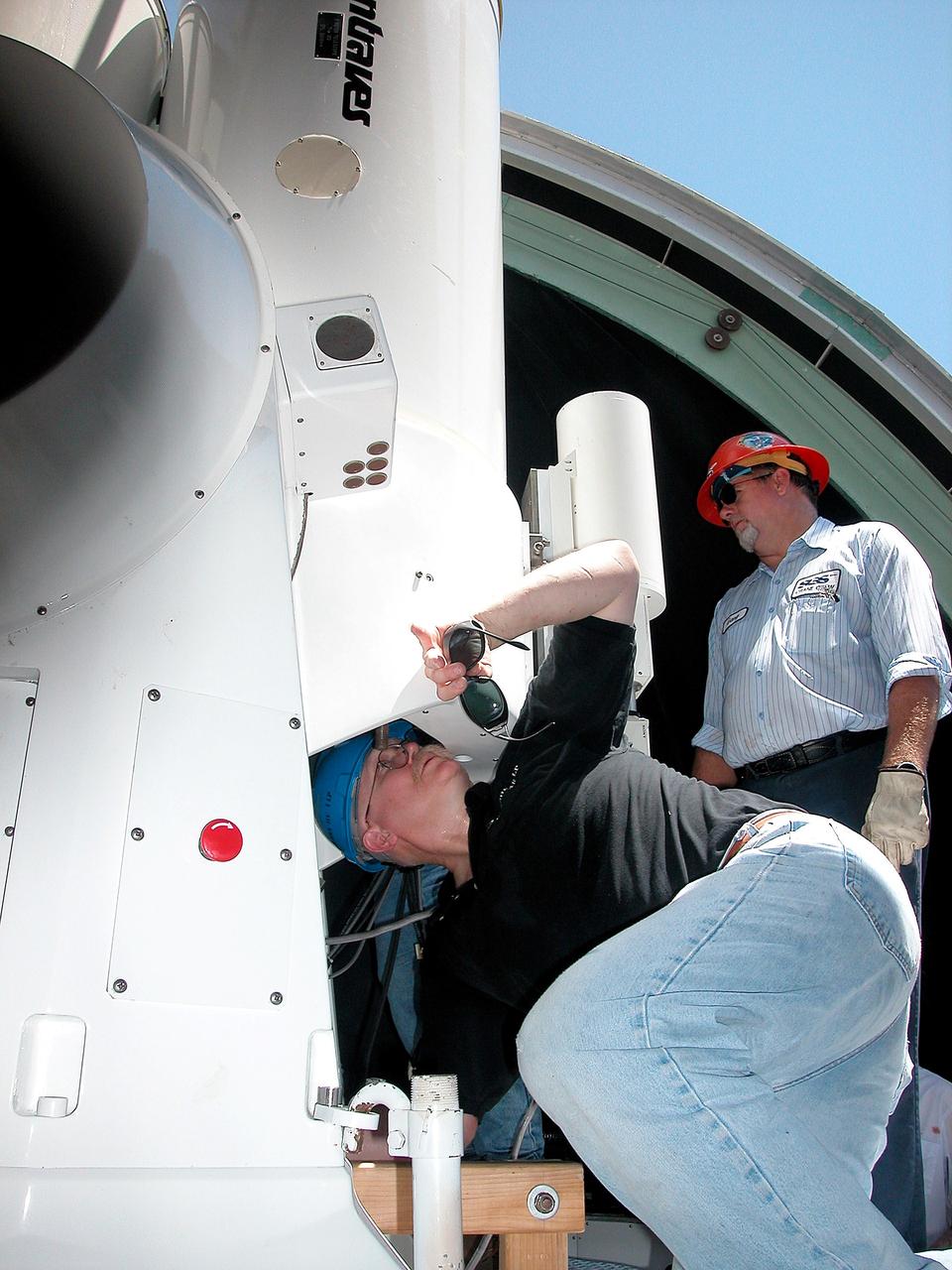
KENNEDY SPACE CENTER, FLA. - A worker looks at a five-meter (focal length) telescope being removed for repair. Part of the Distant Object Attitude Measurement System (DOAMS) in Cocoa Beach, Fla., the tracking telescope provides optical support for launches from KSC and Cape Canaveral. .
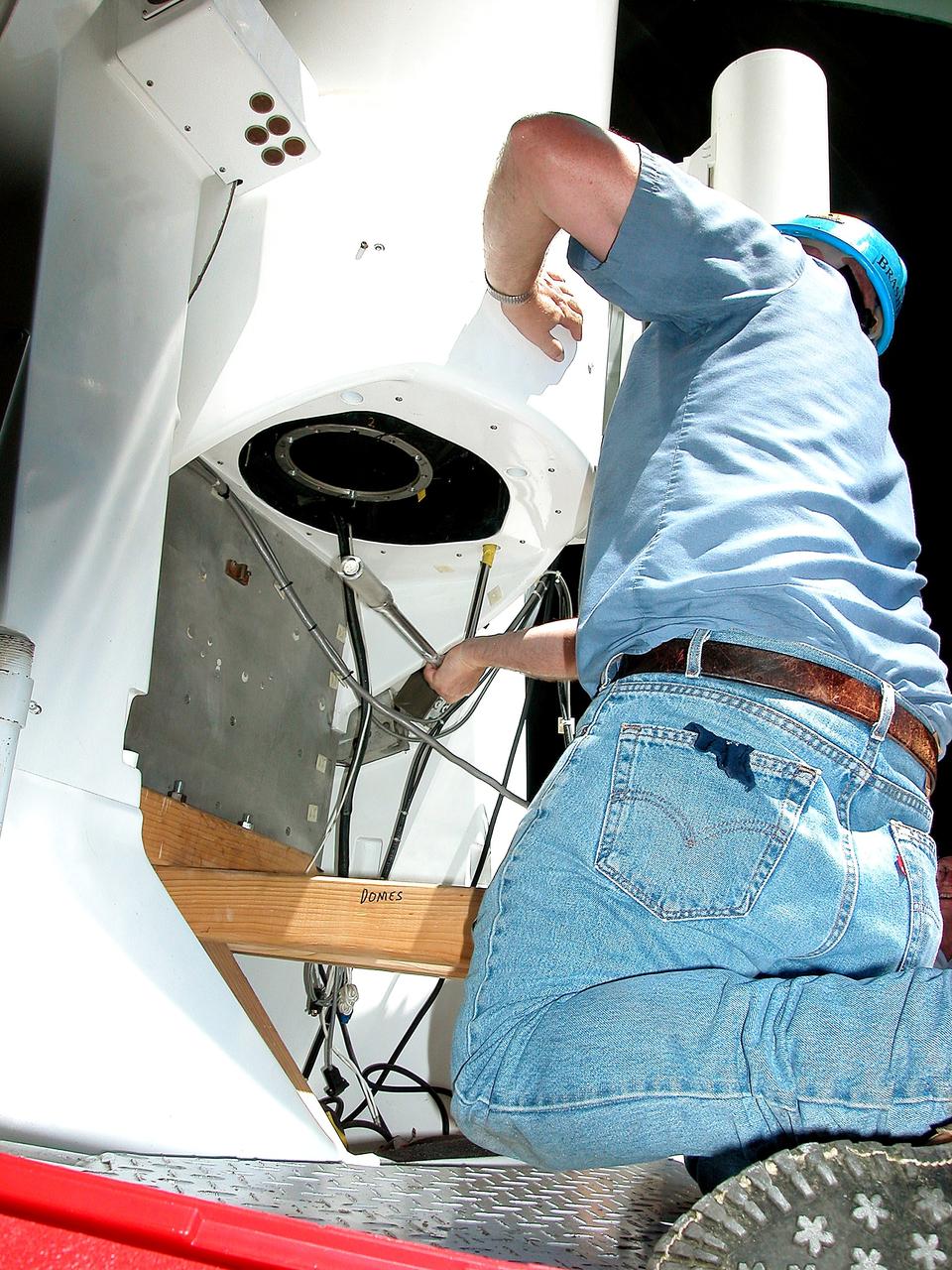
KENNEDY SPACE CENTER, FLA. - The master assembler, crane crew, removes a five-meter telescope in Cocoa Beach, Fla., for repair. The tracking telescope is part of the Distant Object Attitude Measurement System (DOAMS) that provides optical support for launches from KSC and Cape Canaveral.
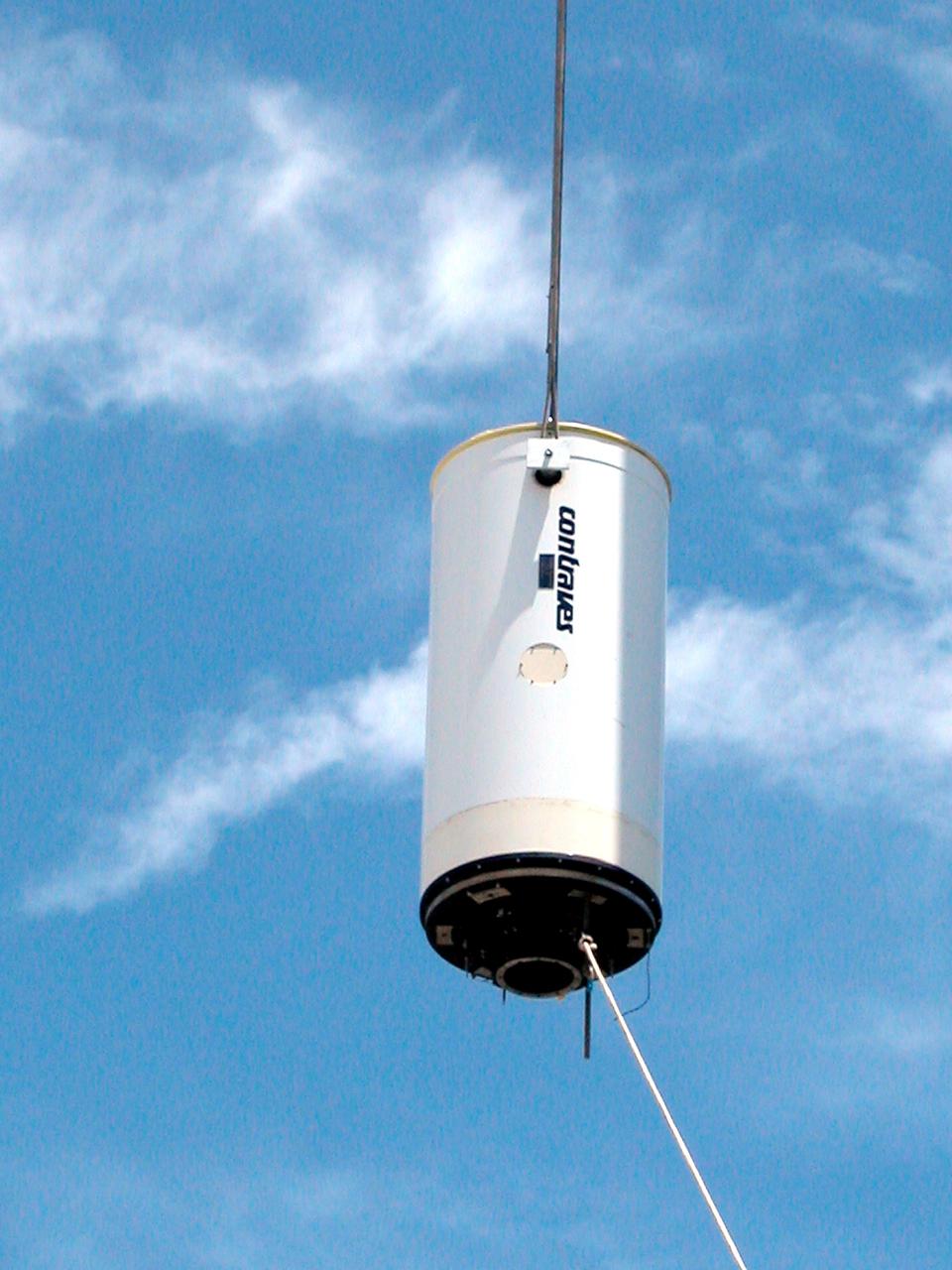
KENNEDY SPACE CENTER, FLA. - In Cocoa Beach, Fla., a new five-meter telescope is lifted up to the dome for installation. The tracking telescope is part of the Distant Object Attitude Measurement System (DOAMS) that provides optical support for launches from KSC and Cape Canaveral.
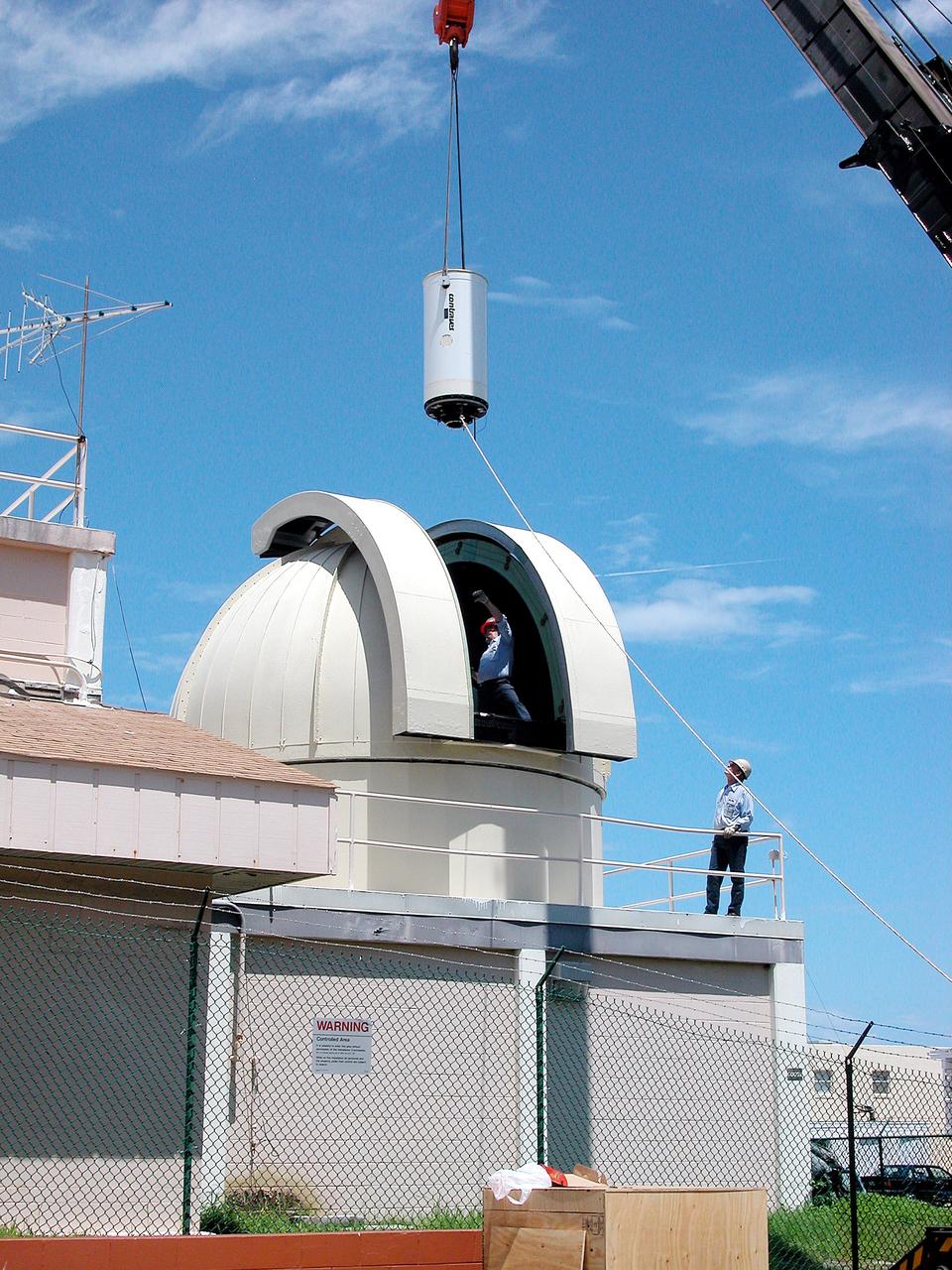
KENNEDY SPACE CENTER, FLA. - In Cocoa Beach, Fla., a new five-meter telescope is lowered toward the dome for installation. The tracking telescope is part of the Distant Object Attitude Measurement System (DOAMS) that provides optical support for launches from KSC and Cape Canaveral.
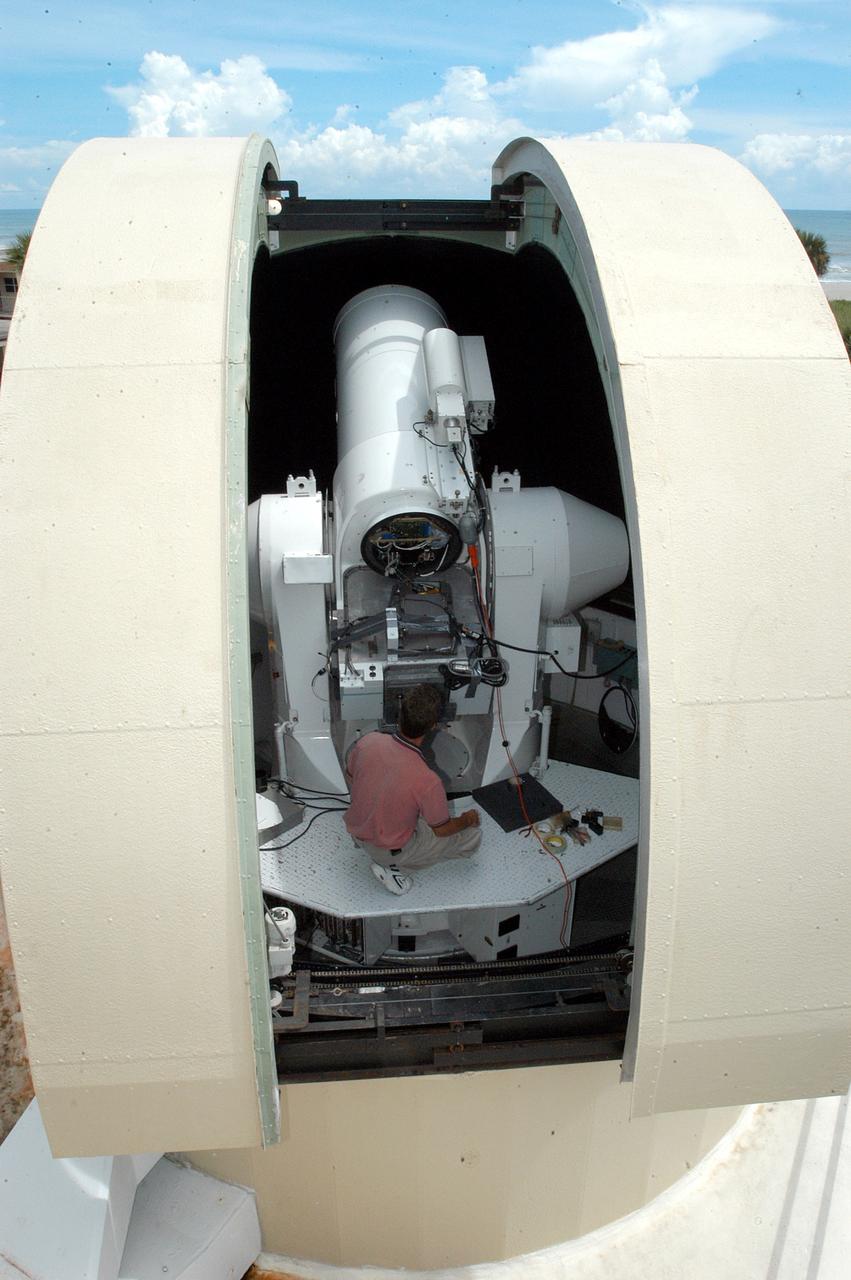
KENNEDY SPACE CENTER, FLA. - A tracking telescope, part of the Distant Object Attitude Measurement System (DOAMS), is being calibrated. The telescope, which is located in Cocoa Beach, Fla., provides optical support for launches from KSC and Cape Canaveral.
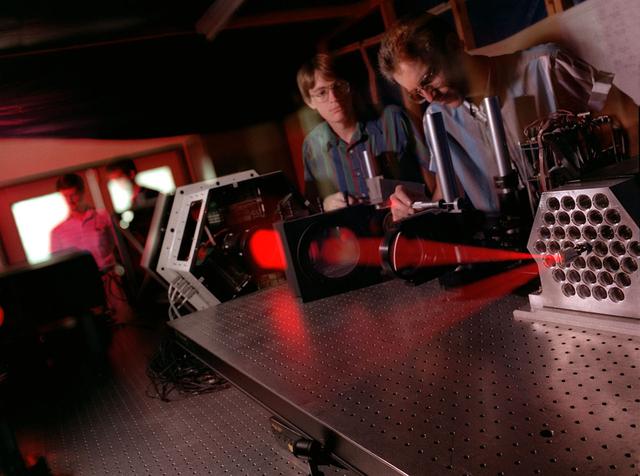
Scientists at Marshall's Adaptive Optics Lab demonstrate the Wave Front Sensor alignment using the Phased Array Mirror Extendible Large Aperture (PAMELA) optics adjustment. The primary objective of the PAMELA project is to develop methods for aligning and controlling adaptive optics segmented mirror systems. These systems can be used to acquire or project light energy. The Next Generation Space Telescope is an example of an energy acquisition system that will employ segmented mirrors. Light projection systems can also be used for power beaming and orbital debris removal. All segmented optical systems must be adjusted to provide maximum performance. PAMELA is an on going project that NASA is utilizing to investigate various methods for maximizing system performance.
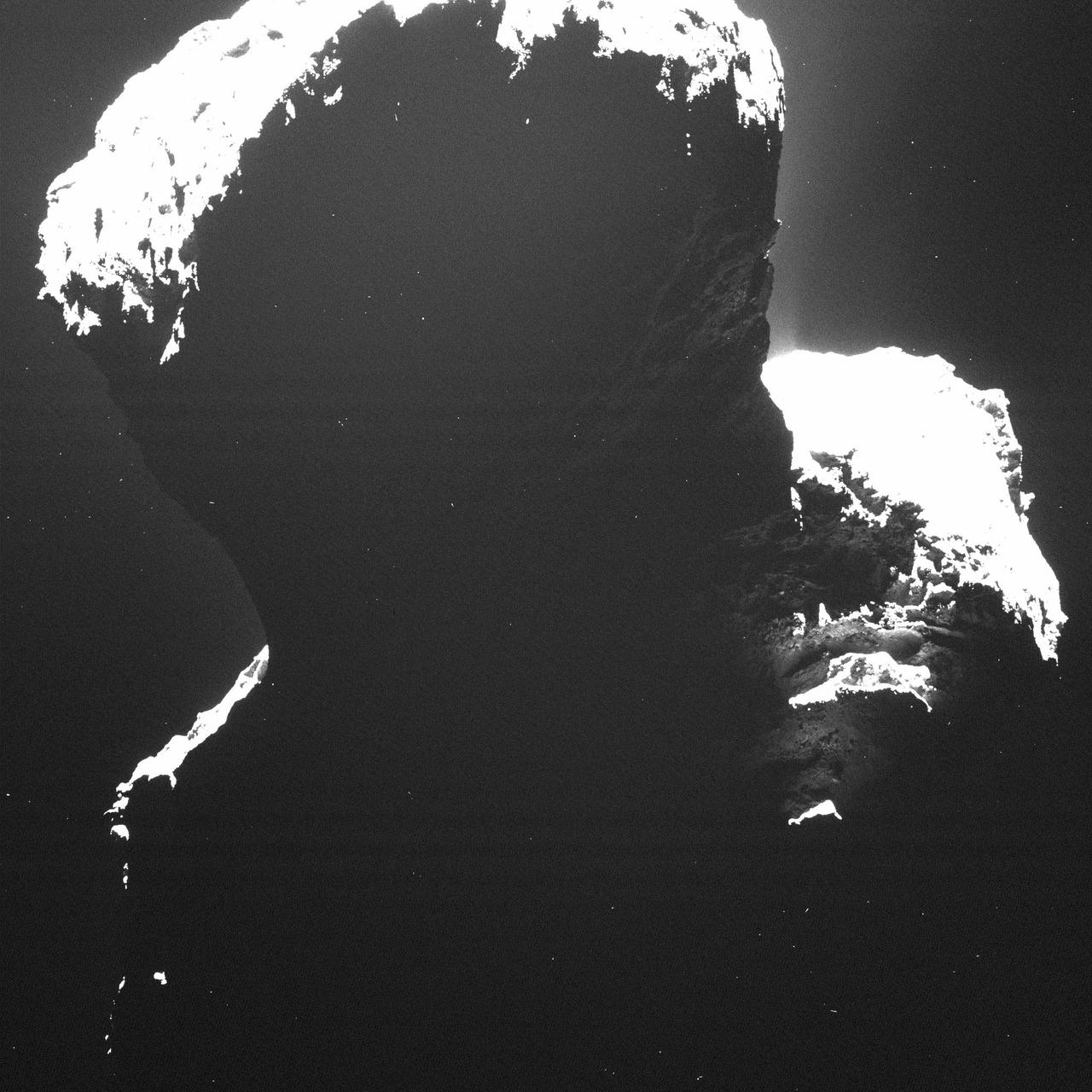
Image of the southern polar regions of comet 67P/Churyumov-Gerasimenko taken by Rosetta Optical, Spectroscopic, and Infrared Remote Imaging System OSIRIS on September 29, 2014, when the comet was still experiencing the long southern winter. http://photojournal.jpl.nasa.gov/catalog/PIA19969

Looking for a faster computer? How about an optical computer that processes data streams simultaneously and works with the speed of light? In space, NASA researchers have formed optical thin-film. By turning these thin-films into very fast optical computer components, scientists could improve computer tasks, such as pattern recognition. Dr. Hossin Abdeldayem, physicist at NASA/Marshall Space Flight Center (MSFC) in Huntsville, Al, is working with lasers as part of an optical system for pattern recognition. These systems can be used for automated fingerprinting, photographic scarning and the development of sophisticated artificial intelligence systems that can learn and evolve. Photo credit: NASA/Marshall Space Flight Center (MSFC)
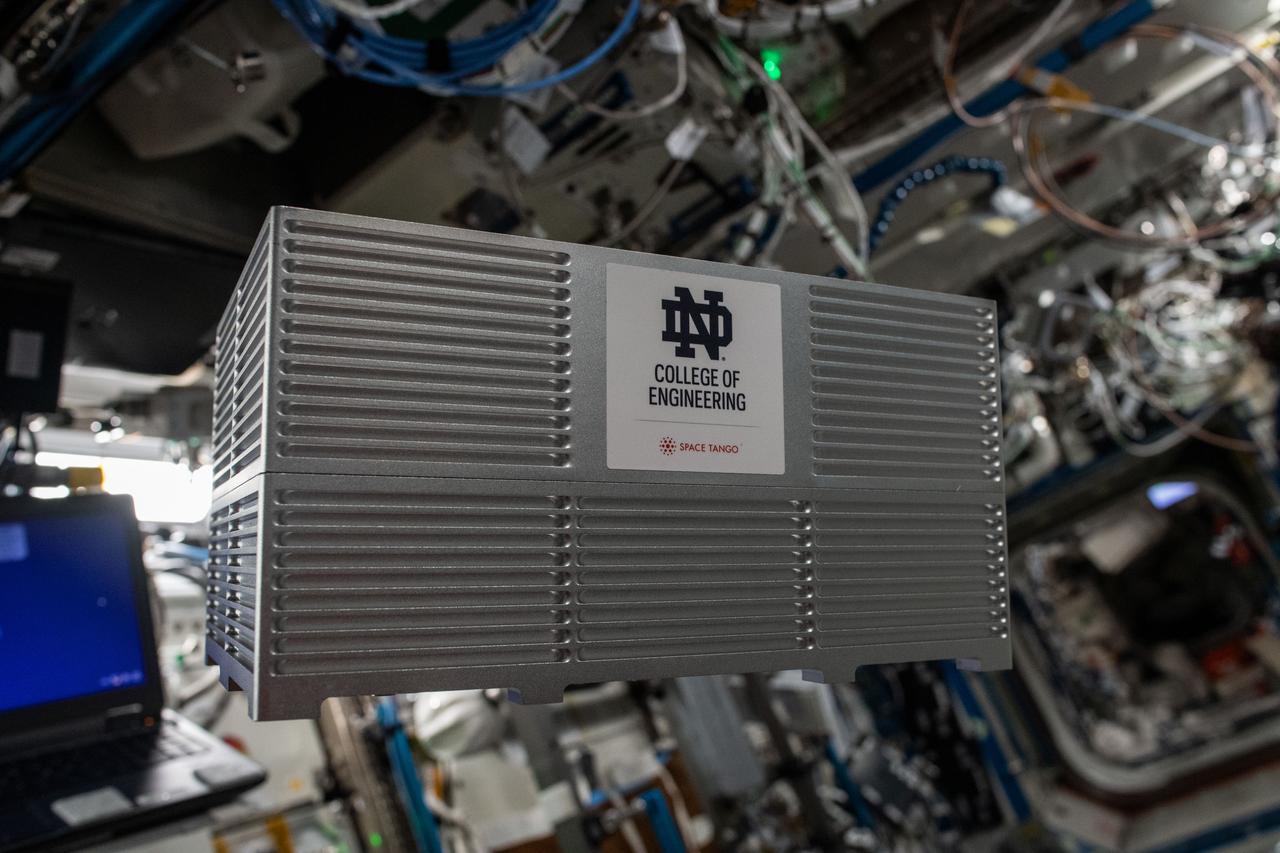
iss067e000391 (3/31/2022) --- A Nona Cube containing Optical Imaging of Bubble Dynamics on Nanostructured Surfaces, part of TangoLab Mission-25. The Optical Imaging of Bubble Dynamics on Nanostructured Surfaces investigation observes thermal bubbles in a microgravity environment with the use of an optical imaging system.
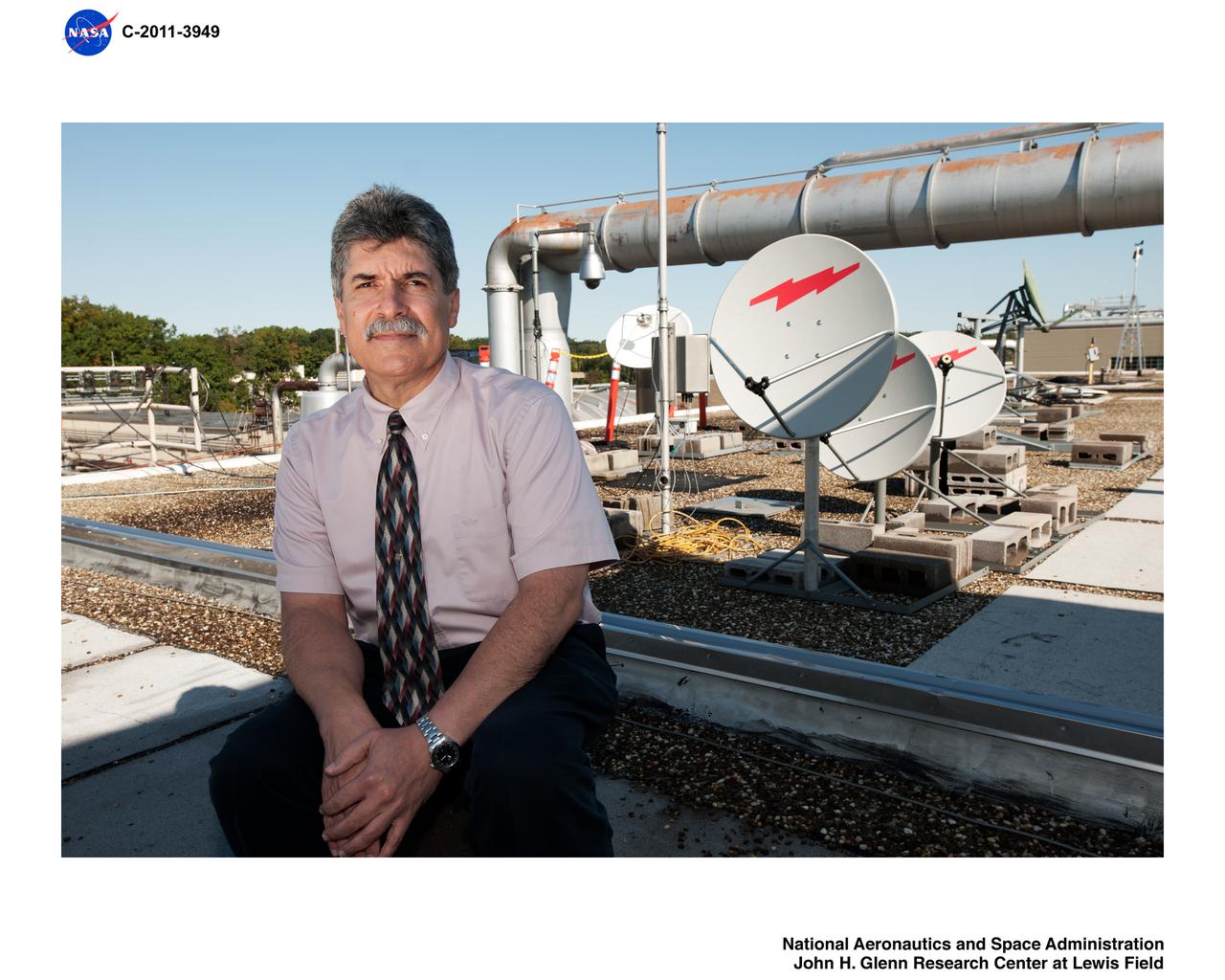
Environmental Portrait of the Antenna and Optical Systems Branch Chief
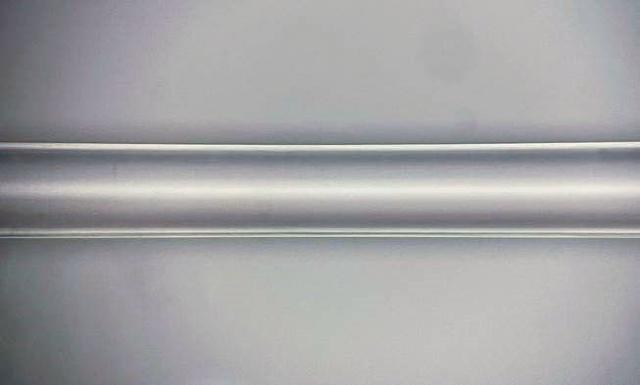
jsc2021e044608 (9/23/2021) --- A microscopic image of a section of ZBLAN optical fiber produced by the second iteration of Fiber Optic Production (FOP1.5) aboard the International Space station (ISS). Image courtesy of Mercury Systems.

A photographer focuses on part of the tracking telescope that provides optical support for launches from KSC and Cape Canaveral. The telescope is part of the Distant Object Attitude Measurement System (DOAMS), which includes improved tracking cameras and long-range optical tracking systems that will be used to capture ascent imagery during the return to flight of the Space Shuttle.
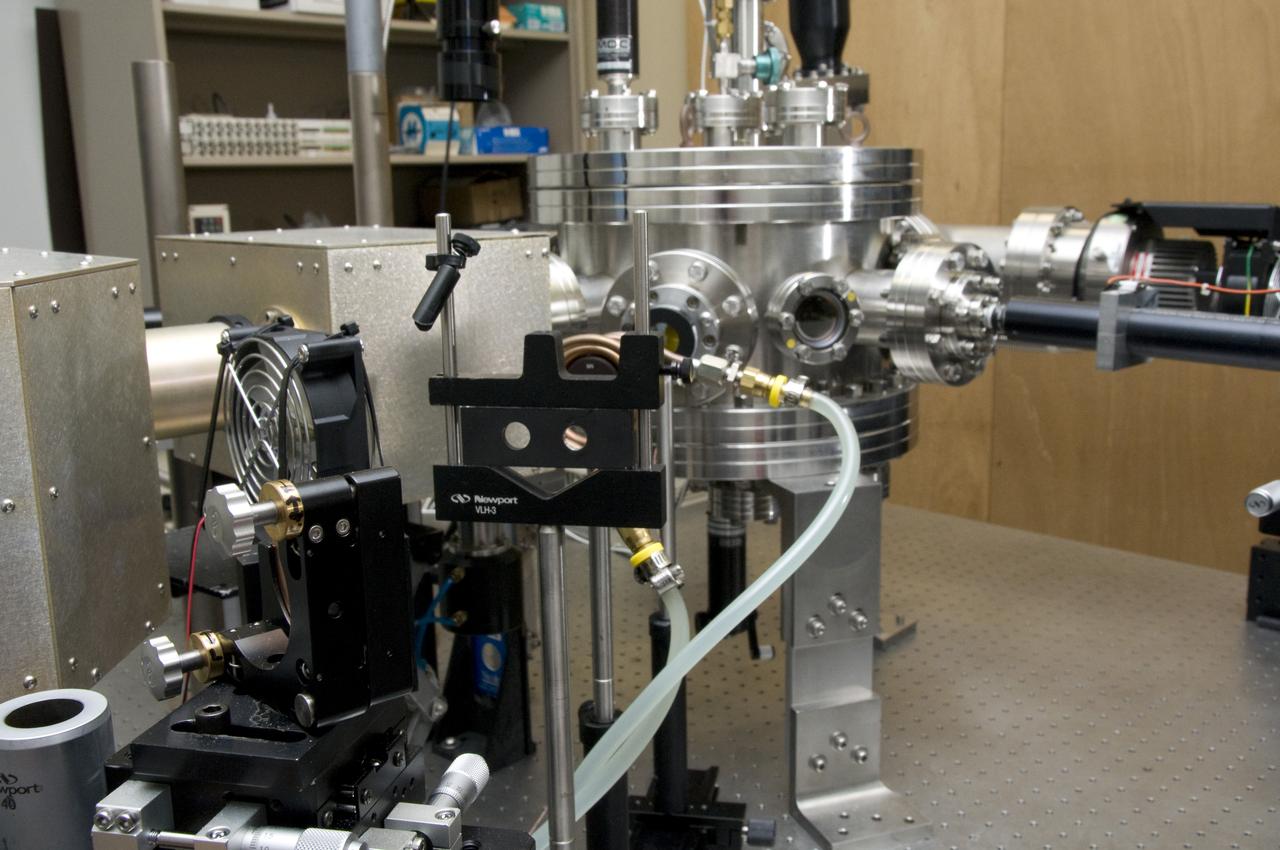
HIGH TEMPERATURE EMISSOMETER SYSTEM (HITEMS) CHAMBER SHOWING COIL FOR COOLING OPTICS
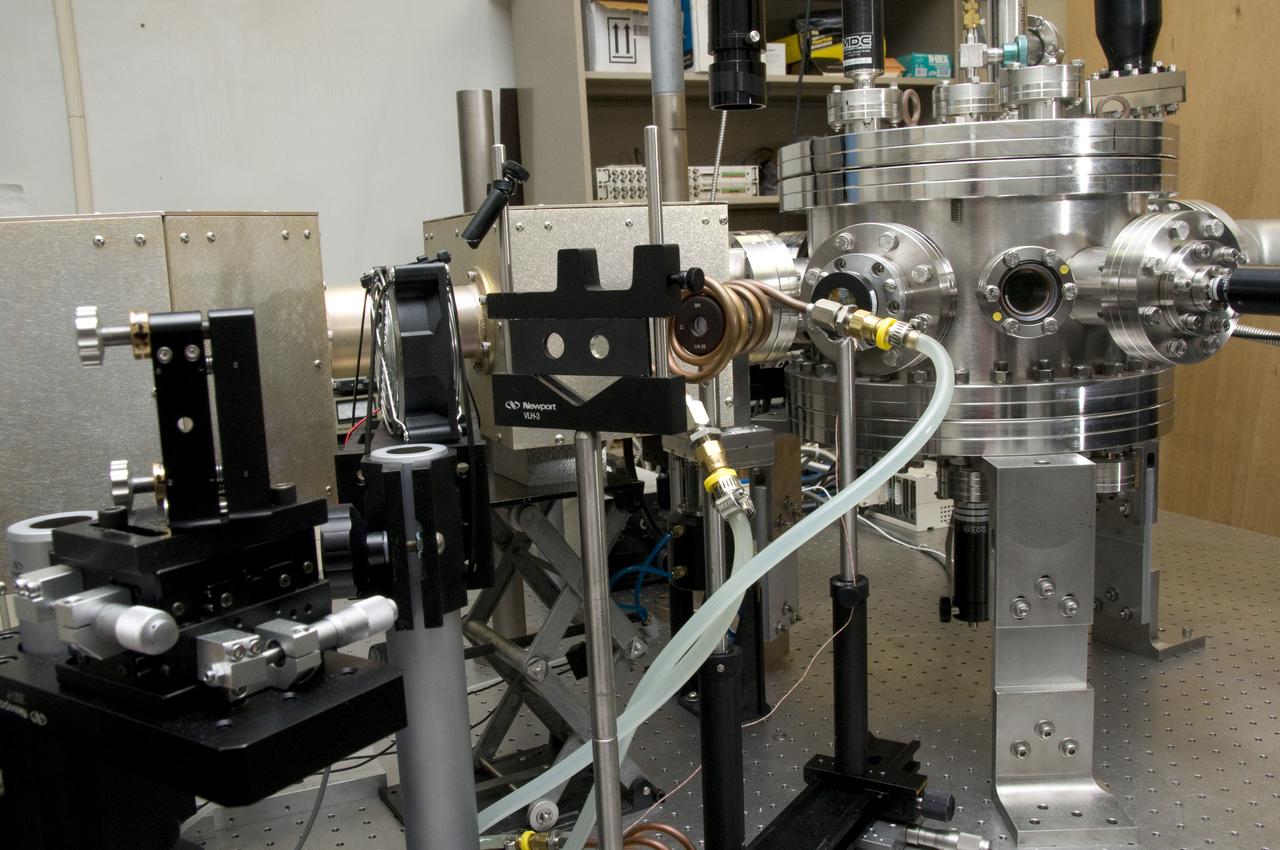
HIGH TEMPERATURE EMISSOMETER SYSTEM (HITEMS) CHAMBER SHOWING COIL FOR COOLING OPTICS
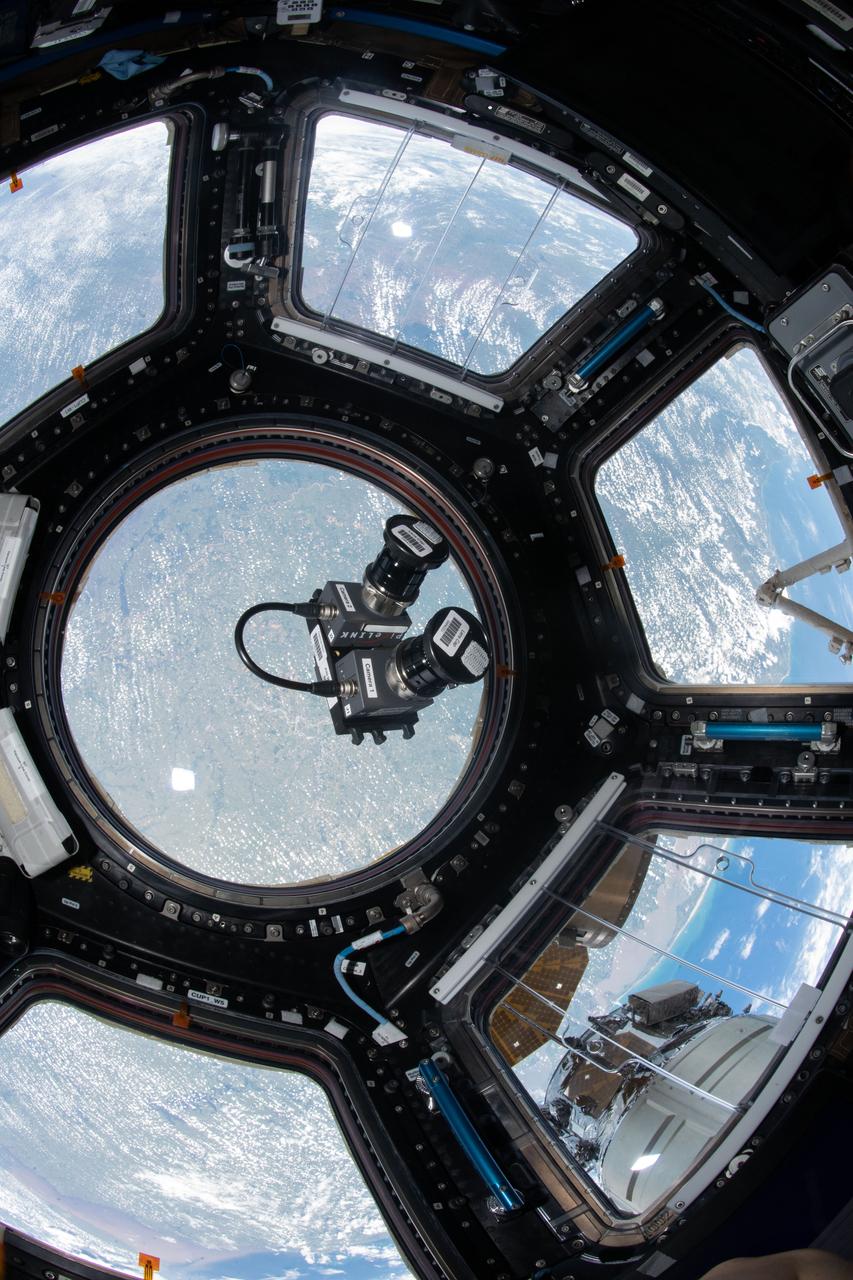
iss058e007453 (1/29/2019) --- A camera assembly containing two cameras similar to that used by the Orion Optical Navigation System is shown in the cupola onboard the International Space Station (ISS). The Optical Navigation (Optical Nav) investigation is a technology demonstration used to validate the backup navigation system for the Orion Multi-Purpose Crew Vehicle. Images of the Moon and adjacent star fields are being collected by these two cameras from the ISS cupola. The images are then analyzed on the ground using the same algorithms that will fly onboard Orion to determine vehicle position. These derived position measurements will be compared to the known position of the ISS at the moment each photo was taken. This will help validate the optical navigation performance using ISS as the test vehicle.
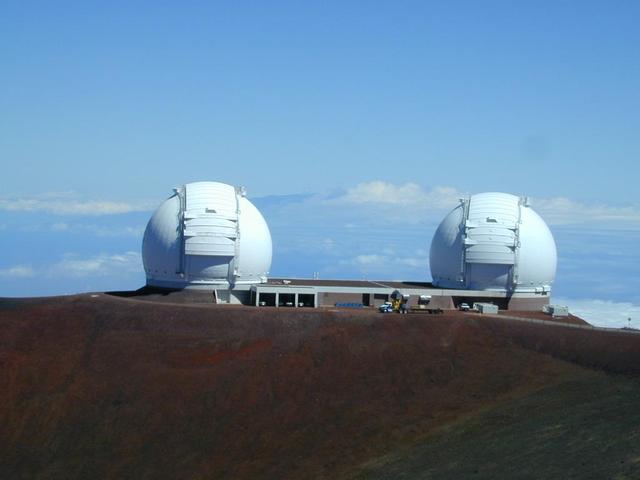
At the summit of Mauna Kea, Hawaii, NASA astronomers have linked the two 10-meter 33-foot telescopes at the W. M. Keck Observatory. The linked telescopes, together are called the Keck Interferometer, the world most powerful optical telescope system.
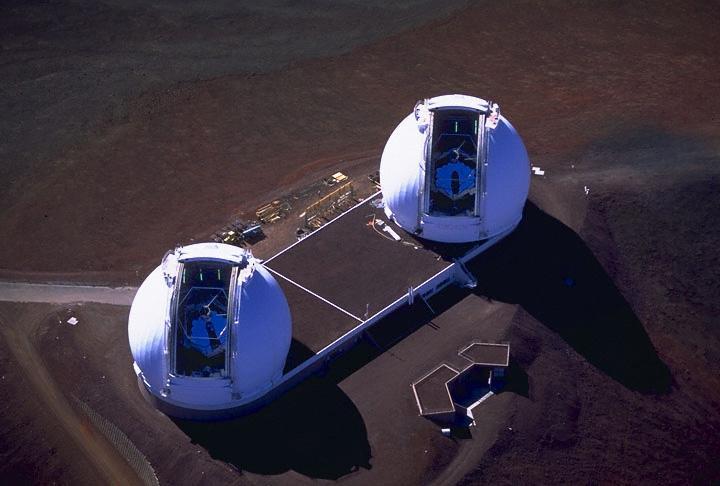
At the summit of Mauna Kea, Hawaii, NASA astronomers have linked the two 10-meter 33-foot telescopes at the W. M. Keck Observatory. The linked telescopes, together are called the Keck Interferometer, the world most powerful optical telescope system.
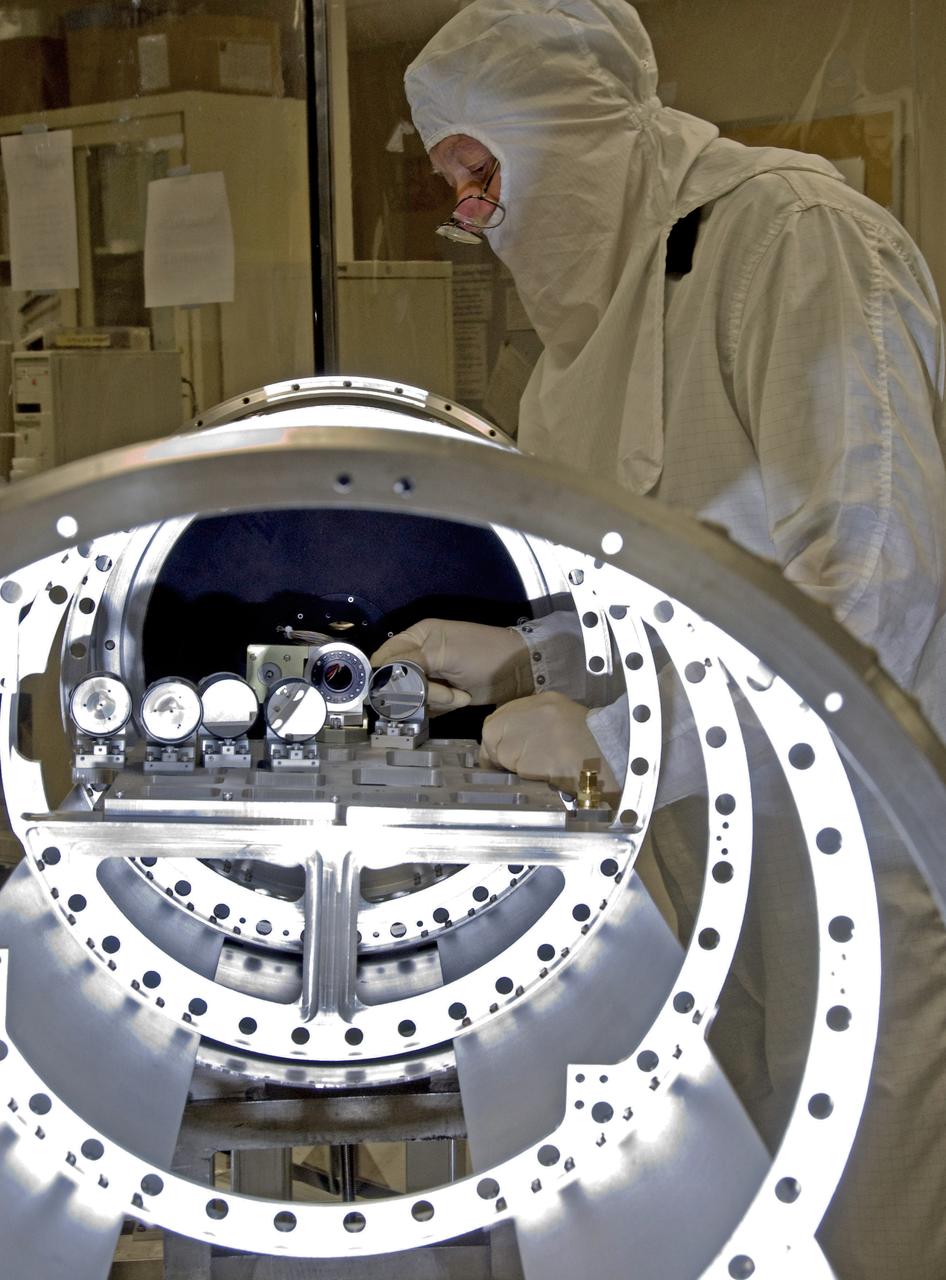
MARSHALL SCIENTIST ED WEST ASSEMBLES THE OPTICAL SYSTEM OF THE SOLAR ULTRAVIOLET MAGNETOGRAPH INVESTIGATION TELESCOPE
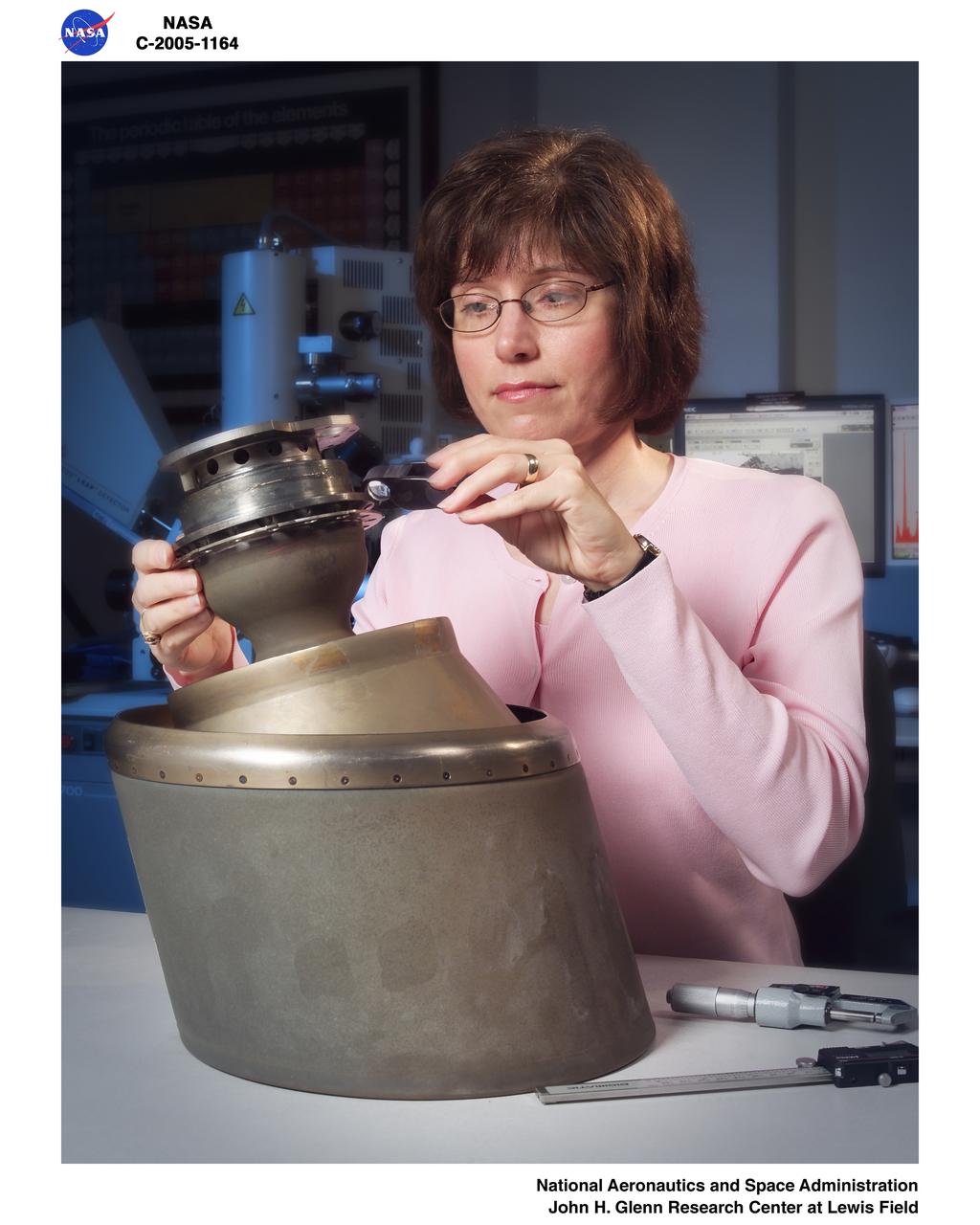
Reaction Control System Thruster examined in the electron optics lab Near Field Emission Scanning Electron Microscope
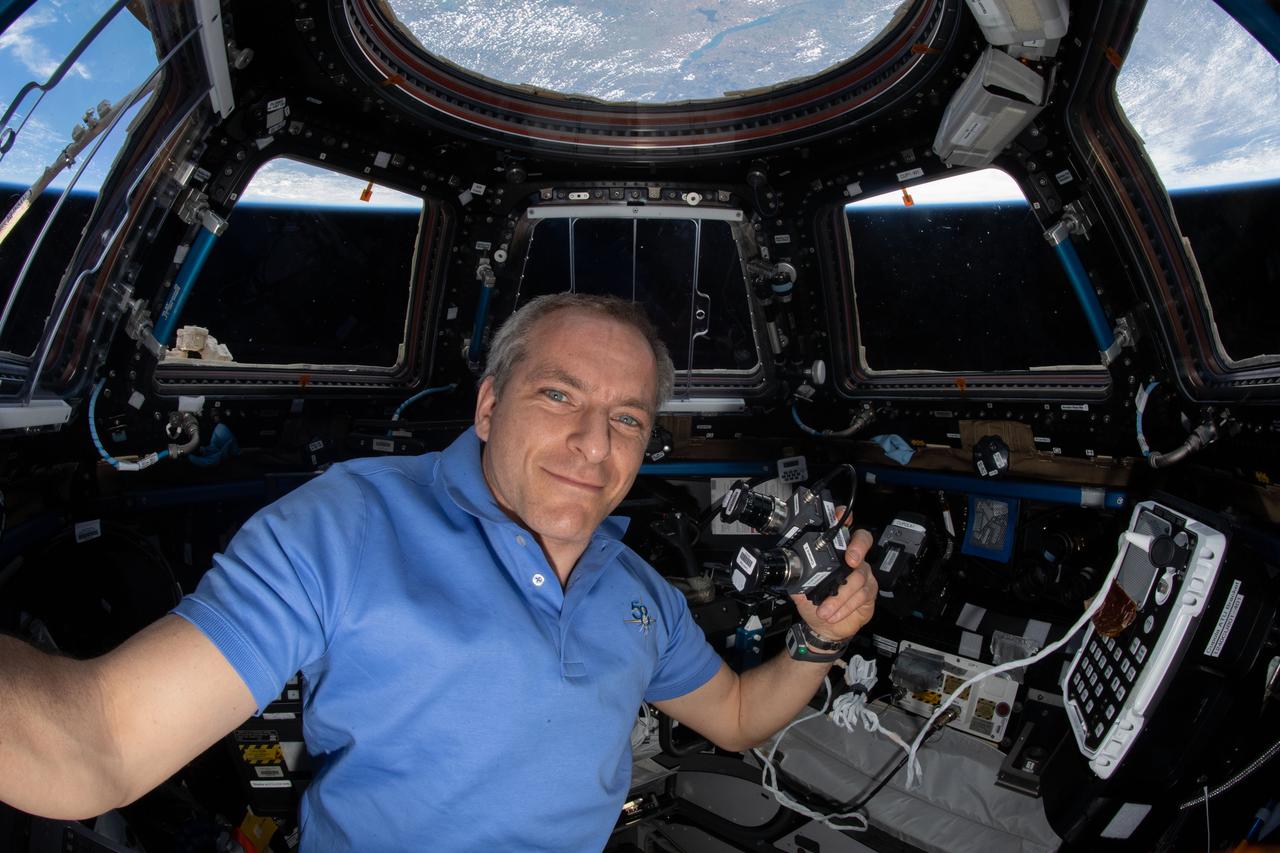
iss058e007457 (1/29/2019) --- Canadian Space Agency astronaut David Saint-Jacques is shown in the cupola onboard the International Space Station (ISS) with a camera assembly similar to that used by the Orion Optical Navigation System. The Optical Navigation (Optical Nav) investigation is a technology demonstration used to validate the backup navigation system for the Orion Multi-Purpose Crew Vehicle. Images of the Moon and adjacent star fields are being collected by these two cameras from the ISS cupola. The images are then analyzed on the ground using the same algorithms that will fly onboard Orion to determine vehicle position. These derived position measurements will be compared to the known position of the ISS at the moment each photo was taken. This will help validate the optical navigation performance using ISS as the test vehicle.
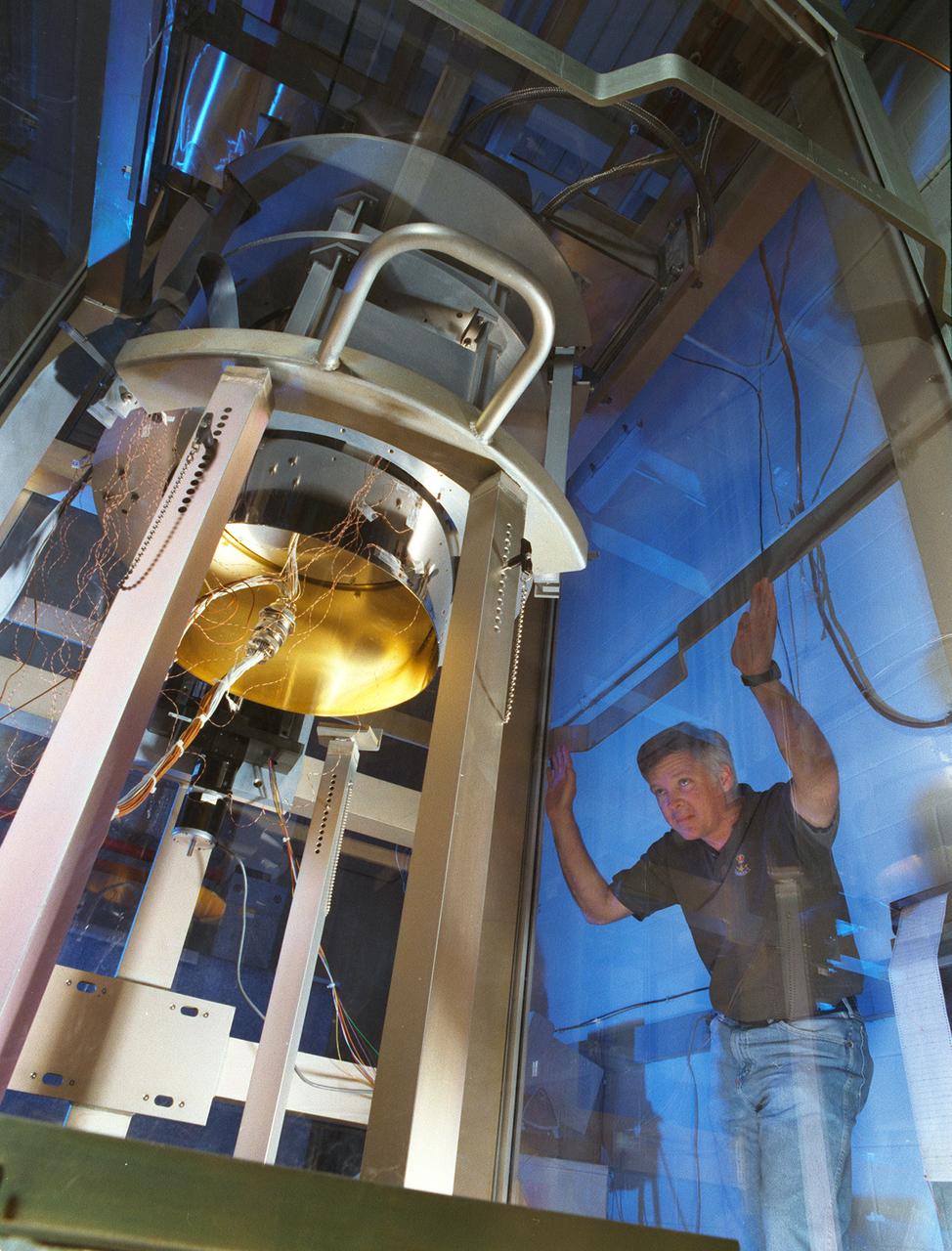
NASA's Space Optics Manufacturing Center has been working to expand our view of the universe via sophisticated new telescopes. The Optics Center's goal is to develop low-cost, advanced space optics technologies for the NASA program in the 21st century - including the long-term goal of imaging Earth-like planets in distant solar systems. To reduce the cost of mirror fabrication, Marshall Space Flight Center (MSFC) has developed replication techniques, the machinery, and materials to replicate electro-formed nickel mirrors. Optics replication uses reusable forms, called mandrels, to make telescope mirrors ready for final finishing. MSFC optical physicist Bill Jones monitors a device used to chill a mandrel, causing it to shrink and separate from the telescope mirror without deforming the mirror's precisely curved surface.
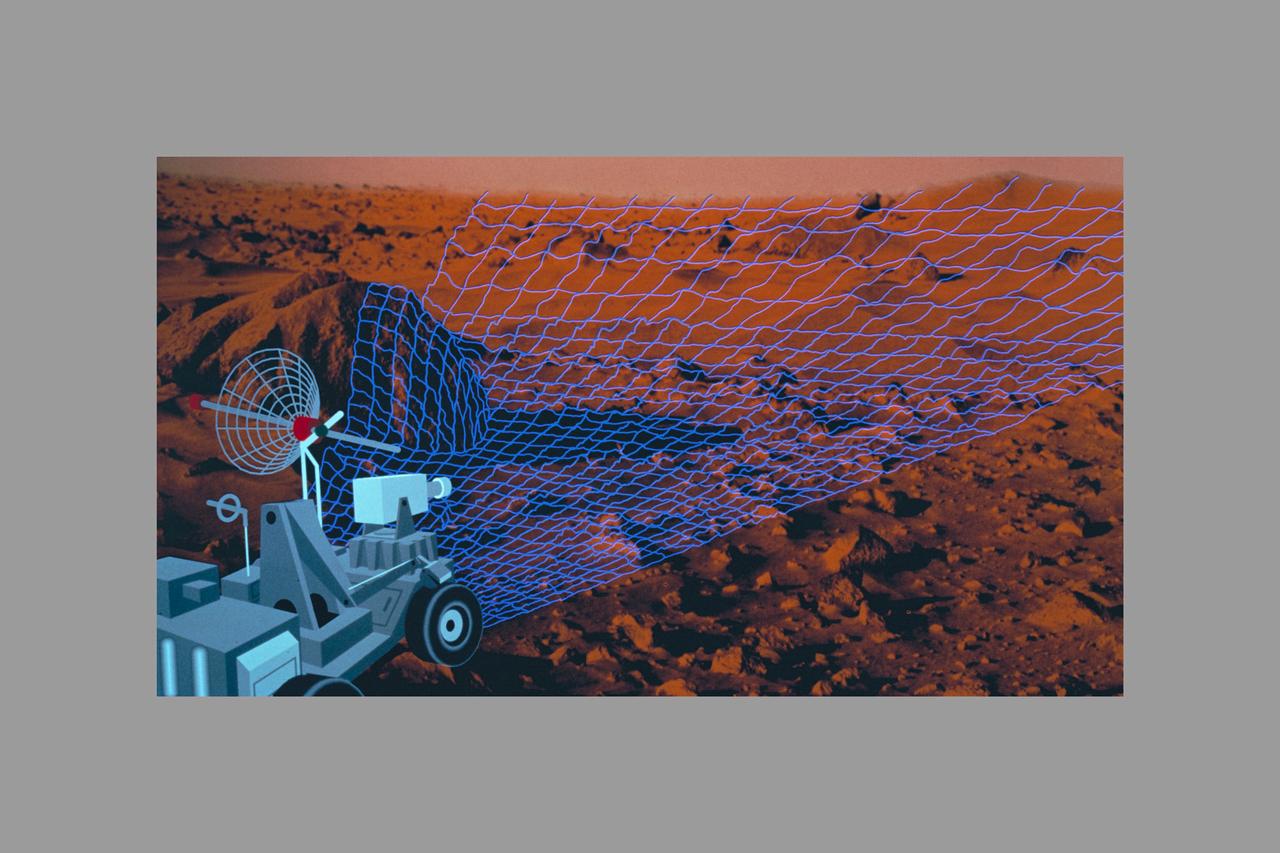
Autonomous Perception Vision project - Intelligent Systems - Machine Vision, Fusing Photonics and A.I. - Fiber-Optic Probe for Laser Velocimetry (Mars)

Inside the high bay of the Neil Armstrong Operations and Checkout Building at NASA’s Kennedy Space Center in Florida, technicians assemble on the Optical Communications System for the Artemis II mission on June 2, 2023. Optical communications is the latest space communications technology that is able to provide data rates as much as a hundred times higher than current systems. This will allow astronauts to send and receive ultra-high-definition video from the surface of the Moon or other planets such as Mars. Artemis II will be the first Artemis mission flying crew aboard Orion.
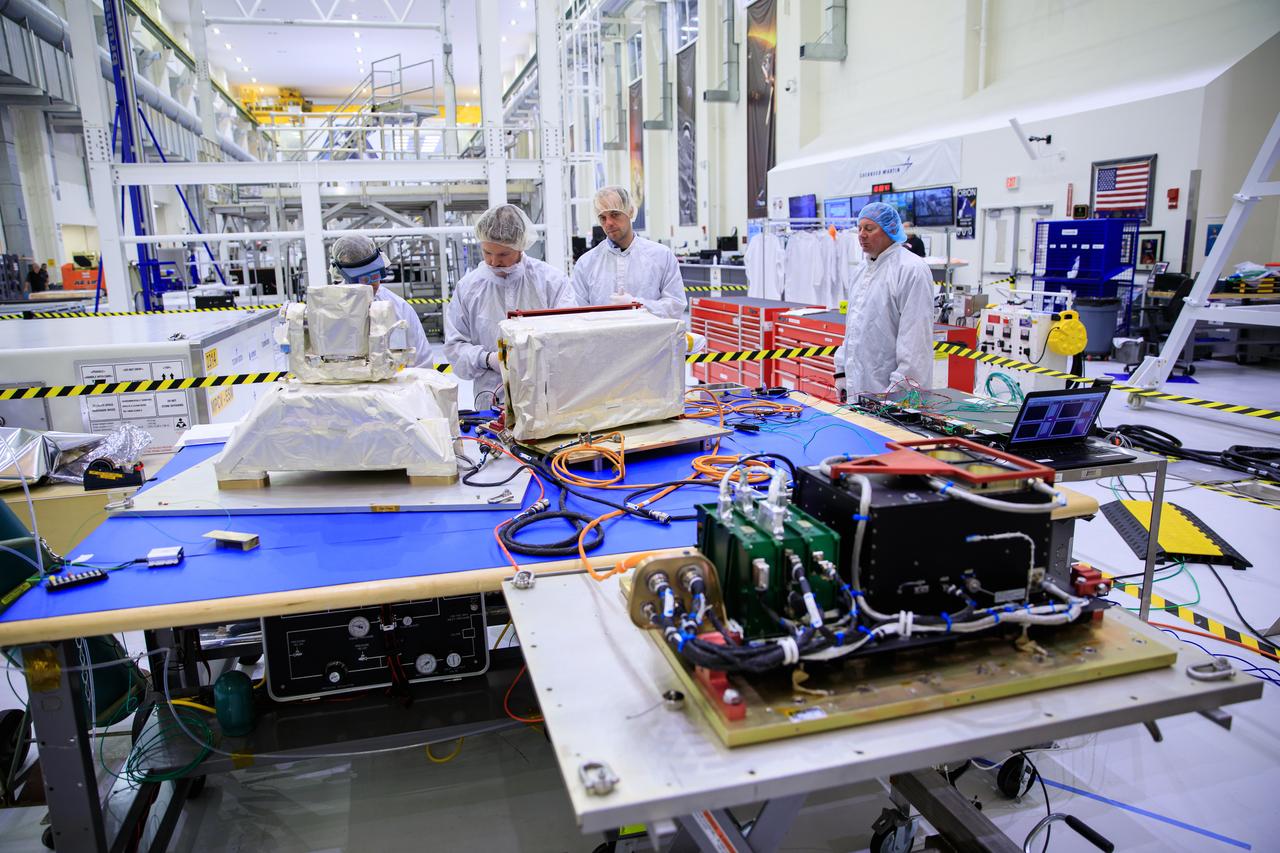
Inside the high bay of the Neil Armstrong Operations and Checkout Building at NASA’s Kennedy Space Center in Florida, technicians assemble on the Optical Communications System for the Artemis II mission on June 2, 2023. Optical communications is the latest space communications technology that is able to provide data rates as much as a hundred times higher than current systems. This will allow astronauts to send and receive ultra-high-definition video from the surface of the Moon or other planets such as Mars. Artemis II will be the first Artemis mission flying crew aboard Orion.
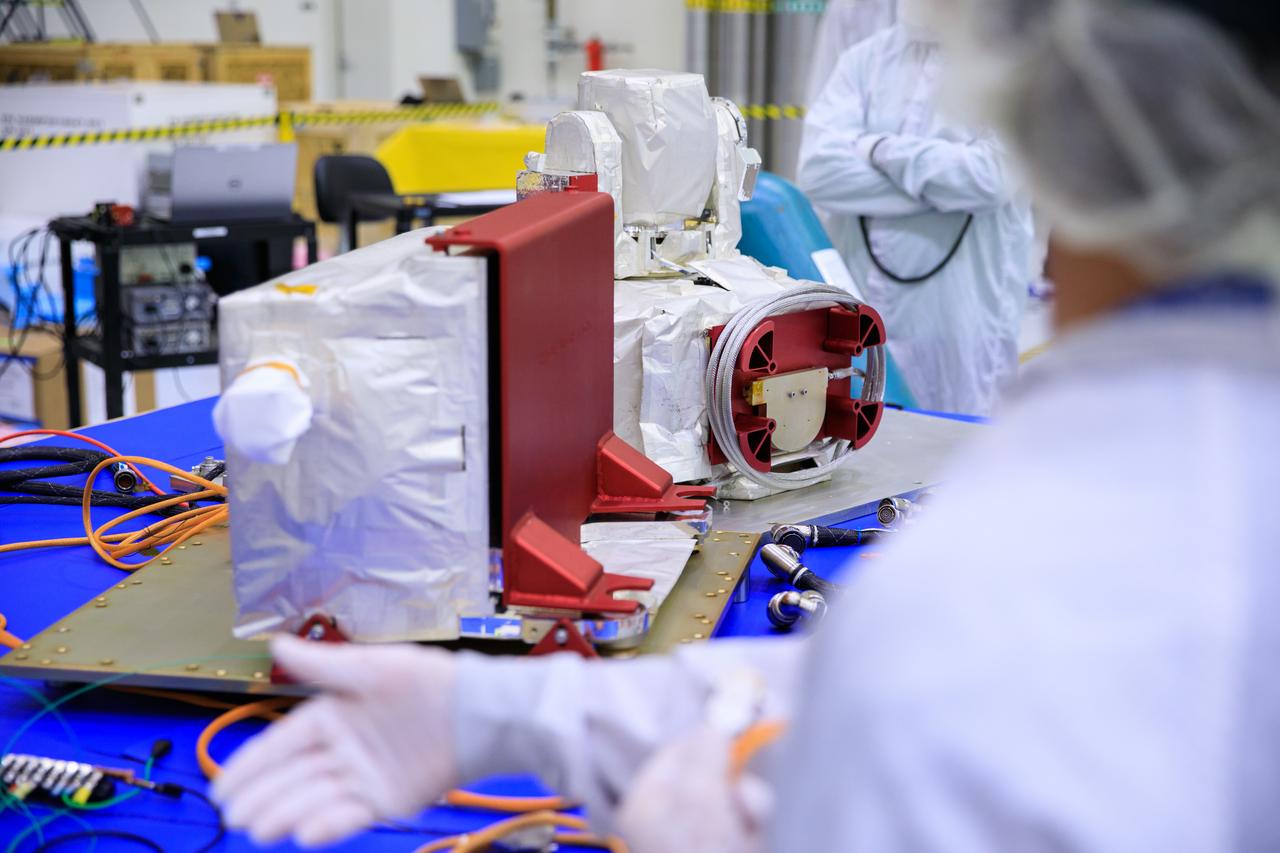
Inside the high bay of the Neil Armstrong Operations and Checkout Building at NASA’s Kennedy Space Center in Florida, technicians assemble on the Optical Communications System for the Artemis II mission on June 2, 2023. Optical communications is the latest space communications technology that is able to provide data rates as much as a hundred times higher than current systems. This will allow astronauts to send and receive ultra-high-definition video from the surface of the Moon or other planets such as Mars. Artemis II will be the first Artemis mission flying crew aboard Orion.
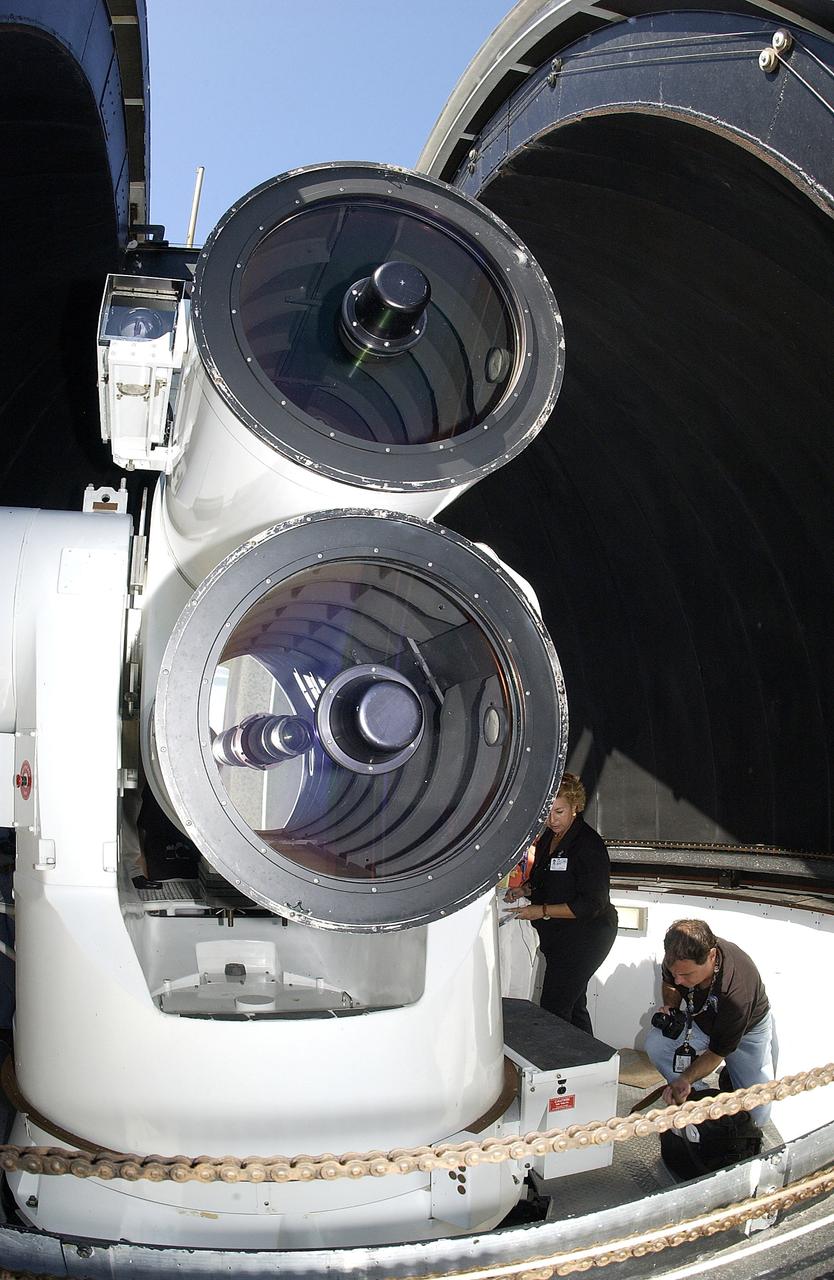
KENNEDY SPACE CENTER, FLA. - Viewed here is part of the tracking telescope that provides optical support for launches from KSC and Cape Canaveral. The telescope is part of the Distant Object Attitude Measurement System (DOAMS), which includes improved tracking cameras and long-range optical tracking systems that will be used to capture ascent imagery during the return to flight of the Space Shuttle.
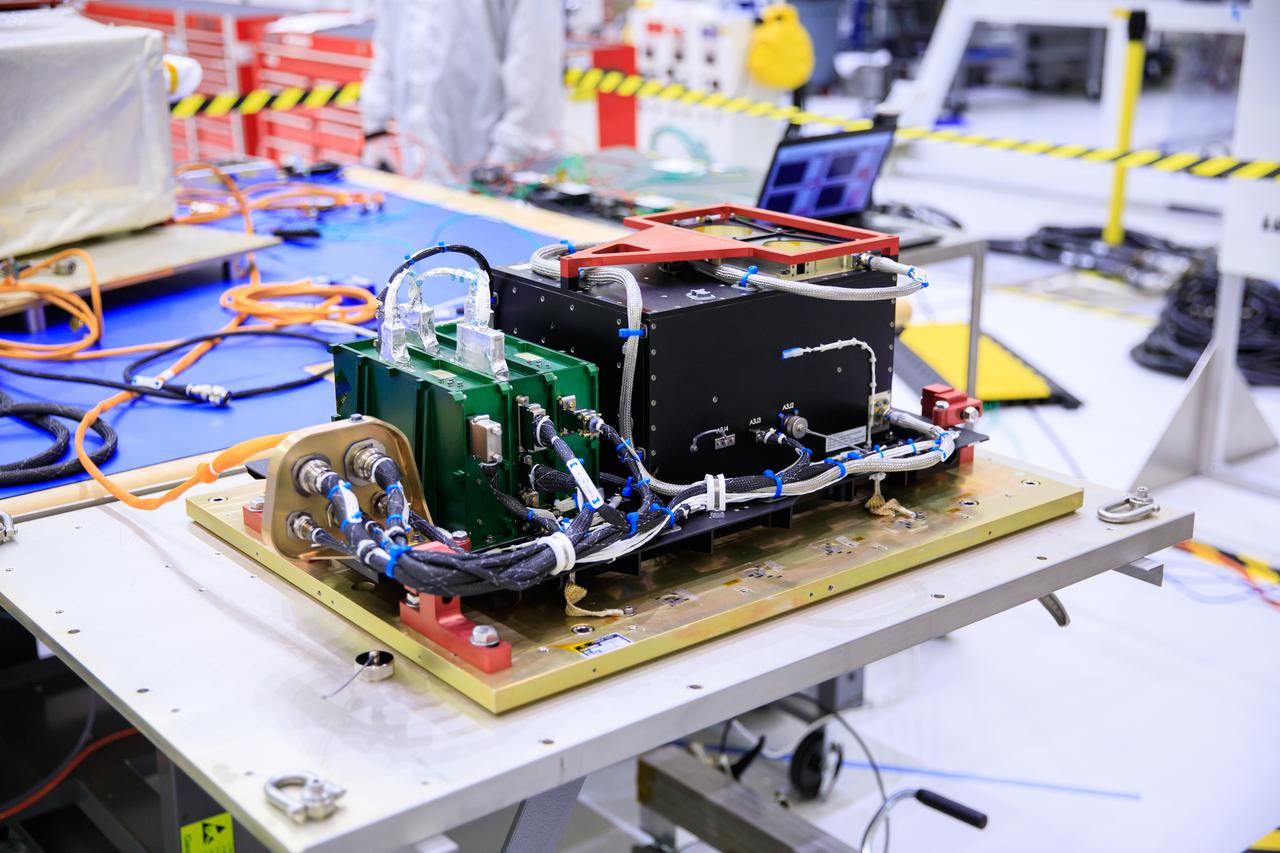
A close-up view of one of the parts of the Optical Communications System for the Artemis II mission inside the Neil Armstrong Operations and Checkout Building high bay on June 2, 2023. Optical communications is the latest space communications technology that is able to provide data rates as much as a hundred times higher than current systems. This will allow astronauts to send and receive ultra-high-definition video from the surface of the Moon or other planets such as Mars. Artemis II will be the first Artemis mission flying crew aboard Orion.
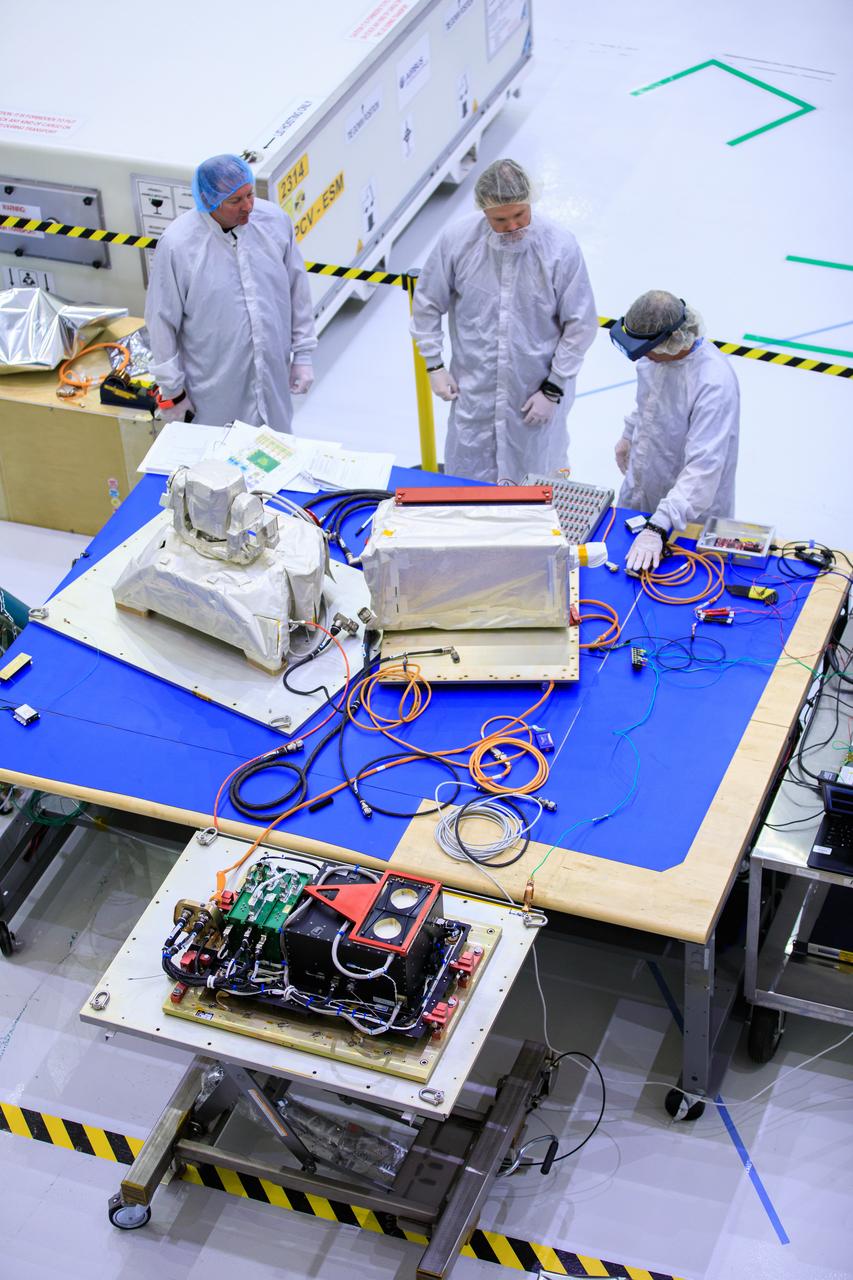
Inside the high bay of the Neil Armstrong Operations and Checkout Building at NASA’s Kennedy Space Center in Florida, technicians assemble on the Optical Communications System for the Artemis II mission on June 2, 2023. Optical communications is the latest space communications technology that is able to provide data rates as much as a hundred times higher than current systems. This will allow astronauts to send and receive ultra-high-definition video from the surface of the Moon or other planets such as Mars. Artemis II will be the first Artemis mission flying crew aboard Orion.
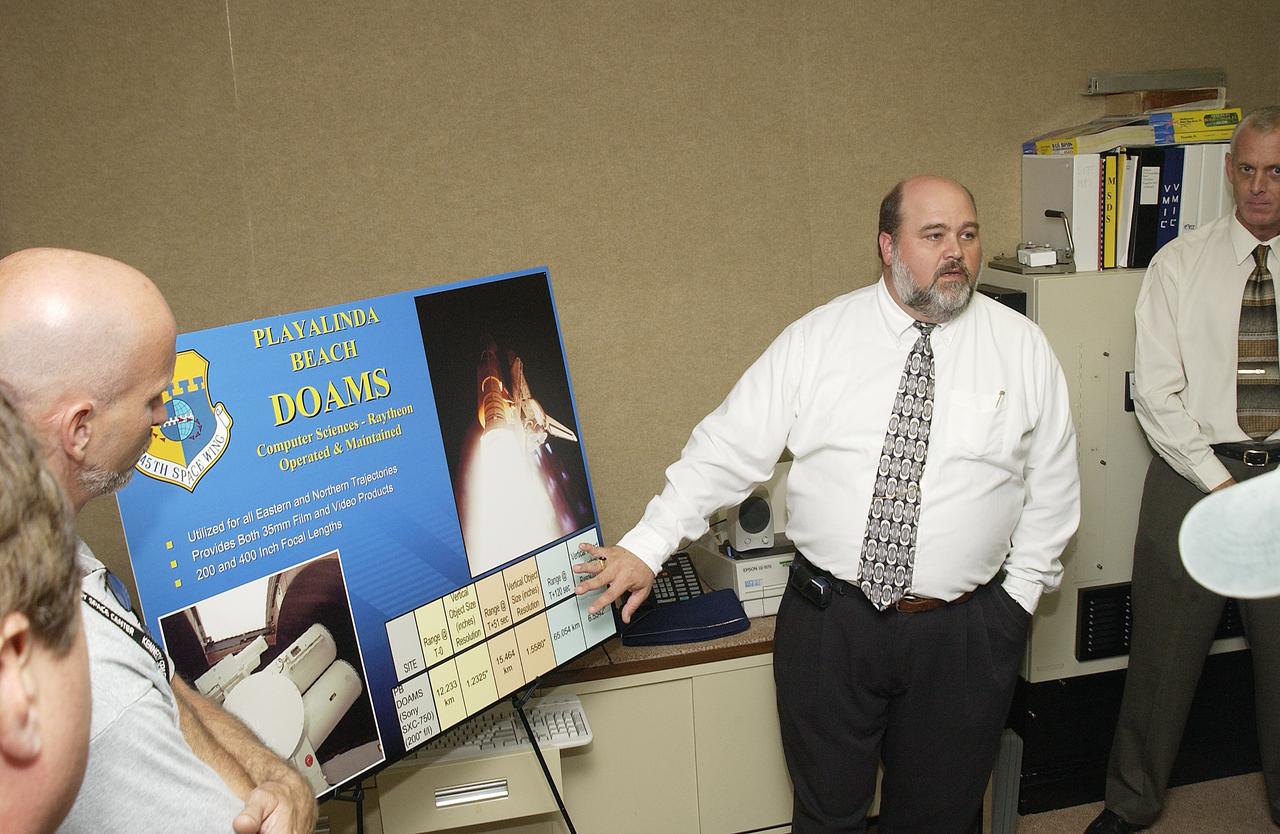
Inside the dome building at Playalinda Beach, Mike Litscher talks to media about the Distant Object Attitude Measurement System (DOAMS), part of the improved tracking cameras and long-range optical tracking systems that will be used to capture ascent imagery during the return to flight of the Space Shuttle. The press opportunity also includes tours of the launch pad perimeter camera site at Launch Complex 39B and the other optical tracking site at the Merritt Island National Refuge.
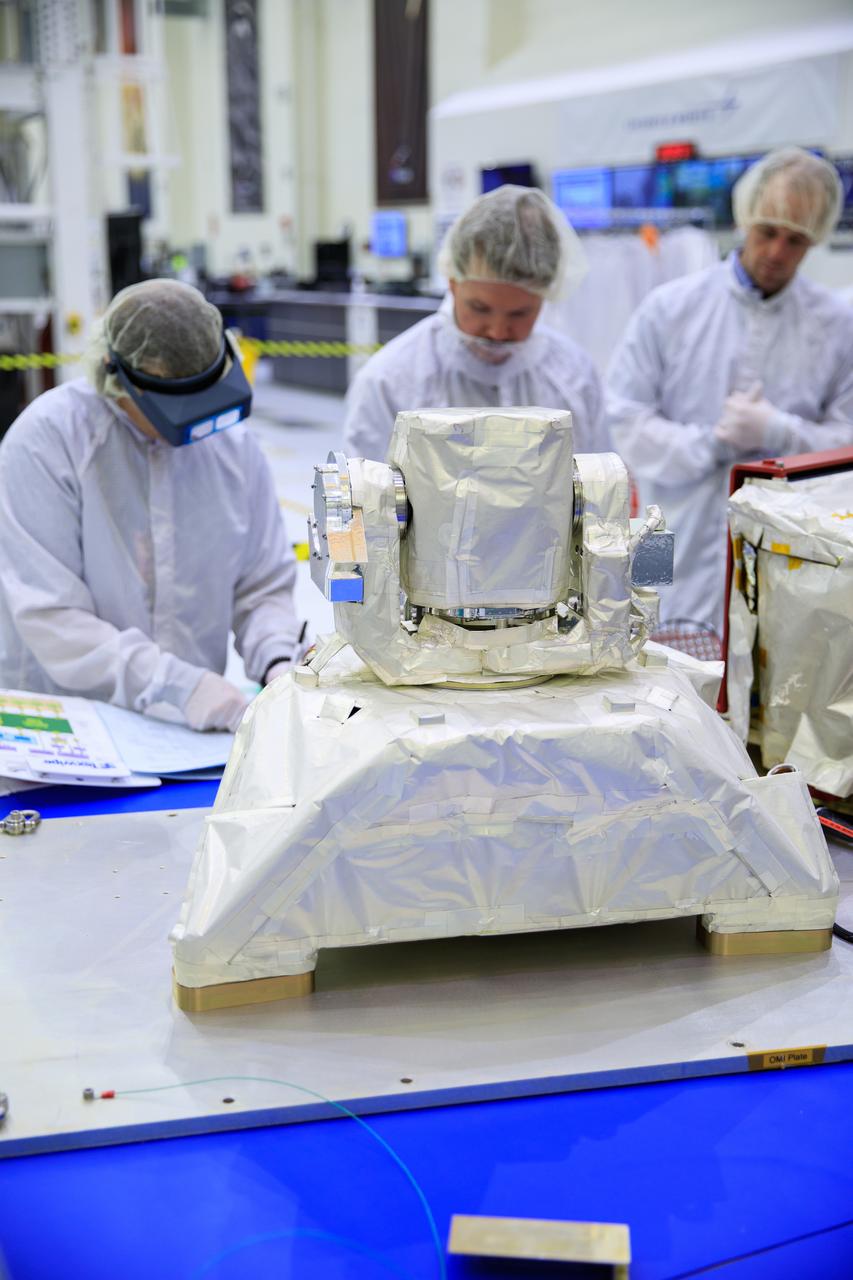
Inside the high bay of the Neil Armstrong Operations and Checkout Building at NASA’s Kennedy Space Center in Florida, technicians work on the Optical Communications System for the Artemis II mission on June 2, 2023. Optical communications is the latest space communications technology that is able to provide data rates as much as a hundred times higher than current systems. This will allow astronauts to send and receive ultra-high-definition video from the surface of the Moon or other planets such as Mars. Artemis II will be the first Artemis mission flying crew aboard Orion.

Inside the high bay of the Neil Armstrong Operations and Checkout Building at NASA’s Kennedy Space Center in Florida, technicians assemble on the Optical Communications System for the Artemis II mission on June 2, 2023. Optical communications is the latest space communications technology that is able to provide data rates as much as a hundred times higher than current systems. This will allow astronauts to send and receive ultra-high-definition video from the surface of the Moon or other planets such as Mars. Artemis II will be the first Artemis mission flying crew aboard Orion.
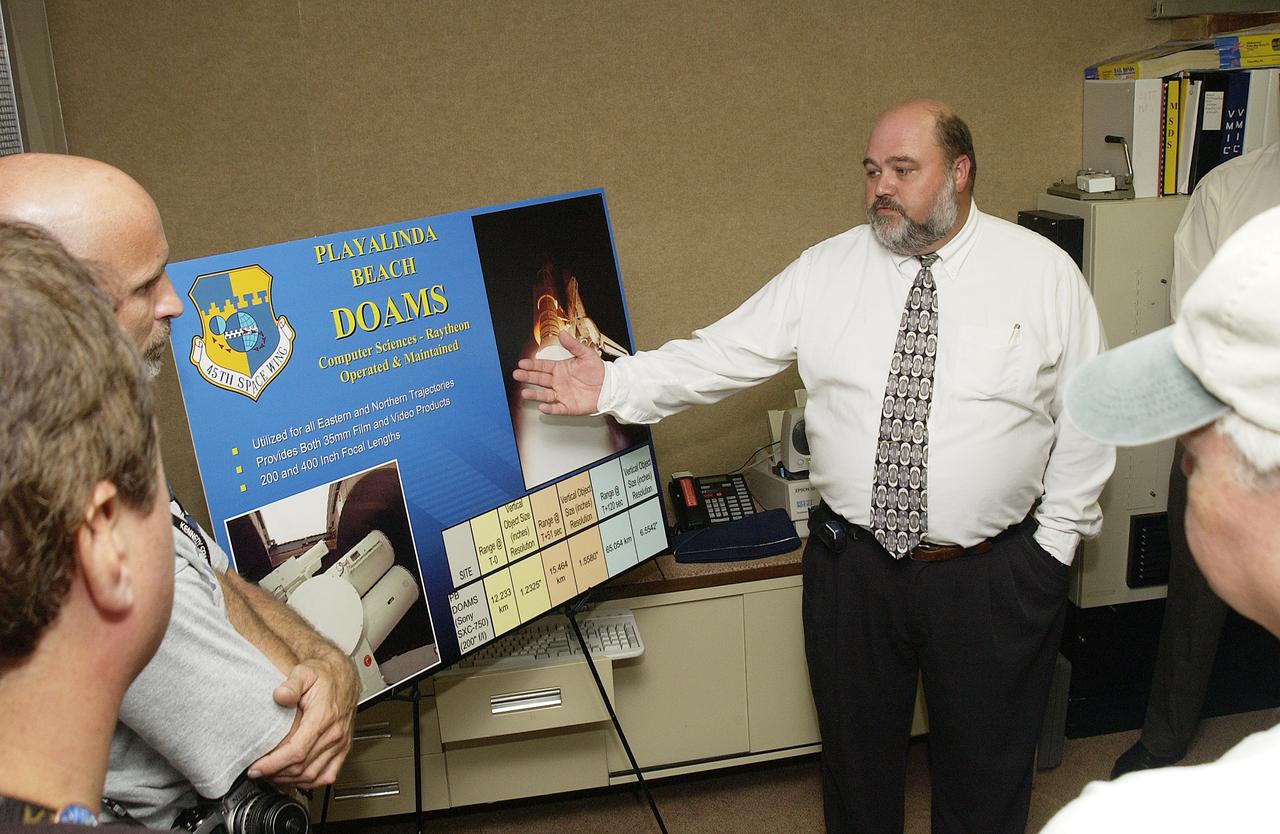
Inside the dome building at Playalinda Beach, Mike Litscher talks to media about the Distant Object Attitude Measurement System (DOAMS), part of the improved tracking cameras and long-range optical tracking systems that will be used to capture ascent imagery during the return to flight of the Space Shuttle. The press opportunity also includes tours of the launch pad perimeter camera site at Launch Complex 39B and the other optical tracking site at the Merritt Island National Refuge.
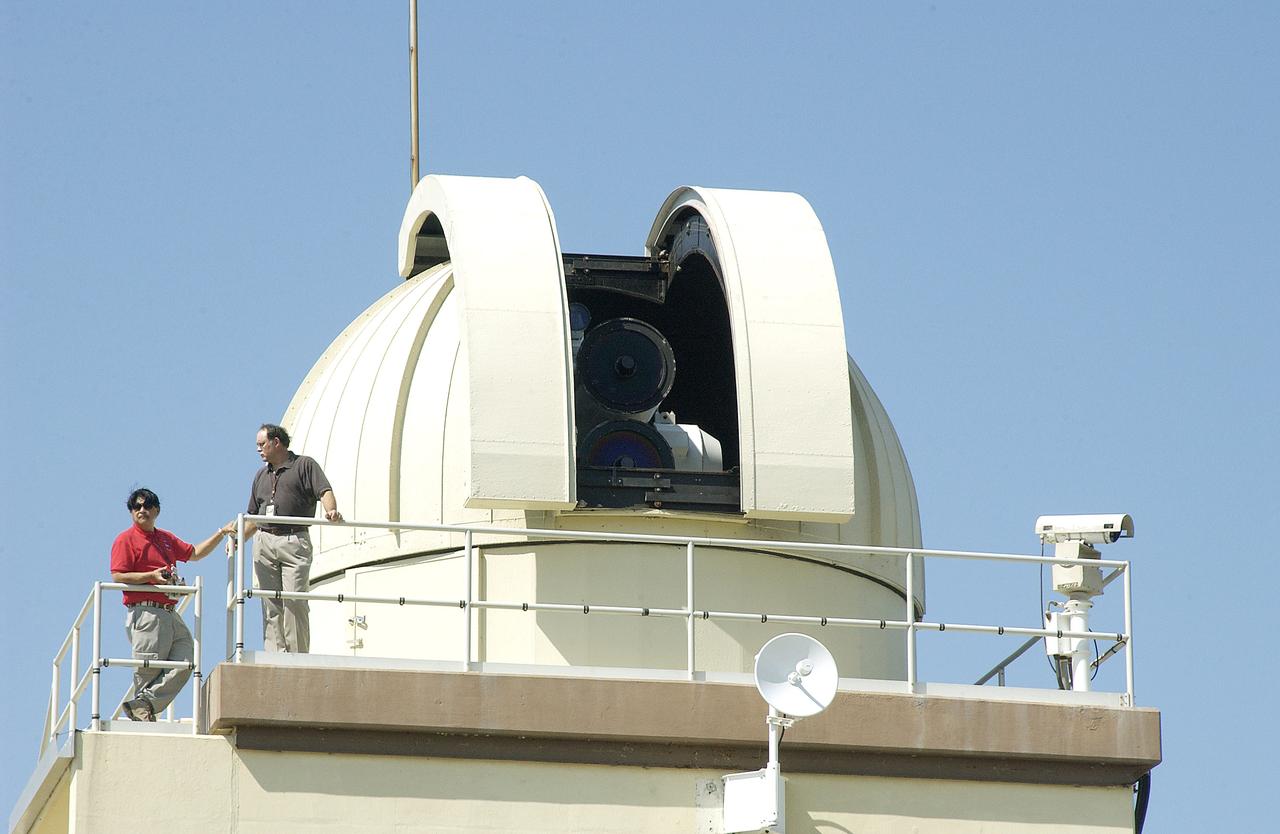
Inside the dome seen here is a tracking telescope that provides optical support for launches from KSC and Cape Canaveral. The telescope is part of the Distant Object Attitude Measurement System (DOAMS), which includes improved tracking cameras and long-range optical tracking systems that will be used to capture ascent imagery during the return to flight of the Space Shuttle.
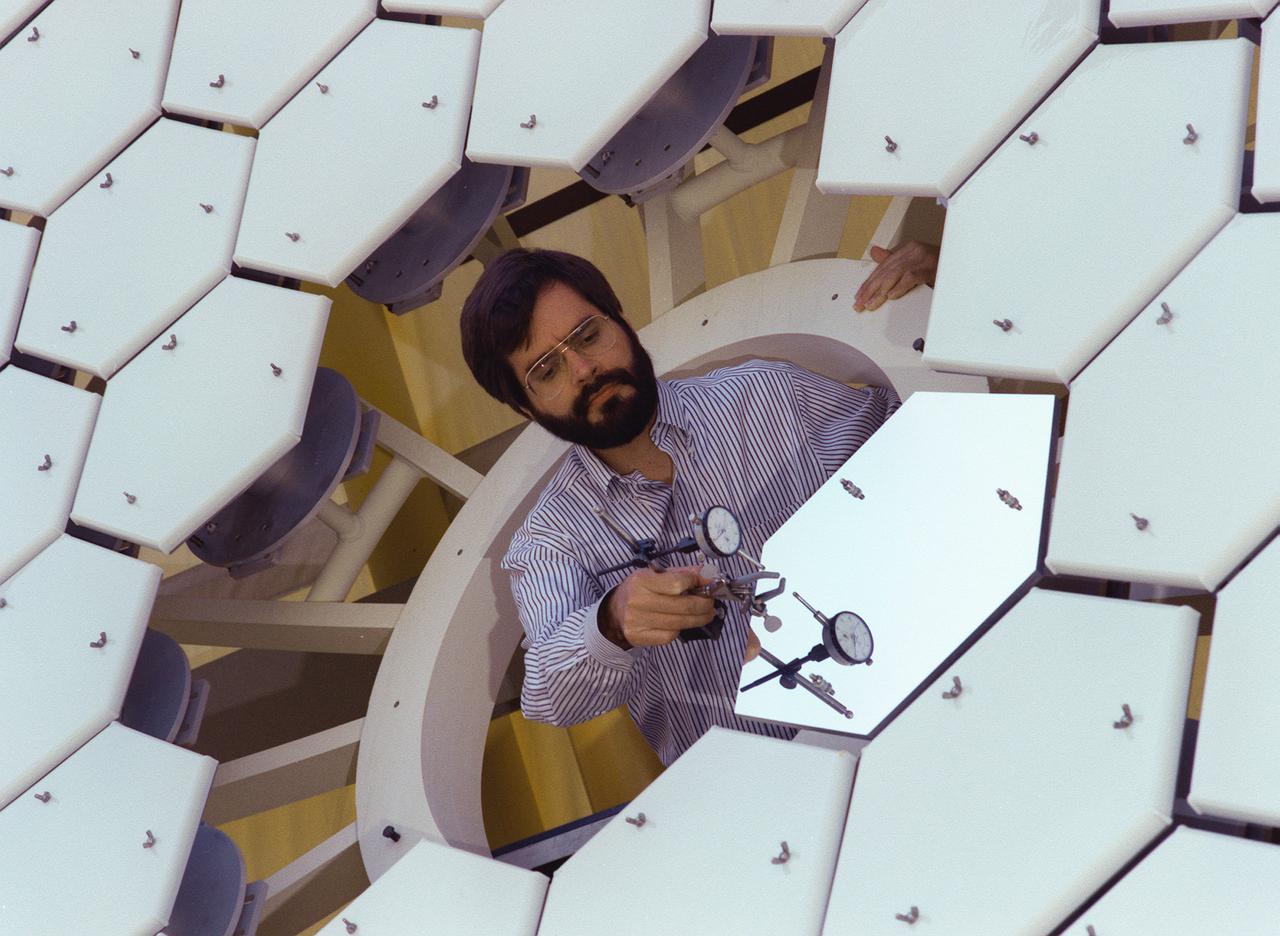
NASA's Space Optics Manufacturing Technology Center has been working to expand our view of the universe via sophisticated new telescopes. The Optics Center's goal is to develop low-cost, advanced space optics technologies for the NASA program in the 21st century, including the long-term goal of imaging Earth-like planets in distant solar systems. A segmented array of mirrors was designed by the Space Optics Manufacturing Technology Center for the solar concentrator test stand at the Marshall Space Flight Center (MSFC) for powering solar thermal propulsion engines. Each hexagon mirror has a spherical surface to approximate a parabolic concentrator when combined into the entire 18-foot diameter array. The aluminum mirrors were polished with a diamond turning machine that creates a glass-like reflective finish on metal. The precision fabrication machinery at the Space Optics Manufacturing Technology Center at MSFC can polish specialized optical elements to a world class quality of smoothness. This image shows optics physicist, Vince Huegele, examining one of the 144-segment hexagonal mirrors of the 18-foot diameter array at the MSFC solar concentrator test stand.
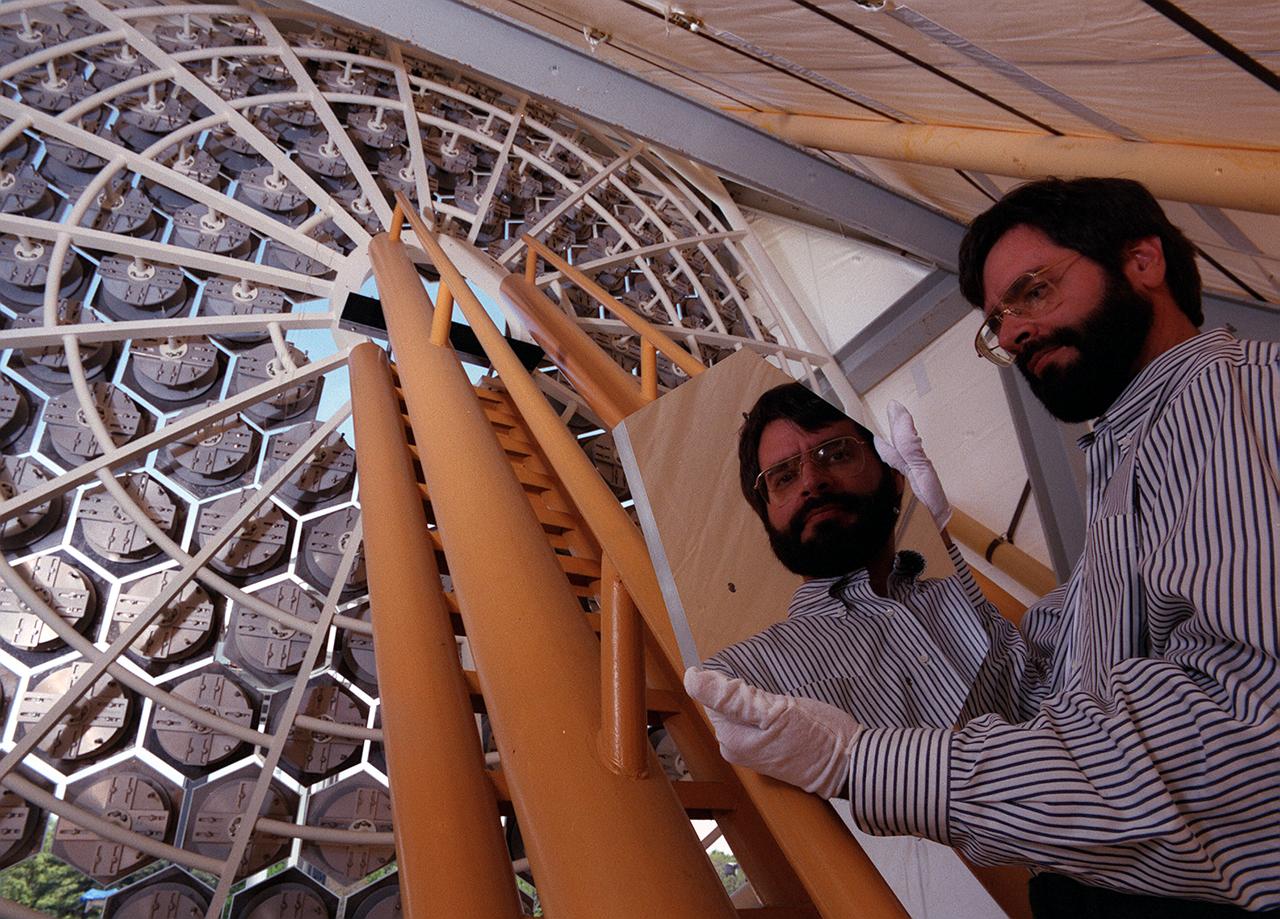
NASA's Space Optics Manufacturing Technology Center has been working to expand our view of the universe via sophisticated new telescopes. The Optics Center's goal is to develop low-cost, advanced space optics technologies for the NASA program in the 21st century, including the long-term goal of imaging Earth-like planets in distant solar systems. A segmented array of mirrors was designed by the Space Optics Manufacturing Technology Center for solar the concentrator test stand at the Marshall Space Flight Center (MSFC) for powering solar thermal propulsion engines. Each hexagon mirror has a spherical surface to approximate a parabolic concentrator when combined into the entire 18-foot diameter array. The aluminum mirrors were polished with a diamond turning machine, that creates a glass-like reflective finish on metal. The precision fabrication machinery at the Space Optics Manufacturing Technology Center at MSFC can polish specialized optical elements to a world class quality of smoothness. This image shows optics physicist, Vince Huegele, examining one of the 144-segment hexagonal mirrors of the 18-foot diameter array at the MSFC solar concentrator test stand.
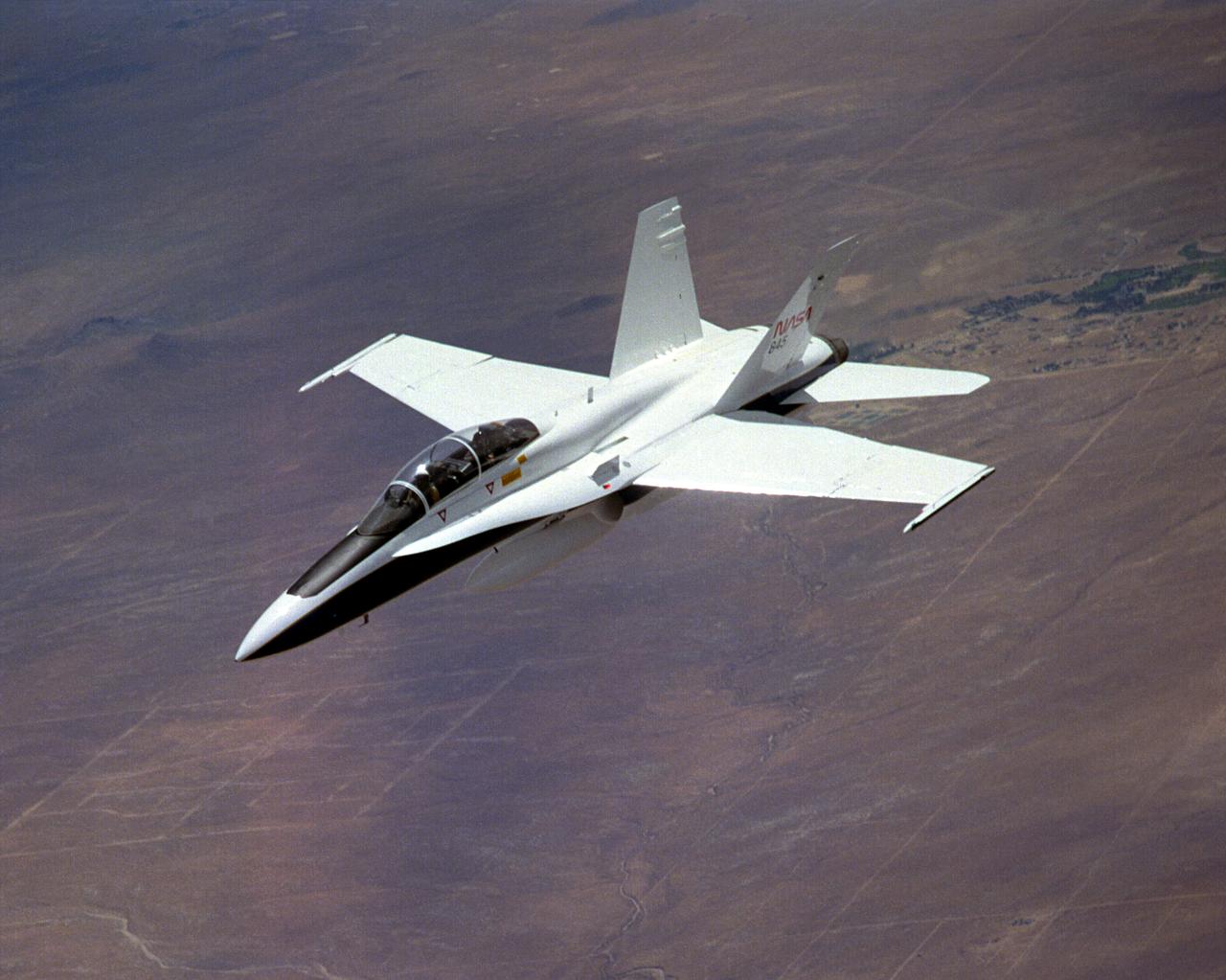
The National Aeronautics and Space Administration's Systems Research Aircraft (SRA), a highly modified F-18 jet fighter, during a research flight. The former Navy aircraft was flown by NASA's Dryden Flight Research Center at Edwards Air Force Base, California, to evaluate a number of experimental aerospace technologies in a multi-year, joint NASA/DOD/industry program. Among the more than 20 experiments flight-tested were several involving fiber optic sensor systems. Experiments developed by McDonnell-Douglas and Lockheed-Martin centered on installation and maintenace techniques for various types of fiber-optic hardware proposed for use in military and commercial aircraft, while a Parker-Hannifin experiment focused in alternative fiber-optic designs for position measurement sensors as well as operational experience in handling optical sensor systems. Other experiments flown on this testbed aircraft included electronically-controlled control surface actuators, flush air data collection systems, "smart" skin antennae and laser-based systems. Incorporation of one or more of these technologies in future aircraft and spacecraft could result in signifigant savings in weight, maintenance and overall cost.
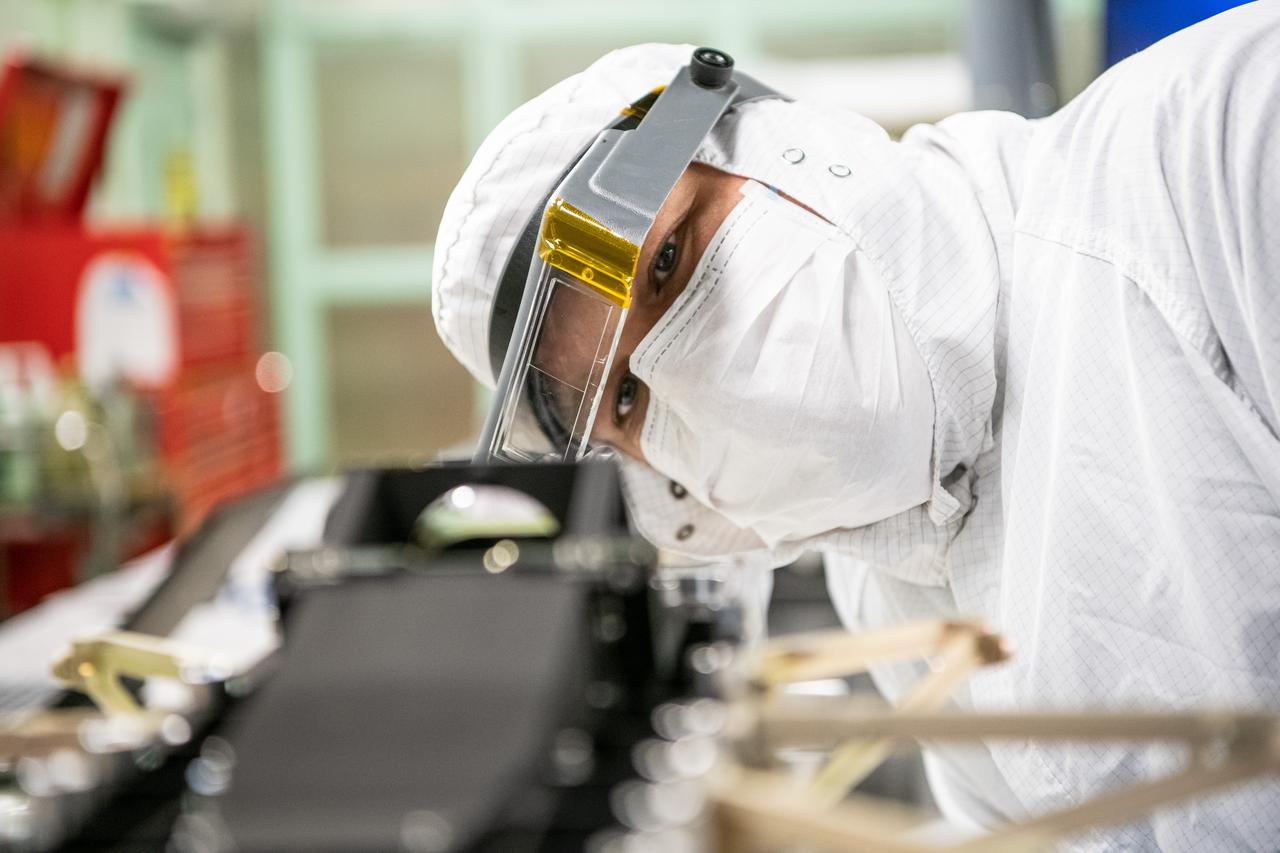
Mechanical technician, Andrew Scharmann, installs a shim and inspects an optic on the Ocean Color Instrument (OCI) rotating telescope prior to integrating other hardware and optical components. OCI is a highly advanced optical spectrometer that will be used to measure properties of light over portions of the electromagnetic spectrum. It will enable continuous measurement of light at finer wavelength resolution than previous NASA satellite sensors, extending key system ocean color data records for climate studies. OCI is PACE's (Plankton, Aerosol, Cloud, ocean Ecosystem) primary sensor built at Goddard Space Flight Center in Greenbelt, MD.
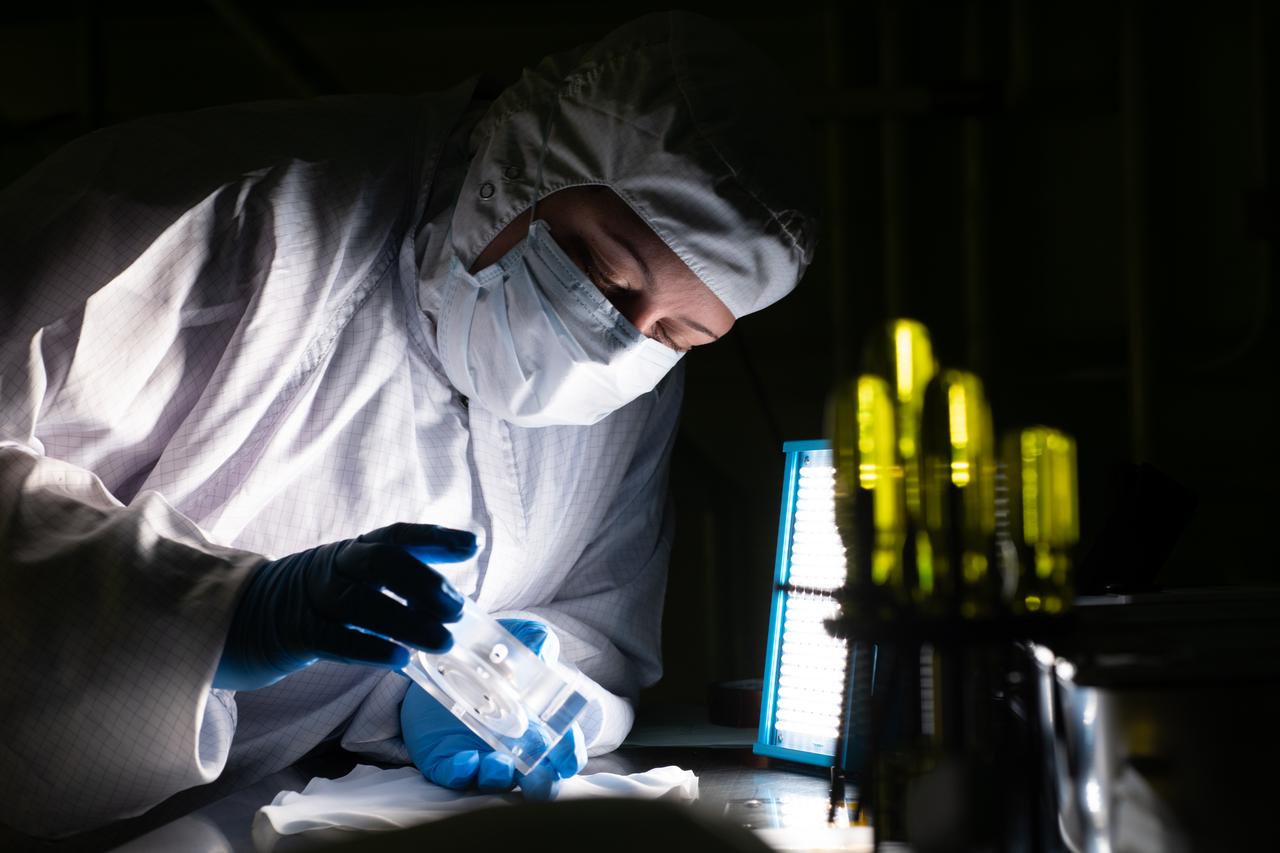
After removal from the handling container physical science technician, Kristen Washington, performs an inspection of the Ocean Color Instrument (OCI) fold flat mirror to note any scratches or damage on the optical surface before it is integrated with the other optical components of the instrument. OCI is a highly advanced optical spectrometer that will be used to measure properties of light over portions of the electromagnetic spectrum. It will enable continuous measurement of light at finer wavelength resolution than previous NASA satellite sensors, extending key system ocean color data records for climate studies. OCI is PACE's (Plankton, Aerosol, Cloud, ocean Ecosystem) primary sensor built at Goddard Space Flight Center in Greenbelt, MD.

Optical engineer, Maurice Stancil, performs final optical alignment metrology measurements prior to the Ocean Color Instrument (OCI) integration to the Plankton, Aerosol, Cloud, ocean Ecosystem (PACE) spacecraft. As he collects data and measures angles on OCI, he is able to determine if the flight hardware is in the correct position. OCI is a highly advanced optical spectrometer that will be used to measure properties of light over portions of the electromagnetic spectrum. It will enable continuous measurement of light at finer wavelength resolution than previous NASA satellite sensors, extending key system ocean color data records for climate studies. OCI is PACE's primary sensor built at Goddard Space Flight Center in Greenbelt, MD.
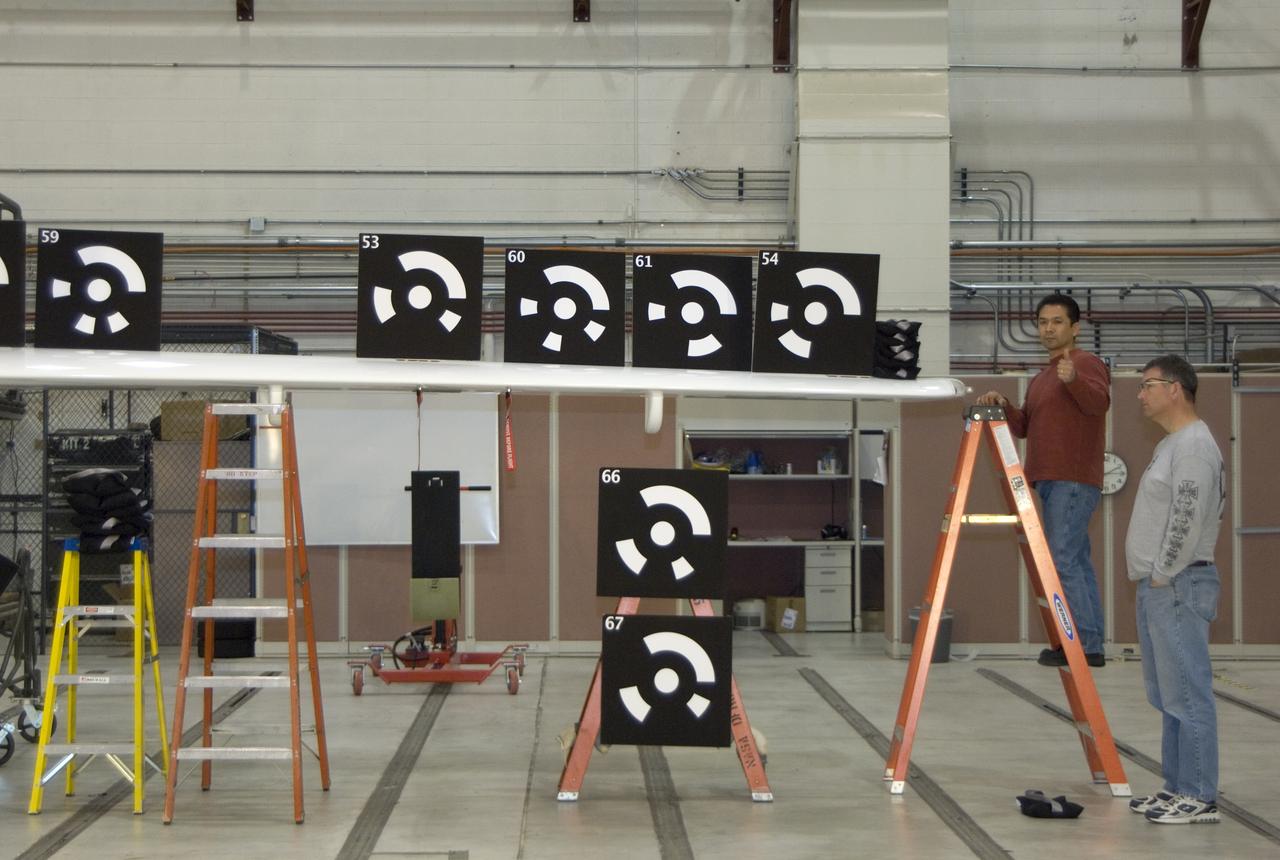
NASA engineer Larry Hudson and Ikhana ground crew member James Smith work on a ground validation test with new fiber optic sensors that led to validation flights on the Ikhana aircraft. NASA Dryden Flight Research Center is evaluating an advanced fiber optic-based sensing technology installed on the wings of NASA's Ikhana aircraft. The fiber optic system measures and displays the shape of the aircraft's wings in flight. There are other potential safety applications for the technology, such as vehicle structural health monitoring. If an aircraft structure can be monitored with sensors and a computer can manipulate flight control surfaces to compensate for stresses on the wings, structural control can be established to prevent situations that might otherwise result in a loss of control.
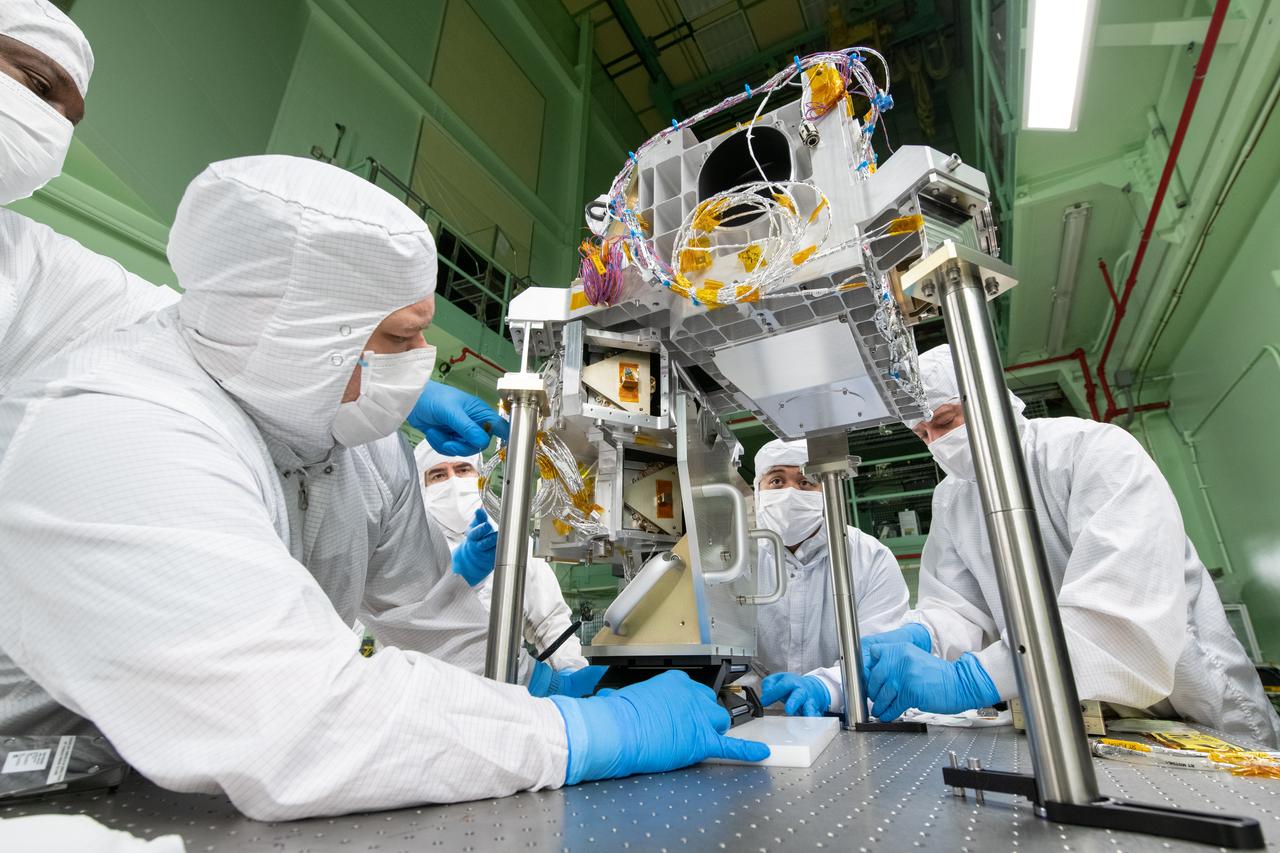
Mechanical technician, Andrew Scharmann, slides a lift fixture into position to ensure the Ocean Color Instrument (OCI) Main Optics Bench (MOB) and Main Optics Sub Bench (MOSB) are aligned. OCI is a highly advanced optical spectrometer that will be used to measure properties of light over portions of the electromagnetic spectrum. It will enable continuous measurement of light at finer wavelength resolution than previous NASA satellite sensors, extending key system ocean color data records for climate studies. OCI is PACE's (Plankton, Aerosol, Cloud, ocean Ecosystem) primary sensor built at Goddard Space Flight Center in Greenbelt, MD.
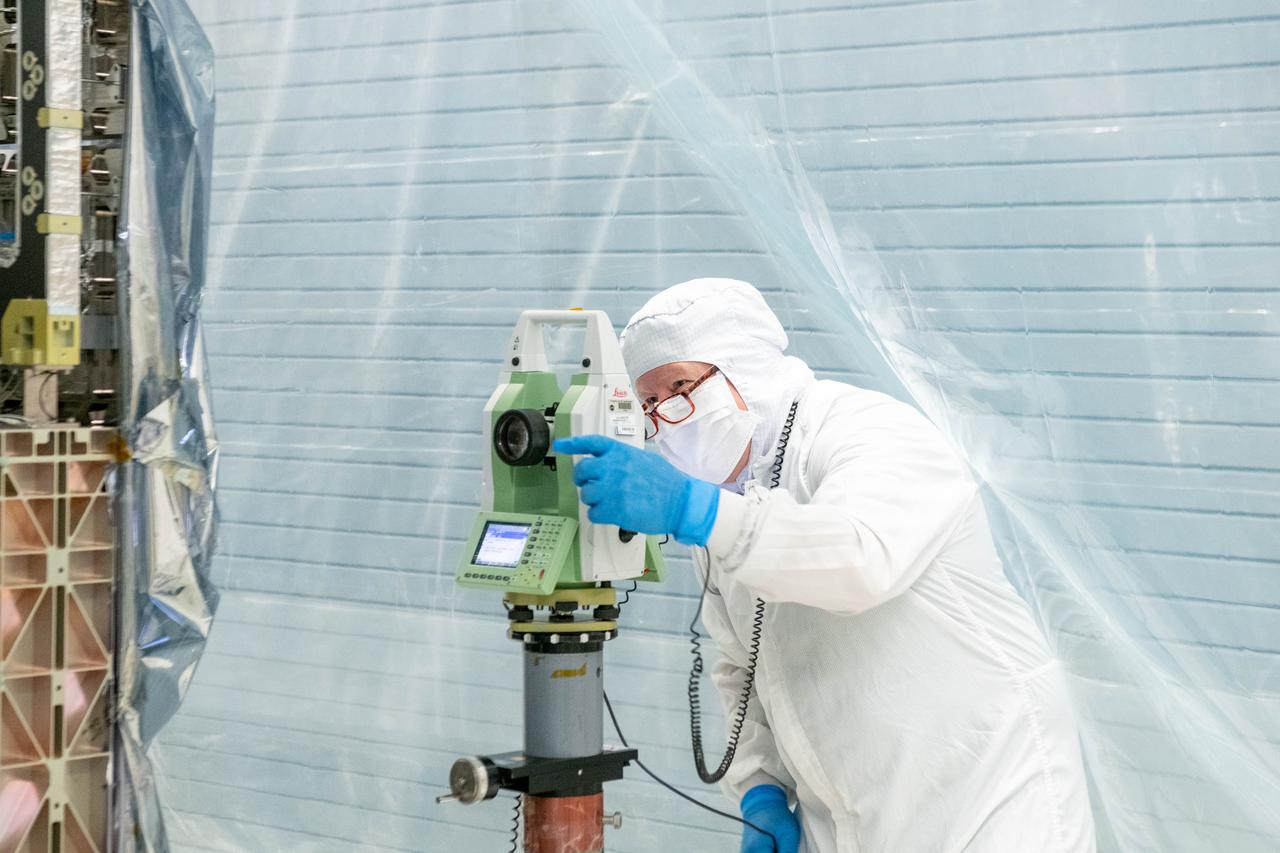
Optical technician, Timothy Madison, uses a theodolite to perform optical measurements on the Ocean Color Instrument (OCI). As he collects data and measures angles on OCI, he is able to determine if the newly integrated flight hardware is in the correct position. OCI is a highly advanced optical spectrometer that will be used to measure properties of light over portions of the electromagnetic spectrum. It will enable continuous measurement of light at finer wavelength resolution than previous NASA satellite sensors, extending key system ocean color data records for climate studies. OCI is PACE's (Plankton, Aerosol, Cloud, ocean Ecosystem) primary sensor built at Goddard Space Flight Center in Greenbelt, MD.
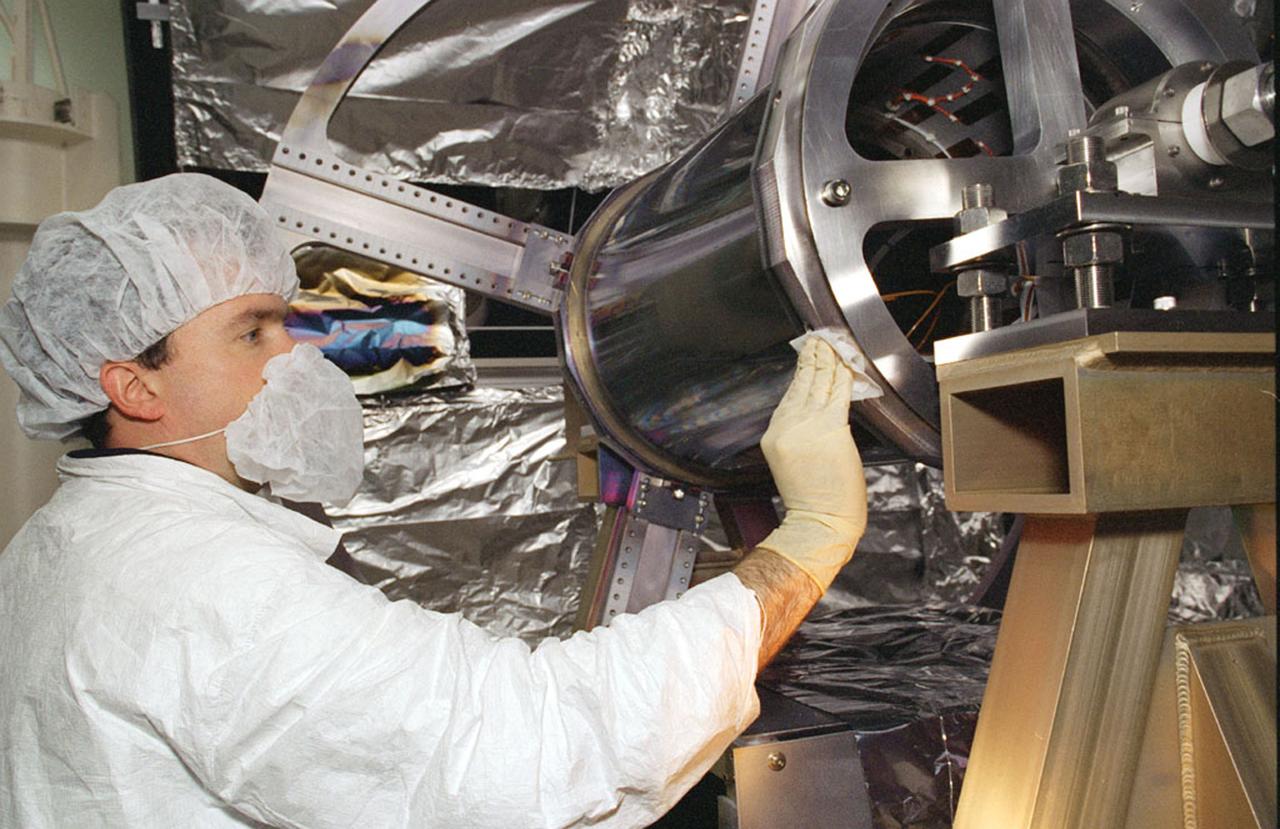
NASA's Space Optics Manufacturing Center has been working to expand our view of the universe via sophisticated new telescopes. The Optics Center's goal is to develop low-cost, advanced space optics technologies for the NASA program in the 21st century - including the long-term goal of imaging Earth-like planets in distant solar systems. To reduce the cost of mirror fabrication, Marshall Space Flight Center (MSFC) has developed replication techniques, the machinery, and materials to replicate electro-formed nickel mirrors. The process allows fabricating precisely shaped mandrels to be used and reused as masters for replicating high-quality mirrors. Image shows Dr. Alan Shapiro cleaning mirror mandrel to be applied with highly reflective and high-density coating in the Large Aperture Coating Chamber, MFSC Space Optics Manufacturing Technology Center (SOMTC).
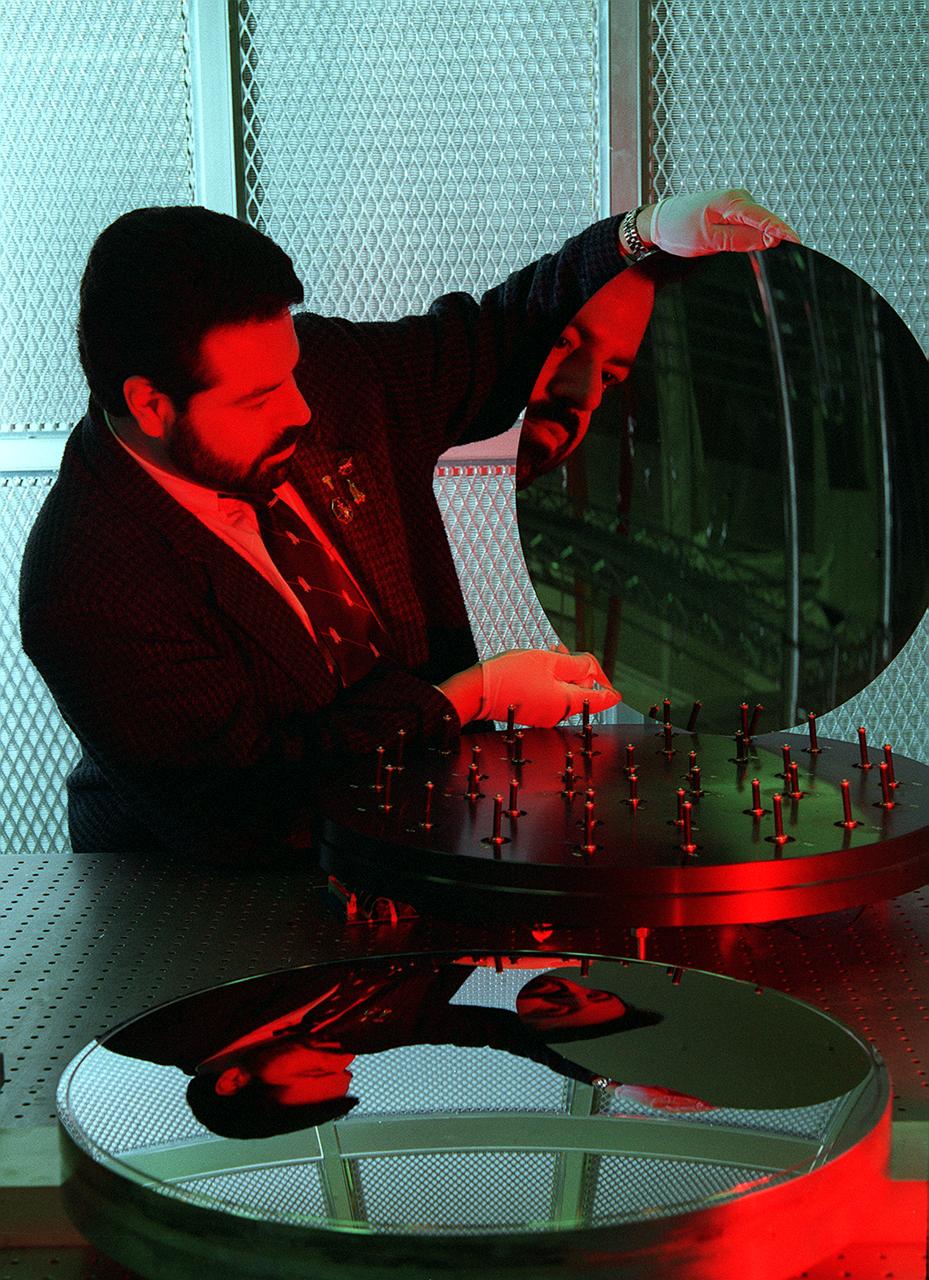
NASA's Space Optics Manufacturing Center has been working to expand our view of the universe via sophisticated new telescopes. The Optics Center's goal is to develop low-cost, advanced space optics technologies for the NASA program in the 21st century - including the long-term goal of imaging Earth-like planets in distant solar systems. To reduce the cost of mirror fabrication, Marshall Space Flight Center (MSFC) has developed replication techniques, the machinery, and materials to replicate electro-formed nickel mirrors. The process allows fabricating precisely shaped mandrels to be used and reused as masters for replicating high-quality mirrors. Dr. Joe Ritter examines a replicated electro-formed nickel-alloy mirror which exemplifies the improvements in mirror fabrication techniques, with benefits such as dramtic weight reduction that have been achieved at the Marshall Space Flight Center's Space Optics Manufacturing Technology Center (SOMTC).
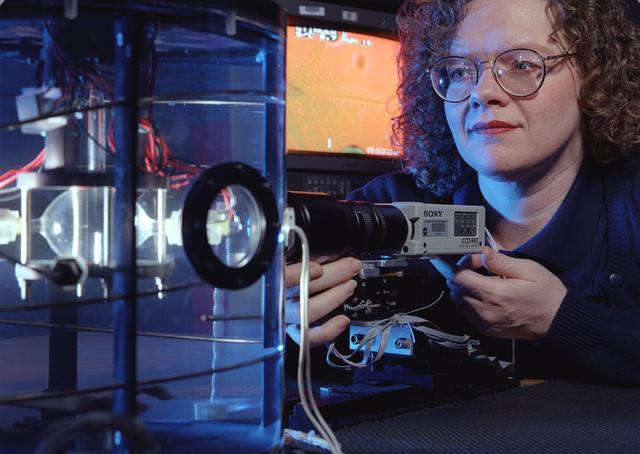
Jeri Briscoe of the video team inspects the optical system for proper alignment during a test run of the Equiaxed Dendritic Solidification Experiment (EDSE) located in the Microgravity Development Laboratory (MDL).
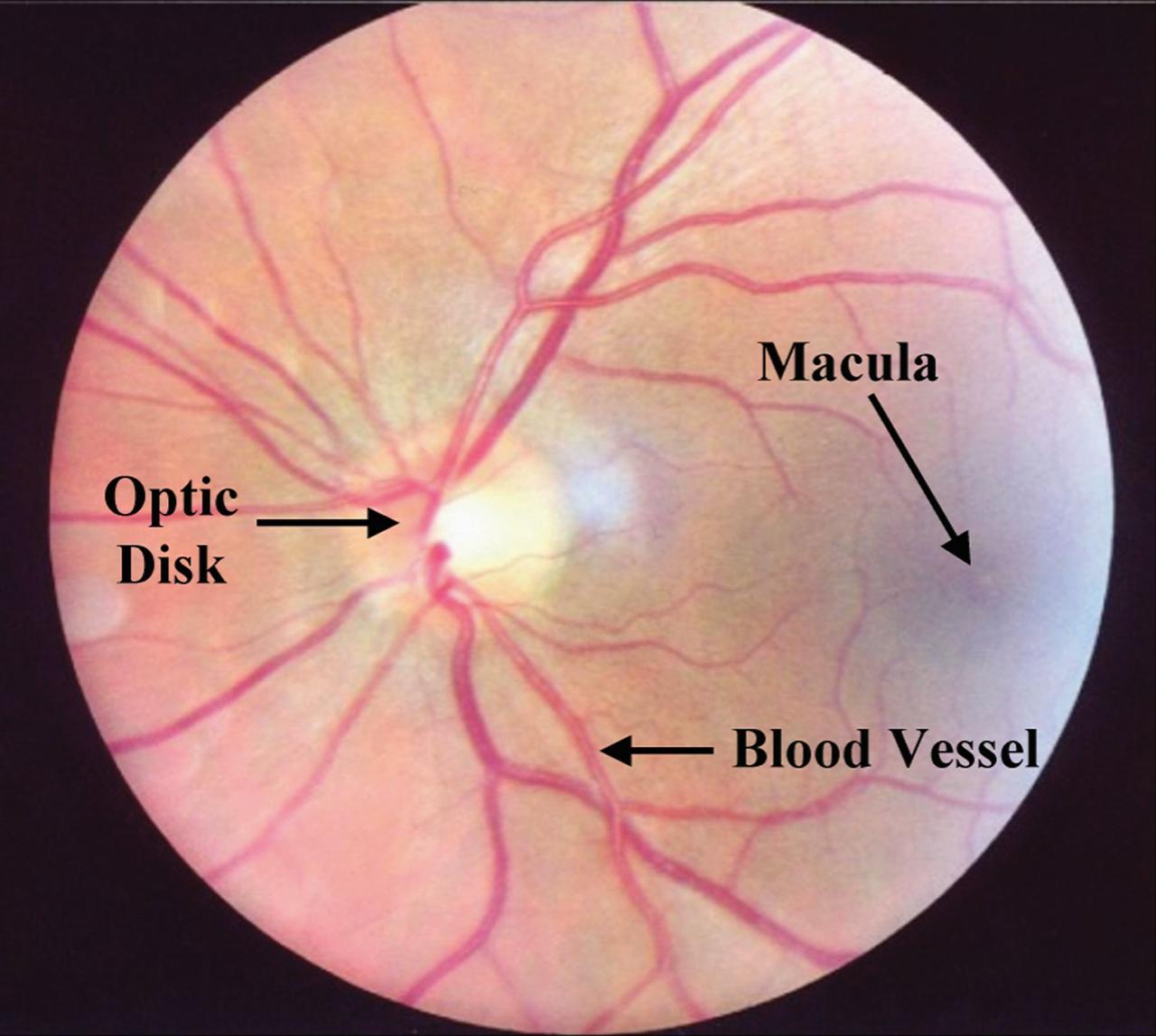
ProVision Technologies, a NASA commercial space center at Sternis Space Center in Mississippi, has developed a new hyperspectral imaging (HSI) system that is much smaller than the original large units used aboard remote sensing aircraft and satellites. The new apparatus is about the size of a breadbox. HSI may be useful to ophthalmologists to study and diagnose eye health, both on Earth and in space, by examining the back of the eye to determine oxygen and blood flow quickly and without any invasion. ProVision's hyperspectral imaging system can scan the human eye and produce a graph showing optical density or light absorption, which can then be compared to a graph from a normal eye. Scans of the macula, optic disk or optic nerve head, and blood vessels can be used to detect anomalies and identify diseases in this delicate and important organ. ProVision has already developed a relationship with the University of Alabama at Birmingham, but is still on the lookout for a commercial partner in this application.
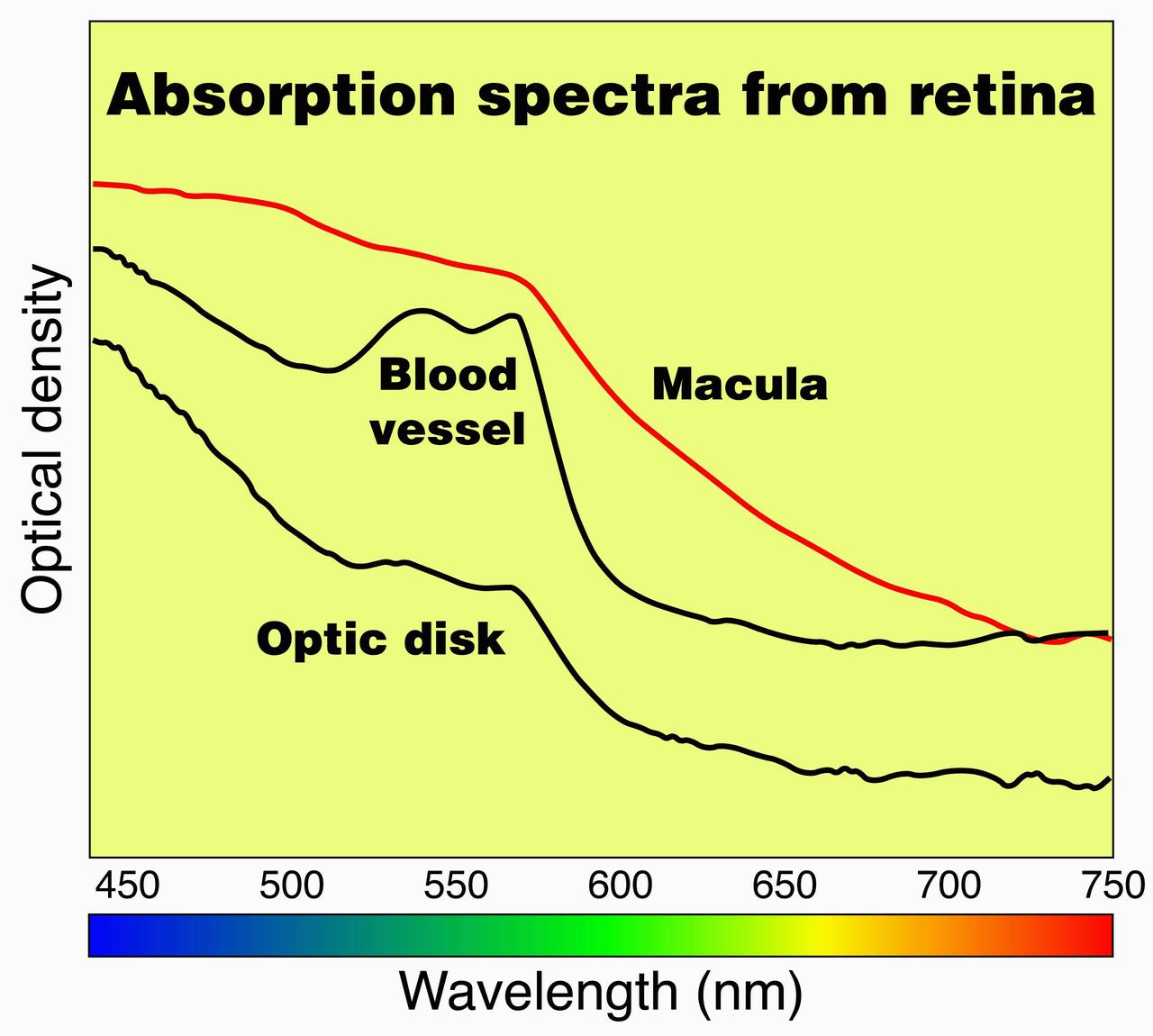
ProVision Technologies, a NASA research partnership center at Sternis Space Center in Mississippi, has developed a new hyperspectral imaging (HSI) system that is much smaller than the original large units used aboard remote sensing aircraft and satellites. The new apparatus is about the size of a breadbox. HSI may be useful to ophthalmologists to study and diagnose eye health, both on Earth and in space, by examining the back of the eye to determine oxygen and blood flow quickly and without any invasion. ProVision's hyperspectral imaging system can scan the human eye and produce a graph showing optical density or light absorption, which can then be compared to a graph from a normal eye. Scans of the macula, optic disk or optic nerve head, and blood vessels can be used to detect anomalies and identify diseases in this delicate and important organ. ProVision has already developed a relationship with the University of Alabama at Birmingham, but is still on the lookout for a commercial partner in this application.
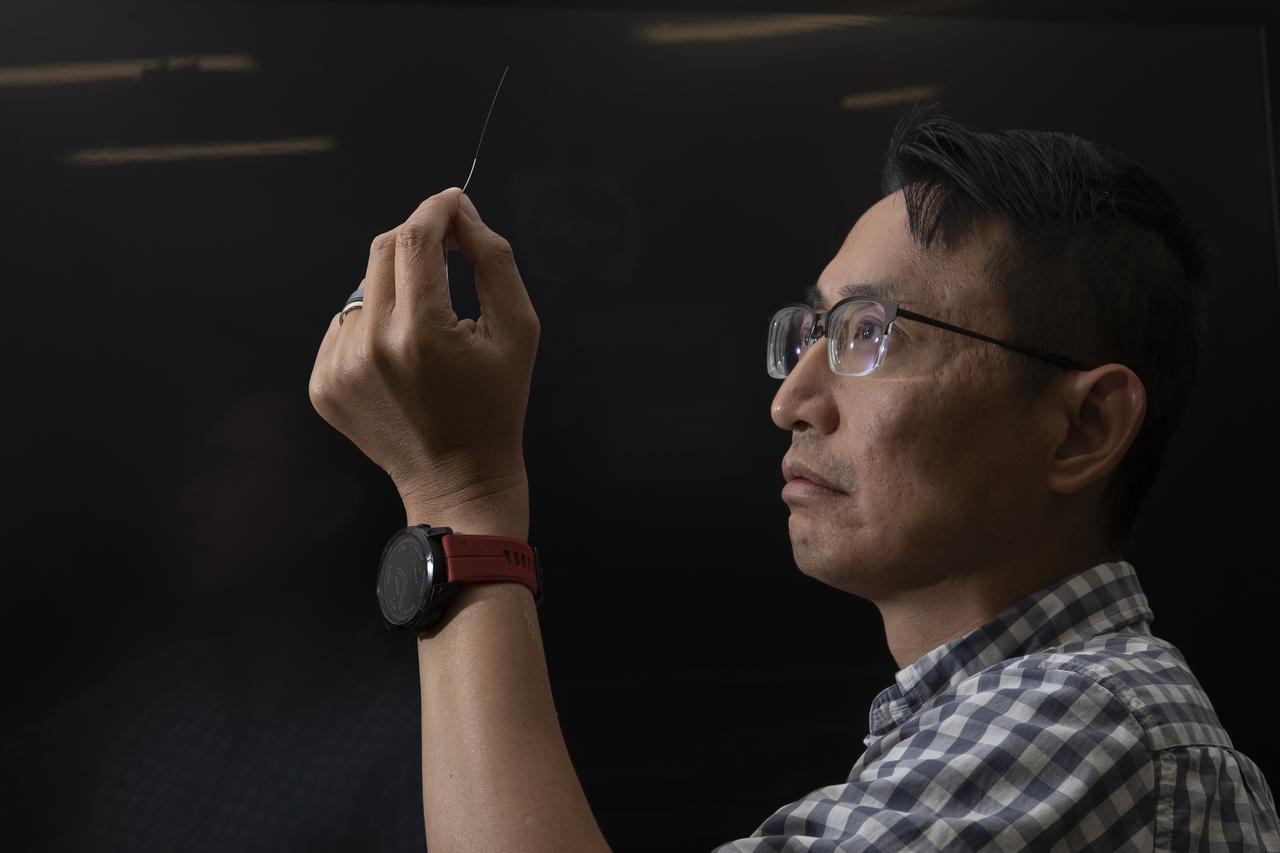
Patrick Chan, electronics engineer, and NASA Armstrong’s FOSS portfolio project manager, closely examines an optic fiber inside of a protective sleeve. Armstrong’s Fiber Optic Sensing System recently supported tests in which oxygen was turned into liquid oxygen at minus 297 degrees Fahrenheit. Testing was aimed at developing technologies could allow future astronauts to manufacture rocket fuel on the Moon.
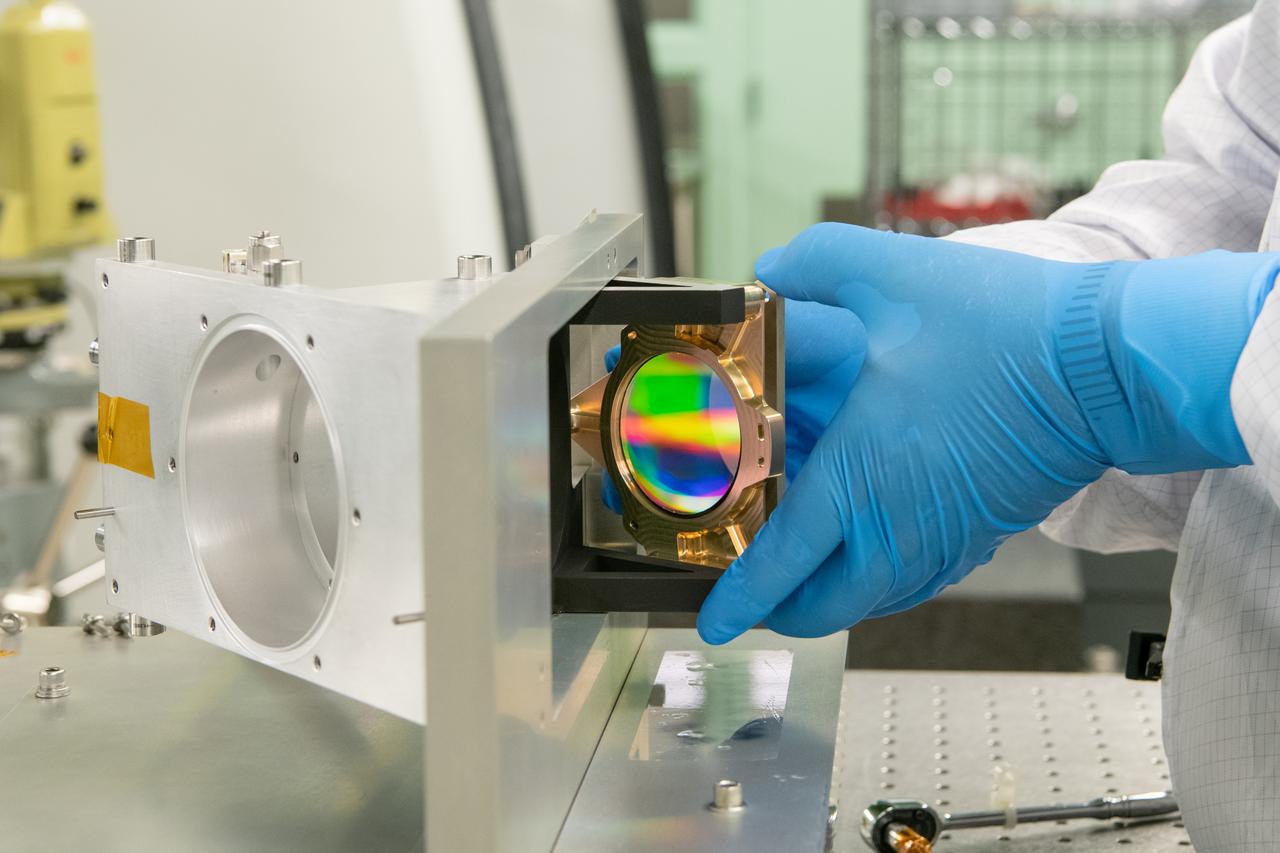
An Ocean Color Instrument (OCI) optical lens is installed into the flight housing hardware for alignment measurements. OCI is a highly advanced optical spectrometer that will be used to measure properties of light over portions of the electromagnetic spectrum. It will enable continuous measurement of light at finer wavelength resolution than previous NASA satellite sensors, extending key system ocean color data records for climate studies. OCI is PACE's (Plankton, Aerosol, Cloud, ocean Ecosystem) primary sensor built at Goddard Space Flight Center in Greenbelt, MD.
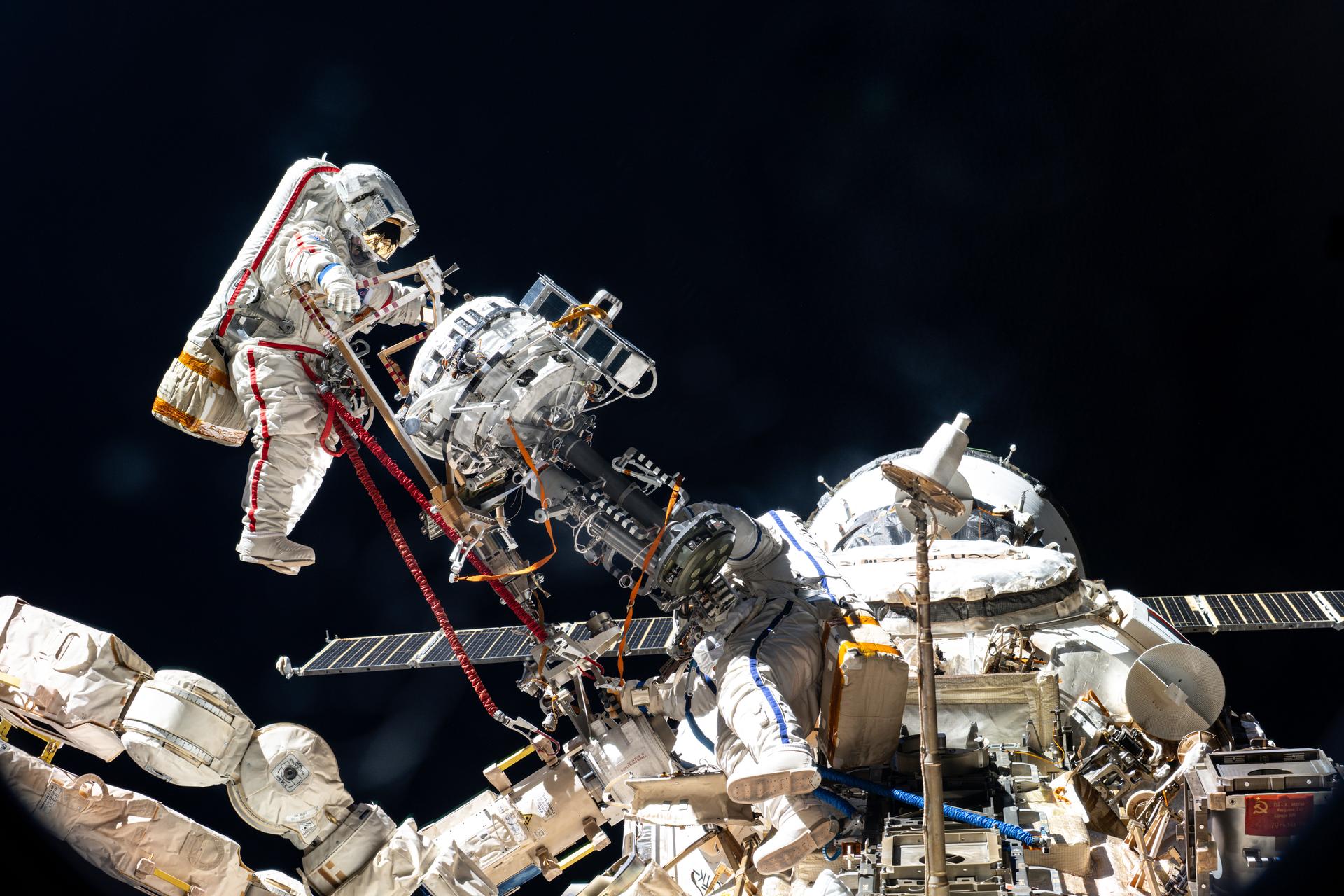
iss073e0981212 (Oct. 16, 2025) --- Roscosmos cosmonauts Sergey Ryzhikov (left) and Alexey Zubritsky (bottom right) work together to remove a high-resolution camera (HRC) monoblock during a six-hour and nine-minute spacewalk outside the International Space Station's Roscosmos segment. The HRC monoblock is part of a scientific optical telescope system designed to test compact radio-optical detectors for Earth observation, ecological monitoring, and emergency response.
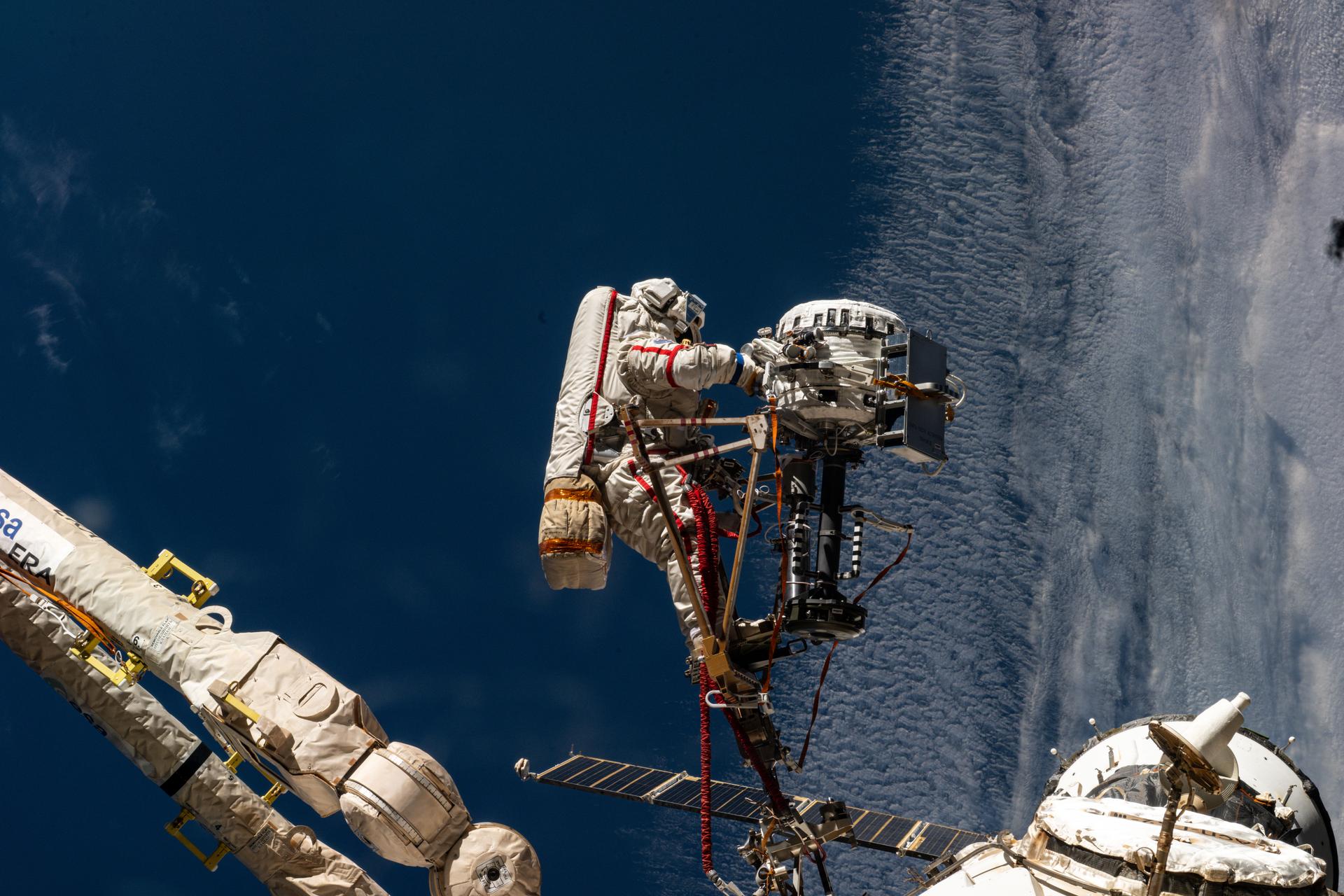
iss073e0981126 (Oct. 16, 2025) --- Roscosmos cosmonaut Sergey Ryzhikov is pictured attached to the end effector of the European robotic arm, holding the high-resolution camera (HRC) monoblock he removed during a six-hour and nine-minute spacewalk outside the International Space Station's Roscosmos segment. The HRC monoblock is part of a scientific optical telescope system designed to test compact radio-optical detectors for Earth observation, ecological monitoring, and emergency response.

STS039-20-006 (28 April-6 May 1991) --- Astronaut Michael L. Coats, STS-39 mission commander, works controls of a robotic arm on the aft flight deck of the Earth-orbiting space shuttle Discovery. Out the overhead window, the SPAS-II hovers on the end of the remote manipulator system (RMS, out of frame). Inside the window, just above Coats' head is the Crewman Optical Alignment Sight (COAS), an optical device that aids in navigation. Photo credit: NASA
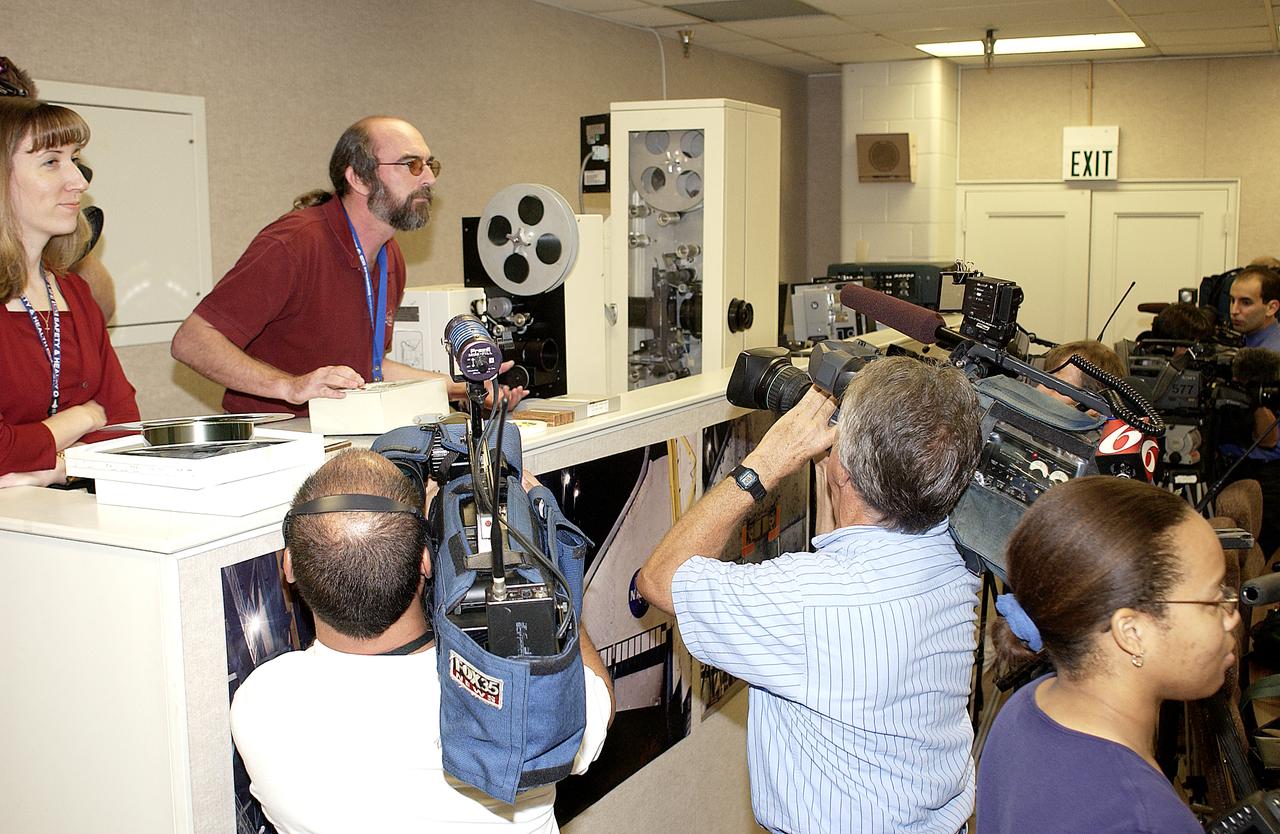
In the Image Analysis Facility in the Vehicle Assembly Building, Brad Lawrence (second from left, standing) participates in a presentation to news media representatives on the improved tracking cameras and long-range optical tracking systems that will be used to capture ascent imagery during the return to flight of the Space Shuttle. The press opportunity also includes tours of the launch pad perimeter camera site at Launch Complex 39B and two Playalinda Beach optical tracking sites at the Cape Canaveral National Seashore and the Merritt Island National Refuge.
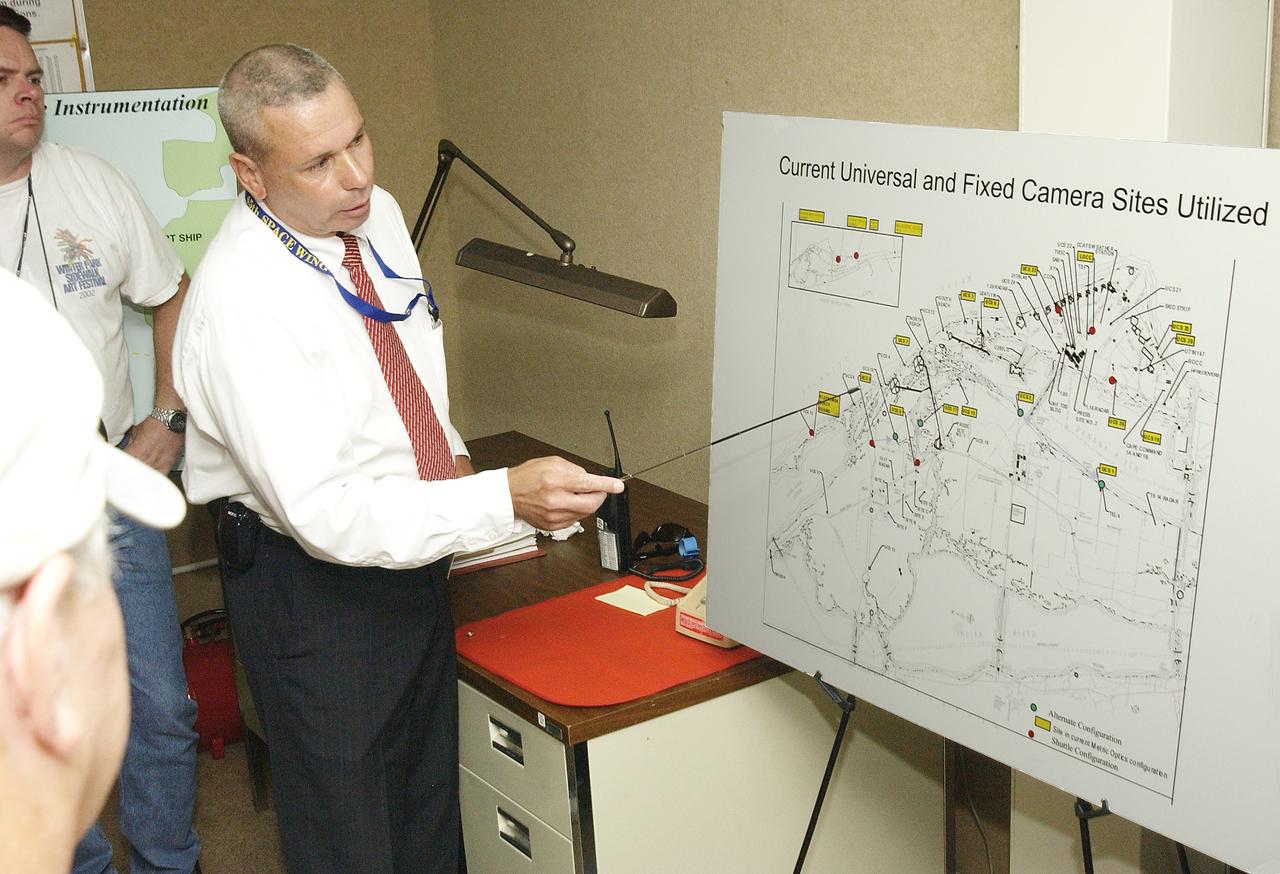
Inside the dome building at Playalinda Beach, Bob Fore points to a map of camera sites during a presentation to the media on the improved tracking cameras and long-range optical tracking systems that will be used to capture ascent imagery during the return to flight of the Space Shuttle. The press opportunity also includes tours of the launch pad perimeter camera site at Launch Complex 39B and the other optical tracking site at the Merritt Island National Refuge.

STS039-11-027 (28 April-6 May 1991) --- Astronaut Michael L. Coats, STS-39 mission commander, is seen in a close-up 35mm frame on the aft flight deck of the Earth-orbiting space shuttle Discovery. Out the overhead window, the SPAS-II hovers on the end of the remote manipulator system (RMS, out of frame). Inside the window, just above Coats' head is the Crewman Optical Alignment Sight (COAS), an optical device that aids in navigation. Photo credit: NASA
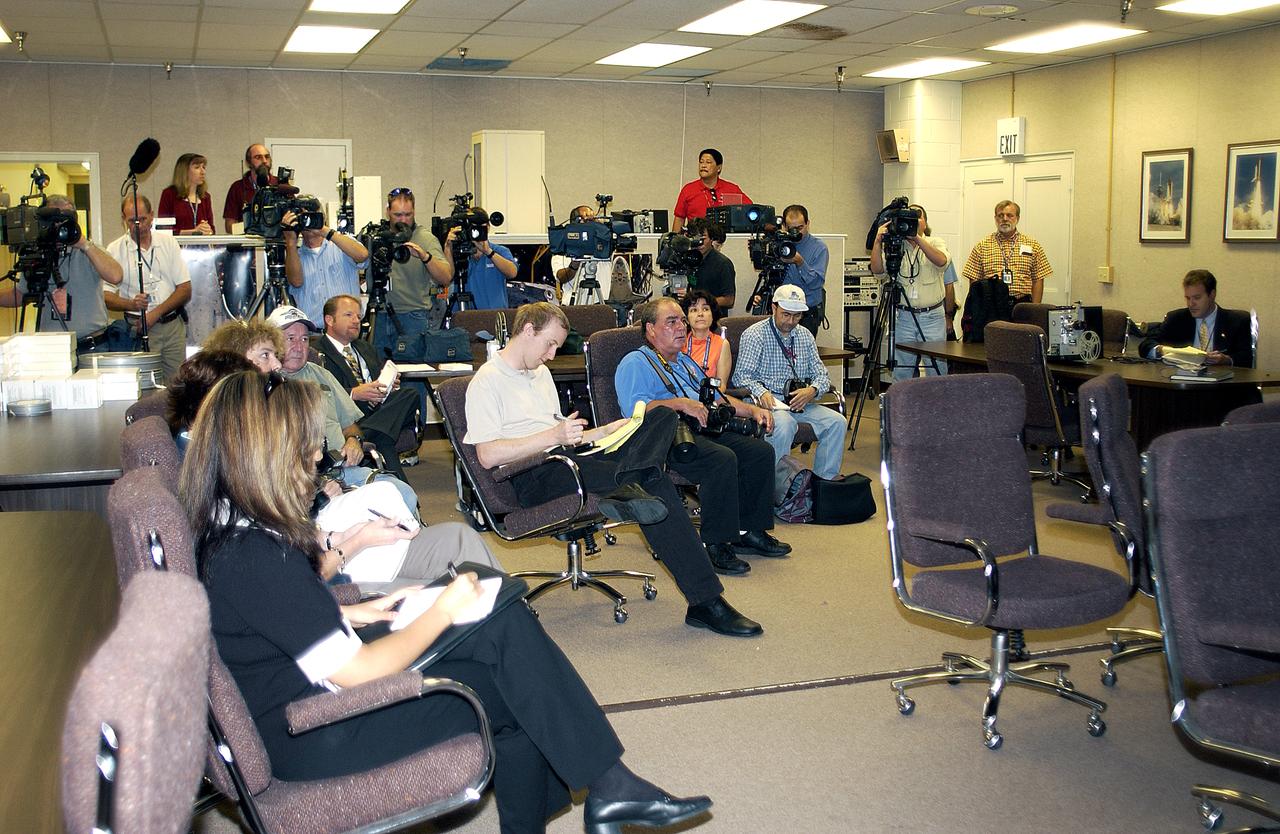
In the Image Analysis Facility in the Vehicle Assembly Building, news media representatives are briefed on the improved tracking cameras and long-range optical tracking systems that will be used to capture ascent imagery during the return to flight of the Space Shuttle. The press opportunity also includes tours of the launch pad perimeter camera site at Launch Complex 39B and two Playalinda Beach optical tracking sites at the Cape Canaveral National Seashore and the Merritt Island National Refuge.
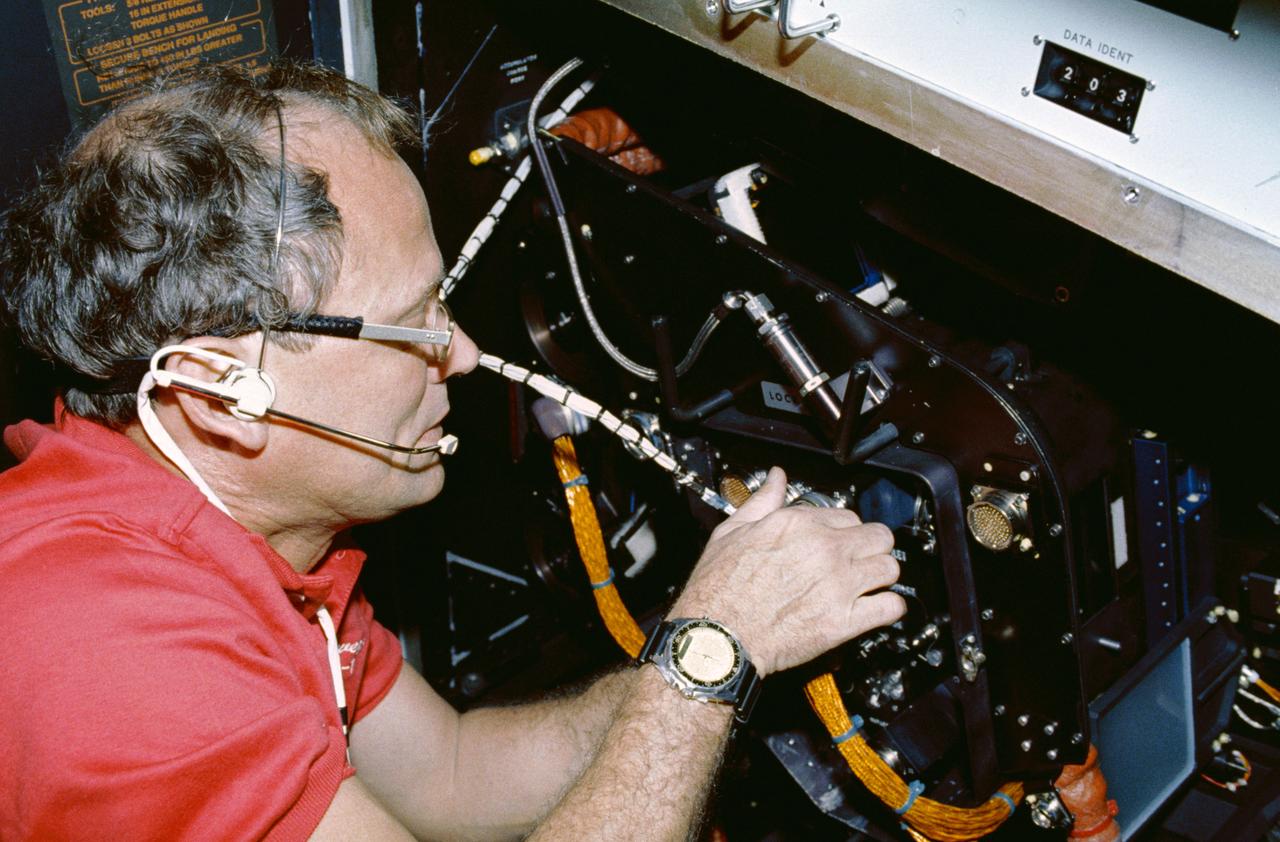
STS042-05-006 (22-30 Jan 1992) --- Astronaut Norman E. Thagard, payload commander, performs the Fluids Experiment System (FES) in the International Microgravity Laboratory (IML-1) science module. The FES is a NASA-developed facility that produces optical images of fluid flows during the processing of materials in space. The system's sophisticated optics consist of a laser to make holograms of samples and a video camera to record images of flows in and around samples. Thagard was joined by six fellow crewmembers for eight days of scientific research aboard Discovery in Earth-orbit. Most of their on-duty time was spent in this IML-1 science module, positioned in the cargo bay and attached via a tunnel to Discovery's airlock.
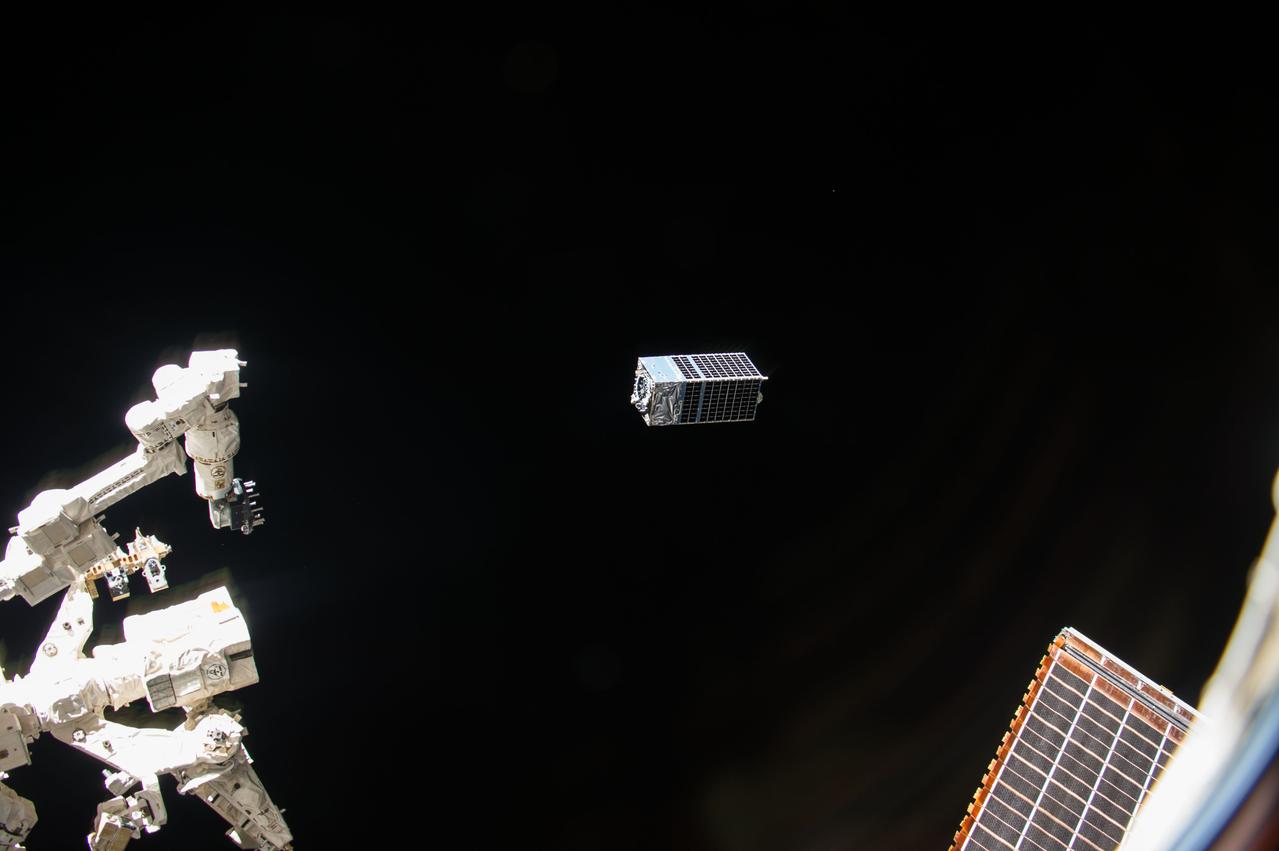
iss053e130305 (Oct. 24, 2017) --- The Kestrel Eye IIM (KE2M) CubeSat is deployed from the tip of the Dextre attached to the Mobile Servicing System. The KE2M is carrying an optical imaging system payload that is being used to validate the concept of using microsatellites in low-Earth orbit to support critical operations.

Engineering technician Jeff Howell mounts conventional strain gauges to the Mock Truss-Braced Wing 10-foot model at NASA’s Armstrong Flight Research Center in Edwards, California. The conventional system data will be compared the Fiber Optic Sensing System developed at the center on the same wing to see how well the testing methods match.
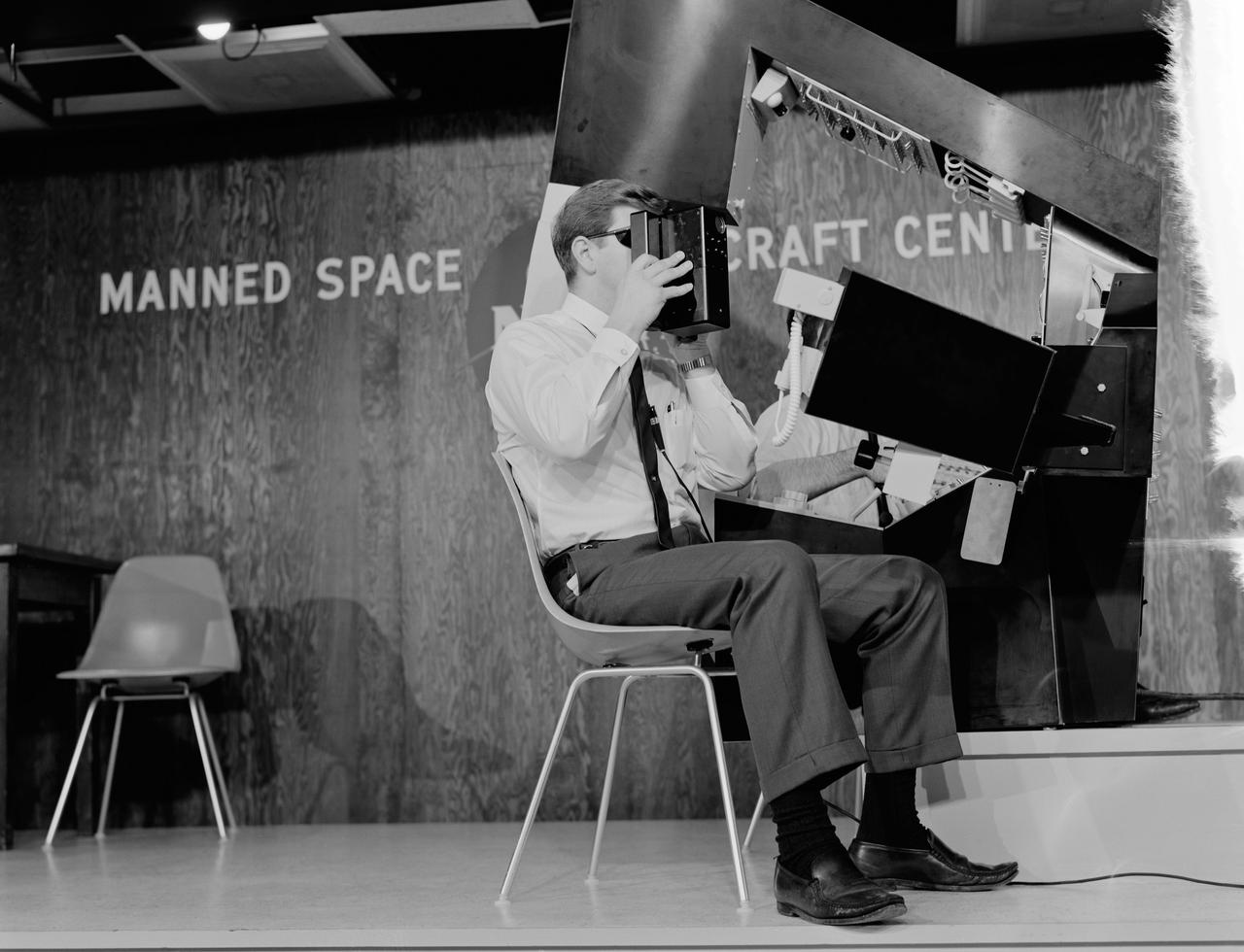
S65-42598 (10 Nov. 1965) --- Douglas S. Idlly, Electromagnetic Systems Branch, Instrumentation and Electronic Systems Division, illustrates an Optical Communications Transmitter (LASER) during a briefing at the news center of the Manned Spacecraft Center in Houston, Texas. Photo credit: NASA
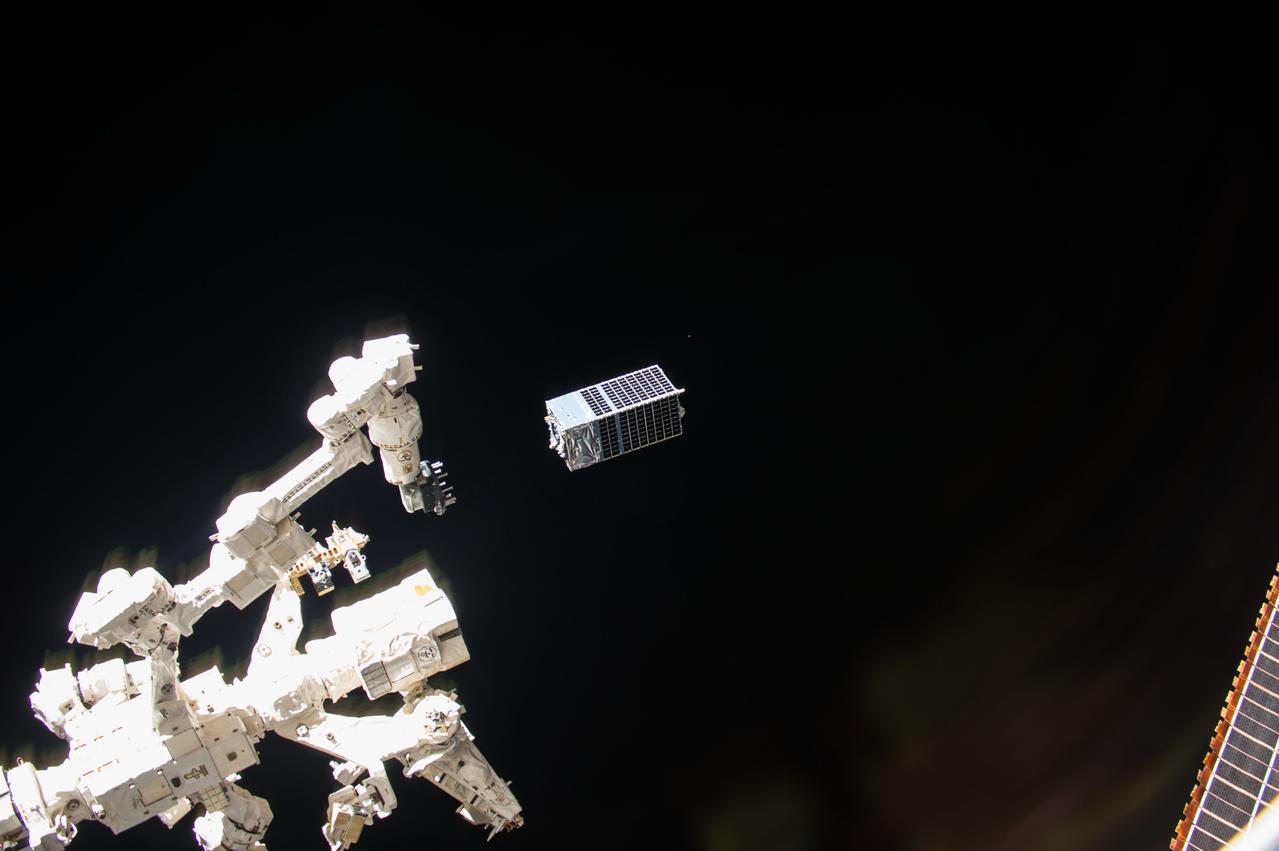
iss053e130267 (Oct. 24, 2017) --- The Kestrel Eye IIM (KE2M) CubeSat is deployed from the tip of the Dextre attached to the Mobile Servicing System. The KE2M is carrying an optical imaging system payload that is being used to validate the concept of using microsatellites in low-Earth orbit to support critical operations.
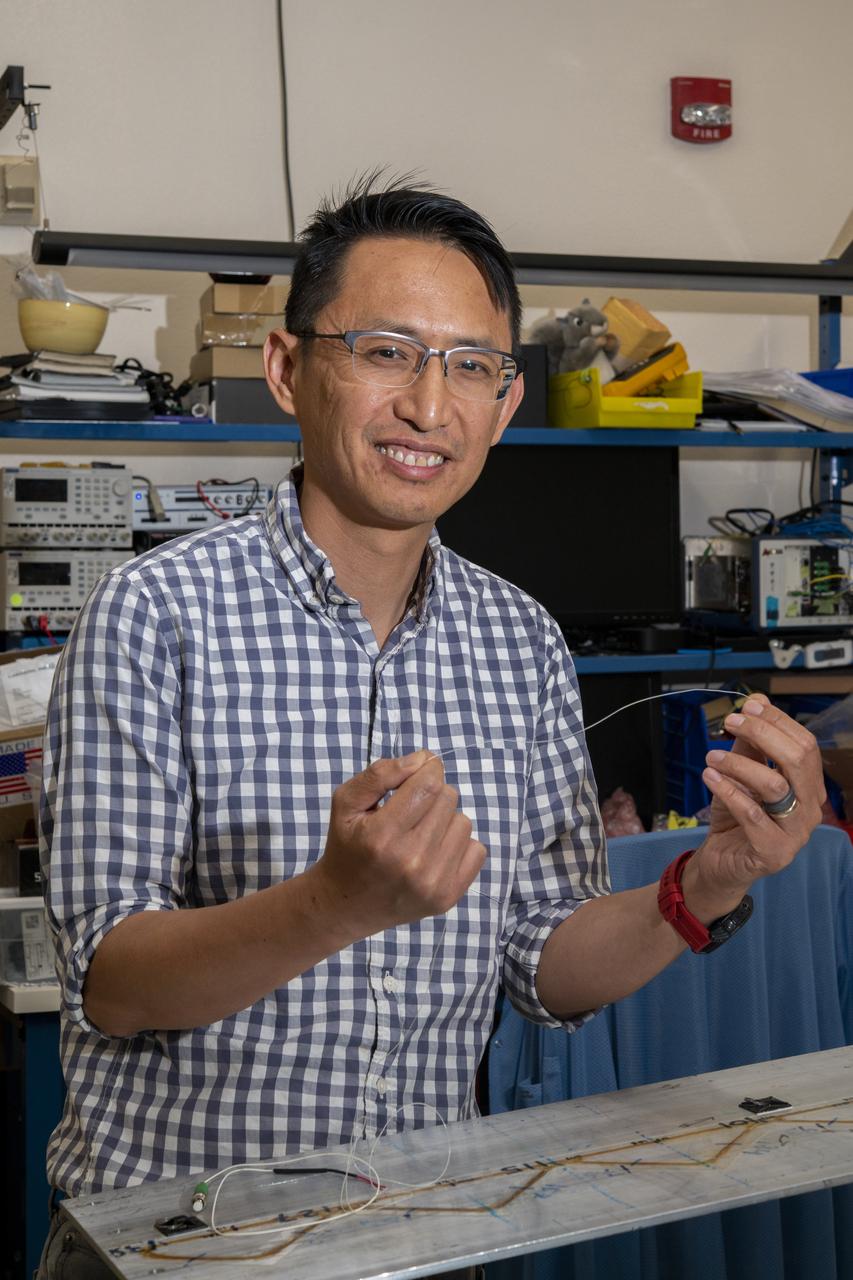
NASA’s Armstrong Flight Research Center’s FOSS, Fiber Optic Sensing System, recently supported tests of a system designed to turn oxygen into liquid oxygen, a component of rocket fuel. Patrick Chan, electronics engineer, and NASA Armstrong’s FOSS portfolio project manager, shows fiber like that used in the testing.
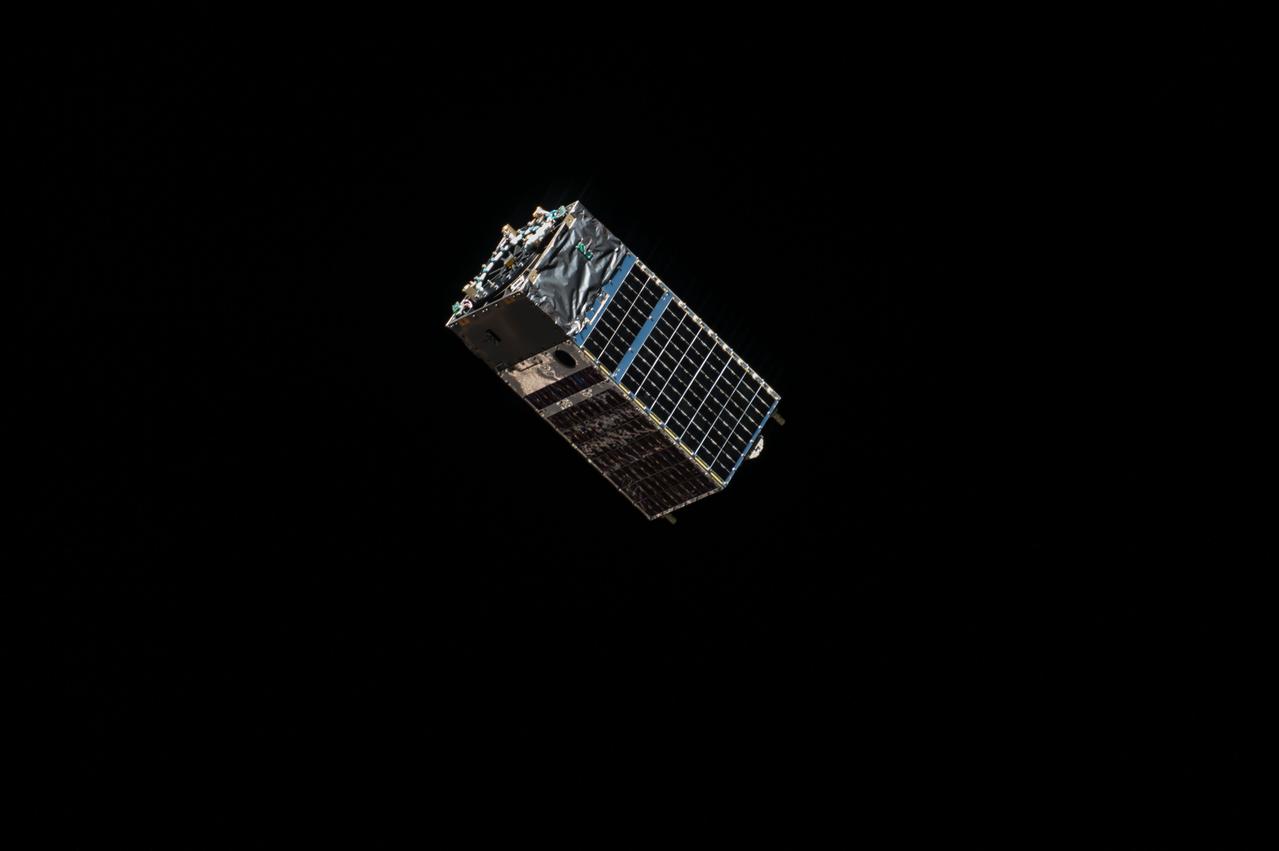
iss053e130267 (Oct. 24, 2017) --- The Kestrel Eye IIM (KE2M) CubeSat is pictured shortly after it was deployed from the tip of the Dextre attached to the Mobile Servicing System. The KE2M is carrying an optical imaging system payload that is being used to validate the concept of using microsatellites in low-Earth orbit to support critical operations.
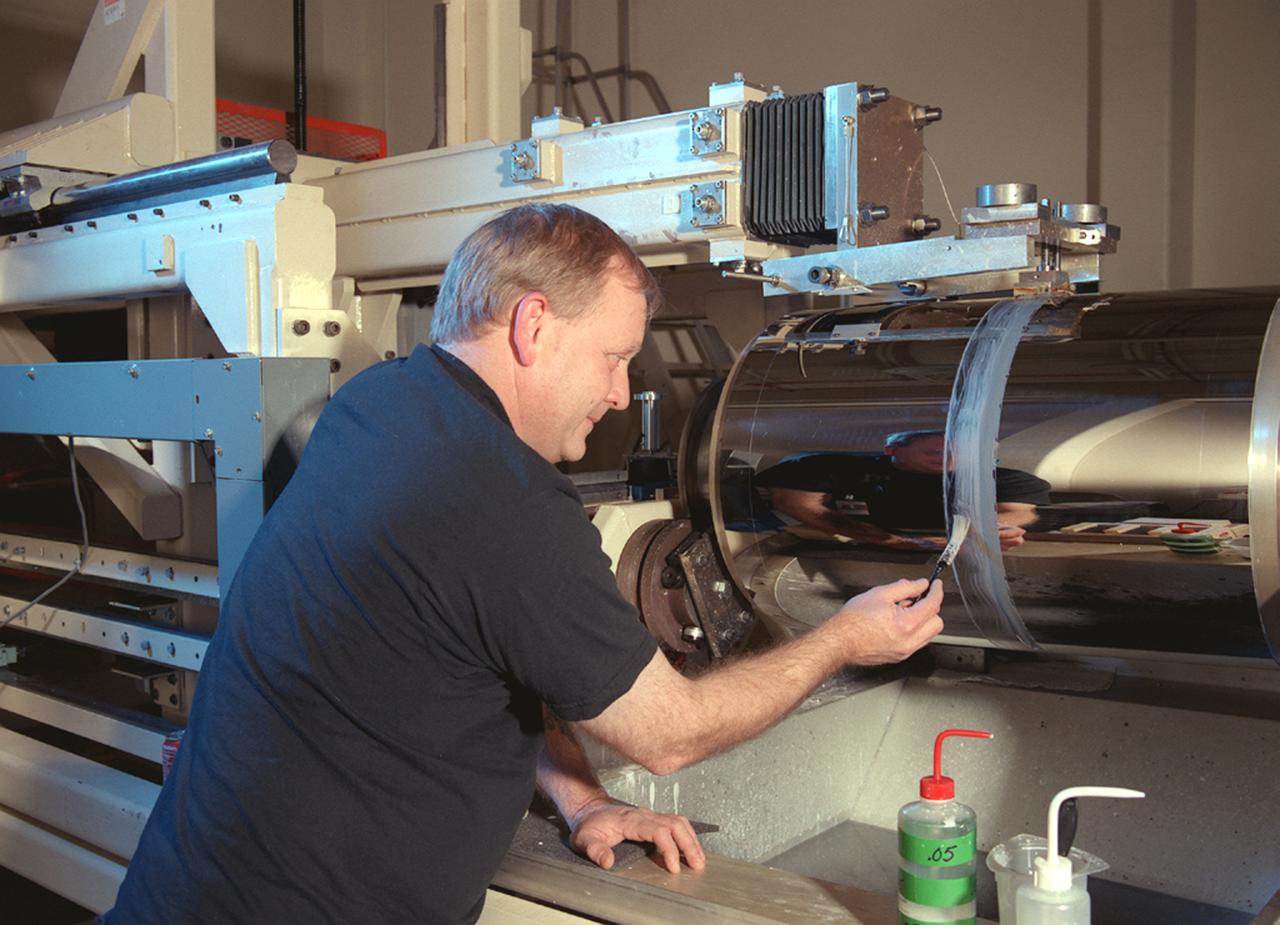
NASA's Space Optics Manufacturing Center has been working to expand our view of the universe via sophisticated new telescopes. The Optics Center's goal is to develop low-cost, advanced space optics technologies for the NASA program in the 21st century - including the long-term goal of imaging Earth-like planets in distant solar systems. To reduce the cost of mirror fabrication, Marshall Space Flight Center (MSFC) has developed replication techniques, the machinery, and materials to replicate electro-formed nickel mirrors. The process allows fabricating precisely shaped mandrels to be used and reused as masters for replicating high-quality mirrors. MSFC's Space Optics Manufacturing Technology Center (SOMTC) has grinding and polishing equipment ranging from conventional spindles to custom-designed polishers. These capabilities allow us to grind precisely and polish a variety of optical devices, including x-ray mirror mandrels. This image shows Charlie Griffith polishing the half-meter mandrel at SOMTC.