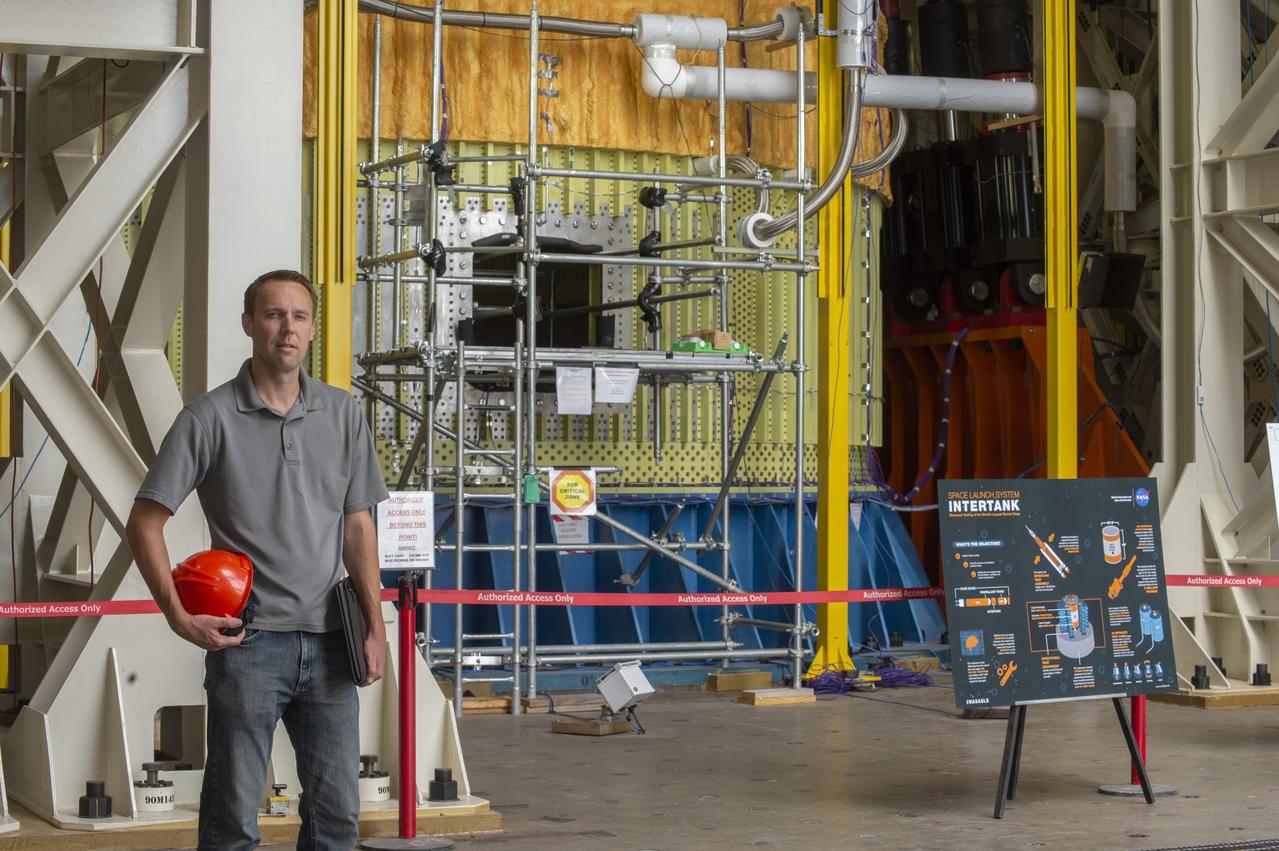
Preston Schmauch, SLS Stages Element Alternate Lead Systems Engineer, oversees testing of the Intertank Structural Test Article (STA), which will push, pull, and bend the STA with millions of pounds of force to prove the SLS Intertank can withstand the immense forces induced by aero, engine, and booster loads during flight.
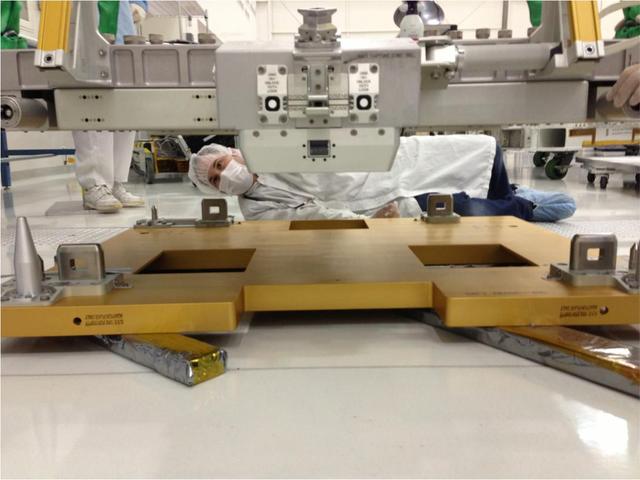
An engineer from NASA Jet Propulsion Laboratory oversees a fit check during the integration & testing of the Optical PAyload for Lasercomm Science OPALS.

Diane Hope, Charlene Ung, and Cathryn Murray-Wooddell oversee preparations for vibration testing of the Earth Surface Mineral Dust Source Investigation (EMIT) science instrument at NASA's Jet Propulsion Laboratory in Southern California in October 2021. The testing simulates the accelerations and vibrations the instrument will experience during its launch to the International Space Station. Hope is the EMIT mission manager at the NASA Earth System Science Pathfinder Program Office (ESSPPO), Ung is EMIT's project manager at JPL, and Murray-Wooddell is a program analyst from ESSPPO. EMIT will collect measurements of 10 important surface minerals – hematite, goethite, illite, vermiculite, calcite, dolomite, montmorillonite, kaolinite, chlorite, and gypsum – in arid regions between 50-degree south and north latitudes in Africa, Asia, North and South America, and Australia. The data EMIT collects using its telescope and imaging spectrometer will help scientists better understand the role of airborne dust particles in heating and cooling Earth's atmosphere on global and regional scales. EMIT was developed at JPL, which is managed for NASA by Caltech in Pasadena, California. It is set to launch in June 2022 from Kennedy Space Center in Florida to the ISS aboard SpaceX's 25th commercial resupply mission. Once EMIT begins operation, its data will be delivered to the NASA Land Processes Distributed Active Archive Center (DAAC) for use by other researchers and the public. https://photojournal.jpl.nasa.gov/catalog/PIA25150
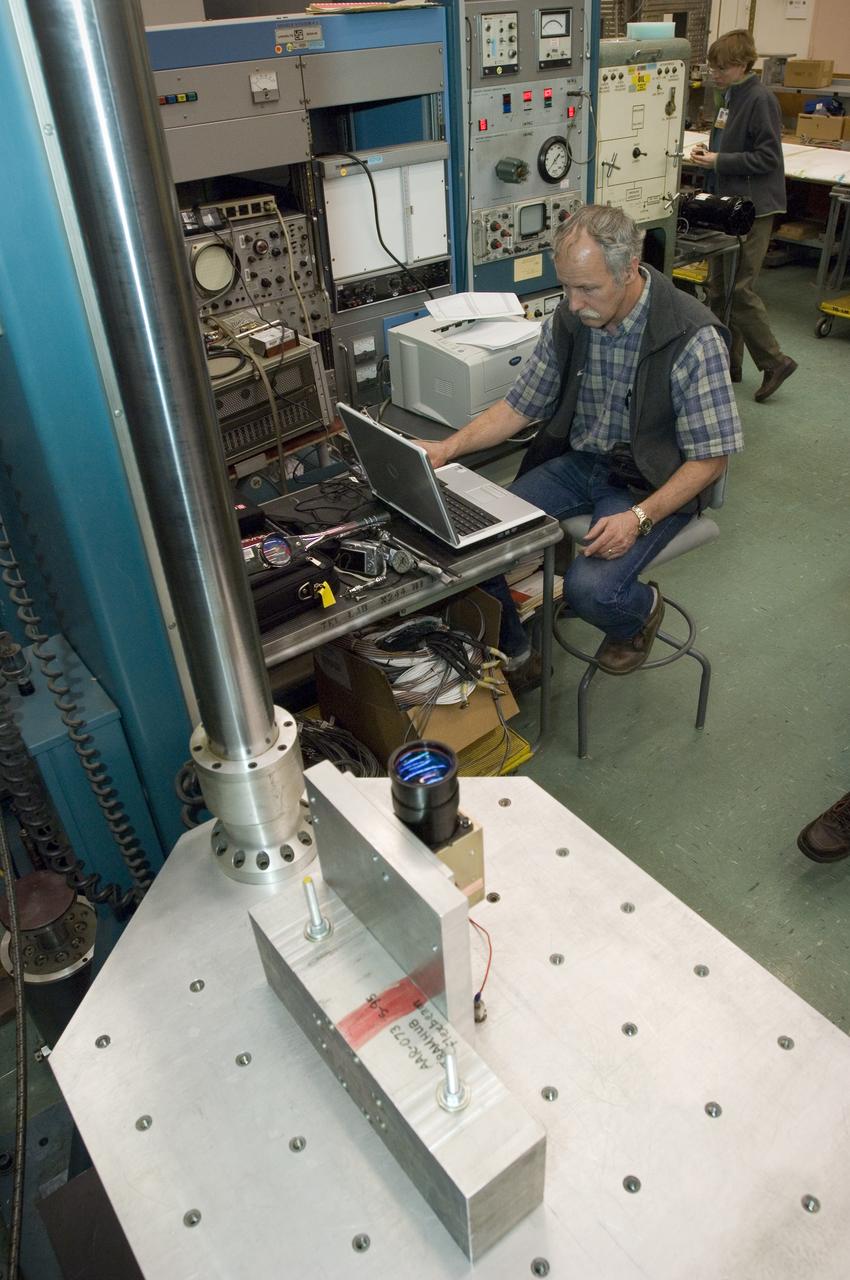
Lunar CRater Observation and Sensing Satellite (LCROSS) and P.I. at NASA Ames Research Center - Total Luminance Photometer lens and electronics units on shake table in N-2444 EEL Laboratory with Lynn Hofland (techician/operator EEL) oversees test run
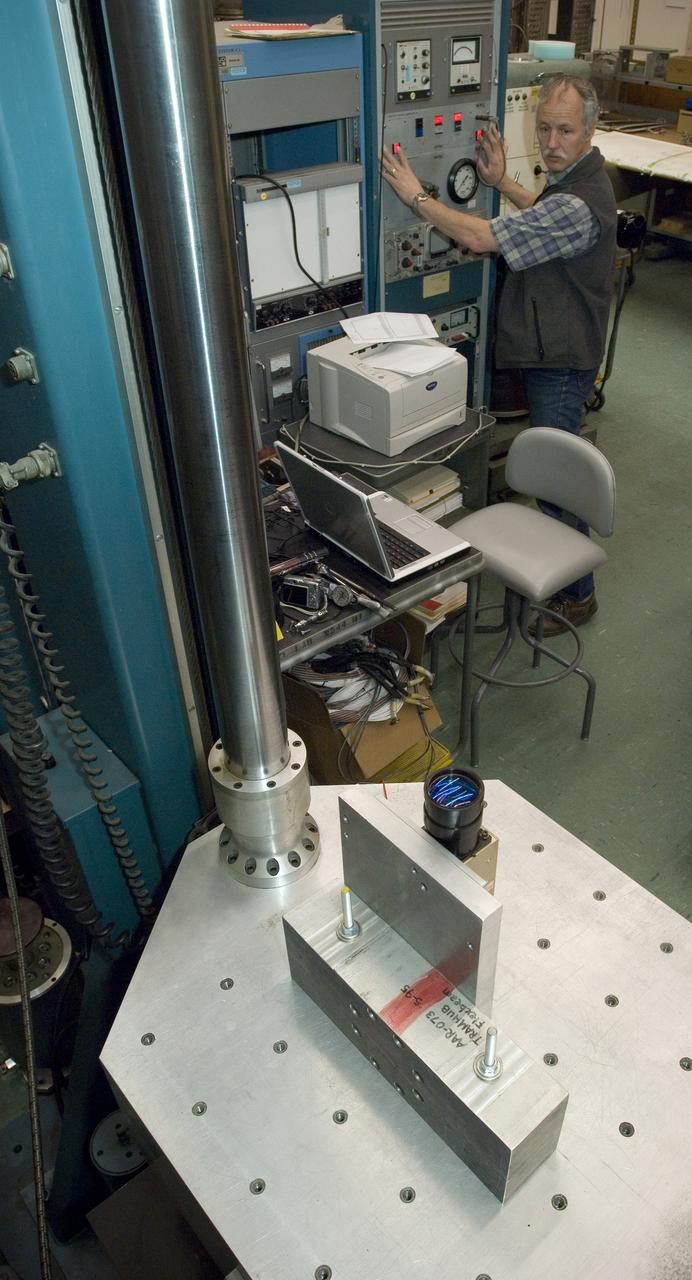
Lunar CRater Observation and Sensing Satellite (LCROSS) and P.I. at NASA Ames Research Center - Total Luminance Photometer lens and electronics units on shake table in N-2444 EEL Laboratory with Lynn Hofland (techician/operator EEL) oversees test run
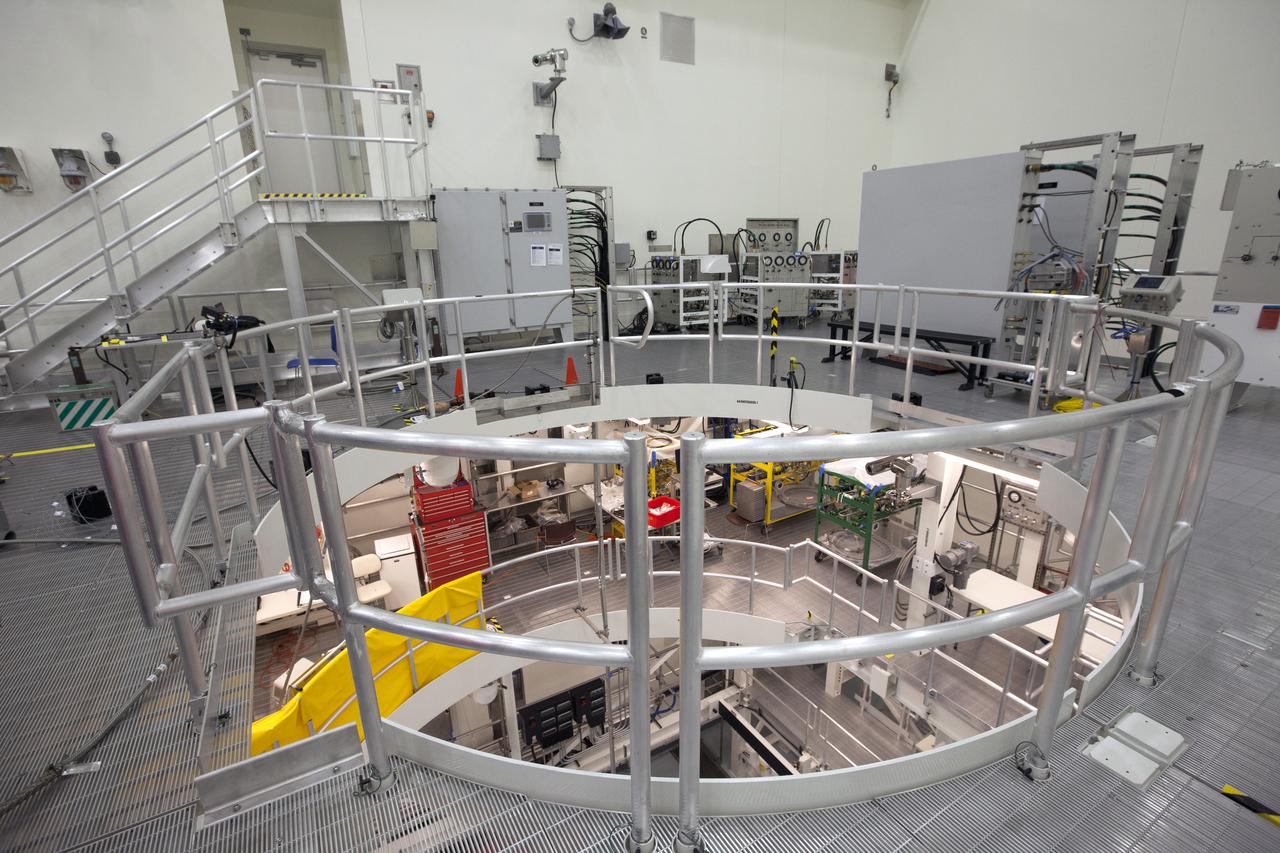
Engineers and technicians completed verification and validation testing of several pneumatic systems inside and outside the Multi-Payload Processing Facility (MPPF) at NASA's Kennedy Space Center in Florida. In view is the top level of the service platform for Orion spacecraft processing. The MPPF will be used for offline processing and fueling of the Orion spacecraft and service module stack before launch. Orion also will be de-serviced in the MPPF after a mission. The Ground Systems Development and Operations Program (GSDO) is overseeing upgrades to the facility. The Engineering Directorate led the recent pneumatic tests.
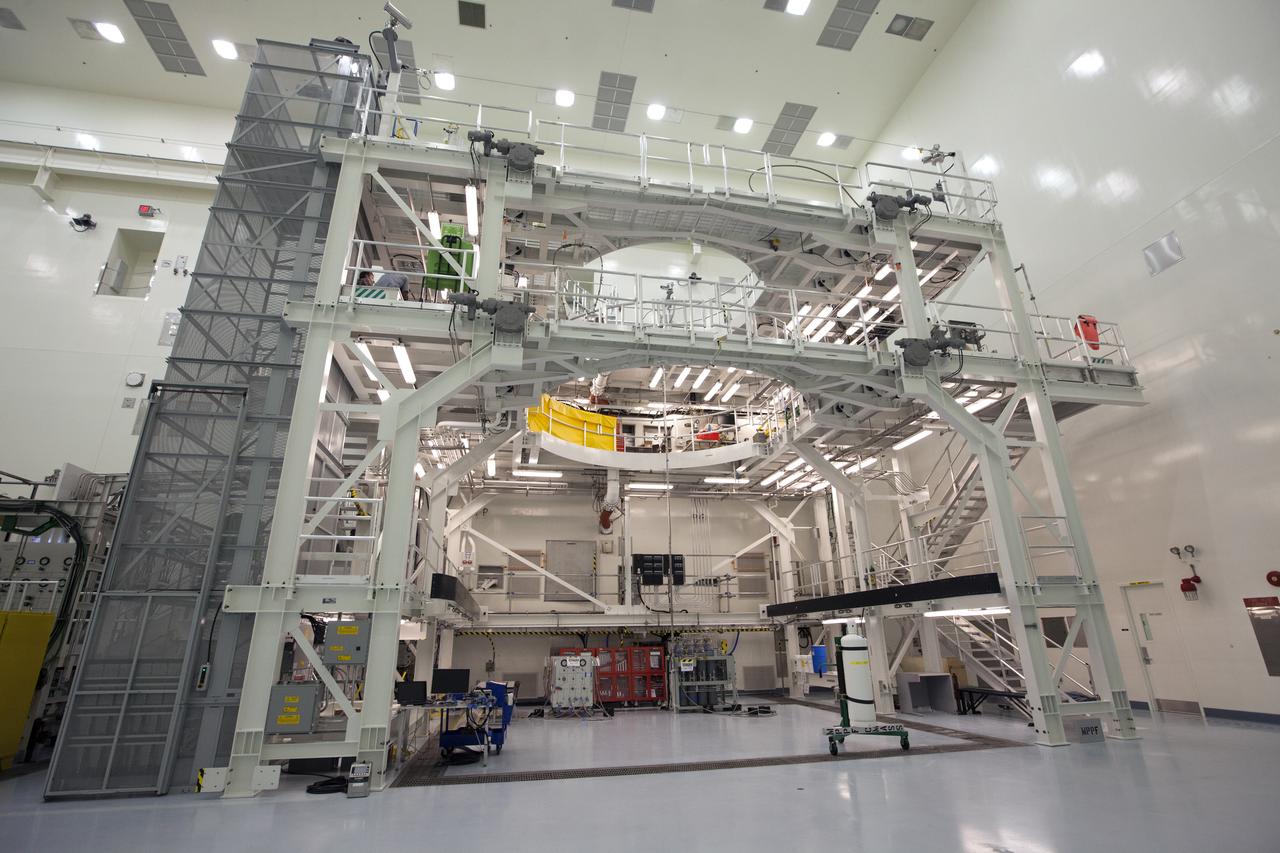
Engineers and technicians completed verification and validation testing of several pneumatic systems inside and outside the Multi-Payload Processing Facility (MPPF) at NASA's Kennedy Space Center in Florida. In view is the service platform for Orion spacecraft processing. The MPPF will be used for offline processing and fueling of the Orion spacecraft and service module stack before launch. Orion also will be de-serviced in the MPPF after a mission. The Ground Systems Development and Operations Program (GSDO) is overseeing upgrades to the facility. The Engineering Directorate led the recent pneumatic tests.
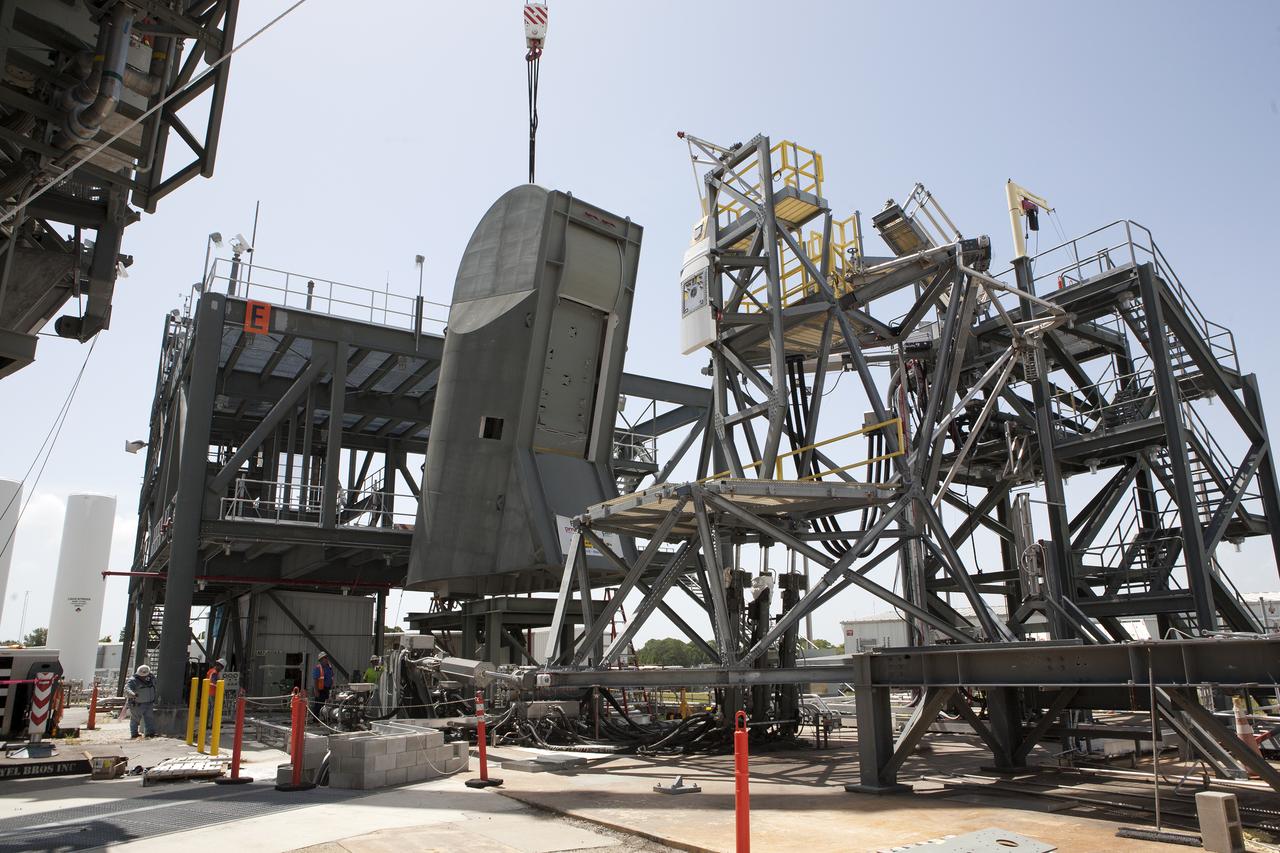
Technician monitors the progress as a crane lowers the first Tail Service Mast Umbilical (TSMU) onto a test stand at the Launch Equipment Test Facility at NASA’s Kennedy Space Center in Florida. Two TSMUs will provide liquid propellants and power to the Space Launch System (SLS) rocket’s core stage engine. Both TSMUs will connect to the zero-level deck on the mobile launcher, providing fuel and electricity to the SLS rocket before it launches on Exploration Mission 1. The TSMU will undergo testing and validation at the LETF to verify it is functioning properly. The center’s Engineering Directorate and the Ground Systems Development and Operations Program are overseeing processing and testing of the umbilicals.
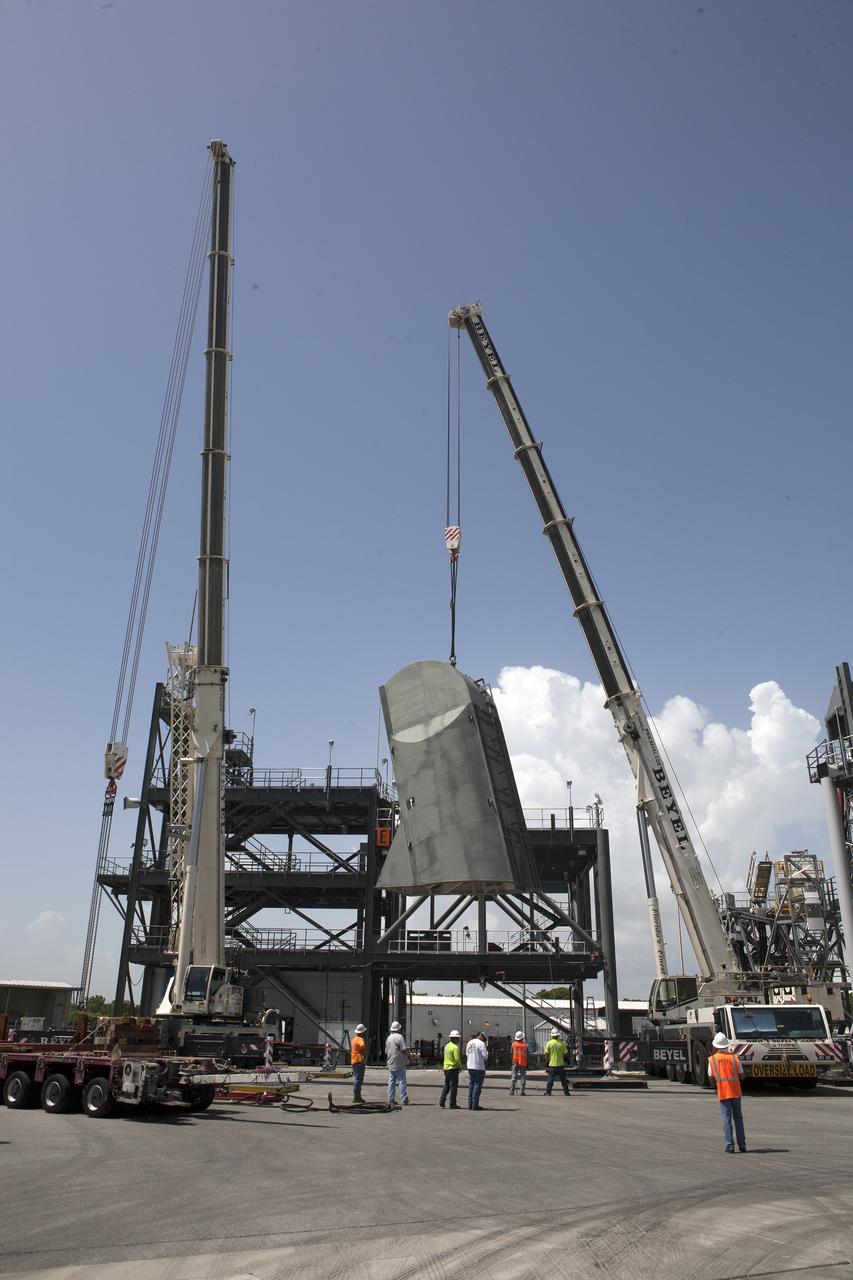
A crane lifts the first Tail Service Mast Umbilical (TSMU) up for placement on a test stand at the Launch Equipment Test Facility at NASA’s Kennedy Space Center in Florida. Two TSMUs will provide liquid propellants and power to the Space Launch System (SLS) rocket’s core stage engine. Both TSMUs will connect to the zero-level deck on the mobile launcher, providing fuel and electricity to the SLS rocket before it launches on Exploration Mission 1. The TSMU will undergo testing and validation at the LETF to verify it is functioning properly. The center’s Engineering Directorate and the Ground Systems Development and Operations Program are overseeing processing and testing of the umbilicals.
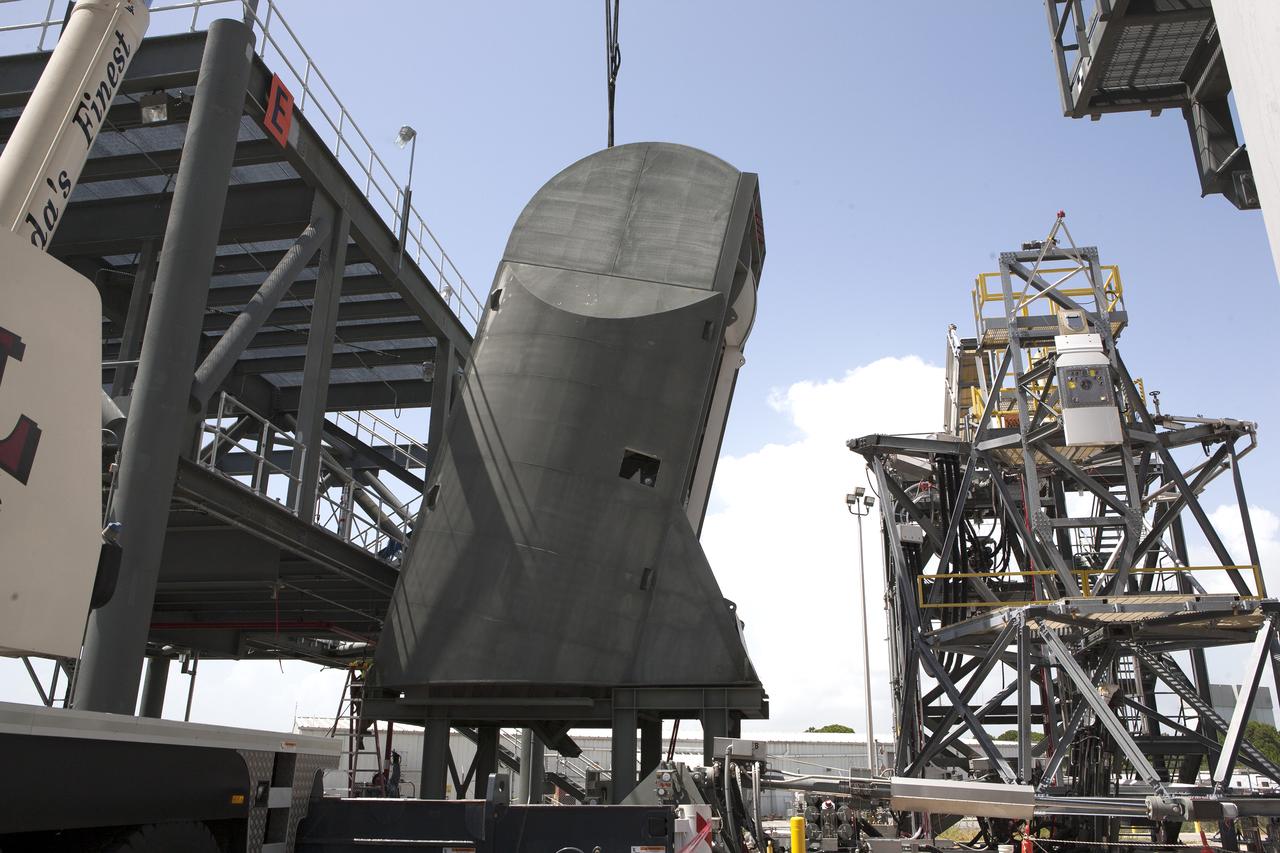
A crane lowers the first Tail Service Mast Umbilical (TSMU) onto a test stand at the Launch Equipment Test Facility at NASA’s Kennedy Space Center in Florida. Two TSMUs will provide liquid propellants and power to the Space Launch System (SLS) rocket’s core stage engine. Both TSMUs will connect to the zero-level deck on the mobile launcher, providing fuel and electricity to the SLS rocket before it launches on Exploration Mission 1. The TSMU will undergo testing and validation at the LETF to verify it is functioning properly. The center’s Engineering Directorate and the Ground Systems Development and Operations Program are overseeing processing and testing of the umbilicals.
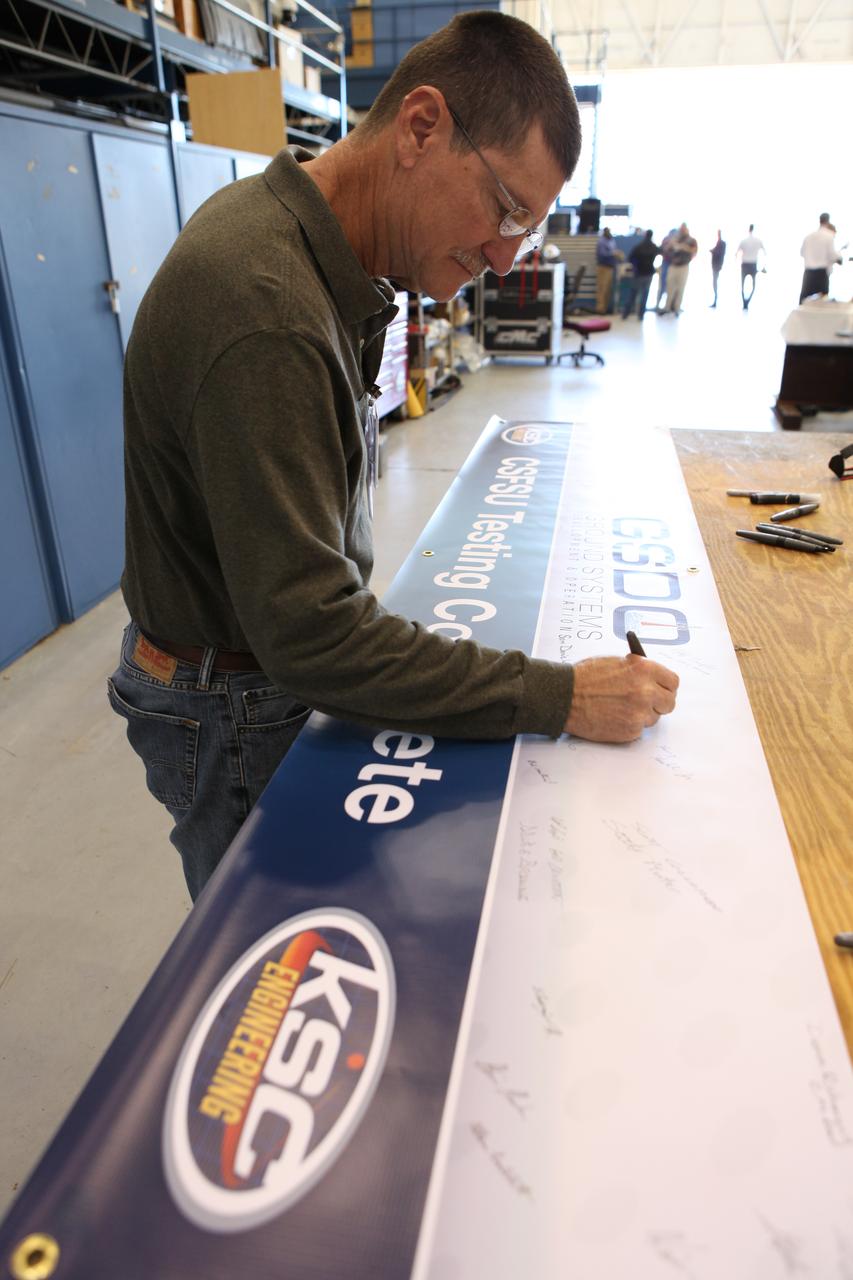
A NASA technician signs the banner inside a support building at the Launch Equipment Test Facility at Kennedy Space Center in Florida. Testing of the Core Stage Forward Skirt Umbilical (CSFSU) for NASA's Space Launch System is complete and the umbilical has been transported to the mobile launcher area. The umbilical will be prepared for installation on the tower of the mobile launcher. The CSFSU will be mated to the core stage forward skirt to provide commodities to the SLS rocket, and then disconnect and swing away before launch. Its main purpose is to provide conditioned air and gaseous nitrogen to the SLS Core Stage Forward Skirt. The center’s Engineering Directorate and the Ground Systems Development and Operations Program are overseeing processing and testing of the umbilicals.
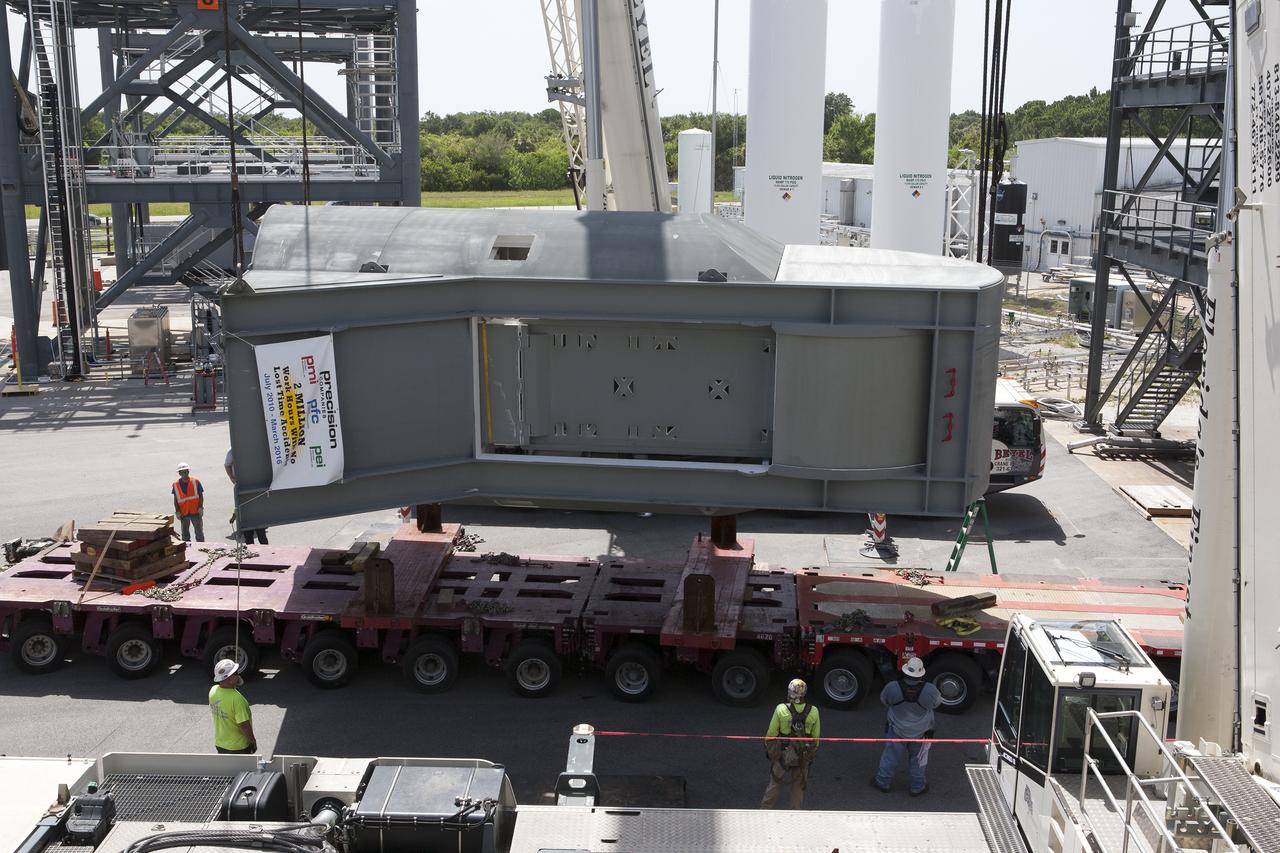
Technicians assist as a crane is used to lift the first Tail Service Mast Umbilical (TSMU) up from the flatbed of the transport truck at the Launch Equipment Test Facility (LETF) at NASA’s Kennedy Space Center in Florida. Two TSMUs will provide liquid propellants and power to the Space Launch System (SLS) rocket’s core stage engine. Both TSMUs will connect to the zero-level deck on the mobile launcher, providing fuel and electricity to the SLS rocket before it launches on Exploration Mission 1. The TSMU will undergo testing and validation at the LETF to verify it is functioning properly. The center’s Engineering Directorate and the Ground Systems Development and Operations Program are overseeing processing and testing of the umbilicals.
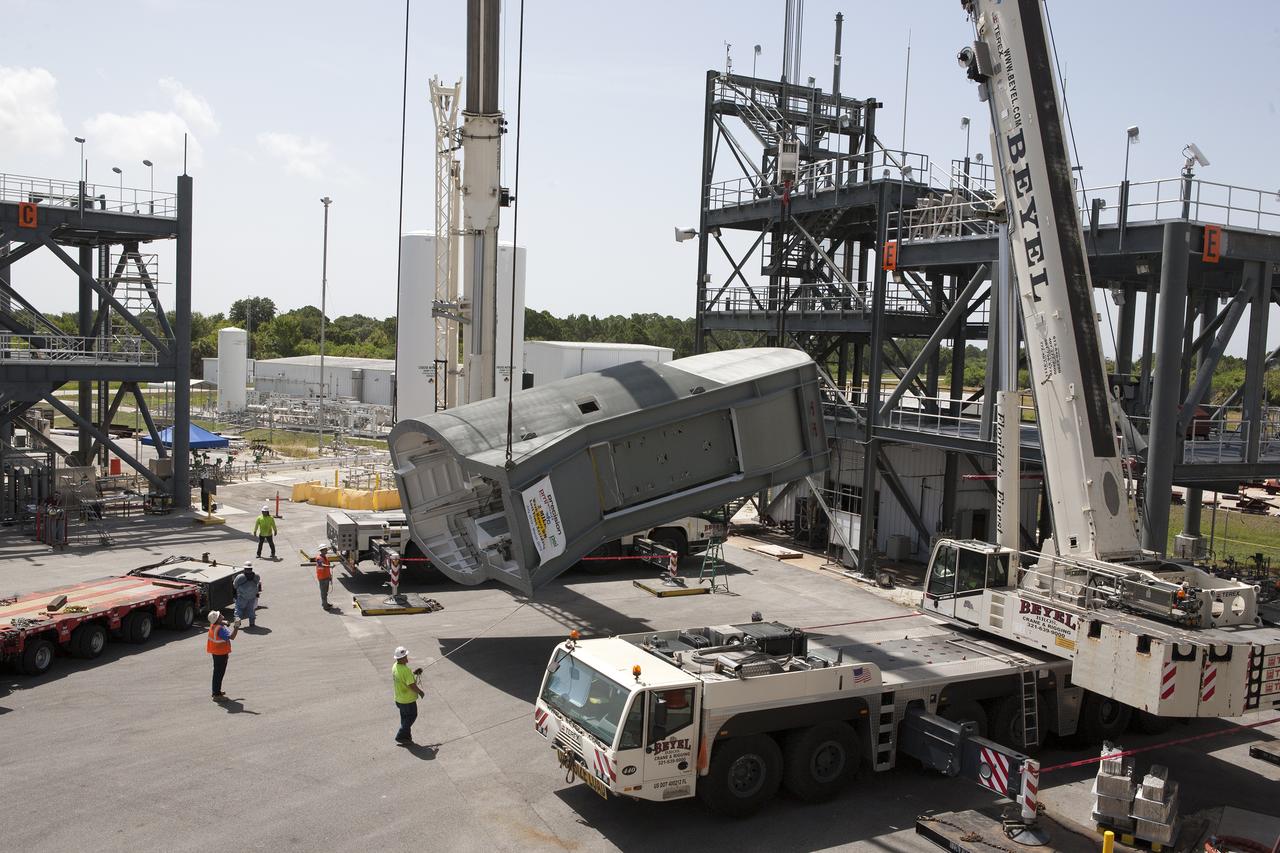
Technicians assist as a crane is used to lift the first Tail Service Mast Umbilical (TSMU) away from the flatbed of the transport truck at the Launch Equipment Test Facility (LETF) at NASA’s Kennedy Space Center in Florida. Two TSMUs will provide liquid propellants and power to the Space Launch System (SLS) rocket’s core stage engine. Both TSMUs will connect to the zero-level deck on the mobile launcher, providing fuel and electricity to the SLS rocket before it launches on Exploration Mission 1. The TSMU will undergo testing and validation at the LETF to verify it is functioning properly. The center’s Engineering Directorate and the Ground Systems Development and Operations Program are overseeing processing and testing of the umbilicals.
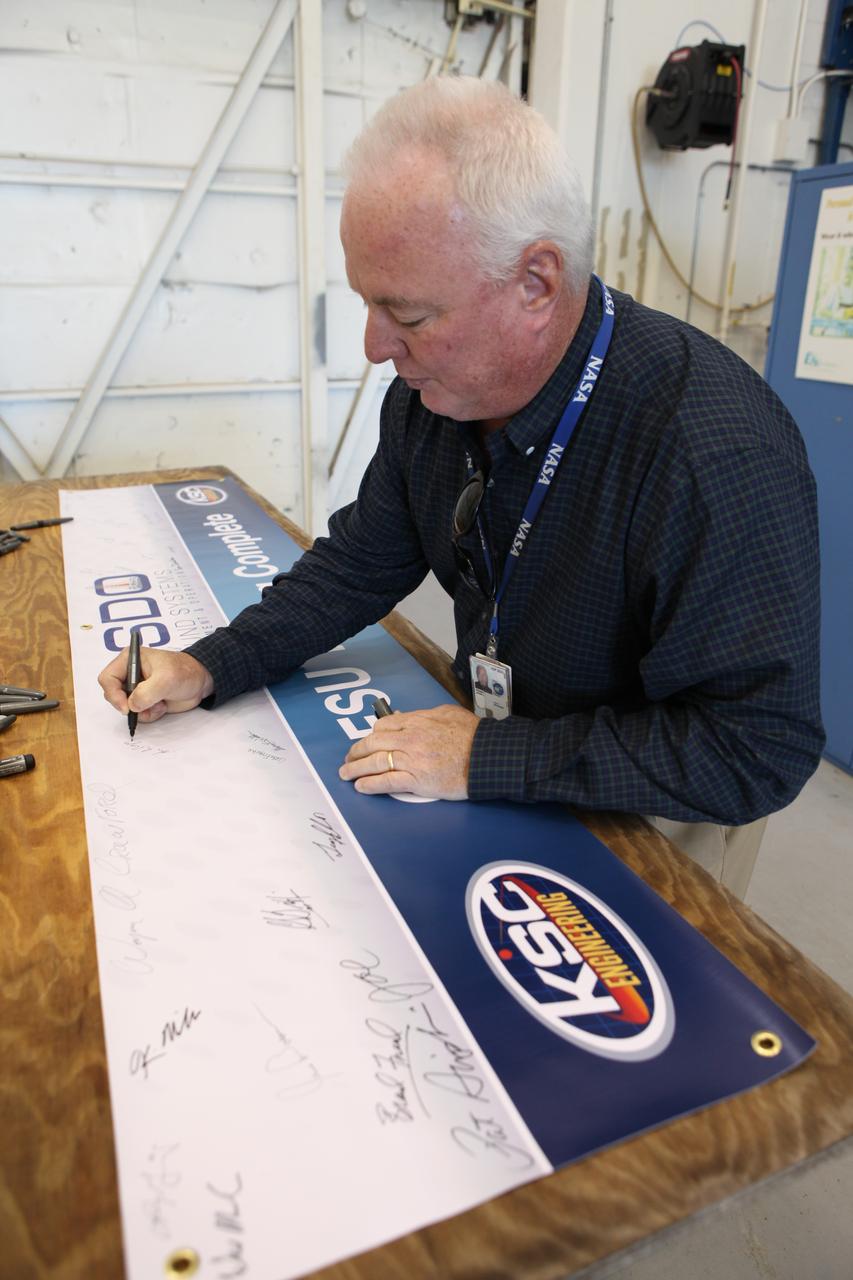
A NASA engineer signs the banner inside a support building at the Launch Equipment Test Facility at Kennedy Space Center in Florida. Testing of the Core Stage Forward Skirt Umbilical (CSFSU) for NASA's Space Launch System is complete and the umbilical has been transported to the mobile launcher area. The umbilical will be prepared for installation on the tower of the mobile launcher. The CSFSU will be mated to the core stage forward skirt to provide commodities to the SLS rocket, and then disconnect and swing away before launch. Its main purpose is to provide conditioned air and gaseous nitrogen to the SLS Core Stage Forward Skirt. The center’s Engineering Directorate and the Ground Systems Development and Operations Program are overseeing processing and testing of the umbilicals.
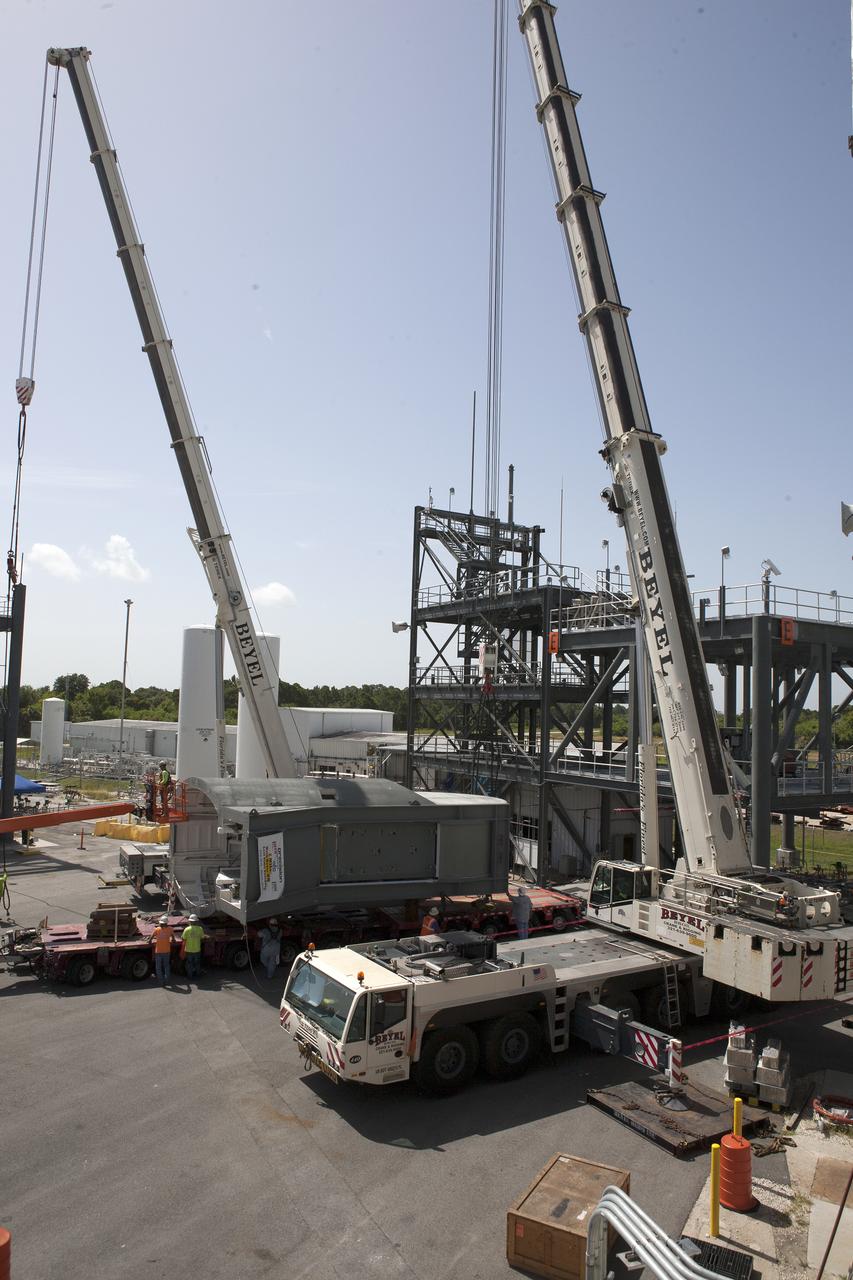
A crane is prepared to help lift the first Tail Service Mast Umbilical (TSMU) for NASA’s Space Launch System (SLS) at the Launch Equipment Test Facility (LETF) at NASA’s Kennedy Space Center in Florida. Two TSMUs will provide liquid propellants and power to the Space Launch System (SLS) rocket’s core stage engine. Both TSMUs will connect to the zero-level deck on the mobile launcher, providing fuel and electricity to the SLS rocket before it launches on Exploration Mission 1. The TSMU will undergo testing and validation at the LETF to verify it is functioning properly. The center’s Engineering Directorate and the Ground Systems Development and Operations Program are overseeing processing and testing of the umbilicals.
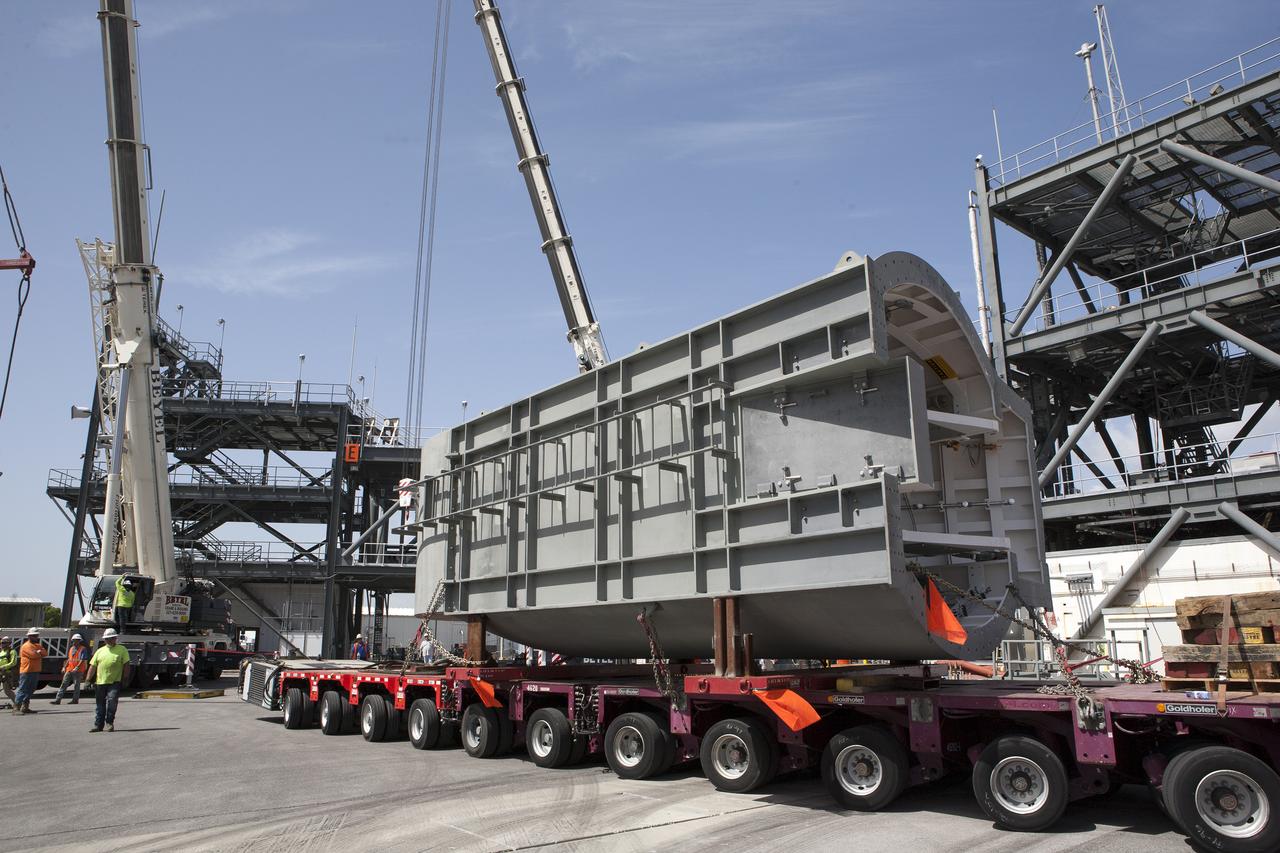
A crane is attached to the first Tail Service Mast Umbilical (TSMU) for NASA’s Space Launch System (SLS) at the Launch Equipment Test Facility at NASA’s Kennedy Space Center in Florida. Two TSMUs will provide liquid propellants and power to the Space Launch System (SLS) rocket’s core stage engine. Both TSMUs will connect to the zero-level deck on the mobile launcher, providing fuel and electricity to the SLS rocket before it launches on Exploration Mission 1. The TSMU will undergo testing and validation at the LETF to verify it is functioning properly. The center’s Engineering Directorate and the Ground Systems Development and Operations Program are overseeing processing and testing of the umbilicals.
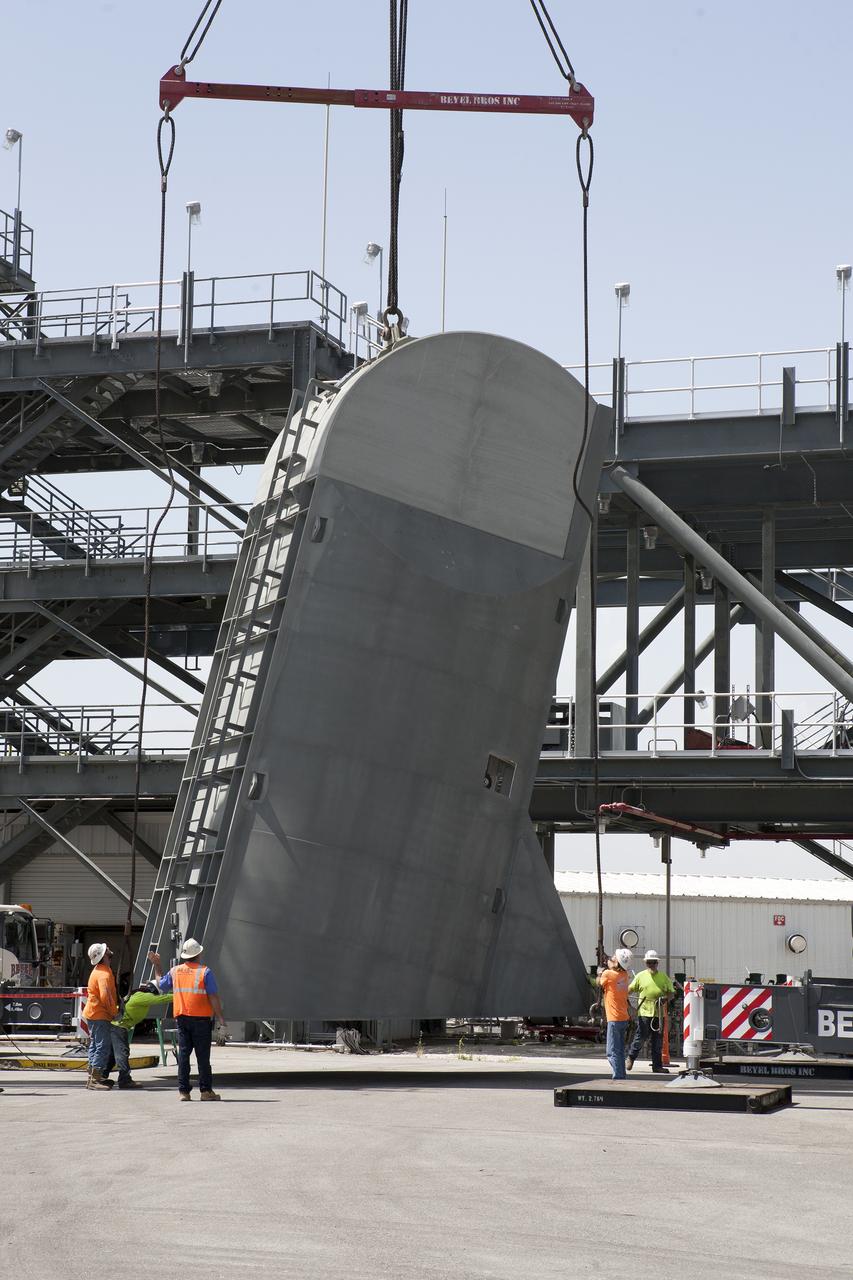
Technicians assist as a crane is used to lift the first Tail Service Mast Umbilical (TSMU) into the vertical position at the Launch Equipment Test Facility (LETF) at NASA’s Kennedy Space Center in Florida. Two TSMUs will provide liquid propellants and power to the Space Launch System (SLS) rocket’s core stage engine. Both TSMUs will connect to the zero-level deck on the mobile launcher, providing fuel and electricity to the SLS rocket before it launches on Exploration Mission 1. The TSMU will undergo testing and validation at the LETF to verify it is functioning properly. The center’s Engineering Directorate and the Ground Systems Development and Operations Program are overseeing processing and testing of the umbilicals.
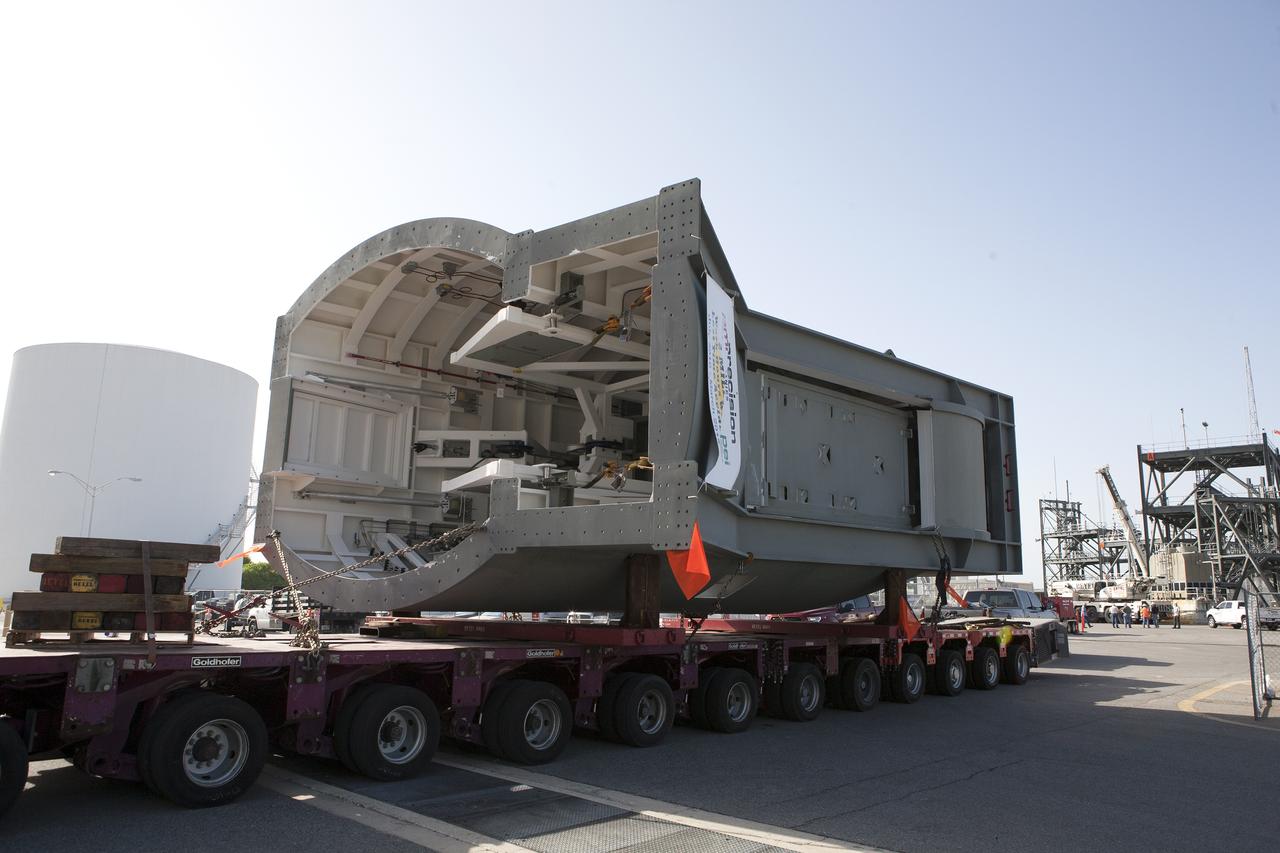
A heavy-lift transport truck arrives at the Launch Equipment Test Facility (LETF) at NASA’s Kennedy Space Center in Florida, with the first of two Tail Service Mast Umbilicals (TSMU) for NASA’s Space Launch System (SLS). Two TSMUs will provide liquid propellants and power to the Space Launch System (SLS) rocket’s core stage engine. Both TSMUs will connect to the zero-level deck on the mobile launcher, providing fuel and electricity to the SLS rocket before it launches on Exploration Mission 1. The TSMU will undergo testing and validation at the LETF to verify it is functioning properly. The center’s Engineering Directorate and the Ground Systems Development and Operations Program are overseeing processing and testing of the umbilicals.
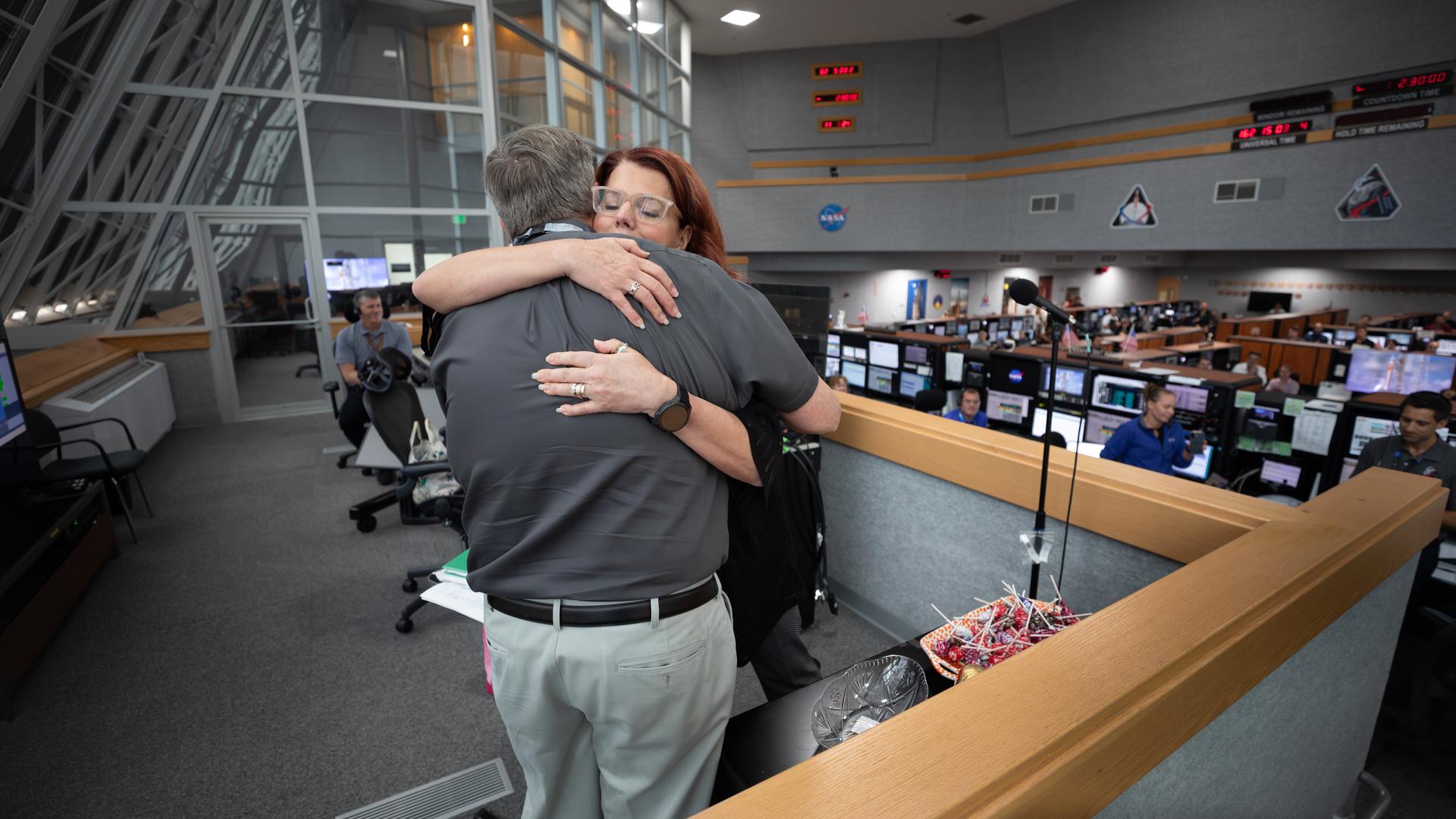
Artemis Launch Director Charlie Blackwell-Thompson gives NASA Test Director Jeff Spaulding a hug Thursday, June 11, 2026, following his retirement from the agency's Kennedy Space Center in Florida. Spaulding began his career at NASA in 1987 as a NASA operations engineer overseeing orbiter processing activities for seven shuttle missions. He later went on to lead the Artemis II launch team during planning, scheduling, and execution on Artemis II on April 1, 2026.
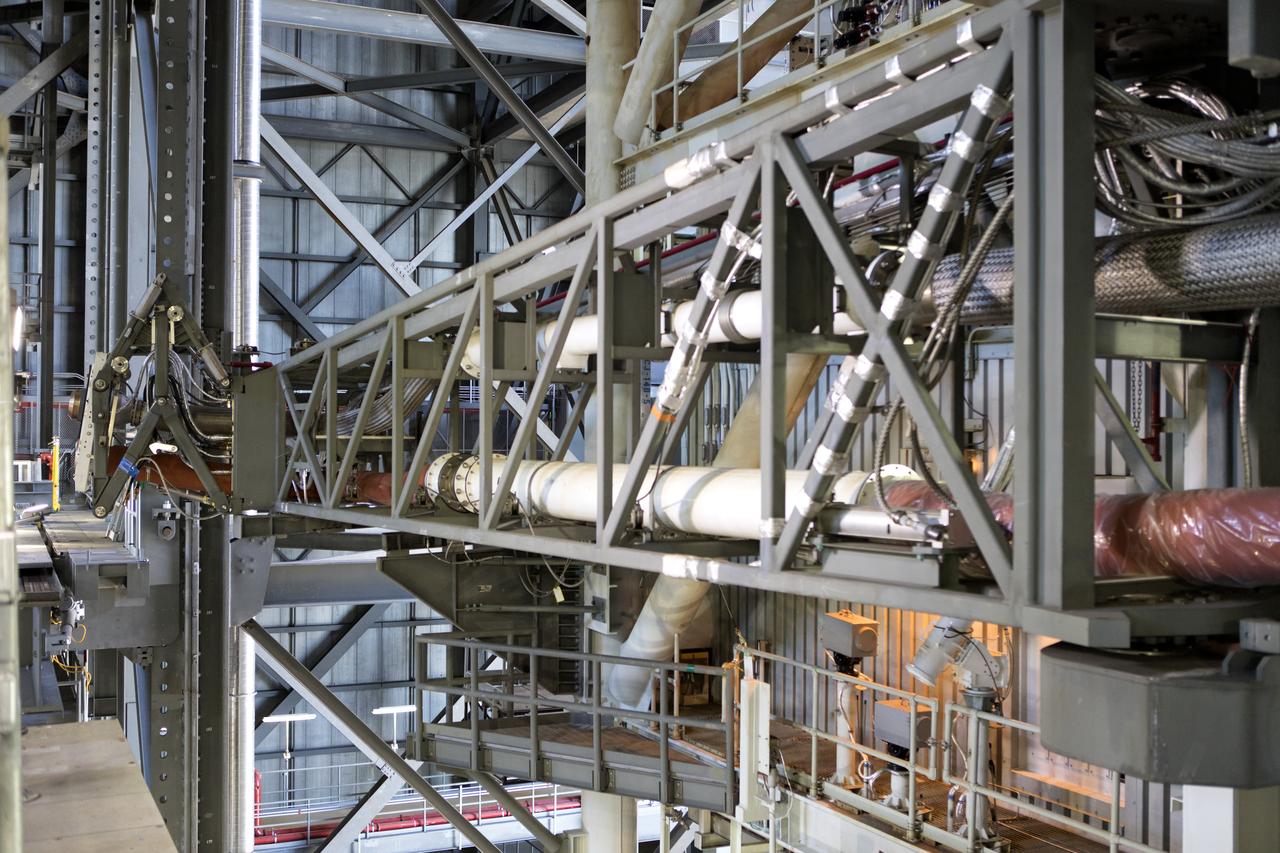
Preparations are underway to perform a preliminary swing test of the Core Stage Inter-tank Umbilical (CSITU) on the mobile launcher in High Bay 3 of the Vehicle Assembly Building on Feb. 22, 2019, at NASA's Kennedy Space Center in Florida. The CSITU is a swing-arm umbilical that will connect to the Space Launch System core stage inter-tank. It will provide conditioned air, pressurized gases and power and data connection to the core stage. The Exploration Ground Systems Program is overseeing installation of the umbilicals.
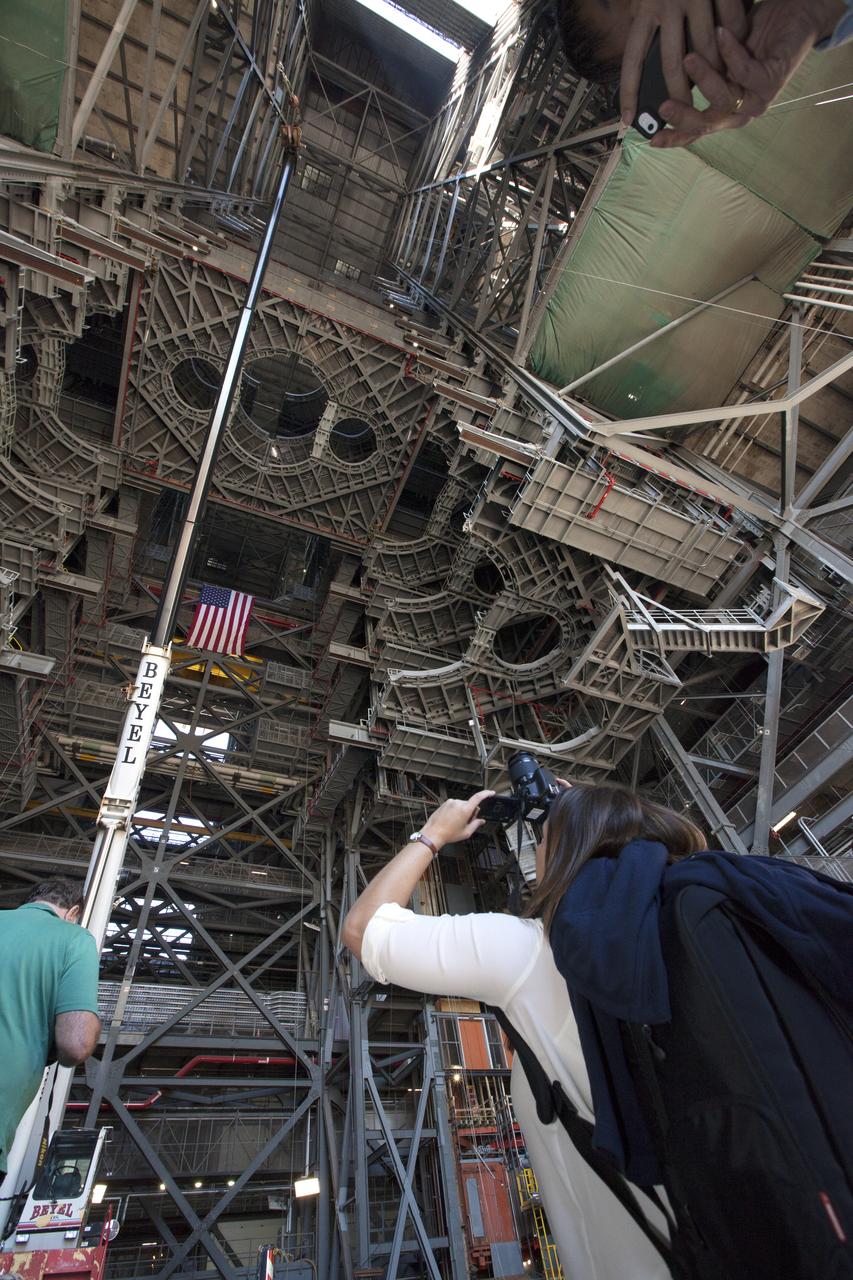
Members of the news media view the 10 levels of new work platforms in High Bay 3 inside the Vehicle Assembly Building (VAB) during a tour of NASA's Kennedy Space Center in Florida with Center Director Bob Cabana. The final platform, A north, was recently installed. The platforms will surround the Space Launch System and Orion spacecraft on the mobile launcher during processing to prepare for the first test flight. The Ground Systems Development and Operations Program is overseeing upgrades to the VAB, including installation of the new work platforms.
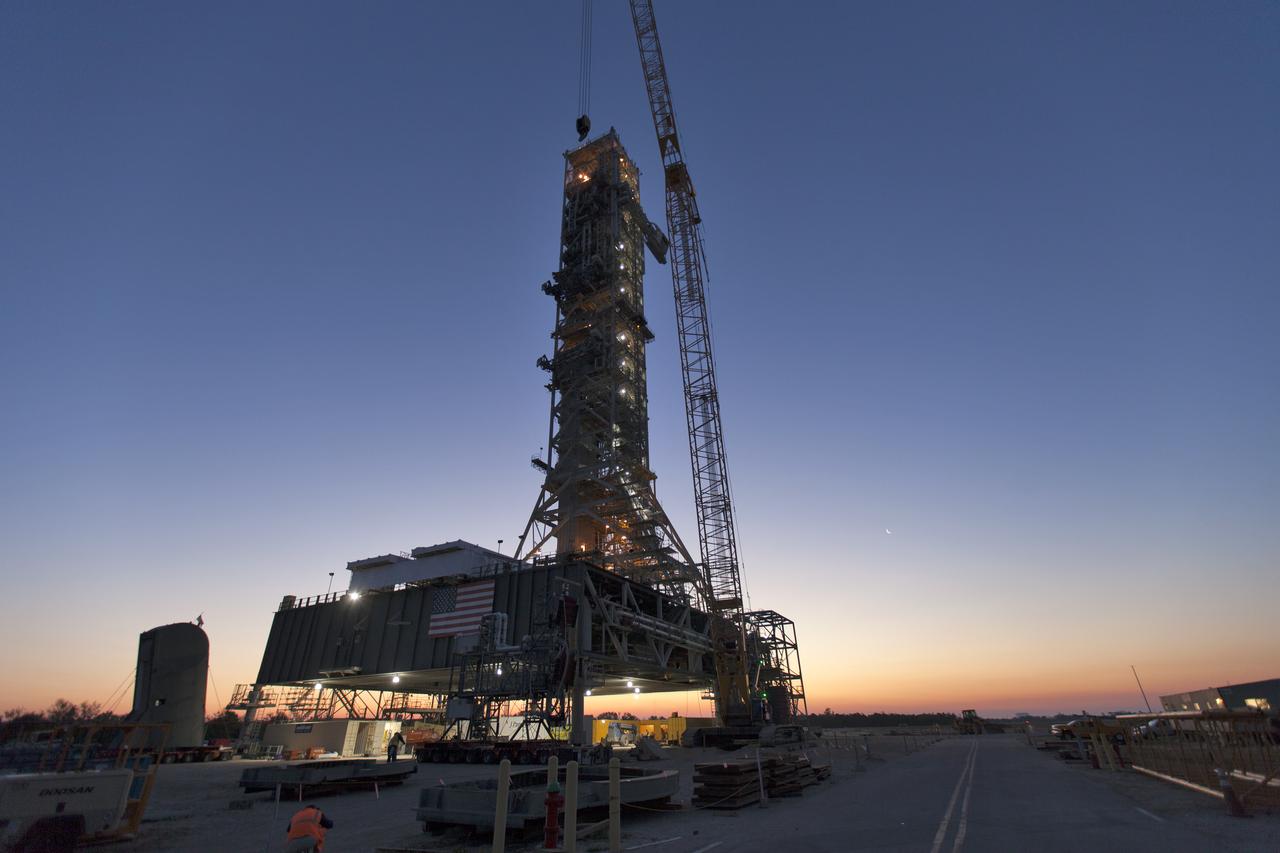
A colorful sunrise serves as the backdrop for the mobile launcher (ML) at NASA's Kennedy Space Center in Florida. Several launch umbilicals have been installed on the ML tower. Exploration Ground Systems is overseeing installation of umbilicals and launch accessories on the ML to prepare for the first integrated test flight of the Orion spacecraft on the agency's Space Launch System rocket on Exploration Mission-1.
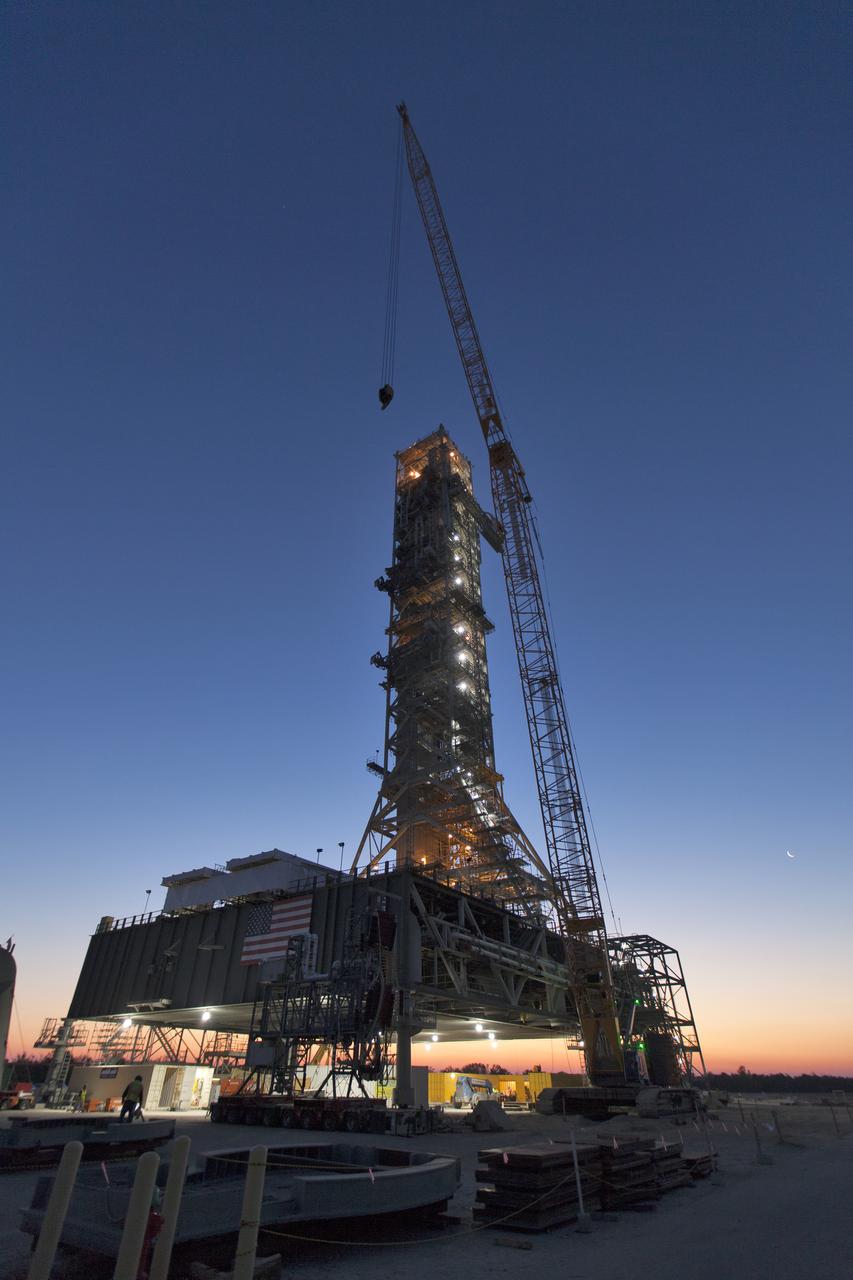
A colorful sunrise serves as the backdrop for the mobile launcher (ML) at NASA's Kennedy Space Center in Florida. Several launch umbilicals have been installed on the ML tower. Exploration Ground Systems is overseeing installation of umbilicals and launch accessories on the ML to prepare for the first integrated test flight of the Orion spacecraft on the agency's Space Launch System rocket on Exploration Mission-1.
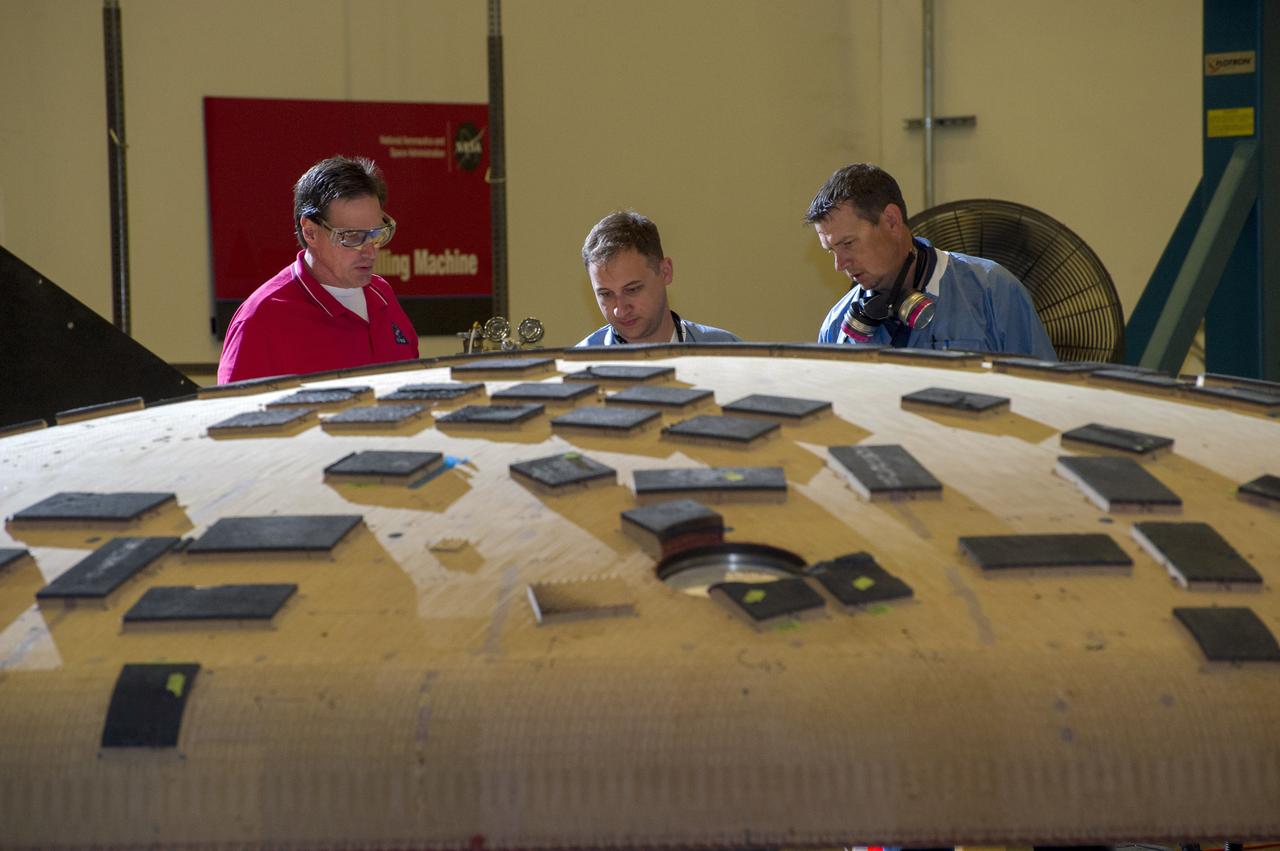
OVERSEEING ORION HEAT SHIELD WORK IN MARSHALL'S SEVEN-AXIS MILLING AND MACHINING FACILITY ARE, FROM LEFT, JOHN KOWAL, MANAGER OF ORION'S THERMAL PROTECTION SYSTEM AT JOHNSON SPACE CENTER; NICHOLAS CROWLEY, AN AMES ENGINEERING TECHNICIAN; AND ROB KORNIENKO, AMES ENGINEERING BRANCH CHIEF. THE HEAT SHIELD FLEW TO SPACE DURING THE EFT-1 FULL SCALE FLIGHT TEST OF ORION IN DECEMBER, 2014
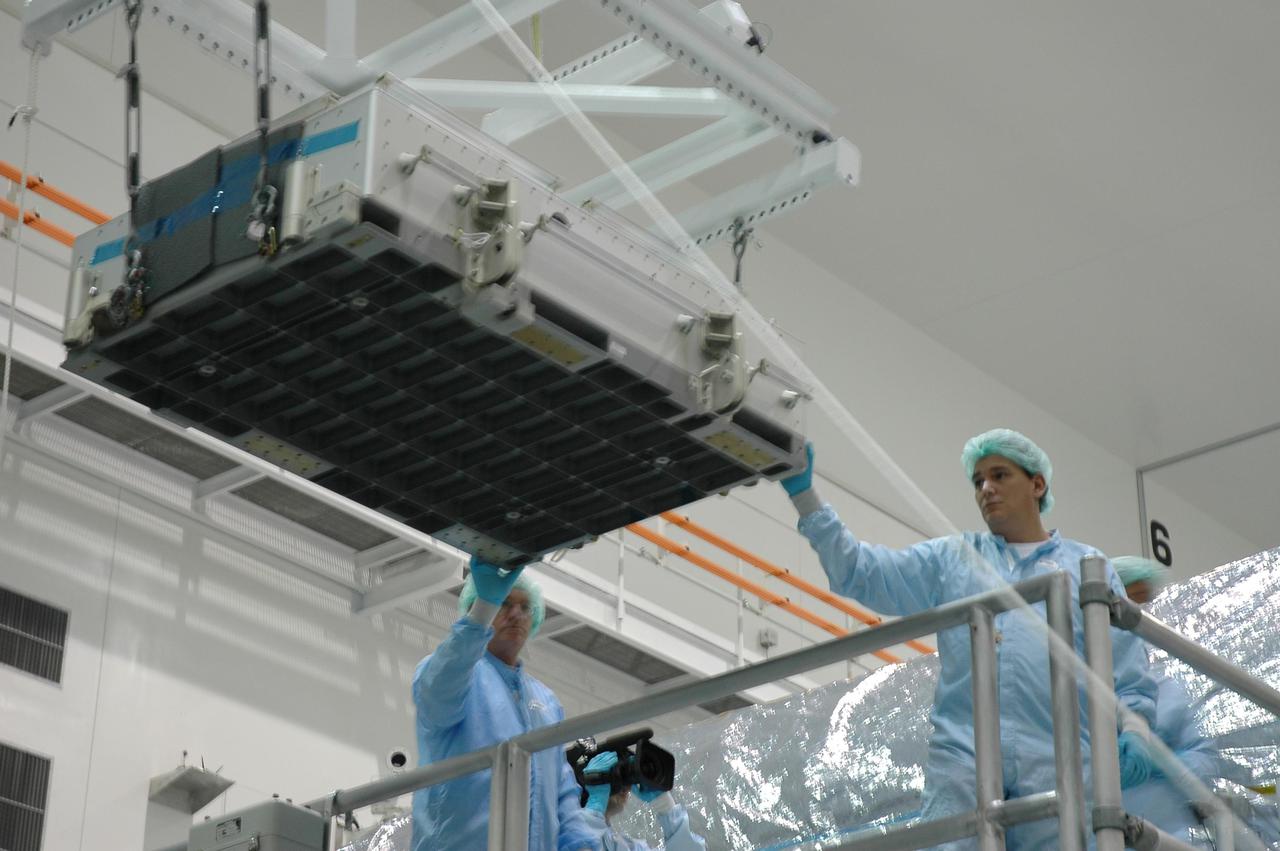
KENNEDY SPACE CENTER, FLA. - In the Space Station Processing Facility, workers oversee the lifting of the tile box from the Lightweight Multi-Purpose Experiment Support Structure Carrier (LMC) that was returned on Space Shuttle Discovery from mission STS-114. The tile box is the Detailed Test Objective (DTO) tile sample repair kit that astronauts experimented with on the mission. The box is being returned to Johnson Space Center in Houston.

A sliver of the Moon is visible just before sunrise at NASA's Kennedy Space Center in Florida. In view is one of the steel structures of the mobile launcher (ML). Several launch umbilicals have been installed on the ML tower. Exploration Ground Systems is overseeing installation of umbilicals and launch accessories on the ML to prepare for the first integrated test flight of the Orion spacecraft on the agency's Space Launch System rocket on Exploration Mission-1.
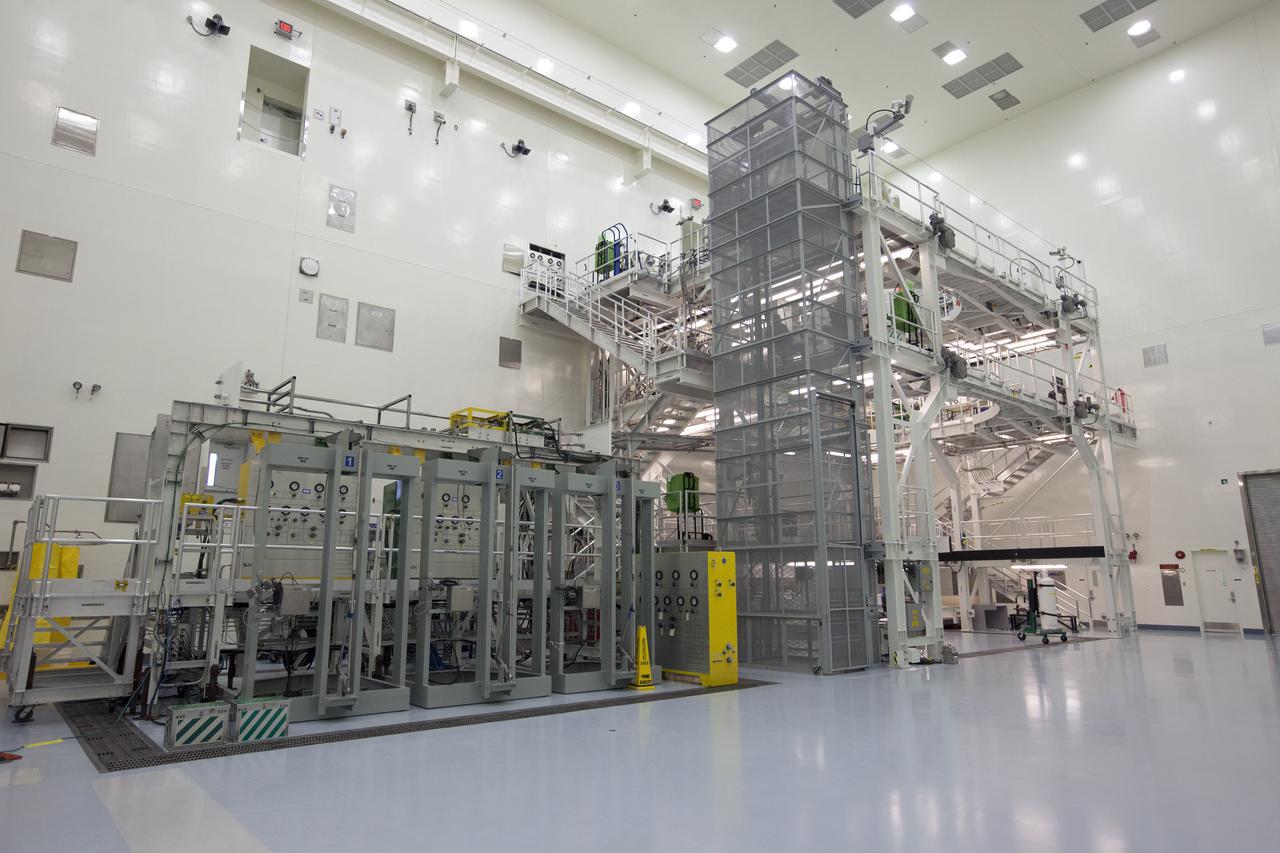
Engineers and technicians completed verification and validation testing of several pneumatic systems inside and outside the Multi-Payload Processing Facility (MPPF) at NASA's Kennedy Space Center in Florida. In view is the service platform for Orion spacecraft processing. To the left are several pneumatic panels. The MPPF will be used for offline processing and fueling of the Orion spacecraft and service module stack before launch. Orion also will be de-serviced in the MPPF after a mission. The Ground Systems Development and Operations Program (GSDO) is overseeing upgrades to the facility. The Engineering Directorate led the recent pneumatic tests.
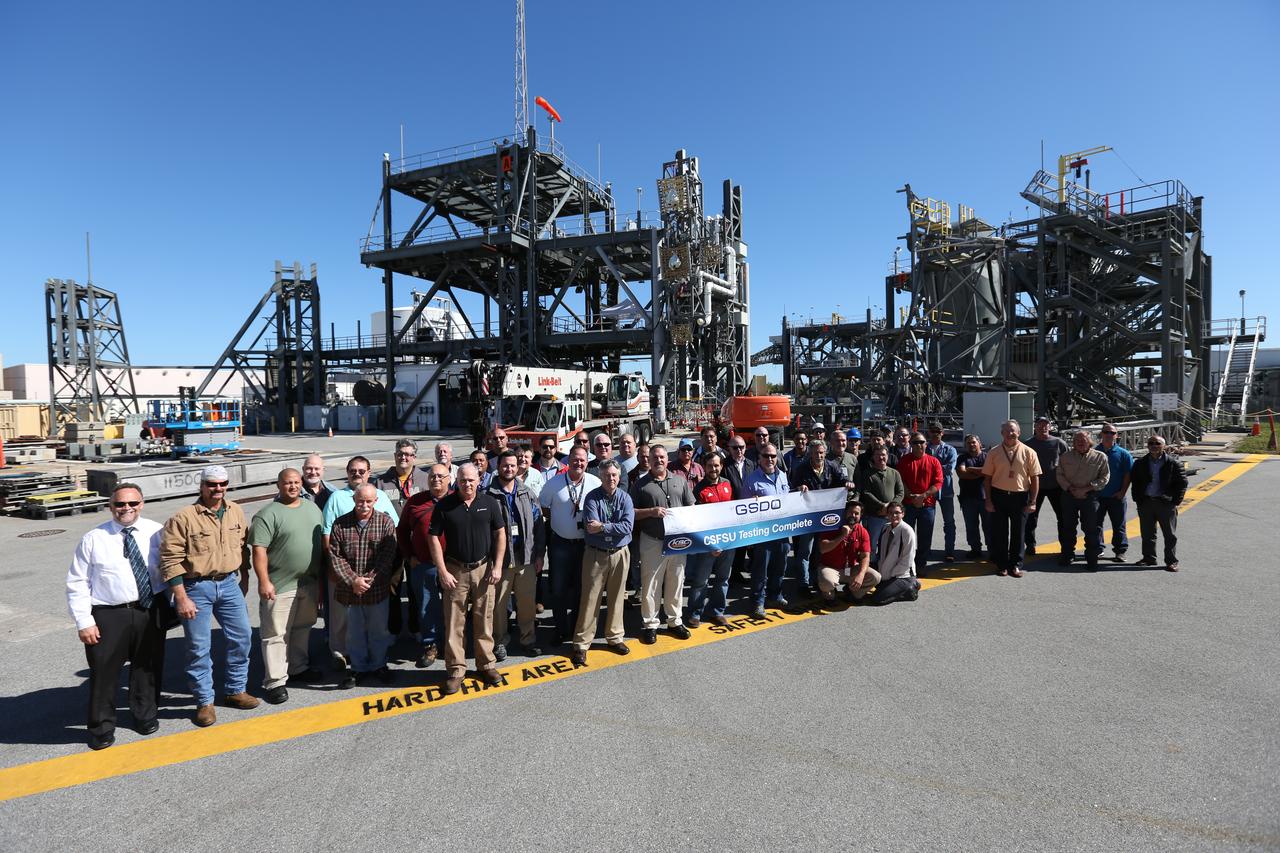
The test team holds a signed banner at the Launch Equipment Test Facility at Kennedy Space Center in Florida. Behind them are some of the test structures used to test the launch umbilicals. Testing of the Core Stage Forward Skirt Umbilical (CSFSU) for NASA's Space Launch System is complete and the umbilical has been transported to the mobile launcher area. The umbilical will be prepared for installation on the tower of the mobile launcher. The CSFSU will be mated to the core stage forward skirt to provide commodities to the SLS rocket, and then disconnect and swing away before launch. Its main purpose is to provide conditioned air and gaseous nitrogen to the SLS Core Stage Forward Skirt. The center’s Engineering Directorate and the Ground Systems Development and Operations Program are overseeing processing and testing of the umbilicals.
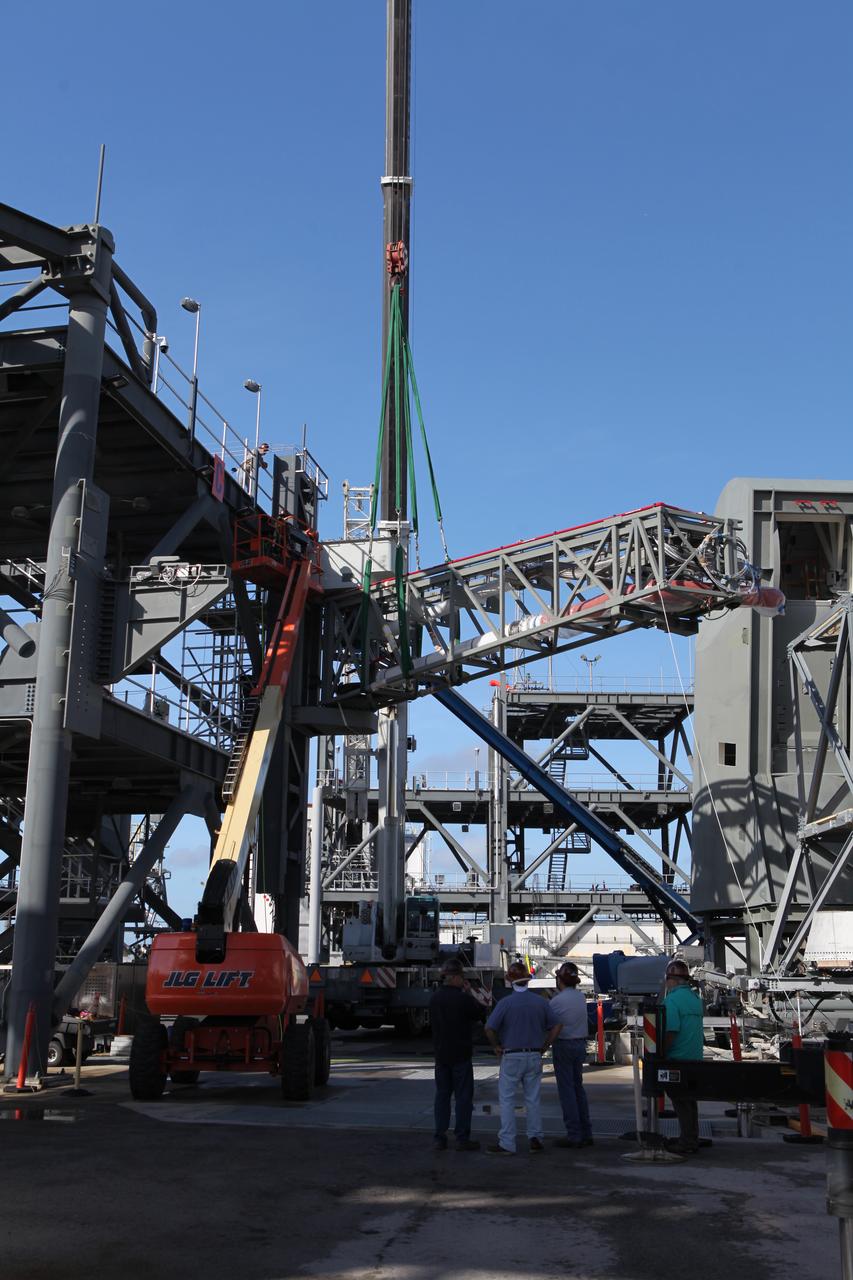
A crane moves the Core State Inter-tank Umbilical (CSITU) for NASA's Space Launch System (SLS) closer for attachment to the "C" tower of the Vehicle Motion Simulator 2 test fixture at the Launch Equipment Test Facility at the agency's Kennedy Space Center in Florida. The umbilical will undergo a series of tests to confirm it is functioning properly and ready to support the SLS rocket for launch. The CSITU is a swing arm umbilical that will connect to the SLS core stage inter-tank. The umbilical's main function is to vent gaseous hydrogen from the core stage. The arm also provides conditioned air, pressurized gases, and power and data connection to the core stage. The center’s Engineering Directorate and the Ground Systems Development and Operations Program are overseeing processing and testing of the umbilicals.
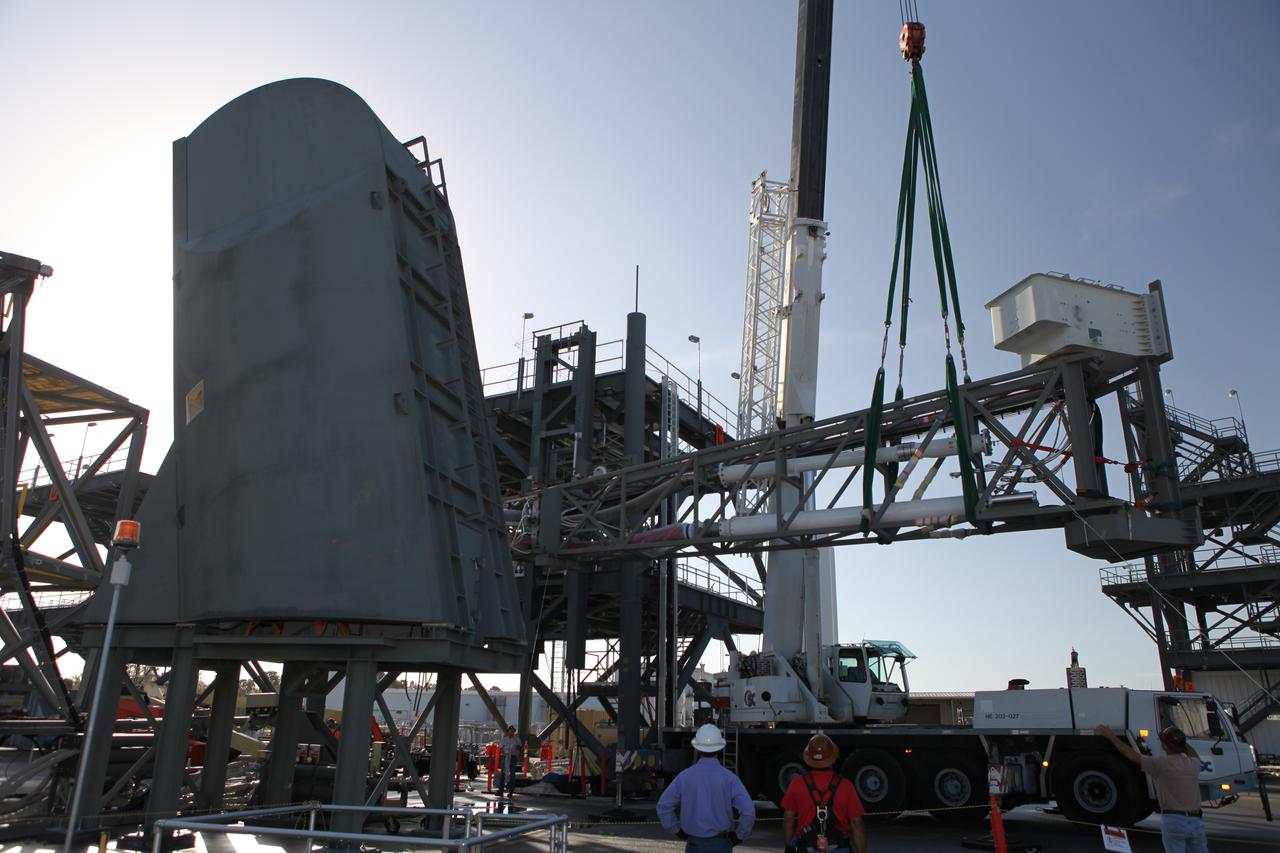
A crane is used to lift the Core State Inter-tank Umbilical (CSITU) for NASA's Space Launch System (SLS) at the Launch Equipment Test Facility at the agency's Kennedy Space Center in Florida. The CSITU will be attached to the "C" tower of the Vehicle Motion Simulator 2 test fixture. The umbilical will undergo a series of tests to confirm it is functioning properly and ready to support the SLS rocket for launch. The CSITU is a swing arm umbilical that will connect to the SLS core stage inter-tank. The umbilical's main function is to vent gaseous hydrogen from the core stage. The arm also provides conditioned air, pressurized gases, and power and data connection to the core stage. The center’s Engineering Directorate and the Ground Systems Development and Operations Program are overseeing processing and testing of the umbilicals.
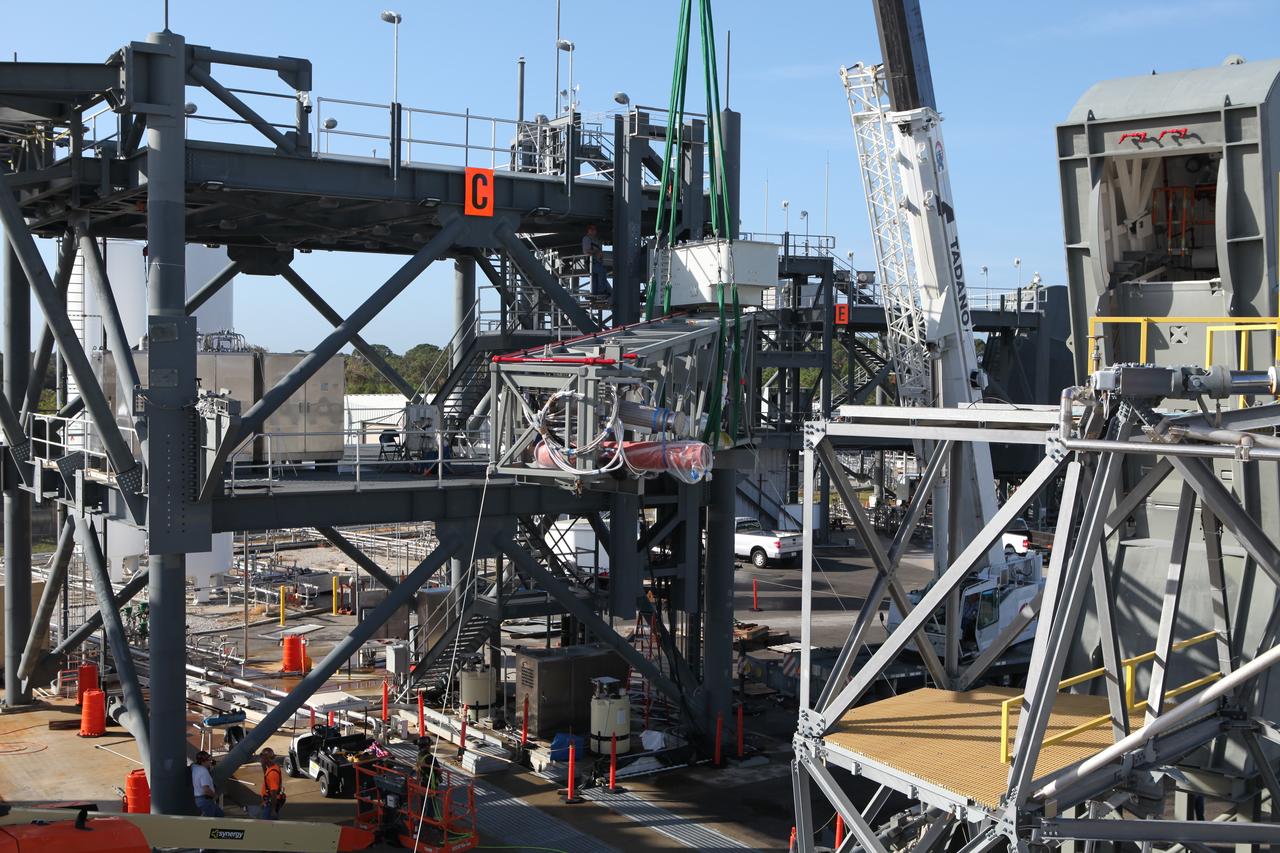
A crane lifts the Core State Inter-tank Umbilical (CSITU) for NASA's Space Launch System (SLS) at the Launch Equipment Test Facility at the agency's Kennedy Space Center in Florida. The CSITU will be attached to the "C" tower of the Vehicle Motion Simulator 2 test fixture. The umbilical will undergo a series of tests to confirm it is functioning properly and ready to support the SLS rocket for launch. The CSITU is a swing arm umbilical that will connect to the SLS core stage inter-tank. The umbilical's main function is to vent gaseous hydrogen from the core stage. The arm also provides conditioned air, pressurized gases, and power and data connection to the core stage. The center’s Engineering Directorate and the Ground Systems Development and Operations Program are overseeing processing and testing of the umbilicals.
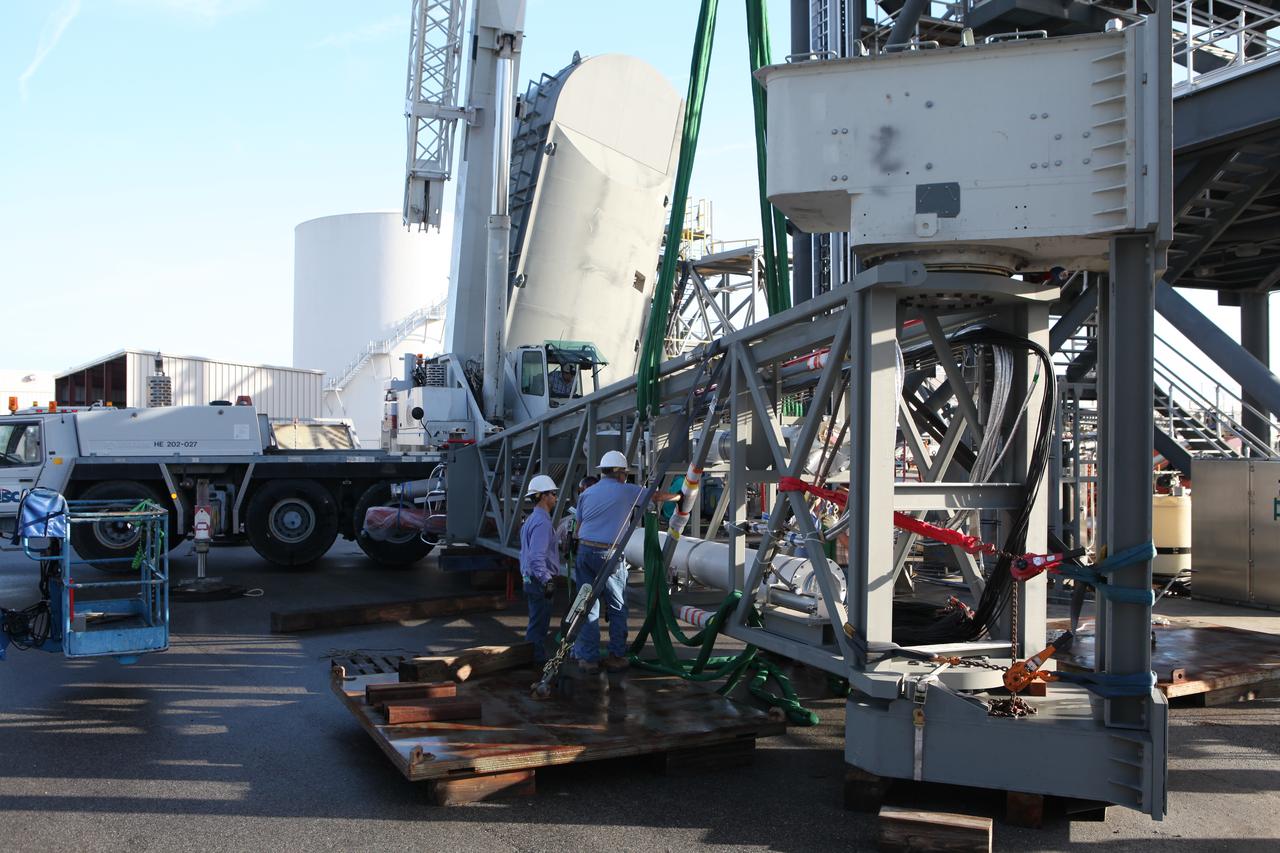
The Core State Inter-tank Umbilical (CSITU) for NASA's Space Launch System (SLS) arrives at the Launch Equipment Test Facility at the agency's Kennedy Space Center in Florida. The CSITU will be attached to the "C" tower of the Vehicle Motion Simulator 2 test fixture. The umbilical will undergo a series of tests to confirm it is functioning properly and ready to support the SLS rocket for launch. The CSITU is a swing arm umbilical that will connect to the SLS core stage inter-tank. The umbilical's main function is to vent gaseous hydrogen from the core stage. The arm also provides conditioned air, pressurized gases, and power and data connection to the core stage. The center’s Engineering Directorate and the Ground Systems Development and Operations Program are overseeing processing and testing of the umbilicals.
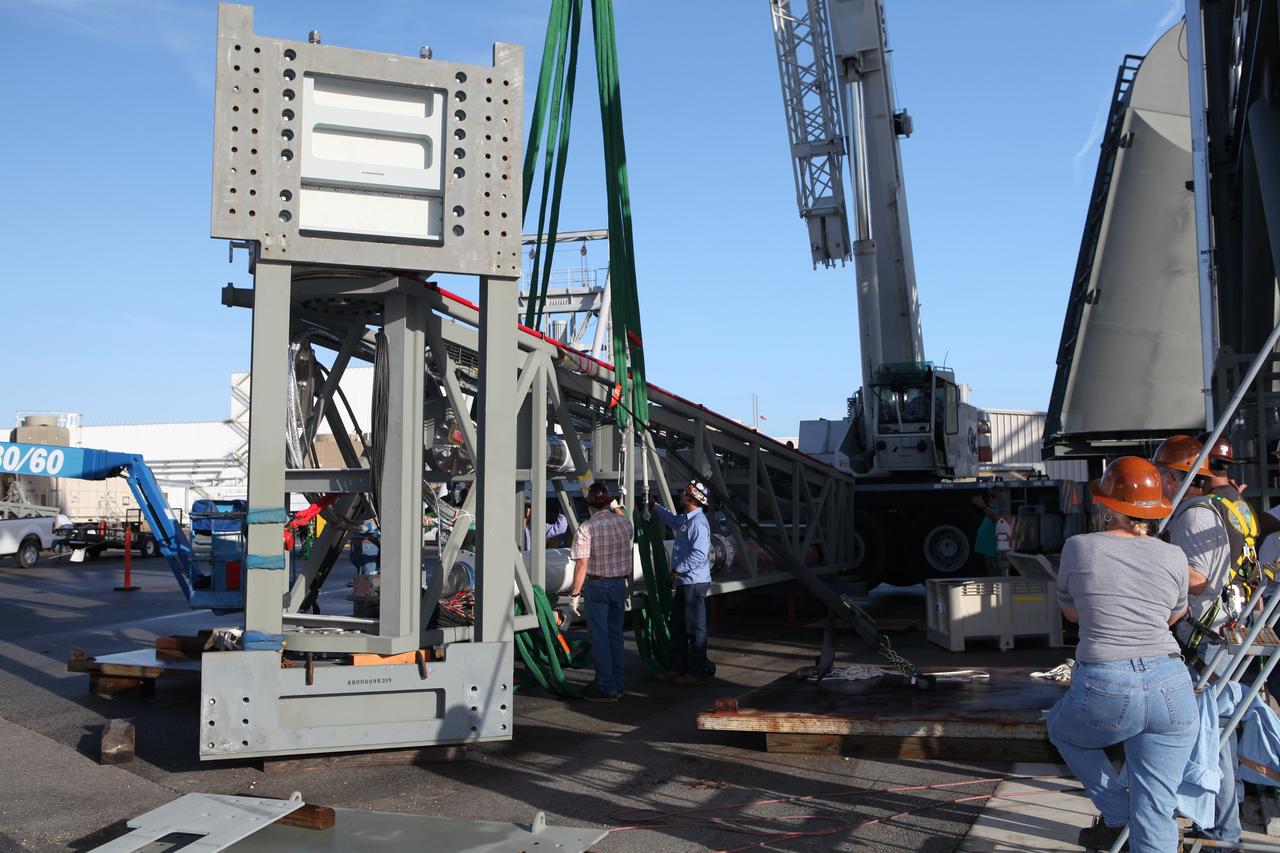
Efforts are underway to lift the Core State Inter-tank Umbilical (CSITU) for NASA's Space Launch System (SLS) at the Launch Equipment Test Facility at the agency's Kennedy Space Center in Florida. The CSITU will be attached to the "C" tower of the Vehicle Motion Simulator 2 test fixture. The umbilical will undergo a series of tests to confirm it is functioning properly and ready to support the SLS rocket for launch. The CSITU is a swing arm umbilical that will connect to the SLS core stage inter-tank. The umbilical's main function is to vent gaseous hydrogen from the core stage. The arm also provides conditioned air, pressurized gases, and power and data connection to the core stage. The center’s Engineering Directorate and the Ground Systems Development and Operations Program are overseeing processing and testing of the umbilicals.
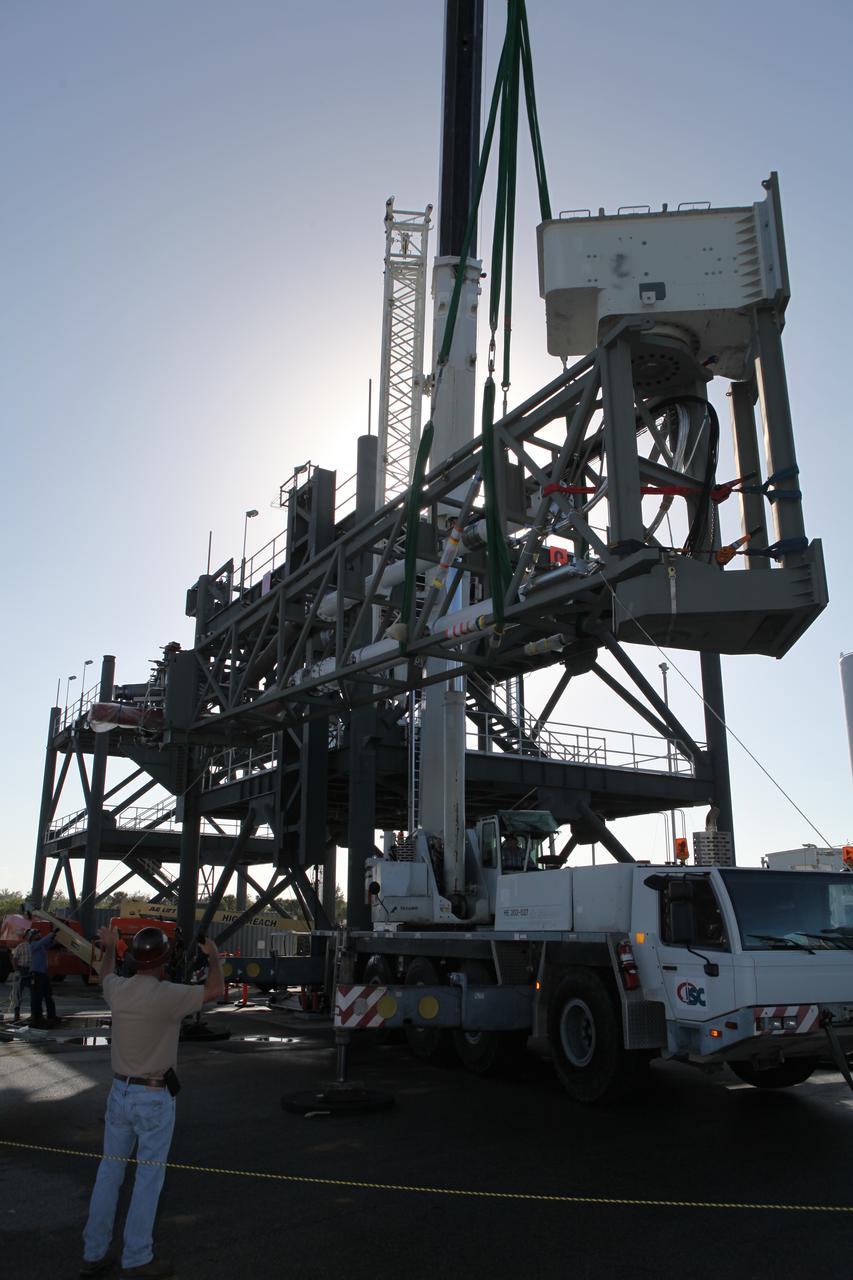
A crane is used to lift the Core State Inter-tank Umbilical (CSITU) for NASA's Space Launch System (SLS) at the Launch Equipment Test Facility at the agency's Kennedy Space Center in Florida. The CSITU will be attached to the "C" tower of the Vehicle Motion Simulator 2 test fixture. The umbilical will undergo a series of tests to confirm it is functioning properly and ready to support the SLS rocket for launch. The CSITU is a swing arm umbilical that will connect to the SLS core stage inter-tank. The umbilical's main function is to vent gaseous hydrogen from the core stage. The arm also provides conditioned air, pressurized gases, and power and data connection to the core stage. The center’s Engineering Directorate and the Ground Systems Development and Operations Program are overseeing processing and testing of the umbilicals.
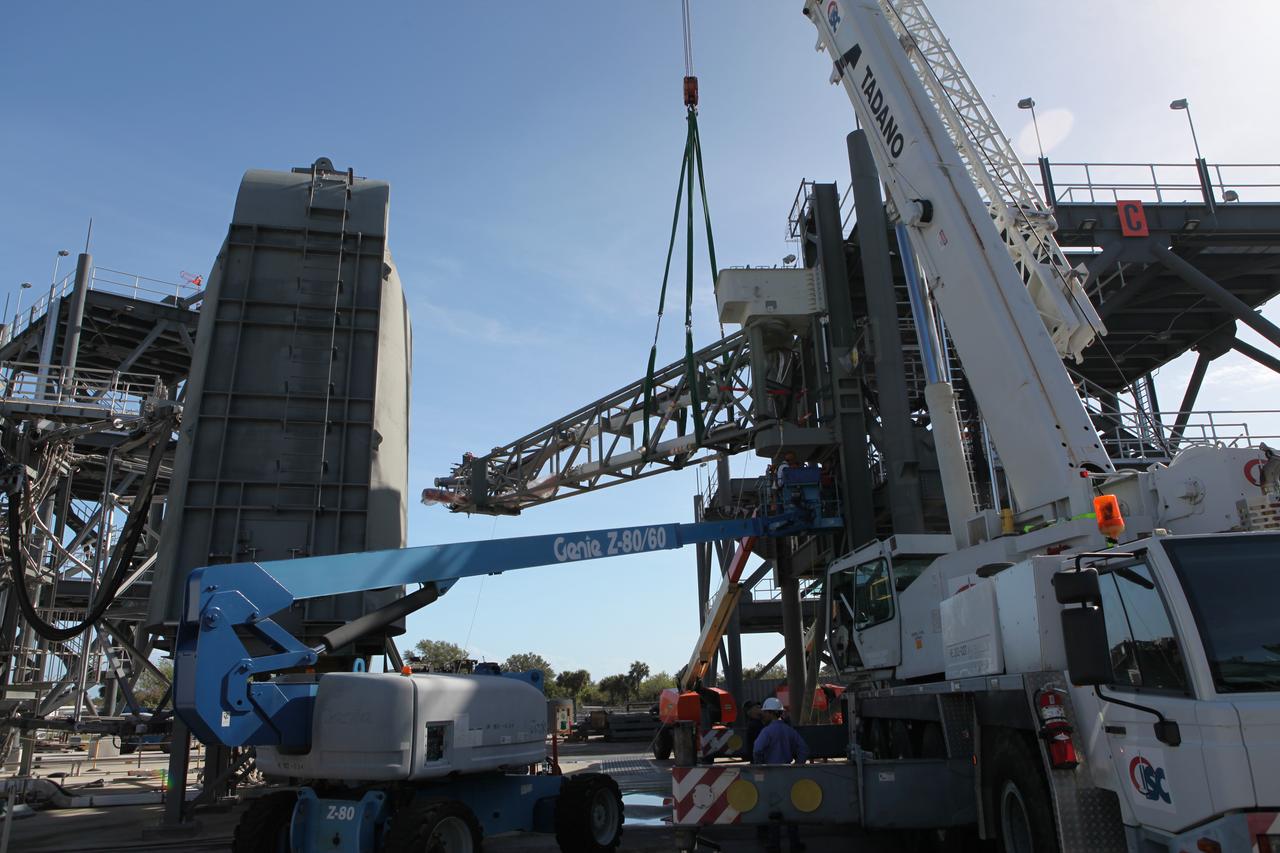
The Core State Inter-tank Umbilical (CSITU) for NASA's Space Launch System (SLS) is attached to the "C" tower of the Vehicle Motion Simulator 2 test fixture at the Launch Equipment Test Facility at the agency's Kennedy Space Center in Florida. The umbilical will undergo a series of tests to confirm it is functioning properly and ready to support the SLS rocket for launch. The CSITU is a swing arm umbilical that will connect to the SLS core stage inter-tank. The umbilical's main function is to vent gaseous hydrogen from the core stage. The arm also provides conditioned air, pressurized gases, and power and data connection to the core stage. The center’s Engineering Directorate and the Ground Systems Development and Operations Program are overseeing processing and testing of the umbilicals.

A crane is used to lift the Core State Inter-tank Umbilical (CSITU) for NASA's Space Launch System (SLS) at the Launch Equipment Test Facility at the agency's Kennedy Space Center in Florida. The CSITU will be attached to the "C" tower of the Vehicle Motion Simulator 2 test fixture. The umbilical will undergo a series of tests to confirm it is functioning properly and ready to support the SLS rocket for launch. The CSITU is a swing arm umbilical that will connect to the SLS core stage inter-tank. The umbilical's main function is to vent gaseous hydrogen from the core stage. The arm also provides conditioned air, pressurized gases, and power and data connection to the core stage. The center’s Engineering Directorate and the Ground Systems Development and Operations Program are overseeing processing and testing of the umbilicals.
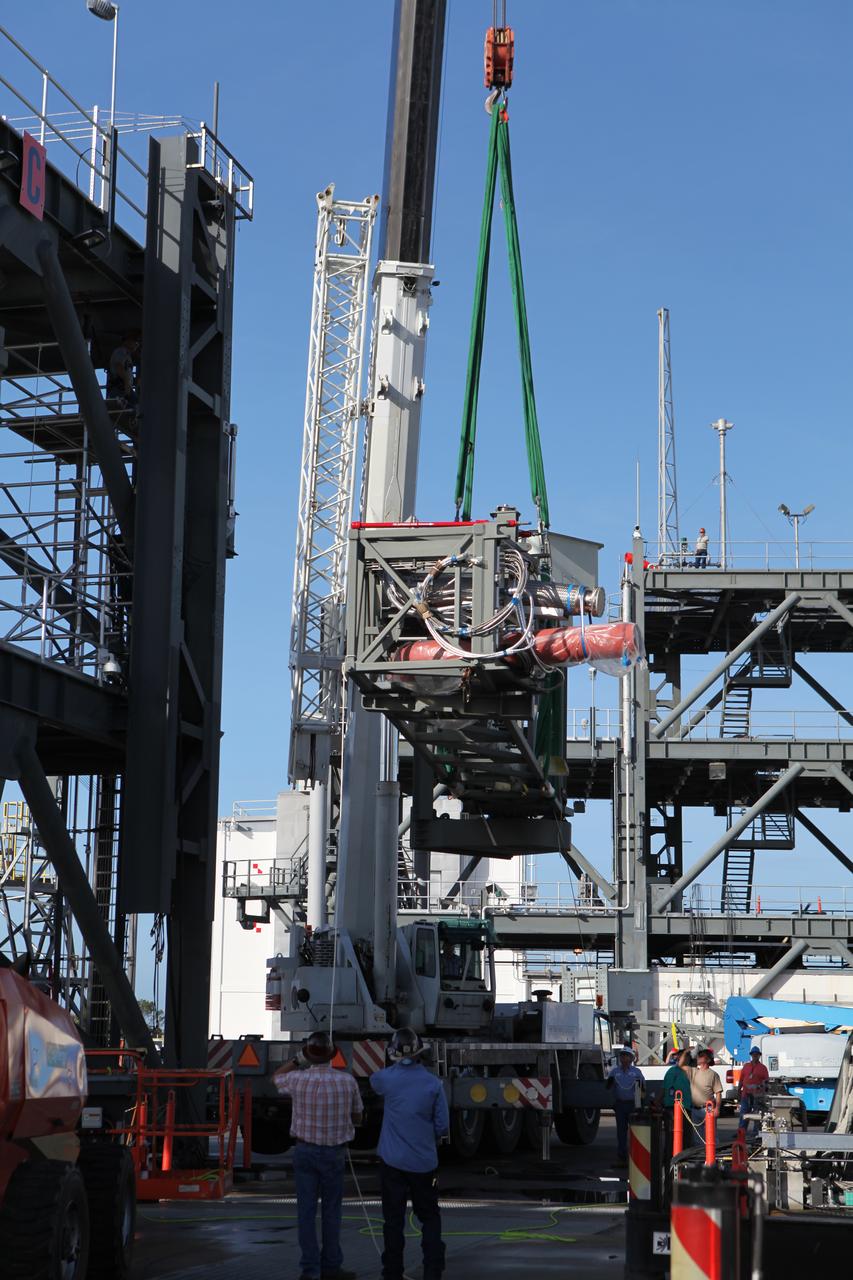
A crane is used to lift the Core State Inter-tank Umbilical (CSITU) for NASA's Space Launch System (SLS) at the Launch Equipment Test Facility at the agency's Kennedy Space Center in Florida. The CSITU will be attached to the "C" tower of the Vehicle Motion Simulator 2 test fixture. The umbilical will undergo a series of tests to confirm it is functioning properly and ready to support the SLS rocket for launch. The CSITU is a swing arm umbilical that will connect to the SLS core stage inter-tank. The umbilical's main function is to vent gaseous hydrogen from the core stage. The arm also provides conditioned air, pressurized gases, and power and data connection to the core stage. The center’s Engineering Directorate and the Ground Systems Development and Operations Program are overseeing processing and testing of the umbilicals.
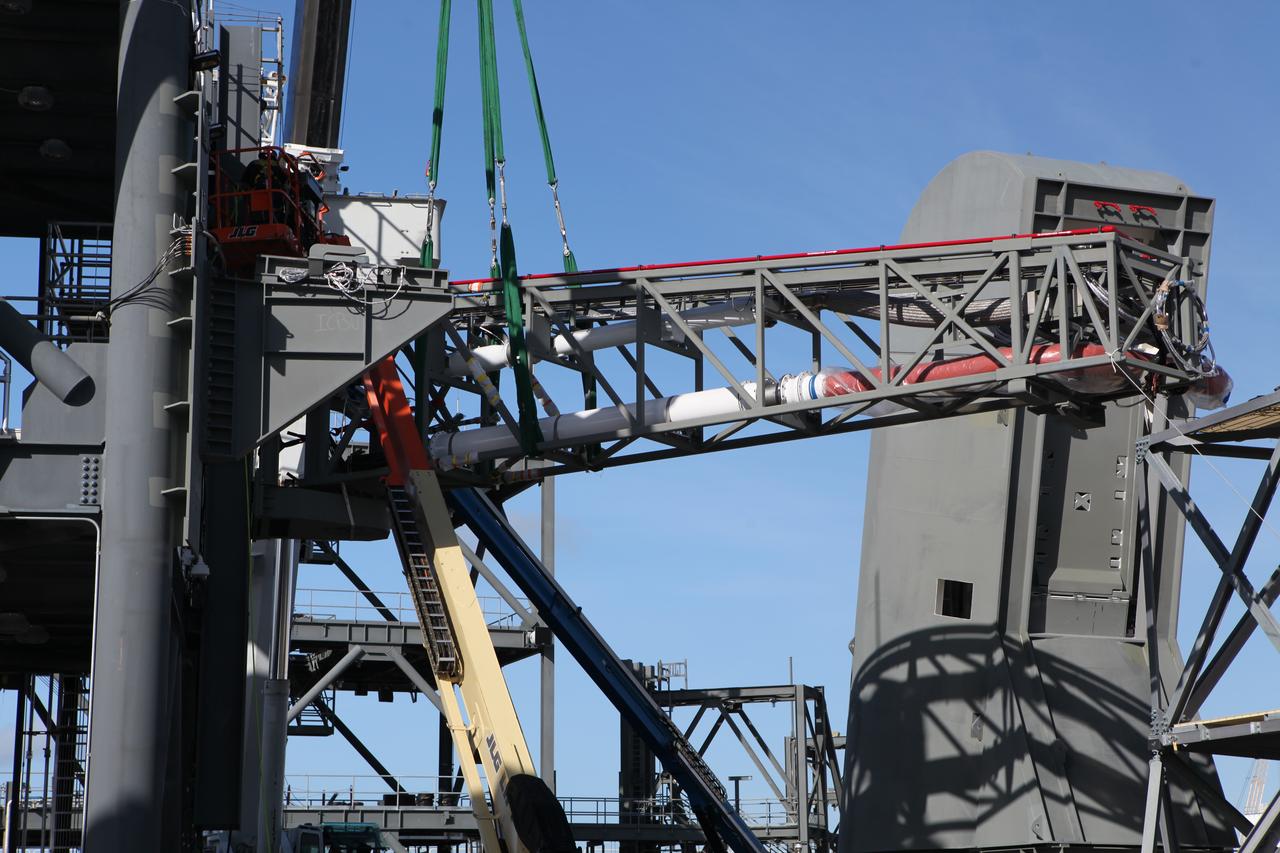
A crane moves the Core State Inter-tank Umbilical (CSITU) for NASA's Space Launch System (SLS) closer for attachment to the "C" tower of the Vehicle Motion Simulator 2 test fixture at the Launch Equipment Test Facility at the agency's Kennedy Space Center in Florida. The umbilical will undergo a series of tests to confirm it is functioning properly and ready to support the SLS rocket for launch. The CSITU is a swing arm umbilical that will connect to the SLS core stage inter-tank. The umbilical's main function is to vent gaseous hydrogen from the core stage. The arm also provides conditioned air, pressurized gases, and power and data connection to the core stage. The center’s Engineering Directorate and the Ground Systems Development and Operations Program are overseeing processing and testing of the umbilicals.
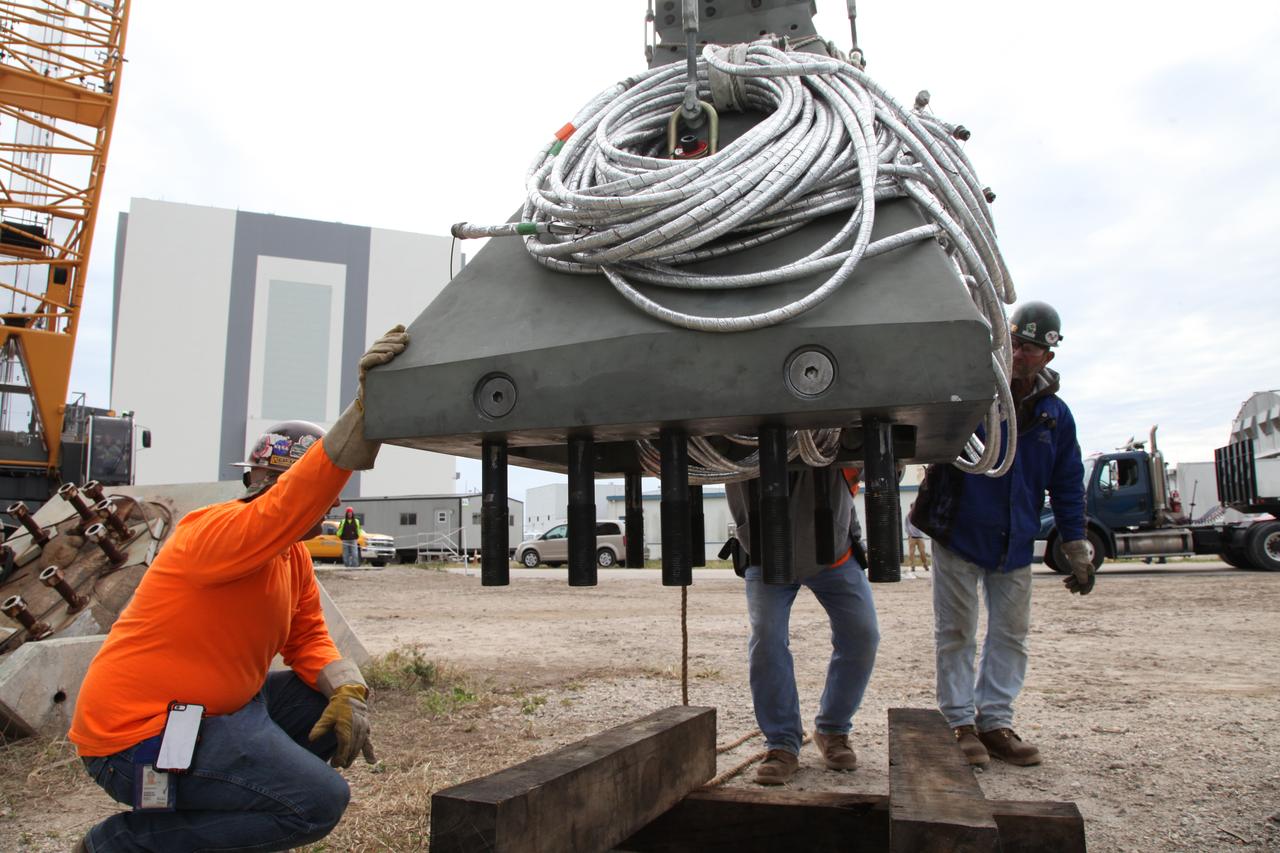
Construction workers assist as a crane is used to lower a vertical support post for NASA's Space Launch System (SLS) onto a platform at the Mobile Launcher Yard at NASA's Kennedy Space Center in Florida. Two ASEUs and the first of the vertical support posts underwent a series of tests at the Launch Equipment Test Facility to confirm they are functioning properly and ready to support the SLS for launch. The ASEUs will connect to the SLS rocket at the bottom outer edge of each booster and provide electrical power and data connections to the rocket until it lifts off from the launch pad. The eight VSPs will support the load of the solid rocket boosters, with four posts for each of the boosters. The center’s Engineering Directorate and the Ground Systems Development and Operations Program are overseeing processing and testing of the umbilicals.
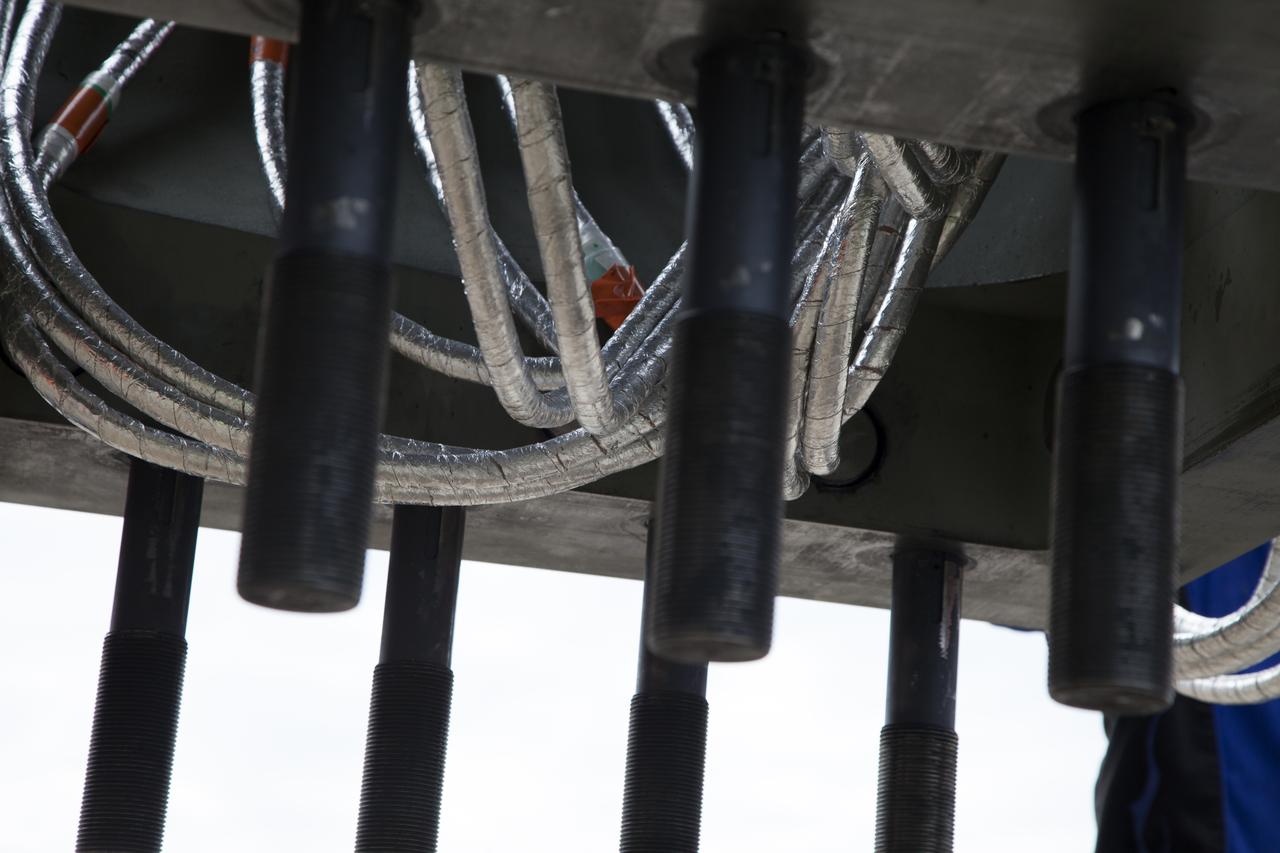
A view from underneath one of the vertical support posts for NASA's Space Launch System rocket. Two after skirt electrical umbilicals (ASEUs) and the first of the vertical support post were transported by flatbed truck from the Launch Equipment Test Facility to the Mobile Launcher Yard as NASA's Kennedy Space Center in Florida. The ASEUs and the VSP underwent a series of tests to confirm they are functioning properly and ready to support the SLS for launch. The ASEUs will connect to the SLS rocket at the bottom outer edge of each booster and provide electrical power and data connections to the rocket until it lifts off from the launch pad. The eight VSPs will support the load of the solid rocket boosters, with four posts for each of the boosters. The center’s Engineering Directorate and the Ground Systems Development and Operations Program are overseeing processing and testing of the umbilicals.
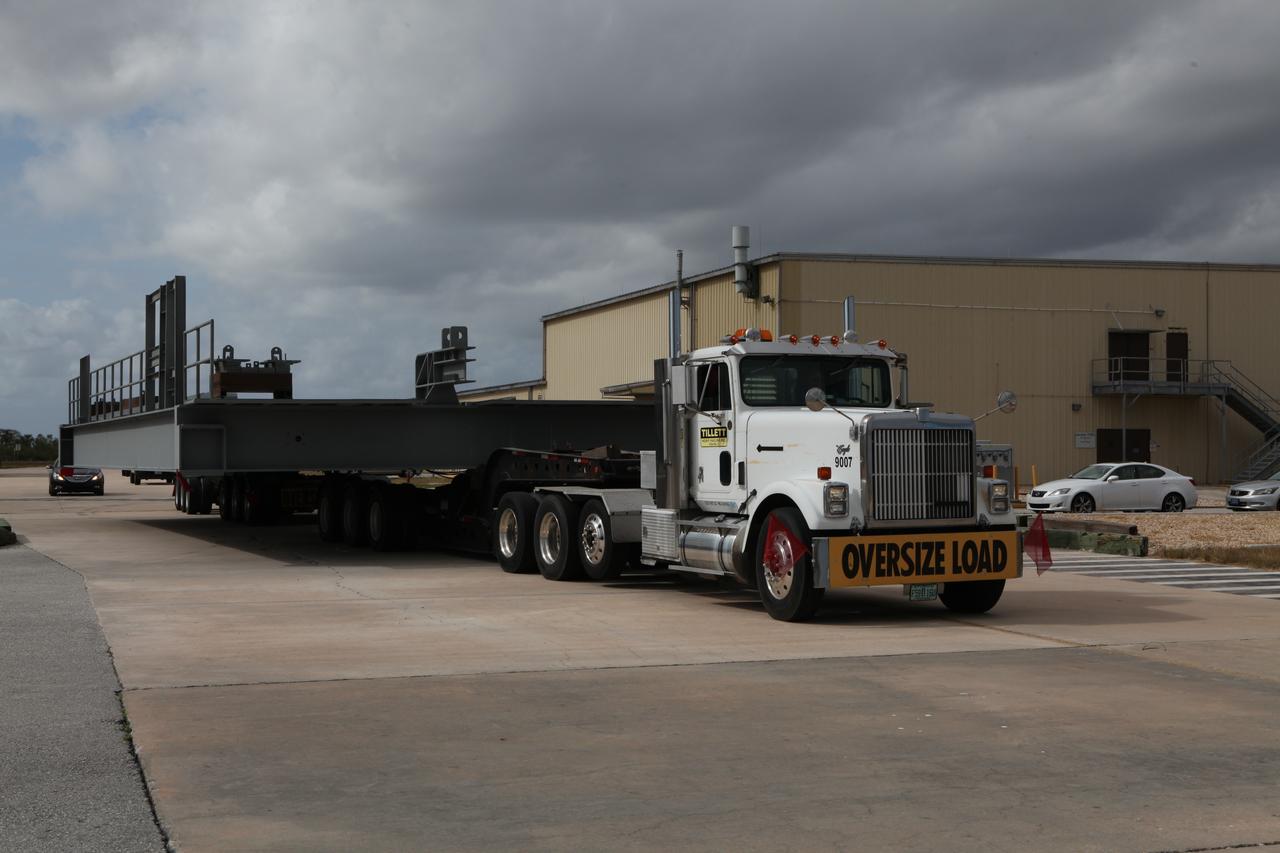
A heavy load transport truck from Tillett Heavy Hauling in Titusville, Florida, arrives at NASA’s Kennedy Space Center in Florida, carrying the first half of the A-level work platforms, A south, for the agency’s Space Launch System (SLS) rocket. The A-level platforms are the topmost platforms for High Bay 3 in the Vehicle Assembly Building (VAB). The platform will be delivered to the VAB staging area in the west parking lot. The Ground Systems Development and Operations Program is overseeing upgrades and modifications to High Bay 3 to support processing of the SLS and Orion spacecraft. A total of 10 levels of new platforms, 20 platform halves altogether, will surround the SLS rocket and Orion spacecraft and provide access for testing and processing.
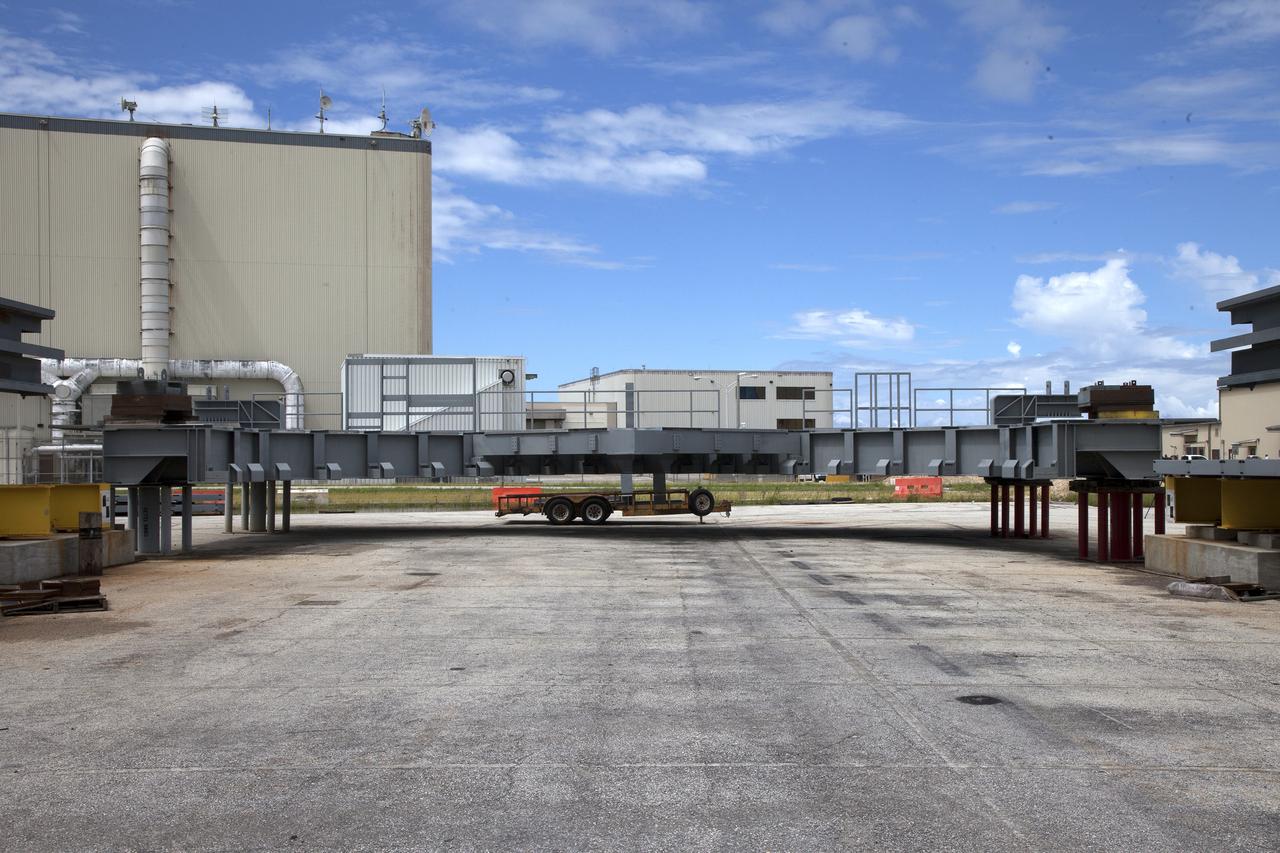
A section of the second half of the C-level platforms, C North, for NASA’s Space Launch System (SLS) rocket, arrives at the agency’s Kennedy Space Center in Florida. The platform was offloaded from a heavy lift transport truck and secured in a staging area in the west parking lot of the Vehicle Assembly Building (VAB). The Ground Systems Development and Operations Program is overseeing upgrades and modifications to VAB High Bay 3 to support processing of the SLS and Orion spacecraft. A total of 10 levels of new platforms, 20 platform halves altogether, will surround the SLS rocket and Orion spacecraft and provide access for testing and processing.
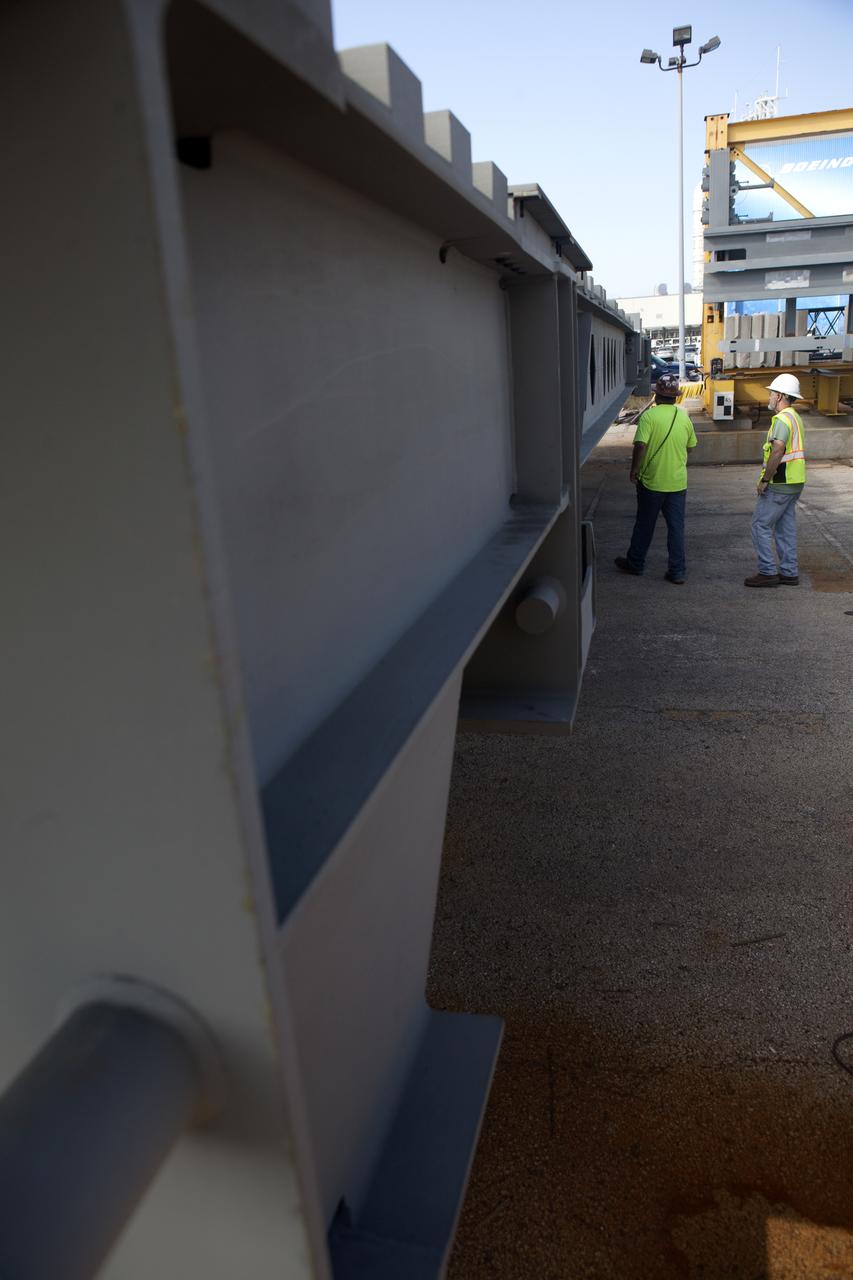
Workers prepare to unload the second half of the A-level work platforms, A north, for NASA's Space Launch System (SLS) rocket, from a heavy load transport truck in a staging area near the Vehicle Assembly Building (VAB) at NASA's Kennedy Space Center in Florida. This is the final platform delivered to Kennedy. The A-level platforms are the topmost platforms for High Bay 3 in the VAB. The Ground Systems Development and Operations Program is overseeing upgrades and modifications to High Bay 3 to support processing of the SLS and Orion spacecraft. A total of 10 levels of new platforms, 20 platform halves altogether, will surround the SLS rocket and Orion spacecraft and provide access for testing and processing.
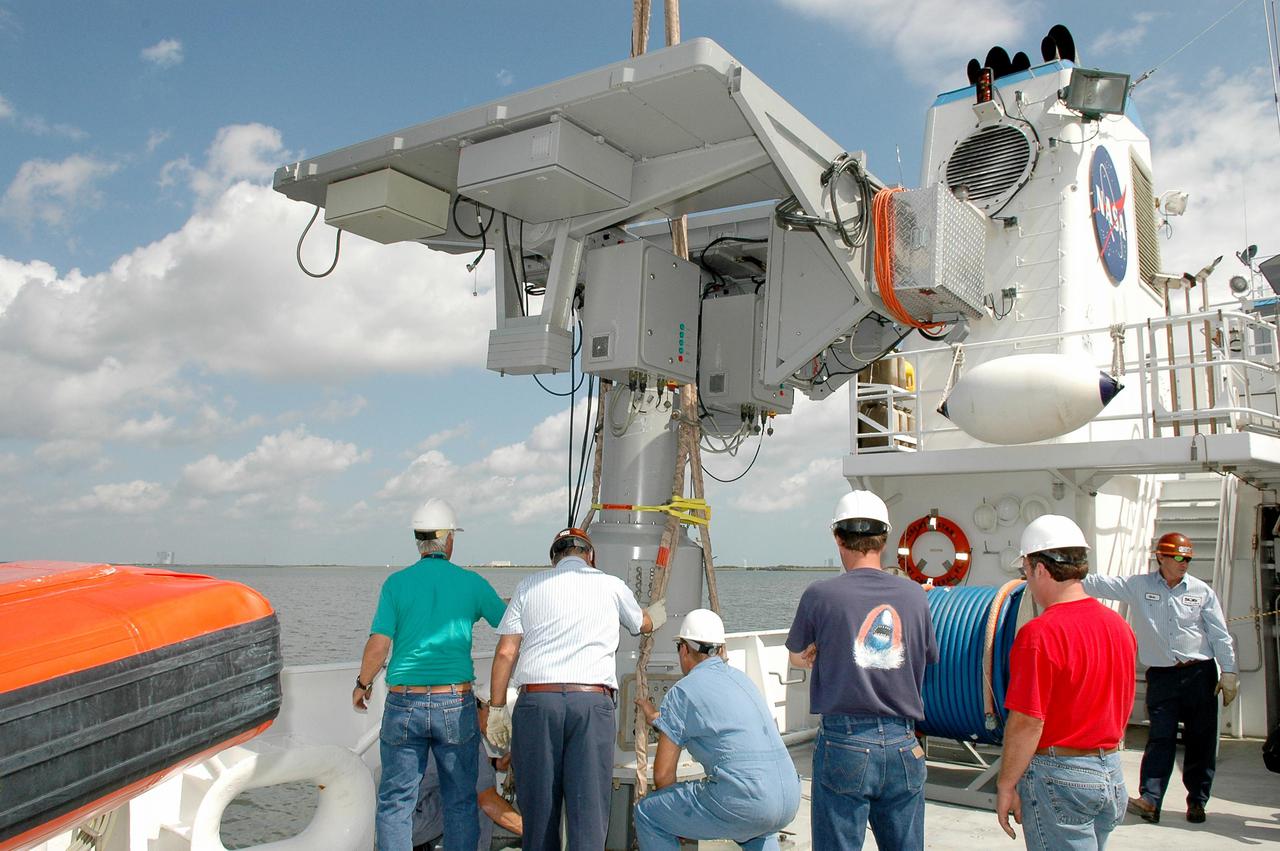
KENNEDY SPACE CENTER, FLA. - At Hangar AF at Cape Canaveral Air Force Station, workers on the Liberty Star, one of the two SRB Retrieval Ships, oversee the safe placement of an X-band Doppler radar array onto the deck. The radar will be used for tracking support on NASA’s Return to Flight mission, STS-114, on Space Shuttle Discovery. Launch is targeted for May 15 with a launch window that extends to June 3. During its 12-day mission, Discovery’s seven-member crew will test new hardware and techniques to improve Shuttle safety, as well as deliver supplies to the International Space Station.
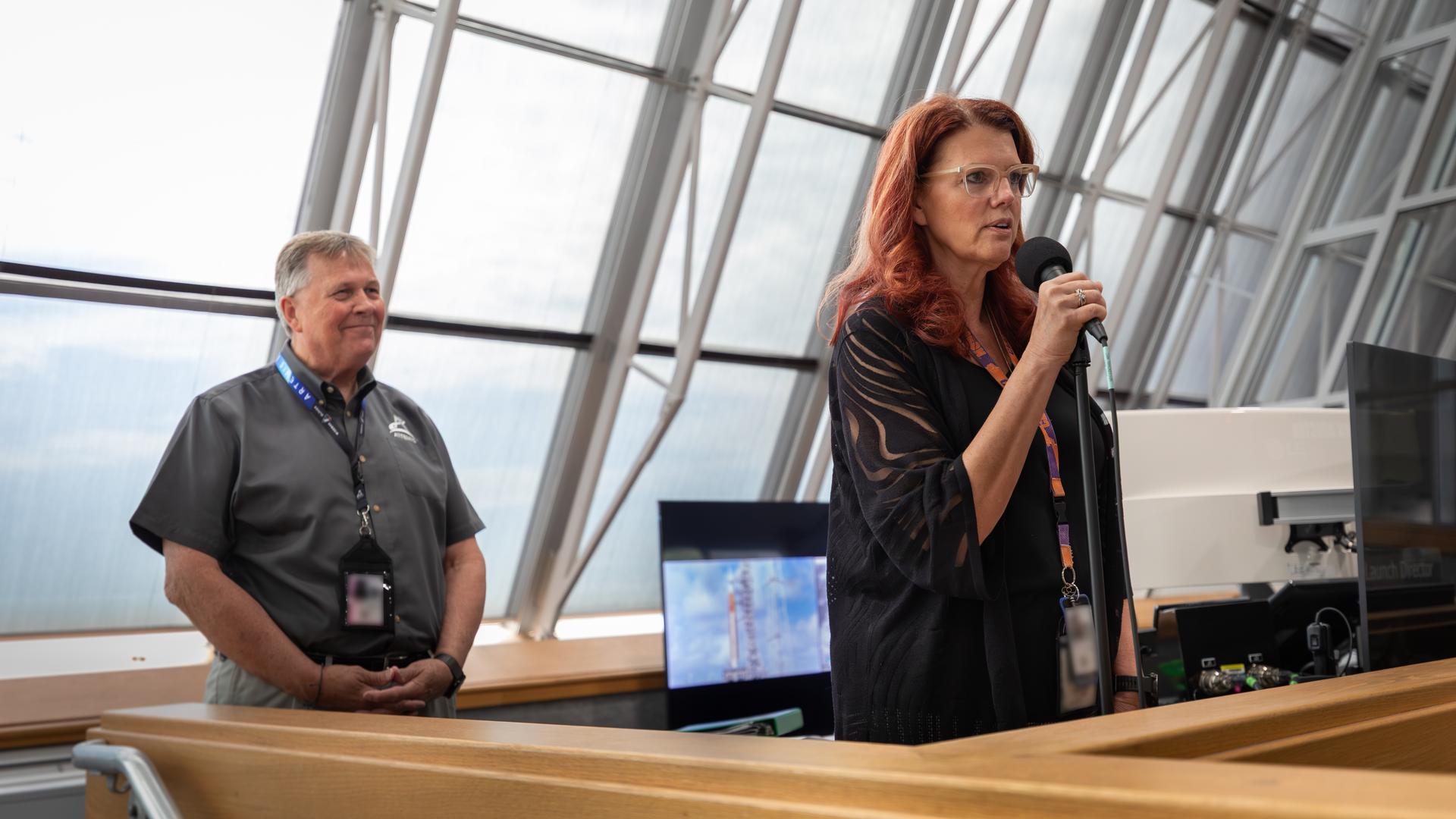
Artemis Launch Director Charlie Blackwell-Thompson delivers a speech on Thursday, June 11, 2026, about the retirement of NASA Test Director Jeff Spaulding inside Firing Room 1 of the Rocco A. Petrone Launch Control Center at NASA’s Kennedy Space Center in Florida. Spaulding began his career at NASA in 1987 as a NASA operations engineer overseeing orbiter processing activities for seven shuttle missions. He later went on to lead the Artemis II launch team during planning, scheduling, and execution on Artemis II on April 1, 2026.
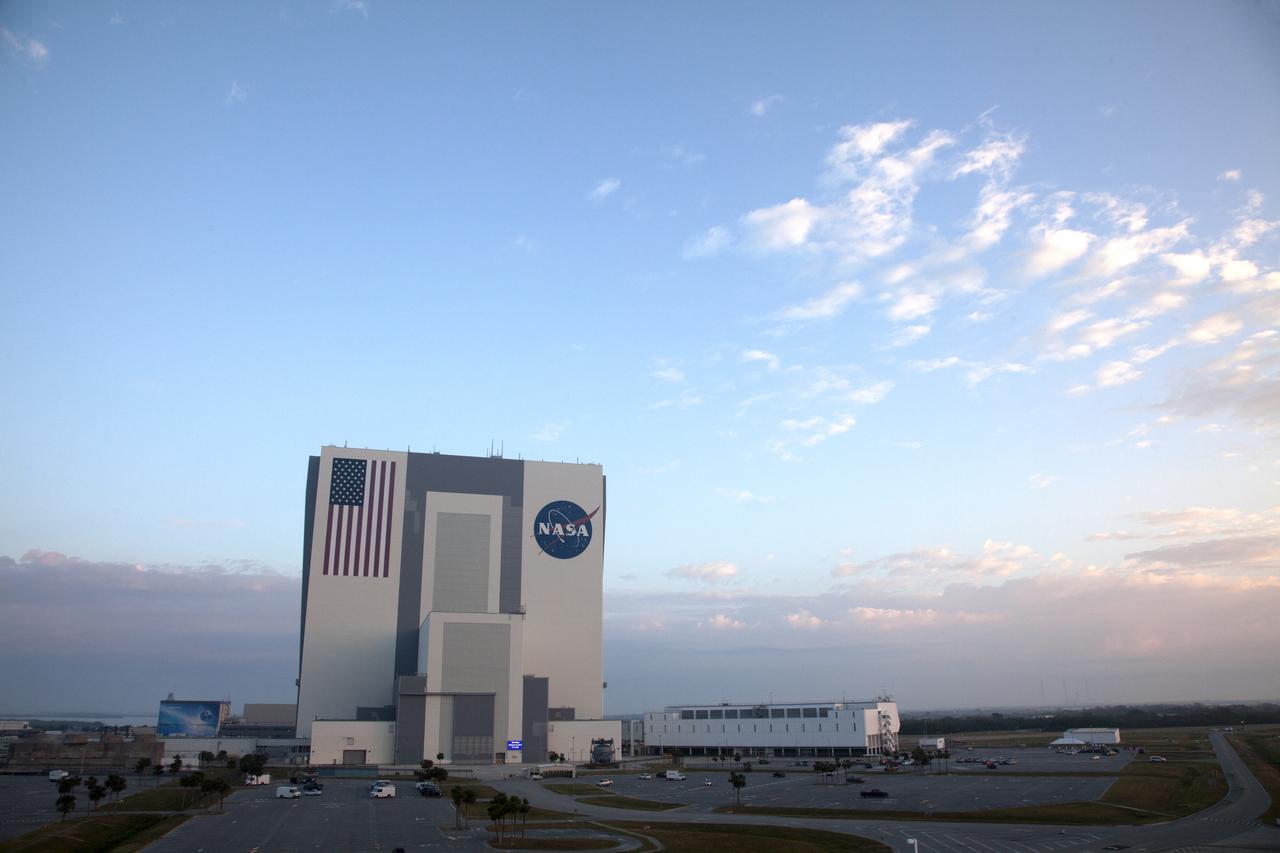
An early morning view of the iconic Vehicle Assembly Building (VAB) at NASA's Kennedy Space Center in Florida. To the right is the Launch Control Center. All 10 levels of new work platforms, 20 platform halves altogether, have been installed in VAB High Bay 3 for the agency's Space Launch System (SLS) rocket and Orion spacecraft. The Ground Systems Development and Operations Program is overseeing upgrades to the VAB, including installation of the new platforms to prepare for the first test flight of Orion atop the SLS from Launch Pad 39B.
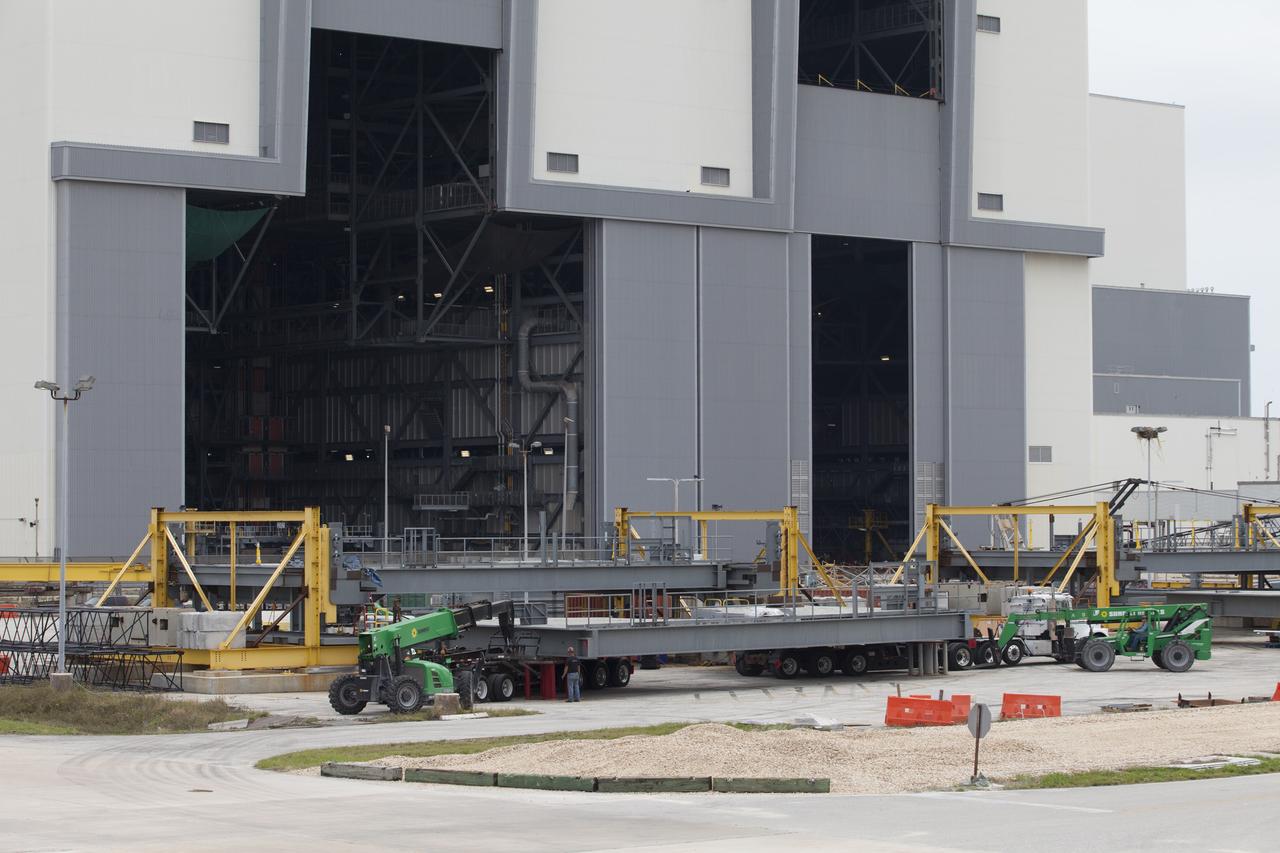
A heavy load transport truck arrives at the Vehicle Assembly Building (VAB) at NASA’s Kennedy Space Center in Florida, carrying the second half of the F-level work platforms for the agency’s Space Launch System (SLS) rocket. The platform will be delivered to the VAB staging area in the west parking lot. The Ground Systems Development and Operations Program is overseeing upgrades and modifications to VAB High Bay 3 to support processing of the SLS and Orion spacecraft. A total of 10 levels of new platforms, 20 platform halves altogether, will surround the SLS rocket and Orion spacecraft and provide access for testing and processing. Delivery of this platform brings the total to 10 platforms, or half of the work platforms delivered to Kennedy.
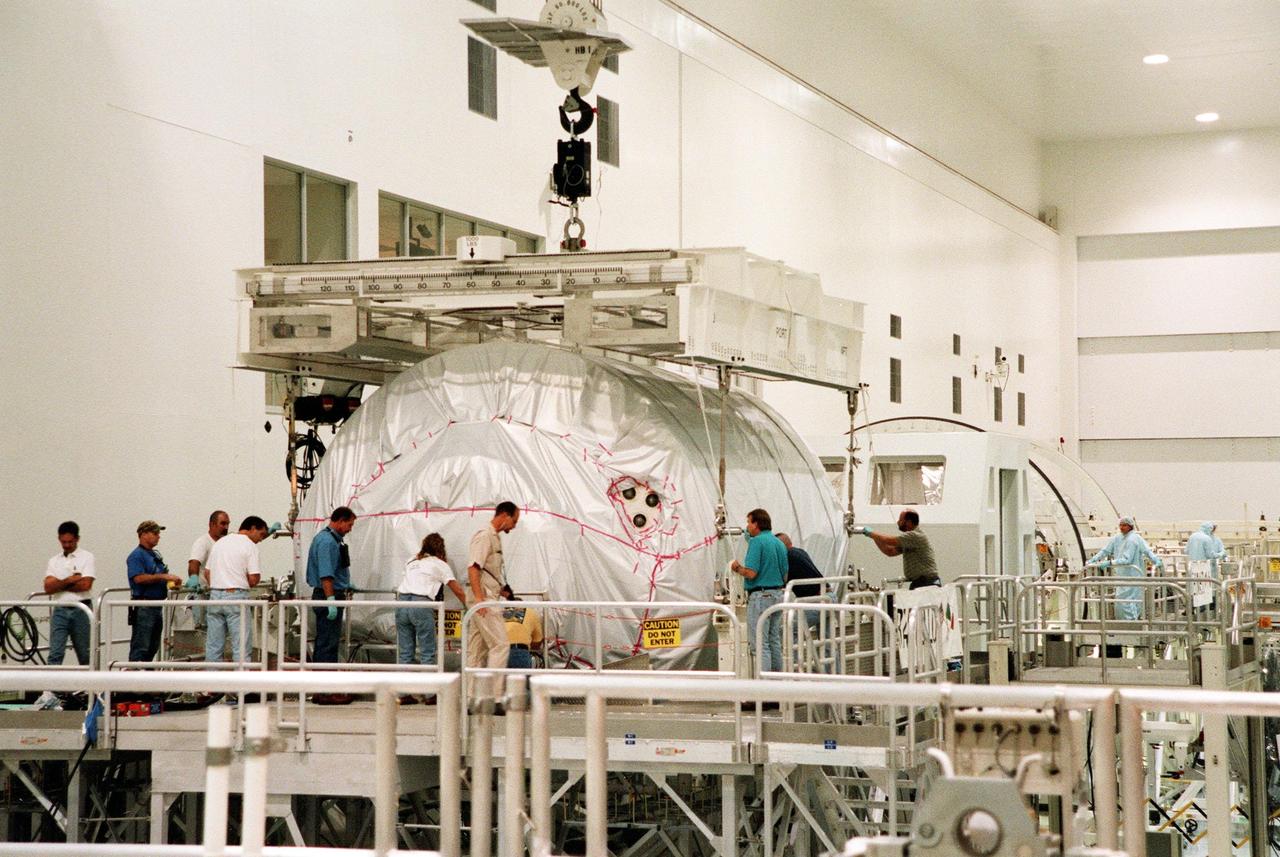
KENNEDY SPACE CENTER, FLA. -- Workers oversee the placement of the Multi-Purpose Logistics Module (MPLM) called Raffaello as a crane lowers it onto a workstand in the Space Station Processing Facility (SSPF). One of Italy's major contributions to the ISS program, the MPLM is a reusable logistics carrier and the primary delivery system used to resupply and return station cargo requiring a pressurized environment. Weighing nearly 4.5 tons, the Raffaello measures 21 feet long and 15 feet in diameter. Raffaello will undergo testing. joining the first Italian-built MPLM, Leonardo, also in the SSPF. Raffaello is scheduled to be launched on mission STS-100 on July 27, 2000
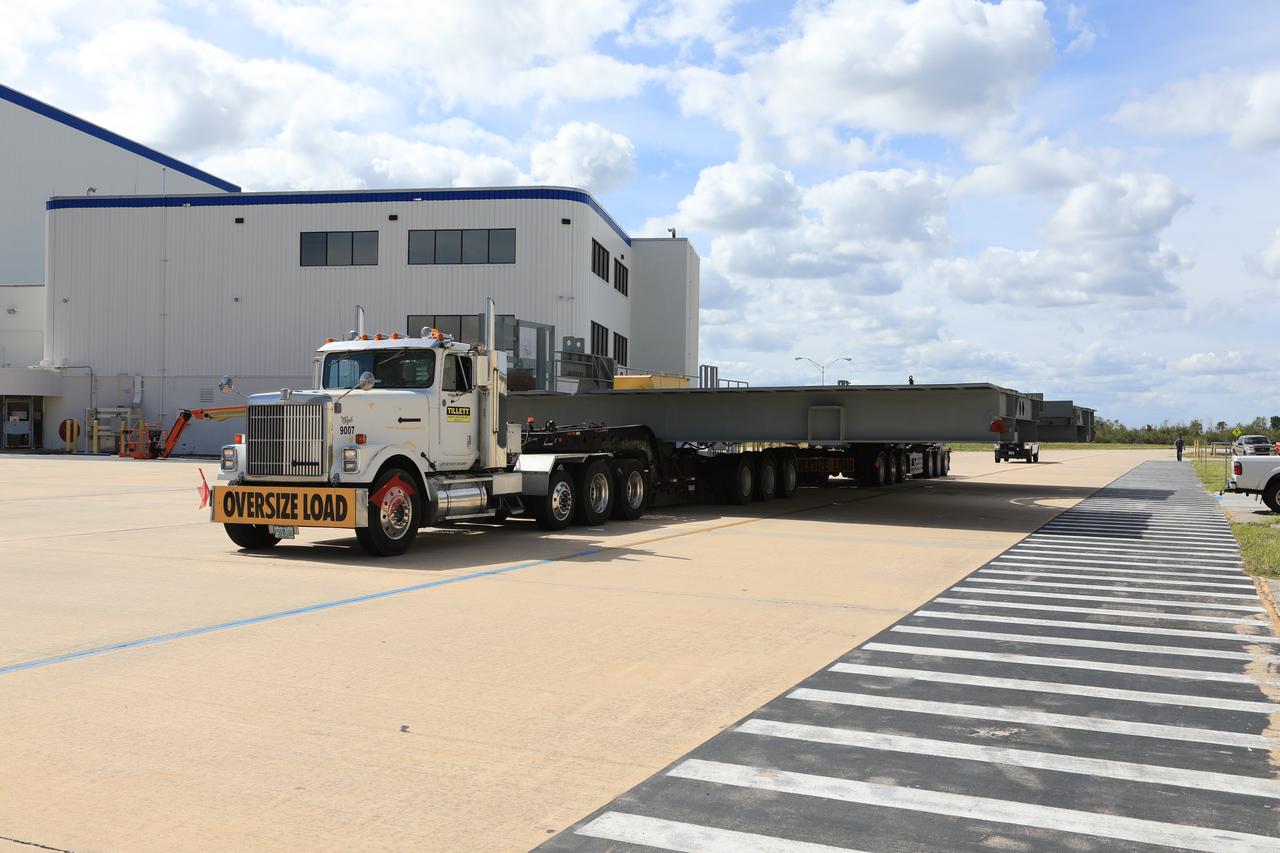
A heavy load transport truck from Tillett Heavy Hauling in Titusville, Florida, arrives at NASA’s Kennedy Space Center in Florida, carrying the second half of the B-level work platforms, B north, for the agency’s Space Launch System (SLS) rocket. The platform will be delivered to the Vehicle Assembly Building (VAB) staging area in the west parking lot. The Ground Systems Development and Operations Program is overseeing upgrades and modifications to VAB High Bay 3 to support processing of the SLS and Orion spacecraft. A total of 10 levels of new platforms, 20 platform halves altogether, will surround the SLS rocket and Orion spacecraft and provide access for testing and processing.
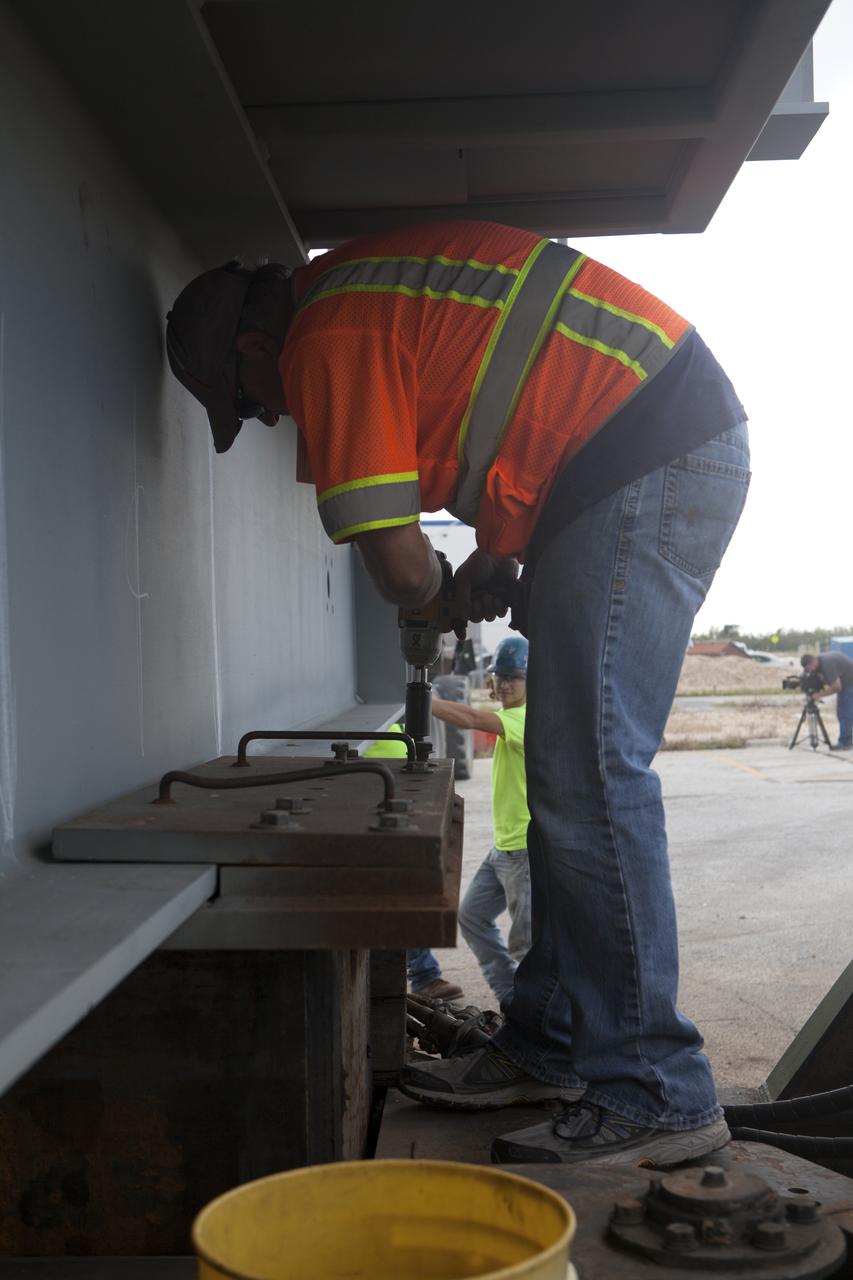
Workers prepare to unload the second half of the A-level work platforms, A north, for NASA's Space Launch System (SLS) rocket, from a heavy load transport truck near the Vehicle Assembly Building (VAB) at NASA's Kennedy Space Center in Florida. This is the final platform delivered to Kennedy. The platform will be offloaded in a staging area near the VAB. The A-level platforms are the topmost platforms for High Bay 3 in the VAB. The Ground Systems Development and Operations Program is overseeing upgrades and modifications to High Bay 3 to support processing of the SLS and Orion spacecraft. A total of 10 levels of new platforms, 20 platform halves altogether, will surround the SLS rocket and Orion spacecraft and provide access for testing and processing.
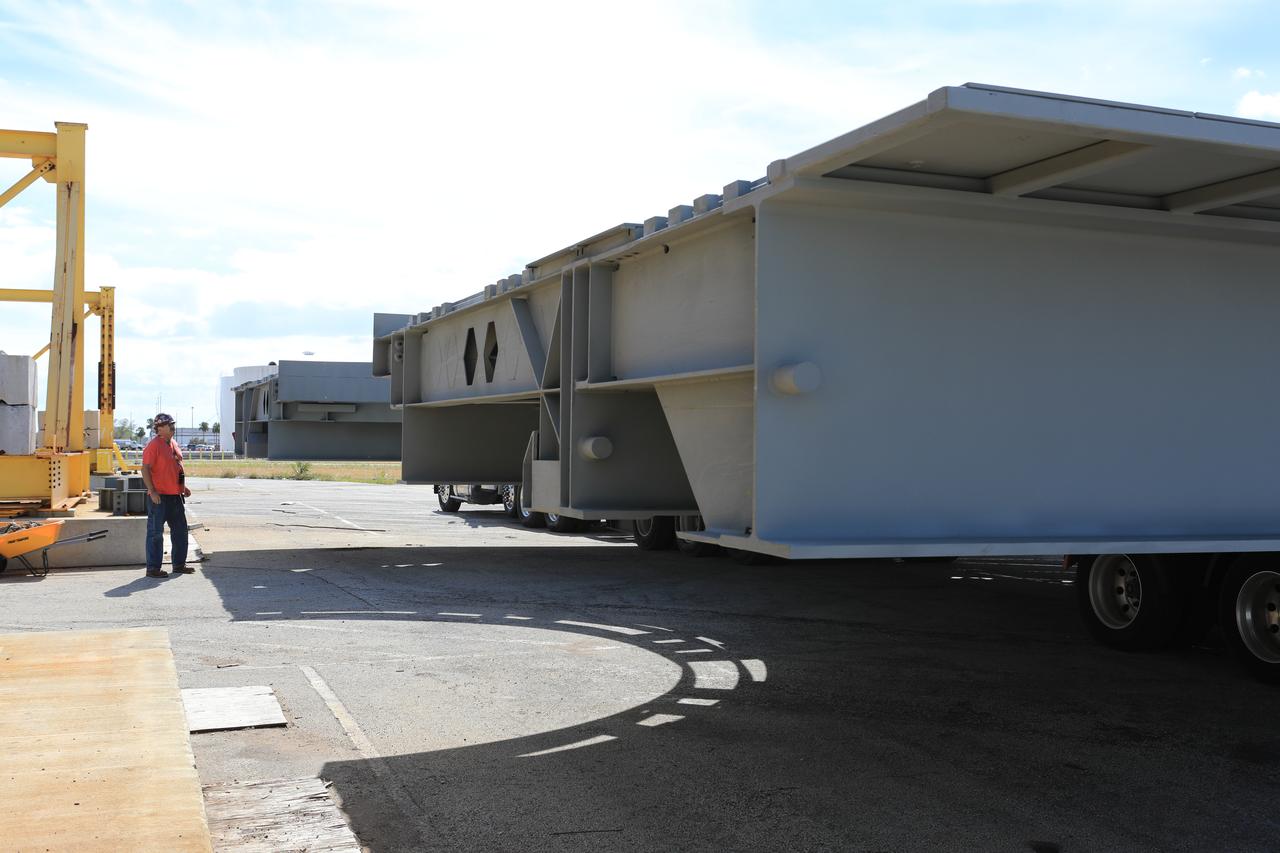
A heavy load transport truck from Tillett Heavy Hauling in Titusville, Florida, arrives at the Vehicle Assembly Building (VAB) at NASA’s Kennedy Space Center in Florida, carrying the second half of the B-level work platforms, B north, for the agency’s Space Launch System (SLS) rocket. The platform will be offloaded in the VAB staging area in the west parking lot. The Ground Systems Development and Operations Program is overseeing upgrades and modifications to VAB High Bay 3 to support processing of the SLS and Orion spacecraft. A total of 10 levels of new platforms, 20 platform halves altogether, will surround the SLS rocket and Orion spacecraft and provide access for testing and processing.

An early morning view of the iconic Vehicle Assembly Building (VAB) at NASA's Kennedy Space Center in Florida. To the right is the Launch Control Center. In the background is the mobile launcher. All 10 levels of new work platforms, 20 platform halves altogether, have been installed in VAB High Bay 3 for the agency's Space Launch System (SLS) rocket and Orion spacecraft. The Ground Systems Development and Operations Program is overseeing upgrades to the VAB, including installation of the new platforms to prepare for the first test flight of Orion atop the SLS from Launch Pad 39B.
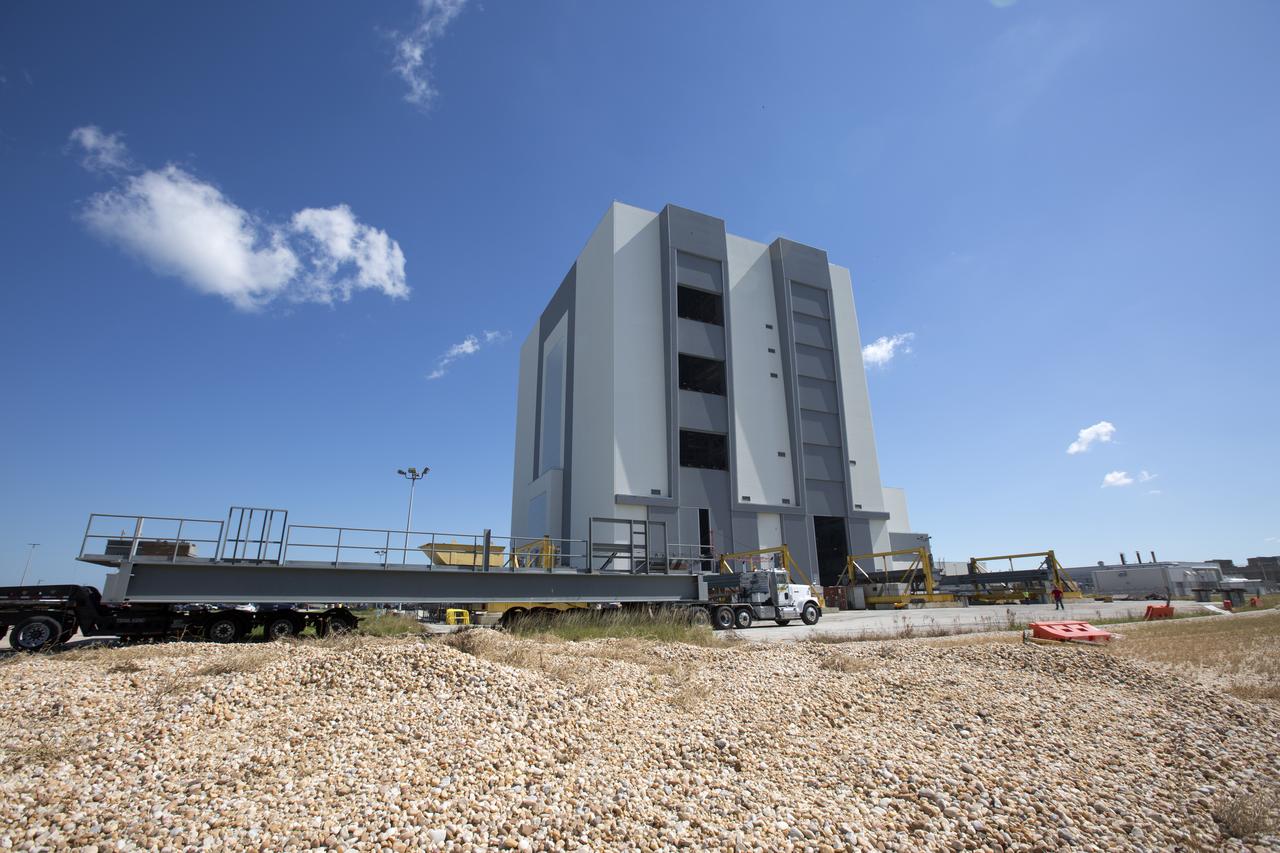
A heavy load transport truck from Tillett Heavy Hauling in Titusville, Florida, arrives at the Vehicle Assembly Building (VAB) at NASA’s Kennedy Space Center in Florida, carrying the first half of the B-level work platforms, B South, for the agency’s Space Launch System (SLS) rocket. The platform will be offloaded in the VAB staging area in the west parking lot. The Ground Systems Development and Operations Program is overseeing upgrades and modifications to VAB High Bay 3 to support processing of the SLS and Orion spacecraft. A total of 10 levels of new platforms, 20 platform halves altogether, will surround the SLS rocket and Orion spacecraft and provide access for testing and processing.
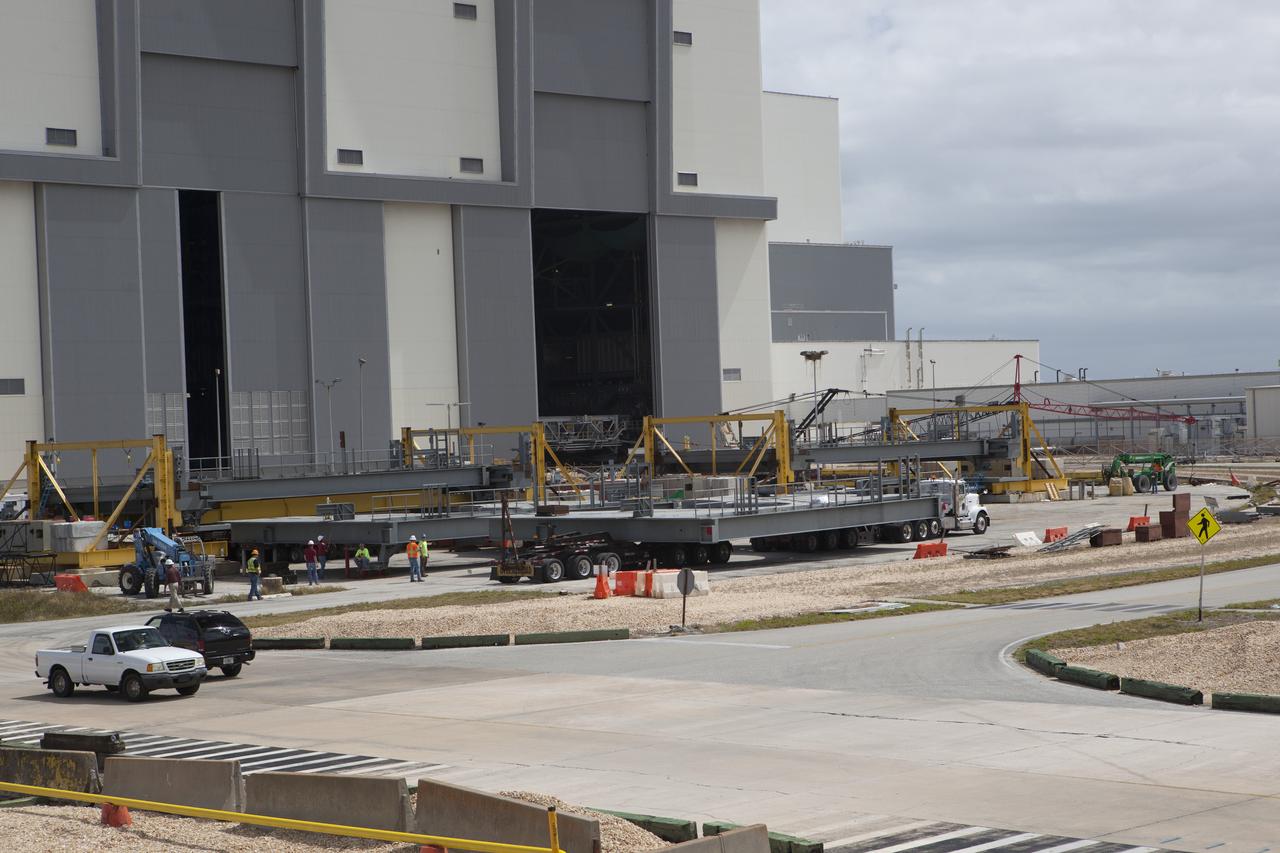
The first half of the F-level work platforms for NASA’s Space Launch System rocket has arrived at the Vehicle Assembly Building at the agency’s Kennedy Space Center in Florida. The Ground Systems Development and Operations Program is overseeing upgrades and modifications to High Bay 3 to support processing of the SLS and Orion spacecraft. A total of 10 levels of new platforms, 20 platform halves altogether, will surround the SLS rocket and Orion spacecraft and provide access for testing and processing. The first three sets of platforms, H, J and K, were delivered to the center last year.
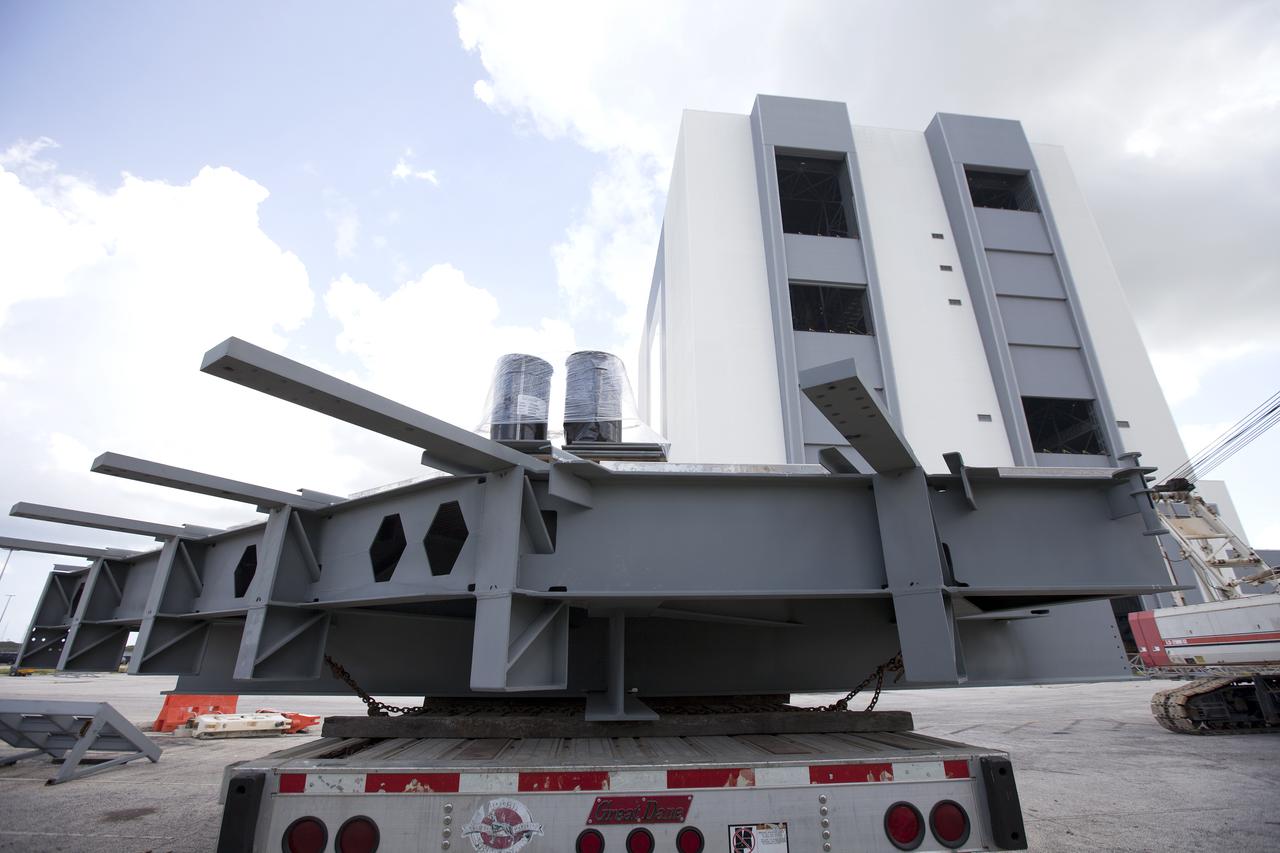
A heavy load transport truck from Tillett Heavy Hauling in Titusville, Florida, arrives at the Vehicle Assembly Building (VAB) at NASA’s Kennedy Space Center in Florida, carrying the second section of the first half of the C-level work platforms, C South, for the agency’s Space Launch System (SLS) rocket. The platform will be offloaded in the VAB staging area in the west parking lot. The Ground Systems Development and Operations Program is overseeing upgrades and modifications to VAB High Bay 3 to support processing of the SLS and Orion spacecraft. A total of 10 levels of new platforms, 20 platform halves altogether, will surround the SLS rocket and Orion spacecraft and provide access for testing and processing.

A heavy load transport truck from Tillett Heavy Hauling in Titusville, Florida, arrives at the Vehicle Assembly Building (VAB) at NASA’s Kennedy Space Center in Florida, carrying the second section of the first half of the C-level work platforms, C South, for the agency’s Space Launch System (SLS) rocket. The platform will be offloaded in the VAB staging area in the west parking lot. The Ground Systems Development and Operations Program is overseeing upgrades and modifications to VAB High Bay 3 to support processing of the SLS and Orion spacecraft. A total of 10 levels of new platforms, 20 platform halves altogether, will surround the SLS rocket and Orion spacecraft and provide access for testing and processing.

A long exposure photograph of the Vehicle Assembly Building, against the backdrop of a bright blue sky, at NASA's Kennedy Space Center in Florida. Inside the VAB, 10 levels of platforms, 20 platform halves altogether, have been installed in High Bay 3. The platforms will surround NASA's Space Launch System (SLS) rocket and the Orion spacecraft and allow access during processing for missions, including the first uncrewed flight test of Orion atop the SLS rocket in 2018. The Ground Systems Development and Operations Program, along with center's Engineering Directorate, is overseeing upgrades and modifications to the VAB to support the multi-user spaceport.
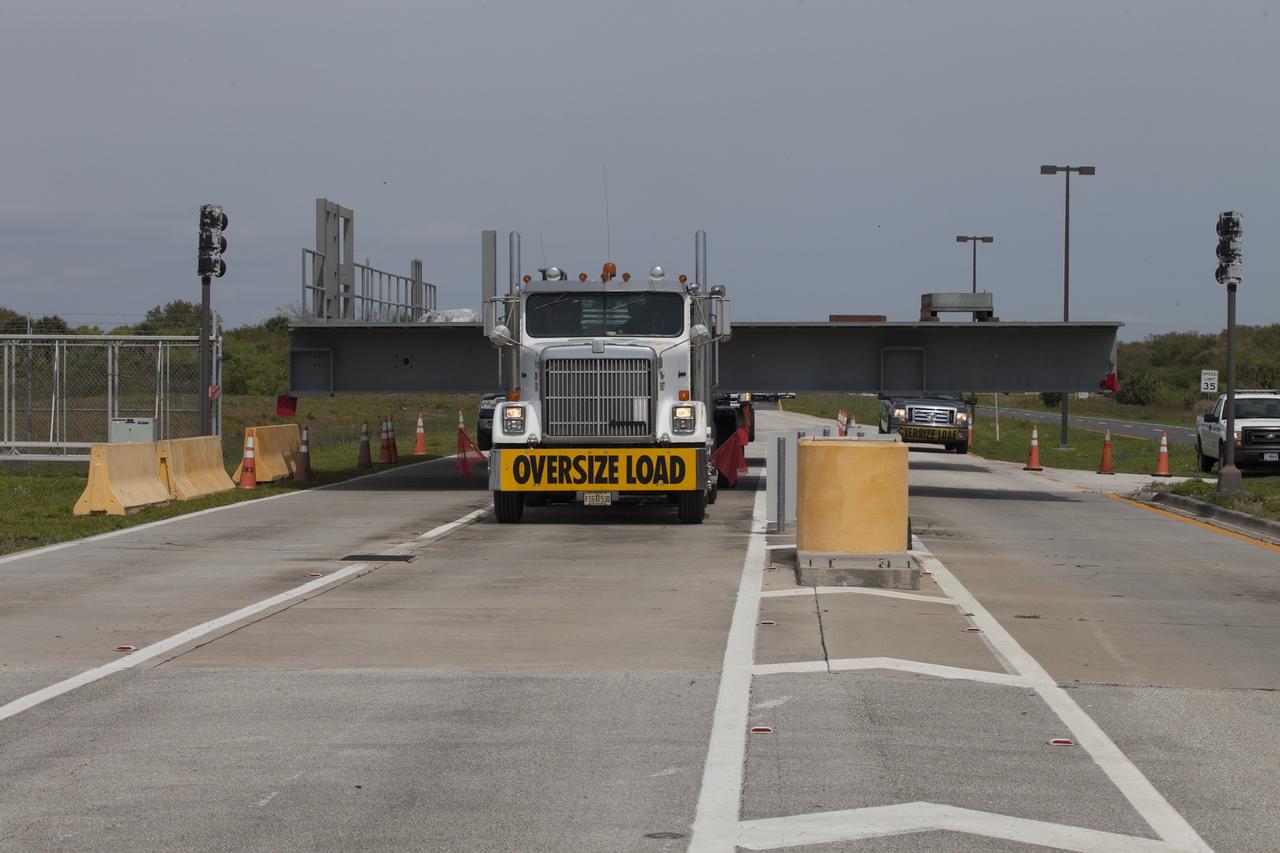
A heavy load transport truck arrives at the north entrance gate at NASA’s Kennedy Space Center in Florida, carrying the second half of the F-level work platforms for the agency’s Space Launch System (SLS) rocket. The platform will be delivered to the Vehicle Assembly Building (VAB) staging area in the west parking lot. The Ground Systems Development and Operations Program is overseeing upgrades and modifications to VAB High Bay 3 to support processing of the SLS and Orion spacecraft. A total of 10 levels of new platforms, 20 platform halves altogether, will surround the SLS rocket and Orion spacecraft and provide access for testing and processing. Delivery of this platform brings the total to 10 platforms, or half of the work platforms delivered to Kennedy.
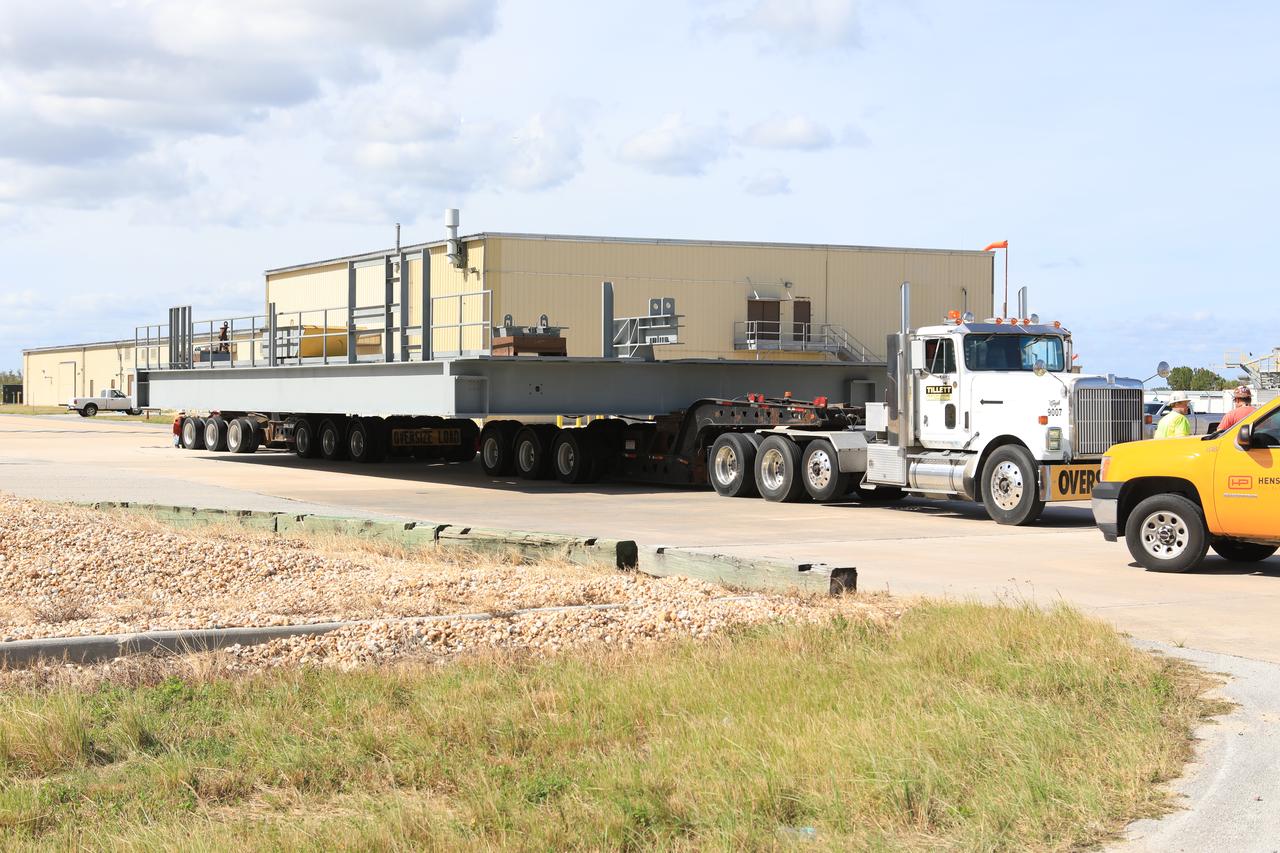
A heavy load transport truck from Tillett Heavy Hauling in Titusville, Florida, arrives at NASA's Kennedy Space Center in Florida, carrying the second half of the B-level work platforms, B north, for the agency’s Space Launch System (SLS) rocket. The platform will be delivered to the Vehicle Assembly Building where it will be offloaded in a staging area in the west parking lot. The Ground Systems Development and Operations Program is overseeing upgrades and modifications to VAB High Bay 3 to support processing of the SLS and Orion spacecraft. A total of 10 levels of new platforms, 20 platform halves altogether, will surround the SLS rocket and Orion spacecraft and provide access for testing and processing.
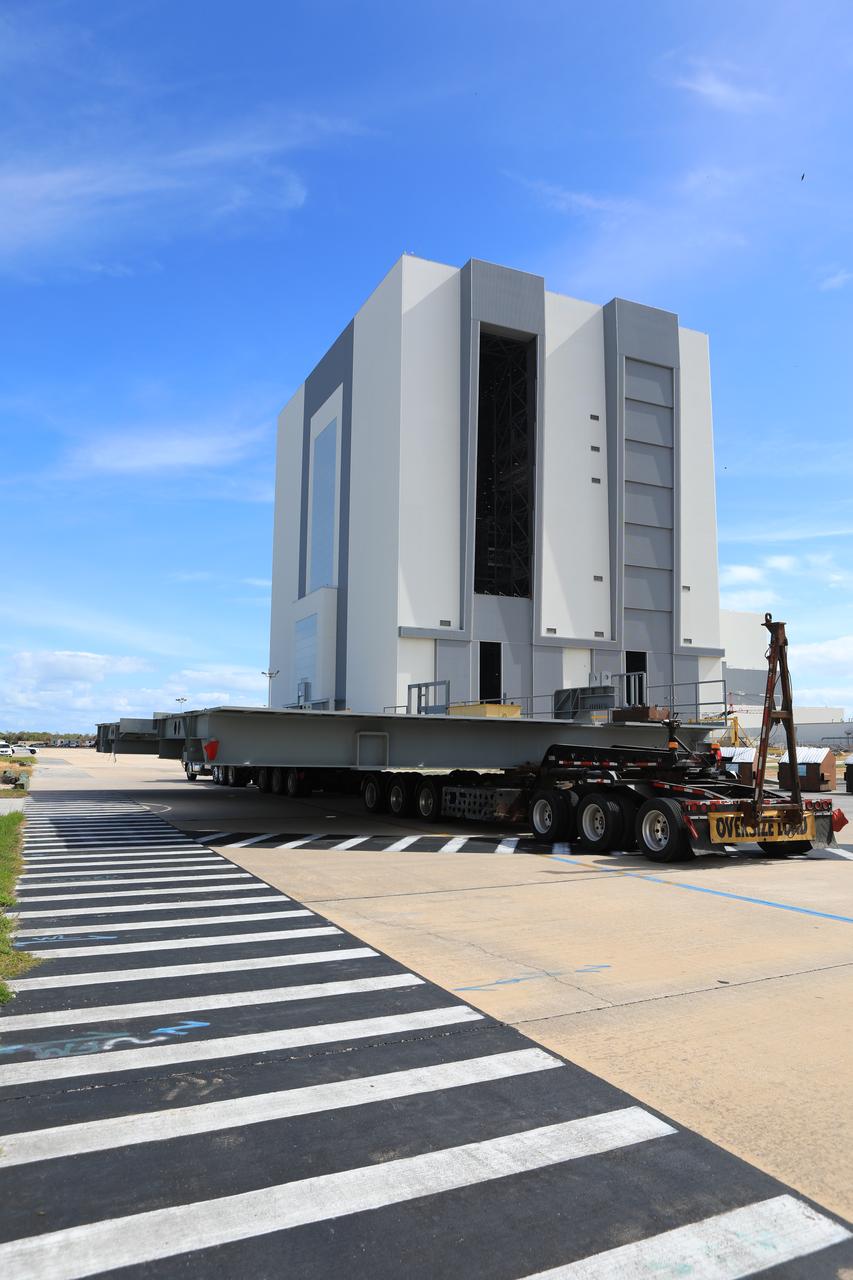
A heavy load transport truck from Tillett Heavy Hauling in Titusville, Florida, arrives at the Vehicle Assembly Building (VAB) at NASA’s Kennedy Space Center in Florida, carrying the second half of the B-level work platforms, B north, for the agency’s Space Launch System (SLS) rocket. The platform will be delivered to the VAB staging area in the west parking lot. The Ground Systems Development and Operations Program is overseeing upgrades and modifications to VAB High Bay 3 to support processing of the SLS and Orion spacecraft. A total of 10 levels of new platforms, 20 platform halves altogether, will surround the SLS rocket and Orion spacecraft and provide access for testing and processing.
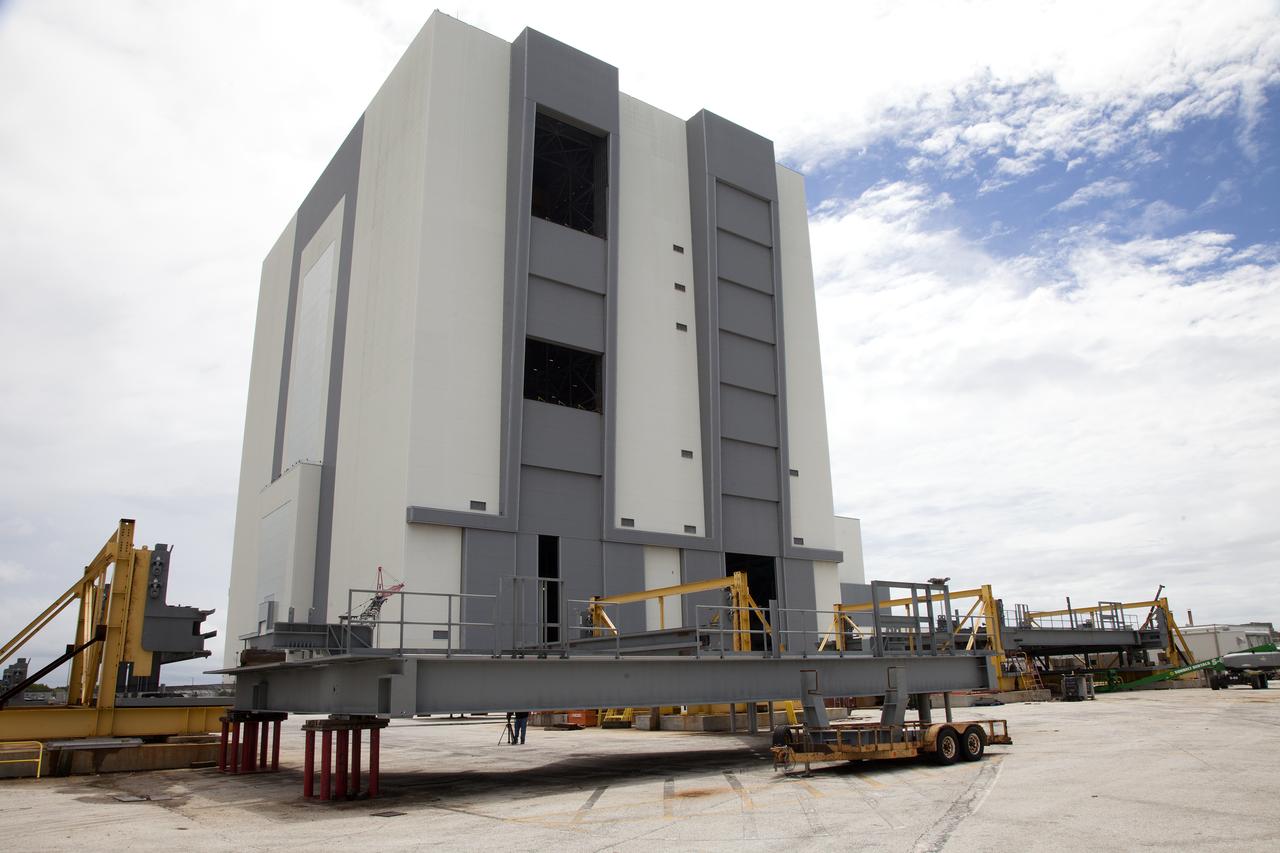
A section of the second half of the C-level platforms, C North, for NASA’s Space Launch System (SLS) rocket, arrives at the agency’s Kennedy Space Center in Florida. The platform was offloaded from a heavy lift transport truck and secured in a staging area in the west parking lot of the Vehicle Assembly Building (VAB). The Ground Systems Development and Operations Program is overseeing upgrades and modifications to VAB High Bay 3 to support processing of the SLS and Orion spacecraft. A total of 10 levels of new platforms, 20 platform halves altogether, will surround the SLS rocket and Orion spacecraft and provide access for testing and processing.
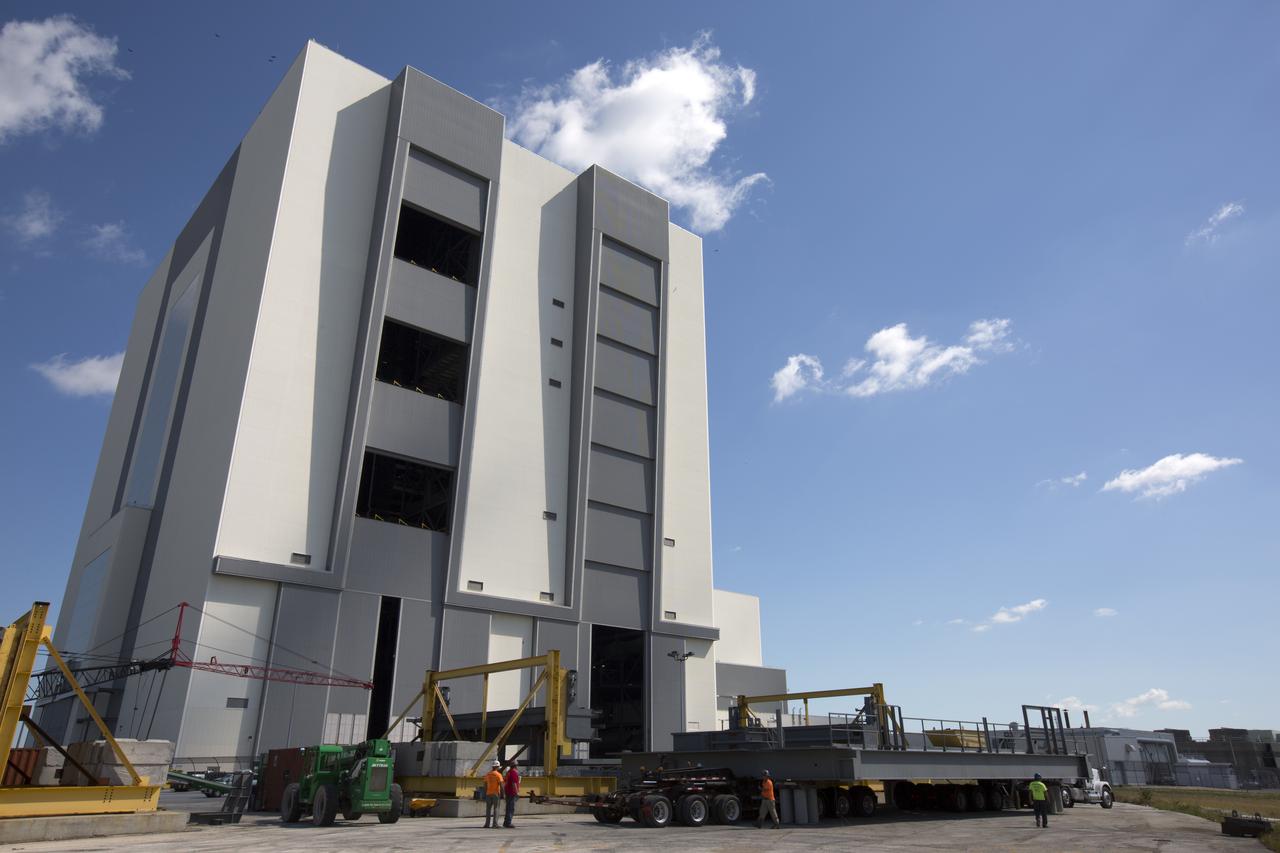
A heavy load transport truck from Tillett Heavy Hauling in Titusville, Florida, arrives at the Vehicle Assembly Building (VAB) at NASA’s Kennedy Space Center in Florida, carrying the first half of the B-level work platforms, B South, for the agency’s Space Launch System (SLS) rocket. The platform will be offloaded in the VAB staging area in the west parking lot. The Ground Systems Development and Operations Program is overseeing upgrades and modifications to VAB High Bay 3 to support processing of the SLS and Orion spacecraft. A total of 10 levels of new platforms, 20 platform halves altogether, will surround the SLS rocket and Orion spacecraft and provide access for testing and processing.
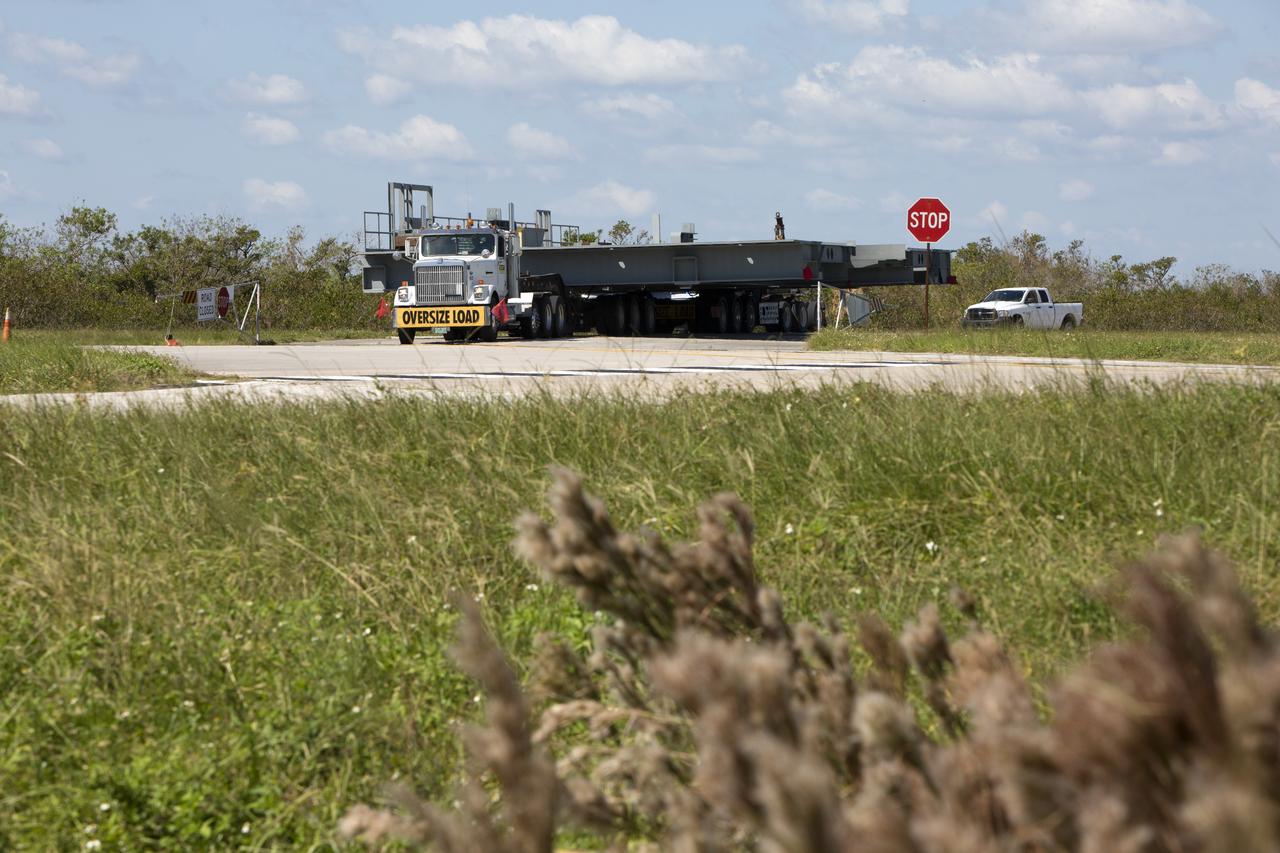
A heavy load transport truck from Tillett Heavy Hauling in Titusville, Florida, arrives at NASA’s Kennedy Space Center in Florida, carrying the first half of the B-level work platforms, B south, for the agency’s Space Launch System (SLS) rocket. The platform will be delivered to the Vehicle Assembly Building (VAB) staging area in the west parking lot. The Ground Systems Development and Operations Program is overseeing upgrades and modifications to VAB High Bay 3 to support processing of the SLS and Orion spacecraft. A total of 10 levels of new platforms, 20 platform halves altogether, will surround the SLS rocket and Orion spacecraft and provide access for testing and processing.
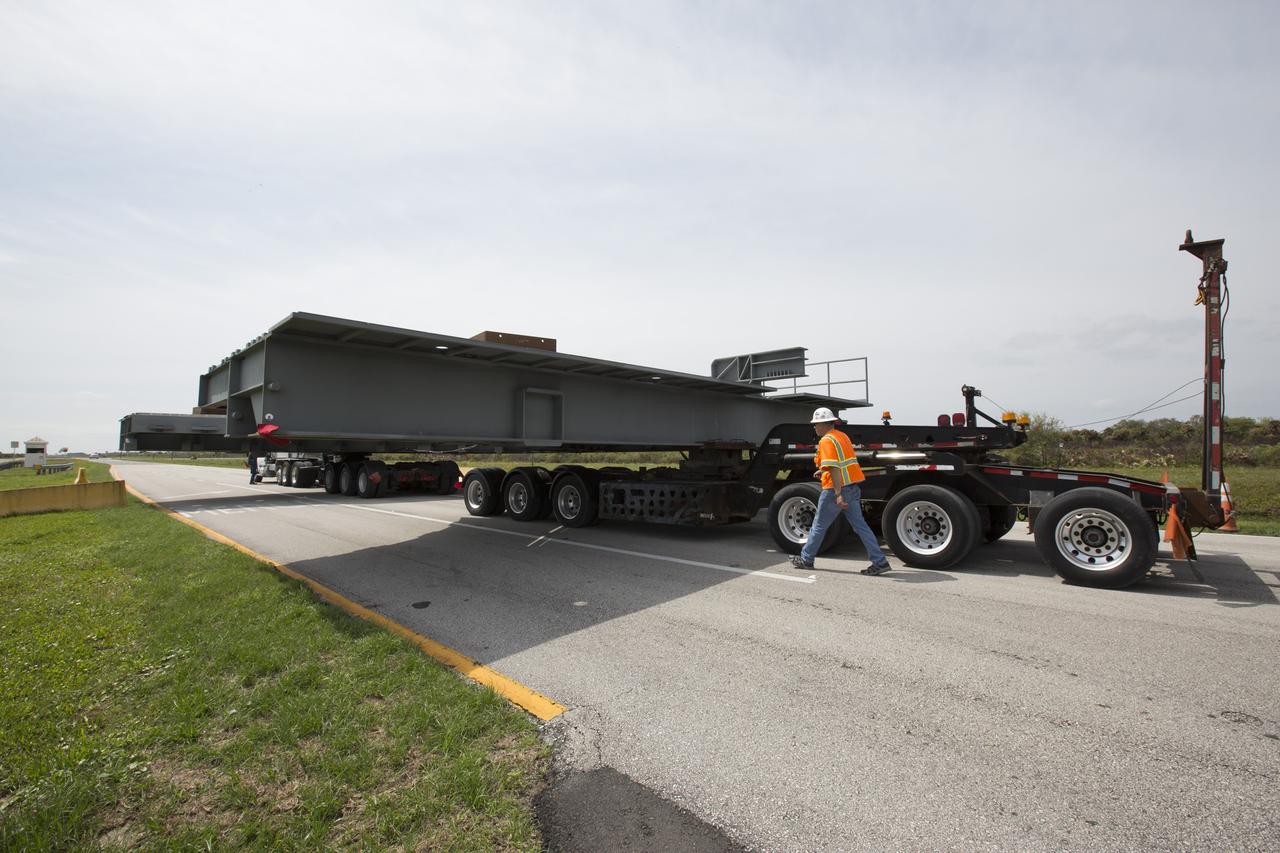
A heavy load transport truck proceeds along the road to the Vehicle Assembly Building (VAB) at NASA’s Kennedy Space Center in Florida, carrying the second half of the F-level work platforms for the agency’s Space Launch System (SLS) rocket. The platform will be delivered to the VAB staging area in the west parking lot. The Ground Systems Development and Operations Program is overseeing upgrades and modifications to VAB High Bay 3 to support processing of the SLS and Orion spacecraft. A total of 10 levels of new platforms, 20 platform halves altogether, will surround the SLS rocket and Orion spacecraft and provide access for testing and processing. Delivery of this platform brings the total to 10 platforms, or half of the work platforms delivered to Kennedy.
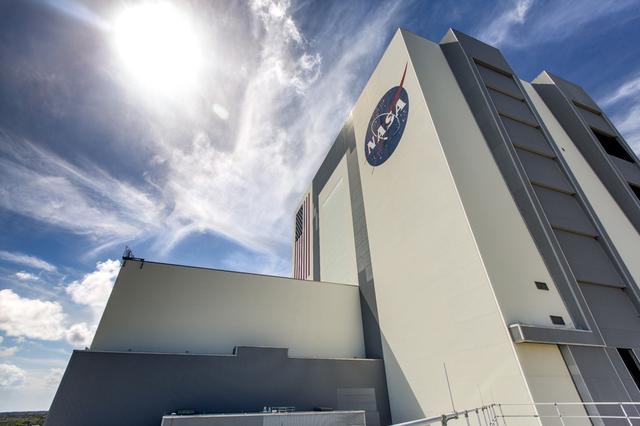
A long exposure photograph of the Vehicle Assembly Building, against the backdrop of a bright blue sky, at NASA's Kennedy Space Center in Florida. Inside the VAB, 10 levels of platforms, 20 platform halves altogether, have been installed in High Bay 3. The platforms will surround NASA's Space Launch System (SLS) rocket and the Orion spacecraft and allow access during processing for missions, including the first uncrewed flight test of Orion atop the SLS rocket in 2018. The Ground Systems Development and Operations Program, along with center's Engineering Directorate, is overseeing upgrades and modifications to the VAB to support the multi-user spaceport.
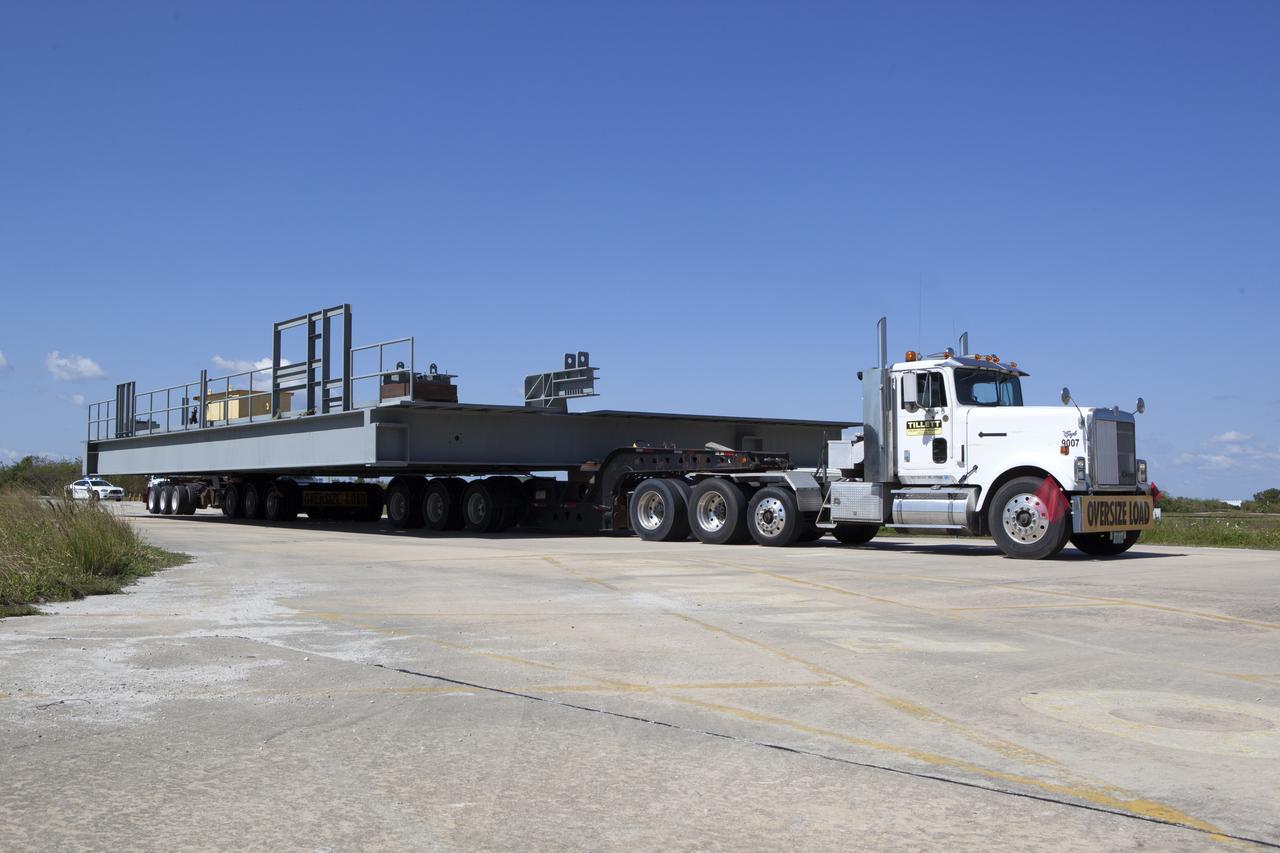
A heavy load transport truck from Tillett Heavy Hauling in Titusville, Florida, travels toward the Vehicle Assembly Building (VAB) at NASA’s Kennedy Space Center in Florida, carrying the first half of the B-level work platforms, B South, for the agency’s Space Launch System (SLS) rocket. The platform will be delivered to the Vehicle Assembly Building (VAB) staging area in the west parking lot. The Ground Systems Development and Operations Program is overseeing upgrades and modifications to VAB High Bay 3 to support processing of the SLS and Orion spacecraft. A total of 10 levels of new platforms, 20 platform halves altogether, will surround the SLS rocket and Orion spacecraft and provide access for testing and processing.
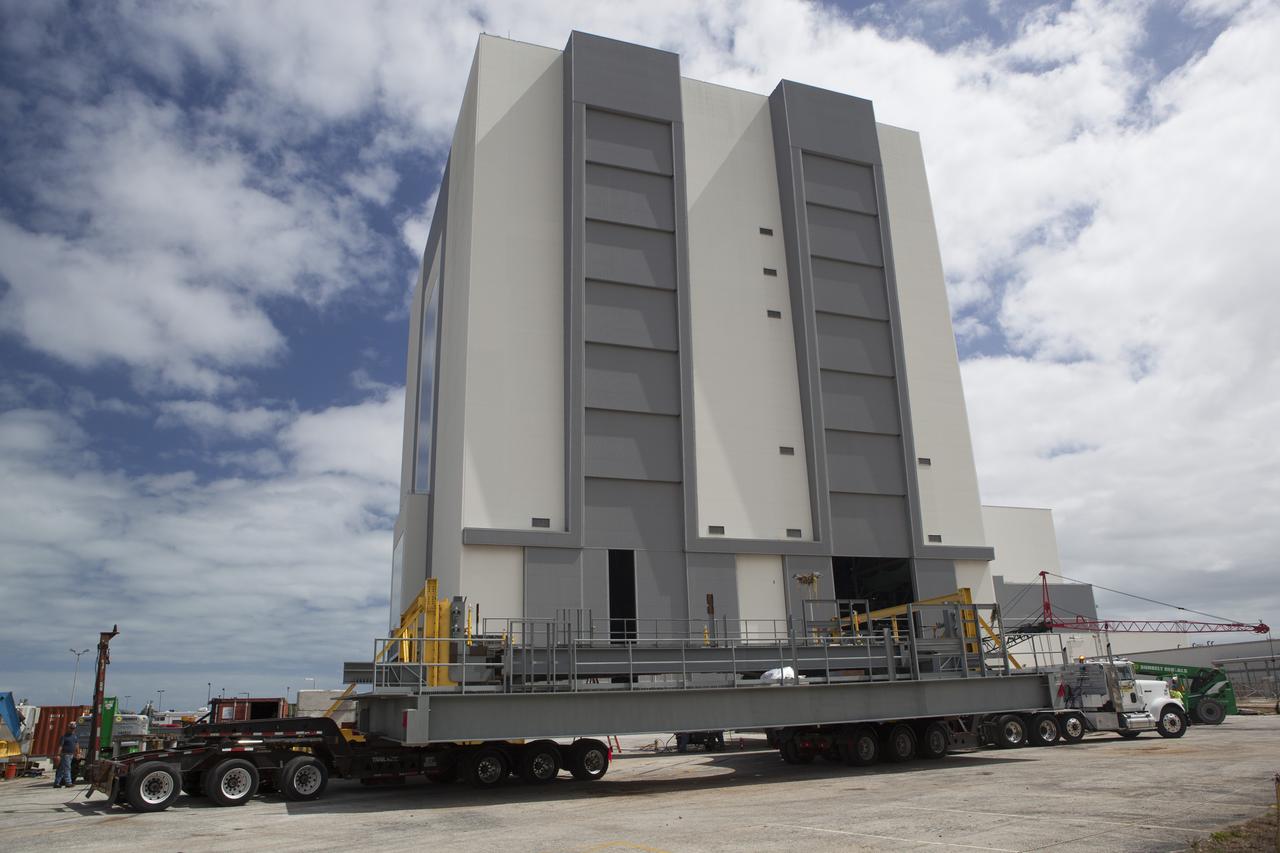
The first half of the F-level work platforms for NASA’s Space Launch System rocket has arrived at the Vehicle Assembly Building at the agency’s Kennedy Space Center in Florida. The Ground Systems Development and Operations Program is overseeing upgrades and modifications to High Bay 3 to support processing of the SLS and Orion spacecraft. A total of 10 levels of new platforms, 20 platform halves altogether, will surround the SLS rocket and Orion spacecraft and provide access for testing and processing. The first three sets of platforms, H, J and K, were delivered to the center last year.
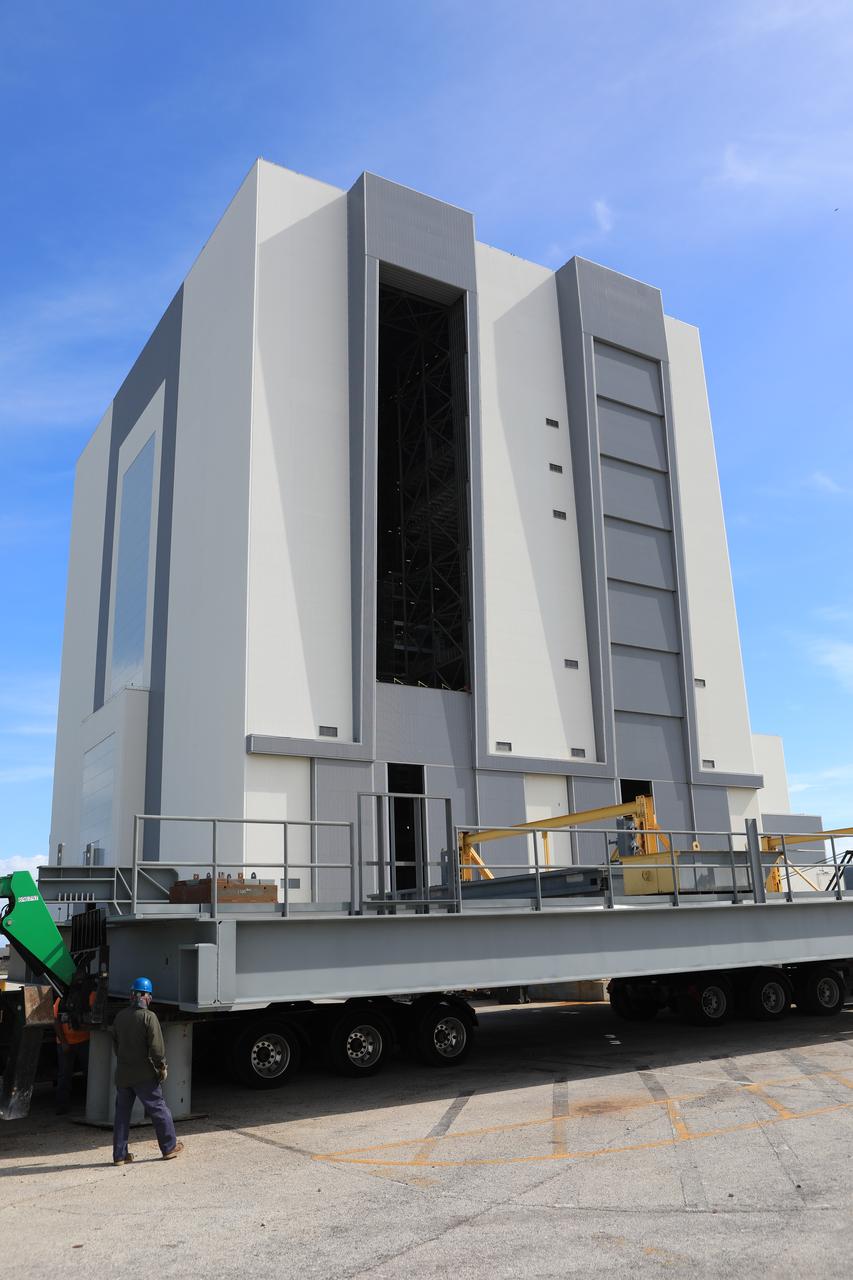
The second half of the B-level work platforms, B north, arrives at the Vehicle Assembly Building (VAB) at NASA's Kennedy Space Center in Florida. It will be offloaded from a heavy load transport truck to a staging area in the VAB west parking lot. The Ground Systems Development and Operations Program is overseeing upgrades and modifications to VAB High Bay 3 to support processing of the SLS and Orion spacecraft. A total of 10 levels of new platforms, 20 platform halves altogether, will surround the SLS rocket and Orion spacecraft and provide access for testing and processing.
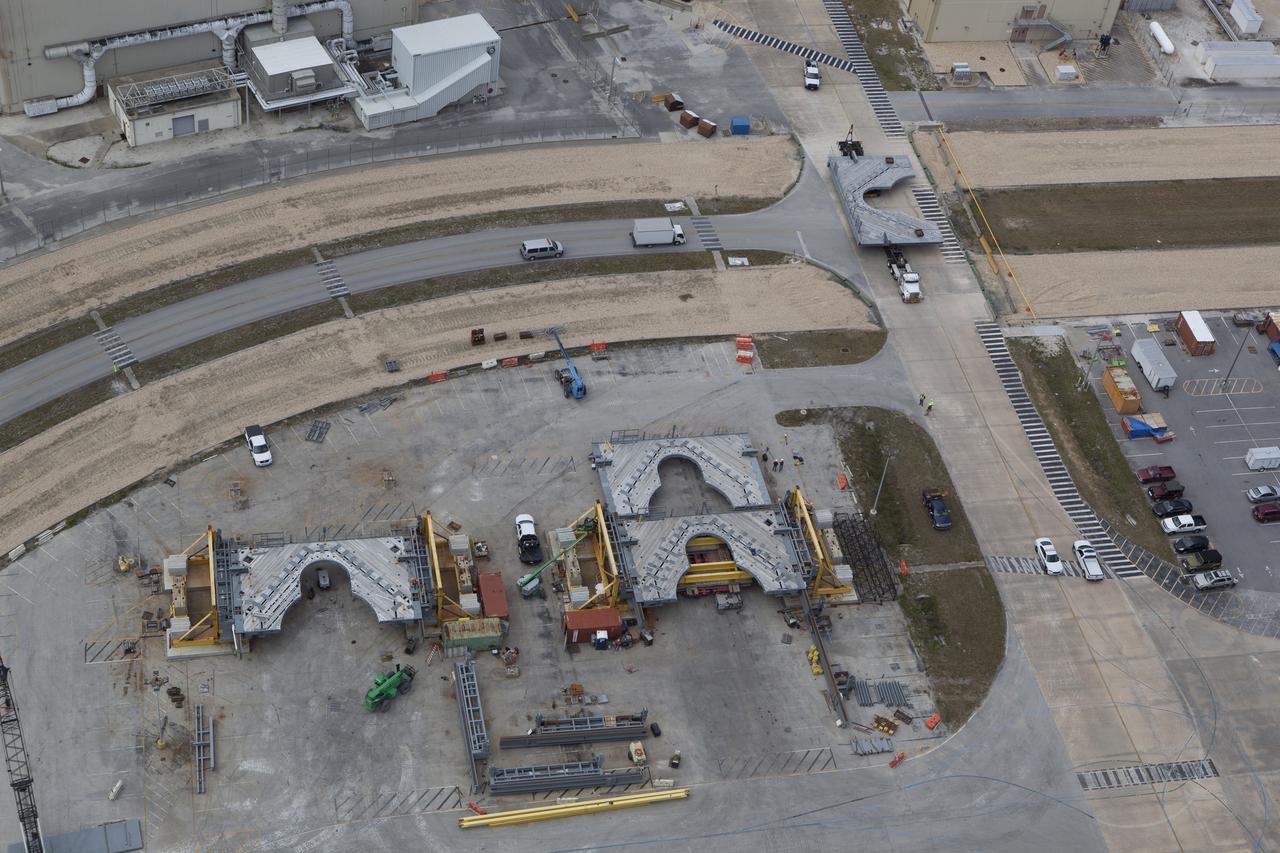
At right, the first half of the F-level work platforms for NASA’s Space Launch System rocket has arrived at the Vehicle Assembly Building at the agency’s Kennedy Space Center in Florida. At left, several other work platforms are being readied for future installation in VAB High Bay 3. The Ground Systems Development and Operations Program is overseeing upgrades and modifications to High Bay 3 to support processing of the SLS and Orion spacecraft. A total of 10 levels of new platforms, 20 platform halves altogether, will surround the SLS rocket and Orion spacecraft and provide access for testing and processing. The first three sets of platforms, H, J and K, were delivered to the center last year.
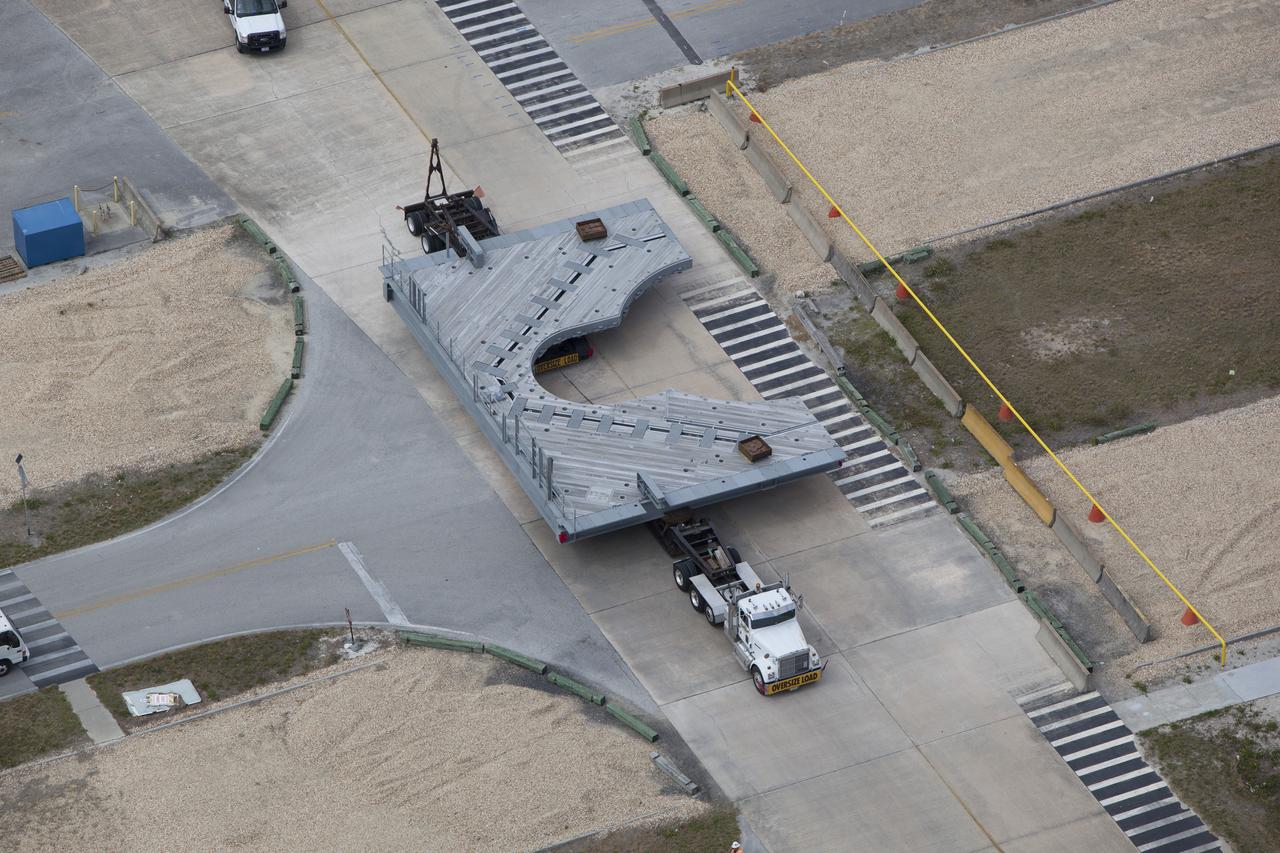
The first half of the F-level work platforms for NASA’s Space Launch System rocket has arrived at the Vehicle Assembly Building at the agency’s Kennedy Space Center in Florida. The Ground Systems Development and Operations Program is overseeing upgrades and modifications to High Bay 3 to support processing of the SLS and Orion spacecraft. A total of 10 levels of new platforms, 20 platform halves altogether, will surround the SLS rocket and Orion spacecraft and provide access for testing and processing. The first three sets of platforms, H, J and K, were delivered to the center last year.
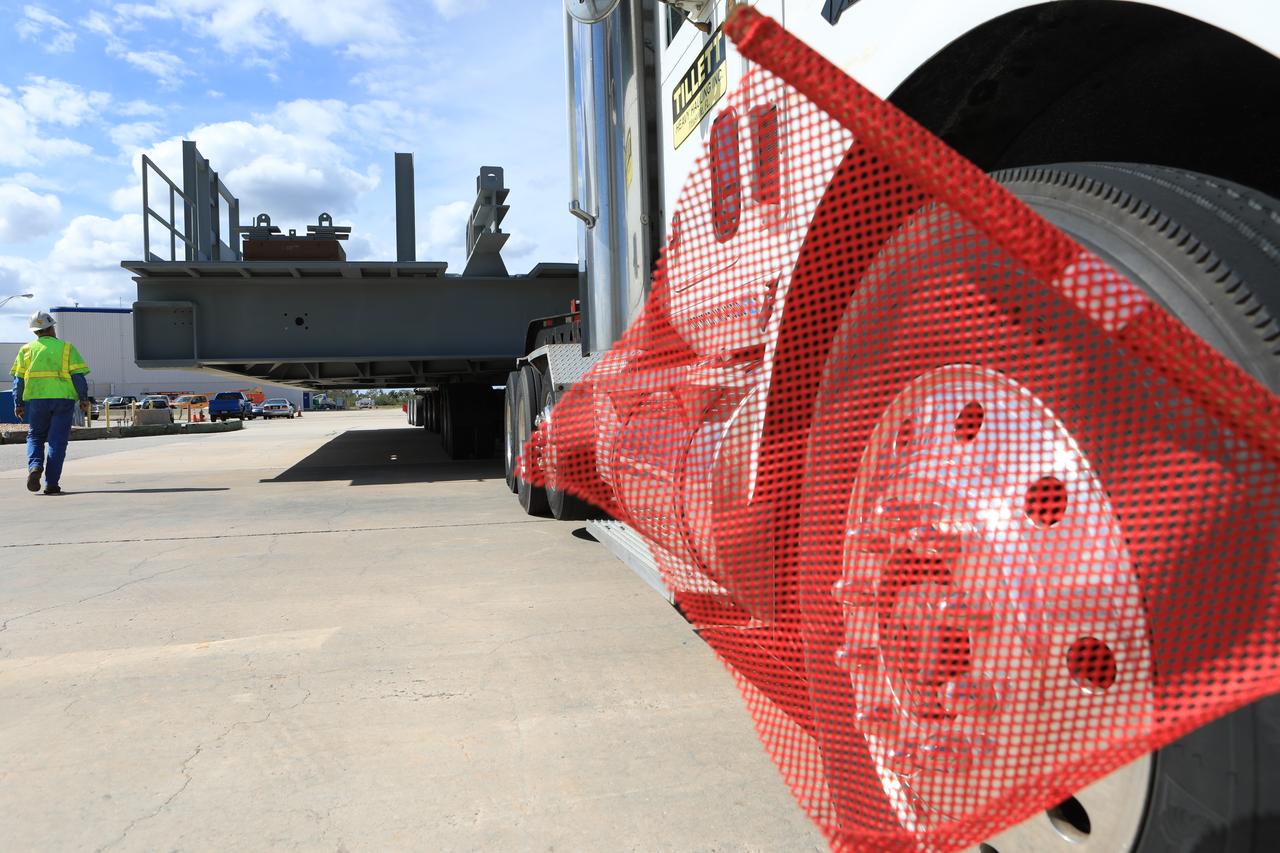
A heavy load transport truck from Tillett Heavy Hauling in Titusville, Florida, arrives at the Vehicle Assembly Building (VAB) at NASA’s Kennedy Space Center in Florida, carrying the second half of the B-level work platforms, B north, for the agency’s Space Launch System (SLS) rocket. The platform will be offloaded in the VAB staging area in the west parking lot. The Ground Systems Development and Operations Program is overseeing upgrades and modifications to VAB High Bay 3 to support processing of the SLS and Orion spacecraft. A total of 10 levels of new platforms, 20 platform halves altogether, will surround the SLS rocket and Orion spacecraft and provide access for testing and processing.
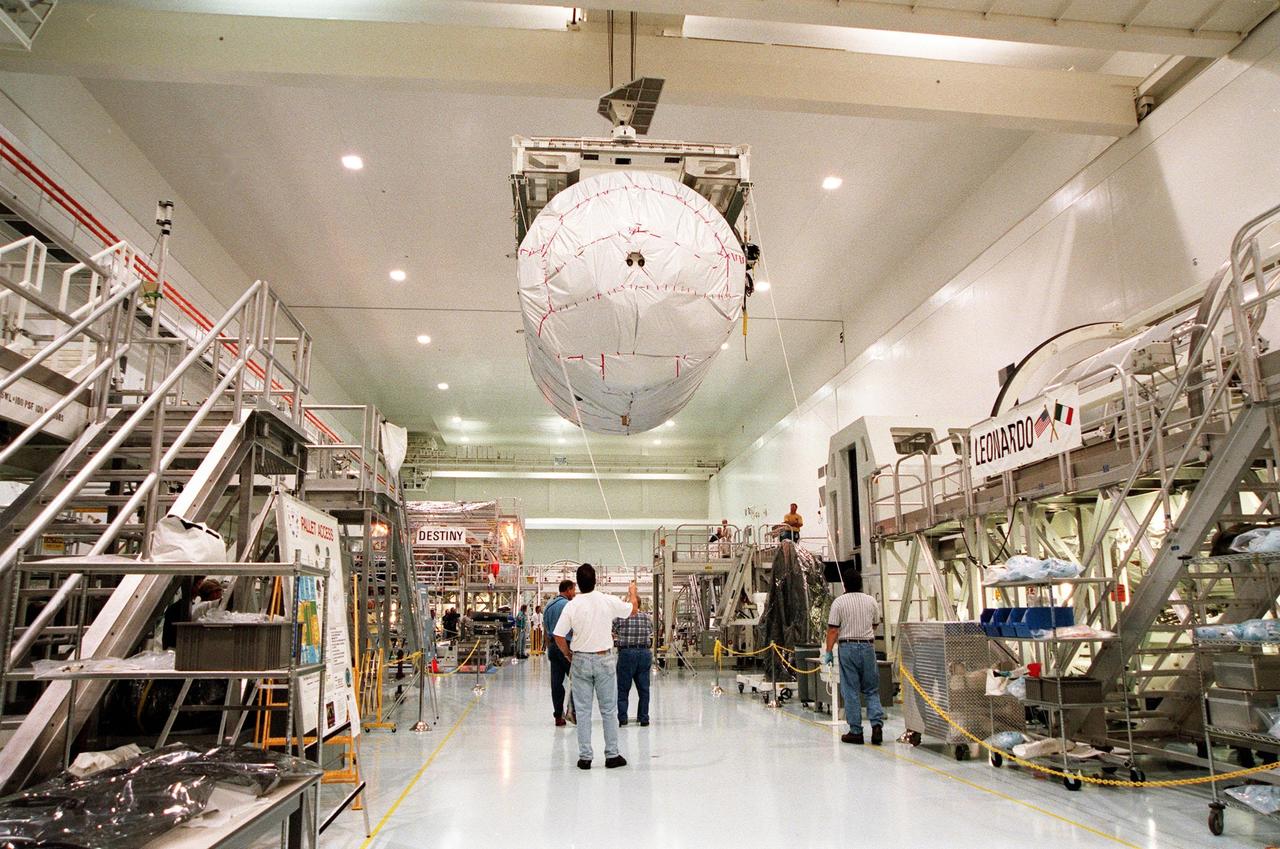
KENNEDY SPACE CENTER, FLA. -- Inside a high bay in the Space Station Processing Facility (SSPF), workers on the floor oversee the transfer of the Multi-Purpose Logistics Module (MPLM) called Raffaello to a workstand where it will undergo testing. Sharing the space in the SSPF is the first Italian-built MPLM, Leonardo, seen at right, and the U.S. Lab, Destiny, in the background. One of Italy's major contributions to the ISS program, the MPLM is a reusable logistics carrier and the primary delivery system used to resupply and return station cargo requiring a pressurized environment. Weighing nearly 4.5 tons, the Raffaello measures 21 feet long and 15 feet in diameter. Raffaello is scheduled to be launched on mission STS-100 July 27, 2000
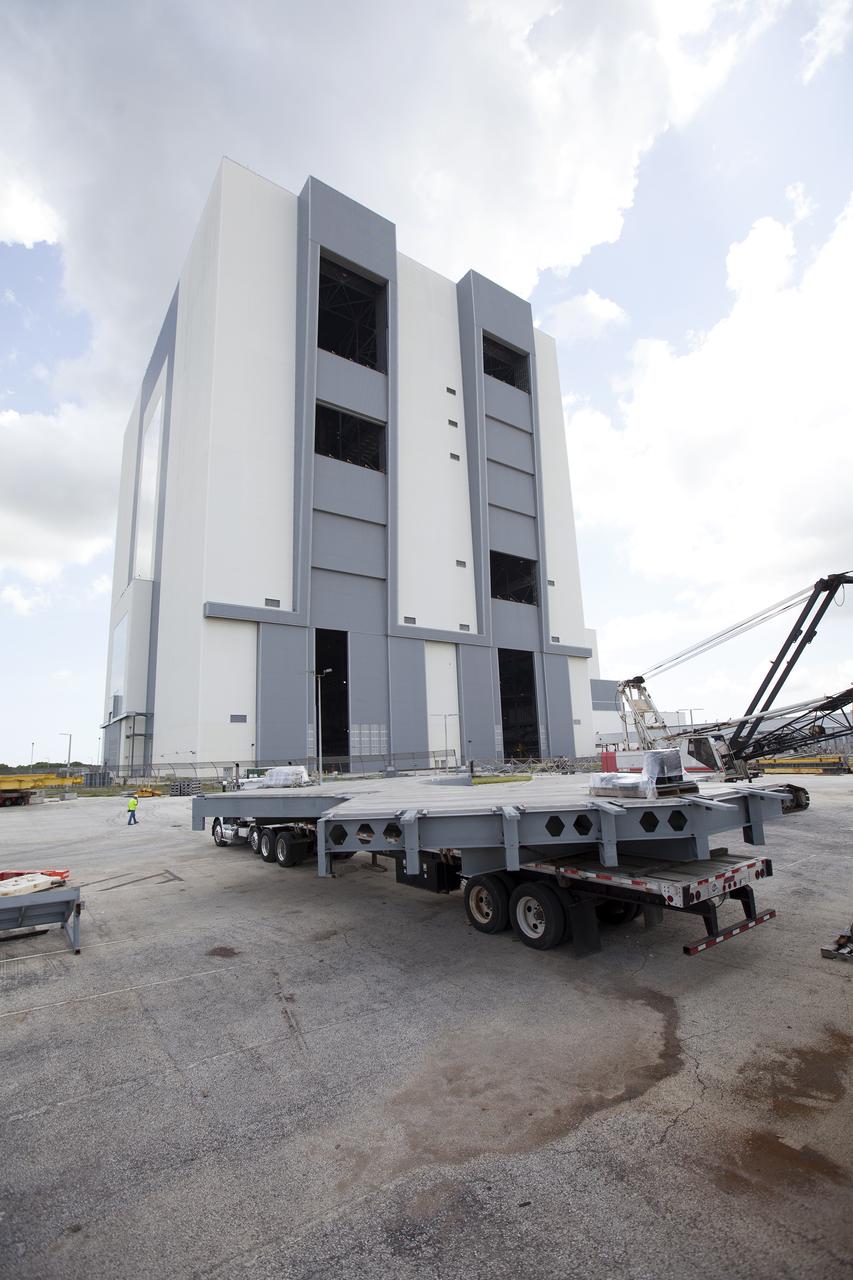
A heavy load transport truck from Tillett Heavy Hauling in Titusville, Florida, arrives at the Vehicle Assembly Building (VAB) at NASA’s Kennedy Space Center in Florida, carrying the second section of the first half of the C-level work platforms, C South, for the agency’s Space Launch System (SLS) rocket. The platform will be offloaded in the VAB staging area in the west parking lot. The Ground Systems Development and Operations Program is overseeing upgrades and modifications to VAB High Bay 3 to support processing of the SLS and Orion spacecraft. A total of 10 levels of new platforms, 20 platform halves altogether, will surround the SLS rocket and Orion spacecraft and provide access for testing and processing.
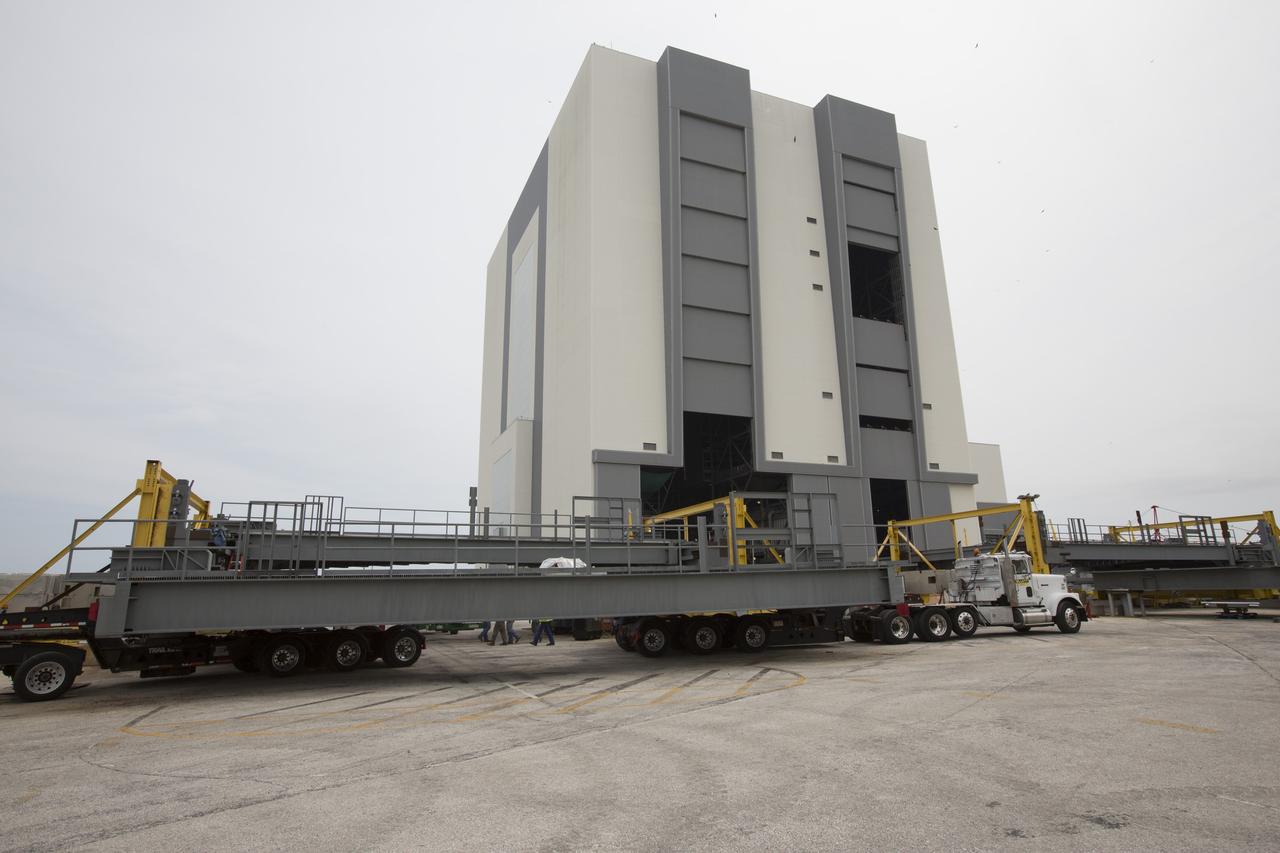
A heavy load transport truck has arrived at the Vehicle Assembly Building (VAB) at NASA’s Kennedy Space Center in Florida, carrying the second half of the F-level work platforms for the agency’s Space Launch System (SLS) rocket. The platform will be delivered to the VAB staging area in the west parking lot. The Ground Systems Development and Operations Program is overseeing upgrades and modifications to VAB High Bay 3 to support processing of the SLS and Orion spacecraft. A total of 10 levels of new platforms, 20 platform halves altogether, will surround the SLS rocket and Orion spacecraft and provide access for testing and processing. Delivery of this platform brings the total to 10 platforms, or half of the work platforms delivered to Kennedy,
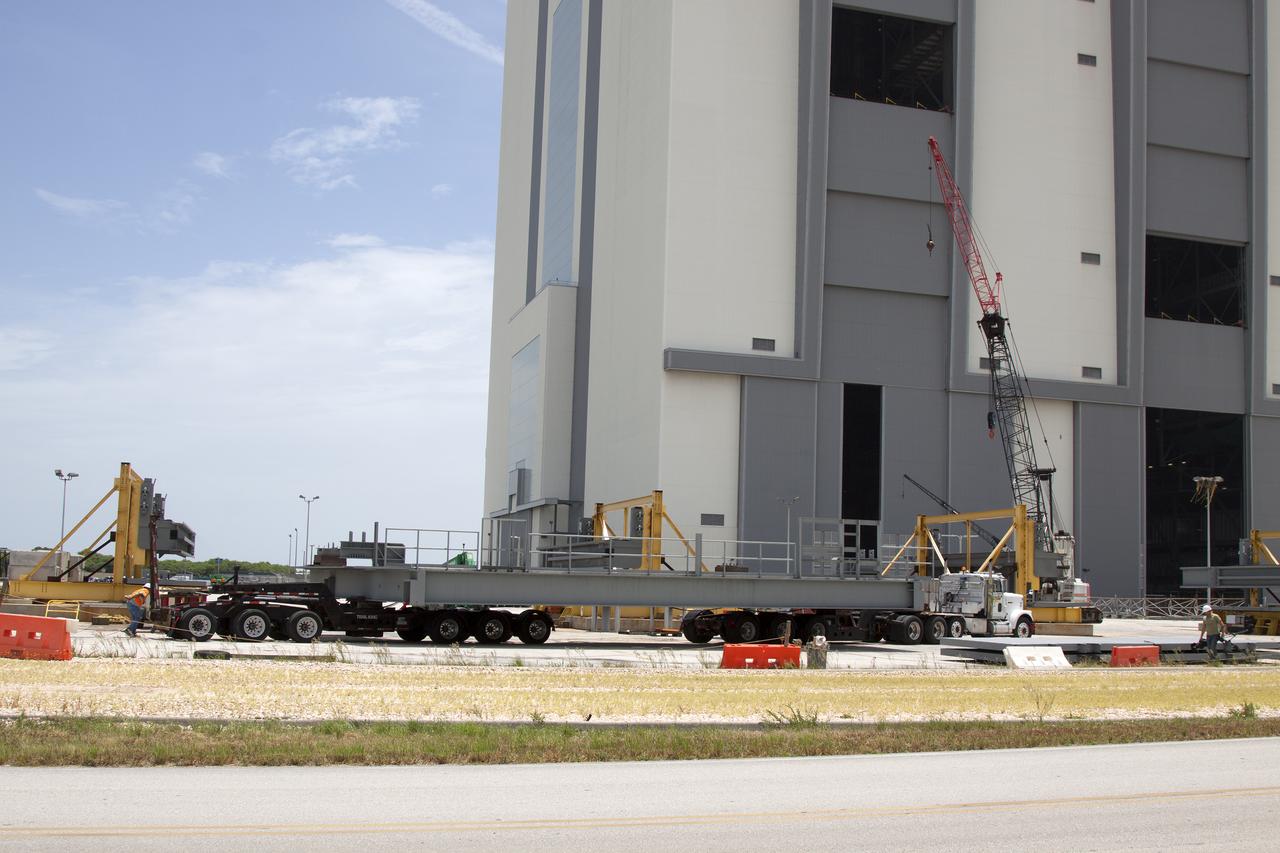
A heavy load transport truck from Tillett Heavy Hauling in Titusville, Florida, arrives at the Vehicle Assembly Building (VAB) at NASA’s Kennedy Space Center in Florida, carrying a section of the first half of the C-level work platforms, C south, for the agency’s Space Launch System (SLS) rocket. The platform will be delivered to the VAB staging area in the west parking lot. The Ground Systems Development and Operations Program is overseeing upgrades and modifications to VAB High Bay 3 to support processing of the SLS and Orion spacecraft. A total of 10 levels of new platforms, 20 platform halves altogether, will surround the SLS rocket and Orion spacecraft and provide access for testing and processing.
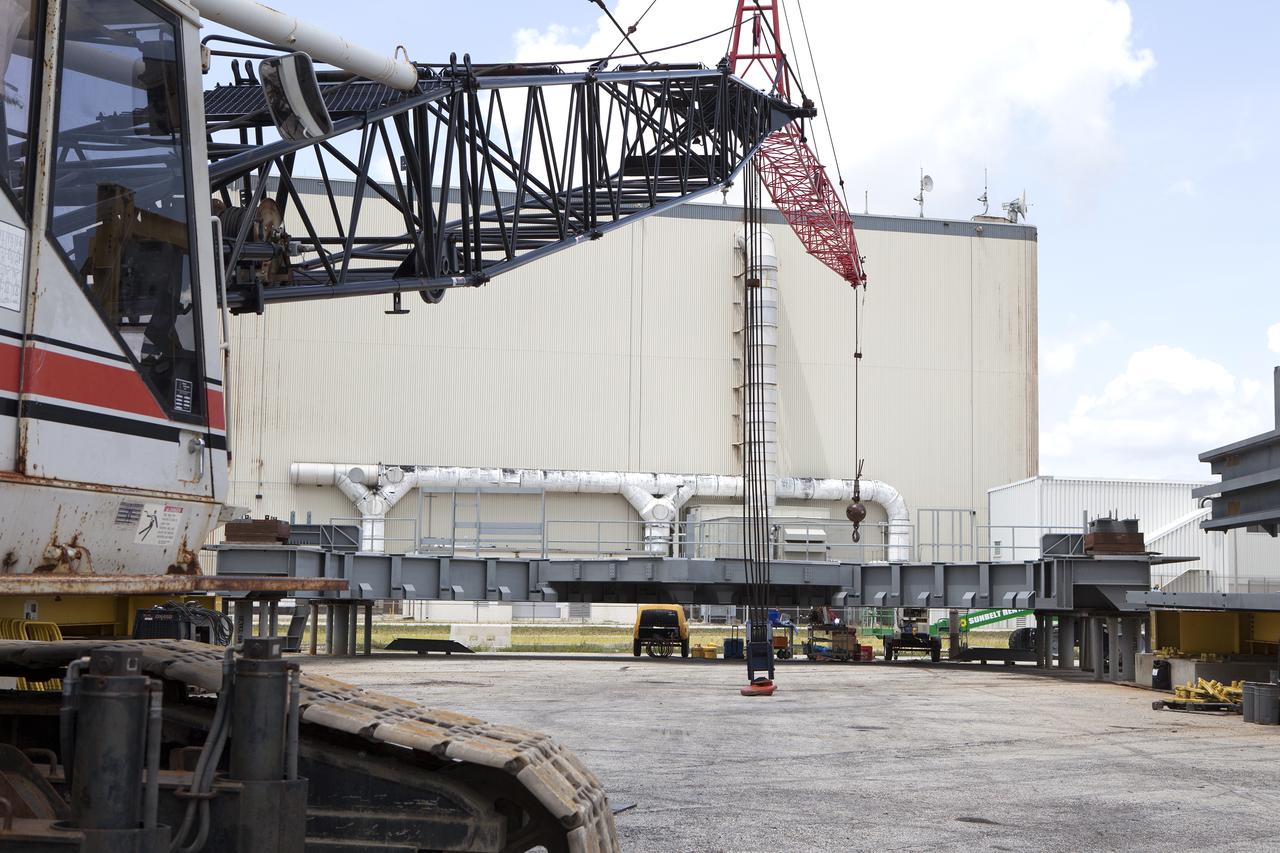
The second section of the first half of the C-level work platforms, C South, for NASA’s Space Launch System (SLS) rocket was offloaded from a heavy transport truck in a staging area on the west side of the Vehicle Assembly Building (VAB) at the agency’s Kennedy Space Center in Florida. The Ground Systems Development and Operations Program is overseeing upgrades and modifications to VAB High Bay 3 to support processing of the SLS and Orion spacecraft. A total of 10 levels of new platforms, 20 platform halves altogether, will surround the SLS rocket and Orion spacecraft and provide access for testing and processing.
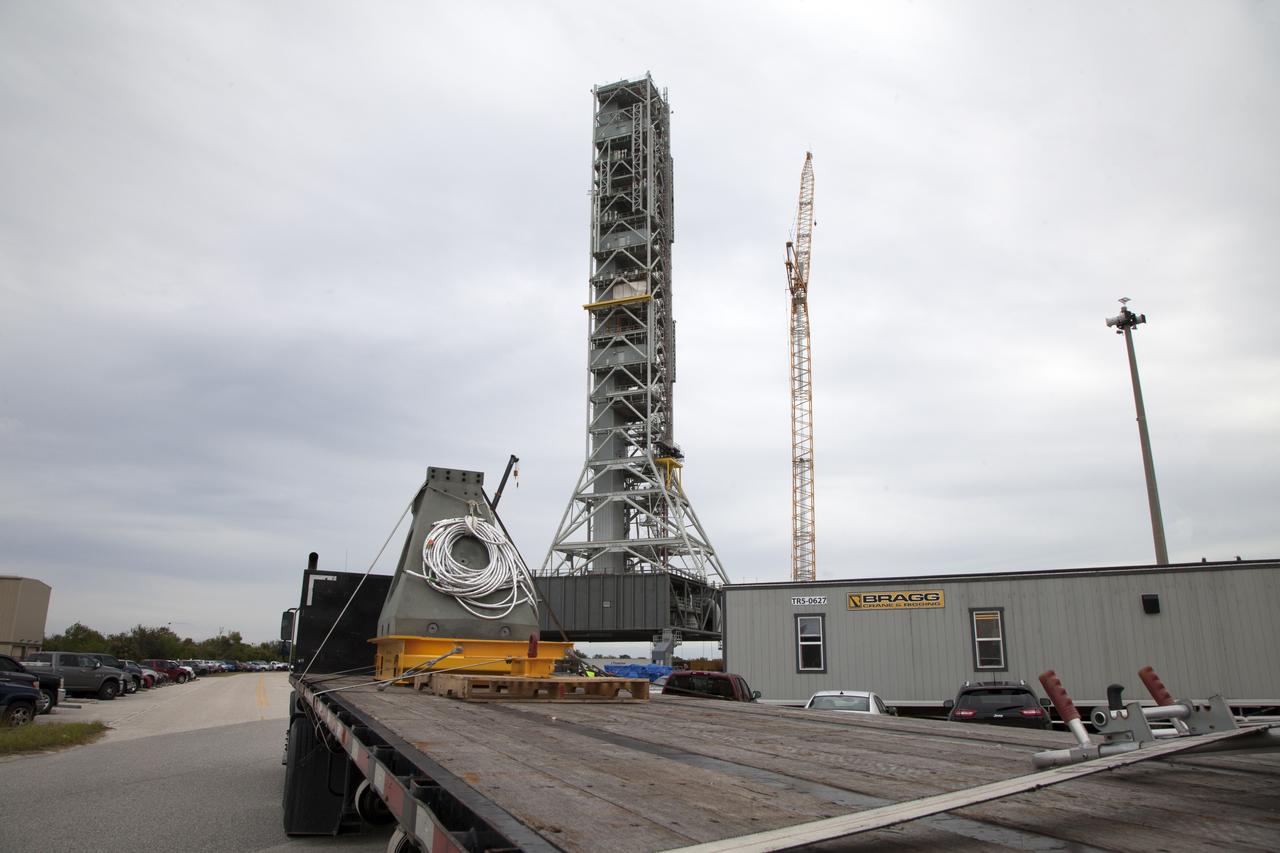
A flatbed truck carries a vertical support post (VSP) for NASA's Space Launch System (SLS) rocket to the Mobile Launcher Yard at NASA's Kennedy Space Center in Florida. The two aft skirt electrical umbilicals (ASEUs) and the first of the vehicle support posts underwent a series of tests to confirm they are functioning properly and ready to support the SLS for launch. The ASEUs will connect to the SLS rocket at the bottom outer edge of each booster and provide electrical power and data connections to the rocket until it lifts off from the launch pad. The eight VSPs will support the load of the solid rocket boosters, with four posts for each of the boosters. The center’s Engineering Directorate and the Ground Systems Development and Operations Program are overseeing processing and testing of the umbilicals.
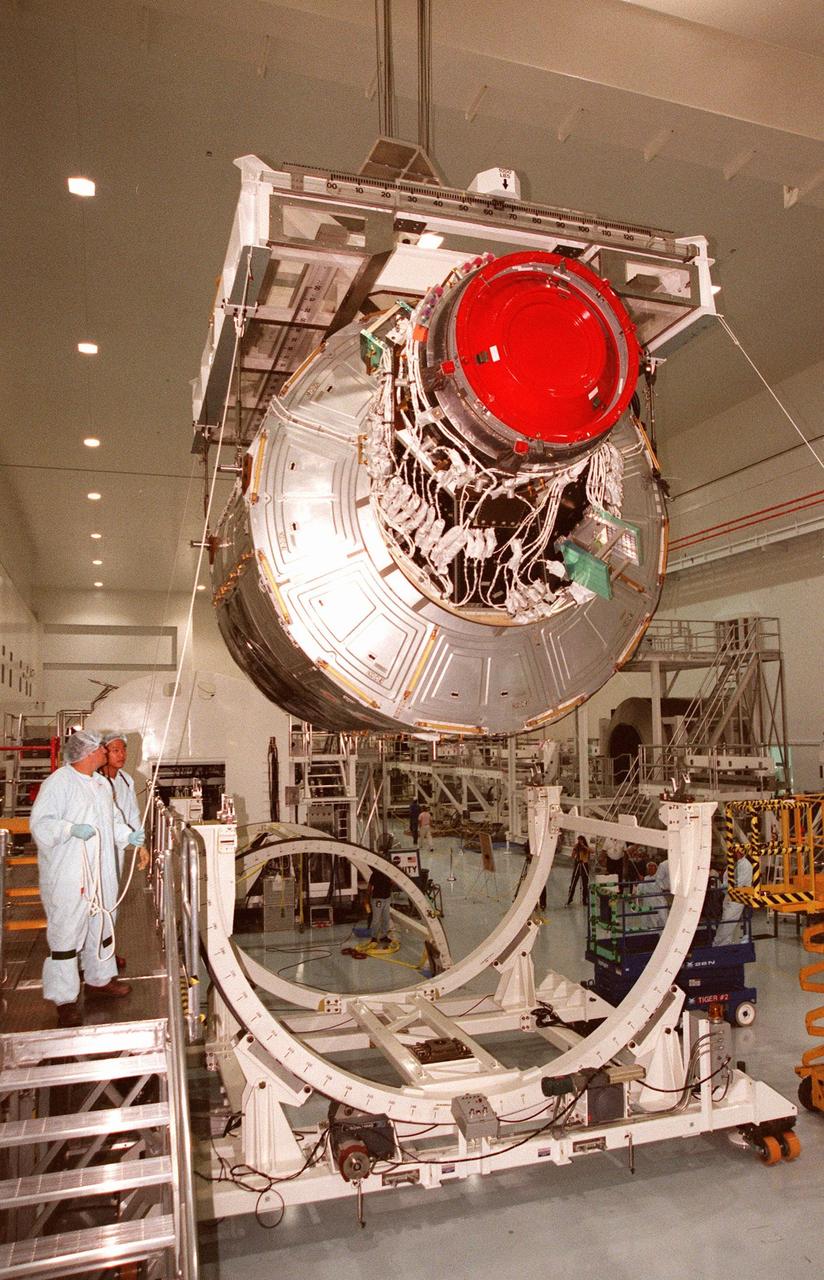
KENNEDY SPACE CENTER, FLA. -- Workers in the Space Station Processing Facility (SSPF) oversee the lifting of the Unity connecting module, part of the International Space Station, for its move to another location in the SSPF. As the primary payload on mission STS-88, scheduled to launch Dec. 3, 1998, Unity will be mated to the Russian-built Zarya control module which should already be in orbit at that time. In the SSPF, Unity is undergoing testing such as the Pad Demonstration Test to verify the compatibility of the module with the Space Shuttle, as well as the ability of the astronauts to send and receive commands to Unity from the flight deck of the orbiter, and the common berthing mechanism to which other space station elements will dock. Unity is expected to be ready for installation into the Shuttle's payload canister on Oct. 25, and transported to Launch Pad 39-A on Oct. 27
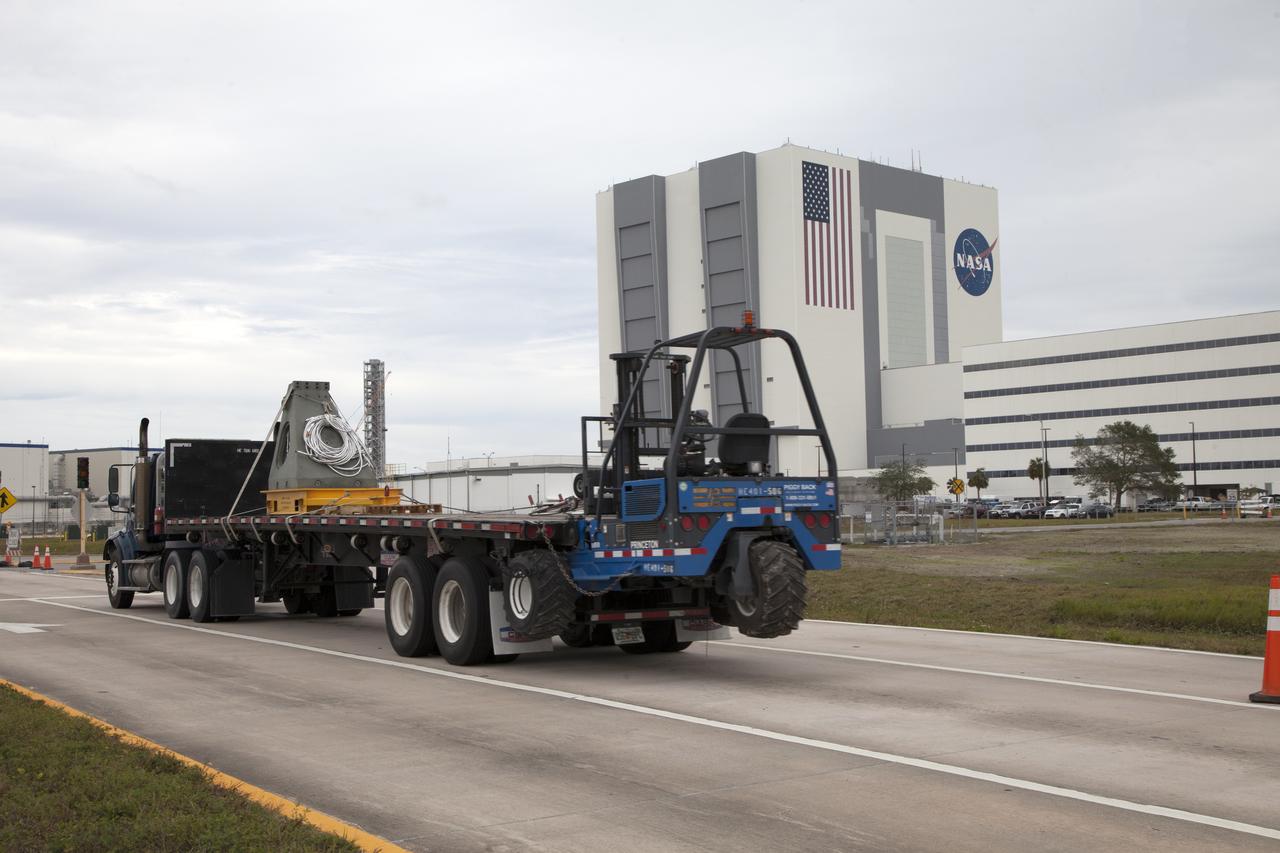
A flatbed truck carries a vertical support post (VSP) for NASA's Space Launch System (SLS) rocket to the Mobile Launcher Yard at NASA's Kennedy Space Center in Florida. The two aft skirt electrical umbilicals (ASEUs) and the first of the vehicle support posts underwent a series of tests to confirm they are functioning properly and ready to support the SLS for launch. The ASEUs will connect to the SLS rocket at the bottom outer edge of each booster and provide electrical power and data connections to the rocket until it lifts off from the launch pad. The eight VSPs will support the load of the solid rocket boosters, with four posts for each of the boosters. The center’s Engineering Directorate and the Ground Systems Development and Operations Program are overseeing processing and testing of the umbilicals.
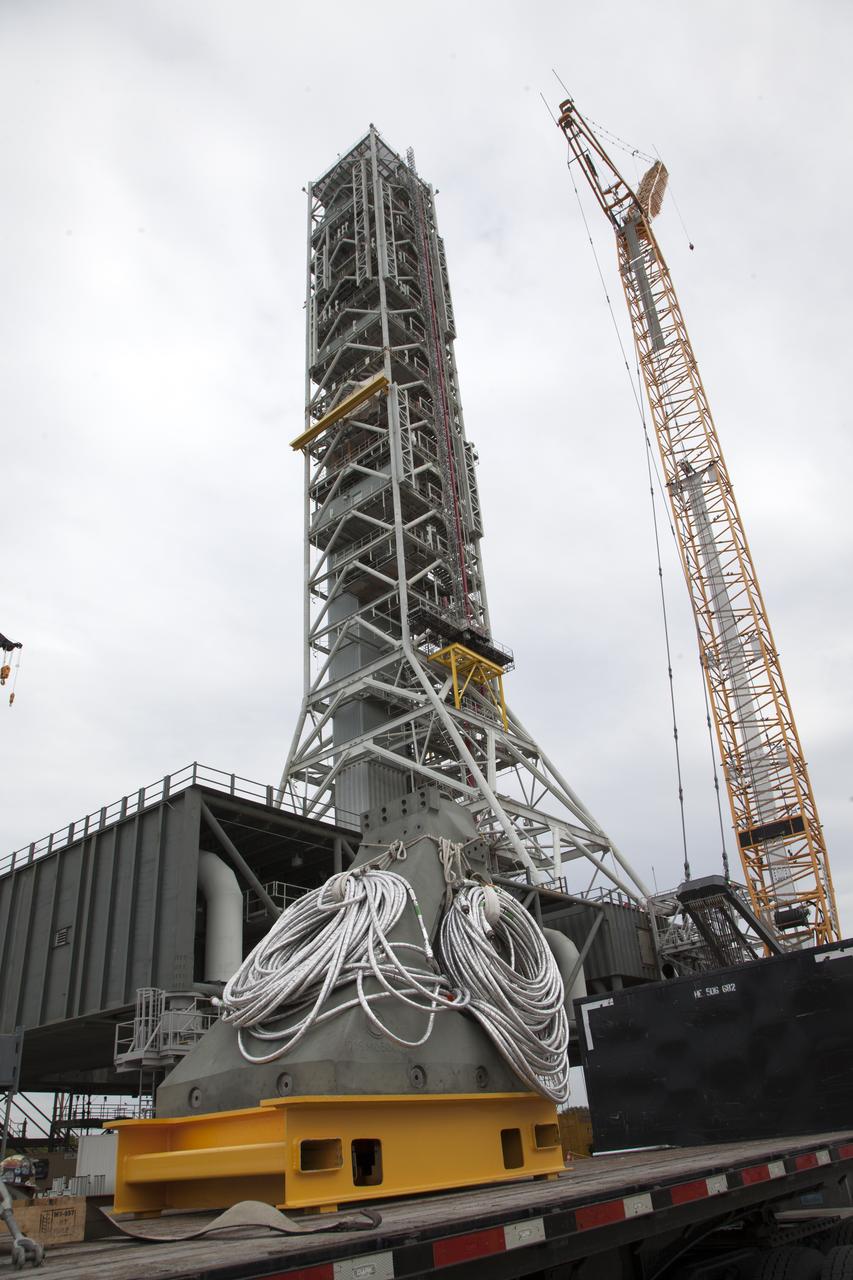
A flatbed truck carries a vertical support post (VSP) for NASA's Space Launch System (SLS) rocket to the Mobile Launcher Yard at NASA's Kennedy Space Center in Florida. In view is the mobile launcher. The two aft skirt electrical umbilicals (ASEUs) and the first of the vehicle support posts underwent a series of tests to confirm they are functioning properly and ready to support the SLS for launch. The ASEUs will connect to the SLS rocket at the bottom outer edge of each booster and provide electrical power and data connections to the rocket until it lifts off from the launch pad. The eight VSPs will support the load of the solid rocket boosters, with four posts for each of the boosters. The center’s Engineering Directorate and the Ground Systems Development and Operations Program are overseeing processing and testing of the umbilicals.
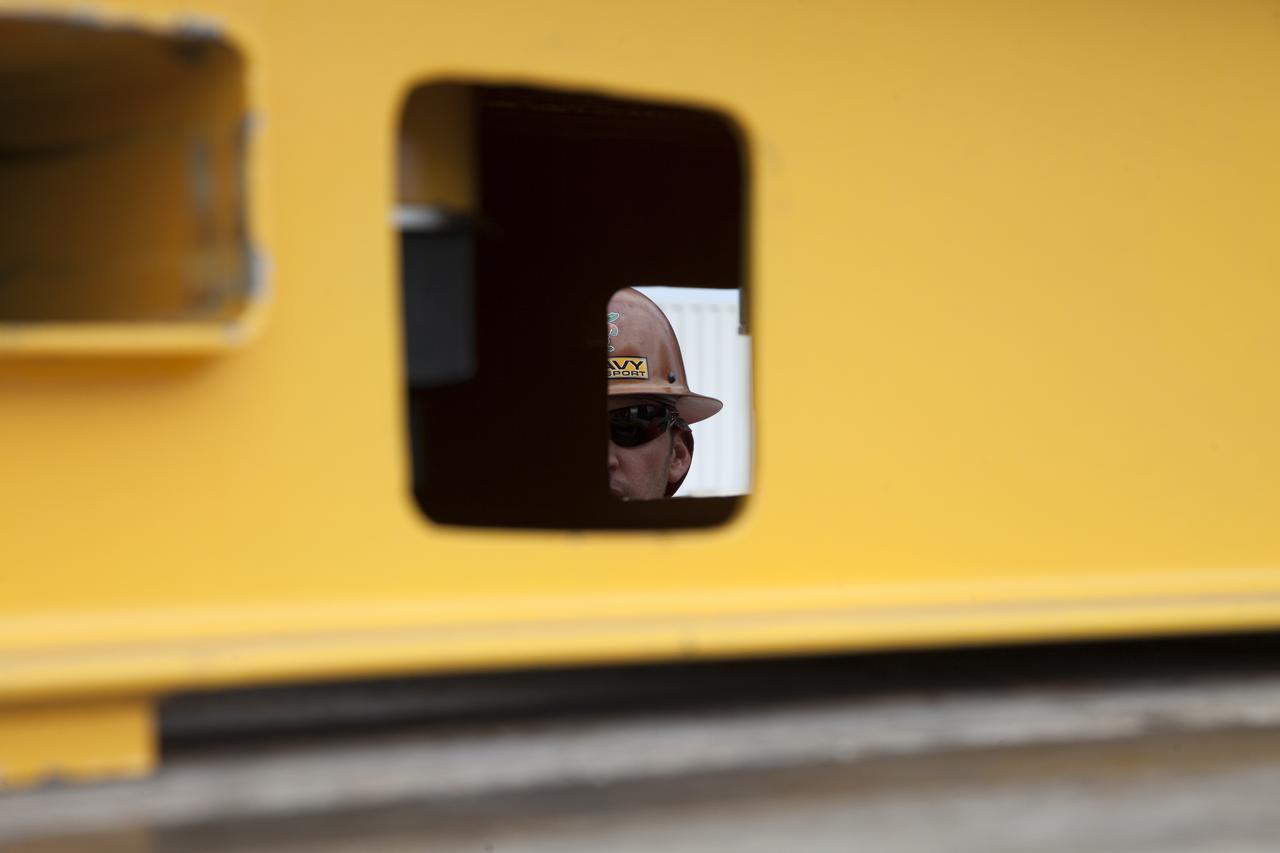
A construction worker is in view as a flatbed truck passes by carrying a vertical support post (VSP) for NASA's Space Launch System (SLS) rocket to the Mobile Launcher Yard at NASA's Kennedy Space Center in Florida. The two aft skirt electrical umbilicals (ASEUs) and the first of the vehicle support posts underwent a series of tests to confirm they are functioning properly and ready to support the SLS for launch. The ASEUs will connect to the SLS rocket at the bottom outer edge of each booster and provide electrical power and data connections to the rocket until it lifts off from the launch pad. The eight VSPs will support the load of the solid rocket boosters, with four posts for each of the boosters. The center’s Engineering Directorate and the Ground Systems Development and Operations Program are overseeing processing and testing of the umbilicals.
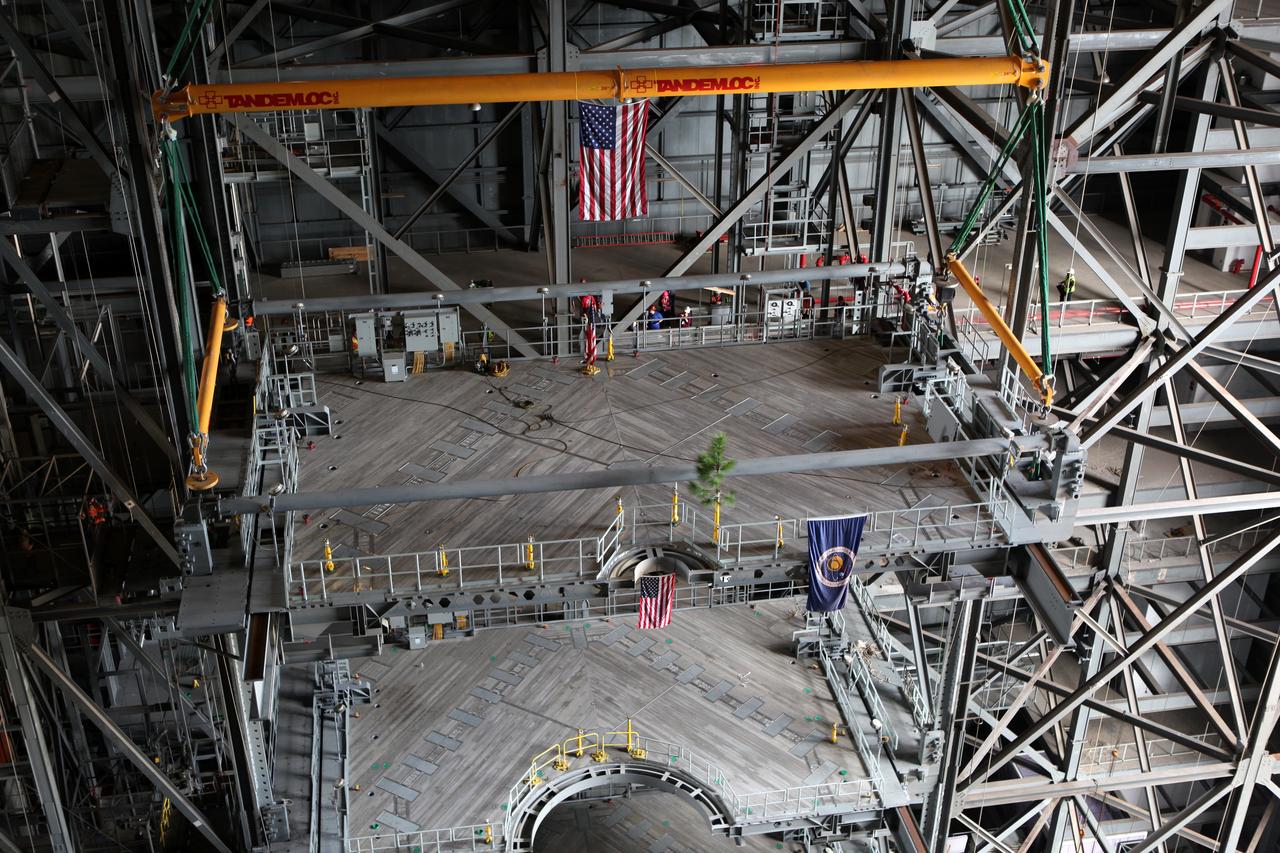
High up in the Vehicle Assembly Building (VAB) at NASA's Kennedy Space Center in Florida, a crane lowers the final work platform, A north, for installation in High Bay 3. The platform will be installed and secured on its rail beam high up on the north wall of the high bay. In view on the platform are the American flag and a small tree. The installation of the final topmost level completes the 10 levels of work platforms, 20 platform halves altogether, that will surround NASA's Space Launch System rocket and the Orion spacecraft and allow access during processing for missions, including the first uncrewed flight test of Orion atop the SLS rocket in 2018. The A-level platforms will provide access to the Orion spacecraft's Launch Abort System for Orion lifting sling removal and installation of the closeout panels. The Ground Systems Development and Operations Program, with support from the center's Engineering Directorate, is overseeing upgrades and modifications to the VAB, including installation of the new work platforms.

A heavy load transport truck from Tillett Heavy Hauling in Titusville, Florida, arrives at the Vehicle Assembly Building (VAB) at NASA's Kennedy Space Center in Florida, carrying the first half of the A-level work platforms, A south, for the agency’s Space Launch System (SLS) rocket. The platform will be offloaded at the VAB staging area in the west parking lot. The A-level platforms are the topmost platforms for High Bay 3 in the Vehicle Assembly Building (VAB). The Ground Systems Development and Operations Program is overseeing upgrades and modifications to High Bay 3 to support processing of the SLS and Orion spacecraft. A total of 10 levels of new platforms, 20 platform halves altogether, will surround the SLS rocket and Orion spacecraft and provide access for testing and processing.
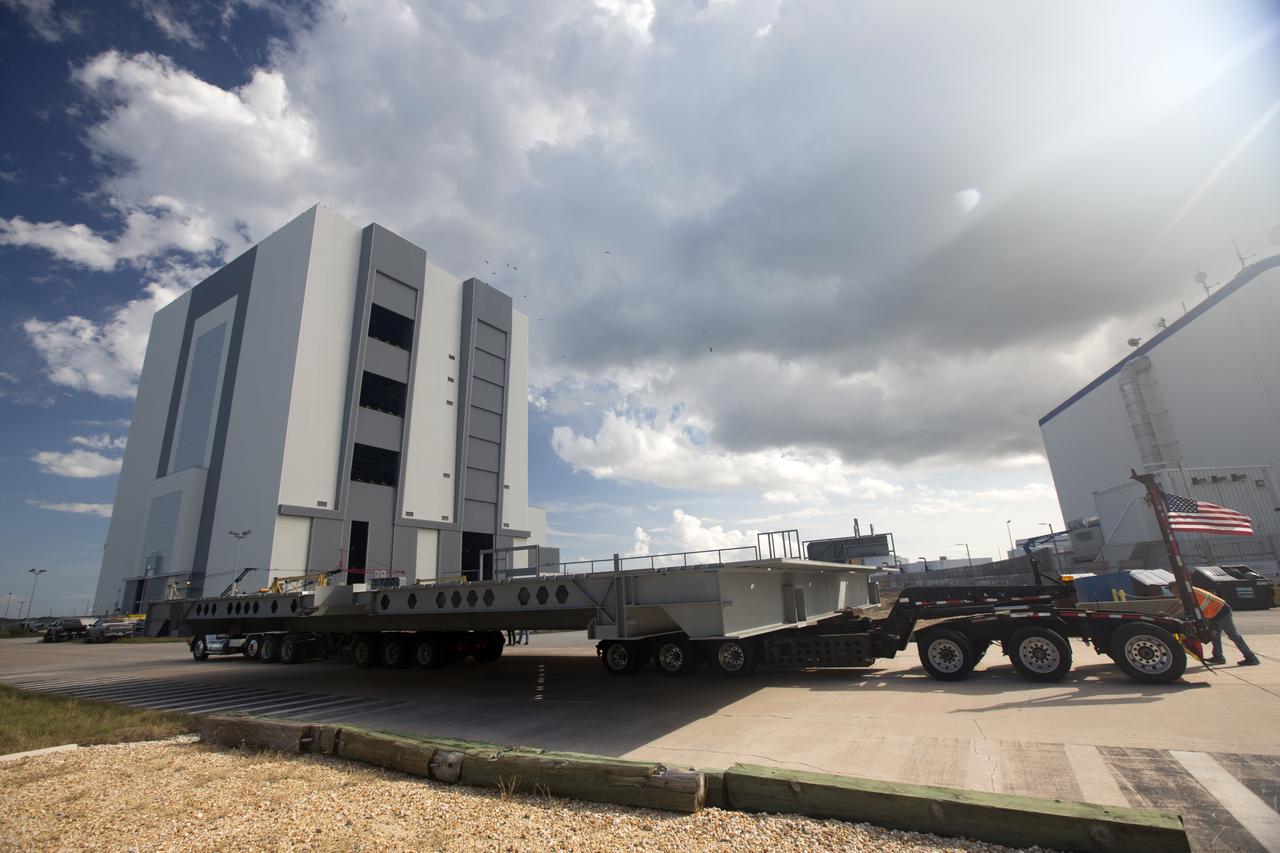
A heavy load transport truck from Tillett Heavy Hauling in Titusville, Florida, arrives at the Vehicle Assembly Building (VAB) at NASA’s Kennedy Space Center in Florida, carrying the second half of the A-level work platforms, A north, for the agency’s Space Launch System (SLS) rocket. This is the final platform delivered to Kennedy. The A-level platforms are the topmost platforms for High Bay 3 in the Vehicle Assembly Building (VAB). The platform will be delivered to the VAB staging area in the west parking lot. The Ground Systems Development and Operations Program is overseeing upgrades and modifications to High Bay 3 to support processing of the SLS and Orion spacecraft. A total of 10 levels of new platforms, 20 platform halves altogether, will surround the SLS rocket and Orion spacecraft and provide access for testing and processing.
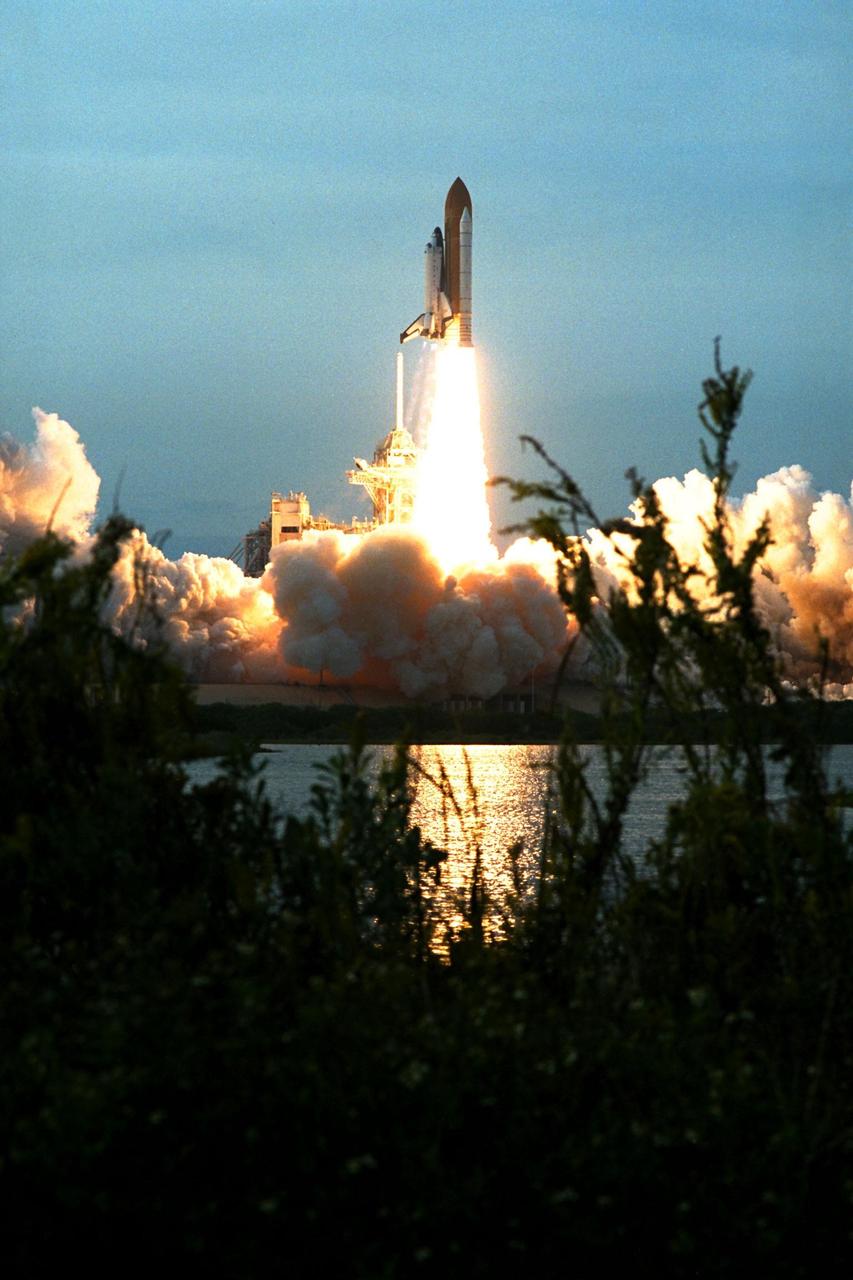
Like a rising sun lighting up the afternoon sky, the Space Shuttle Columbia soars from Launch Pad 39B at 2:46:00 p.m. EST, November 19, on the fourth flight of the United States Microgravity Payload and Spartan-201 satellite. The crew members include Mission Commander Kevin Kregel.; Pilot Steven Lindsey; Mission Specialists Kalpana Chawla, Ph.D., Winston Scott, and Takao Doi, Ph.D., of the National Space Development Agency of Japan; and Payload Specialist Leonid Kadenyuk of the National Space Agency of Ukraine. During the 16-day STS-87 mission, the crew will oversee experiments in microgravity; deploy and retrieve a solar satellite; and test a new experimental camera, the AERCam Sprint. Dr. Doi and Scott also will perform a spacewalk to practice International Space Station maneuvers
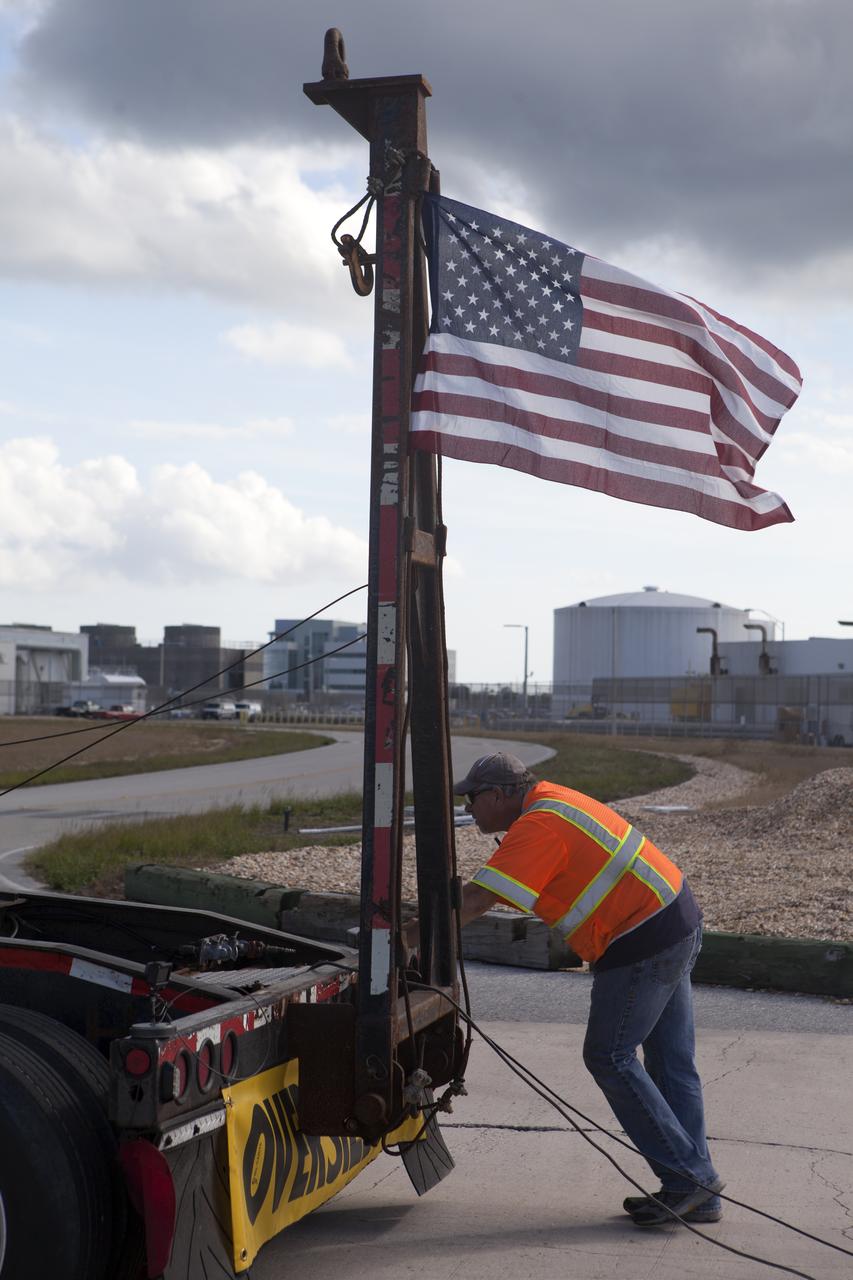
The American flag is in view on the back of a heavy load transport truck from Tillett Heavy Hauling in Titusville, Florida, as it arrives at NASA’s Kennedy Space Center in Florida. The truck is carrying the second half of the A-level work platforms, A north, for the agency’s Space Launch System (SLS) rocket. This is the final platform delivered to Kennedy. The A-level platforms are the topmost platforms for High Bay 3 in the Vehicle Assembly Building (VAB). The platform will be delivered to the VAB staging area in the west parking lot. The Ground Systems Development and Operations Program is overseeing upgrades and modifications to High Bay 3 to support processing of the SLS and Orion spacecraft. A total of 10 levels of new platforms, 20 platform halves altogether, will surround the SLS rocket and Orion spacecraft and provide access for testing and processing.
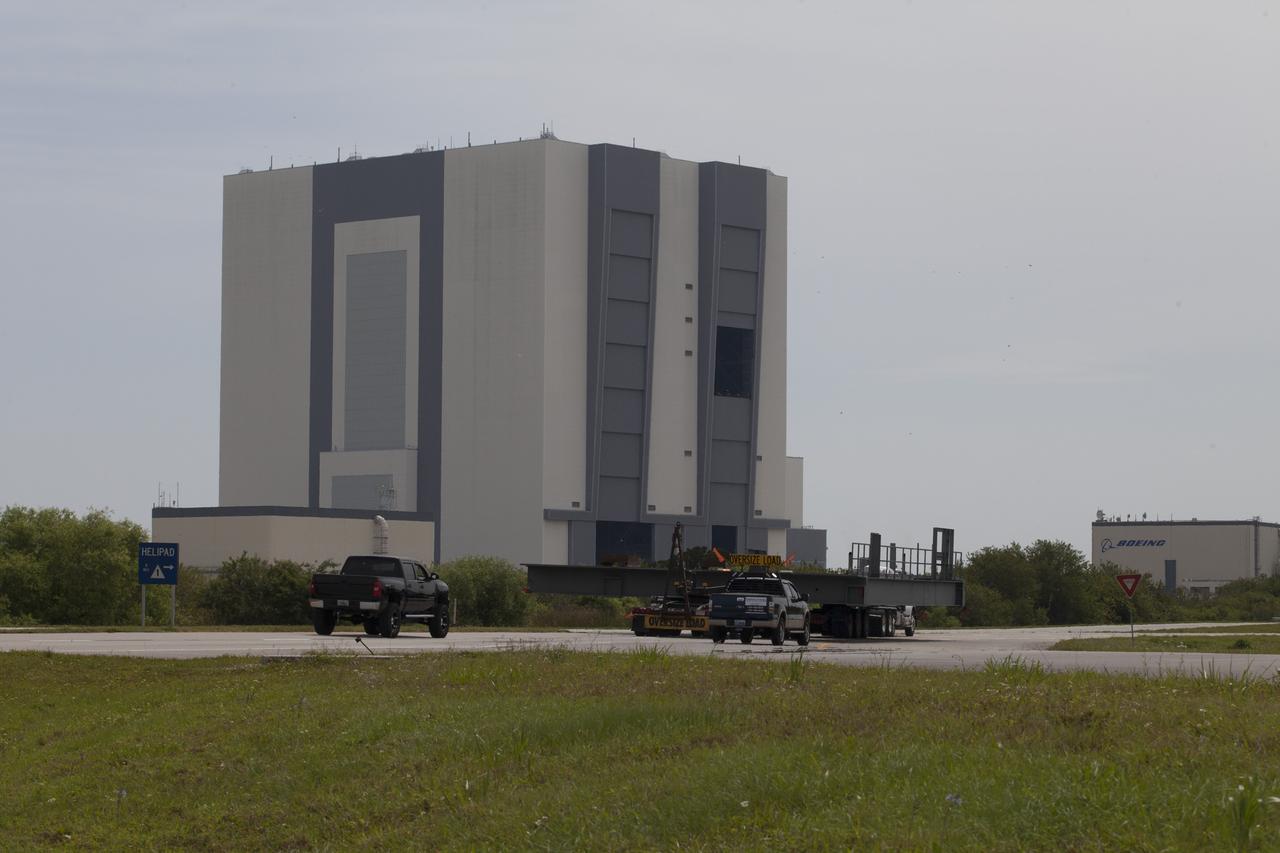
A heavy load transport truck proceeds along the road toward the Vehicle Assembly Building (VAB) at NASA’s Kennedy Space Center in Florida, carrying the second half of the F-level work platforms for the agency’s Space Launch System (SLS) rocket. The platform will be delivered to the VAB staging area in the west parking lot. The Ground Systems Development and Operations Program is overseeing upgrades and modifications to VAB High Bay 3 to support processing of the SLS and Orion spacecraft. A total of 10 levels of new platforms, 20 platform halves altogether, will surround the SLS rocket and Orion spacecraft and provide access for testing and processing. Delivery of this platform brings the total to 10 platforms, or half of the work platforms delivered to Kennedy.
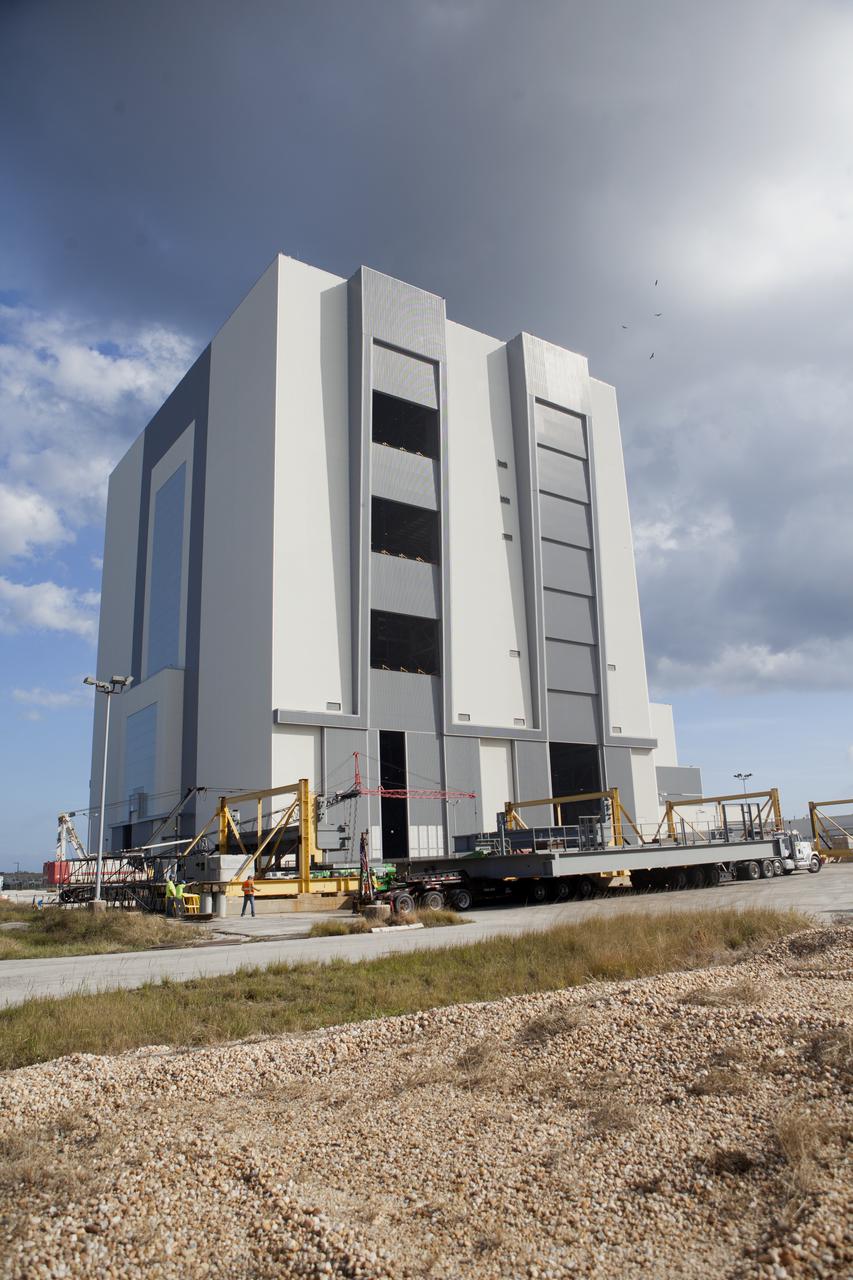
A heavy load transport truck from Tillett Heavy Hauling in Titusville, Florida, arrives at the Vehicle Assembly Building (VAB) at NASA’s Kennedy Space Center in Florida, carrying the second half of the A-level work platforms, A north, for the agency’s Space Launch System (SLS) rocket. This is the final platform delivered to Kennedy. The A-level platforms are the topmost platforms for High Bay 3 in the Vehicle Assembly Building (VAB). The platform will be delivered to the VAB staging area in the west parking lot. The Ground Systems Development and Operations Program is overseeing upgrades and modifications to High Bay 3 to support processing of the SLS and Orion spacecraft. A total of 10 levels of new platforms, 20 platform halves altogether, will surround the SLS rocket and Orion spacecraft and provide access for testing and processing.
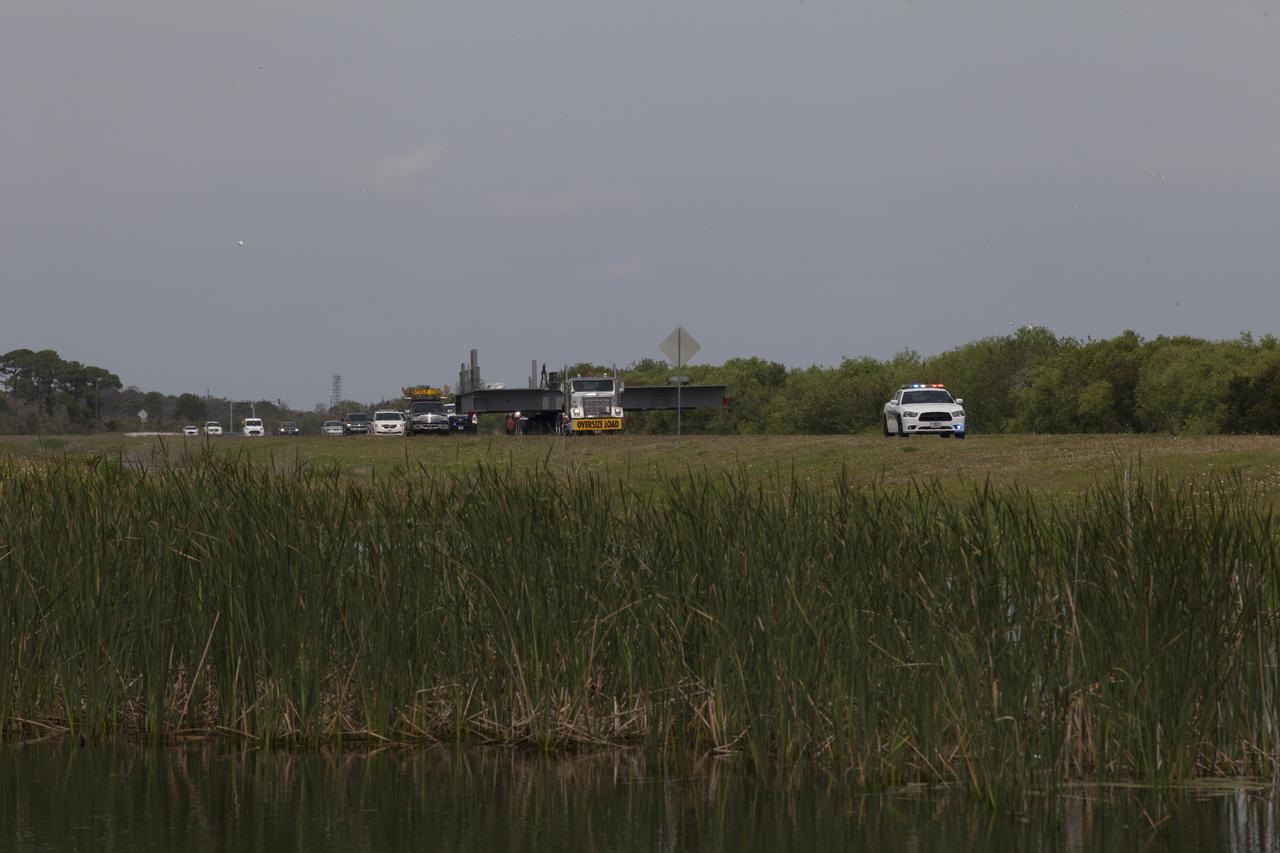
A heavy load transport truck passes through the north entrance gate at NASA’s Kennedy Space Center in Florida, carrying the second half of the F-level work platforms for the agency’s Space Launch System (SLS) rocket. The platform will be delivered to the Vehicle Assembly Building (VAB) staging area in the west parking lot. The Ground Systems Development and Operations Program is overseeing upgrades and modifications to VAB High Bay 3 to support processing of the SLS and Orion spacecraft. A total of 10 levels of new platforms, 20 platform halves altogether, will surround the SLS rocket and Orion spacecraft and provide access for testing and processing. Delivery of this platform brings the total to 10 platforms, or half of the work platforms delivered to Kennedy.
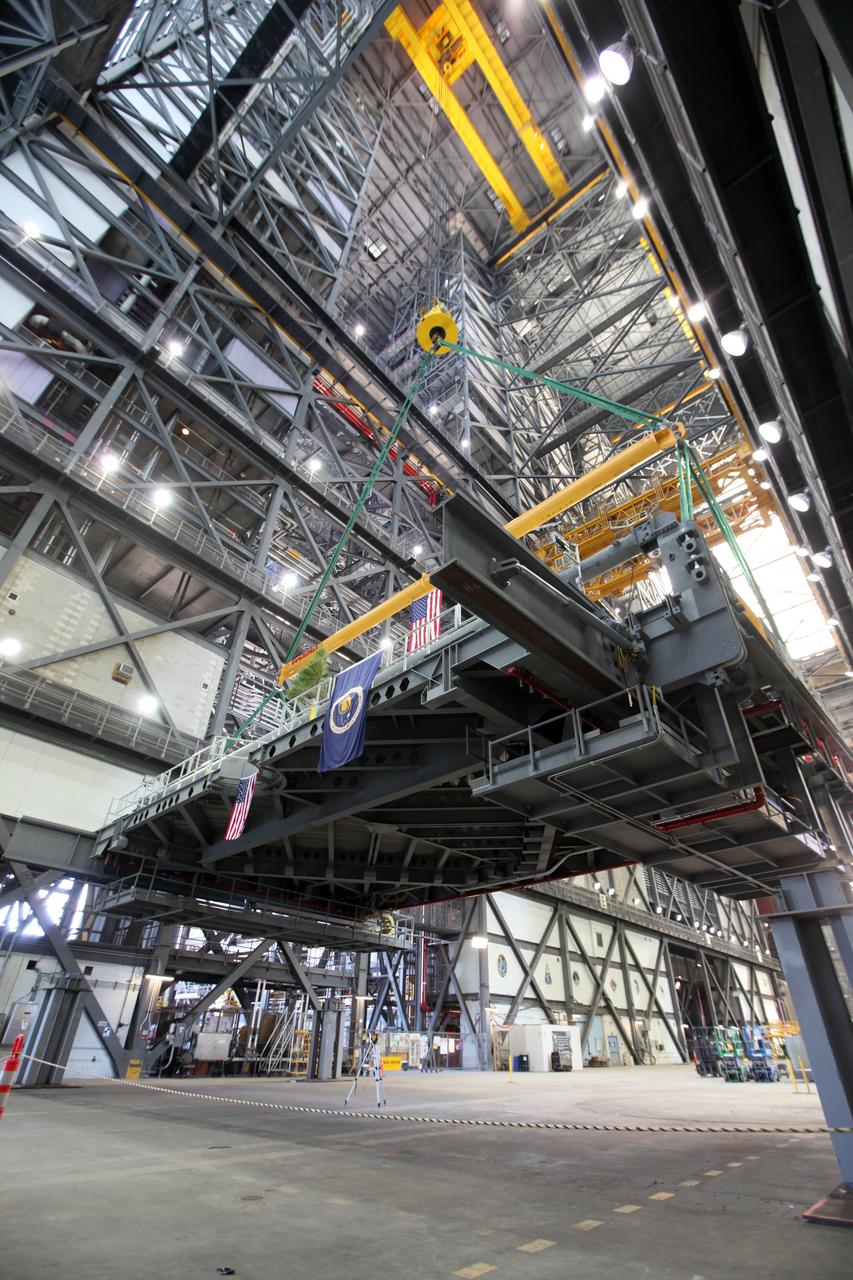
A crane begins to lift the final work platform, A north, in the transfer aisle of the Vehicle Assembly Building (VAB) at NASA's Kennedy Space Center in Florida. The platform will be installed and secured on its rail beam high up on the north wall of High Bay 3. The installation of the final topmost level completes the 10 levels of work platforms, 20 platform halves altogether, that will surround NASA's Space Launch System rocket and the Orion spacecraft and allow access during processing for missions, including the first uncrewed flight test of Orion atop the SLS rocket in 2018. The A-level platforms will provide access to the Orion spacecraft's Launch Abort System for Orion lifting sling removal and installation of the closeout panels. The Ground Systems Development and Operations Program, with support from the center's Engineering Directorate, is overseeing upgrades and modifications to the VAB, including installation of the new work platforms.
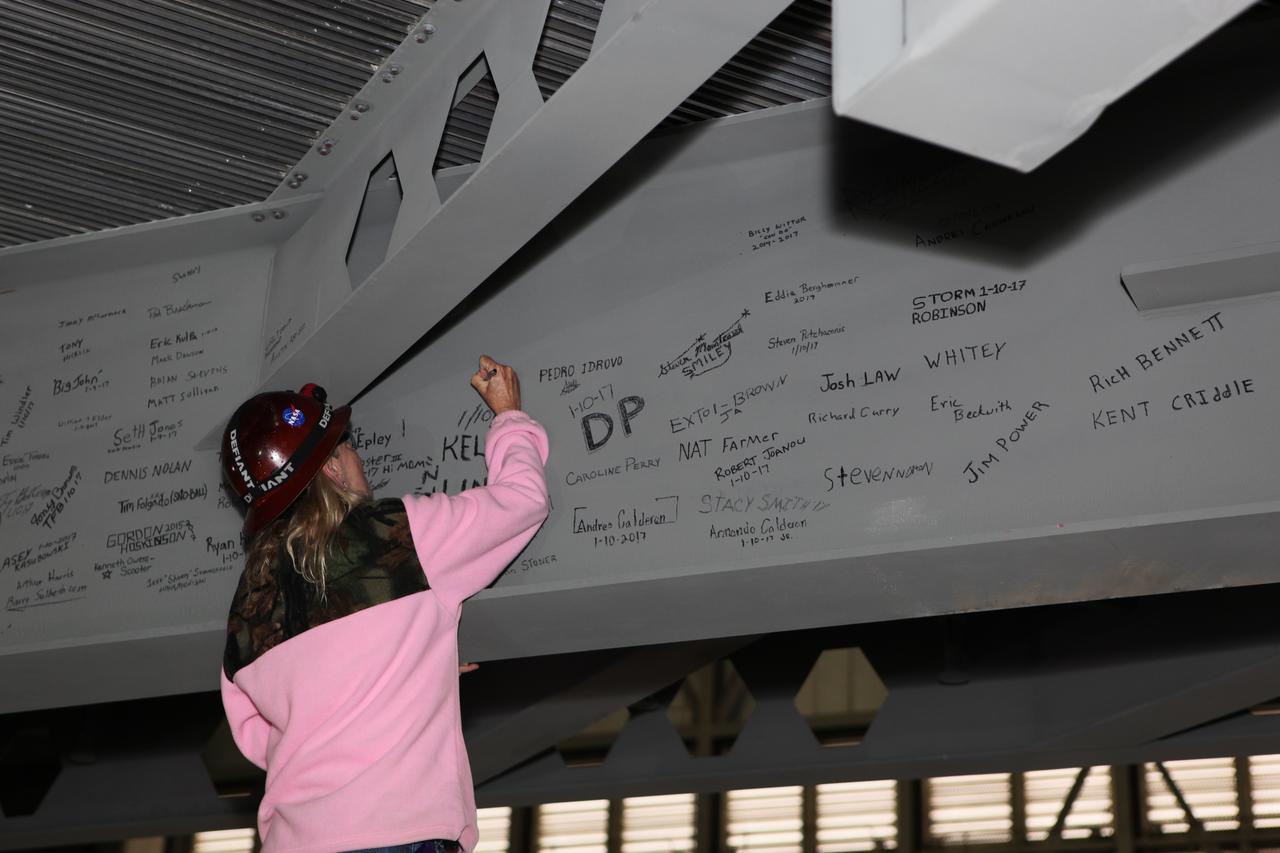
NASA Kennedy Space Center's Engineering Directorate coordinated a platform beam signing event to celebrate the culmination of the NASA and contractor team's last several years of study, design, construction and installation of 20 new work platforms in High Bay 3 of the Vehicle Assembly (VAB). Workers signed the final platform, A North, in the transfer aisle of the VAB. The platform will be lifted, installed and secured on its rail beam high up on the north wall of High Bay 3. The installation of the final topmost level completes the 10 levels of work platforms, 20 platform halves altogether, that will surround NASA's Space Launch System rocket and the Orion spacecraft and allow access during processing for missions, including the first uncrewed flight test of Orion atop the SLS rocket in 2018. The Ground Systems Development and Operations Program, with support from the center's Engineering Directorate, is overseeing upgrades and modifications to the VAB, including installation of the new work platforms.
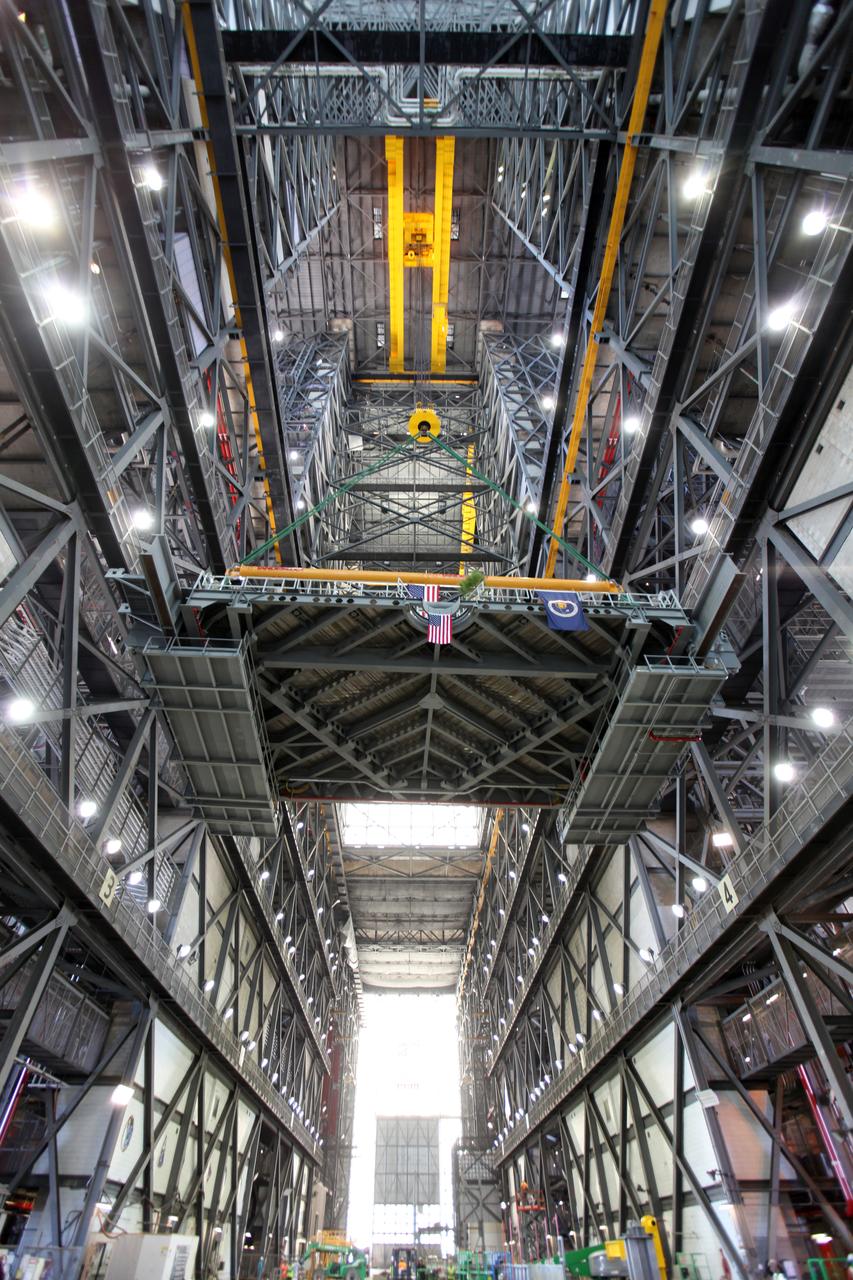
A crane lifts the final work platform, A north, up from the transfer aisle in the Vehicle Assembly Building (VAB) at NASA's Kennedy Space Center in Florida. The platform will be installed and secured on its rail beam high up on the north wall of High Bay 3. The installation of the final topmost level completes the 10 levels of work platforms, 20 platform halves altogether, that will surround NASA's Space Launch System rocket and the Orion spacecraft and allow access during processing for missions, including the first uncrewed flight test of Orion atop the SLS rocket in 2018. The A-level platforms will provide access to the Orion spacecraft's Launch Abort System for Orion lifting sling removal and installation of the closeout panels. The Ground Systems Development and Operations Program, with support from the center's Engineering Directorate, is overseeing upgrades and modifications to the VAB, including installation of the new work platforms.
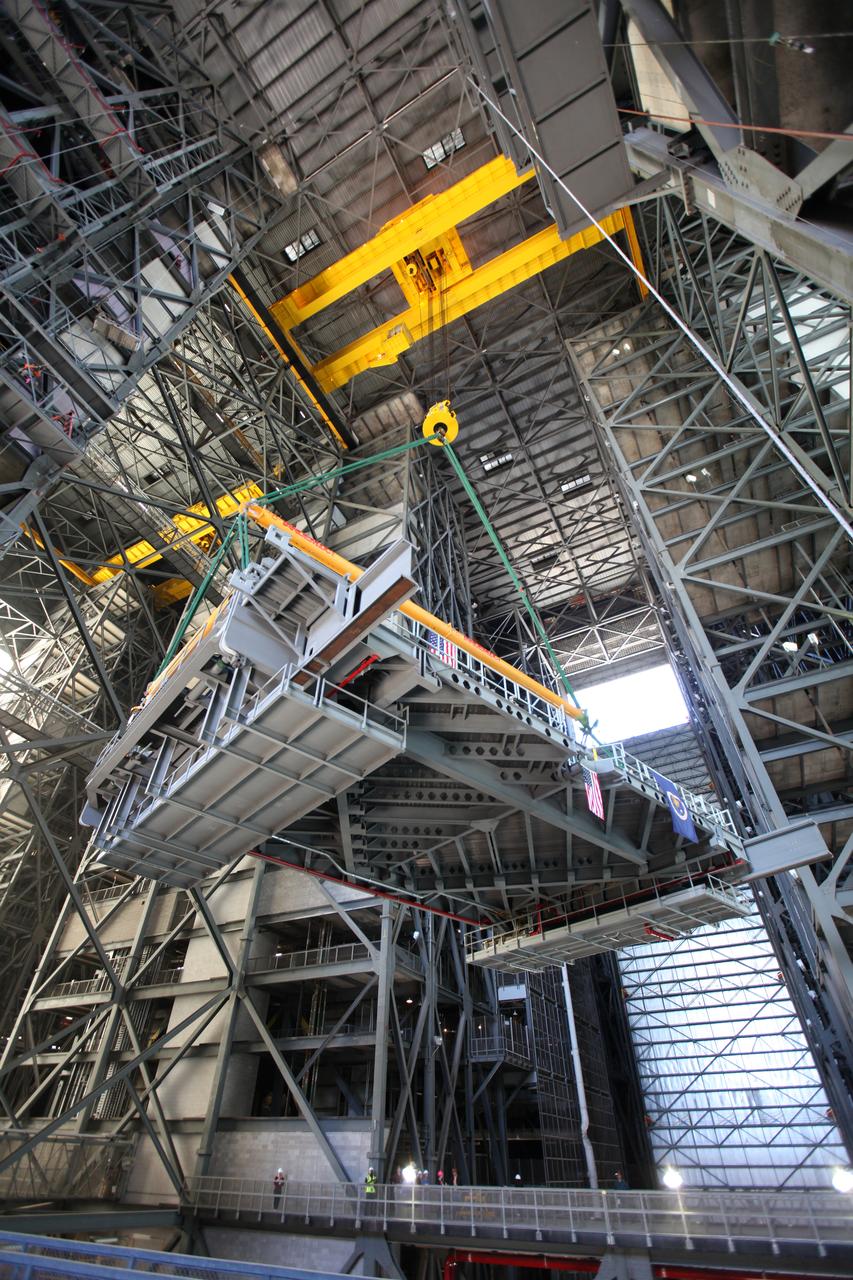
A crane lifts the final work platform, A north, high up in the transfer aisle of the Vehicle Assembly Building (VAB) at NASA's Kennedy Space Center in Florida. The platform will be installed and secured on its rail beam high up on the north wall of High Bay 3. The installation of the final topmost level completes the 10 levels of work platforms, 20 platform halves altogether, that will surround NASA's Space Launch System rocket and the Orion spacecraft and allow access during processing for missions, including the first uncrewed flight test of Orion atop the SLS rocket in 2018. The A-level platforms will provide access to the Orion spacecraft's Launch Abort System for Orion lifting sling removal and installation of the closeout panels. The Ground Systems Development and Operations Program, with support from the center's Engineering Directorate, is overseeing upgrades and modifications to the VAB, including installation of the new work platforms.
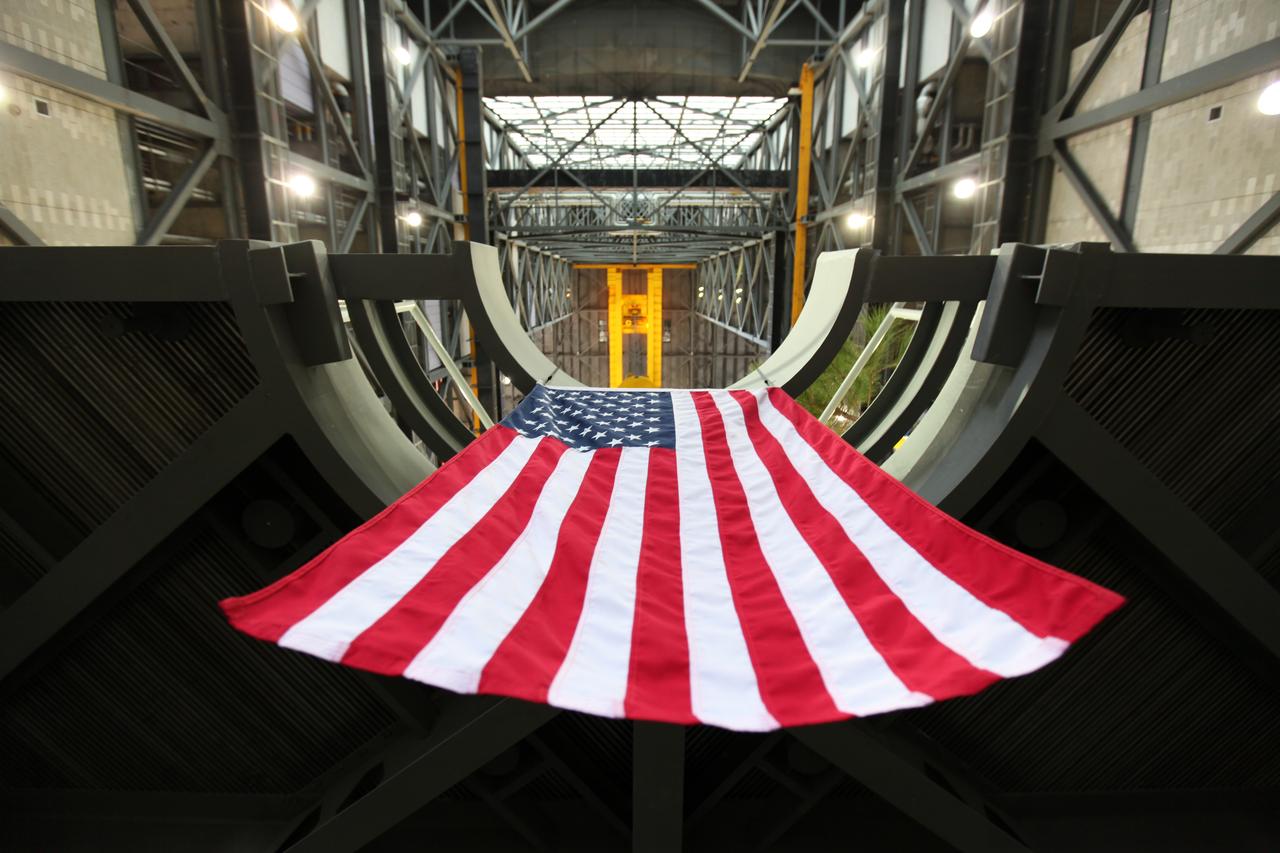
In a view from below, the American flag is in view hanging from the final work platform, A north, as the platform is lifted up by crane from the transfer aisle in the Vehicle Assembly Building (VAB) at NASA's Kennedy Space Center in Florida. The platform will be installed and secured on its rail beam high up on the north wall of High Bay 3. The installation of the final topmost level completes the 10 levels of work platforms, 20 platform halves altogether, that will surround NASA's Space Launch System rocket and the Orion spacecraft and allow access during processing for missions, including the first uncrewed flight test of Orion atop the SLS rocket in 2018. The A-level platforms will provide access to the Orion spacecraft's Launch Abort System for Orion lifting sling removal and installation of the closeout panels. The Ground Systems Development and Operations Program, with support from the center's Engineering Directorate, is overseeing upgrades and modifications to the VAB, including installation of the new work platforms.
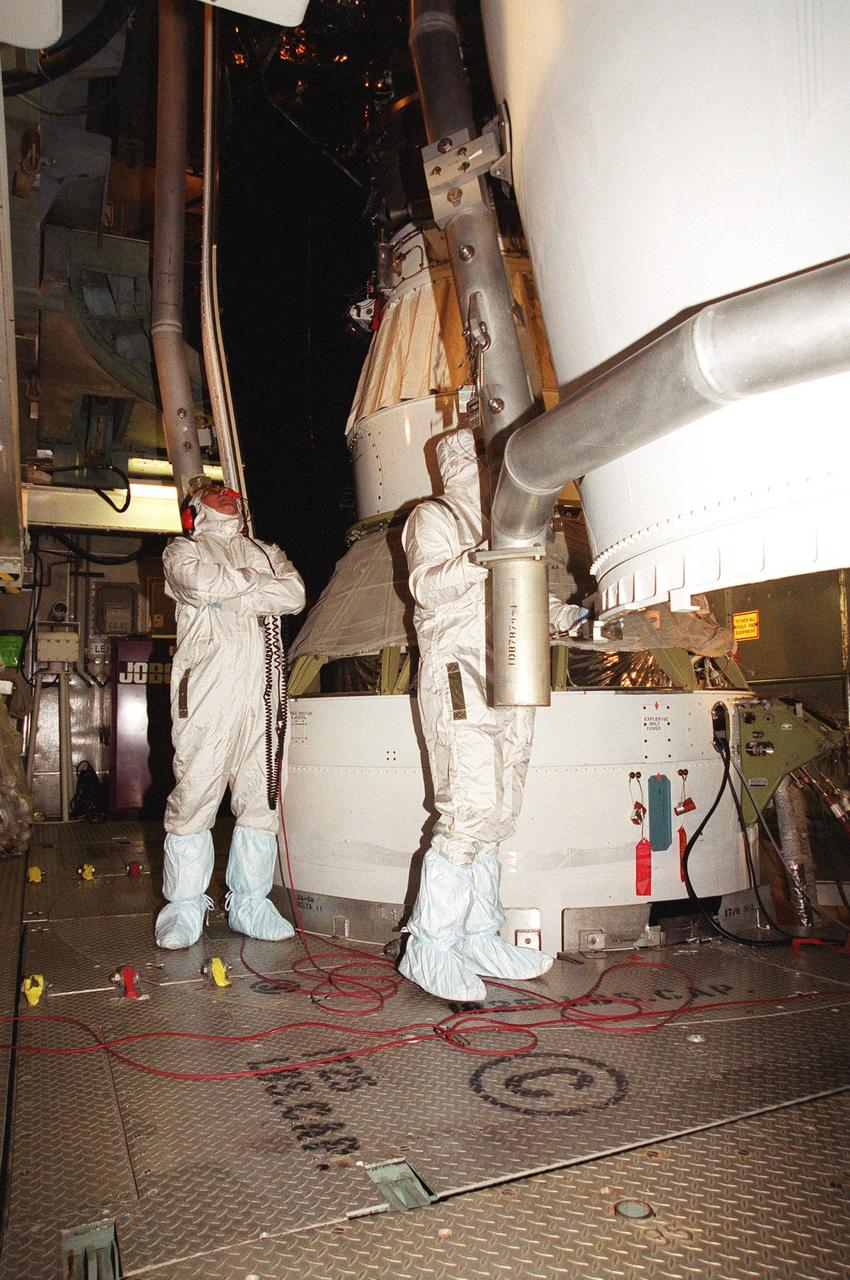
KENNEDY SPACE CENTER, Fla. -- Workers at Launch Complex 17-B, Cape Canaveral Air Force Station, oversee the fairing installation on the Microwave Anisotropy Probe (MAP) spacecraft. MAP is scheduled for launch on June 30 aboard a Boeing Delta II rocket. The launch will place MAP into a lunar-assisted trajectory to the Sun-Earth for a 27-month mission. The probe will measure small fluctuations in the temperature of the cosmic microwave background radiation to an accuracy of one millionth of a degree. These measurements should reveal the size, matter content, age, geometry and fate of the universe. They will also reveal the primordial structure that grew to form galaxies and will test ideas about the origins of these primordial structures. The MAP instrument will be continuously shaded from the Sun, Earth, and Moon by the spacecraft
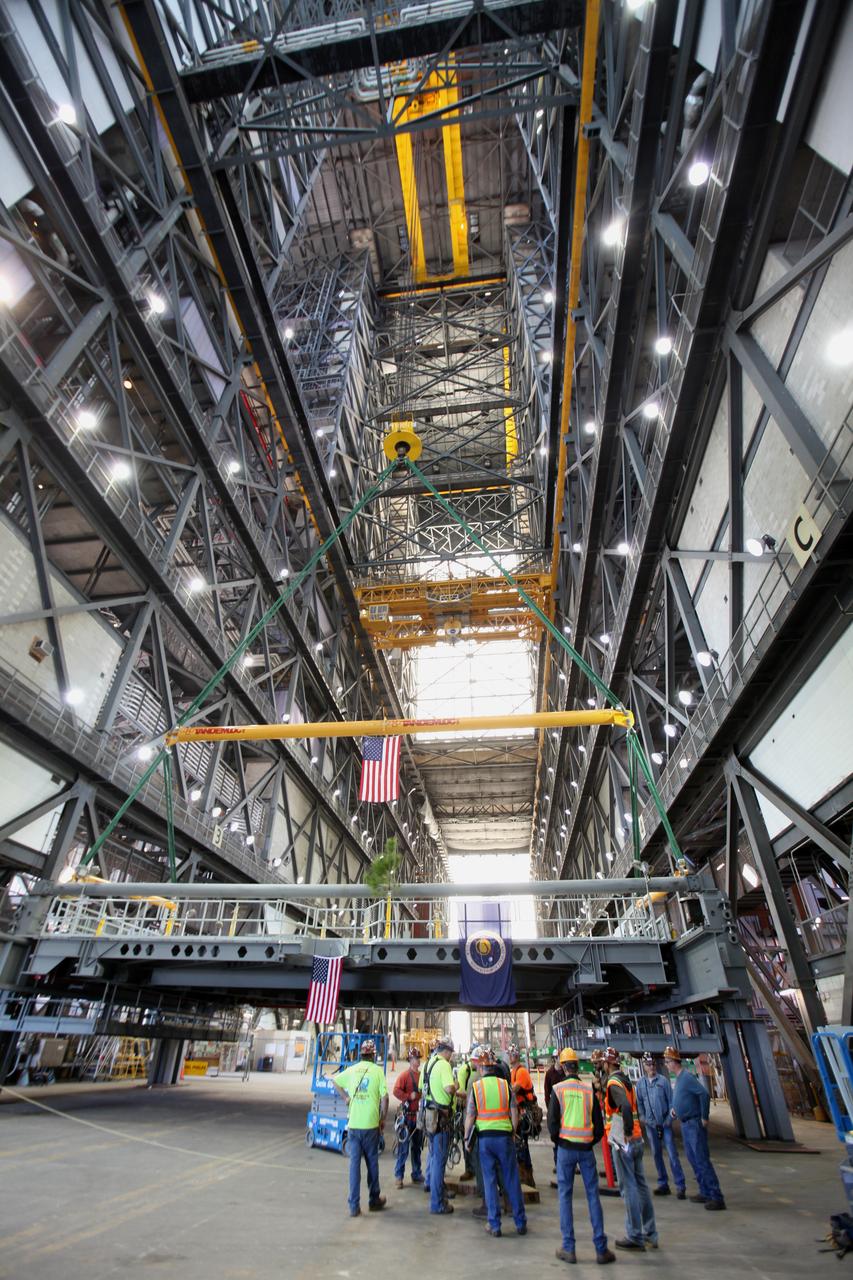
The American flag and a small tree are in view on the final work platform, A north, as the platform is lifted up by crane from the transfer aisle in the Vehicle Assembly Building (VAB) at NASA's Kennedy Space Center in Florida. The platform will be installed and secured on its rail beam high up on the north wall of High Bay 3. The installation of the final topmost level completes the 10 levels of work platforms, 20 platform halves altogether, that will surround NASA's Space Launch System rocket and the Orion spacecraft and allow access during processing for missions, including the first uncrewed flight test of Orion atop the SLS rocket in 2018. The A-level platforms will provide access to the Orion spacecraft's Launch Abort System for Orion lifting sling removal and installation of the closeout panels. The Ground Systems Development and Operations Program, with support from the center's Engineering Directorate, is overseeing upgrades and modifications to the VAB, including installation of the new work platforms.
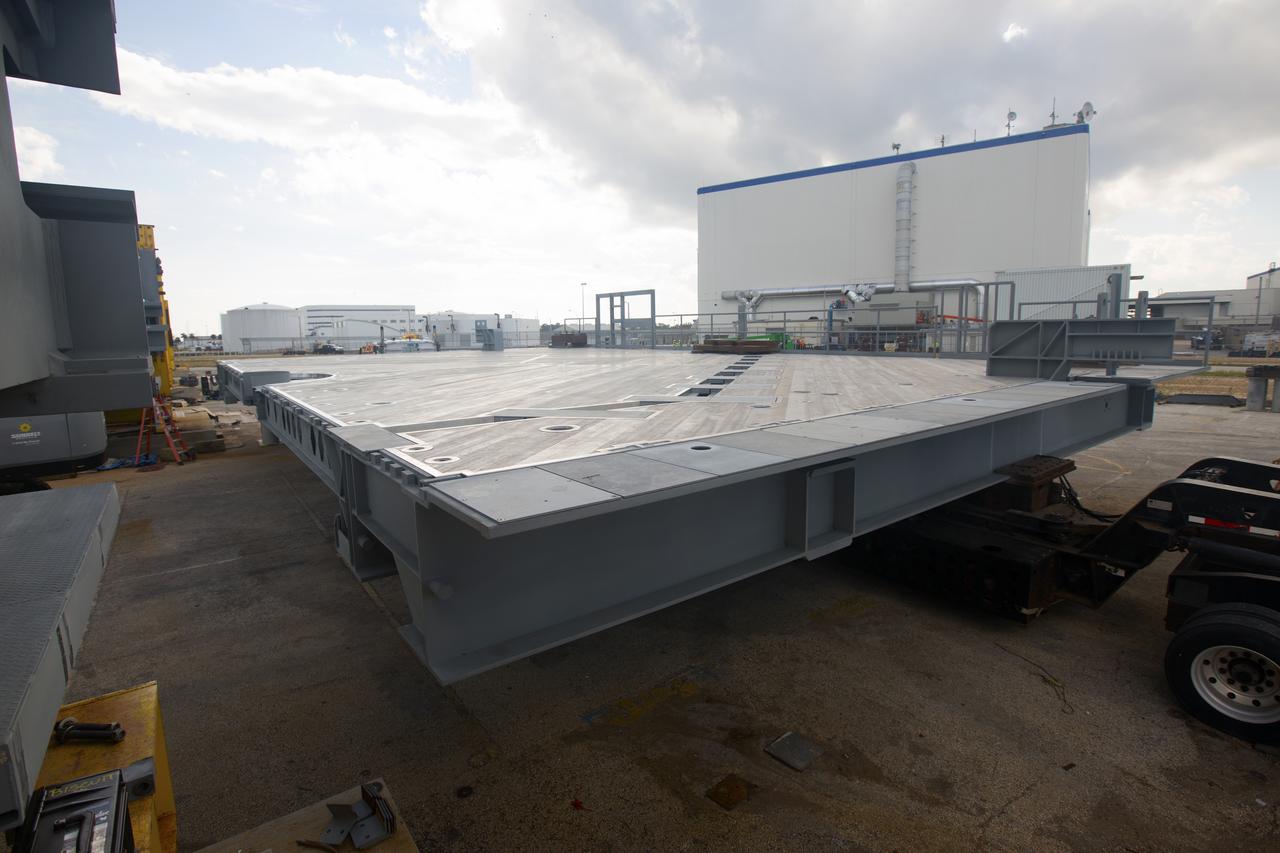
A heavy load transport truck from Tillett Heavy Hauling in Titusville, Florida, arrives in a staging area near the Vehicle Assembly Building (VAB) at NASA’s Kennedy Space Center in Florida, carrying the second half of the A-level work platforms, A north, for the agency’s Space Launch System (SLS) rocket. This is the final platform delivered to Kennedy. The A-level platforms are the topmost platforms for High Bay 3 in the Vehicle Assembly Building (VAB). The platform will be delivered to the VAB staging area in the west parking lot. The Ground Systems Development and Operations Program is overseeing upgrades and modifications to High Bay 3 to support processing of the SLS and Orion spacecraft. A total of 10 levels of new platforms, 20 platform halves altogether, will surround the SLS rocket and Orion spacecraft and provide access for testing and processing.
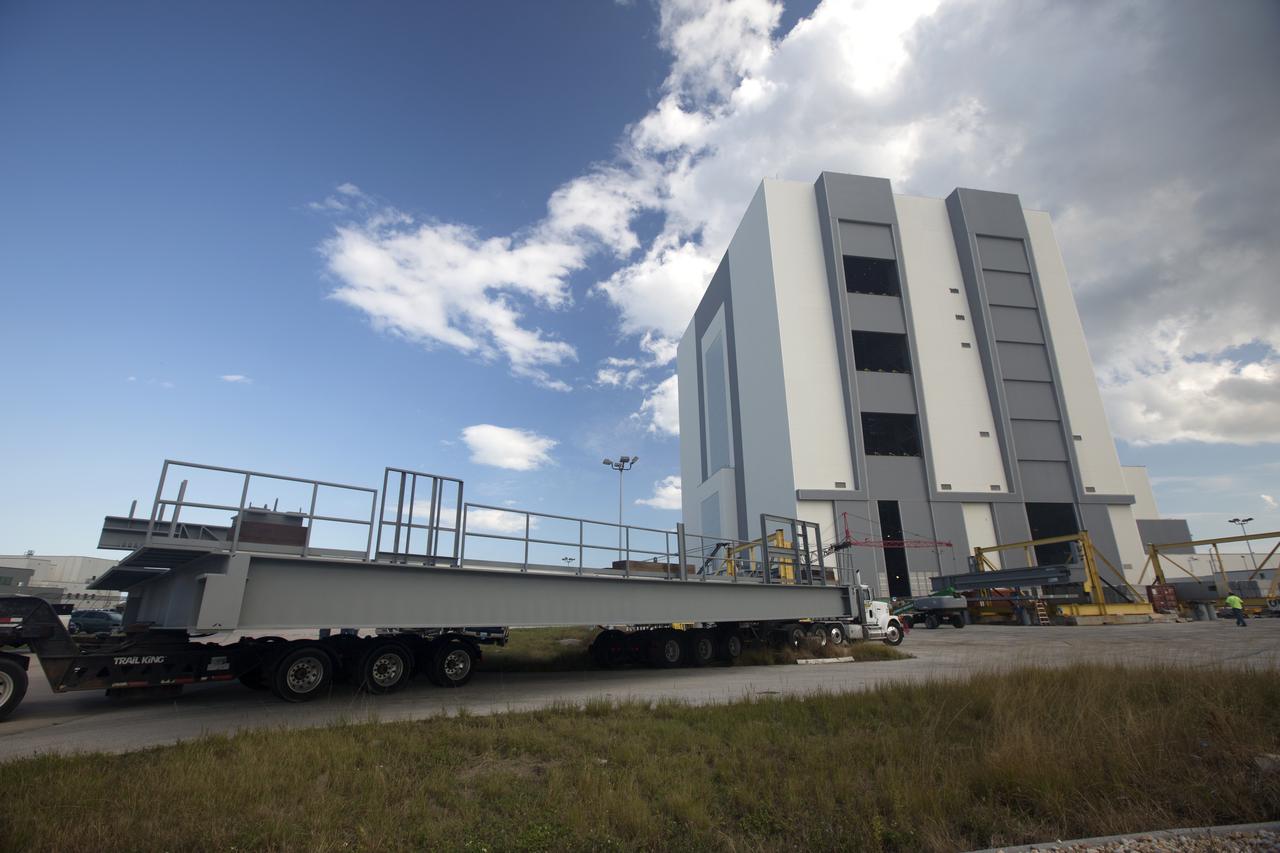
A heavy load transport truck from Tillett Heavy Hauling in Titusville, Florida, arrives at the Vehicle Assembly Building (VAB) at NASA’s Kennedy Space Center in Florida, carrying the second half of the A-level work platforms, A north, for the agency’s Space Launch System (SLS) rocket. This is the final platform delivered to Kennedy. The A-level platforms are the topmost platforms for High Bay 3 in the Vehicle Assembly Building (VAB). The platform will be delivered to the VAB staging area in the west parking lot. The Ground Systems Development and Operations Program is overseeing upgrades and modifications to High Bay 3 to support processing of the SLS and Orion spacecraft. A total of 10 levels of new platforms, 20 platform halves altogether, will surround the SLS rocket and Orion spacecraft and provide access for testing and processing.
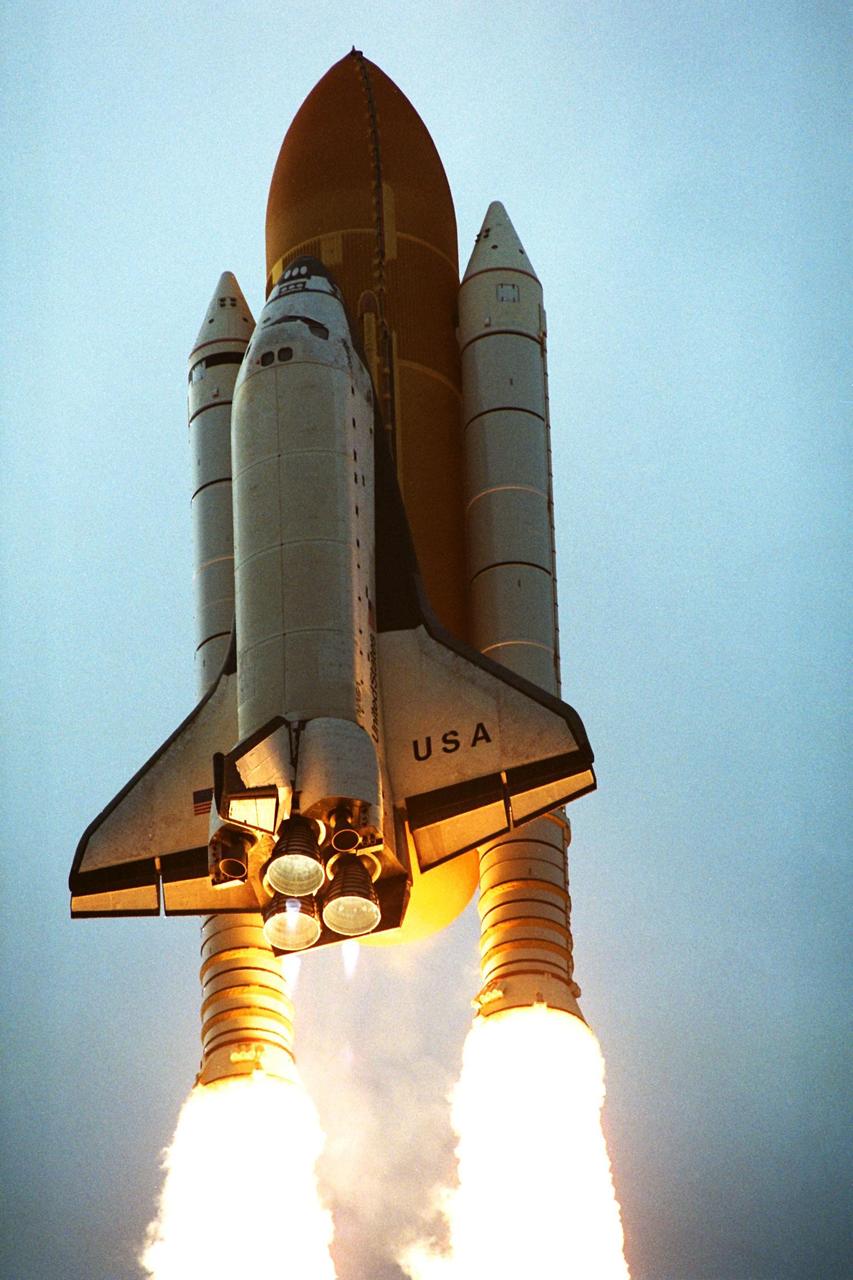
Like a rising sun lighting up the afternoon sky, the Space Shuttle Columbia soars from Launch Pad 39B at 2:46:00 p.m. EST, November 19, on the fourth flight of the United States Microgravity Payload and Spartan-201 satellite. The crew members include Mission Commander Kevin Kregel.; Pilot Steven Lindsey; Mission Specialists Kalpana Chawla, Ph.D., Winston Scott, and Takao Doi, Ph.D., of the National Space Development Agency of Japan; and Payload Specialist Leonid Kadenyuk of the National Space Agency of Ukraine. During the 16-day STS-87 mission, the crew will oversee experiments in microgravity; deploy and retrieve a solar satellite; and test a new experimental camera, the AERCam Sprint. Dr. Doi and Scott also will perform a spacewalk to practice International Space Station maneuvers
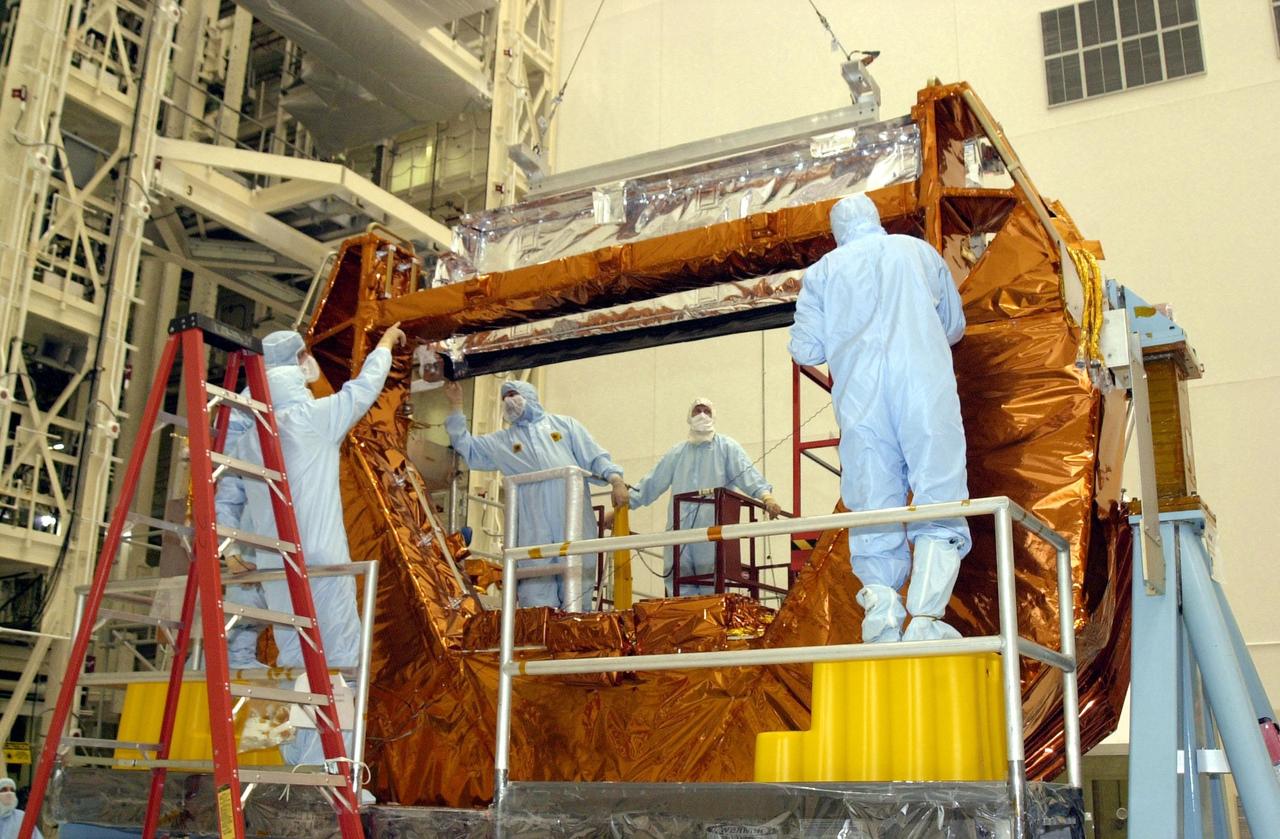
KENNEDY SPACE CENTER, FLA. -- Workers in the Vertical Processing Facility oversee the installation of the NICMOS radiator onto the MULE (Multi-Use Lightweight Equipment) carrier. Part of the payload on mission STS-109, the Near Infrared Camera and Multi-Object Spectrometer (NICMOS) is a new experimental cooling system consisting of a compressor and tiny turbines. With the experimental cryogenic system, NASA hopes to re-cool the infrared detectors to below -315 degrees F (-193 degrees Celsius). NICMOS II was previously tested aboard STS-95 in 1998. NICMOS could extend the life of the Hubble Space Telescope by several years. Astronauts aboard Columbia on mission STS-109 will be replacing the original NICMOS with the newer version. Launch of Columbia on mission STS-109 is scheduled Feb. 28, 2002