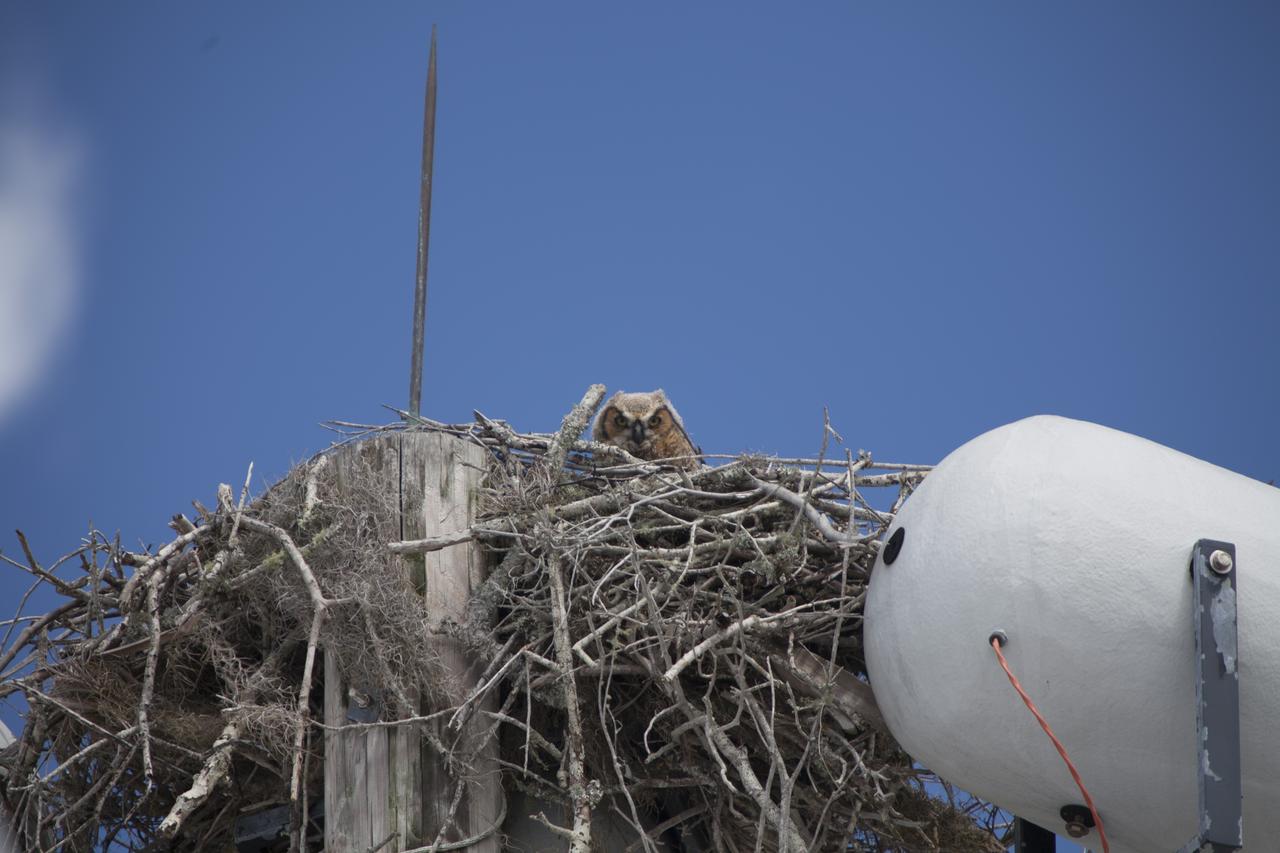
CAPE CANAVERAL, Fla. – At NASA's Kennedy Space Center in Florida, an Owl occupies a nest originally build by an Osprey atop a loudspeaker utility pole. Kennedy Space Center shares a boundary with the Merritt Island National Wildlife Refuge. The Refuge encompasses 140,000 acres that are a habitat for more than 331 species of birds, 31 mammals, 117 fishes, and 65 amphibians and reptiles. The marshes and open water of the refuge provide wintering areas for 23 species of migratory waterfowl, as well as a year-round home for great blue herons, great egrets, wood storks, cormorants, brown pelicans and other species of marsh and shore birds, as well as a variety of insects. For more information, visit: http://www.nasa.gov/centers/kennedy/shuttleoperations/alligators/kscovr.html Photo credit: NASA/Dimitri Gerondidakis
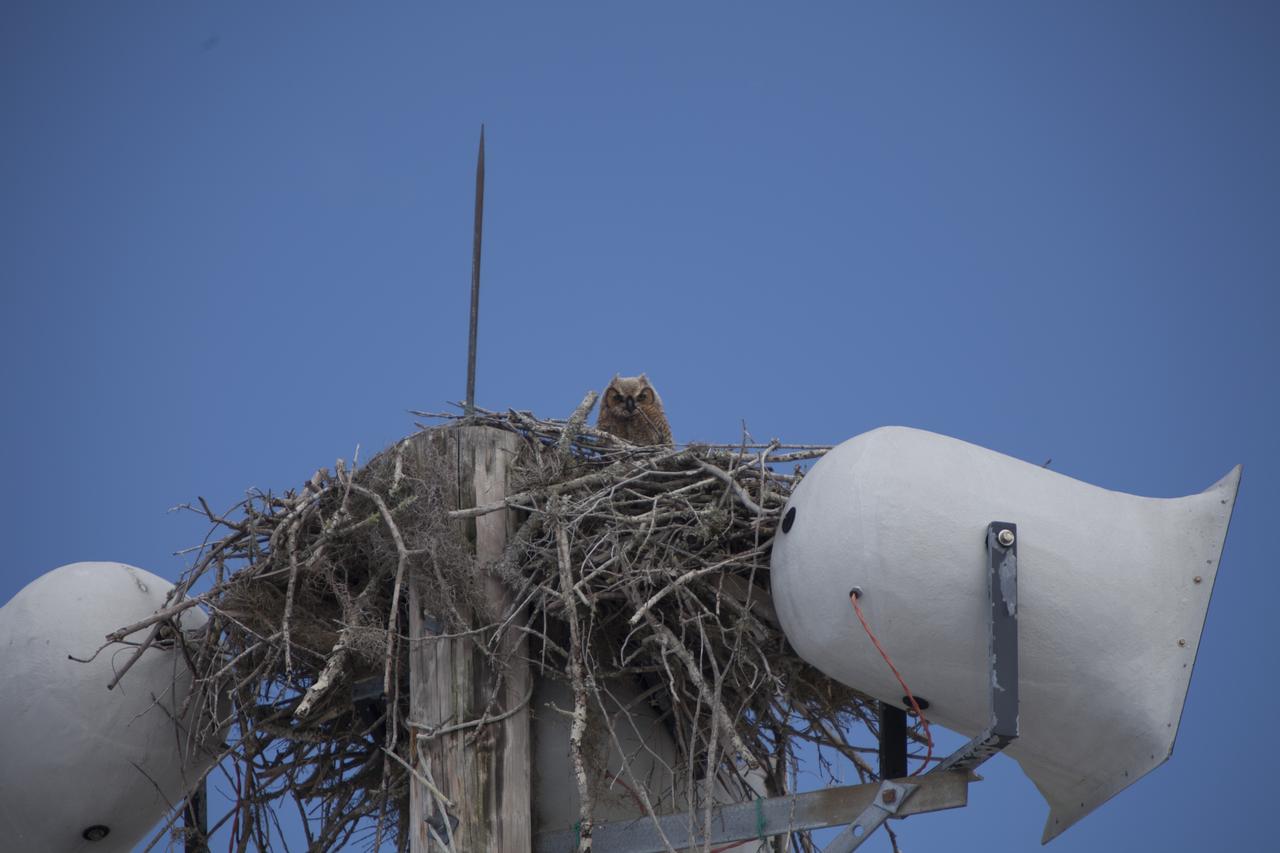
CAPE CANAVERAL, Fla. – At NASA's Kennedy Space Center in Florida, an Owl occupies a nest originally build by an Osprey atop a loudspeaker utility pole. Kennedy Space Center shares a boundary with the Merritt Island National Wildlife Refuge. The Refuge encompasses 140,000 acres that are a habitat for more than 331 species of birds, 31 mammals, 117 fishes, and 65 amphibians and reptiles. The marshes and open water of the refuge provide wintering areas for 23 species of migratory waterfowl, as well as a year-round home for great blue herons, great egrets, wood storks, cormorants, brown pelicans and other species of marsh and shore birds, as well as a variety of insects. For more information, visit: http://www.nasa.gov/centers/kennedy/shuttleoperations/alligators/kscovr.html Photo credit: NASA/Dimitri Gerondidakis
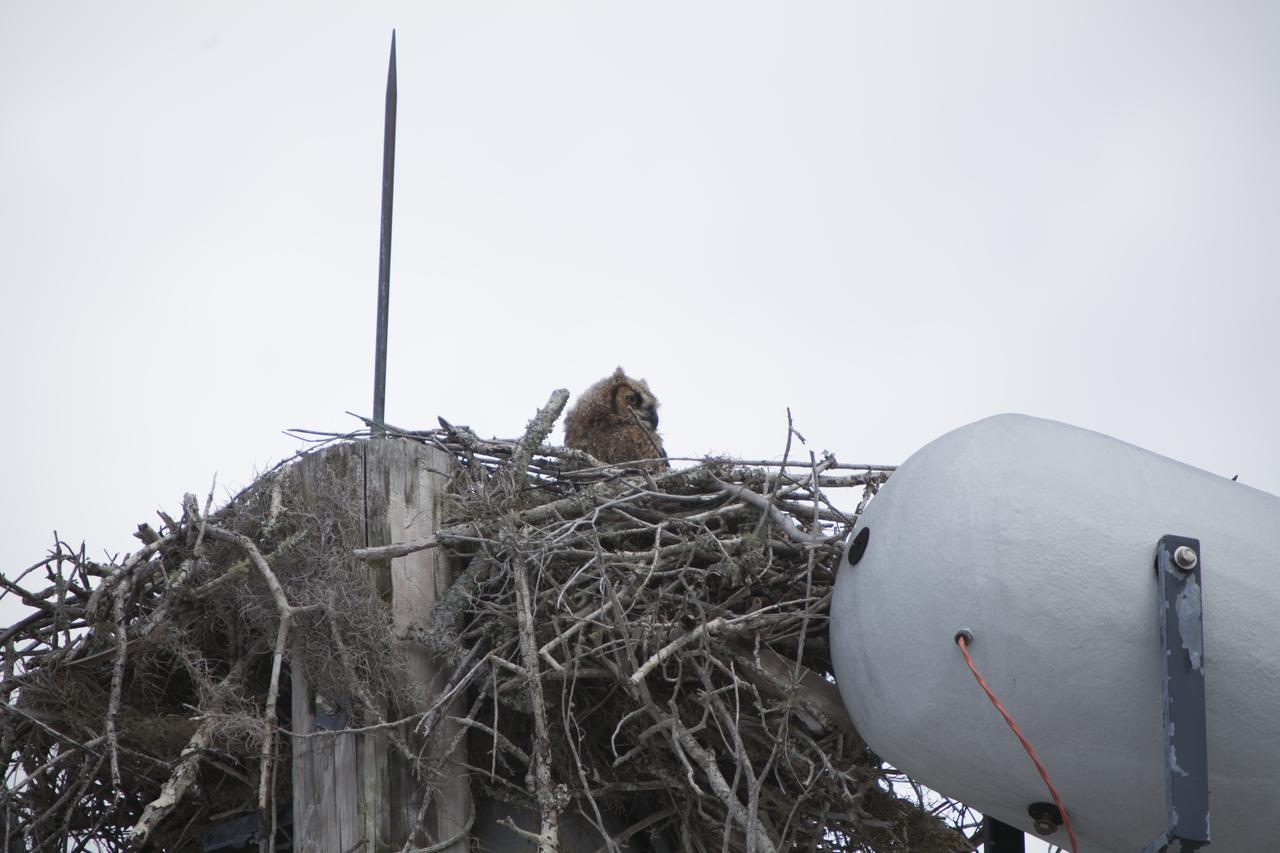
CAPE CANAVERAL, Fla. – At NASA's Kennedy Space Center in Florida, an Owl occupies a nest originally build by an Osprey atop a loudspeaker utility pole. Kennedy Space Center shares a boundary with the Merritt Island National Wildlife Refuge. The Refuge encompasses 140,000 acres that are a habitat for more than 331 species of birds, 31 mammals, 117 fishes, and 65 amphibians and reptiles. The marshes and open water of the refuge provide wintering areas for 23 species of migratory waterfowl, as well as a year-round home for great blue herons, great egrets, wood storks, cormorants, brown pelicans and other species of marsh and shore birds, as well as a variety of insects. For more information, visit: http://www.nasa.gov/centers/kennedy/shuttleoperations/alligators/kscovr.html Photo credit: NASA/Dimitri Gerondidakis
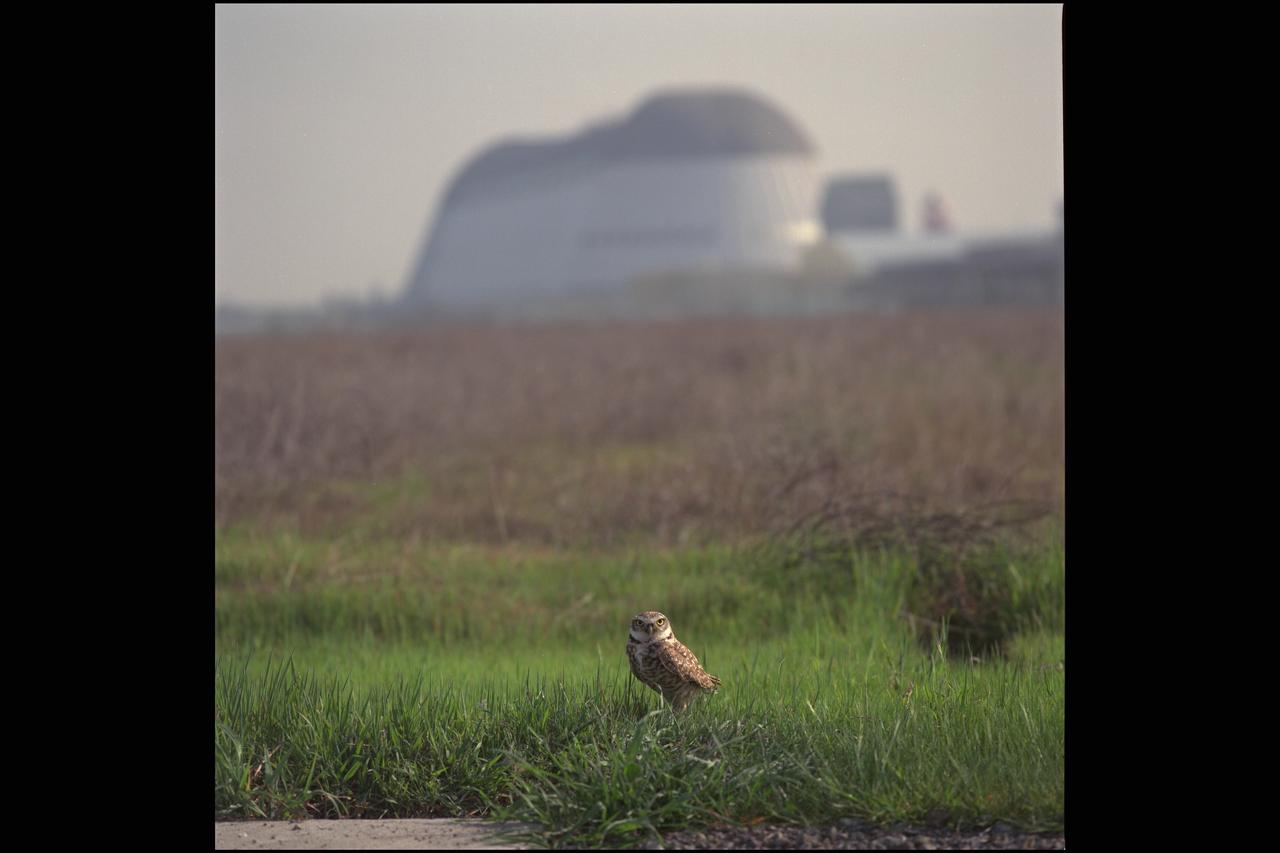
Burrowing Owls keep watch over Moffett Field wetlands. The burrowing owl is currently listed as a Species of Special Concern in California. Data collected since 1992 at Moffett Field suggest that the population at Moffett Field is the largest sub-population of owls in the region. Thus, the Moffett Field population is an important site for the long-term survival of burrowing owls in the Bay Area (Trulio 1999). used in Ames 60 yr. History NASA SP-2000-4314
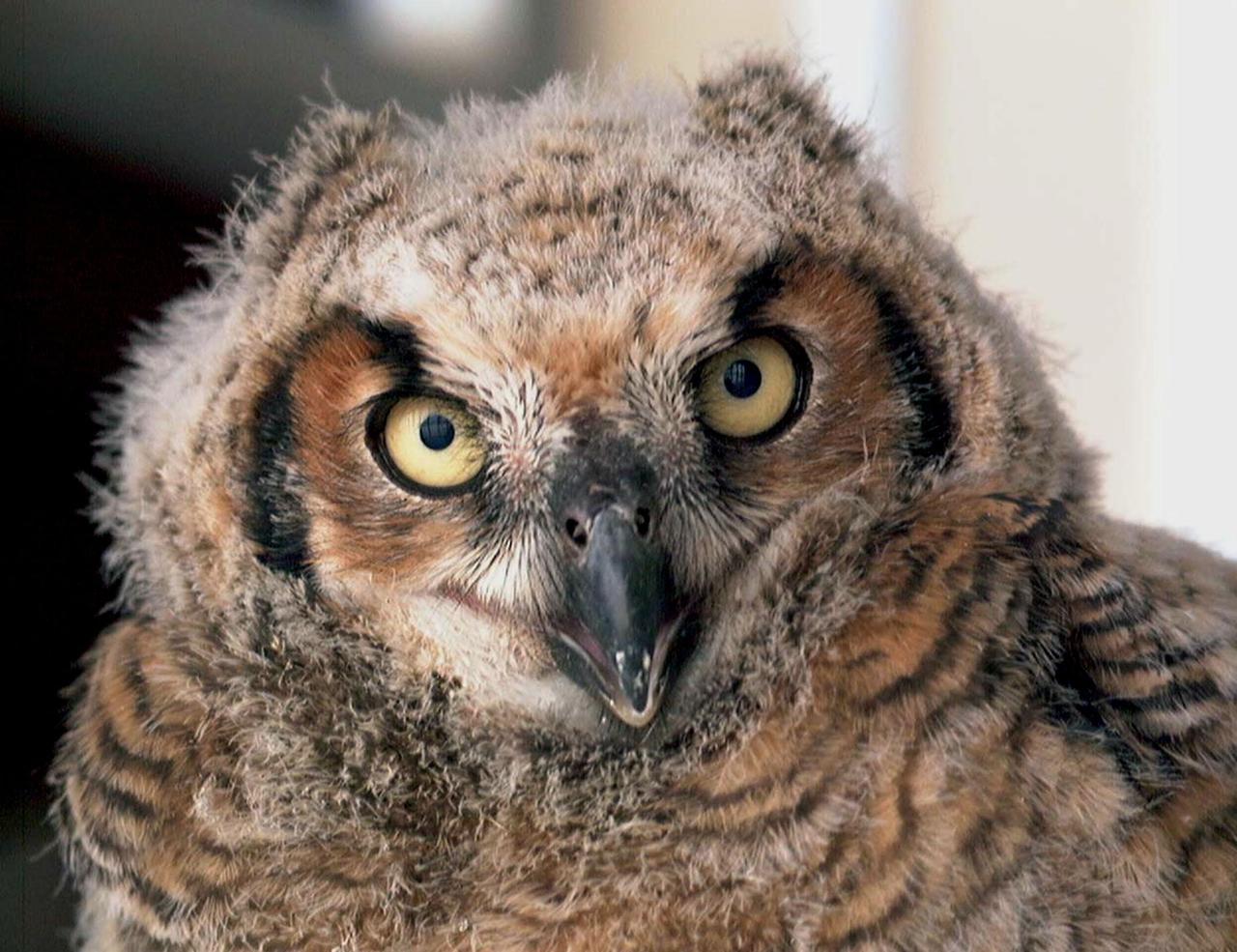
KENNEDY SPACE CENTER, FLA. -- A baby owl, possibly a screech owl, stares at the photographer snapping its picture. The owl was found on the stairs inside Hangar G, Cape Canaveral Air Force Station. It had apparently tried to fly from a nest near the ceiling but couldn't get back to it. Workers called an Audubon rescue center near Orlando, which captured it and will ensure the bird is returned to the wild when it's ready
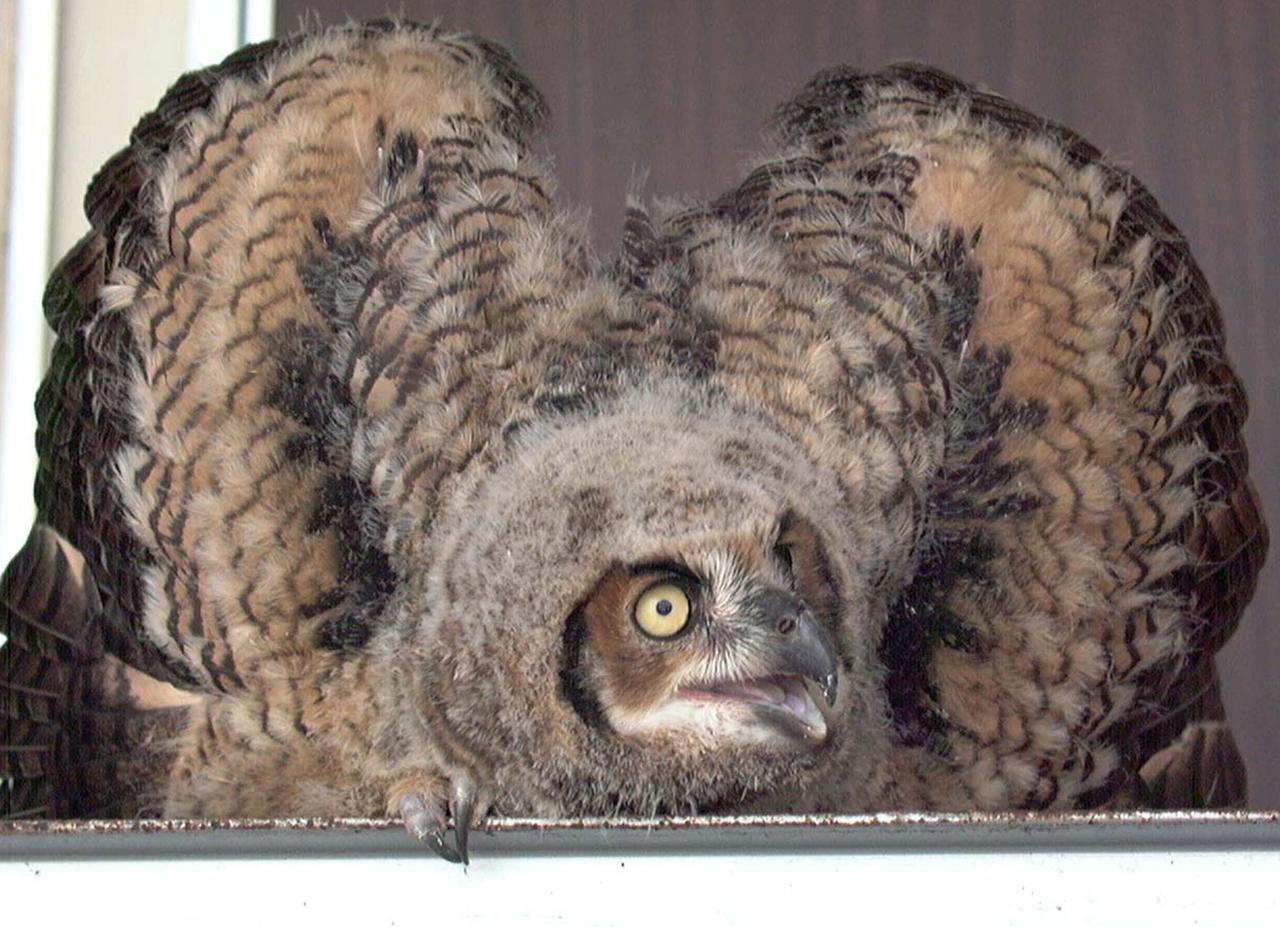
KENNEDY SPACE CENTER, FLA. -- A baby owl, possibly a screech owl, shows its fear and resentment of the photographer snapping its picture. The owl was found on the stairs inside Hangar G, Cape Canaveral Air Force Station. It had apparently tried to fly from a nest near the ceiling but couldn't get back to it. Workers called an Audubon rescue center near Orlando, which captured it and will ensure the bird is returned to the wild when it's ready
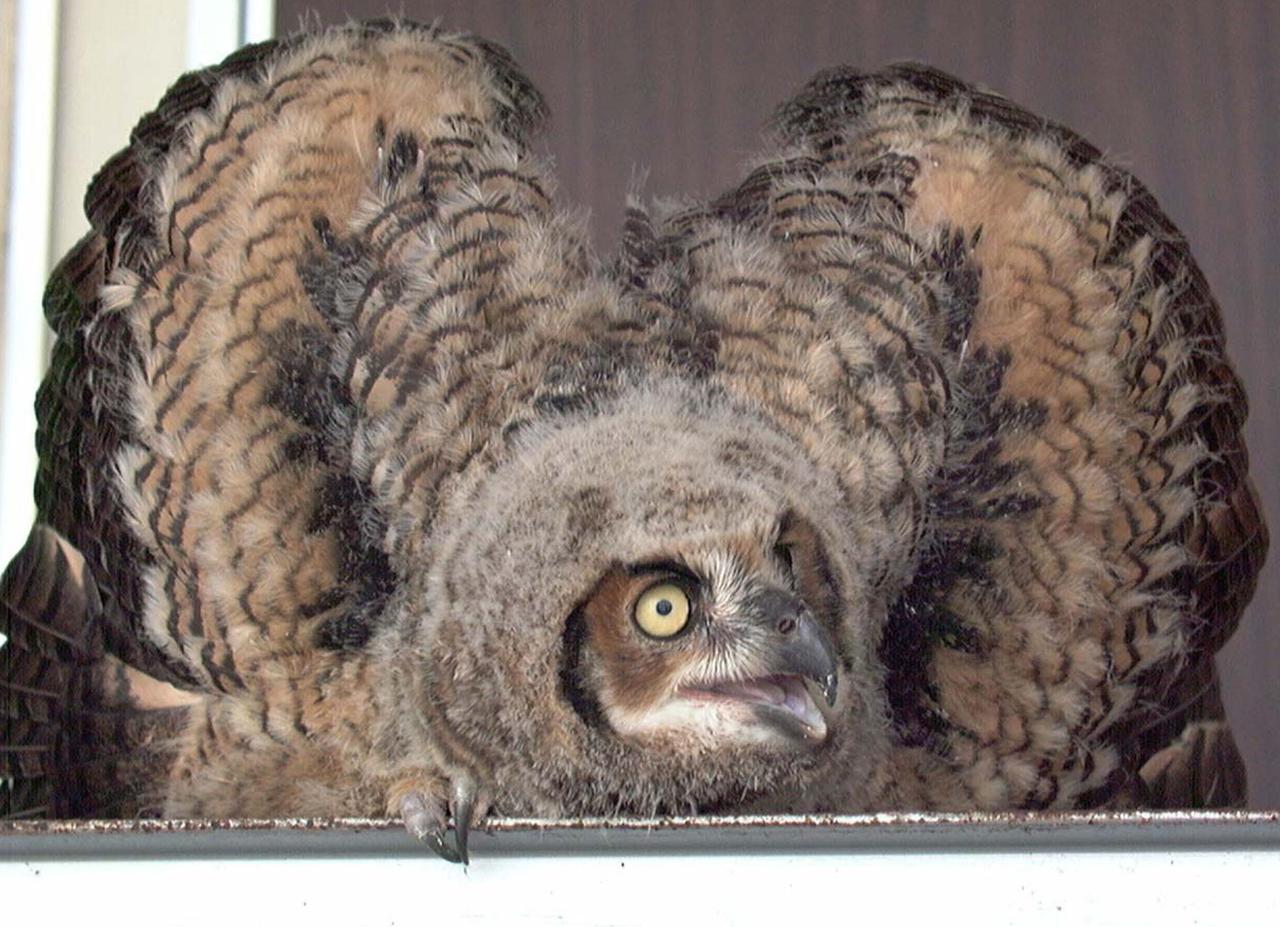
KENNEDY SPACE CENTER, FLA. -- A baby owl, possibly a screech owl, shows its fear and resentment of the photographer snapping its picture. The owl was found on the stairs inside Hangar G, Cape Canaveral Air Force Station. It had apparently tried to fly from a nest near the ceiling but couldn't get back to it. Workers called an Audubon rescue center near Orlando, which captured it and will ensure the bird is returned to the wild when it's ready
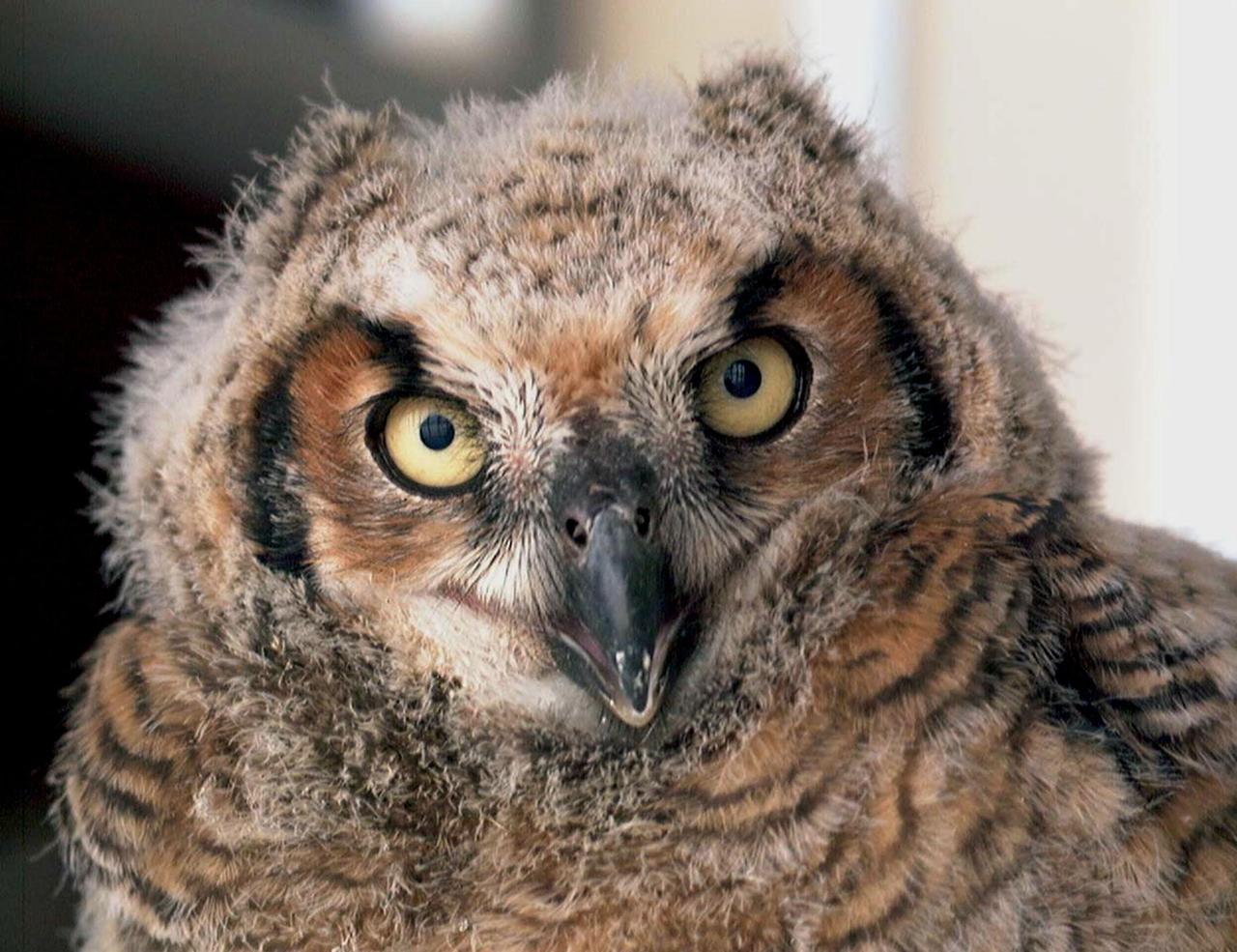
KENNEDY SPACE CENTER, FLA. -- A baby owl, possibly a screech owl, stares at the photographer snapping its picture. The owl was found on the stairs inside Hangar G, Cape Canaveral Air Force Station. It had apparently tried to fly from a nest near the ceiling but couldn't get back to it. Workers called an Audubon rescue center near Orlando, which captured it and will ensure the bird is returned to the wild when it's ready
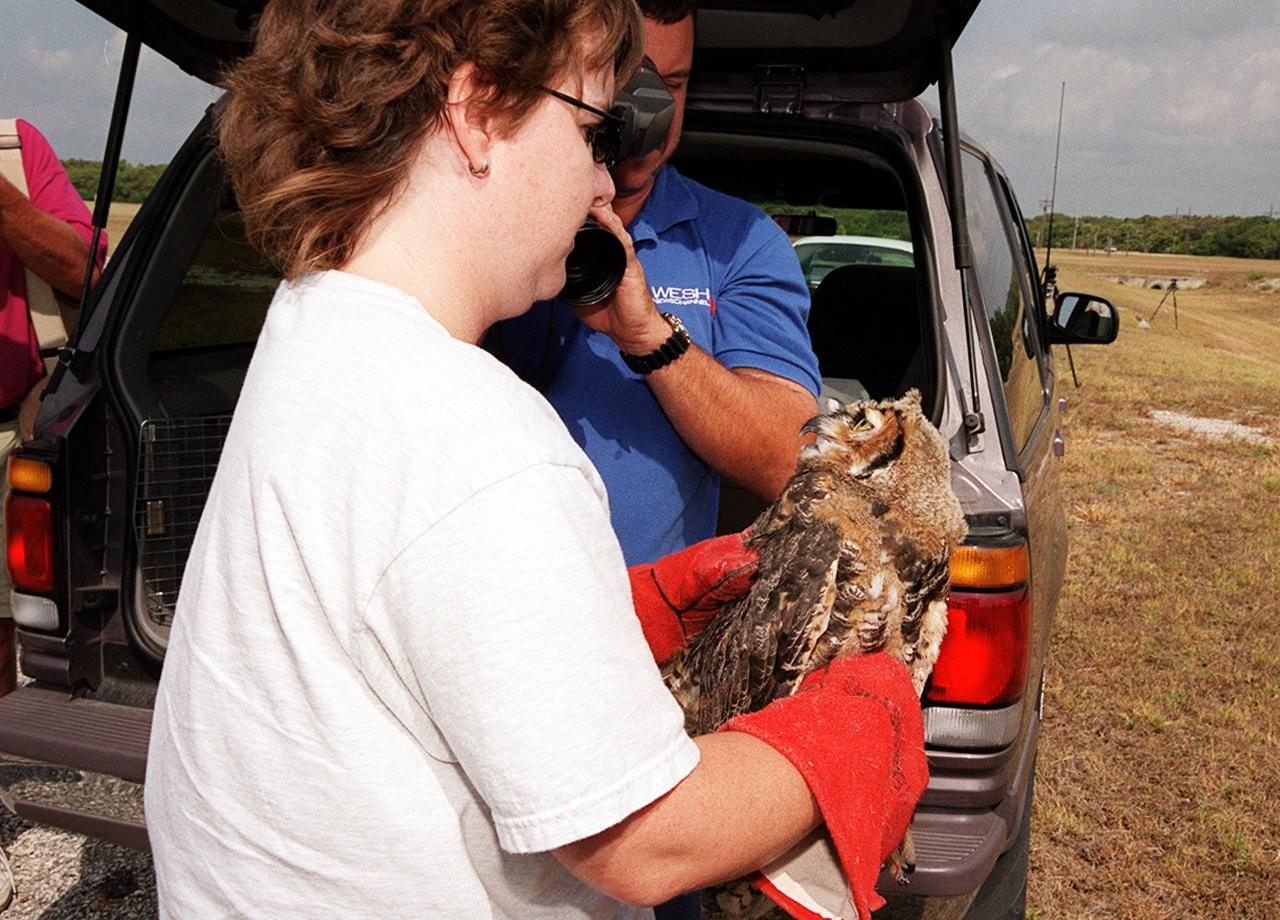
Eileen Olejarski, manager of Florida Wildlife Hospital, and Susan Small, director of the hospital, get ready to release two great horned owls at Complex 25/29 on Cape Canaveral Air Force Station . The owls, rescued after falling from their next inside a hangar at CCAFS in April, were treated at the hospital for injuries
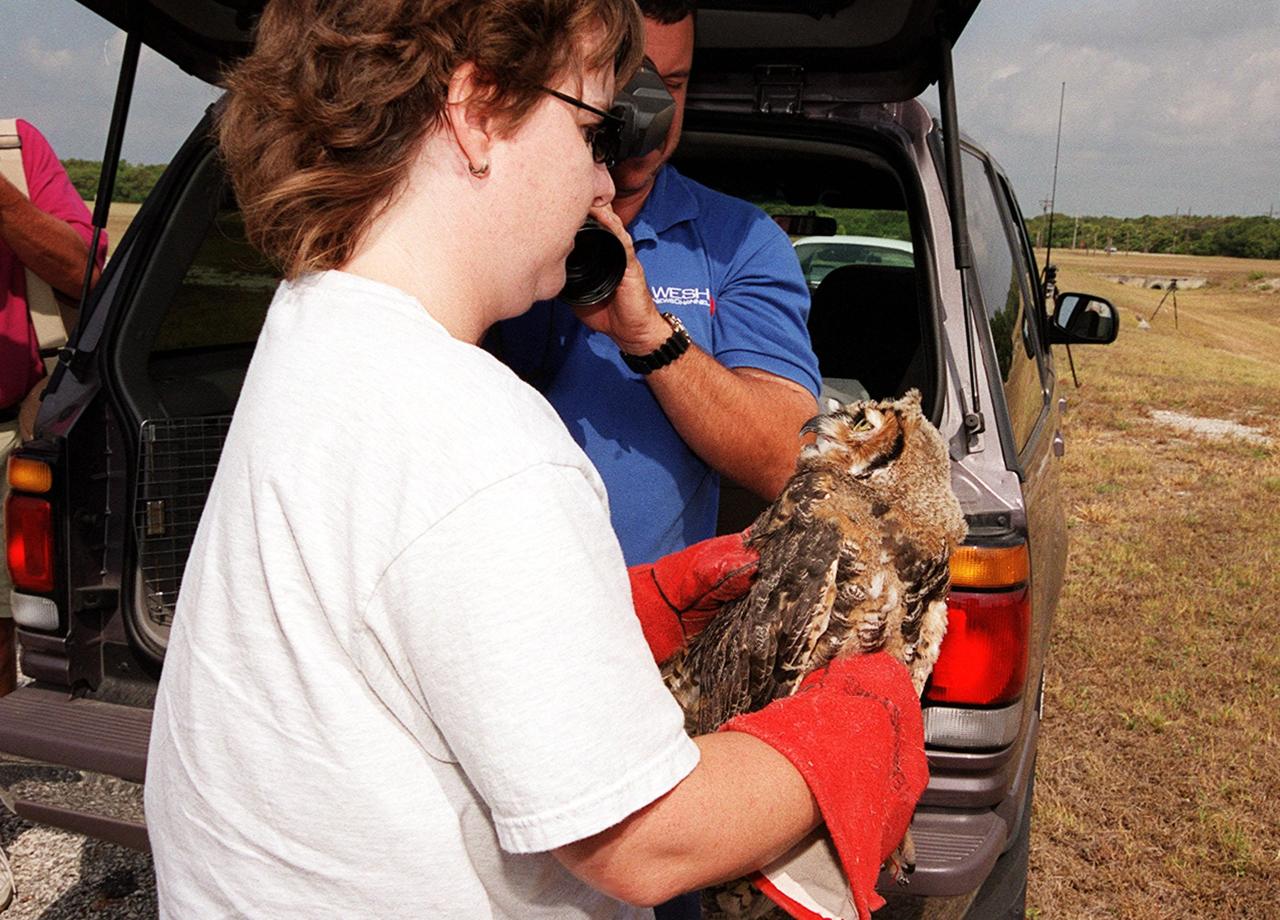
Eileen Olejarski, manager of Florida Wildlife Hospital, and Susan Small, director of the hospital, get ready to release two great horned owls at Complex 25/29 on Cape Canaveral Air Force Station . The owls, rescued after falling from their next inside a hangar at CCAFS in April, were treated at the hospital for injuries
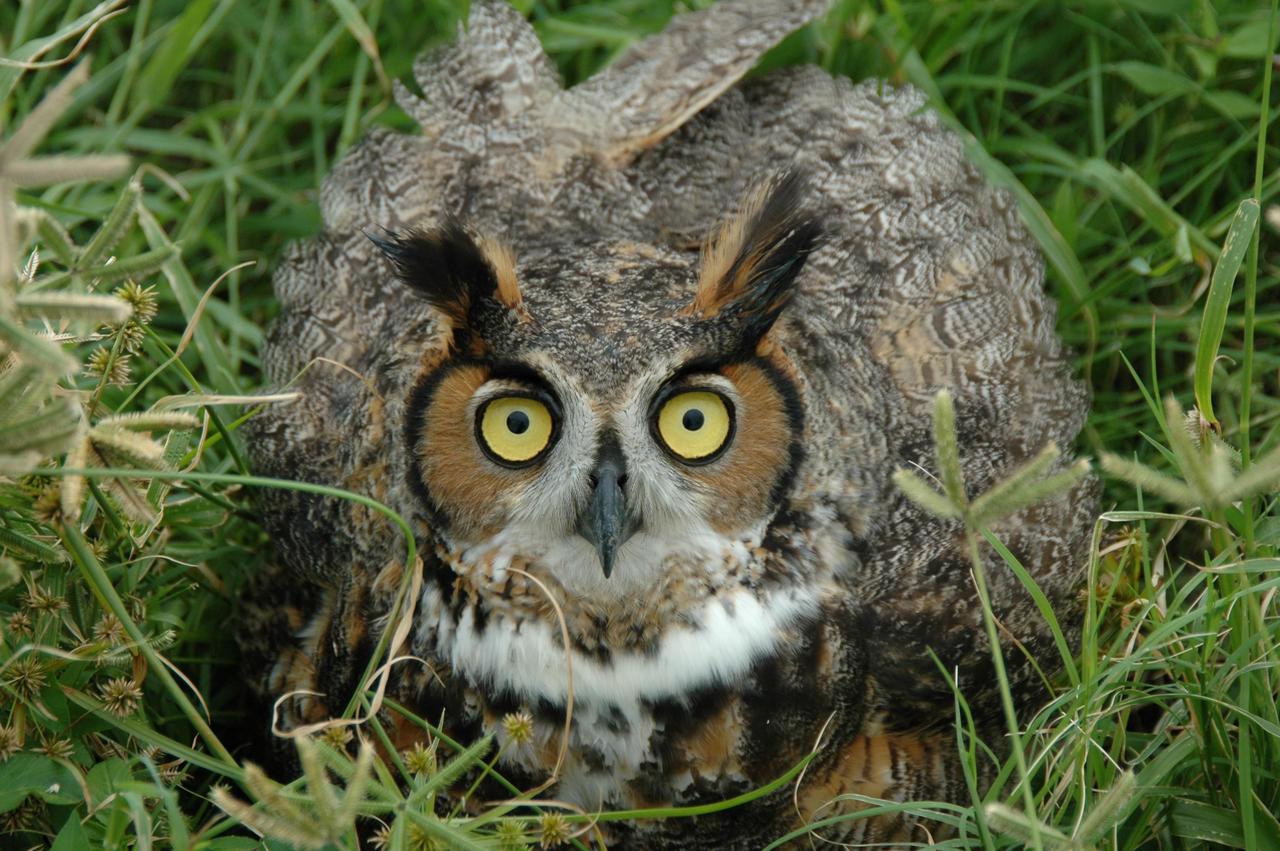
KENNEDY SPACE CENTER, FLA. - A Long-Eared Owl is spotted on Launch Complex 41 at Cape Canaveral Air Force Station in Florida. This one holds a typical stance for protecting its young. These owls range from Alaska and Canada to the Gulf states and Mexico, as far east as Central Florida. Their habitat is deciduous and evergreen forests. They nest in deserted nests of crows, hawks or squirrels.
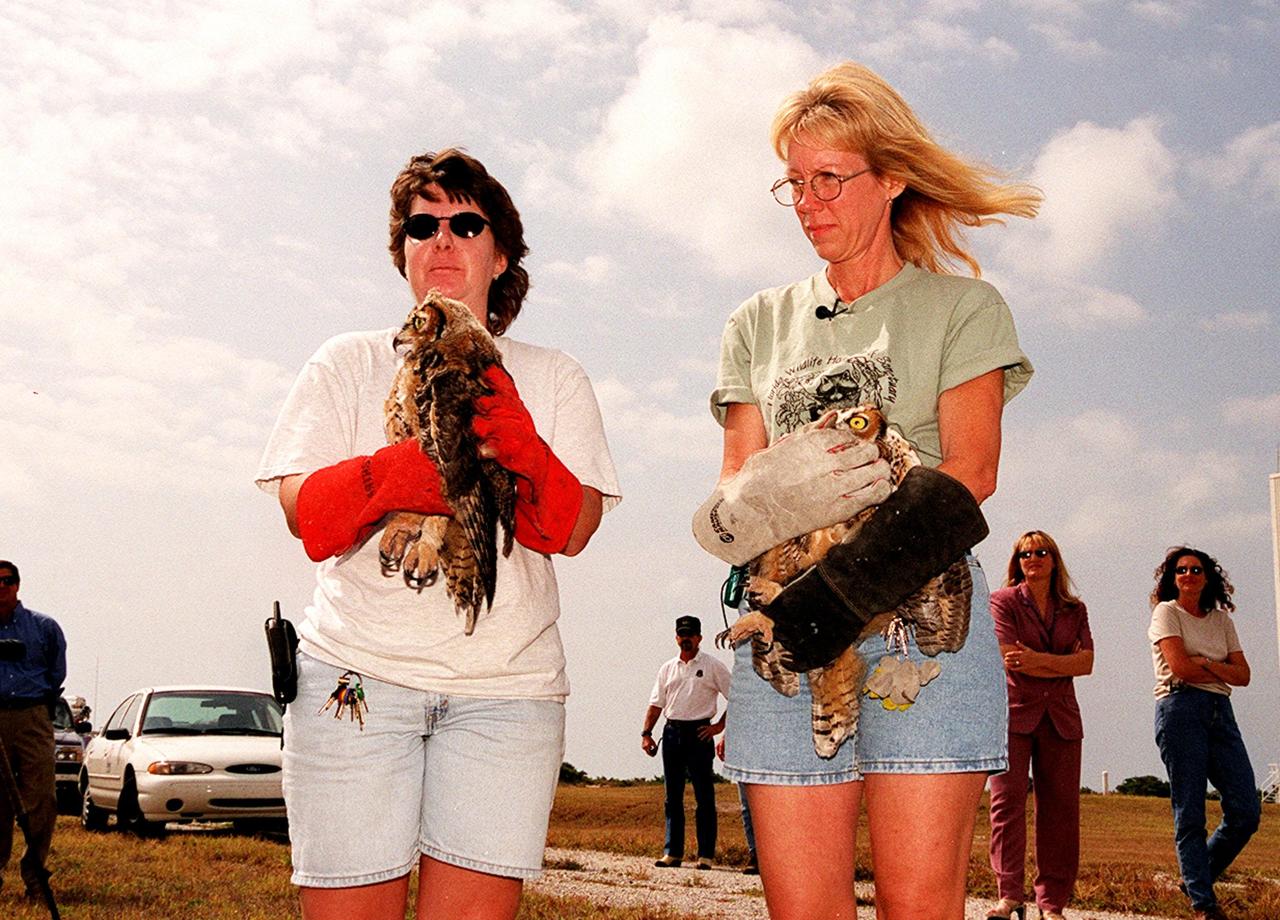
Eileen Olejarski (left), manager of Florida Wildlife Hospital, and Susan Small, director of the hospital, get ready to release two great horned owls at Cape Canaveral Air Force Station, Complex 25/29. The owls were found in June on the floor of CCAFS Hangar G, where their nest was located. They were treated at a local veterinary hospital and then taken to the Florida Wildlife Hospital in Melbourne for care and rehabilitation before release
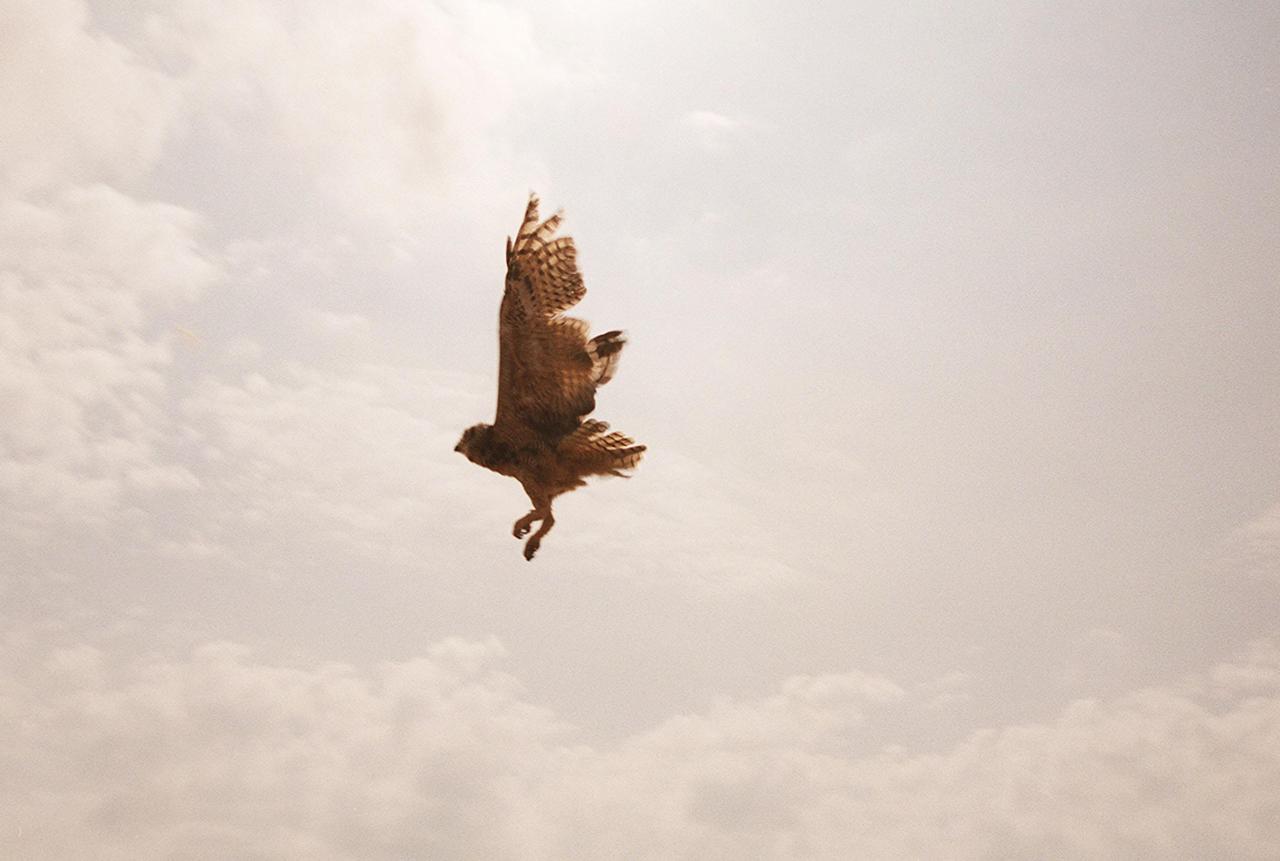
A great horned owl flies to freedom after its release at Cape Canaveral Air Force Station, Complex 25/29. The owl is one of two found in June on the floor of CCAFS Hangar G, where their nest was located. They were treated at a local veterinary hospital and then taken to the Florida Wildlife Hospital in Melbourne for care and rehabilitation before release
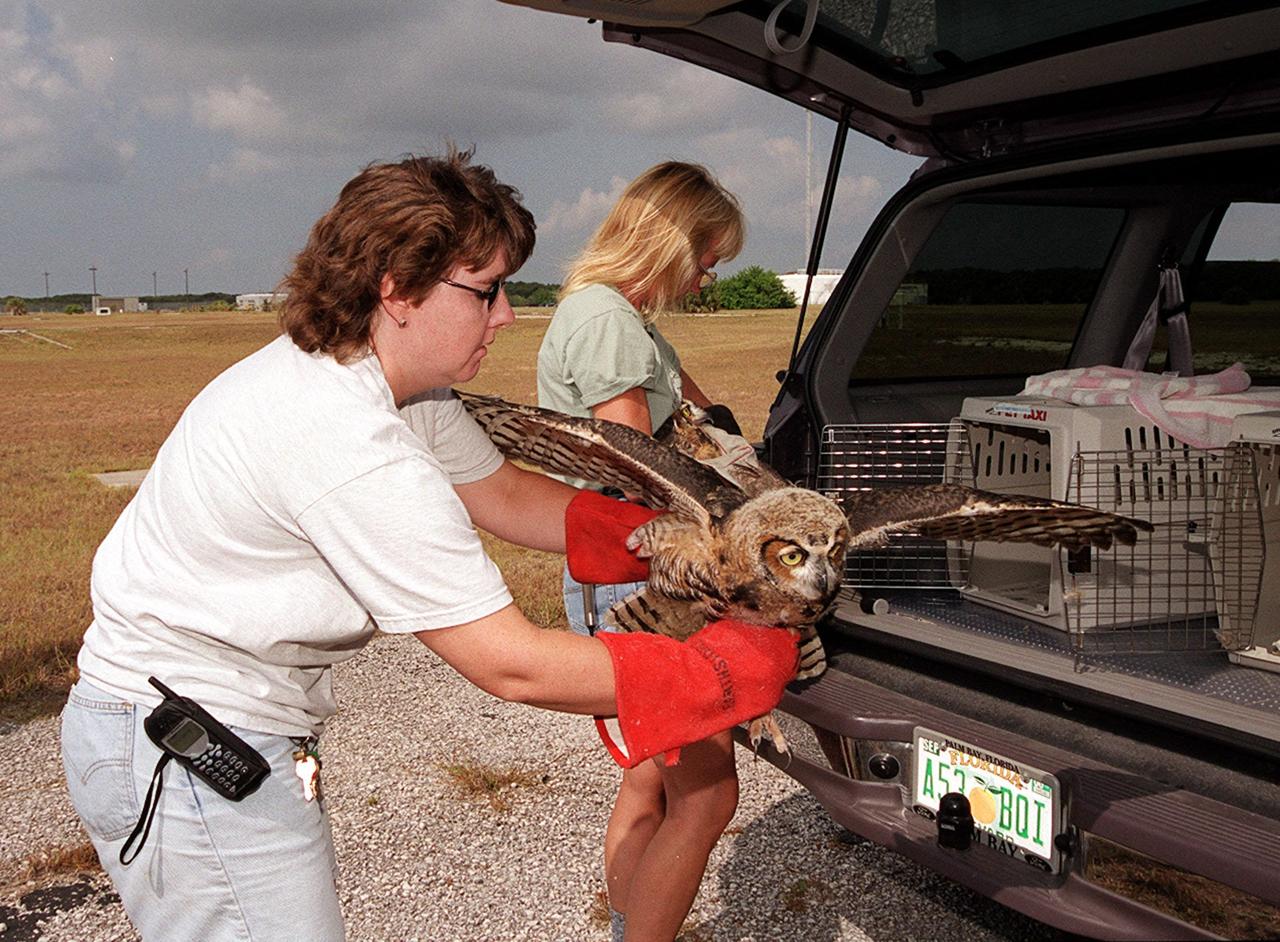
Eileen Olejarski (left), manager of Florida Wildlife Hospital, and Susan Small, director of the hospital, remove two great horned owls from the vehicle before releasing them at Cape Canaveral Air Force Station, Complex 25/29. The owls were found in June on the floor of CCAFS Hangar G, where their nest was located. They were treated at a local veterinary hospital and then taken to the Florida Wildlife Hospital in Melbourne for care and rehabilitation before release.
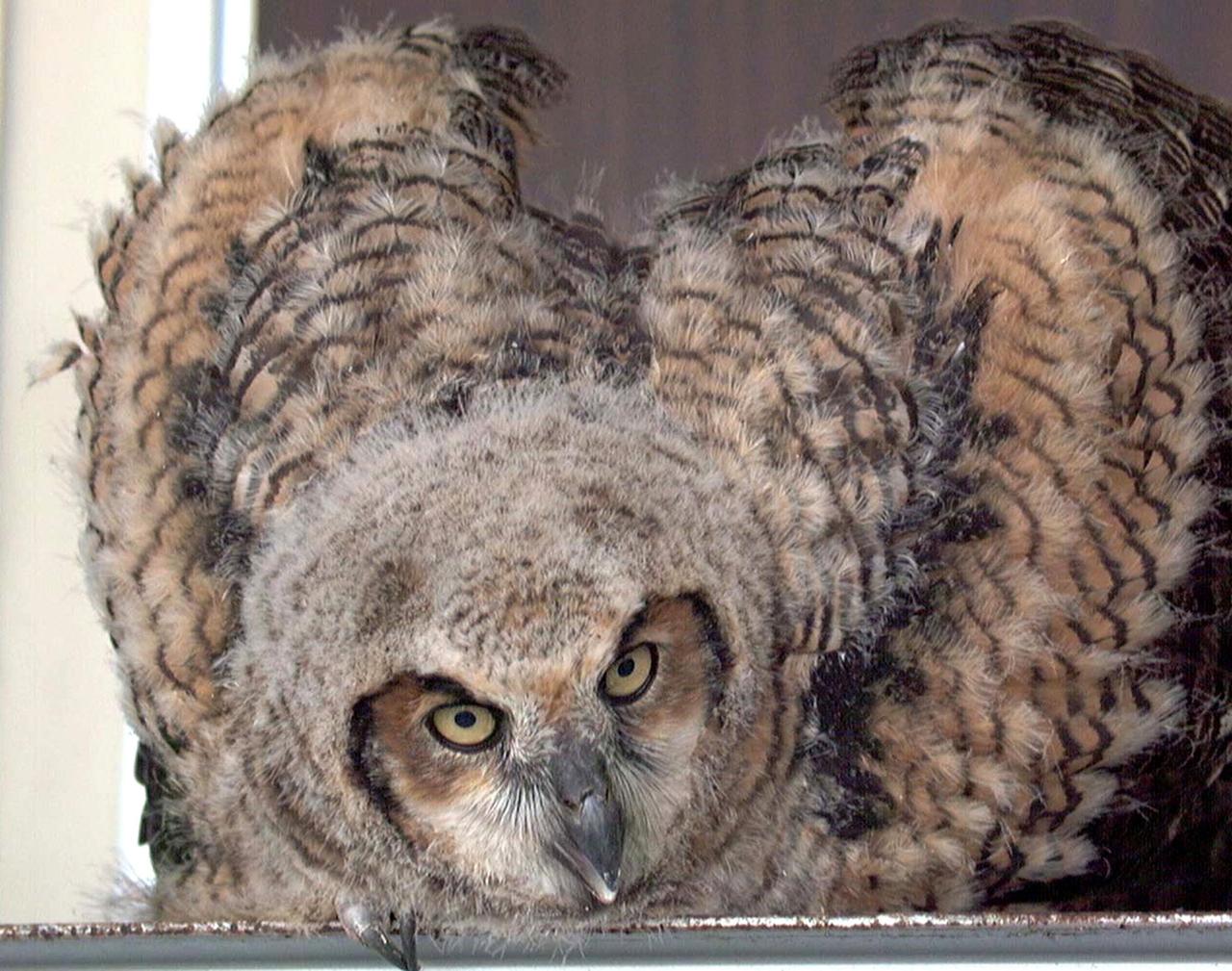
KENNEDY SPACE CENTER, FLA. -- A baby owl displays its wings at the photographer snapping its picture. The owl was found on the stairs inside Hangar G, Cape Canaveral Air Force Station. It had apparently tried to fly from a nest near the ceiling but couldn't get back to it. Workers called an Audubon rescue center near Orlando, which captured it and will ensure the bird is returned to the wild when it's ready.
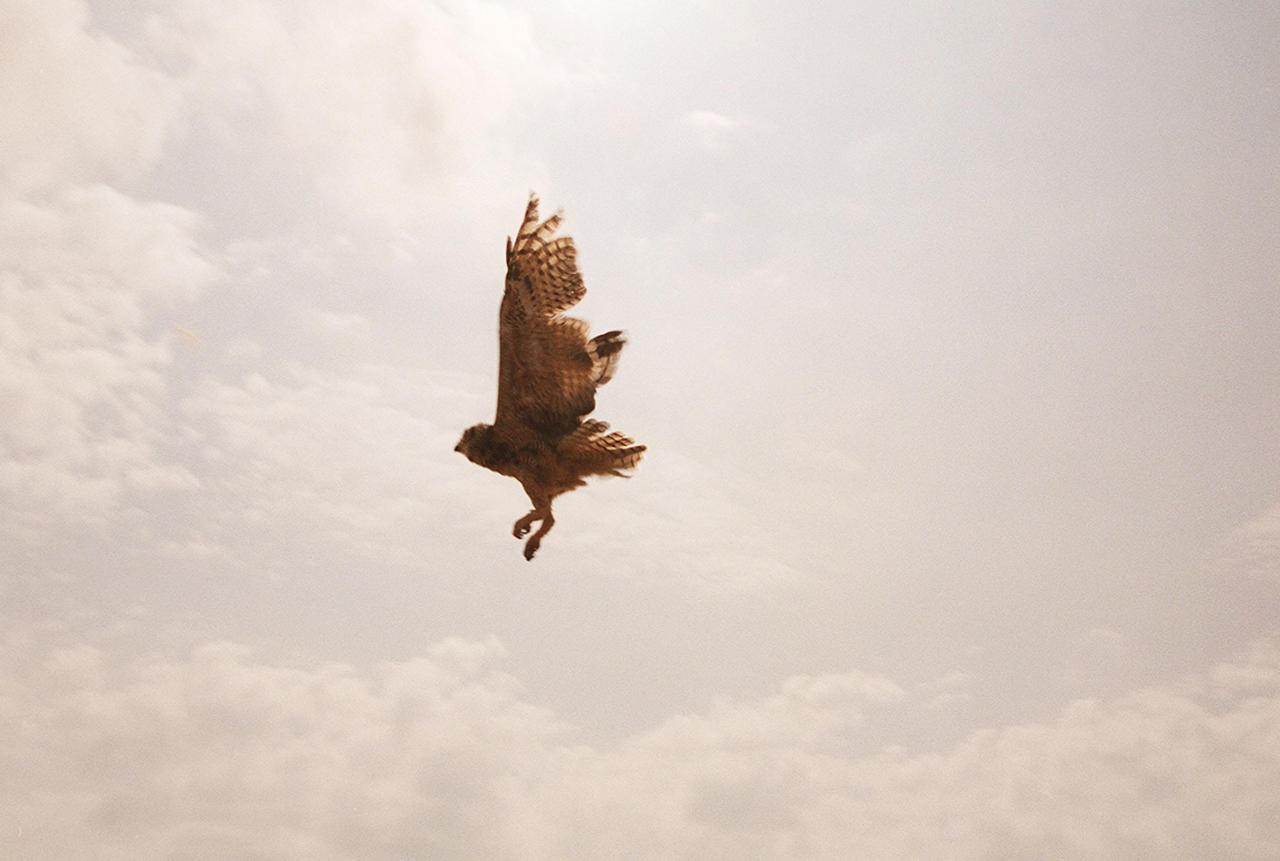
A great horned owl flies to freedom after its release at Cape Canaveral Air Force Station, Complex 25/29. The owl is one of two found in June on the floor of CCAFS Hangar G, where their nest was located. They were treated at a local veterinary hospital and then taken to the Florida Wildlife Hospital in Melbourne for care and rehabilitation before release
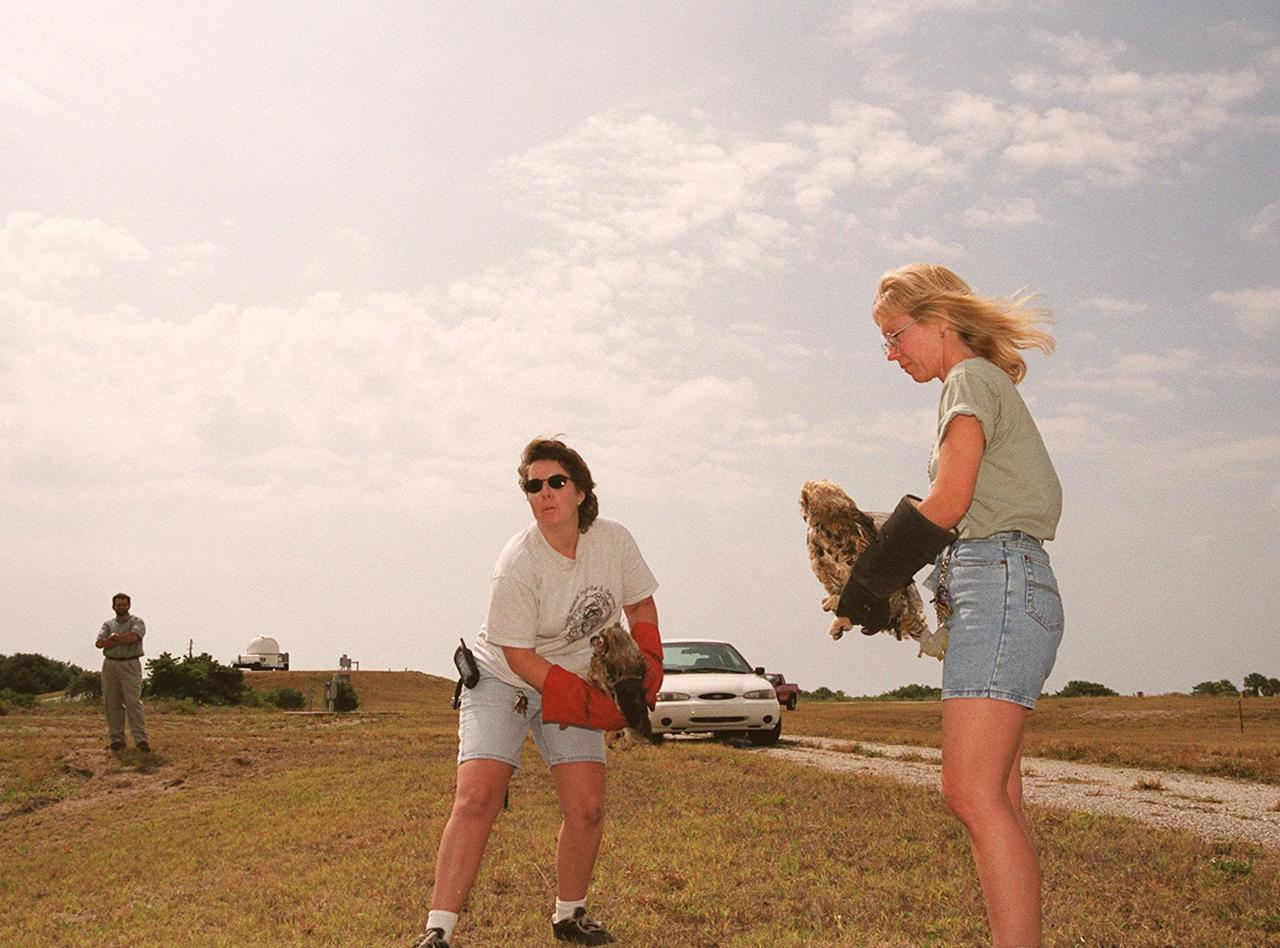
Eileen Olejarski (left), manager of Florida Wildlife Hospital, and Susan Small, director of the hospital, get ready to release two great horned owls at Cape Canaveral Air Force Station, Complex 25/29. The owls were found in June on the floor of CCAFS Hangar G, where their nest was located. They were treated at a local veterinary hospital and then taken to the Florida Wildlife Hospital in Melbourne for care and rehabilitation before release
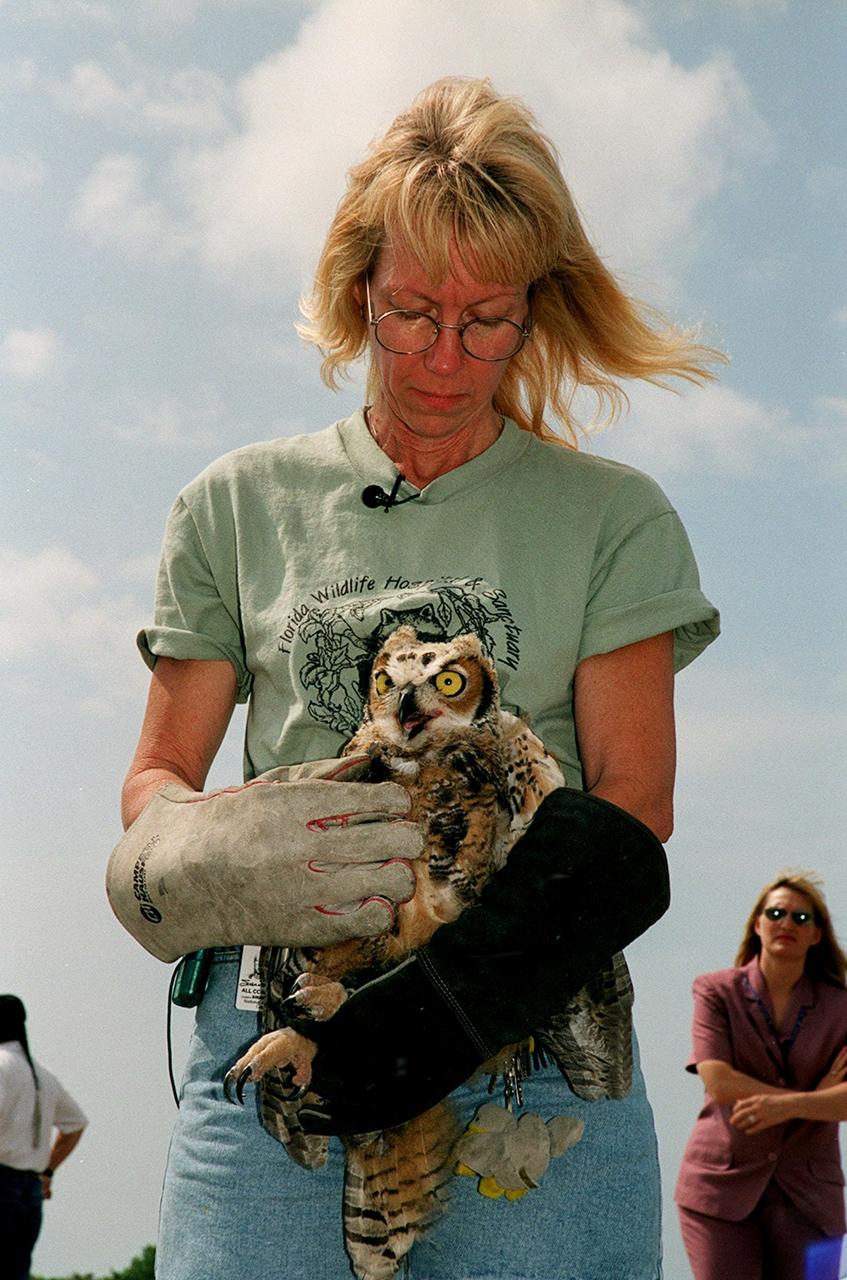
Susan Small, director of the Florida Wildlife Hospital, holds a great horned owl before releasing it at Cape Canaveral Air Force Station, Complex 25/29. The owl is one of two found in June on the floor of CCAFS Hangar G, where their nest was located. They were treated at a local veterinary hospital and then taken to the Florida Wildlife Hospital in Melbourne for care and rehabilitation before release
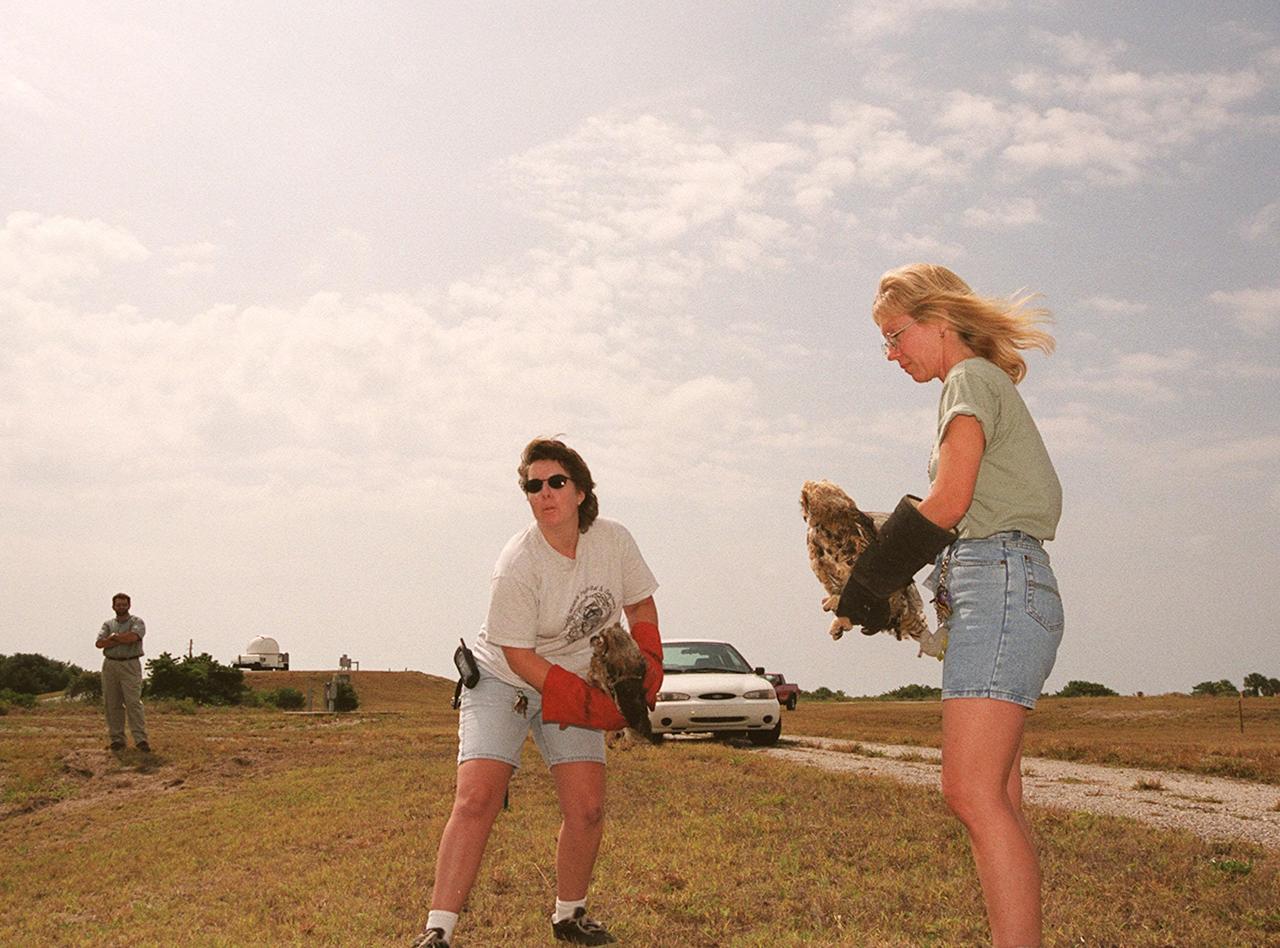
Eileen Olejarski (left), manager of Florida Wildlife Hospital, and Susan Small, director of the hospital, get ready to release two great horned owls at Cape Canaveral Air Force Station, Complex 25/29. The owls were found in June on the floor of CCAFS Hangar G, where their nest was located. They were treated at a local veterinary hospital and then taken to the Florida Wildlife Hospital in Melbourne for care and rehabilitation before release
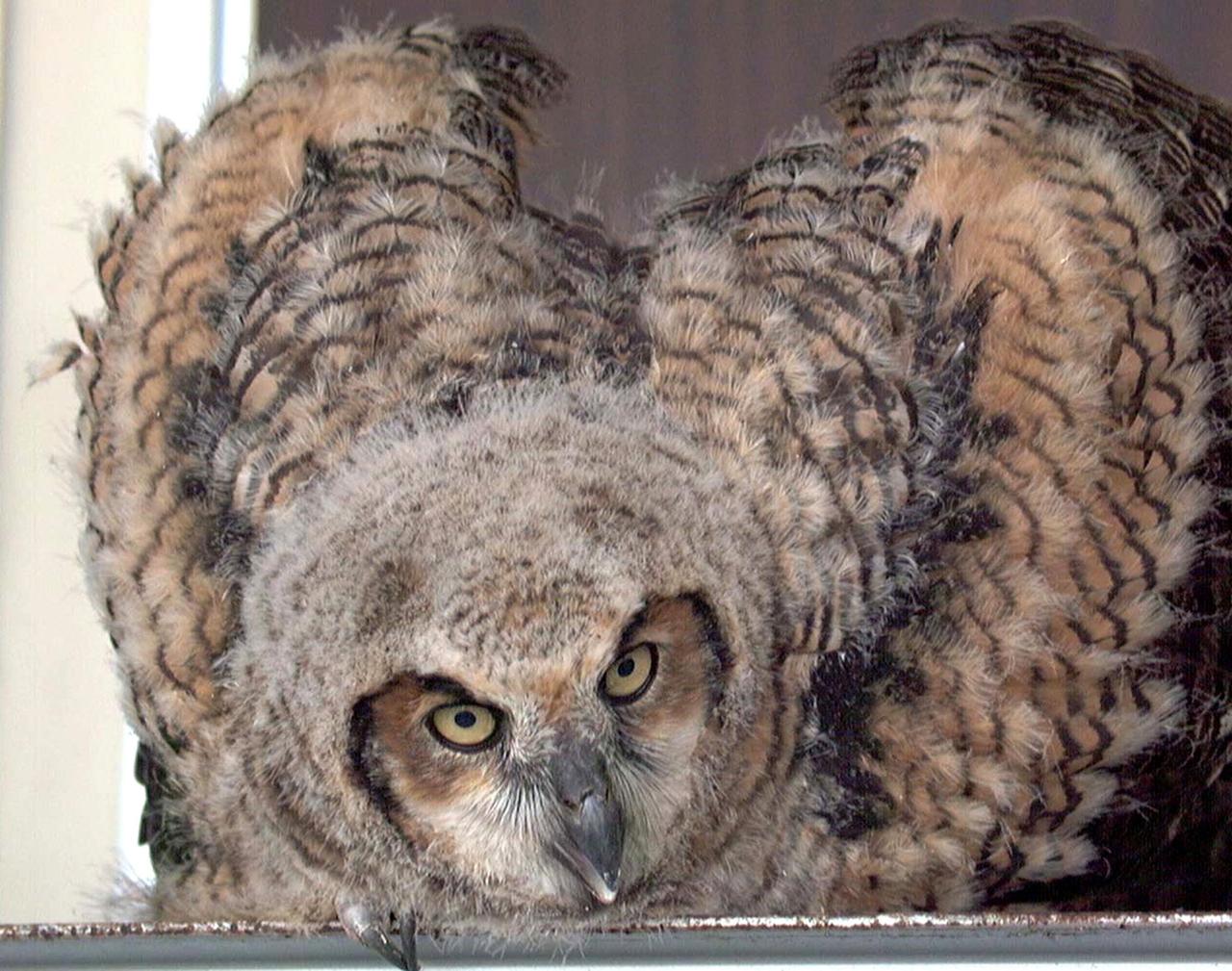
KENNEDY SPACE CENTER, FLA. -- A baby owl displays its wings at the photographer snapping its picture. The owl was found on the stairs inside Hangar G, Cape Canaveral Air Force Station. It had apparently tried to fly from a nest near the ceiling but couldn't get back to it. Workers called an Audubon rescue center near Orlando, which captured it and will ensure the bird is returned to the wild when it's ready.
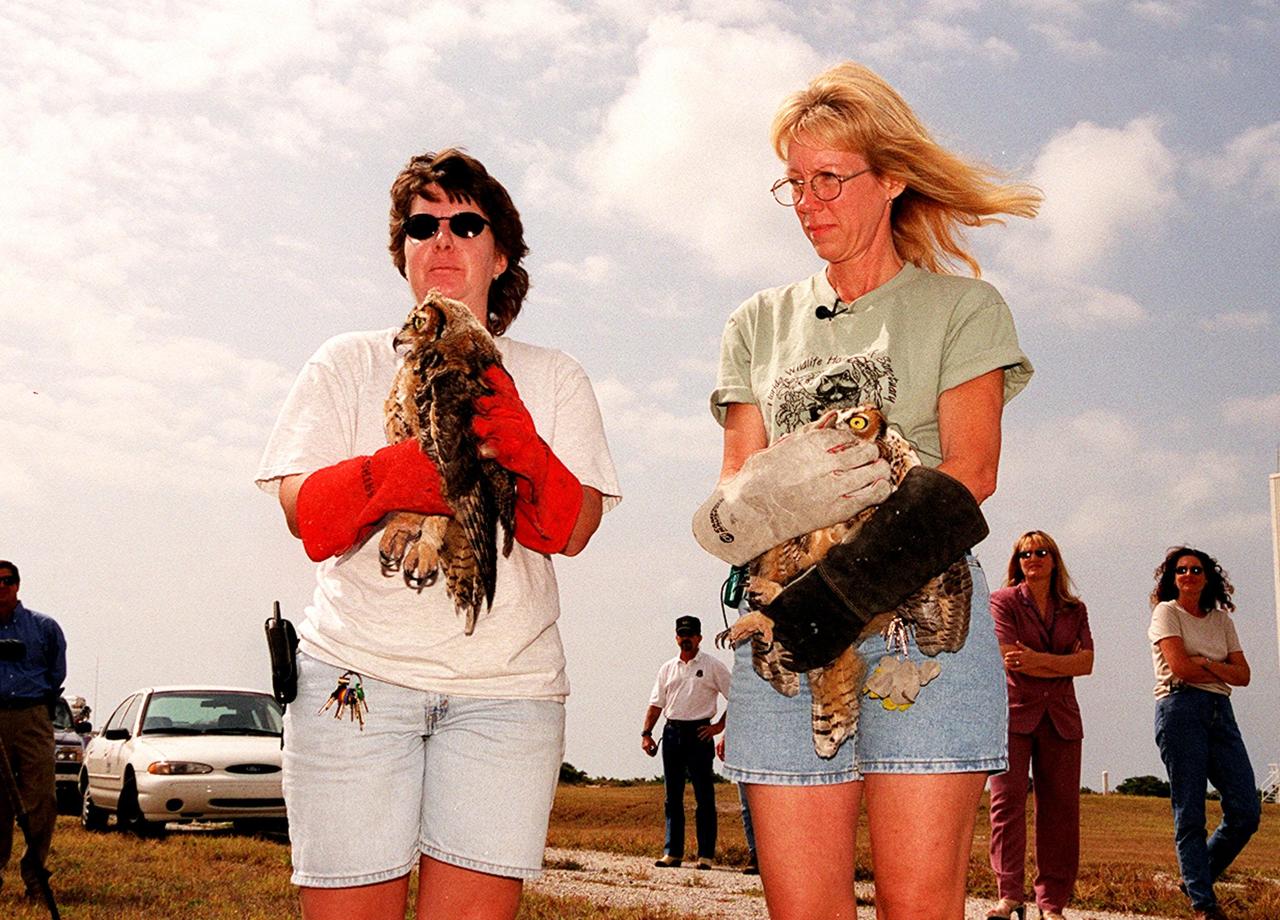
Eileen Olejarski (left), manager of Florida Wildlife Hospital, and Susan Small, director of the hospital, get ready to release two great horned owls at Cape Canaveral Air Force Station, Complex 25/29. The owls were found in June on the floor of CCAFS Hangar G, where their nest was located. They were treated at a local veterinary hospital and then taken to the Florida Wildlife Hospital in Melbourne for care and rehabilitation before release
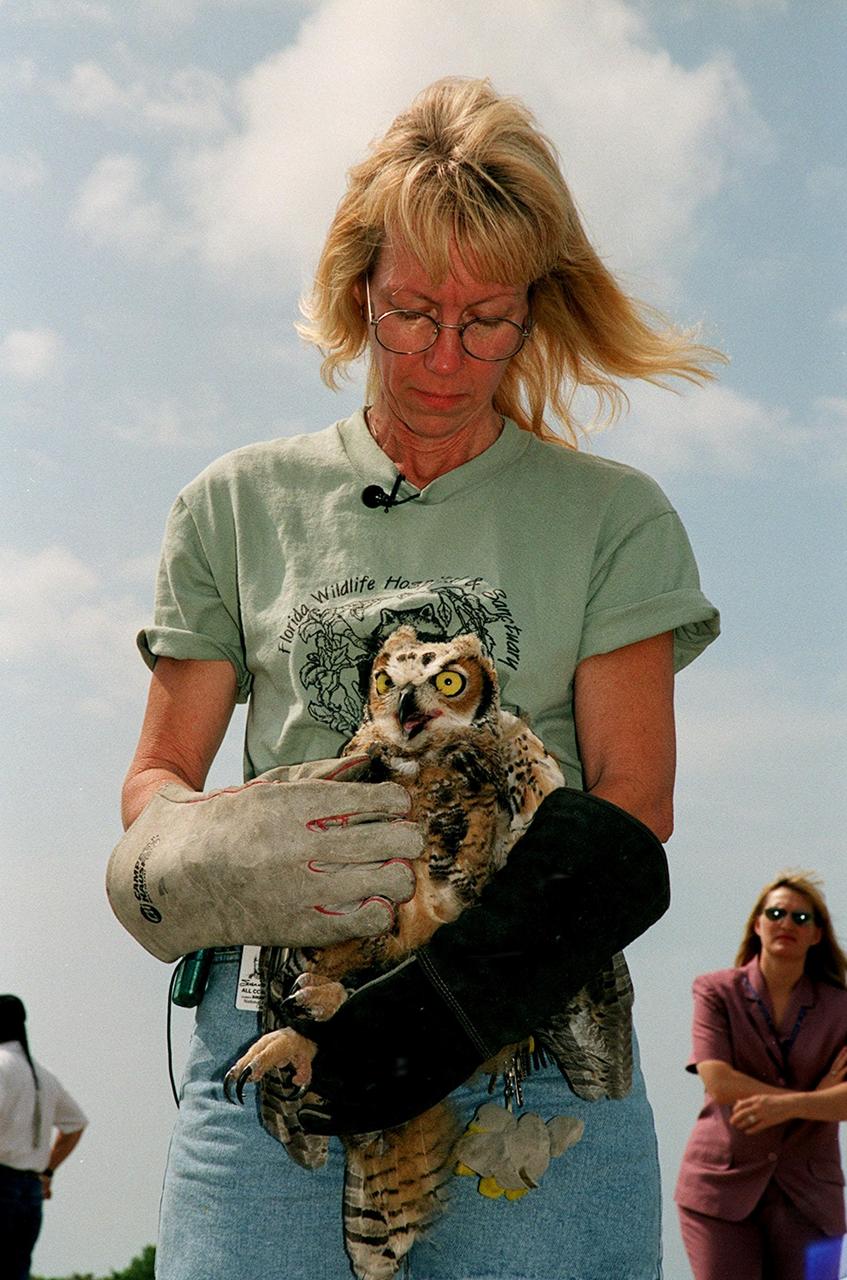
Susan Small, director of the Florida Wildlife Hospital, holds a great horned owl before releasing it at Cape Canaveral Air Force Station, Complex 25/29. The owl is one of two found in June on the floor of CCAFS Hangar G, where their nest was located. They were treated at a local veterinary hospital and then taken to the Florida Wildlife Hospital in Melbourne for care and rehabilitation before release
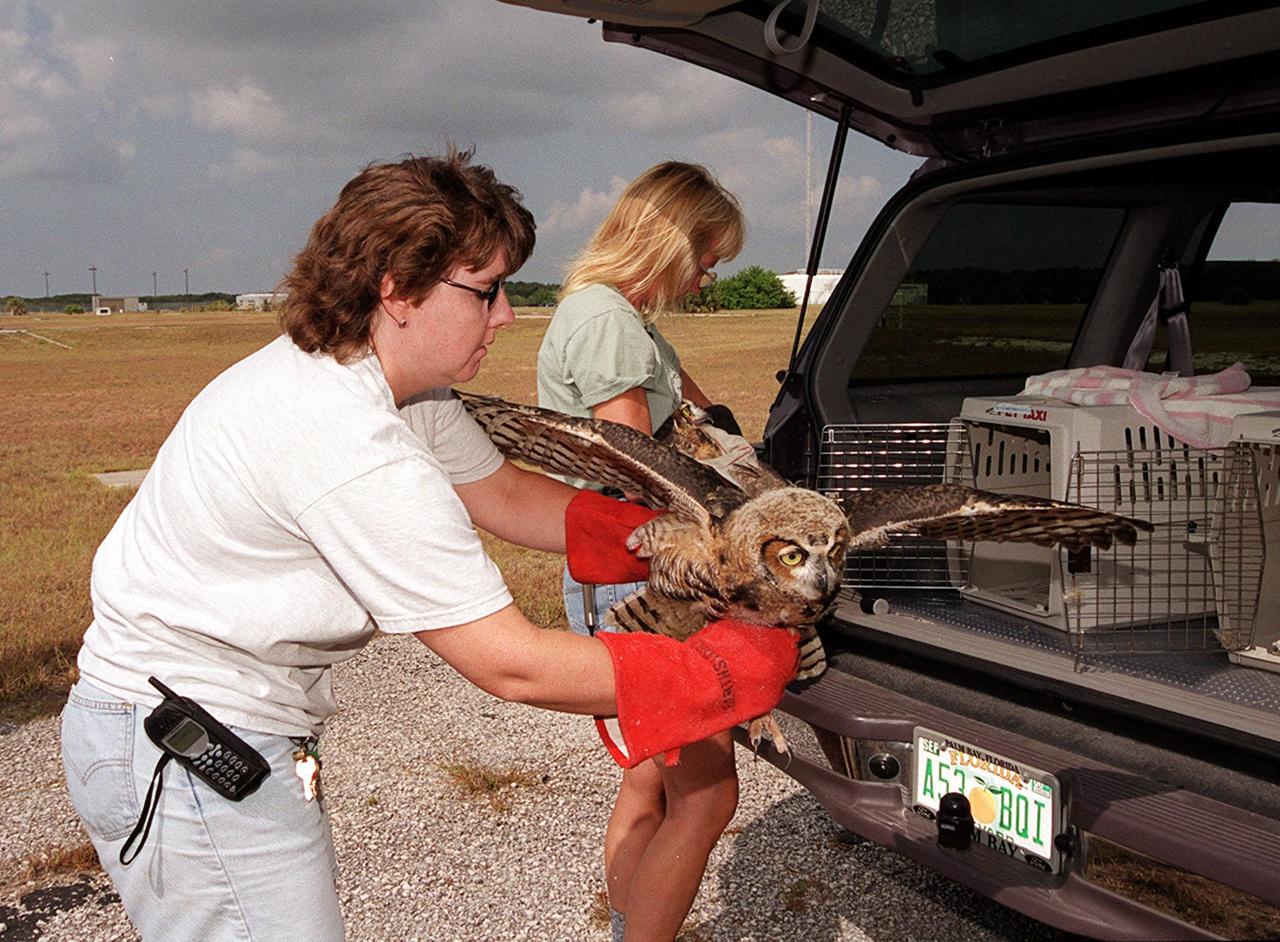
Eileen Olejarski (left), manager of Florida Wildlife Hospital, and Susan Small, director of the hospital, remove two great horned owls from the vehicle before releasing them at Cape Canaveral Air Force Station, Complex 25/29. The owls were found in June on the floor of CCAFS Hangar G, where their nest was located. They were treated at a local veterinary hospital and then taken to the Florida Wildlife Hospital in Melbourne for care and rehabilitation before release.
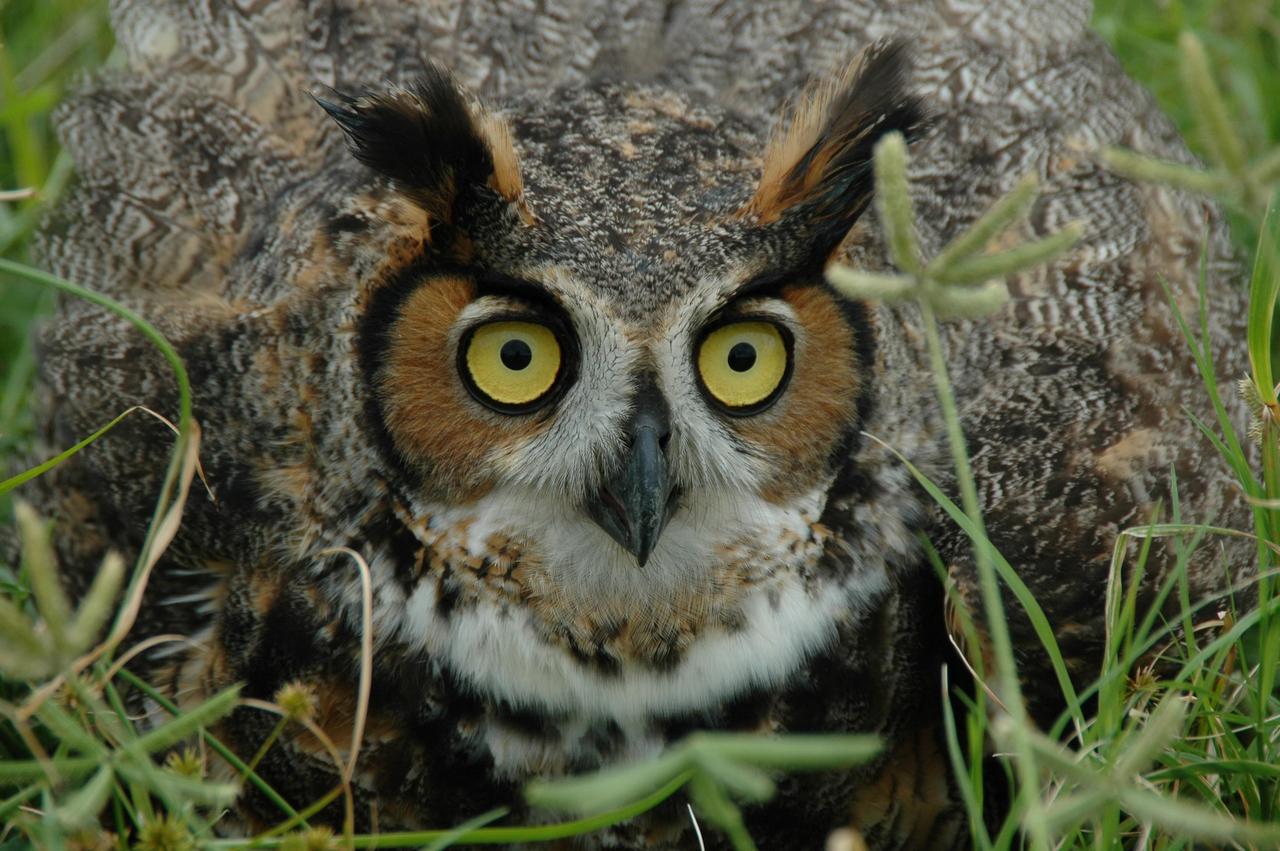
KENNEDY SPACE CENTER, FLA. - A Long-Eared Owl is spotted on Launch Complex 41 at Cape Canaveral Air Force Station in Florida. This one holds a typical stance for protecting its young. These owls range from Alaska and Canada to the Gulf states and Mexico, as far east as Central Florida. Their habitat is deciduous and evergreen forests. They nest in deserted nests of crows, hawks or squirrels.
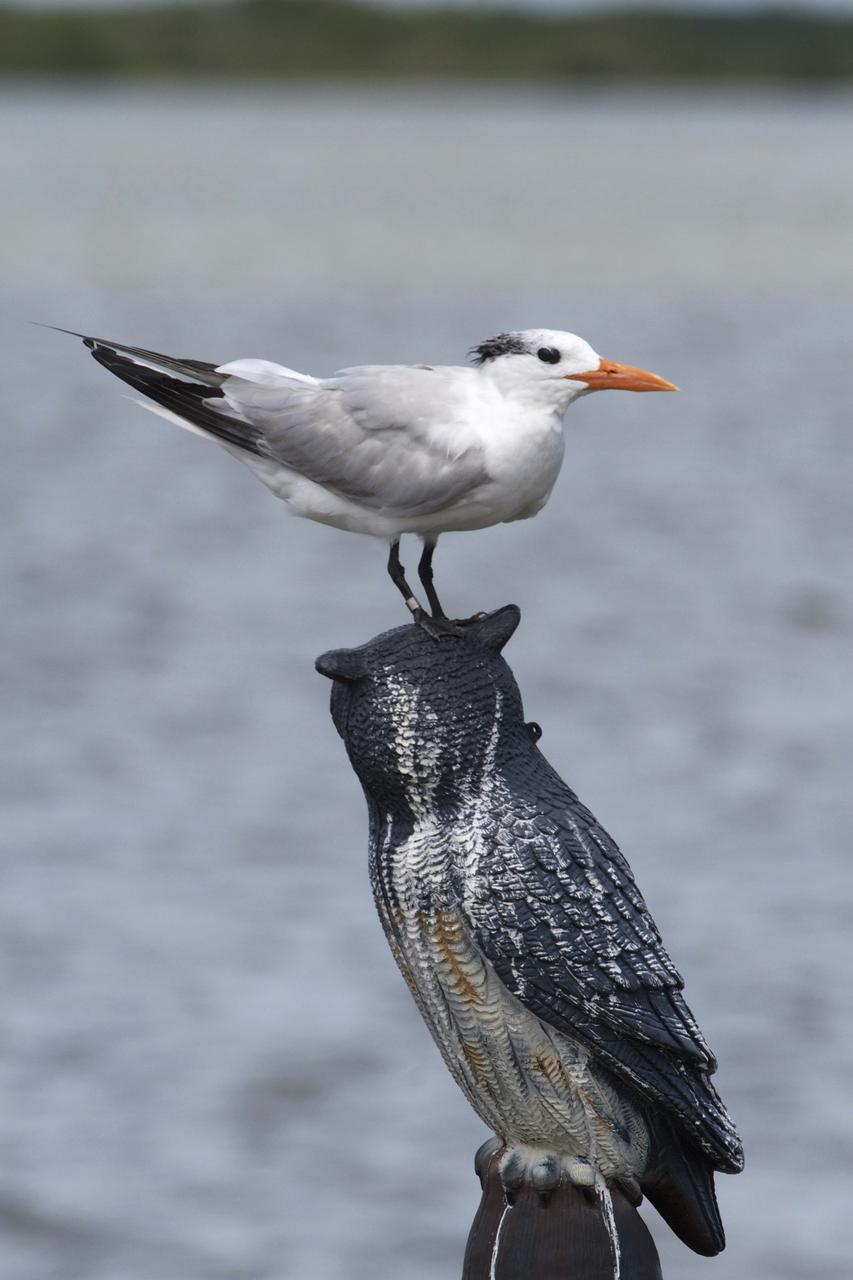
CAPE CANAVERAL, Fla. – At NASA’s Kennedy Space Center in Florida, a bird perches atop a wood-carved owl on a dock along the NASA Causeway. The center shares a boundary with the Merritt Island National Wildlife Refuge, consisting of 140,000 acres. The Refuge provides a wide variety of habitats: coastal dunes, saltwater estuaries and marshes, freshwater impoundments, scrub, pine flatwoods, and hardwood hammocks that provide habitat for more than 1,500 species of plants and animals, including about 331 species of birds. Photo credit: NASA_Ben Smegelsky
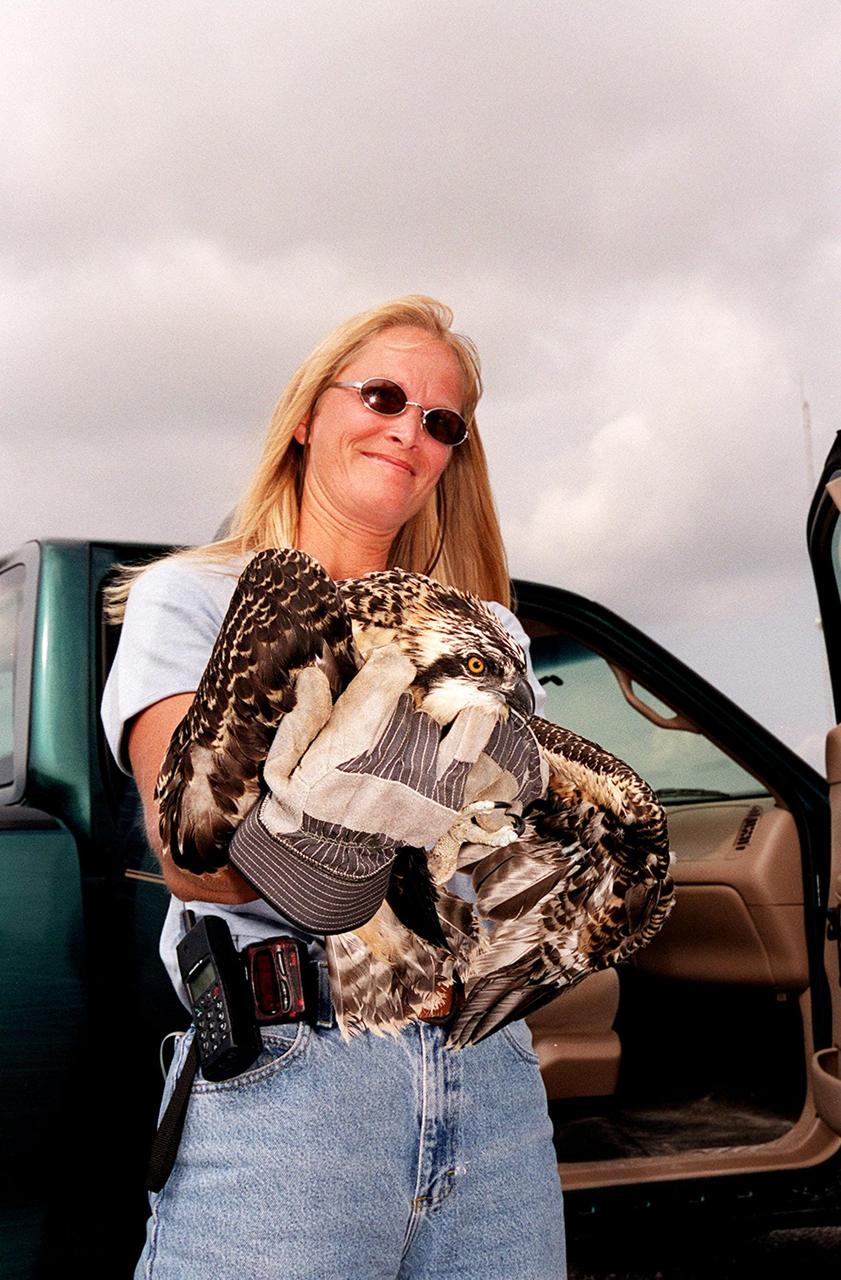
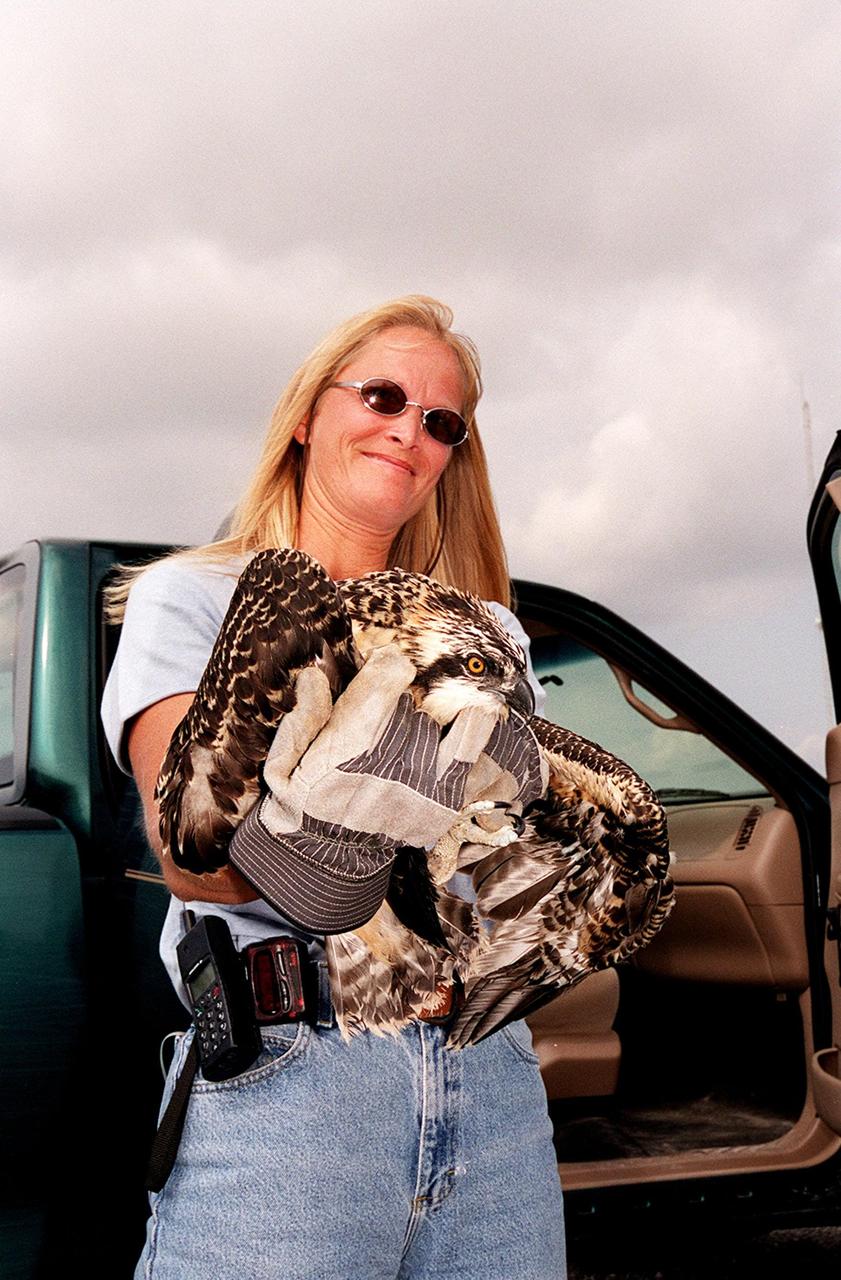
Angy Chambers, senior wildlife biologist for Environmental Support Contract/Dynamac, holds a juvenile osprey before releasing it at Cape Canaveral Air Force Station. As a nestling, the osprey fell twice from its nest, located on a light pole in the ITL area of CCAFS. Chambers determined the bird might have a broken leg and gave it to the Florida Wildlife Hospital for treatment. The osprey was released the same day as the two great horned owls
Angy Chambers, senior wildlife biologist for Environmental Support Contract/Dynamac, holds a juvenile osprey before releasing it at Cape Canaveral Air Force Station. As a nestling, the osprey fell twice from its nest, located on a light pole in the ITL area of CCAFS. Chambers determined the bird might have a broken leg and gave it to the Florida Wildlife Hospital for treatment. The osprey was released the same day as the two great horned owls
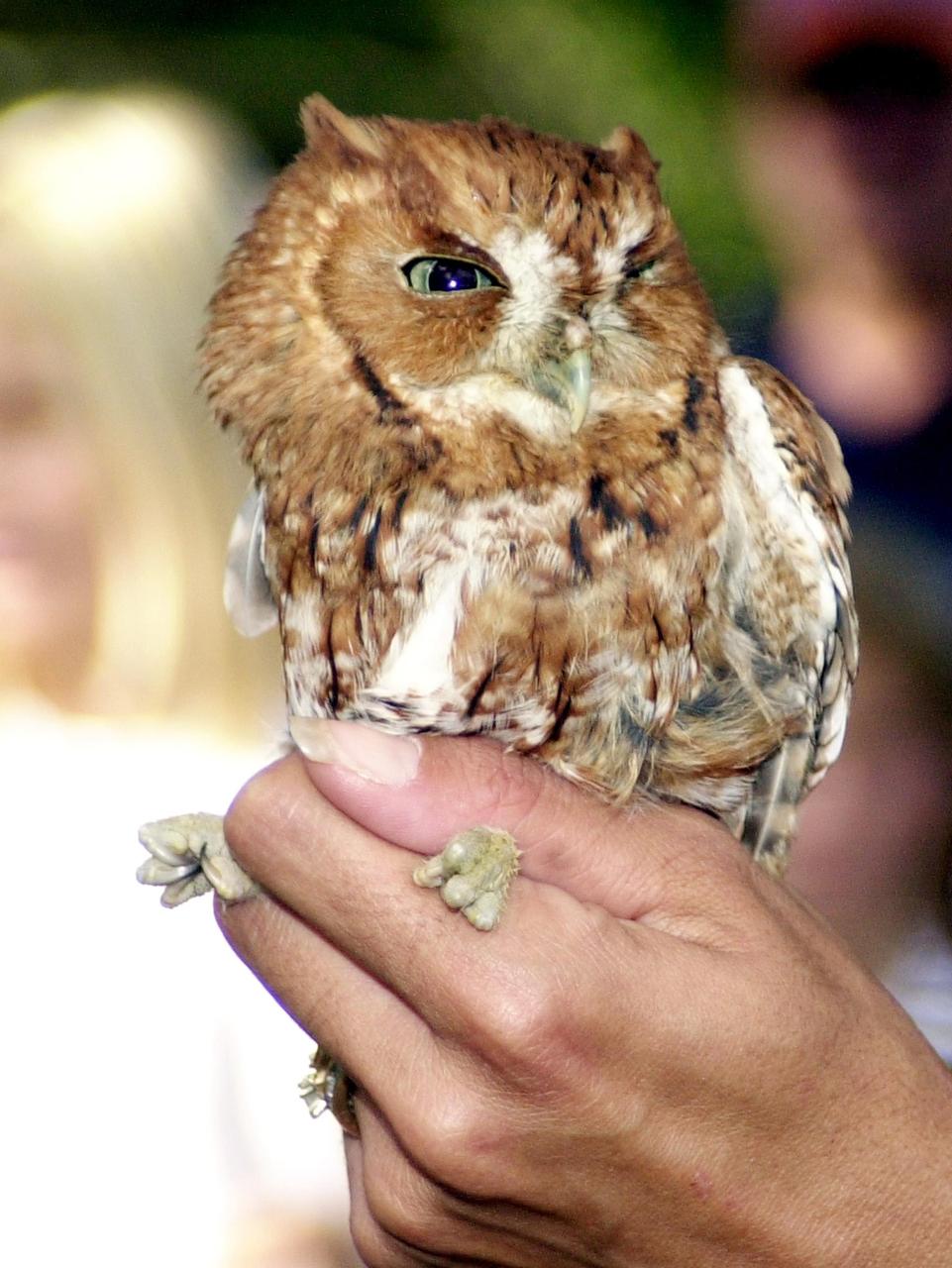
KENNEDY SPACE CENTER, FLA. -- An owl is held just before its release during the dedication of the Sendler Education Outpost, located at Dummit Cove on the Merritt Island National Wildlife Refuge (MINWR). The outpost is a resource for environmental educational students in the Central Florida area. It is named for Karl Sendler, a space pioneer and manager under Dr. Kurt Debus, KSC's first center director. Funding for the facility was provided by the Merritt Island Wildlife Association with assistance from MINWR and Kennedy Space Center.
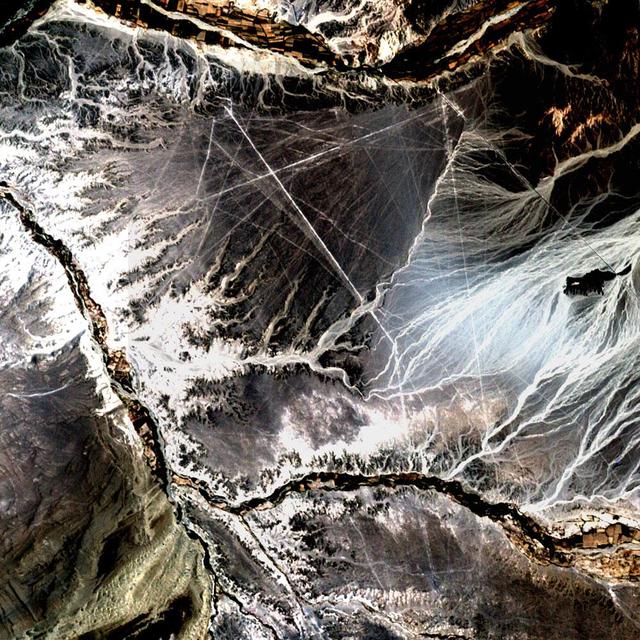
Acquisition Date: November 10, 2002 In the desert of southwest Peru, between the Andes Mountains and the Peruvian coast, lies a plateau with huge geometric patterns and spirals, animal figures including a monkey, a spider, and an 'owl man,' and thousands of perfectly straight lines. The last of these was drawn about a thousand years ago. Known as the Nazca lines, the drawings have mystified scientists since they were first discovered in the 1920s. Pictured here is all that can be seen of these lines by Landsat 7's 15 meter pan band, which has been used to sharpen the 30 meter Bands 3, 2, and 1. Credit: NASA/GSFC/Landsat/USGS To learn more about Landsat and to see the orginal high res file go to: <a href="http://landsat.usgs.gov/gallery_view.php?category=greenflag&thesort=mainTitle" rel="nofollow">landsat.usgs.gov/gallery_view.php?category=greenflag&...</a>
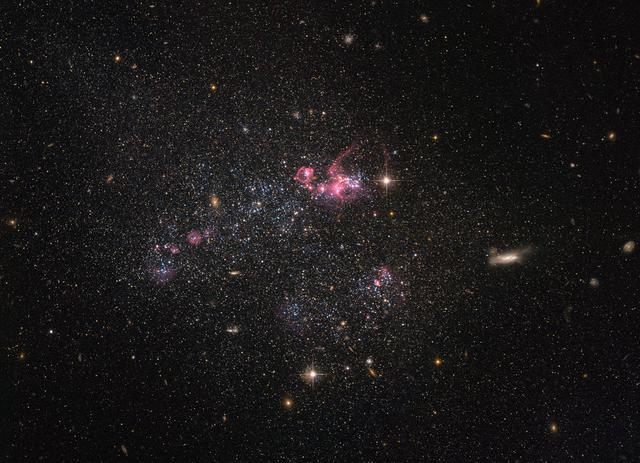
Despite being less famous than their elliptical and spiral galactic cousins, irregular dwarf galaxies, such as the one captured in this NASA/ESA Hubble Space Telescope image, are actually one of the most common types of galaxy in the Universe. Known as UGC 4459, this dwarf galaxy is located approximately 11 million light-years away in the constellation of Ursa Major (The Great Bear), a constellation that is also home to the Pinwheel Galaxy (M101), the Owl Nebula (M97), Messier 81, Messier 82 and several other galaxies all part of the M81 group. UGC 4459’s diffused and disorganised appearance is characteristic of an irregular dwarf galaxy. Lacking a distinctive structure or shape, irregular dwarf galaxies are often chaotic in appearance, with neither a nuclear bulge — a huge, tightly packed central group of stars — nor any trace of spiral arms — regions of stars extending from the centre of the galaxy. Astronomers suspect that some irregular dwarf galaxies were once spiral or elliptical galaxies, but were later deformed by the gravitational pull of nearby objects. Rich with young blue stars and older red stars, UGC 4459 has a stellar population of several billion. Though seemingly impressive, this is small when compared to the 200 to 400 billion stars in the Milky Way! Observations with Hubble have shown that because of their low masses, star formation is very low compared to larger galaxies. Only very little of their original gas has been turned into stars. Thus, these small galaxies are interesting to study to better understand primordial environments and the star formation process.
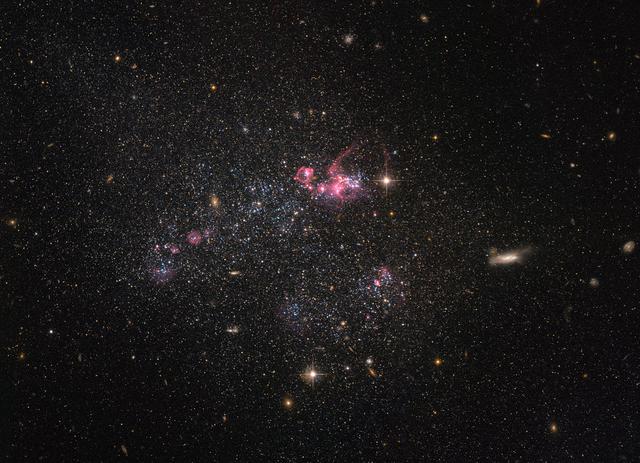
Despite being less famous than their elliptical and spiral galactic cousins, irregular dwarf galaxies, such as the one captured in this NASA/ESA Hubble Space Telescope image, are actually one of the most common types of galaxy in the universe. Known as UGC 4459, this dwarf galaxy is located approximately 11 million light-years away in the constellation of Ursa Major (The Great Bear), a constellation that is also home to the Pinwheel Galaxy (M101), the Owl Nebula (M97), Messier 81, Messier 82 and several other galaxies all part of the M81 group. UGC 4459’s diffused and disorganized appearance is characteristic of an irregular dwarf galaxy. Lacking a distinctive structure or shape, irregular dwarf galaxies are often chaotic in appearance, with neither a nuclear bulge — a huge, tightly packed central group of stars — nor any trace of spiral arms — regions of stars extending from the center of the galaxy. Astronomers suspect that some irregular dwarf galaxies were once spiral or elliptical galaxies, but were later deformed by the gravitational pull of nearby objects. Rich with young blue stars and older red stars, UGC 4459 has a stellar population of several billion. Though seemingly impressive, this is small when compared to the 200 to 400 billion stars in the Milky Way! Observations with Hubble have shown that because of their low masses of dwarf galaxies like UGC 4459, star formation is very low compared to larger galaxies. Only very little of their original gas has been turned into stars. Thus, these small galaxies are interesting to study to better understand primordial environments and the star formation process. Image Credit: ESA/Hubble and NASA; Acknowledgement: Judy Schmidt <b><a href="http://www.nasa.gov/audience/formedia/features/MP_Photo_Guidelines.html" rel="nofollow">NASA image use policy.</a></b> <b><a href="http://www.nasa.gov/centers/goddard/home/index.html" rel="nofollow">NASA Goddard Space Flight Center</a></b> enables NASA’s mission through four scientific endeavors: Earth Science, Heliophysics, Solar System Exploration, and Astrophysics. Goddard plays a leading role in NASA’s accomplishments by contributing compelling scientific knowledge to advance the Agency’s mission. <b>Follow us on <a href="http://twitter.com/NASAGoddardPix" rel="nofollow">Twitter</a></b> <b>Like us on <a href="http://www.facebook.com/pages/Greenbelt-MD/NASA-Goddard/395013845897?ref=tsd" rel="nofollow">Facebook</a></b> <b>Find us on <a href="http://instagrid.me/nasagoddard/?vm=grid" rel="nofollow">Instagram</a></b>